EP2498240A2 - Adhesive label and label issuing device - Google Patents
Adhesive label and label issuing device Download PDFInfo
- Publication number
- EP2498240A2 EP2498240A2 EP20120156878 EP12156878A EP2498240A2 EP 2498240 A2 EP2498240 A2 EP 2498240A2 EP 20120156878 EP20120156878 EP 20120156878 EP 12156878 A EP12156878 A EP 12156878A EP 2498240 A2 EP2498240 A2 EP 2498240A2
- Authority
- EP
- European Patent Office
- Prior art keywords
- adhesive
- layer
- label
- porous layer
- adhesive label
- Prior art date
- Legal status (The legal status is an assumption and is not a legal conclusion. Google has not performed a legal analysis and makes no representation as to the accuracy of the status listed.)
- Withdrawn
Links
Images


Classifications
-
- G—PHYSICS
- G09—EDUCATION; CRYPTOGRAPHY; DISPLAY; ADVERTISING; SEALS
- G09F—DISPLAYING; ADVERTISING; SIGNS; LABELS OR NAME-PLATES; SEALS
- G09F3/00—Labels, tag tickets, or similar identification or indication means; Seals; Postage or like stamps
- G09F3/04—Labels, tag tickets, or similar identification or indication means; Seals; Postage or like stamps to be fastened or secured by the material of the label itself, e.g. by thermo-adhesion
-
- B—PERFORMING OPERATIONS; TRANSPORTING
- B32—LAYERED PRODUCTS
- B32B—LAYERED PRODUCTS, i.e. PRODUCTS BUILT-UP OF STRATA OF FLAT OR NON-FLAT, e.g. CELLULAR OR HONEYCOMB, FORM
- B32B7/00—Layered products characterised by the relation between layers; Layered products characterised by the relative orientation of features between layers, or by the relative values of a measurable parameter between layers, i.e. products comprising layers having different physical, chemical or physicochemical properties; Layered products characterised by the interconnection of layers
- B32B7/04—Interconnection of layers
- B32B7/12—Interconnection of layers using interposed adhesives or interposed materials with bonding properties
-
- B—PERFORMING OPERATIONS; TRANSPORTING
- B32—LAYERED PRODUCTS
- B32B—LAYERED PRODUCTS, i.e. PRODUCTS BUILT-UP OF STRATA OF FLAT OR NON-FLAT, e.g. CELLULAR OR HONEYCOMB, FORM
- B32B9/00—Layered products comprising a layer of a particular substance not covered by groups B32B11/00 - B32B29/00
-
- B—PERFORMING OPERATIONS; TRANSPORTING
- B65—CONVEYING; PACKING; STORING; HANDLING THIN OR FILAMENTARY MATERIAL
- B65C—LABELLING OR TAGGING MACHINES, APPARATUS, OR PROCESSES
- B65C9/00—Details of labelling machines or apparatus
- B65C9/20—Gluing the labels or articles
- B65C9/24—Gluing the labels or articles by heat
-
- G—PHYSICS
- G09—EDUCATION; CRYPTOGRAPHY; DISPLAY; ADVERTISING; SEALS
- G09F—DISPLAYING; ADVERTISING; SIGNS; LABELS OR NAME-PLATES; SEALS
- G09F3/00—Labels, tag tickets, or similar identification or indication means; Seals; Postage or like stamps
- G09F3/08—Fastening or securing by means not forming part of the material of the label itself
- G09F3/10—Fastening or securing by means not forming part of the material of the label itself by an adhesive layer
-
- B—PERFORMING OPERATIONS; TRANSPORTING
- B32—LAYERED PRODUCTS
- B32B—LAYERED PRODUCTS, i.e. PRODUCTS BUILT-UP OF STRATA OF FLAT OR NON-FLAT, e.g. CELLULAR OR HONEYCOMB, FORM
- B32B2405/00—Adhesive articles, e.g. adhesive tapes
-
- G—PHYSICS
- G09—EDUCATION; CRYPTOGRAPHY; DISPLAY; ADVERTISING; SEALS
- G09F—DISPLAYING; ADVERTISING; SIGNS; LABELS OR NAME-PLATES; SEALS
- G09F3/00—Labels, tag tickets, or similar identification or indication means; Seals; Postage or like stamps
- G09F3/02—Forms or constructions
- G09F2003/023—Adhesive
- G09F2003/025—Activatable adhesive
-
- G—PHYSICS
- G09—EDUCATION; CRYPTOGRAPHY; DISPLAY; ADVERTISING; SEALS
- G09F—DISPLAYING; ADVERTISING; SIGNS; LABELS OR NAME-PLATES; SEALS
- G09F3/00—Labels, tag tickets, or similar identification or indication means; Seals; Postage or like stamps
- G09F3/02—Forms or constructions
- G09F2003/0257—Multilayer
- G09F2003/026—Multilayer without silicon backing
-
- Y—GENERAL TAGGING OF NEW TECHNOLOGICAL DEVELOPMENTS; GENERAL TAGGING OF CROSS-SECTIONAL TECHNOLOGIES SPANNING OVER SEVERAL SECTIONS OF THE IPC; TECHNICAL SUBJECTS COVERED BY FORMER USPC CROSS-REFERENCE ART COLLECTIONS [XRACs] AND DIGESTS
- Y10—TECHNICAL SUBJECTS COVERED BY FORMER USPC
- Y10T—TECHNICAL SUBJECTS COVERED BY FORMER US CLASSIFICATION
- Y10T428/00—Stock material or miscellaneous articles
- Y10T428/24—Structurally defined web or sheet [e.g., overall dimension, etc.]
- Y10T428/24942—Structurally defined web or sheet [e.g., overall dimension, etc.] including components having same physical characteristic in differing degree
-
- Y—GENERAL TAGGING OF NEW TECHNOLOGICAL DEVELOPMENTS; GENERAL TAGGING OF CROSS-SECTIONAL TECHNOLOGIES SPANNING OVER SEVERAL SECTIONS OF THE IPC; TECHNICAL SUBJECTS COVERED BY FORMER USPC CROSS-REFERENCE ART COLLECTIONS [XRACs] AND DIGESTS
- Y10—TECHNICAL SUBJECTS COVERED BY FORMER USPC
- Y10T—TECHNICAL SUBJECTS COVERED BY FORMER US CLASSIFICATION
- Y10T428/00—Stock material or miscellaneous articles
- Y10T428/249921—Web or sheet containing structurally defined element or component
- Y10T428/249953—Composite having voids in a component [e.g., porous, cellular, etc.]
- Y10T428/249982—With component specified as adhesive or bonding agent
Definitions
- the present invention relates to an adhesive label that has non-adhesiveness at a time of storage and is allowed to exhibit adhesiveness at a time of use.
- the adhesive label has a configuration in which an adhesive layer and release paper are laminated on a surface opposite to the recording surface for characters and the like.
- the release paper is peeled off at a time of use to expose the adhesive layer, and the adhesive label is attached by pressing.
- the release paper after being peeled off from the adhesive label completes its function and is disposed of as waste. Therefore, there is a demand for an adhesive label that does not create waste of release paper from the viewpoint of resource protection and environment.
- thermosensitive adhesive layer that has non-adhesiveness at room temperature and exhibits adhesiveness by heating is formed on a surface opposite to a printed surface of a label.
- release paper is not required, and hence, problems related to environment and waste as in the related art do not arise.
- the label in which the thermosensitive adhesive layer is formed is stored by being rolled into a roll shape or by being stacked, and hence, the adhesive surface and the printed surface are stacked on one another in contact.
- thermosensitive adhesive exhibits slight adhesiveness, and this causes the printed surface and the adhesive surface to adhere to each other.
- heating means for exhibiting adhesiveness by using an adhesive it is considered to use a heat source such as a thermal head.
- the thermal head is used for allowing the thermosensitive adhesive layer to exhibit adhesiveness by heating in addition to printing, there arises a problem that power consumption increases.
- Japanese Patent Application Laid-open No. 2006-78733 describes an adhesive label that does not use release paper and solves the problems such as blocking.
- the adhesive label 100 has a laminated structure in which a base 101, an adhesive 102, and a resin film 103 are laminated.
- a polyester film is used as the resin film 103, and the resin film 103 has a thickness of 1 to 3 ⁇ m.
- the adhesive label 100 prevents blocking at a time of storage by covering the surface of the adhesive 102 with the resin film 103 instead of release paper or a thermosensitive adhesive.
- a hole is opened in the resin film 103 by using a needle 110, or a stretched polyester film is used as the resin film 103 and a hole is opened in the resin film 103 by heating with a thermal head or the like, to thereby break a blocking prevention function and expose the underlying adhesive 102. In this manner, adhesive strength is exhibited.
- Japanese Patent Application Laid-open No. 9-111203 describes a configuration in which a pressure-sensitive adhesive layer is provided on a base sheet, and the pressure-sensitive adhesive layer is covered with a microcapsule layer so as to cover an adhesive surface of the pressure-sensitive adhesive layer, to thereby solve the problems such as blocking without using release paper.
- the microcapsule layer is formed of a single layer of a hollow microcapsule and has a melting point of about 100°C to 180°C, for example, and the surface thereof has no adhesiveness. Therefore, release paper is not required.
- the microcapsule layer is broken by heating with a thermal head to expose the underlying pressure-sensitive adhesive layer, and thus, adhesiveness is exhibited.
- the labels when labels are issued continuously, the labels are allowed to pass under a state in which the resin films 103 that are adhesive surfaces of the labels are brought into contact with a roller having a needle-shaped surface. With this, a hole is opened in each resin film 103 to expose an adhesive. However, the adhesive adheres to the needle 110 when the hole is opened in the resin film 103, and if the roller is rotated, the resin film 103 is pulled to be broken further. Therefore, the position and area of a region in which adhesiveness is to be exhibited cannot be controlled with high precision.
- the adhesive 102 and the resin film 103 scatter and adhere to the roller or the inside of the device, which makes it difficult to keep the transportability of the label.
- the polyester film in direct contact with a heating part is melted to be opened, and the underlying adhesive functions so as to prevent the opening.
- the adhesive 102 is originally used for acting on an adherend, but in this case, the adhesive function works strongly with respect to the upper polyester film, which hinders the deformation and flowing of the film in contact. Therefore, it is difficult to stably form an opening in a required shape.
- the heat energy at a time of heating is increased, the shape of an opening of the polyester film becomes further unstable, and the underlying adhesive is also heated to break the polyester film and scatter the broken strips thereof, which is not practical.
- the microcapsule has a spherical shape, and hence, the heat conductivity when the miocrocapsule comes into contact with a heat source is low. Thus, large heat energy is required for breaking the microcapsule.
- An adhesive label according to the present invention includes: a support; an adhesive layer placed on the support; and a non-adhesive porous layer placed on the adhesive layer.
- non-adhesive porous layer is made of an olefin-based resin.
- non-adhesive porous layer has a porosity in a range of 30% to 85%.
- a heat capacity per unit area of the non-adhesive porous layer is smaller than a heat capacity per unit area of the adhesive layer.
- the adhesive label further includes a thermosensitive color-developing layer placed on a side of the support opposite to the adhesive layer.
- non-adhesive porous layer is openable by heating so that the adhesive layer is exposed.
- a label issuing device includes: a transporting part for transporting an adhesive label including a support, an adhesive layer placed on the support, and a porous layer placed on the adhesive layer; a recording part for performing recording on a side of the support opposite to the adhesive layer; and a heating part for opening the porous layer by heating so that the adhesive layer is exposed.
- the adhesive label according to the present invention includes a support, an adhesive layer placed on the support, and a non-adhesive porous layer placed on the adhesive layer.
- the porous layer has an anti-blocking property without adhesiveness, and thus, the adhesive label can be stored by being rolled into a roll shape.
- the porous layer has a higher heat-shielding effect, compared with that of the same material. Therefore, the porous layer is excellent in controllability of a perforated area and an increase in sensitivity when the porous layer comes into contact with a heat source.
- the position of the surface of the adhesive layer to be exposed and the shape of the opening can be controlled with high precision.
- FIG 1 is a schematic vertical cross-sectional view of an adhesive label 1 according to a first embodiment of the present invention.
- the adhesive label 1 has a configuration in which a print recording layer 2, a support 3, an adhesive layer 4, and a porous layer 5 are laminated from a lowermost surface.
- the adhesive label 1 of the present invention is allowed to exhibit adhesiveness by opening the porous layer 5 with heating to expose the adhesive layer 4.
- the porous layer 5 has non-adhesiveness and does not cause blocking even when the adhesive label 1 is stacked or rolled into a roll shape for storage. Characters, graphics, and the like can be printed on the print recording layer 2.
- the print recording layer 2 is printed by using a label issuing device, and the porous layer 5 is opened by localized heating.
- the adhesive label 1 in which a particular portion of the adhesive layer 4 is exposed can be issued.
- the support 3 can be printed directly without forming the print recording layer 2.
- the porous layer 5 has a heat capacity smaller than that of a layer made of the same material with a uniform thickness, which is not porous. Therefore, the porous layer 5 can be opened with heat energy lower than that of the same material that is not porous.
- the porous layer 5 is melted by heating and opened by a surface tension.
- the porous layer 5 has a material density smaller than that of the layer made of the same material, which is not porous. Further, a large number of holes are opened in the surface of the porous layer 5, and hence the contact area between the porous layer 5 and the adhesive layer 4 is smaller, compared with that of the same material, which is not porous. Therefore, the adhesive function of the adhesive material 4, which prevents the opening of the porous layer 5, is also low.
- the opened porous layer 5 is provided with a convex part in an outer circumferential portion thereof in accordance with the volume of the melted porous material and the opening area.
- the porous layer 5 contains a large number of hollow regions, and hence, the porous layer has low or no thermal diffusibility, compared with the same material that is not porous. That is, the porous layer 5 has a high heat-shielding property, and heat is unlikely to spread in a planar direction of the porous layer 5. Therefore, an opening does not extend to a region outside the region with which a heating part H is contact. As a result, adhesion characteristics of an adhesive label can be exhibited with high sensitivity, and the position and shape of an opening 8 can be controlled with high precision.
- FIGS. 2A to 2D are explanatory views illustrating how the adhesive label 1 according to the present invention exhibits adhesiveness.
- a thermal head 6 is used as heating means. As illustrated in FIG 2A , the heating part H of the thermal head 6 is brought into contact with the porous layer 5 of the adhesive label 1. Then, as illustrated in FIG 2B , the heated porous layer 5 starts being melted, and an opening is formed in the porous layer 5 as illustrated in FIG 2C . Thus, simultaneously with the formation of the opening 8, a convex part 7 higher than the surface of the porous layer 5 is formed on the periphery of the opening 8, and the underlying adhesive layer 4 is exposed.
- the print recording layer 2 can be printed before or after the illustration of FIGS. 2A to 2D and the adhesive label 1 can be used as a label.
- FIGS. 3A and 3B are schematic plan views illustrating examples of the openings 8 formed in the porous layer 5 of the adhesive label 1 according to the present invention.
- FIG 3A illustrates a state in which nine openings 8 are formed so as to be aligned in a region R1 of the porous layer 5 by using the thermal head 6.
- FIG 3B illustrates a state in which twelve openings 8 are formed so as to be aligned diagonally in a region R2 of the porous layer 5 by using the thermal head 6.
- any opening pattern can be formed by arranging any number of the openings 8 in any direction at any position.
- a synthetic resin material can be used as the porous layer 5. It is preferred that the porous layer 5 have a porosity of 30% to 85% and an average hole diameter of 0.01 ⁇ m to 10 ⁇ m.
- the thickness of the porous layer 5 can be set to be in a range of 1 ⁇ m to 30 ⁇ m. It is preferred that the average hole diameter of the porous layer 5 be set to be smaller than the layer thickness of the porous layer 5 so that a through-hole is not formed.
- the thickness of the porous layer 5 is set to be preferably 30 ⁇ m or less. This reduces the heat capacity of the porous layer 5, with the result that the porous layer 5 can be opened with low heat energy.
- the heating part H and the adhesive layer 4 do not come into contact with each other due to the thickness of the opened porous layer 5 and the convex part 7.
- the temperature at which the porous layer 5 is opened by heating depends upon the material properties of the porous layer 5, and can be set to be about 100°C to 200°C. This can address the energy saving of the device and the increase in sensitivity of the adhesive label.
- the porous layer 5 can be configured in such a manner that the heat capacity per unit area thereof is smaller than that of the underlying adhesive layer 4 by using a synthetic resin material for the porous layer 5. That is, by configuring the upper porous layer 5 so that the heat capacity thereof becomes smaller than that of the underlying adhesive layer 4, an increase in temperature of the underlying adhesive layer 4 is suppressed, which can prevent the adhesive layer 4 from being deformed or denatured by heat.
- the support 3 a plastic material can be used.
- the support 3 may be made of any material that can support the print recording layer 2 to be formed on a lower surface thereof and the adhesive layer 4 to be formed on an upper surface thereof.
- polypropylene, polyethylene, polystyrene, acrylic resin, or paper can be used.
- a pressure-sensitive adhesive can be used as the adhesive layer 4.
- the pressure-sensitive adhesive can adhere to an adherend merely by applying a small pressure at room temperature without using water, a solvent, or heat. Further, the pressure-sensitive adhesive adheres to an adherend strongly due to its cohesion force and elasticity, and can also be peeled off from a hard smooth surface.
- a silicone-based adhesive, a rubber-based adhesive, or an acrylic adhesive can be used depending upon its intended use.
- the silicone-based adhesive can include silicone having a high cohesion force and silicone having a high adhesive strength.
- the rubber-based adhesive natural rubber, styrene-butadiene rubber (SBR), polyisobutylene, or a rubber-based material can be used.
- a cross-linking material using a monomer with a low glass transition point and a cross-linking agent, or a non-cross-linking material obtained by copolymerizing a monomer with a low glass transition point and a monomer with a high glass transition point can be used.
- the porous layer 5 can be formed, for example, by mixing and dispersing particles that vaporize in a material serving as a base and allowing the particles to vaporize to obtain porosity in the base material.
- a material serving as a base As the base, an olefin-based resin can be used.
- the olefin-based resin is used for many purposes as a general-purpose resin, and hence, can form the porous layer 5 at low cost.
- polyethylene PE
- polyvinyl chloride PVC
- polypropylene PP
- a multi-layer polyolefin-based resin in which PE and PP are stacked polystyrene (PS), and polyethylene terephthalate (PET)
- PET polyethylene terephthalate
- a homopolymer, a copolymer, or a multistage polymer can be used as the olefin-based resin.
- Polyolefin selected from the group consisting of the homopolymer, the copolymer, and the multistage polymer can also be used alone or in combination.
- Typical examples of the above-mentioned polymers include low-density polyethylene, linear low-density polyethylene, medium-density polyethylene, high-density polyethylene, ultrahigh molecular weight polyethylene, isotactic polypropylene, atactic polypropylene, polybutene, and ethylene propylene rubber.
- a hybrid that is a stack type of PS and PET an ethylene/vinyl acetate copolymer (EVA) based resin, a polyvinyl alcohol (PVA) based resin, a polylactic acid (PLA) based resin that is a plant-based material, and the like can be used.
- EVA ethylene/vinyl acetate copolymer
- PVA polyvinyl alcohol
- PLA polylactic acid
- a stretching process for forming the porous layer 5 a uniaxially stretched or biaxially stretched material can be used.
- a stretched film there can be used a material which is stabilized by manipulating a glass transition point by copolymerizing a single monomer with another monomer or blending different kinds of components such as rubber.
- the viscosity average molecular weight of the olefin-based resin is preferably 50,000 to 12,000,000, more preferably 50,000 to less than 2,000,000, most preferably 100,000 to less than 1,000,000. If the viscosity average molecular weight is 50,000 or more, the melt-tension at a time of melt molding becomes large to enhance moldability, which provides sufficient entanglement and tends to give high strength. If the viscosity average molecular weight is 12,000,000 or less, particularly, thickness stability is excellent.
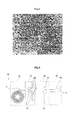
- FIG 4 is a photograph of a surface of an example of the porous layer 5 to be applied to the adhesive label 1 according to the present invention, which is taken by a scanning electron microscope.
- the porous layer 5 is formed of an olefin-based resin.
- a large number of holes are formed in the surface of the porous layer 5.
- the hole diameter of these holes is about 2 ⁇ m or less.
- thermosensitive color-developing layer that develops color by heating
- a thermosensitive recording layer coating solution is prepared by mixing a leuco dye with a developer that allows the leuco dye to develop color, and is applied to the print recording layer 2.
- a recording layer capable of recording by an inkjet recording apparatus may be used in place of the thermosensitive color-developing layer.
- the adhesive label 1 is produced in the following manner.
- the porous layer 5 is attached to the support 3 coated with an adhesive or the support 3 with the adhesive layer 4 formed thereon.
- a coextrusion procedure can be used for the attachment.
- a bar coater, an airknife coater, a squeeze coater, a gravure coater, or the like can be used as a device for coating the support 3 with an adhesive.
- film viscosity, film thickness, and a drying process are selected appropriately.
- a plurality of layers of the support 3, the adhesive layer 4, and the porous layer 5 are attached, and hence a residual stress based on the thermal contraction and moisture absorption acts.
- the dimension stability, flatness of a surface, moisture resistance, solvent resistance, mechanical strength, friction coefficient of a surface, and flexibility at a time of contact with a heat source of the adhesive label 1 are to be noted.
- the adhesive strength of the adhesive label 1 is exhibited when an adhesive comes into contact with the surface of an adherend through the openings 8.
- the radius a of the opening 8 can be controlled with high precision, and hence, the controllability of the amount of the adhesive that flow out through the openings 8 is enhanced, and predetermined adhesive strength can be exhibited stably.
- FIG 5 is a schematic structural view of a label issuing device 10 according to a second embodiment of the present invention.
- the label issuing device 10 includes a roll paper accommodating part 12 for accommodating the adhesive label 1, a roll paper cutting part 13 for cutting the adhesive label 1, a label recording part 14 as a recording part for recording on the adhesive label 1, and an adhesiveness exhibiting part 15 for allowing the adhesive label 1 to exhibit adhesiveness.
- the roll paper accommodating part 12 accommodates the adhesive label 1 rolled into a roll shape.
- the adhesive label 1 has a laminated structure in which the print recording layer 2, the support 3, the adhesive layer 4, and the porous layer 5 are laminated.
- the roll paper cutting part 13 cuts the adhesive label 1 sent from transporting rollers 17 as a transporting part to a predetermined length by a cutter member 16.
- the label recording part 14 performs recording by a recording thermal head 11 on the print recording layer 2 of the adhesive label 1 placed on a transporting roller 18.
- the adhesiveness exhibiting part 15 heats the porous layer 5 of the adhesive label 1 placed on a transporting roller 19 by the thermal head 6 as the heating part H to expose the underlying adhesive layer 4.
- the thermal head 6 is configured by arranging a plurality of heat-generating parts in parallel, and thus, can form a plurality of openings 8 simultaneously so that the openings 8 are arranged in parallel. Further, a plurality of openings 8 can be formed continuously in the transport direction of the adhesive label 1. Specifically, a required number of openings 8 can be formed at required positions of the adhesive label 1. That is, the position and size of a region in which the adhesive label 1 is allowed to exhibit adhesiveness can be set. Further, the size of the openings 8 can be controlled with high precision, and hence, the adhesive strength can be exhibited stably.
- the openings 8 are provided in the porous layer 5, a gap is formed between the heating part H of the thermal head 6 and the upper surface of the adhesive layer 4 due to the thickness of the porous layer 5 or the convex part 7 interposed on the periphery of each opening 8. Therefore, the transportability of the adhesive label 1 can be kept without allowing the adhesive layer 4 to adhere to the thermal head 6. Further, the adhesive label 1 according to the present invention can exhibit adhesiveness by opening the porous layer 5 with low energy, which is preferred for configuring a portable label issuing device 10.
- FIG 6 is a photograph of the surface of the porous layer 5 of the adhesive label 1 issued by the label issuing device 10 illustrated in FIG 5 .
- the adhesive label 1 moves from an upper side to a lower side, and a plurality of heat generators of a thermal head are arranged in a horizontal direction.
- a region Ra includes openings 8a formed by allowing the plurality of heat generators of the thermal head to generate heat alternately and allowing the heat generators to generate heat every other dot intermittently.
- a region Rb includes openings 8b in a block shape formed by allowing the heat generators of the thermal head to generate heat continuously in a lateral direction.
- a region Rc includes openings 8c in a block shape formed by allowing the heat generators of the thermal head to generate heat continuously in time sequence.
Landscapes
- Physics & Mathematics (AREA)
- General Physics & Mathematics (AREA)
- Engineering & Computer Science (AREA)
- Theoretical Computer Science (AREA)
- Adhesive Tapes (AREA)
- Laminated Bodies (AREA)
Abstract
Description
- The present invention relates to an adhesive label that has non-adhesiveness at a time of storage and is allowed to exhibit adhesiveness at a time of use.
- In recent years, adhesive labels have been used for a price indication label, a product indication label, an advertisement label, a seal label for a package, and the like. As a method of recording on a recording surface of the adhesive label, various methods such as an inkjet recording method and a thermosensitive recording method are applied. Conventionally, the adhesive label has a configuration in which an adhesive layer and release paper are laminated on a surface opposite to the recording surface for characters and the like. The release paper is peeled off at a time of use to expose the adhesive layer, and the adhesive label is attached by pressing. However, in the conventional adhesive label to be used by peeling off the release paper, the release paper after being peeled off from the adhesive label completes its function and is disposed of as waste. Therefore, there is a demand for an adhesive label that does not create waste of release paper from the viewpoint of resource protection and environment.
- In order to solve the above-mentioned problem, a label that does not use release paper has also been proposed. Specifically, there has been proposed a label in which a thermosensitive adhesive layer that has non-adhesiveness at room temperature and exhibits adhesiveness by heating is formed on a surface opposite to a printed surface of a label. In this label, release paper is not required, and hence, problems related to environment and waste as in the related art do not arise. However, the label in which the thermosensitive adhesive layer is formed is stored by being rolled into a roll shape or by being stacked, and hence, the adhesive surface and the printed surface are stacked on one another in contact. Therefore, in the case of long-term storage or depending upon storage environment, there is a problem of so-called blocking, in which the thermosensitive adhesive exhibits slight adhesiveness, and this causes the printed surface and the adhesive surface to adhere to each other. Further, as heating means for exhibiting adhesiveness by using an adhesive, it is considered to use a heat source such as a thermal head. However, when the thermal head is used for allowing the thermosensitive adhesive layer to exhibit adhesiveness by heating in addition to printing, there arises a problem that power consumption increases.
- Japanese Patent Application Laid-open No.
2006-78733 FIG 7 (FIG 2 of Japanese Patent Application Laid-open No.2006-78733 adhesive label 100 has a laminated structure in which abase 101, an adhesive 102, and aresin film 103 are laminated. A polyester film is used as theresin film 103, and theresin film 103 has a thickness of 1 to 3 µm. Theadhesive label 100 prevents blocking at a time of storage by covering the surface of theadhesive 102 with theresin film 103 instead of release paper or a thermosensitive adhesive. Then, at a time of use, a hole is opened in theresin film 103 by using aneedle 110, or a stretched polyester film is used as theresin film 103 and a hole is opened in theresin film 103 by heating with a thermal head or the like, to thereby break a blocking prevention function and expose theunderlying adhesive 102. In this manner, adhesive strength is exhibited. - Further, Japanese Patent Application Laid-open No.
9-111203 - Regarding the adhesive label described in Japanese Patent Application Laid-open No.
2006-78733 resin films 103 that are adhesive surfaces of the labels are brought into contact with a roller having a needle-shaped surface. With this, a hole is opened in eachresin film 103 to expose an adhesive. However, the adhesive adheres to theneedle 110 when the hole is opened in theresin film 103, and if the roller is rotated, theresin film 103 is pulled to be broken further. Therefore, the position and area of a region in which adhesiveness is to be exhibited cannot be controlled with high precision. In addition, the adhesive 102 and theresin film 103 scatter and adhere to the roller or the inside of the device, which makes it difficult to keep the transportability of the label. Further, in the case of using a stretched polyester film as theresin film 103 and opening a hole in theresin film 103 by heating with a thermal head, the polyester film in direct contact with a heating part is melted to be opened, and the underlying adhesive functions so as to prevent the opening. Theadhesive 102 is originally used for acting on an adherend, but in this case, the adhesive function works strongly with respect to the upper polyester film, which hinders the deformation and flowing of the film in contact. Therefore, it is difficult to stably form an opening in a required shape. When the heat energy at a time of heating is increased, the shape of an opening of the polyester film becomes further unstable, and the underlying adhesive is also heated to break the polyester film and scatter the broken strips thereof, which is not practical. - Further, in Japanese Patent Application Laid-open No.
9-111203 - For this reason, the adhesive label of Japanese Patent Application Laid-open No.
9-111203 - An adhesive label according to the present invention includes: a support; an adhesive layer placed on the support; and a non-adhesive porous layer placed on the adhesive layer.
- Further, the non-adhesive porous layer is made of an olefin-based resin.
- Further, the non-adhesive porous layer has a porosity in a range of 30% to 85%.
- Further, a heat capacity per unit area of the non-adhesive porous layer is smaller than a heat capacity per unit area of the adhesive layer.
- Further, the adhesive label further includes a thermosensitive color-developing layer placed on a side of the support opposite to the adhesive layer.
- Further, the non-adhesive porous layer is openable by heating so that the adhesive layer is exposed.
- A label issuing device according to the present invention includes: a transporting part for transporting an adhesive label including a support, an adhesive layer placed on the support, and a porous layer placed on the adhesive layer; a recording part for performing recording on a side of the support opposite to the adhesive layer; and a heating part for opening the porous layer by heating so that the adhesive layer is exposed.
- The adhesive label according to the present invention includes a support, an adhesive layer placed on the support, and a non-adhesive porous layer placed on the adhesive layer. This saves the labor for disposing of release paper because release paper is not discharged at a time of use, and the adhesive label of the present invention is excellent also in environmental resistance from the viewpoint of saving resources. Further, the porous layer has an anti-blocking property without adhesiveness, and thus, the adhesive label can be stored by being rolled into a roll shape. Further, the porous layer has a higher heat-shielding effect, compared with that of the same material. Therefore, the porous layer is excellent in controllability of a perforated area and an increase in sensitivity when the porous layer comes into contact with a heat source. Thus, the position of the surface of the adhesive layer to be exposed and the shape of the opening can be controlled with high precision.
- Embodiments of the present invention will now be described by way of further example only and with reference to the accompanying drawings, in which:
-
FIG 1 is a schematic vertical cross-sectional view of an adhesive label according to a first embodiment of the present invention; -
FIGS. 2A to 2D are explanatory views illustrating how the adhesive label according to the present invention exhibits adhesiveness; -
FIGS. 3A and 3B are schematic plan views illustrating examples of openings formed in a porous layer of the adhesive label according to the present invention; -
FIG 4 is a photograph of a surface of the porous layer of the adhesive label according to the present invention, which is taken by a scanning electron microscope; -
FIG 5 is a schematic structural view of a label issuing device according to a second embodiment of the present invention; -
FIG 6 is a photograph of openings formed by the label issuing device of the present invention; and -
FIG 7 is a schematic view of a conventionally known label issuing device. -
FIG 1 is a schematic vertical cross-sectional view of an adhesive label 1 according to a first embodiment of the present invention. The adhesive label 1 has a configuration in which aprint recording layer 2, asupport 3, anadhesive layer 4, and aporous layer 5 are laminated from a lowermost surface. The adhesive label 1 of the present invention is allowed to exhibit adhesiveness by opening theporous layer 5 with heating to expose theadhesive layer 4. On the other hand, theporous layer 5 has non-adhesiveness and does not cause blocking even when the adhesive label 1 is stacked or rolled into a roll shape for storage. Characters, graphics, and the like can be printed on theprint recording layer 2. For example, theprint recording layer 2 is printed by using a label issuing device, and theporous layer 5 is opened by localized heating. Thus, the adhesive label 1 in which a particular portion of theadhesive layer 4 is exposed can be issued. Note that, thesupport 3 can be printed directly without forming theprint recording layer 2. - The
porous layer 5 has a heat capacity smaller than that of a layer made of the same material with a uniform thickness, which is not porous. Therefore, theporous layer 5 can be opened with heat energy lower than that of the same material that is not porous. Theporous layer 5 is melted by heating and opened by a surface tension. In this case, theporous layer 5 has a material density smaller than that of the layer made of the same material, which is not porous. Further, a large number of holes are opened in the surface of theporous layer 5, and hence the contact area between theporous layer 5 and theadhesive layer 4 is smaller, compared with that of the same material, which is not porous. Therefore, the adhesive function of theadhesive material 4, which prevents the opening of theporous layer 5, is also low. Further, the openedporous layer 5 is provided with a convex part in an outer circumferential portion thereof in accordance with the volume of the melted porous material and the opening area. Theporous layer 5 contains a large number of hollow regions, and hence, the porous layer has low or no thermal diffusibility, compared with the same material that is not porous. That is, theporous layer 5 has a high heat-shielding property, and heat is unlikely to spread in a planar direction of theporous layer 5. Therefore, an opening does not extend to a region outside the region with which a heating part H is contact. As a result, adhesion characteristics of an adhesive label can be exhibited with high sensitivity, and the position and shape of anopening 8 can be controlled with high precision. -
FIGS. 2A to 2D are explanatory views illustrating how the adhesive label 1 according to the present invention exhibits adhesiveness. Athermal head 6 is used as heating means. As illustrated inFIG 2A , the heating part H of thethermal head 6 is brought into contact with theporous layer 5 of the adhesive label 1. Then, as illustrated inFIG 2B , the heatedporous layer 5 starts being melted, and an opening is formed in theporous layer 5 as illustrated inFIG 2C . Thus, simultaneously with the formation of theopening 8, aconvex part 7 higher than the surface of theporous layer 5 is formed on the periphery of theopening 8, and the underlyingadhesive layer 4 is exposed. Then, as illustrated inFIG 2D , when theprint recording layer 2 is pressed from the bottom side thereof, an adhesive of theopening 8 adheres to anadherend 9. Theprint recording layer 2 can be printed before or after the illustration ofFIGS. 2A to 2D and the adhesive label 1 can be used as a label. -
FIGS. 3A and 3B are schematic plan views illustrating examples of theopenings 8 formed in theporous layer 5 of the adhesive label 1 according to the present invention.FIG 3A illustrates a state in which nineopenings 8 are formed so as to be aligned in a region R1 of theporous layer 5 by using thethermal head 6.FIG 3B illustrates a state in which twelveopenings 8 are formed so as to be aligned diagonally in a region R2 of theporous layer 5 by using thethermal head 6. In this manner, any opening pattern can be formed by arranging any number of theopenings 8 in any direction at any position. - Here, a synthetic resin material can be used as the
porous layer 5. It is preferred that theporous layer 5 have a porosity of 30% to 85% and an average hole diameter of 0.01 µm to 10 µm. The thickness of theporous layer 5 can be set to be in a range of 1 µm to 30 µm. It is preferred that the average hole diameter of theporous layer 5 be set to be smaller than the layer thickness of theporous layer 5 so that a through-hole is not formed. The thickness of theporous layer 5 is set to be preferably 30 µm or less. This reduces the heat capacity of theporous layer 5, with the result that theporous layer 5 can be opened with low heat energy. In the adhesive label 1 of the present invention, the heating part H and theadhesive layer 4 do not come into contact with each other due to the thickness of the openedporous layer 5 and theconvex part 7. Thus, when the adhesive label 1 is moved relatively to the heating part H at the time of using the adhesive label 1 in a device, an adhesive does not adhere to the heating part H, and the transportability of the adhesive label 1 can be ensured. The temperature at which theporous layer 5 is opened by heating depends upon the material properties of theporous layer 5, and can be set to be about 100°C to 200°C. This can address the energy saving of the device and the increase in sensitivity of the adhesive label. - The
porous layer 5 can be configured in such a manner that the heat capacity per unit area thereof is smaller than that of the underlyingadhesive layer 4 by using a synthetic resin material for theporous layer 5. That is, by configuring the upperporous layer 5 so that the heat capacity thereof becomes smaller than that of the underlyingadhesive layer 4, an increase in temperature of the underlyingadhesive layer 4 is suppressed, which can prevent theadhesive layer 4 from being deformed or denatured by heat. - As the
support 3, a plastic material can be used. Thesupport 3 may be made of any material that can support theprint recording layer 2 to be formed on a lower surface thereof and theadhesive layer 4 to be formed on an upper surface thereof. For example, polypropylene, polyethylene, polystyrene, acrylic resin, or paper can be used. - As the
adhesive layer 4, a pressure-sensitive adhesive can be used. The pressure-sensitive adhesive can adhere to an adherend merely by applying a small pressure at room temperature without using water, a solvent, or heat. Further, the pressure-sensitive adhesive adheres to an adherend strongly due to its cohesion force and elasticity, and can also be peeled off from a hard smooth surface. Specifically, a silicone-based adhesive, a rubber-based adhesive, or an acrylic adhesive can be used depending upon its intended use. The silicone-based adhesive can include silicone having a high cohesion force and silicone having a high adhesive strength. As the rubber-based adhesive, natural rubber, styrene-butadiene rubber (SBR), polyisobutylene, or a rubber-based material can be used. As the acrylic adhesive, a cross-linking material using a monomer with a low glass transition point and a cross-linking agent, or a non-cross-linking material obtained by copolymerizing a monomer with a low glass transition point and a monomer with a high glass transition point can be used. - In the case of a stretching process, the
porous layer 5 can be formed, for example, by mixing and dispersing particles that vaporize in a material serving as a base and allowing the particles to vaporize to obtain porosity in the base material. As the base, an olefin-based resin can be used. The olefin-based resin is used for many purposes as a general-purpose resin, and hence, can form theporous layer 5 at low cost. As the olefin-based resin, polyethylene (PE), polyvinyl chloride (PVC), polypropylene (PP), a multi-layer polyolefin-based resin in which PE and PP are stacked, polystyrene (PS), and polyethylene terephthalate (PET) can be used. As the olefin-based resin, a homopolymer, a copolymer, or a multistage polymer can be used. Polyolefin selected from the group consisting of the homopolymer, the copolymer, and the multistage polymer can also be used alone or in combination. Typical examples of the above-mentioned polymers include low-density polyethylene, linear low-density polyethylene, medium-density polyethylene, high-density polyethylene, ultrahigh molecular weight polyethylene, isotactic polypropylene, atactic polypropylene, polybutene, and ethylene propylene rubber. - Further, a hybrid that is a stack type of PS and PET, an ethylene/vinyl acetate copolymer (EVA) based resin, a polyvinyl alcohol (PVA) based resin, a polylactic acid (PLA) based resin that is a plant-based material, and the like can be used. Further, a cellulose-based material that can be expected to lower the cost can be used. It is preferred to select, as the
porous layer 5, a material whose contact angle with theadhesive layer 4 to be adjacent to theporous layer 5 increases during heating. Further, in the case of selecting a stretching process for forming theporous layer 5, a uniaxially stretched or biaxially stretched material can be used. In the case of using a stretched film, there can be used a material which is stabilized by manipulating a glass transition point by copolymerizing a single monomer with another monomer or blending different kinds of components such as rubber. - The viscosity average molecular weight of the olefin-based resin is preferably 50,000 to 12,000,000, more preferably 50,000 to less than 2,000,000, most preferably 100,000 to less than 1,000,000. If the viscosity average molecular weight is 50,000 or more, the melt-tension at a time of melt molding becomes large to enhance moldability, which provides sufficient entanglement and tends to give high strength. If the viscosity average molecular weight is 12,000,000 or less, particularly, thickness stability is excellent.
-
FIG 4 is a photograph of a surface of an example of theporous layer 5 to be applied to the adhesive label 1 according to the present invention, which is taken by a scanning electron microscope. Theporous layer 5 is formed of an olefin-based resin. A large number of holes are formed in the surface of theporous layer 5. The hole diameter of these holes is about 2 µm or less. - As the
print recording layer 2, a thermosensitive color-developing layer that develops color by heating can be used. For example, a thermosensitive recording layer coating solution is prepared by mixing a leuco dye with a developer that allows the leuco dye to develop color, and is applied to theprint recording layer 2. A recording layer capable of recording by an inkjet recording apparatus may be used in place of the thermosensitive color-developing layer. - Next, a method of producing the adhesive label 1 is described. The adhesive label 1 is produced in the following manner. The
porous layer 5 is attached to thesupport 3 coated with an adhesive or thesupport 3 with theadhesive layer 4 formed thereon. A coextrusion procedure can be used for the attachment. As a device for coating thesupport 3 with an adhesive, a bar coater, an airknife coater, a squeeze coater, a gravure coater, or the like can be used. At a time of coating, film viscosity, film thickness, and a drying process are selected appropriately. A plurality of layers of thesupport 3, theadhesive layer 4, and theporous layer 5 are attached, and hence a residual stress based on the thermal contraction and moisture absorption acts. The dimension stability, flatness of a surface, moisture resistance, solvent resistance, mechanical strength, friction coefficient of a surface, and flexibility at a time of contact with a heat source of the adhesive label 1 are to be noted. - Next, the exhibition of adhesive strength is described. The adhesive strength of the adhesive label 1 is exhibited when an adhesive comes into contact with the surface of an adherend through the
openings 8. Here, a volume amount Q per unit time of the adhesive that flows out through theopenings 8 is expressed as follows:
where P represents a pressure to be applied to the adherend, a represents a radius of theopening 8, L represents a distance of the opening 8 (height of theconvex part 7 from the boundary between theporous layer 5 and the adhesive layer 4), and η0 represents the viscosity of the adhesive. It is understood from the expression that, as the viscosity η0 is larger and the distance L of theopening 8 is larger, the amount of the adhesive that flows out through theopenings 8 becomes smaller. Thus, it is necessary to select the thickness of theporous layer 5 and the viscosity of the adhesive appropriately. In the adhesive label 1 of the present invention, the radius a of theopening 8 can be controlled with high precision, and hence, the controllability of the amount of the adhesive that flow out through theopenings 8 is enhanced, and predetermined adhesive strength can be exhibited stably. -
FIG 5 is a schematic structural view of alabel issuing device 10 according to a second embodiment of the present invention. Thelabel issuing device 10 includes a rollpaper accommodating part 12 for accommodating the adhesive label 1, a rollpaper cutting part 13 for cutting the adhesive label 1, alabel recording part 14 as a recording part for recording on the adhesive label 1, and anadhesiveness exhibiting part 15 for allowing the adhesive label 1 to exhibit adhesiveness. The rollpaper accommodating part 12 accommodates the adhesive label 1 rolled into a roll shape. The adhesive label 1 has a laminated structure in which theprint recording layer 2, thesupport 3, theadhesive layer 4, and theporous layer 5 are laminated. The rollpaper cutting part 13 cuts the adhesive label 1 sent from transportingrollers 17 as a transporting part to a predetermined length by acutter member 16. Thelabel recording part 14 performs recording by a recordingthermal head 11 on theprint recording layer 2 of the adhesive label 1 placed on a transportingroller 18. As already described in the first embodiment, theadhesiveness exhibiting part 15 heats theporous layer 5 of the adhesive label 1 placed on a transportingroller 19 by thethermal head 6 as the heating part H to expose the underlyingadhesive layer 4. - Here, the
thermal head 6 is configured by arranging a plurality of heat-generating parts in parallel, and thus, can form a plurality ofopenings 8 simultaneously so that theopenings 8 are arranged in parallel. Further, a plurality ofopenings 8 can be formed continuously in the transport direction of the adhesive label 1. Specifically, a required number ofopenings 8 can be formed at required positions of the adhesive label 1. That is, the position and size of a region in which the adhesive label 1 is allowed to exhibit adhesiveness can be set. Further, the size of theopenings 8 can be controlled with high precision, and hence, the adhesive strength can be exhibited stably. - Further, when the
openings 8 are provided in theporous layer 5, a gap is formed between the heating part H of thethermal head 6 and the upper surface of theadhesive layer 4 due to the thickness of theporous layer 5 or theconvex part 7 interposed on the periphery of eachopening 8. Therefore, the transportability of the adhesive label 1 can be kept without allowing theadhesive layer 4 to adhere to thethermal head 6. Further, the adhesive label 1 according to the present invention can exhibit adhesiveness by opening theporous layer 5 with low energy, which is preferred for configuring a portablelabel issuing device 10. -
FIG 6 is a photograph of the surface of theporous layer 5 of the adhesive label 1 issued by thelabel issuing device 10 illustrated inFIG 5 . The adhesive label 1 moves from an upper side to a lower side, and a plurality of heat generators of a thermal head are arranged in a horizontal direction. A region Ra includesopenings 8a formed by allowing the plurality of heat generators of the thermal head to generate heat alternately and allowing the heat generators to generate heat every other dot intermittently. A region Rb includesopenings 8b in a block shape formed by allowing the heat generators of the thermal head to generate heat continuously in a lateral direction. A region Rc includesopenings 8c in a block shape formed by allowing the heat generators of the thermal head to generate heat continuously in time sequence. Thus, a required number of theopenings 8 can be formed at required positions, and hence, optimum adhesiveness can be provided depending upon the properties of an adherend.
Claims (7)
- An adhesive label (1), comprising:a support (3);an adhesive layer (4) placed on the support; anda non-adhesive porous layer (5) placed on the adhesive layer.
- An adhesive label according to claim 1, wherein the non-adhesive porous layer is made of an olefin-based resin.
- An adhesive label according to claim 1 or 2, wherein the non-adhesive porous layer has a porosity in a range of 30% to 85%.
- An adhesive label according to any one of claims 1 to 3, wherein a heat capacity per unit area of the non-adhesive porous layer is smaller than a heat capacity per unit area of the adhesive layer.
- An adhesive label according to any one of claims 1 to 4, further comprising a thermosensitive color-developing layer (2) placed on a side of the support opposite to the adhesive layer.
- An adhesive label according to any one of claims 1 to 5, wherein the non-adhesive porous layer is openable by heating so that the adhesive layer is exposed.
- A label issuing device (10), comprising:a transporting part for transporting an adhesive label (1) including a support (3), an adhesive layer (4) placed on the support, and a porous layer (5) placed on the adhesive layer;a recording part (14) for performing recording on a side of the support opposite to the adhesive layer; anda heating part (15) for opening the porous layer by heating so that the adhesive layer is exposed.
Applications Claiming Priority (1)
| Application Number | Priority Date | Filing Date | Title |
|---|---|---|---|
| JP2011053463A JP5764356B2 (en) | 2011-03-10 | 2011-03-10 | Adhesive label and label issuing device |
Publications (2)
| Publication Number | Publication Date |
|---|---|
| EP2498240A2 true EP2498240A2 (en) | 2012-09-12 |
| EP2498240A3 EP2498240A3 (en) | 2013-03-06 |
Family
ID=45656669
Family Applications (1)
| Application Number | Title | Priority Date | Filing Date |
|---|---|---|---|
| EP20120156878 Withdrawn EP2498240A3 (en) | 2011-03-10 | 2012-02-24 | Adhesive label and label issuing device |
Country Status (3)
| Country | Link |
|---|---|
| US (1) | US8716179B2 (en) |
| EP (1) | EP2498240A3 (en) |
| JP (1) | JP5764356B2 (en) |
Cited By (2)
| Publication number | Priority date | Publication date | Assignee | Title |
|---|---|---|---|---|
| EP2633994A1 (en) * | 2012-02-28 | 2013-09-04 | Seiko Instruments Inc. | Pressure-Sensitive Adhesive Label and Label Issuing Device |
| EP2562737A3 (en) * | 2011-08-26 | 2013-10-16 | Seiko Instruments Inc. | Pressure-sensitive adhesive label and label issuing device |
Families Citing this family (4)
| Publication number | Priority date | Publication date | Assignee | Title |
|---|---|---|---|---|
| JP2013154944A (en) * | 2012-01-31 | 2013-08-15 | Seiko Instruments Inc | Adhesive force development unit, adhesive-label issue device, and printer |
| JP6260122B2 (en) * | 2013-06-24 | 2018-01-17 | カシオ計算機株式会社 | Cassette and seal making device |
| CN104835409A (en) * | 2014-02-12 | 2015-08-12 | 鸿富锦精密工业(深圳)有限公司 | Label |
| JP6603109B2 (en) * | 2015-11-19 | 2019-11-06 | 東芝テック株式会社 | Printer |
Citations (2)
| Publication number | Priority date | Publication date | Assignee | Title |
|---|---|---|---|---|
| JPH09111203A (en) | 1995-10-19 | 1997-04-28 | Toppan Printing Co Ltd | Heat sensitive adhesive |
| JP2006078733A (en) | 2004-09-09 | 2006-03-23 | Ricoh Co Ltd | Adhesive label and sticking method |
Family Cites Families (5)
| Publication number | Priority date | Publication date | Assignee | Title |
|---|---|---|---|---|
| JP4895245B2 (en) * | 2001-09-25 | 2012-03-14 | 株式会社リコー | Heat-sensitive activation device for heat-sensitive recording material having a heat-sensitive adhesive material layer on the back side |
| JP4601045B2 (en) * | 2004-09-15 | 2010-12-22 | 株式会社リコー | Thermal adhesive label, thermal activation method for the label, and thermal adhesive label manufacturing method |
| US7955678B2 (en) * | 2009-05-26 | 2011-06-07 | Wausau Coated Products, Inc. | Heat-activated pressure-sensitive labels |
| US20110159218A1 (en) * | 2009-12-25 | 2011-06-30 | Yupo Corporation | Thermosensitive adhesive label and labeled container with same |
| JP5654299B2 (en) * | 2010-09-16 | 2015-01-14 | セイコーインスツル株式会社 | Adhesive label and its production equipment |
-
2011
- 2011-03-10 JP JP2011053463A patent/JP5764356B2/en not_active Expired - Fee Related
-
2012
- 2012-02-24 EP EP20120156878 patent/EP2498240A3/en not_active Withdrawn
- 2012-03-08 US US13/414,785 patent/US8716179B2/en not_active Expired - Fee Related
Patent Citations (2)
| Publication number | Priority date | Publication date | Assignee | Title |
|---|---|---|---|---|
| JPH09111203A (en) | 1995-10-19 | 1997-04-28 | Toppan Printing Co Ltd | Heat sensitive adhesive |
| JP2006078733A (en) | 2004-09-09 | 2006-03-23 | Ricoh Co Ltd | Adhesive label and sticking method |
Cited By (2)
| Publication number | Priority date | Publication date | Assignee | Title |
|---|---|---|---|---|
| EP2562737A3 (en) * | 2011-08-26 | 2013-10-16 | Seiko Instruments Inc. | Pressure-sensitive adhesive label and label issuing device |
| EP2633994A1 (en) * | 2012-02-28 | 2013-09-04 | Seiko Instruments Inc. | Pressure-Sensitive Adhesive Label and Label Issuing Device |
Also Published As
| Publication number | Publication date |
|---|---|
| EP2498240A3 (en) | 2013-03-06 |
| US20120231950A1 (en) | 2012-09-13 |
| JP5764356B2 (en) | 2015-08-19 |
| US8716179B2 (en) | 2014-05-06 |
| JP2012189823A (en) | 2012-10-04 |
Similar Documents
| Publication | Publication Date | Title |
|---|---|---|
| EP2500391B1 (en) | Adhesive label and label issuing device | |
| US8716179B2 (en) | Adhesive label and label issuing device | |
| US20140230998A1 (en) | Pressure-sensitive adhesive label, method of manufacturing pressure-sensitive adhesive label, and label issuing device | |
| EP2562737A2 (en) | Pressure-sensitive adhesive label and label issuing device | |
| US8537186B2 (en) | Adhesive label and apparatus for producing the same | |
| US20120094064A1 (en) | Adhesive label, method of producing the same, and apparatus for producing the same | |
| JP5631683B2 (en) | Adhesive label and manufacturing method thereof | |
| US20140231006A1 (en) | Pressure-sensitive adhesive label, method of manufacturing pressure-sensitive adhesive label, and label issuing device | |
| EP2692809A1 (en) | Pressure-sensitive adhesive label and label issuing device | |
| EP2634764A2 (en) | Pressure-sensitive adhesive label and label issuing device | |
| US20130052387A1 (en) | Pressure-sensitive adhesive label and label issuing device | |
| JP4696494B2 (en) | Thermal label with anti-curl measures | |
| EP2633994A1 (en) | Pressure-Sensitive Adhesive Label and Label Issuing Device | |
| JP4713196B2 (en) | Thermal adhesive label | |
| JP2002091317A (en) | Easy sticking adhesive label and method for producing easy sticking adhesive label | |
| JP2003073634A (en) | Adhesive sheet |
Legal Events
| Date | Code | Title | Description |
|---|---|---|---|
| PUAI | Public reference made under article 153(3) epc to a published international application that has entered the european phase |
Free format text: ORIGINAL CODE: 0009012 |
|
| AK | Designated contracting states |
Kind code of ref document: A2 Designated state(s): AL AT BE BG CH CY CZ DE DK EE ES FI FR GB GR HR HU IE IS IT LI LT LU LV MC MK MT NL NO PL PT RO RS SE SI SK SM TR |
|
| AX | Request for extension of the european patent |
Extension state: BA ME |
|
| PUAL | Search report despatched |
Free format text: ORIGINAL CODE: 0009013 |
|
| AK | Designated contracting states |
Kind code of ref document: A3 Designated state(s): AL AT BE BG CH CY CZ DE DK EE ES FI FR GB GR HR HU IE IS IT LI LT LU LV MC MK MT NL NO PL PT RO RS SE SI SK SM TR |
|
| AX | Request for extension of the european patent |
Extension state: BA ME |
|
| RIC1 | Information provided on ipc code assigned before grant |
Ipc: G09F 3/04 20060101ALI20130125BHEP Ipc: G09F 3/10 20060101AFI20130125BHEP Ipc: G09F 3/02 20060101ALN20130125BHEP |
|
| 17P | Request for examination filed |
Effective date: 20130906 |
|
| RBV | Designated contracting states (corrected) |
Designated state(s): AL AT BE BG CH CY CZ DE DK EE ES FI FR GB GR HR HU IE IS IT LI LT LU LV MC MK MT NL NO PL PT RO RS SE SI SK SM TR |
|
| STAA | Information on the status of an ep patent application or granted ep patent |
Free format text: STATUS: THE APPLICATION HAS BEEN WITHDRAWN |
|
| 18W | Application withdrawn |
Effective date: 20140626 |