EP2496751B1 - Method and device for industrial washing of textile - Google Patents
Method and device for industrial washing of textile Download PDFInfo
- Publication number
- EP2496751B1 EP2496751B1 EP11751669.0A EP11751669A EP2496751B1 EP 2496751 B1 EP2496751 B1 EP 2496751B1 EP 11751669 A EP11751669 A EP 11751669A EP 2496751 B1 EP2496751 B1 EP 2496751B1
- Authority
- EP
- European Patent Office
- Prior art keywords
- textile
- washing
- process parameter
- batch
- detected
- Prior art date
- Legal status (The legal status is an assumption and is not a legal conclusion. Google has not performed a legal analysis and makes no representation as to the accuracy of the status listed.)
- Active
Links
Images
Classifications
-
- D—TEXTILES; PAPER
- D06—TREATMENT OF TEXTILES OR THE LIKE; LAUNDERING; FLEXIBLE MATERIALS NOT OTHERWISE PROVIDED FOR
- D06F—LAUNDERING, DRYING, IRONING, PRESSING OR FOLDING TEXTILE ARTICLES
- D06F31/00—Washing installations comprising an assembly of several washing machines or washing units, e.g. continuous flow assemblies
- D06F31/005—Washing installations comprising an assembly of several washing machines or washing units, e.g. continuous flow assemblies consisting of one or more rotating drums through which the laundry passes in a continuous flow
-
- D—TEXTILES; PAPER
- D06—TREATMENT OF TEXTILES OR THE LIKE; LAUNDERING; FLEXIBLE MATERIALS NOT OTHERWISE PROVIDED FOR
- D06F—LAUNDERING, DRYING, IRONING, PRESSING OR FOLDING TEXTILE ARTICLES
- D06F34/00—Details of control systems for washing machines, washer-dryers or laundry dryers
- D06F34/14—Arrangements for detecting or measuring specific parameters
- D06F34/22—Condition of the washing liquid, e.g. turbidity
-
- D—TEXTILES; PAPER
- D06—TREATMENT OF TEXTILES OR THE LIKE; LAUNDERING; FLEXIBLE MATERIALS NOT OTHERWISE PROVIDED FOR
- D06F—LAUNDERING, DRYING, IRONING, PRESSING OR FOLDING TEXTILE ARTICLES
- D06F34/00—Details of control systems for washing machines, washer-dryers or laundry dryers
- D06F34/28—Arrangements for programme selection, e.g. control panels therefor; Arrangements for indicating programme parameters, e.g. the selected programme or its progress
-
- D—TEXTILES; PAPER
- D06—TREATMENT OF TEXTILES OR THE LIKE; LAUNDERING; FLEXIBLE MATERIALS NOT OTHERWISE PROVIDED FOR
- D06F—LAUNDERING, DRYING, IRONING, PRESSING OR FOLDING TEXTILE ARTICLES
- D06F34/00—Details of control systems for washing machines, washer-dryers or laundry dryers
- D06F34/14—Arrangements for detecting or measuring specific parameters
- D06F34/22—Condition of the washing liquid, e.g. turbidity
- D06F34/24—Liquid temperature
Definitions
- the invention relates to a method for industrial washing of textile.
- the invention also relates to a device for industrial washing of textile, in particular by applying the method according to the invention.
- Textile cleaning is a service industry which meets the need to be able to reuse textile in an attractive, hygienic manner. Textile is cleaned in a laundry using water and detergents, and usually an increased temperature.
- the textile for cleaning can consist here of clothing, bed linen, mats and so on.
- a washing tunnel comprises a plurality of connected chambers (also referred to as compartments or containers) which together form a tunnel through which a batch of textile can be transported in axial direction. In this way the batch of textile can be subjected relatively quickly and easily to a washing program made up of multiple washing steps (stages).
- the different stages in the washing process usually pre-wash, main wash, rinsing, neutralizing and water removal - take place here in the different containers (chambers) of the washing tunnel, which are generally closed off from each other by partitions.
- This compartmentalization also makes it possible to treat different batches simultaneously in a washing tunnel.
- the capacity of one charge in a washing tunnel varies on average between 30 and 75 kg, wherein the water consumption generally varies between 6 and 25 litres per kg textile.
- the total wash time generally amounts to about 30 minutes.
- Advantages of a washing tunnel are the continuous treatment process and an efficient use of energy, process water (washing water) and detergents (washing agents).
- the washing process is complex however, whereby in the case of incomplete cleaning of batches of textile it is generally relatively difficult to find out what was the cause of the incomplete cleaning. It is moreover not always possible to determine an incomplete cleaning of the batch of textile, particularly when the incomplete cleaning is not immediately visible, but involves for instance an incomplete disinfection of the batch of textile.
- GB 2082347 A discloses a washing tunnel for textile including a data management system for its intended operation, including monitoring and adapting the washing operations in real time, and generating a signal in case of unacceptable conditions.
- An identification code for a batch of textiles is used as a cross-reference to a washing formula.
- US2001/0047214 A1 discloses an industrial washing device for textile including a system for monitoring its process, including generating a signal in case of an unacceptable process parameter and comprising a database with recorded data archived therein in the context of providing hygiene information.
- An object of the invention is to provide a method for controlling the cleaning of textile.
- the invention provides for this purpose a method according to claim 1. It has been found that the efficiency of the washing program depends on the efficiency of the individual washing steps of which the washing program is made up. Different ideal conditions generally apply here for different washing steps in order to enable the best possible cleaning. These ideal conditions are generally known for each washing step, wherein a condition range can usually also be defined in which a satisfactory cleaning of the batch of textile can be realized.
- a condition range can usually also be defined in which a satisfactory cleaning of the batch of textile can be realized.
- the storage of the data in a database is particularly advantageous in making it possible to continue to consult data generated in the past, this being of particularly great importance for specific sectors such as the health care services.
- the detected process parameter values related to a batch of textile can thus be retrieved at any desired point in time, which can be particularly advantageous from a quality viewpoint and a liability viewpoint.
- the identification code linked in the database(s) to information stored in the database(s) relating to the detected process parameter values is unique within this(these) database(s), and preferably will generally be formed by an alphabetic, numeric or alphanumeric code, optionally combined with one or more punctuation marks.
- the identification codes will together generally form a series. An example hereof is: #0001, #0002, #0003.
- the information related to the process parameter values can be formed here by the detected process parameter values themselves, but can also be formed by values resulting from a processing of the detected process parameter values.
- the following table can be generated in the database: Batch ID T washing step 1 (°C) T washing step 2 (°C) #0001 30.0 35.1 #0002 30.2 35.2
- a temperature of a washing step being stored in the database as a value lying between 1 (temperature too low) and 5 (temperature too high). This value (digit) is determined on the basis of comparing detected temperature to a reference temperature and/or reference temperature range. This makes it possible for instance to generate the following table in the database: Batch ID T washing step 1 T washing step 2 #0001 3 2 #0002 4 3
- the identification code related to the washed batch of textile can here be device-dependent, wherein a unique identification code can also be assigned to the washing device itself, as shown for instance in the following table: Tunnel ID Batch ID T washing step 1 (° C) T washing step 2 (° C) #1234 #0001 35.0 40.0 #1235 #0001 35.4 40.1
- the method according to the invention can be applied in one or more washing tunnels as well as in one or more industrial centrifuge washing machines provided with a rotatable washing drum, and/or a combination of both types.
- the process parameter is preferably a process parameter chosen from a group consisting of: acidity, redox potential, conductivity, temperature, water hardness and turbidity (water transparency). At least one flow rate of the ingoing process water flow and at least one flow rate of the outgoing process water flow, and preferably all flow rates of the ingoing and outgoing process water flows are moreover preferably measured as process parameter.
- process parameters in particular are deemed as relevant process parameters affecting the final quality of the washing process. It is possible here to envisage all the above stated process parameters being detected in two or more washing steps. The way in which the relevant process parameter is measured generally depends on the nature of the process parameter.
- the temperature of the process water during a washing step will generally be measured in or in the immediate vicinity of the container in order to enable measurement of the effective temperature of the process water in the container. It is (additionally) also possible to envisage the temperature of the process water being measured in the detection unit or at least close to a process parameter sensor in order to enable calibration of the (temperature-dependent) sensors.
- the other of the above stated process parameters can optionally be measured remotely from the container in a detection unit connected to the container. A sample will for this purpose be drawn off from the relevant container during a washing step and can be analysed in the detection unit so that the desired process parameter values can be retrieved. Taking a sample and subsequent analysis of the sample can take place here in fully automatic manner, whereby the work required can be limited to a minimum.
- the method comprises step E), comprising of, following detection of the at least one process parameter during at least two washing steps as according to step C), comparing the detected process parameter values to a predefined process parameter range.
- a predefined process parameter range In order to enable comparison of a detected process parameter value to a process parameter range it is also advantageous to store the relevant process parameter value.
- the process parameter range is defined such that each process parameter value within this range will contribute toward optimization of the cleaning action of the associated washing step. In this way the washing process can be validated in stepwise manner.
- the process parameter range generally depends here on the washing step. An optimal range for the acidity or temperature during pre-washing of a batch of textile can for instance vary from a similar optimal range during the main wash for the same batch of textile.
- a signal is generated.
- This signal can be an auditive and/or visual signal which can for instance be generated via a computer. It is also possible to envisage the signal involving sending of a message, such as an SMS or e-mail, to a mobile terminal such as a mobile phone. A user can in this way be informed relatively quickly and efficiently of deviating process parameter values, and take action if necessary.
- the detection unit When a process water sample is drawn off from the container and subsequently analysed in a measuring chamber of a detection unit, the detection unit is preferably flushed with (clean) water and/or air following detection of the at least one process parameter of a sample.
- Clean water is understood to mean, among others, mains water and/or industrial water which has not functioned as process water. Flushing of the measuring chamber of the detection unit has the advantage that the detection unit can analyse the quality of the process water as accurately as possible, this generally enhancing the reliability of the analysis.
- the method according to the invention can also be applied in a conventional industrial washing machine, the method according to the invention is also particularly advantageous when applied in a tunnel washing device (washing tunnel), wherein a plurality of containers (chambers/compartments) are arranged fitting together, wherein during step B) the batch of textile is displaced through the different containers. Displacement generally takes place here by applying transport means, such as an axially rotatable Archimedes screw.
- transport means such as an axially rotatable Archimedes screw.
- the progress of the washing process of the tracked batch of textile can be displayed graphically in real-time. It is also possible here to display detected process parameter values graphically in real-time so that a user or operator can immediately see what the status of a determined batch is.
- the method comprises the steps of: detecting at least one process parameter related to process water used during the washing process, this during at least two washing steps of the washing process; and storing in at least one database information related to the detected process parameter values as well as at least one identification code as cross-reference to the information related to the process parameter values, the identification code being related to a batch of textile being subjected to the washing process.
- the invention also relates to a device for industrial washing of textile according to claim 13.
- the detection element can be arranged here in or in the direct vicinity of the container, this being particularly advantageous when the detection element is a temperature sensor.
- the detection element is adapted to determine the conductivity, hardness, acidity or redox potential
- it is generally advantageous to have the device comprise at least one detection unit which is connected to the container and of which the detection element forms part.
- the detection unit will generally be positioned here remotely of the container and can hereby be optimized structurally in relatively simple manner for analysis applications.
- the detection unit preferably comprises here at least one measuring chamber for receiving a process water sample drawn off from the container, wherein the detection element is adapted to detect the at least one process parameter of the process water sample present in the measuring chamber.
- the device In order to guide the process water sample into the detection unit it is advantageous for the device to comprise at least one pump for pumping the process water sample out of at least one container to the detection unit.
- the storage of the information in the database and linking hereof to the identification code(s) is particularly advantageous from a process engineering viewpoint as well as from the liability viewpoint, since historic data can in this way be retrieved relatively easily.
- control unit is adapted to compare a detected process parameter value to a predefined process parameter range, in order to be able to evaluate the quality of the associated washing step and validate the washing step.
- a signal (warning or alarm) is generated here by a signal-generating element coupled to the control unit when the detected process parameter value does not fall within the defined process parameter range.
- the signal can be of diverse nature, and may be an auditive or visual signal, but may also involve (wireless) sending of a digital message.
- the signal can also be displayed, optionally in real-time, by applying display means.
- the display means can also be applied to display the progress of the washing program of the batch of textile and the detected process parameter values.
- the container as such can also be adapted to set the batch of textile into motion.
- the container can for this purpose be accommodated rotatably in a (stationary) housing.
- the device is preferably formed by a tunnel washing device, comprising a plurality of containers fitting together, the tunnel washing device being adapted to displace the batch of textile through the different containers as it undergoes the washing program.
- the tunnel washing device generally comprises for this purpose a transport screw, whereby the batch of textile can be displaced relatively efficiently.
- each monitored container can be coupled to its own detection unit, it is generally advantageous to apply one central detection unit to which a plurality of containers are coupled by means of lines.
- the invention further relates to a system for monitoring an industrial process for washing textile according to claim 23. Further advantages and embodiment variants of the device have already been described at length in the foregoing.
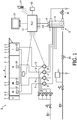
- FIG. 1 shows a schematic view of a device 1 for washing a textile batch according to the invention.
- device 1 comprises 23 connected compartments 2 (or containers) which form as such a washing tunnel.
- Compartments 1-5 are adapted to pre-wash the textile batch (wash section I)
- compartments 6-15 are adapted for main wash of the textile batch (wash section II)
- compartments 20-22 are adapted to neutralize the textile batch (wash section IV)
- compartment 23 is adapted to remove water from the batch of textile (wash section V).
- Compartment 23 is generally placed as separate compartment 23 after the other compartments 1-22, wherein water removal generally takes place by pressing and/or centrifuging.
- wash sections I-V The direction of transport of a textile batch for washing is indicated by means of arrow A.
- the textile batch is subjected to five washing steps (prewash, main wash, rinsing, neutralizing and water removal) which together form the washing program for the textile batch. It is otherwise also possible to envisage applying more or fewer containers 2 per washing step.
- a process water feed and a process water discharge (not shown) as well as a drain conduit 3 for drawing off a process water sample from the relevant wash section I-IV.
- a process water discharge will generally also be connected to wash section V, and a drain conduit 3 (not shown) can also be connected.
- the process water sample can be guided via drain conduit 3 and by means of a pump 4 to a detection unit 5 for analysis of the process water sample on the basis of process parameters characteristic for achieving an optimum cleaning of the textile batch.
- the detection unit comprises for this purpose a measuring chamber 6 for holding the process water sample to which drain conduits 3 are connected, in which measuring chamber 6 are arranged an acidity sensor 7, a redox potential sensor 8 and a conductivity sensor 9.
- at least one container 2 of each wash section I-V is provided with a temperature sensor 10 for detecting the temperature of process water present in the relevant container.
- the process parameter values measured by sensors 7, 8, 9, 10 are processed by a control unit 11 and stored in a database 12.
- a signal can then be generated, for instance by means of a screen 13 and/or by sending a digital message, such as an SMS or e-mail, to a mobile terminal 14.
- a digital message such as an SMS or e-mail
- the current progress of the textile batch can also be tracked by means of screen 13, wherein the measured process parameter values can also be displayed (real-time), this giving an indication of the quality of the final cleaning of the textile batch.
- the exact location of the batch in device 1 can be calculated relatively easily in that the time duration of each washing step is predefined.
- Relevant process information will be sent periodically, for instance once every 24 hours or even every second, to an external internet server, via which the process information can then be retrieved. Access to the process information can be secured here with a password.
- the first three stated values are brought to a desired level using automatically dispensed detergents and chemical additives, wherein the specific operation of the washing tunnel is determined when the programmed quantity of said substances is dosed. Dosage takes place on the basis of a unique identification code given to the batch, which identification code can be stored in database 12 as cross-reference to the measured process parameter values.
- the water hardness depends on the optionally present softener and on the quality of the intake water.
- the control software can determine the desired temperature on the basis of the identification code.
- the residence time is usually the same for each textile batch, this generally depending on the number of containers 2 from which the washing tunnel is assembled.
- Detection unit 5 further comprises a sensor (not shown) for measuring the process water hardness.
- control 11 which type of batch will be guided through device 1 is determined in advance. Also determined in advance is how often a batch has to be sampled during the day. Different electrical signals generated by the control of device 1 are input into control 11, such as:
- the system reads by means of a unique identification code which batch is suspended above a loading funnel (not shown).
- the measurement cycle is started at the moment the batch is loaded into the first container 2. From signals coming from the control of the washing tunnel it is possible to determine via control 11 when the textile batch for measuring has reached the first container 2 in which a process water sample has to be taken and measured, after which the following actions are initiated sequentially by control unit 11:
- This cycle is repeated when the relevant batch has reached a subsequent container 2 in which a process water sample once again has to be taken and measured.
- a process water sample once again has to be taken and measured.
- all of the measured values are provided with an ID, a date, time and batch reference, and stored in the memory of control unit 11 and/or database 12.
- measuring chamber 6 is flushed clean so as not to influence a subsequent measurement and to counter bacterial growth from the process water sample.
- a number of sprayers are mounted in a cover of measuring chamber 6 with a relatively large spray range for complete flushing of measuring chamber 6.
- an electrically operated water valve 16 opens which provides the mounted sprayers with water. Owing to the large spray range the part of measuring chamber 6 which comes into contact with the process water sample to be measured, including measuring sensors 7, 8, 9, is flushed clean. Because discharge valve 15 is not yet closed, this flushing water with contaminants is drained to the sewer. After 8 to 10 seconds the measuring chamber 6 is flushed clean and discharge valve 15 closes. In order to protect the sensors 7, 8, 9 that are present, water valve 16 remains open until measuring chamber 6 is filled with clean water.
Landscapes
- Engineering & Computer Science (AREA)
- Textile Engineering (AREA)
- Control Of Washing Machine And Dryer (AREA)
Description
- The invention relates to a method for industrial washing of textile. The invention also relates to a device for industrial washing of textile, in particular by applying the method according to the invention.
- Textile cleaning is a service industry which meets the need to be able to reuse textile in an attractive, hygienic manner. Textile is cleaned in a laundry using water and detergents, and usually an increased temperature. The textile for cleaning can consist here of clothing, bed linen, mats and so on. When large quantities of textile have to be cleaned regularly by means of wet washing, it is then usually advantageous to apply a so-called washing tunnel or washing line. A washing tunnel comprises a plurality of connected chambers (also referred to as compartments or containers) which together form a tunnel through which a batch of textile can be transported in axial direction. In this way the batch of textile can be subjected relatively quickly and easily to a washing program made up of multiple washing steps (stages). The different stages in the washing process - usually pre-wash, main wash, rinsing, neutralizing and water removal - take place here in the different containers (chambers) of the washing tunnel, which are generally closed off from each other by partitions. This compartmentalization also makes it possible to treat different batches simultaneously in a washing tunnel. The capacity of one charge in a washing tunnel varies on average between 30 and 75 kg, wherein the water consumption generally varies between 6 and 25 litres per kg textile. For hospital laundry the total wash time generally amounts to about 30 minutes. Advantages of a washing tunnel are the continuous treatment process and an efficient use of energy, process water (washing water) and detergents (washing agents). The washing process is complex however, whereby in the case of incomplete cleaning of batches of textile it is generally relatively difficult to find out what was the cause of the incomplete cleaning. It is moreover not always possible to determine an incomplete cleaning of the batch of textile, particularly when the incomplete cleaning is not immediately visible, but involves for instance an incomplete disinfection of the batch of textile.
-
GB 2082347 A -
US2001/0047214 A1 discloses an industrial washing device for textile including a system for monitoring its process, including generating a signal in case of an unacceptable process parameter and comprising a database with recorded data archived therein in the context of providing hygiene information. - An object of the invention is to provide a method for controlling the cleaning of textile.
- The invention provides for this purpose a method according to claim 1. It has been found that the efficiency of the washing program depends on the efficiency of the individual washing steps of which the washing program is made up. Different ideal conditions generally apply here for different washing steps in order to enable the best possible cleaning. These ideal conditions are generally known for each washing step, wherein a condition range can usually also be defined in which a satisfactory cleaning of the batch of textile can be realized. By detecting one or more process parameters during multiple washing steps, preferably all washing steps, the efficiency of these washing steps can be monitored relatively quickly and accurately, and moreover in real-time (without delay) without specifically trained staff being required, whereby a direct insight can be obtained into the progress of and smooth running of the overall cleaning process as well as the quality of cleaning of the batch of textile. When a determined process parameter value does not fall within a predefined process parameter range during a washing step, the cleaning will then not have proceeded optimally and a decision to re-wash may be taken. Monitoring relevant process parameters during different washing steps during the washing process thus makes it possible to better control the quality of the washing process, and thereby the quality of the cleaned batch of textile. By storing ("logging") information related to the detected process parameter values in a database together with, as cross-reference to this information, one or more identification codes related to the batch of textile it is possible to track which batches of textile have been cleaned and under which conditions determined by the detected (and stored) process parameter values. The storage of the data in a database is particularly advantageous in making it possible to continue to consult data generated in the past, this being of particularly great importance for specific sectors such as the health care services. The detected process parameter values related to a batch of textile can thus be retrieved at any desired point in time, which can be particularly advantageous from a quality viewpoint and a liability viewpoint.
- The identification code linked in the database(s) to information stored in the database(s) relating to the detected process parameter values is unique within this(these) database(s), and preferably will generally be formed by an alphabetic, numeric or alphanumeric code, optionally combined with one or more punctuation marks. The identification codes will together generally form a series. An example hereof is: #0001, #0002, #0003.
- The process conditions of each batch being monitored during the washing process and the information collected here being stored in a database. The information related to the process parameter values can be formed here by the detected process parameter values themselves, but can also be formed by values resulting from a processing of the detected process parameter values. In an oversimplified example the following table can be generated in the database:
Batch ID T washing step 1 (°C) T washing step 2 (°C) #0001 30.0 35.1 #0002 30.2 35.2 - When the detected process parameter values are processed before the processed information is stored in the database, it is for instance possible to envisage a temperature of a washing step being stored in the database as a value lying between 1 (temperature too low) and 5 (temperature too high). This value (digit) is determined on the basis of comparing detected temperature to a reference temperature and/or reference temperature range. This makes it possible for instance to generate the following table in the database:
Batch ID T washing step 1 T washing step 2 #0001 3 2 #0002 4 3 - It is also possible to envisage monitoring washing processes which may or may not be simultaneous and which are carried out in different devices and storing the collected data in a joint database. The identification code related to the washed batch of textile can here be device-dependent, wherein a unique identification code can also be assigned to the washing device itself, as shown for instance in the following table:
Tunnel ID Batch ID T washing step 1 (° C) T washing step 2 (° C) #1234 #0001 35.0 40.0 #1235 #0001 35.4 40.1 - It is also possible to envisage providing the washing devices with a unique identification code (label or tag), but wherein the identification code related to the cleaned batch of textile can be successive in the database as shown below:
Tunnel ID Batch ID T washing step 1 (° C) T washing step 2 (° C) #1234 #0001 35.0 40.0 #1235 #0002 35.4 40.1 - The tables presented in the foregoing are merely illustrative, wherein numerous variants can be envisaged for linking information related to process parameter values in a database as cross-reference to an identification code.
- The method according to the invention can be applied in one or more washing tunnels as well as in one or more industrial centrifuge washing machines provided with a rotatable washing drum, and/or a combination of both types.
- The process parameter is preferably a process parameter chosen from a group consisting of: acidity, redox potential, conductivity, temperature, water hardness and turbidity (water transparency). At least one flow rate of the ingoing process water flow and at least one flow rate of the outgoing process water flow, and preferably all flow rates of the ingoing and outgoing process water flows are moreover preferably measured as process parameter. These process parameters in particular are deemed as relevant process parameters affecting the final quality of the washing process. It is possible here to envisage all the above stated process parameters being detected in two or more washing steps. The way in which the relevant process parameter is measured generally depends on the nature of the process parameter. The temperature of the process water during a washing step will generally be measured in or in the immediate vicinity of the container in order to enable measurement of the effective temperature of the process water in the container. It is (additionally) also possible to envisage the temperature of the process water being measured in the detection unit or at least close to a process parameter sensor in order to enable calibration of the (temperature-dependent) sensors. The other of the above stated process parameters can optionally be measured remotely from the container in a detection unit connected to the container. A sample will for this purpose be drawn off from the relevant container during a washing step and can be analysed in the detection unit so that the desired process parameter values can be retrieved. Taking a sample and subsequent analysis of the sample can take place here in fully automatic manner, whereby the work required can be limited to a minimum.
- According to the claimed invention the method comprises step E), comprising of, following detection of the at least one process parameter during at least two washing steps as according to step C), comparing the detected process parameter values to a predefined process parameter range. In order to enable comparison of a detected process parameter value to a process parameter range it is also advantageous to store the relevant process parameter value. The process parameter range is defined such that each process parameter value within this range will contribute toward optimization of the cleaning action of the associated washing step. In this way the washing process can be validated in stepwise manner. The process parameter range generally depends here on the washing step. An optimal range for the acidity or temperature during pre-washing of a batch of textile can for instance vary from a similar optimal range during the main wash for the same batch of textile. When the detected process parameter value falls outside the predefined process parameter range, a signal is generated. This signal can be an auditive and/or visual signal which can for instance be generated via a computer. It is also possible to envisage the signal involving sending of a message, such as an SMS or e-mail, to a mobile terminal such as a mobile phone. A user can in this way be informed relatively quickly and efficiently of deviating process parameter values, and take action if necessary.
- When a process water sample is drawn off from the container and subsequently analysed in a measuring chamber of a detection unit, the detection unit is preferably flushed with (clean) water and/or air following detection of the at least one process parameter of a sample. Clean water is understood to mean, among others, mains water and/or industrial water which has not functioned as process water. Flushing of the measuring chamber of the detection unit has the advantage that the detection unit can analyse the quality of the process water as accurately as possible, this generally enhancing the reliability of the analysis.
- Although the method according to the invention can also be applied in a conventional industrial washing machine, the method according to the invention is also particularly advantageous when applied in a tunnel washing device (washing tunnel), wherein a plurality of containers (chambers/compartments) are arranged fitting together, wherein during step B) the batch of textile is displaced through the different containers. Displacement generally takes place here by applying transport means, such as an axially rotatable Archimedes screw. The advantage of the tunnel washing device is that it is generally successively filled with multiple batches of textile. It is not usually necessary here to monitor each batch, but each nth, in particular fourth, batch will usually be tracked and analysed.
- The progress of the washing process of the tracked batch of textile can be displayed graphically in real-time. It is also possible here to display detected process parameter values graphically in real-time so that a user or operator can immediately see what the status of a determined batch is.
- According to the invention, the method comprises the steps of: detecting at least one process parameter related to process water used during the washing process, this during at least two washing steps of the washing process; and storing in at least one database information related to the detected process parameter values as well as at least one identification code as cross-reference to the information related to the process parameter values, the identification code being related to a batch of textile being subjected to the washing process. Advantages and embodiment variants of this method according to the invention have already been described at length in the foregoing.
- The invention also relates to a device for industrial washing of textile according to
claim 13. The detection element can be arranged here in or in the direct vicinity of the container, this being particularly advantageous when the detection element is a temperature sensor. When the detection element is adapted to determine the conductivity, hardness, acidity or redox potential, it is generally advantageous to have the device comprise at least one detection unit which is connected to the container and of which the detection element forms part. The detection unit will generally be positioned here remotely of the container and can hereby be optimized structurally in relatively simple manner for analysis applications. The detection unit preferably comprises here at least one measuring chamber for receiving a process water sample drawn off from the container, wherein the detection element is adapted to detect the at least one process parameter of the process water sample present in the measuring chamber. In order to guide the process water sample into the detection unit it is advantageous for the device to comprise at least one pump for pumping the process water sample out of at least one container to the detection unit. The storage of the information in the database and linking hereof to the identification code(s) is particularly advantageous from a process engineering viewpoint as well as from the liability viewpoint, since historic data can in this way be retrieved relatively easily. - According to the invention the control unit is adapted to compare a detected process parameter value to a predefined process parameter range, in order to be able to evaluate the quality of the associated washing step and validate the washing step. A signal (warning or alarm) is generated here by a signal-generating element coupled to the control unit when the detected process parameter value does not fall within the defined process parameter range. As already stated in the foregoing, the signal can be of diverse nature, and may be an auditive or visual signal, but may also involve (wireless) sending of a digital message. The signal can also be displayed, optionally in real-time, by applying display means. The display means can also be applied to display the progress of the washing program of the batch of textile and the detected process parameter values.
- The container as such can also be adapted to set the batch of textile into motion. The container can for this purpose be accommodated rotatably in a (stationary) housing.
- The device is preferably formed by a tunnel washing device, comprising a plurality of containers fitting together, the tunnel washing device being adapted to displace the batch of textile through the different containers as it undergoes the washing program. The tunnel washing device generally comprises for this purpose a transport screw, whereby the batch of textile can be displaced relatively efficiently. Not every container need necessarily be monitored, since a single washing step can take place in a plurality of connected containers. Because at least two washing steps have to be monitored to allow reliable monitoring of the washing process, a plurality of containers will however be provided with a detection element and/or be coupled to a detection unit. Although each monitored container can be coupled to its own detection unit, it is generally advantageous to apply one central detection unit to which a plurality of containers are coupled by means of lines.
- The invention further relates to a system for monitoring an industrial process for washing textile according to claim 23. Further advantages and embodiment variants of the device have already been described at length in the foregoing.
- The invention will be elucidated on the basis of the non-limitative exemplary embodiment shown in the following figure. Herein:
-
figure 1 shows a schematic view of a device for washing textile according to the invention. -
Figure 1 shows a schematic view of a device 1 for washing a textile batch according to the invention. In this exemplary embodiment device 1 comprises 23 connected compartments 2 (or containers) which form as such a washing tunnel. Compartments 1-5 are adapted to pre-wash the textile batch (wash section I), compartments 6-15 are adapted for main wash of the textile batch (wash section II), compartments 16-19 at adapted for rinsing the textile batch (wash section III), compartments 20-22 are adapted to neutralize the textile batch (wash section IV) and compartment 23 is adapted to remove water from the batch of textile (wash section V). Compartment 23 is generally placed as separate compartment 23 after the other compartments 1-22, wherein water removal generally takes place by pressing and/or centrifuging. The direction of transport of a textile batch for washing is indicated by means of arrow A. By passing through wash sections I-V the textile batch is subjected to five washing steps (prewash, main wash, rinsing, neutralizing and water removal) which together form the washing program for the textile batch. It is otherwise also possible to envisage applying more or fewer containers 2 per washing step. Connected to each wash section I-IV is a process water feed and a process water discharge (not shown) as well as adrain conduit 3 for drawing off a process water sample from the relevant wash section I-IV. A process water discharge will generally also be connected to wash section V, and a drain conduit 3 (not shown) can also be connected. The process water sample can be guided viadrain conduit 3 and by means of a pump 4 to adetection unit 5 for analysis of the process water sample on the basis of process parameters characteristic for achieving an optimum cleaning of the textile batch. The detection unit comprises for this purpose a measuring chamber 6 for holding the process water sample to whichdrain conduits 3 are connected, in which measuring chamber 6 are arranged an acidity sensor 7, a redox potential sensor 8 and a conductivity sensor 9. In addition, at least one container 2 of each wash section I-V is provided with atemperature sensor 10 for detecting the temperature of process water present in the relevant container. The process parameter values measured bysensors 7, 8, 9, 10 are processed by acontrol unit 11 and stored in adatabase 12. When the measured process parameter values exceed a predefined process parameter range, a signal can then be generated, for instance by means of ascreen 13 and/or by sending a digital message, such as an SMS or e-mail, to amobile terminal 14. The current progress of the textile batch can also be tracked by means ofscreen 13, wherein the measured process parameter values can also be displayed (real-time), this giving an indication of the quality of the final cleaning of the textile batch. The exact location of the batch in device 1 can be calculated relatively easily in that the time duration of each washing step is predefined. Relevant process information will be sent periodically, for instance once every 24 hours or even every second, to an external internet server, via which the process information can then be retrieved. Access to the process information can be secured here with a password. - The operation of the device 1 shown in
figure 1 will be elucidated in further detail hereinbelow. - Important values in the different wash sections I-V during the washing of a batch are:
- 1. pH value
- 2. conductivity value
- 3. redox value
- 4. water hardness
- 5. temperature
- 6. turbidity (water transparency)
- 7. residence time in the compartment
- 8. the flow rate of all ingoing and outgoing process water flows
- Following transport of the textile batch out of the preceding container 2, the first three stated values are brought to a desired level using automatically dispensed detergents and chemical additives, wherein the specific operation of the washing tunnel is determined when the programmed quantity of said substances is dosed. Dosage takes place on the basis of a unique identification code given to the batch, which identification code can be stored in
database 12 as cross-reference to the measured process parameter values. The water hardness depends on the optionally present softener and on the quality of the intake water. - The control software can determine the desired temperature on the basis of the identification code. The residence time is usually the same for each textile batch, this generally depending on the number of containers 2 from which the washing tunnel is assembled. For the purpose of a properly operating wash production process and in order to be able to explain specific problems retrospectively, it is advantageous to know as quickly and accurately as possible whether the desired values as stated above have been reached or exceeded. Because device 1 performs measurements in fully automated manner one or more times per period (day, week, month), errors can be reported at an early stage on the basis of the measurement results, and the necessary action can be taken so as to operate the production process without disruption.
- As already stated, there are a plurality of sensors 7, 8, 9 in measuring chamber 6. Transmitters in
detection unit 5 convert the electrical signals from the sensors to 4-20 mA signals for the purpose of further processing.Detection unit 5 further comprises a sensor (not shown) for measuring the process water hardness. - Which type of batch will be guided through device 1 is determined in advance. Also determined in advance is how often a batch has to be sampled during the day. Different electrical signals generated by the control of device 1 are input into
control 11, such as: - machine in operation
- batch type
- washing program/product for batch type
- transport speed
- load signal
- The system reads by means of a unique identification code which batch is suspended above a loading funnel (not shown). The measurement cycle is started at the moment the batch is loaded into the first container 2. From signals coming from the control of the washing tunnel it is possible to determine via
control 11 when the textile batch for measuring has reached the first container 2 in which a process water sample has to be taken and measured, after which the following actions are initiated sequentially by control unit 11: - 1. using compressed air the
sample conduit 3 to the compartment is blown empty, whereby possible residue of the previous sample is removed and a possible blocking in the connection ofsample conduit 3 to container 2 is removed; - 2. measuring chamber 6 is emptied to the sewer;
- 3. the water sample is pumped to measuring chamber 6 with a hose pump 4 coupled to container 2;
- 4. the sensors 7, 8, 9 present in measuring chamber 6 receive the measurement values;
- 5. the measurement values are stored in the memory of
control unit 11 and/ordatabase 12; - 6. measuring chamber 6 is emptied to the sewer;
- 7. measuring chamber 6 is filled with clean water via built-in nozzles in order to prevent sensors 7, 8, 9 drying out;
- 8. the measurement cycle is completed,
detection unit 5 is ready for the following measurement. - This cycle is repeated when the relevant batch has reached a subsequent container 2 in which a process water sample once again has to be taken and measured. When - in this exemplary embodiment - the relevant batch has been sampled four times (one sampling every washing step) from the associated containers 2 and has reached the end of the washing process, all of the measured values are provided with an ID, a date, time and batch reference, and stored in the memory of
control unit 11 and/ordatabase 12. - Monitoring of the level in measuring chamber 6 is done using the conductivity sensor 9. When measuring chamber 6 is empty and conductivity sensor 9 measures in air, this produces a significantly different value than when a random liquid is detected.
- Once a measurement of a process water sample from a container 2 has been completed, measuring chamber 6 is flushed clean so as not to influence a subsequent measurement and to counter bacterial growth from the process water sample. For flushing purposes a number of sprayers are mounted in a cover of measuring chamber 6 with a relatively large spray range for complete flushing of measuring chamber 6. Once the water sample has been discharged via an electropneumatically operated
valve 15 to the sewer following measurement, an electrically operatedwater valve 16 opens which provides the mounted sprayers with water. Owing to the large spray range the part of measuring chamber 6 which comes into contact with the process water sample to be measured, including measuring sensors 7, 8, 9, is flushed clean. Becausedischarge valve 15 is not yet closed, this flushing water with contaminants is drained to the sewer. After 8 to 10 seconds the measuring chamber 6 is flushed clean anddischarge valve 15 closes. In order to protect the sensors 7, 8, 9 that are present,water valve 16 remains open until measuring chamber 6 is filled with clean water. - It will be apparent that the invention is not limited to the exemplary embodiments shown and described here, but that within the scope of the appended claims numerous variants are possible which will be self-evident to the skilled person in this field.
Claims (23)
- Method for industrial washing of textile, comprising the steps of:A) at least partially filling with a batch of textile for washing at least one container (2) of at least one device (1) for industrial washing of textile,B) executing a washing program made up of multiple successive washing steps by controlling the container (2), wherein process water, in particular process water and detergent, is/are guided into the container (2),C) detecting at least one process parameter related to the process water during at least two washing steps,E) comparing the process parameter values after being detected in step C), to a predefined process parameter range, and generating a signal when a detected process parameter value falls outside the predefined process parameter range,
andD) storing in at least one database (12) information related to the detected process parameter values of said at least two washing steps and at least one identification code as cross-reference to the information related to said process parameter values wherein the identification code is related to the batch of textile and the identification code is unique within the at least one database (12),
which method steps A)-E) are executed for each batch of textile out of multiple batches of textile that are washed by the device (1), so that for each batch of textile in step D) information which relates to the detected process parameter values of at least two washing steps and at least one identification code as cross-reference to the information related to said process parameter values is stored in the database,
such that the detected process parameter values related to a batch of textile can be retrieved at any desired point in time. - Method as claimed in claim 1, wherein information related to detected process parameter values of a plurality of devices (1) for industrial washing of textile is stored during step D) in the at least one database (12).
- Method as claimed in any of the foregoing claims, wherein during each washing step of the washing program at least one process parameter related to the associated washing step is detected.
- Method as claimed in any of the foregoing claims, wherein the process parameter is a process parameter chosen from a group consisting of: acidity, redox potential, conductivity, temperature, water hardness and turbidity.
- Method as claimed in any of the foregoing claims, wherein a sample of the process water used in the container (2) is taken during step C) during the at least two washing steps, wherein the at least one process parameter of the sample is subsequently detected.
- Method as claimed in any of the foregoing claims, wherein each sample is guided through a detection unit (5) for detecting the at least one process parameter, wherein following detection of the at least one process parameter of a sample the detection unit (5) is flushed with a reference liquid, in particular water, and/or air.
- Method as claimed in any of the foregoing claims, wherein the method is applied in a tunnel washing device (1), wherein a plurality of containers (2) are arranged fitting together, wherein during step B) the batch of textile is displaced through the different containers (2) of the plurality of containers (2).
- Method as claimed in claim 7, wherein the tunnel washing device (1) is successively filled with multiple batches of textile.
- Method as claimed in claim 8, wherein at least one batch of textile of the total number of batches of textile present in the tunnel washing device (1) is subjected to step C).
- Method as claimed in any of the foregoing claims, wherein the process parameter values detected during step C) and the progress of the washing program of the batch of textile are displayed graphically in real-time.
- Method as claimed in claim 10, wherein the process parameter values detected during step C) and the progress of the washing program of the batch of textile are displayed graphically in real-time via a web interface.
- Method as claimed in any of the foregoing claims, wherein the washing program is made up of the successive washing steps of: soaking, main wash, rinsing, neutralizing and optional water removal.
- Device (1) for industrial washing of textile, comprising:- at least one container (2) for a batch of textile for washing, to which container (2) a process water feed and a process water discharge is connected,- at least one detection element (7,8,9,10) for detecting at least one process parameter related to the process water,- at least one control unit (11) for executing a washing program made up of multiple washing steps by controlling the container (2), wherein process water, in particular process water and detergent, is/ are guided into the container (2), wherein the control unit (11) is further adapted to process process parameter values collected by the detection element (7,8,9,10) during at least two washing steps, and wherein the control unit is configured to compare a detected process parameter value to a predefined process parameter range,- at least one signal-generating element coupled to the control unit (11) configured to generate a signal when the detected process parameter value falls outside the predefined process parameter range, and- at least one database (12) coupled to the control unit (11), which database is configured for storing for each batch of textile of multiple batches of textile, information related to the detected process parameter values of said at least two washing steps and at least one identification code as cross-reference to the information related to said process parameter values, such that the detected process parameter values related to a batch of textile can be retrieved at any desired point in time, wherein each identification code is related to a batch of textile, and wherein each identification code is unique within the at least one database (12).
- Device (1) as claimed in claim 13, wherein the detection element forms part of a detection unit (5) connected to the container (2).
- Device (1) as claimed in claim 14, wherein the detection unit (5) comprises at least one measuring chamber (6) for receiving a process water sample drawn off from the container (2), wherein the detection element is adapted to detect the at least one process parameter of the process water present in the measuring chamber (6).
- Device (1) as claimed in claim 14 or 15, wherein the device (1) comprises at least one pump (4) for pumping a process water sample out of at least one container (2) to the detection unit (5).
- Device (1) as claimed in any of the claims 13-16, wherein the signal-generating element is adapted for wireless communication with a mobile terminal (14).
- Device (1) as claimed in any of the claims 13-17, wherein the device (1) comprises display means for displaying the progress of the washing program of the batch of textile and the detected process parameter values.
- Device (1) as claimed in any of the claims 13-18, wherein the container (2) is adapted to set the batch of textile into motion.
- Device (1) as claimed in claim 19, wherein the container (2) is accommodated rotatably in a housing.
- Device (1) as claimed in any of the claims 13-20, wherein the device (1) is formed by a tunnel washing device (1), comprising a plurality of containers (2) fitting together, the tunnel washing device (1) being adapted to displace the batch of textile through the different containers (2) as it undergoes the washing program.
- Device (1) as claimed in any of the claims 14-16, and claim 21, wherein a plurality of containers (2) are connected to the detection unit (5).
- System for monitoring an industrial process for washing textile, said system comprising:- at least one detection element (7,8,9,10) for detecting at least one process parameter related to process water used during the washing process,wherein the system is coupled to a plurality of said devices (1), in particular a plurality of devices according to claims 13-22, and wherein information related to detected process parameter values of a plurality of devices (1) for industrial washing of textile is stored in the at least one database (12).- at least one control unit (11) adapted for executing a washing program made up of multiple washing steps by controlling a container (2) of a device (1) for industrial washing of textiles, wherein process water, in particular process water and detergent, is/are guided into the container (2), wherein the control unit (11) is further adapted to process process parameter values collected by the detection element (7,8,9,10) during at least two washing steps, and wherein the control unit is configured to compare a detected process parameter value to a predefined process parameter range,- at least one signal-generating element coupled to the control unit (11) configured to generate a signal when the detected process parameter value falls outside the predefined process parameter range, and- at least one database (12) coupled to the control unit (11), which database is configured for storing for each batch of textile of multiple batches of textile, information related to the detected process parameter values of said at least two washing steps and at least one identification code as cross-reference to the information related to said process parameter values, such that the detected process parameter values related to a batch of textile can be retrieved at any desired point in time, wherein each identification code is related to a batch of textile, and wherein each identification code is unique within the at least one database (12),
Applications Claiming Priority (2)
| Application Number | Priority Date | Filing Date | Title |
|---|---|---|---|
| NL2005282A NL2005282C2 (en) | 2010-08-27 | 2010-08-27 | METHOD AND DEVICE FOR WASHING TEXTILE. |
| PCT/NL2011/050587 WO2012026821A1 (en) | 2010-08-27 | 2011-08-29 | Method and device for industrial washing of textile |
Publications (2)
| Publication Number | Publication Date |
|---|---|
| EP2496751A1 EP2496751A1 (en) | 2012-09-12 |
| EP2496751B1 true EP2496751B1 (en) | 2021-08-11 |
Family
ID=43778437
Family Applications (1)
| Application Number | Title | Priority Date | Filing Date |
|---|---|---|---|
| EP11751669.0A Active EP2496751B1 (en) | 2010-08-27 | 2011-08-29 | Method and device for industrial washing of textile |
Country Status (6)
| Country | Link |
|---|---|
| EP (1) | EP2496751B1 (en) |
| DK (1) | DK2496751T3 (en) |
| HU (1) | HUE055932T2 (en) |
| NL (1) | NL2005282C2 (en) |
| PT (1) | PT2496751T (en) |
| WO (1) | WO2012026821A1 (en) |
Cited By (1)
| Publication number | Priority date | Publication date | Assignee | Title |
|---|---|---|---|---|
| WO2026012561A1 (en) * | 2024-07-11 | 2026-01-15 | Universal Textile Sorting Aps | Textile recovering system and method |
Families Citing this family (4)
| Publication number | Priority date | Publication date | Assignee | Title |
|---|---|---|---|---|
| JP2016087156A (en) * | 2014-11-06 | 2016-05-23 | 株式会社東京洗染機械製作所 | Screw conveyor type rinsing and dewatering device |
| DE102018004346A1 (en) * | 2018-06-01 | 2019-12-05 | Herbert Kannegiesser Gmbh | Process for the wet treatment of laundry items combined into laundry items |
| ES3004515T3 (en) | 2018-08-27 | 2025-03-12 | Ecolab Usa Inc | System and technique for extracting particulate-containing liquid samples without filtration |
| FI130565B (en) * | 2021-04-16 | 2023-11-21 | Oy Christeyns Nordic Ab | Procedure and system for machine washing of textiles |
Citations (8)
| Publication number | Priority date | Publication date | Assignee | Title |
|---|---|---|---|---|
| GB2082347A (en) | 1980-08-01 | 1982-03-03 | Pellerin Corp Milnor | Multi-stage process control |
| US5390385A (en) * | 1993-05-28 | 1995-02-21 | Knight Equipment International | Laundry management system for washing machines |
| WO2001007702A1 (en) | 1999-07-27 | 2001-02-01 | Unilever N.V. | Method and monitoring device for monitoring a wash process |
| US20010047214A1 (en) * | 2000-04-25 | 2001-11-29 | Diversey Lever, Inc. | System for monitoring an industrial cleaning process or machine |
| WO2004041058A2 (en) | 2002-11-04 | 2004-05-21 | Ecolab Inc. | Monitoring performance of a warewasher |
| US20080295257A1 (en) | 2007-05-29 | 2008-12-04 | Wilhelm Bringewatt | Method for the wet treatment of items of laundry |
| US20090159098A1 (en) | 2007-12-19 | 2009-06-25 | Johnsondiversey, Inc. | Material delivery systems and methods |
| EP2177659A1 (en) | 2008-10-14 | 2010-04-21 | EMS Rotor B.V. | System and method for heating washing water for use in a textile laundry |
Family Cites Families (5)
| Publication number | Priority date | Publication date | Assignee | Title |
|---|---|---|---|---|
| US5134867A (en) * | 1989-01-27 | 1992-08-04 | Matsushita Electric Industrial Co., Ltd. | Washing machine having optical sensor for detecting light permeability of detergent solution |
| US5272893A (en) * | 1992-09-11 | 1993-12-28 | White Consolidated Industries, Inc. | Enzyme bath maintenance system |
| DE19740266A1 (en) * | 1997-09-15 | 1999-03-18 | Ronald Dr Eberl | Measurement of tenside presence in laundry water |
| US20030196278A1 (en) * | 2002-04-19 | 2003-10-23 | Durfee Anthony L. | Static and dynamic turbidity sensing in a washing appliance |
| US7690061B2 (en) * | 2005-12-22 | 2010-04-06 | General Electric Company | Method and apparatus for controlling a laundering process |
-
2010
- 2010-08-27 NL NL2005282A patent/NL2005282C2/en active
-
2011
- 2011-08-29 PT PT117516690T patent/PT2496751T/en unknown
- 2011-08-29 WO PCT/NL2011/050587 patent/WO2012026821A1/en not_active Ceased
- 2011-08-29 HU HUE11751669A patent/HUE055932T2/en unknown
- 2011-08-29 DK DK11751669.0T patent/DK2496751T3/en active
- 2011-08-29 EP EP11751669.0A patent/EP2496751B1/en active Active
Patent Citations (8)
| Publication number | Priority date | Publication date | Assignee | Title |
|---|---|---|---|---|
| GB2082347A (en) | 1980-08-01 | 1982-03-03 | Pellerin Corp Milnor | Multi-stage process control |
| US5390385A (en) * | 1993-05-28 | 1995-02-21 | Knight Equipment International | Laundry management system for washing machines |
| WO2001007702A1 (en) | 1999-07-27 | 2001-02-01 | Unilever N.V. | Method and monitoring device for monitoring a wash process |
| US20010047214A1 (en) * | 2000-04-25 | 2001-11-29 | Diversey Lever, Inc. | System for monitoring an industrial cleaning process or machine |
| WO2004041058A2 (en) | 2002-11-04 | 2004-05-21 | Ecolab Inc. | Monitoring performance of a warewasher |
| US20080295257A1 (en) | 2007-05-29 | 2008-12-04 | Wilhelm Bringewatt | Method for the wet treatment of items of laundry |
| US20090159098A1 (en) | 2007-12-19 | 2009-06-25 | Johnsondiversey, Inc. | Material delivery systems and methods |
| EP2177659A1 (en) | 2008-10-14 | 2010-04-21 | EMS Rotor B.V. | System and method for heating washing water for use in a textile laundry |
Cited By (1)
| Publication number | Priority date | Publication date | Assignee | Title |
|---|---|---|---|---|
| WO2026012561A1 (en) * | 2024-07-11 | 2026-01-15 | Universal Textile Sorting Aps | Textile recovering system and method |
Also Published As
| Publication number | Publication date |
|---|---|
| HUE055932T2 (en) | 2022-01-28 |
| WO2012026821A1 (en) | 2012-03-01 |
| PT2496751T (en) | 2021-09-24 |
| EP2496751A1 (en) | 2012-09-12 |
| NL2005282C2 (en) | 2012-02-28 |
| DK2496751T3 (en) | 2021-10-11 |
Similar Documents
| Publication | Publication Date | Title |
|---|---|---|
| US12232676B2 (en) | Method and cleaning device for cleaning items to be cleaned | |
| US7614410B2 (en) | Chemical concentration controller and recorder | |
| WO2012026821A1 (en) | Method and device for industrial washing of textile | |
| US12086739B2 (en) | CIP wash summary and library | |
| CN106939488A (en) | The control method and washing machine of a kind of washing machine | |
| US7524380B1 (en) | Energy efficient dishwashing | |
| US20190310612A1 (en) | Method for the dosing of cleaning agents | |
| CN111743493A (en) | Cleaning data tracing system | |
| CN108930137B (en) | Multifunctional washing device and washing machine | |
| US20230062451A1 (en) | Washing appliance, method of detecting operational error, and control arrangement | |
| US11739460B2 (en) | System and technique for extracting particulate-containing liquid samples without filtration | |
| CN116439632B (en) | Multi-channel commercial dish-washing machine liquid medicine distribution control method and system | |
| JP5354722B2 (en) | Fluid work monitoring device | |
| CN113951791B (en) | Dispenser traceability system | |
| KR102851750B1 (en) | Smart Sanitizing-Rinsing Apparatus and Disinfection-Rinsing Monitoring System Utilizing the Same | |
| CN206540860U (en) | Chlorine residue remote supervision system | |
| CA3110505C (en) | System and technique for extracting particulate-containing liquid samples without filtration | |
| CN116103872B (en) | Control method and control device of washing equipment and washing equipment | |
| CN114022163A (en) | Method and device for monitoring and tracing the hygiene of dishes washed by a dishwasher | |
| TR2023005195A2 (en) | A DISHWASHER WITH A TURBIDITY SENSOR | |
| EP4074878B1 (en) | Method for machine washing of textiles | |
| CA3043491C (en) | Method and cleaning device for cleaning items to be cleaned | |
| CN114108238A (en) | Control method of laundry treatment apparatus, and storage medium |
Legal Events
| Date | Code | Title | Description |
|---|---|---|---|
| PUAI | Public reference made under article 153(3) epc to a published international application that has entered the european phase |
Free format text: ORIGINAL CODE: 0009012 |
|
| 17P | Request for examination filed |
Effective date: 20120606 |
|
| AK | Designated contracting states |
Kind code of ref document: A1 Designated state(s): AL AT BE BG CH CY CZ DE DK EE ES FI FR GB GR HR HU IE IS IT LI LT LU LV MC MK MT NL NO PL PT RO RS SE SI SK SM TR |
|
| DAX | Request for extension of the european patent (deleted) | ||
| STAA | Information on the status of an ep patent application or granted ep patent |
Free format text: STATUS: EXAMINATION IS IN PROGRESS |
|
| 17Q | First examination report despatched |
Effective date: 20180328 |
|
| GRAP | Despatch of communication of intention to grant a patent |
Free format text: ORIGINAL CODE: EPIDOSNIGR1 |
|
| STAA | Information on the status of an ep patent application or granted ep patent |
Free format text: STATUS: GRANT OF PATENT IS INTENDED |
|
| RIC1 | Information provided on ipc code assigned before grant |
Ipc: D06F 31/00 20060101ALI20210203BHEP Ipc: D06F 39/00 20200101AFI20210203BHEP |
|
| INTG | Intention to grant announced |
Effective date: 20210304 |
|
| GRAS | Grant fee paid |
Free format text: ORIGINAL CODE: EPIDOSNIGR3 |
|
| GRAA | (expected) grant |
Free format text: ORIGINAL CODE: 0009210 |
|
| STAA | Information on the status of an ep patent application or granted ep patent |
Free format text: STATUS: THE PATENT HAS BEEN GRANTED |
|
| AK | Designated contracting states |
Kind code of ref document: B1 Designated state(s): AL AT BE BG CH CY CZ DE DK EE ES FI FR GB GR HR HU IE IS IT LI LT LU LV MC MK MT NL NO PL PT RO RS SE SI SK SM TR |
|
| REG | Reference to a national code |
Ref country code: GB Ref legal event code: FG4D |
|
| REG | Reference to a national code |
Ref country code: CH Ref legal event code: EP |
|
| REG | Reference to a national code |
Ref country code: DE Ref legal event code: R096 Ref document number: 602011071539 Country of ref document: DE |
|
| REG | Reference to a national code |
Ref country code: IE Ref legal event code: FG4D Ref country code: AT Ref legal event code: REF Ref document number: 1419491 Country of ref document: AT Kind code of ref document: T Effective date: 20210915 |
|
| REG | Reference to a national code |
Ref country code: PT Ref legal event code: SC4A Ref document number: 2496751 Country of ref document: PT Date of ref document: 20210924 Kind code of ref document: T Free format text: AVAILABILITY OF NATIONAL TRANSLATION Effective date: 20210917 |
|
| REG | Reference to a national code |
Ref country code: FI Ref legal event code: FGE |
|
| REG | Reference to a national code |
Ref country code: DK Ref legal event code: T3 Effective date: 20211005 |
|
| REG | Reference to a national code |
Ref country code: SE Ref legal event code: TRGR |
|
| REG | Reference to a national code |
Ref country code: NL Ref legal event code: FP |
|
| REG | Reference to a national code |
Ref country code: LT Ref legal event code: MG9D |
|
| REG | Reference to a national code |
Ref country code: HU Ref legal event code: AG4A Ref document number: E055932 Country of ref document: HU |
|
| PG25 | Lapsed in a contracting state [announced via postgrant information from national office to epo] |
Ref country code: HR Free format text: LAPSE BECAUSE OF FAILURE TO SUBMIT A TRANSLATION OF THE DESCRIPTION OR TO PAY THE FEE WITHIN THE PRESCRIBED TIME-LIMIT Effective date: 20210811 Ref country code: NO Free format text: LAPSE BECAUSE OF FAILURE TO SUBMIT A TRANSLATION OF THE DESCRIPTION OR TO PAY THE FEE WITHIN THE PRESCRIBED TIME-LIMIT Effective date: 20211111 Ref country code: RS Free format text: LAPSE BECAUSE OF FAILURE TO SUBMIT A TRANSLATION OF THE DESCRIPTION OR TO PAY THE FEE WITHIN THE PRESCRIBED TIME-LIMIT Effective date: 20210811 Ref country code: ES Free format text: LAPSE BECAUSE OF FAILURE TO SUBMIT A TRANSLATION OF THE DESCRIPTION OR TO PAY THE FEE WITHIN THE PRESCRIBED TIME-LIMIT Effective date: 20210811 Ref country code: LT Free format text: LAPSE BECAUSE OF FAILURE TO SUBMIT A TRANSLATION OF THE DESCRIPTION OR TO PAY THE FEE WITHIN THE PRESCRIBED TIME-LIMIT Effective date: 20210811 Ref country code: BG Free format text: LAPSE BECAUSE OF FAILURE TO SUBMIT A TRANSLATION OF THE DESCRIPTION OR TO PAY THE FEE WITHIN THE PRESCRIBED TIME-LIMIT Effective date: 20211111 |
|
| PG25 | Lapsed in a contracting state [announced via postgrant information from national office to epo] |
Ref country code: PL Free format text: LAPSE BECAUSE OF FAILURE TO SUBMIT A TRANSLATION OF THE DESCRIPTION OR TO PAY THE FEE WITHIN THE PRESCRIBED TIME-LIMIT Effective date: 20210811 Ref country code: LV Free format text: LAPSE BECAUSE OF FAILURE TO SUBMIT A TRANSLATION OF THE DESCRIPTION OR TO PAY THE FEE WITHIN THE PRESCRIBED TIME-LIMIT Effective date: 20210811 Ref country code: GR Free format text: LAPSE BECAUSE OF FAILURE TO SUBMIT A TRANSLATION OF THE DESCRIPTION OR TO PAY THE FEE WITHIN THE PRESCRIBED TIME-LIMIT Effective date: 20211112 |
|
| REG | Reference to a national code |
Ref country code: CH Ref legal event code: PL |
|
| PG25 | Lapsed in a contracting state [announced via postgrant information from national office to epo] |
Ref country code: LI Free format text: LAPSE BECAUSE OF NON-PAYMENT OF DUE FEES Effective date: 20210831 Ref country code: CH Free format text: LAPSE BECAUSE OF NON-PAYMENT OF DUE FEES Effective date: 20210831 |
|
| REG | Reference to a national code |
Ref country code: DE Ref legal event code: R026 Ref document number: 602011071539 Country of ref document: DE |
|
| PLBI | Opposition filed |
Free format text: ORIGINAL CODE: 0009260 |
|
| PLAB | Opposition data, opponent's data or that of the opponent's representative modified |
Free format text: ORIGINAL CODE: 0009299OPPO |
|
| PLAX | Notice of opposition and request to file observation + time limit sent |
Free format text: ORIGINAL CODE: EPIDOSNOBS2 |
|
| PG25 | Lapsed in a contracting state [announced via postgrant information from national office to epo] |
Ref country code: SM Free format text: LAPSE BECAUSE OF FAILURE TO SUBMIT A TRANSLATION OF THE DESCRIPTION OR TO PAY THE FEE WITHIN THE PRESCRIBED TIME-LIMIT Effective date: 20210811 Ref country code: SK Free format text: LAPSE BECAUSE OF FAILURE TO SUBMIT A TRANSLATION OF THE DESCRIPTION OR TO PAY THE FEE WITHIN THE PRESCRIBED TIME-LIMIT Effective date: 20210811 Ref country code: RO Free format text: LAPSE BECAUSE OF FAILURE TO SUBMIT A TRANSLATION OF THE DESCRIPTION OR TO PAY THE FEE WITHIN THE PRESCRIBED TIME-LIMIT Effective date: 20210811 Ref country code: MC Free format text: LAPSE BECAUSE OF FAILURE TO SUBMIT A TRANSLATION OF THE DESCRIPTION OR TO PAY THE FEE WITHIN THE PRESCRIBED TIME-LIMIT Effective date: 20210811 Ref country code: EE Free format text: LAPSE BECAUSE OF FAILURE TO SUBMIT A TRANSLATION OF THE DESCRIPTION OR TO PAY THE FEE WITHIN THE PRESCRIBED TIME-LIMIT Effective date: 20210811 Ref country code: CZ Free format text: LAPSE BECAUSE OF FAILURE TO SUBMIT A TRANSLATION OF THE DESCRIPTION OR TO PAY THE FEE WITHIN THE PRESCRIBED TIME-LIMIT Effective date: 20210811 Ref country code: AL Free format text: LAPSE BECAUSE OF FAILURE TO SUBMIT A TRANSLATION OF THE DESCRIPTION OR TO PAY THE FEE WITHIN THE PRESCRIBED TIME-LIMIT Effective date: 20210811 |
|
| REG | Reference to a national code |
Ref country code: FI Ref legal event code: MDE Opponent name: ECOLAB USA INC. |
|
| 26 | Opposition filed |
Opponent name: ECOLAB USA INC. Effective date: 20220511 |
|
| R26 | Opposition filed (corrected) |
Opponent name: ECOLAB USA INC. Effective date: 20220511 |
|
| PG25 | Lapsed in a contracting state [announced via postgrant information from national office to epo] |
Ref country code: SI Free format text: LAPSE BECAUSE OF FAILURE TO SUBMIT A TRANSLATION OF THE DESCRIPTION OR TO PAY THE FEE WITHIN THE PRESCRIBED TIME-LIMIT Effective date: 20210811 |
|
| PLBB | Reply of patent proprietor to notice(s) of opposition received |
Free format text: ORIGINAL CODE: EPIDOSNOBS3 |
|
| REG | Reference to a national code |
Ref country code: AT Ref legal event code: UEP Ref document number: 1419491 Country of ref document: AT Kind code of ref document: T Effective date: 20210811 |
|
| PG25 | Lapsed in a contracting state [announced via postgrant information from national office to epo] |
Ref country code: CY Free format text: LAPSE BECAUSE OF FAILURE TO SUBMIT A TRANSLATION OF THE DESCRIPTION OR TO PAY THE FEE WITHIN THE PRESCRIBED TIME-LIMIT Effective date: 20210811 |
|
| REG | Reference to a national code |
Ref country code: CH Ref legal event code: PK Free format text: BERICHTIGUNGEN |
|
| REG | Reference to a national code |
Ref country code: CH Ref legal event code: PK Free format text: BERICHTIGUNGEN |
|
| RIC2 | Information provided on ipc code assigned after grant |
Ipc: D06F 34/24 20200101ALN20240308BHEP Ipc: D06F 34/28 20200101ALI20240308BHEP Ipc: D06F 34/22 20200101ALI20240308BHEP Ipc: D06F 31/00 20060101AFI20240308BHEP |
|
| RIC2 | Information provided on ipc code assigned after grant |
Ipc: D06F 34/24 20200101ALN20240315BHEP Ipc: D06F 34/28 20200101ALI20240315BHEP Ipc: D06F 34/22 20200101ALI20240315BHEP Ipc: D06F 31/00 20060101AFI20240315BHEP |
|
| PG25 | Lapsed in a contracting state [announced via postgrant information from national office to epo] |
Ref country code: MK Free format text: LAPSE BECAUSE OF FAILURE TO SUBMIT A TRANSLATION OF THE DESCRIPTION OR TO PAY THE FEE WITHIN THE PRESCRIBED TIME-LIMIT Effective date: 20210811 |
|
| REG | Reference to a national code |
Ref country code: CH Ref legal event code: PK Free format text: DIE PUBLIKATION VOM 27.03.2024 WURDE AM 24.04.2024 IRRTUEMLICHERWEISE ERNEUT PUBLIZIERT. LA PUBLICATION DU 27.03.2024 A ETE REPUBLIEE PAR ERREUR LE 24.04.2024. LA PUBBLICAZIONE DEL 27.03.2024 E STATA ERRONEAMENTE RIPUBBLICATA IL 24.04.2024. Ref country code: CH Ref legal event code: PK Free format text: BERICHTIGUNGEN |
|
| RIC2 | Information provided on ipc code assigned after grant |
Ipc: D06F 34/24 20200101ALN20240402BHEP Ipc: D06F 34/28 20200101ALI20240402BHEP Ipc: D06F 34/22 20200101ALI20240402BHEP Ipc: D06F 31/00 20060101AFI20240402BHEP |
|
| APBP | Date of receipt of notice of appeal recorded |
Free format text: ORIGINAL CODE: EPIDOSNNOA2O |
|
| APAH | Appeal reference modified |
Free format text: ORIGINAL CODE: EPIDOSCREFNO |
|
| APAW | Appeal reference deleted |
Free format text: ORIGINAL CODE: EPIDOSDREFNO |
|
| APBM | Appeal reference recorded |
Free format text: ORIGINAL CODE: EPIDOSNREFNO |
|
| APBP | Date of receipt of notice of appeal recorded |
Free format text: ORIGINAL CODE: EPIDOSNNOA2O |
|
| APBQ | Date of receipt of statement of grounds of appeal recorded |
Free format text: ORIGINAL CODE: EPIDOSNNOA3O |
|
| PG25 | Lapsed in a contracting state [announced via postgrant information from national office to epo] |
Ref country code: MT Free format text: LAPSE BECAUSE OF FAILURE TO SUBMIT A TRANSLATION OF THE DESCRIPTION OR TO PAY THE FEE WITHIN THE PRESCRIBED TIME-LIMIT Effective date: 20210811 |
|
| APAH | Appeal reference modified |
Free format text: ORIGINAL CODE: EPIDOSCREFNO |
|
| PGFP | Annual fee paid to national office [announced via postgrant information from national office to epo] |
Ref country code: LU Payment date: 20250827 Year of fee payment: 15 Ref country code: NL Payment date: 20250826 Year of fee payment: 15 |
|
| PGFP | Annual fee paid to national office [announced via postgrant information from national office to epo] |
Ref country code: HU Payment date: 20250807 Year of fee payment: 15 |
|
| PGFP | Annual fee paid to national office [announced via postgrant information from national office to epo] |
Ref country code: FI Payment date: 20250825 Year of fee payment: 15 Ref country code: PT Payment date: 20250806 Year of fee payment: 15 |
|
| PGFP | Annual fee paid to national office [announced via postgrant information from national office to epo] |
Ref country code: DK Payment date: 20250825 Year of fee payment: 15 Ref country code: DE Payment date: 20250827 Year of fee payment: 15 |
|
| PGFP | Annual fee paid to national office [announced via postgrant information from national office to epo] |
Ref country code: IT Payment date: 20250820 Year of fee payment: 15 |
|
| PGFP | Annual fee paid to national office [announced via postgrant information from national office to epo] |
Ref country code: BE Payment date: 20250827 Year of fee payment: 15 Ref country code: GB Payment date: 20250827 Year of fee payment: 15 |
|
| PGFP | Annual fee paid to national office [announced via postgrant information from national office to epo] |
Ref country code: AT Payment date: 20250827 Year of fee payment: 15 Ref country code: FR Payment date: 20250825 Year of fee payment: 15 |
|
| PGFP | Annual fee paid to national office [announced via postgrant information from national office to epo] |
Ref country code: SE Payment date: 20250827 Year of fee payment: 15 |
|
| PGFP | Annual fee paid to national office [announced via postgrant information from national office to epo] |
Ref country code: IE Payment date: 20250827 Year of fee payment: 15 |
|
| PG25 | Lapsed in a contracting state [announced via postgrant information from national office to epo] |
Ref country code: TR Free format text: LAPSE BECAUSE OF FAILURE TO SUBMIT A TRANSLATION OF THE DESCRIPTION OR TO PAY THE FEE WITHIN THE PRESCRIBED TIME-LIMIT Effective date: 20210811 |
|
| APBU | Appeal procedure closed |
Free format text: ORIGINAL CODE: EPIDOSNNOA9O |