EP2495217A1 - Heat-ray shielding composition and method for producing the same - Google Patents
Heat-ray shielding composition and method for producing the same Download PDFInfo
- Publication number
- EP2495217A1 EP2495217A1 EP10826821A EP10826821A EP2495217A1 EP 2495217 A1 EP2495217 A1 EP 2495217A1 EP 10826821 A EP10826821 A EP 10826821A EP 10826821 A EP10826821 A EP 10826821A EP 2495217 A1 EP2495217 A1 EP 2495217A1
- Authority
- EP
- European Patent Office
- Prior art keywords
- indium tin
- heat
- ray shielding
- tin oxide
- nitrogen atmosphere
- Prior art date
- Legal status (The legal status is an assumption and is not a legal conclusion. Google has not performed a legal analysis and makes no representation as to the accuracy of the status listed.)
- Granted
Links
Images




Classifications
-
- C—CHEMISTRY; METALLURGY
- C01—INORGANIC CHEMISTRY
- C01G—COMPOUNDS CONTAINING METALS NOT COVERED BY SUBCLASSES C01D OR C01F
- C01G19/00—Compounds of tin
-
- C—CHEMISTRY; METALLURGY
- C09—DYES; PAINTS; POLISHES; NATURAL RESINS; ADHESIVES; COMPOSITIONS NOT OTHERWISE PROVIDED FOR; APPLICATIONS OF MATERIALS NOT OTHERWISE PROVIDED FOR
- C09D—COATING COMPOSITIONS, e.g. PAINTS, VARNISHES OR LACQUERS; FILLING PASTES; CHEMICAL PAINT OR INK REMOVERS; INKS; CORRECTING FLUIDS; WOODSTAINS; PASTES OR SOLIDS FOR COLOURING OR PRINTING; USE OF MATERIALS THEREFOR
- C09D5/00—Coating compositions, e.g. paints, varnishes or lacquers, characterised by their physical nature or the effects produced; Filling pastes
- C09D5/18—Fireproof paints including high temperature resistant paints
-
- C—CHEMISTRY; METALLURGY
- C09—DYES; PAINTS; POLISHES; NATURAL RESINS; ADHESIVES; COMPOSITIONS NOT OTHERWISE PROVIDED FOR; APPLICATIONS OF MATERIALS NOT OTHERWISE PROVIDED FOR
- C09D—COATING COMPOSITIONS, e.g. PAINTS, VARNISHES OR LACQUERS; FILLING PASTES; CHEMICAL PAINT OR INK REMOVERS; INKS; CORRECTING FLUIDS; WOODSTAINS; PASTES OR SOLIDS FOR COLOURING OR PRINTING; USE OF MATERIALS THEREFOR
- C09D7/00—Features of coating compositions, not provided for in group C09D5/00; Processes for incorporating ingredients in coating compositions
- C09D7/40—Additives
- C09D7/60—Additives non-macromolecular
- C09D7/61—Additives non-macromolecular inorganic
-
- C—CHEMISTRY; METALLURGY
- C01—INORGANIC CHEMISTRY
- C01P—INDEXING SCHEME RELATING TO STRUCTURAL AND PHYSICAL ASPECTS OF SOLID INORGANIC COMPOUNDS
- C01P2002/00—Crystal-structural characteristics
- C01P2002/70—Crystal-structural characteristics defined by measured X-ray, neutron or electron diffraction data
- C01P2002/72—Crystal-structural characteristics defined by measured X-ray, neutron or electron diffraction data by d-values or two theta-values, e.g. as X-ray diagram
-
- C—CHEMISTRY; METALLURGY
- C01—INORGANIC CHEMISTRY
- C01P—INDEXING SCHEME RELATING TO STRUCTURAL AND PHYSICAL ASPECTS OF SOLID INORGANIC COMPOUNDS
- C01P2004/00—Particle morphology
- C01P2004/01—Particle morphology depicted by an image
- C01P2004/04—Particle morphology depicted by an image obtained by TEM, STEM, STM or AFM
-
- C—CHEMISTRY; METALLURGY
- C01—INORGANIC CHEMISTRY
- C01P—INDEXING SCHEME RELATING TO STRUCTURAL AND PHYSICAL ASPECTS OF SOLID INORGANIC COMPOUNDS
- C01P2006/00—Physical properties of inorganic compounds
- C01P2006/22—Rheological behaviour as dispersion, e.g. viscosity, sedimentation stability
-
- C—CHEMISTRY; METALLURGY
- C01—INORGANIC CHEMISTRY
- C01P—INDEXING SCHEME RELATING TO STRUCTURAL AND PHYSICAL ASPECTS OF SOLID INORGANIC COMPOUNDS
- C01P2006/00—Physical properties of inorganic compounds
- C01P2006/32—Thermal properties
-
- C—CHEMISTRY; METALLURGY
- C01—INORGANIC CHEMISTRY
- C01P—INDEXING SCHEME RELATING TO STRUCTURAL AND PHYSICAL ASPECTS OF SOLID INORGANIC COMPOUNDS
- C01P2006/00—Physical properties of inorganic compounds
- C01P2006/60—Optical properties, e.g. expressed in CIELAB-values
-
- C—CHEMISTRY; METALLURGY
- C08—ORGANIC MACROMOLECULAR COMPOUNDS; THEIR PREPARATION OR CHEMICAL WORKING-UP; COMPOSITIONS BASED THEREON
- C08K—Use of inorganic or non-macromolecular organic substances as compounding ingredients
- C08K3/00—Use of inorganic substances as compounding ingredients
- C08K3/18—Oxygen-containing compounds, e.g. metal carbonyls
- C08K3/20—Oxides; Hydroxides
- C08K3/22—Oxides; Hydroxides of metals
- C08K2003/2231—Oxides; Hydroxides of metals of tin
-
- C—CHEMISTRY; METALLURGY
- C08—ORGANIC MACROMOLECULAR COMPOUNDS; THEIR PREPARATION OR CHEMICAL WORKING-UP; COMPOSITIONS BASED THEREON
- C08K—Use of inorganic or non-macromolecular organic substances as compounding ingredients
- C08K3/00—Use of inorganic substances as compounding ingredients
- C08K3/18—Oxygen-containing compounds, e.g. metal carbonyls
- C08K3/20—Oxides; Hydroxides
- C08K3/22—Oxides; Hydroxides of metals
-
- Y—GENERAL TAGGING OF NEW TECHNOLOGICAL DEVELOPMENTS; GENERAL TAGGING OF CROSS-SECTIONAL TECHNOLOGIES SPANNING OVER SEVERAL SECTIONS OF THE IPC; TECHNICAL SUBJECTS COVERED BY FORMER USPC CROSS-REFERENCE ART COLLECTIONS [XRACs] AND DIGESTS
- Y10—TECHNICAL SUBJECTS COVERED BY FORMER USPC
- Y10T—TECHNICAL SUBJECTS COVERED BY FORMER US CLASSIFICATION
- Y10T428/00—Stock material or miscellaneous articles
- Y10T428/29—Coated or structually defined flake, particle, cell, strand, strand portion, rod, filament, macroscopic fiber or mass thereof
- Y10T428/2982—Particulate matter [e.g., sphere, flake, etc.]
Definitions
- the present invention relates to a heat-ray shielding composition having excellent heat-ray shielding effect, and a method for producing the same, and more particularly to a heat-ray shielding composition having excellent heat-ray shielding effect, which contains a heat-ray shielding material of a co-precipitated indium tin hydroxide having a bright yellow to persimmon (reddish brown or orange-red) tone, or an indium tin hydroxide obtained by surface-modifying an indium tin oxide powder having the above color tone, and a method for producing the same.
- ITO Indium tin oxide
- a heat-ray shielding material There has hitherto been known, as a method for producing an ITO powder, a method in which an indium-containing aqueous solution is mixed with a tin-containing aqueous solution to co-precipitate indium tin hydroxide, and firing the obtained co-precipitate.
- Patent Literature 1 Japanese Unexamined Patent Application, First Publication No. Hei 6-295315
- Patent Literature 2 Japanese Unexamined Patent Application, First Publication No. Hei 6-295315
- Patent Literature 2 describes a method for producing an indium tin hydroxide in which indium metal is dissolved in nitric acid and a mixed aqueous solution with an aqueous tin tetrachloride solution (SnCl 4 ) is concentrated while heating.
- Patent No. 2,715,859 Patent Literature 2 describes a production method in which an aqueous indium trichloride solution is mixed with an aqueous tin tetrachloride solution and the obtained mixed solution is added dropwise in an aqueous ammonium hydrogen carbonate solution.
- the powder in case of using an ITO powder as a heat-ray shielding material, the powder preferably has a color tone in which a ⁇ 0 and b ⁇ 0, and the ratio [(a ⁇ b)/L] of the (a ⁇ b) value to the L value is 0.3 or more in the Lab colorimetric system, so as to enhance heat-ray shielding properties (Japanese Unexamined Patent Application, First Publication No. 2007-154152 : Patent Literature 3).
- a conventional ITO powder is inferior in heat-ray shielding properties since the above (a ⁇ b)/L ratio has a small value.
- the ITO powder is a white-based powder in which a white needle-shaped indium obtained by concentrating an indium nitrate solution is calcined and pores thereof are impregnated with tin tetrachloride, followed by firing, and also the production method is complicated.
- the present invention provides a composition which is excellent in heat-ray shielding effect compared with a conventional heat-ray shielding material.
- the present invention provides a heat-ray shielding composition having a heat-ray shielding effect enhanced by using, as a heat-ray shielding material, an ITO powder having a bright yellow to persimmon (reddish brown or orange-red) tone, or an ITO powder obtained by surface-modifying a co-precipitated indium tin oxide powder having a similar color tone, in place of a conventional white-based ITO powder.
- the present invention is directed to a heat-ray shielding composition in which the above-mentioned problems have been solved by the following constitutions.
- the present invention is also directed to a method for producing a heat-ray shielding composition with the following constitutions.
- the heat-ray shielding composition of the present invention contains surface-modified indium tin oxide powder obtained by heat-treating a co-precipitated indium tin hydroxide having a bright yellow to persimmon (reddish brown or orange-red) tone.
- This surface-modified indium tin oxide powder has high crystallinity Therefore, when the surface-modified indium tin oxide powder is mixed with a resin to form a film, the obtained film has a high visible light transmittance, excellent transparency and high conductivity, and also a film whitening phenomenon is suppressed.
- This surface-modified indium tin oxide powder is excellent in heat-ray shielding effect and can form a film having a low sunlight transmittance while maintaining high transparency.
- the heat-ray shielding composition of the present embodiment is preferably a composition having a heat-ray shielding effect in which a sunlight transmittance is 60% or less, a visible light transmittance is 85% or more, and a haze is 0.5% or less, when a dispersion solution containing an ITO powder in a concentration of 0.7% by weight to 1.2% by weight is subjected to the measurement using a cell having an optical path length of 1 mm.
- the ITO powder contained in the heat-ray shielding composition of the present embodiment is preferably an ITO powder in which indium tin hydroxide having a bright yellow to persimmon (reddish brown or orange-red) tone is surface-modified by firing, or ITO having the above color tone is surface-modified, and such an ITO powder can be produced by the following method.
- Indium and tin in the solution are precipitated in the presence of an alkali to form a co-precipitated hydroxide of indium and tin.
- a co-precipitated hydroxide of indium and tin whose dry powder has a bright yellow to persimmon (reddish brown or orange-red) tone by adjusting the pH of the solution within a range from 4.0 to 9.3, and preferably from 6.0 to 8.0, and adjusting a liquid temperature within a range of 5°C or higher, preferably from 10°C to 80°C, and more preferably from 10°C to 60°C using a divalent tin compound (SnCl 2 ⁇ 2H 2 O, etc.).
- reaction time there is no particular limitation on the reaction time, and the reaction time may be from about 10 minutes to 240 minutes.
- the obtained hydroxide having a bright yellow to persimmon (reddish brown or orange-red) tone is excellent in crystallinity compared with a conventional white indium tin hydroxide.
- Indium trichloride (InCl 3 ) can be used as indium.
- a tetravalent tin compound SnCl 4 , etc.
- a white precipitate is formed and a precipitate having a bright yellow to persimmon (reddish brown or orange-red) tone is not formed.
- the pH is lower than 4.0 (acidic side) or higher than 9.3 (alkali side)
- a pale yellowish white precipitate is formed and a precipitate having a bright yellow to persimmon (reddish brown or orange-red) tone is not formed.
- any of a white precipitate by a tetravalent tin compound and the above-mentioned yellowish-white precipitate has low crystallinity compared with a precipitate having a bright yellow to persimmon (reddish brown or orange-red) tone and it is impossible to obtain an ITO powder having high crystallinity like the present embodiment even when these precipitates are fired.
- tin tetrachloride is used in the production method of Patent Literature 1, a white indium tin hydroxide precipitate is formed and a precipitate having a bright yellow to persimmon (reddish brown or orange-red) tone is not formed.
- the pH may be adjusted within the above range by using a mixed aqueous solution of indium trichloride (InCl 3 ) and tin dichloride (SnCl 2 ⁇ 2H 2 O) and simultaneously adding dropwise the mixed aqueous solution and an aqueous alkali solution.
- the above mixed solution is added dropwise in an aqueous alkali solution.
- ammonia water [NH 3 water]
- ammonium hydrogen carbonate water [NH 4 HCO 3 water] and the like may be used.
- the mixed aqueous solution there is no particular limitation on the mixed aqueous solution, it is possible to use an aqueous solution containing 0.01 to 5 mol/L of an indium compound and Sn in the proportion of 1 to 20 mol% in terms of a molar ratio of Sn/(In + Sn) of a tin compound.
- a precipitate whose dry powder has a bright yellow to persimmon (reddish brown or orange-red) tone is formed at pH 7 of the solution and a liquid temperature of 10°C to 60°C using tin dichloride.
- Comparative Example 1 a pale yellowish white precipitate is formed at pH of lower than 4.0 (pH 3.0) and, as shown in Comparative Example 2 (No. 8), a pale yellowish white precipitate is similarly formed at pH of 9.3 or higher (pH 9.5).
- the pH is suitably within a range of from 4.0 to 9.3.
- the pH becomes closer to neutral, a persimmon (reddish brown or orange-red) color may develop.
- tin tetrachloride (SnCl 4 ) is used as shown in Comparative Example 3 (No. 9)
- a white precipitate is formed and a precipitate, which has a bright yellow to persimmon (reddish brown or orange-red) tone and also high crystallinity is not formed.
- the co-precipitate is washed with pure water, washed until resistivity of the supernatant liquid becomes 5,000 ⁇ cm or more, and preferably 50,000 ⁇ cm or more, and then the above-mentioned co-precipitate is subjected to solid-phase separation and the above co-precipitate is recovered.
- resistivity of the supernatant liquid is less than 5,000 ⁇ cm, impurities such as chlorine are not sufficiently removed and thus a high-purity indium tin oxide powder cannot be obtained.
- L 80 or less
- a -10 to +10
- b +26 or more in the Lab colorimetric system.
- L 60.3 to 75.1
- a -2.3 to +1.5
- b +21.9 to +32.2.
- An ITO powder (In-Sn oxide powder) can be obtained by drying and firing the above-mentioned indium tin hydroxide.
- the indium tin hydroxide may be dried by heating at 100 to 200°C for 2 to 24 hours in atmospheric air and then fired by heating at 250°C or higher, and preferably 400°C to 800°C for 1 to 6 hours.
- the hydroxide remains as it is at 250°C or lower and is not converted into an oxide.
- Indium tin hydroxide is oxidized by this firing treatment, and thus an indium tin oxide powder having a bright yellow to persimmon (reddish brown or orange-red) tone can be obtained.
- the above-mentioned ITO powder subjected to firing treatment in atmospheric air has a bright yellow to persimmon (reddish brown or orange-red) tone.
- L 80 or less
- a -10 to +10
- b +26 or more in the Lab colorimetric system.
- L 56.6 to 67.1
- a -1.2 to +1.1
- b +29.5 to +30.8.
- a white-based indium tin hydroxide is fired in atmospheric air to form an olive-green powder in which a value is -5 or less in the Lab colorimetric system, as shown in Comparative Example.
- the above-mentioned ITO powder is a fine powder having a specific surface area of 55 m 2 /g or more, and preferably 60 m 2 /g or more.
- ITO powders of Examples 1 to 5 have the BET specific surface area of 60 m 2 /g to 85 m 2 /g
- ITO powders of Comparative Examples 1 to 3 have a BET specific surface area of 45 m 2 /g to 48 m 2 /g, and thus of Examples 1 to 5 are fine powders having noticeably larger specific area compared with Comparative Examples 1 to 3.
- the ITO powder having a bright yellow to persimmon (reddish brown or orange-red) tone has high crystallinity.
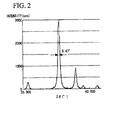
- a peak of the (222) plane in an X-ray diffraction chart has a large relative intensity (about 3,000 cps) and a half value width thereof is less than 0.6° (specifically, 0.47°).
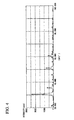
- an ITO powder No. 9 of Comparative Example A is obtained by firing a white indium tin hydroxide and has an olive-green color. As shown in Fig.
- a peak of the (222) plane in an X-ray diffraction chart has a relative intensity of 2,500 cps or less and a half value width thereof is more than 0.6° (specifically, 0.65°).
- the ITO powder used in the present embodiment has a half value width which is considerably less than that of an ITO powder of Comparative Example, and is therefore a powder having a high crystallinity.
- a peak of the (222) plane in an X-ray diffraction chart has a relative intensity of about 2,600 to 4,000 cps and a half value width thereof is about 0.3 to 0.6°
- the ITO powder can be subjected to a surface modification treatment.
- the conductivity can be improved and also transparent conductivity effect can be enhanced by the surface treatment.
- the surface modification treatment of the following (I), (II) and (III) can be performed at each stage simultaneously with drying, or during or after firing.
- a surface-modified ITO powder can be obtained by the surface modification treatment of the following (I), (II) and (III):
- the above-mentioned surface-modified ITO powder has a BET specific surface area of 40 m 2 /g or more, preferably 55 m 2 /g or more, and more preferably 55 to 80 m 2 /g, and has a navy blue or cobalt blue color.
- a peak of the (222) plane in an X-ray diffraction chart has a relative intensity of about 2,800 to 5,000 cps, and also has half value width of a peak of about 0.3 to 0.5°.
- the heat-ray shielding composition of the present embodiment contains the surface-modified ITO powder.
- the heat-ray shielding composition of the present embodiment is produced, for example, by the following method.
- the surface-modified ITO powder is dispersed in a dispersion solvent to obtain a dispersion solution.
- dispersion solvent there is no particular limitation on dispersion solvent, and it is possible to use a dispersion solvent composed of one or more kinds selected from the group consisting of distilled water, triethylene glycol-di-2-ethylhexanoate, anhydrous ethanol, phosphoric acid polyester, 2-ethylhexanoic acid, 2,4-pentanedion, toluene, methyl ethyl ketone, methyl isobutyl ketone, cyclohexanone, an acrylic monomer, N-methylpyrrolidone, isopropyl alcohol, ethylene glycol, propylene glycol and butanol.
- a dispersion solvent composed of one or more kinds selected from the group consisting of distilled water, triethylene glycol-di-2-ethylhexanoate, anhydrous ethanol, phosphoric acid polyester, 2-ethylhexanoic acid, 2,4-pentanedion, toluen
- the dispersion solution is mixed with a resin such as acryl, polyimide, a phenol resin, polyvinyl alcohol or butyral to obtain a heat-ray shielding composition.
- a resin such as acryl, polyimide, a phenol resin, polyvinyl alcohol or butyral
- the heat-ray shielding composition is preferably prepared so that the amount of ITO in the heat-ray shielding composition is adjusted within a range from 0.01 to 90% by weight, and more preferably from 0.1 to 85% by weight. The content depends on the film thickness of the heat-ray shielding composition.
- the composition when the concentration of the ITO powder of 0.7% by weight to 1.2% by weight in the composition is measured using a cell having an optical path length of 1 mm, the composition may be a composition which has high heat-ray shielding effect with a high sunlight transmittance of 60% or less and has high transparency with a visible light transmittance of 85% or more, and is also less hazy with a haze of 0.5% or less.
- X-ray diffraction pattern was measured using a powder X-ray diffractometer, manufactured by Rigaku Corporation (product name: MiniFlexII).
- BET specific surface area was measured using a high-speed surface area analyzer (SA-1100), manufactured by SIBATA SCIENTIFIC TECHNOLOGY LTD.
- An aqueous indium chloride (InCl 3 ) solution (containing 18 g of In metal) (50 mL) was mixed with 3.6 g of tin dichloride (SnCl 2 ⁇ 2H 2 O) and the obtained mixed aqueous solution and an aqueous ammonia (NH 3 ) solution were simultaneously added dropwise in 500 ml of water. After adjusting to pH 7, the mixture was reacted at a liquid temperature of 30°C for 30 minutes. The thus obtained precipitate was repeatedly subjected to inclination washing with ion-exchange water.
- InCl 3 aqueous indium chloride
- SnCl 2 ⁇ 2H 2 O tin dichloride
- NH 3 aqueous ammonia
- a precipitate (In/Sn co-precipitated hydroxide) was separated by filtration to obtain a co-precipitated indium tin hydroxide whose dry powder has a persimmon tone.
- An X-ray diffraction pattern of the co-precipitated indium tin hydroxide is shown in Fig. 3 .
- a TEM (transmission electron microscope) micrograph of the co-precipitated hydroxide powder is shown in Fig. 7 .
- the co-precipitated hydroxide powder has a clear crystal shape and thus the co-precipitated hydroxide powder has high crystallinity.
- the solid-liquid separated indium tin hydroxide was dried overnight at 110°C, fired at 550°C for 3 hours in atmospheric air, and then an aggregate was disentangled by grinding to obtain about 25 g of an ITO powder having a bright yellow color. Lab values and a specific surface area of the obtained ITO powder are shown in Table 1.
- the above-mentioned ITO powder (25 g) was impregnated by dipping in a surface treatment liquid prepared by mixing anhydrous ethanol with distilled water (in a mixing ratio of 95 parts by weight of ethanol: 5 parts by weight of distilled water) and then placed in a glass petri dish and heated at 330°C for 2 hours under a nitrogen gas atmosphere thereby performing a surface modification treatment.
- a color tone (L, a, b) and a BET value of the ITO powder are shown in Table 1.
- An X-ray diffraction pattern of the ITO powder is shown in Fig. 1 .
- a partially enlarged view in the vicinity of a peak of the (222) plane is shown in Fig. 2 .
- the ITO powder has a large relative intensity (about 3,000 cps), a half value width of a peak of 0.47° and high crystallinity.
- a crystal system of the ITO powder is a cubic system.
- Example 1 In the same manner as in Example 1, except that a liquid temperature of a mixed solution was adjusted to 10 and 60°C, an ITO power was obtained. The results of the ITO powder are shown in Table 1.
- Example 1 In the same manner as in Example 1, except that the pH of a mixed solution was adjusted to 4.5 and 8.5 by adjusting the addition amount of the aqueous alkali solution and that the liquid temperature was changed to 30°C, an ITO power was obtained.
- the results of the ITO powder are shown in Table 1.
- Example 1 In the same manner as in Example 1, except that an aqueous ammonium hydrogen carbonate (NH 4 HCO 3 ) solution was used as the aqueous alkali solution, an ITO power was obtained. Precipitation conditions, a color tone of a precipitate, a color tone and a specific surface area of the ITO powder, and the results of a surface treatment are shown in Table 1.
- NH 4 HCO 3 aqueous ammonium hydrogen carbonate
- Example 1 In the same manner as in Example 1, except that the pH of a mixed solution was adjusted to 3.0 by adjusting an addition amount of an aqueous alkali solution, a co-precipitated indium tin hydroxide was obtained. A dry powder of the co-precipitated indium tin hydroxide had a slightly yellowish white color. In the same manner as in Example 1, the precipitate was treated to obtain an ITO powder. The results of the ITO powder are shown in Table 1.
- Example 1 In the same manner as in Example 1, except that the pH of a mixed solution was adjusted to 9.5 by adjusting the addition amount of the aqueous alkali solution and that the liquid temperature was changed to 10°C, a co-precipitated indium tin hydroxide was obtained.
- the dry powder of the co-precipitated indium tin hydroxide had a slightly yellowish white color.
- the precipitate was treated to obtain an ITO powder. The results of the ITO powder are shown in Table 1.
- tin tetrachloride aqueous SnCl 4 solution having a concentration of 55%) as a tin compound
- 14.4 g of the aqueous SnCl 4 solution was mixed with 90 mL of an aqueous indium chloride (InCl 3 ) solution (containing 35 g of In metal) and the pH of a mixed aqueous solution was adjusted to 8 by adding 0.6 L of an aqueous alkali solution containing 190 g of ammonium hydrogen carbonate (NH 4 HCO 3 ) to the mixed aqueous solution, and then the mixture was reacted at a liquid temperature of 30°C for 30 minutes.
- InCl 3 aqueous indium chloride
- NH 4 HCO 3 ammonium hydrogen carbonate
- the thus obtained precipitate was repeatedly subjected to inclination washing with ion-exchange water. After resistivity of the supernatant liquid reaches 50,000 ⁇ cm or more, a co-precipitated indium tin hydroxide was separated by filtration. The obtained co-precipitated indium tin hydroxide had a white color.
- An X-ray diffraction pattern of the co-precipitated indium tin hydroxide is shown in Fig. 6 .
- a TEM micrograph of the co-precipitated hydroxide powder is shown in Fig. 8 . As is apparent from Fig. 8 , the co-precipitated hydroxide powder has an unclear crystal shape when compared with the powder (No.
- Example A 1 of Example A) in Fig. 7 .
- the co-precipitated indium tin hydroxide was dried overnight at 110°C, fired at 550°C for 3 hours in atmospheric air, and then an aggregate was disentangled by grinding to obtain about 44 g of an ITO powder.
- the above-mentioned ITO powder (25 g) was impregnated by dipping in a surface treatment liquid prepared by mixing anhydrous ethanol with distilled water (in a mixing ratio of 95 parts by weight of ethanol: 5 parts by weight of distilled water) and then placed in a glass petri dish and heated at 330°C for 2 hours under a nitrogen gas atmosphere. Lab values and a specific surface area of the ITO powder are shown in Table 1.
- FIG. 4 An X-ray diffraction pattern of the ITO powder is shown in Fig. 4 . Furthermore, a partially enlarged view in the vicinity of a peak of the (222) plane is shown in Fig. 5 . As shown in the drawing, it was confirmed that the ITO powder has a relative intensity of less than about 2,500 cps, a half value width of a peak of 0.65° and crystallinity lower than that of the ITO powder No. 1 of Example A.
- any samples (No. 1 to No. 6) in preferred range of the present embodiment, a co-precipitated indium tin hydroxide having a bright yellow to persimmon tone is formed.
- a yellowish white precipitate is formed, and also the BET value decreases and the L value is more than 40 in the Lab colorimetric system of the powder after subjecting to a modification treatment.
- a problem such as whitening is likely to arise when formed into a coating film, resulting in poor heat-ray shielding properties.
- surface-modified ITO powders (No. 1 to No.
- the present embodiment have a specific surface area of 50 m 2 /g or more and most of powders are fine powders having a specific surface area of 55 m 2 /g or more. Therefore, it is possible to form a film having high visible light transmittance when a film is formed by mixing with a resin.
- the surface-modified ITO powders (No. 1 to No. 6) of the present embodiment are powders having a navy blue color in which L ⁇ 30, a ⁇ 0, and b ⁇ 0 in the Lab colorimetric system. Since a ratio [(a ⁇ b)/L] of the (a ⁇ b) value to the L value is 0.3 or more (0.8 or more in case of No. 2 to No. 6 in Table 1), excellent heat-ray shielding effect can be obtained when used as a heat-ray shielding material.
- a co-precipitated hydroxide having a bright yellow color has high crystallinity of a hydroxide. It is possible to obtain an ITO powder having high specific surface area and high crystallinity by using the co-precipitated indium hydroxide having high crystallinity. A heat-ray shielding composition using the ITO powder can obtain high transparency and excellent sunlight shielding properties.
- a visible light transmittance (%Tv), a sunlight transmittance (%Ts), a haze and a reflective yellowness index (YI) were measured. The details are shown below (Example B and Comparative Example B).
- the visible light transmittance (%Tv), sunlight transmittance (%Ts), haze and reflective yellowness index (YI) were measured by the following methods.
- ITO powders (20 g) of samples No. 1 and No. 6 shown in Table 1 were dipped and dispersed in a mixed solution of distilled water (0.020 g), triethylene glycol-di-2-ethylhexanoate [3G] (23.8 g), anhydrous ethanol (2.1 g), phosphoric acid polyester (1.0 g), 2-ethylhexanoic acid (2.0 g) and 2,4-pentanedion (0.5 g).
- the thus prepared dispersion solution was diluted with triethylene glycol-di-2-ethylhexanoate until the amount of ITO powder reaches 0.7% by mass. With respect to the sample No. 6, the amount of the ITO powder was adjusted to 0.7% by weight, 0.9% by weight, 1.2% by weight and 1.4% by weight.
- the diluted solution was charged in a glass cell having an optical path length of 1 mm.
- YI 100 ⁇ 1.28 ⁇ X - 1.06 ⁇ Z / Y .
- X, Y and Z are tristimulus values (XYZ colorimetric system) of test samples in standard illuminant C.
- the standard illuminant C is model illuminant obtained by approximation of average daylight with a correlated color temperature of 6774°K using a CIE (Comission Internationale de l'Eclairage) standard light source formed by a tungsten light source through a filter.
- CIE Commission Internationale de l'Eclairage
- ITO powders (20 g) of samples No. 7 and No. 8 shown in Table 1 were dispersed in the mixed solution similar to Example A. With respect to the dispersion solution, the visible light transmittance (%Tv), sunlight transmittance (%Ts), haze and reflective yellowness index (YI) were measured. The results are shown in Table 2.
- the heat-ray shielding composition of the present embodiment composed of a dispersion solution of ITO powders of samples No. 1 and No. 6 has high visible light transmittance compared with samples No. 7 and No. 8 of Comparative Example B and satisfactory crystallinity of the ITO powder, sunlight transmittance is low and heat-ray shielding properties are remarkably improved regardless of high visible light transmittance. Furthermore, since samples No. 1 and No. 6 of the present embodiment also have low haze value, even if the concentration of ITO in the dispersion solution is increased by two times, the haze value is 1% or less. Furthermore, the reflective yellowness index (YI) has a small absolute value, and thus a less hazy film can be formed.
- YI reflective yellowness index
- Example B Comparative Example B A1 A2 A3 A4 A5 B1 B2 Kind of powder No. 1 No. 6 No.6 No. 6 No.6 No.7 No. 8 Concentration of ITO in dispersion solution (%) 0.7 0.7 0.9 1.2 1.4 0.7 0.7 %Tv 88.5 90.9 88.4 85.0 82.8 84.1 84.0 %Ts 57.5 60.0 56.0 51.4 48.6 65.0 64.4 Haze (%) 0.35 0.31 0.37 0.48 0.54 5.01 1.01 YI -17.5 -17.1 -20.2 -24.2 -26.4 - -30.1 (Note): Each of Nos. 1, 6, 7 and 8 denotes the ITO powder of the same number in Table 1. Since sample No. 7 has high haze, the YI value was not measured.
Landscapes
- Chemical & Material Sciences (AREA)
- Organic Chemistry (AREA)
- Inorganic Chemistry (AREA)
- Life Sciences & Earth Sciences (AREA)
- Engineering & Computer Science (AREA)
- Materials Engineering (AREA)
- Wood Science & Technology (AREA)
- Paints Or Removers (AREA)
Abstract
Description
- The present invention relates to a heat-ray shielding composition having excellent heat-ray shielding effect, and a method for producing the same, and more particularly to a heat-ray shielding composition having excellent heat-ray shielding effect, which contains a heat-ray shielding material of a co-precipitated indium tin hydroxide having a bright yellow to persimmon (reddish brown or orange-red) tone, or an indium tin hydroxide obtained by surface-modifying an indium tin oxide powder having the above color tone, and a method for producing the same.
This application claims priority on Japanese Patent Application No.2009-248627 filed on October 29, 2009 2010-171192 filed on July 29, 2010 - Indium tin oxide (referred to as ITO) has been known as a heat-ray shielding material. There has hitherto been known, as a method for producing an ITO powder, a method in which an indium-containing aqueous solution is mixed with a tin-containing aqueous solution to co-precipitate indium tin hydroxide, and firing the obtained co-precipitate.
- For example, Japanese Unexamined Patent Application, First Publication No.
Hei 6-295315 2,715,859 - According to the production method of
Patent Literature 1, white indium tin hydroxide is obtained. According to the production method of Patent Literature 2, the formed indium tin hydroxide also exhibits a white color. Furthermore, it has been known that indium hydroxide generally exhibits white color and tin hydroxide also exhibits white color (Non Patent Literature 1, etc.). - It has been known that, in case of using an ITO powder as a heat-ray shielding material, the powder preferably has a color tone in which a < 0 and b < 0, and the ratio [(a·b)/L] of the (a·b) value to the L value is 0.3 or more in the Lab colorimetric system, so as to enhance heat-ray shielding properties (Japanese Unexamined Patent Application, First Publication No.
2007-154152 - Japanese Patent Application No.
2005-232399 2003-215328 - Japanese Patent Application No.
2005-322626 -
- [Patent Literature 1]
Japanese Unexamined Patent Application, First Publication No.Hei 6-295315 - [Patent Literature 2]
Japanese Patent No.2,715,859 - [Patent Literature 3]
Japanese Unexamined Patent Application, First Publication No.2007-154152 - [Patent Literature 4]
Japanese Patent Application No.2005-232399 - [Patent Literature 5]
Japanese Patent Application No.2003-215328 - [Patent Literature 6]
Japanese Patent Application No.2005-322626 -
- [Non Patent Literature 1]
Kagaku Daijiten (Encyclopedic Dictionary of Chemistry), 1st Edition (Tokyo Kagaku Dozin Co., Ltd.), page 1169, page 1170 - The present invention provides a composition which is excellent in heat-ray shielding effect compared with a conventional heat-ray shielding material. The present invention provides a heat-ray shielding composition having a heat-ray shielding effect enhanced by using, as a heat-ray shielding material, an ITO powder having a bright yellow to persimmon (reddish brown or orange-red) tone, or an ITO powder obtained by surface-modifying a co-precipitated indium tin oxide powder having a similar color tone, in place of a conventional white-based ITO powder.
- The present invention is directed to a heat-ray shielding composition in which the above-mentioned problems have been solved by the following constitutions.
- [1] A heat-ray shielding composition including an indium tin oxide powder (ITO power) which has a BET specific surface area of 40 m2/g or more and a navy blue or cobalt blue (L = 30 or less, a < 0, b < 0 in the Lab colorimetric system) tone.
- [2] The heat-ray shielding composition according to the above [1], wherein, when the dispersion solution having the concentration of 0.7% by weight to 1.2% by weight of the indium tin oxide powder is subjected to the measurement using a cell having an optical path length of 1 mm, the following measurement are obtained: a sunlight transmittance is 60% or less, a visible light transmittance is 85% or more, and a haze is 0.5% or less.
- [3] The heat-ray shielding composition according to the above [1] or [2], wherein the indium tin oxide powder contained in the heat-ray shielding composition is an indium tin oxide powder which is surface-modified by firing indium tin hydroxide having a bright yellow to persimmon (reddish brown or orange-red) tone, or an indium tin oxide powder which is surface-modified by firing indium tin oxide having a bright yellow to persimmon (reddish brown or orange-red) tone.
- The present invention is also directed to a method for producing a heat-ray shielding composition with the following constitutions.
- [4] A method for producing a heat-ray shielding composition, which includes the steps of:
- using an indium compound and a divalent tin compound, and co-precipitating an indium tin hydroxide whose dry powder exhibits bright yellow to persimmon (reddish brown or orange-red) color under the conditions of the pH of 4.0 to 9.3 and a liquid temperature of 5°C or higher;
- drying and firing the indium tin hydroxide to obtain a surface-modified indium tin oxide powder; and
- dispersing the surface-modified indium tin oxide powder in a solvent, and then mixing the dispersion solution with a resin.
- [5] The method for producing a heat-ray shielding composition according to the above [4]; wherein
the surface modification is performed by heating/firing which is performed simultaneously with or after drying of bright yellow to persimmon (reddish brown or orange-red) indium tin hydroxide under a nitrogen atmosphere, or under an atmosphere of nitrogen containing any one kind selected from the group consisting of steam, alcohol and ammonia; and
the surface-modified indium tin oxide powder has a navy blue or cobalt blue tone and a BET specific surface area of 40 m2/g or more. - [6] The method for producing a heat-ray shielding composition according to the above [4] or [5], which performs, in the step of obtaining the surface-modified indium tin oxide powder, a surface modification treatment of any one of the following (I), (II) and (III):
- (I) a co-precipitate of indium tin hydroxide is dried and fired by heating at 250 to 800°C for 30 minutes to 6 hours under a nitrogen atmosphere, a nitrogen atmosphere containing an alcohol, or a nitrogen atmosphere containing ammonia;
- (II) a co-precipitate of indium tin hydroxide is dried overnight at 100°C to 200°C under an air atmosphere, and then fired by heating at 250 to 800°C for 30 minutes to 6 hours under a nitrogen atmosphere, a nitrogen atmosphere containing an alcohol, or a nitrogen atmosphere containing ammonia; and
- (III) a co-precipitate of indium tin hydroxide is dried and fired under an air atmosphere, and then heat-treated at 250 to 800°C for 30 minutes to 6 hours under a nitrogen atmosphere, a nitrogen atmosphere containing an alcohol, or a nitrogen atmosphere containing ammonia.
- Unlike a conventional white indium tin hydroxide, the heat-ray shielding composition of the present invention contains surface-modified indium tin oxide powder obtained by heat-treating a co-precipitated indium tin hydroxide having a bright yellow to persimmon (reddish brown or orange-red) tone. This surface-modified indium tin oxide powder has high crystallinity Therefore, when the surface-modified indium tin oxide powder is mixed with a resin to form a film, the obtained film has a high visible light transmittance, excellent transparency and high conductivity, and also a film whitening phenomenon is suppressed. This surface-modified indium tin oxide powder is excellent in heat-ray shielding effect and can form a film having a low sunlight transmittance while maintaining high transparency.
-
-
Fig. 1 is a graph showing an X-ray diffraction pattern of an ITO powder of No. 1 in Table 1 after firing in atmospheric air. -
Fig. 2 is a partially enlarged view ofFig. 1 . -
Fig. 3 is a graph showing an X-ray diffraction pattern of a co-precipitated indium tin hydroxide ofNo 1 in Table 1. -
Fig. 4 is a graph showing an X-ray diffraction pattern of an ITO powder of No. 9 in Table 1 after firing in atmospheric air. -
Fig. 5 is a partially enlarged view ofFig. 4 . -
Fig. 6 is a graph showing an X-ray diffraction pattern of a co-precipitated indium tin hydroxide of No 9 in Table 1. -
Fig. 7 is a TEM micrograph of a co-precipitated indium tin hydroxide of No. 1 in Table 1. -
Fig. 8 is a TEM micrograph of a co-precipitated indium tin hydroxide of No. 9 in Table 1. - An embodiment of the present invention will be specifically described below by way of Examples.
- The heat-ray shielding composition of the present embodiment is a heat-ray shielding composition including an indium tin oxide powder which has a BET specific surface area of 40 m2/g or more and a navy blue or cobalt blue (L = 30 or less, a < 0, b < 0 in the Lab colorimetric system) tone (hereinafter referred to as a ITO powder).
- The heat-ray shielding composition of the present embodiment is preferably a composition having a heat-ray shielding effect in which a sunlight transmittance is 60% or less, a visible light transmittance is 85% or more, and a haze is 0.5% or less, when a dispersion solution containing an ITO powder in a concentration of 0.7% by weight to 1.2% by weight is subjected to the measurement using a cell having an optical path length of 1 mm.
- The ITO powder contained in the heat-ray shielding composition of the present embodiment is preferably an ITO powder in which indium tin hydroxide having a bright yellow to persimmon (reddish brown or orange-red) tone is surface-modified by firing, or ITO having the above color tone is surface-modified, and such an ITO powder can be produced by the following method.
- Indium and tin in the solution are precipitated in the presence of an alkali to form a co-precipitated hydroxide of indium and tin. At this time, it is possible to precipitate a co-precipitated hydroxide of indium and tin, whose dry powder has a bright yellow to persimmon (reddish brown or orange-red) tone by adjusting the pH of the solution within a range from 4.0 to 9.3, and preferably from 6.0 to 8.0, and adjusting a liquid temperature within a range of 5°C or higher, preferably from 10°C to 80°C, and more preferably from 10°C to 60°C using a divalent tin compound (SnCl2·2H2O, etc.). There is no particular limitation on the reaction time, and the reaction time may be from about 10 minutes to 240 minutes. The obtained hydroxide having a bright yellow to persimmon (reddish brown or orange-red) tone is excellent in crystallinity compared with a conventional white indium tin hydroxide. Indium trichloride (InCl3) can be used as indium.
- When a tetravalent tin compound (SnCl4, etc.) is used, a white precipitate is formed and a precipitate having a bright yellow to persimmon (reddish brown or orange-red) tone is not formed. When the pH is lower than 4.0 (acidic side) or higher than 9.3 (alkali side), a pale yellowish white precipitate is formed and a precipitate having a bright yellow to persimmon (reddish brown or orange-red) tone is not formed. Any of a white precipitate by a tetravalent tin compound and the above-mentioned yellowish-white precipitate has low crystallinity compared with a precipitate having a bright yellow to persimmon (reddish brown or orange-red) tone and it is impossible to obtain an ITO powder having high crystallinity like the present embodiment even when these precipitates are fired. Since tin tetrachloride is used in the production method of
Patent Literature 1, a white indium tin hydroxide precipitate is formed and a precipitate having a bright yellow to persimmon (reddish brown or orange-red) tone is not formed. - In order to adjust the hydrogen-ion exponent (pH) within a range from 4.0 to 9.3 upon reaction, for example, the pH may be adjusted within the above range by using a mixed aqueous solution of indium trichloride (InCl3) and tin dichloride (SnCl2·2H2O) and simultaneously adding dropwise the mixed aqueous solution and an aqueous alkali solution. Alternatively, the above mixed solution is added dropwise in an aqueous alkali solution. As the aqueous alkali solution, ammonia water [NH3 water], ammonium hydrogen carbonate water [NH4HCO3 water] and the like may be used.
There is no particular limitation on the mixed aqueous solution, it is possible to use an aqueous solution containing 0.01 to 5 mol/L of an indium compound and Sn in the proportion of 1 to 20 mol% in terms of a molar ratio of Sn/(In + Sn) of a tin compound. - Specifically, as shown in Examples 1 to 2 (Nos. 1 to 3), a precipitate whose dry powder has a bright yellow to persimmon (reddish brown or orange-red) tone is formed at pH 7 of the solution and a liquid temperature of 10°C to 60°C using tin dichloride. On the other hand, as shown in Comparative Example 1 (No. 7), a pale yellowish white precipitate is formed at pH of lower than 4.0 (pH 3.0) and, as shown in Comparative Example 2 (No. 8), a pale yellowish white precipitate is similarly formed at pH of 9.3 or higher (pH 9.5). Therefore, in order to form a co-precipitated indium tin hydroxide having a bright yellow to persimmon (reddish brown or orange-red) tone, the pH is suitably within a range of from 4.0 to 9.3. The pH becomes closer to neutral, a persimmon (reddish brown or orange-red) color may develop. Furthermore, when tin tetrachloride (SnCl4) is used as shown in Comparative Example 3 (No. 9), a white precipitate is formed and a precipitate, which has a bright yellow to persimmon (reddish brown or orange-red) tone and also high crystallinity is not formed.
- After formation of the above-mentioned co-precipitated indium tin hydroxide, the co-precipitate is washed with pure water, washed until resistivity of the supernatant liquid becomes 5,000 Ω·cm or more, and preferably 50,000 Ω·cm or more, and then the above-mentioned co-precipitate is subjected to solid-phase separation and the above co-precipitate is recovered. When the resistivity of the supernatant liquid is less than 5,000 Ω·cm, impurities such as chlorine are not sufficiently removed and thus a high-purity indium tin oxide powder cannot be obtained.
- The dry powder of the above-mentioned indium tin hydroxide has a bright yellow to persimmon (reddish brown or orange-red) tone and L = 80 or less, a = -10 to +10, b = +26 or more in the Lab colorimetric system. For example, in Examples 1 to 5 (No. 1 to No. 6), L = 60.3 to 75.1, a = -2.3 to +1.5, and b = +21.9 to +32.2. By the way, precipitates of Comparative Examples 1 to 3 (No. 7 to 9) are white-based precipitates in which L = 91 to 100.
- An ITO powder (In-Sn oxide powder) can be obtained by drying and firing the above-mentioned indium tin hydroxide. In the step of from drying to firing, for example, the indium tin hydroxide may be dried by heating at 100 to 200°C for 2 to 24 hours in atmospheric air and then fired by heating at 250°C or higher, and preferably 400°C to 800°C for 1 to 6 hours. The hydroxide remains as it is at 250°C or lower and is not converted into an oxide. Indium tin hydroxide is oxidized by this firing treatment, and thus an indium tin oxide powder having a bright yellow to persimmon (reddish brown or orange-red) tone can be obtained.
- The above-mentioned ITO powder subjected to firing treatment in atmospheric air has a bright yellow to persimmon (reddish brown or orange-red) tone. Specifically, L = 80 or less, a = -10 to +10, and b = +26 or more in the Lab colorimetric system. For example, in Examples 1 to 5 (No. 1 to No. 6), L = 56.6 to 67.1, a = -1.2 to +1.1, and b = +29.5 to +30.8. On the other hand, a white-based indium tin hydroxide is fired in atmospheric air to form an olive-green powder in which a value is -5 or less in the Lab colorimetric system, as shown in Comparative Example.
- The above-mentioned ITO powder is a fine powder having a specific surface area of 55 m2/g or more, and preferably 60 m2/g or more. Specifically, ITO powders of Examples 1 to 5 have the BET specific surface area of 60 m2/g to 85 m2/g, while ITO powders of Comparative Examples 1 to 3 have a BET specific surface area of 45 m2/g to 48 m2/g, and thus of Examples 1 to 5 are fine powders having noticeably larger specific area compared with Comparative Examples 1 to 3.
- The ITO powder having a bright yellow to persimmon (reddish brown or orange-red) tone has high crystallinity. For example, in case of an ITO powder No. 1 of Example A, as shown in
Fig. 1 andFig. 2 , a peak of the (222) plane in an X-ray diffraction chart has a large relative intensity (about 3,000 cps) and a half value width thereof is less than 0.6° (specifically, 0.47°). On the other hand, an ITO powder No. 9 of Comparative Example A is obtained by firing a white indium tin hydroxide and has an olive-green color. As shown inFig. 4 , a peak of the (222) plane in an X-ray diffraction chart has a relative intensity of 2,500 cps or less and a half value width thereof is more than 0.6° (specifically, 0.65°). As mentioned above, the ITO powder used in the present embodiment has a half value width which is considerably less than that of an ITO powder of Comparative Example, and is therefore a powder having a high crystallinity.
In the above-mentioned ITO powder having a bright yellow to persimmon (reddish brown or orange-red) tone, it is preferred that a peak of the (222) plane in an X-ray diffraction chart has a relative intensity of about 2,600 to 4,000 cps and a half value width thereof is about 0.3 to 0.6° - In a drying and firing treatment of the above-mentioned co-precipitated indium tin hydroxide (co-precipitated In-Sn hydroxide) or a drying and firing treatment of the above-mentioned indium tin oxide (In-Sn oxide), the ITO powder can be subjected to a surface modification treatment. The conductivity can be improved and also transparent conductivity effect can be enhanced by the surface treatment.
- The surface modification treatment of the following (I), (II) and (III) can be performed at each stage simultaneously with drying, or during or after firing. A surface-modified ITO powder can be obtained by the surface modification treatment of the following (I), (II) and (III):
- (I) the above-mentioned indium tin hydroxide is dried and fired by heating at 250 to 800°C for 30 minutes to 6 hours under a nitrogen atmosphere, a nitrogen atmosphere containing an alcohol, or a nitrogen atmosphere containing ammonia,
- (II) the above-mentioned indium tin hydroxide is dried overnight at 100°C to 200°C under an air atmosphere to obtain a dried indium tin hydroxide. The dried indium tin hydroxide is fired by heating at 250 to 800°C for 30 minutes to 6 hours under a nitrogen atmosphere, a nitrogen atmosphere containing an alcohol, or a nitrogen atmosphere containing ammonia; and
- (III) the above-mentioned indium tin hydroxide is dried and fired under an air atmosphere, and then heat-treated at 250 to 800°C for 30 minutes to 6 hours under a nitrogen atmosphere, a nitrogen atmosphere containing an alcohol, or a nitrogen atmosphere containing ammonia.
- The above-mentioned surface-modified ITO powder has a BET specific surface area of 40 m2/g or more, preferably 55 m2/g or more, and more preferably 55 to 80 m2/g, and has a navy blue or cobalt blue color. Specifically, the surface-modified ITO powder has a navy blue or cobalt blue tone in which L = 3 0 or less, a < 0, b < 0 in the Lab colorimetric system.
Since the surface-modified ITO powder is fine and also has high crystallinity, when a film or a sheet is formed by mixing with a resin, the obtained film or a sheet can be obtained high transparency and excellent conductivity. When the surface-modified ITO powder is used as a heat-ray shielding material, excellent heat-ray shielding effect can be obtained.
In the surface-modified ITO powder, it is preferred that a peak of the (222) plane in an X-ray diffraction chart has a relative intensity of about 2,800 to 5,000 cps, and also has half value width of a peak of about 0.3 to 0.5°. - The heat-ray shielding composition of the present embodiment contains the surface-modified ITO powder.
The heat-ray shielding composition of the present embodiment is produced, for example, by the following method.
The surface-modified ITO powder is dispersed in a dispersion solvent to obtain a dispersion solution. There is no particular limitation on dispersion solvent, and it is possible to use a dispersion solvent composed of one or more kinds selected from the group consisting of distilled water, triethylene glycol-di-2-ethylhexanoate, anhydrous ethanol, phosphoric acid polyester, 2-ethylhexanoic acid, 2,4-pentanedion, toluene, methyl ethyl ketone, methyl isobutyl ketone, cyclohexanone, an acrylic monomer, N-methylpyrrolidone, isopropyl alcohol, ethylene glycol, propylene glycol and butanol.
The dispersion solution is mixed with a resin such as acryl, polyimide, a phenol resin, polyvinyl alcohol or butyral to obtain a heat-ray shielding composition.
There is no particular limitation on the amount of the heat-ray shielding composition in the surface-modified ITO powder. The heat-ray shielding composition is preferably prepared so that the amount of ITO in the heat-ray shielding composition is adjusted within a range from 0.01 to 90% by weight, and more preferably from 0.1 to 85% by weight. The content depends on the film thickness of the heat-ray shielding composition. For example, in case of a compound having a film thickness of 2 µm, when the amount of the surface-modified ITO powder is 1% by weight or more, a composition having excellent heat-ray shielding effect can be provided. On the other hand, when the amount of the ITO powder is 90% by weight or less, the film strength can be maintained. There is also a method in which the film strength is obtained by overcoating on a composition composed of only an ITO powder. - Specifically, in the heat-ray shielding composition of the present embodiment, when the concentration of the ITO powder of 0.7% by weight to 1.2% by weight in the composition is measured using a cell having an optical path length of 1 mm, the composition may be a composition which has high heat-ray shielding effect with a high sunlight transmittance of 60% or less and has high transparency with a visible light transmittance of 85% or more, and is also less hazy with a haze of 0.5% or less.
- Examples of the present embodiment will be shown below, together with Comparative Examples. X-ray diffraction pattern, specific surface area and color tone (Lab values) of the ITO powder were measured by the following methods.
- X-ray diffraction pattern was measured using a powder X-ray diffractometer, manufactured by Rigaku Corporation (product name: MiniFlexII).
- BET specific surface area was measured using a high-speed surface area analyzer (SA-1100), manufactured by SIBATA SCIENTIFIC TECHNOLOGY LTD.
- Lab values were measured using a color computer (SM-T), manufactured by SUGA TEST INSTRUMENTS CO., LTD.
- An aqueous indium chloride (InCl3) solution (containing 18 g of In metal) (50 mL) was mixed with 3.6 g of tin dichloride (SnCl2·2H2O) and the obtained mixed aqueous solution and an aqueous ammonia (NH3) solution were simultaneously added dropwise in 500 ml of water. After adjusting to pH 7, the mixture was reacted at a liquid temperature of 30°C for 30 minutes. The thus obtained precipitate was repeatedly subjected to inclination washing with ion-exchange water. After resistivity of the supernatant liquid reaches 50,000 Ω·cm or more, a precipitate (In/Sn co-precipitated hydroxide) was separated by filtration to obtain a co-precipitated indium tin hydroxide whose dry powder has a persimmon tone.
An X-ray diffraction pattern of the co-precipitated indium tin hydroxide is shown inFig. 3 . A TEM (transmission electron microscope) micrograph of the co-precipitated hydroxide powder is shown inFig. 7 . As is apparent fromFig. 7 , the co-precipitated hydroxide powder has a clear crystal shape and thus the co-precipitated hydroxide powder has high crystallinity.
The solid-liquid separated indium tin hydroxide was dried overnight at 110°C, fired at 550°C for 3 hours in atmospheric air, and then an aggregate was disentangled by grinding to obtain about 25 g of an ITO powder having a bright yellow color.
Lab values and a specific surface area of the obtained ITO powder are shown in Table 1. - The above-mentioned ITO powder (25 g) was impregnated by dipping in a surface treatment liquid prepared by mixing anhydrous ethanol with distilled water (in a mixing ratio of 95 parts by weight of ethanol: 5 parts by weight of distilled water) and then placed in a glass petri dish and heated at 330°C for 2 hours under a nitrogen gas atmosphere thereby performing a surface modification treatment. A color tone (L, a, b) and a BET value of the ITO powder are shown in Table 1. An X-ray diffraction pattern of the ITO powder is shown in
Fig. 1 . Furthermore, a partially enlarged view in the vicinity of a peak of the (222) plane is shown inFig. 2 . As shown in the drawing, it was confirmed that the ITO powder has a large relative intensity (about 3,000 cps), a half value width of a peak of 0.47° and high crystallinity. As shown in the X-ray diffraction pattern, a crystal system of the ITO powder is a cubic system. - In the same manner as in Example 1, except that a liquid temperature of a mixed solution was adjusted to 10 and 60°C, an ITO power was obtained. The results of the ITO powder are shown in Table 1.
- In the same manner as in Example 1, except that the pH of a mixed solution was adjusted to 4.5 and 8.5 by adjusting the addition amount of the aqueous alkali solution and that the liquid temperature was changed to 30°C, an ITO power was obtained. The results of the ITO powder are shown in Table 1.
- In the same manner as in Example 1, except that an aqueous ammonium hydrogen carbonate (NH4HCO3) solution was used as the aqueous alkali solution, an ITO power was obtained. Precipitation conditions, a color tone of a precipitate, a color tone and a specific surface area of the ITO powder, and the results of a surface treatment are shown in Table 1.
- In the same manner as in Example 1, except that the pH of a mixed solution was adjusted to 3.0 by adjusting an addition amount of an aqueous alkali solution, a co-precipitated indium tin hydroxide was obtained. A dry powder of the co-precipitated indium tin hydroxide had a slightly yellowish white color. In the same manner as in Example 1, the precipitate was treated to obtain an ITO powder. The results of the ITO powder are shown in Table 1.
- In the same manner as in Example 1, except that the pH of a mixed solution was adjusted to 9.5 by adjusting the addition amount of the aqueous alkali solution and that the liquid temperature was changed to 10°C, a co-precipitated indium tin hydroxide was obtained. The dry powder of the co-precipitated indium tin hydroxide had a slightly yellowish white color. In the same manner as in Example 1, the precipitate was treated to obtain an ITO powder. The results of the ITO powder are shown in Table 1.
- Using tin tetrachloride (aqueous SnCl4 solution having a concentration of 55%) as a tin compound, 14.4 g of the aqueous SnCl4 solution was mixed with 90 mL of an aqueous indium chloride (InCl3) solution (containing 35 g of In metal) and the pH of a mixed aqueous solution was adjusted to 8 by adding 0.6 L of an aqueous alkali solution containing 190 g of ammonium hydrogen carbonate (NH4HCO3) to the mixed aqueous solution, and then the mixture was reacted at a liquid temperature of 30°C for 30 minutes. The thus obtained precipitate was repeatedly subjected to inclination washing with ion-exchange water. After resistivity of the supernatant liquid reaches 50,000 Ω·cm or more, a co-precipitated indium tin hydroxide was separated by filtration. The obtained co-precipitated indium tin hydroxide had a white color. An X-ray diffraction pattern of the co-precipitated indium tin hydroxide is shown in
Fig. 6 . A TEM micrograph of the co-precipitated hydroxide powder is shown inFig. 8 . As is apparent fromFig. 8 , the co-precipitated hydroxide powder has an unclear crystal shape when compared with the powder (No. 1 of Example A) inFig. 7 . The co-precipitated indium tin hydroxide was dried overnight at 110°C, fired at 550°C for 3 hours in atmospheric air, and then an aggregate was disentangled by grinding to obtain about 44 g of an ITO powder. The above-mentioned ITO powder (25 g) was impregnated by dipping in a surface treatment liquid prepared by mixing anhydrous ethanol with distilled water (in a mixing ratio of 95 parts by weight of ethanol: 5 parts by weight of distilled water) and then placed in a glass petri dish and heated at 330°C for 2 hours under a nitrogen gas atmosphere.
Lab values and a specific surface area of the ITO powder are shown in Table 1. An X-ray diffraction pattern of the ITO powder is shown inFig. 4 . Furthermore, a partially enlarged view in the vicinity of a peak of the (222) plane is shown inFig. 5 . As shown in the drawing, it was confirmed that the ITO powder has a relative intensity of less than about 2,500 cps, a half value width of a peak of 0.65° and crystallinity lower than that of the ITO powder No. 1 of Example A. - As shown in Table 1, in any samples (No. 1 to No. 6) in preferred range of the present embodiment, a co-precipitated indium tin hydroxide having a bright yellow to persimmon tone is formed. When the pH deviates from the above range, as shown in Comparative Examples 1 to 3, a yellowish white precipitate is formed, and also the BET value decreases and the L value is more than 40 in the Lab colorimetric system of the powder after subjecting to a modification treatment. Furthermore, a problem such as whitening is likely to arise when formed into a coating film, resulting in poor heat-ray shielding properties. On the other hand, surface-modified ITO powders (No. 1 to No. 6) of the present embodiment have a specific surface area of 50 m2/g or more and most of powders are fine powders having a specific surface area of 55 m2/g or more. Therefore, it is possible to form a film having high visible light transmittance when a film is formed by mixing with a resin.
- The surface-modified ITO powders (No. 1 to No. 6) of the present embodiment are powders having a navy blue color in which L < 30, a < 0, and b < 0 in the Lab colorimetric system. Since a ratio [(a·b)/L] of the (a·b) value to the L value is 0.3 or more (0.8 or more in case of No. 2 to No. 6 in Table 1), excellent heat-ray shielding effect can be obtained when used as a heat-ray shielding material.
- As shown in
Fig. 1 ,Fig. 2 andFig. 7 , a co-precipitated hydroxide having a bright yellow color has high crystallinity of a hydroxide. It is possible to obtain an ITO powder having high specific surface area and high crystallinity by using the co-precipitated indium hydroxide having high crystallinity. A heat-ray shielding composition using the ITO powder can obtain high transparency and excellent sunlight shielding properties. -
[Table 1] Example A Comparative Example A Sample No. 1 No. 2 No. 3 No. 4 No. 5 No. 6 No. 7 No. 8 No. 9 In raw material Incl3 Incl3 Incl3 Incl3 Incl3 Incl3 Incl3 Incl3 Incl3 Sn raw material SaCl2 SnCl2 SnCl2 SnCl2 SnCl2 SnCl2 SnCl2 SnCl2 SnCl4 Aqueous alkali solution NH3 NH3 NH3 NH3 NH3 NH4HCO3 NH3 NH3 NH4HCO3 Mixed solution pH 7 7 7 4.5 8.5 7 3.0 9.5 8 Liquid temperature 30°C 10°C 60°C 30°C 30°C 30°C 30°C 10°C 30°C Color tone of co-precipitate Persimmon Bright yellow Bright yellow Bright yellow Persimmon Bright yellow Yellowish -white Yellowish -white White L 75.1 70.0 68.3 66.0 65.0 60.3 91 95 100 a -1.5 1.1 1.5 -2.3 4.2 0.4 0.2 0.1 0.1 b 30.7 31.2 31.2 32.2 21.9 31.0 R5.3 2.1 -0.2 Color tone of ITO powder fired in atmospheric air Bright yellow Bright yellow Bright yellow Bright yellow Bright yellow Bright yellow Olive -green Olive -green Olive -green L 60.1 58.3 56.0 62.3 67.1 57.2 82.5 77.8 77.8 a 0.4 1.1 -0.8 -1.2 1.2 2.1 -7.1 -7.4 -8.7 b 30.8 31.5 29.5 31.2 30.8 29.7 16.3 17.8 27.9 BET value of ITO powder (m2/g) 71 85 60 72 72 68 48 45 45 ITO powder after modification treatment Navy blue Navy blue Navy blue Navy blue Navy blue Navy blue Light blue Light blue Light blue L 21.3 29.1 27.4 29.6 26.5 27.9 53.8 56.5 44.5 a -2.8 -2.1 -2.2 -4.2 -3.8 -3.3 -4.0 -5.3 -3.4 b -2.3 -12.0 -11.0 -7.2 -6.1 -7.8 -14.1 -14.3 -1.0 BET value of ITO powder after modification treatment (m2/g) 55 71 50 55 56 62 29 27 35 (Note): SnCl2 is SnCl2·2H2O, co-precipitate is co-precipitated indium tin hydroxide, and color tone of a co-precipitate is a color tone of a dry powder, and yellowish-white is slightly yellowish white color. - With respect to dispersion solutions of ITO powders (No. 1, No. 6, No. 7 and No. 8) shown in Table 1, a visible light transmittance (%Tv), a sunlight transmittance (%Ts), a haze and a reflective yellowness index (YI) were measured. The details are shown below (Example B and Comparative Example B). The visible light transmittance (%Tv), sunlight transmittance (%Ts), haze and reflective yellowness index (YI) were measured by the following methods.
- ITO powders (20 g) of samples No. 1 and No. 6 shown in Table 1 were dipped and dispersed in a mixed solution of distilled water (0.020 g), triethylene glycol-di-2-ethylhexanoate [3G] (23.8 g), anhydrous ethanol (2.1 g), phosphoric acid polyester (1.0 g), 2-ethylhexanoic acid (2.0 g) and 2,4-pentanedion (0.5 g).
- The thus prepared dispersion solution was diluted with triethylene glycol-di-2-ethylhexanoate until the amount of ITO powder reaches 0.7% by mass. With respect to the sample No. 6, the amount of the ITO powder was adjusted to 0.7% by weight, 0.9% by weight, 1.2% by weight and 1.4% by weight. The diluted solution was charged in a glass cell having an optical path length of 1 mm. Using a self-registering spectrophotometer (U-4000, manufactured by Hitachi, Ltd.), a visible light transmittance (%Tv) at 380 nm to 780 nm and a sunlight transmittance (%Ts) at 300 nm to 2,100 nm were measured at normal temperature in accordance with the standard (JIS R 3216-1998 (equivalent to ISO9050 1990)). The results are shown in Table 2.
- Using the dispersion solution diluted in the same manner as in case of the sample for the measurement of spectral characteristics as a sample, the sample was charged in a glass cell having an optical path length of 1 mm. Using a haze computer (HZ-2, manufactured by SUGA TEST INSTRUMENTS CO., LTD.), a haze was measured at normal temperature in accordance with the standard (JIS K 7136 (equivalent to ISO 14782 1999)). The results are shown in Table 2.
- Using the dispersion solution diluted in the same manner as in case of the sample for the measurement of spectral characteristics as a sample, 6.73 g of the diluted solution sample was charged in a liquid cell for reflection (No. 15). Using a color computer (SM-T, manufactured by SUGA TEST INSTRUMENTS CO., LTD.), a reflective yellowness index (YI) was measured from a reflectance of visible light (380 nm to 780 nm) in a state of being covered with a dark box for shielding outdoor daylight in accordance with the standard (JIS K 7105). The results are shown in Table 2.
- The measurement was performed by the following equation:

where X, Y and Z are tristimulus values (XYZ colorimetric system) of test samples in standard illuminant C. The standard illuminant C is model illuminant obtained by approximation of average daylight with a correlated color temperature of 6774°K using a CIE (Comission Internationale de l'Eclairage) standard light source formed by a tungsten light source through a filter. - ITO powders (20 g) of samples No. 7 and No. 8 shown in Table 1 were dispersed in the mixed solution similar to Example A. With respect to the dispersion solution, the visible light transmittance (%Tv), sunlight transmittance (%Ts), haze and reflective yellowness index (YI) were measured. The results are shown in Table 2.
- As shown in Table 2, since the heat-ray shielding composition of the present embodiment composed of a dispersion solution of ITO powders of samples No. 1 and No. 6 has high visible light transmittance compared with samples No. 7 and No. 8 of Comparative Example B and satisfactory crystallinity of the ITO powder, sunlight transmittance is low and heat-ray shielding properties are remarkably improved regardless of high visible light transmittance. Furthermore, since samples No. 1 and No. 6 of the present embodiment also have low haze value, even if the concentration of ITO in the dispersion solution is increased by two times, the haze value is 1% or less. Furthermore, the reflective yellowness index (YI) has a small absolute value, and thus a less hazy film can be formed.
- On the other hand, in case of using ITO powders of samples Nos. 7 and 8, the visible light transmittance (%Tv) is low and the sunlight transmittance (%Ts) is high because of low BET value. In addition, the haze is drastically high.
-
[Table 2] Example B Comparative Example B A1 A2 A3 A4 A5 B1 B2 Kind of powder No. 1 No. 6 No.6 No. 6 No.6 No.7 No. 8 Concentration of ITO in dispersion solution (%) 0.7 0.7 0.9 1.2 1.4 0.7 0.7 %Tv 88.5 90.9 88.4 85.0 82.8 84.1 84.0 %Ts 57.5 60.0 56.0 51.4 48.6 65.0 64.4 Haze (%) 0.35 0.31 0.37 0.48 0.54 5.01 1.01 YI -17.5 -17.1 -20.2 -24.2 -26.4 - -30.1 (Note): Each of Nos. 1, 6, 7 and 8 denotes the ITO powder of the same number in Table 1.
The nitrogen atmosphere may contain any one kind selected from the group consisting of steam, alcohol and ammonia.
Claims (6)
- A heat-ray shielding composition comprising an indium tin oxide powder which has a BET specific surface area of 40 m2/g or more and a navy blue or cobalt blue (L = 30 or less, a < 0, b < 0 in the Lab colorimetric system) tone.
- The heat-ray shielding composition according to claim 1, wherein, when the dispersion solution having the concentration of 0.7% by weight to 1.2% by weight of the indium tin oxide powder is subjected to the measurement using a cell having an optical path length of 1 mm, the following measurement are obtained: a sunlight transmittance is 60% or less, a visible light transmittance is 85% or more, and a haze is 0.5% or less.
- The heat-ray shielding composition according to claim 1 or 2, wherein the indium tin oxide powder contained in the heat-ray shielding composition is an indium tin oxide powder which is surface-modified by firing indium tin hydroxide having a bright yellow to persimmon (reddish brown or orange-red) tone, or an indium tin oxide powder which is surface-modified by firing indium tin oxide having a bright yellow to persimmon (reddish brown or orange-red) tone.
- A method for producing a heat-ray shielding composition, which comprises the steps of:using an indium compound and a divalent tin compound, and co-precipitating an indium tin hydroxide whose dry powder exhibits a bright yellow to persimmon (reddish brown or orange-red) color under the conditions of the pH of 4.0 to 9.3 and a liquid temperature of 5°C or higher;drying and firing the indium tin hydroxide to obtain a surface-modified indium tin oxide powder; anddispersing the surface-modified indium tin oxide powder in a solvent, and then mixing the dispersion solution with a resin.
- The method for producing a heat-ray shielding composition according to claim 4, wherein
the surface modification is performed by heating/firing which is performed simultaneously with or after drying of bright yellow to persimmon (reddish brown or orange-red) indium tin hydroxide under a nitrogen atmosphere, or under an atmosphere of nitrogen containing any one kind selected from the group consisting of steam, alcohol and ammonia, and
the surface-modified indium tin oxide powder has a navy blue or cobalt blue tone and a BET specific surface area of 40 m2/g or more. - The method for producing a heat-ray shielding composition according to claim 4 or 5, which performs, in the step of obtaining the surface-modified indium tin oxide powder, a surface modification treatment of any one of the following (I), (II) and (III):(I) a co-precipitate of indium tin hydroxide is dried and fired by heating at 250 to 800°C for 30 minutes to 6 hours under a nitrogen atmosphere, a nitrogen atmosphere containing an alcohol, or a nitrogen atmosphere containing ammonia,(II) a co-precipitate of indium tin hydroxide is dried overnight at 100°C to 200°C under an air atmosphere, and then fired by heating at 250 to 800°C for 30 minutes to 6 hours under a nitrogen atmosphere, a nitrogen atmosphere containing an alcohol, or a nitrogen atmosphere containing ammonia; and(III) a co-precipitate of indium tin hydroxide is dried and fired under an air atmosphere, and then heat-treated at 250 to 800°C for 30 minutes to 6 hours under a nitrogen atmosphere, a nitrogen atmosphere containing an alcohol, or a nitrogen atmosphere containing ammonia.
Applications Claiming Priority (3)
| Application Number | Priority Date | Filing Date | Title |
|---|---|---|---|
| JP2009248627 | 2009-10-29 | ||
| JP2010171192A JP5835860B2 (en) | 2009-10-29 | 2010-07-29 | Heat ray shielding composition and method for producing the same |
| PCT/JP2010/069194 WO2011052689A1 (en) | 2009-10-29 | 2010-10-28 | Heat ray shielding composition and method for producing same |
Publications (3)
| Publication Number | Publication Date |
|---|---|
| EP2495217A1 true EP2495217A1 (en) | 2012-09-05 |
| EP2495217A4 EP2495217A4 (en) | 2013-04-03 |
| EP2495217B1 EP2495217B1 (en) | 2018-12-12 |
Family
ID=43922111
Family Applications (1)
| Application Number | Title | Priority Date | Filing Date |
|---|---|---|---|
| EP10826821.0A Active EP2495217B1 (en) | 2009-10-29 | 2010-10-28 | Heat-ray shielding composition and method for producing the same |
Country Status (5)
| Country | Link |
|---|---|
| US (1) | US8986565B2 (en) |
| EP (1) | EP2495217B1 (en) |
| JP (1) | JP5835860B2 (en) |
| CN (1) | CN102596811B (en) |
| WO (1) | WO2011052689A1 (en) |
Cited By (2)
| Publication number | Priority date | Publication date | Assignee | Title |
|---|---|---|---|---|
| US9133613B2 (en) | 2011-09-17 | 2015-09-15 | Nippon Kayaku Kabushiki Kaisha | Heat ray shielding adhesive composition, heat ray shielding transparent adhesive sheet, and method for producing same |
| US12576618B2 (en) | 2021-05-18 | 2026-03-17 | Sekisui Chemical Co., Ltd. | Dispersion, resin composition, intermediate film for laminated glass, and laminated glass |
Families Citing this family (8)
| Publication number | Priority date | Publication date | Assignee | Title |
|---|---|---|---|---|
| JP5885507B2 (en) * | 2012-01-05 | 2016-03-15 | 三菱マテリアル電子化成株式会社 | Indium tin oxide powder and method for producing the same |
| JP6111538B2 (en) * | 2012-06-12 | 2017-04-12 | 三菱マテリアル株式会社 | Manufacturing method of ITO powder used for manufacturing ITO film |
| JP5924214B2 (en) | 2012-09-27 | 2016-05-25 | 三菱マテリアル株式会社 | ITO powder and method for producing the same |
| JP2014080466A (en) * | 2012-10-15 | 2014-05-08 | Mitsubishi Materials Corp | Heat-ray shielding composition |
| WO2014168245A1 (en) * | 2013-04-12 | 2014-10-16 | 三菱マテリアル株式会社 | Indium tin oxide powder, dispersion of same or coating material comprising same, transparent electrically conductive film, and method for producing indium tin oxide powder |
| JP7029236B2 (en) | 2017-07-04 | 2022-03-03 | 三菱マテリアル電子化成株式会社 | Heat ray shielding particle dispersion liquid and its manufacturing method |
| CN112457025B (en) * | 2020-12-11 | 2022-08-30 | 广西晶联光电材料有限责任公司 | Preparation method of nano ITO powder with large specific surface area |
| JP7641172B2 (en) * | 2021-05-10 | 2025-03-06 | 三菱マテリアル電子化成株式会社 | Anti-fogging heat-blocking membrane, anti-fogging heat-blocking paint, and anti-fogging heat-blocking film |
Family Cites Families (18)
| Publication number | Priority date | Publication date | Assignee | Title |
|---|---|---|---|---|
| JP3355733B2 (en) * | 1992-12-28 | 2002-12-09 | 三菱マテリアル株式会社 | Low resistance conductive pigment and method for producing the same |
| JP3453783B2 (en) | 1993-04-05 | 2003-10-06 | 住友金属鉱山株式会社 | Method for producing acicular powder of indium-tin oxide |
| JP2715859B2 (en) | 1993-06-30 | 1998-02-18 | 三菱マテリアル株式会社 | Infrared cutoff material |
| JPH0841441A (en) * | 1994-05-25 | 1996-02-13 | Sumitomo Metal Mining Co Ltd | Ultraviolet and near infrared shielding indium-tin oxide powder, ultraviolet and near infrared shielding glass using the same, and method for producing the same |
| JP3862385B2 (en) * | 1996-11-08 | 2006-12-27 | Dowaホールディングス株式会社 | Tin oxide-containing indium oxide powder and method for producing sintered body |
| DE19840527B4 (en) * | 1998-09-06 | 2008-01-24 | Institut für Neue Materialien Gemeinnützige GmbH | Process for the preparation of suspensions and powders of indium tin oxide |
| ES2268881T3 (en) | 1998-09-06 | 2007-03-16 | Leibniz-Institut Fur Neue Materialien Gemeinnutzige Gmbh | METHOD FOR THE MANUFACTURE OF SUSPENSIONS AND DUST BASED ON ZINC AND INDIAN OXIDE AND ITS USE. |
| JP2001260336A (en) * | 2000-03-21 | 2001-09-25 | Minolta Co Ltd | Imaging method |
| JP4559581B2 (en) * | 2000-03-22 | 2010-10-06 | 富士チタン工業株式会社 | Tin-containing indium oxide fine particle powder and method for producing the same |
| JP2003215328A (en) | 2002-01-18 | 2003-07-30 | Sumitomo Metal Mining Co Ltd | Fine particles for sun protection, coating liquid for forming sun protection film containing the same and sun protection film |
| US7238801B2 (en) * | 2002-06-12 | 2007-07-03 | Nippon Shokubai Co., Ltd. | Phthalocyanine compound, method for production thereof, and near infrared absorbing dye and near infrared absorbing filter using same |
| DE10311645A1 (en) * | 2003-03-14 | 2004-09-23 | Degussa Ag | Mixed indium and tin oxide powder, used in coatings, solar cells, UV absorbers and medical technology, has increased electrical conductivity |
| JP2005232399A (en) * | 2004-02-23 | 2005-09-02 | Sumitomo Metal Mining Co Ltd | Solar shading fine particles, solar shading body containing the fine particles, solar shading composite, and solar dispersion or dispersion used for production of solar shading composite |
| JP2005322626A (en) | 2004-04-09 | 2005-11-17 | Sumitomo Metal Mining Co Ltd | Conductive oxide needle powder |
| DE102004057707A1 (en) * | 2004-11-30 | 2006-06-01 | Degussa Ag | New surface-modified indium-tin-oxides useful for the production of a coating system |
| JP2007154152A (en) | 2005-11-11 | 2007-06-21 | Mitsubishi Materials Corp | Heat ray cutting composition and use thereof |
| JP4765051B2 (en) * | 2008-01-16 | 2011-09-07 | Dowaエレクトロニクス株式会社 | Tin-doped indium oxide powder |
| EP2143689A1 (en) * | 2008-07-07 | 2010-01-13 | Evonik Degussa GmbH | Dispersion containing indium-tin oxide particles |
-
2010
- 2010-07-29 JP JP2010171192A patent/JP5835860B2/en active Active
- 2010-10-28 WO PCT/JP2010/069194 patent/WO2011052689A1/en not_active Ceased
- 2010-10-28 EP EP10826821.0A patent/EP2495217B1/en active Active
- 2010-10-28 US US13/504,185 patent/US8986565B2/en active Active
- 2010-10-28 CN CN201080048388.2A patent/CN102596811B/en active Active
Cited By (2)
| Publication number | Priority date | Publication date | Assignee | Title |
|---|---|---|---|---|
| US9133613B2 (en) | 2011-09-17 | 2015-09-15 | Nippon Kayaku Kabushiki Kaisha | Heat ray shielding adhesive composition, heat ray shielding transparent adhesive sheet, and method for producing same |
| US12576618B2 (en) | 2021-05-18 | 2026-03-17 | Sekisui Chemical Co., Ltd. | Dispersion, resin composition, intermediate film for laminated glass, and laminated glass |
Also Published As
| Publication number | Publication date |
|---|---|
| JP2011116623A (en) | 2011-06-16 |
| CN102596811B (en) | 2015-08-05 |
| CN102596811A (en) | 2012-07-18 |
| US20120211692A1 (en) | 2012-08-23 |
| US8986565B2 (en) | 2015-03-24 |
| EP2495217B1 (en) | 2018-12-12 |
| WO2011052689A1 (en) | 2011-05-05 |
| JP5835860B2 (en) | 2015-12-24 |
| EP2495217A4 (en) | 2013-04-03 |
Similar Documents
| Publication | Publication Date | Title |
|---|---|---|
| EP2495217B1 (en) | Heat-ray shielding composition and method for producing the same | |
| KR101568561B1 (en) | Indium tin oxide powder, method for producing same, dispersion, paint, and functional thin film | |
| EP2305607A1 (en) | Core-shell particle and method for producing core-shell particle | |
| US5529720A (en) | Low-resistance conductive pigment and method of manufacturing same | |
| CN1234614C (en) | Manufacture of granular hematite corpuscle | |
| JP5788694B2 (en) | Fluorine-doped tin oxide particles and method for producing the same | |
| CN102643563A (en) | Transparent thermal insulation material and preparation method thereof | |
| EP3252126B1 (en) | Fine fluorescent particles, process for producing fine fluorescent particles, thin fluorescent film, wavelength conversion film, wavelength conversion device, and solar cell | |
| EP2088126A1 (en) | Ultrafine zinc oxide particle and process for production thereof | |
| JP4389368B2 (en) | Conductive pigment powder and transparent conductive film made using the same | |
| US8927104B2 (en) | Indium tin oxide powder, production method therefor, transparent conductive composition, and indium tin hydroxide | |
| JP4702615B2 (en) | Method for producing zinc oxide fine particles for ultraviolet shielding, dispersion for forming ultraviolet shielding using the fine particles, and ultraviolet shielding | |
| EP2599751B1 (en) | Indium tin oxide powder, production method therefor, and a transparent conductive composition | |
| JP5486751B2 (en) | Rod-shaped indium tin oxide powder and method for producing the same | |
| EP2650341A1 (en) | Infrared cut material, infrared cut material dispersion liquid, composition for forming infrared cut film, and infrared cut film | |
| JP2006299087A (en) | Solar radiation shielding film forming coating solution, solar radiation shielding film, and substrate having solar radiation shielding function | |
| KR102569070B1 (en) | Trivalent metal-doped hexagonal plate-shaped zinc oxide and method for producing the same | |
| EP3333242A1 (en) | Fine fluorescent-material particles, process for producing fine fluorescent-material particles, thin fluorescent-material film, wavelength conversion film, wavelength conversion device, and solar cell | |
| JP5486752B2 (en) | Heat ray shielding composition containing rod-shaped indium tin oxide powder and method for producing the same | |
| EP4620917A1 (en) | Titanium oxide particles, liquid dispersion, coating solution for coating film formation use, coating film, and substrate with coating film | |
| EP4596498A1 (en) | Crystalline titanium oxide core-shell particles and dispersion containing same | |
| JPWO2018088163A1 (en) | Tin oxide particles and method for producing the same | |
| WO2022080420A1 (en) | Near-infrared absorbing particles, method for manufacturing near-infrared absorbing particles, near-infrared absorbing particle dispersion, near-infrared absorbing laminate, and near-infrared absorbing transparent substrate |
Legal Events
| Date | Code | Title | Description |
|---|---|---|---|
| PUAI | Public reference made under article 153(3) epc to a published international application that has entered the european phase |
Free format text: ORIGINAL CODE: 0009012 |
|
| 17P | Request for examination filed |
Effective date: 20120504 |
|
| AK | Designated contracting states |
Kind code of ref document: A1 Designated state(s): AL AT BE BG CH CY CZ DE DK EE ES FI FR GB GR HR HU IE IS IT LI LT LU LV MC MK MT NL NO PL PT RO RS SE SI SK SM TR |
|
| DAX | Request for extension of the european patent (deleted) | ||
| RIC1 | Information provided on ipc code assigned before grant |
Ipc: C09D 1/00 20060101ALI20130220BHEP Ipc: C09K 3/00 20060101ALI20130220BHEP Ipc: C01G 19/00 20060101AFI20130220BHEP |
|
| A4 | Supplementary search report drawn up and despatched |
Effective date: 20130301 |
|
| 17Q | First examination report despatched |
Effective date: 20140307 |
|
| STAA | Information on the status of an ep patent application or granted ep patent |
Free format text: STATUS: EXAMINATION IS IN PROGRESS |
|
| RIC1 | Information provided on ipc code assigned before grant |
Ipc: C09K 3/00 20060101ALI20180329BHEP Ipc: C09D 5/18 20060101ALI20180329BHEP Ipc: C09D 7/61 20180101ALI20180329BHEP Ipc: C09D 1/00 20060101ALI20180329BHEP Ipc: C01G 19/00 20060101AFI20180329BHEP Ipc: C08K 3/22 20060101ALI20180329BHEP |
|
| GRAP | Despatch of communication of intention to grant a patent |
Free format text: ORIGINAL CODE: EPIDOSNIGR1 |
|
| STAA | Information on the status of an ep patent application or granted ep patent |
Free format text: STATUS: GRANT OF PATENT IS INTENDED |
|
| RIN1 | Information on inventor provided before grant (corrected) |
Inventor name: NARUMI, MEGUMI Inventor name: SHIRAISHI, SHINYA |
|
| INTG | Intention to grant announced |
Effective date: 20180620 |
|
| GRAJ | Information related to disapproval of communication of intention to grant by the applicant or resumption of examination proceedings by the epo deleted |
Free format text: ORIGINAL CODE: EPIDOSDIGR1 |
|
| STAA | Information on the status of an ep patent application or granted ep patent |
Free format text: STATUS: EXAMINATION IS IN PROGRESS |
|
| GRAR | Information related to intention to grant a patent recorded |
Free format text: ORIGINAL CODE: EPIDOSNIGR71 |
|
| GRAS | Grant fee paid |
Free format text: ORIGINAL CODE: EPIDOSNIGR3 |
|
| STAA | Information on the status of an ep patent application or granted ep patent |
Free format text: STATUS: GRANT OF PATENT IS INTENDED |
|
| RAP1 | Party data changed (applicant data changed or rights of an application transferred) |
Owner name: MITSUBISHI MATERIALS ELECTRONIC CHEMICALS CO., LTD |
|
| GRAA | (expected) grant |
Free format text: ORIGINAL CODE: 0009210 |
|
| STAA | Information on the status of an ep patent application or granted ep patent |
Free format text: STATUS: THE PATENT HAS BEEN GRANTED |
|
| INTC | Intention to grant announced (deleted) | ||
| AK | Designated contracting states |
Kind code of ref document: B1 Designated state(s): AL AT BE BG CH CY CZ DE DK EE ES FI FR GB GR HR HU IE IS IT LI LT LU LV MC MK MT NL NO PL PT RO RS SE SI SK SM TR |
|
| INTG | Intention to grant announced |
Effective date: 20181102 |
|
| REG | Reference to a national code |
Ref country code: GB Ref legal event code: FG4D |
|
| REG | Reference to a national code |
Ref country code: CH Ref legal event code: EP |
|
| REG | Reference to a national code |
Ref country code: AT Ref legal event code: REF Ref document number: 1075744 Country of ref document: AT Kind code of ref document: T Effective date: 20181215 |
|
| REG | Reference to a national code |
Ref country code: DE Ref legal event code: R096 Ref document number: 602010055829 Country of ref document: DE |
|
| REG | Reference to a national code |
Ref country code: IE Ref legal event code: FG4D |
|
| REG | Reference to a national code |
Ref country code: CH Ref legal event code: PK Free format text: BERICHTIGUNGEN |
|
| RIC2 | Information provided on ipc code assigned after grant |
Ipc: C08K 3/22 20060101ALI20180329BHEP Ipc: C09K 3/00 20060101ALI20180329BHEP Ipc: C09D 5/18 20060101ALI20180329BHEP Ipc: C09D 7/61 20180101ALI20180329BHEP Ipc: C01G 19/00 20060101AFI20180329BHEP Ipc: C09D 1/00 20060101ALI20180329BHEP |
|
| REG | Reference to a national code |
Ref country code: NL Ref legal event code: FP |
|
| REG | Reference to a national code |
Ref country code: LT Ref legal event code: MG4D |
|
| PG25 | Lapsed in a contracting state [announced via postgrant information from national office to epo] |
Ref country code: LV Free format text: LAPSE BECAUSE OF FAILURE TO SUBMIT A TRANSLATION OF THE DESCRIPTION OR TO PAY THE FEE WITHIN THE PRESCRIBED TIME-LIMIT Effective date: 20181212 Ref country code: ES Free format text: LAPSE BECAUSE OF FAILURE TO SUBMIT A TRANSLATION OF THE DESCRIPTION OR TO PAY THE FEE WITHIN THE PRESCRIBED TIME-LIMIT Effective date: 20181212 Ref country code: HR Free format text: LAPSE BECAUSE OF FAILURE TO SUBMIT A TRANSLATION OF THE DESCRIPTION OR TO PAY THE FEE WITHIN THE PRESCRIBED TIME-LIMIT Effective date: 20181212 Ref country code: BG Free format text: LAPSE BECAUSE OF FAILURE TO SUBMIT A TRANSLATION OF THE DESCRIPTION OR TO PAY THE FEE WITHIN THE PRESCRIBED TIME-LIMIT Effective date: 20190312 Ref country code: FI Free format text: LAPSE BECAUSE OF FAILURE TO SUBMIT A TRANSLATION OF THE DESCRIPTION OR TO PAY THE FEE WITHIN THE PRESCRIBED TIME-LIMIT Effective date: 20181212 Ref country code: LT Free format text: LAPSE BECAUSE OF FAILURE TO SUBMIT A TRANSLATION OF THE DESCRIPTION OR TO PAY THE FEE WITHIN THE PRESCRIBED TIME-LIMIT Effective date: 20181212 Ref country code: NO Free format text: LAPSE BECAUSE OF FAILURE TO SUBMIT A TRANSLATION OF THE DESCRIPTION OR TO PAY THE FEE WITHIN THE PRESCRIBED TIME-LIMIT Effective date: 20190312 |
|
| REG | Reference to a national code |
Ref country code: AT Ref legal event code: MK05 Ref document number: 1075744 Country of ref document: AT Kind code of ref document: T Effective date: 20181212 |
|
| PG25 | Lapsed in a contracting state [announced via postgrant information from national office to epo] |
Ref country code: RS Free format text: LAPSE BECAUSE OF FAILURE TO SUBMIT A TRANSLATION OF THE DESCRIPTION OR TO PAY THE FEE WITHIN THE PRESCRIBED TIME-LIMIT Effective date: 20181212 Ref country code: GR Free format text: LAPSE BECAUSE OF FAILURE TO SUBMIT A TRANSLATION OF THE DESCRIPTION OR TO PAY THE FEE WITHIN THE PRESCRIBED TIME-LIMIT Effective date: 20190313 Ref country code: AL Free format text: LAPSE BECAUSE OF FAILURE TO SUBMIT A TRANSLATION OF THE DESCRIPTION OR TO PAY THE FEE WITHIN THE PRESCRIBED TIME-LIMIT Effective date: 20181212 Ref country code: SE Free format text: LAPSE BECAUSE OF FAILURE TO SUBMIT A TRANSLATION OF THE DESCRIPTION OR TO PAY THE FEE WITHIN THE PRESCRIBED TIME-LIMIT Effective date: 20181212 |
|
| PG25 | Lapsed in a contracting state [announced via postgrant information from national office to epo] |
Ref country code: PT Free format text: LAPSE BECAUSE OF FAILURE TO SUBMIT A TRANSLATION OF THE DESCRIPTION OR TO PAY THE FEE WITHIN THE PRESCRIBED TIME-LIMIT Effective date: 20190412 Ref country code: CZ Free format text: LAPSE BECAUSE OF FAILURE TO SUBMIT A TRANSLATION OF THE DESCRIPTION OR TO PAY THE FEE WITHIN THE PRESCRIBED TIME-LIMIT Effective date: 20181212 Ref country code: PL Free format text: LAPSE BECAUSE OF FAILURE TO SUBMIT A TRANSLATION OF THE DESCRIPTION OR TO PAY THE FEE WITHIN THE PRESCRIBED TIME-LIMIT Effective date: 20181212 |
|
| PG25 | Lapsed in a contracting state [announced via postgrant information from national office to epo] |
Ref country code: RO Free format text: LAPSE BECAUSE OF FAILURE TO SUBMIT A TRANSLATION OF THE DESCRIPTION OR TO PAY THE FEE WITHIN THE PRESCRIBED TIME-LIMIT Effective date: 20181212 Ref country code: SK Free format text: LAPSE BECAUSE OF FAILURE TO SUBMIT A TRANSLATION OF THE DESCRIPTION OR TO PAY THE FEE WITHIN THE PRESCRIBED TIME-LIMIT Effective date: 20181212 Ref country code: EE Free format text: LAPSE BECAUSE OF FAILURE TO SUBMIT A TRANSLATION OF THE DESCRIPTION OR TO PAY THE FEE WITHIN THE PRESCRIBED TIME-LIMIT Effective date: 20181212 Ref country code: SM Free format text: LAPSE BECAUSE OF FAILURE TO SUBMIT A TRANSLATION OF THE DESCRIPTION OR TO PAY THE FEE WITHIN THE PRESCRIBED TIME-LIMIT Effective date: 20181212 Ref country code: IS Free format text: LAPSE BECAUSE OF FAILURE TO SUBMIT A TRANSLATION OF THE DESCRIPTION OR TO PAY THE FEE WITHIN THE PRESCRIBED TIME-LIMIT Effective date: 20190412 |
|
| REG | Reference to a national code |
Ref country code: DE Ref legal event code: R097 Ref document number: 602010055829 Country of ref document: DE |
|
| PLBE | No opposition filed within time limit |
Free format text: ORIGINAL CODE: 0009261 |
|
| STAA | Information on the status of an ep patent application or granted ep patent |
Free format text: STATUS: NO OPPOSITION FILED WITHIN TIME LIMIT |
|
| PG25 | Lapsed in a contracting state [announced via postgrant information from national office to epo] |
Ref country code: SI Free format text: LAPSE BECAUSE OF FAILURE TO SUBMIT A TRANSLATION OF THE DESCRIPTION OR TO PAY THE FEE WITHIN THE PRESCRIBED TIME-LIMIT Effective date: 20181212 Ref country code: AT Free format text: LAPSE BECAUSE OF FAILURE TO SUBMIT A TRANSLATION OF THE DESCRIPTION OR TO PAY THE FEE WITHIN THE PRESCRIBED TIME-LIMIT Effective date: 20181212 Ref country code: DK Free format text: LAPSE BECAUSE OF FAILURE TO SUBMIT A TRANSLATION OF THE DESCRIPTION OR TO PAY THE FEE WITHIN THE PRESCRIBED TIME-LIMIT Effective date: 20181212 |
|
| 26N | No opposition filed |
Effective date: 20190913 |
|
| PG25 | Lapsed in a contracting state [announced via postgrant information from national office to epo] |
Ref country code: TR Free format text: LAPSE BECAUSE OF FAILURE TO SUBMIT A TRANSLATION OF THE DESCRIPTION OR TO PAY THE FEE WITHIN THE PRESCRIBED TIME-LIMIT Effective date: 20181212 |
|
| PG25 | Lapsed in a contracting state [announced via postgrant information from national office to epo] |
Ref country code: MC Free format text: LAPSE BECAUSE OF FAILURE TO SUBMIT A TRANSLATION OF THE DESCRIPTION OR TO PAY THE FEE WITHIN THE PRESCRIBED TIME-LIMIT Effective date: 20181212 |
|
| REG | Reference to a national code |
Ref country code: CH Ref legal event code: PL |
|
| PG25 | Lapsed in a contracting state [announced via postgrant information from national office to epo] |
Ref country code: LI Free format text: LAPSE BECAUSE OF NON-PAYMENT OF DUE FEES Effective date: 20191031 Ref country code: CH Free format text: LAPSE BECAUSE OF NON-PAYMENT OF DUE FEES Effective date: 20191031 Ref country code: LU Free format text: LAPSE BECAUSE OF NON-PAYMENT OF DUE FEES Effective date: 20191028 |
|
| REG | Reference to a national code |
Ref country code: BE Ref legal event code: MM Effective date: 20191031 |
|
| PG25 | Lapsed in a contracting state [announced via postgrant information from national office to epo] |
Ref country code: BE Free format text: LAPSE BECAUSE OF NON-PAYMENT OF DUE FEES Effective date: 20191031 |
|
| PG25 | Lapsed in a contracting state [announced via postgrant information from national office to epo] |
Ref country code: IE Free format text: LAPSE BECAUSE OF NON-PAYMENT OF DUE FEES Effective date: 20191028 |
|
| PG25 | Lapsed in a contracting state [announced via postgrant information from national office to epo] |
Ref country code: CY Free format text: LAPSE BECAUSE OF FAILURE TO SUBMIT A TRANSLATION OF THE DESCRIPTION OR TO PAY THE FEE WITHIN THE PRESCRIBED TIME-LIMIT Effective date: 20181212 |
|
| PG25 | Lapsed in a contracting state [announced via postgrant information from national office to epo] |
Ref country code: HU Free format text: LAPSE BECAUSE OF FAILURE TO SUBMIT A TRANSLATION OF THE DESCRIPTION OR TO PAY THE FEE WITHIN THE PRESCRIBED TIME-LIMIT; INVALID AB INITIO Effective date: 20101028 Ref country code: MT Free format text: LAPSE BECAUSE OF FAILURE TO SUBMIT A TRANSLATION OF THE DESCRIPTION OR TO PAY THE FEE WITHIN THE PRESCRIBED TIME-LIMIT Effective date: 20181212 |
|
| PG25 | Lapsed in a contracting state [announced via postgrant information from national office to epo] |
Ref country code: MK Free format text: LAPSE BECAUSE OF FAILURE TO SUBMIT A TRANSLATION OF THE DESCRIPTION OR TO PAY THE FEE WITHIN THE PRESCRIBED TIME-LIMIT Effective date: 20181212 |
|
| PGFP | Annual fee paid to national office [announced via postgrant information from national office to epo] |
Ref country code: NL Payment date: 20251020 Year of fee payment: 16 |
|
| PGFP | Annual fee paid to national office [announced via postgrant information from national office to epo] |
Ref country code: DE Payment date: 20251023 Year of fee payment: 16 |
|
| PGFP | Annual fee paid to national office [announced via postgrant information from national office to epo] |
Ref country code: GB Payment date: 20251017 Year of fee payment: 16 |
|
| PGFP | Annual fee paid to national office [announced via postgrant information from national office to epo] |
Ref country code: IT Payment date: 20250930 Year of fee payment: 16 |
|
| PGFP | Annual fee paid to national office [announced via postgrant information from national office to epo] |
Ref country code: FR Payment date: 20251020 Year of fee payment: 16 |