EP2494378B1 - Maschine, programmprodukt und verfahren zur bestimmung des ersten auftretens einer seismischen spur - Google Patents
Maschine, programmprodukt und verfahren zur bestimmung des ersten auftretens einer seismischen spur Download PDFInfo
- Publication number
- EP2494378B1 EP2494378B1 EP10774378.3A EP10774378A EP2494378B1 EP 2494378 B1 EP2494378 B1 EP 2494378B1 EP 10774378 A EP10774378 A EP 10774378A EP 2494378 B1 EP2494378 B1 EP 2494378B1
- Authority
- EP
- European Patent Office
- Prior art keywords
- traces
- arrival
- seismic
- arrivals
- peak
- Prior art date
- Legal status (The legal status is an assumption and is not a legal conclusion. Google has not performed a legal analysis and makes no representation as to the accuracy of the status listed.)
- Not-in-force
Links
Images



Classifications
-
- G—PHYSICS
- G01—MEASURING; TESTING
- G01V—GEOPHYSICS; GRAVITATIONAL MEASUREMENTS; DETECTING MASSES OR OBJECTS; TAGS
- G01V1/00—Seismology; Seismic or acoustic prospecting or detecting
- G01V1/28—Processing seismic data, e.g. for interpretation or for event detection
- G01V1/288—Event detection in seismic signals, e.g. microseismics
Definitions
- the present invention relates to the collection and processing of seismic data to facilitate oil and gas production, and more specifically to determining first arrival for a plurality of seismic traces.
- land seismic survey operations typically require placing hundreds to thousands of geophones at locations about the area to be surveyed.
- a seismic source is generated, either as an impulse caused by dynamite or a vibration sweep caused by a mechanical apparatus carried by a truck
- the seismic reflections are detected by the geophones.
- the seismic data generated by all the geophones is then transmitted to a central recording system.
- the amount of seismic data transmitted to the central recording system may be considerable.
- a 20-second vibration sweep can generate on the order of 250,000 bits of data. When there are 1,000 geophone channels in use, this translates to 250,000,000 bits of data every 20 seconds or an effective data rate of 12.5 megabits per second.
- Increasing the number of geophone channels increases the amount of seismic data to be transferred to the central recording system.
- Many current seismic survey projects have more than 10,000 geophones active at any one time and the requirements for more channels are increasing. In a few years time it is expected that channel counts as high as 100,000 will not be uncommon. These data rates put tremendous strain on traditionally used seismic data processing techniques.
- the seismic data processing of all the collected seismic data begins.
- One of the processing steps is determining the "first arrival" or "first break" for each of the traces.
- the first arrival indicates a retraction of the acoustic energy upon encountering a geological discontinuity, and the timing of the first arrival, or first arrival time, is important in determining the depth of the refractor and performing corrections to a stack of seismic traces.
- a geophysicist would manually pick the first arrival for each trace of a seismic stack. This process was time consuming, and several auto-picking methods emerged including those using on energy ratios, fractals, and neural networks to automatically determine the first arrivals.
- prior art auto-picking methods are not particularly adapted for use with 3D surveys.
- interactive first arrival picking is common.
- an interpreter sits at a workstation, displays shot gathers, and uses an auto-picker to select first arrivals.
- Quality control is achieved by interactive editing in the shot, receiver, and offset domains. This process can take months for large 3D surveys, having high channel counts and consisting of millions of traces.
- An embodiment of the invention is a machine defining an application server, the application server processing seismic data to detect a plurality of first arrivals for a plurality of seismic traces, the application server comprising a processor, executing a program product, stored in a memory accessible by the processor and executable on the processor, for performing a process of picking an initial first arrival from at least one trace of the plurality of seismic traces and a process of refining the initial first arrival pick based upon a comparison of the initial first arrival pick with first arrival pick of traces.
- the processor performs the steps of: centering a main time window around each of the plurality of first arrivals for the plurality of seismic traces, setting a start of the time window to zero, transforming a portion of the plurality traces in the main time window into a plurality of peak spike traces having a plurality of peak spikes whereby the transforming includes setting all negative portions of the seismic traces to zero and all non-peak portions of the seismic traces to zero, dividing the main window into a plurality of non-overlapping windows, comparing each of the plurality of peak spikes in each of the non-overlapping windows to each other of the plurality of peak spikes in the same non-overlapping window to determine which peak spike in the non-overlapping window has the greatest amplitude, determining a rate of change of the plurality of peak spikes in each of the non-overlapping windows, setting the first arrival for each of the plurality of traces as the peak spike with the highest amplitude in the non-overlapping window with the highest rate of change of the peak spikes, comparing the first arrivals for
- Another embodiment of the invention is a computer program product comprising a set of instructions stored in a memory of a computer defining an application server that when executed by the application server cause the application server to perform a process of picking an initial first arrival from at least one trace of the plurality of seismic traces and a process of refining the initial first arrival pick based upon a comparison of the initial first arrival pick with first arrival pick of traces.
- the set of instructions consists of: centering a main time window around each of the plurality of first arrivals for the plurality of seismic traces, setting a start of the time window to zero, transforming a portion of the plurality traces in the main time window into a plurality of peak spike traces having a plurality of peak spikes by setting all negative portions of the seismic traces to zero and all non-peak portions of the seismic traces to zero, dividing the main window into a plurality of non-overlapping windows, comparing each of the plurality of peak spikes in each of the non-overlapping windows to each other of the plurality of peak spikes in the same non-overlapping window to determine which peak spike in the non-overlapping window has the greatest amplitude, determining a rate of change of the plurality of peak spikes in each of the non-overlapping windows, setting the first arrival for each of the plurality of traces as the peak spike with the highest amplitude in the non-overlapping window with the highest rate of change of the peak spikes, comparing the first arrivals for each of the plurality
- Another embodiment of the invention is a computer implemented method for causing a computer, defining a application server, to perform a process of picking an initial first arrival from at least one trace of the plurality of seismic traces and a process of refining the initial first arrival pick based upon a comparison of the initial first arrival pick with first arrival pick of traces.
- the computer-implemented method comprises the steps of: centering a main time window around each of the plurality of first arrivals for the plurality of seismic traces, setting a start of the time window to zero, transforming a portion of the plurality traces in the main time window into a plurality of peak spike traces having a plurality of peak spikes by setting all negative portions of the seismic traces to zero and all non-peak portions of the seismic traces to zero, dividing the main window into a plurality of non-overlapping windows, comparing each of the plurality of peak spikes in each of the non-overlapping windows to each other of the plurality of peak spikes in the same non-overlapping window to determine which peak spike in the non-overlapping window has the greatest amplitude, determining a rate of change of the plurality of peak spikes in each of the non-overlapping windows, setting the first arrival for each of the plurality of traces as the peak spike with the highest amplitude in the non-overlapping window with the highest rate of change of the peak spikes, comparing the first arrivals for each
- 3D seismic surveys acquire seismic data via closely spaced geophones, e.g. seismograms or receivers, and shot lines (a line of shots) so there are no significant gaps in the subsurface coverage of the seismic survey.
- shots points and receivers are arranged in an orthogonal relationship, i.e., a grid, along the earth's surface to form a grid of shot/receiver pairs.
- the area of the grid is divided into bins, which are commonly on the order of 25 m [82 ft] long and 25 m wide; traces are assigned to specific bins according to the midpoint between the shot and the receiver, reflection point or conversion point.
- Bins are commonly assigned according to common midpoint (CMP), though more complex seismic processing allows for other types of binning. Traces within each bin are then stacked to generate the output for that bin. Thus, the quality of the output of seismic survey each bin is largely dependant upon the number of traces in each bin, or the fold.
- the basic seismic surveying system consists of a plurality of receivers in a known arrangement with a source.
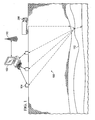
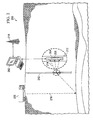
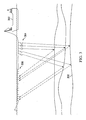
- a seismic survey can be collected using an array of receivers and an array of sources arranged along a surface of the earth, as shown one-dimensionally in FIG. 1 ; a downhole tool arranged in at least one existing wellbore, as shown in FIG. 2 ; or a receiver array and a plurality of source guns can be pulled behind a ship to collect seismic below the ocean floor, as shown one-dimensionally in FIG. 3 .
- FIG. 1 depicts a land based seismic surveying system 100.
- the land-based seismic surveying system has a computer/recorder 102, several receivers 104, source 106, and optionally a wireless connection to a remote network 110.
- the computer/recorder 102 which may be a single computer, a plurality of computers, computer server, etc., is connected to each of the receivers 104 via a plurality of channels (not shown).
- the computer is also connected to source 106 and a wireless antenna 110.
- the computer/recorder 102 is the "brains" of the data acquisition system and performs control functions of seismic collection from the receivers 104.
- the computer/recorder can be a computer that records seismic data and performs control functions of the data acquisition, can be a separate computer and digital or analog recorder, or can be a plurality of computers and recorders connected in any combination to aid in the control of the data acquisition as well as recording seismic data.
- the computer/recorder 102 may also perform data processing on the seismic data, including but not limited to noise suppression, signal enhancement and migration of seismic events to the appropriate location in space pre or post stacking, analysis of velocities and frequencies of reflections, static corrections, deconvolution, normal moveout, dip moveout, and stacking.
- the computer/recorder 102 may also perform the process of first arrival picking according to an embodiment of the invention, and may also control source 106.
- the computer/recorder 102 is connected to receivers 104, which may be geophones, seismometers, or any other device that is capable of detecting seismic energy in the form of ground motion or a pressure wave in fluid and transforms it to an electrical impulse.
- the receivers 104 which are, e.g., connected in series to a common channel of a to a multi-channel line(not shown), pick up reflections of energy from beds 112, or underground strata of sedimentary rock or sediment, the energy originating and being generated by the source 106.
- the receiver array can be arranged manually in the field or may be carried in an array behind a truck, or any combination thereof.
- the reflections of energy may be recorded for a plurality of geophones collecting data for a common source point 106.
- the source 106 propagates a signal into the earth from a specific location above the earth's surface, and may be a mechanical source (vibration signal) carried on a truck or a charge, such as dynamite. As shown in FIG. 1 , the energy signal generated by the source 106 is projected into the earth and is reflected from bed 112 to the receivers 106.
- antenna 110 represents a plurality of devices that may also wirelessly connect computer/recorder 102 to a central command station, and include both ground antennas, satellites and the like.
- FIGS. 2 and 3 depict alternative methods for seismic acquisitions.
- seismic data can be acquired downhole using a seismic tool 204, in a process called vertical seismic acquisition.
- the seismic tool 204 includes a source, or plurality of sources, 206 and a plurality of receivers 208 connected to a computer/recorder 202, which may be a plurality of computers, servers, or the like.
- the computer/recorder 202 collects seismic data and controls the downhole tool.
- energy 210 is generated from the source 206, depicted as a mechanical vibration source connected to a truck.
- the energy 210 from the source 206 is reflected off the bed as reflection signal 214, through the well bore 112, to the receivers 208.
- seismic data may also be collected in a marine environment using a ship 302, a plurality of sources 304, e.g., air guns, and a plurality of receivers 306.
- the plurality of sources 304 and the plurality of receivers 306 are pulled behind the boat at a depth of a few meters.
- the plurality of sources 304 fire energy signals into water at pre-determined time intervals, and this energy signal is ultimately reflected from a bed 308 to the receivers 306.
- an array of streamers are used.
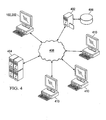
- the seismic data is either processed by the computer/recorder 102, the computer/recorder 202, or a computer on the ship 302 (not shown), or it is sent using, a connection to a local area network (LAN) or wide area network (WAN) 408, to various networked computers that may comprise one of more of file server 402, application server 404, databases 406 and distributed computers 410.
- LAN local area network
- WAN wide area network
- At least one file server 402 may be provided to store the raw, semi-processed or processed seismic data uploaded to the network 408 from computer/recorder 102/202.
- File server 402 may be network attached storage (NAS), storage area networks (SAN), or direct access storage (DAS), or any combination thereof, comprising, e.g., multiple hard disk drives.
- File server 402 may also allow various user workstations (not shown) to access and display the seismic data stored thereon for seismic data review, correlation functions and the like.
- the raw, semi processed and processed seismic data can also be stored in a database 406 on file server 402 with the seismic data and additional information such as a location of the survey, a location of the source, a date and time of seismic data collection, a processor's name, etc., being represented in separate tables, records, or fields in the database.
- the location of the survey the location of the source, the data and time of the seismic data collection, the processor's name, etc. can be stored in the database, with any one of the raw, semi-processed, or processed data being stored in separate portions of the file server memory.
- file server 402 provides each of the distributed computers 410, application server 404, and the computers 102/202 access to the database 406 through database management software.
- file server 402 may also be connected to a database server (not shown), or the database server may be used to store the seismic data instead of file server 402, and such a configuration is within the scope of this disclosure.
- the instant invention utilizing a database server would include database management software accessible thereon and might be connected to the network via the file server to handle multiple user requests for data within a database stored on the database server, and such a configuration of the network is within the scope of this disclosure.
- Distributed computers 410 and at least one application server 412 provide the computing power of the system, and one or both may be used to perform data processing on the seismic data, including but not limited to noise suppression, signal enhancement and migration of seismic events to the appropriate location in space pre or post stacking, analysis of velocities and frequencies of reflections, static corrections, deconvolution, normal moveout, dip moveout, and stacking.
- either the distributed computers 410 or the application server 404 performs the process of first arrival picking according to an embodiment of the invention.
- the application server may be one or more servers, including, for example, database servers, web servers and other machines, connected by a network, and is not limited to one computer or machine.
- each of the distributed computers 410 may be used by individual geophysicists at individual workstations to access the seismic data, and the application servers 404 may also store processing software that is loaded to and enables the computers 102/202 or distributed computers 410 to display various files stored therein or data related to the interrelation of each of the distributed computers 410 for any parallel processing of the seismic data by the distributed computers 410.
- FIG. 5 describes the structure of the application server 404 in detail.
- Each application server 404 comprises a memory 504, a program product 506, a processor 508 and an input/ output device ("I/O") 510.
- I/O device 510 connects the application server 404, via the network, to file server 402, and can be any I/O device including, but not limited to a network card/controller connected by a PCI bus to the motherboard, or hardware built into the motherboard to connect the application server 404 to the network 408.
- Processor 508 is the "brains" of the application server 404, and as such executes program product 506 and works in conjunction with the I/O device 510 to direct data to memory 504 and to send data from memory 504 to the network. In this way, processor 508 may also make available the program product 506 to the distributed computers 410.
- Processor 508 can be any commercially available processor, or plurality of processors, adapted for use in an application server, e.g., Intel® Xenon® multicore processors, Intel® micro-architecture Nehalem, AMD OpteronTM multicore processors, etc.
- processor 508 may also include components that allow the application server 404 to be connected to a display [not shown] and keyboard that would allow a user to directly access the processor 508 and memory 504.
- Memory 504 stores instructions for execution on the processor 508, and consists of both non-volatile memory , e.g., hard disks, flash memory, optical disks, and the like, and volatile memory, e.g., SRAM, DRAM, SDRAM, etc., as required to process embodiments of the instant invention.
- non-volatile memory e.g., hard disks, flash memory, optical disks, and the like
- volatile memory e.g., SRAM, DRAM, SDRAM, etc.
- memory 504 may also be a separate component or device, e.g., FLASH memory, connected to the application server.
- Memory 504 may also store applications that the distributed computers 410 can access and run on the application server 404.
- memory 504 stores the program product of the instant invention.
- the application server 404 having memory 504 thereon and storing instructions 506, executes the following steps: retrieving a plurality of seismic traces (step 602), centering a main time window around a plurality of potential first arrivals for the plurality of seismic traces (step 604); setting the start of the time window to zero (step 606); transforming the traces in the time window to a "peak spike traces" by e.g., setting all negative portions of the seismic trace to zero and all non-peak portions of the seismic trace to zero and creating a spike at the highest amplitude of the peak, i.e., the portion of the trace that is positive, but has a zero rate of change value (step 608); dividing the peak spike traces into a plurality of non-overlapping windows (step 610); comparing each value of the peak spikes in each of the non-overlapping windows to the value of other peak spikes in the same window to determine which peak spike in the window has the
- the machine, program product and computer-implemented methods of an embodiment of the instant invention manipulate waveform data to automatically pick the first arrival of a seismic trace.
- the first arrival may be determined as part of the overall processing of the seismic data.
- seismic data may be processed by removing the bad seismic traces, ordering the seismic traces so that each group of traces maps a common reflection point, and then picking the first arrival of the seismic traces to perform filtering techniques that will remove surface waves and direct arrivals from the traces.
- Other processing steps include lining up the reflection points based upon correction of the travel time of the seismic data, summing the lined up signals to amplify the reflected signal, shrinking the reflected signal using, e.g., deconvolution or frequency filtering, and then interpretation of the wave form.
- the processing techniques above can be performed using the same program product or different program products for one or more of the enumerated steps.
- the machine, program product and computer-implemented methods of the instant invention are directed to the technique of picking the first arrivals of the seismic waveforms
- the technique of picking first arrivals may comprise a discrete program product, a component or module of a program product or a set of instructions that is part of a larger set of computer instructions in the component or module.
- the steps employed by the machine, program product and computer-implemented methods of picking first arrivals are shown with reference to FIGS. 7-12 .
- seismic trace data is gathered using the methods described above and the applications server 404 retrieves the gathered data (Step 702).
- the seismic data retrieved may consist of a single seismic trace, or a plurality of traces grouped by a common reflection point.
- a single seismic trace is shown in FIG. 8 .
- the machine, program product and computer-implemented methods of the invention center a time window around the "first activity" of the trace or plurality of traces (step 704).
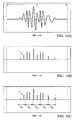
- the machine, program product and computer-implemented method centers a large time window A around the part of the trace that includes wave data that is greater than a noise threshold, as shown in FIGS. 9A and 10A .
- a time window may have a duration of, for example, 800 milliseconds.
- the waveform is transformed into a plurality of peak spike traces by, e.g., setting all negative and non-peak values to zero (step 706).
- the non-positive values are set to zero, and the positive portion of the waveform is used to determine the "peak spike".
- the peak spike trace of the waveform of FIGS. 9A and 10A is shown in FIGS. 9C and 10B , respectively.
- the peak spike is essentially a spike with an amplitude being each positive peak of the trace in the window.
- the main window having the peak spike trace, or plurality of peak spike traces is then divided into a plurality of windows, for example, W 1 W 2 , W 3 , W 4 , and W 5 (step 708). While there may be more sub-windows, some embodiments of the invention divide the large window A into 5 sub-windows having a duration of 160 milliseconds.
- Each of the peak spikes in each of the windows W 1 W 2 , W 3 , W 4 , and W 5 are then compared to determine which of the peak spikes in each window has the greatest amplitude, G, (step 710).
- the program product determines which of the windows has the highest rate of change in peak spike amplitude (step 712).
- the initial first arrival, F is set at the highest amplitude peak spike in the window having the greatest rate of change of peak spike amplitudes (step 714).
- the machine, program product and method compares the first arrival F for the traces to each of the other traces for (step 716).
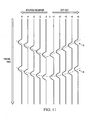
- a graph of comparison waveforms for first arrivals is shown with reference to FIG. 11 .
- ideal first arrivals form a v-shaped pattern indicative of a travel time delay between the reflection point and shot point. And, with large data volumes, this pattern becomes more pronounced.
- irregular first arrival picks G are apparent as those falling outside this v-shaped pattern, within certain predetermined tolerances.
- irregular first arrival picks may not be as graphically noticeable as G in FIG. 12 , and may determined mathematically by the program product, i.e., through signal processing techniques.
- irregular picks are determined using the average time the adjacent initial picks are recorded, and extrapolating therefrom a time a trace should record its first arrival. If a first arrival is picked that does not occur at the predictive time, then it is judged a "bad pick”. If it is determined that the initial pick is a "bad pick", the computer program product uses a trace that occurs around the predictive time as the first arrival.
- a pick is a good pick is whether the first arrival pick, tracked from both sides, or falls into a predictive pattern based upon the time differences between first arrival picks (see FIG. 10 ).
- a time difference between first arrivals may be, for example, 32 milliseconds.
- 5-9 traces in front and behind a first arrival may chosen to determine whether or not the pick is a good first arrival pick using this method.
- each of the first arrivals are in a mathematical relationship with each of the other first arrivals, i.e., the relationship is defined by receiver and shot point locations with respect to the reflection.
- G depicted in FIG. 12 , lies outside the bounds it would be expected to lie given the source/receiver offset location.
- the determination that G is not a "good pick” can be made using the large data volumes to determine a predictive range for first arrivals for a particular offset location. If a first arrival falls inside this predictive range, it is a desired, e.g., good, pick; but if a pick falls outside of this range it is not a desired, e.g., not a good, pick.
- first arrivals are chosen, additional processing, i.e., filtering, lining up the waveforms, stacking, deconvolution and the like can begin.
- additional processing i.e., filtering, lining up the waveforms, stacking, deconvolution and the like can begin.
- the comparison of first arrivals may occur before or after any portion of the waveform is muted or filtered, the initial muting being subject to revision based upon the comparison of the first arrivals, and both possible embodiments are within the scope of this disclosure.
- 2D surveys commonly contain numerous widely spaced shot lines acquired orthogonally to the strike of geological structures and a minimum of lines acquired parallel to geological structures to allow line-to-line correlation of the seismic data and interpretation and mapping of structures, which is less computationally intense that the 3D seismic method described herein, it is further contemplated that the enclosed methods can be used for all seismic data, including 2D seismic data.
Landscapes
- Engineering & Computer Science (AREA)
- Life Sciences & Earth Sciences (AREA)
- Environmental & Geological Engineering (AREA)
- Remote Sensing (AREA)
- Physics & Mathematics (AREA)
- Emergency Management (AREA)
- Business, Economics & Management (AREA)
- Acoustics & Sound (AREA)
- Geology (AREA)
- General Life Sciences & Earth Sciences (AREA)
- General Physics & Mathematics (AREA)
- Geophysics (AREA)
- Geophysics And Detection Of Objects (AREA)
Claims (14)
- Maschine, die einen Anwendungsserver (404) definiert, wobei der Anwendungsserver (404) dafür eingerichtet ist, seismische Daten zu verarbeiten, um eine Vielzahl von Erstankünften für eine Vielzahl von seismischen Spuren zu ermitteln, wobei der Anwendungsserver (404) ferner dafür eingerichtet ist, ein Programm (506) auszuführen, das in einem nichtflüchtigen Speicher (504) des Anwendungsservers (404) gespeichert ist, wobei das Programm (506) einen Prozess des Auswählens einer Anfangserstankunft für mindestens eine Spur aus der Vielzahl von seismischen Spuren und einen Prozess des Verfeinerns der Anfangserstankunftsauswahl auf der Grundlage eines Vergleichs der Anfangserstankunftsauswahl mit Erstankunftsauswahlen für benachbarte Spuren durchführt, wobei das Programm (506) eine Menge von Anweisungen zum Durchführen der folgenden Schritte umfasst:Zentrieren eines Hauptzeitfensters um eine Vielzahl von möglichen Erstankünften für die Vielzahl von seismischen Spuren,Nullsetzen eines Anfangs des Zeitfensters,Transformieren eines Abschnitts der Vielzahl von Spuren im Hauptzeitfenster in eine Vielzahl von Spitzenwert-Nadelimpulsspuren mit einer Vielzahl von Spitzenwert-Nadelimpulsen, wobei das Transformieren mindestens einschließt: Nullsetzen aller negativen Abschnitte der seismischen Spuren und Nullsetzen aller Nicht-Spitzenwertabschnitte der seismischen Spuren,Teilen des Hauptfensters in eine Vielzahl von nicht überlappenden Fenstern,Vergleichen jedes aus der Vielzahl von Spitzenwert-Nadelimpulsen in jedem der nicht überlappenden Fenster, um zu bestimmen, welcher Spitzenwert-Nadelimpuls in dem nicht überlappenden Fenster die größte Amplitude hat,Bestimmen einer Änderungsgeschwindigkeit der Vielzahl von Spitzenwert-Nadelimpulsen in jedem der nicht überlappenden Fenster,Setzen einer Erstankunft für jede aus der Vielzahl von Spuren als denjenigen Spitzenwert-Nadelimpuls im nicht überlappenden Fenster, der die höchste Amplituden-Änderungsgeschwindigkeit und die höchste Amplitude der Vielzahl von Spitzenwert-Nadelimpulsen hat,Vergleichen der Erstankunft für jede aus der Vielzahl von Spuren mit Erstankünften für benachbarte Spuren, um zu bestimmen, ob die Erstankunft eine erwünschte Auswahl ist, undNeuberechnen aller derjenigen Erstankünfte, die keine erwünschten Auswahlen sind.
- Maschine nach Anspruch 1, ferner dadurch gekennzeichnet, dass sie hat:eine Datenbank (406), die im nichtflüchtigen Speicher (504) des Anwendungsservers (404) gespeichert ist, um jede der seismischen Spuren in vorbestimmten Feldern zu speichern, wobei die Felder aus einer Gruppe ausgewählt werden, die Datum, Zeit, Prozessor, Schusspunktstandort und Empfängerstandort einschließt.
- Maschine nach einem der Ansprüche 1-2, ferner dadurch gekennzeichnet, dass das Programm (506) ferner den folgenden Schritt durchführt:Verwenden der Erstankunft, um die Vielzahl von Spuren zu filtern, so dass jegliches Signalrauschen in der Vielzahl von Spuren unterdrückt wird.
- Maschine nach einem der Ansprüche 1-3, ferner dadurch gekennzeichnet, dass das Programm (506) die Erstankünfte für jede aus der Vielzahl von Spuren, die von einem gemeinsamen Reflexionspunkt erzeugt wurden, vergleicht, um zu bestimmen, ob die Erstankunft die erwünschte Auswahl ist.
- Maschine nach Anspruch 4, ferner dadurch gekennzeichnet, dass die Erstankünfte für jede aus der Vielzahl von Spuren für den gemeinsamen Reflexionspunkt in mathematischer Beziehung zueinander stehen und die mathematische Beziehung verwendet wird, um zu bestimmen, welche der Erstankünfte erwünschte Auswahlen sind.
- Maschine nach einem der Ansprüche 1-5, ferner dadurch gekennzeichnet, dass das Programm (506) ferner den folgenden Schritt durchführt:Überlagern aller aus der Vielzahl von Spuren für einen einzelnen Reflexionspunkt, um eine einzelne Spur zu erzeugen.
- Computerimplementiertes Verfahren zum Bewirken, dass ein Computer, der einen Anwendungsserver (404) definiert, einen Prozess des Auswählens einer Anfangserstankunft für mindestens eine Spur aus der Vielzahl von seismischen Spuren und einen Prozess des Verfeinerns der Anfangserstankunftsauswahl auf der Grundlage eines Vergleichs der Anfangserstankunftsauswahl mit Erstankunftsauswahlen für benachbarte Spuren durchführt, wobei das computerimplementierte Verfahren dadurch gekennzeichnet ist, dass es die folgenden Schritte einschließt:Zentrieren eines Hauptzeitfensters um eine Vielzahl von möglichen Erstankünften für die Vielzahl von seismischen Spuren,Nullsetzen eines Anfangs des Zeitfensters,Transformieren eines Abschnitts der Vielzahl von Spuren im Hauptzeitfenster in eine Vielzahl von Spitzenwert-Nadelimpulsspuren mit einer Vielzahl von Spitzenwert-Nadelimpulsen, wobei das Transformieren mindestens einschließt: Nullsetzen aller negativen Abschnitte der seismischen Spuren und Nullsetzen aller Nicht-Spitzenwertabschnitte der seismischen Spuren,Teilen des Hauptfensters in eine Vielzahl von nicht überlappenden Fenstern,Vergleichen jedes aus der Vielzahl von Spitzenwert-Nadelimpulsen in jedem der nicht überlappenden Fenster, um zu bestimmen, welcher Spitzenwert-Nadelimpuls in dem nicht überlappenden Fenster die größte Amplitude hat,Bestimmen einer Änderungsgeschwindigkeit der Vielzahl von Spitzenwert-Nadelimpulsen in jedem der nicht überlappenden Fenster,Setzen einer Erstankunft für jede aus der Vielzahl von Spuren als denjenigen Spitzenwert-Nadelimpuls im nicht überlappenden Fenster, der die höchste Amplituden-Änderungsgeschwindigkeit und die höchste Amplitude der Vielzahl von Spitzenwert-Nadelimpulsen hat,Vergleichen der Erstankunft für jede aus der Vielzahl von Spuren mit Erstankünften für benachbarte Spuren, um zu bestimmen, ob die Erstankunft eine erwünschte Auswahl ist.
- Computerimplementiertes Verfahren nach Anspruch 7, ferner dadurch gekennzeichnet, dass es den folgenden Schritt einschließt:Speichern jeder der seismischen Spuren in einer Datenbank (406), die vorbestimmte Felder hat, wobei die Felder aus einer Gruppe ausgewählt werden, die Datum, Zeit, Prozessor, Schusspunktstandort und Empfängerstandort einschließt.
- Computerimplementiertes Verfahren nach einem der Ansprüche 7-8, ferner dadurch gekennzeichnet, dass es den folgenden Schritt einschließt:Verwenden der Erstankunft, um die Vielzahl von Spuren zu filtern, so dass jegliches Signalrauschen in der Vielzahl von Spuren unterdrückt wird.
- Computerimplementiertes Verfahren nach einem der Ansprüche 7-9, ferner dadurch gekennzeichnet, dass die Erstankünfte für jede aus der Vielzahl von Spuren, die von einem gemeinsamen Reflexionspunkt getrennt wurden, verglichen werden, um zu bestimmen, ob die Erstankunft die erwünschte Auswahl ist.
- Computerimplementiertes Verfahren nach Anspruch 10, ferner dadurch gekennzeichnet, dass die Erstankünfte für jede aus der Vielzahl von Spuren für den gemeinsamen Reflexionspunkt in mathematischer Beziehung zueinander stehen und die mathematische Beziehung verwendet wird, um zu bestimmen, welche der Erstankünfte erwünschte Auswahlen sind.
- Computerimplementiertes Verfahren nach einem der Ansprüche 7-11, ferner dadurch gekennzeichnet, dass es den folgenden Schritt einschließt:Überlagern aller aus der Vielzahl von Spuren für einen gemeinsamen Reflexionspunkt, um eine einzelne Spur zu erzeugen.
- Computerimplementiertes Verfahren nach einem der Ansprüche 7-12, ferner dadurch gekennzeichnet, dass es den folgenden Schritt einschließt:Neuberechnen aller derjenigen Erstankünfte, die keine erwünschten Auswahlen sind.
- Computerprogramm (506), umfassend eine Menge von Anweisungen, die in einem nichtflüchtigen Speicher (504) eines Computers, der einen Anwendungsserver (404) definiert, gespeichert ist, zum Durchführen eines Prozesses des Auswählens einer Anfangserstankunft aus mindestens einer Spur aus der Vielzahl von seismischen Spuren und eines Prozesses des Verfeinerns der Anfangserstankunftsauswahl auf der Grundlage eines Vergleichs der Anfangserstankunftsauswahl mit Erstankunftsauswahlen für benachbarte Spuren, wobei die Menge von Anweisungen, wenn sie durch den Anwendungsserver (404) ausgeführt wird, bewirkt, dass der Anwendungsserver (404) die Schritte nach einem der Ansprüche 7-13 durchführt.
Applications Claiming Priority (2)
| Application Number | Priority Date | Filing Date | Title |
|---|---|---|---|
| US25488009P | 2009-10-26 | 2009-10-26 | |
| PCT/US2010/054059 WO2011056551A1 (en) | 2009-10-26 | 2010-10-26 | Machine, program product and method to determine a first arrival of a seismic trace |
Publications (2)
| Publication Number | Publication Date |
|---|---|
| EP2494378A1 EP2494378A1 (de) | 2012-09-05 |
| EP2494378B1 true EP2494378B1 (de) | 2014-04-16 |
Family
ID=43478127
Family Applications (1)
| Application Number | Title | Priority Date | Filing Date |
|---|---|---|---|
| EP10774378.3A Not-in-force EP2494378B1 (de) | 2009-10-26 | 2010-10-26 | Maschine, programmprodukt und verfahren zur bestimmung des ersten auftretens einer seismischen spur |
Country Status (4)
| Country | Link |
|---|---|
| US (1) | US20110096626A1 (de) |
| EP (1) | EP2494378B1 (de) |
| CN (1) | CN102713680B (de) |
| WO (1) | WO2011056551A1 (de) |
Cited By (1)
| Publication number | Priority date | Publication date | Assignee | Title |
|---|---|---|---|---|
| KR101738445B1 (ko) | 2016-11-16 | 2017-05-22 | 한국지질자원연구원 | 다중채널 탄성파 탐사자료에 대한 음원-수진기 배열을 고려하는 초동 선정 방법 |
Families Citing this family (19)
| Publication number | Priority date | Publication date | Assignee | Title |
|---|---|---|---|---|
| US20120215453A1 (en) * | 2011-02-22 | 2012-08-23 | Cggveritas Services Sa | Device and method for multi-dimensional coherency driven denoising data |
| US9103935B2 (en) | 2013-02-04 | 2015-08-11 | King Fahd University Of Petroleum And Minerals | Method of first arrival picking of seismic refraction data |
| US20140334260A1 (en) * | 2013-05-09 | 2014-11-13 | Schlumberger Technology Corporation | Neural Network Signal Processing of Microseismic Events |
| US10371839B2 (en) | 2013-06-05 | 2019-08-06 | Saudi Arabian Oil Company | Blended land seismic data acquisition employing dispersed source arrays with variable sweep length |
| US10067255B2 (en) | 2015-09-04 | 2018-09-04 | Saudi Arabian Oil Company | Automatic quality control of seismic travel time |
| US10386519B2 (en) | 2015-12-18 | 2019-08-20 | Saudi Arabian Oil Company | Automated near surface analysis by surface-consistent refraction methods |
| CN110308484A (zh) * | 2019-06-11 | 2019-10-08 | 中国石油大学(北京) | 一种基于深度学习智能筛选初至的层析反演方法及系统 |
| CN112241426A (zh) * | 2019-07-16 | 2021-01-19 | 中国石油天然气集团有限公司 | 基于动态道头的地震数据转换方法及装置 |
| CN112305593B (zh) * | 2019-07-23 | 2023-07-25 | 中国石油天然气集团有限公司 | 异常初至波识别方法及装置 |
| US11391856B2 (en) | 2020-07-08 | 2022-07-19 | Saudi Arabian Oil Company | Stochastic dynamic time warping for automated stratigraphic correlation |
| US11221425B1 (en) | 2020-07-08 | 2022-01-11 | Saudi Arabian Oil Company | Generating a model for seismic velocities in a subsurface region using inversion with lateral variations |
| US11415717B2 (en) | 2020-08-18 | 2022-08-16 | Saudi Arabian Oil Company | Edge-preserving gaussian grid smoothing of noise components in subsurface grids to generate geological maps |
| CN114355436B (zh) * | 2020-10-13 | 2025-09-26 | 中国石油天然气股份有限公司 | 地震波初至拾取方法及装置 |
| US11467302B1 (en) | 2021-05-26 | 2022-10-11 | Saudi Arabian Oil Company | Seismic first breaks onset times determination by interface tracking using level-sets method |
| CN114002733B (zh) * | 2021-10-27 | 2024-01-23 | 武汉科技大学 | 微震波信号初至到时自动拾取方法及微震监测装置 |
| CN114217349A (zh) * | 2021-12-13 | 2022-03-22 | 西安石油大学 | 一种用于高角度裂缝及低角度斜交缝预测的系统及方法 |
| US12092780B2 (en) * | 2022-02-08 | 2024-09-17 | King Fahd University Of Petroleum And Minerals | Event detection and de-noising method for passive seismic data |
| US12416738B2 (en) * | 2022-10-03 | 2025-09-16 | Saudi Arabian Oil Company | Method for iterative first arrival picking using global path tracing |
| CN119293830B (zh) * | 2024-12-12 | 2025-02-25 | 四川水利职业技术学院 | 一种基于人工智能的数据安全管理方法 |
Family Cites Families (11)
| Publication number | Priority date | Publication date | Assignee | Title |
|---|---|---|---|---|
| US4393488A (en) * | 1978-10-08 | 1983-07-12 | Chevron Research Company | Exploration system and method of determining elastic parameters and subsurface shape of an earth formation so as to indicate likelihood of the formation being an ore, marker rock, economic mineral or the like |
| US5193077A (en) * | 1989-05-15 | 1993-03-09 | Atlantic Richfield Company | Method and apparatus for improved seismic prospecting |
| US6016287A (en) * | 1998-05-07 | 2000-01-18 | Geoquest, A Division Of Schlumberger Technology Corporation | Apparatus and method for accurately determining the location of events such as peaks in seismic data |
| US5963507A (en) * | 1998-05-13 | 1999-10-05 | Western Atlas International, Inc. | Method for improving the accuracy of ocean bottom reflectivity estimations using the inverse backus filter |
| CN1325030A (zh) * | 2000-05-18 | 2001-12-05 | 中国石油化工股份有限公司中原油田分公司 | 爆炸机精确井口时间获取方法与装置 |
| US6965830B1 (en) * | 2000-09-13 | 2005-11-15 | Apache Corporation | System for estimating thickness of thin subsurface strata |
| GB2384068B (en) * | 2002-01-11 | 2005-04-13 | Westerngeco Ltd | A method of and apparatus for processing seismic data |
| US6751559B2 (en) * | 2002-09-10 | 2004-06-15 | Pgs Exploration (Uk) Limited | Method for suppressing noise from seismic signals by source position determination |
| GB2393513A (en) * | 2002-09-25 | 2004-03-31 | Westerngeco Seismic Holdings | Marine seismic surveying using a source not having a ghost at a non-zero frequency |
| US7423930B2 (en) * | 2003-12-10 | 2008-09-09 | Schlumberger Technology Corporation | Methods and systems for detecting arrivals of interest |
| US7663970B2 (en) * | 2006-09-15 | 2010-02-16 | Microseismic, Inc. | Method for passive seismic emission tomography |
-
2010
- 2010-10-26 CN CN201080059372.1A patent/CN102713680B/zh not_active Expired - Fee Related
- 2010-10-26 EP EP10774378.3A patent/EP2494378B1/de not_active Not-in-force
- 2010-10-26 WO PCT/US2010/054059 patent/WO2011056551A1/en not_active Ceased
- 2010-10-26 US US12/912,034 patent/US20110096626A1/en not_active Abandoned
Cited By (2)
| Publication number | Priority date | Publication date | Assignee | Title |
|---|---|---|---|---|
| KR101738445B1 (ko) | 2016-11-16 | 2017-05-22 | 한국지질자원연구원 | 다중채널 탄성파 탐사자료에 대한 음원-수진기 배열을 고려하는 초동 선정 방법 |
| US10895653B2 (en) | 2016-11-16 | 2021-01-19 | Korea Institute Of Geoscience And Mineral Resources | Method of first arrival picking of multi-channel seismic survey data considering sound source-receiver array |
Also Published As
| Publication number | Publication date |
|---|---|
| CN102713680B (zh) | 2015-06-24 |
| EP2494378A1 (de) | 2012-09-05 |
| WO2011056551A1 (en) | 2011-05-12 |
| CN102713680A (zh) | 2012-10-03 |
| US20110096626A1 (en) | 2011-04-28 |
Similar Documents
| Publication | Publication Date | Title |
|---|---|---|
| US20110096626A1 (en) | Machine, Program Product and Method to Determine a First Arrival of a Seismic Trace | |
| EP2356492B1 (de) | Verfahren zum trennen von unabhängigen gleichzeitigen quellen | |
| EP2601542B1 (de) | Verfahren zur trennung von unabhängigen simultanen quellen | |
| EP2737341B1 (de) | Feldkorrelation für eine passive seismische echtzeitüberwachung | |
| US6317695B1 (en) | Seismic data processing method | |
| EP2592439B1 (de) | Verfahren und System zum Trennen seismischer Quellen bei simultaner Shooting-Erfassung im Meer | |
| US8339896B2 (en) | Method for separating seismic sources in marine seismic surveys | |
| EP2601543B1 (de) | Verfahren und vorrichtung für marine wide-azimut-schleppstream-bebenerfassung | |
| EP2707755B1 (de) | Filterung von seismischen daten aus simultanen quellen mit variierender frequenz | |
| CA3115062C (en) | Separation of multiple seismic sources of different types by inversion | |
| US20130028049A1 (en) | Method for handling rough sea and irregular recording conditions in multi-sensor towed streamer data | |
| US8908471B2 (en) | Method for building velocity models for imaging in multi-azimuth marine seismic surveys | |
| EP2780740B1 (de) | Rauschentfernung aus einer seismischen 3d-darstellung | |
| US20100265797A1 (en) | Interferometric seismic data processing | |
| CA3006959C (en) | System and method for correction of receiver clock drift | |
| US20230129626A1 (en) | Separation of Seismic Sources by Joint Interpolation and Deblending | |
| EP2249183B1 (de) | Modellierung und Filtrierung von kohärentem Rauschen bei der Erdbebenüberwachung | |
| US20080232195A1 (en) | Apparatus and Method for Processing Geophysical Information | |
| CA2806241C (en) | Method for separating independent simultaneous sources |
Legal Events
| Date | Code | Title | Description |
|---|---|---|---|
| PUAI | Public reference made under article 153(3) epc to a published international application that has entered the european phase |
Free format text: ORIGINAL CODE: 0009012 |
|
| 17P | Request for examination filed |
Effective date: 20120426 |
|
| AK | Designated contracting states |
Kind code of ref document: A1 Designated state(s): AL AT BE BG CH CY CZ DE DK EE ES FI FR GB GR HR HU IE IS IT LI LT LU LV MC MK MT NL NO PL PT RO RS SE SI SK SM TR |
|
| DAX | Request for extension of the european patent (deleted) | ||
| 17Q | First examination report despatched |
Effective date: 20130402 |
|
| 17Q | First examination report despatched |
Effective date: 20130503 |
|
| GRAP | Despatch of communication of intention to grant a patent |
Free format text: ORIGINAL CODE: EPIDOSNIGR1 |
|
| INTG | Intention to grant announced |
Effective date: 20131029 |
|
| GRAS | Grant fee paid |
Free format text: ORIGINAL CODE: EPIDOSNIGR3 |
|
| GRAA | (expected) grant |
Free format text: ORIGINAL CODE: 0009210 |
|
| AK | Designated contracting states |
Kind code of ref document: B1 Designated state(s): AL AT BE BG CH CY CZ DE DK EE ES FI FR GB GR HR HU IE IS IT LI LT LU LV MC MK MT NL NO PL PT RO RS SE SI SK SM TR |
|
| REG | Reference to a national code |
Ref country code: GB Ref legal event code: FG4D |
|
| REG | Reference to a national code |
Ref country code: CH Ref legal event code: EP |
|
| REG | Reference to a national code |
Ref country code: AT Ref legal event code: REF Ref document number: 662885 Country of ref document: AT Kind code of ref document: T Effective date: 20140515 |
|
| REG | Reference to a national code |
Ref country code: IE Ref legal event code: FG4D |
|
| REG | Reference to a national code |
Ref country code: DE Ref legal event code: R096 Ref document number: 602010015224 Country of ref document: DE Effective date: 20140605 |
|
| REG | Reference to a national code |
Ref country code: NO Ref legal event code: T2 Effective date: 20140416 Ref country code: AT Ref legal event code: MK05 Ref document number: 662885 Country of ref document: AT Kind code of ref document: T Effective date: 20140416 |
|
| REG | Reference to a national code |
Ref country code: NL Ref legal event code: VDEP Effective date: 20140416 |
|
| REG | Reference to a national code |
Ref country code: LT Ref legal event code: MG4D |
|
| PG25 | Lapsed in a contracting state [announced via postgrant information from national office to epo] |
Ref country code: CY Free format text: LAPSE BECAUSE OF FAILURE TO SUBMIT A TRANSLATION OF THE DESCRIPTION OR TO PAY THE FEE WITHIN THE PRESCRIBED TIME-LIMIT Effective date: 20140416 Ref country code: GR Free format text: LAPSE BECAUSE OF FAILURE TO SUBMIT A TRANSLATION OF THE DESCRIPTION OR TO PAY THE FEE WITHIN THE PRESCRIBED TIME-LIMIT Effective date: 20140717 Ref country code: BG Free format text: LAPSE BECAUSE OF FAILURE TO SUBMIT A TRANSLATION OF THE DESCRIPTION OR TO PAY THE FEE WITHIN THE PRESCRIBED TIME-LIMIT Effective date: 20140716 Ref country code: FI Free format text: LAPSE BECAUSE OF FAILURE TO SUBMIT A TRANSLATION OF THE DESCRIPTION OR TO PAY THE FEE WITHIN THE PRESCRIBED TIME-LIMIT Effective date: 20140416 Ref country code: LT Free format text: LAPSE BECAUSE OF FAILURE TO SUBMIT A TRANSLATION OF THE DESCRIPTION OR TO PAY THE FEE WITHIN THE PRESCRIBED TIME-LIMIT Effective date: 20140416 Ref country code: IS Free format text: LAPSE BECAUSE OF FAILURE TO SUBMIT A TRANSLATION OF THE DESCRIPTION OR TO PAY THE FEE WITHIN THE PRESCRIBED TIME-LIMIT Effective date: 20140816 Ref country code: NL Free format text: LAPSE BECAUSE OF FAILURE TO SUBMIT A TRANSLATION OF THE DESCRIPTION OR TO PAY THE FEE WITHIN THE PRESCRIBED TIME-LIMIT Effective date: 20140416 |
|
| PG25 | Lapsed in a contracting state [announced via postgrant information from national office to epo] |
Ref country code: SE Free format text: LAPSE BECAUSE OF FAILURE TO SUBMIT A TRANSLATION OF THE DESCRIPTION OR TO PAY THE FEE WITHIN THE PRESCRIBED TIME-LIMIT Effective date: 20140416 Ref country code: PL Free format text: LAPSE BECAUSE OF FAILURE TO SUBMIT A TRANSLATION OF THE DESCRIPTION OR TO PAY THE FEE WITHIN THE PRESCRIBED TIME-LIMIT Effective date: 20140416 Ref country code: RS Free format text: LAPSE BECAUSE OF FAILURE TO SUBMIT A TRANSLATION OF THE DESCRIPTION OR TO PAY THE FEE WITHIN THE PRESCRIBED TIME-LIMIT Effective date: 20140416 Ref country code: ES Free format text: LAPSE BECAUSE OF FAILURE TO SUBMIT A TRANSLATION OF THE DESCRIPTION OR TO PAY THE FEE WITHIN THE PRESCRIBED TIME-LIMIT Effective date: 20140416 Ref country code: HR Free format text: LAPSE BECAUSE OF FAILURE TO SUBMIT A TRANSLATION OF THE DESCRIPTION OR TO PAY THE FEE WITHIN THE PRESCRIBED TIME-LIMIT Effective date: 20140416 Ref country code: LV Free format text: LAPSE BECAUSE OF FAILURE TO SUBMIT A TRANSLATION OF THE DESCRIPTION OR TO PAY THE FEE WITHIN THE PRESCRIBED TIME-LIMIT Effective date: 20140416 Ref country code: AT Free format text: LAPSE BECAUSE OF FAILURE TO SUBMIT A TRANSLATION OF THE DESCRIPTION OR TO PAY THE FEE WITHIN THE PRESCRIBED TIME-LIMIT Effective date: 20140416 |
|
| PG25 | Lapsed in a contracting state [announced via postgrant information from national office to epo] |
Ref country code: PT Free format text: LAPSE BECAUSE OF FAILURE TO SUBMIT A TRANSLATION OF THE DESCRIPTION OR TO PAY THE FEE WITHIN THE PRESCRIBED TIME-LIMIT Effective date: 20140818 |
|
| REG | Reference to a national code |
Ref country code: DE Ref legal event code: R097 Ref document number: 602010015224 Country of ref document: DE |
|
| PG25 | Lapsed in a contracting state [announced via postgrant information from national office to epo] |
Ref country code: SK Free format text: LAPSE BECAUSE OF FAILURE TO SUBMIT A TRANSLATION OF THE DESCRIPTION OR TO PAY THE FEE WITHIN THE PRESCRIBED TIME-LIMIT Effective date: 20140416 Ref country code: DK Free format text: LAPSE BECAUSE OF FAILURE TO SUBMIT A TRANSLATION OF THE DESCRIPTION OR TO PAY THE FEE WITHIN THE PRESCRIBED TIME-LIMIT Effective date: 20140416 Ref country code: EE Free format text: LAPSE BECAUSE OF FAILURE TO SUBMIT A TRANSLATION OF THE DESCRIPTION OR TO PAY THE FEE WITHIN THE PRESCRIBED TIME-LIMIT Effective date: 20140416 Ref country code: BE Free format text: LAPSE BECAUSE OF FAILURE TO SUBMIT A TRANSLATION OF THE DESCRIPTION OR TO PAY THE FEE WITHIN THE PRESCRIBED TIME-LIMIT Effective date: 20140416 Ref country code: CZ Free format text: LAPSE BECAUSE OF FAILURE TO SUBMIT A TRANSLATION OF THE DESCRIPTION OR TO PAY THE FEE WITHIN THE PRESCRIBED TIME-LIMIT Effective date: 20140416 Ref country code: RO Free format text: LAPSE BECAUSE OF FAILURE TO SUBMIT A TRANSLATION OF THE DESCRIPTION OR TO PAY THE FEE WITHIN THE PRESCRIBED TIME-LIMIT Effective date: 20140416 |
|
| PLBE | No opposition filed within time limit |
Free format text: ORIGINAL CODE: 0009261 |
|
| STAA | Information on the status of an ep patent application or granted ep patent |
Free format text: STATUS: NO OPPOSITION FILED WITHIN TIME LIMIT |
|
| 26N | No opposition filed |
Effective date: 20150119 |
|
| PG25 | Lapsed in a contracting state [announced via postgrant information from national office to epo] |
Ref country code: IT Free format text: LAPSE BECAUSE OF FAILURE TO SUBMIT A TRANSLATION OF THE DESCRIPTION OR TO PAY THE FEE WITHIN THE PRESCRIBED TIME-LIMIT Effective date: 20140416 |
|
| REG | Reference to a national code |
Ref country code: DE Ref legal event code: R097 Ref document number: 602010015224 Country of ref document: DE Effective date: 20150119 |
|
| PG25 | Lapsed in a contracting state [announced via postgrant information from national office to epo] |
Ref country code: LU Free format text: LAPSE BECAUSE OF FAILURE TO SUBMIT A TRANSLATION OF THE DESCRIPTION OR TO PAY THE FEE WITHIN THE PRESCRIBED TIME-LIMIT Effective date: 20141026 Ref country code: MC Free format text: LAPSE BECAUSE OF FAILURE TO SUBMIT A TRANSLATION OF THE DESCRIPTION OR TO PAY THE FEE WITHIN THE PRESCRIBED TIME-LIMIT Effective date: 20140416 |
|
| REG | Reference to a national code |
Ref country code: CH Ref legal event code: PL |
|
| REG | Reference to a national code |
Ref country code: IE Ref legal event code: MM4A |
|
| PG25 | Lapsed in a contracting state [announced via postgrant information from national office to epo] |
Ref country code: CH Free format text: LAPSE BECAUSE OF NON-PAYMENT OF DUE FEES Effective date: 20141031 Ref country code: LI Free format text: LAPSE BECAUSE OF NON-PAYMENT OF DUE FEES Effective date: 20141031 Ref country code: SI Free format text: LAPSE BECAUSE OF FAILURE TO SUBMIT A TRANSLATION OF THE DESCRIPTION OR TO PAY THE FEE WITHIN THE PRESCRIBED TIME-LIMIT Effective date: 20140416 |
|
| REG | Reference to a national code |
Ref country code: FR Ref legal event code: ST Effective date: 20150630 |
|
| PG25 | Lapsed in a contracting state [announced via postgrant information from national office to epo] |
Ref country code: FR Free format text: LAPSE BECAUSE OF NON-PAYMENT OF DUE FEES Effective date: 20141031 |
|
| PG25 | Lapsed in a contracting state [announced via postgrant information from national office to epo] |
Ref country code: IE Free format text: LAPSE BECAUSE OF NON-PAYMENT OF DUE FEES Effective date: 20141026 |
|
| PG25 | Lapsed in a contracting state [announced via postgrant information from national office to epo] |
Ref country code: SM Free format text: LAPSE BECAUSE OF FAILURE TO SUBMIT A TRANSLATION OF THE DESCRIPTION OR TO PAY THE FEE WITHIN THE PRESCRIBED TIME-LIMIT Effective date: 20140416 |
|
| PG25 | Lapsed in a contracting state [announced via postgrant information from national office to epo] |
Ref country code: HU Free format text: LAPSE BECAUSE OF FAILURE TO SUBMIT A TRANSLATION OF THE DESCRIPTION OR TO PAY THE FEE WITHIN THE PRESCRIBED TIME-LIMIT; INVALID AB INITIO Effective date: 20101026 Ref country code: TR Free format text: LAPSE BECAUSE OF FAILURE TO SUBMIT A TRANSLATION OF THE DESCRIPTION OR TO PAY THE FEE WITHIN THE PRESCRIBED TIME-LIMIT Effective date: 20140416 Ref country code: MT Free format text: LAPSE BECAUSE OF FAILURE TO SUBMIT A TRANSLATION OF THE DESCRIPTION OR TO PAY THE FEE WITHIN THE PRESCRIBED TIME-LIMIT Effective date: 20140416 |
|
| PG25 | Lapsed in a contracting state [announced via postgrant information from national office to epo] |
Ref country code: MK Free format text: LAPSE BECAUSE OF FAILURE TO SUBMIT A TRANSLATION OF THE DESCRIPTION OR TO PAY THE FEE WITHIN THE PRESCRIBED TIME-LIMIT Effective date: 20140416 |
|
| PG25 | Lapsed in a contracting state [announced via postgrant information from national office to epo] |
Ref country code: AL Free format text: LAPSE BECAUSE OF FAILURE TO SUBMIT A TRANSLATION OF THE DESCRIPTION OR TO PAY THE FEE WITHIN THE PRESCRIBED TIME-LIMIT Effective date: 20140416 |
|
| PGFP | Annual fee paid to national office [announced via postgrant information from national office to epo] |
Ref country code: NO Payment date: 20201012 Year of fee payment: 11 |
|
| PGFP | Annual fee paid to national office [announced via postgrant information from national office to epo] |
Ref country code: GB Payment date: 20210914 Year of fee payment: 12 |
|
| PGFP | Annual fee paid to national office [announced via postgrant information from national office to epo] |
Ref country code: DE Payment date: 20210914 Year of fee payment: 12 |
|
| REG | Reference to a national code |
Ref country code: NO Ref legal event code: MMEP |
|
| PG25 | Lapsed in a contracting state [announced via postgrant information from national office to epo] |
Ref country code: NO Free format text: LAPSE BECAUSE OF NON-PAYMENT OF DUE FEES Effective date: 20211031 |
|
| REG | Reference to a national code |
Ref country code: DE Ref legal event code: R119 Ref document number: 602010015224 Country of ref document: DE |
|
| GBPC | Gb: european patent ceased through non-payment of renewal fee |
Effective date: 20221026 |
|
| P01 | Opt-out of the competence of the unified patent court (upc) registered |
Effective date: 20230526 |
|
| PG25 | Lapsed in a contracting state [announced via postgrant information from national office to epo] |
Ref country code: DE Free format text: LAPSE BECAUSE OF NON-PAYMENT OF DUE FEES Effective date: 20230503 |
|
| PG25 | Lapsed in a contracting state [announced via postgrant information from national office to epo] |
Ref country code: GB Free format text: LAPSE BECAUSE OF NON-PAYMENT OF DUE FEES Effective date: 20221026 |