EP2492888A2 - Lane departure warning apparatus and system - Google Patents
Lane departure warning apparatus and system Download PDFInfo
- Publication number
- EP2492888A2 EP2492888A2 EP12156185A EP12156185A EP2492888A2 EP 2492888 A2 EP2492888 A2 EP 2492888A2 EP 12156185 A EP12156185 A EP 12156185A EP 12156185 A EP12156185 A EP 12156185A EP 2492888 A2 EP2492888 A2 EP 2492888A2
- Authority
- EP
- European Patent Office
- Prior art keywords
- dividing line
- estimation
- vehicle
- section
- dividing
- Prior art date
- Legal status (The legal status is an assumption and is not a legal conclusion. Google has not performed a legal analysis and makes no representation as to the accuracy of the status listed.)
- Granted
Links
Images





Classifications
-
- G—PHYSICS
- G06—COMPUTING OR CALCULATING; COUNTING
- G06V—IMAGE OR VIDEO RECOGNITION OR UNDERSTANDING
- G06V20/00—Scenes; Scene-specific elements
- G06V20/50—Context or environment of the image
- G06V20/56—Context or environment of the image exterior to a vehicle by using sensors mounted on the vehicle
- G06V20/588—Recognition of the road, e.g. of lane markings; Recognition of the vehicle driving pattern in relation to the road
-
- G—PHYSICS
- G08—SIGNALLING
- G08G—TRAFFIC CONTROL SYSTEMS
- G08G1/00—Traffic control systems for road vehicles
- G08G1/16—Anti-collision systems
- G08G1/167—Driving aids for lane monitoring, lane changing, e.g. blind spot detection
-
- B—PERFORMING OPERATIONS; TRANSPORTING
- B60—VEHICLES IN GENERAL
- B60Q—ARRANGEMENT OF SIGNALLING OR LIGHTING DEVICES, THE MOUNTING OR SUPPORTING THEREOF OR CIRCUITS THEREFOR, FOR VEHICLES IN GENERAL
- B60Q9/00—Arrangement or adaptation of signal devices not provided for in one of main groups B60Q1/00 - B60Q7/00, e.g. haptic signalling
- B60Q9/008—Arrangement or adaptation of signal devices not provided for in one of main groups B60Q1/00 - B60Q7/00, e.g. haptic signalling for anti-collision purposes
-
- B—PERFORMING OPERATIONS; TRANSPORTING
- B60—VEHICLES IN GENERAL
- B60W—CONJOINT CONTROL OF VEHICLE SUB-UNITS OF DIFFERENT TYPE OR DIFFERENT FUNCTION; CONTROL SYSTEMS SPECIALLY ADAPTED FOR HYBRID VEHICLES; ROAD VEHICLE DRIVE CONTROL SYSTEMS FOR PURPOSES NOT RELATED TO THE CONTROL OF A PARTICULAR SUB-UNIT
- B60W30/00—Purposes of road vehicle drive control systems not related to the control of a particular sub-unit, e.g. of systems using conjoint control of vehicle sub-units
- B60W30/10—Path keeping
- B60W30/12—Lane keeping
-
- B—PERFORMING OPERATIONS; TRANSPORTING
- B60—VEHICLES IN GENERAL
- B60W—CONJOINT CONTROL OF VEHICLE SUB-UNITS OF DIFFERENT TYPE OR DIFFERENT FUNCTION; CONTROL SYSTEMS SPECIALLY ADAPTED FOR HYBRID VEHICLES; ROAD VEHICLE DRIVE CONTROL SYSTEMS FOR PURPOSES NOT RELATED TO THE CONTROL OF A PARTICULAR SUB-UNIT
- B60W2420/00—Indexing codes relating to the type of sensors based on the principle of their operation
- B60W2420/40—Photo, light or radio wave sensitive means, e.g. infrared sensors
- B60W2420/403—Image sensing, e.g. optical camera
Definitions
- the present invention relates to a lane departure warning apparatus for determining lane departure of a vehicle.
- Lane Departure Warning Systems standardized by JIS (Japanese Industrial Standard) in JIS D 0804 and by ISO (International Organization for Standardization) in ISO/DIS 17361.
- JIS Japanese Industrial Standard
- ISO International Organization for Standardization
- JP Patent Publication (Kokai) No. 2009-298362 A discloses an apparatus in which when only one-side dividing line of a lane is recognized and a distance from a vehicle to the one-side dividing line is equal to or less than a specified value, then the position of the other-side dividing line is estimated to determine departure.
- misrecognition of the one-side dividing line causes error in estimation of the position of the other-side dividing line, thereby resulting in false warnings and absence of a warning in departure determination.
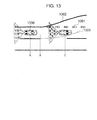
- a dividing line 1301 thin dotted line in Japan
- a branch road is faded and unrecognizable at a junction point of a highway as shown in FIG.
- the apparatus continues to recognize a solid line 1302 on the left-hand side of the vehicle along the branch road, and when the vehicle passes a space between dashed lines on the right-hand side in this state, the apparatus interpolates the space between the dashed lines on the right-hand side as shown with a dotted line 1303 based on the recognized left-hand side solid line 1302. Since the vehicle departs from the dotted line 1303 upon reaching a point C, a warning is raised even though the vehicle travels the main lane in a straight line, and therefore the warning ends up as a false warning.
- an object of the present invention is to provide a lane departure warning apparatus capable of preventing false warnings and absence of a warning regarding lane departure which is attributed to special road geometries such as junctions and tollgates and the like.
- a lane departure warning apparatus for outputting a warning signal upon determining departure of a vehicle from a lane in the present invention performs the steps of: when one dividing line in a vehicle width direction of the vehicle is non-detected, estimating a position of the non-detected one dividing line based on a position of the other dividing line as a first estimation dividing line; estimating a position of the non-detected one dividing line based on a position of the one dividing line prior to non-detection as a second estimation dividing line; and/or comparing the first estimation dividing line with the second estimation dividing line to determine lane departure.
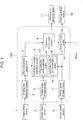
- FIG. 1 is a schematic view of a lane departure warning system in a first embodiment.
- the lane departure warning system comprises a lane departure warning apparatus 100, an image pickup device 1, a rudder sensor 4, a vehicle speed sensor 6, a warning sound generation section 11, and a warning display section 12.
- the lane departure warning apparatus 100 comprises a dividing line detection section 2, a dividing line position storage section 3, a rudder angle storage section 5, a vehicle speed storage section 7, a dividing line position estimation section 8, a first dividing line position estimation section 13, a second dividing line position estimation section 14, a departure determination section 9, and a warning generation section 10 and is structured to have a program installed in an unshown computer of the lane departure warning apparatus 100 so as to be executed repeatedly in a predetermined cycle.
- the lane departure warning apparatus 100 is also structured to receive input of images picked up by the image pickup device 1 as well as input of a rudder angle of a vehicle detected by the rudder sensor 4 and a vehicle speed detected by the vehicle speed sensor 6, and to output a warning to external warning sound generation section 11 and warning display section 12 upon determining that the vehicle may depart from a lane on which the vehicle is travelling.
- the image pickup device 1 picks up images of the outside of the vehicle with an image pickup element such as CCD (Charge Coupled Device) image sensors and CMOS (Complementary Metal Oxide Semiconductor) image sensors, and outputs the obtained images to the lane departure warning apparatus 100 as analog data without applying any processing thereto or outputs computer-processable image data, which are obtained by converting the obtained images through digital processing, to the lane departure warning apparatus 100 with use of an exclusive line and the like.
- an image pickup element such as CCD (Charge Coupled Device) image sensors and CMOS (Complementary Metal Oxide Semiconductor) image sensors
- the dividing line detection section 2 detects dividing lines (roadway center lines, lane boundary lines (a pair of a left lane line and a right lane line, etc.), roadway outside lines, etc.) painted on the roads with use of the data on images of the outside of the vehicle (image information) obtained by the in-vehicle image pickup device 1.
- the dividing line position storage section 3 stores a plurality of past positions of a dividing line detected in the dividing line detection section 2.
- RAMs Random Access Memories
- inside computer are generally used as storage media therefor.
- the rudder sensor 4 uses a method of directly or indirectly measuring turning angles of a steering shaft.
- the rudder angle storage section 5 acquires rudder angle values, i.e., measurement values of the rudder sensor 4 inputted with use of such communication means as an in-vehicle LAN (Local Area Network), and stores a plurality of past values in a memory such as a RAM inside computer.
- rudder angle values i.e., measurement values of the rudder sensor 4 inputted with use of such communication means as an in-vehicle LAN (Local Area Network)
- a memory such as a RAM inside computer.
- the vehicle speed sensor 6 uses methods such as a method for detecting a vehicle speed by averaging values provided by wheel speed sensors mounted on each of the front, rear, right and left wheels of the vehicle, and a method for calculating a vehicle speed by integrating values of acceleration of the vehicle provided by an acceleration sensor mounted thereon.
- the vehicle speed storage section 7 acquires vehicle speed values, i.e., measurement values of the vehicle speed sensor 6 inputted with such communication means as an in-vehicle LAN, and stores a plurality of past values in a memory such as a RAM inside computer.
- the dividing line position estimation section 8 which comprises a first dividing line position estimation section 13 and a second dividing line position estimation section 14, compares a first estimation dividing line estimated by the first dividing line position estimation section 13 with a second estimation dividing line estimated by the second dividing line position estimation section 14 to select an appropriate estimation dividing line.
- the first dividing line position estimation section 13 provides a first estimation dividing line estimated with use of the position of the other dividing line.
- the first estimation dividing line is estimated based on a lane width, which was calculated while the dividing lines on both sides could be detected by the dividing line detection section 2, and based on the position of the other dividing line. More specifically, the first dividing line position estimation section 13 calculates the lane width while the dividing lines on both sides in a vehicle width direction can be detected by the dividing line detection section 2, and estimates the first estimation dividing line based on the lane width and the position of the other dividing line.
- the second dividing line position estimation section 14 provides a second estimation dividing line estimated with use of the position of the one dividing line prior to non-detection stored in the dividing line position storage section 3. While a general method of providing the second estimation dividing line is to extrapolate a line with use of a plurality of the positions of the one dividing line stored in time series, estimation precision is enhanced by estimating the line in consideration of a travel locus of the vehicle which is calculated with use of a rudder angle and a vehicle speed.
- the departure determination section 9 determines whether or not the vehicle departs from the dividing lines based on the past dividing line positions including a current position stored on the dividing line position storage section 3 and based on the dividing line positions estimated by the dividing line position estimation section 8. It is to be noted that lane departure determination is assumed to be performed in compliance with JIS standard (JIS D 0804) or ISO standard (ISO/DIS 17361).
- the warning generation section 10 outputs a warning signal to the external warning sound generation section 11 and warning display section 12 with use of such communication means as an in-vehicle LAN and an exclusive line when the departure determination section 9 determines that the vehicle departs from the dividing lines and when no warning suppression conditions are met.
- the warning suppression conditions in this case include a blinker being in operation, being in a predetermined time after the end of blinker operation (in 2 seconds for example), and a vehicle speed being equal to or less than a specified value (70 km/h or less for example).
- Examples of the warning sound generation section 11 include a speaker which gives warning to a driver by sound in response to a warning signal outputted from the warning generation section 10.
- Examples of the warning display section 12 include a display, a meter panel, and a warning light for giving visual warning to a driver in response to a warning signal outputted from the warning generation section 10.
- the image pickup device 1, the lane departure warning apparatus 100, the warning sound generation section 11, and the warning display section 12 may constitute a lane departure warning system.
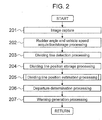
- FIG. 2 is a flow chart showing the processing details of the lane departure warning apparatus 100.
- an image picked up with the image pickup device 1 is digital-processed and captured as image data.
- the image data is directly captured.
- a rudder angle and a vehicle speed are respectively acquired from a rudder sensor and a vehicle speed sensor with use of such communication means as an in-vehicle LAN, and a plurality of past values (past 200 values for example) are stored in a memory such as a RAM inside computer.
- dividing lines painted on the road are detected from the image data captured in the processing step 201 by the dividing line detection section 2.
- a concrete method of the processing for detecting the dividing lines will be described with reference to FIG. 3 .
- a processing step 204 the position of the dividing line detected in the processing step 203 is stored in a RAM inside computer by the dividing line position storage section 3.
- a plurality of past processing results (past 100 results for example) are to be stored.
- a dividing line position is estimated by the dividing line position estimation section 8 with use of information on past dividing line positions stored in the processing step 204 as well as the rudder angle and the vehicle speed.
- a processing step 501 it is determined whether or not a dividing line is now under estimation from the state of a dividing line estimating flag, and if the dividing line is not under estimation (dividing line estimating flag is OFF), then the flow proceeds to a processing step 502, whereas if the dividing line is under estimation (dividing line estimating flag is ON), then the flow proceeds to a processing step 507.
- processing step 502 it is determined whether or not one dividing line is non-detected, and if the one dividing line is non-detected, then the flow proceeds to a processing step 503, whereas if the one dividing line is not non-detected, then a series of processing steps are ended.
- a first estimation dividing line is calculated and in a processing step 504, a second estimation dividing line is calculated.
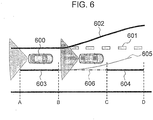
- FIG. 6 is a view assuming the case where a branch road is present on the left-hand side of a two-lane section in a four-lane road and a vehicle 600 travels straight in the left-hand lane of the two-lane section.
- dividing lines indicating road boundary are painted with solid lines
- dividing lines indicating lane boundary are painted with dashed lines
- dividing lines for dividing the two-lane section and the branch road are painted with thick dotted lines.
- a thick dotted line paint 601 is undetectable in image recognition due to fading and the like.
- An image pickup device mounted on the vehicle is to pick up images on the rear side of the vehicle.
- a lane width of the lane on which the vehicle 600 is traveling is calculated while the dividing lines on both sides are detectable, and when the vehicle passed the point B and the dashed line paint 603 vanished, a first estimation dividing line is calculated as shown with an estimation line 605 based on the result of detection of the left-hand side dividing line (detection of the solid line 602 in this case) with consideration to the lane width. More specifically, based on the position of the left-hand side dividing line 602 that is the other dividing line, the estimation line 605 corresponding to non-detected one dividing line is estimated as the first estimation dividing line.
- a second estimation dividing line is calculated by extrapolating an estimation line 606 based on information on the position of the dashed line paint 603 detected prior to the point B. More specifically, based on the position of the dashed line paint 603 that is one dividing line prior to non-detection stored in the dividing line position storage section 3, the estimation line 606 corresponding to the non-detected one dividing line is estimated as a second estimation dividing line.
- the first estimation dividing line and the second estimation dividing line are compared to select an estimation dividing line for use in departure determination (estimation dividing line for departure determination).
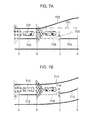
- FIG. 7A shows the same situation as described in FIG. 6
- FIG. 7B is a view assuming the case where a vehicle 710 travels on a left-hand lane of the two-lane section in a four-lane road.
- dividing lines indicating road boundary are shown with solid lines
- dividing lines indicating lane boundary are shown with dashed lines
- an image pickup device mounted on the vehicle picks up images on the rear side of the vehicle.
- a first estimation dividing line 705 and a second estimation dividing line 706 calculated in the processing step 503 and the processing step 504 are started to be calculated at the point B where a dashed line paint 703 is discontinued (i.e., at the point where the dashed line paint 703 representing one dividing line becomes non-detected), and at the point C that is distanced by a specified travel distance (at the point where detection of the dashed line paint 704 is restarted in this case), a difference d is calculated.
- the difference d is a clearance between the second estimation dividing line 706 and the first estimation dividing line 705 at the point C.
- the second estimation dividing line 706 is selected as an estimation dividing line for departure determination
- the first estimation dividing line 705 is selected as the estimation dividing line for departure determination.
- the difference d is larger than the threshold and so the second estimation dividing line 706 is selected as the estimation dividing line for departure determination. Therefore, even when the vehicle 700 comes closer to the first estimation dividing line 705, it is determined in a later-described processing step 206 for departure processing determination that the vehicle does not depart from the lane, and so a warning signal is not outputted in a processing step 207 for warning generation processing.
- a first estimation dividing line 714 and a second estimation dividing line 715 calculated in the processing step 503 and the processing step 504 are started to be calculated at the point B where a dashed line paint 712 is discontinued (i.e., at the point where the dashed line paint 712 representing one dividing line becomes non-detected), and at the point C that is distanced by a specified travel distance (at the point where detection of the dashed line paint 713 is restarted in this case), a difference d is calculated.
- the difference d is a clearance between the second estimation dividing line 715 and the first estimation dividing line 714 at the point C.
- the second estimation dividing line 715 is selected as an estimation dividing line for departure determination
- the first estimation dividing line 714 is selected as the estimation dividing line for departure determination.
- the difference d is equal to or less than a threshold and so the first estimation dividing line 714 is selected as an estimation dividing line for departure determination. Therefore, as the vehicle 700 comes closer to the first estimation dividing line 714, it is determined in the later-described processing step 206 for departure processing determination that the vehicle departs from the lane, and so a warning signal is outputted in the processing step 207 for warning generation processing.
- the first estimation dividing line 705 is formed by incorrect estimation, and if a distance between the first estimation dividing line 705 and the second estimation dividing line 706 is 30 cm or more and departure determination is performed with use of this first estimation dividing line 705, a warning generation position has an error of 30 cm or more as a result.
- the difference d at the point C where detection of the dashed line paint 704 is restarted may be set at 30 cm or less, that is, the threshold of the difference d may be set at 30 cm for example.
- the threshold of the difference d may be set at 25 cm for example, or may take a value of system specific parameter.
- the specified distance from the point B to the point C in FIG. 7 which is prescribed in the standards (guidelines) concerning road construction and improvement of each country, is 12 m for the highways in Japan for example, 8 m in the U.S., 7.5 m in Italy, and 9 m in China. It is thus preferable to switch the parameter according to where the system is used.
- a processing step 506 the dividing line estimating flag is turned ON and a series of processing steps are ended.
- a processing step 507 if a dividing line under estimation was detected and a difference between the position of the dividing line under estimation and the position of a detected dividing line is equal to or less than a specified value ( ⁇ 0.3 m or less for example), then the flow proceeds to a processing step 508, whereas in other cases, the flow proceeds to a processing step 510.
- a specified value ⁇ 0.3 m or less for example
- the dividing line estimating flag is turned OFF, and in a processing step 509, estimation of a dividing line is stopped and a processing target is switched to a newly detected dividing line before a series of processing steps are ended.
- the estimation is stopped and the position of the detected one dividing line is employed if the position of the detected one dividing line and the position of the estimation dividing line for departure determination are within a specified range. If the position of the detected one dividing line and the position of the estimation dividing line for departure determination are out of the specified range, then the estimation is continued and processing for employing the position of a selected estimation dividing line for departure determination is performed.
- the estimation is stopped and the position of the detected dashed line paint 704 is employed if the detected position of the dashed line paint 704 and the position of the estimation dividing line for departure determination 706 are in a specified range, so that determination of lane departure is conducted based on the position of the dashed line paint 704.
- the processing step 510 it is determined whether or not a specified distance or more was traveled after start of the estimation of a dividing line, and if the specified distance or more was traveled (e.g., 20 m or more), then the flow proceeds to a processing step 511, whereas if the specified distance or more was not traveled, the flow proceeds to the processing step 513 to the processing step 515 for continuing the estimation processing of the dividing line before ending a series of processing steps.
- a specified distance or more was traveled after start of the estimation of a dividing line, and if the specified distance or more was traveled (e.g., 20 m or more), then the flow proceeds to a processing step 511, whereas if the specified distance or more was not traveled, the flow proceeds to the processing step 513 to the processing step 515 for continuing the estimation processing of the dividing line before ending a series of processing steps.
- the dividing line estimating flag is turned OFF, and in a processing step 512, estimation of the dividing line is stopped and the dividing line under estimation is regarded as non-detected before a series of processing steps are ended. More specifically, in the processing step 510 to the processing step 512, processing for stopping estimation is performed if one dividing line could not be detected by the dividing line detection section 2 in a specified travel distance from the start of the estimation. In the example shown in FIG. 7A for example, estimation of a dividing line is started at the point B, and if the dashed line paint 704 could not be detected by the dividing line detection section 2 till the vehicle passes the point C, estimation of the dividing line is stopped.
- departure determination processing is performed for determining whether or not the vehicle departs based on a distance between the dividing line detected in the processing step 203 and the dividing line estimated in the processing step 205.
- JIS standard JIS D 0804
- ISO standard ISO/DIS 17361
- generation of a warning is determined based on a distance from the outside of a front wheel of a vehicle to a dividing line, and therefore a distance to the dividing line detected from the images on the rear side of the vehicle which were picked up with the image pickup device 1 needs to be corrected to a distance from the outside of a front wheel of the vehicle to the dividing line.
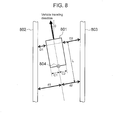
- FIG. 8 A more specific description will be given with reference to FIG. 8 .
- FIG. 8 is a view assuming the case where a vehicle 801 travels on the road with two dividing lines 802 and 803.
- the departure determination section 9 determines whether or not the vehicle departs from a lane with use of the distances D1 and D2 to the right and left dividing lines obtained by the above-mentioned equations (1) and (2). More specifically, departure is determined when the distance D1 or D2 is equal to or less than a specified value (5 cm or less for example).
- the yaw angle of the vehicle ⁇ is obtained by methods such as a method for obtaining the angle with a least-square technique from the information on a plurality of past values of the distances d1 and d2 to the right and left dividing lines and a method for obtaining the angle of the dividing lines directly from one pickup image.
- warning generation processing for outputting a warning signal is performed in the warning generation section 10 when departure from the dividing line is determined in the processing step 206, and a series of processing steps are ended.
- the warning may be canceled at the timing after the lapse of a specified time upon generation of a warning (after the lapse of 2 seconds for example).
- a yaw rate may be used instead as a parameter for directly indicating the turning amount of the vehicle, and in that case, information on the yaw rate may be acquired from output values of a yaw rate sensor.
- an error in image recognition can be determined with use of the information on image recognition and features of road structure so that appropriate estimation of dividing lines can be achieved, and thereby false warnings and absence of a warning can be prevented.
- FIG. 9 is a schematic view of a lane departure warning apparatus 100 according to a second embodiment.
- the lane departure warning apparatus 100 in FIG. 9 has a structure similar to the structure of the first embodiment ( FIG. 1 ) except for the first dividing line position estimation section 13 and the second dividing line position estimation section 14 being removed.
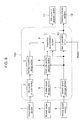
- a processing step 1001 it is determined whether or not a dividing line is now under estimation from the state of a dividing line estimating flag, and if a dividing line is not under estimation (dividing line estimating flag is OFF), then the flow proceeds to a processing step 1002, whereas if the dividing line is under estimation (dividing line estimating flag is ON), the flow proceeds to a processing step 1006.
- the processing step 1002 if change in rudder angle (parameter representing the turn of the vehicle) stored in the processing step 202 in a predetermined time is smaller than a specified value (first threshold) (e.g., change of 3 degrees or less in 2 seconds), then the flow proceeds to a processing step 1003, whereas in other cases, a series of processing steps are ended.
- first threshold e.g., change of 3 degrees or less in 2 seconds
- the processing flow may be structured so that if change in rudder angle (parameter representing the turn of the vehicle) stored in the processing step 202 in a specified travel distance is smaller than a specified value (first threshold) (e.g., change of 3 degrees or less in a travel distance of 50 m), then the flow proceeds to the processing step 1003, whereas in other cases, a series of processing steps are ended.
- the condition for proceeding to the processing step 1003 in this case is the rudder angle being almost constant, i.e., the vehicle traveling along the road during a predetermined time or in a specified travel distance.
- the rudder angle being almost constant, i.e., the vehicle traveling along the road during a predetermined time or in a specified travel distance.
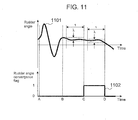
- FIG. 11 is a graph view showing time variation of the rudder angle and the rudder angle convergence flag (when this flag is ON, the flow proceeds to the processing step 1003) during travel on a certain road.
- a rudder angle 1101 drastically changes up and down during a period from time A to time B, indicating high likelihood of the vehicle performing lane change or the like and indicating low likelihood of the vehicle traveling along the road, so that a rudder angle convergence flag 1102 is OFF.
- time C if change in rudder angle during a period of past ⁇ (2 seconds for example) is within ⁇ (3 degrees or less for example), the rudder angle convergence flag 1102 is turned ON.
- time D when the change in rudder angle during a period of past ⁇ is no longer within ⁇ , the rudder angle convergence flag 1102 is turned OFF.
- the rudder angle convergence flag 1102 can also be determined with the change in rudder angle ⁇ in a specified travel distance ⁇ (50 m for example) by using a travel distance as a horizontal axis.
- a yaw rate may be used instead as a parameter for directly indicating the turning amount of the vehicle, and in that case, information on the yaw rate may be acquired from output values of a yaw rate sensor.
- a yaw rate sensor and a yaw rate detection section are provided in place of or in addition to the rudder sensor 4 and the rudder angle storage section 5 shown in FIG. 1 .
- the flow proceeds to a processing step 1004, whereas in other cases, a series of processing steps are ended.
- a specified value e.g., change of 0.15 m or more in 0.25 seconds
- the processing flow may be structured so that if the change in distance to one dividing line that is change in dividing line position (distance to the dividing line) stored in the processing step 204 in a specified travel distance is equal to or more than a specified value (e.g., change of 0.03 m or more in a travel distance of 1.2 m), then the flow proceeds to a processing step 1004, whereas in other cases, a series of processing steps are ended.
- a specified value e.g., change of 0.03 m or more in a travel distance of 1.2 m
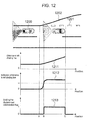
- FIG. 12 is a view assuming the case where a branch road is present on the left-hand side of the two-lane section in a four-lane road and a vehicle 1200 travels straight in the left-hand lane of the two-lane section.
- dividing lines indicating road boundary are painted with solid lines
- dividing lines indicating lane boundary are painted with dashed lines
- dividing lines for dividing the two-lane section and the branch road are painted with thick dotted lines.
- a thick dotted line paint 1201 is undetectable in image recognition due to fading and the like.
- An image pickup device mounted on the vehicle is to pick up images on the rear side of the vehicle. Graphs shown below the road state shown in FIG.
- the dividing line detection section 2 since the dividing line detection section 2 cannot detect the thick dotted line paint 1201 after the vehicle 1200 passed the point A, the dividing line detection section 2 starts to detect a road boundary line 1202 of the branch road for recognition of the left-hand side dividing line. Therefore, a distance to the left dividing line changes as shown with a solid line 1211 in a graph shown in FIG. 12 .
- the inclination 1212 is calculated by methods such as a method for obtaining the inclination with a least-square technique from past measurement values in a plurality of points, a method of calculating the inclination based on a difference from the previous measurement values, and a method of directly calculating the inclination of a dividing line from one image.
- the dividing line displacement determination flag is turned ON.
- the dividing line displacement determination flag is turned OFF at the time when the vehicle 1200 arrives at the point C and the left dividing line is no longer detectable (because the dividing line 1202 moves away from the vehicle 1200).
- Other conditions for turning OFF the dividing line displacement determination flag include the dividing line being detected in a normal position (e.g., the sum total of a distance to the right dividing line and a distance to the left dividing line being closer to a prefixed lane width).
- the dividing line displacement may be determined with use of a speed at which a dividing line moves away from the vehicle.
- the second threshold ⁇ may be set as a value which varies in response to the vehicle speed.
- the processing step 1004 since one dividing line is determined to be moving away from the vehicle from the determination results in the processing step 1002 and the processing step 1003 though the vehicle is traveling along the road in actuality, the dividing line estimating flag is turned on, and the position of one dividing line is estimated based on the position of the other dividing line in a processing step 1005.
- a specific method for estimating the position of a dividing line in this case is switched depending on the detection state of the other dividing line.
- a lane width is calculated at the position before one dividing line moves away from the vehicle, and the position of one dividing line is estimated with use of the other dividing line and the lane width.
- the position of one dividing line is similarly estimated with use of the lane width, though in this case, the position of the other dividing line for use as a reference is obtained through extrapolation based on the past dividing line positions.
- a processing step 1006 if a dividing line under estimation was detected and a difference between the position of the dividing line under estimation and the position of the detected dividing line is equal to or less than a specified value ( ⁇ 0.3 m or less for example), then the flow proceeds to a processing step 1007, whereas if not, the flow proceeds to a processing step 1009.
- a specified value ⁇ 0.3 m or less for example
- the dividing line estimating flag is turned OFF, and in a processing step 1008, estimation of the dividing line is stopped and a processing target is switched to a newly detected dividing line before a series of processing steps are ended.
- the estimation is stopped and the position of the detected one dividing line is employed if the position of the detected one dividing line and the position of the estimation dividing line for departure determination are within a specified range. If the position of the detected one dividing line and the position of the estimation dividing line for departure determination are out of the specified range, then the estimation is continued and processing for employing the position of a selected estimation dividing line for departure determination is performed.
- the flow proceeds to a processing step 1010, whereas if the specified distance or more was not traveled, the flow proceeds to a processing step 1012 for continuing the estimation processing of the dividing line before ending a series of processing steps.
- a specified distance or more was traveled after start of the estimation of the dividing line, and if the specified distance or more was traveled (e.g., 20 m or more), then the flow proceeds to a processing step 1010, whereas if the specified distance or more was not traveled, the flow proceeds to a processing step 1012 for continuing the estimation processing of the dividing line before ending a series of processing steps.
- the dividing line estimating flag is turned OFF, and in a processing step 1011, estimation of the dividing line is stopped and the dividing line under estimation is regarded as non-detected before a series of processing steps are ended. More specifically, in the processing step 1009 to the processing step 1011, processing for stopping estimation is performed if one dividing line could not be detected by the dividing line detection section 2 in a specified travel distance from start of the estimation.
- an image recognition error can be determined with use of a combination of the rudder angle and the information on image recognition so that appropriate estimation of dividing lines can be achieved, which results in prevention of false warnings and absence of a warning.
- FIG. 13 is a view assuming the case where a branch road is present on the left-hand side of the two-lane section in a four-lane road and a vehicle 1300 travels straight in the left-hand lane of the two-lane section.
- dividing lines indicating road boundary are painted with solid lines
- dividing lines indicating lane boundary are painted with dashed lines
- dividing lines for dividing the two-lane section and the branch road are painted with thick dotted lines.
- a thick dotted line paint 1301 is undetectable in image recognition due to fading and the like.
- An image pickup device mounted on the vehicle is to pick up images on the rear side of the vehicle.
- estimating an undetectable dividing line simply with use of the information on the detected dividing line causes generation of a false warning in the places with special road geometries such as junctions, which results in giving discomfort and sense of uneasiness to the driver.
- FIG. 14 is basically similar to FIG. 13 in the road state except that the dividing line indicating a lane boundary is a solid line.
- Graphs shown below the road state in FIG. 14 respectively represent change in rudder angle convergence flag and change in dividing line displacement determination flag.
- the dividing line position estimation section 8 detects both a pair of dividing lines positioned in the vehicle width direction of a vehicle at the time when a vehicle 1400 passes the point A. Once the vehicle 1400 passed the point B, a left-hand side thick dotted line 1401 becomes undetectable, and therefore a solid line 1402 that is a road boundary of the branch road is started to be detected instead of the dotted line 1401.
- the left-hand side solid line 1402 that is moving away from the vehicle is to be detected. Therefore, when a dividing line displacement determination flag 1412 is turned ON at the point C, the amount of change in parameter representing the turn of the vehicle in a specified travel distance or a specified period of time becomes smaller than a preset first threshold and the amount of change in clearance between the solid line 1402 detected by the dividing line detection section 2 and the vehicle 1400 becomes equal to or larger than a preset second threshold, so that the detection result of a left-hand side dividing line is determined to be incorrect, and consequently the left-hand side dividing line 1403 (estimation dividing line for departure determination that is a dividing line with a larger amount of change in clearance to the vehicle) is estimated from the position of a dividing line on the right-hand side of the vehicle (position of the dividing line with a smaller amount of change in clearance to the vehicle).
- the dividing line is estimated by such a method including the step of calculating a lane width at the point A where the dividing lines on both sides are normally detectable and the step of estimating one-side dividing line based on a dividing line on the opposite side with use of the calculated lane width.
- a travel distance from the point C where estimation of dividing lines was started becomes equal to or more than a specified value, so that estimation of the left-hand side dividing line 1403 is stopped.
- a warning is issued by the warning generation section 10.
- the validity of the detection results of dividing lines can be determined, and when a detection result is determined as false detection of a dividing line, the dividing line on the false detection side can be estimated based on the position of a dividing line on the opposite side of the dividing line on the false detection side.
- FIG. 15 shows a road state similar to that in FIG. 13 and graphs therein are similar to those described in FIG. 14 .
- the amount of change in parameter representing the turn of the vehicle in a specified travel distance or a specified period of time becomes smaller than a preset first threshold and the amount of change in clearance between the solid line 1502 detected by the dividing line detection section 2 and the vehicle 1500 becomes equal to or larger than a preset second threshold, as a result of which the detection result of the left-hand side dividing line is determined to be incorrect, and the left-hand side dividing line 1504 is estimated based on the position of a dividing line on the right-hand side of the vehicle.
- the right-hand side dividing line is under estimation as shown with the line 1503 at the point D, the position of a painted portion of the dividing line prior to the point B (position of one dividing line prior to non-detection) is stored in advance. Then, since the vehicle is traveling along the road, one dividing line (first estimation dividing line for departure determination) 1505 is first estimated from the stored right-hand side dividing line position (position of one dividing line prior to non-detection) and is extrapolated to the dashed line 1506. Then, with use of the lane width by the same method as described in FIG. 14 , an opposite-side dividing line (second estimation dividing line for departure determination) 1504 is estimated.
- estimation of the one dividing line 1505 is stopped. Further, when the vehicle 1500 arrived at a point G, a travel distance from the point D where estimation of the left-hand side dividing line was started becomes equal to or more than a specified value, so that estimation of the left-hand side dividing line 1504 is stopped. In the case where the vehicle 1500 departs from any one of the dividing lines 1503, 1505 and 1504 under estimation during traveling from the point B to the point G, a warning is issued by the warning generation section 10.
- the validity of the detection results of dividing lines can be determined, and when a detection result is determined as false detection of a dividing line, the dividing line on the false detection side can be estimated based on the position of a dividing line on the opposite side of the dividing line on the false detection side.
- FIG. 16 is a schematic view of a lane departure warning apparatus 100 according to a third embodiment.
- the lane departure warning apparatus 100 in FIG. 16 has a structure based on the structure in the second embodiment ( FIG. 9 ) with a navigation 20 and a traffic information acquisition section 21 added thereto.
- the navigation 20 is a device typified by car-navigation systems for calculating a vehicle position on a map, and since a method for calculating the vehicle position is publicly known, explanation thereof will be omitted.
- special road geometries (branch roads, merging roads, tollgates, etc.) are present in a scheduled travel route near the vehicle, the navigation 20 outputs information including types of roads to the lane departure warning apparatus 100 with use of such communication means as an in-vehicle LAN.
- the traffic information acquisition section 21 acquires the information inputted with such communication means as an in-vehicle LAN from the navigation 20.
- information contents include presence of special shape roads (branch roads, merging roads, tollgates, etc.) in a scheduled travel route near the vehicle, types of special shape roads, information on branch road and merging road such as lengths of dividing lines (thick dotted lines in Japan) for dividing the roads from a main line, and tollgate information such as positions where dividing lines of lane boundary vanish and positions where roads start to widen.
- FIG. 17 is a flow chart showing the processing details of the lane departure warning apparatus 100, the flow chart being constituted by adding a processing step 1701 and a processing step 1702 to the flow chart of the second embodiment ( FIG. 2 ).
- the processing step 1701 when a special shape road is present in a scheduled travel route near the vehicle, information including the type of the road is acquired from the navigation 20 with use of such communication means as an in-vehicle LAN.
- the threshold of the parameter for use in the processing step 205 for dividing line position estimation processing is set up based on the traffic information acquired in the processing step 1701. More specifically, the threshold of the parameter for use in the processing step 1003 in the flow chart of the second embodiment ( FIG. 10 ) is set up. Since the shape of the road on which the vehicle travels is unknown in the second embodiment, determination is difficult unless change in distance to one dividing line is large to some extent. Accordingly, in the processing step 1702, the threshold of change in distance to one dividing line is set to be small when a special shape road is present in a scheduled travel route near the vehicle.
- the threshold is set at 0.1 m or more change in 0.25 second (0.15 m or more change in 0.25 second in the first embodiment), while in the case of change in dividing line position in a specified travel distance, the threshold is set at 0.02 m or more change in a travel distance of 1.2 m (0.03 m or more change in a travel distance of 1.2 m in the first embodiment).
- the threshold of the parameter for determining the special shape road can be set smaller, so that determination of the special shape road can be made at an early stage as compared to the first embodiment. Further, the probability of determining special shape roads can also be enhanced.
- FIG. 18 is a view assuming the case where a branch road is present on the left-hand side of the two-lane section in a four-lane road and a vehicle 1800 travels straight in the left-hand lane of the two-lane section.
- dividing lines indicating road boundary are painted with solid lines
- dividing lines indicating lane boundary are painted with dashed lines
- dividing lines for dividing the two-lane section and the branch road are painted with thick dotted lines.
- a thick dotted line paint 1801 is undetectable in image recognition due to fading and the like.
- An image pickup device mounted on the vehicle is to pick up images on the rear side of the vehicle.
- Graphs shown below the road state in FIG. 18 respectively represent change in rudder angle convergence flag and change in dividing line displacement determination flag.
- FIG. 18 at the point A before the vehicle 1800 arrives at the branch road, information indicating the presence of the branch road in a scheduled travel route near the vehicle is first acquired from the navigation 20.
- a solid line 1802 of the branch road is detected as a left-hand side dividing line, as a result of which the dividing line 1803 under estimation gradually comes closer to the vehicle.
- estimation of the line 1805 is stopped. Further, when the vehicle 1800 arrived at the point G, the left-hand side dividing line was re-detected, and therefore estimation of the left-hand side dividing line 1804 is stopped. While estimation of the left-hand side estimation dividing line 1804 is designed to be stopped after travel in a specified distance in the second embodiment, it is known in advance that the dividing line 1804 belongs to the branch road in the present embodiment, so that estimation is designed to be continued until the left-hand side dividing line is re-detected.
- estimation may be stopped after travel of, for example, 200 m.
- a warning is issued by the warning generation section 10.
- the validity of the detection results of dividing lines can be determined, and when a detection result is determined as false detection of a dividing line, the dividing line on the false detection side can be estimated based on the position of a dividing line on the opposite side of the dividing line on the false detection side.
- prior knowledge that the vehicle passes a special shape road allows early and reliable determination of false detection, and allows stable estimation of dividing lines.
- FIG. 19 is a view assuming the case where a vehicle 1900 travels straight in the left-hand lane of a two-lane section in a four-lane road whose road width is widened in front of a tollgate.
- dividing lines indicating road boundary are painted with solid lines
- dividing lines indicating lane boundary are painted with dashed lines.
- An image pickup device mounted on the vehicle is to pick up images on the rear side of the vehicle.
- Graphs shown below the road state in FIG. 19 respectively represent change in rudder angle convergence flag and change in dividing line displacement determination flag.
- FIG. 19 at the point A before the vehicle 1900 arrives at a branch road, information indicating that the road is widened due to the presence of a tollgate in a scheduled travel route near the vehicle is first acquired from the navigation 20.
- a solid line 1901 of the branch road is detected as a left-hand side dividing line, as a result of which the dividing line 1902 under estimation gradually comes closer to the vehicle.
- an image pickup device which picks up images on the front side of the vehicle may be used and a mounting position and the like of the image pickup device may be different from those in this embodiment.
- the present invention also relates to a lane departure warning method comprising the steps carried out by the lane departure warning apparatus.
Landscapes
- Engineering & Computer Science (AREA)
- Physics & Mathematics (AREA)
- General Physics & Mathematics (AREA)
- Mechanical Engineering (AREA)
- Human Computer Interaction (AREA)
- Multimedia (AREA)
- Theoretical Computer Science (AREA)
- Automation & Control Theory (AREA)
- Transportation (AREA)
- Traffic Control Systems (AREA)
- Image Analysis (AREA)
- Length Measuring Devices By Optical Means (AREA)
Abstract
Description
- The present invention relates to a lane departure warning apparatus for determining lane departure of a vehicle.
- Various technologies have been proposed for picking up images of the periphery of a vehicle by an in-vehicle camera and recognizing objects (e.g., vehicles and pedestrians), road markings and signs (e.g., traffic markings painted on the road such as dividing lines and "STOP" signs) in the picked-up images. For example, if it is possible to recognize dividing lines painted on the road on which a vehicle is travelling with an in-vehicle camera and to obtain the position of the vehicle in a lane, it becomes possible to issue a warning to a driver upon departure of the vehicle from the dividing lines or to control steering and braking of the vehicle so that the departure can be suppressed.
- As such systems for issuing a warning upon departure of a vehicle from a lane, there are Lane Departure Warning Systems (LDWS) standardized by JIS (Japanese Industrial Standard) in JIS D 0804 and by ISO (International Organization for Standardization) in ISO/DIS 17361. In order to implement such systems, it is necessary to recognize various kinds of dividing lines (such as solid lines, dashed lines and dotted lines) by an in-vehicle camera, though some dividing lines may be unrecognizable as they are faded or peeled off, and consequently systems with solutions to such problems have been developed.
- For example,
JP Patent Publication (Kokai) No. 2009-298362 A - However, in
JP Patent Publication (Kokai) No. 2009-298362 A FIG. 13 , the apparatus continues to recognize asolid line 1302 on the left-hand side of the vehicle along the branch road, and when the vehicle passes a space between dashed lines on the right-hand side in this state, the apparatus interpolates the space between the dashed lines on the right-hand side as shown with adotted line 1303 based on the recognized left-handside solid line 1302. Since the vehicle departs from thedotted line 1303 upon reaching a point C, a warning is raised even though the vehicle travels the main lane in a straight line, and therefore the warning ends up as a false warning. - In view of the above-mentioned problems, an object of the present invention is to provide a lane departure warning apparatus capable of preventing false warnings and absence of a warning regarding lane departure which is attributed to special road geometries such as junctions and tollgates and the like.
- In order to accomplish the above object, a lane departure warning apparatus for outputting a warning signal upon determining departure of a vehicle from a lane in the present invention performs the steps of: when one dividing line in a vehicle width direction of the vehicle is non-detected, estimating a position of the non-detected one dividing line based on a position of the other dividing line as a first estimation dividing line; estimating a position of the non-detected one dividing line based on a position of the one dividing line prior to non-detection as a second estimation dividing line; and/or comparing the first estimation dividing line with the second estimation dividing line to determine lane departure.
- According to the present invention, it becomes possible to prevent false warnings and absence of a warning regarding the lane departure attributed to special road geometries such as junctions.
-
-
FIG. 1 is a schematic view of a lane departure warning apparatus according to a first embodiment of the present invention. -
FIG. 2 is a flow chart for explaining processing steps in the lane departure warning apparatus according to the first embodiment of the present invention. -
FIG. 3 is a schematic view showing the details of dividing line detection processing in a dividing line detection section in the present invention. -
FIG. 4 is a schematic view showing the details of processing for calculating distance to a dividing line in the dividing line detection section in the present invention. -
FIG. 5 is an exemplary flow chart explaining dividing line position estimation processing in the present invention. -
FIG. 6 is a view explaining a method for estimating first and second estimation dividing lines. -
FIG. 7 is a view explaining a method for selecting the first and second estimation dividing lines. -
FIG. 8 is an exemplary view showing a method for correcting a measurement result of an image pickup device which picks up images of the rear side of a vehicle to a value for the front wheel position. -
FIG. 9 is a schematic view of a lane departure warning apparatus according to a second embodiment of the present invention. -
FIG. 10 is an exemplary flow chart explaining dividing line position estimation processing in the present invention. -
FIG. 11 is an exemplary view showing a method for determining whether or not a rudder angle is convergent. -
FIG. 12 is an exemplary view showing a method for determining whether or not a dividing line position is correct. -
FIG. 13 is a view showing a concrete example of the details of processing steps in a lane departure warning apparatus before the present invention is applied thereto. -
FIG. 14 is a schematic view showing a concrete example of the details of processing steps in the lane departure warning apparatus according to the second embodiment of the present invention. -
FIG. 15 is a schematic view showing a concrete example of the details of processing steps in the lane departure warning apparatus according to the second embodiment of the present invention. -
FIG. 16 is a schematic view of a lane departure warning apparatus according to a third embodiment of the present invention. -
FIG. 17 is a flow chart for explaining processing steps of the lane departure warning apparatus according to the third embodiment of the present invention. -
FIG. 18 is a schematic view showing a concrete example of the details of processing steps in the lane departure warning apparatus according to the third embodiment of the present invention. -
FIG. 19 is a schematic view showing a concrete example of the details of processing steps in the lane departure warning apparatus according to the third embodiment of the present invention. - Embodiments of the present invention will be described hereinbelow with reference to the drawings.
-
FIG. 1 is a schematic view of a lane departure warning system in a first embodiment. - The lane departure warning system comprises a lane
departure warning apparatus 100, animage pickup device 1, arudder sensor 4, avehicle speed sensor 6, a warningsound generation section 11, and awarning display section 12. - First, a description will be given of structure and processing details of the lane
departure warning apparatus 100. - The lane
departure warning apparatus 100 comprises a dividingline detection section 2, a dividing lineposition storage section 3, a rudderangle storage section 5, a vehiclespeed storage section 7, a dividing lineposition estimation section 8, a first dividing lineposition estimation section 13, a second dividing lineposition estimation section 14, adeparture determination section 9, and awarning generation section 10 and is structured to have a program installed in an unshown computer of the lanedeparture warning apparatus 100 so as to be executed repeatedly in a predetermined cycle. - The lane
departure warning apparatus 100 is also structured to receive input of images picked up by theimage pickup device 1 as well as input of a rudder angle of a vehicle detected by therudder sensor 4 and a vehicle speed detected by thevehicle speed sensor 6, and to output a warning to external warningsound generation section 11 andwarning display section 12 upon determining that the vehicle may depart from a lane on which the vehicle is travelling. - The
image pickup device 1 picks up images of the outside of the vehicle with an image pickup element such as CCD (Charge Coupled Device) image sensors and CMOS (Complementary Metal Oxide Semiconductor) image sensors, and outputs the obtained images to the lanedeparture warning apparatus 100 as analog data without applying any processing thereto or outputs computer-processable image data, which are obtained by converting the obtained images through digital processing, to the lanedeparture warning apparatus 100 with use of an exclusive line and the like. - The dividing
line detection section 2 detects dividing lines (roadway center lines, lane boundary lines (a pair of a left lane line and a right lane line, etc.), roadway outside lines, etc.) painted on the roads with use of the data on images of the outside of the vehicle (image information) obtained by the in-vehicleimage pickup device 1. - The dividing line
position storage section 3 stores a plurality of past positions of a dividing line detected in the dividingline detection section 2. RAMs (Random Access Memories) inside computer are generally used as storage media therefor. - The
rudder sensor 4 uses a method of directly or indirectly measuring turning angles of a steering shaft. - The rudder
angle storage section 5 acquires rudder angle values, i.e., measurement values of therudder sensor 4 inputted with use of such communication means as an in-vehicle LAN (Local Area Network), and stores a plurality of past values in a memory such as a RAM inside computer. - The
vehicle speed sensor 6 uses methods such as a method for detecting a vehicle speed by averaging values provided by wheel speed sensors mounted on each of the front, rear, right and left wheels of the vehicle, and a method for calculating a vehicle speed by integrating values of acceleration of the vehicle provided by an acceleration sensor mounted thereon. - The vehicle
speed storage section 7 acquires vehicle speed values, i.e., measurement values of thevehicle speed sensor 6 inputted with such communication means as an in-vehicle LAN, and stores a plurality of past values in a memory such as a RAM inside computer. - The dividing line
position estimation section 8, which comprises a first dividing lineposition estimation section 13 and a second dividing lineposition estimation section 14, compares a first estimation dividing line estimated by the first dividing lineposition estimation section 13 with a second estimation dividing line estimated by the second dividing lineposition estimation section 14 to select an appropriate estimation dividing line. - In the case where one dividing line cannot be detected by the dividing
line detection section 2, the first dividing lineposition estimation section 13 provides a first estimation dividing line estimated with use of the position of the other dividing line. In this case, the first estimation dividing line is estimated based on a lane width, which was calculated while the dividing lines on both sides could be detected by the dividingline detection section 2, and based on the position of the other dividing line. More specifically, the first dividing lineposition estimation section 13 calculates the lane width while the dividing lines on both sides in a vehicle width direction can be detected by the dividingline detection section 2, and estimates the first estimation dividing line based on the lane width and the position of the other dividing line. - In the case where one dividing line cannot be detected by the dividing
line detection section 2, the second dividing lineposition estimation section 14 provides a second estimation dividing line estimated with use of the position of the one dividing line prior to non-detection stored in the dividing lineposition storage section 3. While a general method of providing the second estimation dividing line is to extrapolate a line with use of a plurality of the positions of the one dividing line stored in time series, estimation precision is enhanced by estimating the line in consideration of a travel locus of the vehicle which is calculated with use of a rudder angle and a vehicle speed. - The
departure determination section 9 determines whether or not the vehicle departs from the dividing lines based on the past dividing line positions including a current position stored on the dividing lineposition storage section 3 and based on the dividing line positions estimated by the dividing lineposition estimation section 8. It is to be noted that lane departure determination is assumed to be performed in compliance with JIS standard (JIS D 0804) or ISO standard (ISO/DIS 17361). - The
warning generation section 10 outputs a warning signal to the external warningsound generation section 11 andwarning display section 12 with use of such communication means as an in-vehicle LAN and an exclusive line when thedeparture determination section 9 determines that the vehicle departs from the dividing lines and when no warning suppression conditions are met. The warning suppression conditions in this case include a blinker being in operation, being in a predetermined time after the end of blinker operation (in 2 seconds for example), and a vehicle speed being equal to or less than a specified value (70 km/h or less for example). - Examples of the warning
sound generation section 11 include a speaker which gives warning to a driver by sound in response to a warning signal outputted from thewarning generation section 10. Examples of thewarning display section 12 include a display, a meter panel, and a warning light for giving visual warning to a driver in response to a warning signal outputted from thewarning generation section 10. - It is to be noted that the
image pickup device 1, the lanedeparture warning apparatus 100, the warningsound generation section 11, and thewarning display section 12 may constitute a lane departure warning system. - A description will now be given of the processing details of the lane
departure warning apparatus 100. -
FIG. 2 is a flow chart showing the processing details of the lanedeparture warning apparatus 100. - First, in a
processing step 201, an image picked up with theimage pickup device 1 is digital-processed and captured as image data. In the case where an image has already been digital-processed into image data by theimage pickup device 1, the image data is directly captured. - Next, in a
processing step 202, a rudder angle and a vehicle speed are respectively acquired from a rudder sensor and a vehicle speed sensor with use of such communication means as an in-vehicle LAN, and a plurality of past values (past 200 values for example) are stored in a memory such as a RAM inside computer. - Next, in a
processing step 203, dividing lines painted on the road are detected from the image data captured in theprocessing step 201 by the dividingline detection section 2. A concrete method of the processing for detecting the dividing lines will be described with reference toFIG. 3 . -
FIG. 3 shows image data captured in theprocessing step 201, which includes two dividinglines FIG. 3 shows the result of detecting the edge intensity from point A to point B inFIG. 3 , in which peaks 303 and 305 represent the points of change from the road to a dividing line (the points of rapid change in luminance value from darkness to brightness) whilepeaks peaks peaks FIG. 4 . -
FIG. 4A shows image data captured in theprocessing step 201 as inFIG. 3 , andFIG. 4B is an overhead view showing the same situation as inFIG. 4A . In these drawings, two dividinglines arrow 403 representing an optical axis of theimage pickup device 1 and areference sign 405 denoting theimage pickup device 1. For example, a distance to thedividing line 402 as shown with thearrow 404, which is a distance from anoptical axis 403 to the point A in thedividing line 402, is calculated by obtaining a coordinate of the point A onFIG. 4A from the peaks of edge intensity and by converting the coordinate into an actual coordinate system ofFIG. 4B . It is to be noted that the distance to the dividing line may be obtained not with use of the inner coordinate of the dividing line but with use of an outer coordinate or a central coordinate of the dividing line as long as definition of the distance is consistent. Moreover, instead of calculating one distance for each dividing line, a plurality of distances (10 distances for example) may be calculated for each dividing line. - Next, in a
processing step 204, the position of the dividing line detected in theprocessing step 203 is stored in a RAM inside computer by the dividing lineposition storage section 3. In this case, a plurality of past processing results (past 100 results for example) are to be stored. - Next, in a
processing step 205, a dividing line position is estimated by the dividing lineposition estimation section 8 with use of information on past dividing line positions stored in theprocessing step 204 as well as the rudder angle and the vehicle speed. - Concrete processing details will be described with reference to the flow chart of
FIG. 5 . - First, in a
processing step 501, it is determined whether or not a dividing line is now under estimation from the state of a dividing line estimating flag, and if the dividing line is not under estimation (dividing line estimating flag is OFF), then the flow proceeds to aprocessing step 502, whereas if the dividing line is under estimation (dividing line estimating flag is ON), then the flow proceeds to aprocessing step 507. - In the
processing step 502, it is determined whether or not one dividing line is non-detected, and if the one dividing line is non-detected, then the flow proceeds to aprocessing step 503, whereas if the one dividing line is not non-detected, then a series of processing steps are ended. - In the
processing step 503, a first estimation dividing line is calculated and in aprocessing step 504, a second estimation dividing line is calculated. - A concrete example of the method for calculating the first estimation dividing line and the second estimation dividing line will be described with reference to
FIG. 6 . -
FIG. 6 is a view assuming the case where a branch road is present on the left-hand side of a two-lane section in a four-lane road and avehicle 600 travels straight in the left-hand lane of the two-lane section. In the drawing, dividing lines indicating road boundary are painted with solid lines, dividing lines indicating lane boundary are painted with dashed lines, and dividing lines for dividing the two-lane section and the branch road are painted with thick dotted lines. A thick dottedline paint 601 is undetectable in image recognition due to fading and the like. An image pickup device mounted on the vehicle is to pick up images on the rear side of the vehicle. - In
FIG. 6 , before thevehicle 600 comes to a portion of the branch road, a lane width of the lane on which thevehicle 600 is traveling is calculated while the dividing lines on both sides are detectable, and when the vehicle passed the point B and the dashedline paint 603 vanished, a first estimation dividing line is calculated as shown with anestimation line 605 based on the result of detection of the left-hand side dividing line (detection of thesolid line 602 in this case) with consideration to the lane width. More specifically, based on the position of the left-handside dividing line 602 that is the other dividing line, theestimation line 605 corresponding to non-detected one dividing line is estimated as the first estimation dividing line. - When the vehicle passed the point B and the dashed
line paint 603 vanished, a second estimation dividing line is calculated by extrapolating anestimation line 606 based on information on the position of the dashedline paint 603 detected prior to the point B. More specifically, based on the position of the dashedline paint 603 that is one dividing line prior to non-detection stored in the dividing lineposition storage section 3, theestimation line 606 corresponding to the non-detected one dividing line is estimated as a second estimation dividing line. - Next, in a
processing step 505, the first estimation dividing line and the second estimation dividing line are compared to select an estimation dividing line for use in departure determination (estimation dividing line for departure determination). - A concrete example of a method for selecting an estimation dividing line will be described with reference to
FIG. 7 . -
FIG. 7A shows the same situation as described inFIG. 6 , whileFIG. 7B is a view assuming the case where avehicle 710 travels on a left-hand lane of the two-lane section in a four-lane road. In the drawings, dividing lines indicating road boundary are shown with solid lines, dividing lines indicating lane boundary are shown with dashed lines, and an image pickup device mounted on the vehicle picks up images on the rear side of the vehicle. - In
FIG. 7A , a firstestimation dividing line 705 and a secondestimation dividing line 706 calculated in theprocessing step 503 and theprocessing step 504 are started to be calculated at the point B where a dashedline paint 703 is discontinued (i.e., at the point where the dashedline paint 703 representing one dividing line becomes non-detected), and at the point C that is distanced by a specified travel distance (at the point where detection of the dashedline paint 704 is restarted in this case), a difference d is calculated. - The difference d is a clearance between the second
estimation dividing line 706 and the firstestimation dividing line 705 at the point C. In this case, if the difference d is larger than a threshold, the secondestimation dividing line 706 is selected as an estimation dividing line for departure determination, whereas if the difference d is equal to or less than the threshold, the firstestimation dividing line 705 is selected as the estimation dividing line for departure determination. - In the example shown in
FIG. 7A , the difference d is larger than the threshold and so the secondestimation dividing line 706 is selected as the estimation dividing line for departure determination. Therefore, even when thevehicle 700 comes closer to the firstestimation dividing line 705, it is determined in a later-describedprocessing step 206 for departure processing determination that the vehicle does not depart from the lane, and so a warning signal is not outputted in aprocessing step 207 for warning generation processing. - In
FIG. 7A as inFIG. 7B , a firstestimation dividing line 714 and a secondestimation dividing line 715 calculated in theprocessing step 503 and theprocessing step 504 are started to be calculated at the point B where a dashedline paint 712 is discontinued (i.e., at the point where the dashedline paint 712 representing one dividing line becomes non-detected), and at the point C that is distanced by a specified travel distance (at the point where detection of the dashedline paint 713 is restarted in this case), a difference d is calculated. - The difference d is a clearance between the second
estimation dividing line 715 and the firstestimation dividing line 714 at the point C. In this case, if the difference d is larger than a specified value, the secondestimation dividing line 715 is selected as an estimation dividing line for departure determination, whereas if the difference d is equal to or less than the specified value, the firstestimation dividing line 714 is selected as the estimation dividing line for departure determination. - In the example shown in
FIG. 7B , the difference d is equal to or less than a threshold and so the firstestimation dividing line 714 is selected as an estimation dividing line for departure determination. Therefore, as thevehicle 700 comes closer to the firstestimation dividing line 714, it is determined in the later-describedprocessing step 206 for departure processing determination that the vehicle departs from the lane, and so a warning signal is outputted in theprocessing step 207 for warning generation processing. - The two specified values mentioned in
FIG. 7 will now be described more specifically. - First, since this apparatus is assumed to conform to JIS standard (JIS D 0804) or ISO standard (ISO/DIS 17361), it is necessary to pass the tests stipulated by each standards. One of the tests is a reproducibility test, which is prescribed to be passed by fulfilling a condition of "a warning issued within an area 30 cm wide", and therefore it is necessary to keep an error of warning generation position within 30 cm. For example in
FIG. 7A , the firstestimation dividing line 705 is formed by incorrect estimation, and if a distance between the firstestimation dividing line 705 and the secondestimation dividing line 706 is 30 cm or more and departure determination is performed with use of this firstestimation dividing line 705, a warning generation position has an error of 30 cm or more as a result. To solve this problem, the difference d at the point C where detection of the dashedline paint 704 is restarted may be set at 30 cm or less, that is, the threshold of the difference d may be set at 30 cm for example. In consideration of an operation error and the like, the threshold of the difference d may be set at 25 cm for example, or may take a value of system specific parameter. - The specified distance from the point B to the point C in
FIG. 7 , which is prescribed in the standards (guidelines) concerning road construction and improvement of each country, is 12 m for the highways in Japan for example, 8 m in the U.S., 7.5 m in Italy, and 9 m in China. It is thus preferable to switch the parameter according to where the system is used. - Next, in a
processing step 506, the dividing line estimating flag is turned ON and a series of processing steps are ended. - Next, in the
processing step 507, if a dividing line under estimation was detected and a difference between the position of the dividing line under estimation and the position of a detected dividing line is equal to or less than a specified value (±0.3 m or less for example), then the flow proceeds to aprocessing step 508, whereas in other cases, the flow proceeds to aprocessing step 510. - In the
processing step 508, the dividing line estimating flag is turned OFF, and in aprocessing step 509, estimation of a dividing line is stopped and a processing target is switched to a newly detected dividing line before a series of processing steps are ended. - More specifically, in the case where one dividing line is detected by the dividing
line detection section 2 during estimation of the one dividing line in theprocessing step 507 to theprocessing step 509, the estimation is stopped and the position of the detected one dividing line is employed if the position of the detected one dividing line and the position of the estimation dividing line for departure determination are within a specified range. If the position of the detected one dividing line and the position of the estimation dividing line for departure determination are out of the specified range, then the estimation is continued and processing for employing the position of a selected estimation dividing line for departure determination is performed. - In the example shown in
FIG. 7A for example, when the dashedline paint 704 is detected by the dividingline detection section 2 in the state where the estimation dividing line fordeparture determination 706 is being employed as one dividing line, the estimation is stopped and the position of the detected dashedline paint 704 is employed if the detected position of the dashedline paint 704 and the position of the estimation dividing line fordeparture determination 706 are in a specified range, so that determination of lane departure is conducted based on the position of the dashedline paint 704. - Next, in the
processing step 510, it is determined whether or not a specified distance or more was traveled after start of the estimation of a dividing line, and if the specified distance or more was traveled (e.g., 20 m or more), then the flow proceeds to aprocessing step 511, whereas if the specified distance or more was not traveled, the flow proceeds to theprocessing step 513 to theprocessing step 515 for continuing the estimation processing of the dividing line before ending a series of processing steps. - In the
processing step 511, the dividing line estimating flag is turned OFF, and in aprocessing step 512, estimation of the dividing line is stopped and the dividing line under estimation is regarded as non-detected before a series of processing steps are ended. More specifically, in theprocessing step 510 to theprocessing step 512, processing for stopping estimation is performed if one dividing line could not be detected by the dividingline detection section 2 in a specified travel distance from the start of the estimation. In the example shown inFIG. 7A for example, estimation of a dividing line is started at the point B, and if the dashedline paint 704 could not be detected by the dividingline detection section 2 till the vehicle passes the point C, estimation of the dividing line is stopped. - Next, in the
processing step 206, departure determination processing is performed for determining whether or not the vehicle departs based on a distance between the dividing line detected in theprocessing step 203 and the dividing line estimated in theprocessing step 205. In the JIS standard (JIS D 0804) and the ISO standard (ISO/DIS 17361), generation of a warning is determined based on a distance from the outside of a front wheel of a vehicle to a dividing line, and therefore a distance to the dividing line detected from the images on the rear side of the vehicle which were picked up with theimage pickup device 1 needs to be corrected to a distance from the outside of a front wheel of the vehicle to the dividing line. A more specific description will be given with reference toFIG. 8 . -
FIG. 8 is a view assuming the case where avehicle 801 travels on the road with two dividinglines - A distance d1 to a
left dividing line 802 calculated with animage pickup device 804 placed on the rear side of the vehicle can be corrected to a distance D1 between the outside of a left-side front wheel of the vehicle and a left dividing line (distance to the dividing line after correction) with use of an equation (1):
wherein L represents a distance from the point where the distance d1 is calculated to a front wheel of the vehicle, C1 represents a distance from theimage pickup device 804 to the outside of the left-side front wheel of the vehicle, and θ represents a yaw angle of the vehicle. - Similarly, a distance d2 to a
right dividing line 803 calculated with theimage pickup device 804 placed on the rear side of the vehicle can be corrected to a distance D2 between the outside of a right-side front wheel of the vehicle and a right dividing line (distance to the dividing line after correction) with use of an equation (2):
wherein L represents a distance from the point where the distance d2 is calculated to a front wheel of the vehicle, C2 represents a distance from theimage pickup device 804 to the outside of the right-side front wheel of the vehicle, and θ represents a yaw angle of the vehicle. - The
departure determination section 9 determines whether or not the vehicle departs from a lane with use of the distances D1 and D2 to the right and left dividing lines obtained by the above-mentioned equations (1) and (2). More specifically, departure is determined when the distance D1 or D2 is equal to or less than a specified value (5 cm or less for example). - The yaw angle of the vehicle θ is obtained by methods such as a method for obtaining the angle with a least-square technique from the information on a plurality of past values of the distances d1 and d2 to the right and left dividing lines and a method for obtaining the angle of the dividing lines directly from one pickup image.
- Finally, in the
processing step 207, warning generation processing for outputting a warning signal is performed in thewarning generation section 10 when departure from the dividing line is determined in theprocessing step 206, and a series of processing steps are ended. The warning may be canceled at the timing after the lapse of a specified time upon generation of a warning (after the lapse of 2 seconds for example). - Although the rudder angle was selected as a parameter indicating the turn of the vehicle in this embodiment, a yaw rate may be used instead as a parameter for directly indicating the turning amount of the vehicle, and in that case, information on the yaw rate may be acquired from output values of a yaw rate sensor.
- As described above, an error in image recognition can be determined with use of the information on image recognition and features of road structure so that appropriate estimation of dividing lines can be achieved, and thereby false warnings and absence of a warning can be prevented.
-
FIG. 9 is a schematic view of a lanedeparture warning apparatus 100 according to a second embodiment. - The lane
departure warning apparatus 100 inFIG. 9 has a structure similar to the structure of the first embodiment (FIG. 1 ) except for the first dividing lineposition estimation section 13 and the second dividing lineposition estimation section 14 being removed. - A description will now be given of the processing details of the lane departure warning apparatus as a whole in the second embodiment.
- Although the flow chart indicating the processing details of the lane
departure warning apparatus 100 is similar to the flow chart shown inFIG. 2 , theprocessing step 205 for dividing line position estimation processing is different and so the processing will be described with reference to a flow chart ofFIG. 10 . - First, in a
processing step 1001, it is determined whether or not a dividing line is now under estimation from the state of a dividing line estimating flag, and if a dividing line is not under estimation (dividing line estimating flag is OFF), then the flow proceeds to aprocessing step 1002, whereas if the dividing line is under estimation (dividing line estimating flag is ON), the flow proceeds to aprocessing step 1006. - In the
processing step 1002, if change in rudder angle (parameter representing the turn of the vehicle) stored in theprocessing step 202 in a predetermined time is smaller than a specified value (first threshold) (e.g., change of 3 degrees or less in 2 seconds), then the flow proceeds to aprocessing step 1003, whereas in other cases, a series of processing steps are ended. The processing flow may be structured so that if change in rudder angle (parameter representing the turn of the vehicle) stored in theprocessing step 202 in a specified travel distance is smaller than a specified value (first threshold) (e.g., change of 3 degrees or less in a travel distance of 50 m), then the flow proceeds to theprocessing step 1003, whereas in other cases, a series of processing steps are ended. The condition for proceeding to theprocessing step 1003 in this case is the rudder angle being almost constant, i.e., the vehicle traveling along the road during a predetermined time or in a specified travel distance. A more specific description will be given with reference toFIG. 11 . -
FIG. 11 is a graph view showing time variation of the rudder angle and the rudder angle convergence flag (when this flag is ON, the flow proceeds to the processing step 1003) during travel on a certain road. First, arudder angle 1101 drastically changes up and down during a period from time A to time B, indicating high likelihood of the vehicle performing lane change or the like and indicating low likelihood of the vehicle traveling along the road, so that a rudderangle convergence flag 1102 is OFF. Then, at time C, if change in rudder angle during a period of past τ(2 seconds for example) is within λ (3 degrees or less for example), the rudderangle convergence flag 1102 is turned ON. Then at time D when the change in rudder angle during a period of past τ is no longer within λ, the rudderangle convergence flag 1102 is turned OFF. - With such a determination method, it becomes possible to determine that the vehicle is highly likely to travel along the road when the rudder angle convergence flag is ON except for the case where road curvature continues to change. In
FIG. 11 , the rudderangle convergence flag 1102 can also be determined with the change in rudder angle λ in a specified travel distance τ (50 m for example) by using a travel distance as a horizontal axis. - Although the rudder angle was selected as a parameter indicating the turn of the vehicle in this embodiment, a yaw rate may be used instead as a parameter for directly indicating the turning amount of the vehicle, and in that case, information on the yaw rate may be acquired from output values of a yaw rate sensor. In the case of adopting such a method, for example, a yaw rate sensor and a yaw rate detection section are provided in place of or in addition to the
rudder sensor 4 and the rudderangle storage section 5 shown inFIG. 1 . - In the
processing step 1003, if change in distance to one dividing line, that is, change in dividing line position (distance to the dividing line) stored in theprocessing step 204 in a predetermined time is equal to or more than a specified value (e.g., change of 0.15 m or more in 0.25 seconds), the flow proceeds to aprocessing step 1004, whereas in other cases, a series of processing steps are ended. The processing flow may be structured so that if the change in distance to one dividing line that is change in dividing line position (distance to the dividing line) stored in theprocessing step 204 in a specified travel distance is equal to or more than a specified value (e.g., change of 0.03 m or more in a travel distance of 1.2 m), then the flow proceeds to aprocessing step 1004, whereas in other cases, a series of processing steps are ended. A more specific description will be given with reference toFIG. 12 . -
FIG. 12 is a view assuming the case where a branch road is present on the left-hand side of the two-lane section in a four-lane road and avehicle 1200 travels straight in the left-hand lane of the two-lane section. In the drawing, dividing lines indicating road boundary are painted with solid lines, dividing lines indicating lane boundary are painted with dashed lines, and dividing lines for dividing the two-lane section and the branch road are painted with thick dotted lines. A thick dottedline paint 1201 is undetectable in image recognition due to fading and the like. An image pickup device mounted on the vehicle is to pick up images on the rear side of the vehicle. Graphs shown below the road state shown inFIG. 12 respectively indicate change in measurement value of a distance to the left dividing line, change in inclination of distance to the left dividing line (change amount in distance), and change in dividing line displacement determination flag (if this flag is ON, the flow proceeds to a processing step 1004). - In
FIG. 12 , since the dividingline detection section 2 cannot detect the thick dottedline paint 1201 after thevehicle 1200 passed the point A, the dividingline detection section 2 starts to detect aroad boundary line 1202 of the branch road for recognition of the left-hand side dividing line. Therefore, a distance to the left dividing line changes as shown with asolid line 1211 in a graph shown inFIG. 12 . - Next, the inclination of distance is calculated with use of the
distance 1211 to the left dividing line, and the result thereof indicates that the inclination rapidly rises after the point A and changes to take a constant value after passing the point B as shown with asolid line 1212. Theinclination 1212 is calculated by methods such as a method for obtaining the inclination with a least-square technique from past measurement values in a plurality of points, a method of calculating the inclination based on a difference from the previous measurement values, and a method of directly calculating the inclination of a dividing line from one image. - Next, if the
inclination 1212 of the distance to the left dividing line when thevehicle 1200 arrives at the point B is equal to or more than a second threshold ω (e.g., 0.6 or more with a horizontal axis being time and 0.025 or more with a horizontal axis being travel distance), the dividing line displacement determination flag is turned ON. The dividing line displacement determination flag is turned OFF at the time when thevehicle 1200 arrives at the point C and the left dividing line is no longer detectable (because thedividing line 1202 moves away from the vehicle 1200). - Other conditions for turning OFF the dividing line displacement determination flag include the dividing line being detected in a normal position (e.g., the sum total of a distance to the right dividing line and a distance to the left dividing line being closer to a prefixed lane width).
- Although the method for determining dividing line displacement with use of inclination of distance to a dividing line has been described, the dividing line displacement may be determined with use of a speed at which a dividing line moves away from the vehicle. Moreover, the second threshold ω may be set as a value which varies in response to the vehicle speed.
- In the
processing step 1004, since one dividing line is determined to be moving away from the vehicle from the determination results in theprocessing step 1002 and theprocessing step 1003 though the vehicle is traveling along the road in actuality, the dividing line estimating flag is turned on, and the position of one dividing line is estimated based on the position of the other dividing line in aprocessing step 1005. - A specific method for estimating the position of a dividing line in this case is switched depending on the detection state of the other dividing line. First, in the case where the other dividing line is being detected, a lane width is calculated at the position before one dividing line moves away from the vehicle, and the position of one dividing line is estimated with use of the other dividing line and the lane width. In the case where the other dividing line is non-detected due to an interval between dashed lines and the like, the position of one dividing line is similarly estimated with use of the lane width, though in this case, the position of the other dividing line for use as a reference is obtained through extrapolation based on the past dividing line positions.
- Next, in the
processing step 1006, if a dividing line under estimation was detected and a difference between the position of the dividing line under estimation and the position of the detected dividing line is equal to or less than a specified value (±0.3 m or less for example), then the flow proceeds to aprocessing step 1007, whereas if not, the flow proceeds to aprocessing step 1009. - In the
processing step 1007, the dividing line estimating flag is turned OFF, and in aprocessing step 1008, estimation of the dividing line is stopped and a processing target is switched to a newly detected dividing line before a series of processing steps are ended. - More specifically, in the case where one dividing line was detected by the dividing
line detection section 2 during estimation of the one dividing line in theprocessing step 1006 to theprocessing step 1008, the estimation is stopped and the position of the detected one dividing line is employed if the position of the detected one dividing line and the position of the estimation dividing line for departure determination are within a specified range. If the position of the detected one dividing line and the position of the estimation dividing line for departure determination are out of the specified range, then the estimation is continued and processing for employing the position of a selected estimation dividing line for departure determination is performed. - Next, in the
processing step 1009, it is determined whether or not a specified distance or more was traveled after start of the estimation of the dividing line, and if the specified distance or more was traveled (e.g., 20 m or more), then the flow proceeds to aprocessing step 1010, whereas if the specified distance or more was not traveled, the flow proceeds to aprocessing step 1012 for continuing the estimation processing of the dividing line before ending a series of processing steps. - In the
processing step 1010, the dividing line estimating flag is turned OFF, and in aprocessing step 1011, estimation of the dividing line is stopped and the dividing line under estimation is regarded as non-detected before a series of processing steps are ended. More specifically, in theprocessing step 1009 to theprocessing step 1011, processing for stopping estimation is performed if one dividing line could not be detected by the dividingline detection section 2 in a specified travel distance from start of the estimation. - As described above, an image recognition error can be determined with use of a combination of the rudder angle and the information on image recognition so that appropriate estimation of dividing lines can be achieved, which results in prevention of false warnings and absence of a warning.
- Next, with reference to
FIG. 13 to FIG. 15 , the details of a series of processing steps in the lanedeparture warning apparatus 100 will be described with the processing steps being applied to actual road states. -
FIG. 13 is a view assuming the case where a branch road is present on the left-hand side of the two-lane section in a four-lane road and avehicle 1300 travels straight in the left-hand lane of the two-lane section. In the drawing, dividing lines indicating road boundary are painted with solid lines, dividing lines indicating lane boundary are painted with dashed lines, and dividing lines for dividing the two-lane section and the branch road are painted with thick dotted lines. A thick dottedline paint 1301 is undetectable in image recognition due to fading and the like. An image pickup device mounted on the vehicle is to pick up images on the rear side of the vehicle. - First, the processing details in the case where the present invention is not applied will be described with reference to
FIG. 13 . - When the
vehicle 1300 passed the point B, the dashed line paint on the right-hand side breaks off and the thick dottedline 1301 on the left-hand side is undetectable, and therefore only asolid line 1302 that is a road boundary of the branch road is detected. In this case, since only the left-hand sidesolid line 1302 that is moving away from the vehicle is detected, a dividing line is estimated as shown with a dottedline 1303 due to a break in the right-hand side dashed line. Then, when thevehicle 1300 arrived at the point C, thevehicle 1300 departs from a right-hand side dividing line estimation position, which results in generation of a warning despite the vehicle traveling straight. - As shown above, estimating an undetectable dividing line simply with use of the information on the detected dividing line causes generation of a false warning in the places with special road geometries such as junctions, which results in giving discomfort and sense of uneasiness to the driver.
- A description will now be given of the processing details in the case where the present invention is applied with reference to
FIG. 14 andFIG. 15 . -
FIG. 14 is basically similar toFIG. 13 in the road state except that the dividing line indicating a lane boundary is a solid line. Graphs shown below the road state inFIG. 14 respectively represent change in rudder angle convergence flag and change in dividing line displacement determination flag. - First, the dividing line
position estimation section 8 detects both a pair of dividing lines positioned in the vehicle width direction of a vehicle at the time when avehicle 1400 passes the point A. Once thevehicle 1400 passed the point B, a left-hand side thick dottedline 1401 becomes undetectable, and therefore asolid line 1402 that is a road boundary of the branch road is started to be detected instead of the dottedline 1401. - In this case, since the
vehicle 1400 is traveling along the road (rudderangle convergence flag 1411 is ON), the left-hand sidesolid line 1402 that is moving away from the vehicle is to be detected. Therefore, when a dividing linedisplacement determination flag 1412 is turned ON at the point C, the amount of change in parameter representing the turn of the vehicle in a specified travel distance or a specified period of time becomes smaller than a preset first threshold and the amount of change in clearance between thesolid line 1402 detected by the dividingline detection section 2 and thevehicle 1400 becomes equal to or larger than a preset second threshold, so that the detection result of a left-hand side dividing line is determined to be incorrect, and consequently the left-hand side dividing line 1403 (estimation dividing line for departure determination that is a dividing line with a larger amount of change in clearance to the vehicle) is estimated from the position of a dividing line on the right-hand side of the vehicle (position of the dividing line with a smaller amount of change in clearance to the vehicle). In this case, the dividing line is estimated by such a method including the step of calculating a lane width at the point A where the dividing lines on both sides are normally detectable and the step of estimating one-side dividing line based on a dividing line on the opposite side with use of the calculated lane width. - When the
vehicle 1400 arrived at point E, a travel distance from the point C where estimation of dividing lines was started becomes equal to or more than a specified value, so that estimation of the left-handside dividing line 1403 is stopped. In the case where thevehicle 1400 departs from the left-handside dividing line 1403 under estimation during traveling from the point C to the point E, a warning is issued by thewarning generation section 10. - As described above, even in the case of special road geometries such as junctions, the validity of the detection results of dividing lines can be determined, and when a detection result is determined as false detection of a dividing line, the dividing line on the false detection side can be estimated based on the position of a dividing line on the opposite side of the dividing line on the false detection side.
-
FIG. 15 shows a road state similar to that inFIG. 13 and graphs therein are similar to those described inFIG. 14 . - First, when a
vehicle 1500 passed the point B, an unpainted portion of a dashedline 1506 that is a right-hand side dividing line appears and a left-handside dividing line 1502 is still detectable, so that the right-hand side dividing line is estimated as shown with aline 1503 in the drawing based on the position of the left-hand side dividing line. Once thevehicle 1500 arrived at the point C, the dividingline detection section 2 detects asolid line 1502 of the branch road as a left-hand side dividing line, as a result of which thedividing line 1503 under estimation gradually comes closer to thevehicle 1500. - Then, when the
vehicle 1500 arrived at point D and both a rudderangle convergence flag 1511 and a dividing linedisplacement determination flag 1512 are turned ON, the amount of change in parameter representing the turn of the vehicle in a specified travel distance or a specified period of time becomes smaller than a preset first threshold and the amount of change in clearance between thesolid line 1502 detected by the dividingline detection section 2 and thevehicle 1500 becomes equal to or larger than a preset second threshold, as a result of which the detection result of the left-hand side dividing line is determined to be incorrect, and the left-handside dividing line 1504 is estimated based on the position of a dividing line on the right-hand side of the vehicle. - In this case, since the right-hand side dividing line is under estimation as shown with the
line 1503 at the point D, the position of a painted portion of the dividing line prior to the point B (position of one dividing line prior to non-detection) is stored in advance. Then, since the vehicle is traveling along the road, one dividing line (first estimation dividing line for departure determination) 1505 is first estimated from the stored right-hand side dividing line position (position of one dividing line prior to non-detection) and is extrapolated to the dashedline 1506. Then, with use of the lane width by the same method as described inFIG. 14 , an opposite-side dividing line (second estimation dividing line for departure determination) 1504 is estimated. - Next, when the
vehicle 1500 arrived at the point E, and the right-hand side dividing line was re-detected, estimation of the onedividing line 1505 is stopped. Further, when thevehicle 1500 arrived at a point G, a travel distance from the point D where estimation of the left-hand side dividing line was started becomes equal to or more than a specified value, so that estimation of the left-handside dividing line 1504 is stopped. In the case where thevehicle 1500 departs from any one of thedividing lines warning generation section 10. - As described above, even in the case of special road geometries such as junctions, the validity of the detection results of dividing lines can be determined, and when a detection result is determined as false detection of a dividing line, the dividing line on the false detection side can be estimated based on the position of a dividing line on the opposite side of the dividing line on the false detection side.
-
FIG. 16 is a schematic view of a lanedeparture warning apparatus 100 according to a third embodiment. - The lane
departure warning apparatus 100 inFIG. 16 has a structure based on the structure in the second embodiment (FIG. 9 ) with anavigation 20 and a trafficinformation acquisition section 21 added thereto. - The
navigation 20 is a device typified by car-navigation systems for calculating a vehicle position on a map, and since a method for calculating the vehicle position is publicly known, explanation thereof will be omitted. When special road geometries (branch roads, merging roads, tollgates, etc.) are present in a scheduled travel route near the vehicle, thenavigation 20 outputs information including types of roads to the lanedeparture warning apparatus 100 with use of such communication means as an in-vehicle LAN. - The traffic
information acquisition section 21 acquires the information inputted with such communication means as an in-vehicle LAN from thenavigation 20. Concrete examples of information contents include presence of special shape roads (branch roads, merging roads, tollgates, etc.) in a scheduled travel route near the vehicle, types of special shape roads, information on branch road and merging road such as lengths of dividing lines (thick dotted lines in Japan) for dividing the roads from a main line, and tollgate information such as positions where dividing lines of lane boundary vanish and positions where roads start to widen. - A description will now be given of the processing details of the lane departure warning apparatus as a whole in the third embodiment.
-
FIG. 17 is a flow chart showing the processing details of the lanedeparture warning apparatus 100, the flow chart being constituted by adding aprocessing step 1701 and aprocessing step 1702 to the flow chart of the second embodiment (FIG. 2 ). - First, in the
processing step 1701, when a special shape road is present in a scheduled travel route near the vehicle, information including the type of the road is acquired from thenavigation 20 with use of such communication means as an in-vehicle LAN. - Next, in the
processing step 1702, the threshold of the parameter for use in theprocessing step 205 for dividing line position estimation processing is set up based on the traffic information acquired in theprocessing step 1701. More specifically, the threshold of the parameter for use in theprocessing step 1003 in the flow chart of the second embodiment (FIG. 10 ) is set up. Since the shape of the road on which the vehicle travels is unknown in the second embodiment, determination is difficult unless change in distance to one dividing line is large to some extent. Accordingly, in theprocessing step 1702, the threshold of change in distance to one dividing line is set to be small when a special shape road is present in a scheduled travel route near the vehicle. For example, in the case of change in dividing line position in a predetermined time, the threshold is set at 0.1 m or more change in 0.25 second (0.15 m or more change in 0.25 second in the first embodiment), while in the case of change in dividing line position in a specified travel distance, the threshold is set at 0.02 m or more change in a travel distance of 1.2 m (0.03 m or more change in a travel distance of 1.2 m in the first embodiment). - As mentioned above, when the presence of a special shape road in a scheduled travel route near the vehicle can be determined with use of the information from navigation and the like, the threshold of the parameter for determining the special shape road can be set smaller, so that determination of the special shape road can be made at an early stage as compared to the first embodiment. Further, the probability of determining special shape roads can also be enhanced.
- Next, with reference to
FIG. 18 andFIG. 19 , the details of a series of processing steps of the lanedeparture warning apparatus 100 will be described with the processing steps being applied to actual road states. -
FIG. 18 is a view assuming the case where a branch road is present on the left-hand side of the two-lane section in a four-lane road and avehicle 1800 travels straight in the left-hand lane of the two-lane section. In the drawing, dividing lines indicating road boundary are painted with solid lines, dividing lines indicating lane boundary are painted with dashed lines, and dividing lines for dividing the two-lane section and the branch road are painted with thick dotted lines. A thick dottedline paint 1801 is undetectable in image recognition due to fading and the like. An image pickup device mounted on the vehicle is to pick up images on the rear side of the vehicle. Graphs shown below the road state inFIG. 18 respectively represent change in rudder angle convergence flag and change in dividing line displacement determination flag. - In
FIG. 18 , at the point A before thevehicle 1800 arrives at the branch road, information indicating the presence of the branch road in a scheduled travel route near the vehicle is first acquired from thenavigation 20. Next, when thevehicle 1800 passed the point B, an unpainted portion of a dashed line that is a right-hand side dividing line appears and a left-hand side dividing line is still detectable, so that a right-hand side dividing line is estimated as shown with aline 1803 in the drawing based on the position of the left-hand side dividing line. Once thevehicle 1800 arrived at the point C, asolid line 1802 of the branch road is detected as a left-hand side dividing line, as a result of which thedividing line 1803 under estimation gradually comes closer to the vehicle. - Then, when the
vehicle 1800 arrived at the point D and a rudderangle convergence flag 1811 and a dividing linedisplacement determination flag 1812 were both turned ON, it is determined that the detection result of a left-hand side dividing line is incorrect, and the left-handside dividing line 1804 is estimated from the position of a dividing line on the right-hand side of the vehicle. In this case, since the right-hand side dividing line is under estimation as shown with theline 1803 at the point D, the position of a painted portion of the dividing line prior to the point B is stored in advance, and since the vehicle is traveling along the road, a right-hand side dividing line is first extrapolated based on the stored dividing line position as shown with aline 1805, and then a dividing line on the opposite side is estimated as shown with aline 1804 by the same method as explained inFIG. 14 (method with use of lane width). - Next, when the
vehicle 1800 arrived at the point E, and the right-hand side dividing line was re-detected, estimation of theline 1805 is stopped. Further, when thevehicle 1800 arrived at the point G, the left-hand side dividing line was re-detected, and therefore estimation of the left-handside dividing line 1804 is stopped. While estimation of the left-hand sideestimation dividing line 1804 is designed to be stopped after travel in a specified distance in the second embodiment, it is known in advance that thedividing line 1804 belongs to the branch road in the present embodiment, so that estimation is designed to be continued until the left-hand side dividing line is re-detected. However, since there is a possibility that the information from thenavigation 20 is incorrect, estimation may be stopped after travel of, for example, 200 m. In the case where thevehicle 1800 departs from any one of thedividing lines warning generation section 10. - As described above, even in the case of special road geometries such as junctions, the validity of the detection results of dividing lines can be determined, and when a detection result is determined as false detection of a dividing line, the dividing line on the false detection side can be estimated based on the position of a dividing line on the opposite side of the dividing line on the false detection side. Moreover, prior knowledge that the vehicle passes a special shape road allows early and reliable determination of false detection, and allows stable estimation of dividing lines.
-
FIG. 19 is a view assuming the case where avehicle 1900 travels straight in the left-hand lane of a two-lane section in a four-lane road whose road width is widened in front of a tollgate. In the drawing, dividing lines indicating road boundary are painted with solid lines, and dividing lines indicating lane boundary are painted with dashed lines. An image pickup device mounted on the vehicle is to pick up images on the rear side of the vehicle. Graphs shown below the road state inFIG. 19 respectively represent change in rudder angle convergence flag and change in dividing line displacement determination flag. - In
FIG. 19 , at the point A before thevehicle 1900 arrives at a branch road, information indicating that the road is widened due to the presence of a tollgate in a scheduled travel route near the vehicle is first acquired from thenavigation 20. Next, when thevehicle 1900 passed the point B, an unpainted portion of a dashed line that is a right-hand side dividing line appears and a left-hand side dividing line is still detectable, so that a right-hand side dividing line is estimated as shown with aline 1902 in the drawing based on the position of the left-hand side dividing line. Once thevehicle 1900 arrived at the point C, asolid line 1901 of the branch road is detected as a left-hand side dividing line, as a result of which thedividing line 1902 under estimation gradually comes closer to the vehicle. - Then, when the
vehicle 1900 arrived at the point D and a rudderangle convergence flag 1911 and a dividing linedisplacement determination flag 1912 were both turned ON, it is determined that the left-hand side dividing line is moving away due to the widened road, and so the estimation of the left-handside dividing line 1902 is stopped. - Thus, even in the places with special road geometries such as in front of tollgates, it becomes possible to determine sudden widening of the road from the detection results of dividing lines and to prevent incorrect estimation of the dividing lines, so that false warnings can be prevented.
- As described above, it becomes possible to prevent incorrect estimation of the dividing lines by determining whether or not the vehicle travels along the road from the information on the rudder angle and the yaw rate of the vehicle and by determining whether or not the road is a special shape road from the change in distance to a dividing line, so that false warnings can be prevented. It also becomes possible to prevent absence of a warning by estimating correct dividing lines. Therefore, since false warnings and absence of a warning can be prevented, it becomes possible to provide a lane departure warning apparatus which does not give discomfort to a driver.
- Although descriptions have been given with use of the image pickup device which picks up images on the rear side of the vehicle in this embodiment, an image pickup device which picks up images on the front side of the vehicle may be used and a mounting position and the like of the image pickup device may be different from those in this embodiment.
- Although the above description has been given with regard to a lane departure warning apparatus, the present invention also relates to a lane departure warning method comprising the steps carried out by the lane departure warning apparatus.
- As disclosed above, the present invention can be embodied in various forms without departing from the scope thereof.
- Features, components and specific details of the structures of the above-described embodiments may be exchanged or combined to form further embodiments optimized for the respective application. As far as those modifications are readily apparent for an expert skilled in the art they shall be disclosed implicitly by the above description without specifying explicitly every possible combination, for the sake of conciseness of the present description.
-
- 1
- image pickup device
- 2
- dividing line detection section
- 3
- dividing line position storage section
- 4
- rudder angle sensor
- 5
- rudder angle storage section
- 6
- vehicle speed sensor
- 7
- vehicle speed storage section
- 8
- dividing line position estimation section
- 9
- departure determination section
- 10
- warning generation section
- 11
- warning sound generation section
- 12
- warning display section
- 100
- lane departure warning apparatus
Claims (18)
- A lane departure warning apparatus for outputting a warning signal upon determining departure of a vehicle from a lane, performing the steps of:when one dividing line out of a pair of dividing lines positioned on both sides of a vehicle width direction of the vehicle is not detected, estimating a position of the one dividing line based on a position of the other dividing line as a first estimation dividing line;estimating the non-detected one dividing line based on a position of the one dividing line prior to non-detection as a second estimation dividing line; andcomparing the first estimation dividing line with the second estimation dividing line to determine whether or not the vehicle departs from the lane.
- The lane departure warning apparatus according to claim 1, wherein
when a clearance between the first estimation dividing line and the second estimation dividing line at a point distanced by a specified travel distance from a point where the one dividing line became non-detected is equal to or less than a threshold, it is determined that the vehicle departs from the lane, whereas
when the clearance is larger than the threshold, it is determined that the vehicle does not depart from the lane. - A lane departure warning apparatus for determining whether or not a vehicle departs from a lane based on images of outside of the vehicle picked up during travel with an image pickup device (1) which picks up images of the outside of the vehicle and outputting a warning signal upon determination of departure, comprising:a dividing line detection section (2) for detecting dividing lines of a lane on which the vehicle is travelling based on the images;a dividing line position storage section (3) for storing positions of the dividing lines detected by the dividing line detection section (2);a dividing line position estimation section (8) for estimating, when one dividing line out of a pair of dividing lines positioned on both sides of a vehicle width direction of the vehicle is non-detected, the one dividing line based on a position of the other dividing line as a first estimation dividing line, estimating the non-detected one dividing line as a second estimation dividing line based on a position of the one dividing line prior to non-detection stored in the dividing line position storage section (3), and comparing a position of the first estimation dividing line with a position of the second estimation dividing line to select either one of the first estimation dividing line and the second estimation dividing line as an estimation dividing line for departure determination; anda departure determination section (9) for determining whether or not the vehicle departs from the lane based on a position of the estimation dividing line for departure determination selected by the dividing line position estimation section (8).
- The lane departure warning apparatus according to claim 3, wherein
the dividing line position estimation section (8) selects either one of the first estimation dividing line and the second estimation dividing line as an estimation dividing line for departure determination based on a clearance between the first estimation dividing line and the second estimation dividing line at a point distanced by a specified travel distance from a point where the one dividing line became non-detected. - The lane departure warning apparatus according to claim 4, wherein
the dividing line position estimation section (8) selects the first estimation dividing line as an estimation dividing line for departure determination when the clearance is equal to or less than a threshold, whereas when the clearance is larger than the threshold, the dividing line position estimation section (8) selects the second estimation dividing line as an estimation dividing line for departure determination. - The lane departure warning apparatus according to claim 3, wherein
the dividing line position estimation section (8) calculates a travel locus of the vehicle based on a rudder angle and a vehicle speed, and estimates the second estimation dividing line based on the calculated travel locus and the position of the one dividing line prior to non-detection stored in the dividing line position storage section (3). - The lane departure warning apparatus according to claim 3, wherein
in the case where the one dividing line was detected by the dividing line detection section (2) during estimation of the one dividing line, the dividing line position estimation section (8) stops the estimation and employs a position of the detected one dividing line if the position of the detected one dividing line and a position of the estimation dividing line for departure determination are within a specified range, whereas if the position of the detected one dividing line and the position of the estimation dividing line for departure determination are out of the specified range, the dividing line position estimation section (8) continues the estimation and employs the position of the selected estimation dividing line for departure determination. - The lane departure warning apparatus according to claim 7, wherein
the dividing line position estimation section (8) stops the estimation when the one dividing line could not be detected by the dividing line detection section (8) in a specified travel distance from start of the estimation. - A lane departure warning apparatus for determining whether or not a vehicle departs from a lane based on images of outside of the vehicle picked up during travel with an image pickup device (1) which picks up images of the outside of the vehicle and outputting a warning signal upon determination of departure, comprising:a dividing line detection section (2) for detecting dividing lines of a lane on which the vehicle is travelling based on the images;a dividing line position storage section (3) for storing positions of the dividing lines detected by the dividing line detection section (2);a dividing line position estimation section (8) for estimating an estimation dividing line for departure determination based on the position of the dividing line stored in the dividing line position storage section (3) in the case where an amount of change in a parameter representing a turn of the vehicle in a specified travel distance or a specified period of time is smaller than a preset first threshold and an amount of change in a clearance between the dividing line detected by the dividing line detection section (2) and the vehicle is equal to or larger than a preset second threshold; anda departure determination section (9) for determining whether or not the vehicle departs from the lane based on a position of the estimation dividing line for departure determination estimated by the dividing line position estimation section (8).
- The lane departure warning apparatus according to claim 9, wherein
when both of a pair of dividing lines positioned on both sides of a vehicle width direction of the vehicle are being detected by the dividing line detection section (2), the dividing line position estimation section (8) estimates an estimation dividing line for departure determination that is a dividing line with a larger amount of change in the clearance to the vehicle based on a position of the dividing line with a smaller amount of change in the clearance to the vehicle stored in the dividing line position storage section (3). - The lane departure warning apparatus according to claim 9, wherein
when one dividing line out of a pair of dividing lines positioned on both sides of a vehicle width direction of the vehicle is non-detected by the dividing line detection section (2), the dividing line position estimation section (8) estimates the non-detected one dividing line as a first estimation dividing line for departure determination based on a position of the one dividing line prior to non-detection stored in the dividing line position storage section (3). - The lane departure warning apparatus according to claim 11, wherein
the dividing line position estimation section (8) estimates a second estimation dividing line for departure determination on a side of the other dividing line based on a position of the first estimation dividing line for departure determination. - The lane departure warning apparatus according to claim 9, wherein
in the case where the one dividing line was detected by the dividing line detection section (2) during estimation of the one dividing line, the dividing line position estimation section (8) stops the estimation and employs a position of the detected one dividing line if the position of the detected one dividing line and a position of the estimation dividing line for departure determination are within a specified range, whereas if the position of the detected one dividing line and the position of the estimation dividing line for departure determination are out of the specified range, the dividing line position estimation section (8) continues the estimation and employs the position of the selected estimation dividing line for departure determination. - The lane departure warning apparatus according to claim 13, wherein
the dividing line position estimation section (8) stops the estimation when the one dividing line could not be detected by the dividing line detection section (2) in a specified travel distance from start of the estimation. - The lane departure warning apparatus according to at least one of claims 9 to 14, comprising:a rudder angle storage section (5) for detecting and storing a rudder angle of the vehicle; and a vehicle speed storage section (7) for detecting and storing a vehicle speed of the vehicle, whereinthe parameter is the rudder angle.
- The lane departure warning apparatus according to at least one of claims 9 to 14, comprising:a yaw rate detection section for detecting a yaw rate of the vehicle; and a vehicle speed storage section (7) for detecting and storing a vehicle speed of the vehicle, whereinthe parameter is the yaw rate.
- The lane departure warning apparatus according to claim 9, comprising
a traffic information acquisition section for acquiring traffic information, wherein
the dividing line position estimation section (8) estimates the estimation dividing line for departure determination based on the traffic information acquired by the traffic information acquisition section instead of the position of the dividing line stored in the dividing line position storage section (3). - A lane departure warning system, comprising:a lane departure warning apparatus (100) according to at least one of claims 1 to 17 and at least either one of a warning sound generation section (11) and a warning display section (12) for informing a driver of information based on a warning signal outputted from the lane departure warning apparatus (100).
Applications Claiming Priority (1)
| Application Number | Priority Date | Filing Date | Title |
|---|---|---|---|
| JP2011037669A JP5281664B2 (en) | 2011-02-23 | 2011-02-23 | Lane departure warning device and lane departure warning system |
Publications (3)
| Publication Number | Publication Date |
|---|---|
| EP2492888A2 true EP2492888A2 (en) | 2012-08-29 |
| EP2492888A3 EP2492888A3 (en) | 2015-01-07 |
| EP2492888B1 EP2492888B1 (en) | 2016-10-12 |
Family
ID=45607120
Family Applications (1)
| Application Number | Title | Priority Date | Filing Date |
|---|---|---|---|
| EP12156185.6A Not-in-force EP2492888B1 (en) | 2011-02-23 | 2012-02-20 | Lane departure warning apparatus and system |
Country Status (4)
| Country | Link |
|---|---|
| US (1) | US20120212612A1 (en) |
| EP (1) | EP2492888B1 (en) |
| JP (1) | JP5281664B2 (en) |
| CN (1) | CN102649408B (en) |
Families Citing this family (52)
| Publication number | Priority date | Publication date | Assignee | Title |
|---|---|---|---|---|
| JP5389864B2 (en) | 2011-06-17 | 2014-01-15 | クラリオン株式会社 | Lane departure warning device |
| DE102012207981A1 (en) * | 2012-05-14 | 2013-11-14 | Robert Bosch Gmbh | A method of warning a driver of a single-track motor vehicle from leaving the lane |
| WO2014104183A1 (en) * | 2012-12-26 | 2014-07-03 | 株式会社日本自動車部品総合研究所 | Boundary recognition device and branch assessment device |
| CN104044508B (en) * | 2013-03-14 | 2016-01-27 | 怡利电子工业股份有限公司 | Driving safety distance display method |
| US9164511B1 (en) | 2013-04-17 | 2015-10-20 | Google Inc. | Use of detected objects for image processing |
| CN104112360B (en) * | 2013-04-22 | 2016-05-25 | 徐州工程学院 | Device and working method for capturing solid lines of vehicle pressing lanes based on bias magnetic field |
| CN103440785B (en) * | 2013-08-08 | 2015-08-05 | 华南师范大学 | One is traffic lane offset warning method fast |
| KR101502511B1 (en) * | 2013-11-28 | 2015-03-13 | 현대모비스 주식회사 | Apparatus and method for generating virtual lane, and system for controlling lane keeping of vehicle with the said apparatus |
| JP6134276B2 (en) * | 2014-03-03 | 2017-05-24 | 株式会社Soken | Traveling line recognition device |
| US11352090B2 (en) | 2014-07-28 | 2022-06-07 | Robert Bosch Gmbh | Information providing device and program for motorcycle |
| JP6456682B2 (en) * | 2014-12-25 | 2019-01-23 | 株式会社Soken | Traveling line recognition device |
| JP6363518B2 (en) * | 2015-01-21 | 2018-07-25 | 株式会社デンソー | Lane marking recognition system |
| JP6224029B2 (en) * | 2015-05-21 | 2017-11-01 | 富士通テン株式会社 | Image processing apparatus and image processing method |
| JP6558120B2 (en) * | 2015-07-29 | 2019-08-14 | いすゞ自動車株式会社 | Direction indicator control device |
| JP6398951B2 (en) * | 2015-11-12 | 2018-10-03 | マツダ株式会社 | Lane maintenance control device |
| KR102433791B1 (en) * | 2015-11-20 | 2022-08-19 | 주식회사 에이치엘클레무브 | Lane Departure Warning Apparatus and Method |
| CN105835891A (en) * | 2016-01-26 | 2016-08-10 | 乐卡汽车智能科技(北京)有限公司 | System and method for preventing lane departure |
| JP6604240B2 (en) * | 2016-03-08 | 2019-11-13 | アイシン・エィ・ダブリュ株式会社 | Automatic driving support device and computer program |
| SE539816C2 (en) | 2016-04-19 | 2017-12-05 | Scania Cv Ab | Method and control unit in a vehicle for estimating a stretch of a road based on a set of tracks of another vehicle |
| US20170330043A1 (en) * | 2016-05-11 | 2017-11-16 | Icatch Technology, Inc. | Method and System for Synthesizing a Lane Image |
| EP3483022B1 (en) * | 2016-07-05 | 2020-11-04 | Nissan Motor Co., Ltd. | Travel control method and travel control device |
| MX2019000488A (en) * | 2016-07-12 | 2019-03-28 | Nissan Motor | Travel control method and travel control device. |
| CN107817018B (en) * | 2016-09-12 | 2020-03-03 | 上海沃尔沃汽车研发有限公司 | Test system and test method for lane line deviation alarm system |
| KR101976425B1 (en) * | 2016-09-22 | 2019-05-09 | 엘지전자 주식회사 | Driver assistance apparatus |
| JP6573595B2 (en) * | 2016-11-29 | 2019-09-11 | 株式会社Subaru | Automatic operation control device |
| JP6573594B2 (en) * | 2016-11-29 | 2019-09-11 | 株式会社Subaru | Automatic operation control device |
| US11262761B2 (en) | 2017-02-03 | 2022-03-01 | Honda Motor Co., Ltd. | Vehicle control system, vehicle control method, and vehicle control program |
| JP6834657B2 (en) * | 2017-03-23 | 2021-02-24 | いすゞ自動車株式会社 | Lane departure warning control device, vehicle and lane departure warning control method |
| CN110431609B (en) * | 2017-03-27 | 2022-01-11 | 三菱电机株式会社 | Vehicle position estimation device |
| WO2018179616A1 (en) * | 2017-03-27 | 2018-10-04 | 三菱電機株式会社 | Vehicle position deduction apparatus |
| FR3066743B1 (en) * | 2017-05-29 | 2019-07-12 | Valeo Schalter Und Sensoren Gmbh | DRIVING ASSISTANCE FOR A MOTOR VEHICLE ON THE APPROACH TO A TILT BARRIER |
| DE102017217091B4 (en) * | 2017-09-26 | 2022-11-24 | Ford Global Technologies, Llc | Method for assisting a driver in staying in lane |
| JP6663406B2 (en) * | 2017-10-05 | 2020-03-11 | 本田技研工業株式会社 | Vehicle control device, vehicle control method, and program |
| JP2019075008A (en) * | 2017-10-18 | 2019-05-16 | トヨタ自動車株式会社 | Vehicle control device |
| JP2019199143A (en) * | 2018-05-15 | 2019-11-21 | ロベルト・ボッシュ・ゲゼルシャフト・ミト・ベシュレンクテル・ハフツングRobert Bosch Gmbh | ECU and lane departure warning system |
| US11521337B2 (en) * | 2018-10-29 | 2022-12-06 | Mitsubishi Electric Corporation | Map generation system, map generation method, and computer readable medium which generates linearization information calculates a reliability degree |
| KR102751271B1 (en) * | 2019-01-21 | 2025-01-10 | 현대자동차주식회사 | Apparatus for recognizing lane and method thereof |
| KR102034316B1 (en) * | 2019-01-29 | 2019-11-08 | 주식회사 만도 | System and method for compensating position of vechicle, and camera |
| WO2020230308A1 (en) * | 2019-05-15 | 2020-11-19 | 日産自動車株式会社 | Driving assistance method and driving assistance device |
| JP7213149B2 (en) * | 2019-06-06 | 2023-01-26 | 本田技研工業株式会社 | VEHICLE CONTROL DEVICE, VEHICLE, OPERATING METHOD AND PROGRAM OF VEHICLE CONTROL DEVICE |
| CN110598517B (en) * | 2019-06-25 | 2023-11-24 | 一汽奔腾轿车有限公司 | A method for detecting lane departure on curves |
| WO2021014954A1 (en) * | 2019-07-24 | 2021-01-28 | 株式会社デンソー | Display control device and display control program |
| JP7277349B2 (en) * | 2019-12-12 | 2023-05-18 | 日立Astemo株式会社 | Driving support device and driving support system |
| CN115087573B (en) * | 2020-03-31 | 2023-05-05 | 华为技术有限公司 | A key target selection method, device and system |
| US11688180B2 (en) * | 2020-06-03 | 2023-06-27 | Continental Autonomous Mobility US, LLC | Lane departure warning without lane lines |
| CN112687109A (en) * | 2020-11-19 | 2021-04-20 | 泰州锐比特智能科技有限公司 | Lane change reminding system and method applying cloud storage |
| JP2022123238A (en) * | 2021-02-12 | 2022-08-24 | 本田技研工業株式会社 | Line recognition device |
| DE102022203826A1 (en) | 2022-04-19 | 2023-10-19 | Continental Autonomous Mobility Germany GmbH | Method for checking whether a vehicle and driver assistance system violate a boundary of a drivable area |
| DE102022203827B3 (en) * | 2022-04-19 | 2023-05-17 | Continental Autonomous Mobility Germany GmbH | Method for checking the violation of a border of a passable area by a vehicle and driver assistance system |
| DE102022211931A1 (en) | 2022-11-10 | 2024-05-16 | Continental Autonomous Mobility Germany GmbH | Method for checking the violation of a boundary of a drivable area by a vehicle and driver assistance system |
| CN115775377B (en) * | 2022-11-25 | 2023-10-20 | 北京化工大学 | Automatic driving lane line segmentation method with fusion of image and steering angle of steering wheel |
| DE102023004955A1 (en) | 2022-12-06 | 2024-06-06 | Mercedes-Benz Group AG | System and method for predicting the ego lane |
Citations (1)
| Publication number | Priority date | Publication date | Assignee | Title |
|---|---|---|---|---|
| JP2009298362A (en) | 2008-06-17 | 2009-12-24 | Mazda Motor Corp | Lane departure warning device of vehicle |
Family Cites Families (20)
| Publication number | Priority date | Publication date | Assignee | Title |
|---|---|---|---|---|
| US20050192727A1 (en) * | 1994-05-09 | 2005-09-01 | Automotive Technologies International Inc. | Sensor Assemblies |
| JP3885818B2 (en) * | 2005-05-27 | 2007-02-28 | トヨタ自動車株式会社 | Vehicle departure determination device |
| JP4939137B2 (en) * | 2006-07-19 | 2012-05-23 | 富士重工業株式会社 | Lane recognition device |
| EP2168079B1 (en) * | 2007-01-23 | 2015-01-14 | Valeo Schalter und Sensoren GmbH | Method and system for universal lane boundary detection |
| JP4654208B2 (en) * | 2007-02-13 | 2011-03-16 | 日立オートモティブシステムズ株式会社 | Vehicle environment recognition device |
| JP4933962B2 (en) * | 2007-06-22 | 2012-05-16 | 富士重工業株式会社 | Branch entry judgment device |
| JP4872897B2 (en) * | 2007-12-12 | 2012-02-08 | トヨタ自動車株式会社 | Lane maintenance support device |
| JP2009143433A (en) * | 2007-12-14 | 2009-07-02 | Toyota Motor Corp | Vehicle behavior control device |
| JP5034985B2 (en) * | 2008-01-30 | 2012-09-26 | 株式会社豊田中央研究所 | Parameter estimation device |
| US8311283B2 (en) * | 2008-07-06 | 2012-11-13 | Automotive Research&Testing Center | Method for detecting lane departure and apparatus thereof |
| JP5146243B2 (en) * | 2008-10-10 | 2013-02-20 | トヨタ自動車株式会社 | Lane departure control device |
| JP4692613B2 (en) * | 2008-11-28 | 2011-06-01 | トヨタ自動車株式会社 | In-vehicle device and method used in the device |
| JP4710981B2 (en) * | 2009-01-23 | 2011-06-29 | トヨタ自動車株式会社 | Marking line recognition apparatus and marking line recognition method used in the apparatus |
| KR101163446B1 (en) * | 2009-03-18 | 2012-07-18 | 기아자동차주식회사 | A lane departure warning system using a virtual lane and a system according to the same |
| CN201400166Y (en) * | 2009-03-19 | 2010-02-10 | 创研光电股份有限公司 | Lane departure warning device connected with global positioning system |
| JP5066123B2 (en) * | 2009-03-24 | 2012-11-07 | 日立オートモティブシステムズ株式会社 | Vehicle driving support device |
| JP2010231337A (en) * | 2009-03-26 | 2010-10-14 | Mazda Motor Corp | Vehicle lane departure warning device |
| JP5007840B2 (en) * | 2009-05-22 | 2012-08-22 | トヨタ自動車株式会社 | Driving assistance device |
| CN101704367A (en) * | 2009-11-03 | 2010-05-12 | 奇瑞汽车股份有限公司 | Lane departure prewarning device and prewarning method |
| CN101804814B (en) * | 2010-01-08 | 2012-10-31 | 北京世纪高通科技有限公司 | Method, device and system for determining lane departure |
-
2011
- 2011-02-23 JP JP2011037669A patent/JP5281664B2/en not_active Expired - Fee Related
-
2012
- 2012-02-14 CN CN201210033043.0A patent/CN102649408B/en not_active Expired - Fee Related
- 2012-02-17 US US13/398,880 patent/US20120212612A1/en not_active Abandoned
- 2012-02-20 EP EP12156185.6A patent/EP2492888B1/en not_active Not-in-force
Patent Citations (1)
| Publication number | Priority date | Publication date | Assignee | Title |
|---|---|---|---|---|
| JP2009298362A (en) | 2008-06-17 | 2009-12-24 | Mazda Motor Corp | Lane departure warning device of vehicle |
Also Published As
| Publication number | Publication date |
|---|---|
| CN102649408B (en) | 2015-05-20 |
| JP2012171562A (en) | 2012-09-10 |
| CN102649408A (en) | 2012-08-29 |
| EP2492888A3 (en) | 2015-01-07 |
| JP5281664B2 (en) | 2013-09-04 |
| US20120212612A1 (en) | 2012-08-23 |
| EP2492888B1 (en) | 2016-10-12 |
Similar Documents
| Publication | Publication Date | Title |
|---|---|---|
| EP2492888B1 (en) | Lane departure warning apparatus and system | |
| CA2990775C (en) | Vehicle position determination apparatus and vehicle position determination method | |
| US10890453B2 (en) | Vehicle localization device | |
| US8410919B2 (en) | Driving support apparatus | |
| US8520954B2 (en) | Apparatus for detecting lane-marking on road | |
| US8421648B2 (en) | Wrong-way-travel warning device and wrong-way-travel warning method | |
| EP2933790A1 (en) | Moving object location/attitude angle estimation device and moving object location/attitude angle estimation method | |
| US10573175B2 (en) | Systems and methods for traffic sign validation | |
| WO2010035781A1 (en) | Lane determining device and navigation system | |
| CN111696458A (en) | Advertisement display device, vehicle, and advertisement display method | |
| CN111164382A (en) | System and method for driver assistance | |
| US20170103271A1 (en) | Driving assistance system and driving assistance method for vehicle | |
| JP2011012965A (en) | Lane determination device and navigation system | |
| JP2017009553A (en) | Vehicle location determination device and vehicle location determination method | |
| KR20170082374A (en) | Lane detection apparatus | |
| US10380437B2 (en) | Systems and methods for traffic sign assistance | |
| US20240035845A1 (en) | Method and device for determining the reliability of a low-definition map | |
| WO2019139084A1 (en) | Notification apparatus and vehicle-mounted equipment | |
| JP2017531268A5 (en) | ||
| CN114268788B (en) | Monitoring of functional compliance of an on-board vehicle image acquisition device | |
| US20190185016A1 (en) | Vehicle position attitude calculation apparatus and vehicle position attitude calculation program | |
| CN118289019A (en) | Vehicle driving information display method, system and electronic equipment |
Legal Events
| Date | Code | Title | Description |
|---|---|---|---|
| PUAI | Public reference made under article 153(3) epc to a published international application that has entered the european phase |
Free format text: ORIGINAL CODE: 0009012 |
|
| 17P | Request for examination filed |
Effective date: 20120323 |
|
| AK | Designated contracting states |
Kind code of ref document: A2 Designated state(s): AL AT BE BG CH CY CZ DE DK EE ES FI FR GB GR HR HU IE IS IT LI LT LU LV MC MK MT NL NO PL PT RO RS SE SI SK SM TR |
|
| AX | Request for extension of the european patent |
Extension state: BA ME |
|
| RIN1 | Information on inventor provided before grant (corrected) |
Inventor name: OKADA, TAKASHI Inventor name: SAKATA, MASAO Inventor name: IMAI, MASATO |
|
| PUAL | Search report despatched |
Free format text: ORIGINAL CODE: 0009013 |
|
| AK | Designated contracting states |
Kind code of ref document: A3 Designated state(s): AL AT BE BG CH CY CZ DE DK EE ES FI FR GB GR HR HU IE IS IT LI LT LU LV MC MK MT NL NO PL PT RO RS SE SI SK SM TR |
|
| AX | Request for extension of the european patent |
Extension state: BA ME |
|
| RIC1 | Information provided on ipc code assigned before grant |
Ipc: B60W 30/12 20060101ALI20141128BHEP Ipc: G06K 9/00 20060101ALI20141128BHEP Ipc: G08G 1/16 20060101AFI20141128BHEP |
|
| RIC1 | Information provided on ipc code assigned before grant |
Ipc: G08G 1/16 20060101AFI20160401BHEP Ipc: B60W 30/12 20060101ALI20160401BHEP Ipc: G06K 9/00 20060101ALI20160401BHEP Ipc: B60Q 9/00 20060101ALI20160401BHEP |
|
| GRAP | Despatch of communication of intention to grant a patent |
Free format text: ORIGINAL CODE: EPIDOSNIGR1 |
|
| INTG | Intention to grant announced |
Effective date: 20160620 |
|
| GRAS | Grant fee paid |
Free format text: ORIGINAL CODE: EPIDOSNIGR3 |
|
| GRAA | (expected) grant |
Free format text: ORIGINAL CODE: 0009210 |
|
| AK | Designated contracting states |
Kind code of ref document: B1 Designated state(s): AL AT BE BG CH CY CZ DE DK EE ES FI FR GB GR HR HU IE IS IT LI LT LU LV MC MK MT NL NO PL PT RO RS SE SI SK SM TR |
|
| REG | Reference to a national code |
Ref country code: GB Ref legal event code: FG4D |
|
| REG | Reference to a national code |
Ref country code: CH Ref legal event code: EP |
|
| REG | Reference to a national code |
Ref country code: AT Ref legal event code: REF Ref document number: 837127 Country of ref document: AT Kind code of ref document: T Effective date: 20161015 |
|
| REG | Reference to a national code |
Ref country code: IE Ref legal event code: FG4D |
|
| REG | Reference to a national code |
Ref country code: DE Ref legal event code: R096 Ref document number: 602012023939 Country of ref document: DE |
|
| REG | Reference to a national code |
Ref country code: LT Ref legal event code: MG4D |
|
| REG | Reference to a national code |
Ref country code: NL Ref legal event code: MP Effective date: 20161012 |
|
| REG | Reference to a national code |
Ref country code: FR Ref legal event code: PLFP Year of fee payment: 6 |
|
| PG25 | Lapsed in a contracting state [announced via postgrant information from national office to epo] |
Ref country code: LV Free format text: LAPSE BECAUSE OF FAILURE TO SUBMIT A TRANSLATION OF THE DESCRIPTION OR TO PAY THE FEE WITHIN THE PRESCRIBED TIME-LIMIT Effective date: 20161012 |
|
| REG | Reference to a national code |
Ref country code: AT Ref legal event code: MK05 Ref document number: 837127 Country of ref document: AT Kind code of ref document: T Effective date: 20161012 |
|
| PG25 | Lapsed in a contracting state [announced via postgrant information from national office to epo] |
Ref country code: SE Free format text: LAPSE BECAUSE OF FAILURE TO SUBMIT A TRANSLATION OF THE DESCRIPTION OR TO PAY THE FEE WITHIN THE PRESCRIBED TIME-LIMIT Effective date: 20161012 Ref country code: LT Free format text: LAPSE BECAUSE OF FAILURE TO SUBMIT A TRANSLATION OF THE DESCRIPTION OR TO PAY THE FEE WITHIN THE PRESCRIBED TIME-LIMIT Effective date: 20161012 Ref country code: NO Free format text: LAPSE BECAUSE OF FAILURE TO SUBMIT A TRANSLATION OF THE DESCRIPTION OR TO PAY THE FEE WITHIN THE PRESCRIBED TIME-LIMIT Effective date: 20170112 Ref country code: GR Free format text: LAPSE BECAUSE OF FAILURE TO SUBMIT A TRANSLATION OF THE DESCRIPTION OR TO PAY THE FEE WITHIN THE PRESCRIBED TIME-LIMIT Effective date: 20170113 |
|
| PG25 | Lapsed in a contracting state [announced via postgrant information from national office to epo] |
Ref country code: FI Free format text: LAPSE BECAUSE OF FAILURE TO SUBMIT A TRANSLATION OF THE DESCRIPTION OR TO PAY THE FEE WITHIN THE PRESCRIBED TIME-LIMIT Effective date: 20161012 Ref country code: IS Free format text: LAPSE BECAUSE OF FAILURE TO SUBMIT A TRANSLATION OF THE DESCRIPTION OR TO PAY THE FEE WITHIN THE PRESCRIBED TIME-LIMIT Effective date: 20170212 Ref country code: BE Free format text: LAPSE BECAUSE OF FAILURE TO SUBMIT A TRANSLATION OF THE DESCRIPTION OR TO PAY THE FEE WITHIN THE PRESCRIBED TIME-LIMIT Effective date: 20161012 Ref country code: PL Free format text: LAPSE BECAUSE OF FAILURE TO SUBMIT A TRANSLATION OF THE DESCRIPTION OR TO PAY THE FEE WITHIN THE PRESCRIBED TIME-LIMIT Effective date: 20161012 Ref country code: HR Free format text: LAPSE BECAUSE OF FAILURE TO SUBMIT A TRANSLATION OF THE DESCRIPTION OR TO PAY THE FEE WITHIN THE PRESCRIBED TIME-LIMIT Effective date: 20161012 Ref country code: ES Free format text: LAPSE BECAUSE OF FAILURE TO SUBMIT A TRANSLATION OF THE DESCRIPTION OR TO PAY THE FEE WITHIN THE PRESCRIBED TIME-LIMIT Effective date: 20161012 Ref country code: RS Free format text: LAPSE BECAUSE OF FAILURE TO SUBMIT A TRANSLATION OF THE DESCRIPTION OR TO PAY THE FEE WITHIN THE PRESCRIBED TIME-LIMIT Effective date: 20161012 Ref country code: NL Free format text: LAPSE BECAUSE OF FAILURE TO SUBMIT A TRANSLATION OF THE DESCRIPTION OR TO PAY THE FEE WITHIN THE PRESCRIBED TIME-LIMIT Effective date: 20161012 Ref country code: AT Free format text: LAPSE BECAUSE OF FAILURE TO SUBMIT A TRANSLATION OF THE DESCRIPTION OR TO PAY THE FEE WITHIN THE PRESCRIBED TIME-LIMIT Effective date: 20161012 Ref country code: PT Free format text: LAPSE BECAUSE OF FAILURE TO SUBMIT A TRANSLATION OF THE DESCRIPTION OR TO PAY THE FEE WITHIN THE PRESCRIBED TIME-LIMIT Effective date: 20170213 |
|
| REG | Reference to a national code |
Ref country code: DE Ref legal event code: R097 Ref document number: 602012023939 Country of ref document: DE |
|
| PG25 | Lapsed in a contracting state [announced via postgrant information from national office to epo] |
Ref country code: DK Free format text: LAPSE BECAUSE OF FAILURE TO SUBMIT A TRANSLATION OF THE DESCRIPTION OR TO PAY THE FEE WITHIN THE PRESCRIBED TIME-LIMIT Effective date: 20161012 Ref country code: EE Free format text: LAPSE BECAUSE OF FAILURE TO SUBMIT A TRANSLATION OF THE DESCRIPTION OR TO PAY THE FEE WITHIN THE PRESCRIBED TIME-LIMIT Effective date: 20161012 Ref country code: CZ Free format text: LAPSE BECAUSE OF FAILURE TO SUBMIT A TRANSLATION OF THE DESCRIPTION OR TO PAY THE FEE WITHIN THE PRESCRIBED TIME-LIMIT Effective date: 20161012 Ref country code: RO Free format text: LAPSE BECAUSE OF FAILURE TO SUBMIT A TRANSLATION OF THE DESCRIPTION OR TO PAY THE FEE WITHIN THE PRESCRIBED TIME-LIMIT Effective date: 20161012 Ref country code: SK Free format text: LAPSE BECAUSE OF FAILURE TO SUBMIT A TRANSLATION OF THE DESCRIPTION OR TO PAY THE FEE WITHIN THE PRESCRIBED TIME-LIMIT Effective date: 20161012 |
|
| PLBE | No opposition filed within time limit |
Free format text: ORIGINAL CODE: 0009261 |
|
| STAA | Information on the status of an ep patent application or granted ep patent |
Free format text: STATUS: NO OPPOSITION FILED WITHIN TIME LIMIT |
|
| PG25 | Lapsed in a contracting state [announced via postgrant information from national office to epo] |
Ref country code: SM Free format text: LAPSE BECAUSE OF FAILURE TO SUBMIT A TRANSLATION OF THE DESCRIPTION OR TO PAY THE FEE WITHIN THE PRESCRIBED TIME-LIMIT Effective date: 20161012 Ref country code: BG Free format text: LAPSE BECAUSE OF FAILURE TO SUBMIT A TRANSLATION OF THE DESCRIPTION OR TO PAY THE FEE WITHIN THE PRESCRIBED TIME-LIMIT Effective date: 20170112 Ref country code: IT Free format text: LAPSE BECAUSE OF FAILURE TO SUBMIT A TRANSLATION OF THE DESCRIPTION OR TO PAY THE FEE WITHIN THE PRESCRIBED TIME-LIMIT Effective date: 20161012 |
|
| 26N | No opposition filed |
Effective date: 20170713 |
|
| PG25 | Lapsed in a contracting state [announced via postgrant information from national office to epo] |
Ref country code: MC Free format text: LAPSE BECAUSE OF FAILURE TO SUBMIT A TRANSLATION OF THE DESCRIPTION OR TO PAY THE FEE WITHIN THE PRESCRIBED TIME-LIMIT Effective date: 20161012 |
|
| REG | Reference to a national code |
Ref country code: CH Ref legal event code: PL |
|
| PG25 | Lapsed in a contracting state [announced via postgrant information from national office to epo] |
Ref country code: LI Free format text: LAPSE BECAUSE OF NON-PAYMENT OF DUE FEES Effective date: 20170228 Ref country code: CH Free format text: LAPSE BECAUSE OF NON-PAYMENT OF DUE FEES Effective date: 20170228 |
|
| REG | Reference to a national code |
Ref country code: IE Ref legal event code: MM4A |
|
| PG25 | Lapsed in a contracting state [announced via postgrant information from national office to epo] |
Ref country code: SI Free format text: LAPSE BECAUSE OF FAILURE TO SUBMIT A TRANSLATION OF THE DESCRIPTION OR TO PAY THE FEE WITHIN THE PRESCRIBED TIME-LIMIT Effective date: 20161012 |
|
| PG25 | Lapsed in a contracting state [announced via postgrant information from national office to epo] |
Ref country code: LU Free format text: LAPSE BECAUSE OF NON-PAYMENT OF DUE FEES Effective date: 20170220 |
|
| REG | Reference to a national code |
Ref country code: FR Ref legal event code: PLFP Year of fee payment: 7 |
|
| PG25 | Lapsed in a contracting state [announced via postgrant information from national office to epo] |
Ref country code: IE Free format text: LAPSE BECAUSE OF NON-PAYMENT OF DUE FEES Effective date: 20170220 |
|
| PG25 | Lapsed in a contracting state [announced via postgrant information from national office to epo] |
Ref country code: MT Free format text: LAPSE BECAUSE OF NON-PAYMENT OF DUE FEES Effective date: 20170220 |
|
| PG25 | Lapsed in a contracting state [announced via postgrant information from national office to epo] |
Ref country code: HU Free format text: LAPSE BECAUSE OF FAILURE TO SUBMIT A TRANSLATION OF THE DESCRIPTION OR TO PAY THE FEE WITHIN THE PRESCRIBED TIME-LIMIT; INVALID AB INITIO Effective date: 20120220 |
|
| PG25 | Lapsed in a contracting state [announced via postgrant information from national office to epo] |
Ref country code: CY Free format text: LAPSE BECAUSE OF NON-PAYMENT OF DUE FEES Effective date: 20161012 |
|
| PG25 | Lapsed in a contracting state [announced via postgrant information from national office to epo] |
Ref country code: MK Free format text: LAPSE BECAUSE OF FAILURE TO SUBMIT A TRANSLATION OF THE DESCRIPTION OR TO PAY THE FEE WITHIN THE PRESCRIBED TIME-LIMIT Effective date: 20161012 |
|
| PG25 | Lapsed in a contracting state [announced via postgrant information from national office to epo] |
Ref country code: TR Free format text: LAPSE BECAUSE OF FAILURE TO SUBMIT A TRANSLATION OF THE DESCRIPTION OR TO PAY THE FEE WITHIN THE PRESCRIBED TIME-LIMIT Effective date: 20161012 |
|
| PG25 | Lapsed in a contracting state [announced via postgrant information from national office to epo] |
Ref country code: AL Free format text: LAPSE BECAUSE OF FAILURE TO SUBMIT A TRANSLATION OF THE DESCRIPTION OR TO PAY THE FEE WITHIN THE PRESCRIBED TIME-LIMIT Effective date: 20161012 |
|
| PGFP | Annual fee paid to national office [announced via postgrant information from national office to epo] |
Ref country code: GB Payment date: 20210120 Year of fee payment: 10 |
|
| GBPC | Gb: european patent ceased through non-payment of renewal fee |
Effective date: 20220220 |
|
| PG25 | Lapsed in a contracting state [announced via postgrant information from national office to epo] |
Ref country code: GB Free format text: LAPSE BECAUSE OF NON-PAYMENT OF DUE FEES Effective date: 20220220 |
|
| PGFP | Annual fee paid to national office [announced via postgrant information from national office to epo] |
Ref country code: DE Payment date: 20240123 Year of fee payment: 13 |
|
| PGFP | Annual fee paid to national office [announced via postgrant information from national office to epo] |
Ref country code: FR Payment date: 20240123 Year of fee payment: 13 |
|
| REG | Reference to a national code |
Ref country code: DE Ref legal event code: R119 Ref document number: 602012023939 Country of ref document: DE |
|
| PG25 | Lapsed in a contracting state [announced via postgrant information from national office to epo] |
Ref country code: DE Free format text: LAPSE BECAUSE OF NON-PAYMENT OF DUE FEES Effective date: 20250902 |
|
| PG25 | Lapsed in a contracting state [announced via postgrant information from national office to epo] |
Ref country code: FR Free format text: LAPSE BECAUSE OF NON-PAYMENT OF DUE FEES Effective date: 20250228 |