EP2491147B1 - Methods and compositions for identifying downy mildew resistant cucumber plants - Google Patents
Methods and compositions for identifying downy mildew resistant cucumber plants Download PDFInfo
- Publication number
- EP2491147B1 EP2491147B1 EP10825767.6A EP10825767A EP2491147B1 EP 2491147 B1 EP2491147 B1 EP 2491147B1 EP 10825767 A EP10825767 A EP 10825767A EP 2491147 B1 EP2491147 B1 EP 2491147B1
- Authority
- EP
- European Patent Office
- Prior art keywords
- seq
- cucumber
- map
- qtl
- genetic
- Prior art date
- Legal status (The legal status is an assumption and is not a legal conclusion. Google has not performed a legal analysis and makes no representation as to the accuracy of the status listed.)
- Revoked
Links
Images




Classifications
-
- A—HUMAN NECESSITIES
- A01—AGRICULTURE; FORESTRY; ANIMAL HUSBANDRY; HUNTING; TRAPPING; FISHING
- A01H—NEW PLANTS OR NON-TRANSGENIC PROCESSES FOR OBTAINING THEM; PLANT REPRODUCTION BY TISSUE CULTURE TECHNIQUES
- A01H1/00—Processes for modifying genotypes ; Plants characterised by associated natural traits
- A01H1/04—Processes of selection involving genotypic or phenotypic markers; Methods of using phenotypic markers for selection
- A01H1/045—Processes of selection involving genotypic or phenotypic markers; Methods of using phenotypic markers for selection using molecular markers
-
- A—HUMAN NECESSITIES
- A01—AGRICULTURE; FORESTRY; ANIMAL HUSBANDRY; HUNTING; TRAPPING; FISHING
- A01H—NEW PLANTS OR NON-TRANSGENIC PROCESSES FOR OBTAINING THEM; PLANT REPRODUCTION BY TISSUE CULTURE TECHNIQUES
- A01H5/00—Angiosperms, i.e. flowering plants, characterised by their plant parts; Angiosperms characterised otherwise than by their botanic taxonomy
- A01H5/08—Fruits
-
- A—HUMAN NECESSITIES
- A01—AGRICULTURE; FORESTRY; ANIMAL HUSBANDRY; HUNTING; TRAPPING; FISHING
- A01H—NEW PLANTS OR NON-TRANSGENIC PROCESSES FOR OBTAINING THEM; PLANT REPRODUCTION BY TISSUE CULTURE TECHNIQUES
- A01H6/00—Angiosperms, i.e. flowering plants, characterised by their botanic taxonomy
- A01H6/34—Cucurbitaceae, e.g. bitter melon, cucumber or watermelon
- A01H6/346—Cucumis sativus[cucumber]
-
- C—CHEMISTRY; METALLURGY
- C12—BIOCHEMISTRY; BEER; SPIRITS; WINE; VINEGAR; MICROBIOLOGY; ENZYMOLOGY; MUTATION OR GENETIC ENGINEERING
- C12Q—MEASURING OR TESTING PROCESSES INVOLVING ENZYMES, NUCLEIC ACIDS OR MICROORGANISMS; COMPOSITIONS OR TEST PAPERS THEREFOR; PROCESSES OF PREPARING SUCH COMPOSITIONS; CONDITION-RESPONSIVE CONTROL IN MICROBIOLOGICAL OR ENZYMOLOGICAL PROCESSES
- C12Q1/00—Measuring or testing processes involving enzymes, nucleic acids or microorganisms; Compositions therefor; Processes of preparing such compositions
- C12Q1/68—Measuring or testing processes involving enzymes, nucleic acids or microorganisms; Compositions therefor; Processes of preparing such compositions involving nucleic acids
- C12Q1/6876—Nucleic acid products used in the analysis of nucleic acids, e.g. primers or probes
- C12Q1/6888—Nucleic acid products used in the analysis of nucleic acids, e.g. primers or probes for detection or identification of organisms
- C12Q1/6895—Nucleic acid products used in the analysis of nucleic acids, e.g. primers or probes for detection or identification of organisms for plants, fungi or algae
-
- C—CHEMISTRY; METALLURGY
- C12—BIOCHEMISTRY; BEER; SPIRITS; WINE; VINEGAR; MICROBIOLOGY; ENZYMOLOGY; MUTATION OR GENETIC ENGINEERING
- C12Q—MEASURING OR TESTING PROCESSES INVOLVING ENZYMES, NUCLEIC ACIDS OR MICROORGANISMS; COMPOSITIONS OR TEST PAPERS THEREFOR; PROCESSES OF PREPARING SUCH COMPOSITIONS; CONDITION-RESPONSIVE CONTROL IN MICROBIOLOGICAL OR ENZYMOLOGICAL PROCESSES
- C12Q2600/00—Oligonucleotides characterized by their use
- C12Q2600/13—Plant traits
-
- C—CHEMISTRY; METALLURGY
- C12—BIOCHEMISTRY; BEER; SPIRITS; WINE; VINEGAR; MICROBIOLOGY; ENZYMOLOGY; MUTATION OR GENETIC ENGINEERING
- C12Q—MEASURING OR TESTING PROCESSES INVOLVING ENZYMES, NUCLEIC ACIDS OR MICROORGANISMS; COMPOSITIONS OR TEST PAPERS THEREFOR; PROCESSES OF PREPARING SUCH COMPOSITIONS; CONDITION-RESPONSIVE CONTROL IN MICROBIOLOGICAL OR ENZYMOLOGICAL PROCESSES
- C12Q2600/00—Oligonucleotides characterized by their use
- C12Q2600/156—Polymorphic or mutational markers
-
- C—CHEMISTRY; METALLURGY
- C12—BIOCHEMISTRY; BEER; SPIRITS; WINE; VINEGAR; MICROBIOLOGY; ENZYMOLOGY; MUTATION OR GENETIC ENGINEERING
- C12Q—MEASURING OR TESTING PROCESSES INVOLVING ENZYMES, NUCLEIC ACIDS OR MICROORGANISMS; COMPOSITIONS OR TEST PAPERS THEREFOR; PROCESSES OF PREPARING SUCH COMPOSITIONS; CONDITION-RESPONSIVE CONTROL IN MICROBIOLOGICAL OR ENZYMOLOGICAL PROCESSES
- C12Q2600/00—Oligonucleotides characterized by their use
- C12Q2600/172—Haplotypes
Definitions
- the invention relates to methods and isolated nucleic acid probes or primers for obtaining germplasm of cucumber plants having Downy Mildew resistance.
- Cucumber ( Cucumis sativus L.) is a popular vegetable crop that has been cultivated for several thousand years and is grown worldwide. Cucumber plants are grown in a wide range of climates, and in open fields as well as greenhouses. The two main types of cucumber fruit grown commercially today are fresh market (slicing) and processing (pickling).
- DM Downy Mildew
- P.c. fungus Pseudoperonospora cubensis
- the disease is found worldwide and favors moist, temperate conditions. The disease affects greenhouse grown plants, and plants grown in the field. DM is one of the most important foliar diseases of cucurbits, and can reduce fruit yield and quality, and may kill susceptible seedlings.
- Symptoms of DM infection are variable. Initial symptoms include sharp, irregular yellow lesions on the upper surface of the leaves, which eventually become more distinct on both sides of the leaves.
- the underside of the leaves may exhibit a whitish-gray, brown, or light blue growth, particularly under moist conditions. This downy growth is spores produced on the lower surface of the lesion.
- a general yellowing of affected leaves typically occurs as the lesions coalesce into one large lesion, eventually causing the leaf to wilt and die. The disease can progress quite rapidly, killing foliage in a matter of a few days and resulting in poor fruit production and quality. Cucumber fruit are not affected directly, but major defoliation exposes the fruit to sunscald.
- PI197088 is known to be a strain that is highly resistant to DM (see Angelov, D. et al. Proc. Cucurbitaceae 2000, Acla Hort. SIO, ISHS pages 81-83 and 135-157 (2000 ).
- WO 2009/129314 discloses DM resistant cucumber plants produced by crossing PI197088. Emergence of a new isolate of DM has also overcome some previously known resistant lines. Thus, there is a need for new cucumber varieties having resistance to DM, and methods for producing such plants.
- the invention provides a method of obtaining cucumber germplasm comprising the steps of: a) assaying cucumber plants for the presence of at least a first genetic marker genetically linked to a QTL that confers resistance to Downy Mildew; and b) selecting at least a first cucumber plant comprising the genetic marker and the QTL that confers resistance to Downy Mildew; wherein the QTL maps to a position between the sequence represented by SNP marker NN0223689 and SNP marker NN0228148 characterized by SEQ ID NOs:56 and 69, respectively, which map to approximately 41.0 cM and 82.3 cM on the genetic map of the linkage group termed cucumber chromosome 5; wherein the QTL maps to a position between the sequence represented by SNP marker NN0225012 and SNP marker NN0227587 characterized by SEQ ID NOs:33 and 51, respectively, which map to approximately 20.6 cM and 87.4 cM on the genetic map of the linkage group termed cucumber chromos
- the QTL maps to a position between the sequence represented by SNP marker NN0247731 and SNP marker NN0226631 characterized by SEQ ID NOs:57 and 77, respectively, which map to approximately 44.8 cM and 55.5 cM on the genetic map of the linkage group termed cucumber chromosome 5; or wherein the QTL maps to a position between the sequence represented by SNP marker NN0247731 and SNP marker NN0247786 characterized by SEQ ID NOs:57 and 79, respectively, which map to approximately 44.8 cM and 71.4 cM on the genetic map of the linkage group termed cucumber chromosome 5.
- the QTL maps to a position between the sequence represented by SNP marker NN0228579 and SNP marker NN0224495 characterized by SEQ ID NOs:85 and 81, respectively, which map to approximately 25.8 cM and 82.0 cM on the genetic map of the linkage group termed cucumber chromosome 4; wherein the QTL maps to a position between the sequence represented by SNP marker NN0225088 and SNP marker NN0224041 characterized by SEQ ID NOs:82 and 71, respectively, which map to approximately 30.4 cM and 75.8 cM on the genetic map of the linkage group termed cucumber chromosome 4; or wherein the QTL maps to a position between the sequence represented by SNP marker NN0228579 and SNP marker NN0224495 characterized by SEQ ID NOs:85 and 81, which map to approximately 54.5 cM and 82.0 cM on the genetic map of the linkage group termed cucumber chromosome 4.
- the QTL maps to a position between the sequence represented by SNP marker NN0223782 and SNP marker NN0246472 characterized by SEQ ID NOs:20 and 24, respectively, which map to approximately 22.5 cM and 38.4 cM on the genetic map of the linkage group termed cucumber chromosome 2.
- selecting the first cucumber plant further comprises selecting the plant based on the presence of a plurality of genetic markers that map to a position between the sequence represented by SNP marker NN0223689 and SNP marker NN0228148 characterized by SEQ ID NOs:56 and 69, respectively, which map to approximately 41.0 cM and 82.3 cM on the genetic map of the linkage group termed cucumber chromosome 5; or wherein the QTL maps to a position between the sequence represented by SNP marker NN0247731 and SNP marker NN0226631 characterized by SEQ ID NOs:57 and 77, respectively, which map to approximately 44.8 cM and 55.5 cM on the genetic map of the linkage group termed cucumber chromosome 5; or wherein the QTL maps to a position between the sequence represented by SNP marker NN0247731 and SNP marker NN0247786 characterized by SEQ ID NOs:57 and 79, respectively, which map to
- the genetic marker is selected from the group consisting of markers NN0223782, NN0225385, NN0226670, NN0224124, NN0246472, NN0225358, NN0227700, NN0224617, NN0247695, NN0227242, NN0223824, NN0223181, NN0226638, NN0225012, NN0228579, NN0226451, NN0225088, NN0226219, NN0247551, NN0246357, NN0225551, NN0226732, NN0247689, NN0247342, NN0224702, NN0225482, NN0224538, NN0247543, NN0224041, NN0228853, NN0227762, NN0227587, , NN0223689, NN0247731, NN0226166, NN0225480, NN0246411, NN0227759
- the genetic marker is selected from the group consisting of markers NN0223782, NN0225385, NN0226670, NN0224124, NN0246472, NN0225358, NN0227700, NN0224617, NN0247695, NN0227242, NN0223824, NN0223181, NN0226638, and NN0246378.
- the genetic marker is selected from the group consisting of markers NN0225012, NN0228579, NN0226451, NN0225088, NN0226219, NN0247551, NN0246357, NN0225551, NN0226732, NN0247689, NN0247342, NN0224702, NN0225482, NN0224538, NN0247543, NN0224041, NN0228853, NN0227762, NN0227587, NN0224041, NN0227587, NN0246425, NN0224495, NN0225088, NN0228579, and NN0247342.
- the genetic marker is selected from the group consisting of markers NN0228457, NN0246356, NN0246332, NN0223399, NN0223689, NN0247731, NN0226166, NN0225480, NN0246411, NN0227759, NN0247348, NN0228465, NN0247786, NN0226645, NN0223809, NN0227071, NN0226870, NN0228148, NN5096749, NN0224856, NN0223160, NN0223809, NN0226631, NN0227981, NN0247786, NN0227071, and NN0247731.
- the genetic marker is NN0226631 or NN0246425.
- assaying the cucumber plants comprises PCR, single strand conformational polymorphism analysis, denaturing gradient gel electrophoresis, cleavage fragment length polymorphism analysis, TAQMAN assay, and/or DNA sequencing.
- the invention provides an isolated nucleic acid probe or primer that hybridizes under conditions of 5 X SSC, 50% formamide, and 42°C to a cucumber plant genomic region mapping within 40 cM of a QTL which confers resistance to Downy Mildew and comprises a sequence which maps on cucumber chromosomes 2, 4, or 5, wherein the probe or primer consists of a nucleic acid sequence selected from the group consisting of SEQ ID NOs: 20-51, 56-72, 75-77 and 79-87.
- DM resistant cucumber varieties Such cucumber lines can be referred to as DM resistant cucumber varieties. Methods of breeding DM resistant cucumber lines are further disclosed. Also disclosed herein are molecular markers that are linked to quantitative trait loci contributing to DM resistance. Through use of the markers, one of skill in the art may increase the degree of DM resistance in cucumber or select plants for an increased predisposition for DM resistance. In particular, the methods may be performed on progeny cucumber plants of cucumber line PI197088, such as members of the API, VJ, or QIR mapping populations disclosed herein, or progeny thereof.
- the QTLs identified in this manner may be combined with one or more other QTLs that also contribute to DM resistance, as desired.
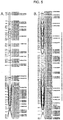
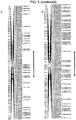
- QTL 1 localized to chromosome 5:25.3 - 82.1 cM as identified in FIGs. 5A- 5B and Table 19; or chromosome 5:25.2- 78.3 cM, or chromosome 5:28.5- 75.0 cM
- QTL 2 another major QTL was identified in the API, VJ, or QIR mapping populations, at chromosome 4::20.6- 87.4 cM (see FIGs.
- each allele of these two QTLs is estimated to have the potential to significantly reduce a plant's Downy Mildew disease rating in a DM pathology test as described herein, for instance in both the API and VJ mapping population genetic backgrounds, when grown in multiple tested geographic locations.
- An additional QTL (“QTL 4"; see FIGs. 5E- 5F ) mapping to chromosome 2: 22.3 - 88.4 cM also has an effect in cucumber Downy Mildew resistance, although its genetic effect is apparently more complex, with potential interactions with other QTLs and/or the growth environment.
- QTLs allow the use of specific molecular markers, such as those disclosed herein, in a plant breeding program to introgress a Downy Mildew Resistance trait or traits to agronomically acceptable cucumber lines.
- Marker-assisted introgression involves the transfer of a chromosomal region, defined by one or more markers, from one germplasm to a second germplasm.
- An initial step in that process is the localization of the trait by gene mapping which is the process of determining the position of a gene relative to other genes and genetic markers through linkage analysis.
- the basic principle for linkage mapping is that the closer together two genes are on the chromosome, the more likely they are to be inherited together.
- a cross is made between two genetically compatible but divergent parents relative to a trait under study (e.g. DM resistance). Genetic markers are then used to follow the segregation of traits under study in the progeny from the cross, often termed a "mapping population.”
- the current disclosure relates to the introgression in cucumber of genetic material, e.g., mapping to one or more QTLs, which is capable of causing a plant to be more resistant to the pathogen which causes cucumber Downy mildew disease.
- the present inventors have identified chromosomal regions responsible for enhanced DM resistance and used marker assisted breeding to introgress these specific linkage blocks into other cucumber germplasm which lacked such resistance to DM.
- Such process for producing DM resistant cucumber plant or line comprises introgressing at least one chromosomal locus mapping to QTL 1, QTL 2, and/or QTL 4 from a more DM resistant cucumber plant, line, or variety into a less DM resistant cucumber plant, line, or variety.
- the more DM resistant cucumber plant, line, or variety may be PI197088, or a progeny plant thereof.
- Introgression of a particular DNA element or set of elements into a plant genotype is defined as the result of the process of backcross conversion.
- a plant genotype into which a DNA sequence has been introgressed may be referred to as a backcross converted genotype, line, or variety.
- Such genotype, line, or variety may be an inbred or a hybrid genotype, line, or variety.
- a plant genotype lacking said desired DNA sequence may be referred to as an unconverted genotype, line, or variety.
- the genetic markers linked to enhanced DM resistance may be used to assist in breeding for the purpose of producing cucumber plants with increased resistance to Pseudoperonospora cubensis.
- DM resistance trait into a cucumber plant may be monitored by visual clues such as by use of a disease resistance test with a disease rating scale as described herein, and/or by monitoring and breeding for the presence of molecular markers as described herein ( i . e . marker assisted selection).
- markers may be genetically linked to the described QTLs for DM resistance which are located on cucumber chromosomes 2, 4, or 5, for instance as defined in the genetic map of Ren et al. (PLoS ONE 4:e5795, 2009; doi:10.1371/journal.pone.0005795 ).
- the markers may be within 50 cM, 45 cM, 40 cM, 30 cM, 20 cM, 10 cM, 5 cM, 3 cM, 1 cM, or less, of QTL 1 defined on chromosome 5, at 22.6-81.0 cM; or QTL 2 defined on chromosome 4 at 37.7-87.6 cM; or QTL 4 defined on chromosome 2 at 21.8- 73.8 cM, based on analysis of the API and VJ mapping populations as described herein.
- the markers used to follow the presence of any of these QTLs for DM resistance which are located on cucumber chromosomes 5, 4, or 2 may be selected from the group consisting of: NN0223782, NN0225385, NN0226670, NN0224124, NN0246472, NN0225358, NN0227700, NN0224617, NN0247695, NN0227242, NN0223824, NN0223181, NN0226638, NN0225012, NN0228579, NN0226451, NN0225088, NN0226219, NN0247551, NN0246357, NN0225551, NN0226732, NN0247689, NN0247342, NN0224702, NN0225482, NN0224538, NN0247543, NN0224041, NN0228853, NN0227762, NN0227587, NN0228457, NN0246
- the presence of alleles conferring resistance to DM may be identified by use of well known techniques, such as by nucleic acid detection methods utilizing probes or primers comprising a sequence selected from the group consisting of SEQ ID NO:1-87.
- the method comprises detecting the presence of one or more single nucleotide polymorphisms (SNP's) given in one or more of SEQ ID NOs:20-87.
- the DM resistance QTL of chromosome 2 is defined as spanning the region defined by SNP marker NN0223782 (map position 22.5 according to Table 19), to SNP marker NN0226638 (map position 88.4). Furthermore, the DM resistance QTL of chromosome 2 is defined as spanning the region defined by SNP marker NN0246378 (map position ⁇ 14.6 according to Tables 19 or 22), to SNP marker NN0246472 (map position 38.4 according to Table 19).
- the DM resistance QTL of chromosome 4 is defined as spanning the region defined by SNP marker NN0225012 (map position 20.6), to SNP marker NN0227587 (map position 87.4). Furthermore, the DM resistance QTL of chromosme 4 is defined as spanning the region defined by SNP marker NN225088 (map position 30.4) to SNP marker NN0224041 (map position 75.8). Even further, the DM resistance QTL of chromosome 4 is defined as spanning the region defined by SNP marker NN0228579 (map position 25.8), to SNP marker NN0224495 (map position 82.0).
- the DM resistance QTL of chromosome 5 is defined as spanning the region defined by SNP marker NN0228457 (map position 25.2), to SNP marker NN0228148 (map position 82.7), as listed in Tables 13 and 19. Furthermore, the DM resistance QTL of chromosome 5 is defined as spanning the region defined by SNP marker NN0224856 (map position 28.5) to SNP marker NN0223160 (map position 75.0). Even further, the DM resistance QTL of chromosome 5 is defined as spanning the region defined by SNP marker NN5096749 (map position 25.2), to SNP marker NN0227071 (map position 78.3).
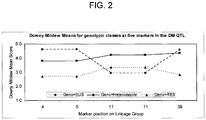
- QTL 1 has also been defined in a mapping population based on a cross of cucumber lines Lucinde and PI197088, as being located between genetic markers ENK59 and CAPs_17563/66, at about 5 cM- 39 cM in the linkage group, and as defined by analysis of that mapping population ( e . g . see FIG. 1 ). Further, one of skill in the art would understand that assignment of such genetic map positions may be affected by the mapping population being analyzed, including for instance the parent lines used, the marker density, and the size of the population, each of which may affect the level of recombination which is seen, and thus the assigned genetic map position.
- An integrated genetic and physical map may be utilized to define the position of a cucumber QTL, such as one provided by Ren et al , 2009, for instance relative to markers with known genetic and/or physical map positions.
- the DM resistant cucumber plants disclosed herein may bear one or more alleles conferring DM resistance that have been introduced into the cucumbers from a line designated PI197088 comprising the DM resistance, but otherwise comprising poor agronomic characteristics.
- the resulting DM resistant cucumber plants surprisingly display elite agronomic traits in combination with DM resistance, while lacking deleterious traits.
- DM resistant cucumber plants may have large leaves that form a canopy over the fruit.
- the vine is typically indeterminate and grown on trellises or the ground.
- DM resistant cucumber plants may have dark green, green, light green to yellow, and occasionally yellow to brown leaves.
- the leaves of the DM resistant cucumber plants vary in size, but typically are from about 200-250 mm in length and 150-200 mm in width, and are usually simple, alternate, palmate, and lobed.
- the ripe fruit of DM resistant cucumber plants of the present disclosure can vary from light to medium green, or even dark green, and typically the color on an individual fruit varies from a lighter-colored blossom end to a darker colored stem-end. The color may be mottled with yellow speckles.
- the fruit of DM resistant cucumber is typically elongated and cylindrical with rounded or blunt ends, but may also be straight or curved, and is usually 25-30 cm in length at harvest maturity, although the fruit may be edible at 11-14 cm.
- the skin of the fruit is typically smooth, dull and thick; the skin may be tough or tender with a varied number of tubercules.
- the flesh of the fruit is usually cream colored, with or without stripes, and has a bitter-free taste.
- a "susceptible control cucumber plant” refers to a cucumber plant susceptible to Downy Mildew (DM susceptible) including commercially available and wild relatives of modern cucumber plants.
- the control cucumber plant is the variety MARAM, SMR58, CORONA, or SPRINT 440.
- a "resistant control cucumber plant” may also be utilized when evaluating DM resistant cucumber varieties.
- Such a control may be a cucumber plant that is not susceptible to DM, but is otherwise agriculturally undesirable, for example, variety PI197088.
- some controls may have intermediate resistance, for example, controls with intermediate resistance to DM may be DMP21, GP14, LLP-1, ADEFEM, SWEETSLICE, or POINSETT 76.
- a control cucumber line is grown under similar environmental conditions as the comparative cucumber line, according to the present disclosure.
- hybrid cucumber plant includes a plant resulting directly or indirectly from crosses between populations, breeds or cultivars within the species Cucumis sativus.
- Hybrid cucumber plant as used herein also refers to plants resulting directly or indirectly from crosses between different varieties or genotypes.
- a "female parent” refers to a cucumber plant that is the recipient of pollen from a male donor line, which pollen successfully pollinates an egg.
- a female parent can be any cucumber plant that is the recipient of pollen.
- Such female parents can be male sterile, for example, because of genic male sterility, cytoplasmic male sterility, or because they have been subject to manual emasculation of the stamens.
- Genic or cytoplasmic male sterility can be manifested in different manners, such as sterile pollen, malformed or stamenless flowers, positional sterility, and functional sterility.
- cytoplasmic male sterility refers to plants that are not usually capable of breeding from self-pollination, but are capable of breeding from cross-pollination.
- linkage is a phenomenon wherein alleles on the same chromosome tend to segregate together more often than expected by chance if their transmission was independent.
- a "marker” is an indicator for the presence of at least one phenotype, genotype, or polymorphism. Markers include single nucleotide polymorphisms (SNPs), cleavable amplified polymorphic sequences (CAPS), amplified fragment length polymorphisms (AFLPs), restriction fragment length polymorphisms (RFLPs), simple sequence repeats (SSRs), insertion(s)/deletion(s) (“INDEL”(s)), inter-simple sequence repeats (ISSR), and random amplified polymorphic DNA (RAPD) sequences.
- SNPs single nucleotide polymorphisms
- CAS cleavable amplified polymorphic sequences
- AFLPs amplified fragment length polymorphisms
- RFLPs restriction fragment length polymorphisms
- SSRs simple sequence repeats
- INDEL insertion(s)/deletion(s)
- ISSR inter-simple sequence repeats
- a marker is preferably inherited in codominant fashion (both alleles at a locus in a diploid heterozygote are readily detectable), with no environmental variance component, i . e ., heritability of 1.
- a "nucleic acid marker” as used herein means a nucleic acid molecule that is capable of being a marker for detecting a polymorphism, phenotype, or both associated with DM resistance.
- Stringent conditions for hybridization of a nucleic acid probe or primer to a marker sequence or a sequence flanking a marker sequence refers, for instance, to nucleic acid hybridization conditions of 5 X SSC, 50% formamide, and 42 °C.
- marker assay means a method for detecting a polymorphism at a particular locus using a particular method, e.g. measurement of at least one phenotype (such as a visually detectable trait, including disease resistance), restriction fragment length polymorphism (RFLP), single base extension, electrophoresis, sequence alignment, allelic specific oligonucleotide hybridization (ASO), random amplified polymorphic DNA (RAPD), microarray-based technologies, PCR-based technologies, and nucleic acid sequencing technologies.
- phenotype such as a visually detectable trait, including disease resistance
- RFLP restriction fragment length polymorphism
- ASO allelic specific oligonucleotide hybridization
- RAPD random amplified polymorphic DNA
- microarray-based technologies e.g., PCR-based technologies, and nucleic acid sequencing technologies.
- a "desirable trait” or “desirable traits” that may be introduced into DM resistant cucumber plants by breeding may be directed to the cucumber fruit or the cucumber plant.
- Desirable traits to be introduced into cucumber plants and cucumber fruit may be independently selected.
- Desirable cucumber fruit traits e.g. as displayed by agronomically elite lines or cultivars, and that may be independently selected include: fruit size, shape, color, surface appearance; seed number, seed size, locule number; pericarp thickness and toughness; taste, bitterness, the presence of tubercles, and shelf life.
- Desirable cucumber plant traits e.g.
- agronomically elite lines or cultivars include: plant vigor, leaf shape, leaf length, leaf color, plant height, whether the plant is determinate or not, time to maturity, adaptation to field growth, adaptation to greenhouse growth, and resistance to one or more diseases or disease causing organisms such as Verticillium wilt, root knot nematodes, Tobacco Mosaic Virus, Cucumber scab, Anthracnose race 1, Powdery mildew ( e.g. caused by Erysiphe cichoracearum or Sphaerotheca fuliginea ), Target spot, Cucumber Mosaic Virus and Fusarium wilt.
- diseases or disease causing organisms such as Verticillium wilt, root knot nematodes, Tobacco Mosaic Virus, Cucumber scab, Anthracnose race 1, Powdery mildew ( e.g. caused by Erysiphe cichoracearum or Sphaerotheca fuliginea ), Target
- Any combination of desirable cucumber fruit traits, cucumber plant traits, or cucumber plant and fruit traits may be combined with a DM resistance trait.
- the resulting agronomically elite DM resistant cucumber plants surprisingly display such agronomic traits in combination with DM resistance, while lacking deleterious traits.
- polymorphism means the presence of one or more variations of a nucleic acid sequence at one or more loci in a population of one or more individuals.
- the variation may comprise one or more base changes, the insertion of one or more nucleotides or the deletion of one or more nucleotides.
- a polymorphism may arise from random processes in nucleic acid replication, through mutagenesis, as a result of mobile genomic elements, from copy number variation and during the process of meiosis, such as unequal crossing over, genome duplication and chromosome breaks and fusions.
- the variation can be commonly found, or may exist at low frequency within a population, the former having greater utility in general plant breeding and the latter may be associated with rare but important phenotypic variation.
- Useful polymorphisms may include single nucleotide polymorphisms (SNPs), insertions or deletions in DNA sequence (Indels), simple sequence repeats of DNA sequence (SSRs) a restriction fragment length polymorphism, and a tag SNP.
- SNPs single nucleotide polymorphisms
- Indels DNA sequence
- SSRs simple sequence repeats of DNA sequence
- a genetic marker, a gene, a DNA-derived sequence, a haplotype, a RNA-derived sequence, a promoter, a 5' untranslated region of a gene, a 3' untranslated region of a gene, microRNA, siRNA, a QTL, a satellite marker, a transgene, mRNA, dsRNA, a transcriptional profile, and a methylation pattern may comprise polymorphisms.
- the presence, absence, or variation in copy number of the preceding may comprise a polymorphism.
- genotype is the actual nucleic acid sequence at a locus in an individual plant.
- phenotype means the detectable characteristics (e . g . level of DM resistance) of a cell or organism which can be influenced by genotype.
- DM resistance of a cucumber plant provided herein can potentially be defined as complete resistance or partial resistance.
- the DM resistance of a cucumber plant provided herein can be measured by any means available in the art.
- DM resistance of a cucumber plant may be determined by using a disease rating of foliar chlorotic and/or necrotic lesion development after inoculation or infection with DM on cucumber leaves using a scale of symptoms of 0%, 10%, 20%, 30%, 40%, 50%, 60% and greater than about 60% lesion covering the leaf area.
- a disease rating of 0% indicates a completely resistant plant.
- DM resistance may further be determined by obtaining disease ratings of symptom development after one or more rounds of inoculation or infection with DM on cucumber leaves and/or cotyledons.
- Resistance in a leaf test may be scored on an exemplary scale as follows: Index Value Symptoms 1 Absence of symptoms 2 Few small necrotic lesions without expansion 3 Few chlorotic and some necrotic lesions with limited expansion 4 Large expanding angular chlorosis with limited necrotic lesions 5 Large expanding angular chlorosis with expanding necrotic lesions Tests are evaluated once symptoms have developed on susceptible checks ( e . g . cultivars Maram or SMR58). PI 197088 may be used as a "resistant” control; and cv. Poinsett 76 or other cv. exhibiting a comparable level of Downy Mildew resistance may be used as a control to assess "intermediate" levels of resistance/susceptibility to P. cubensis.
- a plant may be assayed for DM resistance, partial resistance or susceptibility by image analysis of foliar tissue using about 3 leaves per plant captured in a digital image. The image analysis is conducted to determine the percentage of tissue damage and derive a disease rating. Image analysis software and methods used for quantifying visual differences in two or three dimensions are those set forth in Bright, 1987 (J. Microscopy 148:51-87 ) and Bickmore et al., 1999 (Geol. Mat. Res. 1(5):1-19 ).
- very resistant exhibits between about 0% and 5% leaf area symptoms of chlorotic and/or necrotic lesions; “resistant” is between about 1% and 20% of the leaf area having symptoms of chlorotic and/or necrotic lesions; “substantially resistant” is between about 20% and 30% of the leaf area having symptoms of chlorotic and/or necrotic lesions; “mid-resistant” is between 40% and 50% of the leaf area having symptoms of chlorotic and/or necrotic lesions; “partially resistant” is less than or equal to about 50% of the leaf area having symptoms of chlorotic and/or necrotic lesions; “mid-susceptible” is between about 50% and 60% of the leaf area having symptoms of chlorotic and/or necrotic lesions; and “susceptible” is between about 60% and 100% of the leaf area having symptoms of chlorotic and/or necrotic lesions.
- a resistant plant can be characterized as set forth herein, or by the use of other means, such as quantitative PCR to determine the level of infection.
- Cucumber lines having DM resistance, or partial resistance demonstrate a reduced level of symptoms relative to a non-resistant control cucumber line after inoculation or infection with DM.
- the level of symptoms can be used as an indicator of DM resistance.
- Disease symptoms measured can be any disease symptoms associated with DM infection. Symptoms can be selected from the group consisting of leaf blisters, necrosis, soft fruits, mosaic, chlorotic veins, chlorotic leaf spots, chlorotic and/or light green mosaic on leaves, fruit lesions, or combinations thereof.
- a DM resistant cucumber line may demonstrate a reduction of foliar symptoms of chlorotic and/or necrotic lesions of at least, or greater than, 10%, 20%, 25%, 30%, 40%, 50%, 60%, 70%, 75%, 80%, 85%, 90%, 95%, or 98% relative to a non-resistant control cucumber line. Furthermore, the leaves of a DM resistant cucumber plant may demonstrate less than 15%, or less than 10%, or less than 5%, or less than 2% symptomatic area when exposed to DM. Finally, the cucumber plant belongs to a cucumber variety or cultivar, and in another aspect, the cucumber plant is an inbred cucumber plant.
- a DM resistant cucumber plant demonstrates symptoms of chlorotic and/or necrotic lesions on less than 10%, 9%, 8%, 7%, 6%, 5%, 4%, 3% 2%, or 1% of the cucumber leaf surface.
- DM resistant cucumber plants may exhibit a delay in the onset of symptoms of chlorotic and/or necrotic lesions relative to a non-resistant control cucumber plant.
- the DM resistant cucumber plants may exhibit a delay of 1, 2, 3, 4, 5, 6, 7, 8, 9, 10, 11, 12, 13, 14, or more days in the onset of symptoms of chlorotic and/or necrotic lesions relative to a control cucumber plant.
- the DM resistant cucumber plants may exhibit a delay of at least 7 or more days, 10 or more days, or 14 or more days in the onset of symptoms of chlorotic and/or necrotic lesions relative to a control cucumber plant.
- the cucumber plant may be a seedling at the time of inoculation or infection. Further, the cucumber plant may be a seedling at the 4, 5, 6, 7, or 8 leaf stage of development when inoculated. Further, disease symptoms can be measured at any time after pathogenic challenge of a cucumber plant. Further, symptoms can be measured 2, 3, 4, 5, 6, 7, 8, 9, 10, 11, 12, 13, 14, 15, 16, 17, 18, 19, 20, 21, or more days after inoculation. Finally, the cucumber plant may be any age of plant at the time of inoculation or infection.
- disease symptoms may be observed after DM challenge of an entire plant or a part thereof, for example, a plant cutting.
- DM resistant cucumber plants may exhibit an increase in fruit yield after inoculation or infection with DM relative to a control cucumber plant inoculated with DM.
- the resistant cucumber plants may exhibit a 2%, 5%, 10%, 15%, 20% or more increase in fruit yield, based upon the total mass, number, or total volume of fruit, relative to a control cucumber plant after one or more rounds of inoculation or infection with DM.
- cucumber plants that exhibit resistance to one or more races of DM.
- the cucumber plants may exhibit resistance to 1, 2, 3, 4, 5, 6, 7, 8, 9, 10, or more races of DM.
- a seed of a cucumber plant capable of producing a plant having DM resistance may be an open-pollinated variety, a hybrid parent inbred line, or a male sterile line. Further disclosed is a seed of a cucumber plant capable of producing a hybrid cucumber plant having DM resistance.
- the cucumber plants disclosed herein may be cucumber lines adapted for greenhouse cucumber production or for field cucumber production. Such cucumber plants may be adapted for greenhouse cucumber production.
- hybrid cucumber having DM resistance Also disclosed is a hybrid cucumber having DM resistance.
- a hybrid cucumber exhibiting DM resistance after inoculation or infection with DM is also disclosed.
- Certain cucumber traits including, for example, fruit size, shape, color, weight, taste and fruit yield may be important to the commercial value of the crop.
- Fruit size, and shape may be of particular interest if the cucumbers are grown for processing such as pickling.
- a cucumber plant that produces a cucumber fruit having a length of about, or greater than about, 11, 12, 13, or 14 cm. Such a cucumber plant may produce a cucumber fruit having a length between 11 and 13 cm, 12 and 14 cm, and 11 and 14 cm.
- Such a cucumber plant may produce a cucumber fruit having a weight at harvest of about or greater than 80, 85, 90, 95, 100, 105, 110, 115, 120, and 125 grams. Furthermore, such a cucumber plant may produce a cucumber fruit having a weight at harvest between 80 and 125 g, 90 and 115 g, 100 and 120 g, 90 and 125 g, 95 and 125 g, 100 and 125 g, or between 115 and 125 g. Fruit weight is measured by weighing individual cucumber fruit on a scale.
- Mature cucumber fruit produced by DM resistant plants may have a diameter from 10, 11, 12, 13, or 14 mm or larger.
- the diameter of the cucumber fruit may be from 10 to 11 mm, or from 10 to 12 mm, or from 11 to 13 mm, or from 12 to 14 mm, or from 13 to 14 mm.
- a cucumber fruit attribute such as shape, weight, or size can be measured or evaluated at a variety of times.
- an attribute may be measured following growth in a growth chamber.
- an attribute may be measured at the time of harvest.
- an attribute may be measured after storage of the cucumber fruit at ambient conditions for one day, two days, three days, four days, five days, six days, seven days, eight days, nine days, ten days, eleven days, twelve days, thirteen days, two weeks, three weeks, four weeks, or five weeks after harvest.
- Fruit Quality relates to fruit color, fruit shape, fruit length and diameter.
- tissue cultures of the cucumber plants described herein indicates a composition comprising isolated cells of one or more types, or a collection of such cells organized into parts of a plant.
- Tissue culture includescompositions comprising protoplasts and calli.
- Tissue culture also includes compositions comprising plant cells that are present in intact plant tissues, or parts of plants, such as embryo, leaf, peduncle, pedicel, anther, meristem, tip and segments of root, stump and stem and explants.
- a tissue culture may comprise embryos, protoplasts, meristematic cells, pollen, leaves, anthers or cells derived from immature tissues of these plant parts. Means for preparing and maintaining plant tissue cultures are well known in the art.
- tissue culture of the cucumber plants described herein relates to the culture of protoplasts, calli, or plant cells, that are isolated from, or present in, intact parts of the DM resistant plants described herein.
- Tissue culture refers to the culture of protoplasts, calli, or plant cells, that are isolated from, or present in, intact parts of plants of one or more DM resistant cucumber plant lines selected from the group consisting of ASL147-2027, EUR154-1012GY, EUR154-1021GY, GSP33-1094GY, GPN33-1093GY, 03/8020-20_TUP03_DMFL_1, 03/8024-19_TUP03_DMFL_1, and 03/8039-5_TUP03_DMFL_1, and DM resistant progeny thereof, including those produced by crosses or backcrosses, as listed in U.S. Patent Application Serial No. 12/424,452 , published as US 2009-0265803 .
- a tissue culture of the cucumber plants described herein relates to the culture of protoplasts, calli, or plant cells, that are isolated from, or present in, intact parts of the DM resistant plants described herein.
- DM resistant progeny may be obtained through sexual reproduction.
- the seeds resulting from sexual reproduction can be recovered from the fruit of DM resistant plants and planted or otherwise grown as a means of propagation.
- DM resistant progeny may also be obtained from DM resistant plants through asexual reproduction.
- Protoplast or propagules e . g ., cuttings, scions or rootstocks
- a container of cucumber seeds in which cucumber plants grown from greater than 50% of the seeds have resistance or partial resistance to DM.
- Cucumber plants grown from greater than 55%, 65%, 75%, 85%, 90%, 95%, 98%, or 99% of the cucumber seeds in the container have DM resistance.
- the container of cucumber seeds can contain any number, weight or volume of seeds.
- a container can contain about, or greater than about, 10, 25, 50, 200, 400, 700, 1000, 2000, 3000, or more seeds.
- a container can contain about, or greater than about, 1 g, 5, 10, 15, 25, 100, 250, 500, or 1,000 g of seeds.
- the container can contain about or at least, or greater than, about 28 g (1 ounce), 57, 113, 227, 283 g (2, 4, 8, 10 ounces), 0.45 kg (1 pound), 0.91, 1.81, 3.63, 4.54 kg (2, 4, 8, 12 pounds) or more of seeds.
- Containers of cucumber seeds can be any container available in the art.
- a container can be a box, a bag, a packet, a pouch, a tape roll, a foil, a pail, or a tube.
- the container may contain about 2, 5, 10, 20, 40, 80, 100, or more cucumber fruit. Furthermore disclosed is a cucumber vine having cucumber fruit from a plant having resistance to DM.
- dried, or otherwise processed, cucumber fruit produced by a cucumber plant having a genome that comprises at least one genetic locus giving rise to DM resistance when expressed in a cucumber plant.
- Processed cucumber fruit includes fruit pulp, stewed cucumbers, canned, pickled, minced, sliced, or crushed cucumber fruit.
- the dried, pickled, or otherwise processed cucumber fruit may be the fruit of a cucumber plant of a line selected from the group consisting of: ASL147-2027, EUR154-1012GY, EUR154-1021GY, GSP33-1094GY, GPN33-1093GY, 03/8020-20_TUP03_DMFL_1, 03/8024-19_TUP03_DMFL_1, and 03/8039-5_TUP03_DMFL_1.
- an inbred cucumber plant having resistance to DM having resistance to DM, wherein the resistance is exhibited when the plant is in contact with DM.
- the inbred cucumber plant may be derived from accession PI197088.
- C . sativus plants having at least one allele for a DM resistance trait.
- the DM resistant cucumber plants can be either heterozygous or homozygous for the DM resistance trait.
- the DM resistant trait may be linked to variations in a single gene ( e . g ., linked to one or more alleles of a single gene).
- the DM resistance trait may be linked to variations at one or one or more quantitative trait loci (QTL).
- QTL quantitative trait loci
- the DM resistant cucumber plants may be homozygous for the DM resistance trait.
- a C . sativus cucumber plant having a genome that comprises at least one genetic locus that provides DM resistance from a non- C . sativus plant.
- the DM resistant cucumber plant may be selected from the group consisting of: ASL147-2027, EUR154-1012GY, EUR154-1021GY, GSP33-1094GY, GPN33-1093GY, 03/8020-20_TUP03_DMFL_1, 03/8024-19_TUP03_DMFL_1, and 03/8039-5_TUP03_DMFL_1, and DM resistant progeny thereof.
- the genetic locus derived from a DM resistant cucumber plant can be identified using genetic markers.
- a DM resistant C . sativus cucumber plant having less than or equal to 50% of its genome derived from a non- C . sativus DM resistant plant.
- a DM resistant C . sativus cucumber plant may have 50%, 25%, 12.5%, 6%, 3% or less nuclear DNA derived from a DM resistant non- C . sativus plant.
- Such a DM resistant C . sativus cucumber plant can have 50%, 25%, 12.5%, 6% or 3% or less nuclear DNA derived from another member of the Cucumis genus that is DM resistant.
- progeny of cucumber plants having resistance to DM include not only the products of any cross (be it a backcross or otherwise) between two plants, but all progeny whose pedigree traces back to the original cross.
- the progeny may contain about 50%, 25%, 12.5% or less nuclear DNA from a DM resistant cucumber plant and expresses the genetic material that provides DM resistance.
- Representative populations of cucumber plants comprising progeny having resistance to DM include progeny of the cross of susceptible parent cv. Lucinde x PI197088, as well as the API and VJ populations, generated from crossing each of two susceptible parents (API-45-5312-MO and VJ03-68-06) by the same resistant line (PI197088).
- DM resistant cucumber plant that contains a genetic marker linked to one or more DM resistance locus.
- DM resistance locus is meant a locus that contributes to DM resistance either alone or in combination with one more other DM resistance locus.
- tributes to Downy Mildew resistance it is meant that the degree of Downy Mildew resistance is increased in the corresponding plant, either when the locus is alone or in combination with one or more other locus.
- a marker linked to one or more DM resistance loci may include one or more of the following: CAPs_21826, CAPs_ENK60, CAPs_ENK59, CAPs_17170, CAPs_17179, CAPs_18229 CAPs_17563/66, and CAPs_ENK70.
- the assayed markers linked to one or more DM resistance loci may include each of the following: CAPs_ENK60, CAPs_17170, and CAPs_17563/66.
- the marker(s) linked to one or more DM resistance loci may include one or more SNP marker(s) selected from the group consisting of: NN0223782, NN0225385, NN0226670, NN0224124, NN0246472, NN0225358, NN0227700, NN0224617, NN0247695, NN0227242, NN0223824, NN0223181, NN0226638, NN0225012, NN0228579, NN0226451, NN0225088, NN0226219, NN0247551, NN0246357, NN0225551, NN0226732, NN0247689, NN0247342, NN0224702, NN0225482, NN0224538, NN0247543, NN0224041, NN0228853, NN0227762, NN0227587, NN0228457, NN0246356, NN0246332,
- linkage of two nucleic acid sequences including a nucleic acid marker sequence and a nucleic acid sequence of a genetic locus imparting a desired trait such as DM resistance, may be genetic or physical or both.
- the nucleic acid marker and genetic locus conferring DM resistance may be genetically linked, and may exhibit a LOD score of greater than 2.0, as judged by interval mapping for the DM resistance trait based on maximum likelihood methods described by Lander and Botstein, 1989 (Genetics, 121:185-199 ), and implemented in the software package MAPMAKER ( e.g. Lander et al., Genomics 1:174-181, (1987 ); default parameters).
- the marker and region conferring DM resistance may be genetically linked and may exhibit a LOD score of greater than 3.0, or a LOD score of greater than 6.0, 9.0, 12.0, 15.0, or 18.0.
- the marker and region contributing to DM resistance may be genetically linked and may exhibit a LOD score of between about 14 and about 20.
- the nucleic acid marker may be genetically linked at a distance of between 0 and 50 centimorgans (cM) to the DM resistance locus.
- the distance between the nucleic acid marker and the DM resistance locus is between 0 and 35 cM, or between 0 and 25 cM, or between 0 and 15 cM, or between 0 and 10 cM, or between 0 and 5 cM, including less than 4, 3, 2 or 1 cM.
- a cucumber plant comprising an introgressed chromosomal region from chromosome 2 of PI197088 or a progeny plant thereof, of 20 cM, 10 cM, 5 cM, or 1 cM within the region defined as spanning the positions of SNP marker NN0246378 and SNP marker NN0246472; or SNP marker NN0246378 and SNP marker NN0247695.
- a cucumber plant comprising an introgressed chromosomal region from chromosome 4 of PI197088 or a progeny plant thereof, of 20 cM, 10 cM, 5 cM, or 1 cM within the region defined as spanning the positions of SNP marker NN0225012 and SNP marker NN0227587; or SNP marker NN0228579 and SNP marker NN0224495; or SNP marker NN0225088 and SNP marker NN224041.
- a cucumber plant comprising an introgressed chromosomal region from chromosome 5 of PI197088 or a progeny plant thereof, of 20 cM, 10 cM, 5 cM, or 1 cM within the region defined spanning the positions of SNP marker NN5096749 and NN0227071; or SNP marker NN5096749 and SNP marker NN0223160; or SNP marker NN0224856 and SNP marker NN0223160.
- Such cucumber plant may comprise an introgressed chromosomal region of chromosome 2 from PI197088 and an introgressed chromosomal region of chromosome 4 or 5 of PI197088, wherein the introgressed chromosomal regions allow for enhanced resistance to DM, relative to an otherwise isogenic cucumber line not comprising one or more of the introgressed region(s).
- the cucumber plant may comprise an introgressed chromosomal region of chromosome 4 from PI197088 and an introgressed chromosomal region of chromosome 2 and/or 5 of PI197088, or an introgressed region from chromosome 5 of PI197088 or a progeny thereof, and an introgressed chromosomal region of chromosomes 2 and/or 4 of PI197088 or a progeny plant thereof, wherein the introgressed chromosomal region(s) allow for enhanced resistance to DM, relative to an otherwise isogenic cucumber line not comprising one or more of the introgressed region(s).
- the introgressed chromosomal fragment from PI197088 or a progeny plant thereof may comprise a chromosomal region of about 20 cM, 10, cM, 5 cM, or 1 cM, and may further comprise a PI197088-derived allele at SNP marker NN0226631 of chromosome 5.
- the introgressed chromosomal fragment from PI197088 or a progeny plant thereof may comprise a chromosomal region of about 20 cM, 10, cM, 5 cM, or 1 cM, and further may comprise a PI197088-derived allele at SNP marker NN0246425 of chromosome 4.
- the nucleic acid marker sequence may be physically linked to a DM resistance locus.
- the nucleic acid sequence of the genetic marker specifically hybridizes to a nucleic acid molecule having a sequence that is within about 30 Mbp, or about 20 Mbp, or about 15 Mbp, or about 10 Mbp, or about 5 Mbp of a DM resistance locus.
- the nucleic acid sequence of the genetic marker specifically hybridizes to a nucleic acid molecule having a sequence of any of SEQ ID NOs:1-87, or a complement thereof.
- nucleic acid molecules are said to be capable of hybridizing to one another if the two molecules are capable of forming an anti-parallel, double-stranded nucleic acid structure.
- Conventional stringency conditions are described by Sambrook et al., Molecular Cloning, A Laboratory Manual, 2nd Ed., Cold Spring Harbor Press, Cold Spring Harbor, New York (1989 ) and by Haymes et al., Nucleic Acid Hybridization, A Practical Approach, IRL Press, Washington, DC (1985 ). Departures from complete complementarity are therefore permissible, as long as such departures do not completely preclude the capacity of the molecules to form a double-stranded structure.
- a nucleic acid molecule in order for a nucleic acid molecule to serve as a primer or probe it need only be sufficiently complementary in sequence to be able to form a stable double-stranded structure under the particular solvent and salt concentrations employed.
- Appropriate stringency conditions which promote DNA hybridization for example, 6.0 X sodium chloride/sodium citrate (SSC) at about 45°C, followed by a wash of 2.0 X SSC at 50°C, are known to those skilled in the art or can be found in Current Protocols in Molecular Biology, John Wiley & Sons, N.Y. (1989), 6.3.1-6.3.6 .
- hybridization conditions can be high, moderate or low stringency conditions.
- Preferred conditions include those using 50% formamide, 5.0 X SSC, 1% SDS and incubation at 42 °C for 14 h, followed by a wash using 0.2 X SSC, 1% SDS and incubation at 65 °C.
- the specificity of hybridization can be affected by post-hybridization washes.
- the salt concentration in the wash step can be selected from a low stringency of about 2.0 X SSC at 50 °C to a moderate stringency of about 1.0 X SSC at 50 °C to a high stringency of about 0.2 X SSC at 50 °C.
- the temperature in the wash step can be increased from low stringency conditions at room temperature, about 22 °C, to moderate stringency conditions at about 50 °C, to high stringency conditions at about 65 °C. Both temperature and salt concentration may be varied, or either the temperature or the salt concentration may be held constant while the other variable is changed.
- the wash step can be performed for 5, 10, 15, 20, 25, 30, or more min.
- the wash step is performed for about 20 min.
- the wash step can be repeated 1, 2, 3, 4, or more times using the selected salt concentration, temperature, and time. The wash step may be repeated twice.
- a genetic marker profile of a plant may be predictive of the agronomic traits of a hybrid produced using that inbred. For example, if an inbred plant of known genetic marker profile and phenotype is crossed with a second inbred of known genetic marker profile and phenotype it is possible to predict the phenotype of the F 1 hybrid based on the combined genetic marker profiles of the parent inbreds. Methods for prediction of hybrid performance from genetic marker data are disclosed in U.S. Patent No. 5,492,547 . Such predictions may be made using any suitable genetic marker, for example, SSRs, INDELs, RFLPs, AFLPs, SNPs, ISSRs, or isozymes.
- markers such as SSRs, AFLP markers, RFLP markers, RAPD markers, phenotypic markers, SNPs, isozyme markers, or microarray transcription profiles that are genetically linked to or correlated with DM resistance can be utilized ( Walton, Seed World 22-29 (July, 1993 ); Burow and Blake, Molecular Dissection of Complex Traits, 13-29, Eds. Paterson, CRC Press, New York (1988 )). Methods to isolate such markers and to design probes or primers useful in following the presence of such markers are known in the art.
- locus-specific SSRs can be obtained by screening a cucumber genomic library for SSRs, sequencing of "positive" clones, designing primers which flank the repeats, and amplifying genomic DNA with these primers.
- SNP markers may be identified as well.
- the genetic linkage of marker molecules to DM resistance can be established by a gene mapping model such as, without limitation, the flanking marker model, and the interval mapping, based on maximum likelihood methods described by Lander and Botstein, 1989 (Genetics, 121:185-199 ), and implemented in the software packages MAPMAKER (Whitehead Institute for Biomedical Research, Cambridge MA, USA) or QTL Cartographer (North Carolina State University, Bioinformatics Research Center).
- a gene mapping model such as, without limitation, the flanking marker model, and the interval mapping, based on maximum likelihood methods described by Lander and Botstein, 1989 (Genetics, 121:185-199 ), and implemented in the software packages MAPMAKER (Whitehead Institute for Biomedical Research, Cambridge MA, USA) or QTL Cartographer (North Carolina State University, Bioinformatics Research Center).
- a maximum likelihood estimate (MLE) for the presence of a marker is calculated, together with an MLE assuming no trait effect, to avoid false positives.
- the LOD score essentially indicates how much more likely the data are to have arisen assuming the presence of a resistance allele rather than in its absence.
- the LOD threshold value for avoiding a false positive with a given confidence depends on the number of markers and the length of the genome. Graphs indicating LOD thresholds are set forth in Lander and Botstein (1989), and further described by Ars and Moreno-Gonzalez, Plant Breeding, Hayward, Bosemark, Romagosa (eds.) Chapman & Hall, London, pp. 314-331 (1993 ), and van Ooijen (Heredity 83:613-624, 1999 ).
- mapping population depends on the type of marker systems employed ( Tanksley et al., Molecular mapping plant chromosomes. Chromosome structure and function: Impact of new concepts J. P. Gustafson and R. Appels (eds.), Plenum Press, New York, pp. 157-173 (1988 )). Consideration must be given to the source of parents (adapted vs. exotic) used in the mapping population. Chromosome pairing and recombination rates can be severely disturbed (suppressed) in wide crosses (adapted x exotic) and generally yield greatly reduced linkage distances. Wide crosses will usually provide segregating populations with a relatively large array of polymorphisms when compared to progeny in a narrow cross (adapted x adapted).
- Advanced breeding lines are collected from breeding programs. These are tested for their phenotype (e . g . their disease score reactions to DM), and genotyped for markers in the DM QTL intervals. From these data, the smallest genetic interval is identified within each QTL containing the donor parent (DP) favorable allele among the DM resistant lines. This interval is inferred to be critical for conferring resistance to DM.
- Candidate genetic intervals associated with DM resistance were detected as regions showing enhanced frequency of the favorable allele from the DM resistance donor PI197088 relative to a baseline set of DM susceptible samples from the same germplasm classification type (GCT). For example, comparisons may be made among DM resistant and susceptible inbreds within a single GCT and a single breeding program.
- GCT germplasm classification type
- the progeny include not only the products of any cross (be it a backcross or otherwise) between two plants, but all progeny whose pedigree traces back to the original cross. Specifically, without limitation, such progeny include plants that have 50%, 25%, 12.5% or less nuclear DNA derived from one of the two originally crossed plants.
- a second plant is derived from a first plant if the second plant's pedigree includes the first plant.
- the Furthermore enclosed herein is a genetic complement of the cucumber lines described herein. Further disclosed is a hybrid genetic complement, wherein the complement is formed by the combination of a haploid genetic complement from elite inbred cucumber lines described herein and another haploid genetic complement. Means for determining such a genetic complement are well-known in the art.
- the phrase "genetic complement” means an aggregate of nucleotide sequences, the expression of which defines the phenotype of a plant, such as a C . sativus cucumber plant or a cell or tissue of that plant.
- a C . sativus cucumber plant is genotyped to determine a representative sample of the inherited markers it possesses. Markers are preferably inherited in codominant fashion so that the presence of both alleles at a diploid locus is readily detectable, and they are free of environmental variation, i . e ., their heritability is close to, or equal to, 1.
- This genotyping is preferably performed on at least one generation of the descendant plant for which the numerical value of the trait or traits of interest are also determined.
- the array of single locus genotypes is expressed as a profile of marker alleles, two at each locus for a diploid plant.
- the marker allelic composition of each locus can be either homozygous or heterozygous.
- Homozygosity is a condition where both alleles at a locus are characterized by the same conditions of the genome at a locus ( e . g ., the same nucleotide sequence).
- Heterozygosity refers to different conditions of the genome at a locus.
- SSRs simple sequence repeats
- INDEL insertion/deletion polymorphism
- RFLPs restriction fragment length polymorphisms
- AFLPs amplified fragment length polymorphisms
- SNPs single nucleotide polymorphisms
- isozymes for example, simple sequence repeats (SSRs), insertion/deletion polymorphism (INDEL), restriction fragment length polymorphisms (RFLPs), amplified fragment length polymorphisms (AFLPs), single nucleotide polymorphisms (SNPs), and isozymes.
- SSRs simple sequence repeats
- INDEL insertion/deletion polymorphism
- RFLPs restriction fragment length polymorphisms
- AFLPs amplified fragment length polymorphisms
- SNPs single nucleotide polymorphisms
- F 2 population is the first generation of self or sib pollination after the hybrid seed is produced.
- a single F 1 plant is self or sib pollinated to generate a population segregating for the nuclear-encoded genes in a Mendelian (1:2:1) fashion.
- progeny tests e . g ., F 3 or back cross self families
- the information gathered can be equivalent to that obtained in a completely classified F 2 population. This procedure is, however, often prohibitive because of the cost and time involved in progeny testing.
- Progeny testing of F 2 individuals is often used in map construction where error is associated with single plant phenotyping, or when sampling the plants for genotyping affects the ability to perform accurate phenotyping, or where trait expression is controlled by a QTL. Segregation data from progeny test populations (e . g. , F 3 or backcrossed or selfed families) can be used in trait mapping.
- Marker-assisted selection can then be applied to subsequent progeny based on marker-trait map associations (F 2 , F 3 ), where linkage has not been completely disassociated by recombination events ( i . e ., maximum disequilibrium).
- Recombinant inbred lines (genetically related lines; usually >F 5 ) can be used as a mapping population.
- RILs can be developed by selfing F2 plants, then selfing the resultant F3 plants, and repeating this generational selfing process, thereby increasing homozygosity. Information obtained from dominant markers can be maximized by using RILs because all loci are homozygous or nearly so. Under conditions of tight linkage ( i . e ., about ⁇ 10% recombination), dominant and co-dominant markers evaluated in RIL populations provide more information per individual than either marker type in backcross populations ( e.g. Reiter et al., 1992; Proc. Natl. Acad. Sci. (U.S.A.) 89:1477-1481 ). However, as the distance between markers becomes larger ( i . e ., loci become more independent), the information in RIL populations decreases dramatically when compared to codominant markers.
- Backcross populations can be utilized as mapping populations.
- a backcross population can be created by crossing an F 1 to one of its parents.
- backcross populations are created to recover the desirable traits (which may include most of the genes) from one of the recurrent parental (the parent that is employed in the backcrosses) while adding one or a few traits from the second parental, which is often referred to as the donor.
- a series of backcrosses to the recurrent parent can be made to recover most of the recurrent parent's desirable traits.
- a population is created consisting of individuals nearly like the recurrent parent, wherein each individual carries varying amounts or a mosaic of genomic regions from the donor parent.
- Backcross populations can be useful for mapping dominant markers particularly if all loci in the recurrent parent are homozygous and the donor and recurrent parent have contrasting polymorphic marker alleles ( Reiter et al., 1992; Proc. Natl. Acad. Sci. (U.S.A.) 89:1477-1481 ).
- Backcross populations are more informative (at low marker saturation) when compared to RILs as the distance between linked loci increases in RIL populations ( i . e ., about 15% recombination). Increased recombination can be beneficial for resolution of tight linkages, but may be undesirable in the construction of maps with low marker saturation.
- NIL Near-isogenic lines
- BSA Bulk segregant analysis
- Also disclosed herein is a method of producing a DM resistant cucumber plant comprising: (a) crossing a cucumber line having DM resistance with a second cucumber line lacking DM resistance to form a segregating population; (b) screening the population for resistance to DM; and (c) selecting one or more members of the population having said DM resistance.
- the cucumber line having DM resistance may be crossed with the second cucumber line for at least two generations ( e.g. , creating either an F 2 or BC 1 S 1 population).
- the cucumber line having DM resistance may be PI197088, or a progeny thereof.
- Plants may be identified as DM resistant prior to crossing. Plants may be selected on the basis of partial or complete resistance to DM.
- the segregating population may be self-crossed and the subsequent population may be screened for resistance.
- Also disclosed is a method of introgressing DM resistance into a cucumber plant comprising: (a) crossing at least a first cucumber line having DM resistance with a second cucumber line to form a segregating population; (b) screening said population for resistance to DM; and (c) selecting at least one member of said population exhibiting DM resistance.
- the cucumber line having DM resistance may be crossed with the second cucumber line for at least two generations ( e . g ., creating either an F 2 or BC 1 S 1 population), or up to 2-10 generations. Plants may be identified as DM resistant prior to crossing.
- the segregating population may be self-crossed and the subsequent population may be screened for resistance.
- Cucumber plants (and parts thereof, including seed, pollen, and ovules) generated using a method as disclosed herein are also disclosed, and can be part of or generated from a breeding program.
- the choice of breeding method depends on the mode of plant reproduction, the heritability of the trait(s) being improved, and the type of cultivar used commercially (e.g. , F 1 hybrid cultivar, pure line cultivar, etc). Selected approaches for breeding the plants are set forth below.
- a breeding program can be enhanced using marker assisted selection of the progeny of any cross. It is further understood that any commercial and non-commercial cultivars can be utilized in a breeding program. Factors such as, for example, emergence vigor, vegetative vigor, stress tolerance, disease resistance, branching, flowering, fruit size, fruit quality, and/or fruit yield will generally dictate the choice.
- breeding method can be used to transfer one or a few favorable genes for a highly heritable trait into a desirable cultivar. This approach has been used extensively for breeding disease-resistant cultivars.
- Various recurrent selection techniques are used to improve quantitatively inherited traits controlled by numerous genes. The use of recurrent selection in self-pollinating crops depends on the ease of pollination, the frequency of successful hybrids from each pollination, and the number of hybrid offspring from each successful cross.
- Breeding lines can be tested and compared to appropriate standards in environments representative of the commercial target area(s) for two or more generations. The best lines are candidates as parents for new commercial cultivars; those still deficient in traits may be used as parents for hybrids, or to produce new populations for further selection.
- One method of identifying a superior plant is to observe its performance relative to other experimental plants and to a widely grown standard cultivar. If a single observation is inconclusive, replicated observations can provide a better estimate of its genetic worth. A breeder can select and cross two or more parental lines, followed by repeated self or sib pollinating and selection, producing many new genetic combinations.
- hybrid seed can be produced by manual crosses between selected male-fertile parents or by using male sterility systems.
- Hybrids can be selected for certain single gene traits such as flower color, seed yield or herbicide resistance that indicate that the seed is truly a hybrid. Additional data on parental lines, as well as the phenotype of the hybrid, influence the breeder's decision whether to continue with the specific hybrid cross.
- Pedigree breeding and recurrent selection breeding methods can be used to develop cultivars from breeding populations. Breeding programs combine desirable traits from two or more cultivars or various broad-based sources into breeding pools from which cultivars are developed by selfing and selection of desired phenotypes into parent lines. These lines are used to produce new cultivars. New cultivars can be evaluated to determine which have commercial potential.
- Pedigree breeding is used commonly for the improvement of self-pollinating crops. Two parents who possess favorable, complementary traits are crossed to produce an F 1 . An F 2 population is produced by selfing one or several F 1 's. Selection of the best individuals in the best families is performed. Replicated testing of families can begin in the F 4 generation to improve the effectiveness of selection for traits with low heritability. At an advanced stage of inbreeding ( i . e ., F 6 and F 7 ), the best lines or mixtures of phenotypically similar lines are tested for potential release as new cultivars.
- Backcross breeding and cross breeding have been used to transfer genes for a simply inherited, highly heritable trait into a desirable homozygous cultivar or inbred line, which is the recurrent parent.
- the source of the trait to be transferred is called the donor parent.
- the resulting plant obtained from a successful backcrossing program is expected to have the attributes of the recurrent parent ( e . g ., cultivar) and the desirable trait transferred from the donor parent.
- individuals possessing the phenotype of the donor parent are selected and repeatedly crossed (backcrossed) to the recurrent parent.
- the resulting line is expected to have the attributes of the recurrent parent ( e . g ., cultivar) and the desirable trait transferred from the donor parent.
- Cross breeding or backcross breeding of a DM resistant cucumber plant may be conducted where the other parent (second cucumber plant) is DM resistant or the other parent is not DM resistant.
- Cucumber plants may be generated using a single-seed descent procedure.
- the single-seed descent procedure in the strict sense, refers to planting a segregating population, then selecting one plant in this and each subsequent generation to self and create the next generation.
- the number of plants in a population declines each generation due to failure of some seeds to germinate or some plants to produce at least one seed. As a result, not all of the F 2 plants originally sampled in the population will be represented by a progeny when generation advance is completed.
- the source of DM resistance trait for use in a breeding program may be derived from a plant selected from the group consisting of PI197088, ASL147-2027, EUR154-1012GY, EUR154-1021GY, GSP33-1094GY, GPN33-1093GY, 03/8020-20_TUP03_DMFL_1, 03/8024-19_TUP03_DMFL_1, and 03/8039-5_TUP03_DMFL_1, and DM resistant progeny thereof, as described in U.S. Patent Application Publication 2009-0265083 .
- the source of the DM resistance trait for use in a breeding program may not be derived from a plant selected from the group consisting of PI197088, ASL147-2027, EUR154-1012GY, EUR154-1021GY, GSP33-1094GY, GPN33-1093GY, 03/8020-20_TUP03_DMFL_1, 03/8024-19_TUP03_DMFL_1, and 03/8039-5_TUP03_DMFL_1, and DM resistant progeny thereof.
- an inbred cucumber plant having resistance to DM, wherein said resistance is exhibited when said plant is in contact with said DM, and wherein said cucumber plant is not derived from a plant selected from the group consisting of ASL147-2027, EUR154-1012GY, EUR154-1021GY, GSP33-1094GY, GPN33-1093GY, 03/8020-20_TUP03_DMFL_1, 03/8024-19_TUP03_DMFL_1, and 03/8039-5_TUP03_DMFL_1.
- a cucumber plant having a genome, wherein said genome comprises a genetic locus conferring resistance to DM, wherein said genetic locus contains one or more genetic markers linked to said genetic locus conferring resistance to DM, and wherein said cucumber plant is not accession PI197088.
- DM resistance for use in a breeding program can be identified by screening cucumber germplasm for resistance to DM. Furthermore, cucumber plants may be screened for DM resistance by identifying germplasm exhibiting reduced disease symptoms relative to a control cucumber plant after inoculation or infection. Cucumber plants may also be screened for resistance to DM using a test such as a field or greenhouse screen and disease rating schemes as described in Example 1, Example 2, or Example 8.
- Additional sources of DM resistance for use in a breeding program may be identified by screening with one or more molecular markers linked to a genetic locus conferring resistance to DM, such as those identified herein.
- Additional sources of DM resistance for use in a breeding program may also be identified by a combination of screening cucumber plants for reduced disease symptoms then screening with one or more molecular markers linked to a genetic locus contributing to resistance to DM.
- Cucumber lines having DM resistance may be used in breeding programs to combine DM resistance with additional traits of interest.
- DM resistance may be combined with any additional trait, including disease resistant traits, yield traits, and fruit quality traits.
- breeding programs can be used to combine the DM resistance trait with alleles that contribute to size and shape in cucumber fruit.
- Breeding programs can also be used to combine DM resistance with one or more disease resistant traits.
- disease resistant traits include resistance to: Verticillium wilt, root knot nematodes, Tobacco Mosaic Virus, Cucumber scab, Powdery mildew, Target spot, Cucumber Mosaic Virus, and Fusarium wilt.
- the traits that are combined may be co-inherited in subsequent crosses.
- Parts of cucumber plants include plant cells or parts of plant cells, seed, endosperm, meristem, flower, anther, ovule, pollen, fruit, flowers, stems, roots, stalks or leaves, scions, and root stocks. Plant parts also include the parts of a cucumber fruit, which include the placenta, columella and pericarp. The plant part may be a seed.
- parts of a cucumber plant having a genome that comprises at least one genetic locus giving rise to DM resistance in the cucumber plant.
- parts of cucumber plants may be derived from a cucumber plant selected from the group consisting of the deposited cucmber lines described in U.S. Patent Application Publication 2009-0265083 , and DM resistant progeny thereof.
- the physiological and morphological characteristics of deposited lines ASL147-2027, EUR154-1012GY, EUR154-1021GY, GSP33-1094GY, GPN33-1093GY, 03/8020-20_TUP03_DMFL_1, 03/8024-19_TUP03_DMFL_1, and 03/8039-5_TUP03_DMFL_1 are set forth in Tables 1-8 below.
- Table 1 Physiological and Morphological Characteristics of Line ASL147-2027 Mo.
- CHARACTERISTIC ASL147-2027 1. Type Cucumber Predominate Usage Slicing Predominate Culture Outdoor Area of Best Adaptation in USA Most Areas 2. Maturity Days from Seeding to Market 50-55 3. Plant Habit Vine Growth Indeterminate Sex Monoecious Flower Color Yellow 4. Fruit at Edible Maturity Fruit Neck Shape Not Necked Fruit Tapering Ends Blunt or Rounded Skin Thickness Thick Skin Ribs Ribbed Skin Toughness Tough Skin Luster Dull Spine Color White Spine Quality Coarse Spine Density Few Flavor Bitterfree 5.
- Type Cucumber Predominate Usage Pickling Predominate Culture Outdoor Area of Best Adaptation in USA Most Areas 2. Maturity Days from Seeding to Market 60-62 3. Plant Habit Vine Growth Indeterminate Sex 100% Gynoecious Flower Color Yellow 4. Stem Length 150-200 cm Number of Nodes from Cotyledon Leaves to Node Bearing the First Pistillate Flower 3-4 Internode Length 20-30 Stem Form Grooved-Ridged 5. Leaf Mature Blade of Third Leaf Length 200-250 mm Width 150-200 mm Petiole Length 6.5 - 8 6.
- Insect Resistance Aphid Aphis gossypii ) Susceptible Table 5: Physiological and Morphological Characteristics of Line GPN 33-1093 GY. CHARACTERISTIC GPN 33-1093 GY 1. Type Cucumber Predominate Usage Pickling Predominate Culture Outdoor Area of Best Adaptation in USA Most Areas 2. Maturity Days from Seeding to Market 60-65 3. Plant Habit Vine Growth Indeterminate Sex Primarily Gynoecious Flower Color Yellow 4. Stem Length 150-200 cm Number of Nodes from Cotyledon Leaves to Node Bearing the First Pistillate Flower 2-3 Internode Length 20-25 Stem Form Grooved-Ridged 5.
- CHARACTERISTIC 03/8039-5_TUP03_DMFL_1 Type Cucumber Predominate Usage Fresh Predominate Culture Outdoor Area of Best Adaptation in USA Turkey & 1 ⁇ 2 East 2. Maturity Days from Seeding to Market 60-65 3. Plant Habit Vine Growth Indeterminate Sex Monoecious Flower Color Yellow 4. Stem Length 150-200 cm Internode Length 30-50 mm Stem Form Grooved-Ridged 5.
- a DM resistant cucumber plant or the fruit or seeds thereof, wherein the cucumber plant demonstrates a reduction in foliar symptoms of chlorotic and/or necrotic lesions relative to a non-resistant control plant upon inoculation or infection with DM, and wherein said plant demonstrates resistance to one or more of Verticillium wilt, root knot nematodes, tobacco mosaic virus, cucumber scab, powdery mildew, target spot, cucumber mosaic virus, papaya ringspot virus, zucchini yellow mosaic virus, and Fusarium wilt.
- Those cucumber plants, or the fruit or seeds thereof may be selected from DM resistant progeny of lines described in Tables 1-8.
- Such a DM resistant cucumber plant may also demonstrate resistance to one or more of: Verticillium wilt, cucumber scab, powdery mildew, target spot, cucumber mosaic virus, nematodes, tobacco mosaic virus papaya ringspot virus, zucchini yellow mosaic virus, and Fusarium wilt and may display a greater than 10 % reduction, or a greater than 30% reduction, or a greater than 60% reduction in foliar symptoms of chlorotic and/or necrotic lesions upon inoculation or infection with DM.
- the cucumber plants may be adapted either for greenhouse growth or for field growth.
- a DM cucumber plant or the fruit or seeds thereof, wherein the cucumber plant, or the fruit thereof, expresses one, or two, or three, or more independently selected desirable traits in addition to DM resistance.
- the "desirable trait” or “desirable traits” may be selected from the group consisting of: fruit size, shape, color, surface appearance; seed number, seed size, locule number; pericarp thickness and toughness; taste, bitterness, the presence of tubercles, and shelf life, plant vigor, leaf shape, leaf length, leaf color, plant height, whether the plant is determinate or not, time to maturity, adaptation to field growth, adaptation to greenhouse growth, and resistance to one or more diseases or disease causing organisms such as Verticillium Wilt, root knot nematodes, Tobacco Mosaic Virus, Cucumber Scab, Powdery Mildew, Downy Mildew, Target Spot, Cucumber Mosaic Virus, and Fusarium Wilt.
- the "desirable trait” or “desirable traits” may be selected from the group consisting of: fruit size, fruit shape, fruit color, fruit taste, the number of seeds per fruit, the size of seeds, the thickness of fruit pericarp tissue, the shelf life of fruit, resistance to Verticillium Wilt, resistance to Cucumber Scab, resistance to Powdery Mildew, resistance to Target Spot, resistance to Cucumber Mosaic Virus, resistance to nematodes, resistance to Tobacco Mosaic Virus, resistance to Papaya Ringspot Virus, resistance to Zucchini Yellow Mosaic virus, and resistance to Fusarium Wilt.
- the "desirable trait” or “desirable traits” may be selected from the group consisting of: fruit size, fruit shape, fruit color, fruit taste, the shelf life of fruit, resistance to Cucumber scab, resistance to Powdery mildew, resistance to Target spot, and resistance to Cucumber mosaic Virus.
- the “desirable trait” or “desirable traits” may be selected from the group consisting of: fruit size, fruit shape, fruit color, fruit quality acceptable to market, and the shelf life of fruit.
- the plants bearing one or more desirable traits in addition to DM resistance may display a greater than 10%, or a greater than 30%, or a greater than 60%, or a greater than 80% reduction in foliar symptoms of chlorotic and/or necrotic lesions relative to a non-resistant control plant upon inoculation or infection with DM.
- a method of producing a DM resistant cucumber plant comprising: crossing a cucumber line having DM resistance with a second plant lacking DM resistance but capable of donating one or more of the aforementioned desirable traits. Examples not falling within the scope of the claims are for illustrative purpose.
- Pseudoperonospora cubensis (Berk. et Curt.) Rostow is an obligate pathogen. Therefore, it must be maintained on live plants of a susceptible cucurbit. Two isolates were used in screening for resistance in this study. The "old" isolate of P. cubensis is characterized by its pathogenicity on both squash and cucumber. The "new" isolate of P. cubensis is not considered pathogenic on squash but is very pathogenic on cucumber. The pathogen was stored by freezing leaves or cotyledons with abundant sporulation at -80°C. Although there may be some loss in spore viability inherent in the freezing process, no decrease in viability over time once spores are frozen, has been found.
- Spreader plants at the three to four leaf stage were inoculated in the greenhouse by misting with sporangial suspension using a spray bottle. Inoculum was formulated in sterile distilled water. After inoculation, plants were placed in a dew chamber at 100% RH and 20 °C, for 18-24 h. Spreader plants were transplanted to the field where a solid set sprinkler provided a nightly moist period to encourage development and spread of disease.
- Tests were evaluated once symptoms had developed on the susceptible check, sometimes called the susceptible control. Controls including PI197088 (resistant control); DMP21, GP14, LLP 1, POINSETT 76, (intermediate-resistant controls); and SPRINT440, MARAM, and SMR58 (susceptible controls) were used. Three observations were made on each plot, one at each end and one in the middle. The mean disease index for each plot was calculated. These were averaged for all three replicates and the standard deviation was determined. The disease index ranges for the categories "Resistant,” “Intermediate Resistant” and “Susceptible” were then determined. Varieties were generally trialed several times before a final disease resistance level determination was made. A randomized complete block design was used in the disease test.
- Pseudoperonospora cubensis (Berk. et Curt.) Rostow was also used for greenhouse screens. Two weeks prior to screen inoculation, susceptible cucumber hosts were sown in seedling trays. At one week post planting, the seedlings are inoculated with a rate of approximately 5x 10 4 sporangia/ml. The inoculated hosts were then placed into a growth chamber and maintained for seven days at about 21 °C (70 °F). After seven days, the seedlings were placed into a dew chamber overnight to induce sporulation. This culture was transferred onto susceptible cucumber hosts on a weekly basis.
- Cotyledon screens were planted in seedling trays. Susceptible and resistant checks were planted on both sides of each tray. Plants were seeded and maintained in a greenhouse at 26 °C (80 °F). Inoculation was conducted at 7 to 10 d for cotyledons and at the 5th leaf stage for true leaves. Plants were inoculated by misting with sporangial suspension using a spray bottle at a concentration of about 5x 10 4 sporangia per ml for cotyledons and 1x 10 4 to 3x 10 4 for true leaves. After inoculation, plants were placed in a dew chamber at 100% relative humidity and 20 °C, for 18-24 h.
- Tests were evaluated once symptoms have developed on the susceptible check, sometimes called the susceptible control.
- Controls used were PI197088 (resistant control) MARAM (susceptible control), and SMR58 (resistant control).
- Resistant and intermediate survivors of the cotyledon screens were kept and transplanted into 7.6 cm (3-inch) peat pots to be inoculated again or to be transplanted into greenhouse grow bags.
- Resistant and intermediate survivors of the true leaf screens were transplanted directly into greenhouse grow bags.
- Downy Mildew resistance identified in the Plant Introduction line PI197088 was found to be stable in multiple screening locations worldwide and against both older (pathogenic on squash and cucumber) and newly emerged (not considered pathogenic on squash and very pathogenic on cucumber) isolates of P. cubensis. However, both plants and fruit of PI197088 are commercially unacceptable.
- a locus contributing to Downy Mildew resistance in PI197088 was mapped with molecular markers as described in Example 4. A total of about 128 cucumber lines were separately screened using one or both DM isolates. DNA was isolated from resistant lines to screen for marker polymorphisms between the donor and recurrent parents.
- Table 9 Pedigrees for Cucumber Lines listed in U.S. Patent Application Publication 2009-0265083 for which a Seed Deposit was Made.
- Resistant plants are analyzed using genetic markers distributed throughout the cucumber genome. Genetic markers for Cucumis are available from a variety of sources such as USDA-ARS (Vegetable Crops Research Unit- Department of Horticulture, University of Wisconsin-Madison). A larger set of markers was pre-screened on the parental lines and polymorphic markers were selected, from among the pre-screened markers, for a subsequent screen. A correlation was then established with most of the resistant plants and the presence of specific donor alleles, for instance as shown in Table 10 and FIG. 2 . Most of the resistant plants contained introgressed DNA from the resistant donor line, PI19788, for instance at loci as shown in FIG. 2 . A multiple regression model was constructed to retain the markers that contributed to the DM resistance phenotype. In this analysis, markers CAPs_ENK60, CAPs_17170, and CAPs_17563/66 remained significant, generating a model with R 2 of 0.47.
- Primer pairs and reaction conditions utilized to identify alleles at given markers on chromosome 5, to define the QTL for DM resistance in Cucumis sp., are shown in Table 11 and Table 12.
- primer pairs used for marker 17179 were used for the two alleles.
- Table 11 Primer pairs used (SEQ ID Nos: 1 to 19) to identify alleles of QTL on chromosome 5.
- PCR reactions were conducted as follows: PCR reactions contain 1.0 ⁇ l of cucumber genomic DNA (10 ng), 2 ⁇ l 10x PCR Buffer (ABI PCR Buffer I: part no. N808-0006), 1.0 ⁇ l 10x dNTP mix (final concentration of each dNTP is 250 ⁇ M), 1 ⁇ l each primer (5 pmol of each primer), 0.2 ⁇ l Taq Polymerase (1 unit), and sterile water to a total volume of 20 ⁇ l.
- PCR reactions are incubated for 2 min at 94 °C, 30 s at 94 °C, 30 s at 50 °C, and 90 s at 72 °C for 35 cycles, followed by a single cycle of 72 °C for 5 min. PCR reactions are performed for instance on an ABI9700 PCR machine (Applied Biosystems, Foster City, CA).
- Sequencing of genomic DNA flanking the loci initially screened in the QTL region could explain some of the variability that was seen in some DM resistance scores. For instance, in certain lines with resistant haplotypes, but variable resistance scores, variability could be seen near the CAPs_17170 marker. Thus, when sequences for alleles at this locus were compared between two given lines with differing DM resistance scores, they may have matched at the position exploited for the marker assay, and so both could be defined as the same genotype. However, the sequences of such lines were found in some cases to differ for instance by up to 3 SNPs at sites near to but not exploited by the particular marker assay.
- Genomic DNA sequences were obtained and utilized to design PCR primers for detecting single nucleotide polymorphisms, as markers to identify the presence of the QTLs.
- the genomic sequences flanking 50 SNP sites linked to QTLs 1, 2, or 4 on chromosomes 5, 4, and 2, respectively, are given in Table 13 (SEQ ID NOs:20-69). These sequences were used to design sets of 3 synthetic oligonucleotides for each marker, according to the GoldenGate® multiplex genotyping protocol (Illumina, Inc., San Diego, CA, USA; e.g. see Fan et al., Cold Spring Harbor Symp. Quant. Biol.
- Plants containing a DM resistant donor allele(s), including lines GSP33-1094GY and GPN33-1093, among others (see Tables 1-8, and 14) were selected for further breeding.
- plants selected for further breeding can be either homozygous or heterozygous for a donor (resistant) allele.
- Line 05-346 was found to display strong vigour, with dark green fruit color and cylindrical fruits with a length/thickness ratio of 3.2.
- Line GSP33-1094GY was found to display strong vigour, with fruits rather long (length/thickness ratio of 3.3/3.4), and leaves somewhat upright with little leaf tendency. The skin of the fruit was somewhat rough.
- Line 01-349 was found to be productive, with good fruit shape. Fruit flesh was firm, and fruits displayed an average length/thickness ratio of 3.3.
- Line GPN33-1093GY displayed strong vigour. Leaves were somewhat curled. Its fruits were slightly spined, but the density of spines was very low. The average length/thickness ratio of fruits was 3.3.
- the process involved self pollination of ⁇ 250 F 2 plants in each population to create F 3 families. From each F 3 family, a single plant was self pollinated to create F 4 families. From each F 4 family, a single plant was self pollinated to create F 5 families. When the F 4 plants were growing, tissue samples were collected from each plant. These samples were used for DNA isolation and marker genotyping. Multiple plants from each of the F 5 families derived from each F 4 plant were tested for reactions to Pseudoperonospora cubensis in replicated, multi-location pathology (i.e. disease resistance/susceptibility) trials (see Example 6).
- Marker genotypes for each F 4 plant from the mapping populations described in Example 5 were then analyzed against the performance of the F 5 progenies in DM disease resistance/susceptibility trials, in a parent genotype vs. progeny performance manner.
- Cucumber plants from these populations were grown in multiple locations including Turkey, Thailand, France, U.S.A., Netherlands, and India, and subjected to bioassays under greenhouse and/or field conditions, to determine the level of resistance to Downy Mildew disease caused by P. cubensis.
- Resistance tests performed in some locations utilized the protocols described above, in Examples 1-2.
- Resistance tests performed in Nimes, France and in Turkey utilized a similar protocol, however, for instance, a P.
- Example 7 Methods for QTL mapping analysis of API and VJ plant populations
- QTL mapping analysis was performed on the data obtained from disease tests on the two additional mapping populations derived from crosses with PI190788.
- For the API population 971 mapped SNP markers across 174 genotyped and phenotyped lines were utilized.
- For the VJ population 964 mapped SNP markers across 168 genotyped and phenotyped lines were used. Exemplary genetic markers are listed in Table 13, and FIG. 5 schematically illustrates the positions of these markers which localize to chromosomes 5, 4, and 2.
- Interval mapping was performed at 1 cM intervals using LRmapqtl.
- Stepwise Regression Mapping with forward-selection followed by backward-elimination was performed using SRmapqtl. Markers were included in the model at P ⁇ 0.001 at the forward-selection step and excluded from the model at P>0.001 for the backward-elimination step. Markers within 10 cM of markers already in the model were excluded from further analysis.
- JZmapqtl was first used to estimate genotype frequencies at 1 cM intervals.
- MultiRegress was then used to estimate the initial set of putative QTLs using stepwise regression testing for all 1 cM intervals for both additive and dominance effects and a QTL is included in the initial model at P ⁇ 0.0001.
- Test sites within 20 cM of a putative QTL already included into the model are excluded from further analysis.
- Interval (cM) Mapping Population Number of Locations Additive Effects R 2 1 5 22.6 - 81.0 (58.4) Both 6 0.32 - 1.27 12 - 39% 2 4 37.7 - 87.6 (49.9) Both 3 0.47 - 0.93 13 - 28% 4 2 21.8-73.8 (52.0) VJ 3 -0.49 - 0.61 12 - 20% QTL intervals shown in Table 15 were identified by Interval Mapping. Each interval is labeled by a unique identifier (QTL #) with chromosomal location on a consensus cucumber genetic map ( e.g. Ren et al ., 2009) indicated.
- QTL # unique identifier
- QTL intervals may be identified in one or both of the API and VJ mapping populations and in one to six of the six geographic locations where testing was done.
- the range of additive allelic effects and proportion of phenotypic variation attributable to the corresponding QTL (R 2 ) are also indicated.
- Exemplary SNP markers corresponding to three QTLs (termed QTLs 1, 2, and 4) which were identified are listed in Table 13. These QTLs map, respectively, to chromosomes 5, 4, and 2. Of 23 putative QTL intervals identified by the interval mapping approach, examples of which are shown in Table 16 and 21, were also identified by a stepwise regression approach using forward-selection-backward elimination. The two putative QTLs which did not corroborate did not correspond to either QTL 2 on chromosome 4 or QTL 1 on chromosome 5.
- QTL 4 on chromosome 2 was identified from the VJ population grown in three of the six locations and in the API population grown only in Turkey. This suggests that while QTL 2 may be specific to the API background, QTL 4 may be specific to the VJ background. Interestingly the allelic effect of QTL 4 becomes negative when QTL 2 is also in the model (in both mapping populations grown in Turkey), possibly suggesting (1) an opposing effect between QTL 2 and QTL 4, or (2) that the negative effect at QTL 4 is specific to environmental conditions found at the testing site in Turkey. Assessment of the model: disease ⁇ QTL1 + QTL2 + QTL4 for the other datasets suggests all three QTLs should have positive additive effects (also see Table 18), implying the second explanation is more likely.
- Genomic sequences from cucumber DNA clones containing RAPD Genetic marker CAPS_ENK59 were aligned to a cucumber genomic map to determine their locations within the cucumber genome. Sequences were aligned using Sequencher (Gene Codes Corp., Ann Arbor, MI, USA), and found to fall within 13 contigs (11 loci completely assembled, and 1 locus assembled onto two contigs).
- mapping population included fewer recombination events, allowing for more distant markers to be more frequently retained in a linkage block that showed significant association with a DM-resistance QTL.
- QTL analyses in different populations had different levels of statistical significance as well, resulting in somewhat different map positions.
- Table 17 Interval mapping results. Population Location Chr From To LR a d R 2 SR MIM VJ Nimes 2 21.77 66.48 21.53 0.41 0.23 0.12 Y Y VJ Turkey 2 39.45 48.76 36.46 -0.48 0.14 0.20 Y Y VJ Thailand 2 46.76 73.80 28.79 0.61 -0.58 0.16 Y Y VJ Turkey 4 37.65 73.98 32.79 0.47 -0.02 0.18 Y Y API Nimes 4 46.65 71.65 38.00 0.56 0.18 0.22 Y Y API Turkey 4 55.82 79.93 43.23 0.53 -0.27 0.22 Y Y VJ Thailand 4 57.50 87.57 21.85 0.58 -0.08 0.13 Y - API Thailand 4 74.98 81.98 51.79 0.93 0.25 0.28 Y Y API Turkey 5 22.58 56.40 27.88 0.43 -0.42 0.16 Y Y API India 5 26.
- the SNP markers of Table 13 were aligned with SSR markers which were used by Ren et al. (PLoS ONE 4:e5795, 2009; doi:10.1371/journal.pone.0005795 ) by an informatics approach.
- the 16-25 bp primer sequences defining the SSR markers of Ren et al. were aligned with corresponding cucumber scaffold sequences (genomic fragments) using BLAST. Perfect alignments covering entire primer sequence pairs (i.e. both forward and reverse primers) were filtered to remove any apparent perfect alignments which did not suggest the forward and reverse primers properly facing each other, and the remaining scaffold positions were merged with the SSR-based map information.
- SSR markers were putatively mapped to 591 scaffold genomic fragment sequences, since, as expected, some SSR sequences mapped to >1 scaffold location. Using a size difference threshold of less than or equal to 50 bp for the difference between the reported forward and reverse SSR primer locations and the mapped distance as indicated by the scaffold sequences, 550 SSR markers (with 566 mapped locations) were considered to be reliably mapped. This SSR data was then sorted with Scaffold IDs, and was merged with known positions of other available internal markers. Finally, inconsistent marker positions were noted, and remaining SSR genetic positions were anchored to a consensus genetic/physical map that had been built using SNP markers and genomic scaffold sequences.
- Table 19 lists map positions of SNP and SSR markers of chromosomes 2, 4, and 5, which may be directly compared with the genetic map of Ren et al. (2009).
- SSR and other public markers listed in bold in Table 19 map to the identified QTL regions, or are about 10 cM or less from such a region, and are expected to co-segregate with DM resistance.
- the mapping of SNP and SSR markers as listed in Table 19 allows for identification, using a publicly available genetic map, of additional (e.g. publicly available) genetic markers that map to a genomic region linked to Downy mildew resistance.
- the DM resistance QTL of chromosome 2 is defined as spanning the region defined by SNP marker NN0223892 (map position 22.3), to SNP marker NN0226638 (map position 88.4).
- the DM resistance QTL of chromosome 4 is defined as spanning the region defined by SNP marker NN0227442 (map position 20.6), to SNP marker NN0227285 (map position 87.4).
- the DM resistance QTL of chromosome 5 is defined as spanning the region defined by SNP marker NN0226553 (map position 25.3), to SNP marker NN0226391 (map position 82.1).
- Table 19 Genetic map positions of SNP ("NN0") and SSR markers of cucumber chromosomes 2, 4, and 5, from alignment of SSR markers onto consensus scaffold-based genetic map. See also FIG. 5.
- a recombinant inbred line (RIL) mapping population termed "QIR", generated from an initial cross between the Downy Mildew susceptible parent 05VA8409 (a line that was resistant to Powdery Mildew and Cucurbit Yellow Stunting Disorder Virus, CYSDV) and a Downy Mildew resistant parent derived from PI-197088 was used to examine the genetics of cucumber Downy Mildew (CDM) resistance.
- CDM cucumber Downy Mildew
- the 40 lines in the population were phenotyped at F 4 and F 5 generations in Saint-Andiol, France.
- Previous QTL-mapping analyses with this data identified a major QTL for CDM resistance on a linkage group, defined in this population as "IV,” which was later found to correspond to chromosome 5. Fine-mapping with CAPS markers suggested two linked QTLs at 35.8cM and 42.7cM on the genetic map generated from this population, within this region on chromosome 5.
- the F 6 generation of this cross was genotyped with 60 markers spaced roughly evenly across these three chromosomes, in order to validate these three QTLs in the QIR population.
- 10 mature plants of each Fn family were planted and tested for resistance to natural infections of downy mildew ( Pseudoperonospora cubensis ) in a randomised block design of three replicates.
- each F 4 family received an overall disease score for each of the three replicates.
- each plant received a disease score for each of the three replicates. Disease scores ranged from 2 (susceptible) to 8 (resistant). Sex determination was observed to be segregating in the F 4 families.
- the raw phenotypic data from the F 4 and F 5 trials were adjusted to account for replicate effects (and sex determination in the F 4 ). In all, 40 families had non-missing phenotype value in at least one of the F 4 or F 5 trials.
- NNO225012 (20.649); NNO228579 (25.816); NNO226451 (27.944); NNO225088 (30.428); NNO247551 (35.460); NNO247100 (37.638); NNO224390 (44.531); NNO225551 (46.644); NNO228715 (49.546); NNO227475 (50.320); NNO227873 (50.477); NNO228883 (50.812); NNO223084 (53.747); NNO226586 (53.869); NNO247342 (54.495); NNO224702 (62.385); NNO224265 (65.543); NNO225482 (66.478); NNO225553 (66.478); NNO223940 (67.148); NNO246425 (67.148); NNO224041 (75.834); NNO224495 (81.973); NNO227587 (87.395); and NNO2466
- Fine mapping with the following markers on chromosome 5 (with map positions in parentheses): NN5096749 (25.200); NNO228457 (25.235); NNO224856 (28.544); NNO246356 (30.032); NNO225532 (30.761); NNO228982 (33.131); NNO227981 (35.718); NNO223689 (41.014); NNO225790 (42.626); NNO246677 (44.758); NNO247731 (44.780); NNO226326 (48.512); NN5096750 (51.200); NN0246672 (51.326); NN0224442 (53.297); NN0226631 (55.452); NN0224600 (55.452); NN0246411 (55.649); NN0247786 (71.424); NN0223160 (74.955); NN0223809 (76.617); NN0227071 (78.303); and NN0228148 (82.273) indicated that the CDM QTL on chro
- the QTL of chromosome 2 may extend between map positions 14.5- 66.4 cM, or between 14.5- 38.4 cM.
- the QTL of chromosome 4 may extend from 13.8-87.6 cM, or between 25.8- 82.0 cM. or between 31.8- 75.8 cM.
- the QTL of chromosome 5 may likewise extend from 22.6- 81.0 cM, or between 25.2- 78.3 cM, or between 28.5- 75.0 cM.
- Example 13 Refinement of QTL intervals for Downy Mildew Resistance and development of backcross lines with genetic recombination events across the QTLs
- introgression regions from PI197088 were identified in 61 DM resistant lines developed from two different germplasm classes. For both germplasm classes, the resistant lines presented introgressed regions in the three QTL regions, supporting the utility of the identified QTLs for conferring resistance to DM in breeding material. For each QTL interval, regions with relatively high frequency marker alleles found in PI197088 were observed; these introgressed regions are likely to contain the QTLs conferring DM resistance, or markers that are highly associated with these QTLs.
- the regions highly associated with DM resistance were found to include: QTL2: 14.554-38.4 cM; QTL4:44.531-66.478 cM; and QTL5: 25.235-42.626 and 53.297-71.424 cM.
- a plant with resistance to DM in this case, a progeny plant of PI197088, referred to as the donor parent (DP), was crossed to plants from several DM susceptible, elite inbred lines, referred to as recurrent parents ("RP's"). Plants of the F 1 generation from such a cross were backcrossed to plants of each RP to form the backcross 1 (BC 1 ) generation. In each RP pedigree, 40 to 50 BC 1 plants were backcrossed to RP plants to form the BC 2 generation. This occurred before initial identification of the DM QTL.
- RP's recurrent parents
- BC 2 progeny plants from DM QTL heterozygous BC 1 plants were genotyped with markers at the distal ends of each DM QTL. Using this data, BC 2 plants were selected that contained genetic recombination events within one of the DM QTL, while displaying a homozygous RP allele at the other DM QTL. These plants were self-pollinated in a greenhouse to create the BC 2 F 2 generation.
- BC 2 F 2 plants from each recombinant BC 2 pedigree were genotyped with markers in the DM QTL, selected for homozygosity of the favorable allele in the recombinant section of the DM QTL, and self pollinated to create the BC 2 F 3 generation.
- Each BC 2 F 3 family was uniformly homozygous for the DP allele in the recombinant section of one DM QTL, and homozygous RP for the other QTL, in order to confer a uniform phenotype for DM within each family.
- the recombinant BC 2 F 3 families could then be phenotyped for DM with four experimental controls consisting of BC 2 F 3 lines that had been selected for presence of only unfavorable (RP) alleles at both QTL04 and QTL05 (null control); presence of unfavorable allele at QTL04, favorable allele at QTL05; presence of favorable allele at QTL04, unfavorable allele at QTL05; presence of favorable allele at both QTL04 and QTL05.
- RP unfavorable
- BC 2 F 3 recombinant families showing DM resistance significantly better than the null control are evaluated for location of the region containing the favorable allele in the DM QTL. If all BC 2 F 3 families sharing this genotype show superior DM resistance, that genetic interval is defined as containing the DM QTL. Through comparison of multiple BC 2 F 3 families with different, but overlapping recombinant fragments, a smaller genetic and physical region containing the DM QTL is identifed. Additional genetic markers utilized in refining the map positions of the DM QTLs are listed in Table 22. Such markers are utilized with various mapping populations, such as QIR, API, or VJ, among others. Table 22. Exemplary additional C .
- sativus genomic DNA sequences flanking the sites of SNP markers linked to QTLs on chromosomes 2, 4, and 5, for refining QTL map positions.
- Initial mapping of the DM QTL used data from two F 5 populations referred to as the API and VJ populations.
- Mean DM scores from several trials for families in the API population were tested for significant differences from the population mean. Families with DM scores significantly higher or lower than the population mean were selected. Plants from each of these families were genotyped and selected for homozygosity across the DM QTL. The selected plants would also be genotyped for genome-wide markers to define, in particular, regions that shifted from heterozygous in the F 5 family to homozygous in the selected F 5 plant and derived F 6 family. These plants were self pollinated to create F 6 families.
Landscapes
- Life Sciences & Earth Sciences (AREA)
- Health & Medical Sciences (AREA)
- Chemical & Material Sciences (AREA)
- Botany (AREA)
- Organic Chemistry (AREA)
- Analytical Chemistry (AREA)
- Proteomics, Peptides & Aminoacids (AREA)
- Genetics & Genomics (AREA)
- Engineering & Computer Science (AREA)
- Environmental Sciences (AREA)
- Developmental Biology & Embryology (AREA)
- General Health & Medical Sciences (AREA)
- Biotechnology (AREA)
- Wood Science & Technology (AREA)
- Zoology (AREA)
- Physics & Mathematics (AREA)
- Physiology (AREA)
- Immunology (AREA)
- Bioinformatics & Cheminformatics (AREA)
- General Engineering & Computer Science (AREA)
- Biochemistry (AREA)
- Molecular Biology (AREA)
- Microbiology (AREA)
- Mycology (AREA)
- Biophysics (AREA)
- Natural Medicines & Medicinal Plants (AREA)
- Spectroscopy & Molecular Physics (AREA)
- Measuring Or Testing Involving Enzymes Or Micro-Organisms (AREA)
- Breeding Of Plants And Reproduction By Means Of Culturing (AREA)
Description
- The invention relates to methods and isolated nucleic acid probes or primers for obtaining germplasm of cucumber plants having Downy Mildew resistance.
- Cucumber (Cucumis sativus L.) is a popular vegetable crop that has been cultivated for several thousand years and is grown worldwide. Cucumber plants are grown in a wide range of climates, and in open fields as well as greenhouses. The two main types of cucumber fruit grown commercially today are fresh market (slicing) and processing (pickling).
- Downy Mildew (DM) is caused by the fungus Pseudoperonospora cubensis (P.c.), which causes significant crop losses among many Cucurbit species, including cucumber. The disease is found worldwide and favors moist, temperate conditions. The disease affects greenhouse grown plants, and plants grown in the field. DM is one of the most important foliar diseases of cucurbits, and can reduce fruit yield and quality, and may kill susceptible seedlings.
- Symptoms of DM infection are variable. Initial symptoms include sharp, irregular yellow lesions on the upper surface of the leaves, which eventually become more distinct on both sides of the leaves. The underside of the leaves may exhibit a whitish-gray, brown, or light blue growth, particularly under moist conditions. This downy growth is spores produced on the lower surface of the lesion. A general yellowing of affected leaves typically occurs as the lesions coalesce into one large lesion, eventually causing the leaf to wilt and die. The disease can progress quite rapidly, killing foliage in a matter of a few days and resulting in poor fruit production and quality. Cucumber fruit are not affected directly, but major defoliation exposes the fruit to sunscald. Once it appears on a crop, DM rapidly spreads by wind, or splashing rain and/or irrigation water. Disease management and prevention requires destruction of all plants from infected nurseries and disinfection of the facilities. So far, PI197088 is known to be a strain that is highly resistant to DM (see Angelov, D. et al. Proc. Cucurbitaceae 2000, Acla Hort. SIO, ISHS pages 81-83 and 135-157 (2000). Furthermore,
WO 2009/129314 (which is relevant prior art under Article 54(3) EPC) discloses DM resistant cucumber plants produced by crossing PI197088. Emergence of a new isolate of DM has also overcome some previously known resistant lines.
Thus, there is a need for new cucumber varieties having resistance to DM, and methods for producing such plants. - In a first aspect, the invention provides a method of obtaining cucumber germplasm comprising the steps of: a) assaying cucumber plants for the presence of at least a first genetic marker genetically linked to a QTL that confers resistance to Downy Mildew; and b) selecting at least a first cucumber plant comprising the genetic marker and the QTL that confers resistance to Downy Mildew; wherein the QTL maps to a position between the sequence represented by SNP marker NN0223689 and SNP marker NN0228148 characterized by SEQ ID NOs:56 and 69, respectively, which map to approximately 41.0 cM and 82.3 cM on the genetic map of the linkage group termed
cucumber chromosome 5; wherein the QTL maps to a position between the sequence represented by SNP marker NN0225012 and SNP marker NN0227587 characterized by SEQ ID NOs:33 and 51, respectively, which map to approximately 20.6 cM and 87.4 cM on the genetic map of the linkage group termedcucumber chromosome 4; or wherein the QTL maps to a position between the sequence represented by SNP marker NN0223782 and SNP marker NN0226638 characterized by SEQ ID NOs:20 and 32, respectively, which map to approximately 22.5 cM and 88.4 cM on the genetic map of the linkage group termedcucumber chromosome 2; or the genetic markers map within 1 cM of said QTL which confers resistance to Downy Mildew. In particular embodiments, the QTL allele which confers resistance to Downy Mildew is derived from cucumber line PI197088, or a progeny plant thereof. - In certain embodiments, the QTL maps to a position between the sequence represented by SNP marker NN0247731 and SNP marker NN0226631 characterized by SEQ ID NOs:57 and 77, respectively, which map to approximately 44.8 cM and 55.5 cM on the genetic map of the linkage group termed
cucumber chromosome 5; or wherein the QTL maps to a position between the sequence represented by SNP marker NN0247731 and SNP marker NN0247786 characterized by SEQ ID NOs:57 and 79, respectively, which map to approximately 44.8 cM and 71.4 cM on the genetic map of the linkage group termedcucumber chromosome 5. In other embodiments, the QTL maps to a position between the sequence represented by SNP marker NN0228579 and SNP marker NN0224495 characterized by SEQ ID NOs:85 and 81, respectively, which map to approximately 25.8 cM and 82.0 cM on the genetic map of the linkage group termedcucumber chromosome 4; wherein the QTL maps to a position between the sequence represented by SNP marker NN0225088 and SNP marker NN0224041 characterized by SEQ ID NOs:82 and 71, respectively, which map to approximately 30.4 cM and 75.8 cM on the genetic map of the linkage group termedcucumber chromosome 4; or wherein the QTL maps to a position between the sequence represented by SNP marker NN0228579 and SNP marker NN0224495 characterized by SEQ ID NOs:85 and 81, which map to approximately 54.5 cM and 82.0 cM on the genetic map of the linkage group termedcucumber chromosome 4. In yet another embodiment, the QTL maps to a position between the sequence represented by SNP marker NN0223782 and SNP marker NN0246472 characterized by SEQ ID NOs:20 and 24, respectively, which map to approximately 22.5 cM and 38.4 cM on the genetic map of the linkage group termedcucumber chromosome 2. - In certain embodiments, the invention also provides such a method, wherein selecting the first cucumber plant further comprises selecting the plant based on the presence of a plurality of genetic markers that map to a position between the sequence represented by SNP marker NN0223689 and SNP marker NN0228148 characterized by SEQ ID NOs:56 and 69, respectively, which map to approximately 41.0 cM and 82.3 cM on the genetic map of the linkage group termed
cucumber chromosome 5; or wherein the QTL maps to a position between the sequence represented by SNP marker NN0247731 and SNP marker NN0226631 characterized by SEQ ID NOs:57 and 77, respectively, which map to approximately 44.8 cM and 55.5 cM on the genetic map of the linkage group termedcucumber chromosome 5; or wherein the QTL maps to a position between the sequence represented by SNP marker NN0247731 and SNP marker NN0247786 characterized by SEQ ID NOs:57 and 79, respectively, which map to approximately 44.8 cM and 71.4 cM on the genetic map of the linkage group termedcucumber chromosome 5; or wherein the QTL maps to a position between the sequence represented by SNP marker NN0225012 and SNP marker NN0227587 characterized by SEQ ID NOs:33 and 51, respectively, which map to approximately 20.6 cM and 87.4 cM on the genetic map of the linkage group termedcucumber chromosome 4; or wherein the QTL maps to a position between the sequence represented by SNP marker NN0247342 and SNP marker NN0224495 characterized by SEQ ID NOs:43 and 81, respectively, which map to approximately 54.5 cM and 82.0 cM on the genetic map of the linkage group termedcucumber chromosome 4; or wherein the QTL maps to a position between the sequence represented by SNP marker NN0223782 and SNP marker NN0226638 characterized by SEQ ID NOs:20 and 32, respectively, which map to approximately 22.5 cM and 88.4 cM on the genetic map of the linkage group termedcucumber chromosome 2. - Disclosed is that the genetic marker is selected from the group consisting of markers NN0223782, NN0225385, NN0226670, NN0224124, NN0246472, NN0225358, NN0227700, NN0224617, NN0247695, NN0227242, NN0223824, NN0223181, NN0226638, NN0225012, NN0228579, NN0226451, NN0225088, NN0226219, NN0247551, NN0246357, NN0225551, NN0226732, NN0247689, NN0247342, NN0224702, NN0225482, NN0224538, NN0247543, NN0224041, NN0228853, NN0227762, NN0227587, , NN0223689, NN0247731, NN0226166, NN0225480, NN0246411, NN0227759, NN0247348, NN0228465, NN0247786, NN0226645, NN0223809, NN0227071, NN0226870, NN0228148, NN0246378, NN0224041, NN0227587, NN0223160, NN0223809, NN0226631, NN0247786, NN0246425, NN0224495, NN0225088, NN0227071, NN0223782, NN0228579, NN0247342, and NN0247731, comprising a single nucleotide polymorphism of one of SEQ ID NOs:20-87. In particular embodiments the genetic marker is selected from the group consisting of markers NN0223782, NN0225385, NN0226670, NN0224124, NN0246472, NN0225358, NN0227700, NN0224617, NN0247695, NN0227242, NN0223824, NN0223181, NN0226638, and NN0246378. In yet other embodiments, the genetic marker is selected from the group consisting of markers NN0225012, NN0228579, NN0226451, NN0225088, NN0226219, NN0247551, NN0246357, NN0225551, NN0226732, NN0247689, NN0247342, NN0224702, NN0225482, NN0224538, NN0247543, NN0224041, NN0228853, NN0227762, NN0227587, NN0224041, NN0227587, NN0246425, NN0224495, NN0225088, NN0228579, and NN0247342. In still yet other embodiments, the genetic marker is selected from the group consisting of markers NN0228457, NN0246356, NN0246332, NN0223399, NN0223689, NN0247731, NN0226166, NN0225480, NN0246411, NN0227759, NN0247348, NN0228465, NN0247786, NN0226645, NN0223809, NN0227071, NN0226870, NN0228148, NN5096749, NN0224856, NN0223160, NN0223809, NN0226631, NN0227981, NN0247786, NN0227071, and NN0247731. In particular embodiments, the genetic marker is NN0226631 or NN0246425. Further, in such embodiments assaying the cucumber plants comprises PCR, single strand conformational polymorphism analysis, denaturing gradient gel electrophoresis, cleavage fragment length polymorphism analysis, TAQMAN assay, and/or DNA sequencing.
- In another aspect, the invention provides an isolated nucleic acid probe or primer that hybridizes under conditions of 5 X SSC, 50% formamide, and 42°C to a cucumber plant genomic region mapping within 40 cM of a QTL which confers resistance to Downy Mildew and comprises a sequence which maps on
cucumber chromosomes -
-
FIG. 1 depicts a genetic map (left) and LOD plot (right) for marker effects on Downy Mildew reaction in 148 F3 families from the cucumber L088 (Lucinde x PI197088) population. Lines between the genetic map and LOD plot provide reference positions for three of the markers to aid in comparisons of map position and LOD score. This linkage group corresponds tochromosome 5 as described for instance in Ren et al., 2009 (PLoS ONE 4:e5795, 2009; doi:10.1371/joumal.pone.0005795). Other exemplary genetic maps of cucumber are provided for instance in Staub, et al., 2007 (HortScience, 40:20-27), and Meboah et al., 2007 (Afr. J. Biotechnol. 6:2784-2791). -
FIG. 2 depicts Downy Mildew resistance data for certain additional markers in an identified Downy Mildew resistance contributing QTL region, showing correlation between DM resistance and marker position. -
FIG. 3 depicts typical disease reactions for (A) PI 197088; (B) cv. Adefem; and (C) cv. Maram. -
FIG. 4 depicts typical disease reactions on mature leaves which represent the disease rating scale outlined in Example 6, where "1" is most resistant and "9" is most susceptible. -
FIG. 5 depicts genetic maps ofcucumber chromosomes QTL Chromosome 5 from the API mapping population; (B)Chromosome 5 from the VJ mapping population; (C)Chromosome 4 from the API mapping population; (D)Chromosome 4 from the VJ mapping population; (E)Chromosome 2 from the API mapping population; (F)Chromosome 2 from the VJ mapping population. -
FIG. 6 Interval mapping and LOD scores for QTLs ofchromosomes -
FIG. 7 . Plots of F4 and F5 Downy Mildew pathogenicity test scores in the QIR mapping population, means against genotypes at the corresponding QTLs. The QTL identified from the F4 data was at Chr5:55.5cM and the QTL identified from the F5 data was at Chr4:69.8cM. Error bars correspond to ±1 standard error. -
FIG. 8 . Interaction plots between the two QTLs for Downy mildew resistance in the QIR population. In each plot, the three genotypes on the x-axis correspond to the QTL identified using the corresponding datasets. The three genotypes (AA, AB, and BB) of the alternate QTL are indicated by solid, dashed, or dotted lines, respectively. Error bars correspond to ±1 standard error. - Disclosed herein are methods for identifying cucumber plants (Cucumis sativus) having resistance to Downy Mildew (DM) caused by Pseudoperonospora cubensis. Such cucumber lines can be referred to as DM resistant cucumber varieties. Methods of breeding DM resistant cucumber lines are further disclosed. Also disclosed herein are molecular markers that are linked to quantitative trait loci contributing to DM resistance. Through use of the markers, one of skill in the art may increase the degree of DM resistance in cucumber or select plants for an increased predisposition for DM resistance. In particular, the methods may be performed on progeny cucumber plants of cucumber line PI197088, such as members of the API, VJ, or QIR mapping populations disclosed herein, or progeny thereof. The QTLs identified in this manner may be combined with one or more other QTLs that also contribute to DM resistance, as desired. In addition to the QTL identified in
FIG. 1 which corresponds to "QTL 1" (localized to chromosome 5:25.3 - 82.1 cM as identified inFIGs. 5A- 5B and Table 19; or chromosome 5:25.2- 78.3 cM, or chromosome 5:28.5- 75.0 cM), another major QTL (termed "QTL 2") was identified in the API, VJ, or QIR mapping populations, at chromosome 4::20.6- 87.4 cM (seeFIGs. 5C- 5D and Table 19; or chromosome 4:25.8- 82.0 cM; or chromosome 4:31.8- 75.8 cM), also having significant effect on Downy Mildew resistance in cucumber. Individually, each allele of these two QTLs is estimated to have the potential to significantly reduce a plant's Downy Mildew disease rating in a DM pathology test as described herein, for instance in both the API and VJ mapping population genetic backgrounds, when grown in multiple tested geographic locations. An additional QTL ("QTL 4"; seeFIGs. 5E- 5F ) mapping to chromosome 2: 22.3 - 88.4 cM also has an effect in cucumber Downy Mildew resistance, although its genetic effect is apparently more complex, with potential interactions with other QTLs and/or the growth environment. - The average individual additive allelic effects are estimated at 0.62 (0.32 - 1.26) at
QTL 1 and 0.62 (0.47 - 0.93) atQTL 2, from the studies described in Example 8. Allelic effects of about 0.7 disease score units at each of QTL1 and QTL2 ofchromosomes - The definition of these QTLs allows the use of specific molecular markers, such as those disclosed herein, in a plant breeding program to introgress a Downy Mildew Resistance trait or traits to agronomically acceptable cucumber lines. Marker-assisted introgression involves the transfer of a chromosomal region, defined by one or more markers, from one germplasm to a second germplasm. An initial step in that process is the localization of the trait by gene mapping which is the process of determining the position of a gene relative to other genes and genetic markers through linkage analysis. The basic principle for linkage mapping is that the closer together two genes are on the chromosome, the more likely they are to be inherited together. Briefly, a cross is made between two genetically compatible but divergent parents relative to a trait under study (e.g. DM resistance). Genetic markers are then used to follow the segregation of traits under study in the progeny from the cross, often termed a "mapping population." The current disclosure relates to the introgression in cucumber of genetic material, e.g., mapping to one or more QTLs, which is capable of causing a plant to be more resistant to the pathogen which causes cucumber Downy mildew disease. The present inventors have identified chromosomal regions responsible for enhanced DM resistance and used marker assisted breeding to introgress these specific linkage blocks into other cucumber germplasm which lacked such resistance to DM. Such process for producing DM resistant cucumber plant or line comprises introgressing at least one chromosomal locus mapping to
QTL 1,QTL 2, and/orQTL 4 from a more DM resistant cucumber plant, line, or variety into a less DM resistant cucumber plant, line, or variety. In particular, the more DM resistant cucumber plant, line, or variety may be PI197088, or a progeny plant thereof. - Introgression of a particular DNA element or set of elements into a plant genotype is defined as the result of the process of backcross conversion. A plant genotype into which a DNA sequence has been introgressed may be referred to as a backcross converted genotype, line, or variety. Such genotype, line, or variety may be an inbred or a hybrid genotype, line, or variety. Similarly a plant genotype lacking said desired DNA sequence may be referred to as an unconverted genotype, line, or variety. During breeding, the genetic markers linked to enhanced DM resistance may be used to assist in breeding for the purpose of producing cucumber plants with increased resistance to Pseudoperonospora cubensis. A skilled worker would understand that the introgression of a DM resistance trait into a cucumber plant may be monitored by visual clues such as by use of a disease resistance test with a disease rating scale as described herein, and/or by monitoring and breeding for the presence of molecular markers as described herein (i.e. marker assisted selection).
- Localization of such markers to specific genomic regions or contigs further allows for use of associated sequences in breeding, to develop additional linked genetic markers, as well as to identify the mechanism for resistance at more precise genetic and biochemical levels. It will be understood to those of skill in the art that other markers or probes which more closely map the chromosomal regions as identified herein could be employed to identify plants comprising a desired QTL for DM resistance. The chromosomal regions disclosed herein facilitate introgression of increased DM resistance from DM resistant germplasm, such as PI197088 or progeny thereof, into other germplasm, preferably agronomically useful cucumber germplasm. Linkage blocks of various sizes can be transferred as long as the chromosomal region enhances the DM resistance of a desirable cucumber plant, line, or variety. Accordingly, it is emphasized that any molecular markers may be used which genetically map in similar regions, provided that the markers are polymorphic between the parents.
- In particular, these markers may be genetically linked to the described QTLs for DM resistance which are located on
cucumber chromosomes QTL 1 defined onchromosome 5, at 22.6-81.0 cM; orQTL 2 defined onchromosome 4 at 37.7-87.6 cM; orQTL 4 defined onchromosome 2 at 21.8- 73.8 cM, based on analysis of the API and VJ mapping populations as described herein. In particular, the markers used to follow the presence of any of these QTLs for DM resistance which are located oncucumber chromosomes - In particular, the DM resistance QTL of
chromosome 2 is defined as spanning the region defined by SNP marker NN0223782 (map position 22.5 according to Table 19), to SNP marker NN0226638 (map position 88.4). Furthermore, the DM resistance QTL ofchromosome 2 is defined as spanning the region defined by SNP marker NN0246378 (map position ∼14.6 according to Tables 19 or 22), to SNP marker NN0246472 (map position 38.4 according to Table 19). - In particular, the DM resistance QTL of
chromosome 4 is defined as spanning the region defined by SNP marker NN0225012 (map position 20.6), to SNP marker NN0227587 (map position 87.4). Furthermore, the DM resistance QTL ofchromosme 4 is defined as spanning the region defined by SNP marker NN225088 (map position 30.4) to SNP marker NN0224041 (map position 75.8). Even further, the DM resistance QTL ofchromosome 4 is defined as spanning the region defined by SNP marker NN0228579 (map position 25.8), to SNP marker NN0224495 (map position 82.0). - In particular, the DM resistance QTL of
chromosome 5 is defined as spanning the region defined by SNP marker NN0228457 (map position 25.2), to SNP marker NN0228148 (map position 82.7), as listed in Tables 13 and 19. Furthermore, the DM resistance QTL ofchromosome 5 is defined as spanning the region defined by SNP marker NN0224856 (map position 28.5) to SNP marker NN0223160 (map position 75.0). Even further, the DM resistance QTL ofchromosome 5 is defined as spanning the region defined by SNP marker NN5096749 (map position 25.2), to SNP marker NN0227071 (map position 78.3). -
QTL 1 has also been defined in a mapping population based on a cross of cucumber lines Lucinde and PI197088, as being located between genetic markers ENK59 and CAPs_17563/66, at about 5 cM- 39 cM in the linkage group, and as defined by analysis of that mapping population (e.g. seeFIG. 1 ). Further, one of skill in the art would understand that assignment of such genetic map positions may be affected by the mapping population being analyzed, including for instance the parent lines used, the marker density, and the size of the population, each of which may affect the level of recombination which is seen, and thus the assigned genetic map position. An integrated genetic and physical map may be utilized to define the position of a cucumber QTL, such as one provided by Ren et al, 2009, for instance relative to markers with known genetic and/or physical map positions. - The DM resistant cucumber plants disclosed herein may bear one or more alleles conferring DM resistance that have been introduced into the cucumbers from a line designated PI197088 comprising the DM resistance, but otherwise comprising poor agronomic characteristics. The resulting DM resistant cucumber plants surprisingly display elite agronomic traits in combination with DM resistance, while lacking deleterious traits.
- DM resistant cucumber plants may have large leaves that form a canopy over the fruit. The vine is typically indeterminate and grown on trellises or the ground. DM resistant cucumber plants may have dark green, green, light green to yellow, and occasionally yellow to brown leaves. The leaves of the DM resistant cucumber plants vary in size, but typically are from about 200-250 mm in length and 150-200 mm in width, and are usually simple, alternate, palmate, and lobed.
- The ripe fruit of DM resistant cucumber plants of the present disclosure can vary from light to medium green, or even dark green, and typically the color on an individual fruit varies from a lighter-colored blossom end to a darker colored stem-end. The color may be mottled with yellow speckles. The fruit of DM resistant cucumber is typically elongated and cylindrical with rounded or blunt ends, but may also be straight or curved, and is usually 25-30 cm in length at harvest maturity, although the fruit may be edible at 11-14 cm. The skin of the fruit is typically smooth, dull and thick; the skin may be tough or tender with a varied number of tubercules. The flesh of the fruit is usually cream colored, with or without stripes, and has a bitter-free taste.
- As used herein, a "susceptible control cucumber plant" refers to a cucumber plant susceptible to Downy Mildew (DM susceptible) including commercially available and wild relatives of modern cucumber plants. In one aspect, the control cucumber plant is the variety MARAM, SMR58, CORONA, or SPRINT 440. A "resistant control cucumber plant" may also be utilized when evaluating DM resistant cucumber varieties. Such a control may be a cucumber plant that is not susceptible to DM, but is otherwise agriculturally undesirable, for example, variety PI197088. Similarly, some controls may have intermediate resistance, for example, controls with intermediate resistance to DM may be DMP21, GP14, LLP-1, ADEFEM, SWEETSLICE, or POINSETT 76. As described herein, a control cucumber line is grown under similar environmental conditions as the comparative cucumber line, according to the present disclosure.
- As used herein, a "hybrid cucumber plant" includes a plant resulting directly or indirectly from crosses between populations, breeds or cultivars within the species Cucumis sativus. "Hybrid cucumber plant" as used herein also refers to plants resulting directly or indirectly from crosses between different varieties or genotypes.
- As used herein, a "female parent" refers to a cucumber plant that is the recipient of pollen from a male donor line, which pollen successfully pollinates an egg. A female parent can be any cucumber plant that is the recipient of pollen. Such female parents can be male sterile, for example, because of genic male sterility, cytoplasmic male sterility, or because they have been subject to manual emasculation of the stamens. Genic or cytoplasmic male sterility can be manifested in different manners, such as sterile pollen, malformed or stamenless flowers, positional sterility, and functional sterility.
- As used herein, "cytoplasmic male sterility" refers to plants that are not usually capable of breeding from self-pollination, but are capable of breeding from cross-pollination.
- As used herein, "linkage" is a phenomenon wherein alleles on the same chromosome tend to segregate together more often than expected by chance if their transmission was independent.
- As used herein, a "marker" is an indicator for the presence of at least one phenotype, genotype, or polymorphism. Markers include single nucleotide polymorphisms (SNPs), cleavable amplified polymorphic sequences (CAPS), amplified fragment length polymorphisms (AFLPs), restriction fragment length polymorphisms (RFLPs), simple sequence repeats (SSRs), insertion(s)/deletion(s) ("INDEL"(s)), inter-simple sequence repeats (ISSR), and random amplified polymorphic DNA (RAPD) sequences. A marker is preferably inherited in codominant fashion (both alleles at a locus in a diploid heterozygote are readily detectable), with no environmental variance component, i.e., heritability of 1. A "nucleic acid marker" as used herein means a nucleic acid molecule that is capable of being a marker for detecting a polymorphism, phenotype, or both associated with DM resistance. Stringent conditions for hybridization of a nucleic acid probe or primer to a marker sequence or a sequence flanking a marker sequence refers, for instance, to nucleic acid hybridization conditions of 5 X SSC, 50% formamide, and 42 °C. As used herein, "marker assay" means a method for detecting a polymorphism at a particular locus using a particular method, e.g. measurement of at least one phenotype (such as a visually detectable trait, including disease resistance), restriction fragment length polymorphism (RFLP), single base extension, electrophoresis, sequence alignment, allelic specific oligonucleotide hybridization (ASO), random amplified polymorphic DNA (RAPD), microarray-based technologies, PCR-based technologies, and nucleic acid sequencing technologies.
- As used herein, a "desirable trait" or "desirable traits" that may be introduced into DM resistant cucumber plants by breeding may be directed to the cucumber fruit or the cucumber plant. Desirable traits to be introduced into cucumber plants and cucumber fruit may be independently selected. Desirable cucumber fruit traits, e.g. as displayed by agronomically elite lines or cultivars, and that may be independently selected include: fruit size, shape, color, surface appearance; seed number, seed size, locule number; pericarp thickness and toughness; taste, bitterness, the presence of tubercles, and shelf life. Desirable cucumber plant traits, e.g. as displayed by agronomically elite lines or cultivars, and that may be independently selected include: plant vigor, leaf shape, leaf length, leaf color, plant height, whether the plant is determinate or not, time to maturity, adaptation to field growth, adaptation to greenhouse growth, and resistance to one or more diseases or disease causing organisms such as Verticillium wilt, root knot nematodes, Tobacco Mosaic Virus, Cucumber scab,
Anthracnose race 1, Powdery mildew (e.g. caused by Erysiphe cichoracearum or Sphaerotheca fuliginea), Target spot, Cucumber Mosaic Virus and Fusarium wilt. Any combination of desirable cucumber fruit traits, cucumber plant traits, or cucumber plant and fruit traits may be combined with a DM resistance trait. The resulting agronomically elite DM resistant cucumber plants surprisingly display such agronomic traits in combination with DM resistance, while lacking deleterious traits. - As used herein, "polymorphism" means the presence of one or more variations of a nucleic acid sequence at one or more loci in a population of one or more individuals. The variation may comprise one or more base changes, the insertion of one or more nucleotides or the deletion of one or more nucleotides. A polymorphism may arise from random processes in nucleic acid replication, through mutagenesis, as a result of mobile genomic elements, from copy number variation and during the process of meiosis, such as unequal crossing over, genome duplication and chromosome breaks and fusions. The variation can be commonly found, or may exist at low frequency within a population, the former having greater utility in general plant breeding and the latter may be associated with rare but important phenotypic variation. Useful polymorphisms may include single nucleotide polymorphisms (SNPs), insertions or deletions in DNA sequence (Indels), simple sequence repeats of DNA sequence (SSRs) a restriction fragment length polymorphism, and a tag SNP. A genetic marker, a gene, a DNA-derived sequence, a haplotype, a RNA-derived sequence, a promoter, a 5' untranslated region of a gene, a 3' untranslated region of a gene, microRNA, siRNA, a QTL, a satellite marker, a transgene, mRNA, dsRNA, a transcriptional profile, and a methylation pattern may comprise polymorphisms. In addition, the presence, absence, or variation in copy number of the preceding may comprise a polymorphism.
- As used herein, "genotype" is the actual nucleic acid sequence at a locus in an individual plant. As used herein, "phenotype" means the detectable characteristics (e.g. level of DM resistance) of a cell or organism which can be influenced by genotype.
- DM resistance of a cucumber plant provided herein can potentially be defined as complete resistance or partial resistance. The DM resistance of a cucumber plant provided herein can be measured by any means available in the art.
- DM resistance of a cucumber plant may be determined by using a disease rating of foliar chlorotic and/or necrotic lesion development after inoculation or infection with DM on cucumber leaves using a scale of symptoms of 0%, 10%, 20%, 30%, 40%, 50%, 60% and greater than about 60% lesion covering the leaf area. A disease rating of 0% indicates a completely resistant plant.
- DM resistance may further be determined by obtaining disease ratings of symptom development after one or more rounds of inoculation or infection with DM on cucumber leaves and/or cotyledons.
- Resistance in a leaf test may be scored on an exemplary scale as follows:
Index Value Symptoms 1 Absence of symptoms 2 Few small necrotic lesions without expansion 3 Few chlorotic and some necrotic lesions with limited expansion 4 Large expanding angular chlorosis with limited necrotic lesions 5 Large expanding angular chlorosis with expanding necrotic lesions - A plant may be assayed for DM resistance, partial resistance or susceptibility by image analysis of foliar tissue using about 3 leaves per plant captured in a digital image. The image analysis is conducted to determine the percentage of tissue damage and derive a disease rating. Image analysis software and methods used for quantifying visual differences in two or three dimensions are those set forth in Bright, 1987 (J. Microscopy 148:51-87) and Bickmore et al., 1999 (Geol. Mat. Res. 1(5):1-19). With respect to image analysis: "very resistant" exhibits between about 0% and 5% leaf area symptoms of chlorotic and/or necrotic lesions; "resistant" is between about 1% and 20% of the leaf area having symptoms of chlorotic and/or necrotic lesions; "substantially resistant" is between about 20% and 30% of the leaf area having symptoms of chlorotic and/or necrotic lesions; "mid-resistant" is between 40% and 50% of the leaf area having symptoms of chlorotic and/or necrotic lesions; "partially resistant" is less than or equal to about 50% of the leaf area having symptoms of chlorotic and/or necrotic lesions; "mid-susceptible" is between about 50% and 60% of the leaf area having symptoms of chlorotic and/or necrotic lesions; and "susceptible" is between about 60% and 100% of the leaf area having symptoms of chlorotic and/or necrotic lesions. A resistant plant can be characterized as set forth herein, or by the use of other means, such as quantitative PCR to determine the level of infection.
- Cucumber lines having DM resistance, or partial resistance, demonstrate a reduced level of symptoms relative to a non-resistant control cucumber line after inoculation or infection with DM. The level of symptoms can be used as an indicator of DM resistance. Disease symptoms measured can be any disease symptoms associated with DM infection. Symptoms can be selected from the group consisting of leaf blisters, necrosis, soft fruits, mosaic, chlorotic veins, chlorotic leaf spots, chlorotic and/or light green mosaic on leaves, fruit lesions, or combinations thereof. A DM resistant cucumber line may demonstrate a reduction of foliar symptoms of chlorotic and/or necrotic lesions of at least, or greater than, 10%, 20%, 25%, 30%, 40%, 50%, 60%, 70%, 75%, 80%, 85%, 90%, 95%, or 98% relative to a non-resistant control cucumber line. Furthermore, the leaves of a DM resistant cucumber plant may demonstrate less than 15%, or less than 10%, or less than 5%, or less than 2% symptomatic area when exposed to DM. Finally, the cucumber plant belongs to a cucumber variety or cultivar, and in another aspect, the cucumber plant is an inbred cucumber plant.
- The cucumber plants and varieties disclosed herein demonstrate little or no symptoms of chlorotic and/or necrotic lesions after inoculation or infection with DM. In some aspects, a DM resistant cucumber plant demonstrates symptoms of chlorotic and/or necrotic lesions on less than 10%, 9%, 8%, 7%, 6%, 5%, 4%, 3% 2%, or 1% of the cucumber leaf surface.
- DM resistant cucumber plants may exhibit a delay in the onset of symptoms of chlorotic and/or necrotic lesions relative to a non-resistant control cucumber plant. In particular, the DM resistant cucumber plants may exhibit a delay of 1, 2, 3, 4, 5, 6, 7, 8, 9, 10, 11, 12, 13, 14, or more days in the onset of symptoms of chlorotic and/or necrotic lesions relative to a control cucumber plant. Furthermore, the DM resistant cucumber plants may exhibit a delay of at least 7 or more days, 10 or more days, or 14 or more days in the onset of symptoms of chlorotic and/or necrotic lesions relative to a control cucumber plant.
- The cucumber plant may be a seedling at the time of inoculation or infection. Further, the cucumber plant may be a seedling at the 4, 5, 6, 7, or 8 leaf stage of development when inoculated. Further, disease symptoms can be measured at any time after pathogenic challenge of a cucumber plant. Further, symptoms can be measured 2, 3, 4, 5, 6, 7, 8, 9, 10, 11, 12, 13, 14, 15, 16, 17, 18, 19, 20, 21, or more days after inoculation. Finally, the cucumber plant may be any age of plant at the time of inoculation or infection.
- Moreover, disease symptoms may be observed after DM challenge of an entire plant or a part thereof, for example, a plant cutting.
- DM resistant cucumber plants may exhibit an increase in fruit yield after inoculation or infection with DM relative to a control cucumber plant inoculated with DM. The resistant cucumber plants may exhibit a 2%, 5%, 10%, 15%, 20% or more increase in fruit yield, based upon the total mass, number, or total volume of fruit, relative to a control cucumber plant after one or more rounds of inoculation or infection with DM.
- Further disclosed are cucumber plants that exhibit resistance to one or more races of DM. In particular, the cucumber plants may exhibit resistance to 1, 2, 3, 4, 5, 6, 7, 8, 9, 10, or more races of DM.
- Also disclosed is a seed of a cucumber plant capable of producing a plant having DM resistance. The cucumber plant may be an open-pollinated variety, a hybrid parent inbred line, or a male sterile line. Further disclosed is a seed of a cucumber plant capable of producing a hybrid cucumber plant having DM resistance.
- The cucumber plants disclosed herein may be cucumber lines adapted for greenhouse cucumber production or for field cucumber production. Such cucumber plants may be adapted for greenhouse cucumber production.
- Also disclosed is a hybrid cucumber having DM resistance. In particular, disclosed is a hybrid cucumber exhibiting DM resistance after inoculation or infection with DM.
- Commercially valuable cucumber plants are disclosed herein. Certain cucumber traits, including, for example, fruit size, shape, color, weight, taste and fruit yield may be important to the commercial value of the crop. Fruit size, and shape, may be of particular interest if the cucumbers are grown for processing such as pickling. Disclosed herein is a cucumber plant that produces a cucumber fruit having a length of about, or greater than about, 11, 12, 13, or 14 cm. Such a cucumber plant may produce a cucumber fruit having a length between 11 and 13 cm, 12 and 14 cm, and 11 and 14 cm.
- Such a cucumber plant may produce a cucumber fruit having a weight at harvest of about or greater than 80, 85, 90, 95, 100, 105, 110, 115, 120, and 125 grams. Furthermore, such a cucumber plant may produce a cucumber fruit having a weight at harvest between 80 and 125 g, 90 and 115 g, 100 and 120 g, 90 and 125 g, 95 and 125 g, 100 and 125 g, or between 115 and 125 g. Fruit weight is measured by weighing individual cucumber fruit on a scale.
- Mature cucumber fruit produced by DM resistant plants may have a diameter from 10, 11, 12, 13, or 14 mm or larger. In some embodiments the diameter of the cucumber fruit may be from 10 to 11 mm, or from 10 to 12 mm, or from 11 to 13 mm, or from 12 to 14 mm, or from 13 to 14 mm.
- A cucumber fruit attribute such as shape, weight, or size can be measured or evaluated at a variety of times. In particular, an attribute may be measured following growth in a growth chamber. Alternatively, an attribute may be measured at the time of harvest. Furthermore, an attribute may be measured after storage of the cucumber fruit at ambient conditions for one day, two days, three days, four days, five days, six days, seven days, eight days, nine days, ten days, eleven days, twelve days, thirteen days, two weeks, three weeks, four weeks, or five weeks after harvest.
- In particular, a cucumber fruit from a cucumber plant having DM resistance may havean overall fruit quality rating of 1, 3, 5, 7, or 9, where fruit quality is measured by visual inspection, with a scale ranging from 1=excellent through 9=poor:
Rating 1= Excellent; 3=Above average; 5=Average; 7=Below average; 9=Poor; compared to the standard commercial hybrids grown in the area. Fruit Quality relates to fruit color, fruit shape, fruit length and diameter. - Further disclosed are tissue cultures of the cucumber plants described herein. As used herein, the term "tissue culture" indicates a composition comprising isolated cells of one or more types, or a collection of such cells organized into parts of a plant. Tissue culture includescompositions comprising protoplasts and calli. Tissue culture also includes compositions comprising plant cells that are present in intact plant tissues, or parts of plants, such as embryo, leaf, peduncle, pedicel, anther, meristem, tip and segments of root, stump and stem and explants. A tissue culture may comprise embryos, protoplasts, meristematic cells, pollen, leaves, anthers or cells derived from immature tissues of these plant parts. Means for preparing and maintaining plant tissue cultures are well known in the art. Examples of processes of tissue culturing and regeneration of cucumber are described in, for example, Fillatti et al., 1987 (BiolTechnology, 5:726-730). Furthermore, tissue culture of the cucumber plants described herein relates to the culture of protoplasts, calli, or plant cells, that are isolated from, or present in, intact parts of the DM resistant plants described herein. Tissue culture refers to the culture of protoplasts, calli, or plant cells, that are isolated from, or present in, intact parts of plants of one or more DM resistant cucumber plant lines selected from the group consisting of ASL147-2027, EUR154-1012GY, EUR154-1021GY, GSP33-1094GY, GPN33-1093GY, 03/8020-20_TUP03_DMFL_1, 03/8024-19_TUP03_DMFL_1, and 03/8039-5_TUP03_DMFL_1, and DM resistant progeny thereof, including those produced by crosses or backcrosses, as listed in
U.S. Patent Application Serial No. 12/424,452 , published asUS 2009-0265803 . Representative samples of seed of said lines have been deposited under ATCC Accession Number PTA-9375, ATCC Accession Number PTA-8930, ATCC Accession Number PTA-8931, ATCC Accession Number PTA-8953, ATCC Accession Number PTA-8954 and DM resistant progeny thereof, as listed inU.S. Patent publication 2009-0265803 . - A tissue culture of the cucumber plants described herein relates to the culture of protoplasts, calli, or plant cells, that are isolated from, or present in, intact parts of the DM resistant plants described herein.
- Once DM resistant plants are produced, the plants themselves can be cultivated in accordance with conventional procedures. DM resistant progeny may be obtained through sexual reproduction. The seeds resulting from sexual reproduction can be recovered from the fruit of DM resistant plants and planted or otherwise grown as a means of propagation. DM resistant progeny may also be obtained from DM resistant plants through asexual reproduction. Protoplast or propagules (e.g., cuttings, scions or rootstocks) can be recovered from DM resistant plants or parts thereof and may be employed to propagate DM resistant plants.
- Also disclosed is a container of cucumber seeds in which cucumber plants grown from greater than 50% of the seeds have resistance or partial resistance to DM. Cucumber plants grown from greater than 55%, 65%, 75%, 85%, 90%, 95%, 98%, or 99% of the cucumber seeds in the container have DM resistance. Also disclosed are seeds from a cucumber plant selected from the group consisting of: ASL147-2027, EUR154-1012GY, EUR154-1021GY, GSP33-1094GY, GPN33-1093GY, 03/8020-20_TUP03_DMFL_1, 03/8024-19_TUP03_DMFL_1, and 03/8039-5_TUP03_DMFL_1, and DM resistant progeny thereof, wherein cucumber plants grown from about 50%, or greater than 50%, of the seeds have resistance or partial resistance to DM.
- The container of cucumber seeds can contain any number, weight or volume of seeds. For example, a container can contain about, or greater than about, 10, 25, 50, 200, 400, 700, 1000, 2000, 3000, or more seeds. Moreover, a container can contain about, or greater than about, 1 g, 5, 10, 15, 25, 100, 250, 500, or 1,000 g of seeds. Alternatively, the container can contain about or at least, or greater than, about 28 g (1 ounce), 57, 113, 227, 283 g (2, 4, 8, 10 ounces), 0.45 kg (1 pound), 0.91, 1.81, 3.63, 4.54 kg (2, 4, 8, 12 pounds) or more of seeds.
- Containers of cucumber seeds can be any container available in the art. For example, a container can be a box, a bag, a packet, a pouch, a tape roll, a foil, a pail, or a tube.
- Disclosed is a container of cucumber fruit from cucumber plants having DM resistance. The container may contain about 2, 5, 10, 20, 40, 80, 100, or more cucumber fruit. Furthermore disclosed is a cucumber vine having cucumber fruit from a plant having resistance to DM.
- Also disclosed are dried, or otherwise processed, cucumber fruit, produced by a cucumber plant having a genome that comprises at least one genetic locus giving rise to DM resistance when expressed in a cucumber plant. Processed cucumber fruit includes fruit pulp, stewed cucumbers, canned, pickled, minced, sliced, or crushed cucumber fruit. In particular, the dried, pickled, or otherwise processed cucumber fruit, may be the fruit of a cucumber plant of a line selected from the group consisting of: ASL147-2027, EUR154-1012GY, EUR154-1021GY, GSP33-1094GY, GPN33-1093GY, 03/8020-20_TUP03_DMFL_1, 03/8024-19_TUP03_DMFL_1, and 03/8039-5_TUP03_DMFL_1.
- Also disclosed is an inbred cucumber plant having resistance to DM, wherein the resistance is exhibited when the plant is in contact with DM. The inbred cucumber plant may be derived from accession PI197088.
- Furthermore enclosed are C. sativus plants having at least one allele for a DM resistance trait. The DM resistant cucumber plants can be either heterozygous or homozygous for the DM resistance trait. The DM resistant trait may be linked to variations in a single gene (e.g., linked to one or more alleles of a single gene). Alternatively, the DM resistance trait may be linked to variations at one or one or more quantitative trait loci (QTL). Furthermore, the DM resistant cucumber plants may be homozygous for the DM resistance trait.
- -Also disclosed is a C. sativus cucumber plant having a genome that comprises at least one genetic locus that provides DM resistance from a non-C. sativus plant. In particular, the DM resistant cucumber plant may be selected from the group consisting of: ASL147-2027, EUR154-1012GY, EUR154-1021GY, GSP33-1094GY, GPN33-1093GY, 03/8020-20_TUP03_DMFL_1, 03/8024-19_TUP03_DMFL_1, and 03/8039-5_TUP03_DMFL_1, and DM resistant progeny thereof. The genetic locus derived from a DM resistant cucumber plant can be identified using genetic markers.
- Also disclosed is a DM resistant C. sativus cucumber plant having less than or equal to 50% of its genome derived from a non-C. sativus DM resistant plant. In particular, a DM resistant C. sativus cucumber plant may have 50%, 25%, 12.5%, 6%, 3% or less nuclear DNA derived from a DM resistant non-C. sativus plant. Such a DM resistant C. sativus cucumber plant can have 50%, 25%, 12.5%, 6% or 3% or less nuclear DNA derived from another member of the Cucumis genus that is DM resistant.
- Also disclosed are progeny of cucumber plants having resistance to DM. As used herein, progeny include not only the products of any cross (be it a backcross or otherwise) between two plants, but all progeny whose pedigree traces back to the original cross. The progeny may contain about 50%, 25%, 12.5% or less nuclear DNA from a DM resistant cucumber plant and expresses the genetic material that provides DM resistance. Representative populations of cucumber plants comprising progeny having resistance to DM include progeny of the cross of susceptible parent cv. Lucinde x PI197088, as well as the API and VJ populations, generated from crossing each of two susceptible parents (API-45-5312-MO and VJ03-68-06) by the same resistant line (PI197088).
- Also disclosed is a DM resistant cucumber plant that contains a genetic marker linked to one or more DM resistance locus. By "DM resistance locus" is meant a locus that contributes to DM resistance either alone or in combination with one more other DM resistance locus. By "contributes to Downy Mildew resistance" it is meant that the degree of Downy Mildew resistance is increased in the corresponding plant, either when the locus is alone or in combination with one or more other locus.
- In particular, a marker linked to one or more DM resistance loci may include one or more of the following: CAPs_21826, CAPs_ENK60, CAPs_ENK59, CAPs_17170, CAPs_17179, CAPs_18229 CAPs_17563/66, and CAPs_ENK70. Furthermore, the assayed markers linked to one or more DM resistance loci may include each of the following: CAPs_ENK60, CAPs_17170, and CAPs_17563/66. Furthermore, the marker(s) linked to one or more DM resistance loci may include one or more SNP marker(s) selected from the group consisting of: NN0223782, NN0225385, NN0226670, NN0224124, NN0246472, NN0225358, NN0227700, NN0224617, NN0247695, NN0227242, NN0223824, NN0223181, NN0226638, NN0225012, NN0228579, NN0226451, NN0225088, NN0226219, NN0247551, NN0246357, NN0225551, NN0226732, NN0247689, NN0247342, NN0224702, NN0225482, NN0224538, NN0247543, NN0224041, NN0228853, NN0227762, NN0227587, NN0228457, NN0246356, NN0246332, NN0223399, NN0223689, NN0247731, NN0226166, NN0225480, NN0246411, NN0227759, NN0247348, NN0228465, NN0247786, NN0226645, NN0223809, NN0227071, NN0226870, NN0228148, NN0246378, NN0224041, NN0227587, NN5096749, NN0224856, NN0223160, NN0223809, NN0226631, NN0227981, NN0247786, NN0246425, NN0224495, NN0225088, NN0227071, NN0223782, NN0228579, NN0247342, and NN0247731, comprising a single nucleotide polymorphism of one of SEQ ID NOs:20-87.
- As used herein, linkage of two nucleic acid sequences, including a nucleic acid marker sequence and a nucleic acid sequence of a genetic locus imparting a desired trait such as DM resistance, may be genetic or physical or both. The nucleic acid marker and genetic locus conferring DM resistance may be genetically linked, and may exhibit a LOD score of greater than 2.0, as judged by interval mapping for the DM resistance trait based on maximum likelihood methods described by Lander and Botstein, 1989 (Genetics, 121:185-199), and implemented in the software package MAPMAKER (e.g. Lander et al., Genomics 1:174-181, (1987); default parameters). Alternatively, other software such as QTL Cartographer v1.17 (Basten et al., Zmap-a QTL cartographer. In: Proceedings of the 5th World Congress on Genetics Applied to Livestock Production: Computing Strategies and Software, edited by C. Smith, J. S. Gavora, B. Benkel, J. Chesnais, W. Fairfull, J. P. Gibson, B. W. Kennedy and E. B. Burnside. ; and Basten et al., QTL Cartographer, Version 1.17. Department of Statistics, North Carolina State University, Raleigh, NC, 2004) may be used. Mapping of QTLs is well-described (e.g.
WO 90/04651 U.S. Pat. Nos. 5,492,547 ,5,981,832 ,6,455,758 ; reviewed in Flint-Garcia et al. 2003 (Ann. Rev. Plant Biol. 54:357-374). Furthermore, the marker and region conferring DM resistance may be genetically linked and may exhibit a LOD score of greater than 3.0, or a LOD score of greater than 6.0, 9.0, 12.0, 15.0, or 18.0. The marker and region contributing to DM resistance may be genetically linked and may exhibit a LOD score of between about 14 and about 20. When assigning the presence of a QTL, the LOD threshold score associated with a QTL analysis as described herein may be determined to be significant at the 95% confidence level, or higher, such as at the 98% or 99% confidence level. - The nucleic acid marker may be genetically linked at a distance of between 0 and 50 centimorgans (cM) to the DM resistance locus. In particular, the distance between the nucleic acid marker and the DM resistance locus is between 0 and 35 cM, or between 0 and 25 cM, or between 0 and 15 cM, or between 0 and 10 cM, or between 0 and 5 cM, including less than 4, 3, 2 or 1 cM.
- Also disclosed is a cucumber plant comprising an introgressed chromosomal region from
chromosome 2 of PI197088 or a progeny plant thereof, of 20 cM, 10 cM, 5 cM, or 1 cM within the region defined as spanning the positions of SNP marker NN0246378 and SNP marker NN0246472; or SNP marker NN0246378 and SNP marker NN0247695. Furthermore disclosed is a cucumber plant comprising an introgressed chromosomal region fromchromosome 4 of PI197088 or a progeny plant thereof, of 20 cM, 10 cM, 5 cM, or 1 cM within the region defined as spanning the positions of SNP marker NN0225012 and SNP marker NN0227587; or SNP marker NN0228579 and SNP marker NN0224495; or SNP marker NN0225088 and SNP marker NN224041. Furthermore disclosed is a cucumber plant comprising an introgressed chromosomal region fromchromosome 5 of PI197088 or a progeny plant thereof, of 20 cM, 10 cM, 5 cM, or 1 cM within the region defined spanning the positions of SNP marker NN5096749 and NN0227071; or SNP marker NN5096749 and SNP marker NN0223160; or SNP marker NN0224856 and SNP marker NN0223160. Such cucumber plant may comprise an introgressed chromosomal region ofchromosome 2 from PI197088 and an introgressed chromosomal region ofchromosome - Further, the cucumber plant may comprise an introgressed chromosomal region of
chromosome 4 from PI197088 and an introgressed chromosomal region ofchromosome 2 and/or 5 of PI197088, or an introgressed region fromchromosome 5 of PI197088 or a progeny thereof, and an introgressed chromosomal region ofchromosomes 2 and/or 4 of PI197088 or a progeny plant thereof, wherein the introgressed chromosomal region(s) allow for enhanced resistance to DM, relative to an otherwise isogenic cucumber line not comprising one or more of the introgressed region(s). - In particular, the introgressed chromosomal fragment from PI197088 or a progeny plant thereof, may comprise a chromosomal region of about 20 cM, 10, cM, 5 cM, or 1 cM, and may further comprise a PI197088-derived allele at SNP marker NN0226631 of
chromosome 5. Furthermore, the introgressed chromosomal fragment from PI197088 or a progeny plant thereof, may comprise a chromosomal region of about 20 cM, 10, cM, 5 cM, or 1 cM, and further may comprise a PI197088-derived allele at SNP marker NN0246425 ofchromosome 4. - The nucleic acid marker sequence may be physically linked to a DM resistance locus. The nucleic acid sequence of the genetic marker specifically hybridizes to a nucleic acid molecule having a sequence that is within about 30 Mbp, or about 20 Mbp, or about 15 Mbp, or about 10 Mbp, or about 5 Mbp of a DM resistance locus. The nucleic acid sequence of the genetic marker specifically hybridizes to a nucleic acid molecule having a sequence of any of SEQ ID NOs:1-87, or a complement thereof.
- As used herein, two nucleic acid molecules are said to be capable of hybridizing to one another if the two molecules are capable of forming an anti-parallel, double-stranded nucleic acid structure. Conventional stringency conditions are described by Sambrook et al., Molecular Cloning, A Laboratory Manual, 2nd Ed., Cold Spring Harbor Press, Cold Spring Harbor, New York (1989) and by Haymes et al., Nucleic Acid Hybridization, A Practical Approach, IRL Press, Washington, DC (1985). Departures from complete complementarity are therefore permissible, as long as such departures do not completely preclude the capacity of the molecules to form a double-stranded structure. Thus, in order for a nucleic acid molecule to serve as a primer or probe it need only be sufficiently complementary in sequence to be able to form a stable double-stranded structure under the particular solvent and salt concentrations employed.
- Appropriate stringency conditions which promote DNA hybridization, for example, 6.0 X sodium chloride/sodium citrate (SSC) at about 45°C, followed by a wash of 2.0 X SSC at 50°C, are known to those skilled in the art or can be found in Current Protocols in Molecular Biology, John Wiley & Sons, N.Y. (1989), 6.3.1-6.3.6. In particular, hybridization conditions can be high, moderate or low stringency conditions. Preferred conditions include those using 50% formamide, 5.0 X SSC, 1% SDS and incubation at 42 °C for 14 h, followed by a wash using 0.2 X SSC, 1% SDS and incubation at 65 °C.
- The specificity of hybridization can be affected by post-hybridization washes. For example, the salt concentration in the wash step can be selected from a low stringency of about 2.0 X SSC at 50 °C to a moderate stringency of about 1.0 X SSC at 50 °C to a high stringency of about 0.2 X SSC at 50 °C. In addition, the temperature in the wash step can be increased from low stringency conditions at room temperature, about 22 °C, to moderate stringency conditions at about 50 °C, to high stringency conditions at about 65 °C. Both temperature and salt concentration may be varied, or either the temperature or the salt concentration may be held constant while the other variable is changed. In particular, the wash step can be performed for 5, 10, 15, 20, 25, 30, or more min. In another aspect, the wash step is performed for about 20 min. Furthermore, the wash step can be repeated 1, 2, 3, 4, or more times using the selected salt concentration, temperature, and time. The wash step may be repeated twice.
- A genetic marker profile of a plant may be predictive of the agronomic traits of a hybrid produced using that inbred. For example, if an inbred plant of known genetic marker profile and phenotype is crossed with a second inbred of known genetic marker profile and phenotype it is possible to predict the phenotype of the F1 hybrid based on the combined genetic marker profiles of the parent inbreds. Methods for prediction of hybrid performance from genetic marker data are disclosed in
U.S. Patent No. 5,492,547 . Such predictions may be made using any suitable genetic marker, for example, SSRs, INDELs, RFLPs, AFLPs, SNPs, ISSRs, or isozymes. - Additional markers, such as SSRs, AFLP markers, RFLP markers, RAPD markers, phenotypic markers, SNPs, isozyme markers, or microarray transcription profiles that are genetically linked to or correlated with DM resistance can be utilized (Walton, Seed World 22-29 (July, 1993); Burow and Blake, Molecular Dissection of Complex Traits, 13-29, Eds. Paterson, CRC Press, New York (1988)). Methods to isolate such markers and to design probes or primers useful in following the presence of such markers are known in the art. For example, locus-specific SSRs can be obtained by screening a cucumber genomic library for SSRs, sequencing of "positive" clones, designing primers which flank the repeats, and amplifying genomic DNA with these primers. Likewise, SNP markers may be identified as well.
- The genetic linkage of marker molecules to DM resistance can be established by a gene mapping model such as, without limitation, the flanking marker model, and the interval mapping, based on maximum likelihood methods described by Lander and Botstein, 1989 (Genetics, 121:185-199), and implemented in the software packages MAPMAKER (Whitehead Institute for Biomedical Research, Cambridge MA, USA) or QTL Cartographer (North Carolina State University, Bioinformatics Research Center).
- A maximum likelihood estimate (MLE) for the presence of a marker is calculated, together with an MLE assuming no trait effect, to avoid false positives. A log10 of an odds ratio (LOD) is then calculated as: LOD = log10 (MLE for the presence of a trait (MLE given no linked trait)).
- The LOD score essentially indicates how much more likely the data are to have arisen assuming the presence of a resistance allele rather than in its absence. The LOD threshold value for avoiding a false positive with a given confidence, say 95%, depends on the number of markers and the length of the genome. Graphs indicating LOD thresholds are set forth in Lander and Botstein (1989), and further described by Ars and Moreno-Gonzalez, Plant Breeding, Hayward, Bosemark, Romagosa (eds.) Chapman & Hall, London, pp. 314-331 (1993), and van Ooijen (Heredity 83:613-624, 1999).
- Selection of appropriate mapping or segregation populations is important in trait mapping. The choice of appropriate mapping population depends on the type of marker systems employed (Tanksley et al., Molecular mapping plant chromosomes. Chromosome structure and function: Impact of new concepts J. P. Gustafson and R. Appels (eds.), Plenum Press, New York, pp. 157-173 (1988)). Consideration must be given to the source of parents (adapted vs. exotic) used in the mapping population. Chromosome pairing and recombination rates can be severely disturbed (suppressed) in wide crosses (adapted x exotic) and generally yield greatly reduced linkage distances. Wide crosses will usually provide segregating populations with a relatively large array of polymorphisms when compared to progeny in a narrow cross (adapted x adapted).
- Advanced breeding lines are collected from breeding programs. These are tested for their phenotype (e.g. their disease score reactions to DM), and genotyped for markers in the DM QTL intervals. From these data, the smallest genetic interval is identified within each QTL containing the donor parent (DP) favorable allele among the DM resistant lines. This interval is inferred to be critical for conferring resistance to DM. Candidate genetic intervals associated with DM resistance were detected as regions showing enhanced frequency of the favorable allele from the DM resistance donor PI197088 relative to a baseline set of DM susceptible samples from the same germplasm classification type (GCT). For example, comparisons may be made among DM resistant and susceptible inbreds within a single GCT and a single breeding program. Allele frequency shifts between phenotypic classes may be detected by calculating a linkage assessment score (LAS) as: LAS = (Frequency of favorable allele in samples with favorable phenotype) x (Frequency of unfavorable allele in samples with unfavorable phenotype).
- As used herein, the progeny include not only the products of any cross (be it a backcross or otherwise) between two plants, but all progeny whose pedigree traces back to the original cross. Specifically, without limitation, such progeny include plants that have 50%, 25%, 12.5% or less nuclear DNA derived from one of the two originally crossed plants. As used herein, a second plant is derived from a first plant if the second plant's pedigree includes the first plant.
- The Furthermore enclosed herein is a genetic complement of the cucumber lines described herein. Further disclosed is a hybrid genetic complement, wherein the complement is formed by the combination of a haploid genetic complement from elite inbred cucumber lines described herein and another haploid genetic complement. Means for determining such a genetic complement are well-known in the art.
- As used herein, the phrase "genetic complement" means an aggregate of nucleotide sequences, the expression of which defines the phenotype of a plant, such as a C. sativus cucumber plant or a cell or tissue of that plant. By way of example, a C. sativus cucumber plant is genotyped to determine a representative sample of the inherited markers it possesses. Markers are preferably inherited in codominant fashion so that the presence of both alleles at a diploid locus is readily detectable, and they are free of environmental variation, i.e., their heritability is close to, or equal to, 1. This genotyping is preferably performed on at least one generation of the descendant plant for which the numerical value of the trait or traits of interest are also determined. The array of single locus genotypes is expressed as a profile of marker alleles, two at each locus for a diploid plant. The marker allelic composition of each locus can be either homozygous or heterozygous. Homozygosity is a condition where both alleles at a locus are characterized by the same conditions of the genome at a locus (e.g., the same nucleotide sequence). Heterozygosity refers to different conditions of the genome at a locus. Potentially any type of genetic marker could be used, for example, simple sequence repeats (SSRs), insertion/deletion polymorphism (INDEL), restriction fragment length polymorphisms (RFLPs), amplified fragment length polymorphisms (AFLPs), single nucleotide polymorphisms (SNPs), and isozymes.
- Considerable genetic information can be obtained from a completely classified F2 population using a codominant marker system (Mather, Measurement of Linkage in Heredity: Methuen and Co., (1938)). An F2 population is the first generation of self or sib pollination after the hybrid seed is produced. Usually a single F1 plant is self or sib pollinated to generate a population segregating for the nuclear-encoded genes in a Mendelian (1:2:1) fashion.
- In contrast to the use of codominant markers, using dominant markers often requires progeny tests (e.g., F3 or back cross self families) to identify heterozygous individuals. The information gathered can be equivalent to that obtained in a completely classified F2 population. This procedure is, however, often prohibitive because of the cost and time involved in progeny testing. Progeny testing of F2 individuals is often used in map construction where error is associated with single plant phenotyping, or when sampling the plants for genotyping affects the ability to perform accurate phenotyping, or where trait expression is controlled by a QTL. Segregation data from progeny test populations (e.g., F3 or backcrossed or selfed families) can be used in trait mapping. Marker-assisted selection can then be applied to subsequent progeny based on marker-trait map associations (F2, F3), where linkage has not been completely disassociated by recombination events (i.e., maximum disequilibrium).
- Recombinant inbred lines (RILs) (genetically related lines; usually >F5) can be used as a mapping population. RILs can be developed by selfing F2 plants, then selfing the resultant F3 plants, and repeating this generational selfing process, thereby increasing homozygosity. Information obtained from dominant markers can be maximized by using RILs because all loci are homozygous or nearly so. Under conditions of tight linkage (i.e., about <10% recombination), dominant and co-dominant markers evaluated in RIL populations provide more information per individual than either marker type in backcross populations (e.g. Reiter et al., 1992; Proc. Natl. Acad. Sci. (U.S.A.) 89:1477-1481). However, as the distance between markers becomes larger (i.e., loci become more independent), the information in RIL populations decreases dramatically when compared to codominant markers.
- Backcross populations can be utilized as mapping populations. A backcross population (BC) can be created by crossing an F1 to one of its parents. Typically, backcross populations are created to recover the desirable traits (which may include most of the genes) from one of the recurrent parental (the parent that is employed in the backcrosses) while adding one or a few traits from the second parental, which is often referred to as the donor. A series of backcrosses to the recurrent parent can be made to recover most of the recurrent parent's desirable traits. Thus a population is created consisting of individuals nearly like the recurrent parent, wherein each individual carries varying amounts or a mosaic of genomic regions from the donor parent. Backcross populations can be useful for mapping dominant markers particularly if all loci in the recurrent parent are homozygous and the donor and recurrent parent have contrasting polymorphic marker alleles (Reiter et al., 1992; Proc. Natl. Acad. Sci. (U.S.A.) 89:1477-1481).
- Information obtained from backcross populations using either codominant or dominant markers is less than that obtained from completely classified F2 populations because recombination events involving one, rather than two, gametes are sampled per plant. Backcross populations, however, are more informative (at low marker saturation) when compared to RILs as the distance between linked loci increases in RIL populations (i.e., about 15% recombination). Increased recombination can be beneficial for resolution of tight linkages, but may be undesirable in the construction of maps with low marker saturation.
- Near-isogenic lines (NIL) created by many backcrosses to produce an array of individuals that are nearly identical in genetic composition except for the trait or genomic region under interrogation can be used as a mapping population. In mapping with NILs, only a portion of the loci polymorphic between the parentals are expected to segregate in the highly homozygous NIL population. Those loci that are polymorphic in a NIL population, however, are likely to be linked to the trait of interest.
- Bulk segregant analysis (BSA) is a method developed for the rapid identification of linkage between markers and traits of interest (Michelmore, et al., 1991; Proc. Natl. Acad. Sci. (U.S.A.) 88:9828-9832). In BSA, two bulk DNA samples are drawn from a segregating population originating from a single cross. These bulk samples contain individuals that are identical for a particular trait (e.g., resistant or susceptible to a particular pathogen) or genomic region but arbitrary at unlinked regions (i.e., heterozygous). Regions unlinked to the target trait will not differ between the bulked samples of many individuals in BSA.
- Also disclosed herein is a method of producing a DM resistant cucumber plant comprising: (a) crossing a cucumber line having DM resistance with a second cucumber line lacking DM resistance to form a segregating population; (b) screening the population for resistance to DM; and (c) selecting one or more members of the population having said DM resistance. The cucumber line having DM resistance may be crossed with the second cucumber line for at least two generations (e.g., creating either an F2 or BC1S1 population). In particular, the cucumber line having DM resistance may be PI197088, or a progeny thereof. Plants may be identified as DM resistant prior to crossing. Plants may be selected on the basis of partial or complete resistance to DM. The segregating population may be self-crossed and the subsequent population may be screened for resistance.
- Also disclosed is a method of introgressing DM resistance into a cucumber plant comprising: (a) crossing at least a first cucumber line having DM resistance with a second cucumber line to form a segregating population; (b) screening said population for resistance to DM; and (c) selecting at least one member of said population exhibiting DM resistance. The cucumber line having DM resistance may be crossed with the second cucumber line for at least two generations (e.g., creating either an F2 or BC1S1 population), or up to 2-10 generations. Plants may be identified as DM resistant prior to crossing. The segregating population may be self-crossed and the subsequent population may be screened for resistance.
- Cucumber plants (and parts thereof, including seed, pollen, and ovules) generated using a method as disclosed herein are also disclosed, and can be part of or generated from a breeding program. The choice of breeding method depends on the mode of plant reproduction, the heritability of the trait(s) being improved, and the type of cultivar used commercially (e.g., F1 hybrid cultivar, pure line cultivar, etc). Selected approaches for breeding the plants are set forth below. A breeding program can be enhanced using marker assisted selection of the progeny of any cross. It is further understood that any commercial and non-commercial cultivars can be utilized in a breeding program. Factors such as, for example, emergence vigor, vegetative vigor, stress tolerance, disease resistance, branching, flowering, fruit size, fruit quality, and/or fruit yield will generally dictate the choice.
- For highly heritable traits, a choice of superior individual plants evaluated at a single location will be effective, whereas for traits with low heritability, selection should be based on statistical analyses (e.g., mean values) obtained from replicated evaluations of families of related plants. Popular selection methods commonly include pedigree selection, modified pedigree selection, mass selection, and recurrent selection. In particular, a backcross or recurrent breeding program may be undertaken.
- The complexity of inheritance influences choice of the breeding method. Backcross breeding can be used to transfer one or a few favorable genes for a highly heritable trait into a desirable cultivar. This approach has been used extensively for breeding disease-resistant cultivars. Various recurrent selection techniques are used to improve quantitatively inherited traits controlled by numerous genes. The use of recurrent selection in self-pollinating crops depends on the ease of pollination, the frequency of successful hybrids from each pollination, and the number of hybrid offspring from each successful cross.
- Breeding lines can be tested and compared to appropriate standards in environments representative of the commercial target area(s) for two or more generations. The best lines are candidates as parents for new commercial cultivars; those still deficient in traits may be used as parents for hybrids, or to produce new populations for further selection.
- One method of identifying a superior plant is to observe its performance relative to other experimental plants and to a widely grown standard cultivar. If a single observation is inconclusive, replicated observations can provide a better estimate of its genetic worth. A breeder can select and cross two or more parental lines, followed by repeated self or sib pollinating and selection, producing many new genetic combinations.
- The development of new cucumber lines requires the development and selection of cucumber varieties, the crossing of these varieties and selection of superior hybrid crosses. The hybrid seed can be produced by manual crosses between selected male-fertile parents or by using male sterility systems. Hybrids can be selected for certain single gene traits such as flower color, seed yield or herbicide resistance that indicate that the seed is truly a hybrid. Additional data on parental lines, as well as the phenotype of the hybrid, influence the breeder's decision whether to continue with the specific hybrid cross.
- Pedigree breeding and recurrent selection breeding methods can be used to develop cultivars from breeding populations. Breeding programs combine desirable traits from two or more cultivars or various broad-based sources into breeding pools from which cultivars are developed by selfing and selection of desired phenotypes into parent lines. These lines are used to produce new cultivars. New cultivars can be evaluated to determine which have commercial potential.
- Pedigree breeding is used commonly for the improvement of self-pollinating crops. Two parents who possess favorable, complementary traits are crossed to produce an F1. An F2 population is produced by selfing one or several F1's. Selection of the best individuals in the best families is performed. Replicated testing of families can begin in the F4 generation to improve the effectiveness of selection for traits with low heritability. At an advanced stage of inbreeding (i.e., F6 and F7), the best lines or mixtures of phenotypically similar lines are tested for potential release as new cultivars.
- Backcross breeding and cross breeding have been used to transfer genes for a simply inherited, highly heritable trait into a desirable homozygous cultivar or inbred line, which is the recurrent parent. The source of the trait to be transferred is called the donor parent. The resulting plant obtained from a successful backcrossing program is expected to have the attributes of the recurrent parent (e.g., cultivar) and the desirable trait transferred from the donor parent. After the initial cross, individuals possessing the phenotype of the donor parent are selected and repeatedly crossed (backcrossed) to the recurrent parent. After multiple backcrossing generations with selection, the resulting line is expected to have the attributes of the recurrent parent (e.g., cultivar) and the desirable trait transferred from the donor parent.
- Cross breeding or backcross breeding of a DM resistant cucumber plant may be conducted where the other parent (second cucumber plant) is DM resistant or the other parent is not DM resistant.
- Cucumber plants may be generated using a single-seed descent procedure. The single-seed descent procedure, in the strict sense, refers to planting a segregating population, then selecting one plant in this and each subsequent generation to self and create the next generation. When the population has been advanced from the F2 to the desired level of inbreeding, the plants from which lines are derived will each trace to different F2 individuals. The number of plants in a population declines each generation due to failure of some seeds to germinate or some plants to produce at least one seed. As a result, not all of the F2 plants originally sampled in the population will be represented by a progeny when generation advance is completed.
- Descriptions of other breeding methods that are commonly used for different traits and crops can be found in one of several available reference books (e.g., Fehr, Principles of Cultivar Development Vol. 1, pp. 2-3 (1987)).
- The source of DM resistance trait for use in a breeding program may be derived from a plant selected from the group consisting of PI197088, ASL147-2027, EUR154-1012GY, EUR154-1021GY, GSP33-1094GY, GPN33-1093GY, 03/8020-20_TUP03_DMFL_1, 03/8024-19_TUP03_DMFL_1, and 03/8039-5_TUP03_DMFL_1, and DM resistant progeny thereof, as described in
U.S. Patent Application Publication 2009-0265083 . The source of the DM resistance trait for use in a breeding program may not be derived from a plant selected from the group consisting of PI197088, ASL147-2027, EUR154-1012GY, EUR154-1021GY, GSP33-1094GY, GPN33-1093GY, 03/8020-20_TUP03_DMFL_1, 03/8024-19_TUP03_DMFL_1, and 03/8039-5_TUP03_DMFL_1, and DM resistant progeny thereof. - Also disclosed herein is an inbred cucumber plant having resistance to DM, wherein said resistance is exhibited when said plant is in contact with said DM, and wherein said cucumber plant is not derived from a plant selected from the group consisting of ASL147-2027, EUR154-1012GY, EUR154-1021GY, GSP33-1094GY, GPN33-1093GY, 03/8020-20_TUP03_DMFL_1, 03/8024-19_TUP03_DMFL_1, and 03/8039-5_TUP03_DMFL_1. Also disclosed herein is a cucumber plant having a genome, wherein said genome comprises a genetic locus conferring resistance to DM, wherein said genetic locus contains one or more genetic markers linked to said genetic locus conferring resistance to DM, and wherein said cucumber plant is not accession PI197088.
- Additional sources of DM resistance for use in a breeding program can be identified by screening cucumber germplasm for resistance to DM. Furthermore, cucumber plants may be screened for DM resistance by identifying germplasm exhibiting reduced disease symptoms relative to a control cucumber plant after inoculation or infection. Cucumber plants may also be screened for resistance to DM using a test such as a field or greenhouse screen and disease rating schemes as described in Example 1, Example 2, or Example 8.
- Additional sources of DM resistance for use in a breeding program may be identified by screening with one or more molecular markers linked to a genetic locus conferring resistance to DM, such as those identified herein.
- Additional sources of DM resistance for use in a breeding program may also be identified by a combination of screening cucumber plants for reduced disease symptoms then screening with one or more molecular markers linked to a genetic locus contributing to resistance to DM.
- Cucumber lines having DM resistance may be used in breeding programs to combine DM resistance with additional traits of interest. DM resistance may be combined with any additional trait, including disease resistant traits, yield traits, and fruit quality traits. For example, breeding programs can be used to combine the DM resistance trait with alleles that contribute to size and shape in cucumber fruit. Breeding programs can also be used to combine DM resistance with one or more disease resistant traits. Such disease resistant traits include resistance to: Verticillium wilt, root knot nematodes, Tobacco Mosaic Virus, Cucumber scab, Powdery mildew, Target spot, Cucumber Mosaic Virus, and Fusarium wilt. Moreover, the traits that are combined may be co-inherited in subsequent crosses.
- Also disclosed herein are parts of the DM resistant cucumber plants produced by a method described herein. Parts of cucumber plants include plant cells or parts of plant cells, seed, endosperm, meristem, flower, anther, ovule, pollen, fruit, flowers, stems, roots, stalks or leaves, scions, and root stocks. Plant parts also include the parts of a cucumber fruit, which include the placenta, columella and pericarp. The plant part may be a seed.
- Also disclosed herein are parts of a cucumber plant having a genome, that comprises at least one genetic locus giving rise to DM resistance in the cucumber plant. In particular, parts of cucumber plants may be derived from a cucumber plant selected from the group consisting of the deposited cucmber lines described in
U.S. Patent Application Publication 2009-0265083 , and DM resistant progeny thereof. The physiological and morphological characteristics of deposited lines ASL147-2027, EUR154-1012GY, EUR154-1021GY, GSP33-1094GY, GPN33-1093GY, 03/8020-20_TUP03_DMFL_1, 03/8024-19_TUP03_DMFL_1, and 03/8039-5_TUP03_DMFL_1 are set forth in Tables 1-8 below.Table 1: Physiological and Morphological Characteristics of Line ASL147-2027 Mo. CHARACTERISTIC ASL147-2027 1. Type Cucumber Predominate Usage Slicing Predominate Culture Outdoor Area of Best Adaptation in USA Most Areas 2. Maturity Days from Seeding to Market 50-55 3. Plant Habit Vine Growth Indeterminate Sex Monoecious Flower Color Yellow 4. Fruit at Edible Maturity Fruit Neck Shape Not Necked Fruit Tapering Ends Blunt or Rounded Skin Thickness Thick Skin Ribs Ribbed Skin Toughness Tough Skin Luster Dull Spine Color White Spine Quality Coarse Spine Density Few Flavor Bitterfree 5. Insect Resistance Aphid (Aphis gossypii) Susceptible Table 2: Physiological and Morphological Characteristics of Line EUR154-1012 GY. CHARACTERISTIC EUR 154-1012 GY 1. Type Cucumber Predominate Usage Fresh Predominate Culture Greenhouse Area of Best Adaptation in USA Spain 2. Maturity Days from Seeding to Market 60-65 3. Plant Habit Vine Growth Indeterminate Sex Gynoecious Flower Color Yellow 4. Stem Length 150-200 cm Internode Length 5-8 cm Stem Form Grooved- Ridged 5. Fruit at Edible Maturity Length 30-32 cm Diameter at Medial 45-50 mm Weight 300-400 gm Skin Color Medium green Yellowish Blossom End Strips No Predominant Color at Stem End Uniform green Predominant Color at Blossom End Uniform green Fruit Neck Shape Medium Fruit Tapering Rounded Stem End Cross Section rd Medial Cross Section rd Blossom End Cross Section rd Skin Thickness Thin Skin Ribs Ribbed Skin Toughness Low Skin Luster Shiny Spine Color White Spine Quality Fine Spine Density Very low Tubercles (Warts) No Flavor Bitterfree 6. Fruit at Harvest Maturity Length 35-37 cm Diameter at Medial 50-60 mm Color Yellow Color Pattern Striped Surface Smooth Netting Slight or none Fruit Set Normally without seeds 7. Seeds No. per Fruit 30-80 Per 1,000 Seeds 30-35 gm 8. Disease Resistance Cucumber Scab (Gumosis) (Cladosporium cucumerinum) Downy Mildew Resistant Powdery Mildew (Erysiphe cichoracearum) Resistant Cucumber Mosaic Virus Susceptible Cucumber Vein Yellowing Virus Susceptible Cucumber yellow Stunted Disorder Virus Intermediate resistance 9. Insect Resistance Aphid (Aphis gossypii) Susceptible Table 3: Physiological and Morphological Characteristics of Line EUR 154-1021 GY. CHARACTERISTIC EUR 154-1021 GY 1. Type Cucumber Predominate Usage Fresh Predominate Culture Greenhouse Area of Best Adaptation in USA Spain 2. Maturity Days from Seeding to Market 60-65 3. Plant Habit Vine Growth Indeterminate Sex Gynoecious Flower Color Yellow 4. Stem Length 150-200 cm Internode Length 50-80 mm Stem Form Grooved- Ridged 5. Fruit at Edible Maturity Length 30-32 cm Diameter at Medial 45-50 mm Weight 300-400 gm Skin Color Medium green Yellowish Blossom End Strips No Predominant Color at Stem End Uniform green Predominant Color at Blossom End Uniform green Fruit Neck Shape Not necked Fruit Tapering Rounded Stem End Cross Section rd Medial Cross Section rd Blossom End Cross Section rd Skin Thickness Thin Skin Ribs Ribbed Skin Toughness Low Skin Luster Shiny Spine Color White Spine Quality Fine Spine Density Low Tubercles (Warts) No Flavor Bitterfree 6. Fruit at Harvest Maturity Length 35-37 cm Diameter at Medial 50-60 mm Color Yellow Color Pattern Striped Surface Smooth Netting Slight Fruit Set Normally without seeds 7. Seeds No. per Fruit 30-80 Per 1,000 Seeds 30-35 gm 8. Disease Resistance Downy Mildew Resistant Powdery Mildew (Erysiphe cichoracearum) Resistant Cucumber Mosaic Virus Susceptible Cucumber Vein Yellowing Virus Susceptible Cucumber yellow Stunted Disorder Virus Intermediate resistance 9. Insect Resistance Aphid (Aphis gossypii) Susceptible Table 4: Physiological and Morphological Characteristics of Line GSP 33-1094 GY. CHARACTERISTIC GSP 33-1094 GY 1. Type Cucumber Predominate Usage Pickling Predominate Culture Outdoor Area of Best Adaptation in USA Most Areas 2. Maturity Days from Seeding to Market 60-62 3. Plant Habit Vine Growth Indeterminate Sex 100% Gynoecious Flower Color Yellow 4. Stem Length 150-200 cm Number of Nodes from Cotyledon Leaves to Node Bearing the First Pistillate Flower 3-4 Internode Length 20-30 Stem Form Grooved- Ridged 5. Leaf Mature Blade of Third Leaf Length 200-250 mm Width 150-200 mm Petiole Length 6.5 - 8 6. Fruit at Edible Maturity Length 12-14 cm Diameter at Medial 35-45 Weight 80-120 gm Skin Color Mottled or Speckled with yellow Yellowish Blossom End Strips Extend Less than 1/3 of the Fruit Length Predominant Color at Stem End Medium Green Predominant Color at Blossom End Light Green (Arlington White Spine) Fruit Neck Shape Not Necked Fruit Tapering Ends Blunt or Rounded Stem End Cross Section Square Medial Cross Section Square Blossom End Cross Section Square Skin Thickness Thick Skin Ribs Ribbed Skin Toughness Tender Skin Luster Dull Spine Color White Spine Quality Fine Spine Density Many Tubercles (Warts) Few, Prominent (Salad) Flavor Bitterfree 7. Fruit at Harvest Maturity Length 25-30 cm Diameter at Medial 10-13 Color Cream Color Pattern Not Striped Surface Smooth Netting Slight or None Fruit Set Parthenocarpically 8. Seeds No. per Fruit 150-200 Per 1,000 Seeds 22-25 gm 9. Disease Resistance Cucumber Scab (Gumosis) (Cladosporium cucumerinum) Susceptible Downy Mildew Resistant Powdery Mildew (Erysiphe cichoracearum) Resistant Target Spot (Corynespora cassiicola) Susceptible Cucumber Mosaic Virus Resistant 10. Insect Resistance Aphid (Aphis gossypii) Susceptible Table 5: Physiological and Morphological Characteristics of Line GPN 33-1093 GY. CHARACTERISTIC GPN 33-1093 GY 1. Type Cucumber Predominate Usage Pickling Predominate Culture Outdoor Area of Best Adaptation in USA Most Areas 2. Maturity Days from Seeding to Market 60-65 3. Plant Habit Vine Growth Indeterminate Sex Primarily Gynoecious Flower Color Yellow 4. Stem Length 150-200 cm Number of Nodes from Cotyledon Leaves to Node Bearing the First Pistillate Flower 2-3 Internode Length 20-25 Stem Form Grooved- Ridged 5. Leaf Mature Blade of Third Leaf Length 200-230 mm Width 150-200 mm Petiole Length 4-8 6. Fruit at Edible Maturity Length 11-13 cm Diameter at Medial 35-45 Weight 80-120 gm Skin Color Mottled or Speckled with yellow Yellowish Blossom End Strips Extend Less than 1/3 of the Fruit Length Predominant Color at Stem End Medium Green Predominant Color at Blossom End Light Green (Arlington White Spine) Fruit Neck Shape Not Necked Fruit Tapering Ends Blunt or Rounded Stem End Cross Section Square Medial Cross Section Square Blossom End Cross Section Square Skin Thickness Thick Skin Ribs Ribbed Skin Toughness Tender Skin Luster Dull Spine Color White Spine Quality Fine Spine Density Few Tubercles (Warts) Few, Prominent (Salad) Flavor Bitterfree 7. Fruit at Harvest Maturity Length 25-30 cm Diameter at Medial 10-13 Color Cream Color Pattern Striped Surface Smooth Netting Slight or None Fruit Set Normally with Seeds 8. Seeds No. per Fruit 150-200 Per 1,000 Seeds 22-25 gm 9. Disease Resistance Cucumber Scab (Gumosis) (Cladosporium cucumerinum) Susceptible Downy Mildew Resistant Powdery Mildew (Erysiphe cichoracearum) Resistant Target Spot (Corynespora cassiicola) Susceptible Cucumber Mosaic Virus Resistant 10. Insect Resistance Aphid (Aphis gossypii) Susceptible Table 6: Physiological and Morphological Characteristics : Line 03/8020-20_TUP03_DMFL_1. CHARACTERISTIC 03/8020- 20_TUP03_DMFL_1 1. Type Cucumber Predominate Usage Fresh Predominate Culture Outdoor Area of Best Adaptation in USA Turkey & ½ East 2. Maturity Days from Seeding to Market 60-65 3. Plant Habit Vine Growth Indeterminate Sex Monoecious Flower Color Yellow 4. Stem Length 150-200 cm Internode Length 30-50 mm Stem Form Grooved- Ridged 5. Fruit at Edible Maturity Length 12-15 cm Diameter at Medial 35-45 Weight 80-120 gm Skin Color Green Yellowish Blossom End Strips No Predominant Color at Stem End Uniform green Predominant Color at Blossom End Uniform green Fruit Neck Shape Not Necked Fruit Tapering Ends Blunt or Rounded Stem End Cross Section rd Medial Cross Section rd Blossom End Cross Section rd Skin Thickness Thin Skin Ribs Not ribbed Skin Toughness Low Skin Luster Shiny Spine Color White Spine Quality Fine Spine Density High Tubercles (Warts) No Flavor Bitterfree 6. Fruit at Harvest Maturity Length 18-20 cm Diameter at Medial 30-45 mm Color Cream Color Pattern Striped Surface Smooth Netting Slight or None Fruit Set Normally with Seeds 7. Seeds No. per Fruit 150-200 Per 1,000 Seeds 22-25 gm 8. Disease Resistance Cucumber Scab (Gumosis) (Cladosporium cucumerinum) Resistant Downy Mildew (Pseudoperonospora cubensis) Resistant Powdery Mildew (Erysiphe cichoracearum) Susceptible Cucumber Mosaic Virus Susceptible 9. Insect Resistance Aphid (Aphis gossypii) Susceptible Table 7: Physiological and Morphological Characteristics : Line 03/8024-19_TUP03_DMFL_1. CHARACTERISTIC 03/8024- 19_TUP03_DMFL_1 1. Type Cucumber Predominate Usage Fresh Predominate Culture Outdoor Area of Best Adaptation in USA Turkey & ½ East 2. Maturity Days from Seeding to Market 60-65 3. Plant Habit Vine Growth Indeterminate Sex Monoecious Flower Color Yellow 4. Stem Length 150-200 cm Internode Length 30-50 mm Stem Form Grooved- Ridged 5. Fruit at Edible Maturity Length 15-17 cm Diameter at Medial 35-45 Weight 80-120 gm Skin Color Green Yellowish Blossom End Strips No Predominant Color at Stem End Uniform green Predominant Color at Blossom End Uniform green Fruit Neck Shape Not necked Fruit Tapering Ends blunt or rounded Stem End Cross Section rd Medial Cross Section rd Blossom End Cross Section rd Skin Thickness Thin Skin Ribs Not ribbed Skin Toughness Low Skin Luster Shiny Spine Color White Spine Quality Fine Spine Density Low Tubercles (Warts) No 6. Fruit at Harvest Maturity Length 12-23 cm Diameter at Medial 30-45mm Color Cream Color Pattern Striped Surface Smooth Netting Slight or none Fruit Set Normally with seeds 7. Seeds No. per Fruit 150-200 Per 1,000 Seeds 22-25 gm 8. Disease Resistance Cucumber Scab (Gumosis) (Cladosporium cucumerinum) Susceptible Downy Mildew Resistant Powdery Mildew (Erysiphe cichoracearum) Intermediate resistance Cucumber Mosaic Virus Resistant 9. Insect Resistance Aphid (Aphis gossypii) Susceptible Table 8: Physiological and Morphological Characteristics: Line 03/8039-5_TUP03_DMFL_1. CHARACTERISTIC 03/8039- 5_TUP03_DMFL_1 1. Type Cucumber Predominate Usage Fresh Predominate Culture Outdoor Area of Best Adaptation in USA Turkey & ½ East 2. Maturity Days from Seeding to Market 60-65 3. Plant Habit Vine Growth Indeterminate Sex Monoecious Flower Color Yellow 4. Stem Length 150-200 cm Internode Length 30-50 mm Stem Form Grooved- Ridged 5. Fruit at Edible Maturity Length 16-18 cm Diameter at Medial 35-45 Weight 80-120 gm Skin Color Green Yellowish Blossom End Strips No Predominant Color at Stem End Uniform green Predominant Color at Blossom End Uniform green Fruit Neck Shape Not necked Fruit Tapering Ends blunt or rounded Stem End Cross Section rd Medial Cross Section rd Blossom End Cross Section rd Skin Thickness Thin Skin Ribs Not ribbed Skin Toughness Low Skin Luster Shiny Spine Color White Spine Quality Fine Spine Density Medium Tubercles (Warts) No Flavor Bitterfree 6. Fruit at Harvest Maturity Length 20-24 cm Diameter at Medial 30-45 mm Color Cream Color Pattern Striped Surface Smooth Netting Slight or None Fruit Set Normally with Seeds 7. Seeds No. per Fruit 150-200 Per 1,000 Seeds 22-25 gm 8. Disease Resistance Cucumber Scab (Gumosis) (Cladosporium cucumerinum) Resistant Downy Mildew Resistant Powdery Mildew (Erysiphe cichoracearum) Intermediate resistance Cucumber Mosaic Virus Susceptible 9. Insect Resistance Aphid (Aphis gossypii) Susceptible - Disclosed herein is a DM resistant cucumber plant, or the fruit or seeds thereof, wherein the cucumber plant demonstrates a reduction in foliar symptoms of chlorotic and/or necrotic lesions relative to a non-resistant control plant upon inoculation or infection with DM, and wherein said plant demonstrates resistance to one or more of Verticillium wilt, root knot nematodes, tobacco mosaic virus, cucumber scab, powdery mildew, target spot, cucumber mosaic virus, papaya ringspot virus, zucchini yellow mosaic virus, and Fusarium wilt. Those cucumber plants, or the fruit or seeds thereof, may be selected from DM resistant progeny of lines described in Tables 1-8. Such a DM resistant cucumber plant may also demonstrate resistance to one or more of: Verticillium wilt, cucumber scab, powdery mildew, target spot, cucumber mosaic virus, nematodes, tobacco mosaic virus papaya ringspot virus, zucchini yellow mosaic virus, and Fusarium wilt and may display a greater than 10 % reduction, or a greater than 30% reduction, or a greater than 60% reduction in foliar symptoms of chlorotic and/or necrotic lesions upon inoculation or infection with DM. The cucumber plants may be adapted either for greenhouse growth or for field growth.
- Also disclosed herein is a DM cucumber plant, or the fruit or seeds thereof, wherein the cucumber plant, or the fruit thereof, expresses one, or two, or three, or more independently selected desirable traits in addition to DM resistance. The "desirable trait" or "desirable traits" may be selected from the group consisting of: fruit size, shape, color, surface appearance; seed number, seed size, locule number; pericarp thickness and toughness; taste, bitterness, the presence of tubercles, and shelf life, plant vigor, leaf shape, leaf length, leaf color, plant height, whether the plant is determinate or not, time to maturity, adaptation to field growth, adaptation to greenhouse growth, and resistance to one or more diseases or disease causing organisms such as Verticillium Wilt, root knot nematodes, Tobacco Mosaic Virus, Cucumber Scab, Powdery Mildew, Downy Mildew, Target Spot, Cucumber Mosaic Virus, and Fusarium Wilt. Furthermore, the "desirable trait" or "desirable traits" may be selected from the group consisting of: fruit size, fruit shape, fruit color, fruit taste, the number of seeds per fruit, the size of seeds, the thickness of fruit pericarp tissue, the shelf life of fruit, resistance to Verticillium Wilt, resistance to Cucumber Scab, resistance to Powdery Mildew, resistance to Target Spot, resistance to Cucumber Mosaic Virus, resistance to nematodes, resistance to Tobacco Mosaic Virus, resistance to Papaya Ringspot Virus, resistance to Zucchini Yellow Mosaic virus, and resistance to Fusarium Wilt. Even more, the "desirable trait" or "desirable traits" may be selected from the group consisting of: fruit size, fruit shape, fruit color, fruit taste, the shelf life of fruit, resistance to Cucumber scab, resistance to Powdery mildew, resistance to Target spot, and resistance to Cucumber mosaic Virus. Finally, the "desirable trait" or "desirable traits" may be selected from the group consisting of: fruit size, fruit shape, fruit color, fruit quality acceptable to market, and the shelf life of fruit.
- The plants bearing one or more desirable traits in addition to DM resistance may display a greater than 10%, or a greater than 30%, or a greater than 60%, or a greater than 80% reduction in foliar symptoms of chlorotic and/or necrotic lesions relative to a non-resistant control plant upon inoculation or infection with DM. Also disclosed herein is a method of producing a DM resistant cucumber plant comprising: crossing a cucumber line having DM resistance with a second plant lacking DM resistance but capable of donating one or more of the aforementioned desirable traits. Examples not falling within the scope of the claims are for illustrative purpose.
- Pseudoperonospora cubensis (Berk. et Curt.) Rostow is an obligate pathogen. Therefore, it must be maintained on live plants of a susceptible cucurbit. Two isolates were used in screening for resistance in this study. The "old" isolate of P. cubensis is characterized by its pathogenicity on both squash and cucumber. The "new" isolate of P. cubensis is not considered pathogenic on squash but is very pathogenic on cucumber. The pathogen was stored by freezing leaves or cotyledons with abundant sporulation at -80°C. Although there may be some loss in spore viability inherent in the freezing process, no decrease in viability over time once spores are frozen, has been found. Six weeks before spreader host plants were to be transplanted in the field, susceptible cucumber hosts were planted in a controlled environment chamber. At three weeks they were inoculated with a spore suspension derived from infected leaves stored in a -80 °C freezer. Inoculated culture plants were maintained at 20 °C; once chlorotic lesions have developed, plants were placed in the dew chamber overnight to induce sporulation. This culture was transferred weekly on cucumber until plants were transplanted into the field.
- Trials were direct seeded in the field. Spreader rows of susceptible cucumber were planted in every third row. When spreader rows were two to three weeks old, infected plants (reared in the growth room) were transplanted within the spreader rows. Breeder trials were done simultaneously. Plots were maintained in good horticultural condition, consistent with techniques normally employed for culture of cucumbers in the Southeastern United States.
- Spreader plants at the three to four leaf stage were inoculated in the greenhouse by misting with sporangial suspension using a spray bottle. Inoculum was formulated in sterile distilled water. After inoculation, plants were placed in a dew chamber at 100% RH and 20 °C, for 18-24 h. Spreader plants were transplanted to the field where a solid set sprinkler provided a nightly moist period to encourage development and spread of disease.
- Tests were evaluated once symptoms had developed on the susceptible check, sometimes called the susceptible control. Controls including PI197088 (resistant control); DMP21, GP14,
LLP 1, POINSETT 76, (intermediate-resistant controls); and SPRINT440, MARAM, and SMR58 (susceptible controls) were used. Three observations were made on each plot, one at each end and one in the middle. The mean disease index for each plot was calculated. These were averaged for all three replicates and the standard deviation was determined. The disease index ranges for the categories "Resistant," "Intermediate Resistant" and "Susceptible" were then determined. Varieties were generally trialed several times before a final disease resistance level determination was made. A randomized complete block design was used in the disease test. Each line was replicated three times - approximately 40 plants per entry were tested. Lines with limited seed available were included as a single rep observation plot. Checks were included as entries to gauge the severity of the test. Plots were 3.7 m (12 feet) long with a 0.91 m (3-foot) alley between ends of blocks. A susceptible spreader was planted in every third row and on the outside borders of the entire planting - Pseudoperonospora cubensis (Berk. et Curt.) Rostow, as described and stored above in Example 1, was also used for greenhouse screens. Two weeks prior to screen inoculation, susceptible cucumber hosts were sown in seedling trays. At one week post planting, the seedlings are inoculated with a rate of approximately
5x 10⁴ sporangia/ml. The inoculated hosts were then placed into a growth chamber and maintained for seven days at about 21 °C (70 °F). After seven days, the seedlings were placed into a dew chamber overnight to induce sporulation. This culture was transferred onto susceptible cucumber hosts on a weekly basis. - Cotyledon screens were planted in seedling trays. Susceptible and resistant checks were planted on both sides of each tray. Plants were seeded and maintained in a greenhouse at 26 °C (80 °F). Inoculation was conducted at 7 to 10 d for cotyledons and at the 5th leaf stage for true leaves. Plants were inoculated by misting with sporangial suspension using a spray bottle at a concentration of about
5x 10⁴ sporangia per ml for cotyledons and1x 104 to3x 104 for true leaves. After inoculation, plants were placed in a dew chamber at 100% relative humidity and 20 °C, for 18-24 h. - Tests were evaluated once symptoms have developed on the susceptible check, sometimes called the susceptible control. Controls used were PI197088 (resistant control) MARAM (susceptible control), and SMR58 (resistant control). Resistant and intermediate survivors of the cotyledon screens were kept and transplanted into 7.6 cm (3-inch) peat pots to be inoculated again or to be transplanted into greenhouse grow bags. Resistant and intermediate survivors of the true leaf screens were transplanted directly into greenhouse grow bags.
- Downy Mildew resistance identified in the Plant Introduction line PI197088 was found to be stable in multiple screening locations worldwide and against both older (pathogenic on squash and cucumber) and newly emerged (not considered pathogenic on squash and very pathogenic on cucumber) isolates of P. cubensis. However, both plants and fruit of PI197088 are commercially unacceptable. A locus contributing to Downy Mildew resistance in PI197088 was mapped with molecular markers as described in Example 4. A total of about 128 cucumber lines were separately screened using one or both DM isolates. DNA was isolated from resistant lines to screen for marker polymorphisms between the donor and recurrent parents.
- Included in these screens were cucumber varieties Conquistador, Crispina, DMP21, and PI197088, among others, which are resistant or intermediate-resistant. Also included were Colt, Sprint440, Talladega, Lucinde, and Serena, among others, as susceptible control lines. Tissue samples from each of the DM resistant lines were collected for use in DNA analysis and production of a DNA library to identify markers associated with DM resistance. Seeds were also obtained from each of the lines demonstrating DM resistance generally via mixed pollen pollinations within each accession, and where possible via selfing. Mixed pollen pollinations were generally used in wild type cucumbers as they often contain a self-incompatibility factor.
- Initial crosses were made between PI197088 and a recurrent susceptible parent (cv. Lucinde) to create F1 plants. Plants derived from these crosses were used for disease testing as described in Examples 1 and/or 2. Experiments were performed to screen for DM resistance on a collection of elite lines that show horticulturally acceptable plant and fruit types, and should have the DM resistance introgressed from PI197088. These tests were performed in three locations (Woodland, CA, Tifton, GA, and Wageningen, NL) and used two isolates of Pseudoperonospora cubensis: an "older" isolate, pathogenic on squash and cucumber, and the putative "new" isolate, not considered pathogenic on squash but very virulent on cucumber. Simultaneously, these samples were genotyped with molecular markers to identify a QTL contributing DM resistance in PI197088 (see also Example 4). These tests associate the DM pathology response with the presence of an allele from PI197088. During this time, breeders submitting the samples assembled all trial data available on these lines in which plant and fruit types are noted or quantified. The following lines shown in Tables 9-10 were screened for resistance to Downy Mildew.
Table 9: Pedigrees for Cucumber Lines listed in U.S. Patent Application Publication 2009-0265083 for which a Seed Deposit was Made. Cucumber Line Pedigree ASL147-2027 PI-197088-MO/ASL-1105-GY:@.1.1.1.1.4. EUR154-1012GY [(ALCOR(WMV)xVENTURAxPIDM/NIZ335∗2)X(ALCOR(V)xVENTURAxPIDM/CARMEN∗2)]X[(ALCOR(V)xVENTURAxPIDM/CARMEN∗2)X(ALCOR(V)xVENTURAxPIDM/CARMEN∗2)] EUR154-1021GY (ALCOR(WMV)xVENTURAxPIDM/NIZ335∗2)X(ALCOR(V)xVENTURAxPIDM/CARMEN∗2) GSP33-1094GY F9-(Jazz/5/Sal//SMR-58Nim/PiHoNi/3/NO-50/4/H-171wit/SMR-58Nim//Carol/3/NO-50 ∗ Harmonie) GPN33-1093GY F8-(Jazz/5/Sal//SMR-58Nim/PiHoNi/3/NO-50/4/H-171wit/SMR-58Nim//Carol/3/NO-50) 03/8020-20_TUP03_DMFL_1 BA.KO {(147W∗PI)∗225)} ∗ (BA MO∗part) BC4 03/8020-20_TUP03_DMFL_1+---1_TUNE03_DM-2_TUp05_TKFA06 03/8024-19_TUP03_DMFL_1 BA.KO {(147W∗PI)∗225)} ∗ [(me/n∗147wmv)bc4f5∗(bamo∗parth)bc4f5] 03/8024-19_TUP03_DMFL_1+---4_TUNE03_DM-1_TUp05 TKFA06 03/8039-5_TUP03_DMFL_1 BA.KO {(147W∗PI)∗225)} ∗ HP 159] ∗ [(BA MO∗part) BC4 03/8039-5_TUP03_DMFL_1+---3_TUNE03_DM-4_TUp05_TKFA06 Table 10: Marker haplotypes and associated Downy Mildew (DM) reaction scores for five markers in the DM resistance QTL region. Data represent thirty seven cucumber lines. Marker cM1 position Hap2. 1 Hap. 2 Hap. 3 Hap. 4 Hap. 5 Markers and sample haplotypes CAPs_ENK60 4 SUS3 SUS RES4 RES RES CAPs_ENK59 5 SUS SUS RES RES RES CAPs_17170 11 SUS SUS SUS SUS RES CAPs_17179 11 SUS SUS SUS SUS RES CAPs_17563/66 39 SUS RES SUS RES RES Downy Mildew summary statistics associated with marker haplotypes Mean (DM5) 4.8 4.5 4.0 2.2 3.3 Minimum (DM) 4.3 3.3 3.7 1.0 1.0 Maximum (DM) 5.0 5.0 4.3 3.3 5.0 Std. Deviation (DM) 0.2 0.6 0.3 0.5 1.2 Number of lines with haplotype 3 3 1 19 11 1 cM = centiMorgans.
2 Hap = Haplotype at five markers in DM QTL.
3 SUS = Downy Mildew susceptible allele associated with Lucinde parent in mapping population.
4 RES = Downy Mildew resistance allele associated with PI197088 parent in mapping population.
5 DM = phenotypic scores in a pathology test for Downy Mildew. - Thirty seven cucumber lines were tested for reactions to Pseudoperonospora cubensis in a controlled pathology screen. Eighteen plants were tested in three replicates of six plants. From each replication, three plants (total from three replications = 9) were genotyped for five markers defining the DM QTL region. From these data, consensus marker genotypes and DM summary statistics were developed for each line. These data are summarized in Table 10. The five markers used in this test were selected from the eight linked markers in the DM QTL. The five markers were selected based on reliable performance in the laboratory, and /or associations with DM phenotype that were more consistent than the other markers.
- Table 10 supports association of the haplotype RES-RES-SUS-SUS-RES at the markers CAPs_ENK60, CAPs_ENK59, CAPs_17170, CAPs_17179, CAPs_17563/66 with a more DM resistant phenotype. Substitution of the SUS allele with the RES allele at markers CAPs_ENK60, CAPs_ENK59, CAPs_17563/66 yields a change in mean DM phenotype from 4.8 to 2.2 in tests where the rating scale is 1 = resistant and 5 = susceptible.
- Resistant plants are analyzed using genetic markers distributed throughout the cucumber genome. Genetic markers for Cucumis are available from a variety of sources such as USDA-ARS (Vegetable Crops Research Unit- Department of Horticulture, University of Wisconsin-Madison). A larger set of markers was pre-screened on the parental lines and polymorphic markers were selected, from among the pre-screened markers, for a subsequent screen. A correlation was then established with most of the resistant plants and the presence of specific donor alleles, for instance as shown in Table 10 and
FIG. 2 . Most of the resistant plants contained introgressed DNA from the resistant donor line, PI19788, for instance at loci as shown inFIG. 2 . A multiple regression model was constructed to retain the markers that contributed to the DM resistance phenotype. In this analysis, markers CAPs_ENK60, CAPs_17170, and CAPs_17563/66 remained significant, generating a model with R2 of 0.47. - Primer pairs and reaction conditions utilized to identify alleles at given markers on
chromosome 5, to define the QTL for DM resistance in Cucumis sp., are shown in Table 11 and Table 12. For marker 17179, the same reverse primer was used for the two alleles.Table 11. Primer pairs used (SEQ ID Nos: 1 to 19) to identify alleles of QTL on chromosome 5.Marker name Forward Primer (5' to 3') Reverse Primer (5' to 3') Enzyme Electro-phoresis condition Notes CAPs_21826 

NsiI 3% agarose gel CAPs_ENK60 

HpyCH4 IV 3% agarose gel CAPs_ENK59 

3% agarose gel CAPs_17170 

Af1 III 3% agarose gel CAPs_17179 

Capillary Forward primer for PI197088 allele CAPs_17179 

Capillary Forward primer for Lucinde allele CAPs_18229 

HindIII 3% agarose gel CAPs_17563/66 

Capillary CAPs_ENK70 

Taq1 3% agarose gel UBC12-1200 

Table 12: Reaction conditions for PCR. PCR for: Markers run on agarose gel (CAPs_ENK60, CAPs_ENK59, CAPs_17170, CAPs_18229, CAPs_21826, CAPs_ENK70 Component Combine per 10 ul rxn Master Mix for 10: HotStart-IT Taq Master Mix (2X) 5 50 5uM Forward Primer 0.53 5.3 5uM Reverse Primer 0.53 5.3 MQ H2O 3.14 31.4 Template DNA 0.8 8 Sum 10 100 PCR for: CAPs_17179 Component Combine per 10 ul rxn Master Mix for 10: HotStart-IT Taq Master Mix (2X) 5 50 5uM Primer 10.53 5.3 5uM Primer 20.53 5.3 5uM Tailed Primer 0.053 0.53 Labeled primer 1475 0.53 5.3 MQ H2O 2.557 25.57 Template DNA 0.8 8 Sum 10 100 PCR for: CAPs_17563/66 Component Combine per 10 ul rxn Master Mix for 10: HotStart-IT Taq Master Mix (2X) 5 50 5uM Primer 0.53 5.3 5uM Tailed Primer 0.053 0.53 Labeled primer 1475 0.53 5.3 MQ H2O 3.087 30.87 Template DNA 0.8 8 Sum 10 100 - Analysis for the genetic markers of Table 11 was performed by PCR amplification. PCR reactions were conducted as follows: PCR reactions contain 1.0 µl of cucumber genomic DNA (10 ng), 2 µl 10x PCR Buffer (ABI PCR Buffer I: part no. N808-0006), 1.0 µl 10x dNTP mix (final concentration of each dNTP is 250 µM), 1 µl each primer (5 pmol of each primer), 0.2 µl Taq Polymerase (1 unit), and sterile water to a total volume of 20 µl. PCR reactions are incubated for 2 min at 94 °C, 30 s at 94 °C, 30 s at 50 °C, and 90 s at 72 °C for 35 cycles, followed by a single cycle of 72 °C for 5 min. PCR reactions are performed for instance on an ABI9700 PCR machine (Applied Biosystems, Foster City, CA).
- Sequencing of genomic DNA flanking the loci initially screened in the QTL region could explain some of the variability that was seen in some DM resistance scores. For instance, in certain lines with resistant haplotypes, but variable resistance scores, variability could be seen near the CAPs_17170 marker. Thus, when sequences for alleles at this locus were compared between two given lines with differing DM resistance scores, they may have matched at the position exploited for the marker assay, and so both could be defined as the same genotype. However, the sequences of such lines were found in some cases to differ for instance by up to 3 SNPs at sites near to but not exploited by the particular marker assay.
- Genomic DNA sequences were obtained and utilized to design PCR primers for detecting single nucleotide polymorphisms, as markers to identify the presence of the QTLs. The genomic sequences flanking 50 SNP sites linked to
QTLs chromosomes Table 13. C. sativus genomic DNA sequences flanking the sites of SNP markers linked to QTLs Marker Name Chromosome; map position Genomic DNA Sequence (SEQ ID NOs:20-69). SNP site with polymorphism is given within brackets. NN0223782 2; 22.448 
NN0225385 2; 27.538 
NN0226670 2; 30.115 
NN0224124 2; 32.406 
NN0246472 2; 38.441 
NN0225358 2; 50.250 
NN0227700 2; 55.622 
NN0224617 2; 57.989 
NN0247695 2; 66.466 
NN0227242 2; 73.201 
NN0223824 2; 78.867 
NN0223181 2; 82.411 
NN0226638 2; 88.353 
NN0225012 4; 20.649 
NN0228579 4; 25.816 
NN0226451 4; 27.944 
NN0225088 4; 30.428 
NN0226219 4; 32.977 
NN0247551 4; 35.460 

NN0246357 4; 40.294 
NN0225551 4; 46.640 
NN0226732 4; 49.999 
NN0247689 4; 51.938 
NN0247342 4; 54.495 
NN0224702 4; 62.385 
NN0225482 4; 66.478 
NN0224538 4; 67.148 
NN0247543 4; 71.973 
NN0224041 4; 75.834 
NN0228853 4; 78.923 
NN0227762 4; 85.871 
NN0227587 4; 87.395 
NN0228457 5; 25.235 
NN0246356 5; 30.032 
NN0246332 5; 33.371 
NN0223399 5; 38.201 

NN0223689 5; 41.014 
NN0247731 5; 44.780 
NN0226166 5; 49.540 
NN0225480 5; 52.743 
NN0246411 5; 55.649 
NN0227759 5; 59.710 
NN0247348 5; 61.450 
NN0228465 5; 68.021 
NN0247786 5; 71.424 
NN0226645 5; 74.784 
NN0223809 5; 76.617 
NN0227071 5; 78.303 
NN0226870 5; 80.340 
NN0228148 5; 82.273 
- Plants containing a DM resistant donor allele(s), including lines GSP33-1094GY and GPN33-1093, among others (see Tables 1-8, and 14) were selected for further breeding. Depending on the breeding strategy, plants selected for further breeding can be either homozygous or heterozygous for a donor (resistant) allele.


- Line 05-346 was found to display strong vigour, with dark green fruit color and cylindrical fruits with a length/thickness ratio of 3.2. Line GSP33-1094GY was found to display strong vigour, with fruits rather long (length/thickness ratio of 3.3/3.4), and leaves somewhat upright with little leaf tendency. The skin of the fruit was somewhat rough. Line 01-349 was found to be productive, with good fruit shape. Fruit flesh was firm, and fruits displayed an average length/thickness ratio of 3.3. Line GPN33-1093GY displayed strong vigour. Leaves were somewhat curled. Its fruits were slightly spined, but the density of spines was very low. The average length/thickness ratio of fruits was 3.3.
- To identify loci underlying cucumber resistance to the Downy Mildew pathogen (Pseudoperonospora cubensis), two additional mapping populations were generated from crossing each of two susceptible parents (API-45-5312-MO and VJ03-68-06) by the same resistant line (PI197088). From each of these crosses a single F1 plant was self pollinated to create two F2 populations. These were coded as "API" and "VJ" populations, from the crosses API-45-5312-MO x PI197088 and VJ03-68-06 x PI197088, respectively. Beginning at the F2 generation, a single-seed descent procedure was used to create ∼200 F5 families in each of the two populations. The process involved self pollination of ∼250 F2 plants in each population to create F3 families. From each F3 family, a single plant was self pollinated to create F4 families. From each F4 family, a single plant was self pollinated to create F5 families. When the F4 plants were growing, tissue samples were collected from each plant. These samples were used for DNA isolation and marker genotyping. Multiple plants from each of the F5 families derived from each F4 plant were tested for reactions to Pseudoperonospora cubensis in replicated, multi-location pathology (i.e. disease resistance/susceptibility) trials (see Example 6).
- Marker genotypes for each F4 plant from the mapping populations described in Example 5 were then analyzed against the performance of the F5 progenies in DM disease resistance/susceptibility trials, in a parent genotype vs. progeny performance manner. Cucumber plants from these populations were grown in multiple locations including Turkey, Thailand, France, U.S.A., Netherlands, and India, and subjected to bioassays under greenhouse and/or field conditions, to determine the level of resistance to Downy Mildew disease caused by P. cubensis. Resistance tests performed in some locations utilized the protocols described above, in Examples 1-2. Resistance tests performed in Nimes, France and in Turkey utilized a similar protocol, however, for instance, a P. cubensis isolate found naturally at Boztepe, Antalya, Turkey was used, while tests in the Netherlands and in Thailand utilized P. cubensis isolates also obtained locally. Tests were performed on the mapping populations with a panel of cultivars selected from the group including: SMR58, Maram and Corona (highly susceptible); Poinsett 76, Adefem (partially resistant); Sweetslice (intermediate resistant); and PI 197088 (highest level of resistance) as controls. Inoculations were performed in the greenhouse using freshly sporulating detached leaves, about 6 d to 1 month after planting. Up to three evaluations of cotyledons and 1st and 2nd leaves were performed about 6-30 d after inoculation. An exemplary disease rating scale is defined as follows:
- 1: True leaves or cotyledons show no symptoms.
- 2: Leaves or cotyledons are green, possibly a few chlorotic spots.
- 3: Necrotic spots are not confluent; less than 30% of cotyledon area is affected; leaves have larger chlorotic spots with necrosis at center.
- 4: 40% of cotyledon area is necrotic; less than 25% of leaf area is necrotic.
- 5: 50% of cotyledon area is necrotic; less than 50% of leaf area is necrotic, not coalescent.
- 6: 60% of cotyledon area is necrotic; coalescent necrotic area on 25% of leaf surface.
- 7: 70% of cotyledon area is necrotic; coalescent necrotic areas cover 50% of leaf surface.
- 8: On cotyledons and leaves, only tissue near petiole is still green.
- 9: cotyledons and leaves are completely necrotic.
- QTL mapping analysis was performed on the data obtained from disease tests on the two additional mapping populations derived from crosses with PI190788. For the API population, 971 mapped SNP markers across 174 genotyped and phenotyped lines were utilized. For the VJ population, 964 mapped SNP markers across 168 genotyped and phenotyped lines were used. Exemplary genetic markers are listed in Table 13, and
FIG. 5 schematically illustrates the positions of these markers which localize tochromosomes - Interval mapping was performed at 1 cM intervals using LRmapqtl. The parameters used for the program were: M = 3; d = 1; c = 0; r = 0. Stepwise Regression Mapping with forward-selection followed by backward-elimination was performed using SRmapqtl. Markers were included in the model at P<0.001 at the forward-selection step and excluded from the model at P>0.001 for the backward-elimination step. Markers within 10 cM of markers already in the model were excluded from further analysis. The parameters used for the program were: M = 2; F = 0.001; B = 0.001; u = 10.
- Multiple Interval Mapping was used to search for multiple QTL in multiple intervals. JZmapqtl was first used to estimate genotype frequencies at 1 cM intervals. The parameters used for the program were: I = 30; M = 9; d =1. MultiRegress was then used to estimate the initial set of putative QTLs using stepwise regression testing for all 1 cM intervals for both additive and dominance effects and a QTL is included in the initial model at P<0.0001. Test sites within 20 cM of a putative QTL already included into the model are excluded from further analysis. The parameters used for the program were: c = 0; S = 0.0001; w = 10; u = 20; I = 30. MImapqtl was used to test and eliminate non-significant putative QTLs from the initial model identified by MultiRegress (-I = sMPrTseC). At this step, the maximum number of QTL is limited to 5 (-q = 5), and a putative QTL is deleted if the change in information criterion is < 13.825 (corresponding to 3 LOD). MImapqtl was then used to refine the QTL position (-I = sMPRtseC), and search for any new QTL (-I = sMPrtSeC). At this step, the maximum number of QTLs was limited to 5 (q = 5), and a putative QTL would be added if the change in information criterion is > 13.825 (corresponding to 3 LOD). A search for epistatic interactions between putative QTLs (I = sMPrtsEC) was also carried out. At this step, an epistatic term would be included in the model if the change in information criterion were > 0.000. All other analyses including analyses of QTL Cartographer results were performed using R (R Development Core Team, R: A Language and Environment for Statistical Computing. R Foundation for Statistical Computing, Vienna, 2009). For the assessment of the modes, disease ∼ QTL1 + QTL2 + QTL4.
- A total of 23 apparent QTL intervals (2-
LOD interval 5 LOD QTL peaks) were identified across the 2 population x 6 location experiments. Many of these overlap between populations and/or locations, and three QTLs, termedQTL 1,QTL 2, andQTL 4, mapping tochromosomes - Of particular interest are
QTL 1 onchromosome 5 andQTL 2 onchromosome 4, which were identified in both mapping populations grown in at least three of the six geographic locations, suggesting the robustness of these two QTLs in different genetic backgrounds and environmental conditions. The average individual additive allelic effects are 0.62 (0.32 - 1.26) atQTL 1 and 0.62 (0.47 - 0.93) at QTL2. Therefore, an individual plant with both resistant alleles at both QTLs is likely to have a reduction in disease rating of 0.62x2 + 0.62x2 = 2.48. Individually, the average amount of phenotypic variation explained by each of these two QTLs is 24% (QTL 1) and 21% (QTL 2), with the remaining 76% - 79% attributable to other genetic effects and environmental (non-genetic) effects. - A negative additive effect (i.e. a resistant genotype with higher disease score) was identified at
chromosome 2, position 21.8 - 73.8cM in the VJ population grown in Turkey, corresponding toQTL 4. The same QTL was also identified in this same VJ population grown in Nimes and Thailand, but the additive effect was positive. Thus, the negative additive effect identified in the Turkey dataset is likely not an artifact but rather suggests the presence of genotype x environmental effects.Table 15: Summary of interval mapping results for two mapping populations across 6 locations. QTL # Chr Approx. Interval (cM) Mapping Population Number of Locations Additive Effects R 2 1 5 22.6 - 81.0 (58.4) Both 6 0.32 - 1.27 12 - 39% 2 4 37.7 - 87.6 (49.9) Both 3 0.47 - 0.93 13 - 28% 4 2 21.8-73.8 (52.0) VJ 3 -0.49 - 0.61 12 - 20% - Exemplary SNP markers corresponding to three QTLs (termed
QTLs chromosomes QTL 2 onchromosome 4 orQTL 1 onchromosome 5. - To estimate the joint effects of multiple QTLs at multiple intervals, multiple interval mapping was performed for all datasets. The results again identified QTL 1 (mapping to chromosome 5) and QTL 2 (mapping to chromosome 4).
QTL 1 was identified in both the API and VJ locations grown in most (5/6) of the locations (Table 17), suggesting this QTL interval is robust in view of both genetic backgrounds and environmental differences. Conversely,QTL 2 was identified in the API population grown in three of the locations and in the VJ mapping population grown in Turkey (Table 17), suggesting that the effect of this QTL may be dependent on the genetic background. - In contrast to
QTL 2,QTL 4 onchromosome 2 was identified from the VJ population grown in three of the six locations and in the API population grown only in Turkey. This suggests that whileQTL 2 may be specific to the API background,QTL 4 may be specific to the VJ background. Interestingly the allelic effect ofQTL 4 becomes negative whenQTL 2 is also in the model (in both mapping populations grown in Turkey), possibly suggesting (1) an opposing effect betweenQTL 2 andQTL 4, or (2) that the negative effect atQTL 4 is specific to environmental conditions found at the testing site in Turkey. Assessment of the model: disease ∼ QTL1 + QTL2 + QTL4 for the other datasets suggests all three QTLs should have positive additive effects (also see Table 18), implying the second explanation is more likely. - Epistatic interactions were only identified in the two Turkey datasets and only additive-by-additive effects were identified. The interactions were between the major QTL intervals QTL1, QTL2, and QTL4. Because epistatic interaction is only identified in the Turkey data and because of the negative effect of QTL4 in these dataset, at this point, it is unclear whether the negative additive x additive effects between QTL1 and QTL2 is also Turkey-specific.
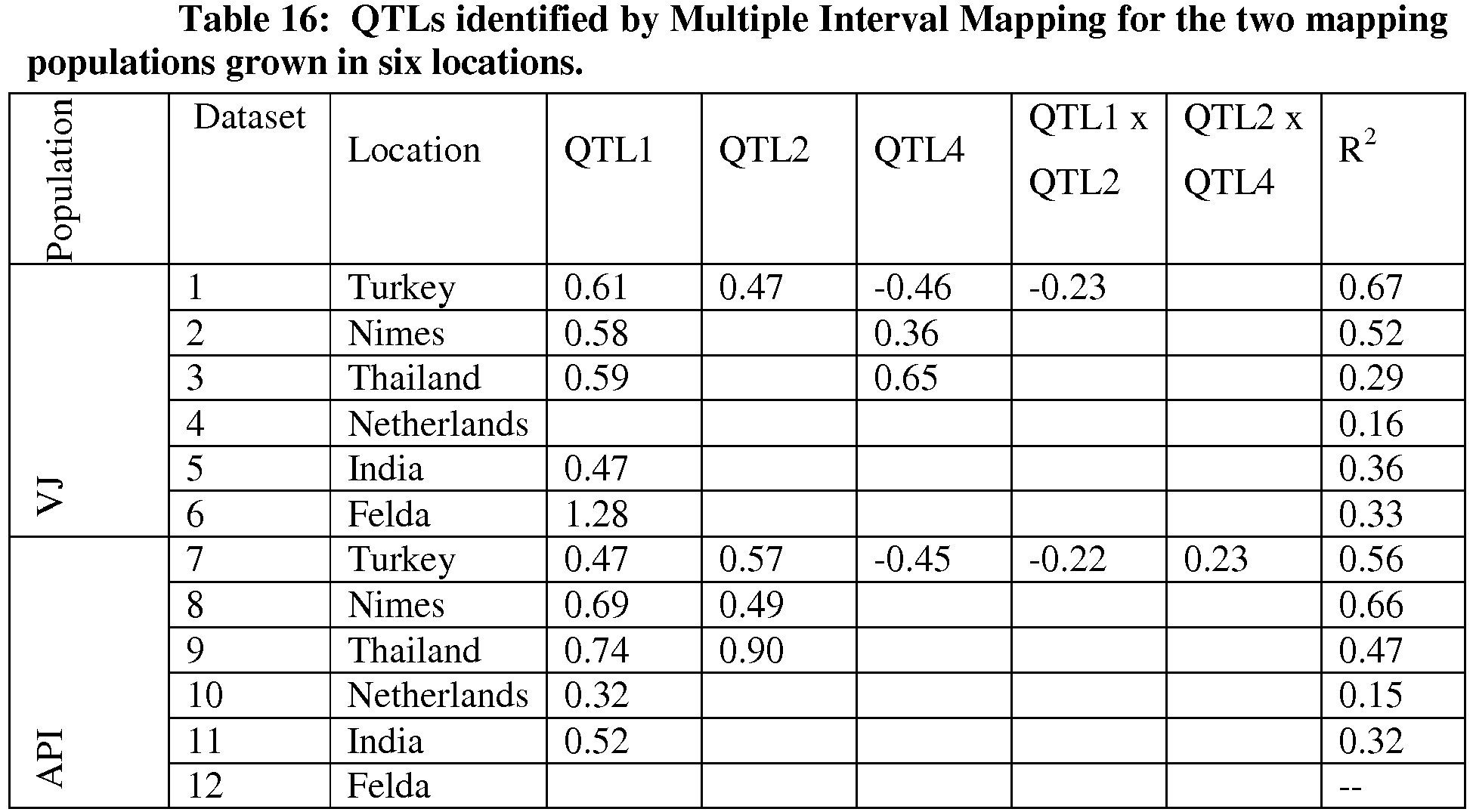
QTLs datasets - Genomic sequences from cucumber DNA clones containing RAPD Genetic marker CAPS_ENK59, among others, such as was used to identify the DM-resistance QTL described in Example 3, Tables 10-11, and
FIG. 1 , were aligned to a cucumber genomic map to determine their locations within the cucumber genome. Sequences were aligned using Sequencher (Gene Codes Corp., Ann Arbor, MI, USA), and found to fall within 13 contigs (11 loci completely assembled, and 1 locus assembled onto two contigs). These sequences were then aligned onto a cucumber genomic physical sequence scaffold map using BLAST and GMAP (Genentech, South San Francisco, CA, USA), with the RAPD marker positions (converted to CAPS) being placed on the integrated physical-genetic map based on sequence similarity. Additionally, the CAPS_ENK59, UBC12-1200, and AL10-850 markers, which were found to be linked with the originally defined QTL in the previous mapping experiments based on QTL analysis of lines derived from a Lucinde x PI197088 cross as described in Example 3, were also followed in the new API and VJ mapping populations to determine where they localized relative to the newly identified QTLs. Both approaches resulted in the finding that the originally identified QTL of Example 3 co-localizes withQTL 1 and maps tochromosome 5, as shown inFIG. 5 . Marker NN0246677 maps around position 43.8 or 47.8 respectively, of the respective API- and VJ-derived chromosome maps ofFIG. 5 , well within the genetically defined QTL. Although this is some genetic distance from CAPS_ENK59 which was utilized in the initial work, the markers identified as co-segregating with this QTL (i.e. QTL 1) were identified in different mapping populations, and in particular, the initial work genotyped fewer markers and had fewer replications of phenotyping trials than were utilized subsequently with the SNP markers such as NN0246677. Thus, the original mapping population included fewer recombination events, allowing for more distant markers to be more frequently retained in a linkage block that showed significant association with a DM-resistance QTL. The QTL analyses in different populations had different levels of statistical significance as well, resulting in somewhat different map positions. - Additional putative QTLs specific to various combinations of mapping population and geographic location were also identified, but the lack of replication across location and/or mapping population potentially suggest these QTL contribute too little to the overall phenotypic variation for replicable detection.
- A summary of the interval mapping results is shown in Table 17, with 2 LOD intervals at 4-LOD QTL peaks for each of the 2 population x 6 location experiments. Chr: chromosome; From: left position of the 2-LOD interval in cM; To: right position of the 2-LOD interval in cM; LR: likelihood ratio between the alternate (H3) and null (HO) hypotheses, where H3 = presence of a QTL with additive and dominant allelic effects at the test site and HO = no QTL at test site); a: additive allelic effect; d: dominant allelic effect; R2: proportion of variation explained by the putative QTL at the test site, SR: whether the same QTL was detected by the Stepwise Regression approach; MIM: whether the putative QTL was detected by the Multiple Interval Mapping approach.
Table 17: Interval mapping results. Population Location Chr From To LR a d R2 SR MIM VJ Nimes 2 21.77 66.48 21.53 0.41 0.23 0.12 Y Y VJ Turkey 2 39.45 48.76 36.46 -0.48 0.14 0.20 Y Y VJ Thailand 2 46.76 73.80 28.79 0.61 -0.58 0.16 Y Y VJ Turkey 4 37.65 73.98 32.79 0.47 -0.02 0.18 Y Y API Nimes 4 46.65 71.65 38.00 0.56 0.18 0.22 Y Y API Turkey 4 55.82 79.93 43.23 0.53 -0.27 0.22 Y Y VJ Thailand 4 57.50 87.57 21.85 0.58 -0.08 0.13 Y - API Thailand 4 74.98 81.98 51.79 0.93 0.25 0.28 Y Y API Turkey 5 22.58 56.40 27.88 0.43 -0.42 0.16 Y Y API India 5 26.64 30.31 59.67 0.52 0.15 0.32 Y Y API Netherlands 5 33.84 77.66 24.21 0.32 -0.13 0.15 Y Y VJ Thailand 5 40.37 55.81 20.24 0.55 0.22 0.12 Y Y API Thailand 5 44.71 56.40 34.46 0.79 0.55 0.22 Y Y API Nimes 5 44.71 55.40 70.72 0.71 0.04 0.39 Y Y VJ Nimes 5 46.19 55.81 45.75 0.61 0.13 0.25 Y Y VJ Turkey 5 53.10 80.70 51.56 0.57 0.29 0.27 Y Y VJ India 5 53.10 80.95 35.43 0.45 0.13 0.19 Y Y VJ Felda 5 76.71 80.95 58.81 1.26 0.48 0.33 Y Y - Linear Regression was also utilized to calculate coefficients of disease explained by the model QTL1 + QTL2 + QTL4 (see Table 18). Unlike QTL Cartographer, which always compares the change in phenotype against the resistant line, the coefficient values of Table 19 correspond directly to the change in disease rating from 1 (resistant) to 9 (susceptible). Thus a positive coefficient implies an increase in susceptibility.
Table 18: Coefficients of disease obtained using linear regression. Population Location Intercept QTL1 QTL2 QTL4 VJ Turkey 8.6 -0.56 -0.41 0.45 VJ Thailand 8.8 -0.28 -0.51 -0.46 VJ Nimes 8.9 -0.51 -0.29 -0.39 VJ Netherlands 6.3 -0.12 -0.03 -0.05 VJ India 9.6 -0.44 -0.15 -0.13 VJ Felda 9.4 -1.26 -0.20 -0.08 API Turkey 8.1 -0.40 -0.54 0.40 API Thailand 7.0 -0.55 -0.65 0.06 API Nimes 6.9 -0.54 -0.37 -0.01 API Netherlands 5.5 -0.22 0.05 -0.02 API India 9.2 -0.38 -0.18 0.09 API Felda 6.6 -0.05 -0.54 0.31 - For mapping of QTLs relative to additional markers, the SNP markers of Table 13 were aligned with SSR markers which were used by Ren et al. (PLoS ONE 4:e5795, 2009; doi:10.1371/journal.pone.0005795) by an informatics approach. First, the 16-25 bp primer sequences defining the SSR markers of Ren et al. were aligned with corresponding cucumber scaffold sequences (genomic fragments) using BLAST. Perfect alignments covering entire primer sequence pairs (i.e. both forward and reverse primers) were filtered to remove any apparent perfect alignments which did not suggest the forward and reverse primers properly facing each other, and the remaining scaffold positions were merged with the SSR-based map information. 574 SSR markers were putatively mapped to 591 scaffold genomic fragment sequences, since, as expected, some SSR sequences mapped to >1 scaffold location. Using a size difference threshold of less than or equal to 50 bp for the difference between the reported forward and reverse SSR primer locations and the mapped distance as indicated by the scaffold sequences, 550 SSR markers (with 566 mapped locations) were considered to be reliably mapped. This SSR data was then sorted with Scaffold IDs, and was merged with known positions of other available internal markers. Finally, inconsistent marker positions were noted, and remaining SSR genetic positions were anchored to a consensus genetic/physical map that had been built using SNP markers and genomic scaffold sequences. Table 19 lists map positions of SNP and SSR markers of
chromosomes chromosome 2 is defined as spanning the region defined by SNP marker NN0223892 (map position 22.3), to SNP marker NN0226638 (map position 88.4). The DM resistance QTL ofchromosome 4 is defined as spanning the region defined by SNP marker NN0227442 (map position 20.6), to SNP marker NN0227285 (map position 87.4). The DM resistance QTL ofchromosome 5 is defined as spanning the region defined by SNP marker NN0226553 (map position 25.3), to SNP marker NN0226391 (map position 82.1).Table 19: Genetic map positions of SNP ("NN0...") and SSR markers of cucumber chromosomes Marker Name Chromosome # Map position NN0226713 2 0.0 NN0246869 2 1.3 NN0227534 2 1.5 NN0228688 2 1.5 NN0224222 2 1.6 NN0225653 2 1.6 NN0227319 2 1.6 NN0247117 2 1.6 NN0223201 2 1.6 NN0246545 2 2.8 NN0247432 2 2.8 NN0225708 2 3.3 NN0224023 2 3.3 NN0225478 2 3.7 NN0225481 2 3.7 NN0247128 2 3.9 NN0247110 2 4.2 NN0228683 2 4.6 NN0247397 2 4.6 NN0229107 2 5.0 SSR11952 2 5.9 NN0227776 2 5.9 NN0225556 2 5.9 NN0225149 2 5.9 NN0247714 2 6.9 NN0226409 2 7.0 NN0247374 2 7.0 NN0225817 2 7.2 SSR21090 2 7.5 NN0228345 2 7.5 NN0224358 2 8.1 NN0224778 2 8.1 NN0247591 2 8.8 NN0246816 2 9.7 NN0226190 2 10.2 NN0225911 2 10.2 NN0224313 2 10.5 NN0224822 2 10.7 NN0225831 2 12.1 NN0224132 2 12.1 NN0224585 2 12.2 NN0224551 2 12.2 NN0226478 2 12.2 NN0226856 2 12.2 NN0228321 2 12.2 NN0225656 2 12.2 NN0246405 2 12.3 NN0247003 2 12.8 NN0226751 2 12.8 SSR00684 2 13.0 NN0229051 2 13.0 NN0247367 2 13.0 SSR16226 2 14.2 NN0225537 2 14.2 SSR03070 2 14.2 NN0225564 2 14.2 NN0246551 2 14.5 NN0224243 2 14.5 SSR00204 2 14.5 NN0223995 2 14.5 NN0246378 2 14.6 NN0228099 2 14.9 NN0227372 2 15.5 NN0246337 2 19.0 SSR00289 2 19.7 NN0227840 2 19.7 NN0227646 2 20.0 NN0228476 2 20.3 NN0224590 2 20.8 NN0228237 2 20.8 NN0247575 2 20.8 NN0227530 2 20.8 NN0227574 2 20.8 NN0224794 2 20.9 NN0224612 2 21.2 NN0224686 2 21.2 NN0224467 2 21.3 NN0228820 2 21.3 NN0225896 2 21.8 NN0223892 2 22.4 NN0223782 2 22.4 NN0227357 2 22.7 SSR22083 2 22.7 NN0227327 2 22.7 NN0247569 2 23.9 NN0223579 2 23.9 NN0226747 2 24.3 SSR23832 2 24.9 NN0226337 2 24.9 NN0227615 2 25.4 NN0226084 2 25.4 SSR23220 2 25.4 NN0226279 2 26.5 NN0224105 2 26.5 SSR23420 2 26.5 NN0225385 2 27.5 NN0246831 2 28.8 NN0228374 2 28.8 NN0223545 2 29.2 NN0224897 2 29.2 NN0226707 2 29.5 NN0226670 2 30.1 SSR01374 2 30.1 SSR22338 2 30.1 NN0223657 2 30.1 NN0247784 2 30.7 NN0225380 2 30.7 NN0223661 2 30.7 NN0247123 2 30.7 NN0228011 2 32.1 NN0228058 2 32.1 NN0224124 2 32.4 NN0246849 2 33.5 NN0226619 2 33.7 NN0247070 2 34.7 NN0226477 2 35.3 NN0223707 2 35.5 NN0227659 2 35.5 NN0227441 2 35.5 NN0223443 2 35.5 NN0223203 2 35.5 NN0226267 2 35.7 NN0224422 2 36.1 NN0227137 2 36.6 NN0246472 2 38.4 NN0224359 2 38.4 NN0228139 2 38.7 NN0227805 2 43.5 NN0247413 2 43.5 NN0223478 2 43.8 SSR02569 2 43.8 SSR07108 2 43.8 NN0227538 2 43.8 NN0247197 2 44.4 SSR11512 2 44.4 NN0226250 2 45.0 NN0224063 2 45.3 NN0228486 2 45.3 NN0224233 2 45.3 NN0223285 2 45.3 NN0223271 2 45.3 SSR00218 2 50.3 NN0225358 2 50.3 NN0224573 2 51.6 NN0226986 2 51.6 NN0224027 2 51.7 NN0228028 2 51.7 SSR17814 2 52.8 SSR12083 2 52.8 NN0225190 2 52.8 NN0246702 2 53.3 NN0224844 2 53.9 SSR16941 2 55.5 SSR11468 2 55.5 SSR22227 2 55.5 NN0227695 2 55.5 NN0227700 2 55.6 NN0228748 2 56.1 NN0246318 2 56.4 NN0247210 2 56.4 SSR02634 2 56.4 NN0223380 2 56.4 NN0223398 2 56.4 NN0247233 2 56.9 NN0246696 2 57.4 NN0223463 2 57.6 SSR23732 2 57.6 NN0223494 2 57.6 NN0223465 2 57.7 NN0224617 2 58.0 NN0224658 2 58.3 SSR05492 2 59.5 NN0246763 2 59.5 NN0224594 2 60.9 SSR02322 2 66.5 SSR07278 2 66.5 SSR11909 2 66.5 SSR16135 2 66.5 SSR22653 2 66.5 NN0247695 2 66.5 SSR00009 2 67.0 SSR06913 2 67.0 NN0227962 2 67.0 NN0226717 2 67.1 NN0247305 2 67.2 NN0226038 2 68.0 NN0225776 2 68.5 NN0247544 2 69.7 NN0227412 2 69.8 NN0247350 2 69.9 NN0247798 2 70.0 SSR13131 2 70.0 NN0228560 2 70.0 NN0226406 2 72.4 SSR21734 2 73.2 NN0227242 2 73.2 SSR00507 2 73.7 NN0247636 2 73.7 NN0226006 2 73.8 SSR15873 2 74.6 NN0225709 2 74.6 NN0224913 2 74.6 SSR12227 2 76.3 SSR18362 2 76.3 NN0228448 2 76.3 SSR21655 2 78.0 SSR05420 2 78.0 SSR19851 2 78.0 NN0225027 2 78.0 NN0225018 2 78.0 NN0227692 2 78.5 NN0247139 2 78.5 NN0223317 2 78.8 NN0223824 2 78.9 NN0223452 2 79.5 NN0246284 2 79.7 NN0246771 2 79.7 NN0223209 2 79.7 NN0223221 2 79.7 NN0226547 2 79.8 NN0247618 2 80.3 SSR01253 2 80.5 NN0228741 2 80.5 NN0226471 2 80.5 NN0226327 2 81.0 NN0226885 2 81.6 NN0246708 2 81.6 NN0228685 2 81.6 NN0228974 2 81.7 NN0246681 2 82.1 NN0226957 2 82.4 NN0223181 2 82.4 SSR21276 2 83.0 NN0227214 2 83.0 NN0225257 2 84.4 NN0223574 2 85.8 NN0226638 2 88.4 NN0226673 2 88.5 NN0228750 2 88.6 NN0246924 2 90.4 SSR30665 2 91.5 NN0224981 2 91.5 NN0224804 2 91.5 SSR13754 2 96.1 SSR16462 2 96.1 NN0223703 2 96.1 SSR16028 2 96.1 NN0247710 4 0.0 NN0247539 4 0.0 NN0247697 4 0.4 SSR07782 4 0.4 NN0228009 4 0.4 NN0224680 4 0.7 NN0226973 4 2.4 SSR01949 4 4.1 SSR07209 4 4.1 NN0247583 4 4.1 NN0228802 4 4.1 SSR19115 4 4.4 NN0246810 4 4.4 NN0228736 4 4.4 NN0247706 4 5.2 SSR14498 4 5.2 NN0225810 4 6.3 NN0224596 4 6.3 NN0225493 4 6.3 NN0247492 4 6.6 SSR19380 4 9.6 SSR21062 4 9.6 NN0225975 4 9.6 SSR22231 4 9.6 NN0224796 4 9.8 NN0224711 4 9.8 NN0228893 4 9.8 SSR11074 4 12.5 SSR17427 4 12.5 NN0223763 4 12.5 NN0225383 4 14.4 NN0228856 4 14.5 NN0228862 4 14.5 NN0246870 4 20.0 NN0225260 4 20.3 SSR00012 4 20.6 NN0227442 4 20.6 NN0223863 4 20.6 NN0225012 4 20.6 SSR17024 4 21.7 NN0226079 4 21.7 NN0247573 4 21.7 NN0228250 4 21.9 NN0246309 4 22.1 NN0246393 4 24.6 NN0229054 4 25.4 NN0225572 4 25.5 SSR13023 4 25.5 NN0228579 4 25.8 SSR22706 4 25.8 NN0225143 4 25.8 NN0224450 4 26.8 NN0226440 4 27.9 NN0226451 4 27.9 NN0223404 4 28.7 NN0226964 4 28.7 NN0225345 4 29.7 NN0226204 4 29.8 NN0223589 4 29.8 NN0227018 4 29.9 NN0247182 4 30.1 NN0227010 4 30.1 NN0247596 4 30.1 NN0226074 4 30.1 SSR02803 4 30.4 SSR07236 4 30.4 NN0225088 4 30.4 NN0225150 4 30.4 NN0224867 4 30.5 NN0224838 4 30.5 NN0224343 4 30.5 SSR21240 4 30.5 SSR33769 4 30.5 NN0229028 4 30.5 NN0224864 4 30.5 NN0227999 4 31.3 NN0228029 4 31.3 NN0227972 4 31.5 NN0224664 4 31.9 NN0223316 4 31.9 NN0224593 4 31.9 NN0247603 4 31.9 SSR16892 4 33.0 NN0226218 4 33.0 NN0226219 4 33.0 NN0247330 4 33.0 NN0224445 4 33.9 NN0227979 4 33.9 NN0224221 4 34.4 NN0223413 4 35.3 NN0224932 4 35.5 NN0224414 4 35.5 NN0224320 4 35.5 NN0228842 4 35.5 NN0228836 4 35.5 NN0247551 4 35.5 NN0227183 4 35.5 NN0247666 4 35.6 NN0227879 4 35.8 NN0224535 4 35.8 NN0246369 4 35.8 NN0223339 4 35.8 SSR01904 4 36.5 SSR16847 4 36.5 NN0223895 4 36.5 NN0228796 4 37.3 SSR19044 4 37.3 NN0223620 4 37.5 NN0247100 4 37.6 NN0247134 4 37.6 NN0246357 4 40.3 NN0246914 4 40.3 NN0225107 4 40.5 SSR15731 4 42.1 SSR21644 4 42.1 NN0247712 4 42.1 NN0224464 4 42.6 NN0228630 4 43.2 NN0224762 4 43.4 NN0224390 4 44.5 NN0229090 4 44.5 NN0247725 4 45.8 NN0246832 4 46.0 NN0224211 4 46.0 NN0225000 4 46.5 NN0225070 4 46.6 NN0225551 4 46.6 NN0247208 4 47.4 NN0225339 4 48.1 SSR04385 4 49.5 NN0228715 4 49.5 NN0228035 4 49.8 NN0226692 4 49.9 NN0224961 4 49.9 NN0226732 4 50.0 NN0227475 4 50.3 NN0225125 4 50.3 NN0226656 4 50.5 NN0227120 4 50.5 NN0227873 4 50.5 NN0223888 4 50.5 NN0229056 4 50.5 NN0247743 4 50.5 NN0228883 4 50.8 SSR11043 4 51.9 NN0247689 4 51.9 NN0223084 4 53.7 SSR13456 4 53.7 NN0225084 4 53.9 NN0226586 4 53.9 NN0247529 4 54.5 SSR17270 4 54.5 NN0247635 4 54.5 NN0247342 4 54.5 NN0247771 4 54.5 NN0228536 4 54.8 NN0223375 4 56.2 NN0226446 4 56.9 NN0224702 4 62.4 NN0224353 4 62.4 NN0227422 4 62.4 NN0228031 4 62.4 NN0227154 4 62.4 NN0223414 4 62.4 NN0224265 4 65.5 SSR05125 4 65.9 SSR07130 4 65.9 NN0224287 4 65.9 NN0226863 4 66.0 NN0228562 4 66.0 NN0224234 4 66.0 NN0247077 4 66.0 NN0225482 4 66.5 NN0225553 4 66.5 NN0224572 4 66.9 NN0224106 4 66.9 NN0224111 4 66.9 NN0228930 4 66.9 NN0223654 4 66.9 NN0225081 4 67.1 NN0223940 4 67.1 NN0227048 4 67.1 NN0246425 4 67.1 NN0224538 4 67.1 NN0228639 4 68.1 SSR21501 4 69.1 NN0225543 4 69.1 NN0228032 4 69.1 NN0226556 4 69.1 NN0226509 4 69.9 NN0227631 4 71.0 NN0227617 4 71.0 NN0223626 4 71.6 NN0223094 4 71.6 NN0223832 4 71.6 NN0247543 4 72.0 NN0224652 4 74.4 SSR07269 4 74.4 NN0224067 4 75.8 NN0226776 4 75.8 NN0227379 4 75.8 NN0227315 4 75.8 NN0224041 4 75.8 SSR00299 4 75.8 NN0228602 4 75.8 NN0223124 4 76.6 NN0223103 4 77.5 NN0225814 4 78.5 NN0228853 4 78.9 NN0227015 4 78.9 NN0223942 4 79.9 NN0246738 4 81.7 NN0224495 4 82.0 SSR01552 4 84.4 NN0225766 4 84.4 NN0247668 4 84.4 SSR22948 4 84.4 NN0226086 4 84.4 SSR04534 4 84.4 NN0223539 4 84.6 NN0227261 4 84.6 NN0227251 4 84.6 NN0226226 4 85.1 NN0246452 4 85.7 NN0226543 4 85.9 NN02277 62 4 85.9 NN0247486 4 85.9 SSR07550 4 86.2 NN0224069 4 86.2 NN0227587 4 87.4 NN0227182 4 87.4 NN0227279 4 87.4 NN0227285 4 87.4 NN0247726 4 87.6 SSR13159 4 87.6 NN0247782 4 87.6 NN0225419 4 88.0 NN0227265 4 88.0 NN0223422 4 88.2 NN0246417 4 88.2 NN0247615 4 88.7 NN0247555 4 88.7 NN0227211 4 88.7 SSR07543 4 89.4 NN0226481 4 89.4 NN0226465 4 89.6 NN0224223 4 90.0 NN0226865 4 90.0 SSR17406 4 91.3 NN0228648 4 91.3 SSR14257 4 91.3 NN0225826 4 91.6 NN0224777 4 92.0 NN0224050 4 92.4 NN0227419 4 92.9 NN0228716 4 92.9 NN0223906 4 92.9 NN0227718 4 94.3 SSR16315 4 94.3 NN0227942 4 94.5 NN0247421 4 94.5 NN0225077 4 94.5 NN0223715 4 94.5 NN0223710 4 94.5 NN0228566 4 94.7 NN0225541 4 94.7 NN0225476 4 94.7 NN0227586 4 95.7 NN0225015 4 96.5 NN0228246 4 96.6 SSR02233 4 96.7 NN0225079 4 96.7 NN0226312 4 96.7 NN0227403 4 96.7 SSR23770 4 96.7 NN0223754 4 97.3 NN0223896 4 97.5 NN0226628 4 97.8 NN0225404 4 98.0 NN0225471 4 98.0 NN0224793 4 98.0 NN0226220 4 98.0 NN0225734 4 98.1 NN0226011 4 98.2 NN0225208 4 98.2 NN0228805 4 98.2 NN0223571 4 98.4 NN0224125 4 98.4 NN0224127 4 98.4 NN0246631 4 98.4 SSR16292 4 98.9 SSR29080 4 98.9 NN0246416 4 98.9 NN0246722 4 99.7 NN0246308 4 99.7 NN0247688 4 99.7 NN0247613 4 100.1 SSR22155 4 100.2 NN0225987 4 100.2 NN0247623 4 100.4 NN0223759 4 100.5 NN0227111 4 100.5 NN0223284 4 100.6 NN0223295 4 100.6 NN0224972 4 100.6 NN0246321 4 100.6 NN0226554 4 100.6 SSR06347 4 100.6 NN0228925 4 100.6 SSR15203 4 100.8 NN0226376 4 100.8 SSR21197 4 100.8 NN0226559 4 101.3 SSR14015 4 101.3 NN0225554 4 101.4 NN0223718 4 101.4 NN0223742 4 101.4 NN0227971 5 0.0 NN0226380 5 0.2 NN0224416 5 0.2 NN0224425 5 0.2 NN0247032 5 0.4 NN0227159 5 0.4 NN0227081 5 0.5 SSR14247 5 0.7 NN0227163 5 0.7 SSR17022 5 0.9 NN0247383 5 0.9 NN0227849 5 1.0 NN0247369 5 1.0 NN0227216 5 1.1 NN0227224 5 1.1 NN0226775 5 1.2 NN0226854 5 1.3 SSR13086 5 2.0 NN0227542 5 2.0 NN0224662 5 2.2 NN0223648 5 2.2 NN0223632 5 2.2 NN0228445 5 2.3 NN0229042 5 2.3 NN0223496 5 2.5 NN0225635 5 2.5 NN0224047 5 2.6 NN0223877 5 2.6 NN0224052 5 2.7 NN0227420 5 4.3 NN0223296 5 5.1 SSR22469 5 5.1 SSR19538 5 5.9 NN0224657 5 5.9 SSR02454 5 9.6 NN0225945 5 9.6 NN0226455 5 9.6 SSR12467 5 9.6 SSR19719 5 9.6 NN0226450 5 9.6 NN0226658 5 9.9 NN0224159 5 9.9 NN0226797 5 9.9 NN0227362 5 9.9 NN0224785 5 9.9 NN0228078 5 9.9 NN0226536 5 9.9 NN0226528 5 9.9 NN0228505 5 10.0 NN0226756 5 10.0 NN0223780 5 10.0 NN0247311 5 10.2 NN0227594 5 10.2 SSR16032 5 10.2 NN0225849 5 10.2 NN0227145 5 10.2 SSR10002 5 10.3 SSR16842 5 10.3 NN0223450 5 10.3 NN0224763 5 14.2 NN0227468 5 14.6 NN0228918 5 14.6 NN0226418 5 14.6 NN0225926 5 14.6 NN0225883 5 14.6 NN0228145 5 14.7 NN0227295 5 14.7 NN0226387 5 14.7 NN0227584 5 15.0 NN0246349 5 15.1 NN0227168 5 15.8 SSR01859 5 15.8 NN0227165 5 15.8 SSR00023 5 16.1 NN0226433 5 16.1 SSR00398 5 16.1 NN0223950 5 16.4 SSR19998 5 16.4 NN0246612 5 17.6 NN0224029 5 17.6 SSR01610 5 17.6 SSR20648 5 17.6 NN0246303 5 17.6 SSR22172 5 17.6 NN0227653 5 17.6 NN0226303 5 17.6 NN0228175 5 17.7 SSR07369 5 17.7 NN0227913 5 18.9 SSR20208 5 18.9 NN0246687 5 18.9 NN0223949 5 18.9 NN0224861 5 18.9 NN0224841 5 18.9 NN0223182 5 19.0 SSR10795 5 19.0 NN0225294 5 20.3 NN0225315 5 20.3 NN0229134 5 21.6 NN0227380 5 21.6 NN0225199 5 21.7 NN0225904 5 21.7 NN0224426 5 21.8 NN0226415 5 22.2 NN0225222 5 22.8 SSR13639 5 22.8 NN0225428 5 22.8 NN0226841 5 22.8 SSR03341 5 24.5 SSR05819 5 24.5 SSR07559 5 24.5 NN0228879 5 24.5 NN0226553 5 25.3 NN0223140 5 25.3 NN0227540 5 25.3 NN0228457 5 25.6 NN0228069 5 26.2 SSR07057 5 26.7 NN0225531 5 26.7 SSR10348 5 26.7 SSR03950 5 28.1 SSR11167 5 28.1 NN0228895 5 28.1 NN0224856 5 29.0 NN0226092 5 29.9 NN0247223 5 30.1 NN0246356 5 30.4 NN0224773 5 31.1 NN0225532 5 31.2 NN0225517 5 31.2 NN0229077 5 31.2 SSR20895 5 31.2 NN0229137 5 31.2 NN0224304 5 31.7 NN0247509 5 31.7 NN0227435 5 31.7 NN0227405 5 31.7 SSR23615 5 31.9 SSR10542 5 31.9 SSR14051 5 31.9 SSR21861 5 31.9 NN0228317 5 31.9 NN0223802 5 32.3 SSR20487 5 32.3 NN0227305 5 33.2 SSR18593 5 33.5 NN0223112 5 33.5 NN0228982 5 33.5 NN0247183 5 33.5 NN0246332 5 33.8 NN0224476 5 33.9 NN0224325 5 34.5 NN0227981 5 36.1 NN0247085 5 37.4 NN0226041 5 37.4 NN0226671 5 37.4 NN0224375 5 37.6 NN0223399 5 38.6 SSR23101 5 39.1 NN0224283 5 39.1 SSR11750 5 39.7 NN0224246 5 39.7 NN0247066 5 40.4 NN0228739 5 40.4 NN0228814 5 40.5 NN0225803 5 40.9 NN0247244 5 41.0 NN0223974 5 41.0 NN0224213 5 41.0 NN0224193 5 41.0 NN0224669 5 41.0 SSR07284 5 41.0 NN0227571 5 41.2 NN0227555 5 41.2 NN0227525 5 41.3 NN0223689 5 41.4 SSR14269 5 41.4 NN0223687 5 41.4 NN0226194 5 41.6 NN0226187 5 41.6 NN0227343 5 42.3 NN0227129 5 42.3 NN0228943 5 42.3 NN0228968 5 42.3 SSR19178 5 43.0 NN0225790 5 43.0 SSR10720 5 44.8 NN0224377 5 44.8 SSR12921 5 44.8 NN0226709 5 44.8 NN0246677 5 45.2 NN0224642 5 45.2 NN0247731 5 45.2 NN0224840 5 45.2 NN0226013 5 45.6 NN0227895 5 46.1 NN0224349 5 46.1 SSR15893 5 47.8 NN0227665 5 47.8 NN0226326 5 48.9 NN0229099 5 48.9 NN0225940 5 48.9 NN0225518 5 49.0 NN0225544 5 49.1 NN0226346 5 49.2 NN0226508 5 49.2 NN0246770 5 49.3 SSR07711 5 49.4 SSR21291 5 49.4 NN0223897 5 49.4 SSR23148 5 49.4 SSR23132 5 49.4 SSR32717 5 49.4 NN0224455 5 49.4 SSR16110 5 49.4 NN0226166 5 50.0 NN0228693 5 51.7 NN0246672 5 51.7 NN0226430 5 51.7 NN0227495 5 52.3 NN0225480 5 53.2 NN0225654 5 53.2 NN0227497 5 53.2 SSR15321 5 53.3 NN0223392 5 53.3 NN0224442 5 53.7 NN0225103 5 54.3 NN0224698 5 54.3 NN0227581 5 55.5 NN0247308 5 55.6 NN0225661 5 55.9 NN0226631 5 55.9 NN0224600 5 55.9 NN0246411 5 56.1 NN0223215 5 56.2 NN0226316 5 56.2 NN0228725 5 56.3 NN0246410 5 56.3 NN0223921 5 56.5 NN0229142 5 56.8 NN0226764 5 57.4 NN0224228 5 57.7 NN0224229 5 57.7 NN0224406 5 58.3 NN0225311 5 58.6 NN0229148 5 59.9 Cs28 5 60.1 NN0227759 5 60.1 NN0223336 5 60.3 SSR15818 5 60.3 NN0225562 5 60.3 NN0247548 5 60.6 NN0224461 5 60.7 NN0227603 5 60.7 NN0246604 5 60.9 NN0247389 5 60.9 NN0246347 5 61.4 NN0247348 5 61.9 NN0226809 5 62.6 NN0226762 5 62.6 NN0247445 5 62.7 NN0223334 5 67.1 NN0225936 5 68.4 NN0225451 5 68.4 NN0224327 5 68.4 NN0246449 5 68.4 NN0228465 5 68.4 NN0223507 5 68.6 SSR02244 5 68.6 NN0246335 5 69.1 SSR06660 5 69.1 NN0224251 5 69.6 SSR17464 5 69.6 NN0246571 5 69.6 NN0224832 5 71.1 SSR23706 5 71.3 SSR03529 5 71.3 SSR07184 5 71.3 NN0226931 5 71.3 NN0228305 5 71.6 NN0247786 5 71.8 SSR07100 5 71.8 NN0227082 5 71.8 SSR19172 5 71.8 NN0247485 5 71.9 NN0227153 5 72.5 SSR00772 5 72.5 NN0227421 5 72.5 NN0223866 5 72.5 SSR00670 5 73.6 SSR01498 5 73.6 SSR04816 5 73.6 NN0224048 5 73.6 SSR20859 5 73.6 NN0227318 5 73.9 NN0226912 5 74.1 NN0226871 5 74.4 NN0227924 5 74.4 NN0223640 5 74.4 NN0226104 5 74.4 NN0223518 5 75.1 NN0247794 5 75.1 NN0226645 5 75.2 NN0223160 5 75.4 NN0227504 5 75.5 NN0228997 5 75.5 NN0226525 5 75.5 NN0224248 5 75.5 NN0224226 5 75.5 NN0228632 5 75.5 NN0247702 5 75.5 NN0229017 5 75.5 NN0225600 5 75.5 NN0223755 5 75.6 NN0225793 5 75.7 NN0226053 5 75.7 NN0246483 5 75.7 NN0246327 5 76.1 SSR14180 5 76.1 NN0226354 5 76.7 NN0228464 5 76.7 SSR00648 5 76.9 CSWCT17 5 76.9 SSR26904 5 76.9 NN0226186 5 76.9 NN0223789 5 77.0 NN0223809 5 77.0 NN0226623 5 77.2 NN0223634 5 77.2 NN0246814 5 77.2 NN0227194 5 77.3 NN0225426 5 77.4 NN0225876 5 77.4 NN0226156 5 77.4 NN0247406 5 77.6 NN0246437 5 77.8 NN0223864 5 77.8 NN0246426 5 77.8 SSR17975 5 77.8 NN0223659 5 77.9 NN0226257 5 77.9 NN0225344 5 77.9 SSR20486 5 77.9 NN0246586 5 77.9 NN0226429 5 78.0 NN0225867 5 78.0 NN0225673 5 78.0 NN0228260 5 78.0 NN0225717 5 78.0 NN0247058 5 78.1 NN0223685 5 78.1 NN0223699 5 78.1 NN0223091 5 78.1 NN0226394 5 78.2 NN0225216 5 78.2 NN0247709 5 78.3 NN0247443 5 78.3 NN0224090 5 78.3 NN0223081 5 78.3 SSR06303 5 78.6 NN0225646 5 78.6 NN0225626 5 78.6 NN0229147 5 78.6 NN0229106 5 78.6 NN0229020 5 78.6 NN0228957 5 78.6 NN0247140 5 78.6 NN0227071 5 78.7 NN0246376 5 78.7 NN0224281 5 78.7 NN0226051 5 78.7 NN0226076 5 78.7 NN0223859 5 79.1 NN0247574 5 79.1 SSR13237 5 79.3 NN0226937 5 79.3 NN0226940 5 79.3 NN0247180 5 79.4 NN0247563 5 79.5 NN0247704 5 79.5 NN0247447 5 79.5 NN0247630 5 79.5 NN0224507 5 80.0 NN0247388 5 80.1 NN0224321 5 80.1 NN0225878 5 80.1 NN0224365 5 80.1 NN0225310 5 80.1 NN0227929 5 80.3 NN0224031 5 80.6 NN0228710 5 80.7 NN0224991 5 80.7 NN0226870 5 80.7 NN0228616 5 80.7 NN0226516 5 80.8 NN0226453 5 81.0 NN0226540 5 81.4 NN0227287 5 81.5 NN0227228 5 81.5 SSR03514 5 81.5 SSR21219 5 81.5 NN0228055 5 81.5 NN0246331 5 81.8 NN0227097 5 81.8 NN0246889 5 81.8 NN0224713 5 81.8 NN0228255 5 81.8 NN0224443 5 81.8 NN0228289 5 81.8 NN0225431 5 81.9 NN0227769 5 82.0 NN0226910 5 82.0 NN0227655 5 82.0 SSR02895 5 82.1 SSR16143 5 82.1 NN0226391 5 82.1 SSR19343 5 82.1 NN0247172 5 82.6 NN0228132 5 82.6 NN0226532 5 82.6 NN0228148 5 82.7 SSR03758 5 82.7 NN0226082 5 82.7 - A recombinant inbred line (RIL) mapping population, termed "QIR", generated from an initial cross between the Downy Mildew susceptible parent 05VA8409 (a line that was resistant to Powdery Mildew and Cucurbit Yellow Stunting Disorder Virus, CYSDV) and a Downy Mildew resistant parent derived from PI-197088 was used to examine the genetics of cucumber Downy Mildew (CDM) resistance. The 40 lines in the population were phenotyped at F4 and F5 generations in Saint-Andiol, France. Previous QTL-mapping analyses with this data identified a major QTL for CDM resistance on a linkage group, defined in this population as "IV," which was later found to correspond to
chromosome 5. Fine-mapping with CAPS markers suggested two linked QTLs at 35.8cM and 42.7cM on the genetic map generated from this population, within this region onchromosome 5. - Based on the three QTLs on
chromosomes - A total of 60 SNPs were genotyped on 301 F6 samples corresponding to 38 unique F6 lines. Seven or eight plants of each RIL were genotyped, and both phenotypic and genotypic data were used in this analysis. Eight samples of the susceptible parent were also genotyped. Consensus genotypes were deduced based on the following criterion: for each locus, if genotypes were not consistent across all replicate samples (plants of the same RIL), the genotype occurring in more than 50% of the samples was taken as the consensus; otherwise a "missing" genotype designation was given to the locus. Of the 60 tested markers, 28 were monomorphic (not segregating) in the F6 population and were excluded from further analysis. Table 20 provides a summary of the markers used.
Table 20. Marker summary; 32 informative markers were genotyped across 38 F6 RILs and used. Chr Total # Genotyped Markers # Segregating Loci Average inter-marker spacing (cM) Max. inter-marker spacing (cM) 2 12 5 4.5 7.7 4 25 16 3.7 8.7 5 23 11 5.0 19.7 Total 60 32 4.3 19.7 - A non-parametric approach based on the Kruskal-Wallis test (Kruskal and Wallis, J. Amer. Statistical Assoc. 47: 583-621, 1952) and Haley-Knott regression (Haley & Knott, Heredity 69:315-324, 1992) was used to test for the presence of a QTL at every 1cM interval. Identical phenotypic values between RILs were assigned averaged ranks. Conditional genotype probabilities were estimated based on observed multiple-point marker data using the Hidden Markov algorithm and the Kosambi map function. Significance was determined from permutation tests within 1,000 permutations at α=0.05. All QTL-mapping analyses were performed using R/QTL (Broman et al., Bioinformatics 19:889-890, 2003).
- Two different QTLs were identified at Chr5:55.5cM and Chr4:70cM for CDM resistance collected from the F4 and F5 QIR populations respectively (
FIG. 6 & Table 21). No significant linkage to Downy Mildew resistance was detected on Chr2 for either of the F4 or F5 datasets in the QIR population. For both QTLs onchromosomes FIG. 7 ).Table 21. QTLs for cucumber Downy Mildew resistance identified using phenotypes from the F4 and F5 QIR populations. Generation F4 F5 Chromosome 5 4 Position (cM) 55.5 69.8 LOD 3.65 2.58 P-value (1,000 permutations) 0.000 0.026 % Variation Explained 36.80 25.53 Additive Effect -0.76 -0.70 Dominance Effect -1.25 1.09 Closest Marker NN0226631 NN0246425 Distance to Closest Marker 0.0 2.7 Population Mean 3.34 3.88 Donor Allele Mean 4.02 4.38 Susceptible Allele Mean 2.49 2.96 1-LOD interval (cM) 45.5-62.5 56.8-82.0 1-LOD Flanking Markers NN0227981-NN0247786 NN0247342-NN0224495 2-LOD interval (cM) 41.5-77.5 31.8-82.0 2-LOD Flanking Markers NN0227981-NN0227071 NN0225088-NN0224495 3-LOD interval (cM) 28.5-78.3 25.8-82.0 3-LOD Flanking Markers NN0224856-NN0227071 NN0228579-NN0224495 - Because these two QTLs on
chromosomes - Of the three QTLs (Chr2:21.8-73.8cM, Chr4:13.8-87.6cM, Chr5:22.6-81.0cM) previously identified using the API and VJ mapping populations, two (one on Chr4 and one on Chr5) were also identified in the current QIR population. The two QTL regions are found to be relatively large.. That is, even at 1-LOD intervals, the two QTLs are predicted to reside within ∼20cM. No significant epistatic interaction was identified between these two QTLs, suggesting these two QTLs may have an additive effect on Downy Mildew resistance (
FIG. 8 ). - Further fine mapping of QTLs of
chromosomes chromosome 2 extends between map positions 14.5- 66.4 cM, including 14.5- 38.4 cM, based on results from the QIR mapping population. - Fine mapping with the following markers on chromosome 4 (with map positions in parentheses): NNO225012 (20.649); NNO228579 (25.816); NNO226451 (27.944); NNO225088 (30.428); NNO247551 (35.460); NNO247100 (37.638); NNO224390 (44.531); NNO225551 (46.644); NNO228715 (49.546); NNO227475 (50.320); NNO227873 (50.477); NNO228883 (50.812); NNO223084 (53.747); NNO226586 (53.869); NNO247342 (54.495); NNO224702 (62.385); NNO224265 (65.543); NNO225482 (66.478); NNO225553 (66.478); NNO223940 (67.148); NNO246425 (67.148); NNO224041 (75.834); NNO224495 (81.973); NNO227587 (87.395); and NNO246631 (98.405) indicated that the CDM QTL on
chromosome 4 extends between map positions 56.8- 82.0 cM with a 1- LOD interval, or between 31.8- 82.0 cM with a 2-LOD interval, or between 25.8- 82.0 cM with a 3-LOD interval, based on results from the QIR mapping population. - Fine mapping with the following markers on chromosome 5 (with map positions in parentheses): NN5096749 (25.200); NNO228457 (25.235); NNO224856 (28.544); NNO246356 (30.032); NNO225532 (30.761); NNO228982 (33.131); NNO227981 (35.718); NNO223689 (41.014); NNO225790 (42.626); NNO246677 (44.758); NNO247731 (44.780); NNO226326 (48.512); NN5096750 (51.200); NN0246672 (51.326); NN0224442 (53.297); NN0226631 (55.452); NN0224600 (55.452); NN0246411 (55.649); NN0247786 (71.424); NN0223160 (74.955); NN0223809 (76.617); NN0227071 (78.303); and NN0228148 (82.273) indicated that the CDM QTL on
chromosome 5 extends between map positions 45.5- 62.5 cM with a 1- LOD interval, or between 41.5- 77.5 cM with a 2-LOD interval, or between 28.5- 78.3 cM with a 3-LOD interval, based on results from the QIR mapping population. - Thus, the QTL of
chromosome 2 may extend between map positions 14.5- 66.4 cM, or between 14.5- 38.4 cM. Likewise, the QTL ofchromosome 4 may extend from 13.8-87.6 cM, or between 25.8- 82.0 cM. or between 31.8- 75.8 cM. The QTL ofchromosome 5 may likewise extend from 22.6- 81.0 cM, or between 25.2- 78.3 cM, or between 28.5- 75.0 cM. - In order to identify sub-region(s) from the previously identified QTL intervals (e.g. on
chromosomes - A plant with resistance to DM, in this case, a progeny plant of PI197088, referred to as the donor parent (DP), was crossed to plants from several DM susceptible, elite inbred lines, referred to as recurrent parents ("RP's"). Plants of the F1 generation from such a cross were backcrossed to plants of each RP to form the backcross 1 (BC1) generation. In each RP pedigree, 40 to 50 BC1 plants were backcrossed to RP plants to form the BC2 generation. This occurred before initial identification of the DM QTL.
- When markers for the DM resistance QTL of chromosome 4 ("QTL04") and the DM resistance QTL of chromosome 5 ("QTL05") were developed, remnant tissue from each BC1 plant was genotyped, and plants heterozygous for the QTLs were identified. BC2 progeny plants from DM QTL heterozygous BC1 plants were genotyped with markers at the distal ends of each DM QTL. Using this data, BC2 plants were selected that contained genetic recombination events within one of the DM QTL, while displaying a homozygous RP allele at the other DM QTL. These plants were self-pollinated in a greenhouse to create the BC2F2 generation. In the following crop cycle, BC2F2 plants from each recombinant BC2 pedigree were genotyped with markers in the DM QTL, selected for homozygosity of the favorable allele in the recombinant section of the DM QTL, and self pollinated to create the BC2F3 generation. Each BC2F3 family was uniformly homozygous for the DP allele in the recombinant section of one DM QTL, and homozygous RP for the other QTL, in order to confer a uniform phenotype for DM within each family. The recombinant BC2F3 families could then be phenotyped for DM with four experimental controls consisting of BC2F3 lines that had been selected for presence of only unfavorable (RP) alleles at both QTL04 and QTL05 (null control); presence of unfavorable allele at QTL04, favorable allele at QTL05; presence of favorable allele at QTL04, unfavorable allele at QTL05; presence of favorable allele at both QTL04 and QTL05. Data can then be analyzed in a series of paired tests between the controls and the BC2F3 families. The genotypes of BC2F3 recombinant families showing DM resistance significantly better than the null control are evaluated for location of the region containing the favorable allele in the DM QTL. If all BC2F3 families sharing this genotype show superior DM resistance, that genetic interval is defined as containing the DM QTL. Through comparison of multiple BC2F3 families with different, but overlapping recombinant fragments, a smaller genetic and physical region containing the DM QTL is identifed. Additional genetic markers utilized in refining the map positions of the DM QTLs are listed in Table 22. Such markers are utilized with various mapping populations, such as QIR, API, or VJ, among others.
Table 22. Exemplary additional C. sativus genomic DNA sequences flanking the sites of SNP markers linked to QTLs on chromosomes Marker Name Chromosome; map position Genomic DNA Sequence (SEQ ID NOs:70-87). SNP site with polymorphism is given within brackets. NN0246378 2; 14.554 
NNO224041 4: 75.834 
NN0227587 4; 87.395 

NN5096749 5; 25.200 
NN0224856 5; 28.544 
NN0223160 5; 74.955 
NN0223809 5; 76.617 
NN0226631 5; 55.452 
NN0227981 5; 35.718 
NN0247786 5; 71.424 
NN0246425 4; 67.148 
NN0224495 4; 81.973 
NN0225088 4; 30.428 
NN0227071 5; 78.303 
NN0223782 2; 22.448 
NN0228579 4; 25.816 
NN0247342 4; 54.495 

NNO247731 5; 44.780 
- Initial mapping of the DM QTL used data from two F5 populations referred to as the API and VJ populations. Mean DM scores from several trials for families in the API population were tested for significant differences from the population mean. Families with DM scores significantly higher or lower than the population mean were selected. Plants from each of these families were genotyped and selected for homozygosity across the DM QTL. The selected plants would also be genotyped for genome-wide markers to define, in particular, regions that shifted from heterozygous in the F5 family to homozygous in the selected F5 plant and derived F6 family. These plants were self pollinated to create F6 families. These families are phenotyped along with experimental controls of the DM-susceptible parent of the API population, the DM-resistant parent of the population (PI197088), and the four experimental controls described previously, consisting of BC2F3 lines that had been selected for presence of only unfavorable (RP) alleles at both QTL04 and QTL05 (null control); presence of unfavorable allele at QTL04, favorable allele at QTL05; presence of favorable allele at QTL04, unfavorable allele at QTL05; presence of favorable allele at both QTL04 and QTL05. This analysis allows for improved resolution of the genetic positions of the QTL intervals, and detection of additional QTL contributing to DM resistance. By changing genotypes in DM QTL from heterozygous in the F5 family to homozygous in the derived F6 more uniform DM phenotypes are displayed, thus enhancing resolution of genotype-phenotype associations.
-
- <110> Chan, Eva
Schetty, Nischit
King, Joseph
Caldwell, David - <120> METHODS AND COMPOSITIONS FOR IDENTIFYING DOWNY MILDEW RESISTANT CUCUMBER PLANTS
- <130> SEMS:108WO
- <140> Unknown
<141> 2010-10-22 - <150>
61/254,141
<151> 2009-10-22 - <160> 87
- <170> PatentIn version 3.5
- <210> 1
<211> 29
<212> DNA
<213> Artificial Sequence - <220>
<223> Synthetic primer - <400> 1
gaatagatag gctacacttt tccctcttg 29 - <210> 2
<211> 31
<212> DNA
<213> Artificial Sequence - <220>
<223> Synthetic primer - <400> 2
gtataaaact tgagtgaatt taatgcatga a 31 - <210> 3
<211> 35
<212> DNA
<213> Artificial Sequence - <220>
<223> Synthetic primer - <400> 3
tgtttcataa ctacagcttc atgttaaata ttact 35 - <210> 4
<211> 25
<212> DNA
<213> Artificial Sequence - <220>
<223> Synthetic primer - <400> 4
tagtttcttt cttgctggac gaacc 25 - <210> 5
<211> 21
<212> DNA
<213> Artificial Sequence - <220>
<223> Synthetic primer - <400> 5
tatgggctat gtgaaactct t 21 - <210> 6
<211> 21
<212> DNA
<213> Artificial Sequence - <220>
<223> Synthetic primer - <400> 6
agcgtgacaa ctacaaaaca t 21 - <210> 7
<211> 23
<212> DNA
<213> Artificial Sequence - <220>
<223> Synthetic primer - <400> 7
gaaataaatg gatgaagcga gga 23 - <210> 8
<211> 27
<212> DNA
<213> Artificial Sequence - <220>
<223> Synthetic primer - <400> 8
gttcgttgat cagtgtgata tttcaat 27 - <210> 9
<211> 21
<212> DNA
<213> Artificial Sequence - <220>
<223> Synthetic primer - <400> 9
atcggtcttt gccacctttt g 21 - <210> 10
<211> 28
<212> DNA
<213> Artificial Sequence - <220>
<223> Synthetic primer - <400> 10
aggagggaca gagagaattt gatataat 28 - <210> 11
<211> 27
<212> DNA
<213> Artificial Sequence - <220>
<223> Synthetic primer - <400> 11
tccgttttag gtgattgtca aatacat 27 - <210> 12
<211> 21
<212> DNA
<213> Artificial Sequence - <220>
<223> Synthetic primer - <400> 12
tgtttggaag ggtttcttgg g 21 - <210> 13
<211> 18
<212> DNA
<213> Artificial Sequence - <220>
<223> Synthetic primer - <400> 13
tgccatgtcg ccaacagt 18 - <210> 14
<211> 23
<212> DNA
<213> Artificial Sequence - <220>
<223> Synthetic primer - <400> 14
tcaagccata gtctaaccca tgc 23 - <210> 15
<211> 25
<212> DNA
<213> Artificial Sequence - <220>
<223> Synthetic primer - <400> 15
cgctatatca tggatggcta gaaat 25 - <210> 16
<211> 30
<212> DNA
<213> Artificial Sequence - <220>
<223> Synthetic primer - <400> 16
aaagttgata gtgcatgagt tggtaaaata 30 - <210> 17
<211> 22
<212> DNA
<213> Artificial Sequence - <220>
<223> Synthetic primer - <400> 17
tccgcttatg ggtttttgtgag 22 - <210> 18
<211> 21
<212> DNA
<213> Artificial Sequence - <220>
<223> Synthetic primer - <400> 18
tatgggctat gtgaaactct t 21 - <210> 19
<211> 21
<212> DNA
<213> Artificial Sequence - <220>
<223> Synthetic primer - <400> 19
agcgtgacaa ctacaaaaca t 21 - <210> 20
<211> 121
<212> DNA
<213> Cucumis sativus - <220>
<221> misc_feature
<222> (61)..(61)
<223> y is c or t - <400> 20

- <210> 21
<211> 121
<212> DNA
<213> Cucumis sativus - <220>
<221> misc_feature
<222> (61)..(61)
<223> y is c or t - <400> 21

- <210> 22
<211> 121
<212> DNA
<213> Cucumis sativus - <220>
<221> misc_feature
<222> (61)..(61)
<223> m is a or c - <400> 22

- <210> 23
<211> 121
<212> DNA
<213> Cucumis sativus - <220>
<221> misc_feature
<222> (61)..(61)
<223> y is c or t - <400> 23

- <210> 24
<211> 121
<212> DNA
<213> Cucumis sativus - <220>
<221> misc_feature
<222> (61)..(61)
<223> r is a or g - <400> 24

- <210> 25
<211> 121
<212> DNA
<213> Cucumis sativus - <220>
<221> misc_feature
<222> (61)..(61)
<223> r is a or g - <400> 25

- <210> 26
<211> 121
<212> DNA
<213> Cucumis sativus - <220>
<221> misc_feature
<222> (61)..(61)
<223> r is a or g - <400> 26

- <210> 27
<211> 121
<212> DNA
<213> Cucumis sativus - <220>
<221> misc_feature
<222> (61)..(61)
<223> y is c or t - <400> 27

- <210> 28
<211> 121
<212> DNA
<213> Cucumis sativus - <220>
<221> misc_feature
<222> (61)..(61)
<223> y is c or t - <400> 28

- <210> 29
<211> 121
<212> DNA
<213> Cucumis sativus - <220>
<221> misc_feature
<222> (61)..(61)
<223> y is c or t - <400> 29

- <210> 30
<211> 121
<212> DNA
<213> Cucumis sativus - <220>
<221> misc_feature
<222> (61)..(61)
<223> y is c or t - <400> 30


- <210> 31
<211> 116
<212> DNA
<213> Cucumis sativus - <220>
<221> misc_feature
<222> (61)..(61)
<223> y is c or t - <400> 31

- <210> 32
<211> 89
<212> DNA
<213> Cucumis sativus - <220>
<221> misc_feature
<222> (61)..(61)
<223> s is c or g - <400> 32

- <210> 33
<211> 121
<212> DNA
<213> Cucumis sativus - <220>
<221> misc_feature
<222> (61)..(61)
<223> r is a or g - <400> 33

- <210> 34
<211> 121
<212> DNA
<213> Cucumis sativus - <220>
<221> misc_feature
<222> (61)..(61)
<223> r is a or g - <400> 34

- <210> 35
<211> 121
<212> DNA
<213> Cucumis sativus - <220>
<221> misc_feature
<222> (61)..(61)
<223> y is c or t - <400> 35

- <210> 36
<211> 121
<212> DNA
<213> Cucumis sativus - <220>
<221> misc_feature
<222> (61)..(61)
<223> y is c or t - <400> 36

- <210> 37
<211> 121
<212> DNA
<213> Cucumis sativus - <220>
<221> misc_feature
<222> (61)..(61)
<223> w is a or t - <400> 37


- <210> 38
<211> 121
<212> DNA
<213> Cucumis sativus - <220>
<221> misc_feature
<222> (13)..(13)
<223> n is a, t, c, or g - <220>
<221> misc_feature
<222> (61)..(61)
<223> r is a or g - <400> 38

- <210> 39
<211> 121
<212> DNA
<213> Cucumis sativus - <220>
<221> misc_feature
<222> (61)..(61)
<223> y is c or t - <220>
<221> misc_feature
<222> (101)..(101)
<223> n is a, t, c, or g - <400> 39

- <210> 40
<211> 103
<212> DNA
<213> Cucumis sativus - <220>
<221> misc_feature
<222> (61)..(61)
<223> r is a or g - <220>
<221> misc_feature
<222> (94)..(103)
<223> n is a, c, g, or t - <400> 40

- <210> 41
<211> 121
<212> DNA
<213> Cucumis sativus - <220>
<221> misc_feature
<222> (61)..(61)
<223> y is c or t - <400> 41

- <210> 42
<211> 113
<212> DNA
<213> Cucumis sativus - <220>
<221> misc_feature
<222> (53)..(53)
<223> w is a or t - <400> 42

- <210> 43
<211> 121
<212> DNA
<213> Cucumis sativus - <220>
<221> misc_feature
<222> (61)..(61)
<223> w is a or t - <400> 43

- <210> 44
<211> 121
<212> DNA
<213> Cucumis sativus - <220>
<221> misc_feature
<222> (61)..(61)
<223> w is a or t - <400> 44

- <210> 45
<211> 116
<212> DNA
<213> Cucumis sativus - <220>
<221> misc_feature
<222> (61)..(61)
<223> m is a or c - <400> 45

- <210> 46
<211> 121
<212> DNA
<213> Cucumis sativus - <220>
<221> misc_feature
<222> (61)..(61)
<223> s is c or g - <400> 46

- <210> 47
<211> 121
<212> DNA
<213> Cucumis sativus - <220>
<221> misc_feature
<222> (4)..(4)
<223> n is a, c, t, or g - <220>
<221> misc_feature
<222> (20)..(20)
<223> n is a, c, t, or g - <220>
<221> misc_feature
<222> (24)..(24)
<223> n is a, c, t, or g - <220>
<221> misc_feature
<222> (61)..(61)
<223> k is g or t - <400> 47

- <210> 48
<211> 121
<212> DNA
<213> Cucumis sativus - <220>
<221> misc_feature
<222> (61)..(61)
<223> w is a or t - <400> 48

- <210> 49
<211> 121
<212> DNA
<213> Cucumis sativus - <220>
<221> misc_feature
<222> (61)..(61)
<223> k is g or t - <400> 49

- <210> 50
<211> 121
<212> DNA
<213> Cucumis sativus - <220>
<221> misc_feature
<222> (61)..(61)
<223> r is a or g - <400> 50

- <210> 51
<211> 121
<212> DNA
<213> Cucumis sativus - <220>
<221> misc_feature
<222> (61)..(61)
<223> y is c or t - <400> 51

- <210> 52
<211> 121
<212> DNA
<213> Cucumis sativus - <220>
<221> misc_feature
<222> (61)..(61)
<223> r is a or g - <400> 52

- <210> 53
<211> 121
<212> DNA
<213> Cucumis sativus - <220>
<221> misc_feature
<222> (20)..(20)
<223> n is a, t, c, or g - <220>
<221> misc_feature
<222> (61)..(61)
<223> r is a or g - <400> 53

- <210> 54
<211> 121
<212> DNA
<213> Cucumis sativus - <220>
<221> misc_feature
<222> (55)..(55)
<223> n is a, c, g, or t - <220>
<221> misc_feature
<222> (61)..(61)
<223> r is a or g - <400> 54

- <210> 55
<211> 121
<212> DNA
<213> Cucumis sativus - <220>
<221> misc_feature
<222> (61)..(61)
<223> w is a or t - <400> 55

- <210> 56
<211> 121
<212> DNA
<213> Cucumis sativus - <220>
<221> misc_feature
<222> (61)..(61)
<223> y is c or t - <400> 56

- <210> 57
<211> 121
<212> DNA
<213> Cucumis sativus - <220>
<221> misc_feature
<222> (61)..(61)
<223> y is c or t - <400> 57

- <210> 58
<211> 121
<212> DNA
<213> Cucumis sativus - <220>
<221> misc_feature
<222> (61)..(61)
<223> s is c or g - <400> 58

- <210> 59
<211> 121
<212> DNA
<213> Cucumis sativus - <220>
<221> misc_feature
<222> (61)..(61)
<223> y is c or t - <400> 59

- <210> 60
<211> 121
<212> DNA
<213> Cucumis sativus - <220>
<221> misc_feature
<222> (61)..(61)
<223> r is a or g - <220>
<221> misc_feature
<222> (104)..(104)
<223> n is a, c, g, or t - <400> 60

- <210> 61
<211> 121
<212> DNA
<213> Cucumis sativus - <220>
<221> misc_feature
<222> (61)..(61)
<223> s is c or g - <400> 61

- <210> 62
<211> 121
<212> DNA
<213> Cucumis sativus - <220>
<221> misc_feature
<222> (29).. (29)
<223> n is a, c, g, or t - <220>
<221> misc_feature
<222> (61)..(61)
<223> y is c or t - <220>
<221> misc_feature
<222> (110)..(113)
<223> n is a, c, t, or g - <220>
<221> misc_feature
<222> (121)..(121)
<223> n is a, c, t, or g - <400> 62

- <210> 63
<211> 121
<212> DNA
<213> Cucumis sativus - <220>
<221> misc_feature
<222> (61)..(61)
<223> s is c or g - <400> 63

- <210> 64
<211> 104
<212> DNA
<213> Cucumis sativus - <220>
<221> misc_feature
<222> (44)..(44)
<223> s is c or g - <220>
<221> misc_feature
<222> (101)..(101)
<223> n is a, t, c, or g - <400> 64

- <210> 65
<211> 121
<212> DNA
<213> Cucumis sativus - <220>
<221> misc_feature
<222> (61)..(61)
<223> r is a or g - <400> 65

- <210> 66
<211> 121
<212> DNA
<213> Cucumis sativus - <220>
<221> misc_feature
<222> (61)..(61)
<223> y is c or t - <400> 66

- <210> 67
<211> 121
<212> DNA
<213> Cucumis sativus - <220>
<221> misc_feature
<222> (61)..(61)
<223> s is c or g - <400> 67

- <210> 68
<211> 121
<212> DNA
<213> Cucumis sativus - <220>
<221> misc_feature
<222> (61)..(61)
<223> r is a or g - <400> 68

- <210> 69
<211> 121
<212> DNA
<213> Cucumis sativus - <220>
<221> misc_feature
<222> (61)..(61)
<223> y is c or t - <400> 69

- <210> 70
<211> 121
<212> DNA
<213> Cucumis sativus - <220>
<221> misc_feature
<222> (61)..(61)
<223> r is a or g - <220>
<221> misc_feature
<222> (97)..(97)
<223> n is a, c, g, or t - <400> 70

- <210> 71
<211> 121
<212> DNA
<213> Cucumis sativus - <220>
<221> misc_feature
<222> (61)..(61)
<223> w is a or t - <400> 71

- <210> 72
<211> 121
<212> DNA
<213> Cucumis sativus - <220>
<221> misc_feature
<222> (61)..(61)
<223> y is t or c - <400> 72

- <210> 73
<211> 101
<212> DNA
<213> Cucumis sativus - <220>
<221> misc_feature
<222> (51)..(51)
<223> r is g or a - <400> 73

- <210> 74
<211> 121
<212> DNA
<213> Cucumis sativus - <220>
<221> misc_feature
<222> (61)..(61)
<223> y is t or c - <400> 74

- <210> 75
<211> 121
<212> DNA
<213> Cucumis sativus - <220>
<221> misc_feature
<222> (61)..(61)
<223> y is t or c - <400> 75


- <210> 76
<211> 121
<212> DNA
<213> Cucumis sativus - <220>
<221> misc_feature
<222> (61)..(61)
<223> y is t or c - <400> 76

- <210> 77
<211> 121
<212> DNA
<213> Cucumis sativus - <220>
<221> misc_feature
<222> (61)..(61)
<223> w is a or t - <400> 77

- <210> 78
<211> 121
<212> DNA
<213> Cucumis sativus - <220>
<221> misc_feature
<222> (61)..(61)
<223> k is g or t - <400> 78

- <210> 79
<211> 104
<212> DNA
<213> Cucumis sativus - <220>
<221> misc_feature
<222> (44)..(44)
<223> s is g or c - <220>
<221> misc_feature
<222> (101)..(101)
<223> n is a, c, g, or t - <400> 79

- <210> 80
<211> 121
<212> DNA
<213> Cucumis sativus - <220>
<221> misc_feature
<222> (61)..(61)
<223> w is a or t - <400> 80

- <210> 81
<211> 121
<212> DNA
<213> Cucumis sativus - <220>
<221> misc_feature
<222> (61)..(61)
<223> r is g or a - <400> 81

- <210> 82
<211> 121
<212> DNA
<213> Cucumis sativus - <220>
<221> misc_feature
<222> (61)..(61)
<223> y is t or c - <400> 82

- <210> 83
<211> 121
<212> DNA
<213> Cucumis sativus - <220>
<221> misc_feature
<222> (61)..(61)
<223> s is g or c - <400> 83

- <210> 84
<211> 121
<212> DNA
<213> Cucumis sativus - <220>
<221> misc_feature
<222> (61)..(61)
<223> y is t or c - <400> 84

- <210> 85
<211> 107
<212> DNA
<213> Cucumis sativus - <220>
<221> misc_feature
<222> (61)..(61)
<223> s is g or c - <400> 85

- <210> 86
<211> 121
<212> DNA
<213> Cucumis sativus - <220>
<221> misc_feature
<222> (61)..(61)
<223> w is a or t - <400> 86

- <210> 87
<211> 121
<212> DNA
<213> Cucumis sativus - <220>
<221> misc_feature
<222> (61)..(61)
<223> y is t or c - <400> 87

Claims (13)
- A method of obtaining cucumber germplasm comprising the steps of:a) assaying cucumber plants for the presence of at least a first genetic marker genetically linked to a QTL that confers resistance to Downy Mildew; andb) selecting at least a first cucumber plant comprising the genetic marker and the QTL that confers resistance to Downy Mildew;wherein the QTL maps to a position between the sequence represented by SNP marker NN0223689 and SNP marker NN0228148 characterized by SEQ ID NOs:56 and 69, respectively, which map to approximately 41.0 cM and 82.3 cM on the genetic map of the linkage group termed cucumber chromosome 5; wherein the QTL maps to a position between the sequence represented by SNP marker NN0225012 and SNP marker NN0227587 characterized by SEQ ID NOs:33 and 51, respectively, which map to approximately 20.6 cM and 87.4 cM on the genetic map of the linkage group termed cucumber chromosome 4; or wherein the QTL maps to a position between the sequence represented by SNP marker NN0223782 and SNP marker NN0226638 characterized by SEQ ID NOs:20 and 32, respectively, which map to approximately 22.5 cM and 88.4 cM on the genetic map of the linkage group termed cucumber chromosome 2; or the genetic markers map within 1 cM of said QTL which confers resistance to Downy Mildew.
- The method of claim 1, wherein the QTL maps to a position between the sequence represented by SNP marker NN0247731 and SNP marker NN0226631 characterized by SEQ ID NOs:57 and 77, respectively, which map to approximately 44.8 cM and 55.5 cM on the genetic map of the linkage group termed cucumber chromosome 5; or wherein the QTL maps to a position between the sequence represented by SNP marker NN0247731 and SNP marker NN0247786 characterized by SEQ ID NOs:57 and 79, respectively, which map to approximately 44.8 cM and 71.4 cM on the genetic map of the linkage group termed cucumber chromosome 5.
- The method of claim 1, wherein the QTL maps to a position between the sequence represented by SNP marker NN0228579 and SNP marker NN0224495 characterized by SEQ ID NOs:85 and 81, respectively, which map to approximately 25.8 cM and 82.0 cM on the genetic map of the linkage group termed cucumber chromosome 4; wherein the QTL maps to a position between the sequence represented by SNP marker NN0225088 and SNP marker NN0224041 characterized by SEQ ID NOs:82 and 71, respectively, which map to approximately 30.4 cM and 75.8 cM on the genetic map of the linkage group termed cucumber chromosome 4; or wherein the QTL maps to a position between the sequence represented by SNP marker NN0247342 and SNP marker NN0224495 characterized by SEQ ID NOs:43 and 81, respectively, which map to approximately 54.5 cM and 82.0 cM on the genetic map of the linkage group termed cucumber chromosome 4.
- The method of claim 1, wherein the QTL maps to a position between the sequence represented by SNP marker NN0223782 and SNP marker NN0246472 characterized by SEQ ID NOs:20 and 24, respectively, which map to approximately 22.5 cM and 38.4 cM on the genetic map of the linkage group termed cucumber chromosome 2.
- The method of claim 1, wherein the allele which confers resistance to Downy Mildew is derived from cucumber line PI197088, or a progeny plant thereof.
- The method of claim 1, wherein selecting the first cucumber plant further comprises selecting the plant based on the presence of a plurality of genetic markers that map to a position between the sequence represented by SNP marker NN0223689 and SNP marker NN0228148 characterized by SEQ ID NOs:56 and 69, respectively, which map to approximately 41.0 cM and 82.3 cM on the genetic map of the linkage group termed cucumber chromosome 5; or wherein the QTL maps to a position between the sequence represented by SNP marker NN0247731 and SNP marker NN0226631 characterized by SEQ ID NOs:57 and 77, respectively, which map to approximately 44.8 cM and 55.5 cM on the genetic map of the linkage group termed cucumber chromosome 5; or wherein the QTL maps to a position between the sequence represented by SNP marker NN0247731 and SNP marker NN0247786 characterized by SEQ ID NOs:57 and 79, respectively, which map to approximately 44.8 cM and 71.4 cM on the genetic map of the linkage group termed cucumber chromosome 5; or wherein the QTL maps to a position between the sequence represented by SNP marker NN0225012 and SNP marker NN0227587 characterized by SEQ ID NOs:33 and 51, respectively, which map to approximately 20.6 cM and 87.4 cM on the genetic map of the linkage group termed cucumber chromosome 4; or wherein the QTL maps to a position between the sequence represented by SNP marker NN0247342 and SNP marker NN0224495 characterized by SEQ ID NOs:43 and 81, respectively, which map to approximately 54.5 cM and 82.0 cM on the genetic map of the linkage group termed cucumber chromosome 4; or wherein the QTL maps to a position between the sequence represented by SNP marker NN0223782 and SNP marker NN0226638 characterized by SEQ ID NOs:20 and 32, respectively, which map to approximately 22.5 cM and 88.4 cM on the genetic map of the linkage group termed cucumber chromosome 2.
- The method of claim 1, wherein assaying the cucumber plants comprises PCR, single strand conformational polymorphism analysis, denaturing gradient gel electrophoresis, cleavage fragment length polymorphism analysis, TAQMAN assay, and/or DNA sequencing.
- The method of claim 1, wherein the genetic marker is NN0226631 or NN0246425 characterized by SEQ ID NOs:77 and 80, respectively.
- The method of claim 1, wherein the genetic marker is selected from the following markers comprising a single nucleotide polymorphism of one of SEQ ID NOs:20-87: NN0223782 (SEQ ID NO:20), NN0225385 (SEQ ID NO:21), NN0226670 (SEQ ID NO:22), NN0224124 (SEQ ID NO:23), NN0246472 (SEQ ID NO:24), NN0225358 (SEQ ID NO:25), NN0227700 (SEQ ID NO:26), NN0224617 (SEQ ID NO:27), NN0247695 (SEQ ID NO:28), NN0227242 (SEQ ID NO:29), NN0223824 (SEQ ID NO:30), NN0223181 (SEQ ID NO:31), NN0226638 (SEQ ID NO:32), NN0225012 (SEQ ID NO:33), NN0228579 (SEQ ID NO:34), NN0226451 (SEQ ID NO:35), NN0225088 (SEQ ID NO:36), NN0226219 (SEQ ID NO:37), NN0247551 (SEQ ID NO:38), NN0246357 (SEQ ID NO:39), NN0225551 (SEQ ID NO:40), NN0226732 (SEQ ID NO:41), NN0247689 (SEQ ID NO:42), NN0247342 (SEQ ID NO:43), NN0224702 (SEQ ID NO:44), NN0225482 (SEQ ID NO:45), NN0224538 (SEQ ID NO:46), NN0247543 (SEQ ID NO:47), NN0224041 (SEQ ID NO:48), NN0228853 (SEQ ID NO:49), NN0227762 (SEQ ID NO:50), NN0227587 (SEQ ID NO:51), NN0223689 (SEQ ID NO:56), NN0247731 (SEQ ID NO:57), NN0226166 (SEQ ID NO:58), NN0225480 (SEQ ID NO:59), NN0246411 (SEQ ID NO:60), NN0227759 (SEQ ID NO:61), NN0247348 (SEQ ID NO:62), NN0228465 (SEQ ID NO:63), NN0247786 (SEQ ID NO:64), NN0226645 (SEQ ID NO:65), NN0223809 (SEQ ID NO:66), NN0227071 (SEQ ID NO:67), NN0226870 (SEQ ID NO:68), NN0228148 (SEQ ID NO:69), NN0246378 (SEQ ID NO:70), NN0223160 (SEQ ID NO:75), NN0226631 (SEQ ID NO:77), NN0246425 (SEQ ID NO:80), and NN0224495 (SEQ ID NO:81).
- The method of claim 9, wherein the genetic marker is selected from the following markers: NN0223782 (SEQ ID NO:20), NN0225385 (SEQ ID NO:21), NN0226670 (SEQ ID NO:22), NN0224124 (SEQ ID NO:23), NN0246472 (SEQ ID NO:24), NN0225358 (SEQ ID NO:25), NN0227700 (SEQ ID NO:26), NN0224617 (SEQ ID NO:27), NN0247695 (SEQ ID NO:28), NN0227242 (SEQ ID NO:29), NN0223824 (SEQ ID NO:30), NN0223181 (SEQ ID NO:31), NN0226638 (SEQ ID NO:32), and NN0246378 (SEQ ID NO:70).
- The method of claim 9, wherein the genetic marker is selected from the following markers: NN0225012 (SEQ ID NO:33), NN0228579 (SEQ ID NO:34), NN0226451 (SEQ ID NO:35), NN0225088 (SEQ ID NO:36), NN0226219 (SEQ ID NO:37), NN0247551 (SEQ ID NO:38), NN0246357 (SEQ ID NO:39), NN0225551 (SEQ ID NO:40), NN0226732 (SEQ ID NO:41), NN0247689 (SEQ ID NO:42), NN0247342 (SEQ ID NO:43), NN0224702 (SEQ ID NO:44), NN0225482 (SEQ ID NO:45), NN0224538 (SEQ ID NO:46), NN0247543 (SEQ ID NO:47), NN0224041 (SEQ ID NO:48), NN0228853 (SEQ ID NO:49), NN0227762 (SEQ ID NO:50), NN0227587 (SEQ ID NO:51), NN0246425 (SEQ ID NO:80), and NN0224495 (SEQ ID NO:81),
- The method of claim 9, wherein the genetic marker is selected from the following markers: NN0223689 (SEQ ID NO:56), NN0247731 (SEQ ID NO:57), NN0226166 (SEQ ID NO:58), NN0225480 (SEQ ID NO:59), NN0246411 (SEQ ID NO:60), NN0227759 (SEQ ID NO:61), NN0247348 (SEQ ID NO:62), NN0228465 (SEQ ID NO:63), NN0247786 (SEQ ID NO:64), NN0226645 (SEQ ID NO:65), NN0223809 (SEQ ID NO:66), NN0227071 (SEQ ID NO:67), NN0226870 (SEQ ID NO:68), NN0228148 (SEQ ID NO:69), NN0223160 (SEQ ID NO:75), and NN0226631 (SEQ ID NO:77),.
- An isolated nucleic acid probe or primer that hybridizes under conditions of 5 X SSC, 50% formamide, and 42°C to a cucumber plant genomic region mapping within 40 cM of a QTL which confers resistance to Downy Mildew and comprises a sequence which maps on cucumber chromosomes 2, 4, or 5, wherein the probe or primer consists of a nucleic acid sequence selected from any one of SEQ ID NOs:20-51, 56-72, 75-77, and 79-87.
Priority Applications (1)
| Application Number | Priority Date | Filing Date | Title |
|---|---|---|---|
| EP20154697.5A EP3680352A1 (en) | 2009-10-22 | 2010-10-22 | Downy mildew resistant cucumber plants |
Applications Claiming Priority (2)
| Application Number | Priority Date | Filing Date | Title |
|---|---|---|---|
| US25414109P | 2009-10-22 | 2009-10-22 | |
| PCT/US2010/053812 WO2011050296A1 (en) | 2009-10-22 | 2010-10-22 | Methods and compositions for identifying downy mildew resistant cucumber plants |
Related Child Applications (2)
| Application Number | Title | Priority Date | Filing Date |
|---|---|---|---|
| EP20154697.5A Division-Into EP3680352A1 (en) | 2009-10-22 | 2010-10-22 | Downy mildew resistant cucumber plants |
| EP20154697.5A Division EP3680352A1 (en) | 2009-10-22 | 2010-10-22 | Downy mildew resistant cucumber plants |
Publications (3)
| Publication Number | Publication Date |
|---|---|
| EP2491147A1 EP2491147A1 (en) | 2012-08-29 |
| EP2491147A4 EP2491147A4 (en) | 2013-04-17 |
| EP2491147B1 true EP2491147B1 (en) | 2020-04-08 |
Family
ID=43900708
Family Applications (2)
| Application Number | Title | Priority Date | Filing Date |
|---|---|---|---|
| EP10825767.6A Revoked EP2491147B1 (en) | 2009-10-22 | 2010-10-22 | Methods and compositions for identifying downy mildew resistant cucumber plants |
| EP20154697.5A Pending EP3680352A1 (en) | 2009-10-22 | 2010-10-22 | Downy mildew resistant cucumber plants |
Family Applications After (1)
| Application Number | Title | Priority Date | Filing Date |
|---|---|---|---|
| EP20154697.5A Pending EP3680352A1 (en) | 2009-10-22 | 2010-10-22 | Downy mildew resistant cucumber plants |
Country Status (7)
| Country | Link |
|---|---|
| US (2) | US8809622B2 (en) |
| EP (2) | EP2491147B1 (en) |
| KR (1) | KR20120101005A (en) |
| ES (1) | ES2804457T3 (en) |
| IL (1) | IL219262A (en) |
| MX (3) | MX336075B (en) |
| WO (1) | WO2011050296A1 (en) |
Families Citing this family (44)
| Publication number | Priority date | Publication date | Assignee | Title |
|---|---|---|---|---|
| US8859859B2 (en) * | 2008-04-16 | 2014-10-14 | Seminis Vegetable Seeds, Inc. | Downy mildew resistant cucumber plants |
| KR20120101005A (en) | 2009-10-22 | 2012-09-12 | 세미니스 베저터블 시즈 인코포레이티드 | Methods and compositions for the identification of Downy mildew resistant cucumber plants |
| US8546650B2 (en) | 2011-06-10 | 2013-10-01 | Seminis Vegetable Seeds, Inc. | Cucumber hybrid PS 14763462 and parents thereof |
| US8546651B2 (en) | 2011-06-10 | 2013-10-01 | Seminis Vegetable Seeds, Inc. | Cucumber hybrid PS 14727140 and parents thereof |
| US8552257B2 (en) | 2011-06-10 | 2013-10-08 | Seminis Vegetable Seeds, Inc. | Cucumber hybrid PS 14784719 and parents thereof |
| US8569584B2 (en) | 2011-06-13 | 2013-10-29 | Seminis Vegetable Seeds, Inc. | Cucumber hybrid PS 14763612 POLL and parents thereof |
| US8575437B2 (en) | 2011-06-13 | 2013-11-05 | Seminis Vegetable Seeds, Inc. | Cucumber hybrid PS 14764212 poll and parents thereof |
| US8575438B2 (en) | 2011-06-13 | 2013-11-05 | Seminis Vegetable Seeds, Inc. | Cucumber hybrid PS 14743324 and parents thereof |
| US8575436B2 (en) | 2011-06-13 | 2013-11-05 | Seminis Vegetable Seeds, Inc. | Cucumber hybrid PS 14764142 poll and parents thereof |
| IN2014CN03211A (en) | 2011-11-02 | 2015-07-03 | Rijk Zwaan Zaadteelt En Zaadhandel Bv | |
| KR101490013B1 (en) * | 2013-02-13 | 2015-02-04 | 세종대학교산학협력단 | Molecular marker for selecting cucumber downy mildew disease resistant variety and selection method using the same marker |
| KR101608576B1 (en) | 2014-04-16 | 2016-04-04 | 세종대학교산학협력단 | Single nucleotide polymorphism marker for detecting Pseudoperonospora cubensis and method for detecting Pseudoperonospora cubensis using the same |
| US9675019B2 (en) | 2014-09-22 | 2017-06-13 | Seminis Vegetable Seeds, Inc. | Cucumber hybrid SV4220CS and parents thereof |
| RU2723586C2 (en) * | 2014-10-16 | 2020-06-16 | Нунхемс Б.В. | Qtl of crop in cucumber plants |
| US9675018B2 (en) | 2014-11-12 | 2017-06-13 | Seminis Vegetable Seeds, Inc. | Cucumber hybrid SV7135CN and parents thereof |
| US9756805B2 (en) | 2015-11-11 | 2017-09-12 | Seminis Vegetable Seeds, Inc. | Cucumber hybrid SV2622CL and parents thereof |
| US9756804B2 (en) | 2015-11-11 | 2017-09-12 | Seminis Vegetable Seeds, Inc. | Cucumber hybrid SV1096CN and parents thereof |
| US9756803B2 (en) | 2015-11-11 | 2017-09-12 | Seminis Vegetable Seeds, Inc. | Cucumber hybrid SV4828CN and parents thereof |
| US9756806B2 (en) | 2015-11-11 | 2017-09-12 | Seminis Vegetable Seeds, Inc. | Cucumber hybrid SV2789CL and parents thereof |
| WO2017106731A1 (en) | 2015-12-18 | 2017-06-22 | Monsanto Technology Llc | Methods for producing corn plants with northern leaf blight resistance and compositions thereof |
| US10070612B2 (en) | 2016-06-09 | 2018-09-11 | Seminis Vegetable Seeds, Inc. | Cucumber hybrid SV7237CN and parents thereof |
| EP3579543B1 (en) * | 2017-01-31 | 2021-07-07 | Kowa Company, Ltd. | Camera manipulation device |
| US10499581B1 (en) | 2018-06-06 | 2019-12-10 | Seminis Vegetable Seeds, Inc. | Cucumber hybrid SVCN6404 and parents thereof |
| CN109234446B (en) * | 2018-11-21 | 2021-08-31 | 山东省农业科学院蔬菜花卉研究所 | Cucumber female SNP molecular marker and application thereof |
| US10638696B1 (en) | 2018-11-29 | 2020-05-05 | Seminis Vegetable Seeds, Inc. | Cucumber hybrid SVCS0927 and parents thereof |
| US10638697B1 (en) | 2018-11-29 | 2020-05-05 | Seminis Vegetable Seeds, Inc. | Cucumber hybrid SVCS0087 and parents thereof |
| US11096353B2 (en) | 2018-12-05 | 2021-08-24 | Seminis Vegetable Seeds, Inc. | Cucumber hybrid SV8592CS |
| EP3975700A1 (en) | 2019-05-24 | 2022-04-06 | Nunhems B.V. | Downy mildew resistance in cucurbitaceae plants |
| US12442014B2 (en) | 2019-05-24 | 2025-10-14 | Nunhems B.V. | Oomycete resistance in cucumber and tomato |
| MX2022011356A (en) * | 2020-03-13 | 2022-10-07 | Seminis Vegetable Seeds Inc | Resistance to cucumber green mottle mosaic virus in cucumis sativus. |
| CN111254215B (en) * | 2020-04-07 | 2021-05-11 | 北京市农林科学院 | A method for identifying the purity of cucumber hybrids and SNP primer combination used therefor |
| CN111534627B (en) * | 2020-04-24 | 2022-08-16 | 上海交通大学 | QTL locus related to grape downy mildew resistance, SNP molecular marker and application |
| US11324177B2 (en) | 2020-05-28 | 2022-05-10 | Seminis Vegetable Seeds, Inc. | Cucumber hybrid SVCL1479 and parents thereof |
| US11497184B2 (en) | 2020-05-28 | 2022-11-15 | Seminis Vegatable Seeds, Inc. | Cucumber hybrid SVCN4149 and parents thereof |
| US11357190B2 (en) | 2020-07-22 | 2022-06-14 | Seminis Vegetable Seeds, Inc. | Cucumber hybrid SVCN0656 and parents thereof |
| CN112328966B (en) * | 2020-10-26 | 2024-08-13 | 北京市华都峪口禽业有限责任公司 | Method for determining influence of pure line in livestock and poultry mating line on commodity character |
| CN112592999B (en) * | 2020-12-24 | 2022-08-26 | 天津科润农业科技股份有限公司 | Molecular marker linked with cucumber peel gloss regulation gene and application thereof |
| CN113113086B (en) * | 2021-03-31 | 2024-04-19 | 扬州大学 | Wheat scab resistance dsMQTL analysis method |
| CA3124484A1 (en) * | 2021-07-12 | 2023-01-12 | Nunhems B.V. | Cucumber variety nun 32361 cus |
| US12010966B2 (en) | 2022-03-10 | 2024-06-18 | Seminis Vegetable Seeds, Inc. | Cucumber line API-M318-0803GY |
| US12010964B2 (en) | 2022-03-10 | 2024-06-18 | Seminis Vegetable Seeds, Inc. | Cucumber line API-M317-0802GY |
| US12302816B2 (en) | 2022-04-05 | 2025-05-20 | Seminis Vegetable Seeds, Inc. | Cucumber hybrid SVCS0025 and parents thereof |
| US20230404003A1 (en) * | 2022-06-21 | 2023-12-21 | Seminis Vegetable Seeds, Inc. | Novel qtls conferring resistance to cucumber mosaic virus |
| CN115876941B (en) * | 2022-12-13 | 2024-09-17 | 中国烟草总公司郑州烟草研究院 | Early detection method and mold markers for cigar tobacco leaves |
Citations (1)
| Publication number | Priority date | Publication date | Assignee | Title |
|---|---|---|---|---|
| WO2009129314A2 (en) | 2008-04-16 | 2009-10-22 | Seminis Vegetable Seeds, Inc. | Downy mildew resistant cucumber plants |
Family Cites Families (9)
| Publication number | Priority date | Publication date | Assignee | Title |
|---|---|---|---|---|
| WO1990004651A1 (en) | 1988-10-19 | 1990-05-03 | Whitehead Institute For Biomedical Research | Mapping quantitative traits using genetic markers |
| US5492547B1 (en) | 1993-09-14 | 1998-06-30 | Dekalb Genetics Corp | Process for predicting the phenotypic trait of yield in maize |
| US20040055033A1 (en) * | 2002-09-18 | 2004-03-18 | Munger Henry M. | Multiple disease resistant cucumber inbred line |
| US20040055034A1 (en) | 2002-09-18 | 2004-03-18 | Jahn Margaret M. | Multiple disease resistant early flowering cucumber variety |
| JP4203595B2 (en) | 2003-04-15 | 2009-01-07 | 独立行政法人農業生物資源研究所 | Identification method of ear morphology and resistance to head blight and improvement method of wheat plants by using it |
| WO2007051483A1 (en) | 2005-11-01 | 2007-05-10 | Universiteit Utrecht Holding B.V. | Disease resistant plants |
| EP1782685A1 (en) | 2005-11-04 | 2007-05-09 | De Ruiter Seeds R&D B.V. | Disease resistant cucumber plants |
| DE102009002403A1 (en) | 2008-04-17 | 2009-10-22 | Denso Corporation, Kariya-City | Valve timing control device and valve timing control device |
| KR20120101005A (en) | 2009-10-22 | 2012-09-12 | 세미니스 베저터블 시즈 인코포레이티드 | Methods and compositions for the identification of Downy mildew resistant cucumber plants |
-
2010
- 2010-10-22 KR KR1020127013075A patent/KR20120101005A/en not_active Withdrawn
- 2010-10-22 WO PCT/US2010/053812 patent/WO2011050296A1/en not_active Ceased
- 2010-10-22 ES ES10825767T patent/ES2804457T3/en active Active
- 2010-10-22 US US12/910,478 patent/US8809622B2/en active Active
- 2010-10-22 MX MX2012004668A patent/MX336075B/en unknown
- 2010-10-22 MX MX2015009689A patent/MX365068B/en unknown
- 2010-10-22 EP EP10825767.6A patent/EP2491147B1/en not_active Revoked
- 2010-10-22 EP EP20154697.5A patent/EP3680352A1/en active Pending
-
2012
- 2012-04-18 IL IL219262A patent/IL219262A/en active IP Right Grant
- 2012-04-20 MX MX2018010926A patent/MX2018010926A/en unknown
-
2014
- 2014-05-22 US US14/285,509 patent/US10251352B2/en active Active
Patent Citations (1)
| Publication number | Priority date | Publication date | Assignee | Title |
|---|---|---|---|---|
| WO2009129314A2 (en) | 2008-04-16 | 2009-10-22 | Seminis Vegetable Seeds, Inc. | Downy mildew resistant cucumber plants |
Non-Patent Citations (10)
| Title |
|---|
| ANGELOV D ET AL.: "Selecting Downy Mildew resistant short fruited cucumbers", ACTA HORTICULTURAE, INTERNATIONAL SOCIETY FOR HORTICULTURAL SCIENCE , BE, vol. 510, 1 January 2000 (2000-01-01), pages 135 - 137, XP009167458, ISSN: 0567-7572 |
| B. C. Y. COLLARD ; M. Z. Z. JAHUFER ; J. B. BROUWER ; E. C. K. PANG: "An introduction to markers, quantitative trait loci (QTL) mapping and marker-assisted selection for crop improvement: The basic concepts", EUPHYTICA, KLUWER ACADEMIC PUBLISHERS, DO, vol. 142, no. 1-2, 1 January 2005 (2005-01-01), Do , pages 169 - 196, XP019240863, ISSN: 1573-5060, DOI: 10.1007/s10681-005-1681-5 |
| CALL A.D. ET AL.: "Screening Cucumber for resistance to Downy Mildew caused by Pseudoperonospora cubensis (Berk. And Curt.) Rostov", CROP SCIENCE, vol. 52, March 2012 (2012-03-01), pages 577 - 592, XP055711282, DOI: 10.2135/cropsci2011.06.0296 |
| CALL ADAM D., CRISWELL ADAM D., WEHNER TODD C., ANDO KAORI, GRUMET REBECCA: "Resistance of Cucumber Cultivars to a New Strain of Cucurbit Downy Mildew", HORTSCIENCE, AMERICAN SOCIETY FOR HORTICULTURAL SCIENCE, US, vol. 47, no. 2, 1 February 2012 (2012-02-01), US , pages 171 - 178, XP055964145, ISSN: 0018-5345, DOI: 10.21273/HORTSCI.47.2.171 |
| FAZIO, G. STAUB ET AL.: "Genetic Mapping and QTL analysis of horticultural traits in cucumber (Cucumis sativus L.) using recombinant inbred lines", THEORETHICAL AND APPLIED GENETICS, vol. 107, 2003, pages 864 - 874, XP002430918, DOI: 10.1007/s00122-003-1277-1 |
| G. FAZIO ET AL: "Comparative analysis of response to phenotypic and marker-assisted selection for multiple lateral branching in cucumber ( Cucumis sativus L.)", TAG THEORETICAL AND APPLIED GENETICS, vol. 107, no. 5, 1 September 2003 (2003-09-01), pages 875 - 883, XP055181154, ISSN: 0040-5752, DOI: 10.1007/s00122-003-1313-1 * |
| GENNARO FAZIO ET AL: "Development and Characterization of PCR Markers in Cucumber", JOURNAL OF THE AMERICAN SOCIETY FOR HORTICULTURAL SCIENCE., vol. 127, no. 4, 1 July 2002 (2002-07-01), ALEXANDRIA, VA, US., pages 545 - 557, XP055246179, ISSN: 0003-1062 * |
| PELEMAN JOHAN D, WYE CRISPIN, ZETHOF JAN, SØRENSEN ANKER P, VERBAKEL HENK, VAN OEVEREN JAN, GERATS TOM, VAN DER VOORT JEROEN ROUPP: "Quantitative Trait Locus (QTL) Isogenic Recombinant Analysis: A Method for High-Resolution Mapping of QTL Within a Single Population", GENETICS, vol. 171, no. 3, 1 November 2005 (2005-11-01), pages 1341 - 1352, XP055964143, DOI: 10.1534/genetics.105.045963 |
| SANWEN HUANG ET AL.: "The genome of the cucumber, Cucumis sativus L", NATURE GENETICS, vol. 41, no. 12, pages 1275 - 1281, XP055054502, ISSN: 1061-4036 |
| XU YUNBI ET AL: "Marker-assisted selection in plant breeding: From publications to practice", CROP SCIENCE: A JOURNAL SERVING THE INTERNATIONAL COMMUNITY OF CROP SCIENTISTS, CROP SCIENCE SOCIETY OF AMERICA, US, vol. 48, no. 2, 1 March 2008 (2008-03-01), pages 391 - 407, XP009110684, ISSN: 0011-183X, DOI: 10.2135/CROPSCI2007.04.0191 * |
Also Published As
| Publication number | Publication date |
|---|---|
| US20150059016A1 (en) | 2015-02-26 |
| MX365068B (en) | 2019-05-21 |
| WO2011050296A1 (en) | 2011-04-28 |
| US8809622B2 (en) | 2014-08-19 |
| MX2012004668A (en) | 2012-08-15 |
| MX336075B (en) | 2016-01-07 |
| EP2491147A4 (en) | 2013-04-17 |
| US10251352B2 (en) | 2019-04-09 |
| EP2491147A1 (en) | 2012-08-29 |
| IL219262A (en) | 2017-04-30 |
| MX2018010926A (en) | 2022-01-25 |
| KR20120101005A (en) | 2012-09-12 |
| ES2804457T3 (en) | 2021-02-08 |
| EP3680352A1 (en) | 2020-07-15 |
| US20110126309A1 (en) | 2011-05-26 |
| IL219262A0 (en) | 2012-06-28 |
Similar Documents
| Publication | Publication Date | Title |
|---|---|---|
| US10251352B2 (en) | Methods and compositions for identifying downy mildew resistant cucumber plants | |
| EP2268127B1 (en) | Downy mildew resistant cucumber plants | |
| US10544469B2 (en) | Methods and compositions for producing capsicum plants with powdery mildew resistance | |
| EP2164970B1 (en) | F. oxysporum f.sp. melonis race 1,2-resistant melons | |
| US11317575B2 (en) | Methods and compositions for identifying verticillium wilt resistant sunflower plants | |
| EP2467487B1 (en) | Disease resistant tomato plants | |
| WO2022208489A1 (en) | Semi-determinate or determinate growth habit trait in cucurbita | |
| US20250113796A1 (en) | Cucurbita with determinate growth habit | |
| EP3005862A1 (en) | Melon plants with improved disease tolerance | |
| CA3174491A1 (en) | Resistance to cucumber green mottle mosaic virus in cucumis sativus | |
| Ganaparthi | Breeding for Disease Resistance in Melon and Watermelon | |
| IL324302A (en) | Genetic markers for powdery mildew resistance in cannabis and related methods |
Legal Events
| Date | Code | Title | Description |
|---|---|---|---|
| PUAI | Public reference made under article 153(3) epc to a published international application that has entered the european phase |
Free format text: ORIGINAL CODE: 0009012 |
|
| 17P | Request for examination filed |
Effective date: 20120417 |
|
| AK | Designated contracting states |
Kind code of ref document: A1 Designated state(s): AL AT BE BG CH CY CZ DE DK EE ES FI FR GB GR HR HU IE IS IT LI LT LU LV MC MK MT NL NO PL PT RO RS SE SI SK SM TR |
|
| DAX | Request for extension of the european patent (deleted) | ||
| RIC1 | Information provided on ipc code assigned before grant |
Ipc: C12P 19/34 20060101ALI20130306BHEP Ipc: C12Q 1/68 20060101AFI20130306BHEP Ipc: A01H 1/04 20060101ALI20130306BHEP Ipc: A01H 5/08 20060101ALI20130306BHEP |
|
| A4 | Supplementary search report drawn up and despatched |
Effective date: 20130318 |
|
| 17Q | First examination report despatched |
Effective date: 20150120 |
|
| STAA | Information on the status of an ep patent application or granted ep patent |
Free format text: STATUS: EXAMINATION IS IN PROGRESS |
|
| REG | Reference to a national code |
Ref country code: DE Ref legal event code: R079 Ref document number: 602010063863 Country of ref document: DE Free format text: PREVIOUS MAIN CLASS: C12Q0001680000 Ipc: C12Q0001689500 |
|
| GRAP | Despatch of communication of intention to grant a patent |
Free format text: ORIGINAL CODE: EPIDOSNIGR1 |
|
| STAA | Information on the status of an ep patent application or granted ep patent |
Free format text: STATUS: GRANT OF PATENT IS INTENDED |
|
| RIC1 | Information provided on ipc code assigned before grant |
Ipc: C12Q 1/6895 20180101AFI20190920BHEP Ipc: A01H 1/04 20060101ALI20190920BHEP |
|
| INTG | Intention to grant announced |
Effective date: 20191016 |
|
| TPAC | Observations filed by third parties |
Free format text: ORIGINAL CODE: EPIDOSNTIPA |
|
| GRAS | Grant fee paid |
Free format text: ORIGINAL CODE: EPIDOSNIGR3 |
|
| GRAA | (expected) grant |
Free format text: ORIGINAL CODE: 0009210 |
|
| STAA | Information on the status of an ep patent application or granted ep patent |
Free format text: STATUS: THE PATENT HAS BEEN GRANTED |
|
| AK | Designated contracting states |
Kind code of ref document: B1 Designated state(s): AL AT BE BG CH CY CZ DE DK EE ES FI FR GB GR HR HU IE IS IT LI LT LU LV MC MK MT NL NO PL PT RO RS SE SI SK SM TR |
|
| REG | Reference to a national code |
Ref country code: GB Ref legal event code: FG4D |
|
| REG | Reference to a national code |
Ref country code: CH Ref legal event code: EP Ref country code: AT Ref legal event code: REF Ref document number: 1254453 Country of ref document: AT Kind code of ref document: T Effective date: 20200415 |
|
| REG | Reference to a national code |
Ref country code: IE Ref legal event code: FG4D |
|
| REG | Reference to a national code |
Ref country code: DE Ref legal event code: R096 Ref document number: 602010063863 Country of ref document: DE |
|
| REG | Reference to a national code |
Ref country code: NL Ref legal event code: FP |
|
| REG | Reference to a national code |
Ref country code: LT Ref legal event code: MG4D |
|
| PG25 | Lapsed in a contracting state [announced via postgrant information from national office to epo] |
Ref country code: SE Free format text: LAPSE BECAUSE OF FAILURE TO SUBMIT A TRANSLATION OF THE DESCRIPTION OR TO PAY THE FEE WITHIN THE PRESCRIBED TIME-LIMIT Effective date: 20200408 Ref country code: LT Free format text: LAPSE BECAUSE OF FAILURE TO SUBMIT A TRANSLATION OF THE DESCRIPTION OR TO PAY THE FEE WITHIN THE PRESCRIBED TIME-LIMIT Effective date: 20200408 Ref country code: IS Free format text: LAPSE BECAUSE OF FAILURE TO SUBMIT A TRANSLATION OF THE DESCRIPTION OR TO PAY THE FEE WITHIN THE PRESCRIBED TIME-LIMIT Effective date: 20200808 Ref country code: PT Free format text: LAPSE BECAUSE OF FAILURE TO SUBMIT A TRANSLATION OF THE DESCRIPTION OR TO PAY THE FEE WITHIN THE PRESCRIBED TIME-LIMIT Effective date: 20200817 Ref country code: GR Free format text: LAPSE BECAUSE OF FAILURE TO SUBMIT A TRANSLATION OF THE DESCRIPTION OR TO PAY THE FEE WITHIN THE PRESCRIBED TIME-LIMIT Effective date: 20200709 Ref country code: FI Free format text: LAPSE BECAUSE OF FAILURE TO SUBMIT A TRANSLATION OF THE DESCRIPTION OR TO PAY THE FEE WITHIN THE PRESCRIBED TIME-LIMIT Effective date: 20200408 Ref country code: NO Free format text: LAPSE BECAUSE OF FAILURE TO SUBMIT A TRANSLATION OF THE DESCRIPTION OR TO PAY THE FEE WITHIN THE PRESCRIBED TIME-LIMIT Effective date: 20200708 |
|
| REG | Reference to a national code |
Ref country code: AT Ref legal event code: MK05 Ref document number: 1254453 Country of ref document: AT Kind code of ref document: T Effective date: 20200408 |
|
| PG25 | Lapsed in a contracting state [announced via postgrant information from national office to epo] |
Ref country code: LV Free format text: LAPSE BECAUSE OF FAILURE TO SUBMIT A TRANSLATION OF THE DESCRIPTION OR TO PAY THE FEE WITHIN THE PRESCRIBED TIME-LIMIT Effective date: 20200408 Ref country code: RS Free format text: LAPSE BECAUSE OF FAILURE TO SUBMIT A TRANSLATION OF THE DESCRIPTION OR TO PAY THE FEE WITHIN THE PRESCRIBED TIME-LIMIT Effective date: 20200408 Ref country code: BG Free format text: LAPSE BECAUSE OF FAILURE TO SUBMIT A TRANSLATION OF THE DESCRIPTION OR TO PAY THE FEE WITHIN THE PRESCRIBED TIME-LIMIT Effective date: 20200708 Ref country code: HR Free format text: LAPSE BECAUSE OF FAILURE TO SUBMIT A TRANSLATION OF THE DESCRIPTION OR TO PAY THE FEE WITHIN THE PRESCRIBED TIME-LIMIT Effective date: 20200408 |
|
| PG25 | Lapsed in a contracting state [announced via postgrant information from national office to epo] |
Ref country code: AL Free format text: LAPSE BECAUSE OF FAILURE TO SUBMIT A TRANSLATION OF THE DESCRIPTION OR TO PAY THE FEE WITHIN THE PRESCRIBED TIME-LIMIT Effective date: 20200408 |
|
| REG | Reference to a national code |
Ref country code: DE Ref legal event code: R026 Ref document number: 602010063863 Country of ref document: DE |
|
| PLBI | Opposition filed |
Free format text: ORIGINAL CODE: 0009260 |
|
| PLAX | Notice of opposition and request to file observation + time limit sent |
Free format text: ORIGINAL CODE: EPIDOSNOBS2 |
|
| PG25 | Lapsed in a contracting state [announced via postgrant information from national office to epo] |
Ref country code: CZ Free format text: LAPSE BECAUSE OF FAILURE TO SUBMIT A TRANSLATION OF THE DESCRIPTION OR TO PAY THE FEE WITHIN THE PRESCRIBED TIME-LIMIT Effective date: 20200408 Ref country code: IT Free format text: LAPSE BECAUSE OF FAILURE TO SUBMIT A TRANSLATION OF THE DESCRIPTION OR TO PAY THE FEE WITHIN THE PRESCRIBED TIME-LIMIT Effective date: 20200408 Ref country code: RO Free format text: LAPSE BECAUSE OF FAILURE TO SUBMIT A TRANSLATION OF THE DESCRIPTION OR TO PAY THE FEE WITHIN THE PRESCRIBED TIME-LIMIT Effective date: 20200408 Ref country code: DK Free format text: LAPSE BECAUSE OF FAILURE TO SUBMIT A TRANSLATION OF THE DESCRIPTION OR TO PAY THE FEE WITHIN THE PRESCRIBED TIME-LIMIT Effective date: 20200408 Ref country code: AT Free format text: LAPSE BECAUSE OF FAILURE TO SUBMIT A TRANSLATION OF THE DESCRIPTION OR TO PAY THE FEE WITHIN THE PRESCRIBED TIME-LIMIT Effective date: 20200408 Ref country code: EE Free format text: LAPSE BECAUSE OF FAILURE TO SUBMIT A TRANSLATION OF THE DESCRIPTION OR TO PAY THE FEE WITHIN THE PRESCRIBED TIME-LIMIT Effective date: 20200408 Ref country code: SM Free format text: LAPSE BECAUSE OF FAILURE TO SUBMIT A TRANSLATION OF THE DESCRIPTION OR TO PAY THE FEE WITHIN THE PRESCRIBED TIME-LIMIT Effective date: 20200408 |
|
| REG | Reference to a national code |
Ref country code: ES Ref legal event code: FG2A Ref document number: 2804457 Country of ref document: ES Kind code of ref document: T3 Effective date: 20210208 |
|
| 26 | Opposition filed |
Opponent name: RIJK ZWAAN ZAADTEELT EN ZAADHANDEL B.V. Effective date: 20210108 |
|
| PG25 | Lapsed in a contracting state [announced via postgrant information from national office to epo] |
Ref country code: SK Free format text: LAPSE BECAUSE OF FAILURE TO SUBMIT A TRANSLATION OF THE DESCRIPTION OR TO PAY THE FEE WITHIN THE PRESCRIBED TIME-LIMIT Effective date: 20200408 Ref country code: PL Free format text: LAPSE BECAUSE OF FAILURE TO SUBMIT A TRANSLATION OF THE DESCRIPTION OR TO PAY THE FEE WITHIN THE PRESCRIBED TIME-LIMIT Effective date: 20200408 |
|
| REG | Reference to a national code |
Ref country code: DE Ref legal event code: R119 Ref document number: 602010063863 Country of ref document: DE |
|
| PG25 | Lapsed in a contracting state [announced via postgrant information from national office to epo] |
Ref country code: SI Free format text: LAPSE BECAUSE OF FAILURE TO SUBMIT A TRANSLATION OF THE DESCRIPTION OR TO PAY THE FEE WITHIN THE PRESCRIBED TIME-LIMIT Effective date: 20200408 |
|
| REG | Reference to a national code |
Ref country code: CH Ref legal event code: PL |
|
| PLBB | Reply of patent proprietor to notice(s) of opposition received |
Free format text: ORIGINAL CODE: EPIDOSNOBS3 |
|
| GBPC | Gb: european patent ceased through non-payment of renewal fee |
Effective date: 20201022 |
|
| PG25 | Lapsed in a contracting state [announced via postgrant information from national office to epo] |
Ref country code: MC Free format text: LAPSE BECAUSE OF FAILURE TO SUBMIT A TRANSLATION OF THE DESCRIPTION OR TO PAY THE FEE WITHIN THE PRESCRIBED TIME-LIMIT Effective date: 20200408 Ref country code: LU Free format text: LAPSE BECAUSE OF NON-PAYMENT OF DUE FEES Effective date: 20201022 |
|
| REG | Reference to a national code |
Ref country code: BE Ref legal event code: MM Effective date: 20201031 |
|
| PG25 | Lapsed in a contracting state [announced via postgrant information from national office to epo] |
Ref country code: DE Free format text: LAPSE BECAUSE OF NON-PAYMENT OF DUE FEES Effective date: 20210501 |
|
| PG25 | Lapsed in a contracting state [announced via postgrant information from national office to epo] |
Ref country code: GB Free format text: LAPSE BECAUSE OF NON-PAYMENT OF DUE FEES Effective date: 20201022 Ref country code: LI Free format text: LAPSE BECAUSE OF NON-PAYMENT OF DUE FEES Effective date: 20201031 Ref country code: CH Free format text: LAPSE BECAUSE OF NON-PAYMENT OF DUE FEES Effective date: 20201031 Ref country code: BE Free format text: LAPSE BECAUSE OF NON-PAYMENT OF DUE FEES Effective date: 20201031 |
|
| PG25 | Lapsed in a contracting state [announced via postgrant information from national office to epo] |
Ref country code: IE Free format text: LAPSE BECAUSE OF NON-PAYMENT OF DUE FEES Effective date: 20201022 |
|
| PG25 | Lapsed in a contracting state [announced via postgrant information from national office to epo] |
Ref country code: MT Free format text: LAPSE BECAUSE OF FAILURE TO SUBMIT A TRANSLATION OF THE DESCRIPTION OR TO PAY THE FEE WITHIN THE PRESCRIBED TIME-LIMIT Effective date: 20200408 Ref country code: CY Free format text: LAPSE BECAUSE OF FAILURE TO SUBMIT A TRANSLATION OF THE DESCRIPTION OR TO PAY THE FEE WITHIN THE PRESCRIBED TIME-LIMIT Effective date: 20200408 |
|
| PG25 | Lapsed in a contracting state [announced via postgrant information from national office to epo] |
Ref country code: MK Free format text: LAPSE BECAUSE OF FAILURE TO SUBMIT A TRANSLATION OF THE DESCRIPTION OR TO PAY THE FEE WITHIN THE PRESCRIBED TIME-LIMIT Effective date: 20200408 |
|
| REG | Reference to a national code |
Ref country code: DE Ref legal event code: R103 Ref document number: 602010063863 Country of ref document: DE Ref country code: DE Ref legal event code: R064 Ref document number: 602010063863 Country of ref document: DE |
|
| PGFP | Annual fee paid to national office [announced via postgrant information from national office to epo] |
Ref country code: NL Payment date: 20220927 Year of fee payment: 13 |
|
| RDAF | Communication despatched that patent is revoked |
Free format text: ORIGINAL CODE: EPIDOSNREV1 |
|
| PGFP | Annual fee paid to national office [announced via postgrant information from national office to epo] |
Ref country code: FR Payment date: 20220921 Year of fee payment: 13 |
|
| PGFP | Annual fee paid to national office [announced via postgrant information from national office to epo] |
Ref country code: ES Payment date: 20221104 Year of fee payment: 13 |
|
| RDAG | Patent revoked |
Free format text: ORIGINAL CODE: 0009271 |
|
| STAA | Information on the status of an ep patent application or granted ep patent |
Free format text: STATUS: PATENT REVOKED |
|
| REG | Reference to a national code |
Ref country code: CH Ref legal event code: PL |
|
| 27W | Patent revoked |
Effective date: 20220719 |
|
| P01 | Opt-out of the competence of the unified patent court (upc) registered |
Effective date: 20230507 |
|
| PGFP | Annual fee paid to national office [announced via postgrant information from national office to epo] |
Ref country code: TR Payment date: 20231019 Year of fee payment: 14 |
|
| PGFP | Annual fee paid to national office [announced via postgrant information from national office to epo] |
Ref country code: ES Payment date: 20221104 Year of fee payment: 13 |