EP2490292A1 - Electrolyte solvent and electrolyte for rechargeable lithium battery, and rechargeable lithium battery including the same - Google Patents
Electrolyte solvent and electrolyte for rechargeable lithium battery, and rechargeable lithium battery including the same Download PDFInfo
- Publication number
- EP2490292A1 EP2490292A1 EP20120150404 EP12150404A EP2490292A1 EP 2490292 A1 EP2490292 A1 EP 2490292A1 EP 20120150404 EP20120150404 EP 20120150404 EP 12150404 A EP12150404 A EP 12150404A EP 2490292 A1 EP2490292 A1 EP 2490292A1
- Authority
- EP
- European Patent Office
- Prior art keywords
- solvent
- benzonitrile
- compound
- alkyl
- electrolyte
- Prior art date
- Legal status (The legal status is an assumption and is not a legal conclusion. Google has not performed a legal analysis and makes no representation as to the accuracy of the status listed.)
- Granted
Links
- 0 *c(cc1)ccc1C#N Chemical compound *c(cc1)ccc1C#N 0.000 description 1
Images



Classifications
-
- H—ELECTRICITY
- H01—ELECTRIC ELEMENTS
- H01M—PROCESSES OR MEANS, e.g. BATTERIES, FOR THE DIRECT CONVERSION OF CHEMICAL ENERGY INTO ELECTRICAL ENERGY
- H01M10/00—Secondary cells; Manufacture thereof
- H01M10/05—Accumulators with non-aqueous electrolyte
- H01M10/056—Accumulators with non-aqueous electrolyte characterised by the materials used as electrolytes, e.g. mixed inorganic/organic electrolytes
- H01M10/0564—Accumulators with non-aqueous electrolyte characterised by the materials used as electrolytes, e.g. mixed inorganic/organic electrolytes the electrolyte being constituted of organic materials only
- H01M10/0566—Liquid materials
- H01M10/0569—Liquid materials characterised by the solvents
-
- H—ELECTRICITY
- H01—ELECTRIC ELEMENTS
- H01M—PROCESSES OR MEANS, e.g. BATTERIES, FOR THE DIRECT CONVERSION OF CHEMICAL ENERGY INTO ELECTRICAL ENERGY
- H01M10/00—Secondary cells; Manufacture thereof
- H01M10/05—Accumulators with non-aqueous electrolyte
- H01M10/056—Accumulators with non-aqueous electrolyte characterised by the materials used as electrolytes, e.g. mixed inorganic/organic electrolytes
- H01M10/0564—Accumulators with non-aqueous electrolyte characterised by the materials used as electrolytes, e.g. mixed inorganic/organic electrolytes the electrolyte being constituted of organic materials only
- H01M10/0566—Liquid materials
- H01M10/0567—Liquid materials characterised by the additives
-
- C—CHEMISTRY; METALLURGY
- C07—ORGANIC CHEMISTRY
- C07C—ACYCLIC OR CARBOCYCLIC COMPOUNDS
- C07C255/00—Carboxylic acid nitriles
- C07C255/49—Carboxylic acid nitriles having cyano groups bound to carbon atoms of six-membered aromatic rings of a carbon skeleton
- C07C255/50—Carboxylic acid nitriles having cyano groups bound to carbon atoms of six-membered aromatic rings of a carbon skeleton to carbon atoms of non-condensed six-membered aromatic rings
-
- H—ELECTRICITY
- H01—ELECTRIC ELEMENTS
- H01M—PROCESSES OR MEANS, e.g. BATTERIES, FOR THE DIRECT CONVERSION OF CHEMICAL ENERGY INTO ELECTRICAL ENERGY
- H01M10/00—Secondary cells; Manufacture thereof
- H01M10/05—Accumulators with non-aqueous electrolyte
- H01M10/052—Li-accumulators
-
- H—ELECTRICITY
- H01—ELECTRIC ELEMENTS
- H01M—PROCESSES OR MEANS, e.g. BATTERIES, FOR THE DIRECT CONVERSION OF CHEMICAL ENERGY INTO ELECTRICAL ENERGY
- H01M10/00—Secondary cells; Manufacture thereof
- H01M10/05—Accumulators with non-aqueous electrolyte
- H01M10/052—Li-accumulators
- H01M10/0525—Rocking-chair batteries, i.e. batteries with lithium insertion or intercalation in both electrodes; Lithium-ion batteries
-
- H—ELECTRICITY
- H01—ELECTRIC ELEMENTS
- H01M—PROCESSES OR MEANS, e.g. BATTERIES, FOR THE DIRECT CONVERSION OF CHEMICAL ENERGY INTO ELECTRICAL ENERGY
- H01M10/00—Secondary cells; Manufacture thereof
- H01M10/42—Methods or arrangements for servicing or maintenance of secondary cells or secondary half-cells
- H01M10/4235—Safety or regulating additives or arrangements in electrodes, separators or electrolyte
-
- H—ELECTRICITY
- H01—ELECTRIC ELEMENTS
- H01M—PROCESSES OR MEANS, e.g. BATTERIES, FOR THE DIRECT CONVERSION OF CHEMICAL ENERGY INTO ELECTRICAL ENERGY
- H01M2300/00—Electrolytes
- H01M2300/0017—Non-aqueous electrolytes
- H01M2300/0025—Organic electrolyte
-
- H—ELECTRICITY
- H01—ELECTRIC ELEMENTS
- H01M—PROCESSES OR MEANS, e.g. BATTERIES, FOR THE DIRECT CONVERSION OF CHEMICAL ENERGY INTO ELECTRICAL ENERGY
- H01M2300/00—Electrolytes
- H01M2300/0017—Non-aqueous electrolytes
- H01M2300/0025—Organic electrolyte
- H01M2300/0028—Organic electrolyte characterised by the solvent
- H01M2300/0037—Mixture of solvents
-
- Y—GENERAL TAGGING OF NEW TECHNOLOGICAL DEVELOPMENTS; GENERAL TAGGING OF CROSS-SECTIONAL TECHNOLOGIES SPANNING OVER SEVERAL SECTIONS OF THE IPC; TECHNICAL SUBJECTS COVERED BY FORMER USPC CROSS-REFERENCE ART COLLECTIONS [XRACs] AND DIGESTS
- Y02—TECHNOLOGIES OR APPLICATIONS FOR MITIGATION OR ADAPTATION AGAINST CLIMATE CHANGE
- Y02E—REDUCTION OF GREENHOUSE GAS [GHG] EMISSIONS, RELATED TO ENERGY GENERATION, TRANSMISSION OR DISTRIBUTION
- Y02E60/00—Enabling technologies; Technologies with a potential or indirect contribution to GHG emissions mitigation
- Y02E60/10—Energy storage using batteries
Definitions
- Lithium rechargeable batteries have recently drawn attention as a power source for small portable electronic devices. They use an organic electrolyte and thereby have two or more times the discharge voltage of a comparable battery using an alkali aqueous solution, and accordingly have high energy density.
- the alkyl benzonitrile compound preferably may be a 4-methyl benzonitrile compound represented by the following Chemical Formula 4.
- the aprotic solvent may include nitriles such as R-CN (wherein R is a C 2 to C 20 linear, branched, or cyclic hydrocarbon, a double bond, an aromatic ring, or an ether bond); amides such as dimethylformamide; dioxolanes such as 1,3-dioxolane, sulfolanes; or the like.
- R-CN nitriles
- R is a C 2 to C 20 linear, branched, or cyclic hydrocarbon, a double bond, an aromatic ring, or an ether bond
- amides such as dimethylformamide
- dioxolanes such as 1,3-dioxolane, sulfolanes; or the like.
- the binder improves binding properties of the positive active material particles to each other and to a current collector.
- the binder include polyvinyl alcohol, carboxylmethyl cellulose, hydroxypropyl cellulose, diacetyl cellulose, polyvinyl chloride, carboxylated polyvinyl chloride, polyvinyl fluoride, polymer including ethylene oxide, polyvinylpyrrolidone, polyurethane, polytetrafluoroethylene, polyvinylidene fluoride, polyethylene, polypropylene, a styrene-butadiene rubber, an acrylated styrene-butadiene rubber, an epoxy resin, nylon, and the like, but are not limited thereto.
- Packs the rechargeable lithium battery cells prepared according to Examples 1 to 24 and Comparative Examples 1 to 10 i) were cut-off charged in the cut-off conditions of about 1220mA, 4.2V, and 33 minutes under a standard environment and then the charging was paused for about 10 minutes to about 72 hours or less, and ii) a secondary protection device (which is a thermal fuse: EYP2MP098DUK) was attached to each of the rechargeable lithium battery cells (evaluated as a single cell).
- a secondary protection device which is a thermal fuse: EYP2MP098DUK
- the pack was placed on a wood plate, and charged with constant current and constant voltage of about 950mA and about 10V for about 5 hours.
- the maximal temperature evaluation the safety during an overcharge was evaluated by observing OCV, the phenomenon occurred during an overcharge, and the measurement result was presented in the following Table 2.
Landscapes
- Chemical & Material Sciences (AREA)
- Engineering & Computer Science (AREA)
- Manufacturing & Machinery (AREA)
- Chemical Kinetics & Catalysis (AREA)
- Electrochemistry (AREA)
- General Chemical & Material Sciences (AREA)
- General Physics & Mathematics (AREA)
- Inorganic Chemistry (AREA)
- Condensed Matter Physics & Semiconductors (AREA)
- Physics & Mathematics (AREA)
- Organic Chemistry (AREA)
- Materials Engineering (AREA)
- Secondary Cells (AREA)
Abstract
R is a substituted or unsubstituted C1 to C10 alkyl group.
Description
- This disclosure relates to a solvent for an electrolyte for a rechargeable lithium battery, an electrolyte comprising said solvent and a rechargeable lithium battery including the same.
- Lithium rechargeable batteries have recently drawn attention as a power source for small portable electronic devices. They use an organic electrolyte and thereby have two or more times the discharge voltage of a comparable battery using an alkali aqueous solution, and accordingly have high energy density.
- This rechargeable lithium battery is formed by injecting an electrolyte into a battery cell including a positive electrode including a positive active material that can intercalate and deintercalate lithium, and a negative electrode including a negative active material that can intercalate and deintercalate lithium.
- When the rechargeable lithium battery is overcharged, safety of the battery is not secured and cycle-life (life cycle) of the battery is deteriorated.
- An aspect of an embodiment of the present invention is directed toward a solvent for an electrolyte for a rechargeable lithium battery that not only provides for superb safety when the rechargeable lithium battery is overcharged, but also provides for an excellent cycle-life (life cycle).
- An aspect of an embodiment of the present invention is directed toward a rechargeable lithium battery including the electrolyte.
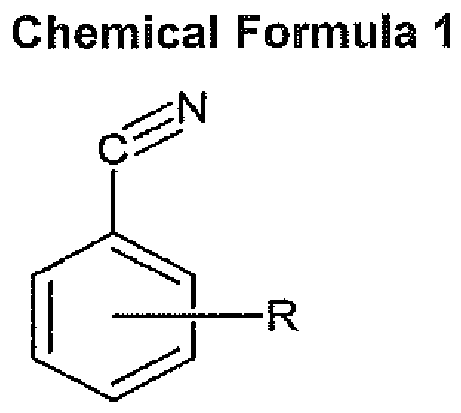
- According to an embodiment of the present invention, a solvent for an electrolyte for a rechargeable lithium battery is provided to include a non-aqueous organic solvent; and an alkyl benzonitrile compound represented by the following Chemical Formula 1. Also provided is an electrolyte comprising said solvent and a lithium salt.

- In Chemical Formula 1,
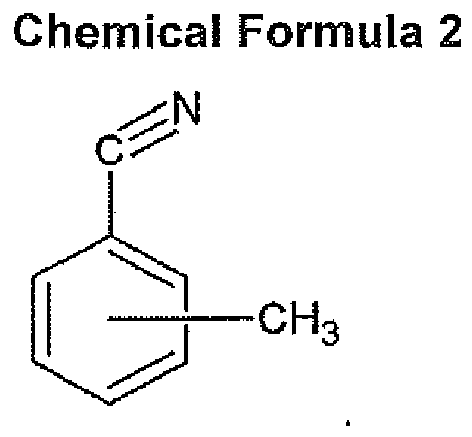
R is a substituted or unsubstituted C1 to C10 alkyl group, preferably a C1 to C5 alkyl group. - The alkyl benzonitrile compound preferably may be a methyl benzonitrile compound represented by the following Chemical Formula 2.

- The alkyl benzonitrile compound preferably may be a 4-alkyl benzonitrile compound represented by the following Chemical Formula 3.

- In Chemical Formula 3,
R is a substituted or unsubstituted C1 to C10 alkyl group, preferably a C1 to C5 alkyl group. - The alkyl benzonitrile compound preferably may be a 4-methyl benzonitrile compound represented by the following Chemical Formula 4.

- The alkyl benzonitrile compound preferably may be included in an amount of more than about 0 wt% and less than or equal to about 25 wt% based on the total amount of the solvent of the present invention.
- The alkyl benzonitrile compound may have a peak between about 4.90 V and 5.50 V when linear sweep voltammetry (LSV) is measured.
- According to another embodiment of the present invention, a rechargeable lithium battery is provided to include a positive electrode; a negative electrode; and an electrolyte including a lithium salt, a non-aqueous organic solvent and the alkyl benzonitrile compound represented by the above Chemical Formula 1.
- Other embodiments of the present invention are described below in more detail.
- When the electrolyte according to an embodiment of the present invention is used in a rechargeable lithium battery, the rechargeable lithium battery may have not only superb safety during an overcharge, but also excellent cycle-life.
-
FIG. 1 is a schematic view of a rechargeable lithium battery according to one embodiment of the present invention. -
FIG. 2 is a linear sweep voltammetry (LSV) graph of electrolytes according to Example 2 and Comparative Example 1. -
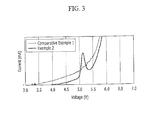
FIG. 3 is a graph enlarging the LSV graph ofFIG. 2 . -
FIG. 4 is a graph showing the state of the rechargeable lithium battery cell according to Example 2 when the rechargeable lithium batteries are overcharged. - Embodiments of the present invention will hereinafter be described in more detail.
- As used herein, when a specific definition is not otherwise provided, the term "substituted" refers to one substituted with one selected from either a halogen (e.g. a fluorine, chlorine, bromine or iodine, preferably fluorine), a hydroxyl group, a C1 to C20 alkyl group (preferably a C1 to C10 alkyl group), a C2 to C20 alkenyl group (preferably a C2 to C10 alkenyl group), a C2 to C20 alkynyl group (preferably a C2 to C10 alkynyl group), a C1 to C20 alkoxy group (preferably a C1 to C10 alkoxy group), a C3 to C30 cycloalkyl group (preferably a C3 to C10 cycloalkyl group), a C3 to C30 cycloalkenyl group (preferably a C4 to C10 cycloalkenyl group), a C7 to C30 cycloalkynyl group (preferably a C7 to C10 cycloalkynyl group), a C2 to C30 heterocycloalkyl group (preferably a C2 to C10 heterocycloalkyl group, a C2 to C30 heterocycloalkenyl group (preferably a C2 to C10 heterocycloalkenyl group), a C2 to C30 heterocycloalkynyl group (preferably a C2 to C10 heterocycloalkynyl group), a C6 to C30 aryl group (preferably a C6 to C10 aryl group), a C6 to C30 aryloxy group (preferably a C6 to C10 aryloxy group), a C2 to C30 heteroaryl group (preferably a C2 to C10 heteroaryl group), an amine group (-NR'R", wherein R' and R" are the same or different and are either hydrogen, a C1 to C20 alkyl group (preferably a C1 to C10 alkyl group), or a C6 to C30 aryl group(preferably a C6 to C10 aryl group), an ester group (-COOR"', wherein R'" is a C1 to C20 alkyl group (preferably a C1 to C10 alkyl group), or a C6 to C30 aryl group (preferably a C6 to C10 aryl group), a carboxyl group (-COOH), a nitro group (-NO2) or a cyano group (-CN), instead of at least one hydrogen.
- As used herein, when a specification definition is not otherwise provided, the prefix "hetero" refers to a functional group including 1 to 5 heteroatoms, preferably 1 to 3 heteroatoms selected from the group of N, O, P, and S or a combination thereof.
- The electrolyte for a rechargeable lithium battery according to one embodiment includes a lithium salt, a non-aqueous organic solvent, and an alkyl benzonitrile compound.
- In one embodiment, the alkyl benzonitrile compound is represented by the following Chemical Formula 1.

- In
Chemical Formula 1, R is a substituted or unsubstituted C1 to C10 alkyl group. In another embodiment, R is a substituted or unsubstituted C1 to C5. - Examples of the alkyl benzonitrile compound include a substituted or unsubstituted methyl benzonitrile compound, an ethyl benzonitrile compound, a propyl benzonitrile compound, a butyl benzonitrile compound, or a pentyl benzonitrile compound.
- Among them, the methyl benzonitrile compound represented by the following Chemical Formula 2 is used in one embodiment.

- Also, an alkyl group in the alkyl benzonitrile compound may exist in all hydrogen positions bonded to the carbons of a benzene ring, and the examples of such alkyl benzonitrile compound include a 2-alkyl benzonitrile compound, a 3-alkyl benzonitrile compound, and a 4-alkyl benzonitrile compound.
- Among them, the 4-alkyl benzonitrile compound represented by the following Chemical Formula 3 is used in one embodiment.
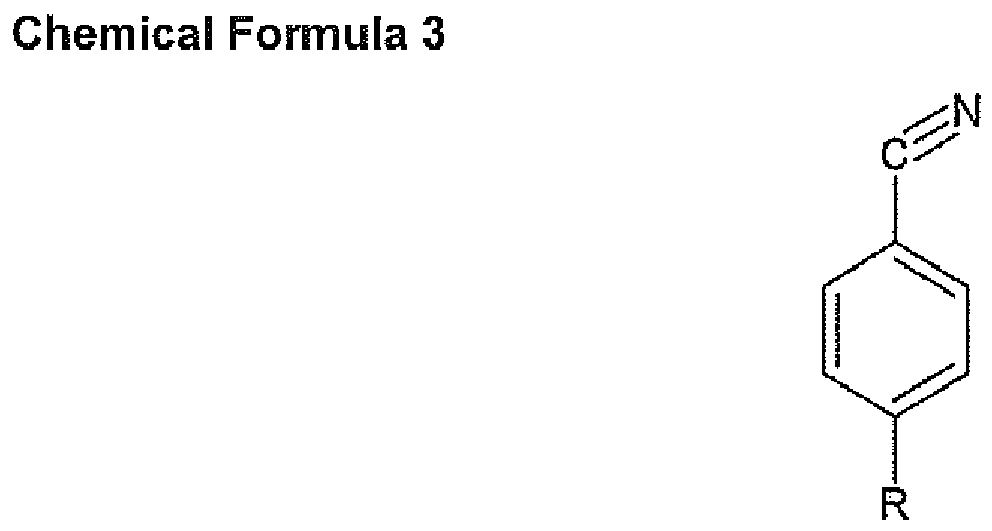
- In Chemical Formula 3, R is a substituted or unsubstituted C1 to C10 alkyl group. In another embodiment, R is a substituted or unsubstituted C1 to C5.
- Among the alkyl benzonitrile compound, the 4-methyl benzonitrile compound represented by the following Chemical Formula 4 is used in one embodiment.

- The alkyl benzonitrile compound preferably may be included in an amount of more than about 0 wt% and less than or equal to about 25 wt% based on the total amount of the solvent of the present invention, i.e. the total weight of the combination of alkyl benzonitrile, non-aqueous organic solvent and any further components that may be present, preferably more than about 0 wt% and less than or equal to about 20 wt%, more preferably more than about 0 wt% and less than or equal to about 15 wt%. According to one embodiment, the alkyl benzonitrile compound is preferably included in an amount of about 0.5 wt% to about 10 wt%, and according to another embodiment, the alkyl benzonitrile compound is included in an amount of about 1 wt% to about 7 wt%. For example, the alkyl benzonitrile compound is preferably included in an amount of about 0.5 wt% to about 20 wt%, more preferably an amount of about 1 wt% to about 17 wt%, more preferably an amount of about 3 wt% to about 15 wt%.
- The alkyl benzonitrile compound may have a peak between about 4.90 V and about 5.50 V during the measurement of linear sweep voltammetry (LSV), and according to one embodiment, a peak is between about 5.00 V and about 5.15 V. When the alkyl benzonitrile compound having R (i.e. an alkyl group) at 2-position or 4-position, the alkyl benzonitile compound preferably has a peak between about 4.90V and about 5.30V. When an electrolyte includes the alkyl benzonitrile compound, decomposition of the alkyl benzonitrile is started at a voltage lower than the decomposition starting voltage of the non-aqueous organic solvent. As a result, the LSV measurement result shows that the additive is decomposed at a voltage lower than the decomposition starting voltage of the non-aqueous organic solvent during an overcharge, and heat generated from the decomposition cuts off a protection device to thereby prevent or protect from an overcharge from occurring.
- The LSV is measured at a scanning speed of about 0.05 mV/s to about 1.0 mV/s in a voltage range of about 3 V to about 7V. Preferably, the scanning rate is about 0.1 mV/s. In one embodiment, when the LSV is measured, a platinum electrode is used as a working electrode, and lithium metal is used as a reference electrode and a counter electrode.
- The lithium salt supplies lithium ions in the battery, provides a basic operation of the rechargeable lithium battery, and improves lithium ion transport between positive and negative electrodes.
- Examples of the lithium salt include at least one supporting salt selected from the group consisting of LiPF6, LiBF4, LiSbF6, LiAsF6, LiN(SO3C2F5)2, LiC4F9SO3, LiClO4, LiAlO2, LiAlCl4, LiN(CxF2x+1SO2)(CyF2y+1SO2) - where x and y are natural numbers, LiCl, Lil, LiB(C2O4)2 (lithium bis(oxalato) borate: LiBOB), and combinations thereof.
- The concentration of the lithium salt may preferably range from about 0.1 M to about 2.0M. In one embodiment, when the lithium salt is included at the above concentration range, electrolyte performance and lithium ion mobility is enhanced due to desired electrolyte conductivity and viscosity.
- The non-aqueous organic solvent acts as a medium for transmitting ions taking part in the electrochemical reaction of the battery. The non-aqueous organic solvent may include a carbonate-based compound, an ester-based compound, an ether-based compound, a ketone-based compound, an alcohol-based compound, an aprotic solvent, or a combination thereof. In a preferred embodiment the non-aqueous organic solvent contains a carbonate-based compound, preferably a mixture of carbonate-based compounds.
- The non-aqueous organic solvent is preferably included in an amount of about 75 wt% to about 99.9 wt%, more preferably an amount of about 80 wt% to about 99.5 wt%, more preferably an amount of about 85 wt% to about 95 wt% based on the total weight of the solvent of the present invention.
- The carbonate-based compound may include a linear carbonate compound, a cyclic carbonate compound, or a combination thereof.
- The linear carbonate compound may include diethyl carbonate (DEC), ethylmethyl carbonate (EMC), dimethyl carbonate (DMC), dipropyl carbonate (DPC), methylpropyl carbonate (MPC), ethylpropyl carbonate (EPC), or a combination thereof; and the cyclic carbonate compound may include ethylene carbonate (EC), propylene carbonate (PC), butylene carbonate (BC), fluoroethylene carbonate (FEC), vinylethylene carbonate (VEC), or a combination thereof. Preferably, the carbonate compound is EC, EMC, DEC, FEC or VEC or a combination thereof, optionally a combination of at least two of these, preferably at least three of these and more preferably a combination of all of these five compounds.
- The linear carbonate compound preferably may be added at about 60 wt% or more based on the total amount of the non-aqueous organic solvent, preferably about 60 wt% to about 100 wt%, more preferably about 75 wt% to about 90 wt%, more preferably about 80 wt% to about 85 wt%. The cyclic carbonate compound preferably may be added at about 40 wt% or less based on the total amount of the non-aqueous organic solvent, preferably about 0 wt% to about 40 wt%, more preferably about 10 wt% to about 25 wt%, more preferably about 15 wt% to about 20 wt%,. In one embodiment, when the linear carbonate compound and the cyclic carbonate compound are respectively included within the range, it provides the solvent with both a high dielectric constant and a low viscosity.
- The ester-based compound may include methylacetate, ethyl acetate, n-propylacetate, 1,1-dimethylethylacetate, methylpropionate, ethylpropionate, γ-butyrolactone, decanolide, valerolactone, mevalonolactone, caprolactone, or the like. The ether-based compound may include dibutylether, tetraglyme, diglyme, dimethoxyethane, 2-methyltetrahydrofuran, tetrahydrofuran, or the like. The ketone-based compound may include cyclohexanone or the like. The alcohol-based compound may include ethanol, isopropyl alcohol, or the like.
- The aprotic solvent may include nitriles such as R-CN (wherein R is a C2 to C20 linear, branched, or cyclic hydrocarbon, a double bond, an aromatic ring, or an ether bond); amides such as dimethylformamide; dioxolanes such as 1,3-dioxolane, sulfolanes; or the like.
- The non-aqueous organic solvent preferably may be used alone or as a mixture. When the organic solvent is used as a mixture, the mixing ratio may be controlled in accordance with desirable battery performance.
- The electrolyte may further include succinonitrile as an additive. The succinonitrile preferably may be included in an amount of about 0.1 wt% to about 5 wt% based on the total amount of the electrolyte. According to one embodiment, the succinonitrile preferably may be included in an amount of about 0.5 wt% to about 3 wt%. When the electrolyte includes the succinonitrile, the succinonitrile forms a coordinate covalent bond with the transition element of a positive active material at the positive electrode interface to thereby suppress open circuit voltage (OCV) defects during a formation process, and improve thermal stability at a high temperature such as heat exposure.
- Hereafter, a rechargeable lithium battery including the electrolyte is described with reference to
FIG. 1 . -
FIG. 1 is a schematic view of a representative structure of a rechargeable lithium battery according to one embodiment. - Referring to
FIG. 1 , the rechargeable lithium battery 3 is a prismatic battery that includes anelectrode assembly 4 in a battery case 8, an electrolyte implanted through the upper portion of the case 8, and acap plate 11 sealing the case 8. Theelectrode assembly 4 includes apositive electrode 5, anegative electrode 6, and aseparator 7 positioned between thepositive electrode 5 and thenegative electrode 6. The rechargeable lithium battery of the present invention is not limited to a prismatic form of rechargeable lithium battery, and it may be formed in diverse forms such as a cylindrical form, a coin-type form, or a pouch form as long as it includes the electrolyte for the rechargeable lithium battery and operates as the battery. - The electrolyte is the same as described according to embodiments of the present invention.
- The
positive electrode 5 includes a current collector and a positive active material layer disposed on the current collector. The positive active material layer includes a positive active material, a binder, and a conductive material. - The current collector may include aluminum (Al), but is not limited thereto.
- The positive active material includes lithiated intercalation compounds that reversibly intercalate and deintercalate lithium ions. The positive active material may include a composite oxide including cobalt, manganese, and/or nickel, as well as lithium. In one embodiment, the following lithium-containing compounds preferably may be used, but is not limited thereto:
- LiaA1-bBbD2(0.90 ≤ a ≤ 1.8 and 0 ≤ b ≤ 0.5); LiaE1-bBbO2-cDc(0.90 ≤ a ≤ 1.8, 0 ≤ b ≤ 0.5, 0 ≤ c ≤ 0.05); LiE2-bBbO4-cDc(0 ≤ b ≤ 0.5, 0 ≤ c ≤ 0.05); LiaNi1-b-cCobBcDα(0.90 ≤ a ≤ 1.8, 0 ≤ b ≤ 0.5, 0 ≤ c ≤ 0.05, 0 < α ≤ 2); LiaNi1-b-cCobBcO2-αFα(0.90 ≤ a ≤ 1.8, 0 ≤ b ≤ 0.5, 0 ≤ c ≤ 0.05, 0 < α < 2); LiaNi1-b-cCobBcO2-αF2(0.90 ≤ a ≤ 1.8, 0 ≤ b ≤ 0.5, 0 ≤ c ≤ 0.05, 0 < α < 2); LiaNi1-b-cMnbBcDα(0.90 ≤ a ≤ 1.8, 0 ≤ b ≤ 0.5, 0 ≤ c ≤ 0.05, 0 < α ≤ 2); LiaNi1-b-cMnbBcO2-αFα(0.90 ≤ a ≤ 1.8, 0 ≤ b ≤ 0.5, 0 ≤ c ≤ 0.05, 0 < α < 2); LiaNi1-b-cMnbBcO2-αF2(0.90 ≤ a ≤ 1.8, 0 ≤ b ≤ 0.5, 0 ≤ c ≤ 0.05, 0 < α < 2); LiaNibEcGdO2 (0.90 ≤ a ≤ 1.8, 0 ≤ b ≤ 0.9, 0 ≤ c ≤ 0.5, 0.001 ≤ d ≤ 0.1.); LiaNibCocMndGeO2 (0.90 ≤ a ≤ 1.8, 0 ≤ b ≤ 0.9, 0 ≤ c ≤ 0.5, 0 ≤ d ≤0.5, 0.001 ≤ e ≤ 0.1); LiaNiGbO2 (0.90 ≤ a ≤ 1.8, 0.001 ≤ b ≤ 0.1.); LiaCoGbO2(0.90 ≤ a ≤ 1.8, 0.001 ≤ b ≤ 0.1.); LiaMnGbO2(0.90 ≤ a ≤ 1.8, 0.001 ≤ b ≤ 0.1.); LiaMn2GbO4 (0.90 ≤ a ≤ 1.8, 0.001 ≤ b ≤ 0.1.); QO2; QS2; LiQS2; V2O5; LiV2O5; LilO2; LiNiVO4; Li(3-f)J2(PO4)3 (0 ≤ f ≤ 2); Li(3-f)Fe2(PO4)3 (0 ≤ f ≤ 2); and/or LiFePO4.
- In the above chemical formula, A is Ni, Co, Mn, or a combination thereof; R is Al, Ni, Co, Mn, Cr, Fe, Mg, Sr, V, a rare earth element, or a combination thereof; D is O, F, S, P, or a combination thereof; E is Co, Mn, or a combination thereof; Z is F, S, P, or a combination thereof; G is Al, Cr, Mn, Fe, Mg, La, Ce, Sr, V, or a combination thereof; Q is Ti, Mo, Mn, or a combination thereof; T is Cr, V, Fe, Sc, Y, or a combination thereof; and J is V, Cr, Mn, Co, Ni, Cu, or a combination thereof.
- The positive active material may include the positive active material with the coating layer, or a compound of the active material and the active material coated with the coating layer. The coating layer may include at least one coating element compound selected from the group consisting of an oxide of the coating element, a hydroxide of the coating element, an oxyhydroxide of the coating element, an oxycarbonate of the coating element, and a hydroxycarbonate of the coating element. The compound for the coating layer preferably may be either amorphous or crystalline. The coating element or coating material included in the coating layer preferably may be selected from the group consisting of Mg, Al, Co, K, Na, Ca, Si, Ti, V, Sn, Ge, Ga, B, As, Zr, or a mixture thereof. The coating process may include any suitable process as long as it does not cause any side effects on the properties of the positive active material (e.g., spray coating, immersing), which is well known to persons having ordinary skill in this art, so a detailed description thereof is omitted.
- The binder improves binding properties of the positive active material particles to each other and to a current collector. Examples of the binder include polyvinyl alcohol, carboxylmethyl cellulose, hydroxypropyl cellulose, diacetyl cellulose, polyvinyl chloride, carboxylated polyvinyl chloride, polyvinyl fluoride, polymer including ethylene oxide, polyvinylpyrrolidone, polyurethane, polytetrafluoroethylene, polyvinylidene fluoride, polyethylene, polypropylene, a styrene-butadiene rubber, an acrylated styrene-butadiene rubber, an epoxy resin, nylon, and the like, but are not limited thereto.
- The conductive material improves electrical conductivity of a negative electrode. Any electrically conductive material can be used as a conductive agent unless it causes a chemical change. Non-limiting examples of the conductive material include natural graphite, artificial graphite, carbon black, acetylene black, ketjen black, a carbon fiber, a metal powder or a metal fiber of copper, nickel, aluminum, silver, and a polyphenylene derivative, which preferably may be used singularly or as a mixture thereof.
- The
negative electrode 6 includes a current collector and a negative active material layer disposed thereon. - The current collector may include a copper foil, a nickel foil, a stainless steel foil, a titanium foil, a nickel foam, a copper foam, a polymer substrate coated with a conductive metal, or a combination thereof, but is not limited thereto.
- The negative active material layer may include a negative active material, a binder, and optionally, a conductive material.
- The negative active material includes a material that reversibly intercalates/deintercalates lithium ions, a lithium metal, a lithium metal alloy, a material being capable of doping/dedoping lithium, and/or a transition metal oxide.
- The material that can reversibly intercalate/deintercalate lithium ions includes a carbon material. The carbon material may be any suitable carbon-based negative active material in a lithium ion rechargeable battery. Examples of the carbon material include crystalline carbon, amorphous carbon, and mixtures thereof. The crystalline carbon preferably may be non-shaped, or sheet, flake, spherical, or fiber shaped natural graphite or artificial graphite. The amorphous carbon preferably may be a soft carbon, a hard carbon, a mesophase pitch carbonization product, fired coke, or the like.
- Examples of the lithium metal alloy include lithium and a metal selected from the group consisting of Na, K, Rb, Cs, Fr, Be, Mg, Ca, Sr, Si, Sb, Pb, In, Zn, Ba, Ra, Ge, Al, Sn, and combinations thereof.
- Examples of the material being capable of doping lithium include Si, SiOx (0 < x < 2), an Si-Y alloy (where Y is an element selected from the group consisting of an alkali metal, an alkali-earth metal, a group 13 element, a group 14 element, a group 15 element, a group 16 element, a transition element, a rare earth element, and combinations thereof, and is not Si), Sn, SnO2, an Sn-Y alloy (where Y is an element selected from the group consisting of an alkali metal, an alkali-earth metal, a group 13 element, a group 14 element, a group 15 element, a group 16 element, a transition element, a rare earth element, and combinations thereof, and is not Sn), and mixtures thereof. At least one of these materials preferably may be mixed with SiO2. The element Y preferably may be selected from the group consisting of Mg, Ca, Sr, Ba, Ra, Sc, Y, Ti, Zr, Hf, Rf, V, Nb, Ta, Db, Cr, Mo, W, Sg, Tc, Re, Bh, Fe, Pb, Ru, Os, Hs, Rh, Ir, Pd, Pt, Cu, Ag, Au, Zn, Cd, B, Al, Ga, Sn, In, Ge, P, As, Sb, Bi, S, Se, Te, Po, and combinations thereof.
- Examples of the transition metal oxide include vanadium oxide, lithium vanadium oxide, and the like.
- The binder improves binding properties of negative active material particles with one another and with a current collector. Examples of the binder include polyvinyl alcohol, carboxylmethyl cellulose, hydroxypropyl cellulose, polyvinyl chloride, carboxylated polyvinyl chloride, polyvinyl fluoride, polymer including ethylene oxide, polyvinylpyrrolidone, polyurethane, polytetrafluoroethylene, polyvinylidene fluoride, polyethylene, polypropylene, a styrene-butadiene rubber, an acrylated styrene-butadiene rubber, an epoxy resin, nylon, and the like, but are not limited thereto.
- The conductive material is included to improve electrode conductivity. Any electrically conductive material may be used as a conductive material unless it causes a chemical change. Examples of the conductive material include carbon-based materials such as natural graphite, artificial graphite, carbon black, acetylene black, ketjen black, carbon fibers, and the like; metal-based materials of metal powder or metal fiber including copper, nickel, aluminum, silver; conductive polymers such as polyphenylene derivatives; and mixtures thereof.
- The
positive electrode 5 and thenegative electrode 6 may be fabricated by a method including mixing an active material and a binder, optionally a conductive material, and a binder into an active material composition and coating the composition on a current collector. - The electrode manufacturing method is well known, and thus is not described in detail in the present specification. The solvent preferably may be N-methylpyrrolidone, but it is not limited thereto.
- The
separator 7 preferably may be formed as a single layer or a multilayer, and preferably may be made of polyethylene, polypropylene, polyvinylidene fluoride, or a combination thereof. - Hereinafter, the embodiments are illustrated in more detail with reference to examples. However, the following are exemplary embodiments and are not limiting.
- Furthermore, what is not described in this specification can be sufficiently understood by those who have knowledge in this field and will not be illustrated here.
- 1.0M LiPF6 was dissolved in a mixed solvent of ethylene carbonate (EC), ethylmethyl carbonate (EMC) and diethyl carbonate (DEC) at a volume ratio of about 3:5:2, to prepare an electrolyte precursor. Electrolyte solutions were prepared by adding 5 wt% of fluoroethylene carbonate (FEC), 1 wt% of vinylethylene carbonate (VEC), 0.2 wt% of
LiBF 4 1 wt% of succinonitrile and alkyl benzonitrile compounds according to the kinds and contents shown in the following Table 1, to the balance amount of the electrolyte precursor.Table 1 Alkyl benzonitrile compound Amount of alkyl Benzonitrile compound (wt%) Example 1 4-methyl benzonitrile 0.5 Example 2 4-methyl benzonitrile 3 Example 3 4- methyl benzonitrile 5 Example 4 4- methyl benzonitrile 7 Example 5 4- methyl benzonitrile 10 Example 6 4-methyl benzonitrile 15 Example 7 3-methyl benzonitrile 0.5 Example 8 3- methyl benzonitrile 5 Example 9 3-methyl benzonitrile 15 Example 10 2-methyl benzonitrile 0.5 Example 11 2- methyl benzonitrile 5 Example 12 2-methyl benzonitrile 15 Example 13 4- ethyl benzonitrile 10 Example 14 3-ethyl benzonitrile 15 Example 15 2-ethyl benzonitrile 15 Example 16 4- propyl benzonitrile 10 Example 17 3-propyl benzonitrile 15 Example 18 2-propyl benzonitrile 15 Example 19 4- butyl benzonitrile 10 Example 20 3-butyl benzonitrile 15 Example 21 2-butyl benzonitrile 15 Example 22 4- pentyl benzonitrile 10 Example 23 3-pentyl benzonitrile 15 Example 24 2-pentyl benzonitrile 15 Comparative Example 1 - - Comparative Example 2 biphenyl 0.5 Comparative Example 3 biphenyl 5 Comparative Example 4 biphenyl 15 Comparative Example 5 cyclohexyl benzene 0.5 Comparative Example 6 cyclohexyl benzene 5 Comparative Example 7 cyclohexyl benzene 15 Comparative Example 8 benzonitrile 0.5 Comparative Example 9 benzonitrile 5 Comparative Example 10 benzonitrile 15 - A composition for a positive active material layer was prepared by mixing LiCoO2 as a positive active material, polyvinylidene fluoride (PVDF) as a binder, and carbon as a conductive material at a weight ratio of about 92:4:4, and dispersing the mixture in N-methyl-2-pyrrolidone. A positive electrode was fabricated by coating a 20 µm-thick aluminum foil with the composition for a positive active material layer, drying it, and compressing it.
- A composition for a negative active material layer was prepared by mixing a crystalline artificial graphite as a negative active material and polyvinylidene fluoride (PVDF) as a binder in a weight ratio of about 92:8, and dispersing the mixture in N-methyl-2-pyrrolidone.
- A negative electrode was fabricated by coating a 15 µm-thick copper foil with the composition for a negative active material layer, drying it, and compressing it.
- Rechargeable lithium battery cells were fabricated by winding and compressing the positive and negative electrodes (that were fabricated through the above description) with a separator which was of a 25 µm-thick polyethylene material, and inserting the resultant structure into a prismatic (1209mA) case of about 30mmx48mmx6mm. Herein, the electrolyte solutions prepared according to Examples 1 to 24 and Comparative Examples 1 to 10 were used.
- The decomposition initiation voltages of the electrolyte solutions prepared according to Example 2 and Comparative Example 1 were measured using a linear sweep voltammetry (LSV), and the measurement results were presented in
FIGS. 2 and3 . - Measurement of LSV was performed within a voltage range of about 3 V to about 7 V at a scanning rate of about 0.1 mV/s, a platinum electrode was used as a working electrode, and lithium metal was used as a reference electrode and a counter electrode. The LSV measurement instrument used a Multi-Channel Potentiostat (produced by Wona Tech) WMPG1000.
-
FIG. 2 is an LSV graph of the electrolyte solutions prepared according to Example 2 and Comparative Example 1, andFIG. 3 is a graph enlarging the LSV graphFIG. 2 . - Referring to
FIGS. 2 and3 , it may be seen that in the case of Example 2, the alkyl benzonitrile compound begins to be decomposed at a voltage lower than the decomposition initiation voltage of a non-aqueous organic solvent. Also, in the case of the electrolyte solution prepared according to Example 2, an oxidation peak appeared at about 5.1 V, and the decomposition initiation voltage of the electrolyte solution prepared according to Example 2 was higher than the decomposition initiation voltage of that of Comparative Example 1. Accordingly, it may be seen from the LSV measurement result that excellent safety may be secured because the decomposition of the additive was initiated at a voltage lower than the decomposition initiation voltage of a non-aqueous organic solvent during an overcharge, and the heat generated from the decomposition of the additive initiated the operation of (i.e., cut off) a protection device to thereby prevent or protect from an overcharge. - The rechargeable lithium battery cell prepared according to Example 2 was overcharged, and the state according to voltage and temperature was measured. The measurement results were presented in
FIG. 4 . - The rechargeable lithium battery cell prepared according to Example 2 were cut-off charged in the conditions of about 1200mA, 4.2V, and 33 min, and charged with constant current and constant voltage of about 950mA and 10V.
-
FIG. 4 is a graph showing overcharge states of the rechargeable lithium battery cell prepared according to Example 2. It can be seen fromFIG. 4 that the temperature was increased to about 100 ° C and then decreased, and the voltage was increased to about 10V and then maintained. The increase in temperature was brought by decomposing the additive in the electrolyte solution during the overcharging to generate heat and the decreases in temperature was by removing the additive caused from the decomposition. The increases in voltage were brought about by cutting off the protection device caused from the generated heat. This may be described as a mechanism in which an alkyl benzonitrile compound is decomposed prior to a non-aqueous organic solvent during an overcharge. - Packs the rechargeable lithium battery cells prepared according to Examples 1 to 24 and Comparative Examples 1 to 10 i) were cut-off charged in the cut-off conditions of about 1220mA, 4.2V, and 33 minutes under a standard environment and then the charging was paused for about 10 minutes to about 72 hours or less, and ii) a secondary protection device (which is a thermal fuse: EYP2MP098DUK) was attached to each of the rechargeable lithium battery cells (evaluated as a single cell). iii) The pack was placed on a wood plate, and charged with constant current and constant voltage of about 950mA and about 10V for about 5 hours. iv) After the maximal temperature evaluation, the safety during an overcharge was evaluated by observing OCV, the phenomenon occurred during an overcharge, and the measurement result was presented in the following Table 2.
- The safeties of the rechargeable lithium battery cells prepared according to Examples 1 to 24 and Comparative Examples 1 to 10 during an overcharge were evaluated by i) performing a cut-off charge in the conditions of about 950mA, 4.2V, and 0.05C (60mA) under a standard environment and pausing the charging for about 10 minutes to about 72 hours or less, ii) placing the rechargeable lithium battery cells on a hot plate set to about 250 °C, and iii) determining the phenomenon that occurred during an overcharge. The results were presented in the following Table 2.
- The safety evaluation standards that were measured during an overcharge in Experimental Examples 1 and 2 were as follows.
- The number before L denotes the number of test cells (e.g., 6L, 4L, 10L, etc.), and L0: Excellent, L1: liquid leakage, L2: flash, L3: smoke, L4: ignition, L5: breakage.
- The rechargeable lithium battery cells prepared according to Examples 1 to 24 and Comparative Examples 1 to 10 were charged at about 1C to the charge voltage of about 4.2V under the condition of constant current-constant voltage (CC-CV) and discharged at about 1 C to the cut-off voltage of about 3.0V under the CC condition. The charge and discharge were performed 300 times and the capacity retention based on cycle was measured to evaluate the cycle-life, and the evaluation result was presented in the following Table 2.
Table 2 Alkyl benzonitrile compound Amount of alkyl benzonitrile compound (wt%) Pack overcharge test Hot plate test Capacity retention (%) (300th capacity relative to first capacity) Example 1 4-methyl benzonitrile 0.5 6L0,4L1 6L0,4L1 97 Example 2 4-methyl benzonitrile 3 10L0 10L0 96 Example 3 4-methyl benzonitrile 5 10L0 10L0 95 Example 4 4-methyl benzonitrile 7 10L0 10L0 94 Example 5 4-methyl benzonitrile 10 10L0 10L0 93 Example 6 4-methyl benzonitrile 15 10L0 10L0 91 Example 7 3-methyl benzonitrile 0.5 5L0,5L1 5L0,5L1 96 Example 8 3-methyl benzonitrile 5 9L0,1L1 9L0,1L1 89 Example 9 3-methyl benzonitrile 15 10L0 10L0 87 Example 10 2-methyl benzonitrile 0.5 5L0,5L1 5L0,5L1 97 Example 11 2-methyl benzonitrile 5 10L0 10L0 90 Example 12 2-methyl benzonitrile 15 10L0 10L0 88 Example 13 4-ethyl benzonitrile 10 10L0 10L0 90 Example 14 3-ethyl benzonitrile 15 10L0 10L0 83 Example 15 2-ethyl benzonitrile 15 10L0 10L0 85 Example 16 4-propyl benzonitrile 10 10L0 10L0 88 Example 17 3-propyl benzonitrile 15 10L0 10L0 81 Example 18 2-propyl benzonitrile 15 10L0 10L0 82 Example 19 4-butyl benzonitrile 10 10L0 10L0 86 Example 20 3-butyl benzonitrile 15 10L0 10L0 79 Example 21 2-butyl benzonitrile 15 10L0 10L0 80 Example 22 4-pentyl benzonitrile 10 10L0 10L0 83 Example 23 3-pentyl benzonitrile 15 10L0 10L0 76 Example 24 2-pentyl benzonitrile 15 10L0 10L0 77 Comparative Example 1 - - 10L5 10L5 98 Comparative Example 2 biphenyl 0.5 10L5 10L5 97 Comparative Example 3 biphenyl 5 5L0,5L5 4L0,6L5 80 Comparative Example 4 biphenyl 15 8L0,2L5 5L0,5L5 70 Comparative Example 5 cyclohexyl benzene 0.5 10L5 10L5 98 Comparative Example 6 cyclohexyl benzene 5 4L0,6L5 3L0,7L5 80 Comparative Example 7 cyclohexyl benzene 15 7L0,3L5 5L0,5L5 72 Comparative Example 8 benzonitrile 0.5 2L0,8L5 2L0,8L5 93 Comparative Example 9 benzonitrile 5 3L0,7L5 4L0,6L5 90 Comparative Example 10 benzonitrile 15 5L0,5L5 5L0,5L5 85 - It may be seen from Table 2 that those of Examples 1 to 24 using the alkyl benzonitrile compound prepared according to an embodiment of the present invention as a component for an electrolyte solution, had both excellent safety during an overcharge and excellent cycle-life, compared with those of Comparative Examples 1 to 10.
- Also, it may be seen from Examples 1 to 24 that when an alkyl group existed in the same position, the safety during an overcharge and the cycle-life were better when methyl benzonitrile compound was used, than when ethyl benzonitrile compound, propyl benzonitrile compound, butyl benzonitrile compound, and pentyl benzonitrile compound were used.
- Also, it may be seen from Examples 1 to 24 that in the case of an alkyl group of the same kind, the safety during an overcharge and cycle-life were better when the 4-alkyl benzonitrile compound was used, than when the 3-an alkyl benzonitrile compound and the 2-an alkyl benzonitrile compound were used.
- Also, those of Examples 1 to 6 using a 4-methyl benzonitrile compound showed most improvement in safety during an overcharge while still have high cycle-life.
- While this invention has been described in connection with what is presently considered to be practical embodiments, it is to be understood that the invention is not limited to the disclosed embodiments, but, on the contrary, is intended to cover various modifications and equivalent arrangements included within the scope of the appended claims.
Claims (11)
- A solvent for an electrolyte for a rechargeable lithium battery, the electrolyte comprising:a non-aqueous organic solvent; andan alkyl benzonitrile compound represented by the following Chemical Formula 1:

R is a substituted or unsubstituted C1 to C10 alkyl group. - The solvent of claim 1, wherein the alkyl benzonitrile compound comprises a methyl benzonitrile compound represented by the following Chemical Formula 2:
- The solvent of claim 1, wherein the alkyl benzonitrile compound comprises a 4-alkyl benzonitrile compound represented by the following Chemical Formula 3:

R is a substituted or unsubstituted C1 to C10 alkyl group. - The solvent of claim 1, wherein the alkyl benzonitrile compound comprises a 4-methyl benzonitrile compound represented by the following Chemical Formula 4.

- The solvent of any of claims 1 to 4, wherein the alkyl benzonitrile compound is included in an amount of more than about 0 wt% and less than or equal to about 25 wt% based on the total amount of the solvent solution.
- The solvent of any of claims 1 to 5, wherein the alkyl benzonitrile compound shows a peak between about 4.90V and about 5.50 V when linear sweep voltammetry (LSV) is measured.
- The solvent of any of claims 1 to 5, wherein the non-aqueous organic solvent comprises a carbonate-based compound, an ester-based compound, an ether-based compound, a ketone-based compound, an alcohol-based compound, an aprotic solvent, or a combination thereof.
- The solvent of claim 7, wherein the organic solvent contains a carbonate-based compound, preferably a mixture of carbonate-based compounds, preferably a mixture of a linear carbonate compound and a cyclic carbonate compound.
- The solvent of any of claims 1 to 8, wherein the non-aqueous organic solvent is present in an amount of about 75 wt% to about 99.9 wt% based on the total weight of the solvent.
- An electrolyte comprising the solvent of any of claims 1 to 9, and a lithium salt.
- A rechargeable lithium battery comprising:a positive electrode;a negative electrode; andan electrolyte according to claim 10.
Applications Claiming Priority (1)
| Application Number | Priority Date | Filing Date | Title |
|---|---|---|---|
| KR1020110013769A KR101309157B1 (en) | 2011-02-16 | 2011-02-16 | Electrolyte for rechargeable lithium battery, and rechargeable lithium battery including the same |
Publications (2)
| Publication Number | Publication Date |
|---|---|
| EP2490292A1 true EP2490292A1 (en) | 2012-08-22 |
| EP2490292B1 EP2490292B1 (en) | 2016-05-04 |
Family
ID=45463458
Family Applications (1)
| Application Number | Title | Priority Date | Filing Date |
|---|---|---|---|
| EP12150404.7A Active EP2490292B1 (en) | 2011-02-16 | 2012-01-06 | Electrolyte for a rechargeable lithium battery, and rechargeable lithium battery including the same |
Country Status (5)
| Country | Link |
|---|---|
| US (1) | US20120208080A1 (en) |
| EP (1) | EP2490292B1 (en) |
| JP (1) | JP6068789B2 (en) |
| KR (1) | KR101309157B1 (en) |
| CN (1) | CN102646846B (en) |
Cited By (3)
| Publication number | Priority date | Publication date | Assignee | Title |
|---|---|---|---|---|
| CN105359238A (en) * | 2013-07-12 | 2016-02-24 | Ioxus公司 | Stability enhancing additives for electrochemical devices |
| EP3860974A4 (en) * | 2018-10-04 | 2022-08-17 | Hydro-Québec | ADDITIVES FOR ELECTROLYTES IN LI-ION BATTERIES |
| EP4109620A4 (en) * | 2020-10-13 | 2024-09-18 | LG Energy Solution, Ltd. | NONAQUEOUS ELECTROLYTE FOR LITHIUM SECONDARY BATTERY AND LITHIUM SECONDARY BATTERY COMPRISING SAME |
Families Citing this family (12)
| Publication number | Priority date | Publication date | Assignee | Title |
|---|---|---|---|---|
| JP5655653B2 (en) * | 2011-03-17 | 2015-01-21 | 三菱化学株式会社 | Non-aqueous electrolyte and lithium secondary battery using the same |
| CN104638297A (en) * | 2013-11-11 | 2015-05-20 | 日立麦克赛尔株式会社 | Lithium secondary battery |
| JP6396153B2 (en) * | 2013-11-11 | 2018-09-26 | マクセルホールディングス株式会社 | Lithium secondary battery |
| KR101702981B1 (en) | 2013-11-20 | 2017-02-06 | 삼성에스디아이 주식회사 | Electrolyte and rechargeable lithium battery including the same |
| CN104953173B (en) * | 2014-03-28 | 2018-12-21 | 比亚迪股份有限公司 | A kind of lithium-ion battery electrolytes and the lithium ion battery containing the electrolyte |
| JP6396136B2 (en) * | 2014-09-18 | 2018-09-26 | マクセルホールディングス株式会社 | Lithium secondary battery |
| JP6592256B2 (en) * | 2015-03-09 | 2019-10-16 | マクセルホールディングス株式会社 | Lithium ion secondary battery |
| JP7105194B2 (en) * | 2016-03-29 | 2022-07-22 | アンテオ テクノロジーズ プロプライエタリー リミテッド | Conductive interface and method of manufacturing electrode including conductive interface |
| CN107417569B (en) * | 2016-05-23 | 2020-04-14 | 微宏动力系统(湖州)有限公司 | Tertiary nitrile compound for non-aqueous electrolyte, non-aqueous electrolyte containing same, and secondary battery |
| CN109326825B (en) * | 2017-07-31 | 2024-01-19 | 住友化学株式会社 | Non-aqueous electrolyte secondary battery |
| EP3486991B1 (en) * | 2017-11-15 | 2025-04-16 | Samsung Electronics Co., Ltd. | Electrolyte additive for lithium battery, organic electrolyte solution including the same, and lithium battery including the same |
| CN116259840B (en) * | 2022-12-27 | 2025-05-27 | 河南省法恩莱特新能源科技有限公司 | Preparation method of lithium ion quick-charging battery electrolyte |
Citations (6)
| Publication number | Priority date | Publication date | Assignee | Title |
|---|---|---|---|---|
| WO2001029920A1 (en) * | 1999-10-18 | 2001-04-26 | The Regents Of The University Of California | Shutdown and redox shuttle additives for batteries |
| US20040013946A1 (en) * | 2002-07-15 | 2004-01-22 | Ube Industries, Ltd. | Non-aqueous electrolytic solution and lithium battery |
| EP1508934A1 (en) * | 2003-08-20 | 2005-02-23 | Samsung SDI Co., Ltd. | Electrolyte for rechargeable lithium battery and rechargeable lithium battery comprising the same |
| KR20080043034A (en) * | 2006-11-13 | 2008-05-16 | 주식회사 엘지화학 | Non-aqueous electrolyte additive and secondary battery using same |
| JP2010141276A (en) * | 2008-11-17 | 2010-06-24 | Sanyo Chem Ind Ltd | Electrolyte and electrochemical element using quaternary ammonium salt electrolyte |
| US20110207000A1 (en) * | 2006-09-07 | 2011-08-25 | Jow T Richard | Nitrile additive for non-aqueous electrolyte rechargeable electrochemical cells |
Family Cites Families (9)
| Publication number | Priority date | Publication date | Assignee | Title |
|---|---|---|---|---|
| JPS59203368A (en) * | 1983-05-04 | 1984-11-17 | Showa Denko Kk | battery |
| JPS6020476A (en) * | 1983-07-13 | 1985-02-01 | Showa Denko Kk | Secondary battery |
| JPS6124177A (en) * | 1984-07-13 | 1986-02-01 | Showa Denko Kk | Secondary cell |
| KR100709206B1 (en) * | 2003-10-31 | 2007-04-19 | 삼성에스디아이 주식회사 | Electrolyte for rechargeable lithium battery and rechargeable lithium battery comprising same |
| CN100502132C (en) * | 2004-02-10 | 2009-06-17 | 株式会社Lg化学 | Non-aqueous electrolyte and lithium secondary battery using the same |
| KR100865402B1 (en) * | 2007-06-12 | 2008-10-24 | 삼성에스디아이 주식회사 | Non-aqueous electrolyte solution for lithium secondary batteries and lithium secondary battery using the electrolyte |
| JP2010010078A (en) * | 2008-06-30 | 2010-01-14 | Daikin Ind Ltd | Nonaqueous electrolyte |
| US8048559B2 (en) * | 2009-07-08 | 2011-11-01 | Samsung Sdi Co., Ltd | Secondary battery and method of making the secondary battery |
| WO2012029388A1 (en) * | 2010-09-02 | 2012-03-08 | 日本電気株式会社 | Secondary battery |
-
2011
- 2011-02-16 KR KR1020110013769A patent/KR101309157B1/en active Active
- 2011-09-22 US US13/241,152 patent/US20120208080A1/en not_active Abandoned
- 2011-10-31 JP JP2011239114A patent/JP6068789B2/en active Active
- 2011-12-09 CN CN201110409704.0A patent/CN102646846B/en active Active
-
2012
- 2012-01-06 EP EP12150404.7A patent/EP2490292B1/en active Active
Patent Citations (6)
| Publication number | Priority date | Publication date | Assignee | Title |
|---|---|---|---|---|
| WO2001029920A1 (en) * | 1999-10-18 | 2001-04-26 | The Regents Of The University Of California | Shutdown and redox shuttle additives for batteries |
| US20040013946A1 (en) * | 2002-07-15 | 2004-01-22 | Ube Industries, Ltd. | Non-aqueous electrolytic solution and lithium battery |
| EP1508934A1 (en) * | 2003-08-20 | 2005-02-23 | Samsung SDI Co., Ltd. | Electrolyte for rechargeable lithium battery and rechargeable lithium battery comprising the same |
| US20110207000A1 (en) * | 2006-09-07 | 2011-08-25 | Jow T Richard | Nitrile additive for non-aqueous electrolyte rechargeable electrochemical cells |
| KR20080043034A (en) * | 2006-11-13 | 2008-05-16 | 주식회사 엘지화학 | Non-aqueous electrolyte additive and secondary battery using same |
| JP2010141276A (en) * | 2008-11-17 | 2010-06-24 | Sanyo Chem Ind Ltd | Electrolyte and electrochemical element using quaternary ammonium salt electrolyte |
Cited By (9)
| Publication number | Priority date | Publication date | Assignee | Title |
|---|---|---|---|---|
| CN105359238A (en) * | 2013-07-12 | 2016-02-24 | Ioxus公司 | Stability enhancing additives for electrochemical devices |
| EP3020056A4 (en) * | 2013-07-12 | 2017-08-23 | Ioxus, Inc. | Stability enhancing additive for electrochemical devices |
| CN105359238B (en) * | 2013-07-12 | 2019-02-22 | Ioxus公司 | Stability-enhancing additives for electrochemical devices |
| CN109755044A (en) * | 2013-07-12 | 2019-05-14 | Ioxus公司 | Stability for electrochemical appliance enhances additive |
| EP3588523A1 (en) * | 2013-07-12 | 2020-01-01 | Ioxus, Inc. | Stability enhancing additive for electrochemical devices |
| EP3860974A4 (en) * | 2018-10-04 | 2022-08-17 | Hydro-Québec | ADDITIVES FOR ELECTROLYTES IN LI-ION BATTERIES |
| US12100807B2 (en) | 2018-10-04 | 2024-09-24 | HYDRO-QUéBEC | Additives for electrolytes in Li-ions batteries |
| US12614756B2 (en) | 2018-10-04 | 2026-04-28 | HYDRO-QUéBEC | Additives for electrolytes in Li-ion batteries |
| EP4109620A4 (en) * | 2020-10-13 | 2024-09-18 | LG Energy Solution, Ltd. | NONAQUEOUS ELECTROLYTE FOR LITHIUM SECONDARY BATTERY AND LITHIUM SECONDARY BATTERY COMPRISING SAME |
Also Published As
| Publication number | Publication date |
|---|---|
| KR101309157B1 (en) | 2013-09-17 |
| CN102646846A (en) | 2012-08-22 |
| KR20120094331A (en) | 2012-08-24 |
| CN102646846B (en) | 2016-06-01 |
| EP2490292B1 (en) | 2016-05-04 |
| JP6068789B2 (en) | 2017-01-25 |
| JP2012169253A (en) | 2012-09-06 |
| US20120208080A1 (en) | 2012-08-16 |
Similar Documents
| Publication | Publication Date | Title |
|---|---|---|
| EP2490292B1 (en) | Electrolyte for a rechargeable lithium battery, and rechargeable lithium battery including the same | |
| EP2224532B1 (en) | Flame retardant electrolyte for rechargeable lithium battery and rechargeable lithium battery including the same | |
| EP3205655B1 (en) | Organic electrolyte solution of 3,3,9,9-tetraoxide-2,4,8,10-tetraoxa-3,9-dithiaspiro[5.5]undecane for use in a lithium battery | |
| EP2450999B1 (en) | Electrolyte for lithium-ion battery and lithium-ion battery including the same | |
| EP2581977B1 (en) | Rechargeable lithium battery | |
| KR101212203B1 (en) | Electrolyte for rechargeable lithium battery, and rechargeable lithium battery including the same | |
| KR101754608B1 (en) | Electrolyte and rechargeable lithium battery including the same | |
| EP2822058B1 (en) | Lithium pouch battery | |
| EP2500974B1 (en) | Electrolyte for rechargeable lithium battery, and rechargeable lithium battery including the same | |
| EP4009410B1 (en) | Electrolyte for rechargeable lithium battery and rechargeable lithium battery | |
| KR20200104772A (en) | Compound, electrolyte for lithium secondary battery and lithium secondary battery including the same | |
| KR102547067B1 (en) | Lithium Battery | |
| EP2966719B1 (en) | Electrolyte for rechargeable lithium battery and rechargeable lithium battery including same | |
| KR20170072032A (en) | Electrolyte for rechargeable lithium battery and rechargeable lithium battery including the same | |
| EP3142181A1 (en) | Organic electrolyte and lithium battery employing said electrolyte | |
| KR20230067595A (en) | Lithium battery | |
| KR101702981B1 (en) | Electrolyte and rechargeable lithium battery including the same | |
| US9966633B2 (en) | Electrolyte for rechargeable lithium battery and rechargeable lithium battery including same | |
| EP4492496B1 (en) | Rechargeable lithium battery | |
| KR20180042739A (en) | Additive for electrolyte of lithium secondary battery and electrolyte of lithium secondary battery and lithium secondary battery including the same | |
| EP4475259B1 (en) | Electrolyte solution for rechargeable lithium battery and rechargeable lithium battery including the same | |
| US20160126556A1 (en) | Negative electrode for rechargeable lithium battery and rechargeable lithium battery including same |
Legal Events
| Date | Code | Title | Description |
|---|---|---|---|
| PUAI | Public reference made under article 153(3) epc to a published international application that has entered the european phase |
Free format text: ORIGINAL CODE: 0009012 |
|
| AK | Designated contracting states |
Kind code of ref document: A1 Designated state(s): AL AT BE BG CH CY CZ DE DK EE ES FI FR GB GR HR HU IE IS IT LI LT LU LV MC MK MT NL NO PL PT RO RS SE SI SK SM TR |
|
| AX | Request for extension of the european patent |
Extension state: BA ME |
|
| 17P | Request for examination filed |
Effective date: 20130221 |
|
| 17Q | First examination report despatched |
Effective date: 20150318 |
|
| REG | Reference to a national code |
Ref country code: DE Ref legal event code: R079 Ref document number: 602012017973 Country of ref document: DE Free format text: PREVIOUS MAIN CLASS: H01M0010056900 Ipc: H01M0010052500 |
|
| GRAP | Despatch of communication of intention to grant a patent |
Free format text: ORIGINAL CODE: EPIDOSNIGR1 |
|
| RIC1 | Information provided on ipc code assigned before grant |
Ipc: H01M 10/42 20060101ALI20151030BHEP Ipc: H01M 10/0525 20100101AFI20151030BHEP Ipc: H01M 10/0569 20100101ALI20151030BHEP |
|
| INTG | Intention to grant announced |
Effective date: 20151116 |
|
| GRAS | Grant fee paid |
Free format text: ORIGINAL CODE: EPIDOSNIGR3 |
|
| GRAA | (expected) grant |
Free format text: ORIGINAL CODE: 0009210 |
|
| AK | Designated contracting states |
Kind code of ref document: B1 Designated state(s): AL AT BE BG CH CY CZ DE DK EE ES FI FR GB GR HR HU IE IS IT LI LT LU LV MC MK MT NL NO PL PT RO RS SE SI SK SM TR |
|
| REG | Reference to a national code |
Ref country code: GB Ref legal event code: FG4D |
|
| REG | Reference to a national code |
Ref country code: CH Ref legal event code: EP |
|
| REG | Reference to a national code |
Ref country code: AT Ref legal event code: REF Ref document number: 797619 Country of ref document: AT Kind code of ref document: T Effective date: 20160515 |
|
| REG | Reference to a national code |
Ref country code: IE Ref legal event code: FG4D |
|
| REG | Reference to a national code |
Ref country code: DE Ref legal event code: R096 Ref document number: 602012017973 Country of ref document: DE |
|
| REG | Reference to a national code |
Ref country code: NL Ref legal event code: MP Effective date: 20160504 |
|
| REG | Reference to a national code |
Ref country code: LT Ref legal event code: MG4D |
|
| PG25 | Lapsed in a contracting state [announced via postgrant information from national office to epo] |
Ref country code: FI Free format text: LAPSE BECAUSE OF FAILURE TO SUBMIT A TRANSLATION OF THE DESCRIPTION OR TO PAY THE FEE WITHIN THE PRESCRIBED TIME-LIMIT Effective date: 20160504 Ref country code: NO Free format text: LAPSE BECAUSE OF FAILURE TO SUBMIT A TRANSLATION OF THE DESCRIPTION OR TO PAY THE FEE WITHIN THE PRESCRIBED TIME-LIMIT Effective date: 20160804 Ref country code: LT Free format text: LAPSE BECAUSE OF FAILURE TO SUBMIT A TRANSLATION OF THE DESCRIPTION OR TO PAY THE FEE WITHIN THE PRESCRIBED TIME-LIMIT Effective date: 20160504 Ref country code: NL Free format text: LAPSE BECAUSE OF FAILURE TO SUBMIT A TRANSLATION OF THE DESCRIPTION OR TO PAY THE FEE WITHIN THE PRESCRIBED TIME-LIMIT Effective date: 20160504 |
|
| REG | Reference to a national code |
Ref country code: AT Ref legal event code: MK05 Ref document number: 797619 Country of ref document: AT Kind code of ref document: T Effective date: 20160504 |
|
| PG25 | Lapsed in a contracting state [announced via postgrant information from national office to epo] |
Ref country code: PT Free format text: LAPSE BECAUSE OF FAILURE TO SUBMIT A TRANSLATION OF THE DESCRIPTION OR TO PAY THE FEE WITHIN THE PRESCRIBED TIME-LIMIT Effective date: 20160905 Ref country code: GR Free format text: LAPSE BECAUSE OF FAILURE TO SUBMIT A TRANSLATION OF THE DESCRIPTION OR TO PAY THE FEE WITHIN THE PRESCRIBED TIME-LIMIT Effective date: 20160805 Ref country code: SE Free format text: LAPSE BECAUSE OF FAILURE TO SUBMIT A TRANSLATION OF THE DESCRIPTION OR TO PAY THE FEE WITHIN THE PRESCRIBED TIME-LIMIT Effective date: 20160504 Ref country code: RS Free format text: LAPSE BECAUSE OF FAILURE TO SUBMIT A TRANSLATION OF THE DESCRIPTION OR TO PAY THE FEE WITHIN THE PRESCRIBED TIME-LIMIT Effective date: 20160504 Ref country code: ES Free format text: LAPSE BECAUSE OF FAILURE TO SUBMIT A TRANSLATION OF THE DESCRIPTION OR TO PAY THE FEE WITHIN THE PRESCRIBED TIME-LIMIT Effective date: 20160504 Ref country code: LV Free format text: LAPSE BECAUSE OF FAILURE TO SUBMIT A TRANSLATION OF THE DESCRIPTION OR TO PAY THE FEE WITHIN THE PRESCRIBED TIME-LIMIT Effective date: 20160504 Ref country code: HR Free format text: LAPSE BECAUSE OF FAILURE TO SUBMIT A TRANSLATION OF THE DESCRIPTION OR TO PAY THE FEE WITHIN THE PRESCRIBED TIME-LIMIT Effective date: 20160504 |
|
| REG | Reference to a national code |
Ref country code: FR Ref legal event code: PLFP Year of fee payment: 6 |
|
| PG25 | Lapsed in a contracting state [announced via postgrant information from national office to epo] |
Ref country code: IT Free format text: LAPSE BECAUSE OF FAILURE TO SUBMIT A TRANSLATION OF THE DESCRIPTION OR TO PAY THE FEE WITHIN THE PRESCRIBED TIME-LIMIT Effective date: 20160504 |
|
| PG25 | Lapsed in a contracting state [announced via postgrant information from national office to epo] |
Ref country code: SK Free format text: LAPSE BECAUSE OF FAILURE TO SUBMIT A TRANSLATION OF THE DESCRIPTION OR TO PAY THE FEE WITHIN THE PRESCRIBED TIME-LIMIT Effective date: 20160504 Ref country code: DK Free format text: LAPSE BECAUSE OF FAILURE TO SUBMIT A TRANSLATION OF THE DESCRIPTION OR TO PAY THE FEE WITHIN THE PRESCRIBED TIME-LIMIT Effective date: 20160504 Ref country code: EE Free format text: LAPSE BECAUSE OF FAILURE TO SUBMIT A TRANSLATION OF THE DESCRIPTION OR TO PAY THE FEE WITHIN THE PRESCRIBED TIME-LIMIT Effective date: 20160504 Ref country code: CZ Free format text: LAPSE BECAUSE OF FAILURE TO SUBMIT A TRANSLATION OF THE DESCRIPTION OR TO PAY THE FEE WITHIN THE PRESCRIBED TIME-LIMIT Effective date: 20160504 Ref country code: RO Free format text: LAPSE BECAUSE OF FAILURE TO SUBMIT A TRANSLATION OF THE DESCRIPTION OR TO PAY THE FEE WITHIN THE PRESCRIBED TIME-LIMIT Effective date: 20160504 |
|
| REG | Reference to a national code |
Ref country code: DE Ref legal event code: R097 Ref document number: 602012017973 Country of ref document: DE |
|
| PG25 | Lapsed in a contracting state [announced via postgrant information from national office to epo] |
Ref country code: SM Free format text: LAPSE BECAUSE OF FAILURE TO SUBMIT A TRANSLATION OF THE DESCRIPTION OR TO PAY THE FEE WITHIN THE PRESCRIBED TIME-LIMIT Effective date: 20160504 Ref country code: AT Free format text: LAPSE BECAUSE OF FAILURE TO SUBMIT A TRANSLATION OF THE DESCRIPTION OR TO PAY THE FEE WITHIN THE PRESCRIBED TIME-LIMIT Effective date: 20160504 Ref country code: BE Free format text: LAPSE BECAUSE OF FAILURE TO SUBMIT A TRANSLATION OF THE DESCRIPTION OR TO PAY THE FEE WITHIN THE PRESCRIBED TIME-LIMIT Effective date: 20160504 Ref country code: PL Free format text: LAPSE BECAUSE OF FAILURE TO SUBMIT A TRANSLATION OF THE DESCRIPTION OR TO PAY THE FEE WITHIN THE PRESCRIBED TIME-LIMIT Effective date: 20160504 |
|
| PLBE | No opposition filed within time limit |
Free format text: ORIGINAL CODE: 0009261 |
|
| STAA | Information on the status of an ep patent application or granted ep patent |
Free format text: STATUS: NO OPPOSITION FILED WITHIN TIME LIMIT |
|
| 26N | No opposition filed |
Effective date: 20170207 |
|
| PG25 | Lapsed in a contracting state [announced via postgrant information from national office to epo] |
Ref country code: SI Free format text: LAPSE BECAUSE OF FAILURE TO SUBMIT A TRANSLATION OF THE DESCRIPTION OR TO PAY THE FEE WITHIN THE PRESCRIBED TIME-LIMIT Effective date: 20160504 |
|
| REG | Reference to a national code |
Ref country code: CH Ref legal event code: PL |
|
| PG25 | Lapsed in a contracting state [announced via postgrant information from national office to epo] |
Ref country code: MC Free format text: LAPSE BECAUSE OF FAILURE TO SUBMIT A TRANSLATION OF THE DESCRIPTION OR TO PAY THE FEE WITHIN THE PRESCRIBED TIME-LIMIT Effective date: 20160504 |
|
| PG25 | Lapsed in a contracting state [announced via postgrant information from national office to epo] |
Ref country code: LI Free format text: LAPSE BECAUSE OF NON-PAYMENT OF DUE FEES Effective date: 20170131 Ref country code: CH Free format text: LAPSE BECAUSE OF NON-PAYMENT OF DUE FEES Effective date: 20170131 |
|
| REG | Reference to a national code |
Ref country code: IE Ref legal event code: MM4A |
|
| PG25 | Lapsed in a contracting state [announced via postgrant information from national office to epo] |
Ref country code: LU Free format text: LAPSE BECAUSE OF NON-PAYMENT OF DUE FEES Effective date: 20170106 |
|
| REG | Reference to a national code |
Ref country code: FR Ref legal event code: PLFP Year of fee payment: 7 |
|
| PG25 | Lapsed in a contracting state [announced via postgrant information from national office to epo] |
Ref country code: IE Free format text: LAPSE BECAUSE OF NON-PAYMENT OF DUE FEES Effective date: 20170106 |
|
| PG25 | Lapsed in a contracting state [announced via postgrant information from national office to epo] |
Ref country code: MT Free format text: LAPSE BECAUSE OF NON-PAYMENT OF DUE FEES Effective date: 20170106 |
|
| PG25 | Lapsed in a contracting state [announced via postgrant information from national office to epo] |
Ref country code: AL Free format text: LAPSE BECAUSE OF FAILURE TO SUBMIT A TRANSLATION OF THE DESCRIPTION OR TO PAY THE FEE WITHIN THE PRESCRIBED TIME-LIMIT Effective date: 20160504 |
|
| PG25 | Lapsed in a contracting state [announced via postgrant information from national office to epo] |
Ref country code: HU Free format text: LAPSE BECAUSE OF FAILURE TO SUBMIT A TRANSLATION OF THE DESCRIPTION OR TO PAY THE FEE WITHIN THE PRESCRIBED TIME-LIMIT; INVALID AB INITIO Effective date: 20120106 |
|
| PG25 | Lapsed in a contracting state [announced via postgrant information from national office to epo] |
Ref country code: BG Free format text: LAPSE BECAUSE OF FAILURE TO SUBMIT A TRANSLATION OF THE DESCRIPTION OR TO PAY THE FEE WITHIN THE PRESCRIBED TIME-LIMIT Effective date: 20160504 |
|
| PG25 | Lapsed in a contracting state [announced via postgrant information from national office to epo] |
Ref country code: CY Free format text: LAPSE BECAUSE OF NON-PAYMENT OF DUE FEES Effective date: 20160504 |
|
| PG25 | Lapsed in a contracting state [announced via postgrant information from national office to epo] |
Ref country code: MK Free format text: LAPSE BECAUSE OF FAILURE TO SUBMIT A TRANSLATION OF THE DESCRIPTION OR TO PAY THE FEE WITHIN THE PRESCRIBED TIME-LIMIT Effective date: 20160504 |
|
| PG25 | Lapsed in a contracting state [announced via postgrant information from national office to epo] |
Ref country code: TR Free format text: LAPSE BECAUSE OF FAILURE TO SUBMIT A TRANSLATION OF THE DESCRIPTION OR TO PAY THE FEE WITHIN THE PRESCRIBED TIME-LIMIT Effective date: 20160504 |
|
| PG25 | Lapsed in a contracting state [announced via postgrant information from national office to epo] |
Ref country code: IS Free format text: LAPSE BECAUSE OF FAILURE TO SUBMIT A TRANSLATION OF THE DESCRIPTION OR TO PAY THE FEE WITHIN THE PRESCRIBED TIME-LIMIT Effective date: 20160904 |
|
| P01 | Opt-out of the competence of the unified patent court (upc) registered |
Effective date: 20230528 |
|
| PGFP | Annual fee paid to national office [announced via postgrant information from national office to epo] |
Ref country code: FR Payment date: 20251231 Year of fee payment: 15 |
|
| PGFP | Annual fee paid to national office [announced via postgrant information from national office to epo] |
Ref country code: GB Payment date: 20260106 Year of fee payment: 15 |
|
| PGFP | Annual fee paid to national office [announced via postgrant information from national office to epo] |
Ref country code: DE Payment date: 20251230 Year of fee payment: 15 |