EP2490009A1 - Terahertz wave characteristic measurement method, substance detection method, measurement instrument, terahertz wave characteristic measurement device and substance detection device - Google Patents
Terahertz wave characteristic measurement method, substance detection method, measurement instrument, terahertz wave characteristic measurement device and substance detection device Download PDFInfo
- Publication number
- EP2490009A1 EP2490009A1 EP20120153909 EP12153909A EP2490009A1 EP 2490009 A1 EP2490009 A1 EP 2490009A1 EP 20120153909 EP20120153909 EP 20120153909 EP 12153909 A EP12153909 A EP 12153909A EP 2490009 A1 EP2490009 A1 EP 2490009A1
- Authority
- EP
- European Patent Office
- Prior art keywords
- terahertz
- terahertz waves
- region
- terahertz wave
- solution
- Prior art date
- Legal status (The legal status is an assumption and is not a legal conclusion. Google has not performed a legal analysis and makes no representation as to the accuracy of the status listed.)
- Withdrawn
Links
- 238000000691 measurement method Methods 0.000 title claims abstract description 20
- 238000005259 measurement Methods 0.000 title claims description 61
- 239000000126 substance Substances 0.000 title claims description 52
- 238000001514 detection method Methods 0.000 title claims description 20
- 230000003595 spectral effect Effects 0.000 claims abstract description 97
- 230000001678 irradiating effect Effects 0.000 claims abstract description 22
- 239000013076 target substance Substances 0.000 claims abstract description 16
- 239000002904 solvent Substances 0.000 claims description 21
- 238000002834 transmittance Methods 0.000 claims description 18
- 239000013078 crystal Substances 0.000 claims description 11
- 230000005284 excitation Effects 0.000 claims description 9
- 230000003287 optical effect Effects 0.000 claims description 8
- 238000002310 reflectometry Methods 0.000 claims description 5
- 239000000243 solution Substances 0.000 description 48
- XLYOFNOQVPJJNP-UHFFFAOYSA-N water Substances O XLYOFNOQVPJJNP-UHFFFAOYSA-N 0.000 description 25
- 239000007788 liquid Substances 0.000 description 17
- MHAJPDPJQMAIIY-UHFFFAOYSA-N Hydrogen peroxide Chemical compound OO MHAJPDPJQMAIIY-UHFFFAOYSA-N 0.000 description 14
- 238000010521 absorption reaction Methods 0.000 description 6
- 238000005516 engineering process Methods 0.000 description 6
- 238000010586 diagram Methods 0.000 description 5
- 230000008014 freezing Effects 0.000 description 5
- 238000007710 freezing Methods 0.000 description 5
- LFQSCWFLJHTTHZ-UHFFFAOYSA-N Ethanol Chemical compound CCO LFQSCWFLJHTTHZ-UHFFFAOYSA-N 0.000 description 4
- VEXZGXHMUGYJMC-UHFFFAOYSA-N Hydrochloric acid Chemical compound Cl VEXZGXHMUGYJMC-UHFFFAOYSA-N 0.000 description 4
- QAOWNCQODCNURD-UHFFFAOYSA-N Sulfuric acid Chemical compound OS(O)(=O)=O QAOWNCQODCNURD-UHFFFAOYSA-N 0.000 description 4
- 230000000694 effects Effects 0.000 description 4
- 150000003839 salts Chemical class 0.000 description 4
- 239000012488 sample solution Substances 0.000 description 4
- OKKJLVBELUTLKV-UHFFFAOYSA-N Methanol Chemical compound OC OKKJLVBELUTLKV-UHFFFAOYSA-N 0.000 description 3
- 239000004699 Ultra-high molecular weight polyethylene Substances 0.000 description 2
- 239000003929 acidic solution Substances 0.000 description 2
- 150000001298 alcohols Chemical class 0.000 description 2
- 238000004458 analytical method Methods 0.000 description 2
- 239000007864 aqueous solution Substances 0.000 description 2
- 230000005540 biological transmission Effects 0.000 description 2
- 229910000154 gallium phosphate Inorganic materials 0.000 description 2
- LWFNJDOYCSNXDO-UHFFFAOYSA-K gallium;phosphate Chemical compound [Ga+3].[O-]P([O-])([O-])=O LWFNJDOYCSNXDO-UHFFFAOYSA-K 0.000 description 2
- 238000000034 method Methods 0.000 description 2
- 239000007787 solid Substances 0.000 description 2
- 238000004611 spectroscopical analysis Methods 0.000 description 2
- 239000000758 substrate Substances 0.000 description 2
- 229920000785 ultra high molecular weight polyethylene Polymers 0.000 description 2
- PAWQVTBBRAZDMG-UHFFFAOYSA-N 2-(3-bromo-2-fluorophenyl)acetic acid Chemical compound OC(=O)CC1=CC=CC(Br)=C1F PAWQVTBBRAZDMG-UHFFFAOYSA-N 0.000 description 1
- SDACGHLXIUCCIC-UHFFFAOYSA-N 2-[3-[2-(4-hydroxyphenyl)ethenyl]-5,5-dimethylcyclohex-2-en-1-ylidene]propanedinitrile Chemical compound N#CC(C#N)=C1CC(C)(C)CC(C=CC=2C=CC(O)=CC=2)=C1 SDACGHLXIUCCIC-UHFFFAOYSA-N 0.000 description 1
- BZSXEZOLBIJVQK-UHFFFAOYSA-N 2-methylsulfonylbenzoic acid Chemical compound CS(=O)(=O)C1=CC=CC=C1C(O)=O BZSXEZOLBIJVQK-UHFFFAOYSA-N 0.000 description 1
- JBRZTFJDHDCESZ-UHFFFAOYSA-N AsGa Chemical compound [As]#[Ga] JBRZTFJDHDCESZ-UHFFFAOYSA-N 0.000 description 1
- 229910003327 LiNbO3 Inorganic materials 0.000 description 1
- GRYLNZFGIOXLOG-UHFFFAOYSA-N Nitric acid Chemical compound O[N+]([O-])=O GRYLNZFGIOXLOG-UHFFFAOYSA-N 0.000 description 1
- XUIMIQQOPSSXEZ-UHFFFAOYSA-N Silicon Chemical compound [Si] XUIMIQQOPSSXEZ-UHFFFAOYSA-N 0.000 description 1
- 230000002378 acidificating effect Effects 0.000 description 1
- 150000001336 alkenes Chemical class 0.000 description 1
- SEIGJEJVIMIXIU-UHFFFAOYSA-J aluminum;sodium;carbonate;dihydroxide Chemical compound [Na+].O[Al+]O.[O-]C([O-])=O SEIGJEJVIMIXIU-UHFFFAOYSA-J 0.000 description 1
- 239000008280 blood Substances 0.000 description 1
- 210000004369 blood Anatomy 0.000 description 1
- 239000004744 fabric Substances 0.000 description 1
- -1 for example Substances 0.000 description 1
- 230000003993 interaction Effects 0.000 description 1
- 230000031700 light absorption Effects 0.000 description 1
- GQYHUHYESMUTHG-UHFFFAOYSA-N lithium niobate Chemical compound [Li+].[O-][Nb](=O)=O GQYHUHYESMUTHG-UHFFFAOYSA-N 0.000 description 1
- 229910017604 nitric acid Inorganic materials 0.000 description 1
- JRZJOMJEPLMPRA-UHFFFAOYSA-N olefin Natural products CCCCCCCC=C JRZJOMJEPLMPRA-UHFFFAOYSA-N 0.000 description 1
- 239000003960 organic solvent Substances 0.000 description 1
- WYOHGPUPVHHUGO-UHFFFAOYSA-K potassium;oxygen(2-);titanium(4+);phosphate Chemical compound [O-2].[K+].[Ti+4].[O-]P([O-])([O-])=O WYOHGPUPVHHUGO-UHFFFAOYSA-K 0.000 description 1
- 229910052710 silicon Inorganic materials 0.000 description 1
- 239000010703 silicon Substances 0.000 description 1
- 238000001228 spectrum Methods 0.000 description 1
- JOXIMZWYDAKGHI-UHFFFAOYSA-N toluene-4-sulfonic acid Chemical compound CC1=CC=C(S(O)(=O)=O)C=C1 JOXIMZWYDAKGHI-UHFFFAOYSA-N 0.000 description 1
- 235000012431 wafers Nutrition 0.000 description 1
Images


Classifications
-
- G—PHYSICS
- G01—MEASURING; TESTING
- G01N—INVESTIGATING OR ANALYSING MATERIALS BY DETERMINING THEIR CHEMICAL OR PHYSICAL PROPERTIES
- G01N21/00—Investigating or analysing materials by the use of optical means, i.e. using sub-millimetre waves, infrared, visible or ultraviolet light
- G01N21/17—Systems in which incident light is modified in accordance with the properties of the material investigated
- G01N21/25—Colour; Spectral properties, i.e. comparison of effect of material on the light at two or more different wavelengths or wavelength bands
- G01N21/31—Investigating relative effect of material at wavelengths characteristic of specific elements or molecules, e.g. atomic absorption spectrometry
- G01N21/35—Investigating relative effect of material at wavelengths characteristic of specific elements or molecules, e.g. atomic absorption spectrometry using infrared light
- G01N21/3581—Investigating relative effect of material at wavelengths characteristic of specific elements or molecules, e.g. atomic absorption spectrometry using infrared light using far infrared light; using Terahertz radiation
-
- G—PHYSICS
- G01—MEASURING; TESTING
- G01N—INVESTIGATING OR ANALYSING MATERIALS BY DETERMINING THEIR CHEMICAL OR PHYSICAL PROPERTIES
- G01N21/00—Investigating or analysing materials by the use of optical means, i.e. using sub-millimetre waves, infrared, visible or ultraviolet light
- G01N21/17—Systems in which incident light is modified in accordance with the properties of the material investigated
- G01N21/25—Colour; Spectral properties, i.e. comparison of effect of material on the light at two or more different wavelengths or wavelength bands
- G01N21/31—Investigating relative effect of material at wavelengths characteristic of specific elements or molecules, e.g. atomic absorption spectrometry
- G01N21/35—Investigating relative effect of material at wavelengths characteristic of specific elements or molecules, e.g. atomic absorption spectrometry using infrared light
- G01N21/3577—Investigating relative effect of material at wavelengths characteristic of specific elements or molecules, e.g. atomic absorption spectrometry using infrared light for analysing liquids, e.g. polluted water
Definitions
- the present invention relates to a terahertz wave characteristic measurement method, a substance detection method, a measurement instrument, a terahertz wave characteristic measurement device and a substance detection device.
- terahertz waves terahertz waves
- a system has been proposed (for example, see Japanese Patent Application Laid-Open (JP-A) No. 2008-500541 ) that senses an item by emitting terahertz waves at the item and analyzing information on terahertz waves reflected from the item or transmitted through the item.
- a liquid cell for terahertz light analysis has been proposed (for example, see JP-A Nos. 2009-288046 and 2009-288047 ) in which two light-transmissive substrates that transmit terahertz pulse light are superposed and adhered, and that comprises a liquid channel through which a sample solution is injected at a boundary face of the two light-transmissive substrates.
- targets to be measured are limited to solids. Further, in the technologies of JP-A Nos. 2009-281864 , 2009-74807 and 2010-249564 , the liquids that are the targets to be measured are measured after being momentarily frozen. This is because, if a target to be measured is a liquid specimen, water molecules in the solvent have polarity, so terahertz waves are strongly absorbed by interactions between the water molecules and it is difficult to measure a spectrum of solute molecules in the liquid.
- the targets to be measured are solid specimens. Therefore, if this technology is employed in a system for detecting target objects at, for example, an airport security checkpoint or the like, it is not possible to measure liquids, such as hydrogen peroxide, sulfuric acid and the like.
- the sample solution is not limited to being a liquid and may be, for example, an organic solvent, blood or the like.
- ethanol and water are recited as specific examples of solvents of the sample solution, and specific details of what would be used as a solute and how the solute would behave are not recited.
- absorption in the liquid increases and transmitted light is not obtained if the thickness of the liquid in the liquid cell for terahertz light analysis (a liquid thickness L) is large, a transmission measurement method for a sample solution containing a solvent with strong pulse light absorption such as water or the like may not be established.
- the present invention has been made in order to solve the problem described above, and provides a terahertz wave characteristic measurement method capable, even if a target to be measured is a liquid, of measuring a spectral characteristic or an intensity of terahertz waves transmitted through or reflected by the target to be measured without a freezing or solidifying operation being applied, and a substance detection method, a measurement instrument, a terahertz wave characteristic measurement device and a substance detection device.
- a terahertz wave characteristic detection method comprises: irradiating terahertz waves at a region in which a thickness of a solution is in the range from 10 ⁇ m to 100 ⁇ m such that a propagation direction of the terahertz waves is in a thickness direction of the solution, the solution containing at least one type of target substance to be measured; and measuring at least one of a spectral characteristic and an intensity at a particular frequency or a particular wavelength of the terahertz waves that are one of transmitted through the region and reflected from the region.
- the terahertz waves are irradiated at the region in which the thickness of the solution is in the range from 10 ⁇ m to 100 ⁇ m such that the propagation direction of the terahertz waves is the thickness direction of the solution, the effects of absorption of the terahertz waves by a solvent with polarity, such as water, may be suppressed. Therefore, even when the target to be measured is a liquid, a spectral characteristic or intensity of terahertz waves transmitted through or reflected by the target to be measured may be measured without a freezing or solidifying operation being applied.
- the irradiating may comprise irradiating the terahertz waves and continuously altering a frequency or a wavelength of the terahertz waves
- the measuring may comprise measuring the spectral characteristic from the terahertz waves transmitted through the region or reflected from the region, or the irradiating may comprise irradiating the terahertz waves with continuous frequencies or wavelengths all together, and the measuring may comprise Fourier-transforming time division waveforms of the terahertz waves transmitted through the region or reflected from the region and measuring the spectral characteristic.
- the irradiating may comprise irradiating the terahertz waves with at least one particular frequency or particular wavelength
- the measuring may comprise measuring the intensity of the terahertz waves transmitted through the region or reflected from the region.
- the spectral characteristic or the intensity of the terahertz waves may be expressed as a ratio of one of transmittance and reflectivity of the terahertz waves transmitted through the region or reflected from the region relative to a transmittance or a reflectivity of terahertz waves transmitted through or reflected from a pre-specified thickness of solvent not containing the target substance to be measured.
- target substances may be clearly distinguished by reference from the solvent not containing a target substance to be measured.
- the solvent of the solution and the solvent not containing the target substance to be measured may comprise at least one type of polar molecules.
- the terahertz waves that have passed through one or more objects may be irradiated at the region with the thickness in the range from 10 ⁇ m to 100 ⁇ m.
- spectral characteristics or intensities of terahertz waves may be obtained with the assumption that detections are carried out through objects such as, for example, clothing, bags and the like.
- a substance detection method comprises: measuring, by the terahertz wave characteristic measurement method according to the first aspect, at least one of a spectral characteristic and an intensity of terahertz waves from a solution containing an unknown substance; and comparing the measured spectral characteristic or intensity with a spectral characteristic or intensity of terahertz waves from a solution containing a known substance that has been measured by the terahertz wave characteristic measurement method according to the first aspect and identifying the unknown substance.
- a measurement instrument is a measurement instrument to be used for measuring at least one of a spectral characteristic and an intensity at a particular frequency or a particular wavelength of terahertz waves that are one of transmitted through a solution containing at least one type of target substance to be measured and reflected from the solution, wherein the measurement instrument comprises a gap portion to be charged with the solution such that a region in which a thickness of the solution is in the range from 10 ⁇ m to 100 ⁇ m is formed.
- a terahertz wave characteristic measurement device comprises: a terahertz wave generation unit comprising a light generation unit and a non-linear optical crystal; the measurement instrument according to the third aspect that is disposed such that a propagation direction of the terahertz waves generated by the terahertz wave generation unit is in the thickness direction of the solution; and a measurement unit that measures at least one of a spectral characteristic and an intensity at a particular frequency or a particular wavelength of terahertz waves that are one of transmitted through the region and reflected from the region.
- the measurement instrument which comprises the gap portion that is filled with a solution such that a region is formed in which the thickness of the solution is in the range from 10 ⁇ m to 100 ⁇ m, is disposed such that the propagation direction of the terahertz waves generated by the terahertz wave generation unit is the thickness direction of the solution.
- the terahertz waves are irradiated by the terahertz wave generation unit at the solution charged into the gap portion.
- the measurement unit measures a spectral characteristic of terahertz waves transmitted through that region or reflected from that region, or an intensity of the transmitted or reflected terahertz waves at a particular frequency or a particular wavelength.
- the measurement instrument with the gap portion to be charged with the solution such that the region in which the thickness of the solution is in the range from 10 ⁇ m to 100 ⁇ m is formed is used, with the gap portion being filled with a target measurement solution and the terahertz waves being irradiated at the region such that the propagation direction of the terahertz waves is in the thickness direction of the solution, the effect of absorption of the terahertz waves by a solvent with polarity such as water may be suppressed. Therefore, even when the target to be measured is a liquid, a spectral characteristic or intensity of terahertz waves transmitted through or reflected by the target to be measured may be measured without a freezing or solidifying operation being applied.
- the light generation unit may generate light with two different wavelengths as excitation light, and the light generation unit may generate femtosecond or nanosecond pulsed light as excitation light.
- the terahertz wave generation unit may generate terahertz waves with continuous frequencies or wavelengths all together.
- a substance detection device comprises: the terahertz wave characteristic measurement device according to the fourth aspect; and an identification device that compares a spectral characteristic or intensity of terahertz waves from a solution containing an unknown substance that has been measured by the terahertz wave characteristic measurement device with a spectral characteristic or intensity of terahertz waves from a solution containing a known substance, and identifies the unknown substance.
- a situation is described in which a solution, in which a target substance to be measured is contained in a solvent with polarity such as water, is measured to detect the substance in the solution.
- solvents with polarity comprise alcohols and the like. Of alcohols, for example, methanol and ethanol can be mentioned.
- a solvent it is sufficient for a solvent to be a solvent with polarity, and the solvent is not limited to the solvents mentioned here.
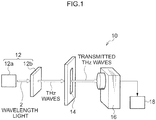
- a substance detection device 10 of the present exemplary embodiment comprises a terahertz wave generation unit 12 that generates terahertz waves, a spectral characteristic measurement instrument 14, a measurement unit 16 that measures terahertz waves transmitted through a target to be measured, and a processing section 18 that executes processing to identify the target substance to be measured on the basis of the measured terahertz wave spectral characteristic.
- the terahertz wave generation unit 12 comprises a two-wavelength light generation unit 12a that generates excitation light with two different wavelengths and a non-linear optical crystal 12b that generates terahertz waves corresponding to a difference frequency component between the two different wavelengths by differential frequency generation (DFG) from the light with two different wavelengths that is incident thereon.
- a KTP (potassium titanyl phosphate) parametric resonator, a two-wavelength light-generating laser unit or the like may be used as the two-wavelength light generation unit 12a.
- the frequency of the terahertz waves generated by the non-linear optical crystal 12b may be altered by control of the wavelengths of the excitation light generated by the two-wavelength light generation unit 12a.
- An organic optical crystal may be used as the non-linear optical crystal 12b, such as a DAST (4-dimethylamino-N-methyl-4-stilbazolium tosylate) crystal 10a, a DASC (4-dimethylamino-N-methyl-4-stilbazolium-p-chlorobenzene sulfonate) crystal, an OH1 (2-(3-(4-hydroxystyryl)-5,5-dimethyl cyclohex-2-enylidene)malononitrile) crystal or the like.
- an inorganic optical crystal may be used, such as gallium phosphate (GaPO 4 ), gallium arsenide (GaAs), lithium niobate (LiNbO 3 ) or the like.
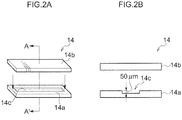
- Fig. 2A is an exploded perspective diagram of the spectral characteristic measurement instrument 14 and Fig. 2B is a sectional diagram taken along line A-A' of Fig. 2A .
- the spectral characteristic measurement instrument 14 is constituted by joining together two thin plates 14a and 14b.
- an olefin-based substance with high transmittance of terahertz waves for example, an ultra-high molecular weight polyethylene (UHMW-PE), high-resistance silicon wafers or the like may be used.
- UHMW-PE ultra-high molecular weight polyethylene
- a channel 50 ⁇ m deep is formed in the thin plate 14a.
- this channel forms a microduct 14c (gap portion) into which a solution that is a target to be measured will be charged.
- the spectral characteristic measurement instrument 14 is disposed between the terahertz wave generation unit 12 and the measurement unit 16 such that a direction of propagation of the terahertz waves generated by the terahertz wave generation unit 12 is in the depth direction of the microduct 14c.
- the depth of the microduct 14c is set to 50 ⁇ m in this case, it is sufficient that the depth of the microduct 14c is in a range from 10 ⁇ m to 100 ⁇ m. If the depth of the microduct 14c is less than 10 ⁇ m, the terahertz waves are excessively transmitted and a distinctive spectral characteristic may not be obtained. In addition, charging the target solution to be measured into the microduct 14c becomes a difficult operation. On the other hand, if the depth of the microduct 14c is greater than 100 ⁇ m, the effect of absorption of the terahertz waves by water molecules in the solvent is strong and a spectral characteristic of a substance in the solution may not be measurable. Therefore, it is excellent if the depth of the microduct 14c is in the range from 10 ⁇ m to 100 ⁇ m.
- the measurement unit 16 measures intensities of terahertz waves that have passed through the spectral characteristic measurement instrument 14 into which the microduct 14c the target solution to be measured has been charged. More specifically, while the frequency of the terahertz waves generated by the terahertz wave generation unit 12 is continuously altered, the measurement unit 16 measures a spectral characteristic of the terahertz waves transmitted through the solution.
- the spectral characteristic measurement instrument 14 described above is an example of the measurement instrument of the present invention, and the structure described above that is formed by the terahertz wave generation unit 12, the spectral characteristic measurement instrument 14 and the measurement unit 16 is an example of the terahertz wave characteristic measurement device of the present invention.
- a method implemented by this structure is an example of the terahertz wave characteristic measurement method of the present invention.
- the processing section 18 is constituted by a microcomputer comprising a CPU, a ROM, a RAM and the like.
- the processing section 18 acquires a terahertz wave spectral characteristic measured by the measurement unit 16 and converts the spectral characteristic to a spectral characteristic expressed as ratios relative to a reference which is transmittances of water.
- the processing section 18 compares the converted spectral characteristic with spectral characteristics of previously known substances expressed as ratios relative to water, which are memorized in advance, and identifies the target substance to be measured. Each spectral characteristic of a previously known substance that is expressed as ratios relative to water will have been obtained in advance by the aforementioned spectral characteristic measurement method.
- the previously known substance is charged into the microduct 14c of the spectral characteristic measurement instrument 14, terahertz waves are irradiated thereat by the terahertz wave generation unit 12, and a spectral characteristic of terahertz waves transmitted through this solution is measured by the measurement unit 16.
- a spectral characteristic of the previously known substance expressed as ratios of transmittances to transmittances of water at the same frequencies is obtained.
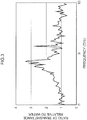
- a spectral characteristic expressed as ratios of transmittances of hydrogen peroxide relative to transmittances of water is illustrated in Fig. 3 as an example of a spectral characteristic of a previously known substance.
- the hydrogen peroxide spectral characteristic may be distinguished from water by the peak that appears in the vicinity of 4 THz.
- Respective spectral characteristics expressed as ratios of transmittances of, respectively, hydrochloric acid, sulfuric acid and nitric acid to transmittances of water are illustrated in Fig. 4 (hereinafter, these are collectively referred to as “strongly acidic solution spectral characteristics").
- the strongly acidic solution spectral characteristics may be distinguished from water by the absorption peaks that appear in the vicinity of 2.5 THz. Further, respective spectral characteristics expressed as ratios of transmittances of, respectively, aqueous sodium chlorate and aqueous ammonium nitrate to transmittances of water are illustrated in Fig. 5 (hereinafter, these are collectively referred to as "water-soluble salt spectral characteristics"). Similarly to hydrogen peroxide, the water-soluble salt spectral characteristics may be distinguished from water by the peaks appearing in the vicinity of 4 THz.
- the terahertz wave spectral characteristics of these previously known substances and information obtained from these spectral characteristics are memorized in advance as reference information for when identifying unknown substances.
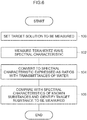
- step 100 a target solution to be measured is charged into the microduct 14c of the spectral characteristic measurement instrument 14, and the spectral characteristic measurement instrument 14 is disposed between the terahertz wave generation unit 12 and the measurement unit 16 such that the propagation direction of the terahertz waves generated by the terahertz wave generation unit 12 is in the depth direction of the microduct 14c.
- step 102 while the frequency of the terahertz waves generated by the terahertz wave generation unit 12 is being continuously altered, transmission intensities of terahertz waves passing through the solution are detected by the measurement unit 16. Thus, a spectral characteristic is measured. Data of the measured spectral characteristic is then outputted to the processing section 18.
- step 104 the spectral characteristic measured in step 102 is converted to a spectral characteristic expressed as ratios of transmittances of the measured substance to water transmittances at the same frequencies, using a similarly measured spectral characteristic of water.
- step 106 the terahertz wave spectral characteristics of previously known substances, which have been pre-memorized in a predetermined memory region, are read out and compared with the spectral characteristic converted in step 106. Thus, a substance contained in the target solution to be measured is identified. The results are outputted and the processing ends.
- the effects of absorption of terahertz waves by a solvent with polarity such as water may be suppressed by using the spectral characteristic measurement instrument that comprises the microduct with a depth in the range from 10 ⁇ m to 100 ⁇ m (50 ⁇ m in this embodiment), charging a target solution to be measured into the microduct, and illuminating terahertz waves at the solution such that the propagation direction of the terahertz waves is the depth direction of the microduct. Therefore, even when the target to be measured is a liquid, a spectral characteristic may be measured using terahertz waves without a freezing or solidifying operation being applied. Moreover, because spectral characteristics that are expressed as transmittance ratios relative to water are used, a substance that should be detected may be clearly distinguished from water.
- the spectral characteristic measurement instrument is constituted by joining together two thin plates in one of which a channel is formed, but this constitution is not limiting. It is sufficient that the depth of a gap portion for charging a target solution to be measured into is between 10 ⁇ m and 100 ⁇ m.
- the depth of the gap portion (microduct) in the spectral characteristic measurement instrument is in the range from 10 ⁇ m to 100 ⁇ m and the solution is charged into this gap portion.
- the actual depth of the gap portion is not necessarily required to be in the range from 10 ⁇ m to 100 ⁇ m.
- the gap portion does not have to be completely filled with the solution; it is sufficient that a region is formed in which the thickness of the solution is between 10 ⁇ m and 100 ⁇ m.
- the depth of the gap portion is in the range from 10 ⁇ m to 100 ⁇ m as in the present invention, a peak in transmittance of the solution may be observed regardless of whether the difference between incident light intensity and transmitted light intensity of the solvent is eliminated or not.
- a constitution in which terahertz waves transmitted through the solution are measured is described.
- terahertz waves reflected from the solution may be measured.
- a substance with high reflectivity of terahertz waves may be used as one face of the spectral characteristic measurement instrument.
- spectral characteristics of previously known substances when the spectral characteristics of previously known substances are being measured, an object such as a cloth or the like may be disposed between the terahertz wave generation unit and the spectral characteristic measurement instrument, and terahertz waves may be irradiated at the solution through this object.
- spectral characteristics may be obtained with the assumption that a target substance to be detected will be inside clothing or a bag or the like.
- a spectral characteristic may be measured by time domain spectroscopy (TDS), in which a spectral characteristic is measured by terahertz waves with continuous frequencies or wavelengths being transmitted through or reflected by a solution all together and the results being Fourier-transformed.
- TDS time domain spectroscopy
- the terahertz wave generation unit 12 uses a pulsed light generation unit from which excitation light is generated in femtosecond or nanosecond pulses as an excitation light source instead of the two-wavelength light generation unit 12a, and terahertz waves are generated by irradiating this excitation light at the non-linear optical crystal 12b.
- Frequencies of the terahertz waves generated thus are ordinarily from 0.1 to 10.0 THz.
- these terahertz waves (femtosecond or nanosecond pulsed light) are irradiated at a solution containing a target substance to be measured, waveforms of the transmitted or reflected terahertz waves are measured in time divisions, and the amplitudes and phases at respective frequencies are obtained by Fourier-transforming the time division waveforms.
- the intensities of terahertz waves transmitted through or reflected by a solution may be measured using one or more particular frequencies or particular wavelengths.
- a particular substance such as, for example, hydrogen peroxide, hydrochloric acid or the like
- the peak frequencies or wavelengths are known in advance, it is sufficient to irradiate terahertz waves with the particular frequency/frequencies or particular wavelength/wavelengths rather than continuously altering the frequency or wavelength (as in DFG) or irradiating terahertz waves with continuous frequencies or wavelengths all together (as in TDS).
- a constitution is described in which a spectral characteristic expressed as ratios relative to the spectral characteristic of water is used as the spectral characteristic, but this is not limiting.
- the spectral characteristics of substances may be used as is, and information representing features obtained from spectral characteristics may be used.
Landscapes
- Physics & Mathematics (AREA)
- Spectroscopy & Molecular Physics (AREA)
- Health & Medical Sciences (AREA)
- Analytical Chemistry (AREA)
- Life Sciences & Earth Sciences (AREA)
- Chemical & Material Sciences (AREA)
- Toxicology (AREA)
- Biochemistry (AREA)
- General Health & Medical Sciences (AREA)
- General Physics & Mathematics (AREA)
- Immunology (AREA)
- Pathology (AREA)
- Investigating Or Analysing Materials By Optical Means (AREA)
Abstract
A terahertz wave characteristic measurement method comprises irradiating terahertz waves at a region of a target solution in which a thickness of the solution is in the range from 10 µm to 100 µm such that a propagation direction of the terahertz waves is in a thickness direction of the solution, the solution containing at least one type of target substance to be measured, and measuring at least one of a spectral characteristic and an intensity at a particular frequency or a particular wavelength of the terahertz waves that are one of transmitted through the region and reflected from the region.
Description
- The present invention relates to a terahertz wave characteristic measurement method, a substance detection method, a measurement instrument, a terahertz wave characteristic measurement device and a substance detection device.
- Heretofore, technologies that use electromagnetic waves in the terahertz frequency band (terahertz waves), which are highly transmissive through clothes, bags and suchlike, to detect target objects have been proposed. For example, a system has been proposed (for example, see Japanese Patent Application Laid-Open (JP-A) No.
2008-500541 - Further, a technique has been proposed (for example, see
JP-A Nos. 2009-281864 2009-74807 2010-249564 - A liquid cell for terahertz light analysis has been proposed (for example, see
JP-A Nos. 2009-288046 2009-288047 - In the system of
JP-A No. 2008-500541 JP-A Nos. 2009-281864 2009-74807 2010-249564 - Now, with the technology of
JP-A No. 2008-500541 - Furthermore, with the technologies of
JP-A Nos. 2009-281864 2009-74807 2010-249564 - For the technology of
JP-A Nos. 2009-288046 2009-288047 - The present invention has been made in order to solve the problem described above, and provides a terahertz wave characteristic measurement method capable, even if a target to be measured is a liquid, of measuring a spectral characteristic or an intensity of terahertz waves transmitted through or reflected by the target to be measured without a freezing or solidifying operation being applied, and a substance detection method, a measurement instrument, a terahertz wave characteristic measurement device and a substance detection device.
- A terahertz wave characteristic detection method according to a first aspect of the present invention comprises: irradiating terahertz waves at a region in which a thickness of a solution is in the range from 10 µm to 100 µm such that a propagation direction of the terahertz waves is in a thickness direction of the solution, the solution containing at least one type of target substance to be measured; and measuring at least one of a spectral characteristic and an intensity at a particular frequency or a particular wavelength of the terahertz waves that are one of transmitted through the region and reflected from the region.
- Thus, because the terahertz waves are irradiated at the region in which the thickness of the solution is in the range from 10 µm to 100 µm such that the propagation direction of the terahertz waves is the thickness direction of the solution, the effects of absorption of the terahertz waves by a solvent with polarity, such as water, may be suppressed. Therefore, even when the target to be measured is a liquid, a spectral characteristic or intensity of terahertz waves transmitted through or reflected by the target to be measured may be measured without a freezing or solidifying operation being applied.
- For measuring a spectral characteristic of terahertz waves, the irradiating may comprise irradiating the terahertz waves and continuously altering a frequency or a wavelength of the terahertz waves, and the measuring may comprise measuring the spectral characteristic from the terahertz waves transmitted through the region or reflected from the region, or the irradiating may comprise irradiating the terahertz waves with continuous frequencies or wavelengths all together, and the measuring may comprise Fourier-transforming time division waveforms of the terahertz waves transmitted through the region or reflected from the region and measuring the spectral characteristic. For measuring an intensity of the terahertz waves at a particular frequency or a particular wavelength, the irradiating may comprise irradiating the terahertz waves with at least one particular frequency or particular wavelength, and the measuring may comprise measuring the intensity of the terahertz waves transmitted through the region or reflected from the region.
- The spectral characteristic or the intensity of the terahertz waves may be expressed as a ratio of one of transmittance and reflectivity of the terahertz waves transmitted through the region or reflected from the region relative to a transmittance or a reflectivity of terahertz waves transmitted through or reflected from a pre-specified thickness of solvent not containing the target substance to be measured. Thus, target substances may be clearly distinguished by reference from the solvent not containing a target substance to be measured.
- The solvent of the solution and the solvent not containing the target substance to be measured may comprise at least one type of polar molecules.
- The terahertz waves that have passed through one or more objects may be irradiated at the region with the thickness in the range from 10 µm to 100 µm. Thus, spectral characteristics or intensities of terahertz waves may be obtained with the assumption that detections are carried out through objects such as, for example, clothing, bags and the like.
- A substance detection method according to a second aspect of the present invention comprises: measuring, by the terahertz wave characteristic measurement method according to the first aspect, at least one of a spectral characteristic and an intensity of terahertz waves from a solution containing an unknown substance; and comparing the measured spectral characteristic or intensity with a spectral characteristic or intensity of terahertz waves from a solution containing a known substance that has been measured by the terahertz wave characteristic measurement method according to the first aspect and identifying the unknown substance.
- A measurement instrument according to a third aspect of the present invention is a measurement instrument to be used for measuring at least one of a spectral characteristic and an intensity at a particular frequency or a particular wavelength of terahertz waves that are one of transmitted through a solution containing at least one type of target substance to be measured and reflected from the solution, wherein the measurement instrument comprises a gap portion to be charged with the solution such that a region in which a thickness of the solution is in the range from 10 µm to 100 µm is formed.
- A terahertz wave characteristic measurement device according to a fourth aspect of the present invention comprises: a terahertz wave generation unit comprising a light generation unit and a non-linear optical crystal; the measurement instrument according to the third aspect that is disposed such that a propagation direction of the terahertz waves generated by the terahertz wave generation unit is in the thickness direction of the solution; and a measurement unit that measures at least one of a spectral characteristic and an intensity at a particular frequency or a particular wavelength of terahertz waves that are one of transmitted through the region and reflected from the region.
- According to the terahertz wave characteristic measurement device of the fourth aspect of the invention, the measurement instrument, which comprises the gap portion that is filled with a solution such that a region is formed in which the thickness of the solution is in the range from 10 µm to 100 µm, is disposed such that the propagation direction of the terahertz waves generated by the terahertz wave generation unit is the thickness direction of the solution. The terahertz waves are irradiated by the terahertz wave generation unit at the solution charged into the gap portion. The measurement unit measures a spectral characteristic of terahertz waves transmitted through that region or reflected from that region, or an intensity of the transmitted or reflected terahertz waves at a particular frequency or a particular wavelength.
- Thus, when the measurement instrument with the gap portion to be charged with the solution such that the region in which the thickness of the solution is in the range from 10 µm to 100 µm is formed is used, with the gap portion being filled with a target measurement solution and the terahertz waves being irradiated at the region such that the propagation direction of the terahertz waves is in the thickness direction of the solution, the effect of absorption of the terahertz waves by a solvent with polarity such as water may be suppressed. Therefore, even when the target to be measured is a liquid, a spectral characteristic or intensity of terahertz waves transmitted through or reflected by the target to be measured may be measured without a freezing or solidifying operation being applied.
- The light generation unit may generate light with two different wavelengths as excitation light, and the light generation unit may generate femtosecond or nanosecond pulsed light as excitation light.
- Further, the terahertz wave generation unit may generate terahertz waves with continuous frequencies or wavelengths all together.
- A substance detection device according to a fifth aspect of the present invention comprises: the terahertz wave characteristic measurement device according to the fourth aspect; and an identification device that compares a spectral characteristic or intensity of terahertz waves from a solution containing an unknown substance that has been measured by the terahertz wave characteristic measurement device with a spectral characteristic or intensity of terahertz waves from a solution containing a known substance, and identifies the unknown substance.
- Exemplary embodiments of the present invention will be described in detail based on the following figures, wherein:
-
Fig. 1 is a structural diagram illustrating a general structure of a substance detection device of a present exemplary embodiment; -
Fig. 2A is an exploded perspective diagram of a spectral characteristic measurement instrument; -
Fig. 2B is a sectional diagram of the spectral characteristic measurement instrument; -
Fig. 3 is a graph illustrating a spectral characteristic of hydrogen peroxide; -
Fig. 4 is a graph illustrating spectral characteristics of strongly acidic aqueous solutions; -
Fig. 5 is a graph illustrating spectral characteristics of water-soluble salts; and -
Fig. 6 is a flowchart illustrating a substance detection processing routine that is executed at the substance detection device of the present exemplary embodiment. - Herebelow, an exemplary embodiment of the terahertz wave characteristic measurement method, substance detection method, measurement instrument, terahertz wave characteristic measurement device and substance detection device of the present invention is described in detail with reference to the attached drawings. For the present exemplary embodiment, a situation is described in which a solution, in which a target substance to be measured is contained in a solvent with polarity such as water, is measured to detect the substance in the solution. Other examples of solvents with polarity comprise alcohols and the like. Of alcohols, for example, methanol and ethanol can be mentioned. To be an object of the present invention, it is sufficient for a solvent to be a solvent with polarity, and the solvent is not limited to the solvents mentioned here.
- As illustrated in
Fig. 1 , asubstance detection device 10 of the present exemplary embodiment comprises a terahertzwave generation unit 12 that generates terahertz waves, a spectralcharacteristic measurement instrument 14, ameasurement unit 16 that measures terahertz waves transmitted through a target to be measured, and aprocessing section 18 that executes processing to identify the target substance to be measured on the basis of the measured terahertz wave spectral characteristic. - The terahertz
wave generation unit 12 comprises a two-wavelengthlight generation unit 12a that generates excitation light with two different wavelengths and a non-linearoptical crystal 12b that generates terahertz waves corresponding to a difference frequency component between the two different wavelengths by differential frequency generation (DFG) from the light with two different wavelengths that is incident thereon. A KTP (potassium titanyl phosphate) parametric resonator, a two-wavelength light-generating laser unit or the like may be used as the two-wavelengthlight generation unit 12a. The frequency of the terahertz waves generated by the non-linearoptical crystal 12b may be altered by control of the wavelengths of the excitation light generated by the two-wavelengthlight generation unit 12a. - An organic optical crystal may be used as the non-linear
optical crystal 12b, such as a DAST (4-dimethylamino-N-methyl-4-stilbazolium tosylate) crystal 10a, a DASC (4-dimethylamino-N-methyl-4-stilbazolium-p-chlorobenzene sulfonate) crystal, an OH1 (2-(3-(4-hydroxystyryl)-5,5-dimethyl cyclohex-2-enylidene)malononitrile) crystal or the like. Further, an inorganic optical crystal may be used, such as gallium phosphate (GaPO4), gallium arsenide (GaAs), lithium niobate (LiNbO3) or the like. -
Fig. 2A is an exploded perspective diagram of the spectralcharacteristic measurement instrument 14 andFig. 2B is a sectional diagram taken along line A-A' ofFig. 2A . As illustrated inFig. 2A and Fig. 2B , the spectralcharacteristic measurement instrument 14 is constituted by joining together twothin plates thin plates - A channel 50 µm deep is formed in the
thin plate 14a. In the state in which thethin plate 14a and thethin plate 14b are joined together, this channel forms amicroduct 14c (gap portion) into which a solution that is a target to be measured will be charged. The spectralcharacteristic measurement instrument 14 is disposed between the terahertzwave generation unit 12 and themeasurement unit 16 such that a direction of propagation of the terahertz waves generated by the terahertzwave generation unit 12 is in the depth direction of themicroduct 14c. - While the depth of the
microduct 14c is set to 50 µm in this case, it is sufficient that the depth of themicroduct 14c is in a range from 10 µm to 100 µm. If the depth of themicroduct 14c is less than 10 µm, the terahertz waves are excessively transmitted and a distinctive spectral characteristic may not be obtained. In addition, charging the target solution to be measured into themicroduct 14c becomes a difficult operation. On the other hand, if the depth of themicroduct 14c is greater than 100 µm, the effect of absorption of the terahertz waves by water molecules in the solvent is strong and a spectral characteristic of a substance in the solution may not be measurable. Therefore, it is excellent if the depth of themicroduct 14c is in the range from 10 µm to 100 µm. - The
measurement unit 16 measures intensities of terahertz waves that have passed through the spectralcharacteristic measurement instrument 14 into which themicroduct 14c the target solution to be measured has been charged. More specifically, while the frequency of the terahertz waves generated by the terahertzwave generation unit 12 is continuously altered, themeasurement unit 16 measures a spectral characteristic of the terahertz waves transmitted through the solution. - The spectral
characteristic measurement instrument 14 described above is an example of the measurement instrument of the present invention, and the structure described above that is formed by the terahertzwave generation unit 12, the spectralcharacteristic measurement instrument 14 and themeasurement unit 16 is an example of the terahertz wave characteristic measurement device of the present invention. A method implemented by this structure is an example of the terahertz wave characteristic measurement method of the present invention. - The
processing section 18 is constituted by a microcomputer comprising a CPU, a ROM, a RAM and the like. Theprocessing section 18 acquires a terahertz wave spectral characteristic measured by themeasurement unit 16 and converts the spectral characteristic to a spectral characteristic expressed as ratios relative to a reference which is transmittances of water. Theprocessing section 18 compares the converted spectral characteristic with spectral characteristics of previously known substances expressed as ratios relative to water, which are memorized in advance, and identifies the target substance to be measured. Each spectral characteristic of a previously known substance that is expressed as ratios relative to water will have been obtained in advance by the aforementioned spectral characteristic measurement method. Specifically, the previously known substance is charged into the microduct 14c of the spectralcharacteristic measurement instrument 14, terahertz waves are irradiated thereat by the terahertzwave generation unit 12, and a spectral characteristic of terahertz waves transmitted through this solution is measured by themeasurement unit 16. Thus, using a similarly measured spectral characteristic of water, a spectral characteristic of the previously known substance expressed as ratios of transmittances to transmittances of water at the same frequencies is obtained. - For example, a spectral characteristic expressed as ratios of transmittances of hydrogen peroxide relative to transmittances of water (hereinafter referred to as "a hydrogen peroxide spectral characteristic") is illustrated in
Fig. 3 as an example of a spectral characteristic of a previously known substance. The hydrogen peroxide spectral characteristic may be distinguished from water by the peak that appears in the vicinity of 4 THz. Respective spectral characteristics expressed as ratios of transmittances of, respectively, hydrochloric acid, sulfuric acid and nitric acid to transmittances of water are illustrated inFig. 4 (hereinafter, these are collectively referred to as "strongly acidic solution spectral characteristics"). The strongly acidic solution spectral characteristics may be distinguished from water by the absorption peaks that appear in the vicinity of 2.5 THz. Further, respective spectral characteristics expressed as ratios of transmittances of, respectively, aqueous sodium chlorate and aqueous ammonium nitrate to transmittances of water are illustrated inFig. 5 (hereinafter, these are collectively referred to as "water-soluble salt spectral characteristics"). Similarly to hydrogen peroxide, the water-soluble salt spectral characteristics may be distinguished from water by the peaks appearing in the vicinity of 4 THz. The terahertz wave spectral characteristics of these previously known substances and information obtained from these spectral characteristics are memorized in advance as reference information for when identifying unknown substances. - Next, a substance detection processing routine that is executed at the
substance detection device 10 of the present exemplary embodiment is described with reference toFig. 6 . - In
step 100, a target solution to be measured is charged into the microduct 14c of the spectralcharacteristic measurement instrument 14, and the spectralcharacteristic measurement instrument 14 is disposed between the terahertzwave generation unit 12 and themeasurement unit 16 such that the propagation direction of the terahertz waves generated by the terahertzwave generation unit 12 is in the depth direction of themicroduct 14c. - Then, in
step 102, while the frequency of the terahertz waves generated by the terahertzwave generation unit 12 is being continuously altered, transmission intensities of terahertz waves passing through the solution are detected by themeasurement unit 16. Thus, a spectral characteristic is measured. Data of the measured spectral characteristic is then outputted to theprocessing section 18. - In
step 104, the spectral characteristic measured instep 102 is converted to a spectral characteristic expressed as ratios of transmittances of the measured substance to water transmittances at the same frequencies, using a similarly measured spectral characteristic of water. - In
step 106, the terahertz wave spectral characteristics of previously known substances, which have been pre-memorized in a predetermined memory region, are read out and compared with the spectral characteristic converted instep 106. Thus, a substance contained in the target solution to be measured is identified. The results are outputted and the processing ends. - As described above, according to the substance detection device of the present exemplary embodiment, the effects of absorption of terahertz waves by a solvent with polarity such as water may be suppressed by using the spectral characteristic measurement instrument that comprises the microduct with a depth in the range from 10 µm to 100 µm (50 µm in this embodiment), charging a target solution to be measured into the microduct, and illuminating terahertz waves at the solution such that the propagation direction of the terahertz waves is the depth direction of the microduct. Therefore, even when the target to be measured is a liquid, a spectral characteristic may be measured using terahertz waves without a freezing or solidifying operation being applied. Moreover, because spectral characteristics that are expressed as transmittance ratios relative to water are used, a substance that should be detected may be clearly distinguished from water.
- In the above exemplary embodiment, a constitution is described in which the spectral characteristic measurement instrument is constituted by joining together two thin plates in one of which a channel is formed, but this constitution is not limiting. It is sufficient that the depth of a gap portion for charging a target solution to be measured into is between 10 µm and 100 µm.
- In the above exemplary embodiment, a constitution in which the depth of the gap portion (microduct) in the spectral characteristic measurement instrument is in the range from 10 µm to 100 µm and the solution is charged into this gap portion is described. However, provided a thickness of the solution in a region at which the terahertz waves are irradiated is in the range from 10 µm to 100 µm, the actual depth of the gap portion is not necessarily required to be in the range from 10 µm to 100 µm. Furthermore, the gap portion does not have to be completely filled with the solution; it is sufficient that a region is formed in which the thickness of the solution is between 10 µm and 100 µm.
- In the above exemplary embodiment, a case is described in which 50 µm is selected in the range from 10 µm to 100 µm to be the depth of the gap portion. However, as is also recited in
JP-A Nos. 2009-288046 209-288047 JP-A Nos. 2009-288046 209-288047 - When the depth of the gap portion is in the range from 10 µm to 100 µm as in the present invention, a peak in transmittance of the solution may be observed regardless of whether the difference between incident light intensity and transmitted light intensity of the solvent is eliminated or not.
- In the above exemplary embodiment, a constitution in which terahertz waves transmitted through the solution are measured is described. However, terahertz waves reflected from the solution may be measured. In such a constitution, a substance with high reflectivity of terahertz waves may be used as one face of the spectral characteristic measurement instrument.
- With a view to employment in, for example, the field of airport security checkpoints and the like, when the spectral characteristics of previously known substances are being measured, an object such as a cloth or the like may be disposed between the terahertz wave generation unit and the spectral characteristic measurement instrument, and terahertz waves may be irradiated at the solution through this object. Hence, spectral characteristics may be obtained with the assumption that a target substance to be detected will be inside clothing or a bag or the like.
- In the above exemplary embodiment, a constitution that uses spectroscopy in which a spectral characteristic is measured using a variable-wavelength terahertz wave generation unit is described. However, a spectral characteristic may be measured by time domain spectroscopy (TDS), in which a spectral characteristic is measured by terahertz waves with continuous frequencies or wavelengths being transmitted through or reflected by a solution all together and the results being Fourier-transformed. In such a constitution, the terahertz
wave generation unit 12 uses a pulsed light generation unit from which excitation light is generated in femtosecond or nanosecond pulses as an excitation light source instead of the two-wavelengthlight generation unit 12a, and terahertz waves are generated by irradiating this excitation light at the non-linearoptical crystal 12b. Frequencies of the terahertz waves generated thus are ordinarily from 0.1 to 10.0 THz. Hence, these terahertz waves (femtosecond or nanosecond pulsed light) are irradiated at a solution containing a target substance to be measured, waveforms of the transmitted or reflected terahertz waves are measured in time divisions, and the amplitudes and phases at respective frequencies are obtained by Fourier-transforming the time division waveforms. - Furthermore, the intensities of terahertz waves transmitted through or reflected by a solution may be measured using one or more particular frequencies or particular wavelengths. When detecting for a particular substance such as, for example, hydrogen peroxide, hydrochloric acid or the like, if the peak frequencies or wavelengths are known in advance, it is sufficient to irradiate terahertz waves with the particular frequency/frequencies or particular wavelength/wavelengths rather than continuously altering the frequency or wavelength (as in DFG) or irradiating terahertz waves with continuous frequencies or wavelengths all together (as in TDS).
- In the above exemplary embodiment, a constitution is described in which a spectral characteristic expressed as ratios relative to the spectral characteristic of water is used as the spectral characteristic, but this is not limiting. The spectral characteristics of substances may be used as is, and information representing features obtained from spectral characteristics may be used.
Claims (15)
- A terahertz wave characteristic measurement method comprising:irradiating terahertz waves at a region in which a thickness of a solution is in the range from 10 µm to 100 µm such that a propagation direction of the terahertz waves is in a thickness direction of the solution, the solution containing at least one type of target substance to be measured; andmeasuring at least one of
a spectral characteristic and
an intensity at a particular frequency or a particular wavelength of the terahertz waves that are one of transmitted through the region and reflected from the region. - The terahertz wave characteristic measurement method according to claim 1, wherein, for measuring a spectral characteristic of the terahertz waves, the irradiating comprises irradiating the terahertz waves and continuously altering a frequency or a wavelength of the terahertz waves, and the measuring comprises measuring the spectral characteristic from the terahertz waves transmitted through the region or reflected from the region.
- The terahertz wave characteristic measurement method according to claim 1, wherein, for measuring a spectral characteristic of the terahertz waves, the irradiating comprises irradiating the terahertz waves with continuous frequencies or wavelengths all together, and the measuring comprises Fourier-transforming time division waveforms of the terahertz waves transmitted through the region or reflected from the region and measuring the spectral characteristic.
- The terahertz wave characteristic measurement method according to claim 1, wherein, for measuring an intensity of the terahertz waves at a particular frequency or a particular wavelength, the irradiating comprises irradiating the terahertz waves with at least one particular frequency or particular wavelength, and the measuring comprises measuring the intensity of the terahertz waves transmitted through the region or reflected from the region.
- The terahertz wave characteristic measurement method according to any preceding claim, wherein the spectral characteristic or the intensity of the terahertz waves is expressed as a ratio of one of transmittance and reflectivity of the terahertz waves transmitted through the region or reflected from the region relative to a transmittance or a reflectivity of terahertz waves transmitted through or reflected from a pre-specified thickness of a solvent not containing the target substance to be measured.
- The terahertz wave characteristic measurement method according to any preceding claim, wherein a solvent of the solution and the solvent not containing the target substance to be measured comprises at least one type of polar molecules.
- The terahertz wave characteristic measurement method according to any preceding claim, wherein the irradiating comprises irradiating the terahertz waves through at least one object at the region.
- The terahertz wave characteristic measurement method according to any preceding claim, wherein
the solution is charged into a measurement instrument comprising a gap portion, and
the irradiating comprises irradiating the terahertz waves such that the propagation direction is in the thickness direction at a region in which the thickness of the solution in the gap portion is in the range from 10 µm to 100 µm. - A substance detection method comprising:measuring, by the terahertz wave characteristic measurement method according to any preceding claim, at least one of a spectral characteristic and an intensity of terahertz waves from a solution containing an unknown substance; andcomparing the measured spectral characteristic or intensity with a spectral characteristic or intensity of terahertz waves from a solution containing a known substance that has been measured by the terahertz wave characteristic measurement method according to claim 1, and identifying the unknown substance.
- A measurement instrument to be used for measuring at least one of
a spectral characteristic and
an intensity at a particular frequency or a particular wavelength of terahertz waves that are one of transmitted through a solution containing at least one type of target substance to be measured and reflected from the solution,
the measurement instrument comprising a gap portion to be charged with the solution such that a region in which a thickness of the solution is in the range from 10 µm to 100 µm is formed. - A terahertz wave characteristic measurement device comprising:a terahertz wave generation unit comprising a light generation unit and a non-linear optical crystal;the measurement instrument according to claim 10 that is disposed such that a propagation direction of the terahertz waves generated by the terahertz wave generation unit is in the thickness direction of the solution; anda measurement unit that measures at least one of
a spectral characteristic and
an intensity at a particular frequency or a particular wavelength of terahertz waves that are one of transmitted through the region and reflected from the region. - The terahertz wave characteristic measurement device according to claim 11, wherein the light generation unit generates light with two different wavelengths as excitation light.
- The terahertz wave characteristic measurement device according to claim 11, wherein the light generation unit generates femtosecond or nanosecond pulsed light as excitation light.
- The terahertz wave characteristic measurement device according to claim 11 or 13, wherein the terahertz wave generation unit generates terahertz waves with continuous frequencies or wavelengths all together.
- A substance measurement device comprising:the terahertz wave characteristic measurement device according to claim 11, 12, 13 or 14; andan identification device that compares a spectral characteristic or intensity of terahertz waves from a solution containing an unknown substance that has been measured by the terahertz wave characteristic measurement device with a spectral characteristic or intensity of terahertz waves from a solution containing a known substance, and identifies the unknown substance.
Applications Claiming Priority (2)
| Application Number | Priority Date | Filing Date | Title |
|---|---|---|---|
| JP2011032539 | 2011-02-17 | ||
| JP2012002486A JP2012185151A (en) | 2011-02-17 | 2012-01-10 | Terahertz wave characteristic measuring method, substance detection method, measuring tool, terahertz wave characteristic measuring device and substance detection device |
Publications (1)
| Publication Number | Publication Date |
|---|---|
| EP2490009A1 true EP2490009A1 (en) | 2012-08-22 |
Family
ID=45606980
Family Applications (1)
| Application Number | Title | Priority Date | Filing Date |
|---|---|---|---|
| EP20120153909 Withdrawn EP2490009A1 (en) | 2011-02-17 | 2012-02-03 | Terahertz wave characteristic measurement method, substance detection method, measurement instrument, terahertz wave characteristic measurement device and substance detection device |
Country Status (4)
| Country | Link |
|---|---|
| US (1) | US20120211659A1 (en) |
| EP (1) | EP2490009A1 (en) |
| JP (1) | JP2012185151A (en) |
| CN (1) | CN102645407A (en) |
Families Citing this family (15)
| Publication number | Priority date | Publication date | Assignee | Title |
|---|---|---|---|---|
| JP5909089B2 (en) * | 2011-02-01 | 2016-04-26 | アークレイ株式会社 | Optical crystal, terahertz wave generating apparatus and method |
| CN103105368A (en) * | 2013-01-25 | 2013-05-15 | 大连理工大学 | A method for analyzing the thickness and structure of the impurity deposition layer of the first mirror of a fusion device |
| CN104007083B (en) * | 2014-06-11 | 2016-09-07 | 中国石油大学(北京) | A kind of oil shale pyrolysis measuring method followed the tracks of based on light |
| JP2016114523A (en) | 2014-12-16 | 2016-06-23 | アークレイ株式会社 | Terahertz wave measuring apparatus, measuring method, and measuring tool |
| CN105259132A (en) * | 2015-10-13 | 2016-01-20 | 成都曙光光纤网络有限责任公司 | Terahertz wave transmission imaging system |
| CN105486625B (en) * | 2016-01-28 | 2018-08-21 | 中国科学院重庆绿色智能技术研究院 | The device and method of cell count is carried out based on terahertz time-domain spectroscopic technology |
| CN106525761A (en) * | 2016-11-08 | 2017-03-22 | 浙江大学 | Nitrite detection method based on terahertz spectroscopy scanning |
| CN106769993B (en) * | 2016-12-21 | 2023-05-26 | 北京农业信息技术研究中心 | Sample pressing device, terahertz spectrum measurement system and measurement method |
| KR102564009B1 (en) * | 2017-11-20 | 2023-08-07 | 현대자동차주식회사 | Device and method for water-proofing test of vehicle |
| CN108226099B (en) * | 2017-12-29 | 2024-05-03 | 北京工业大学 | Terahertz nondestructive testing device for resistivity of silicon wafer and application method thereof |
| CN110743104B (en) * | 2019-10-28 | 2023-03-17 | 鲍玉珍 | Terahertz wave physiotherapy terminal and terahertz wave physiotherapy system for cervical cancer |
| CN112184925B (en) * | 2020-09-29 | 2022-03-11 | 中铁建电气化局集团南方工程有限公司 | Non-inductive payment gate machine based on face recognition |
| JP7754424B2 (en) * | 2022-03-09 | 2025-10-15 | 三菱重工業株式会社 | Inspection Equipment |
| CN115173192B (en) * | 2022-06-30 | 2023-06-09 | 首都师范大学 | System and method for representing terahertz wave beam spatial distribution by using liquid column as probe |
| CN118392833B (en) * | 2024-06-24 | 2024-08-27 | 佛山蓝谱达科技有限公司 | High-resolution terahertz wave band material characteristic analysis system |
Citations (2)
| Publication number | Priority date | Publication date | Assignee | Title |
|---|---|---|---|---|
| WO2006070852A1 (en) * | 2004-12-27 | 2006-07-06 | Canon Kabushiki Kaisha | Detection apparatus for detecting electromagnetic wave passed through object |
| WO2010092726A1 (en) * | 2009-02-12 | 2010-08-19 | コニカミノルタオプト株式会社 | Method for analyzing sample and microanalysis chip to be used therefor |
Family Cites Families (10)
| Publication number | Priority date | Publication date | Assignee | Title |
|---|---|---|---|---|
| GB2399626B (en) * | 2003-03-21 | 2006-04-05 | Teraview Ltd | Spectroscopy apparatus and associated technique |
| JP4480146B2 (en) * | 2004-09-01 | 2010-06-16 | 独立行政法人理化学研究所 | Scattering object detection apparatus and method using terahertz wave |
| JP4773839B2 (en) * | 2006-02-15 | 2011-09-14 | キヤノン株式会社 | Detection device for detecting information of an object |
| US7495218B2 (en) * | 2006-04-20 | 2009-02-24 | U Chicago Argonne Llc | Passive millimeter wave spectrometer for remote detection of chemical plumes |
| CN201000429Y (en) * | 2006-12-31 | 2008-01-02 | 清华大学 | A device for rapid detection of vegetable oil purity using terahertz time-domain spectroscopy |
| JP5183381B2 (en) * | 2008-09-16 | 2013-04-17 | キヤノン株式会社 | Measuring apparatus and measuring method |
| CN101782510A (en) * | 2009-01-20 | 2010-07-21 | 中国科学院上海应用物理研究所 | Method for detecting anesthetic medicament |
| CN201434850Y (en) * | 2009-04-23 | 2010-03-31 | 中国计量学院 | Edible oil component detection device based on polyethylene optical fiber |
| DE102009036111B3 (en) * | 2009-08-05 | 2010-09-30 | Technische Universität Carolo-Wilhelmina Zu Braunschweig | THz spectroscope and method for determining the spectral frequency and / or phase response of a sample |
| CN101706417A (en) * | 2009-11-27 | 2010-05-12 | 天津大学 | Method for quickly detecting amyloid protein by thzTHz time-domain light spectrum |
-
2012
- 2012-01-10 JP JP2012002486A patent/JP2012185151A/en active Pending
- 2012-02-03 EP EP20120153909 patent/EP2490009A1/en not_active Withdrawn
- 2012-02-06 CN CN2012100254140A patent/CN102645407A/en active Pending
- 2012-02-06 US US13/367,053 patent/US20120211659A1/en not_active Abandoned
Patent Citations (2)
| Publication number | Priority date | Publication date | Assignee | Title |
|---|---|---|---|---|
| WO2006070852A1 (en) * | 2004-12-27 | 2006-07-06 | Canon Kabushiki Kaisha | Detection apparatus for detecting electromagnetic wave passed through object |
| WO2010092726A1 (en) * | 2009-02-12 | 2010-08-19 | コニカミノルタオプト株式会社 | Method for analyzing sample and microanalysis chip to be used therefor |
Non-Patent Citations (3)
| Title |
|---|
| BERGNER ANDREAS ET AL: "New p-Ge THz laser spectrometer for the study of solutions: THz absorption spectroscopy of water", REVIEW OF SCIENTIFIC INSTRUMENTS, AIP, MELVILLE, NY, US, vol. 76, no. 6, 26 May 2005 (2005-05-26), pages 063110-1 - 063110-5, XP012079463, ISSN: 0034-6748, DOI: 10.1063/1.1928427 * |
| KITAHARA H ET AL: "DIELECTRIC CHARACTERISTICS OF WATER SOLUTIONS OF ETHANOL IN THE TERAHERTZ REGION", JOURNAL OF THE KOREAN PHYSICAL SOCIETY, SEOUL, KR, vol. 46, no. 1, 1 January 2005 (2005-01-01), pages 82 - 85, XP001247843, ISSN: 0374-4884 * |
| PETER E. POWERS ET AL: "Broadly tunable terahertz source", PROCEEDINGS OF SPIE, vol. 7582, 1 January 2010 (2010-01-01), pages 758210-1 - 758210-7, XP055028675, ISSN: 0277-786X, DOI: 10.1117/12.847182 * |
Also Published As
| Publication number | Publication date |
|---|---|
| JP2012185151A (en) | 2012-09-27 |
| CN102645407A (en) | 2012-08-22 |
| US20120211659A1 (en) | 2012-08-23 |
Similar Documents
| Publication | Publication Date | Title |
|---|---|---|
| US20120211659A1 (en) | Terahertz Wave Characteristic Measurement Method, Material Detection Method, Measurement Instrument, Terahertz Wave Characteristic Measurement Device and Material Detection Device | |
| US11681016B1 (en) | Sensing signals that include radio frequency pulses | |
| EP2690426B1 (en) | Total reflection spectroscopic measurement method | |
| Jin et al. | Experimental measurements of water content in crude oil emulsions by terahertz time-domain spectroscopy | |
| CN101532953B (en) | A precise measurement method for optical parameters of edible oil | |
| US20120326037A1 (en) | Coating film inspection apparatus and inspection method | |
| US20110122407A1 (en) | Apparatus and method for multiple-pulse impulsive stimulated raman spectroscopy | |
| Qin et al. | Rapid analysis of tetracycline hydrochloride solution by attenuated total reflection terahertz time-domain spectroscopy | |
| JP6646519B2 (en) | Total reflection spectrometer and total reflection spectrometer | |
| US9709476B2 (en) | System and method for finding the size of one of more individual particles, such as nanoparticles for example, in real time utilizing a microsphere's whispering gallery modes (“WGMs”) | |
| EP3035033A1 (en) | Terahertz wave measuring device, measuring method, and measuring rig | |
| EP2372345A1 (en) | Apparatus, method and computer-readable storage medium for determining the ring-down time in spectrometer system | |
| Pastorczak et al. | Femtosecond infrared pump–stimulated Raman probe spectroscopy: the first application of the method to studies of vibrational relaxation pathways in the liquid HDO/D 2 O system | |
| EP2196766A1 (en) | Device and method for measuring thickness of paint film in non-contacting manner | |
| Ress et al. | Time-resolved circular dichroism of excitonic systems: Theory and experiment on an exemplary squaraine polymer | |
| EP2857827A1 (en) | Prism member, terahertz-wave spectroscopic measurement device, and terahertz-wave spectroscopic measurement method | |
| Richert et al. | Ultrafast photoinduced dynamics at air/liquid and liquid/liquid interfaces | |
| US20110267599A1 (en) | Systems, methods, devices, and computer readable media for terahertz radiation detection | |
| Cho et al. | Absolute measurement of femtosecond pump–probe signal strength | |
| EP2693199B1 (en) | Terahertz-wave spectrometer and prism member | |
| Mondal et al. | How pump–probe differential reflectivity at negative delay yields the perturbed-free-induction-decay: theory of the experiment and its verification | |
| Nydegger et al. | 2D IR spectroscopy of the C–D stretching vibration of the deuterated formic acid dimer | |
| Phelps et al. | Tracking the conical intersection dynamics for the photoinduced Jahn–Teller switch of a Mn (iii) complex | |
| JP7636811B2 (en) | Diffuse optical tomography device, backscattered light measurement device, analysis method, analysis device, and program | |
| Priya et al. | Prediction of absorption coefficients by pulsed laser induced photoacoustic measurements |
Legal Events
| Date | Code | Title | Description |
|---|---|---|---|
| PUAI | Public reference made under article 153(3) epc to a published international application that has entered the european phase |
Free format text: ORIGINAL CODE: 0009012 |
|
| AK | Designated contracting states |
Kind code of ref document: A1 Designated state(s): AL AT BE BG CH CY CZ DE DK EE ES FI FR GB GR HR HU IE IS IT LI LT LU LV MC MK MT NL NO PL PT RO RS SE SI SK SM TR |
|
| AX | Request for extension of the european patent |
Extension state: BA ME |
|
| 17P | Request for examination filed |
Effective date: 20130215 |
|
| RAP1 | Party data changed (applicant data changed or rights of an application transferred) |
Owner name: ARKRAY, INC. |
|
| STAA | Information on the status of an ep patent application or granted ep patent |
Free format text: STATUS: THE APPLICATION IS DEEMED TO BE WITHDRAWN |
|
| 18D | Application deemed to be withdrawn |
Effective date: 20160901 |