EP2490006A1 - Method for measuring degree of contaminant deposition - Google Patents
Method for measuring degree of contaminant deposition Download PDFInfo
- Publication number
- EP2490006A1 EP2490006A1 EP10823398A EP10823398A EP2490006A1 EP 2490006 A1 EP2490006 A1 EP 2490006A1 EP 10823398 A EP10823398 A EP 10823398A EP 10823398 A EP10823398 A EP 10823398A EP 2490006 A1 EP2490006 A1 EP 2490006A1
- Authority
- EP
- European Patent Office
- Prior art keywords
- deposition
- quartz crystal
- contaminant
- crystal oscillator
- paper
- Prior art date
- Legal status (The legal status is an assumption and is not a legal conclusion. Google has not performed a legal analysis and makes no representation as to the accuracy of the status listed.)
- Withdrawn
Links
- 239000000356 contaminant Substances 0.000 title claims abstract description 95
- 238000000034 method Methods 0.000 title claims abstract description 74
- 230000008021 deposition Effects 0.000 title claims abstract description 66
- VYPSYNLAJGMNEJ-UHFFFAOYSA-N silicon dioxide Inorganic materials O=[Si]=O VYPSYNLAJGMNEJ-UHFFFAOYSA-N 0.000 claims abstract description 72
- 239000010453 quartz Substances 0.000 claims abstract description 65
- 239000013078 crystal Substances 0.000 claims abstract description 64
- 239000000126 substance Substances 0.000 claims abstract description 44
- 238000004519 manufacturing process Methods 0.000 claims abstract description 30
- 239000007788 liquid Substances 0.000 claims abstract description 28
- 239000002002 slurry Substances 0.000 claims abstract description 23
- 230000000694 effects Effects 0.000 claims abstract description 15
- 238000010191 image analysis Methods 0.000 claims abstract description 14
- 239000002245 particle Substances 0.000 claims description 16
- 239000000463 material Substances 0.000 claims description 15
- 238000005259 measurement Methods 0.000 claims description 11
- 239000007787 solid Substances 0.000 claims description 9
- 230000002209 hydrophobic effect Effects 0.000 claims description 7
- 239000011368 organic material Substances 0.000 claims description 4
- 229910001385 heavy metal Inorganic materials 0.000 claims description 2
- 239000005416 organic matter Substances 0.000 claims 1
- 239000000123 paper Substances 0.000 description 89
- 235000012239 silicon dioxide Nutrition 0.000 description 55
- 230000008569 process Effects 0.000 description 35
- 229920001131 Pulp (paper) Polymers 0.000 description 29
- XLYOFNOQVPJJNP-UHFFFAOYSA-N water Substances O XLYOFNOQVPJJNP-UHFFFAOYSA-N 0.000 description 23
- 239000011295 pitch Substances 0.000 description 18
- 238000004458 analytical method Methods 0.000 description 15
- 230000007547 defect Effects 0.000 description 15
- 238000011282 treatment Methods 0.000 description 15
- 239000000853 adhesive Substances 0.000 description 8
- 230000001070 adhesive effect Effects 0.000 description 8
- 239000003795 chemical substances by application Substances 0.000 description 8
- VTYYLEPIZMXCLO-UHFFFAOYSA-L Calcium carbonate Chemical compound [Ca+2].[O-]C([O-])=O VTYYLEPIZMXCLO-UHFFFAOYSA-L 0.000 description 7
- 102000004190 Enzymes Human genes 0.000 description 7
- 108090000790 Enzymes Proteins 0.000 description 7
- 239000000835 fiber Substances 0.000 description 7
- 239000002994 raw material Substances 0.000 description 7
- YXFVVABEGXRONW-UHFFFAOYSA-N Toluene Chemical compound CC1=CC=CC=C1 YXFVVABEGXRONW-UHFFFAOYSA-N 0.000 description 6
- 230000008859 change Effects 0.000 description 6
- 239000000701 coagulant Substances 0.000 description 6
- 239000000945 filler Substances 0.000 description 6
- 239000000706 filtrate Substances 0.000 description 6
- 238000004064 recycling Methods 0.000 description 6
- 239000002956 ash Substances 0.000 description 5
- 238000002156 mixing Methods 0.000 description 5
- 239000000047 product Substances 0.000 description 5
- 229920005989 resin Polymers 0.000 description 5
- 239000011347 resin Substances 0.000 description 5
- 238000000926 separation method Methods 0.000 description 5
- 239000002655 kraft paper Substances 0.000 description 4
- 239000000203 mixture Substances 0.000 description 4
- 230000004001 molecular interaction Effects 0.000 description 4
- 239000010893 paper waste Substances 0.000 description 4
- 238000007639 printing Methods 0.000 description 4
- 238000011084 recovery Methods 0.000 description 4
- 238000004513 sizing Methods 0.000 description 4
- 235000002918 Fraxinus excelsior Nutrition 0.000 description 3
- 229910000019 calcium carbonate Inorganic materials 0.000 description 3
- 230000000052 comparative effect Effects 0.000 description 3
- 239000000284 extract Substances 0.000 description 3
- 238000000605 extraction Methods 0.000 description 3
- 230000014759 maintenance of location Effects 0.000 description 3
- 238000011002 quantification Methods 0.000 description 3
- 238000005406 washing Methods 0.000 description 3
- 239000004793 Polystyrene Substances 0.000 description 2
- 229920002472 Starch Polymers 0.000 description 2
- GWEVSGVZZGPLCZ-UHFFFAOYSA-N Titan oxide Chemical compound O=[Ti]=O GWEVSGVZZGPLCZ-UHFFFAOYSA-N 0.000 description 2
- XTXRWKRVRITETP-UHFFFAOYSA-N Vinyl acetate Chemical compound CC(=O)OC=C XTXRWKRVRITETP-UHFFFAOYSA-N 0.000 description 2
- XLOMVQKBTHCTTD-UHFFFAOYSA-N Zinc monoxide Chemical compound [Zn]=O XLOMVQKBTHCTTD-UHFFFAOYSA-N 0.000 description 2
- NIXOWILDQLNWCW-UHFFFAOYSA-N acrylic acid group Chemical group C(C=C)(=O)O NIXOWILDQLNWCW-UHFFFAOYSA-N 0.000 description 2
- 239000000654 additive Substances 0.000 description 2
- 230000000996 additive effect Effects 0.000 description 2
- 239000002390 adhesive tape Substances 0.000 description 2
- 230000002411 adverse Effects 0.000 description 2
- WNROFYMDJYEPJX-UHFFFAOYSA-K aluminium hydroxide Chemical compound [OH-].[OH-].[OH-].[Al+3] WNROFYMDJYEPJX-UHFFFAOYSA-K 0.000 description 2
- DIZPMCHEQGEION-UHFFFAOYSA-H aluminium sulfate (anhydrous) Chemical compound [Al+3].[Al+3].[O-]S([O-])(=O)=O.[O-]S([O-])(=O)=O.[O-]S([O-])(=O)=O DIZPMCHEQGEION-UHFFFAOYSA-H 0.000 description 2
- TZCXTZWJZNENPQ-UHFFFAOYSA-L barium sulfate Chemical compound [Ba+2].[O-]S([O-])(=O)=O TZCXTZWJZNENPQ-UHFFFAOYSA-L 0.000 description 2
- OSGAYBCDTDRGGQ-UHFFFAOYSA-L calcium sulfate Chemical compound [Ca+2].[O-]S([O-])(=O)=O OSGAYBCDTDRGGQ-UHFFFAOYSA-L 0.000 description 2
- 125000002091 cationic group Chemical group 0.000 description 2
- 229920006317 cationic polymer Polymers 0.000 description 2
- 238000006243 chemical reaction Methods 0.000 description 2
- 239000011248 coating agent Substances 0.000 description 2
- 239000011247 coating layer Substances 0.000 description 2
- 238000000576 coating method Methods 0.000 description 2
- 238000004891 communication Methods 0.000 description 2
- 230000007423 decrease Effects 0.000 description 2
- 230000000593 degrading effect Effects 0.000 description 2
- 230000007613 environmental effect Effects 0.000 description 2
- 238000005188 flotation Methods 0.000 description 2
- 239000003292 glue Substances 0.000 description 2
- PCHJSUWPFVWCPO-UHFFFAOYSA-N gold Chemical compound [Au] PCHJSUWPFVWCPO-UHFFFAOYSA-N 0.000 description 2
- 229910052737 gold Inorganic materials 0.000 description 2
- 239000010931 gold Substances 0.000 description 2
- 239000012943 hotmelt Substances 0.000 description 2
- 239000008235 industrial water Substances 0.000 description 2
- 239000000976 ink Substances 0.000 description 2
- 229910010272 inorganic material Inorganic materials 0.000 description 2
- 239000011147 inorganic material Substances 0.000 description 2
- NLYAJNPCOHFWQQ-UHFFFAOYSA-N kaolin Chemical compound O.O.O=[Al]O[Si](=O)O[Si](=O)O[Al]=O NLYAJNPCOHFWQQ-UHFFFAOYSA-N 0.000 description 2
- 239000004816 latex Substances 0.000 description 2
- 229920000126 latex Polymers 0.000 description 2
- 238000000691 measurement method Methods 0.000 description 2
- 239000012528 membrane Substances 0.000 description 2
- 229910052751 metal Inorganic materials 0.000 description 2
- 239000002184 metal Substances 0.000 description 2
- 238000012544 monitoring process Methods 0.000 description 2
- 230000004660 morphological change Effects 0.000 description 2
- 239000003921 oil Substances 0.000 description 2
- 239000004033 plastic Substances 0.000 description 2
- 229920003023 plastic Polymers 0.000 description 2
- BASFCYQUMIYNBI-UHFFFAOYSA-N platinum Chemical compound [Pt] BASFCYQUMIYNBI-UHFFFAOYSA-N 0.000 description 2
- 229920000642 polymer Polymers 0.000 description 2
- 229920002223 polystyrene Polymers 0.000 description 2
- 229920005990 polystyrene resin Polymers 0.000 description 2
- 238000001556 precipitation Methods 0.000 description 2
- 239000000377 silicon dioxide Substances 0.000 description 2
- 239000002904 solvent Substances 0.000 description 2
- 229910001220 stainless steel Inorganic materials 0.000 description 2
- 239000010935 stainless steel Substances 0.000 description 2
- 239000008107 starch Substances 0.000 description 2
- 235000019698 starch Nutrition 0.000 description 2
- 239000004094 surface-active agent Substances 0.000 description 2
- 239000003643 water by type Substances 0.000 description 2
- BTXXTMOWISPQSJ-UHFFFAOYSA-N 4,4,4-trifluorobutan-2-one Chemical compound CC(=O)CC(F)(F)F BTXXTMOWISPQSJ-UHFFFAOYSA-N 0.000 description 1
- BQACOLQNOUYJCE-FYZZASKESA-N Abietic acid Natural products CC(C)C1=CC2=CC[C@]3(C)[C@](C)(CCC[C@@]3(C)C(=O)O)[C@H]2CC1 BQACOLQNOUYJCE-FYZZASKESA-N 0.000 description 1
- RSWGJHLUYNHPMX-UHFFFAOYSA-N Abietic-Saeure Natural products C12CCC(C(C)C)=CC2=CCC2C1(C)CCCC2(C)C(O)=O RSWGJHLUYNHPMX-UHFFFAOYSA-N 0.000 description 1
- 239000005995 Aluminium silicate Substances 0.000 description 1
- OYPRJOBELJOOCE-UHFFFAOYSA-N Calcium Chemical compound [Ca] OYPRJOBELJOOCE-UHFFFAOYSA-N 0.000 description 1
- 229920002873 Polyethylenimine Polymers 0.000 description 1
- 239000004743 Polypropylene Substances 0.000 description 1
- BQCADISMDOOEFD-UHFFFAOYSA-N Silver Chemical compound [Ag] BQCADISMDOOEFD-UHFFFAOYSA-N 0.000 description 1
- YKTSYUJCYHOUJP-UHFFFAOYSA-N [O--].[Al+3].[Al+3].[O-][Si]([O-])([O-])[O-] Chemical compound [O--].[Al+3].[Al+3].[O-][Si]([O-])([O-])[O-] YKTSYUJCYHOUJP-UHFFFAOYSA-N 0.000 description 1
- 239000002253 acid Substances 0.000 description 1
- 150000007513 acids Chemical class 0.000 description 1
- 238000005054 agglomeration Methods 0.000 description 1
- 230000002776 aggregation Effects 0.000 description 1
- 235000012211 aluminium silicate Nutrition 0.000 description 1
- 239000002518 antifoaming agent Substances 0.000 description 1
- 238000013459 approach Methods 0.000 description 1
- AYJRCSIUFZENHW-DEQYMQKBSA-L barium(2+);oxomethanediolate Chemical compound [Ba+2].[O-][14C]([O-])=O AYJRCSIUFZENHW-DEQYMQKBSA-L 0.000 description 1
- 230000008901 benefit Effects 0.000 description 1
- 229910052793 cadmium Inorganic materials 0.000 description 1
- BDOSMKKIYDKNTQ-UHFFFAOYSA-N cadmium atom Chemical compound [Cd] BDOSMKKIYDKNTQ-UHFFFAOYSA-N 0.000 description 1
- 229910052791 calcium Inorganic materials 0.000 description 1
- 239000011575 calcium Substances 0.000 description 1
- AXCZMVOFGPJBDE-UHFFFAOYSA-L calcium dihydroxide Chemical compound [OH-].[OH-].[Ca+2] AXCZMVOFGPJBDE-UHFFFAOYSA-L 0.000 description 1
- 239000000920 calcium hydroxide Substances 0.000 description 1
- 229910001861 calcium hydroxide Inorganic materials 0.000 description 1
- QXDMQSPYEZFLGF-UHFFFAOYSA-L calcium oxalate Chemical compound [Ca+2].[O-]C(=O)C([O-])=O QXDMQSPYEZFLGF-UHFFFAOYSA-L 0.000 description 1
- 238000003490 calendering Methods 0.000 description 1
- 238000005266 casting Methods 0.000 description 1
- 229920002678 cellulose Polymers 0.000 description 1
- 239000001913 cellulose Substances 0.000 description 1
- 238000005119 centrifugation Methods 0.000 description 1
- 239000003638 chemical reducing agent Substances 0.000 description 1
- 239000004927 clay Substances 0.000 description 1
- 239000000084 colloidal system Substances 0.000 description 1
- 239000003086 colorant Substances 0.000 description 1
- 150000001875 compounds Chemical class 0.000 description 1
- 239000011096 corrugated fiberboard Substances 0.000 description 1
- 230000003247 decreasing effect Effects 0.000 description 1
- 230000018044 dehydration Effects 0.000 description 1
- 238000006297 dehydration reaction Methods 0.000 description 1
- 230000001687 destabilization Effects 0.000 description 1
- 235000014113 dietary fatty acids Nutrition 0.000 description 1
- 238000009300 dissolved air flotation Methods 0.000 description 1
- 239000012153 distilled water Substances 0.000 description 1
- 239000000975 dye Substances 0.000 description 1
- 239000003623 enhancer Substances 0.000 description 1
- 238000011156 evaluation Methods 0.000 description 1
- 230000001815 facial effect Effects 0.000 description 1
- 239000000194 fatty acid Substances 0.000 description 1
- 229930195729 fatty acid Natural products 0.000 description 1
- 150000004665 fatty acids Chemical class 0.000 description 1
- 238000001914 filtration Methods 0.000 description 1
- 238000005189 flocculation Methods 0.000 description 1
- 230000016615 flocculation Effects 0.000 description 1
- 239000006260 foam Substances 0.000 description 1
- 239000011521 glass Substances 0.000 description 1
- 239000011121 hardwood Substances 0.000 description 1
- 239000012535 impurity Substances 0.000 description 1
- 230000001939 inductive effect Effects 0.000 description 1
- 239000003295 industrial effluent Substances 0.000 description 1
- 238000007641 inkjet printing Methods 0.000 description 1
- 239000011256 inorganic filler Substances 0.000 description 1
- 229910003475 inorganic filler Inorganic materials 0.000 description 1
- 239000010954 inorganic particle Substances 0.000 description 1
- 150000002500 ions Chemical class 0.000 description 1
- IXQWNVPHFNLUGD-UHFFFAOYSA-N iron titanium Chemical compound [Ti].[Fe] IXQWNVPHFNLUGD-UHFFFAOYSA-N 0.000 description 1
- 239000010410 layer Substances 0.000 description 1
- 239000011133 lead Substances 0.000 description 1
- ZLNQQNXFFQJAID-UHFFFAOYSA-L magnesium carbonate Chemical compound [Mg+2].[O-]C([O-])=O ZLNQQNXFFQJAID-UHFFFAOYSA-L 0.000 description 1
- 229910000021 magnesium carbonate Inorganic materials 0.000 description 1
- 239000001095 magnesium carbonate Substances 0.000 description 1
- VTHJTEIRLNZDEV-UHFFFAOYSA-L magnesium dihydroxide Chemical compound [OH-].[OH-].[Mg+2] VTHJTEIRLNZDEV-UHFFFAOYSA-L 0.000 description 1
- 239000000347 magnesium hydroxide Substances 0.000 description 1
- 229910001862 magnesium hydroxide Inorganic materials 0.000 description 1
- 239000011859 microparticle Substances 0.000 description 1
- 238000000465 moulding Methods 0.000 description 1
- 239000011306 natural pitch Substances 0.000 description 1
- 239000012766 organic filler Substances 0.000 description 1
- 239000003960 organic solvent Substances 0.000 description 1
- 230000010355 oscillation Effects 0.000 description 1
- 239000011087 paperboard Substances 0.000 description 1
- 239000005011 phenolic resin Substances 0.000 description 1
- 239000000049 pigment Substances 0.000 description 1
- 229910052697 platinum Inorganic materials 0.000 description 1
- 229920013716 polyethylene resin Polymers 0.000 description 1
- 239000005518 polymer electrolyte Substances 0.000 description 1
- -1 polypropylene Polymers 0.000 description 1
- 229920001155 polypropylene Polymers 0.000 description 1
- 229940088417 precipitated calcium carbonate Drugs 0.000 description 1
- 238000002360 preparation method Methods 0.000 description 1
- 238000003825 pressing Methods 0.000 description 1
- 238000002203 pretreatment Methods 0.000 description 1
- 102000004169 proteins and genes Human genes 0.000 description 1
- 108090000623 proteins and genes Proteins 0.000 description 1
- 239000013055 pulp slurry Substances 0.000 description 1
- 230000000717 retained effect Effects 0.000 description 1
- 150000003839 salts Chemical class 0.000 description 1
- 238000012216 screening Methods 0.000 description 1
- 230000035939 shock Effects 0.000 description 1
- 229910052814 silicon oxide Inorganic materials 0.000 description 1
- 229910052709 silver Inorganic materials 0.000 description 1
- 239000004332 silver Substances 0.000 description 1
- 239000010802 sludge Substances 0.000 description 1
- 239000011122 softwood Substances 0.000 description 1
- 238000000638 solvent extraction Methods 0.000 description 1
- 238000012360 testing method Methods 0.000 description 1
- 239000004408 titanium dioxide Substances 0.000 description 1
- 238000012546 transfer Methods 0.000 description 1
- 150000003626 triacylglycerols Chemical class 0.000 description 1
- 239000002023 wood Substances 0.000 description 1
- UGZADUVQMDAIAO-UHFFFAOYSA-L zinc hydroxide Chemical compound [OH-].[OH-].[Zn+2] UGZADUVQMDAIAO-UHFFFAOYSA-L 0.000 description 1
- 229940007718 zinc hydroxide Drugs 0.000 description 1
- 229910021511 zinc hydroxide Inorganic materials 0.000 description 1
- 239000011787 zinc oxide Substances 0.000 description 1
Images



Classifications
-
- G—PHYSICS
- G01—MEASURING; TESTING
- G01N—INVESTIGATING OR ANALYSING MATERIALS BY DETERMINING THEIR CHEMICAL OR PHYSICAL PROPERTIES
- G01N5/00—Analysing materials by weighing, e.g. weighing small particles separated from a gas or liquid
- G01N5/02—Analysing materials by weighing, e.g. weighing small particles separated from a gas or liquid by absorbing or adsorbing components of a material and determining change of weight of the adsorbent, e.g. determining moisture content
Definitions
- the present invention relates to methods for determining the degree of deposition of contaminants occurring at various stages of manufacturing processes of pulp and paper. More specifically, it relates to methods by which problems in operation and quality caused by deposition of contaminants can be detected and addressed early by continuously determining the degree of deposition of contaminants from information obtained from a microbalance having a quartz crystal oscillator placed at various stages of manufacturing processes of pulp and paper and quantifying the morphology of deposits on the surface of the quartz crystal oscillator by image analysis.
- Manufacturing processes of pulp and paper often involve deposition of contaminants, including among others scales; pitch consisting of resin acids or fatty acids derived from wood or latex derived from coating layers; sticky contaminants derived from adhesive materials (acrylic, vinyl acetate, hot-melt and the like adhesive materials such as adhesive tapes, glues for binding magazines, plastic tapes, etc.) contained in waste paper; and chemicals such as sizing agents or starch added in the processes; and these contaminants adhere to wires, canvas, felt or the like to cause problems including decreased paper machine runnability such as dehydration failure or paper breaks and product quality loss such as paper surface defects.
- pitch and sticky contaminants are dispersed as very small particles or colloids in slurries during the papermaking process, but destabilized from the dispersed state by high shear stress, rapid pH change, addition of fixing agents such as aluminum sulfate or the like so that they are deposited or agglomerated / coalesced by binding to impurity ions or inorganic or organic matters.
- Coalesced pitch is deposited on pipes, wires or the like or redeposited on pulp or paper to cause quality loss due to defects in paper and paper breaks inducing productivity loss and the like.
- the present invention provides methods for determining deposition of contaminants greatly influencing paper machine runnability or product quality in manufacturing processes of pulp and paper, especially the degree of deposition and the morphology of deposits of sticky contaminants or pitch and for evaluating the effect of deposition-reducing chemicals.
- microbalances having a quartz crystal oscillator are capable of weight measurements on a molecular level as well as real-time and therefore, continuous measurements.
- the present invention provides a method for determining deposition of a contaminant from a liquid or slurry in a manufacturing process of pulp and paper, characterized in that the method comprises: using a microbalance having a quartz crystal oscillator to determine the degree of deposition of the contaminant from the liquid or slurry on the quartz crystal oscillator; and quantifying the morphology of deposits on the surface of the quartz crystal oscillator by image analysis.
- the present invention further comprises: adding a chemical for reducing deposition of the contaminant to the liquid or slurry; using a microbalance having a quartz crystal oscillator to determine the degree of deposition of the contaminant on the surface of the quartz crystal oscillator from the liquid or slurry after the chemical has been added; and comparing the degree of deposition of the contaminant in the presence of the chemical with the degree of deposition of the contaminant in the absence of the chemical to evaluate the effect of the chemical; whereby the effect of the chemical for reducing deposition from the liquid or slurry in the manufacturing process of pulp and paper can be evaluated.
- the degree of deposition of contaminants such as sticky contaminants or pitch occurring in manufacturing processes of pulp and paper can be precisely determined. Further, the morphology of deposits can be quantified by image analysis to determine if the contaminants are dispersed and fixed to resist deposit problems such as paper breaks or defects or the contaminants are agglomerated/coalesced and fixed to cause deposit problems.
- manufacturing processes of pulp refer to processes by which pulp (cellulose) is extracted from chips, logs, waste paper or dry sheets. Further, they include liquids added to these materials such as industrial water or treated industrial effluent or white water used before pulp is extracted and processes for recycling / recovering such liquids.
- they include white water, service water, industrial grade water, recycled service water, industrial water, washed water from washers, drain water from drainage systems (e.g., DNT washers, extractors, screw presses, etc.), froth or rejects from floatators, scum and accepts from dissolved air flotation equipment, cloudy water from white water recovery filters, clear white water, shower water, wash water of felt or the like and diluted water of raw materials produced or used in manufacturing processes of pulp and/or paper; or these waters having undergone a separation process such as flotation separation, foam separation, precipitation, membrane separation, centrifugation, flocculation, etc.
- a separation process such as flotation separation, foam separation, precipitation, membrane separation, centrifugation, flocculation, etc.
- Pups include chemical pulps (softwood bleached kraft pulp (NBKP) or unbleached kraft pulp (NUKP), hardwood bleached kraft pulp (LBKP) or unbleached kraft pulp (LUKP), etc.), mechanical pulps (groundwood pulp (GP), thermomechanical pulp (TMP), chemithermomechanical pulp (CTMP), etc.), recycled pulps such as deinked pulp (DIP), etc.
- NKP softwood bleached kraft pulp
- NUKP unbleached kraft pulp
- LLKP hardwood bleached kraft pulp
- LKP unbleached kraft pulp
- DIP deinked pulp
- the present invention can be applied to these pulps alone or a mixture thereof in any ratios.
- manufacturing processes of paper refer to processes by which pulp is converted into sheets, including any processes such as wet-end process, pressing process, dryer process, calendering process, drain process and processes for treating these service waters.
- the wet-end process may be the process by which paper is made using a known paper machine such as, but not limited to, a Fourdrinier paper machine, twin wire paper machine or cylinder paper machine.
- the paper may be a single- or multi-layer paper.
- the process for treating service water includes the liquids used before pulp is extracted and processes for recycling / treating such liquids.
- the stock may contain fillers, and known fillers can be used alone or in combination, including inorganic fillers such as precipitated calcium carbonate, ground calcium carbonate, clay, calcined kaolin, delaminated kaolin, white carbon, magnesium carbonate, barium carbonate, titanium dioxide, zinc oxide, silicon oxide, amorphous silica, calcium carbonate-silica complexes, aluminum hydroxide, calcium hydroxide, magnesium hydroxide and zinc hydroxide; organic fillers such as urea-formalin resins, polystyrene resins, phenol resins and hollow microparticles; and recycled fillers obtained by burning the sludge produced in a process for recycling waste paper or a process for preparing paper and those recycled fillers coated on their surfaces with calcium carbonate, silica, aluminum hydroxide or the like.
- inorganic fillers such as precipitated calcium carbonate, ground calcium carbonate, clay, calcined kaolin, delaminated kaolin, white carbon, magnesium carbonate, barium carbonate
- the types of papers prepared by the manufacturing processes of paper in the present invention include, but not limited to, printing papers and newsprint papers as well as specialty papers for communication, converting papers, sanitary papers, papers for paper containers, papers for wrapping materials, etc.
- Specialty papers for communication more specifically include electrophotographic transfer paper, ink jet printing paper, business form printing paper, heat-sensitive printing paper, pressure-sensitive printing paper, etc.
- Converting papers more specifically include base paper for casting paper, base paper for wall paper, base paper for release paper, base paper for laminated board, base paper for molding, etc.
- Sanitary papers more specifically include facial tissue, toilet tissue, paper towels, etc.
- Paperboards such as liners and base paper for corrugated fiberboard are also included. These papers may be coated with organic or inorganic materials on their surfaces.
- a microbalance having a quartz crystal oscillator may be any instrument capable of measuring small weight changes occurring on the surface of a quartz crystal oscillator by taking advantage of the piezoelectric effect of the oscillator.
- the microbalance having a quartz crystal oscillator is a molecular interaction analyzer (model: QCM-D300) from Q-sence or the like, for example.
- the measuring principle of this analyzer is as follows.
- the crystal quartz When an AC voltage is applied across a quartz crystal oscillator, the crystal quartz is distorted. At that time, the quartz oscillates very regularly. If a sample is deposited on the surface of the quartz crystal oscillator, the frequency changes. The mass of the sample deposited on the surface of the quartz crystal oscillator can be determined because the frequency shift is proportional to the mass of membranes deposited.
- the frequency shift ( ⁇ f) is measured by the analyzer above.
- ⁇ f used in equation 2 is each of the ⁇ f values measured at 4-step frequencies of 5, 15, 25 and 35 MHz automatically switched in the above analyzer and divided by 1, 3, 5 and 7, respectively (converted into the values at 5 MHz).
- ⁇ m - 17.7 ⁇ ng ⁇ cm - 2 ⁇ Hz - 1 ⁇ ⁇ f Hz
- the liquid or slurry analyzed may have a solids content of 5 % or less.
- Samples containing long fibers or large particle size contaminants are preferably analyzed after they are pretreated.
- Pretreatment methods may include conventional screening, filtration and the like, but any method can be used so far as a filtrate having a solids content of 5 % by weight or less and a long pulp fiber content of 50 % by weight or less relative to the total solids can be collected.
- a long pulp fiber content refers to pulp fibers retained on a 150-mesh screen.
- the surface of the quartz crystal oscillator may be coated with a heavy metal such as gold, platinum, silver, lead, iron titanium or cadmium and/or a compound such as stainless steel or silicon dioxide. Further, the surface may be coated with a material having a solid surface free energy of 75 mJ/m 2 or less.
- the oscillator can be used after such a material as a water-soluble protein, polymer electrolyte or surfactant has been adsorbed to the surface in a liquid.
- the quartz crystal oscillator is preferably coated with a hydrophobic material.
- a hydrophobic material This means that the surface of the quartz crystal oscillator is coated to promote deposition of hydrophobic substances such as pitch components in a process onto the surface of the quartz crystal oscillator.
- Hydrophobic materials used for coating include organic materials having a solid surface free energy of 15-50 mJ/m 2 , preferably 30-40 mJ/m 2 to show good adhesion to pitch components, e.g., polystyrene resins, polyethylene resins, polypropylene resins, etc., but are not specifically limited so far as they show hydrophobicity.
- two or more quartz crystal oscillators coated with different materials on their surfaces can be used to determine deposition of a contaminant from a liquid or slurry.
- a quartz crystal oscillator coated with a material having a surface free energy of 40 mJ/m 2 or less and a quartz crystal oscillator coated with a hydrophilic organic material having a surface free energy of more than 40 mJ/m 2 or an inorganic material such as stainless steel can also be used to compare susceptibility to deposition of the contaminant on the different surfaces.
- contaminants collectively refer to substances produced in manufacturing processes of pulp and paper and adversely influencing product quality and runnability.
- metal salt scales such as calcium oxalate, calcium sulfate, barium sulfate, calcium carbonate, aluminum silicate; natural pitch consisting of triglycerides derived from mechanical pulp or resin components such as abietic acid; white pitch consisting of additive chemicals used in manufacturing processes of pulp and paper such as sizing agents or starch, paper softeners and density-reducing agents and hydrophobic substances based on organic matters such as latex derived from coating layers and the like; and sticky contaminants such as acrylic, vinyl acetate, hot-melt and the like adhesive materials such as adhesives, adhesive tapes, glues for binding magazines, plastic tapes and the like derived from waste paper.
- deposition of a contaminant means that the contaminant is deposited and sedimented on any materials such as pipes, wires, equipment and the like in manufacturing processes of pulp and paper.
- Deposition includes, for example, not only direct deposition of an adhesive matter but also precipitation of a substance suspended in water and destabilization of a dispersed substance by pH shock or temperature change to form a deposit.
- the contaminant is deposited along with ashes such as fillers or pigments and small fibers. Especially when the contaminant is deposited on the surfaces of ashes, a large deposit including the ashes is formed, and therefore, contaminants as used herein also include complexes containing the fillers or the like.
- the degree of deposition refers to the amount or speed of a substance deposited on a quartz crystal oscillator sensor in a predetermined period.
- the morphology of a contaminant deposited on the surface of a quartz crystal oscillator can be quantified by acquiring an image of it by using a microscope and calculating the area ratio or average particle size of deposits, or the area ratio of large deposits or its ratio to the total area by image analysis on the basis of the image.
- information associated with problems of pitch / sticky contaminants in a paper machine can be obtained by acquiring an image of the surface of a quartz crystal oscillator at 400x magnification using Ultra-deep Color 3D Profile Measuring Microscope (VK9500) from Keyence Corporation and dividing the area of deposits having a predetermined particle size or more by the total measured area using a particle analysis application (VK-H1V9) from the same manufacturer to quantify the area ratio of coalesced deposits.
- VK9500 Ultra-deep Color 3D Profile Measuring Microscope
- the operating state of a paper machine can be exactly known because relatively small deposited contaminants can be precisely measured and the morphology of deposits can be quantified by image analysis.
- contaminants exceeding 100 ⁇ m pierce papers having a thickness of 100 ⁇ m or less to cause problems such as paper breaks or product defects, but the tendency of contaminants to be agglomerated / coalesced in a papermaking system can be rapidly detected by determining the ratio of deposits having a predetermined size or more according to the present invention.
- the ratio of deposits having a predetermined particle size or more is preferably quantified by image analysis of deposits, and the size of deposits here can be determined as appropriate.
- the area ratio of deposits having a particle size of a predetermined value or more between 3-20 ⁇ m can be determined and exploited for the operation control of a papermaking system.
- the morphology of deposits can be preferably quantified by determining the area ratio of deposits having a particle size of a predetermined value or more between 3-15 ⁇ m, more preferably a particle size of a predetermined value or more between 3-10 ⁇ m, even more preferably a particle size of a predetermined value or more between 5-8 ⁇ m, most preferably a particle size of about 6 ⁇ m or more.
- the contaminants when a chemical for reducing deposition of contaminants is added to a papermaking system, the contaminants may be agglomerated into larger particles or decomposed / disaggregated into smaller particles to undergo morphological changes, but such morphological changes of contaminants can be exactly traced according to the present invention.
- a filtrate can be obtained by using e.g., a drainage system such as a filtrate collector (REX-100S-ST) from Koei Industry Co., Ltd., but any system can be used that is capable of adjusting the solids content of a liquid or slurry to 5 % by weight or less, preferably 1 % by weight or less and the long pulp fiber content in the filtrate to 50 % by weight or less relative to the total solids.
- a drainage system such as a filtrate collector (REX-100S-ST) from Koei Industry Co., Ltd.
- REX-100S-ST filtrate collector
- the present invention may also include an on-line measurement according to a flow chart as shown in Figure 11 incorporating the on-line drainage system described above.
- the effect of a chemical treatment in a manufacturing process (comparison between A and B) and the effect of separation in a separator (comparison between B and C) can be determined at the same time by designing a flow chart as shown in Figure 12 using an analyzer capable of measuring multiple samples at the same time by including multiple quartz crystal oscillators, such as a 4-channel molecular interaction analyzer (model Q-SENCE E4) from Q-sense.
- a measuring cell with a glass window for the quartz crystal oscillator can be used to switch a test sample water to washing water at predetermined intervals and a digital microscope or the like can be used to capture an image of the deposits on the surface of the quartz crystal oscillator into a computer, whereby the morphology of the deposits can be quantified by image analysis as described above.
- the present invention provides a process for preparing a paper.
- the present invention comprises determining susceptibility to deposition of a contaminant from a liquid or slurry in a manufacturing process of pulp and paper by the method described above.
- the state of a papermaking system can be exactly known and the operating state can be optimized.
- the present invention is advantageous in that paper breaks can be prevented or the operating efficiency can be improved by controlling the operating state by feedback control or the like on the basis of information from on-line measurement of deposition of the contaminant.
- the present invention comprises: determining deposition of a contaminant from a liquid or slurry in a manufacturing process of pulp and paper using a microbalance having a quartz crystal oscillator; and quantifying the morphology of deposits on the surface of the quartz crystal oscillator by image analysis; and further comprises adding a chemical for reducing deposition of the contaminant to the liquid or slurry; using a microbalance having a quartz crystal oscillator to determine the degree of deposition of the contaminant on the surface of the quartz crystal oscillator from the liquid or slurry after the chemical has been added; and then comparing the degree of deposition of the contaminant in the presence of the chemical with the degree of deposition of the contaminant in the absence of the chemical to evaluate the effect of the chemical, whereby a chemical effective against deposition of the contaminant can be selected.
- the papermaking efficiency can be greatly improved by carrying out such a procedure to select a chemical suitable for the papermaking system and preparing a paper while adding the selected chemical.
- chemicals for reducing deposition of contaminants are not specifically limited so far as they reduce deposition of contaminants from a liquid or slurry in manufacturing processes of pulp and paper, and generally include coagulants, retention aids, degrading agents, etc., specifically various polymers, enzymes, inorganic particles, etc.
- Preferred coagulants include relatively low molecular weight cationic polymers
- retention aids include relatively high molecular weight cationic polymers
- degrading agents include enzymes, etc.
- QCM analysis Determination of the degree of deposition of contaminants on a quartz crystal oscillator [QCM analysis]
- QCM-D300 A molecular interaction analyzer (QCM-D300) from Q-sense was used for measurements in combination with a measuring sensor consisting of a quartz crystal oscillator coated with gold on the surface further having a polystyrene coating.
- QCM analysis the degree of deposition of contaminants determined is referred to as QCM deposition.
- the quartz crystal oscillator is sometimes referred to as sensor.
- a pulp slurry collected in a paper factory was adjusted to 0.5 % and then filtered hrough a 500-mesh screen to give a filtrate.
- a 0.5 ml-aliquot of the filtrate was adjusted to a temperature of 25 ⁇ 0.5 °C, and then introduced into a reaction cell and allowed to stand for 12 minutes while monitoring the amount of contaminants deposited on the surface of the quartz crystal oscillator as a change in oscillation frequency. After 12 minutes, the reaction cell was washed with distilled water for 3 minutes, and the amount deposited after washing was determined as QCM deposition.
- QCM deposition used herein refers to the amount of a substance deposited on the surface of a quartz crystal oscillator after it is adsorbed for 12 minutes from a liquid in contact with the surface followed by washing with water, and the change per unit time can provide information about the initial deposition rate of the substance.
- Example 1 QCM analysis of samples from various process stages
- Example 2 As a comparative example, the same samples as Example 1 were extracted with toluene, and the extracted fractions (mg/g) were determined from the solids weight before and after extraction. The results are shown in Figure 4 .
- Example 1 and comparative example show that the tendency of the toluene-extracted fractions and QCM deposition as well as the tendency of the area ratio of coalesced deposits vary.
- the toluene-extracted fractions are nearly comparable and low in DIP and TMP, and increase as the process advances to the mixing chest (Mix chest) and stock inlet (S/I).
- QCM deposition is low in TMP, and high in DIP, recovered raw materials and Mix chest, and somewhat low at S/I.
- the area ratio of coalesced deposits shows that deposits are larger after post-treatments as compared with raw materials.
- the weight of adhesives among organic fractions extracted with toluene is often approximately 10 % and the remainder consists of oils/resins derived from inks and additive chemicals such as sizing agents, indicating that there is little correlation between the amount of extracted fractions per se and problems of sticky contaminants.
- the area ratio of coalesced deposits having a particle size of 6 ⁇ m or more was determined from images of the surface of the sensor after analysis and the results are shown in Figure 6 . Further, the images obtained here are shown in Figure 7 .
- T1 coagulant treatment
- T2 enzyme treatment
- Example 3 Determination during normal operation and during operation with frequent defects
Landscapes
- Physics & Mathematics (AREA)
- Health & Medical Sciences (AREA)
- Life Sciences & Earth Sciences (AREA)
- Chemical & Material Sciences (AREA)
- Analytical Chemistry (AREA)
- Biochemistry (AREA)
- General Health & Medical Sciences (AREA)
- General Physics & Mathematics (AREA)
- Immunology (AREA)
- Pathology (AREA)
- Paper (AREA)
Abstract
Description
- The present invention relates to methods for determining the degree of deposition of contaminants occurring at various stages of manufacturing processes of pulp and paper. More specifically, it relates to methods by which problems in operation and quality caused by deposition of contaminants can be detected and addressed early by continuously determining the degree of deposition of contaminants from information obtained from a microbalance having a quartz crystal oscillator placed at various stages of manufacturing processes of pulp and paper and quantifying the morphology of deposits on the surface of the quartz crystal oscillator by image analysis.
- Manufacturing processes of pulp and paper often involve deposition of contaminants, including among others scales; pitch consisting of resin acids or fatty acids derived from wood or latex derived from coating layers; sticky contaminants derived from adhesive materials (acrylic, vinyl acetate, hot-melt and the like adhesive materials such as adhesive tapes, glues for binding magazines, plastic tapes, etc.) contained in waste paper; and chemicals such as sizing agents or starch added in the processes; and these contaminants adhere to wires, canvas, felt or the like to cause problems including decreased paper machine runnability such as dehydration failure or paper breaks and product quality loss such as paper surface defects.
- These pitch and sticky contaminants are dispersed as very small particles or colloids in slurries during the papermaking process, but destabilized from the dispersed state by high shear stress, rapid pH change, addition of fixing agents such as aluminum sulfate or the like so that they are deposited or agglomerated / coalesced by binding to impurity ions or inorganic or organic matters. Coalesced pitch is deposited on pipes, wires or the like or redeposited on pulp or paper to cause quality loss due to defects in paper and paper breaks inducing productivity loss and the like.
- Especially, the recent trends toward closed processes for environmental consideration have amplified and complicated pitch problems. Moreover, an increased use of recycled pulp for environmental consideration and cost saving has tended to introduce higher amounts of pitch or sticky contaminants into manufacturing processes of pulp and paper and worsened problems with these contaminants.
- To address the problems with pitch or sticky contaminants described above, it is very important to know the numerical level or characteristics of the pitch or sticky contaminants introduced into manufacturing processes of pulp and paper, and some methods for evaluating pitch and coalesced sticky contaminants that can be eliminated by a screen having a slit width of 100 µm have been currently established and have been known to provide reliable data.
- However, it is very difficult to evaluate small sticky contaminants due to their properties, and no method has been established though many reports exist. For example, an approach to evaluate small sticky contaminants relies on organic solvent extraction. However, this method determines the amounts of not only sticky contaminants but also oils derived from ink vehicles or other non-sticky solvent extracts derived from surfactants.
- It cannot be said that the amounts of sticky contaminants are precisely determined by such an extraction method, as shown from the analytical results of adhesive-derived components occupying solvent extracts of deposits in an actual manufacturing process in
non-patent document 1 reporting that adhesives represent only slightly less than about 5 % of the extracts, for example. In addition, this method requires a very long time including extraction time (non-patent document 1). - Other methods have also been proposed by determining the amounts of deposits on a hydrophobic film or a metal wire, or determining COD or TOC or the like, but these methods are insufficient for determining small sticky contaminants because the amounts of deposits are very small so that the former method introduces a significant error from other materials such as fibers while the latter method fails to evaluate deposition by COD or TOC (
non-patent documents 2 and 3). - Based on the recently evolved techniques for determining deposition of substances in water using a quartz crystal oscillator, methods for determining the degree of deposition of contaminants (patent document 1) and methods for monitoring deposition of organic or inorganic matters (
patent documents 2 and 3) have been proposed. These methods allow accurate quantification of very small amounts so that the amounts of the pitch or small sticky contaminants deposited or sedimented can be precisely determined. -
- Patent document 1:
JPA No. 2007-271545 - Patent document 2:
JPA No. 2009-503272 - Patent document 3:
JPANo. 2006-523450 -
- Non-patent document 1: Hak Lae Lee, Jong Min Kim, Quantification of Macro and Micro Stickies and Their Control by Flotation in OCC Recycling Process, Appita Journal, Vol. 59, No. 1, 31-36, 2006.
- Non-patent document 2: Mahendra R. Doshi et. al, Comparison of Microstickies Measurement Methods Part I, Progress in Paper Recycling, Vol. 12, No. 4, 35-42, 2003.
- Non-patent document 3: Mahendra R. Doshi et. al, Comparison of Microstickies Measurement Methods Part II, Progress in Paper Recycling, Vol. 13, No. 1, 44-53, 2003.
- However, no information about the morphology of substances deposited or sedimented could not be obtained by the methods of
patent documents 2 and 3 above. - On the other hand, it has been clarified that the morphology of contaminants deposited or sedimented during the papermaking process changes by adding cationic low molecular weight polymers called coagulants or enzymes or pacification agents as a strategy against pitch or small sticky contaminants and that contaminants in more finely dispersed state are preferable to agglomerated/coalesced state even if they are deposited or sedimented in the same amounts because contaminants of larger than 100 µm often pierce papers having a thickness of 100 µm or less to cause problems such as paper breaks or product defects.
- Thus, the present invention provides methods for determining deposition of contaminants greatly influencing paper machine runnability or product quality in manufacturing processes of pulp and paper, especially the degree of deposition and the morphology of deposits of sticky contaminants or pitch and for evaluating the effect of deposition-reducing chemicals.
- Bearing in mind that microbalances having a quartz crystal oscillator are capable of weight measurements on a molecular level as well as real-time and therefore, continuous measurements, we devoted our efforts to studies to acquire an image of deposits on the surface of a quartz crystal oscillator and, as a result, we found that when a liquid or slurry is contacted onto a quartz crystal oscillator to determine the degree of deposition, the morphology of deposits can be quantified by image analysis on the surface of the oscillator. Further, we found that the effect of a deposition-reducing chemical can be evaluated by quantifying the degree of deposition and the morphology of deposits before and after the chemical is added.
- In a preferred embodiment, the present invention provides a method for determining deposition of a contaminant from a liquid or slurry in a manufacturing process of pulp and paper, characterized in that the method comprises: using a microbalance having a quartz crystal oscillator to determine the degree of deposition of the contaminant from the liquid or slurry on the quartz crystal oscillator; and quantifying the morphology of deposits on the surface of the quartz crystal oscillator by image analysis.
- Moreover, the present invention further comprises: adding a chemical for reducing deposition of the contaminant to the liquid or slurry; using a microbalance having a quartz crystal oscillator to determine the degree of deposition of the contaminant on the surface of the quartz crystal oscillator from the liquid or slurry after the chemical has been added; and comparing the degree of deposition of the contaminant in the presence of the chemical with the degree of deposition of the contaminant in the absence of the chemical to evaluate the effect of the chemical; whereby the effect of the chemical for reducing deposition from the liquid or slurry in the manufacturing process of pulp and paper can be evaluated.
- According to the present invention, the degree of deposition of contaminants such as sticky contaminants or pitch occurring in manufacturing processes of pulp and paper can be precisely determined. Further, the morphology of deposits can be quantified by image analysis to determine if the contaminants are dispersed and fixed to resist deposit problems such as paper breaks or defects or the contaminants are agglomerated/coalesced and fixed to cause deposit problems.
-
-
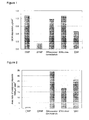
Figure 1 is a graph showing the degree of deposition of contaminants on a quartz crystal oscillator at various process stages. -
Figure 2 is a graph showing the area ratio of coalesced deposits on the surface of a quartz crystal oscillator at various process stages. -
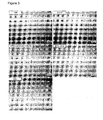
Figure 3 is an image showing the appearance of the surface of a quartz crystal oscillator at various process stages. -
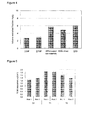
Figure 4 is a graph showing the toluene-extracted fraction at various process stages (comparative example). -
Figure 5 is a graph showing the degree of deposition of contaminants on a quartz crystal oscillator after various treatments in the DIP process. -
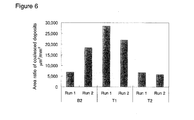
Figure 6 is a graph showing the area ratio of coalesced deposits on the surface of a quartz crystal oscillator after various treatments in the DIP process. -
Figure 7 is an image showing the appearance of the surface of a quartz crystal oscillator after various treatments in the DIP process. The scale is the same as used inFigure 3 . -
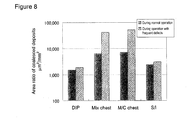
Figure 8 is a graph showing the area ratio of coalesced deposits on the surface of a quartz crystal oscillator during normal operation and during operation with frequent defects. -
Figure 9 is an image showing the appearance of the surface of a quartz crystal oscillator during normal operation. The scale is the same as used inFigure 3 . -
Figure 10 is an image showing the appearance of the surface of a quartz crystal oscillator during operation with frequent defects. The scale is the same as used inFigure 3 . -
Figure 11 is a flow chart of an on-line measurement of the present invention incorporating an on-line drainage system. -
Figure 12 is a flow chart of an on-line measurement of the present invention using a 4-channel molecular interaction analyzer incorporating on-line drainage systems. - As used herein, manufacturing processes of pulp refer to processes by which pulp (cellulose) is extracted from chips, logs, waste paper or dry sheets. Further, they include liquids added to these materials such as industrial water or treated industrial effluent or white water used before pulp is extracted and processes for recycling / recovering such liquids. Specifically, they include white water, service water, industrial grade water, recycled service water, industrial water, washed water from washers, drain water from drainage systems (e.g., DNT washers, extractors, screw presses, etc.), froth or rejects from floatators, scum and accepts from dissolved air flotation equipment, cloudy water from white water recovery filters, clear white water, shower water, wash water of felt or the like and diluted water of raw materials produced or used in manufacturing processes of pulp and/or paper; or these waters having undergone a separation process such as flotation separation, foam separation, precipitation, membrane separation, centrifugation, flocculation, etc.
- Pups include chemical pulps (softwood bleached kraft pulp (NBKP) or unbleached kraft pulp (NUKP), hardwood bleached kraft pulp (LBKP) or unbleached kraft pulp (LUKP), etc.), mechanical pulps (groundwood pulp (GP), thermomechanical pulp (TMP), chemithermomechanical pulp (CTMP), etc.), recycled pulps such as deinked pulp (DIP), etc. The present invention can be applied to these pulps alone or a mixture thereof in any ratios.
- As used herein, manufacturing processes of paper refer to processes by which pulp is converted into sheets, including any processes such as wet-end process, pressing process, dryer process, calendering process, drain process and processes for treating these service waters. As used herein, the wet-end process may be the process by which paper is made using a known paper machine such as, but not limited to, a Fourdrinier paper machine, twin wire paper machine or cylinder paper machine. The paper may be a single- or multi-layer paper. The process for treating service water includes the liquids used before pulp is extracted and processes for recycling / treating such liquids.
- Further, the stock may contain fillers, and known fillers can be used alone or in combination, including inorganic fillers such as precipitated calcium carbonate, ground calcium carbonate, clay, calcined kaolin, delaminated kaolin, white carbon, magnesium carbonate, barium carbonate, titanium dioxide, zinc oxide, silicon oxide, amorphous silica, calcium carbonate-silica complexes, aluminum hydroxide, calcium hydroxide, magnesium hydroxide and zinc hydroxide; organic fillers such as urea-formalin resins, polystyrene resins, phenol resins and hollow microparticles; and recycled fillers obtained by burning the sludge produced in a process for recycling waste paper or a process for preparing paper and those recycled fillers coated on their surfaces with calcium carbonate, silica, aluminum hydroxide or the like. Additionally, aluminum sulfate, sizing agents, paper strength enhancers, retention aids, freeness improvers, colorants, dyes, antifoaming agents and the like can also be contained as appropriate.
- The types of papers prepared by the manufacturing processes of paper in the present invention include, but not limited to, printing papers and newsprint papers as well as specialty papers for communication, converting papers, sanitary papers, papers for paper containers, papers for wrapping materials, etc. Specialty papers for communication more specifically include electrophotographic transfer paper, ink jet printing paper, business form printing paper, heat-sensitive printing paper, pressure-sensitive printing paper, etc. Converting papers more specifically include base paper for casting paper, base paper for wall paper, base paper for release paper, base paper for laminated board, base paper for molding, etc. Sanitary papers more specifically include facial tissue, toilet tissue, paper towels, etc. Paperboards such as liners and base paper for corrugated fiberboard are also included. These papers may be coated with organic or inorganic materials on their surfaces.
- As used herein, a microbalance having a quartz crystal oscillator may be any instrument capable of measuring small weight changes occurring on the surface of a quartz crystal oscillator by taking advantage of the piezoelectric effect of the oscillator. The microbalance having a quartz crystal oscillator is a molecular interaction analyzer (model: QCM-D300) from Q-sence or the like, for example. The measuring principle of this analyzer is as follows.
- When an AC voltage is applied across a quartz crystal oscillator, the crystal quartz is distorted. At that time, the quartz oscillates very regularly. If a sample is deposited on the surface of the quartz crystal oscillator, the frequency changes. The mass of the sample deposited on the surface of the quartz crystal oscillator can be determined because the frequency shift is proportional to the mass of membranes deposited.
- Specifically, the frequency shift (Δf) is measured by the analyzer above. The frequency shift Δf can be said to represent the weight of a contaminant in a wet state deposited on the surface of the quartz crystal oscillator because the relationship between Δf and the weight change Δm in a wet state is defined by
equation 1 below:
- Further, Δfcan be rewritten as the weight change (Δm) of the contaminant in a wet state deposited on the surface of the quartz crystal oscillator by using the equation of Sauerbrey shown below (
equation 2 below). It should be noted that Δf used inequation 2 is each of the Δf values measured at 4-step frequencies of 5, 15, 25 and 35 MHz automatically switched in the above analyzer and divided by 1, 3, 5 and 7, respectively (converted into the values at 5 MHz).
- The liquid or slurry analyzed may have a solids content of 5 % or less. Samples containing long fibers or large particle size contaminants are preferably analyzed after they are pretreated. Pretreatment methods may include conventional screening, filtration and the like, but any method can be used so far as a filtrate having a solids content of 5 % by weight or less and a long pulp fiber content of 50 % by weight or less relative to the total solids can be collected. As used herein, a long pulp fiber content refers to pulp fibers retained on a 150-mesh screen.
- In the present invention, the surface of the quartz crystal oscillator may be coated with a heavy metal such as gold, platinum, silver, lead, iron titanium or cadmium and/or a compound such as stainless steel or silicon dioxide. Further, the surface may be coated with a material having a solid surface free energy of 75 mJ/m2 or less. Alternatively, the oscillator can be used after such a material as a water-soluble protein, polymer electrolyte or surfactant has been adsorbed to the surface in a liquid.
- When the target of analysis is the pitch or sticky contaminant described below, the quartz crystal oscillator is preferably coated with a hydrophobic material. This means that the surface of the quartz crystal oscillator is coated to promote deposition of hydrophobic substances such as pitch components in a process onto the surface of the quartz crystal oscillator. Hydrophobic materials used for coating include organic materials having a solid surface free energy of 15-50 mJ/m2, preferably 30-40 mJ/m2 to show good adhesion to pitch components, e.g., polystyrene resins, polyethylene resins, polypropylene resins, etc., but are not specifically limited so far as they show hydrophobicity.
- Further, two or more quartz crystal oscillators coated with different materials on their surfaces can be used to determine deposition of a contaminant from a liquid or slurry. In this case, a quartz crystal oscillator coated with a material having a surface free energy of 40 mJ/m2 or less and a quartz crystal oscillator coated with a hydrophilic organic material having a surface free energy of more than 40 mJ/m2 or an inorganic material such as stainless steel can also be used to compare susceptibility to deposition of the contaminant on the different surfaces.
- As used herein, contaminants collectively refer to substances produced in manufacturing processes of pulp and paper and adversely influencing product quality and runnability. For example, they refer to metal salt scales such as calcium oxalate, calcium sulfate, barium sulfate, calcium carbonate, aluminum silicate; natural pitch consisting of triglycerides derived from mechanical pulp or resin components such as abietic acid; white pitch consisting of additive chemicals used in manufacturing processes of pulp and paper such as sizing agents or starch, paper softeners and density-reducing agents and hydrophobic substances based on organic matters such as latex derived from coating layers and the like; and sticky contaminants such as acrylic, vinyl acetate, hot-melt and the like adhesive materials such as adhesives, adhesive tapes, glues for binding magazines, plastic tapes and the like derived from waste paper.
- As used herein, deposition of a contaminant means that the contaminant is deposited and sedimented on any materials such as pipes, wires, equipment and the like in manufacturing processes of pulp and paper. Deposition includes, for example, not only direct deposition of an adhesive matter but also precipitation of a substance suspended in water and destabilization of a dispersed substance by pH shock or temperature change to form a deposit. In actual manufacturing processes of pulp and paper, the contaminant is deposited along with ashes such as fillers or pigments and small fibers. Especially when the contaminant is deposited on the surfaces of ashes, a large deposit including the ashes is formed, and therefore, contaminants as used herein also include complexes containing the fillers or the like.
- Further, the degree of deposition refers to the amount or speed of a substance deposited on a quartz crystal oscillator sensor in a predetermined period.
- The morphology of a contaminant deposited on the surface of a quartz crystal oscillator can be quantified by acquiring an image of it by using a microscope and calculating the area ratio or average particle size of deposits, or the area ratio of large deposits or its ratio to the total area by image analysis on the basis of the image. For example, information associated with problems of pitch / sticky contaminants in a paper machine can be obtained by acquiring an image of the surface of a quartz crystal oscillator at 400x magnification using Ultra-deep Color 3D Profile Measuring Microscope (VK9500) from Keyence Corporation and dividing the area of deposits having a predetermined particle size or more by the total measured area using a particle analysis application (VK-H1V9) from the same manufacturer to quantify the area ratio of coalesced deposits.
- According to the present invention, the operating state of a paper machine can be exactly known because relatively small deposited contaminants can be precisely measured and the morphology of deposits can be quantified by image analysis. Generally, contaminants exceeding 100 µm pierce papers having a thickness of 100 µm or less to cause problems such as paper breaks or product defects, but the tendency of contaminants to be agglomerated / coalesced in a papermaking system can be rapidly detected by determining the ratio of deposits having a predetermined size or more according to the present invention. In the present invention, the ratio of deposits having a predetermined particle size or more is preferably quantified by image analysis of deposits, and the size of deposits here can be determined as appropriate. For example, the area ratio of deposits having a particle size of a predetermined value or more between 3-20 µm can be determined and exploited for the operation control of a papermaking system. The morphology of deposits can be preferably quantified by determining the area ratio of deposits having a particle size of a predetermined value or more between 3-15 µm, more preferably a particle size of a predetermined value or more between 3-10 µm, even more preferably a particle size of a predetermined value or more between 5-8 µm, most preferably a particle size of about 6 µm or more. Generally, when a chemical for reducing deposition of contaminants is added to a papermaking system, the contaminants may be agglomerated into larger particles or decomposed / disaggregated into smaller particles to undergo morphological changes, but such morphological changes of contaminants can be exactly traced according to the present invention.
- For on-line measurements in the present invention, a filtrate can be obtained by using e.g., a drainage system such as a filtrate collector (REX-100S-ST) from Koei Industry Co., Ltd., but any system can be used that is capable of adjusting the solids content of a liquid or slurry to 5 % by weight or less, preferably 1 % by weight or less and the long pulp fiber content in the filtrate to 50 % by weight or less relative to the total solids.
- The present invention may also include an on-line measurement according to a flow chart as shown in
Figure 11 incorporating the on-line drainage system described above. Further, the effect of a chemical treatment in a manufacturing process (comparison between A and B) and the effect of separation in a separator (comparison between B and C) can be determined at the same time by designing a flow chart as shown inFigure 12 using an analyzer capable of measuring multiple samples at the same time by including multiple quartz crystal oscillators, such as a 4-channel molecular interaction analyzer (model Q-SENCE E4) from Q-sense. - For on-line observation of the morphology of deposits, a measuring cell with a glass window for the quartz crystal oscillator can be used to switch a test sample water to washing water at predetermined intervals and a digital microscope or the like can be used to capture an image of the deposits on the surface of the quartz crystal oscillator into a computer, whereby the morphology of the deposits can be quantified by image analysis as described above.
- In one embodiment, the present invention provides a process for preparing a paper. Thus, the present invention comprises determining susceptibility to deposition of a contaminant from a liquid or slurry in a manufacturing process of pulp and paper by the method described above. By determining deposition of a contaminant in this manner, the state of a papermaking system can be exactly known and the operating state can be optimized. Further, the present invention is advantageous in that paper breaks can be prevented or the operating efficiency can be improved by controlling the operating state by feedback control or the like on the basis of information from on-line measurement of deposition of the contaminant.
- In a further preferred embodiment, the present invention comprises: determining deposition of a contaminant from a liquid or slurry in a manufacturing process of pulp and paper using a microbalance having a quartz crystal oscillator; and quantifying the morphology of deposits on the surface of the quartz crystal oscillator by image analysis; and further comprises adding a chemical for reducing deposition of the contaminant to the liquid or slurry; using a microbalance having a quartz crystal oscillator to determine the degree of deposition of the contaminant on the surface of the quartz crystal oscillator from the liquid or slurry after the chemical has been added; and then comparing the degree of deposition of the contaminant in the presence of the chemical with the degree of deposition of the contaminant in the absence of the chemical to evaluate the effect of the chemical, whereby a chemical effective against deposition of the contaminant can be selected. The papermaking efficiency can be greatly improved by carrying out such a procedure to select a chemical suitable for the papermaking system and preparing a paper while adding the selected chemical.
- As used herein, chemicals for reducing deposition of contaminants are not specifically limited so far as they reduce deposition of contaminants from a liquid or slurry in manufacturing processes of pulp and paper, and generally include coagulants, retention aids, degrading agents, etc., specifically various polymers, enzymes, inorganic particles, etc. Preferred coagulants include relatively low molecular weight cationic polymers; retention aids include relatively high molecular weight cationic polymers; and degrading agents include enzymes, etc.
- The following examples further illustrate the present invention without, however, limiting the invention thereto.
- (Determination of the degree of deposition of contaminants on a quartz crystal oscillator [QCM analysis])
A standard analysis method is described below, though the procedure for preparing samples and measurement conditions can be changed as appropriate depending on the composition or consistency of the stock. A molecular interaction analyzer (QCM-D300) from Q-sense was used for measurements in combination with a measuring sensor consisting of a quartz crystal oscillator coated with gold on the surface further having a polystyrene coating. This analysis method is hereinafter referred to as QCM analysis, and the degree of deposition of contaminants determined is referred to as QCM deposition. The quartz crystal oscillator is sometimes referred to as sensor. - A pulp slurry collected in a paper factory was adjusted to 0.5 % and then filtered hrough a 500-mesh screen to give a filtrate. A 0.5 ml-aliquot of the filtrate was adjusted to a temperature of 25 ± 0.5 °C, and then introduced into a reaction cell and allowed to stand for 12 minutes while monitoring the amount of contaminants deposited on the surface of the quartz crystal oscillator as a change in oscillation frequency. After 12 minutes, the reaction cell was washed with distilled water for 3 minutes, and the amount deposited after washing was determined as QCM deposition. Thus, QCM deposition used herein refers to the amount of a substance deposited on the surface of a quartz crystal oscillator after it is adsorbed for 12 minutes from a liquid in contact with the surface followed by washing with water, and the change per unit time can provide information about the initial deposition rate of the substance.
- In a gap former newsprint paper machine (
ash content 15%, machine speed 1200 m/min) of paper factory A mainly using deinked pulp (DIP) and thermomechanical pulp (TMP) as raw materials, samples were collected at various process stages (1: finished DIP, 2: finished TMP, 3: raw materials recovered at the outlet of a white water recovery system, 4: mixing chest outlet, 5: stock inlet) and subjected to QCM analysis, and the results are shown inFigure 1 . Further, the area ratios of coalesced deposits of ϕ6 µm or more as determined by image analysis from images of the sensor surface after QCM analysis are shown inFigure 2 . A part of each image of the surface of the sensor obtained here is shown inFigure 3 . - As a comparative example, the same samples as Example 1 were extracted with toluene, and the extracted fractions (mg/g) were determined from the solids weight before and after extraction. The results are shown in
Figure 4 . - The results of Example 1 and comparative example show that the tendency of the toluene-extracted fractions and QCM deposition as well as the tendency of the area ratio of coalesced deposits vary. The toluene-extracted fractions are nearly comparable and low in DIP and TMP, and increase as the process advances to the mixing chest (Mix chest) and stock inlet (S/I). However, QCM deposition is low in TMP, and high in DIP, recovered raw materials and Mix chest, and somewhat low at S/I. Further, the area ratio of coalesced deposits shows that deposits are larger after post-treatments as compared with raw materials.
- Further, it is shown that large amounts of sticky contaminants in DIP are deposited on the QCM sensor coated with hydrophobic polystyrene and that the deposits on the sensor surfaces are dispersed. It is also shown that the amount of pitch in TMP deposited on the QCM sensor is low in weight and that the deposits are very small and dispersed. Further, it is shown that the amount of deposits in recovered raw materials after the white water recovery system is comparable to DIP but the deposits are very large particles.
- Generally, the weight of adhesives among organic fractions extracted with toluene is often approximately 10 % and the remainder consists of oils/resins derived from inks and additive chemicals such as sizing agents, indicating that there is little correlation between the amount of extracted fractions per se and problems of sticky contaminants.
- When determined from QCM deposition alone, the amount of deposits seems to decrease at S/I. When looking at the area ratio of coalesced deposits as proposed by the present invention, however, it is presumed that contaminants per se are agglomerated / coalesced and deposited though the degree of deposition of the contaminants decreases by the addition of cationic chemicals or the like during the papermaking process. It is also shown that contaminants in recovered raw materials after the white water recovery system are very large. Further, the actual morphology can be identified as shown in
Figure 3 . Thus, the present invention allows more exact evaluation of deposits contained in a liquid or slurry in a manufacturing process of pulp and paper than previously. - In the DIP process of paper factory B, a coagulant treatment (T1) and an enzyme treatment (T2) were performed in contrast to normal treatment (B2), and the results are shown in
Figure 5 (each in duplicate). In the coagulant treatment, 100 ppm of Catiofast SF (modified polyethyleneimine) from BASF was added to the finished DIP and then samples were collected at the inlet of the mixing box of the paper machine and used for QCM analysis. In the enzyme treatment, 100 ppm of Optimize 525 (sticky contaminant-degrading enzyme) from Buckman Laboratories International, Inc. was added to the finished DIP and then samples were collected at the inlet of the mixing box of the paper machine and analyzed in the same manner. As a control (normal treatment), DIP samples without any chemical added were collected at the mixing box and analyzed in the same manner. - The area ratio of coalesced deposits having a particle size of 6 µm or more was determined from images of the surface of the sensor after analysis and the results are shown in
Figure 6 . Further, the images obtained here are shown inFigure 7 . - As shown from these results, QCM analysis judges that both coagulant treatment (T1) and enzyme treatment (T2) have no effect as compared with normal treatment (B2), but coupled to the area ratio of coalesced deposits according to the method of the present invention, T1 has an adverse effect in terms of the runnability of the paper machine because agglomeration of contaminants is promoted while T2 has a good effect in terms of the runnability of the paper machine because contaminants are dispersed.
- In a gap former newsprint paper machine (
DIP 100%, ash content 12%, machine speed 1250 m/min) of paper factory A, process samples during normal operation and during operation with frequent defects were collected and subjected to QCM analysis. Further, the area ratios of coalesced deposits of ϕ6 µm or more as determined by image analysis from images of the sensor surface after QCM analysis are shown inFigure 8 . A part of each image of the surface of the sensor obtained here is shown inFigure 9 and Figure 10 . It should be noted that the number of defects during normal operation was 16 defects/hr, while the number of defects during operation with frequent defects was 300 defects/hr. As shown inFigure 8 , the situation in which paper defects occur tends to be worsened when the area ratio of deposits having a predetermined size or more is high, showing that the state of the papermaking system can be exactly known by the present invention.
Claims (11)
- A method for determining deposition of a contaminant from a liquid or slurry in a manufacturing process of pulp and paper, characterized in that the method comprises: using a microbalance having a quartz crystal oscillator to determine the degree of deposition of the contaminant from the liquid or slurry on the quartz crystal oscillator; and quantifying the morphology of deposits on the surface of the quartz crystal oscillator by image analysis.
- The method of claim 1 characterized in that the surface of the quartz crystal oscillator is coated with a heavy metal or an organic material.
- The method of claim 1 or 2 characterized in that the surface of the quartz crystal oscillator is coated with a material having a solid surface free energy of 75 /m2 or less.
- The method of any one of claims 1 to 3 characterized in that the contaminant is a substance containing a hydrophobic organic matter.
- The method of any one of claims 1 to 4 characterized in that the contaminant is a sticky contaminant.
- The method of any one of claims 1 to 5 characterized in that the contaminant is pitch.
- The method of any one of claims 1 to 6 characterized in that it further comprises:adding a chemical for reducing deposition of the contaminant to the liquid or slurry;using a microbalance having a quartz crystal oscillator to determine the degree of deposition of the contaminant on the surface of the quartz crystal oscillator from the liquid or slurry after the chemical has been added; andcomparing the degree of deposition of the contaminant in the presence of the chemical with the degree of deposition of the contaminant in the absence of the chemical to evaluate the effect of the chemical.
- The method of any one of claims 1 to 7 characterized in that it comprises using multiple quartz crystal oscillators coated with different materials on their surfaces to determine deposition of the contaminant from the liquid or slurry.
- The method of any one of claims 1 to 8 characterized in that it comprises an on-line continuous measurement.
- The method of any one of claims 1 to 9 wherein the step of quantifying the morphology of deposits on the surface of the quartz crystal oscillator by image analysis comprises quantifying the proportion of deposits having a predetermined particle size or more.
- A process for preparing a paper, comprising the method of any one of claims 1 to 10.
Applications Claiming Priority (2)
| Application Number | Priority Date | Filing Date | Title |
|---|---|---|---|
| JP2009237759 | 2009-10-14 | ||
| PCT/JP2010/067919 WO2011046130A1 (en) | 2009-10-14 | 2010-10-13 | Method for measuring degree of contaminant deposition |
Publications (2)
| Publication Number | Publication Date |
|---|---|
| EP2490006A1 true EP2490006A1 (en) | 2012-08-22 |
| EP2490006A4 EP2490006A4 (en) | 2018-05-02 |
Family
ID=43876180
Family Applications (1)
| Application Number | Title | Priority Date | Filing Date |
|---|---|---|---|
| EP10823398.2A Withdrawn EP2490006A4 (en) | 2009-10-14 | 2010-10-13 | Method for measuring degree of contaminant deposition |
Country Status (5)
| Country | Link |
|---|---|
| US (1) | US8551292B2 (en) |
| EP (1) | EP2490006A4 (en) |
| JP (1) | JP5670908B2 (en) |
| CA (1) | CA2777578C (en) |
| WO (1) | WO2011046130A1 (en) |
Families Citing this family (7)
| Publication number | Priority date | Publication date | Assignee | Title |
|---|---|---|---|---|
| KR102038169B1 (en) * | 2012-03-19 | 2019-10-29 | 케미라 오와이제이 | Methods of measuring a characteristic of a creping adhesive film and methods of modifying the creping adhesive film |
| US9182376B2 (en) * | 2013-02-28 | 2015-11-10 | Halliburton Energy Services, Inc. | Determining constituents of a wellbore fluid |
| US10329715B2 (en) | 2017-07-20 | 2019-06-25 | Buckman Laboratories International, Inc. | Real time regulation of yankee dryer coating based on predicted natural coating transfer |
| US10767314B2 (en) * | 2018-08-13 | 2020-09-08 | Epygen Labs Fz Llc | Methods to reduce rewinder breaks during paper production from recycled paper furnish |
| US11707906B2 (en) | 2020-08-27 | 2023-07-25 | Buckman Laboratories International, Inc. | Predictive control of Yankee dryer chemistry and creped product quality |
| CN118974672A (en) | 2022-03-24 | 2024-11-15 | 巴克曼实验室国际公司 | System and method for traceability and automatic verification or corrective action regarding online sensors |
| CN117191924B (en) * | 2023-08-03 | 2024-04-05 | 哈尔滨工业大学 | Molecular pollutant in-situ analysis detection device with high-efficiency separation and dynamic characterization |
Family Cites Families (25)
| Publication number | Priority date | Publication date | Assignee | Title |
|---|---|---|---|---|
| JPH0599858A (en) * | 1991-10-09 | 1993-04-23 | Kawasaki Steel Corp | Attachment detection method |
| JP4020539B2 (en) * | 1999-06-29 | 2007-12-12 | ジーイーヘルスケア バイオサイエンス株式会社 | Method for measuring solute concentration in droplets using quartz crystal |
| US6458240B1 (en) * | 2000-01-14 | 2002-10-01 | Georgia-Pacific Corporation | Method for removing contaminants from fibers in recycle fiber pulping |
| US7063770B2 (en) * | 2000-02-04 | 2006-06-20 | Georgia-Pacific Corporation | Method of removing high density stickies from secondary papermaking fibers |
| JP2004124279A (en) * | 2002-09-30 | 2004-04-22 | Daio Paper Corp | Printing coated paper blended with magazine waste paper and method for producing the same |
| US20040065419A1 (en) * | 2002-10-04 | 2004-04-08 | Vicente Lasmarias | Removal of contaminants from recycled paper fibers |
| JP4987469B2 (en) | 2003-04-17 | 2012-07-25 | キャンブレックス・バイオ・サイエンス・ノッティンガム・リミテッド | Assay to detect mycoplasma by measuring acetate kinase or carbamate kinase activity |
| AU2004233290B2 (en) | 2003-04-17 | 2009-05-07 | Cambrex Bio Science Nottingham Limited | Assay for detecting mycoplasma by measuring acetate kinase or carbama kinase activity |
| DE102004059979B4 (en) * | 2004-12-13 | 2007-11-22 | Fraunhofer-Gesellschaft zur Förderung der angewandten Forschung e.V. | Device and method for calculating a signal energy of an information signal |
| JP2006184118A (en) * | 2004-12-27 | 2006-07-13 | Marusumi Paper Co Ltd | Newsprint |
| US20060281191A1 (en) * | 2005-06-09 | 2006-12-14 | Prasad Duggirala | Method for monitoring organic deposits in papermaking |
| US7449086B2 (en) * | 2005-09-21 | 2008-11-11 | Nalco Company | Use of synthetic metal silicates for decreasing the deposition of contaminants during a papermaking process |
| JP2007271389A (en) * | 2006-03-30 | 2007-10-18 | Nippon Paper Industries Co Ltd | Method of measuring adhesive foreign substance |
| JP4772563B2 (en) | 2006-03-31 | 2011-09-14 | 日本製紙株式会社 | How to measure the degree of foreign object deposition |
| JP4748724B2 (en) * | 2006-06-12 | 2011-08-17 | ハイモ株式会社 | Pitch control agent or coagulant evaluation method |
| JP2008255498A (en) * | 2007-03-30 | 2008-10-23 | Nippon Paper Industries Co Ltd | Method for producing recycled pulp |
| GB0708346D0 (en) * | 2007-04-30 | 2007-06-06 | Attana Ab | Sensor |
| MX2009011956A (en) * | 2007-05-16 | 2009-11-13 | Buckman Labor Inc | Methods to detect organic contaminants in pulp and fiber. |
| US7998352B2 (en) * | 2007-09-10 | 2011-08-16 | Nalco Company | Method and device for cleanup and deposit removal from internal hot water system surfaces |
| JP4802156B2 (en) * | 2007-08-15 | 2011-10-26 | ハイモ株式会社 | Adhesive pitch analysis method |
| US7842165B2 (en) * | 2007-08-29 | 2010-11-30 | Nalco Company | Enhanced method for monitoring the deposition of organic materials in a papermaking process |
| US8160305B2 (en) * | 2007-11-30 | 2012-04-17 | Hercules Incorporated | Method and apparatus for measuring deposition of particulate contaminants in pulp and paper slurries |
| JP2009144272A (en) * | 2007-12-12 | 2009-07-02 | Daio Paper Corp | Paper and method for producing paper |
| JP5095440B2 (en) * | 2008-02-25 | 2012-12-12 | 森合精機株式会社 | Residual deposit measuring device |
| US8133356B2 (en) * | 2008-06-19 | 2012-03-13 | Nalco Company | Method of monitoring microbiological deposits |
-
2010
- 2010-10-13 US US13/501,791 patent/US8551292B2/en not_active Expired - Fee Related
- 2010-10-13 JP JP2011536148A patent/JP5670908B2/en active Active
- 2010-10-13 CA CA2777578A patent/CA2777578C/en not_active Expired - Fee Related
- 2010-10-13 EP EP10823398.2A patent/EP2490006A4/en not_active Withdrawn
- 2010-10-13 WO PCT/JP2010/067919 patent/WO2011046130A1/en not_active Ceased
Non-Patent Citations (1)
| Title |
|---|
| See references of WO2011046130A1 * |
Also Published As
| Publication number | Publication date |
|---|---|
| EP2490006A4 (en) | 2018-05-02 |
| JP5670908B2 (en) | 2015-02-18 |
| CA2777578A1 (en) | 2011-04-21 |
| US8551292B2 (en) | 2013-10-08 |
| US20120211190A1 (en) | 2012-08-23 |
| CA2777578C (en) | 2016-06-28 |
| JPWO2011046130A1 (en) | 2013-03-07 |
| WO2011046130A1 (en) | 2011-04-21 |
Similar Documents
| Publication | Publication Date | Title |
|---|---|---|
| US8551292B2 (en) | Methods for determining the degree of deposition of contaminants | |
| CA2813261C (en) | Enhanced method for monitoring the deposition of organic materials in a papermaking process | |
| NZ583680A (en) | Enhanced method for monitoring the deposition of organic materials in a papermaking process | |
| EP3714256B1 (en) | Method of measuring hydrophobic contaminants in a pulp slurry or a papermaking system | |
| Monte et al. | Development of a methodology to predict sticky deposits due to the destabilisation of dissolved and colloidal material in papermaking—application to different systems | |
| CA1277809C (en) | Papermaking process | |
| Monte et al. | Improving deposition tester to study adherent deposits in papermaking | |
| JP4772563B2 (en) | How to measure the degree of foreign object deposition | |
| Saarimaa et al. | Monitoring of dissolved air flotation by focused beam reflectance measurement | |
| Mao et al. | Effects of carboxyl content on the characteristics of TMP long fibers | |
| Lee et al. | Quantification of macro and micro stickies and their control by flotation in OCC recycling process | |
| CN101498640A (en) | Fast appraisement method for waste paper-pulp gummy substance control effect | |
| US6841390B1 (en) | Method for sensing stickies | |
| FI119709B (en) | Procedure for Determining Dissolved and Colloidal Disturbances in a Paper Making Process | |
| CN104634733B (en) | A kind of method for screening slimicide and the application for suppressing adhesive contaminant deposition in paper technology | |
| Lee et al. | Evaluation of the dynamic attachment phenomena of micro stickies to air bubbles | |
| Haapala et al. | Purification of white waters by selective flotation | |
| Beloşinschi et al. | Effects of coagulants on the dcs accumulation in process water of papermaking. | |
| Andrew et al. | International Journal of Chemical Sciences | |
| Helle | Characterisation and removal of gas in papermaking | |
| Monte et al. | Comparison of ultrafiltration and dissolved air flotation efficiencies in industrial units during the papermaking process | |
| Lindberg et al. | Sticky Deposits in Tissue Manufacturing Process | |
| Rice | New Techniques for Continuous Chemical Analysis in the Pulp&Paper Industry | |
| CN120530245A (en) | Cellophane containing BCTMP and recycled pulp | |
| Marion | Characterizing sticky material in a paperboard process using corrugated containers as raw material |
Legal Events
| Date | Code | Title | Description |
|---|---|---|---|
| PUAI | Public reference made under article 153(3) epc to a published international application that has entered the european phase |
Free format text: ORIGINAL CODE: 0009012 |
|
| 17P | Request for examination filed |
Effective date: 20120504 |
|
| AK | Designated contracting states |
Kind code of ref document: A1 Designated state(s): AL AT BE BG CH CY CZ DE DK EE ES FI FR GB GR HR HU IE IS IT LI LT LU LV MC MK MT NL NO PL PT RO RS SE SI SK SM TR |
|
| DAX | Request for extension of the european patent (deleted) | ||
| RIC1 | Information provided on ipc code assigned before grant |
Ipc: G01N 5/02 20060101AFI20171124BHEP |
|
| RA4 | Supplementary search report drawn up and despatched (corrected) |
Effective date: 20180405 |
|
| RIC1 | Information provided on ipc code assigned before grant |
Ipc: G01N 5/02 20060101AFI20180329BHEP |
|
| STAA | Information on the status of an ep patent application or granted ep patent |
Free format text: STATUS: THE APPLICATION HAS BEEN WITHDRAWN |
|
| 18W | Application withdrawn |
Effective date: 20180920 |