EP2489208B1 - Method and apparatus for encoding a mesh model, encoded mesh model, and method and apparatus for decoding a mesh model - Google Patents
Method and apparatus for encoding a mesh model, encoded mesh model, and method and apparatus for decoding a mesh model Download PDFInfo
- Publication number
- EP2489208B1 EP2489208B1 EP09850328.7A EP09850328A EP2489208B1 EP 2489208 B1 EP2489208 B1 EP 2489208B1 EP 09850328 A EP09850328 A EP 09850328A EP 2489208 B1 EP2489208 B1 EP 2489208B1
- Authority
- EP
- European Patent Office
- Prior art keywords
- repeating
- cell
- cells
- cluster
- mesh model
- Prior art date
- Legal status (The legal status is an assumption and is not a legal conclusion. Google has not performed a legal analysis and makes no representation as to the accuracy of the status listed.)
- Active
Links
Images


Classifications
-
- H—ELECTRICITY
- H04—ELECTRIC COMMUNICATION TECHNIQUE
- H04W—WIRELESS COMMUNICATION NETWORKS
- H04W16/00—Network planning, e.g. coverage or traffic planning tools; Network deployment, e.g. resource partitioning or cells structures
- H04W16/18—Network planning tools
- H04W16/20—Network planning tools for indoor coverage or short range network deployment
-
- G—PHYSICS
- G06—COMPUTING OR CALCULATING; COUNTING
- G06F—ELECTRIC DIGITAL DATA PROCESSING
- G06F17/00—Digital computing or data processing equipment or methods, specially adapted for specific functions
- G06F17/10—Complex mathematical operations
-
- G—PHYSICS
- G06—COMPUTING OR CALCULATING; COUNTING
- G06F—ELECTRIC DIGITAL DATA PROCESSING
- G06F30/00—Computer-aided design [CAD]
- G06F30/20—Design optimisation, verification or simulation
- G06F30/23—Design optimisation, verification or simulation using finite element methods [FEM] or finite difference methods [FDM]
-
- G—PHYSICS
- G06—COMPUTING OR CALCULATING; COUNTING
- G06T—IMAGE DATA PROCESSING OR GENERATION, IN GENERAL
- G06T17/00—Three-dimensional [3D] modelling for computer graphics
- G06T17/20—Finite element generation, e.g. wire-frame surface description, tesselation
-
- G—PHYSICS
- G06—COMPUTING OR CALCULATING; COUNTING
- G06T—IMAGE DATA PROCESSING OR GENERATION, IN GENERAL
- G06T9/00—Image coding
- G06T9/001—Model-based coding, e.g. wire frame
-
- G—PHYSICS
- G06—COMPUTING OR CALCULATING; COUNTING
- G06T—IMAGE DATA PROCESSING OR GENERATION, IN GENERAL
- G06T9/00—Image coding
- G06T9/40—Tree coding, e.g. quadtree, octree
-
- H—ELECTRICITY
- H04—ELECTRIC COMMUNICATION TECHNIQUE
- H04W—WIRELESS COMMUNICATION NETWORKS
- H04W28/00—Network traffic management; Network resource management
- H04W28/02—Traffic management, e.g. flow control or congestion control
- H04W28/06—Optimizing the usage of the radio link, e.g. header compression, information sizing, discarding information
-
- H—ELECTRICITY
- H04—ELECTRIC COMMUNICATION TECHNIQUE
- H04W—WIRELESS COMMUNICATION NETWORKS
- H04W84/00—Network topologies
- H04W84/18—Self-organising networks, e.g. ad-hoc networks or sensor networks
-
- H—ELECTRICITY
- H04—ELECTRIC COMMUNICATION TECHNIQUE
- H04W—WIRELESS COMMUNICATION NETWORKS
- H04W88/00—Devices specially adapted for wireless communication networks, e.g. terminals, base stations or access point devices
- H04W88/02—Terminal devices
- H04W88/04—Terminal devices adapted for relaying to or from another terminal or user
Definitions
- This invention relates to a method and an apparatus for encoding a mesh model, an encoded mesh model and a method and apparatus for decoding a mesh model.
- [OG00] 2 discloses a KD-tree based compression algorithm to encode the means of all connected components of a mesh model. This algorithm subdivides with each iteration a cell into two child cells, and encodes the number of vertices in one of the two child cells. If the parent cell contains p vertices, the number of vertices in one of the child cells can be encoded using log 2 (p + 1) bits with an arithmetic coder. This subdivision is recursively applied, until each non-empty cell is small enough to contain only one vertex and enables a sufficiently precise reconstruction of the vertex position. It is mentioned in [OG00] that the algorithm is most efficient for non-uniform distributions, with regular distribution being the worst case. 2 [OG00]: O. Devillers, P. Gandoin. "Geometric compression for interactive transmission", in: IEEE Visualization, 2000, pp. 319-326
- the invention is based on the recognition of the fact that for most large 3D engineering models the instance positions of repeating instances of connected components show significant multiple spatial aggregation, and that for this case the efficiency of the algorithm described in [OG00] can be improved. That is, repeating instances within a large 3D mesh model are often distributed such that several instances are within one or few small regions, but in other relatively large regions there are no instances. If a single KD-tree is used to organize and compress such type of point data sets, as proposed in [OG00], the KD-tree will be unreasonably deep, which will make the output data stream longer than necessary.
- the present invention provides an improvement for this case.
- several KD-trees are used, each for one cluster of points which are spatially aggregated. Those KD-trees will generate a relatively short data stream, and thus improve the total compression ratio.
- various embodiment provides a method for encoding points of a mesh model, comprising steps of determining that the mesh model comprises repeating instances of a spatially connected component, the spatially connected component having a path between any two polygons in it, and the repeating instances of the spatially connected component being repeated in various positions, scales or orientations, and determining for each repeating instance at least one positional point representative of a position of the repeating instance;
- the clustering comprises steps of defining a bounding box around the mesh model
- said first cell is only selected if it was not yet clustered and comprises at least M positional points of M repeating instances, wherein M is a user definable parameter.
- the method further comprises steps of determining one or more further cells, wherein the further cells are neighbouring cells or recursively neighbouring cells of the selected first cell and wherein each of the determined further cells comprises at least one positional point of a repeating instance; and adding said determined neighbouring cell or cells to said cluster.
- the clustering further comprises a step of sorting all cells in ascending or descending order of the number of positional points in each cell, and the first cells are selected according to said order.
- the method further comprises a step of defining a spatial resolution, wherein a cell is the smallest spatial resolution unit according to said defined spatial resolution.
- the method further comprises steps of
- the method further comprises steps of modifying the spatial resolution if the spatial homogeneity is below the threshold; and repeating the step of determining a measure of spatial homogeneity.
- various embodiments provide an apparatus for encoding points of a mesh model, comprising means for determining (El) that the mesh model comprises repeating instances of a spatially connected component, the spatially connected component having a path between any two polygons in it, and the repeating instances of the spatially connected component being repeated in various positions, scales or orientations, and determining for each repeating instance at least one positional point representative of a position of the repeating instance;
- the means for clustering comprises means for defining a bounding box around the mesh model; means for dividing the bounding box into cells, wherein a cell is a smallest spatial resolution unit;
- the apparatus further comprises
- various embodiments provide a mesh model encoded in a bitstream comprising a plurality of repeating spatially connected components, each spatially connected component having a path between any two polygons in it, and the repeating instances of the spatially connected component being repeated in various positions, scales or orientations, wherein the encoded mesh model comprises encoded data of at least one instance of each repeating spatially connected component; and wherein positions of a plurality of repetitions of said repeating spatially connected components and indications of a boundary position of a bounding box are encoded for each region within the mesh model containing for a spatially connected component a set of positions which are spatially aggregated; wherein a separate KD-tree is encoded for the set of positions for each region.
- various embodiments provide a method for decoding points of a mesh model from a bitstream, comprising steps of: extracting data from the bitstream for an instance of a repeating spatially connected component;
- the fourth data comprises indices of two cells within the mesh model, a cell being a smallest spatial resolution unit according to the spatial resolution defined by said second data.
- Fig.1 shows exemplarily the principle of conventional KD-tree coding in a 2D case.
- the 2D model is enclosed by a bounding box 10, which is called parent cell. Seven vertices are positioned within the parent cell.
- the KD-tree encoding algorithm starts with encoding the total number of vertices using a predefined number of bits, and then subdivides the cells recursively. Each time it subdivides a parent cell into two child cells, it encodes the number of vertices in one of the two child cells. By convention, this may be the left child cell (after vertical splitting) or the upper cell (after horizontal splitting).
- the number of vertices in one of the child cells can be encoded using log 2 ( p + 1) bits with an arithmetic coder. This subdivision is recursively applied, until each non-empty cell is small enough to contain only one vertex and enable a sufficiently precise reconstruction of the vertex position. For compressing the positions of all repeated instances, the entire bounding-box 10 of all the positions is regarded as a parent cell in the beginning. In the example of Fig.1 , the total number of vertices (seven) is encoded using 32 bits. Then vertical splitting is applied, so that a left child cell V1 and a right child cell V2 are obtained.
- the number of vertices in the left child cell V1 which is four, is encoded.
- the number of bits used for the encoding is determined by the number of vertices within the parent cell: it is log 2 ( 7 +1) - 3 bits. From the number of vertices in the parent cell and the number of vertices in the left child cell V1, the number of vertices in the right child cell V2 can be deduced, and therefore needs not be encoded.
- the left child cell V1 which is now a parent cell V1 is split into an upper child cell V1H1 and a lower child cell V1H2.
- the right child cell V2, which is now a parent cell V2 is split into an upper child cell V2H1 and a lower child cell V2H2.
- the encoding continues with the upper left child cell V1H1, which has two vertices.
- the number of vertices in the lower left child cell V1H2 needs not be encoded since it can be deduced from the number of vertices in the left cell V1 and in the upper left child cell V1H1. Then, the same procedure is applied to the right cell V2, which results in encoding a zero using two bits. As shown in Fig.1 , two more splitting steps are necessary until each vertex is in a separate cell, and even more steps are necessary until each vertex is sufficiently localized within its cell. Each step requires the encoding of a growing number of ones or zeros. Depending on the required accuracy, the number of additional steps may be high.
- the present invention applies the KD-tree coding algorithm not only for encoding vertex positions, but for encoding positions of repeating connected components.
- Fig.2 a) shows an example where multiple repeating connected components 21-24 are positioned within the boundary box 20 of a 3D mesh model. As is the case in many large 3D mesh models, the positions are very unevenly distributed within the bounding box. If only the KD-tree coding algorithm is applied for encoding the positions, an exemplary result is shown in Fig.2 b) . It can be seen that five initial splitting steps are required before the clusters are localized.
- the code will be as follows: 12 (total number) - 6 (left child cell 1 st generation) - 6-3 (upper child cells 2 nd gen.) - 2-3-0 (L, 3 rd gen.) - 2-0-0-0 (up, 4 th gen.) - 2-4-0-3 (L, 5 th gen.) - 2-0-3-0 (up, 6 th gen.), resulting in 12-6-6-3-2-3-0-2-0-0-0-2-4-0-3-2-0-3-0.
- the assignment of number of bits is as described above. Further data may be required for a more exact position.
- the code comprises either numerous repetitions of previous values, or zeros.
- the points are clustered, i.e. clusters are created and if possible, the points are assigned to the clusters.
- the points shown in Fig.2 can be clustered advantageously in a manner as shown in Fig.3 .
- four clusters 31-34 are within the bounding box 30.
- the clustering comprises selecting a first cell that was not yet clustered and that comprises one or more points, and defining a cluster that comprises the first cell, or the one or more points within the first cell.
- a method for encoding points of a mesh model comprises steps of determining E1 that the mesh model comprises repeating instances of a connected component, and determining E2 for each repeating instance at least one reference point, clustering E3 the reference points of the repeating instances into one or more clusters, and encoding E4 the clustered reference points using KD-tree coding, wherein for each cluster a separate KD-tree is generated.
- the clustering comprises steps of defining a bounding box around the mesh model, dividing the bounding box into cells, wherein a cell is a smallest spatial resolution unit, selecting a first cell that was not yet clustered and that comprises one or more reference points of a repeating instance, and defining a cluster that comprises said first cell, or the one or more reference points within said first cell.
- the first cell is a candidate for creating a new cluster.
- one cell is sufficient for creating a cluster.
- at least two adjacent cells that include one or more points each are required for creating a cluster.
- a predefined minimum number of points within any number of adjacent cells are required for creating a cluster.
- the first cell is only selected if it was not yet clustered and if it comprises at least M points (e.g. reference points of M repeating instances).
- M is a user definable parameter.
- a corresponding encoding method comprises a step of defining a parameter M, wherein M is the minimum number of points within a cell, in order for selecting the cell as source for creating a new cluster.
- the clustering may further comprise steps of determining one or more further cells, wherein the further cells are neighbouring cells or recursively neighbouring cells (i.e. neighbours of neighbours etc.) of the selected first cell, and wherein each of the determined further cells comprises at least one reference point of a repeating instance, and adding said determined neighbouring cell or cells to said cluster.
- the clustering further comprises a step of sorting all cells in ascending or descending order of the number of reference points in each cell, and the first cells (the candidates for creating a new cluster) are selected according to said order.
- the instance positions shows significantly multiple spatial aggregation. If one single KD-tree is used to organize and compress such type of point datasets, the KD-tree will be unreasonably deep. On the other side, if several KD-trees are used, each for one cluster of points which are spatially aggregated, the KD-trees will generate a relatively short data stream and thus improve the total compression ratio.
- the invention provides an efficient compression strategy that is particularly advantageous for encoding the positions of all repeated instances.
- the invention provides an efficient compression method for discrete points, especially for those that show significantly multiple spatial aggregation.
- the positions of repeated instances in a large 3D engineering model often have such kind of characteristics.
- the invention provides a clustered KD-tree based compression algorithm for efficiently compressing discrete point data sets with significantly multiple spatial aggregation.
- the input points are first clustered according to their spatial positions.
- Each cluster contains a set of points which are spatially aggregated. Then each cluster is compressed by organizing all the points belonging to it by one KD-tree.
- C Point denote all the point clusters. In the beginning, C Point is empty.
- Step 1 Subdivide the whole bounding-box of all the points to be compressed into N*N*N cells.
- Step 2 Sort all the cells into a queue Q_Cell according to the ascending order of the number of points falling into each cell.
- Step 3 If ( Q_Cell is not empty) Pop a cell P from Q_Cell. Skip empty cells. Goto Step 4. Else Goto Step 6.
- Step 4 If ( P doesn't belong to any cluster in C_Point )
- Step 5 Check all neighbor cells of all cells in C .
- Step 6 Compress the points falling into the cells belonging to the same cluster in C Point independently.
- Each cluster is compressed by organizing the corresponding points, using a separate KD-tree and compressing them e.g. based on [OG00].
- a flow-chart of the clustering method is shown in Fig.7 .
- ae(v) means arithmetic coding, something similar to the arithmetic coding in H.264/AVC.
- BoundaryBox_Of_All_Instance_Positions indicates the bounding-box of all instance positions.
- Num_Of_Clusters indicates the number of clusters.
- N indicates the resolution of the cells, i.e. N in Step 1 of the above-described encoding procedure.
- Indices_of_Two_Boundary_Cells_of_cluster[i] indicates the index of the two cells that define the bounding-box of a cluster[i]. It has 2*Log 2 (n*n*n) bits.
- KD-tree_of_current_cluster denotes bits for recording the KD-tree of a current cluster.
- the boundary can be expressed by indices of the two boundary cells.
- the boundary cells of a current cluster are cells with minimum indices and maximum indices of each dimension. E.g. if in a 2D case the points belonging to a cluster are in a range of ⁇ x min ,x max ⁇ and ⁇ y min ,y max ⁇ , then the boundary cells are at x min ,y min and x max ,y max , even though these cells are actually not within the cluster.
- their indices are used in order to define a local bounding-box for the current cluster. Within the local bounding-box, local coordinates may be used, which reduces the amount of bits.
- calculating the KD-tree for a current cluster has steps of calculating the relative positions of instances falling into the current cluster[i], and calculating the corresponding instance positions in the world coordinate system outside the bounding-box.
- the encoding method further comprises a step of defining a spatial resolution of the mesh model, e.g. N in Tab.1.
- a cell is the smallest spatial resolution unit according to the defined spatial resolution.
- the spatial resolution has an impact on the exactness of the reconstruction, since a position that is somewhere within a particular cell during encoding can after decoding be reproduced only at a predefined position within the cell, e.g. in the center of the cell. For a more exact location, a higher spatial resolution is necessary.
- N is predefined.
- N can be selected according to quality requirements, e.g. it can be reduced for reproduction on low-resolution displays.
- the encoding method further comprises steps of determining a measure of spatial homogeneity of points (wherein the measure of spatial homogeneity is high if the points are evenly distributed and lower if the distribution is more uneven), comparing the spatial homogeneity to a threshold, and performing the clustering only if the spatial homogeneity is below the threshold.
- the encoding method may comprise steps of determining a measure of spatial homogeneity of reference points of the repeating instances, comparing the spatial homogeneity to a threshold, and performing the clustering only if the spatial homogeneity is below the threshold (i.e. if the distribution of points is very inhomogeneous).
- the encoding method further comprises steps of modifying the spatial resolution if the spatial homogeneity is below the threshold, measuring the spatial homogeneity and repeating these steps until the spatial homogeneity is not below the threshold.
- Fig.4 shows a data structure of an encoded mesh model based on clusters.
- a root referring to a particular type of connected component and a complete 3D mesh model, comprises at least one cluster that refers to a repeating connected component and that is represented as a KD-tree KD-T1,...,KD-T3.
- the connected component root CCr stands for a particular connected component.
- the connected component may be a particular type of screw in a 3D engineering mesh model.
- Each of the three cluster KD-trees KD-T1,...,KD-T3 refers to one cluster of multiple instances of the connected component and includes location information, e.g. indices of the cluster's boundary cells.
- an apparatus for encoding points of a mesh model comprises the means of claim 9.
- the means for clustering comprises defining means for defining a bounding box around the mesh model, dividing means for dividing the bounding box into cells, wherein a cell is a smallest spatial resolution unit, selection means for selecting a first cell that was not yet clustered and that comprises one or more reference points of a repeating instance, and defining means for defining a cluster that comprises said first cell, or the one or more reference points within said first cell.
- the apparatus further comprises determining means for determining one or more further cells, wherein the further cells are neighbouring cells or recursively neighbouring cells of the selected first cell and wherein each of the determined further cells comprises at least one reference point of a repeating instance, and adding means for adding said determined neighbouring cell or cells to said cluster.
- the clustering means further comprises organizing means for sorting all cells in ascending or descending order of the number of reference points in each cell, wherein the first cells (i.e. initial cells of a cluster) are selected according to said order.
- the clustering means comprises means for determining boundary cells of a current cluster (being the cells with minimum indices and maximum indices of each dimension).
- the encoding apparatus further comprises means for defining a spatial resolution, wherein a cell is the smallest spatial resolution unit according to said defined spatial resolution.
- the encoding apparatus further comprises analyzing means for determining a measure of spatial homogeneity of reference points of the repeating instances, wherein the measure of spatial homogeneity is high if the reference points are evenly distributed and lower if the distribution is more uneven, comparator means for comparing the spatial homogeneity to a threshold, and control means for controlling that the clustering is performed only if the spatial homogeneity is below the threshold.
- an encoded mesh model comprises a plural-ity of repeating connected components, wherein the encoded mesh model comprises encoded data of at least one instance of each repeating connected component, positions of a plurality of repetitions of said repeating connected components, the positions being encoded as a KD-tree, and a boundary region within the mesh model, wherein the KD-tree refers to said region.
- the data of the boundary region of the encoded mesh model comprise indices of boundary cells.
- a method for decoding points of an encoded mesh model comprises steps of extracting D1 data for an instance of a repeating connected component, decoding D2 the instance of the connected component using said extracted data, extracting D3 first data (Num_Of_Clusters) defining a number of clusters, second data (N) defining a spatial resolution and third data (KD-T1, ...,KD-T3) being positions of a plurality of repetitions of said repeating connected component, the third data being encoded as a KD-tree, extracting D4 fourth data (Index_Boundary_Cluster) defining a portion within the mesh model, and determining D5 the positions of the plurality of repetitions of said repeating connected component from the third data and the fourth data, wherein the third data are applied to the portion of the mesh model that is defined by the fourth data.
- the fourth data comprises indices of two cells within the mesh model, wherein a cell is a smallest spatial resolution unit according to the spatial resolution defined by said second data.
- cluster based KD-tree compression according to the invention can save about 50% of storage space (Clus_Comp/Coor_Comp), compared with the conventional KD-tree based compression.
- #C is the number of connected components
- #P the number of repeating components
- Coor.(K) the size of raw instances positions in Kbyte
- Coor_Comp (K) the size of compressed instance positions using one KD-tree
- #Clu the number of clusters
- Clu_Coor_Comp K
Landscapes
- Engineering & Computer Science (AREA)
- Physics & Mathematics (AREA)
- Theoretical Computer Science (AREA)
- General Physics & Mathematics (AREA)
- Multimedia (AREA)
- Mathematical Physics (AREA)
- Data Mining & Analysis (AREA)
- Software Systems (AREA)
- Computer Networks & Wireless Communication (AREA)
- Geometry (AREA)
- General Engineering & Computer Science (AREA)
- Signal Processing (AREA)
- Databases & Information Systems (AREA)
- Pure & Applied Mathematics (AREA)
- Mathematical Optimization (AREA)
- Mathematical Analysis (AREA)
- Computational Mathematics (AREA)
- Algebra (AREA)
- Computer Graphics (AREA)
- Computer Hardware Design (AREA)
- Evolutionary Computation (AREA)
- Compression Or Coding Systems Of Tv Signals (AREA)
- Compression, Expansion, Code Conversion, And Decoders (AREA)
- Image Generation (AREA)
Description
- This invention relates to a method and an apparatus for encoding a mesh model, an encoded mesh model and a method and apparatus for decoding a mesh model.
- Large 3D engineering models like architectural designs, chemical plants and mechanical CAD (computer-aided design) designs are increasingly being deployed in various virtual world applications, such as Second Life™ and Google Earth™. In most engineering models there are a large number of small to medium sized connected components, each having up to a few hundred polygons on average. A subset of a mesh model is a connected component if there exists a path between any two polygons in it, as defined in [SBM01]1. Moreover, this type of models has a number of geometric features that is repeated in various positions, scales and orientations.
1 [SBM01]: D. Shikhare, S. Bhakar and S. P. Mudur. "Compression of Large 3D Engineering Models using Automatic Discovery of Repeating Geometric Features", November 21-23, 2001, Stuttgart, Germany - Various algorithms have been proposed to compress 3D meshes efficiently since the early 1990s. Early work however mostly concentrates on compressing single connected 3D models with smooth surface and small triangles. For multi-connected 3D models (3D models containing multiple connected components), such as large 3D engineering models, the components are compressed separately. This causes a relatively ineffective compression. In fact, the compression performance can be greatly increased by removing the redundancy between different connected components.
- A method for automatically discovering repeating geometric features in large 3D engineering models is proposed in [SBM01]. However, much room is left for more efficient compression of 3D engineering models. E.g., no compression solution is provided that covers transformation information of repeated instances, which is necessary for restoring the original model. Considering the large size of connected components that a 3D engineering model usually has, this kind of information will consume a big amount of storage. Further, if PCA (Principal Component Analysis) of positions of vertices of a component is used, components with same geometry and different connectivity will have the same mean and same orientation axes. The state of the art is not suitable for detecting and/or compressing repeating patterns in various scales. Two components that differ only in scale (i.e. size) are not recognized as repeating features of same equivalence class. Further, it is desirable to achieve a higher compression ratio than described in [SBM01].
- [OG00] 2 discloses a KD-tree based compression algorithm to encode the means of all connected components of a mesh model. This algorithm subdivides with each iteration a cell into two child cells, and encodes the number of vertices in one of the two child cells. If the parent cell contains p vertices, the number of vertices in one of the child cells can be encoded using log2(p + 1) bits with an arithmetic coder. This subdivision is recursively applied, until each non-empty cell is small enough to contain only one vertex and enables a sufficiently precise reconstruction of the vertex position. It is mentioned in [OG00] that the algorithm is most efficient for non-uniform distributions, with regular distribution being the worst case.
2 [OG00]: O. Devillers, P. Gandoin. "Geometric compression for interactive transmission", in: IEEE Visualization, 2000, pp. 319-326 - Document SHUA GOA et AL: "A realtime Rendering Framework of Large Dataset Environment Based on Precomputed HLOD" Digital Media and Its application in Museum&heritage, second workshop on, IEEE, PI, 1 december 2007, P 213-217 proposed a rendering framework for large dataset such as 3D models.
- The invention is based on the recognition of the fact that for most large 3D engineering models the instance positions of repeating instances of connected components show significant multiple spatial aggregation, and that for this case the efficiency of the algorithm described in [OG00] can be improved. That is, repeating instances within a large 3D mesh model are often distributed such that several instances are within one or few small regions, but in other relatively large regions there are no instances. If a single KD-tree is used to organize and compress such type of point data sets, as proposed in [OG00], the KD-tree will be unreasonably deep, which will make the output data stream longer than necessary.
- The present invention provides an improvement for this case. According to the present invention, several KD-trees are used, each for one cluster of points which are spatially aggregated. Those KD-trees will generate a relatively short data stream, and thus improve the total compression ratio.
- In a first aspect, various embodiment provides a method for encoding points of a mesh model, comprising steps of determining that the mesh model comprises repeating instances of a spatially connected component, the spatially connected component having a path between any two polygons in it, and the repeating instances of the spatially connected component being repeated in various positions, scales or orientations, and determining for each repeating instance at least one positional point representative of a position of the repeating instance;
- clustering the positional points of the repeating instances according to their spatial positions into one or more clusters, each cluster comprising a set of points which are spatially aggregated; and
- encoding into the bitstream indications of a boundary position of a bounding box defined for each cluster and the clustered positional points using KD-tree coding, wherein for each cluster a separate KD-tree is generated.
- In an embodiment, the clustering comprises steps of defining a bounding box around the mesh model;
- dividing the bounding box into cells, wherein a cell is a smallest spatial resolution unit;
- selecting a first cell that was not yet clustered and that comprises one or more positional points of a repeating instance; and
- defining a cluster that comprises said first cell, or the one or more positional points within said first cell.
- In an embodiment, said first cell is only selected if it was not yet clustered and comprises at least M positional points of M repeating instances, wherein M is a user definable parameter.
- In an embodiment, the method further comprises steps of determining one or more further cells, wherein the further cells are neighbouring cells or recursively neighbouring cells of the selected first cell and wherein each of the determined further cells comprises at least one positional point of a repeating instance; and
adding said determined neighbouring cell or cells to said cluster. - In an embodiment, the clustering further comprises a step of sorting all cells in ascending or descending order of the number of positional points in each cell, and the first cells are selected according to said order.
- In an embodiment, the method further comprises a step of defining a spatial resolution, wherein a cell is the smallest spatial resolution unit according to said defined spatial resolution.
- In an embodiment, the method further comprises steps of
- determining a measure of spatial homogeneity of positional points of the repeating instances, wherein the measure of spatial homogeneity is high if the positional points are evenly distributed and lower if the distribution is more uneven;
- comparing the spatial homogeneity to a threshold; and performing the clustering only if the spatial homogeneity is below a threshold.
- In an embodiment, the method further comprises steps of modifying the spatial resolution if the spatial homogeneity is below the threshold; and repeating the step of determining a measure of spatial homogeneity.
- In a second aspect, various embodiments provide an apparatus for encoding points of a mesh model, comprising means for determining (El) that the mesh model comprises repeating instances of a spatially connected component, the spatially connected component having a path between any two polygons in it, and the repeating instances of the spatially connected component being repeated in various positions, scales or orientations, and determining for each repeating instance at least one positional point representative of a position of the repeating instance;
- means for clustering the positional points of the repeating instances according to their spatial positions into one or more clusters, each cluster comprising a set of points which are spatially aggregated; and
- means for encoding into the bitstream indications of the boundary position of a bounding box defined for each cluster and the clustered positional points using KD-tree coding, wherein for each cluster a separate KD-tree is generated.
- In an embodiment, the means for clustering comprises means for defining a bounding box around the mesh model; means for dividing the bounding box into cells, wherein a cell is a smallest spatial resolution unit;
- means for selecting a first cell that was not yet clustered and that comprises one or more positional points of a repeating instance; and
- means for defining a cluster that comprises said first cell, or the one or more positional points within said first cell.
- In an embodiment, the apparatus further comprises
- means for determining one or more further cells,
- wherein the further cells are neighbouring cells or recursively neighbouring cells of the selected first cell and wherein each of the determined further cells comprises at least one positional point of a repeating instance; and means for adding said determined neighbouring cell or cells to said cluster.
- In a third aspect, various embodiments provide a mesh model encoded in a bitstream comprising a plurality of repeating spatially connected components, each spatially connected component having a path between any two polygons in it, and the repeating instances of the spatially connected component being repeated in various positions, scales or orientations, wherein the encoded mesh model comprises encoded data of at least one instance of each repeating spatially connected component; and wherein positions of a plurality of repetitions of said repeating spatially connected components and indications of a boundary position of a bounding box are encoded for each region within the mesh model containing for a spatially connected component a set of positions which are spatially aggregated; wherein a separate KD-tree is encoded for the set of positions for each region.
- In a fourth aspect, various embodiments provide a method for decoding points of a mesh model from a bitstream, comprising steps of: extracting data from the bitstream for an instance of a repeating spatially connected component;
- wherein the spatially connected component has a path between any two polygons in it, and the repeating instances of the spatially connected component are repeated in various positions, scales or orientation,
- decoding the instance of the spatially connected component using said extracted data;
- decoding first data defining a number of clusters, second data defining a spatial resolution and third data defining positions of a plurality of repetitions of said repeating spatially connected component, the third data being encoded as a KD-tree;
- decoding fourth data defining a portion within the mesh model for each cluster, wherein the fourth data comprises indications of a boundary position of a bounding box encoded for each cluster within the mesh model containing for a spatially connected component a set of the positions which are spatially aggregated;
- determining the positions of the plurality of repetitions of said repeating spatially connected component from the third data and the fourth data, wherein a separate KD-tree of the third data is decoded for each portion of the mesh model that is defined by the fourth data to retrieve the positions of a plurality of repetitions of said repeating spatially connected component within the bounding box.
- In an embodiment, the fourth data comprises indices of two cells within the mesh model, a cell being a smallest spatial resolution unit according to the spatial resolution defined by said second data.
- Exemplary embodiments of the invention are described with reference to the accompanying drawings, which show in
-
Fig.1 the principle of KD-tree coding in a 2D example; -
Fig.2 a) positions of multiple instances of repeating connected components; -
Fig.2 b) the result of conventional KD-tree coding for the positions of multiple instances of repeating connected components; -
Fig.3 cluster positions after the clustering; -
Fig.4 the data structure of the encoded mesh model based on clusters; -
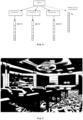
Fig.5 a 2D representation of an exemplary 3D mesh model of a meeting room, consisting of 5574 connected components; -
Fig.6 an exemplary flow-chart of an encoding method and a decoding method; and -
Fig.7 an exemplary flow-chart of a clustering method. -
Fig.1 shows exemplarily the principle of conventional KD-tree coding in a 2D case. The 2D model is enclosed by abounding box 10, which is called parent cell. Seven vertices are positioned within the parent cell. The KD-tree encoding algorithm starts with encoding the total number of vertices using a predefined number of bits, and then subdivides the cells recursively. Each time it subdivides a parent cell into two child cells, it encodes the number of vertices in one of the two child cells. By convention, this may be the left child cell (after vertical splitting) or the upper cell (after horizontal splitting). If the parent cell contains p vertices, the number of vertices in one of the child cells can be encoded using log2(p + 1) bits with an arithmetic coder. This subdivision is recursively applied, until each non-empty cell is small enough to contain only one vertex and enable a sufficiently precise reconstruction of the vertex position. For compressing the positions of all repeated instances, the entire bounding-box 10 of all the positions is regarded as a parent cell in the beginning. In the example ofFig.1 , the total number of vertices (seven) is encoded using 32 bits. Then vertical splitting is applied, so that a left child cell V1 and a right child cell V2 are obtained. In the next coding step, the number of vertices in the left child cell V1, which is four, is encoded. The number of bits used for the encoding is determined by the number of vertices within the parent cell: it is log2(7+1) - 3 bits. From the number of vertices in the parent cell and the number of vertices in the left child cell V1, the number of vertices in the right child cell V2 can be deduced, and therefore needs not be encoded. - In the next step, horizontal splitting is applied. The left child cell V1, which is now a parent cell V1, is split into an upper child cell V1H1 and a lower child cell V1H2. The right child cell V2, which is now a parent cell V2, is split into an upper child cell V2H1 and a lower child cell V2H2. The encoding continues with the upper left child cell V1H1, which has two vertices. Thus, the
number 2 is encoded next, wherein log2(4+1) = 2.3 bits are used in an arithmetic coder. - As described above, the number of vertices in the lower left child cell V1H2 needs not be encoded since it can be deduced from the number of vertices in the left cell V1 and in the upper left child cell V1H1. Then, the same procedure is applied to the right cell V2, which results in encoding a zero using two bits. As shown in
Fig.1 , two more splitting steps are necessary until each vertex is in a separate cell, and even more steps are necessary until each vertex is sufficiently localized within its cell. Each step requires the encoding of a growing number of ones or zeros. Depending on the required accuracy, the number of additional steps may be high. - The above-mentioned prior art document [OG00] suggests that a single KD-tree provides an optimized compression. However, it has been found that in the case of spatially aggregated points there is additional redundancy, which may be reduced with the invention. Spatial aggregation of points means that for multiple subsequent splitting operations always one of the child cells is empty. Therefore, any level (k+1) will consume the same number of bits as its parent level k if the points are spatially aggregated. In principle, conventional use of KD-trees improves the compression ratio by making each level of a KD-tree narrow. The present invention improves the compression ratio by using multiple KD-trees and making each KD-tree have fewer levels.
- The present invention applies the KD-tree coding algorithm not only for encoding vertex positions, but for encoding positions of repeating connected components.
Fig.2 a) shows an example where multiple repeating connected components 21-24 are positioned within theboundary box 20 of a 3D mesh model. As is the case in many large 3D mesh models, the positions are very unevenly distributed within the bounding box. If only the KD-tree coding algorithm is applied for encoding the positions, an exemplary result is shown inFig.2 b) . It can be seen that five initial splitting steps are required before the clusters are localized. That is, in the example ofFig.2 the code will be as follows: 12 (total number) - 6 (leftchild cell 1st generation) - 6-3 (upper child cells 2nd gen.) - 2-3-0 (L, 3rd gen.) - 2-0-0-0 (up, 4th gen.) - 2-4-0-3 (L, 5th gen.) - 2-0-3-0 (up, 6th gen.), resulting in 12-6-6-3-2-3-0-2-0-0-0-2-4-0-3-2-0-3-0. The assignment of number of bits is as described above. Further data may be required for a more exact position. Thus, the code comprises either numerous repetitions of previous values, or zeros. - With the present invention, both the procedure and the resulting code are substantially shorter. According to one aspect of the invention, the points are clustered, i.e. clusters are created and if possible, the points are assigned to the clusters. The points shown in
Fig.2 can be clustered advantageously in a manner as shown inFig.3 . In this example, four clusters 31-34 are within thebounding box 30. Generally, the clustering comprises selecting a first cell that was not yet clustered and that comprises one or more points, and defining a cluster that comprises the first cell, or the one or more points within the first cell. - In one embodiment according to
claim 1, as shown inFig.6 a) , a method for encoding points of a mesh model comprises steps of determining E1 that the mesh model comprises repeating instances of a connected component, and determining E2 for each repeating instance at least one reference point, clustering E3 the reference points of the repeating instances into one or more clusters, and encoding E4 the clustered reference points using KD-tree coding, wherein for each cluster a separate KD-tree is generated. - In one embodiment, the clustering comprises steps of defining a bounding box around the mesh model, dividing the bounding box into cells, wherein a cell is a smallest spatial resolution unit, selecting a first cell that was not yet clustered and that comprises one or more reference points of a repeating instance, and defining a cluster that comprises said first cell, or the one or more reference points within said first cell. Generally, the first cell is a candidate for creating a new cluster. In one embodiment, one cell is sufficient for creating a cluster. In another embodiment, at least two adjacent cells that include one or more points each are required for creating a cluster. In yet another embodiment, a predefined minimum number of points within any number of adjacent cells are required for creating a cluster.
- In one embodiment, the first cell is only selected if it was not yet clustered and if it comprises at least M points (e.g. reference points of M repeating instances). In one embodiment, M is a user definable parameter. A corresponding encoding method comprises a step of defining a parameter M, wherein M is the minimum number of points within a cell, in order for selecting the cell as source for creating a new cluster.
- In one embodiment, the clustering may further comprise steps of determining one or more further cells, wherein the further cells are neighbouring cells or recursively neighbouring cells (i.e. neighbours of neighbours etc.) of the selected first cell, and wherein each of the determined further cells comprises at least one reference point of a repeating instance, and adding said determined neighbouring cell or cells to said cluster.
- In one embodiment, the clustering further comprises a step of sorting all cells in ascending or descending order of the number of reference points in each cell, and the first cells (the candidates for creating a new cluster) are selected according to said order.
- For many large 3D engineering models, such as the exemplary meeting room shown in
Fig.5 , the instance positions shows significantly multiple spatial aggregation. If one single KD-tree is used to organize and compress such type of point datasets, the KD-tree will be unreasonably deep. On the other side, if several KD-trees are used, each for one cluster of points which are spatially aggregated, the KD-trees will generate a relatively short data stream and thus improve the total compression ratio. For example, in the 3D model of a meeting room consisting of 5574 connected components, as shown inFig.5 , and the multiple repeating connected components are chairs RCC1, repeating texture elements of a carpet RCC2 or repeating constructional elements RCC3 of a candelabrum. To enable compact storage and fast transmission of large 3D engineering models, the invention provides an efficient compression strategy that is particularly advantageous for encoding the positions of all repeated instances. In one aspect, the invention provides an efficient compression method for discrete points, especially for those that show significantly multiple spatial aggregation. The positions of repeated instances in a large 3D engineering model often have such kind of characteristics. - The invention provides a clustered KD-tree based compression algorithm for efficiently compressing discrete point data sets with significantly multiple spatial aggregation. The input points are first clustered according to their spatial positions. Each cluster contains a set of points which are spatially aggregated. Then each cluster is compressed by organizing all the points belonging to it by one KD-tree.
- In the following, an exemplary clustering method for encoding is described. Let C Point denote all the point clusters. In the beginning, C Point is empty.
- Step 1: Subdivide the whole bounding-box of all the points to be compressed into N*N*N cells.
- Step 2: Sort all the cells into a queue Q_Cell according to the ascending order of the number of points falling into each cell.
- Step 3: If (Q_Cell is not empty)
Pop a cell P from Q_Cell. Skip empty cells.Goto Step 4.
Else Goto Step 6. - Step 4: If (P doesn't belong to any cluster in C_Point)
- Generate a new cluster C, only including P, and add C into C Point.
- Goto Step 5.
- Step 5: Check all neighbor cells of all cells in C.
- Let P1 denote any neighbor cell of any cell in C.
- If ( (the number of points falling into P1 > B )
&& (P1 does not belong to any cluster in C_Point) )
Add P1 into C.
(B is a user specified threshold.) - After finishing the check for all neighbour cells,
goto Step 3. - Step 6: Compress the points falling into the cells belonging to the same cluster in C Point independently. Each cluster is compressed by organizing the corresponding points, using a separate KD-tree and compressing them e.g. based on [OG00].
- The user-defined parameter B specifies how many points there must be in a cell in order for the cell to be added as neighbour to a cluster. While in one embodiment B=1, other embodiments may required higher values of B. A flow-chart of the clustering method is shown in
Fig.7 . - The syntax of a resulting bit-stream may be as shown in Tab.1. ae(v) means arithmetic coding, something similar to the arithmetic coding in H.264/AVC.
Tab.1: Bit-stream syntax of instance positions Instance_position( ) { Descriptor BoundaryBox_Of_All_Instance_Positions. ae Num_Of_Clusters; ae N; ae for(i = 0; i < Num_Of_Clusters; i ++) { Indices_of_Two_Boundary_Cells_of_cluster[i]; ae KD-tree_of_current_cluster; } - The semantics of the exemplary bit-stream are as follows: BoundaryBox_Of_All_Instance_Positions indicates the bounding-box of all instance positions.
- Num_Of_Clusters indicates the number of clusters.
- N indicates the resolution of the cells, i.e. N in
Step 1 of the above-described encoding procedure. - Indices_of_Two_Boundary_Cells_of_cluster[i] indicates the index of the two cells that define the bounding-box of a cluster[i]. It has 2*Log2(n*n*n) bits.
- KD-tree_of_current_cluster denotes bits for recording the KD-tree of a current cluster.
- In one embodiment, during encoding, there is after the actual clustering a step of determining the boundary of each cluster, and corresponding two boundary cells. The boundary can be expressed by indices of the two boundary cells. The boundary cells of a current cluster are cells with minimum indices and maximum indices of each dimension. E.g. if in a 2D case the points belonging to a cluster are in a range of {xmin,xmax} and {ymin,ymax}, then the boundary cells are at xmin,ymin and xmax,ymax , even though these cells are actually not within the cluster. However their indices are used in order to define a local bounding-box for the current cluster. Within the local bounding-box, local coordinates may be used, which reduces the amount of bits.
- In one embodiment, calculating the KD-tree for a current cluster has steps of calculating the relative positions of instances falling into the current cluster[i], and calculating the corresponding instance positions in the world coordinate system outside the bounding-box.
- In one embodiment, the encoding method further comprises a step of defining a spatial resolution of the mesh model, e.g. N in Tab.1. In this case, a cell is the smallest spatial resolution unit according to the defined spatial resolution. The spatial resolution has an impact on the exactness of the reconstruction, since a position that is somewhere within a particular cell during encoding can after decoding be reproduced only at a predefined position within the cell, e.g. in the center of the cell. For a more exact location, a higher spatial resolution is necessary. In one embodiment, N is predefined. In another embodiment, N can be selected according to quality requirements, e.g. it can be reduced for reproduction on low-resolution displays.
- As described above, the prior art methods are ineffective when the points are distributed very inhomogeneously. In one embodiment, the encoding method further comprises steps of determining a measure of spatial homogeneity of points (wherein the measure of spatial homogeneity is high if the points are evenly distributed and lower if the distribution is more uneven), comparing the spatial homogeneity to a threshold, and performing the clustering only if the spatial homogeneity is below the threshold. E.g., the encoding method may comprise steps of determining a measure of spatial homogeneity of reference points of the repeating instances, comparing the spatial homogeneity to a threshold, and performing the clustering only if the spatial homogeneity is below the threshold (i.e. if the distribution of points is very inhomogeneous).
- In one embodiment, the encoding method further comprises steps of modifying the spatial resolution if the spatial homogeneity is below the threshold, measuring the spatial homogeneity and repeating these steps until the spatial homogeneity is not below the threshold.
-
Fig.4 shows a data structure of an encoded mesh model based on clusters. A root, referring to a particular type of connected component and a complete 3D mesh model, comprises at least one cluster that refers to a repeating connected component and that is represented as a KD-tree KD-T1,...,KD-T3. In the example ofFig.4 , the connected component root CCr stands for a particular connected component. For example the connected component may be a particular type of screw in a 3D engineering mesh model. In the example, there are three areas within the 3D model where this type of screws is used very often. Each of the areas is denoted as a cluster, which is represented by a separate KD-tree KD-T1,...,KD-T3. Few or single instances of the connected component may also appear in other areas. In one embodiment, these instances are not clustered, but their positions are described in a separate structure T4, e.g. a special KD-tree or just a list of coordinates. Each of the three cluster KD-trees KD-T1,...,KD-T3 refers to one cluster of multiple instances of the connected component and includes location information, e.g. indices of the cluster's boundary cells. - In the following, further embodiments of the invention are described.
- In one embodiment, an apparatus for encoding points of a mesh model comprises the means of claim 9.
- In one embodiment, the means for clustering comprises defining means for defining a bounding box around the mesh model, dividing means for dividing the bounding box into cells, wherein a cell is a smallest spatial resolution unit, selection means for selecting a first cell that was not yet clustered and that comprises one or more reference points of a repeating instance, and defining means for defining a cluster that comprises said first cell, or the one or more reference points within said first cell.
- In one embodiment, the apparatus further comprises determining means for determining one or more further cells, wherein the further cells are neighbouring cells or recursively neighbouring cells of the selected first cell and wherein each of the determined further cells comprises at least one reference point of a repeating instance, and adding means for adding said determined neighbouring cell or cells to said cluster.
- In one embodiment, the clustering means further comprises organizing means for sorting all cells in ascending or descending order of the number of reference points in each cell, wherein the first cells (i.e. initial cells of a cluster) are selected according to said order.
- In one embodiment, the clustering means comprises means for determining boundary cells of a current cluster (being the cells with minimum indices and maximum indices of each dimension).
- In one embodiment, the encoding apparatus further comprises means for defining a spatial resolution, wherein a cell is the smallest spatial resolution unit according to said defined spatial resolution.
- In one embodiment, the encoding apparatus further comprises analyzing means for determining a measure of spatial homogeneity of reference points of the repeating instances, wherein the measure of spatial homogeneity is high if the reference points are evenly distributed and lower if the distribution is more uneven, comparator means for comparing the spatial homogeneity to a threshold, and control means for controlling that the clustering is performed only if the spatial homogeneity is below the threshold.
- In the embodiment according to claim 12, an encoded mesh model comprises a plural-ity of repeating connected components, wherein the encoded mesh model comprises encoded data of at least one instance of each repeating connected component, positions of a plurality of repetitions of said repeating connected components, the positions being encoded as a KD-tree, and a boundary region within the mesh model, wherein the KD-tree refers to said region.
- In one embodiment, the data of the boundary region of the encoded mesh model comprise indices of boundary cells.
- In the embodiment according to claim 13, shown in
Fig. 6 b) , a method for decoding points of an encoded mesh model comprises steps of extracting D1 data for an instance of a repeating connected component, decoding D2 the instance of the connected component using said extracted data, extracting D3 first data (Num_Of_Clusters) defining a number of clusters, second data (N) defining a spatial resolution and third data (KD-T1, ...,KD-T3) being positions of a plurality of repetitions of said repeating connected component, the third data being encoded as a KD-tree, extracting D4 fourth data (Index_Boundary_Cluster) defining a portion within the mesh model, and determining D5 the positions of the plurality of repetitions of said repeating connected component from the third data and the fourth data, wherein the third data are applied to the portion of the mesh model that is defined by the fourth data. - In one embodiment of the method for decoding, the fourth data (Index Boundary Cluster) comprises indices of two cells within the mesh model, wherein a cell is a smallest spatial resolution unit according to the spatial resolution defined by said second data.
- Experiments show that for pattern position data, cluster based KD-tree compression according to the invention can save about 50% of storage space (Clus_Comp/Coor_Comp), compared with the conventional KD-tree based compression. In Tab.2, #C is the number of connected components, #P the number of repeating components, Coor.(K) the size of raw instances positions in Kbyte, Coor_Comp (K) the size of compressed instance positions using one KD-tree, #Clu the number of clusters and Clu_Coor_Comp (K) the size of compressed instance positions by clustered KD-tree based compression method.
Tab.2 Exemplary compression efficiency for 2 example models While there has been shown, described, and pointed out fundamental novel features of the present invention as applied to preferred embodiments thereof, it will be understood that various omissions and substitutions and changes in the apparatus and method described, in the form and details of the devices disclosed, and in their operation, may be made by those skilled in the art within the scope of the appended claims. Model #C #P Coor. (K) Coor_Comp (K) # Clu Clu_Comp (K) Clu_Comp/ Coor_Comp(%) Viewing Room 1382 62 15.52 9.86 6 5.56 56.39% VIP Room 5554 392 62.33 47.7 10 19.9 41.72% - It is expressly intended that all combinations of those elements that perform substantially the same function in substantially the same way to achieve the same results are within the scope of the invention. Substitutions of elements from one described embodiment to another are also fully intended and contemplated, in case they fall under the scope of the appended claims.
- It will be understood that the present invention has been described purely by way of example, and modifications of detail can be made without departing from the scope of the invention. Features may, where appropriate be implemented in hardware, software, or a combination of the two. Reference numerals appearing in the claims are by way of illustration only and shall have no limiting effect on the scope of the claims.
Claims (14)
- A method for encoding points of a mesh model, comprising steps ofdetermining (El) that the mesh model comprises repeating instances of a spatially connected component, the spatially connected component having a path between any two polygons in it, and the repeating instances of the spatially connected component being repeated in various positions, scales or orientations, and determining for each repeating instance at least one positional point representative of a position of the repeating instance;clustering the positional points of the repeating instances according to their spatial positions into clusters, each cluster comprising a set of points which are spatially aggregated; characterized byencoding into the bitstream indications of a boundary position of a bounding box defined for each cluster and the clustered positional points using KD-tree coding, wherein for each cluster a separate KD-tree is generated.
- Method according to claim 1, wherein the clustering comprises:defining a bounding box around the mesh model;dividing the bounding box into cells, a cell being a smallest spatial resolution unit;selecting a first cell that was not yet clustered and that comprises one or more positional points of a repeating instance; anddefining a cluster that comprises said first cell, or the one or more positional points within said first cell.
- Method according to claim 2, wherein said first cell is only selected responsive to said first cell was not yet clustered and comprises at least M positional points of M repeating instances, M being a user definable parameter.
- Method according to claim 2 or 3, further comprising:determining one or more further cells, the further cells being neighbouring cells or recursively neighbouring cells of the selected first cell and each of the determined further cells comprising at least one positional point of a repeating instance; andadding said determined neighbouring cell or cells to said cluster.
- Method according to one of the claims 2-4, wherein the clustering further comprises a step of sorting all cells in ascending or descending order of the number of positional points in each cell, and wherein the first cells are selected according to said order.
- Method according to any one of claims 1-5, further comprising a step of defining a spatial resolution (N), a cell being the smallest spatial resolution unit according to said defined spatial resolution.
- Method according to any one of claims 1-6, further
comprising:- determining a measure of spatial homogeneity of
positional points of the repeating instances, the measure of spatial homogeneity being high responsive to the positional points are evenly distributed and lower responsive to the distribution is more uneven;- comparing the spatial homogeneity to a threshold; and performing the clustering only if the spatial homogeneity is below the threshold. - Method according to claim 7, further comprising modifying the spatial resolution responsive to the spatial homogeneity is below the threshold; and repeating the determining of a measure of spatial homogeneity.
- An apparatus for encoding points of a mesh model, comprisingmeans for determining (El) that the mesh model comprises repeating instances of a spatially connected component, the spatially connected component having a path between any two polygons in it, and the repeating instances of the spatially connected component being repeated in various positions, scales or orientations, and determining for each repeating instance at least one positional point representative of a position of the repeating instance;means for clustering the positional points of the repeating instances according to their spatial positions into clusters, each cluster comprising a set of points which are spatially aggregated; characterized bymeans for encoding into the bitstream indications of the boundary position of a bounding box defined for each cluster and the clustered positional points using KD-tree coding, wherein for each cluster a separate KD-tree is generated.
- Apparatus according to claim 9, wherein the means for clustering comprises:means for defining a bounding box around the mesh model;means for dividing the bounding box into cells, a cell being a smallest spatial resolution unit;means for selecting a first cell that was not yet clustered and that comprises one or more positional points of a repeating instance; andmeans for defining a cluster that comprises said first cell, or the one or more positional points within said first cell.
- Apparatus according to claim 9, further comprisingmeans for determining one or more further cells,
the further cells being neighbouring cells or recursively neighbouring cells of the selected first cell and each of the determined further cells comprising at least one positional point of a repeating instance; andmeans for adding said determined neighbouring cell or cells to said cluster. - A mesh model encoded in a bitstream comprising a plurality of repeating spatially connected components, each spatially connected component having a path between any two polygons in it, and the repeating instances of the spatially connected component being repeated in various positions, scales or orientations, the encoded mesh model comprising encoded data of at least one instance of each repeating spatially connected component; characterized in that
positions of a plurality of repetitions of said repeating spatially connected components, and indications of a boundary position of a bounding box are encoded for each region within the mesh model containing for a spatially connected component a set of positions which are spatially aggregated; wherein a separate KD-tree is encoded for the set of positions for each region. - A method for decoding points of a mesh model from a bitstream, comprising: extracting data from the bitstream for an instance of a repeating spatially connected component;
the spatially connected component having a path between any two polygons in it, and the repeating instances of the spatially connected component being repeated in various positions, scales or orientation,decoding the instance of the spatially connected component using said extracted data; characterized bydecoding first data (Num_Of_Clusters) defining a number of clusters, second data (N) defining a spatial resolution and third data (KD-T) defining positions of a plurality of repetitions of said repeating spatially connected component, the third data (KD-T) being encoded as a KD-tree;decoding fourth data ( Index_Boundary_Cluster ) defining a portion within the mesh model for each cluster, the fourth data comprising indications of a boundary position of a bounding box encoded for each cluster within the mesh model containing for a spatially connected component a set of the positions which are spatially aggregated;determining the positions of the plurality of repetitions of said repeating spatially connected component from the third data (KD-T) and the fourth data, wherein a separate KD-tree of the third data (KD-T) is decoded for each portion of the mesh model that is defined by the fourth data to retrieve the positions of a plurality of repetitions of said repeating spatially connected component within the bounding box. - Method according to claim 13, wherein the fourth data (Index_Boundary_Cluster) comprises indices of two cells within the mesh model, a cell being a smallest spatial resolution unit according to the spatial resolution defined by said second data (N).
Applications Claiming Priority (1)
| Application Number | Priority Date | Filing Date | Title |
|---|---|---|---|
| PCT/CN2009/001143 WO2011044713A1 (en) | 2009-10-15 | 2009-10-15 | Method and apparatus for encoding a mesh model, encoded mesh model, and method and apparatus for decoding a mesh model |
Publications (3)
| Publication Number | Publication Date |
|---|---|
| EP2489208A1 EP2489208A1 (en) | 2012-08-22 |
| EP2489208A4 EP2489208A4 (en) | 2017-05-03 |
| EP2489208B1 true EP2489208B1 (en) | 2024-08-07 |
Family
ID=43875774
Family Applications (1)
| Application Number | Title | Priority Date | Filing Date |
|---|---|---|---|
| EP09850328.7A Active EP2489208B1 (en) | 2009-10-15 | 2009-10-15 | Method and apparatus for encoding a mesh model, encoded mesh model, and method and apparatus for decoding a mesh model |
Country Status (6)
| Country | Link |
|---|---|
| US (1) | US8949092B2 (en) |
| EP (1) | EP2489208B1 (en) |
| JP (1) | JP5456903B2 (en) |
| KR (1) | KR101637624B1 (en) |
| CN (1) | CN102577442B (en) |
| WO (1) | WO2011044713A1 (en) |
Families Citing this family (26)
| Publication number | Priority date | Publication date | Assignee | Title |
|---|---|---|---|---|
| US8983370B2 (en) * | 2009-09-01 | 2015-03-17 | Nec Corporation | Communication transmission apparatus, communication coupler and impedance adjusting sheet |
| KR102002654B1 (en) * | 2011-07-08 | 2019-07-23 | 톰슨 라이센싱 | System and method for encoding and decoding a bitstream for a 3d model having repetitive structure |
| WO2013067674A1 (en) * | 2011-11-07 | 2013-05-16 | Thomson Licensing | Predictive position encoding |
| TWI534760B (en) * | 2011-11-28 | 2016-05-21 | 湯姆生特許公司 | Method and encoder for encoding spatial space tree structure, and decoding method and decoder for spatial tree structure bit stream |
| US9979948B2 (en) | 2012-01-21 | 2018-05-22 | Thomson Licensing | Method and apparatus for compressing texture information of three-dimensional (3D) models |
| EP2813076B1 (en) | 2012-02-09 | 2020-04-22 | InterDigital VC Holdings, Inc. | Efficient compression of 3d models based on octree decomposition |
| US20150379769A1 (en) * | 2012-02-20 | 2015-12-31 | Thomson Licensing | Method and apparatus for mesh simplification |
| JP6019215B2 (en) | 2012-04-18 | 2016-11-02 | トムソン ライセンシングThomson Licensing | Vertex correction method and apparatus for rotated three-dimensional (3D) components |
| WO2014005415A1 (en) * | 2012-07-04 | 2014-01-09 | Thomson Licensing | System and method for multi-level repetitive structure based 3d model compression |
| KR102069815B1 (en) | 2013-01-10 | 2020-01-23 | 톰슨 라이센싱 | Method and apparatus for vertex error correction |
| CN104123739A (en) * | 2013-04-24 | 2014-10-29 | 冯卫国 | Coding and decoding methods of polyhedron composed of face elements and stereoscopic puzzle |
| CA2999193A1 (en) * | 2015-09-23 | 2017-03-30 | Koninklijke Philips N.V. | Generation of triangle mesh for a three dimensional image |
| JP7138695B2 (en) * | 2015-12-14 | 2022-09-16 | パナソニック インテレクチュアル プロパティ コーポレーション オブ アメリカ | Three-dimensional data encoding method, three-dimensional data decoding method, three-dimensional data encoding device, and three-dimensional data decoding device |
| US10733766B2 (en) | 2016-10-19 | 2020-08-04 | Google, Llc | Methods and apparatus to encode and/or decode normals of geometric representations of surfaces |
| US10313673B2 (en) | 2016-10-19 | 2019-06-04 | Google Llc | Methods and apparatus to encode and/or decode normals of geometric representations of surfaces |
| US9787321B1 (en) | 2016-11-17 | 2017-10-10 | Google Inc. | Point cloud data compression using a space-filling curve |
| US10496336B2 (en) | 2016-11-17 | 2019-12-03 | Google Llc | K-D tree encoding for point clouds using deviations |
| US10430975B2 (en) | 2016-11-17 | 2019-10-01 | Google Llc | Advanced k-D tree encoding for point clouds by most significant axis selection |
| US10950042B2 (en) | 2017-06-02 | 2021-03-16 | Google Llc | Guided traversal in compression of triangular meshes |
| US10553035B2 (en) | 2017-06-02 | 2020-02-04 | Google Llc | Valence based implicit traversal for improved compression of triangular meshes |
| CN119478074A (en) | 2018-04-19 | 2025-02-18 | 松下电器(美国)知识产权公司 | Three-dimensional data encoding method, three-dimensional data decoding method, three-dimensional data encoding device, and three-dimensional data decoding device |
| US10891758B2 (en) | 2018-07-23 | 2021-01-12 | Google Llc | Geometry encoder |
| US10762667B2 (en) | 2018-11-30 | 2020-09-01 | Point Cloud Compression, B.V. | Method and apparatus for compression of point cloud data |
| CN110296703A (en) * | 2019-06-21 | 2019-10-01 | 中国人民解放军陆军工程大学 | A Geocoding Method Applied in Large-Scale UAV Swarm System |
| JP7734112B2 (en) * | 2022-04-15 | 2025-09-04 | Kddi株式会社 | Mesh decoding device, mesh encoding device, mesh decoding method and program |
| EP4614449A1 (en) | 2024-11-22 | 2025-09-10 | Univerza v Mariboru | A method for decimation of watertight 3d poligonal surfaces for data reduction and a reconstruction method of such decimated surfaces |
Family Cites Families (17)
| Publication number | Priority date | Publication date | Assignee | Title |
|---|---|---|---|---|
| GB426038A (en) | 1933-10-02 | 1935-03-26 | Mauser Werke Ag | Improvements in or relating to sewing machines |
| KR100294927B1 (en) * | 1998-08-29 | 2001-07-12 | 윤종용 | 3-D mesh coding method and apparatus for incremental rendering |
| KR100294926B1 (en) * | 1998-08-29 | 2001-07-12 | 윤종용 | A progressive 3-D mesh coding/decoding method and apparatus thereof |
| US7538764B2 (en) * | 2001-01-05 | 2009-05-26 | Interuniversitair Micro-Elektronica Centrum (Imec) | System and method to obtain surface structures of multi-dimensional objects, and to represent those surface structures for animation, transmission and display |
| US20040181373A1 (en) | 2003-03-12 | 2004-09-16 | Computer Associates Think, Inc. | Visual simulation of dynamic moving bodies |
| KR100695142B1 (en) | 2004-03-08 | 2007-03-14 | 삼성전자주식회사 | Adaptive 2nd n-squared true tree generation method and 3D volume data encoding / decoding method and apparatus |
| JP4759291B2 (en) | 2004-03-08 | 2011-08-31 | 三星電子株式会社 | Adaptive binary tree generation method, and method and apparatus for encoding / decoding three-dimensional volume data using the same |
| GB2420669A (en) | 2004-11-26 | 2006-05-31 | Snell & Wilcox Ltd | Image segmentation |
| JP4756033B2 (en) * | 2005-03-18 | 2011-08-24 | 富士通株式会社 | Electronic package evaluation apparatus, electronic package optimization apparatus, and computer-readable recording medium recording electronic package evaluation program |
| US8448067B2 (en) * | 2006-12-07 | 2013-05-21 | Sony Computer Entertainment America, LLC | Graphics command management tool and methods for analyzing performance for command changes before application modification |
| CN101470894A (en) * | 2007-12-26 | 2009-07-01 | 中国科学院自动化研究所 | Stroke type interaction method for real-time partition of three-dimensional gridding model |
| CN100547616C (en) | 2008-01-21 | 2009-10-07 | 浙江大学 | A Forest Rendering Method Based on Hierarchical and Hierarchical Depth Mesh |
| US20110112808A1 (en) * | 2008-02-04 | 2011-05-12 | Iain Alexander Anderson | Integrated-model musculoskeletal therapies |
| CN101373543A (en) * | 2008-09-28 | 2009-02-25 | 武汉大学 | Fast Sectioning Method of 3D Mesh Model |
| US8681145B2 (en) * | 2009-03-20 | 2014-03-25 | Disney Enterprises, Inc. | Attribute transfer between computer models including identifying isomorphic regions in polygonal meshes |
| EP2446419B1 (en) * | 2009-06-23 | 2021-04-07 | InterDigital VC Holdings, Inc. | Compression of 3d meshes with repeated patterns |
| WO2011008336A1 (en) | 2009-07-16 | 2011-01-20 | Dow Global Technologies Inc. | Polyolefin-based artificial leather |
-
2009
- 2009-10-15 CN CN200980161975.XA patent/CN102577442B/en active Active
- 2009-10-15 US US13/501,662 patent/US8949092B2/en active Active
- 2009-10-15 WO PCT/CN2009/001143 patent/WO2011044713A1/en not_active Ceased
- 2009-10-15 EP EP09850328.7A patent/EP2489208B1/en active Active
- 2009-10-15 KR KR1020127009533A patent/KR101637624B1/en active Active
- 2009-10-15 JP JP2012533450A patent/JP5456903B2/en active Active
Non-Patent Citations (1)
| Title |
|---|
| SHUO GAO ET AL: "A Realtime Rendering Framework of Large Dataset Environment Based on Precomputed HLOD", DIGITAL MEDIA AND ITS APPLICATION IN MUSEUM&HERITAGE, SECOND WORKS HOP ON, IEEE, PI, 1 December 2007 (2007-12-01), pages 212 - 217, XP031199289, ISBN: 978-0-7695-3065-9 * |
Also Published As
| Publication number | Publication date |
|---|---|
| EP2489208A4 (en) | 2017-05-03 |
| KR101637624B1 (en) | 2016-07-07 |
| JP5456903B2 (en) | 2014-04-02 |
| WO2011044713A1 (en) | 2011-04-21 |
| CN102577442A (en) | 2012-07-11 |
| KR20120095869A (en) | 2012-08-29 |
| US8949092B2 (en) | 2015-02-03 |
| US20120203514A1 (en) | 2012-08-09 |
| JP2013507701A (en) | 2013-03-04 |
| EP2489208A1 (en) | 2012-08-22 |
| CN102577442B (en) | 2015-06-03 |
Similar Documents
| Publication | Publication Date | Title |
|---|---|---|
| US8949092B2 (en) | Method and apparatus for encoding a mesh model, encoded mesh model, and method and apparatus for decoding a mesh model | |
| EP2697985B1 (en) | Method for encoding a mesh model, encoded mesh model and method for decoding a mesh model | |
| CN110996098B (en) | Method and device for processing point cloud data | |
| US8625911B2 (en) | Compression of 3D meshes with repeated patterns | |
| EP4307663A1 (en) | Decoding method/encoding method based on point cloud attribute prediction, decoder, and encoder | |
| JP7330306B2 (en) | Transform method, inverse transform method, encoder, decoder and storage medium | |
| JP5512704B2 (en) | 3D mesh model encoding method and apparatus, and encoded 3D mesh model decoding method and apparatus | |
| CN113615181A (en) | Implicit quadtree or binary tree geometry segmentation for point cloud coding | |
| CN110708560A (en) | Point cloud data processing method and device | |
| JP5932051B2 (en) | Predictive position decoding | |
| JP2023549447A (en) | Point cloud layering method, decoder, encoder and storage medium | |
| WO2023193709A1 (en) | Coding method and apparatus, decoding method and apparatus, and device | |
| Bhatia et al. | AMM: Adaptive multilinear meshes | |
| CN116233468A (en) | Point cloud decoding method, point cloud encoding method, device, equipment, medium and product | |
| CN116601944A (en) | Point cloud encoding and decoding method, encoder, decoder and computer storage medium | |
| CN115396668B (en) | Decoding method, encoding device, storage medium and equipment for point cloud data | |
| WO2023197990A1 (en) | Coding method, decoding method and terminal | |
| CN116615753A (en) | Palette mode video coding with hierarchical palette table generation | |
| HK40086883A (en) | Point cloud decoding method, point cloud encoding method, apparatus, device, medium, and product | |
| KR20230158622A (en) | Geometry filtering for mesh compression | |
| HK40064138A (en) | Method and apparatus for point cloud encoding and decoding | |
| Hao et al. | Mesh Connectivity Compression for Progressive-to-Lossless Transmission |
Legal Events
| Date | Code | Title | Description |
|---|---|---|---|
| PUAI | Public reference made under article 153(3) epc to a published international application that has entered the european phase |
Free format text: ORIGINAL CODE: 0009012 |
|
| 17P | Request for examination filed |
Effective date: 20120329 |
|
| AK | Designated contracting states |
Kind code of ref document: A1 Designated state(s): AT BE BG CH CY CZ DE DK EE ES FI FR GB GR HR HU IE IS IT LI LT LU LV MC MK MT NL NO PL PT RO SE SI SK SM TR |
|
| DAX | Request for extension of the european patent (deleted) | ||
| RA4 | Supplementary search report drawn up and despatched (corrected) |
Effective date: 20170405 |
|
| RIC1 | Information provided on ipc code assigned before grant |
Ipc: G06T 9/40 20060101ALI20170330BHEP Ipc: G06T 9/00 20060101AFI20170330BHEP Ipc: H04W 4/00 20090101ALI20170330BHEP |
|
| RAP1 | Party data changed (applicant data changed or rights of an application transferred) |
Owner name: INTERDIGITAL VC HOLDINGS, INC. |
|
| RAP1 | Party data changed (applicant data changed or rights of an application transferred) |
Owner name: INTERDIGITAL VC HOLDINGS, INC. |
|
| STAA | Information on the status of an ep patent application or granted ep patent |
Free format text: STATUS: EXAMINATION IS IN PROGRESS |
|
| 17Q | First examination report despatched |
Effective date: 20201124 |
|
| GRAP | Despatch of communication of intention to grant a patent |
Free format text: ORIGINAL CODE: EPIDOSNIGR1 |
|
| STAA | Information on the status of an ep patent application or granted ep patent |
Free format text: STATUS: GRANT OF PATENT IS INTENDED |
|
| INTG | Intention to grant announced |
Effective date: 20231205 |
|
| GRAJ | Information related to disapproval of communication of intention to grant by the applicant or resumption of examination proceedings by the epo deleted |
Free format text: ORIGINAL CODE: EPIDOSDIGR1 |
|
| STAA | Information on the status of an ep patent application or granted ep patent |
Free format text: STATUS: EXAMINATION IS IN PROGRESS |
|
| INTC | Intention to grant announced (deleted) | ||
| GRAP | Despatch of communication of intention to grant a patent |
Free format text: ORIGINAL CODE: EPIDOSNIGR1 |
|
| STAA | Information on the status of an ep patent application or granted ep patent |
Free format text: STATUS: GRANT OF PATENT IS INTENDED |
|
| INTG | Intention to grant announced |
Effective date: 20240502 |
|
| GRAS | Grant fee paid |
Free format text: ORIGINAL CODE: EPIDOSNIGR3 |
|
| GRAA | (expected) grant |
Free format text: ORIGINAL CODE: 0009210 |
|
| STAA | Information on the status of an ep patent application or granted ep patent |
Free format text: STATUS: THE PATENT HAS BEEN GRANTED |
|
| P01 | Opt-out of the competence of the unified patent court (upc) registered |
Free format text: CASE NUMBER: APP_33498/2024 Effective date: 20240605 |
|
| AK | Designated contracting states |
Kind code of ref document: B1 Designated state(s): AT BE BG CH CY CZ DE DK EE ES FI FR GB GR HR HU IE IS IT LI LT LU LV MC MK MT NL NO PL PT RO SE SI SK SM TR |
|
| REG | Reference to a national code |
Ref country code: GB Ref legal event code: FG4D |
|
| REG | Reference to a national code |
Ref country code: CH Ref legal event code: EP |
|
| REG | Reference to a national code |
Ref country code: IE Ref legal event code: FG4D |
|
| REG | Reference to a national code |
Ref country code: DE Ref legal event code: R096 Ref document number: 602009065329 Country of ref document: DE |
|
| REG | Reference to a national code |
Ref country code: NL Ref legal event code: FP |
|
| REG | Reference to a national code |
Ref country code: LT Ref legal event code: MG9D |
|
| PG25 | Lapsed in a contracting state [announced via postgrant information from national office to epo] |
Ref country code: NO Free format text: LAPSE BECAUSE OF FAILURE TO SUBMIT A TRANSLATION OF THE DESCRIPTION OR TO PAY THE FEE WITHIN THE PRESCRIBED TIME-LIMIT Effective date: 20241107 |
|
| REG | Reference to a national code |
Ref country code: AT Ref legal event code: MK05 Ref document number: 1711809 Country of ref document: AT Kind code of ref document: T Effective date: 20240807 |
|
| PG25 | Lapsed in a contracting state [announced via postgrant information from national office to epo] |
Ref country code: FI Free format text: LAPSE BECAUSE OF FAILURE TO SUBMIT A TRANSLATION OF THE DESCRIPTION OR TO PAY THE FEE WITHIN THE PRESCRIBED TIME-LIMIT Effective date: 20240807 Ref country code: GR Free format text: LAPSE BECAUSE OF FAILURE TO SUBMIT A TRANSLATION OF THE DESCRIPTION OR TO PAY THE FEE WITHIN THE PRESCRIBED TIME-LIMIT Effective date: 20241108 Ref country code: PT Free format text: LAPSE BECAUSE OF FAILURE TO SUBMIT A TRANSLATION OF THE DESCRIPTION OR TO PAY THE FEE WITHIN THE PRESCRIBED TIME-LIMIT Effective date: 20241209 Ref country code: PL Free format text: LAPSE BECAUSE OF FAILURE TO SUBMIT A TRANSLATION OF THE DESCRIPTION OR TO PAY THE FEE WITHIN THE PRESCRIBED TIME-LIMIT Effective date: 20240807 |
|
| PG25 | Lapsed in a contracting state [announced via postgrant information from national office to epo] |
Ref country code: BG Free format text: LAPSE BECAUSE OF FAILURE TO SUBMIT A TRANSLATION OF THE DESCRIPTION OR TO PAY THE FEE WITHIN THE PRESCRIBED TIME-LIMIT Effective date: 20240807 |
|
| PG25 | Lapsed in a contracting state [announced via postgrant information from national office to epo] |
Ref country code: LV Free format text: LAPSE BECAUSE OF FAILURE TO SUBMIT A TRANSLATION OF THE DESCRIPTION OR TO PAY THE FEE WITHIN THE PRESCRIBED TIME-LIMIT Effective date: 20240807 |
|
| PG25 | Lapsed in a contracting state [announced via postgrant information from national office to epo] |
Ref country code: IS Free format text: LAPSE BECAUSE OF FAILURE TO SUBMIT A TRANSLATION OF THE DESCRIPTION OR TO PAY THE FEE WITHIN THE PRESCRIBED TIME-LIMIT Effective date: 20241207 Ref country code: AT Free format text: LAPSE BECAUSE OF FAILURE TO SUBMIT A TRANSLATION OF THE DESCRIPTION OR TO PAY THE FEE WITHIN THE PRESCRIBED TIME-LIMIT Effective date: 20240807 |
|
| PG25 | Lapsed in a contracting state [announced via postgrant information from national office to epo] |
Ref country code: HR Free format text: LAPSE BECAUSE OF FAILURE TO SUBMIT A TRANSLATION OF THE DESCRIPTION OR TO PAY THE FEE WITHIN THE PRESCRIBED TIME-LIMIT Effective date: 20240807 |
|
| PG25 | Lapsed in a contracting state [announced via postgrant information from national office to epo] |
Ref country code: ES Free format text: LAPSE BECAUSE OF FAILURE TO SUBMIT A TRANSLATION OF THE DESCRIPTION OR TO PAY THE FEE WITHIN THE PRESCRIBED TIME-LIMIT Effective date: 20240807 |
|
| PG25 | Lapsed in a contracting state [announced via postgrant information from national office to epo] |
Ref country code: PT Free format text: LAPSE BECAUSE OF FAILURE TO SUBMIT A TRANSLATION OF THE DESCRIPTION OR TO PAY THE FEE WITHIN THE PRESCRIBED TIME-LIMIT Effective date: 20241209 Ref country code: PL Free format text: LAPSE BECAUSE OF FAILURE TO SUBMIT A TRANSLATION OF THE DESCRIPTION OR TO PAY THE FEE WITHIN THE PRESCRIBED TIME-LIMIT Effective date: 20240807 Ref country code: NO Free format text: LAPSE BECAUSE OF FAILURE TO SUBMIT A TRANSLATION OF THE DESCRIPTION OR TO PAY THE FEE WITHIN THE PRESCRIBED TIME-LIMIT Effective date: 20241107 Ref country code: LV Free format text: LAPSE BECAUSE OF FAILURE TO SUBMIT A TRANSLATION OF THE DESCRIPTION OR TO PAY THE FEE WITHIN THE PRESCRIBED TIME-LIMIT Effective date: 20240807 Ref country code: IS Free format text: LAPSE BECAUSE OF FAILURE TO SUBMIT A TRANSLATION OF THE DESCRIPTION OR TO PAY THE FEE WITHIN THE PRESCRIBED TIME-LIMIT Effective date: 20241207 Ref country code: HR Free format text: LAPSE BECAUSE OF FAILURE TO SUBMIT A TRANSLATION OF THE DESCRIPTION OR TO PAY THE FEE WITHIN THE PRESCRIBED TIME-LIMIT Effective date: 20240807 Ref country code: GR Free format text: LAPSE BECAUSE OF FAILURE TO SUBMIT A TRANSLATION OF THE DESCRIPTION OR TO PAY THE FEE WITHIN THE PRESCRIBED TIME-LIMIT Effective date: 20241108 Ref country code: FI Free format text: LAPSE BECAUSE OF FAILURE TO SUBMIT A TRANSLATION OF THE DESCRIPTION OR TO PAY THE FEE WITHIN THE PRESCRIBED TIME-LIMIT Effective date: 20240807 Ref country code: ES Free format text: LAPSE BECAUSE OF FAILURE TO SUBMIT A TRANSLATION OF THE DESCRIPTION OR TO PAY THE FEE WITHIN THE PRESCRIBED TIME-LIMIT Effective date: 20240807 Ref country code: BG Free format text: LAPSE BECAUSE OF FAILURE TO SUBMIT A TRANSLATION OF THE DESCRIPTION OR TO PAY THE FEE WITHIN THE PRESCRIBED TIME-LIMIT Effective date: 20240807 Ref country code: AT Free format text: LAPSE BECAUSE OF FAILURE TO SUBMIT A TRANSLATION OF THE DESCRIPTION OR TO PAY THE FEE WITHIN THE PRESCRIBED TIME-LIMIT Effective date: 20240807 |
|
| PG25 | Lapsed in a contracting state [announced via postgrant information from national office to epo] |
Ref country code: DK Free format text: LAPSE BECAUSE OF FAILURE TO SUBMIT A TRANSLATION OF THE DESCRIPTION OR TO PAY THE FEE WITHIN THE PRESCRIBED TIME-LIMIT Effective date: 20240807 Ref country code: SM Free format text: LAPSE BECAUSE OF FAILURE TO SUBMIT A TRANSLATION OF THE DESCRIPTION OR TO PAY THE FEE WITHIN THE PRESCRIBED TIME-LIMIT Effective date: 20240807 Ref country code: RO Free format text: LAPSE BECAUSE OF FAILURE TO SUBMIT A TRANSLATION OF THE DESCRIPTION OR TO PAY THE FEE WITHIN THE PRESCRIBED TIME-LIMIT Effective date: 20240807 |
|
| PG25 | Lapsed in a contracting state [announced via postgrant information from national office to epo] |
Ref country code: EE Free format text: LAPSE BECAUSE OF FAILURE TO SUBMIT A TRANSLATION OF THE DESCRIPTION OR TO PAY THE FEE WITHIN THE PRESCRIBED TIME-LIMIT Effective date: 20240807 |
|
| PG25 | Lapsed in a contracting state [announced via postgrant information from national office to epo] |
Ref country code: CZ Free format text: LAPSE BECAUSE OF FAILURE TO SUBMIT A TRANSLATION OF THE DESCRIPTION OR TO PAY THE FEE WITHIN THE PRESCRIBED TIME-LIMIT Effective date: 20240807 |
|
| PG25 | Lapsed in a contracting state [announced via postgrant information from national office to epo] |
Ref country code: SK Free format text: LAPSE BECAUSE OF FAILURE TO SUBMIT A TRANSLATION OF THE DESCRIPTION OR TO PAY THE FEE WITHIN THE PRESCRIBED TIME-LIMIT Effective date: 20240807 |
|
| REG | Reference to a national code |
Ref country code: DE Ref legal event code: R097 Ref document number: 602009065329 Country of ref document: DE |
|
| REG | Reference to a national code |
Ref country code: CH Ref legal event code: PL |
|
| PLBE | No opposition filed within time limit |
Free format text: ORIGINAL CODE: 0009261 |
|
| STAA | Information on the status of an ep patent application or granted ep patent |
Free format text: STATUS: NO OPPOSITION FILED WITHIN TIME LIMIT |
|
| PG25 | Lapsed in a contracting state [announced via postgrant information from national office to epo] |
Ref country code: MC Free format text: LAPSE BECAUSE OF FAILURE TO SUBMIT A TRANSLATION OF THE DESCRIPTION OR TO PAY THE FEE WITHIN THE PRESCRIBED TIME-LIMIT Effective date: 20240807 |
|
| PG25 | Lapsed in a contracting state [announced via postgrant information from national office to epo] |
Ref country code: BE Free format text: LAPSE BECAUSE OF NON-PAYMENT OF DUE FEES Effective date: 20241031 Ref country code: LU Free format text: LAPSE BECAUSE OF NON-PAYMENT OF DUE FEES Effective date: 20241015 |
|
| 26N | No opposition filed |
Effective date: 20250508 |
|
| PG25 | Lapsed in a contracting state [announced via postgrant information from national office to epo] |
Ref country code: CH Free format text: LAPSE BECAUSE OF NON-PAYMENT OF DUE FEES Effective date: 20241031 |
|
| REG | Reference to a national code |
Ref country code: BE Ref legal event code: MM Effective date: 20241031 |
|
| PG25 | Lapsed in a contracting state [announced via postgrant information from national office to epo] |
Ref country code: SE Free format text: LAPSE BECAUSE OF FAILURE TO SUBMIT A TRANSLATION OF THE DESCRIPTION OR TO PAY THE FEE WITHIN THE PRESCRIBED TIME-LIMIT Effective date: 20240807 |
|
| PG25 | Lapsed in a contracting state [announced via postgrant information from national office to epo] |
Ref country code: IE Free format text: LAPSE BECAUSE OF NON-PAYMENT OF DUE FEES Effective date: 20241015 |
|
| PGFP | Annual fee paid to national office [announced via postgrant information from national office to epo] |
Ref country code: NL Payment date: 20251024 Year of fee payment: 17 |
|
| PGFP | Annual fee paid to national office [announced via postgrant information from national office to epo] |
Ref country code: DE Payment date: 20251028 Year of fee payment: 17 |
|
| PGFP | Annual fee paid to national office [announced via postgrant information from national office to epo] |
Ref country code: GB Payment date: 20251023 Year of fee payment: 17 |
|
| PGFP | Annual fee paid to national office [announced via postgrant information from national office to epo] |
Ref country code: FR Payment date: 20251027 Year of fee payment: 17 |
|
| PG25 | Lapsed in a contracting state [announced via postgrant information from national office to epo] |
Ref country code: IT Free format text: LAPSE BECAUSE OF FAILURE TO SUBMIT A TRANSLATION OF THE DESCRIPTION OR TO PAY THE FEE WITHIN THE PRESCRIBED TIME-LIMIT Effective date: 20240807 Ref country code: CY Free format text: LAPSE BECAUSE OF FAILURE TO SUBMIT A TRANSLATION OF THE DESCRIPTION OR TO PAY THE FEE WITHIN THE PRESCRIBED TIME-LIMIT; INVALID AB INITIO Effective date: 20091015 |
|
| PG25 | Lapsed in a contracting state [announced via postgrant information from national office to epo] |
Ref country code: HU Free format text: LAPSE BECAUSE OF FAILURE TO SUBMIT A TRANSLATION OF THE DESCRIPTION OR TO PAY THE FEE WITHIN THE PRESCRIBED TIME-LIMIT; INVALID AB INITIO Effective date: 20091015 |
|
| PG25 | Lapsed in a contracting state [announced via postgrant information from national office to epo] |
Ref country code: TR Free format text: LAPSE BECAUSE OF FAILURE TO SUBMIT A TRANSLATION OF THE DESCRIPTION OR TO PAY THE FEE WITHIN THE PRESCRIBED TIME-LIMIT Effective date: 20240807 |
|
| PG25 | Lapsed in a contracting state [announced via postgrant information from national office to epo] |
Ref country code: SI Free format text: LAPSE BECAUSE OF FAILURE TO SUBMIT A TRANSLATION OF THE DESCRIPTION OR TO PAY THE FEE WITHIN THE PRESCRIBED TIME-LIMIT Effective date: 20240807 |
|
| PG25 | Lapsed in a contracting state [announced via postgrant information from national office to epo] |
Ref country code: LT Free format text: LAPSE BECAUSE OF FAILURE TO SUBMIT A TRANSLATION OF THE DESCRIPTION OR TO PAY THE FEE WITHIN THE PRESCRIBED TIME-LIMIT Effective date: 20240807 |