EP2488486B1 - Hematopoietic growth factor mimetic small molecule compounds and their uses - Google Patents
Hematopoietic growth factor mimetic small molecule compounds and their uses Download PDFInfo
- Publication number
- EP2488486B1 EP2488486B1 EP10823959.1A EP10823959A EP2488486B1 EP 2488486 B1 EP2488486 B1 EP 2488486B1 EP 10823959 A EP10823959 A EP 10823959A EP 2488486 B1 EP2488486 B1 EP 2488486B1
- Authority
- EP
- European Patent Office
- Prior art keywords
- optionally substituted
- compound
- group
- phenyl
- alkyl
- Prior art date
- Legal status (The legal status is an assumption and is not a legal conclusion. Google has not performed a legal analysis and makes no representation as to the accuracy of the status listed.)
- Active
Links
- 0 *CC(*C(*)=C(*)*1)=C1N Chemical compound *CC(*C(*)=C(*)*1)=C1N 0.000 description 5
- KAEBOWFUEKQKCD-UHFFFAOYSA-N C=C[n]1c(C(Nc(cc2)ccc2Nc(cc2)ccc2NC(c(cc2)ccc2N(CC2)CCC2O)=O)=O)ccc1 Chemical compound C=C[n]1c(C(Nc(cc2)ccc2Nc(cc2)ccc2NC(c(cc2)ccc2N(CC2)CCC2O)=O)=O)ccc1 KAEBOWFUEKQKCD-UHFFFAOYSA-N 0.000 description 2
- BYONNFPUYJVXIH-UHFFFAOYSA-N CC(C1)OC(C)CN1c(cc1)ccc1C(Nc(cc1)ccc1Nc(cc1)ccc1NC(c1ccc[n]1C)=O)=O Chemical compound CC(C1)OC(C)CN1c(cc1)ccc1C(Nc(cc1)ccc1Nc(cc1)ccc1NC(c1ccc[n]1C)=O)=O BYONNFPUYJVXIH-UHFFFAOYSA-N 0.000 description 2
- UPJJIICTIFIYOZ-UHFFFAOYSA-N CN(C)C(Nc(cc1)ccc1Nc(cc1)ccc1NC(c(cc1)ccc1N(CC1)CCC1O)=O)=O Chemical compound CN(C)C(Nc(cc1)ccc1Nc(cc1)ccc1NC(c(cc1)ccc1N(CC1)CCC1O)=O)=O UPJJIICTIFIYOZ-UHFFFAOYSA-N 0.000 description 2
- IYGDRQPPNIROAR-MHZLTWQESA-N C[n]1c(C(Nc(cc2)ccc2Nc(cc2)ccc2NC(c(cc2)ccc2N2[C@H](CO)CCC2)=O)=O)ccc1 Chemical compound C[n]1c(C(Nc(cc2)ccc2Nc(cc2)ccc2NC(c(cc2)ccc2N2[C@H](CO)CCC2)=O)=O)ccc1 IYGDRQPPNIROAR-MHZLTWQESA-N 0.000 description 2
- SVMSKZYQPUTKNA-UHFFFAOYSA-N C[n]1c(C(Nc(cc2)ccc2Nc(cc2)ccc2NC(c2cc([n](CCO)cc3)c3cc2)=O)=O)ccc1 Chemical compound C[n]1c(C(Nc(cc2)ccc2Nc(cc2)ccc2NC(c2cc([n](CCO)cc3)c3cc2)=O)=O)ccc1 SVMSKZYQPUTKNA-UHFFFAOYSA-N 0.000 description 2
- OJUZZNJPNPXDHY-UHFFFAOYSA-N C[n]1c(C(Nc(cc2)ncc2Nc(cc2)ccc2NC(c(cc2)ccc2N(CC2)CCC2O)=O)=O)ccc1 Chemical compound C[n]1c(C(Nc(cc2)ncc2Nc(cc2)ccc2NC(c(cc2)ccc2N(CC2)CCC2O)=O)=O)ccc1 OJUZZNJPNPXDHY-UHFFFAOYSA-N 0.000 description 2
- MQYVBCGMAIRZMV-UHFFFAOYSA-N Cc(cc(cc1)Nc(cc2)ccc2NC(c(cc2)ccc2N(CC2)CCC2O)=O)c1NC(c1ccc[n]1C)=O Chemical compound Cc(cc(cc1)Nc(cc2)ccc2NC(c(cc2)ccc2N(CC2)CCC2O)=O)c1NC(c1ccc[n]1C)=O MQYVBCGMAIRZMV-UHFFFAOYSA-N 0.000 description 2
- VWMLTSAJTVWXCR-UHFFFAOYSA-N Cc1cc(C(Nc(cc2)ccc2Nc(cc2)ccc2NC(c2ccc[n]2C)=O)=O)ccc1N(CC1)CCC1O Chemical compound Cc1cc(C(Nc(cc2)ccc2Nc(cc2)ccc2NC(c2ccc[n]2C)=O)=O)ccc1N(CC1)CCC1O VWMLTSAJTVWXCR-UHFFFAOYSA-N 0.000 description 2
- VJJYZIAKSMHBLF-UHFFFAOYSA-N NCC(Nc(cc1)ccc1C(Nc(cc1)ccc1Nc(cc1)ccc1NC(c(cc1)ccc1NC(CN)=O)=O)=O)=O Chemical compound NCC(Nc(cc1)ccc1C(Nc(cc1)ccc1Nc(cc1)ccc1NC(c(cc1)ccc1NC(CN)=O)=O)=O)=O VJJYZIAKSMHBLF-UHFFFAOYSA-N 0.000 description 2
- URFCKVGAZNTJFX-UHFFFAOYSA-N OC(CC1)CCN1c(cc1)ccc1C(Nc(cc1)ccc1Nc(c(F)c1)ccc1NC(c1c[nH]cc1)=O)=O Chemical compound OC(CC1)CCN1c(cc1)ccc1C(Nc(cc1)ccc1Nc(c(F)c1)ccc1NC(c1c[nH]cc1)=O)=O URFCKVGAZNTJFX-UHFFFAOYSA-N 0.000 description 2
- XPTZYNBNIMNLEM-UHFFFAOYSA-N OC(CC1)CCN1c(cc1)ccc1C(Nc(cc1)ccc1Nc(cc1)ccc1NC(c1c[nH]cc1)=O)=O Chemical compound OC(CC1)CCN1c(cc1)ccc1C(Nc(cc1)ccc1Nc(cc1)ccc1NC(c1c[nH]cc1)=O)=O XPTZYNBNIMNLEM-UHFFFAOYSA-N 0.000 description 2
- AXPPPIWTXJFAFQ-UHFFFAOYSA-N OC(CC1)CCN1c(cc1)ccc1C(Nc(cc1)ccc1Nc(cc1)ccc1NC(c1n[nH]cc1)=O)=O Chemical compound OC(CC1)CCN1c(cc1)ccc1C(Nc(cc1)ccc1Nc(cc1)ccc1NC(c1n[nH]cc1)=O)=O AXPPPIWTXJFAFQ-UHFFFAOYSA-N 0.000 description 2
- CXALRWXCVAFPPG-UHFFFAOYSA-N OC(CC1)CCN1c(cc1)ccc1C(Nc(cc1)ccc1Nc(ccc(NC(c1ccc[nH]1)=O)c1)c1F)=O Chemical compound OC(CC1)CCN1c(cc1)ccc1C(Nc(cc1)ccc1Nc(ccc(NC(c1ccc[nH]1)=O)c1)c1F)=O CXALRWXCVAFPPG-UHFFFAOYSA-N 0.000 description 2
- SFOPNCPYXYSNFV-UHFFFAOYSA-N OCC[n]1c(C(Nc(cc2)ccc2Nc(cc2)ccc2NC(c(cc2)ccc2N(CC2)CCC2O)=O)=O)ccc1 Chemical compound OCC[n]1c(C(Nc(cc2)ccc2Nc(cc2)ccc2NC(c(cc2)ccc2N(CC2)CCC2O)=O)=O)ccc1 SFOPNCPYXYSNFV-UHFFFAOYSA-N 0.000 description 2
- JFRDEZCDUAPBAS-UHFFFAOYSA-N Oc(cc1)ccc1-c(cc1)ccc1C(Nc(cc1)ccc1Nc(cc1)ccc1NC(c(cc1)ccc1-c(cc1)ccc1O)=O)=O Chemical compound Oc(cc1)ccc1-c(cc1)ccc1C(Nc(cc1)ccc1Nc(cc1)ccc1NC(c(cc1)ccc1-c(cc1)ccc1O)=O)=O JFRDEZCDUAPBAS-UHFFFAOYSA-N 0.000 description 2
- VYACAOGGNXXSBB-UHFFFAOYSA-N CC(C)(C)OC(N(CC1)CCN1c(cc1)ccc1C(Nc(cc1)ccc1Nc(cc1)ccc1NC(c(cc1)ccc1N(CC1)CCC1O)=O)=O)=O Chemical compound CC(C)(C)OC(N(CC1)CCN1c(cc1)ccc1C(Nc(cc1)ccc1Nc(cc1)ccc1NC(c(cc1)ccc1N(CC1)CCC1O)=O)=O)=O VYACAOGGNXXSBB-UHFFFAOYSA-N 0.000 description 1
- JPMLVWRCJGZDTK-UHFFFAOYSA-N CC(C)(C)OC(Nc(cc1)ccc1C(Nc(cc1)ccc1Nc(cc1)ccc1NC(c(cc1)ccc1NC(OC(C)(C)C)=O)=O)=O)=O Chemical compound CC(C)(C)OC(Nc(cc1)ccc1C(Nc(cc1)ccc1Nc(cc1)ccc1NC(c(cc1)ccc1NC(OC(C)(C)C)=O)=O)=O)=O JPMLVWRCJGZDTK-UHFFFAOYSA-N 0.000 description 1
- YYBOGGQFABQIJD-UHFFFAOYSA-N CCCC(Nc(cc1)ccc1Nc(cc1)ccc1NC(c(cc1)ccc1N(CC1)CCC1O)=O)=O Chemical compound CCCC(Nc(cc1)ccc1Nc(cc1)ccc1NC(c(cc1)ccc1N(CC1)CCC1O)=O)=O YYBOGGQFABQIJD-UHFFFAOYSA-N 0.000 description 1
- FCTFRZUYEXDZFJ-UHFFFAOYSA-N CCOC(CC1)CCN1c(cc1)ccc1C(Nc(cc1)ccc1Nc(c(F)c1)ccc1NC(c1c[nH]cc1)=O)=O Chemical compound CCOC(CC1)CCN1c(cc1)ccc1C(Nc(cc1)ccc1Nc(c(F)c1)ccc1NC(c1c[nH]cc1)=O)=O FCTFRZUYEXDZFJ-UHFFFAOYSA-N 0.000 description 1
- MYEKYAZMMSTGTB-UHFFFAOYSA-N CC[n]1c(C(Nc(cc2)ccc2Nc(cc2)c(C)cc2NC(c(cc2)ccc2N(CC2)CCC2O)=O)=O)ccc1 Chemical compound CC[n]1c(C(Nc(cc2)ccc2Nc(cc2)c(C)cc2NC(c(cc2)ccc2N(CC2)CCC2O)=O)=O)ccc1 MYEKYAZMMSTGTB-UHFFFAOYSA-N 0.000 description 1
- AACZEMBZKGQUPS-UHFFFAOYSA-N CC[n]1c(C(Nc(cc2)ccc2Nc(cc2)ccc2NC(c(cc2)ccc2N(CC2)CCC2O)=O)=O)ccc1 Chemical compound CC[n]1c(C(Nc(cc2)ccc2Nc(cc2)ccc2NC(c(cc2)ccc2N(CC2)CCC2O)=O)=O)ccc1 AACZEMBZKGQUPS-UHFFFAOYSA-N 0.000 description 1
- KUGCWURJAFACLP-UHFFFAOYSA-N CC[n]1c(C(Nc(cc2)ccc2Nc(ccc(NC(c(cc2)ccc2N(CC2)CCC2O)=O)c2)c2F)=O)ccc1 Chemical compound CC[n]1c(C(Nc(cc2)ccc2Nc(ccc(NC(c(cc2)ccc2N(CC2)CCC2O)=O)c2)c2F)=O)ccc1 KUGCWURJAFACLP-UHFFFAOYSA-N 0.000 description 1
- ODNSVXIBGCPNSL-UHFFFAOYSA-N CC[n]1c(C(Nc(cc2C#N)ccc2Nc(cc2)ccc2NC(c(cc2)ccc2N(CC2)CCC2O)=O)=O)ccc1 Chemical compound CC[n]1c(C(Nc(cc2C#N)ccc2Nc(cc2)ccc2NC(c(cc2)ccc2N(CC2)CCC2O)=O)=O)ccc1 ODNSVXIBGCPNSL-UHFFFAOYSA-N 0.000 description 1
- FONZUCRWPUJWIS-UHFFFAOYSA-N COc(cc1)ccc1C(Nc(cc1)ccc1Nc(cc1)ccc1NC(c(cc1)ccc1OC)=O)=O Chemical compound COc(cc1)ccc1C(Nc(cc1)ccc1Nc(cc1)ccc1NC(c(cc1)ccc1OC)=O)=O FONZUCRWPUJWIS-UHFFFAOYSA-N 0.000 description 1
- JRZRYVXITCANMY-UHFFFAOYSA-N C[IH][n]1c(C(Nc(cc2)ccc2Nc(c(C#N)c2)ccc2NC(c(cc2)ccc2N(CC2)CCC2O)=O)=O)ccc1 Chemical compound C[IH][n]1c(C(Nc(cc2)ccc2Nc(c(C#N)c2)ccc2NC(c(cc2)ccc2N(CC2)CCC2O)=O)=O)ccc1 JRZRYVXITCANMY-UHFFFAOYSA-N 0.000 description 1
- ALPNFIVFTYTUIN-UHFFFAOYSA-N C[n](cc1)c(cc2)c1cc2C(Nc(cc1)ccc1Nc(cc1)ccc1NC(c(cc1)ccc1N(CC1)CCC1O)=O)=O Chemical compound C[n](cc1)c(cc2)c1cc2C(Nc(cc1)ccc1Nc(cc1)ccc1NC(c(cc1)ccc1N(CC1)CCC1O)=O)=O ALPNFIVFTYTUIN-UHFFFAOYSA-N 0.000 description 1
- KZUDWWDGZVDTQY-UHFFFAOYSA-N C[n](cc1)c(cc2)c1cc2C(Nc(cc1F)ccc1Nc(cc1)ccc1NC(c(cc1)ccc1N(CC1)CCC1O)=O)=O Chemical compound C[n](cc1)c(cc2)c1cc2C(Nc(cc1F)ccc1Nc(cc1)ccc1NC(c(cc1)ccc1N(CC1)CCC1O)=O)=O KZUDWWDGZVDTQY-UHFFFAOYSA-N 0.000 description 1
- LYPLXPYNSBLUJY-UHFFFAOYSA-N C[n](cc1)cc1C(Nc(cc1)ccc1Nc(c(Cl)c1)ccc1NC(c(cc1)ccc1N(CC1)CCC1O)=O)=O Chemical compound C[n](cc1)cc1C(Nc(cc1)ccc1Nc(c(Cl)c1)ccc1NC(c(cc1)ccc1N(CC1)CCC1O)=O)=O LYPLXPYNSBLUJY-UHFFFAOYSA-N 0.000 description 1
- KLZLVUMZERPOBW-UHFFFAOYSA-N C[n](cc1)cc1C(Nc(cc1)ccc1Nc(cc1)ccc1NC(c(cc1)ccc1N(CC1)CCC1O)=O)=O Chemical compound C[n](cc1)cc1C(Nc(cc1)ccc1Nc(cc1)ccc1NC(c(cc1)ccc1N(CC1)CCC1O)=O)=O KLZLVUMZERPOBW-UHFFFAOYSA-N 0.000 description 1
- YFYUKMWVOVNSHJ-UHFFFAOYSA-N C[n](cc1)cc1C(Nc(cc1C#N)ccc1Nc(cc1)ccc1NC(c(cc1)ccc1N(CC1)CCC1O)=O)=O Chemical compound C[n](cc1)cc1C(Nc(cc1C#N)ccc1Nc(cc1)ccc1NC(c(cc1)ccc1N(CC1)CCC1O)=O)=O YFYUKMWVOVNSHJ-UHFFFAOYSA-N 0.000 description 1
- IOYIOZZHWNFTJW-UHFFFAOYSA-N C[n](cc1)cc1C(Nc1ccc(Nc(cc2)ccc2NC(c(cc2)ccc2N(CC2)CCC2O)=O)nc1)=O Chemical compound C[n](cc1)cc1C(Nc1ccc(Nc(cc2)ccc2NC(c(cc2)ccc2N(CC2)CCC2O)=O)nc1)=O IOYIOZZHWNFTJW-UHFFFAOYSA-N 0.000 description 1
- BBEKNYARDVVONH-UHFFFAOYSA-N C[n](cc1)nc1C(Nc(cc1)ccc1Nc(cc1)ccc1NC(c(cc1)ccc1N(CC1)CCC1O)=O)=O Chemical compound C[n](cc1)nc1C(Nc(cc1)ccc1Nc(cc1)ccc1NC(c(cc1)ccc1N(CC1)CCC1O)=O)=O BBEKNYARDVVONH-UHFFFAOYSA-N 0.000 description 1
- MZQPOYDDWWPFPS-UHFFFAOYSA-N C[n]1c(C(Nc(cc2)cc(Cl)c2Nc(cc2)ccc2NC(c(cc2)ccc2N(CC2)CCC2O)=O)=O)ccc1 Chemical compound C[n]1c(C(Nc(cc2)cc(Cl)c2Nc(cc2)ccc2NC(c(cc2)ccc2N(CC2)CCC2O)=O)=O)ccc1 MZQPOYDDWWPFPS-UHFFFAOYSA-N 0.000 description 1
- LEJHBNNTLGUOHR-UHFFFAOYSA-N C[n]1c(C(Nc(cc2)ccc2Nc(cc2)ccc2NC(c(cc2)ccc2N(CC2)CC2O)=O)=O)ccc1 Chemical compound C[n]1c(C(Nc(cc2)ccc2Nc(cc2)ccc2NC(c(cc2)ccc2N(CC2)CC2O)=O)=O)ccc1 LEJHBNNTLGUOHR-UHFFFAOYSA-N 0.000 description 1
- ZPVVQCIWSRTJAV-UHFFFAOYSA-N C[n]1c(C(Nc(cc2)ccc2Nc(cc2)ccc2NC(c(cc2)ccc2N(CC2)CCC2O)=O)=O)cnc1 Chemical compound C[n]1c(C(Nc(cc2)ccc2Nc(cc2)ccc2NC(c(cc2)ccc2N(CC2)CCC2O)=O)=O)cnc1 ZPVVQCIWSRTJAV-UHFFFAOYSA-N 0.000 description 1
- BDKPBCFHUIZTJQ-UHFFFAOYSA-N C[n]1c(C(Nc(cc2)ccc2Nc(cc2)ccc2NC(c(cc2)ccc2N(CC2)CCC2OC/C=[O]/C)=O)=O)ccc1 Chemical compound C[n]1c(C(Nc(cc2)ccc2Nc(cc2)ccc2NC(c(cc2)ccc2N(CC2)CCC2OC/C=[O]/C)=O)=O)ccc1 BDKPBCFHUIZTJQ-UHFFFAOYSA-N 0.000 description 1
- RMXFUOMJPJLDQA-UHFFFAOYSA-N C[n]1c(C(Nc(cc2)ccc2Nc(cc2)ccc2NC(c(cc2)ccc2N2CCC(CO)CC2)=O)=O)ccc1 Chemical compound C[n]1c(C(Nc(cc2)ccc2Nc(cc2)ccc2NC(c(cc2)ccc2N2CCC(CO)CC2)=O)=O)ccc1 RMXFUOMJPJLDQA-UHFFFAOYSA-N 0.000 description 1
- PCXFDJFMYMZNGP-UHFFFAOYSA-N C[n]1c(C(Nc(cc2)ccc2Nc(cc2)ccc2NC(c(cc2C(F)(F)F)ccc2N(CC2)CCC2O)=O)=O)ccc1 Chemical compound C[n]1c(C(Nc(cc2)ccc2Nc(cc2)ccc2NC(c(cc2C(F)(F)F)ccc2N(CC2)CCC2O)=O)=O)ccc1 PCXFDJFMYMZNGP-UHFFFAOYSA-N 0.000 description 1
- MRLLXJVQVIREQD-UHFFFAOYSA-N C[n]1c(C(Nc(cc2)ccc2Nc(cc2)ccc2NC(c(cc2F)ccc2N(CC2)CCC2O)=O)=O)ccc1 Chemical compound C[n]1c(C(Nc(cc2)ccc2Nc(cc2)ccc2NC(c(cc2F)ccc2N(CC2)CCC2O)=O)=O)ccc1 MRLLXJVQVIREQD-UHFFFAOYSA-N 0.000 description 1
- RIIDLJDSPHJKMC-UHFFFAOYSA-N C[n]1c(C(Nc(cc2)ccc2Nc(cc2)ccc2NC(c(cc2OC)ccc2N(CC2)CCC2O)=O)=O)ccc1 Chemical compound C[n]1c(C(Nc(cc2)ccc2Nc(cc2)ccc2NC(c(cc2OC)ccc2N(CC2)CCC2O)=O)=O)ccc1 RIIDLJDSPHJKMC-UHFFFAOYSA-N 0.000 description 1
- AYTNVVLYWZRJLA-UHFFFAOYSA-N C[n]1c(C(Nc(cc2)ccc2Nc(ccc(NC(c(cc2)ccc2N(CC2)CCC2O)=O)c2)c2C#N)=O)ccc1 Chemical compound C[n]1c(C(Nc(cc2)ccc2Nc(ccc(NC(c(cc2)ccc2N(CC2)CCC2O)=O)c2)c2C#N)=O)ccc1 AYTNVVLYWZRJLA-UHFFFAOYSA-N 0.000 description 1
- XYGHMQCLGAXIIM-UHFFFAOYSA-N C[n]1c(C(Nc(cc2)ccc2Nc(ccc(NC(c(cc2)ccc2N(CC2)CCC2O)=O)c2)c2Cl)=O)ccc1 Chemical compound C[n]1c(C(Nc(cc2)ccc2Nc(ccc(NC(c(cc2)ccc2N(CC2)CCC2O)=O)c2)c2Cl)=O)ccc1 XYGHMQCLGAXIIM-UHFFFAOYSA-N 0.000 description 1
- WCTSLMIOABAAAT-UHFFFAOYSA-N C[n]1c(C(OC)=O)cc(C(Nc(cc2)ccc2Nc(cc2)ccc2NC(c(cc2)ccc2N(CC2)CCC2O)=O)=O)c1 Chemical compound C[n]1c(C(OC)=O)cc(C(Nc(cc2)ccc2Nc(cc2)ccc2NC(c(cc2)ccc2N(CC2)CCC2O)=O)=O)c1 WCTSLMIOABAAAT-UHFFFAOYSA-N 0.000 description 1
- TUFZRMPVBFYWQA-UHFFFAOYSA-N C[n]1c2ccccc2cc1C(Nc(cc1F)ccc1Nc(cc1)ccc1NC(c(cc1)ccc1N(CC1)CCC1O)=O)=O Chemical compound C[n]1c2ccccc2cc1C(Nc(cc1F)ccc1Nc(cc1)ccc1NC(c(cc1)ccc1N(CC1)CCC1O)=O)=O TUFZRMPVBFYWQA-UHFFFAOYSA-N 0.000 description 1
- NTKJWTJPPYATEB-UHFFFAOYSA-N C[n]1cnc(C(Nc(cc2)ccc2Nc(cc2)ccc2NC(c(cc2)ccc2N(CC2)CCC2O)=O)=O)c1 Chemical compound C[n]1cnc(C(Nc(cc2)ccc2Nc(cc2)ccc2NC(c(cc2)ccc2N(CC2)CCC2O)=O)=O)c1 NTKJWTJPPYATEB-UHFFFAOYSA-N 0.000 description 1
- BVYZGHRLEQSUIJ-UHFFFAOYSA-N C[n]1ncc(C(Nc(cc2)ccc2Nc(cc2)ccc2NC(c(cc2)ccc2N(CC2)CCC2O)=O)=O)c1 Chemical compound C[n]1ncc(C(Nc(cc2)ccc2Nc(cc2)ccc2NC(c(cc2)ccc2N(CC2)CCC2O)=O)=O)c1 BVYZGHRLEQSUIJ-UHFFFAOYSA-N 0.000 description 1
- VCBPAQHUJZPLDW-UHFFFAOYSA-N C[n]1ncc(C(Nc(cc2Cl)ccc2Nc(cc2)ccc2NC(c(cc2)ccc2N(CC2)CCC2O)=O)=O)c1 Chemical compound C[n]1ncc(C(Nc(cc2Cl)ccc2Nc(cc2)ccc2NC(c(cc2)ccc2N(CC2)CCC2O)=O)=O)c1 VCBPAQHUJZPLDW-UHFFFAOYSA-N 0.000 description 1
- SMERTMNSZJVTRL-UHFFFAOYSA-N Cc1c(C)[nH]cc1C(Nc(cc1)ccc1Nc(cc1)ccc1NC(c(cc1)ccc1N(CC1)CCC1O)=O)=O Chemical compound Cc1c(C)[nH]cc1C(Nc(cc1)ccc1Nc(cc1)ccc1NC(c(cc1)ccc1N(CC1)CCC1O)=O)=O SMERTMNSZJVTRL-UHFFFAOYSA-N 0.000 description 1
- BHHYXGHXXUVGPJ-UHFFFAOYSA-N Cc1c(C)[n](C)cc1C(Nc(cc1)cc(F)c1Nc(cc1)ccc1NC(c(cc1)ccc1N(CC1)CCC1O)=O)=O Chemical compound Cc1c(C)[n](C)cc1C(Nc(cc1)cc(F)c1Nc(cc1)ccc1NC(c(cc1)ccc1N(CC1)CCC1O)=O)=O BHHYXGHXXUVGPJ-UHFFFAOYSA-N 0.000 description 1
- FALVWRGCWOSFII-UHFFFAOYSA-N Cc1c[nH]c(C)c1C(Nc(cc1)ccc1Nc(cc1)ccc1NC(c(cc1)ccc1N(CC1)CCC1O)=O)=O Chemical compound Cc1c[nH]c(C)c1C(Nc(cc1)ccc1Nc(cc1)ccc1NC(c(cc1)ccc1N(CC1)CCC1O)=O)=O FALVWRGCWOSFII-UHFFFAOYSA-N 0.000 description 1
- XMXYBGFXCLKXTJ-HHHXNRCGSA-N Cc1c[nH]c(C)c1C(Nc(cc1)ccc1Nc(cc1)ccc1NC(c(cc1)ccc1N(CC1)C[C@@H]1O)=O)=O Chemical compound Cc1c[nH]c(C)c1C(Nc(cc1)ccc1Nc(cc1)ccc1NC(c(cc1)ccc1N(CC1)C[C@@H]1O)=O)=O XMXYBGFXCLKXTJ-HHHXNRCGSA-N 0.000 description 1
- PXLKIXBTNGIDMH-UHFFFAOYSA-N Cc1cc(C(Nc(cc2)ccc2Nc(cc2)ccc2NC(c(cc2)ccc2N(CC2)CCC2O)=O)=O)c[nH]1 Chemical compound Cc1cc(C(Nc(cc2)ccc2Nc(cc2)ccc2NC(c(cc2)ccc2N(CC2)CCC2O)=O)=O)c[nH]1 PXLKIXBTNGIDMH-UHFFFAOYSA-N 0.000 description 1
- VDYCCRMONMKFIK-UHFFFAOYSA-N Cc1cc(C(Nc(cc2F)ccc2Nc(cc2)ccc2NC(c(cc2)ccc2N(CC2)CCC2O)=O)=O)c[nH]1 Chemical compound Cc1cc(C(Nc(cc2F)ccc2Nc(cc2)ccc2NC(c(cc2)ccc2N(CC2)CCC2O)=O)=O)c[nH]1 VDYCCRMONMKFIK-UHFFFAOYSA-N 0.000 description 1
- FYEIBQYZOWTGIA-UHFFFAOYSA-N Cc1cc(NC(c2ccc[n]2C)=O)ccc1Nc(cc1)ccc1NC(c(cc1)ccc1N(CC1)CCC1O)=O Chemical compound Cc1cc(NC(c2ccc[n]2C)=O)ccc1Nc(cc1)ccc1NC(c(cc1)ccc1N(CC1)CCC1O)=O FYEIBQYZOWTGIA-UHFFFAOYSA-N 0.000 description 1
- UIQPNEGFSIMEHU-UHFFFAOYSA-N Cc1ccc(C(Nc(cc2)ccc2Nc(ccc(NC(c(cc2)ccc2N(CC2)CCC2O)=O)c2)c2F)=O)[n]1C Chemical compound Cc1ccc(C(Nc(cc2)ccc2Nc(ccc(NC(c(cc2)ccc2N(CC2)CCC2O)=O)c2)c2F)=O)[n]1C UIQPNEGFSIMEHU-UHFFFAOYSA-N 0.000 description 1
- PLJPBZSWJVBNHJ-UHFFFAOYSA-N N#CC[n]1c(C(Nc(cc2)ccc2Nc(cc2)ccc2NC(c(cc2)ccc2N(CC2)CCC2O)=O)=O)ccc1 Chemical compound N#CC[n]1c(C(Nc(cc2)ccc2Nc(cc2)ccc2NC(c(cc2)ccc2N(CC2)CCC2O)=O)=O)ccc1 PLJPBZSWJVBNHJ-UHFFFAOYSA-N 0.000 description 1
- MBTVZKCXJATTDA-UHFFFAOYSA-N N#Cc1cc(NC(c(cc2)ccc2N(CC2)CCC2O)=O)ccc1Nc(cc1)ccc1NC(c(cc1)cc2c1[nH]cc2)=O Chemical compound N#Cc1cc(NC(c(cc2)ccc2N(CC2)CCC2O)=O)ccc1Nc(cc1)ccc1NC(c(cc1)cc2c1[nH]cc2)=O MBTVZKCXJATTDA-UHFFFAOYSA-N 0.000 description 1
- ATXSWMYCHXAHBV-UHFFFAOYSA-N O=C(c(cc1)cc2c1[nH]cc2)Nc(cc1)ccc1Nc(cc1)ccc1NC(c1ccc2[nH]ccc2c1)=O Chemical compound O=C(c(cc1)cc2c1[nH]cc2)Nc(cc1)ccc1Nc(cc1)ccc1NC(c1ccc2[nH]ccc2c1)=O ATXSWMYCHXAHBV-UHFFFAOYSA-N 0.000 description 1
- MYSDEQQQMSENKQ-UHFFFAOYSA-N O=C(c(cc1)ccc1-[n]1cccc1)Nc(cc1)ccc1Nc(cc1)ccc1NC(c(cc1)ccc1-[n]1cccc1)=O Chemical compound O=C(c(cc1)ccc1-[n]1cccc1)Nc(cc1)ccc1Nc(cc1)ccc1NC(c(cc1)ccc1-[n]1cccc1)=O MYSDEQQQMSENKQ-UHFFFAOYSA-N 0.000 description 1
- SQOHXOPITJXBDA-UHFFFAOYSA-N O=C(c(cc1)ccc1-[n]1nccc1)Nc(cc1)ccc1Nc(cc1)ccc1NC(c(cc1)ccc1-[n]1nccc1)=O Chemical compound O=C(c(cc1)ccc1-[n]1nccc1)Nc(cc1)ccc1Nc(cc1)ccc1NC(c(cc1)ccc1-[n]1nccc1)=O SQOHXOPITJXBDA-UHFFFAOYSA-N 0.000 description 1
- YTDKWCQKGAXURT-UHFFFAOYSA-N O=C(c(cc1)ccc1N1CCCC1)Nc(cc1)ccc1Nc(cc1)ccc1NC(c(cc1)ccc1N1CCCC1)=O Chemical compound O=C(c(cc1)ccc1N1CCCC1)Nc(cc1)ccc1Nc(cc1)ccc1NC(c(cc1)ccc1N1CCCC1)=O YTDKWCQKGAXURT-UHFFFAOYSA-N 0.000 description 1
- ZJPCEXUGXVRVKM-UHFFFAOYSA-N O=C(c(cc1)ccc1N1CCNCC1)Nc(cc1)ccc1Nc(cc1)ccc1NC(c(cc1)ccc1F)=O Chemical compound O=C(c(cc1)ccc1N1CCNCC1)Nc(cc1)ccc1Nc(cc1)ccc1NC(c(cc1)ccc1F)=O ZJPCEXUGXVRVKM-UHFFFAOYSA-N 0.000 description 1
- FKCWRVYOIZXMKQ-UHFFFAOYSA-N O=C(c(cc1)ccc1N1CCNCC1)Nc(cc1)ccc1Nc(cc1)ccc1NC(c(cc1)ccc1N1CCNCC1)=O Chemical compound O=C(c(cc1)ccc1N1CCNCC1)Nc(cc1)ccc1Nc(cc1)ccc1NC(c(cc1)ccc1N1CCNCC1)=O FKCWRVYOIZXMKQ-UHFFFAOYSA-N 0.000 description 1
- UUAAFLNFQBGDRV-UHFFFAOYSA-N OC(CC1)CCN1C(Nc(cc1)ccc1Nc(cc1)ccc1NC(c(cc1)ccc1N(CC1)CCC1O)=O)=O Chemical compound OC(CC1)CCN1C(Nc(cc1)ccc1Nc(cc1)ccc1NC(c(cc1)ccc1N(CC1)CCC1O)=O)=O UUAAFLNFQBGDRV-UHFFFAOYSA-N 0.000 description 1
- CHGINYRZUNTGSG-UHFFFAOYSA-N OC(CC1)CCN1c(cc1)ccc1C(Nc(cc1)cc(Cl)c1Nc(cc1)ccc1NC(c1c[nH]cc1)=O)=O Chemical compound OC(CC1)CCN1c(cc1)ccc1C(Nc(cc1)cc(Cl)c1Nc(cc1)ccc1NC(c1c[nH]cc1)=O)=O CHGINYRZUNTGSG-UHFFFAOYSA-N 0.000 description 1
- QLJXNWNIRFLKNT-UHFFFAOYSA-N OC(CC1)CCN1c(cc1)ccc1C(Nc(cc1)cc(F)c1Nc(c(F)c1)ccc1NC(c1c[nH]cc1)=O)=O Chemical compound OC(CC1)CCN1c(cc1)ccc1C(Nc(cc1)cc(F)c1Nc(c(F)c1)ccc1NC(c1c[nH]cc1)=O)=O QLJXNWNIRFLKNT-UHFFFAOYSA-N 0.000 description 1
- JDMIFLKXDWFQTO-UHFFFAOYSA-N OC(CC1)CCN1c(cc1)ccc1C(Nc(cc1)cc(F)c1Nc(cc1)ccc1NC(c1ccc[nH]1)=O)=O Chemical compound OC(CC1)CCN1c(cc1)ccc1C(Nc(cc1)cc(F)c1Nc(cc1)ccc1NC(c1ccc[nH]1)=O)=O JDMIFLKXDWFQTO-UHFFFAOYSA-N 0.000 description 1
- JBCJAGPNGNECAZ-UHFFFAOYSA-N OC(CC1)CCN1c(cc1)ccc1C(Nc(cc1)cc(F)c1Nc(ccc(NC(c(cc1)ccc1N(CC1)CCC1O)=O)c1)c1F)=O Chemical compound OC(CC1)CCN1c(cc1)ccc1C(Nc(cc1)cc(F)c1Nc(ccc(NC(c(cc1)ccc1N(CC1)CCC1O)=O)c1)c1F)=O JBCJAGPNGNECAZ-UHFFFAOYSA-N 0.000 description 1
- CJHRHTXTMRXQDV-UHFFFAOYSA-N OC(CC1)CCN1c(cc1)ccc1C(Nc(cc1)ccc1Nc(cc1)ccc1NC(C1CC1)=O)=O Chemical compound OC(CC1)CCN1c(cc1)ccc1C(Nc(cc1)ccc1Nc(cc1)ccc1NC(C1CC1)=O)=O CJHRHTXTMRXQDV-UHFFFAOYSA-N 0.000 description 1
- OAOFSOLDDGOCCR-UHFFFAOYSA-N OC(CC1)CCN1c(cc1)ccc1C(Nc(cc1)ccc1Nc(cc1)ccc1NC(c(cc1)cc2c1[n](CCN1CCOCC1)cc2)=O)=O Chemical compound OC(CC1)CCN1c(cc1)ccc1C(Nc(cc1)ccc1Nc(cc1)ccc1NC(c(cc1)cc2c1[n](CCN1CCOCC1)cc2)=O)=O OAOFSOLDDGOCCR-UHFFFAOYSA-N 0.000 description 1
- CYVCVIJNOJDSPU-UHFFFAOYSA-N OC(CC1)CCN1c(cc1)ccc1C(Nc(cc1)ccc1Nc(cc1)ccc1NC(c(cc1)ccc1N(CC1)CCC1O)=O)=O Chemical compound OC(CC1)CCN1c(cc1)ccc1C(Nc(cc1)ccc1Nc(cc1)ccc1NC(c(cc1)ccc1N(CC1)CCC1O)=O)=O CYVCVIJNOJDSPU-UHFFFAOYSA-N 0.000 description 1
- FRZRQADVXHKAMP-UHFFFAOYSA-N OC(CC1)CCN1c(cc1)ccc1C(Nc(cc1)ccc1Nc(cc1)ccc1NC(c1c[nH]c2ccccc12)=O)=O Chemical compound OC(CC1)CCN1c(cc1)ccc1C(Nc(cc1)ccc1Nc(cc1)ccc1NC(c1c[nH]c2ccccc12)=O)=O FRZRQADVXHKAMP-UHFFFAOYSA-N 0.000 description 1
- LXOLZNIDRAZEAU-UHFFFAOYSA-N OC(CC1)CCN1c(cc1)ccc1C(Nc(cc1)ccc1Nc(cc1)ccc1NC(c1c[nH]nc1)=O)=O Chemical compound OC(CC1)CCN1c(cc1)ccc1C(Nc(cc1)ccc1Nc(cc1)ccc1NC(c1c[nH]nc1)=O)=O LXOLZNIDRAZEAU-UHFFFAOYSA-N 0.000 description 1
- HKFVKDVNGQODOP-UHFFFAOYSA-N OC(CC1)CCN1c(cc1)ccc1C(Nc(cc1)ccc1Nc(cc1)ccc1NC(c1cc([nH]cc2)c2cc1)=O)=O Chemical compound OC(CC1)CCN1c(cc1)ccc1C(Nc(cc1)ccc1Nc(cc1)ccc1NC(c1cc([nH]cc2)c2cc1)=O)=O HKFVKDVNGQODOP-UHFFFAOYSA-N 0.000 description 1
- ULLOJVZLBJOVEG-UHFFFAOYSA-N OC(CC1)CCN1c(cc1)ccc1C(Nc(cc1)ccc1Nc(cc1)ccc1NC(c1cncnc1)=O)=O Chemical compound OC(CC1)CCN1c(cc1)ccc1C(Nc(cc1)ccc1Nc(cc1)ccc1NC(c1cncnc1)=O)=O ULLOJVZLBJOVEG-UHFFFAOYSA-N 0.000 description 1
- XCEBTLGHLDEKQS-UHFFFAOYSA-N OC(CC1)CCN1c(cc1)ccc1C(Nc(cc1)ccc1Nc(cc1)ccc1NC(c1ncc[nH]1)=O)=O Chemical compound OC(CC1)CCN1c(cc1)ccc1C(Nc(cc1)ccc1Nc(cc1)ccc1NC(c1ncc[nH]1)=O)=O XCEBTLGHLDEKQS-UHFFFAOYSA-N 0.000 description 1
- UNSYCWTZUSWINX-UHFFFAOYSA-N OC(CC1)CCN1c(cc1)ccc1C(Nc(cc1F)ccc1Nc(ccc(NC(c1ccc[nH]1)=O)c1)c1F)=O Chemical compound OC(CC1)CCN1c(cc1)ccc1C(Nc(cc1F)ccc1Nc(ccc(NC(c1ccc[nH]1)=O)c1)c1F)=O UNSYCWTZUSWINX-UHFFFAOYSA-N 0.000 description 1
Classifications
-
- A—HUMAN NECESSITIES
- A61—MEDICAL OR VETERINARY SCIENCE; HYGIENE
- A61K—PREPARATIONS FOR MEDICAL, DENTAL OR TOILETRY PURPOSES
- A61K31/00—Medicinal preparations containing organic active ingredients
- A61K31/13—Amines
- A61K31/15—Oximes (>C=N—O—); Hydrazines (>N—N<); Hydrazones (>N—N=) ; Imines (C—N=C)
-
- C—CHEMISTRY; METALLURGY
- C07—ORGANIC CHEMISTRY
- C07D—HETEROCYCLIC COMPOUNDS
- C07D241/00—Heterocyclic compounds containing 1,4-diazine or hydrogenated 1,4-diazine rings
- C07D241/02—Heterocyclic compounds containing 1,4-diazine or hydrogenated 1,4-diazine rings not condensed with other rings
- C07D241/04—Heterocyclic compounds containing 1,4-diazine or hydrogenated 1,4-diazine rings not condensed with other rings having no double bonds between ring members or between ring members and non-ring members
-
- A—HUMAN NECESSITIES
- A61—MEDICAL OR VETERINARY SCIENCE; HYGIENE
- A61K—PREPARATIONS FOR MEDICAL, DENTAL OR TOILETRY PURPOSES
- A61K31/00—Medicinal preparations containing organic active ingredients
- A61K31/16—Amides, e.g. hydroxamic acids
- A61K31/165—Amides, e.g. hydroxamic acids having aromatic rings, e.g. colchicine, atenolol, progabide
- A61K31/167—Amides, e.g. hydroxamic acids having aromatic rings, e.g. colchicine, atenolol, progabide having the nitrogen of a carboxamide group directly attached to the aromatic ring, e.g. lidocaine, paracetamol
-
- A—HUMAN NECESSITIES
- A61—MEDICAL OR VETERINARY SCIENCE; HYGIENE
- A61K—PREPARATIONS FOR MEDICAL, DENTAL OR TOILETRY PURPOSES
- A61K31/00—Medicinal preparations containing organic active ingredients
- A61K31/16—Amides, e.g. hydroxamic acids
- A61K31/18—Sulfonamides
-
- A—HUMAN NECESSITIES
- A61—MEDICAL OR VETERINARY SCIENCE; HYGIENE
- A61K—PREPARATIONS FOR MEDICAL, DENTAL OR TOILETRY PURPOSES
- A61K31/00—Medicinal preparations containing organic active ingredients
- A61K31/21—Esters, e.g. nitroglycerine, selenocyanates
- A61K31/215—Esters, e.g. nitroglycerine, selenocyanates of carboxylic acids
- A61K31/235—Esters, e.g. nitroglycerine, selenocyanates of carboxylic acids having an aromatic ring attached to a carboxyl group
- A61K31/24—Esters, e.g. nitroglycerine, selenocyanates of carboxylic acids having an aromatic ring attached to a carboxyl group having an amino or nitro group
- A61K31/245—Amino benzoic acid types, e.g. procaine, novocaine
-
- A—HUMAN NECESSITIES
- A61—MEDICAL OR VETERINARY SCIENCE; HYGIENE
- A61K—PREPARATIONS FOR MEDICAL, DENTAL OR TOILETRY PURPOSES
- A61K31/00—Medicinal preparations containing organic active ingredients
- A61K31/33—Heterocyclic compounds
- A61K31/335—Heterocyclic compounds having oxygen as the only ring hetero atom, e.g. fungichromin
- A61K31/34—Heterocyclic compounds having oxygen as the only ring hetero atom, e.g. fungichromin having five-membered rings with one oxygen as the only ring hetero atom, e.g. isosorbide
- A61K31/343—Heterocyclic compounds having oxygen as the only ring hetero atom, e.g. fungichromin having five-membered rings with one oxygen as the only ring hetero atom, e.g. isosorbide condensed with a carbocyclic ring, e.g. coumaran, bufuralol, befunolol, clobenfurol, amiodarone
-
- A—HUMAN NECESSITIES
- A61—MEDICAL OR VETERINARY SCIENCE; HYGIENE
- A61K—PREPARATIONS FOR MEDICAL, DENTAL OR TOILETRY PURPOSES
- A61K31/00—Medicinal preparations containing organic active ingredients
- A61K31/33—Heterocyclic compounds
- A61K31/335—Heterocyclic compounds having oxygen as the only ring hetero atom, e.g. fungichromin
- A61K31/357—Heterocyclic compounds having oxygen as the only ring hetero atom, e.g. fungichromin having two or more oxygen atoms in the same ring, e.g. crown ethers, guanadrel
- A61K31/36—Compounds containing methylenedioxyphenyl groups, e.g. sesamin
-
- A—HUMAN NECESSITIES
- A61—MEDICAL OR VETERINARY SCIENCE; HYGIENE
- A61K—PREPARATIONS FOR MEDICAL, DENTAL OR TOILETRY PURPOSES
- A61K31/00—Medicinal preparations containing organic active ingredients
- A61K31/33—Heterocyclic compounds
- A61K31/38—Heterocyclic compounds having sulfur as a ring hetero atom
- A61K31/381—Heterocyclic compounds having sulfur as a ring hetero atom having five-membered rings
-
- A—HUMAN NECESSITIES
- A61—MEDICAL OR VETERINARY SCIENCE; HYGIENE
- A61K—PREPARATIONS FOR MEDICAL, DENTAL OR TOILETRY PURPOSES
- A61K31/00—Medicinal preparations containing organic active ingredients
- A61K31/33—Heterocyclic compounds
- A61K31/395—Heterocyclic compounds having nitrogen as a ring hetero atom, e.g. guanethidine or rifamycins
- A61K31/40—Heterocyclic compounds having nitrogen as a ring hetero atom, e.g. guanethidine or rifamycins having five-membered rings with one nitrogen as the only ring hetero atom, e.g. sulpiride, succinimide, tolmetin, buflomedil
- A61K31/4015—Heterocyclic compounds having nitrogen as a ring hetero atom, e.g. guanethidine or rifamycins having five-membered rings with one nitrogen as the only ring hetero atom, e.g. sulpiride, succinimide, tolmetin, buflomedil having oxo groups directly attached to the heterocyclic ring, e.g. piracetam, ethosuximide
-
- A—HUMAN NECESSITIES
- A61—MEDICAL OR VETERINARY SCIENCE; HYGIENE
- A61K—PREPARATIONS FOR MEDICAL, DENTAL OR TOILETRY PURPOSES
- A61K31/00—Medicinal preparations containing organic active ingredients
- A61K31/33—Heterocyclic compounds
- A61K31/395—Heterocyclic compounds having nitrogen as a ring hetero atom, e.g. guanethidine or rifamycins
- A61K31/40—Heterocyclic compounds having nitrogen as a ring hetero atom, e.g. guanethidine or rifamycins having five-membered rings with one nitrogen as the only ring hetero atom, e.g. sulpiride, succinimide, tolmetin, buflomedil
- A61K31/402—1-aryl substituted, e.g. piretanide
-
- A—HUMAN NECESSITIES
- A61—MEDICAL OR VETERINARY SCIENCE; HYGIENE
- A61K—PREPARATIONS FOR MEDICAL, DENTAL OR TOILETRY PURPOSES
- A61K31/00—Medicinal preparations containing organic active ingredients
- A61K31/33—Heterocyclic compounds
- A61K31/395—Heterocyclic compounds having nitrogen as a ring hetero atom, e.g. guanethidine or rifamycins
- A61K31/40—Heterocyclic compounds having nitrogen as a ring hetero atom, e.g. guanethidine or rifamycins having five-membered rings with one nitrogen as the only ring hetero atom, e.g. sulpiride, succinimide, tolmetin, buflomedil
- A61K31/4025—Heterocyclic compounds having nitrogen as a ring hetero atom, e.g. guanethidine or rifamycins having five-membered rings with one nitrogen as the only ring hetero atom, e.g. sulpiride, succinimide, tolmetin, buflomedil not condensed and containing further heterocyclic rings, e.g. cromakalim
-
- A—HUMAN NECESSITIES
- A61—MEDICAL OR VETERINARY SCIENCE; HYGIENE
- A61K—PREPARATIONS FOR MEDICAL, DENTAL OR TOILETRY PURPOSES
- A61K31/00—Medicinal preparations containing organic active ingredients
- A61K31/33—Heterocyclic compounds
- A61K31/395—Heterocyclic compounds having nitrogen as a ring hetero atom, e.g. guanethidine or rifamycins
- A61K31/40—Heterocyclic compounds having nitrogen as a ring hetero atom, e.g. guanethidine or rifamycins having five-membered rings with one nitrogen as the only ring hetero atom, e.g. sulpiride, succinimide, tolmetin, buflomedil
- A61K31/403—Heterocyclic compounds having nitrogen as a ring hetero atom, e.g. guanethidine or rifamycins having five-membered rings with one nitrogen as the only ring hetero atom, e.g. sulpiride, succinimide, tolmetin, buflomedil condensed with carbocyclic rings, e.g. carbazole
- A61K31/404—Indoles, e.g. pindolol
-
- A—HUMAN NECESSITIES
- A61—MEDICAL OR VETERINARY SCIENCE; HYGIENE
- A61K—PREPARATIONS FOR MEDICAL, DENTAL OR TOILETRY PURPOSES
- A61K31/00—Medicinal preparations containing organic active ingredients
- A61K31/33—Heterocyclic compounds
- A61K31/395—Heterocyclic compounds having nitrogen as a ring hetero atom, e.g. guanethidine or rifamycins
- A61K31/40—Heterocyclic compounds having nitrogen as a ring hetero atom, e.g. guanethidine or rifamycins having five-membered rings with one nitrogen as the only ring hetero atom, e.g. sulpiride, succinimide, tolmetin, buflomedil
- A61K31/403—Heterocyclic compounds having nitrogen as a ring hetero atom, e.g. guanethidine or rifamycins having five-membered rings with one nitrogen as the only ring hetero atom, e.g. sulpiride, succinimide, tolmetin, buflomedil condensed with carbocyclic rings, e.g. carbazole
- A61K31/404—Indoles, e.g. pindolol
- A61K31/4045—Indole-alkylamines; Amides thereof, e.g. serotonin, melatonin
-
- A—HUMAN NECESSITIES
- A61—MEDICAL OR VETERINARY SCIENCE; HYGIENE
- A61K—PREPARATIONS FOR MEDICAL, DENTAL OR TOILETRY PURPOSES
- A61K31/00—Medicinal preparations containing organic active ingredients
- A61K31/33—Heterocyclic compounds
- A61K31/395—Heterocyclic compounds having nitrogen as a ring hetero atom, e.g. guanethidine or rifamycins
- A61K31/40—Heterocyclic compounds having nitrogen as a ring hetero atom, e.g. guanethidine or rifamycins having five-membered rings with one nitrogen as the only ring hetero atom, e.g. sulpiride, succinimide, tolmetin, buflomedil
- A61K31/403—Heterocyclic compounds having nitrogen as a ring hetero atom, e.g. guanethidine or rifamycins having five-membered rings with one nitrogen as the only ring hetero atom, e.g. sulpiride, succinimide, tolmetin, buflomedil condensed with carbocyclic rings, e.g. carbazole
- A61K31/404—Indoles, e.g. pindolol
- A61K31/405—Indole-alkanecarboxylic acids; Derivatives thereof, e.g. tryptophan, indomethacin
-
- A—HUMAN NECESSITIES
- A61—MEDICAL OR VETERINARY SCIENCE; HYGIENE
- A61K—PREPARATIONS FOR MEDICAL, DENTAL OR TOILETRY PURPOSES
- A61K31/00—Medicinal preparations containing organic active ingredients
- A61K31/33—Heterocyclic compounds
- A61K31/395—Heterocyclic compounds having nitrogen as a ring hetero atom, e.g. guanethidine or rifamycins
- A61K31/41—Heterocyclic compounds having nitrogen as a ring hetero atom, e.g. guanethidine or rifamycins having five-membered rings with two or more ring hetero atoms, at least one of which being nitrogen, e.g. tetrazole
-
- A—HUMAN NECESSITIES
- A61—MEDICAL OR VETERINARY SCIENCE; HYGIENE
- A61K—PREPARATIONS FOR MEDICAL, DENTAL OR TOILETRY PURPOSES
- A61K31/00—Medicinal preparations containing organic active ingredients
- A61K31/33—Heterocyclic compounds
- A61K31/395—Heterocyclic compounds having nitrogen as a ring hetero atom, e.g. guanethidine or rifamycins
- A61K31/41—Heterocyclic compounds having nitrogen as a ring hetero atom, e.g. guanethidine or rifamycins having five-membered rings with two or more ring hetero atoms, at least one of which being nitrogen, e.g. tetrazole
- A61K31/415—1,2-Diazoles
-
- A—HUMAN NECESSITIES
- A61—MEDICAL OR VETERINARY SCIENCE; HYGIENE
- A61K—PREPARATIONS FOR MEDICAL, DENTAL OR TOILETRY PURPOSES
- A61K31/00—Medicinal preparations containing organic active ingredients
- A61K31/33—Heterocyclic compounds
- A61K31/395—Heterocyclic compounds having nitrogen as a ring hetero atom, e.g. guanethidine or rifamycins
- A61K31/41—Heterocyclic compounds having nitrogen as a ring hetero atom, e.g. guanethidine or rifamycins having five-membered rings with two or more ring hetero atoms, at least one of which being nitrogen, e.g. tetrazole
- A61K31/415—1,2-Diazoles
- A61K31/4155—1,2-Diazoles non condensed and containing further heterocyclic rings
-
- A—HUMAN NECESSITIES
- A61—MEDICAL OR VETERINARY SCIENCE; HYGIENE
- A61K—PREPARATIONS FOR MEDICAL, DENTAL OR TOILETRY PURPOSES
- A61K31/00—Medicinal preparations containing organic active ingredients
- A61K31/33—Heterocyclic compounds
- A61K31/395—Heterocyclic compounds having nitrogen as a ring hetero atom, e.g. guanethidine or rifamycins
- A61K31/41—Heterocyclic compounds having nitrogen as a ring hetero atom, e.g. guanethidine or rifamycins having five-membered rings with two or more ring hetero atoms, at least one of which being nitrogen, e.g. tetrazole
- A61K31/415—1,2-Diazoles
- A61K31/416—1,2-Diazoles condensed with carbocyclic ring systems, e.g. indazole
-
- A—HUMAN NECESSITIES
- A61—MEDICAL OR VETERINARY SCIENCE; HYGIENE
- A61K—PREPARATIONS FOR MEDICAL, DENTAL OR TOILETRY PURPOSES
- A61K31/00—Medicinal preparations containing organic active ingredients
- A61K31/33—Heterocyclic compounds
- A61K31/395—Heterocyclic compounds having nitrogen as a ring hetero atom, e.g. guanethidine or rifamycins
- A61K31/41—Heterocyclic compounds having nitrogen as a ring hetero atom, e.g. guanethidine or rifamycins having five-membered rings with two or more ring hetero atoms, at least one of which being nitrogen, e.g. tetrazole
- A61K31/4164—1,3-Diazoles
-
- A—HUMAN NECESSITIES
- A61—MEDICAL OR VETERINARY SCIENCE; HYGIENE
- A61K—PREPARATIONS FOR MEDICAL, DENTAL OR TOILETRY PURPOSES
- A61K31/00—Medicinal preparations containing organic active ingredients
- A61K31/33—Heterocyclic compounds
- A61K31/395—Heterocyclic compounds having nitrogen as a ring hetero atom, e.g. guanethidine or rifamycins
- A61K31/41—Heterocyclic compounds having nitrogen as a ring hetero atom, e.g. guanethidine or rifamycins having five-membered rings with two or more ring hetero atoms, at least one of which being nitrogen, e.g. tetrazole
- A61K31/4164—1,3-Diazoles
- A61K31/4184—1,3-Diazoles condensed with carbocyclic rings, e.g. benzimidazoles
-
- A—HUMAN NECESSITIES
- A61—MEDICAL OR VETERINARY SCIENCE; HYGIENE
- A61K—PREPARATIONS FOR MEDICAL, DENTAL OR TOILETRY PURPOSES
- A61K31/00—Medicinal preparations containing organic active ingredients
- A61K31/33—Heterocyclic compounds
- A61K31/395—Heterocyclic compounds having nitrogen as a ring hetero atom, e.g. guanethidine or rifamycins
- A61K31/41—Heterocyclic compounds having nitrogen as a ring hetero atom, e.g. guanethidine or rifamycins having five-membered rings with two or more ring hetero atoms, at least one of which being nitrogen, e.g. tetrazole
- A61K31/4192—1,2,3-Triazoles
-
- A—HUMAN NECESSITIES
- A61—MEDICAL OR VETERINARY SCIENCE; HYGIENE
- A61K—PREPARATIONS FOR MEDICAL, DENTAL OR TOILETRY PURPOSES
- A61K31/00—Medicinal preparations containing organic active ingredients
- A61K31/33—Heterocyclic compounds
- A61K31/395—Heterocyclic compounds having nitrogen as a ring hetero atom, e.g. guanethidine or rifamycins
- A61K31/41—Heterocyclic compounds having nitrogen as a ring hetero atom, e.g. guanethidine or rifamycins having five-membered rings with two or more ring hetero atoms, at least one of which being nitrogen, e.g. tetrazole
- A61K31/42—Oxazoles
- A61K31/421—1,3-Oxazoles, e.g. pemoline, trimethadione
-
- A—HUMAN NECESSITIES
- A61—MEDICAL OR VETERINARY SCIENCE; HYGIENE
- A61K—PREPARATIONS FOR MEDICAL, DENTAL OR TOILETRY PURPOSES
- A61K31/00—Medicinal preparations containing organic active ingredients
- A61K31/33—Heterocyclic compounds
- A61K31/395—Heterocyclic compounds having nitrogen as a ring hetero atom, e.g. guanethidine or rifamycins
- A61K31/41—Heterocyclic compounds having nitrogen as a ring hetero atom, e.g. guanethidine or rifamycins having five-membered rings with two or more ring hetero atoms, at least one of which being nitrogen, e.g. tetrazole
- A61K31/42—Oxazoles
- A61K31/423—Oxazoles condensed with carbocyclic rings
-
- A—HUMAN NECESSITIES
- A61—MEDICAL OR VETERINARY SCIENCE; HYGIENE
- A61K—PREPARATIONS FOR MEDICAL, DENTAL OR TOILETRY PURPOSES
- A61K31/00—Medicinal preparations containing organic active ingredients
- A61K31/33—Heterocyclic compounds
- A61K31/395—Heterocyclic compounds having nitrogen as a ring hetero atom, e.g. guanethidine or rifamycins
- A61K31/41—Heterocyclic compounds having nitrogen as a ring hetero atom, e.g. guanethidine or rifamycins having five-membered rings with two or more ring hetero atoms, at least one of which being nitrogen, e.g. tetrazole
- A61K31/4245—Oxadiazoles
-
- A—HUMAN NECESSITIES
- A61—MEDICAL OR VETERINARY SCIENCE; HYGIENE
- A61K—PREPARATIONS FOR MEDICAL, DENTAL OR TOILETRY PURPOSES
- A61K31/00—Medicinal preparations containing organic active ingredients
- A61K31/33—Heterocyclic compounds
- A61K31/395—Heterocyclic compounds having nitrogen as a ring hetero atom, e.g. guanethidine or rifamycins
- A61K31/435—Heterocyclic compounds having nitrogen as a ring hetero atom, e.g. guanethidine or rifamycins having six-membered rings with one nitrogen as the only ring hetero atom
- A61K31/4353—Heterocyclic compounds having nitrogen as a ring hetero atom, e.g. guanethidine or rifamycins having six-membered rings with one nitrogen as the only ring hetero atom ortho- or peri-condensed with heterocyclic ring systems
- A61K31/437—Heterocyclic compounds having nitrogen as a ring hetero atom, e.g. guanethidine or rifamycins having six-membered rings with one nitrogen as the only ring hetero atom ortho- or peri-condensed with heterocyclic ring systems the heterocyclic ring system containing a five-membered ring having nitrogen as a ring hetero atom, e.g. indolizine, beta-carboline
-
- A—HUMAN NECESSITIES
- A61—MEDICAL OR VETERINARY SCIENCE; HYGIENE
- A61K—PREPARATIONS FOR MEDICAL, DENTAL OR TOILETRY PURPOSES
- A61K31/00—Medicinal preparations containing organic active ingredients
- A61K31/33—Heterocyclic compounds
- A61K31/395—Heterocyclic compounds having nitrogen as a ring hetero atom, e.g. guanethidine or rifamycins
- A61K31/435—Heterocyclic compounds having nitrogen as a ring hetero atom, e.g. guanethidine or rifamycins having six-membered rings with one nitrogen as the only ring hetero atom
- A61K31/438—The ring being spiro-condensed with carbocyclic or heterocyclic ring systems
-
- A—HUMAN NECESSITIES
- A61—MEDICAL OR VETERINARY SCIENCE; HYGIENE
- A61K—PREPARATIONS FOR MEDICAL, DENTAL OR TOILETRY PURPOSES
- A61K31/00—Medicinal preparations containing organic active ingredients
- A61K31/33—Heterocyclic compounds
- A61K31/395—Heterocyclic compounds having nitrogen as a ring hetero atom, e.g. guanethidine or rifamycins
- A61K31/435—Heterocyclic compounds having nitrogen as a ring hetero atom, e.g. guanethidine or rifamycins having six-membered rings with one nitrogen as the only ring hetero atom
- A61K31/44—Non condensed pyridines; Hydrogenated derivatives thereof
- A61K31/4409—Non condensed pyridines; Hydrogenated derivatives thereof only substituted in position 4, e.g. isoniazid, iproniazid
-
- A—HUMAN NECESSITIES
- A61—MEDICAL OR VETERINARY SCIENCE; HYGIENE
- A61K—PREPARATIONS FOR MEDICAL, DENTAL OR TOILETRY PURPOSES
- A61K31/00—Medicinal preparations containing organic active ingredients
- A61K31/33—Heterocyclic compounds
- A61K31/395—Heterocyclic compounds having nitrogen as a ring hetero atom, e.g. guanethidine or rifamycins
- A61K31/435—Heterocyclic compounds having nitrogen as a ring hetero atom, e.g. guanethidine or rifamycins having six-membered rings with one nitrogen as the only ring hetero atom
- A61K31/44—Non condensed pyridines; Hydrogenated derivatives thereof
- A61K31/4418—Non condensed pyridines; Hydrogenated derivatives thereof having a carbocyclic group directly attached to the heterocyclic ring, e.g. cyproheptadine
-
- A—HUMAN NECESSITIES
- A61—MEDICAL OR VETERINARY SCIENCE; HYGIENE
- A61K—PREPARATIONS FOR MEDICAL, DENTAL OR TOILETRY PURPOSES
- A61K31/00—Medicinal preparations containing organic active ingredients
- A61K31/33—Heterocyclic compounds
- A61K31/395—Heterocyclic compounds having nitrogen as a ring hetero atom, e.g. guanethidine or rifamycins
- A61K31/435—Heterocyclic compounds having nitrogen as a ring hetero atom, e.g. guanethidine or rifamycins having six-membered rings with one nitrogen as the only ring hetero atom
- A61K31/44—Non condensed pyridines; Hydrogenated derivatives thereof
- A61K31/4427—Non condensed pyridines; Hydrogenated derivatives thereof containing further heterocyclic ring systems
- A61K31/4439—Non condensed pyridines; Hydrogenated derivatives thereof containing further heterocyclic ring systems containing a five-membered ring with nitrogen as a ring hetero atom, e.g. omeprazole
-
- A—HUMAN NECESSITIES
- A61—MEDICAL OR VETERINARY SCIENCE; HYGIENE
- A61K—PREPARATIONS FOR MEDICAL, DENTAL OR TOILETRY PURPOSES
- A61K31/00—Medicinal preparations containing organic active ingredients
- A61K31/33—Heterocyclic compounds
- A61K31/395—Heterocyclic compounds having nitrogen as a ring hetero atom, e.g. guanethidine or rifamycins
- A61K31/435—Heterocyclic compounds having nitrogen as a ring hetero atom, e.g. guanethidine or rifamycins having six-membered rings with one nitrogen as the only ring hetero atom
- A61K31/44—Non condensed pyridines; Hydrogenated derivatives thereof
- A61K31/445—Non condensed piperidines, e.g. piperocaine
- A61K31/4468—Non condensed piperidines, e.g. piperocaine having a nitrogen directly attached in position 4, e.g. clebopride, fentanyl
-
- A—HUMAN NECESSITIES
- A61—MEDICAL OR VETERINARY SCIENCE; HYGIENE
- A61K—PREPARATIONS FOR MEDICAL, DENTAL OR TOILETRY PURPOSES
- A61K31/00—Medicinal preparations containing organic active ingredients
- A61K31/33—Heterocyclic compounds
- A61K31/395—Heterocyclic compounds having nitrogen as a ring hetero atom, e.g. guanethidine or rifamycins
- A61K31/435—Heterocyclic compounds having nitrogen as a ring hetero atom, e.g. guanethidine or rifamycins having six-membered rings with one nitrogen as the only ring hetero atom
- A61K31/44—Non condensed pyridines; Hydrogenated derivatives thereof
- A61K31/445—Non condensed piperidines, e.g. piperocaine
- A61K31/4523—Non condensed piperidines, e.g. piperocaine containing further heterocyclic ring systems
- A61K31/4535—Non condensed piperidines, e.g. piperocaine containing further heterocyclic ring systems containing a heterocyclic ring having sulfur as a ring hetero atom, e.g. pizotifen
-
- A—HUMAN NECESSITIES
- A61—MEDICAL OR VETERINARY SCIENCE; HYGIENE
- A61K—PREPARATIONS FOR MEDICAL, DENTAL OR TOILETRY PURPOSES
- A61K31/00—Medicinal preparations containing organic active ingredients
- A61K31/33—Heterocyclic compounds
- A61K31/395—Heterocyclic compounds having nitrogen as a ring hetero atom, e.g. guanethidine or rifamycins
- A61K31/435—Heterocyclic compounds having nitrogen as a ring hetero atom, e.g. guanethidine or rifamycins having six-membered rings with one nitrogen as the only ring hetero atom
- A61K31/44—Non condensed pyridines; Hydrogenated derivatives thereof
- A61K31/445—Non condensed piperidines, e.g. piperocaine
- A61K31/4523—Non condensed piperidines, e.g. piperocaine containing further heterocyclic ring systems
- A61K31/454—Non condensed piperidines, e.g. piperocaine containing further heterocyclic ring systems containing a five-membered ring with nitrogen as a ring hetero atom, e.g. pimozide, domperidone
-
- A—HUMAN NECESSITIES
- A61—MEDICAL OR VETERINARY SCIENCE; HYGIENE
- A61K—PREPARATIONS FOR MEDICAL, DENTAL OR TOILETRY PURPOSES
- A61K31/00—Medicinal preparations containing organic active ingredients
- A61K31/33—Heterocyclic compounds
- A61K31/395—Heterocyclic compounds having nitrogen as a ring hetero atom, e.g. guanethidine or rifamycins
- A61K31/435—Heterocyclic compounds having nitrogen as a ring hetero atom, e.g. guanethidine or rifamycins having six-membered rings with one nitrogen as the only ring hetero atom
- A61K31/47—Quinolines; Isoquinolines
- A61K31/4747—Quinolines; Isoquinolines spiro-condensed
-
- A—HUMAN NECESSITIES
- A61—MEDICAL OR VETERINARY SCIENCE; HYGIENE
- A61K—PREPARATIONS FOR MEDICAL, DENTAL OR TOILETRY PURPOSES
- A61K31/00—Medicinal preparations containing organic active ingredients
- A61K31/33—Heterocyclic compounds
- A61K31/395—Heterocyclic compounds having nitrogen as a ring hetero atom, e.g. guanethidine or rifamycins
- A61K31/495—Heterocyclic compounds having nitrogen as a ring hetero atom, e.g. guanethidine or rifamycins having six-membered rings with two or more nitrogen atoms as the only ring heteroatoms, e.g. piperazine or tetrazines
-
- A—HUMAN NECESSITIES
- A61—MEDICAL OR VETERINARY SCIENCE; HYGIENE
- A61K—PREPARATIONS FOR MEDICAL, DENTAL OR TOILETRY PURPOSES
- A61K31/00—Medicinal preparations containing organic active ingredients
- A61K31/33—Heterocyclic compounds
- A61K31/395—Heterocyclic compounds having nitrogen as a ring hetero atom, e.g. guanethidine or rifamycins
- A61K31/495—Heterocyclic compounds having nitrogen as a ring hetero atom, e.g. guanethidine or rifamycins having six-membered rings with two or more nitrogen atoms as the only ring heteroatoms, e.g. piperazine or tetrazines
- A61K31/4985—Pyrazines or piperazines ortho- or peri-condensed with heterocyclic ring systems
-
- A—HUMAN NECESSITIES
- A61—MEDICAL OR VETERINARY SCIENCE; HYGIENE
- A61K—PREPARATIONS FOR MEDICAL, DENTAL OR TOILETRY PURPOSES
- A61K31/00—Medicinal preparations containing organic active ingredients
- A61K31/33—Heterocyclic compounds
- A61K31/395—Heterocyclic compounds having nitrogen as a ring hetero atom, e.g. guanethidine or rifamycins
- A61K31/495—Heterocyclic compounds having nitrogen as a ring hetero atom, e.g. guanethidine or rifamycins having six-membered rings with two or more nitrogen atoms as the only ring heteroatoms, e.g. piperazine or tetrazines
- A61K31/50—Pyridazines; Hydrogenated pyridazines
- A61K31/501—Pyridazines; Hydrogenated pyridazines not condensed and containing further heterocyclic rings
-
- A—HUMAN NECESSITIES
- A61—MEDICAL OR VETERINARY SCIENCE; HYGIENE
- A61K—PREPARATIONS FOR MEDICAL, DENTAL OR TOILETRY PURPOSES
- A61K31/00—Medicinal preparations containing organic active ingredients
- A61K31/33—Heterocyclic compounds
- A61K31/395—Heterocyclic compounds having nitrogen as a ring hetero atom, e.g. guanethidine or rifamycins
- A61K31/495—Heterocyclic compounds having nitrogen as a ring hetero atom, e.g. guanethidine or rifamycins having six-membered rings with two or more nitrogen atoms as the only ring heteroatoms, e.g. piperazine or tetrazines
- A61K31/505—Pyrimidines; Hydrogenated pyrimidines, e.g. trimethoprim
- A61K31/506—Pyrimidines; Hydrogenated pyrimidines, e.g. trimethoprim not condensed and containing further heterocyclic rings
-
- A—HUMAN NECESSITIES
- A61—MEDICAL OR VETERINARY SCIENCE; HYGIENE
- A61K—PREPARATIONS FOR MEDICAL, DENTAL OR TOILETRY PURPOSES
- A61K31/00—Medicinal preparations containing organic active ingredients
- A61K31/33—Heterocyclic compounds
- A61K31/395—Heterocyclic compounds having nitrogen as a ring hetero atom, e.g. guanethidine or rifamycins
- A61K31/535—Heterocyclic compounds having nitrogen as a ring hetero atom, e.g. guanethidine or rifamycins having six-membered rings with at least one nitrogen and one oxygen as the ring hetero atoms, e.g. 1,2-oxazines
- A61K31/5375—1,4-Oxazines, e.g. morpholine
-
- A—HUMAN NECESSITIES
- A61—MEDICAL OR VETERINARY SCIENCE; HYGIENE
- A61K—PREPARATIONS FOR MEDICAL, DENTAL OR TOILETRY PURPOSES
- A61K31/00—Medicinal preparations containing organic active ingredients
- A61K31/33—Heterocyclic compounds
- A61K31/395—Heterocyclic compounds having nitrogen as a ring hetero atom, e.g. guanethidine or rifamycins
- A61K31/535—Heterocyclic compounds having nitrogen as a ring hetero atom, e.g. guanethidine or rifamycins having six-membered rings with at least one nitrogen and one oxygen as the ring hetero atoms, e.g. 1,2-oxazines
- A61K31/5375—1,4-Oxazines, e.g. morpholine
- A61K31/5377—1,4-Oxazines, e.g. morpholine not condensed and containing further heterocyclic rings, e.g. timolol
-
- A—HUMAN NECESSITIES
- A61—MEDICAL OR VETERINARY SCIENCE; HYGIENE
- A61K—PREPARATIONS FOR MEDICAL, DENTAL OR TOILETRY PURPOSES
- A61K31/00—Medicinal preparations containing organic active ingredients
- A61K31/33—Heterocyclic compounds
- A61K31/395—Heterocyclic compounds having nitrogen as a ring hetero atom, e.g. guanethidine or rifamycins
- A61K31/535—Heterocyclic compounds having nitrogen as a ring hetero atom, e.g. guanethidine or rifamycins having six-membered rings with at least one nitrogen and one oxygen as the ring hetero atoms, e.g. 1,2-oxazines
- A61K31/5375—1,4-Oxazines, e.g. morpholine
- A61K31/538—1,4-Oxazines, e.g. morpholine ortho- or peri-condensed with carbocyclic ring systems
-
- A—HUMAN NECESSITIES
- A61—MEDICAL OR VETERINARY SCIENCE; HYGIENE
- A61K—PREPARATIONS FOR MEDICAL, DENTAL OR TOILETRY PURPOSES
- A61K31/00—Medicinal preparations containing organic active ingredients
- A61K31/33—Heterocyclic compounds
- A61K31/395—Heterocyclic compounds having nitrogen as a ring hetero atom, e.g. guanethidine or rifamycins
- A61K31/54—Heterocyclic compounds having nitrogen as a ring hetero atom, e.g. guanethidine or rifamycins having six-membered rings with at least one nitrogen and one sulfur as the ring hetero atoms, e.g. sulthiame
- A61K31/541—Non-condensed thiazines containing further heterocyclic rings
-
- A—HUMAN NECESSITIES
- A61—MEDICAL OR VETERINARY SCIENCE; HYGIENE
- A61P—SPECIFIC THERAPEUTIC ACTIVITY OF CHEMICAL COMPOUNDS OR MEDICINAL PREPARATIONS
- A61P25/00—Drugs for disorders of the nervous system
-
- A—HUMAN NECESSITIES
- A61—MEDICAL OR VETERINARY SCIENCE; HYGIENE
- A61P—SPECIFIC THERAPEUTIC ACTIVITY OF CHEMICAL COMPOUNDS OR MEDICINAL PREPARATIONS
- A61P31/00—Antiinfectives, i.e. antibiotics, antiseptics, chemotherapeutics
-
- A—HUMAN NECESSITIES
- A61—MEDICAL OR VETERINARY SCIENCE; HYGIENE
- A61P—SPECIFIC THERAPEUTIC ACTIVITY OF CHEMICAL COMPOUNDS OR MEDICINAL PREPARATIONS
- A61P37/00—Drugs for immunological or allergic disorders
-
- A—HUMAN NECESSITIES
- A61—MEDICAL OR VETERINARY SCIENCE; HYGIENE
- A61P—SPECIFIC THERAPEUTIC ACTIVITY OF CHEMICAL COMPOUNDS OR MEDICINAL PREPARATIONS
- A61P37/00—Drugs for immunological or allergic disorders
- A61P37/02—Immunomodulators
-
- A—HUMAN NECESSITIES
- A61—MEDICAL OR VETERINARY SCIENCE; HYGIENE
- A61P—SPECIFIC THERAPEUTIC ACTIVITY OF CHEMICAL COMPOUNDS OR MEDICINAL PREPARATIONS
- A61P43/00—Drugs for specific purposes, not provided for in groups A61P1/00-A61P41/00
-
- A—HUMAN NECESSITIES
- A61—MEDICAL OR VETERINARY SCIENCE; HYGIENE
- A61P—SPECIFIC THERAPEUTIC ACTIVITY OF CHEMICAL COMPOUNDS OR MEDICINAL PREPARATIONS
- A61P7/00—Drugs for disorders of the blood or the extracellular fluid
-
- A—HUMAN NECESSITIES
- A61—MEDICAL OR VETERINARY SCIENCE; HYGIENE
- A61P—SPECIFIC THERAPEUTIC ACTIVITY OF CHEMICAL COMPOUNDS OR MEDICINAL PREPARATIONS
- A61P7/00—Drugs for disorders of the blood or the extracellular fluid
- A61P7/06—Antianaemics
-
- A—HUMAN NECESSITIES
- A61—MEDICAL OR VETERINARY SCIENCE; HYGIENE
- A61P—SPECIFIC THERAPEUTIC ACTIVITY OF CHEMICAL COMPOUNDS OR MEDICINAL PREPARATIONS
- A61P9/00—Drugs for disorders of the cardiovascular system
-
- C—CHEMISTRY; METALLURGY
- C07—ORGANIC CHEMISTRY
- C07C—ACYCLIC OR CARBOCYCLIC COMPOUNDS
- C07C233/00—Carboxylic acid amides
- C07C233/64—Carboxylic acid amides having carbon atoms of carboxamide groups bound to carbon atoms of six-membered aromatic rings
- C07C233/77—Carboxylic acid amides having carbon atoms of carboxamide groups bound to carbon atoms of six-membered aromatic rings having the nitrogen atom of at least one of the carboxamide groups bound to a carbon atom of a hydrocarbon radical substituted by amino groups
- C07C233/78—Carboxylic acid amides having carbon atoms of carboxamide groups bound to carbon atoms of six-membered aromatic rings having the nitrogen atom of at least one of the carboxamide groups bound to a carbon atom of a hydrocarbon radical substituted by amino groups with the substituted hydrocarbon radical bound to the nitrogen atom of the carboxamide group by an acyclic carbon atom
-
- C—CHEMISTRY; METALLURGY
- C07—ORGANIC CHEMISTRY
- C07C—ACYCLIC OR CARBOCYCLIC COMPOUNDS
- C07C233/00—Carboxylic acid amides
- C07C233/64—Carboxylic acid amides having carbon atoms of carboxamide groups bound to carbon atoms of six-membered aromatic rings
- C07C233/77—Carboxylic acid amides having carbon atoms of carboxamide groups bound to carbon atoms of six-membered aromatic rings having the nitrogen atom of at least one of the carboxamide groups bound to a carbon atom of a hydrocarbon radical substituted by amino groups
- C07C233/80—Carboxylic acid amides having carbon atoms of carboxamide groups bound to carbon atoms of six-membered aromatic rings having the nitrogen atom of at least one of the carboxamide groups bound to a carbon atom of a hydrocarbon radical substituted by amino groups with the substituted hydrocarbon radical bound to the nitrogen atom of the carboxamide group by a carbon atom of a six-membered aromatic ring
-
- C—CHEMISTRY; METALLURGY
- C07—ORGANIC CHEMISTRY
- C07C—ACYCLIC OR CARBOCYCLIC COMPOUNDS
- C07C235/00—Carboxylic acid amides, the carbon skeleton of the acid part being further substituted by oxygen atoms
- C07C235/42—Carboxylic acid amides, the carbon skeleton of the acid part being further substituted by oxygen atoms having carbon atoms of carboxamide groups bound to carbon atoms of six-membered aromatic rings and singly-bound oxygen atoms bound to the same carbon skeleton
- C07C235/44—Carboxylic acid amides, the carbon skeleton of the acid part being further substituted by oxygen atoms having carbon atoms of carboxamide groups bound to carbon atoms of six-membered aromatic rings and singly-bound oxygen atoms bound to the same carbon skeleton with carbon atoms of carboxamide groups and singly-bound oxygen atoms bound to carbon atoms of the same non-condensed six-membered aromatic ring
- C07C235/56—Carboxylic acid amides, the carbon skeleton of the acid part being further substituted by oxygen atoms having carbon atoms of carboxamide groups bound to carbon atoms of six-membered aromatic rings and singly-bound oxygen atoms bound to the same carbon skeleton with carbon atoms of carboxamide groups and singly-bound oxygen atoms bound to carbon atoms of the same non-condensed six-membered aromatic ring having the nitrogen atom of at least one of the carboxamide groups bound to a carbon atom of a six-membered aromatic ring
-
- C—CHEMISTRY; METALLURGY
- C07—ORGANIC CHEMISTRY
- C07C—ACYCLIC OR CARBOCYCLIC COMPOUNDS
- C07C237/00—Carboxylic acid amides, the carbon skeleton of the acid part being further substituted by amino groups
- C07C237/28—Carboxylic acid amides, the carbon skeleton of the acid part being further substituted by amino groups having the carbon atom of at least one of the carboxamide groups bound to a carbon atom of a non-condensed six-membered aromatic ring of the carbon skeleton
- C07C237/40—Carboxylic acid amides, the carbon skeleton of the acid part being further substituted by amino groups having the carbon atom of at least one of the carboxamide groups bound to a carbon atom of a non-condensed six-membered aromatic ring of the carbon skeleton having the nitrogen atom of the carboxamide group bound to a carbon atom of a six-membered aromatic ring
-
- C—CHEMISTRY; METALLURGY
- C07—ORGANIC CHEMISTRY
- C07C—ACYCLIC OR CARBOCYCLIC COMPOUNDS
- C07C237/00—Carboxylic acid amides, the carbon skeleton of the acid part being further substituted by amino groups
- C07C237/28—Carboxylic acid amides, the carbon skeleton of the acid part being further substituted by amino groups having the carbon atom of at least one of the carboxamide groups bound to a carbon atom of a non-condensed six-membered aromatic ring of the carbon skeleton
- C07C237/42—Carboxylic acid amides, the carbon skeleton of the acid part being further substituted by amino groups having the carbon atom of at least one of the carboxamide groups bound to a carbon atom of a non-condensed six-membered aromatic ring of the carbon skeleton having nitrogen atoms of amino groups bound to the carbon skeleton of the acid part, further acylated
-
- C—CHEMISTRY; METALLURGY
- C07—ORGANIC CHEMISTRY
- C07C—ACYCLIC OR CARBOCYCLIC COMPOUNDS
- C07C243/00—Compounds containing chains of nitrogen atoms singly-bound to each other, e.g. hydrazines, triazanes
- C07C243/24—Hydrazines having nitrogen atoms of hydrazine groups acylated by carboxylic acids
- C07C243/38—Hydrazines having nitrogen atoms of hydrazine groups acylated by carboxylic acids with acylating carboxyl groups bound to carbon atoms of six-membered aromatic rings
-
- C—CHEMISTRY; METALLURGY
- C07—ORGANIC CHEMISTRY
- C07C—ACYCLIC OR CARBOCYCLIC COMPOUNDS
- C07C247/00—Compounds containing azido groups
- C07C247/16—Compounds containing azido groups with azido groups bound to carbon atoms of six-membered aromatic rings of a carbon skeleton
- C07C247/18—Compounds containing azido groups with azido groups bound to carbon atoms of six-membered aromatic rings of a carbon skeleton being further substituted by carboxyl groups
-
- C—CHEMISTRY; METALLURGY
- C07—ORGANIC CHEMISTRY
- C07C—ACYCLIC OR CARBOCYCLIC COMPOUNDS
- C07C251/00—Compounds containing nitrogen atoms doubly-bound to a carbon skeleton
- C07C251/32—Oximes
- C07C251/34—Oximes with oxygen atoms of oxyimino groups bound to hydrogen atoms or to carbon atoms of unsubstituted hydrocarbon radicals
- C07C251/48—Oximes with oxygen atoms of oxyimino groups bound to hydrogen atoms or to carbon atoms of unsubstituted hydrocarbon radicals with the carbon atom of at least one of the oxyimino groups bound to a carbon atom of a six-membered aromatic ring
-
- C—CHEMISTRY; METALLURGY
- C07—ORGANIC CHEMISTRY
- C07C—ACYCLIC OR CARBOCYCLIC COMPOUNDS
- C07C251/00—Compounds containing nitrogen atoms doubly-bound to a carbon skeleton
- C07C251/32—Oximes
- C07C251/62—Oximes having oxygen atoms of oxyimino groups esterified
- C07C251/64—Oximes having oxygen atoms of oxyimino groups esterified by carboxylic acids
- C07C251/66—Oximes having oxygen atoms of oxyimino groups esterified by carboxylic acids with the esterifying carboxyl groups bound to hydrogen atoms, to acyclic carbon atoms or to carbon atoms of rings other than six-membered aromatic rings
-
- C—CHEMISTRY; METALLURGY
- C07—ORGANIC CHEMISTRY
- C07C—ACYCLIC OR CARBOCYCLIC COMPOUNDS
- C07C251/00—Compounds containing nitrogen atoms doubly-bound to a carbon skeleton
- C07C251/32—Oximes
- C07C251/62—Oximes having oxygen atoms of oxyimino groups esterified
- C07C251/64—Oximes having oxygen atoms of oxyimino groups esterified by carboxylic acids
- C07C251/68—Oximes having oxygen atoms of oxyimino groups esterified by carboxylic acids with at least one of the esterifying carboxyl groups bound to a carbon atom of a six-membered aromatic ring
-
- C—CHEMISTRY; METALLURGY
- C07—ORGANIC CHEMISTRY
- C07C—ACYCLIC OR CARBOCYCLIC COMPOUNDS
- C07C251/00—Compounds containing nitrogen atoms doubly-bound to a carbon skeleton
- C07C251/72—Hydrazones
- C07C251/86—Hydrazones having doubly-bound carbon atoms of hydrazone groups bound to carbon atoms of six-membered aromatic rings
-
- C—CHEMISTRY; METALLURGY
- C07—ORGANIC CHEMISTRY
- C07C—ACYCLIC OR CARBOCYCLIC COMPOUNDS
- C07C271/00—Derivatives of carbamic acids, i.e. compounds containing any of the groups, the nitrogen atom not being part of nitro or nitroso groups
- C07C271/06—Esters of carbamic acids
- C07C271/08—Esters of carbamic acids having oxygen atoms of carbamate groups bound to acyclic carbon atoms
- C07C271/26—Esters of carbamic acids having oxygen atoms of carbamate groups bound to acyclic carbon atoms with the nitrogen atom of at least one of the carbamate groups bound to a carbon atom of a six-membered aromatic ring
- C07C271/28—Esters of carbamic acids having oxygen atoms of carbamate groups bound to acyclic carbon atoms with the nitrogen atom of at least one of the carbamate groups bound to a carbon atom of a six-membered aromatic ring to a carbon atom of a non-condensed six-membered aromatic ring
-
- C—CHEMISTRY; METALLURGY
- C07—ORGANIC CHEMISTRY
- C07C—ACYCLIC OR CARBOCYCLIC COMPOUNDS
- C07C311/00—Amides of sulfonic acids, i.e. compounds having singly-bound oxygen atoms of sulfo groups replaced by nitrogen atoms, not being part of nitro or nitroso groups
- C07C311/01—Sulfonamides having sulfur atoms of sulfonamide groups bound to acyclic carbon atoms
- C07C311/02—Sulfonamides having sulfur atoms of sulfonamide groups bound to acyclic carbon atoms of an acyclic saturated carbon skeleton
- C07C311/08—Sulfonamides having sulfur atoms of sulfonamide groups bound to acyclic carbon atoms of an acyclic saturated carbon skeleton having the nitrogen atom of at least one of the sulfonamide groups bound to a carbon atom of a six-membered aromatic ring
-
- C—CHEMISTRY; METALLURGY
- C07—ORGANIC CHEMISTRY
- C07D—HETEROCYCLIC COMPOUNDS
- C07D207/00—Heterocyclic compounds containing five-membered rings not condensed with other rings, with one nitrogen atom as the only ring hetero atom
- C07D207/02—Heterocyclic compounds containing five-membered rings not condensed with other rings, with one nitrogen atom as the only ring hetero atom with only hydrogen or carbon atoms directly attached to the ring nitrogen atom
- C07D207/04—Heterocyclic compounds containing five-membered rings not condensed with other rings, with one nitrogen atom as the only ring hetero atom with only hydrogen or carbon atoms directly attached to the ring nitrogen atom having no double bonds between ring members or between ring members and non-ring members
- C07D207/10—Heterocyclic compounds containing five-membered rings not condensed with other rings, with one nitrogen atom as the only ring hetero atom with only hydrogen or carbon atoms directly attached to the ring nitrogen atom having no double bonds between ring members or between ring members and non-ring members with hetero atoms or with carbon atoms having three bonds to hetero atoms with at the most one bond to halogen, e.g. ester or nitrile radicals, directly attached to ring carbon atoms
- C07D207/12—Oxygen or sulfur atoms
-
- C—CHEMISTRY; METALLURGY
- C07—ORGANIC CHEMISTRY
- C07D—HETEROCYCLIC COMPOUNDS
- C07D207/00—Heterocyclic compounds containing five-membered rings not condensed with other rings, with one nitrogen atom as the only ring hetero atom
- C07D207/02—Heterocyclic compounds containing five-membered rings not condensed with other rings, with one nitrogen atom as the only ring hetero atom with only hydrogen or carbon atoms directly attached to the ring nitrogen atom
- C07D207/18—Heterocyclic compounds containing five-membered rings not condensed with other rings, with one nitrogen atom as the only ring hetero atom with only hydrogen or carbon atoms directly attached to the ring nitrogen atom having one double bond between ring members or between a ring member and a non-ring member
- C07D207/22—Heterocyclic compounds containing five-membered rings not condensed with other rings, with one nitrogen atom as the only ring hetero atom with only hydrogen or carbon atoms directly attached to the ring nitrogen atom having one double bond between ring members or between a ring member and a non-ring member with hetero atoms or with carbon atoms having three bonds to hetero atoms with at the most one bond to halogen, e.g. ester or nitrile radicals, directly attached to ring carbon atoms
- C07D207/24—Oxygen or sulfur atoms
- C07D207/26—2-Pyrrolidones
- C07D207/263—2-Pyrrolidones with only hydrogen atoms or radicals containing only hydrogen and carbon atoms directly attached to other ring carbon atoms
- C07D207/27—2-Pyrrolidones with only hydrogen atoms or radicals containing only hydrogen and carbon atoms directly attached to other ring carbon atoms with substituted hydrocarbon radicals directly attached to the ring nitrogen atom
-
- C—CHEMISTRY; METALLURGY
- C07—ORGANIC CHEMISTRY
- C07D—HETEROCYCLIC COMPOUNDS
- C07D207/00—Heterocyclic compounds containing five-membered rings not condensed with other rings, with one nitrogen atom as the only ring hetero atom
- C07D207/02—Heterocyclic compounds containing five-membered rings not condensed with other rings, with one nitrogen atom as the only ring hetero atom with only hydrogen or carbon atoms directly attached to the ring nitrogen atom
- C07D207/18—Heterocyclic compounds containing five-membered rings not condensed with other rings, with one nitrogen atom as the only ring hetero atom with only hydrogen or carbon atoms directly attached to the ring nitrogen atom having one double bond between ring members or between a ring member and a non-ring member
- C07D207/22—Heterocyclic compounds containing five-membered rings not condensed with other rings, with one nitrogen atom as the only ring hetero atom with only hydrogen or carbon atoms directly attached to the ring nitrogen atom having one double bond between ring members or between a ring member and a non-ring member with hetero atoms or with carbon atoms having three bonds to hetero atoms with at the most one bond to halogen, e.g. ester or nitrile radicals, directly attached to ring carbon atoms
- C07D207/24—Oxygen or sulfur atoms
- C07D207/26—2-Pyrrolidones
- C07D207/273—2-Pyrrolidones with hetero atoms or with carbon atoms having three bonds to hetero atoms with at the most one bond to halogen, e.g. ester or nitrile radicals, directly attached to other ring carbon atoms
-
- C—CHEMISTRY; METALLURGY
- C07—ORGANIC CHEMISTRY
- C07D—HETEROCYCLIC COMPOUNDS
- C07D207/00—Heterocyclic compounds containing five-membered rings not condensed with other rings, with one nitrogen atom as the only ring hetero atom
- C07D207/02—Heterocyclic compounds containing five-membered rings not condensed with other rings, with one nitrogen atom as the only ring hetero atom with only hydrogen or carbon atoms directly attached to the ring nitrogen atom
- C07D207/30—Heterocyclic compounds containing five-membered rings not condensed with other rings, with one nitrogen atom as the only ring hetero atom with only hydrogen or carbon atoms directly attached to the ring nitrogen atom having two double bonds between ring members or between ring members and non-ring members
- C07D207/32—Heterocyclic compounds containing five-membered rings not condensed with other rings, with one nitrogen atom as the only ring hetero atom with only hydrogen or carbon atoms directly attached to the ring nitrogen atom having two double bonds between ring members or between ring members and non-ring members with only hydrogen atoms, hydrocarbon or substituted hydrocarbon radicals, directly attached to ring carbon atoms
-
- C—CHEMISTRY; METALLURGY
- C07—ORGANIC CHEMISTRY
- C07D—HETEROCYCLIC COMPOUNDS
- C07D207/00—Heterocyclic compounds containing five-membered rings not condensed with other rings, with one nitrogen atom as the only ring hetero atom
- C07D207/02—Heterocyclic compounds containing five-membered rings not condensed with other rings, with one nitrogen atom as the only ring hetero atom with only hydrogen or carbon atoms directly attached to the ring nitrogen atom
- C07D207/30—Heterocyclic compounds containing five-membered rings not condensed with other rings, with one nitrogen atom as the only ring hetero atom with only hydrogen or carbon atoms directly attached to the ring nitrogen atom having two double bonds between ring members or between ring members and non-ring members
- C07D207/32—Heterocyclic compounds containing five-membered rings not condensed with other rings, with one nitrogen atom as the only ring hetero atom with only hydrogen or carbon atoms directly attached to the ring nitrogen atom having two double bonds between ring members or between ring members and non-ring members with only hydrogen atoms, hydrocarbon or substituted hydrocarbon radicals, directly attached to ring carbon atoms
- C07D207/325—Heterocyclic compounds containing five-membered rings not condensed with other rings, with one nitrogen atom as the only ring hetero atom with only hydrogen or carbon atoms directly attached to the ring nitrogen atom having two double bonds between ring members or between ring members and non-ring members with only hydrogen atoms, hydrocarbon or substituted hydrocarbon radicals, directly attached to ring carbon atoms with substituted hydrocarbon radicals directly attached to the ring nitrogen atom
- C07D207/327—Radicals substituted by carbon atoms having three bonds to hetero atoms with at the most one bond to halogen, e.g. ester or nitrile radicals
-
- C—CHEMISTRY; METALLURGY
- C07—ORGANIC CHEMISTRY
- C07D—HETEROCYCLIC COMPOUNDS
- C07D207/00—Heterocyclic compounds containing five-membered rings not condensed with other rings, with one nitrogen atom as the only ring hetero atom
- C07D207/02—Heterocyclic compounds containing five-membered rings not condensed with other rings, with one nitrogen atom as the only ring hetero atom with only hydrogen or carbon atoms directly attached to the ring nitrogen atom
- C07D207/30—Heterocyclic compounds containing five-membered rings not condensed with other rings, with one nitrogen atom as the only ring hetero atom with only hydrogen or carbon atoms directly attached to the ring nitrogen atom having two double bonds between ring members or between ring members and non-ring members
- C07D207/34—Heterocyclic compounds containing five-membered rings not condensed with other rings, with one nitrogen atom as the only ring hetero atom with only hydrogen or carbon atoms directly attached to the ring nitrogen atom having two double bonds between ring members or between ring members and non-ring members with hetero atoms or with carbon atoms having three bonds to hetero atoms with at the most one bond to halogen, e.g. ester or nitrile radicals, directly attached to ring carbon atoms
-
- C—CHEMISTRY; METALLURGY
- C07—ORGANIC CHEMISTRY
- C07D—HETEROCYCLIC COMPOUNDS
- C07D207/00—Heterocyclic compounds containing five-membered rings not condensed with other rings, with one nitrogen atom as the only ring hetero atom
- C07D207/02—Heterocyclic compounds containing five-membered rings not condensed with other rings, with one nitrogen atom as the only ring hetero atom with only hydrogen or carbon atoms directly attached to the ring nitrogen atom
- C07D207/30—Heterocyclic compounds containing five-membered rings not condensed with other rings, with one nitrogen atom as the only ring hetero atom with only hydrogen or carbon atoms directly attached to the ring nitrogen atom having two double bonds between ring members or between ring members and non-ring members
- C07D207/34—Heterocyclic compounds containing five-membered rings not condensed with other rings, with one nitrogen atom as the only ring hetero atom with only hydrogen or carbon atoms directly attached to the ring nitrogen atom having two double bonds between ring members or between ring members and non-ring members with hetero atoms or with carbon atoms having three bonds to hetero atoms with at the most one bond to halogen, e.g. ester or nitrile radicals, directly attached to ring carbon atoms
- C07D207/36—Oxygen or sulfur atoms
- C07D207/40—2,5-Pyrrolidine-diones
- C07D207/416—2,5-Pyrrolidine-diones with hetero atoms or with carbon atoms having three bonds to hetero atoms with at the most one bond to halogen, e.g. ester or nitrile radicals, directly attached to other ring carbon atoms
-
- C—CHEMISTRY; METALLURGY
- C07—ORGANIC CHEMISTRY
- C07D—HETEROCYCLIC COMPOUNDS
- C07D209/00—Heterocyclic compounds containing five-membered rings, condensed with other rings, with one nitrogen atom as the only ring hetero atom
- C07D209/02—Heterocyclic compounds containing five-membered rings, condensed with other rings, with one nitrogen atom as the only ring hetero atom condensed with one carbocyclic ring
- C07D209/04—Indoles; Hydrogenated indoles
- C07D209/08—Indoles; Hydrogenated indoles with only hydrogen atoms or radicals containing only hydrogen and carbon atoms, directly attached to carbon atoms of the hetero ring
-
- C—CHEMISTRY; METALLURGY
- C07—ORGANIC CHEMISTRY
- C07D—HETEROCYCLIC COMPOUNDS
- C07D209/00—Heterocyclic compounds containing five-membered rings, condensed with other rings, with one nitrogen atom as the only ring hetero atom
- C07D209/02—Heterocyclic compounds containing five-membered rings, condensed with other rings, with one nitrogen atom as the only ring hetero atom condensed with one carbocyclic ring
- C07D209/04—Indoles; Hydrogenated indoles
- C07D209/10—Indoles; Hydrogenated indoles with substituted hydrocarbon radicals attached to carbon atoms of the hetero ring
- C07D209/12—Radicals substituted by oxygen atoms
-
- C—CHEMISTRY; METALLURGY
- C07—ORGANIC CHEMISTRY
- C07D—HETEROCYCLIC COMPOUNDS
- C07D209/00—Heterocyclic compounds containing five-membered rings, condensed with other rings, with one nitrogen atom as the only ring hetero atom
- C07D209/02—Heterocyclic compounds containing five-membered rings, condensed with other rings, with one nitrogen atom as the only ring hetero atom condensed with one carbocyclic ring
- C07D209/04—Indoles; Hydrogenated indoles
- C07D209/10—Indoles; Hydrogenated indoles with substituted hydrocarbon radicals attached to carbon atoms of the hetero ring
- C07D209/14—Radicals substituted by nitrogen atoms, not forming part of a nitro radical
-
- C—CHEMISTRY; METALLURGY
- C07—ORGANIC CHEMISTRY
- C07D—HETEROCYCLIC COMPOUNDS
- C07D209/00—Heterocyclic compounds containing five-membered rings, condensed with other rings, with one nitrogen atom as the only ring hetero atom
- C07D209/02—Heterocyclic compounds containing five-membered rings, condensed with other rings, with one nitrogen atom as the only ring hetero atom condensed with one carbocyclic ring
- C07D209/04—Indoles; Hydrogenated indoles
- C07D209/10—Indoles; Hydrogenated indoles with substituted hydrocarbon radicals attached to carbon atoms of the hetero ring
- C07D209/14—Radicals substituted by nitrogen atoms, not forming part of a nitro radical
- C07D209/16—Tryptamines
-
- C—CHEMISTRY; METALLURGY
- C07—ORGANIC CHEMISTRY
- C07D—HETEROCYCLIC COMPOUNDS
- C07D209/00—Heterocyclic compounds containing five-membered rings, condensed with other rings, with one nitrogen atom as the only ring hetero atom
- C07D209/02—Heterocyclic compounds containing five-membered rings, condensed with other rings, with one nitrogen atom as the only ring hetero atom condensed with one carbocyclic ring
- C07D209/04—Indoles; Hydrogenated indoles
- C07D209/10—Indoles; Hydrogenated indoles with substituted hydrocarbon radicals attached to carbon atoms of the hetero ring
- C07D209/18—Radicals substituted by carbon atoms having three bonds to hetero atoms with at the most one bond to halogen, e.g. ester or nitrile radicals
- C07D209/24—Radicals substituted by carbon atoms having three bonds to hetero atoms with at the most one bond to halogen, e.g. ester or nitrile radicals with an alkyl or cycloalkyl radical attached to the ring nitrogen atom
-
- C—CHEMISTRY; METALLURGY
- C07—ORGANIC CHEMISTRY
- C07D—HETEROCYCLIC COMPOUNDS
- C07D209/00—Heterocyclic compounds containing five-membered rings, condensed with other rings, with one nitrogen atom as the only ring hetero atom
- C07D209/02—Heterocyclic compounds containing five-membered rings, condensed with other rings, with one nitrogen atom as the only ring hetero atom condensed with one carbocyclic ring
- C07D209/04—Indoles; Hydrogenated indoles
- C07D209/30—Indoles; Hydrogenated indoles with hetero atoms or with carbon atoms having three bonds to hetero atoms with at the most one bond to halogen, directly attached to carbon atoms of the hetero ring
- C07D209/32—Oxygen atoms
- C07D209/34—Oxygen atoms in position 2
-
- C—CHEMISTRY; METALLURGY
- C07—ORGANIC CHEMISTRY
- C07D—HETEROCYCLIC COMPOUNDS
- C07D209/00—Heterocyclic compounds containing five-membered rings, condensed with other rings, with one nitrogen atom as the only ring hetero atom
- C07D209/02—Heterocyclic compounds containing five-membered rings, condensed with other rings, with one nitrogen atom as the only ring hetero atom condensed with one carbocyclic ring
- C07D209/04—Indoles; Hydrogenated indoles
- C07D209/30—Indoles; Hydrogenated indoles with hetero atoms or with carbon atoms having three bonds to hetero atoms with at the most one bond to halogen, directly attached to carbon atoms of the hetero ring
- C07D209/42—Carbon atoms having three bonds to hetero atoms with at the most one bond to halogen, e.g. ester or nitrile radicals
-
- C—CHEMISTRY; METALLURGY
- C07—ORGANIC CHEMISTRY
- C07D—HETEROCYCLIC COMPOUNDS
- C07D211/00—Heterocyclic compounds containing hydrogenated pyridine rings, not condensed with other rings
- C07D211/04—Heterocyclic compounds containing hydrogenated pyridine rings, not condensed with other rings with only hydrogen or carbon atoms directly attached to the ring nitrogen atom
- C07D211/06—Heterocyclic compounds containing hydrogenated pyridine rings, not condensed with other rings with only hydrogen or carbon atoms directly attached to the ring nitrogen atom having no double bonds between ring members or between ring members and non-ring members
- C07D211/36—Heterocyclic compounds containing hydrogenated pyridine rings, not condensed with other rings with only hydrogen or carbon atoms directly attached to the ring nitrogen atom having no double bonds between ring members or between ring members and non-ring members with hetero atoms or with carbon atoms having three bonds to hetero atoms with at the most one bond to halogen, e.g. ester or nitrile radicals, directly attached to ring carbon atoms
- C07D211/40—Oxygen atoms
- C07D211/44—Oxygen atoms attached in position 4
- C07D211/46—Oxygen atoms attached in position 4 having a hydrogen atom as the second substituent in position 4
-
- C—CHEMISTRY; METALLURGY
- C07—ORGANIC CHEMISTRY
- C07D—HETEROCYCLIC COMPOUNDS
- C07D211/00—Heterocyclic compounds containing hydrogenated pyridine rings, not condensed with other rings
- C07D211/04—Heterocyclic compounds containing hydrogenated pyridine rings, not condensed with other rings with only hydrogen or carbon atoms directly attached to the ring nitrogen atom
- C07D211/06—Heterocyclic compounds containing hydrogenated pyridine rings, not condensed with other rings with only hydrogen or carbon atoms directly attached to the ring nitrogen atom having no double bonds between ring members or between ring members and non-ring members
- C07D211/36—Heterocyclic compounds containing hydrogenated pyridine rings, not condensed with other rings with only hydrogen or carbon atoms directly attached to the ring nitrogen atom having no double bonds between ring members or between ring members and non-ring members with hetero atoms or with carbon atoms having three bonds to hetero atoms with at the most one bond to halogen, e.g. ester or nitrile radicals, directly attached to ring carbon atoms
- C07D211/56—Nitrogen atoms
- C07D211/58—Nitrogen atoms attached in position 4
-
- C—CHEMISTRY; METALLURGY
- C07—ORGANIC CHEMISTRY
- C07D—HETEROCYCLIC COMPOUNDS
- C07D213/00—Heterocyclic compounds containing six-membered rings, not condensed with other rings, with one nitrogen atom as the only ring hetero atom and three or more double bonds between ring members or between ring members and non-ring members
- C07D213/02—Heterocyclic compounds containing six-membered rings, not condensed with other rings, with one nitrogen atom as the only ring hetero atom and three or more double bonds between ring members or between ring members and non-ring members having three double bonds between ring members or between ring members and non-ring members
- C07D213/04—Heterocyclic compounds containing six-membered rings, not condensed with other rings, with one nitrogen atom as the only ring hetero atom and three or more double bonds between ring members or between ring members and non-ring members having three double bonds between ring members or between ring members and non-ring members having no bond between the ring nitrogen atom and a non-ring member or having only hydrogen or carbon atoms directly attached to the ring nitrogen atom
- C07D213/06—Heterocyclic compounds containing six-membered rings, not condensed with other rings, with one nitrogen atom as the only ring hetero atom and three or more double bonds between ring members or between ring members and non-ring members having three double bonds between ring members or between ring members and non-ring members having no bond between the ring nitrogen atom and a non-ring member or having only hydrogen or carbon atoms directly attached to the ring nitrogen atom containing only hydrogen and carbon atoms in addition to the ring nitrogen atom
- C07D213/08—Preparation by ring-closure
- C07D213/09—Preparation by ring-closure involving the use of ammonia, amines, amine salts, or nitriles
- C07D213/12—Preparation by ring-closure involving the use of ammonia, amines, amine salts, or nitriles from unsaturated compounds
-
- C—CHEMISTRY; METALLURGY
- C07—ORGANIC CHEMISTRY
- C07D—HETEROCYCLIC COMPOUNDS
- C07D213/00—Heterocyclic compounds containing six-membered rings, not condensed with other rings, with one nitrogen atom as the only ring hetero atom and three or more double bonds between ring members or between ring members and non-ring members
- C07D213/02—Heterocyclic compounds containing six-membered rings, not condensed with other rings, with one nitrogen atom as the only ring hetero atom and three or more double bonds between ring members or between ring members and non-ring members having three double bonds between ring members or between ring members and non-ring members
- C07D213/04—Heterocyclic compounds containing six-membered rings, not condensed with other rings, with one nitrogen atom as the only ring hetero atom and three or more double bonds between ring members or between ring members and non-ring members having three double bonds between ring members or between ring members and non-ring members having no bond between the ring nitrogen atom and a non-ring member or having only hydrogen or carbon atoms directly attached to the ring nitrogen atom
- C07D213/24—Heterocyclic compounds containing six-membered rings, not condensed with other rings, with one nitrogen atom as the only ring hetero atom and three or more double bonds between ring members or between ring members and non-ring members having three double bonds between ring members or between ring members and non-ring members having no bond between the ring nitrogen atom and a non-ring member or having only hydrogen or carbon atoms directly attached to the ring nitrogen atom with substituted hydrocarbon radicals attached to ring carbon atoms
- C07D213/44—Radicals substituted by doubly-bound oxygen, sulfur, or nitrogen atoms, or by two such atoms singly-bound to the same carbon atom
- C07D213/53—Nitrogen atoms
-
- C—CHEMISTRY; METALLURGY
- C07—ORGANIC CHEMISTRY
- C07D—HETEROCYCLIC COMPOUNDS
- C07D213/00—Heterocyclic compounds containing six-membered rings, not condensed with other rings, with one nitrogen atom as the only ring hetero atom and three or more double bonds between ring members or between ring members and non-ring members
- C07D213/02—Heterocyclic compounds containing six-membered rings, not condensed with other rings, with one nitrogen atom as the only ring hetero atom and three or more double bonds between ring members or between ring members and non-ring members having three double bonds between ring members or between ring members and non-ring members
- C07D213/04—Heterocyclic compounds containing six-membered rings, not condensed with other rings, with one nitrogen atom as the only ring hetero atom and three or more double bonds between ring members or between ring members and non-ring members having three double bonds between ring members or between ring members and non-ring members having no bond between the ring nitrogen atom and a non-ring member or having only hydrogen or carbon atoms directly attached to the ring nitrogen atom
- C07D213/60—Heterocyclic compounds containing six-membered rings, not condensed with other rings, with one nitrogen atom as the only ring hetero atom and three or more double bonds between ring members or between ring members and non-ring members having three double bonds between ring members or between ring members and non-ring members having no bond between the ring nitrogen atom and a non-ring member or having only hydrogen or carbon atoms directly attached to the ring nitrogen atom with hetero atoms or with carbon atoms having three bonds to hetero atoms with at the most one bond to halogen, e.g. ester or nitrile radicals, directly attached to ring carbon atoms
- C07D213/78—Carbon atoms having three bonds to hetero atoms, with at the most one bond to halogen, e.g. ester or nitrile radicals
- C07D213/79—Acids; Esters
-
- C—CHEMISTRY; METALLURGY
- C07—ORGANIC CHEMISTRY
- C07D—HETEROCYCLIC COMPOUNDS
- C07D213/00—Heterocyclic compounds containing six-membered rings, not condensed with other rings, with one nitrogen atom as the only ring hetero atom and three or more double bonds between ring members or between ring members and non-ring members
- C07D213/02—Heterocyclic compounds containing six-membered rings, not condensed with other rings, with one nitrogen atom as the only ring hetero atom and three or more double bonds between ring members or between ring members and non-ring members having three double bonds between ring members or between ring members and non-ring members
- C07D213/04—Heterocyclic compounds containing six-membered rings, not condensed with other rings, with one nitrogen atom as the only ring hetero atom and three or more double bonds between ring members or between ring members and non-ring members having three double bonds between ring members or between ring members and non-ring members having no bond between the ring nitrogen atom and a non-ring member or having only hydrogen or carbon atoms directly attached to the ring nitrogen atom
- C07D213/60—Heterocyclic compounds containing six-membered rings, not condensed with other rings, with one nitrogen atom as the only ring hetero atom and three or more double bonds between ring members or between ring members and non-ring members having three double bonds between ring members or between ring members and non-ring members having no bond between the ring nitrogen atom and a non-ring member or having only hydrogen or carbon atoms directly attached to the ring nitrogen atom with hetero atoms or with carbon atoms having three bonds to hetero atoms with at the most one bond to halogen, e.g. ester or nitrile radicals, directly attached to ring carbon atoms
- C07D213/78—Carbon atoms having three bonds to hetero atoms, with at the most one bond to halogen, e.g. ester or nitrile radicals
- C07D213/79—Acids; Esters
- C07D213/80—Acids; Esters in position 3
-
- C—CHEMISTRY; METALLURGY
- C07—ORGANIC CHEMISTRY
- C07D—HETEROCYCLIC COMPOUNDS
- C07D213/00—Heterocyclic compounds containing six-membered rings, not condensed with other rings, with one nitrogen atom as the only ring hetero atom and three or more double bonds between ring members or between ring members and non-ring members
- C07D213/02—Heterocyclic compounds containing six-membered rings, not condensed with other rings, with one nitrogen atom as the only ring hetero atom and three or more double bonds between ring members or between ring members and non-ring members having three double bonds between ring members or between ring members and non-ring members
- C07D213/04—Heterocyclic compounds containing six-membered rings, not condensed with other rings, with one nitrogen atom as the only ring hetero atom and three or more double bonds between ring members or between ring members and non-ring members having three double bonds between ring members or between ring members and non-ring members having no bond between the ring nitrogen atom and a non-ring member or having only hydrogen or carbon atoms directly attached to the ring nitrogen atom
- C07D213/60—Heterocyclic compounds containing six-membered rings, not condensed with other rings, with one nitrogen atom as the only ring hetero atom and three or more double bonds between ring members or between ring members and non-ring members having three double bonds between ring members or between ring members and non-ring members having no bond between the ring nitrogen atom and a non-ring member or having only hydrogen or carbon atoms directly attached to the ring nitrogen atom with hetero atoms or with carbon atoms having three bonds to hetero atoms with at the most one bond to halogen, e.g. ester or nitrile radicals, directly attached to ring carbon atoms
- C07D213/78—Carbon atoms having three bonds to hetero atoms, with at the most one bond to halogen, e.g. ester or nitrile radicals
- C07D213/81—Amides; Imides
-
- C—CHEMISTRY; METALLURGY
- C07—ORGANIC CHEMISTRY
- C07D—HETEROCYCLIC COMPOUNDS
- C07D213/00—Heterocyclic compounds containing six-membered rings, not condensed with other rings, with one nitrogen atom as the only ring hetero atom and three or more double bonds between ring members or between ring members and non-ring members
- C07D213/02—Heterocyclic compounds containing six-membered rings, not condensed with other rings, with one nitrogen atom as the only ring hetero atom and three or more double bonds between ring members or between ring members and non-ring members having three double bonds between ring members or between ring members and non-ring members
- C07D213/04—Heterocyclic compounds containing six-membered rings, not condensed with other rings, with one nitrogen atom as the only ring hetero atom and three or more double bonds between ring members or between ring members and non-ring members having three double bonds between ring members or between ring members and non-ring members having no bond between the ring nitrogen atom and a non-ring member or having only hydrogen or carbon atoms directly attached to the ring nitrogen atom
- C07D213/60—Heterocyclic compounds containing six-membered rings, not condensed with other rings, with one nitrogen atom as the only ring hetero atom and three or more double bonds between ring members or between ring members and non-ring members having three double bonds between ring members or between ring members and non-ring members having no bond between the ring nitrogen atom and a non-ring member or having only hydrogen or carbon atoms directly attached to the ring nitrogen atom with hetero atoms or with carbon atoms having three bonds to hetero atoms with at the most one bond to halogen, e.g. ester or nitrile radicals, directly attached to ring carbon atoms
- C07D213/78—Carbon atoms having three bonds to hetero atoms, with at the most one bond to halogen, e.g. ester or nitrile radicals
- C07D213/81—Amides; Imides
- C07D213/82—Amides; Imides in position 3
-
- C—CHEMISTRY; METALLURGY
- C07—ORGANIC CHEMISTRY
- C07D—HETEROCYCLIC COMPOUNDS
- C07D231/00—Heterocyclic compounds containing 1,2-diazole or hydrogenated 1,2-diazole rings
- C07D231/02—Heterocyclic compounds containing 1,2-diazole or hydrogenated 1,2-diazole rings not condensed with other rings
- C07D231/10—Heterocyclic compounds containing 1,2-diazole or hydrogenated 1,2-diazole rings not condensed with other rings having two or three double bonds between ring members or between ring members and non-ring members
- C07D231/14—Heterocyclic compounds containing 1,2-diazole or hydrogenated 1,2-diazole rings not condensed with other rings having two or three double bonds between ring members or between ring members and non-ring members with hetero atoms or with carbon atoms having three bonds to hetero atoms with at the most one bond to halogen, e.g. ester or nitrile radicals, directly attached to ring carbon atoms
-
- C—CHEMISTRY; METALLURGY
- C07—ORGANIC CHEMISTRY
- C07D—HETEROCYCLIC COMPOUNDS
- C07D231/00—Heterocyclic compounds containing 1,2-diazole or hydrogenated 1,2-diazole rings
- C07D231/02—Heterocyclic compounds containing 1,2-diazole or hydrogenated 1,2-diazole rings not condensed with other rings
- C07D231/10—Heterocyclic compounds containing 1,2-diazole or hydrogenated 1,2-diazole rings not condensed with other rings having two or three double bonds between ring members or between ring members and non-ring members
- C07D231/14—Heterocyclic compounds containing 1,2-diazole or hydrogenated 1,2-diazole rings not condensed with other rings having two or three double bonds between ring members or between ring members and non-ring members with hetero atoms or with carbon atoms having three bonds to hetero atoms with at the most one bond to halogen, e.g. ester or nitrile radicals, directly attached to ring carbon atoms
- C07D231/18—One oxygen or sulfur atom
- C07D231/20—One oxygen atom attached in position 3 or 5
- C07D231/22—One oxygen atom attached in position 3 or 5 with aryl radicals attached to ring nitrogen atoms
- C07D231/26—1-Phenyl-3-methyl-5- pyrazolones, unsubstituted or substituted on the phenyl ring
-
- C—CHEMISTRY; METALLURGY
- C07—ORGANIC CHEMISTRY
- C07D—HETEROCYCLIC COMPOUNDS
- C07D231/00—Heterocyclic compounds containing 1,2-diazole or hydrogenated 1,2-diazole rings
- C07D231/02—Heterocyclic compounds containing 1,2-diazole or hydrogenated 1,2-diazole rings not condensed with other rings
- C07D231/10—Heterocyclic compounds containing 1,2-diazole or hydrogenated 1,2-diazole rings not condensed with other rings having two or three double bonds between ring members or between ring members and non-ring members
- C07D231/14—Heterocyclic compounds containing 1,2-diazole or hydrogenated 1,2-diazole rings not condensed with other rings having two or three double bonds between ring members or between ring members and non-ring members with hetero atoms or with carbon atoms having three bonds to hetero atoms with at the most one bond to halogen, e.g. ester or nitrile radicals, directly attached to ring carbon atoms
- C07D231/38—Nitrogen atoms
- C07D231/40—Acylated on said nitrogen atom
-
- C—CHEMISTRY; METALLURGY
- C07—ORGANIC CHEMISTRY
- C07D—HETEROCYCLIC COMPOUNDS
- C07D231/00—Heterocyclic compounds containing 1,2-diazole or hydrogenated 1,2-diazole rings
- C07D231/54—Heterocyclic compounds containing 1,2-diazole or hydrogenated 1,2-diazole rings condensed with carbocyclic rings or ring systems
- C07D231/56—Benzopyrazoles; Hydrogenated benzopyrazoles
-
- C—CHEMISTRY; METALLURGY
- C07—ORGANIC CHEMISTRY
- C07D—HETEROCYCLIC COMPOUNDS
- C07D233/00—Heterocyclic compounds containing 1,3-diazole or hydrogenated 1,3-diazole rings, not condensed with other rings
- C07D233/54—Heterocyclic compounds containing 1,3-diazole or hydrogenated 1,3-diazole rings, not condensed with other rings having two double bonds between ring members or between ring members and non-ring members
- C07D233/56—Heterocyclic compounds containing 1,3-diazole or hydrogenated 1,3-diazole rings, not condensed with other rings having two double bonds between ring members or between ring members and non-ring members with only hydrogen atoms or radicals containing only hydrogen and carbon atoms, attached to ring carbon atoms
- C07D233/60—Heterocyclic compounds containing 1,3-diazole or hydrogenated 1,3-diazole rings, not condensed with other rings having two double bonds between ring members or between ring members and non-ring members with only hydrogen atoms or radicals containing only hydrogen and carbon atoms, attached to ring carbon atoms with hydrocarbon radicals, substituted by oxygen or sulfur atoms, attached to ring nitrogen atoms
-
- C—CHEMISTRY; METALLURGY
- C07—ORGANIC CHEMISTRY
- C07D—HETEROCYCLIC COMPOUNDS
- C07D233/00—Heterocyclic compounds containing 1,3-diazole or hydrogenated 1,3-diazole rings, not condensed with other rings
- C07D233/54—Heterocyclic compounds containing 1,3-diazole or hydrogenated 1,3-diazole rings, not condensed with other rings having two double bonds between ring members or between ring members and non-ring members
- C07D233/56—Heterocyclic compounds containing 1,3-diazole or hydrogenated 1,3-diazole rings, not condensed with other rings having two double bonds between ring members or between ring members and non-ring members with only hydrogen atoms or radicals containing only hydrogen and carbon atoms, attached to ring carbon atoms
- C07D233/61—Heterocyclic compounds containing 1,3-diazole or hydrogenated 1,3-diazole rings, not condensed with other rings having two double bonds between ring members or between ring members and non-ring members with only hydrogen atoms or radicals containing only hydrogen and carbon atoms, attached to ring carbon atoms with hydrocarbon radicals, substituted by nitrogen atoms not forming part of a nitro radical, attached to ring nitrogen atoms
-
- C—CHEMISTRY; METALLURGY
- C07—ORGANIC CHEMISTRY
- C07D—HETEROCYCLIC COMPOUNDS
- C07D233/00—Heterocyclic compounds containing 1,3-diazole or hydrogenated 1,3-diazole rings, not condensed with other rings
- C07D233/54—Heterocyclic compounds containing 1,3-diazole or hydrogenated 1,3-diazole rings, not condensed with other rings having two double bonds between ring members or between ring members and non-ring members
- C07D233/66—Heterocyclic compounds containing 1,3-diazole or hydrogenated 1,3-diazole rings, not condensed with other rings having two double bonds between ring members or between ring members and non-ring members with hetero atoms or with carbon atoms having three bonds to hetero atoms with at the most one bond to halogen, e.g. ester or nitrile radicals, directly attached to ring carbon atoms
- C07D233/90—Carbon atoms having three bonds to hetero atoms with at the most one bond to halogen, e.g. ester or nitrile radicals
-
- C—CHEMISTRY; METALLURGY
- C07—ORGANIC CHEMISTRY
- C07D—HETEROCYCLIC COMPOUNDS
- C07D235/00—Heterocyclic compounds containing 1,3-diazole or hydrogenated 1,3-diazole rings, condensed with other rings
- C07D235/02—Heterocyclic compounds containing 1,3-diazole or hydrogenated 1,3-diazole rings, condensed with other rings condensed with carbocyclic rings or ring systems
- C07D235/04—Benzimidazoles; Hydrogenated benzimidazoles
- C07D235/06—Benzimidazoles; Hydrogenated benzimidazoles with only hydrogen atoms, hydrocarbon or substituted hydrocarbon radicals, directly attached in position 2
-
- C—CHEMISTRY; METALLURGY
- C07—ORGANIC CHEMISTRY
- C07D—HETEROCYCLIC COMPOUNDS
- C07D235/00—Heterocyclic compounds containing 1,3-diazole or hydrogenated 1,3-diazole rings, condensed with other rings
- C07D235/02—Heterocyclic compounds containing 1,3-diazole or hydrogenated 1,3-diazole rings, condensed with other rings condensed with carbocyclic rings or ring systems
- C07D235/04—Benzimidazoles; Hydrogenated benzimidazoles
- C07D235/06—Benzimidazoles; Hydrogenated benzimidazoles with only hydrogen atoms, hydrocarbon or substituted hydrocarbon radicals, directly attached in position 2
- C07D235/14—Radicals substituted by nitrogen atoms
-
- C—CHEMISTRY; METALLURGY
- C07—ORGANIC CHEMISTRY
- C07D—HETEROCYCLIC COMPOUNDS
- C07D235/00—Heterocyclic compounds containing 1,3-diazole or hydrogenated 1,3-diazole rings, condensed with other rings
- C07D235/02—Heterocyclic compounds containing 1,3-diazole or hydrogenated 1,3-diazole rings, condensed with other rings condensed with carbocyclic rings or ring systems
- C07D235/04—Benzimidazoles; Hydrogenated benzimidazoles
- C07D235/20—Two benzimidazolyl-2 radicals linked together directly or via a hydrocarbon or substituted hydrocarbon radical
-
- C—CHEMISTRY; METALLURGY
- C07—ORGANIC CHEMISTRY
- C07D—HETEROCYCLIC COMPOUNDS
- C07D235/00—Heterocyclic compounds containing 1,3-diazole or hydrogenated 1,3-diazole rings, condensed with other rings
- C07D235/02—Heterocyclic compounds containing 1,3-diazole or hydrogenated 1,3-diazole rings, condensed with other rings condensed with carbocyclic rings or ring systems
- C07D235/04—Benzimidazoles; Hydrogenated benzimidazoles
- C07D235/24—Benzimidazoles; Hydrogenated benzimidazoles with hetero atoms or with carbon atoms having three bonds to hetero atoms with at the most one bond to halogen, e.g. ester or nitrile radicals, directly attached in position 2
-
- C—CHEMISTRY; METALLURGY
- C07—ORGANIC CHEMISTRY
- C07D—HETEROCYCLIC COMPOUNDS
- C07D235/00—Heterocyclic compounds containing 1,3-diazole or hydrogenated 1,3-diazole rings, condensed with other rings
- C07D235/02—Heterocyclic compounds containing 1,3-diazole or hydrogenated 1,3-diazole rings, condensed with other rings condensed with carbocyclic rings or ring systems
- C07D235/04—Benzimidazoles; Hydrogenated benzimidazoles
- C07D235/24—Benzimidazoles; Hydrogenated benzimidazoles with hetero atoms or with carbon atoms having three bonds to hetero atoms with at the most one bond to halogen, e.g. ester or nitrile radicals, directly attached in position 2
- C07D235/30—Nitrogen atoms not forming part of a nitro radical
-
- C—CHEMISTRY; METALLURGY
- C07—ORGANIC CHEMISTRY
- C07D—HETEROCYCLIC COMPOUNDS
- C07D237/00—Heterocyclic compounds containing 1,2-diazine or hydrogenated 1,2-diazine rings
- C07D237/02—Heterocyclic compounds containing 1,2-diazine or hydrogenated 1,2-diazine rings not condensed with other rings
- C07D237/06—Heterocyclic compounds containing 1,2-diazine or hydrogenated 1,2-diazine rings not condensed with other rings having three double bonds between ring members or between ring members and non-ring members
- C07D237/10—Heterocyclic compounds containing 1,2-diazine or hydrogenated 1,2-diazine rings not condensed with other rings having three double bonds between ring members or between ring members and non-ring members with hetero atoms or with carbon atoms having three bonds to hetero atoms with at the most one bond to halogen, e.g. ester or nitrile radicals, directly attached to ring carbon atoms
- C07D237/24—Carbon atoms having three bonds to hetero atoms with at the most one bond to halogen
-
- C—CHEMISTRY; METALLURGY
- C07—ORGANIC CHEMISTRY
- C07D—HETEROCYCLIC COMPOUNDS
- C07D239/00—Heterocyclic compounds containing 1,3-diazine or hydrogenated 1,3-diazine rings
- C07D239/02—Heterocyclic compounds containing 1,3-diazine or hydrogenated 1,3-diazine rings not condensed with other rings
- C07D239/24—Heterocyclic compounds containing 1,3-diazine or hydrogenated 1,3-diazine rings not condensed with other rings having three or more double bonds between ring members or between ring members and non-ring members
- C07D239/28—Heterocyclic compounds containing 1,3-diazine or hydrogenated 1,3-diazine rings not condensed with other rings having three or more double bonds between ring members or between ring members and non-ring members with hetero atoms or with carbon atoms having three bonds to hetero atoms with at the most one bond to halogen, directly attached to ring carbon atoms
-
- C—CHEMISTRY; METALLURGY
- C07—ORGANIC CHEMISTRY
- C07D—HETEROCYCLIC COMPOUNDS
- C07D241/00—Heterocyclic compounds containing 1,4-diazine or hydrogenated 1,4-diazine rings
- C07D241/02—Heterocyclic compounds containing 1,4-diazine or hydrogenated 1,4-diazine rings not condensed with other rings
- C07D241/10—Heterocyclic compounds containing 1,4-diazine or hydrogenated 1,4-diazine rings not condensed with other rings having three double bonds between ring members or between ring members and non-ring members
- C07D241/14—Heterocyclic compounds containing 1,4-diazine or hydrogenated 1,4-diazine rings not condensed with other rings having three double bonds between ring members or between ring members and non-ring members with hetero atoms or with carbon atoms having three bonds to hetero atoms with at the most one bond to halogen, e.g. ester or nitrile radicals, directly attached to ring carbon atoms
- C07D241/24—Carbon atoms having three bonds to hetero atoms with at the most one bond to halogen, e.g. ester or nitrile radicals
-
- C—CHEMISTRY; METALLURGY
- C07—ORGANIC CHEMISTRY
- C07D—HETEROCYCLIC COMPOUNDS
- C07D249/00—Heterocyclic compounds containing five-membered rings having three nitrogen atoms as the only ring hetero atoms
- C07D249/02—Heterocyclic compounds containing five-membered rings having three nitrogen atoms as the only ring hetero atoms not condensed with other rings
- C07D249/04—1,2,3-Triazoles; Hydrogenated 1,2,3-triazoles
-
- C—CHEMISTRY; METALLURGY
- C07—ORGANIC CHEMISTRY
- C07D—HETEROCYCLIC COMPOUNDS
- C07D261/00—Heterocyclic compounds containing 1,2-oxazole or hydrogenated 1,2-oxazole rings
- C07D261/02—Heterocyclic compounds containing 1,2-oxazole or hydrogenated 1,2-oxazole rings not condensed with other rings
- C07D261/06—Heterocyclic compounds containing 1,2-oxazole or hydrogenated 1,2-oxazole rings not condensed with other rings having two or more double bonds between ring members or between ring members and non-ring members
- C07D261/10—Heterocyclic compounds containing 1,2-oxazole or hydrogenated 1,2-oxazole rings not condensed with other rings having two or more double bonds between ring members or between ring members and non-ring members with hetero atoms or with carbon atoms having three bonds to hetero atoms with at the most one bond to halogen, e.g. ester or nitrile radicals, directly attached to ring carbon atoms
- C07D261/18—Carbon atoms having three bonds to hetero atoms, with at the most one bond to halogen
-
- C—CHEMISTRY; METALLURGY
- C07—ORGANIC CHEMISTRY
- C07D—HETEROCYCLIC COMPOUNDS
- C07D263/00—Heterocyclic compounds containing 1,3-oxazole or hydrogenated 1,3-oxazole rings
- C07D263/02—Heterocyclic compounds containing 1,3-oxazole or hydrogenated 1,3-oxazole rings not condensed with other rings
- C07D263/04—Heterocyclic compounds containing 1,3-oxazole or hydrogenated 1,3-oxazole rings not condensed with other rings having no double bonds between ring members or between ring members and non-ring members
-
- C—CHEMISTRY; METALLURGY
- C07—ORGANIC CHEMISTRY
- C07D—HETEROCYCLIC COMPOUNDS
- C07D263/00—Heterocyclic compounds containing 1,3-oxazole or hydrogenated 1,3-oxazole rings
- C07D263/02—Heterocyclic compounds containing 1,3-oxazole or hydrogenated 1,3-oxazole rings not condensed with other rings
- C07D263/08—Heterocyclic compounds containing 1,3-oxazole or hydrogenated 1,3-oxazole rings not condensed with other rings having one double bond between ring members or between a ring member and a non-ring member
- C07D263/16—Heterocyclic compounds containing 1,3-oxazole or hydrogenated 1,3-oxazole rings not condensed with other rings having one double bond between ring members or between a ring member and a non-ring member with hetero atoms or with carbon atoms having three bonds to hetero atoms with at the most one bond to halogen, e.g. ester or nitrile radicals, directly attached to ring carbon atoms
-
- C—CHEMISTRY; METALLURGY
- C07—ORGANIC CHEMISTRY
- C07D—HETEROCYCLIC COMPOUNDS
- C07D263/00—Heterocyclic compounds containing 1,3-oxazole or hydrogenated 1,3-oxazole rings
- C07D263/52—Heterocyclic compounds containing 1,3-oxazole or hydrogenated 1,3-oxazole rings condensed with carbocyclic rings or ring systems
- C07D263/54—Benzoxazoles; Hydrogenated benzoxazoles
- C07D263/56—Benzoxazoles; Hydrogenated benzoxazoles with only hydrogen atoms, hydrocarbon or substituted hydrocarbon radicals, directly attached in position 2
- C07D263/57—Aryl or substituted aryl radicals
-
- C—CHEMISTRY; METALLURGY
- C07—ORGANIC CHEMISTRY
- C07D—HETEROCYCLIC COMPOUNDS
- C07D265/00—Heterocyclic compounds containing six-membered rings having one nitrogen atom and one oxygen atom as the only ring hetero atoms
- C07D265/28—1,4-Oxazines; Hydrogenated 1,4-oxazines
- C07D265/34—1,4-Oxazines; Hydrogenated 1,4-oxazines condensed with carbocyclic rings
- C07D265/36—1,4-Oxazines; Hydrogenated 1,4-oxazines condensed with carbocyclic rings condensed with one six-membered ring
-
- C—CHEMISTRY; METALLURGY
- C07—ORGANIC CHEMISTRY
- C07D—HETEROCYCLIC COMPOUNDS
- C07D277/00—Heterocyclic compounds containing 1,3-thiazole or hydrogenated 1,3-thiazole rings
- C07D277/02—Heterocyclic compounds containing 1,3-thiazole or hydrogenated 1,3-thiazole rings not condensed with other rings
- C07D277/20—Heterocyclic compounds containing 1,3-thiazole or hydrogenated 1,3-thiazole rings not condensed with other rings having two or three double bonds between ring members or between ring members and non-ring members
- C07D277/32—Heterocyclic compounds containing 1,3-thiazole or hydrogenated 1,3-thiazole rings not condensed with other rings having two or three double bonds between ring members or between ring members and non-ring members with hetero atoms or with carbon atoms having three bonds to hetero atoms with at the most one bond to halogen, e.g. ester or nitrile radicals, directly attached to ring carbon atoms
- C07D277/56—Carbon atoms having three bonds to hetero atoms with at the most one bond to halogen
-
- C—CHEMISTRY; METALLURGY
- C07—ORGANIC CHEMISTRY
- C07D—HETEROCYCLIC COMPOUNDS
- C07D285/00—Heterocyclic compounds containing rings having nitrogen and sulfur atoms as the only ring hetero atoms, not provided for by groups C07D275/00 - C07D283/00
- C07D285/01—Five-membered rings
- C07D285/02—Thiadiazoles; Hydrogenated thiadiazoles
- C07D285/04—Thiadiazoles; Hydrogenated thiadiazoles not condensed with other rings
- C07D285/06—1,2,3-Thiadiazoles; Hydrogenated 1,2,3-thiadiazoles
-
- C—CHEMISTRY; METALLURGY
- C07—ORGANIC CHEMISTRY
- C07D—HETEROCYCLIC COMPOUNDS
- C07D295/00—Heterocyclic compounds containing polymethylene-imine rings with at least five ring members, 3-azabicyclo [3.2.2] nonane, piperazine, morpholine or thiomorpholine rings, having only hydrogen atoms directly attached to the ring carbon atoms
- C07D295/04—Heterocyclic compounds containing polymethylene-imine rings with at least five ring members, 3-azabicyclo [3.2.2] nonane, piperazine, morpholine or thiomorpholine rings, having only hydrogen atoms directly attached to the ring carbon atoms with substituted hydrocarbon radicals attached to ring nitrogen atoms
- C07D295/12—Heterocyclic compounds containing polymethylene-imine rings with at least five ring members, 3-azabicyclo [3.2.2] nonane, piperazine, morpholine or thiomorpholine rings, having only hydrogen atoms directly attached to the ring carbon atoms with substituted hydrocarbon radicals attached to ring nitrogen atoms substituted by singly or doubly bound nitrogen atoms
- C07D295/135—Heterocyclic compounds containing polymethylene-imine rings with at least five ring members, 3-azabicyclo [3.2.2] nonane, piperazine, morpholine or thiomorpholine rings, having only hydrogen atoms directly attached to the ring carbon atoms with substituted hydrocarbon radicals attached to ring nitrogen atoms substituted by singly or doubly bound nitrogen atoms with the ring nitrogen atoms and the substituent nitrogen atoms separated by carbocyclic rings or by carbon chains interrupted by carbocyclic rings
-
- C—CHEMISTRY; METALLURGY
- C07—ORGANIC CHEMISTRY
- C07D—HETEROCYCLIC COMPOUNDS
- C07D295/00—Heterocyclic compounds containing polymethylene-imine rings with at least five ring members, 3-azabicyclo [3.2.2] nonane, piperazine, morpholine or thiomorpholine rings, having only hydrogen atoms directly attached to the ring carbon atoms
- C07D295/04—Heterocyclic compounds containing polymethylene-imine rings with at least five ring members, 3-azabicyclo [3.2.2] nonane, piperazine, morpholine or thiomorpholine rings, having only hydrogen atoms directly attached to the ring carbon atoms with substituted hydrocarbon radicals attached to ring nitrogen atoms
- C07D295/14—Heterocyclic compounds containing polymethylene-imine rings with at least five ring members, 3-azabicyclo [3.2.2] nonane, piperazine, morpholine or thiomorpholine rings, having only hydrogen atoms directly attached to the ring carbon atoms with substituted hydrocarbon radicals attached to ring nitrogen atoms substituted by carbon atoms having three bonds to hetero atoms with at the most one bond to halogen, e.g. ester or nitrile radicals
- C07D295/155—Heterocyclic compounds containing polymethylene-imine rings with at least five ring members, 3-azabicyclo [3.2.2] nonane, piperazine, morpholine or thiomorpholine rings, having only hydrogen atoms directly attached to the ring carbon atoms with substituted hydrocarbon radicals attached to ring nitrogen atoms substituted by carbon atoms having three bonds to hetero atoms with at the most one bond to halogen, e.g. ester or nitrile radicals with the ring nitrogen atoms and the carbon atoms with three bonds to hetero atoms separated by carbocyclic rings or by carbon chains interrupted by carbocyclic rings
-
- C—CHEMISTRY; METALLURGY
- C07—ORGANIC CHEMISTRY
- C07D—HETEROCYCLIC COMPOUNDS
- C07D295/00—Heterocyclic compounds containing polymethylene-imine rings with at least five ring members, 3-azabicyclo [3.2.2] nonane, piperazine, morpholine or thiomorpholine rings, having only hydrogen atoms directly attached to the ring carbon atoms
- C07D295/16—Heterocyclic compounds containing polymethylene-imine rings with at least five ring members, 3-azabicyclo [3.2.2] nonane, piperazine, morpholine or thiomorpholine rings, having only hydrogen atoms directly attached to the ring carbon atoms acylated on ring nitrogen atoms
- C07D295/18—Heterocyclic compounds containing polymethylene-imine rings with at least five ring members, 3-azabicyclo [3.2.2] nonane, piperazine, morpholine or thiomorpholine rings, having only hydrogen atoms directly attached to the ring carbon atoms acylated on ring nitrogen atoms by radicals derived from carboxylic acids, or sulfur or nitrogen analogues thereof
- C07D295/182—Radicals derived from carboxylic acids
- C07D295/185—Radicals derived from carboxylic acids from aliphatic carboxylic acids
-
- C—CHEMISTRY; METALLURGY
- C07—ORGANIC CHEMISTRY
- C07D—HETEROCYCLIC COMPOUNDS
- C07D307/00—Heterocyclic compounds containing five-membered rings having one oxygen atom as the only ring hetero atom
- C07D307/02—Heterocyclic compounds containing five-membered rings having one oxygen atom as the only ring hetero atom not condensed with other rings
- C07D307/34—Heterocyclic compounds containing five-membered rings having one oxygen atom as the only ring hetero atom not condensed with other rings having two or three double bonds between ring members or between ring members and non-ring members
- C07D307/56—Heterocyclic compounds containing five-membered rings having one oxygen atom as the only ring hetero atom not condensed with other rings having two or three double bonds between ring members or between ring members and non-ring members with hetero atoms or with carbon atoms having three bonds to hetero atoms with at the most one bond to halogen, e.g. ester or nitrile radicals, directly attached to ring carbon atoms
- C07D307/68—Carbon atoms having three bonds to hetero atoms with at the most one bond to halogen
-
- C—CHEMISTRY; METALLURGY
- C07—ORGANIC CHEMISTRY
- C07D—HETEROCYCLIC COMPOUNDS
- C07D317/00—Heterocyclic compounds containing five-membered rings having two oxygen atoms as the only ring hetero atoms
- C07D317/08—Heterocyclic compounds containing five-membered rings having two oxygen atoms as the only ring hetero atoms having the hetero atoms in positions 1 and 3
- C07D317/44—Heterocyclic compounds containing five-membered rings having two oxygen atoms as the only ring hetero atoms having the hetero atoms in positions 1 and 3 ortho- or peri-condensed with carbocyclic rings or ring systems
- C07D317/46—Heterocyclic compounds containing five-membered rings having two oxygen atoms as the only ring hetero atoms having the hetero atoms in positions 1 and 3 ortho- or peri-condensed with carbocyclic rings or ring systems condensed with one six-membered ring
- C07D317/48—Methylenedioxybenzenes or hydrogenated methylenedioxybenzenes, unsubstituted on the hetero ring
- C07D317/62—Methylenedioxybenzenes or hydrogenated methylenedioxybenzenes, unsubstituted on the hetero ring with hetero atoms or with carbon atoms having three bonds to hetero atoms with at the most one bond to halogen, e.g. ester or nitrile radicals, directly attached to atoms of the carbocyclic ring
-
- C—CHEMISTRY; METALLURGY
- C07—ORGANIC CHEMISTRY
- C07D—HETEROCYCLIC COMPOUNDS
- C07D317/00—Heterocyclic compounds containing five-membered rings having two oxygen atoms as the only ring hetero atoms
- C07D317/08—Heterocyclic compounds containing five-membered rings having two oxygen atoms as the only ring hetero atoms having the hetero atoms in positions 1 and 3
- C07D317/44—Heterocyclic compounds containing five-membered rings having two oxygen atoms as the only ring hetero atoms having the hetero atoms in positions 1 and 3 ortho- or peri-condensed with carbocyclic rings or ring systems
- C07D317/46—Heterocyclic compounds containing five-membered rings having two oxygen atoms as the only ring hetero atoms having the hetero atoms in positions 1 and 3 ortho- or peri-condensed with carbocyclic rings or ring systems condensed with one six-membered ring
- C07D317/48—Methylenedioxybenzenes or hydrogenated methylenedioxybenzenes, unsubstituted on the hetero ring
- C07D317/62—Methylenedioxybenzenes or hydrogenated methylenedioxybenzenes, unsubstituted on the hetero ring with hetero atoms or with carbon atoms having three bonds to hetero atoms with at the most one bond to halogen, e.g. ester or nitrile radicals, directly attached to atoms of the carbocyclic ring
- C07D317/68—Carbon atoms having three bonds to hetero atoms with at the most one bond to halogen
-
- C—CHEMISTRY; METALLURGY
- C07—ORGANIC CHEMISTRY
- C07D—HETEROCYCLIC COMPOUNDS
- C07D333/00—Heterocyclic compounds containing five-membered rings having one sulfur atom as the only ring hetero atom
- C07D333/02—Heterocyclic compounds containing five-membered rings having one sulfur atom as the only ring hetero atom not condensed with other rings
- C07D333/04—Heterocyclic compounds containing five-membered rings having one sulfur atom as the only ring hetero atom not condensed with other rings not substituted on the ring sulphur atom
- C07D333/06—Heterocyclic compounds containing five-membered rings having one sulfur atom as the only ring hetero atom not condensed with other rings not substituted on the ring sulphur atom with only hydrogen atoms, hydrocarbon or substituted hydrocarbon radicals, directly attached to the ring carbon atoms
- C07D333/24—Radicals substituted by carbon atoms having three bonds to hetero atoms with at the most one bond to halogen, e.g. ester or nitrile radicals
-
- C—CHEMISTRY; METALLURGY
- C07—ORGANIC CHEMISTRY
- C07D—HETEROCYCLIC COMPOUNDS
- C07D333/00—Heterocyclic compounds containing five-membered rings having one sulfur atom as the only ring hetero atom
- C07D333/02—Heterocyclic compounds containing five-membered rings having one sulfur atom as the only ring hetero atom not condensed with other rings
- C07D333/04—Heterocyclic compounds containing five-membered rings having one sulfur atom as the only ring hetero atom not condensed with other rings not substituted on the ring sulphur atom
- C07D333/26—Heterocyclic compounds containing five-membered rings having one sulfur atom as the only ring hetero atom not condensed with other rings not substituted on the ring sulphur atom with hetero atoms or with carbon atoms having three bonds to hetero atoms with at the most one bond to halogen, e.g. ester or nitrile radicals, directly attached to ring carbon atoms
- C07D333/38—Carbon atoms having three bonds to hetero atoms with at the most one bond to halogen, e.g. ester or nitrile radicals
-
- C—CHEMISTRY; METALLURGY
- C07—ORGANIC CHEMISTRY
- C07D—HETEROCYCLIC COMPOUNDS
- C07D401/00—Heterocyclic compounds containing two or more hetero rings, having nitrogen atoms as the only ring hetero atoms, at least one ring being a six-membered ring with only one nitrogen atom
- C07D401/02—Heterocyclic compounds containing two or more hetero rings, having nitrogen atoms as the only ring hetero atoms, at least one ring being a six-membered ring with only one nitrogen atom containing two hetero rings
- C07D401/04—Heterocyclic compounds containing two or more hetero rings, having nitrogen atoms as the only ring hetero atoms, at least one ring being a six-membered ring with only one nitrogen atom containing two hetero rings directly linked by a ring-member-to-ring-member bond
-
- C—CHEMISTRY; METALLURGY
- C07—ORGANIC CHEMISTRY
- C07D—HETEROCYCLIC COMPOUNDS
- C07D401/00—Heterocyclic compounds containing two or more hetero rings, having nitrogen atoms as the only ring hetero atoms, at least one ring being a six-membered ring with only one nitrogen atom
- C07D401/02—Heterocyclic compounds containing two or more hetero rings, having nitrogen atoms as the only ring hetero atoms, at least one ring being a six-membered ring with only one nitrogen atom containing two hetero rings
- C07D401/10—Heterocyclic compounds containing two or more hetero rings, having nitrogen atoms as the only ring hetero atoms, at least one ring being a six-membered ring with only one nitrogen atom containing two hetero rings linked by a carbon chain containing aromatic rings
-
- C—CHEMISTRY; METALLURGY
- C07—ORGANIC CHEMISTRY
- C07D—HETEROCYCLIC COMPOUNDS
- C07D401/00—Heterocyclic compounds containing two or more hetero rings, having nitrogen atoms as the only ring hetero atoms, at least one ring being a six-membered ring with only one nitrogen atom
- C07D401/02—Heterocyclic compounds containing two or more hetero rings, having nitrogen atoms as the only ring hetero atoms, at least one ring being a six-membered ring with only one nitrogen atom containing two hetero rings
- C07D401/12—Heterocyclic compounds containing two or more hetero rings, having nitrogen atoms as the only ring hetero atoms, at least one ring being a six-membered ring with only one nitrogen atom containing two hetero rings linked by a chain containing hetero atoms as chain links
-
- C—CHEMISTRY; METALLURGY
- C07—ORGANIC CHEMISTRY
- C07D—HETEROCYCLIC COMPOUNDS
- C07D401/00—Heterocyclic compounds containing two or more hetero rings, having nitrogen atoms as the only ring hetero atoms, at least one ring being a six-membered ring with only one nitrogen atom
- C07D401/14—Heterocyclic compounds containing two or more hetero rings, having nitrogen atoms as the only ring hetero atoms, at least one ring being a six-membered ring with only one nitrogen atom containing three or more hetero rings
-
- C—CHEMISTRY; METALLURGY
- C07—ORGANIC CHEMISTRY
- C07D—HETEROCYCLIC COMPOUNDS
- C07D403/00—Heterocyclic compounds containing two or more hetero rings, having nitrogen atoms as the only ring hetero atoms, not provided for by group C07D401/00
- C07D403/02—Heterocyclic compounds containing two or more hetero rings, having nitrogen atoms as the only ring hetero atoms, not provided for by group C07D401/00 containing two hetero rings
- C07D403/10—Heterocyclic compounds containing two or more hetero rings, having nitrogen atoms as the only ring hetero atoms, not provided for by group C07D401/00 containing two hetero rings linked by a carbon chain containing aromatic rings
-
- C—CHEMISTRY; METALLURGY
- C07—ORGANIC CHEMISTRY
- C07D—HETEROCYCLIC COMPOUNDS
- C07D403/00—Heterocyclic compounds containing two or more hetero rings, having nitrogen atoms as the only ring hetero atoms, not provided for by group C07D401/00
- C07D403/02—Heterocyclic compounds containing two or more hetero rings, having nitrogen atoms as the only ring hetero atoms, not provided for by group C07D401/00 containing two hetero rings
- C07D403/12—Heterocyclic compounds containing two or more hetero rings, having nitrogen atoms as the only ring hetero atoms, not provided for by group C07D401/00 containing two hetero rings linked by a chain containing hetero atoms as chain links
-
- C—CHEMISTRY; METALLURGY
- C07—ORGANIC CHEMISTRY
- C07D—HETEROCYCLIC COMPOUNDS
- C07D405/00—Heterocyclic compounds containing both one or more hetero rings having oxygen atoms as the only ring hetero atoms, and one or more rings having nitrogen as the only ring hetero atom
- C07D405/02—Heterocyclic compounds containing both one or more hetero rings having oxygen atoms as the only ring hetero atoms, and one or more rings having nitrogen as the only ring hetero atom containing two hetero rings
- C07D405/04—Heterocyclic compounds containing both one or more hetero rings having oxygen atoms as the only ring hetero atoms, and one or more rings having nitrogen as the only ring hetero atom containing two hetero rings directly linked by a ring-member-to-ring-member bond
-
- C—CHEMISTRY; METALLURGY
- C07—ORGANIC CHEMISTRY
- C07D—HETEROCYCLIC COMPOUNDS
- C07D405/00—Heterocyclic compounds containing both one or more hetero rings having oxygen atoms as the only ring hetero atoms, and one or more rings having nitrogen as the only ring hetero atom
- C07D405/02—Heterocyclic compounds containing both one or more hetero rings having oxygen atoms as the only ring hetero atoms, and one or more rings having nitrogen as the only ring hetero atom containing two hetero rings
- C07D405/10—Heterocyclic compounds containing both one or more hetero rings having oxygen atoms as the only ring hetero atoms, and one or more rings having nitrogen as the only ring hetero atom containing two hetero rings linked by a carbon chain containing aromatic rings
-
- C—CHEMISTRY; METALLURGY
- C07—ORGANIC CHEMISTRY
- C07D—HETEROCYCLIC COMPOUNDS
- C07D409/00—Heterocyclic compounds containing two or more hetero rings, at least one ring having sulfur atoms as the only ring hetero atoms
- C07D409/02—Heterocyclic compounds containing two or more hetero rings, at least one ring having sulfur atoms as the only ring hetero atoms containing two hetero rings
- C07D409/04—Heterocyclic compounds containing two or more hetero rings, at least one ring having sulfur atoms as the only ring hetero atoms containing two hetero rings directly linked by a ring-member-to-ring-member bond
-
- C—CHEMISTRY; METALLURGY
- C07—ORGANIC CHEMISTRY
- C07D—HETEROCYCLIC COMPOUNDS
- C07D409/00—Heterocyclic compounds containing two or more hetero rings, at least one ring having sulfur atoms as the only ring hetero atoms
- C07D409/02—Heterocyclic compounds containing two or more hetero rings, at least one ring having sulfur atoms as the only ring hetero atoms containing two hetero rings
- C07D409/12—Heterocyclic compounds containing two or more hetero rings, at least one ring having sulfur atoms as the only ring hetero atoms containing two hetero rings linked by a chain containing hetero atoms as chain links
-
- C—CHEMISTRY; METALLURGY
- C07—ORGANIC CHEMISTRY
- C07D—HETEROCYCLIC COMPOUNDS
- C07D409/00—Heterocyclic compounds containing two or more hetero rings, at least one ring having sulfur atoms as the only ring hetero atoms
- C07D409/14—Heterocyclic compounds containing two or more hetero rings, at least one ring having sulfur atoms as the only ring hetero atoms containing three or more hetero rings
-
- C—CHEMISTRY; METALLURGY
- C07—ORGANIC CHEMISTRY
- C07D—HETEROCYCLIC COMPOUNDS
- C07D413/00—Heterocyclic compounds containing two or more hetero rings, at least one ring having nitrogen and oxygen atoms as the only ring hetero atoms
- C07D413/02—Heterocyclic compounds containing two or more hetero rings, at least one ring having nitrogen and oxygen atoms as the only ring hetero atoms containing two hetero rings
- C07D413/10—Heterocyclic compounds containing two or more hetero rings, at least one ring having nitrogen and oxygen atoms as the only ring hetero atoms containing two hetero rings linked by a carbon chain containing aromatic rings
-
- C—CHEMISTRY; METALLURGY
- C07—ORGANIC CHEMISTRY
- C07D—HETEROCYCLIC COMPOUNDS
- C07D413/00—Heterocyclic compounds containing two or more hetero rings, at least one ring having nitrogen and oxygen atoms as the only ring hetero atoms
- C07D413/02—Heterocyclic compounds containing two or more hetero rings, at least one ring having nitrogen and oxygen atoms as the only ring hetero atoms containing two hetero rings
- C07D413/12—Heterocyclic compounds containing two or more hetero rings, at least one ring having nitrogen and oxygen atoms as the only ring hetero atoms containing two hetero rings linked by a chain containing hetero atoms as chain links
-
- C—CHEMISTRY; METALLURGY
- C07—ORGANIC CHEMISTRY
- C07D—HETEROCYCLIC COMPOUNDS
- C07D413/00—Heterocyclic compounds containing two or more hetero rings, at least one ring having nitrogen and oxygen atoms as the only ring hetero atoms
- C07D413/14—Heterocyclic compounds containing two or more hetero rings, at least one ring having nitrogen and oxygen atoms as the only ring hetero atoms containing three or more hetero rings
-
- C—CHEMISTRY; METALLURGY
- C07—ORGANIC CHEMISTRY
- C07D—HETEROCYCLIC COMPOUNDS
- C07D417/00—Heterocyclic compounds containing two or more hetero rings, at least one ring having nitrogen and sulfur atoms as the only ring hetero atoms, not provided for by group C07D415/00
- C07D417/02—Heterocyclic compounds containing two or more hetero rings, at least one ring having nitrogen and sulfur atoms as the only ring hetero atoms, not provided for by group C07D415/00 containing two hetero rings
- C07D417/10—Heterocyclic compounds containing two or more hetero rings, at least one ring having nitrogen and sulfur atoms as the only ring hetero atoms, not provided for by group C07D415/00 containing two hetero rings linked by a carbon chain containing aromatic rings
-
- C—CHEMISTRY; METALLURGY
- C07—ORGANIC CHEMISTRY
- C07D—HETEROCYCLIC COMPOUNDS
- C07D417/00—Heterocyclic compounds containing two or more hetero rings, at least one ring having nitrogen and sulfur atoms as the only ring hetero atoms, not provided for by group C07D415/00
- C07D417/02—Heterocyclic compounds containing two or more hetero rings, at least one ring having nitrogen and sulfur atoms as the only ring hetero atoms, not provided for by group C07D415/00 containing two hetero rings
- C07D417/12—Heterocyclic compounds containing two or more hetero rings, at least one ring having nitrogen and sulfur atoms as the only ring hetero atoms, not provided for by group C07D415/00 containing two hetero rings linked by a chain containing hetero atoms as chain links
-
- C—CHEMISTRY; METALLURGY
- C07—ORGANIC CHEMISTRY
- C07D—HETEROCYCLIC COMPOUNDS
- C07D417/00—Heterocyclic compounds containing two or more hetero rings, at least one ring having nitrogen and sulfur atoms as the only ring hetero atoms, not provided for by group C07D415/00
- C07D417/14—Heterocyclic compounds containing two or more hetero rings, at least one ring having nitrogen and sulfur atoms as the only ring hetero atoms, not provided for by group C07D415/00 containing three or more hetero rings
-
- C—CHEMISTRY; METALLURGY
- C07—ORGANIC CHEMISTRY
- C07D—HETEROCYCLIC COMPOUNDS
- C07D471/00—Heterocyclic compounds containing nitrogen atoms as the only ring hetero atoms in the condensed system, at least one ring being a six-membered ring with one nitrogen atom, not provided for by groups C07D451/00 - C07D463/00
- C07D471/02—Heterocyclic compounds containing nitrogen atoms as the only ring hetero atoms in the condensed system, at least one ring being a six-membered ring with one nitrogen atom, not provided for by groups C07D451/00 - C07D463/00 in which the condensed system contains two hetero rings
- C07D471/04—Ortho-condensed systems
-
- C—CHEMISTRY; METALLURGY
- C07—ORGANIC CHEMISTRY
- C07D—HETEROCYCLIC COMPOUNDS
- C07D491/00—Heterocyclic compounds containing in the condensed ring system both one or more rings having oxygen atoms as the only ring hetero atoms and one or more rings having nitrogen atoms as the only ring hetero atoms, not provided for by groups C07D451/00 - C07D459/00, C07D463/00, C07D477/00 or C07D489/00
- C07D491/02—Heterocyclic compounds containing in the condensed ring system both one or more rings having oxygen atoms as the only ring hetero atoms and one or more rings having nitrogen atoms as the only ring hetero atoms, not provided for by groups C07D451/00 - C07D459/00, C07D463/00, C07D477/00 or C07D489/00 in which the condensed system contains two hetero rings
- C07D491/10—Spiro-condensed systems
- C07D491/113—Spiro-condensed systems with two or more oxygen atoms as ring hetero atoms in the oxygen-containing ring
Definitions
- the present embodiments relate to compounds with physiological effects, such as the activation of hematopoietic growth factor receptors.
- the present embodiments also relate to use of the compounds to treat a variety of conditions, diseases and ailments such as hematopoietic conditions and disorders.
- Hematopoietic growth factor represents a family of bilogical molecules such as glycoproteins with important regulatory functions in the processes of proliferation, differentiation, and functional activation of hematopoietic progenitors and mature blood cells.
- HGF compounds can be potent regulators of blood cell proliferation and development in the bone marrow. They are able to augment hematopoiesis when bone marrow dysfunction exists. Recombinant DNA technology has made it possible to clone the genes responsible for many of these factors.
- EPO glycoprotein hormone erythropoietin
- EPO is an essential viability and growth factor for the erythrocytic progenitors.
- EPO is a member of the family of class I cytokines which fold into a compact globular structure consisting of 4 ⁇ -helical bundles. Its molecular mass is 30.4 kDa, although it migrates with an apparent size of 34-38 kDa on SDS-polyacrylamide gels.
- the peptide core of 165 amino acids suffices for receptor-binding and in vitro stimulation of erythropoiesis, while the carbohydrate portion (40% of the total molecule) is required for the in vivo survival of the hormone.
- EPO The 4 carbohydrate chains of EPO have been analyzed in detail.
- EPO is mainly produced by hepatocytes during the fetal stage. After birth, almost all circulating EPO originates from peritubular fibroblast-like cells located in the cortex of the kidneys. Transcription factors of the GATA-family may be important in the control of the time-specific and tissue-specific expression of the EPO gene. In adults, minor amounts of EPO mRNA are expressed in liver parenchyma, spleen, lung, testis and brain.
- EPO exerts neurotrophic and neuroprotective effects, which are separate from the action of circulating EPO on erythropoietic tissues. See e.g., Jelkmann, W., Internal Medicine Vol. 43, No.8 (March 2004 ). Perugini et al., Cytokine & Growth Factor Review, 20 (2009), 87-94 , review small molecule HGF mimetics and their role in clinical applications.
- Some embodiments disclosed herein provide a compound of Formula VIIIaa: and pharmaceutically acceptable salts thereof; wherein:
- Some embodiments disclosed herein provide a compound of Formula VIIIaa, wherein A-J is and Q-G is A 4 is selected from the group consisting of aryl and heteroaryl, where at least one atom forming the heteroaryl aromatic ring is a N (nitrogen), and said aryl and heteroaryl are each optionally substituted with one or more substituents selected from the group consisting of R 1 , R 2 , and R 3 , and G 4 is selected from the group consisting of aryl and heteroaryl, where at least one atom forming the heteroaryl aromatic ring is a N (nitrogen), and said aryl and heteroaryl are each optionally substituted with one or more substituents selected from the group consisting of R 4 , R 5 , and R 6 .
- Some embodiments disclosed herein provide a pharmaceutical composition
- a pharmaceutical composition comprising a physiologically acceptable carrier, diluent, or excipient; and a compound of Formula VIIIaa, or any compound specifically disclosed herein.
- a pharmaceutical composition comprising a physiologically acceptable carrier, diluent, or excipient; and a compound of Formula VIIIaa, or any compound specifically disclosed herein.
- a compound of Formula VIIIaa is a hematopoietic growth factor mimetic.
- Such methods comprise contacting a cell with one or more compounds of the present embodiments.
- Such methods include, but are not limited to, contacting HGF and/or HGF receptors with one or more compounds of the present embodiments.
- the embodiments provide a method for identifying a compound that is capable of modulating HGF activity comprising: a) contacting a cell capable of a HGF activity with a compound of the present embodiments; and b) monitoring an effect on the cell.
- the cell expresses a HGF receptor.
- a patient suffers from thrombocytopenia.
- one or more compounds of the present embodiments are administered to a patient before, during or after chemotherapy, bone marrow transplantation, and/or radiation therapy.
- one or more compounds of the embodiments are administered to a patient suffering from aplastic anemia, bone marrow failure, and/or idiopathic thrombocytopenia.
- one or more compounds of the present embodiments are administered to a patient suffering from a disease of the nervous system.
- one or more compounds of the present embodiments are administered to a patient suffering from amyotrophic lateral sclerosis, multiple sclerosis, or multiple dystrophy. In certain embodiments, one or more compounds of the present embodiments are administered to a patient with a nerve injury, including, but not limited to, a spinal cord injury.
- compositions comprising: i) a physiologically acceptable carrier, diluent, or excipient, or a combination thereof; and ii) one or more compounds of the present embodiments.
- Certain embodiments provide a selective HGF modulator. Certain embodiments provide a selective HGF receptor agonist. Certain embodiments provide a selective HGF receptor antagonist. Certain embodiments provide a selective HGF partial agonist. Certain embodiments provide a selective HGF receptor binding compound. Certain embodiments provide a HGF mimic.
- Standard chemical symbols are used interchangeably with the full names represented by such symbols. Thus, for example, the terms "hydrogen” and “H” are understood to have identical meaning.
- Standard techniques may be used for chemical syntheses, chemical analyses, pharmaceutical preparation, formulation, and delivery, and treatment of patients. Standard techniques may be used for recombinant DNA, oligonucleotide synthesis, and tissue culture and transformation ( e.g. , electroporation, lipofection).
- Reactions and purification techniques may be performed e.g ., using kits according to manufacturer's specifications or as commonly accomplished in the art or as described herein.
- the foregoing techniques and procedures may be generally performed according to conventional methods well known in the art and as described in various general and more specific references that are cited and discussed throughout the present specification. See e.g., Sambrook et al. Molecular Cloning: A Laboratory Manual (2d ed., Cold Spring Harbor Laboratory Press, Cold Spring Harbor, N.Y. (1989 )).
- selective binding compound refers to a compound that selectively binds to any portion of one or more target.
- selective HGF receptor binding compound refers to a compound that selectively binds to any portion of a HGF receptor.
- selective binding refers to the ability of a selective binding compound to bind to a target receptor with greater affinity than it binds to a non-target receptor.
- selective binding refers to binding to a target with an affinity that is at least 10, 50, 100, 250, 500, or 1000 times greater than the affinity for a non-target.
- target receptor refers to a receptor or a portion of a receptor capable of being bound by a selective binding compound.
- a target receptor is a HGF receptor.
- modulator refers to a compound that alters an activity.
- a modulator may cause an increase or decrease in the magnitude of a certain activity compared to the magnitude of the activity in the absence of the modulator.
- a modulator is an inhibitor, which decreases the magnitude of one or more activities.
- an inhibitor completely prevents one or more biological activities.
- a modulator is an activator, which increases the magnitude of at least one activity. In certain embodiments the presence of a modulator results in a activity that does not occur in the absence of the modulator.
- selective modulator refers to a compound that selectively modulates a target activity.
- selective HGF modulator refers to a compound that selectively modulates at least one HGF activity.
- selective HGF modulator includes, but is not limited to "HGF mimic” which refers to a compound, the presence of which results in at least one HGF activity.
- selective modulates refers to the ability of a selective modulator to modulate a target activity to a greater extent than it modulates a non-target activity.
- target activity refers to a biological activity capable of being modulated by a selective modulator.
- Certain exemplary target activities include, but are not limited to, binding affinity, signal transduction, enzymatic activity, the proliferation and/or differentiation of progenitor cells, generation of platelets, and alleviation of symptoms of a disease or condition.
- HGF activity refers to a biological activity that results, either directly or indirectly from the presence of HGF.
- exemplary HGF activities include, but are not limited to, proliferation and or differentiation of progenitor cells to produce platelets; hematopoiesis; growth and/or development of glial cells; repair of nerve cells; and alleviation of thrombocytopenia.
- receptor mediated activity refers to any biological activity that results, either directly or indirectly, from binding of a ligand to a receptor.
- agonist refers to a compound, the presence of which results in a biological activity of a receptor that is the same as the biological activity resulting from the presence of a naturally occurring ligand for the receptor.
- partial agonist refers to a compound, the presence of which results in a biological activity of a receptor that is of the same type as that resulting from the presence of a naturally occurring ligand for the receptor, but of a lower magnitude.
- antagonist refers to a compound, the presence of which results in a decrease in the magnitude of a biological activity of a receptor. In certain embodiments, the presence of an antagonist results in complete inhibition of a biological activity of a receptor.
- alkyl refers to a branched or unbranched fully saturated acyclic aliphatic hydrocarbon group.
- An alkyl may be branched or straight chain.
- Alkyls may be substituted or unsubstituted.
- Alkyls include, but are not limited to, methyl, ethyl, propyl, isopropyl, butyl, isobutyl, tertiary butyl, pentyl, hexyl, and the like, each of which may be optionally substituted.
- an alkyl comprises 1 to 20 carbon atoms (whenever it appears herein, a numerical range such as “1 to 20” refers to each integer in the given range; e.g., "1 to 20 carbon atoms” means that an alkyl group may comprise only 1 carbon atom, 2 carbon atoms, 3 carbon atoms, etc., up to and including 20 carbon atoms, although the term “alkyl” also includes instances where no numerical range of carbon atoms is designated).
- An alkyl may be designated as "C 1 -C 6 alkyl" or similar designations.
- C 1 -C 4 alkyl indicates an alkyl having one, two, three, or four carbon atoms, e.g., the alkyl is selected from methyl, ethyl, propyl, iso -propyl, butyl, iso -butyl, sec- butyl, and tert -butyl.
- alkenyl used herein refers to a monovalent straight or branched chain aliphatic hydrocarbon radical of from two to twenty carbon atoms containing at least one carbon-carbon double bond including, but not limited to, 1-propenyl, 2-propenyl, 2-methyl-1-propenyl, 1-butenyl, 2-butenyl, and the like.
- an alkenyl comprises 2 to 20 carbon atoms (whenever it appears herein, a numerical range such as “2 to 20” refers to each integer in the given range; e.g., "2 to 20 carbon atoms” means that an alkenyl group may comprise only 2 carbon atoms, 3 carbon atoms, etc., up to and including 20 carbon atoms, although the term “alkenyl” also includes instances where no numerical range of carbon atoms is designated).
- An alkenyl may be designated as "C 2 -C 6 alkenyl" or similar designations.
- C 2 -C 4 alkenyl indicates an alkenyl having two, three, or four carbon atoms, e.g., the alkenyl is selected from ethenyl, propenyl, and butenyl.
- alkynyl used herein refers to a monovalent straight or branched chain aliphatic hydrocarbon radical of from two to twenty carbon atoms containing at least one carbon-carbon triple bond including, but not limited to, 1-propynyl, 1-butynyl, 2-butynyl, and the like.
- an alkynyl comprises 2 to 20 carbon atoms (whenever it appears herein, a numerical range such as “2 to 20” refers to each integer in the given range; e.g., "2 to 20 carbon atoms” means that an alkynyl group may comprise only 2 carbon atoms, 3 carbon atoms, etc., up to and including 20 carbon atoms, although the term “alkynyl” also includes instances where no numerical range of carbon atoms is designated).
- An alkynyl may be designated as "C 2 -C 6 alkynyl" or similar designations.
- C 2 -C 4 alkynyl indicates an alkenyl having two, three, or four carbon atoms, e.g., the alkenyl is selected from ethynyl, propynyl, and butynyl.
- cycloalkyl used herein refers to saturated aliphatic ring system radical having three to twenty carbon atoms.
- a cycloalkyl refers to monocyclic and polycyclic saturated aliphatic ring system including, but not limited to, cyclopropyl, cyclopentyl, cyclohexyl, cycloheptyl, bicyclo[4.4.0]decanyl, bicyclo[2.2.1]heptanyl, adamantyl, norbornyl, and the like.
- a cycloalkyl comprises 3 to 20 carbon atoms (whenever it appears herein, a numerical range such as “3 to 20” refers to each integer in the given range; e.g., "3 to 20 carbon atoms” means that a cycloalkyl group may comprise only 3 carbon atoms, etc., up to and including 20 carbon atoms, although the term “cycloalkyl” also includes instances where no numerical range of carbon atoms is designated).
- a cycloalkyl may be designated as "C 3 -C 7 cycloalkyl" or similar designations.
- C 3 -C 6 cycloalkyl indicates an alkenyl having two, three, four, five or six carbon atoms, e.g., the cycloalkyl is selected from cyclopropyl, cyclobutyl, cyclopentyl, and cyclohexyl.
- cycloalkenyl refers to aliphatic ring system radical having three to twenty carbon atoms having at least one carbon-carbon double bond in the ring.
- a cycloalkenyl refers to monocyclic and polycyclic unsaturated aliphatic ring system including, but are not limited to, cyclopropenyl, cyclopentenyl, cyclohexenyl, cycloheptenyl, bicyclo[3.1.0]hexyl, norbornylenyl, 1,1'-bicyclopentenyl, and the like.
- a cycloalkenyl comprises 3 to 20 carbon atoms (whenever it appears herein, a numerical range such as “3 to 20” refers to each integer in the given range; e.g., "3 to 20 carbon atoms” means that a cycloalkenyl group may comprise only 3 carbon atoms, etc., up to and including 20 carbon atoms, although the term “cycloalkenyl” also includes instances where no numerical range of carbon atoms is designated).
- a cycloalkenyl may be designated as "C 3 -C 7 cycloalkenyl" or similar designations.
- C 3 -C 6 cycloalkenyl indicates an alkenyl having two, three, four, five or six carbon atoms, e.g., the cycloalkyl is selected from cyclopropenyl, cyclobutenyl, cyclopentenyl, and cyclohexenyl.
- haloalkyl refers to an alkyl in which at least one hydrogen atom is replaced with a halogen atom. In certain of the embodiments in which two or more hydrogen atom are replaced with halogen atoms, the halogen atoms are all the same as one another. In certain of such embodiments, the halogen atoms are not all the same as one another.
- alkoxy refers to straight or branched chain alkyl radical covalently bonded to the parent molecule through an --O-- linkage.
- alkoxy groups include, but are not limited to, methoxy, ethoxy, propoxy, isopropoxy, butoxy, n-butoxy, sec-butoxy, t-butoxy and the like.
- An alkoxy may be designated as "C 1 -C 6 alkoxy” or similar designations.
- C 1 -C 4 alkoxy indicates an alkyl having one, two, three, or four carbon atoms, e.g., the alkoxy is selected from methoxy, ethoxy, propoxy, iso -propoxy, butoxy, iso -butoxy, sec -butoxy, and tert -butoxy.
- alkylideneamino refers to a moiety of from one to twenty carbon atoms containing at least one carbon-nitrogen double bond where the moiety is connected to the main group through the nitrogen, including, but not limited to, methylideneamino, ethylideneamino, methylethylideneamino, propylideneamino, 1-methylpropylideneaminyl, 2-methylpropylideneamino, butylideneamino, 1-methylbutylideneamino, 2-methylbutylideneamino, cyclopropylideneamino, cyclobutylideneamino, cyclopentylideneamino, cyclohexylideneamino and the like.
- Carbocycle refers to a group comprising a covalently closed ring, wherein each of the atoms forming the ring is a carbon atom.
- Carbocylic rings may be formed by three, four, five, six, seven, eight, nine, or more than nine carbon atoms.
- Carbocycles may be optionally substituted.
- heterocycle refers to a group comprising a covalently closed ring wherein at least one atom forming the ring is a heteroatom.
- Heterocyclic rings may be formed by three, four, five, six, seven, eight, nine, or more than nine atoms. Any number of those atoms may be heteroatoms ( i.e., a heterocyclic ring may comprise one, two, three, four, five, six, seven, eight, nine, or more than nine heteroatoms). In heterocyclic rings comprising two or more heteroatoms, those two or more heteroatoms may be the same or different from one another. Heterocycles may be optionally substituted.
- Binding to a heterocycle can be at a heteroatom or via a carbon atom.
- binding for benzo-fused derivatives may be via a carbon of the benzenoid ring.
- heterocycles include, but are not limited to the following: wherein D, E, F, and G independently represent a heteroatom. Each of D, E, F, and G may be the same or different from one another.
- Heterocycles may be aromatic heterocycles (i.e., heteroaryls) or non-aromatic heterocycles.
- a non-aromatic heterocycle is a fully statured covalently closed ring (for example, piperidine, pyrrolidine, morpholine, piperazine, and the like).
- heteroatom refers to an atom other than carbon or hydrogen. Heteroatoms are typically independently selected from oxygen, sulfur, nitrogen, and phosphorus, but are not limited to those atoms. In embodiments in which two or more heteroatoms are present, the two or more heteroatoms may all be the same as one another, or some or all of the two or more heteroatoms may each be different from the others.
- aromatic refers to a group comprising a covalently closed ring having a delocalized ⁇ -electron system.
- Aromatic rings may be formed by five, six, seven, eight, nine, or more than nine atoms.
- Aromatics may be optionally substituted. Examples of aromatic groups include, but are not limited to phenyl, naphthalenyl, phenanthrenyl, anthracenyl, tetralinyl, fluorenyl, indenyl, and indanyl.
- aromatic includes, for example, benzenoid groups, connected via one of the ring-forming carbon atoms, and optionally carrying one or more substituents selected from an aryl, a heteroaryl, a cycloalkyl, a non-aromatic heterocycle, a halo, a hydroxy, an amino, a cyano, a nitro, an alkylamido, an acyl, a C 1-6 alkoxy, a C 1-6 alkyl, a C 1-6 hydroxyalkyl, a C 1-6 aminoalkyl, a C 1-6 alkylamino, an alkylsulfenyl, an alkylsulfinyl, an alkylsulfonyl, an sulfamoyl, or a trifluoromethyl.
- an aromatic group is substituted at one or more of the para, meta, and/or ortho positions.
- aromatic groups comprising substitutions include, but are not limited to, phenyl, 3-halophenyl, 4-halophenyl, 3-hydroxyphenyl, 4-hydroxyphenyl, 3-aminophenyl, 4-aminophenyl, 3-methylphenyl, 4-methylphenyl, 3-methoxyphenyl, 4-methoxyphenyl, 4-trifluoromethoxyphenyl, 3-cyanophenyl, 4-cyanophenyl, dimethylphenyl, naphthyl, hydroxynaphthyl, hydroxymethylphenyl, (trifluoromethyl)phenyl, alkoxyphenyl, 4-morpholin-4-ylphenyl, 4-pyrrolidin-1-ylphenyl, 4-pyrazolylphenyl, 4-triazolylphenyl, and 4-(2-oxopyrrolidin-1-yl)phenyl.
- aryl refers to an aromatic group wherein each of the atoms forming the ring is a carbon atom.
- Aryl rings may be formed by five, six, seven, eight, nine, or more than nine carbon atoms.
- Aryl groups may be optionally substituted.
- heteroaryl refers to an aromatic mono-, bi- or tricyclic ring system wherein at least one atom forming the aromatic ring system is a heteroatom. Heteroaryl rings may be formed by three, four, five, six, seven, eight, nine, or more than nine atoms. Heteroaryl groups may be optionally substituted. Examples of heteroaryl groups include, but are not limited to, aromatic C 3-8 heterocyclic groups comprising one oxygen or sulfur atom or up to four nitrogen atoms, or a combination of one oxygen or sulfur atom and up to two nitrogen atoms, and their substituted as well as benzo- and pyrido-fused derivatives, for example, connected via one of the ring-forming carbon atoms.
- heteroaryl groups are optionally substituted with one or more substituents, independently selected from halo, hydroxy, amino, cyano, nitro, alkylamido, acyl, C 1-6 -alkoxy, C 1-6 -alkyl, C 1-6 -hydroxyalkyl, C 1-6 -aminoalkyl, C 1-6 -alkylamino, alkylsulfenyl, alkylsulfinyl, alkylsulfonyl, sulfamoyl, or trifluoromethyl.
- substituents independently selected from halo, hydroxy, amino, cyano, nitro, alkylamido, acyl, C 1-6 -alkoxy, C 1-6 -alkyl, C 1-6 -hydroxyalkyl, C 1-6 -aminoalkyl, C 1-6 -alkylamino, alkylsulfenyl, alkylsulfinyl, alkylsulf
- the substituents are halo, hydroxy, cyano, O-C 1-6 -alkyl, C 1-6 -alkyl, hydroxy-C 1-6 -alkyl, and amino-C 1-6 -alkyl.
- heteroaryl groups include, but are not limited to, unsubstituted and mono- or di-substituted derivatives of furan, benzofuran, thiophene, benzothiophene, pyrrole, pyridine, indole, oxazole, benzoxazole, isoxazole, benzisoxazole, thiazole, benzothiazole, isothiazole, imidazole, benzimidazole, pyrazole, indazole, tetrazole, quinoline, isoquinoline, pyridazine, pyrimidine, purine and pyrazine, furazan, 1,2,3-oxadiazole, 1,2,3-thiadiazole, 1,2,4-thiadiazole, triazole, benzotriazole, pteridine, phenoxazole, oxadiazole, benzopyrazole, quinolizine, cinnoline, phthalazin
- non-aromatic ring refers to a group comprising a covalently closed ring that does not have a delocalized ⁇ -electron system.
- non-aromatic heterocycle refers to a group comprising a non-aromatic ring wherein one or more atoms forming the ring is a heteroatom.
- Non-aromatic heterocyclic rings may be formed by three, four, five, six, seven, eight, nine, or more than nine atoms.
- Non-aromatic heterocycles may be optionally substituted.
- non-aromatic heterocycles comprise one or more carbonyl or thiocarbonyl groups such as, for example, oxo- and thio-containing groups.
- non-aromatic heterocycles include, but are not limited to, lactams, lactones, cyclic imides, cyclic thioimides, cyclic carbamates, tetrahydrothiopyran, 4 H -pyran, tetrahydropyran, piperidine, 1,3-dioxin, 1,3-dioxane, 1,4-dioxin, 1,4-dioxane, piperazine, 1,3-oxathiane, 1,4-oxathiin, 1,4-oxathiane, tetrahydro-1,4-thiazine, 2 H -1,2-oxazine, maleimide, succinimide, barbituric acid, thiobarbituric acid, dioxopiperazine, hydantoin, dihydrouracil, morpholine, trioxane, hexahydro-1,3,5-triazine, tetrahydrothiophene
- polycyclic heterocyclyl refers a bicyclic moiety or tricyclic moiety optionally containing one or more heteroatoms wherein at least one of the rings is an aryl or heteroaryl ring and at least one of the rings is non-aromatic.
- the bicyclic moiety contains two rings wherein the rings are fused.
- the bicyclic moiety can be appended at any position of the two rings.
- bicyclic moiety may refer to a radical including but not limited to:
- the tricyclic moiety contains a bicyclic moiety with an additional fused ring.
- the tricyclic moiety can be appended at any position of the three rings.
- tricyclic moiety may refer to a radical including but not limited to:
- arylalkyl refers to a group comprising an aryl group bound to an alkyl group.
- Carbocycloalkyl refers to a group comprising a carbocyclic cycloalkyl ring. Carbocycloalkyl rings may be formed by three, four, five, six, seven, eight, nine, or more than nine carbon atoms. Carbocycloalkyl groups may be optionally substituted.
- Rings refers to any covalently closed structure. Rings include, for example, carbocycles (e.g., aryls and cycloalkyls), heterocycles (e.g., heteroaryls and non-aromatic heterocycles), aromatics ( e.g., aryls and heteroaryls), and non-aromatics ( e.g., cycloalkyls and non-aromatic heterocycles). Rings may be optionally substituted. Rings may form part of a ring system.
- carbocycles e.g., aryls and cycloalkyls
- heterocycles e.g., heteroaryls and non-aromatic heterocycles
- aromatics e.g., aryls and heteroaryls
- non-aromatics e.g., cycloalkyls and non-aromatic heterocycles
- Rings may be optionally substituted. Rings may form part of a ring
- ring system refers to a either a single ring or two or more rings, wherein, if two or more rings are present, the two or more of the rings are fused.
- fused refers to structures in which two or more rings share one or more bonds.
- spacer refers to an atom or group of atoms that separate two or more groups from one another by a desired number of atoms. For example, in certain embodiments, it may be desirable to separate two or more groups by one, two, three, four, five, six, or more than six atoms. In such embodiments, any atom or group of atoms may be used to separate those groups by the desired number of atoms. Spacers are optionally substituted. In certain embodiments, a spacer comprises saturated or unsaturated alkyls, heteroalkyls and/or haloalkyls. In certain embodiments, a spacer comprises atoms that are part of a ring.
- spacers are provided.
- 1 atom spacers include, but are not limited to, the following: where A and E represent groups which are separated by the desired number of atoms.
- 2 atom spacers include, but are not limited to, the following: where A and E represent groups which are separated by the desired number of atoms.
- Examples of 3 atom spacers include, but are not limited to, the following: where A and E represent groups which are separated by the desired number of atoms.
- Examples of 4 atom spacers include, but are not limited to, the following: where A and E represent groups which are separated by the desired number of atoms.
- the atoms that create the desired separation may themselves be part of a group. That group may be, for example, an alkyl, heteroalkyl, haloalkyl, heterohaloalkyl, cycloalkyl, aryl, arylalkyl, heteroaryl, non-aromatic heterocycle, or substituted alkyl all of which are optionally substituted.
- the term "1-5 atom spacer" refers to a spacer that separates two groups by 1, 2, 3, 4, or 5 atoms and does not indicate the total size of the group that constitutes the spacer.
- the term "linked to form a ring” refers to instances where two atoms that are bound either to a single atom or to atoms that are themselves ultimately bound, are each bound to a linking group, such that the resulting structure forms a ring. That resulting ring comprises the two atoms that are linked to form a ring, the atom (or atoms) that previously linked those atoms, and the linker. For example, if A and E below are "linked to form a ring" the resulting ring includes A, E, the C (carbon) or N (nitrogen) to which they are attached, and a linking group. Unless otherwise indicated, that linking group may be of any length and may be optionally substituted. Referring to the above example, resulting structures include, but are not limited to: and the like.
- the two substituents that together form a ring are not immediately bound to the same atom.
- the resulting ring comprises A, E, the two atoms that already link A and E and a linking group.
- Examples of resulting structures include, but are not limited to: and the like.
- the atoms that together form a ring are separated by three or more atoms.
- the resulting ring comprises A, E, the 3 atoms that already link A and E, and a linking group.
- Examples of resulting structures include, but are not limited to: and the like.
- null refers to a group being absent from a structure.
- X is N (nitrogen)
- R' or R" is null, meaning that only three groups are bound to the N (nitrogen).
- R refers to a substituent selected from alkyl, cycloalkyl, aryl, heteroaryl (bonded through a ring carbon) and non-aromatic heterocycle (bonded through a ring carbon).
- cyano refers to the group consisting of formula -CN.
- isocyanato refers to the group consisting of formula -NCO.
- isothiocyanato refers to the group consisting of formula -NCS.
- an amide may be an amino acid or a peptide.
- amino refers to a chemical moiety with formula -NH R'R" , where R' and R" are each independently selected from hydrogen, alkyl, cycloalkyl, aryl, heteroaryl (bonded through a ring carbon) and heteroalicyclic (bonded through a ring carbon).
- amine “hydroxy,” and “carboxyl” include such groups that have been esterified or amidified. Procedures and specific groups used to achieve esterification and amidification are known to those of skill in the art and can readily be found in reference sources such as Greene and Wuts, Protective Groups in Organic Synthesis, 3rd Ed., John Wiley & Sons, New York, NY, 1999 .
- an oxo as a substituent also includes oxides, for example pyridine-N-oxide, thiopyran sulfoxide and thiopyran-S,S-dioxide.
- the substituent groups may together form a ring.
- stereoisomers as used herein means isomers that possess identical constitution, but which differ in the arrangement of their atoms in space. Including, for example, all enantiomers, diastereomers, geometric isomers, and atropisomers.
- substituents depicted as a di-radical i.e., has two points of attachment to the rest of the molecule
- substituent can be attached in any directional configuration unless otherwise indicated.
- radical naming conventions can include either a mono-radical or a di-radical, depending on the context. For example, where a substituent requires two points of attachment to the rest of the molecule, it is understood that the substituent is a di-radical.
- carrier refers to a compound that facilitates the incorporation of another compound into cells or tissues.
- DMSO dimethyl sulfoxide
- carrier for improving incorporation of certain organic compounds into cells or tissues.
- a pharmaceutical agent refers to a chemical compound or composition capable of inducing a desired therapeutic effect in a patient.
- a pharmaceutical agent comprises an active agent, which is the agent that induces the desired therapeutic effect.
- a pharmaceutical agent comprises a prodrug.
- a pharmaceutical agent comprises inactive ingredients such as carriers, excipients, and the like.
- terapéuticaally effective amount refers to an amount of a pharmaceutical agent sufficient to achieve a desired therapeutic effect.
- prodrug refers to an pharmaceutical agent that is converted from a less active form into a corresponding more active form in vivo.
- pharmaceutically acceptable refers to a formulation of a compound that does not significantly abrogate the biological activity, a pharmacological activity and/or other properties of the compound when the formulated compound is administered to a patient. In certain embodiments, a pharmaceutically acceptable formulation does not cause significant irritation to a patient.
- co-administer refers to administering more than one pharmaceutical agent to a patient.
- co-administered pharmaceutical agents are administered together in a single dosage unit.
- co-administered pharmaceutical agents are administered separately.
- co-administered pharmaceutical agents are administered at the same time.
- co-administered pharmaceutical agents are administered at different times.
- patient includes human and animal subjects.
- substantially pure means an object species (e.g., compound) is the predominant species present (i.e., on a molar basis it is more abundant than any other individual species in the composition).
- a substantially purified fraction is a composition wherein the object species comprises at least about 50 percent (on a molar basis) of all species present.
- a substantially pure composition will comprise more than about 80%, 85%, 90%, 95%, or 99% of all species present in the composition.
- the object species is purified to essential homogeneity (contaminant species cannot be detected in the composition by conventional detection methods) wherein the composition consists essentially of a single species.
- tissue-selective refers to the ability of a compound to modulate a biological activity in one tissue to a greater or lesser degree than it modulates a biological activity in another tissue.
- the biological activities in the different tissues may be the same or they may be different.
- the biological activities in the different tissues may be mediated by the same type of target receptor.
- a tissue-selective compound may modulate receptor mediated biological activity in one tissue and fail to modulate, or modulate to a lesser degree, receptor mediated biological activity in another tissue type.
- monitoring refers to observing an effect or absence of any effect.
- effects include, but are not limited to, changes in cell phenotype, cell proliferation, receptor activity, or the interaction between a receptor and a compound known to bind to the receptor.
- cell phenotype refers to physical or biological characteristics. Examples of characteristics that constitute phenotype included, but are not limited to, cell size, cell proliferation, cell differentiation, cell survival, apoptosis (cell death), or the utilization of a metabolic nutrient (e.g., glucose uptake). Certain changes or the absence of changes in cell phenotype are readily monitored using techniques known in the art.
- cell proliferation refers to the rate at which cells divide.
- cells are in situ in an organism.
- cell are grown in vitro in a vessel.
- the number of cells growing in a vessel can be quantified by a person skilled in the art (e.g., by counting cells in a defined area using a microscope or by using laboratory apparatus that measure the density of cells in an appropriate medium).
- One skilled in that art can calculate cell proliferation by determining the number of cells at two or more times.
- contacting refers to bringing two or more materials into close enough proximity that they may interact. In certain embodiments, contacting can be accomplished in a vessel such as a test tube, a petri dish, or the like. In certain embodiments, contacting may be performed in the presence of additional materials. In certain embodiments, contacting may be performed in the presence of cells. In certain of such embodiments, one or more of the materials that are being contacted may be inside a cell. Cells may be alive or may dead. Cells may or may not be intact.
- Certain compounds that modulate one or more HGF activity and/or bind to HGF receptors play a role in health.
- compounds are useful for treating any of a variety of diseases or conditions.
- Certain embodiments provide selective HGF modulators. Certain embodiments provide selective HGF receptor binding agents. Certain embodiments provide methods of making and methods of using selective HGF modulators and/or selective HGF receptor binding agents. In certain embodiments, selective HGF modulators are agonists, partial agonists, and/or antagonists for the HGF receptor.
- the compounds disclosed herein can be used alone or in combination with other agents, for example, to modulate hematopoiesis, erythropoiesis, granulopoiesis, thrombopoiesis, and myelopoiesis.
- the instant compounds can also be used alone or in combination with other agents in treatment or prevention of a disease or condition caused by abnormal function of hematopoiesis, erythropoiesis, granulopoiesis, thrombopoiesis, and myelopoiesis.
- diseases include anemia, neutropenia, thrombocytopenia, cardiovascular disorders, immune/autoimmune disorders, cancers, infectious disorders or diseases, and neurologic disorders.
- a salt corresponding to a selective HGF modulator is provided.
- a salt corresponding to a selective HGF receptor binding agent is provided.
- a salt is obtained by reacting a compound with an acid, such as hydrochloric acid, hydrobromic acid, sulfuric acid, nitric acid, phosphoric acid, methanesulfonic acid, ethanesulfonic acid, p-toluenesulfonic acid, salicylic acid, and the like.
- a salt is obtained by reacting a compound with a base to form a salt such as an ammonium salt, an alkali metal salt, such as a sodium or a potassium salt, an alkaline earth metal salt, such as a calcium or a magnesium salt, a salt of organic bases such as choline, dicyclohexylamine, N-methyl-D-glucamine, tris(hydroxymethyl)methylamine, 4-(2-hydroxyethyl)-morpholine, 1 -(2-hydroxyethyl)-pyrrolidine, ethanolamine and salts with amino acids such as arginine, lysine, and the like.
- a salt is obtained by reacting a free acid form of a selective HGF modulator or selective HGF binding agent with multiple molar equivalents of a base, such as bis-sodium, bis-ethanolamine, and the like.
- a salt corresponding to a compound of the present embodiments is selected from acetate, ammonium, benzenesulfonate, benzoate, bicarbonate, bisulfate, bitartrate, borate, bromide, calcium edetate, camsylate, carbonate, chloride, cholinate, clavulanate, citrate, dihydrochloride, diphosphate, edetate, edisylate, estolate, esylate, fumarate, gluceptate, gluconate, glutamate, glycollylarsanilate, hexylresorcinate, hydrabanine, hydrobromide, hydrochloride, hydroxynaphthoate, iodide, isethionate, lactate, lactobionate, laurate, magnesium, malate, maleate, mandelate, mucate, napsylate, nitrate, N-methylglucamine, oxalate, pamo
- one or more carbon atoms of a compound of the present embodiments are replaced with silicon. See e.g., WO 03/037905A1 ; Tacke and Zilch, Endeavour, New Series, 10, 191-197 (1986 ); Bains and Tacke, Curr. Opin. Drug Discov Devel. Jul:6(4):526-43(2003 ).
- compounds comprising one or more silicon atoms possess certain desired properties, including, but not limited to, greater stability and/or longer half-life in a patient, when compared to the same compound in which none of the carbon atoms have been replaced with a silicon atom.
- assays may be used to determine the level of HGF modulating activity of the compounds of the present embodiments.
- compounds are tested in an in vitro proliferation assay using the cell lines that express EPO, GCSF or other cytokine receptors that may be dependant upon these cytokines for their growth.
- compounds are tested in a reporter assay using the cell lines that express EPO, GCSF or other cytokine receptors. These cells are transfected with the STAT responsive reporter (such as luciferase) and the activity of the compounds is determined by a reporter assay.
- STAT responsive reporter such as luciferase
- compounds are tested in purified human CD34+ progenitor cells. After addition of the compounds to the cells, the number of cells expressing markers of hematopoiesis, erythropoiesis, granulopoiesis, thrombopoiesis, or myelopoiesis is measured by flow cytometry or by analyzing expression of genes associated with these pathways.
- Techniques for formulation and administration of compounds of the present embodiments may be found for example, in " Remington's Pharmaceutical Sciences,” Mack Publishing Co., Easton, PA, 18th edition, 1990 .
- a pharmaceutical agent comprising one or more compounds of the present embodiments is prepared using known techniques, including, but not limited to mixing, dissolving, granulating, dragee-making, levigating, emulsifying, encapsulating, entrapping or tabletting processes.
- a pharmaceutical agent comprising one or more compounds of the present embodiments is a liquid (e.g., a suspension, elixir and/or solution).
- a liquid pharmaceutical agent comprising one or more compounds of the present embodiments is prepared using ingredients known in the art, including, but not limited to, water, glycols, oils, alcohols, flavoring agents, preservatives, and coloring agents.
- a pharmaceutical agent comprising one or more compounds of the present embodiments is a solid (e.g., a powder, tablet, and/or capsule).
- a solid pharmaceutical agent comprising one or more compounds of the present embodiments is prepared using ingredients known in the art, including, but not limited to, starches, sugars, diluents, granulating agents, lubricants, binders, and disintegrating agents.
- a pharmaceutical agent comprising one or more compounds of the present embodiments is formulated as a depot preparation.
- Certain such depot preparations are typically longer acting than non-depot preparations.
- such preparations are administered by implantation (for example subcutaneously or intramuscularly) or by intramuscular injection.
- depot preparations are prepared using suitable polymeric or hydrophobic materials (for example an emulsion in an acceptable oil) or ion exchange resins, or as sparingly soluble derivatives, for example, as a sparingly soluble salt.
- a pharmaceutical agent comprising one or more compounds of the present embodiments comprises a delivery system.
- delivery systems include, but are not limited to, liposomes and emulsions.
- Certain delivery systems are useful for preparing certain pharmaceutical agents including those comprising hydrophobic compounds.
- certain organic solvents such as dimethylsulfoxide are used.
- a pharmaceutical agent comprising one or more compounds of the present embodiments comprises one or more tissue-specific delivery molecules designed to deliver the pharmaceutical agent to specific tissues or cell types.
- pharmaceutical agents include liposomes coated with a tissue-specific antibody.
- a pharmaceutical agent comprising one or more compounds of the present embodiments comprises a co-solvent system.
- co-solvent systems comprise, for example, benzyl alcohol, a nonpolar surfactant, a water-miscible organic polymer, and an aqueous phase.
- co-solvent systems are used for hydrophobic compounds.
- VPD co-solvent system is a solution of absolute ethanol comprising 3% w/v benzyl alcohol, 8% w/v of the nonpolar surfactant Polysorbate 80TM, and 65% w/v polyethylene glycol 300.
- co-solvent systems may be varied considerably without significantly altering their solubility and toxicity characteristics.
- identity of co-solvent components may be varied: for example, other surfactants may be used instead of Polysorbate 80TM; the fraction size of polyethylene glycol may be varied; other biocompatible polymers may replace polyethylene glycol, e.g., polyvinyl pyrrolidone; and other sugars or polysaccharides may substitute for dextrose.
- a pharmaceutical agent comprising one or more compounds of the present embodiments comprises a sustained-release system.
- a sustained-release system is a semi-permeable matrix of solid hydrophobic polymers.
- sustained-release systems may, depending on their chemical nature, release compounds over a period of hours, days, weeks or months.
- compositions used in pharmaceutical agent of the present embodiments may be provided as pharmaceutically acceptable salts with pharmaceutically compatible counterions.
- Pharmaceutically compatible salts may be formed with many acids, including but not limited to hydrochloric, sulfuric, acetic, lactic, tartaric, malic, succinic, etc.
- a pharmaceutical agent comprising one or more compounds of the present embodiments comprises an active ingredient in a therapeutically effective amount.
- the therapeutically effective amount is sufficient to prevent, alleviate or ameliorate symptoms of a disease or to prolong the survival of the subject being treated. Determination of a therapeutically effective amount is well within the capability of those skilled in the art.
- a pharmaceutical agent comprising one or more compounds of the present embodiments is formulated as a prodrug.
- prodrugs are useful because they are easier to administer than the corresponding active form.
- a prodrug may be more bioavailable (e.g., through oral administration) than is the corresponding active form.
- a prodrug may have improved solubility compared to the corresponding active form.
- a prodrug is an ester.
- such prodrugs are less water soluble than the corresponding active form.
- such prodrugs possess superior transmittal across cell membranes, where water solubility is detrimental to mobility.
- the ester in such prodrugs is metabolically hydrolyzed to carboxylic acid.
- the carboxylic acid containing compound is the corresponding active form.
- a prodrug comprises a short peptide (polyaminoacid) bound to an acid group.
- the peptide is metabolized to form the corresponding active form.
- a pharmaceutical agent comprising one or more compounds of the present embodiments is useful for treating a conditions or disorder in a mammalian, and particularly in a human patient.
- Suitable administration routes include, but are not limited to, oral, rectal, transmucosal, intestinal, enteral, topical, suppository, through inhalation, intrathecal, intraventricular, intraperitoneal, intranasal, intraocular and parenteral (e.g., intravenous, intramuscular, intramedullary, and subcutaneous).
- pharmaceutical intrathecals are administered to achieve local rather than systemic exposures.
- pharmaceutical agents may be injected directly in the area of desired effect (e.g., in the renal or cardiac area).
- a pharmaceutical agent comprising one or more compounds of the present embodiments is administered in the form of a dosage unit (e.g., tablet, capsule, bolus, etc.).
- a dosage unit e.g., tablet, capsule, bolus, etc.
- such dosage units comprise a selective HGF modulator in a dose from about 1 ⁇ g/kg of body weight to about 50 mg/kg of body weight.
- such dosage units comprise a selective HGF modulator in a dose from about 2 ⁇ g/kg of body weight to about 25 mg/kg of body weight.
- such dosage units comprise a selective HGF modulator in a dose from about 10 ⁇ g/kg of body weight to about 5 mg/kg of body weight.
- pharmaceutical agents are administered as needed, once per day, twice per day, three times per day, or four or more times per day. It is recognized by those skilled in the art that the particular dose, frequency, and duration of administration depends on a number of factors, including, without limitation, the biological activity desired, the condition of the patient, and tolerance for the pharmaceutical agent.
- a pharmaceutical agent comprising a compound of the present embodiments is prepared for oral administration.
- a pharmaceutical agent is formulated by combining one or more compounds of the present embodiments with one or more pharmaceutically acceptable carriers.
- pharmaceutically acceptable carriers enable compounds of the present embodiments to be formulated as tablets, pills, dragees, capsules, liquids, gels, syrups, slurries, suspensions and the like, for oral ingestion by a patient.
- pharmaceutical agents for oral use are obtained by mixing one or more compounds of the present embodiments and one or more solid excipient.
- Suitable excipients include, but are not limited to, fillers, such as sugars, including lactose, sucrose, mannitol, or sorbitol; cellulose preparations such as, for example, maize starch, wheat starch, rice starch, potato starch, gelatin, gum tragacanth, methyl cellulose, hydroxypropylmethyl-cellulose, sodium carboxymethylcellulose, and/or polyvinylpyrrolidone (PVP).
- PVP polyvinylpyrrolidone
- such a mixture is optionally ground and auxiliaries are optionally added.
- pharmaceutical agents are formed to obtain tablets or dragee cores.
- disintegrating agents e.g., cross-linked polyvinyl pyrrolidone, agar, or alginic acid or a salt thereof, such as sodium alginate are added.
- dragee cores are provided with coatings.
- concentrated sugar solutions may be used, which may optionally contain gum arabic, talc, polyvinyl pyrrolidone, carbopol gel, polyethylene glycol, and/or titanium dioxide, lacquer solutions, and suitable organic solvents or solvent mixtures.
- Dyestuffs or pigments may be added to tablets or dragee coatings.
- pharmaceutical agents for oral administration are push-fit capsules made of gelatin.
- Certain of such push-fit capsules comprise one or more compounds of the present embodiments in admixture with one or more filler such as lactose, binders such as starches, and/or lubricants such as talc or magnesium stearate and, optionally, stabilizers.
- pharmaceutical agents for oral administration are soft, sealed capsules made of gelatin and a plasticizer, such as glycerol or sorbitol.
- one or more compounds of the present embodiments are be dissolved or suspended in suitable liquids, such as fatty oils, liquid paraffin, or liquid polyethylene glycols.
- stabilizers may be added.
- pharmaceutical agents are prepared for buccal administration. Certain of such pharmaceutical agents are tablets or lozenges formulated in conventional manner.
- a pharmaceutical agent is prepared for administration by injection (e.g., intravenous, subcutaneous, intramuscular, etc.).
- a pharmaceutical agent comprises a carrier and is formulated in aqueous solution, such as water or physiologically compatible buffers such as Hanks's solution, Ringer's solution, or physiological saline buffer.
- other ingredients are included (e.g., ingredients that aid in solubility or serve as preservatives).
- injectable suspensions are prepared using appropriate liquid carriers, suspending agents and the like. Certain pharmaceutical agents for injection are presented in unit dosage form, e.g., in ampoules or in multi-dose containers.
- Certain pharmaceutical agents for injection are suspensions, solutions or emulsions in oily or aqueous vehicles, and may contain formulatory agents such as suspending, stabilizing and/or dispersing agents.
- Certain solvents suitable for use in pharmaceutical agents for injection include, but are not limited to, lipophilic solvents and fatty oils, such as sesame oil, synthetic fatty acid esters, such as ethyl oleate or triglycerides, and liposomes.
- Aqueous injection suspensions may contain substances that increase the viscosity of the suspension, such as sodium carboxymethyl cellulose, sorbitol, or dextran.
- such suspensions may also contain suitable stabilizers or agents that increase the solubility of the compounds to allow for the preparation of highly concentrated solutions.
- a pharmaceutical agent is prepared for transmucosal administration.
- penetrants appropriate to the barrier to be permeated are used in the formulation. Such penetrants are generally known in the art.
- a pharmaceutical agent is prepared for administration by inhalation.
- Certain of such pharmaceutical agents for inhalation are prepared in the form of an aerosol spray in a pressurized pack or a nebulizer.
- Certain of such pharmaceutical agents comprise a propellant, e.g., dichlorodifluoromethane, trichlorofluoromethane, dichlorotetrafluoroethane, carbon dioxide or other suitable gas.
- the dosage unit may be determined with a valve that delivers a metered amount.
- capsules and cartridges for use in an inhaler or insufflator may be formulated.
- Certain of such formulations comprise a powder mixture of a compound of the present embodiments and a suitable powder base such as lactose or starch.
- a pharmaceutical agent is prepared for rectal administration, such as a suppositories or retention enema.
- Certain of such pharmaceutical agents comprise known ingredients, such as cocoa butter and/or other glycerides.
- a pharmaceutical agent is prepared for topical administration.
- Certain of such pharmaceutical agents comprise bland moisturizing bases, such as ointments or creams.
- suitable ointment bases include, but are not limited to, petrolatum, petrolatum plus volatile silicones, lanolin and water in oil emulsions such as EucerinTM, available from Beiersdorf (Cincinnati, Ohio).
- Exemplary suitable cream bases include, but are not limited to, NiveaTM Cream, available from Beiersdorf (Cincinnati, Ohio), cold cream (USP), Purpose CreamTM, available from Johnson & Johnson (New Brunswick, New Jersey), hydrophilic ointment (USP) and LubridermTM, available from Pfizer (Morris Plains, New Jersey).
- the formulation, route of administration and dosage for a pharmaceutical agent of the present embodiments can be chosen in view of a particular patient's condition. ( See e.g., Fingl et al . 1975, in "The Pharmacological Basis of Therapeutics", Ch. 1 p. 1).
- a pharmaceutical agent is administered as a single dose.
- a pharmaceutical agent is administered as a series of two or more doses administered over one or more days.
- a pharmaceutical agent of the present embodiments is administered to a patient between about 0.1% and 500%, 5% and 200%, 10% and 100%, 15% and 85%, 25% and 75%, or 40% and 60% of an established human dosage.
- a suitable human dosage may be inferred from ED 50 or ID 50 values, or other appropriate values derived from in vitro or in vivo studies.
- a daily dosage regimen for a patient comprises an oral dose of between 0.1 mg and 2000 mg, 5 mg and 1500 mg, 10 mg and 1000 mg, 20 mg and 500 mg, 30 mg and 200 mg, or 40 mg and 100 mg of a compound of the present embodiments.
- a daily dosage regimen is administered as a single daily dose.
- a daily dosage regimen is administered as two, three, four, or more than four doses.
- a pharmaceutical agent of the present embodiments is administered by continuous intravenous infusion. In certain of such embodiments, from 0.1 mg to 500 mg of a composition of the present embodiments is administered per day.
- a pharmaceutical agent of the present embodiments is administered for a period of continuous therapy.
- a pharmaceutical agent of the present embodiments may be administered over a period of days, weeks, months, or years.
- Dosage amount, interval between doses, and duration of treatment may be adjusted to achieve a desired effect.
- dosage amount and interval between doses are adjusted to maintain a desired concentration on compound in a patient.
- dosage amount and interval between doses are adjusted to provide plasma concentration of a compound of the present embodiments at an amount sufficient to achieve a desired effect.
- the plasma concentration is maintained above the minimal effective concentration (MEC).
- pharmaceutical agents of the present embodiments are administered with a dosage regimen designed to maintain a concentration above the MEC for 10-90% of the time, between 30-90% of the time, or between 50-90% of the time.
- the dosage regimen is adjusted to achieve a desired local concentration of a compound of the present embodiments.
- a pharmaceutical agent may be presented in a pack or dispenser device which may contain one or more unit dosage forms containing the active ingredient.
- the pack may for example comprise metal or plastic foil, such as a blister pack.
- the pack or dispenser device may be accompanied by instructions for administration.
- the pack or dispenser may also be accompanied with a notice associated with the container in form prescribed by a governmental agency regulating the manufacture, use, or sale of pharmaceuticals, which notice is reflective of approval by the agency of the form of the drug for human or veterinary administration. Such notice, for example, may be the labeling approved by the U.S. Food and Drug Administration for prescription drugs, or the approved product insert.
- Compositions comprising a compound of the present embodiments formulated in a compatible pharmaceutical carrier may also be prepared, placed in an appropriate container, and labeled for treatment of an indicated condition.
- a pharmaceutical agent is in powder form for constitution with a suitable vehicle, e.g ., sterile pyrogen-free water, before use.
- a suitable vehicle e.g ., sterile pyrogen-free water
- one or more pharmaceutical agents of the present embodiments are co-administered with one or more other pharmaceutical agents.
- such one or more other pharmaceutical agents are designed to treat the same disease or condition as the one or more pharmaceutical agents of the present embodiments.
- such one or more other pharmaceutical agents are designed to treat a different disease or condition as the one or more pharmaceutical agents of the present embodiments.
- such one or more other pharmaceutical agents are designed to treat an undesired effect of one or more pharmaceutical agents of the present embodiments.
- one or more pharmaceutical agents of the present embodiments are co-administered with another pharmaceutical agent to treat an undesired effect of that other pharmaceutical agent.
- one or more pharmaceutical agents of the present embodiments and one or more other pharmaceutical agents are administered at the same time. In certain embodiments, one or more pharmaceutical agents of the present embodiments and one or more other pharmaceutical agents are administered at the different times. In certain embodiments, one or more pharmaceutical agents of the present embodiments and one or more other pharmaceutical agents are prepared together in a single formulation. In certain embodiments, one or more pharmaceutical agents of the present embodiments and one or more other pharmaceutical agents are prepared separately.
- Examples of pharmaceutical agents that may be co-administered with a pharmaceutical agent of the present embodiments include, but are not limited to, anti-cancer treatments, including, but not limited to, chemotherapy and radiation treatment; corticosteroids, including but not limited to prednisone; immunoglobulins, including, but not limited to intravenous immunoglobulin (IVIg); analgesics (e.g., acetaminophen); anti-inflammatory agents, including, but not limited to non-steroidal anti-inflammatory drugs (e.g., ibuprofen, COX-1 inhibitors, and COX-2, inhibitors); salicylates; antibiotics; antivirals; antifungal agents; antidiabetic agents (e.g., biguanides, glucosidase inhibitors, insulins, sulfonylureas, and thiazolidenediones); adrenergic modifiers; diuretics; hormones (e.g., anabolic steroids, and
- thrombocytopenia results from chemotherapy and/or radiation treatment.
- thrombocytopenia results bone marrow failure resulting from bone marrow transplantation and/or aplastic anemia.
- thrombocytopenia is idiopathic.
- one or more compounds of the present embodiments are administered to a patient to in conjunction with harvesting peripheral blood progenitor cells and/or in conjunction with platelet apheresis. Such administration may be done before, during, and/or after such harvesting.
- one or more compounds of the present embodiments are administered to a patient who suffers from a condition affecting the nervous system, including, but are not limited to, diseases affecting the nervous system and injuries to the nervous system. Such diseases, include, but not limited to, amyotrophic lateral sclerosis, multiple sclerosis, and multiple dystrophy.
- Damage to the nervous system include, but are not limited to spinal cord injury or peripheral nerve damage, including, but not limited to, injury resulting from trauma or from stroke.
- one or more compounds of the present embodiments are used to promote growth and/or development of glial cells. Such glial cells may repair nerve cells.
- compounds of the present embodiments are used to treat psychological disorders, including, but not limited to, cognitive disorders.
- reducing agents such sodium borohydride, lithium borohydride, sodium cyanoborohydride, potassium trisiamylborohydride, potassium tri-sec-butylborohydride, lithium trisiamylborohydride, lithium tri-sec-butylborohydride, diisobutylaluminum hydride, lithium triethoxyaluminum hydride and the like can be used in the reduction.
- Compound 761 was prepared according to the procedure described in Scheme IV from 4,4'-diaminodiphenylamine, 5-methyl-1 H -pyrrole-2-carboxylic, and 4-(4-hydroxypiperidin-1-yl)benzoic acids.
- Compound 805 was prepared according to the procedure described in Scheme IV from 4,4'-diaminodiphenylamine, 1-benzyloxycarbanylpyrrolidine-2-carboxylic, and 4-(4-hydroxypiperidin-1-yl)benzoic acids. [M+H] + calcd for C 37 H 39 N 5 O 5 : 634.30; found 634.15.
- Compound 806 was prepared according to the procedure described in Scheme IV from 4,4'-diaminodiphenylamine, 1 H -pyrrole-2-carboxylic, and 4-morpholino-1 H -pyrrole-2-carboxylic acids.
- Compound 815 was prepared according to the procedure described in Scheme IV from 4,4'-diaminodiphenylamine, 1-methyl-1 H -pyrrole-2-carboxylic, and 3-fluoro-4-(4-hydroxypiperidin-1-yl)benzoic acids.
- Compound 911 was prepared according to the procedure described in Scheme IV from N 1 -(4-aminophenyl)-2-fluorobenzene-1,4-diamine, 1 H -pyrrole-3-carboxylic, and 4-(4,4-difluoropiperidin-1-yl)benzoic acids.
- UT7/EPO human leukemia cell line, obtained from Dr. Norio Komatsu (Blood, Vol 82 (2), pp 456-464, 1993 ). These cells express endogenous EPO receptor and are dependant upon EPO for growth and proliferation. Briefely, the cells were starved of EPO overnight and plated in 96 or 384 well plates. The compounds were added to the cells at 10 uM concentration. The plates were then incubated at 37 °C for 72 hours. The proliferative effect of the compounds was measured by a commercially available kit from Lonza (ViaLight Plus). The activities of the selected compounds are listed in the following table. Table 2 Compound Activity (%) Compound Activity (%) Compound Activity (%) 590 12 775 22 815 17 860 17
Landscapes
- Chemical & Material Sciences (AREA)
- Organic Chemistry (AREA)
- Health & Medical Sciences (AREA)
- Animal Behavior & Ethology (AREA)
- Veterinary Medicine (AREA)
- Public Health (AREA)
- General Health & Medical Sciences (AREA)
- Pharmacology & Pharmacy (AREA)
- Medicinal Chemistry (AREA)
- Life Sciences & Earth Sciences (AREA)
- Epidemiology (AREA)
- Chemical Kinetics & Catalysis (AREA)
- General Chemical & Material Sciences (AREA)
- Nuclear Medicine, Radiotherapy & Molecular Imaging (AREA)
- Bioinformatics & Cheminformatics (AREA)
- Engineering & Computer Science (AREA)
- Immunology (AREA)
- Emergency Medicine (AREA)
- Pain & Pain Management (AREA)
- Hematology (AREA)
- Diabetes (AREA)
- Biomedical Technology (AREA)
- Neurosurgery (AREA)
- Communicable Diseases (AREA)
- Oncology (AREA)
- Neurology (AREA)
- Heart & Thoracic Surgery (AREA)
- Cardiology (AREA)
- Pharmaceuticals Containing Other Organic And Inorganic Compounds (AREA)
- Nitrogen Condensed Heterocyclic Rings (AREA)
- Pyridine Compounds (AREA)
- Heterocyclic Carbon Compounds Containing A Hetero Ring Having Nitrogen And Oxygen As The Only Ring Hetero Atoms (AREA)
- Plural Heterocyclic Compounds (AREA)
- Pyrrole Compounds (AREA)
- Hydrogenated Pyridines (AREA)
- Indole Compounds (AREA)
- Acyclic And Carbocyclic Compounds In Medicinal Compositions (AREA)
- Organic Low-Molecular-Weight Compounds And Preparation Thereof (AREA)
- Heterocyclic Compounds Containing Sulfur Atoms (AREA)
- Furan Compounds (AREA)
Description
- The present embodiments relate to compounds with physiological effects, such as the activation of hematopoietic growth factor receptors. The present embodiments also relate to use of the compounds to treat a variety of conditions, diseases and ailments such as hematopoietic conditions and disorders.
- Hematopoietic growth factor (HGF) represents a family of bilogical molecules such as glycoproteins with important regulatory functions in the processes of proliferation, differentiation, and functional activation of hematopoietic progenitors and mature blood cells. HGF compounds can be potent regulators of blood cell proliferation and development in the bone marrow. They are able to augment hematopoiesis when bone marrow dysfunction exists. Recombinant DNA technology has made it possible to clone the genes responsible for many of these factors.
- One example of an HGF is the glycoprotein hormone erythropoietin (EPO). EPO is an essential viability and growth factor for the erythrocytic progenitors. EPO is a member of the family of class I cytokines which fold into a compact globular structure consisting of 4 α-helical bundles. Its molecular mass is 30.4 kDa, although it migrates with an apparent size of 34-38 kDa on SDS-polyacrylamide gels. The peptide core of 165 amino acids suffices for receptor-binding and in vitro stimulation of erythropoiesis, while the carbohydrate portion (40% of the total molecule) is required for the in vivo survival of the hormone. The 4 carbohydrate chains of EPO have been analyzed in detail. The 3 complex-type N-linked oligosaccharides at asparagines 24, 38 and 83 appear involved in stabilizing EPO in circulation. EPO is mainly produced by hepatocytes during the fetal stage. After birth, almost all circulating EPO originates from peritubular fibroblast-like cells located in the cortex of the kidneys. Transcription factors of the GATA-family may be important in the control of the time-specific and tissue-specific expression of the EPO gene. In adults, minor amounts of EPO mRNA are expressed in liver parenchyma, spleen, lung, testis and brain. In brain, EPO exerts neurotrophic and neuroprotective effects, which are separate from the action of circulating EPO on erythropoietic tissues. See e.g., Jelkmann, W., Internal Medicine Vol. 43, No.8 (August 2004). Perugini et al., Cytokine & Growth Factor Review, 20 (2009), 87-94, review small molecule HGF mimetics and their role in clinical applications.
- Some embodiments disclosed herein provide a compound of Formula VIIIaa:

wherein: - A-J is


- each E is separately selected from the group consisting of -CR10a- and N (nitrogen);
- each R10a is separately selected from the group consisting of H (hydrogen), halogen, cyano, C1-C6 alkyl optionally substituted with up to five fluoro, C1-C6 alkoxy optionally substituted with up to five fluoro, C2-C6 alkenyl optionally substituted with up to five fluoro, C2-C6 alkynyl optionally substituted with up to five fluoro, C3-C7 cycloalkyl optionally substituted with up to five fluoro, and C3-C7 cycloalkenyl optionally substituted with up to five fluoro;
- A4 is selected from the group consisting of phenyl and heteroaryl, where at least one atom forming the heteroaryl aromatic ring is a N (nitrogen), and said phenyl and heteroaryl are each optionally substituted with one or more substituents selected from the group consisting of R1, R2, and R3;
- G4 is selected from the group consisting of aryl and heteroaryl, each optionally substituted with one or more substituents selected from the group consisting of R4, R5, and R6;
- each RB is separately selected from the group consisting of hydrogen, an optionally substituted C1-C6 alkyl, an optionally substituted C2-C6 alkenyl, and an optionally substituted C3-C7 cycloalkyl;
- RG is selected from the group consisting of C1-C6 alkyl, C3-C6 cycloalkyl, C3-C8 cycloalkenyl, C1-C6 heteroalkyl, C1-C6 heteroalkenyl, C1-C6 heteroalkynyl, heterocycle, aryl, and heteroaryl, each optionally substituted with one or more substituents selected from the group consisting of R4 , R5, and R6, said aryl and heteroaryl in the definition of RG are each further optionally fused with an optionally substituted nonaromatic heterocycle or an optionally substituted nonaromatic carbocycle, or RG is -ORL or -NRPRL;
- RH is selected from the group consisting of hydrogen, C1-C6 alkyl, C2-C6 alkenyl, C3-C7 cycloalkyl, and C1-C3 haloalkyl;
- each R1 is separately selected from the group consisting of halogen, cyano, an optionally substituted C1-C6 alkyl, an optionally substituted C1-C6 alkoxy, an optionally substituted C2-C6 alkenyl, an optionally substituted C2-C6 alkynyl, an optionally substituted C3-C7 cycloalkyl, optionally substituted C3-C7 cycloalkenyl, an optionally substituted C1-C6 haloalkyl, an optionally substituted C1-C6 heteroalkyl, an optionally substituted aryl, and an optionally substituted heteroaryl;
- each R2 is separately selected from the group consisting of halogen, -O(CH2) m ORI , -(CH2) m ORI , -NRJRK , -(CH2) m SRI , -C(=O)RL , -(CH2) mRL , an optionally substituted C1-C6 alkyl, an optionally substituted C1-C6 alkoxy, an optionally substituted C2-C6 alkenyl, an optionally substituted C1-C6 haloalkyl, an optionally substituted C1-C6 heteroalkyl, and an optionally substituted C3-C7 cycloalkyl where said C3-C7 cycloalkyl is further optionally fused with aryl or heteroaryl;
- each R3 is separately selected from the group consisting of halogen, -(CH2) m ORG , -NRL C(=O)RM , -NR LC(=O)ORM , -NR LC(=O)NRNRO , -NRNRO , -(CH2) m S(O)0-2 RM , -(CH2) m NHS(O)0-2 RM , -(CH2) m NO2, -(CH2) m CN, -(CH2) mRP , C1-C6 alkyl C1-C6 alkoxy, C2-C6 alkenyl, C2-C6 alkynyl, C3-C7 cycloalkyl, C1-C6 haloalkyl, heterocycle, aryl, polycyclic heterocyclyl, and heteroaryl, said heterocycle, aryl polycyclic heterocyclyl, and heteroaryl in the definition of R3 are each optionally substituted with halogen, hydroxy, cyano, C1-C6 alkyl, C1-C6 haloalkyl, C1-C6 alkoxy, -C(=O)ORM , or-NRJRK ;
- each R4 is separately selected from the group consisting of halogen, cyano, an optionally substituted C1-C6 alkyl, an optionally substituted C1-C6 alkoxy, an optionally substituted C2-C6 alkenyl, an optionally substituted C2-C6 alkynyl, an optionally substituted C3-C7 cycloalkyl, an optionally substituted C1-C6 haloalkyl, an optionally substituted C1-C6 heteroalkyl, an optionally substituted aryl, and an optionally substituted heteroaryl;
- each R5 is separately selected from the group consisting of halogen, -O(CH2) m ORI , -(CH2) m ORI , -NRJRK , -(CH2) m SRI , -(CH2) m C(=O)RL , -(CH2)m RL , an optionally substituted C1-C6 alkyl, an optionally substituted C1-C6 alkoxy, an optionally substituted C2-C6 alkenyl, an optionally substituted C3-C7 cycloalkyl, an optionally substituted C1-C6 haloalkyl, and an optionally substituted C1-C6 heteroalkyl;
- each R6 is separately selected from the group consisting of halogen, -(CH2) m ORG , -NRL C(=O)RM , -NRL C(=O)ORM , -NRL C(=O)NRNRO , -NRNRO ,-(CH2) m S(O)0-2 RM , -(CH2) m NHS(O)0-2 RM , -(CH2) m NO2, -(CH2) m CN, -(CH2) mRP , C1-C6 alkyl, C1-C6 alkoxy, C2-C6 alkenyl, C2-C6 alkynyl, C3-C7 cycloalkyl, C1-C6 haloalkyl, C1-C6 heteroalkyl, heterocycle, aryl, polycyclic heterocyclyl, and heteroaryl, said heterocycle, aryl, polycyclic heterocyclyl, and heteroaryl in the definition of R6 are each optionally substituted with halogen, cyano, C1-C6 alkyl, C1-C6 haloalkyl, C1-C6 alkoxy, -C(=O)ORM , or -NRJRK ;
- each RI is separately selected from the group consisting of hydrogen, C1-C6 alkyl, C2-C4 alkenyl, C2-C4 alkynyl, C3-C7 cycloalkyl, C1-C6 haloalkyl, C1-C6 heteroalkyl, and C1-C6 heterohaloalkyl;
- each -NRJRK is separately selected, wherein RJ and RK are each independently selected from the group consisting of hydrogen, C1-C6 alkyl optionally substituted with up to 5 fluoro, -(CH2)mORJA , -(CH2) m NRJBRJC , -(CH2)mRR , C3-C7 cycloalkyl, heterocycle, aryl and heteroaryl, said C3-C7 cycloalkyl, heterocycle, aryl and heteroaryl in the definition of RJ and RK are each independently optionally substituted with one or more substituents selected from the group consisting of halo, C1-C6 alkyl, C1-C6 haloalkyl, C1-C6 alkoxy, aryl and heteroaryl, said aryl and heteroaryl substituent off of RJ and RK are each optionally substituted with one or more halo, C1-C6 alkyl, C1-C6 haloalkyl, C1-C6 alkoxy, or -(CH2) m NRKARKB ; or -NRJRK is an optionally substituted non-aromatic heterocycle linked through a ring nitrogen atom;
- each RJA is independently selected from the group consisting of hydrogen, C1-C6 alkyl, and C1-C6 haloalkyl;
- each -NRJBRJC is separately selected, wherein RJB and RJC are each independently selected from the group consisting of hydrogen, C1-C6 alkyl, and C1-C6 haloalkyl;
- each -NRKARKB is separately selected, wherein RKA and RKB are each independently selected from the group consisting of hydrogen, C1-C6 alkyl, and C1-C6 haloalkyl;
- each RM is independently selected from the group consisting of hydrogen, an optionally substituted C1-C6 alkyl, an optionally substituted C2-C4 alkenyl, an optionally substituted C2-C4 alkynyl, an optionally substituted C3-C7 cycloalkyl, an optionally substituted C3-C7 cycloalkenyl, and -(CH2) mRP ;
- each -NRNRO is separately selected, wherein RN and RO are each independently selected from the group consisting of hydrogen, -(CH2) m NRNARNB , aryl and heteroaryl, said aryl and heteroaryl in the definition of RN and RO are each independently optionally substituted with one or more substituents selected from the group consisting of -(CH2) m NROAROB , halo, C1-C6 alkyl, C1-C6 haloalkyl, C1-C6 alkoxy, aryl and heteroaryl, said aryl and heteroaryl substituent off of RN and RO are each optionally substituted with one or more halo, C1-C6 alkyl, C1-C6 haloalkyl, C1-C6 alkoxy, or -NRNARNB ,
- each -NRNARNB is separately selected, wherein RNA and RNB are each independently selected from the group consisting of hydrogen, C1-C6 alkyl, and C1-C6 haloalkyl;
- each -NROAROB is separately selected, wherein ROA and ROB are each independently selected from the group consisting of hydrogen, C1-C6 alkyl, and C1-C6 haloalkyl;
- each RP is independently selected from the group consisting of hydrogen and C1-C6 alkyl;
- each RL is independently selected from the group consisting of C3-C7 cycloalkyl, optionally substituted C1-C6 alkyl, optionally substituted C1-C6 alkoxy, - (CH2) m ORLA , -(CH2) m NRLBRLC , aryl and heteroaryl, said aryl and heteroaryl in the definition of RL are each independently optionally substituted with one or more substituents selected from the group consisting of halo, C1-C6 alkyl, C1-C6 haloalkyl, C1-C6 alkoxy, -(CH2) m NRLDRLE , aryl and heteroaryl, said aryl and heteroaryl substituent off of RL are each optionally substituted with one or more halo, C1-C6 alkyl, C1-C6 haloalkyl, C1-C6 alkoxy, or -(CH2) m NRLFRLG ;
- each RLA is independently selected from the group consisting of hydrogen, C1-C6 alkyl, and C1-C6 haloalkyl;
- RLB and RLC are each independently selected from the group consisting of hydrogen, C1-C6 alkyl, C1-C6 haloalkyl, and C1-C6 heteroalkenyl, said C1-C6 alkyl, C1-C6 haloalkyl, and C1-C6 heteroalkenyl each optionally substituted with one or more halogen, cyano, or -(CH2)mC(=O)OH; or -NRLBRLC is an optionally substituted non-aromatic heterocycle linked through a ring nitrogen atom;
- each -NRLDRLE is separately selected, wherein RLD and RLE are each independently selected from the group consisting of hydrogen, aryl, heteroaryl, and optionally substituted C1-C6 alkyl, said aryl and heteroaryl in the definition of RLD and RLE are each optionally substituted with C1-C6 alkyl or C1-C6 alkoxy; or -NRLDRLE is an optionally substituted non-aromatic heterocycle linked through a ring nitrogen atom;
- each -NRLFRLG is separately selected, wherein RLF and RLG are each independently selected from the group consisting of hydrogen, and C1-C6 alkyl; or -NRLFRLG is an optionally substituted non-aromatic heterocycle linked through a ring nitrogen atom;
- RR is selected from the group consisting of C1-C6 alkyl, an optionally substituted aryl, and an optionally substituted heteroaryl;
- each m is independently 0, 1, 2, or 3;
- Some embodiments disclosed herein provide a compound of Formula VIIIaa, wherein A-J is


- Some embodiments disclosed herein provide a pharmaceutical composition comprising a physiologically acceptable carrier, diluent, or excipient; and a compound of Formula VIIIaa, or any compound specifically disclosed herein.
- A pharmaceutical composition comprising a physiologically acceptable carrier, diluent, or excipient; and a compound of Formula VIIIaa, or any compound specifically disclosed herein.
- In certain embodiments, a compound of Formula VIIIaa is a hematopoietic growth factor mimetic.
- In certain embodiments, provided are compounds of the invention for use in methods for modulating activity of HGF receptors. Such methods comprise contacting a cell with one or more compounds of the present embodiments. Such methods include, but are not limited to, contacting HGF and/or HGF receptors with one or more compounds of the present embodiments.
- In certain embodiments, the embodiments provide a method for identifying a compound that is capable of modulating HGF activity comprising: a) contacting a cell capable of a HGF activity with a compound of the present embodiments; and b) monitoring an effect on the cell. In certain such embodiments, the cell expresses a HGF receptor.
- In certain embodiments, provided are compounds of the invention for use in methods of treating a patient comprising administering to the patient a compound of the present embodiments. In certain embodiments, such a patient suffers from thrombocytopenia. In certain embodiments, one or more compounds of the present embodiments are administered to a patient before, during or after chemotherapy, bone marrow transplantation, and/or radiation therapy. In certain embodiments, one or more compounds of the embodiments are administered to a patient suffering from aplastic anemia, bone marrow failure, and/or idiopathic thrombocytopenia. In certain embodiments, one or more compounds of the present embodiments are administered to a patient suffering from a disease of the nervous system. In certain embodiments, one or more compounds of the present embodiments are administered to a patient suffering from amyotrophic lateral sclerosis, multiple sclerosis, or multiple dystrophy. In certain embodiments, one or more compounds of the present embodiments are administered to a patient with a nerve injury, including, but not limited to, a spinal cord injury.
- In certain embodiments, provided are pharmaceutical compositions comprising: i) a physiologically acceptable carrier, diluent, or excipient, or a combination thereof; and ii) one or more compounds of the present embodiments.
- Certain embodiments provide a selective HGF modulator. Certain embodiments provide a selective HGF receptor agonist. Certain embodiments provide a selective HGF receptor antagonist. Certain embodiments provide a selective HGF partial agonist. Certain embodiments provide a selective HGF receptor binding compound. Certain embodiments provide a HGF mimic.
- In this application, the use of the singular includes the plural unless specifically stated otherwise. In this application, the use of "or" means "and/or" unless stated otherwise. Furthermore, use of the term "including" as well as other forms, such as "includes," and "included," is not limiting.
- Unless specific definitions are provided, the nomenclatures utilized in connection with, and the laboratory procedures and techniques of, analytical chemistry, synthetic organic chemistry, and medicinal and pharmaceutical chemistry described herein are those known in the art. Standard chemical symbols are used interchangeably with the full names represented by such symbols. Thus, for example, the terms "hydrogen" and "H" are understood to have identical meaning. Standard techniques may be used for chemical syntheses, chemical analyses, pharmaceutical preparation, formulation, and delivery, and treatment of patients. Standard techniques may be used for recombinant DNA, oligonucleotide synthesis, and tissue culture and transformation (e.g., electroporation, lipofection). Reactions and purification techniques may be performed e.g., using kits according to manufacturer's specifications or as commonly accomplished in the art or as described herein. The foregoing techniques and procedures may be generally performed according to conventional methods well known in the art and as described in various general and more specific references that are cited and discussed throughout the present specification. See e.g., Sambrook et al. Molecular Cloning: A Laboratory Manual (2d ed., Cold Spring Harbor Laboratory Press, Cold Spring Harbor, N.Y. (1989)).
- As used herein, the following terms are defined with the following meanings, unless expressly stated otherwise.
- The term "selective binding compound" refers to a compound that selectively binds to any portion of one or more target.
- The term "selective HGF receptor binding compound" refers to a compound that selectively binds to any portion of a HGF receptor.
- The term "selectively binds" refers to the ability of a selective binding compound to bind to a target receptor with greater affinity than it binds to a non-target receptor. In certain embodiments, selective binding refers to binding to a target with an affinity that is at least 10, 50, 100, 250, 500, or 1000 times greater than the affinity for a non-target.
- The term "target receptor" refers to a receptor or a portion of a receptor capable of being bound by a selective binding compound. In certain embodiments, a target receptor is a HGF receptor.
- The term "modulator" refers to a compound that alters an activity. For example, a modulator may cause an increase or decrease in the magnitude of a certain activity compared to the magnitude of the activity in the absence of the modulator. In certain embodiments, a modulator is an inhibitor, which decreases the magnitude of one or more activities. In certain embodiments, an inhibitor completely prevents one or more biological activities. In certain embodiments, a modulator is an activator, which increases the magnitude of at least one activity. In certain embodiments the presence of a modulator results in a activity that does not occur in the absence of the modulator.
- The term "selective modulator" refers to a compound that selectively modulates a target activity.
- The term "selective HGF modulator" refers to a compound that selectively modulates at least one HGF activity. The term selective HGF modulator includes, but is not limited to "HGF mimic" which refers to a compound, the presence of which results in at least one HGF activity.
- The term "selectively modulates" refers to the ability of a selective modulator to modulate a target activity to a greater extent than it modulates a non-target activity.
- The term "target activity" refers to a biological activity capable of being modulated by a selective modulator. Certain exemplary target activities include, but are not limited to, binding affinity, signal transduction, enzymatic activity, the proliferation and/or differentiation of progenitor cells, generation of platelets, and alleviation of symptoms of a disease or condition.
- The term "HGF activity" refers to a biological activity that results, either directly or indirectly from the presence of HGF. Exemplary HGF activities include, but are not limited to, proliferation and or differentiation of progenitor cells to produce platelets; hematopoiesis; growth and/or development of glial cells; repair of nerve cells; and alleviation of thrombocytopenia.
- The term "receptor mediated activity" refers to any biological activity that results, either directly or indirectly, from binding of a ligand to a receptor.
- The term "agonist" refers to a compound, the presence of which results in a biological activity of a receptor that is the same as the biological activity resulting from the presence of a naturally occurring ligand for the receptor.
- The term "partial agonist" refers to a compound, the presence of which results in a biological activity of a receptor that is of the same type as that resulting from the presence of a naturally occurring ligand for the receptor, but of a lower magnitude.
- The term "antagonist" refers to a compound, the presence of which results in a decrease in the magnitude of a biological activity of a receptor. In certain embodiments, the presence of an antagonist results in complete inhibition of a biological activity of a receptor.
- The term "alkyl" refers to a branched or unbranched fully saturated acyclic aliphatic hydrocarbon group. An alkyl may be branched or straight chain. Alkyls may be substituted or unsubstituted. Alkyls include, but are not limited to, methyl, ethyl, propyl, isopropyl, butyl, isobutyl, tertiary butyl, pentyl, hexyl, and the like, each of which may be optionally substituted.
- In certain embodiments, an alkyl comprises 1 to 20 carbon atoms (whenever it appears herein, a numerical range such as "1 to 20" refers to each integer in the given range; e.g., "1 to 20 carbon atoms" means that an alkyl group may comprise only 1 carbon atom, 2 carbon atoms, 3 carbon atoms, etc., up to and including 20 carbon atoms, although the term "alkyl" also includes instances where no numerical range of carbon atoms is designated). An alkyl may be designated as "C1-C6 alkyl" or similar designations. By way of example only, "C1-C4 alkyl" indicates an alkyl having one, two, three, or four carbon atoms, e.g., the alkyl is selected from methyl, ethyl, propyl, iso-propyl, butyl, iso-butyl, sec-butyl, and tert-butyl.
- The term "alkenyl" used herein refers to a monovalent straight or branched chain aliphatic hydrocarbon radical of from two to twenty carbon atoms containing at least one carbon-carbon double bond including, but not limited to, 1-propenyl, 2-propenyl, 2-methyl-1-propenyl, 1-butenyl, 2-butenyl, and the like. In certain embodiments, an alkenyl comprises 2 to 20 carbon atoms (whenever it appears herein, a numerical range such as "2 to 20" refers to each integer in the given range; e.g., "2 to 20 carbon atoms" means that an alkenyl group may comprise only 2 carbon atoms, 3 carbon atoms, etc., up to and including 20 carbon atoms, although the term "alkenyl" also includes instances where no numerical range of carbon atoms is designated). An alkenyl may be designated as "C2-C6 alkenyl" or similar designations. By way of example only, "C2-C4 alkenyl" indicates an alkenyl having two, three, or four carbon atoms, e.g., the alkenyl is selected from ethenyl, propenyl, and butenyl.
- The term "alkynyl" used herein refers to a monovalent straight or branched chain aliphatic hydrocarbon radical of from two to twenty carbon atoms containing at least one carbon-carbon triple bond including, but not limited to, 1-propynyl, 1-butynyl, 2-butynyl, and the like. In certain embodiments, an alkynyl comprises 2 to 20 carbon atoms (whenever it appears herein, a numerical range such as "2 to 20" refers to each integer in the given range; e.g., "2 to 20 carbon atoms" means that an alkynyl group may comprise only 2 carbon atoms, 3 carbon atoms, etc., up to and including 20 carbon atoms, although the term "alkynyl" also includes instances where no numerical range of carbon atoms is designated). An alkynyl may be designated as "C2-C6 alkynyl" or similar designations. By way of example only, "C2-C4 alkynyl" indicates an alkenyl having two, three, or four carbon atoms, e.g., the alkenyl is selected from ethynyl, propynyl, and butynyl.
- The term "cycloalkyl" used herein refers to saturated aliphatic ring system radical having three to twenty carbon atoms. A cycloalkyl refers to monocyclic and polycyclic saturated aliphatic ring system including, but not limited to, cyclopropyl, cyclopentyl, cyclohexyl, cycloheptyl, bicyclo[4.4.0]decanyl, bicyclo[2.2.1]heptanyl, adamantyl, norbornyl, and the like. In certain embodiments, a cycloalkyl comprises 3 to 20 carbon atoms (whenever it appears herein, a numerical range such as "3 to 20" refers to each integer in the given range; e.g., "3 to 20 carbon atoms" means that a cycloalkyl group may comprise only 3 carbon atoms, etc., up to and including 20 carbon atoms, although the term "cycloalkyl" also includes instances where no numerical range of carbon atoms is designated). A cycloalkyl may be designated as "C3-C7 cycloalkyl" or similar designations. By way of example only, "C3-C6 cycloalkyl" indicates an alkenyl having two, three, four, five or six carbon atoms, e.g., the cycloalkyl is selected from cyclopropyl, cyclobutyl, cyclopentyl, and cyclohexyl.
- The term "cycloalkenyl" used herein refers to aliphatic ring system radical having three to twenty carbon atoms having at least one carbon-carbon double bond in the ring. A cycloalkenyl refers to monocyclic and polycyclic unsaturated aliphatic ring system including, but are not limited to, cyclopropenyl, cyclopentenyl, cyclohexenyl, cycloheptenyl, bicyclo[3.1.0]hexyl, norbornylenyl, 1,1'-bicyclopentenyl, and the like. In certain embodiments, a cycloalkenyl comprises 3 to 20 carbon atoms (whenever it appears herein, a numerical range such as "3 to 20" refers to each integer in the given range; e.g., "3 to 20 carbon atoms" means that a cycloalkenyl group may comprise only 3 carbon atoms, etc., up to and including 20 carbon atoms, although the term "cycloalkenyl" also includes instances where no numerical range of carbon atoms is designated). A cycloalkenyl may be designated as "C3-C7 cycloalkenyl" or similar designations. By way of example only, "C3-C6 cycloalkenyl" indicates an alkenyl having two, three, four, five or six carbon atoms, e.g., the cycloalkyl is selected from cyclopropenyl, cyclobutenyl, cyclopentenyl, and cyclohexenyl.
- The term "haloalkyl" refers to an alkyl in which at least one hydrogen atom is replaced with a halogen atom. In certain of the embodiments in which two or more hydrogen atom are replaced with halogen atoms, the halogen atoms are all the same as one another. In certain of such embodiments, the halogen atoms are not all the same as one another.
- The term "heteroalkyl" refers to a group comprising an alkyl and one or more heteroatoms. Certain heteroalkyls are acylalkyls, in which the one or more heteroatoms are within an alkyl chain. Examples of heteroalkyls include, but are not limited to, CH3C(=O)CH2-, CH3C(=O)CH2CH2-, CH3CH2C(=O)CH2CH2-, CH3C(=O)CH2CH2CH2-, CH3OCH2CH2-, CH3NHCH2-, CH3NHC(=O)CH2-, and the like.
- The term "alkoxy" used herein refers to straight or branched chain alkyl radical covalently bonded to the parent molecule through an --O-- linkage. Examples of alkoxy groups include, but are not limited to, methoxy, ethoxy, propoxy, isopropoxy, butoxy, n-butoxy, sec-butoxy, t-butoxy and the like. An alkoxy may be designated as "C1-C6 alkoxy" or similar designations. By way of example only, "C1-C4 alkoxy" indicates an alkyl having one, two, three, or four carbon atoms, e.g., the alkoxy is selected from methoxy, ethoxy, propoxy, iso-propoxy, butoxy, iso-butoxy, sec-butoxy, and tert-butoxy.
- The term "olefin" refers to a C=C bond.
- The term "alkylideneamino" used herein refers to a moiety of from one to twenty carbon atoms containing at least one carbon-nitrogen double bond where the moiety is connected to the main group through the nitrogen, including, but not limited to, methylideneamino, ethylideneamino, methylethylideneamino, propylideneamino, 1-methylpropylideneaminyl, 2-methylpropylideneamino, butylideneamino, 1-methylbutylideneamino, 2-methylbutylideneamino, cyclopropylideneamino, cyclobutylideneamino, cyclopentylideneamino, cyclohexylideneamino and the like.
- The term "carbocycle" refers to a group comprising a covalently closed ring, wherein each of the atoms forming the ring is a carbon atom. Carbocylic rings may be formed by three, four, five, six, seven, eight, nine, or more than nine carbon atoms. Carbocycles may be optionally substituted.
- The term "heterocycle" refers to a group comprising a covalently closed ring wherein at least one atom forming the ring is a heteroatom. Heterocyclic rings may be formed by three, four, five, six, seven, eight, nine, or more than nine atoms. Any number of those atoms may be heteroatoms (i.e., a heterocyclic ring may comprise one, two, three, four, five, six, seven, eight, nine, or more than nine heteroatoms). In heterocyclic rings comprising two or more heteroatoms, those two or more heteroatoms may be the same or different from one another. Heterocycles may be optionally substituted. Binding to a heterocycle can be at a heteroatom or via a carbon atom. For example, binding for benzo-fused derivatives, may be via a carbon of the benzenoid ring. Examples of heterocycles include, but are not limited to the following:


- The term "heteroatom" refers to an atom other than carbon or hydrogen. Heteroatoms are typically independently selected from oxygen, sulfur, nitrogen, and phosphorus, but are not limited to those atoms. In embodiments in which two or more heteroatoms are present, the two or more heteroatoms may all be the same as one another, or some or all of the two or more heteroatoms may each be different from the others.
- The term "aromatic" refers to a group comprising a covalently closed ring having a delocalized π-electron system. Aromatic rings may be formed by five, six, seven, eight, nine, or more than nine atoms. Aromatics may be optionally substituted. Examples of aromatic groups include, but are not limited to phenyl, naphthalenyl, phenanthrenyl, anthracenyl, tetralinyl, fluorenyl, indenyl, and indanyl. The term aromatic includes, for example, benzenoid groups, connected via one of the ring-forming carbon atoms, and optionally carrying one or more substituents selected from an aryl, a heteroaryl, a cycloalkyl, a non-aromatic heterocycle, a halo, a hydroxy, an amino, a cyano, a nitro, an alkylamido, an acyl, a C1-6 alkoxy, a C1-6 alkyl, a C1-6 hydroxyalkyl, a C1-6 aminoalkyl, a C1-6 alkylamino, an alkylsulfenyl, an alkylsulfinyl, an alkylsulfonyl, an sulfamoyl, or a trifluoromethyl. In certain embodiments, an aromatic group is substituted at one or more of the para, meta, and/or ortho positions. Examples of aromatic groups comprising substitutions include, but are not limited to, phenyl, 3-halophenyl, 4-halophenyl, 3-hydroxyphenyl, 4-hydroxyphenyl, 3-aminophenyl, 4-aminophenyl, 3-methylphenyl, 4-methylphenyl, 3-methoxyphenyl, 4-methoxyphenyl, 4-trifluoromethoxyphenyl, 3-cyanophenyl, 4-cyanophenyl, dimethylphenyl, naphthyl, hydroxynaphthyl, hydroxymethylphenyl, (trifluoromethyl)phenyl, alkoxyphenyl, 4-morpholin-4-ylphenyl, 4-pyrrolidin-1-ylphenyl, 4-pyrazolylphenyl, 4-triazolylphenyl, and 4-(2-oxopyrrolidin-1-yl)phenyl.
- The term "aryl" refers to an aromatic group wherein each of the atoms forming the ring is a carbon atom. Aryl rings may be formed by five, six, seven, eight, nine, or more than nine carbon atoms. Aryl groups may be optionally substituted.
- The term "heteroaryl" refers to an aromatic mono-, bi- or tricyclic ring system wherein at least one atom forming the aromatic ring system is a heteroatom. Heteroaryl rings may be formed by three, four, five, six, seven, eight, nine, or more than nine atoms. Heteroaryl groups may be optionally substituted. Examples of heteroaryl groups include, but are not limited to, aromatic C3-8 heterocyclic groups comprising one oxygen or sulfur atom or up to four nitrogen atoms, or a combination of one oxygen or sulfur atom and up to two nitrogen atoms, and their substituted as well as benzo- and pyrido-fused derivatives, for example, connected via one of the ring-forming carbon atoms. In certain embodiments, heteroaryl groups are optionally substituted with one or more substituents, independently selected from halo, hydroxy, amino, cyano, nitro, alkylamido, acyl, C1-6-alkoxy, C1-6-alkyl, C1-6-hydroxyalkyl, C1-6-aminoalkyl, C1-6-alkylamino, alkylsulfenyl, alkylsulfinyl, alkylsulfonyl, sulfamoyl, or trifluoromethyl. In some embodiments, the substituents are halo, hydroxy, cyano, O-C1-6-alkyl, C1-6-alkyl, hydroxy-C1-6-alkyl, and amino-C1-6-alkyl. Examples of heteroaryl groups include, but are not limited to, unsubstituted and mono- or di-substituted derivatives of furan, benzofuran, thiophene, benzothiophene, pyrrole, pyridine, indole, oxazole, benzoxazole, isoxazole, benzisoxazole, thiazole, benzothiazole, isothiazole, imidazole, benzimidazole, pyrazole, indazole, tetrazole, quinoline, isoquinoline, pyridazine, pyrimidine, purine and pyrazine, furazan, 1,2,3-oxadiazole, 1,2,3-thiadiazole, 1,2,4-thiadiazole, triazole, benzotriazole, pteridine, phenoxazole, oxadiazole, benzopyrazole, quinolizine, cinnoline, phthalazine, quinazoline, and quinoxaline.
- The term "non-aromatic ring" refers to a group comprising a covalently closed ring that does not have a delocalized π-electron system.
- The term "non-aromatic heterocycle" refers to a group comprising a non-aromatic ring wherein one or more atoms forming the ring is a heteroatom. Non-aromatic heterocyclic rings may be formed by three, four, five, six, seven, eight, nine, or more than nine atoms. Non-aromatic heterocycles may be optionally substituted. In certain embodiments, non-aromatic heterocycles comprise one or more carbonyl or thiocarbonyl groups such as, for example, oxo- and thio-containing groups. Examples of non-aromatic heterocycles include, but are not limited to, lactams, lactones, cyclic imides, cyclic thioimides, cyclic carbamates, tetrahydrothiopyran, 4H-pyran, tetrahydropyran, piperidine, 1,3-dioxin, 1,3-dioxane, 1,4-dioxin, 1,4-dioxane, piperazine, 1,3-oxathiane, 1,4-oxathiin, 1,4-oxathiane, tetrahydro-1,4-thiazine, 2H-1,2-oxazine, maleimide, succinimide, barbituric acid, thiobarbituric acid, dioxopiperazine, hydantoin, dihydrouracil, morpholine, trioxane, hexahydro-1,3,5-triazine, tetrahydrothiophene, tetrahydrofuran, pyrroline, pyrrolidine, pyrrolidone, pyrrolidione, pyrazoline, pyrazolidine, imidazoline, imidazolidine, 1,3-dioxole, 1,3-dioxolane, 1,3-dithiole, 1,3-dithiolane, isoxazoline, isoxazolidine, oxazoline, oxazolidine, oxazolidinone, thiazoline, thiazolidine, and 1,3-oxathiolane.
- The term "polycyclic heterocyclyl" used herein refers a bicyclic moiety or tricyclic moiety optionally containing one or more heteroatoms wherein at least one of the rings is an aryl or heteroaryl ring and at least one of the rings is non-aromatic. The bicyclic moiety contains two rings wherein the rings are fused. The bicyclic moiety can be appended at any position of the two rings. For example, bicyclic moiety may refer to a radical including but not limited to:


- The term "arylalkyl" refers to a group comprising an aryl group bound to an alkyl group.
- The term "carbocycloalkyl" refers to a group comprising a carbocyclic cycloalkyl ring. Carbocycloalkyl rings may be formed by three, four, five, six, seven, eight, nine, or more than nine carbon atoms. Carbocycloalkyl groups may be optionally substituted.
- The term "ring" refers to any covalently closed structure. Rings include, for example, carbocycles (e.g., aryls and cycloalkyls), heterocycles (e.g., heteroaryls and non-aromatic heterocycles), aromatics (e.g., aryls and heteroaryls), and non-aromatics (e.g., cycloalkyls and non-aromatic heterocycles). Rings may be optionally substituted. Rings may form part of a ring system.
- The term "ring system" refers to a either a single ring or two or more rings, wherein, if two or more rings are present, the two or more of the rings are fused. The term "fused" refers to structures in which two or more rings share one or more bonds.
- The term "spacer" refers to an atom or group of atoms that separate two or more groups from one another by a desired number of atoms. For example, in certain embodiments, it may be desirable to separate two or more groups by one, two, three, four, five, six, or more than six atoms. In such embodiments, any atom or group of atoms may be used to separate those groups by the desired number of atoms. Spacers are optionally substituted. In certain embodiments, a spacer comprises saturated or unsaturated alkyls, heteroalkyls and/or haloalkyls. In certain embodiments, a spacer comprises atoms that are part of a ring.
- Solely for the purposes of illustration, and without limiting the above definition, some examples of spacers are provided. Examples of 1 atom spacers include, but are not limited to, the following:


- Examples of 3 atom spacers include, but are not limited to, the following:


- As used herein, the term "linked to form a ring" refers to instances where two atoms that are bound either to a single atom or to atoms that are themselves ultimately bound, are each bound to a linking group, such that the resulting structure forms a ring. That resulting ring comprises the two atoms that are linked to form a ring, the atom (or atoms) that previously linked those atoms, and the linker. For example, if A and E below are "linked to form a ring"


- In certain embodiments, the two substituents that together form a ring are not immediately bound to the same atom. For example, if A and E, below, are linked to form a ring:


- In certain embodiments, the atoms that together form a ring are separated by three or more atoms. For example, if A and E, below, are linked to form a ring:


- As used herein, the term "together form a bond" refers to the instance in which two substituents to neighboring atoms are null the bond between the neighboring atoms becomes a double bond. For example, if A and E below "together form a bond"


- The term "null" refers to a group being absent from a structure. For example, in the structure

- The substituent "R" appearing by itself and without a number designation refers to a substituent selected from alkyl, cycloalkyl, aryl, heteroaryl (bonded through a ring carbon) and non-aromatic heterocycle (bonded through a ring carbon).
- The term "O-carboxy" refers to the group consisting of formula RC(=O)O-.
- The term "C-carboxy" refers to the group consisting of formula -C(=O)OR.
- The term "acetyl" refers to the group consisting of formula -C(=O)CH3.
- The term "trihalomethanesulfonyl" refers to the group consisting of formula X 3CS(=O)2- where X is a halogen.
- The term "cyano" refers to the group consisting of formula -CN.
- The term "isocyanato" refers to the group consisting of formula -NCO.
- The term "thiocyanato" refers to the group consisting of formula -CNS.
- The term "isothiocyanato" refers to the group consisting of formula -NCS.
- The term "sulfonyl" refers to the group consisting of formula -S(=O)-R.
- The term "S-sulfonamido" refers to the group consisting of formula -S(=O)2NR.
- The term "N-sulfonamido" refers to the group consisting of formula RS(=O)2NH-.
- The term "trihalomethanesulfonamido" refers to the group consisting of formula X3CS(=O)2NR-.
- The term "O-carbamyl" refers to the group consisting of formula -OC(=O)-NR.
- The term "N-carbamyl" refers to the group consisting of formula ROC(=O)NH-.
- The term "O-thiocarbamyl" refers to the group consisting of formula -OC(=S)-NR.
- The term "N-thiocarbamyl" refers to the group consisting of formula ROC(=S)NH-.
- The term "C-amido" refers to the group consisting of formula -C(=O)-NR2.
- The term "N-amido" refers to the group consisting of formula RC(=O)NH-.
- The term "oxo" refers to the group consisting of formula =O.
- The term "keto" and "carbonyl" used herein refers to C=O.
- The term "thiocarbonyl" used herein refers to C=S.
- The term "ester" refers to a chemical moiety with formula -(R) n -C(=O)OR', where R and R' are independently selected from alkyl, cycloalkyl, aryl, heteroaryl (bonded through a ring carbon) and non-aromatic heterocycle (bonded through a ring carbon), where n is 0 or 1.
- The term "amide" refers to a chemical moiety with formula -(R) n -C(=O)NHR' or -(R) n -NHC(=O)R', where R is selected from alkyl, cycloalkyl, aryl, heteroaryl (bonded through a ring carbon) and heteroalicyclic (bonded through a ring carbon), where n is 0 or 1 and R' is selected from hydrogen, alkyl, cycloalkyl, aryl, heteroaryl (bonded through a ring carbon) and heteroalicyclic (bonded through a ring carbon), where n is 0 or 1. In certain embodiments, an amide may be an amino acid or a peptide.
- The term "amino" refers to a chemical moiety with formula -NHR'R", where R' and R" are each independently selected from hydrogen, alkyl, cycloalkyl, aryl, heteroaryl (bonded through a ring carbon) and heteroalicyclic (bonded through a ring carbon).
- The terms "amine," "hydroxy," and "carboxyl" include such groups that have been esterified or amidified. Procedures and specific groups used to achieve esterification and amidification are known to those of skill in the art and can readily be found in reference sources such as Greene and Wuts, Protective Groups in Organic Synthesis, 3rd Ed., John Wiley & Sons, New York, NY, 1999.
- Unless otherwise indicated, the term "optionally substituted," refers to a group in which none, one, or more than one of the hydrogen atoms has been replaced with one or more group(s) individually and independently selected from: alkyl, alkenyl, cycloalkenyl, alkynyl, heteroalkyl, haloalkyl, cycloalkyl, aryl, arylalkyl, alkenylO-, arylalkylO-, arylalkylNH-, alkenylO-, cycloalkylC(=O)-, arylC(=O)-, arylC(=O)NH-, arylNHC(=O)-, aryl(CH2)0-3O(CH2)0-3-, HO(CH2)1-3NH-, HO(CH2)1-3O-, HO(CH2)1-3-, HO(CH2)1-3O(CH2)1-3-, -C(=O)NHNH2, heteroaryl, heterocycle, hydroxy, alkoxy, aryloxy, mercapto, alkylthio, arylthio, cyano, halo, carbonyl, oxo, thiocarbonyl, O-carbamyl, N-carbamyl, O-thiocarbamyl, N-thiocarbamyl, C-amido, N-amido, S-sulfonamido, N-sulfonamido, C-carboxy, O-carboxy, isocyanato, thiocyanato, isothiocyanato, nitro, silyl, trihalomethanesulfonyl, and amino, including mono- and di-substituted amino groups, and the protected derivatives of amino groups. Such protective derivatives (and protecting groups that may form such protective derivatives) are known to those of skill in the art and may be found in references such as Greene and Wuts, above. When the group contains a nitrogen, or a sulfur, an oxo as a substituent also includes oxides, for example pyridine-N-oxide, thiopyran sulfoxide and thiopyran-S,S-dioxide. In embodiments in which two or more hydrogen atoms have been substituted, the substituent groups may together form a ring.
- The term "stereoisomers" as used herein means isomers that possess identical constitution, but which differ in the arrangement of their atoms in space. Including, for example, all enantiomers, diastereomers, geometric isomers, and atropisomers.
- Whereever a substituent as depicted as a di-radical (i.e., has two points of attachment to the rest of the molecule), it is to be understood that the substituent can be attached in any directional configuration unless otherwise indicated. Thus, for example, a substituent depicted as -AE- or

- It is to be understood that certain radical naming conventions can include either a mono-radical or a di-radical, depending on the context. For example, where a substituent requires two points of attachment to the rest of the molecule, it is understood that the substituent is a di-radical. A substituent identified as alkyl, that requires two points of attachment, includes di-radicals such as -CH2-, -CH2CH2-, -CH2CH(CH3)CH2-, and the like; a substituent depicted as alkoxy that requires two points of attachment, includes di-radicals such as -OCH2-, -OCH2CH2-, -OCH2CH(CH3)CH2-, and the like: and a substituent depicted as arylC(=O)- that requires two points of attachment, includes di-radicals such as

- Throughout the specification, groups and substituents thereof can be chosen by one skilled in the field to provide stable moieties and compounds.
- The term "carrier" refers to a compound that facilitates the incorporation of another compound into cells or tissues. For example, dimethyl sulfoxide (DMSO) is a commonly used carrier for improving incorporation of certain organic compounds into cells or tissues.
- The term "pharmaceutical agent" refers to a chemical compound or composition capable of inducing a desired therapeutic effect in a patient. In certain embodiments, a pharmaceutical agent comprises an active agent, which is the agent that induces the desired therapeutic effect. In certain embodiments, a pharmaceutical agent comprises a prodrug. In certain embodiments, a pharmaceutical agent comprises inactive ingredients such as carriers, excipients, and the like.
- The term "therapeutically effective amount" refers to an amount of a pharmaceutical agent sufficient to achieve a desired therapeutic effect.
- The term "prodrug" refers to an pharmaceutical agent that is converted from a less active form into a corresponding more active form in vivo.
- The term "pharmaceutically acceptable" refers to a formulation of a compound that does not significantly abrogate the biological activity, a pharmacological activity and/or other properties of the compound when the formulated compound is administered to a patient. In certain embodiments, a pharmaceutically acceptable formulation does not cause significant irritation to a patient.
- The term "co-administer" refers to administering more than one pharmaceutical agent to a patient. In certain embodiments, co-administered pharmaceutical agents are administered together in a single dosage unit. In certain embodiments, co-administered pharmaceutical agents are administered separately. In certain embodiments, co-administered pharmaceutical agents are administered at the same time. In certain embodiments, co-administered pharmaceutical agents are administered at different times.
- The term "patient" includes human and animal subjects.
- The term "substantially pure" means an object species (e.g., compound) is the predominant species present (i.e., on a molar basis it is more abundant than any other individual species in the composition). In certain embodiments, a substantially purified fraction is a composition wherein the object species comprises at least about 50 percent (on a molar basis) of all species present. In certain embodiments, a substantially pure composition will comprise more than about 80%, 85%, 90%, 95%, or 99% of all species present in the composition. In certain embodiments, the object species is purified to essential homogeneity (contaminant species cannot be detected in the composition by conventional detection methods) wherein the composition consists essentially of a single species.
- The term "tissue-selective" refers to the ability of a compound to modulate a biological activity in one tissue to a greater or lesser degree than it modulates a biological activity in another tissue. The biological activities in the different tissues may be the same or they may be different. The biological activities in the different tissues may be mediated by the same type of target receptor. For example, in certain embodiments, a tissue-selective compound may modulate receptor mediated biological activity in one tissue and fail to modulate, or modulate to a lesser degree, receptor mediated biological activity in another tissue type.
- The term "monitoring" refers to observing an effect or absence of any effect. In certain embodiments, one monitors cells after contacting those cells with a compound of the present embodiments. Examples of effects that may be monitored include, but are not limited to, changes in cell phenotype, cell proliferation, receptor activity, or the interaction between a receptor and a compound known to bind to the receptor.
- The term "cell phenotype" refers to physical or biological characteristics. Examples of characteristics that constitute phenotype included, but are not limited to, cell size, cell proliferation, cell differentiation, cell survival, apoptosis (cell death), or the utilization of a metabolic nutrient (e.g., glucose uptake). Certain changes or the absence of changes in cell phenotype are readily monitored using techniques known in the art.
- The term "cell proliferation" refers to the rate at which cells divide. In certain embodiments, cells are in situ in an organism. In certain embodiments, cell are grown in vitro in a vessel. The number of cells growing in a vessel can be quantified by a person skilled in the art (e.g., by counting cells in a defined area using a microscope or by using laboratory apparatus that measure the density of cells in an appropriate medium). One skilled in that art can calculate cell proliferation by determining the number of cells at two or more times.
- The term "contacting" refers to bringing two or more materials into close enough proximity that they may interact. In certain embodiments, contacting can be accomplished in a vessel such as a test tube, a petri dish, or the like. In certain embodiments, contacting may be performed in the presence of additional materials. In certain embodiments, contacting may be performed in the presence of cells. In certain of such embodiments, one or more of the materials that are being contacted may be inside a cell. Cells may be alive or may dead. Cells may or may not be intact.
- Certain compounds that modulate one or more HGF activity and/or bind to HGF receptors play a role in health. In certain embodiments, compounds are useful for treating any of a variety of diseases or conditions.
- Certain embodiments provide selective HGF modulators. Certain embodiments provide selective HGF receptor binding agents. Certain embodiments provide methods of making and methods of using selective HGF modulators and/or selective HGF receptor binding agents. In certain embodiments, selective HGF modulators are agonists, partial agonists, and/or antagonists for the HGF receptor.
- The compounds disclosed herein can be used alone or in combination with other agents, for example, to modulate hematopoiesis, erythropoiesis, granulopoiesis, thrombopoiesis, and myelopoiesis. The instant compounds can also be used alone or in combination with other agents in treatment or prevention of a disease or condition caused by abnormal function of hematopoiesis, erythropoiesis, granulopoiesis, thrombopoiesis, and myelopoiesis. Some non-limiting examples of diseases include anemia, neutropenia, thrombocytopenia, cardiovascular disorders, immune/autoimmune disorders, cancers, infectious disorders or diseases, and neurologic disorders.
- One of skill in the art will recognize that analogous synthesis schemes may be used to synthesize similar compounds. One of skill will recognize that compounds of the present embodiments may be synthesized using other synthesis schemes. In certain embodiments, a salt corresponding to any of the compounds provided herein is provided.
- In certain embodiments, a salt corresponding to a selective HGF modulator is provided. In certain embodiments, a salt corresponding to a selective HGF receptor binding agent is provided. In certain embodiments, a salt is obtained by reacting a compound with an acid, such as hydrochloric acid, hydrobromic acid, sulfuric acid, nitric acid, phosphoric acid, methanesulfonic acid, ethanesulfonic acid, p-toluenesulfonic acid, salicylic acid, and the like. In certain embodiments, a salt is obtained by reacting a compound with a base to form a salt such as an ammonium salt, an alkali metal salt, such as a sodium or a potassium salt, an alkaline earth metal salt, such as a calcium or a magnesium salt, a salt of organic bases such as choline, dicyclohexylamine, N-methyl-D-glucamine, tris(hydroxymethyl)methylamine, 4-(2-hydroxyethyl)-morpholine, 1 -(2-hydroxyethyl)-pyrrolidine, ethanolamine and salts with amino acids such as arginine, lysine, and the like. In certain embodiments, a salt is obtained by reacting a free acid form of a selective HGF modulator or selective HGF binding agent with multiple molar equivalents of a base, such as bis-sodium, bis-ethanolamine, and the like.
- In certain embodiments, a salt corresponding to a compound of the present embodiments is selected from acetate, ammonium, benzenesulfonate, benzoate, bicarbonate, bisulfate, bitartrate, borate, bromide, calcium edetate, camsylate, carbonate, chloride, cholinate, clavulanate, citrate, dihydrochloride, diphosphate, edetate, edisylate, estolate, esylate, fumarate, gluceptate, gluconate, glutamate, glycollylarsanilate, hexylresorcinate, hydrabanine, hydrobromide, hydrochloride, hydroxynaphthoate, iodide, isethionate, lactate, lactobionate, laurate, magnesium, malate, maleate, mandelate, mucate, napsylate, nitrate, N-methylglucamine, oxalate, pamoate (embonate), palmitate, pantothenate, phosphate, polygalacturonate, potassium, salicylate, sodium, stearate, subaceatate, succinate, sulfate, tannate, tartrate, teoclate, tosylate, triethiodide, tromethamine, trimethylammonium, and valerate salts.
- In certain embodiments, one or more carbon atoms of a compound of the present embodiments are replaced with silicon. See e.g.,
WO 03/037905A1 - In certain embodiments, assays may be used to determine the level of HGF modulating activity of the compounds of the present embodiments.
- In some embodiments, compounds are tested in an in vitro proliferation assay using the cell lines that express EPO, GCSF or other cytokine receptors that may be dependant upon these cytokines for their growth.
- In some embodiments, compounds are tested in a reporter assay using the cell lines that express EPO, GCSF or other cytokine receptors. These cells are transfected with the STAT responsive reporter (such as luciferase) and the activity of the compounds is determined by a reporter assay.
- In some embodiments, compounds are tested in purified human CD34+ progenitor cells. After addition of the compounds to the cells, the number of cells expressing markers of hematopoiesis, erythropoiesis, granulopoiesis, thrombopoiesis, or myelopoiesis is measured by flow cytometry or by analyzing expression of genes associated with these pathways.
- In certain embodiments, at least one selective HGF modulator, or pharmaceutically acceptable salt, ester, amide, and/or prodrug thereof, either alone or combined with one or more pharmaceutically acceptable carriers, forms a pharmaceutical agent. Techniques for formulation and administration of compounds of the present embodiments may be found for example, in "Remington's Pharmaceutical Sciences," Mack Publishing Co., Easton, PA, 18th edition, 1990.
- In certain embodiments, a pharmaceutical agent comprising one or more compounds of the present embodiments is prepared using known techniques, including, but not limited to mixing, dissolving, granulating, dragee-making, levigating, emulsifying, encapsulating, entrapping or tabletting processes.
- In certain embodiments, a pharmaceutical agent comprising one or more compounds of the present embodiments is a liquid (e.g., a suspension, elixir and/or solution). In certain of such embodiments, a liquid pharmaceutical agent comprising one or more compounds of the present embodiments is prepared using ingredients known in the art, including, but not limited to, water, glycols, oils, alcohols, flavoring agents, preservatives, and coloring agents.
- In certain embodiments, a pharmaceutical agent comprising one or more compounds of the present embodiments is a solid (e.g., a powder, tablet, and/or capsule). In certain of such embodiments, a solid pharmaceutical agent comprising one or more compounds of the present embodiments is prepared using ingredients known in the art, including, but not limited to, starches, sugars, diluents, granulating agents, lubricants, binders, and disintegrating agents.
- In certain embodiments, a pharmaceutical agent comprising one or more compounds of the present embodiments is formulated as a depot preparation. Certain such depot preparations are typically longer acting than non-depot preparations. In certain embodiments, such preparations are administered by implantation (for example subcutaneously or intramuscularly) or by intramuscular injection. In certain embodiments, depot preparations are prepared using suitable polymeric or hydrophobic materials (for example an emulsion in an acceptable oil) or ion exchange resins, or as sparingly soluble derivatives, for example, as a sparingly soluble salt.
- In certain embodiments, a pharmaceutical agent comprising one or more compounds of the present embodiments comprises a delivery system. Examples of delivery systems include, but are not limited to, liposomes and emulsions. Certain delivery systems are useful for preparing certain pharmaceutical agents including those comprising hydrophobic compounds. In certain embodiments, certain organic solvents such as dimethylsulfoxide are used.
- In certain embodiments, a pharmaceutical agent comprising one or more compounds of the present embodiments comprises one or more tissue-specific delivery molecules designed to deliver the pharmaceutical agent to specific tissues or cell types. For example, in certain embodiments, pharmaceutical agents include liposomes coated with a tissue-specific antibody.
- In certain embodiments, a pharmaceutical agent comprising one or more compounds of the present embodiments comprises a co-solvent system. Certain of such co-solvent systems comprise, for example, benzyl alcohol, a nonpolar surfactant, a water-miscible organic polymer, and an aqueous phase. In certain embodiments, such co-solvent systems are used for hydrophobic compounds. A non-limiting example of such a co-solvent system is the VPD co-solvent system, which is a solution of absolute ethanol comprising 3% w/v benzyl alcohol, 8% w/v of the nonpolar surfactant Polysorbate 80™, and 65% w/v polyethylene glycol 300. The proportions of such co-solvent systems may be varied considerably without significantly altering their solubility and toxicity characteristics. Furthermore, the identity of co-solvent components may be varied: for example, other surfactants may be used instead of Polysorbate 80™; the fraction size of polyethylene glycol may be varied; other biocompatible polymers may replace polyethylene glycol, e.g., polyvinyl pyrrolidone; and other sugars or polysaccharides may substitute for dextrose.
- In certain embodiments, a pharmaceutical agent comprising one or more compounds of the present embodiments comprises a sustained-release system. A non-limiting example of such a sustained-release system is a semi-permeable matrix of solid hydrophobic polymers. In certain embodiments, sustained-release systems may, depending on their chemical nature, release compounds over a period of hours, days, weeks or months.
- Certain compounds used in pharmaceutical agent of the present embodiments may be provided as pharmaceutically acceptable salts with pharmaceutically compatible counterions. Pharmaceutically compatible salts may be formed with many acids, including but not limited to hydrochloric, sulfuric, acetic, lactic, tartaric, malic, succinic, etc.
- In certain embodiments, a pharmaceutical agent comprising one or more compounds of the present embodiments comprises an active ingredient in a therapeutically effective amount. In certain embodiments, the therapeutically effective amount is sufficient to prevent, alleviate or ameliorate symptoms of a disease or to prolong the survival of the subject being treated. Determination of a therapeutically effective amount is well within the capability of those skilled in the art.
- In certain embodiments, a pharmaceutical agent comprising one or more compounds of the present embodiments is formulated as a prodrug. In certain embodiments, prodrugs are useful because they are easier to administer than the corresponding active form. For example, in certain instances, a prodrug may be more bioavailable (e.g., through oral administration) than is the corresponding active form. In certain instances, a prodrug may have improved solubility compared to the corresponding active form. In certain embodiments, a prodrug is an ester. In certain embodiments, such prodrugs are less water soluble than the corresponding active form. In certain instances, such prodrugs possess superior transmittal across cell membranes, where water solubility is detrimental to mobility. In certain embodiments, the ester in such prodrugs is metabolically hydrolyzed to carboxylic acid. In certain instances the carboxylic acid containing compound is the corresponding active form. In certain embodiments, a prodrug comprises a short peptide (polyaminoacid) bound to an acid group. In certain of such embodiments, the peptide is metabolized to form the corresponding active form.
- In certain embodiments, a pharmaceutical agent comprising one or more compounds of the present embodiments is useful for treating a conditions or disorder in a mammalian, and particularly in a human patient. Suitable administration routes include, but are not limited to, oral, rectal, transmucosal, intestinal, enteral, topical, suppository, through inhalation, intrathecal, intraventricular, intraperitoneal, intranasal, intraocular and parenteral (e.g., intravenous, intramuscular, intramedullary, and subcutaneous). In certain embodiments, pharmaceutical intrathecals are administered to achieve local rather than systemic exposures. For example, pharmaceutical agents may be injected directly in the area of desired effect (e.g., in the renal or cardiac area).
- In certain embodiments, a pharmaceutical agent comprising one or more compounds of the present embodiments is administered in the form of a dosage unit (e.g., tablet, capsule, bolus, etc.). In certain embodiments, such dosage units comprise a selective HGF modulator in a dose from about 1 µg/kg of body weight to about 50 mg/kg of body weight. In certain embodiments, such dosage units comprise a selective HGF modulator in a dose from about 2 µg/kg of body weight to about 25 mg/kg of body weight. In certain embodiments, such dosage units comprise a selective HGF modulator in a dose from about 10 µg/kg of body weight to about 5 mg/kg of body weight. In certain embodiments, pharmaceutical agents are administered as needed, once per day, twice per day, three times per day, or four or more times per day. It is recognized by those skilled in the art that the particular dose, frequency, and duration of administration depends on a number of factors, including, without limitation, the biological activity desired, the condition of the patient, and tolerance for the pharmaceutical agent.
- In certain embodiments, a pharmaceutical agent comprising a compound of the present embodiments is prepared for oral administration. In certain of such embodiments, a pharmaceutical agent is formulated by combining one or more compounds of the present embodiments with one or more pharmaceutically acceptable carriers. Certain of such carriers enable compounds of the present embodiments to be formulated as tablets, pills, dragees, capsules, liquids, gels, syrups, slurries, suspensions and the like, for oral ingestion by a patient. In certain embodiments, pharmaceutical agents for oral use are obtained by mixing one or more compounds of the present embodiments and one or more solid excipient. Suitable excipients include, but are not limited to, fillers, such as sugars, including lactose, sucrose, mannitol, or sorbitol; cellulose preparations such as, for example, maize starch, wheat starch, rice starch, potato starch, gelatin, gum tragacanth, methyl cellulose, hydroxypropylmethyl-cellulose, sodium carboxymethylcellulose, and/or polyvinylpyrrolidone (PVP). In certain embodiments, such a mixture is optionally ground and auxiliaries are optionally added. In certain embodiments, pharmaceutical agents are formed to obtain tablets or dragee cores. In certain embodiments, disintegrating agents (e.g., cross-linked polyvinyl pyrrolidone, agar, or alginic acid or a salt thereof, such as sodium alginate) are added.
- In certain embodiments, dragee cores are provided with coatings. In certain of such embodiments, concentrated sugar solutions may be used, which may optionally contain gum arabic, talc, polyvinyl pyrrolidone, carbopol gel, polyethylene glycol, and/or titanium dioxide, lacquer solutions, and suitable organic solvents or solvent mixtures. Dyestuffs or pigments may be added to tablets or dragee coatings.
- In certain embodiments, pharmaceutical agents for oral administration are push-fit capsules made of gelatin. Certain of such push-fit capsules comprise one or more compounds of the present embodiments in admixture with one or more filler such as lactose, binders such as starches, and/or lubricants such as talc or magnesium stearate and, optionally, stabilizers. In certain embodiments, pharmaceutical agents for oral administration are soft, sealed capsules made of gelatin and a plasticizer, such as glycerol or sorbitol. In certain soft capsules, one or more compounds of the present embodiments are be dissolved or suspended in suitable liquids, such as fatty oils, liquid paraffin, or liquid polyethylene glycols. In addition, stabilizers may be added.
- In certain embodiments, pharmaceutical agents are prepared for buccal administration. Certain of such pharmaceutical agents are tablets or lozenges formulated in conventional manner.
- In certain embodiments, a pharmaceutical agent is prepared for administration by injection (e.g., intravenous, subcutaneous, intramuscular, etc.). In certain of such embodiments, a pharmaceutical agent comprises a carrier and is formulated in aqueous solution, such as water or physiologically compatible buffers such as Hanks's solution, Ringer's solution, or physiological saline buffer. In certain embodiments, other ingredients are included (e.g., ingredients that aid in solubility or serve as preservatives). In certain embodiments, injectable suspensions are prepared using appropriate liquid carriers, suspending agents and the like. Certain pharmaceutical agents for injection are presented in unit dosage form, e.g., in ampoules or in multi-dose containers. Certain pharmaceutical agents for injection are suspensions, solutions or emulsions in oily or aqueous vehicles, and may contain formulatory agents such as suspending, stabilizing and/or dispersing agents. Certain solvents suitable for use in pharmaceutical agents for injection include, but are not limited to, lipophilic solvents and fatty oils, such as sesame oil, synthetic fatty acid esters, such as ethyl oleate or triglycerides, and liposomes. Aqueous injection suspensions may contain substances that increase the viscosity of the suspension, such as sodium carboxymethyl cellulose, sorbitol, or dextran. Optionally, such suspensions may also contain suitable stabilizers or agents that increase the solubility of the compounds to allow for the preparation of highly concentrated solutions.
- In certain embodiments, a pharmaceutical agent is prepared for transmucosal administration. In certain of such embodiments penetrants appropriate to the barrier to be permeated are used in the formulation. Such penetrants are generally known in the art.
- In certain embodiments, a pharmaceutical agent is prepared for administration by inhalation. Certain of such pharmaceutical agents for inhalation are prepared in the form of an aerosol spray in a pressurized pack or a nebulizer. Certain of such pharmaceutical agents comprise a propellant, e.g., dichlorodifluoromethane, trichlorofluoromethane, dichlorotetrafluoroethane, carbon dioxide or other suitable gas. In certain embodiments using a pressurized aerosol, the dosage unit may be determined with a valve that delivers a metered amount. In certain embodiments, capsules and cartridges for use in an inhaler or insufflator may be formulated. Certain of such formulations comprise a powder mixture of a compound of the present embodiments and a suitable powder base such as lactose or starch.
- In certain embodiments, a pharmaceutical agent is prepared for rectal administration, such as a suppositories or retention enema. Certain of such pharmaceutical agents comprise known ingredients, such as cocoa butter and/or other glycerides.
- In certain embodiments, a pharmaceutical agent is prepared for topical administration. Certain of such pharmaceutical agents comprise bland moisturizing bases, such as ointments or creams. Exemplary suitable ointment bases include, but are not limited to, petrolatum, petrolatum plus volatile silicones, lanolin and water in oil emulsions such as Eucerin™, available from Beiersdorf (Cincinnati, Ohio). Exemplary suitable cream bases include, but are not limited to, Nivea™ Cream, available from Beiersdorf (Cincinnati, Ohio), cold cream (USP), Purpose Cream™, available from Johnson & Johnson (New Brunswick, New Jersey), hydrophilic ointment (USP) and Lubriderm™, available from Pfizer (Morris Plains, New Jersey).
- In certain embodiments, the formulation, route of administration and dosage for a pharmaceutical agent of the present embodiments can be chosen in view of a particular patient's condition. (See e.g., Fingl et al. 1975, in "The Pharmacological Basis of Therapeutics", Ch. 1 p. 1). In certain embodiments, a pharmaceutical agent is administered as a single dose. In certain embodiments, a pharmaceutical agent is administered as a series of two or more doses administered over one or more days.
- In certain embodiments, a pharmaceutical agent of the present embodiments is administered to a patient between about 0.1% and 500%, 5% and 200%, 10% and 100%, 15% and 85%, 25% and 75%, or 40% and 60% of an established human dosage. Where no human dosage is established, a suitable human dosage may be inferred from ED50 or ID50 values, or other appropriate values derived from in vitro or in vivo studies.
- In certain embodiments, a daily dosage regimen for a patient comprises an oral dose of between 0.1 mg and 2000 mg, 5 mg and 1500 mg, 10 mg and 1000 mg, 20 mg and 500 mg, 30 mg and 200 mg, or 40 mg and 100 mg of a compound of the present embodiments. In certain embodiments, a daily dosage regimen is administered as a single daily dose. In certain embodiments, a daily dosage regimen is administered as two, three, four, or more than four doses.
- In certain embodiments, a pharmaceutical agent of the present embodiments is administered by continuous intravenous infusion. In certain of such embodiments, from 0.1 mg to 500 mg of a composition of the present embodiments is administered per day.
- In certain embodiments, a pharmaceutical agent of the present embodiments is administered for a period of continuous therapy. For example, a pharmaceutical agent of the present embodiments may be administered over a period of days, weeks, months, or years.
- Dosage amount, interval between doses, and duration of treatment may be adjusted to achieve a desired effect. In certain embodiments, dosage amount and interval between doses are adjusted to maintain a desired concentration on compound in a patient. For example, in certain embodiments, dosage amount and interval between doses are adjusted to provide plasma concentration of a compound of the present embodiments at an amount sufficient to achieve a desired effect. In certain of such embodiments the plasma concentration is maintained above the minimal effective concentration (MEC). In certain embodiments, pharmaceutical agents of the present embodiments are administered with a dosage regimen designed to maintain a concentration above the MEC for 10-90% of the time, between 30-90% of the time, or between 50-90% of the time.
- In certain embodiments in which a pharmaceutical agent is administered locally, the dosage regimen is adjusted to achieve a desired local concentration of a compound of the present embodiments.
- In certain embodiments, a pharmaceutical agent may be presented in a pack or dispenser device which may contain one or more unit dosage forms containing the active ingredient. The pack may for example comprise metal or plastic foil, such as a blister pack. The pack or dispenser device may be accompanied by instructions for administration. The pack or dispenser may also be accompanied with a notice associated with the container in form prescribed by a governmental agency regulating the manufacture, use, or sale of pharmaceuticals, which notice is reflective of approval by the agency of the form of the drug for human or veterinary administration. Such notice, for example, may be the labeling approved by the U.S. Food and Drug Administration for prescription drugs, or the approved product insert. Compositions comprising a compound of the present embodiments formulated in a compatible pharmaceutical carrier may also be prepared, placed in an appropriate container, and labeled for treatment of an indicated condition.
- In certain embodiments, a pharmaceutical agent is in powder form for constitution with a suitable vehicle, e.g., sterile pyrogen-free water, before use.
- In certain embodiments, one or more pharmaceutical agents of the present embodiments are co-administered with one or more other pharmaceutical agents. In certain embodiments, such one or more other pharmaceutical agents are designed to treat the same disease or condition as the one or more pharmaceutical agents of the present embodiments. In certain embodiments, such one or more other pharmaceutical agents are designed to treat a different disease or condition as the one or more pharmaceutical agents of the present embodiments. In certain embodiments, such one or more other pharmaceutical agents are designed to treat an undesired effect of one or more pharmaceutical agents of the present embodiments. In certain embodiments, one or more pharmaceutical agents of the present embodiments are co-administered with another pharmaceutical agent to treat an undesired effect of that other pharmaceutical agent. In certain embodiments, one or more pharmaceutical agents of the present embodiments and one or more other pharmaceutical agents are administered at the same time. In certain embodiments, one or more pharmaceutical agents of the present embodiments and one or more other pharmaceutical agents are administered at the different times. In certain embodiments, one or more pharmaceutical agents of the present embodiments and one or more other pharmaceutical agents are prepared together in a single formulation. In certain embodiments, one or more pharmaceutical agents of the present embodiments and one or more other pharmaceutical agents are prepared separately.
- Examples of pharmaceutical agents that may be co-administered with a pharmaceutical agent of the present embodiments include, but are not limited to, anti-cancer treatments, including, but not limited to, chemotherapy and radiation treatment; corticosteroids, including but not limited to prednisone; immunoglobulins, including, but not limited to intravenous immunoglobulin (IVIg); analgesics (e.g., acetaminophen); anti-inflammatory agents, including, but not limited to non-steroidal anti-inflammatory drugs (e.g., ibuprofen, COX-1 inhibitors, and COX-2, inhibitors); salicylates; antibiotics; antivirals; antifungal agents; antidiabetic agents (e.g., biguanides, glucosidase inhibitors, insulins, sulfonylureas, and thiazolidenediones); adrenergic modifiers; diuretics; hormones (e.g., anabolic steroids, androgen, estrogen, calcitonin, progestin, somatostan, and thyroid hormones); immunomodulators; muscle relaxants; antihistamines; osteoporosis agents (e.g., biphosphonates, calcitonin, and estrogens); prostaglandins, antineoplastic agents; psychotherapeutic agents; sedatives; poison oak or poison sumac products; antibodies; and vaccines.
- In certain embodiments, provided are methods of treating a patient comprising administering one or more compounds of the present embodiments. In certain embodiments, such patient suffers from thrombocytopenia. In certain such embodiments, thrombocytopenia results from chemotherapy and/or radiation treatment. In certain embodiments, thrombocytopenia results bone marrow failure resulting from bone marrow transplantation and/or aplastic anemia. In certain embodiments thrombocytopenia is idiopathic. In certain embodiments, one or more compounds of the present embodiments are administered to a patient to in conjunction with harvesting peripheral blood progenitor cells and/or in conjunction with platelet apheresis. Such administration may be done before, during, and/or after such harvesting.
- In certain embodiments, one or more compounds of the present embodiments are administered to a patient who suffers from a condition affecting the nervous system, including, but are not limited to, diseases affecting the nervous system and injuries to the nervous system. Such diseases, include, but not limited to, amyotrophic lateral sclerosis, multiple sclerosis, and multiple dystrophy. Injury to the nervous system include, but are not limited to spinal cord injury or peripheral nerve damage, including, but not limited to, injury resulting from trauma or from stroke. In certain embodiments, one or more compounds of the present embodiments are used to promote growth and/or development of glial cells. Such glial cells may repair nerve cells. In certain embodiments, compounds of the present embodiments are used to treat psychological disorders, including, but not limited to, cognitive disorders.
-

- The process of Scheme I describes the general synthesis of compounds of general structure 4 described in Formula I, wherein R can be C1-6 alkyl, aryl and the like. Treatment of the ester derivatives of general structure 1 with hydrazine affords hydrazide derivatives of general structure 2. The intermediates of general structure 2 are condensed with an aldehyde of general structure 3 to generate the compounds of general structure 4.

- The process of Scheme II describes general synthesis of the compounds of Formula II. Condensation reactions of the biscarbonyl compounds of general structure 7 and substituted hydrazides of general structures 5 or 6 under standard conditions provide the pseudo-symmetric compounds of structure 8. Alternatively, when the hydrazides of general structures 5 and 6 are different, the condensation reactions can be run sequentially to provide compounds of general structure 8. Compounds of general structure 9 can be obtained by a standard reduction of compounds of general structure 8. For example, reducing agents such sodium borohydride, lithium borohydride, sodium cyanoborohydride, potassium trisiamylborohydride, potassium tri-sec-butylborohydride, lithium trisiamylborohydride, lithium tri-sec-butylborohydride, diisobutylaluminum hydride, lithium triethoxyaluminum hydride and the like can be used in the reduction.

- The process of Scheme III describes general synthesis of the compounds of Formula III. Coupling of an acid derivative of structure 10 with an amino derivative of structure 11 under standard conditions provides the amide intermediate of structure 12. The two nitro groups of structure 12 are reduced under a typical reduction condition such as a metal catalyzed hydrogenation to give the diamino intermediate and then the intermediate is condensed with an aldehyde of structure 13 under an oxidative condition to afford desired compounds of structure 14. Alternatively, compounds of structure 10 can be prepared from diamino derivatives of structure 15. Condensation reaction of compounds of structure 15 with compounds of structure 13 under an oxidative condition provides the intermediate of structure 16. A nitro reduction of intermediates 16 followed by an amide formation reaction under similar conditions described previously generate the compounds of structure 14.

- The process of Scheme IV describes general synthesis of the compounds of Formula IV. Coupling reaction of compounds of structure 17 and compounds of structure 18 under the standard condition based on the nature of substituents L' and L" provides intermediates of structure 19. Amide formation reaction of compounds of structures 20 and 21 and intermediates of structure 19 affords the products of structure 22. Alternatively, especially for compounds of structure 22 that have different rings or side chains, compounds of structure 22 can be prepared with different coupling strategy. Amide coupling reactions between compounds of structures 17 and 21 and between compounds of structures 18 and 20 generate separate intermediates of structures 23 and 24. The intermediates of structures 23 and 24 are then coupled to form final compounds of structure 22.

- The process of Scheme V describes general synthesis of the compounds of Formula V. General coupling reaction of compounds of structures 25 and 26 affords the intermediates of structure 27. A reduction of intermediate of structure 27 by a reducing agent such as metal catalyzed hydrogenation followed by an oxidative condensation with compounds of structure 28 give intermediates of structure 29. The acid derivatives of structure 29 are coupled with compounds of structure 30 to provide the final products of structure 31. Alternatively, compounds of structure 25 can be reduced and coupled with aldehydes 28 to provide bicyclic imidazole derivatives of structure 32. Coupling reaction between compounds of structures 32 and 26 affords the same intermediates of structure 29.
-

- Compound 361 was prepared according to the procedure described in Scheme IV from 4,4'-diaminodiphenylamine and 4-dimethylaminobenzoate. [M+H]+ calcd for C30H31N5O2: 494.25; found: 494.04.
-

- Compound 363 was prepared according to the procedure described in Scheme IV from 4,4'-diaminodiphenylamine and 4-morpholinobenzoate. [M+H]+ calcd for C34H35N5O4: 578.27; found: 578.11.
-

- Compound 364 was prepared according to the procedure described in Scheme IV from 4,4'-diaminodiphenylamine and 4-(4-hydroxypiperidinobenzoate. 1H NMR (500MHz, DMSO-d6 ) δ 9.75 (s, 2H), 7.94 (s, 1H), 7.82 (d, J = 9 Hz, 4H), 7.57 (d, J = 9 Hz, 4H), 6.98 (t, J = 9 Hz, 8H), 4.71 (d, J = 4.5 Hz, 2H), 3.67 (m, 8H), 2.98 (dt, J = 3, 10 Hz, 2H), 1.80 (m, 4H), 1.43 (m, 4H).
-
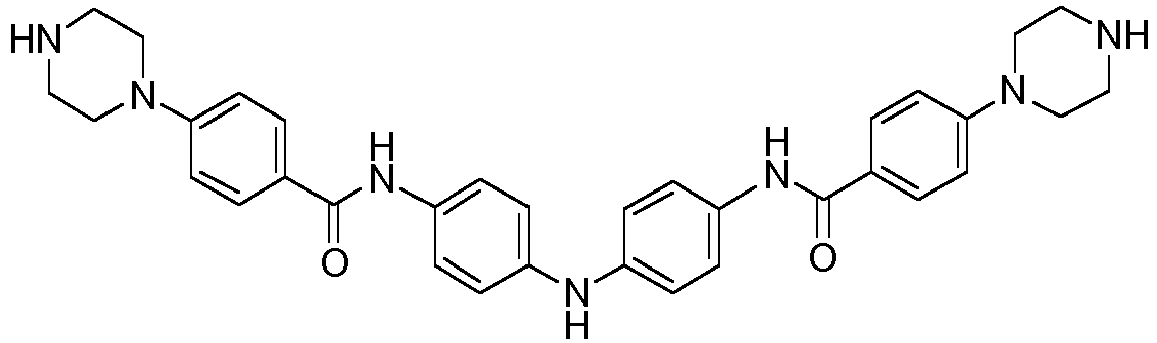
- Compound 365 was prepared according to the procedure described in Scheme IV from 4,4'-diaminodiphenylamine and 4-piperazinobenzoate. [M+H]+ calcd for C34H38N7O2: 576.31; found: 576.17.
-

- Compound 366 was prepared according to the procedure described in Scheme IV from 4,4'-diaminodiphenylamine and 4-morpholinobenzoate. [M+H]+ calcd for C34H36N6O3: 577.21; found: 577.16.
-

- Compound 367 was prepared according to the procedure described in Scheme IV from 4,4'-diaminodiphenylamine and 4-piperazinobenzoate. [M+H]+ calcd for C30H29FN5O2: 510.23; found: 510.06.
-

- Compound 368 was prepared according to the procedure described in Scheme IV from 4,4'-diaminodiphenylamine and 4-fluorobenzoate. [M+H]+ calcd for C26H19F2N3O2: 444.14; found: 443.86.
-

- Compound 565 was prepared according to the procedure described in Scheme IV from 4,4'-diaminodiphenylamine and 4-(imidazol-1-yl)benzoate. [M+H]+ calcd for C32H25N7O2: 540.21; found 539.97.
-
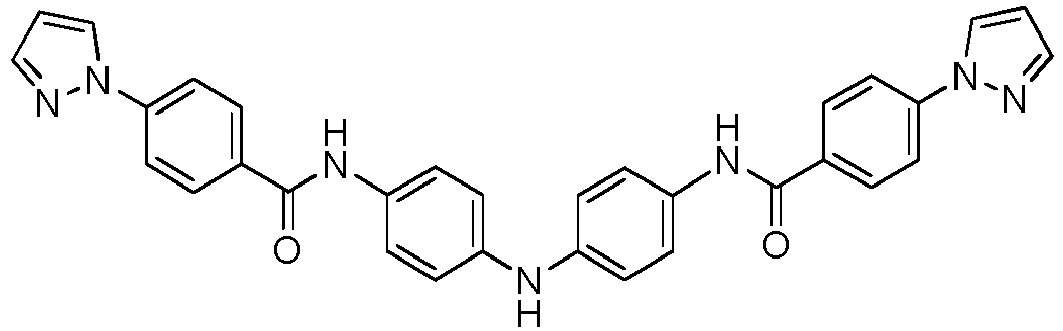
- Compound 567 was prepared according to the procedure described in Scheme IV from 4,4'-diaminodiphenylamine and 4-(pyrazol-1-yl)benzoate. [M+H]+ calcd for C32H25N7O2: 540.21; found 539.97.
-

- Compound 568 was prepared according to the procedure described in Scheme IV from 4,4'-diaminodiphenylamine and 4-(pyrrol-1-yl)benzoate. [M+H]+ calcd for C34H27N5O2: 538.22; found 538.09.
-

- Compound 569 was prepared according to the procedure described in Scheme IV from 4,4'-diaminodiphenylamine and 4-hydroxybenzoate. [M+H]+ calcd for C26H21N3O4: 440.15; found 439.94.
-
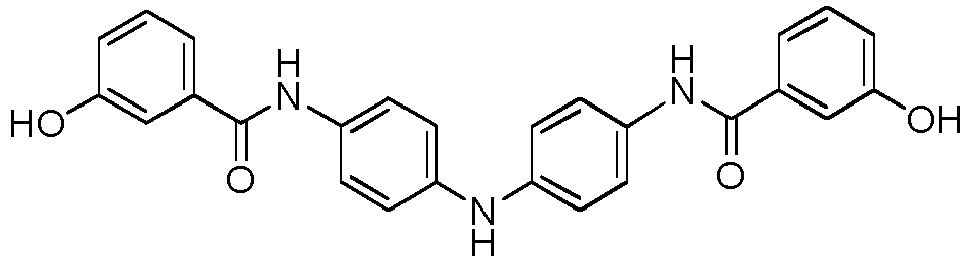
- Compound 570 was prepared according to the procedure described in Scheme IV from 4,4'-diaminodiphenylamine and 3-hydroxybenzoate. [M+H]+ calcd for C26H21N3O4: 440.15; found 493.94.
-

- Compound 571 was prepared according to the procedure described in Scheme IV from 4,4'-diaminodiphenylamine and 4-methoxybenzoate. [M+H]+ calcd for C28H25N3O4: 468.18; found 468.01.
-

- Compound 572 was prepared according to the procedure described in Scheme IV from 4,4'-diaminodiphenylamine and indole-2-carboxylic acid. [M+H]+ calcd for C30H23N5O2: 486.19; found 486.10.
-

- Compound 573 was prepared according to the procedure described in Scheme IV from 4,4'-diaminodiphenylamine and 4-(4-hydroxyphenyl)benzoate. [M+H]+ calcd for C38H29N3O4: 592.22; found 592.12.
-
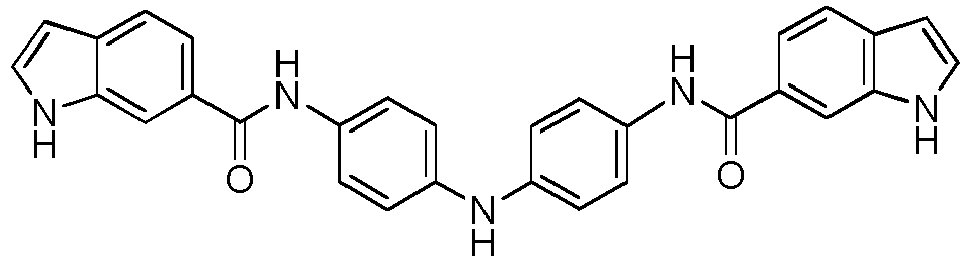
- Compound 575 was prepared according to the procedure described in Scheme IV from 4,4'-diaminodiphenylamine and indole-6-carboxylic acid. [M+H]+ calcd for C30H23N5O2: 486.19; found 486.03.
-

- Compound 576 was prepared according to the procedure described in Scheme IV from 4,4'-diaminodiphenylamine and indole-5-carboxylic acid. [M+H]+ calcd for C30H23N5O2: 486.19; found 486.03.
-

- Compound 577 was prepared according to the procedure described in Scheme IV from 4,4'-diaminodiphenylamine and 4-(2-hydroxyethylamino)benzoate. [M+H]+ calcd for C30H32N5O4: 526.25; found: 526.08.
-

- Compound 578 was prepared according to the procedure described in Scheme IV from 4,4'-diaminodiphenylamine and 4-methanesulfonamidobenzoate. [M+H]+ calcd for C28H27N5O6S2: 594.14; found 594.00.
-

- Compound 579 was prepared according to the procedure described in Scheme IV from 4,4'-diaminodiphenylamine and 4-tert-butyloxycarboxamidobenzoate. [M+H]+ calcd for C36H39N5O6: 638.29; found 638.20.
-

- Compound 580 was prepared according to the procedure described in Scheme IV from 4,4'-diaminodiphenylamine and 4-aminobenzoate. [M+H]+ calcd for C26H23N5O2: 438.19; found 438.05.
-

- Compound 581 was prepared according to the procedure described in Scheme IV from 4,4'-diaminodiphenylamine and 4-(2-aminoacetamido)benzoate. [M+H]+ calcd for C30H29N7O4: 552.23; found 552.12.
-

- Compound 582 was prepared according to the procedure described in Scheme IV from 4,4'-diaminodiphenylamine and 1-methylindole-5-carboxylic acid. [M+H]+ calcd for C32H27N5O2: 514.22; found 514.11.
-

- Compound 583 was prepared according to the procedure described in Scheme IV from 4,4'-diaminodiphenylamine and thiophene-2-carboxylic acid. [M+H]+ calcd for C22H17N3O2S2: 420.08; found 419.91.
-

- Compound 584 was prepared according to the procedure described in Scheme IV from 4,4'-diaminodiphenylamine and 4-pyrrolidinebenzoate. [M+H]+ calcd for C34H35N5O2: 546.28; found 546.07.
-
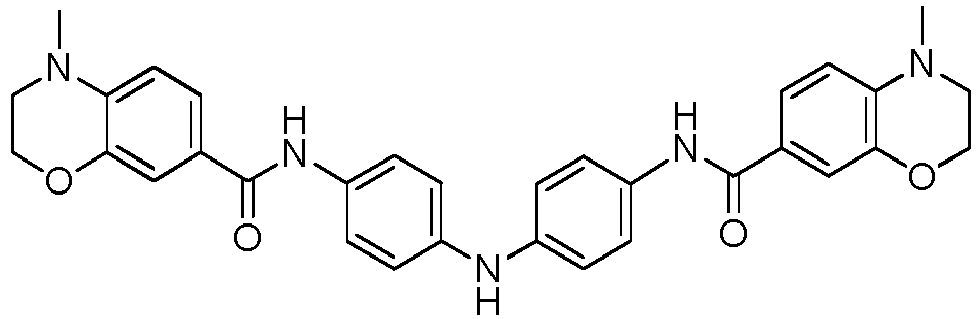
- Compound 587 was prepared according to the procedure described in Scheme IV from 4,4'-diaminodiphenylamine and 1-methyl-1,4-benzoxazine-6-carboxylic acid. [M+H]+ calcd for C32H31N5O4: 550.24; found 550.05.
-
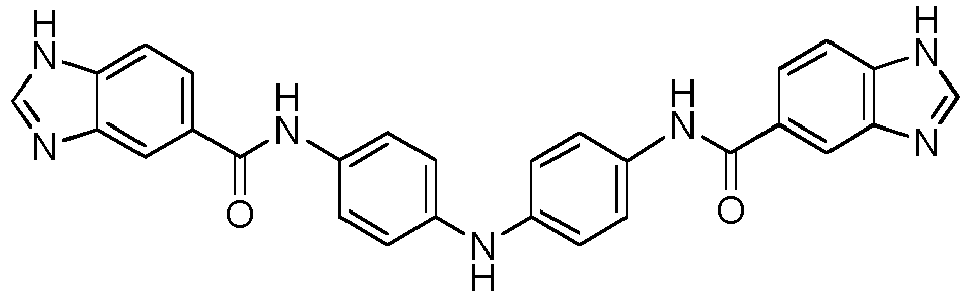
- Compound 590 was prepared according to the procedure described in Scheme IV from 4,4'-diaminodiphenylamine and benzimidazole-5-carboxylic acid. [M+H]+ calcd for C28H21N7O2: 488.18; found 488.02.
-

- Compound 739 was prepared according to the general procedure described in Scheme IV. Preparation of N-(4-nitrophenyl)benzene-1,4-diamine: Benzene-1,4-diamine (5.4 g, 50 mmol) and 1-fluoro-4-nitrobenzene (5.3 mL, 50 mmol) were dissolved in 75 mL dimethylsulfoxide and potassium carbonate (13.8 g, 100 mmol) was added. The reaction mixture was heated in an oil bath at 90 °C and stirred overnight under nitrogen atmosphere. The reaction mixture was cooled to room temperature and added to 250 mL water in a slow stream and stirred till a solid was precipitated out. The reaction mixture was filtered out and the resulting dark brown solid was washed with plenty of water. Flash column chromatography on silica gel eluted with 20% to 40% Ethyl acetate in hexanes provided the title compound (6.1 g, 53% yield).
- Preparation of 4-(4-hydroxypiperidin-1-yl)-N-(4-((4-nitrophenyl)amino)phenyl)-benzamide: N-4(-4-nitrophenyl)benzene-1,4-diamine (1.15 g, 5.0 mmol) and 4-(4-hydroxypiperidine-1-yl)benzoic acid (1.2 g, 5.5 mmol) were dissolved in 20 mL pyridine and EDCI (1.2 g, 6.0 mmole) added and stirred at room temperature under nitrogen atmosphere overnight. Water (80 mL) was added and the mixture was stirred for an extra 15 minutes till a solid was precipitated out. The reaction mixture was filtered and the resulting red-color solid was washed with water, ethyl acetate, and hexanes, then dried to give the title compound (1.6 g, 80% yield.) This compound was used for next step without any further purification.
- Preparation of Compound 739: 4-(4-Hydroxypiperidin-1-yl)-N-(4-((4-nitrophenyl)amino)phenyl)benzamide (1.8 g, 4.2 mmol) was hydrogenated using palladium hydroxide (1.6 g) in absolute ethanol (75 mL). The reaction mixture was stirred under hydrogen gas balloon overnight. It was filtered through celite and evaporated to dryness to give 4-(4-hydroxypiperidin-1-yl)-N-(4-((4-nitrophenyl)amino)phenyl)benzamide over 98% pure (1.6 g, 95% yield). Part of the product (22 mg, 0.05 mmol) and pyrimidine-4-carboxylic acid (8 mg, 0.06 mmole) were dissolved in 1 mL pyridine and was added EDCI (19 mg, 0.1 mmol). The reaction mixture was stirred at room temperature under nitrogen atmosphere overnight. Water (5 mL) was added and the mixture was stirred for an extra 15 minutes till a solid was precipitated out. The reaction mixture was filtered and the resulting red -color solid was washed with water, ethyl acetate, hexanes, and then dried to give crude compound 739 (20 mg 78% yield). Further purification was carried on using prep HPLC for the final sample. [M+H]+ calcd for C29H28N6O3: 509.22; found 508.98.
-

- Compound 740 was prepared according to the procedure described in Scheme IV from 4,4'-diaminodiphenylamine, nicotinic and 4-(4-hydroxypiperidin-1-yl)benzoic acids. [M+H]+ calcd for C30H29N5O3: 508.23; found 507.97.
-

- Compound 741 was prepared according to the procedure described in Scheme IV from 4,4'-diaminodiphenylamine, 4,5,6,7-tetrahydro-1H-indole-2-carboxylic, and 4-(4-hydroxypiperidin-1-yl)benzoic acids. [M+H]+ calcd for C33H35N5O3: 550.27; found 550.09.
-

- Compound 742 was prepared according to the procedure described in Scheme IV from 4,4'-diaminodiphenylamine, 1H-pyrrolo[2,3-b]pyridine-5-carboxylic, and 4-(4-hydroxypiperidin-1-yl)benzoic acids. [M+H]+ calcd for C32H30N6O3: 547.24; found 547.12.
-

- Compound 743 was prepared according to the procedure described in Scheme IV from 4,4'-diaminodiphenylamine, 1H-pyrrole-2-carboxylic, and 4-(4-hydroxypiperidin-1-yl)benzoic acids. [M+H]+ calcd for C29H29N5O3: 496.23; found 496.02.
-

- Compound 744 was prepared according to the procedure described in Scheme IV from 4,4'-diaminodiphenylamine, 1-methylpyrrole-2-carboxylic, and 4-(4-hydroxypiperidin-1-yl)benzoic acids. [M+H]+ calcd for C30H31N5O3: 510.24; found 519.99.
-

- Compound 746 was prepared according to the procedure described in Scheme IV from 4,4'-diaminodiphenylamine, 1H-pyrrole-3-carboxylic, and 4-(4-hydroxypiperidin-1-yl)benzoic acids. [M+H]+ calcd for C29H29N5O3: 496.23; found 496.02.
-

- Compound 747 was prepared according to the procedure described in Scheme IV from 4,4'-diaminodiphenylamine and 4-(4H-1,2,4-triazol-4-yl)benzoic acid. [M+H]+ calcd for C30H23N9O2: 542.20; found 541.99.
-

- Compound 748 was prepared according to the procedure described in Scheme IV from 4,4'-diaminodiphenylamine and 4-acetylbenzoic acid. [M+H]+ calcd for C30H25N3O4: 492.18; found 492.00.
-

- Compound 750 was prepared according to the procedure described in Scheme IV from 4,4'-diaminodiphenylamine, 1H-indole-5-carboxylic, and 4-(4-hydroxypiperidin-1-yl)benzoic acids. [M+H]+ calcd for C33H31N5O3: 546.24; found 546.04.
-

- Compound 751 was prepared according to the procedure described in Scheme IV from 4,4'-diaminodiphenylamine, 1H-indole-6-carboxylic, and 4-(4-hydroxypiperidin-1-yl)benzoic acids. [M+H]+ calcd for C33H31N5O3: 546.24; found 546.11.
-

- Compound 752 was prepared according to the procedure described in Scheme IV from 4,4'-diaminodiphenylamine, 1H-indole-3-carboxylic, and 4-(4-hydroxypiperidin-1-yl)benzoic acids. [M+H]+ calcd for C33H31N5O3: 546.24; found 545.97.
-

- Compound 753 was prepared according to the procedure described in Scheme IV from 4,4'-diaminodiphenylamine, cyclopropanecarboxylic, and 4-(4-hydroxypiperidin-1-yl)benzoic acids. [M+H]+ calcd for C28H30N4O3: 471.23; found 471.05.
-

- Compound 754 was prepared according to the procedure described in Scheme IV from 4,4'-diaminodiphenylamine and 4-carbamoylbenzoic acid. [M+H]+ calcd for C28H23N5O4: 494.18; found 494.00.
-

- Compound 755 was prepared according to the procedure described in Scheme IV from N1 -(4-aminophenyl)-2-fluorobenzene-1,4-diamine, 1H-pyrrole-2-carboxylic, and 4-(4-hydroxypiperidin-1-yl)benzoic acids. [M+H]+ calcd for C29H28FN5O3: 514.22; found: 513.98.
-

- Compound 756 was prepared according to the procedure described in Scheme IV from N1 -(4-aminophenyl)-2-fluorobenzene-1,4-diamine, 1H-pyrrole-2-carboxylic, and 4-(4-hydroxypiperidin-1-yl)benzoic acids. [M+H]+ calcd for C29H28FN5O3: 514.22; found: 513.98.
-
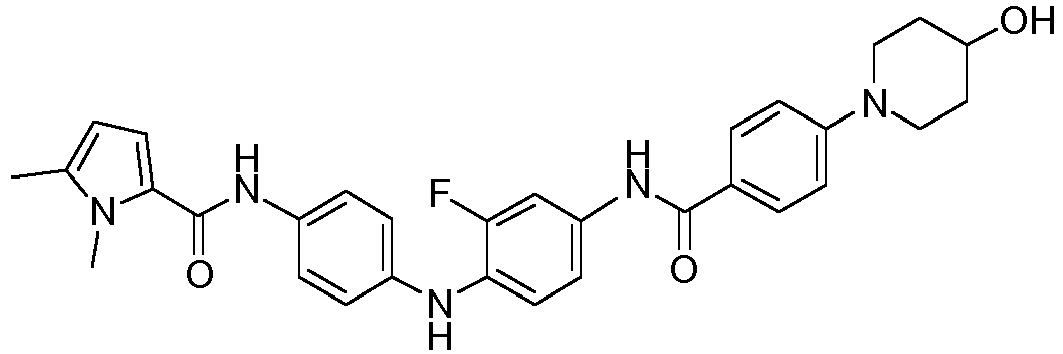
- Compound 757 was prepared according to the procedure described in Scheme IV from N1 -(4-aminophenyl)-2-fluorobenzene-1,4-diamine, 1,5-dimethyl-1H-pyrrole-2-carboxylic, and 4-(4-hydroxypiperidin-1-yl)benzoic acids. [M+H]+ calcd for C31H32FN5O3: 542.25; found: 542.06.
-

- Compound 758 was prepared according to the procedure described in Scheme IV from 4,4'-diaminodiphenylamine, 1,5-dimethyl-1H-pyrrole-2-carboxylic, and 4-(4-hydroxypiperidin-1-yl)benzoic acids. [M+H]+ calcd for C31H33N5O3: 524.26; found: 524.03.
-

- Compound 759 was prepared according to the procedure described in Scheme IV from N1 -(4-aminophenyl)-2-fluorobenzene-1,4-diamine, 1-ethyl-1H-pyrrole-2-carboxylic, and 4-(4-hydroxypiperidin-1-yl)benzoic acids. [M+H]+ calcd for C31H32FN5O3: 524.25; found: 542.06.
-

- Compound 760 was prepared according to the procedure described in Scheme IV from N1 -(4-aminophenyl)-2-fluorobenzene-1,4-diamine, 1,5-dimethyl-1H-pyrrole-2-carboxylic, and 4-(4-hydroxypiperidin-1-yl)benzoic acids. [M+H]+ calcd for C31H32FN5O3: 542.25; found: 542.06.
-

- Compound 761 was prepared according to the procedure described in Scheme IV from 4,4'-diaminodiphenylamine, 5-methyl-1H-pyrrole-2-carboxylic, and 4-(4-hydroxypiperidin-1-yl)benzoic acids. 1H NMR (400 MHz, Acetone-d6 ) δ 10.54 (s, 1H), 9.14 (s, 1H), 8.93 (s, 1H), 7.90 (d, J = 9 Hz, 2H), 7.70 (d, J = 8.9 Hz, 2H), 7.64 (d, J = 9.0 Hz, 2H), 7.18 (s, 1H), 7.07 (dd, J = 3.0, 9.0 Hz, 4H), 7.00 (d, J = 9.0 Hz, 2H), 6.84 (t, J = 3.4 Hz, 1H), 5.89 (t, J = 3.4 Hz, 1H), 3.85 (m, 2H), 3.75 (m, 2H), 3.08 (ddd, J = 3.0, 3.2, 11 Hz, 2H), 2.32 (s, 3H), 1.94 (m, 2H), 1.60 (m, 2H).
-

- Compound 762 was prepared according to the procedure described in Scheme IV from N1 -(4-aminophenyl)-2-fluorobenzene-1,4-diamine, 5-methyl-1H-pyrrole-2-carboxylic, and 4-(4-hydroxypiperidin-1-yl)benzoic acids. [M+H]+ calcd for C30H30FN5O3: 528.23; found: 528.02.
-

- Compound 763 was prepared according to the procedure described in Scheme IV from 4,4'-diaminodiphenylamine, 5-formyl-1H-pyrrole-2-carboxylic, and 4-(4-hydroxypiperidin-1-yl)benzoic acids. [M+H]+ calcd for C30H29N5O4: 524.11; found: 524.03.
-

- Compound 764 was prepared according to the procedure described in Scheme IV from N1 -(4-aminophenyl)-2-fluorobenzene-1,4-diamine, 1H-pyrrole-3-carboxylic, and 4-(4-hydroxypiperidin-1-yl)benzoic acids. [M+H]+ calcd for C29H28FN5O3: 514.22; found 513.98.
-

- Compound 765 was prepared according to the procedure described in Scheme IV from N1 -(4-aminophenyl)-2-fluorobenzene-1,4-diamine, 1-ethyl-1H-pyrrole-3-carboxylic, and 4-(4-hydroxypiperidin-1-yl)benzoic acids. [M+H]+ calcd for C31H32FN5O3: 542.25; found: 542.06.
-

- Compound 766 was prepared according to the procedure described in Scheme IV from N1 -(4-aminophenyl)-2-fluorobenzene-1,4-diamine, 1-methyl-1H-pyrrole-3-carboxylic, and 4-(4-hydroxypiperidin-1-yl)benzoic acids. [M+H]+ calcd for C30H30FN5O3: 528.23; found 528.02.
-

- Compound 767 was prepared according to the procedure described in Scheme IV from 4,4'-diaminodiphenylamine, 1-ethyl-1H-pyrrole-3-carboxylic, and 4-(4-hydroxypiperidin-1-yl)benzoic acids. [M+H]+ calcd for C31H33N5O3: 524.26; found: 524.03.
-

- Compound 768 was prepared according to the procedure described in Scheme IV from 4,4'-diaminodiphenylamine, 1-methyl-1H-pyrrole-3-carboxylic, and 4-(4-hydroxypiperidin-1-yl)benzoic acids. [M+H]+ calcd for C30H31N5O3: 510.24; found 509.99.
-

- Compound 769 was prepared according to the procedure described in Scheme IV from cyclopropylamine, 4-(4-aminophenylamino)benzoic, and 4-(4-hydroxypiperidin-1-yl)benzoic acids. [M+H]+ calcd for C28H30N4O3: 471.23; found 471.05.
-

- Compound 770 was prepared according to the procedure described in Scheme IV from 4,4'-diaminodiphenylamine, 6-methylpicolinic, and 4-(4-hydroxypiperidin-1-yl)benzoic acids. [M+H]+ calcd for C31H31N5O3: 522.24; found 522.08.
-

- Compound 771 was prepared according to the procedure described in Scheme IV from 6-aminoindole, 4-(4-aminophenylamino)benzoic, and 4-(4-hydroxypiperidin-1-yl)benzoic acids. [M+H]+ calcd for C33H31N5O3: 546.24; found 546.04.
-
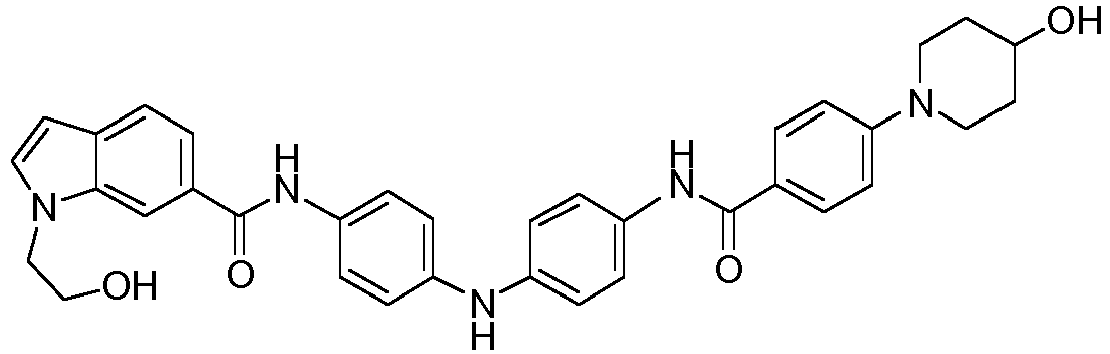
- Compound 772 was prepared according to the procedure described in Scheme IV from 4,4'-diaminodiphenylamine, 1-(2-hydroxyethyl)-1H-indole-6-carboxylic, and 4-(4-hydroxypiperidin-1-yl)benzoic acids. [M+H]+ calcd for C35H35N5O4: 590.27; found 590.20.
-

- Compound 773 was prepared according to the procedure described in Scheme IV from 4,4'-diaminodiphenylamine, 1-methyl-1H-indole-2-carboxylic, and 4-(4-hydroxypiperidin-1-yl)benzoic acids. [M+H]+ calcd for C34H33N5O3: 560.26; found 560.02.
-

- Compound 774 was prepared according to the procedure described in Scheme IV from 4,4'-diaminodiphenylamine, 1-methyl-1H-indole-3-carboxylic, and 4-(4-hydroxypiperidin-1-yl)benzoic acids. [M+H]+ calcd for C34H33N5O3: 560.26; found 560.02.
-

- Compound 775 was prepared according to the procedure described in Scheme IV from 4,4'-diaminodiphenylamine, 1-(2-hydroxyethyl)-1H-indole-5-carboxylic, and 4-(4-hydroxypiperidin-1-yl)benzoic acids. [M+H]+ calcd for C35H35N5O4: 590.27; found 590.06.
-
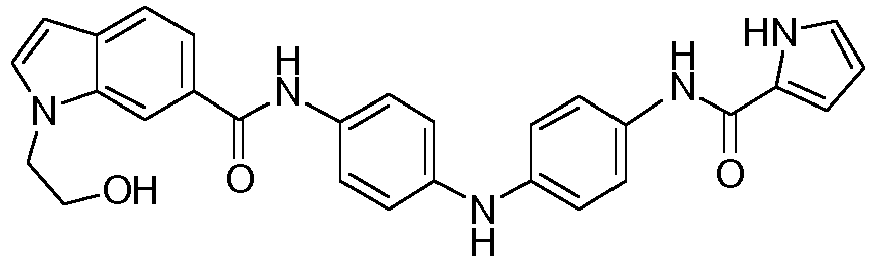
- Compound 776 was prepared according to the procedure described in Scheme IV from 4,4'-diaminodiphenylamine, 1-(2-hydroxyethyl)-1H-indole-6-carboxylic, and 2-pyrrolecarboxylic acids. [M+H]+ calcd for C28H25N5O3 : 480.20 ; found 480.03.
-

- Compound 777 was prepared according to the procedure described in Scheme IV from 4,4'-diaminodiphenylamine, 1-(2-hydroxyethyl)-1H-indole-6-carboxylic, and 1-methyl-2-pyrrolecarboxylic acids. [M+H]+ calcd for C29H27N5O3: 494.21; found 494.06.
-

- Compound 778 was prepared according to the procedure described in Scheme IV from 4,4'-diaminodiphenylamine, 1H-indole-6-carboxylic, and 4-(3-hydroxymethylpiperidin-1-yl)benzoic acids. [M+H]+ calcd for C34H33N5O3: 560.26; found: 560.08.
-

- Compound 779 was prepared according to the procedure described in Scheme IV from 4,4'-diaminodiphenylamine, 1H-pyrrole-2-carboxylic, and 4-(3-hydroxymethylpiperidin-1-yl)benzoic acids. [M+H]+ calcd for C30H31N5O3: 510.24; found: 509.99.
-

- Compound 780 was prepared according to the procedure described in Scheme IV from 4,4'-diaminodiphenylamine, 1-(2-morpholinoethyl)-1H-indole-5-carboxylic, and 4-(4-hydroxypiperidin-1-yl)benzoic acids. [M+H]+ calcd for C39H42N6O4 : 659.33; found 659.20.
-

- Compound 781 was prepared according to the procedure described in Scheme IV from 4,4'-diaminodiphenylamine, 4-morpholinecarbonyl chloride, and 4-(4-hydroxypiperidin-1-yl)benzoic acid. [M+H]+ calcd for C29H33N5O4 : 516.25; found 516.07.
-

- Compound 782 was prepared according to the procedure described in Scheme IV from 4,4'-diaminodiphenylamine, 1H-pyrazole-3-carboxylic, and 4-(4-hydroxypiperidin-1-yl)benzoic acids. [M+H]+ calcd for C28H28N6O3 : 497.22; found 496.97.
-

- Compound 783 was prepared according to the procedure described in Scheme IV from 4,4'-diaminodiphenylamine, 1H-pyrazole-4-carboxylic, and 4-(4-hydroxypiperidin-1-yl)benzoic acids. [M+H]+ calcd for C28H28N6O3 : 497.22; found 496.97.
-

- Compound 784 was prepared according to the procedure described in Scheme IV from 4,4'-diaminodiphenylamine, 1-methyl-1H-pyrazole-3-carboxylic, and 4-(4-hydroxypiperidin-1-yl)benzoic acids. [M+H]+ calcd for C29H30N6O3 : 511.24; found 511.01.
-

- Compound 785 was prepared according to the procedure described in Scheme IV from 4,4'-diaminodiphenylamine, 1-methyl-1H-pyrazole-4-carboxylic, and 4-(4-hydroxypiperidin-1-yl)benzoic acids. [M+H]+ calcd for C29H30N6O3 : 511.24; found 511.01.
-

- Compound 786 was prepared according to the procedure described in Scheme IV from 4,4'-diaminodiphenylamine, 1-methyl-1H-pyrazole-5-carboxylic, and 4-(4-hydroxypiperidin-1-yl)benzoic acids. [M+H]+ calcd for C29H30N6O3 : 511.24; found 511.01.
-

- Compound 787 was prepared according to the procedure described in Scheme IV from 4,4'-diaminodiphenylamine, butanoic, and 4-(4-hydroxypiperidin-1-yl)benzoic acids. [M+H]+ calcd for C28H32N4O3: 473.25; found: 473.01.
-

- Compound 788 was prepared according to the procedure described in Scheme IV from 4,4'-diaminodiphenylamine, 4-methyl-1H-pyrrole-3-carboxylic, and 4-(4-hydroxypiperidin-1-yl)benzoic acids. [M+H]+ calcd for C30H31N5O3: 510.24; found: 509.99.
-

- Compound 789 was prepared according to the procedure described in Scheme IV from 4,4'-diaminodiphenylamine, 1,2,5-trimethyl-1H-pyrrole-3-carboxylic, and 4-(4-hydroxypiperidin-1-yl)benzoic acids. [M+H]+ calcd for C32H35N5O3 : 538.27; found 538.08.
-

- Compound 790 was prepared according to the procedure described in Scheme IV from 4,4'-diaminodiphenylamine, 2,5-dimethyl-1H-pyrrole-3-carboxylic, and 4-(4-hydroxypiperidin-1-yl)benzoic acids. [M+H]+ calcd for C31H33N5O3: 524.26; found 525.10.
-

- Compound 791 was prepared according to the procedure described in Scheme IV from 4,4'-diaminodiphenylamine, N, N-dimethylchloroformate, and 4-(4-hydroxypiperidin-1-yl)benzoic acid. [M+H]+ calcd for C27H31N5O3 : 474.24; found 473.95.
-

- Compound 792 was prepared according to the procedure described in Scheme IV from 4,4'-diaminodiphenylamine, (4-hydroxypiperidin-1-yl)carbonyl chloride, and 4-(4-hydroxypiperidin-1-yl)benzoic acid. [M+H]+ calcd for C30H35N5O4: 530.28; found: 530.04.
-

- Compound 793 was prepared according to the procedure described in Scheme IV from 4,4'-diaminodiphenylamine, 2,3-dimethyl-1H-indole-5-carboxylic, and 4-(4-hydroxypiperidin-1-yl)benzoic acids. [M+H]+ calcd for C35H35N5O3: 574.27; found 574.06.
-

- Compound 794 was prepared according to the procedure described in Scheme IV from 4,4'-diaminodiphenylamine, 1-methyl-1H-indole-5-carboxylic, and 4-(4-hydroxypiperidin-1-yl)benzoic acids. [M+H]+ calcd for C34H33N5O3: 560.26; found 560.02.
-

- Compound 795 was prepared according to the procedure described in Scheme IV from 4,4'-diaminodiphenylamine, 1-methyl-1H-indole-6-carboxylic, and 4-(4-hydroxypiperidin-1-yl)benzoic acids. [M+H]+ calcd for C34H33N5O3: 560.26; found 560.07.
-

- Compound 796 was prepared according to the procedure described in Scheme IV from N1 -(4-aminophenyl)-2-chlorobenzene-1,4-diamine, 1-methyl-1H-pyrrole-2-carboxylic, and 4-(4-hydroxypiperidin-1-yl)benzoic acids. [M+H]+ calcd for C30H30ClN5O3: 544.20; found 544.02.
-

- Compound 797 was prepared according to the procedure described in Scheme IV from 4,4'-diaminodiphenylamine, 1-methyl-1H-pyrrole-2-carboxylic, and (4-(2-hydroxyethyl)methylamino)benzoic acids. [M+H]+ calcd for C28H29N5O3: 484.24; found: 484.01.
-

- Compound 798 was prepared according to the procedure described in Scheme IV from 4,4'-diaminodiphenylamine, 1-methyl-1H-pyrrole-2-carboxylic, and 4-(4-methylpiperazin-1-yl)benzoic acids. [M+H]+ calcd for C30H32N6O2: 509.27; found: 509.05.
-

- Compound 799 was prepared according to the procedure described in Scheme IV from 4,4'-diaminodiphenylamine, 4-acetyl-3,5-dimethyl-1H-pyrrole-2-carboxylic, and 4-(4-hydroxypiperidin-1-yl)benzoic acids. [M+H]+ calcd for C33H35N5O4: 566.27; found 566.09.
-
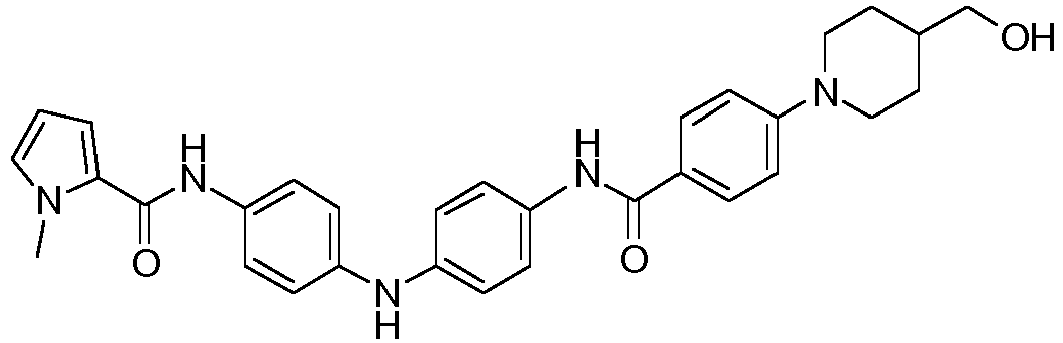
- Compound 800 was prepared according to the procedure described in Scheme IV from 4,4'-diaminodiphenylamine, 1-methyl-1H-pyrrole-2-carboxylic, and 4-(4-hydroxymethylpiperidin-1-yl)benzoic acids. [M+H]+ calcd for C31H33N5O3: 524.26; found: 523.64.
-

- Compound 801 was prepared according to the procedure described in Scheme IV from 4,4'-diaminodiphenylamine, 1H-imidazole-2-carboxylic, and 4-(4-hydroxypiperidin-1-yl)benzoic acids. [M+H]+ calcd for C28H28N6O3: 497.22; found 496.97.
-

- Compound 802 was prepared according to the procedure described in Scheme IV from 4,4'-diaminodiphenylamine, 1-methyl-1H-imidazole-4-carboxylic, and 4-(4-hydroxypiperidin-1-yl)benzoic acids. [M+H]+ calcd for C29H30N6O3: 511.24; found 511.01.
-

- Compound 803 was prepared according to the procedure described in Scheme IV from 4,4'-diaminodiphenylamine, 1-methyl-1H-imidazole-5-carboxylic, and 4-(4-hydroxypiperidin-1-yl)benzoic acids. [M+H]+ calcd for C29H30N6O3: 511.24; found 511.01.
-

- Compound 804 was prepared according to the procedure described in Scheme IV from 4,4'-diaminodiphenylamine, 4-(4-t-BOC-piperazin-1-yl)benzoic, and 4-(4-hydroxypiperidin-1-yl)benzoic acids. [M+H]+ calcd for C40H46N6O5: 691.35; found 691.23.
-

- Compound 805 was prepared according to the procedure described in Scheme IV from 4,4'-diaminodiphenylamine, 1-benzyloxycarbanylpyrrolidine-2-carboxylic, and 4-(4-hydroxypiperidin-1-yl)benzoic acids. [M+H]+ calcd for C37H39N5O5: 634.30; found 634.15.
-

- Compound 806 was prepared according to the procedure described in Scheme IV from 4,4'-diaminodiphenylamine, 1H-pyrrole-2-carboxylic, and 4-morpholino-1H-pyrrole-2-carboxylic acids. 1H NMR (400 MHz, Acetone-d6 ) δ 10.75 (s, 1H), 10.31 (s, 1H), 9.01 (s, 1H), 8.91 (s, 1H), 7.62 (d, J = 8.6 Hz, 4H), 7.04 (m, 5H), 6.67 (s, 1H), 6.58 (s, 1H), 6.18 (s, 1H), 4.04 (dq, J = 1.8, 7 Hz, 2H), 3.72 (m, 4H), 1.19 (dq, J = 1.8, 7 Hz, 4H).
-

- Compound 808 was prepared according to the procedure described in Scheme IV from N1 -(4-aminophenyl)-2-fluorobenzene-1,4-diamine, 1-methyl-1H-pyrrole-2-carboxylic, and 4-(4-hydroxypiperidin-1-yl)benzoic acids. [M+H]+ calcd for C30H30FN5O3: 528.23; found 528.02.
-

- Compound 809 was prepared according to the procedure described in Scheme IV from N1 -(4-aminophenyl)-2-fluorobenzene-1,4-diamine, 1-methyl-1H-indole-6-carboxylic, and 4-(4-hydroxypiperidin-1-yl)benzoic acids. [M+H]+ calcd for C34H32FN5O3: 578.25; found 578.04.
-

- Compound 810 was prepared according to the procedure described in Scheme IV from 4,4'-diaminodiphenylamine, 1-methyl-1H-pyrrole-2-carboxylic, and 4-(3-hydroxypyrrolidin-1-yl)benzoic acids. [M+H]+ calcd for C29H29N5O3: 496.23; found: 495.95.
-
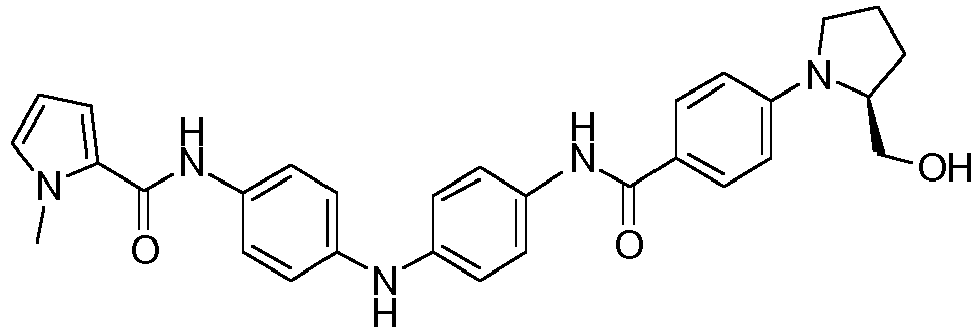
- Compound 811 was prepared according to the procedure described in Scheme IV from 4,4'-diaminodiphenylamine, 1-methyl-1H-pyrrole-2-carboxylic, and (S)-4-(2-hydroxymethylpyrrolidin-1-yl)benzoic acids. [M+H]+ calcd for C30H31N5O3: 510.24; found: 510.06.
-

- Compound 812 was prepared according to the procedure described in Scheme IV from 4,4'-diaminodiphenylamine, 1-methyl-1H-pyrrole-2-carboxylic, and 4-(2-hydroxyethyl)benzoic acids. [M+H]+ calcd for C27H26N4O4: 471.20; found: 470.92.
-

- Compound 814 was prepared according to the procedure described in Scheme IV from 4,4'-diaminodiphenylamine, 1-ethyl-1H-pyrrole-2-carboxylic, and 4-(4-hydroxypiperidin-1-yl)benzoic acids. [M+H]+ calcd for C31H33N5O3: 524.26; found: 524.03.
-

- Compound 815 was prepared according to the procedure described in Scheme IV from 4,4'-diaminodiphenylamine, 1-methyl-1H-pyrrole-2-carboxylic, and 3-fluoro-4-(4-hydroxypiperidin-1-yl)benzoic acids. 1H NMR (400 MHz, Acetone-d6 ) δ 9.25 (s, 1H), 8.94 (s, 1H), 7.75 (dd, J = 1.9, 8.4 Hz, 1H), 7.69 (m, 3H), 7.63 (d, J = 8.8 Hz, 2H), 7.22 (s, 1H), 7.08 (m, 5H), 6.89 (m, 2H), 6.05 (m, 1H), 3.95 (s, 3H), 3.47 (m, 2H), 2.95 (ddd, J = 3, 9.8, 12.4 Hz, 2H), 1.67 (m, 2H), 1.27 (m, 2H).
-

- Compound 816 was prepared according to the procedure described in Scheme IV from N1 -(4-aminophenyl)-2-trifluoromethylbenzene-1,4-diamine, 1-methyl-1H-pyrrole-2-carboxylic, and 4-(4-hydroxypiperidin-1-yl)benzoic acids. [M+H]+ calcd for C31H30F3N5O3: 578.24; found: 578.04.
-

- Compound 817 was prepared according to the procedure described in Scheme IV from N1 -(4-aminophenyl)-2-cyanobenzene-1,4-diamine, 1-methyl-1H-pyrrole-2-carboxylic, and 4-(4-hydroxypiperidin-1-yl)benzoic acids. [M+H]+ calcd for C31H30N6O3: 535.25; found: 535.04.
-

- Compound 818 was prepared according to the procedure described in Scheme IV from 4,4'-diaminodiphenylamine, 1-methyl-1H-pyrrole-2-carboxylic, and 2-chloro-4-(4-hydroxypiperidin-1-yl)benzoic acids. [M+H]+ calcd for C30H30ClN5O3: 544.20; found: 544.02.
-
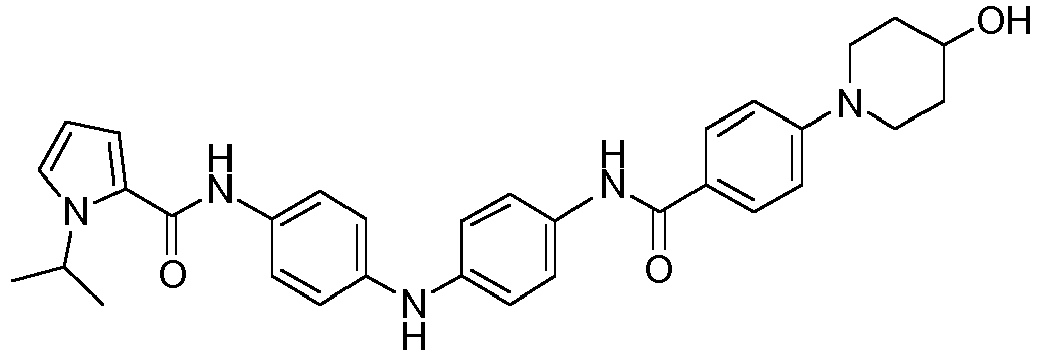
- Compound 819 was prepared according to the procedure described in Scheme IV from 4,4'-diaminodiphenylamine, 1-isopropyl-1H-pyrrole-2-carboxylic, and 4-(4-hydroxypiperidin-1-yl)benzoic acids. [M+H]+ calcd for C32H35N5O3: 538.27; found: 538.08.
-

- Compound 820 was prepared according to the procedure described in Scheme IV from 4,4'-diaminodiphenylamine, 1-methyl-1H-pyrrole-2-carboxylic, and 4-(4-hydroxy-4-trifluoromethylpiperidin-1-yl)benzoic acids. [M+H]+ calcd for C31H30F3N5O3: 578.23; found 578.04.
-

- Compound 821 was prepared according to the procedure described in Scheme IV from 4,4'-diaminodiphenylamine, 1-methyl-1H-pyrrole-2-carboxylic, and 4-(2-hydroxymethylmorpholi-4-no)benzoic acids. [M+H]+ calcd for C30H31N5O4: 526.24; found: 525.99.
-

- Compound 822 was prepared according to the procedure described in Scheme IV from 4,4'-diaminodiphenylamine, pyrrolidine-2-carboxylic, and 4-(4-hydroxypiperidin-1-yl)benzoic acids. [M+H]+ calcd for C29H33N5O3: 500.26; found 499.94.
-

- Compound 823 was prepared according to the procedure described in Scheme IV from 4,4'-diaminodiphenylamine, 1-methyl-1H-pyrrole-2-carboxylic, and 4-(1,4-dioxa-8-azaspiro[4.5]decan-8-yl)benzoic acids. [M+H]+ calcd for C32H33N5O4: 552.25; found: 552.05.
-

- Compound 824 was prepared according to the procedure described in Scheme IV from 4,4'-diaminodiphenylamine, 1-vinyl-1H-pyrrole-2-carboxylic, and 4-(4-hydroxypiperidin-1-yl)benzoic acids. [M+H]+ calcd for C31H31N5O3: 522.24; found 522.01.
-

- Compound 825 was prepared according to the procedure described in Scheme IV from 4,4'-diaminodiphenylamine, 3-fluoro-4-(4-hydroxypiperidin-1-yl)benzoic, and 4-(4-hydroxypiperidin-1-yl)benzoic acids. [M+H]+ calcd for C36H38FN5O4: 624.29; found 624.13.
-

- Compound 826 was prepared according to the procedure described in Scheme IV from N1 -(4-aminophenyl)-2-chlorobenzene-1,4-diamine and 4-(4-hydroxypiperidin-1-yl)benzoic acid. [M+H]+ calcd for C36H38ClN5O4: 640.26; found 640.12.
-

- Compound 829 was prepared according to the procedure described in Scheme IV from 4,4'-diaminodiphenylamine, 1-cyanomethyl-1H-pyrrole-2-carboxylic, and 4-(4-hydroxypiperidin-1-yl)benzoic acids. [M+H]+ calcd for C31H30N6O3: 535.24; found: 535.04.
-
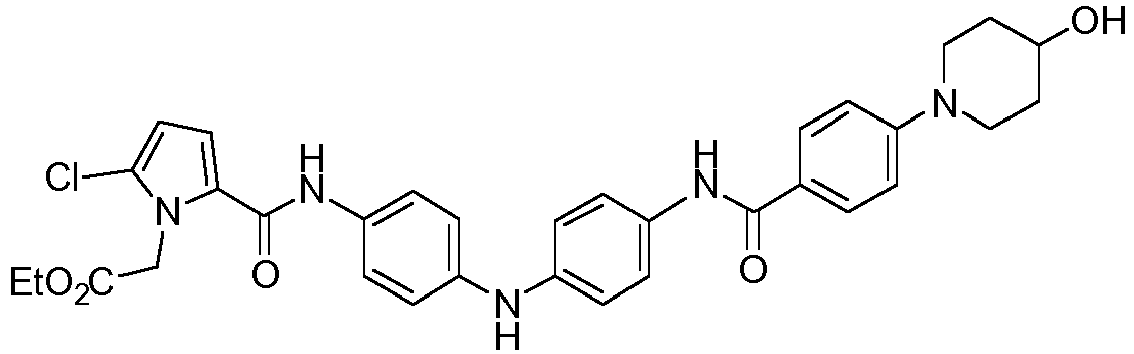
- Compound 830 was prepared according to the procedure described in Scheme IV from 4,4'-diaminodiphenylamine, 5-chloro-1-ethoxycarbonylmethyl-1H-pyrrole-2-carboxylic, and 4-(4-hydroxypiperidin-1-yl)benzoic acids. [M+H]+ calcd for C33H34ClN5O5: 616.22; found: 616.06.
-

- Compound 831 was prepared according to the procedure described in Scheme IV from N1 -(4-aminophenyl)-2-fluorobenzene-1,4-diamine, 1-methyl-1H-pyrrole-2-carboxylic, and 4-(4-hydroxypiperidin-1-yl)benzoic acids. [M+H]+ calcd for C30H30FN5O3: 528.23; found 528.02.
-

- Compound 832 was prepared according to the procedure described in Scheme IV from N1 -(4-aminophenyl)-2-chlorobenzene-1,4-diamine, 1-methyl-1H-pyrrole-2-carboxylic, and 4-(4-hydroxypiperidin-1-yl)benzoic acids. [M+H]+ calcd for C30H30CN5O3: 544.20; found 544.02.
-

- Compound 833 was prepared according to the procedure described in Scheme IV from N 5-(4-aminophenyl)pyridine-2,5-diamine, 1-methyl-1H-pyrrole-2-carboxylic, and 4-(4-hydroxypiperidin-1-yl)benzoic acids. [M+H]+ calcd for C29H30N6O3: 511.24; found 511.01.
-

- Compound 834 was prepared according to the procedure described in Scheme IV from N1 -(4-aminophenyl)-2-cyanobenzene-1,4-diamine and 4-(4-hydroxypiperidin-1-yl)benzoic acid. [M+H]+ calcd for C37H38N6O4: 631.30; found: 631.11.
-

- Compound 835 was prepared according to the procedure described in Scheme IV from 4,4'-diaminodiphenylamine, 1-methyl-1H-pyrrole-2-carboxylic, and 4-(4-(2-hydroxyethoxy)piperidin-1-yl)benzoic acids. [M+H]+ calcd for C33H37N5O4: 568.28; found: 568.12.
-

- Compound 836 was prepared according to the procedure described in Scheme IV from 4,4'-diaminodiphenylamine, 1-methoxycarbonylmethyl-1H-pyrrole-2-carboxylic, and 4-(4-hydroxypiperidin-1-yl)benzoic acids. [M+H]+ calcd for C31H31N5O5: 554.23; found: 554.01.
-

- Compound 837 was prepared according to the procedure described in Scheme IV from 4,4'-diaminodiphenylamine, 1-methyl-1H-pyrrole-2-carboxylic, and 3-methyl-4-(4-hydroxypiperidin-1-yl)benzoic acids. [M+H]+ calcd for C31H33N5O3: 524.26; found: 524.03.
-

- Compound 838 was prepared according to the procedure described in Scheme IV from 4,4'-diaminodiphenylamine, 1-methyl-1H-pyrrole-2-carboxylic, and 4-(2,6-dimethylmorpholi-4-no)benzoic acids. [M+H]+ calcd for C31H33N5O3: 524.26; found: 524.03.
-

- Compound 839 was prepared according to the procedure described in Scheme IV from 4,4'-diaminodiphenylamine, 1-methyl-1H-pyrrole-2-carboxylic, and 3-methoxy-4-(4-hydroxypiperidin-1-yl)benzoic acids. [M+H]+ calcd for C31H33N5O4: 540.25; found: 540.03.
-

- Compound 840 was prepared according to the procedure described in Scheme IV from 4,4'-diaminodiphenylamine, 1-methyl-1H-pyrrole-2-carboxylic, and 3-trifluoromethyl-4-(4-hydroxypiperidin-1-yl)benzoic acids. [M+H]+ calcd for C31H30F3N5O3: 578.23; found: 578.04.
-
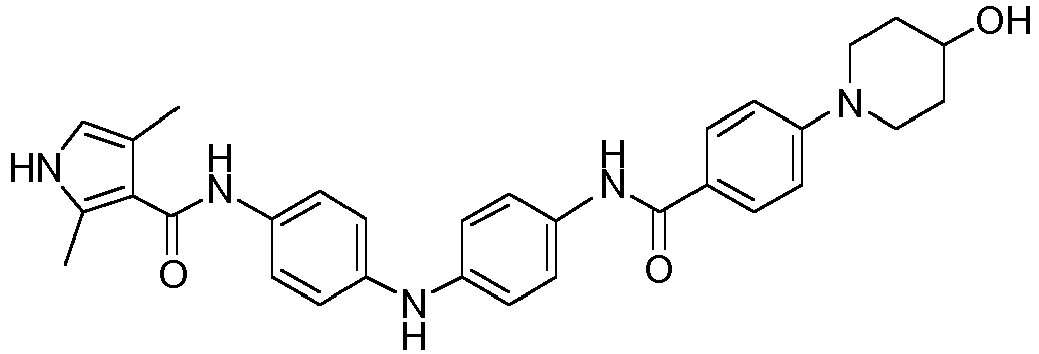
- Compound 841 was prepared according to the procedure described in Scheme IV from 4,4'-diaminodiphenylamine, 2,4-dimethyl-1H-pyrrole-3-carboxylic, and 4-(4-hydroxypiperidin-1-yl)benzoic acids. [M+H]+ calcd for C31H33N5O3: 524.26; found 524.03.
-

- Compound 842 was prepared according to the procedure described in Scheme IV from 4,4'-diaminodiphenylamine, 1-(2-hydroxyethyl)-1H-pyrrole-2-carboxylic, and 4-(4-hydroxypiperidin-1-yl)benzoic acids. [M+H]+ calcd for C31H33N5O4: 540.25; found: 540.03.
-

- Compound 843 was prepared according to the procedure described in Scheme IV from N1 -(4-aminophenyl)-2-fluorobenzene-1,4-diamine, 1-ethyl-1H-pyrrole-2-carboxylic, and 4-(4-hydroxypiperidin-1-yl)benzoic acids. [M+H]+ calcd for C31H32FN5O3: 542.25; found: 542.06.
-

- Compound 844 was prepared according to the procedure described in Scheme IV from N1 -(4-aminophenyl)-2-fluorobenzene-1,4-diamine, 1-methyl-1H-indole-2-carboxylic, and 4-(4-hydroxypiperidin-1-yl)benzoic acids. [M+H]+ calcd for C34H32FN5O3: 578.25; found 578.11.
-

- Compound 845 was prepared according to the procedure described in Scheme IV from N1 -(4-aminophenyl)-2-fluorobenzene-1,4-diamine, 1-methyl-1H-indole-5-carboxylic, and 4-(4-hydroxypiperidin-1-yl)benzoic acids. [M+H]+ calcd for C34H32FN5O3: 578.25; found 578.11.
-

- Compound 846 was prepared according to the procedure described in Scheme IV from N1 -(4-aminophenyl)-2-chlorobenzene-1,4-diamine, 1-methyl-1H-indole-2-carboxylic, and 4-(4-hydroxypiperidin-1-yl)benzoic acids. [M+H]+ calcd for C34H32ClN5O3: 594.22; found 594.11.
-

- Compound 847 was prepared according to the procedure described in Scheme IV from N1 -(4-aminophenyl)-2-chlorobenzene-1,4-diamine, 1-methyl-1H-indole-5-carboxylic, and 4-(4-hydroxypiperidin-1-yl)benzoic acids. [M+H]+ calcd for C34H32ClN5O3: 594.22; found 594.11.
-

- Compound 848 was prepared according to the procedure described in Scheme IV from N1 -(4-aminophenyl)-2-cyanobenzene-1,4-diamine, 1-ethyl-1H-pyrrole-2-carboxylic, and 4-(4-hydroxypiperidin-1-yl)benzoic acids. [M+H]+ calcd for C32H32N6O3: 549.25; found: 549.08.
-

- Compound 849 was prepared according to the procedure described in Scheme IV from N1 -(4-aminophenyl)-2-methylbenzene-1,4-diamine, 1-methyl-1H-pyrrole-2-carboxylic, and 4-(4-hydroxypiperidin-1-yl)benzoic acids. [M+H]+ calcd for C31H33N5O3: 524.26; found 524.03.
-

- Compound 850 was prepared according to the procedure described in Scheme IV from N1 -(4-aminophenyl)-3-methylbenzene-1,4-diamine, 1-methyl-1H-pyrrole-2-carboxylic, and 4-(4-hydroxypiperidin-1-yl)benzoic acids. [M+H]+ calcd for C31H33N5O3: 524.26; found 524.03.
-

- Compound 851 was prepared according to the procedure described in Scheme IV from N1 -(4-aminophenyl)-2-methylbenzene-1,4-diamine, 1-ethyl-1H-pyrrole-2-carboxylic, and 4-(4-hydroxypiperidin-1-yl)benzoic acids. 1H NMR (400 MHz, Acetone-d6 ) δ 9.09 (s, 1H), 8.95 (s, 1H), 7.89 (d, J = 9.0 Hz, 2H), 7.66 (m, 3H), 7.54 (dd. J = 2.4, 8.6 Hz, 1H), 7.16 (d, J = 8.6 Hz, 1H), 6.99 (m, 3H), 6.94 (dd, J = 2.6, 4.0 Hz, 1H), 6.89 (d, J = 9.0 Hz, 2H), 6.57 (s, 1H), 6.09 (dd, J = 2.6, 4.0 Hz, 1H), 4.46 (q, J = 7.1 Hz, 2H), 3.85 (m, 1H), 3.75 (dt, J = 4.4, 13 Hz, 2H), 3.08 (ddd, J= 3.2, 9.8, 13.0 Hz, 2H), 2.26 (s, 3H), 1.93 (m, 2H), 1.60 (m, 2H), 1.39 (t, J = 7.1 Hz, 3H).
-

- Compound 852 was prepared according to the procedure described in Scheme IV from N1 -(4-aminophenyl)-2-cyanobenzene-1,4-diamine, 1-methyl-1H-pyrrole-3-carboxylic, and 4-(4-hydroxypiperidin-1-yl)benzoic acids. [M+H]+ calcd for C31H30N6O3: 535.25; found: 535.04.
-

- Compound 853 was prepared according to the procedure described in Scheme IV from N1 -(4-aminophenyl)-2-cyanobenzene-1,4-diamine, 1-methyl-1H-pyrrole-3-carboxylic, and 4-(4-hydroxypiperidin-1-yl)benzoic acids. [M+H]+ calcd for C31H30N6O3: 535.25; found: 535.04.
-

- Compound 854 was prepared according to the procedure described in Scheme IV from 4,4'-diaminodiphenylamine, 1-methyl-1H-pyrrole-3-carboxylic, and (R)-4-(3-hydroxypyrrolidin-1-yl)benzoic acids. [M+H]+ calcd for C29H29N5O3: 496.23; found: 495.95.
-

- Compound 855 was prepared according to the procedure described in Scheme IV from 4,4'-diaminodiphenylamine, 4,5-dimethyl-1H-pyrrole-3-carboxylic, and 4-(4-hydroxypiperidin-1-yl)benzoic acids. [M+H]+ calcd for C31H33N5O3: 524.26; found: 524.03.
-
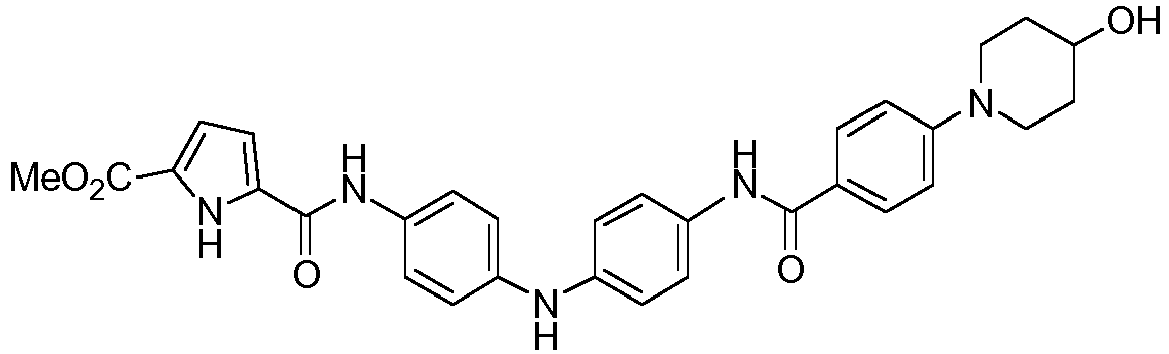
- Compound 856 was prepared according to the procedure described in Scheme IV from 4,4'-diaminodiphenylamine, 5-methoxycarbonyl-1H-pyrrole-2-carboxylic, and 4-(4-hydroxypiperidin-1-yl)benzoic acids. [M+H]+ calcd for C31H31N5O5: 554.13; found: 554.07.
-

- Compound 857 was prepared according to the procedure described in Scheme IV from N1 -(4-aminophenyl)-2-fluorobenzene-1,4-diamine, 1-methyl-1H-pyrrole-3-carboxylic, and (R)-4-(3-hydroxypyrrolidin-1-yl)benzoic acids. [M+H]+ calcd for C29H28FN5O3: 514.22; found: 513.98.
-

- Compound 858 was prepared according to the procedure described in Scheme IV from 4,4'-diaminodiphenylamine, 4-methoxymethyl-1-methyl-1H-pyrrole-2-carboxylic, and 4-(4-hydroxypiperidin-1-yl)benzoic acids. [M+H]+ calcd for C32H36N5O4: 554.28; found: 554.07.
-

- Compound 859 was prepared according to the procedure described in Scheme IV from N1 -(4-aminophenyl)-2-fluorobenzene-1,4-diamine, 1-methyl-1H-pyrrole-3-carboxylic, and 4-(4-hydroxypiperidin-1-yl)benzoic acids. [M+H]+ calcd for C30H30FN5O3: 528.23; found 528.02.
-

- Compound 860 was prepared according to the procedure described in Scheme IV from N1 -(4-aminophenyl)-2-fluorobenzene-1,4-diamine, 1H-pyrrole-3-carboxylic, and 4-(4-hydroxypiperidin-1-yl)benzoic acids. [M+H]+ calcd for C29H28FN5O3: 514.22; found 513.98.
-

- Compound 861 was prepared according to the procedure described in Scheme IV from N1 -(4-aminophenyl)-2-fluorobenzene-1,4-diamine and 1H-pyrrole-3-carboxylic acid. [M+H]+ calcd for C23H20FN5O2: 418.16; found 417.88.
-
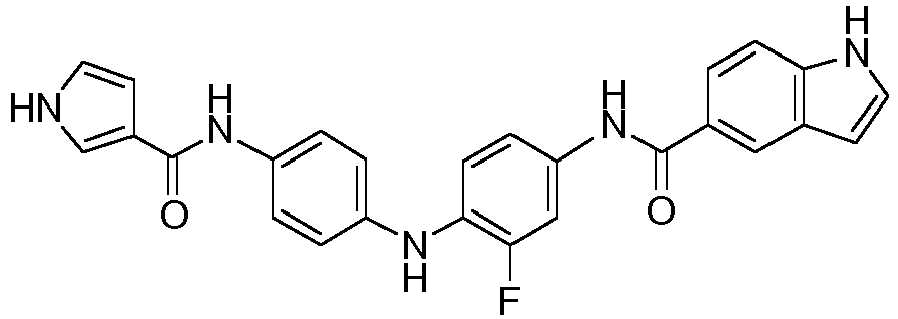
- Compound 862 was prepared according to the procedure described in Scheme IV from N1 -(4-aminophenyl)-2-fluorobenzene-1,4-diamine, 1H-indole-5-carboxylic, and 1H-pyrrole-3-carboxylic acids. [M+H]+ calcd for C26H20FN5O2: 454.16; found 453.91.
-

- Compound 863 was prepared according to the procedure described in Scheme IV from 4,4'-diaminodiphenylamine, 4-dimethylaminobenzoic, and 1H-pyrrole-3-carboxylic acids. [M+H]+ calcd for C26H25N5O2: 440.20; found 439.94.
-

- Compound 865 was prepared according to the procedure described in Scheme IV from 4,4'-diaminodiphenylamine, 4-aminobenzoic, and 1H-pyrrole-3-carboxylic acids.
[M+H]+ calcd for C29H24N6O3: 505.19; found 504.93. -

- Compound 866 was prepared according to the procedure described in Scheme IV from 4,4'-diaminodiphenylamine, 2,4-dimethyl-1H-pyrrole-3-carboxylic, and (R)-4-(3-hydroxypyrrolidin-1-yl)benzoic acids. [M+H]+ calcd for C30H31N5O3: 510.24; found: 509.99.
-

- Compound 867 was prepared according to the procedure described in Scheme IV from 4,4'-diaminodiphenylamine, 5-methyl-1H-pyrrole-3-carboxylic, and 4-(4-hydroxypiperidin-1-yl)benzoic acids. [M+H]+ calcd for C30H31N5O3: 510.24; found: 509.99.
-

- Compound 868 was prepared according to the procedure described in Scheme IV from N1 -(4-aminophenyl)-2-cyanobenzene-1,4-diamine, 1-ethyl-1H-pyrrole-2-carboxylic, and 4-(4-hydroxypiperidin-1-yl)benzoic acids. [M+H]+ calcd for C32H32N6O3: 549.25; found: 549.08.
-

- Compound 869 was prepared according to the procedure described in Scheme IV from N1 -(4-aminophenyl)-2-cyanobenzene-1,4-diamine, 1H-pyrrole-3-carboxylic, and 4-(4-hydroxypiperidin-1-yl)benzoic acids. [M+H]+ calcd for C30H28N6O3: 521.22; found: 521.00.
-

- Compound 870 was prepared according to the procedure described in Scheme IV from N1 -(4-aminophenyl)-2-fluorobenzene-1,4-diamine, 2,4-dimethyl-1H-pyrrole-3-carboxylic, and 4-(4-hydroxypiperidin-1-yl)benzoic acids. [M+H]+ calcd for C31H32FN5O3: 542.25; found 542.06.
-

- Compound 871 was prepared according to the procedure described in Scheme IV from N1 -(4-aminophenyl)-2-chlorobenzene-1,4-diamine, 1H-pyrrole-3-carboxylic, and 4-(4-hydroxypiperidin-1-yl)benzoic acids. [M+H]+ calcd for C29H28ClN5O3: 530.19; found 529.97.
-

- Compound 872 was prepared according to the procedure described in Scheme IV from N1 -(4-aminophenyl)-2-chlorobenzene-1,4-diamine, 1-methyl-1H-pyrrole-3-carboxylic, and 4-(4-hydroxypiperidin-1-yl)benzoic acids. [M+H]+ calcd for C30H30ClN5O3: 544.20; found 544.02.
-

- Compound 873 was prepared according to the procedure described in Scheme IV from N1 -(4-aminophenyl)-2-chlorobenzene-1,4-diamine, 1-methyl-1H-pyrazole-4-carboxylic, and 4-(4-hydroxypiperidin-1-yl)benzoic acids. [M+H]+ calcd for C29H29ClN6O3: 545.20; found 544.96.
-

- Compound 874 was prepared according to the procedure described in Scheme IV from N1 -(4-aminophenyl)-2-fluorobenzene-1,4-diamine, 1-methyl-1H-pyrazole-5-carboxylic, and 4-(4-hydroxypiperidin-1-yl)benzoic acids. [M+H]+ calcd for C29H29FN6O3: 529.23; found 529.03.
-

- Compound 875 was prepared according to the procedure described in Scheme IV from N1 -(4-aminophenyl)-2-chlorobenzene-1,4-diamine, 1-methyl-1H-pyrazole-5-carboxylic, and 4-(4-hydroxypiperidin-1-yl)benzoic acids. [M+H]+ calcd for C29H29ClN6O3: 545.20; found 544.96.
-

- Compound 876 was prepared according to the procedure described in Scheme IV from N1 -(4-aminophenyl)-2-fluorobenzene-1,4-diamine, 1-methyl-1H-pyrazole-4-carboxylic, and 4-(4-hydroxypiperidin-1-yl)benzoic acids. [M+H]+ calcd for C29H29FN6O3: 529.23; found 529.03.
-

- Compound 877 was prepared according to the procedure described in Scheme IV from N1 -(4-aminophenyl)-2-methylbenzene-1,4-diamine, 1-methyl-1H-pyrrole-2-carboxylic, and 4-(4-hydroxypiperidin-1-yl)benzoic acids. [M+H]+ calcd for C31H33N5O3: 524.26; found 524.03.
-

- Compound 878 was prepared according to the procedure described in Scheme IV from N1 -(4-aminophenyl)-2-cyanobenzene-1,4-diamine, 1H-pyrrole-3-carboxylic, and 4-(4-hydroxypiperidin-1-yl)benzoic acids. [M+H]+ calcd for C30H28N6O3: 521.22; found: 521.00.
-

- Compound 879 was prepared according to the procedure described in Scheme IV from N1 -(4-aminophenyl)-2-chlorobenzene-1,4-diamine, 1-ethyl-1H-pyrrole-2-carboxylic, and 4-(4-hydroxypiperidin-1-yl)benzoic acids. [M+H]+ calcd for C31H32ClN5O3: 558.22; found 558.06.
-

- Compound 880 was prepared according to the procedure described in Scheme IV from N1 -(4-aminophenyl)-2-chlorobenzene-1,4-diamine, 1H-indole-5-carboxylic, and 4-(4-hydroxypiperidin-1-yl)benzoic acids. [M+H]+ calcd for C33H30ClN5O3: 580.20; found 580.00.
-

- Compound 881 was prepared according to the procedure described in Scheme IV from N1 -(4-aminophenyl)-2-fluorobenzene-1,4-diamine, 1H-pyrrole-3-carboxylic, and 4-(4-ethoxypiperidin-1-yl)benzoic acids. [M+H]+ calcd for C31H32FN5O3: 542.25; found: 542.06.
-

- Compound 882 was prepared according to the procedure described in Scheme IV from N1 -(4-aminophenyl)-2-fluorobenzene-1,4-diamine, 1-methyl-1H-pyrazole-5-carboxylic, and 4-(4-ethoxypiperidin-1-yl)benzoic acids. [M+H]+ calcd for C31H33FN6O3: 557.26; found: 557.11.
-

- Compound 883 was prepared according to the procedure described in Scheme IV from N2 -(4-aminophenyl)pyridine-2,5-diamine, 1-methyl-1H-pyrrole-3-carboxylic, and 4-(4-hydroxypiperidin-1-yl)benzoic acids. [M+H]+ calcd for C29H30N6O3: 511.24; found 511.01.
-

- Compound 884 was prepared according to the procedure described in Scheme IV from N2 -(4-aminophenyl)pyridine-2,5-diamine, 1-methyl-1H-pyrrole-3-carboxylic, and 4-(4-hydroxypiperidin-1-yl)benzoic acids. [M+H]+ calcd for C29H30N6O3: 511.24; found 511.01.
-

- Compound 885 was prepared according to the procedure described in Scheme IV from N1 -(4-aminophenyl)-2-cyanobenzene-1,4-diamine, 1H-pyrrole-3-carboxylic, and 4-(4-trifluoromethylpiperidin-1-yl)benzoic acids. [M+H]+ calcd for C31H27F3N6O2: 573.21; found: 573.05.
-

- Compound 886 was prepared according to the procedure described in Scheme IV from N1 -(4-aminophenyl)-2-fluorobenzene-1,4-diamine, 4-methyl-1H-pyrrole-3-carboxylic, and 4-(4-hydroxypiperidin-1-yl)benzoic acids. [M+H]+ calcd for C30H30FN5O3: 528.24; found: 528.02.
-

- Compound 887 was prepared according to the procedure described in Scheme IV from N1 -(4-aminophenyl)-2-fluorobenzene-1,4-diamine, 5-methyl-1H-pyrrole-3-carboxylic, and 4-(4-hydroxypiperidin-1-yl)benzoic acids. [M+H]+ calcd for C30H30FN5O3: 528.24; found: 528.08.
-

- Compound 888 was prepared according to the procedure described in Scheme IV from N1 -(4-aminophenyl)-2-fluorobenzene-1,4-diamine, 1H-indole-5-carboxylic, and 4-(4-hydroxypiperidin-1-yl)benzoic acids. [M+H]+ calcd for C33H30FN5O3: 564.23; found 564.07.
-

- Compound 889 was prepared according to the procedure described in Scheme IV from N1 -(4-aminophenyl)-2-cyanobenzene-1,4-diamine, 1H-indole-5-carboxylic, and 4-(4-hydroxypiperidin-1-yl)benzoic acids. [M+H]+ calcd for C34H30N6O3: 571.25; found: 571.02.
-

- Compound 890 was prepared according to the procedure described in Scheme IV from N1 -(4-aminophenyl)-2-cyanobenzene-1,4-diamine, 1-methyl-1H-pyrazole-5-carboxylic, and 4-(4-hydroxypiperidin-1-yl)benzoic acids. [M+H]+ calcd for C30H29N7O3: 536.24; found: 536.05.
-

- Compound 891 was prepared according to the procedure described in Scheme IV from 4,4'-diaminodiphenylamine, 1,3-dimethyl-1H-pyrazole-4-carboxylic, and 4-(4-hydroxypiperidin-1-yl)benzoic acids. [M+H]+ calcd for C30H32N6O3: 525.25; found 525.05.
-

- Compound 892 was prepared according to the procedure described in Scheme IV from N1 -(4-aminophenyl)-2-fluorobenzene-1,4-diamine, 1,3-dimethyl-1H-pyrazole-4-carboxylic, and 4-(4-hydroxypiperidin-1-yl)benzoic acids. [M+H]+ calcd for C30H31FN6O3: 543.24; found 543.07.
-

- Compound 893 was prepared according to the procedure described in Scheme IV from 4,4'-diaminodiphenylamine, 1,5-dimethyl-1H-pyrazole-4-carboxylic, and 4-(4-hydroxypiperidin-1-yl)benzoic acids. [M+H]+ calcd for C30H32N6O3: 525.25; found 525.05.
-

- Compound 894 was prepared according to the procedure described in Scheme IV from N1 -(4-aminophenyl)-2-fluorobenzene-1,4-diamine, 1,5-dimethyl-1H-pyrazole-4-carboxylic, and 4-(4-hydroxypiperidin-1-yl)benzoic acids. [M+H]+ calcd for C30H31FN6O3: 543.24; found 543.07.
-

- Compound 895 was prepared according to the procedure described in Scheme IV from N1 -(4-aminophenyl)-2-chlorobenzene-1,4-diamine, 1,5-dimethyl-1H-pyrazole-4-carboxylic, and 4-(4-hydroxypiperidin-1-yl)benzoic acids. [M+H]+ calcd for C30H31ClN6O3: 559.21; found 559.00.
-

- Compound 896 was prepared according to the procedure described in Scheme IV from N1 -(4-aminophenyl)-2-chlorobenzene-1,4-diamine, 1,3-dimethyl-1H-pyrazole-4-carboxylic, and 4-(4-hydroxypiperidin-1-yl)benzoic acids. [M+H]+ calcd for C30H31ClN6O3: 559.21; found 559.00.
-

- Compound 897 was prepared according to the procedure described in Scheme IV from 4,4'-diaminodiphenylamine, 3,5-dimethyl-1H-pyrazole-4-carboxylic, and 4-(4-hydroxypiperidin-1-yl)benzoic acids. [M+H]+ calcd for C30H32N6O3: 525.25; found 525.05.
-

- Compound 898 was prepared according to the procedure described in Scheme IV from N1 -(4-aminophenyl)-2-fluorobenzene-1,4-diamine, 1-methyl-1H-pyrazole-5-carboxylic, and 4-(4-hydroxypiperidin-1-yl)benzoic acids. [M+H]+ calcd for C29H29FN6O3: 529.23; found: 529.03.
-

- Compound 899 was prepared according to the procedure described in Scheme IV from 4,4'-diaminodiphenylamine, 1,4,5,6-tetrahydrocyclopenta[c]pyrazole-3-carboxylic, and 4-(4-hydroxypiperidin-1-yl)benzoic acids. [M+H]+ calcd for C31H32N6O3: 537.25; found 537.06.
-

- Compound 900 was prepared according to the procedure described in Scheme IV from 4,4'-diaminodiphenylamine, 1-ethyl-5-methyl-1H-pyrrole-2-carboxylic, and 4-(4-hydroxypiperidin-1-yl)benzoic acids. [M+H]+ calcd for C32H35N5O3: 538.27; found: 538.08.
-

- Compound 901 was prepared according to the procedure described in Scheme IV from 4,4'-diaminodiphenylamine, 5-hydroxymethyl-1H-pyrrole-2-carboxylic, and 4-(4-hydroxypiperidin-1-yl)benzoic acids. [M+H]+ calcd for C32H33N5O5: 568.16; found: 568.05.
-

- Compound 902 was prepared according to the procedure described in Scheme IV from 4,4'-diaminodiphenylamine, 5-methoxycarbonyl-1H-pyrrole-3-carboxylic, and 4-(4-hydroxypiperidin-1-yl)benzoic acids. [M+H]+ calcd for C30H31N5O4: 526.12; found: 526.06.
-

- Compound 903 was prepared according to the procedure described in Scheme IV from 4,4'-diamino-2,2'-difluorodiphenylamine, 1H-pyrrole-2-carboxylic, and 4-(4-hydroxypiperidin-1-yl)benzoic acids. [M+H]+ calcd for C29H27F2N5O3: 532.21; found: 532.00.
-

- Compound 904 was prepared according to the procedure described in Scheme IV from 4,4'-diamino-2,2'-difluorodiphenylamine, 1-methyl-1H-pyrazole-5-carboxylic, and 4-(4-hydroxypiperidin-1-yl)benzoic acids. [M+H]+ calcd for C29H28F2N6O3: 547.22; found: 547.05.
-

- Compound 905 was prepared according to the procedure described in Scheme IV from 4,4'-diamino-2,2'-difluorodiphenylamine, 1H-pyrrole-3-carboxylic, and 4-(4-hydroxypiperidin-1-yl)benzoic acids. [M+H]+ calcd for C29H27F2N5O3: 532.21; found 532.00.
-

- Compound 906 was prepared according to the procedure described in Scheme IV from N1 -(4-aminophenyl)-2-fluorobenzene-1,4-diamine, 5-methyl-1H-pyrrole-3-carboxylic, and 4-(4-hydroxypiperidin-1-yl)benzoic acids. [M+H]+ calcd for C30H30FN5O3: 528.23; found: 528.02.
-

- Compound 907 was prepared according to the procedure described in Scheme IV from N1 -(4-aminophenyl)-2-fluorobenzene-1,4-diamine, 4-methyl-1H-pyrrole-3-carboxylic, and 4-(4-hydroxypiperidin-1-yl)benzoic acids. [M+H]+ calcd for C30H30FN5O3: 528.23; found: 528.02.
-
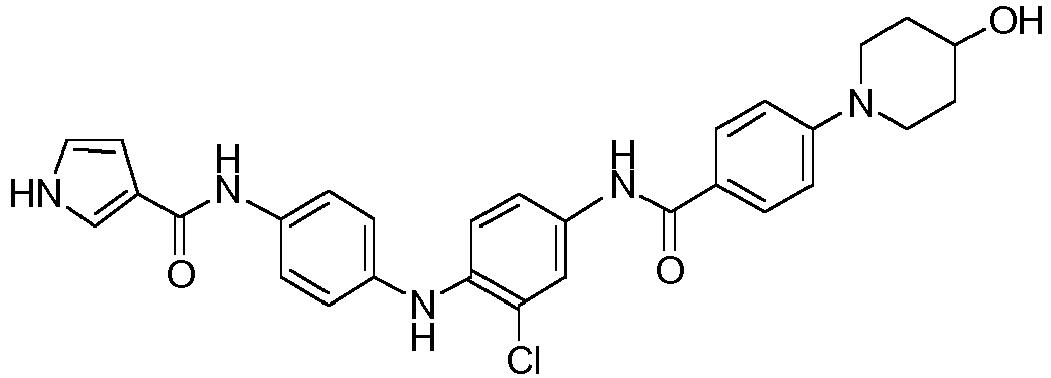
- Compound 908 was prepared according to the procedure described in Scheme IV from N1 -(4-aminophenyl)-2-chlorobenzene-1,4-diamine, 1H-pyrrole-3-carboxylic, and 4-(4-hydroxypiperidin-1-yl)benzoic acids. [M+H]+ calcd for C29H28ClN5O3: 530.19; found 529.97.
-

- Compound 909 was prepared according to the procedure described in Scheme IV from N1 -(4-aminophenyl)-2-chlorobenzene-1,4-diamine, 1-methyl-1H-pyrrole-3-carboxylic, and 4-(4-hydroxypiperidin-1-yl)benzoic acids. [M+H]+ calcd for C30H30ClN5O3: 544.20; found 544.02.
-

- Compound 910 was prepared according to the procedure described in Scheme IV from 4,4'-diamino-2,2'-difluorodiphenylamine and 4-(4-hydroxypiperidin-1-yl)benzoic acid. [M+H]+ calcd for C36H37F2N5O4: 642.28; found 642.12
-

- Compound 911 was prepared according to the procedure described in Scheme IV from N1 -(4-aminophenyl)-2-fluorobenzene-1,4-diamine, 1H-pyrrole-3-carboxylic, and 4-(4,4-difluoropiperidin-1-yl)benzoic acids. 1H NMR (400 MHz, Acetone-d6 ) δ 10.54 (s, 1H), 9.39 (s, 1H), 8.88 (s, 1H), 7.92 (m, 3H), 7.69 (d, J = 8.8 Hz, 2H), 7.54 (m, 1H), 7.43 (d, J = 8.8 Hz, 1H), 7.25 (t, J = 9.2 Hz, 1H), 7.07 (t, J = 8.8 Hz, 4H), 6.91 (s, 1H), 6.85 (q, J = 2.3 Hz, 1H), 6.71 (q, J = 1.6 Hz, 1H), 3.55 (t, J = 5.8 Hz, 4H), 2.11 (m, 4H).
-

- Compound 912 was prepared according to the procedure described in Scheme IV from N1 -(4-aminophenyl)-2-fluorobenzene-1,4-diamine, 1H-indole-5-carboxylic, and 4-(4-hydroxypiperidin-1-yl)benzoic acids. [M+H]+ calcd for C33H30FN5O3: 564.23; found 564.07.
-

- Compound 913 was prepared according to the procedure described in Scheme IV from N1 -(4-aminophenyl)-2-fluorobenzene-1,4-diamine, 1,4,5-trimethyl-1H-pyrrole-3-carboxylic, and 4-(4-hydroxypiperidin-1-yl)benzoic acids. [M+H]+ calcd for C32H34FN5O3: 556.26; found: 556.03.
- The primary testing for the examplfied compounds was performed in UT7/EPO Cell line. UT7/EPO is human leukemia cell line, obtained from Dr. Norio Komatsu (Blood, Vol 82 (2), pp 456-464, 1993). These cells express endogenous EPO receptor and are dependant upon EPO for growth and proliferation. Briefely, the cells were starved of EPO overnight and plated in 96 or 384 well plates. The compounds were added to the cells at 10 uM concentration. The plates were then incubated at 37 °C for 72 hours. The proliferative effect of the compounds was measured by a commercially available kit from Lonza (ViaLight Plus). The activities of the selected compounds are listed in the following table.
Table 2 Compound Activity (%) Compound Activity (%) Compound Activity (%) 590 12 775 22 815 17 860 17
Claims (4)
- A compound of Formula VIIIaa:
 A-J is
 each E is separately selected from the group consisting of -CR10a- and N (nitrogen);each R10a is separately selected from the group consisting of H (hydrogen), halogen, cyano, C1-C6 alkyl optionally substituted with up to five fluoro, C1-C6 alkoxy optionally substituted with up to five fluoro, C2-C6 alkenyl optionally substituted with up to five fluoro, C2-C6 alkynyl optionally substituted with up to five fluoro, C3-C7 cycloalkyl optionally substituted with up to five fluoro, and C3-C7 cycloalkenyl optionally substituted with up to five fluoro;A4 is selected from the group consisting of phenyl and heteroaryl, where at least one atom forming the heteroaryl aromatic ring is a N (nitrogen), and said phenyl and heteroaryl are each optionally substituted with one or more substituents selected from the group consisting of R1, R2, and R3;G4 is selected from the group consisting of aryl, and heteroaryl, each optionally substituted with one or more substituents selected from the group consisting of R4 , R5, and R6;each RB is separately selected from the group consisting of hydrogen, an optionally substituted C1-C6 alkyl, an optionally substituted C2-C6 alkenyl, and an optionally substituted C3-C7 cycloalkyl;RG is selected from the group consisting of C1-C6 alkyl, C3-C6 cycloalkyl, C3-C8 cycloalkenyl, C1-C6 heteroalkyl, C1-C6 heteroalkenyl, C1-C6 heteroalkynyl, heterocycle, aryl, and heteroaryl, each optionally substituted with one or more substituents selected from the group consisting of R4 , R5, and R6, said aryl and heteroaryl in the definition of RG are each further optionally fused with an optionally substituted nonaromatic heterocycle or an optionally substituted nonaromatic carbocycle, or RG is -ORL or -NRPRL ;RH is selected from the group consisting of hydrogen, C1-C6 alkyl, C2-C6 alkenyl, C3-C7 cycloalkyl, and C1-C3 haloalkyl;each R1 is separately selected from the group consisting of halogen, cyano, an optionally substituted C1-C6 alkyl, an optionally substituted C1-C6 alkoxy, an optionally substituted C2-C6 alkenyl, an optionally substituted C2-C6 alkynyl, an optionally substituted C3-C7 cycloalkyl, optionally substituted C3-C7 cycloalkenyl, an optionally substituted C1-C6 haloalkyl, an optionally substituted C1-C6 heteroalkyl, an optionally substituted aryl, and an optionally substituted heteroaryl;each R2 is separately selected from the group consisting of halogen, -O(CH2) m ORI , -(CH2) m ORI , -NRJRK , -(CH2) m SRI , -C(=O)RL , -(CH2) mRL , an optionally substituted C1-C6 alkyl, an optionally substituted C1-C6 alkoxy, an optionally substituted C2-C6 alkenyl, an optionally substituted C1-C6 haloalkyl, an optionally substituted C1-C6 heteroalkyl, and an optionally substituted C3-C7 cycloalkyl where said C3-C7 cycloalkyl is further optionally fused with aryl or heteroaryl;each R3 is separately selected from the group consisting of halogen, -(CH2) m ORG , -NRL C(=O)RM , -NRL C(=O)ORM , -NRL C(=O)NRNRO , -NRNRO , -(CH2) m S(O)0-2 RM , -(CH2) m NHS(O)0-2 RM , -(CH2) m NO2, -(CH2) m CN, -(CH2) mRP , C1-C6 alkyl C1-C6 alkoxy, C2-C6 alkenyl, C2-C6 alkynyl, C3-C7 cycloalkyl, C1-C6 haloalkyl, heterocycle, aryl, polycyclic heterocyclyl, and heteroaryl, said heterocycle, aryl polycyclic heterocyclyl, and heteroaryl in the definition of R3 are each optionally substituted with halogen, hydroxy, cyano, C1-C6 alkyl, C1-C6 haloalkyl, C1-C6 alkoxy, -C(=O)ORM , or -NRJRK ;each R4 is separately selected from the group consisting of halogen, cyano, an optionally substituted C1-C6 alkyl, an optionally substituted C1-C6 alkoxy, an optionally substituted C2-C6 alkenyl, an optionally substituted C2-C6 alkynyl, an optionally substituted C3-C7 cycloalkyl, an optionally substituted C1-C6 haloalkyl, an optionally substituted C1-C6 heteroalkyl, an optionally substituted aryl, and an optionally substituted heteroaryl;each R5 is separately selected from the group consisting of halogen, -O(CH2) m ORI , -(CH2) m ORI , -NRJRK , -(CH2) m SRI , -(CH2) m C(=O)RL , -(CH2) mRL , an optionally substituted C1-C6 alkyl, an optionally substituted C1-C6 alkoxy, an optionally substituted C2-C6 alkenyl, an optionally substituted C3-C7 cycloalkyl, an optionally substituted C1-C6 haloalkyl, and an optionally substituted C1-C6 heteroalkyl;each R6 is separately selected from the group consisting of halogen, -NRL C(=O)RM , -NRL C(=O)ORM , -NRL C(=O)NRNRO , -NRNRO , -(CH2) m S(O)0-2 RM , -(CH2) m NHS(O)0-2 RM , -(CH2) m NO2, -(CH2) m CN, -(CH2) mRP , C1-C6 alkyl, C1-C6 alkoxy, C2-C6 alkenyl, C2-C6 alkynyl, C3-C7 cycloalkyl, C1-C6 haloalkyl, C1-C6 heteroalkyl, heterocycle, aryl, polycyclic heterocyclyl, and heteroaryl, said heterocycle, aryl, polycyclic heterocyclyl, and heteroaryl in the definition of R6 are each optionally substituted with halogen, cyano, C1-C6 alkyl, C1-C6 haloalkyl, C1-C6 alkoxy, -C(=O)ORM , or -NRJRK ;each RI is separately selected from the group consisting of C1-C6 alkyl, C2-C4 alkenyl, C2-C4 alkynyl, C3-C7 cycloalkyl, C1-C6 haloalkyl, C1-C6 heteroalkyl, and C1-C6 heterohaloalkyl;each -NRJRK is separately selected, wherein RJ and RK are each independently selected from the group consisting of hydrogen, C1-C6 alkyl optionally substituted with up to 5 fluoro,-(CH2) m ORJA , -(CH2) m NRJBRJC , -(CH2) mRR , C3-C7 cycloalkyl, heterocycle, aryl and heteroaryl, said C3-C7 cycloalkyl, heterocycle, aryl and heteroaryl in the definition of RJ and RK are each independently optionally substituted with one or more substituents selected from the group consisting of halo, C1-C6 alkyl, C1-C6 haloalkyl, C1-C6 alkoxy, aryl and heteroaryl, said aryl and heteroaryl substituent off of RJ and RK are each optionally substituted with one or more halo, C1-C6 alkyl, C1-C6 haloalkyl, C1-C6 alkoxy, or -(CH2) m NRKARKB ; or -NRJRK is an optionally substituted non-aromatic heterocycle linked through a ring nitrogen atom;each RJA is independently selected from the group consisting of hydrogen, C1-C6 alkyl, and C1-C6 haloalkyl;each -NRJBRJC is separately selected, wherein RJB and RJC are each independently selected from the group consisting of hydrogen, C1-C6 alkyl, and C1-C6 haloalkyl;each -NRKARKB is separately selected, wherein RKA and RKB are each independently selected from the group consisting of hydrogen, C1-C6 alkyl, and C1-C6 haloalkyl;each RM is independently selected from the group consisting of hydrogen, an optionally substituted C1-C6 alkyl, an optionally substituted C2-C4 alkenyl, an optionally substituted C2-C4 alkynyl, an optionally substituted C3-C7 cycloalkyl, an optionally substituted C3-C7 cycloalkenyl, and-(CH2) mRP ;each -NRNRO is separately selected, wherein RN and RO are each independently selected from the group consisting of hydrogen, -(CH2) m NRNARNB , aryl and heteroaryl, said aryl and heteroaryl in the definition of RN and RO are each independently optionally substituted with one or more substituents selected from the group consisting of -(CH2) m NROAROB , halo, C1-C6 alkyl, C1-C6 haloalkyl, C1-C6 alkoxy, aryl and heteroaryl, said aryl and heteroaryl substituent off of RN and RO are each optionally substituted with one or more halo, C1-C6 alkyl, C1-C6 haloalkyl, C1-C6 alkoxy, or -NRNARNB ,each -NRNARNB is separately selected, wherein RNA and RNB are each independently selected from the group consisting of hydrogen, C1-C6 alkyl, and C1-C6 haloalkyl;each -NROAROB is separately selected, wherein ROA and ROB are each independently selected from the group consisting of hydrogen, C1-C6 alkyl, and C1-C6 haloalkyl;each RP is independently selected from the group consisting of hydrogen and C1-C6 alkyl;each RL is independently selected from the group consisting of C3-C7 cycloalkyl, optionally substituted C1-C6 alkyl, optionally substituted C1-C6 alkoxy, -(CH2) m ORLA , -(CH2) m NRLBRLC , aryl and heteroaryl, said aryl and heteroaryl in the definition of RL are each independently optionally substituted with one or more substituents selected from the group consisting of halo, C1-C6 alkyl, C1-C6 haloalkyl, C1-C6 alkoxy, -(CH2) m NRLDRLE , aryl and heteroaryl, said aryl and heteroaryl substituent off of RL are each optionally substituted with one or more halo, C1-C6 alkyl, C1-C6 haloalkyl, C1-C6 alkoxy, or -(CH2) m NRLFRLG ;each RLA is independently selected from the group consisting of hydrogen, C1-C6 alkyl, and C1-C6 haloalkyl;RLB and RLC are each independently selected from the group consisting of hydrogen, C1-C6 alkyl, C1-C6 haloalkyl, and C1-C6 heteroalkenyl, said C1-C6 alkyl, C1-C6 haloalkyl, and C1-C6 heteroalkenyl each optionally substituted with one or more halogen, cyano, or -(CH2) m C(=O)OH; or -NRLBRLC is an optionally substituted non-aromatic heterocycle linked through a ring nitrogen atom;each -NRLDRLE is separately selected, wherein RLD and RLE are each independently selected from the group consisting of hydrogen, aryl, heteroaryl, and optionally substituted C1-C6 alkyl, said aryl and heteroaryl in the definition of RLD and RLE are each optionally substituted with C1-C6 alkyl or C1-C6 alkoxy; or-NRLDRLE is an optionally substituted non-aromatic heterocycle linked through a ring nitrogen atom;each -NRLFRLG is separately selected, wherein RLF and RLG are each independently selected from the group consisting of hydrogen, and C1-C6 alkyl; or -NRLFRLG is an optionally substituted non-aromatic heterocycle linked through a ring nitrogen atom;RR is selected from the group consisting of C1-C6 alkyl, an optionally substituted aryl, and an optionally substituted heteroaryl; andeach m is independently 0, 1, 2, or 3;and wherein unless otherwise indicated, optionally substituted refers to a group in which none, one, or more than one of the hydrogen atoms has been replaced with one or more group(s) individually and independently selected from: alkyl, alkenyl, cycloalkenyl, alkynyl, heteroalkyl, haloalkyl, cycloalkyl, aryl, arylalkyl, alkenylO-, arylalkylO-, arylalkylNH-, alkenylO-, cycloalkylC(=O)-, arylC(=O)-, arylC(=O)NH-, arylNHC(=O)-, aryl(CH2)0-3O(CH2)0-3-, HO(CH2)1-3NH-, HO(CH2)1-3O-, HO(CH2)1-3-, HO(CH2)1-3O(CH2)1-3-, -C(=O)NHNH2, heteroaryl, heterocycle, hydroxy, alkoxy, aryloxy, mercapto, alkylthio, arylthio, cyano, halo, carbonyl, oxo, thiocarbonyl, O-carbamyl, N-carbamyl, O-thiocarbamyl, N-thiocarbamyl, C-amido, N-amido, S-sulfonamido, N-sulfonamido, C-carboxy, O-carboxy, isocyanato, thiocyanato, isothiocyanato, nitro, silyl, trihalomethanesulfonyl, and amino.
 - The compound of claim 1, having the structure of:


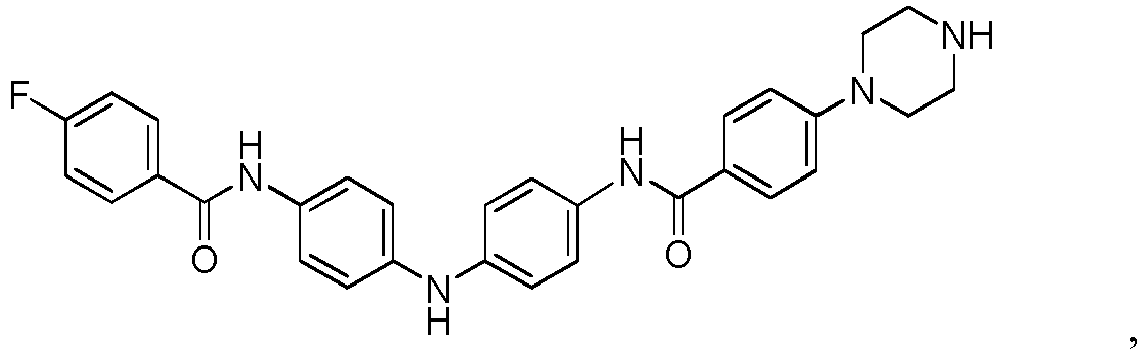


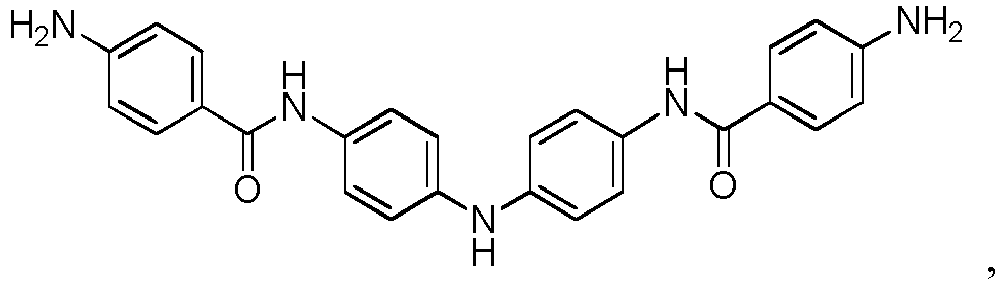


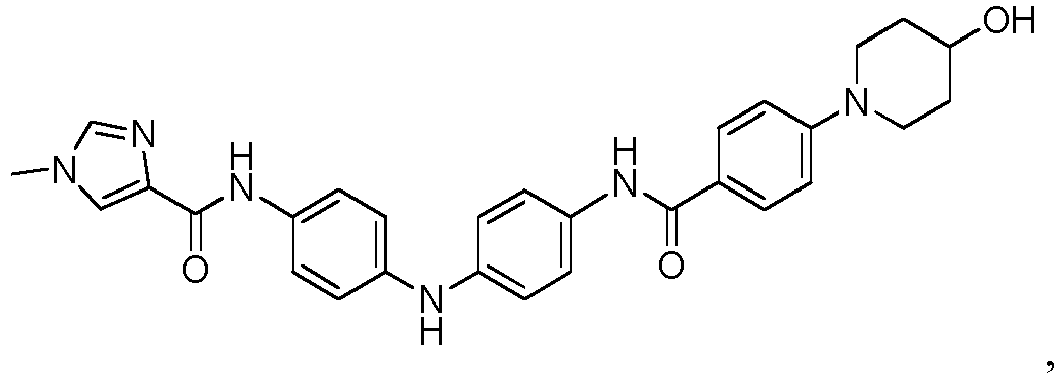


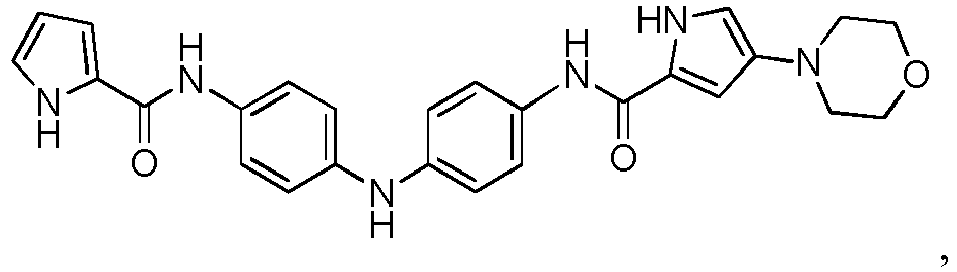

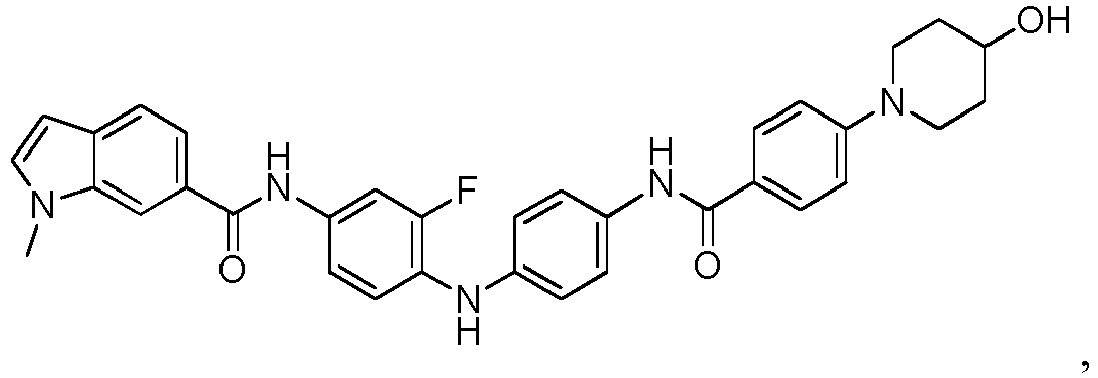


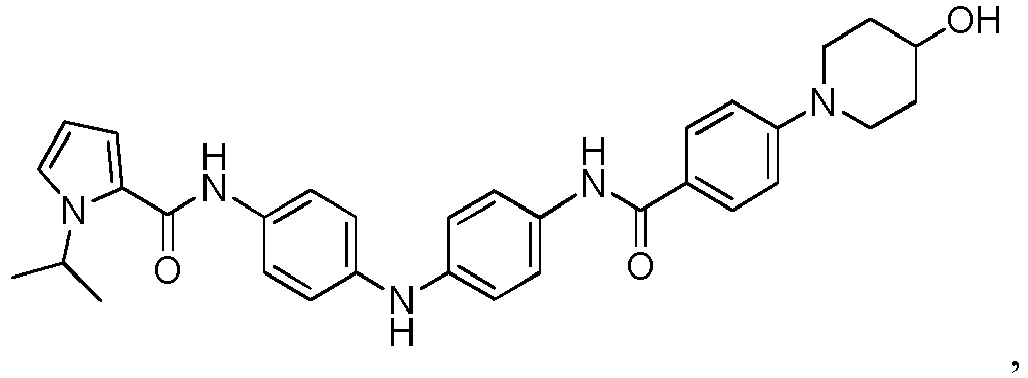


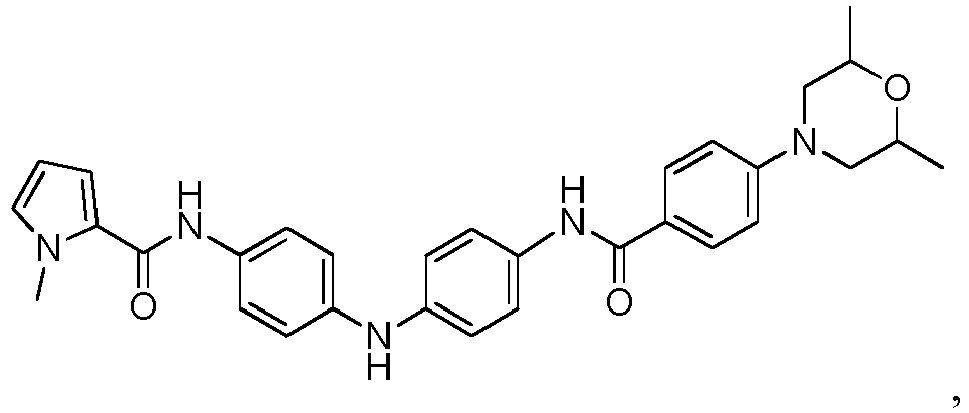


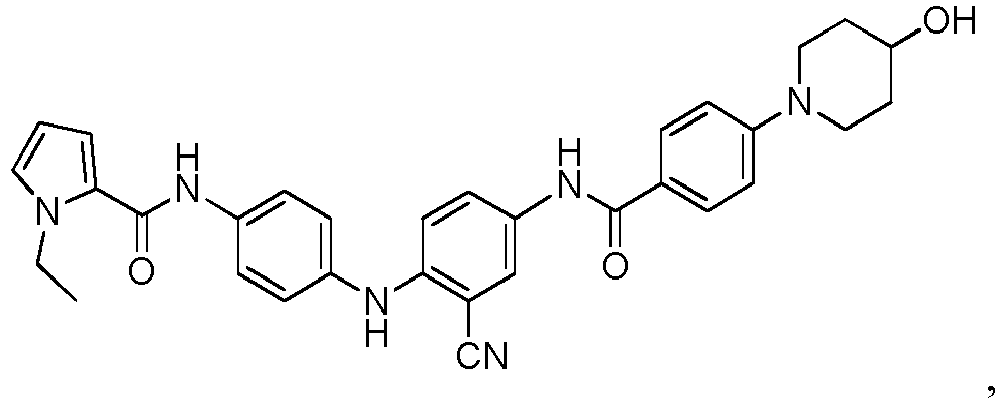


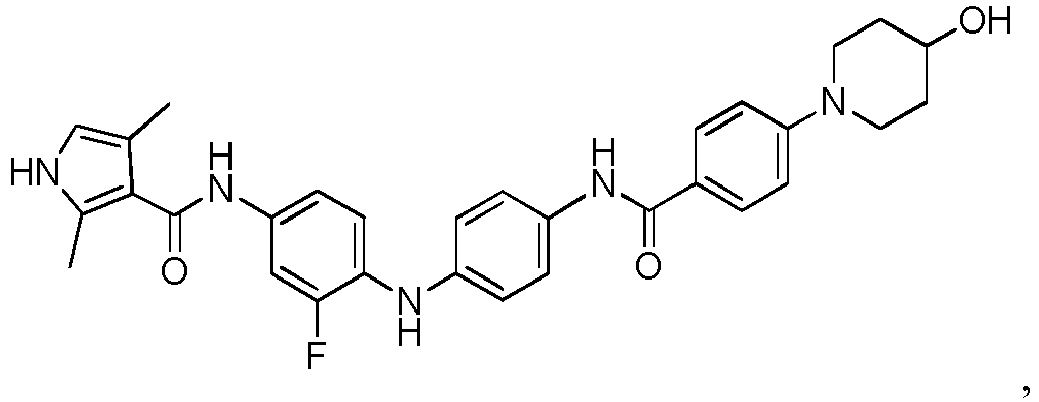
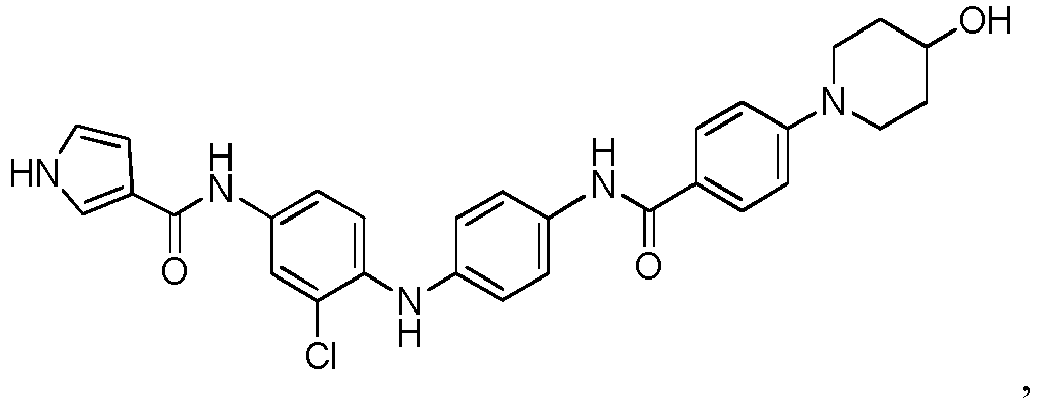


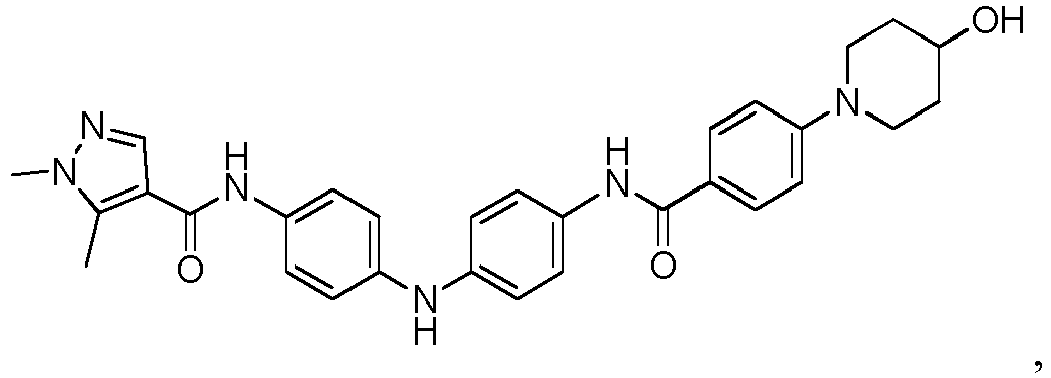


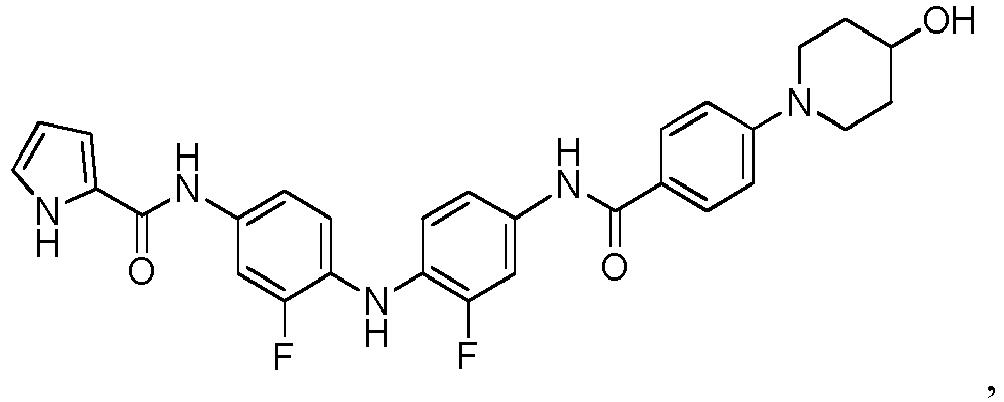


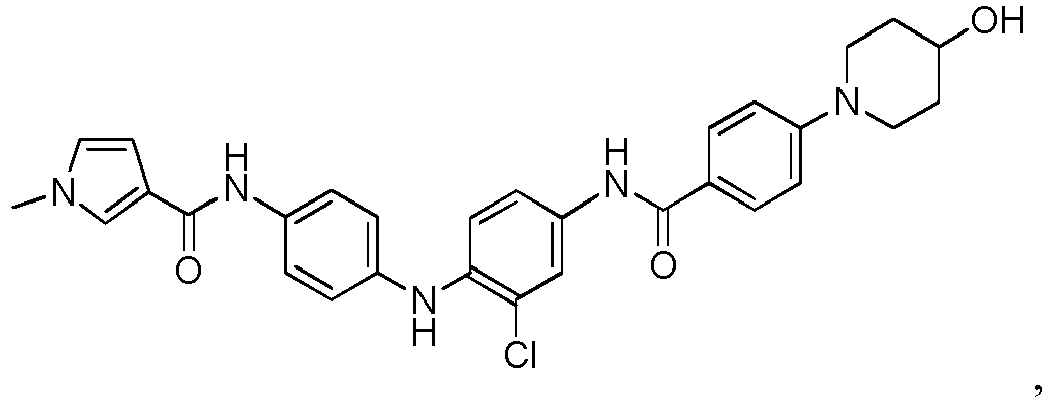

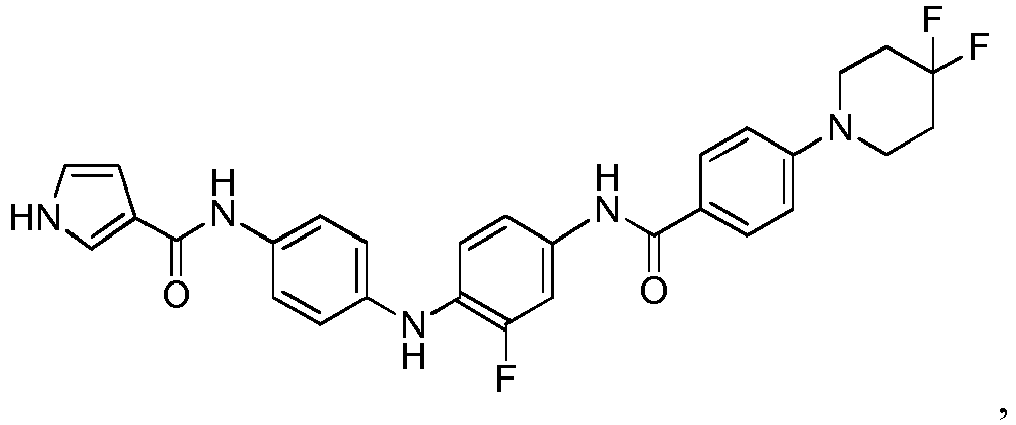


- The compound of claim 1,
and pharmaceutically acceptable salts, stereoisomers, or tautomers thereof for use in treating an anemia, a neutropenia, a cardiovascular disorder, an immune/autoimmune disorder, or a neurologic disorder. - A compound selected from the group consisting of


Priority Applications (1)
| Application Number | Priority Date | Filing Date | Title |
|---|---|---|---|
| PL10823959T PL2488486T3 (en) | 2009-10-13 | 2010-10-12 | Hematopoietic growth factor mimetic small molecule compounds and their uses |
Applications Claiming Priority (2)
| Application Number | Priority Date | Filing Date | Title |
|---|---|---|---|
| US25125909P | 2009-10-13 | 2009-10-13 | |
| PCT/US2010/052359 WO2011046954A1 (en) | 2009-10-13 | 2010-10-12 | Hematopoietic growth factor mimetic small molecule compounds and their uses |
Publications (3)
| Publication Number | Publication Date |
|---|---|
| EP2488486A1 EP2488486A1 (en) | 2012-08-22 |
| EP2488486A4 EP2488486A4 (en) | 2013-04-03 |
| EP2488486B1 true EP2488486B1 (en) | 2019-08-14 |
Family
ID=43876487
Family Applications (1)
| Application Number | Title | Priority Date | Filing Date |
|---|---|---|---|
| EP10823959.1A Active EP2488486B1 (en) | 2009-10-13 | 2010-10-12 | Hematopoietic growth factor mimetic small molecule compounds and their uses |
Country Status (12)
| Country | Link |
|---|---|
| US (2) | US9144557B2 (en) |
| EP (1) | EP2488486B1 (en) |
| JP (2) | JP5819305B2 (en) |
| KR (1) | KR101804588B1 (en) |
| CN (1) | CN102656141B (en) |
| AU (1) | AU2010307006B2 (en) |
| CA (1) | CA2777565C (en) |
| DK (1) | DK2488486T3 (en) |
| ES (1) | ES2749504T3 (en) |
| PL (1) | PL2488486T3 (en) |
| PT (1) | PT2488486T (en) |
| WO (1) | WO2011046954A1 (en) |
Cited By (1)
| Publication number | Priority date | Publication date | Assignee | Title |
|---|---|---|---|---|
| DE102022131737A1 (en) | 2022-11-30 | 2024-06-06 | Technische Universität München, Körperschaft des öffentlichen Rechts | Pyrrole compound and process for producing a pyrrole compound |
Families Citing this family (41)
| Publication number | Priority date | Publication date | Assignee | Title |
|---|---|---|---|---|
| GB0821913D0 (en) | 2008-12-02 | 2009-01-07 | Price & Co | Antibacterial compounds |
| EP2805951B1 (en) | 2009-03-20 | 2018-03-14 | Metabasis Therapeutics, Inc. | Inhibitors of diacylglycerol o-acyltransferase 1 (DGAT-1) and uses thereof |
| HRP20160397T1 (en) | 2010-06-01 | 2016-08-12 | Summit Therapeutics Plc | Compounds for the treatment of clostridium difficile associated disease |
| WO2011151618A2 (en) * | 2010-06-01 | 2011-12-08 | Summit Corporation Plc | Compounds for the treatment of clostridium difficile-associated disease |
| WO2012068406A2 (en) * | 2010-11-18 | 2012-05-24 | Ligand Pharmaceuticals Incorporated | Use of hematopoietic growth factor mimetics |
| WO2012167133A2 (en) * | 2011-06-01 | 2012-12-06 | The Regents Of The University Of California | Inhibitors of anandamide transport and their therapeutic uses |
| KR102079404B1 (en) | 2011-08-19 | 2020-02-19 | 더 리젠츠 오브 더 유니버시티 오브 캘리포니아 | Meta-substituted biphenyl peripherally restricted faah inhibitors |
| KR20190043648A (en) * | 2012-05-31 | 2019-04-26 | 파마사이언스 인크. | Protein kinase inhibitors |
| US9724351B2 (en) | 2012-08-23 | 2017-08-08 | Alios Biopharma, Inc. | Compounds for the treatment of paramoxyvirus viral infections |
| ES2968371T3 (en) | 2013-10-10 | 2024-05-09 | Eastern Virginia Medical School | 4-((2-hydroxy-3-methoxybenzyl)amino)benzenesulfonamide derivatives as 12-lipoxygenase inhibitors |
| WO2015074123A1 (en) * | 2013-11-25 | 2015-05-28 | Novogen ltd | Functionalised and substituted indoles as anti-cancer agents |
| SMT202400142T1 (en) | 2014-01-13 | 2024-05-14 | Aurigene Oncology Ltd | (r) and (s) enantiomers of n-(5-(3-hydroxypyrrolidin-1-yl)-2-morpholinooxazolo[4,5-b]pyridin-6-yl)-2-(2-methylpyridin-4-yl)oxazole-carboxamide as irak4 inhibitors for the treatment of cancer |
| WO2015157313A1 (en) | 2014-04-07 | 2015-10-15 | The Regents Of The University Of California | Inhibitors of fatty acid amide hydrolase (faah) enzyme with improved oral bioavailability and their use as medicaments |
| TN2016000501A1 (en) | 2014-05-15 | 2018-04-04 | Iteos Therapeutics | Pyrrolidine-2,5-dione derivatives, pharmaceutical compositions and methods for use as ido1 inhibitors. |
| KR20170016500A (en) * | 2014-06-20 | 2017-02-13 | 오리진 디스커버리 테크놀로지스 리미티드 | Substituted indazole compounds as irak4 inhibitors |
| WO2016008011A1 (en) * | 2014-07-16 | 2016-01-21 | Novogen ltd | Functionalised and substituted indoles as anti-cancer agents |
| JP6675407B2 (en) | 2014-10-10 | 2020-04-01 | プルモシデ リミテド | Novel 5,6-dihydro-4H-benzo [b] thieno- [2,3-d] azepine derivatives |
| LT3209655T (en) * | 2014-10-24 | 2021-01-11 | Landos Biopharma, Inc. | Lanthionine synthetase c-like 2-based therapeutics |
| WO2016097761A1 (en) | 2014-12-18 | 2016-06-23 | Pulmocide Limited | 4,5-dihydro-6h-thieno[3,2-d]benzazepine derivatives and their use to treat respiratory syncytial virus (rsv) infections |
| US9873690B2 (en) | 2015-03-17 | 2018-01-23 | Pfizer Inc | 3-indol substituted derivatives, pharmaceutical compositions and methods for use |
| WO2016191672A1 (en) | 2015-05-28 | 2016-12-01 | Ecolab Usa Inc. | 2-substituted imidazole and benzimidazole corrosion inhibitors |
| EP3303324B1 (en) * | 2015-05-28 | 2021-08-25 | Ecolab USA Inc. | Novel corrosion inhibitors |
| EP3309851B1 (en) | 2015-06-15 | 2020-01-01 | Nissan Chemical Corporation | Charge-transporting varnish and organic electroluminescent element |
| US10544095B2 (en) | 2015-08-10 | 2020-01-28 | Pfizer Inc. | 3-indol substituted derivatives, pharmaceutical compositions and methods for use |
| ES2973850T3 (en) | 2016-09-20 | 2024-06-24 | Centre Leon Berard | Benzoimidazole derivatives as anticancer agents |
| TWI752155B (en) | 2017-02-01 | 2022-01-11 | 德商菲尼克斯製藥股份有限公司 | ARYL HYDROCARBON RECEPTOR (AhR) MODULATOR COMPOUNDS |
| TWI674260B (en) | 2017-02-01 | 2019-10-11 | 德商菲尼克斯製藥股份有限公司 | Aryl hydrocarbon receptor (ahr) modulator compounds |
| TW201835070A (en) * | 2017-02-21 | 2018-10-01 | 德商菲尼克斯製藥股份有限公司 | ARYL HYDROCARBON RECEPTOR (AhR) MODULATOR COMPOUNDS |
| CN120267671A (en) | 2017-03-31 | 2025-07-08 | 奥锐金肿瘤有限公司 | Compounds and compositions for treating hematological disorders |
| MX2020003666A (en) | 2017-10-31 | 2020-08-03 | Curis Inc | Compounds and compositions for treating hematological disorders. |
| KR102235476B1 (en) | 2018-03-30 | 2021-04-01 | 주식회사 엘지화학 | Liquid crystal alignment composition, method of preparing liquid crystal alignment film, and liquid crystal alignment film using the same |
| KR20200059389A (en) | 2018-11-21 | 2020-05-29 | 정예림 | Portable Deodorant Pendant |
| US12570638B2 (en) | 2020-05-20 | 2026-03-10 | Sail Biomedicines, Inc. | Fused imidazole derivatives as AHR antagonists |
| US11767321B2 (en) | 2020-10-05 | 2023-09-26 | Enliven Inc. | 5- and 6-azaindole compounds for inhibition of BCR-ABL tyrosine kinases |
| AR124316A1 (en) * | 2020-12-11 | 2023-03-15 | Tmem16A Ltd | COMPOUNDS TO TREAT A RESPIRATORY DISEASE |
| WO2022166482A1 (en) * | 2021-02-04 | 2022-08-11 | 清药同创(北京)药物研发中心有限公司 | Benzimidazole enl protein inhibitor, preparation method therefor, and use thereof |
| US12178821B2 (en) | 2021-04-08 | 2024-12-31 | Curis, Inc. | Combination therapies for the treatment of cancer |
| EP4265246A1 (en) * | 2022-04-22 | 2023-10-25 | Université Paris Cité | Compounds inducing production of proteins by immune cells |
| CN120118037B (en) * | 2023-12-07 | 2025-11-28 | 南华大学 | Benzimidazole compound containing benzoate structure, preparation method and application thereof |
| CN119409969B (en) * | 2024-09-11 | 2025-10-03 | 东华大学 | A benzimidazole transparent polyimide film and its preparation method and application |
| US12391800B1 (en) * | 2025-03-18 | 2025-08-19 | Imam Mohammad Ibn Saud Islamic University | Tetraphenylethene-based polymers for supercapacitors |
Family Cites Families (28)
| Publication number | Priority date | Publication date | Assignee | Title |
|---|---|---|---|---|
| US2777855A (en) | 1954-12-01 | 1957-01-15 | American Cyanamid Co | Amides of hydroxybenzotriazole carboxylic acids |
| US3245995A (en) | 1964-03-09 | 1966-04-12 | Allied Chem | Bis-(6-oxo-6h-anthra-[9, 1-cd]-isothiazole-3-carboxamide) derivatives |
| GB1236282A (en) | 1968-07-15 | 1971-06-23 | Monsanto Co | Improvements in or relating to the pre-oxidation of thermally resistant aromatic polymers |
| DE2230121A1 (en) * | 1972-06-21 | 1974-01-17 | Basf Ag | POLYAMIDIMIDE AND THE METHOD OF MANUFACTURING THEREOF |
| US5296591A (en) | 1990-12-31 | 1994-03-22 | Fujisawa Pharmaceutical Co., Ltd. | Trifluoromethylketone derivatives, processes for preparation thereof and use thereof |
| WO1997017958A1 (en) * | 1995-11-13 | 1997-05-22 | Smithkline Beecham Corporation | Hemoregulatory compounds |
| WO1998016498A1 (en) | 1996-10-14 | 1998-04-23 | Kabushiki Kaisha Ueno Seiyaku Oyo Kenkyujo | Bis(aminocarbonylnaphthol) derivative |
| CA2346396C (en) | 1998-10-09 | 2009-04-28 | Janssen Pharmaceutica N.V. | 4,5-dihydro-isoxazole derivatives and their pharmaceutical use |
| GB9908828D0 (en) | 1999-04-16 | 1999-06-16 | Univ Reading The | Compounds |
| ATE276304T1 (en) | 1999-05-07 | 2004-10-15 | Ueno Seiyaku Oyo Kenkyujo Kk | LIQUID CRYSTALLINE POLYMER |
| WO2001055093A1 (en) * | 2000-01-25 | 2001-08-02 | Japan Tobacco Inc. | N-arylhydrazide compounds and use thereof as drugs |
| JP3966816B2 (en) * | 2000-05-30 | 2007-08-29 | 中外製薬株式会社 | Compound having thrombopoietin-like activity |
| GB0126036D0 (en) | 2001-10-30 | 2001-12-19 | Amedis Pharm Ltd | Silicon compounds |
| EP1477475A1 (en) | 2003-05-16 | 2004-11-17 | Procorde GmbH | Compounds for use as a medicine increasing the contractility of a heart, a heart muscle or cells of a heart muscle |
| WO2005023242A1 (en) * | 2003-09-11 | 2005-03-17 | Tibotec Pharmaceuticals Ltd. | Entry inhibitors of the hiv virus |
| RU2416608C2 (en) | 2004-08-06 | 2011-04-20 | Оцука Фармасьютикал Ко., Лтд. | Aromatic compound |
| US20060247250A1 (en) | 2005-03-16 | 2006-11-02 | Targegen, Inc. | Pyrimidine inhibitors of kinases |
| DE102005019712A1 (en) | 2005-04-28 | 2006-11-09 | Bayer Healthcare Ag | Dipyridyl-dihydropyrazolone and its use |
| AU2007227210A1 (en) * | 2006-03-20 | 2007-09-27 | Synta Pharmaceuticals Corp. | Benzoimidazolyl-parazine compounds for inflammation and immune-related uses |
| CA2646886A1 (en) * | 2006-03-23 | 2007-10-04 | Synta Pharmaceuticals Corp. | Benzimidazolyl-pyridine compounds for inflammation and immune-related uses |
| US8030487B2 (en) | 2006-07-07 | 2011-10-04 | Targegen, Inc. | 2-amino—5-substituted pyrimidine inhibitors |
| BRPI0816320A2 (en) | 2007-09-04 | 2015-03-24 | Biolipox Ab | Compound, pharmaceutical formulation, use of a compound, method of treating a disease, combination product, and processes for the preparation of a compound, a pharmaceutical formulation, and a combination product |
| CN101215379A (en) | 2008-01-04 | 2008-07-09 | 四川大学 | Polyarylene sulfide amide polymer and its preparation method |
| FR2926297B1 (en) | 2008-01-10 | 2013-03-08 | Centre Nat Rech Scient | INHIBITORY CHEMICAL MOLECULES IN THE SPLICE MECHANISM FOR TREATING DISEASES RESULTING FROM SPLICE ANOMALIES. |
| JP5557832B2 (en) | 2008-03-18 | 2014-07-23 | メルク・シャープ・アンド・ドーム・コーポレーション | Substituted 4-hydroxypyridine-5-carboxamide |
| WO2009155362A1 (en) * | 2008-06-19 | 2009-12-23 | Ligand Pharmaceuticals Inc. | Small molecule hematopoietic growth factor mimetic compounds and their uses |
| KR100994687B1 (en) | 2008-10-30 | 2010-11-17 | 한국과학기술연구원 | Novel pyrrolo [3,2-b] pyridine derivatives or pharmaceutically acceptable salts thereof, preparation methods thereof, and pharmaceutical compositions for preventing or treating melanoma containing the same as active ingredients |
| AU2009316790A1 (en) | 2008-11-19 | 2010-05-27 | Schering Corporation | Inhibitors of diacylglycerol acyltransferase |
-
2010
- 2010-10-12 JP JP2012534288A patent/JP5819305B2/en active Active
- 2010-10-12 WO PCT/US2010/052359 patent/WO2011046954A1/en not_active Ceased
- 2010-10-12 PL PL10823959T patent/PL2488486T3/en unknown
- 2010-10-12 KR KR1020127012390A patent/KR101804588B1/en active Active
- 2010-10-12 EP EP10823959.1A patent/EP2488486B1/en active Active
- 2010-10-12 DK DK10823959T patent/DK2488486T3/en active
- 2010-10-12 AU AU2010307006A patent/AU2010307006B2/en active Active
- 2010-10-12 PT PT108239591T patent/PT2488486T/en unknown
- 2010-10-12 US US13/501,622 patent/US9144557B2/en not_active Expired - Fee Related
- 2010-10-12 ES ES10823959T patent/ES2749504T3/en active Active
- 2010-10-12 CN CN201080055349.5A patent/CN102656141B/en active Active
- 2010-10-12 CA CA2777565A patent/CA2777565C/en active Active
-
2015
- 2015-05-15 US US14/713,930 patent/US9622991B2/en active Active
- 2015-09-30 JP JP2015194455A patent/JP6238942B2/en active Active
Non-Patent Citations (1)
| Title |
|---|
| None * |
Cited By (1)
| Publication number | Priority date | Publication date | Assignee | Title |
|---|---|---|---|---|
| DE102022131737A1 (en) | 2022-11-30 | 2024-06-06 | Technische Universität München, Körperschaft des öffentlichen Rechts | Pyrrole compound and process for producing a pyrrole compound |
Also Published As
| Publication number | Publication date |
|---|---|
| AU2010307006B2 (en) | 2016-08-11 |
| CN102656141B (en) | 2016-04-06 |
| JP5819305B2 (en) | 2015-11-24 |
| JP2016029074A (en) | 2016-03-03 |
| AU2010307006A1 (en) | 2012-05-03 |
| JP2013507446A (en) | 2013-03-04 |
| PL2488486T3 (en) | 2020-01-31 |
| WO2011046954A1 (en) | 2011-04-21 |
| KR101804588B1 (en) | 2017-12-04 |
| US20120295904A1 (en) | 2012-11-22 |
| CN102656141A (en) | 2012-09-05 |
| JP6238942B2 (en) | 2017-11-29 |
| US20150252043A1 (en) | 2015-09-10 |
| EP2488486A1 (en) | 2012-08-22 |
| EP2488486A4 (en) | 2013-04-03 |
| CA2777565A1 (en) | 2011-04-21 |
| ES2749504T3 (en) | 2020-03-20 |
| DK2488486T3 (en) | 2019-11-18 |
| KR20130032863A (en) | 2013-04-02 |
| US9144557B2 (en) | 2015-09-29 |
| CA2777565C (en) | 2019-06-18 |
| US9622991B2 (en) | 2017-04-18 |
| PT2488486T (en) | 2019-11-05 |
Similar Documents
| Publication | Publication Date | Title |
|---|---|---|
| ES2749504T3 (en) | Small Molecular Mimetic Compounds of Hematopoietic Growth Factor and Their Uses | |
| JP6261340B2 (en) | Use of hematopoietic growth factor mimics | |
| WO2007062078A2 (en) | Thrombopoietin activity modulating compounds and methods | |
| MX2014015938A (en) | Bifluorodioxalane-amino-benzimidazole kinase inhibitors for the treatment of cancer, autoimmuneinflammation and cns disorders. | |
| WO2009155362A1 (en) | Small molecule hematopoietic growth factor mimetic compounds and their uses | |
| EP1805155B1 (en) | Thrombopoietin activity modulating compounds and methods | |
| US7662804B2 (en) | Thrombopoietin activity modulating compounds and methods | |
| US11413274B2 (en) | Methods and compositions associated with the granulocyte colony-stimulating factor receptor | |
| JP2005527518A (en) | Novel chalcone derivatives and their use | |
| US8680150B2 (en) | Small molecule hematopoietic growth factor mimetic compounds that activate hematopoietic growth factor receptors | |
| WO2014150252A1 (en) | Methods of treatment associated with the granulocyte colony-stimulating factor receptor |
Legal Events
| Date | Code | Title | Description |
|---|---|---|---|
| PUAI | Public reference made under article 153(3) epc to a published international application that has entered the european phase |
Free format text: ORIGINAL CODE: 0009012 |
|
| 17P | Request for examination filed |
Effective date: 20120507 |
|
| AK | Designated contracting states |
Kind code of ref document: A1 Designated state(s): AL AT BE BG CH CY CZ DE DK EE ES FI FR GB GR HR HU IE IS IT LI LT LU LV MC MK MT NL NO PL PT RO RS SE SI SK SM TR |
|
| RAP1 | Party data changed (applicant data changed or rights of an application transferred) |
Owner name: LIGAND PHARMACEUTICALS INC. |
|
| DAX | Request for extension of the european patent (deleted) | ||
| A4 | Supplementary search report drawn up and despatched |
Effective date: 20130228 |
|
| RIC1 | Information provided on ipc code assigned before grant |
Ipc: A61K 31/4025 20060101ALI20130222BHEP Ipc: A61P 37/00 20060101ALI20130222BHEP Ipc: A61K 31/167 20060101ALI20130222BHEP Ipc: A61K 31/4015 20060101ALI20130222BHEP Ipc: A61K 31/18 20060101ALI20130222BHEP Ipc: A61K 31/402 20060101ALI20130222BHEP Ipc: A61P 7/00 20060101ALI20130222BHEP Ipc: A61K 31/404 20060101ALI20130222BHEP Ipc: A61K 31/343 20060101ALI20130222BHEP Ipc: A61K 31/381 20060101ALI20130222BHEP Ipc: A61P 9/00 20060101ALI20130222BHEP Ipc: C07C 251/86 20060101AFI20130222BHEP Ipc: A61K 31/4045 20060101ALI20130222BHEP Ipc: A61K 31/405 20060101ALI20130222BHEP Ipc: A61P 25/00 20060101ALI20130222BHEP Ipc: A61P 31/00 20060101ALI20130222BHEP Ipc: A61K 31/245 20060101ALI20130222BHEP Ipc: A61K 31/36 20060101ALI20130222BHEP Ipc: A61K 31/15 20060101ALI20130222BHEP |
|
| 17Q | First examination report despatched |
Effective date: 20150728 |
|
| REG | Reference to a national code |
Ref country code: DE Ref legal event code: R079 Ref document number: 602010060588 Country of ref document: DE Free format text: PREVIOUS MAIN CLASS: C07C0251860000 Ipc: C07C0233800000 |
|
| RIC1 | Information provided on ipc code assigned before grant |
Ipc: C07C 237/40 20060101ALI20160504BHEP Ipc: C07C 235/56 20060101ALI20160504BHEP Ipc: C07C 233/80 20060101AFI20160504BHEP Ipc: C07C 243/38 20060101ALI20160504BHEP Ipc: C07D 213/12 20060101ALI20160504BHEP Ipc: C07D 231/40 20060101ALI20160504BHEP Ipc: C07C 271/28 20060101ALI20160504BHEP Ipc: C07C 251/48 20060101ALI20160504BHEP Ipc: C07D 211/46 20060101ALI20160504BHEP Ipc: C07D 209/14 20060101ALI20160504BHEP Ipc: C07D 207/32 20060101ALI20160504BHEP |
|
| STAA | Information on the status of an ep patent application or granted ep patent |
Free format text: STATUS: EXAMINATION IS IN PROGRESS |
|
| GRAP | Despatch of communication of intention to grant a patent |
Free format text: ORIGINAL CODE: EPIDOSNIGR1 |
|
| STAA | Information on the status of an ep patent application or granted ep patent |
Free format text: STATUS: GRANT OF PATENT IS INTENDED |
|
| INTG | Intention to grant announced |
Effective date: 20190304 |
|
| RAP1 | Party data changed (applicant data changed or rights of an application transferred) |
Owner name: LIGAND PHARMACEUTICALS INC. |
|
| GRAS | Grant fee paid |
Free format text: ORIGINAL CODE: EPIDOSNIGR3 |
|
| GRAA | (expected) grant |
Free format text: ORIGINAL CODE: 0009210 |
|
| STAA | Information on the status of an ep patent application or granted ep patent |
Free format text: STATUS: THE PATENT HAS BEEN GRANTED |
|
| RAP1 | Party data changed (applicant data changed or rights of an application transferred) |
Owner name: LIGAND PHARMACEUTICALS INC. |
|
| AK | Designated contracting states |
Kind code of ref document: B1 Designated state(s): AL AT BE BG CH CY CZ DE DK EE ES FI FR GB GR HR HU IE IS IT LI LT LU LV MC MK MT NL NO PL PT RO RS SE SI SK SM TR |
|
| REG | Reference to a national code |
Ref country code: GB Ref legal event code: FG4D |
|
| REG | Reference to a national code |
Ref country code: CH Ref legal event code: EP Ref country code: AT Ref legal event code: REF Ref document number: 1166846 Country of ref document: AT Kind code of ref document: T Effective date: 20190815 |
|
| REG | Reference to a national code |
Ref country code: DE Ref legal event code: R096 Ref document number: 602010060588 Country of ref document: DE |
|
| REG | Reference to a national code |
Ref country code: IE Ref legal event code: FG4D |
|
| REG | Reference to a national code |
Ref country code: PT Ref legal event code: SC4A Ref document number: 2488486 Country of ref document: PT Date of ref document: 20191105 Kind code of ref document: T Free format text: AVAILABILITY OF NATIONAL TRANSLATION Effective date: 20191028 |
|
| REG | Reference to a national code |
Ref country code: NL Ref legal event code: FP |
|
| REG | Reference to a national code |
Ref country code: DK Ref legal event code: T3 Effective date: 20191111 |
|
| REG | Reference to a national code |
Ref country code: SE Ref legal event code: TRGR |
|
| REG | Reference to a national code |
Ref country code: LT Ref legal event code: MG4D |
|
| PG25 | Lapsed in a contracting state [announced via postgrant information from national office to epo] |
Ref country code: NO Free format text: LAPSE BECAUSE OF FAILURE TO SUBMIT A TRANSLATION OF THE DESCRIPTION OR TO PAY THE FEE WITHIN THE PRESCRIBED TIME-LIMIT Effective date: 20191114 Ref country code: BG Free format text: LAPSE BECAUSE OF FAILURE TO SUBMIT A TRANSLATION OF THE DESCRIPTION OR TO PAY THE FEE WITHIN THE PRESCRIBED TIME-LIMIT Effective date: 20191114 Ref country code: LT Free format text: LAPSE BECAUSE OF FAILURE TO SUBMIT A TRANSLATION OF THE DESCRIPTION OR TO PAY THE FEE WITHIN THE PRESCRIBED TIME-LIMIT Effective date: 20190814 Ref country code: HR Free format text: LAPSE BECAUSE OF FAILURE TO SUBMIT A TRANSLATION OF THE DESCRIPTION OR TO PAY THE FEE WITHIN THE PRESCRIBED TIME-LIMIT Effective date: 20190814 |
|
| REG | Reference to a national code |
Ref country code: AT Ref legal event code: MK05 Ref document number: 1166846 Country of ref document: AT Kind code of ref document: T Effective date: 20190814 |
|
| PG25 | Lapsed in a contracting state [announced via postgrant information from national office to epo] |
Ref country code: GR Free format text: LAPSE BECAUSE OF FAILURE TO SUBMIT A TRANSLATION OF THE DESCRIPTION OR TO PAY THE FEE WITHIN THE PRESCRIBED TIME-LIMIT Effective date: 20191115 Ref country code: AL Free format text: LAPSE BECAUSE OF FAILURE TO SUBMIT A TRANSLATION OF THE DESCRIPTION OR TO PAY THE FEE WITHIN THE PRESCRIBED TIME-LIMIT Effective date: 20190814 Ref country code: LV Free format text: LAPSE BECAUSE OF FAILURE TO SUBMIT A TRANSLATION OF THE DESCRIPTION OR TO PAY THE FEE WITHIN THE PRESCRIBED TIME-LIMIT Effective date: 20190814 Ref country code: IS Free format text: LAPSE BECAUSE OF FAILURE TO SUBMIT A TRANSLATION OF THE DESCRIPTION OR TO PAY THE FEE WITHIN THE PRESCRIBED TIME-LIMIT Effective date: 20191214 Ref country code: RS Free format text: LAPSE BECAUSE OF FAILURE TO SUBMIT A TRANSLATION OF THE DESCRIPTION OR TO PAY THE FEE WITHIN THE PRESCRIBED TIME-LIMIT Effective date: 20190814 |
|
| REG | Reference to a national code |
Ref country code: ES Ref legal event code: FG2A Ref document number: 2749504 Country of ref document: ES Kind code of ref document: T3 Effective date: 20200320 |
|
| PG25 | Lapsed in a contracting state [announced via postgrant information from national office to epo] |
Ref country code: TR Free format text: LAPSE BECAUSE OF FAILURE TO SUBMIT A TRANSLATION OF THE DESCRIPTION OR TO PAY THE FEE WITHIN THE PRESCRIBED TIME-LIMIT Effective date: 20190814 |
|
| PG25 | Lapsed in a contracting state [announced via postgrant information from national office to epo] |
Ref country code: AT Free format text: LAPSE BECAUSE OF FAILURE TO SUBMIT A TRANSLATION OF THE DESCRIPTION OR TO PAY THE FEE WITHIN THE PRESCRIBED TIME-LIMIT Effective date: 20190814 Ref country code: RO Free format text: LAPSE BECAUSE OF FAILURE TO SUBMIT A TRANSLATION OF THE DESCRIPTION OR TO PAY THE FEE WITHIN THE PRESCRIBED TIME-LIMIT Effective date: 20190814 Ref country code: EE Free format text: LAPSE BECAUSE OF FAILURE TO SUBMIT A TRANSLATION OF THE DESCRIPTION OR TO PAY THE FEE WITHIN THE PRESCRIBED TIME-LIMIT Effective date: 20190814 |
|
| PG25 | Lapsed in a contracting state [announced via postgrant information from national office to epo] |
Ref country code: MC Free format text: LAPSE BECAUSE OF FAILURE TO SUBMIT A TRANSLATION OF THE DESCRIPTION OR TO PAY THE FEE WITHIN THE PRESCRIBED TIME-LIMIT Effective date: 20190814 Ref country code: SM Free format text: LAPSE BECAUSE OF FAILURE TO SUBMIT A TRANSLATION OF THE DESCRIPTION OR TO PAY THE FEE WITHIN THE PRESCRIBED TIME-LIMIT Effective date: 20190814 Ref country code: IS Free format text: LAPSE BECAUSE OF FAILURE TO SUBMIT A TRANSLATION OF THE DESCRIPTION OR TO PAY THE FEE WITHIN THE PRESCRIBED TIME-LIMIT Effective date: 20200224 Ref country code: SK Free format text: LAPSE BECAUSE OF FAILURE TO SUBMIT A TRANSLATION OF THE DESCRIPTION OR TO PAY THE FEE WITHIN THE PRESCRIBED TIME-LIMIT Effective date: 20190814 Ref country code: CZ Free format text: LAPSE BECAUSE OF FAILURE TO SUBMIT A TRANSLATION OF THE DESCRIPTION OR TO PAY THE FEE WITHIN THE PRESCRIBED TIME-LIMIT Effective date: 20190814 |
|
| REG | Reference to a national code |
Ref country code: DE Ref legal event code: R097 Ref document number: 602010060588 Country of ref document: DE |
|
| PLBE | No opposition filed within time limit |
Free format text: ORIGINAL CODE: 0009261 |
|
| STAA | Information on the status of an ep patent application or granted ep patent |
Free format text: STATUS: NO OPPOSITION FILED WITHIN TIME LIMIT |
|
| PG2D | Information on lapse in contracting state deleted |
Ref country code: IS |
|
| PG25 | Lapsed in a contracting state [announced via postgrant information from national office to epo] |
Ref country code: LU Free format text: LAPSE BECAUSE OF NON-PAYMENT OF DUE FEES Effective date: 20191012 |
|
| 26N | No opposition filed |
Effective date: 20200603 |
|
| REG | Reference to a national code |
Ref country code: BE Ref legal event code: MM Effective date: 20191031 |
|
| PG25 | Lapsed in a contracting state [announced via postgrant information from national office to epo] |
Ref country code: BE Free format text: LAPSE BECAUSE OF NON-PAYMENT OF DUE FEES Effective date: 20191031 Ref country code: SI Free format text: LAPSE BECAUSE OF FAILURE TO SUBMIT A TRANSLATION OF THE DESCRIPTION OR TO PAY THE FEE WITHIN THE PRESCRIBED TIME-LIMIT Effective date: 20190814 |
|
| PG25 | Lapsed in a contracting state [announced via postgrant information from national office to epo] |
Ref country code: CY Free format text: LAPSE BECAUSE OF FAILURE TO SUBMIT A TRANSLATION OF THE DESCRIPTION OR TO PAY THE FEE WITHIN THE PRESCRIBED TIME-LIMIT Effective date: 20190814 |
|
| PG25 | Lapsed in a contracting state [announced via postgrant information from national office to epo] |
Ref country code: HU Free format text: LAPSE BECAUSE OF FAILURE TO SUBMIT A TRANSLATION OF THE DESCRIPTION OR TO PAY THE FEE WITHIN THE PRESCRIBED TIME-LIMIT; INVALID AB INITIO Effective date: 20101012 Ref country code: MT Free format text: LAPSE BECAUSE OF FAILURE TO SUBMIT A TRANSLATION OF THE DESCRIPTION OR TO PAY THE FEE WITHIN THE PRESCRIBED TIME-LIMIT Effective date: 20190814 |
|
| PG25 | Lapsed in a contracting state [announced via postgrant information from national office to epo] |
Ref country code: MK Free format text: LAPSE BECAUSE OF FAILURE TO SUBMIT A TRANSLATION OF THE DESCRIPTION OR TO PAY THE FEE WITHIN THE PRESCRIBED TIME-LIMIT Effective date: 20190814 |
|
| P01 | Opt-out of the competence of the unified patent court (upc) registered |
Effective date: 20230520 |
|
| PGFP | Annual fee paid to national office [announced via postgrant information from national office to epo] |
Ref country code: PT Payment date: 20250923 Year of fee payment: 16 |
|
| PGFP | Annual fee paid to national office [announced via postgrant information from national office to epo] |
Ref country code: PL Payment date: 20250922 Year of fee payment: 16 |
|
| REG | Reference to a national code |
Ref country code: CH Ref legal event code: U11 Free format text: ST27 STATUS EVENT CODE: U-0-0-U10-U11 (AS PROVIDED BY THE NATIONAL OFFICE) Effective date: 20251101 |
|
| PGFP | Annual fee paid to national office [announced via postgrant information from national office to epo] |
Ref country code: NL Payment date: 20251024 Year of fee payment: 16 |
|
| PGFP | Annual fee paid to national office [announced via postgrant information from national office to epo] |
Ref country code: DE Payment date: 20251028 Year of fee payment: 16 |
|
| PGFP | Annual fee paid to national office [announced via postgrant information from national office to epo] |
Ref country code: GB Payment date: 20251023 Year of fee payment: 16 |
|
| PGFP | Annual fee paid to national office [announced via postgrant information from national office to epo] |
Ref country code: FI Payment date: 20251024 Year of fee payment: 16 Ref country code: DK Payment date: 20251024 Year of fee payment: 16 Ref country code: IT Payment date: 20251022 Year of fee payment: 16 |
|
| PGFP | Annual fee paid to national office [announced via postgrant information from national office to epo] |
Ref country code: FR Payment date: 20251027 Year of fee payment: 16 |
|
| PGFP | Annual fee paid to national office [announced via postgrant information from national office to epo] |
Ref country code: SE Payment date: 20251024 Year of fee payment: 16 Ref country code: CH Payment date: 20251101 Year of fee payment: 16 |
|
| PGFP | Annual fee paid to national office [announced via postgrant information from national office to epo] |
Ref country code: IE Payment date: 20251020 Year of fee payment: 16 |
|
| PGFP | Annual fee paid to national office [announced via postgrant information from national office to epo] |
Ref country code: ES Payment date: 20251118 Year of fee payment: 16 |