EP2486024B1 - Phenyloxadiazole derivatives as pgds inhibitors - Google Patents
Phenyloxadiazole derivatives as pgds inhibitors Download PDFInfo
- Publication number
- EP2486024B1 EP2486024B1 EP20100765724 EP10765724A EP2486024B1 EP 2486024 B1 EP2486024 B1 EP 2486024B1 EP 20100765724 EP20100765724 EP 20100765724 EP 10765724 A EP10765724 A EP 10765724A EP 2486024 B1 EP2486024 B1 EP 2486024B1
- Authority
- EP
- European Patent Office
- Prior art keywords
- compound
- formula
- ethyl
- hydrogen
- methyl
- Prior art date
- Legal status (The legal status is an assumption and is not a legal conclusion. Google has not performed a legal analysis and makes no representation as to the accuracy of the status listed.)
- Active
Links
- 0 CC(C)(c1nc(-c2cc(C[*+])ccc2)n[o]1)O Chemical compound CC(C)(c1nc(-c2cc(C[*+])ccc2)n[o]1)O 0.000 description 3
- PGHKQASEGLDCRU-UHFFFAOYSA-N OC(c1cnc(-c2ccccn2)nc1)=O Chemical compound OC(c1cnc(-c2ccccn2)nc1)=O PGHKQASEGLDCRU-UHFFFAOYSA-N 0.000 description 2
- ACVLJPCNCYYQHI-NTEUORMPSA-N CC(C)(C)S(/N=C/c1cc(C#N)ccc1)=O Chemical compound CC(C)(C)S(/N=C/c1cc(C#N)ccc1)=O ACVLJPCNCYYQHI-NTEUORMPSA-N 0.000 description 1
- QESREOBSTLCCPK-NTUHNPAUSA-N CC(C)(c1nc(-c2cccc(/C=N/O)c2)n[o]1)O Chemical compound CC(C)(c1nc(-c2cccc(/C=N/O)c2)n[o]1)O QESREOBSTLCCPK-NTUHNPAUSA-N 0.000 description 1
- BCGBIAIPEICXFK-UHFFFAOYSA-N CC(c1cc(-c2n[o]c(C(C)(C)O)n2)ccc1)NS(C(C)(C)C)O Chemical compound CC(c1cc(-c2n[o]c(C(C)(C)O)n2)ccc1)NS(C(C)(C)C)O BCGBIAIPEICXFK-UHFFFAOYSA-N 0.000 description 1
- VLOHLIHCEHKFOL-CQSZACIVSA-N C[C@H](c1cc(-c2n[o]c(C(C)(C)O)n2)ccc1)NC(c1cnc(-c2ccccn2)nc1)=O Chemical compound C[C@H](c1cc(-c2n[o]c(C(C)(C)O)n2)ccc1)NC(c1cnc(-c2ccccn2)nc1)=O VLOHLIHCEHKFOL-CQSZACIVSA-N 0.000 description 1
- QJIMAYZRQVRZEK-UHFFFAOYSA-N O=C(c1cnc(-c2ccccn2)nc1)Cl Chemical compound O=C(c1cnc(-c2ccccn2)nc1)Cl QJIMAYZRQVRZEK-UHFFFAOYSA-N 0.000 description 1
- UCTMCKSKDVLKPS-UHFFFAOYSA-N O=C(c1cnc(-c2ccccn2)nc1)[n]1cncc1 Chemical compound O=C(c1cnc(-c2ccccn2)nc1)[n]1cncc1 UCTMCKSKDVLKPS-UHFFFAOYSA-N 0.000 description 1
Classifications
-
- A—HUMAN NECESSITIES
- A61—MEDICAL OR VETERINARY SCIENCE; HYGIENE
- A61K—PREPARATIONS FOR MEDICAL, DENTAL OR TOILETRY PURPOSES
- A61K31/00—Medicinal preparations containing organic active ingredients
- A61K31/33—Heterocyclic compounds
- A61K31/395—Heterocyclic compounds having nitrogen as a ring hetero atom, e.g. guanethidine or rifamycins
- A61K31/495—Heterocyclic compounds having nitrogen as a ring hetero atom, e.g. guanethidine or rifamycins having six-membered rings with two or more nitrogen atoms as the only ring heteroatoms, e.g. piperazine or tetrazines
- A61K31/505—Pyrimidines; Hydrogenated pyrimidines, e.g. trimethoprim
- A61K31/506—Pyrimidines; Hydrogenated pyrimidines, e.g. trimethoprim not condensed and containing further heterocyclic rings
-
- C—CHEMISTRY; METALLURGY
- C07—ORGANIC CHEMISTRY
- C07D—HETEROCYCLIC COMPOUNDS
- C07D271/00—Heterocyclic compounds containing five-membered rings having two nitrogen atoms and one oxygen atom as the only ring hetero atoms
- C07D271/02—Heterocyclic compounds containing five-membered rings having two nitrogen atoms and one oxygen atom as the only ring hetero atoms not condensed with other rings
- C07D271/06—1,2,4-Oxadiazoles; Hydrogenated 1,2,4-oxadiazoles
- C07D271/07—1,2,4-Oxadiazoles; Hydrogenated 1,2,4-oxadiazoles with oxygen, sulfur or nitrogen atoms, directly attached to ring carbon atoms, the nitrogen atoms not forming part of a nitro radical
-
- A—HUMAN NECESSITIES
- A61—MEDICAL OR VETERINARY SCIENCE; HYGIENE
- A61K—PREPARATIONS FOR MEDICAL, DENTAL OR TOILETRY PURPOSES
- A61K31/00—Medicinal preparations containing organic active ingredients
- A61K31/33—Heterocyclic compounds
- A61K31/395—Heterocyclic compounds having nitrogen as a ring hetero atom, e.g. guanethidine or rifamycins
- A61K31/495—Heterocyclic compounds having nitrogen as a ring hetero atom, e.g. guanethidine or rifamycins having six-membered rings with two or more nitrogen atoms as the only ring heteroatoms, e.g. piperazine or tetrazines
-
- A—HUMAN NECESSITIES
- A61—MEDICAL OR VETERINARY SCIENCE; HYGIENE
- A61P—SPECIFIC THERAPEUTIC ACTIVITY OF CHEMICAL COMPOUNDS OR MEDICINAL PREPARATIONS
- A61P11/00—Drugs for disorders of the respiratory system
-
- A—HUMAN NECESSITIES
- A61—MEDICAL OR VETERINARY SCIENCE; HYGIENE
- A61P—SPECIFIC THERAPEUTIC ACTIVITY OF CHEMICAL COMPOUNDS OR MEDICINAL PREPARATIONS
- A61P11/00—Drugs for disorders of the respiratory system
- A61P11/02—Nasal agents, e.g. decongestants
-
- A—HUMAN NECESSITIES
- A61—MEDICAL OR VETERINARY SCIENCE; HYGIENE
- A61P—SPECIFIC THERAPEUTIC ACTIVITY OF CHEMICAL COMPOUNDS OR MEDICINAL PREPARATIONS
- A61P11/00—Drugs for disorders of the respiratory system
- A61P11/06—Antiasthmatics
-
- A—HUMAN NECESSITIES
- A61—MEDICAL OR VETERINARY SCIENCE; HYGIENE
- A61P—SPECIFIC THERAPEUTIC ACTIVITY OF CHEMICAL COMPOUNDS OR MEDICINAL PREPARATIONS
- A61P27/00—Drugs for disorders of the senses
- A61P27/02—Ophthalmic agents
-
- A—HUMAN NECESSITIES
- A61—MEDICAL OR VETERINARY SCIENCE; HYGIENE
- A61P—SPECIFIC THERAPEUTIC ACTIVITY OF CHEMICAL COMPOUNDS OR MEDICINAL PREPARATIONS
- A61P29/00—Non-central analgesic, antipyretic or antiinflammatory agents, e.g. antirheumatic agents; Non-steroidal antiinflammatory drugs [NSAID]
-
- A—HUMAN NECESSITIES
- A61—MEDICAL OR VETERINARY SCIENCE; HYGIENE
- A61P—SPECIFIC THERAPEUTIC ACTIVITY OF CHEMICAL COMPOUNDS OR MEDICINAL PREPARATIONS
- A61P37/00—Drugs for immunological or allergic disorders
-
- A—HUMAN NECESSITIES
- A61—MEDICAL OR VETERINARY SCIENCE; HYGIENE
- A61P—SPECIFIC THERAPEUTIC ACTIVITY OF CHEMICAL COMPOUNDS OR MEDICINAL PREPARATIONS
- A61P37/00—Drugs for immunological or allergic disorders
- A61P37/08—Antiallergic agents
-
- A—HUMAN NECESSITIES
- A61—MEDICAL OR VETERINARY SCIENCE; HYGIENE
- A61P—SPECIFIC THERAPEUTIC ACTIVITY OF CHEMICAL COMPOUNDS OR MEDICINAL PREPARATIONS
- A61P5/00—Drugs for disorders of the endocrine system
-
- C—CHEMISTRY; METALLURGY
- C07—ORGANIC CHEMISTRY
- C07D—HETEROCYCLIC COMPOUNDS
- C07D217/00—Heterocyclic compounds containing isoquinoline or hydrogenated isoquinoline ring systems
- C07D217/02—Heterocyclic compounds containing isoquinoline or hydrogenated isoquinoline ring systems with only hydrogen atoms or radicals containing only carbon and hydrogen atoms, directly attached to carbon atoms of the nitrogen-containing ring; Alkylene-bis-isoquinolines
- C07D217/06—Heterocyclic compounds containing isoquinoline or hydrogenated isoquinoline ring systems with only hydrogen atoms or radicals containing only carbon and hydrogen atoms, directly attached to carbon atoms of the nitrogen-containing ring; Alkylene-bis-isoquinolines with the ring nitrogen atom acylated by carboxylic or carbonic acids, or with sulfur or nitrogen analogues thereof, e.g. carbamates
-
- C—CHEMISTRY; METALLURGY
- C07—ORGANIC CHEMISTRY
- C07D—HETEROCYCLIC COMPOUNDS
- C07D271/00—Heterocyclic compounds containing five-membered rings having two nitrogen atoms and one oxygen atom as the only ring hetero atoms
- C07D271/02—Heterocyclic compounds containing five-membered rings having two nitrogen atoms and one oxygen atom as the only ring hetero atoms not condensed with other rings
- C07D271/06—1,2,4-Oxadiazoles; Hydrogenated 1,2,4-oxadiazoles
-
- C—CHEMISTRY; METALLURGY
- C07—ORGANIC CHEMISTRY
- C07D—HETEROCYCLIC COMPOUNDS
- C07D413/00—Heterocyclic compounds containing two or more hetero rings, at least one ring having nitrogen and oxygen atoms as the only ring hetero atoms
- C07D413/14—Heterocyclic compounds containing two or more hetero rings, at least one ring having nitrogen and oxygen atoms as the only ring hetero atoms containing three or more hetero rings
Definitions
- COPD chronic obstructive pulmonary disease
- Another particular embodiment of the invention is a compound of formula (I), which is:
- aqueous suspensions When aqueous suspensions are used they can contain emulsifying agents or agents which facilitate suspension.
- Actual dosage levels of active ingredient(s) in the compositions of the invention may be varied so as to obtain an amount of active ingredient(s) that is (are) effective to obtain a desired therapeutic response for a particular composition and method of administration for a patient.
- a selected dosage level for any particular patient therefore depends upon a variety of factors including the desired therapeutic effect, on the route of administration, on the desired duration of treatment, the etiology and severity of the disease, the patient's condition, weight, sex, diet and age, the type and potency of each active ingredient, rates of absorption, metabolism and/or excretion and other factors.
- the formulations can be prepared in unit dosage form by any of the methods well known in the art of pharmacy. Such methods include the step of bringing into association the pharmaceutically active ingredient with the carrier that constitutes one or more accessory ingredients. In general the formulations are prepared by uniformly and intimately bringing into association the active ingredient with liquid carriers or finely divided solid carriers or both, and then, if necessary, shaping the product.
- Mass Spectra are recorded using a Micromass LCT mass spectrometer. The method is positive electrospray ionization, scanning mass m/z from 100 to 1000.
- DTMM 4-(4,6-Dimethoxy-[1,3,5]triazin-2-yl)-4-methyl-morpholin-4-ium chloride
- a 5-L jacketed glass reactor equipped with an overhead mechanical stirrer, a thermocouple probe and a nitrogen purge was charged at 22-27 °C with (N-hydroxy-3-hydroxyiminomethyl)benzamidine) (100.0 g, 0.558 mol, 1.0 eq.) and 1-methyl-2-pyrrolidinone (NMP) (267.3 g, 260 mL, 2.6 v/w parts).
- NMP 1-methyl-2-pyrrolidinone
- the mixture was stirred at 25-27 °C for 30-45 min to get a clear solution.
- the pH of the solution was adjusted to 5.0 by charging hydrochloric acid (37.1 w%) (77.4 g, 0.787 mole, 1.4 eq) over 30-45 min while maintaining a temperature of 22-25 °C.
- hydrochloric acid 37.1 w%) (77.4 g, 0.787 mole, 1.4 eq) over 30-45 min while maintaining a temperature of 22-25 °C.
- the product crystallized upon acidification with hydrochloric acid.
- the suspension was filtered (Buchner funnel, 27.5 cm i.d.), and the cake was washed with water (700 mL, 7 parts) and dried under suction for 7 h.
- the solution was cooled to 22-24 °C and zinc dust (105.8 g, 1.618 mole, 4.0 eq.) was added via an addition funnel over 90-120 min while maintaining a temperature of 22-26 °C. Note: Zinc dust addition was exothermic.
- the suspension was stirred at 24-26 °C for 2-3 hours.
- the suspension was filtered under N 2 (an inverted funnel with N 2 supply) through celite (40 g).
- the solids were washed with EtOH (200 proof)/H 2 O (1/1, 894.5 g, 1 L, 10 parts) and EtOH (200 proof) (250 mL, 197.3 g, 2.5 parts).
- Compounds within the scope of the invention produce 50% inhibition in the Fluorescence Polarization Assay or the EIA assay at concentrations within the range of about 1 nanomolar to about 30 micromolar, particularly about 1 nanomolar to about 1 micromolar, and more particularly about 1 nanomolar to about 100 nanomolar.
Landscapes
- Chemical & Material Sciences (AREA)
- Health & Medical Sciences (AREA)
- Organic Chemistry (AREA)
- Veterinary Medicine (AREA)
- Public Health (AREA)
- General Health & Medical Sciences (AREA)
- Animal Behavior & Ethology (AREA)
- Life Sciences & Earth Sciences (AREA)
- Medicinal Chemistry (AREA)
- Pharmacology & Pharmacy (AREA)
- General Chemical & Material Sciences (AREA)
- Chemical Kinetics & Catalysis (AREA)
- Nuclear Medicine, Radiotherapy & Molecular Imaging (AREA)
- Bioinformatics & Cheminformatics (AREA)
- Engineering & Computer Science (AREA)
- Pulmonology (AREA)
- Epidemiology (AREA)
- Immunology (AREA)
- Diabetes (AREA)
- Endocrinology (AREA)
- Pain & Pain Management (AREA)
- Rheumatology (AREA)
- Ophthalmology & Optometry (AREA)
- Otolaryngology (AREA)
- Pharmaceuticals Containing Other Organic And Inorganic Compounds (AREA)
- Plural Heterocyclic Compounds (AREA)
- Organic Low-Molecular-Weight Compounds And Preparation Thereof (AREA)
- Low-Molecular Organic Synthesis Reactions Using Catalysts (AREA)
- Heterocyclic Carbon Compounds Containing A Hetero Ring Having Nitrogen And Oxygen As The Only Ring Hetero Atoms (AREA)
Description
- The present invention is directed to phenyloxadiazole compounds, their preparation, pharmaceutical compositions containing these compounds, and their pharmaceutical use in the treatment of disease states capable of being modulated by the inhibition of the prostaglandin D synthase.
- Allergic rhinitis, the most common atopic disease, has an estimated prevalence ranging from about 5 to about 22 percent of the general human population and is characterized by the symptoms of sneezing, nasal discharge, and nasal congestion. These symptoms are believed to be triggered by multiple mediators released from mast cells and other inflammatory cells. Current therapies, such as antihistamines, deal effectively with the sneezing and nasal discharge, but have little effect on congestion, which is a key symptom affecting the quality of life of patients.
- Local allergen challenge in patients with allergic rhinitis, bronchial asthma, allergic conjunctivitis and atopic dermatitis has been shown to result in rapid elevation of prostaglandin D2 "(PGD2)" levels in nasal and bronchial lavage fluids, tears and skin chamber fluids. PGD2 has many inflammatory actions, such as increasing vascular permeability in the conjunctiva and skin, increasing nasal airway resistance, airway narrowing and eosinophil infiltration into the conjunctiva and trachea. PGD2 is the major cyclooxygenase product of arachidonic acid produced from mast cells on immunological challenge [Lewis, RA, Soter NA, Diamond PT, Austen KF, Oates JA, Roberts LJ II, Prostaglandin D2 generation after activation of rat and human mast cells with anti-IgE, J. Immunol. 129, 1627-1631, 1982]. Activated mast cells, a major source of PGD2, are one of the key players in driving the allergic response in conditions such as asthma, allergic rhinitis, allergic conjunctivitis, allergic dermatitis and other diseases [Brightling CE, Bradding P, Pavord ID, Wardlaw AJ, New Insights into the role of the mast cell in asthma, Clin. Exp. Allergy 33, 550-556, 2003].
- In the presence of sulfhydryl compounds, PGD2 is formed by the isomerization of PGH2, a common precursor of prostanoids, by catalytic action of prostaglandin D synthase "(PGDS)". There are two isoforms of the PGDS enzyme: L-PGDS; and H-PGDS. H-PGDS is a cytosolic enzyme, which is distributed in the peripheral tissues, and which is localized in the antigen-presenting cells, mast cells, megakaryocytes, and Th2 lymphocytes. The action of the product PGD2 is mediated by G-protein coupled receptors: D prostaglandin "(DP)" and crTH2. See (1) Prostaglandin D Synthase: Structure and Function. T. Urade and O. Hayaishi, Vitamin and Hormones, 2000, 58, 89-120, (2) J. J. Murray, N. Engl. J. Med., 1986 Sept. 25; 315(13):800, and (3) Urade et. al" J. Immunology 168: 443-449, 2002.
- Without wishing to be bound by theory, inhibiting the formation of PGD2 should have an effect on nasal congestion and, therefore, be of therapeutic benefit in allergic rhinitis. In addition, we believe that a PGDS inhibitor should be of therapeutic benefit in a number of other indications such as bronchial asthma, age-related macular degeneration (AMD) an/or or chronic obstructive pulmonary disease (COPD).
- Age-related macular degeneration (AMD) is a degenerative and progressive ocular disease that results in loss of fine, central vision due to the degeneration of the macula. AMD is the most common cause of blindness in Europe and the United States for individuals over 50 years of age.
- Chronic obstructive pulmonary disease (COPD) is a progressive, inflammatory disease that involves chronic bronchitis and emphysema. Symptoms include airflow limitation, excessive mucus production, coughing, reduced exercise capacity and reduced quality of life.
- PGDS inhibitors have been reported. The compound, HQL-79, is reported to be a weak PGDS inhibitor, and is antiasthmatic in guinea pig and rat models (Matsusshita, et al., Jpn. J. Pharamcol. 78: 11, 1998). The compound Tranilast is described as a PGDS inhibitor. (Inhibitory Effect of Tranilast on Prostaglandin D Synthesase. K. Ikai, M. Jihara, K. Fujii, and Y. Urade. Biochemical Pharmacology, 1989, 28, 2773-2676). The following published patent applications also disclose PGDS inhibitors:
-
US2008/0207651A1 andUS2008/0146569A1 - pyridine and pyrimidine carboxamides; -
JP2007-51121 -
WO2007/007778 - benzimidazole derivatives; -
WO2008/122787 - piperazine(thio)carboxamides; and -
WO2005/094805 - imine and amide derivatives. - The present invention is directed to a compound of formula (I):

- R1 is hydrogen or C1-C6alkyl;
- R2 is hydrogen, halogen or C1-C3alkyl; and
- R3 is hydroxyalkyl
- Another aspect of the present invention is a pharmaceutical composition comprising a pharmaceutically effective amount of a compound according to formula (I) and a pharmaceutically acceptable carrier.
- Another aspect of the present invention is directed to a method of treating allergic and/or inflammatory disorders, particularly disorders such as allergic rhinitis, asthma, chronic obstructive pulmonary disease (COPD) and/or age-related macular degeneration (AMD) in a patient in need thereof by administering to the patient a compound according to formula (I). Another aspect of the invention is a process for preparing compounds of formula (I).
- As used above, and throughout the description of the invention, the following terms unless otherwise indicated, shall be understood to have the following meanings:
- "Alkyl" means straight or branched aliphatic hydrocarbon having 1 to about 20 carbon atoms. Particular alkyl has 1 to about 12 carbon atoms. More particular alkyl is lower alkyl. Branched means that one or more lower alkyl groups such as methyl, ethyl or propyl are attached to a linear alkyl chain. "Lower alkyl" means 1 to about 4 carbon atoms in a linear alkyl chain that may be straight or branched.
- "Hydroxyalkyl" means OH-alkyl-. Particular hydroxyalkyl is hydroxy(C1-C6)alkyl-. Exemplary hydroxyalkyl includes 1-hydroxy-1-methyl-ethyl.
- "Compounds of the present invention", and equivalent expressions, are meant to embrace compounds of Formula (I) as hereinbefore described. Reference to intermediates, whether or not they themselves are claimed, is meant to embrace their salts, N-oxides and solvates, where the context so permits.
- "Halo" or "halogen" means fluoro, chloro, bromo, or iodo. Particular halo or halogen is fluoro or chloro.
- "Patient" includes human and other mammals.
- "Pharmaceutically acceptable salts" refers to the non-toxic, inorganic and organic acid addition salts, and base addition salts, of compounds of the present invention. These salts may be prepared in situ during the final isolation and purification of the compounds or by separately reacting the purified compound in its free base form with a suitable organic or inorganic acid and isolating the salt thus formed. In some cases, the compounds themselves are capable of self-protonating basic sites on the molecule and forming an internal amphoteric salt.
- "Suitable couple reagent" refers to a reagent suitable for reacting an amine with a carboxylic acid. Suitable coupling reagents include, but are not limited to, DMTMM, carbonyldiimidazole (CDI) and TBTU, DCC, phosphonium salts, and uronium salts.
- Exemplary acid addition salts include the hydrobromide, hydrochloride, sulfate, bisulfate, phosphate, nitrate, acetate, oxalate, valerate, oleate, palmitate, stearate, laurate, borate, benzoate, lactate, phosphate, tosylate, citrate, maleate, fumarate, succinate, tartrate, naphthylate, mesylate, glucoheptonate, lactiobionate, sulfamates, malonates, salicylates, propionates, methylene-bis-ß-hydroxynaphthoates, gentisates, isethionates, di-p-toluoyltartrates, methanesulfonates, ethanesulfonates, benzenesulfonates, p-toluenesulfonates, cyclohexylsulfamates and laurylsulfonate salts. See, for example S.M. Berge, et al., "Pharmaceutical Salts," J. Pharm. Sci., 66, 1-19 (1977) that is incorporated herein by reference. Base addition salts can also be prepared by separately reacting the purified compound in its acid form with a suitable organic or inorganic base and isolating the salt thus formed. Base addition salts include pharmaceutically acceptable metal and amine salts. Suitable metal salts include the sodium, potassium, calcium, barium, zinc, magnesium, and aluminum salts. A particular base addition salt is sodium salt or potassium salt. Suitable inorganic base addition salts are prepared from metal bases which include sodium hydride, sodium hydroxide, potassium hydroxide, calcium hydroxide, aluminum hydroxide, lithium hydroxide, magnesium hydroxide, and zinc hydroxide. Suitable amine base addition salts are prepared from amines which have sufficient basicity to form a stable salt, and particularly include those amines which are frequently used in medicinal chemistry because of their low toxicity and acceptability for medical use. Ammonia, ethylenediamine, N-methyl-glucamine, lysine, arginine, ornithine, choline, N,N'- dibenzylethylenediamine, chloroprocaine, diethanolamine, procaine, N-benzylphenethylamine, diethylamine, piperazine, tris(hydroxymethyl)-aminomethane, tetramethylammonium hydroxide, triethylamine, dibenzylamine, ephenamine, dehydroabietylamine, N-ethylpiperidine, benzylamine, tetramethylammonium, tetraethylammonium, methylamine, dimethylamine, trimethylamine, ethylamine, basic amino acids, e.g., lysine and arginine, and dicyclohexylamine.
- A particular embodiment of the invention is a compound of formula (I) wherein:
- R1 is hydrogen;
- R2 is hydrogen; and
- R3 is hydroxyalkyl;
- Another particular embodiment of the invention is a compound of formula (I) wherein:
- R1 is C1-C6alkyl;
- R2 is hydrogen; and
- R3 is hydroxyalkyl;
- Another particular embodiment of the invention is a compound of formula (I), which is:
- 2-Pyridin-2-yl-pyrimidine-5-carboxylic acid 3-5-(1-hydroxy-lmethyl-ethyl)[1,2,4]oxadiazol-3-yl]benzyl amide;
- 2-Pyridin-2-yl-pyrimidine-5-carboxylic acid ((S)-1-{3-[3-(1-hydroxy-1-methyl-ethyl)-1,2,4-oxadiazol-3-yl]-phenyl}-ethyl)-amide; or
- 2-Pyridin-2-yl-pyrimidine-5-carboxylic acid ((R)-1-{3-[5-(1-hydroxy-1-methyl-ethyl)-1,2,4-oxadiazol-3-yl]-phenyl}-ethyl)-amide;
- It is to be understood that this invention covers all appropriate combinations of the particular embodiments referred thereto.
- The present invention also includes within its scope a pharmaceutical composition comprising a pharmaceutically effective amount of a compound of the invention, in admixture with a pharmaceutically acceptable carrier.
- Compounds of the present invention are PGDS inhibitors and thus, are useful for treating allergic and/or inflammatory disorders, particularly disorders such as allergic rhinitis, asthma, chronic obstructive pulmonary disease (COPD), chronic rhinosinusitus (CRS), and age-related macular degeneration (AMD). Accordingly, another invention herein is directed to a compound for use in a method of treating a patient suffering from allergic rhinitis, asthma, chronic obstructive pulmonary disease (COPD) and/or age-related macular degeneration (AMD) comprising administering to the patient a pharmaceutically effective amount of compound of formula (I).
- In addition to the indications and disorders recited above, PGDS inhibitors, including compounds of formula I, are useful for the treatment of PGD2 mediated diseases including DP1, DP2, TP & PPAR gamma associated diseases. Such diseases and disorders include the following:
- 1) Skin diseases including atopic dermatitis, chronic urticaria, flushing Proc Natl Acad Sci U.S.A. 2006 Apr 25;103(17):6682-7);
- 2) Allergic diseases of the digestive system such as eosinophilic eosophagitis;
- 3) Neurodegenerative diseases such as Alzheimer's and Krabbes disease (The Journal of Neuroscience, April 19, 2006, 26(16):4383-4393);
- 4) Muscle diseases such as Duchenne Muscular Dystrophy and Polymyositis (American Journal of Pathology. 2009;174:1735-1744);
- 5) Conditions associated with increased eosinophils or Eosinophilic Syndrome;
- 6) Diseases of the eye such as Uveitis, Graves Ophthalmopathy, allergic conjunctivitis and glaucoma;
- 7) Vascular injury associated with diabetes such as diabetic retinopathy or with metabolic syndrome (Diabetes Res Clin Pract. 2007 Jun;76(3):358-67); and
- 8) Bone diseases such as rheumatoid arthritis and osteoarthrites (J Rheumatol 2006;33:1167-75).
- References herein directed to treating should be understood to include prophylactic therapy to inhibit PGDS, as well as to treat an established acute or chronic or physiological conditions associated with PGDS to essentially cure a patient suffering therefrom, or ameliorate the physiological conditions associated therewith. Physiological conditions discussed herein include some, but not all, of the possible clinical situations where an anti- allergic rhinitis and/or asthma treatment is warranted. Those experienced in this field are well aware of the circumstances requiring treatment.
- In practice, the compound of the present invention may be administered in pharmaceutically acceptable dosage form to humans and other mammals by topical or systemic administration, including oral, inhalational, rectal, nasal, buccal, sublingual, vaginal, colonic, parenteral (including subcutaneous, intramuscular, intravenous, intradermal, intrathecal and epidural), intracisternal and intraperitoneal. It will be appreciated that the particular route may vary with for example the physiological condition of the recipient.
- "Pharmaceutically acceptable dosage forms" refers to dosage forms of the compound of the invention, and includes, for example, tablets, dragees, powders, elixirs, syrups, liquid preparations, including suspensions, sprays, inhalants tablets, lozenges, emulsions, solutions, granules, capsules and suppositories, as well as liquid preparations for injections, including liposome preparations. Techniques and formulations generally may be found in Remington's Pharmaceutical Sciences, Mack Publishing Co., Easton, PA, latest edition.
- A particular aspect of the invention provides for the compound of the invention to be administered in the form of a pharmaceutical composition.
- Pharmaceutically acceptable carriers include at least one component selected from the group comprising pharmaceutically acceptable carriers, diluents, coatings, adjuvants, excipients, or vehicles, such as preserving agents, fillers, disintegrating agents, wetting agents, emulsifying agents, emulsion stabilizing agents, suspending agents, isotonic agents, sweetening agents, flavoring agents, perfuming agents, coloring agents, antibacterial agents, antifungal agents, other therapeutic agents, lubricating agents, adsorption delaying or promoting agents, and dispensing agents, depending on the nature of the mode of administration and dosage forms.
- Exemplary suspending agents include ethoxylated isostearyl alcohols, polyoxyethylene sorbitol and sorbitan esters, microcrystalline cellulose, aluminum metahydroxide, bentonite, agar-agar and tragacanth, or mixtures of these substances.
- Exemplary antibacterial and antifungal agents for the prevention of the action of microorganisms include parabens, chlorobutanol, phenol, sorbic acid, and the like.
- Exemplary isotonic agents include sugars, sodium chloride, and the like.
- Exemplary adsorption delaying agents to prolong absorption include aluminum monostearate and gelatin.
- Exemplary adsorption promoting agents to enhance absorption include dimethyl sulfoxide and related analogs.
- Exemplary diluents, solvents, vehicles, solubilizing agents, emulsifiers and emulsion stabilizers, include water, chloroform, sucrose, ethanol, isopropyl alcohol, ethyl carbonate, ethyl acetate, benzyl alcohol, tetrahydrofurfuryl alcohol, benzyl benzoate, polyols, propylene glycol, 1,3-butylene glycol, glycerol, polyethylene glycols, dimethylformamide, Tween® 60, Span® 60, cetostearyl alcohol, myristyl alcohol, glyceryl mono-stearate and sodium lauryl sulfate, fatty acid esters of sorbitan, vegetable oils (such as cottonseed oil, groundnut oil, olive oil, castor oil and sesame oil) and injectable organic esters such as ethyl oleate, and the like, or suitable mixtures of these substances.
- Exemplary excipients include lactose, milk sugar, sodium citrate, calcium carbonate and dicalcium phosphate.
- Exemplary disintegrating agents include starch, alginic acids and certain complex silicates. Exemplary lubricants include magnesium stearate, sodium lauryl sulfate, talc, as well as high molecular weight polyethylene glycols.
- The choice of pharmaceutical acceptable carrier is generally determined in accordance with the chemical properties of the active compound such as solubility, the particular mode of administration and the provisions to be observed in pharmaceutical practice.
- Pharmaceutical compositions of the present invention suitable for oral administration may be presented as discrete units such as a solid dosage form, such as capsules, cachets or tablets each containing a predetermined amount of the active ingredient, or as a powder or granules; as a liquid dosage form such as a solution or a suspension in an aqueous liquid or a nonaqueous liquid, or as an oil-in-water liquid emulsion or a water-in-oil liquid emulsion. The active ingredient may also be presented as a bolus, electuary or paste.
- "Solid dosage form" means the dosage form of the compound of the invention is solid form, for example capsules, tablets, pills, powders, dragees or granules. In such solid dosage forms, the compound of the invention is admixed with at least one inert customary excipient (or carrier) such as sodium citrate or dicalcium phosphate or: (a) fillers or extenders, as for example, starches, lactose, sucrose, glucose, mannitol and silicic acid, (b) binders, as for example, carboxymethylcellulose, alginates, gelatin, polyvinylpyrrolidone, sucrose and acacia, (c) humectants, as for example, glycerol, (d) disintegrating agents, as for example, agar-agar, calcium carbonate, potato or tapioca starch, alginic acid, certain complex silicates and sodium carbonate, (e) solution retarders, as for example paraffin, (f) absorption accelerators, as for example, quaternary ammonium compounds, (g) wetting agents, as for example, cetyl alcohol and glycerol monostearate, (h) adsorbents, as for example, kaolin and bentonite, (i) lubricants, as for example, talc, calcium stearate, magnesium stearate, solid polyethylene glycols, sodium lauryl sulfate, (j) opacifying agents, (k) buffering agents, and agents which release the compound of the invention in a certain part of the intestinal tract in a delayed manner.
- A tablet may be made by compression or molding, optionally with one or more accessory ingredients. Compressed tablets may be prepared by compressing in a suitable machine the active ingredient in a free-flowing form such as a powder or granules, optionally mixed with a binder, lubricant, inert diluent, preservative, surface active or dispersing agent. Excipients such as lactose, sodium citrate, calcium carbonate, dicalcium phosphate and disintegrating agents such as starch, alginic acids and certain complex silicates combined with lubricants such as magnesium stearate, sodium lauryl sulfate and talc may be used. A mixture of the powdered compounds moistened with an inert liquid diluent may be molded in a suitable machine to make molded tablets. The tablets may optionally be coated or scored and may be formulated so as to provide slow or controlled release of the active ingredient therein.
- Solid compositions may also be employed as fillers in soft and hard-filled gelatin capsules using such excipients as lactose or milk sugar as well as high molecular weight polyethylene glycols, and the like.
- If desired, and for more effective distribution, the compound can be microencapsulated in, or attached to, a slow release or targeted delivery systems such as a biocompatible, biodegradable polymer matrices (e.g., poly(d,l-lactide co-glycolide)), liposomes, and microspheres and subcutaneously or intramuscularly injected by a technique called subcutaneous or intramuscular depot to provide continuous slow release of the compound(s) for a period of 2 weeks or longer. The compounds may be sterilized, for example, by filtration through a bacteria-retaining filter, or by incorporating sterilizing agents in the form of sterile solid compositions that can be dissolved in sterile water, or some other sterile injectable medium immediately before use.
- "Liquid dosage form" means the dose of the active compound to be administered to the patient is in liquid form, for example, pharmaceutically acceptable emulsions, solutions, suspensions, syrups and elixirs. In addition to the active compound, the liquid dosage forms may contain inert diluents commonly used in the art, such solvents, solubilizing agents and emulsifiers.
- When aqueous suspensions are used they can contain emulsifying agents or agents which facilitate suspension.
- Pharmaceutical compositions suitable for topical administration mean formulations that are in a form suitable to be administered topically to a patient. The formulation may be presented as a topical ointment, salves, powders, sprays and inhalants, gels (water or alcohol based), creams, as is generally known in the art, or incorporated into a matrix base for application in a patch, which would allow a controlled release of compound through the transdermal barrier. When formulated in an ointment, the active ingredients may be employed with either a paraffinic or a water-miscible ointment base. Alternatively, the active ingredients may be formulated in a cream with an oil-in-water cream base. Formulations suitable for topical administration in the eye include eye drops wherein the active ingredient is dissolved or suspended in a suitable carrier, especially an aqueous solvent for the active ingredient. Formulations suitable for topical administration in the mouth include lozenges comprising the active ingredient in a flavored basis, usually sucrose and acacia or tragacanth; pastilles comprising the active ingredient in an inert basis such as gelatin and glycerin, or sucrose and acacia; and mouthwashes comprising the active ingredient in a suitable liquid carrier.
- The oily phase of the emulsion pharmaceutical composition may be constituted from known ingredients, in a known manner. While the phase may comprise merely an emulsifier (otherwise known as an emulgent), it desirably comprises a mixture of at least one emulsifier with a fat or an oil or with both a fat and an oil. In a particular embodiment, a hydrophilic emulsifier is included together with a lipophilic emulsifier that acts as a stabilizer. Together, the emulsifier(s) with, or without, stabilizer(s) make up the emulsifying wax, and together with the oil and fat make up the emulsifying ointment base which forms the oily dispersed phase of the cream formulations.
- If desired, the aqueous phase of the cream base may include, for example, a least 30% w/w of a polyhydric alcohol, i.e. an alcohol having two or more hydroxyl groups such as, propylene glycol, butane 1,3-diol, mannitol, sorbitol, glycerol and polyethylene glycol (including PEG 400) and mixtures thereof. The topical formulations may desirably include a compound that enhances absorption, or penetration of the active ingredient through the skin, or other affected areas.
- The choice of suitable oils or fats for a composition is based on achieving the desired properties. Thus a cream should particularly be a non-greasy, non-staining and washable product with suitable consistency to avoid leakage from tubes or other containers. Straight or branched chain, mono- or dibasic alkyl esters such as di-isopropyl myristate, decyl oleate, isopropyl palmitate, butyl stearate, 2-ethylhexyl palmitate or a blend of branched chain esters known as Crodamol CAP may be used. These may be used alone or in combination depending on the properties required. Alternatively, high melting point lipids such as white soft paraffin and/or liquid paraffin or other mineral oils can be used.
- Pharmaceutical compositions suitable for rectal or vaginal administrations mean formulations that are in a form suitable to be administered rectally or vaginally to a patient and containing at least one compound of the invention. Suppositories are a particular form for such formulations that can be prepared by mixing the compounds of this invention with suitable non-irritating excipients or carriers such as cocoa butter, polyethylene glycol or a suppository wax, which are solid at ordinary temperatures but liquid at body temperature and therefore, melt in the rectum or vaginal cavity and release the active component.
- Pharmaceutical composition administered by injection may be by transmuscular, intravenous, intraperitoneal, and/or subcutaneous injection. The compositions of the present invention are formulated in liquid solutions, in particular in physiologically compatible buffers such as Hank's solution or Ringer's solution. In addition, the compositions may be formulated in solid form and redissolved or suspended immediately prior to use. Lyophilized forms are also included. The formulations are sterile and include emulsions, suspensions, aqueous and nonaqueous injection solutions, which may contain suspending agents and thickening agents and anti-oxidants, buffers, bacteriostats and solutes which render the formulation isotonic, and have a suitably adjusted pH, with the blood of the intended recipient.
- Pharmaceutical composition of the present invention suitable for nasal or inhalational administration means compositions that are in a form suitable to be administered nasally or by inhalation to a patient. The composition may contain a carrier, in a powder form, having a particle size for example in the range 1 to 500 microns (including particle sizes in a range between 20 and 500 microns in increments of 5 microns such as 30 microns, 35 microns, etc.). Suitable compositions wherein the carrier is a liquid, for administration as for example a nasal spray or as nasal drops, include aqueous or oily solutions of the active ingredient. Compositions suitable for aerosol administration may be prepared according to conventional methods and may be delivered with other therapeutic agents. Inhalational therapy is readily administered by metered dose inhalers or any suitable dry powder inhaler, such as the Eclipse, Spinhaler®, or Ultrahaler® as described in patent application
WO2004/026380 , andUS Patent No. 5,176,132 . - Actual dosage levels of active ingredient(s) in the compositions of the invention may be varied so as to obtain an amount of active ingredient(s) that is (are) effective to obtain a desired therapeutic response for a particular composition and method of administration for a patient. A selected dosage level for any particular patient therefore depends upon a variety of factors including the desired therapeutic effect, on the route of administration, on the desired duration of treatment, the etiology and severity of the disease, the patient's condition, weight, sex, diet and age, the type and potency of each active ingredient, rates of absorption, metabolism and/or excretion and other factors.
- Total daily dose of the compound of this invention administered to a patient in single or divided doses may be in amounts, for example, of from about 0.001 to about 100 mg/kg body weight daily and particularly 0.01 to 10 mg/kg/day. For example, in an adult, the doses are generally from about 0.01 to about 100, particularly about 0.01 to about 10, mg/kg body weight per day by inhalation, from about 0.01 to about 100, particularly 0.1 to 70, more especially 0.5 to 10, mg/kg body weight per day by oral administration, and from about 0.01 to about 50, particularly 0.01 to 10, mg/kg body weight per day by intravenous administration. The percentage of active ingredient in a composition may be varied, though it should constitute a proportion such that a suitable dosage shall be obtained. Dosage unit compositions may contain such amounts or such submultiples thereof as may be used to make up the daily dose. Obviously, several unit dosage forms may be administered at about the same time. A dosage may be administered as frequently as necessary in order to obtain the desired therapeutic effect. Some patients may respond rapidly to a higher or lower dose and may find much lower maintenance doses adequate. For other patients, it may be necessary to have long-term treatments at the rate of 1 to 4 doses per day, in accordance with the physiological requirements of each particular patient. It goes without saying that, for other patients, it will be necessary to prescribe not more than one or two doses per day.
- The formulations can be prepared in unit dosage form by any of the methods well known in the art of pharmacy. Such methods include the step of bringing into association the pharmaceutically active ingredient with the carrier that constitutes one or more accessory ingredients. In general the formulations are prepared by uniformly and intimately bringing into association the active ingredient with liquid carriers or finely divided solid carriers or both, and then, if necessary, shaping the product.
- The formulations may be presented in unit-dose or multi-dose containers, for example sealed ampoules and vials with elastomeric stoppers, and may be stored in a freeze-dried (lyophilized) condition requiring only the addition of the sterile liquid carrier, for example water for injections, immediately prior to use. Extemporaneous injection solutions and suspensions may be prepared from sterile powders, granules and tablets of the kind previously described.
- Compounds of the invention may be prepared by the application or adaptation of known methods, by which is a meant method used heretofore or described in the literature, for example those described by R.C. Larock in Comprehensive Organic Transformations, VCH publishers, 1989.
- In the reactions described hereinafter it may be necessary to protect reactive functional groups, for example hydroxy, amino, imino, thio or carboxy groups, where these are desired in the final product, to avoid their unwanted participation in the reactions. Conventional protecting groups may be used in accordance with standard practice, for examples see T.W. Greene and P. G. M. Wuts, Protecting Groups in Organic Synthesis, 3rd edition, John Wiley & Sons, Inc., 1999.
- A compound of formula (I) may be prepared (as shown in Scheme I below) by reacting a amine of type XI with a pyridylpyrimidinyl carboxylic acid (preparation shown in Scheme II) in the presence of a dehydrating coupling reagent, such as DMTMM, in a variety of solvents including but not limited to DMF. Suitable couple reagents include, but are not limited to, DMTMM, carbonyldiimidazole (CDI) and TBTU, DCC, phosphonium salts, and uronium salts. A compound of formula (I) may also be prepared (as shown in Scheme Ia below) by direct coupling of an amine of type XI with a pyridylpyrimidinyl ester (preparation shown in Scheme II) in the presence of 0.1 to 1.0 equivalents of 1,5,7-triazabicyclo[4.4.0]dec-5-ene (TBD). The reaction can be performed in the absence of solvent, or in the presence of added solvents, including, but not limited to ethers, esters, aromatic hydrocarbons. The use of strong bases other than TBD, including, but not limited to DBU and tetramethyl guanidine, also give product,. The amine XI may be prepared through a process as detailed in Scheme III. A benzylic bromide VII may be reacted with Di-tert-butyl iminodicarboxylate in the presence of bases including but not limited to cesium carbonate in a variety of solvents including but not limited to DMF to yield compounds VIII. These compounds of type VIII may then be reacted with hydroxylamine (in the presence of bases including but not limited to triethylamine in the cases where salts of hydroxylamine are used, such as hydroxylamine hydrochloride) in a variety of solvents including but not limited to methanol to yield an amidoxime IX. The amidoxime may be reacted with a compound containing a carboxy functionality including but not limited to a methyl carboxylate in the presence of a base including but not limited to potassium carbonate either in the presence or absence of a solvent including but not limited to toluene (in certain cases the carboxy functionality may serve as a solvent for the reaction) to yield an oxadiazole X. The oxadiazole X may then be exposed to acidic conditions including but not limited to hydrogen chloride in methanol to yield an amine XI. In the cases where R1 alkyl substitution is desired in amine XI, these amines may be prepared according to Scheme IV (either in enantioenriched or racemic form) using the tert-butyl sulfinamide methodology developed by Ellman.


- It will be appreciated that compounds of the present invention may contain asymmetric centers. These asymmetric centers may independently be in either the R or S configuration. It will be apparent to those skilled in the art that certain compounds of the invention may also exhibit geometrical isomerism. It is to be understood that the present invention includes individual geometrical isomers and stereoisomers and mixtures thereof, including racemic mixtures, of compounds of Formula (I) hereinabove. Such isomers can be separated from their mixtures, by the application or adaptation of known methods, for example chromatographic techniques and recrystallization techniques, or they are separately prepared from the appropriate isomers of their intermediates.
- The compounds of the invention, their methods or preparation and their biological activity will appear more clearly from the examination of the following examples that are presented as an illustration only and are not to be considered as limiting the invention in its scope. Compounds of the invention are identified, for example, by the following analytical methods.
- Mass Spectra (MS) are recorded using a Micromass LCT mass spectrometer. The method is positive electrospray ionization, scanning mass m/z from 100 to 1000.
- 300MHz 1H nuclear magnetic resonance spectra (1H NMR) are recorded at ambient temperature using a Varian Mercury (300 MHz) spectrometer with an ASW 5 mm probe. In the 1H NMR chemical shifts (δ) are indicated in parts per million (ppm) with reference to tetramethylsilane (TMS) as the internal standard.
- As used in the examples and preparations that follow, as well as the rest of the application, the terms used therein shall have the meanings indicated: "kg" = kilograms, "g" = grams, "mg" = milligrams, "µg" = micrograms, "mol" = moles, "mmol" = millimoles, "M" = molar, "mM" millimolar, "µM" = micromolar, "nM" = nanomolar, "L" = liters, "mL" or "ml" = milliliters, "µL" = microliters, "°C" = degrees Celsius, "mp" or "m.p." = melting point, "bp" or "b.p." = boiling point, "mm of Hg" = pressure in millimeters of mercury, "cm" = centimeters, "nm" = nanometers, "abs." = absolute, "conc." = concentrated, "c" = concentration in g/mL, "rt" = room temperature, "TLC" = thin layer chromatography, "HPLC" = high performance liquid chromatography, "i.p." = intraperitoneally, "i.v." = intravenously, "s" = singlet, "d" = doublet; "t" = triplet; "q" = quartet; "m" = multiplet, "dd" = doublet of doublets; "br" = broad, "LC" = liquid chromatograph, "MS" = mass spectrograph, "ESI/MS" = electrospray ionization/mass spectrograph, "RT" = retention time, "M" = molecular ion, "PSI" = pounds per square inch, "DMSO" = dimethyl sulfoxide, "DMF" = N,N-dimethylformamide, "DCM" = dichloromethane, "HCl" = hydrochloric acid, "SPA" = Scintillation Proximity Assay, "EtOAc" = ethyl acetate, "PBS"= Phosphate Buffered Saline, "IUPAC" = International Union of Pure and Applied Chemistry, "MHz" = megahertz, "MeOH " = methanol, "N" = normality, "THF" = tetrahydrofuran, "min" = minute(s), "N2" = nitrogen gas, "MeCN" or "CH3CN" = acetonitrile, "Et2O" = ethyl ether, "TFA" = trifluoroacetic acid, "~" = approximately, "MgSO4" = magnesium sulfate, "Na2SO4" = sodium sulfate, "NaHCO3" = sodium bicarbonate, "Na2CO3" = sodium carbonate, "MCPBA" = 3-Chloroperoxybenzoic acid, "NMP" = N-methylpyrrolidone, "PS-DCC" = polymer supported-dicyclohexylcarbodiimde, "LiOH" = Lithium hydroxide, "PS-trisamine" = polymer supported-trisamine, "PGH2" = prostaglandin H2, "PGD2" = prostaglandin D2; "PGE2" = prostaglandin E2, "hPGDS" = Hematopoietic PGD2 Synthase, "GSH" = glutathione (reduced), "EIA" = Enzyme immunoassay, "KH2PO4" = potassium phosphate, monobasic, "K2HPO4" = potassium phosphate, dibasic, "FeCl2" = ferrous chloride, "MOX" = methoxylamine; "EtOH" = ethanol, "DMSO" = dimethylsulfoxide, "Ag2O" = silver(I) oxide, "HATU" = O-(7-azabenzotriazole-l-yl)-N,N,N',N'-tetramethyluronium hexafluorophosphate, "HOAt" = 1-hydroxy-7-azabenzotriazole, "DIPEA" = N,N-diisopropylethylamine, "HOTT" = S-(1-Oxido-2-pyridyl)-N,N,N',N'-tetramethylthiuronium hexafluorophosphate, "HCTU" = N,N,N',N'-tetramethyl-O-(6-chloro-1H-benzotriazol-1-yl)uronium hexafluorophosphate., "PyBrOP" = bromo-tris-pyrrolidinophosphonium hexafluorophosphate, "LiAlH4" = lithium aluminum hydride, "PyAOP" = (7-azabenzotriazol-1-yloxy)-tripyrrolidinophosphonium hexafluorophosphate, "TBTU" = O-benzotriazol-1-yl-N,N,N,N,-tetramethyluronium tetrafluoroborate, "NaHMDS" = sodium bis(trimethylsilyl)amide, "NMP" = N-methyl-2-pyrrolidinone, "HOSA" = hydroxylamine-O-sulfonic acid, "DMTMM" = 4-(4,6-dimethoxy-1,3,5-triazin-2-yl)-4-methylmorpholinium chloride, "TMSN3" = trimethylsily azide, "TBAF" = tetrabutylammonium fluoride, "TFAA" = trifluoro acetic anhydride.
- Following procedures similar to those described in the above examples, the following compounds are made:
-

-

- 3-Bromomethyl-benzonitrile (42.9g, 219 mmol, 1 equivalent) is combined with Di-tert-butyl iminodicarboxylate (50 g, 230.13 mmol, 1.05 equivalents) and cesium carbonate (74.98g, 230.13 mmol, 1.05 equivalents) in N,N-dimethyl formamide (DMF) (230 mL). The reaction is stirred at room temperature overnight and then partitioned between diethyl ether (500 mL) and water (1L). The aqueous layer is extracted with an additional portion of diethyl ether (250 mL) and the combined ether layers are washed with brine (2x200 mL). The organic layer is then dried (MgSO4), filtered, and reduced in vacuo to yield oil that slowly crystallized to give 2-[(3-cyanophenyl)methyl]-Imidodicarbonic acid 1,3-bis(1,1-dimethylethyl) ester (72 g, 99%). MS: 333 (M+H), 355 (M+Na).
1H NMR (300 MHz, CDCl3): δ = 1.47 (s, 18H), 4.79 (s, 2H), 7.42 (t, 1H), 7.54-7.60 (m, 3H). -

- Hydroxylamine hydrochloride (23.43g, 375mmol, 2.5 equivalents) is added to a solution of 2-[(3-cyanophenyl)methyl]-imidodicarbonic acid 1,3-bis(1,1-dimethylethyl) ester (50 g, 150 mmol, 1 equivalent) in methanol (450 mL) and the mixture is chilled in an ice water bath. Triethylamine (37.87g, 375 mmol, 2.5 equivalents) is added and the reaction mixture is allowed to stir overnight, warming up to room temperature slowly as the bath thaws. The reaction is then reduced in vacuo and the residue partitioned between ethyl acetate (1L) and water (500 mL). The water layer is extracted with an additional portion of ethyl acetate (200 mL) and the combined organic layers are washed with brine (200 mL), dried over sodium sulfate, and filtered. At this point, heptane and toluene (100 mL each) are added and the reaction reduced in vacuo to yield 2-[[3-[(hydroxyamino) iminomethyl]phenyl]methyl]-imidodicarbonic acid 1,3-bis(1,1-dimethyl) ester as a clear gel (54.7g (>99%), that is used directly without further purification.
-

- Potassium carbonate (4.35g, 31.46 mmol, 1.15 equivalents) is added to a flask charged with 2-[[3-[(hydroxyamino) iminomethyl]phenyl]methyl]-imidodicarbonic acid 1,3-bis(1,1-dimethylethyl) ester (10g, 27.36 mmol, 1 equivalent) from step 2 in Toluene (30 mL), followed by 2-Hydroxy-2-methyl-propionic acid methyl ester (3.716g, 31.46 mmol, 1.15 equivalents). The reaction is heated to reflux. After 48 hours the reaction is partitioned between EtOAc (300 mL) and water (200 mL). The EtOAc is washed with Brine (100 mL), dried over sodium sulfate, filtered and then reduced in vacuo to yield a residue that is taken on directly.
- A solution of 4N HCl in dioxane (60 mL) is added to an ice chilled mixture of the residue (27 mmol) from the previous reaction in p-dioxane (60 mL). The ice water bath is removed and the reaction is allowed to warm to room temperature. After 6 hours, the reaction is diluted with diethyl ether (200 mL). The white solid is collected via filtration, washed with diethyl ether (~50 mL) and then dried in vacuo to yield 3-[5-(1-Hydroxy-1-methyl-ethyl)-[1,2,4]oxadiazol-3-yl]-benzyl-amine hydrochloride (5.84g, 79% over two steps).
MS: 234 (M+H). 1H NMR (300 MHz, DMSO): δ = 1.626 (s, 6H), 4.13-4.15 (d, 2H), 6.11 (bs, 1H), 7.62 (t, 1H), 7.72 (d, 1H), 8.02 (d, 1H), 8.15 (s, 1H), 8.45 (bs, 3H). -

- N--methyl morpholine (NMM) (1.12g, 11.12 mmol, 1 equivalent) is added to a mixture of 2-Pyridin-2-yl-pyrimidine-5-carboxylic acid (2.24g, 11.12 mmol, 1 equivalent) and 3-[5-(1-Hydroxy-1-methyl-ethyl)-[1,2,4]oxadiazol-3-yl]-benzyl-amine hydrochloride (3g, 11.12 mmol, 1 equivalent) in DMF (50 mL). After stirring at room temperature for 5 minutes, 4-(4,6-Dimethoxy-[1,3,5]triazin-2-yl)-4-methyl-morpholin-4-ium chloride (DMTMM) (3.08g, 11.12 mmol, 1 equivalent) is added and the reaction stirred at room temperature. for 3 hours. The reaction is diluted into ice water (500 mL) and the suspension is extracted with EtOAc (2x300 mL). The combined ethyl acetate layers are washed with brine (2 x 100 mL), dried over sodium sulfate, and reduced in vacuo to give crude product which is recrystallized using ethyl acetate / ethanol to yield 2-Pyridin-2-yl-pyrimidine-5-carboxylic acid 3-[5-(1-hydroxy-1-methyl)-1,2,4-oxadiazol-3-yl]-benzylamide as white crystalline solid (1.95g, 42%) Note: Yields are variable depending on the purity of the coupling partners and solvents used for recrystallization. MS: 417 (M+H). 1H NMR (300 MHz, DMSO): δ = 1.62 (s, 6H), 4.65 (d, 2H), 6.08 (s, 1H), 7.54-7.63 (m, 3H), 7.93 (d, 1H), 7.99-8.04 (m, 2H), 8.45 (d, 1H), 8.79 (d, 1H), 9.37 (s, 2H), 9.57 (t, 1H).
- Alternatively, the coupling may be achieved using CDI (carbonyldiimidazole) or TBTU. The coupling shown below may be done in, for example, DMF and/or THF.

- To a 5L jacketed reactor was added 68.89 g of the carboxylic acid and about 346 ml DMF. To this slurry was added 74.9 g of the CDI at 22 ±2 °C. The amine (79.87 g) was dissolved in about 69 mL DMF and added over over 8 minutes. This turned the thick slurry into a clear yellow/brown solution. The temperature increased to 35 °C. Heptane (202 ml) was added followed by water (596 ml) slowly over 20 minutes. During water addition, the temperature increased from 22 to 33 °C. As the reaction mixture was stirred, crystals began to form. Water (5.15 L) was added. The reaction mixture was filterred on a 185 mm diameter Buchner and washed with 2x750 mL water. The cake was collected and dried under vacuum (45 °C, 100 mbar pressure, nitrogen flush) to yield 122.15 g of product.
- HPLC method: Eclipse XDB phenyl column, 3.5 micron, 4.6 x 150 mm, detection at 254 nm, gradient: started at 5:95:0.1% ACN/water/TFA then ramped over 8 min to 70:30:0.1% ACN/water/TFA, held 4.5 min; product retention time: 6.5 min.
- Alternatively, the coupling may proceed via the acid chloride as shown below.

- A 100 mL 3 neck round bottom flask equipped with magnetic stirring, temperature controller, and Firestone Valve (N2) was charged with 2-[3-(3-aminomethylphenyl)-[1,2,4]-oxadiazol-5-yl]-propan-2-ol free base (600mg, 2.57 mmole, 1 eq), NMP (5 mL) and triethylamine ( 2.25 mL). 2-Pyridin-2-yl-pyrimidine-5-carbonyl chloride HCl (0.7 g, 2.7 mmole, ca 96% acid) was added. The reaction was quenched after about 2.5 hours by adding toluene (5 mL) and water (5 x 10 mL). The reaction was filtered and the cake was washed with toluene and water to yield a solid (0.85g, 79% yield).
1H NMR (300 MHz, d6-DMSO): δ = 1.61 (s, 6H), 4.64 (d, 2H), 6.08 (s, 1H), 7.6 (m, 3H), 7.95 (d, 1H), 8.04 (m, 2H), 8.45 (d, 1H), 8.8 (d, 1H), 9.37(s, 1H), 9.57( t, 1H) -
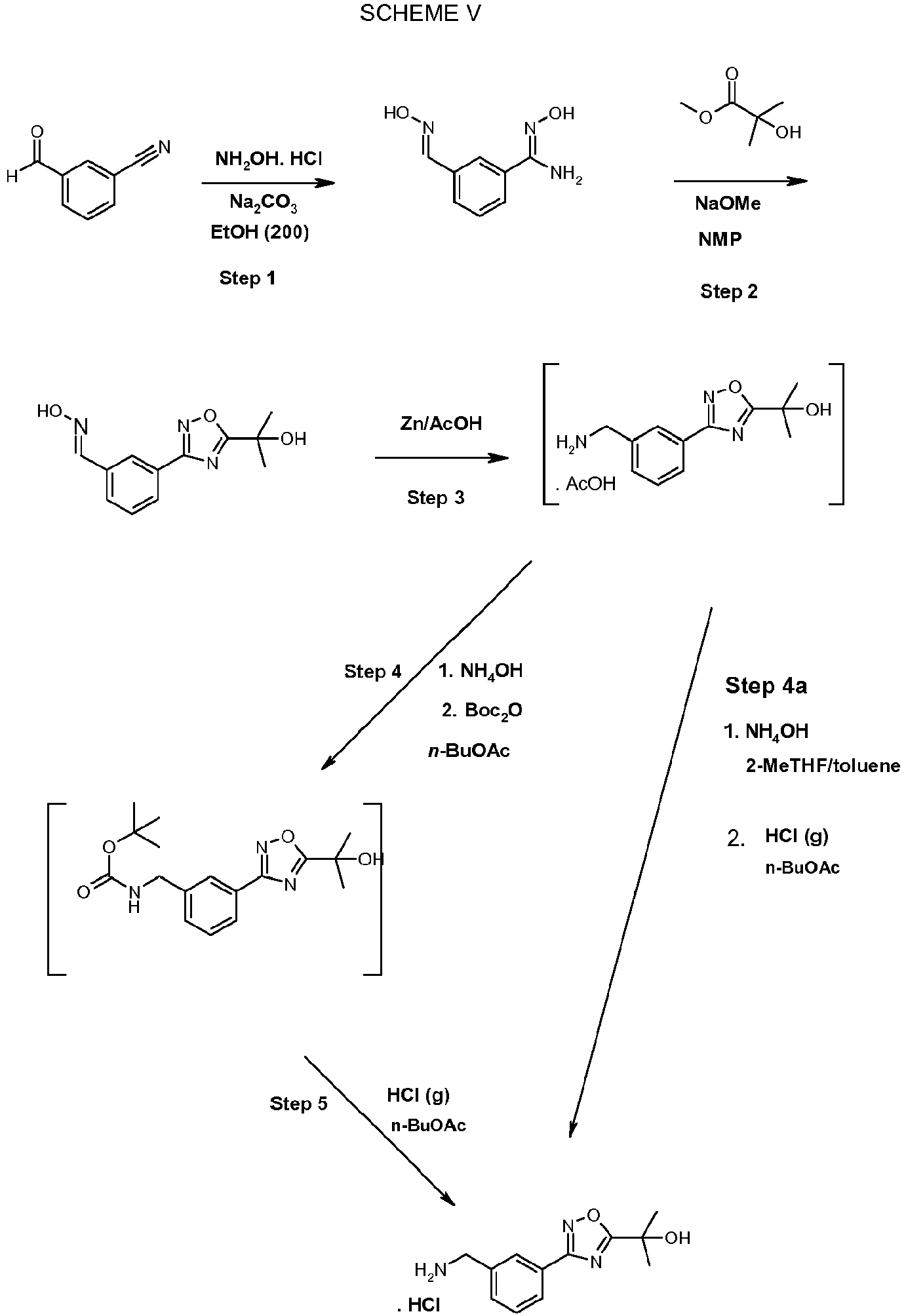
- A 5-L jacketed glass reactor equipped with an overhead mechanical stirrer, a thermocouple probe and a nitrogen purge was charged at 20-25 °C with 3-cyanobenzaldehyde (100.0 g, 0.763 mol, 1.0 eq.) and ethanol (200 proof) (394.5 g, 500 mL, 5 v/w parts). To the suspension was charged via addition funnel, a solution of hydroxylamine hydrochloride (159.0 g, 2.288 mole, 3.0 eq.) in water (250 mL, 2.5 parts) over a period of 30-45 min while maintaining temperature of 20-25 °C. The addition funnel was rinsed with water (20 mL) and the rinse was added to the reactor. After addition of ca 45 mL of NH2OH.HCl solution, the solid dissolved to provide a clear solution. Within 10 min the solution turned cloudy and a solid crystallized to provide a suspension. The solid is believed to be the oxime resulting from addition of hydroxylamine to the aldehyde function. The suspension was stirred at 20-25 °C for 1 h. To the suspension was charged via a addition funnel, a solution of sodium carbonate (121.25 g, 1.144 mole, 1.5 eq,) in water (390 mL, 3.9 parts) over a period of 1.5-2.0 h while maintaining a temperature of 20-22 °C. The addition funnel was rinsed with water (20 mL) and the rinse was added to the reactor. Evolution of CO2 was observed. The suspension was heated to 29-30 °C and stirred at 29-30 °C for 24 h. Water (1.32 L, 13.2 parts) was charged to the reactor over 45-60 min while maintaining a temperature of 30-32 °C. The suspension was heated to and held at 76-78 °C for 30-60 min to get a clear solution. The solution was cooled to 55-60 °C over 90 min. Product crystallized at 55-60 °C. The suspension was stirred at 55-60 °C for 60 min. The suspension was cooled to 20-22 °C over 8-12 h. The suspension was cooled to 2-5 °C and stirred at 2-5 °C for 4 h. The suspension was filtered (Buchner funnel, 14.5 cm o.d.) and the cake was washed with water (250 mL, 2.5 parts). The cake was dried under suction for 5 h. The cake was transferred to a drying dish and dried under vacuum (25-50 torr, 50 °C, N2) for 60 h to provide 127.33 g (93.2% yield) of product as a white crystalline solid with a purity of 99.9% (HPLC).
HPLC Method: Zorbax Eclipse XDB C8 column, 5 micron, 4.6 x 150 mm, 25 °C, detection at 240 nm, gradient: 5:95:0.1 CH3CN/H2O/TFA isocratic 2 min then ramped over 16 min to 90:10:0.1 CH3CN/H2O/TFA; product retention time: 3.6-4.4 min (three peaks) - A 5-L jacketed glass reactor equipped with an overhead mechanical stirrer, a thermocouple probe and a nitrogen purge was charged at 22-27 °C with (N-hydroxy-3-hydroxyiminomethyl)benzamidine) (100.0 g, 0.558 mol, 1.0 eq.) and 1-methyl-2-pyrrolidinone (NMP) (267.3 g, 260 mL, 2.6 v/w parts). To the suspension was charged via addition funnel methyl 2-hydroxyisobutyrate (197.8 g, 1.674 mole, 3.0 eq.) over 15-30 min while maintaining temperature of 25-27 °C. The mixture was stirred at 25-27 °C for 30-45 min to get a clear solution. To the solution was charged via an addition funnel 25 w% sodium methoxide solution in methanol (361.7 g, 1.674 mole, 3.0 eq.) over 30-60 min while maintaining a temperature of 25-27 °C. The solution was heated at 29-30 °C for 7 hours. After 30-45 min at 29-30 °C, the solution turned into a suspension. Water (1.8 L, 18 parts) was charged via an addition funnel over 30-60 min while maintaining a temperature of 22-25 °C. The suspension dissolved to provide a clear solution with a pH 12.2 (pH meter). The pH of the solution was adjusted to 5.0 by charging hydrochloric acid (37.1 w%) (77.4 g, 0.787 mole, 1.4 eq) over 30-45 min while maintaining a temperature of 22-25 °C. The product crystallized upon acidification with hydrochloric acid. After cooling to 5-10 °C and stirring at 5-10 °C for 2 h, the suspension was filtered (Buchner funnel, 27.5 cm i.d.), and the cake was washed with water (700 mL, 7 parts) and dried under suction for 7 h. The cake was transferred to a drying dish and dried under vacuum (25-50 torr, 50 °C, N2) for 20-24 h to provide 132.0 g (95.6% yield) of product as a white crystalline solid with a purity of 99.7% (HPLC).
HPLC Method: Zorbax Eclipse XDB C8 column, 5 micron, 4.6 x 150 mm, 25 °C, detection at 240 nm, gradient: 5:95:0.1 CH3CN/H2O/TFA isocratic 2 min then ramped over 16 min to 90:10:0.1 CH3CN/H2O/TFA; product retention time: 10.8 min - A 5-L jacketed glass reactor equipped with an overhead mechanical stirrer, a thermocouple probe and a nitrogen purge was charged at 20-25 °C with 3-[5-(1-hydroxy-1-methylethyl)-[1,2,4]oxadiazol-3-yl]benzaldehyde oxime (100.0 g, 0.404 mol, 1.0 eq.) and glacial acetic acid (1888.2 g, 1.8 L, 18 v/w parts). The suspension was heated to 28-30 °C and stirred till a clear solution was obtained (30-45 min). The solution was cooled to 22-24 °C and zinc dust (105.8 g, 1.618 mole, 4.0 eq.) was added via an addition funnel over 90-120 min while maintaining a temperature of 22-26 °C. Note: Zinc dust addition was exothermic. The suspension was stirred at 24-26 °C for 2-3 hours. The suspension was filtered under N2 (an inverted funnel with N2 supply) through celite (40 g). The solids were washed with EtOH (200 proof)/H2O (1/1, 894.5 g, 1 L, 10 parts) and EtOH (200 proof) (250 mL, 197.3 g, 2.5 parts). The filtrate was transferred to a 5-L reactor and concentrated under reduced pressure (45-50 torr, 44-47 °C, jacket temperature 50-55 °C) to a volume of ca. 350 mL (3.5 parts). The vacuum was broken with N2 and the reactor was cooled to 22 °C. The mixture was a thick suspension. Toluene (2162.5 g, 2.5 L, 25 parts) was charged to the reactor and suspension was concentrated under reduced pressure (70-75 torr, 42-47 °C, jacket temperature 50-55 °C) to a volume of ca 350 mL (3.5 parts). Vacuum was broken with N2 and the reactor was charged with toluene (129.8 g, 150 mL, 1.5 parts) at 22 °C. The suspension was stirred at 22 °C for 15-20 minutes and the phases were allowed to separate. The upper layer is mainly toluene and the lower layer contains the acetate salt of desired product.
HPLC Method: Zorbax Eclipse XDB C8 column, 5 micron, 4.6 x 150 mm, 25 °C, detection at 240 nm, gradient: 5:95:0.1 CH3CN/H2O/TFA isocratic 2 min then ramped over 16 min to 90:10:0.1 CH3CN/H2O/TFA; product retention time: 7.9 min - 2-MeTHF (1290.0 g, 1.5 L, 15 parts) was added to the reactor. Aqueous ammonium hydroxide (29.5 w%) (353.8 g, 400 mL, 4 parts) was charged via an addition funnel over 30-45 min while maintaining a temperature of 20-25 °C. The mixture was stirred at 22-25 °C for 30-45 min and the phases were allowed to separate. The pH of the aqueous phase should be basic (pH observed 10.9). The organic phase was washed with 15.3 w% aqueous sodium chloride (2 x 442.1 g, 2 x 400 mL, 2 x 4 parts). Note: 15.3 w% aq. NaCl was prepared by dissolving NaCl (180 g) in water (1000 g). The organic phase was concentrated under reduced pressure (100-110 torr, 30-34 °C, jacket temperature 35-40 °C) to a volume of ca 900 mL (9 parts). Vacuum was broken with N2 and the solution was filtered to remove a small amount of NaCl ( ca 400 mg). The funnel was rinsed with 2-MeTHF (86.0 g, 100 mL, 1 part) to provide a solution of 2-[3-(3-aminomethylphenyl)-[1,2,4]-oxadiazol-5-yl]-propan-2-ol free base in 2-MeTHF/toluene (899.0 g, 1 L, 10 parts). Assay (w/w) of the solution provided the product (83.61 g, 9.3 w%) in 88.7% yield with a purity of 95.1 A% (HPLC); 2-MeTHF 68.7 w% and toluene 21.2 w%.
HPLC Method: Zorbax Eclipse XDB C8 column, 5 micron, 4.6 x 150 mm, 25 °C, detection at 240 nm, gradient: 5:95:0.1 CH3CN/H2O/TFA isocratic 2 min then ramped over 16 min to 90:10:0.1 CH3CN/H2O/TFA; product retention time: 7.8 min - A 5 L reactor equipped with mechanical stirrer, thermocouple probe and N2 inlet was charged with THF (1.5L) and 2-[3-(3-aminomethylphenyl)-[1,2,4]-oxadiazol-5-yl]-propan-2-ol AcOH (111.27g). The solution turned into a suspension. A solution of Na2CO3 (85.73g) in water (600ml) was added slowly with cooling (thermocouple at 15°C). The reaction was stirred at room temperature for about 10 minutes. Di-tert-butyl dicarbonate (97.1g) in THF (90mL) was added via a dropping funnel over about 12 minutes with cooling (thermocouple set to 15°C). The reaction mixture was warmed (thermocouple set to 22°C). The mixture separates into two distinct layers after first appearing as a suspension and then becomes a suspension again. Ethyl acetate (750 mL) was added and the suspension was stirred for 15 minutes at room temperature. Celite (545 (25 g) was added to the reactor and the mixture was stirred for 15 minutes. The slurry was transferred to a 4 L Erlenmeyer flask. It was filtered through celite 545 (sintered glass funnel, Kimax 2000 mL-125 C charged with 100 g of celite 545). The celite/zinc salts were washed with ethyl acetate (500 mL). The organic layer was collected and washed with 1/1 H2O/sat. aq NaCl (2x500 mL), pH of aqueous layer 5-7. The filtrate was charged to a clean reactor and the reactor was fitted with a one-piece distillation apparatus (P=250 torr, Δp=5 torr, thermocouple set to 40 °C). When the volume of liquid in reactor was about 250 mL, the pressure was equalized with N2 and the reaction was cooled (thermocouple set to 22 °C). The reactor was charged with ethyl acetate (1500 mL). Resumed distillation (P=180-200 torr, Δp=5 torr, thermocouple set to 50 °C) till volume of solution in the reactor was ca 500 mL. The pressure was equalized with N2 and the reaction was cooled (thermocouple set to 22 °C). Yield of {3-[5-(1-hydroxy-1-methylethyl)-[1,2,4]oxadiazol-3-yl]-benzyl-carbvamic acid tert-butyl ester = 126.46 g (quant., solution in ethyl acetate). The solution was used in step 5
HPLC Method: Zorbax Eclipse XDB C8 column, 5 micron, 4.6 x 150 mm, 25 °C, detection at 240 nm, gradient: 5:95:0.1 CH3CN/H2O/TFA isocratic 2 min then ramped over 16 min to 90:10:0.1 CH3CN/H2O/TFA; product retention time: 13.8 min - A 5L reactor equipped with a mechanical stirrer, thermocouple and N2 inlet was charged with {3-[5-(1-hydroxy-1-methylethyl)-[1,2,4]oxadiazol-3-yl]-benzyl-carbvamic acid tert-butyl ester (126.46g) as solution in ethjyl acetate (from step 4). The solution was cooled (3-15 °C). Added HCl gas (102g) from a lecture bottle over 30 minutes. The reaction was warmed to 15 °C over 45 minutes and a slurry was formed. This slurry was transferred to an Erlenmeyer flask (1L). The contents were then filtered using a buchner funnel. The cake was rinsed with ethyl acetate (350mL) and suction dried. The solid was then transferred to a drying dish and dried (0.9" Hg, 35 C, N2) to yield 83.52 g of a solid (76.6 % overall yield steps 3-5).
HPLC Method: Zorbax Eclipse XDB C8 column, 5 micron, 4.6 x 150 mm, 25 °C, detection at 240 nm, gradient: 5:95:0.1 CH3CN/H2O/TFA isocratic 2 min then ramped over 16 min to 90:10:0.1 CH3CN/H2O/TFA; product retention time: 8.0 min -

- A reactor with stirring and a nitrogen blanket was charged with 2-Me-THF (5mL), the ester (500mg), the benzylamine (545mg) and 1,5,7-triazabicyclo[4,4,0]dec-5-ene (TBD) (97.5mg, 0.3eq) to yield a yellowish suspension. The reactor was positioned into a heating block that was preheated to 79°C. The reaction was stirred for about 3 hours, then was removed from the block, allowed to cool to room temperature, then placed in an ice bath, stirred 15 minutes, and filtered. The reactor and cake were rinsed with 1mL cold 2-Me-THF. The white caked was rinsed with 5x2 mL water at room temperature and suction dried for 1.5 hours. The white solid (0.77g) was transferred to an oven and heated at 70°C (N2, 45 mbar) overnight. Yield: 750mg, 77%.
- Alternative work up: After a reaction employing 2-Me-THF (4 mL), the ester (300 mg), the benzylamine (327 mg) and 1,5,7-triazabicyclo[4,4,0]dec-5-ene (TBD) (58.5 mg, 0.3 eq) was complete, the mixture was partitioned with 2 mL of water and cooled. The organic phase was separated, diluted with 2 mL of 2-Me-THF, then was washed with 5 mL of water. The combine aqueous phase was extracted with 2 mL of 2-Me-THF. The combined organic phase was concentrated and dried. Yield: 0.57 g, 97%.
- HPLC method: Eclipse XDB C8 column, 5 micron, 4.6 x 150 mm, 35 °C, detection at 270 nm, gradient: 5:95:0.1% ACN/water/TFA held 5 min then ramped over 7 min to 50:50:0.1% ACN/water/TFA, held 3 min; product retention time: 12.9 min.
-
-

- 3-Acetylbenzonitrile (5g, 34.4 mmol) is added to a flask containing (R)-(+)-2-Methyl-2-propanesulfinamide (3.48g, 28.7 mmol) and Titinium (IV) ethoxide (13.1 g, 57.4 mmol) in THF (70 mL) and the reaction mixture heated at 750C overnight. The reaction mixture is cooled (-480C) and L-Selectride (1M solution in THF, 57.4 mL) added dropwise over 1hour. The reaction stirred for 2hrs and allowed to warm to room temperature. The reaction is then cooled to 00C and methanol (3 mL) added. Brine (150 mL) is added with stirring and the suspension filtered through celite. The crude material is extracted with ethyl acetate, dried (MgSO4), filtered and evaporated under vacuum. The cruse is purified by column chromatography eluting with heptane-ethyl acetate to give N-[(1S)-1-(3-cyanophenyl)ethyl]-2-methyl-[S(R)]-2-propanesulfinamide (78%)
MS: 251 (M+H)
1H NMR (300 MHz, CDCl3): δ = 1.22 (s, 9H), 1.54 (d, 3H), 3.36 (bs, 1H), 4.55-4.7 (m, 1H), 7.43 (d, 1H), 7.46 (d, 1H), 7.56-7.6 (m, 2H), 7.64 (s, 1H). -
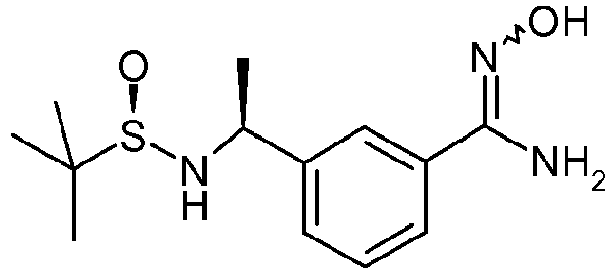
- Hydroxylamine hydrochloride (3.43 g, 55 mmol) and methanol (70 mL) are added to a flask containing N-[(1S)-1-(3-cyanophenyl)ethyl]-2-methyl- [S(R)]- 2-propanesulfinamide (5.5 g, 22 mmol) and the suspension cooled in an ice water bath. Triethyl amine (5.55 g, 55 mmol) is added to the flask and the reaction mixture is allowed to warm to room temperature over night. The reaction mixture evaporated under reduced pressure and the crude partitioned between water and DCM. Organic layer separated, dried (Na2SO4) and evaporated under reduced pressure to give N-Hydroxy-3-[(S)-1-(2-methyl-propane-2-sulfinylamino)-ethyl]-benzamidine (5.48 g).
MS: 284 (M+H). 1H NMR (300 MHz, CDCl3): δ = 1.21 (s, 9H), 1.52 (s, 3H), 3.33 (s, 1H), 3.77 (bs, 1H), 4.59-4.61 (m, 1H), 4.88 (1H, bs), 7.35-7.37 (m, 2H), 7.50-7.52 (m, 1H), 7.64 (s, 1H) -
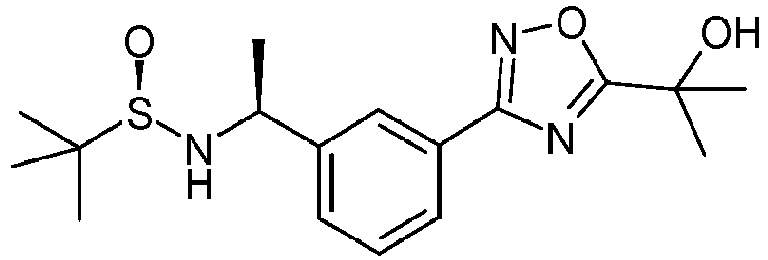
- Methyl 2-Hydroxy-2-methyl-propionate (20 mL) and K2CO3 (806 mg, 5.8 mmol) are added to a flask containng N-Hydroxy-3-[(S)-1-(2-methyl-propane-2-sulfinylamino)-ethyl]-benzamidine (1.5 g, 5.3 mmol) and heated under reflux for 6 hrs. The reaction mixture is evaporated under reduced pressure and partitioned between water and ethyl acetate. The organic layer separated, dried (Na2SO4) and purified by flash column chromatography eluting with heptane-ethyl acetate mixture to give 2-Methyl-propane-2-sulfinic acid ((S)-1-{3-[5-(1-hydroxy-1-methyl)-1,2,4-oxadiazol-3-yl]-phenyl}-ethyl)-amide (1.05 g).
MS: 352 (M+H).
1H NMR (300 MHz, CDCl3): δ = 1.22 (s, 9H), 1.58 (d, 3H), 1.75 (s, 6H), 3.48 (bs, 1H), 4.65 (m, 1H), 7.45-7.47 (m, 2H), 8.01 (m, 1H), 8.08 (s, 1H) -

- Hydrogen chloride in p-dioxane (4N, 1.42 mL) is added to a cooled solution of 2-Methyl-propane-2-sulfinic acid ((S)-1-{3-[5-(1-hydroxy-1-methyl-ethyl)-1,2,4-oxadiazol-3-yl]-phenyl}-ethyl)-amide (1g, 2.85 mmol) in methanol (3 mL) at 00C and stirred for 20 min. Diethyl ether (30 mL) is added, decanted, and the residue is washed with another aliquot of diethyl ether. The residue is dried in vacuo to yield 2-{3-[3-((S)-1-Amino-ethyl)-phenyl]-1,2,4-oxadiazol-5-yl}-propan-2-ol Hydrochloride (560 mg).
MS: 231 (ES+, -OH ionized)
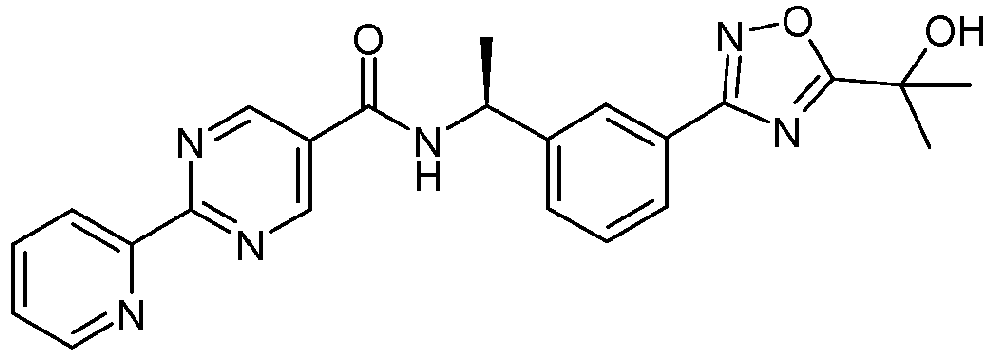
1H NMR (300 MHz, DMSO): δ = 1.55 (d, 3H), 1.63 (s, 6H), 4.53-4.57 (m, 1H), 6.1 (bs, 1H), 7.64 (t, 1H), 7.76 (d, 1H), 8.01 (d, 1H), 8.15 (s, 1H), 8.56(bs, 2H) - N--methyl morpholine (NMM) (196 mg, 1.94 mmol) is added to a mixture of 2-Pyridin-2-yl-pyrimidine-5-carboxylic acid (390 mg, 1.94 mmol) and 2-{3-[3-((S)-1-Amino-ethyl)-phenyl]-1,2,4-oxadiazol-5-yl}-propan-2-ol Hydrochloride (550 mg, 1.94 mmol) in DMF (20 mL). After stirring at room temperature for 5 minutes, 4-(4,6-Dimethoxy-[1,3,5]triazin-2-yl)-4-methyl-morpholin-4-ium chloride (DMTMM) (537 mg, 1.94 mmol) is added and the reaction stirred at room temperature for 2 hours. The reaction mixture poured on to ice water and the suspension is extracted with EtOAc (7x100 mL). The combined ethyl acetate layer is washed with brine (50 mL), dried over sodium sulfate, and reduced in vacuo to give crude product which is purified by HPLC (C18 column) eluting with acetonitrile-water mixture to give 2-Pyridin-2-yl-pyrimidine-5-carboxylic acid ((S)-1-{3-[5-(1-hydroxy-1-methyl-ethyl)-1,2,4-oxadiazol-3-yl]-phenyl}-ethyl)-amide as amorphous glass (650 mg, 78%).
MS: 431 (M+H).
1H NMR (300 MHz, DMSO): δ = 1.58 (d, 3H), 1.62 (s, 6H), 5.3 (m, 1H), 7.56 (t, 1H), 7.7 (d, 1H), 7.92 (m, 2H), 8.08 (s, 1H), 8.43 (t, 1H), 8.72 (d, 1H), 8.9 (d, 1H), 9.47 (s, 2H), 9.59 (d, 1H).
[α]d (Methanol) = +57.2° -

-

- Potassium hydrogen sulfate (13.6g, 100 mmol) is added to a mixture of 3-Formylbenzonitrile (7.21g, 55 mmol) and (S)-(+)-2-Methyl-2-propanesulfinamide (6.06g, 50 mmol) in toluene (500 mL) and heated at 450C for 2 days. The reaction mixture is filtered, the filtrate evaporated under reduced pressure and purified by column chromatography eluting with ethyl acetate-heptane mixture to give, N-[(3-cyanophenyl)methylene]-2-methyl-, [S(S)]- 2-Propanesulfinamide (9.65g)
MS: 235 (M+H).
1H NMR (300 MHz, CDCl3): δ = 1.29 (s, 9H), 7.62 (t, 1H), 7.79 (d, 1H), 8.04 (d, 1H), 8.17 (bs, 1H), 8.60 (s, 1H). -

- Methyl magnesium bromide (34.3 mL of 3M solution in diethyl ether, 102.9 mmol) is added over 30 minutes to a solution of N-[(3-cyanophenyl)methylene]-2-methyl-, [S(S)]- 2-Propanesulfinamide (9.65g, 41.18 mmol) in DCM (200 mL) at -450C and stirred at that temperature for 4 hrs. The cooling bath is then removed, allowed to warm up to -10°C and quenched with saturated NaHCO3 (250 mL). The organic layer is separated and the aqueous layer is extracted with more DCM (100 mL). The organic extracts are combined, dried (Na2SO4) and evaporated under reduced pressure to give 2-Methyl-propane-2-sulfinic acid [(R)-1-(3-cyano-phenyl)-ethyl]-amide as the major product.
MS: 251 (M+H).
1H NMR (300 MHz, CDCl3): δ = 1.22 (s, 9H), 1.54 (d, 3H), 3.35 (s, 1H), 4.56-4.65 (m, 1H), 7.42-7.48 (m, 1H), 7.56-7.59 (m, 2H), 7.64 (s, 1H). -

- Hydrogen chloride (4N in p-dioxane, 21 mL) is added to a solution of 2-Methyl-propane-2-sulfinic acid [(R)-1-(3-cyano-phenyl)-ethyl]-amide (10.29 g, 41.1 mmol) in methanol (21 mL) and stirred at room temperature for 40 minutes. Reaction mixture is then evaporated under reduced pressure and the crude triturated with diethyl ether to give an off white solid which is crystallized from Methyl t-butyl ether and ethanol mixture to give 3-((R)-1-Amino-ethyl)-benzonitrile hydrochloride as the major product.
MS: 147 (M+H).
1H NMR (300 MHz, DMSO): δ = 1.53 (d, 3H), 4.45-4.52 (m, 1H), 7.65 (t, 1H), 7.84-7.91 (m, 2H), 8.03 (s, 1H), 8.67 (bs, 3H). -

-

- Hydroxylamine hydrochloride (1.52 g g, 24.2 mmol) is added to a cooled solution of 2-Pyridin-2-yl-pyrimidine-5-carboxylic acid [(R)-1-(3-cyano-phenyl)-ethyl]-amide (3.2 g, 9.7 mmol) in methanol (40 mL) and the suspension cooled in an ice water bath. Triethyl amine (2.44 g, 24.2 mmol) is added to the flask and the reaction mixture is allowed to warm to room temperature over night. The reaction mixture evaporated under reduced pressure and the crude partitioned between water and ethyl acetate. Organic layer is separated, dried (Na2SO4) and evaporated under reduced pressure. Toluene (50 mL) and CHCl3 (50 mL) are added and evaporated under reduced pressure to give 2-Pyridin-2-yl-pyrimidine-5-carboxylic acid {(R)-1-[3-(N-hydroxycarbamimidoyl)-phenyl]-ethyl}-amide (3 g) as the major product.
MS: 363 (M+H).
1H NMR (300 MHz, DMSO): δ = 1.54 (d, 3H), 5.18-5.27 (m, 1H), 5.80 (bs, 2H), 7.35 (t, 1H), 7.44 (d, 1H), 7.54-7.60 (m, 2H), 7.74 (s, 1H), 8.45 (d, 1H), 8.79 (d, 1H), 9.26 (d, 1H), 9.35 (s, 2H), 9.60 (s, 1H). - Methyl 2-hydroxy-2-methyl-propionate (2 mL) and K2CO3 (219 mg, 1.59 mmol) are added to a microwave vial containng 2-Pyridin-2-yl-pyrimidine-5-carboxylic acid {(R)-1-[3-(N-hydroxycarbamimidoyl)-phenyl]-ethyl}-amide (0.5 g, 1.38 mmol) and heated at 1800C in a microwave for 10 minutes. The reaction mixture is evaporated under reduced pressure and purified by reverse phase HPLC to give 2-Pyridin-2-yl-pyrimidine-5-carboxylic acid ((R)-1-{3-[5-(1-hydroxy-1-methyl-ethyl)-1,2,4-oxadiazol-3-yl]-1-phenyl}-ethyl)-amide as the major compound (110 mg).
MS: 431 (M+H).
1H NMR (300 MHz, DMSO): δ = 1.58 (d, 3H), 1.61 (s, 6H), 5.27-5.31 (m, 1H), 6.08 (s, 1H), 7.53-7.60 (m, 2H), 7.67 (d, 1H), 7.91 (d, 1H), 8.02 (t, 1H), 8.08 (s, 1H), 8.45 (d, 1H), 8.79 (d, 1H), 9.35-9.39 (m, 3H). - 2-Pyridin-2-yl-pyrimidine-5-carboxylic acid ((R)-1-{3-[5-(1-hydroxy-1-methyl-ethy)-1,2,4-oxadiazol-3-yl]-phenyl}-ethyl)-amide can also be prepared by following procedures similar to those of Example 2 but substituting 2-{3-[3-((R)-1-Amino-ethyl)-phenyl]-1,2,4-oxadiazol-5-yl}-propan-2-ol Hydrochloride for 2-{3-[3-((S)-1-Amino-ethyl)-phenyl]-1,2,4-oxadiazol-5-yl}-propan-2-ol Hydrochloride.
- The compounds of the present invention can be tested for enzymatic inhibiting activity against PGD2 Synthase according to either one of the following assays.
- As described in
PCT publication WO 2004/016223 , Example II. -
- a. Preparation of 0.1M K2HPO4/KH2PO4 buffer (pH 7.4)
- Prepare 0.1 M KH2PO4 from 1M KH2PO4 (Sigma, Cat# P-8709)
- Prepare 0.1 M K2HPO4 from powder of K2HPO4 (Fisher, BP363-500)
- Mix 0.1 M K2HPO4 with 0.1 M KH2PO4 to adjust pH to 7.4.
- b. Preparation of 0.5% γ-globulin
- Add 0.1 g of γ-globulin (Sigma, Cat# G-5009) to 20 mL 0.1 M K2HPO4/KH2PO4 buffer (pH 7.4) and make 1-mL/vial aliquots and store in -80°C.
- c. Preparation of 100 mM GSH
- Add 307 mg of GSH (Sigma, Cat# G-6529) to 10 mL 0.1 M K2HPO4/ KH2PO4 buffer (pH 7.4) and store at - 80°C.
- d. Preparation of Reaction buffer:
- 198 mL of 0.1M K2HPO4/KH2PO4 buffer (pH 7.4)
- 2 mM GSH - Prepared from 100 mM GSH
- 0.4 g Glycerol
- 2 mL of 0.5% γ-globulin
- Add 0.4 g of glycerol and 2 mL of 0.5% γ-globulin to 198 mL of 0.1 M K2HPO4/ KH2PO4
- buffer (pH7.4).
- Add 0.4 mL of 100 mM GSH to 19.6 mL reaction buffer before the assay (enough for two 96-well plates).
- e. Preparation of FeCl2/citric acid stopping solution: (8 mg/mL FeCl2, 0.1 M citric acid)
Add 40 mg fresh FeCl2 (IGN, Cat# 158046) to 5 mL 0.1 M citric acid (Sigma, Cat# C0759). - f. Preparation of MOX reagent:
- 10% EtOH - Add 1 mL of EtOH to 9 mL of ultra pure H2O
- Dissolve 0.1 g of methoxylamine (Cayman, Cat# 400036/) in 10% EtOH (10 mL). Add 0.82 g of sodium acetate (Cayman, Cat#400037) to MOX solution and dissolve.
-
- Dimethylsulfoxide (DMSO; Sigma; Cat# D2650)
- Prostaglandin D2-MOX express EIA kit (Caymen Chemical, Catalog No.500151)
- Before the assay, cool down 10 mL of acetone in polypropylene tubes and empty 96 well plates in ice. All the procedures except compound dilution are performed on ice.
-
1. Dilute compound in DMSOVol of DMSO stock solution (µL) DMSO (µL) Compound concentration (mM) 4 µL of 10 mM 6 µL 4 3 µL of 4 mM 6 µL 1.3333 3 µL of 1.33 mM 6 µL 0.4444 3 µL of 0.44 mM 6 µL 0.1481 3 µL of 0.148 mM 6 µL 0.0494 3 µL of 0.049 mM 6 µL 0.0165 3 µL of 0.016 mM 6 µL 0.0055
2. Dilute 2 µL of each above concentration of compound to 38 µL of reaction buffer in 96-well plates and mix. -
- 1. Preparation of 0.39 ng/µL enzyme solution (0.35 ng/µL at final after compound addition).
Mix 4 µL of 4 mg/mL human h-PGDS with 396 µL of reaction buffer (to give enzyme concentration 40 µg/mL). Add 46.8 µL of 40 µg/mL h-PGDS to 4.753 mL of reaction buffer to give a total volume of 4.8 mL - 2. Preparation of Substrate Solution (PGH2): Add 0.375 mL of 0.1 mg/mL of PGH2 to 1.625mL acetone.
-
- 1. Add 60 µL of enzyme solution to compound well and positive control (without compound) in U-bottom polypropylene plate on ice.
- 2. Add 60 µL of reaction buffer and 6.6 µL of 5% DMSO in reaction buffer into negative control wells in the plate.
- 3. Add 6.6 µL of diluted compound in reaction buffer to the compound wells and mix.
- 4. Add 6.6 µL of 5% DMSO in reaction buffer to the positive control well.
- 5. Incubate the plate in ice for at least 30 min.
- 6. Add 20 µL of substrate (PGH2) solution to compound, negative and positive control wells in the U-bottom 96 well plate on ice.
- 7. Dry the plate in cold room for about 25-28 min.
- 8. Pipette 45 µL of enzyme solution (above) into 96-wells with dried PGH2 and mix 3 times. Incubate on the ice for 1 min.
- 9. Add 45 µL of FeCl2 solution into each wells and mix.
- 10. Add 90 µL of MOX solution and mix.
- 11. Incubate for 30 min at 600C.
- 12. Dilute the samples 2500X with EIA buffer.
- Perform the assay according to the procedure in EIA kit provided by Cayman. Total PGD2 levels (pg/mL) were determined in the samples by EIA kits (Caymen Chemical, Catalog No. 500151)
- Calculated % Positive control according to the equation below;


- Compound value = PGD2 levels (pg/mL) obtained from the standard curve in EIA assay for the samples with compound
- Negative control value = PGD2 levels (pg/mL) obtained from the standard curve in EIA assay for the samples without enzyme
- Positive control value = PGD2 levels (pg/mL) obtained from the standard curve in EIA assay for the samples with enzyme but without compound
- IC50s are determined by excel fit to get the x value when y=1/2Ymax using 4 parameter logistic model for the IC50 curves.
- Compounds within the scope of the invention produce 50% inhibition in the Fluorescence Polarization Assay or the EIA assay at concentrations within the range of about 1 nanomolar to about 30 micromolar, particularly about 1 nanomolar to about 1 micromolar, and more particularly about 1 nanomolar to about 100 nanomolar.
Example hPGDS EIA IC50 nM solidsol µM 1 12 135.9 2 11 854.9 3 26 29.4
Claims (20)
- A compound of formula (I):
 R1 is hydrogen or C1-C6alkyl;R2 is hydrogen, halogen or C1-C3alkyl; andR3 is hydroxyalkyl;or a pharmaceutically acceptable salt thereof.
 - The compound of Claim 1 wherein R1 is hydrogen, R2 is hydrogen and R3 is hydroxyalkyl.
- The compound of Claim 2 which is 2-pyridin-2-yl-pyrimidine-5-carboxylic acid 3-[5-(1-hydroxy-1-methyl-ethyl)-1,2,4-oxadiazol-3-yl]-benzylamide;
- The compound of Claim 1 where R1 is C1-C6alkyl, R2 is hydrogen and R3 is hydroxyalkyl.
- The compound of Claim 4 selected from the group consisting of 2-pyridin-2-yl-pyrimidine-5-carboxylic acid ((S)-1-{3-[5-(1-hydroxy-1-methyl-ethyl)-1,2,4-oxadiazol-3-yl]-phenyl}-ethyl)-amide and 2-pyridin-2-yl-pyrimidine-5-carboxylic acid ((R)-1-{3-[5-(1-hydroxy-1-methyl-ethyl)-1,2,4-oxadiazol-3-yl]-phenyl}-ethyl)-amide.
- A pharmaceutical composition comprising the compound according to Claim 1 and a pharmaceutically acceptable carrier.
- A compound according to claim 1 for use in the treatment of an allergic or inflammatory disorder.
- A compound according to claim 7, for use in the treatment of an allergic or inflammatory disorder, wherein the allergic or inflammatory disorder is selected from the group consisting of allergic rhinitis, asthma, chronic obstructive pulmonary disease and age-related macular degeneration.
- A process for preparing a compound of formula (I)
 R1 is hydrogen or C1-C6alkyl;R2 is hydrogen, halogen or C1-C3alkyl; andR3 is hydroxyalkyl;
or a pharmaceutically acceptable salt thereof, comprising the step of reacting a compound of formula XI wherein R1, R2 and R3 are as defined in formula I,
witha.) an acid compound of formula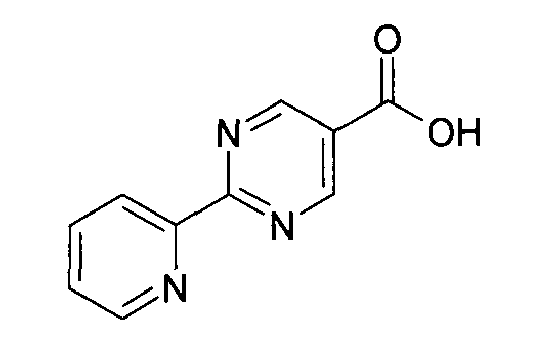 b) an ester compound of formula
in the presence of 1,5,7-triazabicyclo[4.4.0]dec-5-ene (TBD); orc) an acid chloride compound of formula
- The process of claim 9 wherein the compound of formula I is


- The process of claim 10 wherein the suitable coupling reagent is selected from the group consisting of DMTMM, CDI, and TBTU.
- The process of claim 10 wherein R4 of the ester compound is CH3.
- A compound of formula

- A compound of formula

- A compound of formula

- A compound of formula

- A compound of formula
 wherein R2 is hydrogen, halogen or C1-C3alkyl; andR3 is hydroxyalkyl;or an acid addition salt thereof.
 - The compound of claim 17 that is

- The compound of claim 18 wherein the acid salt is the hydrochloride salt.
- A process for preparing a compound of formula
 wherein R2 is hydrogen, halogen or C1-C3alkyl; andR3 is hydroxyalkyl;comprising the step of reducing an oxime compound of formula
 wherein R2 is hydrogen, halogen or C1-C3alkyl; andR3 is hydroxyalkyl.
Applications Claiming Priority (3)
| Application Number | Priority Date | Filing Date | Title |
|---|---|---|---|
| US24969309P | 2009-10-08 | 2009-10-08 | |
| FR1056094 | 2010-07-26 | ||
| PCT/US2010/051727 WO2011044307A1 (en) | 2009-10-08 | 2010-10-07 | Phenyloxadiazole derivatives as pgds inhibitors |
Publications (2)
| Publication Number | Publication Date |
|---|---|
| EP2486024A1 EP2486024A1 (en) | 2012-08-15 |
| EP2486024B1 true EP2486024B1 (en) | 2015-04-22 |
Family
ID=43606440
Family Applications (1)
| Application Number | Title | Priority Date | Filing Date |
|---|---|---|---|
| EP20100765724 Active EP2486024B1 (en) | 2009-10-08 | 2010-10-07 | Phenyloxadiazole derivatives as pgds inhibitors |
Country Status (21)
| Country | Link |
|---|---|
| US (5) | US9469627B2 (en) |
| EP (1) | EP2486024B1 (en) |
| JP (2) | JP5753176B2 (en) |
| KR (1) | KR101701135B1 (en) |
| CN (3) | CN107875155A (en) |
| AR (1) | AR078552A1 (en) |
| AU (1) | AU2010303439B2 (en) |
| BR (1) | BR112012007635B1 (en) |
| CA (1) | CA2776242C (en) |
| DK (1) | DK2486024T3 (en) |
| ES (1) | ES2543011T3 (en) |
| IL (1) | IL218967A (en) |
| MA (1) | MA33725B1 (en) |
| MX (1) | MX2012003021A (en) |
| NZ (1) | NZ599099A (en) |
| PH (1) | PH12012500676A1 (en) |
| RU (2) | RU2015151129A (en) |
| SG (1) | SG179199A1 (en) |
| TW (1) | TWI508960B (en) |
| UY (1) | UY32938A (en) |
| WO (1) | WO2011044307A1 (en) |
Families Citing this family (10)
| Publication number | Priority date | Publication date | Assignee | Title |
|---|---|---|---|---|
| BR112012007635B1 (en) | 2009-10-08 | 2019-07-09 | Sanofi | PHENYLOXADIAZOL DERIVATIVE COMPOUNDS AS PGDS INHIBITORS, PHARMACEUTICAL COMPOSITION UNDERSTANDING THE SAME AND ITS PREPARATION PROCESSES |
| US9320723B2 (en) * | 2010-05-03 | 2016-04-26 | University Of Rochester | Methods of treating thyroid eye disease |
| CN108430992A (en) | 2015-12-17 | 2018-08-21 | 阿斯特克斯医疗公司 | Quinoline-3-carboxamides as H-PGDS inhibitors |
| JOP20190072A1 (en) | 2016-10-13 | 2019-04-07 | Glaxosmithkline Ip Dev Ltd | 1,3 di-substituted cyclobutane or azetidine derivatives as hematopoietic prostaglandin d synthase inhibitors |
| EP3630738B1 (en) * | 2017-05-22 | 2023-07-19 | Egis Gyógyszergyár Zrt. | Process for the production of ozanimod |
| EP3638672A1 (en) | 2017-06-13 | 2020-04-22 | GlaxoSmithKline Intellectual Property Development Limited | Chemical compounds as h-pgds inhibitors |
| EP3724197A1 (en) | 2017-12-13 | 2020-10-21 | GlaxoSmithKline Intellectual Property Development Ltd | Fused pyridines which act as inhibitors of h-pgds |
| JP2022506850A (en) | 2018-11-08 | 2022-01-17 | グラクソスミスクライン、インテレクチュアル、プロパティー、ディベロップメント、リミテッド | Chemical compound |
| US20230339937A1 (en) | 2020-06-19 | 2023-10-26 | Sato Pharmaceutical Co., Ltd. | Condensed ring compounds that inhibit h-pgds |
| EP4450502A4 (en) | 2021-12-17 | 2025-06-11 | Sato Pharmaceutical Co., Ltd. | Azaindole derivative inhibiting h-pgds |
Family Cites Families (20)
| Publication number | Priority date | Publication date | Assignee | Title |
|---|---|---|---|---|
| US5176132A (en) | 1989-05-31 | 1993-01-05 | Fisons Plc | Medicament inhalation device and formulation |
| DE10117823A1 (en) | 2001-04-10 | 2002-10-17 | Merck Patent Gmbh | New N-phenyl-oxalamide derivatives, are factor Xa and factor VIIa inhibitors useful e.g. for treating thrombosis, myocardial infarction, inflammation, angina pectoris or tumor diseases |
| MXPA04009095A (en) * | 2002-03-19 | 2004-12-06 | Ono Pharmaceutical Co | Carboxyoic acid compounds and drugs containing the compounds as the active ingredient. |
| IL166782A0 (en) | 2002-08-16 | 2006-01-15 | Aventis Pharma Inc | Method for assaying compounds or agents for ability to decrease the activity of microsomal prostaglandin e synthase or hematopoietic prostaglandin d synthase |
| GB0222023D0 (en) | 2002-09-21 | 2002-10-30 | Aventis Pharma Ltd | Inhaler |
| WO2005094805A1 (en) | 2004-04-01 | 2005-10-13 | Institute Of Medicinal Molecular Design. Inc. | Imine derivative and amide derivative |
| KR20060135901A (en) * | 2004-04-21 | 2006-12-29 | 쉐링 코포레이션 | Pyrazolo- [4,3-e] -1,2,4-triazolo- [1,5-c] pyrimidine adenosine A2a receptor antagonist |
| JP5209181B2 (en) * | 2005-03-15 | 2013-06-12 | 富士フイルム株式会社 | Compound, composition, retardation plate, elliptically polarizing plate, and liquid crystal display device |
| TW200720255A (en) | 2005-07-13 | 2007-06-01 | Taiho Pharmaceutical Co Ltd | Benzoimidazole compound capable of inhibiting prostaglandin d synthetase |
| JP2007051121A (en) * | 2005-07-22 | 2007-03-01 | Taiho Yakuhin Kogyo Kk | Pyrimidine compounds that inhibit prostaglandin D synthase |
| CN100556905C (en) * | 2005-09-08 | 2009-11-04 | 国家南方农药创制中心江苏基地 | Pyrazole amide compounds and their intermediates and pest control agents with such compounds as active ingredients |
| CA2624102A1 (en) | 2005-09-29 | 2007-04-12 | Sanofi-Aventis | Phenyl- and pyridinyl- 1, 2 , 4 - oxadiazolone derivatives, processes for their preparation and their use as pharmaceuticals |
| PE20110118A1 (en) | 2005-10-04 | 2011-03-08 | Aventis Pharma Inc | PYRIMIDINE AMIDE COMPOUNDS AS INHIBITORS OF PGDS |
| JP2010513458A (en) | 2006-12-19 | 2010-04-30 | ファイザー・プロダクツ・インク | Nicotinamide derivatives as inhibitors of H-PGDS and their use to treat prostaglandin D2-mediated diseases |
| CA2679198C (en) * | 2007-02-26 | 2011-07-12 | Pfizer Products Inc. | Nicotinamide derivatives as inhibitors of h-pgds and their use for treating prostaglandin d2 mediated diseases |
| DK2142516T3 (en) | 2007-03-30 | 2013-04-15 | Sanofi Sa | PYRIMIDINE HYDRAZIDE COMPOUNDS IN THEIR CHARACTERISTICS OF PGDS INHIBITORS |
| GB0706793D0 (en) | 2007-04-05 | 2007-05-16 | Evotec Ag | Compounds |
| AR074776A1 (en) * | 2008-12-18 | 2011-02-09 | Sanofi Aventis | METHOD TO TREAT MACULAR DEGENERATION; MODULATING THE PATIENT'S IMMUNE SYSTEM |
| WO2010080653A1 (en) | 2009-01-12 | 2010-07-15 | The Government Of U.S.A, As Represented By The Secretary Of The Navy | Composite electrode structure |
| BR112012007635B1 (en) | 2009-10-08 | 2019-07-09 | Sanofi | PHENYLOXADIAZOL DERIVATIVE COMPOUNDS AS PGDS INHIBITORS, PHARMACEUTICAL COMPOSITION UNDERSTANDING THE SAME AND ITS PREPARATION PROCESSES |
-
2010
- 2010-10-07 BR BR112012007635-3A patent/BR112012007635B1/en not_active IP Right Cessation
- 2010-10-07 PH PH1/2012/500676A patent/PH12012500676A1/en unknown
- 2010-10-07 CA CA2776242A patent/CA2776242C/en active Active
- 2010-10-07 CN CN201711114032.4A patent/CN107875155A/en active Pending
- 2010-10-07 CN CN201710240652.6A patent/CN106943407A/en active Pending
- 2010-10-07 AU AU2010303439A patent/AU2010303439B2/en not_active Ceased
- 2010-10-07 ES ES10765724.9T patent/ES2543011T3/en active Active
- 2010-10-07 KR KR1020127008972A patent/KR101701135B1/en active Active
- 2010-10-07 TW TW099134129A patent/TWI508960B/en active
- 2010-10-07 RU RU2015151129A patent/RU2015151129A/en not_active Application Discontinuation
- 2010-10-07 SG SG2012018933A patent/SG179199A1/en unknown
- 2010-10-07 RU RU2012118756/04A patent/RU2572608C2/en active
- 2010-10-07 CN CN201080055808XA patent/CN102666508A/en active Pending
- 2010-10-07 JP JP2012533302A patent/JP5753176B2/en active Active
- 2010-10-07 WO PCT/US2010/051727 patent/WO2011044307A1/en not_active Ceased
- 2010-10-07 EP EP20100765724 patent/EP2486024B1/en active Active
- 2010-10-07 AR ARP100103650A patent/AR078552A1/en unknown
- 2010-10-07 DK DK10765724.9T patent/DK2486024T3/en active
- 2010-10-07 NZ NZ599099A patent/NZ599099A/en not_active IP Right Cessation
- 2010-10-07 MX MX2012003021A patent/MX2012003021A/en not_active Application Discontinuation
- 2010-10-08 UY UY0001032938A patent/UY32938A/en not_active Application Discontinuation
-
2012
- 2012-04-01 IL IL218967A patent/IL218967A/en active IP Right Grant
- 2012-04-04 US US13/439,511 patent/US9469627B2/en active Active
- 2012-05-04 MA MA34835A patent/MA33725B1/en unknown
-
2015
- 2015-05-20 JP JP2015102335A patent/JP5897186B2/en active Active
-
2016
- 2016-09-07 US US15/258,892 patent/US9937175B2/en active Active
-
2018
- 2018-02-23 US US15/903,337 patent/US20190000845A1/en not_active Abandoned
- 2018-09-20 US US16/137,241 patent/US20190262338A1/en not_active Abandoned
-
2022
- 2022-11-22 US US17/992,553 patent/US20230190747A1/en not_active Abandoned
Also Published As
Similar Documents
| Publication | Publication Date | Title |
|---|---|---|
| US20230190747A1 (en) | Phenyloxadiazole derivatives as pgds inhibitors | |
| US8202863B2 (en) | Pyrimidine amide compounds as PGDS inhibitors | |
| IL200898A (en) | Pyrimidine hydrazide compounds as pgds inhibitors | |
| US20210330671A1 (en) | Phenyloxadiazole derivatives as pgds inhibitors | |
| HK1173441B (en) | Phenyloxadiazole derivatives as pgds inhibitors | |
| US20100029728A1 (en) | Phosphodiesterase inhibitors | |
| HK1136162A (en) | Pyrimidine amide compounds as pgds inhibitors |
Legal Events
| Date | Code | Title | Description |
|---|---|---|---|
| PUAI | Public reference made under article 153(3) epc to a published international application that has entered the european phase |
Free format text: ORIGINAL CODE: 0009012 |
|
| 17P | Request for examination filed |
Effective date: 20120508 |
|
| AK | Designated contracting states |
Kind code of ref document: A1 Designated state(s): AL AT BE BG CH CY CZ DE DK EE ES FI FR GB GR HR HU IE IS IT LI LT LU LV MC MK MT NL NO PL PT RO RS SE SI SK SM TR |
|
| AX | Request for extension of the european patent |
Extension state: BA ME |
|
| REG | Reference to a national code |
Ref country code: HK Ref legal event code: DE Ref document number: 1173441 Country of ref document: HK |
|
| GRAP | Despatch of communication of intention to grant a patent |
Free format text: ORIGINAL CODE: EPIDOSNIGR1 |
|
| INTG | Intention to grant announced |
Effective date: 20140731 |
|
| GRAP | Despatch of communication of intention to grant a patent |
Free format text: ORIGINAL CODE: EPIDOSNIGR1 |
|
| INTG | Intention to grant announced |
Effective date: 20150108 |
|
| GRAS | Grant fee paid |
Free format text: ORIGINAL CODE: EPIDOSNIGR3 |
|
| GRAA | (expected) grant |
Free format text: ORIGINAL CODE: 0009210 |
|
| AK | Designated contracting states |
Kind code of ref document: B1 Designated state(s): AL AT BE BG CH CY CZ DE DK EE ES FI FR GB GR HR HU IE IS IT LI LT LU LV MC MK MT NL NO PL PT RO RS SE SI SK SM TR |
|
| AX | Request for extension of the european patent |
Extension state: BA ME |
|
| REG | Reference to a national code |
Ref country code: GB Ref legal event code: FG4D |
|
| REG | Reference to a national code |
Ref country code: CH Ref legal event code: EP |
|
| REG | Reference to a national code |
Ref country code: AT Ref legal event code: REF Ref document number: 723139 Country of ref document: AT Kind code of ref document: T Effective date: 20150515 |
|
| REG | Reference to a national code |
Ref country code: IE Ref legal event code: FG4D |
|
| REG | Reference to a national code |
Ref country code: DE Ref legal event code: R096 Ref document number: 602010024163 Country of ref document: DE Effective date: 20150603 |
|
| REG | Reference to a national code |
Ref country code: DK Ref legal event code: T3 Effective date: 20150720 |
|
| REG | Reference to a national code |
Ref country code: SE Ref legal event code: TRGR |
|
| REG | Reference to a national code |
Ref country code: ES Ref legal event code: FG2A Ref document number: 2543011 Country of ref document: ES Kind code of ref document: T3 Effective date: 20150813 |
|
| REG | Reference to a national code |
Ref country code: FR Ref legal event code: PLFP Year of fee payment: 6 |
|
| REG | Reference to a national code |
Ref country code: AT Ref legal event code: MK05 Ref document number: 723139 Country of ref document: AT Kind code of ref document: T Effective date: 20150422 |
|
| REG | Reference to a national code |
Ref country code: LT Ref legal event code: MG4D |
|
| PG25 | Lapsed in a contracting state [announced via postgrant information from national office to epo] |
Ref country code: NO Free format text: LAPSE BECAUSE OF FAILURE TO SUBMIT A TRANSLATION OF THE DESCRIPTION OR TO PAY THE FEE WITHIN THE PRESCRIBED TIME-LIMIT Effective date: 20150722 Ref country code: PT Free format text: LAPSE BECAUSE OF FAILURE TO SUBMIT A TRANSLATION OF THE DESCRIPTION OR TO PAY THE FEE WITHIN THE PRESCRIBED TIME-LIMIT Effective date: 20150824 Ref country code: LT Free format text: LAPSE BECAUSE OF FAILURE TO SUBMIT A TRANSLATION OF THE DESCRIPTION OR TO PAY THE FEE WITHIN THE PRESCRIBED TIME-LIMIT Effective date: 20150422 Ref country code: HR Free format text: LAPSE BECAUSE OF FAILURE TO SUBMIT A TRANSLATION OF THE DESCRIPTION OR TO PAY THE FEE WITHIN THE PRESCRIBED TIME-LIMIT Effective date: 20150422 |
|
| PG25 | Lapsed in a contracting state [announced via postgrant information from national office to epo] |
Ref country code: GR Free format text: LAPSE BECAUSE OF FAILURE TO SUBMIT A TRANSLATION OF THE DESCRIPTION OR TO PAY THE FEE WITHIN THE PRESCRIBED TIME-LIMIT Effective date: 20150723 Ref country code: LV Free format text: LAPSE BECAUSE OF FAILURE TO SUBMIT A TRANSLATION OF THE DESCRIPTION OR TO PAY THE FEE WITHIN THE PRESCRIBED TIME-LIMIT Effective date: 20150422 Ref country code: IS Free format text: LAPSE BECAUSE OF FAILURE TO SUBMIT A TRANSLATION OF THE DESCRIPTION OR TO PAY THE FEE WITHIN THE PRESCRIBED TIME-LIMIT Effective date: 20150822 Ref country code: AT Free format text: LAPSE BECAUSE OF FAILURE TO SUBMIT A TRANSLATION OF THE DESCRIPTION OR TO PAY THE FEE WITHIN THE PRESCRIBED TIME-LIMIT Effective date: 20150422 Ref country code: RS Free format text: LAPSE BECAUSE OF FAILURE TO SUBMIT A TRANSLATION OF THE DESCRIPTION OR TO PAY THE FEE WITHIN THE PRESCRIBED TIME-LIMIT Effective date: 20150422 |
|
| REG | Reference to a national code |
Ref country code: HK Ref legal event code: GR Ref document number: 1173441 Country of ref document: HK |
|
| REG | Reference to a national code |
Ref country code: DE Ref legal event code: R097 Ref document number: 602010024163 Country of ref document: DE |
|
| PG25 | Lapsed in a contracting state [announced via postgrant information from national office to epo] |
Ref country code: EE Free format text: LAPSE BECAUSE OF FAILURE TO SUBMIT A TRANSLATION OF THE DESCRIPTION OR TO PAY THE FEE WITHIN THE PRESCRIBED TIME-LIMIT Effective date: 20150422 |
|
| PLBE | No opposition filed within time limit |
Free format text: ORIGINAL CODE: 0009261 |
|
| STAA | Information on the status of an ep patent application or granted ep patent |
Free format text: STATUS: NO OPPOSITION FILED WITHIN TIME LIMIT |
|
| PG25 | Lapsed in a contracting state [announced via postgrant information from national office to epo] |
Ref country code: PL Free format text: LAPSE BECAUSE OF FAILURE TO SUBMIT A TRANSLATION OF THE DESCRIPTION OR TO PAY THE FEE WITHIN THE PRESCRIBED TIME-LIMIT Effective date: 20150422 Ref country code: RO Free format text: LAPSE BECAUSE OF NON-PAYMENT OF DUE FEES Effective date: 20150422 Ref country code: SK Free format text: LAPSE BECAUSE OF FAILURE TO SUBMIT A TRANSLATION OF THE DESCRIPTION OR TO PAY THE FEE WITHIN THE PRESCRIBED TIME-LIMIT Effective date: 20150422 |
|
| 26N | No opposition filed |
Effective date: 20160125 |
|
| PG25 | Lapsed in a contracting state [announced via postgrant information from national office to epo] |
Ref country code: SI Free format text: LAPSE BECAUSE OF FAILURE TO SUBMIT A TRANSLATION OF THE DESCRIPTION OR TO PAY THE FEE WITHIN THE PRESCRIBED TIME-LIMIT Effective date: 20150422 Ref country code: LU Free format text: LAPSE BECAUSE OF FAILURE TO SUBMIT A TRANSLATION OF THE DESCRIPTION OR TO PAY THE FEE WITHIN THE PRESCRIBED TIME-LIMIT Effective date: 20151007 |
|
| PG25 | Lapsed in a contracting state [announced via postgrant information from national office to epo] |
Ref country code: MC Free format text: LAPSE BECAUSE OF FAILURE TO SUBMIT A TRANSLATION OF THE DESCRIPTION OR TO PAY THE FEE WITHIN THE PRESCRIBED TIME-LIMIT Effective date: 20150422 |
|
| REG | Reference to a national code |
Ref country code: FR Ref legal event code: PLFP Year of fee payment: 7 |
|
| PG25 | Lapsed in a contracting state [announced via postgrant information from national office to epo] |
Ref country code: HU Free format text: LAPSE BECAUSE OF FAILURE TO SUBMIT A TRANSLATION OF THE DESCRIPTION OR TO PAY THE FEE WITHIN THE PRESCRIBED TIME-LIMIT; INVALID AB INITIO Effective date: 20101007 Ref country code: SM Free format text: LAPSE BECAUSE OF FAILURE TO SUBMIT A TRANSLATION OF THE DESCRIPTION OR TO PAY THE FEE WITHIN THE PRESCRIBED TIME-LIMIT Effective date: 20150422 Ref country code: BG Free format text: LAPSE BECAUSE OF FAILURE TO SUBMIT A TRANSLATION OF THE DESCRIPTION OR TO PAY THE FEE WITHIN THE PRESCRIBED TIME-LIMIT Effective date: 20150422 |
|
| PG25 | Lapsed in a contracting state [announced via postgrant information from national office to epo] |
Ref country code: CY Free format text: LAPSE BECAUSE OF FAILURE TO SUBMIT A TRANSLATION OF THE DESCRIPTION OR TO PAY THE FEE WITHIN THE PRESCRIBED TIME-LIMIT Effective date: 20150422 |
|
| PG25 | Lapsed in a contracting state [announced via postgrant information from national office to epo] |
Ref country code: MT Free format text: LAPSE BECAUSE OF FAILURE TO SUBMIT A TRANSLATION OF THE DESCRIPTION OR TO PAY THE FEE WITHIN THE PRESCRIBED TIME-LIMIT Effective date: 20150422 |
|
| REG | Reference to a national code |
Ref country code: FR Ref legal event code: PLFP Year of fee payment: 8 |
|
| PG25 | Lapsed in a contracting state [announced via postgrant information from national office to epo] |
Ref country code: MK Free format text: LAPSE BECAUSE OF FAILURE TO SUBMIT A TRANSLATION OF THE DESCRIPTION OR TO PAY THE FEE WITHIN THE PRESCRIBED TIME-LIMIT Effective date: 20150422 |
|
| REG | Reference to a national code |
Ref country code: FR Ref legal event code: PLFP Year of fee payment: 9 |
|
| PG25 | Lapsed in a contracting state [announced via postgrant information from national office to epo] |
Ref country code: AL Free format text: LAPSE BECAUSE OF FAILURE TO SUBMIT A TRANSLATION OF THE DESCRIPTION OR TO PAY THE FEE WITHIN THE PRESCRIBED TIME-LIMIT Effective date: 20150422 |
|
| PGFP | Annual fee paid to national office [announced via postgrant information from national office to epo] |
Ref country code: NL Payment date: 20230915 Year of fee payment: 14 Ref country code: IT Payment date: 20230913 Year of fee payment: 14 Ref country code: IE Payment date: 20230912 Year of fee payment: 14 Ref country code: CZ Payment date: 20230919 Year of fee payment: 14 |
|
| PGFP | Annual fee paid to national office [announced via postgrant information from national office to epo] |
Ref country code: SE Payment date: 20230830 Year of fee payment: 14 Ref country code: BE Payment date: 20230918 Year of fee payment: 14 |
|
| PGFP | Annual fee paid to national office [announced via postgrant information from national office to epo] |
Ref country code: TR Payment date: 20231006 Year of fee payment: 14 Ref country code: FI Payment date: 20231011 Year of fee payment: 14 Ref country code: DK Payment date: 20231016 Year of fee payment: 14 Ref country code: CH Payment date: 20231102 Year of fee payment: 14 |
|
| PG25 | Lapsed in a contracting state [announced via postgrant information from national office to epo] |
Ref country code: CZ Free format text: LAPSE BECAUSE OF NON-PAYMENT OF DUE FEES Effective date: 20241007 |
|
| REG | Reference to a national code |
Ref country code: DK Ref legal event code: EBP Effective date: 20241031 |
|
| REG | Reference to a national code |
Ref country code: CH Ref legal event code: PL |
|
| REG | Reference to a national code |
Ref country code: SE Ref legal event code: EUG |
|
| REG | Reference to a national code |
Ref country code: NL Ref legal event code: MM Effective date: 20241101 |
|
| PG25 | Lapsed in a contracting state [announced via postgrant information from national office to epo] |
Ref country code: FI Free format text: LAPSE BECAUSE OF NON-PAYMENT OF DUE FEES Effective date: 20241007 |
|
| PG25 | Lapsed in a contracting state [announced via postgrant information from national office to epo] |
Ref country code: BE Free format text: LAPSE BECAUSE OF NON-PAYMENT OF DUE FEES Effective date: 20241031 Ref country code: NL Free format text: LAPSE BECAUSE OF NON-PAYMENT OF DUE FEES Effective date: 20241101 |
|
| PG25 | Lapsed in a contracting state [announced via postgrant information from national office to epo] |
Ref country code: CH Free format text: LAPSE BECAUSE OF NON-PAYMENT OF DUE FEES Effective date: 20241031 |
|
| REG | Reference to a national code |
Ref country code: BE Ref legal event code: MM Effective date: 20241031 |
|
| PG25 | Lapsed in a contracting state [announced via postgrant information from national office to epo] |
Ref country code: DK Free format text: LAPSE BECAUSE OF NON-PAYMENT OF DUE FEES Effective date: 20241031 |
|
| PG25 | Lapsed in a contracting state [announced via postgrant information from national office to epo] |
Ref country code: SE Free format text: LAPSE BECAUSE OF NON-PAYMENT OF DUE FEES Effective date: 20241008 Ref country code: IT Free format text: LAPSE BECAUSE OF NON-PAYMENT OF DUE FEES Effective date: 20241007 |
|
| PGFP | Annual fee paid to national office [announced via postgrant information from national office to epo] |
Ref country code: GB Payment date: 20250904 Year of fee payment: 16 |
|
| PGFP | Annual fee paid to national office [announced via postgrant information from national office to epo] |
Ref country code: FR Payment date: 20250908 Year of fee payment: 16 |
|
| PG25 | Lapsed in a contracting state [announced via postgrant information from national office to epo] |
Ref country code: IE Free format text: LAPSE BECAUSE OF NON-PAYMENT OF DUE FEES Effective date: 20241007 |
|
| PGFP | Annual fee paid to national office [announced via postgrant information from national office to epo] |
Ref country code: DE Payment date: 20250902 Year of fee payment: 16 |
|
| PGFP | Annual fee paid to national office [announced via postgrant information from national office to epo] |
Ref country code: ES Payment date: 20251104 Year of fee payment: 16 |