EP2485314A1 - Nonaqueous electrolytic solution and nonaqueous electrolyte secondary cell - Google Patents
Nonaqueous electrolytic solution and nonaqueous electrolyte secondary cell Download PDFInfo
- Publication number
- EP2485314A1 EP2485314A1 EP12164574A EP12164574A EP2485314A1 EP 2485314 A1 EP2485314 A1 EP 2485314A1 EP 12164574 A EP12164574 A EP 12164574A EP 12164574 A EP12164574 A EP 12164574A EP 2485314 A1 EP2485314 A1 EP 2485314A1
- Authority
- EP
- European Patent Office
- Prior art keywords
- carbonate
- electrolytic solution
- nonaqueous electrolytic
- methyl
- nonaqueous
- Prior art date
- Legal status (The legal status is an assumption and is not a legal conclusion. Google has not performed a legal analysis and makes no representation as to the accuracy of the status listed.)
- Withdrawn
Links
- 239000008151 electrolyte solution Substances 0.000 title claims abstract description 227
- 239000011255 nonaqueous electrolyte Substances 0.000 title claims abstract description 70
- BVKZGUZCCUSVTD-UHFFFAOYSA-L Carbonate Chemical compound [O-]C([O-])=O BVKZGUZCCUSVTD-UHFFFAOYSA-L 0.000 claims abstract description 168
- OKTJSMMVPCPJKN-UHFFFAOYSA-N Carbon Chemical compound [C] OKTJSMMVPCPJKN-UHFFFAOYSA-N 0.000 claims abstract description 68
- 229910052731 fluorine Inorganic materials 0.000 claims abstract description 58
- 125000000217 alkyl group Chemical group 0.000 claims abstract description 47
- 125000001153 fluoro group Chemical group F* 0.000 claims abstract description 35
- 239000001257 hydrogen Substances 0.000 claims abstract description 35
- 229910052739 hydrogen Inorganic materials 0.000 claims abstract description 35
- 229910052799 carbon Inorganic materials 0.000 claims abstract description 27
- 150000002431 hydrogen Chemical group 0.000 claims abstract description 25
- IJGRMHOSHXDMSA-UHFFFAOYSA-N Atomic nitrogen Chemical compound N#N IJGRMHOSHXDMSA-UHFFFAOYSA-N 0.000 claims abstract description 24
- QVGXLLKOCUKJST-UHFFFAOYSA-N atomic oxygen Chemical group [O] QVGXLLKOCUKJST-UHFFFAOYSA-N 0.000 claims abstract description 22
- 239000001301 oxygen Substances 0.000 claims abstract description 22
- 229910052760 oxygen Inorganic materials 0.000 claims abstract description 22
- NINIDFKCEFEMDL-UHFFFAOYSA-N Sulfur Chemical group [S] NINIDFKCEFEMDL-UHFFFAOYSA-N 0.000 claims abstract description 21
- 229910052717 sulfur Inorganic materials 0.000 claims abstract description 21
- 239000011593 sulfur Chemical group 0.000 claims abstract description 21
- 229910052757 nitrogen Inorganic materials 0.000 claims abstract description 14
- 125000004435 hydrogen atom Chemical group [H]* 0.000 claims abstract description 12
- YICLFMBHTHJFHZ-UHFFFAOYSA-N 2,6-dichloro-4-(2,3,4-trichlorophenyl)phenol Chemical group C1=C(Cl)C(O)=C(Cl)C=C1C1=CC=C(Cl)C(Cl)=C1Cl YICLFMBHTHJFHZ-UHFFFAOYSA-N 0.000 claims abstract description 6
- 150000001875 compounds Chemical class 0.000 claims description 110
- 239000002904 solvent Substances 0.000 claims description 67
- 239000011737 fluorine Substances 0.000 claims description 44
- VAYTZRYEBVHVLE-UHFFFAOYSA-N 1,3-dioxol-2-one Chemical compound O=C1OC=CO1 VAYTZRYEBVHVLE-UHFFFAOYSA-N 0.000 claims description 34
- 125000005843 halogen group Chemical group 0.000 claims description 31
- JBTWLSYIZRCDFO-UHFFFAOYSA-N ethyl methyl carbonate Chemical compound CCOC(=O)OC JBTWLSYIZRCDFO-UHFFFAOYSA-N 0.000 claims description 23
- OIFBSDVPJOWBCH-UHFFFAOYSA-N Diethyl carbonate Chemical compound CCOC(=O)OCC OIFBSDVPJOWBCH-UHFFFAOYSA-N 0.000 claims description 21
- SBLRHMKNNHXPHG-UHFFFAOYSA-N 4-fluoro-1,3-dioxolan-2-one Chemical compound FC1COC(=O)O1 SBLRHMKNNHXPHG-UHFFFAOYSA-N 0.000 claims description 19
- 238000007599 discharging Methods 0.000 claims description 19
- IEJIGPNLZYLLBP-UHFFFAOYSA-N dimethyl carbonate Chemical compound COC(=O)OC IEJIGPNLZYLLBP-UHFFFAOYSA-N 0.000 claims description 18
- BJWMSGRKJIOCNR-UHFFFAOYSA-N 4-ethenyl-1,3-dioxolan-2-one Chemical compound C=CC1COC(=O)O1 BJWMSGRKJIOCNR-UHFFFAOYSA-N 0.000 claims description 15
- DSMUTQTWFHVVGQ-UHFFFAOYSA-N 4,5-difluoro-1,3-dioxolan-2-one Chemical compound FC1OC(=O)OC1F DSMUTQTWFHVVGQ-UHFFFAOYSA-N 0.000 claims description 9
- CYEDOLFRAIXARV-UHFFFAOYSA-N ethyl propyl carbonate Chemical compound CCCOC(=O)OCC CYEDOLFRAIXARV-UHFFFAOYSA-N 0.000 claims description 9
- KKQAVHGECIBFRQ-UHFFFAOYSA-N methyl propyl carbonate Chemical compound CCCOC(=O)OC KKQAVHGECIBFRQ-UHFFFAOYSA-N 0.000 claims description 9
- HBBGRARXTFLTSG-UHFFFAOYSA-N Lithium ion Chemical compound [Li+] HBBGRARXTFLTSG-UHFFFAOYSA-N 0.000 claims description 7
- 229910001416 lithium ion Inorganic materials 0.000 claims description 7
- VUPKGFBOKBGHFZ-UHFFFAOYSA-N dipropyl carbonate Chemical compound CCCOC(=O)OCCC VUPKGFBOKBGHFZ-UHFFFAOYSA-N 0.000 claims description 6
- PXGOKWXKJXAPGV-UHFFFAOYSA-N Fluorine Chemical compound FF PXGOKWXKJXAPGV-UHFFFAOYSA-N 0.000 claims description 4
- QJGQUHMNIGDVPM-UHFFFAOYSA-N nitrogen group Chemical group [N] QJGQUHMNIGDVPM-UHFFFAOYSA-N 0.000 abstract description 7
- 150000004649 carbonic acid derivatives Chemical class 0.000 description 142
- -1 cokes Chemical compound 0.000 description 136
- KMTRUDSVKNLOMY-UHFFFAOYSA-N Ethylene carbonate Chemical class O=C1OCCO1 KMTRUDSVKNLOMY-UHFFFAOYSA-N 0.000 description 68
- 230000008901 benefit Effects 0.000 description 48
- 229910002804 graphite Inorganic materials 0.000 description 47
- 239000010439 graphite Substances 0.000 description 47
- 239000000463 material Substances 0.000 description 43
- 239000007773 negative electrode material Substances 0.000 description 43
- 230000000052 comparative effect Effects 0.000 description 41
- 229910001290 LiPF6 Inorganic materials 0.000 description 37
- 229910000676 Si alloy Inorganic materials 0.000 description 36
- YCKRFDGAMUMZLT-UHFFFAOYSA-N Fluorine atom Chemical compound [F] YCKRFDGAMUMZLT-UHFFFAOYSA-N 0.000 description 31
- 239000003792 electrolyte Substances 0.000 description 29
- SECXISVLQFMRJM-UHFFFAOYSA-N N-Methylpyrrolidone Chemical compound CN1CCCC1=O SECXISVLQFMRJM-UHFFFAOYSA-N 0.000 description 26
- 125000001424 substituent group Chemical group 0.000 description 26
- 239000000654 additive Substances 0.000 description 25
- 239000002002 slurry Substances 0.000 description 25
- RYGMFSIKBFXOCR-UHFFFAOYSA-N Copper Chemical compound [Cu] RYGMFSIKBFXOCR-UHFFFAOYSA-N 0.000 description 23
- 230000014759 maintenance of location Effects 0.000 description 22
- 239000011203 carbon fibre reinforced carbon Substances 0.000 description 21
- 229910052744 lithium Inorganic materials 0.000 description 21
- 229910003002 lithium salt Inorganic materials 0.000 description 21
- 159000000002 lithium salts Chemical class 0.000 description 21
- 125000003118 aryl group Chemical group 0.000 description 20
- 238000004519 manufacturing process Methods 0.000 description 20
- WHXSMMKQMYFTQS-UHFFFAOYSA-N Lithium Chemical compound [Li] WHXSMMKQMYFTQS-UHFFFAOYSA-N 0.000 description 19
- 239000011889 copper foil Substances 0.000 description 19
- 238000000034 method Methods 0.000 description 19
- 239000000203 mixture Substances 0.000 description 19
- XEKOWRVHYACXOJ-UHFFFAOYSA-N Ethyl acetate Chemical compound CCOC(C)=O XEKOWRVHYACXOJ-UHFFFAOYSA-N 0.000 description 18
- CREMABGTGYGIQB-UHFFFAOYSA-N carbon carbon Chemical compound C.C CREMABGTGYGIQB-UHFFFAOYSA-N 0.000 description 18
- 239000002131 composite material Substances 0.000 description 18
- 239000010408 film Substances 0.000 description 18
- 239000011815 overcharge protection agent Substances 0.000 description 18
- QOARFWDBTJVWJG-UHFFFAOYSA-N 2,2-difluoroethyl methyl carbonate Chemical compound COC(=O)OCC(F)F QOARFWDBTJVWJG-UHFFFAOYSA-N 0.000 description 17
- 238000001460 carbon-13 nuclear magnetic resonance spectrum Methods 0.000 description 16
- 239000004020 conductor Substances 0.000 description 16
- 230000003247 decreasing effect Effects 0.000 description 16
- 238000000425 proton nuclear magnetic resonance spectrum Methods 0.000 description 16
- 125000000547 substituted alkyl group Chemical group 0.000 description 16
- 238000003786 synthesis reaction Methods 0.000 description 16
- WXVCMUWGHFXASO-UHFFFAOYSA-N 2,2-difluoroethyl ethyl carbonate Chemical compound CCOC(=O)OCC(F)F WXVCMUWGHFXASO-UHFFFAOYSA-N 0.000 description 15
- RTZKZFJDLAIYFH-UHFFFAOYSA-N Diethyl ether Chemical compound CCOCC RTZKZFJDLAIYFH-UHFFFAOYSA-N 0.000 description 15
- 230000015572 biosynthetic process Effects 0.000 description 15
- 150000005676 cyclic carbonates Chemical class 0.000 description 15
- 125000001495 ethyl group Chemical group [H]C([H])([H])C([H])([H])* 0.000 description 15
- 239000010410 layer Substances 0.000 description 15
- 230000000996 additive effect Effects 0.000 description 14
- 238000001035 drying Methods 0.000 description 14
- 125000002496 methyl group Chemical group [H]C([H])([H])* 0.000 description 14
- OCWFSOPZMVESKI-UHFFFAOYSA-N 2,2-difluoroethyl propyl carbonate Chemical compound CCCOC(=O)OCC(F)F OCWFSOPZMVESKI-UHFFFAOYSA-N 0.000 description 13
- 230000001681 protective effect Effects 0.000 description 13
- DHKHKXVYLBGOIT-UHFFFAOYSA-N 1,1-Diethoxyethane Chemical compound CCOC(C)OCC DHKHKXVYLBGOIT-UHFFFAOYSA-N 0.000 description 12
- YEJRWHAVMIAJKC-UHFFFAOYSA-N 4-Butyrolactone Chemical compound O=C1CCCO1 YEJRWHAVMIAJKC-UHFFFAOYSA-N 0.000 description 12
- KZTYYGOKRVBIMI-UHFFFAOYSA-N diphenyl sulfone Chemical compound C=1C=CC=CC=1S(=O)(=O)C1=CC=CC=C1 KZTYYGOKRVBIMI-UHFFFAOYSA-N 0.000 description 12
- FXPHJTKVWZVEGA-UHFFFAOYSA-N ethenyl hydrogen carbonate Chemical class OC(=O)OC=C FXPHJTKVWZVEGA-UHFFFAOYSA-N 0.000 description 12
- FKRCODPIKNYEAC-UHFFFAOYSA-N ethyl propionate Chemical compound CCOC(=O)CC FKRCODPIKNYEAC-UHFFFAOYSA-N 0.000 description 12
- CXHHBNMLPJOKQD-UHFFFAOYSA-M methyl carbonate Chemical compound COC([O-])=O CXHHBNMLPJOKQD-UHFFFAOYSA-M 0.000 description 12
- 239000003960 organic solvent Substances 0.000 description 12
- QIIPQYDSKRYMFG-UHFFFAOYSA-N phenyl hydrogen carbonate Chemical class OC(=O)OC1=CC=CC=C1 QIIPQYDSKRYMFG-UHFFFAOYSA-N 0.000 description 12
- RUOJZAUFBMNUDX-UHFFFAOYSA-N propylene carbonate Chemical compound CC1COC(=O)O1 RUOJZAUFBMNUDX-UHFFFAOYSA-N 0.000 description 12
- 239000000126 substance Substances 0.000 description 12
- HHVIBTZHLRERCL-UHFFFAOYSA-N sulfonyldimethane Chemical compound CS(C)(=O)=O HHVIBTZHLRERCL-UHFFFAOYSA-N 0.000 description 12
- UYFISINJOLGYBJ-UHFFFAOYSA-N bis(2,2-difluoroethyl) carbonate Chemical compound FC(F)COC(=O)OCC(F)F UYFISINJOLGYBJ-UHFFFAOYSA-N 0.000 description 11
- 125000004216 fluoromethyl group Chemical group [H]C([H])(F)* 0.000 description 11
- 125000004206 2,2,2-trifluoroethyl group Chemical group [H]C([H])(*)C(F)(F)F 0.000 description 10
- UFHFLCQGNIYNRP-UHFFFAOYSA-N Hydrogen Chemical compound [H][H] UFHFLCQGNIYNRP-UHFFFAOYSA-N 0.000 description 10
- 239000002033 PVDF binder Substances 0.000 description 10
- 238000007600 charging Methods 0.000 description 10
- 238000006243 chemical reaction Methods 0.000 description 10
- 229910001496 lithium tetrafluoroborate Inorganic materials 0.000 description 10
- 239000007774 positive electrode material Substances 0.000 description 10
- 238000004321 preservation Methods 0.000 description 10
- PXHVJJICTQNCMI-UHFFFAOYSA-N Nickel Chemical compound [Ni] PXHVJJICTQNCMI-UHFFFAOYSA-N 0.000 description 9
- 229910045601 alloy Inorganic materials 0.000 description 9
- 239000000956 alloy Substances 0.000 description 9
- 150000001491 aromatic compounds Chemical class 0.000 description 9
- 239000011230 binding agent Substances 0.000 description 9
- 238000012423 maintenance Methods 0.000 description 9
- 238000002156 mixing Methods 0.000 description 9
- 239000000243 solution Substances 0.000 description 9
- 125000004778 2,2-difluoroethyl group Chemical group [H]C([H])(*)C([H])(F)F 0.000 description 8
- 229910021383 artificial graphite Inorganic materials 0.000 description 8
- 229910052801 chlorine Inorganic materials 0.000 description 8
- 238000000806 fluorine-19 nuclear magnetic resonance spectrum Methods 0.000 description 8
- 229910052751 metal Inorganic materials 0.000 description 8
- 239000011241 protective layer Substances 0.000 description 8
- 125000002023 trifluoromethyl group Chemical group FC(F)(F)* 0.000 description 8
- 125000004777 2-fluoroethyl group Chemical group [H]C([H])(F)C([H])([H])* 0.000 description 7
- WKBOTKDWSSQWDR-UHFFFAOYSA-N Bromine atom Chemical compound [Br] WKBOTKDWSSQWDR-UHFFFAOYSA-N 0.000 description 7
- 238000009835 boiling Methods 0.000 description 7
- GDTBXPJZTBHREO-UHFFFAOYSA-N bromine Substances BrBr GDTBXPJZTBHREO-UHFFFAOYSA-N 0.000 description 7
- 229910052794 bromium Inorganic materials 0.000 description 7
- 125000004432 carbon atom Chemical group C* 0.000 description 7
- 230000015556 catabolic process Effects 0.000 description 7
- 238000006731 degradation reaction Methods 0.000 description 7
- 230000000694 effects Effects 0.000 description 7
- 239000002184 metal Substances 0.000 description 7
- 125000004123 n-propyl group Chemical group [H]C([H])([H])C([H])([H])C([H])([H])* 0.000 description 7
- 230000003647 oxidation Effects 0.000 description 7
- 238000007254 oxidation reaction Methods 0.000 description 7
- 229920002981 polyvinylidene fluoride Polymers 0.000 description 7
- 239000002562 thickening agent Substances 0.000 description 7
- 229910052723 transition metal Inorganic materials 0.000 description 7
- WDXYVJKNSMILOQ-UHFFFAOYSA-N 1,3,2-dioxathiolane 2-oxide Chemical compound O=S1OCCO1 WDXYVJKNSMILOQ-UHFFFAOYSA-N 0.000 description 6
- BUZICZZQJDLXJN-UHFFFAOYSA-N 3-azaniumyl-4-hydroxybutanoate Chemical compound OCC(N)CC(O)=O BUZICZZQJDLXJN-UHFFFAOYSA-N 0.000 description 6
- ZKOGUIGAVNCCKH-UHFFFAOYSA-N 4-phenyl-1,3-dioxolan-2-one Chemical compound O1C(=O)OCC1C1=CC=CC=C1 ZKOGUIGAVNCCKH-UHFFFAOYSA-N 0.000 description 6
- OZJPLYNZGCXSJM-UHFFFAOYSA-N 5-valerolactone Chemical compound O=C1CCCCO1 OZJPLYNZGCXSJM-UHFFFAOYSA-N 0.000 description 6
- COVZYZSDYWQREU-UHFFFAOYSA-N Busulfan Chemical compound CS(=O)(=O)OCCCCOS(C)(=O)=O COVZYZSDYWQREU-UHFFFAOYSA-N 0.000 description 6
- CUDSBWGCGSUXDB-UHFFFAOYSA-N Dibutyl disulfide Chemical compound CCCCSSCCCC CUDSBWGCGSUXDB-UHFFFAOYSA-N 0.000 description 6
- YMWUJEATGCHHMB-UHFFFAOYSA-N Dichloromethane Chemical compound ClCCl YMWUJEATGCHHMB-UHFFFAOYSA-N 0.000 description 6
- ODHAQPXNQDBHSH-UHFFFAOYSA-N Dicyclohexyl disulfide Chemical compound C1CCCCC1SSC1CCCCC1 ODHAQPXNQDBHSH-UHFFFAOYSA-N 0.000 description 6
- XTHFKEDIFFGKHM-UHFFFAOYSA-N Dimethoxyethane Chemical compound COCCOC XTHFKEDIFFGKHM-UHFFFAOYSA-N 0.000 description 6
- RJUFJBKOKNCXHH-UHFFFAOYSA-N Methyl propionate Chemical compound CCC(=O)OC RJUFJBKOKNCXHH-UHFFFAOYSA-N 0.000 description 6
- IMNFDUFMRHMDMM-UHFFFAOYSA-N N-Heptane Chemical compound CCCCCCC IMNFDUFMRHMDMM-UHFFFAOYSA-N 0.000 description 6
- OAICVXFJPJFONN-UHFFFAOYSA-N Phosphorus Chemical compound [P] OAICVXFJPJFONN-UHFFFAOYSA-N 0.000 description 6
- WYURNTSHIVDZCO-UHFFFAOYSA-N Tetrahydrofuran Chemical compound C1CCOC1 WYURNTSHIVDZCO-UHFFFAOYSA-N 0.000 description 6
- 239000005030 aluminium foil Substances 0.000 description 6
- 229960002092 busulfan Drugs 0.000 description 6
- DKPFZGUDAPQIHT-UHFFFAOYSA-N butyl acetate Chemical compound CCCCOC(C)=O DKPFZGUDAPQIHT-UHFFFAOYSA-N 0.000 description 6
- 150000004292 cyclic ethers Chemical class 0.000 description 6
- DMEGYFMYUHOHGS-UHFFFAOYSA-N cycloheptane Chemical compound C1CCCCCC1 DMEGYFMYUHOHGS-UHFFFAOYSA-N 0.000 description 6
- TXCDCPKCNAJMEE-UHFFFAOYSA-N dibenzofuran Chemical class C1=CC=C2C3=CC=CC=C3OC2=C1 TXCDCPKCNAJMEE-UHFFFAOYSA-N 0.000 description 6
- USIUVYZYUHIAEV-UHFFFAOYSA-N diphenyl ether Chemical class C=1C=CC=CC=1OC1=CC=CC=C1 USIUVYZYUHIAEV-UHFFFAOYSA-N 0.000 description 6
- KLKFAASOGCDTDT-UHFFFAOYSA-N ethoxymethoxyethane Chemical compound CCOCOCC KLKFAASOGCDTDT-UHFFFAOYSA-N 0.000 description 6
- GAEKPEKOJKCEMS-UHFFFAOYSA-N gamma-valerolactone Chemical compound CC1CCC(=O)O1 GAEKPEKOJKCEMS-UHFFFAOYSA-N 0.000 description 6
- 230000006872 improvement Effects 0.000 description 6
- 230000002401 inhibitory effect Effects 0.000 description 6
- GJRQTCIYDGXPES-UHFFFAOYSA-N isobutyl acetate Chemical compound CC(C)COC(C)=O GJRQTCIYDGXPES-UHFFFAOYSA-N 0.000 description 6
- JMMWKPVZQRWMSS-UHFFFAOYSA-N isopropyl acetate Chemical compound CC(C)OC(C)=O JMMWKPVZQRWMSS-UHFFFAOYSA-N 0.000 description 6
- 125000001449 isopropyl group Chemical group [H]C([H])([H])C([H])(*)C([H])([H])[H] 0.000 description 6
- MBABOKRGFJTBAE-UHFFFAOYSA-N methyl methanesulfonate Chemical compound COS(C)(=O)=O MBABOKRGFJTBAE-UHFFFAOYSA-N 0.000 description 6
- 229940017219 methyl propionate Drugs 0.000 description 6
- JCDWETOKTFWTHA-UHFFFAOYSA-N methylsulfonylbenzene Chemical compound CS(=O)(=O)C1=CC=CC=C1 JCDWETOKTFWTHA-UHFFFAOYSA-N 0.000 description 6
- KSEMETYAQIUBQB-UHFFFAOYSA-N n,n-diethylmethanesulfonamide Chemical compound CCN(CC)S(C)(=O)=O KSEMETYAQIUBQB-UHFFFAOYSA-N 0.000 description 6
- WCFDSGHAIGTEKL-UHFFFAOYSA-N n,n-dimethylmethanesulfonamide Chemical compound CN(C)S(C)(=O)=O WCFDSGHAIGTEKL-UHFFFAOYSA-N 0.000 description 6
- MHYFEEDKONKGEB-UHFFFAOYSA-N oxathiane 2,2-dioxide Chemical compound O=S1(=O)CCCCO1 MHYFEEDKONKGEB-UHFFFAOYSA-N 0.000 description 6
- 229910052698 phosphorus Inorganic materials 0.000 description 6
- 239000011574 phosphorus Substances 0.000 description 6
- YKYONYBAUNKHLG-UHFFFAOYSA-N propyl acetate Chemical compound CCCOC(C)=O YKYONYBAUNKHLG-UHFFFAOYSA-N 0.000 description 6
- 238000007086 side reaction Methods 0.000 description 6
- 229910052710 silicon Inorganic materials 0.000 description 6
- HXJUTPCZVOIRIF-UHFFFAOYSA-N sulfolane Chemical compound O=S1(=O)CCCC1 HXJUTPCZVOIRIF-UHFFFAOYSA-N 0.000 description 6
- MBDNRNMVTZADMQ-UHFFFAOYSA-N sulfolene Chemical compound O=S1(=O)CC=CC1 MBDNRNMVTZADMQ-UHFFFAOYSA-N 0.000 description 6
- 150000001911 terphenyls Chemical class 0.000 description 6
- YTZKOQUCBOVLHL-UHFFFAOYSA-N tert-butylbenzene Chemical class CC(C)(C)C1=CC=CC=C1 YTZKOQUCBOVLHL-UHFFFAOYSA-N 0.000 description 6
- HVLLSGMXQDNUAL-UHFFFAOYSA-N triphenyl phosphite Chemical compound C=1C=CC=CC=1OP(OC=1C=CC=CC=1)OC1=CC=CC=C1 HVLLSGMXQDNUAL-UHFFFAOYSA-N 0.000 description 6
- XLYOFNOQVPJJNP-UHFFFAOYSA-N water Substances O XLYOFNOQVPJJNP-UHFFFAOYSA-N 0.000 description 6
- VOGSDFLJZPNWHY-UHFFFAOYSA-N 2,2-difluoroethanol Chemical compound OCC(F)F VOGSDFLJZPNWHY-UHFFFAOYSA-N 0.000 description 5
- ZAMOUSCENKQFHK-UHFFFAOYSA-N Chlorine atom Chemical compound [Cl] ZAMOUSCENKQFHK-UHFFFAOYSA-N 0.000 description 5
- ZMXDDKWLCZADIW-UHFFFAOYSA-N N,N-Dimethylformamide Chemical compound CN(C)C=O ZMXDDKWLCZADIW-UHFFFAOYSA-N 0.000 description 5
- 239000004698 Polyethylene Substances 0.000 description 5
- 125000003545 alkoxy group Chemical group 0.000 description 5
- 125000005157 alkyl carboxy group Chemical group 0.000 description 5
- FEOADFJKERLEGD-UHFFFAOYSA-N butyl 2,2-difluoroethyl carbonate Chemical compound CCCCOC(=O)OCC(F)F FEOADFJKERLEGD-UHFFFAOYSA-N 0.000 description 5
- 239000003990 capacitor Substances 0.000 description 5
- 239000000460 chlorine Substances 0.000 description 5
- 229910052802 copper Inorganic materials 0.000 description 5
- 239000010949 copper Substances 0.000 description 5
- 239000000945 filler Substances 0.000 description 5
- 230000001771 impaired effect Effects 0.000 description 5
- XMJHPCRAQCTCFT-UHFFFAOYSA-N methyl chloroformate Chemical compound COC(Cl)=O XMJHPCRAQCTCFT-UHFFFAOYSA-N 0.000 description 5
- 229910052759 nickel Inorganic materials 0.000 description 5
- 229920000573 polyethylene Polymers 0.000 description 5
- 239000010935 stainless steel Substances 0.000 description 5
- 229910001220 stainless steel Inorganic materials 0.000 description 5
- ZCYVEMRRCGMTRW-UHFFFAOYSA-N 7553-56-2 Chemical compound [I] ZCYVEMRRCGMTRW-UHFFFAOYSA-N 0.000 description 4
- LFQSCWFLJHTTHZ-UHFFFAOYSA-N Ethanol Chemical compound CCO LFQSCWFLJHTTHZ-UHFFFAOYSA-N 0.000 description 4
- 229910013098 LiBF2 Inorganic materials 0.000 description 4
- 229910000552 LiCF3SO3 Inorganic materials 0.000 description 4
- 229910032387 LiCoO2 Inorganic materials 0.000 description 4
- 229910013880 LiPF4 Inorganic materials 0.000 description 4
- XUIMIQQOPSSXEZ-UHFFFAOYSA-N Silicon Chemical compound [Si] XUIMIQQOPSSXEZ-UHFFFAOYSA-N 0.000 description 4
- 239000011149 active material Substances 0.000 description 4
- 239000003905 agrochemical Substances 0.000 description 4
- 229910052782 aluminium Inorganic materials 0.000 description 4
- 238000004458 analytical method Methods 0.000 description 4
- 239000006229 carbon black Substances 0.000 description 4
- BDMUZCMZJISZQO-UHFFFAOYSA-N carbonic acid;3,3-difluoroprop-1-ene Chemical compound OC(O)=O.FC(F)C=C BDMUZCMZJISZQO-UHFFFAOYSA-N 0.000 description 4
- VSWJVGHRUSSRDM-UHFFFAOYSA-N carbonic acid;3-fluoroprop-1-ene Chemical compound OC(O)=O.FCC=C VSWJVGHRUSSRDM-UHFFFAOYSA-N 0.000 description 4
- 125000001309 chloro group Chemical group Cl* 0.000 description 4
- 125000001028 difluoromethyl group Chemical group [H]C(F)(F)* 0.000 description 4
- 239000012895 dilution Substances 0.000 description 4
- 238000010790 dilution Methods 0.000 description 4
- 238000010494 dissociation reaction Methods 0.000 description 4
- 230000005593 dissociations Effects 0.000 description 4
- 230000002708 enhancing effect Effects 0.000 description 4
- 238000011156 evaluation Methods 0.000 description 4
- 239000007789 gas Substances 0.000 description 4
- XEEYBQQBJWHFJM-UHFFFAOYSA-N iron Substances [Fe] XEEYBQQBJWHFJM-UHFFFAOYSA-N 0.000 description 4
- 239000011133 lead Substances 0.000 description 4
- ACFSQHQYDZIPRL-UHFFFAOYSA-N lithium;bis(1,1,2,2,2-pentafluoroethylsulfonyl)azanide Chemical compound [Li+].FC(F)(F)C(F)(F)S(=O)(=O)[N-]S(=O)(=O)C(F)(F)C(F)(F)F ACFSQHQYDZIPRL-UHFFFAOYSA-N 0.000 description 4
- 238000001819 mass spectrum Methods 0.000 description 4
- 239000002905 metal composite material Substances 0.000 description 4
- 150000002894 organic compounds Chemical class 0.000 description 4
- 150000004812 organic fluorine compounds Chemical class 0.000 description 4
- 229920000098 polyolefin Polymers 0.000 description 4
- 238000003825 pressing Methods 0.000 description 4
- 230000035484 reaction time Effects 0.000 description 4
- 230000002829 reductive effect Effects 0.000 description 4
- 239000010703 silicon Substances 0.000 description 4
- 238000001228 spectrum Methods 0.000 description 4
- SSYDTHANSGMJTP-ZXZARUISSA-N (3s,4r)-oxolane-3,4-diol Chemical compound O[C@H]1COC[C@H]1O SSYDTHANSGMJTP-ZXZARUISSA-N 0.000 description 3
- GETTZEONDQJALK-UHFFFAOYSA-N (trifluoromethyl)benzene Chemical compound FC(F)(F)C1=CC=CC=C1 GETTZEONDQJALK-UHFFFAOYSA-N 0.000 description 3
- FSNLXSKKJOPGHS-UHFFFAOYSA-N 1,1,1-trichlorobutan-2-yl hydrogen carbonate Chemical compound CCC(C(Cl)(Cl)Cl)OC(O)=O FSNLXSKKJOPGHS-UHFFFAOYSA-N 0.000 description 3
- ZZXUZKXVROWEIF-UHFFFAOYSA-N 1,2-butylene carbonate Chemical compound CCC1COC(=O)O1 ZZXUZKXVROWEIF-UHFFFAOYSA-N 0.000 description 3
- GOYDNIKZWGIXJT-UHFFFAOYSA-N 1,2-difluorobenzene Chemical compound FC1=CC=CC=C1F GOYDNIKZWGIXJT-UHFFFAOYSA-N 0.000 description 3
- IOBWAHRFIPQEQL-UHFFFAOYSA-N 1,3-difluoro-2-methoxybenzene Chemical compound COC1=C(F)C=CC=C1F IOBWAHRFIPQEQL-UHFFFAOYSA-N 0.000 description 3
- HUDMAQLYMUKZOZ-UHFFFAOYSA-N 1,4-difluoro-2-methoxybenzene Chemical compound COC1=CC(F)=CC=C1F HUDMAQLYMUKZOZ-UHFFFAOYSA-N 0.000 description 3
- UTNDHLQHBDFDLA-UHFFFAOYSA-N 1,4-dimethylimidazolidin-2-one Chemical compound CC1CN(C)C(=O)N1 UTNDHLQHBDFDLA-UHFFFAOYSA-N 0.000 description 3
- PIYNUZCGMLCXKJ-UHFFFAOYSA-N 1,4-dioxane-2,6-dione Chemical compound O=C1COCC(=O)O1 PIYNUZCGMLCXKJ-UHFFFAOYSA-N 0.000 description 3
- GUYHXQLLIISBQF-UHFFFAOYSA-N 1-cyclohexyl-2-fluorobenzene Chemical compound FC1=CC=CC=C1C1CCCCC1 GUYHXQLLIISBQF-UHFFFAOYSA-N 0.000 description 3
- YAOIFBJJGFYYFI-UHFFFAOYSA-N 1-cyclohexyl-4-fluorobenzene Chemical compound C1=CC(F)=CC=C1C1CCCCC1 YAOIFBJJGFYYFI-UHFFFAOYSA-N 0.000 description 3
- ZSSWXNPRLJLCDU-UHFFFAOYSA-N 1-diethylphosphorylethane Chemical compound CCP(=O)(CC)CC ZSSWXNPRLJLCDU-UHFFFAOYSA-N 0.000 description 3
- KLECYOQFQXJYBC-UHFFFAOYSA-N 1-fluoro-2-phenylbenzene Chemical group FC1=CC=CC=C1C1=CC=CC=C1 KLECYOQFQXJYBC-UHFFFAOYSA-N 0.000 description 3
- GGYVTHJIUNGKFZ-UHFFFAOYSA-N 1-methylpiperidin-2-one Chemical compound CN1CCCCC1=O GGYVTHJIUNGKFZ-UHFFFAOYSA-N 0.000 description 3
- KYEACNNYFNZCST-UHFFFAOYSA-N 1-methylpyrrolidine-2,5-dione Chemical compound CN1C(=O)CCC1=O KYEACNNYFNZCST-UHFFFAOYSA-N 0.000 description 3
- GFAIPENXWRPZRQ-UHFFFAOYSA-N 2,2-dichlorobutyl hydrogen carbonate Chemical compound CCC(Cl)(Cl)COC(O)=O GFAIPENXWRPZRQ-UHFFFAOYSA-N 0.000 description 3
- BLJUAEVUKTVQPA-UHFFFAOYSA-N 2,2-dichloroethyl ethenyl carbonate Chemical compound ClC(Cl)COC(=O)OC=C BLJUAEVUKTVQPA-UHFFFAOYSA-N 0.000 description 3
- XHXPPMOLQAWUHV-UHFFFAOYSA-N 2,2-dichloroethyl methyl carbonate Chemical compound COC(=O)OCC(Cl)Cl XHXPPMOLQAWUHV-UHFFFAOYSA-N 0.000 description 3
- CMZJCISNJOXSFF-UHFFFAOYSA-N 2,2-dichloroethyl phenyl carbonate Chemical compound ClC(Cl)COC(=O)OC1=CC=CC=C1 CMZJCISNJOXSFF-UHFFFAOYSA-N 0.000 description 3
- LRTRRTZWJXMMGS-UHFFFAOYSA-N 2,2-difluoroethyl ethenyl carbonate Chemical compound FC(F)COC(=O)OC=C LRTRRTZWJXMMGS-UHFFFAOYSA-N 0.000 description 3
- ZJVUKUFQQGRGIJ-UHFFFAOYSA-N 2,2-difluoroethyl phenyl carbonate Chemical compound FC(F)COC(=O)OC1=CC=CC=C1 ZJVUKUFQQGRGIJ-UHFFFAOYSA-N 0.000 description 3
- CRMJLJFDPNJIQA-UHFFFAOYSA-N 2,4-difluoro-1-methoxybenzene Chemical compound COC1=CC=C(F)C=C1F CRMJLJFDPNJIQA-UHFFFAOYSA-N 0.000 description 3
- FALRKNHUBBKYCC-UHFFFAOYSA-N 2-(chloromethyl)pyridine-3-carbonitrile Chemical compound ClCC1=NC=CC=C1C#N FALRKNHUBBKYCC-UHFFFAOYSA-N 0.000 description 3
- FUWLFDBUZIYPTH-UHFFFAOYSA-N 2-chlorobutyl hydrogen carbonate Chemical compound CCC(Cl)COC(O)=O FUWLFDBUZIYPTH-UHFFFAOYSA-N 0.000 description 3
- OZZNJNNCEALWMF-UHFFFAOYSA-N 2-chloroethyl chloromethyl carbonate Chemical compound ClCCOC(=O)OCCl OZZNJNNCEALWMF-UHFFFAOYSA-N 0.000 description 3
- ZQZARLGOEYWWEU-UHFFFAOYSA-N 2-chloroethyl dichloromethyl carbonate Chemical compound ClCCOC(=O)OC(Cl)Cl ZQZARLGOEYWWEU-UHFFFAOYSA-N 0.000 description 3
- OYDRHWQKOKAKKW-UHFFFAOYSA-N 2-chloroethyl ethenyl carbonate Chemical compound ClCCOC(=O)OC=C OYDRHWQKOKAKKW-UHFFFAOYSA-N 0.000 description 3
- JTAMKVMVSJVIKP-UHFFFAOYSA-N 2-chloroethyl methyl carbonate Chemical compound COC(=O)OCCCl JTAMKVMVSJVIKP-UHFFFAOYSA-N 0.000 description 3
- WJEJDRWBQAGQIY-UHFFFAOYSA-N 2-chloroethyl phenyl carbonate Chemical compound ClCCOC(=O)OC1=CC=CC=C1 WJEJDRWBQAGQIY-UHFFFAOYSA-N 0.000 description 3
- YCFMATXINRTPOR-UHFFFAOYSA-N 2-fluorobutyl hydrogen carbonate Chemical compound CCC(F)COC(O)=O YCFMATXINRTPOR-UHFFFAOYSA-N 0.000 description 3
- XVUMEEAIPCCPHI-UHFFFAOYSA-N 2-fluoroethyl fluoromethyl carbonate Chemical compound FCCOC(=O)OCF XVUMEEAIPCCPHI-UHFFFAOYSA-N 0.000 description 3
- NOLGJZJMWUDWQW-UHFFFAOYSA-N 2-fluoroethyl methyl carbonate Chemical compound COC(=O)OCCF NOLGJZJMWUDWQW-UHFFFAOYSA-N 0.000 description 3
- UKJOHKQKTGJHRX-UHFFFAOYSA-N 2-fluoroethyl phenyl carbonate Chemical compound FCCOC(=O)OC1=CC=CC=C1 UKJOHKQKTGJHRX-UHFFFAOYSA-N 0.000 description 3
- QHTJSSMHBLGUHV-UHFFFAOYSA-N 2-methylbutan-2-ylbenzene Chemical class CCC(C)(C)C1=CC=CC=C1 QHTJSSMHBLGUHV-UHFFFAOYSA-N 0.000 description 3
- JWUJQDFVADABEY-UHFFFAOYSA-N 2-methyltetrahydrofuran Chemical compound CC1CCCO1 JWUJQDFVADABEY-UHFFFAOYSA-N 0.000 description 3
- HHCHLHOEAKKCAB-UHFFFAOYSA-N 2-oxaspiro[3.5]nonane-1,3-dione Chemical compound O=C1OC(=O)C11CCCCC1 HHCHLHOEAKKCAB-UHFFFAOYSA-N 0.000 description 3
- SYIUWAVTBADRJG-UHFFFAOYSA-N 2H-pyran-2,6(3H)-dione Chemical compound O=C1CC=CC(=O)O1 SYIUWAVTBADRJG-UHFFFAOYSA-N 0.000 description 3
- BZCSZHYBWZYDNK-UHFFFAOYSA-N 3-(fluoromethyl)oxolan-2-one Chemical compound FCC1CCOC1=O BZCSZHYBWZYDNK-UHFFFAOYSA-N 0.000 description 3
- AYKYXWQEBUNJCN-UHFFFAOYSA-N 3-methylfuran-2,5-dione Chemical compound CC1=CC(=O)OC1=O AYKYXWQEBUNJCN-UHFFFAOYSA-N 0.000 description 3
- OFNISBHGPNMTMS-UHFFFAOYSA-N 3-methylideneoxolane-2,5-dione Chemical compound C=C1CC(=O)OC1=O OFNISBHGPNMTMS-UHFFFAOYSA-N 0.000 description 3
- HDFKMLFDDYWABF-UHFFFAOYSA-N 3-phenyloxolane-2,5-dione Chemical compound O=C1OC(=O)CC1C1=CC=CC=C1 HDFKMLFDDYWABF-UHFFFAOYSA-N 0.000 description 3
- SNOBQHSFTVYKRO-UHFFFAOYSA-N 4-(fluoromethyl)oxolan-2-one Chemical compound FCC1COC(=O)C1 SNOBQHSFTVYKRO-UHFFFAOYSA-N 0.000 description 3
- RRWXPLXCOVOCBQ-UHFFFAOYSA-N 4-chloro-1,3-dioxol-2-one Chemical compound ClC1=COC(=O)O1 RRWXPLXCOVOCBQ-UHFFFAOYSA-N 0.000 description 3
- OYOKPDLAMOMTEE-UHFFFAOYSA-N 4-chloro-1,3-dioxolan-2-one Chemical compound ClC1COC(=O)O1 OYOKPDLAMOMTEE-UHFFFAOYSA-N 0.000 description 3
- VAJFEOKPKHIPEN-UHFFFAOYSA-N 4-methyl-1,3-oxazolidin-2-one Chemical compound CC1COC(=O)N1 VAJFEOKPKHIPEN-UHFFFAOYSA-N 0.000 description 3
- VMAJRFCXVOIAAS-UHFFFAOYSA-N 4-phenyl-1,3-dioxol-2-one Chemical compound O1C(=O)OC=C1C1=CC=CC=C1 VMAJRFCXVOIAAS-UHFFFAOYSA-N 0.000 description 3
- TTXVXXUIKSGKMD-UHFFFAOYSA-N 5-(fluoromethyl)oxolan-2-one Chemical compound FCC1CCC(=O)O1 TTXVXXUIKSGKMD-UHFFFAOYSA-N 0.000 description 3
- 0 CCC(C)(N)NC(C)(CC)NO[N+]([O-])O* Chemical compound CCC(C)(N)NC(C)(CC)NO[N+]([O-])O* 0.000 description 3
- XBDQKXXYIPTUBI-UHFFFAOYSA-M Propionate Chemical compound CCC([O-])=O XBDQKXXYIPTUBI-UHFFFAOYSA-M 0.000 description 3
- QAOWNCQODCNURD-UHFFFAOYSA-N Sulfuric acid Chemical compound OS(O)(=O)=O QAOWNCQODCNURD-UHFFFAOYSA-N 0.000 description 3
- 238000002441 X-ray diffraction Methods 0.000 description 3
- GTDPSWPPOUPBNX-UHFFFAOYSA-N ac1mqpva Chemical compound CC12C(=O)OC(=O)C1(C)C1(C)C2(C)C(=O)OC1=O GTDPSWPPOUPBNX-UHFFFAOYSA-N 0.000 description 3
- KXKVLQRXCPHEJC-UHFFFAOYSA-N acetic acid trimethyl ester Natural products COC(C)=O KXKVLQRXCPHEJC-UHFFFAOYSA-N 0.000 description 3
- 239000004411 aluminium Substances 0.000 description 3
- XAGFODPZIPBFFR-UHFFFAOYSA-N aluminium Chemical compound [Al] XAGFODPZIPBFFR-UHFFFAOYSA-N 0.000 description 3
- RDOXTESZEPMUJZ-UHFFFAOYSA-N anisole Chemical class COC1=CC=CC=C1 RDOXTESZEPMUJZ-UHFFFAOYSA-N 0.000 description 3
- 235000010290 biphenyl Nutrition 0.000 description 3
- 239000004305 biphenyl Substances 0.000 description 3
- 150000004074 biphenyls Chemical class 0.000 description 3
- IEPBPSSCIZTJIF-UHFFFAOYSA-N bis(2,2,2-trichloroethyl) carbonate Chemical compound ClC(Cl)(Cl)COC(=O)OCC(Cl)(Cl)Cl IEPBPSSCIZTJIF-UHFFFAOYSA-N 0.000 description 3
- WLLOZRDOFANZMZ-UHFFFAOYSA-N bis(2,2,2-trifluoroethyl) carbonate Chemical compound FC(F)(F)COC(=O)OCC(F)(F)F WLLOZRDOFANZMZ-UHFFFAOYSA-N 0.000 description 3
- RGTZUNKERJBBKQ-UHFFFAOYSA-N bis(2,2-dichloroethyl) carbonate Chemical compound ClC(Cl)COC(=O)OCC(Cl)Cl RGTZUNKERJBBKQ-UHFFFAOYSA-N 0.000 description 3
- WQULVXNWEYLDJY-UHFFFAOYSA-N bis(2-chloroethyl) carbonate Chemical compound ClCCOC(=O)OCCCl WQULVXNWEYLDJY-UHFFFAOYSA-N 0.000 description 3
- YZWIIIGEQKTIMS-UHFFFAOYSA-N bis(2-fluoroethyl) carbonate Chemical compound FCCOC(=O)OCCF YZWIIIGEQKTIMS-UHFFFAOYSA-N 0.000 description 3
- KVUDZUPUUSUAAJ-UHFFFAOYSA-N bis(chloromethyl) carbonate Chemical compound ClCOC(=O)OCCl KVUDZUPUUSUAAJ-UHFFFAOYSA-N 0.000 description 3
- PACOTQGTEZMTOT-UHFFFAOYSA-N bis(ethenyl) carbonate Chemical compound C=COC(=O)OC=C PACOTQGTEZMTOT-UHFFFAOYSA-N 0.000 description 3
- IQFAIEKYIVKGST-UHFFFAOYSA-N bis(fluoromethyl) carbonate Chemical compound FCOC(=O)OCF IQFAIEKYIVKGST-UHFFFAOYSA-N 0.000 description 3
- JKJWYKGYGWOAHT-UHFFFAOYSA-N bis(prop-2-enyl) carbonate Chemical compound C=CCOC(=O)OCC=C JKJWYKGYGWOAHT-UHFFFAOYSA-N 0.000 description 3
- BTMVHUNTONAYDX-UHFFFAOYSA-N butyl propionate Chemical compound CCCCOC(=O)CC BTMVHUNTONAYDX-UHFFFAOYSA-N 0.000 description 3
- 150000001721 carbon Chemical group 0.000 description 3
- SYLNJGIBLUVXCG-UHFFFAOYSA-N carbonic acid;prop-1-yne Chemical compound CC#C.OC(O)=O SYLNJGIBLUVXCG-UHFFFAOYSA-N 0.000 description 3
- 150000001244 carboxylic acid anhydrides Chemical class 0.000 description 3
- 150000001733 carboxylic acid esters Chemical class 0.000 description 3
- 239000003795 chemical substances by application Substances 0.000 description 3
- LZSJPZOQPVJLGJ-UHFFFAOYSA-N chloromethyl 2,2-dichloroethyl carbonate Chemical compound ClCOC(=O)OCC(Cl)Cl LZSJPZOQPVJLGJ-UHFFFAOYSA-N 0.000 description 3
- ZKOFCURZLHKSBQ-UHFFFAOYSA-N chloromethyl ethenyl carbonate Chemical compound ClCOC(=O)OC=C ZKOFCURZLHKSBQ-UHFFFAOYSA-N 0.000 description 3
- RTFGZMKXMSDULM-UHFFFAOYSA-N chloromethyl ethyl carbonate Chemical compound CCOC(=O)OCCl RTFGZMKXMSDULM-UHFFFAOYSA-N 0.000 description 3
- MFSHZGFPADYOTO-UHFFFAOYSA-N chloromethyl methyl carbonate Chemical compound COC(=O)OCCl MFSHZGFPADYOTO-UHFFFAOYSA-N 0.000 description 3
- UCSVAARRMAMTIF-UHFFFAOYSA-N chloromethyl phenyl carbonate Chemical compound ClCOC(=O)OC1=CC=CC=C1 UCSVAARRMAMTIF-UHFFFAOYSA-N 0.000 description 3
- 238000010280 constant potential charging Methods 0.000 description 3
- 238000010277 constant-current charging Methods 0.000 description 3
- 239000011162 core material Substances 0.000 description 3
- 239000013078 crystal Substances 0.000 description 3
- HHNHBFLGXIUXCM-GFCCVEGCSA-N cyclohexylbenzene Chemical class [CH]1CCCC[C@@H]1C1=CC=CC=C1 HHNHBFLGXIUXCM-GFCCVEGCSA-N 0.000 description 3
- STZIXLPVKZUAMV-UHFFFAOYSA-N cyclopentane-1,1,2,2-tetracarboxylic acid Chemical compound OC(=O)C1(C(O)=O)CCCC1(C(O)=O)C(O)=O STZIXLPVKZUAMV-UHFFFAOYSA-N 0.000 description 3
- 125000003963 dichloro group Chemical group Cl* 0.000 description 3
- JLTKRILASAPIGR-UHFFFAOYSA-N dichloromethyl ethyl carbonate Chemical compound CCOC(=O)OC(Cl)Cl JLTKRILASAPIGR-UHFFFAOYSA-N 0.000 description 3
- VPCZSEHIVISGMC-UHFFFAOYSA-N dichloromethyl methyl carbonate Chemical compound COC(=O)OC(Cl)Cl VPCZSEHIVISGMC-UHFFFAOYSA-N 0.000 description 3
- PBWZKZYHONABLN-UHFFFAOYSA-N difluoroacetic acid Chemical compound OC(=O)C(F)F PBWZKZYHONABLN-UHFFFAOYSA-N 0.000 description 3
- CSANCJZZMDBNPU-UHFFFAOYSA-N difluoromethyl 2-fluoroethyl carbonate Chemical compound FCCOC(=O)OC(F)F CSANCJZZMDBNPU-UHFFFAOYSA-N 0.000 description 3
- VDGKFLGYHYBDQC-UHFFFAOYSA-N difluoromethyl methyl carbonate Chemical compound COC(=O)OC(F)F VDGKFLGYHYBDQC-UHFFFAOYSA-N 0.000 description 3
- NKDDWNXOKDWJAK-UHFFFAOYSA-N dimethoxymethane Chemical compound COCOC NKDDWNXOKDWJAK-UHFFFAOYSA-N 0.000 description 3
- LRMLWYXJORUTBG-UHFFFAOYSA-N dimethylphosphorylmethane Chemical compound CP(C)(C)=O LRMLWYXJORUTBG-UHFFFAOYSA-N 0.000 description 3
- ROORDVPLFPIABK-UHFFFAOYSA-N diphenyl carbonate Chemical compound C=1C=CC=CC=1OC(=O)OC1=CC=CC=C1 ROORDVPLFPIABK-UHFFFAOYSA-N 0.000 description 3
- 238000004090 dissolution Methods 0.000 description 3
- 239000003814 drug Substances 0.000 description 3
- 238000004146 energy storage Methods 0.000 description 3
- SVRGWPBWQJXEMG-UHFFFAOYSA-N ethenyl 2,2,2-trichloroethyl carbonate Chemical compound ClC(Cl)(Cl)COC(=O)OC=C SVRGWPBWQJXEMG-UHFFFAOYSA-N 0.000 description 3
- DPGXGQNEWAAUKM-UHFFFAOYSA-N ethenyl 2,2,2-trifluoroethyl carbonate Chemical compound FC(F)(F)COC(=O)OC=C DPGXGQNEWAAUKM-UHFFFAOYSA-N 0.000 description 3
- JCBADTLNWNTCNV-UHFFFAOYSA-N ethenyl 2-fluoroethyl carbonate Chemical compound FCCOC(=O)OC=C JCBADTLNWNTCNV-UHFFFAOYSA-N 0.000 description 3
- BDNXATXQVYVLCI-UHFFFAOYSA-N ethenyl fluoromethyl carbonate Chemical compound FCOC(=O)OC=C BDNXATXQVYVLCI-UHFFFAOYSA-N 0.000 description 3
- NCHRDVARPJUMRC-UHFFFAOYSA-N ethenyl methyl carbonate Chemical compound COC(=O)OC=C NCHRDVARPJUMRC-UHFFFAOYSA-N 0.000 description 3
- 150000002170 ethers Chemical class 0.000 description 3
- NIQAXIMIQJNOKY-UHFFFAOYSA-N ethyl 2,2,2-trifluoroethyl carbonate Chemical compound CCOC(=O)OCC(F)(F)F NIQAXIMIQJNOKY-UHFFFAOYSA-N 0.000 description 3
- UHHPUKUEMKPCII-UHFFFAOYSA-N ethyl fluoromethyl carbonate Chemical compound CCOC(=O)OCF UHHPUKUEMKPCII-UHFFFAOYSA-N 0.000 description 3
- YCNSGSUGQPDYTK-UHFFFAOYSA-N ethyl phenyl carbonate Chemical compound CCOC(=O)OC1=CC=CC=C1 YCNSGSUGQPDYTK-UHFFFAOYSA-N 0.000 description 3
- RGXYYFBTELSLFV-UHFFFAOYSA-N ethyl trichloromethyl carbonate Chemical compound CCOC(=O)OC(Cl)(Cl)Cl RGXYYFBTELSLFV-UHFFFAOYSA-N 0.000 description 3
- ZPBVUMUIOIGYRV-UHFFFAOYSA-N ethyl trifluoromethyl carbonate Chemical compound CCOC(=O)OC(F)(F)F ZPBVUMUIOIGYRV-UHFFFAOYSA-N 0.000 description 3
- 238000000605 extraction Methods 0.000 description 3
- PIQRQRGUYXRTJJ-UHFFFAOYSA-N fluoromethyl methyl carbonate Chemical compound COC(=O)OCF PIQRQRGUYXRTJJ-UHFFFAOYSA-N 0.000 description 3
- KUPHFFIERSZZDV-UHFFFAOYSA-N fluoromethyl phenyl carbonate Chemical compound FCOC(=O)OC1=CC=CC=C1 KUPHFFIERSZZDV-UHFFFAOYSA-N 0.000 description 3
- VANNPISTIUFMLH-UHFFFAOYSA-N glutaric anhydride Chemical compound O=C1CCCC(=O)O1 VANNPISTIUFMLH-UHFFFAOYSA-N 0.000 description 3
- 229910052736 halogen Inorganic materials 0.000 description 3
- 150000002367 halogens Chemical class 0.000 description 3
- 229930195733 hydrocarbon Natural products 0.000 description 3
- 150000002430 hydrocarbons Chemical class 0.000 description 3
- 238000010348 incorporation Methods 0.000 description 3
- 125000000959 isobutyl group Chemical group [H]C([H])([H])C([H])(C([H])([H])[H])C([H])([H])* 0.000 description 3
- FPYJFEHAWHCUMM-UHFFFAOYSA-N maleic anhydride Chemical compound O=C1OC(=O)C=C1 FPYJFEHAWHCUMM-UHFFFAOYSA-N 0.000 description 3
- 150000002739 metals Chemical class 0.000 description 3
- CHCLGECDSSWNCP-UHFFFAOYSA-N methoxymethoxyethane Chemical compound CCOCOC CHCLGECDSSWNCP-UHFFFAOYSA-N 0.000 description 3
- HYBCSYUDJOFGEO-UHFFFAOYSA-N methyl 2,2,2-trichloroethyl carbonate Chemical compound COC(=O)OCC(Cl)(Cl)Cl HYBCSYUDJOFGEO-UHFFFAOYSA-N 0.000 description 3
- MKQCXAWZBHOHBT-UHFFFAOYSA-N methyl 3-fluoropropanoate Chemical compound COC(=O)CCF MKQCXAWZBHOHBT-UHFFFAOYSA-N 0.000 description 3
- XTBFPVLHGVYOQH-UHFFFAOYSA-N methyl phenyl carbonate Chemical compound COC(=O)OC1=CC=CC=C1 XTBFPVLHGVYOQH-UHFFFAOYSA-N 0.000 description 3
- YHLVIDQQTOMBGN-UHFFFAOYSA-N methyl prop-2-enyl carbonate Chemical compound COC(=O)OCC=C YHLVIDQQTOMBGN-UHFFFAOYSA-N 0.000 description 3
- KYZWAJMFZBMJEN-UHFFFAOYSA-N methyl trichloromethyl carbonate Chemical compound COC(=O)OC(Cl)(Cl)Cl KYZWAJMFZBMJEN-UHFFFAOYSA-N 0.000 description 3
- YSYBYIDPNZPQLJ-UHFFFAOYSA-N methyl trifluoromethyl carbonate Chemical compound COC(=O)OC(F)(F)F YSYBYIDPNZPQLJ-UHFFFAOYSA-N 0.000 description 3
- PQIOSYKVBBWRRI-UHFFFAOYSA-N methylphosphonyl difluoride Chemical group CP(F)(F)=O PQIOSYKVBBWRRI-UHFFFAOYSA-N 0.000 description 3
- PYLWMHQQBFSUBP-UHFFFAOYSA-N monofluorobenzene Chemical compound FC1=CC=CC=C1 PYLWMHQQBFSUBP-UHFFFAOYSA-N 0.000 description 3
- 150000004767 nitrides Chemical class 0.000 description 3
- TVMXDCGIABBOFY-UHFFFAOYSA-N octane Chemical compound CCCCCCCC TVMXDCGIABBOFY-UHFFFAOYSA-N 0.000 description 3
- MPQXHAGKBWFSNV-UHFFFAOYSA-N oxidophosphanium Chemical class [PH3]=O MPQXHAGKBWFSNV-UHFFFAOYSA-N 0.000 description 3
- 239000002245 particle Substances 0.000 description 3
- DCJYJZZSUQZHIG-UHFFFAOYSA-N phenyl 2,2,2-trichloroethyl carbonate Chemical compound ClC(Cl)(Cl)COC(=O)OC1=CC=CC=C1 DCJYJZZSUQZHIG-UHFFFAOYSA-N 0.000 description 3
- NGGUSKNBBASYGO-UHFFFAOYSA-N phenyl 2,2,2-trifluoroethyl carbonate Chemical compound FC(F)(F)COC(=O)OC1=CC=CC=C1 NGGUSKNBBASYGO-UHFFFAOYSA-N 0.000 description 3
- 150000008301 phosphite esters Chemical class 0.000 description 3
- 150000003014 phosphoric acid esters Chemical class 0.000 description 3
- 229920000642 polymer Polymers 0.000 description 3
- 239000011148 porous material Substances 0.000 description 3
- 238000002360 preparation method Methods 0.000 description 3
- MCSINKKTEDDPNK-UHFFFAOYSA-N propyl propionate Chemical compound CCCOC(=O)CC MCSINKKTEDDPNK-UHFFFAOYSA-N 0.000 description 3
- 238000000746 purification Methods 0.000 description 3
- 238000007789 sealing Methods 0.000 description 3
- 238000003756 stirring Methods 0.000 description 3
- 238000003860 storage Methods 0.000 description 3
- 229940014800 succinic anhydride Drugs 0.000 description 3
- 150000004763 sulfides Chemical class 0.000 description 3
- 230000002195 synergetic effect Effects 0.000 description 3
- WMOVHXAZOJBABW-UHFFFAOYSA-N tert-butyl acetate Chemical compound CC(=O)OC(C)(C)C WMOVHXAZOJBABW-UHFFFAOYSA-N 0.000 description 3
- UXWVQHXKKOGTSY-UHFFFAOYSA-N tert-butyl phenyl carbonate Chemical compound CC(C)(C)OC(=O)OC1=CC=CC=C1 UXWVQHXKKOGTSY-UHFFFAOYSA-N 0.000 description 3
- JAELLLITIZHOGQ-UHFFFAOYSA-N tert-butyl propanoate Chemical compound CCC(=O)OC(C)(C)C JAELLLITIZHOGQ-UHFFFAOYSA-N 0.000 description 3
- YLQBMQCUIZJEEH-UHFFFAOYSA-N tetrahydrofuran Natural products C=1C=COC=1 YLQBMQCUIZJEEH-UHFFFAOYSA-N 0.000 description 3
- 239000010409 thin film Substances 0.000 description 3
- 229910052718 tin Inorganic materials 0.000 description 3
- 239000010936 titanium Substances 0.000 description 3
- 229910052719 titanium Inorganic materials 0.000 description 3
- DQWPFSLDHJDLRL-UHFFFAOYSA-N triethyl phosphate Chemical compound CCOP(=O)(OCC)OCC DQWPFSLDHJDLRL-UHFFFAOYSA-N 0.000 description 3
- BDZBKCUKTQZUTL-UHFFFAOYSA-N triethyl phosphite Chemical compound CCOP(OCC)OCC BDZBKCUKTQZUTL-UHFFFAOYSA-N 0.000 description 3
- WVLBCYQITXONBZ-UHFFFAOYSA-N trimethyl phosphate Chemical compound COP(=O)(OC)OC WVLBCYQITXONBZ-UHFFFAOYSA-N 0.000 description 3
- CYTQBVOFDCPGCX-UHFFFAOYSA-N trimethyl phosphite Chemical compound COP(OC)OC CYTQBVOFDCPGCX-UHFFFAOYSA-N 0.000 description 3
- XZZNDPSIHUTMOC-UHFFFAOYSA-N triphenyl phosphate Chemical compound C=1C=CC=CC=1OP(OC=1C=CC=CC=1)(=O)OC1=CC=CC=C1 XZZNDPSIHUTMOC-UHFFFAOYSA-N 0.000 description 3
- FIQMHBFVRAXMOP-UHFFFAOYSA-N triphenylphosphane oxide Chemical compound C=1C=CC=CC=1P(C=1C=CC=CC=1)(=O)C1=CC=CC=C1 FIQMHBFVRAXMOP-UHFFFAOYSA-N 0.000 description 3
- YYICJUPZUJHHSJ-UHFFFAOYSA-N 2,2,2-trifluoroethyl 3-fluoropropanoate Chemical compound FCCC(=O)OCC(F)(F)F YYICJUPZUJHHSJ-UHFFFAOYSA-N 0.000 description 2
- PVKLCVIRPZVTPF-UHFFFAOYSA-N 2-fluoroethyl 3-fluoropropanoate Chemical compound FCCOC(=O)CCF PVKLCVIRPZVTPF-UHFFFAOYSA-N 0.000 description 2
- ZNWYMURLXHPUNB-UHFFFAOYSA-N 3-(2,2-difluoroethyl)-1-methylpyrrolidin-2-one Chemical compound CN1CCC(CC(F)F)C1=O ZNWYMURLXHPUNB-UHFFFAOYSA-N 0.000 description 2
- CSNNIKDQFKYZJS-UHFFFAOYSA-N 3-(2,2-difluoroethyl)oxolan-2-one Chemical compound FC(F)CC1CCOC1=O CSNNIKDQFKYZJS-UHFFFAOYSA-N 0.000 description 2
- VQIAWRMDIXQUNO-UHFFFAOYSA-N 3-(2-fluoroethyl)-1-methylpyrrolidin-2-one Chemical compound CN1CCC(CCF)C1=O VQIAWRMDIXQUNO-UHFFFAOYSA-N 0.000 description 2
- JQOMJEGHLPBWSA-UHFFFAOYSA-N 3-(2-fluoroethyl)oxolan-2-one Chemical compound FCCC1CCOC1=O JQOMJEGHLPBWSA-UHFFFAOYSA-N 0.000 description 2
- NHUSGAUSSVVSEA-UHFFFAOYSA-N 3-(difluoromethyl)-1-methylpyrrolidin-2-one Chemical compound CN1CCC(C(F)F)C1=O NHUSGAUSSVVSEA-UHFFFAOYSA-N 0.000 description 2
- PRQVQINGFDALQI-UHFFFAOYSA-N 3-(difluoromethyl)oxolan-2-one Chemical compound FC(F)C1CCOC1=O PRQVQINGFDALQI-UHFFFAOYSA-N 0.000 description 2
- AMYVOPOCFVVUEM-UHFFFAOYSA-N 3-fluoropropanamide Chemical compound NC(=O)CCF AMYVOPOCFVVUEM-UHFFFAOYSA-N 0.000 description 2
- MXNARQVWFQLNIS-UHFFFAOYSA-N 4-(2,2-difluoroethyl)-1,3-dioxolan-2-one Chemical compound FC(F)CC1COC(=O)O1 MXNARQVWFQLNIS-UHFFFAOYSA-N 0.000 description 2
- UFVFJHWMXNFBPZ-UHFFFAOYSA-N 4-(2,2-difluoroethyl)oxolan-2-one Chemical compound FC(F)CC1COC(=O)C1 UFVFJHWMXNFBPZ-UHFFFAOYSA-N 0.000 description 2
- FQFRBMAZQYIKPG-UHFFFAOYSA-N 4-(2-fluoroethyl)-1,3-dioxolan-2-one Chemical compound FCCC1COC(=O)O1 FQFRBMAZQYIKPG-UHFFFAOYSA-N 0.000 description 2
- MWMNITSCKUGNEQ-UHFFFAOYSA-N 4-(2-fluoroethyl)oxolan-2-one Chemical compound FCCC1COC(=O)C1 MWMNITSCKUGNEQ-UHFFFAOYSA-N 0.000 description 2
- QHFMVIAWQAGKHA-UHFFFAOYSA-N 4-(difluoromethyl)oxolan-2-one Chemical compound FC(F)C1COC(=O)C1 QHFMVIAWQAGKHA-UHFFFAOYSA-N 0.000 description 2
- PWMDWRZFALYTRG-UHFFFAOYSA-N 5-(2,2-difluoroethyl)oxolan-2-one Chemical compound FC(F)CC1CCC(=O)O1 PWMDWRZFALYTRG-UHFFFAOYSA-N 0.000 description 2
- JRXARXHTNYHYNC-UHFFFAOYSA-N 5-(2-fluoroethyl)oxolan-2-one Chemical compound FCCC1CCC(=O)O1 JRXARXHTNYHYNC-UHFFFAOYSA-N 0.000 description 2
- JVKQTWLZUVTGCY-UHFFFAOYSA-N 5-(difluoromethyl)oxolan-2-one Chemical compound FC(F)C1CCC(=O)O1 JVKQTWLZUVTGCY-UHFFFAOYSA-N 0.000 description 2
- VEXZGXHMUGYJMC-UHFFFAOYSA-M Chloride anion Chemical compound [Cl-] VEXZGXHMUGYJMC-UHFFFAOYSA-M 0.000 description 2
- VEXZGXHMUGYJMC-UHFFFAOYSA-N Hydrochloric acid Chemical compound Cl VEXZGXHMUGYJMC-UHFFFAOYSA-N 0.000 description 2
- 229910000733 Li alloy Inorganic materials 0.000 description 2
- 239000005062 Polybutadiene Substances 0.000 description 2
- 239000004743 Polypropylene Substances 0.000 description 2
- JUJWROOIHBZHMG-UHFFFAOYSA-N Pyridine Chemical compound C1=CC=NC=C1 JUJWROOIHBZHMG-UHFFFAOYSA-N 0.000 description 2
- 238000001237 Raman spectrum Methods 0.000 description 2
- VYPSYNLAJGMNEJ-UHFFFAOYSA-N Silicium dioxide Chemical compound O=[Si]=O VYPSYNLAJGMNEJ-UHFFFAOYSA-N 0.000 description 2
- 229910000831 Steel Inorganic materials 0.000 description 2
- GWEVSGVZZGPLCZ-UHFFFAOYSA-N Titan oxide Chemical compound O=[Ti]=O GWEVSGVZZGPLCZ-UHFFFAOYSA-N 0.000 description 2
- RTAQQCXQSZGOHL-UHFFFAOYSA-N Titanium Chemical compound [Ti] RTAQQCXQSZGOHL-UHFFFAOYSA-N 0.000 description 2
- SOXUFMZTHZXOGC-UHFFFAOYSA-N [Li].[Mn].[Co].[Ni] Chemical compound [Li].[Mn].[Co].[Ni] SOXUFMZTHZXOGC-UHFFFAOYSA-N 0.000 description 2
- 229910003481 amorphous carbon Inorganic materials 0.000 description 2
- XKRFYHLGVUSROY-UHFFFAOYSA-N argon Substances [Ar] XKRFYHLGVUSROY-UHFFFAOYSA-N 0.000 description 2
- 229910052786 argon Inorganic materials 0.000 description 2
- NRDQFWXVTPZZAZ-UHFFFAOYSA-N butyl carbonochloridate Chemical compound CCCCOC(Cl)=O NRDQFWXVTPZZAZ-UHFFFAOYSA-N 0.000 description 2
- 239000007810 chemical reaction solvent Substances 0.000 description 2
- CKFRRHLHAJZIIN-UHFFFAOYSA-N cobalt lithium Chemical compound [Li].[Co] CKFRRHLHAJZIIN-UHFFFAOYSA-N 0.000 description 2
- 238000000748 compression moulding Methods 0.000 description 2
- 239000011231 conductive filler Substances 0.000 description 2
- 238000007796 conventional method Methods 0.000 description 2
- 125000000753 cycloalkyl group Chemical group 0.000 description 2
- 238000000354 decomposition reaction Methods 0.000 description 2
- 238000011161 development Methods 0.000 description 2
- VWCDXEKXDIWXKI-UHFFFAOYSA-N difluoromethyl ethyl carbonate Chemical compound CCOC(=O)OC(F)F VWCDXEKXDIWXKI-UHFFFAOYSA-N 0.000 description 2
- 238000004821 distillation Methods 0.000 description 2
- 239000007772 electrode material Substances 0.000 description 2
- GZKHDVAKKLTJPO-UHFFFAOYSA-N ethyl 2,2-difluoroacetate Chemical compound CCOC(=O)C(F)F GZKHDVAKKLTJPO-UHFFFAOYSA-N 0.000 description 2
- HGWFSORGJISSEQ-UHFFFAOYSA-N ethyl 3-fluoropropanoate Chemical compound CCOC(=O)CCF HGWFSORGJISSEQ-UHFFFAOYSA-N 0.000 description 2
- RIFGWPKJUGCATF-UHFFFAOYSA-N ethyl chloroformate Chemical compound CCOC(Cl)=O RIFGWPKJUGCATF-UHFFFAOYSA-N 0.000 description 2
- 239000011521 glass Substances 0.000 description 2
- 239000000976 ink Substances 0.000 description 2
- 229910052742 iron Inorganic materials 0.000 description 2
- 239000001989 lithium alloy Substances 0.000 description 2
- RSNHXDVSISOZOB-UHFFFAOYSA-N lithium nickel Chemical compound [Li].[Ni] RSNHXDVSISOZOB-UHFFFAOYSA-N 0.000 description 2
- 229910052748 manganese Inorganic materials 0.000 description 2
- 239000011572 manganese Substances 0.000 description 2
- 239000007769 metal material Substances 0.000 description 2
- 229910044991 metal oxide Inorganic materials 0.000 description 2
- 150000004706 metal oxides Chemical class 0.000 description 2
- GBPVMEKUJUKTBA-UHFFFAOYSA-N methyl 2,2,2-trifluoroethyl carbonate Chemical compound COC(=O)OCC(F)(F)F GBPVMEKUJUKTBA-UHFFFAOYSA-N 0.000 description 2
- 229910021382 natural graphite Inorganic materials 0.000 description 2
- 239000004745 nonwoven fabric Substances 0.000 description 2
- 239000003973 paint Substances 0.000 description 2
- 239000008188 pellet Substances 0.000 description 2
- 238000007747 plating Methods 0.000 description 2
- 238000005498 polishing Methods 0.000 description 2
- 229920002857 polybutadiene Polymers 0.000 description 2
- 229920001155 polypropylene Polymers 0.000 description 2
- 239000004810 polytetrafluoroethylene Substances 0.000 description 2
- 229920001343 polytetrafluoroethylene Polymers 0.000 description 2
- QQKDTTWZXHEGAQ-UHFFFAOYSA-N propyl carbonochloridate Chemical compound CCCOC(Cl)=O QQKDTTWZXHEGAQ-UHFFFAOYSA-N 0.000 description 2
- 239000012429 reaction media Substances 0.000 description 2
- 230000009257 reactivity Effects 0.000 description 2
- 239000011369 resultant mixture Substances 0.000 description 2
- 239000011734 sodium Substances 0.000 description 2
- 238000004544 sputter deposition Methods 0.000 description 2
- 239000010959 steel Substances 0.000 description 2
- XOLBLPGZBRYERU-UHFFFAOYSA-N tin dioxide Chemical compound O=[Sn]=O XOLBLPGZBRYERU-UHFFFAOYSA-N 0.000 description 2
- 229910000314 transition metal oxide Inorganic materials 0.000 description 2
- 238000007740 vapor deposition Methods 0.000 description 2
- VUYQBMXVCZBVHP-UHFFFAOYSA-N 1,1-difluoroethanol Chemical compound CC(O)(F)F VUYQBMXVCZBVHP-UHFFFAOYSA-N 0.000 description 1
- SIUDPIYSIUWNGA-UHFFFAOYSA-N 1,3-bis(fluoromethyl)pyrrolidin-2-one Chemical compound FCC1CCN(CF)C1=O SIUDPIYSIUWNGA-UHFFFAOYSA-N 0.000 description 1
- ZAGZAIUVJFKSTN-UHFFFAOYSA-N 1,4-bis(fluoromethyl)pyrrolidin-2-one Chemical compound FCC1CN(CF)C(=O)C1 ZAGZAIUVJFKSTN-UHFFFAOYSA-N 0.000 description 1
- AHLIMGYCDXDNDM-UHFFFAOYSA-N 1,5-bis(fluoromethyl)pyrrolidin-2-one Chemical compound FCC1CCC(=O)N1CF AHLIMGYCDXDNDM-UHFFFAOYSA-N 0.000 description 1
- VYEMLALBQHIFCC-UHFFFAOYSA-N 1-(2,2-difluoroethyl)imidazolidin-2-one Chemical compound FC(F)CN1CCNC1=O VYEMLALBQHIFCC-UHFFFAOYSA-N 0.000 description 1
- PCYQXWXEOOXQRI-UHFFFAOYSA-N 1-(2,2-difluoroethyl)pyrrolidin-2-one Chemical compound FC(F)CN1CCCC1=O PCYQXWXEOOXQRI-UHFFFAOYSA-N 0.000 description 1
- IWVSKFDVPZHSQP-UHFFFAOYSA-N 1-(2-fluoroethyl)imidazolidin-2-one Chemical compound FCCN1CCNC1=O IWVSKFDVPZHSQP-UHFFFAOYSA-N 0.000 description 1
- FFPCTJCLEWZPRO-UHFFFAOYSA-N 1-(2-fluoroethyl)pyrrolidin-2-one Chemical compound FCCN1CCCC1=O FFPCTJCLEWZPRO-UHFFFAOYSA-N 0.000 description 1
- DHPDWSLRXAIYJL-UHFFFAOYSA-N 1-(difluoromethyl)imidazolidin-2-one Chemical compound FC(F)N1CCNC1=O DHPDWSLRXAIYJL-UHFFFAOYSA-N 0.000 description 1
- GIHITQQDQMPMRY-UHFFFAOYSA-N 1-(fluoromethyl)imidazolidin-2-one Chemical compound FCN1CCNC1=O GIHITQQDQMPMRY-UHFFFAOYSA-N 0.000 description 1
- LMDFDTSCLHZAPK-UHFFFAOYSA-N 1-ethyl-3-(2-fluoroethyl)pyrrolidin-2-one Chemical compound CCN1CCC(CCF)C1=O LMDFDTSCLHZAPK-UHFFFAOYSA-N 0.000 description 1
- AKRBODBVNCKGIO-UHFFFAOYSA-N 1-ethyl-3-(fluoromethyl)pyrrolidin-2-one Chemical compound CCN1CCC(CF)C1=O AKRBODBVNCKGIO-UHFFFAOYSA-N 0.000 description 1
- NZSMHKROHQVMBJ-UHFFFAOYSA-N 1-ethyl-4-(2-fluoroethyl)pyrrolidin-2-one Chemical compound CCN1CC(CCF)CC1=O NZSMHKROHQVMBJ-UHFFFAOYSA-N 0.000 description 1
- GVAXUUCXZMPRKO-UHFFFAOYSA-N 1-ethyl-4-(fluoromethyl)pyrrolidin-2-one Chemical compound CCN1CC(CF)CC1=O GVAXUUCXZMPRKO-UHFFFAOYSA-N 0.000 description 1
- JFTJDBHDXDJZTD-UHFFFAOYSA-N 1-ethyl-5-(2-fluoroethyl)pyrrolidin-2-one Chemical compound CCN1C(CCF)CCC1=O JFTJDBHDXDJZTD-UHFFFAOYSA-N 0.000 description 1
- CCQASMMRBRQBMU-UHFFFAOYSA-N 1-ethyl-5-(fluoromethyl)pyrrolidin-2-one Chemical compound CCN1C(CF)CCC1=O CCQASMMRBRQBMU-UHFFFAOYSA-N 0.000 description 1
- RKCHQCWYQFWAHD-UHFFFAOYSA-N 2,2,3,3-tetrafluorohexyl hydrogen carbonate Chemical compound CCCC(F)(F)C(F)(F)COC(O)=O RKCHQCWYQFWAHD-UHFFFAOYSA-N 0.000 description 1
- WGDWFIOLVHSFMJ-UHFFFAOYSA-N 2,2,3,3-tetrafluoropentyl hydrogen carbonate Chemical compound CCC(F)(F)C(F)(F)COC(O)=O WGDWFIOLVHSFMJ-UHFFFAOYSA-N 0.000 description 1
- GKZPXHPHXZMEAP-UHFFFAOYSA-N 2,2-difluoroethyl 3-fluoropropanoate Chemical compound FCCC(=O)OCC(F)F GKZPXHPHXZMEAP-UHFFFAOYSA-N 0.000 description 1
- QIZVEQHMUKXVKN-UHFFFAOYSA-N 2,2-difluorohexyl hydrogen carbonate Chemical compound CCCCC(F)(F)COC(O)=O QIZVEQHMUKXVKN-UHFFFAOYSA-N 0.000 description 1
- CZYUSLHTYQBKIR-UHFFFAOYSA-N 2-(fluoromethyl)butanamide Chemical compound CCC(CF)C(N)=O CZYUSLHTYQBKIR-UHFFFAOYSA-N 0.000 description 1
- SSPGYOFJDPGPRV-UHFFFAOYSA-N 2-ethoxy-1,1-difluoroethane Chemical compound CCOCC(F)F SSPGYOFJDPGPRV-UHFFFAOYSA-N 0.000 description 1
- 125000003903 2-propenyl group Chemical group [H]C([*])([H])C([H])=C([H])[H] 0.000 description 1
- SFOHBVWOMATEQC-UHFFFAOYSA-N 3,3-difluoropropyl ethyl carbonate Chemical compound CCOC(=O)OCCC(F)F SFOHBVWOMATEQC-UHFFFAOYSA-N 0.000 description 1
- PDWMHNWLEVPSGE-UHFFFAOYSA-N 3,3-difluoropropyl methyl carbonate Chemical compound COC(=O)OCCC(F)F PDWMHNWLEVPSGE-UHFFFAOYSA-N 0.000 description 1
- HWFCGJLNTSXWNN-UHFFFAOYSA-N 3,4-bis(fluoromethyl)-1,3-oxazolidin-2-one Chemical compound FCC1COC(=O)N1CF HWFCGJLNTSXWNN-UHFFFAOYSA-N 0.000 description 1
- BDLRXYWQQMXFSD-UHFFFAOYSA-N 3,5-bis(fluoromethyl)-1,3-oxazolidin-2-one Chemical compound FCC1CN(CF)C(=O)O1 BDLRXYWQQMXFSD-UHFFFAOYSA-N 0.000 description 1
- VNYOSCACQDDHHY-UHFFFAOYSA-N 3-(2,2-difluoroethyl)-1,3-oxazolidin-2-one Chemical compound FC(F)CN1CCOC1=O VNYOSCACQDDHHY-UHFFFAOYSA-N 0.000 description 1
- OLTLICAWFYGCGV-UHFFFAOYSA-N 3-(2,2-difluoroethyl)-1-(fluoromethyl)pyrrolidin-2-one Chemical compound FCN1CCC(CC(F)F)C1=O OLTLICAWFYGCGV-UHFFFAOYSA-N 0.000 description 1
- OXKRLZVWKOKROW-UHFFFAOYSA-N 3-(2,2-difluoroethyl)-1-ethylpyrrolidin-2-one Chemical compound CCN1CCC(CC(F)F)C1=O OXKRLZVWKOKROW-UHFFFAOYSA-N 0.000 description 1
- NRXDQIOULAVZNT-UHFFFAOYSA-N 3-(2,2-difluoroethyl)pyrrolidin-2-one Chemical compound FC(F)CC1CCNC1=O NRXDQIOULAVZNT-UHFFFAOYSA-N 0.000 description 1
- LMYPTEWTBDWBPN-UHFFFAOYSA-N 3-(2-fluoroethyl)-1,3-oxazolidin-2-one Chemical compound FCCN1CCOC1=O LMYPTEWTBDWBPN-UHFFFAOYSA-N 0.000 description 1
- FRYFIVPWOUHTLT-UHFFFAOYSA-N 3-(2-fluoroethyl)-1-(fluoromethyl)pyrrolidin-2-one Chemical compound FCCC1CCN(CF)C1=O FRYFIVPWOUHTLT-UHFFFAOYSA-N 0.000 description 1
- ZCMDZLNWXLUOAR-UHFFFAOYSA-N 3-(2-fluoroethyl)pyrrolidin-2-one Chemical compound FCCC1CCNC1=O ZCMDZLNWXLUOAR-UHFFFAOYSA-N 0.000 description 1
- YSHNOJFNNBBDFR-UHFFFAOYSA-N 3-(difluoromethyl)-1,3-oxazolidin-2-one Chemical compound FC(F)N1CCOC1=O YSHNOJFNNBBDFR-UHFFFAOYSA-N 0.000 description 1
- YDCMNWQVJKURQH-UHFFFAOYSA-N 3-(difluoromethyl)-1-(fluoromethyl)pyrrolidin-2-one Chemical compound FCN1CCC(C(F)F)C1=O YDCMNWQVJKURQH-UHFFFAOYSA-N 0.000 description 1
- YHVNULWWXNGOQI-UHFFFAOYSA-N 3-(difluoromethyl)-1-ethylpyrrolidin-2-one Chemical compound CCN1CCC(C(F)F)C1=O YHVNULWWXNGOQI-UHFFFAOYSA-N 0.000 description 1
- ODPCYGQPELFVIU-UHFFFAOYSA-N 3-(difluoromethyl)pyrrolidin-2-one Chemical compound FC(F)C1CCNC1=O ODPCYGQPELFVIU-UHFFFAOYSA-N 0.000 description 1
- QJILKXZHPKSBBG-UHFFFAOYSA-N 3-(fluoromethyl)-1,3-oxazolidin-2-one Chemical compound FCN1CCOC1=O QJILKXZHPKSBBG-UHFFFAOYSA-N 0.000 description 1
- WJSKYNQEKGWCNF-UHFFFAOYSA-N 3-(fluoromethyl)-1-methylpyrrolidin-2-one Chemical compound CN1CCC(CF)C1=O WJSKYNQEKGWCNF-UHFFFAOYSA-N 0.000 description 1
- YQNWWZZKGFYRKN-UHFFFAOYSA-N 3-(fluoromethyl)pyrrolidin-2-one Chemical compound FCC1CCNC1=O YQNWWZZKGFYRKN-UHFFFAOYSA-N 0.000 description 1
- PKZLGGCFIPNHKM-UHFFFAOYSA-N 3-ethyl-4-(2-fluoroethyl)-1,3-oxazolidin-2-one Chemical compound CCN1C(CCF)COC1=O PKZLGGCFIPNHKM-UHFFFAOYSA-N 0.000 description 1
- JUTDNCJNNYRHMM-UHFFFAOYSA-N 3-ethyl-4-(fluoromethyl)-1,3-oxazolidin-2-one Chemical compound CCN1C(CF)COC1=O JUTDNCJNNYRHMM-UHFFFAOYSA-N 0.000 description 1
- FJUPHLBUFFOGMH-UHFFFAOYSA-N 3-ethyl-4-fluoro-4-(fluoromethyl)-1,3-oxazolidin-2-one Chemical compound CCN1C(=O)OCC1(F)CF FJUPHLBUFFOGMH-UHFFFAOYSA-N 0.000 description 1
- PLGLAZOOJOIWAD-UHFFFAOYSA-N 3-ethyl-5-(2-fluoroethyl)-1,3-oxazolidin-2-one Chemical compound CCN1CC(CCF)OC1=O PLGLAZOOJOIWAD-UHFFFAOYSA-N 0.000 description 1
- HKPNJQPSZOPHRT-UHFFFAOYSA-N 3-ethyl-5-(fluoromethyl)-1,3-oxazolidin-2-one Chemical compound CCN1CC(CF)OC1=O HKPNJQPSZOPHRT-UHFFFAOYSA-N 0.000 description 1
- WENKCPIDXSPZOZ-UHFFFAOYSA-N 3-ethyl-5-fluoro-4-(fluoromethyl)-1,3-oxazolidin-2-one Chemical compound CCN1C(CF)C(F)OC1=O WENKCPIDXSPZOZ-UHFFFAOYSA-N 0.000 description 1
- BAEAVBCJOSISSZ-UHFFFAOYSA-N 3-fluoro-2-methylpropanamide Chemical compound FCC(C)C(N)=O BAEAVBCJOSISSZ-UHFFFAOYSA-N 0.000 description 1
- FCXPLRWUHGOLRA-UHFFFAOYSA-N 3-fluoro-n,n-bis(2,2,2-trifluoroethyl)propanamide Chemical compound FCCC(=O)N(CC(F)(F)F)CC(F)(F)F FCXPLRWUHGOLRA-UHFFFAOYSA-N 0.000 description 1
- KKEWXXVRJJXDKQ-UHFFFAOYSA-N 3-fluoro-n,n-bis(2-fluoroethyl)propanamide Chemical compound FCCN(CCF)C(=O)CCF KKEWXXVRJJXDKQ-UHFFFAOYSA-N 0.000 description 1
- RBICFJQSRHRJKP-UHFFFAOYSA-N 3-fluoro-n,n-bis(3-fluoropropyl)propanamide Chemical compound FCCCN(CCCF)C(=O)CCF RBICFJQSRHRJKP-UHFFFAOYSA-N 0.000 description 1
- NFQZCAULOPNHFG-UHFFFAOYSA-N 3-fluoro-n,n-bis(fluoromethyl)propanamide Chemical compound FCCC(=O)N(CF)CF NFQZCAULOPNHFG-UHFFFAOYSA-N 0.000 description 1
- CYQYUBHMTMCSDB-UHFFFAOYSA-N 3-fluoro-n,n-dimethylpropanamide Chemical compound CN(C)C(=O)CCF CYQYUBHMTMCSDB-UHFFFAOYSA-N 0.000 description 1
- OAQZEGUCBQPDKI-UHFFFAOYSA-N 3-fluoro-n,n-dipropylpropanamide Chemical compound CCCN(CCC)C(=O)CCF OAQZEGUCBQPDKI-UHFFFAOYSA-N 0.000 description 1
- MTMABZZFIJHZTR-UHFFFAOYSA-N 3-fluoro-n-(2,2,2-trifluoroethyl)propanamide Chemical compound FCCC(=O)NCC(F)(F)F MTMABZZFIJHZTR-UHFFFAOYSA-N 0.000 description 1
- GSNYKSAUYGEOBE-UHFFFAOYSA-N 3-fluoro-n-(2-fluoroethyl)propanamide Chemical compound FCCNC(=O)CCF GSNYKSAUYGEOBE-UHFFFAOYSA-N 0.000 description 1
- UGUHSAPECMBPAB-UHFFFAOYSA-N 3-fluoro-n-(3-fluoropropyl)propanamide Chemical compound FCCCNC(=O)CCF UGUHSAPECMBPAB-UHFFFAOYSA-N 0.000 description 1
- QBVWXQZHFWACKL-UHFFFAOYSA-N 3-fluoro-n-(fluoromethyl)propanamide Chemical compound FCCC(=O)NCF QBVWXQZHFWACKL-UHFFFAOYSA-N 0.000 description 1
- FBULDAHROOVSES-UHFFFAOYSA-N 3-fluoro-n-methylpropanamide Chemical compound CNC(=O)CCF FBULDAHROOVSES-UHFFFAOYSA-N 0.000 description 1
- NFROPWSPIGBBAJ-UHFFFAOYSA-N 3-fluoro-n-propylpropanamide Chemical compound CCCNC(=O)CCF NFROPWSPIGBBAJ-UHFFFAOYSA-N 0.000 description 1
- KDCHGZHQHNUDBZ-UHFFFAOYSA-N 4-(2,2-difluoroethyl)-1,3-dimethylimidazolidin-2-one Chemical compound CN1CC(CC(F)F)N(C)C1=O KDCHGZHQHNUDBZ-UHFFFAOYSA-N 0.000 description 1
- VJFYUWZGIGQLQB-UHFFFAOYSA-N 4-(2,2-difluoroethyl)-1,3-oxazolidin-2-one Chemical compound FC(F)CC1COC(=O)N1 VJFYUWZGIGQLQB-UHFFFAOYSA-N 0.000 description 1
- RZLKGNVISJIKDX-UHFFFAOYSA-N 4-(2,2-difluoroethyl)-1-(fluoromethyl)pyrrolidin-2-one Chemical compound FCN1CC(CC(F)F)CC1=O RZLKGNVISJIKDX-UHFFFAOYSA-N 0.000 description 1
- QACMZLAZJCXIHH-UHFFFAOYSA-N 4-(2,2-difluoroethyl)-1-ethylpyrrolidin-2-one Chemical compound CCN1CC(CC(F)F)CC1=O QACMZLAZJCXIHH-UHFFFAOYSA-N 0.000 description 1
- XYNZPYZLCOPNGM-UHFFFAOYSA-N 4-(2,2-difluoroethyl)-1-methylimidazolidin-2-one Chemical compound CN1CC(CC(F)F)NC1=O XYNZPYZLCOPNGM-UHFFFAOYSA-N 0.000 description 1
- OGVYHIWGVWXZPS-UHFFFAOYSA-N 4-(2,2-difluoroethyl)-1-methylpyrrolidin-2-one Chemical compound CN1CC(CC(F)F)CC1=O OGVYHIWGVWXZPS-UHFFFAOYSA-N 0.000 description 1
- MNEWLIUNISSELH-UHFFFAOYSA-N 4-(2,2-difluoroethyl)-3-ethyl-1,3-oxazolidin-2-one Chemical compound CCN1C(CC(F)F)COC1=O MNEWLIUNISSELH-UHFFFAOYSA-N 0.000 description 1
- VYDLYDAFACPDRE-UHFFFAOYSA-N 4-(2,2-difluoroethyl)-3-methyl-1,3-oxazolidin-2-one Chemical compound CN1C(CC(F)F)COC1=O VYDLYDAFACPDRE-UHFFFAOYSA-N 0.000 description 1
- SONWGECTZVDLGH-UHFFFAOYSA-N 4-(2,2-difluoroethyl)imidazolidin-2-one Chemical compound FC(F)CC1CNC(=O)N1 SONWGECTZVDLGH-UHFFFAOYSA-N 0.000 description 1
- KDLCLEZOUJBADO-UHFFFAOYSA-N 4-(2,2-difluoroethyl)pyrrolidin-2-one Chemical compound FC(F)CC1CNC(=O)C1 KDLCLEZOUJBADO-UHFFFAOYSA-N 0.000 description 1
- WILQYMQMUFITRL-UHFFFAOYSA-N 4-(2-fluoroethyl)-1,3-dimethylimidazolidin-2-one Chemical compound CN1CC(CCF)N(C)C1=O WILQYMQMUFITRL-UHFFFAOYSA-N 0.000 description 1
- BRCCAVWIMLOVAU-UHFFFAOYSA-N 4-(2-fluoroethyl)-1,3-oxazolidin-2-one Chemical compound FCCC1COC(=O)N1 BRCCAVWIMLOVAU-UHFFFAOYSA-N 0.000 description 1
- PYTPPCVJZYGYOF-UHFFFAOYSA-N 4-(2-fluoroethyl)-1-(fluoromethyl)pyrrolidin-2-one Chemical compound FCCC1CN(CF)C(=O)C1 PYTPPCVJZYGYOF-UHFFFAOYSA-N 0.000 description 1
- TYBHXRPLCRDRIN-UHFFFAOYSA-N 4-(2-fluoroethyl)-1-methylimidazolidin-2-one Chemical compound CN1CC(CCF)NC1=O TYBHXRPLCRDRIN-UHFFFAOYSA-N 0.000 description 1
- CJLBHGVZSGECOK-UHFFFAOYSA-N 4-(2-fluoroethyl)-1-methylpyrrolidin-2-one Chemical compound CN1CC(CCF)CC1=O CJLBHGVZSGECOK-UHFFFAOYSA-N 0.000 description 1
- ZCORTNUHCUYSHX-UHFFFAOYSA-N 4-(2-fluoroethyl)-3-(fluoromethyl)-1,3-oxazolidin-2-one Chemical compound FCCC1COC(=O)N1CF ZCORTNUHCUYSHX-UHFFFAOYSA-N 0.000 description 1
- KXMMRTCDXSRFFF-UHFFFAOYSA-N 4-(2-fluoroethyl)-3-methyl-1,3-oxazolidin-2-one Chemical compound CN1C(CCF)COC1=O KXMMRTCDXSRFFF-UHFFFAOYSA-N 0.000 description 1
- JHHMZJMOXJQCTG-UHFFFAOYSA-N 4-(2-fluoroethyl)imidazolidin-2-one Chemical compound FCCC1CNC(=O)N1 JHHMZJMOXJQCTG-UHFFFAOYSA-N 0.000 description 1
- NWJMEPYGTJIKDA-UHFFFAOYSA-N 4-(2-fluoroethyl)pyrrolidin-2-one Chemical compound FCCC1CNC(=O)C1 NWJMEPYGTJIKDA-UHFFFAOYSA-N 0.000 description 1
- PDKJBDVVQIEEHC-UHFFFAOYSA-N 4-(difluoromethyl)-1,3-dimethylimidazolidin-2-one Chemical compound CN1CC(C(F)F)N(C)C1=O PDKJBDVVQIEEHC-UHFFFAOYSA-N 0.000 description 1
- KPGYPWXVADQHRR-UHFFFAOYSA-N 4-(difluoromethyl)-1,3-oxazolidin-2-one Chemical compound FC(F)C1COC(=O)N1 KPGYPWXVADQHRR-UHFFFAOYSA-N 0.000 description 1
- JJCRWTGTZBYMRA-UHFFFAOYSA-N 4-(difluoromethyl)-1-(fluoromethyl)pyrrolidin-2-one Chemical compound FCN1CC(C(F)F)CC1=O JJCRWTGTZBYMRA-UHFFFAOYSA-N 0.000 description 1
- ZWMBYUPBRWEIGF-UHFFFAOYSA-N 4-(difluoromethyl)-1-ethylpyrrolidin-2-one Chemical compound CCN1CC(C(F)F)CC1=O ZWMBYUPBRWEIGF-UHFFFAOYSA-N 0.000 description 1
- RKFDOAWIVAFYHR-UHFFFAOYSA-N 4-(difluoromethyl)-1-methylimidazolidin-2-one Chemical compound CN1CC(C(F)F)NC1=O RKFDOAWIVAFYHR-UHFFFAOYSA-N 0.000 description 1
- LZJRDGRSNFIBPW-UHFFFAOYSA-N 4-(difluoromethyl)-1-methylpyrrolidin-2-one Chemical compound CN1CC(C(F)F)CC1=O LZJRDGRSNFIBPW-UHFFFAOYSA-N 0.000 description 1
- PTUZORWGGCWRJG-UHFFFAOYSA-N 4-(difluoromethyl)-3-ethyl-1,3-oxazolidin-2-one Chemical compound CCN1C(C(F)F)COC1=O PTUZORWGGCWRJG-UHFFFAOYSA-N 0.000 description 1
- AVNYSOCEJMGFQD-UHFFFAOYSA-N 4-(difluoromethyl)-3-methyl-1,3-oxazolidin-2-one Chemical compound CN1C(C(F)F)COC1=O AVNYSOCEJMGFQD-UHFFFAOYSA-N 0.000 description 1
- PYTMJTYLWWQAON-UHFFFAOYSA-N 4-(difluoromethyl)imidazolidin-2-one Chemical compound FC(F)C1CNC(=O)N1 PYTMJTYLWWQAON-UHFFFAOYSA-N 0.000 description 1
- OCJFFBJHASDJJJ-UHFFFAOYSA-N 4-(difluoromethyl)pyrrolidin-2-one Chemical compound FC(F)C1CNC(=O)C1 OCJFFBJHASDJJJ-UHFFFAOYSA-N 0.000 description 1
- PXOOFEXZZJWERN-UHFFFAOYSA-N 4-(fluoromethyl)-1,3-dimethylimidazolidin-2-one Chemical compound CN1CC(CF)N(C)C1=O PXOOFEXZZJWERN-UHFFFAOYSA-N 0.000 description 1
- FNZXXGGFJFIORC-UHFFFAOYSA-N 4-(fluoromethyl)-1,3-oxazolidin-2-one Chemical compound FCC1COC(=O)N1 FNZXXGGFJFIORC-UHFFFAOYSA-N 0.000 description 1
- UZOOZTJYWUGUEE-UHFFFAOYSA-N 4-(fluoromethyl)-1-methylimidazolidin-2-one Chemical compound CN1CC(CF)NC1=O UZOOZTJYWUGUEE-UHFFFAOYSA-N 0.000 description 1
- LAVVTLSJJBDFJO-UHFFFAOYSA-N 4-(fluoromethyl)-1-methylpyrrolidin-2-one Chemical compound CN1CC(CF)CC1=O LAVVTLSJJBDFJO-UHFFFAOYSA-N 0.000 description 1
- MHFQNZFAAKADHS-UHFFFAOYSA-N 4-(fluoromethyl)-3-(2,2,2-trifluoroethyl)-1,3-oxazolidin-2-one Chemical compound FCC1COC(=O)N1CC(F)(F)F MHFQNZFAAKADHS-UHFFFAOYSA-N 0.000 description 1
- IEEAMRKUHHMECZ-UHFFFAOYSA-N 4-(fluoromethyl)-3-methyl-1,3-oxazolidin-2-one Chemical compound CN1C(CF)COC1=O IEEAMRKUHHMECZ-UHFFFAOYSA-N 0.000 description 1
- FXCSIPVDJFPHGP-UHFFFAOYSA-N 4-(fluoromethyl)imidazolidin-2-one Chemical compound FCC1CNC(=O)N1 FXCSIPVDJFPHGP-UHFFFAOYSA-N 0.000 description 1
- GKZFQPGIDVGTLZ-UHFFFAOYSA-N 4-(trifluoromethyl)-1,3-dioxolan-2-one Chemical compound FC(F)(F)C1COC(=O)O1 GKZFQPGIDVGTLZ-UHFFFAOYSA-N 0.000 description 1
- SYUCHOFKJCDYKE-UHFFFAOYSA-N 4-fluoro-4-(fluoromethyl)-1,3-oxazolidin-2-one Chemical compound FCC1(F)COC(=O)N1 SYUCHOFKJCDYKE-UHFFFAOYSA-N 0.000 description 1
- HUVLBTZLCIFFKN-UHFFFAOYSA-N 4-fluoro-4-(fluoromethyl)-3-methyl-1,3-oxazolidin-2-one Chemical compound CN1C(=O)OCC1(F)CF HUVLBTZLCIFFKN-UHFFFAOYSA-N 0.000 description 1
- XBHAAYPMXNETIX-UHFFFAOYSA-N 5-(2,2-difluoroethyl)-1,3-oxazolidin-2-one Chemical compound FC(F)CC1CNC(=O)O1 XBHAAYPMXNETIX-UHFFFAOYSA-N 0.000 description 1
- HRDUGRPWRORQBS-UHFFFAOYSA-N 5-(2,2-difluoroethyl)-1-(fluoromethyl)pyrrolidin-2-one Chemical compound FCN1C(CC(F)F)CCC1=O HRDUGRPWRORQBS-UHFFFAOYSA-N 0.000 description 1
- DUXXBYJTOZPJLG-UHFFFAOYSA-N 5-(2,2-difluoroethyl)-1-ethylpyrrolidin-2-one Chemical compound CCN1C(CC(F)F)CCC1=O DUXXBYJTOZPJLG-UHFFFAOYSA-N 0.000 description 1
- GMWBJNZFGHNCJE-UHFFFAOYSA-N 5-(2,2-difluoroethyl)-1-methylimidazolidin-2-one Chemical compound CN1C(CC(F)F)CNC1=O GMWBJNZFGHNCJE-UHFFFAOYSA-N 0.000 description 1
- MZGNJRLWEHHEBH-UHFFFAOYSA-N 5-(2,2-difluoroethyl)-1-methylpyrrolidin-2-one Chemical compound CN1C(CC(F)F)CCC1=O MZGNJRLWEHHEBH-UHFFFAOYSA-N 0.000 description 1
- PKDVSCHYIKFRCG-UHFFFAOYSA-N 5-(2,2-difluoroethyl)-3-ethyl-1,3-oxazolidin-2-one Chemical compound CCN1CC(CC(F)F)OC1=O PKDVSCHYIKFRCG-UHFFFAOYSA-N 0.000 description 1
- JUNKFGOJJFEKFL-UHFFFAOYSA-N 5-(2,2-difluoroethyl)-3-methyl-1,3-oxazolidin-2-one Chemical compound CN1CC(CC(F)F)OC1=O JUNKFGOJJFEKFL-UHFFFAOYSA-N 0.000 description 1
- KKDOMMWANVLUHA-UHFFFAOYSA-N 5-(2,2-difluoroethyl)pyrrolidin-2-one Chemical compound FC(F)CC1CCC(=O)N1 KKDOMMWANVLUHA-UHFFFAOYSA-N 0.000 description 1
- GDUDJTGUDDQWJH-UHFFFAOYSA-N 5-(2-fluoroethyl)-1,3-oxazolidin-2-one Chemical compound FCCC1CNC(=O)O1 GDUDJTGUDDQWJH-UHFFFAOYSA-N 0.000 description 1
- JNXIFXLAEGCVPA-UHFFFAOYSA-N 5-(2-fluoroethyl)-1-(fluoromethyl)pyrrolidin-2-one Chemical compound FCCC1CCC(=O)N1CF JNXIFXLAEGCVPA-UHFFFAOYSA-N 0.000 description 1
- JLBPXXCXXJELKG-UHFFFAOYSA-N 5-(2-fluoroethyl)-1-methylimidazolidin-2-one Chemical compound CN1C(CCF)CNC1=O JLBPXXCXXJELKG-UHFFFAOYSA-N 0.000 description 1
- MGRITRXJNZVLGF-UHFFFAOYSA-N 5-(2-fluoroethyl)-1-methylpyrrolidin-2-one Chemical compound CN1C(CCF)CCC1=O MGRITRXJNZVLGF-UHFFFAOYSA-N 0.000 description 1
- OEWUZVHTUCKCLP-UHFFFAOYSA-N 5-(2-fluoroethyl)-3-(fluoromethyl)-1,3-oxazolidin-2-one Chemical compound FCCC1CN(CF)C(=O)O1 OEWUZVHTUCKCLP-UHFFFAOYSA-N 0.000 description 1
- APTPPUAGAVPVFS-UHFFFAOYSA-N 5-(2-fluoroethyl)-3-methyl-1,3-oxazolidin-2-one Chemical compound CN1CC(CCF)OC1=O APTPPUAGAVPVFS-UHFFFAOYSA-N 0.000 description 1
- WAOJVNYFJWQCDK-UHFFFAOYSA-N 5-(2-fluoroethyl)pyrrolidin-2-one Chemical compound FCCC1CCC(=O)N1 WAOJVNYFJWQCDK-UHFFFAOYSA-N 0.000 description 1
- ZLHFNVHHLCRGQJ-UHFFFAOYSA-N 5-(difluoromethyl)-1,3-oxazolidin-2-one Chemical compound FC(F)C1CNC(=O)O1 ZLHFNVHHLCRGQJ-UHFFFAOYSA-N 0.000 description 1
- GXECJZPWCPJIGI-UHFFFAOYSA-N 5-(difluoromethyl)-1-(fluoromethyl)pyrrolidin-2-one Chemical compound FCN1C(C(F)F)CCC1=O GXECJZPWCPJIGI-UHFFFAOYSA-N 0.000 description 1
- OOIKGHYFAXYUQS-UHFFFAOYSA-N 5-(difluoromethyl)-1-ethylpyrrolidin-2-one Chemical compound CCN1C(C(F)F)CCC1=O OOIKGHYFAXYUQS-UHFFFAOYSA-N 0.000 description 1
- ANGPHVUGEJMESF-UHFFFAOYSA-N 5-(difluoromethyl)-1-methylpyrrolidin-2-one Chemical compound CN1C(C(F)F)CCC1=O ANGPHVUGEJMESF-UHFFFAOYSA-N 0.000 description 1
- DTPQFWRJJVPECI-UHFFFAOYSA-N 5-(difluoromethyl)-3-ethyl-1,3-oxazolidin-2-one Chemical compound CCN1CC(C(F)F)OC1=O DTPQFWRJJVPECI-UHFFFAOYSA-N 0.000 description 1
- MGPUNAWLMJUNKA-UHFFFAOYSA-N 5-(difluoromethyl)-3-methyl-1,3-oxazolidin-2-one Chemical compound CN1CC(C(F)F)OC1=O MGPUNAWLMJUNKA-UHFFFAOYSA-N 0.000 description 1
- WGNSOJGVTADYSE-UHFFFAOYSA-N 5-(difluoromethyl)pyrrolidin-2-one Chemical compound FC(F)C1CCC(=O)N1 WGNSOJGVTADYSE-UHFFFAOYSA-N 0.000 description 1
- KMVXQRLMTSRFBF-UHFFFAOYSA-N 5-(fluoromethyl)-1,3-oxazolidin-2-one Chemical compound FCC1CNC(=O)O1 KMVXQRLMTSRFBF-UHFFFAOYSA-N 0.000 description 1
- YZMXTSJGVKDLAS-UHFFFAOYSA-N 5-(fluoromethyl)-1-methylimidazolidin-2-one Chemical compound CN1C(CF)CNC1=O YZMXTSJGVKDLAS-UHFFFAOYSA-N 0.000 description 1
- QIXDYNROFMIFGH-UHFFFAOYSA-N 5-(fluoromethyl)-1-methylpyrrolidin-2-one Chemical compound CN1C(CF)CCC1=O QIXDYNROFMIFGH-UHFFFAOYSA-N 0.000 description 1
- CXBCVQKCUDFOJV-UHFFFAOYSA-N 5-(fluoromethyl)-3-methyl-1,3-oxazolidin-2-one Chemical compound CN1CC(CF)OC1=O CXBCVQKCUDFOJV-UHFFFAOYSA-N 0.000 description 1
- WQNMHLGUIXQTED-UHFFFAOYSA-N 5-(fluoromethyl)pyrrolidin-2-one Chemical compound FCC1CCC(=O)N1 WQNMHLGUIXQTED-UHFFFAOYSA-N 0.000 description 1
- IWRGQADMNQMYPF-UHFFFAOYSA-N 5-fluoro-2-(fluoromethyl)pentanoic acid Chemical compound OC(=O)C(CF)CCCF IWRGQADMNQMYPF-UHFFFAOYSA-N 0.000 description 1
- SNEFYGBWVUSCFP-UHFFFAOYSA-N 5-fluoro-4-(fluoromethyl)-1,3-oxazolidin-2-one Chemical compound FCC1NC(=O)OC1F SNEFYGBWVUSCFP-UHFFFAOYSA-N 0.000 description 1
- ZOLMIOMRTGJRGY-UHFFFAOYSA-N 5-fluoro-4-(fluoromethyl)-3-methyl-1,3-oxazolidin-2-one Chemical compound CN1C(CF)C(F)OC1=O ZOLMIOMRTGJRGY-UHFFFAOYSA-N 0.000 description 1
- BYSLARVHFNOONE-UHFFFAOYSA-N 6,6-difluorohexan-3-yl hydrogen carbonate Chemical compound OC(=O)OC(CC)CCC(F)F BYSLARVHFNOONE-UHFFFAOYSA-N 0.000 description 1
- JLUUVUUYIXBDCG-UHFFFAOYSA-N 6-[1-benzyl-6-(4-methylpiperazin-1-yl)benzimidazol-2-yl]-n,3-dimethyl-[1,2,4]triazolo[4,3-a]pyrazin-8-amine Chemical compound C=1N2C(C)=NN=C2C(NC)=NC=1C1=NC2=CC=C(N3CCN(C)CC3)C=C2N1CC1=CC=CC=C1 JLUUVUUYIXBDCG-UHFFFAOYSA-N 0.000 description 1
- 238000004438 BET method Methods 0.000 description 1
- BTBUEUYNUDRHOZ-UHFFFAOYSA-N Borate Chemical compound [O-]B([O-])[O-] BTBUEUYNUDRHOZ-UHFFFAOYSA-N 0.000 description 1
- JQRHMMZYONHHPQ-UHFFFAOYSA-N CC(F)(F)C(F)(F)COC(O)=O Chemical compound CC(F)(F)C(F)(F)COC(O)=O JQRHMMZYONHHPQ-UHFFFAOYSA-N 0.000 description 1
- HKJLJJFTDJTNFV-UHFFFAOYSA-N COC(OCCCF)=O Chemical compound COC(OCCCF)=O HKJLJJFTDJTNFV-UHFFFAOYSA-N 0.000 description 1
- CURLTUGMZLYLDI-UHFFFAOYSA-N Carbon dioxide Chemical compound O=C=O CURLTUGMZLYLDI-UHFFFAOYSA-N 0.000 description 1
- 229920002134 Carboxymethyl cellulose Polymers 0.000 description 1
- 102000011632 Caseins Human genes 0.000 description 1
- 108010076119 Caseins Proteins 0.000 description 1
- 229910000881 Cu alloy Inorganic materials 0.000 description 1
- 239000001856 Ethyl cellulose Substances 0.000 description 1
- ZZSNKZQZMQGXPY-UHFFFAOYSA-N Ethyl cellulose Chemical compound CCOCC1OC(OC)C(OCC)C(OCC)C1OC1C(O)C(O)C(OC)C(CO)O1 ZZSNKZQZMQGXPY-UHFFFAOYSA-N 0.000 description 1
- DGAQECJNVWCQMB-PUAWFVPOSA-M Ilexoside XXIX Chemical compound C[C@@H]1CC[C@@]2(CC[C@@]3(C(=CC[C@H]4[C@]3(CC[C@@H]5[C@@]4(CC[C@@H](C5(C)C)OS(=O)(=O)[O-])C)C)[C@@H]2[C@]1(C)O)C)C(=O)O[C@H]6[C@@H]([C@H]([C@@H]([C@H](O6)CO)O)O)O.[Na+] DGAQECJNVWCQMB-PUAWFVPOSA-M 0.000 description 1
- 229910021135 KPF6 Inorganic materials 0.000 description 1
- 229910002993 LiMnO2 Inorganic materials 0.000 description 1
- 229910013131 LiN Inorganic materials 0.000 description 1
- 229910003005 LiNiO2 Inorganic materials 0.000 description 1
- 229910002097 Lithium manganese(III,IV) oxide Inorganic materials 0.000 description 1
- PWHULOQIROXLJO-UHFFFAOYSA-N Manganese Chemical compound [Mn] PWHULOQIROXLJO-UHFFFAOYSA-N 0.000 description 1
- 229910019785 NBF4 Inorganic materials 0.000 description 1
- 229910019398 NaPF6 Inorganic materials 0.000 description 1
- 229910000990 Ni alloy Inorganic materials 0.000 description 1
- GRYLNZFGIOXLOG-UHFFFAOYSA-N Nitric acid Chemical compound O[N+]([O-])=O GRYLNZFGIOXLOG-UHFFFAOYSA-N 0.000 description 1
- 239000004695 Polyether sulfone Substances 0.000 description 1
- 239000004372 Polyvinyl alcohol Substances 0.000 description 1
- KEAYESYHFKHZAL-UHFFFAOYSA-N Sodium Chemical compound [Na] KEAYESYHFKHZAL-UHFFFAOYSA-N 0.000 description 1
- FAPWRFPIFSIZLT-UHFFFAOYSA-M Sodium chloride Chemical class [Na+].[Cl-] FAPWRFPIFSIZLT-UHFFFAOYSA-M 0.000 description 1
- 229920002472 Starch Polymers 0.000 description 1
- ATJFFYVFTNAWJD-UHFFFAOYSA-N Tin Chemical compound [Sn] ATJFFYVFTNAWJD-UHFFFAOYSA-N 0.000 description 1
- PFYQFCKUASLJLL-UHFFFAOYSA-N [Co].[Ni].[Li] Chemical compound [Co].[Ni].[Li] PFYQFCKUASLJLL-UHFFFAOYSA-N 0.000 description 1
- KLARSDUHONHPRF-UHFFFAOYSA-N [Li].[Mn] Chemical compound [Li].[Mn] KLARSDUHONHPRF-UHFFFAOYSA-N 0.000 description 1
- 229920006243 acrylic copolymer Polymers 0.000 description 1
- 239000000853 adhesive Substances 0.000 description 1
- 230000001070 adhesive effect Effects 0.000 description 1
- VMWZRHGIAVCFNS-UHFFFAOYSA-J aluminum;lithium;tetrahydroxide Chemical compound [Li+].[OH-].[OH-].[OH-].[OH-].[Al+3] VMWZRHGIAVCFNS-UHFFFAOYSA-J 0.000 description 1
- 239000008346 aqueous phase Substances 0.000 description 1
- KCXMKQUNVWSEMD-UHFFFAOYSA-N benzyl chloride Chemical compound ClCC1=CC=CC=C1 KCXMKQUNVWSEMD-UHFFFAOYSA-N 0.000 description 1
- 229940073608 benzyl chloride Drugs 0.000 description 1
- VDLHKDQLOUOMTC-UHFFFAOYSA-N bis(2,2,3,3-tetrafluoropropyl) carbonate Chemical compound FC(F)C(F)(F)COC(=O)OCC(F)(F)C(F)F VDLHKDQLOUOMTC-UHFFFAOYSA-N 0.000 description 1
- JFQUVQVCRJHGHB-UHFFFAOYSA-N bis(3,3-difluoropropyl) carbonate Chemical compound FC(F)CCOC(=O)OCCC(F)F JFQUVQVCRJHGHB-UHFFFAOYSA-N 0.000 description 1
- 238000005422 blasting Methods 0.000 description 1
- 125000001246 bromo group Chemical group Br* 0.000 description 1
- MTAZNLWOLGHBHU-UHFFFAOYSA-N butadiene-styrene rubber Chemical compound C=CC=C.C=CC1=CC=CC=C1 MTAZNLWOLGHBHU-UHFFFAOYSA-N 0.000 description 1
- 235000011089 carbon dioxide Nutrition 0.000 description 1
- QQKZSFYPDLUWQE-UHFFFAOYSA-N carbonic acid;4-(fluoromethyl)-1,3-dioxolan-2-one;3-fluoroprop-1-ene Chemical compound OC(O)=O.FCC=C.FCC1COC(=O)O1 QQKZSFYPDLUWQE-UHFFFAOYSA-N 0.000 description 1
- 239000001768 carboxy methyl cellulose Substances 0.000 description 1
- 235000010948 carboxy methyl cellulose Nutrition 0.000 description 1
- 239000008112 carboxymethyl-cellulose Substances 0.000 description 1
- BECPQYXYKAMYBN-UHFFFAOYSA-N casein, tech. Chemical compound NCCCCC(C(O)=O)N=C(O)C(CC(O)=O)N=C(O)C(CCC(O)=N)N=C(O)C(CC(C)C)N=C(O)C(CCC(O)=O)N=C(O)C(CC(O)=O)N=C(O)C(CCC(O)=O)N=C(O)C(C(C)O)N=C(O)C(CCC(O)=N)N=C(O)C(CCC(O)=N)N=C(O)C(CCC(O)=N)N=C(O)C(CCC(O)=O)N=C(O)C(CCC(O)=O)N=C(O)C(COP(O)(O)=O)N=C(O)C(CCC(O)=N)N=C(O)C(N)CC1=CC=CC=C1 BECPQYXYKAMYBN-UHFFFAOYSA-N 0.000 description 1
- 229940021722 caseins Drugs 0.000 description 1
- 235000021240 caseins Nutrition 0.000 description 1
- 230000001413 cellular effect Effects 0.000 description 1
- 229910052804 chromium Inorganic materials 0.000 description 1
- 239000011651 chromium Substances 0.000 description 1
- 229910017052 cobalt Inorganic materials 0.000 description 1
- 239000010941 cobalt Substances 0.000 description 1
- GUTLYIVDDKVIGB-UHFFFAOYSA-N cobalt atom Chemical compound [Co] GUTLYIVDDKVIGB-UHFFFAOYSA-N 0.000 description 1
- 229910052681 coesite Inorganic materials 0.000 description 1
- 239000000571 coke Substances 0.000 description 1
- 238000001816 cooling Methods 0.000 description 1
- 229920001577 copolymer Polymers 0.000 description 1
- 229910052906 cristobalite Inorganic materials 0.000 description 1
- 150000001923 cyclic compounds Chemical class 0.000 description 1
- 125000004122 cyclic group Chemical group 0.000 description 1
- 125000000113 cyclohexyl group Chemical group [H]C1([H])C([H])([H])C([H])([H])C([H])(*)C([H])([H])C1([H])[H] 0.000 description 1
- PLVYMQNUNZXYRX-UHFFFAOYSA-N difluoromethyl ethyl carbonate;methyl 2,2,2-trifluoroethyl carbonate Chemical compound CCOC(=O)OC(F)F.COC(=O)OCC(F)(F)F PLVYMQNUNZXYRX-UHFFFAOYSA-N 0.000 description 1
- 239000003085 diluting agent Substances 0.000 description 1
- POULHZVOKOAJMA-UHFFFAOYSA-N dodecanoic acid Chemical class CCCCCCCCCCCC(O)=O POULHZVOKOAJMA-UHFFFAOYSA-N 0.000 description 1
- 229940079593 drug Drugs 0.000 description 1
- 229910001651 emery Inorganic materials 0.000 description 1
- 238000005516 engineering process Methods 0.000 description 1
- 235000019325 ethyl cellulose Nutrition 0.000 description 1
- 229920001249 ethyl cellulose Polymers 0.000 description 1
- 229920006242 ethylene acrylic acid copolymer Polymers 0.000 description 1
- 229920005648 ethylene methacrylic acid copolymer Polymers 0.000 description 1
- 239000000284 extract Substances 0.000 description 1
- 239000004744 fabric Substances 0.000 description 1
- 239000003337 fertilizer Substances 0.000 description 1
- 239000012847 fine chemical Substances 0.000 description 1
- 238000010438 heat treatment Methods 0.000 description 1
- 229920003063 hydroxymethyl cellulose Polymers 0.000 description 1
- 229940031574 hydroxymethyl cellulose Drugs 0.000 description 1
- 150000002484 inorganic compounds Chemical class 0.000 description 1
- 229910010272 inorganic material Inorganic materials 0.000 description 1
- 238000011835 investigation Methods 0.000 description 1
- 229910052740 iodine Inorganic materials 0.000 description 1
- 239000011630 iodine Substances 0.000 description 1
- 125000002346 iodo group Chemical group I* 0.000 description 1
- 229920003049 isoprene rubber Polymers 0.000 description 1
- 239000007788 liquid Substances 0.000 description 1
- 239000004973 liquid crystal related substance Substances 0.000 description 1
- XGZVUEUWXADBQD-UHFFFAOYSA-L lithium carbonate Chemical compound [Li+].[Li+].[O-]C([O-])=O XGZVUEUWXADBQD-UHFFFAOYSA-L 0.000 description 1
- 229910052808 lithium carbonate Inorganic materials 0.000 description 1
- 229910001540 lithium hexafluoroarsenate(V) Inorganic materials 0.000 description 1
- MHCFAGZWMAWTNR-UHFFFAOYSA-M lithium perchlorate Chemical compound [Li+].[O-]Cl(=O)(=O)=O MHCFAGZWMAWTNR-UHFFFAOYSA-M 0.000 description 1
- 229910001486 lithium perchlorate Inorganic materials 0.000 description 1
- 230000007774 longterm Effects 0.000 description 1
- 238000002844 melting Methods 0.000 description 1
- 230000008018 melting Effects 0.000 description 1
- 239000012528 membrane Substances 0.000 description 1
- 229910001092 metal group alloy Inorganic materials 0.000 description 1
- 229920000609 methyl cellulose Polymers 0.000 description 1
- 239000001923 methylcellulose Substances 0.000 description 1
- 235000010981 methylcellulose Nutrition 0.000 description 1
- 238000012986 modification Methods 0.000 description 1
- 230000004048 modification Effects 0.000 description 1
- NFXCGCIFHYDBNK-UHFFFAOYSA-N n,n-bis(2,2-difluoroethyl)-3-fluoropropanamide Chemical compound FCCC(=O)N(CC(F)F)CC(F)F NFXCGCIFHYDBNK-UHFFFAOYSA-N 0.000 description 1
- WCUZNPDUWKICRW-UHFFFAOYSA-N n,n-diethyl-3-fluoropropanamide Chemical compound CCN(CC)C(=O)CCF WCUZNPDUWKICRW-UHFFFAOYSA-N 0.000 description 1
- GOXXHESAAVMJKY-UHFFFAOYSA-N n-(2,2-difluoroethyl)-3-fluoropropanamide Chemical compound FCCC(=O)NCC(F)F GOXXHESAAVMJKY-UHFFFAOYSA-N 0.000 description 1
- 125000004108 n-butyl group Chemical group [H]C([H])([H])C([H])([H])C([H])([H])C([H])([H])* 0.000 description 1
- HHGXOBUSTWFVMX-UHFFFAOYSA-N n-ethyl-3-fluoropropanamide Chemical compound CCNC(=O)CCF HHGXOBUSTWFVMX-UHFFFAOYSA-N 0.000 description 1
- 125000001624 naphthyl group Chemical group 0.000 description 1
- 239000012074 organic phase Substances 0.000 description 1
- 239000001254 oxidized starch Substances 0.000 description 1
- 235000013808 oxidized starch Nutrition 0.000 description 1
- 125000001997 phenyl group Chemical group [H]C1=C([H])C([H])=C(*)C([H])=C1[H] 0.000 description 1
- 229920000058 polyacrylate Polymers 0.000 description 1
- 239000004417 polycarbonate Substances 0.000 description 1
- 229920000515 polycarbonate Polymers 0.000 description 1
- 229920006393 polyether sulfone Polymers 0.000 description 1
- 229920002451 polyvinyl alcohol Polymers 0.000 description 1
- 235000019422 polyvinyl alcohol Nutrition 0.000 description 1
- 159000000001 potassium salts Chemical class 0.000 description 1
- 230000008569 process Effects 0.000 description 1
- 238000012545 processing Methods 0.000 description 1
- NWTWBCCBBHOQIV-UHFFFAOYSA-N propyl 3-fluoropropanoate Chemical compound CCCOC(=O)CCF NWTWBCCBBHOQIV-UHFFFAOYSA-N 0.000 description 1
- 238000004080 punching Methods 0.000 description 1
- UMJSCPRVCHMLSP-UHFFFAOYSA-N pyridine Natural products COC1=CC=CN=C1 UMJSCPRVCHMLSP-UHFFFAOYSA-N 0.000 description 1
- 239000011541 reaction mixture Substances 0.000 description 1
- 230000009467 reduction Effects 0.000 description 1
- 238000005096 rolling process Methods 0.000 description 1
- 238000007788 roughening Methods 0.000 description 1
- 150000003839 salts Chemical class 0.000 description 1
- 238000000790 scattering method Methods 0.000 description 1
- 239000004065 semiconductor Substances 0.000 description 1
- 239000000377 silicon dioxide Substances 0.000 description 1
- 229910052708 sodium Inorganic materials 0.000 description 1
- 229910001495 sodium tetrafluoroborate Inorganic materials 0.000 description 1
- 239000007784 solid electrolyte Substances 0.000 description 1
- 239000008107 starch Substances 0.000 description 1
- 235000019698 starch Nutrition 0.000 description 1
- 229910052682 stishovite Inorganic materials 0.000 description 1
- 239000003115 supporting electrolyte Substances 0.000 description 1
- 229910052715 tantalum Inorganic materials 0.000 description 1
- GUVRBAGPIYLISA-UHFFFAOYSA-N tantalum atom Chemical compound [Ta] GUVRBAGPIYLISA-UHFFFAOYSA-N 0.000 description 1
- BFKJFAAPBSQJPD-UHFFFAOYSA-N tetrafluoroethene Chemical group FC(F)=C(F)F BFKJFAAPBSQJPD-UHFFFAOYSA-N 0.000 description 1
- DLYUQMMRRRQYAE-UHFFFAOYSA-N tetraphosphorus decaoxide Chemical compound O1P(O2)(=O)OP3(=O)OP1(=O)OP2(=O)O3 DLYUQMMRRRQYAE-UHFFFAOYSA-N 0.000 description 1
- 238000005809 transesterification reaction Methods 0.000 description 1
- 150000003624 transition metals Chemical class 0.000 description 1
- 229910052905 tridymite Inorganic materials 0.000 description 1
- 229910052720 vanadium Inorganic materials 0.000 description 1
- 239000013585 weight reducing agent Substances 0.000 description 1
- 229910052725 zinc Inorganic materials 0.000 description 1
- 239000011701 zinc Substances 0.000 description 1
- 229910052726 zirconium Inorganic materials 0.000 description 1
Images


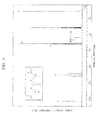


Classifications
-
- H—ELECTRICITY
- H01—ELECTRIC ELEMENTS
- H01M—PROCESSES OR MEANS, e.g. BATTERIES, FOR THE DIRECT CONVERSION OF CHEMICAL ENERGY INTO ELECTRICAL ENERGY
- H01M10/00—Secondary cells; Manufacture thereof
- H01M10/05—Accumulators with non-aqueous electrolyte
-
- C—CHEMISTRY; METALLURGY
- C07—ORGANIC CHEMISTRY
- C07C—ACYCLIC OR CARBOCYCLIC COMPOUNDS
- C07C69/00—Esters of carboxylic acids; Esters of carbonic or haloformic acids
- C07C69/96—Esters of carbonic or haloformic acids
-
- H—ELECTRICITY
- H01—ELECTRIC ELEMENTS
- H01M—PROCESSES OR MEANS, e.g. BATTERIES, FOR THE DIRECT CONVERSION OF CHEMICAL ENERGY INTO ELECTRICAL ENERGY
- H01M10/00—Secondary cells; Manufacture thereof
- H01M10/05—Accumulators with non-aqueous electrolyte
- H01M10/052—Li-accumulators
-
- H—ELECTRICITY
- H01—ELECTRIC ELEMENTS
- H01M—PROCESSES OR MEANS, e.g. BATTERIES, FOR THE DIRECT CONVERSION OF CHEMICAL ENERGY INTO ELECTRICAL ENERGY
- H01M10/00—Secondary cells; Manufacture thereof
- H01M10/05—Accumulators with non-aqueous electrolyte
- H01M10/056—Accumulators with non-aqueous electrolyte characterised by the materials used as electrolytes, e.g. mixed inorganic/organic electrolytes
- H01M10/0564—Accumulators with non-aqueous electrolyte characterised by the materials used as electrolytes, e.g. mixed inorganic/organic electrolytes the electrolyte being constituted of organic materials only
-
- H—ELECTRICITY
- H01—ELECTRIC ELEMENTS
- H01M—PROCESSES OR MEANS, e.g. BATTERIES, FOR THE DIRECT CONVERSION OF CHEMICAL ENERGY INTO ELECTRICAL ENERGY
- H01M10/00—Secondary cells; Manufacture thereof
- H01M10/05—Accumulators with non-aqueous electrolyte
- H01M10/056—Accumulators with non-aqueous electrolyte characterised by the materials used as electrolytes, e.g. mixed inorganic/organic electrolytes
- H01M10/0564—Accumulators with non-aqueous electrolyte characterised by the materials used as electrolytes, e.g. mixed inorganic/organic electrolytes the electrolyte being constituted of organic materials only
- H01M10/0566—Liquid materials
- H01M10/0567—Liquid materials characterised by the additives
-
- H—ELECTRICITY
- H01—ELECTRIC ELEMENTS
- H01M—PROCESSES OR MEANS, e.g. BATTERIES, FOR THE DIRECT CONVERSION OF CHEMICAL ENERGY INTO ELECTRICAL ENERGY
- H01M10/00—Secondary cells; Manufacture thereof
- H01M10/05—Accumulators with non-aqueous electrolyte
- H01M10/056—Accumulators with non-aqueous electrolyte characterised by the materials used as electrolytes, e.g. mixed inorganic/organic electrolytes
- H01M10/0564—Accumulators with non-aqueous electrolyte characterised by the materials used as electrolytes, e.g. mixed inorganic/organic electrolytes the electrolyte being constituted of organic materials only
- H01M10/0565—Polymeric materials, e.g. gel-type or solid-type
-
- H—ELECTRICITY
- H01—ELECTRIC ELEMENTS
- H01M—PROCESSES OR MEANS, e.g. BATTERIES, FOR THE DIRECT CONVERSION OF CHEMICAL ENERGY INTO ELECTRICAL ENERGY
- H01M2300/00—Electrolytes
- H01M2300/0017—Non-aqueous electrolytes
- H01M2300/0025—Organic electrolyte
-
- Y—GENERAL TAGGING OF NEW TECHNOLOGICAL DEVELOPMENTS; GENERAL TAGGING OF CROSS-SECTIONAL TECHNOLOGIES SPANNING OVER SEVERAL SECTIONS OF THE IPC; TECHNICAL SUBJECTS COVERED BY FORMER USPC CROSS-REFERENCE ART COLLECTIONS [XRACs] AND DIGESTS
- Y02—TECHNOLOGIES OR APPLICATIONS FOR MITIGATION OR ADAPTATION AGAINST CLIMATE CHANGE
- Y02E—REDUCTION OF GREENHOUSE GAS [GHG] EMISSIONS, RELATED TO ENERGY GENERATION, TRANSMISSION OR DISTRIBUTION
- Y02E60/00—Enabling technologies; Technologies with a potential or indirect contribution to GHG emissions mitigation
- Y02E60/10—Energy storage using batteries
-
- Y—GENERAL TAGGING OF NEW TECHNOLOGICAL DEVELOPMENTS; GENERAL TAGGING OF CROSS-SECTIONAL TECHNOLOGIES SPANNING OVER SEVERAL SECTIONS OF THE IPC; TECHNICAL SUBJECTS COVERED BY FORMER USPC CROSS-REFERENCE ART COLLECTIONS [XRACs] AND DIGESTS
- Y02—TECHNOLOGIES OR APPLICATIONS FOR MITIGATION OR ADAPTATION AGAINST CLIMATE CHANGE
- Y02T—CLIMATE CHANGE MITIGATION TECHNOLOGIES RELATED TO TRANSPORTATION
- Y02T10/00—Road transport of goods or passengers
- Y02T10/60—Other road transportation technologies with climate change mitigation effect
- Y02T10/70—Energy storage systems for electromobility, e.g. batteries
Definitions
- the present invention relates to nonaqueous electrolytic solutions and secondary cells containing the nonaqueous electrolytic solutions.
- nonaqueous electrolyte secondary cells containing carbonous materials as negative electrodes, which are capable of occluding and discharging lithium, such as cokes, artificial graphite, or natural graphite, in place of metallic lithium.
- Such secondary cells can exhibit improved service life and safety since lithium does not grow into the dendritic crystal.
- nonaqueous electrolyte secondary cells made from graphite-based carbonous materials, such as artificial graphite and natural graphite have attracted attention as ones capable of meeting the need for high capacities.
- negative-electrode active materials made from alloys such as, for example, silicon (Si), tin (Sn), and lead (Pb) have lately been proposed in order to achieve higher capacities (see, for example, Patent Documents 1 and 2).
- electrolytic solutions containing different compounds in addition to electrolytes and main solvents have been proposed in order to enhance properties of nonaqueous electrolyte secondary cells, such as load, cycle, storage, and low-temperature characteristics.
- electrolytic solutions containing carbonate derivatives having unsaturated bonds have been provided , such as ones containing certain amounts of vinylene carbonate and its derivatives in order to inhibit decomposition of the electrolytic solutions for nonaqueous electrolyte secondary cells including graphite negative electrodes (see, for example, Patent Document 3), and ones containing certain amounts of ethylene carbonate derivatives having a non-conjugated, unsaturated bond at the side chain thereof (see, for example, Patent Document 4).
- the compounds are reductively decomposed on the surfaces of the negative electrodes to form films thereon, and the films inhibit extra decomposition of the electrolytic solutions.
- Electrolytic solutions containing halogen-containing carbonates have also been proposed (see, for example, Patent Document 5).
- Patent Document 6 describes that an electrolytic solutions containing a single solvent, i.e., fluoromethyl ethylene carbonate (4-(monofluoromethyl)-1,3-dioxolan-2-one) in combination with various PF 6 and BF 4 salts, is excellent in oxidation resistance compared to propylene carbonate or trifluoropropylene carbonate, and thus is useful as an electrolytic solution for a variety of devices.
- This document also describes that lithium secondary cells containing the electrolytic solution exhibit excellent cycle characteristics and that electric double-layer capacitors containing the electrolytic solution excel in continuous application characteristics at elevated temperatures.
- Patent Document 7 describes that electrolytic solutions which contain 60% by volume or more of fluoromethyl ethylene carbonate in their solvents, or difluoromethyl ethylene carbonate and contain (C 2 H 5 ) 4 NBF 4 or (C 2 H 5 ) 4 NPF 6 as a supporting electrolyte are excellent in oxidation resistance, and thus is useful as electrolytic solutions for electric double-layer capacitors.
- Linear carbonate compounds have generally been used as materials for polycarbonates, and as materials and diluent solvents for medicines and agrichemicals. These have also been used in a broad range of applications, including electrolyte solvents and solid electrolytes for energy storage devices such as Li cells, electrolytic capacitors, and electric double-layer capacitors; and electrode compositions (see, for example, Patent Documents 8 and 9).
- the present invention has been made in consideration of the problems, and a first object thereof is to provide a nonaqueous electrolytic solution and a secondary cell containing the nonaqueous electrolytic solution which can give more excellent cycle characteristics.
- the conventional linear carbonate compounds have many excellent characteristics.
- a novel linear carbonate compound with a higher boiling point, dielectric constant, and electrochemical stability is needed so as to impart higher performances and functionalities to the conventional compounds and thereby to enhance the added value of the compounds.
- the present invention has been made in consideration of the need, and a second object thereof is to provide a novel carbonate compound not yet found.
- a nonaqueous electrolytic solution containing at least any one of a linear carbonate represented by the formula (1), a compound represented by the formula (2), and a compound represented by the formula (3) can be used for a nonaqueous electrolyte secondary cell in order to achieve much more excellent effects than those of conventional improvements.
- organic fluorine compounds have unique properties which are significantly different from fluorine-free organic compounds.
- organic fluorine compounds of which hydrogen atoms attached to the carbon atoms are partially substituted by fluorine atoms may enhance the originally incompatible properties, for example, increased boiling points, decreased viscosities, increased polarities, and increased lipophilicities compared to similar fluorine-free organic compounds.
- organic fluorine compounds can also be expected to improve electrical or chemical resistance to oxidation.
- fluorine atoms When fluorine atoms are introduced to organic compounds in a sterically asymmetric manner, decreased melting points and further decreased viscosities can also be expected because of the steric asymmetry and the symmetry of electron conformation, like when hydrogen is substituted by substituents other than fluorine.
- introduction of fluorine atoms to linear carbonate compounds will allow improvements in properties of the compounds, for example, increased boiling point, increased dielectric constant, and enhanced electrochemical stability due to enhanced oxidation resistance.
- a nonaqueous electrolytic solution in accordance with a first aspect of the present invention comprises a linear carbonate of the following formula (1) (claim 1): wherein X a represents each independently hydrogen or any group; R a represents optionally substituted alkyl; and n represents an integer of zero or more.
- the group R a is preferably different from: (claim 2).
- the linear carbonate is preferably bis(2,2-difluoroethyl) carbonate (claim 3).
- n is preferably an integer of from 0 to 7 (claim 4).
- a nonaqueous electrolytic solution in accordance with a second aspect of the present invention comprises 0.01% by weight to 10% by weight of a compound of the following formula (2) in a nonaqueous solvent: wherein X 1 represents oxygen, sulfur, CD 1 D 2 , or NE 1 , wherein D 1 and D 2 represent each independently hydrogen, or any group capable of being attached to carbon, and E 1 represents hydrogen, or a group capable of being attached to nitrogen; X 2 represents oxygen, sulfur, or NE 1 ; Z 1 and Z 2 represent each independently hydrogen, or a group capable of being attached to carbon, with the proviso that at least one of Z 1 , Z 2 , D 1 , D 2 , and E 1 represents alkyl in which both at least one hydrogen atom and at least one fluorine atom are attached to at least one terminal carbon; and m represents a natural number (claim 8).
- m in the formula (2) preferably represents two or three (claim 9).
- E 1 , Z 2 , D 1 , D 2 and E 1 in the formula (2) represent each independently any of hydrogen, fluorine, and unsubstituted alkyl or fluorine-substituted alkyl (claim 10).
- the "alkyl in which both at least one hydrogen atom and at least one fluorine atom are attached to at least one terminal carbon" is substituted by fluorine alone (claim 11).
- a nonaqueous electrolytic solution in accordance with a third aspect of the present invention comprises a compound of the following formula (3) in a nonaqueous solvent: wherein X b represents oxygen or nitrogen; R b represents hydrogen, or substituted or unsubstituted alkyl, and s is one when X b represents oxygen or two when X b represents nitrogen (claim 15).
- R b is preferably unsubstituted alkyl or alkyl substituted by fluorine alone (claim 16).
- the concentration of the compound in the nonaqueous electrolytic solution is 0.01% by weight to 10% by weight (claim 17).
- the nonaqueous electrolytic solution of each of the first, second, and third aspects of the present invention further comprises a carbonate having at least one of an unsaturated bond and a halogen atom (hereinafter referred to as a "predetermined carbonate") (claims 5, 12, and 18), with the proviso that carbonates which also fall into the definition of the linear carbonates of the formula (1) are excluded from the predetermined carbonates when they are contained in the nonaqueous electrolytic solution in accordance with the first aspect of the present invention, and that carbonates which also fall into the definition of the linear carbonates of the formula (2) are also excluded from the predetermined carbonates when the predetermined carbonates are contained in the nonaqueous electrolytic solution in accordance with the second aspect of the present invention.
- predetermined carbonate a carbonate having at least one of an unsaturated bond and a halogen atom
- the concentration of the predetermined carbonate in the nonaqueous electrolytic solution is 0.01% by weight to 70% by weight (claims 6, 13, and 19).
- the predetermined carbonates are at least one carbonate selected from the group consisting of vinylene carbonate, vinyl ethylene carbonate, fluoroethylene carbonate, difluoroethylene carbonate, and derivatives thereof (claims 7, 14, and 20).
- the nonaqueous electrolytic solution of each of the first, second, and third aspects of the present invention comprises ethylene carbonate and/or propylene carbonate (claim 21).
- the nonaqueous electrolytic solution of the first, second, and third aspects of the present invention comprises at least one selected from the group consisting of dimethyl carbonate, ethyl methyl carbonate, diethyl carbonate, methyl n-propyl carbonate, ethyl n-propyl carbonate, and di-n-propyl carbonate (claim 22).
- a nonaqueous electrolyte secondary cell of the present invention comprises a negative electrode and a positive electrode capable of occluding and discharging lithium ions, and any of the nonaqueous electrolytic solutions of the first, second, and third aspects of the present invention (claim 23).
- a carbonate compound of the present invention is represented by the following formula (4): wherein R c represents linear unsubstituted alkyl having one to four carbon atoms (claim 24).
- the carbonate compound of the present invention is selected from the group consisting of 2, 2-difluoroethyl methyl carbonate, 2,2-difluoroethyl ethyl carbonate, 2,2-difluoroethyl n-propyl carbonate, and n-butyl 2,2-difluoroethyl carbonate (claim 25).
- the nonaqueous electrolytic solution in accordance with the first aspect of the present invention can give superior cycle characteristics to the conventional one.
- the nonaqueous electrolyte secondary cell of the first aspect of the present invention can also exhibit superior cycle characteristics to the conventional one.
- the nonaqueous electrolytic solution in accordance with the second aspect of the present invention when contained in a nonaqueous electrolyte secondary cell, can give high capacities and excellent charge and discharge cycle characteristics over a long period.
- the nonaqueous electrolyte secondary cell in accordance with the second aspect of the present invention can also exhibit high capacities and excellent charge and discharge cycle characteristics over a long period.
- the nonaqueous electrolytic solution in accordance with the third aspect of the present invention when contained in a nonaqueous electrolyte secondary cell, can give excellent charge and discharge cycle characteristics.
- the nonaqueous electrolyte secondary cell in accordance with the third aspect of the present invention can exhibit excellent charge and discharge cycle characteristics.
- a novel carbonate compound is provided.
- the carbonate compound can be inferred to have advantages such as increased boiling point, increased dielectric constant, and enhanced electrochemical stability due to enhanced oxidation resistance.
- the nonaqueous electrolytic solution in accordance with the first aspect of the present invention comprises at least one linear carbonate represented by the following formula (1) (hereinafter referred to as a "particular linear carbonate”): wherein X a represents each independently hydrogen or any group; R a represents optionally substituted alkyl; and n represents an integer of zero or more.
- the particular linear carbonate can be contained as a nonaqueous solvent in the nonaqueous electrolytic solution in accordance with the first aspect of the present invention.
- a suitable separate nonaqueous solvent may be contained in the nonaqueous electrolytic solution in accordance with the first aspect of the present invention.
- the nonaqueous electrolytic solution in accordance with the first aspect of the present invention typically contains an electrolyte, and may optionally contain a predetermined carbonate and any additive.
- X a in the formula (1) represents hydrogen or any group, wherein X a S in the formula (1) may be the same or different.
- X a may be any group that does not significantly impair the advantages of the present invention.
- the group include halogens such as fluorine (fluoro), chlorine (chloro), bromine (bromo), and iodine (iodo); linear alkyls such as methyl, ethyl, n-propyl, and i-propyl; cycloalkyls such as cyclohexyl; and aryls such as phenyl and naphthyl. Any hydrogen in the alkyl, cycloalkyl, and aryl groups may be substituted by halogen.
- X a preferably represents hydrogen or fluorine.
- n any integer of zero or more. Since the particular linear carbonate represented by the formula (1) having a significantly high molecular weight may not exhibit advantages comparable to the amount of the carbonate used, n represents usually seven or less, preferably four or less, and more preferably three or less.
- R a in the formula (1) represents optionally substituted alkyl. Unless significantly impairing the advantages of the present invention, the carbon number of R a may also be any number. Since the particular linear carbonate represented by the formula (1) having a significantly high molecular weight may not exhibit effects comparable to the amount of the carbonate used, the number is usually ten or less, preferably five or less, and more preferably three or less.
- R a preferably represents nonbranched alkyl, and unsubstituted alkyl or alkyl substituted by fluorine alone.
- R a examples include methyl, fluoromethyl, ethyl, 2-fluoroethyl, 2,2-difluoroethyl, 2,2,2-trifluoroethyl, n-propyl, 3-fluoro-n-propyl, 3,3-difluoro-n-propyl, 3,3,3-trifluoro-n-propyl, i-propyl, and 1,1,1,3,3,3-hexafluoro-i-propyl.
- methyl, ethyl, 2-fluoroethyl, 2,2-difluoroethyl, 2,2,2-trifluoroethyl, n-propyl, 3-fluoro-n-propyl, and 3,3-difluoro-n-propyl are preferred, and methyl, ethyl, and n-propyl are more preferred in view of ready production of the carbonate.
- the configuration of the formula may preferably be left-right asymmetric. That is, R a in the above formula (1) preferably has a structure different from wherein n represents the same number as that of the formula (1) .
- the asymmetry allows for a decreased boiling point of the solvent.
- such an asymmetric carbonate can enhance storage characteristics and cycle characteristics (Japanese Patent Application Laid-open Nos. HEI 2-148665 and HEI 4-104468 ).
- carbonates having left-right symmetric configuration in the formula (1) bis(2,2-difluoroethyl) carbonate can be preferably used. That is, it is also preferred that in the formula (1), X represents hydrogen, n represents 0, and R a represents 2,2-difluoroethyl. More preferably, among the particular linear carbonates, carbonates having a structure of left-right asymmetric configuration of the formula (1) are usually used.
- linear carbonate represented by the formula (1) examples include 2,2-difluoroethyl methyl carbonate, 2,2-difluoroethyl ethyl carbonate, 2,2-difluoroethyl-2'-fluoroethyl carbonate, bis(2,2-difluoroethyl) carbonate, 2,2-difluoroethyl-2',2',2'-trifluoroethyl carbonate, 2,2-difluoroethyl n-propyl carbonate, 2,2-difluoroethyl-3'-fluoro-n-propyl carbonate, 2,2-difluoro-3',3',3'-trifluoro-n-propyl carbonate, 3,3-difluoro-n-propyl methyl carbonate, 3,3-difluoro-n-propyl ethyl carbonate, 3,3-difluoro-n-propyl 2'-flufluoro
- linear carbonates having left-right asymmetric configuration of the formula (1) and bis(2,2-difluoroethyl) carbonate, as described above.
- 2,2-difluoroethyl methyl carbonate, 2,2-difluoroethyl ethyl carbonate, bis(2,2-difluoroethyl) carbonate, and 2,2-difluoroethyl n-propyl carbonate are more preferred because these can be readily prepared.
- 2,2-difluoroethyl methyl carbonate 2,2-difluoroethyl ethyl carbonate, and 2,2-difluoroethyl n-propyl carbonate among these.
- the particular linear carbonates may be used either alone or in any combination thereof at any proportion.
- the particular linear carbonate may be used in any amount unless significantly impairing the advantages of the present invention, but usually in an amount of 0.01% by weight or more and preferably 0.1% by weight or more. Below the lower limit, the nonaqueous electrolyte secondary cell containing the nonaqueous electrolytic solution in accordance with the first aspect of the present invention may not exhibit sufficiently enhanced cycle characteristics.
- the amount of the particular linear carbonate is usually 95% by volume or less, and preferably 70% by volume or less based on the total amount of nonaqueous solvents other than electrolytes in the nonaqueous electrolytic solution.
- the electrolytes become insufficiently soluble, the electrolytic solution properties such as electric conductivity are impaired, and, as a result, the cell characteristics will be impaired.
- the charge and discharge cycle characteristics of the cell can be enhanced.
- the reason for the improved charge and discharge cycle characteristics may be inferred as follows, although the detail is not clear: That is, when a nonaqueous electrolytic solution containing the particular linear carbonate is contained in a nonaqueous electrolyte secondary cell, the particular linear carbonate will react in the cell to form an excellent protective layer on the surface of a negative-electrode active material, thereby inhibiting side reactions and preventing the cycle degradation.
- both hydrogen and fluorine present on at least one terminal carbon atom in the particular linear carbonate represented by the formula (1) and it is considered to contribute to enhanced properties of the protective layer in any way.
- the nonaqueous electrolytic solution in accordance with the first aspect of the present invention further comprises a predetermined carbonate, in addition to the particular linear carbonate.
- the predetermined carbonate in the nonaqueous electrolytic solution in accordance with the first aspect of the present invention has at least one of an unsaturated bond and a halogen atom. That is, the predetermined carbonate in the nonaqueous electrolytic solution in accordance with the first aspect of the present invention may have only an unsaturated bond or only a halogen atom, or may have the both.
- the particular linear carbonates should be excluded from the predetermined carbonates when they are contained in the nonaqueous electrolytic solution in accordance with the first aspect of the present invention. That is, in the nonaqueous electrolytic solution in accordance with the first aspect of the present invention, compounds that fall into the definition of the particular linear carbonates described above are not considered as the predetermined carbonates.
- any predetermined carbonate having an unsaturated bond may be used without limitation with the proviso that the predetermined carbonate has a carbon-carbon unsaturated bond, i.e. a carbon-carbon double bond or triple bond.
- the predetermined unsaturated carbonates having such unsaturated bonds also include carbonates having aromatic rings.
- Examples of the predetermined unsaturated carbonate include vinylene carbonate derivatives, substituted ethylene carbonate derivatives by substituents with aromatic rings or carbon-carbon unsaturated bonds, phenyl carbonates, vinyl carbonates, and allyl carbonates.
- vinylene carbonate derivatives include vinylene carbonate, methyl vinylene carbonate, 4,5-dimethyl vinylene carbonate, phenyl vinylene carbonate, and 4,5-diphenyl vinylene carbonate.
- substituted ethylene carbonate derivatives by substituents with aromatic rings or carbon-carbon unsaturated bonds include such as vinyl ethylene carbonate, 4,5-divinyl ethylene carbonate, phenyl ethylene carbonate, and 4,5-diphenyl ethylene carbonate.
- phenyl carbonates include diphenyl carbonate, ethyl phenyl carbonate, methyl phenyl carbonate, and t-butyl phenyl carbonate.
- vinyl carbonates include divinyl carbonate and methyl vinyl carbonate.
- allyl carbonates include diallyl carbonate and allyl methyl carbonate.
- predetermined unsaturated carbonates preferred as the predetermined carbonate are the vinylene carbonate derivatives and the substituted ethylene carbonate derivatives by substituents with aromatic rings or carbon-carbon unsaturated bonds. Particularly preferred are vinylene carbonate, 4,5-diphenyl vinylene carbonate, 4,5-dimethyl vinylene carbonate, and vinyl ethylene carbonate because these can form stable surface protective films.
- predetermined carbonate having halogen atoms any halogenated carbonate other than the particular linear carbonates can be used without limitation.
- halogen atom contained in the predetermined halogenated carbonate include fluorine, chlorine, bromine, and iodine atoms. Among these preferred is fluorine or chlorine atom and in particular, fluorine atom is more preferable.
- the number of the halogen atoms in the predetermined halogenated carbonate may be at least one without limitation, but usually six or less and preferably four or less. When the predetermined halogenated carbonate has multiple halogen atoms, they may be the same or different.
- Examples of the predetermined halogenated carbonate include such as ethylene carbonate derivatives, dimethyl carbonate derivatives, ethyl methyl carbonate derivatives, and diethyl carbonate derivatives.
- ethylene carbonate derivatives include fluoroethylene carbonate, chloroethylene carbonate, 4,4-difluoroethylene carbonate, 4,5-difluoroethylene carbonate, 4,4-dichloroethylene carbonate, 4,5-dichloroethylene carbonate, 4-fluoro-4-methylethylene carbonate, 4-chloro-4-methylethylene carbonate, 4,5-difluoro-4-methylethylene carbonate, 4,5-dichloro-4-methylethylene carbonate, 4-fluoro-5-methylethylene carbonate, 4-chloro-5-methylethylene carbonate, 4,4-difluoro-5-methylethylene carbonate, 4,4-dichloro-5-methylethylene carbonate, 4-(fluoromethyl)-ethylene carbonate, 4-(chloromethyl)-ethylene carbonate, 4-(difluoromethyl)-ethylene carbonate, 4-(dichloromethyl)-ethylene carbonate, 4-(trifluoromethyl)-ethylene carbonate, 4-(trichloromethyl)-ethylene carbonate, 4-(fluoromethyl
- dimethyl carbonate derivatives include such as fluoromethyl methyl carbonate, difluoromethyl methyl carbonate, trifluoromethyl methyl carbonate, bis(fluoromethyl) carbonate, bis(difluoro) methyl carbonate, bis(trifluoro) methyl carbonate, chloromethyl methyl carbonate, dichloromethyl methyl carbonate, trichloromethyl methyl carbonate, bis(chloromethyl) carbonate, bis(dichloro) methyl carbonate, and bis(trichloro) methyl carbonate.
- ethyl methyl carbonate derivatives include such as 2-fluoroethyl methyl carbonate, ethyl fluoromethyl carbonate, 2-fluoroethyl fluoromethyl carbonate, ethyl difluoromethyl carbonate, 2,2,2-trifluoroethyl methyl carbonate, 2-fluoroethyl difluoromethyl carbonate, ethyl trifluoromethyl carbonate, 2-chloroethyl methyl carbonate, ethyl chloromethyl carbonate, 2,2-dichloroethyl methyl carbonate, 2-chloroethyl chloromethyl carbonate, ethyl dichloromethyl carbonate, 2,2,2-trichloroethyl methyl carbonate, 2,2-dichloroethyl chloromethyl carbonate, 2-chloroethyl dichloromethyl carbonate, and ethyl trichloromethyl carbonate.
- diethyl carbonate derivatives include such as ethyl-(2-fluoroethyl) carbonate, bis(2-fluoroethyl) carbonate, ethyl-(2,2,2-trifluoroethyl) carbonate, 2,2,2-trifluoroethyl-2'-fluoroethyl carbonate, bis(2,2,2-trifluoroethyl) carbonate, ethyl-(2-chloroethyl) carbonate, ethyl-(2,2-dichloroethyl) carbonate, bis(2-chloroethyl) carbonate, ethyl-(2,2,2-trichloroethyl) carbonate, 2,2-dichloroethyl-2'-chloroethyl carbonate, bis(2,2-dichloroethyl) carbonate, 2,2,2-trichloroethyl-2'-chloroethyl carbonate, 2,2,2-trichloroe
- halogenated carbonates preferred are carbonates having fluorine atoms, and more preferred are ethylene carbonate derivatives having fluorine atoms.
- fluoroethylene carbonate, 4-(fluoromethyl)-ethylene carbonate, 4,4-difluoroethylene carbonate, and 4,5-difluoroethylene carbonate are preferably used because they can form surface protective films.
- the predetermined carbonate can have both an unsaturated bond and a halogen atom (arbitrarily abbreviated as "predetermined halogenated unsaturated carbonate,”).
- the predetermined halogenated unsaturated carbonate may be any halogenated unsaturated carbonate that does not significantly impair the advantages of the present invention.
- Examples of the predetermined halogenated unsaturated carbonate include such as vinylene carbonate derivatives, substituted ethylene carbonate derivatives by substituents with aromatic rings or carbon-carbon unsaturated bonds, phenyl carbonates, vinyl carbonates, and allyl carbonates.
- vinylene carbonate derivatives include such as fluorovinylene carbonate, 4-fluoro-5-methylvinylene carbonate, 4-fluoro-5-phenylvinylene carbonate, chlorovinylene carbonate, 4-chloro-5-methylvinylene carbonate, and 4-chloro-5-phenylvinylene carbonate.
- substitutedethylene carbonate derivatives by substituents with aromatic rings or carbon-carbon unsaturated bonds include such as 4-fluoro-4-vinylethylene carbonate, 4-fluoro-5-vinylethylene carbonate, 4,4-difluoro-4-vinylethylene carbonate, 4,5-difluoro-4-vinylethylene carbonate, 4-chloro-5-vinylethylene carbonate, 4,4-dichloro-4-vinylethylene carbonate, 4,5-dichloro-4-vinylethylene carbonate, 4-fluoro-4,5-divinylethylene carbonate, 4,5-difluoro-4,5-divinylethylene carbonate, 4-chloro-4,5-divinylethylene carbonate, 4,5-dichloro-4,5-divinylethylene carbonate, 4-fluoro-4-phenylethylene carbonate, 4-fluoro-5-phenylethylene carbonate, 4,4-difluoro-5-phenylethylene carbonate, 4,5-difluoro-4-phen
- phenyl carbonates include such as fluoromethyl phenyl carbonate, 2-fluoroethyl phenyl carbonate, 2,2-difluoroethyl phenyl carbonate, 2,2,2-trifluoroethyl phenyl carbonate, chloromethyl phenyl carbonate, 2-chloroethyl phenyl carbonate, 2,2-dichloroethyl phenyl carbonate, and 2,2,2-trichloroethyl phenyl carbonate.
- vinyl carbonates include such as fluoromethyl vinyl carbonate, 2-fluoroethyl vinyl carbonate, 2,2-difluoroethyl vinyl carbonate, 2,2,2-trifluoroethyl vinyl carbonate, chloromethyl vinyl carbonate, 2-chloroethyl vinyl carbonate, 2,2-dichloroethyl vinyl carbonate, and 2,2,2-trichloroethyl vinyl carbonate.
- allyl carbonates include such as fluoromethyl allyl carbonate, 2-fluoroethyl allyl carbonate, 2,2-difluoroethyl allyl carbonate, 2,2,2-trifluoroethyl allyl carbonate, chloromethyl allyl carbonate, 2-chloroethyl allyl carbonate, 2,2-dichloroethyl allyl carbonate, and 2,2,2-trichloroethyl allyl carbonate.
- predetermined halogenated unsaturated carbonates it is especially preferred to use at least one selected from the group consisting of vinylene carbonate, vinyl ethylene carbonate, fluoroethylene carbonate, 4,5-difluoroethylene carbonate, and derivatives thereof as the predetermined carbonate because of high effects thereof when used alone.
- the predetermined carbonate may have any molecular weight that does not significantly impair the advantages of the present invention, and the molecular weight is usually 50 or more and preferably 80 or more, and usually 250 or less, and preferably 150 or less. At a higher molecular weight of the predetermined carbonate, the solubility of the carbonate in a nonaqueous electrolytic solution may be too poor to exhibit the advantages of the present invention sufficiently.
- the predetermined carbonates can be prepared by any known method without limitation.
- the predetermined carbonates as described above may also be used either alone or in any combination thereof at any proportion in the nonaqueous electrolytic solution in accordance with the first aspect of the present invention.
- the predetermined carbonate may be used in any amount in the nonaqueous electrolytic solution in accordance with the first aspect of the present invention without limitation within the scope that does not significantly impair the advantages of the present invention, and the amount of the predetermined carbonate is usually 0.01% by weight or more, preferably 0.1% by weight or more, and more preferably 0.3% by weight or more, and usually 70% by weight or less, preferably 50% by weight or less, and more preferably 40% by weight or less of the nonaqueous electrolytic solution in accordance with the first aspect of the present invention. Below the lower limit, a nonaqueous electrolyte secondary cell containing the nonaqueous electrolytic solution in accordance with the first aspect of the present invention may not exhibit sufficiently enhanced cycle characteristics.
- a nonaqueous electrolyte secondary cell containing the nonaqueous electrolytic solution in accordance with the first aspect of the present invention tends to impair its high-temperature preservation characteristics and trickle charge characteristics, and particularly may increase the amount of gas generation and decrease its discharge capacity maintenance rate.
- the particular linear carbonate and the predetermined carbonate may be used in any ratio.
- the ratio of "the weight of the particular linear carbonate to the weight of the predetermined carbonate” is usually 0.0001 or more, preferably 0.001 or more, and more preferably 0.01 or more, and usually 1000 or less, preferably 100 or less, and more preferably 10 or less. At a ratio that is lower or higher than this range, synergistic effects by the combination may not be exhibited.
- a nonaqueous electrolytic solution containing both the above described particular linear carbonate and the predetermined carbonate is contained in a nonaqueous electrolyte secondary cell, charge and discharge cycle characteristics of the cell can be enhanced.
- the reason for this may be inferred as follows, although the detail is not clear:
- the particular linear carbonate and the predetermined carbonate in the nonaqueous electrolytic solution will react together, and form an excellent protective film on the surface of a negative-electrode active material, thereby inhibiting side reactions and preventing the cycle degradation.
- an electrolytic solution containing both the particular linear carbonate and the predetermined carbonate is considered to contribute to enhanced properties of the protective film in any way.
- the nonaqueous electrolytic solution in accordance with the first aspect of the present invention can comprises any nonaqueous solvent that does not significantly impair the advantages of the present invention.
- the particular linear carbonates or the predetermined carbonates mentioned above can also be used as the nonaqueous solvent .
- the nonaqueous solvents including the particular linear carbonates or the predetermined carbonates may be used either alone or in any combination thereof at any proportion.
- nonaqueous solvents examples include such as cyclic carbonates, linear carbonates, linear and cyclic carboxylic esters, linear and cyclic ethers, phosphorus-containing organic solvents, and sulfur-containing organic solvents.
- Nonlimiting examples of the cyclic carbonates that are commonly used include such as ethylene carbonate, propylene carbonate, and butylene carbonate.
- ethylene carbonate and propylene carbonate having high dielectric constants, which facilitate dissolution of solutes and improve cycle characteristics of nonaqueous electrolyte secondary cells.
- linear carbonates examples include, but not limited to, such as dimethyl carbonate, ethyl methyl carbonate, diethyl carbonate, methyl n-propyl carbonate, ethyl n-propyl carbonate, and di-n-propyl carbonate.
- dimethyl carbonate, ethyl methyl carbonate, diethyl carbonate, methyl n-propyl carbonate, and ethyl n-propyl carbonate and especially preferred are dimethyl carbonate, ethyl methyl carbonate and diethyl carbonate because these carbonates ensure improved cycle characteristics of nonaqueous electrolyte secondary cells.
- linear carboxylic acid esters examples include, but not limited to, such as methyl acetate, ethyl acetate, n-propyl acetate, i-propyl acetate, n-butyl acetate, i-butyl acetate, t-butyl acetate, methyl propionate, ethyl propionate, n-propyl propionate, i-propyl propionate, n-butyl propionate, i-butyl propionate, and t-butyl propionate.
- ethyl acetate, methyl propionate, and ethyl propionate can also be used.
- cyclic carboxylic acid esters examples include, but not limited to, ⁇ -butyrolactone, ⁇ -valerolactone, and ⁇ -valerolactone. Among these, ⁇ -butyrolactone is more preferred.
- linear ethers examples include, but not limited to, such as dimethoxymethane, dimethoxyethane, diethoxymethane, diethoxyethane, ethoxymethoxymethane, and ethoxymethoxyethane. Among these, dimethoxyethane and diethoxyethane are more preferred.
- cyclic ethers examples include, but not limited to, such as tetrahydrofuran and 2-methyltetrahydrofuran.
- Examples of the phosphorus-containing organic solvents that are commonly used include, but not limited to, phosphate esters such as trimethyl phosphate, triethyl phosphate, and triphenyl phosphate; phosphite esters such as trimethyl phosphite, triethyl phosphite, and triphenyl phosphite; phosphine oxides such as trimethylphosphine oxide, triethylphosphine oxide, and triphenylphosphine oxide.
- phosphate esters such as trimethyl phosphate, triethyl phosphate, and triphenyl phosphate
- phosphite esters such as trimethyl phosphite, triethyl phosphite, and triphenyl phosphite
- phosphine oxides such as trimethylphosphine oxide, triethylphosphine oxide, and triphenylphosphine oxide.
- sulfur-containing organic solvents examples include, but not limited to, such as ethylene sulfite, 1,4-propane sultone, 1,4-butane sultone, methyl methanesulfonate, busulfan, sulfolane, sulfolene, dimethyl sulfone, diphenyl sulfone, methyl phenyl sulfone, dibutyl disulfide, dicyclohexyl disulfide, tetramethylthiuram monosulfide, N,N-dimethylmethanesulfonamide, and N,N-diethylmethanesulfonamide.
- the cyclic carbonates i.e., ethylene carbonate and/or propylene carbonate are preferably used, and more preferably used as a mixture with the linear carbonates.
- the suitable amount of the linear carbonate in the nonaqueous solvent in the nonaqueous electrolytic solution in accordance with the first aspect of the present invention is usually 30% by volume or more and preferably 50% by volume or more, and usually 95% by volume or less and preferably 90% by volume or less.
- the suitable amount of the cyclic carbonate in the nonaqueous solvent in the nonaqueous electrolytic solution in accordance with the first aspect of the present invention is usually 5% by volume or more and preferably 10% by volume or more, and usually 50% by volume or less and preferably 40% by volume or less.
- the nonaqueous electrolytic solution in accordance with the first aspect of the present invention may have an increased viscosity.
- the nonaqueous electrolytic solution may have a decreased degree of dissociation of the electrolyte, i.e., lithium salt, and then may have a decreased electric conductivity.
- the nonaqueous electrolytic solution in accordance with the first aspect of the present invention may contain any known electrolyte that is contained in an intended nonaqueous electrolyte secondary cell as electrolyte.
- Lithium secondary cells containing nonaqueous electrolytic solutions in accordance with the first aspect of the present invention typically contain lithium salts as the electrolytes.
- the electrolytes include inorganic lithium salts such as LiClO 4 , LiAsF 6 , LiPF 6 , Li 2 CO 3 , and LiBF 4 ; fluorine-containing organic lithium salts such as LiCF 3 SO 3 , LiN (CF 3 SO 2 ) 2 , LiN (C 2 F 5 SO 2 ) 2 , lithium cyclic-l,4-perfluoropropanedisulfonylimide, LiN (CF 3 SO 2 ) (C 4 F 9 SO 2 ), LiC (CF 3 SO 2 ) 3 , LiPF 4 (CF 3 ) 2 , LiPF 4 (C 2 F 5 ) 2 , LiPF 4 (CF 3 SO 2 ) 2 , LiPF 4 (C 2 F 5 SO 2 ) 2 , LiBF 2 (CF 3 ) 2 , LiBF 2 (C 2 F 5 ) 2 , LiBF 2 (CF 3 SO 2 ) 2 , LiBF 2 (C 2 F 5 SO 2 ) 2 , LiBF 2 (CF 3
- the electrolytes may be used either alone or in any combination thereof at any proportion.
- combined use of two specific inorganic lithium salts or combined use of an inorganic lithium salt with a fluorine-containing organic lithium salt is preferred because gas generation is suppressed during a continuous charging mode or degradation is suppressed during high-temperature preservation.
- combined use of LiPF 6 with LiBF 4 or combined use of an inorganic lithium salt, e.g. LiPF 6 or LiBF 4 with a fluorine-containing organic lithium salt, e.g. LiCF 3 SO 3 , LiN (CF 3 SO 2 ) 2 , or LiN (C 2 F 5 SO 2 ) 2 .
- the amount of LiBF 4 in a preferred embodiment ranges from 0.01% by weight to 20% by weight based on the total amount of electrolytes. Since LiBF 4 has a low degree of dissociation, an electrolytic solution containing a significantly high proportion of LiBF 4 would have an increased resistance.
- an inorganic lithium salts such as LiPF 6 and LiBF 4 and fluorine-containing organic lithium salts such as LiCF 3 SO 3 , LiN (CF 3 SO 2 ) 2 , and LiN (C 2 F 5 SO 2 ) 2 are used together, it is desirable that the amount of the inorganic lithium salt is usually in a range from 70% by weight to 99% by weight based on the total amount of the electrolytes.
- the fluorine-containing organic lithium salts have a higher molecular weight than the inorganic lithium salts and an electrolyte containing a significantly high proportion of the fluorine-containing organic lithium salt may reduce the proportion of the solvent to the entire electrolytic solution and increase its resistance.
- the lithium salt in a nonaqueous electrolytic solution in accordance with the present invention may be used in any concentration that does not significantly impair the advantages of the present invention, and the concentration of the lithium salt is usually 0.5 mol ⁇ dm -3 or more, preferably 0.6 mol ⁇ dm -3 or more, and more preferably 0.8 mol ⁇ dm -3 or more, and usually 3 mol ⁇ dm -3 or less, preferably 2 mol ⁇ dm -3 or less, and more preferably 1.5 mol ⁇ dm -3 or less.
- a nonaqueous electrolytic solution containing a significantly low concentration of lithium salt may have an insufficient electric conductivity.
- a nonaqueous electrolytic solution containing a significantly high concentration of lithium salt may also have a decreased electric conductivity due to rise in viscosity, so that a nonaqueous electrolyte secondary cell containing the nonaqueous electrolytic solution in accordance with the first aspect of the present invention may have low performance.
- the nonaqueous electrolytic solution in accordance with the first aspect of the present invention contains various additives that do not significantly impair the advantages of the present invention.
- Any conventional known additive can be used either alone or in any combination thereof at any proportion.
- Examples of such additives include such as overcharge protection agents, and aids for improving capacity maintenance and cycle characteristics after high-temperature preservation.
- overcharge protection agents examples include aromatic compounds such as biphenyls, alkylbiphenyls, terphenyls, partially hydrogenated terphenyls, cyclohexylbenzene, t-butylbenzene, t-amylbenzene, diphenyl ether, and dibenzofuran; partially fluorinated aromatic compounds mentioned above such as 2-fluorobiphenyl, o-cyclohexylfluorobenzene, and p-cyclohexylfluorobenzene; and fluorine-containing anisoles such as 2,4-difluoroanisole, 2,5-difluoroanisole, and 2,6-difluoroanisole.
- the overcharge protection agents may be used either alone or in any combination thereof at any proportion.
- the nonaqueous electrolytic solution in accordance with the first aspect of the present invention may contain the overcharge protection agents in any concentration that does not significantly impair the advantages of the present invention, and the concentration of the overcharge protection agents is usually 0.1% by weight to 5% by weight based on the entire nonaqueous electrolytic solution. Incorporation of overcharge protection agents into a nonaqueous electrolytic solution is preferred because these agents can inhibit a nonaqueous electrolyte secondary cell from exploding and igniting even when the cell is overcharged, thereby enhancing the safety of the cell.
- aids for improving capacity maintenance and cycle characteristics after high-temperature preservation include carbonate compounds such as vinylene carbonate, vinyl ethylene carbonate, fluoroethylene carbonate, 4-(trifluoromethyl)-ethylene carbonate, phenyl ethylene carbonate, erythritan carbonate, and spiro-bis-dimethylene carbonate; carboxylic anhydrides such as succinic anhydride, glutaric anhydride, maleic anhydride, citraconic anhydride, glutaconic anhydride, itaconic anhydride, diglycolic anhydride, cyclohexanedicarboxylic anhydride, cyclopentanetetracarboxylic dianhydride, and phenylsuccinic anhydride; sulfur-containing compounds such as ethylene sulfite, 1,4-propane sultone, 1,4-butane sultone, methyl methanesulfonate, busulfan, sulfolane, sulfolene
- the aids may be used either alone or in any combination thereof at any proportion.
- the nonaqueous electrolytic solution in accordance with the first aspect of the present invention can contain the aids in any concentration that does not significantly impair the advantages of the present invention, and the concentration of the aids is usually 0.1% by weight to 5% by weight based on the entire nonaqueous electrolytic solution.
- the nonaqueous electrolytic solution in accordance with the second aspect of the present invention comprises 0.01% by weight to 10% by weight of a compound represented by the following formula (2) (hereinafter arbitrarily referred to as "particular compound (2)”): wherein X 1 represents oxygen, sulfur, CD 1 D 2 or NE 1 , wherein D 1 and D 2 represent each independently hydrogen, or any group capable of being attached to carbon, and E 1 represents hydrogen, or a group capable of being attached to nitrogen; X 2 represents oxygen, sulfur, or NE 1 ; Z 1 and Z 2 represent each independently hydrogen, or a group capable of being attached to carbon, with the proviso that at least one of Z 1 , Z 2 , D 1 , D 2 , and E 1 represents alkyl in which both at least one hydrogen atom and at least one fluorine atom are attached to at least one terminal carbon; and m represents a natural number.
- a compound represented by the following formula (2) (hereinafter arbitrarily referred to as "particular compound (2)”): wherein
- the particular compound (2) contained in the nonaqueous electrolytic solution in accordance with the second aspect of the present invention is represented by the formula (2).
- X 1 in the formula (2) represents oxygen, sulfur, CD 1 D 2 or NE 1 .
- CD 1 D 2 represents hydrogen, or any group capable of being attached to carbon.
- D 1 and D 2 may be the same or different from each other. They may also be combined together to form a ring.
- D 1 and D 2 include halogen atoms such as fluorine, chloride, and bromine; and substituted or unsubstituted alkyl, alkoxy, alkylcarboxyl, and alkoxycarboxyl groups such as methyl, ethyl, fluoromethyl, trifluoromethyl, and 2,2,2-trifluoroethyl.
- D 1 and D 2 represent hydrogen, fluorine, unsubstituted alkyl, orfluorine-substituted alkyl in particular.
- preferred unsubstituted alkyls or fluorine-substituted alkyls are methyl, ethyl, fluoromethyl, trifluoromethyl, and 2,2,2-trifluoroethyl in view of ready production and safety.
- E 1 represents hydrogen, or a group capable of being attached to nitrogen.
- E 1 include halogen atoms such as fluorine, chlorine, and bromine; and substituted or unsubstituted alkyl, alkoxy, alkylcarboxyl, and alkoxycarboxyl groups such as methyl, ethyl, fluoromethyl, trifluoromethyl, and 2,2,2-trifluoroethyl.
- E 1 also represents hydrogen, fluorine, unsubstituted alkyl, or fluorine-substituted alkyl.
- preferred unsubstituted alkyls or fluorine-substituted alkyls are methyl, ethyl, fluoromethyl, trifluoromethyl, 2-fluoroethyl, and 2,2,2-trifluoroethyl in view of ready production and safety.
- X 1 may preferably be at least one selected from the group consisting of oxygen, sulfur, CD 1 D 2 having only unsubstituted alkyl or alkyl substituted by fluorine alone as D 1 and D 2 , and NE 1 having only unsubstituted alkyl or alkyl substituted by fluorine alone as E 1 . More preferably, X 1 is oxygen.
- X 2 in the formula (2) represents oxygen, sulfur, or NE 1 .
- E 1 is the same as described above for X 1 .
- X 2 may preferably be at least one selected from the group consisting of oxygen, sulfur, and NE 1 having only unsubstituted alkyl or alkyl substituted by fluorine alone as E 1 . More preferably, X 2 is also oxygen in view of electrochemical stability.
- Z 1 and Z 2 represent hydrogen, or any group capable of being attached to carbon, like D 1 and D 2 .
- Z 1 and Z 2 may be the same or different from each other. They may be also be combined together to form a ring.
- Specific examples of Z 1 and Z 2 include halogen atoms such as fluorine, chloride, and bromine; and substituted or unsubstituted alkyl, alkoxy, alkylcarboxyl, and alkoxycarboxyl groups such as methyl, ethyl, fluoromethyl, trifluoromethyl, and 2,2,2-trifluoroethyl.
- Z 1 and Z 2 represent hydrogen, fluorine, unsubstituted alkyl, orfluorine-substituted alkyl in particular.
- preferred unsubstituted alkyls or fluorine-substituted alkyls are methyl, ethyl, fluoromethyl, trifluoromethyl, and 2,2,2-trifluoroethyl. This can provide an advantage of enhancing the electrical stability of particular compounds (2) represented by the formula (2).
- m represents a natural number.
- m represents two or three such that the compound (2) is a five- or six-membered ring. More preferably, for similar reason, m represents two such that the particular compound (2) is a five-membered ring when neither X 1 nor X 2 in the formula (2) represents the units containing carbon.
- At least one of Z 1 , Z 2 , D 1 , D 2 , and E 1 is alkyl in which both at least one hydrogen atom and at least one fluorine atom are attached to at least one of the terminal carbon atoms (hereinafter arbitrarily referred to as "particular substituted alkyl R f ").
- the particular substituted alkyls R f may have any substituent that does not significantly impair the advantages of the present invention. That is, at least one of the terminal carbon atoms in the particular substituted alkyl R f has at least one fluorine atom and at least one hydrogen atom left unsubstituted, and may have a substituent other than the fluorine atom.
- substituents that the particular substituted alkyls R f have include such as fluorine, alkyl, allyl, alkoxy, alkylcarboxy, and alkoxycarboxy.
- the particular substituted alkyls R f have no substituent other than fluorine in view of the electrochemical stability of the particular compounds (2) represented by the formula (2). That is, the particular substituted alkyls R f are preferably substituted by fluorine alone.
- the carbon number of the particular substituted alkyl R f may also be unlimited with the proviso that the number is usually ten or less, preferably five or less, and more preferably three or less since the particular substituted alkyl R f having a significantly high molecular weight may not exhibit effects comparable to the amount of the particular compound (2) used.
- Examples of the particular substituted alkyls R f that meet the above requirements include fluoromethyl, difluoromethyl, 2-fluoroethyl, 2,2-difluoroethyl, 1,2-difluoroethyl, 1,1,2-trifluoroethyl, 1,2,2-trifluoroethyl, 1,1,2,2-tetrafluoroethyl, 3-fluoro-n-propyl, 1,3-difluoro-n-propyl, 2,3-difluoro-n-propyl, 3,3-difluoro-n-propyl, 1,1,3-trifluoro-n-propyl, 1,2,3-trifluoro-n-propyl, 1,3,3-trifluoro-n-propyl, 2,2,3-trifluoro-n-propyl, 1,1,2,3-tetrafluoro-n-propyl, 1,1,3,3-tetrafluoro-n-propyl,
- fluoromethyl difluoromethyl
- 2-fluoroethyl 2,2-difluoroethyl, 1,1,2,2-tetrafluoroethyl, and 3-fluoro-n-propyl group
- fluoromethyl and difluoromethyl in view of ready production.
- the particular substituted alkyls R f may be used either alone or in any combination thereof at any proportion.
- the particular compound (2) may have any molecular weight that does not significantly impair the advantages of the present invention, and the molecular weight is usually 119 or more.
- the upper limit of the molecular weight is not defined, but is preferably as low as possible. It is practical to use particular compounds (2) having a molecular weight of usually 300 or less and preferably 200 or less.
- Examples of the particular compounds (2) that meet the above requirements include fluoromethyl ethylene carbonate, difluoromethyl ethylene carbonate, (2-fluoroethyl)ethylene carbonate, (2,2-difluoroethyl)ethylene carbonate, 4-(fluoromethyl)-4-fluoroethylene carbonate, 4-(fluoromethyl)-5-fluoroethylene carbonate, 4-(2-fluoroethyl)-4-fluoroethylene carbonate, 4-(2-fluoroethyl)-5-fluoroethylene carbonate,
- fluoromethyl ethylene carbonate difluoromethyl ethylene carbonate, (2-fluoroethyl)ethylene carbonate, (2,2-difluoroethyl)ethylene carbonate, 4-(fluoromethyl)-4-fluoroethylene carbonate, 4-(fluoromethyl)-5-fluoroethylene carbonate, 3-fluoromethyltetrahydrofuran-2-one, 3-difluoromethyltetrahydrofuran-2-one, 3-(2-fluoroethyl)tetrahydrofuran-2-one, 3-(2,2-difluoroethyl)tetrahydrofuran-2-one, 4-fluoromethyltetrahydrofuran-2-one, 4-difluoromethyltetrahydrofuran-2-one, 4-(2-fluoroethyl)tetrahydrofuran-2-one, 4-(2,2-difluoroethyl)tetrahydrofuran-2-one, 4-(2,2-difluoroeth
- fluoromethyl ethylene carbonate More preferred are fluoromethyl ethylene carbonate, difluoromethyl ethylene carbonate, 3-fluoromethyltetrahydrofuran-2-one, 4-fluoromethyltetrahydrofuran-2-one, and 5-fluoromethyltetrahydrofuran-2-one, which have a high stability.
- the particular compound (2) represented by the formula (2) may be used either alone or in any combination thereof at any proportion in a nonaqueous electrolytic solution.
- the amount of the particular compound (2) is usually 0.01% by weight or more and preferably 0.1% by weight or more, and usually 10% by weight or less and preferably 5% by weight or less based on the nonaqueous electrolytic solution in accordance with the second aspect of the present invention.
- a nonaqueous electrolyte secondary cell containing the nonaqueous electrolytic solution in accordance with the second aspect of the present invention may not exhibit sufficiently enhanced cycle characteristics.
- an increased reactivity in the nonaqueous electrolytic solution will impair the cell characteristics of a nonaqueous electrolyte secondary cell.
- a nonaqueous electrolyte secondary cell containing the nonaqueous electrolytic solution will enhance charge and discharge cycle characteristics. The reason for this may be inferred as follows, although the detail is not clear:
- Nonaqueous electrolytic solutions containing compounds included in the group of the particular compounds (2) represented by the formula (2) are also described in Patent Documents 6 and 7. These documents 6 and 7, however, do not disclose such a constitution that provides significant advantages as in the present invention by using a predetermined amount of 0.01% by weight to 10% by weight of the particular compound (2). In addition, through evaluation conducted with actual devices, the advantages are confirmed from the physical storage devices, i.e., electric double-layer capacitors in Patent Document 6. The advantages are not observed from the chemical cells in Patent Document 7.
- the nonaqueous electrolytic solution in accordance with the second aspect of the present invention further comprises a predetermined carbonate.
- the predetermined carbonate in the nonaqueous electrolytic solution in accordance with the second aspect of the present invention has at least one of an unsaturated bond and a halogen atom. That is, the predetermined carbonate in the nonaqueous electrolytic solution in accordance with the second aspect of the present invention may have only an unsaturated bond or only a halogen atom, or may have the both.
- the particular compounds (2) should be excluded from the predetermined carbonates when they are contained in the nonaqueous electrolytic solution in accordance with the second aspect of the present invention. That is, in the nonaqueous electrolytic solution in accordance with the second aspect of the present invention, compounds that fall into the definition of the particular compounds (2) described above are not considered as the predetermined carbonates.
- any predetermined carbonate having an unsaturated bond may be used without limitation with the proviso that the predetermined carbonate has a carbon-carbon unsaturated bond, i.e. a carbon-carbon double bond or triple bond.
- the predetermined unsaturated carbonates having such unsaturated bonds also include carbonates having aromatic rings.
- predetermined unsaturated carbonate examples include such as vinylene carbonate derivatives substituted, ethylene carbonate derivatives by substituents with aromatic rings or carbon-carbon unsaturated bonds, phenyl carbonates, vinyl carbonates, and allyl carbonates.
- vinylene carbonate derivatives include such as vinylene carbonate, methyl vinylene carbonate, 4,5-dimethyl vinylene carbonate, phenyl vinylene carbonate, and 4,5-diphenyl vinylene carbonate.
- substituted ethylene carbonate derivatives by substituents with aromatic rings or carbon-carbon unsaturated bonds include such as vinyl ethylene carbonate, 4,5-divinyl ethylene carbonate, phenyl ethylene carbonate, and 4,5-diphenyl ethylene carbonate.
- phenyl carbonates include such as diphenyl carbonate, ethyl phenyl carbonate, methyl phenyl carbonate, and t-butyl phenyl carbonate.
- vinyl carbonates include such as divinyl carbonate and methyl vinyl carbonate.
- allyl carbonates include such as diallyl carbonate and allyl methyl carbonate.
- predetermined unsaturated carbonates preferred as the predetermined carbonate are the vinylene carbonate derivatives and the substituted ethylene carbonate derivatives by substituents with aromatic rings or carbon-carbon unsaturated bonds. Particularly preferred are vinylene carbonate, 4,5-diphenyl vinylene carbonate, 4,5-dimethyl vinylene carbonate, and vinyl ethylene carbonate because these can form stable surface protective films.
- predetermined carbonate having halogen atoms any halogenated carbonate can be used without limitation.
- halogen atom contained in the predetermined halogenated carbonate include fluorine, chlorine, bromine, and iodine atoms. Among these preferred is fluorine or chlorine atom and in particular, fluorine atom.
- the number of the halogen atoms in the predetermined halogenated carbonate may be at least one without limitation, but usually no more than six, and preferably no more than four. When the predetermined halogenated carbonate has multiple halogen atoms, they may be the same or different.
- Examples of the predetermined halogenated carbonate include ethylene carbonate derivatives, dimethyl carbonate derivatives, ethyl methyl carbonate derivatives, and diethyl carbonate derivatives.
- ethylene carbonate derivatives include such as fluoroethylene carbonate, chloroethylene carbonate, 4,4-difluoroethylene carbonate, 4,5-difluoroethylene carbonate, 4,4-dichloroethylene carbonate, 4,5-dichloroethylene carbonate, 4-fluoro-4-methylethylene carbonate, 4-chloro-4-methylethylene carbonate, 4,5-difluoro-4-methylethylene carbonate, 4,5-dichloro-4-methylethylene carbonate, 4-fluoro-5-methylethylene carbonate, 4-chloro-5-methylethylene carbonate, 4,4-difluoro-5-methylethylene carbonate, 4,4-dichloro-5-methylethylene carbonate, 4-(chloromethyl)-ethylene carbonate, 4-(dichloromethyl)-ethylene carbonate, 4-(trifluoromethyl)-ethylene carbonate, 4-(trichloromethyl)-ethylene carbonate, 4-(chloromethyl)-4-chloroethylene carbonate, 4-(chloromethyl)-5-chloroethylene carbonate, 4-
- dimethyl carbonate derivatives include such as fluoromethyl methyl carbonate, difluoromethyl methyl carbonate, trifluoromethyl methyl carbonate, bis(fluoromethyl) carbonate, bis(difluoro) methyl carbonate, bis(trifluoro) methyl carbonate, chloromethyl methyl carbonate, dichloromethyl methyl carbonate, trichloromethyl methyl carbonate, bis(chloromethyl) carbonate, bis(dichloro) methyl carbonate, and bis(trichloro) methyl carbonate.
- ethyl methyl carbonate derivatives include such as 2-fluoroethyl methyl carbonate, ethyl fluoromethyl carbonate, 2-fluoroethyl fluoromethyl carbonate, 2,2-difluoroethyl methyl carbonate, ethyl difluoromethyl carbonate 2,2,2-trifluoroethyl methyl carbonate, 2-fluoroethyl difluoromethyl carbonate, ethyl trifluoromethyl carbonate, 2-chloroethyl methyl carbonate, ethyl chloromethyl carbonate, 2,2-dichloroethyl methyl carbonate, 2-chloroethyl chloromethyl carbonate, ethyl dichloromethyl carbonate, 2,2,2-trichloroethyl methyl carbonate, 2,2-dichloroethyl chloromethyl carbonate, 2-chloroethyl dichloromethyl carbonate, and ethyl trichloromethyl
- diethyl carbonate derivatives include such as ethyl-(2-fluoroethyl) carbonate, bis(2-fluoroethyl) carbonate, 2,2-difluoroethyl ethyl carbonate, 2,2-difluoroethyl-2'-fluoroethyl carbonate, bis(2,2-difluoroethyl) carbonate, ethyl-(2,2,2-trifluoroethyl) carbonate, 2,2,2-trifluoroethyl-2'-fluoroethyl carbonate, 2,2,2-trifluoroethyl-2',2'-difluoroethyl carbonate, bis(2,2,2-trifluoroethyl) carbonate, ethyl-(2-chloroethyl) carbonate, ethyl-(2,2-dichloroethyl) carbonate, bis(2-chloroethyl) carbonate,
- halogenated carbonates preferred are carbonates having fluorine atoms, and more preferred are ethylene carbonate derivatives having fluorine atoms.
- fluoroethylene carbonate, 4-(fluoromethyl)-ethylene carbonate, 4,4-difluoroethylene carbonate, and 4,5-difluoroethylene carbonate are preferably used because they can form surface protective films.
- the predetermined carbonate can have both an unsaturated bond and a halogen atom (arbitrarily abbreviated as "predetermined halogenated unsaturated carbonate").
- the predetermined halogenated unsaturated carbonate may be any halogenated unsaturated carbonate that does not significantly impair the advantages of the present invention.
- Examples of the predetermined halogenated unsaturated carbonate include such as vinylene carbonate derivatives, substituted ethylene carbonate derivatives by substituents with aromatic rings or carbon-carbon unsaturated bonds, phenyl carbonates, vinyl carbonates, and allyl carbonates.
- vinylene carbonate derivatives include such as fluorovinylene carbonate, 4-fluoro-5-methylvinylene carbonate, 4-fluoro-5-phenylvinylene carbonate, chlorovinylene carbonate, 4-chloro-5-methylvinylene carbonate, and 4-chloro-5-phenylvinylene carbonate.
- substituted ethylene carbonate derivatives by substituents with aromatic rings or carbon-carbon unsaturated bonds include such as 4-fluoro-4-vinylethylene carbonate, 4-fluoro-5-vinylethylene carbonate, 4,4-difluoro-4-vinylethylene carbonate, 4,5-difluoro-4-vinylethylene carbonate, 4-chloro-5-vinylethylene carbonate, 4,4-dichloro-4-vinylethylene carbonate, 4,5-dichloro-4-vinylethylene carbonate, 4-fluoro-4,5-divinylethylene carbonate, 4,5-difluoro-4,5-divinylethylene carbonate, 4-chloro-4,5-divinylethylene carbonate, 4,5-dichloro-4,5-divinylethylene carbonate, 4-fluoro-4-phenylethylene carbonate, 4-fluoro-5-phenylethylene carbonate, 4,4-difluoro-5-phenylethylene carbonate, 4,5-difluoro-4-
- phenyl carbonates include such as fluoromethyl phenyl carbonate, 2-fluoroethyl phenyl carbonate, 2,2-difluoroethyl phenyl carbonate, 2,2,2-trifluoroethyl phenyl carbonate, chloromethyl phenyl carbonate, 2-chloroethyl phenyl carbonate, 2,2-dichloroethyl phenyl carbonate, and 2,2,2-trichloroethyl phenyl carbonate.
- vinyl carbonates include such as fluoromethyl vinyl carbonate, 2-fluoroethyl vinyl carbonate, 2,2-difluoroethyl vinyl carbonate, 2,2,2-trifluoroethyl vinyl carbonate, chloromethyl vinyl carbonate, 2-chloroethyl vinyl carbonate, 2,2-dichloroethyl vinyl carbonate, and 2,2,2-trichloroethyl vinyl carbonate.
- allyl carbonates include such as fluoromethyl allyl carbonate, 2-fluoroethyl allyl carbonate, 2,2-difluoroethyl allyl carbonate, 2,2,2-trifluoroethyl allyl carbonate, chloromethyl allyl carbonate, 2-chloroethyl allyl carbonate, 2,2-dichloroethyl allyl carbonate, and 2,2,2-trichloroethyl allyl carbonate.
- the exemplary predetermined halogenated unsaturated carbonates mentioned above it is especially preferred to use at least one selected from the group consisting of vinylene carbonate, vinyl ethylene carbonate, fluoroethylene carbonate, difluoroethylene carbonates, and derivatives thereof as the predetermined carbonate because of high effects thereof when used alone.
- the difluoroethylene carbonates especially preferred is 4,5-difluoroethylene carbonate.
- the predetermined carbonate may have any molecular weight that does not significantly impair the advantages of the present invention, and the molecular weight is usually 50 or more and preferably 80 or more, and usually 250 or less and preferably 150 or less. At a higher molecular weight of the predetermined carbonate, the solubility of the carbonate in a nonaqueous electrolytic solution may be too poor to exhibit the advantages of the present invention sufficiently.
- the predetermined carbonates can be prepared by any known method without limitation.
- the predetermined carbonates as described above may also be used either alone or in any combination thereof at any proportion in the nonaqueous electrolytic solution in accordance with the second aspect of the present invention.
- the predetermined carbonate may be used in any amount in the nonaqueous electrolytic solution in accordance with the second aspect of the present invention without limitation within the scope that does not significantly impair the advantages of the present invention, and the amount of the predetermined carbonate is usually 0.01% by weight or more, preferably 0.1% by weight or more, and more preferably 0.3% by weight or more, and usually 70% by weight or less, preferably 50% by weight or less, and more preferably 40% by weight or less of the nonaqueous electrolytic solution in accordance with the second aspect of the present invention. Below the lower limit, a nonaqueous electrolyte secondary cell containing the nonaqueous electrolytic solution in accordance with the second aspect of the present invention may not exhibit sufficiently enhanced cycle characteristics.
- a nonaqueous electrolyte secondary cell containing the nonaqueous electrolytic solution in accordance with the second aspect of the present invention tends to impair its high-temperature preservation characteristics and trickle charge characteristics, and particularly may increase the amount of gas gneration and decrease its discharge capacity maintenance rate.
- the particular compound (2) and the predetermined carbonate may be used in any ratio.
- the ratio of "the amount of the particular compound (2) to the amount of the predetermined carbonate" is usually 0.0001 or more, preferably 0.001 or more, and more preferably 0.01 or more, and usually 1000 or less, preferably 100 or less, and more preferably 10 or less. At a ratio that is lower or higher than this range, synergistic effects by the combination may not be exhibited.
- a nonaqueous electrolytic solution containing both the particular compound (2) and the predetermined carbonate When a nonaqueous electrolytic solution containing both the particular compound (2) and the predetermined carbonate is contained in a nonaqueous electrolyte secondary cell, charge and discharge cycle characteristics of the cell can be enhanced.
- the reason for this may be inferred as follows, although the detail is not clear: The particular compound (2) and the predetermined carbonate in the nonaqueous electrolytic solution will react together, and form an excellent protective film on the surface of a negative-electrode active material, thereby inhibiting side reactions and preventing the cycle degradation.
- an electrolytic solution containing both the particular compound (2) and the predetermined carbonate is considered to contribute to enhanced properties of the protective film in any way.
- the nonaqueous electrolytic solution in accordance with the second aspect of the present invention can comprise any nonaqueous solvent that does not significantly impair the advantages of the present invention.
- the particular compounds (2) or the predetermined carbonates mentioned above can also be used as the nonaqueous solvent.
- the nonaqueous solvents including the particular compounds (2) or the predetermined carbonates may be used either alone or in any combination thereof at any proportion.
- nonaqueous solvents examples include such as cyclic carbonates, linear carbonates, linear and cyclic carboxylic esters, linear and cyclic ethers, phosphorus-containing organic solvents, and sulfur-containing organic solvents.
- Nonlimiting examples of the cyclic carbonates that are commonly used include such as ethylene carbonate, propylene carbonate, and butylene carbonate.
- ethylene carbonate and propylene carbonate having high dielectric constants, which facilitate dissolution of solutes and improve cycle characteristics of nonaqueous electrolyte secondary cells.
- linear carbonates examples include, but not limited to, such as dimethyl carbonate, ethyl methyl carbonate, diethyl carbonate, methyl n-propyl carbonate, ethyl n-propyl carbonate, and di-n-propyl carbonate.
- ethyl methyl carbonate and diethyl carbonate because these carbonates ensures improved cycle characteristics of nonaqueous electrolyte secondary cells.
- linear carboxylic acid esters examples include, but not limited to, such as methyl acetate, ethyl acetate, n-propyl acetate, i-propyl acetate, n-butyl acetate, i-butyl acetate, t-butyl acetate, methyl propionate, ethyl propionate, n-propyl propionate, i-propyl propionate, n-butyl propionate, i-butyl propionate, and t-butyl propionate.
- methyl propionate ethyl acetate
- methyl propionate methyl propionate
- ethyl propionate methyl propionate
- ethyl propionate methyl propionate
- ethyl propionate methyl propionate
- ethyl propionate methyl propionate
- ethyl propionate methyl propionate
- cyclic carboxylic acid esters examples include, but not limited to, such as ⁇ -butyrolactone, ⁇ -valerolactone, and ⁇ -valerolactone. Among these, ⁇ -butyrolactone is more preferred.
- linear ethers examples include, but not limited to, such as dimethoxymethane, dimethoxyethane, diethoxymethane, diethoxyethane, ethoxymethoxymethane, and ethoxymethoxyethane. Among these, dimethoxyethane and diethoxyethane are more preferred.
- cyclic ethers examples include, but not limited to, such as tetrahydrofuran and 2-methyltetrahydrofuran.
- Examples of the phosphorus-containing organic solvents that are commonly used include, but not limited to, such as phosphate esters such as trimethyl phosphate, triethyl phosphate, and triphenyl phosphate; phosphite esters such as trimethyl phosphite, triethyl phosphite, and triphenyl phosphite; phosphine oxides such as trimethylphosphine oxide, triethylphosphine oxide, and triphenylphosphine oxide.
- phosphate esters such as trimethyl phosphate, triethyl phosphate, and triphenyl phosphate
- phosphite esters such as trimethyl phosphite, triethyl phosphite, and triphenyl phosphite
- phosphine oxides such as trimethylphosphine oxide, triethylphosphine oxide, and triphenylphosphine oxide.
- sulfur-containing organic solvents examples include, but not limited to, such as ethylene sulfite, 1,4-propane sultone, 1,4-butane sultone, methyl methanesulfonate, busulfan, sulfolane, sulfolene, dimethyl sulfone, diphenyl sulfone, methyl phenyl sulfone, dibutyl disulfide, dicyclohexyl disulfide, tetramethylthiuram monosulfide, N,N-dimethylmethanesulfonamide, and N,N-diethylmethanesulfonamide.
- the cyclic carbonates i.e., ethylene carbonate and/or propylene carbonate is preferably used, and more preferably is used as a mixture with a linear carbonate.
- the suitable amount of the linear carbonate in the nonaqueous solvent in the nonaqueous electrolytic solution in accordance with the second aspect of the present invention is usually 30% by volume or more and preferably 50% by volume or more, and usually 95% by volume or less and preferably 90% by volume or less.
- the suitable amount of the cyclic carbonate in the nonaqueous solvent in the nonaqueous electrolytic solution in accordance with the second aspect of the present invention is usually 5% by volume or more and preferably 10% by volume or more, and usually 50% by volume or less and preferably 40% by volume or less.
- the nonaqueous electrolytic solution in accordance with the second aspect of the present invention may have an increased viscosity.
- the nonaqueous electrolytic solution may have a decreased degree of dissociation of the electrolyte, i.e., lithium salt, and then have a decreased electric conductivity.
- the nonaqueous electrolytic solution in accordance with the second aspect of the present invention may contain the same electrolytes for the nonaqueous electrolytic solution in accordance with the first aspect of the present invention.
- the nonaqueous electrolytic solution in accordance with the second aspect of the present invention contains various additives that do not significantly impair the advantages of the present invention.
- Any conventional known additive can be used either alone or in any combination thereof at any proportion.
- Examples of such additives include overcharge protection agents, and aids for improving capacity maintenance and cycle characteristics after high-temperature preservation.
- overcharge protection agents examples include such as aromatic compounds such as biphenyls, alkylbiphenyls, terphenyls, partially hydrogenated terphenyls, cyclohexylbenzene, t-butylbenzene, t-amylbenzene, diphenyl ether, and dibenzofuran; partially fluorinated aromatic compounds mentioned above such as 2-fluorobiphenyl, o-cyclohexylfluorobenzene, and p-cyclohexylfluorobenzene; and fluorine-containing anisoles such as 2,4-difluoroanisole, 2,5-difluoroanisole, and 2,6-difluoroanisole.
- the overcharge protection agents may be used either alone or in any combination thereof at any proportion.
- the nonaqueous electrolytic solution in accordance with the second aspect of the present invention may contain the overcharge protection agents in any concentration that does not significantly impair the advantages of the present invention, and the concentration of the overcharge protection agents is usually 0.1% by weight to 5% by weight based on the entire nonaqueous electrolytic solution. Incorporation of overcharge protection agents into a nonaqueous electrolytic solution is preferred because these agents can inhibit a nonaqueous electrolyte secondary cell from exploding and igniting even when the cell is overcharged, thereby enhancing the safety of the cell.
- aids for improving capacity maintenance and cycle characteristics after high-temperature preservation include carbonate compounds such as vinylene carbonate, vinyl ethylene carbonate, fluoroethylene carbonate, difluoroethylene carbonate, 4-(trifluoromethyl)-ethylene carbonate, phenyl ethylene carbonate, erythritan carbonate, and spiro-bis-dimethylene carbonate; carboxylic anhydrides such as succinic anhydride, glutaric anhydride, maleic anhydride, citraconic anhydride, glutaconic anhydride, itaconic anhydride, diglycolic anhydride, cyclohexanedicarboxylic anhydride, cyclopentanetetracarboxylic dianhydride, and phenylsuccinic anhydride; sulfur-containing compounds such as ethylene sulfite, 1,4-propane sultone, 1,4-butane sultone, methyl methanesulfonate, busulfan, sulfo
- the aids may be used either alone or in any combination thereof at any proportion.
- the nonaqueous electrolytic solution in accordance with the second aspect of the present invention can contain the aids in any concentration that does not significantly impair the advantages of the present invention, and the concentration of the aids is usually 0.1% by weight to 5% by weight based on the entire nonaqueous electrolytic solution.
- the nonaqueous electrolytic solution in accordance with the third aspect of the present invention comprises at least one compound represented by the following formula (3) (hereinafter arbitrarily referred to as "particular compound (3)") in a nonaqueous solvent: wherein X b represents oxygen or nitrogen; R b represents hydrogen, or substituted or unsubstituted alkyl, and s is one when X b represents oxygen or two when X b represents nitrogen.
- the nonaqueous electrolytic solution in accordance with the third aspect of the present invention typically contains an electrolyte, and may optionally contain a predetermined carbonate and any additive.
- the particular compound (3) contained in the nonaqueous electrolytic solution in accordance with the third aspect of the present invention is represented by the formula (3).
- X b in the formula (3) represents oxygen or nitrogen.
- R b in the formula (3) represents hydrogen, or substituted or unsubstituted alkyl.
- the alkyl may be linear, branched, or cyclic. Since branched alkyls may have high degradability, the alkyl is preferably linear that does not have branched-chain.
- R b When R b is substituted alkyl, the substituents may be any group that does not significantly impair the advantages of the present invention. Examples of the group include fluorine, alkoxy, alkoxycarboxyl, and alkylcarboxyl. These substituents may be used either alone or in any combination thereof at any proportion.
- the carbon number of R b may also be any number. Since the particular compound (3) with R b having a significantly high molecular weight may not exhibit advantages comparable to the amount of the compound (3) contained in the nonaqueous electrolytic solution in accordance with the third aspect of the present invention, the number is preferably ten or less, more preferably five or less, and most preferably three or less.
- s represents one or two. Particularly, s is one when X b represents oxygen or two when X b represents nitrogen. When s is two, R b in the formula (3) may be the same kind or different. In general, preferred R b is unsubstituted alkyl or alkyl substituted by fluorine alone since it can enhance the stability as an organic substance of the particular compound (3) and the stability of a protective layer formed when the compound (3) is contained in an electrolytic solution.
- R b include such as hydrogen atom, methyl, fluoromethyl, difluoromethyl, ethyl, 2-fluoroethyl, 2,2-difluoroethyl, 2,2,2-trifluoroethyl, n-propyl, 3-fluoro-n-propyl, 3,3-difluoro-n-propyl, 3,3,3-trifluoro-n-propyl, i-propyl, and 1,1,1,3,3,3-hexafluoro-i-propyl.
- methyl, ethyl, 2-fluoroethyl, 2,2-difluoroethyl, 2,2,2-trifluoroethyl, n-propyl, and 3-fluoro-n-propyl preferred are methyl, ethyl, 2-fluoroethyl, 2,2-difluoroethyl, 2,2,2-trifluoroethyl, n-propyl, and 3-fluoro-n-propyl, and most preferred are methyl and ethyl, which are readily available due to production with ease.
- Specific examples of the particular compounds (3) include such as methyl-3-fluoropropionate, ethyl-3-fluoropropionate, 2-fluoroethyl-3-fluoropropionate, 2,2-difluoroethyl-3-fluoropropionate, 2,2,2-trifluoroethyl-3-fluoropropionate, n-propyl-3-fluoropropionate, 3-fluoro-n-propyl-3-fluoropropionate, 3-fluoropropionamide, N-methyl-3-fluoropropionamide, N,N-dimethyl-3-fluoropropionamide, N-ethyl-3-fluoropropionamide, N,N-diethyl-3-fluoropropionamide, N-fluoromethyl-3-fluoropropionamide, N,N-bis(fluoromethyl)-3-fluoropropionamide, N-(2-fluoroethyl)-3-fluoropropionamide, N,N-
- methyl-3-fluoropropionate ethyl-3-fluoropropionate, 2-fluoroethyl-3-fluoropropionate, 2,2,2-trifluoroethyl-3-fluoropropionate, 3-fluoropropionamide, methyl-3-fluoropropionamide, and ethyl-3-fluoropropionamide.
- the particular compounds (3) may be used either alone or in any combination thereof at any proportion.
- the amount of the particular compound (3) is usually 0.01% by weight or more and preferably 0.1% by weight or more, and usually 10% by volume or less, and preferably 5% by volume or less based on the nonaqueous electrolytic solution.
- a nonaqueous electrolyte secondary cell containing the nonaqueous electrolytic solution in accordance with the third aspect of the present invention will not exhibit sufficiently enhanced cycle characteristics.
- an increased reactivity in the nonaqueous electrolytic solution will impair the cell characteristics of a nonaqueous electrolyte secondary cell.
- a nonaqueous electrolytic solution containing the particular compound (3) When a nonaqueous electrolytic solution containing the particular compound (3) is contained in a nonaqueous electrolyte secondary cell, charge and discharge cycle characteristics of the cell can be enhanced. The reason for this may be inferred as follows, although the detail is not clear: When a nonaqueous electrolytic solution containing the particular compound (3) is contained in a nonaqueous electrolyte secondary cell, the particular compound (3) will react in the cell to form an excellent protective layer on the surface of a negative-electrode active material, thereby inhibiting side reactions and preventing the cycle degradation. In this case, both hydrogen and fluorine are present on at least one terminal carbon atom in the particular compound (3) represented by the formula (3), and it is considered to contribute to enhanced properties of the protective film in any way.
- the nonaqueous electrolytic solution in accordance with the third aspect of the present invention further comprises a predetermined carbonate.
- the predetermined carbonate in the nonaqueous electrolytic solution in accordance with the third aspect of the present invention has at least one of an unsaturated bond and a halogen atom. That is, the predetermined carbonate in the nonaqueous electrolytic solution in accordance with the third aspect of the present invention may have only an unsaturated bond or only a halogen atom, or may have the both.
- any predetermined carbonate having an unsaturated bond may be used without limitation with the proviso that the predetermined carbonate has a carbon-carbon unsaturated bond, i.e. a carbon-carbon double bond or triple bond.
- the predetermined unsaturated carbonates having such unsaturated bonds also include carbonates having aromatic rings.
- Examples of the predetermined unsaturated carbonate include vinylene carbonate derivatives, substituted ethylene carbonate derivatives by substituents with aromatic rings or carbon-carbon unsaturated bonds, phenyl carbonates, vinyl carbonates, and allyl carbonates.
- vinylene carbonate derivatives include vinylene carbonate, methyl vinylene carbonate, 4,5-dimethyl vinylene carbonate, phenyl vinylene carbonate, and 4,5-diphenyl vinylene carbonate.
- substituted ethylene carbonate derivatives by substituents with aromatic rings or carbon-carbon unsaturated bonds include such as vinyl ethylene carbonate, 4,5-divinyl ethylene carbonate, phenyl ethylene carbonate, and 4,5-diphenyl ethylene carbonate.
- phenyl carbonates include such as diphenyl carbonate, ethyl phenyl carbonate, methyl phenyl carbonate, and t-butyl phenyl carbonate.
- vinyl carbonates include such as divinyl carbonate and methyl vinyl carbonate.
- allyl carbonates include such as diallyl carbonate and allyl methyl carbonate.
- predetermined unsaturated carbonates preferred as the predetermined carbonate are the vinylene carbonate derivatives and the substituted ethylene carbonate derivatives by substituents with aromatic rings or carbon-carbon unsaturated bonds. Particularly preferred are vinylene carbonate, 4,5-diphenyl vinylene carbonate, 4,5-dimethyl vinylene carbonate, and vinyl ethylene carbonate because these can form stable surface protective films.
- predetermined carbonate having halogen atoms any halogenated carbonate can be used without limitation.
- halogen atom contained in the predetermined halogenated carbonate include fluorine, chlorine, bromine, and iodine atoms. Among these preferred is a fluorine or chlorine atom and in particular, a fluorine atom.
- the number of the halogen atoms in the predetermined halogenated carbonate may be at least one without limitation, but usually six or less, and preferably four or less. When the predetermined halogenated carbonate has multiple halogen atoms, they may be the same or different.
- Examples of the predetermined halogenated carbonate include ethylene carbonate derivatives, dimethyl carbonate derivatives, ethyl methyl carbonate derivatives, and diethyl carbonate derivatives.
- ethylene carbonate derivatives include such as fluoroethylene carbonate, chloroethylene carbonate, 4,4-difluoroethylene carbonate, 4,5-difluoroethylene carbonate, 4,4-dichloroethylene carbonate, 4,5-dichloroethylene carbonate, 4-fluoro-4-methylethylene carbonate, 4-chloro-4-methylethylene carbonate, 4,5-difluoro-4-methylethylene carbonate, 4,5-dichloro-4-methylethylene carbonate, 4-fluoro-5-methylethylene carbonate, 4-chloro-5-methylethylene carbonate, 4,4-difluoro-5-methylethylene carbonate, 4,4-dichloro-5-methylethylene carbonate, 4-(fluoromethyl)-ethylene carbonate, 4-(chloromethyl)-ethylene carbonate, 4-(difluoromethyl)-ethylene carbonate, 4-(dichloromethyl)-ethylene carbonate, 4-(trifluoromethyl)-ethylene carbonate, 4-(trichloromethyl)-ethylene carbonate, 4-(fluoromethyl)
- dimethyl carbonate derivatives include such as fluoromethyl methyl carbonate, difluoromethyl methyl carbonate, trifluoromethyl methyl carbonate, bis(fluoromethyl) carbonate, bis(difluoro) methyl carbonate, bis(trifluoro) methyl carbonate, chloromethyl methyl carbonate, dichloromethyl methyl carbonate, trichloromethyl methyl carbonate, bis(chloromethyl) carbonate, bis(dichloro) methyl carbonate, and bis(trichloro) methyl carbonate.
- ethyl methyl carbonate derivatives include such as 2-fluoroethyl methyl carbonate, ethyl fluoromethyl carbonate, 2-fluoroethyl fluoromethyl carbonate, 2,2-difluoroethyl methyl carbonate, ethyl difluoromethyl carbonate, 2,2,2-trifluoroethyl methyl carbonate, 2-fluoroethyl difluoromethyl carbonate, ethyl trifluoromethyl carbonate, 2-chloroethyl methyl carbonate, ethyl chloromethyl carbonate, 2,2-dichloroethyl methyl carbonate, 2-chloroethyl chloromethyl carbonate, ethyl dichloromethyl carbonate, 2,2,2-trichloroethyl methyl carbonate, 2,2-dichloroethyl chloromethyl carbonate, 2-chloroethyl dichloromethyl carbonate, and ethyl trichloro
- diethyl carbonate derivatives include such as ethyl-(2-fluoroethyl) carbonate, bis(2-fluoroethyl) carbonate, 2,2-difluoroethyl ethyl carbonate, 2,2-difluoroethyl-2'-fluoroethyl carbonate, bis(2,2-difluoroethyl) carbonate, ethyl-(2,2,2-trifluoroethyl) carbonate, 2,2,2-trifluoroethyl-2'-fluoroethyl carbonate, 2,2,2-trifluoroethyl-2',2'-difluoroethyl carbonate, bis(2,2,2-trifluoroethyl) carbonate, ethyl-(2-chloroethyl) carbonate, ethyl-(2,2-dichloroethyl) carbonate, bis(2-chloroethyl) carbonate,
- halogenated carbonates preferred are carbonates having fluorine atoms, and more preferred are ethylene carbonate derivatives having fluorine atoms.
- fluoroethylene carbonate, 4-(fluoromethyl)-ethylene carbonate, 4,4-difluoroethylene carbonate, and 4,5-difluoroethylene carbonate are preferably used because they can form surface protective films.
- the predetermined carbonate can have both an unsaturated bond and a halogen atom (arbitrarily abbreviated as "predetermined halogenated unsaturated carbonate").
- the predetermined halogenated unsaturated carbonate may be any halogenated unsaturated carbonate that does not significantly impair the advantages of the present invention.
- Examples of the predetermined halogenated unsaturated carbonate include such as vinylene carbonate derivatives, substituted ethylene carbonate derivatives by substituents with aromatic rings or carbon-carbon unsaturated bonds, phenyl carbonates, vinyl carbonates, and allyl carbonates.
- vinylene carbonate derivatives include such as fluorovinylene carbonate, 4-fluoro-5-methylvinylene carbonate, 4-fluoro-5-phenylvinylene carbonate, chlorovinylene carbonate, 4-chloro-5-methylvinylene carbonate, and 4-chloro-5-phenylvinylene carbonate.
- substituted ethylene carbonate derivatives by substituents with aromatic rings or carbon-carbon unsaturated bonds include 4-fluoro-4-vinylethylene carbonate, 4-fluoro-5-vinylethylene carbonate, 4,4-difluoro-4-vinylethylene carbonate, 4,5-difluoro-4-vinylethylene carbonate, 4-chloro-5-vinylethylene carbonate, 4,4-dichloro-4-vinylethylene carbonate, 4,5-dichloro-4-vinylethylene carbonate, 4-fluoro-4,5-divinylethylene carbonate, 4,5-difluoro-4,5-divinylethylene carbonate, 4-chloro-4,5-divinylethylene carbonate, 4,5-dichloro-4,5-divinylethylene carbonate, 4-fluoro-4-phenylethylene carbonate, 4-fluoro-5-phenylethylene carbonate, 4,4-difluoro-5-phenylethylene carbonate, 4,5-difluoro-4-pheny
- phenyl carbonates include such as fluoromethyl phenyl carbonate, 2-fluoroethyl phenyl carbonate, 2,2-difluoroethyl phenyl carbonate, 2,2,2-trifluoroethyl phenyl carbonate, chloromethyl phenyl carbonate, 2-chloroethyl phenyl carbonate, 2,2-dichloroethyl phenyl carbonate, and 2,2,2-trichloroethyl phenyl carbonate.
- vinyl carbonates include such as fluoromethyl vinyl carbonate, 2-fluoroethyl vinyl carbonate, 2,2-difluoroethyl vinyl carbonate, 2,2,2-trifluoroethyl vinyl carbonate, chloromethyl vinyl carbonate, 2-chloroethyl vinyl carbonate, 2,2-dichloroethyl vinyl carbonate, and 2,2,2-trichloroethyl vinyl carbonate.
- allyl carbonates include such as fluoromethyl allyl carbonate, 2-fluoroethyl allyl carbonate, 2,2-difluoroethyl allyl carbonate, 2,2,2-trifluoroethyl allyl carbonate, chloromethyl allyl carbonate, 2-chloroethyl allyl carbonate, 2,2-dichloroethyl allyl carbonate, and 2,2,2-trichloroethyl allyl carbonate.
- the exemplary predetermined halogenated unsaturated carbonates mentioned above it is especially preferred to use at least one selected from the group consisting of vinylene carbonate, vinyl ethylene carbonate, fluoroethylene carbonate, difluoroethylene carbonates, and derivatives thereof as the predetermined carbonate because of high effects thereof when used alone.
- the difluoroethylene carbonates especially preferred is 4,5-difluoroethylene carbonate.
- the predetermined carbonate may have any molecular weight that does not significantly impair the advantages of the present invention, and the molecular weight is usually 50 or more and preferably 80 or more, and usually 250 or less and preferably 150 or less. At a higher molecular weight of the predetermined carbonate, the solubility of the carbonate in a nonaqueous electrolytic solution may be too poor to exhibit the advantages of the present invention sufficiently.
- the predetermined carbonates can be prepared by any known method without limitation.
- the predetermined carbonates as described above may also be used either alone or in any combination thereof at any proportion in the nonaqueous electrolytic solution in accordance with the third aspect of the present invention.
- the predetermined carbonate may be used in any amount in the nonaqueous electrolytic solution in accordance with the third aspect of the present invention without limitation within the scope that does not significantly impair the advantages of the present invention, and the amount of the predetermined carbonate is usually 0.01% by weight or more, preferably 0.1% by weight or more, and more preferably 0.3% by weight or more, and usually 70% by weight or less, preferably 50% by weight or less, and more preferably 40% by weight or less of the nonaqueous electrolytic solution in accordance with the third aspect of the present invention.
- a nonaqueous electrolyte secondary cell containing the nonaqueous electrolytic solution in accordance with the third aspect of the present invention may not exhibit sufficiently enhanced cycle characteristics.
- a nonaqueous electrolyte secondary cell containing the nonaqueous electrolytic solution in accordance with the third aspect of the present invention tends to impair its high-temperature preservation characteristics and trickle charge characteristics, and particularly may increase the amount of gas generation and decrease its discharge capacity maintenance rate.
- the particular compound (3) and the predetermined carbonate may be used in any ratio.
- the ratio of "the amount of the particular compound (3) to the amount of the predetermined carbonate" is usually 0.0001 or more, preferably 0.001 or more, and more preferably 0.01 or more, and usually 1000 or less, preferably 100 or less, and more preferably 10 or less. At a ratio that is lower or higher than this range, synergistic effects by the combination may be not exhibited.
- a nonaqueous electrolytic solution containing both the particular compound (3) and the predetermined carbonate When a nonaqueous electrolytic solution containing both the particular compound (3) and the predetermined carbonate is contained in a nonaqueous electrolyte secondary cell, charge and discharge cycle characteristics of the cell can be enhanced.
- the reason for this may be inferred as follows, although the detail is not clear:
- the particular compound (3) and the predetermined carbonate in the nonaqueous electrolytic solution will react together, and form an excellent protective film on the surface of a negative-electrode active material, thereby inhibiting side reactions and preventing the cycle degradation.
- an electrolytic solution containing both the particular compound (3) and the predetermined carbonate is considered to contribute to enhanced properties of the protective film in any way.
- the nonaqueous electrolytic solution in accordance with the third aspect of the present invention can comprise any nonaqueous solvent that does not significantly impair the advantages of the present invention.
- the particular compounds (3) or the predetermined carbonates mentioned above can also be used as the nonaqueous solvent.
- the nonaqueous solvents including the particular compounds (3) or the predetermined carbonates may be used either alone or in any combination thereof at any proportion.
- nonaqueous solvents examples include such as cyclic carbonates, linear carbonates, linear and cyclic carboxylic esters, linear and cyclic ethers, phosphorus-containing organic solvents, and sulfur-containing organic solvents.
- Nonlimiting examples of the cyclic carbonates that are commonly used include such as ethylene carbonate, propylene carbonate, and butylene carbonate.
- ethylene carbonate and propylene carbonate having high dielectric constants, which facilitate dissolution of solutes and improve cycle characteristics of nonaqueous electrolyte secondary cells.
- linear carbonates examples include, but not limited to, such as dimethyl carbonate, ethyl methyl carbonate, diethyl carbonate, methyl n-propyl carbonate, ethyl n-propyl carbonate, and di-n-propyl carbonate.
- dimethyl carbonate, ethyl methyl carbonate, diethyl carbonate, methyl n-propyl carbonate, and ethyl n-propyl carbonate and especially preferred are dimethyl carbonate, ethyl methyl carbonate and diethyl carbonate because these carbonates ensures improved cycle characteristics of nonaqueous electrolyte secondary cells.
- linear carboxylic acid esters examples include, but not limited to, such as methyl acetate, ethyl acetate, n-propyl acetate, i-propyl acetate, n-butyl acetate, i-butyl acetate, t-butyl acetate, methyl propionate, ethyl propionate, n-propyl propionate, i-propyl propionate, n-butyl propionate, i-butyl propionate, and t-butyl propionate.
- methyl propionate ethyl acetate
- methyl propionate methyl propionate
- ethyl propionate methyl propionate
- ethyl propionate methyl propionate
- ethyl propionate methyl propionate
- ethyl propionate methyl propionate
- ethyl propionate methyl propionate
- cyclic carboxylic acid esters examples include, but not limited to, such as ⁇ -butyrolactone, ⁇ -valerolactone, and ⁇ -valerolactone. Among these, ⁇ -butyrolactone is more preferred.
- linear ethers examples include, but not limited to, such as dimethoxymethane, dimethoxyethane, diethoxymethane, diethoxyethane, ethoxymethoxymethane, and ethoxymethoxyethane. Among these, dimethoxyethane and diethoxyethane are more preferred.
- cyclic ethers examples include, but not limited to, such as tetrahydrofuran and 2-methyltetrahydrofuran.
- Examples of the phosphorus-containing organic solvents that are commonly used include, but not limited to, such as phosphate esters such as trimethyl phosphate, triethyl phosphate, and triphenyl phosphate; phosphite esters such as trimethyl phosphite, triethyl phosphite, and triphenyl phosphite; phosphine oxides such as trimethylphosphine oxide, triethylphosphine oxide, and triphenylphosphine oxide.
- phosphate esters such as trimethyl phosphate, triethyl phosphate, and triphenyl phosphate
- phosphite esters such as trimethyl phosphite, triethyl phosphite, and triphenyl phosphite
- phosphine oxides such as trimethylphosphine oxide, triethylphosphine oxide, and triphenylphosphine oxide.
- sulfur-containing organic solvents examples include, but not limited to, such as ethylene sulfite, 1,4-propane sultone, 1,4-butane sultone, methyl methanesulfonate, busulfan, sulfolane, sulfolene, dimethyl sulfone, diphenyl sulfone, methyl phenyl sulfone, dibutyl disulfide, dicyclohexyl disulfide, tetramethylthiuram monosulfide, N,N-dimethylmethanesulfonamide, and N,N-diethylmethanesulfonamide.
- the cyclic carbonates i.e., ethylene carbonate and/or propylene carbonate is preferably used, and more preferably is used as a mixture with a linear carbonate.
- the suitable amount of the linear carbonate in the nonaqueous solvent in the nonaqueous electrolytic solution in accordance with the third aspect of the present invention is usually 30% by volume or more and preferably 50% by volume or more, and usually 95% by volume or less and preferably 90% by volume or less.
- the suitable amount of the cyclic carbonate in the nonaqueous solvent in the nonaqueous electrolytic solution in accordance with the third aspect of the present invention is usually 5% by volume or more and preferably 10% by volume or more, and usually 50% by volume or less and preferably 40% by volume or less.
- the nonaqueous electrolytic solution in accordance with the third aspect of the present invention may have an increased viscosity.
- the nonaqueous electrolytic solution may have a decreased degree of dissociation of the electrolyte, i.e., lithium salt, and then have a decreased electric conductivity.
- the nonaqueous electrolytic solution in accordance with the third aspect of the present invention may contain the same electrolytes for the nonaqueous electrolytic solution in accordance with the first aspect of the present invention.
- the nonaqueous electrolytic solution in accordance with the third aspect of the present invention contains various additives that do not significantly impair the advantages of the present invention.
- Any conventional known additive can be used either alone or in any combination thereof at any proportion.
- Examples of such additives include overcharge protection agents, and aids for improving capacity maintenance and cycle characteristics after high-temperature preservation.
- overcharge protection agents examples include aromatic compounds such as biphenyls, alkylbiphenyls, terphenyls, partially hydrogenated terphenyls, cyclohexylbenzene, t-butylbenzene, t-amylbenzene, diphenyl ether, and dibenzofuran; partially fluorinated aromatic compounds mentioned above such as 2-fluorobiphenyl, o-cyclohexylfluorobenzene, and p-cyclohexylfluorobenzene; and fluorine-containing anisoles such as 2,4-difluoroanisole, 2,5-difluoroanisole, and 2,6-difluoroanisole.
- the overcharge protection agents may be used either alone or in any combination thereof at any proportion.
- the nonaqueous electrolytic solution in accordance with the third aspect of the present invention may contain the overcharge protection agents in any concentration that does not significantly impair the advantages of the present invention, and the concentration of the overcharge protection agents is usually 0.1% by weight to 5% by weight based on the entire nonaqueous electrolytic solution. Incorporation of overcharge protection agents into a nonaqueous electrolytic solution is preferred because these agents can inhibit a nonaqueous electrolyte secondary cell from exploding and igniting even when the cell is overcharged, thereby enhancing the safety of the cell.
- aids for improving capacity maintenance and cycle characteristics after high-temperature preservation include carbonate compounds such as vinylene carbonate, vinyl ethylene carbonate, fluoroethylene carbonate, difluoroethylene carbonate, 4-(trifluoromethyl)-ethylene carbonate, phenyl ethylene carbonate, erythritan carbonate, and spiro-bis-dimethylene carbonate; carboxylic anhydrides such as succinic anhydride, glutaric anhydride, maleic anhydride, citraconic anhydride, glutaconic anhydride, itaconic anhydride, diglycolic anhydride, cyclohexanedicarboxylic anhydride, cyclopentanetetracarboxylic dianhydride, and phenylsuccinic anhydride; sulfur-containing compounds such as ethylene sulfite, 1,4-propane sultone, 1,4-butane sultone, methyl methanesulfonate, busulfan, sulfo
- the aids may be used either alone or in any combination thereof at any proportion.
- the nonaqueous electrolytic solution in accordance with the third aspect of the present invention can contain the aids in any concentration that does not significantly impair the advantages of the present invention, and the concentration of the aids is usually 0.1% by weight to 5% by weight based on the entire nonaqueous electrolytic solution.
- a nonaqueous electrolyte secondary cell of the present invention comprises a negative electrode and a positive electrode capable of occluding and discharging lithium ions, and the above nonaqueous electrolytic solution of the present invention. Except for the nonaqueous electrolytic solution, this nonaqueous electrolyte secondary cell of the present invention may have any constitution similar to those of known nonaqueous electrolyte secondary cells.
- the nonaqueous electrolyte secondary cell has a positive electrode and a negative electrode that are laminated separated by a porous membrane (a separator) impregnated with the nonaqueous electrolytic solution of the present invention and are accommodated in a case (an external housing).
- At least any one of the nonaqueous electrolytic solutions of the first, second, and third aspects of the present invention containing at least any one of the above particular linear carbonate, particular compound (2), and particular compound (3) in a nonaqueous solvent is used as the nonaqueous electrolytic solution.
- any negative electrode capable of occluding and discharging lithium ions may be used for the nonaqueous electrolyte secondary cell of the present invention.
- the negative electrodes have negative-electrode active materials supported on a current collector.
- Any negative-electrode active material can be used, for example carbonous materials, metallic materials, metallic lithium, and lithium alloy capable of occluding and discharging lithium.
- the negative-electrode active materials may be used either alone or in any combination thereof at any proportion.
- carbonous materials alloys consisting of lithium and at least one metal capable of occluding and discharging lithium
- composite compound materials such as borides, oxides, nitrides, sulfides and phosphides of these metals.
- the negative-electrode active material may be composed of any carbonous material, and preferred are, for example, graphite and graphite coated with amorphous carbon relative to graphite.
- the uncoated graphite has a d-value (interplanar spacing) between the lattice planes (002) of usually 0.335 nm or more, and usually 0.338 nm or less and preferably 0.337 nm or less, as determined by X-ray diffractometry according to a method by Gakushin (the Japan Society for the Promotion of Science).
- the graphite has also a crystallite size (Lc) of usually 30 nm or more, preferably 50 nm or more, and more preferably 100 nm or more, as determined by X-ray diffractometry according to the Gakushin method.
- the uncoated graphite has also an ash content of usually 1% by weight or less, preferably 0.5% by weight or less, and more preferably 0.1% by weight or less.
- the graphite coated with amorphous carbon preferably contains graphite having a d-value between the lattice planes (002) by X-ray diffractometry of usually 0.335 nm to 0.338 nm as the core material which is coated with a carbonous material having a higher d-value than that of the core material. More preferably, the ratio by weight of the core material to the carbonous material by weight ranges typically from 99/1 to 80/20. This can make negative electrodes which have a high capacity and barely react with a nonaqueous electrolytic solution.
- the carbonous material has any particle size within the scope that does not impair the advantages of the present invention, and the size is usually 1 ⁇ m or more, preferably 3 ⁇ m or more, more preferably 5 ⁇ m or more, and even more preferably 7 ⁇ m or more in median diameter as determined by a laser diffraction-scattering method.
- the upper limit of the particle size is usually 100 ⁇ m or less, preferably 50 ⁇ m or less, more preferably 40 ⁇ m or less, and even more preferably 30 ⁇ m or less. Below the lower limit, the specific surface area of the carbonous material may be too large; above the upper limit, the specific surface area may be too small.
- the carbonous material that does not significantly impair the advantages of the present invention has any specific surface area as determined by the BET method, and the area is usually 0.3 m 2 /g or more, preferably 0.5 m 2 /g or more, more preferably 0.7 m 2 /g or more, and even more preferably 0.8 m 2 /g or more.
- the upper limit of the area is usually 25.0 m 2 /g or less, preferably 20.0 m 2 /g or less, more preferably 15.0 m 2 /g or less, and even more preferably 10.0 m 2 /g or less. Below the lower limit, the carbonous material may fail to have a sufficient area to intercalate and deintercalate lithium ions; above the upper limit, the material may be too reactive with an electrolytic solution.
- carbonous materials when analyzed for the half width of a peak in the range between 1570 cm -1 and 1620 cm -1 of the Raman spectrum obtained by the argon ion laser light, carbonous materials usually having a peak width of 26 cm -1 or less and preferably 25 cm -1 or less because these materials provides excellent cell characteristics.
- alloys consisting of lithium and at least one metal capable of occluding and discharging lithium, or composite compound materials such as borides, oxides, nitrides, sulfides and phosphides of these metals are used as negative-electrode active materials
- these alloys or composite compound materials may contain several metal elements, or composite compounds thereof.
- these metallic alloys, or composite compounds such as borides, oxides, nitrides, sulfides and phosphides of these alloys may be further complicatedly chemically bound.
- negative-electrode active materials consisting of these alloys or composite compound materials
- preferred are those containing Si, Sn, or Pb, and more preferred are those containing Si or Sn because nonaqueous electrolyte secondary cells containing the materials will have a higher capacity per unit weight of the negative electrode.
- any known current collector can be used for a negative electrode.
- the current collectors can used either alone or in any combination thereof at any proportion.
- Nonlimiting examples of the current collector materials for a negative electrode that are commonly used include such as steel, copper alloy, nickel, nickel alloy, and stainless steel. Among these preferred is copper foil due to allowing easy processing to a thin film and cost.
- a surface of the current collector in advance for improvement in binding efficiency between the collector and an active material layer to be formed on the surface.
- the surface-roughening methods include such as blasting, rolling with rough rolls; mechanical polishing the surface of the current collector with, for example, fabric coated with abrasive particles, grindstones, emery wheels, and wire brushes having steel wire; electropolishing; and chemical polishing.
- Perforated collectors such as expanded metal and punching metal can be used for reduction in the weight of a current collector to increase an energy density per weight of a nonaqueous electrolyte cell.
- the weight of this type of collector can be varied at discretion by changing in its opening ratio.
- active material layers When active material layers are formed on both sides of this type of collector, the layers will barely be delaminated due to the rivet effect caused by these holes.
- significantly high opening ratios of the collector will reduce the contact area between the active material layers and the collector, so that the adhesive strength may be decreased.
- the thickness of the current collector is usually 1 ⁇ m or more and preferably 5 ⁇ m or more, and usually 100 ⁇ m or less and preferably 50 ⁇ m or less.
- a nonaqueous electrolyte secondary cell containing a significantly thick current collector may reduce its overall capacity exceedingly.
- significantly thin current collectors may be difficult to handle.
- Any conventional method can be used without limitation for producing the negative electrode.
- An example of such methods for producing the negative electrode involves adding additives such as a conductive material, binder, thickener, filler, and solvent to the negative-electrode active material to make slurry, applying this slurry on the current collector, pressing it to densify after drying, and forming a negative-electrode active material layer.
- the slurry is made by adding a binder, thickener, filler, and solvent to the negative-electrode material.
- the phrase "negative-electrode material” is defined as a combined material of negative-electrode active material and conductive material.
- the amount of the negative-electrode active material is usually 70 parts by weight or more and preferably 75 parts by weight or more, and usually 97 parts by weight or less and preferably 95 parts by weight or less based on 100 parts by weight of the negative-electrode materials. Below the lower limit, the capacity of the negative electrode may be insufficient; whereas, above the upper limit, the strength of the negative electrode may be insufficient due to relative lack of the binder.
- Nonlimiting examples of the conductive materials include metallic materials such as copper and nickel; and carbonous materials such as black lead or graphite, and carbon black. Especially preferred are carbonous materials because they serve as conductive materials as well as active materials.
- the conductive materials may be used either alone or in any combination thereof at any proportion.
- the conductive materials may be used in any amount, but the amount is usually 3 parts by weight or more and preferably 5 parts by weight or more, and usually 30 parts by weight or less and preferably 25 parts by weight or less based on 100 parts by weight of the negative-electrode materials. Below the lower limit, the conductivity may be insufficient; whereas, above the upper limit, the cell capacity and strength may be insufficient due to relative lack of the negative-electrode active material.
- any material safe against solvents that are used in manufacture of electrodes and electrolytic solutions can be used as a binder.
- fluororesins such as polyvinylidene fluoride and polytetrafluoroethylene
- polyolefins such as polyethylene and polypropylene
- unsaturated polymers and copolymers thereof such as styrene/butadiene rubber, isoprene rubber, and butadiene rubber
- acrylic polymers and copolymers thereof such as ethylene-acrylic acid copolymer and ethylene-methacrylic acid copolymer.
- the binders may be used either alone or in any combination thereof at any proportion.
- the binders may be used in any amount, but the amount is usually 0.5 part by weight or more and preferably 1 part by weight or more, and usually 10 parts by weight or less and preferably 8 parts by weight or less based on 100 parts by weight of the negative-electrode materials. Below the lower limit, the strength of the negative electrode may be insufficient; whereas above the upper limit, the cell capacity and conductivity may be insufficient due to relative lack of the negative-electrode active material.
- thickeners examples include such as carboxymethyl cellulose, methyl cellulose, hydroxymethyl cellulose, ethyl cellulose, polyvinyl alcohol, oxidized starch, phosphorylated starch, and caseins.
- the thickeners may be used either alone or in any combination thereof at any proportion.
- the thickeners may be used in any amount, but the mount is usually 0.5% by weight to 5% by weight in the negative-electrode active material layers.
- the fillers include lauric acid derivatives, for example, TWIN20 (trade mark) .
- the fillers may be used either alone or in any combination thereof at any proportion.
- the fillers may be used in any amount, but the amount is usually 0.5% by weight to 5% by weight in the negative-electrode active material layers.
- any solvent can be used and include water, NMP (N-methylpyrrolidone), and DMF (N,N-dimethylformamide).
- NMP N-methylpyrrolidone
- DMF N,N-dimethylformamide
- the negative electrode can also be prepared by adding a binder or conductive material to a negative-electrode active material and by roll-forming the mixture directly into a sheet electrode or by compression molding the mixture into a pellet electrode, or by forming a thin film from the electrode material on a current collector by such techniques as vapor deposition, sputtering, and plating.
- any positive electrode capable of occluding and discharging lithium ions may be used for the nonaqueous electrolyte secondary cell of the present invention.
- the positive electrodes have positive-electrode active materials supported on a current collector.
- Any positive-electrode active material can be used, for example inorganic compounds such as transition metal oxides, composite oxides of transition metals and lithium (lithium-transition metal composite oxides), transition metal sulfides, and metal oxides; and lithium metal, lithium alloy, or composites thereof.
- the positive-electrode active materials may be used either alone or in any combination thereof at any proportion.
- the positive-electrode active materials include transition metal oxides such as MnO, V 2 O 5 , V 6 O 13 , and TiO 2 lithium-transition metal composite oxides such as lithium-cobalt composite oxide having a basic composition of LiCoO 2 , lithium-nickel composite oxide having a basic composition of LiNiO 2 lithium-manganese composite oxide having a basic composition of LiMn 2 O 4 or LiMnO 2 ; lithium-nickel-manganese-cobalt composite oxide, and lithium-nickel-cobalt-aluminium composite oxide; transition metal sulfides such as TiS and FeS; and metal oxides such as SnO 2 or SiO 2 .
- transition metal oxides such as MnO, V 2 O 5 , V 6 O 13
- TiO 2 lithium-transition metal composite oxides such as lithium-cobalt composite oxide having a basic composition of LiCoO 2 , lithium-nickel composite oxide having a basic composition of LiNiO 2 lithium-mangane
- lithium-transition metal composite oxides and particularly lithium-cobalt composite oxide, lithium-nickel composite oxide, lithium-cobalt-nickel composite oxide, lithium-nickel-manganese-cobalt composite oxide, and lithium-nickel-cobalt-aluminium composite oxide because these can exhibit both high capacity and high cycle characteristics.
- Lithium-transition metal composite oxides are also preferred because the oxides can be structurally stabilized by substituting some of cobalt, nickel or manganese in the oxides with other metals such as Al, Ti, V, Cr, Mn, Fe, Co, Li, Ni, Cu, Zn, Mg, Ga, and Zr.
- any known current collector can be used for a positive electrode.
- the current collector materials for a positive electrode that are commonly used include aluminium, titanium, and tantalum, and alloys thereof. Among these preferred are aluminium and alloys thereof.
- the current collectors for a positive electrode are the same as those for a negative-electrode with respect to the other points including the facts that it is preferred to roughen the surface in advance and that perforated collectors may be used, and the thickness of the collectors.
- any conventional method can be used without limitation for producing the positive electrode.
- an example of such methods for producing the positive electrode involves adding additives such as a binder, thickener, conductive material, filler, and solvent to the positive-electrode active material to make slurry, applying this slurry on the current collector, pressing it to densify after drying, and forming a negative-electrode active material layer on the current collection.
- the positive electrode may also contain a thickener, conductive material, or filler in order to increase its mechanical strength and conductivity. After drying and pressing, the positive-electrode active material layer may any density, but the density is typically 3.0 g/cm 3 or more.
- the positive electrode can also be prepared by adding a binder or conductive material to a positive-electrode active material and by roll-forming the mixture directly into a sheet electrode or by compression molding the mixture into a pellet electrode, or by forming a thin film from the electrode material on a current collector by such techniques as vapor deposition, sputtering, and plating.
- a separator is typically interposed between the positive and negative electrodes in order to prevent short circuiting therebetween.
- the separator is typically impregnated with a nonaqueous electrolytic solution of the present invention.
- any known separator can be used.
- the separator may be of any material and shape. Preferred examples are separators in the form of porous sheet or nonwoven fabric that is made from a material stable against the nonaqueous electrolytic solution of the present invention and that has excellent liquid retention properties.
- separator materials can include polyolefins such as polyethylene and polypropylene, polytetrafluoroethylene, polyethersulfone, and glass filter. Among these preferred are glass filter and polyolefins, and more preferred are polyolefins. These materials may be used either alone or in any combination thereof at any proportion.
- the separator has any thickness, but the thickness is usually 1 ⁇ m or more, preferably 5 ⁇ m or more, and more preferably 10 ⁇ m or more, and usually 50 ⁇ m or less, preferably 40 ⁇ m or less, and more preferably 30 ⁇ m or less.
- a significantly thin separator may have reduced insulating properties and reduced mechanical strength.
- a nonaqueous electrolyte secondary cell containing a significantly thick separator may have not only impaired cell characteristics such as discharge rate characteristics, but also decreased energy density as a whole.
- the separators in the form of porous film such as porous sheet or nonwoven fabric have any porosity, but the porosity is usually 20% or more, preferably 35% or more, and more preferably 45% or more, and usually 90% or less, preferably 85% or less, and more preferably 75% or less.
- a separator having a significantly low porosity tends to have such an increased film resistance that the cell containing the separator will have impaired rate characteristics.
- a separator having a significantly high porosity tends to have reduced mechanical strength and reduced insulating properties.
- the separator have any average pore size, but the size is usually 0.5 ⁇ m or less and preferably 0.2 ⁇ m or less, and usually 0.05 ⁇ m or more.
- a separator with a significantly large average pore size may tend to cause short circuiting.
- a separator with a significantly small average pore size may to have such an increased film resistance that the cell containing the separator will have impaired rate characteristics.
- the nonaqueous electrolyte secondary cell of the present invention is composed of the above nonaqueous electrolytic solution, negative electrode, positive electrode, and separator accommodated in an external case. Unless significantly impairing the advantages of the present invention, any known external case can be used.
- the case can be of any shape, for example cylindrical, rectangular, laminated, coin-shaped, and large-scaled.
- the carbonate compounds of the present invention are linear carbonate compounds represented by the following formula (4) (hereinafter referred to as "novel carbonate compound").
- R c represents linear unsubstituted alkyl having one to four carbon atoms. That is, R c is selected from methyl, ethyl, n-propyl, and n-butyl.
- novel carbonate compounds of the present invention include 2,2-difluoroethyl methyl carbonate, 2,2-difluoroethyl ethyl carbonate, 2,2-difluoroethyl n-propyl carbonate, and n-butyl 2,2-difluoroethyl carbonate. These novel carbonate compounds have a structure having the ethyl group at one end of the linear carbonate compound substituted with two fluorine atoms.
- novel carbonate compounds of the present invention have higher boiling points compared to conventional carbonate compounds.
- novel carbonate compounds of the present invention also have higher oxidation resistance compared to conventional carbonate compounds.
- the novel carbonate compounds of the present invention exhibits higher electrochemical stability compared to conventional carbonate compounds.
- novel carbonate compounds of the present invention can be produced by any method, for example synthesis by reaction of 2, 2-difluoroethanol with at least one of alkyl chlorocarbonates, i.e., methyl chlorocarbonate, ethyl chlorocarbonate, propyl chlorocarbonate, and butyl chlorocarbonate.
- alkyl chlorocarbonates i.e., methyl chlorocarbonate, ethyl chlorocarbonate, propyl chlorocarbonate, and butyl chlorocarbonate.
- reaction media that can provide the novel carbonate compounds of the present invention, for example dichloromethane and diethyl ether.
- the reaction media may be used either alone or in any combination thereof at any proportion.
- the above synthesis can be conducted at any reaction temperature that can provide the novel carbonate compounds of the present invention, but the reaction temperature is usually -30°C or more, preferably -10°C or more, and more preferably 0°C or more, and usually 100°C or less, preferably 80°C or less, and more preferably 50°C or less.
- the reaction rate may decrease, resulting in the extended reaction time.
- the alkyl chlorocarbonate may exit from the reaction system. It is especially desired to keep the reaction temperature at 30°C or less during adding dropwise the alkyl chlorocarbonate.
- the reaction time of the above synthesis can be conducted at any reaction time that can provide the novel carbonate compounds of the present invention, but the reaction time is usually 30 minutes or more and preferably one hour or more, and usually 48 hours or less, preferably 24 hours or less, and more preferably 12 hours or less. Below the lower limit, the reaction may be incomplete, resulting in the decreased reaction yield. Above the upper limit, undesired reactions such as transesterification may occur within the system, resulting in the decreased yield of the target product.
- 2,2-difluoroethanol and the alkyl chlorocarbonate can be used as the materials in any ratio that can provide the novel carbonate compounds of the present invention, but the ratio expressed by "the molar quantity of 2,2-difluoroethanol/the molar quantity of the alkyl chlorocarbonate" is usually 1.2 or more, preferably 1.3 or more, and more preferably 1.5 or more, and usually 2.0 or less, preferably 1.8 or less, and more preferably 1.7 or less. Below the lower limit, the material alcohol may remain unreacted, leading to the decreased reaction yield. Above the upper limit, it may take long time to add dropwise the alcohol.
- products obtained by the above synthesis are purified to provide the novel carbonate compounds of the present invention.
- any purification can be used, for example purification by distillation.
- novel carbonate compounds of the present invention can be used in any industrial field.
- these compounds which have a high boiling point, dielectric constant, oxidation resistance, and electrochemical stability as described above, are used in industrial fields where such properties can be efficiently utilized.
- these compounds are useful as reaction solvents for organic synthsis, materials for polymer compounds, extraction solvents for various inorganic and organic substances, dilution solvents for paint and ink, materials and dilution solvents for pharmaceuticals and agricultural chemicals, and solvents and additives for electrolytic solutions for energy storage devices.
- an electrolytic solution for a secondary cell contains the novel carbonate compounds of the present invention as additives, the cycle characteristics of the secondary cell can be enhanced. Therefore, it is especially preferred to contain the novel carbonate compounds of the present invention in an electrolytic solution for a secondary cell.
- LiCoO 2 (“C5" available from NIPPON CHEMICAL INDUSTRIAL CO., LTD.) as a positive-electrode active material
- 6% by weight of carbon black (“DENKA BLACK” (trade mark) available from DENKI KAGAKU KOGYO KABUSHIKI KAISHA)
- KF-1000 polyvinylidene fluoride
- the resultant slurry was evenly coated on a 20- ⁇ m thick aluminium foil as a positive-electrode current collector so that the capacity of the positive electrode corresponded to 90% of the theoretical capacity of the negative electrode used. After drying for 12 hours at 100°C, the coated aluminium foil was punched into a disk of 12.5 mm in diameter, as a positive electrode.
- Slurry was prepared by mixing 83.5 parts by weight of a solution containing 12% by weight of PVDF (polyvinylidene fluoride) in N-methylpyrrolidone, 50 parts by weight of N-methylpyrrolidone, and 100 parts by weight of artificial graphite powder ("KS-6" (trade mark) available from Timcal Corporation) in a disperser.
- the resultant slurry was evenly coated on an 18- ⁇ m thick copper foil as a negative-electrode current collector. After drying, the coated copper foil was pressed into an electrode density of about 1.5 g/cm 3 . The pressed copper foil was then punched into a disk of 12.5 mm in diameter, as a negative electrode made of graphite (a graphite negative electrode).
- Slurry was prepared by mixing 13.3% by weight of artificial graphite powder ("KS-6" (trade mark) available from Timcal Corporation), 54.2 parts by weight of a solution containing 12% by weight of PVDF in N-methylpyrrolidone, 50 parts by weight of N-methylpyrrolidone, and a noncarbonous material for the negative-electrode active material containing 73.2 parts by weight of Silicon and 8.1 parts by weight of copper in a disperser.
- the resultant slurry was evenly coated on an 18- ⁇ m thick copper foil as a negative-electrode current collector. After drying, the coated copper foil was pressed into an electrode density of about 1.5 g/cm 3 . The pressed copper foil was then punched into a disk of 12.5 mm in diameter, as a negative electrode made of silicon alloy (a silicon alloy negative electrode).
- each of the nonaqueous electrolytic solutions was prepared by mixing ethylene carbonate (EC) and the respective carbonate compound (the particular linear carbonates for Examples I-1 to 1-5, and Examples I-13 to I-17) in the respective volume ratio to make a solution (a nonaqueous solvent), and dissolving LiPF 6 as the electrolyte in a concentration of one mole/liter in the solvent.
- EC ethylene carbonate
- the respective carbonate compound the particular linear carbonates for Examples I-1 to 1-5, and Examples I-13 to I-17
- each of the nonaqueous electrolytic solutions was prepared by adding the respective predetermined carbonate as the additive in the ratio shown in Tables I-1 and I-2 to the electrolytic solution as used in Example I-2 and Example I-14.
- each of the nonaqueous electrolytic solutions was prepared by adding the respective particular linear carbonate as the additive in the ratio shown in Tables I-1 and 1-2 to the electrolytic solution as used in Comparative Example I-2 and Comparative Example I-4.
- the denotation in parentheses in the column of the electrolyte indicates the concentration of the electrolyte in the nonaqueous electrolytic solution
- the denotation in parentheses in the column of the nonaqueous solvent indicates the volume ratio of ethylene carbonate to the respective carbonate compound in the nonaqueous solvent used for the nonaqueous electrolytic solution
- the denotation in parentheses in the column of the additive indicates the concentration of the additive (the particular linear carbonates) in the nonaqueous solvent.
- DFEMC represents 2,2-difluoroethyl methyl carbonate
- DFEEC represents 2,2-difluoroethyl ethyl carbonate
- DFEPC represents 2,2-difluoroethyl n-propyl carbonate
- BDFEC represents bis(2,2-difluoroethyl) carbonate
- FEC represents fluoroethylene carbonate
- VC represents vinylene carbonate
- DFEC represents 4,5-difluoroethylene carbonate
- EMC represents ethyl methyl carbonate
- DEC represents diethyl carbonate.
- the above positive electrode was housed in a stainless steel can serving also as a positive-electrode conductor, and then the above negative electrode was placed on the positive electrode via a polyethylene separator impregnated with the nonaqueous electrolytic solution prepared in each Example and Comparative Example.
- This can and a sealing plate serving also as a negative-electrode conductor were caulked and hermetically sealed with an insulating gasket to produce a coin cell.
- a silicon alloy negative electrode was used in Examples I-1 to I-12 and Comparative Examples I-1 and I-2, and a graphite negative electrode in Examples I-13 to I-24 and Comparative Examples I-3 and I-4.
- coin cells were subjected to 100 cycles of charging and discharging at 25°C, the one cycle consisting of constant-current and constant-voltage charging at a charging termination voltage of 4.2 V, a constant current of 3 mA, and a charging termination current of 0.15 ⁇ A and constant-current discharging at a discharging termination voltage of 3.0 V and a constant current of 3 mA.
- the discharge capacities were determined at the first cycle, and at the tenth cycle for Examples and Comparative Examples employing the silicon alloy negative electrode, or at the 100th cycle for Examples and Comparative Examples employing the graphite negative electrode.
- the capacity retentions at the respective cycles were calculated according to the following equations.
- Capacity retention at 10 ⁇ th cycle % Discharge capacity at 10 ⁇ th cycle / Discharge capacity at 1 ⁇ st cycle ⁇ 100
- Capacity retention at 100 ⁇ th cycle % Discharge capacity at 100 ⁇ th cycle / Discharge capacity at 1 ⁇ st cycle ⁇ 100
- Tables I-1 and I-2 show that the cells of Examples I-1 to I-12 and Examples I-13 to I-24 containing the particular linear carbonate had a higher capacity retention after cycles and had superior cycle characteristics to those of Comparative Examples I-1 and I-2 and Comparative Examples I-3 and I-4 containing no particular linear carbonate.
- LiCoO 2 (“C5" available from NIPPON CHEMICAL INDUSTRIAL CO., LTD.) as a positive-electrode active material
- 6% by weight of carbon black (“DENKA BLACK” (trade mark) available from DENKI KAGAKU KOGYO KABUSHIKI KAISHA)
- KF-1000 polyvinylidene fluoride
- the resultant slurry was evenly coated on a 20- ⁇ m thick aluminium foil as a positive-electrode current collector so that the capacity of the positive electrode corresponded to 90% of the theoretical capacity of the negative electrode used. After drying at 100°C for 12 hours, the coated aluminium foil was punched into a disk of 12.5 mm in diameter, as a positive electrode.
- Slurry was prepared by mixing 83.5 parts by weight of a solution containing 12% by weight of PVDF (polyvinylidene fluoride) in N-methylpyrrolidone, 50 parts by weight of N-methylpyrrolidone, and 100 parts by weight of artificial graphite powder ("KS-6" (trade mark) available from Timcal Corporation) in a disperser.
- the resultant slurry was evenly coated on an 18- ⁇ m thick copper foil as a negative-electrode current collector. After drying, the coated copper foil was pressed into an electrode density of about 1.5 g/cm 3 . The pressed copper foil was then punched into a disk of 12.5 ⁇ m in diameter, as a negative electrode.
- Nonaqueous electrolytic solution were prepared by mixing ethylene carbonate and ethyl methyl carbonate in a volume ratio of 3:7 to prepare a solvent, adding to the solvent a particular compound (2) and/or a respective predetermined carbonate in a ratio shown in Tables II-1 and II-2 appropriately, and dissolving LiPF 6 as the electrolyte in a concentration of one mole/liter in the solvent.
- the mark "-" used in Tables II-1 and II-2 means that no particular compound (2) or predetermined carbonate was used in the sample.
- the above positive electrode was housed in a stainless steel can, which also serves as a positive-electrode conductor, and then the above negative electrode was placed on the positive electrode via a polyethylene separator impregnated with the electrolytic solution prepared in each Example and Comparative Example.
- This can and a sealing plate also serving as a negative-electrode conductor were caulked and hermetically sealed with an insulating gasket to produce a coin cell.
- Example II -8 2 wt. % - - raphite 91%
- Example II -9 2 wt % - - raphite 89%
- Example II-10 2 wt. % - - Graphite 89%
- Example II-11 2 wt. % - - raphite 89%
- nonaqueous electrolyte secondary cells were fabricated and evaluated as in Examples II-1 to II-11 and Comparative Examples II-1 to II-3, except that a silicon alloy negative electrode was used, a particular compound (2) and/or a predetermined carbonate shown in Table II-3 was used to be dissolved in a nonaqueous electrolytic solution, and the discharge capacities at the tenth cycle were determined to calculate the capacity retentions at the tenth cycle instead of those at the 100th cycle.
- Table II-3 shows the results.
- the mark "-" used in Table II-3 means that no particular compound (2) or predetermined carbonate was used in the sample.
- the silicon alloy negative electrode was produced as follows.
- Slurry was prepared by mixing 12.2% by weight of artificial graphite powder ("KS-6" (trade mark) available from Timcal Corporation), 54.2 parts by weight of a solution containing 12% by weight of PVDF in N-methylpyrrolidone, 50 parts by weight of N-methylpyrrolidone, and a noncarbonous material for the negative-electrode active material containing 73.2 parts by weight of silicon and 8.1 parts by weight of copper in a disperser.
- the resultant slurry was evenly coated on an 18- ⁇ m thick copper foil as a negative-electrode current collector. After drying, the coated copper foil was pressed into an electrode density of about 1.5 g/cm 3 . The pressed copper foil was then punched into a disk of 12.5 mm in diameter, as a negative electrode made of silicon alloy (a silicon alloy negative electrode).
- Tables II-1 to II-3 show that with the graphite negative electrode, the cells of Examples II-1 to II-11 containing the particular compound (2) in a nonaqueous electrolytic solution had excellent cycle characteristics compared to those of Comparative Examples II-1 to II-3. Comparing Examples II-1 through II-7, these tables also show that the cells of Examples II-2 to II-7 containing a combination of a known compound to improve cycle characteristics (a predetermined carbonate) and a particular compound (2) have further improved cycle characteristics compared to that of Example II-1. The tables also show that a similar trend is observed by comparison of the cells of Examples II-12 to II-18 containing a silicon alloy negative electrode with those of Comparative Examples II-4 and II-5.
- LiCoO 2 (“C5" available from NIPPON CHEMICAL INDUSTRIAL CO., LTD.) as a positive-electrode active material
- 6% by weight of carbon black (“DENKA BLACK” (trade mark) available from DENKI KAGAKU KOGYO KABUSHIKI KAISHA)
- KF-1000 polyvinylidene fluoride
- the resultant slurry was evenly coated on a 20- ⁇ m thick aluminium foil as a positive-electrode current collector so that the capacity of the positive electrode corresponded to 90% of the theoretical capacity of the negative electrode used. After drying at 100°C for 12 hours, the coated aluminium foil was punched into a disk of 12.5 mm in diameter, as a positive electrode.
- Slurry was prepared by mixing 83.5 parts by weight of a solution containing 12% by weight of PVDF (polyvinylidene fluoride)in N-methylpyrrolidone, 50 parts by weight of N-methylpyrrolidone, and 100 parts by weight of artificial graphite powder ("KS-6" (trade mark) available from Timcal Corporation) in a disperser.
- the resultant slurry was evenly coated on an 18- ⁇ m thick copper foil as a negative-electrode current collector. After drying, the coated copper foil was pressed into an electrode density of about 1. 5 g/cm 3 . The pressed copper foil was then punched into a disk of 12.5 ⁇ m in diameter, as a negative electrode made of graphite (a graphite negative electrode).
- Nonaqueous electrolytic solutions were prepared by mixing ethylene carbonate and ethyl methyl carbonate in a volume ratio of 3:7 to prepare a solvent, adding to the solvent a particular compound (3) and/or a respective predetermined carbonate in the respective ratio shown in Table III-1 appropriately, and dissolving LiPF 6 as the electrolyte in a concentration of one mole/liter in the solvent.
- the mark "-" used in Table III-1 means that no particular compound (3) or predetermined carbonate was used in this sample.
- the above positive electrode was housed in a stainless steel can, which also serves as a positive-electrode conductor, and then the above negative electrode was placed on the positive electrode via a polyethylene separator impregnated with the nonaqueous electrolytic solution prepared in each Example and Comparative Example.
- This can and a sealing plate serving also as a negative-electrode conductor were caulked and hermetically sealed with an insulating gasket to produce a coin cell.
- [Table 6] Particular compound (3) Predetermined carbonate Negative electrode material Capacity retention at the 100 th cycle Structure Amount Structure Amount Structure Amount Example III-1 2 wt. % - - Graphite 90% Example III-2 2 wt. % 2 wt. % Graphite 94% Example III-3 2 wt. % 2 wt. % + 2 wt. % Graphite 96% Example III-4 2 wt % 2 wt. % Graphite 93% Example III-5 2 wt. % 3 0 wt. % Graphite 95% Example III-6 2 wt. % 2 wt. % Graphite 93% Example III-7 2 wt.
- Example III-8 2 wt. % - - Graphite 90%
- Example III-9 2 wt. % - - Graphite 91%
- Example III-10 2 wt. % - - Graphite 89%
- Example III-11 2 wt. % - - Graphite 90% Comparative Example III- 1 - - - - Graphite 79% Comparative Example III-2 - - 2 wt. % Graphite 88%
- nonaqueous electrolyte secondary cells were fabricated and evaluated as in Examples III-1 to III-11 and Comparative Examples III-1 and III-2, except that a silicon alloy negative electrode was used, a particular compound (3) and/or a predetermined carbonate shown in Table III-2 was used to be dissolved in a nonaqueous electrolytic solution, and the discharge capacities at the tenth cycle were determined to calculate the capacity retentions at the tenth cycle instead of those at the 100th cycle.
- Table III-2 shows the results.
- the mark "-" used in Table III-2 means that no particular compound (3) or predetermined carbonate was used in this sample.
- the capacity retentions at the tenth cycle were calculated according to the following equations.
- Capacity retention at 10 ⁇ th or 100 th cycle % Discharge capacity at 10 ⁇ th or 100 ⁇ th cycle / Discharge capacity at 1 ⁇ st cycle ⁇ 100
- the silicon alloy negative electrode was produced as follows.
- Slurry was prepared by mixing 12.2% by weight of artificial graphite powder ("KS-6" (trade mark) available from Timcal Corporation), 54.2 parts by weight of a solution containing 12% by weight of PVDF in N-methylpyrrolidone, 50 parts by weight of N-methylpyrrolidone, and a noncarbonous material for the negative-electrode active material containing 73.2 parts by weight of silicon and 8.1 parts by weight of copper in a disperser.
- the resultant slurry was evenly coated on an 18- ⁇ m thick copper foil as a negative-electrode current collector. After drying, the coated copper foil was pressed into an electrode density of about 1.5 g/cm 3 . The pressed copper foil was then punched into a disk of 12.5 mm in diameter, as a negative electrode made of silicon alloy (a silicon alloy negative electrode).
- Tables III-1 and III-2 show that when containing a graphite negative electrode, the cells of Examples III-1 to III-11 containing a particular compound (3) in a nonaqueous electrolytic solution had excellent cycle characteristics compared to those of Comparative Examples III-1 and III-2. Comparing Examples III-1 through III-7, these tables also show that the cells of Examples III-2 to III-7 containing a combination of a compound previously known to improve cycle characteristics (a predetermined carbonate) and a particular compound (3) have further improved cycle characteristics compared to that of Example III-1. The tables also show that a similar trend is observed by comparison of the cells of Examples III-12 to III-18 containing a silicon alloy negative electrode with those of Comparative Examples III-3 and III-4.
- the sealed vessel was shaken for four hours at 55°C.
- fuming nitric acid 42 ml
- fuming nitric acid 42 ml
- the resultant mixture was poured into water, and then extracted with diethyl ether.
- the diethyl ether extract was dried over diphosphorus pentoxide and was subjected to distillation to give ethyl difluoroacetate.
- the resultant ethyl difluoroacetate was hydrolyzed with diluted sulfuric acid to yield difluoroacetic acid.
- Difluoroacetic acid (85.5 g, 0.89 mol) was slowly added dropwise to benzyl chloride (140 ml, 1. 2 mol), followed by heating at 170°C. The mixture was then cooled, and was added dropwise to a solution of lithium aluminium hydroxide (15 g, 0.4 mol) in diethyl ether (700 ml) with vigorous stirring.
- Fig. 1 shows the 1 H NMR spectrum of the product (2,2-difluoroethyl methyl carbonate) obtained in Example IV-1
- Fig. 2 shows the 13 C NMR spectrum.
- 2,2-Difluoroethyl ethyl carbonate was prepared as in [Synthesis of 2,2-Difluoroethyl Methyl Carbonate] of Example IV-1, except that ethyl chlorocarbonate (7.9 g, 0.073 mol) was substituted for methyl chlorocarbonate (6.9 g, 0.073 mol).
- the product 2,2-difluoroethyl ethyl carbonate obtained was 5.1g (yield: 55%).
- each of a, b, c, d, and e represents the notation for the carbon at the corresponding position in the following structural formula.
- Fig. 3 shows the 1 H NMR spectrum of the product (2,2-difluoroethyl ethyl carbonate) obtained in Example IV-2
- Fig. 4 shows the 13 C NMR spectrum.
- 2,2-Difluoroethyl n-propyl carbonate was prepared as in [Synthesis of 2,2-Difluoroethyl Methyl Carbonate] of Example IV-1, except that propyl chlorocarbonate (7.4 g, 0.073 mol) was substituted for methyl chlorocarbonate (6.9 g, 0.073 mol).
- the product 2,2-difluoroethyl n-propyl carbonate obtained was 5.4 g (yield: 53%).
- each of a, b, c, d, e, and f represents the notation for the carbon at the corresponding position in the following structural formula.
- Fig. 5 shows the 1 H NMR spectrum of the product (2,2-difluoroethyl n-propyl carbonate) obtained in Example IV-3
- Fig. 6 shows the 13 C NMR spectrum.
- n-Butyl-2,2-difluoroethyl carbonate was prepared as in [Synthesis of 2,2-Difluoroethyl Methyl Carbonate] of Example IV-1, except that butyl chlorocarbonate (10.0 g, 0.073 mol) was substituted for methyl chlorocarbonate (6.9 g, 0.073 mol).
- the product n-butyl 2,2-difluoroethyl carbonate obtained was 5.9 g (yield: 54%).
- each of a, b, c, d, e, f, and g represents the notation for the carbon at the corresponding position in the following structural formula.
- Fig. 7 shows the 1 H NMR spectrum of the product (n-butyl 2,2-difluoroethyl carbonate) obtained in Example IV-4, and Fig. 8 shows the 13 C NMR spectrum.
- any nonaqueous electrolytic solution and nonaqueous electrolyte secondary cell of the first, second, and third aspects of the present invention which may be widely applied in any field of industry, is especially excellent in long-term charge-discharge cycle characteristics and therefore, is suitably used as power sources of notebook personal computers, pen-input personal computers, mobile computers, electronic book players, cellular phones, portable facsimiles, portable copiers, portable printers, headphone stereos, video movies, liquid crystal television sets, handy cleaners, portable CD players, mini disc players, transceivers, electronic notebooks, electronic calculators, memory cards, portable tape recorders, radios, backup power sources, motors, illuminators, toys, game machines, watches, stroboscopes, cameras, and load leveling of power and is also used in electric bicycles, electric scooters, and electric cars, for example.
- the carbonate compounds of the present invention may be widely applied in any field of industry, and is suitably used as reaction solvents for organic synthesis, materials for polymer compounds, extraction solvents for various inorganic and organic substances, dilution solvents for paint and ink, materials and dilution solvents for pharmaceuticals and agricultural chemicals, and solvents and additives for electrolytic solutions for energy storage devices, for example.
Landscapes
- Chemical & Material Sciences (AREA)
- Organic Chemistry (AREA)
- Engineering & Computer Science (AREA)
- Manufacturing & Machinery (AREA)
- Chemical Kinetics & Catalysis (AREA)
- Electrochemistry (AREA)
- General Chemical & Material Sciences (AREA)
- Inorganic Chemistry (AREA)
- Physics & Mathematics (AREA)
- Condensed Matter Physics & Semiconductors (AREA)
- General Physics & Mathematics (AREA)
- Secondary Cells (AREA)
Abstract
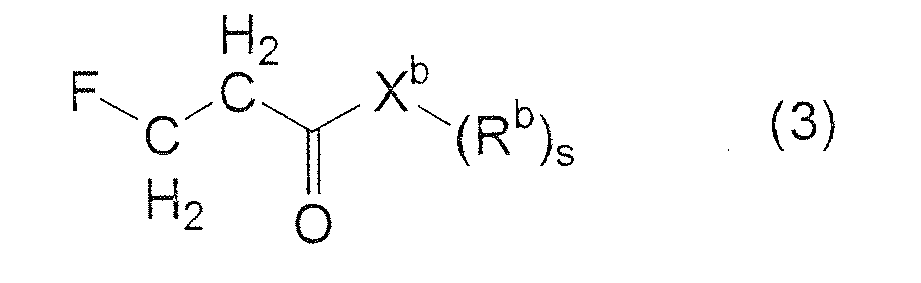

Description
- The present invention relates to nonaqueous electrolytic solutions and secondary cells containing the nonaqueous electrolytic solutions.
- In recent years, size and weight reduction of electrical appliances has propelled the development of lithium secondary cells with high energy density. Further improvements in cell property have been required with extension of the application fields of such secondary cells.
Under such circumstances, secondary cells containing metallic lithium as the negative electrode, have intensively studied as candidates capable of achieving high capacities. However, during repeated charge and discharge cycles, metallic lithium grows into a dendritic crystal. When the dendritic crystal reaches the positive electrode, short circuiting occurs in the cell. This is the most serious obstacle in putting lithium secondary cells with metallic lithium negative electrodes to practical use. - There have also been provided nonaqueous electrolyte secondary cells containing carbonous materials as negative electrodes, which are capable of occluding and discharging lithium, such as cokes, artificial graphite, or natural graphite, in place of metallic lithium. Such secondary cells can exhibit improved service life and safety since lithium does not grow into the dendritic crystal. In particular, nonaqueous electrolyte secondary cells made from graphite-based carbonous materials, such as artificial graphite and natural graphite, have attracted attention as ones capable of meeting the need for high capacities.
- Further, negative-electrode active materials made from alloys such as, for example, silicon (Si), tin (Sn), and lead (Pb) have lately been proposed in order to achieve higher capacities (see, for example,
Patent Documents 1 and 2).
Furthermore, electrolytic solutions containing different compounds in addition to electrolytes and main solvents have been proposed in order to enhance properties of nonaqueous electrolyte secondary cells, such as load, cycle, storage, and low-temperature characteristics. - For example, electrolytic solutions containing carbonate derivatives having unsaturated bonds have been provided , such as ones containing certain amounts of vinylene carbonate and its derivatives in order to inhibit decomposition of the electrolytic solutions for nonaqueous electrolyte secondary cells including graphite negative electrodes (see, for example, Patent Document 3), and ones containing certain amounts of ethylene carbonate derivatives having a non-conjugated, unsaturated bond at the side chain thereof (see, for example, Patent Document 4).
For electrolytic solutions containing such compounds, the compounds are reductively decomposed on the surfaces of the negative electrodes to form films thereon, and the films inhibit extra decomposition of the electrolytic solutions. Electrolytic solutions containing halogen-containing carbonates have also been proposed (see, for example, Patent Document 5). -
Patent Document 6 describes that an electrolytic solutions containing a single solvent, i.e., fluoromethyl ethylene carbonate (4-(monofluoromethyl)-1,3-dioxolan-2-one) in combination with various PF6 and BF4 salts, is excellent in oxidation resistance compared to propylene carbonate or trifluoropropylene carbonate, and thus is useful as an electrolytic solution for a variety of devices. This document also describes that lithium secondary cells containing the electrolytic solution exhibit excellent cycle characteristics and that electric double-layer capacitors containing the electrolytic solution excel in continuous application characteristics at elevated temperatures. - Patent Document 7 describes that electrolytic solutions which contain 60% by volume or more of fluoromethyl ethylene carbonate in their solvents, or difluoromethyl ethylene carbonate and contain (C2H5) 4NBF4 or (C2H5) 4NPF6 as a supporting electrolyte are excellent in oxidation resistance, and thus is useful as electrolytic solutions for electric double-layer capacitors.
- Linear carbonate compounds have generally been used as materials for polycarbonates, and as materials and diluent solvents for medicines and agrichemicals. These have also been used in a broad range of applications, including electrolyte solvents and solid electrolytes for energy storage devices such as Li cells, electrolytic capacitors, and electric double-layer capacitors; and electrode compositions (see, for example, Patent Documents 8 and 9).
- For currently used carbonate compounds, further improved performances and added functionalities are still needed because of improvements in synthetic and purification processes or development of advanced processes in the fine chemical field; technological innovation in the fields of agrichemicals and fertilizers; and needs for highly functionalized semiconductors and energy devices subsequent to the downsizing and densifying in the field of electrical and electronic equipment.
-
- [Patent Document 1] Japanese Patent Application Laid-open No.
HEI 11-176470 - [Patent Document 2] Japanese Patent Application Laid-open No.
2004-87284 - [Patent Document 3] Japanese Patent Application Laid-open No.
HEI 8-45545 - [Patent Document 4] Japanese Patent Application Laid-open No.
2000-40526 - [Patent Document 5] Japanese Patent Application Laid-open No.
HEI 11-195429 - [Patent Document 6] Japanese Patent Application Laid-open No.
HEI 9-251861 - [Patent Document 7] Japanese Patent Application Laid-open No.
HEI 10-233345 - [Patent Document 8] Japanese Patent Application Laid-open No.
HEI 1-311054 - [Patent Document 9] Japanese Patent Application Laid-open No.
SHO 61-64082 - A further improvement in cycle characteristics is required for technologies on nonaqueous electrolytic solutions. The present invention has been made in consideration of the problems, and a first object thereof is to provide a nonaqueous electrolytic solution and a secondary cell containing the nonaqueous electrolytic solution which can give more excellent cycle characteristics.
- As described above, the conventional linear carbonate compounds have many excellent characteristics. However, a novel linear carbonate compound with a higher boiling point, dielectric constant, and electrochemical stability is needed so as to impart higher performances and functionalities to the conventional compounds and thereby to enhance the added value of the compounds.
The present invention has been made in consideration of the need, and a second object thereof is to provide a novel carbonate compound not yet found. - As a result of extensive study to solve such problems, the inventors have discovered the following fact in consideration of the first object and accomplished the present invention: A nonaqueous electrolytic solution containing at least any one of a linear carbonate represented by the formula (1), a compound represented by the formula (2), and a compound represented by the formula (3) can be used for a nonaqueous electrolyte secondary cell in order to achieve much more excellent effects than those of conventional improvements.
- As a result of the extensive study to solve such problems, the inventors have also accomplished the present invention under the following investigation in consideration of the second object:
- A fluorine atom, in general, has a van der Waals' radius close to that of a hydrogen atom, and also a relatively small covalent radius. Therefore, hydrogen atoms attached to carbon atoms in an organic compound can be readily substituted by fluorine atoms due to such steric configuration.
- The bonding electron pair in the carbon-fluorine bond is largely attracted to the fluorine atom having high electronegativity. Therefore, organic fluorine compounds have unique properties which are significantly different from fluorine-free organic compounds. In particular, organic fluorine compounds of which hydrogen atoms attached to the carbon atoms are partially substituted by fluorine atoms may enhance the originally incompatible properties, for example, increased boiling points, decreased viscosities, increased polarities, and increased lipophilicities compared to similar fluorine-free organic compounds. Besides, organic fluorine compounds can also be expected to improve electrical or chemical resistance to oxidation.
- When fluorine atoms are introduced to organic compounds in a sterically asymmetric manner, decreased melting points and further decreased viscosities can also be expected because of the steric asymmetry and the symmetry of electron conformation, like when hydrogen is substituted by substituents other than fluorine.
In consideration of general properties of these organic fluorine compounds, introduction of fluorine atoms to linear carbonate compounds will allow improvements in properties of the compounds, for example, increased boiling point, increased dielectric constant, and enhanced electrochemical stability due to enhanced oxidation resistance. - As a result of extensive study to solve such problems in consideration of the above mentioned findings, the inventors have synthesized various linear carbonate compounds each having a 2,2-difluoroethyl group and have accomplished the present invention.
- That is, a nonaqueous electrolytic solution in accordance with a first aspect of the present invention comprises a linear carbonate of the following formula (1) (claim 1):

Ra represents optionally substituted alkyl; and n represents an integer of zero or more. - In this case, in the formula (1), the group Ra is preferably different from:
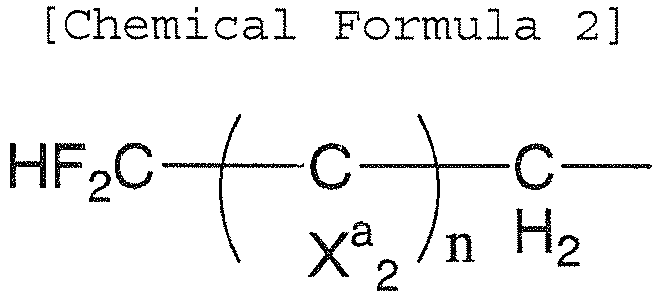
- In the nonaqueous electrolytic solution in accordance with the first aspect of the present invention, the linear carbonate is preferably bis(2,2-difluoroethyl) carbonate (claim 3).
- In addition, in the formula (1), n is preferably an integer of from 0 to 7 (claim 4).
- A nonaqueous electrolytic solution in accordance with a second aspect of the present invention comprises 0.01% by weight to 10% by weight of a compound of the following formula (2) in a nonaqueous solvent:


X2 represents oxygen, sulfur, or NE1;
Z1 and Z2 represent each independently hydrogen, or a group capable of being attached to carbon,
with the proviso that at least one of Z1, Z2, D1, D2, and E1 represents alkyl in which both at least one hydrogen atom and at least one fluorine atom are attached to at least one terminal carbon; and
m represents a natural number (claim 8). - In this case, m in the formula (2) preferably represents two or three (claim 9).
- Preferably, E1, Z2, D1, D2 and E1 in the formula (2) represent each independently any of hydrogen, fluorine, and unsubstituted alkyl or fluorine-substituted alkyl (claim 10).
- Preferably, in the second nonaqueous electrolytic solution of the present invention, the "alkyl in which both at least one hydrogen atom and at least one fluorine atom are attached to at least one terminal carbon" is substituted by fluorine alone (claim 11).
- A nonaqueous electrolytic solution in accordance with a third aspect of the present invention comprises a compound of the following formula (3) in a nonaqueous solvent:

- In this case, in the formula (3), Rb is preferably unsubstituted alkyl or alkyl substituted by fluorine alone (claim 16).
- Preferably, in the nonaqueous electrolytic solution in accordance with the third aspect of the present invention, the concentration of the compound in the nonaqueous electrolytic solution is 0.01% by weight to 10% by weight (claim 17).
- Preferably, the nonaqueous electrolytic solution of each of the first, second, and third aspects of the present invention further comprises a carbonate having at least one of an unsaturated bond and a halogen atom (hereinafter referred to as a "predetermined carbonate") (claims 5, 12, and 18), with the proviso that carbonates which also fall into the definition of the linear carbonates of the formula (1) are excluded from the predetermined carbonates when they are contained in the nonaqueous electrolytic solution in accordance with the first aspect of the present invention, and that carbonates which also fall into the definition of the linear carbonates of the formula (2) are also excluded from the predetermined carbonates when the predetermined carbonates are contained in the nonaqueous electrolytic solution in accordance with the second aspect of the present invention.
Preferably, the concentration of the predetermined carbonate in the nonaqueous electrolytic solution is 0.01% by weight to 70% by weight (claims 6, 13, and 19).
Preferably, the predetermined carbonates are at least one carbonate selected from the group consisting of vinylene carbonate, vinyl ethylene carbonate, fluoroethylene carbonate, difluoroethylene carbonate, and derivatives thereof (claims 7, 14, and 20). - Preferably, the nonaqueous electrolytic solution of each of the first, second, and third aspects of the present invention comprises ethylene carbonate and/or propylene carbonate (claim 21).
- Preferably, the nonaqueous electrolytic solution of the first, second, and third aspects of the present invention comprises at least one selected from the group consisting of dimethyl carbonate, ethyl methyl carbonate, diethyl carbonate, methyl n-propyl carbonate, ethyl n-propyl carbonate, and di-n-propyl carbonate (claim 22).
- A nonaqueous electrolyte secondary cell of the present invention comprises a negative electrode and a positive electrode capable of occluding and discharging lithium ions, and any of the nonaqueous electrolytic solutions of the first, second, and third aspects of the present invention (claim 23).
- A carbonate compound of the present invention is represented by the following formula (4):


- That is, the carbonate compound of the present invention is selected from the group consisting of 2, 2-difluoroethyl methyl carbonate, 2,2-difluoroethyl ethyl carbonate, 2,2-difluoroethyl n-propyl carbonate, and n-
butyl 2,2-difluoroethyl carbonate (claim 25). - When contained in a nonaqueous electrolyte secondary cell, the nonaqueous electrolytic solution in accordance with the first aspect of the present invention can give superior cycle characteristics to the conventional one.
The nonaqueous electrolyte secondary cell of the first aspect of the present invention can also exhibit superior cycle characteristics to the conventional one. - Furthermore, when contained in a nonaqueous electrolyte secondary cell, the nonaqueous electrolytic solution in accordance with the second aspect of the present invention can give high capacities and excellent charge and discharge cycle characteristics over a long period.
The nonaqueous electrolyte secondary cell in accordance with the second aspect of the present invention can also exhibit high capacities and excellent charge and discharge cycle characteristics over a long period. - Furthermore, when contained in a nonaqueous electrolyte secondary cell, the nonaqueous electrolytic solution in accordance with the third aspect of the present invention can give excellent charge and discharge cycle characteristics.
The nonaqueous electrolyte secondary cell in accordance with the third aspect of the present invention can exhibit excellent charge and discharge cycle characteristics. - According to the present invention, a novel carbonate compound is provided. The carbonate compound can be inferred to have advantages such as increased boiling point, increased dielectric constant, and enhanced electrochemical stability due to enhanced oxidation resistance.
-
- [
Fig. 1] Fig. 1 shows a 1H NMR spectrum of a product prepared according to Example IV-1 of the present invention. - [
Fig. 2] Fig. 2 shows a 13C NMR spectrum of a product prepared according to Example IV-1 of the present invention. - [
Fig. 3] Fig. 3 shows a 1H NMR spectrum of a product prepared according to Example IV-2 of the present invention. - [
Fig. 4] Fig. 4 shows a 13C NMR spectrum of a product prepared according to Example IV-2 of the present invention. - [
Fig. 5] Fig. 5 shows a 1H NMR spectrum of a product prepared according to Example IV-3 of the present invention. - [
Fig. 6] Fig. 6 shows a 13C NMR spectrum of a product prepared according to Example IV-3 of the present invention. - [
Fig. 7] Fig. 7 shows a 1H NMR spectrum of a product prepared according to Example IV-4 of the present invention. - [
Fig. 8] Fig. 8 shows a 13C NMR spectrum of a product prepared according to Example IV-4 of the present invention. - The present invention will now be described in detail by reference to preferred embodiments; however, the following description on elements of the invention is only for illustration of (representative) embodiments of the invention, and any variations of the embodiments can be modified unless departing from the spirit of the invention.
- The nonaqueous electrolytic solution in accordance with the first aspect of the present invention comprises at least one linear carbonate represented by the following formula (1) (hereinafter referred to as a "particular linear carbonate"):

- The particular linear carbonate contained in the nonaqueous electrolytic solution in accordance with the first aspect of the present invention is represented by the formula (1).
Xa in the formula (1) represents hydrogen or any group, wherein XaS in the formula (1) may be the same or different. - Xa may be any group that does not significantly impair the advantages of the present invention. Specific examples of the group include halogens such as fluorine (fluoro), chlorine (chloro), bromine (bromo), and iodine (iodo); linear alkyls such as methyl, ethyl, n-propyl, and i-propyl; cycloalkyls such as cyclohexyl; and aryls such as phenyl and naphthyl. Any hydrogen in the alkyl, cycloalkyl, and aryl groups may be substituted by halogen.
In consideration of the stability as an organic substance of the particular linear carbonate, and the stability of a protective layer formed from the carbonate in use for a nonaqueous electrolyte secondary cell, Xa preferably represents hydrogen or fluorine. - In the above formula (1), n represents any integer of zero or more. Since the particular linear carbonate represented by the formula (1) having a significantly high molecular weight may not exhibit advantages comparable to the amount of the carbonate used, n represents usually seven or less, preferably four or less, and more preferably three or less.
- Ra in the formula (1) represents optionally substituted alkyl.
Unless significantly impairing the advantages of the present invention, the carbon number of Ra may also be any number. Since the particular linear carbonate represented by the formula (1) having a significantly high molecular weight may not exhibit effects comparable to the amount of the carbonate used, the number is usually ten or less, preferably five or less, and more preferably three or less. - In consideration of the stability as an organic substance of the particular linear carbonate, and a stability of protective layer formed from the carbonate in use for a nonaqueous electrolyte secondary cell, Ra preferably represents nonbranched alkyl, and unsubstituted alkyl or alkyl substituted by fluorine alone.
- Specific examples of Ra include methyl, fluoromethyl, ethyl, 2-fluoroethyl, 2,2-difluoroethyl, 2,2,2-trifluoroethyl, n-propyl, 3-fluoro-n-propyl, 3,3-difluoro-n-propyl, 3,3,3-trifluoro-n-propyl, i-propyl, and 1,1,1,3,3,3-hexafluoro-i-propyl.
- Among them, methyl, ethyl, 2-fluoroethyl, 2,2-difluoroethyl, 2,2,2-trifluoroethyl, n-propyl, 3-fluoro-n-propyl, and 3,3-difluoro-n-propyl are preferred, and methyl, ethyl, and n-propyl are more preferred in view of ready production of the carbonate.
- In the particular linear carbonate represented by the formula (1), the configuration of the formula may preferably be left-right asymmetric. That is, Ra in the above formula (1) preferably has a structure different from

HEI 2-148665 HEI 4-104468 - However, among the carbonates having left-right symmetric configuration in the formula (1), bis(2,2-difluoroethyl) carbonate can be preferably used. That is, it is also preferred that in the formula (1), X represents hydrogen, n represents 0, and Ra represents 2,2-difluoroethyl.
More preferably, among the particular linear carbonates, carbonates having a structure of left-right asymmetric configuration of the formula (1) are usually used. - Specific examples of the particular linear carbonate represented by the formula (1) include 2,2-difluoroethyl methyl carbonate, 2,2-difluoroethyl ethyl carbonate, 2,2-difluoroethyl-2'-fluoroethyl carbonate, bis(2,2-difluoroethyl) carbonate, 2,2-difluoroethyl-2',2',2'-trifluoroethyl carbonate, 2,2-difluoroethyl n-propyl carbonate, 2,2-difluoroethyl-3'-fluoro-n-propyl carbonate, 2,2-difluoro-3',3',3'-trifluoro-n-propyl carbonate, 3,3-difluoro-n-propyl methyl carbonate, 3,3-difluoro-n-propyl ethyl carbonate, 3,3-difluoro-n-propyl 2'-fluoroethyl carbonate, 3,3-difluoro-n-propyl-2',2'-difluoroethyl carbonate, 3,3-difluoro-n-propyl-2',2',2'-trifluoroethyl carbonate, 3,3-difluoro-n-propyl-n-propyl carbonate, 3,3-difluoro-n-propyl-3'-fluoro-n-propyl carbonate, bis(3,3-difluoro-n-propyl) carbonate, 3,3-difluoro-n-propyl-3',3',3'-trifluoro-n-propyl carbonate, methyl-2,2,3,3-tetrafluoro-n-propyl carbonate, ethyl-2,2,3,3-tetrafluoro-n-propyl carbonate, 2-fluoro-2',2',3',3'-tetrafluoro-n-propyl carbonate, 2,2-difluoroethyl-2',2',3',3'-tetrafluoro-n-propyl carbonate, 2,2,3,3-tetrafluoro-n-propyl-2',2',2'-trifluoroethyl carbonate, n-propyl-2,2,3,3-tetrafluoro-n-propyl carbonate, 3-fluoro-n-propyl-2',2',3',3'-tetrafluoro-n-propyl carbonate, 3,3-difluoro-n-propyl-2',2',3',3'-tetrafluoro-n-propyl carbonate, and bis(2,2,3,3-tetrafluoro-n-propyl) carbonate.
- In particular, preferred are the particular linear carbonates having left-right asymmetric configuration of the formula (1), and bis(2,2-difluoroethyl) carbonate, as described above.
Among these, 2,2-difluoroethyl methyl carbonate, 2,2-difluoroethyl ethyl carbonate, bis(2,2-difluoroethyl) carbonate, and 2,2-difluoroethyl n-propyl carbonate are more preferred because these can be readily prepared. - More preferred are 2,2-difluoroethyl methyl carbonate, 2,2-difluoroethyl ethyl carbonate, and 2,2-difluoroethyl n-propyl carbonate among these.
When contained in the nonaqueous electrolytic solution in accordance with the first aspect of the present invention, the particular linear carbonates may be used either alone or in any combination thereof at any proportion. - When contained in the nonaqueous electrolytic solution in accordance with the first aspect of the present invention, the particular linear carbonate may be used in any amount unless significantly impairing the advantages of the present invention, but usually in an amount of 0.01% by weight or more and preferably 0.1% by weight or more. Below the lower limit, the nonaqueous electrolyte secondary cell containing the nonaqueous electrolytic solution in accordance with the first aspect of the present invention may not exhibit sufficiently enhanced cycle characteristics.
- In particular, when contained as nonaqueous solvents in the nonaqueous electrolytic solution in accordance with the first aspect of the present invention, the amount of the particular linear carbonate is usually 95% by volume or less, and preferably 70% by volume or less based on the total amount of nonaqueous solvents other than electrolytes in the nonaqueous electrolytic solution. Above the upper limit, the electrolytes become insufficiently soluble, the electrolytic solution properties such as electric conductivity are impaired, and, as a result, the cell characteristics will be impaired.
- When a nonaqueous electrolytic solution containing the above particular linear carbonate is contained in a nonaqueous electrolyte secondary cell, the charge and discharge cycle characteristics of the cell can be enhanced.
The reason for the improved charge and discharge cycle characteristics may be inferred as follows, although the detail is not clear: That is, when a nonaqueous electrolytic solution containing the particular linear carbonate is contained in a nonaqueous electrolyte secondary cell, the particular linear carbonate will react in the cell to form an excellent protective layer on the surface of a negative-electrode active material, thereby inhibiting side reactions and preventing the cycle degradation. In this case, both hydrogen and fluorine present on at least one terminal carbon atom in the particular linear carbonate represented by the formula (1), and it is considered to contribute to enhanced properties of the protective layer in any way. - Any known method can be used without limitation for producing the particular linear carbonate.
- Preferably, the nonaqueous electrolytic solution in accordance with the first aspect of the present invention further comprises a predetermined carbonate, in addition to the particular linear carbonate. The predetermined carbonate in the nonaqueous electrolytic solution in accordance with the first aspect of the present invention has at least one of an unsaturated bond and a halogen atom. That is, the predetermined carbonate in the nonaqueous electrolytic solution in accordance with the first aspect of the present invention may have only an unsaturated bond or only a halogen atom, or may have the both.
However, the particular linear carbonates should be excluded from the predetermined carbonates when they are contained in the nonaqueous electrolytic solution in accordance with the first aspect of the present invention. That is, in the nonaqueous electrolytic solution in accordance with the first aspect of the present invention, compounds that fall into the definition of the particular linear carbonates described above are not considered as the predetermined carbonates. - Among the predetermined carbonates other than the particular linear carbonates, any predetermined carbonate having an unsaturated bond (arbitrarily abbreviated as "predetermined unsaturated carbonate") may be used without limitation with the proviso that the predetermined carbonate has a carbon-carbon unsaturated bond, i.e. a carbon-carbon double bond or triple bond. The predetermined unsaturated carbonates having such unsaturated bonds also include carbonates having aromatic rings.
- Examples of the predetermined unsaturated carbonate include vinylene carbonate derivatives, substituted ethylene carbonate derivatives by substituents with aromatic rings or carbon-carbon unsaturated bonds, phenyl carbonates, vinyl carbonates, and allyl carbonates.
- Specific examples of the vinylene carbonate derivatives include vinylene carbonate, methyl vinylene carbonate, 4,5-dimethyl vinylene carbonate, phenyl vinylene carbonate, and 4,5-diphenyl vinylene carbonate.
- Specific examples of the substituted ethylene carbonate derivatives by substituents with aromatic rings or carbon-carbon unsaturated bonds include such as vinyl ethylene carbonate, 4,5-divinyl ethylene carbonate, phenyl ethylene carbonate, and 4,5-diphenyl ethylene carbonate.
- Specific examples of the phenyl carbonates include diphenyl carbonate, ethyl phenyl carbonate, methyl phenyl carbonate, and t-butyl phenyl carbonate.
- Specific examples of the vinyl carbonates include divinyl carbonate and methyl vinyl carbonate.
Specific examples of the allyl carbonates include diallyl carbonate and allyl methyl carbonate. - Among these predetermined unsaturated carbonates preferred as the predetermined carbonate are the vinylene carbonate derivatives and the substituted ethylene carbonate derivatives by substituents with aromatic rings or carbon-carbon unsaturated bonds. Particularly preferred are vinylene carbonate, 4,5-diphenyl vinylene carbonate, 4,5-dimethyl vinylene carbonate, and vinyl ethylene carbonate because these can form stable surface protective films.
- Among the predetermined carbonate having halogen atoms (arbitrarily abbreviated as "predetermined halogenated carbonate"), any halogenated carbonate other than the particular linear carbonates can be used without limitation.
- Specific examples of the halogen atom contained in the predetermined halogenated carbonate include fluorine, chlorine, bromine, and iodine atoms. Among these preferred is fluorine or chlorine atom and in particular, fluorine atom is more preferable.
The number of the halogen atoms in the predetermined halogenated carbonate may be at least one without limitation, but usually six or less and preferably four or less. When the predetermined halogenated carbonate has multiple halogen atoms, they may be the same or different. - Examples of the predetermined halogenated carbonate include such as ethylene carbonate derivatives, dimethyl carbonate derivatives, ethyl methyl carbonate derivatives, and diethyl carbonate derivatives.
- Specific examples of the ethylene carbonate derivatives include fluoroethylene carbonate, chloroethylene carbonate, 4,4-difluoroethylene carbonate, 4,5-difluoroethylene carbonate, 4,4-dichloroethylene carbonate, 4,5-dichloroethylene carbonate, 4-fluoro-4-methylethylene carbonate, 4-chloro-4-methylethylene carbonate, 4,5-difluoro-4-methylethylene carbonate, 4,5-dichloro-4-methylethylene carbonate, 4-fluoro-5-methylethylene carbonate, 4-chloro-5-methylethylene carbonate, 4,4-difluoro-5-methylethylene carbonate, 4,4-dichloro-5-methylethylene carbonate, 4-(fluoromethyl)-ethylene carbonate, 4-(chloromethyl)-ethylene carbonate, 4-(difluoromethyl)-ethylene carbonate, 4-(dichloromethyl)-ethylene carbonate, 4-(trifluoromethyl)-ethylene carbonate, 4-(trichloromethyl)-ethylene carbonate, 4-(fluoromethyl)-4-fluoroethylene carbonate, 4-(chloromethyl)-4-chloroethylene carbonate, 4-(fluoromethyl)-5-fluoroethylene carbonate, 4-(chloromethyl)-5-chloroethylene carbonate, 4-fluoro-4,5-dimethylethylene carbonate, 4-chloro-4,5-dimethylethylene carbonate, 4,5-difluoro-4,5-dimethylethylene carbonate, 4,5-dichloro-4,5-dimethylethylene carbonate, 4,4-difluoro-5,5-dimethylethylene carbonate, and 4,4-dichloro-5,5-dimethylethylene carbonate.
- Specific examples of the dimethyl carbonate derivatives include such as fluoromethyl methyl carbonate, difluoromethyl methyl carbonate, trifluoromethyl methyl carbonate, bis(fluoromethyl) carbonate, bis(difluoro) methyl carbonate, bis(trifluoro) methyl carbonate, chloromethyl methyl carbonate, dichloromethyl methyl carbonate, trichloromethyl methyl carbonate, bis(chloromethyl) carbonate, bis(dichloro) methyl carbonate, and bis(trichloro) methyl carbonate.
- Specific examples of the ethyl methyl carbonate derivatives include such as 2-fluoroethyl methyl carbonate, ethyl fluoromethyl carbonate, 2-fluoroethyl fluoromethyl carbonate, ethyl difluoromethyl carbonate, 2,2,2-trifluoroethyl methyl carbonate, 2-fluoroethyl difluoromethyl carbonate, ethyl trifluoromethyl carbonate, 2-chloroethyl methyl carbonate, ethyl chloromethyl carbonate, 2,2-dichloroethyl methyl carbonate, 2-chloroethyl chloromethyl carbonate, ethyl dichloromethyl carbonate, 2,2,2-trichloroethyl methyl carbonate, 2,2-dichloroethyl chloromethyl carbonate, 2-chloroethyl dichloromethyl carbonate, and ethyl trichloromethyl carbonate.
- Specific examples of the diethyl carbonate derivatives include such as ethyl-(2-fluoroethyl) carbonate, bis(2-fluoroethyl) carbonate, ethyl-(2,2,2-trifluoroethyl) carbonate, 2,2,2-trifluoroethyl-2'-fluoroethyl carbonate, bis(2,2,2-trifluoroethyl) carbonate, ethyl-(2-chloroethyl) carbonate, ethyl-(2,2-dichloroethyl) carbonate, bis(2-chloroethyl) carbonate, ethyl-(2,2,2-trichloroethyl) carbonate, 2,2-dichloroethyl-2'-chloroethyl carbonate, bis(2,2-dichloroethyl) carbonate, 2,2,2-trichloroethyl-2'-chloroethyl carbonate, 2,2,2-trichloroethyl-2',2'-dichloroethyl carbonate, and bis(2,2,2-trichloroethyl) carbonate.
- Among these predetermined halogenated carbonates, preferred are carbonates having fluorine atoms, and more preferred are ethylene carbonate derivatives having fluorine atoms. In particular, fluoroethylene carbonate, 4-(fluoromethyl)-ethylene carbonate, 4,4-difluoroethylene carbonate, and 4,5-difluoroethylene carbonate are preferably used because they can form surface protective films.
- In addition, the predetermined carbonate can have both an unsaturated bond and a halogen atom (arbitrarily abbreviated as "predetermined halogenated unsaturated carbonate,"). The predetermined halogenated unsaturated carbonate may be any halogenated unsaturated carbonate that does not significantly impair the advantages of the present invention.
- Examples of the predetermined halogenated unsaturated carbonate include such as vinylene carbonate derivatives, substituted ethylene carbonate derivatives by substituents with aromatic rings or carbon-carbon unsaturated bonds, phenyl carbonates, vinyl carbonates, and allyl carbonates.
- Specific examples of the vinylene carbonate derivatives include such as fluorovinylene carbonate, 4-fluoro-5-methylvinylene carbonate, 4-fluoro-5-phenylvinylene carbonate, chlorovinylene carbonate, 4-chloro-5-methylvinylene carbonate, and 4-chloro-5-phenylvinylene carbonate.
- Specific examples of the substitutedethylene carbonate derivatives by substituents with aromatic rings or carbon-carbon unsaturated bonds include such as 4-fluoro-4-vinylethylene carbonate, 4-fluoro-5-vinylethylene carbonate, 4,4-difluoro-4-vinylethylene carbonate, 4,5-difluoro-4-vinylethylene carbonate, 4-chloro-5-vinylethylene carbonate, 4,4-dichloro-4-vinylethylene carbonate, 4,5-dichloro-4-vinylethylene carbonate, 4-fluoro-4,5-divinylethylene carbonate, 4,5-difluoro-4,5-divinylethylene carbonate, 4-chloro-4,5-divinylethylene carbonate, 4,5-dichloro-4,5-divinylethylene carbonate, 4-fluoro-4-phenylethylene carbonate, 4-fluoro-5-phenylethylene carbonate, 4,4-difluoro-5-phenylethylene carbonate, 4,5-difluoro-4-phenylethylene carbonate, 4-chloro-4-phenylethylene carbonate, 4-chloro-5-phenylethylene carbonate, 4,4-dichloro-5-phenylethylene carbonate, 4,5-dichloro-4-phenylethylene carbonate, 4,5-difluoro-4,5-diphenylethylene carbonate, and 4,5-dichloro-4,5-diphenylethylene carbonate.
- Specific examples of the phenyl carbonates include such as fluoromethyl phenyl carbonate, 2-fluoroethyl phenyl carbonate, 2,2-difluoroethyl phenyl carbonate, 2,2,2-trifluoroethyl phenyl carbonate, chloromethyl phenyl carbonate, 2-chloroethyl phenyl carbonate, 2,2-dichloroethyl phenyl carbonate, and 2,2,2-trichloroethyl phenyl carbonate.
- Specific examples of the vinyl carbonates include such as fluoromethyl vinyl carbonate, 2-fluoroethyl vinyl carbonate, 2,2-difluoroethyl vinyl carbonate, 2,2,2-trifluoroethyl vinyl carbonate, chloromethyl vinyl carbonate, 2-chloroethyl vinyl carbonate, 2,2-dichloroethyl vinyl carbonate, and 2,2,2-trichloroethyl vinyl carbonate.
- Specific examples of the allyl carbonates include such as fluoromethyl allyl carbonate, 2-fluoroethyl allyl carbonate, 2,2-difluoroethyl allyl carbonate, 2,2,2-trifluoroethyl allyl carbonate, chloromethyl allyl carbonate, 2-chloroethyl allyl carbonate, 2,2-dichloroethyl allyl carbonate, and 2,2,2-trichloroethyl allyl carbonate.
- Among the exemplary predetermined halogenated unsaturated carbonates mentioned above, it is especially preferred to use at least one selected from the group consisting of vinylene carbonate, vinyl ethylene carbonate, fluoroethylene carbonate, 4,5-difluoroethylene carbonate, and derivatives thereof as the predetermined carbonate because of high effects thereof when used alone.
- The predetermined carbonate may have any molecular weight that does not significantly impair the advantages of the present invention, and the molecular weight is usually 50 or more and preferably 80 or more, and usually 250 or less, and preferably 150 or less. At a higher molecular weight of the predetermined carbonate, the solubility of the carbonate in a nonaqueous electrolytic solution may be too poor to exhibit the advantages of the present invention sufficiently.
- The predetermined carbonates can be prepared by any known method without limitation.
- The predetermined carbonates as described above may also be used either alone or in any combination thereof at any proportion in the nonaqueous electrolytic solution in accordance with the first aspect of the present invention.
- The predetermined carbonate may be used in any amount in the nonaqueous electrolytic solution in accordance with the first aspect of the present invention without limitation within the scope that does not significantly impair the advantages of the present invention, and the amount of the predetermined carbonate is usually 0.01% by weight or more, preferably 0.1% by weight or more, and more preferably 0.3% by weight or more, and usually 70% by weight or less, preferably 50% by weight or less, and more preferably 40% by weight or less of the nonaqueous electrolytic solution in accordance with the first aspect of the present invention. Below the lower limit, a nonaqueous electrolyte secondary cell containing the nonaqueous electrolytic solution in accordance with the first aspect of the present invention may not exhibit sufficiently enhanced cycle characteristics. At a higher proportion of the predetermined carbonate, a nonaqueous electrolyte secondary cell containing the nonaqueous electrolytic solution in accordance with the first aspect of the present invention tends to impair its high-temperature preservation characteristics and trickle charge characteristics, and particularly may increase the amount of gas generation and decrease its discharge capacity maintenance rate.
- In the nonaqueous electrolytic solution in accordance with the first aspect of the present invention, the particular linear carbonate and the predetermined carbonate may be used in any ratio. The ratio of "the weight of the particular linear carbonate to the weight of the predetermined carbonate" is usually 0.0001 or more, preferably 0.001 or more, and more preferably 0.01 or more, and usually 1000 or less, preferably 100 or less, and more preferably 10 or less. At a ratio that is lower or higher than this range, synergistic effects by the combination may not be exhibited.
- When a nonaqueous electrolytic solution containing both the above described particular linear carbonate and the predetermined carbonate is contained in a nonaqueous electrolyte secondary cell, charge and discharge cycle characteristics of the cell can be enhanced. The reason for this may be inferred as follows, although the detail is not clear: The particular linear carbonate and the predetermined carbonate in the nonaqueous electrolytic solution will react together, and form an excellent protective film on the surface of a negative-electrode active material, thereby inhibiting side reactions and preventing the cycle degradation. In addition, an electrolytic solution containing both the particular linear carbonate and the predetermined carbonate is considered to contribute to enhanced properties of the protective film in any way.
- The nonaqueous electrolytic solution in accordance with the first aspect of the present invention can comprises any nonaqueous solvent that does not significantly impair the advantages of the present invention. The particular linear carbonates or the predetermined carbonates mentioned above can also be used as the nonaqueous solvent . The nonaqueous solvents including the particular linear carbonates or the predetermined carbonates may be used either alone or in any combination thereof at any proportion.
- Examples of the nonaqueous solvents that are commonly used include such as cyclic carbonates, linear carbonates, linear and cyclic carboxylic esters, linear and cyclic ethers, phosphorus-containing organic solvents, and sulfur-containing organic solvents.
- Nonlimiting examples of the cyclic carbonates that are commonly used include such as ethylene carbonate, propylene carbonate, and butylene carbonate. Among these preferred are ethylene carbonate and propylene carbonate having high dielectric constants, which facilitate dissolution of solutes and improve cycle characteristics of nonaqueous electrolyte secondary cells.
- Examples of the linear carbonates that are commonly used include, but not limited to, such as dimethyl carbonate, ethyl methyl carbonate, diethyl carbonate, methyl n-propyl carbonate, ethyl n-propyl carbonate, and di-n-propyl carbonate. Among these preferred are dimethyl carbonate, ethyl methyl carbonate, diethyl carbonate, methyl n-propyl carbonate, and ethyl n-propyl carbonate, and especially preferred are dimethyl carbonate, ethyl methyl carbonate and diethyl carbonate because these carbonates ensure improved cycle characteristics of nonaqueous electrolyte secondary cells.
- Examples of the linear carboxylic acid esters that are commonly used include, but not limited to, such as methyl acetate, ethyl acetate, n-propyl acetate, i-propyl acetate, n-butyl acetate, i-butyl acetate, t-butyl acetate, methyl propionate, ethyl propionate, n-propyl propionate, i-propyl propionate, n-butyl propionate, i-butyl propionate, and t-butyl propionate. Among these, more preferred are ethyl acetate, methyl propionate, and ethyl propionate. In addition, the particular linear carbonates represented by the above formula (1) as the linear carbonates can also be used.
- Examples of the cyclic carboxylic acid esters that are commonly used include, but not limited to, γ-butyrolactone, γ-valerolactone, and δ-valerolactone. Among these, γ-butyrolactone is more preferred.
- Examples of the linear ethers that are commonly used include, but not limited to, such as dimethoxymethane, dimethoxyethane, diethoxymethane, diethoxyethane, ethoxymethoxymethane, and ethoxymethoxyethane. Among these, dimethoxyethane and diethoxyethane are more preferred.
- Examples of the cyclic ethers that are commonly used include, but not limited to, such as tetrahydrofuran and 2-methyltetrahydrofuran.
- Examples of the phosphorus-containing organic solvents that are commonly used include, but not limited to, phosphate esters such as trimethyl phosphate, triethyl phosphate, and triphenyl phosphate; phosphite esters such as trimethyl phosphite, triethyl phosphite, and triphenyl phosphite; phosphine oxides such as trimethylphosphine oxide, triethylphosphine oxide, and triphenylphosphine oxide.
- Examples of the sulfur-containing organic solvents that are commonly used include, but not limited to, such as ethylene sulfite, 1,4-propane sultone, 1,4-butane sultone, methyl methanesulfonate, busulfan, sulfolane, sulfolene, dimethyl sulfone, diphenyl sulfone, methyl phenyl sulfone, dibutyl disulfide, dicyclohexyl disulfide, tetramethylthiuram monosulfide, N,N-dimethylmethanesulfonamide, and N,N-diethylmethanesulfonamide.
- Among these, the cyclic carbonates, i.e., ethylene carbonate and/or propylene carbonate are preferably used, and more preferably used as a mixture with the linear carbonates.
- In such combined use of the cyclic carbonates and the linear carbonates as the nonaqueous solvent, the suitable amount of the linear carbonate in the nonaqueous solvent in the nonaqueous electrolytic solution in accordance with the first aspect of the present invention is usually 30% by volume or more and preferably 50% by volume or more, and usually 95% by volume or less and preferably 90% by volume or less. The suitable amount of the cyclic carbonate in the nonaqueous solvent in the nonaqueous electrolytic solution in accordance with the first aspect of the present invention is usually 5% by volume or more and preferably 10% by volume or more, and usually 50% by volume or less and preferably 40% by volume or less. When containing the linear carbonate in a lower amount than this range, the nonaqueous electrolytic solution in accordance with the first aspect of the present invention may have an increased viscosity. When containing the linear carbonate in a higher amount than this range, the nonaqueous electrolytic solution may have a decreased degree of dissociation of the electrolyte, i.e., lithium salt, and then may have a decreased electric conductivity.
- The nonaqueous electrolytic solution in accordance with the first aspect of the present invention may contain any known electrolyte that is contained in an intended nonaqueous electrolyte secondary cell as electrolyte. Lithium secondary cells containing nonaqueous electrolytic solutions in accordance with the first aspect of the present invention typically contain lithium salts as the electrolytes.
- Specific examples of the electrolytes include inorganic lithium salts such as LiClO4, LiAsF6, LiPF6, Li2CO3, and LiBF4; fluorine-containing organic lithium salts such as LiCF3SO3, LiN (CF3SO2)2, LiN (C2F5SO2)2, lithium cyclic-l,4-perfluoropropanedisulfonylimide, LiN (CF3SO2) (C4F9SO2), LiC (CF3SO2)3, LiPF4 (CF3)2, LiPF4 (C2F5)2, LiPF4 (CF3SO2)2, LiPF4 (C2F5SO2)2, LiBF2 (CF3)2, LiBF2 (C2F5)2, LiBF2 (CF3SO2)2, LiBF2 (C2F5SO2)2, and lithium bis (oxalato) borate; sodium or potassium salts such as KPF6, NaPF6, NaBF4, and Na2CF3SO3. Among these preferred are LiPF6, LiBF4, LiCF3SO3, LiN (CF3SO2)2, and LiN (C2F5SO2)2, and especially preferred are LiPF6 and LiBF4.
- The electrolytes may be used either alone or in any combination thereof at any proportion. In particular, combined use of two specific inorganic lithium salts or combined use of an inorganic lithium salt with a fluorine-containing organic lithium salt is preferred because gas generation is suppressed during a continuous charging mode or degradation is suppressed during high-temperature preservation. Especially preferred are combined use of LiPF6 with LiBF4 or combined use of an inorganic lithium salt, e.g. LiPF6 or LiBF4, with a fluorine-containing organic lithium salt, e.g. LiCF3SO3, LiN (CF3SO2)2, or LiN (C2F5SO2)2.
- When both LiPF6 and LiBF4 are used together, the amount of LiBF4 in a preferred embodiment ranges from 0.01% by weight to 20% by weight based on the total amount of electrolytes. Since LiBF4 has a low degree of dissociation, an electrolytic solution containing a significantly high proportion of LiBF4 would have an increased resistance.
When an inorganic lithium salts such as LiPF6 and LiBF4 and fluorine-containing organic lithium salts such as LiCF3SO3, LiN (CF3SO2)2, and LiN (C2F5SO2)2 are used together, it is desirable that the amount of the inorganic lithium salt is usually in a range from 70% by weight to 99% by weight based on the total amount of the electrolytes. In general, the fluorine-containing organic lithium salts have a higher molecular weight than the inorganic lithium salts and an electrolyte containing a significantly high proportion of the fluorine-containing organic lithium salt may reduce the proportion of the solvent to the entire electrolytic solution and increase its resistance. - The lithium salt in a nonaqueous electrolytic solution in accordance with the present invention may be used in any concentration that does not significantly impair the advantages of the present invention, and the concentration of the lithium salt is usually 0.5 mol·dm-3 or more, preferably 0.6 mol·dm-3 or more, and more preferably 0.8 mol·dm-3 or more, and usually 3 mol·dm-3 or less, preferably 2 mol·dm-3 or less, and more preferably 1.5 mol·dm-3 or less. A nonaqueous electrolytic solution containing a significantly low concentration of lithium salt may have an insufficient electric conductivity. A nonaqueous electrolytic solution containing a significantly high concentration of lithium salt may also have a decreased electric conductivity due to rise in viscosity, so that a nonaqueous electrolyte secondary cell containing the nonaqueous electrolytic solution in accordance with the first aspect of the present invention may have low performance.
- Preferably, the nonaqueous electrolytic solution in accordance with the first aspect of the present invention contains various additives that do not significantly impair the advantages of the present invention. Any conventional known additive can be used either alone or in any combination thereof at any proportion. Examples of such additives include such as overcharge protection agents, and aids for improving capacity maintenance and cycle characteristics after high-temperature preservation.
- Examples of the overcharge protection agents include aromatic compounds such as biphenyls, alkylbiphenyls, terphenyls, partially hydrogenated terphenyls, cyclohexylbenzene, t-butylbenzene, t-amylbenzene, diphenyl ether, and dibenzofuran; partially fluorinated aromatic compounds mentioned above such as 2-fluorobiphenyl, o-cyclohexylfluorobenzene, and p-cyclohexylfluorobenzene; and fluorine-containing anisoles such as 2,4-difluoroanisole, 2,5-difluoroanisole, and 2,6-difluoroanisole.
The overcharge protection agents may be used either alone or in any combination thereof at any proportion. - The nonaqueous electrolytic solution in accordance with the first aspect of the present invention may contain the overcharge protection agents in any concentration that does not significantly impair the advantages of the present invention, and the concentration of the overcharge protection agents is usually 0.1% by weight to 5% by weight based on the entire nonaqueous electrolytic solution. Incorporation of overcharge protection agents into a nonaqueous electrolytic solution is preferred because these agents can inhibit a nonaqueous electrolyte secondary cell from exploding and igniting even when the cell is overcharged, thereby enhancing the safety of the cell.
- Examples of aids for improving capacity maintenance and cycle characteristics after high-temperature preservation include carbonate compounds such as vinylene carbonate, vinyl ethylene carbonate, fluoroethylene carbonate, 4-(trifluoromethyl)-ethylene carbonate, phenyl ethylene carbonate, erythritan carbonate, and spiro-bis-dimethylene carbonate; carboxylic anhydrides such as succinic anhydride, glutaric anhydride, maleic anhydride, citraconic anhydride, glutaconic anhydride, itaconic anhydride, diglycolic anhydride, cyclohexanedicarboxylic anhydride, cyclopentanetetracarboxylic dianhydride, and phenylsuccinic anhydride; sulfur-containing compounds such as ethylene sulfite, 1,4-propane sultone, 1,4-butane sultone, methyl methanesulfonate, busulfan, sulfolane, sulfolene, dimethyl sulfone, diphenyl sulfone, methyl phenyl sulfone, dibutyl disulfide, dicyclohexyl disulfide, tetramethylthiuram monosulfide, N,N-dimethylmethanesulfonamide, and N,N-diethylmethanesulfonamide; nitrogen-containing compounds such as 1-methyl-2-pyrrolidinone, 1-methyl-2-piperidone, 4-methyl-2-oxazolidinone, 1,4-dimethyl-2-imidazolidinone, and N-methylsuccinimide; hydrocarbons such as heptane, octane, and cycloheptane; and fluorine-containing aromatic compounds such as fluorobenzene, difluorobenzene, and benzotrifluoride.
- The aids may be used either alone or in any combination thereof at any proportion.
- The nonaqueous electrolytic solution in accordance with the first aspect of the present invention can contain the aids in any concentration that does not significantly impair the advantages of the present invention, and the concentration of the aids is usually 0.1% by weight to 5% by weight based on the entire nonaqueous electrolytic solution.
- The nonaqueous electrolytic solution in accordance with the second aspect of the present invention comprises 0.01% by weight to 10% by weight of a compound represented by the following formula (2) (hereinafter arbitrarily referred to as "particular compound (2)"):
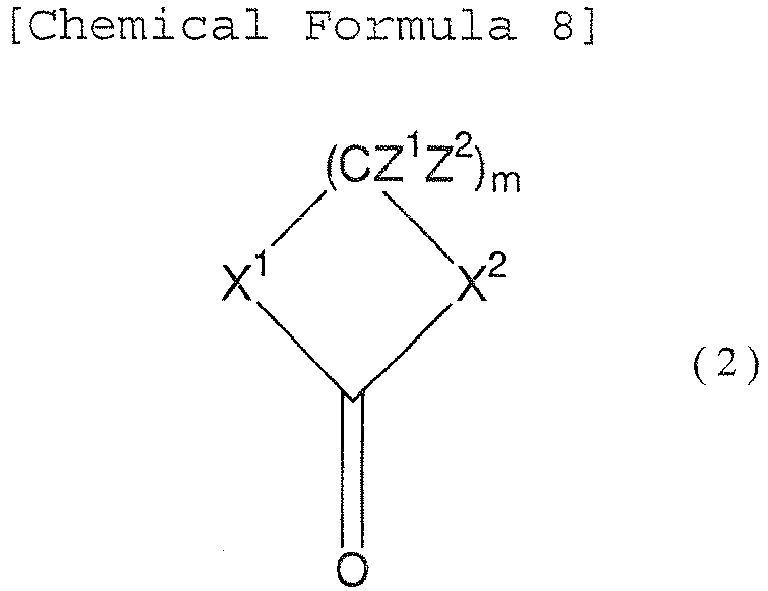
X2 represents oxygen, sulfur, or NE1;
Z1 and Z2 represent each independently hydrogen, or a group capable of being attached to carbon,
with the proviso that at least one of Z1, Z2, D1, D2, and E1 represents alkyl in which both at least one hydrogen atom and at least one fluorine atom are attached to at least one terminal carbon; and
m represents a natural number. - The particular compound (2) contained in the nonaqueous electrolytic solution in accordance with the second aspect of the present invention is represented by the formula (2).
X1 in the formula (2) represents oxygen, sulfur, CD1D2 or NE1.
In the units (atomic groups) represented by CD1D2, D1 and D2 represent hydrogen, or any group capable of being attached to carbon. D1 and D2 may be the same or different from each other. They may also be combined together to form a ring. - Specific examples of D1 and D2 include halogen atoms such as fluorine, chloride, and bromine; and substituted or unsubstituted alkyl, alkoxy, alkylcarboxyl, and alkoxycarboxyl groups such as methyl, ethyl, fluoromethyl, trifluoromethyl, and 2,2,2-trifluoroethyl.
- Preferably, D1 and D2 represent hydrogen, fluorine, unsubstituted alkyl, orfluorine-substituted alkyl in particular. In this case, preferred unsubstituted alkyls or fluorine-substituted alkyls are methyl, ethyl, fluoromethyl, trifluoromethyl, and 2,2,2-trifluoroethyl in view of ready production and safety.
- In the units represented by NE1, E1 represents hydrogen, or a group capable of being attached to nitrogen.
Specific examples of E1 include halogen atoms such as fluorine, chlorine, and bromine; and substituted or unsubstituted alkyl, alkoxy, alkylcarboxyl, and alkoxycarboxyl groups such as methyl, ethyl, fluoromethyl, trifluoromethyl, and 2,2,2-trifluoroethyl. - Preferably, E1 also represents hydrogen, fluorine, unsubstituted alkyl, or fluorine-substituted alkyl. In this case, preferred unsubstituted alkyls or fluorine-substituted alkyls are methyl, ethyl, fluoromethyl, trifluoromethyl, 2-fluoroethyl, and 2,2,2-trifluoroethyl in view of ready production and safety.
- Among these, more preferred are the units having no substituent, or having unsubstituted alkyl or fluorine-substituted alkyl as the substituent as X1 in view of electrochemical stability. That is, X1 may preferably be at least one selected from the group consisting of oxygen, sulfur, CD1D2 having only unsubstituted alkyl or alkyl substituted by fluorine alone as D1 and D2, and NE1 having only unsubstituted alkyl or alkyl substituted by fluorine alone as E1.
More preferably, X1 is oxygen. - X2 in the formula (2) represents oxygen, sulfur, or NE1.
In NE1, E1 is the same as described above for X1.
Among these, more preferred are the units having no substituent, or having unsubstituted alkyl or fluorine-substituted alkyl as the substituent as X2 in view of electrochemical stability. That is, X2 may preferably be at least one selected from the group consisting of oxygen, sulfur, and NE1 having only unsubstituted alkyl or alkyl substituted by fluorine alone as E1.
More preferably, X2 is also oxygen in view of electrochemical stability. - In the formula (2), Z1 and Z2 represent hydrogen, or any group capable of being attached to carbon, like D1 and D2. Z1 and Z2 may be the same or different from each other. They may be also be combined together to form a ring.
Specific examples of Z1 and Z2 include halogen atoms such as fluorine, chloride, and bromine; and substituted or unsubstituted alkyl, alkoxy, alkylcarboxyl, and alkoxycarboxyl groups such as methyl, ethyl, fluoromethyl, trifluoromethyl, and 2,2,2-trifluoroethyl. - Preferably, Z1 and Z2 represent hydrogen, fluorine, unsubstituted alkyl, orfluorine-substituted alkyl in particular. In this case, preferred unsubstituted alkyls or fluorine-substituted alkyls are methyl, ethyl, fluoromethyl, trifluoromethyl, and 2,2,2-trifluoroethyl. This can provide an advantage of enhancing the electrical stability of particular compounds (2) represented by the formula (2).
- In the formula (2), m represents a natural number. In view of the ring stability of the cyclic compound represented by the formula (2), i.e., the particular compound (2), especially preferably, m represents two or three such that the compound (2) is a five- or six-membered ring. More preferably, for similar reason, m represents two such that the particular compound (2) is a five-membered ring when neither X1 nor X2 in the formula (2) represents the units containing carbon.
- In the formula (2), at least one of Z1, Z2, D1, D2, and E1 is alkyl in which both at least one hydrogen atom and at least one fluorine atom are attached to at least one of the terminal carbon atoms (hereinafter arbitrarily referred to as "particular substituted alkyl Rf").
- The particular substituted alkyls Rf may have any substituent that does not significantly impair the advantages of the present invention. That is, at least one of the terminal carbon atoms in the particular substituted alkyl Rf has at least one fluorine atom and at least one hydrogen atom left unsubstituted, and may have a substituent other than the fluorine atom. Examples of the substituents that the particular substituted alkyls Rf have include such as fluorine, alkyl, allyl, alkoxy, alkylcarboxy, and alkoxycarboxy.
- Preferably, the particular substituted alkyls Rf have no substituent other than fluorine in view of the electrochemical stability of the particular compounds (2) represented by the formula (2). That is, the particular substituted alkyls Rf are preferably substituted by fluorine alone.
The carbon number of the particular substituted alkyl Rf may also be unlimited with the proviso that the number is usually ten or less, preferably five or less, and more preferably three or less since the particular substituted alkyl Rf having a significantly high molecular weight may not exhibit effects comparable to the amount of the particular compound (2) used. - Examples of the particular substituted alkyls Rf that meet the above requirements include fluoromethyl, difluoromethyl, 2-fluoroethyl, 2,2-difluoroethyl, 1,2-difluoroethyl, 1,1,2-trifluoroethyl, 1,2,2-trifluoroethyl, 1,1,2,2-tetrafluoroethyl, 3-fluoro-n-propyl, 1,3-difluoro-n-propyl, 2,3-difluoro-n-propyl, 3,3-difluoro-n-propyl, 1,1,3-trifluoro-n-propyl, 1,2,3-trifluoro-n-propyl, 1,3,3-trifluoro-n-propyl, 2,2,3-trifluoro-n-propyl, 1,1,2,3-tetrafluoro-n-propyl, 1,1,3,3-tetrafluoro-n-propyl, 1,2,2,3-tetrafluoro-n-propyl, 1,2,3,3-tetrafluoro-n-propyl, 2,2,3,3-tetrafluoro-n-propyl, 1,1,2,2,3-pentafluoro-n-propyl, 1,1,2,3,3-pentafluoro-n-propyl, 1,2,2,3,3-pentafluoro-n-propyl, 1,1,2,2,3,3-hexafluoro-n-propyl, 1-fluoro-i-propyl, 1,2-difluoro-i-propyl, 1,3-difluoro-i-propyl, 1,1,2-trifluoro-i-propyl, 1,1,3-trifluoro-i-propyl, 1,2,3-trifluoro-i-propyl, 1,1,1,3-tetrafluoro-i-propyl, 1,1,2,3-tetrafluoro-i-propyl, 1,1,3,3-tetrafluoro-i-propyl, 1,1,1,2,3-pentafluoro-i-propyl, 1,1,1,3,3-pentafluoro-i-propyl, 1,1,2,3,3-pentafluoro-i-propyl, and 1,1,1,2,3,3-hexafluoro-i-propyl.
- Among these preferred are fluoromethyl, difluoromethyl, 2-fluoroethyl, 2,2-difluoroethyl, 1,1,2,2-tetrafluoroethyl, and 3-fluoro-n-propyl group, and more preferred are fluoromethyl and difluoromethyl in view of ready production.
The particular substituted alkyls Rf may be used either alone or in any combination thereof at any proportion. - The particular compound (2) may have any molecular weight that does not significantly impair the advantages of the present invention, and the molecular weight is usually 119 or more. The upper limit of the molecular weight is not defined, but is preferably as low as possible. It is practical to use particular compounds (2) having a molecular weight of usually 300 or less and preferably 200 or less.
- Examples of the particular compounds (2) that meet the above requirements include fluoromethyl ethylene carbonate, difluoromethyl ethylene carbonate, (2-fluoroethyl)ethylene carbonate, (2,2-difluoroethyl)ethylene carbonate, 4-(fluoromethyl)-4-fluoroethylene carbonate, 4-(fluoromethyl)-5-fluoroethylene carbonate, 4-(2-fluoroethyl)-4-fluoroethylene carbonate, 4-(2-fluoroethyl)-5-fluoroethylene carbonate,
- 4-fluoromethyl-2-oxazolidinone, 5-fluoromethyl-2-oxazolidinone, 4-difluoromethyl-2-oxazolidinone, 5-difluoromethyl-2-oxazolidinone, 4-fluoromethyl-4-fluoro-2-oxazolidinone, 4-fluoromethyl-5-fluoro-2-oxazolidinone, 4-(2-fluoroethyl)-2-oxazolidinone, 5-(2-fluoroethyl)-2-oxazolidinone, 4-(2,2-difluoroethyl)-2-oxazolidinone, 5-(2,2-difluoroethyl)-2-oxazolidinone, 4-fluoromethyl-3-methyl-2-oxazolidinone, 5-fluoromethyl-3-methyl-2-oxazolidinone, 4-difluoromethyl-3-methyl-2-oxazolidinone, 5-difluoromethyl-3-methyl-2-oxazolidinone, 4-fluoromethyl-4-fluoro-3-methyl-2-oxazolidinone, 4-fluoromethyl-5-fluoro-3-methyl-2-oxazolidinone, 4-(2-fluoroethyl)-3-methyl-2-oxazolidinone, 5-(2-fluoroethyl)-3-methyl-2-oxazolidinone, 4-(2,2-difluoroethyl)-3-methyl-2-oxazolidinone, 5-(2,2-difluoroethyl)-3-methyl-2-oxazolidinone, 4-fluoromethyl-3-ethyl-2-oxazolidinone, 5-fluoromethyl-3-ethyl-2-oxazolidinone, 4-difluoromethyl-3-ethyl-2-oxazolidinone, 5-difluoromethyl-3-ethyl-2-oxazolidinone, 4-fluoromethyl-4-fluoro-3-ethyl-2-oxazolidinone, 4-fluoromethyl-5-fluoro-3-ethyl-2-oxazolidinone, 4-(2-fluoroethyl)-3-ethyl-2-oxazolidinone, 5-(2-fluoroethyl)-3-ethyl-2-oxazolidinone, 4-(2,2-difluoroethyl)-3-ethyl-2-oxazolidinone, 5-(2,2-difluoroethyl)-3-ethyl-2-oxazolidinone, 3-fluoromethyl-2-oxazolidinone, 3-difluoromethyl-2-oxazolidinone, 3-(2-fluoroethyl)-2-oxazolidinone, 3-(2,2-difluoroethyl)-2-oxazolidinone, 4-fluoromethyl-3-fluoromethyl-2-oxazolidinone, 5-fluoromethyl-3-fluoromethyl-2-oxazolidinone, 4-(2-fluoroethyl)-3-fluoromethyl-2-oxazolidinone, 5-(2-fluoroethyl)-3-fluoromethyl-2-oxazolidinone, 4-fluoromethyl-3-(2,2,2-trifluoroethyl)-2-oxazolidinone,
- 4-fluoromethyl-2-imidazolidinone, 4-difluoromethyl-2-imidazolidinone, 4-(2-fluoroethyl)-2-imidazolidinone, 4-(2,2-difluoroethyl)-2-imidazolidinone, 4-fluoromethyl-1-methyl-2-imidazolidinone, 4-difluoromethyl-1-methyl-2-imidazolidinone, 4-(2-fluoroethyl)-1-methyl-2-imidazolidinone, 4-(2,2-difluoroethyl)-1-methyl-2-imidazolidinone, 5-fluoromethyl-1-methyl-2-imidazolidinone, 5-difluorοmethyl-1-methyl-2-imidazolidinοne, 5-(2-fluoroethyl)-1-methyl-2-imidazolidinone, 5-(2,2-difluoroethyl)-1-methyl-2-imidazolidinone, 4-fluoromethyl-1,3-dimethyl-2-imidazolidinone, 4-difluoromethyl-1,3-dimethyl-2-imidazolidinone, 4-(2-fluoroethyl)-1,3-dimethyl-2-imidazolidinone, 4-(2,2-difluoroethyl)-1,3-dimethyl-2-imidazolidinone, 1-fluoromethyl-2-imidazolidinone, 1-difluoromethyl-2-imidazolidinone, 1-(2-fluoroethyl)-2-imidazolidinone, 1-(2,2-difluoroethyl)-2-imidazolidinone,
- 3-fluoromethyltetrahydrofuran-2-one, 3-difluoromethyltetrahydrofuran-2-one, 3-(2-fluoroethyl)tetrahydrofuran-2-one, 3-(2,2-difluoroethyl)tetrahydrofuran-2-one, 4-fluoromethyltetrahydrofuran-2-one, 4-difluoromethyltetrahydrofuran-2-one, 4-(2-fluoroethyl)tetrahydrofuran-2-one, 4-(2,2-difluoroethyl)tetrahydrofuran-2-one, 5-fluoromethyltetrahydrofuran-2-one, 5-difluoromethyltetrahydrofuran-2-one, 5-(2-fluoroethyl)tetrahydrofuran-2-one, 5-(2,2-difluoroethyl)tetrahydrofuran-2-one,
- 3-fluoromethyltetrahydropyrrol-2-one, 3-difluoromethyltetrahydropyrrol-2-one, 3-(2-fluoroethyl)tetrahydropyrrol-2-one, 3-(2,2-difluoroethyl)tetrahydropyrrol-2-one, 4-fluoromethyl.tetrahydropyrrol-2-one, 4-difluoromethyltetrahydropyrrol-2-one, 4-(2-fluoroethyl)tetrahydropyrrol-2-one, 4-(2,2-difluoroethyl)tetrahydropyrrol-2-one, 5-fluoromethyltetrahydropyrrol-2-one, 5-difluoromethyltetrahydropyrrol-2-one, 5-(2-fluoroethyl)tetrahydropyrrol-2-one, 5-(2,2-difluoroethyl)tetrahydropyrrol-2-one, 3-fluoromethyl-1-methyltetrahydropyrrol-2-one, 3-difluoromethyl-1-methyltetrahydropyrrol-2-one, 3-(2-fluoroethyl)-1-methyltetrahydropyrrol-2-one, 3-(2,2-difluoroethyl)-1-methyltetrahydropyrrol-2-one, 4-fluoromethyl-1-methyltetrahydropyrrol-2-one, 4-difluoromethyl-1-methyltetrahydropyrrol-2-one, 4-(2-fluoroethyl)-1-methyltetrahydropyrrol-2-one, 4-(2,2-difluoroethyl)-1-methyltetrahydropyrrol-2-one, 5-fluoromethyl-1-methyltetrahydropyrrol-2-one, 5-difluoromethyl-1-methyltetrahydropyrrol-2-one, 5-(2-fluoroethyl)-1-methyltetrahydropyrrol-2-one, 5-(2,2-difluoroethyl)-1-methyltetrahydropyrrol-2-one, 3-fluoromethyl-1-ethyltetrahydropyrrol-2-one, 3-difluoromethyl-1-ethyltetrahydropyrrol-2-one, 3-(2-fluoroethyl)-1-ethyltetrahydropyrrol-2-one, 3-(2,2-difluoroethyl)-1-ethyltetrahydropyrrol-2-one, 4-fluoromethyl-1-ethyltetrahydropyrrol-2-one, 4-difluoromethyl-1-ethyltetrahydropyrrol-2-one, 4-(2-fluoroethyl)-1-ethyltetrahydropyrrol-2-one, 4-(2,2-difluoroethyl)-1-ethyltetrahydropyrrol-2-one, 5-fluoromethyl-1-ethyltetrahydropyrrol-2-one, 5-difluoromethyl-1-ethyltetrahydropyrrol-2-one, 5-(2-fluoroethyl)-1-ethyltetrahydropyrrol-2-one, 5-(2,2-difluoroethyl)-1-ethyltetrahydropyrrol-2-one, 1-fluoromethytetrahydropyrrol-2-one, 1-difluoromethytetrahydropyrrol-2-one, 1-(2-fluoroethyl)tetrahydropyrrol-2-one, 1-(2,2-difluoroethyl)tetrahydropyrrol-2-one, 3-difluoromethyl-1-methyltetrahydropyrrol-2-one, 3-(2-fluoroethyl)-1-methyltetrahydropyrrol-2-one, 3-(2,2-difluoroethyl)-1-methyltetrahydropyrrol-2-one, 3-fluoromethyl-1-fluoromethyltetrahydropyrrol-2-one, 3-difluoromethyl-1-fluoromethyltetrahydropyrrol-2-one, 3-(2-fluoroethyl)-1-fluoromethyltetrahydropyrrol-2-one, 3-(2,2-difluoroethyl)-1-fluoromethyltetrahydropyrrol-2-one, 4-fluoromethyl-1-fluoromethyltetrahydropyrrol-2-one, 4-difluoromethyl-1-fluoromethyltetrahydropyrrol-2-one, 4-(2-fluoroethyl)-1-fluoromethyltetrahydropyrrol-2-one, 4-(2,2-difluoroethyl)-1-fluoromethyltetrahydropyrrol-2-one, 5-fluoromethyl-1-fluoromethyltetrahydropyrrol-2-one, 5-difluoromethyl-1-fluoromethyltetrahydropyrrol-2-one, 5-(2-fluoroethyl)-1-fluoromethyltetrahydropyrrol-2-one, and 5-(2,2-difluoroethyl)-1-fluoromethyltetrahydropyrrol-2-one.
- Among these preferred are those not containing nitrogen, e.g. fluoromethyl ethylene carbonate, difluoromethyl ethylene carbonate, (2-fluoroethyl)ethylene carbonate, (2,2-difluoroethyl)ethylene carbonate, 4-(fluoromethyl)-4-fluoroethylene carbonate, 4-(fluoromethyl)-5-fluoroethylene carbonate, 3-fluoromethyltetrahydrofuran-2-one, 3-difluoromethyltetrahydrofuran-2-one, 3-(2-fluoroethyl)tetrahydrofuran-2-one, 3-(2,2-difluoroethyl)tetrahydrofuran-2-one, 4-fluoromethyltetrahydrofuran-2-one, 4-difluoromethyltetrahydrofuran-2-one, 4-(2-fluoroethyl)tetrahydrofuran-2-one, 4-(2,2-difluoroethyl)tetrahydrofuran-2-one, 5-fluoromethyltetrahydrofuran-2-one, 5-difluoromethyltetrahydrofuran-2-one, 5-(2-fluoroethyl)tetrahydrofuran-2-one, and 5-(2,2-difluoroethyl)tetrahydrofuran-2-one for their stability.
- More preferred are fluoromethyl ethylene carbonate, difluoromethyl ethylene carbonate, 3-fluoromethyltetrahydrofuran-2-one, 4-fluoromethyltetrahydrofuran-2-one, and 5-fluoromethyltetrahydrofuran-2-one, which have a high stability.
The particular compound (2) represented by the formula (2) may be used either alone or in any combination thereof at any proportion in a nonaqueous electrolytic solution. - When contained in the nonaqueous electrolytic solution in accordance with the second aspect of the present invention, the amount of the particular compound (2) is usually 0.01% by weight or more and preferably 0.1% by weight or more, and usually 10% by weight or less and preferably 5% by weight or less based on the nonaqueous electrolytic solution in accordance with the second aspect of the present invention. Below the lower limit, a nonaqueous electrolyte secondary cell containing the nonaqueous electrolytic solution in accordance with the second aspect of the present invention may not exhibit sufficiently enhanced cycle characteristics. Above the upper limit, an increased reactivity in the nonaqueous electrolytic solution will impair the cell characteristics of a nonaqueous electrolyte secondary cell.
- When the particular compound (2) is contained in a nonaqueous electrolytic solution, a nonaqueous electrolyte secondary cell containing the nonaqueous electrolytic solution will enhance charge and discharge cycle characteristics. The reason for this may be inferred as follows, although the detail is not clear:
- That is, when a Nonaqueous electrolytic solution containing the particular compound (2) is contained in a nonaqueous electrolyte secondary cell, the particular compound (2) will react in the cell to form an excellent protective layer on the surface of a negative-electrode active material, thereby inhibiting side reactions and preventing the cycle degradation. Moreover, both hydrogen and fluorine present on at least one terminal carbon atom in the particular substituted alkyl Rf in the particular compound (2) represented by the formula (2), it is considered to contribute to enhanced properties of the protective layer in any way.
- Nonaqueous electrolytic solutions containing compounds included in the group of the particular compounds (2) represented by the formula (2) are also described in
Patent Documents 6 and 7. Thesedocuments 6 and 7, however, do not disclose such a constitution that provides significant advantages as in the present invention by using a predetermined amount of 0.01% by weight to 10% by weight of the particular compound (2).
In addition, through evaluation conducted with actual devices, the advantages are confirmed from the physical storage devices, i.e., electric double-layer capacitors inPatent Document 6. The advantages are not observed from the chemical cells in Patent Document 7. - Any known method can be used without limitation for producing the particular compound (2).
- Preferably, the nonaqueous electrolytic solution in accordance with the second aspect of the present invention further comprises a predetermined carbonate. The predetermined carbonate in the nonaqueous electrolytic solution in accordance with the second aspect of the present invention has at least one of an unsaturated bond and a halogen atom. That is, the predetermined carbonate in the nonaqueous electrolytic solution in accordance with the second aspect of the present invention may have only an unsaturated bond or only a halogen atom, or may have the both.
However, the particular compounds (2) should be excluded from the predetermined carbonates when they are contained in the nonaqueous electrolytic solution in accordance with the second aspect of the present invention. That is, in the nonaqueous electrolytic solution in accordance with the second aspect of the present invention, compounds that fall into the definition of the particular compounds (2) described above are not considered as the predetermined carbonates. - Among the predetermined carbonates other than the particular compounds (2), any predetermined carbonate having an unsaturated bond (arbitrarily abbreviated as "predetermined unsaturated carbonate") may be used without limitation with the proviso that the predetermined carbonate has a carbon-carbon unsaturated bond, i.e. a carbon-carbon double bond or triple bond. The predetermined unsaturated carbonates having such unsaturated bonds also include carbonates having aromatic rings.
- Examples of the predetermined unsaturated carbonate include such as vinylene carbonate derivatives substituted, ethylene carbonate derivatives by substituents with aromatic rings or carbon-carbon unsaturated bonds, phenyl carbonates, vinyl carbonates, and allyl carbonates.
- Specific examples of vinylene carbonate derivatives include such as vinylene carbonate, methyl vinylene carbonate, 4,5-dimethyl vinylene carbonate, phenyl vinylene carbonate, and 4,5-diphenyl vinylene carbonate.
- Specific examples of substituted ethylene carbonate derivatives by substituents with aromatic rings or carbon-carbon unsaturated bonds include such as vinyl ethylene carbonate, 4,5-divinyl ethylene carbonate, phenyl ethylene carbonate, and 4,5-diphenyl ethylene carbonate.
- Specific examples of phenyl carbonates include such as diphenyl carbonate, ethyl phenyl carbonate, methyl phenyl carbonate, and t-butyl phenyl carbonate.
- Specific examples of vinyl carbonates include such as divinyl carbonate and methyl vinyl carbonate.
Specific examples of allyl carbonates include such as diallyl carbonate and allyl methyl carbonate. - Among these predetermined unsaturated carbonates preferred as the predetermined carbonate are the vinylene carbonate derivatives and the substituted ethylene carbonate derivatives by substituents with aromatic rings or carbon-carbon unsaturated bonds. Particularly preferred are vinylene carbonate, 4,5-diphenyl vinylene carbonate, 4,5-dimethyl vinylene carbonate, and vinyl ethylene carbonate because these can form stable surface protective films.
- Among the predetermined carbonate having halogen atoms (arbitrarily abbreviated as "predetermined halogenated carbonate"), any halogenated carbonate can be used without limitation.
- Specific examples of the halogen atom contained in the predetermined halogenated carbonate include fluorine, chlorine, bromine, and iodine atoms. Among these preferred is fluorine or chlorine atom and in particular, fluorine atom.
The number of the halogen atoms in the predetermined halogenated carbonate may be at least one without limitation, but usually no more than six, and preferably no more than four. When the predetermined halogenated carbonate has multiple halogen atoms, they may be the same or different. - Examples of the predetermined halogenated carbonate include ethylene carbonate derivatives, dimethyl carbonate derivatives, ethyl methyl carbonate derivatives, and diethyl carbonate derivatives.
- Specific examples of the ethylene carbonate derivatives include such as fluoroethylene carbonate, chloroethylene carbonate, 4,4-difluoroethylene carbonate, 4,5-difluoroethylene carbonate, 4,4-dichloroethylene carbonate, 4,5-dichloroethylene carbonate, 4-fluoro-4-methylethylene carbonate, 4-chloro-4-methylethylene carbonate, 4,5-difluoro-4-methylethylene carbonate, 4,5-dichloro-4-methylethylene carbonate, 4-fluoro-5-methylethylene carbonate, 4-chloro-5-methylethylene carbonate, 4,4-difluoro-5-methylethylene carbonate, 4,4-dichloro-5-methylethylene carbonate, 4-(chloromethyl)-ethylene carbonate, 4-(dichloromethyl)-ethylene carbonate, 4-(trifluoromethyl)-ethylene carbonate, 4-(trichloromethyl)-ethylene carbonate, 4-(chloromethyl)-4-chloroethylene carbonate, 4-(chloromethyl)-5-chloroethylene carbonate, 4-fluoro-4,5-dimethylethylene carbonate, 4-chloro-4,5-dimethylethylene carbonate, 4,5-difluoro-4,5-dimethylethylene carbonate, 4,5-dichloro-4,5-dimethylethylene carbonate, 4,4-difluoro-5,5-dimethylethylene carbonate, and 4,4-dichloro-5,5-dimethylethylene carbonate.
- Specific examples of the dimethyl carbonate derivatives include such as fluoromethyl methyl carbonate, difluoromethyl methyl carbonate, trifluoromethyl methyl carbonate, bis(fluoromethyl) carbonate, bis(difluoro) methyl carbonate, bis(trifluoro) methyl carbonate, chloromethyl methyl carbonate, dichloromethyl methyl carbonate, trichloromethyl methyl carbonate, bis(chloromethyl) carbonate, bis(dichloro) methyl carbonate, and bis(trichloro) methyl carbonate.
- Specific examples of the ethyl methyl carbonate derivatives include such as 2-fluoroethyl methyl carbonate, ethyl fluoromethyl carbonate, 2-fluoroethyl fluoromethyl carbonate, 2,2-difluoroethyl methyl carbonate,
ethyl difluoromethyl carbonate - Specific examples of the diethyl carbonate derivatives include such as ethyl-(2-fluoroethyl) carbonate, bis(2-fluoroethyl) carbonate, 2,2-difluoroethyl ethyl carbonate, 2,2-difluoroethyl-2'-fluoroethyl carbonate, bis(2,2-difluoroethyl) carbonate, ethyl-(2,2,2-trifluoroethyl) carbonate, 2,2,2-trifluoroethyl-2'-fluoroethyl carbonate, 2,2,2-trifluoroethyl-2',2'-difluoroethyl carbonate, bis(2,2,2-trifluoroethyl) carbonate, ethyl-(2-chloroethyl) carbonate, ethyl-(2,2-dichloroethyl) carbonate, bis(2-chloroethyl) carbonate, ethyl-(2,2,2-trichloroethyl) carbonate, 2,2-dichloroethyl-2'-chloroethyl carbonate, bis(2,2-dichloroethyl) carbonate, 2,2,2-trichloroethyl-2'-chloroethyl carbonate, 2,2,2-trichloroethyl-2',2'-dichloroethyl carbonate, and bis(2,2,2-trichloroethyl) carbonate.
- Among these predetermined halogenated carbonates, preferred are carbonates having fluorine atoms, and more preferred are ethylene carbonate derivatives having fluorine atoms. In particular, fluoroethylene carbonate, 4-(fluoromethyl)-ethylene carbonate, 4,4-difluoroethylene carbonate, and 4,5-difluoroethylene carbonate are preferably used because they can form surface protective films.
- In addition, the predetermined carbonate can have both an unsaturated bond and a halogen atom (arbitrarily abbreviated as "predetermined halogenated unsaturated carbonate"). The predetermined halogenated unsaturated carbonate may be any halogenated unsaturated carbonate that does not significantly impair the advantages of the present invention.
- Examples of the predetermined halogenated unsaturated carbonate include such as vinylene carbonate derivatives, substituted ethylene carbonate derivatives by substituents with aromatic rings or carbon-carbon unsaturated bonds, phenyl carbonates, vinyl carbonates, and allyl carbonates.
- Specific examples of the vinylene carbonate derivatives include such as fluorovinylene carbonate, 4-fluoro-5-methylvinylene carbonate, 4-fluoro-5-phenylvinylene carbonate, chlorovinylene carbonate, 4-chloro-5-methylvinylene carbonate, and 4-chloro-5-phenylvinylene carbonate.
- Specific examples of the substituted ethylene carbonate derivatives by substituents with aromatic rings or carbon-carbon unsaturated bonds include such as 4-fluoro-4-vinylethylene carbonate, 4-fluoro-5-vinylethylene carbonate, 4,4-difluoro-4-vinylethylene carbonate, 4,5-difluoro-4-vinylethylene carbonate, 4-chloro-5-vinylethylene carbonate, 4,4-dichloro-4-vinylethylene carbonate, 4,5-dichloro-4-vinylethylene carbonate, 4-fluoro-4,5-divinylethylene carbonate, 4,5-difluoro-4,5-divinylethylene carbonate, 4-chloro-4,5-divinylethylene carbonate, 4,5-dichloro-4,5-divinylethylene carbonate, 4-fluoro-4-phenylethylene carbonate, 4-fluoro-5-phenylethylene carbonate, 4,4-difluoro-5-phenylethylene carbonate, 4,5-difluoro-4-phenylethylene carbonate, 4-chloro-4-phenylethylene carbonate, 4-chloro-5-phenylethylene carbonate, 4,4-dichloro-5-phenylethylene carbonate, 4,5-dichloro-4-phenylethylene carbonate, 4,5-difluoro-4,5-diphenylethylene carbonate, and 4,5-dichloro-4,5-diphenylethylene carbonate.
- Specific examples of the phenyl carbonates include such as fluoromethyl phenyl carbonate, 2-fluoroethyl phenyl carbonate, 2,2-difluoroethyl phenyl carbonate, 2,2,2-trifluoroethyl phenyl carbonate, chloromethyl phenyl carbonate, 2-chloroethyl phenyl carbonate, 2,2-dichloroethyl phenyl carbonate, and 2,2,2-trichloroethyl phenyl carbonate.
- Specific examples of the vinyl carbonates include such as fluoromethyl vinyl carbonate, 2-fluoroethyl vinyl carbonate, 2,2-difluoroethyl vinyl carbonate, 2,2,2-trifluoroethyl vinyl carbonate, chloromethyl vinyl carbonate, 2-chloroethyl vinyl carbonate, 2,2-dichloroethyl vinyl carbonate, and 2,2,2-trichloroethyl vinyl carbonate.
- Specific examples of the allyl carbonates include such as fluoromethyl allyl carbonate, 2-fluoroethyl allyl carbonate, 2,2-difluoroethyl allyl carbonate, 2,2,2-trifluoroethyl allyl carbonate, chloromethyl allyl carbonate, 2-chloroethyl allyl carbonate, 2,2-dichloroethyl allyl carbonate, and 2,2,2-trichloroethyl allyl carbonate.
- Among the exemplary predetermined halogenated unsaturated carbonates mentioned above, it is especially preferred to use at least one selected from the group consisting of vinylene carbonate, vinyl ethylene carbonate, fluoroethylene carbonate, difluoroethylene carbonates, and derivatives thereof as the predetermined carbonate because of high effects thereof when used alone. Among the difluoroethylene carbonates, especially preferred is 4,5-difluoroethylene carbonate.
- The predetermined carbonate may have any molecular weight that does not significantly impair the advantages of the present invention, and the molecular weight is usually 50 or more and preferably 80 or more, and usually 250 or less and preferably 150 or less. At a higher molecular weight of the predetermined carbonate, the solubility of the carbonate in a nonaqueous electrolytic solution may be too poor to exhibit the advantages of the present invention sufficiently.
- The predetermined carbonates can be prepared by any known method without limitation.
- The predetermined carbonates as described above may also be used either alone or in any combination thereof at any proportion in the nonaqueous electrolytic solution in accordance with the second aspect of the present invention.
- The predetermined carbonate may be used in any amount in the nonaqueous electrolytic solution in accordance with the second aspect of the present invention without limitation within the scope that does not significantly impair the advantages of the present invention, and the amount of the predetermined carbonate is usually 0.01% by weight or more, preferably 0.1% by weight or more, and more preferably 0.3% by weight or more, and usually 70% by weight or less, preferably 50% by weight or less, and more preferably 40% by weight or less of the nonaqueous electrolytic solution in accordance with the second aspect of the present invention. Below the lower limit, a nonaqueous electrolyte secondary cell containing the nonaqueous electrolytic solution in accordance with the second aspect of the present invention may not exhibit sufficiently enhanced cycle characteristics. At a higher proportion of the predetermined carbonate, a nonaqueous electrolyte secondary cell containing the nonaqueous electrolytic solution in accordance with the second aspect of the present invention tends to impair its high-temperature preservation characteristics and trickle charge characteristics, and particularly may increase the amount of gas gneration and decrease its discharge capacity maintenance rate.
- In the nonaqueous electrolytic solution in accordance with the second aspect of the present invention, the particular compound (2) and the predetermined carbonate may be used in any ratio. The ratio of "the amount of the particular compound (2) to the amount of the predetermined carbonate" is usually 0.0001 or more, preferably 0.001 or more, and more preferably 0.01 or more, and usually 1000 or less, preferably 100 or less, and more preferably 10 or less. At a ratio that is lower or higher than this range, synergistic effects by the combination may not be exhibited.
- When a nonaqueous electrolytic solution containing both the particular compound (2) and the predetermined carbonate is contained in a nonaqueous electrolyte secondary cell, charge and discharge cycle characteristics of the cell can be enhanced. The reason for this may be inferred as follows, although the detail is not clear: The particular compound (2) and the predetermined carbonate in the nonaqueous electrolytic solution will react together, and form an excellent protective film on the surface of a negative-electrode active material, thereby inhibiting side reactions and preventing the cycle degradation. In addition, an electrolytic solution containing both the particular compound (2) and the predetermined carbonate is considered to contribute to enhanced properties of the protective film in any way.
- The nonaqueous electrolytic solution in accordance with the second aspect of the present invention can comprise any nonaqueous solvent that does not significantly impair the advantages of the present invention. The particular compounds (2) or the predetermined carbonates mentioned above can also be used as the nonaqueous solvent. The nonaqueous solvents including the particular compounds (2) or the predetermined carbonates may be used either alone or in any combination thereof at any proportion.
- Examples of the nonaqueous solvents that are commonly used include such as cyclic carbonates, linear carbonates, linear and cyclic carboxylic esters, linear and cyclic ethers, phosphorus-containing organic solvents, and sulfur-containing organic solvents.
- Nonlimiting examples of the cyclic carbonates that are commonly used include such as ethylene carbonate, propylene carbonate, and butylene carbonate. Among these preferred are ethylene carbonate and propylene carbonate having high dielectric constants, which facilitate dissolution of solutes and improve cycle characteristics of nonaqueous electrolyte secondary cells.
- Examples of the linear carbonates that are commonly used include, but not limited to, such as dimethyl carbonate, ethyl methyl carbonate, diethyl carbonate, methyl n-propyl carbonate, ethyl n-propyl carbonate, and di-n-propyl carbonate. Among these preferred are dimethyl carbonate, ethyl methyl carbonate, diethyl carbonate, methyl n-propyl carbonate, and ethyl n-propyl carbonate, dimethyl carbonate, and especially preferred are ethyl methyl carbonate and diethyl carbonate because these carbonates ensures improved cycle characteristics of nonaqueous electrolyte secondary cells.
- Examples of the linear carboxylic acid esters that are commonly used include, but not limited to, such as methyl acetate, ethyl acetate, n-propyl acetate, i-propyl acetate, n-butyl acetate, i-butyl acetate, t-butyl acetate, methyl propionate, ethyl propionate, n-propyl propionate, i-propyl propionate, n-butyl propionate, i-butyl propionate, and t-butyl propionate. Among these, more preferred are ethyl acetate, methyl propionate, and ethyl propionate.
- Examples of the cyclic carboxylic acid esters that are commonly used include, but not limited to, such as γ-butyrolactone, γ-valerolactone, and δ-valerolactone. Among these, γ-butyrolactone is more preferred.
- Examples of the linear ethers that are commonly used include, but not limited to, such as dimethoxymethane, dimethoxyethane, diethoxymethane, diethoxyethane, ethoxymethoxymethane, and ethoxymethoxyethane. Among these, dimethoxyethane and diethoxyethane are more preferred.
- Examples of the cyclic ethers that are commonly used include, but not limited to, such as tetrahydrofuran and 2-methyltetrahydrofuran.
- Examples of the phosphorus-containing organic solvents that are commonly used include, but not limited to, such as phosphate esters such as trimethyl phosphate, triethyl phosphate, and triphenyl phosphate; phosphite esters such as trimethyl phosphite, triethyl phosphite, and triphenyl phosphite; phosphine oxides such as trimethylphosphine oxide, triethylphosphine oxide, and triphenylphosphine oxide.
- Examples of the sulfur-containing organic solvents that are commonly used include, but not limited to, such as ethylene sulfite, 1,4-propane sultone, 1,4-butane sultone, methyl methanesulfonate, busulfan, sulfolane, sulfolene, dimethyl sulfone, diphenyl sulfone, methyl phenyl sulfone, dibutyl disulfide, dicyclohexyl disulfide, tetramethylthiuram monosulfide, N,N-dimethylmethanesulfonamide, and N,N-diethylmethanesulfonamide.
- Among these, the cyclic carbonates, i.e., ethylene carbonate and/or propylene carbonate is preferably used, and more preferably is used as a mixture with a linear carbonate.
- In such combined use of the cyclic carbonates and the linear carbonates as the nonaqueous solvent, the suitable amount of the linear carbonate in the nonaqueous solvent in the nonaqueous electrolytic solution in accordance with the second aspect of the present invention is usually 30% by volume or more and preferably 50% by volume or more, and usually 95% by volume or less and preferably 90% by volume or less. The suitable amount of the cyclic carbonate in the nonaqueous solvent in the nonaqueous electrolytic solution in accordance with the second aspect of the present invention is usually 5% by volume or more and preferably 10% by volume or more, and usually 50% by volume or less and preferably 40% by volume or less. When containing the linear carbonate in a lower amount than this range, the nonaqueous electrolytic solution in accordance with the second aspect of the present invention may have an increased viscosity. When containing the linear carbonate in a higher amount than this range, the nonaqueous electrolytic solution may have a decreased degree of dissociation of the electrolyte, i.e., lithium salt, and then have a decreased electric conductivity.
- The nonaqueous electrolytic solution in accordance with the second aspect of the present invention may contain the same electrolytes for the nonaqueous electrolytic solution in accordance with the first aspect of the present invention.
- Preferably, the nonaqueous electrolytic solution in accordance with the second aspect of the present invention contains various additives that do not significantly impair the advantages of the present invention. Any conventional known additive can be used either alone or in any combination thereof at any proportion. Examples of such additives include overcharge protection agents, and aids for improving capacity maintenance and cycle characteristics after high-temperature preservation.
- Examples of the overcharge protection agents include such as aromatic compounds such as biphenyls, alkylbiphenyls, terphenyls, partially hydrogenated terphenyls, cyclohexylbenzene, t-butylbenzene, t-amylbenzene, diphenyl ether, and dibenzofuran; partially fluorinated aromatic compounds mentioned above such as 2-fluorobiphenyl, o-cyclohexylfluorobenzene, and p-cyclohexylfluorobenzene; and fluorine-containing anisoles such as 2,4-difluoroanisole, 2,5-difluoroanisole, and 2,6-difluoroanisole.
The overcharge protection agents may be used either alone or in any combination thereof at any proportion. - The nonaqueous electrolytic solution in accordance with the second aspect of the present invention may contain the overcharge protection agents in any concentration that does not significantly impair the advantages of the present invention, and the concentration of the overcharge protection agents is usually 0.1% by weight to 5% by weight based on the entire nonaqueous electrolytic solution. Incorporation of overcharge protection agents into a nonaqueous electrolytic solution is preferred because these agents can inhibit a nonaqueous electrolyte secondary cell from exploding and igniting even when the cell is overcharged, thereby enhancing the safety of the cell.
- Examples of aids for improving capacity maintenance and cycle characteristics after high-temperature preservation include carbonate compounds such as vinylene carbonate, vinyl ethylene carbonate, fluoroethylene carbonate, difluoroethylene carbonate, 4-(trifluoromethyl)-ethylene carbonate, phenyl ethylene carbonate, erythritan carbonate, and spiro-bis-dimethylene carbonate; carboxylic anhydrides such as succinic anhydride, glutaric anhydride, maleic anhydride, citraconic anhydride, glutaconic anhydride, itaconic anhydride, diglycolic anhydride, cyclohexanedicarboxylic anhydride, cyclopentanetetracarboxylic dianhydride, and phenylsuccinic anhydride; sulfur-containing compounds such as ethylene sulfite, 1,4-propane sultone, 1,4-butane sultone, methyl methanesulfonate, busulfan, sulfolane, sulfolene, dimethyl sulfone, diphenyl sulfone, methyl phenyl sulfone, dibutyl disulfide, dicyclohexyl disulfide, tetramethylthiuram monosulfide, N,N-dimethylmethanesulfonamide, and N,N-diethylmethanesulfonamide; nitrogen-containing compounds such as 1-methyl-2-pyrrolidinone, 1-methyl-2-piperidone, 4-methyl-2-oxazolidinone, 1,4-dimethyl-2-imidazolidinone, and N-methylsuccinimide; hydrocarbons such as heptane, octane, and cycloheptane, and fluorine-containing aromatic compounds such as fluorobenzene, difluorobenzene, and benzotrifluoride.
- The aids may be used either alone or in any combination thereof at any proportion.
- The nonaqueous electrolytic solution in accordance with the second aspect of the present invention can contain the aids in any concentration that does not significantly impair the advantages of the present invention, and the concentration of the aids is usually 0.1% by weight to 5% by weight based on the entire nonaqueous electrolytic solution.
- The nonaqueous electrolytic solution in accordance with the third aspect of the present invention comprises at least one compound represented by the following formula (3) (hereinafter arbitrarily referred to as "particular compound (3)") in a nonaqueous solvent:

- The particular compound (3) contained in the nonaqueous electrolytic solution in accordance with the third aspect of the present invention is represented by the formula (3).
Xb in the formula (3) represents oxygen or nitrogen.
Rb in the formula (3) represents hydrogen, or substituted or unsubstituted alkyl. - When Rb is alkyl, the alkyl may be linear, branched, or cyclic. Since branched alkyls may have high degradability, the alkyl is preferably linear that does not have branched-chain.
- When Rb is substituted alkyl, the substituents may be any group that does not significantly impair the advantages of the present invention. Examples of the group include fluorine, alkoxy, alkoxycarboxyl, and alkylcarboxyl. These substituents may be used either alone or in any combination thereof at any proportion.
- Unless significantly impairing the advantages of the present invention, the carbon number of Rb may also be any number. Since the particular compound (3) with Rb having a significantly high molecular weight may not exhibit advantages comparable to the amount of the compound (3) contained in the nonaqueous electrolytic solution in accordance with the third aspect of the present invention, the number is preferably ten or less, more preferably five or less, and most preferably three or less.
- In the formula (3), s represents one or two. Particularly, s is one when Xb represents oxygen or two when Xb represents nitrogen. When s is two, Rb in the formula (3) may be the same kind or different.
In general, preferred Rb is unsubstituted alkyl or alkyl substituted by fluorine alone since it can enhance the stability as an organic substance of the particular compound (3) and the stability of a protective layer formed when the compound (3) is contained in an electrolytic solution. - Specific examples of Rb include such as hydrogen atom, methyl, fluoromethyl, difluoromethyl, ethyl, 2-fluoroethyl, 2,2-difluoroethyl, 2,2,2-trifluoroethyl, n-propyl, 3-fluoro-n-propyl, 3,3-difluoro-n-propyl, 3,3,3-trifluoro-n-propyl, i-propyl, and 1,1,1,3,3,3-hexafluoro-i-propyl.
- Among these preferred are methyl, ethyl, 2-fluoroethyl, 2,2-difluoroethyl, 2,2,2-trifluoroethyl, n-propyl, and 3-fluoro-n-propyl, and most preferred are methyl and ethyl, which are readily available due to production with ease.
- Specific examples of the particular compounds (3) include such as methyl-3-fluoropropionate, ethyl-3-fluoropropionate, 2-fluoroethyl-3-fluoropropionate, 2,2-difluoroethyl-3-fluoropropionate, 2,2,2-trifluoroethyl-3-fluoropropionate, n-propyl-3-fluoropropionate, 3-fluoro-n-propyl-3-fluoropropionate, 3-fluoropropionamide, N-methyl-3-fluoropropionamide, N,N-dimethyl-3-fluoropropionamide, N-ethyl-3-fluoropropionamide, N,N-diethyl-3-fluoropropionamide, N-fluoromethyl-3-fluoropropionamide, N,N-bis(fluoromethyl)-3-fluoropropionamide, N-(2-fluoroethyl)-3-fluoropropionamide, N,N-bis(2-fluoroethyl)-3-fluoropropionamide, N-(2,2-difluoroethyl)-3-fluoropropionamide, N,N-bis(2,2-difluoroethyl)-3-fluoropropionamide, N-(2,2,2-trifluoroethyl)-3-fluoropropionamide, N,N-bis(2,2,2-trifluoroethyl)-3-fluoropropionamide, N-n-propyl-3-fluoropropionamide, N,N-di-n-propyl-3-fluoropropionamide, N-(3-fluoro-n-propyl)-3-fluoropropionamide, and N,N-bis(3-fluoro-n-propyl)-3-fluoropropionamide.
- Among these preferred are methyl-3-fluoropropionate, ethyl-3-fluoropropionate, 2-fluoroethyl-3-fluoropropionate, 2,2,2-trifluoroethyl-3-fluoropropionate, 3-fluoropropionamide, methyl-3-fluoropropionamide, and ethyl-3-fluoropropionamide.
When contained in the nonaqueous electrolytic solution in accordance with the third aspect of the present invention, the particular compounds (3) may be used either alone or in any combination thereof at any proportion. - When contained in the nonaqueous electrolytic solution in accordance with the third aspect of the present invention, the amount of the particular compound (3) is usually 0.01% by weight or more and preferably 0.1% by weight or more, and usually 10% by volume or less, and preferably 5% by volume or less based on the nonaqueous electrolytic solution. Below the lower limit, a nonaqueous electrolyte secondary cell containing the nonaqueous electrolytic solution in accordance with the third aspect of the present invention will not exhibit sufficiently enhanced cycle characteristics. Above the upper limit, an increased reactivity in the nonaqueous electrolytic solution will impair the cell characteristics of a nonaqueous electrolyte secondary cell.
- When a nonaqueous electrolytic solution containing the particular compound (3) is contained in a nonaqueous electrolyte secondary cell, charge and discharge cycle characteristics of the cell can be enhanced. The reason for this may be inferred as follows, although the detail is not clear: When a nonaqueous electrolytic solution containing the particular compound (3) is contained in a nonaqueous electrolyte secondary cell, the particular compound (3) will react in the cell to form an excellent protective layer on the surface of a negative-electrode active material, thereby inhibiting side reactions and preventing the cycle degradation. In this case, both hydrogen and fluorine are present on at least one terminal carbon atom in the particular compound (3) represented by the formula (3), and it is considered to contribute to enhanced properties of the protective film in any way.
- Any known method can be used without limitation for producing the particular compound (3).
- Preferably, the nonaqueous electrolytic solution in accordance with the third aspect of the present invention further comprises a predetermined carbonate. The predetermined carbonate in the nonaqueous electrolytic solution in accordance with the third aspect of the present invention has at least one of an unsaturated bond and a halogen atom. That is, the predetermined carbonate in the nonaqueous electrolytic solution in accordance with the third aspect of the present invention may have only an unsaturated bond or only a halogen atom, or may have the both.
- Among the predetermined carbonates other than the particular compounds (3), any predetermined carbonate having an unsaturated bond (arbitrarily abbreviated as "predetermined unsaturated carbonate") may be used without limitation with the proviso that the predetermined carbonate has a carbon-carbon unsaturated bond, i.e. a carbon-carbon double bond or triple bond. The predetermined unsaturated carbonates having such unsaturated bonds also include carbonates having aromatic rings.
- Examples of the predetermined unsaturated carbonate include vinylene carbonate derivatives, substituted ethylene carbonate derivatives by substituents with aromatic rings or carbon-carbon unsaturated bonds, phenyl carbonates, vinyl carbonates, and allyl carbonates.
- Specific examples of vinylene carbonate derivatives include vinylene carbonate, methyl vinylene carbonate, 4,5-dimethyl vinylene carbonate, phenyl vinylene carbonate, and 4,5-diphenyl vinylene carbonate.
- Specific examples of substituted ethylene carbonate derivatives by substituents with aromatic rings or carbon-carbon unsaturated bonds include such as vinyl ethylene carbonate, 4,5-divinyl ethylene carbonate, phenyl ethylene carbonate, and 4,5-diphenyl ethylene carbonate.
- Specific examples of phenyl carbonates include such as diphenyl carbonate, ethyl phenyl carbonate, methyl phenyl carbonate, and t-butyl phenyl carbonate.
- Specific examples of vinyl carbonates include such as divinyl carbonate and methyl vinyl carbonate.
Specific examples of allyl carbonates include such as diallyl carbonate and allyl methyl carbonate. - Among these predetermined unsaturated carbonates preferred as the predetermined carbonate are the vinylene carbonate derivatives and the substituted ethylene carbonate derivatives by substituents with aromatic rings or carbon-carbon unsaturated bonds. Particularly preferred are vinylene carbonate, 4,5-diphenyl vinylene carbonate, 4,5-dimethyl vinylene carbonate, and vinyl ethylene carbonate because these can form stable surface protective films.
- Among the predetermined carbonate having halogen atoms (arbitrarily abbreviated as "predetermined halogenated carbonate"), any halogenated carbonate can be used without limitation.
- Specific examples of the halogen atom contained in the predetermined halogenated carbonate include fluorine, chlorine, bromine, and iodine atoms. Among these preferred is a fluorine or chlorine atom and in particular, a fluorine atom.
The number of the halogen atoms in the predetermined halogenated carbonate may be at least one without limitation, but usually six or less, and preferably four or less. When the predetermined halogenated carbonate has multiple halogen atoms, they may be the same or different. - Examples of the predetermined halogenated carbonate include ethylene carbonate derivatives, dimethyl carbonate derivatives, ethyl methyl carbonate derivatives, and diethyl carbonate derivatives.
- Specific examples of the ethylene carbonate derivatives include such as fluoroethylene carbonate, chloroethylene carbonate, 4,4-difluoroethylene carbonate, 4,5-difluoroethylene carbonate, 4,4-dichloroethylene carbonate, 4,5-dichloroethylene carbonate, 4-fluoro-4-methylethylene carbonate, 4-chloro-4-methylethylene carbonate, 4,5-difluoro-4-methylethylene carbonate, 4,5-dichloro-4-methylethylene carbonate, 4-fluoro-5-methylethylene carbonate, 4-chloro-5-methylethylene carbonate, 4,4-difluoro-5-methylethylene carbonate, 4,4-dichloro-5-methylethylene carbonate, 4-(fluoromethyl)-ethylene carbonate, 4-(chloromethyl)-ethylene carbonate, 4-(difluoromethyl)-ethylene carbonate, 4-(dichloromethyl)-ethylene carbonate, 4-(trifluoromethyl)-ethylene carbonate, 4-(trichloromethyl)-ethylene carbonate, 4-(fluoromethyl)-4-fluoroethylene carbonate, 4-(chloromethyl)-4-chloroethylene carbonate, 4-(fluoromethyl)-5-fluoroethylene carbonate, 4-(chloromethyl)-5-chloroethylene carbonate, 4-fluoro-4,5-dimethylethylene carbonate, 4-chloro-4,5-dimethylethylene carbonate, 4,5-difluoro-4,5-dimethylethylene carbonate, 4,5-dichloro-4,5-dimethylethylene carbonate, 4,4-difluoro-5,5-dimethylethylene carbonate, and 4,4-dichloro-5,5-dimethylethylene carbonate.
- Specific examples of the dimethyl carbonate derivatives include such as fluoromethyl methyl carbonate, difluoromethyl methyl carbonate, trifluoromethyl methyl carbonate, bis(fluoromethyl) carbonate, bis(difluoro) methyl carbonate, bis(trifluoro) methyl carbonate, chloromethyl methyl carbonate, dichloromethyl methyl carbonate, trichloromethyl methyl carbonate, bis(chloromethyl) carbonate, bis(dichloro) methyl carbonate, and bis(trichloro) methyl carbonate.
- Specific examples of the ethyl methyl carbonate derivatives include such as 2-fluoroethyl methyl carbonate, ethyl fluoromethyl carbonate, 2-fluoroethyl fluoromethyl carbonate, 2,2-difluoroethyl methyl carbonate, ethyl difluoromethyl carbonate, 2,2,2-trifluoroethyl methyl carbonate, 2-fluoroethyl difluoromethyl carbonate, ethyl trifluoromethyl carbonate, 2-chloroethyl methyl carbonate, ethyl chloromethyl carbonate, 2,2-dichloroethyl methyl carbonate, 2-chloroethyl chloromethyl carbonate, ethyl dichloromethyl carbonate, 2,2,2-trichloroethyl methyl carbonate, 2,2-dichloroethyl chloromethyl carbonate, 2-chloroethyl dichloromethyl carbonate, and ethyl trichloromethyl carbonate.
- Specific examples of the diethyl carbonate derivatives include such as ethyl-(2-fluoroethyl) carbonate, bis(2-fluoroethyl) carbonate, 2,2-difluoroethyl ethyl carbonate, 2,2-difluoroethyl-2'-fluoroethyl carbonate, bis(2,2-difluoroethyl) carbonate, ethyl-(2,2,2-trifluoroethyl) carbonate, 2,2,2-trifluoroethyl-2'-fluoroethyl carbonate, 2,2,2-trifluoroethyl-2',2'-difluoroethyl carbonate, bis(2,2,2-trifluoroethyl) carbonate, ethyl-(2-chloroethyl) carbonate, ethyl-(2,2-dichloroethyl) carbonate, bis(2-chloroethyl) carbonate, ethyl-(2,2,2-trichloroethyl) carbonate, 2,2-dichloroethyl-2'-chloroethyl carbonate, bis(2,2-dichloroethyl) carbonate, 2,2,2-trichloroethyl-2'-chloroethyl carbonate, 2,2,2-trichloroethyl-2',2'-dichloroethyl carbonate, and bis(2,2,2-trichloroethyl) carbonate.
- Among these predetermined halogenated carbonates, preferred are carbonates having fluorine atoms, and more preferred are ethylene carbonate derivatives having fluorine atoms. In particular, fluoroethylene carbonate, 4-(fluoromethyl)-ethylene carbonate, 4,4-difluoroethylene carbonate, and 4,5-difluoroethylene carbonate are preferably used because they can form surface protective films.
- In addition, the predetermined carbonate can have both an unsaturated bond and a halogen atom (arbitrarily abbreviated as "predetermined halogenated unsaturated carbonate"). The predetermined halogenated unsaturated carbonate may be any halogenated unsaturated carbonate that does not significantly impair the advantages of the present invention.
- Examples of the predetermined halogenated unsaturated carbonate include such as vinylene carbonate derivatives, substituted ethylene carbonate derivatives by substituents with aromatic rings or carbon-carbon unsaturated bonds, phenyl carbonates, vinyl carbonates, and allyl carbonates.
- Specific examples of the vinylene carbonate derivatives include such as fluorovinylene carbonate, 4-fluoro-5-methylvinylene carbonate, 4-fluoro-5-phenylvinylene carbonate, chlorovinylene carbonate, 4-chloro-5-methylvinylene carbonate, and 4-chloro-5-phenylvinylene carbonate.
- Specific examples of the substituted ethylene carbonate derivatives by substituents with aromatic rings or carbon-carbon unsaturated bonds include 4-fluoro-4-vinylethylene carbonate, 4-fluoro-5-vinylethylene carbonate, 4,4-difluoro-4-vinylethylene carbonate, 4,5-difluoro-4-vinylethylene carbonate, 4-chloro-5-vinylethylene carbonate, 4,4-dichloro-4-vinylethylene carbonate, 4,5-dichloro-4-vinylethylene carbonate, 4-fluoro-4,5-divinylethylene carbonate, 4,5-difluoro-4,5-divinylethylene carbonate, 4-chloro-4,5-divinylethylene carbonate, 4,5-dichloro-4,5-divinylethylene carbonate, 4-fluoro-4-phenylethylene carbonate, 4-fluoro-5-phenylethylene carbonate, 4,4-difluoro-5-phenylethylene carbonate, 4,5-difluoro-4-phenylethylene carbonate, 4-chloro-4-phenylethylene carbonate, 4-chloro-5-phenylethylene carbonate, 4,4-dichloro-5-phenylethylene carbonate, 4,5-dichloro-4-phenylethylene carbonate, 4,5-difluoro-4,5-diphenylethylene carbonate, and 4,5-dichloro-4,5-diphenylethylene carbonate.
- Specific examples of the phenyl carbonates, include such as fluoromethyl phenyl carbonate, 2-fluoroethyl phenyl carbonate, 2,2-difluoroethyl phenyl carbonate, 2,2,2-trifluoroethyl phenyl carbonate, chloromethyl phenyl carbonate, 2-chloroethyl phenyl carbonate, 2,2-dichloroethyl phenyl carbonate, and 2,2,2-trichloroethyl phenyl carbonate.
- Specific examples of the vinyl carbonates include such as fluoromethyl vinyl carbonate, 2-fluoroethyl vinyl carbonate, 2,2-difluoroethyl vinyl carbonate, 2,2,2-trifluoroethyl vinyl carbonate, chloromethyl vinyl carbonate, 2-chloroethyl vinyl carbonate, 2,2-dichloroethyl vinyl carbonate, and 2,2,2-trichloroethyl vinyl carbonate.
- Specific examples of the allyl carbonates include such as fluoromethyl allyl carbonate, 2-fluoroethyl allyl carbonate, 2,2-difluoroethyl allyl carbonate, 2,2,2-trifluoroethyl allyl carbonate, chloromethyl allyl carbonate, 2-chloroethyl allyl carbonate, 2,2-dichloroethyl allyl carbonate, and 2,2,2-trichloroethyl allyl carbonate.
- Among the exemplary predetermined halogenated unsaturated carbonates mentioned above, it is especially preferred to use at least one selected from the group consisting of vinylene carbonate, vinyl ethylene carbonate, fluoroethylene carbonate, difluoroethylene carbonates, and derivatives thereof as the predetermined carbonate because of high effects thereof when used alone. Among the difluoroethylene carbonates, especially preferred is 4,5-difluoroethylene carbonate.
- The predetermined carbonate may have any molecular weight that does not significantly impair the advantages of the present invention, and the molecular weight is usually 50 or more and preferably 80 or more, and usually 250 or less and preferably 150 or less. At a higher molecular weight of the predetermined carbonate, the solubility of the carbonate in a nonaqueous electrolytic solution may be too poor to exhibit the advantages of the present invention sufficiently.
- The predetermined carbonates can be prepared by any known method without limitation.
- The predetermined carbonates as described above may also be used either alone or in any combination thereof at any proportion in the nonaqueous electrolytic solution in accordance with the third aspect of the present invention.
- The predetermined carbonate may be used in any amount in the nonaqueous electrolytic solution in accordance with the third aspect of the present invention without limitation within the scope that does not significantly impair the advantages of the present invention, and the amount of the predetermined carbonate is usually 0.01% by weight or more, preferably 0.1% by weight or more, and more preferably 0.3% by weight or more, and usually 70% by weight or less, preferably 50% by weight or less, and more preferably 40% by weight or less of the nonaqueous electrolytic solution in accordance with the third aspect of the present invention. Below the lower limit, a nonaqueous electrolyte secondary cell containing the nonaqueous electrolytic solution in accordance with the third aspect of the present invention may not exhibit sufficiently enhanced cycle characteristics. At a higher proportion of the predetermined carbonate, a nonaqueous electrolyte secondary cell containing the nonaqueous electrolytic solution in accordance with the third aspect of the present invention tends to impair its high-temperature preservation characteristics and trickle charge characteristics, and particularly may increase the amount of gas generation and decrease its discharge capacity maintenance rate.
- In the nonaqueous electrolytic solution in accordance with the third aspect of the present invention, the particular compound (3) and the predetermined carbonate may be used in any ratio. The ratio of "the amount of the particular compound (3) to the amount of the predetermined carbonate" is usually 0.0001 or more, preferably 0.001 or more, and more preferably 0.01 or more, and usually 1000 or less, preferably 100 or less, and more preferably 10 or less. At a ratio that is lower or higher than this range, synergistic effects by the combination may be not exhibited.
- When a nonaqueous electrolytic solution containing both the particular compound (3) and the predetermined carbonate is contained in a nonaqueous electrolyte secondary cell, charge and discharge cycle characteristics of the cell can be enhanced. The reason for this may be inferred as follows, although the detail is not clear: The particular compound (3) and the predetermined carbonate in the nonaqueous electrolytic solution will react together, and form an excellent protective film on the surface of a negative-electrode active material, thereby inhibiting side reactions and preventing the cycle degradation. In addition, an electrolytic solution containing both the particular compound (3) and the predetermined carbonate is considered to contribute to enhanced properties of the protective film in any way.
- The nonaqueous electrolytic solution in accordance with the third aspect of the present invention can comprise any nonaqueous solvent that does not significantly impair the advantages of the present invention. The particular compounds (3) or the predetermined carbonates mentioned above can also be used as the nonaqueous solvent. The nonaqueous solvents including the particular compounds (3) or the predetermined carbonates may be used either alone or in any combination thereof at any proportion.
- Examples of the nonaqueous solvents that are commonly used include such as cyclic carbonates, linear carbonates, linear and cyclic carboxylic esters, linear and cyclic ethers, phosphorus-containing organic solvents, and sulfur-containing organic solvents.
- Nonlimiting examples of the cyclic carbonates that are commonly used include such as ethylene carbonate, propylene carbonate, and butylene carbonate. Among these preferred are ethylene carbonate and propylene carbonate having high dielectric constants, which facilitate dissolution of solutes and improve cycle characteristics of nonaqueous electrolyte secondary cells.
- Examples of the linear carbonates that are commonly used include, but not limited to, such as dimethyl carbonate, ethyl methyl carbonate, diethyl carbonate, methyl n-propyl carbonate, ethyl n-propyl carbonate, and di-n-propyl carbonate. Among these preferred are dimethyl carbonate, ethyl methyl carbonate, diethyl carbonate, methyl n-propyl carbonate, and ethyl n-propyl carbonate, and especially preferred are dimethyl carbonate, ethyl methyl carbonate and diethyl carbonate because these carbonates ensures improved cycle characteristics of nonaqueous electrolyte secondary cells.
- Examples of the linear carboxylic acid esters that are commonly used include, but not limited to, such as methyl acetate, ethyl acetate, n-propyl acetate, i-propyl acetate, n-butyl acetate, i-butyl acetate, t-butyl acetate, methyl propionate, ethyl propionate, n-propyl propionate, i-propyl propionate, n-butyl propionate, i-butyl propionate, and t-butyl propionate. Among these, more preferred are ethyl acetate, methyl propionate, and ethyl propionate.
- Examples of the cyclic carboxylic acid esters that are commonly used include, but not limited to, such as γ-butyrolactone, γ-valerolactone, and δ-valerolactone. Among these, γ-butyrolactone is more preferred.
- Examples of the linear ethers that are commonly used include, but not limited to, such as dimethoxymethane, dimethoxyethane, diethoxymethane, diethoxyethane, ethoxymethoxymethane, and ethoxymethoxyethane. Among these, dimethoxyethane and diethoxyethane are more preferred.
- Examples of the cyclic ethers that are commonly used include, but not limited to, such as tetrahydrofuran and 2-methyltetrahydrofuran.
- Examples of the phosphorus-containing organic solvents that are commonly used include, but not limited to, such as phosphate esters such as trimethyl phosphate, triethyl phosphate, and triphenyl phosphate; phosphite esters such as trimethyl phosphite, triethyl phosphite, and triphenyl phosphite; phosphine oxides such as trimethylphosphine oxide, triethylphosphine oxide, and triphenylphosphine oxide.
- Examples of the sulfur-containing organic solvents that are commonly used include, but not limited to, such as ethylene sulfite, 1,4-propane sultone, 1,4-butane sultone, methyl methanesulfonate, busulfan, sulfolane, sulfolene, dimethyl sulfone, diphenyl sulfone, methyl phenyl sulfone, dibutyl disulfide, dicyclohexyl disulfide, tetramethylthiuram monosulfide, N,N-dimethylmethanesulfonamide, and N,N-diethylmethanesulfonamide.
- Among these, the cyclic carbonates, i.e., ethylene carbonate and/or propylene carbonate is preferably used, and more preferably is used as a mixture with a linear carbonate.
- In such combined use of the cyclic carbonates and the linear carbonates as the nonaqueous solvent, the suitable amount of the linear carbonate in the nonaqueous solvent in the nonaqueous electrolytic solution in accordance with the third aspect of the present invention is usually 30% by volume or more and preferably 50% by volume or more, and usually 95% by volume or less and preferably 90% by volume or less. The suitable amount of the cyclic carbonate in the nonaqueous solvent in the nonaqueous electrolytic solution in accordance with the third aspect of the present invention is usually 5% by volume or more and preferably 10% by volume or more, and usually 50% by volume or less and preferably 40% by volume or less. When containing the linear carbonate in a lower amount than this range, the nonaqueous electrolytic solution in accordance with the third aspect of the present invention may have an increased viscosity. When containing the linear carbonate in a higher amount than this range, the nonaqueous electrolytic solution may have a decreased degree of dissociation of the electrolyte, i.e., lithium salt, and then have a decreased electric conductivity.
- The nonaqueous electrolytic solution in accordance with the third aspect of the present invention may contain the same electrolytes for the nonaqueous electrolytic solution in accordance with the first aspect of the present invention.
- Preferably, the nonaqueous electrolytic solution in accordance with the third aspect of the present invention contains various additives that do not significantly impair the advantages of the present invention. Any conventional known additive can be used either alone or in any combination thereof at any proportion. Examples of such additives include overcharge protection agents, and aids for improving capacity maintenance and cycle characteristics after high-temperature preservation.
- Examples of the overcharge protection agents include aromatic compounds such as biphenyls, alkylbiphenyls, terphenyls, partially hydrogenated terphenyls, cyclohexylbenzene, t-butylbenzene, t-amylbenzene, diphenyl ether, and dibenzofuran; partially fluorinated aromatic compounds mentioned above such as 2-fluorobiphenyl, o-cyclohexylfluorobenzene, and p-cyclohexylfluorobenzene; and fluorine-containing anisoles such as 2,4-difluoroanisole, 2,5-difluoroanisole, and 2,6-difluoroanisole.
The overcharge protection agents may be used either alone or in any combination thereof at any proportion. - The nonaqueous electrolytic solution in accordance with the third aspect of the present invention may contain the overcharge protection agents in any concentration that does not significantly impair the advantages of the present invention, and the concentration of the overcharge protection agents is usually 0.1% by weight to 5% by weight based on the entire nonaqueous electrolytic solution. Incorporation of overcharge protection agents into a nonaqueous electrolytic solution is preferred because these agents can inhibit a nonaqueous electrolyte secondary cell from exploding and igniting even when the cell is overcharged, thereby enhancing the safety of the cell.
- Examples of aids for improving capacity maintenance and cycle characteristics after high-temperature preservation include carbonate compounds such as vinylene carbonate, vinyl ethylene carbonate, fluoroethylene carbonate, difluoroethylene carbonate, 4-(trifluoromethyl)-ethylene carbonate, phenyl ethylene carbonate, erythritan carbonate, and spiro-bis-dimethylene carbonate; carboxylic anhydrides such as succinic anhydride, glutaric anhydride, maleic anhydride, citraconic anhydride, glutaconic anhydride, itaconic anhydride, diglycolic anhydride, cyclohexanedicarboxylic anhydride, cyclopentanetetracarboxylic dianhydride, and phenylsuccinic anhydride; sulfur-containing compounds such as ethylene sulfite, 1,4-propane sultone, 1,4-butane sultone, methyl methanesulfonate, busulfan, sulfolane, sulfolene, dimethyl sulfone, diphenyl sulfone, methyl phenyl sulfone, dibutyl disulfide, dicyclohexyl disulfide, tetramethylthiuram monosulfide, N,N-dimethylmethanesulfonamide, and N,N-diethylmethanesulfonamide; nitrogen-containing compounds such as 1-methyl-2-pyrrolidinone, 1-methyl-2-piperidone, 4-methyl-2-oxazolidinone, 1,4-dimethyl-2-imidazolidinone, and N-methylsuccinimide; hydrocarbons such as heptane, octane, and cycloheptane, and fluorine-containing aromatic compounds such as fluorobenzene, difluorobenzene, and benzotrifluoride.
- The aids may be used either alone or in any combination thereof at any proportion.
- The nonaqueous electrolytic solution in accordance with the third aspect of the present invention can contain the aids in any concentration that does not significantly impair the advantages of the present invention, and the concentration of the aids is usually 0.1% by weight to 5% by weight based on the entire nonaqueous electrolytic solution.
- A nonaqueous electrolyte secondary cell of the present invention comprises a negative electrode and a positive electrode capable of occluding and discharging lithium ions, and the above nonaqueous electrolytic solution of the present invention.
Except for the nonaqueous electrolytic solution, this nonaqueous electrolyte secondary cell of the present invention may have any constitution similar to those of known nonaqueous electrolyte secondary cells. Typically, the nonaqueous electrolyte secondary cell has a positive electrode and a negative electrode that are laminated separated by a porous membrane (a separator) impregnated with the nonaqueous electrolytic solution of the present invention and are accommodated in a case (an external housing). - At least any one of the nonaqueous electrolytic solutions of the first, second, and third aspects of the present invention containing at least any one of the above particular linear carbonate, particular compound (2), and particular compound (3) in a nonaqueous solvent is used as the nonaqueous electrolytic solution.
- Unless impairing the advantages of the present invention, any negative electrode capable of occluding and discharging lithium ions may be used for the nonaqueous electrolyte secondary cell of the present invention. Typically, the negative electrodes have negative-electrode active materials supported on a current collector.
- Any negative-electrode active material can be used, for example carbonous materials, metallic materials, metallic lithium, and lithium alloy capable of occluding and discharging lithium. The negative-electrode active materials may be used either alone or in any combination thereof at any proportion.
- Especially preferred are carbonous materials, alloys consisting of lithium and at least one metal capable of occluding and discharging lithium, and composite compound materials such as borides, oxides, nitrides, sulfides and phosphides of these metals.
- The negative-electrode active material may be composed of any carbonous material, and preferred are, for example, graphite and graphite coated with amorphous carbon relative to graphite.
The uncoated graphite has a d-value (interplanar spacing) between the lattice planes (002) of usually 0.335 nm or more, and usually 0.338 nm or less and preferably 0.337 nm or less, as determined by X-ray diffractometry according to a method by Gakushin (the Japan Society for the Promotion of Science). - The graphite has also a crystallite size (Lc) of usually 30 nm or more, preferably 50 nm or more, and more preferably 100 nm or more, as determined by X-ray diffractometry according to the Gakushin method.
The uncoated graphite has also an ash content of usually 1% by weight or less, preferably 0.5% by weight or less, and more preferably 0.1% by weight or less. - The graphite coated with amorphous carbon preferably contains graphite having a d-value between the lattice planes (002) by X-ray diffractometry of usually 0.335 nm to 0.338 nm as the core material which is coated with a carbonous material having a higher d-value than that of the core material. More preferably, the ratio by weight of the core material to the carbonous material by weight ranges typically from 99/1 to 80/20. This can make negative electrodes which have a high capacity and barely react with a nonaqueous electrolytic solution.
- The carbonous material has any particle size within the scope that does not impair the advantages of the present invention, and the size is usually 1 µm or more, preferably 3 µm or more, more preferably 5 µm or more, and even more preferably 7 µm or more in median diameter as determined by a laser diffraction-scattering method. The upper limit of the particle size is usually 100 µm or less, preferably 50 µm or less, more preferably 40 µm or less, and even more preferably 30 µm or less. Below the lower limit, the specific surface area of the carbonous material may be too large; above the upper limit, the specific surface area may be too small.
- The carbonous material that does not significantly impair the advantages of the present invention has any specific surface area as determined by the BET method, and the area is usually 0.3 m2/g or more, preferably 0.5 m2/g or more, more preferably 0.7 m2/g or more, and even more preferably 0.8 m2/g or more. The upper limit of the area is usually 25.0 m2/g or less, preferably 20.0 m2/g or less, more preferably 15.0 m2/g or less, and even more preferably 10.0 m2/g or less. Below the lower limit, the carbonous material may fail to have a sufficient area to intercalate and deintercalate lithium ions; above the upper limit, the material may be too reactive with an electrolytic solution.
- When analyzed for R-value (=IB/IA) which is given by the ratio of the peak intensity IA of a peak PA in the range between 1570 cm-1 and 1620 cm-1 to the peak intensity IB of a peak PB in the range between 1300 cm-1 and 1400 cm-1 of a Raman spectrum obtained by argon ion laser light, carbonous materials typically having a R-value ranging from 0.01 to 0.7 are preferred because these materials provides excellent cell characteristics.
- In connection with this, when analyzed for the half width of a peak in the range between 1570 cm-1 and 1620 cm-1 of the Raman spectrum obtained by the argon ion laser light, carbonous materials usually having a peak width of 26 cm-1 or less and preferably 25 cm-1 or less because these materials provides excellent cell characteristics.
- When alloys consisting of lithium and at least one metal capable of occluding and discharging lithium, or composite compound materials such as borides, oxides, nitrides, sulfides and phosphides of these metals are used as negative-electrode active materials, these alloys or composite compound materials may contain several metal elements, or composite compounds thereof. For example, these metallic alloys, or composite compounds such as borides, oxides, nitrides, sulfides and phosphides of these alloys may be further complicatedly chemically bound.
- Among negative-electrode active materials consisting of these alloys or composite compound materials, preferred are those containing Si, Sn, or Pb, and more preferred are those containing Si or Sn because nonaqueous electrolyte secondary cells containing the materials will have a higher capacity per unit weight of the negative electrode.
- Unless significantly impairing the advantages of the present invention, any known current collector can be used for a negative electrode. The current collectors can used either alone or in any combination thereof at any proportion.
Nonlimiting examples of the current collector materials for a negative electrode that are commonly used include such as steel, copper alloy, nickel, nickel alloy, and stainless steel. Among these preferred is copper foil due to allowing easy processing to a thin film and cost. - Furthermore, it is preferred to roughen a surface of the current collector in advance for improvement in binding efficiency between the collector and an active material layer to be formed on the surface. Examples of the surface-roughening methods include such as blasting, rolling with rough rolls; mechanical polishing the surface of the current collector with, for example, fabric coated with abrasive particles, grindstones, emery wheels, and wire brushes having steel wire; electropolishing; and chemical polishing.
- Perforated collectors such as expanded metal and punching metal can be used for reduction in the weight of a current collector to increase an energy density per weight of a nonaqueous electrolyte cell. The weight of this type of collector can be varied at discretion by changing in its opening ratio. When active material layers are formed on both sides of this type of collector, the layers will barely be delaminated due to the rivet effect caused by these holes. However significantly high opening ratios of the collector will reduce the contact area between the active material layers and the collector, so that the adhesive strength may be decreased.
- The thickness of the current collector is usually 1 µm or more and preferably 5 µm or more, and usually 100 µm or less and preferably 50 µm or less. A nonaqueous electrolyte secondary cell containing a significantly thick current collector may reduce its overall capacity exceedingly. On the other hand, significantly thin current collectors may be difficult to handle.
- Any conventional method can be used without limitation for producing the negative electrode.
An example of such methods for producing the negative electrode involves adding additives such as a conductive material, binder, thickener, filler, and solvent to the negative-electrode active material to make slurry, applying this slurry on the current collector, pressing it to densify after drying, and forming a negative-electrode active material layer. - In this method, the slurry is made by adding a binder, thickener, filler, and solvent to the negative-electrode material. As used herein, the phrase "negative-electrode material" is defined as a combined material of negative-electrode active material and conductive material.
The amount of the negative-electrode active material is usually 70 parts by weight or more and preferably 75 parts by weight or more, and usually 97 parts by weight or less and preferably 95 parts by weight or less based on 100 parts by weight of the negative-electrode materials. Below the lower limit, the capacity of the negative electrode may be insufficient; whereas, above the upper limit, the strength of the negative electrode may be insufficient due to relative lack of the binder. - Nonlimiting examples of the conductive materials include metallic materials such as copper and nickel; and carbonous materials such as black lead or graphite, and carbon black. Especially preferred are carbonous materials because they serve as conductive materials as well as active materials. The conductive materials may be used either alone or in any combination thereof at any proportion.
- The conductive materials may be used in any amount, but the amount is usually 3 parts by weight or more and preferably 5 parts by weight or more, and usually 30 parts by weight or less and preferably 25 parts by weight or less based on 100 parts by weight of the negative-electrode materials. Below the lower limit, the conductivity may be insufficient; whereas, above the upper limit, the cell capacity and strength may be insufficient due to relative lack of the negative-electrode active material.
- Any material safe against solvents that are used in manufacture of electrodes and electrolytic solutions can be used as a binder. Examples include fluororesins such as polyvinylidene fluoride and polytetrafluoroethylene; polyolefins such as polyethylene and polypropylene; unsaturated polymers and copolymers thereof such as styrene/butadiene rubber, isoprene rubber, and butadiene rubber; and acrylic polymers and copolymers thereof such as ethylene-acrylic acid copolymer and ethylene-methacrylic acid copolymer. The binders may be used either alone or in any combination thereof at any proportion.
- The binders may be used in any amount, but the amount is usually 0.5 part by weight or more and preferably 1 part by weight or more, and usually 10 parts by weight or less and preferably 8 parts by weight or less based on 100 parts by weight of the negative-electrode materials. Below the lower limit, the strength of the negative electrode may be insufficient; whereas above the upper limit, the cell capacity and conductivity may be insufficient due to relative lack of the negative-electrode active material.
- Examples of the thickeners include such as carboxymethyl cellulose, methyl cellulose, hydroxymethyl cellulose, ethyl cellulose, polyvinyl alcohol, oxidized starch, phosphorylated starch, and caseins. The thickeners may be used either alone or in any combination thereof at any proportion.
The thickeners may be used in any amount, but the mount is usually 0.5% by weight to 5% by weight in the negative-electrode active material layers. - Examples of the fillers include lauric acid derivatives, for example, TWIN20 (trade mark) . The fillers may be used either alone or in any combination thereof at any proportion.
The fillers may be used in any amount, but the amount is usually 0.5% by weight to 5% by weight in the negative-electrode active material layers. - When the slurry is prepared, any solvent can be used and include water, NMP (N-methylpyrrolidone), and DMF (N,N-dimethylformamide).
The slurry is subsequently applied to the current collector, and pressed after drying to form a negative-electrode active material layer. After drying and pressing, the negative-electrode active material layer may have any density, but the density is typically 1.0 g/cm3 or more. - In addition, the negative electrode can also be prepared by adding a binder or conductive material to a negative-electrode active material and by roll-forming the mixture directly into a sheet electrode or by compression molding the mixture into a pellet electrode, or by forming a thin film from the electrode material on a current collector by such techniques as vapor deposition, sputtering, and plating.
- Unless impairing the advantages of the present invention, any positive electrode capable of occluding and discharging lithium ions may be used for the nonaqueous electrolyte secondary cell of the present invention. Typically, the positive electrodes have positive-electrode active materials supported on a current collector.
- Any positive-electrode active material can be used, for example inorganic compounds such as transition metal oxides, composite oxides of transition metals and lithium (lithium-transition metal composite oxides), transition metal sulfides, and metal oxides; and lithium metal, lithium alloy, or composites thereof. The positive-electrode active materials may be used either alone or in any combination thereof at any proportion.
- Specific examples of the positive-electrode active materials include transition metal oxides such as MnO, V2O5, V6O13, and TiO2 lithium-transition metal composite oxides such as lithium-cobalt composite oxide having a basic composition of LiCoO2, lithium-nickel composite oxide having a basic composition of LiNiO2 lithium-manganese composite oxide having a basic composition of LiMn2O4 or LiMnO2; lithium-nickel-manganese-cobalt composite oxide, and lithium-nickel-cobalt-aluminium composite oxide; transition metal sulfides such as TiS and FeS; and metal oxides such as SnO2 or SiO2.
- Among these preferred are lithium-transition metal composite oxides, and particularly lithium-cobalt composite oxide, lithium-nickel composite oxide, lithium-cobalt-nickel composite oxide, lithium-nickel-manganese-cobalt composite oxide, and lithium-nickel-cobalt-aluminium composite oxide because these can exhibit both high capacity and high cycle characteristics.
- Lithium-transition metal composite oxides are also preferred because the oxides can be structurally stabilized by substituting some of cobalt, nickel or manganese in the oxides with other metals such as Al, Ti, V, Cr, Mn, Fe, Co, Li, Ni, Cu, Zn, Mg, Ga, and Zr.
- Unless significantly impairing the advantages of the present invention, any known current collector can be used for a positive electrode.
Nonlimiting examples of the current collector materials for a positive electrode that are commonly used include aluminium, titanium, and tantalum, and alloys thereof. Among these preferred are aluminium and alloys thereof.
The current collectors for a positive electrode are the same as those for a negative-electrode with respect to the other points including the facts that it is preferred to roughen the surface in advance and that perforated collectors may be used, and the thickness of the collectors. - Any conventional method can be used without limitation for producing the positive electrode.
As in the negative electrode, an example of such methods for producing the positive electrode involves adding additives such as a binder, thickener, conductive material, filler, and solvent to the positive-electrode active material to make slurry, applying this slurry on the current collector, pressing it to densify after drying, and forming a negative-electrode active material layer on the current collection. Like the negative electrode, the positive electrode may also contain a thickener, conductive material, or filler in order to increase its mechanical strength and conductivity.
After drying and pressing, the positive-electrode active material layer may any density, but the density is typically 3.0 g/cm3 or more. - Like the negative electrode, the positive electrode can also be prepared by adding a binder or conductive material to a positive-electrode active material and by roll-forming the mixture directly into a sheet electrode or by compression molding the mixture into a pellet electrode, or by forming a thin film from the electrode material on a current collector by such techniques as vapor deposition, sputtering, and plating.
- A separator is typically interposed between the positive and negative electrodes in order to prevent short circuiting therebetween. In this case, the separator is typically impregnated with a nonaqueous electrolytic solution of the present invention.
Unless significantly impairing the advantages of the present invention, any known separator can be used. The separator may be of any material and shape. Preferred examples are separators in the form of porous sheet or nonwoven fabric that is made from a material stable against the nonaqueous electrolytic solution of the present invention and that has excellent liquid retention properties. - Examples of the separator materials can include polyolefins such as polyethylene and polypropylene, polytetrafluoroethylene, polyethersulfone, and glass filter. Among these preferred are glass filter and polyolefins, and more preferred are polyolefins. These materials may be used either alone or in any combination thereof at any proportion.
- The separator has any thickness, but the thickness is usually 1 µm or more, preferably 5 µm or more, and more preferably 10 µm or more, and usually 50 µm or less, preferably 40 µm or less, and more preferably 30 µm or less. A significantly thin separator may have reduced insulating properties and reduced mechanical strength. A nonaqueous electrolyte secondary cell containing a significantly thick separator may have not only impaired cell characteristics such as discharge rate characteristics, but also decreased energy density as a whole.
- The separators in the form of porous film such as porous sheet or nonwoven fabric have any porosity, but the porosity is usually 20% or more, preferably 35% or more, and more preferably 45% or more, and usually 90% or less, preferably 85% or less, and more preferably 75% or less. A separator having a significantly low porosity tends to have such an increased film resistance that the cell containing the separator will have impaired rate characteristics. A separator having a significantly high porosity tends to have reduced mechanical strength and reduced insulating properties.
- The separator have any average pore size, but the size is usually 0.5 µm or less and preferably 0.2 µm or less, and usually 0.05 µm or more. A separator with a significantly large average pore size may tend to cause short circuiting. A separator with a significantly small average pore size may to have such an increased film resistance that the cell containing the separator will have impaired rate characteristics.
- The nonaqueous electrolyte secondary cell of the present invention is composed of the above nonaqueous electrolytic solution, negative electrode, positive electrode, and separator accommodated in an external case. Unless significantly impairing the advantages of the present invention, any known external case can be used.
- Any material can be used for the external case, for example nickel-plated iron, stainless steel, aluminium or alloys thereof, nickel, and titanium.
The case can be of any shape, for example cylindrical, rectangular, laminated, coin-shaped, and large-scaled. - The novel carbonate compounds of the present invention will now be described.
- The carbonate compounds of the present invention are linear carbonate compounds represented by the following formula (4) (hereinafter referred to as "novel carbonate compound").

- wherein Rc represents linear unsubstituted alkyl having one to four carbon atoms. That is, Rc is selected from methyl, ethyl, n-propyl, and n-butyl.
- Examples of novel carbonate compounds of the present invention include 2,2-difluoroethyl methyl carbonate, 2,2-difluoroethyl ethyl carbonate, 2,2-difluoroethyl n-propyl carbonate, and n-
butyl 2,2-difluoroethyl carbonate.
These novel carbonate compounds have a structure having the ethyl group at one end of the linear carbonate compound substituted with two fluorine atoms. - The novel carbonate compounds of the present invention have higher boiling points compared to conventional carbonate compounds.
The novel carbonate compounds of the present invention also have higher oxidation resistance compared to conventional carbonate compounds. Thus, the novel carbonate compounds of the present invention exhibits higher electrochemical stability compared to conventional carbonate compounds. - The novel carbonate compounds of the present invention can be produced by any method, for example synthesis by reaction of 2, 2-difluoroethanol with at least one of alkyl chlorocarbonates, i.e., methyl chlorocarbonate, ethyl chlorocarbonate, propyl chlorocarbonate, and butyl chlorocarbonate.
- It is desired to ensure that the above synthesis is conducted in any reaction medium that can provide the novel carbonate compounds of the present invention, for example dichloromethane and diethyl ether. The reaction media may be used either alone or in any combination thereof at any proportion.
- The above synthesis can be conducted at any reaction temperature that can provide the novel carbonate compounds of the present invention, but the reaction temperature is usually -30°C or more, preferably -10°C or more, and more preferably 0°C or more, and usually 100°C or less, preferably 80°C or less, and more preferably 50°C or less. Below the lower limit, the reaction rate may decrease, resulting in the extended reaction time. Above the upper limit, the alkyl chlorocarbonate may exit from the reaction system. It is especially desired to keep the reaction temperature at 30°C or less during adding dropwise the alkyl chlorocarbonate.
- The reaction time of the above synthesis can be conducted at any reaction time that can provide the novel carbonate compounds of the present invention, but the reaction time is usually 30 minutes or more and preferably one hour or more, and usually 48 hours or less, preferably 24 hours or less, and more preferably 12 hours or less. Below the lower limit, the reaction may be incomplete, resulting in the decreased reaction yield. Above the upper limit, undesired reactions such as transesterification may occur within the system, resulting in the decreased yield of the target product.
- In the above synthesis, 2,2-difluoroethanol and the alkyl chlorocarbonate can be used as the materials in any ratio that can provide the novel carbonate compounds of the present invention, but the ratio expressed by "the molar quantity of 2,2-difluoroethanol/the molar quantity of the alkyl chlorocarbonate" is usually 1.2 or more, preferably 1.3 or more, and more preferably 1.5 or more, and usually 2.0 or less, preferably 1.8 or less, and more preferably 1.7 or less. Below the lower limit, the material alcohol may remain unreacted, leading to the decreased reaction yield. Above the upper limit, it may take long time to add dropwise the alcohol.
- Typically, products obtained by the above synthesis are purified to provide the novel carbonate compounds of the present invention. In this case, any purification can be used, for example purification by distillation.
- The novel carbonate compounds of the present invention can be used in any industrial field. Preferably, these compounds, which have a high boiling point, dielectric constant, oxidation resistance, and electrochemical stability as described above, are used in industrial fields where such properties can be efficiently utilized. For example, these compounds are useful as reaction solvents for organic synthsis, materials for polymer compounds, extraction solvents for various inorganic and organic substances, dilution solvents for paint and ink, materials and dilution solvents for pharmaceuticals and agricultural chemicals, and solvents and additives for electrolytic solutions for energy storage devices.
- In particular, when an electrolytic solution for a secondary cell contains the novel carbonate compounds of the present invention as additives, the cycle characteristics of the secondary cell can be enhanced. Therefore, it is especially preferred to contain the novel carbonate compounds of the present invention in an electrolytic solution for a secondary cell.
- The present invention will now be described in detail by reference to, but not limited to, the following examples. Any modification that does not depart from the sprit of the present invention can be made.
- In Examples I-1 to I-24 and Comparative Examples I-1 to I-4, nonaqueous electrolyte secondary cells were assembled and evaluated according to the following procedure. Tables I-1 and I-2 show the results.
- To 85% by weight of LiCoO2 ("C5" available from NIPPON CHEMICAL INDUSTRIAL CO., LTD.) as a positive-electrode active material, 6% by weight of carbon black ("DENKA BLACK" (trade mark) available from DENKI KAGAKU KOGYO KABUSHIKI KAISHA) and 9% by weight of polyvinylidene fluoride ("KF-1000" (trade mark) available from Kureha Corporation) were added and mixed. The mixture was then dispersed in N-methyl-2-pyrrolidone to make slurry. The resultant slurry was evenly coated on a 20-µm thick aluminium foil as a positive-electrode current collector so that the capacity of the positive electrode corresponded to 90% of the theoretical capacity of the negative electrode used. After drying for 12 hours at 100°C, the coated aluminium foil was punched into a disk of 12.5 mm in diameter, as a positive electrode.
- Slurry was prepared by mixing 83.5 parts by weight of a solution containing 12% by weight of PVDF (polyvinylidene fluoride) in N-methylpyrrolidone, 50 parts by weight of N-methylpyrrolidone, and 100 parts by weight of artificial graphite powder ("KS-6" (trade mark) available from Timcal Corporation) in a disperser. The resultant slurry was evenly coated on an 18-µm thick copper foil as a negative-electrode current collector. After drying, the coated copper foil was pressed into an electrode density of about 1.5 g/cm3. The pressed copper foil was then punched into a disk of 12.5 mm in diameter, as a negative electrode made of graphite (a graphite negative electrode).
- Slurry was prepared by mixing 13.3% by weight of artificial graphite powder ("KS-6" (trade mark) available from Timcal Corporation), 54.2 parts by weight of a solution containing 12% by weight of PVDF in N-methylpyrrolidone, 50 parts by weight of N-methylpyrrolidone, and a noncarbonous material for the negative-electrode active material containing 73.2 parts by weight of Silicon and 8.1 parts by weight of copper in a disperser. The resultant slurry was evenly coated on an 18-µm thick copper foil as a negative-electrode current collector. After drying, the coated copper foil was pressed into an electrode density of about 1.5 g/cm3. The pressed copper foil was then punched into a disk of 12.5 mm in diameter, as a negative electrode made of silicon alloy (a silicon alloy negative electrode).
- In Examples I-1 to I-24 and Comparative Examples I-1 to I-4, each of the nonaqueous electrolytic solutions, the composition of which was as shown in Tables I-1 and I-2, was prepared by mixing ethylene carbonate (EC) and the respective carbonate compound (the particular linear carbonates for Examples I-1 to 1-5, and Examples I-13 to I-17) in the respective volume ratio to make a solution (a nonaqueous solvent), and dissolving LiPF6 as the electrolyte in a concentration of one mole/liter in the solvent. In Examples I-6 to I-10 and Examples I-18 to I-22, each of the nonaqueous electrolytic solutions was prepared by adding the respective predetermined carbonate as the additive in the ratio shown in Tables I-1 and I-2 to the electrolytic solution as used in Example I-2 and Example I-14. In Examples I-11 and I-12 and Examples I-23 and I-24, each of the nonaqueous electrolytic solutions was prepared by adding the respective particular linear carbonate as the additive in the ratio shown in Tables I-1 and 1-2 to the electrolytic solution as used in Comparative Example I-2 and Comparative Example I-4.
- In Tables I-1 and I-2, the denotation in parentheses in the column of the electrolyte indicates the concentration of the electrolyte in the nonaqueous electrolytic solution; the denotation in parentheses in the column of the nonaqueous solvent indicates the volume ratio of ethylene carbonate to the respective carbonate compound in the nonaqueous solvent used for the nonaqueous electrolytic solution; and the denotation in parentheses in the column of the additive indicates the concentration of the additive (the particular linear carbonates) in the nonaqueous solvent. In Tables I-1 and I-2, DFEMC represents 2,2-difluoroethyl methyl carbonate; DFEEC represents 2,2-difluoroethyl ethyl carbonate; DFEPC represents 2,2-difluoroethyl n-propyl carbonate; BDFEC represents bis(2,2-difluoroethyl) carbonate; FEC represents fluoroethylene carbonate; VC represents vinylene carbonate; DFEC represents 4,5-difluoroethylene carbonate; EMC represents ethyl methyl carbonate; and DEC represents diethyl carbonate.
- The above positive electrode was housed in a stainless steel can serving also as a positive-electrode conductor, and then the above negative electrode was placed on the positive electrode via a polyethylene separator impregnated with the nonaqueous electrolytic solution prepared in each Example and Comparative Example. This can and a sealing plate serving also as a negative-electrode conductor were caulked and hermetically sealed with an insulating gasket to produce a coin cell.
A silicon alloy negative electrode was used in Examples I-1 to I-12 and Comparative Examples I-1 and I-2, and a graphite negative electrode in Examples I-13 to I-24 and Comparative Examples I-3 and I-4. - These coin cells were subjected to 100 cycles of charging and discharging at 25°C, the one cycle consisting of constant-current and constant-voltage charging at a charging termination voltage of 4.2 V, a constant current of 3 mA, and a charging termination current of 0.15 µA and constant-current discharging at a discharging termination voltage of 3.0 V and a constant current of 3 mA. During the charge and discharge cycles, the discharge capacities were determined at the first cycle, and at the tenth cycle for Examples and Comparative Examples employing the silicon alloy negative electrode, or at the 100th cycle for Examples and Comparative Examples employing the graphite negative electrode. The capacity retentions at the respective cycles were calculated according to the following equations. The capacity was represented by per unit weight of the negative-electrode active material.


- [Table 1]
[Table I-1] Use of silicon alloy negative electrode Composition of nonaqueous Electrolytic solution Capacity at first cycle (mAh/g) After tenth cycle Electrolyte Nonaqueous solvent Additive Capacity (mAh/g) Capacity retention (%) Example I-1 LiPF6 (1M) EC + DFEMC (30:70) None 597 489 81.9 Example I-2 LiPF6 (1M) EC + DFEEC (30:70) None 600 494 82.4 Example I-3 LiPF6 (1M) EC + DFEPC (30:70) None 602 486 80.8 Example I-4 LiPF6 (1M) EC + BDFEC (30:70) None 601 508 84.5 Example I-5 LiPF6 (1M) EC + DEC + DFEMC (30:40:30) None 598 477 79.8 Comparative Example I-1 LiPF6 (1M) EC + EMC (30:70) None 603 321 53.2 Comparative Example I-2 LiPF6 (1M) EC + DEC (30:70) None 601 341 56.7 Example I-6 LlPF6 (1M) EC + DFEEC (30:70) FEC (2 wt.%) 604 513 85.0 Example I-7 LiPF6 (1M) EC + DFEEC (30:70) FEC (30 wt.%) 599 513 85.7 Example I-8 LiPF6 (1M) EC + DFEEC (30:70) VC (2 wt.%) 597 507 84.9 Example I-9 LiPF6 (1M) EC + DFEEC (30:70) DFEC (2 wt.%) 602 512 85.1 Example I-10 LiPF6 (1M) EC + DFEEC (30:70) DFEC (30 wt.%) 603 514 85.3 Example I-11 LiPF6 (1M) EC + DEC (30:70) DFEMC (0.5 5 wt. %) 598 422 70.5 Example I-12 LiPF6 (1M) EC + DEC (30:70) DFEMC (2 wt.%) 602 438 72.8 * DFEMC: 2,2-Difluoroethyl methyl carbonate
* DFEEC: 2,2-Difluoroethyl ethyl carbonate
* DFEPC: 2,2-Difluoroethyl n-propyl carbonate
* BDFEC: Bis (2,2-difluoroethyl) carbonate
* FEC: Fluoroethylene carbonate: predetermined carbonate
* VC: Vinylene carbonate: predetermined carbonate
* DFEC: 4,5-Difluoroethylene carbonate: predetermined carbonate
* EMC: Ethyl methyl carbonate
* DEC: Diethyl carbonate - [Table 2]
[Table I-2] : Use of graphite negative electrode Nonaqueous electrolytic solution Capacity at first cycle (mAh/g) After tenth cycle Electrolyte Nonaqueous solvent Additive Capacity (mAh/g) Capacity retention (%) Example I-13 LiPF6 (1M) EC + DFEMC (30:70) None 350 343 98.1 Example I-14 LiPF6 (1M) EC + DFEEC (30:70) None 349 342 98.0 Example I-15 LiPF6 (1M) EC + DFEPC (30:70) None 353 347 98.3 Example I-16 LiPF6 (1M) EC + BDFEC (30:70) None 351 343 97.8 Example I-17 LiPF6 (1M) EC + DEC + DFEMC (30:40:30) None 348 341 97.9 Example I-18 LiPF6 (1M) EC + DFEEC (30:70) FEC (2 wt.%) 350 344 98.2 Example I-19 LiPF6 (1M) EC + DFEEC (30:70) FEC (30 wt.%) 352 347 98.6 Example I-20 LiPF6 (1M) EC + DFEEC (30:70) VC (2 wt.%) 354 348 98.4 Example I-21 LiPF6 (1M) EC + DFEEC (30:70) DFEC (2 wt.%) 356 350 98.4 Example I-22 LiPF6 (1M) EC + DFEEC (30:70) DFEC (30 wt.%) 357 352 98.7 Comparative Example I-3 LiPF6 (1M) EC + EMC (30:70) None 345 328 95.0 Comparative Example I-4 LiPF6 (1M) EC + DEC (30:70) None 343 322 93.8 Example I-23 LiPF6 (1M) EC + DEC (30:70) DFEMC (0.5 wt.%) 347 337 97.2 Example I-24 LiPF6 (1M) EC + DEC (30:70) DFEMC (2 wt.%) 349 340 97.5 * DFEMC: 2,2-Difluoroethyl methyl carbonate
* DFEEC: 2,2-Difluoroethyl ethyl carbonate
* DFEPC: 2,2-Difluoroethyl n-propyl carbonate
* BDFEC: Bis(2,2-difluoroethyl) carbonate
* FEC: Fluoroethylene carbonate: predetermined carbonate
* VC: Vinylene carbonate: predetermined carbonate
* DFEC: 4,5-Difluoroethylene carbonate: predetermined carbonate
* EMC: Ethyl methyl carbonate
* DEC: Diethyl carbonate - Tables I-1 and I-2 show that the cells of Examples I-1 to I-12 and Examples I-13 to I-24 containing the particular linear carbonate had a higher capacity retention after cycles and had superior cycle characteristics to those of Comparative Examples I-1 and I-2 and Comparative Examples I-3 and I-4 containing no particular linear carbonate.
- In Examples II-1 to II-11 and Comparative Examples II-1 to II-3, nonaqueous electrolyte secondary cells were fabricated and evaluated according to the following procedure. Tables II-1 and II-2 show the results.
- To 85% by weight of LiCoO2 ("C5" available from NIPPON CHEMICAL INDUSTRIAL CO., LTD.) as a positive-electrode active material, 6% by weight of carbon black ("DENKA BLACK" (trade mark) available from DENKI KAGAKU KOGYO KABUSHIKI KAISHA) and 9% by weight of polyvinylidene fluoride ("KF-1000" (trade mark) available from Kureha Corporation) were added and mixed. The mixture was then dispersed in N-methyl-2-pyrrolidone to make slurry. The resultant slurry was evenly coated on a 20-µm thick aluminium foil as a positive-electrode current collector so that the capacity of the positive electrode corresponded to 90% of the theoretical capacity of the negative electrode used. After drying at 100°C for 12 hours, the coated aluminium foil was punched into a disk of 12.5 mm in diameter, as a positive electrode.
- Slurry was prepared by mixing 83.5 parts by weight of a solution containing 12% by weight of PVDF (polyvinylidene fluoride) in N-methylpyrrolidone, 50 parts by weight of N-methylpyrrolidone, and 100 parts by weight of artificial graphite powder ("KS-6" (trade mark) available from Timcal Corporation) in a disperser. The resultant slurry was evenly coated on an 18-µm thick copper foil as a negative-electrode current collector. After drying, the coated copper foil was pressed into an electrode density of about 1.5 g/cm3. The pressed copper foil was then punched into a disk of 12.5 µm in diameter, as a negative electrode.
- Nonaqueous electrolytic solution were prepared by mixing ethylene carbonate and ethyl methyl carbonate in a volume ratio of 3:7 to prepare a solvent, adding to the solvent a particular compound (2) and/or a respective predetermined carbonate in a ratio shown in Tables II-1 and II-2 appropriately, and dissolving LiPF6 as the electrolyte in a concentration of one mole/liter in the solvent. The mark "-" used in Tables II-1 and II-2 means that no particular compound (2) or predetermined carbonate was used in the sample.
- The above positive electrode was housed in a stainless steel can, which also serves as a positive-electrode conductor, and then the above negative electrode was placed on the positive electrode via a polyethylene separator impregnated with the electrolytic solution prepared in each Example and Comparative Example. This can and a sealing plate also serving as a negative-electrode conductor were caulked and hermetically sealed with an insulating gasket to produce a coin cell.
- These coin cells were subjected to 100 cycles of charging and discharging at 25°C, the one cycle consisting of constant-current and constant-voltage charging at a charging termination voltage of 4.2 V, a constant current of 3 mA, and a charging termination current of 0.15 µA and constant-current discharging at a discharging termination voltage of 3.0 V and a constant current of 3 mA. During the charge and discharge cycles, the discharge capacities were determined at the first cycle and at the 100th cycle. The capacity retentions at the 100th cycle were calculated according to the following equation. The capacity was represented by per unit weight of the negative-electrode active material.

- [Table 3]
[Table II-1] Particular compound (2) Predetermined carbonate Negative electrode material Capacity retention at the 100th cycle Structure Amount Structure Amount Example II - 1 
2 wt.% - - Graphite 89% Example II -2 
2 wt.% 
2 wt.% Graphite 94% Example II -3 

2 wt. % Graphite 96% 2 wt. % + + 
2 wt. % Example II -4 
2 wt. % 
2 wt. % Graphite 95% Example II-5 
2 wt. % 
3 O wt % Graphite 97% Example II-6 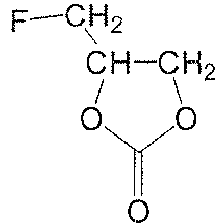
2 wt. % 
2 wt. % Graphite 95% Example II-7 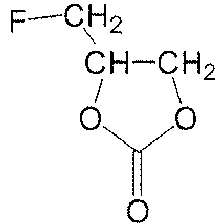
2 wt. % 
3 0 wt. % Graphite 98% Example II -8 
2 wt. % - - raphite 91% Example II -9 
2 wt % - - raphite 89% Example II-10 
2 wt. % - - Graphite 89% Example II-11 
2 wt. % - - raphite 89% - [Table 4]
[Table II-2] Particular compound (2) Predetermined carbonate Negative electrode material Capacity retention at the 100th cycle Structure Amount Structure Amount Comparative Example II-1 - - - - Graphite 79 % Comparative Example II-2 - - 
2 wt. % Graphite 88 % Comparative Example II-3 - - 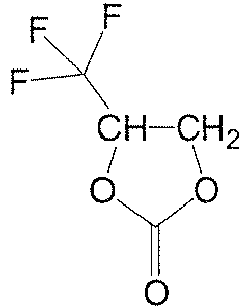
2 wt. % Graphite 81% - In Examples II-12 to II-18 and Comparative Examples II-4 and II-5, nonaqueous electrolyte secondary cells were fabricated and evaluated as in Examples II-1 to II-11 and Comparative Examples II-1 to II-3, except that a silicon alloy negative electrode was used, a particular compound (2) and/or a predetermined carbonate shown in Table II-3 was used to be dissolved in a nonaqueous electrolytic solution, and the discharge capacities at the tenth cycle were determined to calculate the capacity retentions at the tenth cycle instead of those at the 100th cycle. Table II-3 shows the results. The mark "-" used in Table II-3 means that no particular compound (2) or predetermined carbonate was used in the sample. The capacity retentions at the tenth cycle were calculated according to the following equation. The capacity was represented by per unit weight of the negative-electrode active material.

- The silicon alloy negative electrode was produced as follows.
- Slurry was prepared by mixing 12.2% by weight of artificial graphite powder ("KS-6" (trade mark) available from Timcal Corporation), 54.2 parts by weight of a solution containing 12% by weight of PVDF in N-methylpyrrolidone, 50 parts by weight of N-methylpyrrolidone, and a noncarbonous material for the negative-electrode active material containing 73.2 parts by weight of silicon and 8.1 parts by weight of copper in a disperser. The resultant slurry was evenly coated on an 18-µm thick copper foil as a negative-electrode current collector. After drying, the coated copper foil was pressed into an electrode density of about 1.5 g/cm3. The pressed copper foil was then punched into a disk of 12.5 mm in diameter, as a negative electrode made of silicon alloy (a silicon alloy negative electrode).
- [Table 5]
[Table II-3] Particular compound (2) Predetermined carbonate Negative electrode material Capacity retention at the 100th cycle Structure Amount Structure Amount Example II-12 
2 wt. % - - Silicon alloy 91% Example II-13 
2 wt. % 
2 wt. % Silicon alloy 93% Example II-14 
2 wt. % 
2 wt. % + 2 wt % Silicon alloy 94% Example II-15 
2 wt. % 
2 wt. % Silicon alloy 95% Example II-16 
2 wt. % 
3 0 wt. % Silicon alloy 97% Example II-17 
2 wt. % 
2 wt. % Silicon alloy 94% Example 18 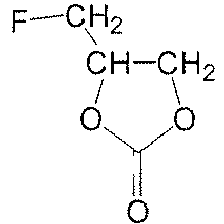
2 wt. % 
3 O wt. % Silicon alloy 97% Comparative Example II-4 - - 
- Silicon alloy 89% Comparative Example II-5 - - 
2 wt. % Silicon alloy 90% - Tables II-1 to II-3 show that with the graphite negative electrode, the cells of Examples II-1 to II-11 containing the particular compound (2) in a nonaqueous electrolytic solution had excellent cycle characteristics compared to those of Comparative Examples II-1 to II-3.
Comparing Examples II-1 through II-7, these tables also show that the cells of Examples II-2 to II-7 containing a combination of a known compound to improve cycle characteristics (a predetermined carbonate) and a particular compound (2) have further improved cycle characteristics compared to that of Example II-1.
The tables also show that a similar trend is observed by comparison of the cells of Examples II-12 to II-18 containing a silicon alloy negative electrode with those of Comparative Examples II-4 and II-5. - In Examples III-1 to III-11 and Comparative Examples III-1 and III-2, nonaqueous electrolyte secondary cells were fabricated and evaluated according to the following procedure. Table III-1 shows the results.
- To 85% by weight of LiCoO2 ("C5" available from NIPPON CHEMICAL INDUSTRIAL CO., LTD.) as a positive-electrode active material, 6% by weight of carbon black ("DENKA BLACK" (trade mark) available from DENKI KAGAKU KOGYO KABUSHIKI KAISHA) and 9% by weight of polyvinylidene fluoride ("KF-1000" (trade mark) available from Kureha Corporation) were added and mixed. The mixture was then dispersed in N-methyl-2-pyrrolidone to make slurry. The resultant slurry was evenly coated on a 20-µm thick aluminium foil as a positive-electrode current collector so that the capacity of the positive electrode corresponded to 90% of the theoretical capacity of the negative electrode used. After drying at 100°C for 12 hours, the coated aluminium foil was punched into a disk of 12.5 mm in diameter, as a positive electrode.
- Slurry was prepared by mixing 83.5 parts by weight of a solution containing 12% by weight of PVDF (polyvinylidene fluoride)in N-methylpyrrolidone, 50 parts by weight of N-methylpyrrolidone, and 100 parts by weight of artificial graphite powder ("KS-6" (trade mark) available from Timcal Corporation) in a disperser. The resultant slurry was evenly coated on an 18-µm thick copper foil as a negative-electrode current collector. After drying, the coated copper foil was pressed into an electrode density of about 1. 5 g/cm3. The pressed copper foil was then punched into a disk of 12.5 µm in diameter, as a negative electrode made of graphite (a graphite negative electrode).
- Nonaqueous electrolytic solutions were prepared by mixing ethylene carbonate and ethyl methyl carbonate in a volume ratio of 3:7 to prepare a solvent, adding to the solvent a particular compound (3) and/or a respective predetermined carbonate in the respective ratio shown in Table III-1 appropriately, and dissolving LiPF6 as the electrolyte in a concentration of one mole/liter in the solvent. The mark "-" used in Table III-1 means that no particular compound (3) or predetermined carbonate was used in this sample.
- The above positive electrode was housed in a stainless steel can, which also serves as a positive-electrode conductor, and then the above negative electrode was placed on the positive electrode via a polyethylene separator impregnated with the nonaqueous electrolytic solution prepared in each Example and Comparative Example.
This can and a sealing plate serving also as a negative-electrode conductor were caulked and hermetically sealed with an insulating gasket to produce a coin cell. - These coin cells were subjected to 100 cycles of charging and discharging at 25°C, the one cycle consisting of constant-current and constant-voltage charging at a charging termination voltage of 4.2 V, a constant current of 3 mA, and a charging termination current of 0.15 µA and constant-current discharging at a discharging termination voltage of 3.0 V and a constant current of 3 mA. During the charge and discharge cycles, the discharge capacities were determined at the first cycle and at the 100th cycle. The capacity retentions at the 100th cycle were calculated according to the following equation. The capacity was represented by per unit weight of the negative-electrode active material.

- [Table 6]
[Table III-1] Particular compound (3) Predetermined carbonate Negative electrode material Capacity retention at the 100th cycle Structure Amount Structure Amount Example III-1 
2 wt. % - - Graphite 90% Example III-2 
2 wt. % 
2 wt. % Graphite 94% Example III-3 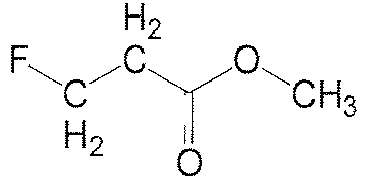
2 wt. % 
2 wt. % + 2 wt. % Graphite 96% Example III-4 
2 wt % 
2 wt. % Graphite 93% Example III-5 
2 wt. % 
3 0 wt. % Graphite 95% Example III-6 
2 wt. % 
2 wt. % Graphite 93% Example III-7 
2 wt. % 
3 0 wt. % Graphite 96% Example III-8 
2 wt. % - - Graphite 90% Example III-9 
2 wt. % - - Graphite 91% Example III-10 
2 wt. % - - Graphite 89% Example III-11 
2 wt. % - - Graphite 90% Comparative Example III- 1 - - - - Graphite 79% Comparative Example III-2 - - 
2 wt. % Graphite 88% - In Examples III-12 to III-18 and Comparative Examples III-3 and III-4, nonaqueous electrolyte secondary cells were fabricated and evaluated as in Examples III-1 to III-11 and Comparative Examples III-1 and III-2, except that a silicon alloy negative electrode was used, a particular compound (3) and/or a predetermined carbonate shown in Table III-2 was used to be dissolved in a nonaqueous electrolytic solution, and the discharge capacities at the tenth cycle were determined to calculate the capacity retentions at the tenth cycle instead of those at the 100th cycle. Table III-2 shows the results. The mark "-" used in Table III-2 means that no particular compound (3) or predetermined carbonate was used in this sample. The capacity retentions at the tenth cycle were calculated according to the following equations. The capacity was represented by per unit weight of the negative-electrode active material.
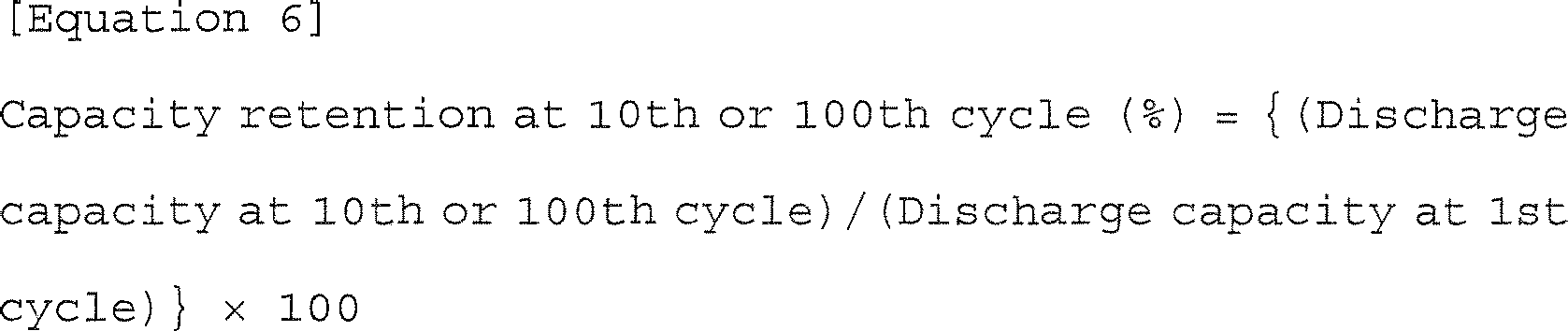
- The silicon alloy negative electrode was produced as follows.
- Slurry was prepared by mixing 12.2% by weight of artificial graphite powder ("KS-6" (trade mark) available from Timcal Corporation), 54.2 parts by weight of a solution containing 12% by weight of PVDF in N-methylpyrrolidone, 50 parts by weight of N-methylpyrrolidone, and a noncarbonous material for the negative-electrode active material containing 73.2 parts by weight of silicon and 8.1 parts by weight of copper in a disperser. The resultant slurry was evenly coated on an 18-µm thick copper foil as a negative-electrode current collector. After drying, the coated copper foil was pressed into an electrode density of about 1.5 g/cm3. The pressed copper foil was then punched into a disk of 12.5 mm in diameter, as a negative electrode made of silicon alloy (a silicon alloy negative electrode).
- [Table 7]
[Table III-2] Particular compound (3) Predetermined carbonate Negative electrode material Capacity retention at the 100th cycle Structure Amount Strcuture Amount Example III-12 
2 wt. % - - Silicon alloy 92% Example III-13 
2 wt. % 
2 wt. % Silicon alloy 94% Example III-14 
2 wt. % 
2 wt % + + Silicon alloy 95% 
2 wt. % Example III-15 
2 wt. % 
2 wt. % Silicon alloy 96% Example III-16 
2 wt. % 
3 0 wt. % Silicon alloy 98% Example III-17 
2 wt. % 
2 wt. % Silicon alloy 95% Example III-18 
2 wt. % 
3 0 wt. % Silicon alloy 98% Comparative Example III-3 - - - - Silicon alloy 89% Comparative Example III-4 - - 
2 wt. % Silicon alloy 90% - Tables III-1 and III-2 show that when containing a graphite negative electrode, the cells of Examples III-1 to III-11 containing a particular compound (3) in a nonaqueous electrolytic solution had excellent cycle characteristics compared to those of Comparative Examples III-1 and III-2.
Comparing Examples III-1 through III-7, these tables also show that the cells of Examples III-2 to III-7 containing a combination of a compound previously known to improve cycle characteristics (a predetermined carbonate) and a particular compound (3) have further improved cycle characteristics compared to that of Example III-1.
The tables also show that a similar trend is observed by comparison of the cells of Examples III-12 to III-18 containing a silicon alloy negative electrode with those of Comparative Examples III-3 and III-4. - To a 500 ml pressure vessel, ethanol (46 g, 1 mol) and sodium metal (2 g) were added and cooled with dry ice. To the vessel, tetrafluoroethylene (67 g, 0.67 mol) was then added and sealed.
- The sealed vessel was shaken for four hours at 55°C. To the resultant difluoroethyl ethyl ether (42 g, 0.3 mol), fuming nitric acid (42 ml) was added dropwise, and heated at 55°C for eight hours with stirring. The resultant mixture was poured into water, and then extracted with diethyl ether. The diethyl ether extract was dried over diphosphorus pentoxide and was subjected to distillation to give ethyl difluoroacetate.
The resultant ethyl difluoroacetate was hydrolyzed with diluted sulfuric acid to yield difluoroacetic acid. - Difluoroacetic acid (85.5 g, 0.89 mol) was slowly added dropwise to benzyl chloride (140 ml, 1. 2 mol), followed by heating at 170°C. The mixture was then cooled, and was added dropwise to a solution of lithium aluminium hydroxide (15 g, 0.4 mol) in diethyl ether (700 ml) with vigorous stirring.
- After the addition was complete, the reaction mixture was refluxed with heat for one hour. After Water (75 ml) was added, the solution was poured onto a mixture of ice and concentrated sulfuric acid (500 ml) in a vessel. The resultant aqueous phase was extracted with diethyl ether to yield 2,2-difluoroethanol.
- To a flask charged with difluoroethanol (5 g, 0.06 mol), methylene chloride (20 g), and pyridine (7.9 g, 0.1 mol), methyl chlorocarbonate (6.9 g, 0.073 mol) was added dropwise with ice cooling, followed by stirring at room temperature for one hour. To the resultant mixture, 1 N hydrochloric acid was added, and the mixture was washed and was subjected to extraction with water and saturated saline.
- The solvent was distilled off from the extracted organic phase, and the residue was distilled to yield a product (2,2-difluoroethyl methyl carbonate). The product obtained was 4.5 g (yield: 54%). The structure of the resulting compound was determined by analysis of 1H, 13C, and 19F NMR spectra, and a mass spectrum (M/e=140).
Peak data in the measured 1H, 13C, and 19F NMR spectra is listed with the structure determined from the spectra. In the structural formula and the peak data, each of a, b, c, and d represents the notation for the carbon at the corresponding position in the following structural formula. -


-
Fig. 1 shows the 1H NMR spectrum of the product (2,2-difluoroethyl methyl carbonate) obtained in Example IV-1, andFig. 2 shows the 13C NMR spectrum. - 2,2-Difluoroethyl ethyl carbonate was prepared as in [Synthesis of 2,2-Difluoroethyl Methyl Carbonate] of Example IV-1, except that ethyl chlorocarbonate (7.9 g, 0.073 mol) was substituted for methyl chlorocarbonate (6.9 g, 0.073 mol).
- The
product 2,2-difluoroethyl ethyl carbonate obtained was 5.1g (yield: 55%). The structure of the compound obtained was determined by analysis of 1H, 13C, and 19F NMR spectra, and a mass spectrum (M/e=154).
Peak data in the measured 1H, 13C, and 19F NMR spectra is listed with the structure determined from the spectra. In the structural formula and the peak data, each of a, b, c, d, and e represents the notation for the carbon at the corresponding position in the following structural formula. -

-
Fig. 3 shows the 1H NMR spectrum of the product (2,2-difluoroethyl ethyl carbonate) obtained in Example IV-2, andFig. 4 shows the 13C NMR spectrum. - 2,2-Difluoroethyl n-propyl carbonate was prepared as in [Synthesis of 2,2-Difluoroethyl Methyl Carbonate] of Example IV-1, except that propyl chlorocarbonate (7.4 g, 0.073 mol) was substituted for methyl chlorocarbonate (6.9 g, 0.073 mol).
- The
product 2,2-difluoroethyl n-propyl carbonate obtained was 5.4 g (yield: 53%). The structure of the compound obtained was determined by analysis of 1H, 13C, and 19F NMR spectra, and a mass spectrum (M/e=168).
Peak data in the measured 1H, 13C, and 19F NMR spectra is listed with the structure determined from the spectra. In the structural formula and the peak data, each of a, b, c, d, e, and f represents the notation for the carbon at the corresponding position in the following structural formula. -


-
Fig. 5 shows the 1H NMR spectrum of the product (2,2-difluoroethyl n-propyl carbonate) obtained in Example IV-3, andFig. 6 shows the 13C NMR spectrum. - n-Butyl-2,2-difluoroethyl carbonate was prepared as in [Synthesis of 2,2-Difluoroethyl Methyl Carbonate] of Example IV-1, except that butyl chlorocarbonate (10.0 g, 0.073 mol) was substituted for methyl chlorocarbonate (6.9 g, 0.073 mol).
- The product n-
butyl 2,2-difluoroethyl carbonate obtained was 5.9 g (yield: 54%). The structure of the compound obtained was determined by analysis of 1H, 13C , and 19F NMR spectra, and a mass spectrum (M/e=182).
Peak data in the measured 1H, 13C, and 19F NMR spectra is listed with the structure determined from the spectra. In the structural formula and the peak data, each of a, b, c, d, e, f, and g represents the notation for the carbon at the corresponding position in the following structural formula. -


-
Fig. 7 shows the 1H NMR spectrum of the product (n-butyl 2,2-difluoroethyl carbonate) obtained in Example IV-4, andFig. 8 shows the 13C NMR spectrum. - Any nonaqueous electrolytic solution and nonaqueous electrolyte secondary cell of the first, second, and third aspects of the present invention, which may be widely applied in any field of industry, is especially excellent in long-term charge-discharge cycle characteristics and therefore, is suitably used as power sources of notebook personal computers, pen-input personal computers, mobile computers, electronic book players, cellular phones, portable facsimiles, portable copiers, portable printers, headphone stereos, video movies, liquid crystal television sets, handy cleaners, portable CD players, mini disc players, transceivers, electronic notebooks, electronic calculators, memory cards, portable tape recorders, radios, backup power sources, motors, illuminators, toys, game machines, watches, stroboscopes, cameras, and load leveling of power and is also used in electric bicycles, electric scooters, and electric cars, for example.
- The carbonate compounds of the present invention may be widely applied in any field of industry, and is suitably used as reaction solvents for organic synthesis, materials for polymer compounds, extraction solvents for various inorganic and organic substances, dilution solvents for paint and ink, materials and dilution solvents for pharmaceuticals and agricultural chemicals, and solvents and additives for electrolytic solutions for energy storage devices, for example.
- Although the present invention has been described in detail with reference to particular embodiments thereof, it is apparent to those skilled in the art that various changes can be made thereto without departing from the spirit and scope of the present invention.
Further to the claims, the present invention inter alia relates to the following embodiments: - 1. A nonaqueous electrolytic solution, comprising:
- a linear carbonate represented by the formula (1):

- a linear carbonate represented by the formula (1):
- 2. The nonaqueous electrolytic solution according to
embodiment 1, wherein in the formula (1) , the group Ra is different from:
- 3. The nonaqueous electrolytic solution according to
embodiment 1, wherein the linear carbonate is bis(2,2-difluoroethyl) carbonate. - 4. The nonaqueous electrolytic solution according to any one of
embodiments 1 to 3, wherein n in the formula (1) represents an integer of from 0 to 7. - 5. The nonaqueous electrolytic solution according to any one of
embodiments 1 to 4, further comprising a carbonate having at least one of an unsaturated bond and a halogen atom, with the proviso that the linear carbonates are excluded. - 6. The nonaqueous electrolytic solution according to
embodiment 5, wherein the concentration of the carbonate having at least one of an unsaturated bond and a halogen atom in the nonaqueous electrolytic solution is 0.01% by weight to 70% by weight. - 7. The nonaqueous electrolytic solution according to
embodiment - 8. The nonaqueous electrolytic solution according to any one of
embodiments 1 to 7, comprising ethylene carbonate and/or propylene carbonate. - 9. The nonaqueous electrolytic solution according to any one of
claims 1 to 8, comprising at least one selected from the group consisting of dimethyl carbonate, ethyl methyl carbonate, diethyl carbonate, methyl n-propyl carbonate, ethyl n-propyl carbonate, and di-n-propyl carbonate. - 10. A nonaqueous electrolyte secondary cell according to any one of
claims 1 to 9, comprising:- a negative electrode and a positive electrode capable of occluding and discharging lithium ions, and
- a nonaqueous electrolytic solution.
- 11. A carbonate compound represented by the formula (4):

- 12. A carbonate compound which is selected from the group consisting of 2,2-difluoroethyl methyl carbonate, 2,2-difluoroethyl ethyl carbonate, 2,2-difluoroethyl n-propyl carbonate, and n-
butyl 2,2-difluoroethyl carbonate.
Claims (9)
- A nonaqueous electrolytic solution, comprising:0.01% by weight to 10% by weight of a compound represented by the formula (2) in a nonaqueous solvent:

X2 represents oxygen, sulfur, or NE1;
Z1 and Z2 represent each independently hydrogen, or a group capable of being attached to carbon,
with the proviso that at least one of Z1, Z2, D1, D2, and E1 represents alkyl in which both at least one hydrogen atom and at least one fluorine atom are attached to at least one terminal carbon; and
m represents a natural number. - The nonaqueous electrolytic solution according to claim 1, wherein m in the formula (2) represents 2 or 3.
- The nonaqueous electrolytic solution according to claim 1 or 2, wherein Z1, Z2, D1, D2 and E1 in the formula (2) represent each independently any of hydrogen, fluorine, and unsubstituted alkyl or fluorine-substituted alkyl.
- The nonaqueous electrolytic solution according to any one of claims 1 to 3, wherein the "alkyl in which both at least one hydrogen atom and at least one fluorine atom are attached to at least one terminal carbon" is substituted by fluorine alone.
- The nonaqueous electrolytic solution according to any one of claims 1 to 4, further comprising a carbonate having at least one of an unsaturated bond and a halogen atom, with the proviso that the compounds represented by the formula (2) are excluded.
- The nonaqueous electrolytic solution according to claim 5, wherein the concentration of the carbonate having at least one of an unsaturated bond and a halogen atom in the nonaqueous electrolytic solution is 0.01% by weight to 70% by weight.
- The nonaqueous electrolytic solution according to claim 5 or 6, wherein the carbonate having at least one of an unsaturated bond and a halogen atom is at least one carbonate selected from the group consisting of vinylene carbonate, vinyl ethylene carbonate, fluoroethylene carbonate, difluoroethylene carbonate, and derivatives thereof.
- The nonaqueous electrolytic solution according to any one of claims 1 to 7, comprising at least one selected from the group consisting of dimethyl carbonate, ethyl methyl carbonate, diethyl carbonate, methyl n-propyl carbonate, ethyl n-propyl carbonate, and di-n-propyl carbonate.
- A nonaqueous electrolyte secondary cell, comprising:a negative electrode and a positive electrode capable of occluding and discharging lithium ions, anda nonaqueous electrolytic solution as defined in any one of claims 1 to 8.
Applications Claiming Priority (7)
| Application Number | Priority Date | Filing Date | Title |
|---|---|---|---|
| JP2005170912 | 2005-06-10 | ||
| JP2005170913 | 2005-06-10 | ||
| JP2005170911 | 2005-06-10 | ||
| JP2005170910 | 2005-06-10 | ||
| JP2005190351A JP4784177B2 (en) | 2005-06-10 | 2005-06-29 | Carbonate compounds |
| EP06766558A EP1890357B1 (en) | 2005-06-10 | 2006-06-09 | Nonaqueous electrolyte solution, nonaqueous electrolyte secondary battery and carbonate compound |
| EP11156962A EP2339684B1 (en) | 2005-06-10 | 2006-06-09 | Nonaqueous electrolytic solution, nonaqueous electrolyte secondary cell, and carbonate compounds |
Related Parent Applications (2)
| Application Number | Title | Priority Date | Filing Date |
|---|---|---|---|
| EP06766558.8 Division | 2006-06-09 | ||
| EP11156962.0 Division | 2011-03-04 |
Publications (1)
| Publication Number | Publication Date |
|---|---|
| EP2485314A1 true EP2485314A1 (en) | 2012-08-08 |
Family
ID=37498566
Family Applications (3)
| Application Number | Title | Priority Date | Filing Date |
|---|---|---|---|
| EP12164574A Withdrawn EP2485314A1 (en) | 2005-06-10 | 2006-06-09 | Nonaqueous electrolytic solution and nonaqueous electrolyte secondary cell |
| EP06766558A Ceased EP1890357B1 (en) | 2005-06-10 | 2006-06-09 | Nonaqueous electrolyte solution, nonaqueous electrolyte secondary battery and carbonate compound |
| EP11156962A Ceased EP2339684B1 (en) | 2005-06-10 | 2006-06-09 | Nonaqueous electrolytic solution, nonaqueous electrolyte secondary cell, and carbonate compounds |
Family Applications After (2)
| Application Number | Title | Priority Date | Filing Date |
|---|---|---|---|
| EP06766558A Ceased EP1890357B1 (en) | 2005-06-10 | 2006-06-09 | Nonaqueous electrolyte solution, nonaqueous electrolyte secondary battery and carbonate compound |
| EP11156962A Ceased EP2339684B1 (en) | 2005-06-10 | 2006-06-09 | Nonaqueous electrolytic solution, nonaqueous electrolyte secondary cell, and carbonate compounds |
Country Status (5)
| Country | Link |
|---|---|
| US (1) | US8178246B2 (en) |
| EP (3) | EP2485314A1 (en) |
| KR (2) | KR101137747B1 (en) |
| CN (1) | CN101218706B (en) |
| WO (1) | WO2006132372A1 (en) |
Families Citing this family (50)
| Publication number | Priority date | Publication date | Assignee | Title |
|---|---|---|---|---|
| JP4976715B2 (en) * | 2006-03-17 | 2012-07-18 | 三井化学株式会社 | Non-aqueous electrolyte and lithium secondary battery using the same |
| JP5109349B2 (en) * | 2006-12-04 | 2012-12-26 | ソニー株式会社 | Secondary battery |
| US8435679B2 (en) * | 2006-12-20 | 2013-05-07 | 3M Innovative Properties Counsel | Fluorinated compounds for use in lithium battery electrolytes |
| CN101606266A (en) * | 2007-02-06 | 2009-12-16 | 大金工业株式会社 | Nonaqueous electrolyte |
| KR101844201B1 (en) | 2007-04-05 | 2018-03-30 | 미쯔비시 케미컬 주식회사 | Nonaqueous electrolyte for rechargeable battery, and rechargeable battery with nonaqueous electrolyte |
| JP5628469B2 (en) * | 2007-04-26 | 2014-11-19 | 三菱化学株式会社 | Non-aqueous electrolyte for secondary battery and non-aqueous electrolyte secondary battery using the same |
| US9153836B2 (en) * | 2007-08-23 | 2015-10-06 | Sony Corporation | Electrolytic solutions and battery |
| JP5323837B2 (en) * | 2007-09-12 | 2013-10-23 | エルジー・ケム・リミテッド | Non-aqueous electrolyte lithium secondary battery |
| JP5309704B2 (en) * | 2008-01-29 | 2013-10-09 | ダイキン工業株式会社 | Solvent for non-aqueous electrolyte of lithium secondary battery |
| JP5401836B2 (en) * | 2008-01-29 | 2014-01-29 | ダイキン工業株式会社 | Solvent for dissolving electrolyte salt of lithium secondary battery |
| JP5360463B2 (en) * | 2008-05-28 | 2013-12-04 | 株式会社Gsユアサ | Non-aqueous electrolyte secondary battery |
| US20100028784A1 (en) * | 2008-07-29 | 2010-02-04 | 3M Innovative Properties Company | Electrolyte composition, lithium-containing electrochemical cell, battery pack, and device including the same |
| WO2010128584A1 (en) * | 2009-05-08 | 2010-11-11 | パナソニック株式会社 | Nonaqueous solvent, nonaqueous electrolyte solution using same, and nonaqueous secondary battery |
| CN102055018B (en) * | 2009-11-06 | 2015-05-13 | 通用汽车环球科技运作公司 | Electrolyte for a lithium ion battery |
| US8802301B2 (en) | 2009-11-06 | 2014-08-12 | GM Global Technology Operations LLC | Lithium ion battery electrolyte including a vitreous eutectic mixture |
| KR101148831B1 (en) * | 2010-10-29 | 2012-05-24 | 삼성전자주식회사 | Non-aqueous electrolyte and lithium air battery including the same |
| EP2693557B1 (en) * | 2011-03-31 | 2019-06-05 | Daikin Industries, Ltd. | Electrochemical device and nonaqueous electrolyte solution for electrochemical device |
| US9979050B2 (en) | 2011-09-02 | 2018-05-22 | Solvay Sa | Fluorinated electrolyte compositions |
| JP6178317B2 (en) | 2011-09-02 | 2017-08-09 | イー・アイ・デュポン・ドウ・ヌムール・アンド・カンパニーE.I.Du Pont De Nemours And Company | Lithium ion battery |
| US20130202920A1 (en) * | 2012-02-07 | 2013-08-08 | Battelle Memorial Institute | Dendrite-Inhibiting Salts in Electrolytes of Energy Storage Devices |
| KR102064194B1 (en) | 2012-06-01 | 2020-01-09 | 솔베이(소시에떼아노님) | Lithium-ion battery |
| WO2013180783A1 (en) | 2012-06-01 | 2013-12-05 | E. I. Du Pont De Nemours And Company | Fluorinated electrolyte compositions |
| WO2013188594A2 (en) * | 2012-06-12 | 2013-12-19 | A123 Systems, LLC | Non-aqueous electrolytic rechargeable batteries for extended temperature range operation |
| JP6228975B2 (en) * | 2012-07-13 | 2017-11-08 | ソルヴェイ(ソシエテ アノニム) | Carbonyl fluoride compound having triple bond, method for producing the same, and use thereof |
| US20150318572A1 (en) * | 2012-09-28 | 2015-11-05 | Daikin Industries, Ltd. | Electrolyte solution, electrochemical device, lithium battery and module |
| CN104685693B (en) | 2012-09-28 | 2018-08-31 | 大金工业株式会社 | electrolyte, electrochemical device, lithium battery and module |
| JPWO2014050877A1 (en) * | 2012-09-28 | 2016-08-22 | ダイキン工業株式会社 | Nonaqueous electrolyte, electrochemical device, lithium ion secondary battery, and module |
| JP5998292B2 (en) | 2012-12-18 | 2016-09-28 | ビーエーエスエフ ソシエタス・ヨーロピアBasf Se | Use of fluoroisopropyl derivatives as electrolyte additives |
| JP5635065B2 (en) * | 2012-12-21 | 2014-12-03 | 三菱化学株式会社 | Non-aqueous electrolyte for secondary battery and non-aqueous electrolyte secondary battery using the same |
| EP2982002B1 (en) * | 2013-04-04 | 2019-07-17 | Solvay Sa | Nonaqueous electrolyte compositions |
| EP2800197B1 (en) * | 2013-05-02 | 2017-03-22 | Westfälische Wilhelms-Universität Münster | Fluorinated carbonates as solvent for lithium sulfonimide-based electrolytes |
| JP5842873B2 (en) * | 2013-07-12 | 2016-01-13 | 株式会社Gsユアサ | Non-aqueous electrolyte secondary battery |
| KR102019922B1 (en) * | 2013-09-17 | 2019-09-09 | 에스케이케미칼 주식회사 | Electrolyte solution for secondary battery and additive therefor |
| JP6433486B2 (en) * | 2014-03-27 | 2018-12-05 | ダイキン工業株式会社 | Electrolytic solution and electrochemical device |
| US20170187062A1 (en) * | 2014-05-27 | 2017-06-29 | Dow Global Technologies Llc | Lithium battery electrolyte solution containing methyl (2,2,3,3,-tetrafluoropropyl) carbonate |
| WO2015183598A1 (en) * | 2014-05-27 | 2015-12-03 | Dow Global Technologies Llc | Lithium battery electrolyte solution containing (2,2-difluoroethyl) ethyl carbonate |
| WO2015183597A1 (en) * | 2014-05-27 | 2015-12-03 | Dow Global Technologies Llc | Lithium battery electrolyte solution containing ethyl (2,2,3,3-tetrafluoropropyl) carbonate |
| EP3161902B1 (en) | 2014-06-27 | 2020-03-18 | ViaSat, Inc. | System and apparatus for driving antenna |
| KR20170042324A (en) * | 2014-08-14 | 2017-04-18 | 솔베이(소시에떼아노님) | Nonaqueous electrolyte compositions comprising sultone and fluorinated solvent |
| US20160087307A1 (en) * | 2014-09-19 | 2016-03-24 | E I Du Pont De Nemours And Company | Nonaqueous electrolyte compositions |
| EP3235046B1 (en) | 2014-12-18 | 2021-06-16 | Solvay SA | Electrolyte composition comprising fluorinated carbonate, and battery comprising the same |
| CN107112582A (en) * | 2015-03-26 | 2017-08-29 | 三洋电机株式会社 | Non-aqueous electrolyte secondary battery |
| US11038196B2 (en) * | 2016-09-14 | 2021-06-15 | Solvay Sa | Electrolytes containing six membered ring cyclic sulfates |
| US10727535B2 (en) | 2017-04-19 | 2020-07-28 | GM Global Technology Operations LLC | Electrolyte system for silicon-containing electrodes |
| CN110112465B (en) * | 2019-04-24 | 2022-04-19 | 东莞东阳光科研发有限公司 | Electrolyte for battery with lithium-rich manganese-based positive electrode material system and lithium ion battery |
| KR20220101625A (en) * | 2019-11-18 | 2022-07-19 | 알베마를 코포레이션 | Flame retardant for battery electrolyte |
| CN113036219A (en) * | 2021-03-05 | 2021-06-25 | 星恒电源股份有限公司 | Electrolyte and sodium ion battery with high and low temperature performance |
| JP7758032B2 (en) * | 2021-04-28 | 2025-10-22 | 株式会社Gsユアサ | Non-aqueous electrolyte energy storage element |
| CN114597489A (en) * | 2022-03-22 | 2022-06-07 | 香河昆仑新能源材料股份有限公司 | Electrolyte containing fluorobenzene carbonate and battery composed of electrolyte |
| WO2024128672A1 (en) * | 2022-12-15 | 2024-06-20 | 주식회사 렉쎌 | Compound for electrolyte, compound for electrolyte additive, electrolyte material, electrolyte additive, electrolyte for secondary battery, and secondary battery |
Citations (22)
| Publication number | Priority date | Publication date | Assignee | Title |
|---|---|---|---|---|
| JPH01311054A (en) | 1988-06-07 | 1989-12-15 | Daicel Chem Ind Ltd | Production of dialkyl carbonate |
| JPH02148665A (en) | 1988-11-30 | 1990-06-07 | Matsushita Electric Ind Co Ltd | Electrolyte for lithium secondary batteries |
| JPH04104468A (en) | 1990-08-21 | 1992-04-06 | Sanyo Electric Co Ltd | Nonaqueous electrolyte battery |
| JPH06164082A (en) | 1992-11-24 | 1994-06-10 | Mitsubishi Electric Corp | Printed wiring board |
| JPH0845545A (en) | 1994-04-22 | 1996-02-16 | Saft (Soc Accumulateurs Fixes Traction) Sa | Lithium storage battery with carbon anode |
| JPH08287950A (en) * | 1995-04-18 | 1996-11-01 | Sumitomo Chem Co Ltd | Non-aqueous electrolyte and lithium secondary battery using the same |
| JPH0963644A (en) * | 1995-06-13 | 1997-03-07 | Mitsui Petrochem Ind Ltd | Non-aqueous electrolyte and non-aqueous electrolyte battery |
| JPH09251861A (en) | 1996-01-10 | 1997-09-22 | Sanyo Chem Ind Ltd | Organic solvent for electrolyte, lithium secondary battery and electric double layer capacitor |
| JPH10233345A (en) | 1997-02-20 | 1998-09-02 | Mitsui Chem Inc | Non-aqueous electrolyte |
| JPH11176470A (en) | 1997-10-07 | 1999-07-02 | Hitachi Maxell Ltd | Organic electrolyte secondary battery |
| JPH11195429A (en) | 1998-01-05 | 1999-07-21 | Hitachi Ltd | Non-aqueous electrolyte secondary battery |
| JP2000040526A (en) | 1998-05-20 | 2000-02-08 | Mitsui Chemicals Inc | Non-aqueous electrolyte for secondary battery and non-aqueous electrolyte secondary battery |
| JP2000195544A (en) * | 1998-12-25 | 2000-07-14 | Mitsui Chemicals Inc | Nonaqueous electrolyte and secondary battery using it |
| JP2004087284A (en) | 2002-08-27 | 2004-03-18 | Sanyo Electric Co Ltd | Lithium secondary cell |
| JP2005170912A (en) | 2003-12-15 | 2005-06-30 | Mitsubishi Chemicals Corp | Process for producing substituted vinyl ether derivatives |
| JP2005170913A (en) | 2003-12-15 | 2005-06-30 | Ss Pharmaceut Co Ltd | Antifungal composition for external use |
| JP2005170911A (en) | 2003-12-15 | 2005-06-30 | Idemitsu Kosan Co Ltd | Aromatic compound and organic electroluminescence device using the same |
| JP2005170910A (en) | 2003-12-15 | 2005-06-30 | Kuraray Co Ltd | Skin preparation |
| JP2005190351A (en) | 2003-12-26 | 2005-07-14 | Nomura Research Institute Ltd | Credit card payment system |
| JP2006161353A (en) | 2004-12-06 | 2006-06-22 | Tokyo Seiko Co Ltd | Rope crossing fastener |
| JP2006161354A (en) | 2004-12-06 | 2006-06-22 | Yodogawa Steel Works Ltd | Interlocking sliding door bounce prevention device |
| JP2006161355A (en) | 2004-12-06 | 2006-06-22 | Shota Ushiki | Method of forming through-hole for fluid in pipe |
Family Cites Families (25)
| Publication number | Priority date | Publication date | Assignee | Title |
|---|---|---|---|---|
| JPS6164082A (en) | 1984-09-05 | 1986-04-02 | Sanyo Electric Co Ltd | non-aqueous electrolyte battery |
| EP0482287B2 (en) | 1990-10-25 | 2004-09-01 | Matsushita Electric Industrial Co., Ltd. | A non-aqueous secondary electrochemical battery |
| JP3199426B2 (en) | 1991-12-27 | 2001-08-20 | 松下電器産業株式会社 | Non-aqueous electrolyte secondary battery |
| JP3294400B2 (en) | 1992-11-18 | 2002-06-24 | ソニー株式会社 | Non-aqueous electrolyte and non-aqueous electrolyte battery |
| DE69309861T2 (en) * | 1992-11-18 | 1997-09-11 | Mitsui Petrochemical Ind | Carbonate compounds, non-aqueous electrolyte solutions and batteries containing non-aqueous electrolyte solutions |
| JPH08162152A (en) * | 1994-12-02 | 1996-06-21 | Shin Kobe Electric Mach Co Ltd | Lithium secondary battery |
| JP3460407B2 (en) * | 1995-09-27 | 2003-10-27 | ソニー株式会社 | Non-aqueous electrolyte secondary battery |
| JPH10189046A (en) | 1996-11-11 | 1998-07-21 | Mitsui Chem Inc | Non-aqueous electrolyte and non-aqueous electrolyte secondary battery |
| FR2787243B1 (en) * | 1998-12-10 | 2003-10-03 | Cit Alcatel | LITHIUM RECHARGEABLE ELECTROCHEMICAL GENERATOR FOR USE AT LOW TEMPERATURE |
| JP2000188128A (en) | 1998-12-24 | 2000-07-04 | Mitsubishi Chemicals Corp | Non-aqueous electrolyte secondary battery |
| US6403256B1 (en) | 1999-01-25 | 2002-06-11 | Wilson Greatbatch Ltd. | Alkali metal electrochemical cell activated with a nonaqueous electrolyte having a sulfite additive |
| JP2003267931A (en) | 2002-03-18 | 2003-09-25 | Mitsubishi Chemicals Corp | Method for producing saturated fluorocarboxylic acid ester |
| JP3969164B2 (en) | 2002-04-16 | 2007-09-05 | 三菱化学株式会社 | Negative electrode material for lithium secondary battery and negative electrode body produced therefrom |
| JP2004014134A (en) | 2002-06-03 | 2004-01-15 | Mitsubishi Chemicals Corp | Non-aqueous electrolyte secondary battery and electrolyte used therefor |
| CN100585935C (en) * | 2002-07-15 | 2010-01-27 | 宇部兴产株式会社 | Nonaqueous electrolyte solution and lithium battery |
| JP4219127B2 (en) | 2002-08-08 | 2009-02-04 | 三菱化学株式会社 | Non-aqueous electrolyte secondary battery and non-aqueous electrolyte |
| CN1282273C (en) * | 2003-06-20 | 2006-10-25 | 中国科学院物理研究所 | A nonaqueous electrolyte for lithium secondary battery |
| JP2005047875A (en) * | 2003-07-31 | 2005-02-24 | Asahi Glass Co Ltd | Method for producing bis (ω-hydrodifluoroalkyl) carbonate, and non-aqueous electrolyte |
| KR100529106B1 (en) | 2003-08-25 | 2005-11-15 | 삼성에스디아이 주식회사 | Electrolyte for lithium secondary battery and lithium secondary battery comprising same |
| JP2005108724A (en) | 2003-09-30 | 2005-04-21 | Sanyo Electric Co Ltd | Nonaqueous electrolyte secondary battery |
| KR100603303B1 (en) | 2003-10-29 | 2006-07-20 | 삼성에스디아이 주식회사 | Lithium Battery with Efficient Performance |
| JP4921702B2 (en) * | 2004-09-17 | 2012-04-25 | 三菱化学株式会社 | Non-aqueous electrolyte secondary battery and non-aqueous electrolyte |
| JP4872207B2 (en) | 2004-11-10 | 2012-02-08 | 三菱化学株式会社 | Non-aqueous electrolyte secondary battery and electrolyte for non-aqueous electrolyte secondary battery |
| JP4997699B2 (en) * | 2004-12-10 | 2012-08-08 | 新神戸電機株式会社 | Lithium secondary battery |
| JP2006164867A (en) | 2004-12-10 | 2006-06-22 | Sony Corp | battery |
-
2006
- 2006-06-09 EP EP12164574A patent/EP2485314A1/en not_active Withdrawn
- 2006-06-09 KR KR1020107010692A patent/KR101137747B1/en not_active Expired - Fee Related
- 2006-06-09 EP EP06766558A patent/EP1890357B1/en not_active Ceased
- 2006-06-09 US US11/917,017 patent/US8178246B2/en not_active Expired - Fee Related
- 2006-06-09 KR KR1020077028902A patent/KR100977431B1/en not_active Expired - Fee Related
- 2006-06-09 EP EP11156962A patent/EP2339684B1/en not_active Ceased
- 2006-06-09 WO PCT/JP2006/311646 patent/WO2006132372A1/en not_active Ceased
- 2006-06-09 CN CN2006800251658A patent/CN101218706B/en not_active Expired - Fee Related
Patent Citations (22)
| Publication number | Priority date | Publication date | Assignee | Title |
|---|---|---|---|---|
| JPH01311054A (en) | 1988-06-07 | 1989-12-15 | Daicel Chem Ind Ltd | Production of dialkyl carbonate |
| JPH02148665A (en) | 1988-11-30 | 1990-06-07 | Matsushita Electric Ind Co Ltd | Electrolyte for lithium secondary batteries |
| JPH04104468A (en) | 1990-08-21 | 1992-04-06 | Sanyo Electric Co Ltd | Nonaqueous electrolyte battery |
| JPH06164082A (en) | 1992-11-24 | 1994-06-10 | Mitsubishi Electric Corp | Printed wiring board |
| JPH0845545A (en) | 1994-04-22 | 1996-02-16 | Saft (Soc Accumulateurs Fixes Traction) Sa | Lithium storage battery with carbon anode |
| JPH08287950A (en) * | 1995-04-18 | 1996-11-01 | Sumitomo Chem Co Ltd | Non-aqueous electrolyte and lithium secondary battery using the same |
| JPH0963644A (en) * | 1995-06-13 | 1997-03-07 | Mitsui Petrochem Ind Ltd | Non-aqueous electrolyte and non-aqueous electrolyte battery |
| JPH09251861A (en) | 1996-01-10 | 1997-09-22 | Sanyo Chem Ind Ltd | Organic solvent for electrolyte, lithium secondary battery and electric double layer capacitor |
| JPH10233345A (en) | 1997-02-20 | 1998-09-02 | Mitsui Chem Inc | Non-aqueous electrolyte |
| JPH11176470A (en) | 1997-10-07 | 1999-07-02 | Hitachi Maxell Ltd | Organic electrolyte secondary battery |
| JPH11195429A (en) | 1998-01-05 | 1999-07-21 | Hitachi Ltd | Non-aqueous electrolyte secondary battery |
| JP2000040526A (en) | 1998-05-20 | 2000-02-08 | Mitsui Chemicals Inc | Non-aqueous electrolyte for secondary battery and non-aqueous electrolyte secondary battery |
| JP2000195544A (en) * | 1998-12-25 | 2000-07-14 | Mitsui Chemicals Inc | Nonaqueous electrolyte and secondary battery using it |
| JP2004087284A (en) | 2002-08-27 | 2004-03-18 | Sanyo Electric Co Ltd | Lithium secondary cell |
| JP2005170912A (en) | 2003-12-15 | 2005-06-30 | Mitsubishi Chemicals Corp | Process for producing substituted vinyl ether derivatives |
| JP2005170913A (en) | 2003-12-15 | 2005-06-30 | Ss Pharmaceut Co Ltd | Antifungal composition for external use |
| JP2005170911A (en) | 2003-12-15 | 2005-06-30 | Idemitsu Kosan Co Ltd | Aromatic compound and organic electroluminescence device using the same |
| JP2005170910A (en) | 2003-12-15 | 2005-06-30 | Kuraray Co Ltd | Skin preparation |
| JP2005190351A (en) | 2003-12-26 | 2005-07-14 | Nomura Research Institute Ltd | Credit card payment system |
| JP2006161353A (en) | 2004-12-06 | 2006-06-22 | Tokyo Seiko Co Ltd | Rope crossing fastener |
| JP2006161354A (en) | 2004-12-06 | 2006-06-22 | Yodogawa Steel Works Ltd | Interlocking sliding door bounce prevention device |
| JP2006161355A (en) | 2004-12-06 | 2006-06-22 | Shota Ushiki | Method of forming through-hole for fluid in pipe |
Also Published As
| Publication number | Publication date |
|---|---|
| KR20080009230A (en) | 2008-01-25 |
| EP1890357B1 (en) | 2012-06-13 |
| CN101218706B (en) | 2011-09-28 |
| CN101218706A (en) | 2008-07-09 |
| US20090253048A1 (en) | 2009-10-08 |
| EP1890357A1 (en) | 2008-02-20 |
| EP1890357A4 (en) | 2009-12-30 |
| KR100977431B1 (en) | 2010-08-24 |
| KR20100076030A (en) | 2010-07-05 |
| US8178246B2 (en) | 2012-05-15 |
| WO2006132372A1 (en) | 2006-12-14 |
| KR101137747B1 (en) | 2012-04-25 |
| EP2339684A2 (en) | 2011-06-29 |
| EP2339684B1 (en) | 2013-01-09 |
| EP2339684A3 (en) | 2011-10-19 |
Similar Documents
| Publication | Publication Date | Title |
|---|---|---|
| US8178246B2 (en) | Nonaqueous electrolyte solution, nonaqueous electrolyte secondary cell, and carbonate compounds | |
| KR102396198B1 (en) | A method for preparing a phosphorylimide salt, a method for preparing a non-aqueous electrolyte containing the salt, and a method for manufacturing a non-aqueous secondary battery | |
| EP2278652B1 (en) | Non-aqueous liquid electrolyte and non-aqueous liquid electrolyte secondary battery using the same | |
| JP6737178B2 (en) | Electrolyte solution and secondary battery using the same | |
| US8956768B2 (en) | Nonaqueous electrolyte comprising one or more hydrofluoroethers and one or more non-fluoroethers, and a secondary cell containing the nonaqueous electrolyte | |
| US9553333B2 (en) | Nonaqueous electrolytic solution and nonaqueous electrolyte secondary battery | |
| US20130071731A1 (en) | Nonaqueous electrolytic solution and nonaqueous electrolyte secondary battery | |
| US10749215B2 (en) | Electrolyte solution for secondary battery and secondary battery | |
| CN105103361B (en) | Nonaqueous electrolyte for battery, compound, polyelectrolyte and lithium secondary battery | |
| KR101958880B1 (en) | Non-aqueous electrolyte battery electrolyte and non-aqueous electrolyte battery | |
| JP6007994B2 (en) | Non-aqueous electrolyte secondary battery electrolyte and non-aqueous electrolyte secondary battery using the same | |
| US20130244122A1 (en) | Nonaqueous electrolytic solution and nonaqueous-electrolyte battery employing the same | |
| JP2014170689A (en) | Nonaqueous electrolyte and lithium secondary battery | |
| KR101892601B1 (en) | Nonaqueous electrolyte solution, and nonaqueous electrolyte secondary battery using said electrolyte solution | |
| JP5565212B2 (en) | Non-aqueous electrolyte and non-aqueous electrolyte battery using the same | |
| JP6957179B2 (en) | Non-aqueous electrolyte for batteries and lithium secondary battery | |
| JP4952074B2 (en) | Non-aqueous electrolyte and non-aqueous electrolyte secondary battery | |
| JP2008146930A (en) | Electrolyte and battery | |
| CN111066191B (en) | Additive for nonaqueous electrolyte, and power storage device | |
| EP3605698A1 (en) | New components for electrolyte compositions |
Legal Events
| Date | Code | Title | Description |
|---|---|---|---|
| PUAI | Public reference made under article 153(3) epc to a published international application that has entered the european phase |
Free format text: ORIGINAL CODE: 0009012 |
|
| 17P | Request for examination filed |
Effective date: 20120418 |
|
| AC | Divisional application: reference to earlier application |
Ref document number: 1890357 Country of ref document: EP Kind code of ref document: P Ref document number: 2339684 Country of ref document: EP Kind code of ref document: P |
|
| AK | Designated contracting states |
Kind code of ref document: A1 Designated state(s): DE |
|
| STAA | Information on the status of an ep patent application or granted ep patent |
Free format text: STATUS: THE APPLICATION IS DEEMED TO BE WITHDRAWN |
|
| 18D | Application deemed to be withdrawn |
Effective date: 20130209 |