EP2483796B1 - Providing a manual ring-down communication line using sip - Google Patents
Providing a manual ring-down communication line using sip Download PDFInfo
- Publication number
- EP2483796B1 EP2483796B1 EP10820980.0A EP10820980A EP2483796B1 EP 2483796 B1 EP2483796 B1 EP 2483796B1 EP 10820980 A EP10820980 A EP 10820980A EP 2483796 B1 EP2483796 B1 EP 2483796B1
- Authority
- EP
- European Patent Office
- Prior art keywords
- user agent
- session
- sip
- sip user
- message
- Prior art date
- Legal status (The legal status is an assumption and is not a legal conclusion. Google has not performed a legal analysis and makes no representation as to the accuracy of the status listed.)
- Active
Links
Images




Classifications
-
- H—ELECTRICITY
- H04—ELECTRIC COMMUNICATION TECHNIQUE
- H04L—TRANSMISSION OF DIGITAL INFORMATION, e.g. TELEGRAPHIC COMMUNICATION
- H04L65/00—Network arrangements, protocols or services for supporting real-time applications in data packet communication
- H04L65/1066—Session management
- H04L65/1069—Session establishment or de-establishment
-
- H—ELECTRICITY
- H04—ELECTRIC COMMUNICATION TECHNIQUE
- H04L—TRANSMISSION OF DIGITAL INFORMATION, e.g. TELEGRAPHIC COMMUNICATION
- H04L65/00—Network arrangements, protocols or services for supporting real-time applications in data packet communication
- H04L65/1066—Session management
- H04L65/1101—Session protocols
- H04L65/1104—Session initiation protocol [SIP]
-
- H—ELECTRICITY
- H04—ELECTRIC COMMUNICATION TECHNIQUE
- H04L—TRANSMISSION OF DIGITAL INFORMATION, e.g. TELEGRAPHIC COMMUNICATION
- H04L65/00—Network arrangements, protocols or services for supporting real-time applications in data packet communication
- H04L65/10—Architectures or entities
- H04L65/1045—Proxies, e.g. for session initiation protocol [SIP]
-
- H—ELECTRICITY
- H04—ELECTRIC COMMUNICATION TECHNIQUE
- H04M—TELEPHONIC COMMUNICATION
- H04M7/00—Arrangements for interconnection between switching centres
- H04M7/006—Networks other than PSTN/ISDN providing telephone service, e.g. Voice over Internet Protocol (VoIP), including next generation networks with a packet-switched transport layer
Definitions
- the present invention generally relates to telecommunication systems, and more particularly to systems, methods, and computer program products for providing a manual ring-down communication line using the Session Initiation Protocol ("SIP").
- SIP Session Initiation Protocol
- a manual ring-down (“MRD”) private line is a communication line commonly used for two parties to maintain a continuous full-duplex communication channel with each other.
- MRD manual ring-down
- a typical MRD private line communication device provides a user with the ability to manually signal the communication device on the other side of the line. Upon receiving the signal, the signaled communication device notifies its user audibly and/or visually that the user on the other end of the line wishes to communicate.
- MRD private lines date back to a time period when telephones were purely analog devices, and the MRD private line was implemented using a physical copper wire connecting the two communication devices. Because the MRD private line typically was implemented using a fixed physical connection, a dedicated communication path was created through which users could communicate with each other at any time by, for example, picking up a telephone handset and keying a signaling button
- An alternative to a MRD private line communication device is an automatic ring-down (ARD) private line communication device, which enables its user to automatically signal the communication device on the other side of the line by, for example, merely picking up a telephone handset.
- ARD automatic ring-down
- Typical users of manual and automatic ring-down private lines make large volumes of calls from and to fixed locations and require continuous and uninterrupted lines of communication between those locations. Examples of such users are trading floor environments, financial firms, emergency services, and the like. Audio communication in trading floor environments is typically achieved utilizing specialized hardware and software turret switching systems.
- a turret switching system is a specialized telephony switching system that allows a relatively small number of users to access a large number of external lines and provides enhanced communication features such as hoot-n-holler, push-to-talk, intercom, video and large-scale conferencing.
- a trading turret device which can be implemented in dedicated hardware (sometimes referred to as a "hard” turret) or in a general-purpose computer (sometimes referred to as a "soft” turret).
- a hard turret is a phone-like desktop device with multiple handsets, external microphones, speakers and buttons.
- a soft turret is a software application that runs on a trader's desktop personal computer ("PC") or on a mobile computer such as a Personal Digital Assistant (“PDA").
- PC trader's desktop personal computer
- PDA Personal Digital Assistant
- a soft turret application may be controlled using the native control interface that the computer provides such as a touch screen, stylus, click wheel, or mouse and keyboard.
- the soft turret application may also provide voice, instant messaging and presence features.
- WO 2006/002681 A1 relates to a push-to-talk over cellular (PoC) method and device that purportedly enable a party to a conversation to obtain location information of another party.
- a message is received at a first terminal device that indicates that a user of a second terminal device has pressed a talk button. The message also indicates a geographical location of the second terminal device.
- SIP Event Package for Keys by Bert Culpepper et al relates to a SIP event package that presents a framework for defining key event packages to be used by SIP network entities for requesting and reporting states related to keys or buttons.
- Key event packages are defined to represent telephone dial pads, feature buttons found on commercial telephones, standard keyboards as well as the framework to support user or device specific buttons.
- the event package and associated key packages can be used to enable SIP services where an application or a SIP entity requires user indications generated through key-based input.
- US 2009/0022145 discloses a method handling SIP sessions which method uses a line card to send a single RE-INVITE attempt using a different proxy after a predetermined time has elapsed.
- SIP is an application-layer control (i.e., signaling) protocol for creating, modifying, and terminating sessions such as Internet telephony calls with one or more participants and is defined in RFC-3261.
- a first SIP user agent transmits an INVITE message to a second SIP user agent over an IP network to establish a SIP MRD session.
- the first SIP user agent determines that a signal key associated with a first communication device has been selected.
- the first SIP user agent transmits a start event message to the second SIP user agent over the IP network to cause a second communication device to activate an alert.
- the first SIP user agent determines that the signal key associated with the first communication device has been released.
- the first SIP user agent transmits an end event message to the second SIP user agent over the IP network to cause the second communication device to deactivate the alert.
- the first SIP user agent transmits, to the second SIP user agent over the IP network, one or more subsequent RE-INVITE messages at a predetermined repetition rate to detect the liveliness of the second SIP user agent.
- a method of negotiating a SIP MRD session establisher transmits, to a second SIP user agent over an IP network, an OPTIONS message to request designation of an MRD session establisher.
- the OPTIONS message includes an identifier of the first SIP user agent.
- the first SIP user agent receives, from the second SIP user agent over the IP network, a 200 OK message accepting designation of the first SIP user agent as the session establisher. Should the two SIP user agents send the OPTIONS message at the same time, thus causing a glare condition due to messages crossing on the wire, the SIP user agent with the numerically higher IP address will be chosen as the establisher. Both user agents know each other's IP address through the SIP 'Contact' header field within the OPTIONS message.
- a method of re-establishing a failed SIP session receives, over an IP network, a request timeout message indicating that a SIP session with a second SIP user agent has failed.
- the first SIP user agent initiates a session establish timer.
- the first SIP user agent transmits, to the second SIP user agent over the IP network, an INVITE message, in response to the session establish timer expiring.
- the first SIP user agent repeats above process until a 200 OK message is received from the second SIP user agent.
- the example embodiments of the invention presented herein are directed to systems, methods, and computer program products for providing a manual ring-down communication line using SIP, which are now described herein in terms of an example communication system.
- the communication system can be implemented, for example, in financial, security/law enforcement, utilities, healthcare, and customer support (e.g., contact centers) environments.
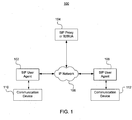
- FIG. 1 depicts a block diagram of an example communication system 100 in accordance with an embodiment of the present invention.
- communication system 100 includes communication devices 110 and 112.
- the term "communication device,” as used herein, generally refers to any hardware and/or software-implemented electronic device having a user interface enabling a user to connect to a network to communicate audibly and/or visually with other communication devices.
- Examples of communication devices 110 and 112 include a hard turret, a soft turret, a hard telephone, a soft telephone, a mobile telephone, a PDA, a general purpose PC, and the like.
- communication devices 110 and 112 are communicatively coupled to SIP user agent 102 and SIP user agent 106, respectively, over, for example, a network or a proprietary communication line (not shown).
- SIP user agents 102 and 106 are logical network end-points used to create and/or receive SIP messages and manage SIP sessions.
- FIG. 1 shows SIP user agents 102 and 106 as being separate from communication devices 110 and 112, embodiments where SIP user agents 102 and 106 are included as part of communication devices 110 and 112, respectively, are contemplated and are within the scope of the present invention.
- SIP user agent 102 and SIP user agent 106 are each communicatively coupled with one or more SIP proxies or back-to-back user agents (B2BUA) 104 through an IP network 108, through which users can communicate using communication devices 110 and 112.
- SIP proxy/B2BUA 104 manages messaging by caching and notifying the states of communication devices 110 and 112 in system 100.
- SIP proxy/B2BUA 104 also processes and stores SIP registrations, which are uploaded by users of SIP user agents 102 and 106 indicating their respective current locations.
- system 100 includes SIP proxy/B2BUA 104, these components are optional. Embodiments where SIP user agent 102 and 106 communicate directly are within the scope of the present invention.
- system 100 only shows two SIP user agents and communication devices, embodiments including more than two SIP user agents and communication devices sharing a SIP MRD session are contemplated and are within the scope of the present invention. For example, if three or more SIP user agents and communication devices are included in system 100, party-line communication is possible.
- System 100 may also include additional SIP user agents, which are configured to function as redundant backups in the event of a SIP user agent malfunction.
- system 100 may include additional communication devices, which are configured to function as redundant backups in the event of a communication device malfunction.
- SIP is an application-layer control (i.e., signaling) protocol for creating, modifying, and terminating sessions, such as Internet telephony calls, with one or more participants and is defined in RFC-3261, "SIP: Session Initiation Protocol.”
- SIP-based communication architectures provide the ability to signal and communicate between telephony systems in collaboration with other protocols such as Session Description Protocol (“SDP”) and Real-Time Protocol (“RTP").
- SDP Session Description Protocol
- RTP Real-Time Protocol
- SDP describes streaming media initialization parameters in an ASCII string and multimedia communication sessions for the purposes of session announcement, session invitation, and parameter negotiation.
- SDP is defined in RFC-4566, "SDP: Session Description Protocol.”
- RTP is a standardized packet format for delivering audio and/or video data over IP networks and is defined by RFC-3550, "RTP: A Transport Protocol for Real-Time Applications” which has been updated by RFC-5506, "Support for Reduced-Size Real-Time Transport Control Protocol (RTCP): Opportunities and Consequences.”
- RFC-3261, RFC-4566, RFC-3350, and RFC-5506 are hereby incorporated by reference in their entirety.
- SIP user agents 102 and 106 use RTP to carry voice communication services through the IP network 108.
- SIP user agents 102, 106, and SIP proxy/B2BUA 104 use SIP to provide signaling functionality over the IP network 108 and to create, modify, and terminate RTP sessions such as VoIP calls.
- FIG. 2 depicts a sequence diagram 200 for dynamically discovering which of the SIP user agents 102 and 106 is to act as a session establisher, which is the entity responsible for initially generating a SIP session and then re-attempting to establish the SIP session until it is successfully established.
- a session establisher may interchangeably be referred to as a SIP session establisher.
- a session may interchangeably be referred to as a SIP session.
- SIP user agent 106 requests to be designated as the session establisher by transmitting an OPTIONS message to SIP user agent 102.
- the OPTIONS message includes a value indicating that a particular user agent requests to be designated as the session establisher and an identifier value of the particular user agent, in this example SIP user agent 106.
- the value "uac” implies that the SIP user agent that originated the OPTIONS message intends to be the session establisher.
- the value "uas” implies that the SIP user agent that originated the OPTIONS message intends the other SIP user agent to be the session establisher. This text string may be appended to the existing 'Contact' header field in the SIP OPTIONS message or may be carried in a header field of its own.
- SIP user agent 106 transmits the OPTIONS message to SIP user agent 102, SIP user agent 106 waits for a response.
- SIP user agent 102 responds by transmitting a SIP 200 "OK" message to SIP user agent 106, as shown in FIG. 2 .
- SIP user agent 106 receives the SIP 200 OK message, SIP user agent 106 is designated the session establisher.
- the SIP 200 OK messages also carry the "establisher" parameter to indicate what the other SIP user agent has agreed upon with respect to which SIP user agent performs the establisher role.
- FIG. 2 shows SIP user agent 106 as the session establisher
- SIP user agent 102 is the session establisher
- the discovery of the session establisher is dynamic in that either SIP user agent 102 or SIP user agent 106 may request to be designated as session establisher. Dynamic discovery of the session establisher enables any end-point to determine which end-point should attempt to establish the session.
- Both ends of the private line that is, both SIP user agent 102 and SIP user agent 106, are configured with each other's address of record (“AOR”) and can initiate calls in either direction.
- AOR address of record
- Dynamic discovery of the session establisher also assists in preventing multiple end-points, in this example SIP user agents 102 and 106, from simultaneously trying to establish the session, because an end-point will not attempt to establish a session until the end-point has been designated the session establisher.
- a predetermined rule can be used to determine which of SIP user agent 102 and 106 will actually be designated the session establisher.
- the rule may be that the user agent associated with the higher value IP address is designated the session establisher. Dynamic discovery of the session establisher thus also reduces the potential for race conditions, the complexity of the communication system 100, and the potential for human errors in configuration.
- the session establisher can be determined by using configuration parameters or manually through a user interface (not shown).
- FIG. 3 depicts an example sequence diagram 300 for establishing a session.
- establishment of a session is not attempted until an end-point has been designated as the session establisher.
- SIP user agent 106 has previously been designated as the session establisher.
- the establishment of the SIP session is attempted regardless of the on-hook/off-hook state of SIP user agents 102 and/or 106.
- the communication line that results from a successful session establishment functions as if it is an "always on" connection.
- a user of communication device 110 may exchange voice communications with a user of communication device 112 without having to dial a number associated with communication device 112; the SIP session may have been previously established before either user picks up their hard or soft telephone, as the case may be.
- This automatic session establishment allows users to speak to each other without requiring any action by them and is the basis for private line functionality.
- SIP user agent 106 transmits an INVITE message over IP network 108 to SIP proxy/B2BUA 104, which in turn forwards the INVITE message to SIP user agent 102.
- SIP user agent 106 may transmit the INVITE message over IP network 108 directly to SIP user agent 102.
- the INVITE message contains a number of header fields, which are named attributes that provide additional information about a message.
- the attributes present in the INVITE message can include a unique identifier for the call, the destination address, the source address, and/or information about the type of session that the session establisher is attempting to establish.
- the body of the INVITE message contains a description of the session, encoded in some other protocol format, such as SDP, which is mentioned above in further detail.
- SIP user agent 102 When SIP user agent 102 receives the INVITE message, it automatically answers the call. SIP user agent 102 responds by transmitting a SIP 200 OK message to SIP user agent 106 via IP network 108 and optionally via SIP proxy/B2BUA 104. At this point the session is established.
- the session refresher is determined according to RFC-4028, "Session Timers in the Session Initiation Protocol (SIP),” which is hereby incorporated by reference in its entirety.
- SIP Session Initiation Protocol
- the signaling mechanism is negotiated during session establishment in accordance with the "Session Initiation Protocol (SIP) INFO Method and Package Framework,” which is hereby incorporated by reference in its entirety.
- SIP user agent 106 functions as both the session establisher and the session refresher.
- SIP user agent 106 as session establisher, also negotiates with the other user agent(s) as to which specific signaling mechanism is to be used throughout the session.
- an RTP events signaling method is negotiated as the signaling mechanism to be used between SIP user agents 102 and 106.
- An RTP payload type may be encoded as an existing RFC-4733 event. Alternatively, an extension to RFC-4733 or a new CODEC type may be defined.
- RTP events are negotiated to be used as the signaling mechanism, other suitable signaling mechanisms, such as a SIP INFO mechanism, are contemplated and are within the scope of the present invention.
- SIP MRD event package is defined as follows.
- a package name for SIP MRD Info-Event is "sip-mrd”.
- SIP headers where the package name (or token name) is carried:
- a Content-Type header is specified as "application/sip-mrd”.
- An Augmented Backus-Naur Form (ABNF) for a SIP MRD Info-Event is defined as follows:
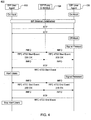
- FIG. 4 depicts an example sequence diagram 400 of a signaling mechanism in accordance with an embodiment of the present invention.
- the SIP session has been established, and SIP user agent 106 has been designated as both the session establisher and the session refresher. While FIG. 4 shows both the SIP INFO mechanism and the RTP events mechanism being used as signaling mechanisms, preferably only one of these is used as the signaling mechanism.
- SIP user agents 102 and 106 communicate using RTP messaging.
- the user changes the state of communication device 112 to off-hook, for example by picking up the hard or soft telephone, as the case may be, which in this example gives rise to no change in the SIP session or the RTP messages.
- the user presses a signal key (or button) on communication device 112 to signal the user of communication device 110 of a desire to communicate. Pressing the signal key causes different messages to be sent depending on which signaling mechanism was negotiated for the SIP session. If the SIP MRD event package is supported on both sides, the signaling events are sent using the SIP INFO method. If the RTP SIP MRD CODECs are supported on both sides, then this method is used.
- Both the SIP MRD event package and the RTP SIP MRD CODECs are supported, then both are used.
- Both the RTP events signaling mechanism and the SIP INFO signaling mechanism convey a "signal begin” event and a “signal end” event using events defined, for example, in RFC-4733, "RTP Payload for DTMF Digits, Telephony Tones, and Telephony Signals," which is hereby incorporated by reference in its entirety.
- pressing the signal key causes an INFO start event message to be sent to SIP user agent 102 over IP network 108, optionally via SIP proxy/B2BUA 104.
- RTP events mechanism was negotiated as the signaling mechanism, then pressing the signal key causes an RTP start event message to be sent to SIP user agent 102 over IP network 108, optionally via SIP proxy/B2BUA 104.
- Configuration data included in the messages indicates the start and end events.
- the INFO message and the RTP message each include RFC-4733 start signal event data, which causes SIP user agent 106 to signal SIP user agent 102, which in turn causes communication device 110 to present a visual and/or audible alert to its user.
- the start signal event information when received at SIP user agent 102, alerts the user of communication device 110 that the user on communication device 112 wishes to communicate.
- the alert may be, for instance, the ringing of a hard or soft telephone or the illumination of a light bulb fixed to the hard or soft telephone.
- SIP user agent 102 Upon receipt of the RFC-4733 start signal event, SIP user agent 102 responds by transmitting an SIP 200 OK message to SIP user agent 106 over IP network 108, optionally via SIP proxy/B2BUA 104.
- the user of communications device 112 then releases the signal key. Releasing the signal key also causes different messages to be sent depending on which signaling mechanism was negotiated for the SIP session. If the SIP INFO method was negotiated as the signaling mechanism, then releasing the signal key causes an INFO message, including an RFC-4733 end signal event, to be sent to SIP user agent 102 over IP network 108, optionally via SIP proxy/B2BUA 104. SIP user agent 102 responds by transmitting a SIP 200 OK message to SIP user agent 106 over IP network 108, optionally via SIP proxy/B2BUA 104.
- RTP events method was negotiated as the signaling mechanism, then releasing the signal key causes an RTP end event message to be sent to SIP user agent 102 over IP network 108, optionally via SIP proxy/B2BUA 104, which, in turn causes the alerting of SIP user agent 102 to cease.
- SIP user agent 102 responds by transmitting a SIP 200 OK message to SIP user agent 106 over IP network 108, optionally via SIP proxy/B2BUA 104.
- automatic ring-down can be performed, instead of manual ring-down, such that the signaling occurs in response to the user changing the state of communication device 112 to off-hook; that is, signaling occurs without the user keying any button or clicking any icon.
- This is particularly useful in time-critical communication applications, such as those between financial brokers or emergency personnel, because it reduces the steps and time necessary to engage in communication.
- one side of the private line for instance the SIP user agent 102, does not support either the SIP INFO signaling mechanism or the RTP events signaling mechanism. In this case, signaling will not be sent in either direction and the communication line will function similar to a hoot-and-holler communication line.
- FIG. 5 depicts an example sequence diagram 500 for re-establishing a session after the session has failed.
- a SIP session failure can occur in two ways: (1) by the isolated failure of an attempt to refresh the SIP session, or (2) by the failure of an attempt to refresh the SIP session in conjunction with RTP messages no longer being received by the SIP session refresher.
- SIP user agent 106 has been designated as the session establisher and the session refresher.
- operation of SIP user agent 102 has failed.
- SIP user agent 106 attempts to refresh the session by transmitting an INVITE message to SIP user agent 102 over the IP network 108, optionally via SIP proxy/B2BUA 104.
- SIP user agent 102 fails to respond to the INVITE and, after a predetermined timeout period, SIP proxy/B2BUA 104 transmits to SIP user agent 106 a request timeout 408 message over IP network 108.
- SIP user agent 106 acknowledges the request timeout 408 message by transmitting an ACK message to SIP proxy/B2BUA 104 over IP network 108.
- SIP user agent 106 then sends a BYE message to SIP user agent 102 over IP network 108, optionally via SIP proxy/B2BUA 104.
- SIP user agent 102 fails to respond to this message as well and, after a predetermined timeout period, SIP proxy/B2BUA 104 sends to SIP user agent 106 another request timeout 408 message.
- SIP user agent 106 begins to run a session establish timer. As shown in FIG.5 , at some point in time before the session establish timer expires, operation of SIP user agent 102 is restored.
- SIP user agent 106 attempts to establish the session once again by transmitting another INVITE message to SIP user agent 102 over IP network 108, optionally via SIP proxy/B2BUA 104. This time, because operation of SIP user agent 102 has been restored, SIP user agent 102 responds by transmitting a SIP 200 OK message to SIP user agent 106 over IP network 108, optionally via SIP proxy/B2BUA 104. SIP user agent 106 acknowledges this by transmitting and ACK message to SIP user agent 102 over IP network 108, optionally via SIP proxy/B2BUA 104, indicating that the session has been re-established. SIP user agent 106 and SIP user agent 102 can then continue to communicate using RTP messages.
- SIP user agent 106 would periodically attempt to re-establish the session, at a predetermined repetition rate, until re-establishment is successful or until a predetermined number of failed re-establishment attempts occurs.
- the manual ring-down communication line is self-healing. That is, SIP user agent 106 attempts to maintain a persistent private communication line with SIP user agent 102 for as long as possible without requiring human intervention, unless components are damaged and/or are malfunctioning.
- the present invention (e.g., system 100, sequence diagrams 200, 300, 400, 500, or any part(s) or function(s) thereof) can be implemented using hardware, software or a combination thereof and can be implemented in one or more computer systems or other processing systems.
- the manipulations performed by the present invention were often referred to in terms, such as establishing or discovering, which are commonly associated with mental operations performed by a human operator. No such capability of a human operator is necessary, or desirable in most cases, in any of the operations described herein which form part of the present invention. Rather, the operations are machine operations.
- Useful machines for performing the operation of the present invention include general purpose digital computers or similar devices.
- the invention is directed toward one or more computer systems capable of carrying out the functionality described herein.
- An example of a computer system 600 is shown in FIG. 6 .
- Computer system 600 includes one or more processors, such as processor 604.
- the processor 604 is connected to a communication infrastructure 606 (e.g., a communications bus, cross-over bar, or network).
- a communication infrastructure 606 e.g., a communications bus, cross-over bar, or network.
- Computer system 600 can include a display interface 602 that forwards graphics, text, and other data from the communication infrastructure 606 (or from a frame buffer not shown) for display on the display unit 630.
- Computer system 600 also includes a main memory 608, preferably random access memory (RAM), and can also include a secondary memory 610.
- the secondary memory 610 can include, for example, a hard disk drive 612 and/or a removable storage drive 614, representing a floppy disk drive, a magnetic tape drive, an optical disk drive, etc.
- the removable storage drive 614 reads from and/or writes to a removable storage unit 618 in a well known manner.
- Removable storage unit 618 represents a floppy disk, magnetic tape, optical disk, etc. which is read by and written to by removable storage drive 614.
- the removable storage unit 618 includes a computer usable storage medium having stored therein computer software and/or data.
- secondary memory 610 can include other similar devices for allowing computer programs or other instructions to be loaded into computer system 600.
- Such devices can include, for example, a removable storage unit 622 and an interface 620.
- Examples of such can include a program cartridge and cartridge interface (such as that found in video game devices), a removable memory chip (such as an erasable programmable read only memory (EPROM), or programmable read only memory (PROM)) and associated socket, and other removable storage units 622 and interfaces 620, which allow software and data to be transferred from the removable storage unit 622 to computer system 600.
- a program cartridge and cartridge interface such as that found in video game devices
- EPROM erasable programmable read only memory
- PROM programmable read only memory
- Computer system 600 can also include a communications interface 624.
- Communications interface 624 allows software and data to be transferred between computer system 600 and external devices. Examples of communications interface 624 can include a modem, a network interface (such as an Ethernet card), a communications port, a Personal Computer Memory Card International Association (PCMCIA) slot and card, etc.
- Software and data transferred via communications interface 624 are in the form of signals 628 which can be electronic, electromagnetic, optical or other signals capable of being received by communications interface 624. These signals 628 are provided to communications interface 624 via a communications path (e.g., channel) 626. This channel 626 carries signals 628 and can be implemented using wire or cable, fiber optics, a telephone line, a cellular link, a radio frequency (RF) link and other communications channels.
- RF radio frequency
- computer program medium “computer-readable medium,” and “computer-usable medium” are used to generally refer to media such as removable storage drive 614, a hard disk installed in hard disk drive 612, and/or signals 628.
- These computer program products provide software to computer system 600.
- the invention is directed to such computer program products.
- Computer programs are stored in main memory 608 and/or secondary memory 610. Computer programs can also be received via communications interface 624. Such computer programs, when executed, enable the computer system 600 to perform the features of the present invention, as discussed herein. In particular, the computer programs, when executed, enable the processor 604 to perform the features of the present invention. Accordingly, such computer programs represent controllers of the computer system 600.
- the software can be stored in a computer program product and loaded into computer system 600 using removable storage drive 614, hard drive 612 or communications interface 624.
- the control logic when executed by the processor 604, causes the processor 604 to perform the functions of the invention as described herein.
- the invention is implemented primarily in hardware using, for example, hardware components such as application specific integrated circuits (ASICs).
- ASICs application specific integrated circuits
- the invention is implemented using a combination of both hardware and software.
Landscapes
- Engineering & Computer Science (AREA)
- Business, Economics & Management (AREA)
- General Business, Economics & Management (AREA)
- Multimedia (AREA)
- Computer Networks & Wireless Communication (AREA)
- Signal Processing (AREA)
- Telephonic Communication Services (AREA)
Description
- The present invention generally relates to telecommunication systems, and more particularly to systems, methods, and computer program products for providing a manual ring-down communication line using the Session Initiation Protocol ("SIP").
- A manual ring-down ("MRD") private line is a communication line commonly used for two parties to maintain a continuous full-duplex communication channel with each other. A typical MRD private line communication device provides a user with the ability to manually signal the communication device on the other side of the line. Upon receiving the signal, the signaled communication device notifies its user audibly and/or visually that the user on the other end of the line wishes to communicate.
- MRD private lines date back to a time period when telephones were purely analog devices, and the MRD private line was implemented using a physical copper wire connecting the two communication devices. Because the MRD private line typically was implemented using a fixed physical connection, a dedicated communication path was created through which users could communicate with each other at any time by, for example, picking up a telephone handset and keying a signaling button An alternative to a MRD private line communication device is an automatic ring-down (ARD) private line communication device, which enables its user to automatically signal the communication device on the other side of the line by, for example, merely picking up a telephone handset.
- Typical users of manual and automatic ring-down private lines make large volumes of calls from and to fixed locations and require continuous and uninterrupted lines of communication between those locations. Examples of such users are trading floor environments, financial firms, emergency services, and the like. Audio communication in trading floor environments is typically achieved utilizing specialized hardware and software turret switching systems. A turret switching system is a specialized telephony switching system that allows a relatively small number of users to access a large number of external lines and provides enhanced communication features such as hoot-n-holler, push-to-talk, intercom, video and large-scale conferencing.
- Users interface with a turret switching system through a trading turret device, which can be implemented in dedicated hardware (sometimes referred to as a "hard" turret) or in a general-purpose computer (sometimes referred to as a "soft" turret). A hard turret is a phone-like desktop device with multiple handsets, external microphones, speakers and buttons. A soft turret is a software application that runs on a trader's desktop personal computer ("PC") or on a mobile computer such as a Personal Digital Assistant ("PDA"). A soft turret application may be controlled using the native control interface that the computer provides such as a touch screen, stylus, click wheel, or mouse and keyboard. In addition to rendering a graphical image of the turret on the PC screen, the soft turret application may also provide voice, instant messaging and presence features.
- With the advent of Voice over Internet Protocol ("VoIP"), users have begun to communicate over Internet Protocol ("IP") networks, for example, using telephones implemented in dedicated hardware, or telephones implemented on general purpose computer, which are sometimes referred to as hard telephones and soft telephones, respectively. Supporting MRD functionality in the IP realm, however, necessarily requires customizations to provide, for example, the same persistent connections and signaling.
WO 2006/002681 A1 relates to a push-to-talk over cellular (PoC) method and device that purportedly enable a party to a conversation to obtain location information of another party. A message is received at a first terminal device that indicates that a user of a second terminal device has pressed a talk button. The message also indicates a geographical location of the second terminal device. The geographical location is indicated to the user of the first terminal device.
"SIP Event Package for Keys", by Bert Culpepper et al relates to a SIP event package that presents a framework for defining key event packages to be used by SIP network entities for requesting and reporting states related to keys or buttons. Key event packages are defined to represent telephone dial pads, feature buttons found on commercial telephones, standard keyboards as well as the framework to support user or device specific buttons. The event package and associated key packages can be used to enable SIP services where an application or a SIP entity requires user indications generated through key-based input.
US 2009/0022145 discloses a method handling SIP sessions which method uses a line card to send a single RE-INVITE attempt using a different proxy after a predetermined time has elapsed. - The example embodiments described herein provide systems, methods, and computer program products for implementing manual ring-down communication using SIP according to the independent claims and the further embodiments of the dependent claims. SIP is an application-layer control (i.e., signaling) protocol for creating, modifying, and terminating sessions such as Internet telephony calls with one or more participants and is defined in RFC-3261. A first SIP user agent transmits an INVITE message to a second SIP user agent over an IP network to establish a SIP MRD session. The first SIP user agent determines that a signal key associated with a first communication device has been selected. The first SIP user agent transmits a start event message to the second SIP user agent over the IP network to cause a second communication device to activate an alert. The first SIP user agent determines that the signal key associated with the first communication device has been released. The first SIP user agent transmits an end event message to the second SIP user agent over the IP network to cause the second communication device to deactivate the alert. The first SIP user agent transmits, to the second SIP user agent over the IP network, one or more subsequent RE-INVITE messages at a predetermined repetition rate to detect the liveliness of the second SIP user agent.
- In another aspect, a method of negotiating a SIP MRD session establisher is provided. A first SIP user agent transmits, to a second SIP user agent over an IP network, an OPTIONS message to request designation of an MRD session establisher. The OPTIONS message includes an identifier of the first SIP user agent. The first SIP user agent receives, from the second SIP user agent over the IP network, a 200 OK message accepting designation of the first SIP user agent as the session establisher. Should the two SIP user agents send the OPTIONS message at the same time, thus causing a glare condition due to messages crossing on the wire, the SIP user agent with the numerically higher IP address will be chosen as the establisher. Both user agents know each other's IP address through the SIP 'Contact' header field within the OPTIONS message.
- In another aspect, a method of re-establishing a failed SIP session is provided. A first SIP user agent receives, over an IP network, a request timeout message indicating that a SIP session with a second SIP user agent has failed. The first SIP user agent initiates a session establish timer. The first SIP user agent transmits, to the second SIP user agent over the IP network, an INVITE message, in response to the session establish timer expiring. The first SIP user agent repeats above process until a 200 OK message is received from the second SIP user agent.
- Further features and advantages, as well as the structure and operation, of various example embodiments of the present invention are described in detail below with reference to the accompanying drawings.
-
-
FIG. 1 depicts a block diagram of an example communication system in accordance with an embodiment of the present invention. -
FIG. 2 depicts a sequence diagram for dynamically discovering a session establisher. -
FIG. 3 depicts an example sequence diagram for establishing a session. -
FIG. 4 depicts an example sequence diagram of a mid-session MRD signaling mechanism. -
FIG. 5 depicts an example sequence diagram for re-establishing a session after a session failure. -
FIG. 6 depicts a block diagram of an exemplary computer system useful for implementing the present invention. - The features and advantages of the example embodiments of the invention presented herein will become more apparent from the detailed description set forth below when taken in conjunction with the drawings in which like reference numbers indicate identical or functionally similar elements.
- The example embodiments of the invention presented herein are directed to systems, methods, and computer program products for providing a manual ring-down communication line using SIP, which are now described herein in terms of an example communication system. The communication system can be implemented, for example, in financial, security/law enforcement, utilities, healthcare, and customer support (e.g., contact centers) environments.
-
FIG. 1 depicts a block diagram of anexample communication system 100 in accordance with an embodiment of the present invention. As shown inFIG. 1 ,communication system 100 includescommunication devices communication devices - As shown in
FIG. 1 ,communication devices SIP user agent 102 andSIP user agent 106, respectively, over, for example, a network or a proprietary communication line (not shown). Generally,SIP user agents - Although
FIG. 1 showsSIP user agents communication devices SIP user agents communication devices -
SIP user agent 102 andSIP user agent 106 are each communicatively coupled with one or more SIP proxies or back-to-back user agents (B2BUA) 104 through anIP network 108, through which users can communicate usingcommunication devices B2BUA 104 manages messaging by caching and notifying the states ofcommunication devices system 100. SIP proxy/B2BUA 104 also processes and stores SIP registrations, which are uploaded by users ofSIP user agents system 100 includes SIP proxy/B2BUA 104, these components are optional. Embodiments whereSIP user agent - Although
system 100 only shows two SIP user agents and communication devices, embodiments including more than two SIP user agents and communication devices sharing a SIP MRD session are contemplated and are within the scope of the present invention. For example, if three or more SIP user agents and communication devices are included insystem 100, party-line communication is possible.System 100 may also include additional SIP user agents, which are configured to function as redundant backups in the event of a SIP user agent malfunction. Similarly,system 100 may include additional communication devices, which are configured to function as redundant backups in the event of a communication device malfunction. - SIP is an application-layer control (i.e., signaling) protocol for creating, modifying, and terminating sessions, such as Internet telephony calls, with one or more participants and is defined in RFC-3261, "SIP: Session Initiation Protocol." SIP-based communication architectures provide the ability to signal and communicate between telephony systems in collaboration with other protocols such as Session Description Protocol ("SDP") and Real-Time Protocol ("RTP"). SDP describes streaming media initialization parameters in an ASCII string and multimedia communication sessions for the purposes of session announcement, session invitation, and parameter negotiation. SDP is defined in RFC-4566, "SDP: Session Description Protocol." RTP is a standardized packet format for delivering audio and/or video data over IP networks and is defined by RFC-3550, "RTP: A Transport Protocol for Real-Time Applications" which has been updated by RFC-5506, "Support for Reduced-Size Real-Time Transport Control Protocol (RTCP): Opportunities and Consequences." RFC-3261, RFC-4566, RFC-3350, and RFC-5506 are hereby incorporated by reference in their entirety.
- In an example embodiment,
SIP user agents IP network 108.SIP user agents B2BUA 104 use SIP to provide signaling functionality over theIP network 108 and to create, modify, and terminate RTP sessions such as VoIP calls. -
FIG. 2 depicts a sequence diagram 200 for dynamically discovering which of theSIP user agents - As shown in
FIG. 2 , onceSIP user agents SIP user agent 106 requests to be designated as the session establisher by transmitting an OPTIONS message toSIP user agent 102. The OPTIONS message includes a value indicating that a particular user agent requests to be designated as the session establisher and an identifier value of the particular user agent, in this exampleSIP user agent 106. The indication may be a text string such as "establisher=uac" or "establisher=uas". The value "uac" implies that the SIP user agent that originated the OPTIONS message intends to be the session establisher. The value "uas" implies that the SIP user agent that originated the OPTIONS message intends the other SIP user agent to be the session establisher. This text string may be appended to the existing 'Contact' header field in the SIP OPTIONS message or may be carried in a header field of its own. - Once
SIP user agent 106 transmits the OPTIONS message toSIP user agent 102,SIP user agent 106 waits for a response. Upon receiving the OPTIONS message fromSIP user agent 106,SIP user agent 102 responds by transmitting aSIP 200 "OK" message toSIP user agent 106, as shown inFIG. 2 . UponSIP user agent 106 receiving theSIP 200 OK message,SIP user agent 106 is designated the session establisher. TheSIP 200 OK messages also carry the "establisher" parameter to indicate what the other SIP user agent has agreed upon with respect to which SIP user agent performs the establisher role. - Although
FIG. 2 showsSIP user agent 106 as the session establisher, embodiments whereSIP user agent 102 is the session establisher also are contemplated and are within the scope of the present invention. In fact, the discovery of the session establisher is dynamic in that eitherSIP user agent 102 orSIP user agent 106 may request to be designated as session establisher. Dynamic discovery of the session establisher enables any end-point to determine which end-point should attempt to establish the session. Both ends of the private line, that is, bothSIP user agent 102 andSIP user agent 106, are configured with each other's address of record ("AOR") and can initiate calls in either direction. - Dynamic discovery of the session establisher also assists in preventing multiple end-points, in this example
SIP user agents SIP user agent SIP user agent communication system 100, and the potential for human errors in configuration. - In an alternative embodiment, the session establisher can be determined by using configuration parameters or manually through a user interface (not shown).
-
FIG. 3 depicts an example sequence diagram 300 for establishing a session. As mentioned above, establishment of a session is not attempted until an end-point has been designated as the session establisher. In this example,SIP user agent 106 has previously been designated as the session establisher. The establishment of the SIP session is attempted regardless of the on-hook/off-hook state ofSIP user agents 102 and/or 106. In this way, the communication line that results from a successful session establishment functions as if it is an "always on" connection. For example, a user ofcommunication device 110 may exchange voice communications with a user ofcommunication device 112 without having to dial a number associated withcommunication device 112; the SIP session may have been previously established before either user picks up their hard or soft telephone, as the case may be. This automatic session establishment allows users to speak to each other without requiring any action by them and is the basis for private line functionality. - As shown in
FIG. 3 ,SIP user agent 106, as the session establisher, transmits an INVITE message overIP network 108 to SIP proxy/B2BUA 104, which in turn forwards the INVITE message toSIP user agent 102. Alternatively, as mentioned above,SIP user agent 106 may transmit the INVITE message overIP network 108 directly toSIP user agent 102. The INVITE message contains a number of header fields, which are named attributes that provide additional information about a message. The attributes present in the INVITE message can include a unique identifier for the call, the destination address, the source address, and/or information about the type of session that the session establisher is attempting to establish. The body of the INVITE message contains a description of the session, encoded in some other protocol format, such as SDP, which is mentioned above in further detail. WhenSIP user agent 102 receives the INVITE message, it automatically answers the call.SIP user agent 102 responds by transmitting aSIP 200 OK message to SIPuser agent 106 viaIP network 108 and optionally via SIP proxy/B2BUA 104. At this point the session is established. - Once the session has been established, it is determined which end-point is to be designated as a session refresher, which is used to periodically refresh a corresponding SIP session. In an example embodiment, the session refresher is determined according to RFC-4028, "Session Timers in the Session Initiation Protocol (SIP)," which is hereby incorporated by reference in its entirety. The signaling mechanism is negotiated during session establishment in accordance with the "Session Initiation Protocol (SIP) INFO Method and Package Framework," which is hereby incorporated by reference in its entirety. In this example,
SIP user agent 106 functions as both the session establisher and the session refresher.SIP user agent 106, as session establisher, also negotiates with the other user agent(s) as to which specific signaling mechanism is to be used throughout the session. In this example, an RTP events signaling method is negotiated as the signaling mechanism to be used betweenSIP user agents - An example SIP MRD event package is defined as follows. A package name for SIP MRD Info-Event is "sip-mrd". Below are examples of SIP headers where the package name (or token name) is carried:
- Info-Package: sip-mrd
- Recv-Info: sip-mrd.
- A Content-Type header is specified as "application/sip-mrd". An Augmented Backus-Naur Form (ABNF) for a SIP MRD Info-Event is defined as follows:
- sip-mrd-relay-body = signal-line CRLF duration-line
- signal-line = "Signal" EQUAL SP ("start" / "stop")
- duration-line = "Duration" EQUAL SP msecs
- msecs = 1*4(DIGIT); 100-5000 millisecs.
-
FIG. 4 depicts an example sequence diagram 400 of a signaling mechanism in accordance with an embodiment of the present invention. In this example, the SIP session has been established, andSIP user agent 106 has been designated as both the session establisher and the session refresher. WhileFIG. 4 shows both the SIP INFO mechanism and the RTP events mechanism being used as signaling mechanisms, preferably only one of these is used as the signaling mechanism. - As shown in
FIG. 4 ,SIP user agents communication device 112 to off-hook, for example by picking up the hard or soft telephone, as the case may be, which in this example gives rise to no change in the SIP session or the RTP messages. The user then presses a signal key (or button) oncommunication device 112 to signal the user ofcommunication device 110 of a desire to communicate. Pressing the signal key causes different messages to be sent depending on which signaling mechanism was negotiated for the SIP session. If the SIP MRD event package is supported on both sides, the signaling events are sent using the SIP INFO method. If the RTP SIP MRD CODECs are supported on both sides, then this method is used. If both the SIP MRD event package and the RTP SIP MRD CODECs are supported, then both are used. Both the RTP events signaling mechanism and the SIP INFO signaling mechanism convey a "signal begin" event and a "signal end" event using events defined, for example, in RFC-4733, "RTP Payload for DTMF Digits, Telephony Tones, and Telephony Signals," which is hereby incorporated by reference in its entirety. If the SIP INFO method was negotiated as the signaling mechanism, then pressing the signal key causes an INFO start event message to be sent toSIP user agent 102 overIP network 108, optionally via SIP proxy/B2BUA 104. If the RTP events mechanism was negotiated as the signaling mechanism, then pressing the signal key causes an RTP start event message to be sent toSIP user agent 102 overIP network 108, optionally via SIP proxy/B2BUA 104. Configuration data included in the messages indicates the start and end events. - The INFO message and the RTP message each include RFC-4733 start signal event data, which causes
SIP user agent 106 to signalSIP user agent 102, which in turn causescommunication device 110 to present a visual and/or audible alert to its user. Particularly, the start signal event information, when received atSIP user agent 102, alerts the user ofcommunication device 110 that the user oncommunication device 112 wishes to communicate. The alert may be, for instance, the ringing of a hard or soft telephone or the illumination of a light bulb fixed to the hard or soft telephone. Upon receipt of the RFC-4733 start signal event,SIP user agent 102 responds by transmitting anSIP 200 OK message to SIPuser agent 106 overIP network 108, optionally via SIP proxy/B2BUA 104. - The user of
communications device 112 then releases the signal key. Releasing the signal key also causes different messages to be sent depending on which signaling mechanism was negotiated for the SIP session. If the SIP INFO method was negotiated as the signaling mechanism, then releasing the signal key causes an INFO message, including an RFC-4733 end signal event, to be sent toSIP user agent 102 overIP network 108, optionally via SIP proxy/B2BUA 104.SIP user agent 102 responds by transmitting aSIP 200 OK message to SIPuser agent 106 overIP network 108, optionally via SIP proxy/B2BUA 104. If the RTP events method was negotiated as the signaling mechanism, then releasing the signal key causes an RTP end event message to be sent toSIP user agent 102 overIP network 108, optionally via SIP proxy/B2BUA 104, which, in turn causes the alerting ofSIP user agent 102 to cease.SIP user agent 102 responds by transmitting aSIP 200 OK message to SIPuser agent 106 overIP network 108, optionally via SIP proxy/B2BUA 104. - In an alternative embodiment, automatic ring-down can be performed, instead of manual ring-down, such that the signaling occurs in response to the user changing the state of
communication device 112 to off-hook; that is, signaling occurs without the user keying any button or clicking any icon. This is particularly useful in time-critical communication applications, such as those between financial brokers or emergency personnel, because it reduces the steps and time necessary to engage in communication. - In another alternative embodiment, one side of the private line, for instance the
SIP user agent 102, does not support either the SIP INFO signaling mechanism or the RTP events signaling mechanism. In this case, signaling will not be sent in either direction and the communication line will function similar to a hoot-and-holler communication line. -
FIG. 5 depicts an example sequence diagram 500 for re-establishing a session after the session has failed. A SIP session failure can occur in two ways: (1) by the isolated failure of an attempt to refresh the SIP session, or (2) by the failure of an attempt to refresh the SIP session in conjunction with RTP messages no longer being received by the SIP session refresher. In this example,SIP user agent 106 has been designated as the session establisher and the session refresher. As shown inFIG. 5 , operation ofSIP user agent 102 has failed.SIP user agent 106 attempts to refresh the session by transmitting an INVITE message toSIP user agent 102 over theIP network 108, optionally via SIP proxy/B2BUA 104.SIP user agent 102 fails to respond to the INVITE and, after a predetermined timeout period, SIP proxy/B2BUA 104 transmits to SIP user agent 106 arequest timeout 408 message overIP network 108.SIP user agent 106 acknowledges therequest timeout 408 message by transmitting an ACK message to SIP proxy/B2BUA 104 overIP network 108. -
SIP user agent 106 then sends a BYE message toSIP user agent 102 overIP network 108, optionally via SIP proxy/B2BUA 104.SIP user agent 102 fails to respond to this message as well and, after a predetermined timeout period, SIP proxy/B2BUA 104 sends to SIPuser agent 106 anotherrequest timeout 408 message.SIP user agent 106 begins to run a session establish timer. As shown inFIG.5 , at some point in time before the session establish timer expires, operation ofSIP user agent 102 is restored. In response to the session establish timer expiring,SIP user agent 106 attempts to establish the session once again by transmitting another INVITE message toSIP user agent 102 overIP network 108, optionally via SIP proxy/B2BUA 104. This time, because operation ofSIP user agent 102 has been restored,SIP user agent 102 responds by transmitting aSIP 200 OK message to SIPuser agent 106 overIP network 108, optionally via SIP proxy/B2BUA 104.SIP user agent 106 acknowledges this by transmitting and ACK message toSIP user agent 102 overIP network 108, optionally via SIP proxy/B2BUA 104, indicating that the session has been re-established.SIP user agent 106 andSIP user agent 102 can then continue to communicate using RTP messages. - Referring back to
FIG. 5 , if the operation ofSIP user agent 102 had not been restored prior to the session establish timer expiring,SIP user agent 106 would periodically attempt to re-establish the session, at a predetermined repetition rate, until re-establishment is successful or until a predetermined number of failed re-establishment attempts occurs. In this way, the manual ring-down communication line is self-healing. That is,SIP user agent 106 attempts to maintain a persistent private communication line withSIP user agent 102 for as long as possible without requiring human intervention, unless components are damaged and/or are malfunctioning. - The present invention (e.g.,
system 100, sequence diagrams 200, 300, 400, 500, or any part(s) or function(s) thereof) can be implemented using hardware, software or a combination thereof and can be implemented in one or more computer systems or other processing systems. However, the manipulations performed by the present invention were often referred to in terms, such as establishing or discovering, which are commonly associated with mental operations performed by a human operator. No such capability of a human operator is necessary, or desirable in most cases, in any of the operations described herein which form part of the present invention. Rather, the operations are machine operations. Useful machines for performing the operation of the present invention include general purpose digital computers or similar devices. - In fact, in one embodiment, the invention is directed toward one or more computer systems capable of carrying out the functionality described herein. An example of a
computer system 600 is shown inFIG. 6 . -
Computer system 600 includes one or more processors, such asprocessor 604. Theprocessor 604 is connected to a communication infrastructure 606 (e.g., a communications bus, cross-over bar, or network). Various software embodiments are described in terms of this exemplary computer system. After reading this description, it will become apparent to a person skilled in the relevant art(s) how to implement the invention using other computer systems and/or architectures. -
Computer system 600 can include adisplay interface 602 that forwards graphics, text, and other data from the communication infrastructure 606 (or from a frame buffer not shown) for display on thedisplay unit 630. -
Computer system 600 also includes amain memory 608, preferably random access memory (RAM), and can also include asecondary memory 610. Thesecondary memory 610 can include, for example, ahard disk drive 612 and/or aremovable storage drive 614, representing a floppy disk drive, a magnetic tape drive, an optical disk drive, etc. Theremovable storage drive 614 reads from and/or writes to aremovable storage unit 618 in a well known manner.Removable storage unit 618 represents a floppy disk, magnetic tape, optical disk, etc. which is read by and written to byremovable storage drive 614. As will be appreciated, theremovable storage unit 618 includes a computer usable storage medium having stored therein computer software and/or data. - In alternative embodiments,
secondary memory 610 can include other similar devices for allowing computer programs or other instructions to be loaded intocomputer system 600. Such devices can include, for example, a removable storage unit 622 and aninterface 620. Examples of such can include a program cartridge and cartridge interface (such as that found in video game devices), a removable memory chip (such as an erasable programmable read only memory (EPROM), or programmable read only memory (PROM)) and associated socket, and other removable storage units 622 andinterfaces 620, which allow software and data to be transferred from the removable storage unit 622 tocomputer system 600. -
Computer system 600 can also include a communications interface 624. Communications interface 624 allows software and data to be transferred betweencomputer system 600 and external devices. Examples of communications interface 624 can include a modem, a network interface (such as an Ethernet card), a communications port, a Personal Computer Memory Card International Association (PCMCIA) slot and card, etc. Software and data transferred via communications interface 624 are in the form ofsignals 628 which can be electronic, electromagnetic, optical or other signals capable of being received by communications interface 624. Thesesignals 628 are provided to communications interface 624 via a communications path (e.g., channel) 626. Thischannel 626 carriessignals 628 and can be implemented using wire or cable, fiber optics, a telephone line, a cellular link, a radio frequency (RF) link and other communications channels. - In this document, the terms "computer program medium," "computer-readable medium," and "computer-usable medium" are used to generally refer to media such as
removable storage drive 614, a hard disk installed inhard disk drive 612, and/or signals 628. These computer program products provide software tocomputer system 600. The invention is directed to such computer program products. - Computer programs (also referred to as computer control logic) are stored in
main memory 608 and/orsecondary memory 610. Computer programs can also be received via communications interface 624. Such computer programs, when executed, enable thecomputer system 600 to perform the features of the present invention, as discussed herein. In particular, the computer programs, when executed, enable theprocessor 604 to perform the features of the present invention. Accordingly, such computer programs represent controllers of thecomputer system 600. - In an embodiment where the invention is implemented using software, the software can be stored in a computer program product and loaded into
computer system 600 usingremovable storage drive 614,hard drive 612 or communications interface 624. The control logic (software), when executed by theprocessor 604, causes theprocessor 604 to perform the functions of the invention as described herein. - In another embodiment, the invention is implemented primarily in hardware using, for example, hardware components such as application specific integrated circuits (ASICs). Implementation of the hardware state machine so as to perform the functions described herein will be apparent to persons skilled in the relevant art(s).
- In yet another embodiment, the invention is implemented using a combination of both hardware and software.
- While various embodiments of the present invention have been described above, it should be understood that they have been presented by way of example, and not limitation. It will be apparent to persons skilled in the relevant art(s) that various changes in form and detail can be made therein without departing from the scope of the present invention. Thus, the present invention should not be limited by any of the above described exemplary embodiments, but is defined only in accordance with the following claims.
- In addition, it should be understood that the figures illustrated in the attachments, which highlight the functionality and advantages of the present invention, are presented for example purposes only. The architecture of the present invention is sufficiently flexible and configurable, such that it can be utilized (and navigated) in ways other than that shown in the accompanying figures.
- Further, the purpose of the foregoing Abstract is to enable the U.S. Patent and Trademark Office and the public generally, and especially the scientists, engineers and practitioners in the art who are not familiar with patent or legal terms or phraseology, to determine quickly from a cursory inspection the nature and essence of the technical disclosure of the application. The Abstract is not intended to be limiting as to the scope of the present invention in any way. It is also to be understood that the steps and processes recited in the claims need not be performed in the order presented.
Claims (13)
- A method for providing a manual ring-down communication line using Session Initiation Protocol (SIP), comprising the steps of:transmitting, by a session establisher SIP user agent (106) to a second SIP user agent (102) over an Internet Protocol (IP) network (108), an INVITE message;receiving, by the session establisher SIP user agent (106) from the second SIP user agent (102), an acknowledgment message transmitted in response to the INVITE message, thereby establishing a private line SIP session, wherein the private line SIP session provides a manual ring-down communication line, wherein the method furthermore comprises the following steps:re-establishing, by the session establisher SIP user agent (106), the private line SIP session after a session failure, wherein the session establisher SIP user agent (106) begins a session establishment timer, and in response to the session establishment timer expiring, transmits a second INVITE message to the second SIP user agent (102) to re-establish the session, and upon receiving an OK message from the second SIP user agent (102), transmits an ACK message to confirm re-establishment of the session;determining, by the session establisher SIP user agent (106), that a signal key associated with a first communication device (110) has been selected;transmitting, by the session establisher SIP user agent (106) to the second SIP user agent (102) over the IP network (108), a start event message to cause a second communication device (112) to activate an alert;determining, by the session establisher SIP user agent (106), that the signal key associated with the first communication device (110) has been released; andtransmitting, by the session establisher SIP user agent (106) to the second SIP user agent (102) over the IP network (108), an end event message to cause the second communication device (112) to deactivate the alert.
- The method of claim 1, further comprising forwarding, by at least one of the SIP proxy and a back-to-back user agent (B2BUA), a message between the session establisher SIP user agent (106) and the second SIP user agent (102) over the IP network (108).
- The method of claim 1, wherein the alert is at least one of an audible alert and a visual alert.
- The method of claim 1, wherein session establisher SIP user agent (106) periodically attempts to re-establish the session until re-establishment is successful.
- The method of claim 1, wherein session establisher SIP user agent (106) periodically attempts to re-establish the session until a predetermined number of failed re-establishment attempts occurs.
- A non-transistory computer-readable medium having stored thereon sequences of instructions, the sequences of instructions including instructions, which, when executed by a computer system, cause the computer system (100) to:transmit, by a session establisher Session Initiation Protocol (SIP) user agent (106) to a second SIP user agent (102) over an Internet Protocol (IP) network (108), an INVITE message;receive, by the session establisher SIP user agent (106) from the second SIP user agent (102), an acknowledgment message transmitted in response to the INVITE message, thereby establishing a private line SIP session, wherein the private line SIP session provides a manual ring-down communication line, wherein such instructions furthermore cause the computer system (100) to re-establish, by the session establisher SIP user agent (106), the private line SIP session after a session failure, wherein the session establisher SIP user agent (106) begins a session establishment timer, in response to the session establishment timer expiring, transmits a second INVITE message to the second SIP user agent (102) to re-establish the session, and upon receiving an OK message from the second SIP user agent (102), transmits an ACK message to confirm re-establishment of the session;determine, by the session establisher SIP user agent (106), that a signal key associated with a first communication device (110) has been selected;transmit, by the session establisher SIP user agent (106) to the second SIP user agent (102) over the IP network (108), a start event message to cause a second communication device (112) to activate an alert;determine, by the session establisher SIP user agent (106), that the signal key associated with the first communication device (110) has been released; andtransmit, by the session establisher SIP user agent (106) to the second SIP user agent (102) over the IP network (108), an end event message to cause the second communication device (112) to deactivate the alert.
- The non-transistory computer-readable medium of claim 6, wherein the instructions, when executed by the computer system (100), further cause the computer system (100) to forward, by at least one of the SIP proxy and a back-to-back user agent (B2BUA), a message between the session establisher SIP user agent (106) and the second SIP user agent (102) over the IP network (108).
- The non-transitory computer readable medium of claim 7, wherein the alert is at least one of an audible alert and a visual alert.
- The non-transitory computer readable medium of claim 6, wherein a session establisher message is an OPTIONS message including an identifier of the session establisher SIP user agent (106), and wherein the instructions, when executed by the computer system (100), further cause the computer system (100) to:receive, by the session establisher SIP user agent (106) from the second SIP user agent (102) over the IP network (108), a 200 OK message accepting designation of the session establisher SIP user agent (106) as the session establisher.
- A manual ring-down private line communication system, the system comprising:a first communication device (110) communicatively coupled to an IP network (108) by way of a session establisher Session Initiation Protocol (SIP) user agent (106), wherein the session establisher SIP user agent (106) is configured to:transmit, to a second SIP user agent (102) over the IP network (108), an INVITE message,receive, from the second SIP user agent (108), an acknowledgment message transmitted in response to the INVITE message, thereby establishing a private line SIP session, wherein the private line SIP session provides a manual ring-down communication line, wherein the session establisher SIP user agent (106) is furthermore configured to:re-establish the private line SIP session after a session failure, wherein the session establisher SIP user agent (106) begins a session establishment timer, and in response to the session establishment timer expiring, transmits a second INVITE message to the second SIP user agent (102) to re-establish the session, and upon receiving an OK message from the second SIP user agent (102), transmits an ACK message to confirm re-establishment of the session;determine that a signal key associated with a first communication device (110) has been selected,transmit, to the second SIP user agent (102) over the IP network (108), a start event message to cause a second communication device (112) to activate an alert,determine that the signal key associated with the first communication device (110) has been released, andtransmit, to the second SIP user agent (102) over the IP network (108), an end event message to cause the second communication device (112) to deactivate the alert; andthe second communication device (112) communicatively coupled to the IP network (108) by way of the second SIP user agent (102), wherein the second SIP user agent (102) is configured to:receive, over the IP network (108), the INVITE message, andtransmit an acknowledgment message in response to the INVITE message.
- The system of claim 10, further comprising at least one of the SIP proxy and a back-to-back user agent (B2BUA) configured to forward a message between the session establisher SIP user agent (106) and the second SIP user agent (102) over the IP network (108).
- The system of claim 10, wherein the alert is at least one of an audible alert and a visual alert.
- The system of claim 10, wherein the session establisher message is an OPTIONS message including an identifier of the session establisher SIP user agent (106), and wherein the session establisher SIP user agent (106) is further configured to receive, from the second SIP user agent (102) over the IP network (108), a 200 OK message accepting designation of the session establisher SIP user agent (106) as the session establisher.
Applications Claiming Priority (2)
| Application Number | Priority Date | Filing Date | Title |
|---|---|---|---|
| US12/569,494 US8599834B2 (en) | 2009-09-29 | 2009-09-29 | Systems, methods, and computer program products for providing a manual ring-down communication line using session initiation protocol |
| PCT/US2010/045888 WO2011041035A1 (en) | 2009-09-29 | 2010-08-18 | Providing a manual ring-down communication line using session initiation protocol |
Publications (3)
| Publication Number | Publication Date |
|---|---|
| EP2483796A1 EP2483796A1 (en) | 2012-08-08 |
| EP2483796A4 EP2483796A4 (en) | 2014-01-01 |
| EP2483796B1 true EP2483796B1 (en) | 2017-10-11 |
Family
ID=43780330
Family Applications (1)
| Application Number | Title | Priority Date | Filing Date |
|---|---|---|---|
| EP10820980.0A Active EP2483796B1 (en) | 2009-09-29 | 2010-08-18 | Providing a manual ring-down communication line using sip |
Country Status (4)
| Country | Link |
|---|---|
| US (2) | US8599834B2 (en) |
| EP (1) | EP2483796B1 (en) |
| SG (1) | SG179118A1 (en) |
| WO (1) | WO2011041035A1 (en) |
Families Citing this family (14)
| Publication number | Priority date | Publication date | Assignee | Title |
|---|---|---|---|---|
| US8599834B2 (en) * | 2009-09-29 | 2013-12-03 | Ipc Systems, Inc. | Systems, methods, and computer program products for providing a manual ring-down communication line using session initiation protocol |
| US10104131B2 (en) * | 2011-05-06 | 2018-10-16 | International Business Machines Corporation | Managing session initiation protocol subscription dialog state loss |
| US9602634B2 (en) * | 2012-02-15 | 2017-03-21 | Avaya Inc. | Global session identifier |
| US9912623B2 (en) * | 2015-01-16 | 2018-03-06 | General Electric Company | Systems and methods for adaptive context-aware control of multimedia communication sessions |
| US10972514B2 (en) * | 2015-10-14 | 2021-04-06 | Avaya Inc. | Reestablishment of session initiation protocol (SIP) dialogs |
| US10440155B2 (en) * | 2016-01-11 | 2019-10-08 | Cloud9 Technologies, LLC | Private connection multi-media transition |
| US10938914B2 (en) * | 2016-01-18 | 2021-03-02 | Avaya Inc. | Inter domain instant messaging bridge |
| US11108833B2 (en) | 2016-06-06 | 2021-08-31 | Blackberry Limited | Crossed-invite call handling |
| US10909830B1 (en) * | 2017-11-07 | 2021-02-02 | Pica Product Development, Llc | Personal emergency alert system, method and device |
| US11627170B2 (en) * | 2020-07-09 | 2023-04-11 | Mediatek Inc. | Enhancements for real-time text (RTT) call control over an IP multimedia subsystem (IMS) network |
| US11330034B1 (en) | 2020-10-27 | 2022-05-10 | T-Mobile Usa, Inc. | Data disruption tracking for wireless networks, such as IMS networks |
| US12200592B2 (en) | 2022-03-15 | 2025-01-14 | T-Mobile Usa, Inc. | Automatically identifying a call associated with a wireless telecommunication network as an open-line call |
| US12284582B2 (en) | 2022-03-15 | 2025-04-22 | T-Mobile Usa, Inc. | Inaudibly notifying a caller of a status of an open-line call |
| US12363180B2 (en) * | 2023-11-01 | 2025-07-15 | Oracle International Corporation | Call recording continuity after restart of a call recording system |
Citations (1)
| Publication number | Priority date | Publication date | Assignee | Title |
|---|---|---|---|---|
| US20090022145A1 (en) * | 2007-07-20 | 2009-01-22 | Ipc Systems, Inc. | Systems, methods, apparatus and computer program products for networking trading turret systems using sip |
Family Cites Families (47)
| Publication number | Priority date | Publication date | Assignee | Title |
|---|---|---|---|---|
| US5535204A (en) * | 1993-01-08 | 1996-07-09 | Multi-Tech Systems, Inc. | Ringdown and ringback signalling for a computer-based multifunction personal communications system |
| EP0825787A1 (en) * | 1996-08-12 | 1998-02-25 | BRITISH TELECOMMUNICATIONS public limited company | Negotiation process for connection management |
| US7499527B2 (en) * | 1997-11-03 | 2009-03-03 | Light Elliott D | System and method for determining the status of a telephone in a packet switched network |
| US6970930B1 (en) * | 1999-11-05 | 2005-11-29 | Mci, Inc. | Method and system of providing differentiated services |
| US7571238B1 (en) * | 2000-10-18 | 2009-08-04 | Nortel Networks Limited | Authorizing communication services |
| US20020138427A1 (en) * | 2001-03-20 | 2002-09-26 | Trivedi Prakash A. | Systems and methods for communicating from an integration platform to a billing unit |
| US20050198379A1 (en) * | 2001-06-13 | 2005-09-08 | Citrix Systems, Inc. | Automatically reconnecting a client across reliable and persistent communication sessions |
| US8098651B1 (en) * | 2001-07-27 | 2012-01-17 | Rockstar Bidco, LP | Integrating multimedia capabilities with circuit-switched calls |
| US7002912B2 (en) * | 2001-09-06 | 2006-02-21 | Alcatel | Architecture for transporting PBX signaling codes via SIP |
| US7469299B2 (en) * | 2001-10-25 | 2008-12-23 | Verizon Business Global Llc | Bridging user agent and a proxy server for supporting network services |
| US6704396B2 (en) * | 2002-02-27 | 2004-03-09 | Sbc Technology Resources, Inc. | Multi-modal communications method |
| EP1414211A1 (en) * | 2002-10-23 | 2004-04-28 | Sony International (Europe) GmbH | Software architecture for capability and quality-of-service negotiations and session establishment for distributed multimedia applications |
| US7489771B2 (en) * | 2002-11-02 | 2009-02-10 | Verizon Business Global Llc | Systems and methods for implementing call pickup in a SIP environment |
| GB0319359D0 (en) * | 2003-08-18 | 2003-09-17 | Nokia Corp | Activation of communication sessions in a communication system |
| GB2406464B (en) * | 2003-09-29 | 2006-07-05 | Siemens Ag | Network entity |
| US7804949B2 (en) * | 2003-12-31 | 2010-09-28 | Alcatel Lucent | Client-based integration of PBX and messaging systems |
| EP1728402B1 (en) * | 2004-03-17 | 2018-05-16 | Orange | Method, server and system for managing <=push-to-talk>= session |
| US7031280B2 (en) * | 2004-04-26 | 2006-04-18 | Motorola, Inc. | Method and apparatus for hand over of calls |
| FI20045175A0 (en) * | 2004-05-12 | 2004-05-12 | Nokia Corp | Session establishment for real-time media communication service |
| US7945276B2 (en) * | 2004-07-07 | 2011-05-17 | Siemens Aktiengesellschaft | Methods and terminal devices |
| US7840681B2 (en) * | 2004-07-30 | 2010-11-23 | International Business Machines Corporation | Method and apparatus for integrating wearable devices within a SIP infrastructure |
| US7599347B2 (en) * | 2004-09-16 | 2009-10-06 | Research In Motion Limited | System and method for allocating session initiation protocol (SIP) identifications (IDs) to user agents |
| US7609685B2 (en) * | 2004-09-24 | 2009-10-27 | Zyxel Communications Corp | IP telephony apparatus providing simultaneous SIP communication for multiple IP phones and method for the same |
| KR100619993B1 (en) * | 2005-03-16 | 2006-09-06 | 엘지전자 주식회사 | How to Set Background Music in Call State of Mobile Device |
| US20060221943A1 (en) * | 2005-03-31 | 2006-10-05 | Aborn Justin A | Connecting a packet-based call to multiple devices |
| US20060239251A1 (en) * | 2005-04-26 | 2006-10-26 | Bennett Jesse W | Multi-user media client for communication devices |
| US7450572B2 (en) * | 2005-05-02 | 2008-11-11 | Siemens Communications, Inc. | Intelligent terminal SIP enabled devices |
| US20060253698A1 (en) * | 2005-05-04 | 2006-11-09 | Sujeet Mate | Method, system and entities for exchanging content |
| US7856470B2 (en) * | 2005-05-27 | 2010-12-21 | Microsoft Corporation | Accepting an invitation sent to multiple computer systems |
| US20070064896A1 (en) * | 2005-08-23 | 2007-03-22 | Su-Yuan Chang | System and method for sharing SIP sessions |
| US7729713B1 (en) * | 2005-10-17 | 2010-06-01 | At&T Mobility Ii Llc | Methods for providing mobile PTT communications without requiring PTT servers |
| US20070171898A1 (en) * | 2005-11-29 | 2007-07-26 | Salva Paul D | System and method for establishing universal real time protocol bridging |
| US20070281680A1 (en) * | 2006-06-05 | 2007-12-06 | Vish Raju | Method and system for extending services to cellular devices |
| JP5113166B2 (en) * | 2006-07-06 | 2013-01-09 | コーニンクレッカ フィリップス エレクトロニクス エヌ ヴィ | Communication method between first radio telephone and second radio telephone |
| US20080043722A1 (en) * | 2006-08-04 | 2008-02-21 | Chih-Hsin Chuang | Extension network system and dialing and answering processes of the same |
| US20080095143A1 (en) * | 2006-10-19 | 2008-04-24 | Research In Motion Limited | System and method for providing debug information in session initiation protocol sessions |
| JP4764368B2 (en) * | 2007-03-19 | 2011-08-31 | 株式会社東芝 | Apparatus for establishing communication and relaying message, method and program for establishing communication |
| US20080259909A1 (en) * | 2007-04-17 | 2008-10-23 | Stefan Runeson | Signaling of Early Media Capabilities in IMS Terminals |
| CN101547143B (en) * | 2008-03-28 | 2012-10-03 | 华为技术有限公司 | Method and device for switching streaming media service |
| US20090319657A1 (en) * | 2008-06-19 | 2009-12-24 | Huawei Technologies Co., Ltd. | Sip terminal, method and system for reporting status thereof, and sip server |
| EP2351307B8 (en) * | 2008-09-19 | 2014-08-13 | Telefonaktiebolaget L M Ericsson (PUBL) | Method and apparatus for establishing a poc session |
| US20130101099A9 (en) * | 2008-11-24 | 2013-04-25 | Tomasz Sarnowski | Method and apparatus for telecommunication session authentication using DTMF signaling |
| US9232055B2 (en) * | 2008-12-23 | 2016-01-05 | Avaya Inc. | SIP presence based notifications |
| DE102009020887A1 (en) | 2009-05-12 | 2010-11-18 | Peterpays Ag | Method and device for initiating a communication connection |
| US8599834B2 (en) * | 2009-09-29 | 2013-12-03 | Ipc Systems, Inc. | Systems, methods, and computer program products for providing a manual ring-down communication line using session initiation protocol |
| CA2716181A1 (en) * | 2009-10-02 | 2011-04-02 | Appolo Machine Ltd. | Kit for forming modular structures on a vehicle |
| US8984067B2 (en) * | 2009-10-19 | 2015-03-17 | Verizon Patent And Licensing Inc. | Session initiation protocol (SIP) signaling to keep a voice over internet protocol (VoIP) session active during a call hold |
-
2009
- 2009-09-29 US US12/569,494 patent/US8599834B2/en active Active - Reinstated
-
2010
- 2010-08-18 EP EP10820980.0A patent/EP2483796B1/en active Active
- 2010-08-18 SG SG2012017745A patent/SG179118A1/en unknown
- 2010-08-18 WO PCT/US2010/045888 patent/WO2011041035A1/en not_active Ceased
-
2011
- 2011-05-02 US US13/098,549 patent/US20110206040A1/en not_active Abandoned
Patent Citations (1)
| Publication number | Priority date | Publication date | Assignee | Title |
|---|---|---|---|---|
| US20090022145A1 (en) * | 2007-07-20 | 2009-01-22 | Ipc Systems, Inc. | Systems, methods, apparatus and computer program products for networking trading turret systems using sip |
Also Published As
| Publication number | Publication date |
|---|---|
| US20110206040A1 (en) | 2011-08-25 |
| US8599834B2 (en) | 2013-12-03 |
| EP2483796A4 (en) | 2014-01-01 |
| US20110075653A1 (en) | 2011-03-31 |
| WO2011041035A1 (en) | 2011-04-07 |
| EP2483796A1 (en) | 2012-08-08 |
| SG179118A1 (en) | 2012-04-27 |
Similar Documents
| Publication | Publication Date | Title |
|---|---|---|
| US8599834B2 (en) | Systems, methods, and computer program products for providing a manual ring-down communication line using session initiation protocol | |
| US7840681B2 (en) | Method and apparatus for integrating wearable devices within a SIP infrastructure | |
| CA2559912C (en) | Mode shifting communications system and method | |
| EP2704394A1 (en) | Processing communication sessions | |
| US20080013447A1 (en) | Method and Apparatus for Survivable Failover in Communication System | |
| US20180255182A1 (en) | Web Real-Time Client Communication Over a Stimulus Based Network | |
| WO2011133334A1 (en) | Session initiation protocol extensions for call control and resource status monitoring in turrets and turret switching systems | |
| JP5059004B2 (en) | Method for associating a telephone call with a dialog based on a computer protocol such as SIP and a computer-readable recording medium | |
| CN106664287B (en) | Method and communication processing device for controlling communication session establishment in a multimedia communication network | |
| US20080137643A1 (en) | Accessing call control functions from an associated device | |
| CN101222502A (en) | Method and device for media capability renegotiation | |
| CN107690054A (en) | A kind of processing method and processing device of video calling | |
| US20160286038A1 (en) | Method and Device, System and Software Product for Managing a Call | |
| RU2526710C2 (en) | Method and system for call forwarding based on sip using set-top box | |
| KR101293319B1 (en) | Handling of a session initiation protocol-capable telecommunications terminal that is put on hold | |
| CN104506745B (en) | A kind of gateway device and conversation monitoring processing method | |
| CN101594370B (en) | System and realizing method for click-to-dial service | |
| CN100527739C (en) | Method and system for implementing call making service | |
| US8667149B2 (en) | Communication device, communication method, and computer-readable storage medium storing communication program | |
| CN100407669C (en) | A network monitoring processing method and system | |
| HK1168444A (en) | Providing a manual ring-down communication line using sip | |
| HK1168444B (en) | Providing a manual ring-down communication line using sip | |
| JP5579660B2 (en) | Multipoint video conferencing equipment | |
| GB2557350A (en) | Operating a network node | |
| US20090003541A1 (en) | Network-hosted server, a method of monitoring a call connected thereto and a network-hosted voicemail server |
Legal Events
| Date | Code | Title | Description |
|---|---|---|---|
| PUAI | Public reference made under article 153(3) epc to a published international application that has entered the european phase |
Free format text: ORIGINAL CODE: 0009012 |
|
| 17P | Request for examination filed |
Effective date: 20120323 |
|
| AK | Designated contracting states |
Kind code of ref document: A1 Designated state(s): AL AT BE BG CH CY CZ DE DK EE ES FI FR GB GR HR HU IE IS IT LI LT LU LV MC MK MT NL NO PL PT RO SE SI SK SM TR |
|
| REG | Reference to a national code |
Ref country code: HK Ref legal event code: DE Ref document number: 1168444 Country of ref document: HK |
|
| DAX | Request for extension of the european patent (deleted) | ||
| A4 | Supplementary search report drawn up and despatched |
Effective date: 20131204 |
|
| RIC1 | Information provided on ipc code assigned before grant |
Ipc: H04L 29/06 20060101AFI20131128BHEP |
|
| 17Q | First examination report despatched |
Effective date: 20150716 |
|
| REG | Reference to a national code |
Ref country code: DE Ref legal event code: R079 Ref document number: 602010045954 Country of ref document: DE Free format text: PREVIOUS MAIN CLASS: G06F0015173000 Ipc: H04L0029060000 |
|
| GRAP | Despatch of communication of intention to grant a patent |
Free format text: ORIGINAL CODE: EPIDOSNIGR1 |
|
| RIC1 | Information provided on ipc code assigned before grant |
Ipc: H04M 7/00 20060101ALN20170330BHEP Ipc: H04L 29/06 20060101AFI20170330BHEP |
|
| RIC1 | Information provided on ipc code assigned before grant |
Ipc: H04L 29/06 20060101AFI20170403BHEP Ipc: H04M 7/00 20060101ALN20170403BHEP |
|
| INTG | Intention to grant announced |
Effective date: 20170424 |
|
| GRAS | Grant fee paid |
Free format text: ORIGINAL CODE: EPIDOSNIGR3 |
|
| GRAA | (expected) grant |
Free format text: ORIGINAL CODE: 0009210 |
|
| AK | Designated contracting states |
Kind code of ref document: B1 Designated state(s): AL AT BE BG CH CY CZ DE DK EE ES FI FR GB GR HR HU IE IS IT LI LT LU LV MC MK MT NL NO PL PT RO SE SI SK SM TR |
|
| REG | Reference to a national code |
Ref country code: GB Ref legal event code: FG4D |
|
| REG | Reference to a national code |
Ref country code: CH Ref legal event code: EP |
|
| REG | Reference to a national code |
Ref country code: IE Ref legal event code: FG4D |
|
| REG | Reference to a national code |
Ref country code: AT Ref legal event code: REF Ref document number: 936943 Country of ref document: AT Kind code of ref document: T Effective date: 20171115 |
|
| REG | Reference to a national code |
Ref country code: DE Ref legal event code: R096 Ref document number: 602010045954 Country of ref document: DE |
|
| REG | Reference to a national code |
Ref country code: NL Ref legal event code: MP Effective date: 20171011 |
|
| REG | Reference to a national code |
Ref country code: LT Ref legal event code: MG4D |
|
| REG | Reference to a national code |
Ref country code: AT Ref legal event code: MK05 Ref document number: 936943 Country of ref document: AT Kind code of ref document: T Effective date: 20171011 |
|
| PG25 | Lapsed in a contracting state [announced via postgrant information from national office to epo] |
Ref country code: NL Free format text: LAPSE BECAUSE OF FAILURE TO SUBMIT A TRANSLATION OF THE DESCRIPTION OR TO PAY THE FEE WITHIN THE PRESCRIBED TIME-LIMIT Effective date: 20171011 |
|
| PG25 | Lapsed in a contracting state [announced via postgrant information from national office to epo] |
Ref country code: LT Free format text: LAPSE BECAUSE OF FAILURE TO SUBMIT A TRANSLATION OF THE DESCRIPTION OR TO PAY THE FEE WITHIN THE PRESCRIBED TIME-LIMIT Effective date: 20171011 Ref country code: SE Free format text: LAPSE BECAUSE OF FAILURE TO SUBMIT A TRANSLATION OF THE DESCRIPTION OR TO PAY THE FEE WITHIN THE PRESCRIBED TIME-LIMIT Effective date: 20171011 Ref country code: NO Free format text: LAPSE BECAUSE OF FAILURE TO SUBMIT A TRANSLATION OF THE DESCRIPTION OR TO PAY THE FEE WITHIN THE PRESCRIBED TIME-LIMIT Effective date: 20180111 Ref country code: FI Free format text: LAPSE BECAUSE OF FAILURE TO SUBMIT A TRANSLATION OF THE DESCRIPTION OR TO PAY THE FEE WITHIN THE PRESCRIBED TIME-LIMIT Effective date: 20171011 Ref country code: ES Free format text: LAPSE BECAUSE OF FAILURE TO SUBMIT A TRANSLATION OF THE DESCRIPTION OR TO PAY THE FEE WITHIN THE PRESCRIBED TIME-LIMIT Effective date: 20171011 |
|
| PG25 | Lapsed in a contracting state [announced via postgrant information from national office to epo] |
Ref country code: LV Free format text: LAPSE BECAUSE OF FAILURE TO SUBMIT A TRANSLATION OF THE DESCRIPTION OR TO PAY THE FEE WITHIN THE PRESCRIBED TIME-LIMIT Effective date: 20171011 Ref country code: HR Free format text: LAPSE BECAUSE OF FAILURE TO SUBMIT A TRANSLATION OF THE DESCRIPTION OR TO PAY THE FEE WITHIN THE PRESCRIBED TIME-LIMIT Effective date: 20171011 Ref country code: GR Free format text: LAPSE BECAUSE OF FAILURE TO SUBMIT A TRANSLATION OF THE DESCRIPTION OR TO PAY THE FEE WITHIN THE PRESCRIBED TIME-LIMIT Effective date: 20180112 Ref country code: IS Free format text: LAPSE BECAUSE OF FAILURE TO SUBMIT A TRANSLATION OF THE DESCRIPTION OR TO PAY THE FEE WITHIN THE PRESCRIBED TIME-LIMIT Effective date: 20180211 Ref country code: AT Free format text: LAPSE BECAUSE OF FAILURE TO SUBMIT A TRANSLATION OF THE DESCRIPTION OR TO PAY THE FEE WITHIN THE PRESCRIBED TIME-LIMIT Effective date: 20171011 Ref country code: BG Free format text: LAPSE BECAUSE OF FAILURE TO SUBMIT A TRANSLATION OF THE DESCRIPTION OR TO PAY THE FEE WITHIN THE PRESCRIBED TIME-LIMIT Effective date: 20180111 |
|
| REG | Reference to a national code |
Ref country code: HK Ref legal event code: GR Ref document number: 1168444 Country of ref document: HK |
|
| REG | Reference to a national code |
Ref country code: FR Ref legal event code: PLFP Year of fee payment: 9 Ref country code: DE Ref legal event code: R097 Ref document number: 602010045954 Country of ref document: DE |
|
| PG25 | Lapsed in a contracting state [announced via postgrant information from national office to epo] |
Ref country code: DK Free format text: LAPSE BECAUSE OF FAILURE TO SUBMIT A TRANSLATION OF THE DESCRIPTION OR TO PAY THE FEE WITHIN THE PRESCRIBED TIME-LIMIT Effective date: 20171011 Ref country code: SK Free format text: LAPSE BECAUSE OF FAILURE TO SUBMIT A TRANSLATION OF THE DESCRIPTION OR TO PAY THE FEE WITHIN THE PRESCRIBED TIME-LIMIT Effective date: 20171011 Ref country code: EE Free format text: LAPSE BECAUSE OF FAILURE TO SUBMIT A TRANSLATION OF THE DESCRIPTION OR TO PAY THE FEE WITHIN THE PRESCRIBED TIME-LIMIT Effective date: 20171011 Ref country code: CZ Free format text: LAPSE BECAUSE OF FAILURE TO SUBMIT A TRANSLATION OF THE DESCRIPTION OR TO PAY THE FEE WITHIN THE PRESCRIBED TIME-LIMIT Effective date: 20171011 |
|
| PLBE | No opposition filed within time limit |
Free format text: ORIGINAL CODE: 0009261 |
|
| STAA | Information on the status of an ep patent application or granted ep patent |
Free format text: STATUS: NO OPPOSITION FILED WITHIN TIME LIMIT |
|
| PG25 | Lapsed in a contracting state [announced via postgrant information from national office to epo] |
Ref country code: IT Free format text: LAPSE BECAUSE OF FAILURE TO SUBMIT A TRANSLATION OF THE DESCRIPTION OR TO PAY THE FEE WITHIN THE PRESCRIBED TIME-LIMIT Effective date: 20171011 Ref country code: SM Free format text: LAPSE BECAUSE OF FAILURE TO SUBMIT A TRANSLATION OF THE DESCRIPTION OR TO PAY THE FEE WITHIN THE PRESCRIBED TIME-LIMIT Effective date: 20171011 Ref country code: PL Free format text: LAPSE BECAUSE OF FAILURE TO SUBMIT A TRANSLATION OF THE DESCRIPTION OR TO PAY THE FEE WITHIN THE PRESCRIBED TIME-LIMIT Effective date: 20171011 Ref country code: RO Free format text: LAPSE BECAUSE OF FAILURE TO SUBMIT A TRANSLATION OF THE DESCRIPTION OR TO PAY THE FEE WITHIN THE PRESCRIBED TIME-LIMIT Effective date: 20171011 |
|
| 26N | No opposition filed |
Effective date: 20180712 |
|
| PG25 | Lapsed in a contracting state [announced via postgrant information from national office to epo] |
Ref country code: SI Free format text: LAPSE BECAUSE OF FAILURE TO SUBMIT A TRANSLATION OF THE DESCRIPTION OR TO PAY THE FEE WITHIN THE PRESCRIBED TIME-LIMIT Effective date: 20171011 |
|
| REG | Reference to a national code |
Ref country code: DE Ref legal event code: R119 Ref document number: 602010045954 Country of ref document: DE |
|
| PG25 | Lapsed in a contracting state [announced via postgrant information from national office to epo] |
Ref country code: MC Free format text: LAPSE BECAUSE OF FAILURE TO SUBMIT A TRANSLATION OF THE DESCRIPTION OR TO PAY THE FEE WITHIN THE PRESCRIBED TIME-LIMIT Effective date: 20171011 |
|
| REG | Reference to a national code |
Ref country code: CH Ref legal event code: PL |
|
| PG25 | Lapsed in a contracting state [announced via postgrant information from national office to epo] |
Ref country code: CH Free format text: LAPSE BECAUSE OF NON-PAYMENT OF DUE FEES Effective date: 20180831 Ref country code: LI Free format text: LAPSE BECAUSE OF NON-PAYMENT OF DUE FEES Effective date: 20180831 Ref country code: LU Free format text: LAPSE BECAUSE OF NON-PAYMENT OF DUE FEES Effective date: 20180818 |
|
| REG | Reference to a national code |
Ref country code: BE Ref legal event code: MM Effective date: 20180831 |
|
| REG | Reference to a national code |
Ref country code: IE Ref legal event code: MM4A |
|
| PG25 | Lapsed in a contracting state [announced via postgrant information from national office to epo] |
Ref country code: IE Free format text: LAPSE BECAUSE OF NON-PAYMENT OF DUE FEES Effective date: 20180818 Ref country code: DE Free format text: LAPSE BECAUSE OF NON-PAYMENT OF DUE FEES Effective date: 20190301 |
|
| PG25 | Lapsed in a contracting state [announced via postgrant information from national office to epo] |
Ref country code: BE Free format text: LAPSE BECAUSE OF NON-PAYMENT OF DUE FEES Effective date: 20180831 |
|
| PG25 | Lapsed in a contracting state [announced via postgrant information from national office to epo] |
Ref country code: MT Free format text: LAPSE BECAUSE OF NON-PAYMENT OF DUE FEES Effective date: 20180818 |
|
| PG25 | Lapsed in a contracting state [announced via postgrant information from national office to epo] |
Ref country code: TR Free format text: LAPSE BECAUSE OF FAILURE TO SUBMIT A TRANSLATION OF THE DESCRIPTION OR TO PAY THE FEE WITHIN THE PRESCRIBED TIME-LIMIT Effective date: 20171011 |
|
| PG25 | Lapsed in a contracting state [announced via postgrant information from national office to epo] |
Ref country code: HU Free format text: LAPSE BECAUSE OF FAILURE TO SUBMIT A TRANSLATION OF THE DESCRIPTION OR TO PAY THE FEE WITHIN THE PRESCRIBED TIME-LIMIT; INVALID AB INITIO Effective date: 20100818 Ref country code: PT Free format text: LAPSE BECAUSE OF FAILURE TO SUBMIT A TRANSLATION OF THE DESCRIPTION OR TO PAY THE FEE WITHIN THE PRESCRIBED TIME-LIMIT Effective date: 20171011 |
|
| PG25 | Lapsed in a contracting state [announced via postgrant information from national office to epo] |
Ref country code: CY Free format text: LAPSE BECAUSE OF FAILURE TO SUBMIT A TRANSLATION OF THE DESCRIPTION OR TO PAY THE FEE WITHIN THE PRESCRIBED TIME-LIMIT Effective date: 20171011 Ref country code: MK Free format text: LAPSE BECAUSE OF NON-PAYMENT OF DUE FEES Effective date: 20171011 |
|
| PG25 | Lapsed in a contracting state [announced via postgrant information from national office to epo] |
Ref country code: AL Free format text: LAPSE BECAUSE OF FAILURE TO SUBMIT A TRANSLATION OF THE DESCRIPTION OR TO PAY THE FEE WITHIN THE PRESCRIBED TIME-LIMIT Effective date: 20171011 |
|
| PGFP | Annual fee paid to national office [announced via postgrant information from national office to epo] |
Ref country code: GB Payment date: 20250724 Year of fee payment: 16 |
|
| PGFP | Annual fee paid to national office [announced via postgrant information from national office to epo] |
Ref country code: FR Payment date: 20250721 Year of fee payment: 16 |