EP2481818A1 - Method for detecting human papilloma virus based on solexa sequencing method - Google Patents
Method for detecting human papilloma virus based on solexa sequencing method Download PDFInfo
- Publication number
- EP2481818A1 EP2481818A1 EP10853857A EP10853857A EP2481818A1 EP 2481818 A1 EP2481818 A1 EP 2481818A1 EP 10853857 A EP10853857 A EP 10853857A EP 10853857 A EP10853857 A EP 10853857A EP 2481818 A1 EP2481818 A1 EP 2481818A1
- Authority
- EP
- European Patent Office
- Prior art keywords
- nos
- seq
- index
- sequencing
- hpv
- Prior art date
- Legal status (The legal status is an assumption and is not a legal conclusion. Google has not performed a legal analysis and makes no representation as to the accuracy of the status listed.)
- Granted
Links
Images
Classifications
-
- C—CHEMISTRY; METALLURGY
- C12—BIOCHEMISTRY; BEER; SPIRITS; WINE; VINEGAR; MICROBIOLOGY; ENZYMOLOGY; MUTATION OR GENETIC ENGINEERING
- C12Q—MEASURING OR TESTING PROCESSES INVOLVING ENZYMES, NUCLEIC ACIDS OR MICROORGANISMS; COMPOSITIONS OR TEST PAPERS THEREFOR; PROCESSES OF PREPARING SUCH COMPOSITIONS; CONDITION-RESPONSIVE CONTROL IN MICROBIOLOGICAL OR ENZYMOLOGICAL PROCESSES
- C12Q1/00—Measuring or testing processes involving enzymes, nucleic acids or microorganisms; Compositions therefor; Processes of preparing such compositions
- C12Q1/70—Measuring or testing processes involving enzymes, nucleic acids or microorganisms; Compositions therefor; Processes of preparing such compositions involving virus or bacteriophage
- C12Q1/701—Specific hybridization probes
- C12Q1/708—Specific hybridization probes for papilloma
-
- C—CHEMISTRY; METALLURGY
- C12—BIOCHEMISTRY; BEER; SPIRITS; WINE; VINEGAR; MICROBIOLOGY; ENZYMOLOGY; MUTATION OR GENETIC ENGINEERING
- C12Q—MEASURING OR TESTING PROCESSES INVOLVING ENZYMES, NUCLEIC ACIDS OR MICROORGANISMS; COMPOSITIONS OR TEST PAPERS THEREFOR; PROCESSES OF PREPARING SUCH COMPOSITIONS; CONDITION-RESPONSIVE CONTROL IN MICROBIOLOGICAL OR ENZYMOLOGICAL PROCESSES
- C12Q1/00—Measuring or testing processes involving enzymes, nucleic acids or microorganisms; Compositions therefor; Processes of preparing such compositions
- C12Q1/68—Measuring or testing processes involving enzymes, nucleic acids or microorganisms; Compositions therefor; Processes of preparing such compositions involving nucleic acids
- C12Q1/6869—Methods for sequencing
- C12Q1/6874—Methods for sequencing involving nucleic acid arrays, e.g. sequencing by hybridisation
Definitions
- the present invention relates to a method for detecting Human Papilloma Virus (HPV), in particular, to a method for detecting HPV based on Solexa sequencing method.
- HPV Human Papilloma Virus
- Cervical cancer is the second most common malignant tumor among women in the world, following breast cancer. There are about 500,000 newly reported cases worldwide every year, and nearly 250,000 people die of this disease annually. Cases in developing countries account for approximately 2/3 of the total. Cervical cancer is also prevalent in China. The cases of cervical cancer in China account for 10% of the total. Studies showed that Human Papilloma Virus (HPV) is closely associated with cervical cancer, and is an important carcinogenic factor and one of the prerequisites for causing cervical cancer. It is shown that more than 100 types of HPV can cause infection in skin (skin type) or in mucosa of respiratory tract and anal-genital tract (mucosal type), and more than 40 types of HPV can cause infection in cervices.
- HPV Human Papilloma Virus
- HPV types are divided into the following two groups depending on the benign, premalignant or malignant pathological changes induced thereby: (1) group of low cancerogenic risk, containing such as types 6, 11, 42, 43, and 44; and (2) group of high cancerogenic risk, containing such as types 16, 18, 31, 33, and 45. Therefore, early detection and correct typing of HPV infections are essential for the prevention and treatment of cervical cancer.
- FQ-PCR Real-time Fluorescence Quantitative PCR
- a fluorescent group is added to the PCR reaction system, and the amplification product produced in each cycle during PCR is real-time monitored by accumulation of the fluorescent signal, thereby accomplishing the quantitation of the initial concentration of the template.
- the method has a low throughput.
- Hybrid capture method (primarily HC-II system), which is the only clinic method for detection of HPV DNA approved by US FDA, and is approved by European CE and Chinese SFDA.
- the method employs specific specimen collectors and containers, a RNA probe of 8000bp in full length and a specific first antibody, both of which have been granted a patent right.
- the mechanism for the method is that the nucleic acid probe is hybridized to the HPV DNA of the subject to be tested, and the detection is carried out based on the amplified signals by chemical fluorescence or enzymatic reactions.
- the nucleic acid probes used in the method are mainly divided into two classes: nucleic acid probes as directed to low-risk HPV and nucleic acid probes as directed to high-risk HPV.
- the method can be used in primary screening of HPV, but can neither determine the specific type of HPV nor determine multiple infections.
- the sensitivity of HPV detection can be increased and the false negative rate can be reduced by using the above detection methods in combination.
- the cost for the combination of these methods was high, and thus the combination of these methods is just feasible in the HPV detection and screening of cervical carcinoma in economy developed areas.
- the currently known HPV detection methods such as the detection methods as described above, have low throughput.
- application of said methods are time-consuming and labor-consuming, and the cost thereof is high. Therefore, there is also an urgent need in the art for a new high-throughput and low-cost HPV detection method.
- the present invention develops a new HPV detection method and a kit for the same, on the basis of Solexa sequencing method and PCR index.
- the method and kit according to the present invention can not only achieve a high throughput HPV detection with low cost, but also accomplish accurate HPV typing.
- PCR refers to polymerase chain reaction
- Solexa sequencing method refers to a new generation DNA sequencing method, which is developed in current years, also named the second generation sequencing method.
- the difference between Solexa sequencing method and the traditional sequencing method lies in Solexa sequencing method analyses a DNA sequence by conducting sequencing as carrying out synthesis.
- Solexa sequencing method has the following advantages: 1) low cost, which is 1% of the cost of the traditional sequencing method; 2) high throughput, capable of conducting sequencing to multiple samples simultaneously, and capable of producing a data of about 50 billion (50G) bases for one Solexa sequencing; 3) high accuracy (greater than 98.4%), which effectively solve the problem relating to readout of poly-repetitive sequences.
- the high sequencing throughput in turn improves the sequencing depth of the sequences (for example, each sequence can be sequenced for more times), thereby ensuring the credibility of the sequencing result.
- sequencing depth refers to the times of a fragment of DNA sequence appearing in the sequencing data. Sequencing depth can be calculated by dividing the volume of sequencing data with the length of the genome, for example, a sequencing depth of 10 indicates that the volume of sequencing data is 10 times as the length of the whole genome.
- Solexa sequencing method is widely used. It may be applied to genome sequencing, genotype, studies on genetic polymorphism, and the like.
- Solexa sequencing method is used to detect HPV: sequencing the samples to be analyzed as directed to HPV, and then aligning the sequencing results with the reference sequences in HPV database by using the alignment programs known in the art, such as BLAST and SOAP, so as to accurately type the HPV infected in the sample.
- the HPV database used herein comprises the sequences from various HPV types known in the art, which can be found in, for example, public database, such as NCBI database (http://www.ncbi.nlm.nih.gov/).
- PCR index refers to a small fragment of nucleotide sequence being added to the 5' end of a PCR primer, which can be used to label the PCR product by PCR amplification so as to distinguish the template origin of each of the PCR products in the mixture of PCR products of different template origins.
- PCR products are labeled by adding an index to the 5' end of the primer and using the index primer to carry out amplification, thereby a library for further analysis and treatment can be obtained by mixing multiple different PCR products.
- Each different PCR product in the library has a unique index, and therefore different PCR products can be distinguished from each other based on the unique index in each PCR product, and the PCR products are corresponded to the PCR templates from which they are amplified one by one.
- a different index may be added to the 5' end of the primer for each sample, and then PCR reaction is conducted to each sample by using the primer having an index added, thereby labeling each sample (i.e., PCR product).
- PCR reaction a library is constructed by mixing the PCR products carrying different indexes from the samples, and then the PCR products in the library are sequenced by the high-throughput Solexa sequencing method. Finally, in the resultant sequencing data, the sequencing results are corresponded to the PCR products (therefore the sample templates) one by one based on the sequence of the unique indexes.
- the index may be introduced into one of the pair of primers for PCR amplification or into both primers of the pair of the primers.
- a pair of PCR primers are combined with a pair of indexes to form a pair of index primers, wherein the forward and reverse PCR primers have a forward and reverse indexes, respectively, and the forward index corresponds to the forward PCR primer and the reverse index corresponds to the reverse PCR primers, and the forward and reverse indexes can be the same or different.
- indexes multiple factors are considered, comprising: 1) single-base repetitive sequences containing 3 or more bases should be avoid in the index sequences; 2) the total content of base A and base C at the same position of all the indexes should be between 30% and 70% of all the bases at the position; for example, when designing 100 different index sequences, the total content of bases A and C at the second position of each of the index sequences (i.e., the so-called same position) should account for 30% to 70% of the bases at the second position of the 100 sequences; 3) GC content of the index sequence per se should be between 40% and 60%; 4) the sequences of the indexes should differ from each other by more than 4 bases; 5) sequences, which are highly similar to the primers for sequencing, should be avoided in the index sequences; 6) after the index sequence is added to the PCR primer, secondary structures such as hairpin structure and dimer should be avoided in PCR index primer.
- index primer refers to a primer carrying an index, which comprises two portions, i.e., the index portion and the primer portion, wherein the index portion is used to label the PCR product in the amplification reaction, while the primer portion base-complementarily matches the template to amplify the template, and the index portion is linked to the 5' end of the primer portion, optionally via a linker sequence.
- the term “adapter” or “library adapter” refers to a designed fragment of nucleotide sequence, which may be linked to the amplified PCR product in the library, and therefore all the amplified PCR products in the library can be sequenced by virtue of the adapter, for example, the sequencing is carried out by using the sequencing primer designed as directed to the adapter, without using a specific sequencing primer as directed to the PCR primer.
- the adapter according to the present invention may be linked to the PCR product by "PCR-FREE" methods.
- PCR-FREE refers to a method wherein an adapter is directly linked to a PCR product without performing PCR reaction, for example, an adapter is linked to a PCR product by using a DNA ligase. It is known for a person skilled in the art to construct a sequencing library by using PCR-Free methods (See, for example, Nature Methods 6, 291-295 (2009 )).
- PCR-FREE methods have the following advantages as PCR are not necessary during the whole process: 1) reducing purification steps, reducing the time and cost spent; 2) reducing non-specific amplification; 3) avoiding mistakes introduced by PCR during construction of a library comprising a lot of PCR products of which the sequences are highly homologous, thereby improving the accuracy of the final sequencing results.
- the method and kit according to the present invention may employ at least 1 adapter.
- Different adapters may share a fragment of the same sequence (cited herein as "sequencing sequence"), and can further comprise a different characteristic sequence, and therefore different adapters can be sequenced by the same primer (which is designed as directed to the same sequencing sequence), and the unique characteristic sequence can be used to distinguish the library origin of each of the PCR products in the mixture of multiple libraries, i.e., further labeling the PCR products of different library origins.
- the labeling efficiency is greatly improved by the combination of indexes with adapters having different characteristic sequences (see Fig.1 ).
- 100 indexes can label 100 samples
- the present invention provides a group of indexes, comprising at least 10, preferably at least 20, at least 30, at least 40, at least 50, at least 60, at least 70, at least 80, at least 90 or 95 indexes, and said indexes have the sequences selected from the group consisting of SEQ ID NOS: 1-95.
- the group of indexes comprises at least the indexes set forth in SEQ ID NOS: 1-10, or SEQ ID NOS: 11-20, or SEQ ID NOS: 21-30, or SEQ ID NOS: 31-40, or SEQ ID NOS: 41-50, or SEQ ID NOS: 51-60, or SEQ ID NOS: 61-70, or SEQ ID NOS: 71-80, or SEQ ID NOS: 81-90, or SEQ ID NOS: 91-95, or any combination thereof, for example, the indexes set forth in SEQ ID NOS: 1-95.
- the indexes according to the present invention are used to label the PCR primers set forth in SEQ ID NOS: 96-106, and therefore are used to carry out high-throughput HPV sequencing, detection or typing.
- the present invention provides an index primer group, comprising 11 index primers, the sequence of said index primer comprises an index sequence and a PCR primer sequence, and the index sequence is linked to 5' end of the PCR primer sequence, optionally via a linker sequence, wherein
- the index primer group according to the present invention can amplify at least 16 products of about 170 bp, which correspond to a highly conserved DNA sequence in the most conserved gene region (L1 region) of HPV genome. Therefore, the index primer group according to the present invention can be used to accurately type HPV.
- the index primer group according to the present invention is useful in HPV sequencing, detection or typing, and therefore is useful in medical use, such as diagnosis of the presence of HPV and determination of HPV types, and non-medical use, such as construction of HPV database, identification of a new HPV type and subtype, study on regional characteristics of distribution of HPV types, study on epidemiology and development of vaccines.
- the index primer group according to the present invention can be used in manufacture of a kit useful in HPV sequencing, detection or typing.
- the index sequences used in the index primer set comprise at least the index sequences set forth in SEQ ID NOS: 1-10, or SEQ ID NOS: 11-20, or SEQ ID NOS: 21-30, or SEQ ID NOS: 31-40, or SEQ ID NOS: 41-50, or SEQ ID NOS: 51-60, or SEQ ID NOS: 61-70, or SEQ ID NOS: 71-80, or SEQ ID NOS: 81-90, or SEQ ID NOS: 91-95, or any combination thereof, such as the index sequences set forth in SEQ ID NOS: 1-95.
- the index primer set according to the present invention is useful in high-throughput HPV sequencing, detection or typing, and therefore useful in medical use, such as diagnosis of HPV associated diseases and accurate determination of HPV types (which provides basis for clinic diagnosis and treatment scheme) on large-scale, and non-medical use, such as construction of HPV database, identification of a new HPV type and subtype, study on regional characteristics of distribution of HPV types, study on epidemiology and development of vaccines.
- the index primer set according to the present invention can be used in manufacture of a kit useful in HPV sequencing, detection or typing.
- the present invention provides a kit comprising the index primer group or index primer set as described above.
- the kit according to the present invention further comprises at least 1, preferably at least 2, at least 10, at least 20, at least 30, at least 40, at least 50, at least 100 or at least 200 adapters.
- the adapter is suitable for Solexa sequencing method; for example, the adapter is useful in construction of a sequencing library, for example, said adapters can have the sequences selected from the group consisting of SEQ ID NOS: 121-132.
- adapters are used to construct a sequencing library by PCR-FREE methods, such as DNA ligase assay.
- the kit according to the present invention is useful in high-throughput HPV sequencing, detection or typing, and useful in medical use and non-medical use as described above.
- the present invention provides a method for sequencing, detecting, or typing HPV in one or more samples.
- the method comprises the steps of amplifying DNA in each sample using an index primer group or an index primer set or a kit as described above, and then sequencing to obtain the sequence of the sample.
- the present invention provides a method for sequencing, detecting, or typing HPV in one or more samples, comprising the following steps:
- the index sequences used comprise at least the index sequences set forth in SEQ ID NOS: 1-10, or SEQ ID NOS: 11-20, or SEQ ID NOS: 21-30, or SEQ ID NOS: 31-40, or SEQ ID NOS: 41-50, or SEQ ID NOS: 51-60, or SEQ ID NOS: 61-70, or SEQ ID NOS: 71-80, or SEQ ID NOS: 81-90, or SEQ ID NOS: 91-95, or any combination thereof, for example, the index sequences set forth in SEQ ID NOS: 1-95.
- At least 1, preferably at least 2, at least 10, at least 20, at least 30, at least 40, at least 50, at least 100 or at least 200 adapters are used in the method according to the present invention, and for example, said adapter may have the sequence selected from the group consisting of SEQ ID NOS: 121-132.
- the sequences obtained from the sample is aligned with the sequence in HPV database, so as to accurately type HPV in the sample.
- the present invention provides a method for high-throughput HPV sequencing, detecting or typing in multiple samples based on Solexa sequencing method, comprising the following steps:
- the primer group in step 2b) comprises 11 primers, of which the sequences are set forth in SEQ ID NOS: 96-106, respectively.
- the primer group consisting of 11 primers can be used to amplify to obtain at least 16 products of about 170 bp, which correspond to a highly conserved DNA sequence in the most conserved gene region (L1 region) of HPV genome. Therefore, accurate HPV typing can be accomplished by accurately sequencing the amplification product.
- the number of the indexes designed in step 2b) is at least 10, preferably at least 20, at least 30, at least 40, at least 50, at least 60, at least 70, at least 80, at least 90, or at least 100.
- the index has the sequence selected from the group consisting of SEQ ID NOS: 1-95.
- the indexes used in different groups of samples may be the same or different.
- the index introduced into the forward primer may be the same as or different from the index introduced into the reverse primer.
- the indexes designed in step 2b) comprises at least the indexes set forth in SEQ ID NOS: 1-10, or SEQ ID NOS: 11-20, or SEQ ID NOS: 21-30, or SEQ ID NOS: 31-40, or SEQ ID NOS: 41-50, or SEQ ID NOS: 51-60, or SEQ ID NOS: 61-70, or SEQ ID NOS: 71-80, or SEQ ID NOS: 81-90, or SEQ ID NOS: 91-95, or any combination thereof.
- the indexes designed in step 2b) are set forth in SEQ ID NOS: 1-95.
- adapters are added to PCR product libraries by PCR-FREE methods, for example, using DNA ligase.
- PCR-FREE methods for example, using DNA ligase.
- the construction of the sequencing library according to the present invention has to be accomplished by PCR-FREE methods.
- the resultant library will comprise a lot of products inconsistent with the original templates, resulting in being unable to accurately sequence the original templates.
- Solexa sequencer (such as Illumina Genome Analyzer II x sequencer) is used in the method according to the present invention to carry out Solexa sequencing.
- HPV database comprises the sequences of HPV types known in the art, which for example, can be found in public databases such as NCBI database (http://www.ncbi.nlm.nih.gov/).
- the samples may be exfoliative cells.
- the samples may be from animals, preferably mammals, more preferably human.
- the method according to the present invention also facilitate the discovery of new HPV types, including new subtypes and variants of known types, and provides a more efficient and convenient tool for scientific studies.
- KingFisher automatic extractor US Thermo Scientific Kingfisher Flex full automatic bead extraction and purification system
- the nucleic acids were extracted by using the program "Bioeasy_200 ⁇ l Blood DNA_KF.msz”. After the program was finished, about 100 ⁇ l eluting product (extracted DNA) was obtained, which was used as the template for PCR amplification in next step.
- Each of the designed indexes was added to the 5' end of the sequence of each primer of the primer set, respectively, thereby obtaining 95 index primer groups, wherein each index primer group included the corresponding 6 forward index primers and 5 reverse index primers, and different index primer groups employed different indexes (i.e., 95 index primer groups were corresponded to 95 indexes one by one).
- PCR reactions were conducted for all the samples in the 96-well plates, and two plates were used (one for HPV-1 group and the other for HPV-2 group).
- DNA obtained in Example 1 was used as template, and a different index primer group was used to carry out PCR amplification as directed to each of the samples in HPV-1 group and HPV-2 group (each containing 95 samples), that is, 95 samples were corresponded to 95 index primer groups one by one. The number of the sample corresponding to each index primer group (each index) was recorded.
- a negative control was provided without adding template.
- the primers used in the negative controls in the two plates were the same as the primers used in sample No.1 and No.96, respectively.
- Table 1 Information on indexes and samples Index No.
- Primer No. Primer sequence SEQ ID NO: F1 TTTGTTACTGTGGTAGATACTAC 96 F2 TTTGTTACTGTGGTGGATACTAC 97 F3 TTTGTTACCGTTGTTGATACTAC 98 F4 TTTGTTACTAAGGTAGATACCACTC 99 F5 TTTGTTACTGTTGTGGATACAAC 100 F6 TTTGTTACTATGGTAGATACCACAC 101 R1 GAAAAATAAACTGTAAATCATATTCCT 102 R2 GAAAAATAAATTGTAAATCATACTC 103 R3 GAAATATAAATTGTAAATCAAATTC 104 R4 GAAAAATAAACTGTAAATCATATTC 105 R5 GAAAAATAAACTGCAAATCATATTC 106 Note: F represents a forward primer, R represents a reverse primer.
- PCR reaction was carried out in PTC-200 PCR Instrument from Bio-Rad Company. After finishing PCR, 3 ⁇ l PCR product was taken to perform electrophoresis on 2.5% agarose gel ( Fig.2 ).
- HPV-1 group and HPV-2 group were mixed in a 3 ml EP tube (also marked as HPV-1 group and HPV-2 group), and were mixed homogenously under shaking.
- 500/ ⁇ l DNA was taken from each of the two tubes, and was purified by using the Qiagen DNA Purification kit according to the instruction of the manufacturer, to provide 200/ ⁇ l purified DNA.
- the DNA concentrations of the purified mixtures were determined as 98 ng/ ⁇ l (HPV-1 group) and 102 ng/ ⁇ l (HPV-2 group) by using Nanodrop 8000 (Thermo Fisher Scientific Co.), respectively.
- DNA end-repair reaction was conducted to the purified DNA mixtures in the two tubes obtained in Example 3 by using Thermomixer (Eppendorf Company), respectively.
- the reaction system for the repair reaction was of 100 ⁇ l, and its composition was as follow (all the agents were purchased from Enzymatics Company): Agents Volume/reaction DNA obtained in last step 75 ⁇ l 20x Polynucleotide Kinase Buffer(B904) 10 ⁇ L dNTP mix (20mM each) 4 ⁇ L T4 DNA Polymerase 5 ⁇ L Klenow Fragment 1 ⁇ L T4 Polynucleotide Kinase 5 ⁇ L Total volume 100 ⁇ L
- the products of the DNA end-repair reaction were purified and recovered by using QIAquick PCR Purification kit.
- the recovered product was dissolved in 34 ⁇ l EB (QIAGEN Elution Buffer).
- the base A was added to the 3' end of the recovered DNA by using Thermomixer (Eppendorf Company).
- the reaction system was of 50ul, and its composition was as follow (all the agents were purchased from Enzymatics Company): Agent Volume/reaction DNA obtained in last step 32 ⁇ l dATP (1mM, GE Company) 10 ⁇ l 10x Blue Buffer 5 ⁇ l Klenow (3'-5'exo-) 3 ⁇ l Total volume 50 ⁇ l
- the product having the base A added at 3' end was purified and recovered by using MiniElute PCR Purification Kit (QIAGEN Company). The recovered product was dissolved in 20 ⁇ l EB.
- the reaction system for the addition of the Solexa adapters was of 50ul, and its composition was as follow (all the agents were purchased from Illumina Company): Agent Volume/reaction DNA obtained in last step 11 ⁇ L 2x Rapid ligation Buffer 15 ⁇ L PCR-free Index Adapter oligo mix (25mM) 1 ⁇ L T4 DNA Ligase (Rapid, L603-HC-L) 3 ⁇ L Total volume 30 ⁇ L
- reaction products were purified by using Ampure Beads (Beckman Coulter Genomics), and the purified products were dissolved in 17 ⁇ l deionized water.
- Agilent Bioanalyzer 2100 Agilent Company
- Fluorescence quantitative PCR QPCR
- the sequencing results were corresponded to the samples one by one. Then, the sequencing result of each sample was aligned with HPV database by using alignment programs known in the art, such as BLAST and SOAP, thereby accomplishing HPV detection and accurately typing HPV.
- Table 4 provides the sequences and typing results of the samples corresponding to lane Nos. 1-14 as shown in Fig.2 .
- Table 4 The sequences and typing results of the samples corresponding to lane Nos. 1-14 as shown in Fig.2. Lane No.
Landscapes
- Chemical & Material Sciences (AREA)
- Life Sciences & Earth Sciences (AREA)
- Health & Medical Sciences (AREA)
- Organic Chemistry (AREA)
- Zoology (AREA)
- Engineering & Computer Science (AREA)
- Immunology (AREA)
- Wood Science & Technology (AREA)
- Proteomics, Peptides & Aminoacids (AREA)
- Virology (AREA)
- Biotechnology (AREA)
- Microbiology (AREA)
- Molecular Biology (AREA)
- Physics & Mathematics (AREA)
- Biophysics (AREA)
- Analytical Chemistry (AREA)
- Biochemistry (AREA)
- Bioinformatics & Cheminformatics (AREA)
- General Engineering & Computer Science (AREA)
- General Health & Medical Sciences (AREA)
- Genetics & Genomics (AREA)
- Measuring Or Testing Involving Enzymes Or Micro-Organisms (AREA)
Abstract
Description
- The present invention relates to a method for detecting Human Papilloma Virus (HPV), in particular, to a method for detecting HPV based on Solexa sequencing method.
- Cervical cancer is the second most common malignant tumor among women in the world, following breast cancer. There are about 500,000 newly reported cases worldwide every year, and nearly 250,000 people die of this disease annually. Cases in developing countries account for approximately 2/3 of the total. Cervical cancer is also prevalent in China. The cases of cervical cancer in China account for 10% of the total. Studies showed that Human Papilloma Virus (HPV) is closely associated with cervical cancer, and is an important carcinogenic factor and one of the prerequisites for causing cervical cancer. It is shown that more than 100 types of HPV can cause infection in skin (skin type) or in mucosa of respiratory tract and anal-genital tract (mucosal type), and more than 40 types of HPV can cause infection in cervices. HPV types are divided into the following two groups depending on the benign, premalignant or malignant pathological changes induced thereby: (1) group of low cancerogenic risk, containing such as
types - Current HPV detection methods are mainly divided into the following groups. (1) Cytological examination, which makes diagnosis on the basis of change in cell morphology by using cytological examination of cervical smear or thin-prep cell test (TCT). As for HPV infection, koilocytosis, dyskeratosis and condylomata like basal cell can be seen under microscopy. Its shortcoming lies in low sensitivity and specificity in the diagnosis of HPV infection. (2) Immunohistochemical method, which further confirms HPV infection by detecting the capsid antigen of HPV. The positive reaction thus obtained is definitely located and the result is reliable. However, capsid antigens are not produced until HPV-DNA is replicated and mature. Therefore, subjects diagnosed as negative cannot be taken as unaffected by HPV. The method has low sensitivity. (3) Real-time Fluorescence Quantitative PCR (FQ-PCR), which primarily employs a fluorescence detection PCR Instrument. In the method, a fluorescent group is added to the PCR reaction system, and the amplification product produced in each cycle during PCR is real-time monitored by accumulation of the fluorescent signal, thereby accomplishing the quantitation of the initial concentration of the template. The method has a low throughput. (4) Hybrid capture method (primarily HC-II system), which is the only clinic method for detection of HPV DNA approved by US FDA, and is approved by European CE and Chinese SFDA. The method employs specific specimen collectors and containers, a RNA probe of 8000bp in full length and a specific first antibody, both of which have been granted a patent right. The mechanism for the method is that the nucleic acid probe is hybridized to the HPV DNA of the subject to be tested, and the detection is carried out based on the amplified signals by chemical fluorescence or enzymatic reactions. The nucleic acid probes used in the method are mainly divided into two classes: nucleic acid probes as directed to low-risk HPV and nucleic acid probes as directed to high-risk HPV. The method can be used in primary screening of HPV, but can neither determine the specific type of HPV nor determine multiple infections.
- The sensitivity of HPV detection can be increased and the false negative rate can be reduced by using the above detection methods in combination. However, the cost for the combination of these methods was high, and thus the combination of these methods is just feasible in the HPV detection and screening of cervical carcinoma in economy developed areas. For economy less developed areas, especially mountainous areas and most of rural areas, there is a big limitation on using said detection methods in combination. Therefore, there is a need to develop a suitable and low-cost HPV detection method.
- In another aspect, the currently known HPV detection methods, such as the detection methods as described above, have low throughput. When conducting HPV detection to samples in large scale, application of said methods are time-consuming and labor-consuming, and the cost thereof is high. Therefore, there is also an urgent need in the art for a new high-throughput and low-cost HPV detection method.
- The present invention develops a new HPV detection method and a kit for the same, on the basis of Solexa sequencing method and PCR index. The method and kit according to the present invention can not only achieve a high throughput HPV detection with low cost, but also accomplish accurate HPV typing.
- In order to better understand the present invention, the definitions and explanations of the relevant terms are provided herein.
- As used in the application, the term "PCR" refers to polymerase chain reaction.
- As used in the application, the term "Solexa sequencing method" refers to a new generation DNA sequencing method, which is developed in current years, also named the second generation sequencing method. The difference between Solexa sequencing method and the traditional sequencing method (such as, Sanger sequencing method) lies in Solexa sequencing method analyses a DNA sequence by conducting sequencing as carrying out synthesis. Solexa sequencing method has the following advantages: 1) low cost, which is 1% of the cost of the traditional sequencing method; 2) high throughput, capable of conducting sequencing to multiple samples simultaneously, and capable of producing a data of about 50 billion (50G) bases for one Solexa sequencing; 3) high accuracy (greater than 98.4%), which effectively solve the problem relating to readout of poly-repetitive sequences. In another aspect, when the number of the sequences to be sequenced is predetermined, the high sequencing throughput in turn improves the sequencing depth of the sequences (for example, each sequence can be sequenced for more times), thereby ensuring the credibility of the sequencing result. As used in the application, the term "sequencing depth" refers to the times of a fragment of DNA sequence appearing in the sequencing data. Sequencing depth can be calculated by dividing the volume of sequencing data with the length of the genome, for example, a sequencing depth of 10 indicates that the volume of sequencing data is 10 times as the length of the whole genome.
- Solexa sequencing method is widely used. It may be applied to genome sequencing, genotype, studies on genetic polymorphism, and the like. In the method according to the present invention, Solexa sequencing method is used to detect HPV: sequencing the samples to be analyzed as directed to HPV, and then aligning the sequencing results with the reference sequences in HPV database by using the alignment programs known in the art, such as BLAST and SOAP, so as to accurately type the HPV infected in the sample. The HPV database used herein comprises the sequences from various HPV types known in the art, which can be found in, for example, public database, such as NCBI database (http://www.ncbi.nlm.nih.gov/).
- As used herein exchangeably, the terms "PCR index", "index", or "primer index" refers to a small fragment of nucleotide sequence being added to the 5' end of a PCR primer, which can be used to label the PCR product by PCR amplification so as to distinguish the template origin of each of the PCR products in the mixture of PCR products of different template origins. PCR products are labeled by adding an index to the 5' end of the primer and using the index primer to carry out amplification, thereby a library for further analysis and treatment can be obtained by mixing multiple different PCR products. Each different PCR product in the library has a unique index, and therefore different PCR products can be distinguished from each other based on the unique index in each PCR product, and the PCR products are corresponded to the PCR templates from which they are amplified one by one.
- For example, when multiple samples are to be sequenced, a different index may be added to the 5' end of the primer for each sample, and then PCR reaction is conducted to each sample by using the primer having an index added, thereby labeling each sample (i.e., PCR product). After PCR reaction, a library is constructed by mixing the PCR products carrying different indexes from the samples, and then the PCR products in the library are sequenced by the high-throughput Solexa sequencing method. Finally, in the resultant sequencing data, the sequencing results are corresponded to the PCR products (therefore the sample templates) one by one based on the sequence of the unique indexes.
- The index may be introduced into one of the pair of primers for PCR amplification or into both primers of the pair of the primers. When introducing indexes into both primers of the pair of the primers, a pair of PCR primers are combined with a pair of indexes to form a pair of index primers, wherein the forward and reverse PCR primers have a forward and reverse indexes, respectively, and the forward index corresponds to the forward PCR primer and the reverse index corresponds to the reverse PCR primers, and the forward and reverse indexes can be the same or different.
- When designing indexes, multiple factors are considered, comprising: 1) single-base repetitive sequences containing 3 or more bases should be avoid in the index sequences; 2) the total content of base A and base C at the same position of all the indexes should be between 30% and 70% of all the bases at the position; for example, when designing 100 different index sequences, the total content of bases A and C at the second position of each of the index sequences (i.e., the so-called same position) should account for 30% to 70% of the bases at the second position of the 100 sequences; 3) GC content of the index sequence per se should be between 40% and 60%; 4) the sequences of the indexes should differ from each other by more than 4 bases; 5) sequences, which are highly similar to the primers for sequencing, should be avoided in the index sequences; 6) after the index sequence is added to the PCR primer, secondary structures such as hairpin structure and dimer should be avoided in PCR index primer.
- As used in the application, the term "index primer" refers to a primer carrying an index, which comprises two portions, i.e., the index portion and the primer portion, wherein the index portion is used to label the PCR product in the amplification reaction, while the primer portion base-complementarily matches the template to amplify the template, and the index portion is linked to the 5' end of the primer portion, optionally via a linker sequence.
- As used in the application, the term "adapter" or "library adapter" refers to a designed fragment of nucleotide sequence, which may be linked to the amplified PCR product in the library, and therefore all the amplified PCR products in the library can be sequenced by virtue of the adapter, for example, the sequencing is carried out by using the sequencing primer designed as directed to the adapter, without using a specific sequencing primer as directed to the PCR primer. Preferably, the adapter according to the present invention may be linked to the PCR product by "PCR-FREE" methods.
- As used in the application, the term "PCR-FREE" refers to a method wherein an adapter is directly linked to a PCR product without performing PCR reaction, for example, an adapter is linked to a PCR product by using a DNA ligase. It is known for a person skilled in the art to construct a sequencing library by using PCR-Free methods (See, for example, Nature )). "PCR-FREE" methods have the following advantages as PCR are not necessary during the whole process: 1) reducing purification steps, reducing the time and cost spent; 2) reducing non-specific amplification; 3) avoiding mistakes introduced by PCR during construction of a library comprising a lot of PCR products of which the sequences are highly homologous, thereby improving the accuracy of the final sequencing results.
- As used in the application, the method and kit according to the present invention may employ at least 1 adapter. Different adapters may share a fragment of the same sequence (cited herein as "sequencing sequence"), and can further comprise a different characteristic sequence, and therefore different adapters can be sequenced by the same primer (which is designed as directed to the same sequencing sequence), and the unique characteristic sequence can be used to distinguish the library origin of each of the PCR products in the mixture of multiple libraries, i.e., further labeling the PCR products of different library origins.
- The labeling efficiency is greatly improved by the combination of indexes with adapters having different characteristic sequences (see
Fig.1 ). For example, 100 indexes can label 100 samples, while the combinations of 100 indexes and 200 adapters with different characteristic sequences can label 100*200=20000 samples. - Therefore, in one aspect, the present invention provides a group of indexes, comprising at least 10, preferably at least 20, at least 30, at least 40, at least 50, at least 60, at least 70, at least 80, at least 90 or 95 indexes, and said indexes have the sequences selected from the group consisting of SEQ ID NOS: 1-95. In a preferred embodiment, the group of indexes comprises at least the indexes set forth in SEQ ID NOS: 1-10, or SEQ ID NOS: 11-20, or SEQ ID NOS: 21-30, or SEQ ID NOS: 31-40, or SEQ ID NOS: 41-50, or SEQ ID NOS: 51-60, or SEQ ID NOS: 61-70, or SEQ ID NOS: 71-80, or SEQ ID NOS: 81-90, or SEQ ID NOS: 91-95, or any combination thereof, for example, the indexes set forth in SEQ ID NOS: 1-95.
- In a preferred embodiment according to the present invention, the indexes according to the present invention are used to label the PCR primers set forth in SEQ ID NOS: 96-106, and therefore are used to carry out high-throughput HPV sequencing, detection or typing.
- In one aspect, the present invention provides an index primer group, comprising 11 index primers, the sequence of said index primer comprises an index sequence and a PCR primer sequence, and the index sequence is linked to 5' end of the PCR primer sequence, optionally via a linker sequence, wherein
- 1) said index sequence is selected from the group consisting of SEQ ID NOS: 1-95, and each of said 11 index primers in the index primer group has the same index sequence, and
- 2) the PCR primer sequences of said 11 index primers are set forth in SEQ ID NOS: 96-106, respectively.
- The index primer group according to the present invention can amplify at least 16 products of about 170 bp, which correspond to a highly conserved DNA sequence in the most conserved gene region (L1 region) of HPV genome. Therefore, the index primer group according to the present invention can be used to accurately type HPV.
- In a preferred embodiment, the index primer group according to the present invention is useful in HPV sequencing, detection or typing, and therefore is useful in medical use, such as diagnosis of the presence of HPV and determination of HPV types, and non-medical use, such as construction of HPV database, identification of a new HPV type and subtype, study on regional characteristics of distribution of HPV types, study on epidemiology and development of vaccines. In another preferred embodiment, the index primer group according to the present invention can be used in manufacture of a kit useful in HPV sequencing, detection or typing.
- In another aspect, the present invention provides an index primer set, comprising at least 10, preferably at least 20, at least 30, at least 40, at least 50, at least 60, at least 70, at least 80, at least 90 or 95 index primer groups as described above. Preferably, in the index primer set, the index sequences used in the different index primer groups are different. More preferably, the index sequences used in the index primer set comprise at least the index sequences set forth in SEQ ID NOS: 1-10, or SEQ ID NOS: 11-20, or SEQ ID NOS: 21-30, or SEQ ID NOS: 31-40, or SEQ ID NOS: 41-50, or SEQ ID NOS: 51-60, or SEQ ID NOS: 61-70, or SEQ ID NOS: 71-80, or SEQ ID NOS: 81-90, or SEQ ID NOS: 91-95, or any combination thereof, such as the index sequences set forth in SEQ ID NOS: 1-95.
- In a preferred embodiment, the index primer set according to the present invention is useful in high-throughput HPV sequencing, detection or typing, and therefore useful in medical use, such as diagnosis of HPV associated diseases and accurate determination of HPV types (which provides basis for clinic diagnosis and treatment scheme) on large-scale, and non-medical use, such as construction of HPV database, identification of a new HPV type and subtype, study on regional characteristics of distribution of HPV types, study on epidemiology and development of vaccines. In another preferred embodiment, the index primer set according to the present invention can be used in manufacture of a kit useful in HPV sequencing, detection or typing. In another aspect, the present invention provides a kit comprising the index primer group or index primer set as described above. Preferably, the kit according to the present invention further comprises at least 1, preferably at least 2, at least 10, at least 20, at least 30, at least 40, at least 50, at least 100 or at least 200 adapters. In a preferred embodiment, the adapter is suitable for Solexa sequencing method; for example, the adapter is useful in construction of a sequencing library, for example, said adapters can have the sequences selected from the group consisting of SEQ ID NOS: 121-132. In a preferred embodiment, adapters are used to construct a sequencing library by PCR-FREE methods, such as DNA ligase assay.
- In a preferred embodiment, the kit according to the present invention is useful in high-throughput HPV sequencing, detection or typing, and useful in medical use and non-medical use as described above.
- In another aspect, the present invention provides a method for sequencing, detecting, or typing HPV in one or more samples. The method comprises the steps of amplifying DNA in each sample using an index primer group or an index primer set or a kit as described above, and then sequencing to obtain the sequence of the sample.
- In another aspect, the present invention provides a method for sequencing, detecting, or typing HPV in one or more samples, comprising the following steps:
- providing n samples, wherein n is an integer of ≥1, said samples preferably are from mammals, more preferably from human, and preferably are exfoliative cells; optionally, the n samples to be analyzed are divided into m groups, wherein m is an integer and n≥m≥1;
- 1) for each sample, amplifying DNA in the sample with one index primer group, wherein said index primer group comprises 11 index primers, the sequence of said index primer comprises an index sequence and a PCR primer sequence, and the index sequence is linked to 5' end of the PCR primer sequence, optionally via a linker sequence, wherein
- i) said index sequence is selected from the group consisting of SEQ ID NOS: 1-95, and each of said 11 index primers has the same index sequence, and
- ii) the PCR primer sequences of said 11 index primers are set forth in SEQ ID NOS: 96-106, respectively,
wherein the index primer groups used in different samples can be the same or different, and different index primer groups employ different index sequences;
- 2) mixing the amplification products obtained by conducting amplification with different index primer groups in step 1), so as to obtain one or more PCR product libraries;
- 3) adding an adapter to one or more PCR product libraries obtained in step 2) by PCR-FREE methods such as DNA ligase assay, thereby constructing one or more sequencing libraries, wherein the adapters used in different sequencing libraries may be the same or different, and different adapters share the same sequencing sequence but have different characteristic sequences,
- 4) optionally, mixing the sequencing libraries with different adapters as obtained in step 3), so as to obtain one or more library mixtures;
- 5) conducting sequencing to one or more sequencing libraries obtained in step 3) or one or more library mixtures obtained in step 4) by using the second generation sequencing technology, preferably Pair-End technology (such as Solexa, Illumina Hiseq 2000);
- 6) corresponding the sequencing results to the samples one by one, according to the index primer sequences of the index primer group or according to the index primer sequences of the index primer group and the characteristic sequence of the adapter;
wherein said samples are preferably exfoliative cells and are preferably from animals, such as human.
- 1) for each sample, amplifying DNA in the sample with one index primer group, wherein said index primer group comprises 11 index primers, the sequence of said index primer comprises an index sequence and a PCR primer sequence, and the index sequence is linked to 5' end of the PCR primer sequence, optionally via a linker sequence, wherein
- In preferred embodiments, at least 10, preferably at least 20, at least 30, at least 40, at least 50, at least 60, at least 70, at least 80, at least 90 or 95 index primer groups as described above are used in the method according to the present invention. Further preferably, the index sequences used comprise at least the index sequences set forth in SEQ ID NOS: 1-10, or SEQ ID NOS: 11-20, or SEQ ID NOS: 21-30, or SEQ ID NOS: 31-40, or SEQ ID NOS: 41-50, or SEQ ID NOS: 51-60, or SEQ ID NOS: 61-70, or SEQ ID NOS: 71-80, or SEQ ID NOS: 81-90, or SEQ ID NOS: 91-95, or any combination thereof, for example, the index sequences set forth in SEQ ID NOS: 1-95.
- In a preferred embodiment, at least 1, preferably at least 2, at least 10, at least 20, at least 30, at least 40, at least 50, at least 100 or at least 200 adapters are used in the method according to the present invention, and for example, said adapter may have the sequence selected from the group consisting of SEQ ID NOS: 121-132.
- In a preferred embodiment of the method according to the present invention, after sequencing, the sequences obtained from the sample is aligned with the sequence in HPV database, so as to accurately type HPV in the sample.
- In another aspect of the present invention, the present invention provides a method for high-throughput HPV sequencing, detecting or typing in multiple samples based on Solexa sequencing method, comprising the following steps:
- 1) dividing the samples to be analyzed into m groups, m is an integer of ≥1;
- 2) carrying out the following steps to the samples in each group:
- 2a) extracting DNA from the sample to be analyzed;
- 2b) designing a set of indexes on the basis of the sequences of all the primers in the primer group for amplifying HPV DNA, wherein the number of the indexes, i.e., n, is equal to the number of the samples in the group;
- 2c) adding each of the indexes designed in step 2b) to the 5' end of the sequences of all the forward primers or reverse primers or all the primers, respectively, thereby providing n index primer groups;
- 2d) conducting PCR amplification to the DNA sample obtained in step 2a) by using the index primer group provided in step 2c), thereby providing PCR products, wherein a different index primer group is used for each DNA sample; and
- 2e) mixing all the PCR products in step 2d), so as to obtain a PCR product library;
- 3) adding an adapter to the PCR product library obtained in step 2), wherein each of the PCR product libraries uses a different adapter so as to construct m sequencing libraries, wherein each adapter shares the same sequencing sequence and has a different characteristic sequence;
- 4) mixing m sequencing libraries, conducting sequencing by using the second generation sequencing technology, preferably Pair-End technology, such as Solexa and Illumina Hiseq 2000 sequencing, so as to obtain the sequencing results of all the samples;
- 5) corresponding the sequencing results to the samples one by one, according to the characteristic sequences of the adapters, the sequences of the indexes, and the sequences of the primers in the sequencing results; and optionally, aligning the sequencing result of each sample with the HPV database, so as to achieve HPV sequencing, detection or typing;
wherein said samples are preferably exfoliative cells and are preferably from animals, such as human. - In a preferred embodiment, DNA is extracted by a method well known to a person skilled in the art. For example, DNA extraction can be carried out by using automatic DNA extractor and DNA extracting kit, for example, commercially available KingFisher automatic extractor, and US Thermo Scientific Kingfisher Flex full automatic bead extraction and purification system.
- In a preferred embodiment, the primer group in step 2b) comprises 11 primers, of which the sequences are set forth in SEQ ID NOS: 96-106, respectively. The primer group consisting of 11 primers can be used to amplify to obtain at least 16 products of about 170 bp, which correspond to a highly conserved DNA sequence in the most conserved gene region (L1 region) of HPV genome. Therefore, accurate HPV typing can be accomplished by accurately sequencing the amplification product.
- In another preferred embodiment, the number of the indexes designed in step 2b) is at least 10, preferably at least 20, at least 30, at least 40, at least 50, at least 60, at least 70, at least 80, at least 90, or at least 100. Preferably, the index has the sequence selected from the group consisting of SEQ ID NOS: 1-95. In preferred embodiments, the indexes used in different groups of samples may be the same or different. In preferred embodiments, the index introduced into the forward primer may be the same as or different from the index introduced into the reverse primer. In specially preferred embodiments, the indexes designed in step 2b) comprises at least the indexes set forth in SEQ ID NOS: 1-10, or SEQ ID NOS: 11-20, or SEQ ID NOS: 21-30, or SEQ ID NOS: 31-40, or SEQ ID NOS: 41-50, or SEQ ID NOS: 51-60, or SEQ ID NOS: 61-70, or SEQ ID NOS: 71-80, or SEQ ID NOS: 81-90, or SEQ ID NOS: 91-95, or any combination thereof. In specially preferred embodiments, the indexes designed in step 2b) are set forth in SEQ ID NOS: 1-95.
- In a preferred embodiment, adapters are added to PCR product libraries by PCR-FREE methods, for example, using DNA ligase. In particular, in the method according to the present invention, since the DNA sequences of different HPV types are highly homologous, the construction of the sequencing library according to the present invention has to be accomplished by PCR-FREE methods. On the contrary, if adapters are added to PCR products to construct a sequencing library by the conventional pooling PCR, the resultant library will comprise a lot of products inconsistent with the original templates, resulting in being unable to accurately sequence the original templates. In a preferred embodiment, the number of the adapters used is at least 1, at least 2, at least 10, at least 20, at least 30, at least 40, at least 50, at least 100 or at least 200, and for example, said adapter may have the sequence selected from the group consisting of SEQ ID NOS: 121-132.
- In preferred embodiments of the method according to the present invention, the adapters are commercially available adapters, such as PCR-free Index Adapter Oligo Mix purchased from Illumina Company. In another embodiments, the present invention can also use the following PCR-free adapters (the portion underlined is the characteristic sequence of the adapter).








- In a preferred embodiment, Solexa sequencer (such as Illumina Genome Analyzer II x sequencer) is used in the method according to the present invention to carry out Solexa sequencing. In another preferred embodiment, HPV database comprises the sequences of HPV types known in the art, which for example, can be found in public databases such as NCBI database (http://www.ncbi.nlm.nih.gov/).
- In a preferred embodiment of the method according to the present invention, the samples may be exfoliative cells. In another preferred embodiment, the samples may be from animals, preferably mammals, more preferably human.
- The new method for detecting HPV according to the present invention and the kit for the same have the following advantages over the prior art.
- 1) High throughput. The detection of even 10000 samples can be accomplished by carrying out the method according to the present invention once using indexes and adapters with different characteristic sequences. Therefore, the method according to the present invention can be widely applied to disease survey and become an efficient means for early diagnosis of diseases.
- 2) Low cost. The present invention conducts sequencing by Solexa sequencing method, the cost for sequencing is greatly reduced (only accounting for 1% of the cost of the conventional sequencing methods), thereby greatly reducing the cost for HPV detection.
- 3) Accurate typing of HPV. The types of HPV can be accurately determined by carrying out amplification using multiple primers (such as 6 forward primers and 5 reverse primers according to the present invention) and aligning the sequence information of the amplification products with the HPV database, thereby providing basis for clinic diagnosis and selection of treatment scheme.
- In addition, the method according to the present invention also facilitate the discovery of new HPV types, including new subtypes and variants of known types, and provides a more efficient and convenient tool for scientific studies.
- The preferable embodiments according to the present invention are described in detail below by combining the drawings with the Examples. However, a person skilled in the art will understand that the following drawings and Examples are intended to illustrate the present invention only, instead of limiting the scope of the present invention. According to the drawings and the detailed description of the preferred embodiments, the purposes and advantages of the present invention are obvious for a person skilled in the art.
-
-
Figure 1 is an illustration of the PCR products labeled by an index and an adapter having a unique characteristic sequence. In an exemplary method according to the present invention, indexes are added simultaneously to both ends of the PCR products from each sample by PCR, and multiple PCR products carrying different indexes are mixed together to construct a sequencing library. During the construction of the sequencing library, if necessary, multiple sequencing libraries can be constructed, wherein adapters carrying different characteristic sequences are used to label the sequencing libraries. After construction of libraries is finished, multiple libraries labeled by adapters carrying different characteristic sequences are mixed together and are sequenced simultaneously by Solexa sequencing method (the indexes used in different sequencing libraries may be the same or different). Finally, according to the sequence information of the characteristic sequences of the adapters and indexes in the sequencing results, the sequencing results can be corresponded to the samples one by one. -
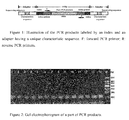
Figure 2 is an agarose gel electrophorogram of a part of PCR products. It can be seen from the electrophorogram that the band of the PCR products is of about 170 bp, wherein lane M is a molecular ladder of 50bp DNA, lanes 1-14 refer to the PCR products from the randomly selected HPV positive samples. - 190 samples, of which the HC-II results are known, were genotyped for HPV by the method according to the present invention. The results showed that the results obtained by the method according to the present invention are not only consistent with the known HC-II results, but also accomplish the accurate typing of HPV.
- According to the instruction of the manufacturer, KingFisher automatic extractor (US Thermo Scientific Kingfisher Flex full automatic bead extraction and purification system) was used to extract DNA from 190 samples of exfoliative cells, of which the HC-II results are known. The nucleic acids were extracted by using the program "Bioeasy_200µl Blood DNA_KF.msz". After the program was finished, about 100µl eluting product (extracted DNA) was obtained, which was used as the template for PCR amplification in next step.
- The 190 DNA samples obtained in Example 1 were designated as No. 1-190, and were divided averagely into two groups (HPV-1 group: Nos. 1-95 ; HPV-2 group: Nos. 96-190). According to the sequences (Table 2, SEQ ID NOS: 96-106) of the primers in the primer group for amplification of HPV DNA (including 6 forward primers and 5 reverse primers), a set of indexes was designed, including 95 indexes (Table 1, SEQ ID NOS: 1-95). Each of the designed indexes was added to the 5' end of the sequence of each primer of the primer set, respectively, thereby obtaining 95 index primer groups, wherein each index primer group included the corresponding 6 forward index primers and 5 reverse index primers, and different index primer groups employed different indexes (i.e., 95 index primer groups were corresponded to 95 indexes one by one).
- PCR reactions were conducted for all the samples in the 96-well plates, and two plates were used (one for HPV-1 group and the other for HPV-2 group). DNA obtained in Example 1 was used as template, and a different index primer group was used to carry out PCR amplification as directed to each of the samples in HPV-1 group and HPV-2 group (each containing 95 samples), that is, 95 samples were corresponded to 95 index primer groups one by one. The number of the sample corresponding to each index primer group (each index) was recorded. In each plate, a negative control was provided without adding template. The primers used in the negative controls in the two plates were the same as the primers used in sample No.1 and No.96, respectively.
Table 1: Information on indexes and samples Index No. Index sequences The corresponding position in the 96-well plate The corresponding sample (Group 1) The corresponding sample (Group 2) SEQ ID NO: PI-1 GCTGCGACTC A1 1 96 1 PI-2 GTGTAGATAC A2 2 97 2 PI-3 CTGATATCTA A3 3 98 3 PI-4 ACGATGCTAT A4 4 99 4 PI-5 TAGACTAGAC A5 5 100 5 PI-6 CTGTCTGTGT A6 6 101 6 PI-7 GCATACTGAC A7 7 102 7 PI-8 CTGCTCGCAT A8 8 103 8 PI-9 CATGAGTAGA A9 9 104 9 PI-10 TCTCACTATG A10 10 105 10 PI-11 TGTACTACTA A11 11 106 11 PI-12 GTAGACTAGT A12 12 107 12 PI-13 ATATGCTACT B1 13 108 13 PI-14 CACTCGCTGT B2 14 109 14 PI-15 CATCACGCAC B3 15 110 15 PI-16 AGCATGTGAT B4 16 111 16 PI-17 AGCTAGTAGA B5 17 112 17 PI-18 GCTATGTAGT B6 18 113 18 PI-19 TACGATGATG B7 19 114 19 PI-20 TACGCTGTAC B8 20 115 20 PI-21 TATGTGTACT B9 21 116 21 PI-22 TGACTCAGAC B10 22 117 22 PI-23 TCGTAGCTCA B11 23 118 23 PI-24 GAGACTCGTA B12 24 119 24 PI-25 CTAGATGTCA C1 25 120 25 PI-26 GATGACTCTC C2 26 121 26 PI-27 TCAGTCGCAC C3 27 122 27 PI-28 TGTAGTGAGT C4 28 123 28 PI-29 TCATCGTAGA C5 29 124 29 PI-30 TAGCATCTGT C6 30 125 30 PI-31 TAGTAGTCGT C7 31 126 31 PI-32 CTATACGTGC C8 32 127 32 PI-33 CGACTGTAGA C9 33 128 33 PI-34 GATGTCATGT C10 34 129 34 PI-35 GTCTCGACTG C11 35 130 35 PI-36 AGCTGACGAT C12 36 131 36 PI-37 ATGATATAGT D1 37 132 37 PI-38 ATGTGCTCTA D2 38 133 38 PI-39 CTCACTCGAT D3 39 134 39 PI-40 GCTGCGACTC D4 40 135 40 PI-41 GAGTCATGTC D5 41 136 41 PI-42 CATACGCTCA D6 42 137 42 PI-43 CACTCTCGTC D7 43 138 43 PI-44 GCACTAGATG D8 44 139 44 PI-45 AGTACGCATG D9 45 140 45 PI-46 TCTGTGACGT D10 46 141 46 PI-47 TAGCTCATCT D11 47 142 47 PI-48 AGCATACACT D12 48 143 48 PI-49 GCTATAGTCA E1 49 144 49 PI-50 CGTCTCATGC E2 50 145 50 PI-51 GCTACTACGT E3 51 146 51 PI-52 GAGTGTACTA E4 52 147 52 PI-53 GTCATACGTG E5 53 148 53 PI-54 TATGAGAGAT E6 54 149 54 PI-55 ATCTGAGTAC E7 55 150 55 PI-56 CGATAGCATC E8 56 151 56 PI-57 ACTGATCTCA E9 57 152 57 PI-58 CTCGATACTA E10 58 153 58 PI-59 CATGTGACTG E11 59 154 59 PI-60 CGCATCACTA E12 60 155 60 PI-61 GCATATATCT F1 61 156 61 PI-62 CTGATGCGAC F2 62 157 62 PI-63 TCTCAGAGTC F3 63 158 63 PI-64 CAGTGCGAGT F4 64 159 64 PI-65 ATCTCTGATG F5 65 160 65 PI-66 GCTAGTAGTC F6 66 161 66 PI-67 ATGAGTCGTC F7 67 162 67 PI-68 ATCACTCAGA F8 68 163 68 PI-69 TCTCTCTGAT F9 69 164 69 PI-70 CTCTAGTGCT F10 70 165 70 PI-71 CGTCGTGCTA F11 71 166 71 PI-72 CGACTACTAT F12 72 167 72 PI-73 GCACGTCGAT G1 73 168 73 PI-74 GTAGTGCTCT G2 74 169 74 PI-75 CTGACGAGCT G3 75 170 75 PI-76 CTATAGTCTA G4 76 171 76 PI-77 ACACGCACTA G5 77 172 77 PI-78 CTCGCACTAC G6 78 173 78 PI-79 AGATCTCACT G7 79 174 79 PI-80 ATACTAGTGT G8 80 175 80 PI-81 ATATCTCGTA G9 81 176 81 PI-82 TGACTGCGTA G10 82 177 82 PI-83 TGTAGACGTA G11 83 178 83 PI-84 AGAGACTATG G12 84 179 84 PI-85 GTCGAGTCAC H1 85 180 85 PI-86 TGACAGCTAC H2 86 181 86 PI-87 CGCTAGACAT H3 87 182 87 PI-88 CGTAGATATG H4 88 183 88 PI-89 TGAGTCTGCT H5 89 184 89 PI-90 TAGTCGTATG H6 90 185 90 PI-91 CATACACGAC H7 91 186 91 PI-92 CGCTCAGAGA H8 92 187 92 PI-93 GTGAGTCTCA H9 93 188 93 PI-94 GACAGATGAT H10 94 189 94 PI-95 GCTGTGCGAC H11 95 190 95 Table 2: The sequence information of the primers of the primer group for amplification of HPV DNA without adding indexes. Primer No. Primer sequence SEQ ID NO: F1 TTTGTTACTGTGGTAGATACTAC 96 F2 TTTGTTACTGTGGTGGATACTAC 97 F3 TTTGTTACCGTTGTTGATACTAC 98 F4 TTTGTTACTAAGGTAGATACCACTC 99 F5 TTTGTTACTGTTGTGGATACAAC 100 F6 TTTGTTACTATGGTAGATACCACAC 101 R1 GAAAAATAAACTGTAAATCATATTCCT 102 R2 GAAAAATAAATTGTAAATCATACTC 103 R3 GAAATATAAATTGTAAATCAAATTC 104 R4 GAAAAATAAACTGTAAATCATATTC 105 R5 GAAAAATAAACTGCAAATCATATTC 106 Note: F represents a forward primer, R represents a reverse primer. - The following PCR parameters were used in amplification:
- 95°C 30s → 48°C 30s → 72°C 30s (40 cycles)
- 72 °
C 10 min → 12 °C ∞ - PCR reaction system was of 25 µl, and its composition was as follows (all the agents were purchased from Enzymatics Company):
agents volume/reaction H2O (HPLC grade) 14.375µl 10x Ex Taq Buffer (Mg2+ plus) 2.5µl dNTP mix (each 2.5 mM) 2µl mixture of F1/F2/F3/F4/F5/F6 carrying an index (each 7.5pmol) 0.5µl mixture of R1/R2/R3/R4/R5 carrying an index (each 7.5pmol) 0.5µl Ex Taq HS (5U/)µl) 0.125µl Template DNA 5µl Total volume 25µl - PCR reaction was carried out in PTC-200 PCR Instrument from Bio-Rad Company. After finishing PCR, 3µl PCR product was taken to perform electrophoresis on 2.5% agarose gel (
Fig.2 ). - The rest PCR products in HPV-1 group and HPV-2 group each were mixed in a 3 ml EP tube (also marked as HPV-1 group and HPV-2 group), and were mixed homogenously under shaking. 500/µl DNA was taken from each of the two tubes, and was purified by using the Qiagen DNA Purification kit according to the instruction of the manufacturer, to provide 200/µl purified DNA. The DNA concentrations of the purified mixtures were determined as 98 ng/µl (HPV-1 group) and 102 ng/µl (HPV-2 group) by using Nanodrop 8000 (Thermo Fisher Scientific Co.), respectively.
- DNA end-repair reaction was conducted to the purified DNA mixtures in the two tubes obtained in Example 3 by using Thermomixer (Eppendorf Company), respectively. The reaction system for the repair reaction was of 100µl, and its composition was as follow (all the agents were purchased from Enzymatics Company):
Agents Volume/reaction DNA obtained in last step 75µl 20x Polynucleotide Kinase Buffer(B904) 10µL dNTP mix (20mM each) 4µL T4 DNA Polymerase 5µL Klenow Fragment 1µL T4 Polynucleotide Kinase 5µL Total volume 100µL - Reaction condition: 20°C, 30 mins.
- According to the instruction of the manufacturer, the products of the DNA end-repair reaction were purified and recovered by using QIAquick PCR Purification kit. The recovered product was dissolved in 34 µl EB (QIAGEN Elution Buffer).
- The base A was added to the 3' end of the recovered DNA by using Thermomixer (Eppendorf Company). The reaction system was of 50ul, and its composition was as follow (all the agents were purchased from Enzymatics Company):
Agent Volume/reaction DNA obtained in last step 32µl dATP (1mM, GE Company) 10µl 10x Blue Buffer 5µl Klenow (3'-5'exo-) 3µl Total volume 50µl - Reaction conditions: 37°C, 30 mins.
- According to the instruction of the manufacturer, the product having the base A added at 3' end was purified and recovered by using MiniElute PCR Purification Kit (QIAGEN Company). The recovered product was dissolved in 20 µl EB.
- Different adapters were added to the two products obtained in last step by using Thermomixer (Eppendorf Company), so as to construct 2 sequencing libraries. The corresponding correlation between the adapters and libraries was recorded.
- The reaction system for the addition of the Solexa adapters was of 50ul, and its composition was as follow (all the agents were purchased from Illumina Company):
Agent Volume/reaction DNA obtained in last step 11µL 2x Rapid ligation Buffer 15µL PCR-free Index Adapter oligo mix (25mM) 1µL T4 DNA Ligase (Rapid, L603-HC-L) 3µL Total volume 30µL - Reaction condition: 20°C, 15 mins.
- According to the instruction of the manufacturer, the reaction products were purified by using Ampure Beads (Beckman Coulter Genomics), and the purified products were dissolved in 17µl deionized water. Agilent Bioanalyzer 2100 (Agilent Company) and Fluorescence quantitative PCR (QPCR) were used to detect the DNA concentration of the products, the results were as follow.
2100 (nM) qPCR (nM) HPV-1 Group 20.4 24.2 HPV-2 Group 21.6 25.8 - The concentrations measured by Agilent Bioanalyzer 2100 were used as the standard, and the two products obtained in last step were mixed equimolarly (10pmol DNA for each). According to the instruction of the manufacturer, Solexa sequencer (Illumina Genome Analyzer IIx sequencer) was used in sequencing under Solexa PE-75 program.
- According to the sequence information of the characteristic sequences of the adapters and the index primers (index portion and primer portion) in the sequencing result, the sequencing results were corresponded to the samples one by one. Then, the sequencing result of each sample was aligned with HPV database by using alignment programs known in the art, such as BLAST and SOAP, thereby accomplishing HPV detection and accurately typing HPV.
- The detection results obtained were completely identical to the known results (see Table 3), indicating that the method according to the present invention can be applied to accurately detect HPV in samples.
Table 3: Detection results of 190 samples. Sample No. The known HC-II result (RLU/CO value) HPV result of the present detection Sample No The known HC-II result (RLU/CO value) HPV result of the present detection 1 14.2 HPV56 96 0.28 negative 2 0.31 negative 97 0.33 negative 3 196.41 HPV16 98 181.29 HPV35, HPV6 4 5.76 HPV18 99 77.32 HPV16 5 0.35 negative 100 91.22 HPV39 6 99.86 HPV 18, HPV11, HPV16 101 188.92 HPV52 7 128.86 HPV39 102 1352.83 HPV35, HPV11, HPV39 8 35.12 HPV18, HPV6 103 1.39 HPV43 9 498.69 HPV16, HPV56 104 119.5 HPV45, HPV11 10 603.57 HPV 18, HPV31, HPV39 105 292.43 HPV56, HPV31 11 0.27 negative 106 2.91 HPV68 12 3420.57 HPV18 107 193.13 HPV45 13 0.38 negative 108 2.62 HPV6 14 0.41 negative 109 94.12 HPV16 15 455.06 HPV16 110 792.72 HPV18, HPV31 16 8.93 HPV18 111 31.76 HPV11 17 0.6 negative 112 0.25 negative 18 0.41 negative 113 0.23 negative 19 0.29 negative 114 750.82 HPV56, HPV16 20 27.64 HPV31 115 0.4 negative 21 1985.41 HPV56, HPV68 116 2.75 HPV31 22 20.71 HPV42 117 396.04 HPV45 23 1795.83 HPV 11, HPV 16, HPV52 118 354.76 HPV18, HPV16 24 9.55 HPV43 119 6.26 HPV11 25 237.62 HPV39 120 1719.67 HPV16, HPV45 26 1.5 HPV6 121 76.92 HPV51 27 1478.98 HPV68, HPV16 122 1318.02 HPV56, HPV16, HPV42 28 115.31 HPV44 123 0.28 negative 29 419.31 HPV16 124 0.33 negative 30 1.81 candHPV89 125 181.29 HPV59 31 2013.61 HPV52, HPV39 126 77.32 HPV68 32 1379.09 HPV54, HPV33 127 110.8 HPV52 33 12.74 HPV42 128 147.25 HPV16 34 1695.31 HPV16, candHPV89 129 0.24 HPV26 35 1410.85 HPV35 130 1.55 HPV11, HPV53 36 1149.25 HPV18 131 2.03 HPV6, HPV66 37 0.24 negative 132 8.45 HPV43 38 1.55 HPV11 133 0.2 negative 39 2.03 HPV11, HPV6 134 0.24 negative 40 8.45 HPV42 135 10.53 HPV11 41 0.2 negative 136 1410.85 HPV16, HPV53, HPV70 42 0.22 negative 137 1149.25 HPV56, HPV81, HPV73 43 0.53 negative 138 0.24 negative 44 10.38 HPV6 139 413.9 HPV45 45 78.21 HPV16 140 17.05 HPV11 46 0.23 negative 141 23.6 HPV52 47 45.42 HPV16, HPV18 142 3379.09 HPV16, HPV35, HPV56 48 0.35 negative 143 0.18 negative 49 148.66 HPV18, candHPV89 144 1.46 HPV18 50 60.27 HPV56 145 1.25 HPV11, HPV26 51 0.28 negative 146 2.13 HPV6, HPV81 52 360.26 HPV56, HPV68 147 872.52 HPV16, HPV45, HPV52 53 50.31 HPV18 148 1.5 HPV18 54 0.18 negative 149 4.33 HPV16 55 0.31 negative 150 0.82 negative 56 196.41 HPV16 151 60.35 HPV59 57 5.76 HPV51 152 0.24 negative 58 0.23 negative 153 0.23 negative 59 0.88 negative 154 0.18 negative 60 0.16 negative 155 1.46 HPV51 61 870.63 HPV52, HPV16 156 11.25 HPV16 62 10.18 HPV42 157 2.13 HPV11 63 0.15 negative 158 0.13 negative 64 1.36 HPV11 159 90.18 HPV58 65 68.2 HPV59 160 0.15 negative 66 0.68 negative 161 602.79 HPV68, HPV16 67 130.41 HPV45 162 132.68 HPV56, HPV11 68 0.26 negative 163 127.08 HPV39, HPV54 69 5.25 HPV6 164 602.79 HPV33 70 0.46 negative 165 276 HPV18 71 8.23 HPV40 166 243.6 HPV45 72 0.28 negative 167 229.44 HPV51 73 100.16 HPV43, HPV44 168 1384.92 HPV16, HPV58, HPV72 74 450.13 HPV41 169 172.64 HPV58 75 127.08 HPV39, HPV6 170 855.24 HPV16, candHPV89 76 602.79 HPV45 171 126.47 HPV51 77 276 HPV16 172 86.62 HPV44, HPV11 78 243.6 HPV6, HPV70, HPV39 173 879.37 HPV18, HPV58 79 229.44 HPV35 174 119.39 HPV56 80 1384.92 HPV52, HPV56, HPV11 175 0.61 negative 81 172.64 HPV26, HPV42 176 18.02 HPV16 82 855.24 HPV35, HPV6 177 16.06 HPV18 83 620.69 HPV52 178 60.69 HPV56, HPV11 84 128.02 HPV11 179 2.45 HPV11 85 514.84 HPV33 180 94.93 HPV39 86 68.3 HPV58 181 1635.3 HPV16, HPV35, HPV51 87 402.15 HPV59, HPV16 182 754.64 HPV33, candHPV89 88 51.72 HPV33 183 0.23 HPV11 89 1.78 HPV6 184 20.28 HPV18 90 56.7 HPV11, HPV31 185 0.16 negative 91 186.06 HPV16 186 0.13 negative 92 0.02 negative 187 60.18 HPV59 93 386.06 HPV18, HPV16 188 0.15 negative 94 28.09 HPV6, HPV44 189 1.36 HPV43 95 186.06 HPV68, 190 0.28 negative - In addition, accurate typing of HPV in samples was also accomplished by the method according to the present invention. Table 4 provides the sequences and typing results of the samples corresponding to lane Nos. 1-14 as shown in
Fig.2 .Table 4: The sequences and typing results of the samples corresponding to lane Nos. 1-14 as shown in Fig.2. Lane No. HPV type Sequencing results Parameter of alignment SEQ ID NO: identity score e value 1 HPV11 GAAAAATAAACTGTAAATCATATTCCTCCACATGGCGCATGTATTCCTTATAATCTGAATTA 96.77 107 6.00E-27 107 2 HPV16 TTTGTTACTGTGGTAGATACTACCCGCAGTACAAATATGTCATTATGTGCTGCCATATCTAC 96.77 107 6.00E-27 108 3 HPV18 TTTGTTACTAAGGTAGATACCACTCGCAGTACCAATTTAACAATATGTGCTTCTACACAGTC 96.77 107 6.00E-27 109 4 HPV31 GAAAAATAAACTGTAAATCATATTCCTCACCATGTCTTAAATACTCTTTAAAATTACTACTT 95.16 99.6 2.00E-24 110 5 HPV33 GAAAAATAAACTGTAAATCATATTCCTCAACATGTCTTATATATTCTTTAAAATTTTCATTT 96.77 107 6.00E-27 111 6 HPV35 GAAAAATAAACTGTAAATCATATTCTTCACCATGCCTTAAATATTCCTTATAATTGTCATTT 98.39 115 3.00E-29 112 7 HPV39 TTTGTTACTGTGGTAGATACTACCCGTAGTACCAACTTTACATTATCTACCTCTATAGAGTC 94.83 91.7 4.00E-22 113 8 HPV43 TTTGTTACTAAGGTAGATACCACTCGTAGTACAAACTTAACGTTATGTGCCTCTACTGACCC 100 101 4.00E-25 114 9 HPV45 GAAAAATAAACTGTAAATCATATTCCTCCACATGTCTACTATAGTGCTTAAACTTAGTAGGA 100 123 1.00E-31 115 10 HPV51 GAAATATAAATTGTAAATCAAATTCTTCCCCATGCCTAATATATTGCTTAAAGTTACTTGGA 91.94 83.8 9.00E-20 116 11 HPV52 TTTGTTACTGTGGTGGATACTACTCGTAGCACTAACATGACTTTATGTGCTGAGGTTAAAAA 98 91.7 4.00E-22 117 12 HPV56 TTTGTTACTGTTGTGGATACAACTAGAAGTACTAACATGACTATTAGTACTGCTACAGAACA 95.16 99.6 2.00E-24 118 13 HPV58 GAAAAATAAACTGTAAATCATATTCCTCAACATGACGTACATATTCCTTAAAATTATCATTT 96.77 107 6.00E-27 119 14 HPV61 TTTGTTACTGTGGTGGATACTACCCGCAGTACTAATTTAGCCATTTGCACTGCTACATCCCC 94 75.8 2.00E-17 120 - The patents, publications and other materials, which are used to illustrate the present invention or provide further detailed contents about the practice of the present invention, are incorporated by reference herein, and are provided in the following list for the convenience.
- [1].Pectasides D, Kanposioras K, Papaxoinis G et al. Chemotherapy for recurrent cervical cancer. Cancer Treatment Reviews, 2008, 34(7): 603-613.
- [2].Brink, A. A., P. J. Snijders, and C. J. Meijer. HPV detection methods. Dis. Markers 2007, 23: 273-281.
- [3].IARC. Handbooks of cancer prevention . Cervix cancer screening [R].Lyon: IARC Press, 2005.
- [4].Doorbar, J. Molecular biology of human papillomavirus infection and cervical cancer. Clin. Sci.2006, 110: 525-541.
- [5].Cox T, Cuzick J. HPV DNA testing in cervical cancer screening: From evidence to policies.Gyneeol Oncol, 2006, 103: 8-11.
- [6].Kulmala S, syIjhen. Human papillomavirus testing with the hybrid capture assay and PCR as screening tools.Clin Microbiol, 2004, 42(6): 2470-2475.
- [7].Quail, M. et al., A large genome center's improvements to the Illumina sequencing system. Nat. Methods, 2008, 5, 1005-1010.
- [8].Brown, C. G. et al., Solexa/Illumina GAPipeline product and product documentation, Illumina Inc, 2006.
- [9].Lozano, R. Successfully integrating human papillomavirus testing into your practice . Arch . Pathol. Lab Med, 2003, 127: 991-994.
Claims (8)
- A method for sequencing, detecting, or typing HPV in one or more samples, comprising the following steps:1) for each sample, amplifying DNA in the sample with one index primer group, wherein
said index primer group comprises 11 index primers, the sequence of said index primer comprises an index sequence and a PCR primer sequence, and the index sequence is linked to 5' end of the PCR primer sequence, optionally via a linker sequence, whereini) said index sequence is selected from the group consisting of SEQ ID NOS: 1-95, and each of said 11 index primers has the same index sequence, andii) the PCR primer sequences of said 11 index primers are set forth in SEQ ID NOS: 96-106, respectively,wherein the index primer groups used in different samples can be the same or different, and different index primer groups employ different index sequences;2) mixing the amplification products obtained by conducting amplification with different index primer groups in step 1), so as to obtain one or more PCR product libraries;3) adding adapters to one or more PCR product libraries obtained in step 2) by PCR-FREE methods such as DNA ligase assay, thereby constructing one or more sequencing libraries, wherein the adapters used in different sequencing libraries may be the same or different, and different adapters share the same sequencing sequence but have different characteristic sequences,4) optionally, mixing the sequencing libraries with different adapters obtained in step 3), so as to obtain one or more library mixtures;5) conducting sequencing to one or more sequencing libraries obtained in step 3) or one or more library mixtures obtained in step 4) by using the second generation sequencing technology, preferably Pair-End technology (such as Solexa, Illumina Hiseq 2000);6) corresponding the sequencing results to the samples one by one, according to the index primer sequences of the index primer group or according to the index primer sequences of the index primer group and the characteristic sequence of the adapter;
wherein said samples are preferably exfoliative cells and are preferably from animals, such as human. - The method according to claim 1, wherein at least 10, preferably at least 20, at least 30, at least 40, at least 50, at least 60, at least 70, at least 80, at least 90 or 95 index primer groups are used in step 1), preferably the index sequences used comprise at least the index sequences set forth in SEQ ID NOS: 1-10, or SEQ ID NOS: 11-20, or SEQ ID NOS: 21-30, or SEQ ID NOS: 31-40, or SEQ ID NOS: 41-50, or SEQ ID NOS: 51-60, or SEQ ID NOS: 61-70, or SEQ ID NOS: 71-80, or SEQ ID NOS: 81-90, or SEQ ID NOS: 91-95, or any combination thereof.
- The method according to claim 1 or 2, wherein at least 1, preferably at least 2, at least 10, at least 20, at least 30, at least 40, at least 50, at least 100 or at least 200 adapters are used in step 3), and for example, said adapter may have the sequence selected from the group consisting of SEQ ID NOS: 121-132.
- The method according to claim 1, further comprising aligning the sequencing result of said sample with the sequence in HPV database, so as to accurately type HPV in the sample.
- A method for high-throughput HPV sequencing, detecting or typing in multiple samples, comprising the following steps:1) dividing the samples to be analyzed into m groups, m is an integer of ≥1;2) carrying out the following steps to the samples in each group:2a) extracting DNA from the samples to be analyzed;2b) designing a set of indexes on the basis of the sequences of all the primers in the primer group for amplifying HPV DNA, wherein the number of the indexes, i.e., n, is equal to the number of the samples in the group;2c) adding each of the indexes designed in step 2b) to the 5' end of the sequences of all the forward primers or reverse primers or all the primers, respectively, thereby providing n index primer groups;2d) conducting PCR amplification to the DNA sample obtained in step 2a) by using the index primer group provided in step 2c), thereby providing PCR products, wherein for each DNA sample, a different index primer group is used; and2e) mixing all the PCR products in step 2d), so as to obtain a PCR product library;3) adding an adapter to the PCR product library obtained in step 2), wherein each of the PCR product libraries uses a different adapter so as to construct m sequencing libraries, wherein each adapter shares the same sequencing sequence and has a different characteristic sequence;4) mixing m sequencing libraries together, conducting sequencing by using Solexa or Illumina Hiseq 2000 sequencing method, so as to obtain the sequencing results of all the samples;5) corresponding the sequencing results to the samples one by one, according to the characteristic sequences of the adapters, the sequences of the indexes, and the sequences of the primers in the sequencing results; and optionally, aligning the sequencing result of each sample with the HPV database, so as to achieve HPV sequencing, detection or typing;
wherein said samples are preferably exfoliative cells and are preferably from animals, such as human. - The method according to claim 5, wherein the primer group in step 2b) comprises 11 primers, of which the sequences are set forth in SEQ ID NOS: 96-106, respectively.
- The method according to claim 6, wherein the index designed in step 2b) may have the sequence selected from the group consisting of SEQ ID NOS: 1-95, and preferably comprises at least the index set forth in SEQ ID NOS: 1-10, or SEQ ID NOS: 11-20, or SEQ ID NOS: 21-30, or SEQ ID NOS: 31-40, or SEQ ID NOS: 41-50, or SEQ ID NOS: 51-60, or SEQ ID NOS: 61-70, or SEQ ID NOS: 71-80, or SEQ ID NOS: 81-90, or SEQ ID NOS: 91-95, or any combination thereof.
- The method according to claim 7, wherein at least 2, preferably at least 10, at least 20, at least 30, at least 40, at least 50, at least 100 or at least 200 adapters are used in step 3), and for example, said adapter have the sequence selected from the group consisting of SEQ ID NOS: 121-132.
Priority Applications (2)
| Application Number | Priority Date | Filing Date | Title |
|---|---|---|---|
| SI201030846T SI2481818T1 (en) | 2010-06-30 | 2010-11-15 | Method for detecting human papilloma virus based on solexa sequencing method |
| PL10853857T PL2481818T3 (en) | 2010-06-30 | 2010-11-15 | Method for detecting human papilloma virus based on solexa sequencing method |
Applications Claiming Priority (2)
| Application Number | Priority Date | Filing Date | Title |
|---|---|---|---|
| CN2010102137227A CN101921874B (en) | 2010-06-30 | 2010-06-30 | Method for measuring human papilloma virus based on Solexa sequencing method |
| PCT/CN2010/001833 WO2012000151A1 (en) | 2010-06-30 | 2010-11-15 | Method for detecting human papilloma virus based on solexa sequencing method |
Publications (3)
| Publication Number | Publication Date |
|---|---|
| EP2481818A1 true EP2481818A1 (en) | 2012-08-01 |
| EP2481818A4 EP2481818A4 (en) | 2012-10-31 |
| EP2481818B1 EP2481818B1 (en) | 2014-12-31 |
Family
ID=43337089
Family Applications (1)
| Application Number | Title | Priority Date | Filing Date |
|---|---|---|---|
| EP10853857.0A Active EP2481818B1 (en) | 2010-06-30 | 2010-11-15 | Method for detecting human papilloma virus based on solexa sequencing method |
Country Status (8)
| Country | Link |
|---|---|
| US (1) | US9593387B2 (en) |
| EP (1) | EP2481818B1 (en) |
| JP (1) | JP5923497B2 (en) |
| CN (1) | CN101921874B (en) |
| AU (1) | AU2010356776B2 (en) |
| PL (1) | PL2481818T3 (en) |
| SI (1) | SI2481818T1 (en) |
| WO (1) | WO2012000151A1 (en) |
Families Citing this family (16)
| Publication number | Priority date | Publication date | Assignee | Title |
|---|---|---|---|---|
| CN101921748B (en) * | 2010-06-30 | 2012-11-14 | 上海华大基因科技有限公司 | DNA molecular label for high-throughput detection of human papilloma virus |
| CN102839211A (en) * | 2011-06-24 | 2012-12-26 | 深圳华大基因科技有限公司 | System and method for determining whether human body has abnormal state |
| CN103797130B (en) * | 2011-06-24 | 2016-07-27 | 深圳华大基因科技有限公司 | For determining that human body has the system and method for abnormality |
| CN102329876B (en) * | 2011-10-14 | 2014-04-02 | 深圳华大基因科技有限公司 | Method for measuring nucleotide sequence of disease associated nucleic acid molecules in sample to be detected |
| CN103998625B (en) * | 2011-11-18 | 2017-06-06 | 华大生物科技(武汉)有限公司 | Method and system for virus detection |
| SG10201610861XA (en) * | 2012-07-03 | 2017-02-27 | Integrated Dna Tech Inc | Tm-enhanced blocking oligonucleotides and baits for improved target enrichment and reduced off-target selection |
| CN102978205B (en) * | 2012-11-19 | 2014-08-20 | 北京诺禾致源生物信息科技有限公司 | High-throughput sequencing junction applied to marker development and application method thereof |
| CN102978206A (en) * | 2012-11-27 | 2013-03-20 | 北京诺禾致源生物信息科技有限公司 | High-throughput sequencing joint applied to hybrid library building and library building method thereof |
| CN103088120B (en) * | 2012-11-29 | 2014-10-15 | 北京百迈客生物科技有限公司 | Large-scale genetic typing method based on SLAF-seq (Specific-Locus Amplified Fragment Sequencing) technology |
| CN103898199B (en) * | 2012-12-27 | 2016-12-28 | 上海天昊生物科技有限公司 | A kind of high-throughput nucleic acid analysis method and application thereof |
| WO2015108663A1 (en) * | 2014-01-16 | 2015-07-23 | Illumina, Inc. | Amplicon preparation and sequencing on solid supports |
| WO2016191249A1 (en) * | 2015-05-22 | 2016-12-01 | University Of Maryland, Baltimore | Next-generation sequencing-based genotyping assay for human papilloma virus (hpv) |
| KR101651817B1 (en) * | 2015-10-28 | 2016-08-29 | 대한민국 | Primer set for Preparation of NGS library and Method and Kit for making NGS library using the same |
| WO2018195224A1 (en) * | 2017-04-18 | 2018-10-25 | Fred Hutchinson Cancer Research Center | Barcoded transposases to increase efficiency of high-accuracy genetic sequencing |
| WO2019047109A1 (en) * | 2017-09-07 | 2019-03-14 | 深圳华大基因股份有限公司 | Bioinformatics analysis method and system for hpv precise typing |
| CN119351624A (en) * | 2024-11-15 | 2025-01-24 | 郑州安图生物工程股份有限公司 | Primer probe combination, reagent or kit for human papillomavirus nucleic acid detection and application |
Family Cites Families (12)
| Publication number | Priority date | Publication date | Assignee | Title |
|---|---|---|---|---|
| KR100382703B1 (en) * | 2000-03-15 | 2003-05-09 | 주식회사 바이오메드랩 | diagnosis kit for genotyping of Human Papillomavirus and manufacturing method for thereof |
| US20060040286A1 (en) * | 2001-03-28 | 2006-02-23 | Nanosphere, Inc. | Bio-barcode based detection of target analytes |
| US20050202436A1 (en) * | 2002-07-30 | 2005-09-15 | Baback Gharizadeh | Target-specific multiple sequencing primer pool for microbial typing and sequencing applications in DNA-sequencing technologies |
| US7910719B2 (en) * | 2005-12-08 | 2011-03-22 | Kabushiki Kaisha Toshiba | Method of detecting human papilloma virus by using nucleic acid amplification method and nucleic acid chain-immobilized carrier |
| WO2007066831A2 (en) * | 2005-12-08 | 2007-06-14 | Kabushiki Kaisha Toshiba | Method of detecting human papilloma virus by using nucleic acid amplification method and nucleic acid chain-immobilized carrier |
| US20090181389A1 (en) * | 2008-01-11 | 2009-07-16 | Signosis, Inc., A California Corporation | Quantitative measurement of nucleic acid via ligation-based linear amplification |
| EP2364368B1 (en) * | 2008-11-07 | 2014-01-15 | Sequenta, Inc. | Methods of monitoring conditions by sequence analysis |
| CN102367490A (en) | 2008-12-12 | 2012-03-07 | 深圳华大基因科技有限公司 | Method for detecting viruses |
| CN101435002B (en) | 2008-12-12 | 2012-01-18 | 深圳华大基因科技有限公司 | A method for detecting human papillomavirus genotype |
| DK2414547T3 (en) * | 2009-04-02 | 2014-06-16 | Fluidigm Corp | Multiprimer amplification method for bar coding of target nucleic acids |
| EA034241B1 (en) * | 2009-11-06 | 2020-01-21 | Те Чайниз Юниверсити Ов Гонконг | Method for performing prenatal diagnosis of a sequence imbalance |
| CN101921748B (en) * | 2010-06-30 | 2012-11-14 | 上海华大基因科技有限公司 | DNA molecular label for high-throughput detection of human papilloma virus |
-
2010
- 2010-06-30 CN CN2010102137227A patent/CN101921874B/en active Active
- 2010-11-15 US US13/377,116 patent/US9593387B2/en active Active
- 2010-11-15 JP JP2013516945A patent/JP5923497B2/en active Active
- 2010-11-15 PL PL10853857T patent/PL2481818T3/en unknown
- 2010-11-15 EP EP10853857.0A patent/EP2481818B1/en active Active
- 2010-11-15 SI SI201030846T patent/SI2481818T1/en unknown
- 2010-11-15 AU AU2010356776A patent/AU2010356776B2/en active Active
- 2010-11-15 WO PCT/CN2010/001833 patent/WO2012000151A1/en not_active Ceased
Also Published As
| Publication number | Publication date |
|---|---|
| US9593387B2 (en) | 2017-03-14 |
| WO2012000151A1 (en) | 2012-01-05 |
| AU2010356776A1 (en) | 2012-03-15 |
| CN101921874B (en) | 2013-09-11 |
| US20130123114A1 (en) | 2013-05-16 |
| JP5923497B2 (en) | 2016-05-24 |
| EP2481818A4 (en) | 2012-10-31 |
| HK1148789A1 (en) | 2011-09-16 |
| JP2013529471A (en) | 2013-07-22 |
| EP2481818B1 (en) | 2014-12-31 |
| SI2481818T1 (en) | 2015-02-27 |
| CN101921874A (en) | 2010-12-22 |
| PL2481818T3 (en) | 2015-04-30 |
| AU2010356776B2 (en) | 2014-10-02 |
Similar Documents
| Publication | Publication Date | Title |
|---|---|---|
| EP2481818B1 (en) | Method for detecting human papilloma virus based on solexa sequencing method | |
| CN101921748B (en) | DNA molecular label for high-throughput detection of human papilloma virus | |
| AU2011207081B2 (en) | Set of probes for the detection and typing of 46 human papillomavirus mucosal types | |
| MX2007008553A (en) | Systems, methods, and compositions for detection of human papilloma virus in biological samples. | |
| Kroupis et al. | Human papilloma virus (HPV) molecular diagnostics. | |
| WO2022100444A1 (en) | Probe set for human papillomavirus (hpv) typing and integration detection and kit thereof | |
| CN101918550B (en) | Primer Sets and Probes for Detection of Human Papillomavirus | |
| CN116121465B (en) | Application of primer and probe composition in preparation of HPV detection kit | |
| CN113316648A (en) | Association between the integration of the viral HPV or HIV genome and the severity and/or clinical outcome of HPV-related cervical lesions or AIDS pathological conditions | |
| Li et al. | Detection of human papillomavirus genotypes with liquid bead microarray in cervical lesions of northern Chinese patients | |
| CN101942440A (en) | Primers and method for detecting and typing human papilloma viruses in esophagi | |
| CN116042920A (en) | NGS detection method and kit for tiny residual focus of cervical cancer patient after treatment based on targeting HPV | |
| HK1209797A1 (en) | Primer set, kit and their use in whole genome detection of hpv | |
| KR101018407B1 (en) | Human papillomavirus diagnostic probe and its genotyping method | |
| CN113502353A (en) | Application of integrated high-frequency gene locus of high-intermediate-risk HPV (human papilloma virus) related to cervical cancer occurrence | |
| Larsson et al. | HPV Genotyping from the high risk mRNA Aptima assay-a direct approach using DNA from Aptima sample tubes | |
| CN115807133A (en) | Application of Melting Curve Method in Typing and Qualitative Analysis of Human Papillomavirus | |
| KR20130125046A (en) | Kit for analyzing high-risk hpv gene and method for analyzing the same | |
| SHERIF et al. | Molecular diagnosis of human papilloma virus infection | |
| CN112921033A (en) | Nucleic acid composition and detection kit | |
| HK1148789B (en) | Methods for hpv detection based on solexa sequencing | |
| HK1149292B (en) | Dna molecular indexes for high-throughput detecting human papilloma virus | |
| EP4074843B1 (en) | Method and test kit for detecting human papillomavirus | |
| Kardani et al. | Diagnosis of HPV Infections, HPV Testing in Patients | |
| CN109777887B (en) | Method for detecting multiple types of viruses and detection kit |
Legal Events
| Date | Code | Title | Description |
|---|---|---|---|
| PUAI | Public reference made under article 153(3) epc to a published international application that has entered the european phase |
Free format text: ORIGINAL CODE: 0009012 |
|
| 17P | Request for examination filed |
Effective date: 20120424 |
|
| AK | Designated contracting states |
Kind code of ref document: A1 Designated state(s): AL AT BE BG CH CY CZ DE DK EE ES FI FR GB GR HR HU IE IS IT LI LT LU LV MC MK MT NL NO PL PT RO RS SE SI SK SM TR |
|
| A4 | Supplementary search report drawn up and despatched |
Effective date: 20120927 |
|
| RIC1 | Information provided on ipc code assigned before grant |
Ipc: C12Q 1/70 20060101AFI20120921BHEP Ipc: C12Q 1/68 20060101ALI20120921BHEP |
|
| 17Q | First examination report despatched |
Effective date: 20130702 |
|
| DAX | Request for extension of the european patent (deleted) | ||
| GRAP | Despatch of communication of intention to grant a patent |
Free format text: ORIGINAL CODE: EPIDOSNIGR1 |
|
| INTG | Intention to grant announced |
Effective date: 20140623 |
|
| GRAJ | Information related to disapproval of communication of intention to grant by the applicant or resumption of examination proceedings by the epo deleted |
Free format text: ORIGINAL CODE: EPIDOSDIGR1 |
|
| GRAP | Despatch of communication of intention to grant a patent |
Free format text: ORIGINAL CODE: EPIDOSNIGR1 |
|
| GRAJ | Information related to disapproval of communication of intention to grant by the applicant or resumption of examination proceedings by the epo deleted |
Free format text: ORIGINAL CODE: EPIDOSDIGR1 |
|
| GRAP | Despatch of communication of intention to grant a patent |
Free format text: ORIGINAL CODE: EPIDOSNIGR1 |
|
| INTG | Intention to grant announced |
Effective date: 20141022 |
|
| GRAS | Grant fee paid |
Free format text: ORIGINAL CODE: EPIDOSNIGR3 |
|
| GRAA | (expected) grant |
Free format text: ORIGINAL CODE: 0009210 |
|
| INTG | Intention to grant announced |
Effective date: 20141113 |
|
| AK | Designated contracting states |
Kind code of ref document: B1 Designated state(s): AL AT BE BG CH CY CZ DE DK EE ES FI FR GB GR HR HU IE IS IT LI LT LU LV MC MK MT NL NO PL PT RO RS SE SI SK SM TR |
|
| REG | Reference to a national code |
Ref country code: CH Ref legal event code: EP Ref country code: GB Ref legal event code: FG4D |
|
| REG | Reference to a national code |
Ref country code: RO Ref legal event code: EPE |
|
| REG | Reference to a national code |
Ref country code: IE Ref legal event code: FG4D |
|
| REG | Reference to a national code |
Ref country code: AT Ref legal event code: REF Ref document number: 704463 Country of ref document: AT Kind code of ref document: T Effective date: 20150215 |
|
| REG | Reference to a national code |
Ref country code: DE Ref legal event code: R096 Ref document number: 602010021520 Country of ref document: DE Effective date: 20150219 |
|
| REG | Reference to a national code |
Ref country code: GR Ref legal event code: EP Ref document number: 20150400030 Country of ref document: GR Effective date: 20150220 |
|
| PG25 | Lapsed in a contracting state [announced via postgrant information from national office to epo] |
Ref country code: LT Free format text: LAPSE BECAUSE OF FAILURE TO SUBMIT A TRANSLATION OF THE DESCRIPTION OR TO PAY THE FEE WITHIN THE PRESCRIBED TIME-LIMIT Effective date: 20141231 Ref country code: FI Free format text: LAPSE BECAUSE OF FAILURE TO SUBMIT A TRANSLATION OF THE DESCRIPTION OR TO PAY THE FEE WITHIN THE PRESCRIBED TIME-LIMIT Effective date: 20141231 Ref country code: NO Free format text: LAPSE BECAUSE OF FAILURE TO SUBMIT A TRANSLATION OF THE DESCRIPTION OR TO PAY THE FEE WITHIN THE PRESCRIBED TIME-LIMIT Effective date: 20150331 |
|
| REG | Reference to a national code |
Ref country code: PL Ref legal event code: T3 |
|
| REG | Reference to a national code |
Ref country code: NL Ref legal event code: VDEP Effective date: 20141231 |
|
| REG | Reference to a national code |
Ref country code: LT Ref legal event code: MG4D |
|
| PG25 | Lapsed in a contracting state [announced via postgrant information from national office to epo] |
Ref country code: HR Free format text: LAPSE BECAUSE OF FAILURE TO SUBMIT A TRANSLATION OF THE DESCRIPTION OR TO PAY THE FEE WITHIN THE PRESCRIBED TIME-LIMIT Effective date: 20141231 Ref country code: LV Free format text: LAPSE BECAUSE OF FAILURE TO SUBMIT A TRANSLATION OF THE DESCRIPTION OR TO PAY THE FEE WITHIN THE PRESCRIBED TIME-LIMIT Effective date: 20141231 Ref country code: SE Free format text: LAPSE BECAUSE OF FAILURE TO SUBMIT A TRANSLATION OF THE DESCRIPTION OR TO PAY THE FEE WITHIN THE PRESCRIBED TIME-LIMIT Effective date: 20141231 Ref country code: RS Free format text: LAPSE BECAUSE OF FAILURE TO SUBMIT A TRANSLATION OF THE DESCRIPTION OR TO PAY THE FEE WITHIN THE PRESCRIBED TIME-LIMIT Effective date: 20141231 |
|
| REG | Reference to a national code |
Ref country code: AT Ref legal event code: MK05 Ref document number: 704463 Country of ref document: AT Kind code of ref document: T Effective date: 20141231 |
|
| REG | Reference to a national code |
Ref country code: HU Ref legal event code: AG4A Ref document number: E022926 Country of ref document: HU |
|
| PG25 | Lapsed in a contracting state [announced via postgrant information from national office to epo] |
Ref country code: NL Free format text: LAPSE BECAUSE OF FAILURE TO SUBMIT A TRANSLATION OF THE DESCRIPTION OR TO PAY THE FEE WITHIN THE PRESCRIBED TIME-LIMIT Effective date: 20141231 |
|
| PG25 | Lapsed in a contracting state [announced via postgrant information from national office to epo] |
Ref country code: SK Free format text: LAPSE BECAUSE OF FAILURE TO SUBMIT A TRANSLATION OF THE DESCRIPTION OR TO PAY THE FEE WITHIN THE PRESCRIBED TIME-LIMIT Effective date: 20141231 Ref country code: ES Free format text: LAPSE BECAUSE OF FAILURE TO SUBMIT A TRANSLATION OF THE DESCRIPTION OR TO PAY THE FEE WITHIN THE PRESCRIBED TIME-LIMIT Effective date: 20141231 |
|
| PG25 | Lapsed in a contracting state [announced via postgrant information from national office to epo] |
Ref country code: IS Free format text: LAPSE BECAUSE OF FAILURE TO SUBMIT A TRANSLATION OF THE DESCRIPTION OR TO PAY THE FEE WITHIN THE PRESCRIBED TIME-LIMIT Effective date: 20150430 Ref country code: AT Free format text: LAPSE BECAUSE OF FAILURE TO SUBMIT A TRANSLATION OF THE DESCRIPTION OR TO PAY THE FEE WITHIN THE PRESCRIBED TIME-LIMIT Effective date: 20141231 |
|
| REG | Reference to a national code |
Ref country code: DE Ref legal event code: R097 Ref document number: 602010021520 Country of ref document: DE |
|
| PG25 | Lapsed in a contracting state [announced via postgrant information from national office to epo] |
Ref country code: DK Free format text: LAPSE BECAUSE OF FAILURE TO SUBMIT A TRANSLATION OF THE DESCRIPTION OR TO PAY THE FEE WITHIN THE PRESCRIBED TIME-LIMIT Effective date: 20141231 Ref country code: EE Free format text: LAPSE BECAUSE OF FAILURE TO SUBMIT A TRANSLATION OF THE DESCRIPTION OR TO PAY THE FEE WITHIN THE PRESCRIBED TIME-LIMIT Effective date: 20141231 |
|
| RAP2 | Party data changed (patent owner data changed or rights of a patent transferred) |
Owner name: BGI GENOMICS CO., LTD. |
|
| PLBE | No opposition filed within time limit |
Free format text: ORIGINAL CODE: 0009261 |
|
| STAA | Information on the status of an ep patent application or granted ep patent |
Free format text: STATUS: NO OPPOSITION FILED WITHIN TIME LIMIT |
|
| 26N | No opposition filed |
Effective date: 20151001 |
|
| PG25 | Lapsed in a contracting state [announced via postgrant information from national office to epo] |
Ref country code: IT Free format text: LAPSE BECAUSE OF FAILURE TO SUBMIT A TRANSLATION OF THE DESCRIPTION OR TO PAY THE FEE WITHIN THE PRESCRIBED TIME-LIMIT Effective date: 20141231 |
|
| REG | Reference to a national code |
Ref country code: GB Ref legal event code: 732E Free format text: REGISTERED BETWEEN 20160317 AND 20160323 |
|
| REG | Reference to a national code |
Ref country code: DE Ref legal event code: R082 Ref document number: 602010021520 Country of ref document: DE Representative=s name: HERNANDEZ, YORCK, DIPL.-ING., DE |
|
| PG25 | Lapsed in a contracting state [announced via postgrant information from national office to epo] |
Ref country code: BE Free format text: LAPSE BECAUSE OF FAILURE TO SUBMIT A TRANSLATION OF THE DESCRIPTION OR TO PAY THE FEE WITHIN THE PRESCRIBED TIME-LIMIT Effective date: 20141231 |
|
| REG | Reference to a national code |
Ref country code: DE Ref legal event code: R082 Ref document number: 602010021520 Country of ref document: DE Representative=s name: HERNANDEZ, YORCK, DIPL.-ING., DE |
|
| PG25 | Lapsed in a contracting state [announced via postgrant information from national office to epo] |
Ref country code: MC Free format text: LAPSE BECAUSE OF FAILURE TO SUBMIT A TRANSLATION OF THE DESCRIPTION OR TO PAY THE FEE WITHIN THE PRESCRIBED TIME-LIMIT Effective date: 20141231 Ref country code: LU Free format text: LAPSE BECAUSE OF FAILURE TO SUBMIT A TRANSLATION OF THE DESCRIPTION OR TO PAY THE FEE WITHIN THE PRESCRIBED TIME-LIMIT Effective date: 20151115 |
|
| REG | Reference to a national code |
Ref country code: SI Ref legal event code: SP73 Owner name: BGI GENOMICS CO., LTD.; CN Effective date: 20160506 Ref country code: CH Ref legal event code: PL |
|
| PG25 | Lapsed in a contracting state [announced via postgrant information from national office to epo] |
Ref country code: CH Free format text: LAPSE BECAUSE OF NON-PAYMENT OF DUE FEES Effective date: 20151130 Ref country code: LI Free format text: LAPSE BECAUSE OF NON-PAYMENT OF DUE FEES Effective date: 20151130 |
|
| REG | Reference to a national code |
Ref country code: IE Ref legal event code: MM4A |
|
| REG | Reference to a national code |
Ref country code: FR Ref legal event code: ST Effective date: 20160729 |
|
| REG | Reference to a national code |
Ref country code: HU Ref legal event code: FH1C Free format text: FORMER REPRESENTATIVE(S): IVANKA GABOR, ARINOVA SZABADALMI ES VEDJEGY IRODA, HU Representative=s name: ARINOVA SZABADALMI ES VEDJEGY IRODA, HU Ref country code: HU Ref legal event code: GB9C Owner name: BGI GENOMICS CO., LTD., CN Free format text: FORMER OWNER(S): BGI SHENZHEN CO., LIMITED, CN |
|
| PG25 | Lapsed in a contracting state [announced via postgrant information from national office to epo] |
Ref country code: IE Free format text: LAPSE BECAUSE OF NON-PAYMENT OF DUE FEES Effective date: 20151115 |
|
| PG25 | Lapsed in a contracting state [announced via postgrant information from national office to epo] |
Ref country code: FR Free format text: LAPSE BECAUSE OF NON-PAYMENT OF DUE FEES Effective date: 20151130 |
|
| PG25 | Lapsed in a contracting state [announced via postgrant information from national office to epo] |
Ref country code: BG Free format text: LAPSE BECAUSE OF FAILURE TO SUBMIT A TRANSLATION OF THE DESCRIPTION OR TO PAY THE FEE WITHIN THE PRESCRIBED TIME-LIMIT Effective date: 20141231 Ref country code: SM Free format text: LAPSE BECAUSE OF FAILURE TO SUBMIT A TRANSLATION OF THE DESCRIPTION OR TO PAY THE FEE WITHIN THE PRESCRIBED TIME-LIMIT Effective date: 20141231 |
|
| PG25 | Lapsed in a contracting state [announced via postgrant information from national office to epo] |
Ref country code: CY Free format text: LAPSE BECAUSE OF FAILURE TO SUBMIT A TRANSLATION OF THE DESCRIPTION OR TO PAY THE FEE WITHIN THE PRESCRIBED TIME-LIMIT Effective date: 20141231 |
|
| PG25 | Lapsed in a contracting state [announced via postgrant information from national office to epo] |
Ref country code: MT Free format text: LAPSE BECAUSE OF FAILURE TO SUBMIT A TRANSLATION OF THE DESCRIPTION OR TO PAY THE FEE WITHIN THE PRESCRIBED TIME-LIMIT Effective date: 20141231 |
|
| PG25 | Lapsed in a contracting state [announced via postgrant information from national office to epo] |
Ref country code: MK Free format text: LAPSE BECAUSE OF FAILURE TO SUBMIT A TRANSLATION OF THE DESCRIPTION OR TO PAY THE FEE WITHIN THE PRESCRIBED TIME-LIMIT Effective date: 20141231 |
|
| PG25 | Lapsed in a contracting state [announced via postgrant information from national office to epo] |
Ref country code: PT Free format text: LAPSE BECAUSE OF FAILURE TO SUBMIT A TRANSLATION OF THE DESCRIPTION OR TO PAY THE FEE WITHIN THE PRESCRIBED TIME-LIMIT Effective date: 20141231 |
|
| PG25 | Lapsed in a contracting state [announced via postgrant information from national office to epo] |
Ref country code: AL Free format text: LAPSE BECAUSE OF FAILURE TO SUBMIT A TRANSLATION OF THE DESCRIPTION OR TO PAY THE FEE WITHIN THE PRESCRIBED TIME-LIMIT Effective date: 20141231 |
|
| P01 | Opt-out of the competence of the unified patent court (upc) registered |
Effective date: 20230722 |
|
| PGFP | Annual fee paid to national office [announced via postgrant information from national office to epo] |
Ref country code: HU Payment date: 20251021 Year of fee payment: 16 |
|
| PGFP | Annual fee paid to national office [announced via postgrant information from national office to epo] |
Ref country code: DE Payment date: 20251117 Year of fee payment: 16 |
|
| PGFP | Annual fee paid to national office [announced via postgrant information from national office to epo] |
Ref country code: GB Payment date: 20251126 Year of fee payment: 16 |
|
| PGFP | Annual fee paid to national office [announced via postgrant information from national office to epo] |
Ref country code: TR Payment date: 20251030 Year of fee payment: 16 Ref country code: GR Payment date: 20251024 Year of fee payment: 16 |
|
| PGFP | Annual fee paid to national office [announced via postgrant information from national office to epo] |
Ref country code: CZ Payment date: 20251114 Year of fee payment: 16 |
|
| PGFP | Annual fee paid to national office [announced via postgrant information from national office to epo] |
Ref country code: PL Payment date: 20251024 Year of fee payment: 16 |
|
| PGFP | Annual fee paid to national office [announced via postgrant information from national office to epo] |
Ref country code: RO Payment date: 20251030 Year of fee payment: 16 |
|
| PGFP | Annual fee paid to national office [announced via postgrant information from national office to epo] |
Ref country code: SI Payment date: 20251022 Year of fee payment: 16 |