EP2481748A2 - Foxp3 peptide vaccine - Google Patents
Foxp3 peptide vaccine Download PDFInfo
- Publication number
- EP2481748A2 EP2481748A2 EP12153796A EP12153796A EP2481748A2 EP 2481748 A2 EP2481748 A2 EP 2481748A2 EP 12153796 A EP12153796 A EP 12153796A EP 12153796 A EP12153796 A EP 12153796A EP 2481748 A2 EP2481748 A2 EP 2481748A2
- Authority
- EP
- European Patent Office
- Prior art keywords
- peptide
- foxp3
- seq
- cells
- peptides
- Prior art date
- Legal status (The legal status is an assumption and is not a legal conclusion. Google has not performed a legal analysis and makes no representation as to the accuracy of the status listed.)
- Withdrawn
Links
- 229940023041 peptide vaccine Drugs 0.000 title 1
- 108090000765 processed proteins & peptides Proteins 0.000 claims abstract description 449
- 102000004196 processed proteins & peptides Human genes 0.000 claims abstract description 230
- 210000001151 cytotoxic T lymphocyte Anatomy 0.000 claims abstract description 202
- 150000001413 amino acids Chemical class 0.000 claims abstract description 59
- 229960005486 vaccine Drugs 0.000 claims abstract description 29
- 230000001105 regulatory effect Effects 0.000 claims abstract description 28
- 210000004027 cell Anatomy 0.000 claims description 152
- 238000000034 method Methods 0.000 claims description 78
- 210000000612 antigen-presenting cell Anatomy 0.000 claims description 68
- 108091033319 polynucleotide Proteins 0.000 claims description 60
- 102000040430 polynucleotide Human genes 0.000 claims description 60
- 239000002157 polynucleotide Substances 0.000 claims description 60
- 239000000427 antigen Substances 0.000 claims description 58
- 108091007433 antigens Proteins 0.000 claims description 57
- 102000036639 antigens Human genes 0.000 claims description 57
- 229940024606 amino acid Drugs 0.000 claims description 56
- 206010028980 Neoplasm Diseases 0.000 claims description 52
- 108090000623 proteins and genes Proteins 0.000 claims description 40
- 201000011510 cancer Diseases 0.000 claims description 37
- 239000008177 pharmaceutical agent Substances 0.000 claims description 36
- 210000001744 T-lymphocyte Anatomy 0.000 claims description 31
- 230000001939 inductive effect Effects 0.000 claims description 29
- 210000001808 exosome Anatomy 0.000 claims description 23
- 108010013476 HLA-A24 Antigen Proteins 0.000 claims description 22
- 238000000338 in vitro Methods 0.000 claims description 18
- FFEARJCKVFRZRR-BYPYZUCNSA-N L-methionine Chemical compound CSCC[C@H](N)C(O)=O FFEARJCKVFRZRR-BYPYZUCNSA-N 0.000 claims description 16
- 229930182817 methionine Natural products 0.000 claims description 16
- 108010088729 HLA-A*02:01 antigen Proteins 0.000 claims description 13
- ROHFNLRQFUQHCH-UHFFFAOYSA-N Leucine Natural products CC(C)CC(N)C(O)=O ROHFNLRQFUQHCH-UHFFFAOYSA-N 0.000 claims description 13
- ROHFNLRQFUQHCH-YFKPBYRVSA-N L-leucine Chemical compound CC(C)C[C@H](N)C(O)=O ROHFNLRQFUQHCH-YFKPBYRVSA-N 0.000 claims description 12
- QIVBCDIJIAJPQS-VIFPVBQESA-N L-tryptophane Chemical compound C1=CC=C2C(C[C@H](N)C(O)=O)=CNC2=C1 QIVBCDIJIAJPQS-VIFPVBQESA-N 0.000 claims description 10
- QIVBCDIJIAJPQS-UHFFFAOYSA-N Tryptophan Natural products C1=CC=C2C(CC(N)C(O)=O)=CNC2=C1 QIVBCDIJIAJPQS-UHFFFAOYSA-N 0.000 claims description 10
- COLNVLDHVKWLRT-QMMMGPOBSA-N L-phenylalanine Chemical compound OC(=O)[C@@H](N)CC1=CC=CC=C1 COLNVLDHVKWLRT-QMMMGPOBSA-N 0.000 claims description 9
- COLNVLDHVKWLRT-UHFFFAOYSA-N phenylalanine Natural products OC(=O)C(N)CC1=CC=CC=C1 COLNVLDHVKWLRT-UHFFFAOYSA-N 0.000 claims description 9
- 230000035755 proliferation Effects 0.000 claims description 7
- 125000001433 C-terminal amino-acid group Chemical group 0.000 claims description 6
- 239000012634 fragment Substances 0.000 claims description 6
- AGPKZVBTJJNPAG-WHFBIAKZSA-N L-isoleucine Chemical compound CC[C@H](C)[C@H](N)C(O)=O AGPKZVBTJJNPAG-WHFBIAKZSA-N 0.000 claims description 5
- OUYCCCASQSFEME-QMMMGPOBSA-N L-tyrosine Chemical compound OC(=O)[C@@H](N)CC1=CC=C(O)C=C1 OUYCCCASQSFEME-QMMMGPOBSA-N 0.000 claims description 5
- KZSNJWFQEVHDMF-UHFFFAOYSA-N Valine Natural products CC(C)C(N)C(O)=O KZSNJWFQEVHDMF-UHFFFAOYSA-N 0.000 claims description 5
- 238000012258 culturing Methods 0.000 claims description 5
- 230000002401 inhibitory effect Effects 0.000 claims description 5
- 229960000310 isoleucine Drugs 0.000 claims description 5
- AGPKZVBTJJNPAG-UHFFFAOYSA-N isoleucine Natural products CCC(C)C(N)C(O)=O AGPKZVBTJJNPAG-UHFFFAOYSA-N 0.000 claims description 5
- OUYCCCASQSFEME-UHFFFAOYSA-N tyrosine Natural products OC(=O)C(N)CC1=CC=C(O)C=C1 OUYCCCASQSFEME-UHFFFAOYSA-N 0.000 claims description 5
- 239000004474 valine Substances 0.000 claims description 5
- KZSNJWFQEVHDMF-BYPYZUCNSA-N L-valine Chemical compound CC(C)[C@H](N)C(O)=O KZSNJWFQEVHDMF-BYPYZUCNSA-N 0.000 claims description 4
- 238000002156 mixing Methods 0.000 claims description 3
- 125000003275 alpha amino acid group Chemical group 0.000 abstract description 44
- 239000003814 drug Substances 0.000 abstract description 10
- 229940079593 drug Drugs 0.000 abstract description 6
- 210000003289 regulatory T cell Anatomy 0.000 abstract description 3
- 235000001014 amino acid Nutrition 0.000 description 55
- 102100037850 Interferon gamma Human genes 0.000 description 42
- 108010074328 Interferon-gamma Proteins 0.000 description 42
- 230000027455 binding Effects 0.000 description 39
- 230000000694 effects Effects 0.000 description 34
- 238000004519 manufacturing process Methods 0.000 description 33
- 230000003389 potentiating effect Effects 0.000 description 25
- 239000000203 mixture Substances 0.000 description 24
- 235000018102 proteins Nutrition 0.000 description 24
- 102000004169 proteins and genes Human genes 0.000 description 24
- 210000004443 dendritic cell Anatomy 0.000 description 21
- 206010062016 Immunosuppression Diseases 0.000 description 20
- 230000006870 function Effects 0.000 description 20
- 230000006698 induction Effects 0.000 description 20
- 238000002255 vaccination Methods 0.000 description 20
- 230000001506 immunosuppresive effect Effects 0.000 description 19
- 238000001727 in vivo Methods 0.000 description 19
- 229920001184 polypeptide Polymers 0.000 description 19
- 239000013598 vector Substances 0.000 description 19
- 238000006467 substitution reaction Methods 0.000 description 18
- 241000699670 Mus sp. Species 0.000 description 16
- 239000007787 solid Substances 0.000 description 16
- 230000028993 immune response Effects 0.000 description 15
- 150000007523 nucleic acids Chemical class 0.000 description 15
- 108010075704 HLA-A Antigens Proteins 0.000 description 14
- 102000011786 HLA-A Antigens Human genes 0.000 description 14
- 238000009169 immunotherapy Methods 0.000 description 13
- 102000039446 nucleic acids Human genes 0.000 description 13
- 108020004707 nucleic acids Proteins 0.000 description 13
- 230000000638 stimulation Effects 0.000 description 13
- 239000000463 material Substances 0.000 description 12
- 108010074032 HLA-A2 Antigen Proteins 0.000 description 11
- 102000025850 HLA-A2 Antigen Human genes 0.000 description 11
- 238000011725 BALB/c mouse Methods 0.000 description 10
- 238000011510 Elispot assay Methods 0.000 description 10
- 108091008874 T cell receptors Proteins 0.000 description 10
- 238000003114 enzyme-linked immunosorbent spot assay Methods 0.000 description 10
- 210000003819 peripheral blood mononuclear cell Anatomy 0.000 description 10
- 230000004044 response Effects 0.000 description 10
- 239000000126 substance Substances 0.000 description 10
- 230000004048 modification Effects 0.000 description 9
- 238000012986 modification Methods 0.000 description 9
- 125000000539 amino acid group Chemical group 0.000 description 8
- 230000001472 cytotoxic effect Effects 0.000 description 8
- 108020004705 Codon Proteins 0.000 description 7
- 102000016266 T-Cell Antigen Receptors Human genes 0.000 description 7
- 239000004480 active ingredient Substances 0.000 description 7
- 238000009472 formulation Methods 0.000 description 7
- 238000011282 treatment Methods 0.000 description 7
- 210000004881 tumor cell Anatomy 0.000 description 7
- 241001465754 Metazoa Species 0.000 description 6
- NWIBSHFKIJFRCO-WUDYKRTCSA-N Mytomycin Chemical compound C1N2C(C(C(C)=C(N)C3=O)=O)=C3[C@@H](COC(N)=O)[C@@]2(OC)[C@@H]2[C@H]1N2 NWIBSHFKIJFRCO-WUDYKRTCSA-N 0.000 description 6
- 230000004913 activation Effects 0.000 description 6
- 239000002671 adjuvant Substances 0.000 description 6
- 230000000259 anti-tumor effect Effects 0.000 description 6
- 229910003460 diamond Inorganic materials 0.000 description 6
- 239000010432 diamond Substances 0.000 description 6
- 201000010099 disease Diseases 0.000 description 6
- 208000037265 diseases, disorders, signs and symptoms Diseases 0.000 description 6
- 230000001900 immune effect Effects 0.000 description 6
- 238000010647 peptide synthesis reaction Methods 0.000 description 6
- 238000007920 subcutaneous administration Methods 0.000 description 6
- 230000008685 targeting Effects 0.000 description 6
- 238000012360 testing method Methods 0.000 description 6
- 238000003556 assay Methods 0.000 description 5
- 150000001875 compounds Chemical class 0.000 description 5
- 210000000987 immune system Anatomy 0.000 description 5
- 230000003053 immunization Effects 0.000 description 5
- 238000002649 immunization Methods 0.000 description 5
- 230000002163 immunogen Effects 0.000 description 5
- 230000005847 immunogenicity Effects 0.000 description 5
- 125000003729 nucleotide group Chemical group 0.000 description 5
- 230000002265 prevention Effects 0.000 description 5
- 238000013519 translation Methods 0.000 description 5
- 230000004614 tumor growth Effects 0.000 description 5
- 108020004414 DNA Proteins 0.000 description 4
- IAZDPXIOMUYVGZ-UHFFFAOYSA-N Dimethylsulphoxide Chemical compound CS(C)=O IAZDPXIOMUYVGZ-UHFFFAOYSA-N 0.000 description 4
- 238000012286 ELISA Assay Methods 0.000 description 4
- 241000699666 Mus <mouse, genus> Species 0.000 description 4
- 238000004458 analytical method Methods 0.000 description 4
- 230000005809 anti-tumor immunity Effects 0.000 description 4
- 230000001413 cellular effect Effects 0.000 description 4
- 238000011161 development Methods 0.000 description 4
- 229910052739 hydrogen Inorganic materials 0.000 description 4
- 108091005601 modified peptides Proteins 0.000 description 4
- 210000001616 monocyte Anatomy 0.000 description 4
- 210000005259 peripheral blood Anatomy 0.000 description 4
- 239000011886 peripheral blood Substances 0.000 description 4
- 229920000642 polymer Polymers 0.000 description 4
- 230000004936 stimulating effect Effects 0.000 description 4
- 230000001629 suppression Effects 0.000 description 4
- 238000003786 synthesis reaction Methods 0.000 description 4
- 230000001225 therapeutic effect Effects 0.000 description 4
- 108091032973 (ribonucleotides)n+m Proteins 0.000 description 3
- 206010006187 Breast cancer Diseases 0.000 description 3
- 208000026310 Breast neoplasm Diseases 0.000 description 3
- 108010002350 Interleukin-2 Proteins 0.000 description 3
- QNAYBMKLOCPYGJ-REOHCLBHSA-N L-alanine Chemical compound C[C@H](N)C(O)=O QNAYBMKLOCPYGJ-REOHCLBHSA-N 0.000 description 3
- 108091028043 Nucleic acid sequence Proteins 0.000 description 3
- 238000007792 addition Methods 0.000 description 3
- 235000004279 alanine Nutrition 0.000 description 3
- 238000013459 approach Methods 0.000 description 3
- 210000003719 b-lymphocyte Anatomy 0.000 description 3
- 238000002619 cancer immunotherapy Methods 0.000 description 3
- 239000003795 chemical substances by application Substances 0.000 description 3
- 238000005516 engineering process Methods 0.000 description 3
- 150000002632 lipids Chemical class 0.000 description 3
- 210000002540 macrophage Anatomy 0.000 description 3
- 230000001404 mediated effect Effects 0.000 description 3
- 229960004857 mitomycin Drugs 0.000 description 3
- 210000002433 mononuclear leukocyte Anatomy 0.000 description 3
- 239000002773 nucleotide Substances 0.000 description 3
- 230000036961 partial effect Effects 0.000 description 3
- 239000008194 pharmaceutical composition Substances 0.000 description 3
- 239000002831 pharmacologic agent Substances 0.000 description 3
- 239000004033 plastic Substances 0.000 description 3
- 230000037452 priming Effects 0.000 description 3
- 210000004988 splenocyte Anatomy 0.000 description 3
- 230000009258 tissue cross reactivity Effects 0.000 description 3
- 230000003612 virological effect Effects 0.000 description 3
- 108700028369 Alleles Proteins 0.000 description 2
- 238000002965 ELISA Methods 0.000 description 2
- DHMQDGOQFOQNFH-UHFFFAOYSA-N Glycine Chemical compound NCC(O)=O DHMQDGOQFOQNFH-UHFFFAOYSA-N 0.000 description 2
- 102000004457 Granulocyte-Macrophage Colony-Stimulating Factor Human genes 0.000 description 2
- 108010017213 Granulocyte-Macrophage Colony-Stimulating Factor Proteins 0.000 description 2
- 108090000978 Interleukin-4 Proteins 0.000 description 2
- 108010002586 Interleukin-7 Proteins 0.000 description 2
- 241000124008 Mammalia Species 0.000 description 2
- 108020004511 Recombinant DNA Proteins 0.000 description 2
- MTCFGRXMJLQNBG-UHFFFAOYSA-N Serine Natural products OCC(N)C(O)=O MTCFGRXMJLQNBG-UHFFFAOYSA-N 0.000 description 2
- 241000700618 Vaccinia virus Species 0.000 description 2
- 206010046865 Vaccinia virus infection Diseases 0.000 description 2
- 230000009471 action Effects 0.000 description 2
- 230000004071 biological effect Effects 0.000 description 2
- 210000004369 blood Anatomy 0.000 description 2
- 239000008280 blood Substances 0.000 description 2
- 229910052799 carbon Inorganic materials 0.000 description 2
- 239000000969 carrier Substances 0.000 description 2
- 230000008859 change Effects 0.000 description 2
- 230000016396 cytokine production Effects 0.000 description 2
- 231100000433 cytotoxic Toxicity 0.000 description 2
- 239000003085 diluting agent Substances 0.000 description 2
- 239000012636 effector Substances 0.000 description 2
- 230000002496 gastric effect Effects 0.000 description 2
- 238000001415 gene therapy Methods 0.000 description 2
- 230000002068 genetic effect Effects 0.000 description 2
- 230000013632 homeostatic process Effects 0.000 description 2
- 230000036039 immunity Effects 0.000 description 2
- 230000005917 in vivo anti-tumor Effects 0.000 description 2
- 238000002347 injection Methods 0.000 description 2
- 239000007924 injection Substances 0.000 description 2
- 238000011081 inoculation Methods 0.000 description 2
- 238000010253 intravenous injection Methods 0.000 description 2
- 108010045069 keyhole-limpet hemocyanin Proteins 0.000 description 2
- 230000002147 killing effect Effects 0.000 description 2
- 239000002502 liposome Substances 0.000 description 2
- 210000004698 lymphocyte Anatomy 0.000 description 2
- 210000000822 natural killer cell Anatomy 0.000 description 2
- 239000002245 particle Substances 0.000 description 2
- 210000005105 peripheral blood lymphocyte Anatomy 0.000 description 2
- 239000000546 pharmaceutical excipient Substances 0.000 description 2
- 229910052698 phosphorus Inorganic materials 0.000 description 2
- 229910052700 potassium Inorganic materials 0.000 description 2
- 230000001177 retroviral effect Effects 0.000 description 2
- 210000002966 serum Anatomy 0.000 description 2
- 230000019491 signal transduction Effects 0.000 description 2
- 239000007790 solid phase Substances 0.000 description 2
- 238000007619 statistical method Methods 0.000 description 2
- 229910052717 sulfur Inorganic materials 0.000 description 2
- 238000007910 systemic administration Methods 0.000 description 2
- 238000002560 therapeutic procedure Methods 0.000 description 2
- 210000001519 tissue Anatomy 0.000 description 2
- 239000003053 toxin Substances 0.000 description 2
- 231100000765 toxin Toxicity 0.000 description 2
- 210000003171 tumor-infiltrating lymphocyte Anatomy 0.000 description 2
- 208000007089 vaccinia Diseases 0.000 description 2
- 102000040650 (ribonucleotides)n+m Human genes 0.000 description 1
- UKAUYVFTDYCKQA-UHFFFAOYSA-N -2-Amino-4-hydroxybutanoic acid Natural products OC(=O)C(N)CCO UKAUYVFTDYCKQA-UHFFFAOYSA-N 0.000 description 1
- GOJUJUVQIVIZAV-UHFFFAOYSA-N 2-amino-4,6-dichloropyrimidine-5-carbaldehyde Chemical group NC1=NC(Cl)=C(C=O)C(Cl)=N1 GOJUJUVQIVIZAV-UHFFFAOYSA-N 0.000 description 1
- 208000031261 Acute myeloid leukaemia Diseases 0.000 description 1
- 239000004475 Arginine Substances 0.000 description 1
- 208000023275 Autoimmune disease Diseases 0.000 description 1
- 241000193738 Bacillus anthracis Species 0.000 description 1
- 206010005003 Bladder cancer Diseases 0.000 description 1
- 241000283690 Bos taurus Species 0.000 description 1
- 108010077333 CAP1-6D Proteins 0.000 description 1
- 210000001266 CD8-positive T-lymphocyte Anatomy 0.000 description 1
- 241000283707 Capra Species 0.000 description 1
- OKTJSMMVPCPJKN-UHFFFAOYSA-N Carbon Chemical compound [C] OKTJSMMVPCPJKN-UHFFFAOYSA-N 0.000 description 1
- 241000700199 Cavia porcellus Species 0.000 description 1
- 241000282693 Cercopithecidae Species 0.000 description 1
- 241001227713 Chiron Species 0.000 description 1
- 102000009016 Cholera Toxin Human genes 0.000 description 1
- 108010049048 Cholera Toxin Proteins 0.000 description 1
- 108091026890 Coding region Proteins 0.000 description 1
- 206010011968 Decreased immune responsiveness Diseases 0.000 description 1
- 101710088194 Dehydrogenase Proteins 0.000 description 1
- 241000702421 Dependoparvovirus Species 0.000 description 1
- 201000009273 Endometriosis Diseases 0.000 description 1
- 102000004533 Endonucleases Human genes 0.000 description 1
- 108010042407 Endonucleases Proteins 0.000 description 1
- 108090000790 Enzymes Proteins 0.000 description 1
- 102000004190 Enzymes Human genes 0.000 description 1
- 241000283073 Equus caballus Species 0.000 description 1
- 241000588724 Escherichia coli Species 0.000 description 1
- 241000282326 Felis catus Species 0.000 description 1
- 102000004315 Forkhead Transcription Factors Human genes 0.000 description 1
- 108090000852 Forkhead Transcription Factors Proteins 0.000 description 1
- 102100027581 Forkhead box protein P3 Human genes 0.000 description 1
- 101710088098 Forkhead box protein P3 Proteins 0.000 description 1
- 208000000666 Fowlpox Diseases 0.000 description 1
- WHUUTDBJXJRKMK-UHFFFAOYSA-N Glutamic acid Natural products OC(=O)C(N)CCC(O)=O WHUUTDBJXJRKMK-UHFFFAOYSA-N 0.000 description 1
- 239000004471 Glycine Substances 0.000 description 1
- 241000941423 Grom virus Species 0.000 description 1
- 206010053759 Growth retardation Diseases 0.000 description 1
- 102000008949 Histocompatibility Antigens Class I Human genes 0.000 description 1
- 108010088652 Histocompatibility Antigens Class I Proteins 0.000 description 1
- 101001057504 Homo sapiens Interferon-stimulated gene 20 kDa protein Proteins 0.000 description 1
- 101001055144 Homo sapiens Interleukin-2 receptor subunit alpha Proteins 0.000 description 1
- PMMYEEVYMWASQN-DMTCNVIQSA-N Hydroxyproline Chemical compound O[C@H]1CN[C@H](C(O)=O)C1 PMMYEEVYMWASQN-DMTCNVIQSA-N 0.000 description 1
- 102100026878 Interleukin-2 receptor subunit alpha Human genes 0.000 description 1
- DCXYFEDJOCDNAF-REOHCLBHSA-N L-asparagine Chemical compound OC(=O)[C@@H](N)CC(N)=O DCXYFEDJOCDNAF-REOHCLBHSA-N 0.000 description 1
- CKLJMWTZIZZHCS-REOHCLBHSA-N L-aspartic acid Chemical compound OC(=O)[C@@H](N)CC(O)=O CKLJMWTZIZZHCS-REOHCLBHSA-N 0.000 description 1
- UKAUYVFTDYCKQA-VKHMYHEASA-N L-homoserine Chemical compound OC(=O)[C@@H](N)CCO UKAUYVFTDYCKQA-VKHMYHEASA-N 0.000 description 1
- QEFRNWWLZKMPFJ-ZXPFJRLXSA-N L-methionine (R)-S-oxide Chemical compound C[S@@](=O)CC[C@H]([NH3+])C([O-])=O QEFRNWWLZKMPFJ-ZXPFJRLXSA-N 0.000 description 1
- QEFRNWWLZKMPFJ-UHFFFAOYSA-N L-methionine sulphoxide Natural products CS(=O)CCC(N)C(O)=O QEFRNWWLZKMPFJ-UHFFFAOYSA-N 0.000 description 1
- LRQKBLKVPFOOQJ-YFKPBYRVSA-N L-norleucine Chemical compound CCCC[C@H]([NH3+])C([O-])=O LRQKBLKVPFOOQJ-YFKPBYRVSA-N 0.000 description 1
- GUBGYTABKSRVRQ-QKKXKWKRSA-N Lactose Natural products OC[C@H]1O[C@@H](O[C@H]2[C@H](O)[C@@H](O)C(O)O[C@@H]2CO)[C@H](O)[C@@H](O)[C@H]1O GUBGYTABKSRVRQ-QKKXKWKRSA-N 0.000 description 1
- 108090001030 Lipoproteins Proteins 0.000 description 1
- 102000004895 Lipoproteins Human genes 0.000 description 1
- 206010025323 Lymphomas Diseases 0.000 description 1
- 239000004472 Lysine Substances 0.000 description 1
- KDXKERNSBIXSRK-UHFFFAOYSA-N Lysine Natural products NCCCCC(N)C(O)=O KDXKERNSBIXSRK-UHFFFAOYSA-N 0.000 description 1
- 102000043129 MHC class I family Human genes 0.000 description 1
- 108091054437 MHC class I family Proteins 0.000 description 1
- 108700018351 Major Histocompatibility Complex Proteins 0.000 description 1
- 238000000585 Mann–Whitney U test Methods 0.000 description 1
- 241000699660 Mus musculus Species 0.000 description 1
- 108010046117 N-palmitoyl-5,6-dipalmitoyl-S-glycerylcysteinyl-seryl-serine Proteins 0.000 description 1
- 108091061960 Naked DNA Proteins 0.000 description 1
- 206010029260 Neuroblastoma Diseases 0.000 description 1
- 241000283973 Oryctolagus cuniculus Species 0.000 description 1
- 241000282577 Pan troglodytes Species 0.000 description 1
- 206010061902 Pancreatic neoplasm Diseases 0.000 description 1
- 241001504519 Papio ursinus Species 0.000 description 1
- 241001494479 Pecora Species 0.000 description 1
- 108091005804 Peptidases Proteins 0.000 description 1
- 102000035195 Peptidases Human genes 0.000 description 1
- 241000009328 Perro Species 0.000 description 1
- 241000700159 Rattus Species 0.000 description 1
- 206010038389 Renal cancer Diseases 0.000 description 1
- 208000006265 Renal cell carcinoma Diseases 0.000 description 1
- 101100221606 Saccharomyces cerevisiae (strain ATCC 204508 / S288c) COS7 gene Proteins 0.000 description 1
- 241000607142 Salmonella Species 0.000 description 1
- 241000293871 Salmonella enterica subsp. enterica serovar Typhi Species 0.000 description 1
- 206010041067 Small cell lung cancer Diseases 0.000 description 1
- 206010068771 Soft tissue neoplasm Diseases 0.000 description 1
- 238000000692 Student's t-test Methods 0.000 description 1
- 241000282898 Sus scrofa Species 0.000 description 1
- 208000024313 Testicular Neoplasms Diseases 0.000 description 1
- AYFVYJQAPQTCCC-UHFFFAOYSA-N Threonine Natural products CC(O)C(N)C(O)=O AYFVYJQAPQTCCC-UHFFFAOYSA-N 0.000 description 1
- 239000004473 Threonine Substances 0.000 description 1
- IQFYYKKMVGJFEH-XLPZGREQSA-N Thymidine Chemical compound O=C1NC(=O)C(C)=CN1[C@@H]1O[C@H](CO)[C@@H](O)C1 IQFYYKKMVGJFEH-XLPZGREQSA-N 0.000 description 1
- 229910052770 Uranium Inorganic materials 0.000 description 1
- 208000007097 Urinary Bladder Neoplasms Diseases 0.000 description 1
- 125000002777 acetyl group Chemical group [H]C([H])([H])C(*)=O 0.000 description 1
- 230000003213 activating effect Effects 0.000 description 1
- 208000037842 advanced-stage tumor Diseases 0.000 description 1
- 125000001931 aliphatic group Chemical group 0.000 description 1
- 230000000172 allergic effect Effects 0.000 description 1
- 230000004075 alteration Effects 0.000 description 1
- 229940037003 alum Drugs 0.000 description 1
- WNROFYMDJYEPJX-UHFFFAOYSA-K aluminium hydroxide Chemical compound [OH-].[OH-].[OH-].[Al+3] WNROFYMDJYEPJX-UHFFFAOYSA-K 0.000 description 1
- ILRRQNADMUWWFW-UHFFFAOYSA-K aluminium phosphate Chemical compound O1[Al]2OP1(=O)O2 ILRRQNADMUWWFW-UHFFFAOYSA-K 0.000 description 1
- 150000001408 amides Chemical class 0.000 description 1
- 125000003277 amino group Chemical group 0.000 description 1
- 238000000540 analysis of variance Methods 0.000 description 1
- 238000010171 animal model Methods 0.000 description 1
- 239000002260 anti-inflammatory agent Substances 0.000 description 1
- 229940121363 anti-inflammatory agent Drugs 0.000 description 1
- 230000030741 antigen processing and presentation Effects 0.000 description 1
- 230000005975 antitumor immune response Effects 0.000 description 1
- ODKSFYDXXFIFQN-UHFFFAOYSA-N arginine Natural products OC(=O)C(N)CCCNC(N)=N ODKSFYDXXFIFQN-UHFFFAOYSA-N 0.000 description 1
- 125000003118 aryl group Chemical group 0.000 description 1
- 235000003704 aspartic acid Nutrition 0.000 description 1
- 208000010668 atopic eczema Diseases 0.000 description 1
- 230000002238 attenuated effect Effects 0.000 description 1
- 230000005784 autoimmunity Effects 0.000 description 1
- 230000001580 bacterial effect Effects 0.000 description 1
- 239000011324 bead Substances 0.000 description 1
- 230000008901 benefit Effects 0.000 description 1
- 102000015736 beta 2-Microglobulin Human genes 0.000 description 1
- 108010081355 beta 2-Microglobulin Proteins 0.000 description 1
- OQFSQFPPLPISGP-UHFFFAOYSA-N beta-carboxyaspartic acid Natural products OC(=O)C(N)C(C(O)=O)C(O)=O OQFSQFPPLPISGP-UHFFFAOYSA-N 0.000 description 1
- 230000033228 biological regulation Effects 0.000 description 1
- 230000015572 biosynthetic process Effects 0.000 description 1
- 238000001815 biotherapy Methods 0.000 description 1
- 239000000872 buffer Substances 0.000 description 1
- 229910000389 calcium phosphate Inorganic materials 0.000 description 1
- 239000001506 calcium phosphate Substances 0.000 description 1
- 235000011010 calcium phosphates Nutrition 0.000 description 1
- 229940022399 cancer vaccine Drugs 0.000 description 1
- 238000009566 cancer vaccine Methods 0.000 description 1
- 125000003178 carboxy group Chemical group [H]OC(*)=O 0.000 description 1
- UHBYWPGGCSDKFX-UHFFFAOYSA-N carboxyglutamic acid Chemical compound OC(=O)C(N)CC(C(O)=O)C(O)=O UHBYWPGGCSDKFX-UHFFFAOYSA-N 0.000 description 1
- 150000001732 carboxylic acid derivatives Chemical class 0.000 description 1
- -1 cationic lipid Chemical class 0.000 description 1
- 230000030833 cell death Effects 0.000 description 1
- 230000022534 cell killing Effects 0.000 description 1
- 230000007969 cellular immunity Effects 0.000 description 1
- 230000009956 central mechanism Effects 0.000 description 1
- 238000006243 chemical reaction Methods 0.000 description 1
- 208000006990 cholangiocarcinoma Diseases 0.000 description 1
- 238000003776 cleavage reaction Methods 0.000 description 1
- 238000010367 cloning Methods 0.000 description 1
- 238000003501 co-culture Methods 0.000 description 1
- 210000001072 colon Anatomy 0.000 description 1
- 238000012790 confirmation Methods 0.000 description 1
- 239000012531 culture fluid Substances 0.000 description 1
- 235000018417 cysteine Nutrition 0.000 description 1
- XUJNEKJLAYXESH-UHFFFAOYSA-N cysteine Natural products SCC(N)C(O)=O XUJNEKJLAYXESH-UHFFFAOYSA-N 0.000 description 1
- 230000009089 cytolysis Effects 0.000 description 1
- 230000003013 cytotoxicity Effects 0.000 description 1
- 231100000135 cytotoxicity Toxicity 0.000 description 1
- 230000002950 deficient Effects 0.000 description 1
- 238000012217 deletion Methods 0.000 description 1
- 230000037430 deletion Effects 0.000 description 1
- 230000001419 dependent effect Effects 0.000 description 1
- 238000001514 detection method Methods 0.000 description 1
- 238000004090 dissolution Methods 0.000 description 1
- PMMYEEVYMWASQN-UHFFFAOYSA-N dl-hydroxyproline Natural products OC1C[NH2+]C(C([O-])=O)C1 PMMYEEVYMWASQN-UHFFFAOYSA-N 0.000 description 1
- 239000002552 dosage form Substances 0.000 description 1
- 239000003937 drug carrier Substances 0.000 description 1
- 238000004520 electroporation Methods 0.000 description 1
- 210000003979 eosinophil Anatomy 0.000 description 1
- 210000003238 esophagus Anatomy 0.000 description 1
- 238000002474 experimental method Methods 0.000 description 1
- 239000013604 expression vector Substances 0.000 description 1
- 230000002349 favourable effect Effects 0.000 description 1
- 239000011888 foil Substances 0.000 description 1
- 125000000524 functional group Chemical group 0.000 description 1
- 238000010353 genetic engineering Methods 0.000 description 1
- 239000011521 glass Substances 0.000 description 1
- 235000013922 glutamic acid Nutrition 0.000 description 1
- 239000004220 glutamic acid Substances 0.000 description 1
- ZDXPYRJPNDTMRX-UHFFFAOYSA-N glutamine Natural products OC(=O)C(N)CCC(N)=O ZDXPYRJPNDTMRX-UHFFFAOYSA-N 0.000 description 1
- 230000013595 glycosylation Effects 0.000 description 1
- 238000006206 glycosylation reaction Methods 0.000 description 1
- 239000008187 granular material Substances 0.000 description 1
- 238000004128 high performance liquid chromatography Methods 0.000 description 1
- 230000006801 homologous recombination Effects 0.000 description 1
- 238000002744 homologous recombination Methods 0.000 description 1
- 239000001257 hydrogen Substances 0.000 description 1
- 125000004435 hydrogen atom Chemical group [H]* 0.000 description 1
- 230000002209 hydrophobic effect Effects 0.000 description 1
- 125000002887 hydroxy group Chemical group [H]O* 0.000 description 1
- 229960002591 hydroxyproline Drugs 0.000 description 1
- 230000003100 immobilizing effect Effects 0.000 description 1
- 230000006028 immune-suppresssive effect Effects 0.000 description 1
- 230000002998 immunogenetic effect Effects 0.000 description 1
- 230000016784 immunoglobulin production Effects 0.000 description 1
- 238000000126 in silico method Methods 0.000 description 1
- 238000011534 incubation Methods 0.000 description 1
- 239000004615 ingredient Substances 0.000 description 1
- 230000005764 inhibitory process Effects 0.000 description 1
- 230000000977 initiatory effect Effects 0.000 description 1
- 238000003780 insertion Methods 0.000 description 1
- 230000037431 insertion Effects 0.000 description 1
- 230000003834 intracellular effect Effects 0.000 description 1
- 238000002955 isolation Methods 0.000 description 1
- 239000008101 lactose Substances 0.000 description 1
- 210000001821 langerhans cell Anatomy 0.000 description 1
- 125000001909 leucine group Chemical group [H]N(*)C(C(*)=O)C([H])([H])C(C([H])([H])[H])C([H])([H])[H] 0.000 description 1
- 230000000670 limiting effect Effects 0.000 description 1
- 125000003473 lipid group Chemical group 0.000 description 1
- 238000001638 lipofection Methods 0.000 description 1
- 210000004185 liver Anatomy 0.000 description 1
- 210000004072 lung Anatomy 0.000 description 1
- 125000003588 lysine group Chemical group [H]N([H])C([H])([H])C([H])([H])C([H])([H])C([H])([H])C([H])(N([H])[H])C(*)=O 0.000 description 1
- 208000015486 malignant pancreatic neoplasm Diseases 0.000 description 1
- 238000004949 mass spectrometry Methods 0.000 description 1
- 108020004999 messenger RNA Proteins 0.000 description 1
- 229910052751 metal Inorganic materials 0.000 description 1
- 239000002184 metal Substances 0.000 description 1
- LSDPWZHWYPCBBB-UHFFFAOYSA-O methylsulfide anion Chemical compound [SH2+]C LSDPWZHWYPCBBB-UHFFFAOYSA-O 0.000 description 1
- 239000000693 micelle Substances 0.000 description 1
- 238000010369 molecular cloning Methods 0.000 description 1
- 230000004001 molecular interaction Effects 0.000 description 1
- 229920005615 natural polymer Polymers 0.000 description 1
- 208000025189 neoplasm of testis Diseases 0.000 description 1
- 229910052757 nitrogen Inorganic materials 0.000 description 1
- 238000011275 oncology therapy Methods 0.000 description 1
- 201000008968 osteosarcoma Diseases 0.000 description 1
- 230000002611 ovarian Effects 0.000 description 1
- 230000003647 oxidation Effects 0.000 description 1
- 238000007254 oxidation reaction Methods 0.000 description 1
- IPCSVZSSVZVIGE-UHFFFAOYSA-N palmitic acid group Chemical group C(CCCCCCCCCCCCCCC)(=O)O IPCSVZSSVZVIGE-UHFFFAOYSA-N 0.000 description 1
- 201000002528 pancreatic cancer Diseases 0.000 description 1
- 208000008443 pancreatic carcinoma Diseases 0.000 description 1
- 230000001575 pathological effect Effects 0.000 description 1
- 230000037361 pathway Effects 0.000 description 1
- 230000002093 peripheral effect Effects 0.000 description 1
- 230000009955 peripheral mechanism Effects 0.000 description 1
- 239000008363 phosphate buffer Substances 0.000 description 1
- 230000026731 phosphorylation Effects 0.000 description 1
- 238000006366 phosphorylation reaction Methods 0.000 description 1
- BZQFBWGGLXLEPQ-REOHCLBHSA-N phosphoserine Chemical compound OC(=O)[C@@H](N)COP(O)(O)=O BZQFBWGGLXLEPQ-REOHCLBHSA-N 0.000 description 1
- 239000002504 physiological saline solution Substances 0.000 description 1
- 238000002360 preparation method Methods 0.000 description 1
- 239000003755 preservative agent Substances 0.000 description 1
- 125000002924 primary amino group Chemical group [H]N([H])* 0.000 description 1
- 230000008569 process Effects 0.000 description 1
- 230000001737 promoting effect Effects 0.000 description 1
- 210000002307 prostate Anatomy 0.000 description 1
- 235000019833 protease Nutrition 0.000 description 1
- 238000010188 recombinant method Methods 0.000 description 1
- 210000000664 rectum Anatomy 0.000 description 1
- 230000002829 reductive effect Effects 0.000 description 1
- 201000010174 renal carcinoma Diseases 0.000 description 1
- 238000004007 reversed phase HPLC Methods 0.000 description 1
- 238000012552 review Methods 0.000 description 1
- 230000007017 scission Effects 0.000 description 1
- 208000000587 small cell lung carcinoma Diseases 0.000 description 1
- 238000010532 solid phase synthesis reaction Methods 0.000 description 1
- 239000000243 solution Substances 0.000 description 1
- 241000894007 species Species 0.000 description 1
- 239000003381 stabilizer Substances 0.000 description 1
- 238000010561 standard procedure Methods 0.000 description 1
- 125000004434 sulfur atom Chemical group 0.000 description 1
- 230000020382 suppression by virus of host antigen processing and presentation of peptide antigen via MHC class I Effects 0.000 description 1
- 239000004094 surface-active agent Substances 0.000 description 1
- 239000000725 suspension Substances 0.000 description 1
- 208000024891 symptom Diseases 0.000 description 1
- 229920001059 synthetic polymer Polymers 0.000 description 1
- 201000003120 testicular cancer Diseases 0.000 description 1
- 210000001541 thymus gland Anatomy 0.000 description 1
- FGMPLJWBKKVCDB-UHFFFAOYSA-N trans-L-hydroxy-proline Natural products ON1CCCC1C(O)=O FGMPLJWBKKVCDB-UHFFFAOYSA-N 0.000 description 1
- 238000013518 transcription Methods 0.000 description 1
- 230000035897 transcription Effects 0.000 description 1
- 238000010361 transduction Methods 0.000 description 1
- 230000026683 transduction Effects 0.000 description 1
- 238000012546 transfer Methods 0.000 description 1
- 230000009261 transgenic effect Effects 0.000 description 1
- 238000011830 transgenic mouse model Methods 0.000 description 1
- QORWJWZARLRLPR-UHFFFAOYSA-H tricalcium bis(phosphate) Chemical compound [Ca+2].[Ca+2].[Ca+2].[O-]P([O-])([O-])=O.[O-]P([O-])([O-])=O QORWJWZARLRLPR-UHFFFAOYSA-H 0.000 description 1
- XVQKZSLOGHBCET-INVHGPFASA-N tripalmitoyl-S-glyceryl-cysteinyl-seryl-serine Chemical compound CCCCCCCCCCCCCCCC(=O)N[C@H](C(=O)N[C@@H](CO)C(=O)N[C@@H](CO)C(O)=O)CSCC(OC(=O)CCCCCCCCCCCCCCC)COC(=O)CCCCCCCCCCCCCCC XVQKZSLOGHBCET-INVHGPFASA-N 0.000 description 1
- 230000004565 tumor cell growth Effects 0.000 description 1
- 241000701161 unidentified adenovirus Species 0.000 description 1
- 201000005112 urinary bladder cancer Diseases 0.000 description 1
- 125000002987 valine group Chemical group [H]N([H])C([H])(C(*)=O)C([H])(C([H])([H])[H])C([H])([H])[H] 0.000 description 1
- XLYOFNOQVPJJNP-UHFFFAOYSA-N water Substances O XLYOFNOQVPJJNP-UHFFFAOYSA-N 0.000 description 1
Images






Classifications
-
- C—CHEMISTRY; METALLURGY
- C07—ORGANIC CHEMISTRY
- C07K—PEPTIDES
- C07K7/00—Peptides having 5 to 20 amino acids in a fully defined sequence; Derivatives thereof
- C07K7/04—Linear peptides containing only normal peptide links
- C07K7/06—Linear peptides containing only normal peptide links having 5 to 11 amino acids
-
- A—HUMAN NECESSITIES
- A61—MEDICAL OR VETERINARY SCIENCE; HYGIENE
- A61K—PREPARATIONS FOR MEDICAL, DENTAL OR TOILETRY PURPOSES
- A61K39/00—Medicinal preparations containing antigens or antibodies
- A61K39/0005—Vertebrate antigens
- A61K39/0011—Cancer antigens
-
- A—HUMAN NECESSITIES
- A61—MEDICAL OR VETERINARY SCIENCE; HYGIENE
- A61K—PREPARATIONS FOR MEDICAL, DENTAL OR TOILETRY PURPOSES
- A61K48/00—Medicinal preparations containing genetic material which is inserted into cells of the living body to treat genetic diseases; Gene therapy
-
- A—HUMAN NECESSITIES
- A61—MEDICAL OR VETERINARY SCIENCE; HYGIENE
- A61K—PREPARATIONS FOR MEDICAL, DENTAL OR TOILETRY PURPOSES
- A61K9/00—Medicinal preparations characterised by special physical form
- A61K9/10—Dispersions; Emulsions
- A61K9/127—Synthetic bilayered vehicles, e.g. liposomes or liposomes with cholesterol as the only non-phosphatidyl surfactant
-
- A—HUMAN NECESSITIES
- A61—MEDICAL OR VETERINARY SCIENCE; HYGIENE
- A61P—SPECIFIC THERAPEUTIC ACTIVITY OF CHEMICAL COMPOUNDS OR MEDICINAL PREPARATIONS
- A61P35/00—Antineoplastic agents
-
- A—HUMAN NECESSITIES
- A61—MEDICAL OR VETERINARY SCIENCE; HYGIENE
- A61P—SPECIFIC THERAPEUTIC ACTIVITY OF CHEMICAL COMPOUNDS OR MEDICINAL PREPARATIONS
- A61P37/00—Drugs for immunological or allergic disorders
- A61P37/02—Immunomodulators
-
- A—HUMAN NECESSITIES
- A61—MEDICAL OR VETERINARY SCIENCE; HYGIENE
- A61P—SPECIFIC THERAPEUTIC ACTIVITY OF CHEMICAL COMPOUNDS OR MEDICINAL PREPARATIONS
- A61P37/00—Drugs for immunological or allergic disorders
- A61P37/02—Immunomodulators
- A61P37/04—Immunostimulants
-
- A—HUMAN NECESSITIES
- A61—MEDICAL OR VETERINARY SCIENCE; HYGIENE
- A61P—SPECIFIC THERAPEUTIC ACTIVITY OF CHEMICAL COMPOUNDS OR MEDICINAL PREPARATIONS
- A61P43/00—Drugs for specific purposes, not provided for in groups A61P1/00-A61P41/00
-
- C—CHEMISTRY; METALLURGY
- C07—ORGANIC CHEMISTRY
- C07K—PEPTIDES
- C07K14/00—Peptides having more than 20 amino acids; Gastrins; Somatostatins; Melanotropins; Derivatives thereof
- C07K14/435—Peptides having more than 20 amino acids; Gastrins; Somatostatins; Melanotropins; Derivatives thereof from animals; from humans
- C07K14/46—Peptides having more than 20 amino acids; Gastrins; Somatostatins; Melanotropins; Derivatives thereof from animals; from humans from vertebrates
- C07K14/47—Peptides having more than 20 amino acids; Gastrins; Somatostatins; Melanotropins; Derivatives thereof from animals; from humans from vertebrates from mammals
- C07K14/4701—Peptides having more than 20 amino acids; Gastrins; Somatostatins; Melanotropins; Derivatives thereof from animals; from humans from vertebrates from mammals not used
- C07K14/4713—Autoimmune diseases, e.g. Insulin-dependent diabetes mellitus, multiple sclerosis, rheumathoid arthritis, systemic lupus erythematosus; Autoantigens
-
- A—HUMAN NECESSITIES
- A61—MEDICAL OR VETERINARY SCIENCE; HYGIENE
- A61K—PREPARATIONS FOR MEDICAL, DENTAL OR TOILETRY PURPOSES
- A61K39/00—Medicinal preparations containing antigens or antibodies
- A61K2039/555—Medicinal preparations containing antigens or antibodies characterised by a specific combination antigen/adjuvant
- A61K2039/55511—Organic adjuvants
- A61K2039/55566—Emulsions, e.g. Freund's adjuvant, MF59
-
- A—HUMAN NECESSITIES
- A61—MEDICAL OR VETERINARY SCIENCE; HYGIENE
- A61K—PREPARATIONS FOR MEDICAL, DENTAL OR TOILETRY PURPOSES
- A61K39/00—Medicinal preparations containing antigens or antibodies
Definitions
- the present invention relates to the field of biological science, more specifically to the field of cancer therapy.
- the present invention relates to Foxp3 peptides that are extremely effective as cancer vaccines, and drugs for treating and preventing tumors.
- CTLs cytotoxic T lymphocytes
- TAAs tumor-associated antigens
- TIL tumor-infiltrating lymphocytes
- PBL peripheral blood lymphocytes
- T-regs regulatory T cells
- T-reg cells are one of the major players to suppress the various types of immune response ( Miescher S et al., J Immunol 136: 1899-907, 1986 ; Young RC et al.. Am J Med 52: 63-72, 1972 ; Alexander JP et al., Cancer Res 53: 1380-7, 1997 ; Horiguchi S et al., Cancer Res 59: 2950-6, 1999 ; Kono K et al., Clin Cancer Res 11: 1825-8, 1996 ; Kiessling R et al., Cancer Immunol Immunother 48: 353-62, 1999 ).
- T-regs require forkhead transcription factor scurfin (Foxp3; SEQ ID NO 2) encoded by the Foxp3 gene (GenBank Accession No. NM_014009; SEQ ID NO 1), which controls their development and regulatory properties ( Fontenot JD et al., Nat Immunol 4: 330-6, 2003 , Hori S et al., Science 299: 1057-61, 2003 , Khattri R et al., Nat Immunol 4: 304-6, 2003 ).
- Foxp3 forkhead transcription factor scurfin
- mice with Foxp3 mRNA-transfected dendritic cells elicited a Foxp3-specific CTL response ( Smita N et al., Cancer Res. Jan 1;67(1):371-80,2007 ).
- Foxp3 serves as a target for cancer immunotherapy and furthermore, partial peptides of the protein encoded by Foxp3 serve as antigens recognized by CTL.
- T-reg has been found to be one of the major players to suppress the various types of immune response. Therefore, it is crucial to develop the vaccine targeting Foxp3 expressing T-reg to overcome T-reg-induced immunosuppression.
- the present invention is based, at least in part, on the identification of epitope peptides from the gene product of Foxp3 which elicit cytotoxic T lymphocytes (CTLs) specific to the corresponding Foxp3 peptides or epitopes.
- CTLs cytotoxic T lymphocytes
- Peripheral Blood Mononuclear Cells (PBMC) of healthy donor were stimulated using HLA-A*24 and HLA-A*02 binding candidate peptides from Foxp3. It was demonstrated that these peptides are HLA-A24 or HLA-A02 restricted epitope peptides that can induce potent and specific immune responses against T-regs expressing Foxp3.
- the present invention provides methods for regulating immunosuppression, which methods comprise the step of administering Foxp3 polypeptides of the invention.
- Anti-immunosuppression i.e., reversing or counteracting immunosuppression
- the present invention provides methods for inducing anti-immunosuppression, which methods comprise the step of administering the Foxp3 polypeptides, as well as pharmaceutical agents for regulating immunosuppression, comprising the Foxp3 polypeptides.
- the invention provides peptides, the peptides comprising or consisting of an amino acid sequence selected from the group consisting of SEQ ID NOs: 3-5, 7-9, 12, 15-19, 22, 24, 27-30, 37, 67 or 74.
- the invention provides peptides having cytotoxic T cell inducibility, wherein the peptide comprises or consists of the amino acid sequence selected from the group of:
- the invention provides peptides having cytotoxic T cell inducibility, wherein the peptide comprises the amino acid sequence selected from the group of :
- the second amino acid from the N-terminus is phenylalanine, tyrosine, methionine, or tryptophan.
- the C-terminal amino acid is phenylalanine, leucine, isoleucine, tryptophan, or methionine.
- the second amino acid from the N-terminus is leucine or methionine.
- the C-terminal amino acid is valine or leucine.
- the substituted peptide comprises the amino acid sequence of SEQ ID NO: 95, 97 or 98
- the invention further provides compositions comprising Foxp3 peptides of the invention or polynucleotides encoding Foxp3 peptides of the invention, and a pharmaceutically acceptable carrier or excipient.
- the compositions are formulated to be administered as a vaccine.
- compositions can comprise one peptide or a plurality of different Foxp3 peptides of the invention.
- the compositions are useful for inhibiting T-reg cells, for example, inhibiting the proliferation or suppressing the function of a T-reg cell.
- compositions comprise one or more Foxp3 peptides that elicit an immune response that inhibits T-reg cells in a subject whose HLA antigen is HLA-A24. In some embodiments, the compositions comprise one or more Foxp3 peptides that elicit an immune response that inhibits T-reg cells in a subject whose HLA antigen is HLA-A02.
- the invention provides compositions comprising a polynucleotide encoding a Foxp3 peptide of the invention.
- the compositions comprise a plurality (i.e., two or more) polynucleotides encoding a plurality of Foxp3 peptides of the invention.
- the compositions comprise a polynucleotide that encodes a plurality of Foxp3 peptides of the invention.
- compositions comprise another peptide which has the ability to induce cytotoxic T cells against cancerous cells or another polynucleotide encoding the other peptide.
- the invention provides an exosome that presents on its surface a complex comprising an HLA antigen and a Foxp3 peptide of the invention.
- the HLA antigen is selected from the group consisting of HLA-A24, HLA-A2402, HLA-A02 and HLA-A0201.
- the invention provides methods for treating cancer (e.g., reducing tumor cell growth, promoting tumor cell death) by administering to an individual a Foxp3 peptide or a polynucleotide encoding a Foxp3 peptide.
- the invention provides methods of inducing antigen-presenting cells having high cytotoxic T cell inducibility by administering a Foxp3 peptide of the invention or a polynucleotide encoding the Foxp3 peptide.
- the invention provides methods of inducing cytotoxic T cells by administering a Foxp3 peptide of the invention or a polynucleotide encoding the Foxp3 peptide.
- the invention provides an isolated cytotoxic T cell, which is induced by a Foxp3 peptide of the invention.
- the invention provides an antigen-presenting cell, which comprises a complex formed between an HLA antigen and a Foxp3 peptide of the invention.
- the antigen presenting cell is isolated.
- the invention provides methods of regulating T-reg cells in a subject comprising administering to the subject a vaccine comprising a Foxp3 peptide of the invention or an immunologically active fragment of the peptide, or a polynucleotide encoding the peptide.
- the subject or patient can be a human. It is to be understood that both the foregoing summary of the invention and the following detailed description are of exemplified embodiments, and not restrictive of the invention or other alternate embodiments of the invention.
- polypeptide peptide
- protein protein
- amino acid polymers in which one or more amino acid residue is a modified residue, or a non-naturally occurring residue, such as an artificial chemical mimetic of a corresponding naturally occurring amino acid, as well as to naturally occurring amino acid polymers.
- amino acid refers to naturally occurring and synthetic amino acids, as well as amino acid analogs and amino acid mimetics that similarly functions to the naturally occurring amino acids.
- Naturally occurring amino acids are those encoded by the genetic code, as well as those modified after translation in cells (e.g., hydroxyproline, gamma-carboxyglutamate, and O-phosphoserine).
- amino acid analog refers to compounds that have the same basic chemical structure (an alpha carbon bound to a hydrogen, a carboxy group, an amino group, and an R group) as a naturally occurring amino acid but have a modified R group or modified backbones (e.g., homoserine, norleucine, methionine sulfoxide, methionine methyl sulfonium).
- modified backbones e.g., homoserine, norleucine, methionine sulfoxide, methionine methyl sulfonium.
- amino acid mimetic refers to chemical compounds that have different structures but similar functions to general amino acids.
- Amino acids are referred to herein by their commonly known three letter symbols or the one-letter symbols recommended by the IUPAC-IUB Biochemical Nomenclature Commission.
- peptides derived from Foxp3 function as an antigen recognized by cytotoxic T cells (CTLs)
- CTLs cytotoxic T cells
- peptides that are subsequences of Foxp3 were analyzed whether they are antigen epitopes restricted by HLA-A24 or HLA-A02 which are common HLA alleles in the world ( Date Y et al., Tissue Antigens 47: 93-101, 1996 ; Kondo A et al., J Immunol 155: 4307-12, 1995 ; Kubo RT et al., J Immunol 152: 3913-24, 1994 ).
- the present invention provides nonapeptides (peptides consisting of nine amino acid residues) and decapeptides (peptides consisting of ten amino acid residues).
- the Foxp3 peptides of the invention bind to an HLA molecule and induce cytotoxic activity in cytotoxic T lymphocytes (CTLs). More specifically, the invention provides peptides consisting of the amino acid sequence selected from the group of SEQ ID NOs: 3-5, 7-9, 12, 15-19, 22, 24, 27-30, 37, 67 or 74.
- the Foxp3 peptides of the present invention can be flanked with additional amino acid residues so long as the Foxp3 peptide retains its CTL inducibility.
- Such peptides with CTL inducibility can be less than about 40 amino acids, for example, less than about 20 amino acids, for example, less than about 15 amino acids.
- the amino acid sequence flanking the peptides consisting of the amino acid sequence selected from the group of SEQ ID NOs: 3-5, 7-9, 12, 15-19, 22, 24, 27-30, 37, 67 and 74 is not limited and can be composed of any kind of amino acids so long as it does not inhibit the CTL inducibility of the peptide.
- the present invention also provides peptides having CTL inducibility, which comprises the amino acid sequence selected from the group of SEQ ID NOs: 3-5, 7-9, 12, 15-19, 22, 24, 27-30, 37, 67 and 74.
- modified peptides i.e., peptides composed of an amino acid sequence modified by substituting or adding one, two or several amino acid residues to an original reference sequence
- modified peptides Mark et al., Proc Natl Acad Sci USA 81: 5662-6, 1984 ; Zoller and Smith, Nucleic Acids Res 10: 6487-500, 1982 ; Dalbadie-McFarland et al., Proc Natl Acad Sci USA 79: 6409-13, 1982 .
- the peptide having CTL inducibility of the present invention can be composed of the amino acids comprising the amino acid sequence of SEQ ID NOs: 3-5, 7-9, 12, 15-19, 22, 24, 27-30, 37, 67 or 74, wherein one or more amino acids are added and/or substituted.
- amino acid side chains examples include hydrophobic amino acids (A, I, L, M, F, P, W, Y, V), hydrophilic amino acids (R, D, N, C, E, Q, G, H, K, S, T), and side chains having the following functional groups or characteristics in common: an aliphatic side-chain (G, A, V, L, I, P); a hydroxyl group containing side-chain (S, T, Y); a sulfur atom containing side-chain (C, M); a carboxylic acid and amide containing side-chain (D, N, E, Q); a base containing side-chain (R, K, H); and an aromatic containing side-chain (H, F, Y, W).
- the following eight groups each contain amino acids that are conservative substitutions for one another:
- Such conservatively modified peptides are also considered to be peptides of the present invention.
- the peptide of the present invention is not restricted thereto and can include non-conservative modifications, so long as the peptide retains the CTL inducibility.
- the modified peptides do not exclude CTL inducible peptides of polymorphic variants, interspecies homologues, and alleles of Foxp3.
- the term “several” means 5 or less, or for example, 3 or less.
- the percentage of amino residues modified can be 20% or less, for example, 15% or 10% or less, for example, 1 to 5% of the entirety of the amino acids sequence of SEQ ID NOs: 3-5, 7-9, 12, 15-19, 22, 24, 27-30, 37, 67 and 74.
- Foxp3 peptides having at least 95%, 96%, 97%, 98%, 99% amino acid sequence identity to the entirety of the identified sequences are contemplated by the present invention. Sequence identity can be measured using any algorithm known in the art, for example, BLAST, available through the National Center for Biotechnology Information (on the worldwide web at ncbi.nlm.nih.gov/blast/Blast.cgi).
- the present peptides When used in immunotherapy, the present peptides will be presented on the surface of a cell or exosome as a complex with an HLA antigen. Therefore, peptides are selected with high binding affinity to the HLA antigen in addition to their CTL inducibility. Moreover, the peptides can be modified by substitution, addition and such of the amino acid residues to achieve a higher binding affinity.
- peptides showing high HLA-A24 binding affinity can have their second amino acid from the N-terminus substituted with phenylalanine, tyrosine, methionine, or tryptophan, and peptides whose amino acid at the C-terminus is substituted with phenylalanine, leucine, isoleucine, tryptophan, or methionine also find use.
- peptides which second amino acid from the N-terminus is substituted with leucine or methionine, and in which the C-terminal amino acid is substituted with valine or leucine can be used as peptides with high HLA-A02 binding affinity.
- the substitution is performed not only at the terminus amino acids but also at the position of potential TCR recognition of peptides. Zaremba et al. demonstrated that amino acid substitutions in CAP1 peptide can be equal to or better than the original ( Cancer Res. 57, 4570-4577, 1997 ).
- the substituted peptide comprises the amino acid sequence of SEQ ID NO: 95, 97 or 98.
- one to two amino acids can also be added to the N and/or C-terminus of the peptides.
- Such modified peptides with high HLA antigen binding affinity are also included in the present invention.
- the peptide sequence is identical to a portion of the amino acid sequence of an endogenous or exogenous protein having a different function, side effects such as autoimmune disorders or allergic symptoms against specific substances may be induced. Therefore, homology searches can be performed using available databases to avoid, reduce or minimize situations in which the sequence of the peptide matches the amino acid sequence of another protein. When it becomes clear from the homology searches that there exists no other peptide with 1 or 2 amino acids difference to the objective peptide, the objective peptide can be modified in order to increase the binding affinity with HLA antigens, and/or increase the CTL inducibility without any danger of the side effects.
- CTL inducibility indicates the ability of the peptide to induce CTLs when presented on antigen-presenting cells.
- CTL inducibility includes the ability of the peptide to induce CTL activation, CTL proliferation, and to increase IFN-gamma production.
- Confirmation of CTL inducibility can be accomplished by inducing antigen-presenting cells carrying human MHC antigens (for example, B-lymphocytes, macrophages, and dendritic cells), or more specifically dendritic cells derived from human peripheral blood mononuclear leukocytes, and after stimulation with the peptides, mixing with CD8-positive cells, and then measuring the IFN-gamma produced and released by CTL against the target cells.
- human MHC antigens for example, B-lymphocytes, macrophages, and dendritic cells
- transgenic animals that have been produced to express a human HLA antigen (for example, those described in BenMohamed L, Krishnan R, Longmate J, Auge C, Low L, Primus J, Diamond DJ, Hum Immunol 61(8): 764-79, 2000 Aug, Related Articles, Books, Linkout Induction of CTL response by a minimal epitope vaccine in HLA A*0201/DR1 transgenic mice: dependence on HLA class II restricted T(H) response) can be used.
- the target cells can be radiolabeled with 51 Cr and such, and cytotoxic activity can be calculated from radioactivity released from the target cells.
- IFN-gamma produced and released by CTL can be examined by measuring IFN-gamma produced and released by CTL in the presence of antigen-presenting cells that carry immobilized peptides, and visualizing the inhibition zone on the media using anti-IFN-gamma monoclonal antibodies.
- the peptides of the present invention can be further linked to other substances, so long as they retain the CTL inducibility.
- Usable substances include: peptides, lipids, sugar and sugar chains, acetyl groups, natural and synthetic polymers, etc.
- the peptides can contain modifications such as glycosylation, side chain oxidation, or phosphorylation; so long as the modifications do not destroy the biological activity of the peptides as described herein. These kinds of modifications can be performed to confer additional functions (e.g., targeting function, and delivery function) or to stabilize the polypeptide.
- polypeptides For example, to increase the in vivo stability of a polypeptide, it is known in the art to introduce particularly useful various O-amino acids, amino acid mimetics or unnatural amino acids; this concept can also be adopted for the present polypeptides.
- the stability of a polypeptide can be assayed in a number of ways. For instance, peptidases and various biological media, such as human plasma and serum, have been used to test stability (see, e.g., Verhoef et al., Eur J Drug Metab Pharmacokin 11: 291-302, 1986 ).
- the peptides of the invention can be prepared using well known techniques.
- the peptides can be prepared synthetically, by recombinant DNA technology or chemical synthesis.
- Peptides of the invention can be synthesized individually or as longer polypeptides comprising two or more peptides (e.g., two or more Foxp3 peptides or a Foxp3 peptide and a non-Foxp3 peptide).
- the peptides can be isolated i.e., purified to be substantially free of other naturally occurring host cell proteins and fragments thereof, e.g., at least about 70%, 80% or 90% purified.
- a peptide of the present invention can be obtained through chemical synthesis based on the selected amino acid sequence.
- conventional peptide synthesis methods that can be adopted for the synthesis includes:
- the present peptides can be obtained adopting any known genetic engineering methods for producing peptides (e.g., Morrison J. (1977) J. Bacteriology 132: 349-51 ; Clark-Curtiss & Curtiss (1983) Methods in Enzymology (eds. Wu et al.) 101: 347-62 ).
- a suitable vector harboring a polynucleotide encoding the objective peptide in an expressible form e.g., downstream of a regulatory sequence corresponding to a promoter sequence
- the host cell is then cultured to produce the peptide of interest.
- the peptides can also be produced in vitro adopting an in vitro translation system.
- the present invention provides polynucleotides which encode any of the aforementioned peptides of the present invention. These include polynucleotides derived from the natural occurring Foxp3 gene and those having a conservatively modified nucleotide sequence thereof.
- the phrase "conservatively modified nucleotide sequence” refers to sequences which encode identical or essentially identical amino acid sequences. Because of the degeneracy of the genetic code, a large number of functionally identical nucleic acids encode any given protein. For instance, the codons GCA, GCC, GCG, and GCU all encode the amino acid alanine.
- nucleic acid variations are "silent variations," which are one species of conservatively modified variations.
- Every nucleic acid sequence herein which encodes a peptide also describes every possible silent variation of the nucleic acid.
- each codon in a nucleic acid except AUG, which is ordinarily the only codon for methionine, and TGG, which is ordinarily the only codon for tryptophan
- TGG which is ordinarily the only codon for tryptophan
- the polynucleotide of the present invention can be composed of DNA, RNA, and derivatives thereof.
- a DNA is suitably composed of bases such as A, T, C, and G. T is replaced by U in an RNA.
- the Foxp3 polynucleotides of the present invention can encode multiple Foxp3 peptides of the present invention with or without intervening amino acid sequences in between.
- the intervening amino acid sequence can provide a cleavage site (e.g., enzyme recognition sequence) of the polynucleotide or the translated peptides.
- the polynucleotides can include any additional sequences to the coding sequence encoding the peptide of the present invention.
- the polynucleotides can be recombinant polynucleotides that include regulatory sequences required for the expression of the peptide. In general, such recombinant polynucleotides can be prepared by the manipulation of polynucleotides through conventional recombinant techniques using, for example, polymerases and endonucleases.
- the polynucleotides of the present invention can be produced by insertion into an appropriate vector, which can be expressed when transfected into a competent cell.
- the polynucleotides can be amplified using PCR techniques or expression in suitable hosts (see, e.g., Sambrook et al., Molecular Cloning: A Laboratory Manual, Cold Spring Harbor Laboratory, New York, 1989 ).
- the polynucleotides can be synthesized using the solid phase techniques, as described in Beaucage S.L. & Iyer R.P., Tetrahedron 48: 2223-311, 1992 ; Matthes et al., EMBO J 3: 801-5, 1984 .
- the Foxp3 peptides or polynucleotides encoding the Foxp3 peptides of this invention can be used for regulating T-reg cells.
- the present invention provides a pharmaceutical agent for regulating T-reg cells, which comprise one or more of peptides of this invention, or polynucleotides encoding the peptides as an active ingredient.
- regulating T-reg cells indicates to modify the state of the T-reg cells in vivo, for example, by inhibiting proliferation of or suppressing the function of the T-reg cells.
- T-reg cell is thought to be one of the major players to suppress various types of immune response and "suppressing the function of the T-reg cells” herein means to decrease the ability of the T-reg cells to suppress an immune response.
- T-reg cells act in the periphery as called peripheral tolerance ( Miescher S et al., J Immunol 136: 1899-907, 1986 ; Young RC et al., Am J Med 52: 63-72, 1972 ; Alexander JP et al., Cancer Res 53: 1380-7, 1997 ; Horiguchi S et al., Cancer Res 59: 2950-6, 1999 ; Kono K et al., Clin Cancer Res 11: 1825-8, 1996 ; Kiessling R et al., Cancer Immunol Immunother 48: 353-62, 1999 ; Fontenot JD et al., Nat Immunol 4: 330-6, 2003 , Hori S et al., Science 299: 1057-61, 2003 ; Khattri R et al., Nat Immunol 4: 304-6, 2003 ).
- T-reg cells provide immunosuppressive effect, for example, in a cancer patient. Therefore, the Foxp3 peptides of the present invention, which are over-expressed in the T-reg cells, or polynucleotides encoding the Foxp3 peptides can be used as a pharmaceutical agent (e.g., vaccine) for treating cancer.
- a pharmaceutical agent e.g., vaccine
- the phrase "vaccine” (also referred to as an immunogenic composition) refers to a substance that has the function to induce anti-tumor immunity or immunity to regulate T-regs upon inoculation into animals.
- the pharmaceutical agents of the present invention can be used to treat and/or prevent cancers in subjects such as human and any other mammal including, but not limited to, mouse, rat, guinea-pig, rabbit, cat, dog, sheep, goat, pig, cattle, horse, monkey, baboon, and chimpanzee, particularly a commercially important animal or a domesticated animal.
- polypeptides comprising the amino acid sequence of SEQ ID NOs: 3-5, 7-9, 12, 15-19, 22, 24, 27-30, 37, 67 or 74 are HLA-A24 or HLA-A02 restricted epitope peptides that can induce potent and specific immune response against T-reg cells expressing Foxp3. Therefore, the present pharmaceutical agents are intended for the administration to subjects whose HLA antigen is either HLA-A24 or HLA-A02.
- Cancers to be treated by the pharmaceutical agents of the present invention are not limited and include all kinds of cancers wherein Foxp3 is expressed in the subject.
- Exemplified cancers include breast cancer, AML, bladder cancer, cervical, cholangio-cellular carcinoma, CML, colon and rectum, endometriosis, esophagus, gastric, gastric diffuse-type, liver, lung, lymphoma, neuroblastoma, osteosarcoma, ovarian, pancreatic cancer, prostate, renal carcinoma, small cell lung cancer, soft tissue tumor and testicular tumor.
- the pharmaceutical agents of the present invention can optionally include other therapeutic substances as an active ingredient, so long as the substance does not inhibit the T-reg cell regulating effect of the peptide of interest.
- formulations can include anti-inflammatory agents, pain killers, chemotherapeutics, and the like.
- the medicaments of the present invention can also be administered sequentially or concurrently with the one or more other pharmacologic agents.
- the amounts of medicament and pharmacologic agent depend, for example, on what type of pharmacologic agent(s) is/are used, the disease being treated, and the scheduling and routes of administration.
- the pharmaceutical agents of this invention can include other agents conventional in the art having regard to the type of formulation in question.
- the present pharmaceutical agents can be included in articles of manufacture and kits containing materials useful for treating the pathological conditions of the disease to be treated, e.g. cancer.
- the article of manufacture can include a container of any of the present pharmaceutical agents with a label. Suitable containers include bottles, vials, and test tubes. The containers can be formed from a variety of materials, such as glass or plastic.
- the label on the container should indicate the agent is used for treating or preventing one or more conditions of the disease.
- the label can also indicate directions for administration and so on.
- kits including a pharmaceutical agent of the present invention can optionally further include a second container housing a pharmaceutically-acceptable diluent. It can further include other materials desirable from a commercial and user standpoint, including other buffers, diluents, filters, needles, syringes, and package inserts with instructions for use.
- compositions can, if desired, be presented in a pack or dispenser device which can contain one or more unit dosage forms containing the active ingredient.
- the pack can, for example, include metal or plastic foil, such as a blister pack.
- the pack or dispenser device can be accompanied by instructions for administration.
- the peptides of this invention can be administered directly as a pharmaceutical agent, if necessary, that has been formulated by conventional formulation methods.
- carriers, excipients, and such that are ordinarily used for drugs can be included as appropriate without particular limitations. Examples of such carriers are sterilized water, physiological saline, phosphate buffer, culture fluid and such.
- the pharmaceutical agents can contain as necessary, stabilizers, suspensions, preservatives, surfactants and such.
- the pharmaceutical agents of this invention can be used for treating and/or preventing cancer, especially regulating T-reg cells.
- the peptides of this invention can be prepared in a combination, which comprises two or more of Foxp3 peptides of the invention, to induce CTL in vivo.
- the Foxp3 peptides can be in a cocktail or can be conjugated to each other using standard techniques.
- the Foxp3 peptides can be expressed as a single polypeptide sequence.
- the peptides in the combination can be the same or different.
- antigen presenting cells that have immobilized the Foxp3 peptides of this invention on their cell surface are obtained by removing dendritic cells from the subjects, which are stimulated by the peptides of this invention, CTL is induced in the subjects by readministering the Foxp3 peptide-loaded dendritic cells to the subjects, and as a result, aggressiveness towards the target cells can be increased.
- the pharmaceutical agents for regulation of T-reg cells which comprise a Foxp3 peptide of this invention as the active ingredient, optionally can comprise an adjuvant so that cellular immunity will be established effectively, or they can be administered with other active ingredients, and they can be administered by formulation into granules.
- An adjuvant refers to a compound that enhances the immune response against the protein when administered together (or successively) with the protein having immunological activity.
- An adjuvant that can be applied includes those described in the literature ( Clin Microbiol Rev 7: 277-89, 1994 ).
- Exemplary adjuvants include aluminum phosphate, aluminum hydroxide, alum, cholera toxin, salmonella toxin, and such, but are not limited thereto.
- liposome formulations granular formulations in which the Foxp3 peptide is bound to few-mcm diameter beads, and formulations in which a lipid is bound to the peptide can be conveniently used.
- the pharmaceutical agents of the invention comprise a component which primes cytotoxic T lymphocytes.
- Lipids have been identified as agents capable of priming CTL in vivo against viral antigens.
- palmitic acid residues can be attached to the epsilon-and alpha-amino groups of a lysine residue and then linked to a peptide of the invention.
- the lipidated peptide can then be administered either directly in a micelle or particle, incorporated into a liposome, or emulsified in an adjuvant.
- lipid priming of CTL responses E.
- coli lipoproteins such as tripalmitoyl-S-glycerylcysteinlyseryl- serine (P3CSS) can be used to prime CTL when covalently attached to an appropriate peptide (see, e.g., Deres et al., Nature 342: 561, 1989 ).
- P3CSS tripalmitoyl-S-glycerylcysteinlyseryl- serine
- the method of administration can be oral, intradermal, subcutaneous, intravenous injection, or such, and systemic administration or local administration to the vicinity of the targeted sites finds use.
- the administration can be performed by single administration or boosted by multiple administrations.
- the dose of the peptides of this invention can be adjusted appropriately according to the disease to be treated, age of the patient, weight, method of administration, and such, and is ordinarily 0.001 mg to 1000 mg, for example, 0.001 mg to 1000 mg, for example, 0.1 mg to 10 mg, and can be administered once every a few days to once every few months.
- One skilled in the art can appropriately select the suitable dose.
- compositions containing polynucleotides as the active ingredient can also comprise nucleic acids encoding the Foxp3 peptides disclosed herein in an expressible form.
- the phrase "in an expressible form” means that the polynucleotide, when introduced into a cell, will be expressed in vivo as a polypeptide that has induces anti-tumor immunity.
- the nucleic acid sequence of the polynucleotide of interest includes regulatory elements necessary for expression of the polynucleotide in a target cell.
- the polynucleotide(s) can be equipped to stably insert into the genome of the target cell (see, e.g., Thomas KR & Capecchi MR, Cell 51: 503-12, 1987 for a description of homologous recombination cassette vectors). See, e.g., Wolff et al., Science 247: 1465-8, 1990 ; U.S. Patent Nos. 5,580,859 ; 5,589,466 ; 5,804,566 ; 5,739,118 ; 5,736,524 ; 5,679,647 ; and WO 98/04720 .
- DNA-based delivery technologies include "naked DNA”, facilitated (bupivicaine, polymers, peptide-mediated) delivery, cationic lipid complexes, and particle-mediated (“gene gun”) or pressure-mediated delivery (see, e.g., U.S. Patent No. 5,922,687 ).
- the peptides of the invention can also be expressed by viral or bacterial vectors.
- expression vectors include attenuated viral hosts, such as vaccinia or fowlpox. This approach involves the use of vaccinia virus, e.g., as a vector to express nucleotide sequences that encode the peptide. Upon introduction into a host, the recombinant vaccinia virus expresses the immunogenic peptide, and thereby elicits an immune response.
- Vaccinia vectors and methods useful in immunization protocols are described in, e.g., U.S. Patent No. 4,722,848 .
- Another vector is BCG (Bacille Calmette Guerin).
- BCG vectors are described in Stover et al., Nature 351: 456-60, 1991 .
- a wide variety of other vectors useful for therapeutic administration or immunization e.g., adeno and adeno-associated virus vectors, retroviral vectors, Salmonella typhi vectors, detoxified anthrax toxin vectors, and the like, will be apparent. See, e.g., Shata et al., Mol Med Today 6: 66-71, 2000 ; Shedlock et al. J Leukoc Biol 68: 793-806, 2000 ; Hipp et al., In Vivo 14: 571-85, 2000 .
- Delivery of a polynucleotide into a patient can be either direct, in which case the patient is directly exposed to a polynucleotide-carrying vector, or indirect, in which case, cells are first transformed with the polynucleotide of interest in vitro, then transplanted into the patient. Theses two approaches are known, respectively, as in vivo or ex vivo gene therapy.
- the method of administration can be oral, intradermal, subcutaneous, intravenous injection, or such, and systemic administration or local administration to the vicinity of the targeted sites finds use.
- the administration can be performed by single administration or boosted by multiple administrations.
- the dose of the polynucleotide in the suitable carrier or cells transformed with the polynucleotide encoding the peptides of this invention can be adjusted appropriately according to the disease to be treated, age of the patient, weight, method of administration, and such, and is ordinarily 0.001 mg to 1000 mg, for example, 0.001 mg to 1000 mg, for example, 0.1 mg to 10 mg, and can be administered once every a few days to once every few months.
- One skilled in the art can appropriately select the suitable dose.
- the present invention provides intracellular vesicles called exosomes, which present complexes formed between the peptides of this invention and HLA antigens on their surface.
- Exosomes can be prepared, for example by using the methods described in detail in Published Japanese Translation of International Publication Nos. Hei 11-510507 and 2000-512161 , and can be prepared using antigen presenting cells obtained from subjects who are targets of treatment and/or prevention.
- the exosomes of this invention can be inoculated as vaccines, similarly to the peptides of this invention.
- HLA antigens used must match that of the subject requiring treatment and/or prevention.
- HLA-A24 particularly HLA-A2402 is often appropriate.
- HLA antigens the use of A-24 or A-02 type that are highly expressed among the Japanese and Caucasian is favorable for obtaining effective results, and the use of subtypes including A-2402 and A-0201 find use.
- the type of HLA antigen of the patient requiring treatment is investigated in advance, which enables appropriate selection of peptides having high levels of binding affinity to this antigen, or having cytotoxic T cell (CTL) inducibility by antigen presentation.
- CTL cytotoxic T cell
- substitution or addition of 1, 2, or several amino acids can be performed based on the amino acid sequence of the naturally occurring Foxp3 partial peptide.
- the present invention also provides antigen-presenting cells (APCs) that present complexes formed between HLA antigens and the peptides of this invention on its surface.
- APCs antigen-presenting cells
- the APCs that are obtained by contacting the peptides of this invention, or the nucleotides encoding the peptides of this invention can be prepared from subjects who are the targets of treatment and/or prevention, and can be administered as vaccines by themselves or in combination with other drugs including the peptides of this invention, exosomes, or cytotoxic T cells.
- the APCs are not limited to any kind of cells and includes dendritic cells (DCs), Langerhans cells, macrophages, B cells, and activated T cells, all of which are known to present proteinaceous antigens on their cell surface so as to be recognized by lymphocytes. Since DC is a representative APC having the strongest CTL inducing action among APCs, DCs find particular use as the APCs of the present invention.
- an APC can be obtained by inducing dendritic cells from the peripheral blood monocytes and then contacting (stimulating) them with the peptides of this invention in vitro, ex vivo or in vivo.
- APCs that have the peptides of this invention immobilized to them are induced in the body of the subject.
- "inducing APC” includes contacting (stimulating) a cell with the peptides of this invention, or nucleotides encoding the peptides of this invention to present complexes formed between HLA antigens and the peptides of this invention on cell's surface.
- the APCs can be administered to the subject as a vaccine.
- the ex vivo administration can comprise steps of:
- the APCs have a high level of CTL inducibility.
- Such APCs having a high level of cytotoxic T cell inducibility can be prepared by a method which comprises the step of transferring genes comprising polynucleotides that encode the peptides of this invention to APCs in vitro.
- the introduced genes can be in the form of DNAs or RNAs.
- various methods conventionally performed in this field such as lipofection, electroporation, and calcium phosphate method can be used.
- a cytotoxic T cell induced against any of the Foxp3 peptides of the present invention are supposed to strengthen the immune system targeting the T-reg cells in vivo and thus can be used as vaccines similar to the peptides.
- the present invention provides isolated cytotoxic T cells that are induced by any of the present peptides.
- Such cytotoxic T cells can be obtained by (1) administering to a subject or (2) contacting (stimulating) subject-derived APCs, and CD8-positive cells, or peripheral blood mononuclear leukocytes in vitro with the peptide of the present invention.
- the cytotoxic T cells which have been induced by stimulation from APCs that present the peptides of this invention, can be derived from subjects who are targets of treatment and/or prevention, and can be administered by themselves or in combination with other drugs including the peptides of this invention or exosomes for the purpose of regulating effects.
- the obtained cytotoxic T cells act specifically against target cells presenting the peptides of this invention, for example, the same peptides used for induction.
- the target cells can be cells that express Foxp3 endogenously, or cells that are transfected with Foxp3 genes, and cells that present the peptides of this invention on the cell surface due to stimulation by these peptides can also become targets of attack.
- the present invention also provides a composition comprising nucleic acids encoding polypeptides that are capable of forming a subunit of a T cell receptor (TCR), and methods of using the same.
- TCR subunits have the ability to form TCRs that confer specificity to T cells for cells presenting the peptide of this invention.
- the nucleic acids of alpha- and beta-chain as the TCR subunits of the CTL induced with one or more peptides of this invention may be identified ( WO2007/03225 and Morgan et al., J Immunol, 171, 3288 (2003 )).
- the derivative TCRs preferably bind target cells displaying the Foxp3 peptide with high avidity, and optionally mediate efficient killing of target cells presenting the Foxp3 peptide in vivo and in vitro.
- the nucleic acids encoding the TCR subunits can be incorporated into suitable vectors e.g. retroviral vectors. These vectors are well known in the art.
- the nucleic acids or the vectors comprising them usefully can be transferred into a T cell, which T cell is preferably from a patient.
- the invention provides an off-the-shelf composition allowing rapid modification of a patient's own T cells (or those of another mammal) to rapidly and easily produce modified T cells having excellent T-reg cell killing properties.
- the present invention provides CTLs which are prepared by transduction with the nucleic acids encoding the TCR subunits polypeptides binding with Foxp3 peptide of this invention.
- the transduced CTLs are capable of foming to T-reg cells in vivo, and expanded by well known culturing method in vitro (e.g., Kawakami et al., J Immunol., 142, 3452-3461 (1989 )).
- the T cells of the invention can be used to form an immunogenic composition useful in treating or preventing cancer in a patient in need of therapy or protection ( WO2006/031221 ).
- the Foxp3 peptides of the present invention and polynucleotids encoding the Foxp3 peptides can be used for inducing APCs and CTLs.
- the Foxp3 peptides and polynucleotides can be used in combination with any other compounds so long as the compounds do not inhibit their CTL inducibility.
- any of the aforementioned pharmaceutical agents of the present invention can be used for the present methods mentioned below.
- the present invention provides methods of inducing APCs using the peptides of this invention or polynucleotides encoding the peptides.
- the induction of APCs can be performed as described above under the item of "V-(4) Antigen-presenting cells”.
- This invention also provides a method for inducing APCs having a high level of cytotoxic T cell inducibility, the induction of which is discussed under the item of "V-(4) Antigen-presenting cells", supra.
- Foxp3 peptides selected from peptides comprising the amino acid sequence of SEQ ID NOs: 3-5, 7-9, 12, 15-19, 22, 24, 27-30, 37, 67 or 74, or polynulceotides encoding the Foxp3 peptides for manufacturing a pharmaceutical composition including antigen-presenting cells.
- the present invention also provides Foxp3 peptides selected from peptides comprising the amino acid sequence of SEQ ID NOs: 3-5, 7-9, 12, 15-19, 22, 24, 27-30, 37, 67 or 74 or polynulceotides encoding the Foxp3 peptides for inducing antigen-presenting cells.
- the present invention provides methods for inducing CTLs using the Foxp3 peptides of this invention or polynulceotides encoding the Foxp3 peptides.
- the Foxp3 peptides of this invention are administered to a subject, CTL is induced in the body of the subject, and the strength of the immune system targeting the T-reg cells is enhanced.
- they can be used for an ex vivo therapeutic method, in which subject-derived APCs, and CD8-positive cells, or peripheral blood mononuclear leukocytes are contacted (stimulated) with the peptides of this invention in vitro, and after inducing CTL, the cells are returned to the subject.
- the method can comprise steps of:
- the peptides, polynucleotides, exosomes, APCs and CTLs of the present invention can be used as vaccines to regulate (i.e., suppress) T-reg cells. Since T-reg is considered to be one of the major players to suppress various types of immune responses, particularly CTL cytotoxic activity, the ability of the peptides, polynucleotides, exosomes, APCs and CTLs of the present invention indicates that they also can be used for counteracting immunosuppression, particularly of CTL cytotoxic activity.
- the present invention provides a method of regulating T-reg cells as well as a method of regulating (i.e., counteracting) immunosuppression, the methods comprising the steps of administering the peptides, polynucleotides, exosomes, APCs or CTLs of the present invention to a subject in need thereof.
- the present invention also provides use of Foxp3 peptides selected from peptides comprising the amino acid sequence of SEQ ID NOs: 3-5, 7-9, 12, 15-19, 22, 24, 27-30, 37, 67 or 74, or polynulceotides encoding the Foxp3 peptides for manufacturing an immunogenic composition for regulating immunosuppression.
- the present invention also relates to Foxp3 peptides selected from peptides comprising the amino acid sequence of SEQ ID NOs: 3-5, 7-9, 12, 15-19, 22, 24, 27-30, 37, 67 or 74 or polynulceotides encoding the Foxp3 peptides, for regulating immnunosuppression.
- regulating immunosupression indicates that the administration of the peptides, polynucleotides, exosomes, APCs or CTLs of the present invention causes any kind of change in vivo.
- the change caused by the present peptides, polynucleotides, exosomes, APCs and CTLs is a decrease in the level of the immunosuppressing state (suppression or counteracting of immunosuppression), namely, induction of anti-immunosuppression.
- the present invention also provides a method of inducing anti-immunosuppression, said method comprises steps of administering the present peptides, polynucleotides, exosomes, APCs orCTLs to a subject in need thereof.
- anti- immunosuppression includes immune responses such as follows:
- the protein when a certain protein induces any one of these immune responses upon inoculation into an animal, the protein is decided to have anti-immunosupression inducing effect.
- the induction of the anti-immunosupression by a protein can be detected by observing in vivo or in vitro response of the host immune system against the protein.
- cytotoxic T lymphocytes For example, a method for detecting the induction (i.e., activation) of cytotoxic T lymphocytes is well known. Specifically, it is known that a foreign substance that enters the living body is presented to T cells and B cells by the action of antigen presenting cells (APCs). T cells that respond to the antigen presented by APC in antigen specific manner differentiate into cytotoxic T cells (or cytotoxic T lymphocytes; CTLs) due to stimulation by the antigen, and then proliferate (this is referred to as activation of T cells).
- APCs antigen presenting cells
- CTL induction by a certain peptide can be evaluated by presenting the peptide to a T cell by APC, and detecting the induction (i.e., proliferation, IFN-gamma production, and Cytotoxic activity) of CTL.
- APCs have the effect of activating CD4+ T cells, CD8+ T cells, macrophages, eosinophils and NK cells. Since CD4+ T cells are also important in anti-tumor immunity, the anti-tumor immunity inducing action of the peptide can be evaluated using the activation effect of these cells as indicators.
- a method for evaluating the action to induce CTLs using dendritic cells (DCs) as APC is well known in the art.
- DCs dendritic cells
- a test peptide is initially contacted with DC and then this DC is contacted with T cells.
- Detection of T cells having cytotoxic effects against cells expressing (i.e., presenting on an HLA molecule) the peptide of interest after the contact with DC shows that the test peptide has an activity of inducing the cytotoxic T cells.
- Activity of CTL against T-regs can be detected, for example, using the lysis of 51 Cr-labeled tumor cells as the indicator.
- the method of evaluating the degree of T-regs damage using 3 H-thymidine uptake activity or LDH (lactose dehydrogenase)-release as the indicator is also well known and can be used in the present invention.
- peripheral blood mononuclear cells can also be used as the APC.
- the induction of CTL is reported to be enhanced by culturing PBMC in the presence of GM-CSF and IL-4.
- CTL has been shown to be induced by culturing PBMC in the presence of keyhole limpet hemocyanin (KLH) and IL-7.
- KLH keyhole limpet hemocyanin
- the test peptides confirmed to possess CTL inducing activity by these methods are peptides having a DC activation effect and subsequent CTL inducing activity. Therefore, Foxp3 peptides that induce CTL against tumor cells are useful as vaccines against T-regs. Furthermore, APC that acquired the ability to induce CTL against T-regs by the contact with the Foxp3 peptides are also useful as vaccines against T-regs. Furthermore, CTL that acquired cytotoxicity due to the presentation of the peptide antigens by APC can be also be used as vaccines against T-regs. Such regulating methods for T-regs using immunity due to APC and CTL are referred to as cellular immunotherapy and are encompassed by the present invention.
- the induction of anti-immunosuppression by a peptide can be confirmed by observing the induction of antibody production against T-regs.
- the peptide when antibodies against a peptide are induced in an individual, e.g., a human patient, a laboratory animal, immunized with the peptide, and when T-reg cells are suppressed by those antibodies, the peptide can be determined to have an ability to induce anti-immunosuppression.
- Anti-immunosuppression is induced by administering the vaccine of this invention, and the induction enables dissolution of immunosuppression.
- Such effects can be statistically significant. For example, in observation, at a significance level of 5% or less, wherein the regulating effect of a vaccine against T-regs is compared to a control without vaccine administration.
- Student's t-test, the Mann-Whitney U-test or ANOVA can be used for statistical analyses.
- T-regs can be regulated (i.e., suppressed), for example, by the ex vivo method. More specifically, PBMCs of the subject receiving treatment or prevention are collected, the cells are contacted with the polypeptide ex vivo, and following the induction of APC or CTL, the cells can be administered to the subject.
- APC can be also induced by introducing a vector encoding the polypeptide into PBMCs ex vivo.
- APC or CTL induced in vitro can be cloned prior to administration. By cloning and growing cells having high activity of damaging target cells, cellular immunotherapy can be performed more effectively.
- APC and CTL isolated in this manner can be used for cellular immunotherapy not only against individuals from whom the cells are derived, but also against similar types of diseases in other individuals.
- A24LCL cells HLA-A24/24
- T2 cells HLA-A02/02
- human B-lymphoblastoid cells 293T and COS7 were purchased from ATCC.
- Monocyte-derived dendritic cells were used as antigen-presenting cells (APCs) to induce CTL responses against peptides presented on HLA.
- DCs were generated in vitro as described elsewhere ( Horiguchi S. et al. Cancer Res. 59:2950-6 ). Specifically, peripheral blood mononuclear cells (PBMCs) isolated from normal volunteer (HLA-A*2402 and/or HLA-A*0201) with Ficoll-Plaque (Pharmacia) solution were separated by adherence to plastic tissue culture dish (Becton Dickinson) so as to enrich them for the monocyte fraction.
- the monocyte-enriched population was cultured in the presence of 1000 U/ml of GM-CSF (R&D System) and 1000 U/ml of IL-4 (R&D System) in AIM-V medium (Invitrogen) containing 2% heat-inactivated autologous serum (AS). After 7 days in the culture, the cytokine-generated DCs were pulsed with 20 mcg/ml of the synthesized peptides in the presence of 3 mcg/ml of beta2-microglobulin for 4 hrs at 20 degrees C in AIM-V medium.
- peptide-pulsed DCs were then inactivated with mitomycin C (MMC) (30mcg/ml for 30 mins) and mixed at a 1:20 ratio with autologous CD8 + T cells, obtained by positive selection with CD8 Positive Isolation Kit (Dynal). These cultures were set up in 48-well plates (Corning); each well contained 1.5x10 4 peptide-pulsed DCs, 3x10 5 CD8 + T cells and 10 ng/ml of IL-7 (R&D System) in 0.5 ml of AIM-V/2% AS. Three days later, these cultures were supplemented with IL-2 (CHIRON) to a final concentration of 20 IU/ml.
- MMC mitomycin C
- CHIRON IL-2
- the T cells were further restimulated with the peptide-pulsed autologous DCs.
- the DCs were prepared each time through the same procedure described above. CTL activity was tested against peptide-pulsed A24LCL cells or T2 cells after the 3rd round of peptide stimulation on day 21.
- CTLs were expanded in culture using a similar method as reported by Riddell, et al. ( Walter et al., N Engl J Med 333(16): 1038-44, 1995 ; Riddell et al., Nat Med 2(2): 216-23, 1996 Feb).
- a total of 5 x 10 4 CTLs were resuspended in 25 ml of AIM-V/5% AS with 2 kinds of human B-lymphoblastoid cell lines, inactivated with MMC, in the presence of 40 ng/ml of anti-CD3 monoclonal antibody (Pharmingen).
- 120 IU/ml of IL-2 were added to the cultures.
- the cultures were fed with fresh AIM-V/5% AS containing 30 IU/ml of IL-2 on days 5, 8 and 11.
- IFN-gamma ELISPOT assay and IFN-gamma ELISA were performed. Briefly, peptide-pulsed A24-LCL, T2 cell (1 x 10 4 /well) or the cells endogenously expressing Foxp3 and HLA molecule was prepared as a stimulator cells. Cultured CTL lines in 48 wells were used as a responder cells. IFN-gamma ELISPOT assay and IFN-gamma ELISA were performed under manufacture procedure.
- immunization was given using 100 mcl vaccine mixture, which contains 50 mcl HLA-A24 restricted peptide and 50 mcl IFA per mouse.
- the vaccine was injected s.c. into the right flank of mice for the first immunization on day 0 and in the left flank for the second on the day 7.
- splenocytes from vaccinated mice were used as the responder cells, and RLmale1 cells pulsed with or without peptides were used as the stimulator cells for IFN- gamma ELISPOT assay.
- 4T1 cells (1 x 10 5 per mouse) were injected s.c. into the right flank of BALB/c mice on day 0. Vaccination was done on days 3 and 10 using hFoxp3-252 (KLSAMQAHL: SEQ ID NO: 17) or mFoxp3-252 (KLGAMQAHL: SEQ ID NO: 88) IFA-conjugated peptides.
- IFN-gamma ELISA assay was performed to examine the affinity of substituted peptide to HLA-A2 molecule.
- CTLs induced with Foxp3-9-252-WT (KLSAMQAHL: SEQ ID NO: 17) peptide were used as responder cells and T2 cells were prepared as stimulator cells by incubation with Foxp3-9-252-WT, Foxp3-9-252-9V (KLSAMQAHV: SEQ ID NO: 95) and HIV-A02 (SLYNTYATL) peptide at 37 degree Celsius for 2 hours.
- Peptide pulse to T2 cells were performed with wide range concentration (10-10 -4 mcg/ml) of each peptide.
- Tables 1, 2 and 3 show HLA-A*2402 binding peptides or HLA-A*0201 binding peptides of the Foxp3 protein in the order of score of prediction high binding affinity. In total, 60 peptides with potential HLA-A24 binding activity and 26 peptides with potential HLA-A2 binding activity were selected.
- CTLs for the peptides derived from Foxp3 protein were generated according to the method described in the "Materials and Methods", supra. Resulting CTLs showing detectable specific CTL activity by IFN-gamma ELISPOT assay are shown in Figure 1A and Figure 1B .
- Figure 1A the cells in the well number #2 and 7 stimulated with Foxp3-A24-9-363, #1 and #6 with Foxp3-A24-9-366, #5 with Foxp3-A24-9-190, #7 with Foxp3-A24-10-87, and with Foxp3-A24-10-60 showed potent IFN-gamma production compared with the control.
- FIG. 2A Resulting CTLs showing detectable specific CTL activity were shown in figure 2A, figure 2B and figure 2C when performed by IFN-gamma ELISPOT assay.
- FIG. 2A the cells in the well number #2 stimulated with Foxp3-A2-9-390, #2 with Foxp3-A2-9-69, #6 with Foxp3-A2-9-252, #4 with Foxp3-A2-10-359, #7 with Foxp3-A2-263, and #2 and #5 with Foxp3-A2-10-94 showed potent IFN-gamma production compared with the control.
- the cells in the well number #1, 2, 4, 5, 7, 9, 11 and 12 stimulated with Foxp3-A2-9-390, the well number #5 and #11 with Foxp3-A2-9-304, the well number #7 with Foxp3-A2-9-68 and the well number #12 with Foxp3-A2-9-252 showed potent IFN-gamma production compared with the control.
- the established CTL clone raised against these peptides were examined for their ability to recognize the target cells endogenously expressing Foxp3 and HLA-A*24 or 02.
- Foxp3-9-252 peptide (SEQ ID NO 17) is identified as epitope peptide restricted with both HLA-A*2402 and HLA-A*0201.
- a single or a couple of amino acid(s) substitutions were selected to achieve higher binding affinity to HLA-A*2402 or HLA-A*0201 molecule than natural Foxp3-9-252 peptide: Foxp3-9-252-WT (KLSAMQAHL)(SEQ ID NO 17).
- Binding score of amino acid substitution in Foxp3-9-252 (SEQ ID NO 17) are derived from the BIMAS software.
- Table4 shows amino acid sequences and binding score to HLA-A*2402 and 0201 molecule of substituted peptide from Foxp3-9-252. Binding score of peptide are derived from the BIMAS software. Six or nine kinds of substitutions, a total of fifteen peptides, which predicted to have higher binding affinity to HLA-A24 or HLA-A2 molecule than wild type were synthesized (Table 4).
- CTL activity was determined using the stimulator cells pulsed with these peptides in wide range concentration (10-10 -4 mcg/ml).
- IFN-gamma was produced from CTLs co-cultured with stimulator cells which pulsed with Foxp3-9-252-WT or Foxp3-9-252-9V peptide, respectively ( Figure 7B ). From these data, it was shown that the presentation of Foxp3-9-252-9V peptide on HLA-A*0201 molecule could be recognized by CTLs established with Foxp3-9-252-WT peptide.
- CTLs were induced by stimulation with Foxp3-9-252-3M (KLMAMQAHL)(SEQ ID NO 97), Foxp3-9-252-3L (KLLAMQAHL)(SEQ ID NO 98) or Foxp3-9-252-9V peptide ( Figure 7C ).
- CTL line induced by stimulation with Foxp3-9-252-9V was established by in vitro expansion the CTL activity was determined by using stimulator cells pulsed with Foxp3-9-252-WT or Foxp3-9-252-9V peptide.
- Foxp3 is an antigen useful in targeting T-reg cells, and vaccines using these epitope peptides can be useful for immunotherapy.
- T-regs tumor growth could be inhibited by suppression of T-regs into the local tumor microenvironment, even without vaccination using any TAA epitope peptides.
- the present inventers consider that CTLs against tumor cells are induced when tumor exist inside of the body, however, T-regs are also induced by some immune suppressive factors from tumor cells and inhibit the function of antitumor effector cells. Since vaccination using Foxp3 epitope peptide could cancel the immunosuppressive situation by means of killing or suppression T-regs, antitumor effects were shown without vaccination TAA epitope peptide or stimulation whole immune system using strong adjuvant.
- hFoxp3-252 since amino acid sequence of hFoxp3-252 is different from that of mFoxp3-252 in position 3, hFoxp3-252 peptide is considered "not self-antigen" in vivo and could induce CTLs against T-regs efficiently.
- Foxp3 could serve as novel targets for cancer immunotherapy. Furthermore these results strongly support that vaccination using Foxp3 epitope peptide could suppress the function of T-regs, and should be available to cancer immunotherapy for many types of cancer cells. Furthermore, the present invention relates to the following items:
Landscapes
- Health & Medical Sciences (AREA)
- Chemical & Material Sciences (AREA)
- Life Sciences & Earth Sciences (AREA)
- Medicinal Chemistry (AREA)
- General Health & Medical Sciences (AREA)
- Organic Chemistry (AREA)
- Veterinary Medicine (AREA)
- Immunology (AREA)
- Public Health (AREA)
- Animal Behavior & Ethology (AREA)
- Pharmacology & Pharmacy (AREA)
- Epidemiology (AREA)
- Nuclear Medicine, Radiotherapy & Molecular Imaging (AREA)
- General Chemical & Material Sciences (AREA)
- Chemical Kinetics & Catalysis (AREA)
- Genetics & Genomics (AREA)
- Molecular Biology (AREA)
- Engineering & Computer Science (AREA)
- Proteomics, Peptides & Aminoacids (AREA)
- Mycology (AREA)
- Bioinformatics & Cheminformatics (AREA)
- Microbiology (AREA)
- Oncology (AREA)
- Biophysics (AREA)
- Biochemistry (AREA)
- Gastroenterology & Hepatology (AREA)
- Rheumatology (AREA)
- Diabetes (AREA)
- Rehabilitation Therapy (AREA)
- Toxicology (AREA)
- Hematology (AREA)
- Zoology (AREA)
- Dispersion Chemistry (AREA)
- Biotechnology (AREA)
- Medicines Containing Antibodies Or Antigens For Use As Internal Diagnostic Agents (AREA)
- Peptides Or Proteins (AREA)
- Medicines That Contain Protein Lipid Enzymes And Other Medicines (AREA)
- Micro-Organisms Or Cultivation Processes Thereof (AREA)
Abstract
Description
- The present application claims the benefit of
U.S. Provisional Application No. 60/878,615, filed on January 3, 2007 U.S. Provisional Application No. 60/896,472, filed on March 22, 2007 - The present invention relates to the field of biological science, more specifically to the field of cancer therapy. In particular, the present invention relates to Foxp3 peptides that are extremely effective as cancer vaccines, and drugs for treating and preventing tumors.
- It has been demonstrated that CD8+ cytotoxic T lymphocytes (CTLs) recognize epitope peptides derived from tumor-associated antigens (TAAs) presented on MHC class I molecule, and then kill the tumor cells. Since the discovery of the MAGE family as the first example of TAAs, many other TAAs have been discovered using immunological approaches (Boon T, Int J Cancer 54: 177-80, 1993; Boon T et al., J Exp Med 183: 725-9, 1996; van der Bruggen P et al., Science 254: 1643-7, 1991; Brichard V et al., J Exp Med 178: 489-95, 1993; Kawakami Y et al., J Exp Med 180: 347-52, 1994), and some of them have now been in the process of clinical development as targets of immunotherapy.
- Identification of new TAAs, which induce potent and specific anti-tumor immune responses, warrants further development of clinical applications of peptide vaccination strategies in various types of cancer (Harris CC, J Natl Cancer Inst 88: 1442-5, 1996; Butterfield LH et al., Cancer Res 59: 3134-42, 1999; Vissers JLM et al., Cancer Res 59: 5554-9, 1999; Van der Burg SH et al., J Immunol 156: 3308-14, 1996; Tanaka F et al., Cancer Res 57: 4465-8, 1997; Fujie T et al., Int J Cancer 80: 169-72. 1999; Kikuchi M et al., Int J Cancer 81: 459-66, 1999; Oiso M et al., Int J Cancer 81: 387-94, 1999).
- Various kinds of antigen specific immunotherapy have been performed, however, low clinical efficacy has been obtained so far in terms of obvious tumor regression (Rosenberg SA et al., Nat Med 10:909-15, 2004). One of the major reasons is the poor immune response of tumor-infiltrating lymphocytes (TIL) and peripheral blood lymphocytes (PBL) from patients with advanced-stage cancer (Miescher S et al., J Immunol 136: 1899-907, 1986). This immunosuppression induced by tumor is the reason for poor responses to tumor antigens (Young RC et al., Am J Med 52: 63-8, 1972), poor proliferation of T cells (Alexander JP et al., Cancer Res 53: 1380-7, 1993), loss of cytokine production (Horiguchi S et al., Cancer Res 59: 2950-6, 1999), and defective signal transduction of T cells and natural killer cells (Kono K et al., Clin Cancer Res 11: 1825-8, 1996, Kiessling R et al., Cancer Immunol Immunother 48: 353-62, 1999).
- To improve the clinical efficacy for immunotherapy, it is important to overcome the effect of immunosuppressive factors induced by tumors. Immunological tolerance and protection from autoimmunity are conferred by central and peripheral mechanisms including clonal deletion of self-reactive T cells in thymus and the induction of anergy upon encounter with autoantigens in the peripherary. Recently, it has been clarified that regulatory T cells (T-regs), characterized by coexpression of CD4 and CD25 markers, are a functionally unique population of T cells and function to maintain immune homeostasis (Sakaguchi S et al., J Immunol. 155: 1151-64, 1995, Dieckmann D et al., J Exp Med 193: 1303-10, 2001). T-reg cells are one of the major players to suppress the various types of immune response (Miescher S et al., J Immunol 136: 1899-907, 1986; Young RC et al.. Am J Med 52: 63-72, 1972; Alexander JP et al., Cancer Res 53: 1380-7, 1997; Horiguchi S et al., Cancer Res 59: 2950-6, 1999; Kono K et al., Clin Cancer Res 11: 1825-8, 1996; Kiessling R et al., Cancer Immunol Immunother 48: 353-62, 1999).
- Although the molecular interactions and signaling pathways that are critical for generation and function of T-regs are not yet fully elucidated, T-regs require forkhead transcription factor scurfin (Foxp3; SEQ ID NO 2) encoded by the Foxp3 gene (GenBank Accession No. NM_014009; SEQ ID NO 1), which controls their development and regulatory properties (Fontenot JD et al., Nat Immunol 4: 330-6, 2003, Hori S et al., Science 299: 1057-61, 2003, Khattri R et al., Nat Immunol 4: 304-6, 2003). Further, vaccination of mice with Foxp3 mRNA-transfected dendritic cells elicited a Foxp3-specific CTL response (Smita N et al., Cancer Res. Jan 1;67(1):371-80,2007).
- Thus, Foxp3 serves as a target for cancer immunotherapy and furthermore, partial peptides of the protein encoded by Foxp3 serve as antigens recognized by CTL.
- To improve the clinical efficacy for immunotherapy, it is important to overcome the immunosuppressive factors induced by tumor. T-reg has been found to be one of the major players to suppress the various types of immune response. Therefore, it is crucial to develop the vaccine targeting Foxp3 expressing T-reg to overcome T-reg-induced immunosuppression.
- The present invention is based, at least in part, on the identification of epitope peptides from the gene product of Foxp3 which elicit cytotoxic T lymphocytes (CTLs) specific to the corresponding Foxp3 peptides or epitopes. Peripheral Blood Mononuclear Cells (PBMC) of healthy donor were stimulated using HLA-A*24 and HLA-A*02 binding candidate peptides from Foxp3. It was demonstrated that these peptides are HLA-A24 or HLA-A02 restricted epitope peptides that can induce potent and specific immune responses against T-regs expressing Foxp3.
- Accordingly, the present invention provides methods for regulating immunosuppression, which methods comprise the step of administering Foxp3 polypeptides of the invention. Anti-immunosuppression (i.e., reversing or counteracting immunosuppression), for example, of cytotoxic T lymphocytes, is induced by the administration of the Foxp3 polypeptides. Thus, the present invention provides methods for inducing anti-immunosuppression, which methods comprise the step of administering the Foxp3 polypeptides, as well as pharmaceutical agents for regulating immunosuppression, comprising the Foxp3 polypeptides.
- In one aspect, the invention provides peptides, the peptides comprising or consisting of an amino acid sequence selected from the group consisting of SEQ ID NOs: 3-5, 7-9, 12, 15-19, 22, 24, 27-30, 37, 67 or 74.
- In another aspect, the invention provides peptides having cytotoxic T cell inducibility, wherein the peptide comprises or consists of the amino acid sequence selected from the group of:
- (a) SEQ ID NOs: 3-5, 7-9, 12, 17, 67 or 74; and
- (b) SEQ ID NOs: 3-5, 7-9, 12, 17, 67 or 74, wherein 1, 2, or several amino acids are substituted or added.
- In a further aspect, the invention provides peptides having cytotoxic T cell inducibility, wherein the peptide comprises the amino acid sequence selected from the group of :
- (a) SEQ ID NOs: 15-19, 22, 24, 27-30, or 37, and
- (b) SEQ ID NOs: 15-19, 22, 24, 27-30, or 37, wherein 1, 2, or several amino acids are substituted or added.
- With respect to the embodiments, in some embodiments, the second amino acid from the N-terminus is phenylalanine, tyrosine, methionine, or tryptophan. In some embodiments, the C-terminal amino acid is phenylalanine, leucine, isoleucine, tryptophan, or methionine. In some embodiments, the second amino acid from the N-terminus is leucine or methionine. In some embodiments, the C-terminal amino acid is valine or leucine. For example, the substituted peptide comprises the amino acid sequence of SEQ ID NO: 95, 97 or 98
- The invention further provides compositions comprising Foxp3 peptides of the invention or polynucleotides encoding Foxp3 peptides of the invention, and a pharmaceutically acceptable carrier or excipient. In some embodiments, the compositions are formulated to be administered as a vaccine.
- The compositions can comprise one peptide or a plurality of different Foxp3 peptides of the invention. The compositions are useful for inhibiting T-reg cells, for example, inhibiting the proliferation or suppressing the function of a T-reg cell.
- In some embodiments, the compositions comprise one or more Foxp3 peptides that elicit an immune response that inhibits T-reg cells in a subject whose HLA antigen is HLA-A24. In some embodiments, the compositions comprise one or more Foxp3 peptides that elicit an immune response that inhibits T-reg cells in a subject whose HLA antigen is HLA-A02.
- In another aspect, the invention provides compositions comprising a polynucleotide encoding a Foxp3 peptide of the invention. In some embodiments, the compositions comprise a plurality (i.e., two or more) polynucleotides encoding a plurality of Foxp3 peptides of the invention. In some embodiments, the compositions comprise a polynucleotide that encodes a plurality of Foxp3 peptides of the invention.
- In some embodiments, the compositions comprise another peptide which has the ability to induce cytotoxic T cells against cancerous cells or another polynucleotide encoding the other peptide.
- In a further aspect, the invention provides an exosome that presents on its surface a complex comprising an HLA antigen and a Foxp3 peptide of the invention. In some embodiments, the HLA antigen is selected from the group consisting of HLA-A24, HLA-A2402, HLA-A02 and HLA-A0201.
- In a related aspect, the invention provides methods for treating cancer (e.g., reducing tumor cell growth, promoting tumor cell death) by administering to an individual a Foxp3 peptide or a polynucleotide encoding a Foxp3 peptide.
- In another aspect, the invention provides methods of inducing antigen-presenting cells having high cytotoxic T cell inducibility by administering a Foxp3 peptide of the invention or a polynucleotide encoding the Foxp3 peptide.
- In another aspect, the invention provides methods of inducing cytotoxic T cells by administering a Foxp3 peptide of the invention or a polynucleotide encoding the Foxp3 peptide.
- In a related aspect, the invention provides an isolated cytotoxic T cell, which is induced by a Foxp3 peptide of the invention.
- In another aspect, the invention provides an antigen-presenting cell, which comprises a complex formed between an HLA antigen and a Foxp3 peptide of the invention. In some embodiments, the antigen presenting cell is isolated.
- In a further aspect, the invention provides methods of regulating T-reg cells in a subject comprising administering to the subject a vaccine comprising a Foxp3 peptide of the invention or an immunologically active fragment of the peptide, or a polynucleotide encoding the peptide.
- In practicing the methods of treatment, the subject or patient can be a human. It is to be understood that both the foregoing summary of the invention and the following detailed description are of exemplified embodiments, and not restrictive of the invention or other alternate embodiments of the invention.
-
- [
fig.1]Figure 1 depicts photographs showing the results of IFN-gamma ELISPOT assay on CTLs that were induced with peptides derived from Foxp3. InFigure 1A , the CTLs inwell numbers # Figure 1B , the CTLs inwell number # 4 stimulated with Foxp3-A24-9-207 (SEQ ID NO 4), #6 with Foxp3-A24-9-332 (SEQ ID NO 5), #6 with Foxp3-A24-9-337 (SEQ ID NO 8), and #1 with Foxp3-A24-10-114 (SEQ ID NO 12) showed potent IFN-gamma production compared with the control. - [
fig.2A-B ]Figure 2 depicts photographs showing the results of IFN-gamma ELISPOT assay on CTLs that were induced with peptides derived from Foxp3. InFigure 2A , the CTLs inwell number # 2 stimulated with Foxp3-A2-9-390 (SEQ ID NO 15), #2 with Foxp3-A2-9-69 (SEQ ID NO 16),#6 with Foxp3-A2-9-252 (SEQ ID NO 17),#4 with Foxp3-A2-10-359 (SEQ ID NO 22),#7 with Foxp3-A2-263 (SEQ ID NO 24), and #2 and #5 with Foxp3-A2-10-94 (SEQ ID NO 27)showed potent IFN-gamma production compared with the control. InFigure 2B , the CTLs in all wells stimulated with Foxp3-A2-10-233 (SEQ ID NO 28), wellnumbers # 6 and #7 with Foxp3-A2-10-152 (SEQ ID NO 29), #5 with Foxp3-A2-10-77 (SEQ ID NO 30), and#1 with Foxp3-A2-10-246 (SEQ ID NO 37), and with Foxp3-A2-10-94 (SEQ ID NO 27)showed potent IFN-gamma production compared with the control. - [
fig.2C ]InFigure 2C , the CTLs inwell numbers # 1, #2, #4, #5, #7, #9, #11 and #12 with Foxp3-A2-9-390 (SEQ ID NO 15), #5 and #11 with Foxp3-A2-9-304 (SEQ ID NO 19), #7 with Foxp3-A2-9-68 (SEQ ID NO 7) and #12 with Foxp3-A2-9-252 (SEQ ID NO 17) showed potent IFN-gamma production compared with the control. - [
fig.3A-D ]Figure 3 shows that the cells in the positive wells were expanded and performed IFN-gamma ELISA assay. Infigure 3A , B and C, CTL lines stimulated with Foxp3-A02-9-390 (SEQ ID NO: 15)(solid diamond) showed potent IFN-garmna production compared with the control(solid square). Infigure 3D , CTL lines stimulated with Foxp3-A02-9-252 (SEQ ID NO: 17)(solid diamond) showed potent IFN-gamma production compared with the control(solid square). - [
fig.3E-G ]Infigure 3E CTL lines stimulated with Foxp3-A24-10-60 (SEQ ID NO: 74)(solid diamond) showed potent IFN-gamma production compared with the control(solid square). Infigure 3F CTL lines stimulated with Foxp3-A02-10-94 (SEQ ID NO: 27)(solid diamond) showed potent IFN-gamma production compared with the control(solid square). Infigure 3G CTL lines stimulated with Foxp3-A24-10-87 (SEQ ID NO: 67)(solid diamond) showed potent IFN-gamma production compared with the control(solid square). - [
fig.4]Figure 4 shows specific CTL activity against the target cells endogenously expressing Foxp3 and HLA-A* 02or 24. Infigure 4A and B , CTL lines raised by Foxp3-A02-9-390 (SEQ ID NO: 15) and Foxp3-A02-9-252 (SEQ ID NO: 17) showed high specific CTL activity against 293T that transfected both Foxp3 and HLA-A02. On the other hand, it did not show significant specific CTL activity against controls. Infigure 4C , CTL lines raised by Foxp3-A02-9-252 (SEQ ID NO: 17) showed high specific CTL activity against 293T that transfected both Foxp3 and HLA-A24. On the other hand, it did not show significant specific CTL activity against controls. - [
fig.5]Figure 5 shows in vivo analysis of immunogenicity of Foxp3-252_h and Foxp3-252_m peptide. IFA-conjugated peptide or IFA only were injected s.c. into BALB/c mice onday - [
fig.6]Figure 6 shows in vivo atnitiumor effects of vaccination using Foxp3 epitope peptide. 1x10⁵ 4T1 breast cancer cell lines were injected into BALB/c mice onday 0. IFA-conjugated with Foxp3-252_h (-open circle-), Foxp3-252_m (-solid square-), no peptide (-solid triangle-) was injected onday - [
fig.7A-B ]Figure 7 shows assay for affinity of Foxp3-9-252 substitutions to HLA molecule. Infigure 7A CTLs induced with Foxp3-9-252-WT recognize the cells presenting Foxp3-9-252-9V peptide on HLA-A2 molecule. IFN-gamma ELISPOT assay was performed using CTL line induced with Foxp3-9-252-WT peptide as responder cells and T2 cells pulsed Foxp3-9-252-WT or Foxp3-9-252-9V peptide as stimulator cells, respectively. T2 cells without peptide pulse were prepared as control. Infigure 7B Foxp3-9-252-9V and Foxp3-9-252-WT show similar affinity to HLA-A2 molecule. IFN-gamma ELISA assay was performed using CTL line induced with Foxp3-9-252-WT peptide as responder cells (1x10⁵ cells/well) and Foxp3-9-252-WT (-solid circle-), Foxp3-9-252-9V (-open circle-) or HIV-A02 (-solid triangle-) peptide pulsed T2 cells as stimulator cells (1x10⁴ cells/well). Peptide pulse of stimulator cells was conducted at 37 degree Celsius for 2 hours in each kind of peptide and peptide concentration. - [
fig.7C-D ]Infigure 7C CTLs could be induced by stimulation with Foxp3-9-252 substitutions targeted HLA-A2 molecule. CTLs for all substituted peptides targeted HLA-A2 molecule were generated in the way as described in "Materials and Methods". The cells in thewell number well number 7 with Foxp3-9-252-3L and thewell number 8 with Foxp3-9-252-9V showed IFN-gamma production compared with the control. Infigure 7D CTLs generated with Foxp3-9-252-9V recognize stimulator cells coated with Foxp3-9-252-WT peptide. CTL line induced with Foxp3-9-252-9V peptide was used as responder cells. T2 cells incubated with Foxp3-9-252-9V (-solid circle-) or Foxp3-9-252-WT (-open circle-) peptide and without any peptide (-open square-) were used as stimulator cells in this assay (1x10⁴ cells/well). - The words "a", "an", and "the" as used herein mean "at least one" unless otherwise specifically indicated.
- The terms "polypeptide", "peptide" and "protein" are used interchangeably herein to refer to a polymer of amino acid residues. The terms apply to amino acid polymers in which one or more amino acid residue is a modified residue, or a non-naturally occurring residue, such as an artificial chemical mimetic of a corresponding naturally occurring amino acid, as well as to naturally occurring amino acid polymers.
- The term "amino acid" as used herein refers to naturally occurring and synthetic amino acids, as well as amino acid analogs and amino acid mimetics that similarly functions to the naturally occurring amino acids. Naturally occurring amino acids are those encoded by the genetic code, as well as those modified after translation in cells (e.g., hydroxyproline, gamma-carboxyglutamate, and O-phosphoserine). The phrase "amino acid analog" refers to compounds that have the same basic chemical structure (an alpha carbon bound to a hydrogen, a carboxy group, an amino group, and an R group) as a naturally occurring amino acid but have a modified R group or modified backbones (e.g., homoserine, norleucine, methionine sulfoxide, methionine methyl sulfonium). The phrase "amino acid mimetic" refers to chemical compounds that have different structures but similar functions to general amino acids.
- Amino acids are referred to herein by their commonly known three letter symbols or the one-letter symbols recommended by the IUPAC-IUB Biochemical Nomenclature Commission.
- The terms "gene", "polynucleotides", "nucleotides" and "nucleic acids" are used interchangeably herein unless otherwise specifically indicated and are similarly to the amino acids referred to by their commonly accepted single-letter codes.
- Unless otherwise defined, all technical and scientific terms used herein have the same meaning as commonly understood by one of ordinary skill in the art to which this invention belongs. In case of conflict, the present specification, including definitions, will control.
- To demonstrate that peptides derived from Foxp3 function as an antigen recognized by cytotoxic T cells (CTLs), in the present invention, peptides that are subsequences of Foxp3 were analyzed whether they are antigen epitopes restricted by HLA-A24 or HLA-A02 which are common HLA alleles in the world (Date Y et al., Tissue Antigens 47: 93-101, 1996; Kondo A et al., J Immunol 155: 4307-12, 1995; Kubo RT et al., J Immunol 152: 3913-24, 1994). Candidates of HLA-A24 and HLA-A02 binding peptides that are subsequences of Foxp3 were identified using the information on their binding affinities to HLA-A24 and HLA-A02. After in vitro stimulation of T-cells by dendritic cells (DCs) loaded with these peptides, CTLs were successfully established using
- Foxp3-A24-9-363 (SEQ ID NO 3),
- Foxp3-A24-9-366 (SEQ ID NO 7),
- Foxp3-A24-9-190 (SEQ ID NO 9),
- Foxp3-A24-9-207 (SEQ ID NO 4),
- Foxp3-A24-9-332 (SEQ ID NO 5),
- Foxp3-A24-9-337 (SEQ ID NO 8),
- Foxp3-A24-10-114 (SEQ ID NO 12),
- Foxp3-A2-9-390 (SEQ ID NO 15),
- Foxp3-A2-9-69 (SEQ ID NO 16),
- Foxp3-A2-9-252 (SEQ ID NO 17),
- Foxp3-A2-10-359 (SEQ ID NO 22),
- Foxp3-A2-10-263 (SEQ ID NO 24),
- Foxp3-A2-10-94 (SEQ ID NO 27),
- Foxp3-A2-10-233 (SEQ ID NO 28),
- Foxp3-A2-10-152 (SEQ ID NO 29),
- Foxp3-A2-10-77 (SEQ ID NO 30),
- Foxp3-A2-10-246 (SEQ ID NO 37),
- Foxp3-A2-9-68 (SEQ ID NO 18),
- Foxp3-A2-9-304 (SEQ ID NO 19),
- Foxp3-A24-10-87 (SEQ ID NO 67) and
- Foxp3-A24-10-60 (SEQ ID NO 74).
- These established CTLs showed potent specific CTL activity against the peptide pulsed target cells. These results are consistent with the conclusion that Foxp3 is an antigen recognized by CTL and that
- Foxp3-A24-9-363 (SEQ ID NO 3),
- Foxp3-A24-9-366 (SEQ ID NO 7),
- Foxp3-A24-9-190 (SEQ ID NO 9),
- Foxp3-A24-9-207 (SEQ ID NO 4),
- Foxp3-A24-9-332 (SEQ ID NO 5),
- Foxp3-A24-9-337 (SEQ ID NO 8),
- Foxp3-A24-10-114 (SEQ ID NO 12),
- Foxp3-A2-9-390 (SEQ ID NO 15),
- Foxp3-A2-9-69 (SEQ ID NO 16),
- Foxp3-A2-9-252 (SEQ ID NO 17),
- Foxp3-A2-10-359 (SEQ ID NO 22),
- Foxp3-A2-10-263 (SEQ ID NO 24),
- Foxp3-A2-10-94 (SEQ ID NO 27),
- Foxp3-A2-10-233 (SEQ ID NO 28),
- Foxp3-A2-10-152 (SEQ ID NO 29),
- Foxp3-A2-10-77 (SEQ ID NO 30),
- Foxp3-A2-10-246 (SEQ ID NO 37),
- Foxp3-A2-9-68 (SEQ ID NO 18),
- Foxp3-A2-9-304 (SEQ ID NO 19),
- Foxp3-A24-10-87 (SEQ ID NO 67) and
- Foxp3-A24-10-60 (SEQ ID NO 74) are epitope peptides restricted by HLA-A24 and HLA-A2. Since Foxp3 is expressed in most cancer patients and is associated with immunosuppression induced by immunosuppressive factors due to tumors, Foxp3 is a good target for immunotherapy to promote the clinical efficacy of antigen specific immunotherapy against cancer.
- Thus, the present invention provides nonapeptides (peptides consisting of nine amino acid residues) and decapeptides (peptides consisting of ten amino acid residues). The Foxp3 peptides of the invention bind to an HLA molecule and induce cytotoxic activity in cytotoxic T lymphocytes (CTLs). More specifically, the invention provides peptides consisting of the amino acid sequence selected from the group of SEQ ID NOs: 3-5, 7-9, 12, 15-19, 22, 24, 27-30, 37, 67 or 74.
- Generally, software programs now available on the Internet, such as those described in Parker KC. et al, J Immunol. 1994 ., can be used to calculate the binding affinities between various peptides and HLA antigens in silico. Binding affinity with HLA antigens can be measured in vitro as described, for example, in Parker KC. et al, J Immunol 1994 .; Nukaya I. et al, Int J Cancer. 1999 .; Kuzushima K, et al.( (2001) Blood.;98(6):1872-81.; Journal of Immunological Methods, 1995, 185: 181-190.; Protein Science, 2000, 9: 1838-1846).
- Furthermore, the Foxp3 peptides of the present invention can be flanked with additional amino acid residues so long as the Foxp3 peptide retains its CTL inducibility. Such peptides with CTL inducibility can be less than about 40 amino acids, for example, less than about 20 amino acids, for example, less than about 15 amino acids. The amino acid sequence flanking the peptides consisting of the amino acid sequence selected from the group of SEQ ID NOs: 3-5, 7-9, 12, 15-19, 22, 24, 27-30, 37, 67 and 74 is not limited and can be composed of any kind of amino acids so long as it does not inhibit the CTL inducibility of the peptide. Thus, the present invention also provides peptides having CTL inducibility, which comprises the amino acid sequence selected from the group of SEQ ID NOs: 3-5, 7-9, 12, 15-19, 22, 24, 27-30, 37, 67 and 74.
- Generally, it is known that modifications of one or more amino acid in a protein do not influence the function of the protein, or in some cases even enhance the desired function of the original protein. In fact, modified peptides (i.e., peptides composed of an amino acid sequence modified by substituting or adding one, two or several amino acid residues to an original reference sequence) have been known to retain the biological activity of the original peptide (Mark et al., Proc Natl Acad Sci USA 81: 5662-6, 1984; Zoller and Smith, Nucleic Acids Res 10: 6487-500, 1982; Dalbadie-McFarland et al., Proc Natl Acad Sci USA 79: 6409-13, 1982. Thus, according to one embodiment of the invention, the peptide having CTL inducibility of the present invention can be composed of the amino acids comprising the amino acid sequence of SEQ ID NOs: 3-5, 7-9, 12, 15-19, 22, 24, 27-30, 37, 67 or 74, wherein one or more amino acids are added and/or substituted.
- One of skill in the art will recognize that individual additions or substitutions to an amino acid sequence which alters a single amino acid or a small percentage of amino acids results in the conservation of the properties of the original amino acid side-chain; it is thus is referred to as "conservative substitution" or "conservative modification", wherein the alteration of a protein results in a protein with similar functions. Conservative substitution tables providing functionally similar amino acids are well known in the art. Examples of properties of amino acid side chains are hydrophobic amino acids (A, I, L, M, F, P, W, Y, V), hydrophilic amino acids (R, D, N, C, E, Q, G, H, K, S, T), and side chains having the following functional groups or characteristics in common: an aliphatic side-chain (G, A, V, L, I, P); a hydroxyl group containing side-chain (S, T, Y); a sulfur atom containing side-chain (C, M); a carboxylic acid and amide containing side-chain (D, N, E, Q); a base containing side-chain (R, K, H); and an aromatic containing side-chain (H, F, Y, W). In addition, the following eight groups each contain amino acids that are conservative substitutions for one another:
- 1) Alanine (A), Glycine (G);
- 2) Aspartic acid (D), Glutamic acid (E);
- 3) Aspargine (N), Glutamine (Q);
- 4) Arginine (R), Lysine (K);
- 5) Isoleucine (I), Leucine (L), Methionine (M), Valine (V);
- 6) Phenylalanine (F), Tyrosine (Y), Tryptophan (W);
- 7) Serine (S), Threonine (T); and
- 8) Cysteine (C), Methionine (M) (see, e.g., Creighton, Proteins (1984)).
- Such conservatively modified peptides are also considered to be peptides of the present invention. However, the peptide of the present invention is not restricted thereto and can include non-conservative modifications, so long as the peptide retains the CTL inducibility. Furthermore, the modified peptides do not exclude CTL inducible peptides of polymorphic variants, interspecies homologues, and alleles of Foxp3.
- One can modify (add or substitute) only a small number (for example, 1, 2 or several) or a small percentage of amino acid residues while still maintaining the requisite CTL inducibility (i.e., CTL activation). Herein, the term "several" means 5 or less, or for example, 3 or less. The percentage of amino residues modified can be 20% or less, for example, 15% or 10% or less, for example, 1 to 5% of the entirety of the amino acids sequence of SEQ ID NOs: 3-5, 7-9, 12, 15-19, 22, 24, 27-30, 37, 67 and 74. Foxp3 peptides having at least 95%, 96%, 97%, 98%, 99% amino acid sequence identity to the entirety of the identified sequences are contemplated by the present invention. Sequence identity can be measured using any algorithm known in the art, for example, BLAST, available through the National Center for Biotechnology Information (on the worldwide web at ncbi.nlm.nih.gov/blast/Blast.cgi).
- Homology (i.e., sequence identity) analysis of the present peptides,
- Foxp3-A24-9-363 (SEQ ID NO 3),
- Foxp3-A24-9-366 (SEQ ID NO 7),
- Foxp3-A24-9-190 (SEQ ID NO 9),
- Foxp3-A24-9-207 (SEQ ID NO 4),
- Foxp3-A24-9-332 (SEQ ID NO 5),
- Foxp3-A24-9-337 (SEQ ID NO 8),
- Foxp3-A24-10-114 (SEQ ID NO 12),
- Foxp3-A2-9-390 (SEQ ID NO 15),
- Foxp3-A2-9-69 (SEQ ID NO 16),
- Foxp3-A2-9-252 (SEQ ID NO 17),
- Foxp3-A2-10-359 (SEQ ID NO 22),
- Foxp3-A2-10-263 (SEQ ID NO 24),
- Foxp3-A2-10-94 (SEQ ID NO 27),
- Foxp3-A2-10-233 (SEQ ID NO 28),
- Foxp3-A2-10-152 (SEQ ID NO 29),
- Foxp3-A2-10-77 (SEQ ID NO 30),
- Foxp3-A2-10-246 (SEQ ID NO 37),
- Foxp3-A2-9-68 (SEQ ID NO 18),
- Foxp3-A2-9-304 (SEQ ID NO 19),
- Foxp3-A24-10-87 (SEQ ID NO 67) and
- Foxp3-A24-10-60 (SEQ ID NO 74) showed that they do not have significant homology with peptides derived from any other known human gene products. This lowers the possibility of unknown or undesired immune responses when used for immunotherapy.
- When used in immunotherapy, the present peptides will be presented on the surface of a cell or exosome as a complex with an HLA antigen. Therefore, peptides are selected with high binding affinity to the HLA antigen in addition to their CTL inducibility. Moreover, the peptides can be modified by substitution, addition and such of the amino acid residues to achieve a higher binding affinity. In addition to peptides that are naturally displayed, since the regularity (i.e., consistency) of the sequences of peptides displayed by binding to HLA antigens is already known (J Immunol 152: 3913, 1994; Immunogenetics 41: 178, 1995; J Immunol 155: 4307, 1994), modifications based on such regularity can be performed on the immunogenic peptides of the invention. For example, peptides showing high HLA-A24 binding affinity can have their second amino acid from the N-terminus substituted with phenylalanine, tyrosine, methionine, or tryptophan, and peptides whose amino acid at the C-terminus is substituted with phenylalanine, leucine, isoleucine, tryptophan, or methionine also find use. On the other hand, peptides which second amino acid from the N-terminus is substituted with leucine or methionine, and in which the C-terminal amino acid is substituted with valine or leucine can be used as peptides with high HLA-A02 binding affinity. The substitution is performed not only at the terminus amino acids but also at the position of potential TCR recognition of peptides. Zaremba et al. demonstrated that amino acid substitutions in CAP1 peptide can be equal to or better than the original (Cancer Res. 57, 4570-4577, 1997). For example, the substituted peptide comprises the amino acid sequence of SEQ ID NO: 95, 97 or 98. Furthermore, one to two amino acids can also be added to the N and/or C-terminus of the peptides. Such modified peptides with high HLA antigen binding affinity are also included in the present invention.
- However, when the peptide sequence is identical to a portion of the amino acid sequence of an endogenous or exogenous protein having a different function, side effects such as autoimmune disorders or allergic symptoms against specific substances may be induced. Therefore, homology searches can be performed using available databases to avoid, reduce or minimize situations in which the sequence of the peptide matches the amino acid sequence of another protein. When it becomes clear from the homology searches that there exists no other peptide with 1 or 2 amino acids difference to the objective peptide, the objective peptide can be modified in order to increase the binding affinity with HLA antigens, and/or increase the CTL inducibility without any danger of the side effects.
- Peptides having high binding affinity to the HLA antigens as described above will be highly effective. The candidate peptides, which are selected according to the presence of high binding affinity as an indicator, can also be examined for the actual presence of CTL inducibility. Herein, the phrase "CTL inducibility" indicates the ability of the peptide to induce CTLs when presented on antigen-presenting cells. Further, "CTL inducibility" includes the ability of the peptide to induce CTL activation, CTL proliferation, and to increase IFN-gamma production.
- Confirmation of CTL inducibility can be accomplished by inducing antigen-presenting cells carrying human MHC antigens (for example, B-lymphocytes, macrophages, and dendritic cells), or more specifically dendritic cells derived from human peripheral blood mononuclear leukocytes, and after stimulation with the peptides, mixing with CD8-positive cells, and then measuring the IFN-gamma produced and released by CTL against the target cells. As the reaction system, transgenic animals that have been produced to express a human HLA antigen (for example, those described in BenMohamed L, Krishnan R, Longmate J, Auge C, Low L, Primus J, Diamond DJ, Hum Immunol 61(8): 764-79, 2000 Aug, Related Articles, Books, Linkout Induction of CTL response by a minimal epitope vaccine in HLA A*0201/DR1 transgenic mice: dependence on HLA class II restricted T(H) response) can be used. For example, the target cells can be radiolabeled with 51Cr and such, and cytotoxic activity can be calculated from radioactivity released from the target cells. Alternatively, it can be examined by measuring IFN-gamma produced and released by CTL in the presence of antigen-presenting cells that carry immobilized peptides, and visualizing the inhibition zone on the media using anti-IFN-gamma monoclonal antibodies.
- As a result of examining the CTL inducibility of the peptides as described above, those having high binding affinity to an HLA antigen did not necessarily have high inducibility. Furthermore, nonapeptides or decapeptides selected from peptides comprising the amino acid sequences indicated by SEQ ID NOs: 3-5, 7-9, 12, 15-19, 22, 24, 27-30, 37, 67 or 74, showed particularly high CTL inducibility as well as high binding affinity to an HLA antigen.
- In addition to the above-mentioned modification of the present peptides, the peptides of the present invention can be further linked to other substances, so long as they retain the CTL inducibility. Usable substances include: peptides, lipids, sugar and sugar chains, acetyl groups, natural and synthetic polymers, etc. The peptides can contain modifications such as glycosylation, side chain oxidation, or phosphorylation; so long as the modifications do not destroy the biological activity of the peptides as described herein. These kinds of modifications can be performed to confer additional functions (e.g., targeting function, and delivery function) or to stabilize the polypeptide.
- For example, to increase the in vivo stability of a polypeptide, it is known in the art to introduce particularly useful various O-amino acids, amino acid mimetics or unnatural amino acids; this concept can also be adopted for the present polypeptides. The stability of a polypeptide can be assayed in a number of ways. For instance, peptidases and various biological media, such as human plasma and serum, have been used to test stability (see, e.g., Verhoef et al., Eur J Drug Metab Pharmacokin 11: 291-302, 1986).
- The peptides of the invention can be prepared using well known techniques. For example, the peptides can be prepared synthetically, by recombinant DNA technology or chemical synthesis. Peptides of the invention can be synthesized individually or as longer polypeptides comprising two or more peptides (e.g., two or more Foxp3 peptides or a Foxp3 peptide and a non-Foxp3 peptide). The peptides can be isolated i.e., purified to be substantially free of other naturally occurring host cell proteins and fragments thereof, e.g., at least about 70%, 80% or 90% purified.
- A peptide of the present invention can be obtained through chemical synthesis based on the selected amino acid sequence. For example, conventional peptide synthesis methods that can be adopted for the synthesis includes:
- (i) Peptide Synthesis, Interscience, New York, 1966;
- (ii) The Proteins, Vol. 2, Academic Press, New York, 1976;
- (iii) Peptide Synthesis (in Japanese), Maruzen Co., 1975;
- (iv) Basics and Experiment of Peptide Synthesis (in Japanese), Maruzen Co., 1985;
- (v) Development of Pharmaceuticals (second volume) (in Japanese), Vol. 14 (peptide synthesis), Hirokawa, 1991;
- (vi)
WO99/67288 - (vii) Barany G. & Merrifield R.B., Peptides Vol. 2, "Solid Phase Peptide Synthesis", Academic Press, New York, 1980, 100-118.
- Alternatively, the present peptides can be obtained adopting any known genetic engineering methods for producing peptides (e.g., Morrison J. (1977) J. Bacteriology 132: 349-51; Clark-Curtiss & Curtiss (1983) Methods in Enzymology (eds. Wu et al.) 101: 347-62). For example, first, a suitable vector harboring a polynucleotide encoding the objective peptide in an expressible form (e.g., downstream of a regulatory sequence corresponding to a promoter sequence) is prepared and transformed into a suitable host cell. The host cell is then cultured to produce the peptide of interest. The peptides can also be produced in vitro adopting an in vitro translation system.
- The present invention provides polynucleotides which encode any of the aforementioned peptides of the present invention. These include polynucleotides derived from the natural occurring Foxp3 gene and those having a conservatively modified nucleotide sequence thereof. Herein, the phrase "conservatively modified nucleotide sequence" refers to sequences which encode identical or essentially identical amino acid sequences. Because of the degeneracy of the genetic code, a large number of functionally identical nucleic acids encode any given protein. For instance, the codons GCA, GCC, GCG, and GCU all encode the amino acid alanine. Thus, at every position where an alanine is specified by a codon, the codon can be altered to any of the corresponding codons described without altering the encoded polypeptide. Such nucleic acid variations are "silent variations," which are one species of conservatively modified variations. Every nucleic acid sequence herein which encodes a peptide also describes every possible silent variation of the nucleic acid. One of skill will recognize that each codon in a nucleic acid (except AUG, which is ordinarily the only codon for methionine, and TGG, which is ordinarily the only codon for tryptophan) can be modified to yield a functionally identical molecule. Accordingly, each silent variation of a nucleic acid that encodes a peptide is implicitly described in each disclosed sequence.
- The polynucleotide of the present invention can be composed of DNA, RNA, and derivatives thereof. A DNA is suitably composed of bases such as A, T, C, and G. T is replaced by U in an RNA.
- The Foxp3 polynucleotides of the present invention can encode multiple Foxp3 peptides of the present invention with or without intervening amino acid sequences in between. For example, the intervening amino acid sequence can provide a cleavage site (e.g., enzyme recognition sequence) of the polynucleotide or the translated peptides. Furthermore, the polynucleotides can include any additional sequences to the coding sequence encoding the peptide of the present invention. For example, the polynucleotides can be recombinant polynucleotides that include regulatory sequences required for the expression of the peptide. In general, such recombinant polynucleotides can be prepared by the manipulation of polynucleotides through conventional recombinant techniques using, for example, polymerases and endonucleases.
- Both recombinant and chemical synthesis techniques can be used to produce the polynucleotides of the present invention. For example, the polynucleotides can be produced by insertion into an appropriate vector, which can be expressed when transfected into a competent cell. Alternatively, the polynucleotides can be amplified using PCR techniques or expression in suitable hosts (see, e.g., Sambrook et al., Molecular Cloning: A Laboratory Manual, Cold Spring Harbor Laboratory, New York, 1989). Alternatively, the polynucleotides can be synthesized using the solid phase techniques, as described in Beaucage S.L. & Iyer R.P., Tetrahedron 48: 2223-311, 1992; Matthes et al., EMBO J 3: 801-5, 1984.
- Since Foxp3 has been identified as a molecule of regulatory T (T-reg) cell which cells function to maintain immune homeostasis, the Foxp3 peptides or polynucleotides encoding the Foxp3 peptides of this invention can be used for regulating T-reg cells. Thus, the present invention provides a pharmaceutical agent for regulating T-reg cells, which comprise one or more of peptides of this invention, or polynucleotides encoding the peptides as an active ingredient.
- Herein, "regulating" T-reg cells indicates to modify the state of the T-reg cells in vivo, for example, by inhibiting proliferation of or suppressing the function of the T-reg cells. T-reg cell is thought to be one of the major players to suppress various types of immune response and "suppressing the function of the T-reg cells" herein means to decrease the ability of the T-reg cells to suppress an immune response. Especially, T-reg cells act in the periphery as called peripheral tolerance (Miescher S et al., J Immunol 136: 1899-907, 1986; Young RC et al., Am J Med 52: 63-72, 1972; Alexander JP et al., Cancer Res 53: 1380-7, 1997; Horiguchi S et al., Cancer Res 59: 2950-6, 1999; Kono K et al., Clin Cancer Res 11: 1825-8, 1996; Kiessling R et al., Cancer Immunol Immunother 48: 353-62, 1999; Fontenot JD et al., Nat Immunol 4: 330-6, 2003, Hori S et al., Science 299: 1057-61, 2003; Khattri R et al., Nat Immunol 4: 304-6, 2003). T-reg cells provide immunosuppressive effect, for example, in a cancer patient. Therefore, the Foxp3 peptides of the present invention, which are over-expressed in the T-reg cells, or polynucleotides encoding the Foxp3 peptides can be used as a pharmaceutical agent (e.g., vaccine) for treating cancer.
- In the present invention, the phrase "vaccine" (also referred to as an immunogenic composition) refers to a substance that has the function to induce anti-tumor immunity or immunity to regulate T-regs upon inoculation into animals.
- The pharmaceutical agents of the present invention can be used to treat and/or prevent cancers in subjects such as human and any other mammal including, but not limited to, mouse, rat, guinea-pig, rabbit, cat, dog, sheep, goat, pig, cattle, horse, monkey, baboon, and chimpanzee, particularly a commercially important animal or a domesticated animal.
- According to the present invention, polypeptides comprising the amino acid sequence of SEQ ID NOs: 3-5, 7-9, 12, 15-19, 22, 24, 27-30, 37, 67 or 74 are HLA-A24 or HLA-A02 restricted epitope peptides that can induce potent and specific immune response against T-reg cells expressing Foxp3. Therefore, the present pharmaceutical agents are intended for the administration to subjects whose HLA antigen is either HLA-A24 or HLA-A02.
- Cancers to be treated by the pharmaceutical agents of the present invention are not limited and include all kinds of cancers wherein Foxp3 is expressed in the subject. Exemplified cancers include breast cancer, AML, bladder cancer, cervical, cholangio-cellular carcinoma, CML, colon and rectum, endometriosis, esophagus, gastric, gastric diffuse-type, liver, lung, lymphoma, neuroblastoma, osteosarcoma, ovarian, pancreatic cancer, prostate, renal carcinoma, small cell lung cancer, soft tissue tumor and testicular tumor.
- If needed, the pharmaceutical agents of the present invention, composed of either a Foxp3 peptide or a polynucleotide encoding a Foxp3 peptide, can optionally include other therapeutic substances as an active ingredient, so long as the substance does not inhibit the T-reg cell regulating effect of the peptide of interest. For example, formulations can include anti-inflammatory agents, pain killers, chemotherapeutics, and the like. In addition to including other therapeutic substances in the medicament itself, the medicaments of the present invention can also be administered sequentially or concurrently with the one or more other pharmacologic agents. The amounts of medicament and pharmacologic agent depend, for example, on what type of pharmacologic agent(s) is/are used, the disease being treated, and the scheduling and routes of administration.
- It should be understood that in addition to the ingredients particularly mentioned herein, the pharmaceutical agents of this invention can include other agents conventional in the art having regard to the type of formulation in question.
- In one embodiment of the present invention, the present pharmaceutical agents can be included in articles of manufacture and kits containing materials useful for treating the pathological conditions of the disease to be treated, e.g. cancer. The article of manufacture can include a container of any of the present pharmaceutical agents with a label. Suitable containers include bottles, vials, and test tubes. The containers can be formed from a variety of materials, such as glass or plastic. The label on the container should indicate the agent is used for treating or preventing one or more conditions of the disease. The label can also indicate directions for administration and so on.
- In addition to the container described above, a kit including a pharmaceutical agent of the present invention can optionally further include a second container housing a pharmaceutically-acceptable diluent. It can further include other materials desirable from a commercial and user standpoint, including other buffers, diluents, filters, needles, syringes, and package inserts with instructions for use.
- The pharmaceutical compositions can, if desired, be presented in a pack or dispenser device which can contain one or more unit dosage forms containing the active ingredient. The pack can, for example, include metal or plastic foil, such as a blister pack. The pack or dispenser device can be accompanied by instructions for administration.
- The peptides of this invention can be administered directly as a pharmaceutical agent, if necessary, that has been formulated by conventional formulation methods. In such cases, in addition to the peptides of this invention, carriers, excipients, and such that are ordinarily used for drugs can be included as appropriate without particular limitations. Examples of such carriers are sterilized water, physiological saline, phosphate buffer, culture fluid and such. Furthermore, the pharmaceutical agents can contain as necessary, stabilizers, suspensions, preservatives, surfactants and such. The pharmaceutical agents of this invention can be used for treating and/or preventing cancer, especially regulating T-reg cells.
- The peptides of this invention can be prepared in a combination, which comprises two or more of Foxp3 peptides of the invention, to induce CTL in vivo. The Foxp3 peptides can be in a cocktail or can be conjugated to each other using standard techniques. For example, the Foxp3 peptides can be expressed as a single polypeptide sequence. The peptides in the combination can be the same or different. By administering the Foxp3 peptides of this invention, the peptides are presented at a high density on the HLA antigens of antigen-presenting cells, then CTL that specifically react toward the complex formed between the displayed peptide and the HLA antigen are induced. Alternatively, antigen presenting cells that have immobilized the Foxp3 peptides of this invention on their cell surface are obtained by removing dendritic cells from the subjects, which are stimulated by the peptides of this invention, CTL is induced in the subjects by readministering the Foxp3 peptide-loaded dendritic cells to the subjects, and as a result, aggressiveness towards the target cells can be increased.
- The pharmaceutical agents for regulation of T-reg cells, which comprise a Foxp3 peptide of this invention as the active ingredient, optionally can comprise an adjuvant so that cellular immunity will be established effectively, or they can be administered with other active ingredients, and they can be administered by formulation into granules. An adjuvant refers to a compound that enhances the immune response against the protein when administered together (or successively) with the protein having immunological activity. An adjuvant that can be applied includes those described in the literature (Clin Microbiol Rev 7: 277-89, 1994). Exemplary adjuvants include aluminum phosphate, aluminum hydroxide, alum, cholera toxin, salmonella toxin, and such, but are not limited thereto.
- Furthermore, liposome formulations, granular formulations in which the Foxp3 peptide is bound to few-mcm diameter beads, and formulations in which a lipid is bound to the peptide can be conveniently used.
- In some embodiments the pharmaceutical agents of the invention comprise a component which primes cytotoxic T lymphocytes. Lipids have been identified as agents capable of priming CTL in vivo against viral antigens. For example, palmitic acid residues can be attached to the epsilon-and alpha-amino groups of a lysine residue and then linked to a peptide of the invention. The lipidated peptide can then be administered either directly in a micelle or particle, incorporated into a liposome, or emulsified in an adjuvant. As another example of lipid priming of CTL responses, E. coli lipoproteins, such as tripalmitoyl-S-glycerylcysteinlyseryl- serine (P3CSS) can be used to prime CTL when covalently attached to an appropriate peptide (see, e.g., Deres et al., Nature 342: 561, 1989).
- The method of administration can be oral, intradermal, subcutaneous, intravenous injection, or such, and systemic administration or local administration to the vicinity of the targeted sites finds use. The administration can be performed by single administration or boosted by multiple administrations. The dose of the peptides of this invention can be adjusted appropriately according to the disease to be treated, age of the patient, weight, method of administration, and such, and is ordinarily 0.001 mg to 1000 mg, for example, 0.001 mg to 1000 mg, for example, 0.1 mg to 10 mg, and can be administered once every a few days to once every few months. One skilled in the art can appropriately select the suitable dose.
- (2) Pharmaceutical agents containing polynucleotides as the active ingredient The pharmaceutical agents of the invention can also comprise nucleic acids encoding the Foxp3 peptides disclosed herein in an expressible form. Herein, the phrase "in an expressible form" means that the polynucleotide, when introduced into a cell, will be expressed in vivo as a polypeptide that has induces anti-tumor immunity. In one embodiment, the nucleic acid sequence of the polynucleotide of interest includes regulatory elements necessary for expression of the polynucleotide in a target cell. The polynucleotide(s) can be equipped to stably insert into the genome of the target cell (see, e.g., Thomas KR & Capecchi MR, Cell 51: 503-12, 1987 for a description of homologous recombination cassette vectors). See, e.g., Wolff et al., Science 247: 1465-8, 1990;
U.S. Patent Nos. 5,580,859 ;5,589,466 ;5,804,566 ;5,739,118 ;5,736,524 ;5,679,647 ; andWO 98/04720 U.S. Patent No. 5,922,687 ). - The peptides of the invention can also be expressed by viral or bacterial vectors. Examples of expression vectors include attenuated viral hosts, such as vaccinia or fowlpox. This approach involves the use of vaccinia virus, e.g., as a vector to express nucleotide sequences that encode the peptide. Upon introduction into a host, the recombinant vaccinia virus expresses the immunogenic peptide, and thereby elicits an immune response. Vaccinia vectors and methods useful in immunization protocols are described in, e.g.,
U.S. Patent No. 4,722,848 . Another vector is BCG (Bacille Calmette Guerin). BCG vectors are described in Stover et al., Nature 351: 456-60, 1991. A wide variety of other vectors useful for therapeutic administration or immunization e.g., adeno and adeno-associated virus vectors, retroviral vectors, Salmonella typhi vectors, detoxified anthrax toxin vectors, and the like, will be apparent. See, e.g., Shata et al., Mol Med Today 6: 66-71, 2000; Shedlock et al. J Leukoc Biol 68: 793-806, 2000; Hipp et al., In Vivo 14: 571-85, 2000. - Delivery of a polynucleotide into a patient can be either direct, in which case the patient is directly exposed to a polynucleotide-carrying vector, or indirect, in which case, cells are first transformed with the polynucleotide of interest in vitro, then transplanted into the patient. Theses two approaches are known, respectively, as in vivo or ex vivo gene therapy.
- For general reviews of the methods of gene therapy, see Goldspiel et al., Clinical Pharmacy 12: 488-505, 1993; Wu and Wu, Biotherapy 3: 87-95, 1991; Tolstoshev, Ann Rev Pharmacol Toxicol 33: 573-96, 1993; Mulligan, Science 260: 926-32, 1993; Morgan & Anderson, Ann Rev Biochem 62: 191-217, 1993; Trends in Biotechnology 11(5): 155-215, 1993). Methods commonly known in the art of recombinant DNA technology which can be used are described in eds. Ausubel et al., Current Protocols in Molecular Biology, John Wiley & Sons, NY, 1993; and Krieger, Gene Transfer and Expression, A Laboratory Manual, Stockton Press, NY, 1990.
- The method of administration can be oral, intradermal, subcutaneous, intravenous injection, or such, and systemic administration or local administration to the vicinity of the targeted sites finds use. The administration can be performed by single administration or boosted by multiple administrations. The dose of the polynucleotide in the suitable carrier or cells transformed with the polynucleotide encoding the peptides of this invention can be adjusted appropriately according to the disease to be treated, age of the patient, weight, method of administration, and such, and is ordinarily 0.001 mg to 1000 mg, for example, 0.001 mg to 1000 mg, for example, 0.1 mg to 10 mg, and can be administered once every a few days to once every few months. One skilled in the art can appropriately select the suitable dose.
- Alternatively, the present invention provides intracellular vesicles called exosomes, which present complexes formed between the peptides of this invention and HLA antigens on their surface. Exosomes can be prepared, for example by using the methods described in detail in Published Japanese Translation of International Publication Nos.
Hei 11-510507 2000-512161 - The type of HLA antigens used must match that of the subject requiring treatment and/or prevention. For example, for Japanese, HLA-A24, particularly HLA-A2402 is often appropriate.
- Regarding HLA antigens, the use of A-24 or A-02 type that are highly expressed among the Japanese and Caucasian is favorable for obtaining effective results, and the use of subtypes including A-2402 and A-0201 find use. Typically, in the clinic, the type of HLA antigen of the patient requiring treatment is investigated in advance, which enables appropriate selection of peptides having high levels of binding affinity to this antigen, or having cytotoxic T cell (CTL) inducibility by antigen presentation. Furthermore, in order to obtain peptides showing high binding affinity and CTL inducibility, substitution or addition of 1, 2, or several amino acids can be performed based on the amino acid sequence of the naturally occurring Foxp3 partial peptide.
- The present invention also provides antigen-presenting cells (APCs) that present complexes formed between HLA antigens and the peptides of this invention on its surface. The APCs that are obtained by contacting the peptides of this invention, or the nucleotides encoding the peptides of this invention can be prepared from subjects who are the targets of treatment and/or prevention, and can be administered as vaccines by themselves or in combination with other drugs including the peptides of this invention, exosomes, or cytotoxic T cells.
- The APCs are not limited to any kind of cells and includes dendritic cells (DCs), Langerhans cells, macrophages, B cells, and activated T cells, all of which are known to present proteinaceous antigens on their cell surface so as to be recognized by lymphocytes. Since DC is a representative APC having the strongest CTL inducing action among APCs, DCs find particular use as the APCs of the present invention..
- For example, an APC can be obtained by inducing dendritic cells from the peripheral blood monocytes and then contacting (stimulating) them with the peptides of this invention in vitro, ex vivo or in vivo. When the peptides of this invention are administered to the subjects, APCs that have the peptides of this invention immobilized to them are induced in the body of the subject. "inducing APC" includes contacting (stimulating) a cell with the peptides of this invention, or nucleotides encoding the peptides of this invention to present complexes formed between HLA antigens and the peptides of this invention on cell's surface. Alternatively, after immobilizing the peptides of this invention to the APCs, the APCs can be administered to the subject as a vaccine. For example, the ex vivo administration can comprise steps of:
- a: collecting APCs from subject:, and
- b: contacting with the APCs of step a, with the peptide.
- According to an aspect of the present invention, the APCs have a high level of CTL inducibility. Such APCs having a high level of cytotoxic T cell inducibility can be prepared by a method which comprises the step of transferring genes comprising polynucleotides that encode the peptides of this invention to APCs in vitro. The introduced genes can be in the form of DNAs or RNAs. For the method of introduction, without particular limitations, various methods conventionally performed in this field, such as lipofection, electroporation, and calcium phosphate method can be used. More specifically, it can be performed as described in Cancer Res 56: 5672-7, 1996; J Immunol 161: 5607-13, 1998; J Exp Med 184: 465-72, 1996; Published Japanese Translation of International Publication No.
2000-509281 - A cytotoxic T cell induced against any of the Foxp3 peptides of the present invention are supposed to strengthen the immune system targeting the T-reg cells in vivo and thus can be used as vaccines similar to the peptides. Thus, the present invention provides isolated cytotoxic T cells that are induced by any of the present peptides.
- Such cytotoxic T cells can be obtained by (1) administering to a subject or (2) contacting (stimulating) subject-derived APCs, and CD8-positive cells, or peripheral blood mononuclear leukocytes in vitro with the peptide of the present invention.
- The cytotoxic T cells, which have been induced by stimulation from APCs that present the peptides of this invention, can be derived from subjects who are targets of treatment and/or prevention, and can be administered by themselves or in combination with other drugs including the peptides of this invention or exosomes for the purpose of regulating effects. The obtained cytotoxic T cells act specifically against target cells presenting the peptides of this invention, for example, the same peptides used for induction. The target cells can be cells that express Foxp3 endogenously, or cells that are transfected with Foxp3 genes, and cells that present the peptides of this invention on the cell surface due to stimulation by these peptides can also become targets of attack.
- The present invention also provides a composition comprising nucleic acids encoding polypeptides that are capable of forming a subunit of a T cell receptor (TCR), and methods of using the same. The TCR subunits have the ability to form TCRs that confer specificity to T cells for cells presenting the peptide of this invention. By using the known method in the art, the nucleic acids of alpha- and beta-chain as the TCR subunits of the CTL induced with one or more peptides of this invention may be identified (
WO2007/03225 - The nucleic acids encoding the TCR subunits can be incorporated into suitable vectors e.g. retroviral vectors. These vectors are well known in the art. The nucleic acids or the vectors comprising them usefully can be transferred into a T cell, which T cell is preferably from a patient. Advantageously, the invention provides an off-the-shelf composition allowing rapid modification of a patient's own T cells (or those of another mammal) to rapidly and easily produce modified T cells having excellent T-reg cell killing properties.
- Also, the present invention provides CTLs which are prepared by transduction with the nucleic acids encoding the TCR subunits polypeptides binding with Foxp3 peptide of this invention. The transduced CTLs are capable of foming to T-reg cells in vivo, and expanded by well known culturing method in vitro (e.g., Kawakami et al., J Immunol., 142, 3452-3461 (1989)). The T cells of the invention can be used to form an immunogenic composition useful in treating or preventing cancer in a patient in need of therapy or protection (
WO2006/031221 ). - The Foxp3 peptides of the present invention and polynucleotids encoding the Foxp3 peptides can be used for inducing APCs and CTLs. The Foxp3 peptides and polynucleotides can be used in combination with any other compounds so long as the compounds do not inhibit their CTL inducibility. Thus, any of the aforementioned pharmaceutical agents of the present invention can be used for the present methods mentioned below.
- Thus, the present invention provides methods of inducing APCs using the peptides of this invention or polynucleotides encoding the peptides. The induction of APCs can be performed as described above under the item of "V-(4) Antigen-presenting cells". This invention also provides a method for inducing APCs having a high level of cytotoxic T cell inducibility, the induction of which is discussed under the item of "V-(4) Antigen-presenting cells", supra. Alternatively, according to the present invention, use of Foxp3 peptides selected from peptides comprising the amino acid sequence of SEQ ID NOs: 3-5, 7-9, 12, 15-19, 22, 24, 27-30, 37, 67 or 74, or polynulceotides encoding the Foxp3 peptides for manufacturing a pharmaceutical composition including antigen-presenting cells. Further, the present invention also provides Foxp3 peptides selected from peptides comprising the amino acid sequence of SEQ ID NOs: 3-5, 7-9, 12, 15-19, 22, 24, 27-30, 37, 67 or 74 or polynulceotides encoding the Foxp3 peptides for inducing antigen-presenting cells.
- Furthermore, the present invention provides methods for inducing CTLs using the Foxp3 peptides of this invention or polynulceotides encoding the Foxp3 peptides. When the Foxp3 peptides of this invention are administered to a subject, CTL is induced in the body of the subject, and the strength of the immune system targeting the T-reg cells is enhanced. Alternatively, they can be used for an ex vivo therapeutic method, in which subject-derived APCs, and CD8-positive cells, or peripheral blood mononuclear leukocytes are contacted (stimulated) with the peptides of this invention in vitro, and after inducing CTL, the cells are returned to the subject. For example, the method can comprise steps of:
- a: collecting APCs from subject:,
- b: contacting with the APCs of step a, with the peptide:,
- c: mixing the APCs of step b with CD8+ T cells, and co-culturing for inducing cytotoxic T-cells:, and
- d: collecting CD8+ T cells from the co-culture of step c.
- As discussed above, the peptides, polynucleotides, exosomes, APCs and CTLs of the present invention can be used as vaccines to regulate (i.e., suppress) T-reg cells. Since T-reg is considered to be one of the major players to suppress various types of immune responses, particularly CTL cytotoxic activity, the ability of the peptides, polynucleotides, exosomes, APCs and CTLs of the present invention indicates that they also can be used for counteracting immunosuppression, particularly of CTL cytotoxic activity. Accordingly, the present invention provides a method of regulating T-reg cells as well as a method of regulating (i.e., counteracting) immunosuppression, the methods comprising the steps of administering the peptides, polynucleotides, exosomes, APCs or CTLs of the present invention to a subject in need thereof. Furthermore, the present invention also provides use of Foxp3 peptides selected from peptides comprising the amino acid sequence of SEQ ID NOs: 3-5, 7-9, 12, 15-19, 22, 24, 27-30, 37, 67 or 74, or polynulceotides encoding the Foxp3 peptides for manufacturing an immunogenic composition for regulating immunosuppression. Alternatively, the present invention also relates to Foxp3 peptides selected from peptides comprising the amino acid sequence of SEQ ID NOs: 3-5, 7-9, 12, 15-19, 22, 24, 27-30, 37, 67 or 74 or polynulceotides encoding the Foxp3 peptides, for regulating immnunosuppression.
- Herein, regulating immunosupression indicates that the administration of the peptides, polynucleotides, exosomes, APCs or CTLs of the present invention causes any kind of change in vivo. In some embodiments, the change caused by the present peptides, polynucleotides, exosomes, APCs and CTLs is a decrease in the level of the immunosuppressing state (suppression or counteracting of immunosuppression), namely, induction of anti-immunosuppression. Therefore, the present invention also provides a method of inducing anti-immunosuppression, said method comprises steps of administering the present peptides, polynucleotides, exosomes, APCs orCTLs to a subject in need thereof.
In general, anti- immunosuppression includes immune responses such as follows: - induction of cytotoxic lymphocytes against T-regs expressing Foxp3,
- induction of antibodies that recognize T-regs expressing Foxp3, and
- induction of anti-Tregs cytokine production.
- Therefore, when a certain protein induces any one of these immune responses upon inoculation into an animal, the protein is decided to have anti-immunosupression inducing effect. The induction of the anti-immunosupression by a protein can be detected by observing in vivo or in vitro response of the host immune system against the protein.
- For example, a method for detecting the induction (i.e., activation) of cytotoxic T lymphocytes is well known. Specifically, it is known that a foreign substance that enters the living body is presented to T cells and B cells by the action of antigen presenting cells (APCs). T cells that respond to the antigen presented by APC in antigen specific manner differentiate into cytotoxic T cells (or cytotoxic T lymphocytes; CTLs) due to stimulation by the antigen, and then proliferate (this is referred to as activation of T cells). Therefore, CTL induction by a certain peptide can be evaluated by presenting the peptide to a T cell by APC, and detecting the induction (i.e., proliferation, IFN-gamma production, and Cytotoxic activity) of CTL. Furthermore, APCs have the effect of activating CD4+ T cells, CD8+ T cells, macrophages, eosinophils and NK cells. Since CD4+ T cells are also important in anti-tumor immunity, the anti-tumor immunity inducing action of the peptide can be evaluated using the activation effect of these cells as indicators.
- A method for evaluating the action to induce CTLs using dendritic cells (DCs) as APC is well known in the art. According to this method, a test peptide is initially contacted with DC and then this DC is contacted with T cells. Detection of T cells having cytotoxic effects against cells expressing (i.e., presenting on an HLA molecule) the peptide of interest after the contact with DC shows that the test peptide has an activity of inducing the cytotoxic T cells. Activity of CTL against T-regs can be detected, for example, using the lysis of 51Cr-labeled tumor cells as the indicator. Alternatively, the method of evaluating the degree of T-regs damage using 3H-thymidine uptake activity or LDH (lactose dehydrogenase)-release as the indicator is also well known and can be used in the present invention.
- Apart from DC, peripheral blood mononuclear cells (PBMCs) can also be used as the APC. The induction of CTL is reported to be enhanced by culturing PBMC in the presence of GM-CSF and IL-4. Similarly, CTL has been shown to be induced by culturing PBMC in the presence of keyhole limpet hemocyanin (KLH) and IL-7.
- The test peptides confirmed to possess CTL inducing activity by these methods are peptides having a DC activation effect and subsequent CTL inducing activity. Therefore, Foxp3 peptides that induce CTL against tumor cells are useful as vaccines against T-regs. Furthermore, APC that acquired the ability to induce CTL against T-regs by the contact with the Foxp3 peptides are also useful as vaccines against T-regs. Furthermore, CTL that acquired cytotoxicity due to the presentation of the peptide antigens by APC can be also be used as vaccines against T-regs. Such regulating methods for T-regs using immunity due to APC and CTL are referred to as cellular immunotherapy and are encompassed by the present invention.
- Generally, when using a polypeptide for cellular immunotherapy, efficiency of CTL-induction is known to be increased by combining a plurality of peptides having different structures and contacting them with DC. Therefore, when stimulating DC with protein fragments, it is advantageous to use a mixture of multiple types of fragments.
- Alternatively, the induction of anti-immunosuppression by a peptide can be confirmed by observing the induction of antibody production against T-regs. For example, when antibodies against a peptide are induced in an individual, e.g., a human patient, a laboratory animal, immunized with the peptide, and when T-reg cells are suppressed by those antibodies, the peptide can be determined to have an ability to induce anti-immunosuppression.
- Anti-immunosuppression is induced by administering the vaccine of this invention, and the induction enables dissolution of immunosuppression. Such effects can be statistically significant. For example, in observation, at a significance level of 5% or less, wherein the regulating effect of a vaccine against T-regs is compared to a control without vaccine administration. For example, Student's t-test, the Mann-Whitney U-test or ANOVA can be used for statistical analyses.
- When using APC or CTL as the vaccine of this invention, T-regs can be regulated (i.e., suppressed), for example, by the ex vivo method. More specifically, PBMCs of the subject receiving treatment or prevention are collected, the cells are contacted with the polypeptide ex vivo, and following the induction of APC or CTL, the cells can be administered to the subject. APC can be also induced by introducing a vector encoding the polypeptide into PBMCs ex vivo. APC or CTL induced in vitro can be cloned prior to administration. By cloning and growing cells having high activity of damaging target cells, cellular immunotherapy can be performed more effectively. Furthermore, APC and CTL isolated in this manner can be used for cellular immunotherapy not only against individuals from whom the cells are derived, but also against similar types of diseases in other individuals.
- Unless otherwise defined, all technical and scientific terms used herein have the same meaning as commonly understood by one of ordinary skill in the art to which this invention belongs. Although methods and materials similar or equivalent to those described herein can be used in the practice or testing of the present invention, suitable methods and materials are described below. All publications, patent applications, patents, and other references mentioned herein are incorporated by reference in their entirety. In case of conflict, the present specification, including definitions, will control. In addition, the materials, methods, and examples are illustrative only and not intended to be limiting.
- The following examples are presented to illustrate the present invention and to assist one of ordinary skill in making and using the same. The examples are not intended in any way to otherwise limit the scope of the invention.
- A24LCL cells (HLA-A24/24), T2 cells (HLA-A02/02), human B-lymphoblastoid cells, 293T and COS7 were purchased from ATCC.
- 9-mer and 10-mer peptides derived from Foxp3 that bind to HLA-A*2402 and HLA-A*0201 molecule were predicted by binding prediction software "BIMAS" (http://bimas.dcrt.nih.gov/cgi-bin/mclbio/ken_parker_comboform), the algorithms were described by Parker KC, et al.( (1994) J Immunol.;152(1):163-75.) and Kuzushima K, et al.( (2001) Blood.;98(6):1872-81.). These peptides were synthesized by Sigma (Sapporo, Japan) according to the standard solid phase synthesis method and purified by reversed phase HPLC. The purity (>90%) and the identity of the peptides were determined by analytical HPLC and mass spectrometry analysis, respectively. Peptides were dissolved in dimethylsulfoxide (DMSO) at 20 mg/ml and stored at -80 degrees C.
- Monocyte-derived dendritic cells (DCs) were used as antigen-presenting cells (APCs) to induce CTL responses against peptides presented on HLA. DCs were generated in vitro as described elsewhere (Horiguchi S. et al. Cancer Res. 59:2950-6). Specifically, peripheral blood mononuclear cells (PBMCs) isolated from normal volunteer (HLA-A*2402 and/or HLA-A*0201) with Ficoll-Plaque (Pharmacia) solution were separated by adherence to plastic tissue culture dish (Becton Dickinson) so as to enrich them for the monocyte fraction. The monocyte-enriched population was cultured in the presence of 1000 U/ml of GM-CSF (R&D System) and 1000 U/ml of IL-4 (R&D System) in AIM-V medium (Invitrogen) containing 2% heat-inactivated autologous serum (AS). After 7 days in the culture, the cytokine-generated DCs were pulsed with 20 mcg/ml of the synthesized peptides in the presence of 3 mcg/ml of beta2-microglobulin for 4 hrs at 20 degrees C in AIM-V medium. These peptide-pulsed DCs were then inactivated with mitomycin C (MMC) (30mcg/ml for 30 mins) and mixed at a 1:20 ratio with autologous CD8+ T cells, obtained by positive selection with CD8 Positive Isolation Kit (Dynal). These cultures were set up in 48-well plates (Corning); each well contained 1.5x10⁴ peptide-pulsed DCs, 3x10⁵ CD8+ T cells and 10 ng/ml of IL-7 (R&D System) in 0.5 ml of AIM-V/2% AS. Three days later, these cultures were supplemented with IL-2 (CHIRON) to a final concentration of 20 IU/ml. On
day 7 and 14, the T cells were further restimulated with the peptide-pulsed autologous DCs. The DCs were prepared each time through the same procedure described above. CTL activity was tested against peptide-pulsed A24LCL cells or T2 cells after the 3rd round of peptide stimulation onday 21. - CTLs were expanded in culture using a similar method as reported by Riddell, et al. (Walter et al., N Engl J Med 333(16): 1038-44, 1995; Riddell et al., Nat Med 2(2): 216-23, 1996 Feb). A total of 5 x 10⁴ CTLs were resuspended in 25 ml of AIM-V/5% AS with 2 kinds of human B-lymphoblastoid cell lines, inactivated with MMC, in the presence of 40 ng/ml of anti-CD3 monoclonal antibody (Pharmingen). One day after initiating the cultures, 120 IU/ml of IL-2 were added to the cultures. The cultures were fed with fresh AIM-V/5% AS containing 30 IU/ml of IL-2 on
days - To examine the specific CTL activity, IFN-gamma ELISPOT assay and IFN-gamma ELISA were performed. Briefly, peptide-pulsed A24-LCL, T2 cell (1 x 10⁴/well) or the cells endogenously expressing Foxp3 and HLA molecule was prepared as a stimulator cells. Cultured CTL lines in 48 wells were used as a responder cells. IFN-gamma ELISPOT assay and IFN-gamma ELISA were performed under manufacture procedure.
- For priming the peptide-specific CTLs, immunization was given using 100 mcl vaccine mixture, which contains 50 mcl HLA-A24 restricted peptide and 50 mcl IFA per mouse. The vaccine was injected s.c. into the right flank of mice for the first immunization on
day 0 and in the left flank for the second on theday 7. On day 14, splenocytes from vaccinated mice were used as the responder cells, and RLmale1 cells pulsed with or without peptides were used as the stimulator cells for IFN- gamma ELISPOT assay. - 4T1 cells (1 x 10⁵ per mouse) were injected s.c. into the right flank of BALB/c mice on
day 0. Vaccination was done ondays - Assay for affinity of Foxp3-9-252 substitutions to HLA molecule IFN-gamma ELISA assay was performed to examine the affinity of substituted peptide to HLA-A2 molecule. CTLs induced with Foxp3-9-252-WT (KLSAMQAHL: SEQ ID NO: 17) peptide were used as responder cells and T2 cells were prepared as stimulator cells by incubation with Foxp3-9-252-WT, Foxp3-9-252-9V (KLSAMQAHV: SEQ ID NO: 95) and HIV-A02 (SLYNTYATL) peptide at 37 degree Celsius for 2 hours. Peptide pulse to T2 cells were performed with wide range concentration (10-10-4 mcg/ml) of each peptide.
- Tables 1, 2 and 3 show HLA-A*2402 binding peptides or HLA-A*0201 binding peptides of the Foxp3 protein in the order of score of prediction high binding affinity. In total, 60 peptides with potential HLA-A24 binding activity and 26 peptides with potential HLA-A2 binding activity were selected.
-
[Table 1] HLA-A2402 binding 9mer peptides derived from Foxp3 Start Position Sequence Score SEQ ID NO Foxp3-A24-9mer 363 IYHWFTRMF 100 3 207 VFEEPEDFL 36 4 332 KFHNMRPPF 20 5 323 EFLHNMDYF 15 6 366 WFTRMF AFF 12 7 337 RPPFTYATL 12 8 190 SYPLLANGV 10.8 9 27 RAAPKASDL 9.6 39 238 MVQSLEQQL 8.64 40 87 GPLPHLQAL 8.64 41 252 KLSAMQAHL 8 17 8 KPSAPSLAL 8 42 352 EAPEKQRTL 7.2 43 240 QSLEQQLVL 7.2 44 245 QLVLEKEKL 6.6 45 403 GAVWTVDEL 6.6 46 185 AVPQSSYPL 6 47 28 AAPKASDLL 6 48 141 FSLKARPGL 6 49 383 NAIRHNLSL 6 50 186 VPQSSYPLL 6 51 343 ATLIRWAIL 6 52 200 KWPGCEKVF 6 53 68 QLQLPTLPL 6 54 341 TYATLIRWA 6 55 115 TPVLQVHPL 6 56 61 LNPMPPSQL 6 57 159 EWVSREPAL 6 58 175 SAPRKDSTL 6 59 234 LQREMVQSL 5.76 60 304 SLFAVRRHL 5.6 61 359 TLNEIYHWF 5.04 62 -
[Table 2] HLA-A2402 binding 10mer peptides derived from Foxp3 Start Position Sequence Score SEQ ID NO Foxp3-A24-10mer 341 TYATLIRWAI 70 10 140 VFSLKARPGL 20 11 114 RTPVLQVHPL 12 12 27 RAAPkASDLL 9.6 63 206 KVFEePEDFL 9.6 64 402 KGAVwTVDEL 8.8 65 237 EMVQsLEQQL 8.64 66 87 GPLPhLQALL 8.64 67 303 DSLFaVRRHL 8.4 68 358 RTLNeIYHWF 8.4 69 5 RPGKpSAPSL 8 70 382 KNAIrHNLSL 8 71 190 SYPL1ANGVC 7.5 72 86 LGPLpHLQAL 7.2 73 60 SLNPmPPSQL 7.2 74 184 SAVPqSSYPL 7.2 75 62 NPMPpSQLQL 7.2 76 233 LLQReMVQSL 7.2 77 244 QQLVlEKEKL 6.6 78 185 AVPQsSYPLL 6 79 149 LPPGiNVASL 6 80 296 SGPReAPDSL 6 81 77 VMVApSGARL 6 82 159 EWVSrEPALL 6 83 67 SQLQ1PTLPL 6 84 316 HGNStFPEFL 6 85 380 TWKNaIRHNL 5.6 86 363 IYHWfTRMFA 5 87 -
[Table 3] HLA-A0201 binding peptides derived from Foxp3 Start Position Sequence Score SEQ ID NO Foxp3-A2- 9mer 388 NLSLHKCFV 382.536 13 95 LLQDRPHFM 190.448 14 390 SLHKCFVRV 132.149 15 69 LQLPTLPLV 102.018 16 252 KLSAMQAHL 74.768 17 68 QLQLPTLPL 21.362 18 304 SLFAVRRHL 15.808 19 239 VQSLEQQLV 11.988 20 245 QLVLEKEKL 10.468 21 Foxp3-A2-10mer 359 TLNEIYHWFT 1260.32 22 206 KVFEEPEDFL 267.467 23 263 KMALTKASSV 175.812 24 70 QLPTLPLVMV 159.97 25 68 QLQLPTLPLV 159.97 26 94 ALLQDRPHFM 101.099 27 233 LLQREMVQSL 83.527 28 152 GINVASLEWV 59.279 29 77 VMVAPSGARL 26.228 30 60 SLNPMPPSQL 21.362 31 299 REAPDSLFAV 18.041 32 252 KLSAMQAHLA 17.388 33 102 FMHQLSTVDA 16.505 34 223 LLDEKGRAQC 13.851 35 344 TLIRWAILEA 11.426 36 246 LVLEKEKLSA 11.21 37 238 MVQSLEQQLV 10.346 38 - CTLs for the peptides derived from Foxp3 protein were generated according to the method described in the "Materials and Methods", supra. Resulting CTLs showing detectable specific CTL activity by IFN-gamma ELISPOT assay are shown in
Figure 1A and Figure 1B . InFigure 1A , the cells in thewell number # figure 1B , the cells in thewell number # 4 stimulated with Foxp3-A24-9-207, #6 with Foxp3-A24-9-332, #6 with Foxp3-A24-9-337, and #1 with Foxp3-A24-10-114 showed potent IFN-gamma production compared with the control. - Resulting CTLs showing detectable specific CTL activity were shown in
figure 2A, figure 2B andfigure 2C when performed by IFN-gamma ELISPOT assay. Infigure 2A , the cells in thewell number # 2 stimulated with Foxp3-A2-9-390, #2 with Foxp3-A2-9-69, #6 with Foxp3-A2-9-252, #4 with Foxp3-A2-10-359, #7 with Foxp3-A2-263, and #2 and #5 with Foxp3-A2-10-94 showed potent IFN-gamma production compared with the control. Infigure 2B , the cells in the all well stimulated with Foxp3-A2-10-233, thewell number # 6 and #7 with Foxp3-A2-10-152, #5 with Foxp3-A2-10-77, #1 with Foxp3-A2-10-246 and with Foxp3-A2-10-94 showed potent IFN-gamma production compared with the control. Infigure 2C , the cells in thewell number # well number # 5 and #11 with Foxp3-A2-9-304, thewell number # 7 with Foxp3-A2-9-68 and thewell number # 12 with Foxp3-A2-9-252 showed potent IFN-gamma production compared with the control. - These cells in the positive wells were expanded and performed IFN-gamma ELISA assay. In
figure 3A , B, C, CTL lines stimulated with Foxp3-A02-9-390 (SEQ ID NO: 15) showed potent IFN-gamma production compared with the control. Infigure 3D , CTL lines stimulated with Foxp3-A02-9-252 (SEQ ID NO: 17) showed potent IFN-gamma production compared with the control. Infigure 3E , CTL lines stimulated with Foxp3-A24-10-60 (SEQ ID NO: 75) showed potent IFN-gamma production compared with the control. Infigure 3F , CTL lines stimulated with Foxp3-A02-10-94 (SEQ ID NO: 27) showed potent IFN-gamma production compared with the control. Infigure 3G , CTL lines stimulated with Foxp3-A24-10-87 (SEQ ID NO: 68) showed potent IFN-gamma production compared with the control. - The established CTL clone raised against these peptides were examined for their ability to recognize the target cells endogenously expressing Foxp3 and HLA-A*24 or 02. Specific CTL activity against 293T transfected both full length of Foxp3 gene and HLA-A*24 or 02 molecule, which is specific model for the target cells endogenously express Foxp3 and HLA-A*24 or 02, was tested using the CTL lines raised by Foxp3-A02-9-390 (SEQ ID NO: 15) and Foxp3-A02-9-252 (SEQ ID NO: 17) as effector cells. In
figure 4A and figure 4B , CTL lines raised by Foxp3-A02-9-390 (SEQ ID NO: 15) and Foxp3-A02-9-252 (SEQ ID NO: 17) showed high specific CTL activity against 293T that transfected both Foxp3 and HLA-A02. Infigure 4C , CTL lines raised by Foxp3-A02-9-252 (SEQ ID NO: 17) showed high specific CTL activity against 293T that transfected both Foxp3 and HLA-A24. On the other hand, it did not show significant specific CTL activity against controls. It clearly demonstrated that Foxp3-A02-9-390 and Foxp3-A02-9-252 was naturally expressed to the target cell surface with HLA-A02 and/or 24 molecule and recognized CTL. Furthermore, these peptides were epitope peptides, which can utilize vaccine targeting Foxp3 expressed T-regs. - To evaluate the immunogenicity of Foxp3-9-252 peptide for BALB/c mice, immunization with human Foxp3-9-252 peptide (Foxp3-252_h; KLSAMQAHL) and mouse Foxp3-9-252 peptide (Foxp3-252_m; KLGAMQAHL) (SEQ ID NO: 89) were performed, respectively. After second injection of peptide, peptide specific CTL activity was determined by IFN- gamma ELISPOT assay (
Figure 5 ). - From splenocytes harvested from peptide-vaccinated mice, potent IFN- gamma production was detected in the well which co-cultured with corresponding peptide pulsed stimulator cells without showing IFN- gamma production in the control wells. In
figure 6A , Foxp3-252_h peptide specific CTL response was detected from three of five mice (M3, M4 and M5) but not in control mice (N1∼N3) which vaccinated IFA only. Infigure 6B , Foxp3-252_m peptide specific CTL response was detected from one of five mice (M1) but not in control mice (N1∼N3) which vaccinated IFA only. These data indicated that peptide vaccination of each Foxp3-252_h or Foxp3-252_m peptide can induces CTLs against peptide-pulsed target cells in vivo. - To examine the antitumor effects with peptide vaccination targeted Foxp3, in vivo therapeutic setting was attempted by using 4T1 tumor cells and BALB/c mice. The 4T1 breast cancer cells were injected s.c. into BALB/c mice on
day 0, and then vaccination was done on thesemice Figure 6 ). Considering to statistical analysis, it showed a significant difference with suppression of tumor growth in the mice with vaccination using Foxp3 epitope peptides. - In aforementioned results, Foxp3-9-252 peptide (SEQ ID NO 17) is identified as epitope peptide restricted with both HLA-A*2402 and HLA-A*0201. To enhance the immunogenicity of Foxp3-9-252 peptide, a single or a couple of amino acid(s) substitutions were selected to achieve higher binding affinity to HLA-A*2402 or HLA-A*0201 molecule than natural Foxp3-9-252 peptide: Foxp3-9-252-WT (KLSAMQAHL)(SEQ ID NO 17). Binding score of amino acid substitution in Foxp3-9-252 (SEQ ID NO 17) are derived from the BIMAS software. Table4 shows amino acid sequences and binding score to HLA-A*2402 and 0201 molecule of substituted peptide from Foxp3-9-252. Binding score of peptide are derived from the BIMAS software. Six or nine kinds of substitutions, a total of fifteen peptides, which predicted to have higher binding affinity to HLA-A24 or HLA-A2 molecule than wild type were synthesized (Table 4).
-
[Table 4] Binding score of amino acid substitution in Foxp3-9-252 (SEQ ID NO 17) to HLA-A*2402 or 0201 molecule Peptide Name Sequence Binding Score SEQ ID NO A2402 Foxp3-9-252 KLSAMQAHL 8.0 17 2Y KYSAMQAHL 400.0 89 2F KFSAMQAHL 40.0 90 2Y9I KYSAMQAHI 100.0 91 2Y9F KYSAMQAHF 200.0 92 2F9I KFSAMQAHI 10.0 93 2F9F KFSAMQAHF 20.0 94 A0201 WT KLSAMQAHL 74.8 17 9V KLSAMQAHV 243.4 95 3Y KLYAMQAHL 239.3 96 3M KLMAMQAHL 276.6 97 3L KLLAMQAHL 276.6 98 3F KLFAMQAHL 276.6 99 3Y9V KLYAMQAHV 779.0 100 3M9V KLMAMQAHV 900.7 101 3L9V KLLAMQAHV 900.7 102 3F9V KLFAMQAHV 900.7 103 - And then the present inventers examined whether peptide-pulsed stimulator cells using these substitutions were recognized by CTLs generated with Foxp3-9-252-WT peptide. In consequence, CTLs induced by the Foxp3-9-252-WT peptide produced IFN-gamma against Foxp3-9-252-9V (KLSAMQAHV)(SEQ ID NO 95) pulsed T2 cells, likewise Foxp3-9-252-WT peptide pulsed T2 cells (
Figure 7A ). Since no IFN-gamma production were detected from CTLs against stimulator cells without any peptide-pulse, it indicated that CTLs generated with Foxp3-9-252-WT peptide can recognize the presentation of Foxp3-9-252-9V peptide on HLA-A2 molecule as well as Foxp3-9-252-WT. - Furthermore, to evaluate whether Foxp3-9-252-9V peptide had higher affinity to HLA-A2 molecule than Foxp3-9-252-WT peptide, CTL activity was determined using the stimulator cells pulsed with these peptides in wide range concentration (10-10-4 mcg/ml). As a result, similar IFN-gamma was produced from CTLs co-cultured with stimulator cells which pulsed with Foxp3-9-252-WT or Foxp3-9-252-9V peptide, respectively (
Figure 7B ). From these data, it was shown that the presentation of Foxp3-9-252-9V peptide on HLA-A*0201 molecule could be recognized by CTLs established with Foxp3-9-252-WT peptide. - On the other hand, the present inventers attempted the induction of CTLs using all substitutions restricted HLA-A*0201 including Foxp3-9-252-9V peptide. As a result, CTLs were induced by stimulation with Foxp3-9-252-3M (KLMAMQAHL)(SEQ ID NO 97), Foxp3-9-252-3L (KLLAMQAHL)(SEQ ID NO 98) or Foxp3-9-252-9V peptide (
Figure 7C ). The cells in thewell number number 7 with Foxp3-A02-9-252-3L, andwell number 8 with Foxp3-A02-9-252-9V showed peptide-dependent IFN-gamma production compared with the control. After CTL line induced by stimulation with Foxp3-9-252-9V was established by in vitro expansion, the CTL activity was determined by using stimulator cells pulsed with Foxp3-9-252-WT or Foxp3-9-252-9V peptide. Consequently, CTLs induced by stimulation with Foxp3-9-252-9V recognized stimulator cells pulsed Foxp3-9-252-WT peptide as equal to that pulsed Foxp3-9-252-9V peptide (Figure 7D ). These results strongly exhibited that Foxp3-9-252-9V peptide could induce Foxp3 specific CTLs as well as Foxp3-9-252-WT peptide. - The CTLs stimulated with
- FOXp3-A24-9-363 (SEQ ID NO 3),
- FOXp3-A24-9-366 (SEQ ID NO 7),
- FOXp3-A24-9-190 (SEQ ID NO 9),
- FOXp3-A24-9-207 (SEQ ID NO 4),
- FOXp3-A24-9-332 (SEQ ID NO 5),
- FOXp3-A24-9-337 (SEQ ID NO 8),
- FOXp3-A24-10-114 (SEQ ID NO 12),
- FOXp3-A2-9-390 (SEQ ID NO 15),
- FOXp3-A2-9-69 (SEQ ID NO 16),
- FOXp3-A2-9-252 (SEQ ID NO 17),
- FOXp3-A2-10-359 (SEQ ID NO 22),
- FOXp3-A2-10-263 (SEQ ID NO 24),
- FOXp3-A2-10-94 (SEQ ID NO 27),
- FOXp3-A2-10-233 (SEQ ID NO 28),
- FOXp3-A2-10-152 (SEQ ID NO 29),
- FOXp3-A2-10-77 (SEQ ID NO 30),
- FOXp3-A2-10-246 (SEQ ID NO 37),
- FOXp3-A2-9-68 (SEQ ID NO 18),
- FOXp3-A2-9-304 (SEQ ID NO 19)
- Foxp3-A24-10-87 (SEQ ID NO 67) and
- Foxp3-A24-10-60 (SEQ ID NO 74) showed significant and specific CTL activity.
- This might mean that the sequence of
- FOXp3-A24-9-363 (SEQ ID NO 3),
- FOXp3-A24-9-366 (SEQ ID NO 7),
- FOXp3-A24-9-190 (SEQ ID NO 9),
- FOXp3-A24-9-207 (SEQ ID NO 4),
- FOXp3-A24-9-332 (SEQ ID NO 5),
- FOXp3-A24-9-337 (SEQ ID NO 8),
- FOXp3-A24-10-114 (SEQ ID NO 12),
- FOXp3-A2-9-390 (SEQ ID NO 15),
- FOXp3-A2-9-69 (SEQ ID NO 16),
- FOXp3-A2-9-252 (SEQ ID NO 17),
- FOXp3-A2-10-359 (SEQ ID NO 22),
- FOXp3-A2-10-263 (SEQ ID NO 24),
- FOXp3-A2-10-94 (SEQ ID NO 27),
- FOXp3-A2-10-233 (SEQ ID NO 28),
- FOXp3-A2-10-152 (SEQ ID NO 29),
- FOXp3-A2-10-77 (SEQ ID NO 30),
- FOXp3-A2-10-246 (SEQ ID NO 37),
- FOXp3-A2-9-68 (SEQ ID NO 18),
- FOXp3-A2-9-304 (SEQ ID NO 19)
- Foxp3-A24-10-87 (SEQ ID NO 67) and
- Foxp3-A24-10-60 (SEQ ID NO 74) is homologous to the peptides derived from other molecules, which are known to sensitize human immune system. To exclude this possibility, homology analysis was performed with the peptide sequences as queries using BLAST algorithm (http://www.ncbi.nlm.nih.gov/blast/blast.cgi) and revealed no sequence with significant homology.
- These results indicate that the sequence of
- FOXp3-A24-9-363 (SEQ ID NO 3),
- FOXp3-A24-9-366 (SEQ ID NO 7),
- FOXp3-A24-9-190 (SEQ ID NO 9),
- FOXp3-A24-9-207 (SEQ ID NO 4),
- FOXp3-A24-9-332 (SEQ ID NO 5),
- FOXp3-A24-9-337 (SEQ ID NO 8),
- FOXp3-A24-10-114 (SEQ ID NO 12),
- FOXp3-A2-9-390 (SEQ ID NO 15),
- FOXp3-A2-9-69 (SEQ ID NO 16),
- FOXp3-A2-9-252 (SEQ ID NO 17),
- FOXp3-A2-10-359 (SEQ ID NO 22),
- FOXp3-A2-10-263 (SEQ ID NO 24),
- FOXp3-A2-10-94 (SEQ ID NO 27),
- FOXp3-A2-10-233 (SEQ ID NO 28),
- FOXp3-A2-10-152 (SEQ ID NO 29),
- FOXp3-A2-10-77 (SEQ ID NO 30),
- FOXp3-A2-10-246 (SEQ ID NO 37),
- FOXp3-A2-9-68 (SEQ ID NO 18),
- FOXp3-A2-9-304 (SEQ ID NO 19)
- Foxp3-A24-10-87 (SEQ ID NO 67) and
- Foxp3-A24-10-60 (SEQ ID NO 74) is unique and there is little possibility, to our best knowledge, to raise unintended immunologic response to any unrelated molecule.
- In conclusion, Foxp3 is an antigen useful in targeting T-reg cells, and vaccines using these epitope peptides can be useful for immunotherapy.
- From the data of
Figure 6 , vaccination of each hFoxp3-252 and mFoxp3-252 peptide could induce epitope specific CTLs in vivo. It indicated that both Foxp3 epitope peptides could induce CTLs against the target cells expressed Foxp3 and corresponding major histocompatibility complex molecule. In other word, it is suggested that these CTLs might recognize to regulatory T lymphocytes (T-regs). To evaluate this hypothesis, in vivo antitumor effects of the vaccination with these Foxp3 epitope peptides were examined by using BALB/c mice. It showed obviously anti-tumor effects in the mice vaccinated with hFoxp3-252 and mFoxp3-252 peptide, respectively. These results strongly indicated that tumor growth could be inhibited by suppression of T-regs into the local tumor microenvironment, even without vaccination using any TAA epitope peptides. The present inventers consider that CTLs against tumor cells are induced when tumor exist inside of the body, however, T-regs are also induced by some immune suppressive factors from tumor cells and inhibit the function of antitumor effector cells. Since vaccination using Foxp3 epitope peptide could cancel the immunosuppressive situation by means of killing or suppression T-regs, antitumor effects were shown without vaccination TAA epitope peptide or stimulation whole immune system using strong adjuvant. - By the way, vaccination of hFoxp3-252 peptide (KLSAMQAHL) (SEQ ID NO 17)could induce CTLs and antitumor effects superior to mFoxp3-252 peptide (KLGAMQAHL)(SEQ ID NO 88) in
figure 5 andfigure 6 . From these results, it was considered that vaccination of hFoxp3-252 peptide might avoid immunologic tolerance efficiently compared with vaccination of mFoxp3-252 peptide. In other word, since amino acid sequence of hFoxp3-252 is different from that of mFoxp3-252 inposition 3, hFoxp3-252 peptide is considered "not self-antigen" in vivo and could induce CTLs against T-regs efficiently. - In conclusion, it is indicated that Foxp3 could serve as novel targets for cancer immunotherapy. Furthermore these results strongly support that vaccination using Foxp3 epitope peptide could suppress the function of T-regs, and should be available to cancer immunotherapy for many types of cancer cells.
Furthermore, the present invention relates to the following items: - [1] A peptide consisting of the amino acid sequence of SEQ ID NOs: 3-5, 7-9, 12, 15-19, 22, 24, 27-30, 37, 67 or 74.
- [2] A peptide having cytotoxic T cell inducibility, wherein the peptide comprises the amino acid sequence selected from the group of:
- (a) SEQ ID NOs: 3-5, 7-9, 12, 17, 67 or 74 and
- (b) SEQ ID NOs: 3-5, 7-9, 12, 17, 67 or 74 wherein 1, 2, or several amino acids are substituted or added.
- [3] The peptide of
item 2, wherein the second amino acid from the N-terminus is phenylalanine, tyrosine, methionine, or tryptophan. - [4] The peptide of
item - [5] A peptide having cytotoxic T cell inducibility, wherein the peptide comprises the amino acid sequence selected from the group of :
- (a) SEQ ID NOs: 15-19, 22, 24, 27-30, or 37, and
- (b) SEQ ID NOs: 15-19, 22, 24, 27-30, or 37, wherein 1, 2, or several amino acids are substituted or added.
- [6] The peptide of
item 5, wherein the second amino acid from the N-terminus is leucine or methionine. - [7] The peptide of
item - [8] The peptide of
item - [9] A pharmaceutical agent for regulating T-reg cells, which contains 1 or more kinds of peptides of any one of
items 1 to 7, or a polynucleotide encoding the peptide. - [10] The pharmaceutical agent of
item 9, which is intended for inhibiting proliferation of T-reg cells. - [11] The pharmaceutical agent of
item 9, which is intended for administration to a subject whose HLA antigen is HLA-A24. - [12] The pharmaceutical agent of
item 9, which is intended for administration to a subject whose HLA antigen is HLA-A02. - [13] The pharmaceutical agent of
item 9, which is intended for suppressing the function of T-reg cell. - [14] The pharmaceutical agent of
item 9, which is intended for treating cancer. - [15] The pharmaceutical agent of item 14, which is a vaccine.
- [16] The pharmaceutical agent of
item 15, which contains in addition to the peptide ofitem - [17] An exosome that presents on its surface a complex comprising an HLA antigen and the peptide of
item - [18] The exosome of item 14, wherein the HLA antigen is HLA-A24.
- [19] The exosome of item 14, wherein the HLA antigen is HLA-A2402.
- [20] The exosome of item 14, wherein the HLA antigen is HLA-A02.
- [21] The exosome of item 14, wherein the HLA antigen is HLA-A0201.
- [22] A method of inducing antigen-presenting cells having high cytotoxic T cell inducibility by administering the peptide of
item - [23] A method of inducing cytotoxic T cells by administering the peptide of
item - [24] The method of inducing antigen-presenting cells having high cytotoxic T cell inducibility of item 19, wherein the method comprises transferring a gene comprising a polynucleotide encoding the peptide of
item - [25] An isolated cytotoxic T cell, which is induced by the peptide of
item 2. - [26] An antigen-presenting cell, which comprises a complex formed between an HLA antigen and the peptide of
item - [27] The antigen-presenting cell of item 25, which is induced by the method of
item 21. - [28] A method of regulating T-reg cells in a subject comprising administering to said subject a vaccine comprising a peptide of
item 2 or an immunologically active fragment of said peptide, or a polynucleotide encoding the peptide.


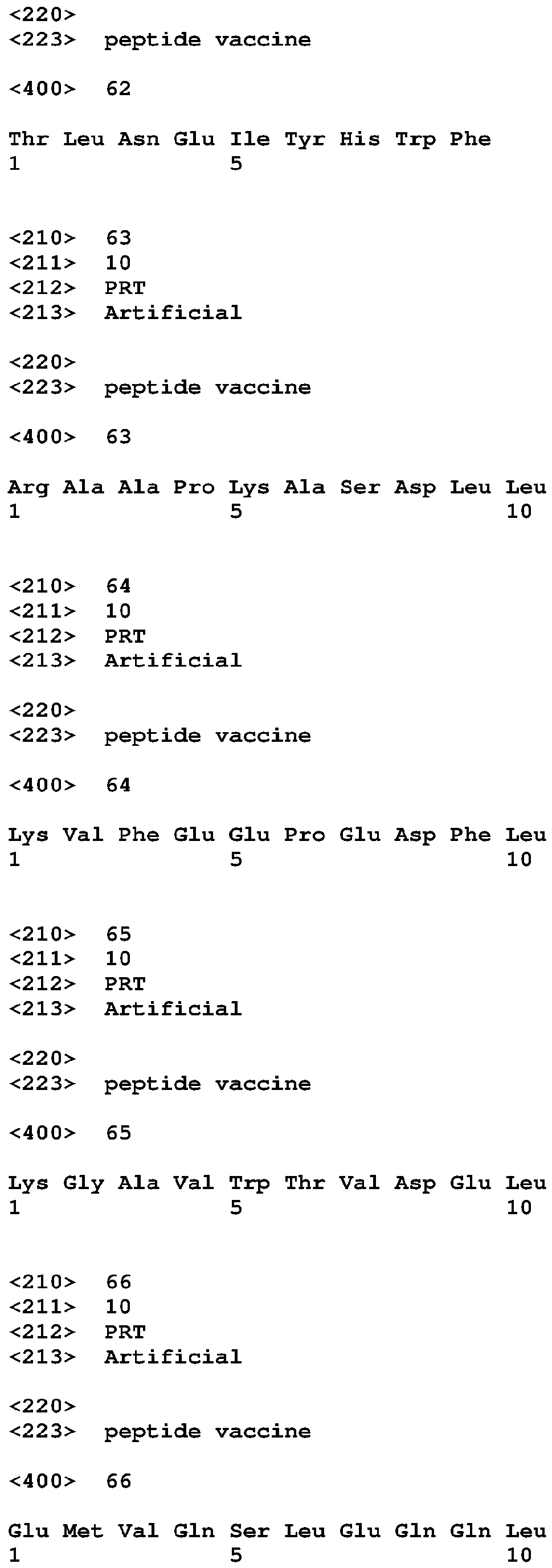


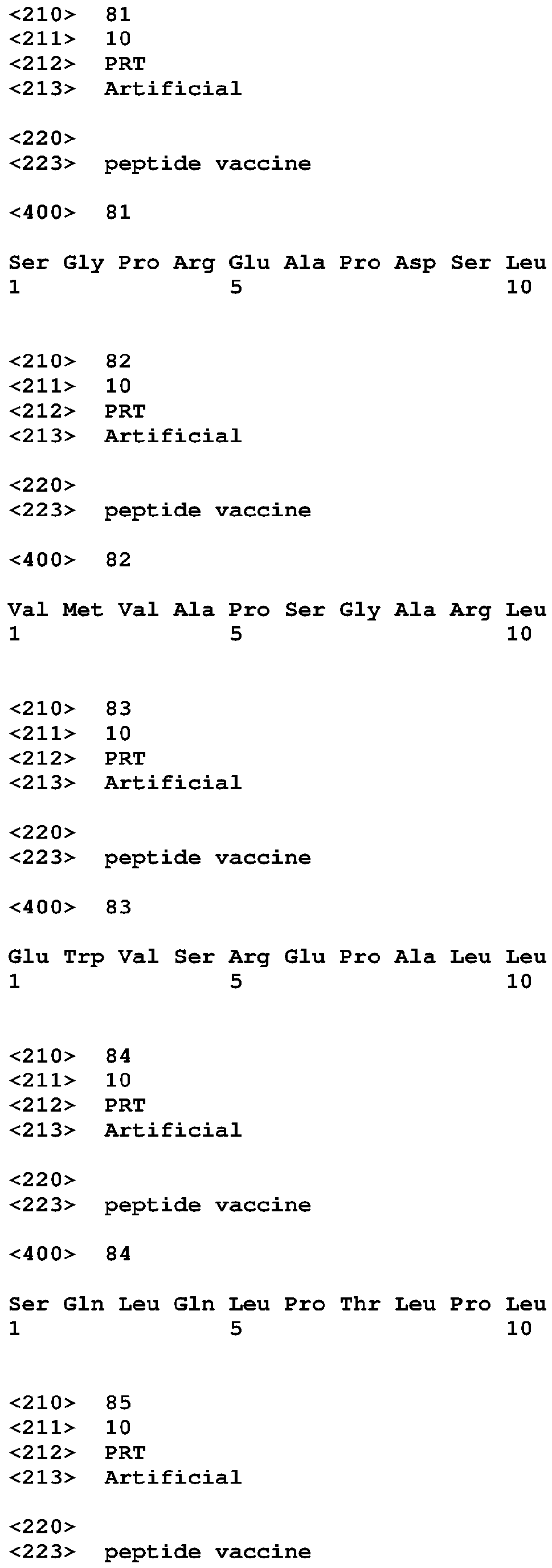


Claims (22)
- A peptide having cytotoxic T cell inducibility, wherein the peptide is selected from the group consisting of:(a) a peptide comprising the amino acid sequence selected from the group consisting of SEQ ID NO: 17, 15-16, 18-19, 22, 24, 27-30, and 37,(b) a peptide comprising the amino acid sequence selected from the group consisting of SEQ ID NO: 17, 15-16, 18-19, 22, 24, 27-30, and 37, wherein 1, 2, or several amino acids are substituted or added,(c) a peptide comprising the amino acid sequence selected from the group consisting of SEQ ID NO: 17, 4-5, 8-9, 12, 67 and 74, and(d) a peptide comprising the amino acid sequence selected from the group consisting of SEQ ID NO: 17, 4-5, 8-9, 12, 67 and 74, wherein 1, 2, or several amino acids are substituted or added.
- The peptide of claim 1, wherein the peptide is (a) or (b), wherein the second amino acid from the N-terminus is leucine or methionine.
- The peptide of claim 1 or 2, wherein the peptide is (a) or (b), wherein the C-terminal amino acid is valine or leucine.
- The peptide of claim 1, wherein the peptide is (c) or (d), wherein the second amino acid from the N-terminus is phenylalanine, tyrosine, methionine, or tryptophan.
- The peptide of claim 1 or 4, wherein the peptide is (c) or (d), wherein the C-terminal amino acid is phenylalanine, leucine, isoleucine, tryptophan, or methionine.
- The peptide of claim 1, wherein the peptide is (b) or (d), wherein the peptide comprises the amino acid sequence of SEQ ID NOs: 95, 97 or 98.
- A pharmaceutical agent for regulating T-reg cells, which contains one or more kinds of peptides of any one of claims 1 to 6, or a polynucleotide encoding the peptide.
- The pharmaceutical agent of claim 7, which is intended for use in inhibiting proliferation of T-reg cells.
- The pharmaceutical agent of claim 7, wherein the peptide is (a)-(b) or (c)-(d), which is intended for use in administration to a subject whose HLA antigen is HLA-A02 or HLA-A24, respectively.
- The pharmaceutical agent of claim 7, which is intended for use in suppressing the function of T-reg cell.
- The pharmaceutical agent of claim 7, which is intended for use in treating cancer.
- The pharmaceutical agent of claim 11, which is a vaccine.
- The pharmaceutical agent of claim 12, which contains in addition to at least one peptide of any one of claims 1 to 6 or a polynucleotide encoding the peptide, another peptide which has the ability to induce cytotoxic T cells against cancerous cells or another polynucleotide encoding the other peptide.
- An exosome that presents on its surface a complex comprising an HLA antigen and the peptide of any one of claims 1 to 6.
- The exosome of claim 14, wherein the peptide is (a)-(b) or (c)-(d), wherein the HLA antigen is HLA-A02 or HLA-A24, respectively.
- The exosome of claim 14, wherein the peptide is (a)-(b) or (c)-(d), wherein the HLA antigen is HLA-A0201 or HLA-A2402, respectively.
- An in vitro method of inducing cytotoxic T cells by contacting an antigen-presenting cell with the peptide of any one of claims 1 to 6, and mixing the antigen-presenting cell with CD8+ T cells and co-culturing.
- An in vitro method of inducing an antigen-presenting cell having high cytotoxic T cell inducibility comprising the step of:(a) contacting an antigen-presenting cell with a peptide of any one of claims 1 to 6 , or(b) transferring a gene comprising a polynucleotide encoding the peptide of any one of claims 1 to 6 to an antigen-presenting cell.
- An isolated cytotoxic T cell, which is induced by the peptide of any one of claims 1 to 6.
- An antigen-presenting cell, which comprises a complex formed between an HLA antigen and the peptide of any one of claims 1 to 6.
- The antigen-presenting cell of claim 20, which is induced by the method of claim 18.
- A vaccine comprising at least one peptide of any one of claims 1 to 6 or an immunologically active fragment of said peptide, or a polynucleotide encoding the peptide for regulating T-reg cells in a subject.
Applications Claiming Priority (3)
| Application Number | Priority Date | Filing Date | Title |
|---|---|---|---|
| US87861507P | 2007-01-03 | 2007-01-03 | |
| US89647207P | 2007-03-22 | 2007-03-22 | |
| EP07849885A EP2114987A4 (en) | 2007-01-03 | 2007-12-26 | Foxp3 peptide vaccine |
Related Parent Applications (1)
| Application Number | Title | Priority Date | Filing Date |
|---|---|---|---|
| EP07849885.4 Division | 2007-12-26 |
Publications (2)
| Publication Number | Publication Date |
|---|---|
| EP2481748A2 true EP2481748A2 (en) | 2012-08-01 |
| EP2481748A3 EP2481748A3 (en) | 2012-10-24 |
Family
ID=39588270
Family Applications (2)
| Application Number | Title | Priority Date | Filing Date |
|---|---|---|---|
| EP07849885A Withdrawn EP2114987A4 (en) | 2007-01-03 | 2007-12-26 | Foxp3 peptide vaccine |
| EP12153796A Withdrawn EP2481748A3 (en) | 2007-01-03 | 2007-12-26 | Foxp3 peptide vaccine |
Family Applications Before (1)
| Application Number | Title | Priority Date | Filing Date |
|---|---|---|---|
| EP07849885A Withdrawn EP2114987A4 (en) | 2007-01-03 | 2007-12-26 | Foxp3 peptide vaccine |
Country Status (14)
| Country | Link |
|---|---|
| US (1) | US8563516B2 (en) |
| EP (2) | EP2114987A4 (en) |
| JP (1) | JP5339375B2 (en) |
| KR (1) | KR20090099075A (en) |
| CN (1) | CN101641369B (en) |
| AU (1) | AU2007340834B2 (en) |
| BR (1) | BRPI0720794A2 (en) |
| CA (1) | CA2674365A1 (en) |
| IL (1) | IL199622A0 (en) |
| MX (1) | MX2009007261A (en) |
| RU (1) | RU2473557C2 (en) |
| SG (1) | SG177199A1 (en) |
| TW (1) | TWI441648B (en) |
| WO (1) | WO2008081581A1 (en) |
Families Citing this family (9)
| Publication number | Priority date | Publication date | Assignee | Title |
|---|---|---|---|---|
| WO2009050486A2 (en) * | 2007-10-19 | 2009-04-23 | The University Of Surrey | Peptide manipulators of regulatory t cell activity |
| CZ301144B6 (en) * | 2008-09-15 | 2009-11-18 | Vysoká škola chemicko technologická v Praze | Preparation of monoclonal antibodies against FoxP3 protein using modified virus resembling particles of Mason-Pfizer ape virus |
| KR20110117112A (en) * | 2008-12-24 | 2011-10-26 | 온코세라피 사이언스 가부시키가이샤 | C1ORF5K peptide and vaccine comprising the same |
| TWI507204B (en) * | 2009-05-26 | 2015-11-11 | Oncotherapy Science Inc | CDC45L peptide and vaccine containing this peptide |
| KR102015648B1 (en) * | 2011-08-12 | 2019-08-28 | 온코세라피 사이언스 가부시키가이샤 | Mphosph1 peptides and vaccines including the same |
| CN102603892B (en) * | 2012-02-22 | 2013-10-30 | 尉军 | Tumor marker FOXP3 auto-antibody and application thereof |
| WO2017124001A2 (en) | 2016-01-14 | 2017-07-20 | Memorial Sloan-Kettering Cancer Center | T cell receptor-like antibodies specific for foxp3-derived peptides |
| CN111375055B (en) * | 2020-02-20 | 2021-09-03 | 陈宛莎 | 2019-nCoV subunit vaccine composition and immunization method thereof |
| WO2025136809A2 (en) * | 2023-12-19 | 2025-06-26 | Regeneron Pharmaceuticals, Inc. | Foxp3 peptides and uses thereof |
Family Cites Families (6)
| Publication number | Priority date | Publication date | Assignee | Title |
|---|---|---|---|---|
| ATE166578T1 (en) * | 1991-07-25 | 1998-06-15 | Idec Pharma Corp | STIMULATION OF RESPONSES OF CYTOTOXIC T-LYMPHOCYTES |
| ATE405586T1 (en) | 2001-05-08 | 2008-09-15 | Darwin Molecular Corp | METHOD FOR REGULATING IMMUNE FUNCTION IN PRIMATES USING THE FOXP3 PROTEIN |
| DK2261249T3 (en) * | 2002-09-12 | 2015-02-16 | Oncotherapy Science Inc | KDR peptides and vaccines comprising the same |
| GB0417430D0 (en) | 2004-08-05 | 2004-09-08 | Uc3 | A novel HPV vaccine comprising peptides from host cell proteins |
| JP4628208B2 (en) | 2004-08-10 | 2011-02-09 | オンコセラピー・サイエンス株式会社 | Peptide vaccine for the treatment of gastric cancer or colorectal cancer expressing CXADRL1 or GCUD1 protein |
| WO2006077941A1 (en) * | 2005-01-19 | 2006-07-27 | Keio University | Cancer vaccine |
-
2007
- 2007-12-25 TW TW096149888A patent/TWI441648B/en not_active IP Right Cessation
- 2007-12-26 AU AU2007340834A patent/AU2007340834B2/en not_active Ceased
- 2007-12-26 MX MX2009007261A patent/MX2009007261A/en active IP Right Grant
- 2007-12-26 RU RU2009129531/10A patent/RU2473557C2/en not_active IP Right Cessation
- 2007-12-26 EP EP07849885A patent/EP2114987A4/en not_active Withdrawn
- 2007-12-26 EP EP12153796A patent/EP2481748A3/en not_active Withdrawn
- 2007-12-26 US US12/522,066 patent/US8563516B2/en not_active Expired - Fee Related
- 2007-12-26 CN CN200780051977.4A patent/CN101641369B/en not_active Expired - Fee Related
- 2007-12-26 BR BRPI0720794-8A patent/BRPI0720794A2/en not_active IP Right Cessation
- 2007-12-26 KR KR1020097015693A patent/KR20090099075A/en not_active Abandoned
- 2007-12-26 SG SG2011091279A patent/SG177199A1/en unknown
- 2007-12-26 JP JP2009524039A patent/JP5339375B2/en not_active Expired - Fee Related
- 2007-12-26 WO PCT/JP2007/001466 patent/WO2008081581A1/en not_active Ceased
- 2007-12-26 CA CA002674365A patent/CA2674365A1/en not_active Abandoned
-
2009
- 2009-06-30 IL IL199622A patent/IL199622A0/en unknown
Non-Patent Citations (39)
| Title |
|---|
| ALEXANDER JP ET AL., CANCER RES, vol. 53, 1993, pages 1380 - 7 |
| ALEXANDER JP ET AL., CANCER RES, vol. 53, 1997, pages 1380 - 7 |
| BOON T ET AL., J EXP MED, vol. 183, 1996, pages 725 - 9 |
| BOON T, INT J CANCER, vol. 54, 1993, pages 177 - 80 |
| BRICHARD V ET AL., J EXP MED, vol. 178, 1993, pages 489 - 95 |
| BUTTERFIELD LH ET AL., CANCER RES, vol. 59, 1999, pages 3134 - 42 |
| CREIGHTON, PROTEINS, 1984 |
| DALBADIE-MCFARLAND ET AL., PROC NATL AC.AD SCI USA, vol. 79, 1982, pages 6409 - 13 |
| DIECKMANN D ET AL., J EXP MED, vol. 193, 2001, pages 1303 - 10 |
| FONTENOT JD ET AL., NAT IMMUNOL, vol. 4, 2003, pages 330 - 6 |
| FUJIE T ET AL., INT J CANCER, vol. 80, 1999, pages 169 - 72 |
| HARRIS CC, J NATL CANCER INST, vol. 88, 1996, pages 1442 - 5 |
| HOIIGUCHI S ET AL., CANCER RES, vol. 59, 1999, pages 2950 - 6 |
| HORI S ET AL., SCIENCE, vol. 299, 2003, pages 1057 - 61 |
| HORIGUCHI S ET AL., CANCER RES, vol. 59, 1999, pages 2950 - 6 |
| JOURNAL OF IMMUNOLOGICAL METHODS, vol. 185, 1995, pages 181 - 190 |
| KAWAKAMI Y ET AL., J EXP MED, vol. 180, 1994, pages 347 - 52 |
| KHATTRI R ET AL., NAT IMMUNOL, vol. 4, 2003, pages 304 - 6 |
| KIESSLING R ET AL., CANCER IMMUNOL IMMUNOTHER, vol. 48, 1999, pages 353 - 62 |
| KIKUCHI M ET AL., INT J CANCER, vol. 81, 1999, pages 459 - 66 |
| KONO K ET AL., CLIN CANCER RES, vol. 11, 1996, pages 1825 - 8 |
| KUZUSHIMA K ET AL., BLOOD, vol. 98, no. 6, 2001, pages 1872 - 81 |
| MARK ET AL., PROC NATL ACAD SCI USA, vol. 81, 1984, pages 5662 - 6 |
| MIESCHER S ET AL., J IMMUNOL, vol. 136, 1986, pages 1899 - 907 |
| NUKAYA I. ET AL., INT J CANCER, vol. 80, no. 1, 5 January 1999 (1999-01-05), pages 92 - 7 |
| OISO M ET AL., INT J CANCER, vol. 81, 1999, pages 387 - 94 |
| PARKER KC. ET AL., J IMMUNOL, vol. 152, no. 1, 1 January 1994 (1994-01-01), pages 163 - 75 |
| PARKER KC. ET AL., J IMMUNOL., vol. 152, no. 1, 1 January 1994 (1994-01-01), pages 163 - 75 |
| PROTEIN SCIENCE, vol. 9, 2000, pages 1838 - 1846 |
| ROSENBERG SA ET AL., NAT MED, vol. 10, 2004, pages 909 - 15 |
| SAKAGUCHI S ET AL., J IMMUNOL., vol. 155, 1995, pages 1151 - 64 |
| SMITA N ET AL., CANCER RES., vol. 67, no. 1, 1 January 2007 (2007-01-01), pages 371 - 80 |
| TANAKA F ET AL., CANCER RES, vol. 57, 1997, pages 4465 - 8 |
| VAN DER BRUGGEN P ET AL., SCIENCE, vol. 254, 1991, pages 1643 - 7 |
| VAN DER BURG SH ET AL., J IMMUNOL, vol. 156, 1996, pages 3308 - 14 |
| VISSERS JLM ET AL., CANCER RES, vol. 59, 1999, pages 5554 - 9 |
| YOUNG RC ET AL., AM J MED, vol. 52, 1972, pages 63 - 72 |
| YOUNG RC ET AL., AM J MED, vol. 52, 1972, pages 63 - 8 |
| ZOLLER; SMITH, NUCLEIC ACIDS RES, vol. 10, 1982, pages 6487 - 500 |
Also Published As
| Publication number | Publication date |
|---|---|
| SG177199A1 (en) | 2012-01-30 |
| CN101641369B (en) | 2014-10-22 |
| BRPI0720794A2 (en) | 2014-03-11 |
| AU2007340834A1 (en) | 2008-07-10 |
| KR20090099075A (en) | 2009-09-21 |
| TWI441648B (en) | 2014-06-21 |
| EP2114987A1 (en) | 2009-11-11 |
| IL199622A0 (en) | 2010-04-15 |
| AU2007340834B2 (en) | 2013-02-28 |
| US8563516B2 (en) | 2013-10-22 |
| MX2009007261A (en) | 2009-11-11 |
| RU2009129531A (en) | 2011-02-10 |
| US20100092501A1 (en) | 2010-04-15 |
| RU2473557C2 (en) | 2013-01-27 |
| TW200835516A (en) | 2008-09-01 |
| EP2481748A3 (en) | 2012-10-24 |
| JP2010514669A (en) | 2010-05-06 |
| WO2008081581A1 (en) | 2008-07-10 |
| CN101641369A (en) | 2010-02-03 |
| JP5339375B2 (en) | 2013-11-13 |
| EP2114987A4 (en) | 2010-07-21 |
| CA2674365A1 (en) | 2008-07-10 |
Similar Documents
| Publication | Publication Date | Title |
|---|---|---|
| US8367799B2 (en) | TEM8 peptides and vaccines comprising the same | |
| US10711047B2 (en) | CDCA1 epitope peptides and vaccines containing the same | |
| US20110280898A1 (en) | Inhbb epitope peptides and vaccines containing the same | |
| US8563516B2 (en) | Foxp3 peptide vaccine | |
| US9193765B2 (en) | Melk epitope peptides and vaccines containing the same | |
| US20110200626A1 (en) | Iqgap3 epitope peptides and vaccines containing the same | |
| AU2009258775B2 (en) | MYBL2 epitope peptides and vaccines containing the same | |
| US20150315239A1 (en) | Method of inducing an immune response by administering wdrpuh epitope peptides | |
| AU2008238739B2 (en) | TEM8 peptides and vaccines comprising the same | |
| HK1174337A (en) | Foxp3 peptide vaccine | |
| HK1175197B (en) | Tem8 peptides and vaccines comprising the same |
Legal Events
| Date | Code | Title | Description |
|---|---|---|---|
| PUAI | Public reference made under article 153(3) epc to a published international application that has entered the european phase |
Free format text: ORIGINAL CODE: 0009012 |
|
| AC | Divisional application: reference to earlier application |
Ref document number: 2114987 Country of ref document: EP Kind code of ref document: P |
|
| AK | Designated contracting states |
Kind code of ref document: A2 Designated state(s): AT BE BG CH CY CZ DE DK EE ES FI FR GB GR HU IE IS IT LI LT LU LV MC MT NL PL PT RO SE SI SK TR |
|
| PUAL | Search report despatched |
Free format text: ORIGINAL CODE: 0009013 |
|
| AK | Designated contracting states |
Kind code of ref document: A3 Designated state(s): AT BE BG CH CY CZ DE DK EE ES FI FR GB GR HU IE IS IT LI LT LU LV MC MT NL PL PT RO SE SI SK TR |
|
| RIC1 | Information provided on ipc code assigned before grant |
Ipc: A61K 48/00 20060101ALI20120917BHEP Ipc: A61K 39/00 20060101ALI20120917BHEP Ipc: C07K 7/06 20060101AFI20120917BHEP Ipc: C12N 5/00 20060101ALI20120917BHEP Ipc: A61P 35/00 20060101ALI20120917BHEP Ipc: A61P 37/04 20060101ALI20120917BHEP Ipc: A61P 37/02 20060101ALI20120917BHEP Ipc: C07K 14/47 20060101ALI20120917BHEP |
|
| 17P | Request for examination filed |
Effective date: 20130328 |
|
| REG | Reference to a national code |
Ref country code: HK Ref legal event code: DE Ref document number: 1174337 Country of ref document: HK |
|
| 17Q | First examination report despatched |
Effective date: 20130913 |
|
| STAA | Information on the status of an ep patent application or granted ep patent |
Free format text: STATUS: THE APPLICATION IS DEEMED TO BE WITHDRAWN |
|
| 18D | Application deemed to be withdrawn |
Effective date: 20150428 |