EP2481386A1 - Absorptive article - Google Patents
Absorptive article Download PDFInfo
- Publication number
- EP2481386A1 EP2481386A1 EP10818742A EP10818742A EP2481386A1 EP 2481386 A1 EP2481386 A1 EP 2481386A1 EP 10818742 A EP10818742 A EP 10818742A EP 10818742 A EP10818742 A EP 10818742A EP 2481386 A1 EP2481386 A1 EP 2481386A1
- Authority
- EP
- European Patent Office
- Prior art keywords
- sheet
- absorptive article
- absorbent layer
- absorber
- pulp
- Prior art date
- Legal status (The legal status is an assumption and is not a legal conclusion. Google has not performed a legal analysis and makes no representation as to the accuracy of the status listed.)
- Granted
Links
Images




Classifications
-
- A—HUMAN NECESSITIES
- A61—MEDICAL OR VETERINARY SCIENCE; HYGIENE
- A61F—FILTERS IMPLANTABLE INTO BLOOD VESSELS; PROSTHESES; DEVICES PROVIDING PATENCY TO, OR PREVENTING COLLAPSING OF, TUBULAR STRUCTURES OF THE BODY, e.g. STENTS; ORTHOPAEDIC, NURSING OR CONTRACEPTIVE DEVICES; FOMENTATION; TREATMENT OR PROTECTION OF EYES OR EARS; BANDAGES, DRESSINGS OR ABSORBENT PADS; FIRST-AID KITS
- A61F13/00—Bandages or dressings; Absorbent pads
- A61F13/15—Absorbent pads, e.g. sanitary towels, swabs or tampons for external or internal application to the body; Supporting or fastening means therefor; Tampon applicators
-
- A—HUMAN NECESSITIES
- A61—MEDICAL OR VETERINARY SCIENCE; HYGIENE
- A61F—FILTERS IMPLANTABLE INTO BLOOD VESSELS; PROSTHESES; DEVICES PROVIDING PATENCY TO, OR PREVENTING COLLAPSING OF, TUBULAR STRUCTURES OF THE BODY, e.g. STENTS; ORTHOPAEDIC, NURSING OR CONTRACEPTIVE DEVICES; FOMENTATION; TREATMENT OR PROTECTION OF EYES OR EARS; BANDAGES, DRESSINGS OR ABSORBENT PADS; FIRST-AID KITS
- A61F13/00—Bandages or dressings; Absorbent pads
- A61F13/15—Absorbent pads, e.g. sanitary towels, swabs or tampons for external or internal application to the body; Supporting or fastening means therefor; Tampon applicators
- A61F13/51—Absorbent pads, e.g. sanitary towels, swabs or tampons for external or internal application to the body; Supporting or fastening means therefor; Tampon applicators characterised by the outer layers of the pads
-
- A—HUMAN NECESSITIES
- A61—MEDICAL OR VETERINARY SCIENCE; HYGIENE
- A61F—FILTERS IMPLANTABLE INTO BLOOD VESSELS; PROSTHESES; DEVICES PROVIDING PATENCY TO, OR PREVENTING COLLAPSING OF, TUBULAR STRUCTURES OF THE BODY, e.g. STENTS; ORTHOPAEDIC, NURSING OR CONTRACEPTIVE DEVICES; FOMENTATION; TREATMENT OR PROTECTION OF EYES OR EARS; BANDAGES, DRESSINGS OR ABSORBENT PADS; FIRST-AID KITS
- A61F13/00—Bandages or dressings; Absorbent pads
- A61F13/15—Absorbent pads, e.g. sanitary towels, swabs or tampons for external or internal application to the body; Supporting or fastening means therefor; Tampon applicators
- A61F13/51—Absorbent pads, e.g. sanitary towels, swabs or tampons for external or internal application to the body; Supporting or fastening means therefor; Tampon applicators characterised by the outer layers of the pads
- A61F13/511—Topsheet, i.e. the permeable cover or layer facing the skin
-
- A—HUMAN NECESSITIES
- A61—MEDICAL OR VETERINARY SCIENCE; HYGIENE
- A61F—FILTERS IMPLANTABLE INTO BLOOD VESSELS; PROSTHESES; DEVICES PROVIDING PATENCY TO, OR PREVENTING COLLAPSING OF, TUBULAR STRUCTURES OF THE BODY, e.g. STENTS; ORTHOPAEDIC, NURSING OR CONTRACEPTIVE DEVICES; FOMENTATION; TREATMENT OR PROTECTION OF EYES OR EARS; BANDAGES, DRESSINGS OR ABSORBENT PADS; FIRST-AID KITS
- A61F13/00—Bandages or dressings; Absorbent pads
- A61F13/15—Absorbent pads, e.g. sanitary towels, swabs or tampons for external or internal application to the body; Supporting or fastening means therefor; Tampon applicators
- A61F13/51—Absorbent pads, e.g. sanitary towels, swabs or tampons for external or internal application to the body; Supporting or fastening means therefor; Tampon applicators characterised by the outer layers of the pads
- A61F13/514—Backsheet, i.e. the impermeable cover or layer furthest from the skin
- A61F13/51401—Backsheet, i.e. the impermeable cover or layer furthest from the skin characterised by the material
-
- A—HUMAN NECESSITIES
- A61—MEDICAL OR VETERINARY SCIENCE; HYGIENE
- A61F—FILTERS IMPLANTABLE INTO BLOOD VESSELS; PROSTHESES; DEVICES PROVIDING PATENCY TO, OR PREVENTING COLLAPSING OF, TUBULAR STRUCTURES OF THE BODY, e.g. STENTS; ORTHOPAEDIC, NURSING OR CONTRACEPTIVE DEVICES; FOMENTATION; TREATMENT OR PROTECTION OF EYES OR EARS; BANDAGES, DRESSINGS OR ABSORBENT PADS; FIRST-AID KITS
- A61F13/00—Bandages or dressings; Absorbent pads
- A61F13/15—Absorbent pads, e.g. sanitary towels, swabs or tampons for external or internal application to the body; Supporting or fastening means therefor; Tampon applicators
- A61F13/53—Absorbent pads, e.g. sanitary towels, swabs or tampons for external or internal application to the body; Supporting or fastening means therefor; Tampon applicators characterised by the absorbing medium
-
- A—HUMAN NECESSITIES
- A61—MEDICAL OR VETERINARY SCIENCE; HYGIENE
- A61F—FILTERS IMPLANTABLE INTO BLOOD VESSELS; PROSTHESES; DEVICES PROVIDING PATENCY TO, OR PREVENTING COLLAPSING OF, TUBULAR STRUCTURES OF THE BODY, e.g. STENTS; ORTHOPAEDIC, NURSING OR CONTRACEPTIVE DEVICES; FOMENTATION; TREATMENT OR PROTECTION OF EYES OR EARS; BANDAGES, DRESSINGS OR ABSORBENT PADS; FIRST-AID KITS
- A61F13/00—Bandages or dressings; Absorbent pads
- A61F13/15—Absorbent pads, e.g. sanitary towels, swabs or tampons for external or internal application to the body; Supporting or fastening means therefor; Tampon applicators
- A61F13/53—Absorbent pads, e.g. sanitary towels, swabs or tampons for external or internal application to the body; Supporting or fastening means therefor; Tampon applicators characterised by the absorbing medium
- A61F2013/530007—Absorbent pads, e.g. sanitary towels, swabs or tampons for external or internal application to the body; Supporting or fastening means therefor; Tampon applicators characterised by the absorbing medium being made from pulp
- A61F2013/530058—Absorbent pads, e.g. sanitary towels, swabs or tampons for external or internal application to the body; Supporting or fastening means therefor; Tampon applicators characterised by the absorbing medium being made from pulp with specific method of producing wood pulp fibres
- A61F2013/530116—Absorbent pads, e.g. sanitary towels, swabs or tampons for external or internal application to the body; Supporting or fastening means therefor; Tampon applicators characterised by the absorbing medium being made from pulp with specific method of producing wood pulp fibres with recycled material, e.g. paper
Definitions
- the present invention relates to an absorptive article.
- Patent Document 1 discloses a reclaimed disposable diaper and reclaimed bladder control pad made from regenerated pulp separated and recovered from used disposable diapers and used bladder control pads.
- Patent Document 2 discloses an absorptive article having an absorber that contains a blended pulp composed of virgin pulp and recycled pulp obtained from used paper, and that contains an absorbent polymer.
- rejected products occur during adjustment of a production machine at the time of an item change and material splicing. Furthermore, products that cannot be shipped due to a failure are treated as rejected products. Although some of the rejected products have been converted to cat litter or other products after separating a polymer absorber, others have been usually incinerated. In recent years, efforts have been made to separate pulp and polymers from rejected products and to reuse them for effective use of the rejected products.
- An object of the present invention is to provide an absorptive article that has a satisfactory appearance even in the case of using recycled pulp and polymers containing foreign materials.
- the invention of claim 1 provides an absorptive article comprising a liquid-permeable top sheet, a liquid-impermeable back sheet, and an absorber disposed between the top sheet and the back sheet, wherein the absorber has a layered structure comprising an upper absorbent layer disposed on the top-sheet side and a lower absorbent layer disposed on the back-sheet side; the upper absorbent layer comprises virgin pulp and virgin polymer, and the lower absorbent layer contains recycled pulp and recycled polymer.
- the invention of claim 2 provides the absorptive article according to claim 1, wherein the lower absorbent layer contains virgin pulp and virgin polymer.
- the invention of claim 3 provides the absorptive article according to claim 1 or 2, wherein the back sheet has a predetermined color or pattern.
- the invention of claim 4 provides the absorptive article according to any one of claims 1 to 3, further comprising a second back sheet that covers a surface of the back sheet, the surface being opposite to another surface of the back sheet on the top-sheet side.
- the invention of claim 5 provides the absorptive article according to any one of claims 1 to 4, wherein the absorber is covered with crepe paper having a predetermined color or pattern.
- the invention of claim 6 provides the absorptive article according to any one of claims 1 to 4, wherein the absorber is covered with a sheet containing activated carbon.
- the invention of claim 7 provides the absorptive article according to any one of claims 1 to 6, further comprising a liquid-permeable second sheet that covers a surface of the top sheet, the surface being opposite to another surface of the top sheet on the back-sheet side.
- An absorptive article of the present invention includes a liquid-permeable top sheet, a liquid-impermeable back sheet, and an absorber disposed between the top sheet and the back sheet.
- the absorber has a layered structure including an upper absorbent layer disposed on the top-sheet side and a lower absorbent layer disposed on the back-sheet side.
- the upper absorbent layer is formed of virgin pulp and virgin polymer
- the lower absorbent layer contains recycled pulp and recycled polymer obtained from rejected products during manufacturing processes. Since the recycled pulp and polymers are used only in the lower absorbent layer, foreign materials commingled with the recycled pulp and polymer are inconspicuous when the absorptive article is seen from the top. Thus, the absorptive article provides a satisfactory appearance even in the case of using recycled pulp and polymers containing foreign materials.
- a portion to cover a human (wearer's) belly side when the absorptive article is worn is referred to as front side
- a portion to cover a wearer's back side is referred to as back side
- a portion to be in contact with the wearer is referred to as upper side
- a portion opposite side of the contact surface is referred to as lower side
- a direction perpendicular to both the anteroposterior direction and the vertical direction is defined as transverse direction, in a development view of an absorptive article 1 of this embodiment.
- the absorptive article 1 which functions as, for example, a bladder control pad for night use or for long-time use, is detachably and exchangeably attached to an outer body (not illustrated), such as a diaper, a diaper cover, or underpants, to be worn by a human body for use.
- an outer body such as a diaper, a diaper cover, or underpants
- the absorptive article 1 is to cover a crotch portion of a wearer from a belly side to a back side when worn.
- one end portion (front end portion) of the absorptive article 1 constitutes a belly side portion 11 to cover the wearer's belly side when worn
- another end portion (back end portion) constitutes a back side portion 12 to cover the wearer' s back
- a portion between the belly side portion 11 and the back side portion 12 constitutes a crotch portion 13 to be located under wear's crotch.
- the back side portion 12 has a length in the anteroposterior direction longer than that of the belly side portion 11, and has a length in the transverse direction longer than those of the belly side portion 11 and the crotch portion 13.
- Both edges of the crotch portion 13 constitute two leg periphery portions 14 to be located around legs of the wearer from the belly side portion 11 to the back side portion 12 when worn.
- the leg periphery portions 14 and 14 have respective flat-gather elastic members 141, such as rubber threads.
- the flat-gather elastic members 141 constitute flat gathers. This allows the absorptive article 1 to stretchably fit around the wearer' s legs.
- the flat gathers allow the absorptive article 1 to be naturally curved, so that three-dimensional gathers (to be described later) can be tightly attached to the wearer's crotch portion.
- the absorptive article 1 mainly includes a liquid-permeable top sheet 20 arranged as a surface to be in contact with a wearer (upper side); a liquid-impermeable back sheet 30 arranged on the other side of the surface to be in contact with the wearer (lower side); an absorber 50 disposed between the top sheet 20 and the back sheet 30; gather sheets 40 and 40 arranged at both side edges (right edge and left edge) of the absorber 50, with respect to the width direction thereof, over the top sheet 20 along the longitudinal direction (anteroposterior direction) of the absorptive article 1; and a fixing member 60 arranged at the belly side portion 11 of the back sheet 30 for fixing the absorptive article 1 to an outer body.
- materials suitable for the liquid-permeable sheet include plain-woven nets of nylon or polyethylene terephthalate yarn, films or sheets having a large number of through holes, polyethylene or polypropylene films or sheets, and liquid-permeable woven or non-woven fabrics. Liquid permeable non-woven fabrics are especially suitable.
- non-woven fabrics examples include ones made of fiber material such as synthetic fibers of olefins, e.g., polyethylene and polypropylene, polyesters, and polyamides; recycled fibers of rayon and cupra; and natural fibers of cotton, which fabrics are produced by any suitable process such as spun lacing, spun bonding, thermal bonding, melt blowing, or needle punching.
- fiber material such as synthetic fibers of olefins, e.g., polyethylene and polypropylene, polyesters, and polyamides
- recycled fibers of rayon and cupra such as spun lacing, spun bonding, thermal bonding, melt blowing, or needle punching.
- the back sheet 30 is arranged under the absorber 50 and is a liquid-impermeable sheet to prevent body fluid from leaching out or leaking out of the absorptive article 1.
- the back sheet 30 in this embodiment constitutes the outermost layer of the absorptive article 1.
- the liquid-impermeable sheet include polyethylene or polypropylene sheets having at least waterproof property, preferably sheets also having moisture permeability in order to suppress humidity.
- the suitable sheet material having both waterproof property and moisture permeability include microporous sheet materials produced by forming a sheet from an olefin resin such as polyethylene or polypropylene containing inorganic filler through melting and kneading and then uniaxially or biaxially stretching the sheet.
- a laminated non-woven fabric composed of a liquid-impermeable film and an air-permeable nonwoven fabric layer may be used.
- the laminated nonwoven fabric is composed of, for example, a polyethylene sheet laminated with a nonwoven fabric, having both liquid-impermeability and air permeability.
- the back sheet 30 should have liquid-impermeability, but does not necessarily need to have moisture permeability.
- the gather sheets 40 and 40 are disposed over the top sheet 20 at both side edges, respectively, of the absorber 50, along the longitudinal direction from the belly side portion 11 to the back side portion 12.
- the outer portions of the gather sheets 40 and 40 with respect to the width direction (transverse direction) are fixed to the upper surfaces of the top sheet 20 and the back sheet 30 lateral to the absorber 50.
- the inner portions of the gather sheets 40 and 40 with respect to the width direction are not fixed to the top sheet 20 or the back sheet 30, and each has a three-dimensional-gather elastic member 401, such as a rubber thread, along the longitudinal direction (anteroposterior direction) to form a pair of standing three-dimensional gathers that can be stretchably deformed corresponding to a body shape of a wearer.
- the absorber 50 extends from the belly side portion 11 through the crotch portion 13 to the back side portion 12.
- the absorber 50 which plays a role in absorbing watery components such as urine as body fluid when the absorptive article 1 is used, has an absorbent core 51 covered with a liquid-permeable crepe paper 52.
- the outer shape of the absorber 50 is represented by dashed lines in FIGS. 1 to 3
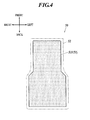
- the outer shape of the crepe paper 52 covering the absorbent 50 is represented by a two-dot chain line in FIG. 4 .
- the absorbent core 51 has a double-layer structure including an upper absorbent layer 511 disposed on the side of the top sheet 20 and a lower absorbent layer 512 disposed on the side of the back sheet 30 as illustrated in FIG. 5 .
- the upper absorbent layer 511 is elongated in the anteroposterior direction, and the back side portion 12 has a length in the transverse direction longer than those of the belly side portion 11 and the crotch portion 13.
- the upper absorbent layer 511 is composed of a combination of pulp as absorbent material and a high water-absorption resin such as absorbent polymer.
- the pulp used in the upper absorbent layer 511 is virgin pulp and the absorbent polymer used in the upper absorbent layer 511 is virgin polymer. Since the upper absorbent layer 511 is arranged close to the surface to be in contact with a human body (close to the top sheet 20), the upper absorbent layer 511 keeps a constant absorbing rate for the body fluid. The absorbing rate is appropriately adjusted depending on the ratio of the absorbent material such as pulp to the high water-absorption resin such as absorbent polymer, and depending on the type of the high water-absorption resin.
- the lower absorbent layer 512 has a shape similar to that of the upper absorbent layer 511, and is arranged on the lower surface of the upper absorbent layer 511 (closer to the back sheet 30 among the layers of the absorbent core 51).
- the lower absorbent layer 512 is also composed of a combination of pulp as absorbent material and a high water-absorption resin such as absorbent polymer.
- the pulp used in the lower absorbent layer 512 contains recycled pulp.
- the recycled pulp is, for example, pulp recovered from rejected products during manufacturing processes, pulp recycled from used absorptive articles, or pulp composed of a combination thereof.
- the absorbent polymer used in the lower absorbent layer 512 contains recycled polymer.
- the recycled polymer is, for example, a polymer recovered from rejected products during manufacturing processes.
- the recycled pulp and polymer can be recovered from rejected products, for example, disposable diapers for babies, bladder control pads for babies, disposable diapers for nursing, bladder control pads for nursing, and sanitary napkins.
- the recycled pulp from used absorptive articles can be recovered from, for example, used disposable diapers for babies, used bladder control pads for babies, used disposable diapers for nursing, used bladder control pads for nursing, and used sanitary napkins.
- the rejected absorptive articles are fractured to be used as the recycled pulp or polymer.
- unwoven fabrics and waterproof sheets are removed after water components are separated from the absorbent polymer.
- the pulp components can be recovered by any known method.
- the recycled pulp and polymer be compounded with virgin pulp and virgin polymer, with the compounding ratio of the virgin pulp and virgin polymer being up to 75%. This reduces the variation in absorption rate, and allows the quality of the absorptive article 1 to be free from influence of increase or decrease in supply of the recycled pulp or polymer.
- the body-fluid absorbing rate of the upper absorbent layer 511 be adjusted to be higher than that of the lower absorbent layer 512 in the absorptive article 1, so that the body fluid is swiftly absorbed in the upper absorbent layer 511 and retained in the lower absorbent layer 512.
- the body fluid is thereby swiftly detached from the skin to reduce discomfort of wearer and burden to the skin.
- crepe paper 52 Although any known crepe paper 52 can be used, it is preferable that the crepe paper 52 have a weight not lower than 15 gsm, in order to effectively make commingled foreign materials inconspicuous, which commingled foreign materials include, for example, remaining rubber threads, unwoven fabrics, and polymer sheets, contained in recycled pulp in the lower absorbent layer 512.
- commingled foreign materials include, for example, remaining rubber threads, unwoven fabrics, and polymer sheets, contained in recycled pulp in the lower absorbent layer 512.
- a liquid-permeable unwoven fabric or a porous sheet may be used for covering the absorbent core 51 in the absorber 50.
- the fixing member 60 is composed of an adhesive tape to bond the absorptive articles 1 to the outer body, whose adhesive surface is exposed when release paper is peeled off.
- the fixing member 60 for example, has an approximately rectangular shape as illustrated in FIG. 2 , and is arranged at the center of the belly side portion 11 on the surface opposite from a surface to be in contact with the wearer (the lower surface of the back sheet 30) when the absorptive article 1 is worn.
- the fixing member 60 is arranged at an anterior part of the belly side portion 11 in order to prevent the absorptive article 1 from being turned up or slipping.
- the area of the fixing member 60 be less than 20% of the area of the back sheet 30 in order not to inhibit ventilation of the back sheet 30, especially in the case of employing a liquid-impermeable back sheet 30 having moisture permeability.
- the material be as soft as possible in order to easily follow the movement of the wear's body.
- the absorptive article 1 of this embodiment described above includes a liquid-permeable top sheet 20, a liquid-impermeable back sheet 30, and an absorber 50 disposed between the top sheet 20 and the back sheet 30.
- the absorber 50 has a layered structure including an upper absorbent layer 511 disposed on the side of the top sheet 20 and a lower absorbent layer 512 disposed on the side of the back sheet 30.
- the upper absorbent layer 511 is composed of virgin pulp and virgin polymer
- the lower absorbent layer 512 contains recycled pulp and polymer recovered from rejected products during manufacturing processes. That is, the recycled pulp and polymer are used only in the lower absorbent layer 512. Accordingly, foreign materials commingled with the recycled pulp and polymer are inconspicuous when viewed from the above, resulting in providing a satisfactory appearance of the absorptive article 1 regardless of the use of recycled pulp and polymers containing foreign materials.
- the recycled pulp which has a fiber length shorter than that of virgin pulp, might reduce the absorption rate, the absorption rate is less affected by the fiber length because the recycled pulp is used only in the lower absorbent layer 512.
- the recycled polymers tend to cause a variation in quality due to commingled polymers having various characteristics, such as high or low liquid permeability
- the absorptive article 1 is less subject to adverse effect of the low-permeable polymer because the recycled pulp is used only in the lower absorbent layer 512.
- the adverse effect of the low-permeable polymer includes gel blocking on the absorber surface resulting in decrease in absorbing rate or increase in backward flow of the fluid.
- the recycled pulp and polymer are suitably used as described above, in an ecological manner.
- the absorptive article 1 of this embodiment described above has a lower absorbent layer 512 that contains virgin pulp and virgin polymer. Consequently, the absorption rate is kept at constant, and quality of the absorptive article 1 is not affected by increase or decrease in supply of the recycled pulp or polymer.
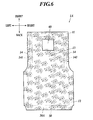
- the back sheet 30 in the embodiment may have a predetermined color or pattern, as in a back sheet 30A of an absorptive article 1A illustrated in FIG. 6 .
- foreign materials contained in the recycled pulp is effectively made inconspicuous by a deep color such as blue, green, or orange, or a pale color at high printing density.
- the foreign materials contained in the recycled pulp can be camouflaged by predetermined drawing patterns or characters, especially by designs having colors such as pink, blue, green, orange, purple, and gray which are commonly used in rubber threads and polymer sheets of rejected products.
- the back sheet 30 having a color other than white can effectively make foreign materials inconspicuous when the foreign materials are commingled with the recycled pulp and polymers contained in the lower absorbent layer 512 of the absorber 50.
- the back sheet 30 in this embodiment may have a second back sheet 70 that covers the lower surface of the back sheet 30 as in an absorptive article 1B illustrated in FIG. 7 .
- the second back sheet 70 constitutes the back sheet, which is on the opposite side of the surface to be in contact with a wearer who wears the absorptive article 1B.
- the second back sheet 70 is composed of a non-woven fabric that covers a surface (lower surface) of the back sheet 30.
- the lower surface of the back sheet 30 is a surface opposite to the other surface of the back sheet 30 on the side of the top sheet 20.
- the second back sheet 70 examples include, but are not limited to, chemical bond non-woven fabrics, thermal bond non-woven fabrics, spun lace non-woven fabrics, spun bond non-woven fabrics, melt-blown non-woven fabrics, heat-rolled non-woven fabrics, air through non-woven fabrics, liquid-impermeable non-woven fabrics, and sheets of a combination thereof.
- the sheet may be a liquid-impermeable sheet of, for example, polyethylene or polypropylene, having at least waterproof property.
- the second back sheet 70 can effectively make foreign materials inconspicuous when the foreign materials are commingled with the recycled pulp and polymers contained in the lower absorbent layer 512 of the absorber 50.
- the second back sheet 70 may have a predetermined color or pattern as illustrated in Variation 1.
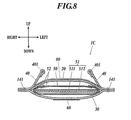
- the top sheet 20 may have a liquid-permeable second sheet 80 that covers the upper surface of the top sheet 20 as in the absorptive article 1C illustrated in FIG. 8 .
- the second sheet 80 constitutes a surface to be in contact with a wearer who wears the absorptive article 1.
- the second sheet 80 is arranged to cover a surface (upper surface) of the top sheet 20.
- the upper surface of the top sheet 20 is a surface opposite to the other surface of the top sheet 20 on the side of the back sheet 30.
- the liquid-permeable sheet examples include plain-woven nets from nylon or polyethylene terephthalate yarn, films or sheets having a large number of through holes, polyethylene or polypropylene sheets, and liquid-permeable woven or non-woven fabrics. Liquid permeable non-woven fabrics are especially suitable.
- the second sheet 80 provides satisfactory appearance as viewed from a surface to come into contact with a human body and prevents backward flow of the body fluid.
- the top sheet 20 may have a second sheet 80
- the back sheet 30 may have a second back sheet 70 as illustrated in Variation 2.
- the second back sheet 70 may have a predetermined color or pattern as illustrated in Variation 1.
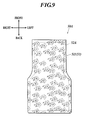
- the absorber 50 may be covered with a crepe paper 52A having a predetermined color or pattern as in an absorber 50A illustrated in FIG. 9 .
- a crepe paper 52A having a predetermined color or pattern as in an absorber 50A illustrated in FIG. 9 .
- any colors or patterns can be applied to the crepe paper 52A, for example, the colors or patterns described in Variation 1 can be suitably used.
- the color or pattern applied to the crepe paper 52A effectively makes foreign materials inconspicuous when the foreign materials are commingled with the recycled pulp and polymers contained in the lower absorbent layer 512 of the absorber 50.
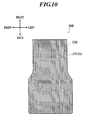
- the absorber 50 may be covered with a sheet 52B containing activated carbon as in an absorber 50B illustrated in FIG. 10 .
- the sheet 52B containing activated carbon effectively makes foreign material inconspicuous because the sheet 52B is colored with activated carbon, and at the same time, the sheet 52B has odor eliminating and antibacterial effects.
- the present invention is not limited to the embodiments described above and can be appropriately modified within the scope of the invention.
- a bladder control pad is illustrated as the absorptive article in the embodiments and Variations 1 to 5, the absorptive article is not limited to this and can be applied to a disposable diaper for babies, a disposable diaper for nursing, a sanitary napkin, or the like.
- the fixing member 60 may have any shape as long as the fixing member 60 is arranged at least in a belly side portion 11 of a surface (lower surface of the absorptive article 1), which surface is opposite to the surface to be in contact with a wearer.
- the fixing member 60 may be elongated in the anteroposterior or transverse direction.
- the fixing member 60 may have a predetermined shape such as a T-shape.
- the number of the fixing members 60 having the above-mentioned various shapes may be appropriately determined.
- two fixing members may be arranged in the transverse or anteroposterior direction.
- the absorptive article 1 may have flat gathers not only in the crotch portion 13 but also in a back side portion 12, for example.
- the flat gathers in the back side portion 12 makes the absorptive article 1 easily curve in the width direction, resulting in more effectively preventing leak of liquid.
- the absorptive article 1 may have only one of the flat gathers and the three-dimensional gathers.
- the absorber core 51 is not limited to a doubly-layered structure as long as the absorber core 51 includes at least an upper absorbent layer 511 disposed on the side of the top sheet 20 and a lower absorbent layer 512 disposed on the side of the back sheet 30.
- an intermediate layer (not illustrated) having a predetermined function may be disposed between the upper absorbent layer 511 and the lower absorbent layer 512 to form a triple-layered structure.
- the present invention can be used by manufacturers of absorptive articles.
Landscapes
- Health & Medical Sciences (AREA)
- Epidemiology (AREA)
- Engineering & Computer Science (AREA)
- Biomedical Technology (AREA)
- Heart & Thoracic Surgery (AREA)
- Vascular Medicine (AREA)
- Life Sciences & Earth Sciences (AREA)
- Animal Behavior & Ethology (AREA)
- General Health & Medical Sciences (AREA)
- Public Health (AREA)
- Veterinary Medicine (AREA)
- Dermatology (AREA)
- Absorbent Articles And Supports Therefor (AREA)
Abstract
Description
- The present invention relates to an absorptive article.
- Until now, absorptive articles typified by disposable diapers and bladder control pads have been in widespread use .
These absorptive articles are usually made from pulp as a main raw material produced from wood, and most thereof are incinerated after use.
In recent years, however, various reclamation processes have been developed to recycle used products with consideration for environmental concerns such as deforestation and carbon dioxide emissions.
For example,Patent Document 1 discloses a reclaimed disposable diaper and reclaimed bladder control pad made from regenerated pulp separated and recovered from used disposable diapers and used bladder control pads.
Patent Document 2 discloses an absorptive article having an absorber that contains a blended pulp composed of virgin pulp and recycled pulp obtained from used paper, and that contains an absorbent polymer. - In processes of manufacturing the disposable diaper or the absorbent pad, rejected products occur during adjustment of a production machine at the time of an item change and material splicing. Furthermore, products that cannot be shipped due to a failure are treated as rejected products.
Although some of the rejected products have been converted to cat litter or other products after separating a polymer absorber, others have been usually incinerated.
In recent years, efforts have been made to separate pulp and polymers from rejected products and to reuse them for effective use of the rejected products. -
- Patent Document 1: Japanese Patent No.
3648472 - Patent Document 2: Publication of Japanese Unexamined Patent Application No.
64-40047 - Unfortunately, recycled pulp and polymers from rejected products are inevitably commingled with foreign materials such as rubber threads, nonwoven cloth and a polymer sheet due to performance limit of recovery equipment. Since most of these foreign materials are colored, there has been a problem in that the products made from the recycled pulp and polymers do not have a satisfactory appearance due to the commingled foreign materials.
- An object of the present invention is to provide an absorptive article that has a satisfactory appearance even in the case of using recycled pulp and polymers containing foreign materials.
- In order to solve the problems described above, the invention of
claim 1 provides an absorptive article comprising a liquid-permeable top sheet, a liquid-impermeable back sheet, and an absorber disposed between the top sheet and the back sheet, wherein the absorber has a layered structure comprising an upper absorbent layer disposed on the top-sheet side and a lower absorbent layer disposed on the back-sheet side; the upper absorbent layer comprises virgin pulp and virgin polymer, and the lower absorbent layer contains recycled pulp and recycled polymer. - The invention of claim 2 provides the absorptive article according to
claim 1, wherein the lower absorbent layer contains virgin pulp and virgin polymer. - The invention of claim 3 provides the absorptive article according to
claim 1 or 2, wherein the back sheet has a predetermined color or pattern. - The invention of claim 4 provides the absorptive article according to any one of
claims 1 to 3, further comprising a second back sheet that covers a surface of the back sheet, the surface being opposite to another surface of the back sheet on the top-sheet side. - The invention of claim 5 provides the absorptive article according to any one of
claims 1 to 4, wherein the absorber is covered with crepe paper having a predetermined color or pattern. - The invention of claim 6 provides the absorptive article according to any one of
claims 1 to 4, wherein the absorber is covered with a sheet containing activated carbon. - The invention of claim 7 provides the absorptive article according to any one of
claims 1 to 6, further comprising a liquid-permeable second sheet that covers a surface of the top sheet, the surface being opposite to another surface of the top sheet on the back-sheet side. - An absorptive article of the present invention includes a liquid-permeable top sheet, a liquid-impermeable back sheet, and an absorber disposed between the top sheet and the back sheet. The absorber has a layered structure including an upper absorbent layer disposed on the top-sheet side and a lower absorbent layer disposed on the back-sheet side. The upper absorbent layer is formed of virgin pulp and virgin polymer, and the lower absorbent layer contains recycled pulp and recycled polymer obtained from rejected products during manufacturing processes.
Since the recycled pulp and polymers are used only in the lower absorbent layer, foreign materials commingled with the recycled pulp and polymer are inconspicuous when the absorptive article is seen from the top. Thus, the absorptive article provides a satisfactory appearance even in the case of using recycled pulp and polymers containing foreign materials. -
-
FIG. 1 is a perspective view illustrating an absorptive article of the present embodiment in a wearable state. -
FIG. 2 is a planar development view illustrating a lower portion of an absorptive article of the present embodiment. -
FIG. 3 is a planar development view illustrating an upper portion of an absorptive article of the present embodiment. -
FIG. 4 is a planar development view illustrating an upper portion of an absorber of an absorptive article of the present embodiment. -
FIG. 5 is a cross-sectional view along the line V-V ofFIG. 3 . -
FIG. 6 is a plan view illustrating an absorptive article inVariation 1. -
FIG. 7 is a cross-sectional view illustrating an absorptive article in Variation 2. -
FIG. 8 is a cross-sectional view illustrating an absorptive article in Variation 3. -
FIG. 9 is a plan view illustrating an absorber in Variation 4. -
FIG. 10 is a plan view illustrating an absorber in Variation 5. - Embodiments of the present invention will now be described in details with reference to the attached drawings. The scope of the invention should, however, not be limited to the embodiments illustrated in the drawings.
- In the following description, a portion to cover a human (wearer's) belly side when the absorptive article is worn is referred to as front side, a portion to cover a wearer's back side is referred to as back side, a portion to be in contact with the wearer is referred to as upper side, a portion opposite side of the contact surface is referred to as lower side, and a direction perpendicular to both the anteroposterior direction and the vertical direction is defined as transverse direction, in a development view of an
absorptive article 1 of this embodiment. - The
absorptive article 1, which functions as, for example, a bladder control pad for night use or for long-time use, is detachably and exchangeably attached to an outer body (not illustrated), such as a diaper, a diaper cover, or underpants, to be worn by a human body for use. - The
absorptive article 1 is to cover a crotch portion of a wearer from a belly side to a back side when worn.
Specifically, one end portion (front end portion) of theabsorptive article 1 constitutes abelly side portion 11 to cover the wearer's belly side when worn, another end portion (back end portion) constitutes aback side portion 12 to cover the wearer' s back, and a portion between thebelly side portion 11 and theback side portion 12 constitutes acrotch portion 13 to be located under wear's crotch.
Theback side portion 12 has a length in the anteroposterior direction longer than that of thebelly side portion 11, and has a length in the transverse direction longer than those of thebelly side portion 11 and thecrotch portion 13. Thus, a wide area in the back of the wearer can be covered with theback side portion 12.
Both edges of thecrotch portion 13 constitute two legperiphery portions 14 to be located around legs of the wearer from thebelly side portion 11 to theback side portion 12 when worn. The legperiphery portions elastic members 141, such as rubber threads. The flat-gatherelastic members 141 constitute flat gathers. This allows theabsorptive article 1 to stretchably fit around the wearer' s legs. Thereby, leakage at the edges is prevented, and theabsorptive article 1 can easily follow the movement of the wearer's body without slippage. The flat gathers allow theabsorptive article 1 to be naturally curved, so that three-dimensional gathers (to be described later) can be tightly attached to the wearer's crotch portion. - The
absorptive article 1 mainly includes a liquid-permeabletop sheet 20 arranged as a surface to be in contact with a wearer (upper side); a liquid-impermeable back sheet 30 arranged on the other side of the surface to be in contact with the wearer (lower side); anabsorber 50 disposed between thetop sheet 20 and theback sheet 30;gather sheets absorber 50, with respect to the width direction thereof, over thetop sheet 20 along the longitudinal direction (anteroposterior direction) of theabsorptive article 1; and afixing member 60 arranged at thebelly side portion 11 of theback sheet 30 for fixing theabsorptive article 1 to an outer body. - The
top sheet 20, which constitutes a surface to be in contact with the wearer who wears theabsorptive article 1, is composed of a liquid-permeable sheet that is arranged over theabsorber 50 to receive body fluid and transport it to theabsorber 50.
Examples of materials suitable for the liquid-permeable sheet include plain-woven nets of nylon or polyethylene terephthalate yarn, films or sheets having a large number of through holes, polyethylene or polypropylene films or sheets, and liquid-permeable woven or non-woven fabrics. Liquid permeable non-woven fabrics are especially suitable. Examples of the non-woven fabrics include ones made of fiber material such as synthetic fibers of olefins, e.g., polyethylene and polypropylene, polyesters, and polyamides; recycled fibers of rayon and cupra; and natural fibers of cotton, which fabrics are produced by any suitable process such as spun lacing, spun bonding, thermal bonding, melt blowing, or needle punching. - The
back sheet 30 is arranged under theabsorber 50 and is a liquid-impermeable sheet to prevent body fluid from leaching out or leaking out of theabsorptive article 1. Theback sheet 30 in this embodiment constitutes the outermost layer of theabsorptive article 1.
Examples of the liquid-impermeable sheet include polyethylene or polypropylene sheets having at least waterproof property, preferably sheets also having moisture permeability in order to suppress humidity. Examples of the suitable sheet material having both waterproof property and moisture permeability include microporous sheet materials produced by forming a sheet from an olefin resin such as polyethylene or polypropylene containing inorganic filler through melting and kneading and then uniaxially or biaxially stretching the sheet.
Alternatively, a laminated non-woven fabric composed of a liquid-impermeable film and an air-permeable nonwoven fabric layer may be used. The laminated nonwoven fabric is composed of, for example, a polyethylene sheet laminated with a nonwoven fabric, having both liquid-impermeability and air permeability.
Theback sheet 30 should have liquid-impermeability, but does not necessarily need to have moisture permeability. - The gather
sheets top sheet 20 at both side edges, respectively, of theabsorber 50, along the longitudinal direction from thebelly side portion 11 to theback side portion 12.
The outer portions of the gathersheets top sheet 20 and theback sheet 30 lateral to theabsorber 50. The inner portions of the gathersheets top sheet 20 or theback sheet 30, and each has a three-dimensional-gatherelastic member 401, such as a rubber thread, along the longitudinal direction (anteroposterior direction) to form a pair of standing three-dimensional gathers that can be stretchably deformed corresponding to a body shape of a wearer. - The
absorber 50 extends from thebelly side portion 11 through thecrotch portion 13 to theback side portion 12.
Theabsorber 50, which plays a role in absorbing watery components such as urine as body fluid when theabsorptive article 1 is used, has anabsorbent core 51 covered with a liquid-permeable crepe paper 52. The outer shape of theabsorber 50 is represented by dashed lines inFIGS. 1 to 3 , and the outer shape of thecrepe paper 52 covering the absorbent 50 is represented by a two-dot chain line inFIG. 4 . - The
absorbent core 51 has a double-layer structure including an upperabsorbent layer 511 disposed on the side of thetop sheet 20 and a lowerabsorbent layer 512 disposed on the side of theback sheet 30 as illustrated inFIG. 5 . - The upper
absorbent layer 511 is elongated in the anteroposterior direction, and theback side portion 12 has a length in the transverse direction longer than those of thebelly side portion 11 and thecrotch portion 13.
The upperabsorbent layer 511 is composed of a combination of pulp as absorbent material and a high water-absorption resin such as absorbent polymer.
The pulp used in the upperabsorbent layer 511 is virgin pulp and the absorbent polymer used in the upperabsorbent layer 511 is virgin polymer. Since the upperabsorbent layer 511 is arranged close to the surface to be in contact with a human body (close to the top sheet 20), the upperabsorbent layer 511 keeps a constant absorbing rate for the body fluid. The absorbing rate is appropriately adjusted depending on the ratio of the absorbent material such as pulp to the high water-absorption resin such as absorbent polymer, and depending on the type of the high water-absorption resin. - The lower
absorbent layer 512 has a shape similar to that of the upperabsorbent layer 511, and is arranged on the lower surface of the upper absorbent layer 511 (closer to theback sheet 30 among the layers of the absorbent core 51).
The lowerabsorbent layer 512 is also composed of a combination of pulp as absorbent material and a high water-absorption resin such as absorbent polymer.
The pulp used in the lowerabsorbent layer 512 contains recycled pulp. The recycled pulp is, for example, pulp recovered from rejected products during manufacturing processes, pulp recycled from used absorptive articles, or pulp composed of a combination thereof. The absorbent polymer used in the lowerabsorbent layer 512 contains recycled polymer. The recycled polymer is, for example, a polymer recovered from rejected products during manufacturing processes.
The recycled pulp and polymer can be recovered from rejected products, for example, disposable diapers for babies, bladder control pads for babies, disposable diapers for nursing, bladder control pads for nursing, and sanitary napkins.
The recycled pulp from used absorptive articles can be recovered from, for example, used disposable diapers for babies, used bladder control pads for babies, used disposable diapers for nursing, used bladder control pads for nursing, and used sanitary napkins.
Specifically, the rejected absorptive articles are fractured to be used as the recycled pulp or polymer.
In order to recover pulp components from used absorptive articles, unwoven fabrics and waterproof sheets are removed after water components are separated from the absorbent polymer. The pulp components can be recovered by any known method. - Since such a lower
absorbent layer 512 varies considerably in quality depending on the recycled pulp or polymer to be used compared to the upperabsorbent layer 511, it is preferable that the recycled pulp and polymer be compounded with virgin pulp and virgin polymer, with the compounding ratio of the virgin pulp and virgin polymer being up to 75%. This reduces the variation in absorption rate, and allows the quality of theabsorptive article 1 to be free from influence of increase or decrease in supply of the recycled pulp or polymer. - It is preferable that the body-fluid absorbing rate of the upper
absorbent layer 511 be adjusted to be higher than that of the lowerabsorbent layer 512 in theabsorptive article 1, so that the body fluid is swiftly absorbed in the upperabsorbent layer 511 and retained in the lowerabsorbent layer 512. The body fluid is thereby swiftly detached from the skin to reduce discomfort of wearer and burden to the skin. - Although any known
crepe paper 52 can be used, it is preferable that thecrepe paper 52 have a weight not lower than 15 gsm, in order to effectively make commingled foreign materials inconspicuous, which commingled foreign materials include, for example, remaining rubber threads, unwoven fabrics, and polymer sheets, contained in recycled pulp in the lowerabsorbent layer 512.
Instead of thecrepe paper 52, a liquid-permeable unwoven fabric or a porous sheet may be used for covering theabsorbent core 51 in theabsorber 50. - The fixing
member 60 is composed of an adhesive tape to bond theabsorptive articles 1 to the outer body, whose adhesive surface is exposed when release paper is peeled off.
The fixingmember 60, for example, has an approximately rectangular shape as illustrated inFIG. 2 , and is arranged at the center of thebelly side portion 11 on the surface opposite from a surface to be in contact with the wearer (the lower surface of the back sheet 30) when theabsorptive article 1 is worn.
Preferably, the fixingmember 60 is arranged at an anterior part of thebelly side portion 11 in order to prevent theabsorptive article 1 from being turned up or slipping. Since the adhesive tape has no moisture permeability (air permeability), it is preferable that the area of the fixingmember 60 be less than 20% of the area of theback sheet 30 in order not to inhibit ventilation of theback sheet 30, especially in the case of employing a liquid-impermeable back sheet 30 having moisture permeability.
Any member capable of fixing theabsorptive article 1 to the outer body, such as a face fastener, may be used as the fixingmember 60 instead of an adhesive tape. However, it is preferable that the material be as soft as possible in order to easily follow the movement of the wear's body. - The
absorptive article 1 of this embodiment described above includes a liquid-permeable top sheet 20, a liquid-impermeable back sheet 30, and anabsorber 50 disposed between thetop sheet 20 and theback sheet 30. Theabsorber 50 has a layered structure including an upperabsorbent layer 511 disposed on the side of thetop sheet 20 and a lowerabsorbent layer 512 disposed on the side of theback sheet 30. The upperabsorbent layer 511 is composed of virgin pulp and virgin polymer, and the lowerabsorbent layer 512 contains recycled pulp and polymer recovered from rejected products during manufacturing processes.
That is, the recycled pulp and polymer are used only in the lowerabsorbent layer 512. Accordingly, foreign materials commingled with the recycled pulp and polymer are inconspicuous when viewed from the above, resulting in providing a satisfactory appearance of theabsorptive article 1 regardless of the use of recycled pulp and polymers containing foreign materials. - In addition, although the recycled pulp, which has a fiber length shorter than that of virgin pulp, might reduce the absorption rate, the absorption rate is less affected by the fiber length because the recycled pulp is used only in the lower
absorbent layer 512.
Further, although the recycled polymers tend to cause a variation in quality due to commingled polymers having various characteristics, such as high or low liquid permeability, theabsorptive article 1 is less subject to adverse effect of the low-permeable polymer because the recycled pulp is used only in the lowerabsorbent layer 512. The adverse effect of the low-permeable polymer includes gel blocking on the absorber surface resulting in decrease in absorbing rate or increase in backward flow of the fluid.
The recycled pulp and polymer are suitably used as described above, in an ecological manner. - The
absorptive article 1 of this embodiment described above has a lowerabsorbent layer 512 that contains virgin pulp and virgin polymer.
Consequently, the absorption rate is kept at constant, and quality of theabsorptive article 1 is not affected by increase or decrease in supply of the recycled pulp or polymer. - The
back sheet 30 in the embodiment may have a predetermined color or pattern, as in a back sheet 30A of anabsorptive article 1A illustrated inFIG. 6 .
Specifically, foreign materials contained in the recycled pulp is effectively made inconspicuous by a deep color such as blue, green, or orange, or a pale color at high printing density.
Alternatively, the foreign materials contained in the recycled pulp can be camouflaged by predetermined drawing patterns or characters, especially by designs having colors such as pink, blue, green, orange, purple, and gray which are commonly used in rubber threads and polymer sheets of rejected products.
InVariation 1, theback sheet 30 having a color other than white can effectively make foreign materials inconspicuous when the foreign materials are commingled with the recycled pulp and polymers contained in the lowerabsorbent layer 512 of theabsorber 50. - The
back sheet 30 in this embodiment may have asecond back sheet 70 that covers the lower surface of theback sheet 30 as in an absorptive article 1B illustrated inFIG. 7 .
Specifically, thesecond back sheet 70 constitutes the back sheet, which is on the opposite side of the surface to be in contact with a wearer who wears the absorptive article 1B. Thesecond back sheet 70 is composed of a non-woven fabric that covers a surface (lower surface) of theback sheet 30. The lower surface of theback sheet 30 is a surface opposite to the other surface of theback sheet 30 on the side of thetop sheet 20.
Examples of thesecond back sheet 70 include, but are not limited to, chemical bond non-woven fabrics, thermal bond non-woven fabrics, spun lace non-woven fabrics, spun bond non-woven fabrics, melt-blown non-woven fabrics, heat-rolled non-woven fabrics, air through non-woven fabrics, liquid-impermeable non-woven fabrics, and sheets of a combination thereof. Alternatively, the sheet may be a liquid-impermeable sheet of, for example, polyethylene or polypropylene, having at least waterproof property.
In Variation 2, thesecond back sheet 70 can effectively make foreign materials inconspicuous when the foreign materials are commingled with the recycled pulp and polymers contained in the lowerabsorbent layer 512 of theabsorber 50.
Although not illustrated, thesecond back sheet 70 may have a predetermined color or pattern as illustrated inVariation 1. - In the embodiments described above, the
top sheet 20 may have a liquid-permeablesecond sheet 80 that covers the upper surface of thetop sheet 20 as in the absorptive article 1C illustrated inFIG. 8 .
Specifically, thesecond sheet 80 constitutes a surface to be in contact with a wearer who wears theabsorptive article 1. Thesecond sheet 80 is arranged to cover a surface (upper surface) of thetop sheet 20. The upper surface of thetop sheet 20 is a surface opposite to the other surface of thetop sheet 20 on the side of theback sheet 30.
Examples of the liquid-permeable sheet include plain-woven nets from nylon or polyethylene terephthalate yarn, films or sheets having a large number of through holes, polyethylene or polypropylene sheets, and liquid-permeable woven or non-woven fabrics. Liquid permeable non-woven fabrics are especially suitable.
In Variation 3, thesecond sheet 80 provides satisfactory appearance as viewed from a surface to come into contact with a human body and prevents backward flow of the body fluid.
Although not illustrated, thetop sheet 20 may have asecond sheet 80, and theback sheet 30 may have asecond back sheet 70 as illustrated in Variation 2.
In addition, thesecond back sheet 70 may have a predetermined color or pattern as illustrated inVariation 1. - In the embodiments described above, the
absorber 50 may be covered with acrepe paper 52A having a predetermined color or pattern as in anabsorber 50A illustrated inFIG. 9 .
Although any colors or patterns can be applied to thecrepe paper 52A, for example, the colors or patterns described inVariation 1 can be suitably used.
In Variation 4, the color or pattern applied to thecrepe paper 52A effectively makes foreign materials inconspicuous when the foreign materials are commingled with the recycled pulp and polymers contained in the lowerabsorbent layer 512 of theabsorber 50. - In the embodiments described above, the
absorber 50 may be covered with asheet 52B containing activated carbon as in anabsorber 50B illustrated inFIG. 10 .
In Variation 5, thesheet 52B containing activated carbon effectively makes foreign material inconspicuous because thesheet 52B is colored with activated carbon, and at the same time, thesheet 52B has odor eliminating and antibacterial effects. - The present invention is not limited to the embodiments described above and can be appropriately modified within the scope of the invention.
For example, although a bladder control pad is illustrated as the absorptive article in the embodiments andVariations 1 to 5, the absorptive article is not limited to this and can be applied to a disposable diaper for babies, a disposable diaper for nursing, a sanitary napkin, or the like. - The fixing
member 60 may have any shape as long as the fixingmember 60 is arranged at least in abelly side portion 11 of a surface (lower surface of the absorptive article 1), which surface is opposite to the surface to be in contact with a wearer. For example, the fixingmember 60 may be elongated in the anteroposterior or transverse direction. Alternatively, the fixingmember 60 may have a predetermined shape such as a T-shape.
The number of the fixingmembers 60 having the above-mentioned various shapes may be appropriately determined. For example, two fixing members may be arranged in the transverse or anteroposterior direction. - The
absorptive article 1 may have flat gathers not only in thecrotch portion 13 but also in aback side portion 12, for example. The flat gathers in theback side portion 12 makes theabsorptive article 1 easily curve in the width direction, resulting in more effectively preventing leak of liquid.
In the embodiments, theabsorptive article 1 may have only one of the flat gathers and the three-dimensional gathers. - The
absorber core 51 is not limited to a doubly-layered structure as long as theabsorber core 51 includes at least an upperabsorbent layer 511 disposed on the side of thetop sheet 20 and a lowerabsorbent layer 512 disposed on the side of theback sheet 30.
For example, an intermediate layer (not illustrated) having a predetermined function may be disposed between the upperabsorbent layer 511 and the lowerabsorbent layer 512 to form a triple-layered structure. - The present invention can be used by manufacturers of absorptive articles.
-
- 1, 1A, 1B, 1C:
- absorptive article
- 11:
- belly side portion
- 12:
- back side portion
- 13:
- crotch portion
- 14:
- leg periphery portion
- 141:
- flat-gather elastic member
- 20:
- top sheet
- 30 and 30A:
- back sheet
- 40:
- gather sheet
- 401:
- three-dimensional-gather elastic member
- 50, 50A, 50B:
- absorber
- 51:
- absorber core
- 511:
- upper absorbent layer
- 512:
- lower absorbent layer
- 52 and 52A:
- crepe paper
- 52B:
- sheet containing activated carbon
- 60:
- fixing member
- 70:
- second back sheet
- 80:
- second sheet
Claims (7)
- An absorptive article comprising a liquid-permeable top sheet, a liquid-impermeable back sheet, and an absorber disposed between the top sheet and the back sheet, wherein
the absorber has a layered structure comprising an upper absorbent layer disposed on the top-sheet side and a lower absorbent layer disposed on the back-sheet side;
the upper absorbent layer comprises virgin pulp and virgin polymer, and
the lower absorbent layer contains recycled pulp and recycled polymer. - The absorptive article according to claim 1, wherein the lower absorbent layer contains virgin pulp and virgin polymer.
- The absorptive article according to claim 1 or 2, wherein the back sheet has a predetermined color or pattern.
- The absorptive article according to any one of claims 1 to 3, further comprising a second back sheet that covers a surface of the back sheet, the surface being opposite to another surface of the back sheet on the top-sheet side.
- The absorptive article according to any one of claims 1 to 4, wherein the absorber is covered with crepe paper having a predetermined color or pattern.
- The absorptive article according to any one of claims 1 to 4, wherein the absorber is covered with a sheet containing activated carbon.
- The absorptive article according to any one of claims 1 to 6, further comprising a liquid-permeable second sheet that covers a surface of the top sheet, the surface being opposite to another surface of the top sheet on the back-sheet side.
Applications Claiming Priority (2)
| Application Number | Priority Date | Filing Date | Title |
|---|---|---|---|
| JP2009218997A JP5075896B2 (en) | 2009-09-24 | 2009-09-24 | Absorbent articles |
| PCT/JP2010/066059 WO2011037067A1 (en) | 2009-09-24 | 2010-09-16 | Absorptive article |
Publications (3)
| Publication Number | Publication Date |
|---|---|
| EP2481386A1 true EP2481386A1 (en) | 2012-08-01 |
| EP2481386A4 EP2481386A4 (en) | 2013-12-25 |
| EP2481386B1 EP2481386B1 (en) | 2020-06-24 |
Family
ID=43795817
Family Applications (1)
| Application Number | Title | Priority Date | Filing Date |
|---|---|---|---|
| EP10818742.8A Active EP2481386B1 (en) | 2009-09-24 | 2010-09-16 | Absorptive article |
Country Status (5)
| Country | Link |
|---|---|
| US (1) | US8729333B2 (en) |
| EP (1) | EP2481386B1 (en) |
| JP (1) | JP5075896B2 (en) |
| CN (1) | CN102573737B (en) |
| WO (1) | WO2011037067A1 (en) |
Cited By (1)
| Publication number | Priority date | Publication date | Assignee | Title |
|---|---|---|---|---|
| KR20180063073A (en) * | 2015-09-30 | 2018-06-11 | 다이오 페이퍼 코퍼레이션 | Absorbent article |
Families Citing this family (15)
| Publication number | Priority date | Publication date | Assignee | Title |
|---|---|---|---|---|
| JP5638720B1 (en) * | 2014-08-08 | 2014-12-10 | ユニ・チャーム株式会社 | PET SHEET AND METHOD FOR PRODUCING PET SHEET |
| JP6418637B2 (en) * | 2014-11-18 | 2018-11-07 | 株式会社リブドゥコーポレーション | Absorbent articles |
| USD776808S1 (en) * | 2015-03-18 | 2017-01-17 | The Procter & Gamble Company | Absorbent article |
| JP6214598B2 (en) * | 2015-05-29 | 2017-10-18 | ユニ・チャーム株式会社 | Absorbent articles |
| JP6685400B2 (en) | 2015-12-10 | 2020-04-22 | ザ プロクター アンド ギャンブル カンパニーThe Procter & Gamble Company | Articles containing odor control compositions |
| US11298260B2 (en) | 2016-07-19 | 2022-04-12 | Allegiance Corporation | Perineal thermal pack with improved liquid containment |
| JP6883327B2 (en) * | 2017-08-14 | 2021-06-09 | 株式会社サムズ | Manufacturing method of corrugated cardboard raw material |
| JP6762287B2 (en) * | 2017-11-01 | 2020-09-30 | ユニ・チャーム株式会社 | Methods and systems for recovering pulp fibers from used absorbent articles |
| US12220304B2 (en) | 2018-10-17 | 2025-02-11 | Curt G. Joa, Inc. | Expandable absorbent core and method of manufacture |
| JP6631733B1 (en) * | 2019-02-20 | 2020-01-15 | 王子ホールディングス株式会社 | Absorbent body and absorbent article including the same |
| JP7396807B2 (en) * | 2019-04-15 | 2023-12-12 | 株式会社リブドゥコーポレーション | absorbent articles |
| JP7361556B2 (en) * | 2019-09-26 | 2023-10-16 | 大王製紙株式会社 | absorbent articles |
| JP2023091655A (en) * | 2021-12-20 | 2023-06-30 | ユニ・チャーム株式会社 | absorbent article |
| JP2024170693A (en) * | 2023-05-29 | 2024-12-11 | 大王製紙株式会社 | Absorbent articles |
| JP2025171848A (en) * | 2024-05-10 | 2025-11-20 | ユニ・チャーム株式会社 | absorbent articles |
Family Cites Families (13)
| Publication number | Priority date | Publication date | Assignee | Title |
|---|---|---|---|---|
| JPS6440047A (en) | 1987-08-06 | 1989-02-10 | Lion Corp | Absorptive article |
| JP3378204B2 (en) * | 1998-09-16 | 2003-02-17 | 武志 長 | Recycling of used paper diaper materials |
| US6667424B1 (en) * | 1998-10-02 | 2003-12-23 | Kimberly-Clark Worldwide, Inc. | Absorbent articles with nits and free-flowing particles |
| EP1013290A1 (en) | 1998-12-17 | 2000-06-28 | Fort James Corporation | Multi-layered absorbent composites having one or more apertured transfer layers |
| JP3648472B2 (en) * | 2001-11-01 | 2005-05-18 | 財団法人福岡県産業・科学技術振興財団 | Regenerated diapers and regenerated urine collection pads |
| JP2004187966A (en) * | 2002-12-12 | 2004-07-08 | Care-Root Service Co Ltd | Urine absorber |
| JP2005027839A (en) * | 2003-07-11 | 2005-02-03 | Livedo Corporation | Disposable pants-type diaper |
| JP4431457B2 (en) * | 2003-08-04 | 2010-03-17 | ハビックス株式会社 | Water absorbent sheet and method for producing the same |
| JP4573707B2 (en) * | 2005-06-10 | 2010-11-04 | 花王株式会社 | Absorber manufacturing method |
| JP2007222864A (en) * | 2006-01-26 | 2007-09-06 | Dainippon Printing Co Ltd | Absorber |
| CN101453971B (en) * | 2006-05-31 | 2013-02-06 | 大王制纸株式会社 | Absorbent article and method for manufacturing absorbent unit |
| JP5069521B2 (en) * | 2007-08-28 | 2012-11-07 | 大王製紙株式会社 | Absorbent articles |
| US20090157022A1 (en) * | 2007-12-13 | 2009-06-18 | Kimberly-Clark Worldwide, Inc. | Absorbent articles having a wetness indicator |
-
2009
- 2009-09-24 JP JP2009218997A patent/JP5075896B2/en not_active Expired - Fee Related
-
2010
- 2010-09-16 WO PCT/JP2010/066059 patent/WO2011037067A1/en not_active Ceased
- 2010-09-16 US US13/498,021 patent/US8729333B2/en active Active
- 2010-09-16 CN CN201080042625.4A patent/CN102573737B/en not_active Expired - Fee Related
- 2010-09-16 EP EP10818742.8A patent/EP2481386B1/en active Active
Cited By (3)
| Publication number | Priority date | Publication date | Assignee | Title |
|---|---|---|---|---|
| KR20180063073A (en) * | 2015-09-30 | 2018-06-11 | 다이오 페이퍼 코퍼레이션 | Absorbent article |
| EP3357468A4 (en) * | 2015-09-30 | 2019-05-15 | Daio Paper Corporation | Absorbent article |
| US10869788B2 (en) | 2015-09-30 | 2020-12-22 | Daio Paper Corporation | Absorbent article |
Also Published As
| Publication number | Publication date |
|---|---|
| US20120197226A1 (en) | 2012-08-02 |
| CN102573737A (en) | 2012-07-11 |
| EP2481386B1 (en) | 2020-06-24 |
| JP2011067261A (en) | 2011-04-07 |
| CN102573737B (en) | 2014-07-30 |
| WO2011037067A1 (en) | 2011-03-31 |
| JP5075896B2 (en) | 2012-11-21 |
| US8729333B2 (en) | 2014-05-20 |
| EP2481386A4 (en) | 2013-12-25 |
Similar Documents
| Publication | Publication Date | Title |
|---|---|---|
| EP2481386B1 (en) | Absorptive article | |
| KR101473139B1 (en) | Absorbent article with cushioned waistband | |
| KR100901839B1 (en) | A disposable diaper in drawer type | |
| JP2007244506A (en) | Pants-type diaper and urine pad | |
| JP2008525148A (en) | Pants-type absorbent article | |
| US20090299320A1 (en) | Underpants-type disposable diaper | |
| RU2615261C1 (en) | Absorbing product with tapes for waist and legs, connected to each other | |
| JP4627500B2 (en) | Disposable diapers | |
| JP2011062329A (en) | Pants type paper diaper | |
| JP4938986B2 (en) | Trunks type diapers | |
| JPH11216163A (en) | Pants type diaper | |
| JP4304859B2 (en) | Disposable diapers | |
| GB2242821A (en) | Disposable diaper | |
| JP4951545B2 (en) | Absorbent articles | |
| JP4025247B2 (en) | Disposable diapers | |
| KR100380026B1 (en) | Disposable diaper | |
| JP2012075700A (en) | Absorbent article and method of manufacturing the same | |
| KR20130051335A (en) | Disposable absorbent products | |
| JP2000042026A (en) | Diapers | |
| JP2005211136A (en) | Used diaper with fastening tape | |
| CN219516845U (en) | Urinary incontinence nursing underpants | |
| KR100515317B1 (en) | Disposable diaper having loess-treated non-woven | |
| JP2005270346A (en) | Absorptive article | |
| KR100736385B1 (en) | Disposable diapers containing natural multi-layered nonwoven fabric | |
| CN215535681U (en) | Odor-removing pull-up pants |
Legal Events
| Date | Code | Title | Description |
|---|---|---|---|
| PUAI | Public reference made under article 153(3) epc to a published international application that has entered the european phase |
Free format text: ORIGINAL CODE: 0009012 |
|
| 17P | Request for examination filed |
Effective date: 20120322 |
|
| AK | Designated contracting states |
Kind code of ref document: A1 Designated state(s): AL AT BE BG CH CY CZ DE DK EE ES FI FR GB GR HR HU IE IS IT LI LT LU LV MC MK MT NL NO PL PT RO SE SI SK SM TR |
|
| DAX | Request for extension of the european patent (deleted) | ||
| A4 | Supplementary search report drawn up and despatched |
Effective date: 20131121 |
|
| RIC1 | Information provided on ipc code assigned before grant |
Ipc: A61F 13/49 20060101AFI20131115BHEP Ipc: A61F 13/53 20060101ALI20131115BHEP Ipc: A61F 13/15 20060101ALI20131115BHEP Ipc: A61F 13/534 20060101ALI20131115BHEP |
|
| 17Q | First examination report despatched |
Effective date: 20160414 |
|
| GRAP | Despatch of communication of intention to grant a patent |
Free format text: ORIGINAL CODE: EPIDOSNIGR1 |
|
| STAA | Information on the status of an ep patent application or granted ep patent |
Free format text: STATUS: GRANT OF PATENT IS INTENDED |
|
| INTG | Intention to grant announced |
Effective date: 20200108 |
|
| GRAS | Grant fee paid |
Free format text: ORIGINAL CODE: EPIDOSNIGR3 |
|
| GRAA | (expected) grant |
Free format text: ORIGINAL CODE: 0009210 |
|
| STAA | Information on the status of an ep patent application or granted ep patent |
Free format text: STATUS: THE PATENT HAS BEEN GRANTED |
|
| AK | Designated contracting states |
Kind code of ref document: B1 Designated state(s): AL AT BE BG CH CY CZ DE DK EE ES FI FR GB GR HR HU IE IS IT LI LT LU LV MC MK MT NL NO PL PT RO SE SI SK SM TR |
|
| REG | Reference to a national code |
Ref country code: GB Ref legal event code: FG4D |
|
| REG | Reference to a national code |
Ref country code: CH Ref legal event code: EP |
|
| REG | Reference to a national code |
Ref country code: DE Ref legal event code: R096 Ref document number: 602010064744 Country of ref document: DE |
|
| REG | Reference to a national code |
Ref country code: AT Ref legal event code: REF Ref document number: 1283171 Country of ref document: AT Kind code of ref document: T Effective date: 20200715 |
|
| REG | Reference to a national code |
Ref country code: IE Ref legal event code: FG4D |
|
| PG25 | Lapsed in a contracting state [announced via postgrant information from national office to epo] |
Ref country code: LT Free format text: LAPSE BECAUSE OF FAILURE TO SUBMIT A TRANSLATION OF THE DESCRIPTION OR TO PAY THE FEE WITHIN THE PRESCRIBED TIME-LIMIT Effective date: 20200624 Ref country code: FI Free format text: LAPSE BECAUSE OF FAILURE TO SUBMIT A TRANSLATION OF THE DESCRIPTION OR TO PAY THE FEE WITHIN THE PRESCRIBED TIME-LIMIT Effective date: 20200624 Ref country code: SE Free format text: LAPSE BECAUSE OF FAILURE TO SUBMIT A TRANSLATION OF THE DESCRIPTION OR TO PAY THE FEE WITHIN THE PRESCRIBED TIME-LIMIT Effective date: 20200624 Ref country code: NO Free format text: LAPSE BECAUSE OF FAILURE TO SUBMIT A TRANSLATION OF THE DESCRIPTION OR TO PAY THE FEE WITHIN THE PRESCRIBED TIME-LIMIT Effective date: 20200924 Ref country code: GR Free format text: LAPSE BECAUSE OF FAILURE TO SUBMIT A TRANSLATION OF THE DESCRIPTION OR TO PAY THE FEE WITHIN THE PRESCRIBED TIME-LIMIT Effective date: 20200925 |
|
| REG | Reference to a national code |
Ref country code: LT Ref legal event code: MG4D |
|
| PG25 | Lapsed in a contracting state [announced via postgrant information from national office to epo] |
Ref country code: BG Free format text: LAPSE BECAUSE OF FAILURE TO SUBMIT A TRANSLATION OF THE DESCRIPTION OR TO PAY THE FEE WITHIN THE PRESCRIBED TIME-LIMIT Effective date: 20200924 Ref country code: LV Free format text: LAPSE BECAUSE OF FAILURE TO SUBMIT A TRANSLATION OF THE DESCRIPTION OR TO PAY THE FEE WITHIN THE PRESCRIBED TIME-LIMIT Effective date: 20200624 Ref country code: HR Free format text: LAPSE BECAUSE OF FAILURE TO SUBMIT A TRANSLATION OF THE DESCRIPTION OR TO PAY THE FEE WITHIN THE PRESCRIBED TIME-LIMIT Effective date: 20200624 |
|
| REG | Reference to a national code |
Ref country code: NL Ref legal event code: MP Effective date: 20200624 |
|
| REG | Reference to a national code |
Ref country code: AT Ref legal event code: MK05 Ref document number: 1283171 Country of ref document: AT Kind code of ref document: T Effective date: 20200624 |
|
| PG25 | Lapsed in a contracting state [announced via postgrant information from national office to epo] |
Ref country code: AL Free format text: LAPSE BECAUSE OF FAILURE TO SUBMIT A TRANSLATION OF THE DESCRIPTION OR TO PAY THE FEE WITHIN THE PRESCRIBED TIME-LIMIT Effective date: 20200624 Ref country code: NL Free format text: LAPSE BECAUSE OF FAILURE TO SUBMIT A TRANSLATION OF THE DESCRIPTION OR TO PAY THE FEE WITHIN THE PRESCRIBED TIME-LIMIT Effective date: 20200624 |
|
| PG25 | Lapsed in a contracting state [announced via postgrant information from national office to epo] |
Ref country code: EE Free format text: LAPSE BECAUSE OF FAILURE TO SUBMIT A TRANSLATION OF THE DESCRIPTION OR TO PAY THE FEE WITHIN THE PRESCRIBED TIME-LIMIT Effective date: 20200624 Ref country code: SM Free format text: LAPSE BECAUSE OF FAILURE TO SUBMIT A TRANSLATION OF THE DESCRIPTION OR TO PAY THE FEE WITHIN THE PRESCRIBED TIME-LIMIT Effective date: 20200624 Ref country code: RO Free format text: LAPSE BECAUSE OF FAILURE TO SUBMIT A TRANSLATION OF THE DESCRIPTION OR TO PAY THE FEE WITHIN THE PRESCRIBED TIME-LIMIT Effective date: 20200624 Ref country code: IT Free format text: LAPSE BECAUSE OF FAILURE TO SUBMIT A TRANSLATION OF THE DESCRIPTION OR TO PAY THE FEE WITHIN THE PRESCRIBED TIME-LIMIT Effective date: 20200624 Ref country code: AT Free format text: LAPSE BECAUSE OF FAILURE TO SUBMIT A TRANSLATION OF THE DESCRIPTION OR TO PAY THE FEE WITHIN THE PRESCRIBED TIME-LIMIT Effective date: 20200624 Ref country code: PT Free format text: LAPSE BECAUSE OF FAILURE TO SUBMIT A TRANSLATION OF THE DESCRIPTION OR TO PAY THE FEE WITHIN THE PRESCRIBED TIME-LIMIT Effective date: 20201026 Ref country code: CZ Free format text: LAPSE BECAUSE OF FAILURE TO SUBMIT A TRANSLATION OF THE DESCRIPTION OR TO PAY THE FEE WITHIN THE PRESCRIBED TIME-LIMIT Effective date: 20200624 Ref country code: ES Free format text: LAPSE BECAUSE OF FAILURE TO SUBMIT A TRANSLATION OF THE DESCRIPTION OR TO PAY THE FEE WITHIN THE PRESCRIBED TIME-LIMIT Effective date: 20200624 |
|
| PG25 | Lapsed in a contracting state [announced via postgrant information from national office to epo] |
Ref country code: PL Free format text: LAPSE BECAUSE OF FAILURE TO SUBMIT A TRANSLATION OF THE DESCRIPTION OR TO PAY THE FEE WITHIN THE PRESCRIBED TIME-LIMIT Effective date: 20200624 Ref country code: SK Free format text: LAPSE BECAUSE OF FAILURE TO SUBMIT A TRANSLATION OF THE DESCRIPTION OR TO PAY THE FEE WITHIN THE PRESCRIBED TIME-LIMIT Effective date: 20200624 Ref country code: IS Free format text: LAPSE BECAUSE OF FAILURE TO SUBMIT A TRANSLATION OF THE DESCRIPTION OR TO PAY THE FEE WITHIN THE PRESCRIBED TIME-LIMIT Effective date: 20201024 |
|
| REG | Reference to a national code |
Ref country code: DE Ref legal event code: R097 Ref document number: 602010064744 Country of ref document: DE |
|
| PG25 | Lapsed in a contracting state [announced via postgrant information from national office to epo] |
Ref country code: MC Free format text: LAPSE BECAUSE OF FAILURE TO SUBMIT A TRANSLATION OF THE DESCRIPTION OR TO PAY THE FEE WITHIN THE PRESCRIBED TIME-LIMIT Effective date: 20200624 Ref country code: DK Free format text: LAPSE BECAUSE OF FAILURE TO SUBMIT A TRANSLATION OF THE DESCRIPTION OR TO PAY THE FEE WITHIN THE PRESCRIBED TIME-LIMIT Effective date: 20200624 |
|
| PLBE | No opposition filed within time limit |
Free format text: ORIGINAL CODE: 0009261 |
|
| REG | Reference to a national code |
Ref country code: CH Ref legal event code: PL |
|
| STAA | Information on the status of an ep patent application or granted ep patent |
Free format text: STATUS: NO OPPOSITION FILED WITHIN TIME LIMIT |
|
| 26N | No opposition filed |
Effective date: 20210325 |
|
| REG | Reference to a national code |
Ref country code: BE Ref legal event code: MM Effective date: 20200930 |
|
| PG25 | Lapsed in a contracting state [announced via postgrant information from national office to epo] |
Ref country code: LU Free format text: LAPSE BECAUSE OF NON-PAYMENT OF DUE FEES Effective date: 20200916 |
|
| PG25 | Lapsed in a contracting state [announced via postgrant information from national office to epo] |
Ref country code: SI Free format text: LAPSE BECAUSE OF FAILURE TO SUBMIT A TRANSLATION OF THE DESCRIPTION OR TO PAY THE FEE WITHIN THE PRESCRIBED TIME-LIMIT Effective date: 20200624 Ref country code: LI Free format text: LAPSE BECAUSE OF NON-PAYMENT OF DUE FEES Effective date: 20200930 Ref country code: IE Free format text: LAPSE BECAUSE OF NON-PAYMENT OF DUE FEES Effective date: 20200916 Ref country code: BE Free format text: LAPSE BECAUSE OF NON-PAYMENT OF DUE FEES Effective date: 20200930 Ref country code: CH Free format text: LAPSE BECAUSE OF NON-PAYMENT OF DUE FEES Effective date: 20200930 |
|
| PG25 | Lapsed in a contracting state [announced via postgrant information from national office to epo] |
Ref country code: MT Free format text: LAPSE BECAUSE OF FAILURE TO SUBMIT A TRANSLATION OF THE DESCRIPTION OR TO PAY THE FEE WITHIN THE PRESCRIBED TIME-LIMIT Effective date: 20200624 Ref country code: CY Free format text: LAPSE BECAUSE OF FAILURE TO SUBMIT A TRANSLATION OF THE DESCRIPTION OR TO PAY THE FEE WITHIN THE PRESCRIBED TIME-LIMIT Effective date: 20200624 |
|
| PG25 | Lapsed in a contracting state [announced via postgrant information from national office to epo] |
Ref country code: MK Free format text: LAPSE BECAUSE OF FAILURE TO SUBMIT A TRANSLATION OF THE DESCRIPTION OR TO PAY THE FEE WITHIN THE PRESCRIBED TIME-LIMIT Effective date: 20200624 |
|
| PGFP | Annual fee paid to national office [announced via postgrant information from national office to epo] |
Ref country code: TR Payment date: 20220916 Year of fee payment: 13 Ref country code: GB Payment date: 20220728 Year of fee payment: 13 Ref country code: DE Payment date: 20220803 Year of fee payment: 13 |
|
| PGFP | Annual fee paid to national office [announced via postgrant information from national office to epo] |
Ref country code: FR Payment date: 20220808 Year of fee payment: 13 |
|
| REG | Reference to a national code |
Ref country code: DE Ref legal event code: R119 Ref document number: 602010064744 Country of ref document: DE |
|
| GBPC | Gb: european patent ceased through non-payment of renewal fee |
Effective date: 20230916 |
|
| PG25 | Lapsed in a contracting state [announced via postgrant information from national office to epo] |
Ref country code: GB Free format text: LAPSE BECAUSE OF NON-PAYMENT OF DUE FEES Effective date: 20230916 |
|
| PG25 | Lapsed in a contracting state [announced via postgrant information from national office to epo] |
Ref country code: GB Free format text: LAPSE BECAUSE OF NON-PAYMENT OF DUE FEES Effective date: 20230916 Ref country code: FR Free format text: LAPSE BECAUSE OF NON-PAYMENT OF DUE FEES Effective date: 20230930 Ref country code: DE Free format text: LAPSE BECAUSE OF NON-PAYMENT OF DUE FEES Effective date: 20240403 |
|
| PG25 | Lapsed in a contracting state [announced via postgrant information from national office to epo] |
Ref country code: TR Free format text: LAPSE BECAUSE OF NON-PAYMENT OF DUE FEES Effective date: 20230916 |