EP2479702A1 - Base station, web application server, system and method - Google Patents
Base station, web application server, system and method Download PDFInfo
- Publication number
- EP2479702A1 EP2479702A1 EP09849495A EP09849495A EP2479702A1 EP 2479702 A1 EP2479702 A1 EP 2479702A1 EP 09849495 A EP09849495 A EP 09849495A EP 09849495 A EP09849495 A EP 09849495A EP 2479702 A1 EP2479702 A1 EP 2479702A1
- Authority
- EP
- European Patent Office
- Prior art keywords
- user data
- user
- web application
- managing part
- application server
- Prior art date
- Legal status (The legal status is an assumption and is not a legal conclusion. Google has not performed a legal analysis and makes no representation as to the accuracy of the status listed.)
- Withdrawn
Links
Images








Classifications
-
- G—PHYSICS
- G06—COMPUTING OR CALCULATING; COUNTING
- G06F—ELECTRIC DIGITAL DATA PROCESSING
- G06F21/00—Security arrangements for protecting computers, components thereof, programs or data against unauthorised activity
- G06F21/60—Protecting data
- G06F21/62—Protecting access to data via a platform, e.g. using keys or access control rules
- G06F21/6218—Protecting access to data via a platform, e.g. using keys or access control rules to a system of files or objects, e.g. local or distributed file system or database
-
- G—PHYSICS
- G06—COMPUTING OR CALCULATING; COUNTING
- G06F—ELECTRIC DIGITAL DATA PROCESSING
- G06F21/00—Security arrangements for protecting computers, components thereof, programs or data against unauthorised activity
- G06F21/60—Protecting data
- G06F21/604—Tools and structures for managing or administering access control systems
-
- H—ELECTRICITY
- H04—ELECTRIC COMMUNICATION TECHNIQUE
- H04L—TRANSMISSION OF DIGITAL INFORMATION, e.g. TELEGRAPHIC COMMUNICATION
- H04L63/00—Network architectures or network communication protocols for network security
- H04L63/10—Network architectures or network communication protocols for network security for controlling access to devices or network resources
- H04L63/104—Grouping of entities
-
- H—ELECTRICITY
- H04—ELECTRIC COMMUNICATION TECHNIQUE
- H04N—PICTORIAL COMMUNICATION, e.g. TELEVISION
- H04N21/00—Selective content distribution, e.g. interactive television or video on demand [VOD]
- H04N21/60—Network structure or processes for video distribution between server and client or between remote clients; Control signalling between clients, server and network components; Transmission of management data between server and client, e.g. sending from server to client commands for recording incoming content stream; Communication details between server and client
- H04N21/63—Control signaling related to video distribution between client, server and network components; Network processes for video distribution between server and clients or between remote clients, e.g. transmitting basic layer and enhancement layers over different transmission paths, setting up a peer-to-peer communication via Internet between remote STB's; Communication protocols; Addressing
- H04N21/637—Control signals issued by the client directed to the server or network components
-
- H—ELECTRICITY
- H04—ELECTRIC COMMUNICATION TECHNIQUE
- H04N—PICTORIAL COMMUNICATION, e.g. TELEVISION
- H04N21/00—Selective content distribution, e.g. interactive television or video on demand [VOD]
- H04N21/60—Network structure or processes for video distribution between server and client or between remote clients; Control signalling between clients, server and network components; Transmission of management data between server and client, e.g. sending from server to client commands for recording incoming content stream; Communication details between server and client
- H04N21/65—Transmission of management data between client and server
-
- H—ELECTRICITY
- H04—ELECTRIC COMMUNICATION TECHNIQUE
- H04W—WIRELESS COMMUNICATION NETWORKS
- H04W12/00—Security arrangements; Authentication; Protecting privacy or anonymity
- H04W12/08—Access security
-
- G—PHYSICS
- G06—COMPUTING OR CALCULATING; COUNTING
- G06F—ELECTRIC DIGITAL DATA PROCESSING
- G06F2221/00—Indexing scheme relating to security arrangements for protecting computers, components thereof, programs or data against unauthorised activity
- G06F2221/21—Indexing scheme relating to G06F21/00 and subgroups addressing additional information or applications relating to security arrangements for protecting computers, components thereof, programs or data against unauthorised activity
- G06F2221/2115—Third party
-
- G—PHYSICS
- G06—COMPUTING OR CALCULATING; COUNTING
- G06F—ELECTRIC DIGITAL DATA PROCESSING
- G06F2221/00—Indexing scheme relating to security arrangements for protecting computers, components thereof, programs or data against unauthorised activity
- G06F2221/21—Indexing scheme relating to G06F21/00 and subgroups addressing additional information or applications relating to security arrangements for protecting computers, components thereof, programs or data against unauthorised activity
- G06F2221/2119—Authenticating web pages, e.g. with suspicious links
Definitions
- the present invention relates to a base station, a Web application server, a system, and a method.
- Services of a cellular phone may include Web application services, such as a social networking service and the like. Recently, due to diversification of such services, the amount of information and/or the number of users have/has increased, to thereby make the management of the information complex.
- a conventional system 1 includes a Web application service operator 100, an IP network 200, and one or a plurality of homes 300 connected to a Web application server 101 via the IP network 200.
- the home 300 may be a small-scale office, a shop, or the like.
- a femtocell access point (base station) 301 that forms a femtocell having a small cell radius with respect to a macrocell is set up at the home 300.
- the base station 301 provides simultaneous communications with user terminals 302 of a plurality of users 303 within a range on the order of a several tens of meters in radius, the base station 301 is generally used as a countermeasure with respect to a skip zone of the cellular phone service.
- the Web application server 101 provided with a large-capacity database 102 is set up at the Web application service operator 100 for the purpose of aggregation and/or management of the extremely large amount of information.
- the server performance is improved and/or the server is added at all times.
- the improvement of the server performance alone may not be able to cope with the increased amount of information, and the addition of the server may be a problem from the point of view of the cost or the available setup space.
- the Web application handles personally identifiable information in many cases, but the operator 100 conventionally manages the personally identifiable information.
- the data are subjected to an encryption according to an encryption technique or the like at the operator 100 in order to enhance the security, however, the possibility of a leak cannot be eliminated completely.
- the leak of the personally identifiable information may cause an extremely large damage to the user or the operator 100.
- Patent Document 1 Japanese Laid-Open Patent Publication No. 2008-123233
- the present invention provides a base station, a Web application server, a system, and a method that manage information and/or security.
- One aspect of the embodiment may provide a base station accommodating a user terminal and connectable to a Web application server, including a user data management database configured to store user data; a security managing part configured to manage groups to which the user data are open; and a user data managing part configured to manage the user data, wherein, when the user data managing part receives a request to send user data from the Web application server and a group, included in the request and to which the requested user data are open, is included within the groups managed by the security managing part, the user data managing part sends the requested user data to the Web application server.
- the base station may manage information and/or security of information related to a Web application service, and the performance and security of the entire system may be improved.
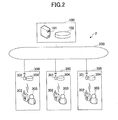
- a system 2 of the present invention illustrated in FIG. 2 differs from the system illustrated in FIG. 1 in that only a part of user data is managed in a database 102 of a Web application server 101, and a femtocell access point (base station) 301 is provided with a database 304.
- data of each user are managed in both the Web application server 101 and the base station 301.
- the user data are classified into data (hereinafter referred to as user data having no access restriction) open to the general public, and data (hereinafter referred to as user data having access restriction) that may only be open within a group to which the user belongs.
- the user data having no access restriction are managed in the Web application server 101, and the user data having access restriction are managed in the base station 301, in order to improve the performance of the Web application server 101 and suppress the need to provide an additional server even when the amount of information increases.
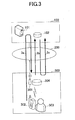
- FIG. 3 uses the same system structure as that illustrated in FIG. 2 .
- the Web application server 101 When a user 303 registers to a we application service provided by the Web application server 101 in a step 3a, the Web application server 101 sends registered data to the base station 301.
- the registered data includes a security setting of the user data.
- the base station 301 classifies the user data in a step 3b, based on the security setting received in the step 3a. For example, a user group to which the user data may be open is considered as the security setting.
- the base station 301 sends to the Web application server 101 the user data that is set to be open to all groups (users), that is, the user data having no access restriction. In this case, the user data are managed in the Web application server 101 in order to be always accessible without restriction by all users.
- the base station 301 manages the user data that are accessible only by the users belonging to a specific group, that is, the user data having access restriction.
- the security may be improved by managing the user data having access restriction in each of the base stations 301.
- a storage capacity to be provided in the Web application server 101 may be reduced.
- the Web application server 101 When the Web application server 101 receives an access request for the user data from another base station 301 that is not illustrated in FIG. 3 , the Web application server 101 requests the base station 301 managing the requested user data to send the user data, in a step 3c.
- the base station 301 that receives the request judges whether it is possible to send the requested user data to the Web application server 101, based on the security setting acquired in the step 3a, and sends the user data only when it is judged possible.
- the Web application server 101 deletes the received user data having access restriction after a predetermined time elapses. Hence, the security of the user data having access restriction is maintained.
- a description will be given of how the user data having access restriction are transmitted and received between the Web application server 101 and the base station 301, by referring to FIG. 4 .
- FIG. 4 is a diagram for explaining the transmission and reception of the user data in the present invention.
- the Web application 101 receives the access request for the user data from the user 303 via the base station 301, in a step 4a.
- the Web application server 101 acquires the user data open to the group to which the user 303 belongs, from the base station 301 managing the user data, in a step 4b.
- the Web application server 101 temporarily stores the acquired user data in a step 4c.
- the Web application server 101 retains the user data having access restriction for a predetermined time even after the interruption of service (or end of service), as indicated by times 4d and 4e. Hence, even when an unexpected disconnection of the connection or the like occurs due to the wireless quality in a step 4f, the service may continue to be provided in a step 4g without resending the request to send the user data having access restriction.
- the Web application server 101 may improve the user convenience of the service by extending the time 4d in which the user data having access restriction and frequently accessed are retained after the service is interrupted in the step 4f, and extending the time 4h in which the user data having access restriction and frequently accessed are retained after the service is ended in the step 4h.
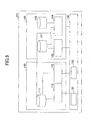
- the Web application server 101 includes a user managing part 110, a user data managing part 120, and an interface part 130.
- the user managing part 110 manages information of the user 303 required to provide the Web application service.
- the user managing part 110 may be provided inside the Web application server 101 as illustrated in FIG. 5 or, may be set up outside the Web application server 101.
- the user managing part 110 manages the user information of the user 303 utilizing the service.
- the user information includes information of the base station 301 accommodating the user 303, information of the group to which the user 303 belongs, and the like.
- the Web application server 101 may recognize by the user managing part 110 the base station 301 that manages the data required in order for the user 303 to receive the service.
- the user data managing part 120 manages the two kinds of user data according to mutually different methods.
- the user data having no access restriction are constantly retained within the user data managing part 120.
- the we application server 101 may provide the user data having no access restriction to the user terminal 303 at any time without having to acquire the user data having no access restriction from the base station 301.
- the user data having access restriction that may be open only within the specific group, are basically retained in each base station 301.
- the Web application server 101 may acquire by the user data managing part 120 the data required to provide the service to the user 303 from each base station 301, and temporarily retain the data within the Web application server 101, in order to provide the service.
- the temporarily retained user data having access restriction that may be open only within the specific group, are deleted from the user data managing part 120.
- the interface part 130 provides a user interface that is required in order to provide the Web application service.
- the interface part 130 supports the user 303 when setting the security setting of the user data via the user terminal 302 and the base station 301.
- the user managing part 110 includes a user management database 111, a user registering part 112, and a group judging part 113.
- the user management database 111 manages information initially registered by the user 303 in order to utilize the Web application, such as an identifier of the user 303, the group to which the user 303 belongs, and the address of the base station 301 accommodating the user 303.
- the user registering part 112 sends to the user management database 111 the information initially registered by the user 303 in order to utilize the Web application. Further, when the registered information is updated, new information received from the base station 301 is sent to the user management database 111. For example, the group is sent to the user management database 111 when the group to which the user 303 belongs changes, and the address of the base station 301 is set to the user management database 111 when the address of the base station 301 changes.
- FIG. 6 illustrates an example of a table retained by the user management database.
- a user management table 600 includes an identifier 601 of the user 303, a group 602 to which the user 303 belongs, and a base station address 603 of the base station 301 accommodating the user 303.
- the user having an identifier A belongs to three groups 1, 2, and 3, and is accommodated by the base station 301 having an IP address "aaa.bbb.ccc.ddd".
- a plurality of users 303 may be managed via a single base station 301.
- two users namely, the user having the identifier A and the user having an identifier D are managed via the same base station 301 having the address "aaa.bbb.ccc.ddd".
- the group judging part 113 judges the group to which the user 303 belongs, based on the identifier of the user 303 included in the access request for the user data from the user terminal 302, and the user management table 600 ( FIG. 6 ) retained by the user management database 111. For example, in a case in which the group judging part 113 receives the access request including the identifier A from the user terminal 302, the group judging part 113 judges from the user management table 600 that the user 303 belongs to the groups 1, 2, and 3. Hence, with respect to the access request for the user data from the user 303, the Web application server 101 may provide the user data of the group to which the user belongs.
- the user data managing part 120 includes a database 121 to manage the user data having access restriction, a retaining time managing part 122, a database 123 to manage the user data having on access restriction, and user data acquiring part 124.
- the two user data management databases 121 and 123 may be formed as a single database.
- the user data management database 121 to manage the user data having access restriction acquires from the base station 301 the user data permitted to be shared only by the users 303 belonging to the specific group, and temporarily manages the acquired user data.
- the user data management database 121 to manage the user data having access restriction deletes the user data having access restriction after a predetermined time elapses, in accordance with an instruction from the retaining time managing part 122.
- the retaining time managing part 122 manages the time for which the user data having access restriction are to be retained in the user data management database 121.
- the retaining time managing part 122 instructs deletion of the user data having access restriction with respect to the user data management database 121 after the predetermined time elapses from the time when the service is interrupted or ended.
- the retaining time managing part 122 may instruct a time limit by which the user data having access restriction is to be deleted.
- the predetermined time or time limit in order to suppress the amount of data communicated between the Web application server 101 and the base station 301.
- the user data management database 123 to manage the user data having no access restriction manages the user data that are permitted to be shared by arbitrary user according to the security setting. For example, the user data management database 123 manages the user data to which the access is permitted for all groups or all users or, the user data to which the access is permitted for a number of groups greater than a predetermined number, such as 5, 10, or the like. Because the Web application server 101 only needs to constantly manage such user data having the low security level, the Web application server 101 may provide the service using a small memory capacity.
- the user data acquiring part 124 requests and acquires from each base station 301 the user data accessible from the user 303 utilizing the service.
- the user data acquiring part 124 judges whether the acquired user data have the access restriction, and stores the user data having access restriction into the user data management database 121, and stores the user data having no access restriction into the user data management database 123.
- the user data acquiring part 124 updates the user data in the user data management databases 121 and 123, and requests updating of the original data retained in each base station 301 after the service is ended.
- the interface part 130 includes an application processing part 131 and a security setting part 132.
- the application processing part 131 provides a user interface and the like required to provide the Web application service.
- the application processing part 131 provides the interface in order to enable the user 303 to make a user registration to the Web application server and to make an operation such as access, edit, create, retain, delete, and the like on the user data.
- the security setting part 132 provides an interface in order to enable the user 303 to set the security setting of the user data via the user terminal 302 and the base station 301.
- the security setting part 132 may notify the security setting set by the user 303 to each base station 301.
- the user data acquiring part 124 determines the storage location of the user data depending on the security setting.
- the user data acquiring part 124 judges that the user data having the security setting lower than a predetermined security level as the user data having no access restriction, and stores the user data having no access restriction in the user data management database 123.
- the predetermined security level may indicate the number of groups to which the user data may be open, whether the user data may be open to all groups, and the like.
- the user data acquiring part 124 judges that the user data having the security setting that is the predetermined security level or higher as the user data having access restriction, and sends the user data having access restriction to the base station 301.
- the storage location of the user data may be determined by a user data managing part 340 of the base station 301.
- the application processing part 131 of the Web application server 101 sends all user data received from the user terminal 302 to the base station 301.
- the base station includes an address managing part 310, a security managing part 320, a user managing part 330, a user data managing part 340, and a network interface part 350.
- the base station further includes four databases with for the respective managing parts, namely, an address management database 311, a security management database 321, a user management database 331, and a user data management database 341.
- the four databases 311, 321, 331, and 341 may be formed as a single database.
- the address managing part 310 manages the address of the base station 301 itself, and the address of the Web application server 101. These addresses are stored in the address management database 311, and are automatically updated when the addresses are changed.
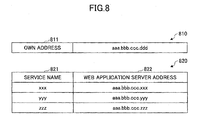
- the address management database 311 includes a base station address table 810, and a Web application server address table 820.
- the base station address table 810 stores an address 811 of the base station 301 itself.
- the address of the base station 301 stored in the base station table 810 is "aaa.bbb.ccc.ddd".
- the Web application server address table 820 stores an address 822 of the Web application server that provides the service, for each service name 821 indicating the name of the Web application service.
- three Web application services are provided by mutually different Web application servers.
- the security managing part 320 acquires and manages the security setting set by the user 303 via the security setting part 131 of the Web application server 101.
- the security managing part 320 judges whether the user data are the user data having no access restriction or, the user data having access restriction and open only within the specific group, based on the security setting.
- the security management database 321 includes a security management table 900.
- the security management table 900 stores a file name 901 of a file of the user data, an identifier 902 of the user who is the owner of the file, a file type 903, a keyword 904 set to the file, and a permitted group 905 permitted to make access to the file.
- the keyword 904 may be formed by a character string whose input is requested when the user 303 wishes to make access to the file.
- the file having the file name "aaa” is owned by the user having the identifier A, and the file type of this file is a diary.
- a name is set as the keyword of this file.
- the keyword 904 may actually be "hanako” or the like, that is a real or virtual name set by the user 303.
- Only the group 1 is permitted to make access to this file.
- the plurality of groups 1 and 2 are permitted to make access to the file having the file name "ddd”. All groups are permitted to make access to the file having the file name "eee" because there is no access restriction on this file.
- the security setting is set for each file, however, the security setting may be set for each file type 903 or for each identifier 902 of the user, in order to judge the permitted group 905 permitted to make access to the file.
- the security setting may be set so that only the group 1 is permitted to make access to the file of the diary owned by the user having the identifier A. In this case, a column for the file name 901 may be omitted.
- the user managing part 330 ( FIG. 7 ) is accommodated by the base station 301, and manages information of each user 303 utilizing the Web application service.
- the user managing part 330 judges whether the user who is managed thereby belongs to the group included in the received request. This judgement may be made using a table ( FIG. 10 ) retained by the user management database 331 which will be described later.
- the user managing part 330 sends the requested user data to the Web application server 101.
- the user management database 331 includes a user management table 1000.
- the user management table 1000 stores a service name 1001, a user identifier 1002, and a group 1003 to which the user belongs.
- the service name 1001 corresponds to the service name 821 illustrated in FIG. 8 .
- the user identifier 1002 corresponds to the user identifier 601 illustrated in FIG. 6 and the user identifier 902 illustrated in FIG. 9 .
- the group 1003 corresponds to the group 602 illustrated in FIG. 6 .
- the group to which the user 303 belongs is indicated for each Web application service identified by the service name.
- Row numbers 1, 2, and 3 indicate the groups to which the users having the identifiers A, B, and C belong when providing the Web application service having the service name "xxx”.
- Row numbers 4 and 5 indicate the groups to which the users having the identifiers A and B belong when providing the Web application service having the service name "yyy”.
- the user data managing part 340 sends the user data having no access restriction to the Web application server 101 according to the security setting, and retains in the base station 301 the user data having access restriction and sharable only within the specific group.
- the user data are sent according to the judgement made by the user managing part 330.
- the user data managing part 340 retains in the user data management database 341 all user data received from the Web application server 101.
- the user data managing part 340 may determine the storage location of the user data based on the security management table 900 when the user data are received from the Web application server 101.
- the user data managing part 340 judges that the user data having the security setting lower than the predetermined security level as the user data having no access restriction, and sends the user data having no access restriction to the Web application server 101.
- the predetermined security level may indicate the number of groups to which the user data may be open, whether the user data may be open to all groups, and the like.
- the user data managing part 340 judges that the user data having the security setting that is the predetermined security level or higher as the user data having access restriction, and stores the user data having access restriction in the user data management database 341.
- the user data management database 341 retains the user data having access restriction.
- the network interface part 350 provides an interface between the network 200 and each of the address managing part 310, the security managing part 320, the user managing part 330, and the user data managing part 340 described above.
- the base station 301 creates the Web application server address table 820 ( FIG. 8 ) and the user management table 1000 ( FIG. 10 ).
- the Web application server 101 creates the user management table 600 ( FIG. 6 ).
- a step 1101 the user terminal 302 starts the user registration to the Web application server 01.
- An interface for making the user registration may be provided by the application processing part 131 of the Web application server 101.
- the user terminal 302 sends the service name of the Web application service and the address of the Web application server providing this service, in order to start the user registration.
- Information input from the user terminal 302 by the user 303 is stored in the user management database 111 via the user registering part 112.
- the base station 301 relays and monitors the communication between the user terminal 302 and the Web application server 101 (or a DNS (Domain Name Server), not illustrated).
- the Web application server 101 or a DNS (Domain Name Server), not illustrated.
- the user managing part 330 of the base station 301 extracts the service name and the address of the Web application server from the communication made in the step 1101.
- the address is the URL of the Web application server extracted from the communication between the user terminal 302 and the DNS or, the IP address extracted from the communication between the user terminal 302 and the Web application server 101.
- the address managing part 310 of the base station 301 stores in the address management database 311 the service name and the address of the Web application server 101 extracted in the step 1102. Hence, the base station 301 creates the Web application server address management table 820 illustrated in FIG. 8 .
- the user terminal 302 sends the user identifier of the user 303, and the group to which the user 303 belongs, to the Web application server 101 in order to make the user registration.
- the user managing part 112 of the Web application server 101 stores in the user management database 111 the received user identifier and group that are sent in the step 1104.
- the user managing part 112 creates the columns of the user identifier 601 and the group 602 in the user management table 600 illustrated in FIG. 6 .
- a step 1106 the user managing part 330 of the base station 301 extracts the user identifier and the group from the communication made in the step 1104.
- the user managing part 330 of the base station 301 stores in the user management database 331 the user identifier and the group extracted in the step 1106. Hence, the base station 301 creates the user management table 1000 illustrated in FIG. 10 .
- a step 1108 the user managing part 330 of the base station 301 sends to the Web application server 101 the user identifier extracted in the step 1106 and the address of the base station 301 preset in the base station 301.
- the user registering part 112 of the Web application server 101 stores in the user management database 111 the received user identifier and address of the base station 301 sent in the step 1108.
- the user managing part 112 creates the column of the base station address 603 in the user management table 600 illustrated in FIG. 6 .
- the base station 301 is registered to the Web application server 101.
- the base station 301 creates the security management table 900 ( FIG. 9 ).
- a step 1201 the security setting part 132 of the Web application server 101 starts, and urges the user 303 to input the security setting fro the user terminal 302.
- the user terminal 302 sends to the Web application server 101 the file name, the keyword, and the group permitted to make access to the file, that are input for each file by the user 303.
- the user terminal 302 also sends the user identifier of the user 303 who is the owner of the file, and the file type of the file.
- the security setting part 132 of the Web application server 101 transfers to the base station 301 the received security setting sent from the user terminal 302 in the step 1202.
- the security managing part 320 of the base station 301 stores in the security management database 321 the received security setting transferred in the step 1203. Hence, the base station 301 creates the security management table 900 illustrated in FIG. 9 .
- FIG. 13 A description will be given of a user data transmission and reception process of the present invention, by referring to FIG. 13 .
- two base stations 301 (#1 and #2) contribute to the user data transmission and reception process of the flow chart.
- the user terminal 302 sends a service start request for the Web application service to the Web application server 101.
- the service start requests includes the user identifier.
- the user data acquiring part 124 of the Web application server 101 uses the user management table 600 in order to search for the group 602 to which the user 303 having the received user identifier sent in the step 1301.
- the user data acquiring part 124 searches the user management table 600 for the base station address of the base station 301 accommodating the user 303.
- the user data acquiring part 124 sends the request to send the user data including the service name, the user identifier, and the searched group indicating the group to which the user data are open, with respect to the base station address searched in the step 1302.
- the user managing part 330 of the base station 301 searches the user management table 1000 for the group corresponding to the received service name and user identifier sent in the step 1303.
- the user managing part 330 judges whether the received group sent in the step 1303 and to which the user data may be open is included in the group searched by the user managing part 330 itself.
- the process advances to a step 1305 when the received group sent in the step 1303 and to which the user data may be open is included in the group searched by the user managing part 330 itself.
- the sending of the user data is refused when the received group sent in the step 1303 and to which the user data may be open is not included in the group searched by the user managing part 330 itself.
- the security managing part 320 of the base station 301 searches the security management table 900 for the file to which the access is permitted for the group searched in the step 1304.
- the user data managing part 240 of the base station 301 reads the file search in the step 1305 from the user data management database 341, and sends the read file to the Web application server 101.
- the steps 1303 through 1306 are performed by all of the base stations 301 whose address is searched by the Web application server 101 in the step 1302.
- the base station 301 (#1) retains the user data that may be accessed by the groups 1 and 2
- the base station 301 (#2) stores the user data that may be accessed by the group 3, and thus, the Web application server 101 sends the request to send the user data to the base stations 301 (#1 and #2) so that each of the base stations 301 (#1 and #2) performs the process described above.
- the Web application server 101 sends to the user terminal 302 the acquired user data sent in the step 1306, in order to provide the service.
- a step 1309 the user terminal 302 sends a service end request.
- the Web application server 101 that receives the service end request deletes the user data acquired in the step 1306 from the user data management database 121 for the user data having access restriction.
- the user data may be deleted at a timing when the predetermined time elapses from the time when the service ended, as described above in conjunction with FIG. 4 .
- a step 1401 when the user 303 utilizing the Web application service updates the user data retained in the Web application server 101, one of the following two processes is performed depending on whether the updated user data have access restriction or no access restriction.
- a step 1402 is performed when the updated user data have no access restriction
- a step 1403 is performed when the updated user data have access restriction.
- the user data acquiring part 124 updates the user data having no access restriction and stored in the user data management database 123.
- step 1403 because the user data having access restriction and open only within the specific group are originally retained in each base station 301, a user data update request is made with respect to the base station 301 that manages the original user data.
- the base station 301 that receives the user data update request updates the user data having access restriction and stored in the user data management database 341.
- Each base station 301 manages its own base station address in the base station address management table 810.
- the base station address may change.
- the base station address updating process of the flow chart illustrated in FIG. 15 is performed.
- a change occurs in the base station address of the base station 301.
- the address managing part 310 of the base station 301 sends to the Web application server 101 an address change notification including the base station address after the change, the base station address before the change, and the user identifier of the user 303 accommodated by the base station 301.
- the user registering part 112 of the Web application server 101 specifies the base station 301 from the received base station address before the change, sent in the step 1502, using the user management table 600.
- the user registering part 112 updates the base station address of the specified base station 301 by the received base station address after the change, sent in the step 1502.
- a step 1504 the updating is completed.
Landscapes
- Engineering & Computer Science (AREA)
- Computer Security & Cryptography (AREA)
- Theoretical Computer Science (AREA)
- Signal Processing (AREA)
- General Engineering & Computer Science (AREA)
- Computer Hardware Design (AREA)
- Physics & Mathematics (AREA)
- Software Systems (AREA)
- General Health & Medical Sciences (AREA)
- Bioethics (AREA)
- General Physics & Mathematics (AREA)
- Health & Medical Sciences (AREA)
- Computer Networks & Wireless Communication (AREA)
- Multimedia (AREA)
- Databases & Information Systems (AREA)
- Computing Systems (AREA)
- Automation & Control Theory (AREA)
- Mobile Radio Communication Systems (AREA)
- Storage Device Security (AREA)
Abstract
Description
- The present invention relates to a base station, a Web application server, a system, and a method.
- Services of a cellular phone may include Web application services, such as a social networking service and the like. Recently, due to diversification of such services, the amount of information and/or the number of users have/has increased, to thereby make the management of the information complex.
- An example of a system structure of a conventional Web application service will be described with reference to
FIG. 1 . Aconventional system 1 includes a Webapplication service operator 100, anIP network 200, and one or a plurality ofhomes 300 connected to aWeb application server 101 via theIP network 200. Thehome 300 may be a small-scale office, a shop, or the like. A femtocell access point (base station) 301 that forms a femtocell having a small cell radius with respect to a macrocell is set up at thehome 300. Because thebase station 301 provides simultaneous communications withuser terminals 302 of a plurality ofusers 303 within a range on the order of a several tens of meters in radius, thebase station 301 is generally used as a countermeasure with respect to a skip zone of the cellular phone service. - The
Web application server 101 provided with a large-capacity database 102 is set up at the Webapplication service operator 100 for the purpose of aggregation and/or management of the extremely large amount of information. Conventionally, when the amount of information and/or the number of users suddenly increase/increases, the server performance is improved and/or the server is added at all times. However, the improvement of the server performance alone may not be able to cope with the increased amount of information, and the addition of the server may be a problem from the point of view of the cost or the available setup space. - In addition, the Web application handles personally identifiable information in many cases, but the
operator 100 conventionally manages the personally identifiable information. With respect to security measures, the data are subjected to an encryption according to an encryption technique or the like at theoperator 100 in order to enhance the security, however, the possibility of a leak cannot be eliminated completely. The leak of the personally identifiable information may cause an extremely large damage to the user or theoperator 100. - Patent Document 1: Japanese Laid-Open Patent Publication No.
2008-123233 - According to one aspect of the present invention, the present invention provides a base station, a Web application server, a system, and a method that manage information and/or security.
- One aspect of the embodiment may provide a base station accommodating a user terminal and connectable to a Web application server, including a user data management database configured to store user data; a security managing part configured to manage groups to which the user data are open; and a user data managing part configured to manage the user data, wherein, when the user data managing part receives a request to send user data from the Web application server and a group, included in the request and to which the requested user data are open, is included within the groups managed by the security managing part, the user data managing part sends the requested user data to the Web application server.
- According to the present invention, the base station may manage information and/or security of information related to a Web application service, and the performance and security of the entire system may be improved.
-
-
FIG. 1 is a diagram illustrating an example of a system structure of a conventional Web application service; -
FIG. 2 is a diagram illustrating an example of a system structure of a Web application service of the present invention; -
FIG. 3 is a diagram illustrating an example of a system operation of the Web application service of the present invention; -
FIG. 4 is a diagram for explaining transmission and reception of user data in the present invention; -
FIG. 5 is a diagram illustrating a structure of a Web application server of the present invention; -
FIG. 6 is a diagram illustrating an example of a table retained by a user management database of the present invention; -
FIG. 7 is a diagram illustrating a structure of a base station of the present invention; -
FIG. 8 is a diagram illustrating an example of tables retained by an address management database of the present invention; -
FIG. 9 is a diagram illustrating an example of a table retained by a security management database of the present invention; -
FIG. 10 is a diagram illustrating an example of a table retained by a user data management database of the present invention; -
FIG. 11 is a flow chart illustrating a user registration process of the present invention to register the user to the Web application service; -
FIG. 12 is a flow chart illustrating a security setting process of the present invention; -
FIG. 13 is a flow chart illustrating a user data transmission and reception process of the present invention; -
FIG. 14 is a flow chart illustrating a user data updating process of the base station of the present invention; and -
FIG. 15 is a flow chart illustrating a base station address updating process of the present invention. - A description will be given of an example of a system structure of a Web application service of the present invention, by referring to
FIG. 2 . Asystem 2 of the present invention illustrated inFIG. 2 differs from the system illustrated inFIG. 1 in that only a part of user data is managed in adatabase 102 of aWeb application server 101, and a femtocell access point (base station) 301 is provided with adatabase 304. - In the present invention, as illustrated in
FIG. 2 , data of each user are managed in both theWeb application server 101 and thebase station 301. The user data are classified into data (hereinafter referred to as user data having no access restriction) open to the general public, and data (hereinafter referred to as user data having access restriction) that may only be open within a group to which the user belongs. The user data having no access restriction are managed in theWeb application server 101, and the user data having access restriction are managed in thebase station 301, in order to improve the performance of theWeb application server 101 and suppress the need to provide an additional server even when the amount of information increases. - A description will be given of an example of a system operation of the Web application service of the present invention, by referring to
FIG. 3. FIG. 3 uses the same system structure as that illustrated inFIG. 2 . - When a
user 303 registers to a we application service provided by theWeb application server 101 in astep 3a, theWeb application server 101 sends registered data to thebase station 301. The registered data includes a security setting of the user data. - The
base station 301 classifies the user data in astep 3b, based on the security setting received in thestep 3a. For example, a user group to which the user data may be open is considered as the security setting. Thebase station 301 sends to theWeb application server 101 the user data that is set to be open to all groups (users), that is, the user data having no access restriction. In this case, the user data are managed in theWeb application server 101 in order to be always accessible without restriction by all users. In addition, thebase station 301 manages the user data that are accessible only by the users belonging to a specific group, that is, the user data having access restriction. - Accordingly, because the user data accessible only by the users belonging to the specific group include personally identifiable information in many cases, the security may be improved by managing the user data having access restriction in each of the
base stations 301. In addition, by managing a part of the user data conventionally managed by theWeb application server 101 in each of thebase stations 301, a storage capacity to be provided in theWeb application server 101 may be reduced. - When the
Web application server 101 receives an access request for the user data from anotherbase station 301 that is not illustrated inFIG. 3 , theWeb application server 101 requests thebase station 301 managing the requested user data to send the user data, in astep 3c. Thebase station 301 that receives the request judges whether it is possible to send the requested user data to theWeb application server 101, based on the security setting acquired in thestep 3a, and sends the user data only when it is judged possible. - The
Web application server 101 deletes the received user data having access restriction after a predetermined time elapses. Hence, the security of the user data having access restriction is maintained. Next, a description will be given of how the user data having access restriction are transmitted and received between theWeb application server 101 and thebase station 301, by referring toFIG. 4 . -
FIG. 4 is a diagram for explaining the transmission and reception of the user data in the present invention. TheWeb application 101 receives the access request for the user data from theuser 303 via thebase station 301, in astep 4a. - The
Web application server 101 acquires the user data open to the group to which theuser 303 belongs, from thebase station 301 managing the user data, in astep 4b. - The
Web application server 101 temporarily stores the acquired user data in astep 4c. TheWeb application server 101 retains the user data having access restriction for a predetermined time even after the interruption of service (or end of service), as indicated bytimes step 4f, the service may continue to be provided in astep 4g without resending the request to send the user data having access restriction. - In addition, the
Web application server 101 may improve the user convenience of the service by extending thetime 4d in which the user data having access restriction and frequently accessed are retained after the service is interrupted in thestep 4f, and extending thetime 4h in which the user data having access restriction and frequently accessed are retained after the service is ended in thestep 4h. - A description will be given of a structure of the Web application server of the present invention, by referring to
FIG. 5 . As illustrated inFIG. 5 , theWeb application server 101 includes auser managing part 110, a userdata managing part 120, and aninterface part 130. - The
user managing part 110 manages information of theuser 303 required to provide the Web application service. Theuser managing part 110 may be provided inside theWeb application server 101 as illustrated inFIG. 5 or, may be set up outside theWeb application server 101. - The
user managing part 110 manages the user information of theuser 303 utilizing the service. The user information includes information of thebase station 301 accommodating theuser 303, information of the group to which theuser 303 belongs, and the like. TheWeb application server 101 may recognize by theuser managing part 110 thebase station 301 that manages the data required in order for theuser 303 to receive the service. - The user
data managing part 120 manages the two kinds of user data according to mutually different methods. The user data having no access restriction are constantly retained within the userdata managing part 120. Hence, thewe application server 101 may provide the user data having no access restriction to theuser terminal 303 at any time without having to acquire the user data having no access restriction from thebase station 301. - The user data having access restriction, that may be open only within the specific group, are basically retained in each
base station 301. TheWeb application server 101 may acquire by the userdata managing part 120 the data required to provide the service to theuser 303 from eachbase station 301, and temporarily retain the data within theWeb application server 101, in order to provide the service. - When the
Web application server 101 ends the service, the temporarily retained user data having access restriction, that may be open only within the specific group, are deleted from the userdata managing part 120. - The
interface part 130 provides a user interface that is required in order to provide the Web application service. In addition, theinterface part 130 supports theuser 303 when setting the security setting of the user data via theuser terminal 302 and thebase station 301. - Next, a more detailed description will be given of the structure of the
Web application server 101, by referring toFIG. 5 . - The
user managing part 110 includes auser management database 111, auser registering part 112, and agroup judging part 113. - The
user management database 111 manages information initially registered by theuser 303 in order to utilize the Web application, such as an identifier of theuser 303, the group to which theuser 303 belongs, and the address of thebase station 301 accommodating theuser 303. - In addition, by managing such registered information for each
user 303, it becomes possible to provide the service to a plurality ofusers 303 via asingle base station 301. - The
user registering part 112 sends to theuser management database 111 the information initially registered by theuser 303 in order to utilize the Web application. Further, when the registered information is updated, new information received from thebase station 301 is sent to theuser management database 111. For example, the group is sent to theuser management database 111 when the group to which theuser 303 belongs changes, and the address of thebase station 301 is set to theuser management database 111 when the address of thebase station 301 changes. -
FIG. 6 illustrates an example of a table retained by the user management database. A user management table 600 includes anidentifier 601 of theuser 303, agroup 602 to which theuser 303 belongs, and abase station address 603 of thebase station 301 accommodating theuser 303. For example, the user having an identifier A belongs to threegroups base station 301 having an IP address "aaa.bbb.ccc.ddd". In addition, because the information is managed for eachidentifier 601 of theuser 303, a plurality ofusers 303 may be managed via asingle base station 301. In the example illustrated inFIG. 6 , two users, namely, the user having the identifier A and the user having an identifier D are managed via thesame base station 301 having the address "aaa.bbb.ccc.ddd". - The
group judging part 113 judges the group to which theuser 303 belongs, based on the identifier of theuser 303 included in the access request for the user data from theuser terminal 302, and the user management table 600 (FIG. 6 ) retained by theuser management database 111. For example, in a case in which thegroup judging part 113 receives the access request including the identifier A from theuser terminal 302, thegroup judging part 113 judges from the user management table 600 that theuser 303 belongs to thegroups user 303, theWeb application server 101 may provide the user data of the group to which the user belongs. - The user
data managing part 120 includes adatabase 121 to manage the user data having access restriction, a retainingtime managing part 122, adatabase 123 to manage the user data having on access restriction, and userdata acquiring part 124. The two userdata management databases - The user
data management database 121 to manage the user data having access restriction acquires from thebase station 301 the user data permitted to be shared only by theusers 303 belonging to the specific group, and temporarily manages the acquired user data. The userdata management database 121 to manage the user data having access restriction deletes the user data having access restriction after a predetermined time elapses, in accordance with an instruction from the retainingtime managing part 122. - The retaining
time managing part 122 manages the time for which the user data having access restriction are to be retained in the userdata management database 121. The retainingtime managing part 122 instructs deletion of the user data having access restriction with respect to the userdata management database 121 after the predetermined time elapses from the time when the service is interrupted or ended. Alternatively, the retainingtime managing part 122 may instruct a time limit by which the user data having access restriction is to be deleted. In addition, with respect to the user data that are frequently accessed, the predetermined time or time limit in order to suppress the amount of data communicated between theWeb application server 101 and thebase station 301. - The user
data management database 123 to manage the user data having no access restriction manages the user data that are permitted to be shared by arbitrary user according to the security setting. For example, the userdata management database 123 manages the user data to which the access is permitted for all groups or all users or, the user data to which the access is permitted for a number of groups greater than a predetermined number, such as 5, 10, or the like. Because theWeb application server 101 only needs to constantly manage such user data having the low security level, theWeb application server 101 may provide the service using a small memory capacity. - The user
data acquiring part 124 requests and acquires from eachbase station 301 the user data accessible from theuser 303 utilizing the service. The userdata acquiring part 124 judges whether the acquired user data have the access restriction, and stores the user data having access restriction into the userdata management database 121, and stores the user data having no access restriction into the userdata management database 123. - When the user data are updated, the user
data acquiring part 124 updates the user data in the userdata management databases base station 301 after the service is ended. - The
interface part 130 includes anapplication processing part 131 and asecurity setting part 132. - The
application processing part 131 provides a user interface and the like required to provide the Web application service. For example, theapplication processing part 131 provides the interface in order to enable theuser 303 to make a user registration to the Web application server and to make an operation such as access, edit, create, retain, delete, and the like on the user data. - The
security setting part 132 provides an interface in order to enable theuser 303 to set the security setting of the user data via theuser terminal 302 and thebase station 301. Thesecurity setting part 132 may notify the security setting set by theuser 303 to eachbase station 301. - When the
user 303 retains the user data by the support provided by theapplication processing part 131 and sets the security setting to the user data by the support provided by thesecurity setting part 132, the userdata acquiring part 124 determines the storage location of the user data depending on the security setting. - The user
data acquiring part 124 judges that the user data having the security setting lower than a predetermined security level as the user data having no access restriction, and stores the user data having no access restriction in the userdata management database 123. The predetermined security level may indicate the number of groups to which the user data may be open, whether the user data may be open to all groups, and the like. - On the other hand, the user
data acquiring part 124 judges that the user data having the security setting that is the predetermined security level or higher as the user data having access restriction, and sends the user data having access restriction to thebase station 301. - Alternatively, the storage location of the user data may be determined by a user
data managing part 340 of thebase station 301. In this case, theapplication processing part 131 of theWeb application server 101 sends all user data received from theuser terminal 302 to thebase station 301. - A description will be given of a structure of the base station of the present invention, by referring to
FIG. 7 . As illustrated inFIG. 7 , the base station includes anaddress managing part 310, asecurity managing part 320, auser managing part 330, a userdata managing part 340, and anetwork interface part 350. The base station further includes four databases with for the respective managing parts, namely, anaddress management database 311, asecurity management database 321, auser management database 331, and a userdata management database 341. The fourdatabases - The
address managing part 310 manages the address of thebase station 301 itself, and the address of theWeb application server 101. These addresses are stored in theaddress management database 311, and are automatically updated when the addresses are changed. - A description will be given of an example of tables retained by the address management database of the present invention, by referring to
FIG. 8 . Theaddress management database 311 includes a base station address table 810, and a Web application server address table 820. - The base station address table 810 stores an
address 811 of thebase station 301 itself. In the example illustrated inFIG. 8 , the address of thebase station 301 stored in the base station table 810 is "aaa.bbb.ccc.ddd". - The Web application server address table 820 stores an
address 822 of the Web application server that provides the service, for eachservice name 821 indicating the name of the Web application service. In the example illustrated inFIG. 8 , three Web application services are provided by mutually different Web application servers. - The security managing part 320 (
FIG. 7 ) acquires and manages the security setting set by theuser 303 via thesecurity setting part 131 of theWeb application server 101. Thesecurity managing part 320 judges whether the user data are the user data having no access restriction or, the user data having access restriction and open only within the specific group, based on the security setting. - A description will be given of an example of a table retaining the security management database of the present invention, by referring to
FIG. 9 . Thesecurity management database 321 includes a security management table 900. The security management table 900 stores afile name 901 of a file of the user data, anidentifier 902 of the user who is the owner of the file, afile type 903, akeyword 904 set to the file, and a permittedgroup 905 permitted to make access to the file. Thekeyword 904 may be formed by a character string whose input is requested when theuser 303 wishes to make access to the file. - In the example illustrated in
FIG. 9 , the file having the file name "aaa" is owned by the user having the identifier A, and the file type of this file is a diary. A name is set as the keyword of this file. Thekeyword 904 may actually be "hanako" or the like, that is a real or virtual name set by theuser 303. Only thegroup 1 is permitted to make access to this file. In addition, the plurality ofgroups - In the example illustrated in
FIG. 9 , the security setting is set for each file, however, the security setting may be set for eachfile type 903 or for eachidentifier 902 of the user, in order to judge the permittedgroup 905 permitted to make access to the file. For example, the security setting may be set so that only thegroup 1 is permitted to make access to the file of the diary owned by the user having the identifier A. In this case, a column for thefile name 901 may be omitted. - The user managing part 330 (
FIG. 7 ) is accommodated by thebase station 301, and manages information of eachuser 303 utilizing the Web application service. When theuser managing part 330 receives the request to send the user data from theWeb application server 101, theuser managing part 330 judges whether the user who is managed thereby belongs to the group included in the received request. This judgement may be made using a table (FIG. 10 ) retained by theuser management database 331 which will be described later. In a case in which the user managed by theuser managing part 330 belongs to the group included in the received request, theuser managing part 330 sends the requested user data to theWeb application server 101. - A description will be given of an example of the table retained by the user management database of the present invention, by referring to
FIG. 10 . Theuser management database 331 includes a user management table 1000. The user management table 1000 stores aservice name 1001, auser identifier 1002, and agroup 1003 to which the user belongs. Theservice name 1001 corresponds to theservice name 821 illustrated inFIG. 8 . Theuser identifier 1002 corresponds to theuser identifier 601 illustrated inFIG. 6 and theuser identifier 902 illustrated inFIG. 9 . Further, thegroup 1003 corresponds to thegroup 602 illustrated inFIG. 6 . - In the example illustrated in
FIG. 10 , the group to which theuser 303 belongs is indicated for each Web application service identified by the service name.Row numbers Row numbers - The user
data managing part 340 sends the user data having no access restriction to theWeb application server 101 according to the security setting, and retains in thebase station 301 the user data having access restriction and sharable only within the specific group. When sending the user data retained in the userdata management database 341 to theWeb application server 101 while theuser 303 is utilizing the Web application service, the user data are sent according to the judgement made by theuser managing part 330. - When the
Web application server 101 determines the storage location of the user data, the userdata managing part 340 retains in the userdata management database 341 all user data received from theWeb application server 101. - Alternatively, when the
base station 301 determines the storage location of the user data, the userdata managing part 340 may determine the storage location of the user data based on the security management table 900 when the user data are received from theWeb application server 101. - The user
data managing part 340 judges that the user data having the security setting lower than the predetermined security level as the user data having no access restriction, and sends the user data having no access restriction to theWeb application server 101. The predetermined security level may indicate the number of groups to which the user data may be open, whether the user data may be open to all groups, and the like. - On the other hand, the user
data managing part 340 judges that the user data having the security setting that is the predetermined security level or higher as the user data having access restriction, and stores the user data having access restriction in the userdata management database 341. - The user
data management database 341 retains the user data having access restriction. - The
network interface part 350 provides an interface between thenetwork 200 and each of theaddress managing part 310, thesecurity managing part 320, theuser managing part 330, and the userdata managing part 340 described above. - A description will be given of a user registration process of the present invention to register the user to the Web application service, by referring to
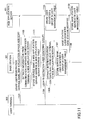
FIG. 11 . By the user registration process of the flow chart, thebase station 301 creates the Web application server address table 820 (FIG. 8 ) and the user management table 1000 (FIG. 10 ). In addition, theWeb application server 101 creates the user management table 600 (FIG. 6 ). - In a
step 1101, theuser terminal 302 starts the user registration to the Web application server 01. An interface for making the user registration may be provided by theapplication processing part 131 of theWeb application server 101. - The
user terminal 302 sends the service name of the Web application service and the address of the Web application server providing this service, in order to start the user registration. Information input from theuser terminal 302 by theuser 303 is stored in theuser management database 111 via theuser registering part 112. - The
base station 301 relays and monitors the communication between theuser terminal 302 and the Web application server 101 (or a DNS (Domain Name Server), not illustrated). - In a
step 1102, theuser managing part 330 of thebase station 301 extracts the service name and the address of the Web application server from the communication made in thestep 1101. The address is the URL of the Web application server extracted from the communication between theuser terminal 302 and the DNS or, the IP address extracted from the communication between theuser terminal 302 and theWeb application server 101. - In a
step 1103, theaddress managing part 310 of thebase station 301 stores in theaddress management database 311 the service name and the address of theWeb application server 101 extracted in thestep 1102. Hence, thebase station 301 creates the Web application server address management table 820 illustrated inFIG. 8 . - In a
step 1104, theuser terminal 302 sends the user identifier of theuser 303, and the group to which theuser 303 belongs, to theWeb application server 101 in order to make the user registration. - In a
step 1105, theuser managing part 112 of theWeb application server 101 stores in theuser management database 111 the received user identifier and group that are sent in thestep 1104. Thus, theuser managing part 112 creates the columns of theuser identifier 601 and thegroup 602 in the user management table 600 illustrated inFIG. 6 . - In a
step 1106, theuser managing part 330 of thebase station 301 extracts the user identifier and the group from the communication made in thestep 1104. - In a
step 1107, theuser managing part 330 of thebase station 301 stores in theuser management database 331 the user identifier and the group extracted in thestep 1106. Hence, thebase station 301 creates the user management table 1000 illustrated inFIG. 10 . - In a
step 1108, theuser managing part 330 of thebase station 301 sends to theWeb application server 101 the user identifier extracted in thestep 1106 and the address of thebase station 301 preset in thebase station 301. - In a
step 1109, theuser registering part 112 of theWeb application server 101 stores in theuser management database 111 the received user identifier and address of thebase station 301 sent in thestep 1108. Thus, theuser managing part 112 creates the column of thebase station address 603 in the user management table 600 illustrated inFIG. 6 . As a result, thebase station 301 is registered to theWeb application server 101. - By performing the
steps 1101 through 1109 described above between theuser terminal 302 and theWeb application server 101 every time the user registration is started, information is added to each of the tables illustrated inFIGS. 6 ,8 , and10 . In addition, when a deletion is made with respect to the user registration, information related to the user whose registration is to be deleted may be deleted from each of the tables illustrated inFIGS. 6 ,8 , and10 . - A description will be given of a security setting process of the present invention, by referring to
FIG. 12 . By the security setting process of the flow chart, thebase station 301 creates the security management table 900 (FIG. 9 ). - In a
step 1201, thesecurity setting part 132 of theWeb application server 101 starts, and urges theuser 303 to input the security setting fro theuser terminal 302. - In a
step 1203, theuser terminal 302 sends to theWeb application server 101 the file name, the keyword, and the group permitted to make access to the file, that are input for each file by theuser 303. Theuser terminal 302 also sends the user identifier of theuser 303 who is the owner of the file, and the file type of the file. - In a
step 1203, thesecurity setting part 132 of theWeb application server 101 transfers to thebase station 301 the received security setting sent from theuser terminal 302 in the step 1202. - In a
step 1204, thesecurity managing part 320 of thebase station 301 stores in thesecurity management database 321 the received security setting transferred in thestep 1203. Hence, thebase station 301 creates the security management table 900 illustrated inFIG. 9 . - A description will be given of a user data transmission and reception process of the present invention, by referring to
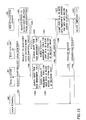
FIG. 13 . In the example illustrated inFIG. 13 , two base stations 301 (#1 and #2) contribute to the user data transmission and reception process of the flow chart. - In a
step 1301, theuser terminal 302 sends a service start request for the Web application service to theWeb application server 101. The service start requests includes the user identifier. - In a
step 1302, the userdata acquiring part 124 of theWeb application server 101 uses the user management table 600 in order to search for thegroup 602 to which theuser 303 having the received user identifier sent in thestep 1301. In addition, the userdata acquiring part 124 searches the user management table 600 for the base station address of thebase station 301 accommodating theuser 303. - In a
step 1303, the userdata acquiring part 124 sends the request to send the user data including the service name, the user identifier, and the searched group indicating the group to which the user data are open, with respect to the base station address searched in thestep 1302. - In a
step 1304, theuser managing part 330 of thebase station 301 searches the user management table 1000 for the group corresponding to the received service name and user identifier sent in thestep 1303. Theuser managing part 330 judges whether the received group sent in thestep 1303 and to which the user data may be open is included in the group searched by theuser managing part 330 itself. The process advances to astep 1305 when the received group sent in thestep 1303 and to which the user data may be open is included in the group searched by theuser managing part 330 itself. The sending of the user data is refused when the received group sent in thestep 1303 and to which the user data may be open is not included in the group searched by theuser managing part 330 itself. - In a
step 1305, thesecurity managing part 320 of thebase station 301 searches the security management table 900 for the file to which the access is permitted for the group searched in thestep 1304. - In a
step 1306, the user data managing part 240 of thebase station 301 reads the file search in thestep 1305 from the userdata management database 341, and sends the read file to theWeb application server 101. - The
steps 1303 through 1306 are performed by all of thebase stations 301 whose address is searched by theWeb application server 101 in thestep 1302. In the example illustrated inFIG. 13 , it is found that the base station 301 (#1) retains the user data that may be accessed by thegroups group 3, and thus, theWeb application server 101 sends the request to send the user data to the base stations 301 (#1 and #2) so that each of the base stations 301 (#1 and #2) performs the process described above. - In a
step 1308, theWeb application server 101 sends to theuser terminal 302 the acquired user data sent in thestep 1306, in order to provide the service. - In a
step 1309, theuser terminal 302 sends a service end request. - In a
step 1310, theWeb application server 101 that receives the service end request deletes the user data acquired in thestep 1306 from the userdata management database 121 for the user data having access restriction. The user data may be deleted at a timing when the predetermined time elapses from the time when the service ended, as described above in conjunction withFIG. 4 . - A description will be given of a user data updating process of the base station of the present invention, by referring to
FIG. 14 . - In a
step 1401, when theuser 303 utilizing the Web application service updates the user data retained in theWeb application server 101, one of the following two processes is performed depending on whether the updated user data have access restriction or no access restriction. Astep 1402 is performed when the updated user data have no access restriction, and astep 1403 is performed when the updated user data have access restriction. - In the
step 1402, because the user data having no access restriction are constantly retained in theWeb application server 101, the userdata acquiring part 124 updates the user data having no access restriction and stored in the userdata management database 123. - In the
step 1403, because the user data having access restriction and open only within the specific group are originally retained in eachbase station 301, a user data update request is made with respect to thebase station 301 that manages the original user data. - In a
step 1404, thebase station 301 that receives the user data update request updates the user data having access restriction and stored in the userdata management database 341. - A description will be given of a base station address updating process of the present invention, by referring to
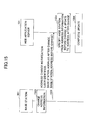
FIG. 15 . - Each
base station 301 manages its own base station address in the base station address management table 810. When theuser 303 moves or newly provides thebase station 301, the base station address may change. In order to automatically reflect such a change in the base station address, the base station address updating process of the flow chart illustrated inFIG. 15 is performed. - In a
step 1501, a change occurs in the base station address of thebase station 301. - In a
step 1502, theaddress managing part 310 of thebase station 301 sends to theWeb application server 101 an address change notification including the base station address after the change, the base station address before the change, and the user identifier of theuser 303 accommodated by thebase station 301. - In a
step 1503, theuser registering part 112 of theWeb application server 101 specifies thebase station 301 from the received base station address before the change, sent in thestep 1502, using the user management table 600. Theuser registering part 112 updates the base station address of the specifiedbase station 301 by the received base station address after the change, sent in thestep 1502. - In a
step 1504, the updating is completed. - In relation to the embodiments described above, the following appended claims are disclosed.
- (Appended Claim 1) A base station accommodating a user terminal and connectable to a Web application server, comprising:
- a user data management database configured to store user data;
- a security managing part configured to manage groups to which the user data are open; and
- a user data managing part configured to manage the user data,
- wherein, when the user data managing part receives a request to send user data from the Web application server and a group, included in the request and to which the requested user data are open, is included within the groups managed by the security managing part, the user data managing part sends the requested user data to the Web application server.
- (Appended Claim 2) The base station according to
Appended Claim 1, further comprising:- a user managing part configured to extract an identifier of a user and a group to which the user belongs from a communication between the user terminal and the Web application server; and
- an address managing part configured to retain an address of the base station,
- wherein the user data managing part sends the identifier and the group extracted by the user managing part to the Web application server together with the address retained by the address managing part.
- (Appended Claim 3) The base station according to
Appended Claim 1, wherein the user data managing part stores user data open only to predetermined groups in the user data management database, and sends user data open to all groups to the Web application server. - (Appended Claim 4) The base station according to
Appended Claim 1, wherein the groups to which the user data are open are set for each file of the user data. - (Appended Claim 5) The base station according to
Appended Claim 1, wherein the groups to which the user data are open are set for each combination of an identifier of a user and a type of the user data. - (Appended Claim 6) A method of operating a base station accommodating a user terminal, connectable to a Web application server, and including a user data management database configured to store user data, a security managing part configured to manage groups to which the user data are open, and a user data managing part configured to manage the user data, the method comprising:
- when the user data managing part receives a request to send user data from the Web application server and a group, included in the request and to which the requested user data are open, is included within the groups managed by the security managing part, sending the requested user data to the Web application server from the user data managing part.
- (Appended Claim 7) A Web application server providing a service to a user terminal via a base station including a user data management database configured to store user data, a security managing part configured to manage groups to which the user data are open, and a user data managing part configured to manage the user data, the Web application server comprising:
- a user managing part configured to manage an identifier of a user, a group to which the user belongs, and base stations;
- a security setting part configured to set a group to which user data are open and send the set group to the base stations;
- a group judging part configured to judge one of the base stations including the user data; and
- a user data managing part configured to retain the user data only for a predetermined time,
- wherein the group judging part judges, based on the identifier of the user included in an access request from the user terminal, a base station accommodating a user belonging to a group identical to the group to which the user identified by the identifier belongs, from the user managing part, and
- the user data managing part acquires user data by sending a request for the user data to the base station judged by the group judging part.
- (Appended Claim 8) A system to provide a Web application service, comprising:
- a base station including a user data management database configured to store user data, a security managing part configured to manage groups to which the user data are open, and a user data managing part configured to manage the user data; and
- a Web application server including a user managing part configured to manage an identifier of a user, a group to which the user belongs, and base stations, a security setting part configured to set a group to which user data are open and send the set group to the base stations, a group judging part configured to judge one of the base stations including the user data, and a user data managing part configured to retain the user data only for a predetermined time,
- wherein, when the user data managing part receives a request to send user data from the Web application server and a group, included in the request and to which the requested user data are open, is included within the groups managed by the security managing part, sending the requested user data to the Web application server from the user data managing part.
-
- 1, 2
- System
- 101
- Web Application Server
- 102
- Database
- 110
- User Managing Part
- 111
- User Management Database
- 112
- User Registering Part
- 113
- Group Judging Part
- 120
- User Data Managing Part
- 121
- User Data Management Database For User Data Having Access Restriction
- 122
- Retaining Time Managing Part
- 123
- User Data Management Database For User Data Having No Access Restriction
- 124
- User Data Acquiring Part
- 130
- Interface Part
- 131
- Application Processing Part
- 132
- Security Setting Part
- 200
- Network
- 300
- Home
- 301
- Base Station
- 302
- User Terminal
- 303
- User
- 304
- Database
- 310
- Address Managing Part
- 311
- Address Management Database
- 320
- Security Managing Part
- 321
- Security Management Database
- 330
- User Managing Part
- 331
- User Management Database
- 340
- User Data Managing Part
- 341
- User Data Management Database
- 350
- Network Interface Part
Claims (7)
- A base station accommodating a user terminal and connectable to a Web application server, comprising:a user data management database configured to store user data;a security managing part configured to manage groups to which the user data are open; anda user data managing part configured to manage the user data,wherein, when the user data managing part receives a request to send user data from the Web application server and a group, included in the request and to which the requested user data are open, is included within the groups managed by the security managing part, the user data managing part sends the requested user data to the Web application server.
- The base station according to claim 1, further comprising:a user managing part configured to extract an identifier of a user and a group to which the user belongs from a communication between the user terminal and the Web application server; andan address managing part configured to retain an address of the base station,wherein the user data managing part sends the identifier and the group extracted by the user managing part to the Web application server together with the address retained by the address managing part.
- The base station according to claim 1, wherein the user data managing part stores user data open only to predetermined groups in the user data management database, and sends user data open to all groups to the Web application server.
- The base station according to claim 1, wherein the groups to which the user data are open are set for each file of the user data.
- A method of operating a base station accommodating a user terminal, connectable to a Web application server, and including a user data management database configured to store user data, a security managing part configured to manage groups to which the user data are open, and a user data managing part configured to manage the user data, the method comprising:when the user data managing part receives a request to send user data from the Web application server and a group, included in the request and to which the requested user data are open, is included within the groups managed by the security managing part, sending the requested user data to the Web application server from the user data managing part.
- A Web application server providing a service to a user terminal via a base station including a user data management database configured to store user data, a security managing part configured to manage groups to which the user data are open, and a user data managing part configured to manage the user data, the Web application server comprising:a user managing part configured to manage an identifier of a user, a group to which the user belongs, and base stations;a security setting part configured to set a group to which user data are open and send the set group to the base stations;a group judging part configured to judge one of the base stations including the user data; anda user data managing part configured to retain the user data only for a predetermined time,wherein the group judging part judges, based on the identifier of the user included in an access request from the user terminal, a base station accommodating a user belonging to a group identical to the group to which the user identified by the identifier belongs, from the user managing part, andthe user data managing part acquires user data by sending a request for the user data to the base station judged by the group judging part.
- A system to provide a Web application service, comprising:a base station including a user data management database configured to store user data, a security managing part configured to manage groups to which the user data are open, and a user data managing part configured to manage the user data; anda Web application server including a user managing part configured to manage an identifier of a user, a group to which the user belongs, and base stations, a security setting part configured to set a group to which user data are open and send the set group to the base stations, a group judging part configured to judge one of the base stations including the user data, and a user data managing part configured to retain the user data only for a predetermined time,wherein, when the user data managing part receives a request to send user data from the Web application server and a group, included in the request and to which the requested user data are open, is included within the groups managed by the security managing part, sending the requested user data to the Web application server from the user data managing part.
Applications Claiming Priority (1)
| Application Number | Priority Date | Filing Date | Title |
|---|---|---|---|
| PCT/JP2009/066282 WO2011033636A1 (en) | 2009-09-17 | 2009-09-17 | Base station, web application server, system and method |
Publications (2)
| Publication Number | Publication Date |
|---|---|
| EP2479702A1 true EP2479702A1 (en) | 2012-07-25 |
| EP2479702A4 EP2479702A4 (en) | 2016-04-13 |
Family
ID=43758262
Family Applications (1)
| Application Number | Title | Priority Date | Filing Date |
|---|---|---|---|
| EP09849495.8A Withdrawn EP2479702A4 (en) | 2009-09-17 | 2009-09-17 | BASE STATION, WEB APPLICATION SERVER, SYSTEM AND METHOD |
Country Status (4)
| Country | Link |
|---|---|
| US (1) | US8832227B2 (en) |
| EP (1) | EP2479702A4 (en) |
| JP (1) | JP5516591B2 (en) |
| WO (1) | WO2011033636A1 (en) |
Cited By (2)
| Publication number | Priority date | Publication date | Assignee | Title |
|---|---|---|---|---|
| CN103945358A (en) * | 2014-04-17 | 2014-07-23 | 福建三元达通讯股份有限公司 | Privately-owned cell security access method, privately-owned cell and user terminal and system |
| US10187468B2 (en) | 2013-04-19 | 2019-01-22 | Olympus Corporation | Information communication apparatus, information communication method and program storage medium |
Families Citing this family (8)
| Publication number | Priority date | Publication date | Assignee | Title |
|---|---|---|---|---|
| JP2013222305A (en) * | 2012-04-16 | 2013-10-28 | Research Organization Of Information & Systems | Information management system for emergencies |
| KR20150079422A (en) * | 2013-12-30 | 2015-07-08 | 주식회사 아이디어웨어 | An appratus for grouping servers, a method for grouping servers and a recording medium |
| JP6636879B2 (en) * | 2016-08-19 | 2020-01-29 | キオクシア株式会社 | Storage device and information processing system |
| JP7005900B2 (en) * | 2017-01-17 | 2022-01-24 | 日本電気株式会社 | File management method, file management device and file management program |
| JP2018205840A (en) * | 2017-05-30 | 2018-12-27 | キヤノン株式会社 | System, method and program thereof |
| JP2020009341A (en) * | 2018-07-12 | 2020-01-16 | 富士ゼロックス株式会社 | Management device of image output, image output device and program |
| EP3905092B1 (en) * | 2019-02-15 | 2026-04-08 | MasterCard International Incorporated | A computer-implemented method for removing access to data |
| CN112765101B (en) * | 2019-11-01 | 2024-07-30 | 伊姆西Ip控股有限责任公司 | Method, electronic device and computer program product for managing a file system |
Family Cites Families (18)
| Publication number | Priority date | Publication date | Assignee | Title |
|---|---|---|---|---|
| US6389010B1 (en) * | 1995-10-05 | 2002-05-14 | Intermec Ip Corp. | Hierarchical data collection network supporting packetized voice communications among wireless terminals and telephones |
| EP1061758A1 (en) * | 1999-06-17 | 2000-12-20 | Lucent Technologies Inc. | Data type based call routing in a wireless communication system |
| JP2003150434A (en) * | 2001-11-14 | 2003-05-23 | Cybozu Inc | Information sharing system, information sharing support server, computer control method, and program |
| JP2005057706A (en) * | 2003-08-07 | 2005-03-03 | Sony Corp | Presence information providing method, presence management server, computer program, user terminal, and presence information providing method |
| US7352997B2 (en) * | 2003-08-14 | 2008-04-01 | Nokia Corporation | Method, apparatus and system for hosting a group of terminals |
| GB0400270D0 (en) * | 2004-01-07 | 2004-02-11 | Nokia Corp | A method of authorisation |
| US20070061488A1 (en) * | 2004-09-20 | 2007-03-15 | Trilibis Inc. | System and method for flexible user interfaces |
| GB2435146B (en) * | 2005-09-13 | 2010-08-04 | Vodafone Plc | Group communications |
| US8599832B2 (en) * | 2005-09-28 | 2013-12-03 | Ingenio Llc | Methods and apparatuses to connect people for real time communications via voice over internet protocol (VOIP) |
| JP4735838B2 (en) | 2006-03-27 | 2011-07-27 | 日本電気株式会社 | Small base station apparatus, base station registration management system, registration method, registration management method, and registration program |
| JP4882686B2 (en) | 2006-11-10 | 2012-02-22 | ヤマハ株式会社 | Social networking system and control program thereof |
| EP1921577A1 (en) | 2006-11-10 | 2008-05-14 | Yamaha Corporation | Social networking system |
| JP2008234093A (en) | 2007-03-19 | 2008-10-02 | Fujitsu Ltd | Profile information synchronization system, profile information synchronization method, portable terminal, and profile information synchronization server |
| JP5291348B2 (en) * | 2007-12-21 | 2013-09-18 | 株式会社タイトー | Service providing system, service providing method, and computer program |
| JP4532537B2 (en) * | 2007-12-21 | 2010-08-25 | 伸行 大岩 | Mobile terminal device, mobile communication system, and communication program |
| JP5160946B2 (en) * | 2008-01-30 | 2013-03-13 | 京セラ株式会社 | Base station for mobile communication system |
| JP5211779B2 (en) * | 2008-03-19 | 2013-06-12 | 富士通株式会社 | Wireless communication system, operation management maintenance method, and operation management maintenance apparatus |
| US8665819B2 (en) * | 2009-06-19 | 2014-03-04 | Cisco Technology, Inc. | System and method for providing mobility between heterogenous networks in a communication environment |
-
2009
- 2009-09-17 EP EP09849495.8A patent/EP2479702A4/en not_active Withdrawn
- 2009-09-17 WO PCT/JP2009/066282 patent/WO2011033636A1/en not_active Ceased
- 2009-09-17 JP JP2011531710A patent/JP5516591B2/en not_active Expired - Fee Related
-
2012
- 2012-03-15 US US13/421,025 patent/US8832227B2/en not_active Expired - Fee Related
Cited By (3)
| Publication number | Priority date | Publication date | Assignee | Title |
|---|---|---|---|---|
| US10187468B2 (en) | 2013-04-19 | 2019-01-22 | Olympus Corporation | Information communication apparatus, information communication method and program storage medium |
| CN103945358A (en) * | 2014-04-17 | 2014-07-23 | 福建三元达通讯股份有限公司 | Privately-owned cell security access method, privately-owned cell and user terminal and system |
| CN103945358B (en) * | 2014-04-17 | 2017-10-27 | 福建三元达网络技术有限公司 | A kind of method, private cell, user terminal and the system of private cell secure accessing |
Also Published As
| Publication number | Publication date |
|---|---|
| JPWO2011033636A1 (en) | 2013-02-07 |
| WO2011033636A1 (en) | 2011-03-24 |
| EP2479702A4 (en) | 2016-04-13 |
| JP5516591B2 (en) | 2014-06-11 |
| US20120173670A1 (en) | 2012-07-05 |
| US8832227B2 (en) | 2014-09-09 |
Similar Documents
| Publication | Publication Date | Title |
|---|---|---|
| US8832227B2 (en) | Base station, web application server, system, and method | |
| EP3557913B1 (en) | Network slice selection policy updating method and apparatus | |
| US10419875B2 (en) | System and method for determining a subscriber's zone information | |
| US7187932B1 (en) | Autopopulation of address book entries | |
| CN103636263B (en) | It is obtained by terminal and accesses relevant information with servicing | |
| CN109792598A (en) | The method and apparatus for supporting to be attached and create ownership routing PDU session in the roaming environments of network fragment for terminal | |
| CN102984689B (en) | System and method for verifying mobile terminal | |
| CN107567011B (en) | Network access service implementation method, device and communication terminal | |
| CN115443669B (en) | Establish and maintain cellular data communications using Remote Subscriber Identity Module profiles | |
| WO2013131472A1 (en) | Message processing method, device and system | |
| CN104469771B (en) | Access the data transmission method and relevant device of cellular mobile network system | |
| CN101227359A (en) | Method, access point device and system for controlling user access | |
| CN102014368B (en) | Method, system and device for acquiring user terminal location information | |
| KR101261358B1 (en) | A method and apparatus for a subscriber database | |
| US7725489B2 (en) | Node for providing a file service to a mobile terminal | |
| JP2008535296A (en) | Optimal selection of communication networks in the location area of terminal equipment | |
| CN101610495A (en) | A network and method for user access control | |
| JP2007531387A (en) | Method and apparatus for sending a message to a mobile station by addressing a hardware part | |
| EP2158786B1 (en) | Association of a mobile user identifier and a radio identifier of a mobile phone | |
| CN1917510B (en) | Method for accessing address list, and system of address list | |
| CN101815285A (en) | Data synchronization method and data synchronization system in internet mobile number application | |
| KR20090000276A (en) | Calendar sync method and service device | |
| WO2013082793A1 (en) | Method, device and system for controlling service transmission | |
| EP1953653B1 (en) | Node for providing a file service to a mobile terminal | |
| CN101919229B (en) | Method for operating a wireless mobile radio device and a wireless fixed radio device connected thereto |
Legal Events
| Date | Code | Title | Description |
|---|---|---|---|
| PUAI | Public reference made under article 153(3) epc to a published international application that has entered the european phase |
Free format text: ORIGINAL CODE: 0009012 |
|
| 17P | Request for examination filed |
Effective date: 20120410 |
|
| AK | Designated contracting states |
Kind code of ref document: A1 Designated state(s): AT BE BG CH CY CZ DE DK EE ES FI FR GB GR HR HU IE IS IT LI LT LU LV MC MK MT NL NO PL PT RO SE SI SK SM TR |
|
| DAX | Request for extension of the european patent (deleted) | ||
| RA4 | Supplementary search report drawn up and despatched (corrected) |
Effective date: 20160310 |
|
| RIC1 | Information provided on ipc code assigned before grant |
Ipc: H04N 21/65 20110101ALI20160304BHEP Ipc: H04N 21/637 20110101ALI20160304BHEP Ipc: H04W 12/08 20090101ALI20160304BHEP Ipc: H04L 29/06 20060101ALI20160304BHEP Ipc: G06F 21/60 20130101AFI20160304BHEP Ipc: G06F 21/62 20130101ALI20160304BHEP |
|
| STAA | Information on the status of an ep patent application or granted ep patent |
Free format text: STATUS: THE APPLICATION HAS BEEN WITHDRAWN |
|
| 18W | Application withdrawn |
Effective date: 20171102 |