EP2479166B1 - A process for the preparation of etoricoxib - Google Patents
A process for the preparation of etoricoxib Download PDFInfo
- Publication number
- EP2479166B1 EP2479166B1 EP12162558.6A EP12162558A EP2479166B1 EP 2479166 B1 EP2479166 B1 EP 2479166B1 EP 12162558 A EP12162558 A EP 12162558A EP 2479166 B1 EP2479166 B1 EP 2479166B1
- Authority
- EP
- European Patent Office
- Prior art keywords
- reaction mixture
- etoricoxib
- added
- chloro
- bis
- Prior art date
- Legal status (The legal status is an assumption and is not a legal conclusion. Google has not performed a legal analysis and makes no representation as to the accuracy of the status listed.)
- Not-in-force
Links
- MNJVRJDLRVPLFE-UHFFFAOYSA-N etoricoxib Chemical compound C1=NC(C)=CC=C1C1=NC=C(Cl)C=C1C1=CC=C(S(C)(=O)=O)C=C1 MNJVRJDLRVPLFE-UHFFFAOYSA-N 0.000 title claims description 67
- 229960004945 etoricoxib Drugs 0.000 title claims description 67
- 238000000034 method Methods 0.000 title claims description 23
- 238000002360 preparation method Methods 0.000 title description 59
- 238000004128 high performance liquid chromatography Methods 0.000 claims description 37
- 239000000203 mixture Substances 0.000 claims description 22
- 239000002904 solvent Substances 0.000 claims description 18
- 238000000746 purification Methods 0.000 claims description 16
- 239000007787 solid Substances 0.000 claims description 12
- WSFSSNUMVMOOMR-UHFFFAOYSA-N Formaldehyde Chemical compound O=C WSFSSNUMVMOOMR-UHFFFAOYSA-N 0.000 claims description 7
- 150000001298 alcohols Chemical class 0.000 claims description 6
- QGZKDVFQNNGYKY-UHFFFAOYSA-N Ammonia Chemical compound N QGZKDVFQNNGYKY-UHFFFAOYSA-N 0.000 claims description 5
- 238000001953 recrystallisation Methods 0.000 claims description 5
- 150000002576 ketones Chemical class 0.000 claims description 3
- 229910021529 ammonia Inorganic materials 0.000 claims description 2
- 238000002955 isolation Methods 0.000 claims description 2
- 150000004292 cyclic ethers Chemical class 0.000 claims 1
- 239000011541 reaction mixture Substances 0.000 description 87
- -1 hexafluorophosphate Chemical compound 0.000 description 73
- WYURNTSHIVDZCO-UHFFFAOYSA-N Tetrahydrofuran Chemical compound C1CCOC1 WYURNTSHIVDZCO-UHFFFAOYSA-N 0.000 description 62
- 125000003386 piperidinyl group Chemical group 0.000 description 44
- OKKJLVBELUTLKV-UHFFFAOYSA-N Methanol Chemical compound OC OKKJLVBELUTLKV-UHFFFAOYSA-N 0.000 description 42
- 229910019142 PO4 Inorganic materials 0.000 description 42
- 235000021317 phosphate Nutrition 0.000 description 42
- 239000010452 phosphate Substances 0.000 description 41
- XLYOFNOQVPJJNP-UHFFFAOYSA-N water Substances O XLYOFNOQVPJJNP-UHFFFAOYSA-N 0.000 description 41
- ZMXDDKWLCZADIW-UHFFFAOYSA-N N,N-Dimethylformamide Chemical compound CN(C)C=O ZMXDDKWLCZADIW-UHFFFAOYSA-N 0.000 description 37
- FEWLNYSYJNLUOO-UHFFFAOYSA-N 1-Piperidinecarboxaldehyde Chemical compound O=CN1CCCCC1 FEWLNYSYJNLUOO-UHFFFAOYSA-N 0.000 description 30
- QTBSBXVTEAMEQO-UHFFFAOYSA-N Acetic acid Chemical compound CC(O)=O QTBSBXVTEAMEQO-UHFFFAOYSA-N 0.000 description 27
- XEKOWRVHYACXOJ-UHFFFAOYSA-N Ethyl acetate Chemical compound CCOC(C)=O XEKOWRVHYACXOJ-UHFFFAOYSA-N 0.000 description 24
- KFZMGEQAYNKOFK-UHFFFAOYSA-N Isopropanol Chemical group CC(C)O KFZMGEQAYNKOFK-UHFFFAOYSA-N 0.000 description 24
- 238000006243 chemical reaction Methods 0.000 description 21
- 239000012044 organic layer Substances 0.000 description 19
- XHXFXVLFKHQFAL-UHFFFAOYSA-N phosphoryl trichloride Chemical compound ClP(Cl)(Cl)=O XHXFXVLFKHQFAL-UHFFFAOYSA-N 0.000 description 19
- UIIMBOGNXHQVGW-UHFFFAOYSA-M Sodium bicarbonate Chemical compound [Na+].OC([O-])=O UIIMBOGNXHQVGW-UHFFFAOYSA-M 0.000 description 18
- 150000001875 compounds Chemical class 0.000 description 17
- 229910019398 NaPF6 Inorganic materials 0.000 description 15
- VGCXGMAHQTYDJK-UHFFFAOYSA-N Chloroacetyl chloride Chemical compound ClCC(Cl)=O VGCXGMAHQTYDJK-UHFFFAOYSA-N 0.000 description 14
- YBFHILNBYXCJKD-UHFFFAOYSA-N 1-(6-methylpyridin-3-yl)-2-(4-methylsulfonylphenyl)ethanone Chemical compound C1=NC(C)=CC=C1C(=O)CC1=CC=C(S(C)(=O)=O)C=C1 YBFHILNBYXCJKD-UHFFFAOYSA-N 0.000 description 12
- YXFVVABEGXRONW-UHFFFAOYSA-N Toluene Chemical compound CC1=CC=CC=C1 YXFVVABEGXRONW-UHFFFAOYSA-N 0.000 description 12
- NLXLAEXVIDQMFP-UHFFFAOYSA-N Ammonium chloride Substances [NH4+].[Cl-] NLXLAEXVIDQMFP-UHFFFAOYSA-N 0.000 description 10
- VHUUQVKOLVNVRT-UHFFFAOYSA-N Ammonium hydroxide Chemical compound [NH4+].[OH-] VHUUQVKOLVNVRT-UHFFFAOYSA-N 0.000 description 10
- 235000011114 ammonium hydroxide Nutrition 0.000 description 10
- LCEDQNDDFOCWGG-UHFFFAOYSA-N morpholine-4-carbaldehyde Chemical compound O=CN1CCOCC1 LCEDQNDDFOCWGG-UHFFFAOYSA-N 0.000 description 10
- 150000003839 salts Chemical class 0.000 description 10
- YMWUJEATGCHHMB-UHFFFAOYSA-N Dichloromethane Chemical compound ClCCl YMWUJEATGCHHMB-UHFFFAOYSA-N 0.000 description 9
- LFQSCWFLJHTTHZ-UHFFFAOYSA-N Ethanol Chemical compound CCO LFQSCWFLJHTTHZ-UHFFFAOYSA-N 0.000 description 9
- 229910000030 sodium bicarbonate Inorganic materials 0.000 description 9
- DTQVDTLACAAQTR-UHFFFAOYSA-N Trifluoroacetic acid Chemical compound OC(=O)C(F)(F)F DTQVDTLACAAQTR-UHFFFAOYSA-N 0.000 description 8
- LPNYRYFBWFDTMA-UHFFFAOYSA-N potassium tert-butoxide Chemical compound [K+].CC(C)(C)[O-] LPNYRYFBWFDTMA-UHFFFAOYSA-N 0.000 description 8
- 235000017557 sodium bicarbonate Nutrition 0.000 description 8
- ZWEHNKRNPOVVGH-UHFFFAOYSA-N 2-Butanone Chemical compound CCC(C)=O ZWEHNKRNPOVVGH-UHFFFAOYSA-N 0.000 description 7
- IAZDPXIOMUYVGZ-UHFFFAOYSA-N Dimethylsulphoxide Chemical compound CS(C)=O IAZDPXIOMUYVGZ-UHFFFAOYSA-N 0.000 description 7
- 0 *c(cc1)cnc1O Chemical compound *c(cc1)cnc1O 0.000 description 6
- CSCPPACGZOOCGX-UHFFFAOYSA-N Acetone Chemical compound CC(C)=O CSCPPACGZOOCGX-UHFFFAOYSA-N 0.000 description 6
- HEMHJVSKTPXQMS-UHFFFAOYSA-M Sodium hydroxide Chemical compound [OH-].[Na+] HEMHJVSKTPXQMS-UHFFFAOYSA-M 0.000 description 6
- 125000002757 morpholinyl group Chemical group 0.000 description 6
- 125000005936 piperidyl group Chemical group 0.000 description 6
- 229910052700 potassium Inorganic materials 0.000 description 6
- 229910052708 sodium Inorganic materials 0.000 description 6
- 239000011734 sodium Substances 0.000 description 6
- KDLHZDBZIXYQEI-UHFFFAOYSA-N Palladium Chemical compound [Pd] KDLHZDBZIXYQEI-UHFFFAOYSA-N 0.000 description 4
- 239000002585 base Substances 0.000 description 4
- FOCAUTSVDIKZOP-UHFFFAOYSA-N chloroacetic acid Chemical compound OC(=O)CCl FOCAUTSVDIKZOP-UHFFFAOYSA-N 0.000 description 4
- 229940106681 chloroacetic acid Drugs 0.000 description 4
- 238000002844 melting Methods 0.000 description 4
- 230000008018 melting Effects 0.000 description 4
- USFZMSVCRYTOJT-UHFFFAOYSA-N Ammonium acetate Chemical compound N.CC(O)=O USFZMSVCRYTOJT-UHFFFAOYSA-N 0.000 description 3
- 239000005695 Ammonium acetate Substances 0.000 description 3
- UHOVQNZJYSORNB-UHFFFAOYSA-N Benzene Chemical compound C1=CC=CC=C1 UHOVQNZJYSORNB-UHFFFAOYSA-N 0.000 description 3
- RTZKZFJDLAIYFH-UHFFFAOYSA-N Diethyl ether Chemical compound CCOCC RTZKZFJDLAIYFH-UHFFFAOYSA-N 0.000 description 3
- ZAFNJMIOTHYJRJ-UHFFFAOYSA-N Diisopropyl ether Chemical compound CC(C)OC(C)C ZAFNJMIOTHYJRJ-UHFFFAOYSA-N 0.000 description 3
- BZLVMXJERCGZMT-UHFFFAOYSA-N Methyl tert-butyl ether Chemical compound COC(C)(C)C BZLVMXJERCGZMT-UHFFFAOYSA-N 0.000 description 3
- 102100038280 Prostaglandin G/H synthase 2 Human genes 0.000 description 3
- 108050003267 Prostaglandin G/H synthase 2 Proteins 0.000 description 3
- 229940043376 ammonium acetate Drugs 0.000 description 3
- 235000019257 ammonium acetate Nutrition 0.000 description 3
- QAOWNCQODCNURD-UHFFFAOYSA-M bisulphate group Chemical group S([O-])(O)(=O)=O QAOWNCQODCNURD-UHFFFAOYSA-M 0.000 description 3
- 239000003610 charcoal Substances 0.000 description 3
- 229940111134 coxibs Drugs 0.000 description 3
- 239000003255 cyclooxygenase 2 inhibitor Substances 0.000 description 3
- 150000002170 ethers Chemical class 0.000 description 3
- 150000004820 halides Chemical class 0.000 description 3
- 125000005842 heteroatom Chemical group 0.000 description 3
- 229910052744 lithium Inorganic materials 0.000 description 3
- YNESATAKKCNGOF-UHFFFAOYSA-N lithium bis(trimethylsilyl)amide Chemical compound [Li+].C[Si](C)(C)[N-][Si](C)(C)C YNESATAKKCNGOF-UHFFFAOYSA-N 0.000 description 3
- IUBQJLUDMLPAGT-UHFFFAOYSA-N potassium bis(trimethylsilyl)amide Chemical compound C[Si](C)(C)N([K])[Si](C)(C)C IUBQJLUDMLPAGT-UHFFFAOYSA-N 0.000 description 3
- FYGHSUNMUKGBRK-UHFFFAOYSA-N 1,2,3-trimethylbenzene Chemical compound CC1=CC=CC(C)=C1C FYGHSUNMUKGBRK-UHFFFAOYSA-N 0.000 description 2
- RYHBNJHYFVUHQT-UHFFFAOYSA-N 1,4-Dioxane Chemical compound C1COCCO1 RYHBNJHYFVUHQT-UHFFFAOYSA-N 0.000 description 2
- 150000003930 2-aminopyridines Chemical class 0.000 description 2
- BTBUEUYNUDRHOZ-UHFFFAOYSA-N Borate Chemical compound [O-]B([O-])[O-] BTBUEUYNUDRHOZ-UHFFFAOYSA-N 0.000 description 2
- CPELXLSAUQHCOX-UHFFFAOYSA-M Bromide Chemical compound [Br-] CPELXLSAUQHCOX-UHFFFAOYSA-M 0.000 description 2
- HEDRZPFGACZZDS-UHFFFAOYSA-N Chloroform Chemical compound ClC(Cl)Cl HEDRZPFGACZZDS-UHFFFAOYSA-N 0.000 description 2
- YNQLUTRBYVCPMQ-UHFFFAOYSA-N Ethylbenzene Chemical compound CCC1=CC=CC=C1 YNQLUTRBYVCPMQ-UHFFFAOYSA-N 0.000 description 2
- DGAQECJNVWCQMB-PUAWFVPOSA-M Ilexoside XXIX Chemical compound C[C@@H]1CC[C@@]2(CC[C@@]3(C(=CC[C@H]4[C@]3(CC[C@@H]5[C@@]4(CC[C@@H](C5(C)C)OS(=O)(=O)[O-])C)C)[C@@H]2[C@]1(C)O)C)C(=O)O[C@H]6[C@@H]([C@H]([C@@H]([C@H](O6)CO)O)O)O.[Na+] DGAQECJNVWCQMB-PUAWFVPOSA-M 0.000 description 2
- FXHOOIRPVKKKFG-UHFFFAOYSA-N N,N-Dimethylacetamide Chemical compound CN(C)C(C)=O FXHOOIRPVKKKFG-UHFFFAOYSA-N 0.000 description 2
- ZLMJMSJWJFRBEC-UHFFFAOYSA-N Potassium Chemical compound [K] ZLMJMSJWJFRBEC-UHFFFAOYSA-N 0.000 description 2
- CDBYLPFSWZWCQE-UHFFFAOYSA-L Sodium Carbonate Chemical compound [Na+].[Na+].[O-]C([O-])=O CDBYLPFSWZWCQE-UHFFFAOYSA-L 0.000 description 2
- FAPWRFPIFSIZLT-UHFFFAOYSA-M Sodium chloride Chemical compound [Na+].[Cl-] FAPWRFPIFSIZLT-UHFFFAOYSA-M 0.000 description 2
- DKGAVHZHDRPRBM-UHFFFAOYSA-N Tert-Butanol Chemical compound CC(C)(C)O DKGAVHZHDRPRBM-UHFFFAOYSA-N 0.000 description 2
- 125000003118 aryl group Chemical group 0.000 description 2
- WPYMKLBDIGXBTP-UHFFFAOYSA-N benzoic acid Chemical compound OC(=O)C1=CC=CC=C1 WPYMKLBDIGXBTP-UHFFFAOYSA-N 0.000 description 2
- 229910052794 bromium Inorganic materials 0.000 description 2
- 230000008878 coupling Effects 0.000 description 2
- 238000010168 coupling process Methods 0.000 description 2
- 238000005859 coupling reaction Methods 0.000 description 2
- 125000000753 cycloalkyl group Chemical group 0.000 description 2
- 108010037444 diisopropylglutathione ester Proteins 0.000 description 2
- 208000037265 diseases, disorders, signs and symptoms Diseases 0.000 description 2
- 208000035475 disorder Diseases 0.000 description 2
- 150000002148 esters Chemical class 0.000 description 2
- 150000004678 hydrides Chemical class 0.000 description 2
- 229930195733 hydrocarbon Natural products 0.000 description 2
- 150000002430 hydrocarbons Chemical class 0.000 description 2
- 239000000463 material Substances 0.000 description 2
- 230000001404 mediated effect Effects 0.000 description 2
- 229910052763 palladium Inorganic materials 0.000 description 2
- 239000011591 potassium Substances 0.000 description 2
- BWHMMNNQKKPAPP-UHFFFAOYSA-L potassium carbonate Chemical compound [K+].[K+].[O-]C([O-])=O BWHMMNNQKKPAPP-UHFFFAOYSA-L 0.000 description 2
- 238000000634 powder X-ray diffraction Methods 0.000 description 2
- KEEKMOIRJUWKNK-CABZTGNLSA-N (2S)-2-[[2-[(4R)-4-(difluoromethyl)-2-oxo-1,3-thiazolidin-3-yl]-5,6-dihydroimidazo[1,2-d][1,4]benzoxazepin-9-yl]amino]propanamide Chemical compound FC([C@H]1N(C(SC1)=O)C=1N=C2N(CCOC3=C2C=CC(=C3)N[C@H](C(=O)N)C)C=1)F KEEKMOIRJUWKNK-CABZTGNLSA-N 0.000 description 1
- BIIBYWQGRFWQKM-JVVROLKMSA-N (2S)-N-[4-(cyclopropylamino)-3,4-dioxo-1-[(3S)-2-oxopyrrolidin-3-yl]butan-2-yl]-2-[[(E)-3-(2,4-dichlorophenyl)prop-2-enoyl]amino]-4,4-dimethylpentanamide Chemical compound CC(C)(C)C[C@@H](C(NC(C[C@H](CCN1)C1=O)C(C(NC1CC1)=O)=O)=O)NC(/C=C/C(C=CC(Cl)=C1)=C1Cl)=O BIIBYWQGRFWQKM-JVVROLKMSA-N 0.000 description 1
- IVUHTLFKBDDICS-UHFFFAOYSA-N (4-methylsulfanylphenyl)boronic acid Chemical compound CSC1=CC=C(B(O)O)C=C1 IVUHTLFKBDDICS-UHFFFAOYSA-N 0.000 description 1
- 125000004169 (C1-C6) alkyl group Chemical group 0.000 description 1
- LCFFREMLXLZNHE-GBOLQPHISA-N (e)-2-[(3r)-3-[4-amino-3-(2-fluoro-4-phenoxyphenyl)pyrazolo[3,4-d]pyrimidin-1-yl]piperidine-1-carbonyl]-4-methyl-4-[4-(oxetan-3-yl)piperazin-1-yl]pent-2-enenitrile Chemical compound C12=C(N)N=CN=C2N([C@@H]2CCCN(C2)C(=O)C(/C#N)=C/C(C)(C)N2CCN(CC2)C2COC2)N=C1C(C(=C1)F)=CC=C1OC1=CC=CC=C1 LCFFREMLXLZNHE-GBOLQPHISA-N 0.000 description 1
- SCYULBFZEHDVBN-UHFFFAOYSA-N 1,1-Dichloroethane Chemical compound CC(Cl)Cl SCYULBFZEHDVBN-UHFFFAOYSA-N 0.000 description 1
- KJUCPVIVNLPLEE-UHFFFAOYSA-N 2,6-difluoro-n-[2-fluoro-5-[5-[2-[(6-morpholin-4-ylpyridin-3-yl)amino]pyrimidin-4-yl]-2-propan-2-yl-1,3-thiazol-4-yl]phenyl]benzenesulfonamide Chemical compound S1C(C(C)C)=NC(C=2C=C(NS(=O)(=O)C=3C(=CC=CC=3F)F)C(F)=CC=2)=C1C(N=1)=CC=NC=1NC(C=N1)=CC=C1N1CCOCC1 KJUCPVIVNLPLEE-UHFFFAOYSA-N 0.000 description 1
- SSORSZACHCNXSJ-UHFFFAOYSA-N 2-[2-(3,4-dichlorophenyl)-3-[2-(2-hydroxypropylamino)pyrimidin-4-yl]imidazol-4-yl]acetonitrile Chemical compound ClC=1C=C(C=CC=1Cl)C=1N(C(=CN=1)CC#N)C1=NC(=NC=C1)NCC(C)O SSORSZACHCNXSJ-UHFFFAOYSA-N 0.000 description 1
- KDDPNNXAZURUGP-UHFFFAOYSA-N 2-[2-(3,4-dichlorophenyl)-3-[2-(piperidin-3-ylamino)pyrimidin-4-yl]imidazol-4-yl]acetonitrile Chemical compound ClC=1C=C(C=CC=1Cl)C=1N(C(=CN=1)CC#N)C1=NC(=NC=C1)NC1CNCCC1 KDDPNNXAZURUGP-UHFFFAOYSA-N 0.000 description 1
- BWSQKOKULIALEW-UHFFFAOYSA-N 2-[2-[4-fluoro-3-(trifluoromethyl)phenyl]-3-[2-(piperidin-3-ylamino)pyrimidin-4-yl]imidazol-4-yl]acetonitrile Chemical compound FC1=C(C=C(C=C1)C=1N(C(=CN=1)CC#N)C1=NC(=NC=C1)NC1CNCCC1)C(F)(F)F BWSQKOKULIALEW-UHFFFAOYSA-N 0.000 description 1
- DILISPNYIVRDBP-UHFFFAOYSA-N 2-[3-[2-(2-hydroxypropylamino)pyrimidin-4-yl]-2-naphthalen-2-ylimidazol-4-yl]acetonitrile Chemical compound OC(CNC1=NC=CC(=N1)N1C(=NC=C1CC#N)C1=CC2=CC=CC=C2C=C1)C DILISPNYIVRDBP-UHFFFAOYSA-N 0.000 description 1
- DWKNOLCXIFYNFV-HSZRJFAPSA-N 2-[[(2r)-1-[1-[(4-chloro-3-methylphenyl)methyl]piperidin-4-yl]-5-oxopyrrolidine-2-carbonyl]amino]-n,n,6-trimethylpyridine-4-carboxamide Chemical compound CN(C)C(=O)C1=CC(C)=NC(NC(=O)[C@@H]2N(C(=O)CC2)C2CCN(CC=3C=C(C)C(Cl)=CC=3)CC2)=C1 DWKNOLCXIFYNFV-HSZRJFAPSA-N 0.000 description 1
- LHASZEBEQGPCFM-CJFMBICVSA-N 2-amino-4-[(1r)-1-[[(6r)-6-[(5-chloro-2-methoxyphenyl)methyl]-7-oxo-3-(phenoxyamino)-5,6-dihydro-2h-1,4-diazepine-1-carbonyl]amino]propyl]benzoic acid Chemical compound C([C@@H]1CNC(CN(C1=O)C(=O)N[C@H](CC)C=1C=C(N)C(C(O)=O)=CC=1)=NOC=1C=CC=CC=1)C1=CC(Cl)=CC=C1OC LHASZEBEQGPCFM-CJFMBICVSA-N 0.000 description 1
- BVGDAZBTIVRTGO-UONOGXRCSA-N 3-[(1r)-1-(2,6-dichloro-3-fluorophenyl)ethoxy]-5-[4-methoxy-6-[(2s)-2-methylpiperazin-1-yl]pyridin-3-yl]pyridin-2-amine Chemical compound C1([C@@H](C)OC=2C(N)=NC=C(C=2)C2=CN=C(C=C2OC)N2[C@H](CNCC2)C)=C(Cl)C=CC(F)=C1Cl BVGDAZBTIVRTGO-UONOGXRCSA-N 0.000 description 1
- UXHQLGLGLZKHTC-CUNXSJBXSA-N 4-[(3s,3ar)-3-cyclopentyl-7-(4-hydroxypiperidine-1-carbonyl)-3,3a,4,5-tetrahydropyrazolo[3,4-f]quinolin-2-yl]-2-chlorobenzonitrile Chemical compound C1CC(O)CCN1C(=O)C1=CC=C(C=2[C@@H]([C@H](C3CCCC3)N(N=2)C=2C=C(Cl)C(C#N)=CC=2)CC2)C2=N1 UXHQLGLGLZKHTC-CUNXSJBXSA-N 0.000 description 1
- HFGHRUCCKVYFKL-UHFFFAOYSA-N 4-ethoxy-2-piperazin-1-yl-7-pyridin-4-yl-5h-pyrimido[5,4-b]indole Chemical compound C1=C2NC=3C(OCC)=NC(N4CCNCC4)=NC=3C2=CC=C1C1=CC=NC=C1 HFGHRUCCKVYFKL-UHFFFAOYSA-N 0.000 description 1
- RSIWALKZYXPAGW-NSHDSACASA-N 6-(3-fluorophenyl)-3-methyl-7-[(1s)-1-(7h-purin-6-ylamino)ethyl]-[1,3]thiazolo[3,2-a]pyrimidin-5-one Chemical compound C=1([C@@H](NC=2C=3N=CNC=3N=CN=2)C)N=C2SC=C(C)N2C(=O)C=1C1=CC=CC(F)=C1 RSIWALKZYXPAGW-NSHDSACASA-N 0.000 description 1
- SJVGFKBLUYAEOK-SFHVURJKSA-N 6-[4-[(3S)-3-(3,5-difluorophenyl)-3,4-dihydropyrazole-2-carbonyl]piperidin-1-yl]pyrimidine-4-carbonitrile Chemical compound FC=1C=C(C=C(C=1)F)[C@@H]1CC=NN1C(=O)C1CCN(CC1)C1=CC(=NC=N1)C#N SJVGFKBLUYAEOK-SFHVURJKSA-N 0.000 description 1
- ONPGOSVDVDPBCY-CQSZACIVSA-N 6-amino-5-[(1r)-1-(2,6-dichloro-3-fluorophenyl)ethoxy]-n-[4-(4-methylpiperazine-1-carbonyl)phenyl]pyridazine-3-carboxamide Chemical compound O([C@H](C)C=1C(=C(F)C=CC=1Cl)Cl)C(C(=NN=1)N)=CC=1C(=O)NC(C=C1)=CC=C1C(=O)N1CCN(C)CC1 ONPGOSVDVDPBCY-CQSZACIVSA-N 0.000 description 1
- BWJHJLINOYAPEG-HOTGVXAUSA-N 8-chloro-6-[(6-chloropyridin-3-yl)methyl]-3-[(1S,2S)-2-hydroxycyclopentyl]-7-methyl-2H-1,3-benzoxazin-4-one Chemical compound ClC1=C(C(=CC=2C(N(COC=21)[C@@H]1[C@H](CCC1)O)=O)CC=1C=NC(=CC=1)Cl)C BWJHJLINOYAPEG-HOTGVXAUSA-N 0.000 description 1
- QTBSBXVTEAMEQO-UHFFFAOYSA-M Acetate Chemical compound CC([O-])=O QTBSBXVTEAMEQO-UHFFFAOYSA-M 0.000 description 1
- WKBOTKDWSSQWDR-UHFFFAOYSA-N Bromine atom Chemical compound [Br] WKBOTKDWSSQWDR-UHFFFAOYSA-N 0.000 description 1
- 239000004215 Carbon black (E152) Substances 0.000 description 1
- BVKZGUZCCUSVTD-UHFFFAOYSA-L Carbonate Chemical compound [O-]C([O-])=O BVKZGUZCCUSVTD-UHFFFAOYSA-L 0.000 description 1
- VEXZGXHMUGYJMC-UHFFFAOYSA-M Chloride anion Chemical compound [Cl-] VEXZGXHMUGYJMC-UHFFFAOYSA-M 0.000 description 1
- 208000000094 Chronic Pain Diseases 0.000 description 1
- KRHYYFGTRYWZRS-UHFFFAOYSA-M Fluoride anion Chemical compound [F-] KRHYYFGTRYWZRS-UHFFFAOYSA-M 0.000 description 1
- LRULVYSBRWUVGR-FCHUYYIVSA-N GSK2879552 Chemical compound C1=CC(C(=O)O)=CC=C1CN1CCC(CN[C@H]2[C@@H](C2)C=2C=CC=CC=2)CC1 LRULVYSBRWUVGR-FCHUYYIVSA-N 0.000 description 1
- 229910004713 HPF6 Inorganic materials 0.000 description 1
- AFVFQIVMOAPDHO-UHFFFAOYSA-N Methanesulfonic acid Chemical compound CS(O)(=O)=O AFVFQIVMOAPDHO-UHFFFAOYSA-N 0.000 description 1
- CTQNGGLPUBDAKN-UHFFFAOYSA-N O-Xylene Chemical compound CC1=CC=CC=C1C CTQNGGLPUBDAKN-UHFFFAOYSA-N 0.000 description 1
- UQONAEXHTGDOIH-AWEZNQCLSA-N O=C(N1CC[C@@H](C1)N1CCCC1=O)C1=CC2=C(NC3(CC3)CCO2)N=C1 Chemical compound O=C(N1CC[C@@H](C1)N1CCCC1=O)C1=CC2=C(NC3(CC3)CCO2)N=C1 UQONAEXHTGDOIH-AWEZNQCLSA-N 0.000 description 1
- GZMYLSJUNSCMTD-MOPGFXCFSA-N OC[C@@H](C)NC1=NC(=CC(=C1)C=1C=C(C=CC=1C)NC(=O)N1C[C@@H](CC1)CC(F)(F)F)N1CCOCC1 Chemical compound OC[C@@H](C)NC1=NC(=CC(=C1)C=1C=C(C=CC=1C)NC(=O)N1C[C@@H](CC1)CC(F)(F)F)N1CCOCC1 GZMYLSJUNSCMTD-MOPGFXCFSA-N 0.000 description 1
- 208000002193 Pain Diseases 0.000 description 1
- DWAQJAXMDSEUJJ-UHFFFAOYSA-M Sodium bisulfite Chemical compound [Na+].OS([O-])=O DWAQJAXMDSEUJJ-UHFFFAOYSA-M 0.000 description 1
- QAOWNCQODCNURD-UHFFFAOYSA-L Sulfate Chemical compound [O-]S([O-])(=O)=O QAOWNCQODCNURD-UHFFFAOYSA-L 0.000 description 1
- DTQVDTLACAAQTR-UHFFFAOYSA-M Trifluoroacetate Chemical compound [O-]C(=O)C(F)(F)F DTQVDTLACAAQTR-UHFFFAOYSA-M 0.000 description 1
- MCRWZBYTLVCCJJ-DKALBXGISA-N [(1s,3r)-3-[[(3s,4s)-3-methoxyoxan-4-yl]amino]-1-propan-2-ylcyclopentyl]-[(1s,4s)-5-[6-(trifluoromethyl)pyrimidin-4-yl]-2,5-diazabicyclo[2.2.1]heptan-2-yl]methanone Chemical compound C([C@]1(N(C[C@]2([H])C1)C(=O)[C@@]1(C[C@@H](CC1)N[C@@H]1[C@@H](COCC1)OC)C(C)C)[H])N2C1=CC(C(F)(F)F)=NC=N1 MCRWZBYTLVCCJJ-DKALBXGISA-N 0.000 description 1
- ODUIXUGXPFKQLG-QWRGUYRKSA-N [2-(4-chloro-2-fluoroanilino)-5-methyl-1,3-thiazol-4-yl]-[(2s,3s)-2,3-dimethylpiperidin-1-yl]methanone Chemical compound C[C@H]1[C@@H](C)CCCN1C(=O)C1=C(C)SC(NC=2C(=CC(Cl)=CC=2)F)=N1 ODUIXUGXPFKQLG-QWRGUYRKSA-N 0.000 description 1
- PIUHAULDXSPPQV-UHFFFAOYSA-N [2-chloro-3-(dimethylamino)prop-2-enylidene]-dimethylazanium;hexafluorophosphate Chemical class F[P-](F)(F)(F)(F)F.CN(C)\C=C(/Cl)C=[N+](C)C PIUHAULDXSPPQV-UHFFFAOYSA-N 0.000 description 1
- 150000001242 acetic acid derivatives Chemical group 0.000 description 1
- 229910052783 alkali metal Inorganic materials 0.000 description 1
- 150000004703 alkoxides Chemical class 0.000 description 1
- 150000001408 amides Chemical class 0.000 description 1
- 125000003277 amino group Chemical group 0.000 description 1
- 239000000010 aprotic solvent Substances 0.000 description 1
- 125000003710 aryl alkyl group Chemical group 0.000 description 1
- 230000015572 biosynthetic process Effects 0.000 description 1
- 150000001642 boronic acid derivatives Chemical group 0.000 description 1
- 125000001626 borono group Chemical group [H]OB([*])O[H] 0.000 description 1
- 230000031709 bromination Effects 0.000 description 1
- 238000005893 bromination reaction Methods 0.000 description 1
- GDTBXPJZTBHREO-UHFFFAOYSA-N bromine Substances BrBr GDTBXPJZTBHREO-UHFFFAOYSA-N 0.000 description 1
- 150000001649 bromium compounds Chemical class 0.000 description 1
- 150000004649 carbonic acid derivatives Chemical class 0.000 description 1
- 239000003054 catalyst Substances 0.000 description 1
- 125000004122 cyclic group Chemical group 0.000 description 1
- 229960001760 dimethyl sulfoxide Drugs 0.000 description 1
- 229940113088 dimethylacetamide Drugs 0.000 description 1
- 229940079593 drug Drugs 0.000 description 1
- 239000003814 drug Substances 0.000 description 1
- 238000001914 filtration Methods 0.000 description 1
- 239000008098 formaldehyde solution Substances 0.000 description 1
- XMBWDFGMSWQBCA-UHFFFAOYSA-N hydrogen iodide Chemical compound I XMBWDFGMSWQBCA-UHFFFAOYSA-N 0.000 description 1
- XLYOFNOQVPJJNP-UHFFFAOYSA-M hydroxide Chemical compound [OH-] XLYOFNOQVPJJNP-UHFFFAOYSA-M 0.000 description 1
- 150000004679 hydroxides Chemical class 0.000 description 1
- 239000003112 inhibitor Substances 0.000 description 1
- 150000007529 inorganic bases Chemical class 0.000 description 1
- 239000010410 layer Substances 0.000 description 1
- LZWQNOHZMQIFBX-UHFFFAOYSA-N lithium;2-methylpropan-2-olate Chemical compound [Li+].CC(C)(C)[O-] LZWQNOHZMQIFBX-UHFFFAOYSA-N 0.000 description 1
- HAUKUGBTJXWQMF-UHFFFAOYSA-N lithium;propan-2-olate Chemical compound [Li+].CC(C)[O-] HAUKUGBTJXWQMF-UHFFFAOYSA-N 0.000 description 1
- 238000004519 manufacturing process Methods 0.000 description 1
- 229910052751 metal Inorganic materials 0.000 description 1
- 239000002184 metal Substances 0.000 description 1
- VZUGBLTVBZJZOE-KRWDZBQOSA-N n-[3-[(4s)-2-amino-1,4-dimethyl-6-oxo-5h-pyrimidin-4-yl]phenyl]-5-chloropyrimidine-2-carboxamide Chemical compound N1=C(N)N(C)C(=O)C[C@@]1(C)C1=CC=CC(NC(=O)C=2N=CC(Cl)=CN=2)=C1 VZUGBLTVBZJZOE-KRWDZBQOSA-N 0.000 description 1
- VOVZXURTCKPRDQ-CQSZACIVSA-N n-[4-[chloro(difluoro)methoxy]phenyl]-6-[(3r)-3-hydroxypyrrolidin-1-yl]-5-(1h-pyrazol-5-yl)pyridine-3-carboxamide Chemical compound C1[C@H](O)CCN1C1=NC=C(C(=O)NC=2C=CC(OC(F)(F)Cl)=CC=2)C=C1C1=CC=NN1 VOVZXURTCKPRDQ-CQSZACIVSA-N 0.000 description 1
- 150000002825 nitriles Chemical class 0.000 description 1
- 229940021182 non-steroidal anti-inflammatory drug Drugs 0.000 description 1
- XULSCZPZVQIMFM-IPZQJPLYSA-N odevixibat Chemical compound C12=CC(SC)=C(OCC(=O)N[C@@H](C(=O)N[C@@H](CC)C(O)=O)C=3C=CC(O)=CC=3)C=C2S(=O)(=O)NC(CCCC)(CCCC)CN1C1=CC=CC=C1 XULSCZPZVQIMFM-IPZQJPLYSA-N 0.000 description 1
- 150000007530 organic bases Chemical class 0.000 description 1
- 239000003960 organic solvent Substances 0.000 description 1
- 201000008482 osteoarthritis Diseases 0.000 description 1
- 229910052760 oxygen Inorganic materials 0.000 description 1
- VLTRZXGMWDSKGL-UHFFFAOYSA-M perchlorate Inorganic materials [O-]Cl(=O)(=O)=O VLTRZXGMWDSKGL-UHFFFAOYSA-M 0.000 description 1
- VLTRZXGMWDSKGL-UHFFFAOYSA-N perchloric acid Chemical group OCl(=O)(=O)=O VLTRZXGMWDSKGL-UHFFFAOYSA-N 0.000 description 1
- 239000008194 pharmaceutical composition Substances 0.000 description 1
- 125000001997 phenyl group Chemical group [H]C1=C([H])C([H])=C(*)C([H])=C1[H] 0.000 description 1
- 150000003013 phosphoric acid derivatives Chemical group 0.000 description 1
- 239000002798 polar solvent Substances 0.000 description 1
- 229910000027 potassium carbonate Inorganic materials 0.000 description 1
- 206010039073 rheumatoid arthritis Diseases 0.000 description 1
- OEBIHOVSAMBXIB-SJKOYZFVSA-N selitrectinib Chemical compound C[C@@H]1CCC2=NC=C(F)C=C2[C@H]2CCCN2C2=NC3=C(C=NN3C=C2)C(=O)N1 OEBIHOVSAMBXIB-SJKOYZFVSA-N 0.000 description 1
- 238000000926 separation method Methods 0.000 description 1
- 229910000029 sodium carbonate Inorganic materials 0.000 description 1
- 239000011780 sodium chloride Substances 0.000 description 1
- 239000004289 sodium hydrogen sulphite Substances 0.000 description 1
- 235000010267 sodium hydrogen sulphite Nutrition 0.000 description 1
- 229910052717 sulfur Inorganic materials 0.000 description 1
- 150000003467 sulfuric acid derivatives Chemical group 0.000 description 1
- 238000003786 synthesis reaction Methods 0.000 description 1
- LMBFAGIMSUYTBN-MPZNNTNKSA-N teixobactin Chemical compound C([C@H](C(=O)N[C@@H]([C@@H](C)CC)C(=O)N[C@@H](CO)C(=O)N[C@H](CCC(N)=O)C(=O)N[C@H]([C@@H](C)CC)C(=O)N[C@@H]([C@@H](C)CC)C(=O)N[C@@H](CO)C(=O)N[C@H]1C(N[C@@H](C)C(=O)N[C@@H](C[C@@H]2NC(=N)NC2)C(=O)N[C@H](C(=O)O[C@H]1C)[C@@H](C)CC)=O)NC)C1=CC=CC=C1 LMBFAGIMSUYTBN-MPZNNTNKSA-N 0.000 description 1
- YLQBMQCUIZJEEH-UHFFFAOYSA-N tetrahydrofuran Natural products C=1C=COC=1 YLQBMQCUIZJEEH-UHFFFAOYSA-N 0.000 description 1
- 230000001225 therapeutic effect Effects 0.000 description 1
- JOXIMZWYDAKGHI-UHFFFAOYSA-N toluene-4-sulfonic acid Chemical compound CC1=CC=C(S(O)(=O)=O)C=C1 JOXIMZWYDAKGHI-UHFFFAOYSA-N 0.000 description 1
- ITMCEJHCFYSIIV-UHFFFAOYSA-M triflate Chemical compound [O-]S(=O)(=O)C(F)(F)F ITMCEJHCFYSIIV-UHFFFAOYSA-M 0.000 description 1
- KMIOJWCYOHBUJS-HAKPAVFJSA-N vorolanib Chemical compound C1N(C(=O)N(C)C)CC[C@@H]1NC(=O)C1=C(C)NC(\C=C/2C3=CC(F)=CC=C3NC\2=O)=C1C KMIOJWCYOHBUJS-HAKPAVFJSA-N 0.000 description 1
- 238000010626 work up procedure Methods 0.000 description 1
- 239000008096 xylene Substances 0.000 description 1
Images
Classifications
-
- C—CHEMISTRY; METALLURGY
- C07—ORGANIC CHEMISTRY
- C07D—HETEROCYCLIC COMPOUNDS
- C07D213/00—Heterocyclic compounds containing six-membered rings, not condensed with other rings, with one nitrogen atom as the only ring hetero atom and three or more double bonds between ring members or between ring members and non-ring members
- C07D213/02—Heterocyclic compounds containing six-membered rings, not condensed with other rings, with one nitrogen atom as the only ring hetero atom and three or more double bonds between ring members or between ring members and non-ring members having three double bonds between ring members or between ring members and non-ring members
- C07D213/04—Heterocyclic compounds containing six-membered rings, not condensed with other rings, with one nitrogen atom as the only ring hetero atom and three or more double bonds between ring members or between ring members and non-ring members having three double bonds between ring members or between ring members and non-ring members having no bond between the ring nitrogen atom and a non-ring member or having only hydrogen or carbon atoms directly attached to the ring nitrogen atom
- C07D213/60—Heterocyclic compounds containing six-membered rings, not condensed with other rings, with one nitrogen atom as the only ring hetero atom and three or more double bonds between ring members or between ring members and non-ring members having three double bonds between ring members or between ring members and non-ring members having no bond between the ring nitrogen atom and a non-ring member or having only hydrogen or carbon atoms directly attached to the ring nitrogen atom with hetero atoms or with carbon atoms having three bonds to hetero atoms with at the most one bond to halogen, e.g. ester or nitrile radicals, directly attached to ring carbon atoms
- C07D213/61—Halogen atoms or nitro radicals
-
- C—CHEMISTRY; METALLURGY
- C07—ORGANIC CHEMISTRY
- C07D—HETEROCYCLIC COMPOUNDS
- C07D207/00—Heterocyclic compounds containing five-membered rings not condensed with other rings, with one nitrogen atom as the only ring hetero atom
- C07D207/02—Heterocyclic compounds containing five-membered rings not condensed with other rings, with one nitrogen atom as the only ring hetero atom with only hydrogen or carbon atoms directly attached to the ring nitrogen atom
- C07D207/18—Heterocyclic compounds containing five-membered rings not condensed with other rings, with one nitrogen atom as the only ring hetero atom with only hydrogen or carbon atoms directly attached to the ring nitrogen atom having one double bond between ring members or between a ring member and a non-ring member
- C07D207/20—Heterocyclic compounds containing five-membered rings not condensed with other rings, with one nitrogen atom as the only ring hetero atom with only hydrogen or carbon atoms directly attached to the ring nitrogen atom having one double bond between ring members or between a ring member and a non-ring member with only hydrogen atoms, hydrocarbon or substituted hydrocarbon radicals, directly attached to ring carbon atoms
-
- C—CHEMISTRY; METALLURGY
- C07—ORGANIC CHEMISTRY
- C07D—HETEROCYCLIC COMPOUNDS
- C07D211/00—Heterocyclic compounds containing hydrogenated pyridine rings, not condensed with other rings
- C07D211/04—Heterocyclic compounds containing hydrogenated pyridine rings, not condensed with other rings with only hydrogen or carbon atoms directly attached to the ring nitrogen atom
- C07D211/68—Heterocyclic compounds containing hydrogenated pyridine rings, not condensed with other rings with only hydrogen or carbon atoms directly attached to the ring nitrogen atom having one double bond between ring members or between a ring member and a non-ring member
- C07D211/70—Heterocyclic compounds containing hydrogenated pyridine rings, not condensed with other rings with only hydrogen or carbon atoms directly attached to the ring nitrogen atom having one double bond between ring members or between a ring member and a non-ring member with only hydrogen atoms, hydrocarbon or substituted hydrocarbon radicals, directly attached to ring carbon atoms
Definitions
- the present invention relates to an improved process for the purification of Etoricoxib.
- Etoricoxib is a selective COX-2 inhibitor which has been shown to be as effective as non-selective non-steroidal anti-inflammatory drugs in the management of chronic pain in rheumatoid arthritis, osteoarthritis and other COX-2 mediated disorders.
- Etoricoxib is 5-chloro-6'-methyl-3-[4-methylsulfonyl)phenyl]-2,3'-bipyridine having structural formula (I).
- Etoricoxib belongs to a class of drugs known as COX-2 inhibitors that are used in the treatment of COX-2 mediated disorders.
- the therapeutic application of Etoricoxib as a COX-2 inhibitor is disclosed in WO 9610012 and WO 9616934 .
- WO9803484 application also discloses a second method for the preparation of compound of formula (X), which is as per scheme II.
- US 6812346 discloses a method for the preparation of Etoricoxib which comprises reacting a compound of formula B, wherein X is Br or Cl, with compound of formula C, wherein M is B(OH) 2 or SnMe 3 , in the presence of a palladium catalyst to yield Etoricoxib.
- a process for the preparation of Etoricoxib as desribed in scheme III is disclosed in US6040319 , wherein X represents phosphates, sulfates, acetates, perchlorate, borates, antimonates, halides, benzoate, napsylate, particularly, hexafluorophosphate, sulfate, mesylate, tosylate, triflate, acetate, trifluoroacetate, tetrafluoroborate, tetraphenyl borate, hexafluoroantimonate, chloride, bromide, fluoride, iodide, benzolate and napsylate.
- Base used is Na and K hydroxide; Cs carbonate; Li, Na and K C 1-6 alkoxide; Li, Na and K amides, Li, Na and K hydrides.
- WO 0137833 discloses different polymorphs of Etoricoxib, specifically disclosed are forms II, III and IV, hemihydrate of form IV and sesquihydrate of form L
- WO 0192230 discloses polymorphic form V of Etoricoxib and process for its preparation.
- WO 0296877 discloses pharmaceutical composition comprising 10-50% of polymorphic form V and remainder of the compound comprising at least one polymorph selected from forms I, II, III and IV.
- WO 2005085199 discloses different other polymorph of Etoricoxib, specifically disclosed forms IX, X, XI, XII, XIII, XIV, XV and XVI.
- US 6252116 (divisional of US 6040319 ) discloses process for preparing intermediate of formula (III), particularly CDTH (2-chloro-1,3-bis(dimethylamino)trimethinium hexafluorophosphate) salt with hexafluorophosphate, tetraphenyl borate, hexafluoroantimonate as it counterion (X).
- R 2 through R 5 each independently represents C 1-6 alkyl, aryl or aralkyl group.
- the invention provides a process for the purification of Etoricoxib.
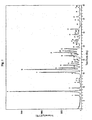
- FIG.1 is a powder X-ray diffraction (XRPD) pattern of the Etoricoxib.
- the main objection of the present invention is to provide improved process for purifying Etoricoxib.
- THF tetrahydrofuran
- DIPE di-isopropyl ether
- DMSO dimethyl sulphoxide
- MTBE methyl t-butyl ether
- MEK methyl ethyl ketone
- 'LHMDS' lithium bis (trimethylsilyl)amide
- 'KHMDS' potassium bis (trimethylsilyl)amide.
- Etoricoxib may be prepared by reacting substituted ⁇ -chlorovinamidinium salt of formula (IIIb) and a ketosulfone compound of formula (II). wherein represents a cyclic group, optionally containing one or more heteroatom selected from N, O or S & 'X' represents the suitable counterion.
- the groups comprising may be selected from morpholidinyl, peridinyl and a pyrolidinyl group.
- Etoricoxib may be prepared by a process using the ⁇ -chlorovinamidinium salt of formula (IIIb). This process does not form part of the present invention. The process comprises the following steps:
- step (a) further comprises the preparation of compound of formula (IIIb) as described above.
- step (a) comprises first combining chloroacetyl chloride and phosphorous oxychloride, and thereafter combining the N-formyl compound of formula (IV), to obtain the ⁇ -chlorovinamidinium salt of formula (IIIb), by processes as described above.
- the temperature in step (a) is as described above.
- step (a) the reaction mixture is maintained in step (a) is as described above.
- step (b) the ⁇ -chlorovinamidinium salt of formula (IIIb) obtained in step (a) is separated.
- the separation is done by filtration as described earlier in the specification.
- the organic solvent in step (b) may be selected from the group comprising of suitable hydrocarbons such as benzene, toluene, xylene, ethyl benzene, trimethyl benzene & the like; suitable haloginated hydrocarbon solvents such as chloroform, dichloromethane, dichloroethane and the like or mixtures thereof; alcohols such as methanol, ethanol, t-butanol and like or mixtures thereof; ketones such as acetone; aprotic solvents such as DMF, dimethyl acetamide; ethers like diethyl ether, 1,4-dioxane, DIPE, MTBE, THF & the like, aprotic polar solvents such as DMF, DMSO, DMA; nitriles like acetonitriles or their suitable mixtures thereof.
- suitable hydrocarbons such as benzene, toluene, xylene, ethyl benzene
- the suitable base used in step (b) may be selected from suitable organic or inorganic bases such as hydroxides selected from NaOH, KOH & the like, carbonates such as NaHCO 3 , Na 2 CO 3 , K 2 CO 3 , hydrides such as NaH and LHMDS, KHMDS and like; alkali metal alkoxides such as sodium, potassium, lithium t-butoxide and like; sodium, potassium, lithium isopropoxide and like.
- suitable organic or inorganic bases such as hydroxides selected from NaOH, KOH & the like, carbonates such as NaHCO 3 , Na 2 CO 3 , K 2 CO 3 , hydrides such as NaH and LHMDS, KHMDS and like
- alkali metal alkoxides such as sodium, potassium, lithium t-butoxide and like
- sodium, potassium, lithium isopropoxide and like may be selected from suitable organic or inorganic bases such as hydroxides selected from NaOH, KOH & the like, carbonates such as NaH
- the invention provides a process for purification of Etoricoxib (formula (I)).
- step (b) compound formula (I) can be isolated or subjected to insitu purification.
- Purification of compound formula (I) is done by using formalin solution and aq. ammonia in suitable solvent. The reaction mixture is stirred at suitable temperature and product is isolated using suitable solvent. Then after recrystallization is carried out using suitable solvent to obtain pure Etoricoxib.
- the suitable solvent used for the purification of Etoricoxib may be selected from C 1 -C 5 alcohol; ketones such as acetone and methyl ethyl ketone; ethers such as THF and dioxane or their suitable mixtures.
- the suitable solvent used for the isolation of Etoricoxib may be selected from suitable alcohols or esters.
- the preferred solvent is isopropyl alcohol.
- the suitable solvent used for recrystallization of Etoricoxib may be selected from suitable alcohols, esters, ethers or their suitable mixtures.
- the preferred solvent for recrystallisation is isopropyl alcohol.
- Etoricoxib with at least 99.9 % purity by HPLC.
- Etoricoxib obtained according to the present invention is characterized by an XPRD pattern substantially in accordance with the pattern Fig. 1 .
- Etoricoxib obtained according to the present invention is also characterized by an XPRD peaks at about 7.00, 8.50, 9.67, 11.72, 12.35, 12.96, 13.24, 15.04, 15.44, 16.51, 17.06, 17.70, 18.07, 18.76, 19.34, 20.00, 20.24, 21.14, 21.50, 22.20, 22.70, 23.28, 24.02, 24.76, 25.73, 26.20, 26.90, 27.37, 28.44, 29.24, 29.83, 30.41, 30.66, 31.22, 33.04, 34.63, 35.76,37.62, 39.16,39.65 ° ⁇ 0.2 ° degrees (20) ( Fig.1 ) and has melting point in the range of 135-137 °C.
- N-formyl morpholine (5g) was added in to N-formyl morpholine (5g) at -5 to 10 °C and subsequently chloroacetyl chloride (5g) was added at room temperature and the reaction mixture was stirred. Further, N-formyl morpholine (5g) was added to the reaction mixture at room temperature and the reaction mass was heated at 55-110 °C for 3 to 24 hrs. The reaction mixture was then cooled to room temperature to obtain a semi solid mass, which was dissolved in dichloromethane and subsequently a solution of NaPF 6 was added at 0-10 °C over a period of one hour.
- N-formyl morpholine (5g) Phosphorous oxychloride (6.6 g) was added in to N-formyl morpholine (5g) at a temperature of -5 to 5 °C. Subsequently chloroacetyl chloride (5g) was added at a temperature of 25-30 °C followed by addition of N-formyl morpholine (5g) at temperature 55 to 60 °C, there after the reaction mass was maintained at temperature 80-90 °C for 5 hr, & then cooled to 25-30 °C. The reaction mixture was diluted with dichloromethane 50 ml and the solution of NaPF 6 was added at 0-10 °C over a period of one hour.
- the reaction mixture was dumped in to the mixture of trifluoroacetic acid (0.6g), acetic acid (4.4g) and THF (10ml) and maintained the reaction mixture at 25-30 °C for 2 hrs.
- the reaction mixture was stirred at 55-60 °C for 3 hrs and aq. ammonia solution (30ml), and ammonium acetate (0.8g) was added and further stirred at 55-60 °C for 20 hrs.
- Chloroacetyl chloride (5g) was cooled to -10 to 0 °C and phosphorous oxychloride (6.8g) was added in one lot at 0 to -10 °C. Subsequently, N-formyl piperidine (10g) was added drop wise at 0 to 5 °C and reaction mixture was maintained at 90-100 °C for 16 hrs. Thereafter reaction mixture was cooled to 25-30 °C and diluted with DMF. Subsequently, the reaction mass was added into the solution of NaPF 6 within 60 minutes at 0-10 °C and stirred for 60 minutes at 0-10 °C.
- Phosphorous oxychloride (6.6g) was added in to N-formyl piperidine (6.1g) at temperature 15 to 17 °C. Subsequently chloroacetyl chloride (4.7g) was added drop wise at temperature 0-10 °C followed by addition of N-formyl piperidine (6.1g) in one lot at temperature 5 to 10 °C, then after the reaction mass was maintained at temperature 70-75 °C for 3 hr, cooled to 25-30 °C. The reaction mixture was diluted with DMF and the solution of NaPF 6 was added at 0-10 °C over a period of one hour.
- N-formyl piperidine (30g) was cooled to 0 to 10 °C and Chloroacetyl chloride (30g) was added drop wise at 0 to 10 °C. Subsequently, phosphorous oxychloride (6.5g) was added drop wise at 0 to 10 °C. Further, N-formyl piperidine (30g) was added drop wise at 0-10 °C and reaction mixture was maintained at 80-90 °C for 16 hrs. Then the reaction mixture was cooled to 25-30 °C and diluted with DMF. Subsequently, the reaction mass was added into the solution of NaPF 6 within 60 minutes at 0-10 °C and stirred for 60 minutes at 0-10 °C.
- N-formyl piperidine (20g) was cooled to 0 to -5 °C and chloroacetyl chloride (10g) was added simultaneously, phosphorous oxychloride (13.4g) was added drop wise at -5 to 5°C and the reaction mixture was stirred at 25-30 °C for 10 minutes. The reaction mixture was maintained at 90-100 °C for 6 hrs. Then the reaction mixture was cooled to 25-30 °C and diluted with DMF. Subsequently, the reaction mass was added into the solution of NaPF 6 within 60 minutes at 0-10 °C and stirred for 60 minutes at 0-10 °C.
- Chloroacetyl chloride (20g) was cooled at -10 to 0 °C and phosphorous oxychloride (27.2g)was added in one lot at -10 to -15°C and simultaneously N-formyl piperidine (40g) was added drop wise at -8 to -10 °Cover a period of 1 hr.
- the reaction mixture was maintained at 90-100 °C for 6 hrs.
- reaction mixture was cooled to 25-30 °C and diluted with absolute alcohol (10 ml). Subsequently, the reaction mass was added into the solution of NaPF 6 within 60 minutes at 0-10 °C and stirred for 60 minutes at 0-10 °C.
- reaction mixture was maintained for 2 hour at 10-15 °C, further the reaction mixture was maintained at 60-65 °c for 16 hrs after adding aq. ammonia solution 25 ml and ammonium acetate (2.5 g).
- the reaction mixture was cooled to 25-30 °C, organic layer was separated and 25g aq. ammonia solution and 2 g formaldehyde solution was added at 25-30 °C.
- the reaction mixture was maintained at 60-65 °C for 1 hrs, cooled to 40 °C and 2.7 g sodium chloride was added in it & stirred for 30 minutes. Organic layer was separated and distilled till complete solvent removal under reduced pressure.
- Etoricoxib obtained is also characterized by an XPRD peaks at about 7.00, 8.50, 9.67, 11.72, 12.35, 12.96, 13.24, 15.04, 15.44, 16.51, 17.06, 17.70, 18.07, 18.76, 19.34,20.00, 20.24, 21.14, 21.50, 22.20, 22.70, 23.28, 24.02, 24.76, 25.73, 26.20, 26.90, 27.37, 28.44, 29.24, 29.83, 30.41, 30.66, 31.22, 33.04, 34.63, 35.76, 37.62, 39.16, 39.65° ⁇ 0.2° degrees (2 ⁇ )( Fig.1 ) and has melting point in the range of 135-137 0 C.
- 2-chloro 1,3-(bis piperidinyl) trimethinium hexafluoro phosphate obtained is also characterized by an XPRD peaks at about 9.061, 11.60, 12.06, 12.89, 13.64, 14.38, 16.022, 16.98, 17.56, 18.16, 19.43, 20.16, 20.46, 21.04, 21.48, 21.98, 22.25, 22.68, 23.35, 23.76, 24.24, 24.64, 25.92, 26.75, 27.42, 28.03, 28.55, 29.04, 29.68, 30.06, 30.52, 31.25, 31.96, 32.36, 33.31, 33.94, 34.30, 35.16, 35.80, 38.14, 39.47 ⁇ .0.2 ° degrees (2 ⁇ )(Fig. 2, Form I) and has melting point in the range of 185-200 °C. (Decomposed).
- 2-chloro 1,3-(bis piperidinyl) trimethinium hexafluoro phosphate obtained is also characterized by an XPRD peaks at about 9.14, 10.142, 12.12, 12.96, 13.71, 17.06, 17.64, 18.24, 19.49, 20.520, 21.10, 21..56, 22.32, 22.74, 23.42, 24.32, 24.72, 26.05, 27.48, 28.10, 29.14, 29.79, 30.12,30.61, 31.30, 32.06, 32.43, 33.36, 34.02, 34.38 ° ⁇ 0.2 ° degrees (2 ⁇ )( Fig. 3, Form II) and has melting point in the range of 190-197 °C.
Landscapes
- Chemical & Material Sciences (AREA)
- Organic Chemistry (AREA)
- Pharmaceuticals Containing Other Organic And Inorganic Compounds (AREA)
- Low-Molecular Organic Synthesis Reactions Using Catalysts (AREA)
Description
- The present invention relates to an improved process for the purification of Etoricoxib.
- Etoricoxib is a selective COX-2 inhibitor which has been shown to be as effective as non-selective non-steroidal anti-inflammatory drugs in the management of chronic pain in rheumatoid arthritis, osteoarthritis and other COX-2 mediated disorders. Etoricoxib is 5-chloro-6'-methyl-3-[4-methylsulfonyl)phenyl]-2,3'-bipyridine having structural formula (I).

- Etoricoxib belongs to a class of drugs known as COX-2 inhibitors that are used in the treatment of COX-2 mediated disorders. The therapeutic application of Etoricoxib as a COX-2 inhibitor is disclosed in
WO 9610012 WO 9616934 - Compounds of general formula (X) which includes Etoricoxib are disclosed in
WO9803484 US 5861419 ). Process for the preparation of Compound of formula (X) involves bromination of 2-amino pyridine derivative with bromine in acetic acid to provide the bromide of 2-amino pyridine derivative. Coupling of this bromide derivative with 4-(methylthio)phenyl-boronic acid is done in presence of a suitable base, which is then oxidized to give the corresponding sulphon. Then the amino group of sulphon is converted to corresponding halide. A second palladium catalyzed coupling of sulphon halide derivative with an appropriately substituted metal containing aromatic give compound of formula (X).
-
WO9803484 
-
US 6812346 discloses a method for the preparation of Etoricoxib which comprises reacting a compound of formula B, wherein X is Br or Cl, with compound of formula C, wherein M is B(OH)2 or SnMe3, in the presence of a palladium catalyst to yield Etoricoxib.
- A process for the preparation of Etoricoxib as desribed in scheme III, is disclosed in
US6040319 , wherein X represents phosphates, sulfates, acetates, perchlorate, borates, antimonates, halides, benzoate, napsylate, particularly, hexafluorophosphate, sulfate, mesylate, tosylate, triflate, acetate, trifluoroacetate, tetrafluoroborate, tetraphenyl borate, hexafluoroantimonate, chloride, bromide, fluoride, iodide, benzolate and napsylate. Base used is Na and K hydroxide; Cs carbonate; Li, Na and K C1-6 alkoxide; Li, Na and K amides, Li, Na and K hydrides.
-
WO 0137833 WO 0192230 WO 0296877 -
WO 2005085199 discloses different other polymorph of Etoricoxib, specifically disclosed forms IX, X, XI, XII, XIII, XIV, XV and XVI.
US 6252116 (divisional ofUS 6040319 ) discloses process for preparing intermediate of formula (III), particularly CDTH (2-chloro-1,3-bis(dimethylamino)trimethinium hexafluorophosphate) salt with hexafluorophosphate, tetraphenyl borate, hexafluoroantimonate as it counterion (X).
- According to formula (III) R2 through R5 each independently represents C1-6 alkyl, aryl or aralkyl group.
- Certain heteroatom containing cycloalkyl substituted β-chlorovinamidinium salts are disclosed in J. Org. Chem., Vol: 66, No. 1, p. 251-255, 2001. But a large number of limitations are also reported. The method disclosed for the preparation of substituted β-chlorovinamidinium salt comprises, addition of chloroacetic acid to N-formyl compound containing a cycloalkyl group which optionally contains a heteroatom and the mixture was heated at 70 °C and then to it was added phosphorus oxychloride which after suitable work up gave the substituted β-chlorovinamidinium salt. This document also states that the β-chlorovinamidinium salt using N-formylmorpholine was obtained with very low yield (<10%) and pure sample could not be obtained by using this method.
- Davies et al in J. Org. Chem., Vol. 65, January 2000, pages 8415 to 8420 disclose the synthesis of a COX-2-specific inhibitor via a ketosulfone intermediate.
- The invention provides a process for the purification of Etoricoxib.
-
FIG.1 is a powder X-ray diffraction (XRPD) pattern of the Etoricoxib. - The main objection of the present invention is to provide improved process for purifying Etoricoxib.
- As used herein, the term "THF" refers to tetrahydrofuran, the term "DMF" refers to dimethyl formamide, the term "DIPE" refers to di-isopropyl ether, the term "DMSO" refers to dimethyl sulphoxide, the term "MTBE" refers to methyl t-butyl ether, the term, "MEK" refers to methyl ethyl ketone, the term 'LHMDS' refers to lithium bis (trimethylsilyl)amide, the term 'KHMDS' refers to potassium bis (trimethylsilyl)amide.
- Etoricoxib may be prepared by reacting substituted β-chlorovinamidinium salt of formula (IIIb) and a ketosulfone compound of formula (II).


- Preferably, the groups comprising

- The process of preparation of Etoricoxib does not form part of the present invention.
- Etoricoxib, may be prepared by a process using the β-chlorovinamidinium salt of formula (IIIb). This process does not form part of the present invention. The process comprises the following steps:
- (a) reacting a compound of formula-(IV) with suitable chloroacetyl halide or chloro acetic acid and phosphorous oxychloride to obtain the compound of formula (IIId) & further converting the compound of formula (IIId) into its suitable salt to obtain the compound of formula-(IIIb), as described above; and
- (b) reacting compound of formula (IIIb) with compound of formula (II) in presence of suitable base and suitable solvent to obtain compound of formula (I).
- Preferably, step (a) further comprises the preparation of compound of formula (IIIb) as described above.
- Preferably, the β-chlorovinamidinium salt of formula (IIIb) is as described above. Preferably, step (a) comprises first combining chloroacetyl chloride and phosphorous oxychloride, and thereafter combining the N-formyl compound of formula (IV), to obtain the β-chlorovinamidinium salt of formula (IIIb), by processes as described above. Preferably, the temperature in step (a) is as described above.
- Preferably, the reaction mixture is maintained in step (a) is as described above. Prior to step (b), the β-chlorovinamidinium salt of formula (IIIb) obtained in step (a) is separated. Preferably, the separation is done by filtration as described earlier in the specification.
- The organic solvent in step (b) may be selected from the group comprising of suitable hydrocarbons such as benzene, toluene, xylene, ethyl benzene, trimethyl benzene & the like; suitable haloginated hydrocarbon solvents such as chloroform, dichloromethane, dichloroethane and the like or mixtures thereof; alcohols such as methanol, ethanol, t-butanol and like or mixtures thereof; ketones such as acetone; aprotic solvents such as DMF, dimethyl acetamide; ethers like diethyl ether, 1,4-dioxane, DIPE, MTBE, THF & the like, aprotic polar solvents such as DMF, DMSO, DMA; nitriles like acetonitriles or their suitable mixtures thereof.
- The suitable base used in step (b) may be selected from suitable organic or inorganic bases such as hydroxides selected from NaOH, KOH & the like, carbonates such as NaHCO3, Na2CO3, K2CO3, hydrides such as NaH and LHMDS, KHMDS and like; alkali metal alkoxides such as sodium, potassium, lithium t-butoxide and like; sodium, potassium, lithium isopropoxide and like.
- The invention provides a process for purification of Etoricoxib (formula (I)).
- Optionally, after completion of step (b) compound formula (I) can be isolated or subjected to insitu purification. Purification of compound formula (I) is done by using formalin solution and aq. ammonia in suitable solvent. The reaction mixture is stirred at suitable temperature and product is isolated using suitable solvent. Then after recrystallization is carried out using suitable solvent to obtain pure Etoricoxib.
- The suitable solvent used for the purification of Etoricoxib may be selected from C1-C5 alcohol; ketones such as acetone and methyl ethyl ketone; ethers such as THF and dioxane or their suitable mixtures.
- The suitable solvent used for the isolation of Etoricoxib may be selected from suitable alcohols or esters. The preferred solvent is isopropyl alcohol.
- The suitable solvent used for recrystallization of Etoricoxib may be selected from suitable alcohols, esters, ethers or their suitable mixtures. The preferred solvent for recrystallisation is isopropyl alcohol.
- In one of the embodiment of the invention is disclosed Etoricoxib with at least 99.9 % purity by HPLC.
- Etoricoxib obtained according to the present invention is characterized by an XPRD pattern substantially in accordance with the pattern
Fig. 1 . - Etoricoxib obtained according to the present invention is also characterized by an XPRD peaks at about 7.00, 8.50, 9.67, 11.72, 12.35, 12.96, 13.24, 15.04, 15.44, 16.51, 17.06, 17.70, 18.07, 18.76, 19.34, 20.00, 20.24, 21.14, 21.50, 22.20, 22.70, 23.28, 24.02, 24.76, 25.73, 26.20, 26.90, 27.37, 28.44, 29.24, 29.83, 30.41, 30.66, 31.22, 33.04, 34.63, 35.76,37.62, 39.16,39.65 ° ± 0.2 ° degrees (20) (
Fig.1 ) and has melting point in the range of 135-137 °C. - The invention is further described by the following examples, which are provided for illustration only and should not be construed to limit the scope of invention.
- Phosphorous oxychloride (6.6g) was added in to N-formyl morpholine (5g) at -5 to 10 °C and subsequently chloroacetyl chloride (5g) was added at room temperature and the reaction mixture was stirred. Further, N-formyl morpholine (5g) was added to the reaction mixture at room temperature and the reaction mass was heated at 55-110 °C for 3 to 24 hrs. The reaction mixture was then cooled to room temperature to obtain a semi solid mass, which was dissolved in dichloromethane and subsequently a solution of NaPF6 was added at 0-10 °C over a period of one hour. Then into it 50 ml water was added, organic layer was separated, dried and concentrated till dry at less than 50 °C, to give 2-chloro 1,3-(bis morpholinyl) trimethinium hexafluoro phosphate. Yield=(4 g). HPLC purity = 44.63 %.
- Potassium tert. butoxide (1.4g) was dissolved in THF and the solution was maintained at 5-25 °C for 10 minutes. Subsequently, a solution containing the 1-(6-methylpyridin-3-yl)-2[4-(methylsulfonyl)phenyl] ethanone (3g) in THF was added and kept this at 25-30 °C for 1. hr. 2-chloro 1,3-(bis morpholinyl) trimethinium hexafluoro phosphate of (formula III) (4g) in THF, obtained above, was added to the previously prepared solution of 1-(6-methylpyridin-3-yl)-2[4-(methylsulfonyl)phenyl] ethanone and the reaction mixture was heated at 30-55 °C for 2-24 hrs. The reaction mixture was dumped into a mixture of trifluoroacetic acid (0.6 g),' acetic acid (4.4g) and THF and further heated at 55-60 °C for 6-20 hrs after adding aqueous ammonia solution (30 ml) and ammonium acetate (0.8g). The reaction mixture was dumped into water and extracted with ethyl acetate and washed with 10% aqueous sodium bicarbonate solution. The organic layer was separated, dried & concentrated till dry at temperature less than 50 °C to obtain Etoricoxib. Yield = (3.1 g),
% purity by HPLC = 15.36 % (Etoricoxib), 64.15 % (unreacted ketosulfone compound of formula II - Chloroacetic acid (4.75g, 0.05 mole) was added to N-formyl piperidine (13.5g, 0.119 mole) and the reaction mixture was heated to 70-75 °C to give a clear solution. Subsequently, phosphorous oxychloride (9.5 ml, 0.1 mole) was added over a period of 1-2 hrs and maintained at 70-75 °C for 3 hrs. The reaction mixture was cooled to room temperature and diluted with absolute alcohol (10 ml) and this reaction mass was added into the solution of NaPF6. The reaction mass was stirred for 30 minutes at 0-10 °C, filtered and washed with water, to obtain 2-chloro 1,3-(bis piperidinyl) trimethinium hexafluoro phosphate (2 g), yield =10.42 %, HPLC purity- 83.63 %
- Chloroacetyl chloride (20g) solution was cooled and phosphorous oxychloride (27.2g) was added into it at -10 to 0 °C. Subsequently, N-formyl piperidine (40g) was added over a period of 1 hrs, maintained the reaction mass at 55-110°C for 6-20 hrs. Then the reaction mixture was cooled to room temperature and diluted with DMF (40 ml). This reaction mass was added into the solution of NaPF6 over a period of 1 hr and the reaction mixture was stirred for 60 minute at 0-10 °C. The reaction mixture was filtered and washed with water to obtain crude 2-chloro 1,3-(bis piperidinyl) trimethinium hexafluoro phosphate (37.2 g), HPLC purity = 83.24 %.
- Crude mass was purified by using methanol: water treatment to obtain 2-chloro 1,3-(bis piperidyl) trimethinium hexafluoro phosphate (18.8 g), yield = 27.48 %, HPLC purity = 99.19 %.
- Potassium tert. butoxide (2.1g) was dissolved in THF (20ml) and the solution was maintained at 5-25 °C for 10 minutes. Subsequently, a solution of 1-(6-methylpyridin-3-yl)-2[4-(methylsulfonyl)phenyl] ethanone (5g) in THF was added and kept the mixture for 1hr at 25-30 °C. 2-chloro 1,3-(bis piperidyl) trimethinium hexafluoro phosphate salt of formula (IIIc) (8g), obtained in Example 4 above, in THF, was added to the previously prepared solution of ketosulfone and the reaction mixture was heated at 30-55 °C for 2-24 hrs. The reaction mixture was dumped into a mixture of trifloroacetic acid (1g), acetic acid (7.5g) and THF. The reaction mixture was further heated to 55-60 °C for 6-20 hrs, after adding ammonia solution (125 ml). Then cooled the reaction mixture to room temperature. The reaction mixture was dumped into water and extracted with ethyl acetate and washed with 10% aqueous sodium bicarbonate solution. The organic layer was separated and concentrated to dryness at less than 50 °C to give Etoricoxib 8.6 g.
HPLC purity- 91.28 % (Etoricoxib).
Crude mass was purified to obtain Etoricoxib (4.7g), yield = 75.9 %; HPLC purity = 96.31 %. - Phosphorous oxychloride (6.6 g) was added in to N-formyl morpholine (5g) at a temperature of -5 to 5 °C. Subsequently chloroacetyl chloride (5g) was added at a temperature of 25-30 °C followed by addition of N-formyl morpholine (5g) at temperature 55 to 60 °C, there after the reaction mass was maintained at temperature 80-90 °C for 5 hr, & then cooled to 25-30 °C. The reaction mixture was diluted with dichloromethane 50 ml and the solution of NaPF6 was added at 0-10 °C over a period of one hour. 50 ml water was added to the reaction mixture and organic layer was separated, dried, and concentrated to dryness at < 50 °C to obtain 2-chloro 1,3-(bis morpholinyl) trimetliinium hexafluoro phosphate.
% Yield = 23.13 %, (4 g), HPLC purity = 44.63 %. - Potassium tert. butoxide (1.4g) was dissolved in THF (7ml) and the solution was maintained at 25-30 °C for 10 minutes and then cooled to 10°C. Subsequently, solution of 1-(6-methylpyridin-3-yl)-2[4-(methylsulfonyl)phenyl] ethanone (5g) in THF was added and kept the mixture for 1hr at 25-30 °C. Subsequently, 2-chloro 1,3-(bis morpholinyl) trimethinium hexafluoro phosphate (4g) followed by THF (20ml) was added and the reaction mixture was maintained at 25-30 °C for 2 hrs. The reaction mixture was dumped in to the mixture of trifluoroacetic acid (0.6g), acetic acid (4.4g) and THF (10ml) and maintained the reaction mixture at 25-30 °C for 2 hrs. The reaction mixture was stirred at 55-60 °C for 3 hrs and aq. ammonia solution (30ml), and ammonium acetate (0.8g) was added and further stirred at 55-60 °C for 20 hrs. The reaction mixture was cooled to 25-30 °C then after water was added and extract with ethyl acetate (50ml). Organic layer was separated and washed with 10 % sodium bicarbonate solution, dried and concentrated to dryness < 50 °C to obtain Etoricoxib.
Yield = 3.1 g, (12.82 %), HPLC purity = 15.36.% (Etoricoxib), (unreacted 64.15 %-sulfone compound). - Chloroacetyl chloride (5g) was cooled to -10 to 0 °C and phosphorous oxychloride (6.8g) was added in one lot at 0 to 10 °C, Subsequently, N-formyl pyrolidine (8.76g) was added drop wise at 0 to 5 °C and the reaction mixture was maintained at 90-100 °C for 6 hrs. There after the reaction mixture was cooled to 25-30 °C and diluted with DMF (10ml). Subsequently, the reaction mass was added into the solution of NaPF6 within 60 minutes at 0-10 °C and stirred for 60 minutes at 0-10 °C. The solid was precipitated out, which was filtered and washed with water to obtain 2-chloro 1,3-(bis pyrolidinyl) trimethinium hexafluoro phosphate salt. Yield = 8.7 g, HPLC purity = 93.09 %. Crude mass was purified using Methanol: water. Yield = 5.2 g, (32.9 %), HPLC purity = 98.87 %.
- Potassium tert. butoxide (0.426g) was dissolved in THF (40ml) and the solution was maintained at 25-30 °C for 10 minutes and then cooled to 10-15 °C. Subsequently, solution of 1-(6-methylpyridin-3-yl)-2[4-(methylsulfonyl)phenyl] ethanone (1g) in THF was added and kept the mixture for 1hr at 10-15 °C. Subsequently, 2-chloro 1,3-(bis pyrolidinyl) trimethinium hexafluoro phosphate salt (1.3g), in THF (8ml) was added and maintained the reaction mixture for 2 hrs at 25-30 °C. The reaction mixture was dumped in to the mixture of trifloroaceticacid (0.2g), acetic acid (1.5g), and THF (10ml) and maintained for 1 hour at 25-30 °C. Further the reaction mixture was heated at 60-70 °C for 15 hrs after aq. ammonia solution (25ml) was added and the reaction mixture was cooled to 25-30 °C. After then ethyl acetate and water was added, organic layer was separated and washed with water and 10 % sodium bicarbonate solution. Organic layer was separated, dried and concentrated to dryness < 50 °C to give crude Etoricoxib.
Yield = 0.9 g (40.84 %), % HPLC purity = 55.82 % (Etoricoxib), (unreacted sulfone compound = 34.44 %). - Chloroacetyl chloride (5g) was cooled to -10 to 0 °C and phosphorous oxychloride (6.8g) was added in one lot at 0 to -10 °C. Subsequently, N-formyl piperidine (10g) was added drop wise at 0 to 5 °C and reaction mixture was maintained at 90-100 °C for 16 hrs. Thereafter reaction mixture was cooled to 25-30 °C and diluted with DMF. Subsequently, the reaction mass was added into the solution of NaPF6 within 60 minutes at 0-10 °C and stirred for 60 minutes at 0-10 °C. The solid was precipitated out, which was filtered and washed with water to obtain 2-chloro 1,3-(bis piperidinyl) trimethinium hexafluoro phosphate salt.
% Yield = 15.4 g (61.23 %), HPLC purity = 68.84 %. - Phosphorous oxychloride (6.6g) was added in to N-formyl piperidine (6.1g) at temperature 15 to 17 °C. Subsequently chloroacetyl chloride (4.7g) was added drop wise at temperature 0-10 °C followed by addition of N-formyl piperidine (6.1g) in one lot at temperature 5 to 10 °C, then after the reaction mass was maintained at temperature 70-75 °C for 3 hr, cooled to 25-30 °C. The reaction mixture was diluted with DMF and the solution of NaPF6 was added at 0-10 °C over a period of one hour. The reaction mixture was stirred for 60 minutes at 0-10 °C, filtered and washed with water, dried to obtain 2-chloro 1,3-(bis piperidinyl) trimethinium hexafluoro phosphate.
Yield =3 g, (18.75 %), HPLC purity = 96.95 % - N-formyl piperidine (30g) was cooled to 0 to 10 °C and Chloroacetyl chloride (30g) was added drop wise at 0 to 10 °C. Subsequently, phosphorous oxychloride (6.5g) was added drop wise at 0 to 10 °C. Further, N-formyl piperidine (30g) was added drop wise at 0-10 °C and reaction mixture was maintained at 80-90 °C for 16 hrs. Then the reaction mixture was cooled to 25-30 °C and diluted with DMF. Subsequently, the reaction mass was added into the solution of NaPF6 within 60 minutes at 0-10 °C and stirred for 60 minutes at 0-10 °C. The solid was precipitated out, which was filtered and washed with water to obtain 2-chloro 1,3-(bis piperidinyl) trimethinium hexafluoro phosphate salt.
Yield =55.3 g, (54 %), HPLC purity = 72.74 %. - Chloroacetyl chloride (10g) was cooled to 0 to 5 °C and N-formyl piperidine (10g) was added drop wise at 5 to 10°C and reaction mixture was stirred for 1 hr. Subsequently, phosphorous oxychloride (13.6g) was added drop wise at 0 to 10 °C and further N-formyl piperidine (10g) was added at 0-10 °C, stirred for 1 hrs at 0-5 ° C. The reaction mixture was maintained at 75-80 °C for 19 hrs. Then the reaction mixture was cooled to 25-30 °C and diluted with DMF. Subsequently, the reaction mass was added into the solution of NaPF6 within 60 minutes at 0-10 °C and stirred for 60 minutes at 0-10 °C. The solid was precipitated out, which was filtered and washed with water to obtain 2-chloro 1,3-(bis piperidinyl) trimethinium hexafluoro phosphate salt.
Yield = 7.6 g, (22.22 %), HPLC purity = 80.33 % - Chloroacetyl chloride (4.9g) was cooled to -5 to 0 °C and phosphorous oxychloride (6.7g) was added in one lot at 0 to -5 °C and stirred for 5minutes. Subsequently, N-formyl piperidine (8g) was added drop wise at 0 to 5 °C and further stirred for 10 minutes at 25-30 °C. The reaction mixture was maintained at 90-100 °C for 6 hrs. Then after reaction mixture was cooled to 25-30 °C and diluted with DMF. Subsequently, the reaction mass was added into the solution of NaPF6 within 60 minutes at 0-10 °C and stirred for 60 minutes at 0-10 °C. The solid was precipitated out, which was filtered and washed with cold methanol: water to obtain 2-chloro 1,3-(bis piperidinyl) trimethinium hexafluoro phosphate salt.
Yield =10.5 g, (51.19 %), HPLC purity = 83.87 %. - N-formyl piperidine (20g) was cooled to 0 to -5 °C and chloroacetyl chloride (10g) was added simultaneously, phosphorous oxychloride (13.4g) was added drop wise at -5 to 5°C and the reaction mixture was stirred at 25-30 °C for 10 minutes. The reaction mixture was maintained at 90-100 °C for 6 hrs. Then the reaction mixture was cooled to 25-30 °C and diluted with DMF. Subsequently, the reaction mass was added into the solution of NaPF6 within 60 minutes at 0-10 °C and stirred for 60 minutes at 0-10 °C. The solid was precipitated out, which was filtered and washed with water to obtain 2-chloro 1,3-(bis piperidinyl) trimethinium hexafluoro phosphate salt.
Yield = 20 g, (47.39 %), HPLC purity = 81.05 %. - Chloroacetic acid (4.75 g, 0.05 mole) was added into N-formyl piperidine (13.5 g, 0.119 mole) at 25-30 °C and heat the reaction mixture at 70-75 °C. Subsequently phosphorous oxychloride (9.5 ml, 0.1 mole) was added over a period of 2 hrs at 70-75 °C. The reaction mixture was maintained at 70-80 °C for 3 hrs. Then after reaction mixture was cooled to 25-30 °C and diluted with absolute alcohol (10 ml). Subsequently, the reaction mass was added into the solution of NaPF6 within 60 minutes at 0-10 °C and stirred for 60 minutes at 0-10 °C. The solid was precipitated out, which was filtered and washed with water to obtain 2-chloro 1,3-(bis piperidinyl) trimethinium hexafluoro phosphate salt.
Yield = 2 g, (10.42 %), HPLC purity = 83.63 %. - Chloroacetyl chloride (20g) was cooled at -10 to 0 °C and phosphorous oxychloride (27.2g)was added in one lot at -10 to -15°C and simultaneously N-formyl piperidine (40g) was added drop wise at -8 to -10 °Cover a period of 1 hr. The reaction mixture was maintained at 90-100 °C for 6 hrs. Then after reaction mixture was cooled to 25-30 °C and diluted with absolute alcohol (10 ml). Subsequently, the reaction mass was added into the solution of NaPF6 within 60 minutes at 0-10 °C and stirred for 60 minutes at 0-10 °C. The solid was precipitated out, which was filtered and washed with water to obtain 2-chloro 1,3 -(bis piperidinyl) trimethinium hexafluoro phosphate salt.
Yield = (45.27 %), 37.2 g, HPLC purity = 83.24 %. - 2-chloro 1,3-(bis piperidyl) trimethinium hexafluoro phosphate (37g) was dissolved in (185ml) methanol and (18.5ml) water (5:0.5) at 25-30 °C. The reaction mixture was stirred at 70-75 °C for 1 hrs. The reaction mixture was cooled to 0-10 °C and further stirred for 1 hrs, reaction mass was filtered and washed with methanol: water (1:1).
Yield = 23 g, (74.67 %), HPLC purity = 97.25 %. - 2-chloro 1,3-(bis piperidyl) trimethinium hexafluoro phosphate (11.2g) was dissolved in (55ml) methanol and aq. solution of bisulphate at 25-30 0C. The reaction mixture was stirred at 25-30 °C for 1 his, reaction mass was filtered and washed with water to obtain highly pure 2-chloro 1,3-(bis piperidinyl) trimethinium hexafluoro phosphate. Yield = 9.4 g, (83.92 %), HPLC purity = 99.19 %.
- Potassium tert. butoxide (2.1g) was dissolved in THF (20ml) and the solution was maintained at 25-30 °C for 10 minutes and then cooled to 10-15 0C. Subsequently, solution of 1-(6-methylpyridin-3-yl)-2[4-(methylsulfonyl)phenyl] ethanone (5g) in THF was added and kept the mixture for 1hr at 25-30 °C. Subsequently, 2-chloro 1,3-(bis piperidinyl) trimethinium hexafluoro phosphate salt (8g), in THF (40ml) was added and maintained the reaction mixture for 2 hrs at 25-30 °C. The reaction mixture was dumped in to the mixture of trifloroacetic acid (1g), acetic acid (7.5g), and THF (100ml) and maintained for 1 hour at 25-30 °C. Further the reaction mixture was heated at 55-65 °C for 17 hrs after aq. ammonia solution (125 ml) was added and the reaction mixture was cooled to 25-30 °C. After that ethyl acetate and water was added, organic layer was separated and washed with water and 10 % sodium bicarbonate solution. Organic layer was separated, dried and concentrated to dryness at less than 50°C to give crude Etoricoxib.
Yield = 8,6 g, HPLC purity = 91.28 % (Etoricoxib) (unreacted sulfone compound < 5 %). - Potassium tert. butoxide (11.6g) was dissolved in THF (90ml) and the solution was maintained at 25-30 °C for 10 minutes and then cooled to 10-15 °C. Subsequently, solution of 1-(6-methylpyridin-3-yl)-2[4-(methylsulfonyl)phenyl] ethanone (27.5g) in THF was added and kept the mixture for 1hr at 15-25 °C. Subsequently, 2-chloro 1,3-(bis piperidinyl) trimethinium hexafluoro phosphate salt (44g), in THF (220ml) was added and maintained the reaction mixture for 3.5 hrs at 25-30 0C. The reaction mixture was dumped in to the mixture of trifloxoaceticacid (5.5g), acetic acid (41.2g), and THF (65ml) and maintained for 1 hour at 25-30 °C. Further the reaction mixture was heated at 55-65 °C for 17 hrs after aq. ammonia solution (190ml) was added and the reaction mixture was cooled to 25-30 °C. Then ethyl acetate and water was added, organic layer was separated and washed with water and 10 % sodium bicarbonate solution. Organic layer was separated, dried and concentrated to dryness < 50 °C to give crude Etoricoxib.
Yield = 48.7 g, HPLC purity = 94.45 % (Etoricoxib), (unreacted sulfone compound < 5 %). - (48.5 g) crude Etoricoxib (purity = 94.45 %, sulfone compound < 5%) obtained above was dissolved in 200 ml methanol and subsequently, (27.5g) formalin solution (37 %) and (27.5ml) aq. ammonia solution were added at 25-30 °C. The reaction mixture was stirred at 45-55 °C for 2 hrs and then remove the solvent under reduced pressure at < 55 °C. 250 ml ethyl acetate was added and reaction mixture was stirred. Organic layer was separated and washed with water, charcolized with (2.7g) charcoal, filtered and concentrated at < 55°C, azeotrope with 50 ml isopropyl alcohol to dryness.
Yield = 34.5 g (97.9 %), HPLC purity = 96.49 % (Etoricoxib), (unreacted sulfone compound < 1 %). - (34.4 g) crude Etoricoxib (purity = 96.49 %) was stirred in isopropyl alcohol at 60-65 °C for 1 hr. The reaction mixture was cooled to 25-30 °C and further stirred for 17 hrs. Further (27.5 ml) isopropyl alcohol was added and stirred for 10 minutes at 25-30 0C, filter and washed with isopropyl alcohol, material was dried at 50-55 °C.
Yield = 23.3 g, (69.28 %), HPLC purity > 98 % Etoricoxib. - Potassium tert. butoxide (0.4g) was dissolved in DMF (4ml) and the solution was maintained at 25-30 °C for 10 minutes and then cooled to 10-15 °C. Subsequently, solution of 1-(6-methylpyridin-3-yl)-2[4-(methylsulfonyl)phenyl] ethanone (1g) in DMF was added and kept the mixture for 1hr at 15-25 °C. Subsequently, 2-chloro 1,3-(bis piperidinyl) trimethinium hexafluoro phosphate salt (1.6g), in DMF (16ml) was added and maintained the reaction mixture for 2 hr at 25-30 °C. The reaction mixture was dumped in to the mixture of trifloroacetic acid (0.2g), acetic acid (1.5g), and DMF (12ml) and maintained for 1 hour at 25-30 °C. Further the reaction mixture was heated at 55-65 °C for 18 hrs after ammonia solution (25ml) was added and the reaction mixture was cooled to 25-30 °C. After then ethyl acetate and water was added, organic layer was separated and washed with water and 10% sodium bicarbonate solution. Organic layer was separated, dried and concentrated to dryness < 50 °C to give crude Etoricoxib.
Yield = (55.12%) 1 g , HPLC purity = 67.8 % (Etoricoxib), (unreacted sulfone compound < 5 %). - 1-(6-methylpyridin-3-yl)-2[4-(methylsulfonyl)phenyl] ethanone (9g) was dissolved in THF and the solution was maintained at 25-30 °C for 10 minutes and then cooled to 10-15 °C. Subsequently, potassium tert butoxide (4.1 g) was added and reaction mixture was maintained at 10-15 °C for 60 minutes. After then was added 2-chloro 1,3-(bis piperidinyl) trimethinium hexafluoro phosphate (14.8 g), followed by THF. The reaction mixture was maintained for 2 hrs at 10-15 °C and the reaction mixture was dumped into acetic acid (13 g) at 10-15 °C, washed with THF. Subsequently, the reaction mixture was maintained for 2 hour at 10-15 °C, further the reaction mixture was maintained at 60-65 °c for 16 hrs after adding aq. ammonia solution 25 ml and ammonium acetate (2.5 g). The reaction mixture was cooled to 25-30 °C, organic layer was separated and 25g aq. ammonia solution and 2 g formaldehyde solution was added at 25-30 °C. The reaction mixture was maintained at 60-65 °C for 1 hrs, cooled to 40 °C and 2.7 g sodium chloride was added in it & stirred for 30 minutes. Organic layer was separated and distilled till complete solvent removal under reduced pressure. The residue was azeotroped with toluene, and washed with water at 70-75 °C, aqueous layer was separated and extracted with toluene followed by toluene at 70-75 °C. Combined all the organic layers and washed with 7.5 % sodium bicarbonate solution followed by water. Further organic layer was separated and charcolized with 0.3 g charcoal at 60-65 °C, and separated organic layer was distilled under reduced pressure, residue was azeotroped with IPA at 25-30 °C. The reaction mixture was stirred at 75-80 °C for 30 minutes, cooled to 25-30 °C, further IPA was added at 25-30 °C, cooled to 10-15 °C, stirred for 2 hrs at 10-15 °C, filtered and washed with cold IPA.
Yield = 6.8 g (61 %), HPLC purity = 99.34 % (Etoricoxib), (unreacted sulfone compound < 5 %). - Etoricoxib (5 g) (as obtained in example 25) was dissolved in isopropyl alcohol and stirred at 60-65 °C for 1 hrs after adding 0.17 g charcoal, filtered through hyflow & washed with 2 ml hot IPA. The reaction mixture was cooled to 25-30 °C and stirred for 2 hrs, filtered and washed with isopropyl alcohol, dried the material at 60-65 0C to obtain pure Etoricoxib.
Yield = 3.6 g (72.87%), HPLC purity 99.83 % Etoricoxib.
Etoricoxib obtained is also characterized by an XPRD peaks at about 7.00, 8.50, 9.67, 11.72, 12.35, 12.96, 13.24, 15.04, 15.44, 16.51, 17.06, 17.70, 18.07, 18.76, 19.34,20.00, 20.24, 21.14, 21.50, 22.20, 22.70, 23.28, 24.02, 24.76, 25.73, 26.20, 26.90, 27.37, 28.44, 29.24, 29.83, 30.41, 30.66, 31.22, 33.04, 34.63, 35.76, 37.62, 39.16, 39.65° ± 0.2° degrees (2θ)(Fig.1 ) and has melting point in the range of 135-137 0C. - Chloroacetyl chloride (200g) was cooled at -10 to 0 °C and phosphorous oxychloride (271.5g) was added in one lot at 0 to -10 °C and simultaneously N-formyl piperidine (400g) was added drop wise at 0 to 10 °C over a period of 1 hr. The reaction mixture was maintained at 90-100 °C for 6 hrs. Then after reaction mixture was cooled to 25-30 °C and diluted with DMF. Subsequently, the reaction mass was added into the solution of NaPF6 within 60 minutes at 0-10 0C and stirred for 60 minutes at 0-10 °C. The solid was precipitated out, which was filtered and washed with water to obtain 2-chloro 1,3-(bis piperidinyl) trimethinium hexafluoro phosphate salt.
Yield = 5.81.3 g (78.7 %), HPLC purity = 92.81 %. - 2-chloro 1,3-(bis piperidinyl) trimethinium hexafluoro phosphate (580 g) (as obtained in example 27) was dissolved in a mixture of methanol and water (5:0.5) at 25-30 °C. The reaction mixture was stirred at 60-70 0C for 1.5 hrs, cooled to 0-10 °C. Further, the reaction mixture was stirred for 1 hrs, filtered and washed with methanol: water (1:1) to obtain pure 2-chloro 1,3-(bis piperidinyl) trimethiniutn hexafluoro phosphate. Yield = 340.5 g (63.28 %), HPLC purity = 99.57 %.
- 2-chloro 1,3-(bis piperidinyl) trimethinium hexafluoro phosphate (340.5g) was dissolved in methanol and aq. solution of bisulphate at 25-30 °C. The reaction mixture was stirred at 25-30 °C for 1 hr, reaction mass was filtered and washed with water to obtain highly pure 2-chloro 1,3-(bis piperidinyl) trimethinium hexafluoro phosphate.
Yield = 305 g, (90.15 %), HPLC purity = 99.65 %.
2-chloro 1,3-(bis piperidinyl) trimethinium hexafluoro phosphate obtained is also characterized by an XPRD peaks at about 9.061, 11.60, 12.06, 12.89, 13.64, 14.38, 16.022, 16.98, 17.56, 18.16, 19.43, 20.16, 20.46, 21.04, 21.48, 21.98, 22.25, 22.68, 23.35, 23.76, 24.24, 24.64, 25.92, 26.75, 27.42, 28.03, 28.55, 29.04, 29.68, 30.06, 30.52, 31.25, 31.96, 32.36, 33.31, 33.94, 34.30, 35.16, 35.80, 38.14, 39.47 ±.0.2 ° degrees (2θ)(Fig. 2, Form I) and has melting point in the range of 185-200 °C. (Decomposed). - Chloroacetyl chloride (100g) was cooled to 0 °C and phosphorous oxychloride (135.7g) was added in one lot at 0 to -10°C and simultaneously N-formyl piperidine (200g) was added drop wise at 0 to 10 °C over a period of 1 hr. The reaction mixture was maintained at 90-100 °C for 6 hrs. Then the reaction mixture was cooled to 25-30 °C and diluted with DMF. Subsequently, the reaction mass was added into the solution of NaPF6 (prepared by adding 5N aq. NaOH solution in aq. HPF6 solution) within 60 minutes at 0-10 °C and stirred for 60 minutes at 0-10 °C. The solid was precipitated out, which was filtered and washed with water to obtain 2-chloro 1,3-(bis piperidinyl) trimethinium hexafluoro phosphate salt.
Yield = 189.3 g (45.9 5), HPLC purity: 82.41 %. - 2-chloro 1,3-(bis piperidyl) trimethinium hexafluoro phosphate (180 g) (as obtained in example 30) was dissolved in a mixture of methanol and water (5:0.5) at 25-30 °C. The reaction mixture was stirred at 60-70 °C for 1.5 hrs, cooled to 0-10 °C. Further, the reaction mixture was stirred for 1 hr, filtered and washed with methanol: water (1:1) to obtain pure 2-chloro 1,3-(bis piperidinyl) trimethinium hexafluoro phosphate.
Yield =110 g (73.36 %), HPLC purity: 99.06 % - 2-chloro 1,3-(bis piperidyl) trimethinium hexafluoro phosphate (109.6g; obtained in Example 31) was dissolved in methanol and aq. solution of bisulphate (29.5 g sodium bisulphite dissolved in 109.6 ml water) at 25-30 °C. The reaction mixture was stirred at 25-30 °C for 1 hr, reaction mass was filtered and washed with water to obtain highly pure 2-chloro 1,3-(bis piperidinyl) trimethinium hexafluoro phosphate.
Yield = 91.9 g (84.65 %), HPLC purity: 99.51 %.
2-chloro 1,3-(bis piperidinyl) trimethinium hexafluoro phosphate obtained is also characterized by an XPRD peaks at about 9.14, 10.142, 12.12, 12.96, 13.71, 17.06, 17.64, 18.24, 19.49, 20.520, 21.10, 21..56, 22.32, 22.74, 23.42, 24.32, 24.72, 26.05, 27.48, 28.10, 29.14, 29.79, 30.12,30.61, 31.30, 32.06, 32.43, 33.36, 34.02, 34.38 ° ± 0.2 ° degrees (2θ)( Fig. 3, Form II) and has melting point in the range of 190-197 °C.


Claims (5)
- A process for purification of Etoricoxib comprising the steps of;(a) treating Etoricoxib with formalin solution and aq. ammonia in suitable solvent;(b) isolating the Etoricoxib with a suitable solvent;(c) recrystallization of the solid obtained in step (b), from the solvent to obtain highly pure Etoricoxib.
- The process as claimed in claim 1, wherein said suitable solvent used in step (a) is selected from C1-C5 alcohols, ketones, cyclic ethers or their suitable mixtures.
- The process as claimed in claim 1, wherein suitable solvent used for isolation in step (b) is selected from C1-C5 alcohols.
- The process as claimed in claim 1, wherein suitable solvent used for recrystallization in step (c) is selected from suitable alcohols.
- The process as claimed in claim 1, wherein Etoricoxib obtained is with at least 99% purity by HPLC.
Priority Applications (1)
| Application Number | Priority Date | Filing Date | Title |
|---|---|---|---|
| PL12162558T PL2479166T3 (en) | 2009-02-27 | 2010-01-25 | A process for the preparation of etoricoxib |
Applications Claiming Priority (2)
| Application Number | Priority Date | Filing Date | Title |
|---|---|---|---|
| IN441MU2009 | 2009-02-27 | ||
| EP10719784.0A EP2401253B1 (en) | 2009-02-27 | 2010-01-25 | A process for the preparation of etoricoxib |
Related Parent Applications (3)
| Application Number | Title | Priority Date | Filing Date |
|---|---|---|---|
| EP10719784.0 Division | 2010-01-25 | ||
| EP10719784.0A Division EP2401253B1 (en) | 2009-02-27 | 2010-01-25 | A process for the preparation of etoricoxib |
| EP10719784.0A Division-Into EP2401253B1 (en) | 2009-02-27 | 2010-01-25 | A process for the preparation of etoricoxib |
Publications (2)
| Publication Number | Publication Date |
|---|---|
| EP2479166A1 EP2479166A1 (en) | 2012-07-25 |
| EP2479166B1 true EP2479166B1 (en) | 2014-08-20 |
Family
ID=42290121
Family Applications (2)
| Application Number | Title | Priority Date | Filing Date |
|---|---|---|---|
| EP10719784.0A Active EP2401253B1 (en) | 2009-02-27 | 2010-01-25 | A process for the preparation of etoricoxib |
| EP12162558.6A Not-in-force EP2479166B1 (en) | 2009-02-27 | 2010-01-25 | A process for the preparation of etoricoxib |
Family Applications Before (1)
| Application Number | Title | Priority Date | Filing Date |
|---|---|---|---|
| EP10719784.0A Active EP2401253B1 (en) | 2009-02-27 | 2010-01-25 | A process for the preparation of etoricoxib |
Country Status (10)
| Country | Link |
|---|---|
| EP (2) | EP2401253B1 (en) |
| AR (1) | AR075441A1 (en) |
| BR (1) | BRPI1006374A2 (en) |
| DK (2) | DK2479166T3 (en) |
| ES (2) | ES2562981T3 (en) |
| HU (1) | HUE028730T2 (en) |
| MY (1) | MY163020A (en) |
| PL (2) | PL2479166T3 (en) |
| PT (1) | PT2479166E (en) |
| WO (1) | WO2010097802A2 (en) |
Families Citing this family (5)
| Publication number | Priority date | Publication date | Assignee | Title |
|---|---|---|---|---|
| RU2591848C2 (en) | 2010-11-15 | 2016-07-20 | Вирдев Интермидиетс Пвт. Лтд. | Method of producing selective inhibitor of cyclooxygenase-2 |
| WO2012163839A1 (en) | 2011-05-27 | 2012-12-06 | Farma Grs, D.O.O. | A process for the preparation of polymorphic form i of etoricoxib |
| EP2773618A1 (en) | 2011-11-03 | 2014-09-10 | Cadila Healthcare Limited | An improved process for the preparation of etoricoxib and polymorphs thereof |
| GR1007973B (en) * | 2012-06-26 | 2013-09-12 | Φαρματεν Αβεε, | Novel n-oxyiminium compounds as intermediates of an improved process for the preparation of 2,3-diaryl-5-substituted pyridines |
| WO2014114352A1 (en) * | 2013-01-25 | 2014-07-31 | Synthon Bv | Process for making etoricoxib |
Family Cites Families (10)
| Publication number | Priority date | Publication date | Assignee | Title |
|---|---|---|---|---|
| US5593994A (en) | 1994-09-29 | 1997-01-14 | The Dupont Merck Pharmaceutical Company | Prostaglandin synthase inhibitors |
| US5739166A (en) | 1994-11-29 | 1998-04-14 | G.D. Searle & Co. | Substituted terphenyl compounds for the treatment of inflammation |
| SI0912518T1 (en) | 1996-07-18 | 2003-12-31 | Merck Frosst Canada & Co. | Substituted pyridines as selective cyclooxygenase-2 inhibitors |
| US5861419A (en) | 1996-07-18 | 1999-01-19 | Merck Frosst Canad, Inc. | Substituted pyridines as selective cyclooxygenase-2 inhibitors |
| UA57143C2 (en) | 1998-04-24 | 2003-06-16 | Мерк Енд Ко., Інк. | Method for synthesis of cyclooxygenase-2 (cox-2) inhibitors and intermediates for their synthesis |
| CA2391650C (en) | 1999-11-29 | 2011-01-25 | Merck & Co., Inc. | Polymorphic, amorphous and hydrated forms of 5-chloro-3-(4-methanesulfonylphenyl)-6'-methyl-[2,3']bipyridinyl |
| PH12001001175B1 (en) | 2000-05-26 | 2006-08-10 | Merck Sharp & Dohme | 5-chloro-3-(4-methanesulfonylphenyl)-6'-methyl- (2,3')bipyridinyl in pure crystalline form and process for synthesis |
| US6521642B2 (en) | 2000-05-26 | 2003-02-18 | Merck & Co., Inc. | 5-chloro-3-(4-methanesulfonylphenyl)-6′-methyl-[2,3′]bipyridinyl in pure crystalline form and process for synthesis |
| JP2003160563A (en) * | 2001-11-29 | 2003-06-03 | Sankio Chemical Co Ltd | New bf4 salt of 3-amino-2-propenylidene ammonium derivative |
| WO2005085199A1 (en) | 2004-01-14 | 2005-09-15 | Cadila Healthcare Limited | Novel polymorphs of etoricoxib |
-
2010
- 2010-01-25 HU HUE10719784A patent/HUE028730T2/en unknown
- 2010-01-25 EP EP10719784.0A patent/EP2401253B1/en active Active
- 2010-01-25 BR BRPI1006374A patent/BRPI1006374A2/en not_active IP Right Cessation
- 2010-01-25 EP EP12162558.6A patent/EP2479166B1/en not_active Not-in-force
- 2010-01-25 ES ES10719784.0T patent/ES2562981T3/en active Active
- 2010-01-25 PL PL12162558T patent/PL2479166T3/en unknown
- 2010-01-25 PL PL10719784T patent/PL2401253T3/en unknown
- 2010-01-25 WO PCT/IN2010/000045 patent/WO2010097802A2/en not_active Ceased
- 2010-01-25 PT PT121625586T patent/PT2479166E/en unknown
- 2010-01-25 ES ES12162558.6T patent/ES2496465T3/en active Active
- 2010-01-25 DK DK12162558.6T patent/DK2479166T3/en active
- 2010-01-25 MY MYPI2011003123A patent/MY163020A/en unknown
- 2010-01-25 DK DK10719784.0T patent/DK2401253T3/en active
- 2010-02-16 AR ARP100100449A patent/AR075441A1/en not_active Application Discontinuation
Also Published As
| Publication number | Publication date |
|---|---|
| ES2496465T3 (en) | 2014-09-19 |
| MY163020A (en) | 2017-07-31 |
| PL2479166T3 (en) | 2014-11-28 |
| PT2479166E (en) | 2014-11-28 |
| EP2479166A1 (en) | 2012-07-25 |
| PL2401253T3 (en) | 2016-05-31 |
| EP2401253B1 (en) | 2016-01-13 |
| DK2479166T3 (en) | 2014-09-01 |
| ES2562981T3 (en) | 2016-03-09 |
| DK2401253T3 (en) | 2016-04-18 |
| BRPI1006374A2 (en) | 2019-09-24 |
| EP2401253A2 (en) | 2012-01-04 |
| WO2010097802A3 (en) | 2010-12-23 |
| WO2010097802A2 (en) | 2010-09-02 |
| AR075441A1 (en) | 2011-03-30 |
| HUE028730T2 (en) | 2017-01-30 |
Similar Documents
| Publication | Publication Date | Title |
|---|---|---|
| SU867298A3 (en) | Method of preparing piperidine derivatives or their salts | |
| US11713298B2 (en) | Process for preparing 2-[[5-(3-chlorophenyl)-3-hydroxypyridine-2-carbonyl]amino]acetic acid | |
| JP5817079B2 (en) | Process for preparing 6- (7-((1-aminocyclopropyl) methoxy) -6-methoxyquinolin-4-yloxy) -N-methyl-1-naphthamide, or a pharmaceutically acceptable salt thereof | |
| IE862605L (en) | Preparation of disubstituted pyridine -2,3- dicarboxylates | |
| WO2011101861A1 (en) | Process for preparation of dpp-iv inhibitors | |
| SU659081A3 (en) | Method of obtaining phenylethylamines or salts thereof | |
| KR20190013554A (en) | Novel intermediates useful for the synthesis of aminopyrimidine derivatives, process for preparing the same, and process for preparing aminopyrimidine derivatives using the same | |
| EP2479166A1 (en) | A process for the preparation of etoricoxib | |
| WO2005063780A1 (en) | Process for the preparation of pyridine derivatives | |
| EP3737685B1 (en) | Process for the preparation of crisaborole and its intermediates | |
| JPS626718B2 (en) | ||
| JP6398124B2 (en) | Method for producing 2-acyliminopyridine derivatives | |
| KR100720220B1 (en) | Process for preparing substituted aniline compound | |
| US3551498A (en) | Dehydrogenation of 10,11-dihydro-5h-dibenzo(a,d)cycloheptene-5-one | |
| EP0739885B1 (en) | Process for producing 3-isoxazolecarboxylic acid | |
| KR100586671B1 (en) | Method for preparing 5-substituted oxazole compound and 5-substituted imidazole compound | |
| JPS6059231B2 (en) | Intermediates for the production of pirbuterol and congeners | |
| US7528256B2 (en) | Process for the preparation of nicotinaldehydes | |
| EP0454871B1 (en) | Alpha, beta-unsaturated ketone and ketoxime derivative | |
| SU980616A3 (en) | Process for producing derivatives of phenyl ethers | |
| KR800000623B1 (en) | Method of producing indan derivatives | |
| GB2134521A (en) | Improvements in or relating to the synthesis of nizatidine | |
| US2802009A (en) | Dihydroxy-z-pyridones | |
| EP0172463A1 (en) | A process for producing thiazole glutaconic acid derivatives | |
| CN102020615A (en) | Morpholone derivative and preparation method thereof |
Legal Events
| Date | Code | Title | Description |
|---|---|---|---|
| PUAI | Public reference made under article 153(3) epc to a published international application that has entered the european phase |
Free format text: ORIGINAL CODE: 0009012 |
|
| AC | Divisional application: reference to earlier application |
Ref document number: 2401253 Country of ref document: EP Kind code of ref document: P |
|
| AK | Designated contracting states |
Kind code of ref document: A1 Designated state(s): AT BE BG CH CY CZ DE DK EE ES FI FR GB GR HR HU IE IS IT LI LT LU LV MC MK MT NL NO PL PT RO SE SI SK SM TR |
|
| AX | Request for extension of the european patent |
Extension state: AL BA RS |
|
| 17P | Request for examination filed |
Effective date: 20130122 |
|
| GRAP | Despatch of communication of intention to grant a patent |
Free format text: ORIGINAL CODE: EPIDOSNIGR1 |
|
| INTG | Intention to grant announced |
Effective date: 20140207 |
|
| RAP1 | Party data changed (applicant data changed or rights of an application transferred) |
Owner name: CADILA HEALTHCARE LIMITED |
|
| GRAS | Grant fee paid |
Free format text: ORIGINAL CODE: EPIDOSNIGR3 |
|
| GRAA | (expected) grant |
Free format text: ORIGINAL CODE: 0009210 |
|
| AC | Divisional application: reference to earlier application |
Ref document number: 2401253 Country of ref document: EP Kind code of ref document: P |
|
| AK | Designated contracting states |
Kind code of ref document: B1 Designated state(s): AT BE BG CH CY CZ DE DK EE ES FI FR GB GR HR HU IE IS IT LI LT LU LV MC MK MT NL NO PL PT RO SE SI SK SM TR |
|
| REG | Reference to a national code |
Ref country code: GB Ref legal event code: FG4D |
|
| REG | Reference to a national code |
Ref country code: CH Ref legal event code: EP Ref country code: CH Ref legal event code: NV Representative=s name: MEYER AND KOLLEGEN, CH |
|
| REG | Reference to a national code |
Ref country code: DK Ref legal event code: T3 Effective date: 20140825 |
|
| REG | Reference to a national code |
Ref country code: RO Ref legal event code: EPE |
|
| REG | Reference to a national code |
Ref country code: AT Ref legal event code: REF Ref document number: 683375 Country of ref document: AT Kind code of ref document: T Effective date: 20140915 |
|
| REG | Reference to a national code |
Ref country code: ES Ref legal event code: FG2A Ref document number: 2496465 Country of ref document: ES Kind code of ref document: T3 Effective date: 20140919 |
|
| REG | Reference to a national code |
Ref country code: IE Ref legal event code: FG4D |
|
| REG | Reference to a national code |
Ref country code: NL Ref legal event code: T3 |
|
| REG | Reference to a national code |
Ref country code: DE Ref legal event code: R096 Ref document number: 602010018492 Country of ref document: DE Effective date: 20141002 |
|
| REG | Reference to a national code |
Ref country code: PL Ref legal event code: T3 Ref country code: PT Ref legal event code: SC4A Free format text: AVAILABILITY OF NATIONAL TRANSLATION Effective date: 20141119 |
|
| REG | Reference to a national code |
Ref country code: SE Ref legal event code: TRGR |
|
| REG | Reference to a national code |
Ref country code: AT Ref legal event code: MK05 Ref document number: 683375 Country of ref document: AT Kind code of ref document: T Effective date: 20140820 |
|
| REG | Reference to a national code |
Ref country code: LT Ref legal event code: MG4D |
|
| PG25 | Lapsed in a contracting state [announced via postgrant information from national office to epo] |
Ref country code: NO Free format text: LAPSE BECAUSE OF FAILURE TO SUBMIT A TRANSLATION OF THE DESCRIPTION OR TO PAY THE FEE WITHIN THE PRESCRIBED TIME-LIMIT Effective date: 20141120 Ref country code: FI Free format text: LAPSE BECAUSE OF FAILURE TO SUBMIT A TRANSLATION OF THE DESCRIPTION OR TO PAY THE FEE WITHIN THE PRESCRIBED TIME-LIMIT Effective date: 20140820 Ref country code: LT Free format text: LAPSE BECAUSE OF FAILURE TO SUBMIT A TRANSLATION OF THE DESCRIPTION OR TO PAY THE FEE WITHIN THE PRESCRIBED TIME-LIMIT Effective date: 20140820 Ref country code: BG Free format text: LAPSE BECAUSE OF FAILURE TO SUBMIT A TRANSLATION OF THE DESCRIPTION OR TO PAY THE FEE WITHIN THE PRESCRIBED TIME-LIMIT Effective date: 20141120 |
|
| REG | Reference to a national code |
Ref country code: GR Ref legal event code: EP Ref document number: 20140402336 Country of ref document: GR Effective date: 20141223 |
|
| PG25 | Lapsed in a contracting state [announced via postgrant information from national office to epo] |
Ref country code: HR Free format text: LAPSE BECAUSE OF FAILURE TO SUBMIT A TRANSLATION OF THE DESCRIPTION OR TO PAY THE FEE WITHIN THE PRESCRIBED TIME-LIMIT Effective date: 20140820 Ref country code: AT Free format text: LAPSE BECAUSE OF FAILURE TO SUBMIT A TRANSLATION OF THE DESCRIPTION OR TO PAY THE FEE WITHIN THE PRESCRIBED TIME-LIMIT Effective date: 20140820 Ref country code: LV Free format text: LAPSE BECAUSE OF FAILURE TO SUBMIT A TRANSLATION OF THE DESCRIPTION OR TO PAY THE FEE WITHIN THE PRESCRIBED TIME-LIMIT Effective date: 20140820 Ref country code: IS Free format text: LAPSE BECAUSE OF FAILURE TO SUBMIT A TRANSLATION OF THE DESCRIPTION OR TO PAY THE FEE WITHIN THE PRESCRIBED TIME-LIMIT Effective date: 20141220 |
|
| PG25 | Lapsed in a contracting state [announced via postgrant information from national office to epo] |
Ref country code: SK Free format text: LAPSE BECAUSE OF FAILURE TO SUBMIT A TRANSLATION OF THE DESCRIPTION OR TO PAY THE FEE WITHIN THE PRESCRIBED TIME-LIMIT Effective date: 20140820 Ref country code: EE Free format text: LAPSE BECAUSE OF FAILURE TO SUBMIT A TRANSLATION OF THE DESCRIPTION OR TO PAY THE FEE WITHIN THE PRESCRIBED TIME-LIMIT Effective date: 20140820 |
|
| REG | Reference to a national code |
Ref country code: DE Ref legal event code: R097 Ref document number: 602010018492 Country of ref document: DE |
|
| PLBE | No opposition filed within time limit |
Free format text: ORIGINAL CODE: 0009261 |
|
| STAA | Information on the status of an ep patent application or granted ep patent |
Free format text: STATUS: NO OPPOSITION FILED WITHIN TIME LIMIT |
|
| PG25 | Lapsed in a contracting state [announced via postgrant information from national office to epo] |
Ref country code: BE Free format text: LAPSE BECAUSE OF NON-PAYMENT OF DUE FEES Effective date: 20150131 |
|
| 26N | No opposition filed |
Effective date: 20150521 |
|
| REG | Reference to a national code |
Ref country code: HU Ref legal event code: AG4A Ref document number: E023599 Country of ref document: HU |
|
| PG25 | Lapsed in a contracting state [announced via postgrant information from national office to epo] |
Ref country code: LU Free format text: LAPSE BECAUSE OF FAILURE TO SUBMIT A TRANSLATION OF THE DESCRIPTION OR TO PAY THE FEE WITHIN THE PRESCRIBED TIME-LIMIT Effective date: 20150125 |
|
| PG25 | Lapsed in a contracting state [announced via postgrant information from national office to epo] |
Ref country code: MC Free format text: LAPSE BECAUSE OF FAILURE TO SUBMIT A TRANSLATION OF THE DESCRIPTION OR TO PAY THE FEE WITHIN THE PRESCRIBED TIME-LIMIT Effective date: 20140820 |
|
| PG25 | Lapsed in a contracting state [announced via postgrant information from national office to epo] |
Ref country code: SI Free format text: LAPSE BECAUSE OF FAILURE TO SUBMIT A TRANSLATION OF THE DESCRIPTION OR TO PAY THE FEE WITHIN THE PRESCRIBED TIME-LIMIT Effective date: 20140820 |
|
| REG | Reference to a national code |
Ref country code: FR Ref legal event code: PLFP Year of fee payment: 7 |
|
| PG25 | Lapsed in a contracting state [announced via postgrant information from national office to epo] |
Ref country code: BE Free format text: LAPSE BECAUSE OF FAILURE TO SUBMIT A TRANSLATION OF THE DESCRIPTION OR TO PAY THE FEE WITHIN THE PRESCRIBED TIME-LIMIT Effective date: 20140820 |
|
| PG25 | Lapsed in a contracting state [announced via postgrant information from national office to epo] |
Ref country code: MT Free format text: LAPSE BECAUSE OF FAILURE TO SUBMIT A TRANSLATION OF THE DESCRIPTION OR TO PAY THE FEE WITHIN THE PRESCRIBED TIME-LIMIT Effective date: 20140820 |
|
| REG | Reference to a national code |
Ref country code: FR Ref legal event code: PLFP Year of fee payment: 8 |
|
| PGFP | Annual fee paid to national office [announced via postgrant information from national office to epo] |
Ref country code: RO Payment date: 20161228 Year of fee payment: 8 Ref country code: PL Payment date: 20161229 Year of fee payment: 8 |
|
| PGFP | Annual fee paid to national office [announced via postgrant information from national office to epo] |
Ref country code: NL Payment date: 20170119 Year of fee payment: 8 |
|
| PGFP | Annual fee paid to national office [announced via postgrant information from national office to epo] |
Ref country code: SE Payment date: 20170119 Year of fee payment: 8 Ref country code: DE Payment date: 20170120 Year of fee payment: 8 Ref country code: FR Payment date: 20170120 Year of fee payment: 8 Ref country code: GR Payment date: 20170116 Year of fee payment: 8 Ref country code: CH Payment date: 20170119 Year of fee payment: 8 |
|
| PG25 | Lapsed in a contracting state [announced via postgrant information from national office to epo] |
Ref country code: SM Free format text: LAPSE BECAUSE OF FAILURE TO SUBMIT A TRANSLATION OF THE DESCRIPTION OR TO PAY THE FEE WITHIN THE PRESCRIBED TIME-LIMIT Effective date: 20140820 |
|
| PGFP | Annual fee paid to national office [announced via postgrant information from national office to epo] |
Ref country code: HU Payment date: 20170117 Year of fee payment: 8 Ref country code: IE Payment date: 20170123 Year of fee payment: 8 Ref country code: GB Payment date: 20170119 Year of fee payment: 8 Ref country code: CZ Payment date: 20170124 Year of fee payment: 8 Ref country code: PT Payment date: 20170124 Year of fee payment: 8 Ref country code: DK Payment date: 20170119 Year of fee payment: 8 |
|
| PG25 | Lapsed in a contracting state [announced via postgrant information from national office to epo] |
Ref country code: CY Free format text: LAPSE BECAUSE OF FAILURE TO SUBMIT A TRANSLATION OF THE DESCRIPTION OR TO PAY THE FEE WITHIN THE PRESCRIBED TIME-LIMIT Effective date: 20140820 |
|
| PGFP | Annual fee paid to national office [announced via postgrant information from national office to epo] |
Ref country code: TR Payment date: 20170118 Year of fee payment: 8 Ref country code: IT Payment date: 20170124 Year of fee payment: 8 Ref country code: ES Payment date: 20170113 Year of fee payment: 8 |
|
| REG | Reference to a national code |
Ref country code: HU Ref legal event code: HC9C |
|
| PG25 | Lapsed in a contracting state [announced via postgrant information from national office to epo] |
Ref country code: MK Free format text: LAPSE BECAUSE OF FAILURE TO SUBMIT A TRANSLATION OF THE DESCRIPTION OR TO PAY THE FEE WITHIN THE PRESCRIBED TIME-LIMIT Effective date: 20140820 |
|
| REG | Reference to a national code |
Ref country code: DE Ref legal event code: R119 Ref document number: 602010018492 Country of ref document: DE |
|
| REG | Reference to a national code |
Ref country code: DK Ref legal event code: EBP Effective date: 20180131 |
|
| REG | Reference to a national code |
Ref country code: SE Ref legal event code: EUG |
|
| REG | Reference to a national code |
Ref country code: CH Ref legal event code: PL |
|
| REG | Reference to a national code |
Ref country code: NL Ref legal event code: MM Effective date: 20180201 |
|
| GBPC | Gb: european patent ceased through non-payment of renewal fee |
Effective date: 20180125 |
|
| PG25 | Lapsed in a contracting state [announced via postgrant information from national office to epo] |
Ref country code: FR Free format text: LAPSE BECAUSE OF NON-PAYMENT OF DUE FEES Effective date: 20180131 Ref country code: RO Free format text: LAPSE BECAUSE OF NON-PAYMENT OF DUE FEES Effective date: 20180125 Ref country code: HU Free format text: LAPSE BECAUSE OF NON-PAYMENT OF DUE FEES Effective date: 20180126 Ref country code: SE Free format text: LAPSE BECAUSE OF NON-PAYMENT OF DUE FEES Effective date: 20180126 Ref country code: DE Free format text: LAPSE BECAUSE OF NON-PAYMENT OF DUE FEES Effective date: 20180801 Ref country code: PT Free format text: LAPSE BECAUSE OF NON-PAYMENT OF DUE FEES Effective date: 20180725 |
|
| REG | Reference to a national code |
Ref country code: IE Ref legal event code: MM4A |
|
| REG | Reference to a national code |
Ref country code: FR Ref legal event code: ST Effective date: 20180928 |
|
| PG25 | Lapsed in a contracting state [announced via postgrant information from national office to epo] |
Ref country code: CH Free format text: LAPSE BECAUSE OF NON-PAYMENT OF DUE FEES Effective date: 20180131 Ref country code: LI Free format text: LAPSE BECAUSE OF NON-PAYMENT OF DUE FEES Effective date: 20180131 Ref country code: CZ Free format text: LAPSE BECAUSE OF NON-PAYMENT OF DUE FEES Effective date: 20180125 Ref country code: NL Free format text: LAPSE BECAUSE OF NON-PAYMENT OF DUE FEES Effective date: 20180201 Ref country code: GB Free format text: LAPSE BECAUSE OF NON-PAYMENT OF DUE FEES Effective date: 20180125 Ref country code: GR Free format text: LAPSE BECAUSE OF NON-PAYMENT OF DUE FEES Effective date: 20180802 |
|
| PG25 | Lapsed in a contracting state [announced via postgrant information from national office to epo] |
Ref country code: DK Free format text: LAPSE BECAUSE OF NON-PAYMENT OF DUE FEES Effective date: 20180131 Ref country code: IE Free format text: LAPSE BECAUSE OF NON-PAYMENT OF DUE FEES Effective date: 20180125 |
|
| PG25 | Lapsed in a contracting state [announced via postgrant information from national office to epo] |
Ref country code: IT Free format text: LAPSE BECAUSE OF NON-PAYMENT OF DUE FEES Effective date: 20180125 |
|
| REG | Reference to a national code |
Ref country code: ES Ref legal event code: FD2A Effective date: 20190731 |
|
| PG25 | Lapsed in a contracting state [announced via postgrant information from national office to epo] |
Ref country code: ES Free format text: LAPSE BECAUSE OF NON-PAYMENT OF DUE FEES Effective date: 20180126 |
|
| PG25 | Lapsed in a contracting state [announced via postgrant information from national office to epo] |
Ref country code: PL Free format text: LAPSE BECAUSE OF NON-PAYMENT OF DUE FEES Effective date: 20180125 |
|
| PG25 | Lapsed in a contracting state [announced via postgrant information from national office to epo] |
Ref country code: TR Free format text: LAPSE BECAUSE OF NON-PAYMENT OF DUE FEES Effective date: 20180125 |