EP2478910A1 - Anti-obesity agent, anti-obesity food or beverage, glucose tolerance-ameliorating agent, and food or beverage for amelioration of glucose tolerance - Google Patents
Anti-obesity agent, anti-obesity food or beverage, glucose tolerance-ameliorating agent, and food or beverage for amelioration of glucose tolerance Download PDFInfo
- Publication number
- EP2478910A1 EP2478910A1 EP10817279A EP10817279A EP2478910A1 EP 2478910 A1 EP2478910 A1 EP 2478910A1 EP 10817279 A EP10817279 A EP 10817279A EP 10817279 A EP10817279 A EP 10817279A EP 2478910 A1 EP2478910 A1 EP 2478910A1
- Authority
- EP
- European Patent Office
- Prior art keywords
- linoleic acid
- bifidobacterium
- bacterium
- glucose tolerance
- conversion rate
- Prior art date
- Legal status (The legal status is an assumption and is not a legal conclusion. Google has not performed a legal analysis and makes no representation as to the accuracy of the status listed.)
- Granted
Links
Images


Classifications
-
- A—HUMAN NECESSITIES
- A61—MEDICAL OR VETERINARY SCIENCE; HYGIENE
- A61K—PREPARATIONS FOR MEDICAL, DENTAL OR TOILETRY PURPOSES
- A61K35/00—Medicinal preparations containing materials or reaction products thereof with undetermined constitution
- A61K35/66—Microorganisms or materials therefrom
- A61K35/74—Bacteria
-
- A—HUMAN NECESSITIES
- A23—FOODS OR FOODSTUFFS; TREATMENT THEREOF, NOT COVERED BY OTHER CLASSES
- A23C—DAIRY PRODUCTS, e.g. MILK, BUTTER OR CHEESE; MILK OR CHEESE SUBSTITUTES; PREPARATION THEREOF
- A23C9/00—Milk preparations; Milk powder or milk powder preparations
- A23C9/12—Fermented milk preparations; Treatment using microorganisms or enzymes
- A23C9/123—Fermented milk preparations; Treatment using microorganisms or enzymes using only microorganisms of the genus lactobacteriaceae; Yoghurt
- A23C9/1234—Fermented milk preparations; Treatment using microorganisms or enzymes using only microorganisms of the genus lactobacteriaceae; Yoghurt characterised by using a Lactobacillus sp. other than Lactobacillus Bulgaricus, including Bificlobacterium sp.
-
- A—HUMAN NECESSITIES
- A23—FOODS OR FOODSTUFFS; TREATMENT THEREOF, NOT COVERED BY OTHER CLASSES
- A23L—FOODS, FOODSTUFFS OR NON-ALCOHOLIC BEVERAGES, NOT OTHERWISE PROVIDED FOR; PREPARATION OR TREATMENT THEREOF
- A23L33/00—Modifying nutritive qualities of foods; Dietetic products; Preparation or treatment thereof
- A23L33/10—Modifying nutritive qualities of foods; Dietetic products; Preparation or treatment thereof using additives
- A23L33/135—Bacteria or derivatives thereof, e.g. probiotics
-
- A—HUMAN NECESSITIES
- A61—MEDICAL OR VETERINARY SCIENCE; HYGIENE
- A61K—PREPARATIONS FOR MEDICAL, DENTAL OR TOILETRY PURPOSES
- A61K35/00—Medicinal preparations containing materials or reaction products thereof with undetermined constitution
- A61K35/66—Microorganisms or materials therefrom
- A61K35/74—Bacteria
- A61K35/741—Probiotics
- A61K35/744—Lactic acid bacteria, e.g. enterococci, pediococci, lactococci, streptococci or leuconostocs
- A61K35/745—Bifidobacteria
-
- A—HUMAN NECESSITIES
- A61—MEDICAL OR VETERINARY SCIENCE; HYGIENE
- A61P—SPECIFIC THERAPEUTIC ACTIVITY OF CHEMICAL COMPOUNDS OR MEDICINAL PREPARATIONS
- A61P3/00—Drugs for disorders of the metabolism
- A61P3/04—Anorexiants; Antiobesity agents
-
- A—HUMAN NECESSITIES
- A61—MEDICAL OR VETERINARY SCIENCE; HYGIENE
- A61P—SPECIFIC THERAPEUTIC ACTIVITY OF CHEMICAL COMPOUNDS OR MEDICINAL PREPARATIONS
- A61P3/00—Drugs for disorders of the metabolism
- A61P3/08—Drugs for disorders of the metabolism for glucose homeostasis
-
- A—HUMAN NECESSITIES
- A61—MEDICAL OR VETERINARY SCIENCE; HYGIENE
- A61P—SPECIFIC THERAPEUTIC ACTIVITY OF CHEMICAL COMPOUNDS OR MEDICINAL PREPARATIONS
- A61P3/00—Drugs for disorders of the metabolism
- A61P3/08—Drugs for disorders of the metabolism for glucose homeostasis
- A61P3/10—Drugs for disorders of the metabolism for glucose homeostasis for hyperglycaemia, e.g. antidiabetics
-
- C—CHEMISTRY; METALLURGY
- C12—BIOCHEMISTRY; BEER; SPIRITS; WINE; VINEGAR; MICROBIOLOGY; ENZYMOLOGY; MUTATION OR GENETIC ENGINEERING
- C12N—MICROORGANISMS OR ENZYMES; COMPOSITIONS THEREOF; PROPAGATING, PRESERVING, OR MAINTAINING MICROORGANISMS; MUTATION OR GENETIC ENGINEERING; CULTURE MEDIA
- C12N1/00—Microorganisms; Compositions thereof; Processes of propagating, maintaining or preserving microorganisms or compositions thereof; Processes of preparing or isolating a composition containing a microorganism; Culture media therefor
- C12N1/20—Bacteria; Culture media therefor
-
- C—CHEMISTRY; METALLURGY
- C12—BIOCHEMISTRY; BEER; SPIRITS; WINE; VINEGAR; MICROBIOLOGY; ENZYMOLOGY; MUTATION OR GENETIC ENGINEERING
- C12N—MICROORGANISMS OR ENZYMES; COMPOSITIONS THEREOF; PROPAGATING, PRESERVING, OR MAINTAINING MICROORGANISMS; MUTATION OR GENETIC ENGINEERING; CULTURE MEDIA
- C12N1/00—Microorganisms; Compositions thereof; Processes of propagating, maintaining or preserving microorganisms or compositions thereof; Processes of preparing or isolating a composition containing a microorganism; Culture media therefor
- C12N1/20—Bacteria; Culture media therefor
- C12N1/205—Bacterial isolates
-
- A—HUMAN NECESSITIES
- A23—FOODS OR FOODSTUFFS; TREATMENT THEREOF, NOT COVERED BY OTHER CLASSES
- A23V—INDEXING SCHEME RELATING TO FOODS, FOODSTUFFS OR NON-ALCOHOLIC BEVERAGES AND LACTIC OR PROPIONIC ACID BACTERIA USED IN FOODSTUFFS OR FOOD PREPARATION
- A23V2002/00—Food compositions, function of food ingredients or processes for food or foodstuffs
-
- A—HUMAN NECESSITIES
- A23—FOODS OR FOODSTUFFS; TREATMENT THEREOF, NOT COVERED BY OTHER CLASSES
- A23V—INDEXING SCHEME RELATING TO FOODS, FOODSTUFFS OR NON-ALCOHOLIC BEVERAGES AND LACTIC OR PROPIONIC ACID BACTERIA USED IN FOODSTUFFS OR FOOD PREPARATION
- A23V2400/00—Lactic or propionic acid bacteria
- A23V2400/51—Bifidobacterium
- A23V2400/519—Breve
-
- C—CHEMISTRY; METALLURGY
- C12—BIOCHEMISTRY; BEER; SPIRITS; WINE; VINEGAR; MICROBIOLOGY; ENZYMOLOGY; MUTATION OR GENETIC ENGINEERING
- C12R—INDEXING SCHEME ASSOCIATED WITH SUBCLASSES C12C - C12Q, RELATING TO MICROORGANISMS
- C12R2001/00—Microorganisms ; Processes using microorganisms
- C12R2001/01—Bacteria or Actinomycetales ; using bacteria or Actinomycetales
Definitions
- the present invention relates to an anti-obesity agent, an anti-obesity food or beverage, a glucose tolerance-ameliorating agent, and a food or beverage for the amelioration of glucose tolerance which contain a specific Bifidobacterium breve as an active ingredient.
- Examples of methods that are conventionally used for addressing obesity include dietary treatments (dietary restriction and fasting), exercise-based treatments (promoting energy consumption through exercise), and drug-based treatments.
- Examples of the drugs currently used in drug-based treatments include Orlistat, which inhibits the absorption of fat in the intestinal tract (such as the drugs "Xenical” (a registered trademark) manufactured by Roche Ltd., and “Alli” (a registered trademark) manufactured by GlaxoSmithKline plc.), and Acarbose, which is an inhibitor of the glycolytic enzyme (a-glucosidase) (such as the drug "Glucobay” (a registered trademark) manufactured by Bayer AG).
- the drugs used in the drug-based treatments are pharmaceutical drugs, and are not particularly easy to use.
- Non-Patent Document 1 reports that when a feed containing 10% of live dried Bifidobacterium bifidum G9-1 was fed to exogenously hypercholesterolemic (ExHC) rats, obese (Wistar fatty) rats, and obese and diabetic (KK-A y ) mice, the levels of triacylglycerol and cholesterol in the blood and liver decreased.
- ExHC hypercholesterolemic
- KK-A y obese and diabetic mice
- CLA conjugated linoleic acid
- Non-Patent Document 2 reports an animal study in which mixing CLA into feed in amounts of 0, 0.25, 0.5 and 1% revealed that, at amounts of 0.5% or higher, body weight and body fat were reduced in a concentration-dependent manner.
- bacteria such as those of the genus Bifidobacterium have the ability to convert linoleic acid (LA) into CLA (CLA conversion function), and various techniques have been proposed that utilize these bacteria.
- Patent Document 1 discloses that the Bifidobacterium breve CBG-C2, Bifidobacterium pseudocatenulatum CBG-C4 and Enterococcus faecium CBG-C5 all exhibit superior CLA conversion functionality, and Table 1 discloses that the Bifidobacterium breve CBG-C2 converted LA to CLA with a high CLA conversion rate of 54.7%. Further, Patent Document 1 also discloses the use of CLA-generating compositions comprising these bacterial strains as active ingredients in the prevention or treatment of diseases that are inhibited by CLA (such as cancer, arterial sclerosis, diabetes and obesity).
- CLA cancer, arterial sclerosis, diabetes and obesity
- Non-Patent Document 3 reports that when 1% of CLA was mixed with mice feed and administered over an 8-month period, atrophy of the adipose tissue, an increase in the insulin level, and a reduction in glucose tolerance were all observed. Further, Non-Patent Document 4 reports that when humans ingested approximately 3 g of CLA daily over a continuous period, glucose tolerance tended to worsen, as evidenced by a decrease in insulin sensitivity and an increase in oxidation markers in the urine.
- the average LA ingestion amount by Japanese people is approximately 11 g (see Non-Patent Document 5), and therefore if bacteria having a high CLA conversion function is administered, CLA will be produced in large amounts. For example, if 11 g of LA is converted to CLA with the above-mentioned conversion rate of 54.7%, then 6.02 g of CLA will be produced. If a large amount of CLA is produced in this manner, then the above-mentioned side effects become a concern.
- the present invention takes the above circumstances into consideration, with an object of providing an anti-obesity agent and a glucose tolerance-ameliorating agent that are effective for the prevention or treatment of obesity or the amelioration of glucose tolerance and also exhibit superior safety, as well as providing foods or beverages containing these agents.
- Bifidobacterium breve which exhibits a low conversion rate into conjugated linoleic acid, has an anti-obesity action and a glucose tolerance-ameliorating action that are independent of conjugated linoleic acid, and on the basis of this finding, they were able to complete the present invention.
- the present invention adopts the forms described below.
- the present invention is able to provide an anti-obesity agent and a glucose tolerance-ameliorating agent that are effective for the prevention or treatment of obesity or the amelioration of glucose tolerance and also exhibit superior safety, as well as providing foods or beverages containing these agents. Further, the present invention is also able to provide a bacterium of genus Bifidobacterium, and particularly a Bifidobacterium breve, that is effective for the prevention or treatment of obesity or the amelioration of glucose tolerance or insulin resistance and also exhibits superior safety, as well as a pharmaceutical composition containing the bacterium of genus Bifidobacterium.
- a Bifidobacterium breve (hereinafter frequently abbreviated as “ B. breve ”) belonging to the genus Bifidobacterium that is used in the present invention is a B. breve for which the conversion rate from linoleic acid (LA) into conjugated linoleic acid (CLA) (hereinafter also referred to as the "CLA conversion rate”), determined in accordance with the procedure described below, is not more than 10%.
- LA linoleic acid
- CLA conversion rate conjugated linoleic acid
- Conversion rate % amount of produced CLA / amount of added LA ⁇ 100
- the above-mentioned "amount of produced CLA” can be measured, for example, using the procedure described below. First, following the 48 hours of incubation, the above liquid medium is subjected to centrifugal separation. The supernatant is recovered, a volume of isopropyl alcohol twice that of the supernatant is added to the supernatant and mixed, a volume of hexane 1.5 times that of the supernatant is then added to the mixture, and after mixing for 3 minutes, the mixture is left to settle and the hexane layer is recovered.
- the absorbance of the hexane layer at 233 nm is measured, and based on a comparison with standard materials (cis-9, trans-11 conjugated linoleic acid), the CLA concentration ( ⁇ g/mL) within the hexane layer is determined and the amount of CLA ( ⁇ g) contained within the above supernatant is calculated. Meanwhile, to the residue left following recovery of the supernatant is added and mixed an amount of distilled water 5 times that of the residue, thus forming a suspension.
- standard materials cis-9, trans-11 conjugated linoleic acid
- the liquid medium may be any medium capable of culturing B. breve, and may be selected appropriately from conventional liquid media.
- MRS de Man Rogossa Sharpe
- ABCM Anaerobic Bacterial Culture Medium
- RCA Reinforced Clostridial Agar
- the CLA conversion rate is an indicator of the magnitude of the CLA conversion function (the ability to convert LA into CLA) possessed by the B. breve.
- B. breve that exhibits a CLA conversion rate of not more than 10% (hereinafter also referred to as "low CLA conversion B. breve ”) has an anti-obesity action that does not depend on CLA.
- An "anti-obesity action” describes an action that prevents or ameliorates obesity by suppressing weight gain and/or suppressing increases in body fat.
- the term "obesity” refers not only to the simple state of having a large body weight, but also to a state in which the proportion of adipose tissue among the structural components of the body is abnormally large.
- Non-Patent Document 5 the average LA ingestion amount by Japanese people is approximately 11 g, and the CLA conversion rate is high, then LA is converted to CLA in vivo, and there is considerable danger of side effects caused by CLA, but because the B. breve used in the present invention has a low CLA conversion rate, it is surmised that side effects caused by CLA will not occur, making the treatment extremely safe.
- the anti-obesity agent of the present invention can be ingested safely, and by blending the anti-obesity agent into a food or beverage, and then administering an effective amount of the food or beverage to an obese patient or a healthy human or pet that is in need of dieting, either on a day-to-day basis or over an extended period if required, an anti-obesity action can be realized.
- low CLA conversion B. breve does not cause abnormal glucose tolerance, which is one of the known side effects of CLA, and as illustrated in test example 2 below, actually has a glucose tolerance-ameliorating action and an insulin resistance-ameliorating action.
- the glucose tolerance-ameliorating agent of the present invention can be ingested safely, and by blending the glucose tolerance-ameliorating agent into a food or beverage, and then administering an effective amount of the food or beverage to a diabetic patient or a healthy human or pet that is in need of glucose tolerance amelioration, either on a day-to-day basis or over an extended period if required, a glucose tolerance-ameliorating action and an insulin resistance-ameliorating action can be realized.
- the low CLA conversion B. breve used in the present invention may be any B . breve for which the CLA conversion rate is not more than 10%, and for example, a new B. breve strain isolated and identified from a sample such as the feces of a human infant or a conventional B. breve strain may be subjected to measurement of the CLA conversion rate using the procedure described above, and any strain for which the measured conversion rate is 10% or less may then be selected appropriately.
- B. breve MCC 1274 is a bacterial strain belonging to the genus Bifidobacterium that was acquired and identified by the applicants of the present invention using the procedure outlined below, and was deposited with the International Patent Organism Depositary of the National Institute of Advanced Industrial Science and Technology (Central 6, 1-1-1 Higashi, Tsukuba City, Ibaraki Prefecture, Japan (zip code: 305-8566)) on August 25, 2009 (accession number: FERM BP-11175).
- the bacteriological properties of B. breve MCC 1274 were investigated, including the cell shape, motility, spore formation, Gram staining, catalase activity, gas production from glucose, and fermentation of sugars. Evaluation of the fermentation of sugars was performed using an API 50CH kit (manufactured by bioMerieux, Japan), with determinations made in accordance with the method disclosed in the manual provided with the kit. In other words, following incubation overnight, the bacterial liquid was used to inoculate each of the substrates, the substrates were then incubated at 37°C inside an anaerobic glove box, and on the seventh day of incubation, the sugar fermentation state of each of the substrates was determined. The results are shown in Table 1.
- B. breve MCC 1274 the 16S rRNA genetic base sequencing of the above bacterial strain was identified using conventional methods. Determination of the 16S rRNA genetic base sequence of B . breve MCC 1274 using BLAST analysis to perform a homology search of the base sequence within the database of the U.S. National Center for Biotechnology Information (NCBI) revealed 99% homology with the standard B. breve strain known as B. breve CM 1192 T , indicating the strain was a Bifidobacterium breve. The above results confirmed that Bifidobacterium breve MCC 1274 had the bacteriological properties of a Bifidobacterium brave, and was a bacterial strain belonging to the species Bifidobacterium breve.
- NCBI National Center for Biotechnology Information
- the low CLA conversion B. breve that the anti-obesity agent or glucose tolerance-ameliorating agent of the present invention includes as an active ingredient may be either a single bacterial strain or two or more strains. Further, the anti-obesity agent or glucose tolerance-ameliorating agent of the present invention may be composed solely of the above-mentioned active ingredient, or may be a composition or pharmaceutical composition containing the active ingredient and other optional components besides the active ingredient. There are no particular limitations on these optional components provided they are pharmaceutically acceptable, and any of the additives (such as the pharmaceutical carriers described below) typically added to pharmaceutical compositions may be included.
- the present invention provides a method of treating or preventing obesity that involves administering a B. breve according to the present invention, in an amount that is effective in treating or preventing obesity, to a subject that requires treatment or prevention of obesity. Further, the present invention also provides a method of ameliorating glucose tolerance that involves administering a B. breve according to the present invention, in an amount that is effective in ameliorating glucose tolerance, to a subject that requires amelioration of glucose tolerance.
- treatment refers to the administration of the anti-obesity agent of the present invention for the purpose of reducing or maintaining the body weight of a subject.
- One possible result of this treatment may be a reduction in the body weight of the subject compared with the body weight of the subject immediately prior to the start of administration of the anti-obesity agent of the present invention. Further, another possible result of the treatment may be a suppression of the increase in body weight of the subject compared with the body weight increase of the subject immediately prior to the start of administration of the anti-obesity agent of the present invention. Moreover, "prevention" of obesity refers to the administration of the anti-obesity agent of the present invention for the purpose of reducing or maintaining the body weight of a subject at risk of obesity.
- One possible result of this prevention may involve maintaining or reducing the body weight of the "subject at risk of obesity" compared with the body weight of the subject immediately prior to the start of administration of the anti-obesity agent of the present invention. Further, another possible result of the prevention may be a suppression of the increase in body weight of the subject compared with the body weight increase of the subject immediately prior to the start of administration of the anti-obesity agent of the present invention.
- “amelioration" of the glucose tolerance refers to the administration of the glucose tolerance-ameliorating agent of the present invention for the purpose of maintaining or improving the glucose tolerance of a subject.
- glucose tolerance amelioration may involve maintaining or improving the glucose tolerance of the subject compared with the glucose tolerance of the subject immediately prior to the start of administration of the glucose tolerance-ameliorating agent of the present invention. Further, another possible result of the glucose tolerance amelioration may be a suppression of any decrease in the glucose tolerance of the subject compared with the glucose tolerance of the subject immediately prior to the start of administration of the glucose tolerance-ameliorating agent of the present invention.
- administering of the anti-obesity agent or the glucose tolerance-ameliorating agent, or “administering" the anti-obesity agent or the glucose tolerance-alneliorating agent describes the giving of the anti-obesity agent or glucose tolerance-ameliorating agent of the present invention to a subject requiring treatment, prevention or amelioration.
- a "subject” requiring treatment, prevention or amelioration is an animal that is the subject of a treatment, prevention, amelioration, observation or experiment, and is preferably a mammal, and most preferably a human.
- a "subject" requiring treatment, prevention or amelioration describes a subject requiring a treatment, prevention or amelioration method prescribed by a researcher, veterinary, medical doctor or other clinician.
- the route of administration of the anti-obesity agent or glucose tolerance-ameliorating agent of the present invention may be either oral or parenteral, but is preferably oral. Examples of parenteral administration include transrectal administration and the like.
- the dose of the anti-obesity agent or glucose tolerance-ameliorating agent of the present invention and the dose may be determined appropriately in accordance with the desired anti-obesity effect or glucose tolerance amelioration effect, with due consideration of the anti-obesity action or glucose tolerance-ameliorating action of the low CLA conversion B.
- the usual daily dose that is effective for the treatment or prevention of obesity or the amelioration of glucose tolerance calculated as the bacterial count per 1 kg of body weight (CFU/kg body weight), is preferably 1 ⁇ 10 6 CFU/kg body weight or greater, and is more preferably 1 ⁇ 10 8 CFU/kg or greater.
- the anti-obesity agent or glucose tolerance-ameliorating agent of the present invention may be administered in a single daily dose, or administered on a plurality of occasions.
- the anti-obesity agent or glucose tolerance-ameliorating agent of the present invention may be produced in any predetermined dosage form in accordance with the administration method being used.
- Examples of the dosage form of the anti-obesity agent or glucose tolerance-ameliorating agent of the present invention in the case of oral administration, include solid formulations such as powders, granules, tablets and capsules, and liquid formulations such as syrups, suspensions and emulsions.
- examples of the dosage form include suppositories, ointments and sprays. Production of these formulations can be conducted using conventional methods, in accordance with the dosage form.
- the formulation may be composed solely of the active ingredient, or may also include an appropriate pharmaceutical carrier.
- a pharmaceutical carrier there are no particular limitations on the blend amount of the active ingredient within the anti-obesity agent or glucose tolerance-ameliorating agent of the present invention, and this amount may be determined appropriately in accordance with the dosage form, such as a powder, tablet or capsule.
- the bacterial content is typically within a range from 1 ⁇ 10 6 to 1 ⁇ 10 12 CFU/g, is preferably from 1 ⁇ 10 8 to 1 ⁇ 10 12 CFU/g, and is more preferably from 1 ⁇ 10 10 to 1 ⁇ 10 12 CFU/g.
- any conventional pharmaceutically acceptable organic or inorganic carrier may be used, depending on the dosage form
- examples of the carrier include excipients, binders, disintegrants, lubricants, stabilizers and corrective agents and the like.
- excipients examples include sugar derivatives such as lactose, sucrose, glucose, mannitol and sorbitol, starch derivatives such as corn starch, potato starch, ⁇ -starch, dextrin and carboxymethyl starch, cellulose derivatives such as crystalline cellulose, hydroxypropyl cellulose, hydroxypropylmethyl cellulose, carboxymethyl cellulose and carboxymethylcellulose calcium, as well as gum arabic, dextran, pullulan, silicate derivatives such as light anhydrous silicic acid, synthetic aluminum silicate and magnesium aluminometasilicate, phosphate derivatives such as calcium phosphate, carbonate derivatives such as calcium carbonate, and sulfate derivatives such as calcium sulfate.
- sugar derivatives such as lactose, sucrose, glucose, mannitol and sorbitol
- starch derivatives such as corn starch, potato starch, ⁇ -starch, dextrin and carboxymethyl starch
- binders include, in addition to the excipients mentioned above, gelatin, polyvinylpyrrolidone and magrogol.
- disintegrants include, in addition to the excipients mentioned above, chemically-modified starch or cellulose derivatives such as croscarmellose sodium, carboxymethyl starch sodium and cross-linked polyvinyl pyrrolidone.
- lubricants examples include talc, stearic acid, metal stearates such as calcium stearate and magnesium stearate, colloidal silica, waxes such as bee gum and spermaceti wax, boric acid, glycol, carboxylic acids such as fumaric acid and adipic acid, sodium carboxylates such as sodium benzoate, sulfates such as sodium sulfate, leucine, lauryl sulfates such as sodium lauryl sulfate and magnesium lauryl sulfate, silicates such as silicic acid anhydride and silicic acid hydrate, and starch derivatives.
- talc talc
- stearic acid metal stearates such as calcium stearate and magnesium stearate
- colloidal silica waxes such as bee gum and spermaceti wax
- boric acid glycol
- carboxylic acids such as fumaric acid and adipic acid
- examples of the stabilizers include para-hydroxybenzoic acid esters such as methylparaben and propylparaben, alcohols such as chlorobutanol, benzyl alcohol and phenylethyl alcohol, benzalkonium chloride, acetic anhydride and sorbic acid.
- examples of the corrective agents include sweeteners, acidulants and fragrances.
- examples of the carrier include solvents such as water, and corrective agents.
- the anti-obesity agent or glucose tolerance-ameliorating agent of the present invention may be added to any of various pharmaceutical products, foodstuffs or nutritional products or the like.
- An anti-obesity food or beverage of the present invention contains the anti-obesity agent of the present invention described above. By ingesting the anti-obesity food or beverage, a similar effect is obtained to that achieved by administering the anti-obesity agent of the present invention.
- the anti-obesity food or beverage of the present invention is also effective for shaping up or dieting by suppressing increases in body fat or reducing body fat.
- the amount of the anti-obesity agent within the anti-obesity food or beverage of the present invention an amount that enables a daily dose of the low CLA conversion B. breve that provides an effective anti-obesity effect to be ingested without any particularly difficulty is preferred, and the amount of the low CLA conversion B. breve is typically within a range from 1 ⁇ 10 6 to 1 ⁇ 10 12 CFU/g, is preferably from 1 ⁇ 10 8 to 1 ⁇ 10 12 CFU/g, and is more preferably from 1 ⁇ 10 10 to 1 ⁇ 10 12 CFU/g.
- the anti-obesity food or beverage of the present invention may be produced using the anti-obesity agent and other components acceptable for inclusion within food and beverages as raw materials, or may be produced by adding the anti-obesity agent of the present invention to an existing food or beverage containing other components.
- the anti-obesity food or beverage of the present invention is a fermented milk product
- the anti-obesity food or beverage may be produced by adding a low CLA conversion B. breve to a fermented milk, or may be a fermented milk produced by using the low CLA conversion B. breve as a starter.
- components included within the food or beverage there are no particular limitations on the other components included within the food or beverage, provided the components have been approved for addition to foods and beverages in food regulations such as the Food Sanitation Act, and do not impair the anti-obesity action.
- components that may be included within the food or beverage include sugars such as dextrin and starch, proteins such as gelatin, soy protein, and corn protein, amino acids such as alanine, glutamine and isoleucine, polysaccharides such as cellulose and gum arabic, and oils and fats such as soybean oil and medium-chain fatty acid triglycerides.
- the form of the food or beverage which includes any form of edible composition composed of the low CLA conversion B. breve and a carrier that is acceptable for inclusion within food and beverages.
- Specific examples include all manner of food and beverage forms, including solid foods such as bread, chewing gum, cookies, chocolate, confectionery and cereals, jam-base, cream-based and gel-based foods such as jam, ice cream, yogurt and jelly, and beverages such as juices, coffee and cocoa.
- the low CLA conversion B. breve may also be added to flavorings and food additives and the like.
- the anti-obesity food or beverage of the present invention is a fermented milk product produced using the low CLA conversion B. breve as a starter
- the low CLA conversion B. breve may be used alone during fermentation, or a mixed incubation may be performed using the low CLA conversion B. breve and another starter.
- these other starters include those starters typically used in the production of fermented milk products, such as other bacteria of the genus Bifidobacterium (such as the Bifidobacteria: B. pseudocatenulatum, B. catenulatum, B. bifidum, B. longum, B. infantis and B.
- adolescentis lactic acid bacteria typically used as starters for fermented milk products.
- specific examples of these lactic acid bacteria include Streptococcus thermophilus, Lactococcus lactis, Lactobacillus bulgaricus, Lactobacillus casei and Lactobacillus gasseri.
- the fermented milk can be produced using a conventional method.
- One example of a method of producing a fermented milk is outlined below.
- a raw material mix containing the raw material milk is prepared.
- the raw material mix may also contain other components such as oils and fats, sugars and water, according to need.
- a raw material containing fat such as butter or cream may be added as a fat component.
- sugars include typical sweeteners such as sucrose, maltose, glucose, fructose, dextrin and reduced maltose.
- pre-swollen gelatin and/or a dissolved agar solution may be added.
- whey protein and/or a polysaccharide thickener may be added.
- high methoxyl pectin may be added in an amount of 0 to 0.3% by mass as a stabilizer, although it is preferable that absolutely no high methoxyl pectin is added.
- the other components that are included according to need may be added to the raw material milk, and the resulting mixture then stirred and mixed to obtain the raw material mix.
- the blend ratio of the raw material milk within the raw material mix is preferably within a range from 1 to 15% by mass, and more preferably from 8 to 15% by mass.
- the raw material mix is subjected to a heat sterilization treatment.
- a heating temperature of 80 to 140°C is preferred, and the heating time is preferably within a range from 5 to 15 minutes in the case of a batch treatment, or within a range from 2 seconds to 15 minutes in the case of an HTST method.
- the heat-sterilized raw material mix is then inoculated with the starter bacteria, and fermentation is performed.
- the fermentation conditions including the amount of the starter used for inoculation, the fermentation temperature and the fermentation time may be set appropriately in accordance with factors such as the type of starter employed, and the variety and properties of the fermented milk product being produced.
- the mixture may be placed inside a container for fermentation, or the fermentation may be conducted in a fermentation tank. Following fermentation, the mixture is cooled rapidly to obtain the fermented milk product.
- a step of homogenizing the product following cooling, or a step of adding other raw materials such as flavorings following cooling may be performed.
- the fermented milk obtained in this manner may be used, without further heat sterilization, as a live bacteria-type product that enables ingestion of live bifidobacteria.
- Live bacteria-type products are stored, transported and marketed at a low temperature of not more than 10°C, and preferably a temperature of 0 to 5°C.
- the anti-obesity food or beverage according to the present invention is preferably marketed as a food or beverage that indicates its use for anti-obesity applications, for example by employing the expression "anti-obesity" or "food (or beverage) having an anti-obesity effect".
- the expression used for the type of indication described above is not limited to the phrase "anti-obesity", and needless to say, any other expressions that indicate an anti-obesity effect are also included within the scope of the present invention.
- Examples of such other expressions may include “obesity prevention effect”, “obesity improvement effect”, “weight increase suppression effect”, “body fat increase suppression effect” or “dietary effect”, and the food or beverage may be marketed with one or more of these expressions indicated on the product. Further, in a similar manner, the food or beverage may also be marketed as a food or beverage that indicates its use in preventing and/or ameliorating lifestyle diseases for which obesity is a known cause, such as hyperlipidemia, high blood pressure and diabetes.
- the food or beverage for ameliorating glucose tolerance is preferably marketed as a food or beverage that openly indicates its use for glucose tolerance amelioration, for example by employing the expression "for glucose tolerance amelioration” or "food (or beverage) having a glucose tolerance amelioration effect".
- the expression used for the type of indication described above is not limited to the phrase "for glucose tolerance amelioration”, and needless to say, any other expressions that indicate a glucose tolerance amelioration effect are also included within the scope of the present invention.
- the food or beverage may also be marketed as a food or beverage that indicates its use in preventing and/or ameliorating lifestyle diseases for which a reduction in glucose tolerance or insulin resistance is a known cause, such as diabetes and other lifestyle diseases.
- indicate includes all actions for informing consumers about the above-described use, and any displays reminding consumers of the above-described use or allowing consumers to recognize the above-described use by analogy fall within the scope of the "indication” according to the present invention, irrespective of the purpose of the indication, content of the indication, or object or medium or the like of the indication.
- the indication is preferably given using an expression that enables consumers to directly recognize the above-mentioned use.
- the indication include actions of indicating the above-mentioned use on commercial products relating to the food or drink according to the present invention or packages of the commercial products, actions of assigning, delivering, displaying for the purpose of assigning or delivering, or importing the commercial products or packages thereof with an indication indicating the above-described use, and actions of indicating the above-described use on advertisements, price lists or business papers relating to the products by displaying or distributing them, or indicating the use within information including such advertisements, price lists or business papers and providing that information by an electromagnetic method (such as the Internet).
- an electromagnetic method such as the Internet
- the content of the indication is preferably approved by the government or the like of the country in question (for example, an indication in a form based on an approval granted on the basis of any of various systems established by the government of that country), and such indicated content is preferably attached to packages, containers, catalogs, advertising media used at sales sites such as pamphlets and POPs, and other documents.
- other examples of the indication include indications as a health food, functional food, enteral food, food for special dietary use, food with health claims, food for specified health uses, food with nutrient functional claims, and quasi-drug.
- indications approved by the Ministry of Health, Labor and Welfare such as indications approved on the basis of the food system for specified health uses and other similar systems.
- indications as food for specified health uses include indications as qualified food for specified health uses, indications of influence on body structures or functions, and indications of reduction in disease risk claims.
- typical examples thereof include indications as food for specified health uses (especially, indications of use for health) prescribed in the enforcement regulations of Health Promotion Law (Ministerial ordinance No. 86, Ministry of Health, Labor and Welfare, Japan, Apr. 30, 2003) and similar indications.
- Bacterial cells of B. breve (MCC 1274 or ATCC 15700) at a concentration of 2 ⁇ 10 7 CFU/mL were suspended in an MRS medium (MRS (de Man Rogossa Sharpe) broth, a Difco (registered trademark) product, manufactured by Becton Dickinson and Company) containing an added concentration of LA of 500 ⁇ g/mL, and the medium was then incubated for 48 hours at 37°C.
- MRS medium MRS (de Man Rogossa Sharpe) broth, a Difco (registered trademark) product, manufactured by Becton Dickinson and Company
- the supernatant was recovered, a volume of isopropyl alcohol twice that of the supernatant was added to the supernatant and mixed, a volume of hexane 1.5 times that of the supernatant was then added to the mixture, and after mixing for 3 minutes, the mixture was left to settle and the hexane layer was recovered.
- the absorbance of the hexane layer at 233 nm was measured, and using a calibration curve prepared using standard materials (cis-9, trans-11 conjugated linoleic acid), the CLA concentration ( ⁇ g/mL) within the hexane layer was determined and the amount of CLA ( ⁇ g) contained within the above supernatant was calculated.
- mice 18 C57BL/6J male mice were used, with 6 mice grouped into each of three groups.
- a 10% skim milk powder was mixed with the feed of a control group
- a 10% skim milk powder containing the bacterial strain MCC 1274 suspended therein was mixed with the feed of a MCC 1274 administration group
- a 10% skim milk powder containing the bacterial strain ATCC 15700 suspended therein was mixed with the feed of a ATCC 15700 administration group, and each group was fed for a further 8 weeks.
- the amount of the MCC 1274 or ATCC 15700 added to the milk powder by suspension therein was set so that the amount of the B. breve ingested per day was approximately 1 billion bacteria per mouse.
- a feed containing 22% by mass of fatty acids (of which the amount of linoleic acid was approximately 3.1% by mass) was used as the feed.
- FIG. 1 and FIG. 2 reveal that although the body weight increased in all the groups, compared with the control group, the 2 groups that were administered with the MCC 1274 or ATCC 15700 exhibited significant suppression of the increase in body weight (compared with the control group, the body weight in the test groups decreased by approximately 18% or more, indicating a significant difference at p ⁇ 0.05). Further, the weight of epididymal adipose tissue upon dissection is shown in FIG.
- the results in FIG. 3 reveal a weight of epididymal adipose tissue upon dissection of 2.66 g for the control group, 2.17 g for the MCC 1274 administration group, and 2.32 g for the ATCC 15700 administration group, confirming that the MCC 1274 and the ATCC 15700 suppressed increases in the adipose weight (compared with the control group, the weight of adipose tissue decreased by 18.4% in the MCC 1274 group and 12.8% in the ATCC 15700 group, which are significant differences at p ⁇ 0.05). Based on the above results it was clear that the bacterial strains B. breve MCC 1274 and B.
- breve ATCC 15700 had an anti-obesity action, including a body weight increase-suppressing action and a body fat increase-suppressing action, and in particular, were able to suppress increases in (accumulation of) body fat.
- the blood insulin level and the blood sugar level were also measured by conventional methods, and from the resulting measurement values, the HOMA-IR value, which acts as an indicator of insulin resistance, was calculated using the numerical formula (1) below.
- HOMA - IR value blood sugar level mg / dL ⁇ blood insulin level ⁇ IU / mL ⁇ 405 As shown in FIG.
- low CLA conversion B. breve having a CLA conversion rate of not more than 10% exhibited an anti-obesity action, including a body weight increase-suppressing action and a body fat increase-suppressing action, in mice with dietary-induced obesity.
- the LA (3.1 %) within the feed was converted into CLA by the low CLA conversion B. breve, then the amount of CLA within the feed would be no more than 0.3%.
- Non-Patent Document 5 In order to achieve an anti-obesity effect or a reduction in body fat due to CLA in dietary-induced obese mice, at least 0.5% of CLA must be mixed with the feed (see Non-Patent Document 5), and considering this fact, the low CLA conversion B. breve exhibits an anti-obesity action that is independent of CLA.
- a reconstituted skim milk powder medium (containing 13% by weight of skim milk powder and 0.5% by weight of a yeast extract) was sterilized at 95°C for 30 minutes. Subsequently, the medium was inoculated with a seed culture of B. breve ATCC 15700 and then incubated for 16 hours at 37°C. The resulting incubated product was freeze-dried to obtain a B. breve ATCC 15700 powder formulation. The bacterial count of B . breve ATCC 15700 contained within the obtained powder formulation was 8.5 ⁇ 10 10 CFU/g.
- This powder formulation can be used, without further modification, within an anti-obesity agent, anti-obesity food or beverage, glucose tolerance-ameliorating agent or food or beverage for ameliorating glucose tolerance according to the present invention.
- B. breve MCC 1274 instead of the B. breve ATCC 15700, a powder formulation was prepared in the same manner as Example 1.
- the bacterial count of B. breve MCC 1274 contained within the obtained powder formulation was 5.5 ⁇ 10 10 CFU/g.
- This powder formulation can be used, without further modification, within an anti-obesity agent, anti-obesity food or beverage, glucose tolerance-ameliorating agent or food or beverage for ameliorating glucose tolerance according to the present invention.
- the container was sealed and incubated at 37°C until the pH reached 4.6, and was then immediately cooled.
- the thus obtained yogurt had a lactic acid value of 0.81%, and contained 1.1 ⁇ 10 8 CFU/mL of the B. breve ATCC 15700.
- This yogurt can be used, without further modification, as an anti-obesity food or beverage or a food or beverage for ameliorating glucose tolerance according to the present invention.
- a yogurt was prepared in the same manner as Example 3.
- the resulting yogurt contained 8.5 ⁇ 10 7 CFU/mL of the B. breve MCC 1274.
- This yogurt can be used, without further modification, as an anti-obesity food or beverage or a food or beverage for ameliorating glucose tolerance according to the present invention.
- the present invention is able to provide an anti-obesity agent and a glucose tolerance-ameliorating agent that are effective for the prevention or treatment of obesity or the amelioration of glucose tolerance and also exhibit superior safety, as well as providing foods or beverages containing these agents. Further, the present invention is also able to provide a bacterium of the genus Bifidobacterium, and in particular a Bifidobacterium breve, that is effective for the prevention or treatment of obesity or the amelioration of glucose tolerance or insulin resistance and also exhibits superior safety, as well as providing a pharmaceutical composition containing this bacterium.
Landscapes
- Health & Medical Sciences (AREA)
- Life Sciences & Earth Sciences (AREA)
- Chemical & Material Sciences (AREA)
- Engineering & Computer Science (AREA)
- Organic Chemistry (AREA)
- Bioinformatics & Cheminformatics (AREA)
- Microbiology (AREA)
- General Health & Medical Sciences (AREA)
- Medicinal Chemistry (AREA)
- Biotechnology (AREA)
- Wood Science & Technology (AREA)
- Zoology (AREA)
- Genetics & Genomics (AREA)
- Mycology (AREA)
- Public Health (AREA)
- Pharmacology & Pharmacy (AREA)
- Animal Behavior & Ethology (AREA)
- Veterinary Medicine (AREA)
- Diabetes (AREA)
- Biochemistry (AREA)
- General Engineering & Computer Science (AREA)
- Food Science & Technology (AREA)
- Polymers & Plastics (AREA)
- Tropical Medicine & Parasitology (AREA)
- Virology (AREA)
- Biomedical Technology (AREA)
- General Chemical & Material Sciences (AREA)
- Molecular Biology (AREA)
- Nuclear Medicine, Radiotherapy & Molecular Imaging (AREA)
- Chemical Kinetics & Catalysis (AREA)
- Obesity (AREA)
- Hematology (AREA)
- Epidemiology (AREA)
- Emergency Medicine (AREA)
- Endocrinology (AREA)
- Nutrition Science (AREA)
- Child & Adolescent Psychology (AREA)
- Medicines Containing Material From Animals Or Micro-Organisms (AREA)
- Micro-Organisms Or Cultivation Processes Thereof (AREA)
- Coloring Foods And Improving Nutritive Qualities (AREA)
Abstract
Description
- The present invention relates to an anti-obesity agent, an anti-obesity food or beverage, a glucose tolerance-ameliorating agent, and a food or beverage for the amelioration of glucose tolerance which contain a specific Bifidobacterium breve as an active ingredient.
Priority is claimed on Japanese Patent Application No.2009-215836, filed September 17, 2009 - As the lifestyle of the Japanese people becomes more westernized and the aging of the population continues to progress rapidly, the number of patients with lifestyle-related diseases such as ischemic heart disease, cerebrovascular disease and diabetes continues to increase. One of the major causes of these types of lifestyle-related diseases is obesity, and the importance of preventing and remedying obesity is widely stressed. Further, obesity is also seen as undesirable from the viewpoints of appearance and beauty, and there is much interest in dieting for the purpose of preventing or remedying obesity.
Against this type of background of heightened awareness of obesity, a diagnostic criterion known as "metabolic syndrome" has been identified as increasing the probability of the future onset of lifestyle-related disease, and measurement of the waist circumference is used in medical checkups with the purpose of preventing and/or remedying metabolic syndrome.
Examples of methods that are conventionally used for addressing obesity include dietary treatments (dietary restriction and fasting), exercise-based treatments (promoting energy consumption through exercise), and drug-based treatments. Examples of the drugs currently used in drug-based treatments include Orlistat, which inhibits the absorption of fat in the intestinal tract (such as the drugs "Xenical" (a registered trademark) manufactured by Roche Ltd., and "Alli" (a registered trademark) manufactured by GlaxoSmithKline plc.), and Acarbose, which is an inhibitor of the glycolytic enzyme (a-glucosidase) (such as the drug "Glucobay" (a registered trademark) manufactured by Bayer AG).
However, excessive use of these treatments can cause a number of problems, including impairment of the health of the patient, weight increase due to rebound, and difficulty in achieving continuous or long-term treatment. Particularly in the case of the drug-based methods, side effects tend to also be a problem. Further, the drugs used in the drug-based treatments are pharmaceutical drugs, and are not particularly easy to use. - Tests on inhibiting obesity using microbes such as lactic acid bacteria have been previously reported. For example, Non-Patent
Document 1 reports that when a feed containing 10% of live dried Bifidobacterium bifidum G9-1 was fed to exogenously hypercholesterolemic (ExHC) rats, obese (Wistar fatty) rats, and obese and diabetic (KK-Ay) mice, the levels of triacylglycerol and cholesterol in the blood and liver decreased. However, when the above bacterial strain is used, a large amount of the bacteria must be mixed into the feed to obtain the above effects, and ensuring routine and continuous ingestion of the effective amount is difficult. - Furthermore, conjugated linoleic acid (CLA) is known to exhibit physiological activity including an anti-obesity action. For example, Non-Patent
Document 2 reports an animal study in which mixing CLA into feed in amounts of 0, 0.25, 0.5 and 1% revealed that, at amounts of 0.5% or higher, body weight and body fat were reduced in a concentration-dependent manner.
In relation to CLA, it is known that bacteria such as those of the genus Bifidobacterium have the ability to convert linoleic acid (LA) into CLA (CLA conversion function), and various techniques have been proposed that utilize these bacteria. For example,Patent Document 1 discloses that the Bifidobacterium breve CBG-C2, Bifidobacterium pseudocatenulatum CBG-C4 and Enterococcus faecium CBG-C5 all exhibit superior CLA conversion functionality, and Table 1 discloses that the Bifidobacterium breve CBG-C2 converted LA to CLA with a high CLA conversion rate of 54.7%. Further,Patent Document 1 also discloses the use of CLA-generating compositions comprising these bacterial strains as active ingredients in the prevention or treatment of diseases that are inhibited by CLA (such as cancer, arterial sclerosis, diabetes and obesity). - However, when CLA or bacteria having a superior CLA conversion function are administered as part of a diet aimed at either treating obesity or preventing obesity, there is a danger that side effects may occur.
As an example of these CLA side effects, Non-PatentDocument 3 reports that when 1% of CLA was mixed with mice feed and administered over an 8-month period, atrophy of the adipose tissue, an increase in the insulin level, and a reduction in glucose tolerance were all observed. Further, Non-PatentDocument 4 reports that when humans ingested approximately 3 g of CLA daily over a continuous period, glucose tolerance tended to worsen, as evidenced by a decrease in insulin sensitivity and an increase in oxidation markers in the urine.
Furthermore, the average LA ingestion amount by Japanese people is approximately 11 g (see Non-Patent Document 5), and therefore if bacteria having a high CLA conversion function is administered, CLA will be produced in large amounts. For example, if 11 g of LA is converted to CLA with the above-mentioned conversion rate of 54.7%, then 6.02 g of CLA will be produced. If a large amount of CLA is produced in this manner, then the above-mentioned side effects become a concern. -
- [Patent Document 1] Published Japanese Translation No.
2005-522216 -
- [Non-Patent Document 1] "Effects of bifidobacteria on obese and diabetic animal models", Igaku no ayumi [Progress in Medicine], 205(4), 273 to 274 (2003)
- [Non-Patent Document 2] "Conjugated linoleic acid rapidly reduces body fat content in mice without affecting energy intake", The American Journal of Physiology, 276, 1172 to 1179 (1999)
- [Non-Patent Document 3] "Conjugated linoleic acid supplementation reduces adipose tissue by apoptosis and develops lipodystrophy in mice", DIABETES, 49, 1534 to 1541 (2000)
- [Non-Patent Document 4] "Effects of cis-9, trans-11 conjugated linoleic acid supplementation on insulin sensitivity, lipid peroxidation, and proinflammatory markers in obese men", The American Journal of Clinical Nutrition, 80, 279 to 283 (2004)
- [Non-Patent Document 5] "The current state of linoleic acid ingestion", Shishitsu Eiyougaku [Lipid Nutrition], 11, 25 to 31 (2002)
- The present invention takes the above circumstances into consideration, with an object of providing an anti-obesity agent and a glucose tolerance-ameliorating agent that are effective for the prevention or treatment of obesity or the amelioration of glucose tolerance and also exhibit superior safety, as well as providing foods or beverages containing these agents.
- As a result of intensive investigation, the inventors of the present invention discovered that Bifidobacterium breve, which exhibits a low conversion rate into conjugated linoleic acid, has an anti-obesity action and a glucose tolerance-ameliorating action that are independent of conjugated linoleic acid, and on the basis of this finding, they were able to complete the present invention. In order to achieve the object described above, the present invention adopts the forms described below.
- (1) An anti-obesity agent containing, as an active ingredient, a Bifidobacterium breve for which the conversion rate from linoleic acid into conjugated linoleic acid, determined in accordance with the procedure described below, is not more than 10%.
Bacterial cells of the above Bifidobaeterium breve are suspended at a concentration of 2 x 10⁷ CFU/mL in a liquid medium containing an added concentration of linoleic acid of 500 µg/mL, and after incubation for 48 hours at 37°C, the amount of produced conjugated linoleic acid is measured, and the conversion rate (%) from linoleic acid into conjugated linoleic acid is determined from the formula below.
- (2) The anti-obesity agent according to (1), wherein the Bifidobacterium breve is Bifidobacterium breve
MCC 1274 and/or Bifidobacterium breve ATCC 15700. - (3) An anti-obesity food or beverage containing the anti-obesity agent according to (1) or (2).
- (4) A glucose tolerance-ameliorating agent containing, as an active ingredient, a Bifidobacterium breve for which the conversion rate from linoleic acid into conjugated linoleic acid, determined in accordance with the procedure described below, is not more than 10%.
Bacterial cells of the above Bifidobacterium breve are suspended at a concentration of 2×10⁷ CFU/mL in a liquid medium containing an added concentration of linoleic acid of 500 µg/mL, and after incubation for 48 hours at 37°C, the amount of produced conjugated linoleic acid is measured, and the conversion rate (%) from linoleic acid into conjugated linoleic acid is determined from the formula below.
- (5) The glucose tolerance-ameliorating agent according to (4), wherein the Bifidobacterium breve is Biftdobacterium breve
MCC 1274 and/or Bifidobacterium breve ATCC 15700. - (6) A food or beverage for ameliorating glucose tolerance, containing the glucose tolerance-ameliorating agent according to (4) or (5).
- <1> A bacterium of genus Bifidobacterium, for use in anti-obesity treatment or amelioration of glucose tolerance, wherein
the bacterium of genus Bifidobacterium exhibits a conversion rate from linoleic acid into conjugated linoleic acid of not more than 10%, the conversion rate being determined by suspending bacterial cells of the bacterium of genus Bifidobacterium at a concentration of 2×10⁷ CFU/mL in a liquid medium containing an added concentration of linoleic acid of 500 µg/mL, perfonning incubation for 48 hours at 37°C, subsequently measuring the amount of produced conjugated linoleic acid, and then calculating the conversion rate (%) from linoleic acid into conjugated linoleic acid from the formula:
- <2> Use of a bacterium of genus Bifidobacterium for anti-obesity treatment or amelioration of glucose tolerance, wherein
the bacterium of genus Bifidobacterium exhibits a conversion rate from linoleic acid into conjugated linoleic acid of not more than 10%, the conversion rate being determined by suspending bacterial cells of the bacterium of genus Bifidobacterium at a concentration of 2×10⁷ CFU/mL in a liquid medium containing an added concentration of linoleic acid of 500 µg/mL, performing incubation for 48 hours at 37°C, subsequently measuring the amount of produced conjugated linoleic acid, and then calculating the conversion rate (%) from linoleic acid into conjugated linoleic acid from the formula:
- <3> Use of a bacterium of genus Bifidobacterium for producing a composition, and preferably a pharmaceutical composition, for anti-obesity treatment or amelioration of glucose tolerance, wherein
the bacterium of genus Bifidobacterium exhibits a conversion rate from linoleic acid into conjugated linoleic acid of not more than 10%, the conversion rate being determined by suspending bacterial cells of the bacterium of genus Bifidobacterium at a concentration of 2×10⁷ CFU/mL in a liquid medium containing an added concentration of linoleic acid of 500 µg/mL, performing incubation for 48 hours at 37°C, subsequently measuring the amount of produced conjugated linoleic acid, and then calculating the conversion rate (%) from linoleic acid into conjugated linoleic acid from the formula:
- <4> A pharmaceutical composition containing a bacterium of genus Bifidobacterium used for anti-obesity treatment or amelioration of glucose tolerance, and a pharmaceutically acceptable carrier, wherein
the bacterium of genus Bifidobacterium exhibits a conversion rate from linoleic acid into conjugated linoleic acid of not more than 10%, the conversion rate being determined by suspending bacterial cells of the bacterium of genus Bifidobacterium at a concentration of 2×10⁷ CFU/mL in a liquid medium containing an added concentration of linoleic acid of 500 µg/mL, performing incubation for 48 hours at 37°C, subsequently measuring the amount of produced conjugated linoleic acid, and then calculating the conversion rate (%) from linoleic acid into conjugated linoleic acid from the formula::
<5> Use of a pharmaceutical composition containing a bacterium of genus Bifidobacterium and a pharmaceutically acceptable carrier for anti-obesity treatment or amelioration of glucose tolerance, wherein
the bacterium of genus Bifidobacterium exhibits a conversion rate from linoleic acid into conjugated linoleic acid of not more than 10%, the conversion rate being determined by suspending bacterial cells of the bacterium of genus Bifidobacterium at a concentration of 2×10⁷ CFU/mL in a liquid medium containing an added concentration of linoleic acid of 500 µg/mL, performing incubation for 48 hours at 37°C, subsequently measuring the amount of produced conjugated linoleic acid, and then calculating the conversion rate (%) from linoleic acid into conjugated linoleic acid from the formula:
- <6> The bacterium of genus Bifidobacterium according to <1>, wherein the bacterium of genus Bifidobacterium is a Bifidobacterium breve.
- <7> The bacterium of genus Bifidobacterium according to <6>, wherein the Bifidobacterium breve is selected from the group consisting of Bifidobacterium breve MCC 1274 (FERM BP-11175) and Bifidobacterium breve ATCC 15700.
- <8> The use of a bacterium of genus Bifidobacterium according to <2> or <3>, wherein the bacterium of genus Bifidobacterium is a Bifidobacterium breve.
- <9> The use of a bacterium of genus Bifidobacterium according to <8>, wherein the Bifidobacterium breve is selected from the group consisting of Bifidobacterium breve MCC 1274 (FERM BP-11175) and Bifidobacterium breve ATCC 15700.
- <10> The pharmaceutical composition according to <4>, wherein the bacterium of genus Bifidobacterium is a Bifidobacterium breve.
- <11> The pharmaceutical composition according to <10>, wherein the Bifidobacterium breve is selected from the group consisting of Bifidobacterium breve MCC 1274 (FERM BP-11175) and Bifidobacterium breve
ATCC 15700. - <12> The use of a pharmaceutical composition according to <5>, wherein the bacterium of genus Bifidobacterium is a Bifidobacterium breve.
- <13> The use of a pharmaceutical composition according to <12>, wherein the Bifidobacterium breve is selected from the group consisting of Bifidobacterium breve MCC 1274 (FERM BP-11175) and Bifidobacterium breve
ATCC 15700. - <14> An anti-obesity agent or glucose tolerance-ameliorating agent containing a bacterium of genus Bifidobacterium as an active ingredient, wherein
the bacterium of genus Bifidobacterium exhibits a conversion rate from linoleic acid into conjugated linoleic acid of not more than 10%, the conversion rate being determined by suspending bacterial cells of the bacterium of genus Bifidobacterium at a concentration of 2×10⁷ CFU/mL in a liquid medium containing an added concentration of linoleic acid of 500 µg/mL, performing incubation for 48 hours at 37°C, subsequently measuring the amount of produced conjugated linoleic acid, and then calculating the conversion rate (%) from linoleic acid into conjugated linoleic acid from the formula:
- <15> The anti-obesity agent or glucose tolerance-ameliorating agent according to <14>, wherein the bacterium of genus Bifidobacterium is a Bifidobacterium breve.
- <16> The anti-obesity agent or glucose tolerance-ameliorating agent according to <15>, wherein the Bifidobacterium breve is selected from the group consisting of Bifidobacterium breve MCC 1274 (FERM BP-11175) and Bifidobacterium breve
ATCC 15700. - <17> An anti-obesity food or beverage or a food or beverage for ameliorating glucose tolerance, containing the anti-obesity agent or glucose tolerance-ameliorating agent according to any one of <14> to <16>.
- <18> A bacterial strain that is Bifidobacterium breve MCC 1274 (FERM BP-11175).
- <19> A bacterial strain selected from the group consisting of Bifidobacterium breve MCC 1274 (FERM BP-11175) and Bifidobacterium breve
ATCC 15700, for use in anti-obesity treatment or amelioration of glucose tolerance. - <20> Use of a bacterial strain selected from the group consisting of Bifidobacterium breve MCC 1274 (FERM BP-11175) and Bifidobacterium breve
ATCC 15700 for anti-obesity treatment or amelioration of glucose tolerance. - <21> Use of a bacterial strain selected from the group consisting of Bifidobacterium breve MCC 1274 (FERM BP-11175) and Bifidobacterium breve
ATCC 15700 for producing a composition for anti-obesity treatment or amelioration of glucose tolerance. - <22> A pharmaceutical composition containing a bacterial strain selected from the group consisting of Bifidobacterium breve MCC 1274 (FERM BP-11175) and Bifidobacterium breve
ATCC 15700 for use in anti-obesity treatment or amelioration of glucose tolerance, and a pharmaceutically acceptable carrier. - <23> Use of a pharmaceutical composition containing a bacterial strain selected from the group consisting of Bifidobacterium breve MCC 1274 (FERM BP-11175) and Bifidobacterium breve
ATCC 15700, and a pharmaceutically acceptable carrier, for anti-obesity treatment or amelioration of glucose tolerance. - <24> An anti-obesity agent or glucose tolerance-ameliorating agent containing, as an active ingredient, a bacterial strain selected from the group consisting of Bifidobacterium breve MCC 1274 (FERM BP-11175) and Bifidobacterium breve
ATCC 15700. - <25> A method of treating or preventing obesity that involves administering an amount of a bacterium of genus Bifidobacterium that is effective in treating or preventing obesity to a subject that requires treatment or prevention of obesity, wherein
the bacterium of genus Bifidobacterium exhibits a conversion rate from linoleic acid into conjugated linoleic acid of not more than 10%, the conversion rate being determined by suspending bacterial cells of the bacterium of genus Bifidobacterium at a concentration of 2×10⁷ CFU/mL in a liquid medium containing an added concentration of linoleic acid of 500 µg/mL, performing incubation for 48 hours at 37°C, subsequently measuring the amount of produced conjugated linoleic acid, and then calculating the conversion rate (%) from linoleic acid into conjugated linoleic acid from the formula:
- <26> The method of treating or preventing obesity according to <25>, wherein the bacterium of genus Bifidobacterium is a Bifidobacterium breve.
- <27> The method of treating or preventing obesity according to <26>, wherein the Bifidobacterium breve is selected from the group consisting of Bifidobacterium breve MCC 1274 (FERM BP-11175) and Bifidobacterium breve
ATCC 15700. - <28> A method of ameliorating glucose tolerance that involves administering an amount of a bacterium of genus Bifidobacterium that is effective in ameliorating glucose tolerance to a subject that requires amelioration of glucose tolerance, wherein
the bacterium of genus Bifidobacterium exhibits a conversion rate from linoleic acid into conjugated linoleic acid of not more than 10%, the conversion rate being determined by suspending bacterial cells of the bacterium of genus Bifidobacterium at a concentration of 2×10⁷ CFU/mL in a liquid medium containing an added concentration of linoleic acid of 500 µg/mL, performing incubation for 48 hours at 37°C, subsequently measuring the amount of produced conjugated linoleic acid, and then calculating the conversion rate (%) from linoleic acid into conjugated linoleic acid from the formula:
- <29> The method of ameliorating glucose tolerance according to <28>, wherein the bacterium of genus Bifidobacterium is a Bifidobacterium breve.
- <30> The method of ameliorating glucose tolerance according to <29>, wherein the Bifidobacterium breve is selected from the group consisting of Bifidobacterium breve MCC 1274 (FERM BP-11175) and Bifidobacterium breve
ATCC 15700. - <31> A method of treating or preventing obesity that involves administering a bacterial strain selected from the group consisting of Bifidobacterium breve MCC 1274 (FERM BP-11175) and Bifidobacterium breve
ATCC 15700, in an amount that is effective in treating or preventing obesity, to a subject that requires treatment or prevention of obesity. - <32> A method of ameliorating glucose tolerance that involves administering a bacterial strain selected from the group consisting of Bifidobacterium breve MCC 1274 (FERM BP-11175) and Bifidobacterium breve
ATCC 15700, in an amount that is effective in ameliorating glucose tolerance, to a subject that requires amelioration of glucose tolerance. - The present invention is able to provide an anti-obesity agent and a glucose tolerance-ameliorating agent that are effective for the prevention or treatment of obesity or the amelioration of glucose tolerance and also exhibit superior safety, as well as providing foods or beverages containing these agents. Further, the present invention is also able to provide a bacterium of genus Bifidobacterium, and particularly a Bifidobacterium breve, that is effective for the prevention or treatment of obesity or the amelioration of glucose tolerance or insulin resistance and also exhibits superior safety, as well as a pharmaceutical composition containing the bacterium of genus Bifidobacterium.
-
-
FIG. 1 is a graph illustrating the trends in body weight increase for a control group and aBifidobacterium breve ATCC 15700 administration group in test example 2. -
FIG. 2 is a graph illustrating the trends in body weight increase for a control group and aBifidobacterium breve MCC 1274 administration group in test example 2. -
FIG. 3 is a graph illustrating the results of measuring the weight of epididymal adipose tissue in test example 2. -
FIG. 4 is a graph illustrating the results of measuring the HOMA-IR (Homeostasis Model Assessment of Insulin Resistance) value in test example 2. - A Bifidobacterium breve (hereinafter frequently abbreviated as "B. breve") belonging to the genus Bifidobacterium that is used in the present invention is a B. breve for which the conversion rate from linoleic acid (LA) into conjugated linoleic acid (CLA) (hereinafter also referred to as the "CLA conversion rate"), determined in accordance with the procedure described below, is not more than 10%.
Bacterial cells of the above B. breve are suspended at a concentration of 2×10⁷ CFU/mL in a liquid medium containing an added concentration of LA of 500 µg/mL, and after incubation for 48 hours at 37°C, the amount of produced CLA is measured, and the CLA conversion rate (%) is determined from the formula below.
- The above-mentioned "amount of produced CLA" can be measured, for example, using the procedure described below.
First, following the 48 hours of incubation, the above liquid medium is subjected to centrifugal separation.
The supernatant is recovered, a volume of isopropyl alcohol twice that of the supernatant is added to the supernatant and mixed, a volume of hexane 1.5 times that of the supernatant is then added to the mixture, and after mixing for 3 minutes, the mixture is left to settle and the hexane layer is recovered. The absorbance of the hexane layer at 233 nm is measured, and based on a comparison with standard materials (cis-9, trans-11 conjugated linoleic acid), the CLA concentration (µg/mL) within the hexane layer is determined and the amount of CLA (µg) contained within the above supernatant is calculated.
Meanwhile, to the residue left following recovery of the supernatant is added and mixed an amount of distilledwater 5 times that of the residue, thus forming a suspension. A volume of isopropyl alcohol twice that of the suspension is added to the suspension and mixed, a volume of hexane 1.5 times that of the suspension is then added to the mixture, and after mixing for 3 minutes, the mixture is left to settle and the hexane layer is recovered. The CLA concentration (µg/mL) within the hexane layer is determined in the same manner as that described above, and the amount of CLA (µg) contained within the residue is calculated.
The total of the amounts of CLA contained within the supernatant and the residue is recorded as the "amount of produced CLA".
The liquid medium may be any medium capable of culturing B. breve, and may be selected appropriately from conventional liquid media. Specific examples include the MRS (de Man Rogossa Sharpe) medium, ABCM (Anaerobic Bacterial Culture Medium) and RCA (Reinforced Clostridial Agar) medium.
The above description describes an example in which cis-9, trans-11 conjugated linoleic acid is used as the standard material, but the calculated amounts of CLA are substantially the same even if a different isomer such as trans-10, cis-12 conjugated linoleic acid is used. - The CLA conversion rate is an indicator of the magnitude of the CLA conversion function (the ability to convert LA into CLA) possessed by the B. breve.
B. breve that exhibits a CLA conversion rate of not more than 10% (hereinafter also referred to as "low CLA conversion B. breve") has an anti-obesity action that does not depend on CLA.
An "anti-obesity action" describes an action that prevents or ameliorates obesity by suppressing weight gain and/or suppressing increases in body fat.
In the present invention, the term "obesity" refers not only to the simple state of having a large body weight, but also to a state in which the proportion of adipose tissue among the structural components of the body is abnormally large.
In recent years it has been reported that, in terms of the accumulation of subcutaneous fat and visceral fat, visceral fat obesity, in which the fat accumulates between the organs, is more likely to be associated with adult diseases such as high blood pressure, hyperlipidemia and diabetes than subcutaneous fat obesity, in which the fat accumulates within the subcutaneous tissue. As illustrated in test example 2 below, low CLA conversion B. breve has an inhibiting effect on body weight increase, and in particular, has an effect of inhibiting the accumulation of visceral fat. Accordingly, foods and beverages containing the anti-obesity agent and glucose tolerance-ameliorating agent of the present invention are effective in the prevention and treatment of the above diseases.
Furthermore, because low CLA conversion B. breve has a limited ability to convert LA into CLA, there is minimal danger of the side effects caused by CLA such as atrophy of the adipose tissue, increase in the insulin level, and reduction in glucose tolerance. In other words, if, as disclosed in the above-mentionedNon-Patent Document 5, the average LA ingestion amount by Japanese people is approximately 11 g, and the CLA conversion rate is high, then LA is converted to CLA in vivo, and there is considerable danger of side effects caused by CLA, but because the B. breve used in the present invention has a low CLA conversion rate, it is surmised that side effects caused by CLA will not occur, making the treatment extremely safe.
Accordingly, the anti-obesity agent of the present invention can be ingested safely, and by blending the anti-obesity agent into a food or beverage, and then administering an effective amount of the food or beverage to an obese patient or a healthy human or pet that is in need of dieting, either on a day-to-day basis or over an extended period if required, an anti-obesity action can be realized.
Further, low CLA conversion B. breve does not cause abnormal glucose tolerance, which is one of the known side effects of CLA, and as illustrated in test example 2 below, actually has a glucose tolerance-ameliorating action and an insulin resistance-ameliorating action.
Accordingly, the glucose tolerance-ameliorating agent of the present invention can be ingested safely, and by blending the glucose tolerance-ameliorating agent into a food or beverage, and then administering an effective amount of the food or beverage to a diabetic patient or a healthy human or pet that is in need of glucose tolerance amelioration, either on a day-to-day basis or over an extended period if required, a glucose tolerance-ameliorating action and an insulin resistance-ameliorating action can be realized. - The low CLA conversion B. breve used in the present invention may be any B. breve for which the CLA conversion rate is not more than 10%, and for example, a new B. breve strain isolated and identified from a sample such as the feces of a human infant or a conventional B. breve strain may be subjected to measurement of the CLA conversion rate using the procedure described above, and any strain for which the measured conversion rate is 10% or less may then be selected appropriately.
- Examples of low CLA conversion B. breve strains include B. breve
MCC 1274 and B. breveATCC 15700.
B. breveMCC 1274 is a bacterial strain belonging to the genus Bifidobacterium that was acquired and identified by the applicants of the present invention using the procedure outlined below, and was deposited with the International Patent Organism Depositary of the National Institute of Advanced Industrial Science and Technology (Central 6, 1-1-1 Higashi, Tsukuba City, Ibaraki Prefecture, Japan (zip code: 305-8566)) on August 25, 2009 (accession number: FERM BP-11175). - Using feces from a Japanese infant as a sample, the sample was diluted with an anaerobic diluent (a diluent disclosed on page 322 of "Chounaikin no Sekai" [the world of Enteric Bacteria] (by Tomotari Mitsuoka, published by Soubunsha Co., Ltd., 1980), applied to a flat plate of a BL agar medium (disclosed on page 319 of "Chounaikin no Sekai"), and then incubated anaerobically at 37°C for 72 hours. Among the resulting colonies, those strains that exhibited morphological characteristics of a Bifidobacterium, were Gram positive, and exhibited a rod-shaped, club-shaped or Y-shaped bacterial cell when an applied specimen was observed under a microscope were collected and applied in streaks to a BL agar medium, and anaerobic incubation was then repeated using the same method as that described above to obtain the pure isolated bacterial strains. The above-mentioned bacterial strain was named B. breve
MCC 1274. - The bacteriological properties of B. breve
MCC 1274 were investigated, including the cell shape, motility, spore formation, Gram staining, catalase activity, gas production from glucose, and fermentation of sugars. Evaluation of the fermentation of sugars was performed using an API 50CH kit (manufactured by bioMerieux, Japan), with determinations made in accordance with the method disclosed in the manual provided with the kit. In other words, following incubation overnight, the bacterial liquid was used to inoculate each of the substrates, the substrates were then incubated at 37°C inside an anaerobic glove box, and on the seventh day of incubation, the sugar fermentation state of each of the substrates was determined. The results are shown in Table 1. -
[Table 1] Bacteriological properties of Bifidobacterium breve MCC 1274 MCC 1274 1 Cell shape Pleomorphic rod 2 Motility None 3 Spore formation None 4 Gram staining Positive 5 Catalase activity - Gas production from glucose - 7 Sugar fermentation (1) Control - (2) Glycerol - (3) Erythritol - (4) D-Arabinose ± (5) L-Arabinose - (6) Ribose + (7) D-Xylose - (8) L-Xylose - (9) Adonitol - (10) β-Methyl-xyloside - (11) Galactose + (12) D-Glucose + (13) D-Fructose + (14) D-Mannitol + (15) L-Sorbose - (16) Rhamnose - (17) Dulcitol - (18) Inositol - (19) Mannitol - (20) Sorbitol - (21) α-Methyl-D-mannose ± (22) α-Methyl-D-glucose + (23) N-acetylglucosamine + (24) Amygdalin + (25) Arbutin + (26) Esculin + (27) Salicin + (28) Cellobiose + (29) Maltose + (30) Lactose + (31) Melibiose + (32) Saccharose + (33) Trehalose + (34) Inulin - (35) Melezitose + (36) D-Raffinose + (37) Amidon + (38) Glycogen - (39) Xylitol + (40) β-Gentiobiose + (41) D-Turanose + (42) D-Lyxose - (43) D-Tagatose - (44) D- Fucose - (45) L-Fucose + (46) D-Arabitol - (47) L-Arabitol - (48) Gluconate - (49) 2-keto-gluconate - (50) 5-keto-gluconate ± - Subsequently, in order to investigate the genetic characteristics of B. breve
MCC 1274, the 16S rRNA genetic base sequencing of the above bacterial strain was identified using conventional methods. Determination of the 16S rRNA genetic base sequence of B. breveMCC 1274 using BLAST analysis to perform a homology search of the base sequence within the database of the U.S. National Center for Biotechnology Information (NCBI) revealed 99% homology with the standard B. breve strain known as B. breve CM 1192T, indicating the strain was a Bifidobacterium breve.
The above results confirmed thatBifidobacterium breve MCC 1274 had the bacteriological properties of a Bifidobacterium brave, and was a bacterial strain belonging to the species Bifidobacterium breve. - The low CLA conversion B. breve that the anti-obesity agent or glucose tolerance-ameliorating agent of the present invention includes as an active ingredient may be either a single bacterial strain or two or more strains.
Further, the anti-obesity agent or glucose tolerance-ameliorating agent of the present invention may be composed solely of the above-mentioned active ingredient, or may be a composition or pharmaceutical composition containing the active ingredient and other optional components besides the active ingredient. There are no particular limitations on these optional components provided they are pharmaceutically acceptable, and any of the additives (such as the pharmaceutical carriers described below) typically added to pharmaceutical compositions may be included. - The present invention provides a method of treating or preventing obesity that involves administering a B. breve according to the present invention, in an amount that is effective in treating or preventing obesity, to a subject that requires treatment or prevention of obesity.
Further, the present invention also provides a method of ameliorating glucose tolerance that involves administering a B. breve according to the present invention, in an amount that is effective in ameliorating glucose tolerance, to a subject that requires amelioration of glucose tolerance.
In this description, "treatment" of obesity refers to the administration of the anti-obesity agent of the present invention for the purpose of reducing or maintaining the body weight of a subject. One possible result of this treatment may be a reduction in the body weight of the subject compared with the body weight of the subject immediately prior to the start of administration of the anti-obesity agent of the present invention. Further, another possible result of the treatment may be a suppression of the increase in body weight of the subject compared with the body weight increase of the subject immediately prior to the start of administration of the anti-obesity agent of the present invention.
Moreover, "prevention" of obesity refers to the administration of the anti-obesity agent of the present invention for the purpose of reducing or maintaining the body weight of a subject at risk of obesity. One possible result of this prevention may involve maintaining or reducing the body weight of the "subject at risk of obesity" compared with the body weight of the subject immediately prior to the start of administration of the anti-obesity agent of the present invention. Further, another possible result of the prevention may be a suppression of the increase in body weight of the subject compared with the body weight increase of the subject immediately prior to the start of administration of the anti-obesity agent of the present invention.
In this description, "amelioration" of the glucose tolerance refers to the administration of the glucose tolerance-ameliorating agent of the present invention for the purpose of maintaining or improving the glucose tolerance of a subject. One possible result of this glucose tolerance amelioration may involve maintaining or improving the glucose tolerance of the subject compared with the glucose tolerance of the subject immediately prior to the start of administration of the glucose tolerance-ameliorating agent of the present invention. Further, another possible result of the glucose tolerance amelioration may be a suppression of any decrease in the glucose tolerance of the subject compared with the glucose tolerance of the subject immediately prior to the start of administration of the glucose tolerance-ameliorating agent of the present invention.
"Administration" of the anti-obesity agent or the glucose tolerance-ameliorating agent, or "administering" the anti-obesity agent or the glucose tolerance-alneliorating agent describes the giving of the anti-obesity agent or glucose tolerance-ameliorating agent of the present invention to a subject requiring treatment, prevention or amelioration.
In this description, a "subject" requiring treatment, prevention or amelioration is an animal that is the subject of a treatment, prevention, amelioration, observation or experiment, and is preferably a mammal, and most preferably a human.
A "subject" requiring treatment, prevention or amelioration describes a subject requiring a treatment, prevention or amelioration method prescribed by a researcher, veterinary, medical doctor or other clinician.
The route of administration of the anti-obesity agent or glucose tolerance-ameliorating agent of the present invention may be either oral or parenteral, but is preferably oral. Examples of parenteral administration include transrectal administration and the like.
There are no particular limitations on the dose of the anti-obesity agent or glucose tolerance-ameliorating agent of the present invention, and the dose may be determined appropriately in accordance with the desired anti-obesity effect or glucose tolerance amelioration effect, with due consideration of the anti-obesity action or glucose tolerance-ameliorating action of the low CLA conversion B. breve being used and the route of administration.
For example, in those cases where B. breveMCC 1274 and/or B. breveATCC 15700 is used as the active ingredient and administration is performed orally, the usual daily dose that is effective for the treatment or prevention of obesity or the amelioration of glucose tolerance, calculated as the bacterial count per 1 kg of body weight (CFU/kg body weight), is preferably 1×10⁶ CFU/kg body weight or greater, and is more preferably 1×10⁸ CFU/kg or greater.
The anti-obesity agent or glucose tolerance-ameliorating agent of the present invention may be administered in a single daily dose, or administered on a plurality of occasions. - The anti-obesity agent or glucose tolerance-ameliorating agent of the present invention may be produced in any predetermined dosage form in accordance with the administration method being used.
Examples of the dosage form of the anti-obesity agent or glucose tolerance-ameliorating agent of the present invention, in the case of oral administration, include solid formulations such as powders, granules, tablets and capsules, and liquid formulations such as syrups, suspensions and emulsions. Further, in the case of parenteral administration, examples of the dosage form include suppositories, ointments and sprays.
Production of these formulations can be conducted using conventional methods, in accordance with the dosage form.
During production, the formulation may be composed solely of the active ingredient, or may also include an appropriate pharmaceutical carrier.
In those cases where a pharmaceutical carrier is added, there are no particular limitations on the blend amount of the active ingredient within the anti-obesity agent or glucose tolerance-ameliorating agent of the present invention, and this amount may be determined appropriately in accordance with the dosage form, such as a powder, tablet or capsule. The bacterial content is typically within a range from 1×10⁶ to 1×10¹² CFU/g, is preferably from 1×10⁸ to 1×10¹² CFU/g, and is more preferably from 1× 10¹⁰ to 1×10¹² CFU/g. - As the pharmaceutical carrier, any conventional pharmaceutically acceptable organic or inorganic carrier may be used, depending on the dosage form
For example, in the case of solid formulations, examples of the carrier include excipients, binders, disintegrants, lubricants, stabilizers and corrective agents and the like.
Examples of the excipients include sugar derivatives such as lactose, sucrose, glucose, mannitol and sorbitol, starch derivatives such as corn starch, potato starch, α-starch, dextrin and carboxymethyl starch, cellulose derivatives such as crystalline cellulose, hydroxypropyl cellulose, hydroxypropylmethyl cellulose, carboxymethyl cellulose and carboxymethylcellulose calcium, as well as gum arabic, dextran, pullulan, silicate derivatives such as light anhydrous silicic acid, synthetic aluminum silicate and magnesium aluminometasilicate, phosphate derivatives such as calcium phosphate, carbonate derivatives such as calcium carbonate, and sulfate derivatives such as calcium sulfate.
Examples of the binders include, in addition to the excipients mentioned above, gelatin, polyvinylpyrrolidone and magrogol.
Examples of the disintegrants include, in addition to the excipients mentioned above, chemically-modified starch or cellulose derivatives such as croscarmellose sodium, carboxymethyl starch sodium and cross-linked polyvinyl pyrrolidone.
Examples of the lubricants include talc, stearic acid, metal stearates such as calcium stearate and magnesium stearate, colloidal silica, waxes such as bee gum and spermaceti wax, boric acid, glycol, carboxylic acids such as fumaric acid and adipic acid, sodium carboxylates such as sodium benzoate, sulfates such as sodium sulfate, leucine, lauryl sulfates such as sodium lauryl sulfate and magnesium lauryl sulfate, silicates such as silicic acid anhydride and silicic acid hydrate, and starch derivatives.
Examples of the stabilizers include para-hydroxybenzoic acid esters such as methylparaben and propylparaben, alcohols such as chlorobutanol, benzyl alcohol and phenylethyl alcohol, benzalkonium chloride, acetic anhydride and sorbic acid.
Examples of the corrective agents include sweeteners, acidulants and fragrances.
In the case of liquid formulations for oral administration, examples of the carrier include solvents such as water, and corrective agents. - The anti-obesity agent or glucose tolerance-ameliorating agent of the present invention may be added to any of various pharmaceutical products, foodstuffs or nutritional products or the like.
- An anti-obesity food or beverage of the present invention contains the anti-obesity agent of the present invention described above. By ingesting the anti-obesity food or beverage, a similar effect is obtained to that achieved by administering the anti-obesity agent of the present invention.
The anti-obesity food or beverage of the present invention is also effective for shaping up or dieting by suppressing increases in body fat or reducing body fat. - Although there are no particular limitations on the amount of the anti-obesity agent within the anti-obesity food or beverage of the present invention, an amount that enables a daily dose of the low CLA conversion B. breve that provides an effective anti-obesity effect to be ingested without any particularly difficulty is preferred, and the amount of the low CLA conversion B. breve is typically within a range from 1×10⁶ to 1×10¹² CFU/g, is preferably from 1×10⁸ to 1×10¹² CFU/g, and is more preferably from 1×10¹⁰ to 1×10¹² CFU/g.
- The anti-obesity food or beverage of the present invention may be produced using the anti-obesity agent and other components acceptable for inclusion within food and beverages as raw materials, or may be produced by adding the anti-obesity agent of the present invention to an existing food or beverage containing other components.
For example, if the anti-obesity food or beverage of the present invention is a fermented milk product, then the anti-obesity food or beverage may be produced by adding a low CLA conversion B. breve to a fermented milk, or may be a fermented milk produced by using the low CLA conversion B. breve as a starter. - There are no particular limitations on the other components included within the food or beverage, provided the components have been approved for addition to foods and beverages in food regulations such as the Food Sanitation Act, and do not impair the anti-obesity action. Examples of components that may be included within the food or beverage include sugars such as dextrin and starch, proteins such as gelatin, soy protein, and corn protein, amino acids such as alanine, glutamine and isoleucine, polysaccharides such as cellulose and gum arabic, and oils and fats such as soybean oil and medium-chain fatty acid triglycerides.
- There are no particular limitations on the form of the food or beverage, which includes any form of edible composition composed of the low CLA conversion B. breve and a carrier that is acceptable for inclusion within food and beverages. Specific examples include all manner of food and beverage forms, including solid foods such as bread, chewing gum, cookies, chocolate, confectionery and cereals, jam-base, cream-based and gel-based foods such as jam, ice cream, yogurt and jelly, and beverages such as juices, coffee and cocoa. Further, the low CLA conversion B. breve may also be added to flavorings and food additives and the like.
- In those cases where the anti-obesity food or beverage of the present invention is a fermented milk product produced using the low CLA conversion B. breve as a starter, the low CLA conversion B. breve may be used alone during fermentation, or a mixed incubation may be performed using the low CLA conversion B. breve and another starter.
Examples of these other starters include those starters typically used in the production of fermented milk products, such as other bacteria of the genus Bifidobacterium (such as the Bifidobacteria: B. pseudocatenulatum, B. catenulatum, B. bifidum, B. longum, B. infantis and B. adolescentis), and other conventional lactic acid bacteria typically used as starters for fermented milk products. Specific examples of these lactic acid bacteria include Streptococcus thermophilus, Lactococcus lactis, Lactobacillus bulgaricus, Lactobacillus casei and Lactobacillus gasseri. - The fermented milk can be produced using a conventional method. One example of a method of producing a fermented milk is outlined below.
First, a raw material mix containing the raw material milk is prepared. Besides the raw material milk, the raw material mix may also contain other components such as oils and fats, sugars and water, according to need. For example, a raw material containing fat such as butter or cream may be added as a fat component. Examples of sugars that may be added include typical sweeteners such as sucrose, maltose, glucose, fructose, dextrin and reduced maltose. In those cases where a hard yogurt is to be produced, pre-swollen gelatin and/or a dissolved agar solution may be added. In those cases where a soft yogurt is to be produced, whey protein and/or a polysaccharide thickener may be added. In those cases where a drink yogurt is to be produced, high methoxyl pectin may be added in an amount of 0 to 0.3% by mass as a stabilizer, although it is preferable that absolutely no high methoxyl pectin is added.
There are no particular limitations on the method used for producing the raw material mix, and for example, the other components that are included according to need may be added to the raw material milk, and the resulting mixture then stirred and mixed to obtain the raw material mix.
The blend ratio of the raw material milk within the raw material mix, calculated as a non-fat solid fraction, is preferably within a range from 1 to 15% by mass, and more preferably from 8 to 15% by mass.
Subsequently, the raw material mix is subjected to a heat sterilization treatment. Although there are no particular limitations on the sterilization method or the heating conditions, a heating temperature of 80 to 140°C is preferred, and the heating time is preferably within a range from 5 to 15 minutes in the case of a batch treatment, or within a range from 2 seconds to 15 minutes in the case of an HTST method.
The heat-sterilized raw material mix is then inoculated with the starter bacteria, and fermentation is performed. The fermentation conditions, including the amount of the starter used for inoculation, the fermentation temperature and the fermentation time may be set appropriately in accordance with factors such as the type of starter employed, and the variety and properties of the fermented milk product being produced. Depending on the form of the product, following inoculation with the starter, the mixture may be placed inside a container for fermentation, or the fermentation may be conducted in a fermentation tank.
Following fermentation, the mixture is cooled rapidly to obtain the fermented milk product. Depending on the type of product and the product properties, a step of homogenizing the product following cooling, or a step of adding other raw materials such as flavorings following cooling may be performed.
The fermented milk obtained in this manner may be used, without further heat sterilization, as a live bacteria-type product that enables ingestion of live bifidobacteria. Live bacteria-type products are stored, transported and marketed at a low temperature of not more than 10°C, and preferably a temperature of 0 to 5°C. - The anti-obesity food or beverage according to the present invention is preferably marketed as a food or beverage that indicates its use for anti-obesity applications, for example by employing the expression "anti-obesity" or "food (or beverage) having an anti-obesity effect".
It should be noted that the expression used for the type of indication described above is not limited to the phrase "anti-obesity", and needless to say, any other expressions that indicate an anti-obesity effect are also included within the scope of the present invention. Examples of such other expressions may include "obesity prevention effect", "obesity improvement effect", "weight increase suppression effect", "body fat increase suppression effect" or "dietary effect", and the food or beverage may be marketed with one or more of these expressions indicated on the product.
Further, in a similar manner, the food or beverage may also be marketed as a food or beverage that indicates its use in preventing and/or ameliorating lifestyle diseases for which obesity is a known cause, such as hyperlipidemia, high blood pressure and diabetes. - The food or beverage for ameliorating glucose tolerance according to the present invention is preferably marketed as a food or beverage that openly indicates its use for glucose tolerance amelioration, for example by employing the expression "for glucose tolerance amelioration" or "food (or beverage) having a glucose tolerance amelioration effect".
It should be noted that the expression used for the type of indication described above is not limited to the phrase "for glucose tolerance amelioration", and needless to say, any other expressions that indicate a glucose tolerance amelioration effect are also included within the scope of the present invention.
Further, in a similar manner, the food or beverage may also be marketed as a food or beverage that indicates its use in preventing and/or ameliorating lifestyle diseases for which a reduction in glucose tolerance or insulin resistance is a known cause, such as diabetes and other lifestyle diseases. - The action associated with the above term "indicate" includes all actions for informing consumers about the above-described use, and any displays reminding consumers of the above-described use or allowing consumers to recognize the above-described use by analogy fall within the scope of the "indication" according to the present invention, irrespective of the purpose of the indication, content of the indication, or object or medium or the like of the indication. However, the indication is preferably given using an expression that enables consumers to directly recognize the above-mentioned use. Specific examples of the indication include actions of indicating the above-mentioned use on commercial products relating to the food or drink according to the present invention or packages of the commercial products, actions of assigning, delivering, displaying for the purpose of assigning or delivering, or importing the commercial products or packages thereof with an indication indicating the above-described use, and actions of indicating the above-described use on advertisements, price lists or business papers relating to the products by displaying or distributing them, or indicating the use within information including such advertisements, price lists or business papers and providing that information by an electromagnetic method (such as the Internet).
The content of the indication (indicated content) is preferably approved by the government or the like of the country in question (for example, an indication in a form based on an approval granted on the basis of any of various systems established by the government of that country), and such indicated content is preferably attached to packages, containers, catalogs, advertising media used at sales sites such as pamphlets and POPs, and other documents.
Furthermore, other examples of the indication include indications as a health food, functional food, enteral food, food for special dietary use, food with health claims, food for specified health uses, food with nutrient functional claims, and quasi-drug. Particularly in the case of Japan, other examples include indications approved by the Ministry of Health, Labor and Welfare, such as indications approved on the basis of the food system for specified health uses and other similar systems. Examples of the latter include indications as food for specified health uses, indications as qualified food for specified health uses, indications of influence on body structures or functions, and indications of reduction in disease risk claims. More specifically, typical examples thereof include indications as food for specified health uses (especially, indications of use for health) prescribed in the enforcement regulations of Health Promotion Law (Ministerial ordinance No. 86, Ministry of Health, Labor and Welfare, Japan, Apr. 30, 2003) and similar indications. - The present invention is described in more detail below using a series of test examples and examples, but the present invention is in no way limited by the following examples.
- Bacterial cells of B. breve (
MCC 1274 or ATCC 15700) at a concentration of 2×10⁷ CFU/mL were suspended in an MRS medium (MRS (de Man Rogossa Sharpe) broth, a Difco (registered trademark) product, manufactured by Becton Dickinson and Company) containing an added concentration of LA of 500 µg/mL, and the medium was then incubated for 48 hours at 37°C.
Subsequently, the supernatant was recovered, a volume of isopropyl alcohol twice that of the supernatant was added to the supernatant and mixed, a volume of hexane 1.5 times that of the supernatant was then added to the mixture, and after mixing for 3 minutes, the mixture was left to settle and the hexane layer was recovered. The absorbance of the hexane layer at 233 nm was measured, and using a calibration curve prepared using standard materials (cis-9, trans-11 conjugated linoleic acid), the CLA concentration (µg/mL) within the hexane layer was determined and the amount of CLA (µg) contained within the above supernatant was calculated.
Meanwhile, to the residue left following recovery of the supernatant was added and mixed an amount of distilledwater 5 times that of the residue, thus forming a suspension. A volume of isopropyl alcohol twice that of the suspension was added to the suspension and mixed, a volume of hexane 1.5 times that of the suspension was then added to the mixture, and after mixing for 3 minutes, the mixture was left to settle and the hexane layer was recovered. The CLA concentration (µg/mL) within the hexane layer was determined in the same manner as that described above, and the amount of CLA (µg) contained within the residue was calculated.
The total of the amounts of CLA contained within the supernatant and the residue was recorded as the "amount of produced CLA", and the conversion rate (%) from LA into CLA was determined from the formula below. The results are shown in Table 2.
As shown by the results below, the two strains (MCC 1274 and ATCC 15700) both exhibited CLA conversion rates of 10% or less. -
[Table 2] CLA conversion rate (%) MCC 127410.0 ATCC 157005.0 - 18 C57BL/6J male mice were used, with 6 mice grouped into each of three groups. After administering a 45% high-fat diet over a 4-week period to make the mice obese, a 10% skim milk powder was mixed with the feed of a control group, a 10% skim milk powder containing the
bacterial strain MCC 1274 suspended therein was mixed with the feed of aMCC 1274 administration group, and a 10% skim milk powder containing thebacterial strain ATCC 15700 suspended therein was mixed with the feed of aATCC 15700 administration group, and each group was fed for a further 8 weeks. At this time, the amount of theMCC 1274 orATCC 15700 added to the milk powder by suspension therein was set so that the amount of the B. breve ingested per day was approximately 1 billion bacteria per mouse. Further, a feed containing 22% by mass of fatty acids (of which the amount of linoleic acid was approximately 3.1% by mass) was used as the feed. - During the test period, only the body weight of each mouse was measured, and then following completion of the test, the mice were killed and dissected, and the body weight and the weight of the epididymal adipose tissue were measured.
The trends in body weight increase during the test period are shown inFIG. 1 and FIG. 2 . The results inFIG. 1 and FIG. 2 reveal that although the body weight increased in all the groups, compared with the control group, the 2 groups that were administered with theMCC 1274 orATCC 15700 exhibited significant suppression of the increase in body weight (compared with the control group, the body weight in the test groups decreased by approximately 18% or more, indicating a significant difference at p<0.05).
Further, the weight of epididymal adipose tissue upon dissection is shown inFIG. 3 . The results inFIG. 3 reveal a weight of epididymal adipose tissue upon dissection of 2.66 g for the control group, 2.17 g for theMCC 1274 administration group, and 2.32 g for theATCC 15700 administration group, confirming that theMCC 1274 and theATCC 15700 suppressed increases in the adipose weight (compared with the control group, the weight of adipose tissue decreased by 18.4% in theMCC 1274 group and 12.8% in theATCC 15700 group, which are significant differences at p<0.05).
Based on the above results it was clear that the bacterial strains B. breveMCC 1274 and B. breveATCC 15700 had an anti-obesity action, including a body weight increase-suppressing action and a body fat increase-suppressing action, and in particular, were able to suppress increases in (accumulation of) body fat.
Moreover, at the time of dissection, the blood insulin level and the blood sugar level were also measured by conventional methods, and from the resulting measurement values, the HOMA-IR value, which acts as an indicator of insulin resistance, was calculated using the numerical formula (1) below.
As shown inFIG. 4 , the results revealed a value of 32.10 for the control group, a value of 11.87 for theMCC 1274 administration group, and a value of 10.55 for theATCC 15700 administration group, confirming that B. breveMCC 1274 andATCC 15700 exhibited amelioration of glucose tolerance and amelioration of insulin resistance. (a significant difference at p<0.05 compared with the control group).
From the above results it was evident that the B. breve was not only free of the side effects associated with conjugated linoleic acid, but also ameliorated the glucose tolerance and the insulin resistance. - As indicated by the above results, low CLA conversion B. breve having a CLA conversion rate of not more than 10% exhibited an anti-obesity action, including a body weight increase-suppressing action and a body fat increase-suppressing action, in mice with dietary-induced obesity.
In the above Test Example 2, if it is assumed that the LA (3.1 %) within the feed was converted into CLA by the low CLA conversion B. breve, then the amount of CLA within the feed would be no more than 0.3%. In order to achieve an anti-obesity effect or a reduction in body fat due to CLA in dietary-induced obese mice, at least 0.5% of CLA must be mixed with the feed (see Non-Patent Document 5), and considering this fact, the low CLA conversion B. breve exhibits an anti-obesity action that is independent of CLA. - A reconstituted skim milk powder medium (containing 13% by weight of skim milk powder and 0.5% by weight of a yeast extract) was sterilized at 95°C for 30 minutes. Subsequently, the medium was inoculated with a seed culture of B. breve
ATCC 15700 and then incubated for 16 hours at 37°C. The resulting incubated product was freeze-dried to obtain a B. breveATCC 15700 powder formulation. The bacterial count of B. breveATCC 15700 contained within the obtained powder formulation was 8.5×10¹⁰ CFU/g.
This powder formulation can be used, without further modification, within an anti-obesity agent, anti-obesity food or beverage, glucose tolerance-ameliorating agent or food or beverage for ameliorating glucose tolerance according to the present invention. - With the exception of using B. breve
MCC 1274 instead of the B. breveATCC 15700, a powder formulation was prepared in the same manner as Example 1. The bacterial count of B. breveMCC 1274 contained within the obtained powder formulation was 5.5×10¹⁰ CFU/g.
This powder formulation can be used, without further modification, within an anti-obesity agent, anti-obesity food or beverage, glucose tolerance-ameliorating agent or food or beverage for ameliorating glucose tolerance according to the present invention. - 1000 mL of an 11% (w/w) skim milk powder medium containing 0.5% (w/w) of a yeast extract was sterilized at 90°C for 30 minutes, and the medium was then inoculated with 100 mL of a seed culture of B. breve
ATCC 15700 and incubated for 16 hours at 37°C.
In a separate preparation, 1500 mL of a 10% (w/w) reconstituted skim milk medium was sterilized at 90°C for 30 minutes, and the medium was then inoculated with 50 mL of a mixed culture of Streptococcus thermophilus (manufactured by Chr. Hansen A/S) and Lactobacillus bulgaricus (manufactured by Chr. Hansen A/S) and incubated for 5 hours at 42°C.
Further, in yet another preparation, 50 L of a raw milk containing 3.0% (w/w) of milk fat and 9% (w/w) of non-fat milk solids was heated to 70°C, homogenized at a pressure of 15 MPa, sterilized at 90°C for 10 minutes, and then cooled to 40°C. This sterilized base was inoculated with 750 mL of the previously incubated B. breveATCC 15700 culture and 300 mL of the incubated mixed culture of Streptococcus thermophilus and Lactobacillus bulgaricus, the resulting mixture was used to fill a multilayer container (volume: 500 mL) sandwiched by aluminum. The container was sealed and incubated at 37°C until the pH reached 4.6, and was then immediately cooled.
The thus obtained yogurt had a lactic acid value of 0.81%, and contained 1.1×10⁸ CFU/mL of the B. breveATCC 15700.
This yogurt can be used, without further modification, as an anti-obesity food or beverage or a food or beverage for ameliorating glucose tolerance according to the present invention. - With the exception of using B. breve
MCC 1274 instead of the B. breveATCC 15700, a yogurt was prepared in the same manner as Example 3.
The resulting yogurt contained 8.5×10⁷ CFU/mL of the B. breveMCC 1274.
This yogurt can be used, without further modification, as an anti-obesity food or beverage or a food or beverage for ameliorating glucose tolerance according to the present invention. - The present invention is able to provide an anti-obesity agent and a glucose tolerance-ameliorating agent that are effective for the prevention or treatment of obesity or the amelioration of glucose tolerance and also exhibit superior safety, as well as providing foods or beverages containing these agents. Further, the present invention is also able to provide a bacterium of the genus Bifidobacterium, and in particular a Bifidobacterium breve, that is effective for the prevention or treatment of obesity or the amelioration of glucose tolerance or insulin resistance and also exhibits superior safety, as well as providing a pharmaceutical composition containing this bacterium.
- FERM BP-11175
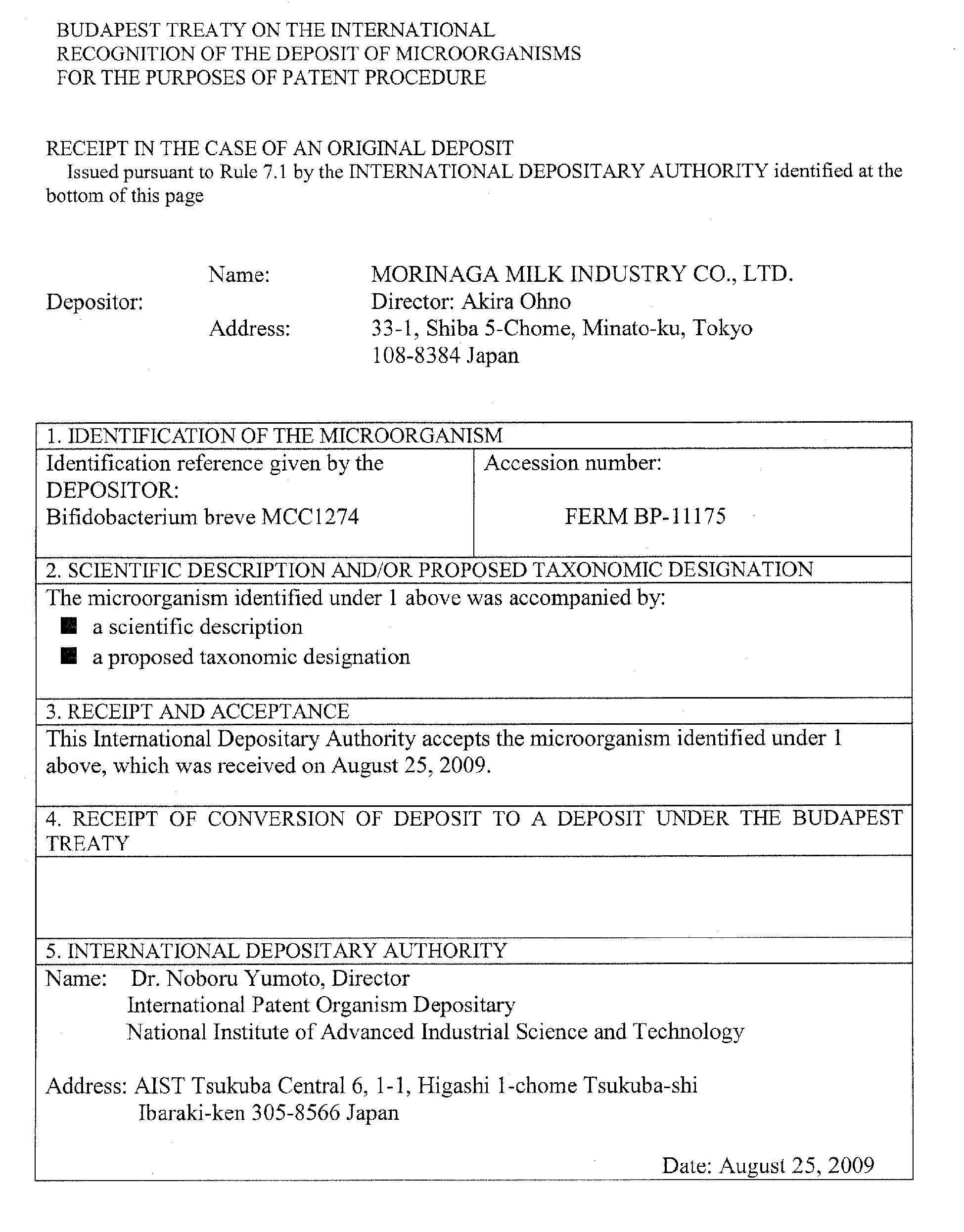


Claims (32)
- A bacterium of genus Bifidobacterium, for use in anti-obesity treatment or amelioration of glucose tolerance, wherein
the bacterium of genus Bifidobacterium exhibits a conversion rate from linoleic acid into conjugated linoleic acid of not more than 10%, the conversion rate being determined by suspending bacterial cells of the bacterium of genus Bifidobacterium at a concentration of 2×10⁷ CFU/mL in a liquid medium containing an added concentration of linoleic acid of 500 µg/mL, performing incubation for 48 hours at 37°C, subsequently measuring an amount of produced conjugated linoleic acid, and then calculating the conversion rate (%) from linoleic acid into conjugated linoleic acid from a formula:
- Use of a bacterium of genus Bifidobacterium for anti-obesity treatment or amelioration of glucose tolerance, wherein
the bacterium of genus Bifidobacterium exhibits a conversion rate from linoleic acid into conjugated linoleic acid of not more than 10%, the conversion rate being determined by suspending bacterial cells of the bacterium of genus Bifidobacterium at a concentration of 2×10⁷ CFU/mL in a liquid medium containing an added concentration of linoleic acid of 500 µg/mL, performing incubation for 48 hours at 37°C, subsequently measuring an amount of produced conjugated linoleic acid, and then calculating the conversion rate (%) from linoleic acid into conjugated linoleic acid from a formula:
- Use of a bacterium of genus Bifidobacterium for producing a composition for anti-obesity treatment or amelioration of glucose tolerance, wherein
the bacterium of genus Bifidobacterium exhibits a conversion rate from linoleic acid into conjugated linoleic acid of not more than 10%, the conversion rate being determined by suspending bacterial cells of the bacterium of genus Bifidobacterium at a concentration of 2×10⁷ CFU/mL in a liquid medium containing an added concentration of linoleic acid of 500 µg/mL, performing incubation for 48 hours at 37°C, subsequently measuring an amount of produced conjugated linoleic acid, and then calculating the conversion rate (%) from linoleic acid into conjugated linoleic acid from a formula:
- A pharmaceutical composition comprising a bacterium of genus Bifidobacterium used for anti-obesity treatment or amelioration of glucose tolerance, and a pharmaceutically acceptable carrier, wherein
the bacterium of genus Bifidobacterium exhibits a conversion rate from linoleic acid into conjugated linoleic acid of not more than 10%, the conversion rate being determined by suspending bacterial cells of the bacterium of genus Bifidobacterium at a concentration of 2 × 10⁷ CFU/mL in a liquid medium containing an added concentration of linoleic acid of 500 µg/mL, performing incubation for 48 hours at 37°C, subsequently measuring an amount of produced conjugated linoleic acid, and then calculating the conversion rate (%) from linoleic acid into conjugated linoleic acid from a formula:
- Use of a pharmaceutical composition comprising a bacterium of genus Bifidobacterium and a pharmaceutically acceptable carrier for anti-obesity treatment or amelioration of glucose tolerance, wherein
the bacterium of genus Bifidobacterium exhibits a conversion rate from linoleic acid into conjugated linoleic acid of not more than 10%, the conversion rate being determined by suspending bacterial cells of the bacterium of genus Bifidobacterium at a concentration of 2×10⁷ CFU/mL in a liquid medium containing an added concentration of linoleic acid of 500 µg/mL, performing incubation for 48 hours at 37°C, subsequently measuring an amount of produced conjugated linoleic acid, and then calculating the conversion rate (%) from linoleic acid into conjugated linoleic acid from a formula:
- The bacterium of genus Bifidobacterium according to Claim 1, wherein the bacterium of genus Bifidobacterium is a Bifidobacterium breve.
- The bacterium of genus Bifidobacterium according to Claim 6, wherein the Bifidobacterium breve is selected from the group consisting of Bifidobacterium breve MCC 1274 (FERM BP-11175) and Bifidobacterium breve ATCC 15700.
- The use of a bacterium of genus Bifidobacterium according to Claim 2 or 3, wherein the bacterium of genus Bifidobacterium is a Bifidobacterium breve.
- The use of a bacterium of genus Bifidobacterium according to Claim 8, wherein the Bifidobacterium breve is selected from the group consisting of Bifidobacterium breve MCC 1274 (FERM BP-11175) and Bifidobacterium breve ATCC 15700.
- The pharmaceutical composition according to Claim 4, wherein the bacterium of genus Bifidobacterium is a Bifidobacterium breve.
- The pharmaceutical composition according to Claim 10, wherein the Bifidobacterium breve is selected from the group consisting of Bifidobacterium breve MCC 1274 (FERM BP-11175) and Bifidobacterium breve ATCC 15700.
- The use of a pharmaceutical composition according to Claim 5, wherein the bacterium of genus Bifidobacterium is a Bifidobacterium breve.
- The use of a pharmaceutical composition according to Claim 12, wherein the Bifidobacterium breve is selected from the group consisting of Bifidobacterium breve MCC 1274 (FERM BP-11175) and Bifidobacterium breve ATCC 15700.
- An anti-obesity agent or glucose tolerance-ameliorating agent comprising a bacterium of genus Bifidobacterium as an active ingredient, wherein
the bacterium of genus Bifidobacterium exhibits a conversion rate from linoleic acid into conjugated linoleic acid of not more than 10%, the conversion rate being determined by suspending bacterial cells of the bacterium of genus Bifidobacterium at a concentration of 2×10⁷ CFU/mL in a liquid medium containing an added concentration of linoleic acid of 500 µg/mL, performing incubation for 48 hours at 37°C, subsequently measuring an amount of produced conjugated linoleic acid, and then calculating the conversion rate (%) from linoleic acid into conjugated linoleic acid from a formula:
- The anti-obesity agent or glucose tolerance-ameliorating agent according to Claim 14, wherein the bacterium of genus Bifidobacterium is a Bifidobacterium breve.
- The anti-obesity agent or glucose tolerance-ameliorating agent according to Claim 15, wherein the Bifidobacterium breve is selected from the group consisting of Bifidobacterium breve MCC 1274 (FERM BP-11175) and Bifidobacterium breve ATCC 15700.
- An anti-obesity food or beverage, or a food or beverage for ameliorating glucose tolerance, comprising the anti-obesity agent or glucose tolerance-ameliorating agent according to any one of Claims 14 to 16.
- A bacterial strain that is Bifidobacterium breve MCC 1274 (FERM BP-11175).
- A bacterial strain selected from the group consisting of Bifidobacterium breve MCC 1274 (FERM BP-11175) and Bifidobacterium breve ATCC 15700, for use in anti-obesity treatment or amelioration of glucose tolerance.
- Use of a bacterial strain selected from the group consisting of Bifidobacterium breve MCC 1274 (FERM BP-11175) and Bifidobacterium breve ATCC 15700 for anti-obesity treatment or amelioration of glucose tolerance.
- Use of a bacterial strain selected from the group consisting of Bifidobacterium breve MCC 1274 (FERM BP-11175) and Bifidobacterium breve ATCC 15700 for producing a composition for anti-obesity treatment or amelioration of glucose tolerance.
- A pharmaceutical composition comprising a bacterial strain selected from the group consisting of Bifidobacterium breve MCC 1274 (FERM BP-11175) and Bifidobacterium breve ATCC 15700 for use in anti-obesity treatment or amelioration of glucose tolerance, and a pharmaceutically acceptable carrier.
- Use of a pharmaceutical composition comprising a bacterial strain selected from the group consisting of Bifidobacterium breve MCC 1274 (FERM BP-11175) and Bifidobacterium breve ATCC 15700, and a pharmaceutically acceptable carrier, for anti-obesity treatment or amelioration of glucose tolerance.
- An anti-obesity agent or glucose tolerance-ameliorating agent comprising, as an active ingredient, a bacterial strain selected from the group consisting of Bifidobacterium breve MCC 1274 (FERM BP-11175) and Bifidobacterium breve ATCC 15700.
- A method of treating or preventing obesity, comprising administering an amount of a bacterium of genus Bifidobacterium that is effective in treating or preventing obesity to a subject that requires treatment or prevention of obesity, wherein
the bacterium of genus Bifidobacterium exhibits a conversion rate from linoleic acid into conjugated linoleic acid of not more than 10%, the conversion rate being determined by suspending bacterial cells of the bacterium of genus Bifidobacterium at a concentration of 2×10⁷ CFU/mL in a liquid medium containing an added concentration of linoleic acid of 500 µg/mL, performing incubation for 48 hours at 37°C, subsequently measuring an amount of produced conjugated linoleic acid, and then calculating the conversion rate (%) from linoleic acid into conjugated linoleic acid from a formula:
- The method of treating or preventing obesity according to Claim 25, wherein the bacterium of genus Bifidobacterium is a Bifidobacterium breve.
- The method of treating or preventing obesity according to Claim 26, wherein the Bifidobacterium breve is selected from the group consisting of Bifidobacterium breve MCC 1274 (FERM BP-11175) and Bifidobacterium breve ATCC 15700.
- A method of ameliorating glucose tolerance, comprising administering an amount of a bacterium of genus Bifidobacterium that is effective in ameliorating glucose tolerance to a subject that requires amelioration of glucose tolerance, wherein
the bacterium of genus Bifidobacterium exhibits a conversion rate from linoleic acid into conjugated linoleic acid of not more than 10%, the conversion rate being determined by suspending bacterial cells of the bacterium of genus Bifidobacterium at a concentration of 2×10⁷ CFU/mL in a liquid medium containing an added concentration of linoleic acid of 500 µg/mL, performing incubation for 48 hours at 37°C, subsequently measuring an amount of produced conjugated linoleic acid, and then calculating the conversion rate (%) from linoleic acid into conjugated linoleic acid from a formula:
- The method of ameliorating glucose tolerance according to Claim 28, wherein the bacterium of genus Bifidobacterium is a Bifidobacterium breve.
- The method of ameliorating glucose tolerance according to Claim 29, wherein the Bifidobacterium breve is selected from the group consisting of Bifidobacterium breve MCC 1274 (FERM BP-11175) and Bifidobacterium breve ATCC 15700.
- A method of treating or preventing obesity, comprising administering a bacterial strain selected from the group consisting of Bifidobacterium breve MCC 1274 (FERM BP-11175) and Bifidobacterium breve ATCC 15700, in an amount that is effective in treating or preventing obesity, to a subject that requires treatment or prevention of obesity.
- A method of ameliorating glucose tolerance, comprising administering a bacterial strain selected from the group consisting of Bifidobacterium breve MCC 1274 (FERM BP-11175) and Bifidobacterium breve ATCC 15700, in an amount that is effective in ameliorating glucose tolerance, to a subject that requires amelioration of glucose tolerance.
Priority Applications (1)
| Application Number | Priority Date | Filing Date | Title |
|---|---|---|---|
| PL10817279T PL2478910T3 (en) | 2009-09-17 | 2010-09-17 | Anti-obesity agent, anti-obesity food or beverage, glucose tolerance-ameliorating agent, and food or beverage for amelioration of glucose tolerance |
Applications Claiming Priority (2)
| Application Number | Priority Date | Filing Date | Title |
|---|---|---|---|
| JP2009215836 | 2009-09-17 | ||
| PCT/JP2010/066193 WO2011034166A1 (en) | 2009-09-17 | 2010-09-17 | Anti-obesity agent, anti-obesity food or beverage, glucose tolerance-ameliorating agent, and food or beverage for amelioration of glucose tolerance |
Publications (3)
| Publication Number | Publication Date |
|---|---|
| EP2478910A1 true EP2478910A1 (en) | 2012-07-25 |
| EP2478910A4 EP2478910A4 (en) | 2014-03-12 |
| EP2478910B1 EP2478910B1 (en) | 2017-11-01 |
Family
ID=43758765
Family Applications (1)
| Application Number | Title | Priority Date | Filing Date |
|---|---|---|---|
| EP10817279.2A Active EP2478910B1 (en) | 2009-09-17 | 2010-09-17 | Anti-obesity agent, anti-obesity food or beverage, glucose tolerance-ameliorating agent, and food or beverage for amelioration of glucose tolerance |
Country Status (15)
| Country | Link |
|---|---|
| US (1) | US8497114B2 (en) |
| EP (1) | EP2478910B1 (en) |
| JP (1) | JP4834798B2 (en) |
| KR (1) | KR101384648B1 (en) |
| CN (1) | CN102970997B (en) |
| AU (1) | AU2010296332B2 (en) |
| BR (2) | BR122020016728B1 (en) |
| CA (1) | CA2774073C (en) |
| DK (1) | DK2478910T3 (en) |
| ES (1) | ES2647922T3 (en) |
| MX (1) | MX2012002343A (en) |
| NZ (1) | NZ598751A (en) |
| PL (1) | PL2478910T3 (en) |
| RU (1) | RU2518293C2 (en) |
| WO (1) | WO2011034166A1 (en) |
Cited By (2)
| Publication number | Priority date | Publication date | Assignee | Title |
|---|---|---|---|---|
| EP3466435A4 (en) * | 2016-05-31 | 2020-01-08 | Morinaga Milk Industry Co., Ltd. | AGENT IMPROVING THE CEREBRAL FUNCTION |
| EP3549593A4 (en) * | 2016-11-29 | 2020-08-12 | Morinaga Milk Industry Co., Ltd. | AGLYCON PRODUCTION PROMOTERS |
Families Citing this family (17)
| Publication number | Priority date | Publication date | Assignee | Title |
|---|---|---|---|---|
| JP6139217B2 (en) * | 2013-03-29 | 2017-05-31 | 森永乳業株式会社 | Method for producing D-amino acid |
| JP6382027B2 (en) * | 2014-08-26 | 2018-08-29 | サンスター株式会社 | Oral composition containing bifidobacteria and cruciferous vegetables |
| TWI572713B (en) * | 2014-10-31 | 2017-03-01 | 豐華生物科技股份有限公司 | Anti-obesity strain of lactic acid bacteria and uses in food and pharmaceutical compositions |
| JP6650728B2 (en) * | 2015-03-06 | 2020-02-19 | 株式会社ファンケル | Formulations for diet |
| JP2017216980A (en) * | 2016-06-10 | 2017-12-14 | 森永乳業株式会社 | Oligonucleotide |
| EP3586854A4 (en) * | 2017-02-24 | 2020-12-23 | Morinaga Milk Industry Co., Ltd. | MENTAL DISORDANCE COMPOSITION |
| WO2018180728A1 (en) * | 2017-03-30 | 2018-10-04 | 森永乳業株式会社 | Composition for promoting expression of antiinflammatory gene |
| EP3645023B1 (en) * | 2017-06-30 | 2022-09-14 | N.V. Nutricia | Synbiotic composition for preventing hyperinsulinemia and insulin resistance |
| US20200261516A1 (en) * | 2017-10-31 | 2020-08-20 | Morinaga Milk Industry Co., Ltd. | Composition for Increasing Muscle Mass |
| CN111936155B (en) * | 2018-03-23 | 2023-08-18 | 森永乳业株式会社 | Composition for promoting FGF21 secretion |
| EP3777868A4 (en) * | 2018-03-23 | 2021-12-01 | Morinaga Milk Industry Co., Ltd. | COMPOSITION FOR INFANTS INTENDED TO PREVENT DISEASES CAUSED BY HYPERGLYCEMIA FROM SCHOOL AGE |
| JP7285096B2 (en) * | 2018-03-28 | 2023-06-01 | 森永乳業株式会社 | COMPOSITION FOR STRESS RELIEF AND PHARMACEUTICAL COMPOSITIONS AND FOOD AND FOOD COMPOSITIONS USING THE COMPOSITION FOR STRESS RELIEF |
| US12059442B2 (en) * | 2018-03-29 | 2024-08-13 | Morinaga Milk Industry Co., Ltd. | Obesity treatment using probiotics, composition for reducing body fat, and composition for reducing waist circumference |
| JP7309436B2 (en) * | 2019-04-26 | 2023-07-18 | 森永乳業株式会社 | A composition for preventing or improving renal dysfunction, and pharmaceutical compositions and food and drink compositions using the composition for preventing or improving renal dysfunction |
| JP7475155B2 (en) * | 2020-02-14 | 2024-04-26 | 森永乳業株式会社 | Composition for improving endurance |
| CN115944656A (en) * | 2020-06-18 | 2023-04-11 | 森永乳业株式会社 | Cognitive function improving agent, cognitive function maintaining agent, hippocampal function improving agent and hippocampal function maintaining agent |
| KR102629635B1 (en) * | 2021-05-13 | 2024-01-30 | 주식회사 비티진 | Novel bifidobacterium longum and use thereof |
Family Cites Families (6)
| Publication number | Priority date | Publication date | Assignee | Title |
|---|---|---|---|---|
| JPS61271223A (en) | 1985-05-24 | 1986-12-01 | Biofuerumin Seiyaku Kk | Blood lipid improving agent |
| WO2002045732A1 (en) * | 2000-12-05 | 2002-06-13 | Kabushiki Kaisha Yakult Honsha | Proliferation promoters for enteric bifidobacteria |
| JP4108613B2 (en) | 2002-04-12 | 2008-06-25 | チェビジェン・インコーポレイテッド | Novel fungus producing conjugated linoleic acid, capsule containing the same and method for producing the same |
| JP2004137167A (en) | 2002-10-16 | 2004-05-13 | Aaku Giken:Kk | Lactic acid bacterium-produced substance and production method therefor |
| EP2351492B1 (en) * | 2005-02-28 | 2014-08-20 | N.V. Nutricia | Nutritional composition with probiotics |
| EP1974734A1 (en) * | 2007-03-28 | 2008-10-01 | Nestec S.A. | Probiotics for reduction of risk of obesity |
-
2010
- 2010-09-17 NZ NZ598751A patent/NZ598751A/en unknown
- 2010-09-17 JP JP2011508756A patent/JP4834798B2/en active Active
- 2010-09-17 BR BR122020016728-9A patent/BR122020016728B1/en active IP Right Grant
- 2010-09-17 CA CA2774073A patent/CA2774073C/en active Active
- 2010-09-17 CN CN201080051651.3A patent/CN102970997B/en active Active
- 2010-09-17 MX MX2012002343A patent/MX2012002343A/en active IP Right Grant
- 2010-09-17 PL PL10817279T patent/PL2478910T3/en unknown
- 2010-09-17 AU AU2010296332A patent/AU2010296332B2/en active Active
- 2010-09-17 KR KR1020127006702A patent/KR101384648B1/en active Active
- 2010-09-17 ES ES10817279.2T patent/ES2647922T3/en active Active
- 2010-09-17 WO PCT/JP2010/066193 patent/WO2011034166A1/en not_active Ceased
- 2010-09-17 EP EP10817279.2A patent/EP2478910B1/en active Active
- 2010-09-17 US US13/395,824 patent/US8497114B2/en active Active
- 2010-09-17 DK DK10817279.2T patent/DK2478910T3/en active
- 2010-09-17 RU RU2012109558/10A patent/RU2518293C2/en active
- 2010-09-17 BR BR112012005768-5A patent/BR112012005768B1/en active IP Right Grant
Cited By (4)
| Publication number | Priority date | Publication date | Assignee | Title |
|---|---|---|---|---|
| EP3466435A4 (en) * | 2016-05-31 | 2020-01-08 | Morinaga Milk Industry Co., Ltd. | AGENT IMPROVING THE CEREBRAL FUNCTION |
| US10980849B2 (en) | 2016-05-31 | 2021-04-20 | Morinaga Milk Industry Co., Ltd. | Brain function improving agent |
| EP4268616A3 (en) * | 2016-05-31 | 2023-12-06 | Morinaga Milk Industry Co., Ltd. | Brain function improving agent |
| EP3549593A4 (en) * | 2016-11-29 | 2020-08-12 | Morinaga Milk Industry Co., Ltd. | AGLYCON PRODUCTION PROMOTERS |
Also Published As
| Publication number | Publication date |
|---|---|
| WO2011034166A1 (en) | 2011-03-24 |
| AU2010296332A1 (en) | 2012-04-19 |
| RU2012109558A (en) | 2013-10-27 |
| KR20120043111A (en) | 2012-05-03 |
| EP2478910A4 (en) | 2014-03-12 |
| NZ598751A (en) | 2013-07-26 |
| BR122020016728B1 (en) | 2022-01-18 |
| PL2478910T3 (en) | 2018-05-30 |
| EP2478910B1 (en) | 2017-11-01 |
| AU2010296332B2 (en) | 2013-03-14 |
| RU2518293C2 (en) | 2014-06-10 |
| DK2478910T3 (en) | 2017-12-04 |
| US8497114B2 (en) | 2013-07-30 |
| BR112012005768B1 (en) | 2021-03-02 |
| JPWO2011034166A1 (en) | 2013-02-14 |
| BR112012005768A2 (en) | 2018-03-20 |
| US20120171167A1 (en) | 2012-07-05 |
| CA2774073A1 (en) | 2011-03-24 |
| ES2647922T3 (en) | 2017-12-27 |
| CA2774073C (en) | 2014-09-30 |
| MX2012002343A (en) | 2012-06-01 |
| CN102970997B (en) | 2014-12-10 |
| CN102970997A (en) | 2013-03-13 |
| KR101384648B1 (en) | 2014-04-14 |
| JP4834798B2 (en) | 2011-12-14 |
Similar Documents
| Publication | Publication Date | Title |
|---|---|---|
| US8497114B2 (en) | Anti-obesity agent, anti-obesity food or beverage, glucose tolerance-ameliorating agent, and food or beverage for amelioration of glucose tolerance | |
| JP7280243B2 (en) | Nutritional composition, food and drink composition and prepared milk powder using the nutritional composition | |
| KR102224072B1 (en) | Bifidobacterium longum subsp. longum having both abilities of reducing total cholesterol in serum and immune regulation and its application | |
| EP2934557B1 (en) | Strain of bifidobacterium animalis ssp. animalis | |
| US20250009819A1 (en) | Novel probiotics and use thereof | |
| JP5569710B2 (en) | Obesity preventive or ameliorating agent | |
| AU2012349340A1 (en) | Lipid metabolism and/or sugar metabolism improver containing lactic acid bacterium or treatment product thereof | |
| JP2019116423A (en) | Composition for intestinal regulation | |
| EP3777868A1 (en) | Composition for infants for the prevention of disorders caused by high blood sugar in childhood and beyond | |
| JP6381869B2 (en) | Lactic acid bacteria derived from Tsuda turnip which have liver triglyceride reducing effect | |
| WO2025005237A1 (en) | Composition for controlling bacteria belonging to genus fusobacterium in intestinal flora, and use thereof | |
| WO2024225438A1 (en) | Method for producing yogurt | |
| JP2007091704A (en) | IgE production inhibitor, food and drink for suppressing IgE production, antiallergic agent and food and drink for antiallergy |
Legal Events
| Date | Code | Title | Description |
|---|---|---|---|
| PUAI | Public reference made under article 153(3) epc to a published international application that has entered the european phase |
Free format text: ORIGINAL CODE: 0009012 |
|
| 17P | Request for examination filed |
Effective date: 20120330 |
|
| AK | Designated contracting states |
Kind code of ref document: A1 Designated state(s): AL AT BE BG CH CY CZ DE DK EE ES FI FR GB GR HR HU IE IS IT LI LT LU LV MC MK MT NL NO PL PT RO SE SI SK SM TR |
|
| DAX | Request for extension of the european patent (deleted) | ||
| A4 | Supplementary search report drawn up and despatched |
Effective date: 20140206 |
|
| RIC1 | Information provided on ipc code assigned before grant |
Ipc: A61P 3/10 20060101ALI20140131BHEP Ipc: C12R 1/01 20060101ALI20140131BHEP Ipc: A61K 35/74 20060101AFI20140131BHEP Ipc: A23L 1/30 20060101ALI20140131BHEP Ipc: A61P 3/04 20060101ALI20140131BHEP Ipc: A23C 9/13 20060101ALI20140131BHEP Ipc: C12N 1/20 20060101ALI20140131BHEP Ipc: A23C 9/123 20060101ALI20140131BHEP |
|
| GRAP | Despatch of communication of intention to grant a patent |
Free format text: ORIGINAL CODE: EPIDOSNIGR1 |
|
| RIC1 | Information provided on ipc code assigned before grant |
Ipc: C12N 1/20 20060101ALI20170303BHEP Ipc: A61P 3/10 20060101ALI20170303BHEP Ipc: A23L 33/135 20160101ALI20170303BHEP Ipc: A23C 9/123 20060101ALI20170303BHEP Ipc: A23C 9/13 20060101ALI20170303BHEP Ipc: A61K 35/745 20150101ALI20170303BHEP Ipc: C12R 1/01 20060101ALI20170303BHEP Ipc: A61P 3/04 20060101ALI20170303BHEP Ipc: A61K 35/74 20150101AFI20170303BHEP |
|
| INTG | Intention to grant announced |
Effective date: 20170330 |
|
| GRAS | Grant fee paid |
Free format text: ORIGINAL CODE: EPIDOSNIGR3 |
|
| GRAA | (expected) grant |
Free format text: ORIGINAL CODE: 0009210 |
|
| AK | Designated contracting states |
Kind code of ref document: B1 Designated state(s): AL AT BE BG CH CY CZ DE DK EE ES FI FR GB GR HR HU IE IS IT LI LT LU LV MC MK MT NL NO PL PT RO SE SI SK SM TR |
|
| REG | Reference to a national code |
Ref country code: GB Ref legal event code: FG4D |
|
| REG | Reference to a national code |
Ref country code: CH Ref legal event code: EP Ref country code: AT Ref legal event code: REF Ref document number: 941348 Country of ref document: AT Kind code of ref document: T Effective date: 20171115 |
|
| REG | Reference to a national code |
Ref country code: IE Ref legal event code: FG4D |
|
| REG | Reference to a national code |
Ref country code: DK Ref legal event code: T3 Effective date: 20171127 |
|
| REG | Reference to a national code |
Ref country code: DE Ref legal event code: R096 Ref document number: 602010046424 Country of ref document: DE |
|
| REG | Reference to a national code |
Ref country code: ES Ref legal event code: FG2A Ref document number: 2647922 Country of ref document: ES Kind code of ref document: T3 Effective date: 20171227 |
|
| REG | Reference to a national code |
Ref country code: CH Ref legal event code: NV Representative=s name: VOSSIUS AND PARTNER PATENTANWAELTE RECHTSANWAE, CH |
|
| REG | Reference to a national code |
Ref country code: LT Ref legal event code: MG4D |
|
| REG | Reference to a national code |
Ref country code: AT Ref legal event code: MK05 Ref document number: 941348 Country of ref document: AT Kind code of ref document: T Effective date: 20171101 |
|
| PG25 | Lapsed in a contracting state [announced via postgrant information from national office to epo] |
Ref country code: NO Free format text: LAPSE BECAUSE OF FAILURE TO SUBMIT A TRANSLATION OF THE DESCRIPTION OR TO PAY THE FEE WITHIN THE PRESCRIBED TIME-LIMIT Effective date: 20180201 Ref country code: LT Free format text: LAPSE BECAUSE OF FAILURE TO SUBMIT A TRANSLATION OF THE DESCRIPTION OR TO PAY THE FEE WITHIN THE PRESCRIBED TIME-LIMIT Effective date: 20171101 Ref country code: SE Free format text: LAPSE BECAUSE OF FAILURE TO SUBMIT A TRANSLATION OF THE DESCRIPTION OR TO PAY THE FEE WITHIN THE PRESCRIBED TIME-LIMIT Effective date: 20171101 Ref country code: FI Free format text: LAPSE BECAUSE OF FAILURE TO SUBMIT A TRANSLATION OF THE DESCRIPTION OR TO PAY THE FEE WITHIN THE PRESCRIBED TIME-LIMIT Effective date: 20171101 |
|
| PG25 | Lapsed in a contracting state [announced via postgrant information from national office to epo] |
Ref country code: HR Free format text: LAPSE BECAUSE OF FAILURE TO SUBMIT A TRANSLATION OF THE DESCRIPTION OR TO PAY THE FEE WITHIN THE PRESCRIBED TIME-LIMIT Effective date: 20171101 Ref country code: IS Free format text: LAPSE BECAUSE OF FAILURE TO SUBMIT A TRANSLATION OF THE DESCRIPTION OR TO PAY THE FEE WITHIN THE PRESCRIBED TIME-LIMIT Effective date: 20180301 Ref country code: BG Free format text: LAPSE BECAUSE OF FAILURE TO SUBMIT A TRANSLATION OF THE DESCRIPTION OR TO PAY THE FEE WITHIN THE PRESCRIBED TIME-LIMIT Effective date: 20180201 Ref country code: LV Free format text: LAPSE BECAUSE OF FAILURE TO SUBMIT A TRANSLATION OF THE DESCRIPTION OR TO PAY THE FEE WITHIN THE PRESCRIBED TIME-LIMIT Effective date: 20171101 Ref country code: GR Free format text: LAPSE BECAUSE OF FAILURE TO SUBMIT A TRANSLATION OF THE DESCRIPTION OR TO PAY THE FEE WITHIN THE PRESCRIBED TIME-LIMIT Effective date: 20180202 Ref country code: AT Free format text: LAPSE BECAUSE OF FAILURE TO SUBMIT A TRANSLATION OF THE DESCRIPTION OR TO PAY THE FEE WITHIN THE PRESCRIBED TIME-LIMIT Effective date: 20171101 |
|
| PG25 | Lapsed in a contracting state [announced via postgrant information from national office to epo] |
Ref country code: CZ Free format text: LAPSE BECAUSE OF FAILURE TO SUBMIT A TRANSLATION OF THE DESCRIPTION OR TO PAY THE FEE WITHIN THE PRESCRIBED TIME-LIMIT Effective date: 20171101 Ref country code: SK Free format text: LAPSE BECAUSE OF FAILURE TO SUBMIT A TRANSLATION OF THE DESCRIPTION OR TO PAY THE FEE WITHIN THE PRESCRIBED TIME-LIMIT Effective date: 20171101 Ref country code: EE Free format text: LAPSE BECAUSE OF FAILURE TO SUBMIT A TRANSLATION OF THE DESCRIPTION OR TO PAY THE FEE WITHIN THE PRESCRIBED TIME-LIMIT Effective date: 20171101 Ref country code: CY Free format text: LAPSE BECAUSE OF FAILURE TO SUBMIT A TRANSLATION OF THE DESCRIPTION OR TO PAY THE FEE WITHIN THE PRESCRIBED TIME-LIMIT Effective date: 20171101 |
|
| REG | Reference to a national code |
Ref country code: DE Ref legal event code: R097 Ref document number: 602010046424 Country of ref document: DE |
|
| PG25 | Lapsed in a contracting state [announced via postgrant information from national office to epo] |
Ref country code: RO Free format text: LAPSE BECAUSE OF FAILURE TO SUBMIT A TRANSLATION OF THE DESCRIPTION OR TO PAY THE FEE WITHIN THE PRESCRIBED TIME-LIMIT Effective date: 20171101 Ref country code: SM Free format text: LAPSE BECAUSE OF FAILURE TO SUBMIT A TRANSLATION OF THE DESCRIPTION OR TO PAY THE FEE WITHIN THE PRESCRIBED TIME-LIMIT Effective date: 20171101 |
|
| REG | Reference to a national code |
Ref country code: FR Ref legal event code: PLFP Year of fee payment: 9 |
|
| PLBE | No opposition filed within time limit |
Free format text: ORIGINAL CODE: 0009261 |
|
| STAA | Information on the status of an ep patent application or granted ep patent |
Free format text: STATUS: NO OPPOSITION FILED WITHIN TIME LIMIT |
|
| 26N | No opposition filed |
Effective date: 20180802 |
|
| PG25 | Lapsed in a contracting state [announced via postgrant information from national office to epo] |
Ref country code: SI Free format text: LAPSE BECAUSE OF FAILURE TO SUBMIT A TRANSLATION OF THE DESCRIPTION OR TO PAY THE FEE WITHIN THE PRESCRIBED TIME-LIMIT Effective date: 20171101 |
|
| PG25 | Lapsed in a contracting state [announced via postgrant information from national office to epo] |
Ref country code: MC Free format text: LAPSE BECAUSE OF FAILURE TO SUBMIT A TRANSLATION OF THE DESCRIPTION OR TO PAY THE FEE WITHIN THE PRESCRIBED TIME-LIMIT Effective date: 20171101 |
|
| REG | Reference to a national code |
Ref country code: BE Ref legal event code: MM Effective date: 20180930 |
|
| REG | Reference to a national code |
Ref country code: IE Ref legal event code: MM4A |
|
| PG25 | Lapsed in a contracting state [announced via postgrant information from national office to epo] |
Ref country code: LU Free format text: LAPSE BECAUSE OF NON-PAYMENT OF DUE FEES Effective date: 20180917 |
|
| PG25 | Lapsed in a contracting state [announced via postgrant information from national office to epo] |
Ref country code: IE Free format text: LAPSE BECAUSE OF NON-PAYMENT OF DUE FEES Effective date: 20180917 |
|
| PG25 | Lapsed in a contracting state [announced via postgrant information from national office to epo] |
Ref country code: BE Free format text: LAPSE BECAUSE OF NON-PAYMENT OF DUE FEES Effective date: 20180930 |
|
| PG25 | Lapsed in a contracting state [announced via postgrant information from national office to epo] |
Ref country code: MT Free format text: LAPSE BECAUSE OF NON-PAYMENT OF DUE FEES Effective date: 20180917 |
|
| PG25 | Lapsed in a contracting state [announced via postgrant information from national office to epo] |
Ref country code: TR Free format text: LAPSE BECAUSE OF FAILURE TO SUBMIT A TRANSLATION OF THE DESCRIPTION OR TO PAY THE FEE WITHIN THE PRESCRIBED TIME-LIMIT Effective date: 20171101 |
|
| PG25 | Lapsed in a contracting state [announced via postgrant information from national office to epo] |
Ref country code: PT Free format text: LAPSE BECAUSE OF FAILURE TO SUBMIT A TRANSLATION OF THE DESCRIPTION OR TO PAY THE FEE WITHIN THE PRESCRIBED TIME-LIMIT Effective date: 20171101 Ref country code: HU Free format text: LAPSE BECAUSE OF FAILURE TO SUBMIT A TRANSLATION OF THE DESCRIPTION OR TO PAY THE FEE WITHIN THE PRESCRIBED TIME-LIMIT; INVALID AB INITIO Effective date: 20100917 |
|
| PG25 | Lapsed in a contracting state [announced via postgrant information from national office to epo] |
Ref country code: MK Free format text: LAPSE BECAUSE OF NON-PAYMENT OF DUE FEES Effective date: 20171101 |
|
| PG25 | Lapsed in a contracting state [announced via postgrant information from national office to epo] |
Ref country code: AL Free format text: LAPSE BECAUSE OF FAILURE TO SUBMIT A TRANSLATION OF THE DESCRIPTION OR TO PAY THE FEE WITHIN THE PRESCRIBED TIME-LIMIT Effective date: 20171101 |
|
| P01 | Opt-out of the competence of the unified patent court (upc) registered |
Effective date: 20230509 |
|
| REG | Reference to a national code |
Ref country code: CH Ref legal event code: U11 Free format text: ST27 STATUS EVENT CODE: U-0-0-U10-U11 (AS PROVIDED BY THE NATIONAL OFFICE) Effective date: 20251001 |
|
| PGFP | Annual fee paid to national office [announced via postgrant information from national office to epo] |
Ref country code: DK Payment date: 20250924 Year of fee payment: 16 |
|
| PGFP | Annual fee paid to national office [announced via postgrant information from national office to epo] |
Ref country code: IT Payment date: 20250919 Year of fee payment: 16 Ref country code: PL Payment date: 20250821 Year of fee payment: 16 Ref country code: NL Payment date: 20250925 Year of fee payment: 16 |
|
| PGFP | Annual fee paid to national office [announced via postgrant information from national office to epo] |
Ref country code: GB Payment date: 20250919 Year of fee payment: 16 |
|
| PGFP | Annual fee paid to national office [announced via postgrant information from national office to epo] |
Ref country code: FR Payment date: 20250924 Year of fee payment: 16 |
|
| PGFP | Annual fee paid to national office [announced via postgrant information from national office to epo] |
Ref country code: DE Payment date: 20250929 Year of fee payment: 16 |
|
| PGFP | Annual fee paid to national office [announced via postgrant information from national office to epo] |
Ref country code: CH Payment date: 20251001 Year of fee payment: 16 |
|
| PGFP | Annual fee paid to national office [announced via postgrant information from national office to epo] |
Ref country code: ES Payment date: 20251008 Year of fee payment: 16 |