EP2478847A2 - Two part tape adhesive for wound closure - Google Patents
Two part tape adhesive for wound closure Download PDFInfo
- Publication number
- EP2478847A2 EP2478847A2 EP12152186A EP12152186A EP2478847A2 EP 2478847 A2 EP2478847 A2 EP 2478847A2 EP 12152186 A EP12152186 A EP 12152186A EP 12152186 A EP12152186 A EP 12152186A EP 2478847 A2 EP2478847 A2 EP 2478847A2
- Authority
- EP
- European Patent Office
- Prior art keywords
- reactive
- substrate
- tissue
- substrates
- self
- Prior art date
- Legal status (The legal status is an assumption and is not a legal conclusion. Google has not performed a legal analysis and makes no representation as to the accuracy of the status listed.)
- Granted
Links
- 239000000853 adhesive Substances 0.000 title description 7
- 230000001070 adhesive effect Effects 0.000 title description 7
- 239000000758 substrate Substances 0.000 claims abstract description 198
- 230000000295 complement effect Effects 0.000 claims abstract description 8
- -1 succinimidyl esters Chemical class 0.000 claims description 44
- 238000000034 method Methods 0.000 claims description 17
- 239000012867 bioactive agent Substances 0.000 claims description 14
- 230000000269 nucleophilic effect Effects 0.000 claims description 12
- 239000003795 chemical substances by application Substances 0.000 claims description 11
- 150000001412 amines Chemical class 0.000 claims description 8
- 238000012800 visualization Methods 0.000 claims description 8
- 239000002131 composite material Substances 0.000 claims description 4
- OCDRLZFZBHZTKQ-NMUBGGKPSA-N onetine Chemical compound C[C@@H](O)[C@@]1(O)C[C@@H](C)[C@@](C)(O)C(=O)OC\C2=C\CN(C)CC[C@@H](OC1=O)C2=O OCDRLZFZBHZTKQ-NMUBGGKPSA-N 0.000 claims description 4
- AASBXERNXVFUEJ-UHFFFAOYSA-N (2,5-dioxopyrrolidin-1-yl) propanoate Chemical class CCC(=O)ON1C(=O)CCC1=O AASBXERNXVFUEJ-UHFFFAOYSA-N 0.000 claims description 3
- BLSAPDZWVFWUTL-UHFFFAOYSA-N 2,5-dioxopyrrolidine-3-sulfonic acid Chemical class OS(=O)(=O)C1CC(=O)NC1=O BLSAPDZWVFWUTL-UHFFFAOYSA-N 0.000 claims description 3
- 150000003923 2,5-pyrrolediones Chemical class 0.000 claims description 3
- BTBWSRPRAGXJJV-UHFFFAOYSA-N 2h-benzotriazole;carbonic acid Chemical class OC(O)=O.C1=CC=C2NN=NC2=C1 BTBWSRPRAGXJJV-UHFFFAOYSA-N 0.000 claims description 3
- QXZGLTYKKZKGLN-UHFFFAOYSA-N 4-(2,5-dioxopyrrolidin-1-yl)oxy-4-oxobutanoic acid Chemical class OC(=O)CCC(=O)ON1C(=O)CCC1=O QXZGLTYKKZKGLN-UHFFFAOYSA-N 0.000 claims description 3
- NQTADLQHYWFPDB-UHFFFAOYSA-N N-Hydroxysuccinimide Chemical class ON1C(=O)CCC1=O NQTADLQHYWFPDB-UHFFFAOYSA-N 0.000 claims description 3
- 150000001299 aldehydes Chemical class 0.000 claims description 3
- 150000001502 aryl halides Chemical class 0.000 claims description 3
- 150000001718 carbodiimides Chemical class 0.000 claims description 3
- PFKFTWBEEFSNDU-UHFFFAOYSA-N carbonyldiimidazole Chemical compound C1=CN=CN1C(=O)N1C=CN=C1 PFKFTWBEEFSNDU-UHFFFAOYSA-N 0.000 claims description 3
- 150000002118 epoxides Chemical class 0.000 claims description 3
- 150000002148 esters Chemical class 0.000 claims description 3
- 150000002463 imidates Chemical class 0.000 claims description 3
- 239000012948 isocyanate Substances 0.000 claims description 3
- 150000002513 isocyanates Chemical class 0.000 claims description 3
- YBBRCQOCSYXUOC-UHFFFAOYSA-N sulfuryl dichloride Chemical compound ClS(Cl)(=O)=O YBBRCQOCSYXUOC-UHFFFAOYSA-N 0.000 claims description 3
- 150000003567 thiocyanates Chemical class 0.000 claims description 3
- 210000001519 tissue Anatomy 0.000 description 116
- 206010052428 Wound Diseases 0.000 description 80
- 208000027418 Wounds and injury Diseases 0.000 description 78
- 239000000463 material Substances 0.000 description 15
- YBJHBAHKTGYVGT-ZKWXMUAHSA-N (+)-Biotin Chemical compound N1C(=O)N[C@@H]2[C@H](CCCCC(=O)O)SC[C@@H]21 YBJHBAHKTGYVGT-ZKWXMUAHSA-N 0.000 description 10
- 239000011148 porous material Substances 0.000 description 10
- 238000000576 coating method Methods 0.000 description 9
- 239000011248 coating agent Substances 0.000 description 8
- 229920001577 copolymer Polymers 0.000 description 8
- 239000006260 foam Substances 0.000 description 8
- 235000018102 proteins Nutrition 0.000 description 8
- 102000004169 proteins and genes Human genes 0.000 description 8
- 108090000623 proteins and genes Proteins 0.000 description 8
- 108010035532 Collagen Proteins 0.000 description 7
- 102000008186 Collagen Human genes 0.000 description 7
- 229920001436 collagen Polymers 0.000 description 7
- 150000001875 compounds Chemical class 0.000 description 7
- 108090000765 processed proteins & peptides Proteins 0.000 description 7
- 239000000126 substance Substances 0.000 description 7
- 238000004132 cross linking Methods 0.000 description 6
- 229920000642 polymer Polymers 0.000 description 6
- 229960002685 biotin Drugs 0.000 description 5
- 235000020958 biotin Nutrition 0.000 description 5
- 239000011616 biotin Substances 0.000 description 5
- 125000000524 functional group Chemical group 0.000 description 5
- 102000004196 processed proteins & peptides Human genes 0.000 description 5
- 229920002307 Dextran Polymers 0.000 description 4
- 210000004027 cell Anatomy 0.000 description 4
- 238000006243 chemical reaction Methods 0.000 description 4
- 239000003814 drug Substances 0.000 description 4
- 150000004676 glycans Chemical class 0.000 description 4
- 230000004048 modification Effects 0.000 description 4
- 238000012986 modification Methods 0.000 description 4
- 229920001223 polyethylene glycol Polymers 0.000 description 4
- 229920001282 polysaccharide Polymers 0.000 description 4
- 239000005017 polysaccharide Substances 0.000 description 4
- 108090001008 Avidin Proteins 0.000 description 3
- 229920003232 aliphatic polyester Polymers 0.000 description 3
- 239000001961 anticonvulsive agent Substances 0.000 description 3
- 239000000427 antigen Substances 0.000 description 3
- 102000036639 antigens Human genes 0.000 description 3
- 108091007433 antigens Proteins 0.000 description 3
- 229940125715 antihistaminic agent Drugs 0.000 description 3
- 239000000739 antihistaminic agent Substances 0.000 description 3
- 239000002246 antineoplastic agent Substances 0.000 description 3
- 125000003178 carboxy group Chemical group [H]OC(*)=O 0.000 description 3
- 239000000975 dye Substances 0.000 description 3
- 239000000835 fiber Substances 0.000 description 3
- 238000004108 freeze drying Methods 0.000 description 3
- 229920001519 homopolymer Polymers 0.000 description 3
- 125000002887 hydroxy group Chemical group [H]O* 0.000 description 3
- 239000000203 mixture Substances 0.000 description 3
- 239000000178 monomer Substances 0.000 description 3
- 239000012038 nucleophile Substances 0.000 description 3
- 229920001184 polypeptide Polymers 0.000 description 3
- 230000001681 protective effect Effects 0.000 description 3
- 230000008439 repair process Effects 0.000 description 3
- 238000009941 weaving Methods 0.000 description 3
- KIUKXJAPPMFGSW-DNGZLQJQSA-N (2S,3S,4S,5R,6R)-6-[(2S,3R,4R,5S,6R)-3-Acetamido-2-[(2S,3S,4R,5R,6R)-6-[(2R,3R,4R,5S,6R)-3-acetamido-2,5-dihydroxy-6-(hydroxymethyl)oxan-4-yl]oxy-2-carboxy-4,5-dihydroxyoxan-3-yl]oxy-5-hydroxy-6-(hydroxymethyl)oxan-4-yl]oxy-3,4,5-trihydroxyoxane-2-carboxylic acid Chemical compound CC(=O)N[C@H]1[C@H](O)O[C@H](CO)[C@@H](O)[C@@H]1O[C@H]1[C@H](O)[C@@H](O)[C@H](O[C@H]2[C@@H]([C@@H](O[C@H]3[C@@H]([C@@H](O)[C@H](O)[C@H](O3)C(O)=O)O)[C@H](O)[C@@H](CO)O2)NC(C)=O)[C@@H](C(O)=O)O1 KIUKXJAPPMFGSW-DNGZLQJQSA-N 0.000 description 2
- RZVAJINKPMORJF-UHFFFAOYSA-N Acetaminophen Chemical compound CC(=O)NC1=CC=C(O)C=C1 RZVAJINKPMORJF-UHFFFAOYSA-N 0.000 description 2
- 229920002134 Carboxymethyl cellulose Polymers 0.000 description 2
- 229920001661 Chitosan Polymers 0.000 description 2
- AEMRFAOFKBGASW-UHFFFAOYSA-N Glycolic acid Chemical compound OCC(O)=O AEMRFAOFKBGASW-UHFFFAOYSA-N 0.000 description 2
- 239000004952 Polyamide Substances 0.000 description 2
- 239000004698 Polyethylene Substances 0.000 description 2
- 229920000954 Polyglycolide Polymers 0.000 description 2
- DFPOZTRSOAQFIK-UHFFFAOYSA-N S,S-dimethyl-beta-propiothetin Chemical compound C[S+](C)CCC([O-])=O DFPOZTRSOAQFIK-UHFFFAOYSA-N 0.000 description 2
- 239000000150 Sympathomimetic Substances 0.000 description 2
- 125000000217 alkyl group Chemical group 0.000 description 2
- 229940035676 analgesics Drugs 0.000 description 2
- 125000000129 anionic group Chemical group 0.000 description 2
- 239000000730 antalgic agent Substances 0.000 description 2
- 229940121363 anti-inflammatory agent Drugs 0.000 description 2
- 239000002260 anti-inflammatory agent Substances 0.000 description 2
- 230000002921 anti-spasmodic effect Effects 0.000 description 2
- 229940088710 antibiotic agent Drugs 0.000 description 2
- 229940125681 anticonvulsant agent Drugs 0.000 description 2
- 229940124575 antispasmodic agent Drugs 0.000 description 2
- 229920002988 biodegradable polymer Polymers 0.000 description 2
- 239000004621 biodegradable polymer Substances 0.000 description 2
- 230000031018 biological processes and functions Effects 0.000 description 2
- 230000015572 biosynthetic process Effects 0.000 description 2
- 239000003114 blood coagulation factor Substances 0.000 description 2
- 150000004649 carbonic acid derivatives Chemical class 0.000 description 2
- 239000001768 carboxy methyl cellulose Substances 0.000 description 2
- 235000010948 carboxy methyl cellulose Nutrition 0.000 description 2
- 239000008112 carboxymethyl-cellulose Substances 0.000 description 2
- 239000002327 cardiovascular agent Substances 0.000 description 2
- 229940125692 cardiovascular agent Drugs 0.000 description 2
- 125000003636 chemical group Chemical group 0.000 description 2
- 229940045110 chitosan Drugs 0.000 description 2
- OROGSEYTTFOCAN-DNJOTXNNSA-N codeine Chemical compound C([C@H]1[C@H](N(CC[C@@]112)C)C3)=C[C@H](O)[C@@H]1OC1=C2C3=CC=C1OC OROGSEYTTFOCAN-DNJOTXNNSA-N 0.000 description 2
- 229940079593 drug Drugs 0.000 description 2
- 230000000694 effects Effects 0.000 description 2
- 239000012039 electrophile Substances 0.000 description 2
- 239000010408 film Substances 0.000 description 2
- 239000012530 fluid Substances 0.000 description 2
- 239000003102 growth factor Substances 0.000 description 2
- 229940125697 hormonal agent Drugs 0.000 description 2
- 229920002674 hyaluronan Polymers 0.000 description 2
- 229960003160 hyaluronic acid Drugs 0.000 description 2
- JYGXADMDTFJGBT-VWUMJDOOSA-N hydrocortisone Chemical compound O=C1CC[C@]2(C)[C@H]3[C@@H](O)C[C@](C)([C@@](CC4)(O)C(=O)CO)[C@@H]4[C@@H]3CCC2=C1 JYGXADMDTFJGBT-VWUMJDOOSA-N 0.000 description 2
- 229920001477 hydrophilic polymer Polymers 0.000 description 2
- CGIGDMFJXJATDK-UHFFFAOYSA-N indomethacin Chemical compound CC1=C(CC(O)=O)C2=CC(OC)=CC=C2N1C(=O)C1=CC=C(Cl)C=C1 CGIGDMFJXJATDK-UHFFFAOYSA-N 0.000 description 2
- NOESYZHRGYRDHS-UHFFFAOYSA-N insulin Chemical compound N1C(=O)C(NC(=O)C(CCC(N)=O)NC(=O)C(CCC(O)=O)NC(=O)C(C(C)C)NC(=O)C(NC(=O)CN)C(C)CC)CSSCC(C(NC(CO)C(=O)NC(CC(C)C)C(=O)NC(CC=2C=CC(O)=CC=2)C(=O)NC(CCC(N)=O)C(=O)NC(CC(C)C)C(=O)NC(CCC(O)=O)C(=O)NC(CC(N)=O)C(=O)NC(CC=2C=CC(O)=CC=2)C(=O)NC(CSSCC(NC(=O)C(C(C)C)NC(=O)C(CC(C)C)NC(=O)C(CC=2C=CC(O)=CC=2)NC(=O)C(CC(C)C)NC(=O)C(C)NC(=O)C(CCC(O)=O)NC(=O)C(C(C)C)NC(=O)C(CC(C)C)NC(=O)C(CC=2NC=NC=2)NC(=O)C(CO)NC(=O)CNC2=O)C(=O)NCC(=O)NC(CCC(O)=O)C(=O)NC(CCCNC(N)=N)C(=O)NCC(=O)NC(CC=3C=CC=CC=3)C(=O)NC(CC=3C=CC=CC=3)C(=O)NC(CC=3C=CC(O)=CC=3)C(=O)NC(C(C)O)C(=O)N3C(CCC3)C(=O)NC(CCCCN)C(=O)NC(C)C(O)=O)C(=O)NC(CC(N)=O)C(O)=O)=O)NC(=O)C(C(C)CC)NC(=O)C(CO)NC(=O)C(C(C)O)NC(=O)C1CSSCC2NC(=O)C(CC(C)C)NC(=O)C(NC(=O)C(CCC(N)=O)NC(=O)C(CC(N)=O)NC(=O)C(NC(=O)C(N)CC=1C=CC=CC=1)C(C)C)CC1=CN=CN1 NOESYZHRGYRDHS-UHFFFAOYSA-N 0.000 description 2
- 238000009940 knitting Methods 0.000 description 2
- JVTAAEKCZFNVCJ-UHFFFAOYSA-N lactic acid Chemical compound CC(O)C(O)=O JVTAAEKCZFNVCJ-UHFFFAOYSA-N 0.000 description 2
- 230000007246 mechanism Effects 0.000 description 2
- BQJCRHHNABKAKU-KBQPJGBKSA-N morphine Chemical compound O([C@H]1[C@H](C=C[C@H]23)O)C4=C5[C@@]12CCN(C)[C@@H]3CC5=CC=C4O BQJCRHHNABKAKU-KBQPJGBKSA-N 0.000 description 2
- 239000004081 narcotic agent Substances 0.000 description 2
- 229920000747 poly(lactic acid) Polymers 0.000 description 2
- 229920002647 polyamide Polymers 0.000 description 2
- 229920000573 polyethylene Polymers 0.000 description 2
- 229920001451 polypropylene glycol Polymers 0.000 description 2
- 229920002635 polyurethane Polymers 0.000 description 2
- 239000004814 polyurethane Substances 0.000 description 2
- 229920000036 polyvinylpyrrolidone Polymers 0.000 description 2
- 239000001267 polyvinylpyrrolidone Substances 0.000 description 2
- 235000013855 polyvinylpyrrolidone Nutrition 0.000 description 2
- 239000000843 powder Substances 0.000 description 2
- 230000002787 reinforcement Effects 0.000 description 2
- 150000003431 steroids Chemical class 0.000 description 2
- 238000011282 treatment Methods 0.000 description 2
- 229960005486 vaccine Drugs 0.000 description 2
- 229920002554 vinyl polymer Polymers 0.000 description 2
- JJTUDXZGHPGLLC-ZXZARUISSA-N (3r,6s)-3,6-dimethyl-1,4-dioxane-2,5-dione Chemical compound C[C@H]1OC(=O)[C@H](C)OC1=O JJTUDXZGHPGLLC-ZXZARUISSA-N 0.000 description 1
- ZLUFYQVHJAVDHU-NSCUHMNNSA-N (6e)-2-methyl-2,3-dihydro-1,4-dioxocine-5,8-dione Chemical class CC1COC(=O)\C=C\C(=O)O1 ZLUFYQVHJAVDHU-NSCUHMNNSA-N 0.000 description 1
- 108091032973 (ribonucleotides)n+m Proteins 0.000 description 1
- UJGHGRGFKZWGMS-UHFFFAOYSA-N 1,3-dioxan-2-one Chemical compound O=C1OCCCO1.O=C1OCCCO1 UJGHGRGFKZWGMS-UHFFFAOYSA-N 0.000 description 1
- ONGVCZCREZLCLD-UHFFFAOYSA-N 1,4,8,11-tetraoxacyclotetradecane-2,9-dione Chemical compound O=C1COCCCOC(=O)COCCCO1 ONGVCZCREZLCLD-UHFFFAOYSA-N 0.000 description 1
- KKGSHHDRPRINNY-UHFFFAOYSA-N 1,4-dioxan-2-one Chemical compound O=C1COCCO1.O=C1COCCO1 KKGSHHDRPRINNY-UHFFFAOYSA-N 0.000 description 1
- ZNLAHAOCFKBYRH-UHFFFAOYSA-N 1,4-dioxane-2,3-dione Chemical compound O=C1OCCOC1=O ZNLAHAOCFKBYRH-UHFFFAOYSA-N 0.000 description 1
- RKDVKSZUMVYZHH-UHFFFAOYSA-N 1,4-dioxane-2,5-dione Chemical compound O=C1COC(=O)CO1 RKDVKSZUMVYZHH-UHFFFAOYSA-N 0.000 description 1
- SJDLIJNQXLJBBE-UHFFFAOYSA-N 1,4-dioxepan-2-one Chemical compound O=C1COCCCO1 SJDLIJNQXLJBBE-UHFFFAOYSA-N 0.000 description 1
- AOLNDUQWRUPYGE-UHFFFAOYSA-N 1,4-dioxepan-5-one Chemical compound O=C1CCOCCO1 AOLNDUQWRUPYGE-UHFFFAOYSA-N 0.000 description 1
- AGBXYHCHUYARJY-UHFFFAOYSA-N 2-phenylethenesulfonic acid Chemical compound OS(=O)(=O)C=CC1=CC=CC=C1 AGBXYHCHUYARJY-UHFFFAOYSA-N 0.000 description 1
- QMDUQRDPJXKZAO-UHFFFAOYSA-N 3,3-diethyl-1,4-dioxane-2,5-dione Chemical compound CCC1(CC)OC(=O)COC1=O QMDUQRDPJXKZAO-UHFFFAOYSA-N 0.000 description 1
- FQFQWTFNRFUWKM-UHFFFAOYSA-N 3,3-diethyloxetan-2-one Chemical compound CCC1(CC)COC1=O FQFQWTFNRFUWKM-UHFFFAOYSA-N 0.000 description 1
- ULKFLOVGORAZDI-UHFFFAOYSA-N 3,3-dimethyloxetan-2-one Chemical compound CC1(C)COC1=O ULKFLOVGORAZDI-UHFFFAOYSA-N 0.000 description 1
- ALRHLSYJTWAHJZ-UHFFFAOYSA-M 3-hydroxypropionate Chemical compound OCCC([O-])=O ALRHLSYJTWAHJZ-UHFFFAOYSA-M 0.000 description 1
- MVXNGTMKSZHHCO-UHFFFAOYSA-N 3-methyl-1,4-dioxane-2,5-dione Chemical compound CC1OC(=O)COC1=O MVXNGTMKSZHHCO-UHFFFAOYSA-N 0.000 description 1
- SJZRECIVHVDYJC-UHFFFAOYSA-M 4-hydroxybutyrate Chemical compound OCCCC([O-])=O SJZRECIVHVDYJC-UHFFFAOYSA-M 0.000 description 1
- FXXZYZRHXUPAIE-UHFFFAOYSA-N 6,6-dimethyl-1,4-dioxan-2-one Chemical compound CC1(C)COCC(=O)O1 FXXZYZRHXUPAIE-UHFFFAOYSA-N 0.000 description 1
- FHVDTGUDJYJELY-UHFFFAOYSA-N 6-{[2-carboxy-4,5-dihydroxy-6-(phosphanyloxy)oxan-3-yl]oxy}-4,5-dihydroxy-3-phosphanyloxane-2-carboxylic acid Chemical compound O1C(C(O)=O)C(P)C(O)C(O)C1OC1C(C(O)=O)OC(OP)C(O)C1O FHVDTGUDJYJELY-UHFFFAOYSA-N 0.000 description 1
- BSYNRYMUTXBXSQ-UHFFFAOYSA-N Aspirin Chemical compound CC(=O)OC1=CC=CC=C1C(O)=O BSYNRYMUTXBXSQ-UHFFFAOYSA-N 0.000 description 1
- 229930185605 Bisphenol Natural products 0.000 description 1
- 102000015081 Blood Coagulation Factors Human genes 0.000 description 1
- 108010039209 Blood Coagulation Factors Proteins 0.000 description 1
- 102000004506 Blood Proteins Human genes 0.000 description 1
- 108010017384 Blood Proteins Proteins 0.000 description 1
- SGHZXLIDFTYFHQ-UHFFFAOYSA-L Brilliant Blue Chemical compound [Na+].[Na+].C=1C=C(C(=C2C=CC(C=C2)=[N+](CC)CC=2C=C(C=CC=2)S([O-])(=O)=O)C=2C(=CC=CC=2)S([O-])(=O)=O)C=CC=1N(CC)CC1=CC=CC(S([O-])(=O)=O)=C1 SGHZXLIDFTYFHQ-UHFFFAOYSA-L 0.000 description 1
- 108010076119 Caseins Proteins 0.000 description 1
- 102000053642 Catalytic RNA Human genes 0.000 description 1
- 108090000994 Catalytic RNA Proteins 0.000 description 1
- 102000019034 Chemokines Human genes 0.000 description 1
- 108010012236 Chemokines Proteins 0.000 description 1
- 229920002101 Chitin Polymers 0.000 description 1
- 108010071942 Colony-Stimulating Factors Proteins 0.000 description 1
- 102000007644 Colony-Stimulating Factors Human genes 0.000 description 1
- 239000004971 Cross linker Substances 0.000 description 1
- 102000004127 Cytokines Human genes 0.000 description 1
- 108090000695 Cytokines Proteins 0.000 description 1
- XIQVNETUBQGFHX-UHFFFAOYSA-N Ditropan Chemical compound C=1C=CC=CC=1C(O)(C(=O)OCC#CCN(CC)CC)C1CCCCC1 XIQVNETUBQGFHX-UHFFFAOYSA-N 0.000 description 1
- 102000004190 Enzymes Human genes 0.000 description 1
- 108090000790 Enzymes Proteins 0.000 description 1
- 102000003951 Erythropoietin Human genes 0.000 description 1
- 108090000394 Erythropoietin Proteins 0.000 description 1
- KMTRUDSVKNLOMY-UHFFFAOYSA-N Ethylene carbonate Chemical compound O=C1OCCO1 KMTRUDSVKNLOMY-UHFFFAOYSA-N 0.000 description 1
- 229910052688 Gadolinium Inorganic materials 0.000 description 1
- 108010010803 Gelatin Proteins 0.000 description 1
- 229920002683 Glycosaminoglycan Polymers 0.000 description 1
- 102000006771 Gonadotropins Human genes 0.000 description 1
- 108010086677 Gonadotropins Proteins 0.000 description 1
- 102100039619 Granulocyte colony-stimulating factor Human genes 0.000 description 1
- 108010017213 Granulocyte-Macrophage Colony-Stimulating Factor Proteins 0.000 description 1
- 102000004457 Granulocyte-Macrophage Colony-Stimulating Factor Human genes 0.000 description 1
- 102000018997 Growth Hormone Human genes 0.000 description 1
- 108010051696 Growth Hormone Proteins 0.000 description 1
- HTTJABKRGRZYRN-UHFFFAOYSA-N Heparin Chemical compound OC1C(NC(=O)C)C(O)OC(COS(O)(=O)=O)C1OC1C(OS(O)(=O)=O)C(O)C(OC2C(C(OS(O)(=O)=O)C(OC3C(C(O)C(O)C(O3)C(O)=O)OS(O)(=O)=O)C(CO)O2)NS(O)(=O)=O)C(C(O)=O)O1 HTTJABKRGRZYRN-UHFFFAOYSA-N 0.000 description 1
- 101000746367 Homo sapiens Granulocyte colony-stimulating factor Proteins 0.000 description 1
- 108060003951 Immunoglobulin Proteins 0.000 description 1
- 102000004877 Insulin Human genes 0.000 description 1
- 108090001061 Insulin Proteins 0.000 description 1
- 108090000723 Insulin-Like Growth Factor I Proteins 0.000 description 1
- 102000014150 Interferons Human genes 0.000 description 1
- 108010050904 Interferons Proteins 0.000 description 1
- 108010002350 Interleukin-2 Proteins 0.000 description 1
- 108010002386 Interleukin-3 Proteins 0.000 description 1
- 108090000978 Interleukin-4 Proteins 0.000 description 1
- 108090001005 Interleukin-6 Proteins 0.000 description 1
- 108010063738 Interleukins Proteins 0.000 description 1
- 102000015696 Interleukins Human genes 0.000 description 1
- WTDRDQBEARUVNC-LURJTMIESA-N L-DOPA Chemical compound OC(=O)[C@@H](N)CC1=CC=C(O)C(O)=C1 WTDRDQBEARUVNC-LURJTMIESA-N 0.000 description 1
- WTDRDQBEARUVNC-UHFFFAOYSA-N L-Dopa Natural products OC(=O)C(N)CC1=CC=C(O)C(O)=C1 WTDRDQBEARUVNC-UHFFFAOYSA-N 0.000 description 1
- OUYCCCASQSFEME-QMMMGPOBSA-N L-tyrosine Chemical compound OC(=O)[C@@H](N)CC1=CC=C(O)C=C1 OUYCCCASQSFEME-QMMMGPOBSA-N 0.000 description 1
- 108010074338 Lymphokines Proteins 0.000 description 1
- 102000008072 Lymphokines Human genes 0.000 description 1
- 239000002616 MRI contrast agent Substances 0.000 description 1
- 102100028123 Macrophage colony-stimulating factor 1 Human genes 0.000 description 1
- 101710127797 Macrophage colony-stimulating factor 1 Proteins 0.000 description 1
- XADCESSVHJOZHK-UHFFFAOYSA-N Meperidine Chemical compound C=1C=CC=CC=1C1(C(=O)OCC)CCN(C)CC1 XADCESSVHJOZHK-UHFFFAOYSA-N 0.000 description 1
- 102000013967 Monokines Human genes 0.000 description 1
- 108010050619 Monokines Proteins 0.000 description 1
- 229940121948 Muscarinic receptor antagonist Drugs 0.000 description 1
- 206010028980 Neoplasm Diseases 0.000 description 1
- 108010025020 Nerve Growth Factor Proteins 0.000 description 1
- 102000015336 Nerve Growth Factor Human genes 0.000 description 1
- SNIOPGDIGTZGOP-UHFFFAOYSA-N Nitroglycerin Chemical compound [O-][N+](=O)OCC(O[N+]([O-])=O)CO[N+]([O-])=O SNIOPGDIGTZGOP-UHFFFAOYSA-N 0.000 description 1
- 239000000006 Nitroglycerin Substances 0.000 description 1
- 101710163270 Nuclease Proteins 0.000 description 1
- 108091034117 Oligonucleotide Proteins 0.000 description 1
- 229940123257 Opioid receptor antagonist Drugs 0.000 description 1
- 229920003171 Poly (ethylene oxide) Polymers 0.000 description 1
- 229920002732 Polyanhydride Polymers 0.000 description 1
- 239000002202 Polyethylene glycol Substances 0.000 description 1
- 229920000331 Polyhydroxybutyrate Polymers 0.000 description 1
- 239000004642 Polyimide Substances 0.000 description 1
- 108010039918 Polylysine Proteins 0.000 description 1
- 229920001710 Polyorthoester Polymers 0.000 description 1
- 239000004743 Polypropylene Substances 0.000 description 1
- 239000004372 Polyvinyl alcohol Substances 0.000 description 1
- 102000007562 Serum Albumin Human genes 0.000 description 1
- 108010071390 Serum Albumin Proteins 0.000 description 1
- 229920002125 Sokalan® Polymers 0.000 description 1
- 102000013275 Somatomedins Human genes 0.000 description 1
- 102000005157 Somatostatin Human genes 0.000 description 1
- 108010056088 Somatostatin Proteins 0.000 description 1
- 229920002472 Starch Polymers 0.000 description 1
- 108010090804 Streptavidin Proteins 0.000 description 1
- 108060008682 Tumor Necrosis Factor Proteins 0.000 description 1
- 102000000852 Tumor Necrosis Factor-alpha Human genes 0.000 description 1
- 229920010741 Ultra High Molecular Weight Polyethylene (UHMWPE) Polymers 0.000 description 1
- 241000700605 Viruses Species 0.000 description 1
- JLCPHMBAVCMARE-UHFFFAOYSA-N [3-[[3-[[3-[[3-[[3-[[3-[[3-[[3-[[3-[[3-[[3-[[5-(2-amino-6-oxo-1H-purin-9-yl)-3-[[3-[[3-[[3-[[3-[[3-[[5-(2-amino-6-oxo-1H-purin-9-yl)-3-[[5-(2-amino-6-oxo-1H-purin-9-yl)-3-hydroxyoxolan-2-yl]methoxy-hydroxyphosphoryl]oxyoxolan-2-yl]methoxy-hydroxyphosphoryl]oxy-5-(5-methyl-2,4-dioxopyrimidin-1-yl)oxolan-2-yl]methoxy-hydroxyphosphoryl]oxy-5-(6-aminopurin-9-yl)oxolan-2-yl]methoxy-hydroxyphosphoryl]oxy-5-(6-aminopurin-9-yl)oxolan-2-yl]methoxy-hydroxyphosphoryl]oxy-5-(6-aminopurin-9-yl)oxolan-2-yl]methoxy-hydroxyphosphoryl]oxy-5-(6-aminopurin-9-yl)oxolan-2-yl]methoxy-hydroxyphosphoryl]oxyoxolan-2-yl]methoxy-hydroxyphosphoryl]oxy-5-(5-methyl-2,4-dioxopyrimidin-1-yl)oxolan-2-yl]methoxy-hydroxyphosphoryl]oxy-5-(4-amino-2-oxopyrimidin-1-yl)oxolan-2-yl]methoxy-hydroxyphosphoryl]oxy-5-(5-methyl-2,4-dioxopyrimidin-1-yl)oxolan-2-yl]methoxy-hydroxyphosphoryl]oxy-5-(5-methyl-2,4-dioxopyrimidin-1-yl)oxolan-2-yl]methoxy-hydroxyphosphoryl]oxy-5-(6-aminopurin-9-yl)oxolan-2-yl]methoxy-hydroxyphosphoryl]oxy-5-(6-aminopurin-9-yl)oxolan-2-yl]methoxy-hydroxyphosphoryl]oxy-5-(4-amino-2-oxopyrimidin-1-yl)oxolan-2-yl]methoxy-hydroxyphosphoryl]oxy-5-(4-amino-2-oxopyrimidin-1-yl)oxolan-2-yl]methoxy-hydroxyphosphoryl]oxy-5-(4-amino-2-oxopyrimidin-1-yl)oxolan-2-yl]methoxy-hydroxyphosphoryl]oxy-5-(6-aminopurin-9-yl)oxolan-2-yl]methoxy-hydroxyphosphoryl]oxy-5-(4-amino-2-oxopyrimidin-1-yl)oxolan-2-yl]methyl [5-(6-aminopurin-9-yl)-2-(hydroxymethyl)oxolan-3-yl] hydrogen phosphate Polymers Cc1cn(C2CC(OP(O)(=O)OCC3OC(CC3OP(O)(=O)OCC3OC(CC3O)n3cnc4c3nc(N)[nH]c4=O)n3cnc4c3nc(N)[nH]c4=O)C(COP(O)(=O)OC3CC(OC3COP(O)(=O)OC3CC(OC3COP(O)(=O)OC3CC(OC3COP(O)(=O)OC3CC(OC3COP(O)(=O)OC3CC(OC3COP(O)(=O)OC3CC(OC3COP(O)(=O)OC3CC(OC3COP(O)(=O)OC3CC(OC3COP(O)(=O)OC3CC(OC3COP(O)(=O)OC3CC(OC3COP(O)(=O)OC3CC(OC3COP(O)(=O)OC3CC(OC3COP(O)(=O)OC3CC(OC3COP(O)(=O)OC3CC(OC3COP(O)(=O)OC3CC(OC3COP(O)(=O)OC3CC(OC3COP(O)(=O)OC3CC(OC3CO)n3cnc4c(N)ncnc34)n3ccc(N)nc3=O)n3cnc4c(N)ncnc34)n3ccc(N)nc3=O)n3ccc(N)nc3=O)n3ccc(N)nc3=O)n3cnc4c(N)ncnc34)n3cnc4c(N)ncnc34)n3cc(C)c(=O)[nH]c3=O)n3cc(C)c(=O)[nH]c3=O)n3ccc(N)nc3=O)n3cc(C)c(=O)[nH]c3=O)n3cnc4c3nc(N)[nH]c4=O)n3cnc4c(N)ncnc34)n3cnc4c(N)ncnc34)n3cnc4c(N)ncnc34)n3cnc4c(N)ncnc34)O2)c(=O)[nH]c1=O JLCPHMBAVCMARE-UHFFFAOYSA-N 0.000 description 1
- 229960001138 acetylsalicylic acid Drugs 0.000 description 1
- 150000001252 acrylic acid derivatives Chemical class 0.000 description 1
- 238000007792 addition Methods 0.000 description 1
- 229920003054 adipate polyester Polymers 0.000 description 1
- WNLRTRBMVRJNCN-UHFFFAOYSA-L adipate(2-) Chemical compound [O-]C(=O)CCCCC([O-])=O WNLRTRBMVRJNCN-UHFFFAOYSA-L 0.000 description 1
- 210000002934 adrenergic neuron Anatomy 0.000 description 1
- 229940072056 alginate Drugs 0.000 description 1
- 229920000615 alginic acid Polymers 0.000 description 1
- 235000010443 alginic acid Nutrition 0.000 description 1
- 229930013930 alkaloid Natural products 0.000 description 1
- 125000002947 alkylene group Chemical group 0.000 description 1
- 229960003459 allopurinol Drugs 0.000 description 1
- OFCNXPDARWKPPY-UHFFFAOYSA-N allopurinol Chemical compound OC1=NC=NC2=C1C=NN2 OFCNXPDARWKPPY-UHFFFAOYSA-N 0.000 description 1
- 125000003277 amino group Chemical group 0.000 description 1
- 229940035674 anesthetics Drugs 0.000 description 1
- 238000010539 anionic addition polymerization reaction Methods 0.000 description 1
- 230000000954 anitussive effect Effects 0.000 description 1
- 239000003242 anti bacterial agent Substances 0.000 description 1
- 230000000181 anti-adherent effect Effects 0.000 description 1
- 230000000844 anti-bacterial effect Effects 0.000 description 1
- 230000001773 anti-convulsant effect Effects 0.000 description 1
- 230000003474 anti-emetic effect Effects 0.000 description 1
- 230000003556 anti-epileptic effect Effects 0.000 description 1
- 230000003110 anti-inflammatory effect Effects 0.000 description 1
- 230000001022 anti-muscarinic effect Effects 0.000 description 1
- 230000000118 anti-neoplastic effect Effects 0.000 description 1
- 230000001754 anti-pyretic effect Effects 0.000 description 1
- 230000000692 anti-sense effect Effects 0.000 description 1
- 230000000840 anti-viral effect Effects 0.000 description 1
- 239000003146 anticoagulant agent Substances 0.000 description 1
- 229940127219 anticoagulant drug Drugs 0.000 description 1
- 239000000935 antidepressant agent Substances 0.000 description 1
- 229940005513 antidepressants Drugs 0.000 description 1
- 239000002111 antiemetic agent Substances 0.000 description 1
- 229940125683 antiemetic agent Drugs 0.000 description 1
- 229960003965 antiepileptics Drugs 0.000 description 1
- 229940121375 antifungal agent Drugs 0.000 description 1
- 239000003430 antimalarial agent Substances 0.000 description 1
- 229940033495 antimalarials Drugs 0.000 description 1
- 239000004599 antimicrobial Substances 0.000 description 1
- 229940125684 antimigraine agent Drugs 0.000 description 1
- 239000002282 antimigraine agent Substances 0.000 description 1
- 229940034982 antineoplastic agent Drugs 0.000 description 1
- 229940125688 antiparkinson agent Drugs 0.000 description 1
- 239000000939 antiparkinson agent Substances 0.000 description 1
- 239000002221 antipyretic Substances 0.000 description 1
- 229940125716 antipyretic agent Drugs 0.000 description 1
- 239000003434 antitussive agent Substances 0.000 description 1
- 229940124584 antitussives Drugs 0.000 description 1
- 239000003443 antiviral agent Substances 0.000 description 1
- 229940121357 antivirals Drugs 0.000 description 1
- 230000003416 augmentation Effects 0.000 description 1
- 230000003190 augmentative effect Effects 0.000 description 1
- 230000001580 bacterial effect Effects 0.000 description 1
- 230000004888 barrier function Effects 0.000 description 1
- 230000008901 benefit Effects 0.000 description 1
- 239000000560 biocompatible material Substances 0.000 description 1
- IISBACLAFKSPIT-UHFFFAOYSA-N bisphenol A Chemical compound C=1C=C(O)C=CC=1C(C)(C)C1=CC=C(O)C=C1 IISBACLAFKSPIT-UHFFFAOYSA-N 0.000 description 1
- 229920001400 block copolymer Polymers 0.000 description 1
- 229940019700 blood coagulation factors Drugs 0.000 description 1
- 229940124630 bronchodilator Drugs 0.000 description 1
- 239000000168 bronchodilator agent Substances 0.000 description 1
- 230000001680 brushing effect Effects 0.000 description 1
- 239000013590 bulk material Substances 0.000 description 1
- 125000002915 carbonyl group Chemical group [*:2]C([*:1])=O 0.000 description 1
- 239000005018 casein Substances 0.000 description 1
- BECPQYXYKAMYBN-UHFFFAOYSA-N casein, tech. Chemical compound NCCCCC(C(O)=O)N=C(O)C(CC(O)=O)N=C(O)C(CCC(O)=N)N=C(O)C(CC(C)C)N=C(O)C(CCC(O)=O)N=C(O)C(CC(O)=O)N=C(O)C(CCC(O)=O)N=C(O)C(C(C)O)N=C(O)C(CCC(O)=N)N=C(O)C(CCC(O)=N)N=C(O)C(CCC(O)=N)N=C(O)C(CCC(O)=O)N=C(O)C(CCC(O)=O)N=C(O)C(COP(O)(O)=O)N=C(O)C(CCC(O)=N)N=C(O)C(N)CC1=CC=CC=C1 BECPQYXYKAMYBN-UHFFFAOYSA-N 0.000 description 1
- 235000021240 caseins Nutrition 0.000 description 1
- 238000005266 casting Methods 0.000 description 1
- 125000002091 cationic group Chemical group 0.000 description 1
- 238000010538 cationic polymerization reaction Methods 0.000 description 1
- 230000024245 cell differentiation Effects 0.000 description 1
- 230000010261 cell growth Effects 0.000 description 1
- 229920002678 cellulose Polymers 0.000 description 1
- 239000001913 cellulose Substances 0.000 description 1
- 238000007385 chemical modification Methods 0.000 description 1
- 238000005229 chemical vapour deposition Methods 0.000 description 1
- 239000000812 cholinergic antagonist Substances 0.000 description 1
- 230000000718 cholinopositive effect Effects 0.000 description 1
- 229960004126 codeine Drugs 0.000 description 1
- 229940047120 colony stimulating factors Drugs 0.000 description 1
- 238000010668 complexation reaction Methods 0.000 description 1
- 238000010276 construction Methods 0.000 description 1
- 239000003433 contraceptive agent Substances 0.000 description 1
- 239000002872 contrast media Substances 0.000 description 1
- 239000003218 coronary vasodilator agent Substances 0.000 description 1
- 230000008878 coupling Effects 0.000 description 1
- 238000010168 coupling process Methods 0.000 description 1
- 238000005859 coupling reaction Methods 0.000 description 1
- 239000013078 crystal Substances 0.000 description 1
- 231100000433 cytotoxic Toxicity 0.000 description 1
- 230000001472 cytotoxic effect Effects 0.000 description 1
- 239000000850 decongestant Substances 0.000 description 1
- 229940124581 decongestants Drugs 0.000 description 1
- 230000007547 defect Effects 0.000 description 1
- 238000000151 deposition Methods 0.000 description 1
- 230000008021 deposition Effects 0.000 description 1
- 238000004807 desolvation Methods 0.000 description 1
- XLMALTXPSGQGBX-GCJKJVERSA-N dextropropoxyphene Chemical compound C([C@](OC(=O)CC)([C@H](C)CN(C)C)C=1C=CC=CC=1)C1=CC=CC=C1 XLMALTXPSGQGBX-GCJKJVERSA-N 0.000 description 1
- 229960004193 dextropropoxyphene Drugs 0.000 description 1
- 229940039227 diagnostic agent Drugs 0.000 description 1
- 239000000032 diagnostic agent Substances 0.000 description 1
- 239000000539 dimer Substances 0.000 description 1
- 238000007598 dipping method Methods 0.000 description 1
- 238000009826 distribution Methods 0.000 description 1
- 239000002934 diuretic Substances 0.000 description 1
- 229940030606 diuretics Drugs 0.000 description 1
- 238000012377 drug delivery Methods 0.000 description 1
- 239000002961 echo contrast media Substances 0.000 description 1
- 239000002158 endotoxin Substances 0.000 description 1
- YQGOJNYOYNNSMM-UHFFFAOYSA-N eosin Chemical compound [Na+].OC(=O)C1=CC=CC=C1C1=C2C=C(Br)C(=O)C(Br)=C2OC2=C(Br)C(O)=C(Br)C=C21 YQGOJNYOYNNSMM-UHFFFAOYSA-N 0.000 description 1
- 229940105423 erythropoietin Drugs 0.000 description 1
- 229940011871 estrogen Drugs 0.000 description 1
- 239000000262 estrogen Substances 0.000 description 1
- 238000001125 extrusion Methods 0.000 description 1
- 239000004744 fabric Substances 0.000 description 1
- 238000011049 filling Methods 0.000 description 1
- GNBHRKFJIUUOQI-UHFFFAOYSA-N fluorescein Chemical compound O1C(=O)C2=CC=CC=C2C21C1=CC=C(O)C=C1OC1=CC(O)=CC=C21 GNBHRKFJIUUOQI-UHFFFAOYSA-N 0.000 description 1
- XUCNUKMRBVNAPB-UHFFFAOYSA-N fluoroethene Chemical class FC=C XUCNUKMRBVNAPB-UHFFFAOYSA-N 0.000 description 1
- 229920002313 fluoropolymer Polymers 0.000 description 1
- 239000012634 fragment Substances 0.000 description 1
- UIWYJDYFSGRHKR-UHFFFAOYSA-N gadolinium atom Chemical compound [Gd] UIWYJDYFSGRHKR-UHFFFAOYSA-N 0.000 description 1
- 239000004083 gastrointestinal agent Substances 0.000 description 1
- 229940127227 gastrointestinal drug Drugs 0.000 description 1
- 239000000499 gel Substances 0.000 description 1
- 239000008273 gelatin Substances 0.000 description 1
- 229920000159 gelatin Polymers 0.000 description 1
- 235000019322 gelatine Nutrition 0.000 description 1
- 235000011852 gelatine desserts Nutrition 0.000 description 1
- 239000003193 general anesthetic agent Substances 0.000 description 1
- 229960003711 glyceryl trinitrate Drugs 0.000 description 1
- 239000002622 gonadotropin Substances 0.000 description 1
- 229940094892 gonadotropins Drugs 0.000 description 1
- 239000000122 growth hormone Substances 0.000 description 1
- 230000002607 hemopoietic effect Effects 0.000 description 1
- 229920000669 heparin Polymers 0.000 description 1
- 229960002897 heparin Drugs 0.000 description 1
- 229940088597 hormone Drugs 0.000 description 1
- 239000005556 hormone Substances 0.000 description 1
- 239000002944 hormone and hormone analog Substances 0.000 description 1
- LLPOLZWFYMWNKH-CMKMFDCUSA-N hydrocodone Chemical compound C([C@H]1[C@H](N(CC[C@@]112)C)C3)CC(=O)[C@@H]1OC1=C2C3=CC=C1OC LLPOLZWFYMWNKH-CMKMFDCUSA-N 0.000 description 1
- 229960000240 hydrocodone Drugs 0.000 description 1
- OROGSEYTTFOCAN-UHFFFAOYSA-N hydrocodone Natural products C1C(N(CCC234)C)C2C=CC(O)C3OC2=C4C1=CC=C2OC OROGSEYTTFOCAN-UHFFFAOYSA-N 0.000 description 1
- 229960000890 hydrocortisone Drugs 0.000 description 1
- 229910052739 hydrogen Inorganic materials 0.000 description 1
- 239000001257 hydrogen Substances 0.000 description 1
- 230000002209 hydrophobic effect Effects 0.000 description 1
- 230000033444 hydroxylation Effects 0.000 description 1
- 238000005805 hydroxylation reaction Methods 0.000 description 1
- 230000028993 immune response Effects 0.000 description 1
- 230000002163 immunogen Effects 0.000 description 1
- 102000018358 immunoglobulin Human genes 0.000 description 1
- 229940072221 immunoglobulins Drugs 0.000 description 1
- 239000000677 immunologic agent Substances 0.000 description 1
- 229940124541 immunological agent Drugs 0.000 description 1
- 229960003444 immunosuppressant agent Drugs 0.000 description 1
- 239000003018 immunosuppressive agent Substances 0.000 description 1
- 239000007943 implant Substances 0.000 description 1
- 238000007373 indentation Methods 0.000 description 1
- MOFVSTNWEDAEEK-UHFFFAOYSA-M indocyanine green Chemical compound [Na+].[O-]S(=O)(=O)CCCCN1C2=CC=C3C=CC=CC3=C2C(C)(C)C1=CC=CC=CC=CC1=[N+](CCCCS([O-])(=O)=O)C2=CC=C(C=CC=C3)C3=C2C1(C)C MOFVSTNWEDAEEK-UHFFFAOYSA-M 0.000 description 1
- 229960004657 indocyanine green Drugs 0.000 description 1
- 229960000905 indomethacin Drugs 0.000 description 1
- 238000003780 insertion Methods 0.000 description 1
- 230000037431 insertion Effects 0.000 description 1
- 229940125396 insulin Drugs 0.000 description 1
- 230000010354 integration Effects 0.000 description 1
- 230000003993 interaction Effects 0.000 description 1
- 229940047124 interferons Drugs 0.000 description 1
- 229940047122 interleukins Drugs 0.000 description 1
- 235000014655 lactic acid Nutrition 0.000 description 1
- 239000004310 lactic acid Substances 0.000 description 1
- JJTUDXZGHPGLLC-UHFFFAOYSA-N lactide Chemical compound CC1OC(=O)C(C)OC1=O JJTUDXZGHPGLLC-UHFFFAOYSA-N 0.000 description 1
- 238000002386 leaching Methods 0.000 description 1
- 150000002632 lipids Chemical class 0.000 description 1
- 229920006008 lipopolysaccharide Polymers 0.000 description 1
- 239000007788 liquid Substances 0.000 description 1
- 239000003589 local anesthetic agent Substances 0.000 description 1
- 229960005015 local anesthetics Drugs 0.000 description 1
- 150000002734 metacrylic acid derivatives Chemical class 0.000 description 1
- CXKWCBBOMKCUKX-UHFFFAOYSA-M methylene blue Chemical compound [Cl-].C1=CC(N(C)C)=CC2=[S+]C3=CC(N(C)C)=CC=C3N=C21 CXKWCBBOMKCUKX-UHFFFAOYSA-M 0.000 description 1
- 229960000907 methylthioninium chloride Drugs 0.000 description 1
- 239000011859 microparticle Substances 0.000 description 1
- 239000004005 microsphere Substances 0.000 description 1
- 229960005181 morphine Drugs 0.000 description 1
- JMRZMIFDYMSZCB-UHFFFAOYSA-N morpholine-2,5-dione Chemical compound O=C1COC(=O)CN1 JMRZMIFDYMSZCB-UHFFFAOYSA-N 0.000 description 1
- 238000000465 moulding Methods 0.000 description 1
- 239000003149 muscarinic antagonist Substances 0.000 description 1
- 229940035363 muscle relaxants Drugs 0.000 description 1
- 239000003158 myorelaxant agent Substances 0.000 description 1
- UZHSEJADLWPNLE-GRGSLBFTSA-N naloxone Chemical compound O=C([C@@H]1O2)CC[C@@]3(O)[C@H]4CC5=CC=C(O)C2=C5[C@@]13CCN4CC=C UZHSEJADLWPNLE-GRGSLBFTSA-N 0.000 description 1
- 229960004127 naloxone Drugs 0.000 description 1
- DQCKKXVULJGBQN-XFWGSAIBSA-N naltrexone Chemical compound N1([C@@H]2CC3=CC=C(C=4O[C@@H]5[C@](C3=4)([C@]2(CCC5=O)O)CC1)O)CC1CC1 DQCKKXVULJGBQN-XFWGSAIBSA-N 0.000 description 1
- 229960003086 naltrexone Drugs 0.000 description 1
- 229920005615 natural polymer Polymers 0.000 description 1
- 229940053128 nerve growth factor Drugs 0.000 description 1
- 230000007935 neutral effect Effects 0.000 description 1
- 231100000252 nontoxic Toxicity 0.000 description 1
- 230000003000 nontoxic effect Effects 0.000 description 1
- 108020004707 nucleic acids Proteins 0.000 description 1
- 102000039446 nucleic acids Human genes 0.000 description 1
- 150000007523 nucleic acids Chemical class 0.000 description 1
- 239000002773 nucleotide Substances 0.000 description 1
- 125000003729 nucleotide group Chemical group 0.000 description 1
- 229920001778 nylon Polymers 0.000 description 1
- 150000003901 oxalic acid esters Chemical class 0.000 description 1
- 230000003647 oxidation Effects 0.000 description 1
- 238000007254 oxidation reaction Methods 0.000 description 1
- 229960005434 oxybutynin Drugs 0.000 description 1
- 229940094443 oxytocics prostaglandins Drugs 0.000 description 1
- 206010033675 panniculitis Diseases 0.000 description 1
- 229960005489 paracetamol Drugs 0.000 description 1
- 239000000734 parasympathomimetic agent Substances 0.000 description 1
- 230000000149 penetrating effect Effects 0.000 description 1
- UQGPCEVQKLOLLM-UHFFFAOYSA-N pentaneperoxoic acid Chemical compound CCCCC(=O)OO UQGPCEVQKLOLLM-UHFFFAOYSA-N 0.000 description 1
- 229960000482 pethidine Drugs 0.000 description 1
- 229960002895 phenylbutazone Drugs 0.000 description 1
- VYMDGNCVAMGZFE-UHFFFAOYSA-N phenylbutazonum Chemical compound O=C1C(CCCC)C(=O)N(C=2C=CC=CC=2)N1C1=CC=CC=C1 VYMDGNCVAMGZFE-UHFFFAOYSA-N 0.000 description 1
- 229950004354 phosphorylcholine Drugs 0.000 description 1
- PYJNAPOPMIJKJZ-UHFFFAOYSA-N phosphorylcholine chloride Chemical compound [Cl-].C[N+](C)(C)CCOP(O)(O)=O PYJNAPOPMIJKJZ-UHFFFAOYSA-N 0.000 description 1
- 238000005240 physical vapour deposition Methods 0.000 description 1
- 230000004962 physiological condition Effects 0.000 description 1
- 229920001308 poly(aminoacid) Polymers 0.000 description 1
- 239000005014 poly(hydroxyalkanoate) Substances 0.000 description 1
- 239000005015 poly(hydroxybutyrate) Substances 0.000 description 1
- 229920002463 poly(p-dioxanone) polymer Polymers 0.000 description 1
- 229920002627 poly(phosphazenes) Polymers 0.000 description 1
- 229920001495 poly(sodium acrylate) polymer Polymers 0.000 description 1
- 229920002432 poly(vinyl methyl ether) polymer Polymers 0.000 description 1
- 229920002401 polyacrylamide Polymers 0.000 description 1
- 229920000058 polyacrylate Polymers 0.000 description 1
- 239000004584 polyacrylic acid Substances 0.000 description 1
- 229920001281 polyalkylene Polymers 0.000 description 1
- 229920000768 polyamine Polymers 0.000 description 1
- 229920006260 polyaryletherketone Polymers 0.000 description 1
- 229920001610 polycaprolactone Polymers 0.000 description 1
- 238000012643 polycondensation polymerization Methods 0.000 description 1
- 229920000728 polyester Polymers 0.000 description 1
- 229920000120 polyethyl acrylate Polymers 0.000 description 1
- 229920002643 polyglutamic acid Polymers 0.000 description 1
- 229920001721 polyimide Polymers 0.000 description 1
- 229920000656 polylysine Polymers 0.000 description 1
- 229920002959 polymer blend Polymers 0.000 description 1
- 229920000098 polyolefin Polymers 0.000 description 1
- 229920001155 polypropylene Polymers 0.000 description 1
- 229920005629 polypropylene homopolymer Polymers 0.000 description 1
- 229920001296 polysiloxane Polymers 0.000 description 1
- 229920002451 polyvinyl alcohol Polymers 0.000 description 1
- OXCMYAYHXIHQOA-UHFFFAOYSA-N potassium;[2-butyl-5-chloro-3-[[4-[2-(1,2,4-triaza-3-azanidacyclopenta-1,4-dien-5-yl)phenyl]phenyl]methyl]imidazol-4-yl]methanol Chemical compound [K+].CCCCC1=NC(Cl)=C(CO)N1CC1=CC=C(C=2C(=CC=CC=2)C2=N[N-]N=N2)C=C1 OXCMYAYHXIHQOA-UHFFFAOYSA-N 0.000 description 1
- 229960005205 prednisolone Drugs 0.000 description 1
- OIGNJSKKLXVSLS-VWUMJDOOSA-N prednisolone Chemical compound O=C1C=C[C@]2(C)[C@H]3[C@@H](O)C[C@](C)([C@@](CC4)(O)C(=O)CO)[C@@H]4[C@@H]3CCC2=C1 OIGNJSKKLXVSLS-VWUMJDOOSA-N 0.000 description 1
- 229960004618 prednisone Drugs 0.000 description 1
- XOFYZVNMUHMLCC-ZPOLXVRWSA-N prednisone Chemical compound O=C1C=C[C@]2(C)[C@H]3C(=O)C[C@](C)([C@@](CC4)(O)C(=O)CO)[C@@H]4[C@@H]3CCC2=C1 XOFYZVNMUHMLCC-ZPOLXVRWSA-N 0.000 description 1
- 150000003141 primary amines Chemical group 0.000 description 1
- 230000008569 process Effects 0.000 description 1
- 230000000069 prophylactic effect Effects 0.000 description 1
- 150000003180 prostaglandins Chemical class 0.000 description 1
- 229940076376 protein agonist Drugs 0.000 description 1
- 229940076372 protein antagonist Drugs 0.000 description 1
- 229940121649 protein inhibitor Drugs 0.000 description 1
- 239000012268 protein inhibitor Substances 0.000 description 1
- 238000004549 pulsed laser deposition Methods 0.000 description 1
- TVRGPOFMYCMNRB-UHFFFAOYSA-N quinizarine green ss Chemical compound C1=CC(C)=CC=C1NC(C=1C(=O)C2=CC=CC=C2C(=O)C=11)=CC=C1NC1=CC=C(C)C=C1 TVRGPOFMYCMNRB-UHFFFAOYSA-N 0.000 description 1
- 238000010526 radical polymerization reaction Methods 0.000 description 1
- 230000009257 reactivity Effects 0.000 description 1
- 108091092562 ribozyme Proteins 0.000 description 1
- 150000003873 salicylate salts Chemical class 0.000 description 1
- 150000003839 salts Chemical class 0.000 description 1
- 231100000241 scar Toxicity 0.000 description 1
- 239000000565 sealant Substances 0.000 description 1
- 238000007789 sealing Methods 0.000 description 1
- 150000003335 secondary amines Chemical group 0.000 description 1
- 230000004799 sedative–hypnotic effect Effects 0.000 description 1
- 238000009958 sewing Methods 0.000 description 1
- 238000005245 sintering Methods 0.000 description 1
- NNMHYFLPFNGQFZ-UHFFFAOYSA-M sodium polyacrylate Chemical compound [Na+].[O-]C(=O)C=C NNMHYFLPFNGQFZ-UHFFFAOYSA-M 0.000 description 1
- 210000004872 soft tissue Anatomy 0.000 description 1
- NHXLMOGPVYXJNR-ATOGVRKGSA-N somatostatin Chemical compound C([C@H]1C(=O)N[C@H](C(N[C@@H](CO)C(=O)N[C@@H](CSSC[C@@H](C(=O)N[C@@H](CCCCN)C(=O)N[C@@H](CC(N)=O)C(=O)N[C@@H](CC=2C=CC=CC=2)C(=O)N[C@@H](CC=2C=CC=CC=2)C(=O)N[C@@H](CC=2C3=CC=CC=C3NC=2)C(=O)N[C@@H](CCCCN)C(=O)N[C@H](C(=O)N1)[C@@H](C)O)NC(=O)CNC(=O)[C@H](C)N)C(O)=O)=O)[C@H](O)C)C1=CC=CC=C1 NHXLMOGPVYXJNR-ATOGVRKGSA-N 0.000 description 1
- 229960000553 somatostatin Drugs 0.000 description 1
- 238000005507 spraying Methods 0.000 description 1
- 239000008107 starch Substances 0.000 description 1
- 235000019698 starch Nutrition 0.000 description 1
- 238000007155 step growth polymerization reaction Methods 0.000 description 1
- 230000003637 steroidlike Effects 0.000 description 1
- 210000004304 subcutaneous tissue Anatomy 0.000 description 1
- 238000006467 substitution reaction Methods 0.000 description 1
- 229940124530 sulfonamide Drugs 0.000 description 1
- 150000003456 sulfonamides Chemical class 0.000 description 1
- 238000004381 surface treatment Methods 0.000 description 1
- 239000000725 suspension Substances 0.000 description 1
- 229940127230 sympathomimetic drug Drugs 0.000 description 1
- 230000001975 sympathomimetic effect Effects 0.000 description 1
- 229940064707 sympathomimetics Drugs 0.000 description 1
- 229920002994 synthetic fiber Polymers 0.000 description 1
- 229920001059 synthetic polymer Polymers 0.000 description 1
- IMCGHZIGRANKHV-AJNGGQMLSA-N tert-butyl (3s,5s)-2-oxo-5-[(2s,4s)-5-oxo-4-propan-2-yloxolan-2-yl]-3-propan-2-ylpyrrolidine-1-carboxylate Chemical compound O1C(=O)[C@H](C(C)C)C[C@H]1[C@H]1N(C(=O)OC(C)(C)C)C(=O)[C@H](C(C)C)C1 IMCGHZIGRANKHV-AJNGGQMLSA-N 0.000 description 1
- 230000001225 therapeutic effect Effects 0.000 description 1
- 125000003396 thiol group Chemical group [H]S* 0.000 description 1
- 150000003573 thiols Chemical class 0.000 description 1
- 230000008467 tissue growth Effects 0.000 description 1
- 230000017423 tissue regeneration Effects 0.000 description 1
- 238000012876 topography Methods 0.000 description 1
- 239000003204 tranquilizing agent Substances 0.000 description 1
- 230000002936 tranquilizing effect Effects 0.000 description 1
- YFHICDDUDORKJB-UHFFFAOYSA-N trimethylene carbonate Chemical compound O=C1OCCCO1 YFHICDDUDORKJB-UHFFFAOYSA-N 0.000 description 1
- 238000009966 trimming Methods 0.000 description 1
- 230000001173 tumoral effect Effects 0.000 description 1
- OUYCCCASQSFEME-UHFFFAOYSA-N tyrosine Natural products OC(=O)C(N)CC1=CC=C(O)C=C1 OUYCCCASQSFEME-UHFFFAOYSA-N 0.000 description 1
- 238000007740 vapor deposition Methods 0.000 description 1
- 230000003612 virological effect Effects 0.000 description 1
- 239000011782 vitamin Substances 0.000 description 1
- 229940088594 vitamin Drugs 0.000 description 1
- 235000013343 vitamin Nutrition 0.000 description 1
- 229930003231 vitamin Natural products 0.000 description 1
- 230000029663 wound healing Effects 0.000 description 1
- 239000002759 woven fabric Substances 0.000 description 1
- PAPBSGBWRJIAAV-UHFFFAOYSA-N ε-Caprolactone Chemical compound O=C1CCCCCO1 PAPBSGBWRJIAAV-UHFFFAOYSA-N 0.000 description 1
Images


Classifications
-
- A—HUMAN NECESSITIES
- A61—MEDICAL OR VETERINARY SCIENCE; HYGIENE
- A61B—DIAGNOSIS; SURGERY; IDENTIFICATION
- A61B17/00—Surgical instruments, devices or methods
- A61B17/08—Wound clamps or clips, i.e. not or only partly penetrating the tissue ; Devices for bringing together the edges of a wound
-
- A—HUMAN NECESSITIES
- A61—MEDICAL OR VETERINARY SCIENCE; HYGIENE
- A61B—DIAGNOSIS; SURGERY; IDENTIFICATION
- A61B17/00—Surgical instruments, devices or methods
- A61B17/08—Wound clamps or clips, i.e. not or only partly penetrating the tissue ; Devices for bringing together the edges of a wound
- A61B17/085—Wound clamps or clips, i.e. not or only partly penetrating the tissue ; Devices for bringing together the edges of a wound with adhesive layer
-
- A—HUMAN NECESSITIES
- A61—MEDICAL OR VETERINARY SCIENCE; HYGIENE
- A61B—DIAGNOSIS; SURGERY; IDENTIFICATION
- A61B17/00—Surgical instruments, devices or methods
- A61B2017/00831—Material properties
- A61B2017/00884—Material properties enhancing wound closure
-
- A—HUMAN NECESSITIES
- A61—MEDICAL OR VETERINARY SCIENCE; HYGIENE
- A61B—DIAGNOSIS; SURGERY; IDENTIFICATION
- A61B17/00—Surgical instruments, devices or methods
- A61B17/08—Wound clamps or clips, i.e. not or only partly penetrating the tissue ; Devices for bringing together the edges of a wound
- A61B2017/081—Tissue approximator
-
- A—HUMAN NECESSITIES
- A61—MEDICAL OR VETERINARY SCIENCE; HYGIENE
- A61B—DIAGNOSIS; SURGERY; IDENTIFICATION
- A61B90/00—Instruments, implements or accessories specially adapted for surgery or diagnosis and not covered by any of the groups A61B1/00 - A61B50/00, e.g. for luxation treatment or for protecting wound edges
- A61B90/39—Markers, e.g. radio-opaque or breast lesions markers
- A61B2090/3937—Visible markers
-
- A—HUMAN NECESSITIES
- A61—MEDICAL OR VETERINARY SCIENCE; HYGIENE
- A61B—DIAGNOSIS; SURGERY; IDENTIFICATION
- A61B90/00—Instruments, implements or accessories specially adapted for surgery or diagnosis and not covered by any of the groups A61B1/00 - A61B50/00, e.g. for luxation treatment or for protecting wound edges
- A61B90/39—Markers, e.g. radio-opaque or breast lesions markers
- A61B2090/3954—Markers, e.g. radio-opaque or breast lesions markers magnetic, e.g. NMR or MRI
-
- A—HUMAN NECESSITIES
- A61—MEDICAL OR VETERINARY SCIENCE; HYGIENE
- A61B—DIAGNOSIS; SURGERY; IDENTIFICATION
- A61B90/00—Instruments, implements or accessories specially adapted for surgery or diagnosis and not covered by any of the groups A61B1/00 - A61B50/00, e.g. for luxation treatment or for protecting wound edges
- A61B90/39—Markers, e.g. radio-opaque or breast lesions markers
- A61B2090/3966—Radiopaque markers visible in an X-ray image
Definitions
- the present disclosure relates to devices for apposing tissue and closing wounds, and in particular, to wound closure devices that align and approximate tissue for uniform wound closure.
- a wound may be closed by sewing or stapling the edges of the wound together.
- the edges may first need to be sewn together layer by layer, placing and leaving some sutures under the skin.
- adhesives may be directly applied and used for wound closure purposes.
- Approximating tissue, however, with the use of adhesives, staples, and/or sutures may require grasping the tissue adjacent the edges of the wound.
- the use of forceps or other tissue grasping devices may indent the tissue, evert the wound edges during closure, or fail to provide uniform adhesion in subcutaneous tissue.
- a wound closure device includes a first applicator including a handle portion and a substrate engaging portion and a second applicator including a handle portion and a substrate engaging portion.
- a first substrate is releasably couplable to the substrate engaging portion of the first applicator and includes a tissue reactive surface and a self-reactive surface.
- a second substrate is releasably couplable to the substrate engaging portion of the second applicator and includes a tissue reactive surface and a self-reactive surface.
- the self-reactive surfaces of the first and second substrates each possess reactive groups known to have complementary functionality for bonding the first and second substrates together.
- a first substrate including a tissue reactive surface and a self-reactive surface are introduced into a wound via a first applicator, the first applicator including a handle portion and a substrate engaging portion for releasably engaging the first substrate.
- a second substrate including a tissue reactive surface and a self-reactive surface is introduced into a wound via a second applicator, the second applicator including a handle portion and a substrate engaging portion for releasably engaging the second substrate.
- the tissue reactive surfaces of the first and second substrates are applied to tissue within a wound and the self-reactive surfaces of the first and second substrates are contacted with each other for bonding and closing the wound.
- FIG. 1A illustrates a front plan view of an applicator of a wound closure device in accordance with an embodiment of the present disclosure
- FIG. 1B illustrates a cross-sectional view of the applicator of the wound closure device of FIG. 1 A;
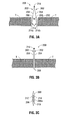
- FIG. 2A schematically illustrates a wound closure device of the present disclosure placed within an open wound
- FIG. 2B schematically illustrates the wound closure device of FIG. 2A after closing the wound
- FIG. 3A schematically illustrates a wound closure device in accordance with another embodiment of the present disclosure placed within an open wound
- FIG. 3B schematically illustrates the wound closure device of FIG. 3A after closing the wound
- FIG. 3C illustrates a cross-sectional view of the wound closure device of FIGS. 3A-3B ;
- FIG. 4A illustrates a side view of a substrate including tactile indicators in accordance with an embodiment of the present disclosure
- FIG. 4B illustrates a side view of a substrate including a tactile indicator in accordance with another embodiment of the present disclosure.
- Wound closure devices described herein include a one or two piece assembly including two tissue fastening substrates and applicators for applying the same.
- the tissue fastening substrates each include a tissue reactive surface and a self-reactive surface known to have complementary reactivity to the self-reactive surface of the other tissue fastening substrate.
- the wound closure devices can be employed to adhere tissue edges, close wounds, seal air/fluid leaks in tissues, and for tissue augmentation such as sealing or filling voids or defects in tissue.
- proximal and distal may be employed interchangeably, and should be understood as referring to the portion of a structure that is closer to a clinician during proper use.
- distal and “leading” may also be employed interchangeably, and should be understood as referring to the portion of a structure that is further from the clinician during proper use.
- patient should be understood as referring to a human subject or other animal, and the term “clinician” should be understood as referring to a doctor, nurse or other care provider and may include support personnel.
- Wound closure device 100 for use in closing a wound.
- Wound closure device 100 includes two applicators 102. As the two applicators 102 are substantially identical, only one applicator 102 will be described.
- Applicator 102 includes a handle portion 104 and a substrate engaging portion 106.
- the handle portion 102 is adapted for grasping by a clinician and for manipulating substrate engaging portion 106.
- Substrate engaging portion 106 includes tines 106a and 106b which are configured to extend along a length of applicator 102.
- the tines 106a and 106b may be flexible or rigid depending upon the types of tissue to be approximated and closed.
- the substrate engaging portion 106 may include a single tine of varying size or more than two tines depending on such factors as the size of the wound and the degree of rigidity required of the substrate engaging portion 106.
- the size and length of the handle portion 104 may vary depending on the depth of the wound and the length of the substrate engaging portion 106.
- Handle portion 104 and substrate engaging portion 106 may be monolithically formed or may be separate pieces which may be attached by various mechanical means as readily envisioned by those skilled in the art such that a variety of handle portion/substrate engaging portion configurations may be utilized.
- a tissue fastening substrate 108 is adapted for releasable connection to the substrate engaging portion 106 of applicator 102.
- substrate 108 is a mesh including pockets 110 in which tines 106a and 106b may be disposed.
- any means for temporarily securing substrate 108 to substrate engaging portion 106 may be utilized, such as weaving the tines 106a and 106b through pores of the mesh.
- the areas of contact between the substrate engaging portion 106 and substrate 108 lack adhesive qualities so that the substrate 108 is readily removable.
- the substrate is illustrated and described in the current embodiment as a mesh, it is envisioned that other medical devices may be used with the wound closure device of the present disclosure including, but are not limited to, patches, scaffolds, soft tissue repair devices, grafts, tapes, cables, slings, gauzes, buttresses, pledgets, tissue engineering scaffolds, wound dressings, drug delivery devices, tissue wraps, as well as other fasteners, implants, composite materials, and combinations thereof.
- Substrate 108 is fabricated from any biocompatible material.
- Substrate 108 may be a biodegradable and/or non-biodegradable material which may be natural or synthetic. Substrates utilizing biodegradable materials enable quick and complete wound healing to occur, while non-biodegradable materials provides continuous reinforcement and support to the tissue.
- Suitable synthetic biodegradable materials include but are not limited to polymers including aliphatic polyesters; polyamides; polyamines; polyalkylene oxalates; poly(anhydrides); polyamidoesters; copoly(ether-esters); poly(carbonates) including tyrosine derived carbonates; poly(hydroxyalkanoates) such as poly(hydroxybutyric acid), poly(hydroxyvaleric acid), and poly(hydroxybutyrate); 3-hydroxypropionate; polyimide carbonates; poly(imino carbonates) such as such as poly (bisphenol A-iminocarbonate) and the like; polyorthoesters; polyoxaesters including those containing amine groups; polyphosphazenes; poly (propylene fumarates); polyurethanes; dimethylsulfoniopropionate (DMSP); polymer drugs such as polydiflunisol, polyaspirin, and protein therapeutics; biologically modified (e.g., protein, peptide) bio
- aliphatic polyesters include, but are not limited to, homopolymers and copolymers of lactide (which includes lactic acid, D-,L- and meso lactide); glycolide (including glycolic acid); epsilon-caprolactone; p-dioxanone (1,4-dioxan-2-one); trimethylene carbonate (1,3-dioxan-2-one); alkyl derivatives of trimethylene carbonate; A-valerolactone; p-butyrolactone; y-butyrolactone; s-decalactone; hydroxybutyrate; hydroxyvalerate; 1,4-dioxepan-2-one (including its dimer 1,5,8,12-tetraoxacyclotetradecane-7,14-dione); 1,5-dioxepan-2-one; 6,6-dimethyl-1,4-dioxan-2-one; 2,5-diketomorpholine; pivalolac
- Natural polymers may also be used in accordance with the present disclosure, non-limiting examples include, proteins such as collagen, gelatin, albumin, serum, and casein; poly (amino acids); polysaccharides such as cellulose (including carboxymethyl cellulose), dextran, chitin, chitosan, alginate and hyaluronic acid; glycosaminoglycans; gut; chemical derivatives thereof (substitutions and/or additions of chemical groups, for example, alkyl, alkylene, hydroxylations, oxidations, and other modifications routinely made by those skilled in the art); and copolymers and combinations thereof.
- Collagen as used herein includes natural collagen such as animal derived collagen, or synthetic collagen such as recombinant collagen. Additionally, natural materials include chemical modifications of the above-listed materials such as recombinant, aminated, sulfonated, and carboxylated polymer analogs.
- Suitable non-biodegradable materials which may be useful in the present disclosure include but are not limited to fluorinated polymers such as fluoroethylenes and fluoroPEGs; polyolefins such as polyethylene (including ultra high molecular weight polyethylene (UHMWPE)) and polypropylene; polyesters such as poly ethylene terepththalate (PET); nylons; polyamides; polyurethanes; silicones; polybutesters; polyethylene glycols and polyethylene oxides; polyaryletherketone; copolymers and combinations thereof. Additionally, non-biodegradable polymers and monomers may be combined with each other and may also be combined with various biodegradable polymers and monomers to create the tissue fastening substrate of the present disclosure.
- fluorinated polymers such as fluoroethylenes and fluoroPEGs
- polyolefins such as polyethylene (including ultra high molecular weight polyethylene (UHMWPE)) and polypropylene
- polyesters such as poly ethylene
- hydrophilic polymers may be used. Suitable hydrophilic polymers include but are not limited to anionic, cationic and neutral monomers and polymers of vinyl polymers such as polyvinyl alcohol, polyvinyl methyl ether, polyvinylpyrrolidone (PVP), poly acrylic acid, styrene sulfonic acid, polyhydroxyethylmethylacrylate (pHEMA) and phospholipid vinyls; acrylic polymers such as sodium polyacrylate, polyethylacrylate, and polyacrylamide; polyethylene glycol, polypropylene oxide, and polypropylene glycol and homopolymers and copolymers thereof; phosphorylcholine functional acrylates and methacrylates; and homopolymers and copolymers thereof.
- vinyl polymers such as polyvinyl alcohol, polyvinyl methyl ether, polyvinylpyrrolidone (PVP), poly acrylic acid, styrene sulfonic acid, polyhydroxyethylmethylacrylate (pHEMA) and
- Substrate 108 may be non-porous, porous, or a combination thereof.
- a non-porous substrate may be a film.
- the term "porous" as used herein may define openings and spacings which are present as a surface characteristic or a bulk material property, partially or completely penetrating the medical device.
- Suitable materials for forming a porous substrate include, but are not limited to fibrous structures (e.g., knitted structures, woven structures, non-woven structures, etc.) and/or foams (e.g., open or closed cell foams).
- the pores may be in sufficient number and size so as to interconnect across the entire thickness of the substrate. Woven fabrics, kitted fabrics, and open cell foam are illustrative examples of structures in which the pores can be in sufficient number and size so as to interconnect across the entire thickness of the substrate.
- the pores may not interconnect across the entire thickness of the substrate, but rather may be present at a portion thereof.
- pores may be located on a portion of the substrate, with other portions of the substrate having a non-porous texture.
- Closed cell foam or fused non-woven materials are illustrative examples of structures in which the pores may not interconnect across the entire thickness of the substrate.
- the fibers may be filaments or threads suitable for knitting or weaving or may be staple fibers, such as those frequently used for preparing non-woven materials. Suitable techniques for making fibrous structures are within the purview of those skilled in the art.
- the pores may be formed using any method suitable to forming a foam or sponge including, but not limited to the lyophilization or freeze-drying of a composition. Suitable techniques for making foams are within the purview of those skilled in the art.
- Pores may be created using methods within the purview of those skilled in the art, including but not limited to processes such as sintering, leaching of salt, sugar or starch crystals, and knitting or weaving of fibers.
- meshes may include one or more layers having a porous or non-porous construction.
- a non-porous layer may retard or prevent tissue ingrowth from surrounding tissues thereby acting as an adhesion barrier and preventing the formation of unwanted scar tissue while a porous layer may allow for tissue in-growth and integration.
- Substrate 108 includes a tissue reactive surface 112 and a self-reactive surface 114.
- the tissue reactive surface 112 includes reactive groups for fixation of the substrate 108 to tissue "T" of wound “W” by crosslinking with reactive groups present in the tissue "T".
- the self-reactive surface 114 also includes reactive groups which have a complementary functionality with reactive groups of a self-reactive surface of a second substrate as described in detail below. By “complementary” it is meant that the reactive groups are able to specifically interact together to bond the self-reactive surfaces together.
- bonding refers to all types of chemical and physical crosslinking including covalent, ionic, and hydrophobic bonding.
- Chemical (covalent) crosslinking may be accomplished by any of a number of mechanisms, including free radical polymerization, condensation polymerization, anionic or cationic polymerization, step growth polymerization, electrophile-nucleophile reactions, combinations thereof, and the like.
- physical (noncovalent) crosslinks may result from complexation, hydrogen bonding, desolvation, Van der Waals interactions, ionic bonding, combinations thereof, and the like.
- tissue reactive surface 112 and/or the self-reactive surface 114 of substrate 108 may be functionalized by including one or more pendant functional groups suitable for reacting with tissue or a second self-reactive surface as described above.
- the reactive groups are electrophilic or nucleophilic groups capable of reacting with tissue and/or each other to form a bond.
- Electrophilic functional groups include, for example, N-hydroxysuccinimides ("NHS"), sulfosuccinimides, carbonyldiimidazole, sulfonyl chloride, aryl halides, sulfosuccinimidyl esters, N-hydroxysuccinimidyl esters, succinimidyl esters such as succinimidyl succinates and/or succinimidyl propionates, isocyanates, thiocyanates, carbodiimides, benzotriazole carbonates, epoxides, aldehydes, maleimides, imidoesters, combinations thereof, and the like.
- the electrophilic reactive group is a succinimidyl ester.
- Suitable nucleophilic groups include, but are not limited to, -NH 2 , -SH, -OH, -PH 2 , -CO-NH-NH 2 and combinations thereof.
- the nucleophilic reactive group is an amine.
- bonding may be accomplished with biological cross-linking systems, including for example, antibody/antigen; biotin/avidin; complementary peptide binding sequences; nucleotide base pairing and cross-linking; lock and key protein binding chemistry; self-assembling peptides; combinations thereof, and the like.
- biotin may be functionalized to include reactive groups such as amine, sulfhydryl, carbonyl, and carboxy, based upon the substrate to which it is to be bound.
- Avidin, streptavidin, and their derivatives may be utilized for bonding with a substrate containing biotin or with endogenous biotin within tissue.
- the material forming the substrate may be functionalized to provide reactive groups for binding or attaching to tissue or to another substrate.
- amines may be provided on proteins, aminoglycans (such as chitosan, chondrotins, hyaluronic acid, and heparin), and polypeptides (like polylysine); carboxyl groups may be provided on proteins, polypeptides (like poly(glutamic acid)), polysaccharides (such as carboxylated dextran and carboxymethyl cellulose), and synthetic polymers (like carboxylated PEG and PEG-diadipate); hydroxyl groups may be provided on polysaccharides (like dextran), di-PEG adipate, and aliphatic polyesters (such as poly(lactic acid), poly(glycolic acid), poly(caprolactone), poly(trimethylene carbonate, poly(P-Dioxanone), and copolymers thereof); and thiols may be provided on some proteins.
- the substrate
- the reactive groups may be positioned on or near the tissue reactive surface 112 and/or self-reactive surface 114 of substrate 108 using any suitable manner.
- the substrate 108 may be formed from materials which naturally position reactive groups toward the outer surface of the substrate 108.
- the substrate 108 may be surface-modified to covalently attach the reactive groups.
- the substrate 108 may be coated with an additional layer of material which includes the pendant reactive groups necessary to interact with the tissue and/or the second self-reactive surface as described herein.
- Methods for coating substrates are within the purview of those skilled in the art, and include but are not limited to spraying, dipping, brushing, vapor deposition, co-extrusion, capillary wicking, film casting, molding, and the like.
- the reactive groups may be combined with the substrate in the form of a coating, film, foam, or powder on at least a portion of the tissue reactive and/or self-reactive surfaces of the substrate, in embodiments, on the entirety of the tissue reactive and/or self-reactive surfaces of the substrate.
- the coating process may include surface treatment of the substrate in order to promote adhesion of the coating to the tissue reactive surface and/or self-reactive surface of the substrate.
- the surfaces of the substrate can be treated using plasma, physical or chemical vapor deposition, pulsed laser ablation deposition, surface modification, or any other means within the purview of those skilled in the art to activate the tissue reactive or self-reactive surfaces of the substrate.
- treatment may include the use of a primer such as a cross-linkable compound.
- one or more deposition treatments could be used alone or in conjunction with the primer to achieve the desired association of coating with the tissue reactive and/or self-reactive surfaces of the substrate.
- the tissue reactive surface 112 and/or self-reactive surface 114 may be functionalized by attaching a reactive component thereto.
- Suitable reactive components may include crosslinkers, adhesives, sealants, couplers, and the like that are functionalized with at least one reactive group capable of bonding the tissue reactive surface 112 to tissue "T" or the self-reactive surface 114 to the another self-reactive surface 114 as described above.
- the tissue reactive surface 112 of substrate 108 may react with functional groups in tissue such as primary amine groups, secondary amine groups, hydroxyl groups, carboxylic groups, sulfonic groups and combinations thereof, and the like.
- the tissue reactive surface 112 of substrate 108 is an amine-reactive functional group which is capable of reacting with the free amines in tissue, thereby serving as a means for attaching substrate 108 to tissue "T".
- the tissue reactive surface 112 includes succinimidyl esters.
- the self-reactive surface 114 of a first substrate 108 may including at least one reactive group 114a which is capable of reacting with the pendant reactive groups 114b of the self-reactive surface 114 of a second substrate 108.
- One reactive group may be an electrophile and the other may be a nucleophile. Electrophiles react with nucleophiles to form covalent bonds. Covalent crosslinks or bonds refer to chemical groups formed by reaction of functional groups on different materials that serve to covalently bind the different materials to each other.
- electrophilic reactive groups on a self reactive surface of the first substrate may react with nucleophilic reactive groups on a self-reactive surface of the second substrate.
- the electrophilic and nucleophilic reactive groups react with each other to form covalent bonds.
- the electrophilic reactive groups are succinimidyl esters and the nucleophilic reactive groups are amines.
- the reactive groups may be protected prior to use of the wound closure device 100 by attaching a protective tape or releasable liner (not shown) to one or both surfaces 112, 114 of substrate 108.
- the protective tape or releasable liner may be removed prior to insertion of the substrate 108 into tissue "T".
- the protective tape or releasable liner may be fabricated from collagen, dextran, or any other natural or synthetic material which will not react with the reactive groups on the surface of the substrate to which it is applied.
- substrates 108 of applicators 102 of wound closure device 100 are inserted into a wound "W".
- Handle portions 104 of applicators 102 are manipulated by a clinician such that the tissue reactive surfaces 112 of substrates 108 are pressed against each side of the tissue "T" within wound "W".
- the applicators 102 may be separately inserted into wound “W” to engage each substrate 108 with tissue "T” or the applicators 102 may be placed and manipulated within the wound "W” at the same time.
- the tissue reactive surfaces 112 react and fixate to tissue "T" within a useful time range.
- the reactive groups on tissue reactive surfaces 112 may be chemically "shielded” or “blocked” in aid of slowing the reaction with tissue “T” to allow for time to properly position and align the substrate with tissue “T”.
- the handle portions 104 allow the clinician to apply even pressure to the tissue “T” in order to properly align the substrates 108 with the tissue “T” and thus, to uniformly bind the substrates 108 to the tissue "T” throughout the depth of the wound "W”.
- the clinician may move handle portions 104 of applicators 102 of wound closure device 100 in the direction of the arrows illustrated in FIG. 2A to appose and join the self-reactive surfaces 114 of the substrates 108.
- the reactive groups 114a, 114b on self-reactive surfaces 114 react such that the self-reactive surfaces adhere to each other.
- the self-reactive surfaces 114 crosslink upon contact with each other.
- the rate of cross-linking between the reactive groups 114a, 114b of the self-reactive surfaces 114 of the present disclosure may be tailored by controlling the concentration of the reactive groups 114a, 114b on the self-reactive surfaces 114. Generally, a faster cross-link time may be observed at a higher concentration of either of the reactive groups 114a, 114b of the self-reactive surfaces 114 than the rate observed for the same components at a lower concentration.
- the applicators 102 may be removed from the substrates 108 thereby providing a closed wound as illustrated in FIG. 2B .
- substrates 108 may extend out of surface "S" of tissue “T”. The excess length of the substrates 108 may be trimmed at surface "S” of tissue “T", or just below surface “S” if cut prior to wound closure.
- the wound closure device 100 may be used in a medical/surgical capacity in place of sutures, staples, adhesives, and other tissue fastening devices.
- the wound closure device 100 of the present disclosure thus has a number of advantageous properties.
- the tissue fastening substrates of the present disclosure are safe and biocompatible and possess enhanced adherence to tissue and to each other.
- the substrates crosslink to form a compliant tissue fastener which ensures stationary positioning of tissue edges in the desired location, evenly and uniformily along the length and depth of the wound therefore retaining the positional integrity of the aligned tissues.
- the reactive groups on the substrates form strong bonds such that the substrates exhibit excellent mechanical performance and strength while retaining the necessary pliability to adhere tissue. The strength and pliability allow a degree of movement of tissue without shifting the tissue edges.
- Wound closure device 200 includes applicators 202 joined via a hinge 218.
- Applicators 202 each include a handle portion 204 and a substrate engaging portion 206.
- Substrate 208 which is engaged with substrate engaging portion 206, is a non-porous film which includes a tissue reactive surface 212 and a self-reactive surface 214.
- substrate engaging portion 206 includes a single tine 206a positioned within a sleeve or pocket 210 within substrate 208 for releasably securing the substrate 208 to the applicator 202.
- the applicators 202 may be adapted to pivot relative to each other along the hinge 218 between an open position for positioning the tissue reactive surfaces 212 of the substrates 208 against tissue "T" ( FIG. 3A ) and a closed position for aligning tissue layers for apposing the self-reactive surfaces 214 of the substrates 208 thus, closing the wound ( FIG. 3B ).
- the hinge 218 may be releasable for selective attachment of the applicators 202 with each other, thereby allowing the clinician to individually or jointly control the applicators 202.
- Hinge 218 may be any mechanical fastener which allows for pivotable movement, such as male/female fasteners, bayonet couplings, threaded connections, snap fit, friction fit, tongue and groove arrangements, and cam-lock mechanisms, for example.
- bioactive agent may be combined with the tissue fastening substrate of the present disclosure.
- bioactive agent is used in its broadest sense and includes any substance or mixture of substances that have clinical use.
- a bioactive agent could be any agent which provides a therapeutic or prophylactic effect, a compound that affects or participates in tissue growth, cell growth, cell differentiation, an anti-adhesive compound, a compound that may be able to invoke a biological action such as an immune response, or could play any other role in one or more biological processes.
- the bioactive agent may be applied to the substrate in any suitable form of matter, e.g., films, powders, liquids, gels, combinations thereof, and the like.
- the bioactive agent may be included on the tissue reactive surface, the self-reactive surface, or within the substrate.
- the bioactive agents may be incorporated into the substrate during formation of the substrate, such as by free suspension, liposomal delivery, microspheres, microparticles etc., or by coating a surface of the substrate, or portion thereof, such as by polymer coating, dry coating, and freeze drying.
- bioactive agents may be incorporated within the pores of a porous substrate.
- bioactive agents examples include antimicrobials, analgesics, antipyretics, anesthetics, antiepileptics, antihistamines, anti-inflammatories, cardiovascular drugs, diagnostic agents, sympathomimetics, cholinomimetics, antimuscarinics, antispasmodics, hormones, growth factors, muscle relaxants, adrenergic neuron blockers, antineoplastics, immunogenic agents, immunosuppressants, gastrointestinal drugs, diuretics, steroids, lipids, lipopolysaccharides, polysaccharides, and enzymes. It is also intended that combinations of bioactive agents may be used with the substrates of the present disclosure.
- bioactive agents which may be included as a bioactive agent in the substrate of the present disclosure include: local anesthetics; non-steroidal antifertility agents; parasympathomimetic agents; psychotherapeutic agents; tranquilizers; decongestants; sedative hypnotics; steroids; sulfonamides; sympathomimetic agents; vaccines; vitamins; antimalarials; anti-migraine agents; anti-parkinson agents such as L-dopa; anti-spasmodics; anticholinergic agents (e.g., oxybutynin); antitussives; bronchodilators; cardiovascular agents such as coronary vasodilators and nitroglycerin; alkaloids; analgesics; narcotics such as codeine, dihydrocodeinone, meperidine, morphine and the like; non-narcotics such as salicylates, aspirin, acetaminophen, d-propoxyphene and the
- bioactive agents include viruses and cells; peptides; polypeptides and proteins, as well as analogs, muteins, and active fragments thereof; immunoglobulins; antibodies; cytokines (e.g., lymphokines, monokines, chemokines); blood clotting factors; hemopoietic factors; interleukins (IL-2, IL-3, IL-4, IL-6); interferons ( ⁇ -IFN, ⁇ -IFN and ⁇ -IFN); erythropoietin; nucleases; tumor necrosis factor; colony stimulating factors (e.g., GCSF, GM-CSF, MCSF); insulin; anti-tumor agents and tumor suppressors; blood proteins; gonadotropins (e.g., FSH, LH, CG, etc.); hormones and hormone analogs (e.g., growth hormone); vaccines (e.g., tumoral, bacterial and viral antigens); somatostatin; antigens
- the substrate may include a visualization agent and/or tactile indicator.
- the visualization agents may be utilized to improve the visibility of the substrate within a wound and/or to distinguish the tissue reactive surface 112 from the self-reactive surface 114.
- Visualization agents may be selected from a variety of nontoxic colored substances, such as dyes, suitable for use in implantable medical devices. Suitable dyes are within the purview of those skilled in the art and may include, for example, FD&C Blue #1, FD&C Blue #2, FD&C Blue #3, FD&C Blue #6, D&C Green #6, methylene blue, indocyanine green, other colored dyes, and combinations thereof.
- tissue reactive surface or the self-reactive surfaces may be provided with a visualization agent to distinguish between the two surface.
- tissue reactive surface and the self-reactive surface each contain a different visualization agent to distinguish between the two surfaces.
- the tactile indicators may be utilized to tangibly distinguish the tissue reactive surface 112 from the self-reactive surface 114.
- the tissue reactive surface 112 and/or self-reactive surface 114 may include different surface topographies, such as differing textures or patterns of various shapes and sizes, to distinguish between the two surfaces.
- the tissue reactive surface 312 of substrate 308 may include a first tactile indicator 316 and the self-reactive surface 314 may include a second tactile indicator 318 that is different from the first tactile indicator 316 of the tissue reactive surface 312.
- the first tactile indicator 316 includes protrusions and the second tactile indicator 318 includes indentations or recesses.
- only one of the tissue reactive or self-reactive surfaces may include a tactile indicator.
- only the self-reactive surface 314 includes a tactile indicator 320 in the form of a textured surface.
Landscapes
- Health & Medical Sciences (AREA)
- Life Sciences & Earth Sciences (AREA)
- Surgery (AREA)
- Molecular Biology (AREA)
- Engineering & Computer Science (AREA)
- Biomedical Technology (AREA)
- Heart & Thoracic Surgery (AREA)
- Medical Informatics (AREA)
- Nuclear Medicine, Radiotherapy & Molecular Imaging (AREA)
- Animal Behavior & Ethology (AREA)
- General Health & Medical Sciences (AREA)
- Public Health (AREA)
- Veterinary Medicine (AREA)
- Materials For Medical Uses (AREA)
- Replacement Of Web Rolls (AREA)
- Adhesive Tape Dispensing Devices (AREA)
Abstract
Description
- This application claims the benefit of, and priority to,
U.S. Provisional Application No. 61/435,466, filed on January 24, 2011 - The present disclosure relates to devices for apposing tissue and closing wounds, and in particular, to wound closure devices that align and approximate tissue for uniform wound closure.
- Techniques for repairing damaged or diseased tissue are widespread in medicine. Wound closure devices, such as sutures, staples, and other repair devices, like mesh or patch reinforcements, are frequently used for repair. In recent years there has developed increased interest in replacing or augmenting sutures with adhesive bonds. The reasons for this increased interest include: the potential speed with which repair might be accomplished; the ability of a bonding substance to effect complete closure, thus preventing seepage of fluids; and the possibility of forming a bond without excessive deformation of tissue.
- A wound may be closed by sewing or stapling the edges of the wound together. In the case of deep wounds, the edges may first need to be sewn together layer by layer, placing and leaving some sutures under the skin. Alternatively or additionally, adhesives may be directly applied and used for wound closure purposes.
- Approximating tissue, however, with the use of adhesives, staples, and/or sutures may require grasping the tissue adjacent the edges of the wound. The use of forceps or other tissue grasping devices may indent the tissue, evert the wound edges during closure, or fail to provide uniform adhesion in subcutaneous tissue.
- Thus, it would be desirable to provide a wound closure device that is easily insertable into a wound and effects uniform and even closure thereof.
- A wound closure device includes a first applicator including a handle portion and a substrate engaging portion and a second applicator including a handle portion and a substrate engaging portion. A first substrate is releasably couplable to the substrate engaging portion of the first applicator and includes a tissue reactive surface and a self-reactive surface. A second substrate is releasably couplable to the substrate engaging portion of the second applicator and includes a tissue reactive surface and a self-reactive surface. The self-reactive surfaces of the first and second substrates each possess reactive groups known to have complementary functionality for bonding the first and second substrates together.
- Methods for closing a wound utilizing the wound closure device of the present disclosure are also described. In accordance with the present methods, a first substrate including a tissue reactive surface and a self-reactive surface are introduced into a wound via a first applicator, the first applicator including a handle portion and a substrate engaging portion for releasably engaging the first substrate. A second substrate including a tissue reactive surface and a self-reactive surface is introduced into a wound via a second applicator, the second applicator including a handle portion and a substrate engaging portion for releasably engaging the second substrate. The tissue reactive surfaces of the first and second substrates are applied to tissue within a wound and the self-reactive surfaces of the first and second substrates are contacted with each other for bonding and closing the wound.
- The illustrative embodiments described herein will become more readily apparent from the following description, reference being made to the accompanying drawings in which:
-
FIG. 1A illustrates a front plan view of an applicator of a wound closure device in accordance with an embodiment of the present disclosure; -
FIG. 1B illustrates a cross-sectional view of the applicator of the wound closure device ofFIG. 1 A; -
FIG. 2A schematically illustrates a wound closure device of the present disclosure placed within an open wound; -
FIG. 2B schematically illustrates the wound closure device ofFIG. 2A after closing the wound; -
FIG. 3A schematically illustrates a wound closure device in accordance with another embodiment of the present disclosure placed within an open wound; -
FIG. 3B schematically illustrates the wound closure device ofFIG. 3A after closing the wound; -
FIG. 3C illustrates a cross-sectional view of the wound closure device ofFIGS. 3A-3B ; -
FIG. 4A illustrates a side view of a substrate including tactile indicators in accordance with an embodiment of the present disclosure; and -
FIG. 4B illustrates a side view of a substrate including a tactile indicator in accordance with another embodiment of the present disclosure. - Wound closure devices described herein include a one or two piece assembly including two tissue fastening substrates and applicators for applying the same. The tissue fastening substrates each include a tissue reactive surface and a self-reactive surface known to have complementary reactivity to the self-reactive surface of the other tissue fastening substrate. The wound closure devices can be employed to adhere tissue edges, close wounds, seal air/fluid leaks in tissues, and for tissue augmentation such as sealing or filling voids or defects in tissue.
- Embodiments of the presently disclosed wound closure device will now be described in detail with reference to the drawing figures wherein like reference numerals identify similar or identical elements. In the following discussion, the terms "proximal" and "trailing" may be employed interchangeably, and should be understood as referring to the portion of a structure that is closer to a clinician during proper use. The terms "distal" and "leading" may also be employed interchangeably, and should be understood as referring to the portion of a structure that is further from the clinician during proper use. As used herein, the term "patient" should be understood as referring to a human subject or other animal, and the term "clinician" should be understood as referring to a doctor, nurse or other care provider and may include support personnel.
- Referring now to
FIGS. 1A-1B and 2A-2B , there is illustrated an exemplarywound closure device 100 for use in closing a wound.Wound closure device 100 includes twoapplicators 102. As the twoapplicators 102 are substantially identical, only oneapplicator 102 will be described.Applicator 102 includes ahandle portion 104 and asubstrate engaging portion 106. Thehandle portion 102 is adapted for grasping by a clinician and for manipulatingsubstrate engaging portion 106.Substrate engaging portion 106 includestines applicator 102. Thetines tines substrate engaging portion 106 may include a single tine of varying size or more than two tines depending on such factors as the size of the wound and the degree of rigidity required of thesubstrate engaging portion 106. Similarly, the size and length of thehandle portion 104 may vary depending on the depth of the wound and the length of thesubstrate engaging portion 106. -
Handle portion 104 andsubstrate engaging portion 106 may be monolithically formed or may be separate pieces which may be attached by various mechanical means as readily envisioned by those skilled in the art such that a variety of handle portion/substrate engaging portion configurations may be utilized. - A
tissue fastening substrate 108 is adapted for releasable connection to thesubstrate engaging portion 106 ofapplicator 102. As illustrated in the present embodiment,substrate 108 is amesh including pockets 110 in whichtines substrate 108 tosubstrate engaging portion 106 may be utilized, such as weaving thetines substrate engaging portion 106 andsubstrate 108 lack adhesive qualities so that thesubstrate 108 is readily removable. - While the substrate is illustrated and described in the current embodiment as a mesh, it is envisioned that other medical devices may be used with the wound closure device of the present disclosure including, but are not limited to, patches, scaffolds, soft tissue repair devices, grafts, tapes, cables, slings, gauzes, buttresses, pledgets, tissue engineering scaffolds, wound dressings, drug delivery devices, tissue wraps, as well as other fasteners, implants, composite materials, and combinations thereof.
-
Substrate 108 is fabricated from any biocompatible material.Substrate 108 may be a biodegradable and/or non-biodegradable material which may be natural or synthetic. Substrates utilizing biodegradable materials enable quick and complete wound healing to occur, while non-biodegradable materials provides continuous reinforcement and support to the tissue. - Suitable synthetic biodegradable materials include but are not limited to polymers including aliphatic polyesters; polyamides; polyamines; polyalkylene oxalates; poly(anhydrides); polyamidoesters; copoly(ether-esters); poly(carbonates) including tyrosine derived carbonates; poly(hydroxyalkanoates) such as poly(hydroxybutyric acid), poly(hydroxyvaleric acid), and poly(hydroxybutyrate); 3-hydroxypropionate; polyimide carbonates; poly(imino carbonates) such as such as poly (bisphenol A-iminocarbonate) and the like; polyorthoesters; polyoxaesters including those containing amine groups; polyphosphazenes; poly (propylene fumarates); polyurethanes; dimethylsulfoniopropionate (DMSP); polymer drugs such as polydiflunisol, polyaspirin, and protein therapeutics; biologically modified (e.g., protein, peptide) bioabsorbable polymers; and copolymers, block copolymers, homopolymers, blends, and combinations thereof.
- More specifically, aliphatic polyesters include, but are not limited to, homopolymers and copolymers of lactide (which includes lactic acid, D-,L- and meso lactide); glycolide (including glycolic acid); epsilon-caprolactone; p-dioxanone (1,4-dioxan-2-one); trimethylene carbonate (1,3-dioxan-2-one); alkyl derivatives of trimethylene carbonate; A-valerolactone; p-butyrolactone; y-butyrolactone; s-decalactone; hydroxybutyrate; hydroxyvalerate; 1,4-dioxepan-2-one (including its dimer 1,5,8,12-tetraoxacyclotetradecane-7,14-dione); 1,5-dioxepan-2-one; 6,6-dimethyl-1,4-dioxan-2-one; 2,5-diketomorpholine; pivalolactone; a, a diethylpropiolactone; ethylene carbonate; ethylene oxalate; 3-methyl-1,4-dioxane-2,5-dione; 3,3-diethyl-1,4-dioxan-2,5-dione; 6,8-dioxabicycloctane-7-one; and polymer blends and copolymers thereof.
- Natural polymers may also be used in accordance with the present disclosure, non-limiting examples include, proteins such as collagen, gelatin, albumin, serum, and casein; poly (amino acids); polysaccharides such as cellulose (including carboxymethyl cellulose), dextran, chitin, chitosan, alginate and hyaluronic acid; glycosaminoglycans; gut; chemical derivatives thereof (substitutions and/or additions of chemical groups, for example, alkyl, alkylene, hydroxylations, oxidations, and other modifications routinely made by those skilled in the art); and copolymers and combinations thereof. Collagen as used herein includes natural collagen such as animal derived collagen, or synthetic collagen such as recombinant collagen. Additionally, natural materials include chemical modifications of the above-listed materials such as recombinant, aminated, sulfonated, and carboxylated polymer analogs.
- Suitable non-biodegradable materials which may be useful in the present disclosure include but are not limited to fluorinated polymers such as fluoroethylenes and fluoroPEGs; polyolefins such as polyethylene (including ultra high molecular weight polyethylene (UHMWPE)) and polypropylene; polyesters such as poly ethylene terepththalate (PET); nylons; polyamides; polyurethanes; silicones; polybutesters; polyethylene glycols and polyethylene oxides; polyaryletherketone; copolymers and combinations thereof. Additionally, non-biodegradable polymers and monomers may be combined with each other and may also be combined with various biodegradable polymers and monomers to create the tissue fastening substrate of the present disclosure.
- In some embodiments, hydrophilic polymers may be used. Suitable hydrophilic polymers include but are not limited to anionic, cationic and neutral monomers and polymers of vinyl polymers such as polyvinyl alcohol, polyvinyl methyl ether, polyvinylpyrrolidone (PVP), poly acrylic acid, styrene sulfonic acid, polyhydroxyethylmethylacrylate (pHEMA) and phospholipid vinyls; acrylic polymers such as sodium polyacrylate, polyethylacrylate, and polyacrylamide; polyethylene glycol, polypropylene oxide, and polypropylene glycol and homopolymers and copolymers thereof; phosphorylcholine functional acrylates and methacrylates; and homopolymers and copolymers thereof.
-
Substrate 108 may be non-porous, porous, or a combination thereof. In embodiments, a non-porous substrate may be a film. The term "porous" as used herein may define openings and spacings which are present as a surface characteristic or a bulk material property, partially or completely penetrating the medical device. Suitable materials for forming a porous substrate include, but are not limited to fibrous structures (e.g., knitted structures, woven structures, non-woven structures, etc.) and/or foams (e.g., open or closed cell foams). In embodiments, the pores may be in sufficient number and size so as to interconnect across the entire thickness of the substrate. Woven fabrics, kitted fabrics, and open cell foam are illustrative examples of structures in which the pores can be in sufficient number and size so as to interconnect across the entire thickness of the substrate. - In embodiments, the pores may not interconnect across the entire thickness of the substrate, but rather may be present at a portion thereof. Thus, in some embodiments, pores may be located on a portion of the substrate, with other portions of the substrate having a non-porous texture. Those skilled in the art reading the present disclosure will envision a variety of pore distribution patterns and configurations for the substrate. Closed cell foam or fused non-woven materials are illustrative examples of structures in which the pores may not interconnect across the entire thickness of the substrate.
- Where the substrate is fibrous, the fibers may be filaments or threads suitable for knitting or weaving or may be staple fibers, such as those frequently used for preparing non-woven materials. Suitable techniques for making fibrous structures are within the purview of those skilled in the art.
- Where the substrate is a foam, the pores may be formed using any method suitable to forming a foam or sponge including, but not limited to the lyophilization or freeze-drying of a composition. Suitable techniques for making foams are within the purview of those skilled in the art.
- Pores may be created using methods within the purview of those skilled in the art, including but not limited to processes such as sintering, leaching of salt, sugar or starch crystals, and knitting or weaving of fibers.
- In other embodiments, composite substrates are envisioned. For example, meshes may include one or more layers having a porous or non-porous construction. A non-porous layer may retard or prevent tissue ingrowth from surrounding tissues thereby acting as an adhesion barrier and preventing the formation of unwanted scar tissue while a porous layer may allow for tissue in-growth and integration.
-
Substrate 108 includes a tissuereactive surface 112 and a self-reactive surface 114. The tissuereactive surface 112 includes reactive groups for fixation of thesubstrate 108 to tissue "T" of wound "W" by crosslinking with reactive groups present in the tissue "T". The self-reactive surface 114 also includes reactive groups which have a complementary functionality with reactive groups of a self-reactive surface of a second substrate as described in detail below. By "complementary" it is meant that the reactive groups are able to specifically interact together to bond the self-reactive surfaces together. The term "bonding" as used herein refers to all types of chemical and physical crosslinking including covalent, ionic, and hydrophobic bonding. Chemical (covalent) crosslinking may be accomplished by any of a number of mechanisms, including free radical polymerization, condensation polymerization, anionic or cationic polymerization, step growth polymerization, electrophile-nucleophile reactions, combinations thereof, and the like. In addition, physical (noncovalent) crosslinks may result from complexation, hydrogen bonding, desolvation, Van der Waals interactions, ionic bonding, combinations thereof, and the like. - The tissue
reactive surface 112 and/or the self-reactive surface 114 ofsubstrate 108 may be functionalized by including one or more pendant functional groups suitable for reacting with tissue or a second self-reactive surface as described above. - In embodiments, the reactive groups are electrophilic or nucleophilic groups capable of reacting with tissue and/or each other to form a bond. Electrophilic functional groups include, for example, N-hydroxysuccinimides ("NHS"), sulfosuccinimides, carbonyldiimidazole, sulfonyl chloride, aryl halides, sulfosuccinimidyl esters, N-hydroxysuccinimidyl esters, succinimidyl esters such as succinimidyl succinates and/or succinimidyl propionates, isocyanates, thiocyanates, carbodiimides, benzotriazole carbonates, epoxides, aldehydes, maleimides, imidoesters, combinations thereof, and the like. In embodiments, the electrophilic reactive group is a succinimidyl ester.
- Suitable nucleophilic groups include, but are not limited to, -NH2, -SH, -OH, -PH2, -CO-NH-NH2 and combinations thereof. In embodiments, the nucleophilic reactive group is an amine.
- In other embodiments, bonding may be accomplished with biological cross-linking systems, including for example, antibody/antigen; biotin/avidin; complementary peptide binding sequences; nucleotide base pairing and cross-linking; lock and key protein binding chemistry; self-assembling peptides; combinations thereof, and the like. In embodiments utilizing biotin and avidin reactive chemistries, biotin may be functionalized to include reactive groups such as amine, sulfhydryl, carbonyl, and carboxy, based upon the substrate to which it is to be bound. Avidin, streptavidin, and their derivatives, may be utilized for bonding with a substrate containing biotin or with endogenous biotin within tissue.
- The material forming the substrate may be functionalized to provide reactive groups for binding or attaching to tissue or to another substrate. For example, amines may be provided on proteins, aminoglycans (such as chitosan, chondrotins, hyaluronic acid, and heparin), and polypeptides (like polylysine); carboxyl groups may be provided on proteins, polypeptides (like poly(glutamic acid)), polysaccharides (such as carboxylated dextran and carboxymethyl cellulose), and synthetic polymers (like carboxylated PEG and PEG-diadipate); hydroxyl groups may be provided on polysaccharides (like dextran), di-PEG adipate, and aliphatic polyesters (such as poly(lactic acid), poly(glycolic acid), poly(caprolactone), poly(trimethylene carbonate, poly(P-Dioxanone), and copolymers thereof); and thiols may be provided on some proteins. Alternatively, the substrates may be functionalized with tissue or substrate binding reactive groups, such as poly(lactic acid) and/or poly(glycolic acid), which include terminal carboxyl or hydroxyl groups.
- The reactive groups may be positioned on or near the tissue
reactive surface 112 and/or self-reactive surface 114 ofsubstrate 108 using any suitable manner. For example, thesubstrate 108 may be formed from materials which naturally position reactive groups toward the outer surface of thesubstrate 108. In other examples, thesubstrate 108 may be surface-modified to covalently attach the reactive groups. In still other examples, thesubstrate 108 may be coated with an additional layer of material which includes the pendant reactive groups necessary to interact with the tissue and/or the second self-reactive surface as described herein. - Methods for coating substrates are within the purview of those skilled in the art, and include but are not limited to spraying, dipping, brushing, vapor deposition, co-extrusion, capillary wicking, film casting, molding, and the like. The reactive groups may be combined with the substrate in the form of a coating, film, foam, or powder on at least a portion of the tissue reactive and/or self-reactive surfaces of the substrate, in embodiments, on the entirety of the tissue reactive and/or self-reactive surfaces of the substrate.
- In embodiments utilizing a coating, the coating process may include surface treatment of the substrate in order to promote adhesion of the coating to the tissue reactive surface and/or self-reactive surface of the substrate. The surfaces of the substrate can be treated using plasma, physical or chemical vapor deposition, pulsed laser ablation deposition, surface modification, or any other means within the purview of those skilled in the art to activate the tissue reactive or self-reactive surfaces of the substrate. In other embodiments, treatment may include the use of a primer such as a cross-linkable compound. In yet other embodiments, one or more deposition treatments could be used alone or in conjunction with the primer to achieve the desired association of coating with the tissue reactive and/or self-reactive surfaces of the substrate.
- In embodiments, the tissue
reactive surface 112 and/or self-reactive surface 114 may be functionalized by attaching a reactive component thereto. Suitable reactive components may include crosslinkers, adhesives, sealants, couplers, and the like that are functionalized with at least one reactive group capable of bonding the tissuereactive surface 112 to tissue "T" or the self-reactive surface 114 to the another self-reactive surface 114 as described above. - The tissue
reactive surface 112 ofsubstrate 108 may react with functional groups in tissue such as primary amine groups, secondary amine groups, hydroxyl groups, carboxylic groups, sulfonic groups and combinations thereof, and the like. In embodiments, the tissuereactive surface 112 ofsubstrate 108 is an amine-reactive functional group which is capable of reacting with the free amines in tissue, thereby serving as a means for attachingsubstrate 108 to tissue "T". In embodiments, the tissuereactive surface 112 includes succinimidyl esters. - The self-
reactive surface 114 of afirst substrate 108 may including at least onereactive group 114a which is capable of reacting with the pendantreactive groups 114b of the self-reactive surface 114 of asecond substrate 108. One reactive group may be an electrophile and the other may be a nucleophile. Electrophiles react with nucleophiles to form covalent bonds. Covalent crosslinks or bonds refer to chemical groups formed by reaction of functional groups on different materials that serve to covalently bind the different materials to each other. In certain embodiments, electrophilic reactive groups on a self reactive surface of the first substrate may react with nucleophilic reactive groups on a self-reactive surface of the second substrate. When the self-reactive surfaces are joined together and mixed in an environment that permits reaction (e.g., physiological conditions within a wound), the electrophilic and nucleophilic reactive groups react with each other to form covalent bonds. In embodiments, the electrophilic reactive groups are succinimidyl esters and the nucleophilic reactive groups are amines. - The reactive groups may be protected prior to use of the
wound closure device 100 by attaching a protective tape or releasable liner (not shown) to one or bothsurfaces substrate 108. The protective tape or releasable liner may be removed prior to insertion of thesubstrate 108 into tissue "T". In embodiments, the protective tape or releasable liner may be fabricated from collagen, dextran, or any other natural or synthetic material which will not react with the reactive groups on the surface of the substrate to which it is applied. - As illustrated in
FIG. 2A , to effectuate the closing of a wound,substrates 108 ofapplicators 102 ofwound closure device 100 are inserted into a wound "W". Handleportions 104 ofapplicators 102 are manipulated by a clinician such that the tissuereactive surfaces 112 ofsubstrates 108 are pressed against each side of the tissue "T" within wound "W". Theapplicators 102 may be separately inserted into wound "W" to engage eachsubstrate 108 with tissue "T" or theapplicators 102 may be placed and manipulated within the wound "W" at the same time. Upon contact with the amine-containing tissue, the tissuereactive surfaces 112 react and fixate to tissue "T" within a useful time range. In embodiment, the reactive groups on tissuereactive surfaces 112 may be chemically "shielded" or "blocked" in aid of slowing the reaction with tissue "T" to allow for time to properly position and align the substrate with tissue "T". Thehandle portions 104 allow the clinician to apply even pressure to the tissue "T" in order to properly align thesubstrates 108 with the tissue "T" and thus, to uniformly bind thesubstrates 108 to the tissue "T" throughout the depth of the wound "W". - After the two tissue
reactive surfaces 112 are sufficiently bound to the tissue "T", the clinician may move handleportions 104 ofapplicators 102 ofwound closure device 100 in the direction of the arrows illustrated inFIG. 2A to appose and join the self-reactive surfaces 114 of thesubstrates 108. As the self-reactive surfaces 114 of thesubstrates 108 are pressed together, thereactive groups reactive surfaces 114 react such that the self-reactive surfaces adhere to each other. Thus, the self-reactive surfaces 114 crosslink upon contact with each other. The rate of cross-linking between thereactive groups reactive surfaces 114 of the present disclosure may be tailored by controlling the concentration of thereactive groups reactive surfaces 114. Generally, a faster cross-link time may be observed at a higher concentration of either of thereactive groups reactive surfaces 114 than the rate observed for the same components at a lower concentration. - Thereafter, the
applicators 102 may be removed from thesubstrates 108 thereby providing a closed wound as illustrated inFIG. 2B . As further illustrated inFIG. 2B ,substrates 108 may extend out of surface "S" of tissue "T". The excess length of thesubstrates 108 may be trimmed at surface "S" of tissue "T", or just below surface "S" if cut prior to wound closure. - Thus, the
wound closure device 100 may be used in a medical/surgical capacity in place of sutures, staples, adhesives, and other tissue fastening devices. Thewound closure device 100 of the present disclosure thus has a number of advantageous properties. The tissue fastening substrates of the present disclosure are safe and biocompatible and possess enhanced adherence to tissue and to each other. The substrates crosslink to form a compliant tissue fastener which ensures stationary positioning of tissue edges in the desired location, evenly and uniformily along the length and depth of the wound therefore retaining the positional integrity of the aligned tissues. The reactive groups on the substrates form strong bonds such that the substrates exhibit excellent mechanical performance and strength while retaining the necessary pliability to adhere tissue. The strength and pliability allow a degree of movement of tissue without shifting the tissue edges. - Another embodiment of a
wound closure device 200 is illustrated inFIGS. 3A-3C .Wound closure device 200 includesapplicators 202 joined via ahinge 218.Applicators 202 each include ahandle portion 204 and asubstrate engaging portion 206.Substrate 208, which is engaged withsubstrate engaging portion 206, is a non-porous film which includes a tissuereactive surface 212 and a self-reactive surface 214. As illustrated in the current embodiment,substrate engaging portion 206 includes asingle tine 206a positioned within a sleeve orpocket 210 withinsubstrate 208 for releasably securing thesubstrate 208 to theapplicator 202. - The
applicators 202 may be adapted to pivot relative to each other along thehinge 218 between an open position for positioning the tissuereactive surfaces 212 of thesubstrates 208 against tissue "T" (FIG. 3A ) and a closed position for aligning tissue layers for apposing the self-reactive surfaces 214 of thesubstrates 208 thus, closing the wound (FIG. 3B ). In embodiments, thehinge 218 may be releasable for selective attachment of theapplicators 202 with each other, thereby allowing the clinician to individually or jointly control theapplicators 202.Hinge 218 may be any mechanical fastener which allows for pivotable movement, such as male/female fasteners, bayonet couplings, threaded connections, snap fit, friction fit, tongue and groove arrangements, and cam-lock mechanisms, for example. - In some embodiments, at least one bioactive agent may be combined with the tissue fastening substrate of the present disclosure. The term "bioactive agent", as used herein, is used in its broadest sense and includes any substance or mixture of substances that have clinical use. A bioactive agent could be any agent which provides a therapeutic or prophylactic effect, a compound that affects or participates in tissue growth, cell growth, cell differentiation, an anti-adhesive compound, a compound that may be able to invoke a biological action such as an immune response, or could play any other role in one or more biological processes. It is envisioned that the bioactive agent may be applied to the substrate in any suitable form of matter, e.g., films, powders, liquids, gels, combinations thereof, and the like.
- The bioactive agent may be included on the tissue reactive surface, the self-reactive surface, or within the substrate. The bioactive agents may be incorporated into the substrate during formation of the substrate, such as by free suspension, liposomal delivery, microspheres, microparticles etc., or by coating a surface of the substrate, or portion thereof, such as by polymer coating, dry coating, and freeze drying. In some embodiments, bioactive agents may be incorporated within the pores of a porous substrate.
- Examples of classes of bioactive agents which may be utilized in accordance with the present disclosure include antimicrobials, analgesics, antipyretics, anesthetics, antiepileptics, antihistamines, anti-inflammatories, cardiovascular drugs, diagnostic agents, sympathomimetics, cholinomimetics, antimuscarinics, antispasmodics, hormones, growth factors, muscle relaxants, adrenergic neuron blockers, antineoplastics, immunogenic agents, immunosuppressants, gastrointestinal drugs, diuretics, steroids, lipids, lipopolysaccharides, polysaccharides, and enzymes. It is also intended that combinations of bioactive agents may be used with the substrates of the present disclosure.
- Other bioactive agents which may be included as a bioactive agent in the substrate of the present disclosure include: local anesthetics; non-steroidal antifertility agents; parasympathomimetic agents; psychotherapeutic agents; tranquilizers; decongestants; sedative hypnotics; steroids; sulfonamides; sympathomimetic agents; vaccines; vitamins; antimalarials; anti-migraine agents; anti-parkinson agents such as L-dopa; anti-spasmodics; anticholinergic agents (e.g., oxybutynin); antitussives; bronchodilators; cardiovascular agents such as coronary vasodilators and nitroglycerin; alkaloids; analgesics; narcotics such as codeine, dihydrocodeinone, meperidine, morphine and the like; non-narcotics such as salicylates, aspirin, acetaminophen, d-propoxyphene and the like; opioid receptor antagonists such as naltrexone and naloxone; anti-cancer agents; anti-convulsants; anti-emetics; antihistamines; anti-inflammatory agents such as hormonal agents, hydrocortisone, prednisolone, prednisone, non-hormonal agents, allopurinol, indomethacin, phenylbutazone and the like; prostaglandins and cytotoxic drugs; estrogens; antibacterials; antibiotics; antifungals; anti-virals; anticoagulants; anticonvulsants; antidepressants; antihistamines; and immunological agents.
- Additional examples of suitable bioactive agents include viruses and cells; peptides; polypeptides and proteins, as well as analogs, muteins, and active fragments thereof; immunoglobulins; antibodies; cytokines (e.g., lymphokines, monokines, chemokines); blood clotting factors; hemopoietic factors; interleukins (IL-2, IL-3, IL-4, IL-6); interferons (β-IFN, α-IFN and γ-IFN); erythropoietin; nucleases; tumor necrosis factor; colony stimulating factors (e.g., GCSF, GM-CSF, MCSF); insulin; anti-tumor agents and tumor suppressors; blood proteins; gonadotropins (e.g., FSH, LH, CG, etc.); hormones and hormone analogs (e.g., growth hormone); vaccines (e.g., tumoral, bacterial and viral antigens); somatostatin; antigens; blood coagulation factors; growth factors (e.g., nerve growth factor, insulin-like growth factor); protein inhibitors; protein antagonists and protein agonists; nucleic acids such as antisense molecules, DNA, and RNA; oligonucleotides; and ribozymes.
- The substrate may include a visualization agent and/or tactile indicator. In embodiments, the visualization agents may be utilized to improve the visibility of the substrate within a wound and/or to distinguish the tissue
reactive surface 112 from the self-reactive surface 114. Visualization agents may be selected from a variety of nontoxic colored substances, such as dyes, suitable for use in implantable medical devices. Suitable dyes are within the purview of those skilled in the art and may include, for example, FD&C Blue #1, FD&C Blue #2, FD&C Blue #3, FD&C Blue #6, D&C Green #6, methylene blue, indocyanine green, other colored dyes, and combinations thereof. It is envisioned that additional visualization agents may be used such as fluorescent compounds (e.g., fluorescein or eosin), x-ray contrast agents (e.g., iodinated compounds), ultrasonic contrast agents, and MRI contrast agents (e.g., gadolinium containing compounds). In embodiments, either the tissue reactive surface or the self-reactive surfaces may be provided with a visualization agent to distinguish between the two surface. In other embodiments, the tissue reactive surface and the self-reactive surface each contain a different visualization agent to distinguish between the two surfaces. - In embodiments, the tactile indicators may be utilized to tangibly distinguish the tissue
reactive surface 112 from the self-reactive surface 114. The tissuereactive surface 112 and/or self-reactive surface 114 may include different surface topographies, such as differing textures or patterns of various shapes and sizes, to distinguish between the two surfaces. For example, as illustrated inFIG. 4A , the tissuereactive surface 312 ofsubstrate 308 may include a firsttactile indicator 316 and the self-reactive surface 314 may include a secondtactile indicator 318 that is different from the firsttactile indicator 316 of the tissuereactive surface 312. As illustrated, the firsttactile indicator 316 includes protrusions and the secondtactile indicator 318 includes indentations or recesses. In other embodiments, only one of the tissue reactive or self-reactive surfaces may include a tactile indicator. As illustrated inFIG. 4B , only the self-reactive surface 314 includes atactile indicator 320 in the form of a textured surface. - Persons skilled in the art will understand that the devices and methods specifically described herein and illustrated in the accompanying figures are non-limiting exemplary embodiments, and that the description, disclosure, and figures should be construed merely exemplary of particular embodiments. It is to be understood, therefore, that the present disclosure is not limited to the precise embodiments described, and that various other changes and modifications may be effected by one skilled in the art without departing from the scope or spirit of the disclosure. Additionally, it is envisioned that the elements and features illustrated or described in connection with one exemplary embodiment may be combined with the elements and features of another without departing from the scope of the present disclosure, and that such modifications and variations are also intended to be included within the scope of the present disclosure. Accordingly, the subject matter of the present disclosure is not to be limited by what has been particularly shown and described, except as indicated by the appended claims.
- The invention may be described by reference to the following numbered paragraphs:-
- 1. A wound closure device comprising:
- a first applicator including a handle portion and a substrate engaging portion;
- a second applicator including a handle portion and a substrate engaging portion;
- a first substrate releasably couplable to the substrate engaging portion of the first applicator, the first substrate including a tissue reactive surface and a self-reactive surface; and
- a second substrate releasably couplable to the substrate engaging portion of the second applicator, the second substrate including a tissue reactive surface and a self-reactive surface,
- wherein the self-reactive surfaces of the first and second substrates each possess reactive groups known to have complementary functionality for bonding the first and second substrates together.
- 2. The wound closure device of paragraph 1, wherein the substrate engaging portion of the first and second applicators each include at least one tine.
- 3. The wound closure device of paragraph 2, wherein the first and second substrates further include at least one pocket for engaging the at least one tine of the substrate engaging portions of the first and second substrates.
- 4. The wound closure device of paragraph 1, wherein the first and second substrates are non-porous, porous, or a composite thereof.
- 5. The wound closure device of paragraph 1, wherein the first and second substrates are a mesh.
- 6. The wound closure device of paragraph 1, wherein the tissue reactive surfaces of the first and second substrates include electrophilic reactive groups for binding with tissue.
- 7. The wound closure device of paragraph 1, wherein the tissue reactive surfaces of the first and second substrates include amine-reactive groups for binding with tissue.
- 8. The wound closure device of paragraph 1, wherein the tissue reactive surfaces of the first and second substrates include succinimidyl esters.
- 9. The wound closure device of paragraph 1, wherein one of the self-reactive surfaces of the first and second substrates includes electrophilic reactive groups and one of the self-reactive surfaces includes nucleophilic reactive groups.
- 10. The wound closure device of paragraph 9, wherein the electrophilic reactive groups are selected from the group consisting of N-hydroxysuccinimides, sulfosuccinimides, carbonyldiimidazole, sulfonyl chloride, aryl halides, sulfosuccinimidyl esters, N-hydroxysuccinimidyl esters, succinimidyl esters such as succinimidyl succinates and succinimidyl propionates, isocyanates, thiocyanates, carbodiimides, benzotriazole carbonates, epoxides, aldehydes, maleimides, imidoesters, and combinations thereof.
- 11. The wound closure device of paragraph 9, wherein the nucleophilic reactive groups are selected from the group consisting of -NH2, -SH, -OH, -PH2, -CO-NH-NH2 and combinations thereof.
- 12. The wound closure device of paragraph 9, wherein the electrophilic reactive groups include succinimidyl esters and the nucleophilic groups include amines.
- 13. The wound closure device of paragraph 1, wherein the first applicator and the second applicator are hingedly connected.
- 14. The wound closure device of paragraph 1, wherein at least one of the first and second substrates includes a bioactive agent.
- 15. The wound closure device of paragraph 1, wherein at least one of the tissue reactive surfaces and the self-reactive surfaces of the first and second substrates includes a visualization agent, tactile indicator, or combination thereof.
- 16. A method for closing a wound comprising:
- introducing a first substrate including a tissue reactive surface and a self-reactive surface into a wound via a first applicator, the first applicator including a handle portion and a substrate engaging portion for releasably engaging the first substrate;
- introducing a second substrate including a tissue reactive surface and a self-reactive surface into a wound via a second applicator, the second applicator including a handle portion and a substrate engaging portion for releasably engaging the second substrate;
- applying the tissue reactive surfaces of the first and second substrates to tissue within a wound; and
- contacting the self-reactive surfaces of the first and second substrates.
- 17. The method of paragraph 16, further comprising the step of removing the first and second applicators after contacting the self-reactive surfaces of the first and second substrates.
- 18. The method of paragraph 16, wherein the step of applying the tissue reactive surfaces of the first and second substrates to tissue further comprises applying even pressure to the tissue for uniform binding of the tissue reactive surfaces with the tissue.
- 19. The method of paragraph 16, further comprising the step of aligning the first and second substrates prior to contacting the self-reactive surfaces of the first and second substrates.
- 20. The method of paragraph 17, further comprising the step of trimming portions of the substrates which extend out of a tissue surface after removing the first and second applicators.
Claims (14)
- A wound closure device comprising:a first applicator including a handle portion and a substrate engaging portion;a second applicator including a handle portion and a substrate engaging portion;a first substrate releasably couplable to the substrate engaging portion of the first applicator, the first substrate including a tissue reactive surface and a self-reactive surface; anda second substrate releasably couplable to the substrate engaging portion of the second applicator, the second substrate including a tissue reactive surface and a self-reactive surface,wherein the self-reactive surfaces of the first and second substrates each possess reactive groups known to have complementary functionality for bonding the first and second substrates together.
- The wound closure device of claim 1, wherein the substrate engaging portion of the first and second applicators each include at least one tine.
- The wound closure device of claim 1 or claim 2, wherein the first and second substrates further include at least one pocket for engaging the at least one tine of the substrate engaging portions of the first and second substrates.
- The wound closure device of any preceding claim, wherein the first and second substrates are non-porous, porous, or a composite thereof, preferably wherein the first and second substrates are a mesh.
- The wound closure device of any preceding claim, wherein the tissue reactive surfaces of the first and second substrates include electrophilic reactive groups for binding with tissue; and/or wherein the tissue reactive surfaces of the first and second substrates include amine-reactive groups for binding with tissue; and/or wherein the tissue reactive surfaces of the first and second substrates include succinimidyl esters.
- The wound closure device of claim 5, wherein one of the self-reactive surfaces of the first and second substrates includes electrophilic reactive groups and one of the self-reactive surfaces includes nucleophilic reactive groups.
- The wound closure device of claim 6, wherein the electrophilic reactive groups are selected from the group consisting of N-hydroxysuccinimides, sulfosuccinimides, carbonyldiimidazole, sulfonyl chloride, aryl halides, sulfosuccinimidyl esters, N-hydroxysuccinimidyl esters, succinimidyl esters such as succinimidyl succinates and succinimidyl propionates, isocyanates, thiocyanates, carbodiimides, benzotriazole carbonates, epoxides, aldehydes, maleimides, imidoesters, and combinations thereof.
- The wound closure device of claim 6, wherein the nucleophilic reactive groups are selected from the group consisting of -NH2, -SH, -OH, -PH2, -CO-NH-NH2 and combinations thereof.
- The wound closure device of claim 6 or claim 8, wherein the electrophilic reactive groups include succinimidyl esters and the nucleophilic groups include amines.
- The wound closure device of any preceding claim, wherein the first applicator and the second applicator are hingedly connected.
- The wound closure device of any preceding claim, wherein at least one of the first and second substrates includes a bioactive agent.
- The wound closure device of any preceding claim, wherein at least one of the tissue reactive surfaces and the self-reactive surfaces of the first and second substrates includes a visualization agent, tactile indicator, or combination thereof.
- A method comprising:introducing a first substrate including a tissue reactive surface and a self-reactive surface into a wound via a first applicator, the first applicator including a handle portion and a substrate engaging portion for releasably engaging the first substrate;introducing a second substrate including a tissue reactive surface and a self-reactive surface into a wound via a second applicator, the second applicator including a handle portion and a substrate engaging portion for releasably engaging the second substrate;applying the tissue reactive surfaces of the first and second substrates to tissue within a wound; andcontacting the self-reactive surfaces of the first and second substrates.
- The method of claim 13, further comprising the step of removing the first and second applicators after contacting the self-reactive surfaces of the first and second substrates.
Applications Claiming Priority (2)
| Application Number | Priority Date | Filing Date | Title |
|---|---|---|---|
| US201161435466P | 2011-01-24 | 2011-01-24 | |
| US13/346,992 US8608775B2 (en) | 2011-01-24 | 2012-01-10 | Two part tape adhesive for wound closure |
Publications (3)
| Publication Number | Publication Date |
|---|---|
| EP2478847A2 true EP2478847A2 (en) | 2012-07-25 |
| EP2478847A3 EP2478847A3 (en) | 2014-02-19 |
| EP2478847B1 EP2478847B1 (en) | 2015-07-29 |
Family
ID=45540787
Family Applications (1)
| Application Number | Title | Priority Date | Filing Date |
|---|---|---|---|
| EP12152186.8A Not-in-force EP2478847B1 (en) | 2011-01-24 | 2012-01-23 | Two part tape adhesive for wound closure |
Country Status (2)
| Country | Link |
|---|---|
| US (1) | US8608775B2 (en) |
| EP (1) | EP2478847B1 (en) |
Families Citing this family (32)
| Publication number | Priority date | Publication date | Assignee | Title |
|---|---|---|---|---|
| GB0804654D0 (en) | 2008-03-13 | 2008-04-16 | Smith & Nephew | Vacuum closure device |
| US8608775B2 (en) * | 2011-01-24 | 2013-12-17 | Covidien Lp | Two part tape adhesive for wound closure |
| CN106974683B (en) | 2011-02-04 | 2020-02-21 | 马萨诸塞州大学 | Negative pressure wound closure device |
| US9421132B2 (en) | 2011-02-04 | 2016-08-23 | University Of Massachusetts | Negative pressure wound closure device |
| US9161756B2 (en) * | 2012-03-16 | 2015-10-20 | Covidien Lp | Closure tape dispenser |
| AU2013291693B2 (en) | 2012-05-22 | 2018-03-01 | Smith & Nephew Plc | Wound closure device |
| MX2014014266A (en) | 2012-05-22 | 2015-06-23 | Smith & Nephew | Apparatuses and methods for wound therapy. |
| AU2013264937B2 (en) | 2012-05-24 | 2018-04-19 | Smith & Nephew Inc. | Devices and methods for treating and closing wounds with negative pressure |
| RU2015104581A (en) | 2012-07-16 | 2016-09-10 | Смит Энд Нефью, Инк. | DEVICE FOR CLOSING THE Wound USING NEGATIVE PRESSURE |
| US20140214078A1 (en) * | 2013-01-28 | 2014-07-31 | Moustafa Moustafa | Magnetic Wound Closure Assembly and Method of Use |
| US10124098B2 (en) | 2013-03-13 | 2018-11-13 | Smith & Nephew, Inc. | Negative pressure wound closure device and systems and methods of use in treating wounds with negative pressure |
| BR112015021123A2 (en) | 2013-03-14 | 2017-07-18 | Smith & Nephew | compressible wound fillers and systems and methods for use in treating negative pressure injuries |
| JP2016528964A (en) | 2013-07-16 | 2016-09-23 | スミス アンド ネフュー ピーエルシーSmith & Nephew Public Limited Company | Apparatus and method for wound treatment |
| WO2015061352A2 (en) | 2013-10-21 | 2015-04-30 | Smith & Nephew, Inc. | Negative pressure wound closure device |
| CN110974539A (en) | 2014-01-21 | 2020-04-10 | 史密夫及内修公开有限公司 | Collapsible dressing for negative pressure wound therapy |
| CA2937397A1 (en) | 2014-01-21 | 2015-07-30 | Smith & Nephew Plc | Wound treatment apparatuses |
| WO2016108585A1 (en) * | 2015-01-02 | 2016-07-07 | 가톨릭관동대학교산학협력단 | Medical magnet band |
| US11439539B2 (en) | 2015-04-29 | 2022-09-13 | University Of Massachusetts | Negative pressure wound closure device |
| US11471586B2 (en) | 2015-12-15 | 2022-10-18 | University Of Massachusetts | Negative pressure wound closure devices and methods |
| US11135351B2 (en) | 2016-08-30 | 2021-10-05 | Smith & Nephew Plc | Systems and methods for applying reduced pressure therapy |
| WO2018060144A1 (en) | 2016-09-27 | 2018-04-05 | Smith & Nephew Plc | Wound closure devices with dissolvable portions |
| EP3534856A1 (en) | 2016-11-02 | 2019-09-11 | Smith & Nephew, Inc | Wound closure devices |
| US11026676B2 (en) | 2017-02-06 | 2021-06-08 | Covidien Lp | Surgical wound closure apparatus |
| JP7179022B2 (en) | 2017-06-13 | 2022-11-28 | スミス アンド ネフュー ピーエルシー | Wound closure device and method of use |
| US11324876B2 (en) | 2017-06-13 | 2022-05-10 | Smith & Nephew Plc | Collapsible structure and method of use |
| EP3638170B1 (en) | 2017-06-14 | 2024-03-13 | Smith & Nephew PLC | Collapsible structure for wound closure and method of use |
| CA3063859A1 (en) | 2017-06-14 | 2018-12-20 | Smith & Nephew, Inc. | Fluid removal management and control of wound closure in wound therapy |
| US11395873B2 (en) | 2017-06-14 | 2022-07-26 | Smith & Nephew, Inc. | Control of wound closure and fluid removal management in wound therapy |
| AU2018285239B2 (en) | 2017-06-14 | 2023-09-21 | Smith & Nephew Plc | Collapsible sheet for wound closure and method of use |
| EP3658090B1 (en) | 2017-07-27 | 2021-11-10 | Smith & Nephew PLC | Customizable wound closure device |
| EP3664756B1 (en) | 2017-08-07 | 2024-01-24 | Smith & Nephew plc | Wound closure device with protective layer |
| WO2019042790A1 (en) | 2017-08-29 | 2019-03-07 | Smith & Nephew Plc | Systems and methods for monitoring wound closure |
Family Cites Families (50)
| Publication number | Priority date | Publication date | Assignee | Title |
|---|---|---|---|---|
| US3124136A (en) | 1964-03-10 | Method of repairing body tissue | ||
| US679993A (en) * | 1901-05-11 | 1901-08-06 | John G Ross | Adjustable adhesive supporting plaster or bandage. |
| US2818865A (en) * | 1953-09-08 | 1958-01-07 | Jr George W Jacoby | Adhesive tape for surgical dressings |
| US2762371A (en) * | 1955-01-31 | 1956-09-11 | Truby B Guio | Draw-type twin bandage |
| US3863640A (en) * | 1973-04-27 | 1975-02-04 | Charles B Haverstock | Bandage construction |
| US4141363A (en) * | 1975-11-20 | 1979-02-27 | James Jesse L | Interlocking suture |
| US4740534A (en) | 1985-08-30 | 1988-04-26 | Sanyo Chemical Industries, Ltd. | Surgical adhesive |
| US4815468A (en) * | 1987-01-09 | 1989-03-28 | Annand David S | Sutureless closure |
| US5936035A (en) | 1988-11-21 | 1999-08-10 | Cohesion Technologies, Inc. | Biocompatible adhesive compositions |
| US4983176A (en) * | 1989-03-06 | 1991-01-08 | University Of New Mexico | Deformable plastic surgical clip |
| US5219895A (en) | 1991-01-29 | 1993-06-15 | Autogenesis Technologies, Inc. | Collagen-based adhesives and sealants and methods of preparation and use thereof |
| US5259835A (en) * | 1991-08-29 | 1993-11-09 | Tri-Point Medical L.P. | Wound closure means and method using flowable adhesive |
| DE69334196T2 (en) | 1992-01-21 | 2009-01-02 | Regents Of The University Of Minnesota, Minneapolis | Closure device of a septal defect |
| US5960795A (en) * | 1993-07-16 | 1999-10-05 | Tecnol Medical Products, Inc. | Wound covering device |
| US7883693B2 (en) | 1995-12-18 | 2011-02-08 | Angiodevice International Gmbh | Compositions and systems for forming crosslinked biomaterials and methods of preparation of use |
| US6833408B2 (en) | 1995-12-18 | 2004-12-21 | Cohesion Technologies, Inc. | Methods for tissue repair using adhesive materials |
| WO1997022371A1 (en) | 1995-12-18 | 1997-06-26 | Collagen Corporation | Crosslinked polymer compositions and methods for their use |
| US5752974A (en) | 1995-12-18 | 1998-05-19 | Collagen Corporation | Injectable or implantable biomaterials for filling or blocking lumens and voids of the body |
| EP1203141A1 (en) | 1999-07-22 | 2002-05-08 | Pericor Science, Inc. | Linkage of agents to tissue |
| US6329564B1 (en) * | 1999-11-29 | 2001-12-11 | Michael Lebner | Bandage for wound or incision closure |
| US6831205B2 (en) * | 1999-11-29 | 2004-12-14 | Clozex Medical, Llc | Bandage for wound or incision closure |
| US6479725B1 (en) | 2000-06-30 | 2002-11-12 | Lisa M. Brothers | Method of treatment of a wound or incision |
| US7662169B2 (en) * | 2000-09-05 | 2010-02-16 | Wittmann Dietmar H | Prosthesis and method for lowering abdominal pressure |
| US20020029063A1 (en) * | 2000-09-05 | 2002-03-07 | Wittmann Dietmar H. | Prosthesis for abdominal surgery |
| US7288105B2 (en) * | 2001-08-01 | 2007-10-30 | Ev3 Endovascular, Inc. | Tissue opening occluder |
| US6939364B1 (en) | 2001-10-09 | 2005-09-06 | Tissue Adhesive Technologies, Inc. | Composite tissue adhesive |
| US6773699B1 (en) | 2001-10-09 | 2004-08-10 | Tissue Adhesive Technologies, Inc. | Light energized tissue adhesive conformal patch |
| US7950559B2 (en) * | 2002-06-25 | 2011-05-31 | Incisive Surgical, Inc. | Mechanical method and apparatus for bilateral tissue fastening |
| US7329792B2 (en) * | 2003-02-04 | 2008-02-12 | Damage Control Surgical Technologies, Inc. | Method and apparatus for hemostasis |
| US20040204740A1 (en) * | 2003-04-14 | 2004-10-14 | Weiser Leslie Philipp | Method and apparatus for closing wounds without sutures |
| US7838718B2 (en) * | 2003-07-24 | 2010-11-23 | Clozex Medical, Llc | Device for laceration or incision closure |
| US7414168B2 (en) * | 2003-07-24 | 2008-08-19 | Clozex Medical Llc | Device for laceration or incision closure |
| US20050021081A1 (en) * | 2003-07-24 | 2005-01-27 | Clozex Medical, Llc | Device for laceration or incision closure |
| US7354446B2 (en) * | 2003-07-24 | 2008-04-08 | Clozex Medical, Llc | Device for laceration or incision closure |
| US8636763B2 (en) * | 2003-07-24 | 2014-01-28 | Clozex Medical, Llc | Device for laceration or incision closure |
| US7332641B2 (en) * | 2003-10-10 | 2008-02-19 | Clozex Medical Llc | Interlaced compositions and methods of production |
| US7553810B2 (en) | 2004-06-16 | 2009-06-30 | Pneumrx, Inc. | Lung volume reduction using glue composition |
| US7845536B2 (en) * | 2004-10-18 | 2010-12-07 | Tyco Healthcare Group Lp | Annular adhesive structure |
| AU2006213822B2 (en) | 2005-02-09 | 2011-05-26 | Covidien Lp | Synthetic sealants |
| US20060241691A1 (en) | 2005-04-12 | 2006-10-26 | Wilk Patent, Llc | Medical treatment method and device utilizing magnetic elements |
| US20090028957A1 (en) | 2005-04-19 | 2009-01-29 | Daniloff George Y | Implantable Tissue-Reactive Biomaterial Compositions and Systems, and Methods of Us Thereof |
| AR055498A1 (en) * | 2005-10-07 | 2007-08-22 | Pablo C Luchetti | SURGICAL DEVICE FOR INCISION AND SKIN CLOSURE |
| CA2640629A1 (en) | 2006-02-03 | 2007-08-09 | Tissuemed Limited | Tissue-adhesive materials |
| US20080302487A1 (en) | 2007-06-07 | 2008-12-11 | Closure Medical Corporation | Mesh dispenser |
| US20090099579A1 (en) | 2007-10-16 | 2009-04-16 | Tyco Healthcare Group Lp | Self-adherent implants and methods of preparation |
| TWM340039U (en) * | 2008-03-19 | 2008-09-11 | xu-zheng Fang | Recovery bandage for wounds without suture |
| US20090270884A1 (en) | 2008-04-25 | 2009-10-29 | Closure Medical Corporation | Mesh Dispensing Device Having a Closed Loop of Backing Film |
| DE102009020763A1 (en) * | 2008-05-15 | 2009-11-19 | Aesculap Aktiengesellschaft | wound closure |
| US9463260B2 (en) * | 2009-06-29 | 2016-10-11 | Covidien Lp | Self-sealing compositions |
| US8608775B2 (en) * | 2011-01-24 | 2013-12-17 | Covidien Lp | Two part tape adhesive for wound closure |
-
2012
- 2012-01-10 US US13/346,992 patent/US8608775B2/en not_active Expired - Fee Related
- 2012-01-23 EP EP12152186.8A patent/EP2478847B1/en not_active Not-in-force
Non-Patent Citations (1)
| Title |
|---|
| None |
Also Published As
| Publication number | Publication date |
|---|---|
| US20120191132A1 (en) | 2012-07-26 |
| EP2478847A3 (en) | 2014-02-19 |
| EP2478847B1 (en) | 2015-07-29 |
| US8608775B2 (en) | 2013-12-17 |
Similar Documents
| Publication | Publication Date | Title |
|---|---|---|
| US8608775B2 (en) | Two part tape adhesive for wound closure | |
| US8617206B2 (en) | Wound closure device | |
| AU2011244877B2 (en) | Hemostatic implant | |
| US11191673B2 (en) | Closure tape dispenser | |
| EP2308379B1 (en) | Wound closure device | |
| CA2707885A1 (en) | Self-sealing compositions | |
| AU2013201435B2 (en) | Closure tape dispenser | |
| EP2308382A1 (en) | Wound closure device | |
| EP2308381A1 (en) | Wound closure device |
Legal Events
| Date | Code | Title | Description |
|---|---|---|---|
| PUAI | Public reference made under article 153(3) epc to a published international application that has entered the european phase |
Free format text: ORIGINAL CODE: 0009012 |
|
| AK | Designated contracting states |
Kind code of ref document: A2 Designated state(s): AL AT BE BG CH CY CZ DE DK EE ES FI FR GB GR HR HU IE IS IT LI LT LU LV MC MK MT NL NO PL PT RO RS SE SI SK SM TR |
|
| AX | Request for extension of the european patent |
Extension state: BA ME |
|
| RAP1 | Party data changed (applicant data changed or rights of an application transferred) |
Owner name: COVIDIEN LP |
|
| PUAL | Search report despatched |
Free format text: ORIGINAL CODE: 0009013 |
|
| AK | Designated contracting states |
Kind code of ref document: A3 Designated state(s): AL AT BE BG CH CY CZ DE DK EE ES FI FR GB GR HR HU IE IS IT LI LT LU LV MC MK MT NL NO PL PT RO RS SE SI SK SM TR |
|
| AX | Request for extension of the european patent |
Extension state: BA ME |
|
| RIC1 | Information provided on ipc code assigned before grant |
Ipc: A61B 17/08 20060101AFI20140110BHEP |
|
| 17P | Request for examination filed |
Effective date: 20140716 |
|
| RBV | Designated contracting states (corrected) |
Designated state(s): AL AT BE BG CH CY CZ DE DK EE ES FI FR GB GR HR HU IE IS IT LI LT LU LV MC MK MT NL NO PL PT RO RS SE SI SK SM TR |
|
| GRAP | Despatch of communication of intention to grant a patent |
Free format text: ORIGINAL CODE: EPIDOSNIGR1 |
|
| INTG | Intention to grant announced |
Effective date: 20140924 |
|
| RIN1 | Information on inventor provided before grant (corrected) |
Inventor name: SARGEANT, TIMOTHY |
|
| GRAS | Grant fee paid |
Free format text: ORIGINAL CODE: EPIDOSNIGR3 |
|
| GRAP | Despatch of communication of intention to grant a patent |
Free format text: ORIGINAL CODE: EPIDOSNIGR1 |
|
| INTG | Intention to grant announced |
Effective date: 20150302 |
|
| GRAA | (expected) grant |
Free format text: ORIGINAL CODE: 0009210 |
|
| AK | Designated contracting states |
Kind code of ref document: B1 Designated state(s): AL AT BE BG CH CY CZ DE DK EE ES FI FR GB GR HR HU IE IS IT LI LT LU LV MC MK MT NL NO PL PT RO RS SE SI SK SM TR |
|
| REG | Reference to a national code |
Ref country code: GB Ref legal event code: FG4D |
|
| REG | Reference to a national code |
Ref country code: CH Ref legal event code: EP |
|
| REG | Reference to a national code |
Ref country code: AT Ref legal event code: REF Ref document number: 738639 Country of ref document: AT Kind code of ref document: T Effective date: 20150815 |
|
| REG | Reference to a national code |
Ref country code: IE Ref legal event code: FG4D |
|
| REG | Reference to a national code |
Ref country code: DE Ref legal event code: R096 Ref document number: 602012009054 Country of ref document: DE |
|
| REG | Reference to a national code |
Ref country code: AT Ref legal event code: MK05 Ref document number: 738639 Country of ref document: AT Kind code of ref document: T Effective date: 20150729 |
|
| REG | Reference to a national code |
Ref country code: FR Ref legal event code: PLFP Year of fee payment: 5 |
|
| REG | Reference to a national code |
Ref country code: LT Ref legal event code: MG4D |
|
| REG | Reference to a national code |
Ref country code: NL Ref legal event code: MP Effective date: 20150729 |
|
| PG25 | Lapsed in a contracting state [announced via postgrant information from national office to epo] |
Ref country code: LT Free format text: LAPSE BECAUSE OF FAILURE TO SUBMIT A TRANSLATION OF THE DESCRIPTION OR TO PAY THE FEE WITHIN THE PRESCRIBED TIME-LIMIT Effective date: 20150729 Ref country code: FI Free format text: LAPSE BECAUSE OF FAILURE TO SUBMIT A TRANSLATION OF THE DESCRIPTION OR TO PAY THE FEE WITHIN THE PRESCRIBED TIME-LIMIT Effective date: 20150729 Ref country code: LV Free format text: LAPSE BECAUSE OF FAILURE TO SUBMIT A TRANSLATION OF THE DESCRIPTION OR TO PAY THE FEE WITHIN THE PRESCRIBED TIME-LIMIT Effective date: 20150729 Ref country code: GR Free format text: LAPSE BECAUSE OF FAILURE TO SUBMIT A TRANSLATION OF THE DESCRIPTION OR TO PAY THE FEE WITHIN THE PRESCRIBED TIME-LIMIT Effective date: 20151030 Ref country code: NO Free format text: LAPSE BECAUSE OF FAILURE TO SUBMIT A TRANSLATION OF THE DESCRIPTION OR TO PAY THE FEE WITHIN THE PRESCRIBED TIME-LIMIT Effective date: 20151029 |
|
| PG25 | Lapsed in a contracting state [announced via postgrant information from national office to epo] |
Ref country code: HR Free format text: LAPSE BECAUSE OF FAILURE TO SUBMIT A TRANSLATION OF THE DESCRIPTION OR TO PAY THE FEE WITHIN THE PRESCRIBED TIME-LIMIT Effective date: 20150729 Ref country code: RS Free format text: LAPSE BECAUSE OF FAILURE TO SUBMIT A TRANSLATION OF THE DESCRIPTION OR TO PAY THE FEE WITHIN THE PRESCRIBED TIME-LIMIT Effective date: 20150729 Ref country code: PL Free format text: LAPSE BECAUSE OF FAILURE TO SUBMIT A TRANSLATION OF THE DESCRIPTION OR TO PAY THE FEE WITHIN THE PRESCRIBED TIME-LIMIT Effective date: 20150729 Ref country code: IS Free format text: LAPSE BECAUSE OF FAILURE TO SUBMIT A TRANSLATION OF THE DESCRIPTION OR TO PAY THE FEE WITHIN THE PRESCRIBED TIME-LIMIT Effective date: 20151129 Ref country code: SE Free format text: LAPSE BECAUSE OF FAILURE TO SUBMIT A TRANSLATION OF THE DESCRIPTION OR TO PAY THE FEE WITHIN THE PRESCRIBED TIME-LIMIT Effective date: 20150729 Ref country code: AT Free format text: LAPSE BECAUSE OF FAILURE TO SUBMIT A TRANSLATION OF THE DESCRIPTION OR TO PAY THE FEE WITHIN THE PRESCRIBED TIME-LIMIT Effective date: 20150729 Ref country code: PT Free format text: LAPSE BECAUSE OF FAILURE TO SUBMIT A TRANSLATION OF THE DESCRIPTION OR TO PAY THE FEE WITHIN THE PRESCRIBED TIME-LIMIT Effective date: 20151130 Ref country code: ES Free format text: LAPSE BECAUSE OF FAILURE TO SUBMIT A TRANSLATION OF THE DESCRIPTION OR TO PAY THE FEE WITHIN THE PRESCRIBED TIME-LIMIT Effective date: 20150729 |
|
| PG25 | Lapsed in a contracting state [announced via postgrant information from national office to epo] |
Ref country code: NL Free format text: LAPSE BECAUSE OF FAILURE TO SUBMIT A TRANSLATION OF THE DESCRIPTION OR TO PAY THE FEE WITHIN THE PRESCRIBED TIME-LIMIT Effective date: 20150729 |
|
| PG25 | Lapsed in a contracting state [announced via postgrant information from national office to epo] |
Ref country code: DK Free format text: LAPSE BECAUSE OF FAILURE TO SUBMIT A TRANSLATION OF THE DESCRIPTION OR TO PAY THE FEE WITHIN THE PRESCRIBED TIME-LIMIT Effective date: 20150729 Ref country code: SK Free format text: LAPSE BECAUSE OF FAILURE TO SUBMIT A TRANSLATION OF THE DESCRIPTION OR TO PAY THE FEE WITHIN THE PRESCRIBED TIME-LIMIT Effective date: 20150729 Ref country code: CZ Free format text: LAPSE BECAUSE OF FAILURE TO SUBMIT A TRANSLATION OF THE DESCRIPTION OR TO PAY THE FEE WITHIN THE PRESCRIBED TIME-LIMIT Effective date: 20150729 Ref country code: IT Free format text: LAPSE BECAUSE OF FAILURE TO SUBMIT A TRANSLATION OF THE DESCRIPTION OR TO PAY THE FEE WITHIN THE PRESCRIBED TIME-LIMIT Effective date: 20150729 Ref country code: EE Free format text: LAPSE BECAUSE OF FAILURE TO SUBMIT A TRANSLATION OF THE DESCRIPTION OR TO PAY THE FEE WITHIN THE PRESCRIBED TIME-LIMIT Effective date: 20150729 |
|
| REG | Reference to a national code |
Ref country code: DE Ref legal event code: R097 Ref document number: 602012009054 Country of ref document: DE |
|
| PG25 | Lapsed in a contracting state [announced via postgrant information from national office to epo] |
Ref country code: BE Free format text: LAPSE BECAUSE OF NON-PAYMENT OF DUE FEES Effective date: 20160131 Ref country code: RO Free format text: LAPSE BECAUSE OF FAILURE TO SUBMIT A TRANSLATION OF THE DESCRIPTION OR TO PAY THE FEE WITHIN THE PRESCRIBED TIME-LIMIT Effective date: 20150729 |
|
| PLBE | No opposition filed within time limit |
Free format text: ORIGINAL CODE: 0009261 |
|
| STAA | Information on the status of an ep patent application or granted ep patent |
Free format text: STATUS: NO OPPOSITION FILED WITHIN TIME LIMIT |
|
| 26N | No opposition filed |
Effective date: 20160502 |
|
| PG25 | Lapsed in a contracting state [announced via postgrant information from national office to epo] |
Ref country code: SI Free format text: LAPSE BECAUSE OF FAILURE TO SUBMIT A TRANSLATION OF THE DESCRIPTION OR TO PAY THE FEE WITHIN THE PRESCRIBED TIME-LIMIT Effective date: 20150729 Ref country code: LU Free format text: LAPSE BECAUSE OF FAILURE TO SUBMIT A TRANSLATION OF THE DESCRIPTION OR TO PAY THE FEE WITHIN THE PRESCRIBED TIME-LIMIT Effective date: 20160123 |
|
| REG | Reference to a national code |
Ref country code: CH Ref legal event code: PL |
|
| GBPC | Gb: european patent ceased through non-payment of renewal fee |
Effective date: 20160123 |
|
| PG25 | Lapsed in a contracting state [announced via postgrant information from national office to epo] |
Ref country code: MC Free format text: LAPSE BECAUSE OF FAILURE TO SUBMIT A TRANSLATION OF THE DESCRIPTION OR TO PAY THE FEE WITHIN THE PRESCRIBED TIME-LIMIT Effective date: 20150729 |
|
| PG25 | Lapsed in a contracting state [announced via postgrant information from national office to epo] |
Ref country code: LI Free format text: LAPSE BECAUSE OF NON-PAYMENT OF DUE FEES Effective date: 20160131 Ref country code: GB Free format text: LAPSE BECAUSE OF NON-PAYMENT OF DUE FEES Effective date: 20160123 Ref country code: CH Free format text: LAPSE BECAUSE OF NON-PAYMENT OF DUE FEES Effective date: 20160131 |
|
| REG | Reference to a national code |
Ref country code: IE Ref legal event code: MM4A |
|
| REG | Reference to a national code |
Ref country code: FR Ref legal event code: PLFP Year of fee payment: 6 |
|
| PG25 | Lapsed in a contracting state [announced via postgrant information from national office to epo] |
Ref country code: BE Free format text: LAPSE BECAUSE OF FAILURE TO SUBMIT A TRANSLATION OF THE DESCRIPTION OR TO PAY THE FEE WITHIN THE PRESCRIBED TIME-LIMIT Effective date: 20150729 |
|
| PG25 | Lapsed in a contracting state [announced via postgrant information from national office to epo] |
Ref country code: IE Free format text: LAPSE BECAUSE OF NON-PAYMENT OF DUE FEES Effective date: 20160123 |
|
| PGFP | Annual fee paid to national office [announced via postgrant information from national office to epo] |
Ref country code: FR Payment date: 20161221 Year of fee payment: 6 |
|
| PGFP | Annual fee paid to national office [announced via postgrant information from national office to epo] |
Ref country code: DE Payment date: 20161219 Year of fee payment: 6 |
|
| PG25 | Lapsed in a contracting state [announced via postgrant information from national office to epo] |
Ref country code: MT Free format text: LAPSE BECAUSE OF FAILURE TO SUBMIT A TRANSLATION OF THE DESCRIPTION OR TO PAY THE FEE WITHIN THE PRESCRIBED TIME-LIMIT Effective date: 20150729 |
|
| PG25 | Lapsed in a contracting state [announced via postgrant information from national office to epo] |
Ref country code: HU Free format text: LAPSE BECAUSE OF FAILURE TO SUBMIT A TRANSLATION OF THE DESCRIPTION OR TO PAY THE FEE WITHIN THE PRESCRIBED TIME-LIMIT; INVALID AB INITIO Effective date: 20120123 Ref country code: SM Free format text: LAPSE BECAUSE OF FAILURE TO SUBMIT A TRANSLATION OF THE DESCRIPTION OR TO PAY THE FEE WITHIN THE PRESCRIBED TIME-LIMIT Effective date: 20150729 Ref country code: CY Free format text: LAPSE BECAUSE OF FAILURE TO SUBMIT A TRANSLATION OF THE DESCRIPTION OR TO PAY THE FEE WITHIN THE PRESCRIBED TIME-LIMIT Effective date: 20150729 |
|
| PG25 | Lapsed in a contracting state [announced via postgrant information from national office to epo] |
Ref country code: TR Free format text: LAPSE BECAUSE OF FAILURE TO SUBMIT A TRANSLATION OF THE DESCRIPTION OR TO PAY THE FEE WITHIN THE PRESCRIBED TIME-LIMIT Effective date: 20150729 Ref country code: MK Free format text: LAPSE BECAUSE OF FAILURE TO SUBMIT A TRANSLATION OF THE DESCRIPTION OR TO PAY THE FEE WITHIN THE PRESCRIBED TIME-LIMIT Effective date: 20150729 Ref country code: MT Free format text: LAPSE BECAUSE OF FAILURE TO SUBMIT A TRANSLATION OF THE DESCRIPTION OR TO PAY THE FEE WITHIN THE PRESCRIBED TIME-LIMIT Effective date: 20160131 |
|
| PG25 | Lapsed in a contracting state [announced via postgrant information from national office to epo] |
Ref country code: BG Free format text: LAPSE BECAUSE OF FAILURE TO SUBMIT A TRANSLATION OF THE DESCRIPTION OR TO PAY THE FEE WITHIN THE PRESCRIBED TIME-LIMIT Effective date: 20150729 |
|
| REG | Reference to a national code |
Ref country code: DE Ref legal event code: R119 Ref document number: 602012009054 Country of ref document: DE |
|
| PG25 | Lapsed in a contracting state [announced via postgrant information from national office to epo] |
Ref country code: AL Free format text: LAPSE BECAUSE OF FAILURE TO SUBMIT A TRANSLATION OF THE DESCRIPTION OR TO PAY THE FEE WITHIN THE PRESCRIBED TIME-LIMIT Effective date: 20150729 Ref country code: FR Free format text: LAPSE BECAUSE OF NON-PAYMENT OF DUE FEES Effective date: 20180131 Ref country code: DE Free format text: LAPSE BECAUSE OF NON-PAYMENT OF DUE FEES Effective date: 20180801 |
|
| REG | Reference to a national code |
Ref country code: FR Ref legal event code: ST Effective date: 20180928 |