EP2474447A1 - Safety signaling device for motor vehicles - Google Patents
Safety signaling device for motor vehicles Download PDFInfo
- Publication number
- EP2474447A1 EP2474447A1 EP11000092A EP11000092A EP2474447A1 EP 2474447 A1 EP2474447 A1 EP 2474447A1 EP 11000092 A EP11000092 A EP 11000092A EP 11000092 A EP11000092 A EP 11000092A EP 2474447 A1 EP2474447 A1 EP 2474447A1
- Authority
- EP
- European Patent Office
- Prior art keywords
- vehicle
- light source
- signalling device
- actuation
- signalling
- Prior art date
- Legal status (The legal status is an assumption and is not a legal conclusion. Google has not performed a legal analysis and makes no representation as to the accuracy of the status listed.)
- Ceased
Links
- 230000011664 signaling Effects 0.000 title claims abstract description 38
- 238000010586 diagram Methods 0.000 description 2
- 230000000007 visual effect Effects 0.000 description 2
- 230000004913 activation Effects 0.000 description 1
- 239000003086 colorant Substances 0.000 description 1
- 230000006378 damage Effects 0.000 description 1
- 230000003247 decreasing effect Effects 0.000 description 1
- 238000001514 detection method Methods 0.000 description 1
- 230000004424 eye movement Effects 0.000 description 1
- 238000009434 installation Methods 0.000 description 1
- 229910052724 xenon Inorganic materials 0.000 description 1
- FHNFHKCVQCLJFQ-UHFFFAOYSA-N xenon atom Chemical compound [Xe] FHNFHKCVQCLJFQ-UHFFFAOYSA-N 0.000 description 1
Images


Classifications
-
- B—PERFORMING OPERATIONS; TRANSPORTING
- B60—VEHICLES IN GENERAL
- B60Q—ARRANGEMENT OF SIGNALLING OR LIGHTING DEVICES, THE MOUNTING OR SUPPORTING THEREOF OR CIRCUITS THEREFOR, FOR VEHICLES IN GENERAL
- B60Q1/00—Arrangement of optical signalling or lighting devices, the mounting or supporting thereof or circuits therefor
- B60Q1/26—Arrangement of optical signalling or lighting devices, the mounting or supporting thereof or circuits therefor the devices being primarily intended to indicate the vehicle, or parts thereof, or to give signals, to other traffic
- B60Q1/44—Arrangement of optical signalling or lighting devices, the mounting or supporting thereof or circuits therefor the devices being primarily intended to indicate the vehicle, or parts thereof, or to give signals, to other traffic for indicating braking action or preparation for braking, e.g. by detection of the foot approaching the brake pedal
- B60Q1/442—Arrangement of optical signalling or lighting devices, the mounting or supporting thereof or circuits therefor the devices being primarily intended to indicate the vehicle, or parts thereof, or to give signals, to other traffic for indicating braking action or preparation for braking, e.g. by detection of the foot approaching the brake pedal visible on the front side of the vehicle, e.g. for pedestrians
Definitions
- the present invention concerns a safety signalling device installed on board of a motor vehicle provided with an actuation control of the stop lights slaved to a pedal of the brake of the vehicle.
- the invention concerns a signalling device intended to be activated in an automatic manner while the vehicle is being driven without the driver having the burden of modifying his own driving behaviour; the following description is given with specific reference to the field of motor vehicles with the purpose of simplifying its presentation.
- BMW is working on a targeted project called "AMULETT" in which a system called Car-2-X is being developed which helps the driver to identify a pedestrian through an exchange of RFID data. More in particular, this system is able to detect the presence of a pedestrian by means of body heat and through a radio transponder.
- the transponder through pulses (for example by exploiting infrared beams), the transponder sends a message identifying a possibly vulnerable pedestrian or cyclist to the driver.
- the system operates even if the pedestrian is not in the field of view of the driver of the vehicle, for example if he is hidden by a parked car or by another obstacle.
- VOLVO is also studying a system for the safety of the pedestrians called "Pedestrian Detection”. This device exploits a video camera for detecting pedestrians and it is always operating until the speed of 80 km/h is reached, warning distracted drivers of the presence of a pedestrian in front of the car.
- the device brakes to the maximum extent of the system, stopping the vehicle before running over the unfortunate only if the speed is below 35 km/h. In all other cases, i.e. with speeds greater than 35km/h, the braking action is carried out in any case reducing the speed of the vehicle and thus allowing the pedestrian to either run to safety or greatly reduce the injuries suffered in the case in which he is run over.
- the technical problem forming the basis of the present invention is that of providing a safety signalling device that can be installed on board of a vehicle and that can be intended for an automatic activation while the vehicle is being driven.
- Another purpose of the invention is that of providing the vehicle with a signalling device that represents an aid to allow the pedestrians to be aware of the behaviour of the driver of the oncoming vehicle.
- a further purpose of the invention is that of providing a safety signalling device that can be easily installed with low costs on both all new vehicle models, and on models part of the range of vehicles already in circulation.
- the idea for the solution forming the basis of the present invention is based upon the assumption that information arriving from a visual element immediately hits the imagination of an individual and makes it possible to perceive a situation of safety or of possible danger in real time, just like the green light of a traffic light and the flashing light of a direction indicator.
- a safety signalling device for a motor vehicle provided with an electric system connected to a power supply battery and with an actuation control of the stop lights slaved to a pedal of the brake of the vehicle, characterised in that it comprises:
- the signalling device of the present invention can also comprise a switch inserted on said electric connection; such a switch being in turn slaved to a pressure on the brake pedal.
- a fuse is also foreseen between said relay and a voltage reference.
- said at least one light source is installed as part of the front or front/side portion of the vehicle. More in particular, said at least one light source is installed on an outer surface of an outside wing mirror of the vehicle.
- the light source is installed on the side of such parking lights or indicators.
- the light source is made with high brightness LEDs.
- 1 wholly and schematically indicates a safety signalling device made in accordance with the present invention for a motor vehicle 3.
- the signalling device 1 can be installed in an optional manner on all new vehicles, but it could also be applied to vehicles already in circulation.
- the structural characteristics of the safety signalling device 1 of the present invention allow it to be installed on any motor vehicle equipped with a normal electric system, even through a post-sale installation. From this point of view the signalling device 1 can be considered as an accessory or as a spare part and can be supplied as a kit in packages in which all of its component parts can be assembled with one another and can be connected to the electric system of the vehicle with simple rapid fitting operations.
- the electric system of the vehicle not shown since it is of the conventional type, is connected to a power supply battery of 12V or of 24V which is schematically shown in the drawings only with its own positive voltage 13 and ground 11 terminations.
- the signalling device 1 comprises at least one additional light source 2 fitted on the front part 4 or the front/side part of the vehicle 3.
- the actuation of the source 2 is slaved to a pressure on a pedal 18 of the brake of the vehicle, as shall become clearer from the following description.
- the light source 2 can be installed outside on a body portion of the vehicle 3.
- the light source 2 can be installed at an outside wing mirror 5 of the vehicle 3.
- At least two light sources 2 are independently installed on respective front and side portions of the vehicle 3, for example on the front right side and front left side positions.
- Some outside wing mirrors of modern motor vehicles are supplied with parking lights 7 or duplicated parking lights, as shown for example in figure 1 . In other cases direction indicator lights are provided on the wing mirrors 5.
- the light sources 2 of the signalling device 1 can be installed on the side of such parking lights 7 or direction indicators.
- the light sources 2 are preferably arranged near to the joint for adjusting the position of the wing mirror, near to the terminations of the electric power supply cables 19 of the motors for adjusting the wing mirrors or for supplying power to the direction indicators on the wing mirrors.
- said at least one light source 2 is preferably made with high brightness LEDs.
- the light sources 2 arranged on the respective wing mirrors 5 of the right and left side of the vehicle 3 can both be made with high brightness LEDs or with other sources for emitting light like for example xenon lights.
- the light source/s 2 have a suitable colour that is compatible with the rules of the highway code. It is not excluded for the colour to be different from those currently used on vehicles for indicating the parking lights, the indicators and/or the stop lights. In other words, in order to satisfy the purposes that the invention proposes, it may be suitable to adopt completely innovative colours so that, in addition to the position of the sources 2, even the colour or even the intermittent flashing can contribute to an immediate indication of the braking action being carried out.
- the signalling device 1 also comprises an electric circuit 10 that connects the light source/s 2 to the voltage references of the power supply battery present on the vehicle 3.
- the electric circuit 10 can be made according to a first example or embodiment linked to a control unit 15 of the vehicle 3.
- two light sources 2 are connected to one another in parallel and are coupled to a ground voltage reference 11 and to a positive voltage reference 13, for example the 12V or 24V battery in direct current conventionally present and integral part of the electric system of the vehicle 3.
- a relay 14 of an intermittent control is inserted. Such a relay is slaved to a command action made by the driver of the vehicle 3.
- an element 16 for protecting against overcurrent is optionally inserted in series, for example a fuse.
- the electric circuit 10 can be installed inside the passenger compartment 8 of the vehicle 3 fitted into the existing electric system.
- a fuse-holder box 9 that is positioned near to the pedals of the vehicle as shown in figure 2 .
- the fuse-holder box 9 also has supplementary doors available which make it possible to house a new fuse, for example like the fuse 16 of the diagram of figure 3 .
- the signalling device 1 of the present invention simply requires an additional connection wire 17 between the relay and a terminal 23 of the control unit 15 on which there is a voltage reference alternatively positive and negative.
- the relay 14 is slaved to the pressure applied on the brake pedal 18 by the driver of the vehicle 3, just like what occurs for actuating the rear stop lights.
- the connection 17 makes it possible to make the flashing of the light source/ s 2 intermittent following the pressure on the brake pedal due to the inversion in the polarity on the terminal 23.
- the actuation of the sources 2 lasts for the entire time period in which pressure is exerted on the brake pedal.
- Figure 4 shows an embodiment that refers to cases in which there is no control unit 15 in the vehicle 3.
- a switch 21 is therefore inserted on the connection 17 between the relay 14 and the alternating voltage terminal 23. This switch 21 is in turn slaved to the pressure on the brake pedal 18.
- Figure 5 shows an alternative embodiment with respect to figure 4 in which the relay is indicated with reference numeral 24 being a command that is not intermittent.
- the sources 2 would be constantly on during the entire period in which pressure is exerted on the brake pedal 18.
- the principle upon which the present invention is based is that of providing a pedestrian with the certainty that the driver of a vehicle that is coming has perceived his presence and has consequently started to brake.
- the invention allows the pedestrian to rely on objective signals and does not leave any room for simple judgement for example on the position of the vehicle, lower on the front in the case of braking, or on the eye movement of the driver which expresses that he has become aware of the pedestrian.
- the signalling device of the present invention is part of the vehicle but it allows the pedestrian (or cyclist) to realize that the vehicle is slowing down or braking to allow him to cross.
- the visual signal that reaches the pedestrian has the same value as the direction indicators or rear stop lights, that is to say it allows information to be transmitted which makes it possible to understand the intention of the driver, who has seen the pedestrian and is braking.
- Figure 6 schematically illustrates this situation in the form of a sequence of images that show a pedestrian on the side of the road and an oncoming vehicle equipped with the device of the present invention.
- the pedestrian has the opportunity of understanding the behaviour of the driver of the vehicle since the signalling sources on the wing mirrors are actuated in conjunction with the pressure on the brake pedal.
- the pedestrian thus has the possibility of realizing that the driver has identified him and is braking so as to give him way to cross the road.
- the invention is also effective in other situations of possible danger on the roads, for example near to roundabouts drivers of vehicles that have to access the roundabout must have the certainty that the driver already on it is slowing down.
- the device according to the invention makes it possible to understand from outside if a driver is braking in the same manner with which it can be easily identified that a driver is turning thanks to the direction indicators.
Landscapes
- Engineering & Computer Science (AREA)
- Mechanical Engineering (AREA)
- Lighting Device Outwards From Vehicle And Optical Signal (AREA)
Abstract
The present invention concerns a safety signalling device (1) for a motor vehicle (3) provided with an electric system connected to a power supply battery and with an actuation control (14) of the stop lights slaved to a pedal (18) of the brake of the vehicle; such a device (1) comprises:
- at least one signalling light source (2);
- an electric circuit (10) for supplying power and connecting between the light source (2) and a voltage reference (11, 13) of the electric system of the vehicle (3);
- an electric connection (17) between the actuation control (14) of the stop lights and a terminal (23) with alternating voltage reference to activate the intermittent actuation of the light source/s (2) in conjunction with pressure on the brake pedal (18).
- at least one signalling light source (2);
- an electric circuit (10) for supplying power and connecting between the light source (2) and a voltage reference (11, 13) of the electric system of the vehicle (3);
- an electric connection (17) between the actuation control (14) of the stop lights and a terminal (23) with alternating voltage reference to activate the intermittent actuation of the light source/s (2) in conjunction with pressure on the brake pedal (18).
Description
- The present invention concerns a safety signalling device installed on board of a motor vehicle provided with an actuation control of the stop lights slaved to a pedal of the brake of the vehicle.
- More in particular, the invention concerns a signalling device intended to be activated in an automatic manner while the vehicle is being driven without the driver having the burden of modifying his own driving behaviour; the following description is given with specific reference to the field of motor vehicles with the purpose of simplifying its presentation.
- The "Associazione Sostenitori Amici Polizia Stradale" (Friends of the Traffic Police Support Association) (Ansaps) has recently made an appeal concerning the safety of pedestrians since the statistics of the last ten years show horrifying data concerning around two hundred thousand people run over on Italian roads.
- These statistics are even more dramatic since, whereas the death rate on the roads is decreasing by 7.8% (data of year 2007), the death rate amongst pedestrians is paradoxically increasing (3.3%).
- Other significant data shows that 35% of pedestrians are run over on pedestrian crossings, and this data represents 25% of all pedestrians who have lost their lives.
- It is therefore highly desirable to be able to make pedestrian crossings safer through better vertical and horizontal road signs.
- However, there should also be new initiatives and new and more innovative signalling and lighting instruments that can in some way make it easier for the driver to see the pedestrian and vice versa.
- Indeed, especially in low visibility conditions, like for example at night or in fog or in bad weather conditions, it is of vital importance for the driver to even only be aware of the presence of a pedestrian on the side of the road, but also for the pedestrian to be aware of an oncoming vehicle.
- Some motor vehicle manufacturers are working on research projects to try and avoid these problems. For example, BMW is working on a targeted project called "AMULETT" in which a system called Car-2-X is being developed which helps the driver to identify a pedestrian through an exchange of RFID data. More in particular, this system is able to detect the presence of a pedestrian by means of body heat and through a radio transponder.
- Basically, through pulses (for example by exploiting infrared beams), the transponder sends a message identifying a possibly vulnerable pedestrian or cyclist to the driver. The system operates even if the pedestrian is not in the field of view of the driver of the vehicle, for example if he is hidden by a parked car or by another obstacle.
- Although it is advantageous under many aspects, this system is rather complicated, costly and difficult to incorporate into or extend to all vehicles already in circulation with relatively low costs.
- VOLVO is also studying a system for the safety of the pedestrians called "Pedestrian Detection". This device exploits a video camera for detecting pedestrians and it is always operating until the speed of 80 km/h is reached, warning distracted drivers of the presence of a pedestrian in front of the car.
- If the driver does not react, the device brakes to the maximum extent of the system, stopping the vehicle before running over the unfortunate only if the speed is below 35 km/h. In all other cases, i.e. with speeds greater than 35km/h, the braking action is carried out in any case reducing the speed of the vehicle and thus allowing the pedestrian to either run to safety or greatly reduce the injuries suffered in the case in which he is run over.
- This solution still requires fine tuning that can make it reliable and possible to install on all the motor vehicles of the Swedish manufacturer.
- The technical problem forming the basis of the present invention is that of providing a safety signalling device that can be installed on board of a vehicle and that can be intended for an automatic activation while the vehicle is being driven.
- Another purpose of the invention is that of providing the vehicle with a signalling device that represents an aid to allow the pedestrians to be aware of the behaviour of the driver of the oncoming vehicle.
- A further purpose of the invention is that of providing a safety signalling device that can be easily installed with low costs on both all new vehicle models, and on models part of the range of vehicles already in circulation.
- The idea for the solution forming the basis of the present invention is based upon the assumption that information arriving from a visual element immediately hits the imagination of an individual and makes it possible to perceive a situation of safety or of possible danger in real time, just like the green light of a traffic light and the flashing light of a direction indicator.
- Based upon such an idea for a solution, the technical problem is solved by a safety signalling device for a motor vehicle provided with an electric system connected to a power supply battery and with an actuation control of the stop lights slaved to a pedal of the brake of the vehicle, characterised in that it comprises:
- at least one signalling light source;
- an electric circuit for the power supply and the connection between said at least one light source and a voltage reference of the electric system of said vehicle;
- an electric connection between said actuation control of the stop lights and a terminal with alternating voltage reference to activate the intermittent actuation of said at least one light source in conjunction with a pressure on the brake pedal.
- Advantageously, the signalling device of the present invention can also comprise a switch inserted on said electric connection; such a switch being in turn slaved to a pressure on the brake pedal.
- A fuse is also foreseen between said relay and a voltage reference.
- It should also be noted that said at least one light source is installed as part of the front or front/side portion of the vehicle. More in particular, said at least one light source is installed on an outer surface of an outside wing mirror of the vehicle.
- When the outer surface of the outside wing mirror of the vehicle is already equipped with a parking light or indicator light, the light source is installed on the side of such parking lights or indicators.
- Moreover, the light source is made with high brightness LEDs.
- Further characteristics and advantages of the signalling device of the present invention shall become clearer from the following description of an embodiment given as an indication and not for limiting purposes with reference to the attached drawings.
-
-
figure 1 shows a schematic view of a detail of a safety signalling device made according to the present invention and installed on board of a vehicle; -
figure 2 shows a portion of a passenger compartment of an auto-vehicle at which the safety signalling device of the invention is installed; -
figure 3 shows a schematic view of an electric circuit for supplying power to and for connecting the signalling device of the present invention; -
figures 4 and5 show respective schematic views of further embodiments of the electric circuit offigure 3 ; -
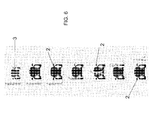
figure 6 shows a sequence of schematic images of a pedestrian crossing in which a pedestrian and a vehicle provided with the signalling device of the present invention converge. - With reference to such
figures, 1 wholly and schematically indicates a safety signalling device made in accordance with the present invention for amotor vehicle 3. - The
signalling device 1 can be installed in an optional manner on all new vehicles, but it could also be applied to vehicles already in circulation. - The structural characteristics of the
safety signalling device 1 of the present invention allow it to be installed on any motor vehicle equipped with a normal electric system, even through a post-sale installation. From this point of view thesignalling device 1 can be considered as an accessory or as a spare part and can be supplied as a kit in packages in which all of its component parts can be assembled with one another and can be connected to the electric system of the vehicle with simple rapid fitting operations. - The electric system of the vehicle, not shown since it is of the conventional type, is connected to a power supply battery of 12V or of 24V which is schematically shown in the drawings only with its own
positive voltage 13 and ground 11 terminations. - The
signalling device 1 comprises at least oneadditional light source 2 fitted on thefront part 4 or the front/side part of thevehicle 3. The actuation of thesource 2 is slaved to a pressure on apedal 18 of the brake of the vehicle, as shall become clearer from the following description. - More in particular, the
light source 2 can be installed outside on a body portion of thevehicle 3. - For example, without this representing any limitation to the rights of the Applicant, the
light source 2 can be installed at anoutside wing mirror 5 of thevehicle 3. - For purposes of symmetry and of greater safety, it is preferable for at least two
light sources 2 to be independently installed on respective front and side portions of thevehicle 3, for example on the front right side and front left side positions. - If it is desired to install a
source 2 on the outer surface of anoutside wing mirror 5, for example the right one, then for symmetry reasons it is advantageous for thesecond source 2 to be installed on the other leftoutside wing mirror 5 of thevehicle 3. - Some outside wing mirrors of modern motor vehicles are supplied with
parking lights 7 or duplicated parking lights, as shown for example infigure 1 . In other cases direction indicator lights are provided on thewing mirrors 5. - If such parking lights or direction indicator lights are already present on the
vehicle 3, thelight sources 2 of thesignalling device 1 can be installed on the side ofsuch parking lights 7 or direction indicators. - Moreover, the
light sources 2 are preferably arranged near to the joint for adjusting the position of the wing mirror, near to the terminations of the electricpower supply cables 19 of the motors for adjusting the wing mirrors or for supplying power to the direction indicators on the wing mirrors. - Advantageously, said at least one
light source 2 is preferably made with high brightness LEDs. Thelight sources 2 arranged on therespective wing mirrors 5 of the right and left side of thevehicle 3 can both be made with high brightness LEDs or with other sources for emitting light like for example xenon lights. - The light source/
s 2 have a suitable colour that is compatible with the rules of the highway code. It is not excluded for the colour to be different from those currently used on vehicles for indicating the parking lights, the indicators and/or the stop lights. In other words, in order to satisfy the purposes that the invention proposes, it may be suitable to adopt completely innovative colours so that, in addition to the position of thesources 2, even the colour or even the intermittent flashing can contribute to an immediate indication of the braking action being carried out. - Advantageously, the
signalling device 1 also comprises anelectric circuit 10 that connects the light source/s 2 to the voltage references of the power supply battery present on thevehicle 3. - More in particular, with reference to
figure 3 , theelectric circuit 10 can be made according to a first example or embodiment linked to acontrol unit 15 of thevehicle 3. - In this embodiment, two
light sources 2 are connected to one another in parallel and are coupled to aground voltage reference 11 and to apositive voltage reference 13, for example the 12V or 24V battery in direct current conventionally present and integral part of the electric system of thevehicle 3. - Between a terminal of the
light sources 2 and the positive voltage reference 13 arelay 14 of an intermittent control is inserted. Such a relay is slaved to a command action made by the driver of thevehicle 3. - Between the
relay 14 and thepositive voltage reference 13 also anelement 16 for protecting against overcurrent is optionally inserted in series, for example a fuse. - Advantageously, the
electric circuit 10 can be installed inside thepassenger compartment 8 of thevehicle 3 fitted into the existing electric system. - More in particular, in the
passenger compartment 8 there is normally a fuse-holder box 9 that is positioned near to the pedals of the vehicle as shown infigure 2 . - On all vehicles there is conventionally a command or switch for actuating the stop lights which is slaved to the
brake pedal 18 not far from the fuse-holder box. Such a command coincides with therelay 14 in the set-up of the present invention. - Inside a
door 22 that defines thepassenger compartment 8 there areelectrical connection cables 19 to supply power to the motors for adjusting and positioning thewing mirrors 5 or to the direction indicators of the wing mirrors. - Normally the fuse-holder box 9 also has supplementary doors available which make it possible to house a new fuse, for example like the
fuse 16 of the diagram offigure 3 . - Based upon the circuit diagram of
figure 3 , thesignalling device 1 of the present invention simply requires anadditional connection wire 17 between the relay and a terminal 23 of thecontrol unit 15 on which there is a voltage reference alternatively positive and negative. - The
relay 14 is slaved to the pressure applied on thebrake pedal 18 by the driver of thevehicle 3, just like what occurs for actuating the rear stop lights. Theconnection 17 makes it possible to make the flashing of the light source/s 2 intermittent following the pressure on the brake pedal due to the inversion in the polarity on the terminal 23. - The actuation of the
sources 2 lasts for the entire time period in which pressure is exerted on the brake pedal. - Therefore, when there is a
control unit 15 supervising the functions of the electric system of thevehicle 3 it is sufficient to provide theelectric connection 17 in order to make thelight sources 2 operative every time thebrake pedal 18 is pressed by the driver of the vehicle. -
Figure 4 shows an embodiment that refers to cases in which there is nocontrol unit 15 in thevehicle 3. - A
switch 21 is therefore inserted on theconnection 17 between therelay 14 and the alternatingvoltage terminal 23. Thisswitch 21 is in turn slaved to the pressure on thebrake pedal 18. -
Figure 5 shows an alternative embodiment with respect tofigure 4 in which the relay is indicated withreference numeral 24 being a command that is not intermittent. In this variant thesources 2 would be constantly on during the entire period in which pressure is exerted on thebrake pedal 18. - The principle upon which the present invention is based is that of providing a pedestrian with the certainty that the driver of a vehicle that is coming has perceived his presence and has consequently started to brake.
- The invention allows the pedestrian to rely on objective signals and does not leave any room for simple judgement for example on the position of the vehicle, lower on the front in the case of braking, or on the eye movement of the driver which expresses that he has become aware of the pedestrian.
- Therefore, the signalling device of the present invention is part of the vehicle but it allows the pedestrian (or cyclist) to realize that the vehicle is slowing down or braking to allow him to cross. The visual signal that reaches the pedestrian has the same value as the direction indicators or rear stop lights, that is to say it allows information to be transmitted which makes it possible to understand the intention of the driver, who has seen the pedestrian and is braking.
-
Figure 6 schematically illustrates this situation in the form of a sequence of images that show a pedestrian on the side of the road and an oncoming vehicle equipped with the device of the present invention. The pedestrian has the opportunity of understanding the behaviour of the driver of the vehicle since the signalling sources on the wing mirrors are actuated in conjunction with the pressure on the brake pedal. The pedestrian thus has the possibility of realizing that the driver has identified him and is braking so as to give him way to cross the road. - The invention is also effective in other situations of possible danger on the roads, for example near to roundabouts drivers of vehicles that have to access the roundabout must have the certainty that the driver already on it is slowing down.
- Therefore, the device according to the invention makes it possible to understand from outside if a driver is braking in the same manner with which it can be easily identified that a driver is turning thanks to the direction indicators.
Claims (10)
- Safety signalling device (1) for a motor vehicle (3) provided with an electric system connected to a power supply battery and with an actuation control (14) of the stop lights slaved to a pedal (18) of the brake of the vehicle, characterised in that it comprises:- at least one signalling light source (2);- an electric circuit (10) for supplying power and connecting between at least one light source (2) and a voltage reference (11, 13) of the electric system of said vehicle (3);- an electric connection (17) between said actuation control (14) of the stop lights and a terminal (23) with alternating voltage reference to activate the intermittent actuation of said at least one light source (2) in conjunction with pressure on the brake pedal (18).
- Signalling device (1) according to claim 1, characterised in that it comprises a switch (20) inserted on said electric connection (17) and in turn slaved to pressure on said brake pedal (18).
- Signalling device (1) according to claim 1, characterised in that it comprises a fuse (14) between said relay and a voltage reference (13).
- Signalling device (1) according to claim 1, characterised in that said at least one light source (2) is installed as part of the front (4) or front/side portion of the vehicle (3).
- Signalling device (1) according to claim 1, characterised in that said at least one light source (2) is installed on an outer surface of an outside wing mirror (5) of the vehicle (3).
- Signalling device (1) according to claim 5, wherein the outer surface of the outside wing mirror (5) of the vehicle is provided with a parking light (7) or a direction indicator light, characterised in that said at least one light source (2) is installed on the side of such parking lights (7) or of the direction indicators.
- Signalling device (1) according to claim 1, characterised in that said light source (2) is made with high brightness LEDs.
- Signalling device (1) according to claim 1, characterised in that the actuation of said at least one light source (2) is intermittent.
- Signalling device (1) according to claim 1, characterised in that the actuation of said at least one light source (2) lasts for the entire duration of the period in which pressure is exerted on the brake pedal (18).
- Signalling device (1) according to claim 3, characterised in that said fuse (16) is built into the fuse box present in the passenger compartment (8) of the vehicle (3).
Priority Applications (1)
| Application Number | Priority Date | Filing Date | Title |
|---|---|---|---|
| EP11000092A EP2474447A1 (en) | 2011-01-07 | 2011-01-07 | Safety signaling device for motor vehicles |
Applications Claiming Priority (1)
| Application Number | Priority Date | Filing Date | Title |
|---|---|---|---|
| EP11000092A EP2474447A1 (en) | 2011-01-07 | 2011-01-07 | Safety signaling device for motor vehicles |
Publications (1)
| Publication Number | Publication Date |
|---|---|
| EP2474447A1 true EP2474447A1 (en) | 2012-07-11 |
Family
ID=43971963
Family Applications (1)
| Application Number | Title | Priority Date | Filing Date |
|---|---|---|---|
| EP11000092A Ceased EP2474447A1 (en) | 2011-01-07 | 2011-01-07 | Safety signaling device for motor vehicles |
Country Status (1)
| Country | Link |
|---|---|
| EP (1) | EP2474447A1 (en) |
Cited By (4)
| Publication number | Priority date | Publication date | Assignee | Title |
|---|---|---|---|---|
| DE102014209984A1 (en) * | 2014-05-26 | 2015-11-26 | Volkswagen Aktiengesellschaft | Method and device for identifying an automatically moving vehicle |
| IT201800007579A1 (en) * | 2018-07-27 | 2020-01-27 | Giardini Immobiliare 2 Srl | BRAKING SIGNAL DEVICE POSITIONABLE FRONT OF A VEHICLE |
| EP3747699A1 (en) * | 2019-06-08 | 2020-12-09 | Lumaco Innovations AG | Wiring of front braking lights for vehicles |
| CN113408333A (en) * | 2021-04-27 | 2021-09-17 | 上海工程技术大学 | Method for distinguishing pedestrian traffic behaviors in subway station based on video data |
Citations (5)
| Publication number | Priority date | Publication date | Assignee | Title |
|---|---|---|---|---|
| US4751493A (en) * | 1985-12-16 | 1988-06-14 | Miller Terry G | Kit for retrofitting automobiles with deceleration warning light |
| DE29715526U1 (en) * | 1997-08-29 | 1997-11-20 | Sigrist, Alois, Kriens | Motor vehicle with front brake lights |
| DE19730967A1 (en) * | 1996-07-22 | 1998-01-29 | Keith Allan Day | Automobile signalling device |
| WO2002036387A1 (en) * | 2000-11-06 | 2002-05-10 | Santa Cruz Cathy D | Method and apparatus used for installation and operation of a front vehicle brake light |
| US20100177529A1 (en) * | 2009-01-13 | 2010-07-15 | Shimizu Jyoshin | Automobile brake lamp |
-
2011
- 2011-01-07 EP EP11000092A patent/EP2474447A1/en not_active Ceased
Patent Citations (5)
| Publication number | Priority date | Publication date | Assignee | Title |
|---|---|---|---|---|
| US4751493A (en) * | 1985-12-16 | 1988-06-14 | Miller Terry G | Kit for retrofitting automobiles with deceleration warning light |
| DE19730967A1 (en) * | 1996-07-22 | 1998-01-29 | Keith Allan Day | Automobile signalling device |
| DE29715526U1 (en) * | 1997-08-29 | 1997-11-20 | Sigrist, Alois, Kriens | Motor vehicle with front brake lights |
| WO2002036387A1 (en) * | 2000-11-06 | 2002-05-10 | Santa Cruz Cathy D | Method and apparatus used for installation and operation of a front vehicle brake light |
| US20100177529A1 (en) * | 2009-01-13 | 2010-07-15 | Shimizu Jyoshin | Automobile brake lamp |
Cited By (5)
| Publication number | Priority date | Publication date | Assignee | Title |
|---|---|---|---|---|
| DE102014209984A1 (en) * | 2014-05-26 | 2015-11-26 | Volkswagen Aktiengesellschaft | Method and device for identifying an automatically moving vehicle |
| DE102014209984B4 (en) | 2014-05-26 | 2024-11-14 | Volkswagen Aktiengesellschaft | Method and device for marking an automatically driving vehicle |
| IT201800007579A1 (en) * | 2018-07-27 | 2020-01-27 | Giardini Immobiliare 2 Srl | BRAKING SIGNAL DEVICE POSITIONABLE FRONT OF A VEHICLE |
| EP3747699A1 (en) * | 2019-06-08 | 2020-12-09 | Lumaco Innovations AG | Wiring of front braking lights for vehicles |
| CN113408333A (en) * | 2021-04-27 | 2021-09-17 | 上海工程技术大学 | Method for distinguishing pedestrian traffic behaviors in subway station based on video data |
Similar Documents
| Publication | Publication Date | Title |
|---|---|---|
| US10625666B2 (en) | System for detecting surrounding conditions of moving body | |
| US20070222574A1 (en) | Multi vehicle signal ground illumination indicator lamps for turn, hazard and brake signaling to enhance current methods of use | |
| US20140049973A1 (en) | Headlamp control apparatus | |
| EP2789504A2 (en) | Warning device and method for vehicles | |
| US20170096095A1 (en) | A warning system for a vehicle and a vehicle comprising such a warning system | |
| KR20200057865A (en) | Apparatus and method for transmitting driving information of vehicle | |
| US9789812B2 (en) | Forward warning system for motor vehicles | |
| EP2474447A1 (en) | Safety signaling device for motor vehicles | |
| US20070159319A1 (en) | Warning Device and System | |
| US20210188163A1 (en) | U-turn signal indicator | |
| US6663271B1 (en) | Brake light for motor vehicles | |
| CN102398544B (en) | Maneuvering aid for commercial vehicle | |
| JPH05238307A (en) | Front view device for vehicle | |
| KR20170001677A (en) | lamp for traffic signal at the front of car | |
| CN201800639U (en) | Vehicle sight line monitoring and warning device | |
| ES2277201T3 (en) | INFORMATION DEVICE. | |
| RU116422U1 (en) | AUTOMATIC VEHICLE INDICATION SYSTEM (OPTIONS) | |
| WO2007051268A2 (en) | Frontal safety light for motor vehicles | |
| JP3125500U (en) | Automotive stop indicator light | |
| ES2253062B1 (en) | DEVICE FOR BRAKING SIGNALING IN VEHICLES. | |
| JP3228460U (en) | Flashing device for pausing crossing and flashing system for pausing crossing | |
| KR200314321Y1 (en) | Circuit for lighting the break lamp | |
| RU195165U1 (en) | STOP ALARM DEVICE (NOT MOTION) | |
| TWM674581U (en) | Front warning system | |
| KR200224969Y1 (en) | An indication equipment of u-turn for a direction indication of a car |
Legal Events
| Date | Code | Title | Description |
|---|---|---|---|
| PUAI | Public reference made under article 153(3) epc to a published international application that has entered the european phase |
Free format text: ORIGINAL CODE: 0009012 |
|
| AK | Designated contracting states |
Kind code of ref document: A1 Designated state(s): AL AT BE BG CH CY CZ DE DK EE ES FI FR GB GR HR HU IE IS IT LI LT LU LV MC MK MT NL NO PL PT RO RS SE SI SK SM TR |
|
| AX | Request for extension of the european patent |
Extension state: BA ME |
|
| STAA | Information on the status of an ep patent application or granted ep patent |
Free format text: STATUS: THE APPLICATION HAS BEEN REFUSED |
|
| 18R | Application refused |
Effective date: 20120804 |