EP2473975B1 - Schätzung der reflexionsmodellparameter aus einem bild - Google Patents
Schätzung der reflexionsmodellparameter aus einem bild Download PDFInfo
- Publication number
- EP2473975B1 EP2473975B1 EP10813149.1A EP10813149A EP2473975B1 EP 2473975 B1 EP2473975 B1 EP 2473975B1 EP 10813149 A EP10813149 A EP 10813149A EP 2473975 B1 EP2473975 B1 EP 2473975B1
- Authority
- EP
- European Patent Office
- Prior art keywords
- reflectance
- model
- image
- parameters
- refraction
- Prior art date
- Legal status (The legal status is an assumption and is not a legal conclusion. Google has not performed a legal analysis and makes no representation as to the accuracy of the status listed.)
- Not-in-force
Links
Images




Classifications
-
- G—PHYSICS
- G06—COMPUTING OR CALCULATING; COUNTING
- G06T—IMAGE DATA PROCESSING OR GENERATION, IN GENERAL
- G06T7/00—Image analysis
- G06T7/50—Depth or shape recovery
- G06T7/514—Depth or shape recovery from specularities
-
- G—PHYSICS
- G06—COMPUTING OR CALCULATING; COUNTING
- G06T—IMAGE DATA PROCESSING OR GENERATION, IN GENERAL
- G06T7/00—Image analysis
- G06T7/50—Depth or shape recovery
- G06T7/55—Depth or shape recovery from multiple images
- G06T7/586—Depth or shape recovery from multiple images from multiple light sources, e.g. photometric stereo
-
- G—PHYSICS
- G06—COMPUTING OR CALCULATING; COUNTING
- G06V—IMAGE OR VIDEO RECOGNITION OR UNDERSTANDING
- G06V10/00—Arrangements for image or video recognition or understanding
- G06V10/40—Extraction of image or video features
- G06V10/60—Extraction of image or video features relating to illumination properties, e.g. using a reflectance or lighting model
-
- G—PHYSICS
- G06—COMPUTING OR CALCULATING; COUNTING
- G06T—IMAGE DATA PROCESSING OR GENERATION, IN GENERAL
- G06T2207/00—Indexing scheme for image analysis or image enhancement
- G06T2207/10—Image acquisition modality
- G06T2207/10024—Color image
-
- G—PHYSICS
- G06—COMPUTING OR CALCULATING; COUNTING
- G06T—IMAGE DATA PROCESSING OR GENERATION, IN GENERAL
- G06T2207/00—Indexing scheme for image analysis or image enhancement
- G06T2207/20—Special algorithmic details
- G06T2207/20081—Training; Learning
-
- G—PHYSICS
- G06—COMPUTING OR CALCULATING; COUNTING
- G06T—IMAGE DATA PROCESSING OR GENERATION, IN GENERAL
- G06T2207/00—Indexing scheme for image analysis or image enhancement
- G06T2207/30—Subject of image; Context of image processing
- G06T2207/30196—Human being; Person
- G06T2207/30201—Face
Definitions
- the disclosure concerns processing of electronic images, such as hyperspectral, multispectral or trichromatic images.
- a method, software and computer for estimating parameters of a reflectance model applied to an image are disclosed.
- Examples of processing of the images using the estimated parameters include material recognition, recolouring and re-shading of objects represented in the image.
- Photometric invariance has found applications in computer vision and pattern recognition for purposes of recognition and shape recovery.
- the intrinsic relation between photometric invariance and shape recovery is due to the fact that the reflectance of an object is estimated not only by the light source L and viewing directions V , but also by the material properties of the surface under study.
- United States patent publication US 2003/012448 A1 discloses a system and a method to solve an estimation problem of finding reflectance R and illumination L.
- the system and method solve a functional of the unknown illumination L such that a minimum of the functional is assumed to yield a good estimate of the illumination L. It is assumed that a good estimate of the illumination L implies a good estimate of the reflectance R. Euler-Lagrange equations may be used to obtain conditions for a minimisation problem involving the functional.
- a computer implemented method includes estimating one or more of photogrammetric parameters ⁇ ( u ), surface shape N and index of refraction n ( u , ⁇ ) represented in a reflectance image having one or more known illumination directions L and a single known viewing direction V .
- the method comprises:
- Surface shape is understood to mean, but is not limited to, the orientation of the surface under study and can be equivalent to the surface normal N .
- This surface normal N may be expressed using the surface gradients p ( u ) and q ( u ) .
- Photometric invariants is understood here to mean the physical properties of the material under study that is independent of the lighting conditions (including the type of light, the light power spectrum and light direction) and the geometric shape of the object.
- One or more images are acquired using different lighting directions L with a known illuminant power spectrum. Given these conditions, using the method disclosed here the surface shape N , material index of refraction n ( u, ⁇ ) and/or its photogrammetric parameters ⁇ ( u ) can be estimated.
- the recovery process is formulated as an optimisation which aims to fit the reflectance models under study to the image optimisation which aims to fit the reflectance models under study to the image reflectance.
- the approach presented has the advantages of being general and can be applied to a family of reflectance models that are based on Fresnel reflection theory. That is, the reflectance model and the optimisation procedure have the advantage of being general to a family of reflectance models.
- the most appropriate reflectance model for the image which may be selected depending on the processing to be performed on the image may be used in this method. Also the method may be used on any combination of known and unknown parameters of the reflectance model.
- Photogrammetric parameters ⁇ ( u ) may be parameters of the reflectance model and may be one or more of:
- the number of spectral bands in a multispectral or hyperspectral image may range from 4 to 1000s.
- the number of light source directions required is based on the number of spectral bands and the specific reflectance model used. Typically, the lesser number of bands requires the larger number of light directions to be known.
- the reflectance image comprises more than one image where each image has a different illumination direction L and the same viewing direction V and wherein optimising comprises optimising the fit of each reflectance image to the reflectance model.
- the viewing direction V , light source direction L, and surface normal direction N need not be coplannar.
- the disclosure concerns estimating one or more of photogrammetric parameters ⁇ ( u ), surface shape N and index of refraction n ( u, ⁇ ) however in one more embodiments the estimation may be sufficiently accurate to be considered a correct determination.
- the reflectance model may be based on a Fresnel term ⁇ ( ⁇ ).
- the Fresnel term may be based on scene geometry (such as light incidence angle ⁇ i , illumination direction L , surface shape N or viewing direction V ) and the index of refraction n ( u, ⁇ ). That is, the Fresnel term ⁇ ( ⁇ ) is wavelenth dependent.
- the reflectance model may be further based on a second term ⁇ (.) that is based on scene geometry and photogrammetric parameters. That is, the second term ⁇ (.) is based on ⁇ ( u ) a set of reflection-angle variables (such as variables describing the incident light L , viewing direction V and local surface normal N direction) and photogrammetric parameters ⁇ ( u ). Parameters ⁇ ( u ) that describe reflection-angle variables may be expressed in terms of the surface gradients p ( u ) and q ( u ).
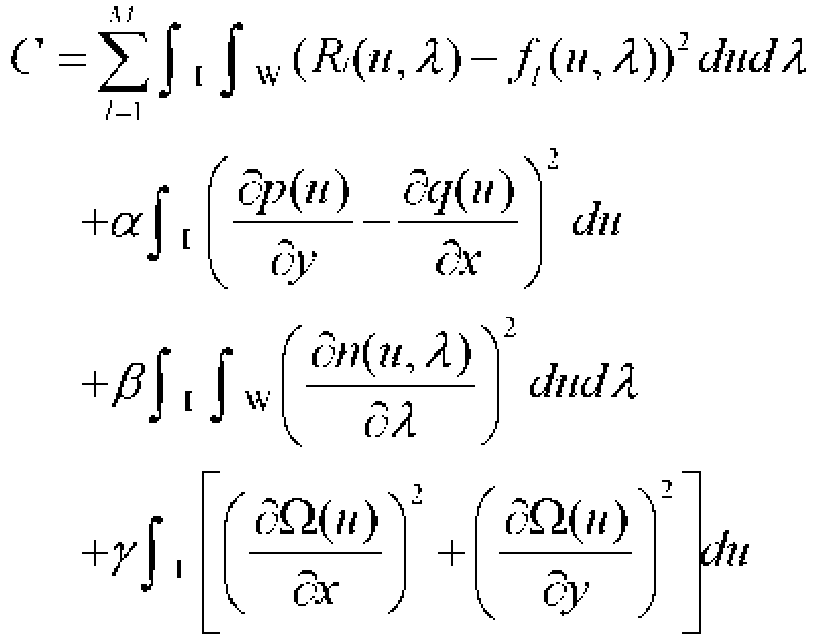
- the difference between the reflectance image and a reflectance model may be defined by a cost function C .
- the cost function C is constrained by a surface integrability constraint that may be based on the surface shape N , in particular surface gradients p ( u ) and q ( u ) are constrained so that their cross partial derivatives are equal.
- the cost function C may be constrained by the smoothness on the spectral variation of the refractive index n ( u, ⁇ ).
- the cost function may be constrained by a spatial smoothness constraint on the set of photogrammetric parameters ⁇ ( u ), which may include the surface microfacet roughness. Each constraint is weighted to control its contribution to the cost function C .
- the step of optimising the cost function may comprise iteratively minimising a set of Euler-Lagrange equations representative of the cost function. This minimisation is a gradient descent optimisation approach of the cost function in the parameter space.
- the method may further comprise receiving a reflectance model to be used in the optimisation.
- the reflectance model may be one of:
- reflectance models are not limited to application to images having Lambertian reflectance, and instead the reflectance model of this disclosure can accommodate materials of different types captured within the image.
- the method may further comprise receiving a user selection or selecting a reflectance model based on the intended use of the one or more estimated photogrammetric parameters ⁇ ( u ) , surface shape N and index of refraction n ( u, ⁇ ).
- One or more of photogrammetric parameters ⁇ ( u ), surface shape N and index of refraction n ( u, ⁇ ) that optimise the cost function may be represented by parameters of the reflectance model.
- the method may further comprise receiving values for one or more parameters of the reflectance model for the image.
- the parameters may be values based on surface shape N , the material index of refraction n ( u, ⁇ ) or a set of photogrammetric parameters ⁇ ( u )
- the method may further comprise using one or more of the estimated photogrammetric parameters ⁇ ( u ), surface shape N and index of refraction n ( u , ⁇ ) in processing of the image.
- the processing of the image includes one or more of:
- the optional features of the method described above are also optional features of the software, in that the software may cause the computer to perform to perform those optional features.
- the processor may further operate to identify one or more of photogrammetric parameters , surface shape N and index of refraction n ( u , ⁇ ) that optimised the cost function.
- the computer may further include storage means and input/output means.
- the computer may further comprise output means to provide output of the estimated one or more of photogrammetric parameters ⁇ ( u ), surface shape N and index of refraction n ( u , ⁇ ) that optimise the difference between the reflectance image and the reflectance model.
- the output may be to a display or provided as input to a post-processing method performed by the processor on the image.
- Examples of a computer include a standalone personal computer or simply a processor incorporated into a camera.
- This disclosure identifies the constraints under which the generally ill-posed problem of simultaneous recovery of surface shape and its photometric invariants can be rendered tractable. We focus our attention on the constraints for the simultaneous recovery of the object shape and photogrammetric parameters from a single view image. The constraints presented here provide a unified setting and understanding of photometric invariant and shape recovery methods based upon variational techniques.
- these reflectance models are those which involve, in general, a wavelength dependent Fresnel term that accounts for the reflection, transmission and refraction of light through the boundary between different object media. This term, in turn, depends on the incident angle ⁇ i and index of refraction n .
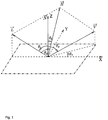
- the reflection geometry is defined with respect to a local coordinate system whose origin is the surface location and whose z-axis is aligned to the normalised local surface normal N .
- the incident light direction L is defined by the zenith and azimuth angles ⁇ i and ⁇ i respectively. Accordingly, the zenith and azimuth angles of the viewer's direction V are ⁇ s and ⁇ s .
- ⁇ i ⁇ .
- the reflection geometry can be equivalently represented by the angular difference ⁇ d between L and H , the half angle ⁇ h between N and H and the incident angle ⁇ i . This geometry is illustrated in Fig. 1 .
- ⁇ ( u ) scene geometry variables, that is the set of reflection-angle variables describing the incident light L , viewing V and local surface normal directions N .
- n(u, ⁇ ) is the wavelength-dependent index of refraction of the surface material under monochromatic light.
- ⁇ ( u ) is the set of photogrammetric parameters, such as the local microfacet slope and its distribution, as well as the masking and shadowing factors.
- ⁇ ( u ) and ⁇ ( u ) are wavelength independent.
- the function ⁇ ( ⁇ ) in Equation 1 involves a Fresnel term, which is directly related to the incident angle ⁇ i and the index of refraction n ( u, ⁇ ).
- the function ⁇ ( ⁇ ) depends solely on the light source L and viewer direction V , the surface orientation N and the photogrammetric parameters ⁇ ( u ).
- the angles ⁇ l ( u ) at every pixel site u in the l th image vary with respect to the illumination direction L .
- the parameters n ( u , ⁇ ) and ⁇ ( u ) are invariant to the illumination direction L and viewing direction V .
- the function z ( x , y ) is, in effect, the height map at the surface location ( x , y ) that corresponds to the pixel location u .
- the system above consists of M ⁇ N ⁇ K equations with (
- this system is only well-defined if and only if the number of equations is at least the same as the number of variables. In other words, the problem is only solvable with at least M ⁇ (
- the arguments of the cost function C are the surface gradients p ( u ) and q ( u ), the index of refraction n ( u , ⁇ ) and the photogrammetric parameter-set ⁇ ( u ).
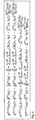
- the weights ⁇ , ⁇ and ⁇ control the contribution to the cost function of the integrability constraint, the spectral smoothness constraint on the refractive index and spatial smoothness constraint on the surface scattering variables, respectively.
- Fig. 3 we show the set of resulting update equations, where the superscripts denoting the iteration number.
- the shorthands are defined as follows, in which p ⁇ ( u ) and q ⁇ ( u ) are the cross-derivatives of p ( u ) and q ( u ) approximated by finite differences (times ⁇ s 2 ).
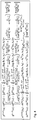
- Equation 1 captures a family of existing reflectance models in the literature. We do this by establishing a correspondence between the generic parameter sets in the general model and those specific to some of the models used by the computer vision and graphics communities. This is important since it provides a proof of concept that the process of model parameter recovery presented above can be performed on each of these reflectance models at hand. It also provides an explicit link between the equations above and the reflectance models in the literature.
- the Fresnel theory has been used extensively in the optics, computer vision and graphics literature to derive reflectance models.
- the Beckmann-Kirchoff model [1] originated from Kirchoff's theory on the scattering of electromagnetic waves.
- Torrance and Sparrow [8] employed the Fresnel reflection coefficient to model specular reflection.
- Wolff [10] derived a diffuse reflectance model for layered dielectrics by analysing the reflection, transmission and refraction of light at the surface boundary.
- This model can be selected when the surface captured in the image is matt with an intermediate or high level of surface roughness.
- the Beckmann- Kirchoff model [1] predicts the mean scattered power from a surface point u at wavelength ⁇ as a summation of two terms.
- the first of these represents the scattering component in the specular direction.
- the second term corresponds to the diffuse scattering component.
- the surface reflectance is the same as the diffused scattered power.
- the two most popular approximations of the diffuse reflectance are formulated in the cases of Gaussian and exponential surface correlation functions [1].
- Equation3 ⁇ is the standard deviation of the height variation with respect to the mean surface level and the surface correlation length T gives the relative horizontal spacing between the micro-surface extrema.
- Equation 3 the geometric factor G BK explains the attenuation of emitted light by the surface orientation with respect to illuminant and viewing directions.
- This model can be selected when matt surfaces are captured in the image.
- This model can be selected for surfaces captured in an image comprising perfectly specular microfacet structure.
- Equation 7 the first term is the diffuse reflectance component that obeys Lambert's cosine law and is assigned a weight w d .
- the latter term is the specular reflectance component.
- a f is the microfacet's area.
- G TS ( ⁇ ip , ⁇ sp ) is the geometric attenuation factor which depends on the projections ⁇ ip and ⁇ sp of the angular variables ⁇ i and ⁇ s onto the plane spanned by the facet normal and the mean surface normal N .
- ⁇ denotes the angle between the facet normal and the mean surface normal.
- this distribution may assume a Gaussian distribution that is rotationally symmetric about the mean surface normal, P ⁇ ⁇ ⁇ ⁇ N 0 ⁇ ⁇ 2 , where N 0 ⁇ ⁇ 2 is a Gaussian distribution with zero mean and a standard deviation ⁇ ⁇ .
- This model can be selected when the surface captured in the image is made of a smooth matt dielectric material.
- the model proposed by Wolff [10] is derived from the theory of radiative transfer through layered dielectric surface boundaries. To predict the departure in behaviour from the Lambertian model at large angles between the illuminant and viewing directions, Wolff viewed the energy flux emerging through subsurface as a result of refractive and reflective phenomena inside the dielectric body. This model is hence explained through the use of Snell's law of refraction and the Fresnel attenuation factor.
- ⁇ w is the total diffuse albedo after multiple diffuse subsurface scattering.
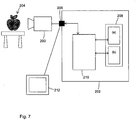
- This computer system comprises a sensor 200 and a computer 202.
- the sensor 200 is a hyperspectral camera that is able to capture an image of a scene 204, in this case the apple sitting on a table.
- the camera may have a number of bands that balances computational costs with accuracy.
- the camera may have as low as four bands and as high as hundreds.
- the scene is captured from a known fixed viewing direction V and from one or more illumination directions L .
- the received image is stored in local memory 208(b) by the processor 210.
- the image may be stored and used in this method in the compact representation form as described in WO 2009/152583 .
- the processor 210 uses the software stored in memory 208(a) to perform the method shown in Fig. 8 . In this sense the processor performs the method of a solver to estimate parameters of a selected reflectance model for the image.
- the software provides a user interface that can be presented to the user on a monitor 212.
- the user interface is able to accept input from the user (i.e. touch screen), such as the image, reflectance model selection, any known values of parameters of the selected reflectance model for the image, viewing V and illumination directions L .
- the user input is provided to the input/out port 206 by the monitor 212.
- the selected image is stored in memory 208(b) by the processor 210.
- the memory 208(b) is local to the computer 202, but alternatively could be remote to the computer 202.
- the user selection of the reflectance model is the Beckmann-Kirchoff model as shown in equation (5). That means that the user is attempting to recover the parameters surface gradients p ( u ) and q(u), index of refraction n ( u, ⁇ ) and roughness m ( u ) .
- the computer is programmed to automatically select the most appropriate model based on an analysis of the image, such as degree of specularity etc.
- the user also enters into the user interface the viewing direction V and the illumination direction L for each image. Since the values of the parameters of the reflectance model are not known, no parameter values are entered.
- the user also enters the material that they wish to identify, in this case it is apple.
- the processor 210 executes the software 208(a) to optimise the cost function of equation (3) that fits the reflectance image(s) to a reflectance model 802.
- the cost function used to fit the Beckmann-Kirchoff model is based on surface normal N , the material index of refraction n ( u, ⁇ ) and a set of photogrammetric parameters ⁇ ( u ).
- the independent parameters of the model p, q, m and n are initialized.
- the processor To perform the first iteration the processor must also derive values of the reflectance ⁇ and its partial derivatives ⁇ p , ⁇ q , ⁇ m and ⁇ n since they are required by equation (5). Since ⁇ and its partial derivatives ⁇ p , ⁇ q , ⁇ m and ⁇ n are dependent on p, q, m and n for this model, this can be computed by the processor before each new iteration as required based on the current values of p, q, m and n .
- ⁇ , ⁇ p , ⁇ q , ⁇ m and ⁇ n are precomputed based on the Beckmann-Kirchoff model and stored in memory 208(b).
- the processor accesses the table that is specific to the Beckmann-Kirchoff model and estimate the values of ⁇ , ⁇ p , ⁇ q , ⁇ m and ⁇ n based on the initialized values of p, q, m and n .
- a first iteration of the equations shown in Fig. 3 is computed.
- the reflectance value ⁇ l t u , ⁇ k of the selected model at the current values of the parameters p, q, m, n are accessed by the processor 210 based on a table akin to Table 4 stored in memory 208(b).
- Line-search is a numerical optimisation method which searches the parameter space in the negative gradient direction for the optimal values of the parameters.
- the cost to be optimised here is the whole cost functional C in equation 2.
- the cost functional C decreases by an amount below a threshold, or the model parameters are changed by only an amount below a preset threshold and the optimising is complete.
- the photogrammetric parameters ⁇ ( u ), surface shape N and index of refraction n ( u, ⁇ ) that optimise the cost function are identified 804. That is the values given by the last iteration are identified as the best estimate of ⁇ ( u ), surface shape N and index of refraction n ( u, ⁇ ) using the solver.
- the identified values of p, q, m and n are then saved in memory 208(b) and also displayed on the user interface.
- the refractive index n and roughness m are used to classify each pixel as belonging to the apple or not.
- the range of a priori values for n and m are stored in memory 208(a) for a range of materials, including apples.
- the processor matches the user input of the apple to the appropriate entry in the table to extract the appropriate range of values for that entry.
- the processor 210 operates to compare the values n and m of each pixel with the range, and if the pixel falls within the range it marks the pixel with a flag.
- the processor 210 also causes the image to be presented on the user interface with all pixels flagged by the processor as having the characteristics of an apple's material identified, such as by a shading of those pixels in a particular colour.
- some of the parameters p, q, m and n may be known.
- the corresponding equation of known parameters of Fig. 4 is simply not performed and in turn the parameter space that can be explored by the line search is reduced.
- the known value of p, q, m and/or n is provided as user input at the start of the process with the other values such as V and L .
- the user interface/monitor 212 and processor 202 may be incorporated within the camera 200 so that processing of the image occurs locally on the camera.
- the user wants to take images of the apple and change the surface material of the apple so that it resembles another material, such as marble.
- the user also enters in the user interface the material they wish to change the apple surface to.
- marble is entered from a list of materials.
- the processor 210 looks in the materials table stored in memory 208(b) to recover the values for m and n for marble.
- the computer 202 may be connected to a further computer system, either local or remote, that receives a copy of the image. Further alternatively, the computer 202 may simply operate to display the user interface on the monitor and receive the user input which is then passed to a remote computer system that performs the method described above and returns the image to the computer 202 via port 206 for display on the user interface.
- Table 2 reports the overall accuracy of the needle maps recovered by our method and that of Worthington and Hancock (W&H), across all the materials and surface roughness under study.
- Table 2 Shape error Refractive index error One illuminant Two iluminants W&H One illuminant Two iluminants Ridge 12.0 ⁇ 12.3 12.8 ⁇ 13.9 11.9 ⁇ 9.4 0.0990 ⁇ 0.0555 0.0990 ⁇ 0.0555 Volcano 18.0 ⁇ 12.44 18.0 ⁇ 12.4 18.17 ⁇ 14.6 0.0990 ⁇ 0.0555 0.0990 ⁇ 0.0555
- the error is expressed as the deviation angle per-pixel from the ground-truth needle map, in degrees.
- our algorithm is comparable to the alternative method in recovering the shape of the Ridge and the Volcano. Note that our algorithm is performed on multispectral images synthesised using Vernold Harvey model, which is more complex than the Lambertian images input to Worthington and Hancock's algorithm. Also note that the needle map accuracy is consistent in both the single illuminant and two illuminant cases. This demonstrates the robustness of the algorithm in cases where shadows appear under a light source direction, but not the other.
- Fig. 5 illustrates the needle maps recovered from the synthetic images.
- the first columns of maps shows the ground truth.
- Second column shows those recovered by our method using a single illuminant.
- Third column shows those recovered by our method using two illuminants.
- Fourth column shows those recovered by Worthington and Hancock.
- index of refraction was treated as a feature vector for skin segmentation.
- the segmentation task is viewed as a classification problem where the skin and non skin spectra comprise positive and negative classes.
- segmentation accuracy when using the index of refraction with the raw reflectance spectra which has been normalised by the illuminant power.
- Fig. 6 we show the original image of a human face captured at the wavelength of 670nm in the first column.
- the skin segmentation maps making use of the index refraction recovered under one and two light source directions are shown in the middle columns.
- the right most column shows the skin map recovered using the raw reflectance.
- the brightness of the pixel corresponds to the likelihood of being skin.
- the former two segmentation maps are similar for the subjects. This confirms the effectiveness of our regularizers in enforcing additional constraints in the case of single light direction. These constraints, as can be seen, achieve a performance close to that for two light source directions.
- the raw reflectance spectra result in more false positives and negatives than the index of refraction, which proves that the refractive index is a better photometric invariant for recognition purposes.
- the correct detection rate is the percentage of skin pixels correctly classified.
- the false detection rate is the percentage of non-skin pixels incorrectly classified.
- the classification rate is the overall percentage of skin and non-skin pixels correctly classified.
- Processing of the image includes, but is not limited to:
- Processing of an image in this way could be included as a function available on a camera 200, or on a separate computer having software installed to process the image 202.
- the application will often have the benefit of reducing the number of cameras needed to produce the same analysis, reducing the set up costs.
- Suitable computer readable media may include volatile (e.g. RAM) and/or non-volatile (e.g. ROM, disk) memory, carrier waves and transmission media.
- exemplary carrier waves may take the form of electrical, electromagnetic or optical signals conveying digital data streams along a local network or a publicly accessible network such as the internet.
Landscapes
- Engineering & Computer Science (AREA)
- Physics & Mathematics (AREA)
- General Physics & Mathematics (AREA)
- Theoretical Computer Science (AREA)
- Computer Vision & Pattern Recognition (AREA)
- Software Systems (AREA)
- Multimedia (AREA)
- Investigating Or Analysing Materials By Optical Means (AREA)
- Image Generation (AREA)
Claims (13)
- Computerimplementiertes Verfahren zum Schätzen eines Satzes photogrammetrischer Parameter, einer Oberflächenform und eines Materialbrechungsindex, dargestellt in einem Reflexionsbild mit einer oder mehreren bekannten Beleuchtungsrichtungen und einer einzigen bekannten Betrachtungsrichtung, dadurch gekennzeichnet, dass das Verfahren Folgendes umfasst:Minimieren einer Kostenfunktion, die einen Unterschied zwischen dem Reflexionsbild und einem Reflexionsmodell definiert, wobei das Reflexionsmodell Informationen in Bezug auf die Oberflächenform, den Materialbrechungsindex und den Satz photogrammetrischer Parameter verwendet, wobei das Minimieren der Kostenfunktion das Aktualisieren der Oberflächenform, das Aktualisieren des Materialbrechungsindex und das Aktualisieren des Satzes photogrammetrischer Parameter umfasst, wobeiRl(u,λ) das Reflexionsbild an einem Ort u für eine Wellenlänge λ und für eine Bildnummer 1 darstellt,fl(u,λ) das Reflexionsmodell darstelltdie Oberflächenform durch die Oberflächengradienten p(u) und q(u) dargestellt wird,der Materialbrechungsindex durch n(u,λ) dargestellt wird die photogrammetrischen Parameter durch Ω(u) dargestellt werden unddie Kostenfunktion als Folgendes definiert ist
- Computerimplementiertes Verfahren nach Anspruch 1, wobei die photogrammetrischen Parameter eines oder mehrere der Folgenden einschließen:Mikroskopischen Rauigkeitsfaktor,lokale Neigung der Mikrofacette,Abblendungsfaktor oderAbschattungsfaktor.
- Computerimplementiertes Verfahren nach Anspruch 1 oder 2, wobei die Oberflächenform auf Oberflächennormalen basiert, die Oberflächengradienten einschließen.
- Computerimplementiertes Verfahren nach Anspruch 1, 2 oder 3, wobei das Reflexionsbild mehr als ein Bild umfasst, wobei jedes Bild eine unterschiedliche Beleuchtungsrichtung und die gleiche Betrachtungsrichtung aufweist und wobei das Minimieren das Minimieren der Anpassung jedes Reflexionsbildes an das Reflexionsmodell umfasst.
- Computerimplementiertes Verfahren nach einem der vorhergehenden Ansprüche, wobei das Reflexionsmodell auf einem Fresnel-Term basiert.
- Computerimplementiertes Verfahren nach Anspruch 5, wobei das Reflexionsmodell ferner auf einem zweiten Term basiert, der einen Satz von Variablen des Reflexionswinkels und photogrammetrische Variablen einschließt.
- Computerimplementiertes Verfahren nach einem der vorhergehenden Ansprüche, wobei die Kostenfunktion derart eingeschränkt ist, dass partielle Kreuzableitungen von Oberflächengradienten gleich sein sollten.
- Computerimplementiertes Verfahren nach einem der vorhergehenden Ansprüche, wobei das Minimieren der Kostenfunktion das iterative Minimieren eines Satzes von Euler-Lagrange-Gleichungen umfasst, die für die Kostenfunktion repräsentativ sind.
- Computerimplementiertes Verfahren nach einem der vorhergehenden Ansprüche, wobei das Reflexionsmodell eines der folgenden ist:Beckmann-Kirchoff-Modell,Vernold-Harvey-Modell,Torrance-Sparrow-Modell undWolff-Modell.
- Computerimplementiertes Verfahren nach einem der vorhergehenden Ansprüche, wobei das Reflexionsmodell mehrere Modellparameter umfasst, wobei der Satz photogrammetrischer Parameter, die Oberflächenform und der Materialbrechungsindex, welche die Differenz zwischen dem Reflexionsbild und dem Reflexionsmodell minimieren, durch die Modellparameter dargestellt werden.
- Computerimplementiertes Verfahren nach einem der vorhergehenden Ansprüche, wobei das Verarbeiten des Bildes Materialerkennnung einschließt.
- Computerlesbares Medium, welches von einem Computer ausführbare Befehle speichert, die, wenn sie von einem Computer ausgeführt werden, bewirken, dass der Computer das Verfahren nach einem der vorhergehenden Ansprüche durchführt.
- Computer zum Schätzen eines Satzes photogrammetrischer Parameter, einer Oberflächenform und eines Materialbrechungsindex, dargestellt in einem Reflexionsbild mit einer oder mehreren bekannten Beleuchtungsrichtungen und einer einzigen bekannten Betrachtungsrichtung, dadurch gekennzeichnet, dass der Computer einen Prozessor umfasst:um eine Kostenfunktion zu minimieren, die einen Unterschied zwischen dem Reflexionsbild und einem Reflexionsmodell definiert, wobei das Reflexionsmodell Informationen in Bezug auf die Oberflächenform, den Materialbrechungsindex und den Satz photogrammetrischer Parameter verwendet, wobei das Minimieren der Kostenfunktion das Aktualisieren der Oberflächenform, das Aktualisieren des Materialbrechungsindex und das Aktualisieren des Satzes photogrammetrischer Parameter umfasst, wobeiRl(u,λ) das Reflexionsbild an einem Ort u für eine Wellenlänge λ und für eine Bildnummer 1 darstellt,fl(u,λ) das Reflexionsmodell darstelltdie Oberflächenform durch die Oberflächengradienten p(u) und q(u) dargestellt wird,der Materialbrechungsindex durch n(u,λ) dargestellt wird,die photogrammetrischen Parameter durch Ω(u) dargestellt werden unddie Kostenfunktion als Folgendes definiert ist

Applications Claiming Priority (3)
| Application Number | Priority Date | Filing Date | Title |
|---|---|---|---|
| AU2009904219A AU2009904219A0 (en) | 2009-09-03 | Phase imaging and shape recovery | |
| AU2010901785A AU2010901785A0 (en) | 2010-04-22 | Determining reflectance model parameters from an image | |
| PCT/AU2010/001005 WO2011026168A1 (en) | 2009-09-03 | 2010-08-09 | Estimating reflectance model parameters from an image |
Publications (3)
| Publication Number | Publication Date |
|---|---|
| EP2473975A1 EP2473975A1 (de) | 2012-07-11 |
| EP2473975A4 EP2473975A4 (de) | 2017-11-08 |
| EP2473975B1 true EP2473975B1 (de) | 2021-11-10 |
Family
ID=43648761
Family Applications (1)
| Application Number | Title | Priority Date | Filing Date |
|---|---|---|---|
| EP10813149.1A Not-in-force EP2473975B1 (de) | 2009-09-03 | 2010-08-09 | Schätzung der reflexionsmodellparameter aus einem bild |
Country Status (4)
| Country | Link |
|---|---|
| US (1) | US8953906B2 (de) |
| EP (1) | EP2473975B1 (de) |
| AU (1) | AU2010291853B2 (de) |
| WO (1) | WO2011026168A1 (de) |
Families Citing this family (16)
| Publication number | Priority date | Publication date | Assignee | Title |
|---|---|---|---|---|
| US9508011B2 (en) * | 2010-05-10 | 2016-11-29 | Videosurf, Inc. | Video visual and audio query |
| US9413477B2 (en) | 2010-05-10 | 2016-08-09 | Microsoft Technology Licensing, Llc | Screen detector |
| US9311708B2 (en) | 2014-04-23 | 2016-04-12 | Microsoft Technology Licensing, Llc | Collaborative alignment of images |
| FR2981772B1 (fr) * | 2011-10-21 | 2017-12-22 | Thales Sa | Procede de reconstruction 3d d'un objet d'une scene |
| US9593982B2 (en) * | 2012-05-21 | 2017-03-14 | Digimarc Corporation | Sensor-synchronized spectrally-structured-light imaging |
| US9189703B2 (en) | 2012-07-09 | 2015-11-17 | Canon Kabushiki Kaisha | Systems and methods for colorimetric and spectral material estimation |
| US9621760B2 (en) | 2013-06-07 | 2017-04-11 | Digimarc Corporation | Information coding and decoding in spectral differences |
| US9805510B2 (en) * | 2014-05-13 | 2017-10-31 | Nant Holdings Ip, Llc | Augmented reality content rendering via albedo models, systems and methods |
| EP3057067B1 (de) * | 2015-02-16 | 2017-08-23 | Thomson Licensing | Vorrichtung und verfahren zur schätzung eines glänzenden teils von strahlung |
| US10515462B2 (en) * | 2015-07-10 | 2019-12-24 | National Ict Australia Limited | Pixel wise illuminant estimation |
| CN107644453B (zh) * | 2017-08-31 | 2021-05-14 | 成都通甲优博科技有限责任公司 | 一种基于物理着色的渲染方法及系统 |
| US11410400B2 (en) | 2017-12-29 | 2022-08-09 | Pcms Holdings, Inc. | Method and system for maintaining color calibration using common objects |
| US10628660B2 (en) * | 2018-01-10 | 2020-04-21 | Trax Technology Solutions Pte Ltd. | Withholding notifications due to temporary misplaced products |
| WO2019173556A1 (en) * | 2018-03-09 | 2019-09-12 | Northwestern University | Adaptive sampling for structured light scanning |
| US11908234B2 (en) * | 2018-11-30 | 2024-02-20 | Interdigital Vc Holdings, Inc. | Method and apparatus to estimate scene illuminant based on skin reflectance database |
| JP2021056164A (ja) * | 2019-10-01 | 2021-04-08 | 富士ゼロックス株式会社 | 情報処理装置、発光装置、情報処理システム、及びプログラム |
Family Cites Families (4)
| Publication number | Priority date | Publication date | Assignee | Title |
|---|---|---|---|---|
| US6941028B2 (en) * | 2001-04-30 | 2005-09-06 | Hewlett-Packard Development Company, L.P. | System and method for image enhancement, dynamic range compensation and illumination correction |
| US8264490B2 (en) * | 2008-01-31 | 2012-09-11 | University Of Southern California | Practical modeling and acquisition of layered facial reflectance |
| US8345252B2 (en) * | 2005-04-25 | 2013-01-01 | X-Rite, Inc. | Method and system for enhanced formulation and visualization rendering |
| WO2008010592A1 (en) * | 2006-07-21 | 2008-01-24 | Toyota Jidosha Kabushiki Kaisha | Method for estimating reflectance |
-
2010
- 2010-08-09 WO PCT/AU2010/001005 patent/WO2011026168A1/en not_active Ceased
- 2010-08-09 US US13/394,105 patent/US8953906B2/en not_active Expired - Fee Related
- 2010-08-09 EP EP10813149.1A patent/EP2473975B1/de not_active Not-in-force
- 2010-08-09 AU AU2010291853A patent/AU2010291853B2/en not_active Ceased
Non-Patent Citations (1)
| Title |
|---|
| None * |
Also Published As
| Publication number | Publication date |
|---|---|
| AU2010291853B2 (en) | 2016-05-26 |
| WO2011026168A1 (en) | 2011-03-10 |
| EP2473975A1 (de) | 2012-07-11 |
| US20120207404A1 (en) | 2012-08-16 |
| AU2010291853A1 (en) | 2012-04-12 |
| US8953906B2 (en) | 2015-02-10 |
| EP2473975A4 (de) | 2017-11-08 |
Similar Documents
| Publication | Publication Date | Title |
|---|---|---|
| US8953906B2 (en) | Illumination spectrum recovery | |
| Li et al. | Intrinsic face image decomposition with human face priors | |
| US9087266B2 (en) | Illumination spectrum recovery | |
| Zou et al. | Illumination invariant face recognition: A survey | |
| Alldrin et al. | Resolving the generalized bas-relief ambiguity by entropy minimization | |
| Artusi et al. | A survey of specularity removal methods | |
| Hui et al. | Reflectance capture using univariate sampling of brdfs | |
| US8090160B2 (en) | Automated method for human face modeling and relighting with application to face recognition | |
| US8670620B2 (en) | Decomposing hyperspectral or multispectral image data | |
| US20110234590A1 (en) | Method for Synthetically Relighting Images of Objects | |
| US20100067799A1 (en) | Globally invariant radon feature transforms for texture classification | |
| US20080309662A1 (en) | Example Based 3D Reconstruction | |
| Wesolkowski | Color image edge detection and segmentation: a comparison of the vector angle and the euclidean distance color similarity measures | |
| Gu et al. | Efficient estimation of reflectance parameters from imaging spectroscopy | |
| US20140300599A1 (en) | Method for Factorizing Images of a Scene into Basis Images | |
| Doerschner et al. | Rapid classification of specular and diffuse reflection from image velocities | |
| Ducay et al. | Radiometric assessment of four pan-sharpening algorithms as applied to hyperspectral imagery | |
| CN109447057A (zh) | 图像特征识别方法、相关装置及存储介质 | |
| Pan et al. | Hyperspectral face recognition under unknown illumination | |
| AU2015202072B2 (en) | Illumination spectrum recovery | |
| Chou et al. | Toward face detection, pose estimation and human recognition from hyperspectral imagery | |
| Mazumdar et al. | Forgery detection in digital images through lighting environment inconsistencies | |
| Huynh et al. | Simultaneous photometric invariance and shape recovery | |
| Schaum | Hyperspectral detection algorithms: from old ideas to operational concepts to next generation | |
| Krebs et al. | Quadratic objective functions for dichromatic model parameters estimation |
Legal Events
| Date | Code | Title | Description |
|---|---|---|---|
| PUAI | Public reference made under article 153(3) epc to a published international application that has entered the european phase |
Free format text: ORIGINAL CODE: 0009012 |
|
| 17P | Request for examination filed |
Effective date: 20120327 |
|
| AK | Designated contracting states |
Kind code of ref document: A1 Designated state(s): AL AT BE BG CH CY CZ DE DK EE ES FI FR GB GR HR HU IE IS IT LI LT LU LV MC MK MT NL NO PL PT RO SE SI SK SM TR |
|
| DAX | Request for extension of the european patent (deleted) | ||
| RA4 | Supplementary search report drawn up and despatched (corrected) |
Effective date: 20171009 |
|
| RIC1 | Information provided on ipc code assigned before grant |
Ipc: G06T 7/60 20170101AFI20171002BHEP |
|
| STAA | Information on the status of an ep patent application or granted ep patent |
Free format text: STATUS: EXAMINATION IS IN PROGRESS |
|
| 17Q | First examination report despatched |
Effective date: 20181205 |
|
| GRAP | Despatch of communication of intention to grant a patent |
Free format text: ORIGINAL CODE: EPIDOSNIGR1 |
|
| STAA | Information on the status of an ep patent application or granted ep patent |
Free format text: STATUS: GRANT OF PATENT IS INTENDED |
|
| INTG | Intention to grant announced |
Effective date: 20210607 |
|
| GRAS | Grant fee paid |
Free format text: ORIGINAL CODE: EPIDOSNIGR3 |
|
| GRAA | (expected) grant |
Free format text: ORIGINAL CODE: 0009210 |
|
| STAA | Information on the status of an ep patent application or granted ep patent |
Free format text: STATUS: THE PATENT HAS BEEN GRANTED |
|
| AK | Designated contracting states |
Kind code of ref document: B1 Designated state(s): AL AT BE BG CH CY CZ DE DK EE ES FI FR GB GR HR HU IE IS IT LI LT LU LV MC MK MT NL NO PL PT RO SE SI SK SM TR |
|
| REG | Reference to a national code |
Ref country code: GB Ref legal event code: FG4D |
|
| REG | Reference to a national code |
Ref country code: AT Ref legal event code: REF Ref document number: 1446779 Country of ref document: AT Kind code of ref document: T Effective date: 20211115 Ref country code: CH Ref legal event code: EP |
|
| REG | Reference to a national code |
Ref country code: DE Ref legal event code: R096 Ref document number: 602010067807 Country of ref document: DE |
|
| REG | Reference to a national code |
Ref country code: IE Ref legal event code: FG4D |
|
| REG | Reference to a national code |
Ref country code: LT Ref legal event code: MG9D |
|
| REG | Reference to a national code |
Ref country code: NL Ref legal event code: MP Effective date: 20211110 |
|
| REG | Reference to a national code |
Ref country code: AT Ref legal event code: MK05 Ref document number: 1446779 Country of ref document: AT Kind code of ref document: T Effective date: 20211110 |
|
| PG25 | Lapsed in a contracting state [announced via postgrant information from national office to epo] |
Ref country code: LT Free format text: LAPSE BECAUSE OF FAILURE TO SUBMIT A TRANSLATION OF THE DESCRIPTION OR TO PAY THE FEE WITHIN THE PRESCRIBED TIME-LIMIT Effective date: 20211110 Ref country code: FI Free format text: LAPSE BECAUSE OF FAILURE TO SUBMIT A TRANSLATION OF THE DESCRIPTION OR TO PAY THE FEE WITHIN THE PRESCRIBED TIME-LIMIT Effective date: 20211110 Ref country code: BG Free format text: LAPSE BECAUSE OF FAILURE TO SUBMIT A TRANSLATION OF THE DESCRIPTION OR TO PAY THE FEE WITHIN THE PRESCRIBED TIME-LIMIT Effective date: 20220210 Ref country code: AT Free format text: LAPSE BECAUSE OF FAILURE TO SUBMIT A TRANSLATION OF THE DESCRIPTION OR TO PAY THE FEE WITHIN THE PRESCRIBED TIME-LIMIT Effective date: 20211110 |
|
| PG25 | Lapsed in a contracting state [announced via postgrant information from national office to epo] |
Ref country code: IS Free format text: LAPSE BECAUSE OF FAILURE TO SUBMIT A TRANSLATION OF THE DESCRIPTION OR TO PAY THE FEE WITHIN THE PRESCRIBED TIME-LIMIT Effective date: 20220310 Ref country code: SE Free format text: LAPSE BECAUSE OF FAILURE TO SUBMIT A TRANSLATION OF THE DESCRIPTION OR TO PAY THE FEE WITHIN THE PRESCRIBED TIME-LIMIT Effective date: 20211110 Ref country code: PT Free format text: LAPSE BECAUSE OF FAILURE TO SUBMIT A TRANSLATION OF THE DESCRIPTION OR TO PAY THE FEE WITHIN THE PRESCRIBED TIME-LIMIT Effective date: 20220310 Ref country code: PL Free format text: LAPSE BECAUSE OF FAILURE TO SUBMIT A TRANSLATION OF THE DESCRIPTION OR TO PAY THE FEE WITHIN THE PRESCRIBED TIME-LIMIT Effective date: 20211110 Ref country code: NO Free format text: LAPSE BECAUSE OF FAILURE TO SUBMIT A TRANSLATION OF THE DESCRIPTION OR TO PAY THE FEE WITHIN THE PRESCRIBED TIME-LIMIT Effective date: 20220210 Ref country code: NL Free format text: LAPSE BECAUSE OF FAILURE TO SUBMIT A TRANSLATION OF THE DESCRIPTION OR TO PAY THE FEE WITHIN THE PRESCRIBED TIME-LIMIT Effective date: 20211110 Ref country code: LV Free format text: LAPSE BECAUSE OF FAILURE TO SUBMIT A TRANSLATION OF THE DESCRIPTION OR TO PAY THE FEE WITHIN THE PRESCRIBED TIME-LIMIT Effective date: 20211110 Ref country code: HR Free format text: LAPSE BECAUSE OF FAILURE TO SUBMIT A TRANSLATION OF THE DESCRIPTION OR TO PAY THE FEE WITHIN THE PRESCRIBED TIME-LIMIT Effective date: 20211110 Ref country code: GR Free format text: LAPSE BECAUSE OF FAILURE TO SUBMIT A TRANSLATION OF THE DESCRIPTION OR TO PAY THE FEE WITHIN THE PRESCRIBED TIME-LIMIT Effective date: 20220211 Ref country code: ES Free format text: LAPSE BECAUSE OF FAILURE TO SUBMIT A TRANSLATION OF THE DESCRIPTION OR TO PAY THE FEE WITHIN THE PRESCRIBED TIME-LIMIT Effective date: 20211110 |
|
| PG25 | Lapsed in a contracting state [announced via postgrant information from national office to epo] |
Ref country code: SM Free format text: LAPSE BECAUSE OF FAILURE TO SUBMIT A TRANSLATION OF THE DESCRIPTION OR TO PAY THE FEE WITHIN THE PRESCRIBED TIME-LIMIT Effective date: 20211110 Ref country code: SK Free format text: LAPSE BECAUSE OF FAILURE TO SUBMIT A TRANSLATION OF THE DESCRIPTION OR TO PAY THE FEE WITHIN THE PRESCRIBED TIME-LIMIT Effective date: 20211110 Ref country code: RO Free format text: LAPSE BECAUSE OF FAILURE TO SUBMIT A TRANSLATION OF THE DESCRIPTION OR TO PAY THE FEE WITHIN THE PRESCRIBED TIME-LIMIT Effective date: 20211110 Ref country code: EE Free format text: LAPSE BECAUSE OF FAILURE TO SUBMIT A TRANSLATION OF THE DESCRIPTION OR TO PAY THE FEE WITHIN THE PRESCRIBED TIME-LIMIT Effective date: 20211110 Ref country code: DK Free format text: LAPSE BECAUSE OF FAILURE TO SUBMIT A TRANSLATION OF THE DESCRIPTION OR TO PAY THE FEE WITHIN THE PRESCRIBED TIME-LIMIT Effective date: 20211110 Ref country code: CZ Free format text: LAPSE BECAUSE OF FAILURE TO SUBMIT A TRANSLATION OF THE DESCRIPTION OR TO PAY THE FEE WITHIN THE PRESCRIBED TIME-LIMIT Effective date: 20211110 |
|
| REG | Reference to a national code |
Ref country code: DE Ref legal event code: R097 Ref document number: 602010067807 Country of ref document: DE |
|
| PLBE | No opposition filed within time limit |
Free format text: ORIGINAL CODE: 0009261 |
|
| STAA | Information on the status of an ep patent application or granted ep patent |
Free format text: STATUS: NO OPPOSITION FILED WITHIN TIME LIMIT |
|
| 26N | No opposition filed |
Effective date: 20220811 |
|
| PG25 | Lapsed in a contracting state [announced via postgrant information from national office to epo] |
Ref country code: AL Free format text: LAPSE BECAUSE OF FAILURE TO SUBMIT A TRANSLATION OF THE DESCRIPTION OR TO PAY THE FEE WITHIN THE PRESCRIBED TIME-LIMIT Effective date: 20211110 |
|
| PGFP | Annual fee paid to national office [announced via postgrant information from national office to epo] |
Ref country code: GB Payment date: 20220818 Year of fee payment: 13 Ref country code: DE Payment date: 20220621 Year of fee payment: 13 |
|
| PG25 | Lapsed in a contracting state [announced via postgrant information from national office to epo] |
Ref country code: SI Free format text: LAPSE BECAUSE OF FAILURE TO SUBMIT A TRANSLATION OF THE DESCRIPTION OR TO PAY THE FEE WITHIN THE PRESCRIBED TIME-LIMIT Effective date: 20211110 |
|
| PGFP | Annual fee paid to national office [announced via postgrant information from national office to epo] |
Ref country code: FR Payment date: 20220822 Year of fee payment: 13 |
|
| REG | Reference to a national code |
Ref country code: GB Ref legal event code: 732E Free format text: REGISTERED BETWEEN 20221124 AND 20221130 |
|
| REG | Reference to a national code |
Ref country code: DE Ref legal event code: R081 Ref document number: 602010067807 Country of ref document: DE Owner name: COMMONWEALTH SCIENTIFIC AND INDUSTRIAL RESEARC, AU Free format text: FORMER OWNER: NATIONAL ICT AUSTRALIA LIMITED, EVELEIGH, AU |
|
| PG25 | Lapsed in a contracting state [announced via postgrant information from national office to epo] |
Ref country code: MC Free format text: LAPSE BECAUSE OF FAILURE TO SUBMIT A TRANSLATION OF THE DESCRIPTION OR TO PAY THE FEE WITHIN THE PRESCRIBED TIME-LIMIT Effective date: 20211110 |
|
| REG | Reference to a national code |
Ref country code: CH Ref legal event code: PL |
|
| PG25 | Lapsed in a contracting state [announced via postgrant information from national office to epo] |
Ref country code: LU Free format text: LAPSE BECAUSE OF NON-PAYMENT OF DUE FEES Effective date: 20220809 Ref country code: LI Free format text: LAPSE BECAUSE OF NON-PAYMENT OF DUE FEES Effective date: 20220831 Ref country code: CH Free format text: LAPSE BECAUSE OF NON-PAYMENT OF DUE FEES Effective date: 20220831 |
|
| REG | Reference to a national code |
Ref country code: BE Ref legal event code: MM Effective date: 20220831 |
|
| PG25 | Lapsed in a contracting state [announced via postgrant information from national office to epo] |
Ref country code: IT Free format text: LAPSE BECAUSE OF FAILURE TO SUBMIT A TRANSLATION OF THE DESCRIPTION OR TO PAY THE FEE WITHIN THE PRESCRIBED TIME-LIMIT Effective date: 20211110 |
|
| P01 | Opt-out of the competence of the unified patent court (upc) registered |
Effective date: 20230524 |
|
| PG25 | Lapsed in a contracting state [announced via postgrant information from national office to epo] |
Ref country code: IE Free format text: LAPSE BECAUSE OF NON-PAYMENT OF DUE FEES Effective date: 20220809 |
|
| PG25 | Lapsed in a contracting state [announced via postgrant information from national office to epo] |
Ref country code: BE Free format text: LAPSE BECAUSE OF NON-PAYMENT OF DUE FEES Effective date: 20220831 |
|
| REG | Reference to a national code |
Ref country code: DE Ref legal event code: R119 Ref document number: 602010067807 Country of ref document: DE |
|
| PG25 | Lapsed in a contracting state [announced via postgrant information from national office to epo] |
Ref country code: HU Free format text: LAPSE BECAUSE OF FAILURE TO SUBMIT A TRANSLATION OF THE DESCRIPTION OR TO PAY THE FEE WITHIN THE PRESCRIBED TIME-LIMIT; INVALID AB INITIO Effective date: 20100809 |
|
| GBPC | Gb: european patent ceased through non-payment of renewal fee |
Effective date: 20230809 |
|
| PG25 | Lapsed in a contracting state [announced via postgrant information from national office to epo] |
Ref country code: CY Free format text: LAPSE BECAUSE OF FAILURE TO SUBMIT A TRANSLATION OF THE DESCRIPTION OR TO PAY THE FEE WITHIN THE PRESCRIBED TIME-LIMIT Effective date: 20211110 |
|
| PG25 | Lapsed in a contracting state [announced via postgrant information from national office to epo] |
Ref country code: MK Free format text: LAPSE BECAUSE OF FAILURE TO SUBMIT A TRANSLATION OF THE DESCRIPTION OR TO PAY THE FEE WITHIN THE PRESCRIBED TIME-LIMIT Effective date: 20211110 |
|
| PG25 | Lapsed in a contracting state [announced via postgrant information from national office to epo] |
Ref country code: TR Free format text: LAPSE BECAUSE OF FAILURE TO SUBMIT A TRANSLATION OF THE DESCRIPTION OR TO PAY THE FEE WITHIN THE PRESCRIBED TIME-LIMIT Effective date: 20211110 |
|
| PG25 | Lapsed in a contracting state [announced via postgrant information from national office to epo] |
Ref country code: GB Free format text: LAPSE BECAUSE OF NON-PAYMENT OF DUE FEES Effective date: 20230809 |
|
| PG25 | Lapsed in a contracting state [announced via postgrant information from national office to epo] |
Ref country code: GB Free format text: LAPSE BECAUSE OF NON-PAYMENT OF DUE FEES Effective date: 20230809 Ref country code: FR Free format text: LAPSE BECAUSE OF NON-PAYMENT OF DUE FEES Effective date: 20230831 Ref country code: DE Free format text: LAPSE BECAUSE OF NON-PAYMENT OF DUE FEES Effective date: 20240301 |
|
| PG25 | Lapsed in a contracting state [announced via postgrant information from national office to epo] |
Ref country code: MT Free format text: LAPSE BECAUSE OF FAILURE TO SUBMIT A TRANSLATION OF THE DESCRIPTION OR TO PAY THE FEE WITHIN THE PRESCRIBED TIME-LIMIT Effective date: 20211110 |