EP2471977A2 - Method for removing impurities from plating solution - Google Patents
Method for removing impurities from plating solution Download PDFInfo
- Publication number
- EP2471977A2 EP2471977A2 EP11195167A EP11195167A EP2471977A2 EP 2471977 A2 EP2471977 A2 EP 2471977A2 EP 11195167 A EP11195167 A EP 11195167A EP 11195167 A EP11195167 A EP 11195167A EP 2471977 A2 EP2471977 A2 EP 2471977A2
- Authority
- EP
- European Patent Office
- Prior art keywords
- plating
- plating solution
- benzenesulfonic acid
- tank
- thiourea
- Prior art date
- Legal status (The legal status is an assumption and is not a legal conclusion. Google has not performed a legal analysis and makes no representation as to the accuracy of the status listed.)
- Granted
Links
Images
Classifications
-
- C—CHEMISTRY; METALLURGY
- C25—ELECTROLYTIC OR ELECTROPHORETIC PROCESSES; APPARATUS THEREFOR
- C25D—PROCESSES FOR THE ELECTROLYTIC OR ELECTROPHORETIC PRODUCTION OF COATINGS; ELECTROFORMING; APPARATUS THEREFOR
- C25D21/00—Processes for servicing or operating cells for electrolytic coating
- C25D21/16—Regeneration of process solutions
- C25D21/18—Regeneration of process solutions of electrolytes
-
- C—CHEMISTRY; METALLURGY
- C23—COATING METALLIC MATERIAL; COATING MATERIAL WITH METALLIC MATERIAL; CHEMICAL SURFACE TREATMENT; DIFFUSION TREATMENT OF METALLIC MATERIAL; COATING BY VACUUM EVAPORATION, BY SPUTTERING, BY ION IMPLANTATION OR BY CHEMICAL VAPOUR DEPOSITION, IN GENERAL; INHIBITING CORROSION OF METALLIC MATERIAL OR INCRUSTATION IN GENERAL
- C23C—COATING METALLIC MATERIAL; COATING MATERIAL WITH METALLIC MATERIAL; SURFACE TREATMENT OF METALLIC MATERIAL BY DIFFUSION INTO THE SURFACE, BY CHEMICAL CONVERSION OR SUBSTITUTION; COATING BY VACUUM EVAPORATION, BY SPUTTERING, BY ION IMPLANTATION OR BY CHEMICAL VAPOUR DEPOSITION, IN GENERAL
- C23C18/00—Chemical coating by decomposition of either liquid compounds or solutions of the coating forming compounds, without leaving reaction products of surface material in the coating; Contact plating
- C23C18/16—Chemical coating by decomposition of either liquid compounds or solutions of the coating forming compounds, without leaving reaction products of surface material in the coating; Contact plating by reduction or substitution, e.g. electroless plating
- C23C18/1601—Process or apparatus
- C23C18/1617—Purification and regeneration of coating baths
-
- C—CHEMISTRY; METALLURGY
- C23—COATING METALLIC MATERIAL; COATING MATERIAL WITH METALLIC MATERIAL; CHEMICAL SURFACE TREATMENT; DIFFUSION TREATMENT OF METALLIC MATERIAL; COATING BY VACUUM EVAPORATION, BY SPUTTERING, BY ION IMPLANTATION OR BY CHEMICAL VAPOUR DEPOSITION, IN GENERAL; INHIBITING CORROSION OF METALLIC MATERIAL OR INCRUSTATION IN GENERAL
- C23C—COATING METALLIC MATERIAL; COATING MATERIAL WITH METALLIC MATERIAL; SURFACE TREATMENT OF METALLIC MATERIAL BY DIFFUSION INTO THE SURFACE, BY CHEMICAL CONVERSION OR SUBSTITUTION; COATING BY VACUUM EVAPORATION, BY SPUTTERING, BY ION IMPLANTATION OR BY CHEMICAL VAPOUR DEPOSITION, IN GENERAL
- C23C18/00—Chemical coating by decomposition of either liquid compounds or solutions of the coating forming compounds, without leaving reaction products of surface material in the coating; Contact plating
- C23C18/16—Chemical coating by decomposition of either liquid compounds or solutions of the coating forming compounds, without leaving reaction products of surface material in the coating; Contact plating by reduction or substitution, e.g. electroless plating
- C23C18/31—Coating with metals
-
- C—CHEMISTRY; METALLURGY
- C23—COATING METALLIC MATERIAL; COATING MATERIAL WITH METALLIC MATERIAL; CHEMICAL SURFACE TREATMENT; DIFFUSION TREATMENT OF METALLIC MATERIAL; COATING BY VACUUM EVAPORATION, BY SPUTTERING, BY ION IMPLANTATION OR BY CHEMICAL VAPOUR DEPOSITION, IN GENERAL; INHIBITING CORROSION OF METALLIC MATERIAL OR INCRUSTATION IN GENERAL
- C23C—COATING METALLIC MATERIAL; COATING MATERIAL WITH METALLIC MATERIAL; SURFACE TREATMENT OF METALLIC MATERIAL BY DIFFUSION INTO THE SURFACE, BY CHEMICAL CONVERSION OR SUBSTITUTION; COATING BY VACUUM EVAPORATION, BY SPUTTERING, BY ION IMPLANTATION OR BY CHEMICAL VAPOUR DEPOSITION, IN GENERAL
- C23C18/00—Chemical coating by decomposition of either liquid compounds or solutions of the coating forming compounds, without leaving reaction products of surface material in the coating; Contact plating
- C23C18/16—Chemical coating by decomposition of either liquid compounds or solutions of the coating forming compounds, without leaving reaction products of surface material in the coating; Contact plating by reduction or substitution, e.g. electroless plating
- C23C18/52—Chemical coating by decomposition of either liquid compounds or solutions of the coating forming compounds, without leaving reaction products of surface material in the coating; Contact plating by reduction or substitution, e.g. electroless plating using reducing agents for coating with metallic material not provided for in a single one of groups C23C18/32 - C23C18/50
Definitions
- the present invention relates to a method for removing impurities from an electroless tin plating solution.
- an electroless tin plating is used broadly for mechanical components, flexible circuit boards and printed wiring boards, and for circuit patterns of electronic components.
- the electroless tin plating is often carried out as displacement tin plating on copper or copper alloys. While displacement tin plating is proceed, displaced copper becomes copper ion and dissolved in the plating solution, so that the copper ion is increased in the plating solutions during the progress of plating. Since such accumulating copper ions deteriorate the plating film and lowers the performance of the plating bath, so it is required to replacement the plating solution.
- the conventionally known methods for control over plating solution are the batch method and the feed-and-bleed method.
- the batch method is a method to renew a plating bath when the plating bath is aged. Using the batch method, the plating bath must be renewed each time when the copper concentration increases and the bath performance decreases, so it causes various problems such as increasing the frequency of creating new plating baths, decreasing the productivity, and increasing the costs of descarding the aged solution.
- the feed-and-bleed method is a method of continuing plating while the plating solution overflows. Copper can be removed outside of the system via the overflow without stopping the plating operations, but large amounts of plating solution must be supplemented, which entails increase in costs.
- JP05222540A discloses a method of precipitating a copper thiourea complex in the bath by cooling bath solution that has been partially removed. The copper thiourea complex is removed through filtration and the filtrate is returned to the original plating tank.
- JP2002317275A discloses a method whose operations are virtually identical with those in JP05222540A . In this method, the bath solution is cooled to a temperature below 40°C to precipitate copper thiourea complex. The copper thiourea complex is then filtered and removed.
- JP10317154A discloses a method that uses a regeneration cell provided with an anode, a cathode andcation/anion exchange membrane, depositing copper on the anode in the electrolytic cell, adding tin ions passed through the cation exchange membrane into the plating solution after electroplated, then returing the solution to the plating tank.
- JP04276082A discloses a method of oxidation decomposition of copper thiourea complex.
- JP0522540A and in JP2002317275A both require cooling steps, and a cooling facility for bath solution must be fitted to a conventional plating apparatus.
- the method disclosed in JP10317154A requires an electrolytic cell for regeneration, which complicates the apparatus.
- the method disclosed in JP04276082A requires chemicals and equipment for oxidation decomposition of the copper thiourea complex.
- the objective of the present invention is to provide a method capable of efficiently removing impurities from plating solution without requiring separated equipment in order to remove impurities in a plating bath.
- the inventors conducted thorough research to resolve the above problems, and found that to add benzensulfonic acid, bensenesulfonic acid hydrate or salts threof into an electroless tin plating solution comprising thiourea or thiourea compounds, impurities in the plating bath could be removed efficiently from the bath without using specific equipment, and completed the present invention.
- the present invention relates to a method for removing impurities from a tin plating solution comprising thiourea or thiourea compounds, wherein adding benzenesulfonic acid, benzenesulfonic acid hydrate or salts thereof in the plating solution to generate a precipitate.
- the present invention relates to a method for regenerating an electroless tin plating solution comprising thiourea or thiourea compounds, wherein adding benzenesulfonic acid, benzenesulfonic acid hydrate or salts thereof in the plating solution to generate a precipitate after conducting electroless plating on copper or copper-alloy by using the plating solution, then removing the precipitate from the solution.
- the present invention relates to a method for forming a tin plating film using an electroless tin plating solution comprising thiourea or thiourea compounds, wherein circulating a part or all of the plating solution in a plating tank through a separation unit and filtrating by the separation unit a precipitate generated in the tank after adding benzenesulfonic acid, benzenesulfonic acid hydrate or salts thereof in the solution.
- the present invention relates to a method for electroless plating of material to be plated using a tin plating solution comprising thiourea or thiourea compounds with use of a multiple tank plating device comprising a main tank to plate the material, a precipitation tank to generate a precipitate, circulation pipes connected between the main tank and the precipitation tank so as to be capable of circulating electroless plating solution, and a solid-liquid separation unit placed between the precipitation tank and the main tank, wherein the method comprises the steps of; adding benzenesulfonic acid, benzenesulfonic acid hydrate or salts thereof to the plating solution in the precipitation tank, and separating a solid in the solution generated in the precipitation tank using the solid-liquid separation unit.
- the present invention relates to a method for electroless plating of material to be plated using tin plating solution comprising thiourea or thiourea compounds with use of a single tank plating device comprising a plating tank to plate a material, circulation pipes connected to the plating tank so as to be capable of circulating a part or all of the plating solution, and a solid-liquid separation unit placed in the circulation route of the plating solution, wherein the method comprises the steps of; contacting the material to be plated with the plating solution in the plating tank, adding benzenesulfonic acid, benzenesulfonic acid hydrate or salts thereof to the plating solution in the plating tank, circulating the solution through the circulation pipes, and separating and removing a precipitate generated in the bath after adding benzenesulfonic acid, benzenesulfonic acid hydrate or salts thereof using the solid-liquid separation unit.
- the present invention relates to a method for control over an electroless tin plating solution comprising thiourea or thiourea compounds for plating copper or copper alloy, wherein adding benzenesulfonic acid, benzenesulfonic acid hydrate or salts thereof in the plating solution to generate a precipitate and decreasing a concentration of copper ion in the plating solution.
- Impurities in plating solution can be efficiently removed without requiring special equipment for cooling or oxidation decomposition through the use of the method pursuant to the present invention. Furthermore, plating solution can be used for a prolonged period of time since plating can be continuously carried out while removing impurities, and the frequency of discarding plating solution as well as the frequency of providing a fresh plating bath can be demonstrably reduced. As a result, the present invention can contribute to great enhancement of the industrial productivity.
- °C degrees Centigrade
- g gram
- L liter
- mL milliliter
- dm decimeter
- ⁇ m micrometer
- the target plating solution in the present invention is an electroless tin plating solution or an electroless tin alloy plating solution, in specifically, a plating solution that are capable of displacement tin plating or of displacement tin alloy plating on copper or on copper alloy.
- the electroless tin plating solution may contain a electroless tin plating solution further comprising other metals in addition to tin.
- the electroless tin plating solutions contain water soluble tin salts or water soluble tin salts and other metal salts as well as thiourea or thiourea compounds as complexing agents.
- Any water soluble tin salts used in electroless tin plating solutions may be used in the plating solutions so long as they dissolve in water.
- Examples include stannous sulfate, stannous chloride, tin fluoroborate, tin alkanesulfonate, and tin alkanolsulfonate.
- metal salts such as salts of lead, copper, silver, bismuth and cobalt
- additional metal salts may be used as additional metal salts that can be used with water soluble tin salts.
- the other metal salts include lead chloride, lead acetate, lead alkanesulfonate, copper chloride, silver nitrate, bismuth chloride, and cobalt sulfate.
- the total amount of metal constituents in addition to tin and of tin in the plating solution would usually be in the range of 10 to 100 g/L as metal, preferably a range of 30 to 50 g/L.
- Acid may be added to the electroless tin plating solution in order to dissolve tin and metal constituents other than tin.
- Acids that may be used in the plating solution include sulfuric acid, hydrochloric acid, alkanesulfonic acid, alkanolsulfonic acid, and aromatic sulfonic acid. These acids may be used alone or in combinations of two or more.
- the amount of acid that can be added to the plating solution would usually total in the range of 1 to 300 g/L, preferably a range of 50 to 100 g/L.
- the electroless tin plating solution used in the present invention contains thiourea or thiourea compounds. These act as copper complexing agents. From the electrochemical perspective, these are well known to those skilled in the art as constituents that enable displacement tin plating on copper or copper alloys that are theoretically incapable of plating because of the standard electrode potential relationship. Thiourea that is readily available may be used, and commercial thiourea can be used as well.
- Thiourea compounds are derivatives of thiourea. Examples include 1-methylthiourea, 1,3-dimethyl-2-thiourea, trimethylthiourea, diethylthiourea, N,N-diisopropyl thiourea, 1-(3-hydroxypropyl)-2-thiourea, 1-methyl-3-(3-hydroxypropyl)-2-thiourea, 1-methyl-3-(3-methoxypropyl)-2-thiourea, 1,3-bis (3-hydroxypropyl)-2-thiourea, allyl thiourea, 1-acetyl-2-thiourea, 1-phenyl-3-(2-thiazolyl)thiourea, benzyl isothiourea hydrochloride, 1-allyl-2-thiourea, and 1-benzoyl-2-thiourea.
- thioureas or thiourea compounds may be used alone or in combinations of two or more.
- the amount of use of these thioureas or thiourea compounds would usually be in the range of 50 to 250 g/L, preferably a range of 100 to 200 g/L.
- Electroless tin plating solution may contain antioxidants, surfactants and the like as required in addition to aforementioned constituents.
- antioxidants include catechol, hydroquinone and hypophosphorous acid.
- surfactants include one, two or more cationic, anionic, nonionic and amphoteric surfactants.
- Displacement tin plating is usually carried out by repairing the plating solution, setting the temperature to a range of 50 to 75°C, and immersing material to be plated with copper or copper alloy on the surface in plating solution for 120 to 300 seconds.
- the tin displaces the copper on the surface of material to be plated to form a tin film while the copper dissolves in the plating solution. Consequently, tin in the plating solution decreases as plating proceeds.
- the thiourea or thiourea compounds that are complexing agents are believed to form complexes with copper in the plating solution so that these thiourea or thiourea compounds also decrease as plating proceeds.
- the present invention is characterized by the addition of benzenesulfonic acid, benzenesulfonic acid hydrate or salts thereof (hereinafter termed benzenesulfonic acid) to electroless tin plating solution in order to create a precipitate containing copper that inhibits the accumulation of copper in the plating solution.
- benzenesulfonic acid benzenesulfonic acid
- the concentration of copper ions in the plating solution can be reduced by adding benzenesulfonic acid to plating solution because copper ion complexes dissolve in the plating solution precipitate.
- the method pursuant to the present invention is far superior to conventional technology in that the temperature of the plating solution need not be lowered when creating a precipitate.
- benzenesulfonic acid hydrates include benzenesulfonic acid 1-hydrate, benzenesulfonic acid 1.5-hydrate, and benzenesulfonic acid 2-hydrate.
- Arbitrary salts of benzenesulfonic acid and of benzenesulfonic acid hydrate are permissible. Concrete examples include sodium salts, potassium salts, and ammonium salts. Commercial benzenesulfonic acid may also be used.
- benzenesulfonic acid benzenesulfonic acid hydrate or salts thereof may also be used, and the amount used should be in the range of 5 to 200 g/L, preferably 20 to 100 g/L, more preferably 50 to 100 g/L. Precipitate does not form if the amount used is too low. An amount exceeding 20 g/L should be used in order to attain adequate precipitation. If the amount used is excessive, the tin precipitation state deteriorates and the bath performance is impaired, such as decline in the precipitation speed.
- the first method of the present invention is a method for removing impurities from a tin plating solution comprising thiourea or thiourea compounds, wherein adding benzenesulfonic acid, benzenesulfonic acid hydrate or salts thereof in the plating solution to generate a precipitate.
- the tin plating solution to which benzenesulfonic acid is added preferably would be solution that has already been used in electroless tin plating. In this case, if the solution is plating solution that has already been used in electroless tin plating, either plating solution in which electroless tin plating treatment has been completed or solution whose electroless tin plating treatment is underway may be used.
- the impurities would be copper or other metals (nickel, zinc, chromium, molybdenum, tungsten, etc.) that had dissolved from the material to be plated.
- the impurity would especially be copper, and copper can be effectively removed from plating solution.
- Arbitrary methods of removing insoluble constituents may be used, including filtration using a filter, precipitation separation, and centrifugal separation.
- the second method pursuant to the present invention is a method for regenerating an electroless tin plating solution comprising thiourea or thiourea compounds, wherein adding benzenesulfonic acid, benzenesulfonic acid hydrate or salts thereof in the plating solution to generate a precipitate after conducting electroless plating on copper or copper-alloy by using the plating solution, then removing the precipitate from the solution.
- impurities, especially copper can be removed from the plating solution through removal of precipitates by adding benzenesulfonic acid.
- Plating solution can be reused following precipitate removal. Plating solution can be continuously used by supplementing other constituents that had been consumed or reduced in quantity. As a result, older plating solution need not be discarded, which contributes to enhanced industrial productivity.
- the third method pursuant to the present invention is a method for forming a tin plating film using an electroless tin plating solution comprising thiourea or thiourea compounds, wherein circulating a part or all of the plating solution in a plating tank through a separation unit and filtrating by the separation unit a precipitate generated in the tank after adding benzenesulfonic acid, benzenesulfonic acid hydrate or salts thereof in the solution.
- the circulation of electroless tin plating solution may be carried out while a plating film is formed as plating of material to be plated is continued, or it may be carried out as the plating operation is temporarily suspended.
- benzenesulfonic acid may be added while plating film is formed as plating of the material to be plated is continued, or it may be carried out as the plating operation is temporarily suspended.
- the addition of benzenesulfonic acid in the course of formation of plating film does not affect the characteristics of the plating film so long as the amount of plating solution in the plating tank is adequate.
- the fact that the plating operation need not be stopped during the addition of benzenesulfonic acid in the course of formation of a plating film as plating is continued or in the course of circulation of plating solution is desirable from the perspective of productivity.
- Any solid-liquid separation unit may be used so long as it is capable of separating precipitate that formed from plating solution.
- Filtration using a filter, precipitation separation, or centrifugal separation unit may be used.
- the addition of benzenesulfonic acid to the plating solution that had deteriorated due to continuation of plating would preferably be carried out in the course of plating of material to be plated.
- the benzenesulfonic acid would preferably be added to plating solution in which metal ions such as copper, nickel, zinc, chromium, molybdenum or tungsten had dissolved from the material to be plated, resulting in a decline in the bath performance.
- tin plating solution would be repaired and the formation of plating film would be carried out by adjusting the temperature of the plating solution to a temperature in the range of 50 to 75°C, followed by immersing the material to be plated that has copper or copper alloy on the surface in a plating solution for 120 to 300 seconds. Since copper ions dissolve in the plating solution as plating proceeds, the addition of benzenesulfonic acid, the circulation of plating solution and the capture removal of precipitate should be carried out at the necessary timing. Furthermore, constituents in the plating solution that had been consumed or diminished could be appropriately supplemented.
- the fourth method pursuant to the present invention is a method for electroless plating of material to be plated using a tin plating solution comprising thiourea or thiourea compounds with use of a multiple tank plating device comprising a main tank to plate the material, a precipitation tank to generate a precipitate, circulation pipes connected between the main tank and the precipitation tank so as to be capable of circulating electroless plating solution, and a solid-liquid separation unit placed between the precipitation tank and the main tank, wherein the method comprises the steps of; ⁇ first step> adding benzenesulfonic acid, benzenesulfonic acid hydrate or salts thereof to the plating solution in the precipitation tank, and ⁇ second step> separating a solid in the solution generated in the precipitation tank using the solid-liquid separation unit.
- This fourth method pursuant to the present invention is characterized by the use of a multiple tank plating device furnished with a precipitation tank in order to form precipitates in addition to the main tank in which electroless plating is carried out.
- a minimum of two tanks are required, but three or more tanks may be used as needed.
- the main tank and the precipitation tank may be of arbitrary size and shape so long as they permit plating treatment and precipitate formation.
- the main tank and the precipitation tank are connected by piping to enable circulation of electroless plating solution between the two.
- the piping may be of arbitrary configuration so long as it permits circulation of plating solution.
- a solid-liquid separation unit may be placed between the precipitation tank and the main tank, and the precipitate that formed due to the addition of benzenesulfonic acid could then be separated.
- any arbitrary solid-liquid separation unit could be used.
- Benzenesulfonic acid is added to plating solution in the precipitation tank in the first step.
- benzenesulfonic acid may be added in the course of circulation of plating solution or benzenesulfonic acid may be added upon suspension of plating solution circulation.
- the plating operation in the main tank may be continued when adding benzenesulfonic acid, or the plating operation may be temporarily suspended.
- the addition of benzenesulfonic acid while continuing the plating operation is preferable from the perspective of productivity since plating need not be suspended.
- the temperature of the plating solution in the main tank should be in the range of 50 to 70°C, and the temperature of the plating solution in the precipitation tank may be the same temperature as that of the plating solution in the main tank or it preferably would be in a range 10°C above or below the liquid temperature in the main tank. Temperature control for regulating the temperature of the plating solution that had been returned to the main tank from the precipitation tank so as to regulate it to a temperature suitable for plating is facilitated by setting the temperature of the plating solution in the precipitation tank in this range.
- the method of capture of the precipitate that had been formed using the solid-liquid separation unit in the second step is as stated previously.
- the fifth method of the present invention is a method for electroless plating of material to be plated using tin plating solution comprising thiourea or thiourea compounds with use of a single tank plating device comprising a plating tank to plate a material, circulation pipes connected to the plating tank so as to be capable of circulating a part or all of the plating solution, and a solid-liquid separation unit placed in the circulation route of the plating solution, wherein the method comprises the steps of; ⁇ first step> contacting the material to be plated with the plating solution in the plating tank, ⁇ second step> adding benzenesulfonic acid, benzenesulfonic acid hydrate or salts thereof to the plating solution in the plating tank, ⁇ third step> circulating the solution through the circulation pipes, and separating and removing a precipitate generated in the bath after adding benzenesulfonic acid, benzenesulfonic acid hydrate or salts thereof using the solid-liquid separation unit.
- This fifth method of the present invention is characterized by the use of a single tank type of plating device for adding benzenesulfonic acid to a plating tank in which electroless plating is carried out to generate precipitate.
- the plating tank has a size and shape sufficient for plating treatment and for precipitate generation, but the use of a large-capacity tank would be preferable to the use of a multiple tank type of device when both operations are carried out concurrently.
- the circulation piping and the solid-liquid separation unit may have arbitrary configurations as mentioned above.
- the material to be plated is immersed in plating solution in a plating tank and displacement plating is carried out.
- the temperature of the plating solution in the plating tank should be in the range of 50 to 75°C. Copper ions that dissolved in the plating tank from the material to be plated accumulate as displacement plating proceeds in the plating tank.
- benzenesulfonic acid is added to plating solution in the plating tank.
- the plating operation may be continued in the plating tank or the plating operation may be temporarily suspended. The addition of benzenesulfonic acid while continuing the plating operation is preferable from the perspective of productivity since plating need not be suspended.
- the precipitate generated in the plating tank is fed to the solid-liquid separation unit via the circulation piping where it is separated from the plating solution and removed.
- the circulation of plating solution must be conducted at least after the addition of benzenesulfonic acid.
- a subsequent step may be carried out without waiting for completion of the preceding step. For example, once material to be plated has been immersed in plating solution in the plating tank in the first step, benzenesulfonic acid addition, which constitutes the second step, may be carried out even while the immersion of material to be plated is continued.
- the sixth method of the present invention is a method for control over an electroless tin plating solution comprising thiourea or thiourea compounds for plating copper or copper alloy, wherein adding benzenesulfonic acid, benzenesulfonic acid hydrate or salts thereof in the plating solution to generate a precipitate and decreasing a concentration of copper ion in the plating solution.
- concentration of copper in the plating solution is measured in aforementioned plating tanks that have various configurations. Benzenesulfonic acid is then added to the plating solution at the appropriate moment before the copper concentration reaches the upper limit at which plating would be adversely affected, and the copper ion concentration in plating solution is reduced through the generation of precipitate.
- electroless plating solution can be maintained in the most appropriate condition.
- Measurement of the copper ions in the plating solution may be carried out by any arbitrary method.
- part of the plating solution may be sampled for measurement of the copper ions concentration via atomic absorption analysis or ICP.
- Electroless tin plating solution (basic bath 1) having the following composition was prepared.
- a total of 15 g/L of copper powder was added to aforementioned tin plating solution, followed by heating for five hours at 65°C under stirring to complete a displacement reaction between copper and tin.
- the creation of electroless tin plating solution containing copper ions that had suffered deterioration was simulated. While aforementioned simulated electroless tin plating solution that had deteriorated was held at 65°C, 30 g/L of benzenesulfonic acid was added to the plating solution. Following the addition of benzenesulfonic acid, suspended material was generated in the plating solution. The suspended material precipitated while the plating solution was held at 65°C, and the supernatant that was then sampled was subjected to measurement of the copper concentration via atomic absorption analysis. The copper concentration that was measured was 9.5 g/L.
- Example 2 The same operations as in Example 1 were repeated except for the addition of 60 g/L of benzenesulfonic acid to aforementioned basic bath 1, after which the copper concentration was measured.
- the copper concentration was measured to be 6.6 g/L.
- Example 1 The same operations as in Example 1 were repeated except for omitting benzenesulfonic acid addition to aforementioned basic bath 1 (Comparative Example 1) or adding 30 g/L of the compounds presented in Table 1 (Comparative Examples 2 to 5). Table 1 presents the results.
- Electroless tin plating solution having the following composition was prepared by modifying the composition of the plating bath from that in Example 1 (Basic Bath 2).
- Example 2 The same operations as in Example 1 were repeated except for the addition to aforementioned basic bath 2 of benzenesulfonic acid in the quantities shown in Table 2, after which the copper concentration in the plating solution was measured. Table 2 shows the results. TABLE 2 Example No. Precipitant Amount added (g/L) Presence of precipitate Copper concentration (g/L) Example 3 Benzenesulfonic acid 30 Present 10.6 Example 4 Benzenesulfonic acid 60 Present 6.3 Comparative Example 6 None - Absent 14.2
- Displacement tin plating was carried out on material to be plated (TCP and COF in which pattern formation had been completed) for three minutes, fifteen seconds at 65°C using this plating solution, and SEM observation as well as film thickness measurement were completed.
- To aforementioned plating solution was added either 28 g/L (Example 5) or 40 g/L (Example 6) of benzenesulfonic acid, followed by adequate stirring, filtration, and removal of the precipitate that formed.
- Displacement plating was carried out using those baths following removal of the precipitate, SEM observation as well as film thickness measurement were completed, and the state was compared with that preceding the addition of benzenesulfonic acid (BSA). Table 3 presents the results.
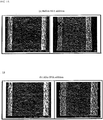
- Figure 6 illustrates the SEM photographs before and after the addition of benzenesulfonic acid in Example 6.
- COF denotes "Chip on Film”
- TCP denotes "Tape Carrier Package”.
- Table 3 allows confirmation of decline in the copper concentration as well as improvement in the film thickness. Furthermore, improvement of the crystalline state was confirmed through Figure 1 .
Landscapes
- Chemical & Material Sciences (AREA)
- Chemical Kinetics & Catalysis (AREA)
- Engineering & Computer Science (AREA)
- Materials Engineering (AREA)
- Metallurgy (AREA)
- Organic Chemistry (AREA)
- General Chemical & Material Sciences (AREA)
- Mechanical Engineering (AREA)
- Electrochemistry (AREA)
- Chemically Coating (AREA)
- Electroplating And Plating Baths Therefor (AREA)
Abstract
Description
- The present invention relates to a method for removing impurities from an electroless tin plating solution.
- In recent years, an electroless tin plating is used broadly for mechanical components, flexible circuit boards and printed wiring boards, and for circuit patterns of electronic components. The electroless tin plating is often carried out as displacement tin plating on copper or copper alloys. While displacement tin plating is proceed, displaced copper becomes copper ion and dissolved in the plating solution, so that the copper ion is increased in the plating solutions during the progress of plating. Since such accumulating copper ions deteriorate the plating film and lowers the performance of the plating bath, so it is required to replacement the plating solution.
- The conventionally known methods for control over plating solution are the batch method and the feed-and-bleed method. The batch method is a method to renew a plating bath when the plating bath is aged. Using the batch method, the plating bath must be renewed each time when the copper concentration increases and the bath performance decreases, so it causes various problems such as increasing the frequency of creating new plating baths, decreasing the productivity, and increasing the costs of descarding the aged solution. The feed-and-bleed method is a method of continuing plating while the plating solution overflows. Copper can be removed outside of the system via the overflow without stopping the plating operations, but large amounts of plating solution must be supplemented, which entails increase in costs.
- Various techniques have been proposed as methods of resolving these problems. For example,
JP05222540A JP2002317275A JP05222540A -
JP10317154A JP04276082A - However, the methods disclosed in
JP0522540A JP2002317275A JP10317154A JP04276082A - The objective of the present invention is to provide a method capable of efficiently removing impurities from plating solution without requiring separated equipment in order to remove impurities in a plating bath.
- The inventors conducted thorough research to resolve the above problems, and found that to add benzensulfonic acid, bensenesulfonic acid hydrate or salts threof into an electroless tin plating solution comprising thiourea or thiourea compounds, impurities in the plating bath could be removed efficiently from the bath without using specific equipment, and completed the present invention.
- The present invention relates to a method for removing impurities from a tin plating solution comprising thiourea or thiourea compounds, wherein adding benzenesulfonic acid, benzenesulfonic acid hydrate or salts thereof in the plating solution to generate a precipitate.
- In another embodiment, the present invention relates to a method for regenerating an electroless tin plating solution comprising thiourea or thiourea compounds, wherein adding benzenesulfonic acid, benzenesulfonic acid hydrate or salts thereof in the plating solution to generate a precipitate after conducting electroless plating on copper or copper-alloy by using the plating solution, then removing the precipitate from the solution.
- In another embodiment, the present invention relates to a method for forming a tin plating film using an electroless tin plating solution comprising thiourea or thiourea compounds, wherein circulating a part or all of the plating solution in a plating tank through a separation unit and filtrating by the separation unit a precipitate generated in the tank after adding benzenesulfonic acid, benzenesulfonic acid hydrate or salts thereof in the solution.
- In another embodiment, the present invention relates to a method for electroless plating of material to be plated using a tin plating solution comprising thiourea or thiourea compounds with use of a multiple tank plating device comprising a main tank to plate the material, a precipitation tank to generate a precipitate, circulation pipes connected between the main tank and the precipitation tank so as to be capable of circulating electroless plating solution, and a solid-liquid separation unit placed between the precipitation tank and the main tank, wherein the method comprises the steps of; adding benzenesulfonic acid, benzenesulfonic acid hydrate or salts thereof to the plating solution in the precipitation tank, and separating a solid in the solution generated in the precipitation tank using the solid-liquid separation unit.
- In another embodiment, the present invention relates to a method for electroless plating of material to be plated using tin plating solution comprising thiourea or thiourea compounds with use of a single tank plating device comprising a plating tank to plate a material, circulation pipes connected to the plating tank so as to be capable of circulating a part or all of the plating solution, and a solid-liquid separation unit placed in the circulation route of the plating solution, wherein the method comprises the steps of; contacting the material to be plated with the plating solution in the plating tank, adding benzenesulfonic acid, benzenesulfonic acid hydrate or salts thereof to the plating solution in the plating tank, circulating the solution through the circulation pipes, and separating and removing a precipitate generated in the bath after adding benzenesulfonic acid, benzenesulfonic acid hydrate or salts thereof using the solid-liquid separation unit.
- In another embodiment, the present invention relates to a method for control over an electroless tin plating solution comprising thiourea or thiourea compounds for plating copper or copper alloy, wherein adding benzenesulfonic acid, benzenesulfonic acid hydrate or salts thereof in the plating solution to generate a precipitate and decreasing a concentration of copper ion in the plating solution.
- Impurities in plating solution can be efficiently removed without requiring special equipment for cooling or oxidation decomposition through the use of the method pursuant to the present invention. Furthermore, plating solution can be used for a prolonged period of time since plating can be continuously carried out while removing impurities, and the frequency of discarding plating solution as well as the frequency of providing a fresh plating bath can be demonstrably reduced. As a result, the present invention can contribute to great enhancement of the industrial productivity.
-
-
Figure 1A is a result of SEM observation prior to the addition of benzenesulfonic acid (BSA) -
Figure 1B is a result of SEM observation after the addition of benzenesulfonic acid (BSA) - In the specification, °C represents degrees Centigrade, g represents gram, L represents liter, mL represents milliliter, dm represents decimeter, and µm represents micrometer. All amounts are in weight percentages unless otherwise specifically noted. "Plating solution" and "plating bath" in the specification have the same significance and are used interchangeably.
- The target plating solution in the present invention is an electroless tin plating solution or an electroless tin alloy plating solution, in specifically, a plating solution that are capable of displacement tin plating or of displacement tin alloy plating on copper or on copper alloy. The electroless tin plating solution may contain a electroless tin plating solution further comprising other metals in addition to tin. The electroless tin plating solutions contain water soluble tin salts or water soluble tin salts and other metal salts as well as thiourea or thiourea compounds as complexing agents.
- Any water soluble tin salts used in electroless tin plating solutions may be used in the plating solutions so long as they dissolve in water. Examples include stannous sulfate, stannous chloride, tin fluoroborate, tin alkanesulfonate, and tin alkanolsulfonate.
- In addition, other metal salts such as salts of lead, copper, silver, bismuth and cobalt, may be used as additional metal salts that can be used with water soluble tin salts. Examples of the other metal salts include lead chloride, lead acetate, lead alkanesulfonate, copper chloride, silver nitrate, bismuth chloride, and cobalt sulfate.
- The total amount of metal constituents in addition to tin and of tin in the plating solution would usually be in the range of 10 to 100 g/L as metal, preferably a range of 30 to 50 g/L.
- Acid may be added to the electroless tin plating solution in order to dissolve tin and metal constituents other than tin. Acids that may be used in the plating solution include sulfuric acid, hydrochloric acid, alkanesulfonic acid, alkanolsulfonic acid, and aromatic sulfonic acid. These acids may be used alone or in combinations of two or more. The amount of acid that can be added to the plating solution would usually total in the range of 1 to 300 g/L, preferably a range of 50 to 100 g/L.
- The electroless tin plating solution used in the present invention contains thiourea or thiourea compounds. These act as copper complexing agents. From the electrochemical perspective, these are well known to those skilled in the art as constituents that enable displacement tin plating on copper or copper alloys that are theoretically incapable of plating because of the standard electrode potential relationship. Thiourea that is readily available may be used, and commercial thiourea can be used as well.
- Thiourea compounds are derivatives of thiourea. Examples include 1-methylthiourea, 1,3-dimethyl-2-thiourea, trimethylthiourea, diethylthiourea, N,N-diisopropyl thiourea, 1-(3-hydroxypropyl)-2-thiourea, 1-methyl-3-(3-hydroxypropyl)-2-thiourea, 1-methyl-3-(3-methoxypropyl)-2-thiourea, 1,3-bis (3-hydroxypropyl)-2-thiourea, allyl thiourea, 1-acetyl-2-thiourea, 1-phenyl-3-(2-thiazolyl)thiourea, benzyl isothiourea hydrochloride, 1-allyl-2-thiourea, and 1-benzoyl-2-thiourea. These thioureas or thiourea compounds may be used alone or in combinations of two or more. The amount of use of these thioureas or thiourea compounds would usually be in the range of 50 to 250 g/L, preferably a range of 100 to 200 g/L.
- Electroless tin plating solution may contain antioxidants, surfactants and the like as required in addition to aforementioned constituents. Permissible examples of antioxidants that can be used include catechol, hydroquinone and hypophosphorous acid. Permissible examples of surfactants include one, two or more cationic, anionic, nonionic and amphoteric surfactants.
- Displacement tin plating (electroless tin plating) is usually carried out by repairing the plating solution, setting the temperature to a range of 50 to 75°C, and immersing material to be plated with copper or copper alloy on the surface in plating solution for 120 to 300 seconds. The tin displaces the copper on the surface of material to be plated to form a tin film while the copper dissolves in the plating solution. Consequently, tin in the plating solution decreases as plating proceeds. Furthermore, the thiourea or thiourea compounds that are complexing agents are believed to form complexes with copper in the plating solution so that these thiourea or thiourea compounds also decrease as plating proceeds. Moreover, acid and other constituents decrease as the material to be plated is hoisted (pumped out), and they also decrease as plating proceeds. These constituents that decrease in the plating solution as plating proceeds are appropriately supplemented. However, copper increases as plating proceeds and its accumulation in the plating bath leads to deterioration of the plating film and a decline in the bath performance.
- The present invention is characterized by the addition of benzenesulfonic acid, benzenesulfonic acid hydrate or salts thereof (hereinafter termed benzenesulfonic acid) to electroless tin plating solution in order to create a precipitate containing copper that inhibits the accumulation of copper in the plating solution. The concentration of copper ions in the plating solution can be reduced by adding benzenesulfonic acid to plating solution because copper ion complexes dissolve in the plating solution precipitate. The method pursuant to the present invention is far superior to conventional technology in that the temperature of the plating solution need not be lowered when creating a precipitate. While the specific reaction mechanism remains unclear, copper ions in the plating solution are believed to be found as complexes of thiourea or thiourea compounds, and the solubility of complexes of thiourea or thiourea compounds is lowered through the addition of benzenesulfonic acid, thereby resulting in the formation of precipitate without requiring a cooling operation.
- Permissible examples of benzenesulfonic acid hydrates include benzenesulfonic acid 1-hydrate, benzenesulfonic acid 1.5-hydrate, and benzenesulfonic acid 2-hydrate. Arbitrary salts of benzenesulfonic acid and of benzenesulfonic acid hydrate are permissible. Concrete examples include sodium salts, potassium salts, and ammonium salts. Commercial benzenesulfonic acid may also be used. Mixtures of benzenesulfonic acid, benzenesulfonic acid hydrate or salts thereof may also be used, and the amount used should be in the range of 5 to 200 g/L, preferably 20 to 100 g/L, more preferably 50 to 100 g/L. Precipitate does not form if the amount used is too low. An amount exceeding 20 g/L should be used in order to attain adequate precipitation. If the amount used is excessive, the tin precipitation state deteriorates and the bath performance is impaired, such as decline in the precipitation speed.
- The first method of the present invention is a method for removing impurities from a tin plating solution comprising thiourea or thiourea compounds, wherein adding benzenesulfonic acid, benzenesulfonic acid hydrate or salts thereof in the plating solution to generate a precipitate. Here, the tin plating solution to which benzenesulfonic acid is added preferably would be solution that has already been used in electroless tin plating. In this case, if the solution is plating solution that has already been used in electroless tin plating, either plating solution in which electroless tin plating treatment has been completed or solution whose electroless tin plating treatment is underway may be used. The impurities would be copper or other metals (nickel, zinc, chromium, molybdenum, tungsten, etc.) that had dissolved from the material to be plated. The impurity would especially be copper, and copper can be effectively removed from plating solution. Insoluble constituents containing copper precipitate when benzenesulfonic acid is added to used plating solution in which the copper concentration has increased. Copper can be removed from the plating solution by removing such insoluble constituents. Arbitrary methods of removing insoluble constituents may be used, including filtration using a filter, precipitation separation, and centrifugal separation.
- The second method pursuant to the present invention is a method for regenerating an electroless tin plating solution comprising thiourea or thiourea compounds, wherein adding benzenesulfonic acid, benzenesulfonic acid hydrate or salts thereof in the plating solution to generate a precipitate after conducting electroless plating on copper or copper-alloy by using the plating solution, then removing the precipitate from the solution. As stated above, impurities, especially copper, can be removed from the plating solution through removal of precipitates by adding benzenesulfonic acid. Plating solution can be reused following precipitate removal. Plating solution can be continuously used by supplementing other constituents that had been consumed or reduced in quantity. As a result, older plating solution need not be discarded, which contributes to enhanced industrial productivity.
- The third method pursuant to the present invention is a method for forming a tin plating film using an electroless tin plating solution comprising thiourea or thiourea compounds, wherein circulating a part or all of the plating solution in a plating tank through a separation unit and filtrating by the separation unit a precipitate generated in the tank after adding benzenesulfonic acid, benzenesulfonic acid hydrate or salts thereof in the solution. In this method, the circulation of electroless tin plating solution may be carried out while a plating film is formed as plating of material to be plated is continued, or it may be carried out as the plating operation is temporarily suspended. In addition, benzenesulfonic acid may be added while plating film is formed as plating of the material to be plated is continued, or it may be carried out as the plating operation is temporarily suspended. The addition of benzenesulfonic acid in the course of formation of plating film does not affect the characteristics of the plating film so long as the amount of plating solution in the plating tank is adequate. The fact that the plating operation need not be stopped during the addition of benzenesulfonic acid in the course of formation of a plating film as plating is continued or in the course of circulation of plating solution is desirable from the perspective of productivity. Any solid-liquid separation unit may be used so long as it is capable of separating precipitate that formed from plating solution. Filtration using a filter, precipitation separation, or centrifugal separation unit may be used. Here, the addition of benzenesulfonic acid to the plating solution that had deteriorated due to continuation of plating would preferably be carried out in the course of plating of material to be plated. The benzenesulfonic acid would preferably be added to plating solution in which metal ions such as copper, nickel, zinc, chromium, molybdenum or tungsten had dissolved from the material to be plated, resulting in a decline in the bath performance. As mentioned above, tin plating solution would be repaired and the formation of plating film would be carried out by adjusting the temperature of the plating solution to a temperature in the range of 50 to 75°C, followed by immersing the material to be plated that has copper or copper alloy on the surface in a plating solution for 120 to 300 seconds. Since copper ions dissolve in the plating solution as plating proceeds, the addition of benzenesulfonic acid, the circulation of plating solution and the capture removal of precipitate should be carried out at the necessary timing. Furthermore, constituents in the plating solution that had been consumed or diminished could be appropriately supplemented.
- The fourth method pursuant to the present invention is a method for electroless plating of material to be plated using a tin plating solution comprising thiourea or thiourea compounds with use of a multiple tank plating device comprising a main tank to plate the material, a precipitation tank to generate a precipitate, circulation pipes connected between the main tank and the precipitation tank so as to be capable of circulating electroless plating solution, and a solid-liquid separation unit placed between the precipitation tank and the main tank, wherein the method comprises the steps of; <first step> adding benzenesulfonic acid, benzenesulfonic acid hydrate or salts thereof to the plating solution in the precipitation tank, and <second step> separating a solid in the solution generated in the precipitation tank using the solid-liquid separation unit. This fourth method pursuant to the present invention is characterized by the use of a multiple tank plating device furnished with a precipitation tank in order to form precipitates in addition to the main tank in which electroless plating is carried out. A minimum of two tanks are required, but three or more tanks may be used as needed. The main tank and the precipitation tank may be of arbitrary size and shape so long as they permit plating treatment and precipitate formation. The main tank and the precipitation tank are connected by piping to enable circulation of electroless plating solution between the two. The piping may be of arbitrary configuration so long as it permits circulation of plating solution. In addition, a solid-liquid separation unit may be placed between the precipitation tank and the main tank, and the precipitate that formed due to the addition of benzenesulfonic acid could then be separated. As indicated above, any arbitrary solid-liquid separation unit could be used.
- Benzenesulfonic acid is added to plating solution in the precipitation tank in the first step. In the method of the present invention, benzenesulfonic acid may be added in the course of circulation of plating solution or benzenesulfonic acid may be added upon suspension of plating solution circulation. Furthermore, the plating operation in the main tank may be continued when adding benzenesulfonic acid, or the plating operation may be temporarily suspended. The addition of benzenesulfonic acid while continuing the plating operation is preferable from the perspective of productivity since plating need not be suspended. Furthermore, the temperature of the plating solution in the main tank should be in the range of 50 to 70°C, and the temperature of the plating solution in the precipitation tank may be the same temperature as that of the plating solution in the main tank or it preferably would be in a range 10°C above or below the liquid temperature in the main tank. Temperature control for regulating the temperature of the plating solution that had been returned to the main tank from the precipitation tank so as to regulate it to a temperature suitable for plating is facilitated by setting the temperature of the plating solution in the precipitation tank in this range. The method of capture of the precipitate that had been formed using the solid-liquid separation unit in the second step is as stated previously.
- The fifth method of the present invention is a method for electroless plating of material to be plated using tin plating solution comprising thiourea or thiourea compounds with use of a single tank plating device comprising a plating tank to plate a material, circulation pipes connected to the plating tank so as to be capable of circulating a part or all of the plating solution, and a solid-liquid separation unit placed in the circulation route of the plating solution, wherein the method comprises the steps of; <first step> contacting the material to be plated with the plating solution in the plating tank, <second step> adding benzenesulfonic acid, benzenesulfonic acid hydrate or salts thereof to the plating solution in the plating tank, <third step> circulating the solution through the circulation pipes, and separating and removing a precipitate generated in the bath after adding benzenesulfonic acid, benzenesulfonic acid hydrate or salts thereof using the solid-liquid separation unit. This fifth method of the present invention is characterized by the use of a single tank type of plating device for adding benzenesulfonic acid to a plating tank in which electroless plating is carried out to generate precipitate. The plating tank has a size and shape sufficient for plating treatment and for precipitate generation, but the use of a large-capacity tank would be preferable to the use of a multiple tank type of device when both operations are carried out concurrently. The circulation piping and the solid-liquid separation unit may have arbitrary configurations as mentioned above.
- In the first step, the material to be plated is immersed in plating solution in a plating tank and displacement plating is carried out. The temperature of the plating solution in the plating tank should be in the range of 50 to 75°C. Copper ions that dissolved in the plating tank from the material to be plated accumulate as displacement plating proceeds in the plating tank. In the second step, benzenesulfonic acid is added to plating solution in the plating tank. When benzenesulfonic acid is added in the fifth method pursuant to the present invention, the plating operation may be continued in the plating tank or the plating operation may be temporarily suspended. The addition of benzenesulfonic acid while continuing the plating operation is preferable from the perspective of productivity since plating need not be suspended. In the third step, the precipitate generated in the plating tank is fed to the solid-liquid separation unit via the circulation piping where it is separated from the plating solution and removed. The circulation of plating solution must be conducted at least after the addition of benzenesulfonic acid. Furthermore, if aforementioned first to third steps are initiated in sequence, a subsequent step may be carried out without waiting for completion of the preceding step. For example, once material to be plated has been immersed in plating solution in the plating tank in the first step, benzenesulfonic acid addition, which constitutes the second step, may be carried out even while the immersion of material to be plated is continued.
- The sixth method of the present invention is a method for control over an electroless tin plating solution comprising thiourea or thiourea compounds for plating copper or copper alloy, wherein adding benzenesulfonic acid, benzenesulfonic acid hydrate or salts thereof in the plating solution to generate a precipitate and decreasing a concentration of copper ion in the plating solution. The concentration of copper in the plating solution is measured in aforementioned plating tanks that have various configurations. Benzenesulfonic acid is then added to the plating solution at the appropriate moment before the copper concentration reaches the upper limit at which plating would be adversely affected, and the copper ion concentration in plating solution is reduced through the generation of precipitate. Thus, electroless plating solution can be maintained in the most appropriate condition. Measurement of the copper ions in the plating solution may be carried out by any arbitrary method. For example, part of the plating solution may be sampled for measurement of the copper ions concentration via atomic absorption analysis or ICP.
- Electroless tin plating solution (basic bath 1) having the following composition was prepared.
-
- Tin fluoroborate (as Sn2+) 30 g/L
- Methanesulfonic acid 50 g/L
- Hypophosphorous acid 15 g/L
- Thiourea 100 g/L
- Nonionic surfactant 30 g/L
- A total of 15 g/L of copper powder was added to aforementioned tin plating solution, followed by heating for five hours at 65°C under stirring to complete a displacement reaction between copper and tin. The creation of electroless tin plating solution containing copper ions that had suffered deterioration was simulated. While aforementioned simulated electroless tin plating solution that had deteriorated was held at 65°C, 30 g/L of benzenesulfonic acid was added to the plating solution. Following the addition of benzenesulfonic acid, suspended material was generated in the plating solution. The suspended material precipitated while the plating solution was held at 65°C, and the supernatant that was then sampled was subjected to measurement of the copper concentration via atomic absorption analysis. The copper concentration that was measured was 9.5 g/L.
- The same operations as in Example 1 were repeated except for the addition of 60 g/L of benzenesulfonic acid to aforementioned basic bath 1, after which the copper concentration was measured. The copper concentration was measured to be 6.6 g/L.
- The same operations as in Example 1 were repeated except for omitting benzenesulfonic acid addition to aforementioned basic bath 1 (Comparative Example 1) or adding 30 g/L of the compounds presented in Table 1 (Comparative Examples 2 to 5). Table 1 presents the results.
- The copper concentration was measured only in Comparative Example 1 since no precipitate settled in any of Comparative Examples 1 to 5.
TABLE 1 Example No. Precipitant Amount added (g/L) Presence of precipitate Copper concentration (g/L) Example 1 Benzenesulfonic acid 30 Present 9.5 Example 2 Benzenesulfonic acid 60 Present 6.6 Comparative Example 1 None - Absent 14.7 Comparative Example 2 Paratoluene sulfonic acid 30 Absent - Comparative Example 3 Naphthane sulfonic acid 30 Absent - Comparative Example 4 Benzene carboxylic acid 30 Absent - Comparative Example 5 Salicylic acid 30 Absent - - Aforementioned results indicate that the copper concentration in plating decreases as a result of the generation of precipitate upon the addition of benzenesulfonic acid.
- Electroless tin plating solution having the following composition was prepared by modifying the composition of the plating bath from that in Example 1 (Basic Bath 2).
-
- Tin methanesulfonate (as Sn2+) 30 g/L
- Methanesulfonic acid 50 g/L
- Hypophosphorous acid 15 g/L
- Thiourea 100 g/L
- Nonionic surfactant 30 g/L
- The same operations as in Example 1 were repeated except for the addition to aforementioned basic bath 2 of benzenesulfonic acid in the quantities shown in Table 2, after which the copper concentration in the plating solution was measured. Table 2 shows the results.
TABLE 2 Example No. Precipitant Amount added (g/L) Presence of precipitate Copper concentration (g/L) Example 3 Benzenesulfonic acid 30 Present 10.6 Example 4 Benzenesulfonic acid 60 Present 6.3 Comparative Example 6 None - Absent 14.2 - Aforementioned results indicate that the copper concentration in plating decreases as a result of the generation of precipitate upon the addition of benzenesulfonic acid even if the composition of the plating solution has been altered.
- Performance confirmation tests on plating solution were conducted following the removal of impurities through the addition of benzenesulfonic acid. Basic bath 1 used in Example 1 was prepared as the plating bath.
- The preparation of an electroless tin plating solution containing copper ions that had undergone deterioration following completion of a displacement reaction of copper and tin through the addition of 7 g/L (Example 5) and 10 g/L (Example 6) of copper powder to basic bath 1, followed by heating for five hours, was simulated. Tin fluoroborate was added to aforementioned simulated, deteriorated, electroless tin plating solution in order to supplement the tin that had decreased due to displacement with copper, and the tin concentration was adjusted to 30 g/L. Displacement tin plating was carried out on material to be plated (TCP and COF in which pattern formation had been completed) for three minutes, fifteen seconds at 65°C using this plating solution, and SEM observation as well as film thickness measurement were completed. To aforementioned plating solution was added either 28 g/L (Example 5) or 40 g/L (Example 6) of benzenesulfonic acid, followed by adequate stirring, filtration, and removal of the precipitate that formed. Displacement plating was carried out using those baths following removal of the precipitate, SEM observation as well as film thickness measurement were completed, and the state was compared with that preceding the addition of benzenesulfonic acid (BSA). Table 3 presents the results. In addition, Figure 6 illustrates the SEM photographs before and after the addition of benzenesulfonic acid in Example 6. COF denotes "Chip on Film" while TCP denotes "Tape Carrier Package". Table 3 allows confirmation of decline in the copper concentration as well as improvement in the film thickness. Furthermore, improvement of the crystalline state was confirmed through
Figure 1 .TABLE 3 Example No. Before BSA addition After BSA addition Copper concentration (g/L) Plating film thickness (µm) Copper concentration (g/L) Plating film thickness (µm) Example 5 6.7 0.49 0.5 0.51 Example 6 9.8 0.44 0.2 0.52 - Recovery of the bath performance (recovery of the precipitation speed) through removal of copper using benzenesulfonic acid was confirmed in Examples 5 and 6.
Claims (6)
- A method for removing impurities from a tin plating solution comprising thiourea or thiourea compounds, wherein adding benzenesulfonic acid, benzenesulfonic acid hydrate or salts thereof in the plating solution to generate a precipitate.
- A method for regenerating an electroless tin plating solution comprising thiourea or thiourea compounds, wherein adding benzenesulfonic acid, benzenesulfonic acid hydrate or salts thereof in the plating solution to generate a precipitate after conducting electroless plating on copper or copper-alloy by using the plating solution, then removing the precipitate from the solution.
- A method for forming a tin plating film using an electroless tin plating solution comprising thiourea or thiourea compounds, wherein circulating a part or all of the plating solution in a plating tank through a separation unit and filtrating by the separation unit a precipitate generated in the tank after adding benzenesulfonic acid, benzenesulfonic acid hydrate or salts thereof in the solution.
- A method for electroless plating of material to be plated using a tin plating solution comprising thiourea or thiourea compounds with use of a multiple tank plating device comprising a main tank to plate the material, a precipitation tank to generate a precipitate, circulation pipes connected between the main tank and the precipitation tank so as to be capable of circulating electroless plating solution, and a solid-liquid separation unit placed between the precipitation tank and the main tank, wherein the method comprises the steps of; adding benzenesulfonic acid, benzenesulfonic acid hydrate or salts thereof to the plating solution in the precipitation tank, and separating a solid in the solution generated in the precipitation tank using the solid-liquid separation unit.
- A method for electroless plating of material to be plated using tin plating solution comprising thiourea or thiourea compounds with use of a single tank plating device comprising a plating tank to plate a material, circulation pipes connected to the plating tank so as to be capable of circulating a part or all of the plating solution, and a solid-liquid separation unit placed in the circulation route of the plating solution, wherein the method comprises the steps of; contacting the material to be plated with the plating solution in the plating tank, adding benzenesulfonic acid, benzenesulfonic acid hydrate or salts thereof to the plating solution in the plating tank, circulating the solution through the circulation pipes, and separating and removing a precipitate generated in the bath after adding benzenesulfonic acid, benzenesulfonic acid hydrate or salts thereof using the solid-liquid separation unit.
- A method for control over an electroless tin plating solution comprising thiourea or thiourea compounds for plating copper or copper alloy, wherein adding benzenesulfonic acid, benzenesulfonic acid hydrate or salts thereof in the plating solution to generate a precipitate and decreasing a concentration of copper ion in the plating solution.
Applications Claiming Priority (1)
| Application Number | Priority Date | Filing Date | Title |
|---|---|---|---|
| JP2010292150A JP5715411B2 (en) | 2010-12-28 | 2010-12-28 | Method for removing impurities from plating solution |
Publications (3)
| Publication Number | Publication Date |
|---|---|
| EP2471977A2 true EP2471977A2 (en) | 2012-07-04 |
| EP2471977A3 EP2471977A3 (en) | 2012-08-08 |
| EP2471977B1 EP2471977B1 (en) | 2017-01-25 |
Family
ID=45507355
Family Applications (1)
| Application Number | Title | Priority Date | Filing Date |
|---|---|---|---|
| EP11195167.9A Not-in-force EP2471977B1 (en) | 2010-12-28 | 2011-12-22 | Method for removing impurities from plating solution |
Country Status (6)
| Country | Link |
|---|---|
| US (1) | US20120164341A1 (en) |
| EP (1) | EP2471977B1 (en) |
| JP (1) | JP5715411B2 (en) |
| KR (1) | KR101797517B1 (en) |
| CN (1) | CN102560570B (en) |
| TW (1) | TWI588291B (en) |
Cited By (4)
| Publication number | Priority date | Publication date | Assignee | Title |
|---|---|---|---|---|
| US9404194B2 (en) | 2010-12-01 | 2016-08-02 | Novellus Systems, Inc. | Electroplating apparatus and process for wafer level packaging |
| US9534308B2 (en) | 2012-06-05 | 2017-01-03 | Novellus Systems, Inc. | Protecting anodes from passivation in alloy plating systems |
| EP2570514B1 (en) * | 2011-09-14 | 2017-06-14 | Rohm and Haas Electronic Materials LLC | Method of removing impurities from plating liquid |
| CN112135932A (en) * | 2018-05-09 | 2020-12-25 | 应用材料公司 | System and method for removing contaminants within an electroplating system |
Families Citing this family (3)
| Publication number | Priority date | Publication date | Assignee | Title |
|---|---|---|---|---|
| JP5830242B2 (en) * | 2010-12-28 | 2015-12-09 | ローム・アンド・ハース電子材料株式会社 | Method for removing impurities from plating solution |
| JP6569237B2 (en) | 2014-03-06 | 2019-09-04 | 三菱マテリアル株式会社 | Method for producing stannous oxide, method for producing Sn plating solution |
| CN109546191B (en) * | 2018-11-07 | 2021-06-18 | 大连理工大学 | A kind of mixed matrix type anion membrane and preparation method thereof |
Citations (5)
| Publication number | Priority date | Publication date | Assignee | Title |
|---|---|---|---|---|
| JPH04276082A (en) | 1991-03-01 | 1992-10-01 | C Uyemura & Co Ltd | Analysis of copper ion concentration in bath for electroless plating of tin, lead, or those alloy |
| JPH0522540A (en) | 1991-07-15 | 1993-01-29 | Murata Mach Ltd | Facsimile equipment with mail box |
| JPH05222540A (en) | 1991-11-27 | 1993-08-31 | Mcgean Rohco Inc | How to extend the life of displacement plating baths |
| JPH10317154A (en) | 1997-05-07 | 1998-12-02 | Km Europ Metal Ag | Method and apparatus for regenerating tin plating solution |
| JP2002317275A (en) | 2001-04-17 | 2002-10-31 | Toto Ltd | How to extend the life of electroless tin plating solution |
Family Cites Families (13)
| Publication number | Priority date | Publication date | Assignee | Title |
|---|---|---|---|---|
| JP2525521B2 (en) * | 1991-06-25 | 1996-08-21 | 日本リーロナール株式会社 | Electroless tin-lead alloy plating bath |
| JP3162243B2 (en) * | 1994-03-28 | 2001-04-25 | 株式会社日立製作所 | Electroless plating method |
| JP3030534B2 (en) * | 1994-09-07 | 2000-04-10 | 日本マクダーミッド株式会社 | Regeneration method of tin-based alloy plating bath |
| EP0848084B1 (en) * | 1996-06-05 | 2002-10-09 | Sumitomo Light Metal Industries, Ltd. | Internally tin-plated copper pipe manufacturing method |
| US6821323B1 (en) * | 1999-11-12 | 2004-11-23 | Enthone Inc. | Process for the non-galvanic tin plating of copper or copper alloys |
| DE19954613A1 (en) * | 1999-11-12 | 2001-05-17 | Enthone Omi Deutschland Gmbh | Process for electroless tinning of copper or copper alloys |
| GB0106131D0 (en) * | 2001-03-13 | 2001-05-02 | Macdermid Plc | Electrolyte media for the deposition of tin alloys and methods for depositing tin alloys |
| US6562221B2 (en) * | 2001-09-28 | 2003-05-13 | David Crotty | Process and composition for high speed plating of tin and tin alloys |
| TWI268292B (en) * | 2002-03-05 | 2006-12-11 | Shipley Co Llc | Limiting the loss of tin through oxidation in tin or tin alloy electroplating bath solutions |
| JP4016326B2 (en) * | 2002-08-02 | 2007-12-05 | 石原薬品株式会社 | Electroless tin plating bath |
| US20080149884A1 (en) * | 2006-12-21 | 2008-06-26 | Junaid Ahmed Siddiqui | Method and slurry for tuning low-k versus copper removal rates during chemical mechanical polishing |
| CN101624714B (en) * | 2009-08-18 | 2010-12-29 | 杜强 | Cu-Sn-Zn plating solution containing organic addition agent and electroplating technique utilizing same |
| JP5830242B2 (en) * | 2010-12-28 | 2015-12-09 | ローム・アンド・ハース電子材料株式会社 | Method for removing impurities from plating solution |
-
2010
- 2010-12-28 JP JP2010292150A patent/JP5715411B2/en not_active Expired - Fee Related
-
2011
- 2011-12-22 EP EP11195167.9A patent/EP2471977B1/en not_active Not-in-force
- 2011-12-28 CN CN201110463300.XA patent/CN102560570B/en not_active Expired - Fee Related
- 2011-12-28 TW TW100149133A patent/TWI588291B/en not_active IP Right Cessation
- 2011-12-28 US US13/338,483 patent/US20120164341A1/en not_active Abandoned
- 2011-12-28 KR KR1020110145049A patent/KR101797517B1/en not_active Expired - Fee Related
Patent Citations (5)
| Publication number | Priority date | Publication date | Assignee | Title |
|---|---|---|---|---|
| JPH04276082A (en) | 1991-03-01 | 1992-10-01 | C Uyemura & Co Ltd | Analysis of copper ion concentration in bath for electroless plating of tin, lead, or those alloy |
| JPH0522540A (en) | 1991-07-15 | 1993-01-29 | Murata Mach Ltd | Facsimile equipment with mail box |
| JPH05222540A (en) | 1991-11-27 | 1993-08-31 | Mcgean Rohco Inc | How to extend the life of displacement plating baths |
| JPH10317154A (en) | 1997-05-07 | 1998-12-02 | Km Europ Metal Ag | Method and apparatus for regenerating tin plating solution |
| JP2002317275A (en) | 2001-04-17 | 2002-10-31 | Toto Ltd | How to extend the life of electroless tin plating solution |
Cited By (8)
| Publication number | Priority date | Publication date | Assignee | Title |
|---|---|---|---|---|
| US9404194B2 (en) | 2010-12-01 | 2016-08-02 | Novellus Systems, Inc. | Electroplating apparatus and process for wafer level packaging |
| US9982357B2 (en) | 2010-12-01 | 2018-05-29 | Novellus Systems, Inc. | Electroplating apparatus and process for wafer level packaging |
| US10309024B2 (en) | 2010-12-01 | 2019-06-04 | Novellus Systems, Inc. | Electroplating apparatus and process for wafer level packaging |
| EP2570514B1 (en) * | 2011-09-14 | 2017-06-14 | Rohm and Haas Electronic Materials LLC | Method of removing impurities from plating liquid |
| US9534308B2 (en) | 2012-06-05 | 2017-01-03 | Novellus Systems, Inc. | Protecting anodes from passivation in alloy plating systems |
| US10106907B2 (en) | 2012-06-05 | 2018-10-23 | Novellus Systems, Inc. | Protecting anodes from passivation in alloy plating systems |
| US10954605B2 (en) | 2012-06-05 | 2021-03-23 | Novellus Systems, Inc. | Protecting anodes from passivation in alloy plating systems |
| CN112135932A (en) * | 2018-05-09 | 2020-12-25 | 应用材料公司 | System and method for removing contaminants within an electroplating system |
Also Published As
| Publication number | Publication date |
|---|---|
| US20120164341A1 (en) | 2012-06-28 |
| JP5715411B2 (en) | 2015-05-07 |
| CN102560570A (en) | 2012-07-11 |
| JP2012140649A (en) | 2012-07-26 |
| TWI588291B (en) | 2017-06-21 |
| EP2471977A3 (en) | 2012-08-08 |
| CN102560570B (en) | 2016-05-04 |
| EP2471977B1 (en) | 2017-01-25 |
| TW201243103A (en) | 2012-11-01 |
| KR20120075438A (en) | 2012-07-06 |
| KR101797517B1 (en) | 2017-11-15 |
Similar Documents
| Publication | Publication Date | Title |
|---|---|---|
| EP2471977B1 (en) | Method for removing impurities from plating solution | |
| EP2481834B1 (en) | Method for removing impurities from plating solution | |
| TW562880B (en) | Electrolytic copper plating method, phosphorous copper anode for electrolytic copper plating method, and semiconductor wafer having low particle adhesion plated with said method and anode | |
| TWI577836B (en) | High purity tin manufacturing methods, high purity tin electrolytic refining devices and high purity tin | |
| JPWO2004022486A1 (en) | High purity copper sulfate and method for producing the same | |
| KR101994247B1 (en) | Method of removing impurities from plating liquid | |
| KR100698430B1 (en) | Recycling method of plating solution | |
| US20140083322A1 (en) | Method of removing impurities from plating liquid | |
| JP4554662B2 (en) | Phosphorus copper anode for electrolytic copper plating and method for producing the same | |
| JP2003231995A (en) | Phosphor-containing copper anode for copper electroplating, copper electroplating method using phosphor-containing copper anode, and semiconductor wafer plated by using them with few adhering particles | |
| JPS58110691A (en) | Production of zn-fe alloy electroplated steel plate | |
| JPS62256996A (en) | Starting material for zinc plating | |
| JPH01242730A (en) | Method for recovering noble metal | |
| JPS599159A (en) | Method and apparatus for adjusting concentration of electroless plating bath | |
| HU191365B (en) | Method for recovering precious metal of electrolytic purity from solid waste originating at making printed circuits panels, preferably form waste powders | |
| JP2001348671A (en) | Electroless gold plating solution and electroless gold plating method | |
| JPS58185757A (en) | Regenerating method of electroless plating bath |
Legal Events
| Date | Code | Title | Description |
|---|---|---|---|
| 17P | Request for examination filed |
Effective date: 20111222 |
|
| AK | Designated contracting states |
Kind code of ref document: A2 Designated state(s): AL AT BE BG CH CY CZ DE DK EE ES FI FR GB GR HR HU IE IS IT LI LT LU LV MC MK MT NL NO PL PT RO RS SE SI SK SM TR |
|
| AX | Request for extension of the european patent |
Extension state: BA ME |
|
| PUAI | Public reference made under article 153(3) epc to a published international application that has entered the european phase |
Free format text: ORIGINAL CODE: 0009012 |
|
| PUAL | Search report despatched |
Free format text: ORIGINAL CODE: 0009013 |
|
| AK | Designated contracting states |
Kind code of ref document: A3 Designated state(s): AL AT BE BG CH CY CZ DE DK EE ES FI FR GB GR HR HU IE IS IT LI LT LU LV MC MK MT NL NO PL PT RO RS SE SI SK SM TR |
|
| AX | Request for extension of the european patent |
Extension state: BA ME |
|
| RIC1 | Information provided on ipc code assigned before grant |
Ipc: C23C 18/31 20060101ALI20120629BHEP Ipc: C23C 18/16 20060101ALI20120629BHEP Ipc: C25D 21/18 20060101AFI20120629BHEP |
|
| 17Q | First examination report despatched |
Effective date: 20121211 |
|
| GRAP | Despatch of communication of intention to grant a patent |
Free format text: ORIGINAL CODE: EPIDOSNIGR1 |
|
| INTG | Intention to grant announced |
Effective date: 20160823 |
|
| GRAS | Grant fee paid |
Free format text: ORIGINAL CODE: EPIDOSNIGR3 |
|
| GRAA | (expected) grant |
Free format text: ORIGINAL CODE: 0009210 |
|
| AK | Designated contracting states |
Kind code of ref document: B1 Designated state(s): AL AT BE BG CH CY CZ DE DK EE ES FI FR GB GR HR HU IE IS IT LI LT LU LV MC MK MT NL NO PL PT RO RS SE SI SK SM TR |
|
| REG | Reference to a national code |
Ref country code: GB Ref legal event code: FG4D |
|
| REG | Reference to a national code |
Ref country code: CH Ref legal event code: EP |
|
| REG | Reference to a national code |
Ref country code: CH Ref legal event code: NV Representative=s name: MURGITROYD AND COMPANY, CH Ref country code: AT Ref legal event code: REF Ref document number: 864201 Country of ref document: AT Kind code of ref document: T Effective date: 20170215 |
|
| REG | Reference to a national code |
Ref country code: IE Ref legal event code: FG4D |
|
| REG | Reference to a national code |
Ref country code: DE Ref legal event code: R096 Ref document number: 602011034618 Country of ref document: DE |
|
| REG | Reference to a national code |
Ref country code: LT Ref legal event code: MG4D |
|
| REG | Reference to a national code |
Ref country code: NL Ref legal event code: MP Effective date: 20170125 |
|
| REG | Reference to a national code |
Ref country code: AT Ref legal event code: MK05 Ref document number: 864201 Country of ref document: AT Kind code of ref document: T Effective date: 20170125 |
|
| PG25 | Lapsed in a contracting state [announced via postgrant information from national office to epo] |
Ref country code: NL Free format text: LAPSE BECAUSE OF FAILURE TO SUBMIT A TRANSLATION OF THE DESCRIPTION OR TO PAY THE FEE WITHIN THE PRESCRIBED TIME-LIMIT Effective date: 20170125 |
|
| PG25 | Lapsed in a contracting state [announced via postgrant information from national office to epo] |
Ref country code: GR Free format text: LAPSE BECAUSE OF FAILURE TO SUBMIT A TRANSLATION OF THE DESCRIPTION OR TO PAY THE FEE WITHIN THE PRESCRIBED TIME-LIMIT Effective date: 20170426 Ref country code: FI Free format text: LAPSE BECAUSE OF FAILURE TO SUBMIT A TRANSLATION OF THE DESCRIPTION OR TO PAY THE FEE WITHIN THE PRESCRIBED TIME-LIMIT Effective date: 20170125 Ref country code: IS Free format text: LAPSE BECAUSE OF FAILURE TO SUBMIT A TRANSLATION OF THE DESCRIPTION OR TO PAY THE FEE WITHIN THE PRESCRIBED TIME-LIMIT Effective date: 20170525 Ref country code: NO Free format text: LAPSE BECAUSE OF FAILURE TO SUBMIT A TRANSLATION OF THE DESCRIPTION OR TO PAY THE FEE WITHIN THE PRESCRIBED TIME-LIMIT Effective date: 20170425 Ref country code: HR Free format text: LAPSE BECAUSE OF FAILURE TO SUBMIT A TRANSLATION OF THE DESCRIPTION OR TO PAY THE FEE WITHIN THE PRESCRIBED TIME-LIMIT Effective date: 20170125 Ref country code: LT Free format text: LAPSE BECAUSE OF FAILURE TO SUBMIT A TRANSLATION OF THE DESCRIPTION OR TO PAY THE FEE WITHIN THE PRESCRIBED TIME-LIMIT Effective date: 20170125 |
|
| PG25 | Lapsed in a contracting state [announced via postgrant information from national office to epo] |
Ref country code: BG Free format text: LAPSE BECAUSE OF FAILURE TO SUBMIT A TRANSLATION OF THE DESCRIPTION OR TO PAY THE FEE WITHIN THE PRESCRIBED TIME-LIMIT Effective date: 20170425 Ref country code: LV Free format text: LAPSE BECAUSE OF FAILURE TO SUBMIT A TRANSLATION OF THE DESCRIPTION OR TO PAY THE FEE WITHIN THE PRESCRIBED TIME-LIMIT Effective date: 20170125 Ref country code: ES Free format text: LAPSE BECAUSE OF FAILURE TO SUBMIT A TRANSLATION OF THE DESCRIPTION OR TO PAY THE FEE WITHIN THE PRESCRIBED TIME-LIMIT Effective date: 20170125 Ref country code: RS Free format text: LAPSE BECAUSE OF FAILURE TO SUBMIT A TRANSLATION OF THE DESCRIPTION OR TO PAY THE FEE WITHIN THE PRESCRIBED TIME-LIMIT Effective date: 20170125 Ref country code: AT Free format text: LAPSE BECAUSE OF FAILURE TO SUBMIT A TRANSLATION OF THE DESCRIPTION OR TO PAY THE FEE WITHIN THE PRESCRIBED TIME-LIMIT Effective date: 20170125 Ref country code: PL Free format text: LAPSE BECAUSE OF FAILURE TO SUBMIT A TRANSLATION OF THE DESCRIPTION OR TO PAY THE FEE WITHIN THE PRESCRIBED TIME-LIMIT Effective date: 20170125 Ref country code: SE Free format text: LAPSE BECAUSE OF FAILURE TO SUBMIT A TRANSLATION OF THE DESCRIPTION OR TO PAY THE FEE WITHIN THE PRESCRIBED TIME-LIMIT Effective date: 20170125 Ref country code: PT Free format text: LAPSE BECAUSE OF FAILURE TO SUBMIT A TRANSLATION OF THE DESCRIPTION OR TO PAY THE FEE WITHIN THE PRESCRIBED TIME-LIMIT Effective date: 20170525 |
|
| REG | Reference to a national code |
Ref country code: DE Ref legal event code: R097 Ref document number: 602011034618 Country of ref document: DE |
|
| PG25 | Lapsed in a contracting state [announced via postgrant information from national office to epo] |
Ref country code: SK Free format text: LAPSE BECAUSE OF FAILURE TO SUBMIT A TRANSLATION OF THE DESCRIPTION OR TO PAY THE FEE WITHIN THE PRESCRIBED TIME-LIMIT Effective date: 20170125 Ref country code: EE Free format text: LAPSE BECAUSE OF FAILURE TO SUBMIT A TRANSLATION OF THE DESCRIPTION OR TO PAY THE FEE WITHIN THE PRESCRIBED TIME-LIMIT Effective date: 20170125 Ref country code: IT Free format text: LAPSE BECAUSE OF FAILURE TO SUBMIT A TRANSLATION OF THE DESCRIPTION OR TO PAY THE FEE WITHIN THE PRESCRIBED TIME-LIMIT Effective date: 20170125 Ref country code: RO Free format text: LAPSE BECAUSE OF FAILURE TO SUBMIT A TRANSLATION OF THE DESCRIPTION OR TO PAY THE FEE WITHIN THE PRESCRIBED TIME-LIMIT Effective date: 20170125 Ref country code: CZ Free format text: LAPSE BECAUSE OF FAILURE TO SUBMIT A TRANSLATION OF THE DESCRIPTION OR TO PAY THE FEE WITHIN THE PRESCRIBED TIME-LIMIT Effective date: 20170125 |
|
| REG | Reference to a national code |
Ref country code: FR Ref legal event code: PLFP Year of fee payment: 7 |
|
| PG25 | Lapsed in a contracting state [announced via postgrant information from national office to epo] |
Ref country code: DK Free format text: LAPSE BECAUSE OF FAILURE TO SUBMIT A TRANSLATION OF THE DESCRIPTION OR TO PAY THE FEE WITHIN THE PRESCRIBED TIME-LIMIT Effective date: 20170125 Ref country code: SM Free format text: LAPSE BECAUSE OF FAILURE TO SUBMIT A TRANSLATION OF THE DESCRIPTION OR TO PAY THE FEE WITHIN THE PRESCRIBED TIME-LIMIT Effective date: 20170125 |
|
| PLBE | No opposition filed within time limit |
Free format text: ORIGINAL CODE: 0009261 |
|
| STAA | Information on the status of an ep patent application or granted ep patent |
Free format text: STATUS: NO OPPOSITION FILED WITHIN TIME LIMIT |
|
| 26N | No opposition filed |
Effective date: 20171026 |
|
| PG25 | Lapsed in a contracting state [announced via postgrant information from national office to epo] |
Ref country code: SI Free format text: LAPSE BECAUSE OF FAILURE TO SUBMIT A TRANSLATION OF THE DESCRIPTION OR TO PAY THE FEE WITHIN THE PRESCRIBED TIME-LIMIT Effective date: 20170125 |
|
| GBPC | Gb: european patent ceased through non-payment of renewal fee |
Effective date: 20171222 |
|
| REG | Reference to a national code |
Ref country code: IE Ref legal event code: MM4A |
|
| PG25 | Lapsed in a contracting state [announced via postgrant information from national office to epo] |
Ref country code: LU Free format text: LAPSE BECAUSE OF NON-PAYMENT OF DUE FEES Effective date: 20171222 Ref country code: MT Free format text: LAPSE BECAUSE OF NON-PAYMENT OF DUE FEES Effective date: 20171222 |
|
| REG | Reference to a national code |
Ref country code: BE Ref legal event code: MM Effective date: 20171231 |
|
| PG25 | Lapsed in a contracting state [announced via postgrant information from national office to epo] |
Ref country code: IE Free format text: LAPSE BECAUSE OF NON-PAYMENT OF DUE FEES Effective date: 20171222 |
|
| PG25 | Lapsed in a contracting state [announced via postgrant information from national office to epo] |
Ref country code: GB Free format text: LAPSE BECAUSE OF NON-PAYMENT OF DUE FEES Effective date: 20171222 Ref country code: BE Free format text: LAPSE BECAUSE OF NON-PAYMENT OF DUE FEES Effective date: 20171231 |
|
| PG25 | Lapsed in a contracting state [announced via postgrant information from national office to epo] |
Ref country code: MC Free format text: LAPSE BECAUSE OF FAILURE TO SUBMIT A TRANSLATION OF THE DESCRIPTION OR TO PAY THE FEE WITHIN THE PRESCRIBED TIME-LIMIT Effective date: 20170125 Ref country code: HU Free format text: LAPSE BECAUSE OF FAILURE TO SUBMIT A TRANSLATION OF THE DESCRIPTION OR TO PAY THE FEE WITHIN THE PRESCRIBED TIME-LIMIT; INVALID AB INITIO Effective date: 20111222 |
|
| PG25 | Lapsed in a contracting state [announced via postgrant information from national office to epo] |
Ref country code: CY Free format text: LAPSE BECAUSE OF NON-PAYMENT OF DUE FEES Effective date: 20170125 |
|
| PG25 | Lapsed in a contracting state [announced via postgrant information from national office to epo] |
Ref country code: MK Free format text: LAPSE BECAUSE OF FAILURE TO SUBMIT A TRANSLATION OF THE DESCRIPTION OR TO PAY THE FEE WITHIN THE PRESCRIBED TIME-LIMIT Effective date: 20170125 |
|
| PGFP | Annual fee paid to national office [announced via postgrant information from national office to epo] |
Ref country code: DE Payment date: 20191210 Year of fee payment: 9 |
|
| PGFP | Annual fee paid to national office [announced via postgrant information from national office to epo] |
Ref country code: FR Payment date: 20191115 Year of fee payment: 9 |
|
| PG25 | Lapsed in a contracting state [announced via postgrant information from national office to epo] |
Ref country code: TR Free format text: LAPSE BECAUSE OF FAILURE TO SUBMIT A TRANSLATION OF THE DESCRIPTION OR TO PAY THE FEE WITHIN THE PRESCRIBED TIME-LIMIT Effective date: 20170125 |
|
| PGFP | Annual fee paid to national office [announced via postgrant information from national office to epo] |
Ref country code: CH Payment date: 20191213 Year of fee payment: 9 |
|
| PG25 | Lapsed in a contracting state [announced via postgrant information from national office to epo] |
Ref country code: AL Free format text: LAPSE BECAUSE OF FAILURE TO SUBMIT A TRANSLATION OF THE DESCRIPTION OR TO PAY THE FEE WITHIN THE PRESCRIBED TIME-LIMIT Effective date: 20170125 |
|
| REG | Reference to a national code |
Ref country code: DE Ref legal event code: R119 Ref document number: 602011034618 Country of ref document: DE |
|
| REG | Reference to a national code |
Ref country code: CH Ref legal event code: PL |
|
| PG25 | Lapsed in a contracting state [announced via postgrant information from national office to epo] |
Ref country code: FR Free format text: LAPSE BECAUSE OF NON-PAYMENT OF DUE FEES Effective date: 20201231 |
|
| PG25 | Lapsed in a contracting state [announced via postgrant information from national office to epo] |
Ref country code: CH Free format text: LAPSE BECAUSE OF NON-PAYMENT OF DUE FEES Effective date: 20201231 Ref country code: DE Free format text: LAPSE BECAUSE OF NON-PAYMENT OF DUE FEES Effective date: 20210701 Ref country code: LI Free format text: LAPSE BECAUSE OF NON-PAYMENT OF DUE FEES Effective date: 20201231 |