EP2471949B1 - Method for the identification by molecular techniques of genetic variants that encode no D antigen (D-) and altered C antigen (C+W) - Google Patents
Method for the identification by molecular techniques of genetic variants that encode no D antigen (D-) and altered C antigen (C+W) Download PDFInfo
- Publication number
- EP2471949B1 EP2471949B1 EP10197481.4A EP10197481A EP2471949B1 EP 2471949 B1 EP2471949 B1 EP 2471949B1 EP 10197481 A EP10197481 A EP 10197481A EP 2471949 B1 EP2471949 B1 EP 2471949B1
- Authority
- EP
- European Patent Office
- Prior art keywords
- rhd
- exon
- seq
- diiia
- absent
- Prior art date
- Legal status (The legal status is an assumption and is not a legal conclusion. Google has not performed a legal analysis and makes no representation as to the accuracy of the status listed.)
- Not-in-force
Links
- 238000000034 method Methods 0.000 title claims abstract description 67
- 239000000427 antigen Substances 0.000 title claims abstract description 59
- 108091007433 antigens Proteins 0.000 title claims abstract description 59
- 102000036639 antigens Human genes 0.000 title claims abstract description 59
- 230000002068 genetic effect Effects 0.000 title description 16
- 239000000523 sample Substances 0.000 claims abstract description 221
- 102100038341 Blood group Rh(CE) polypeptide Human genes 0.000 claims abstract description 164
- 101000666610 Homo sapiens Blood group Rh(CE) polypeptide Proteins 0.000 claims abstract description 152
- 125000003729 nucleotide group Chemical group 0.000 claims abstract description 59
- 239000002773 nucleotide Substances 0.000 claims abstract description 58
- 210000004369 blood Anatomy 0.000 claims abstract description 49
- 239000008280 blood Substances 0.000 claims abstract description 49
- 108700028369 Alleles Proteins 0.000 claims abstract description 45
- 238000003205 genotyping method Methods 0.000 claims abstract description 20
- 102100027544 Blood group Rh(D) polypeptide Human genes 0.000 claims description 916
- 108091026890 Coding region Proteins 0.000 claims description 70
- 230000002441 reversible effect Effects 0.000 claims description 52
- 108091092195 Intron Proteins 0.000 claims description 31
- 108020004707 nucleic acids Proteins 0.000 claims description 22
- 102000039446 nucleic acids Human genes 0.000 claims description 22
- 150000007523 nucleic acids Chemical class 0.000 claims description 22
- 230000008685 targeting Effects 0.000 claims description 14
- 239000003550 marker Substances 0.000 claims description 12
- 239000007787 solid Substances 0.000 claims description 12
- 239000002245 particle Substances 0.000 claims description 8
- 102200117350 rs1053355 Human genes 0.000 claims description 8
- 102100033215 DNA nucleotidylexotransferase Human genes 0.000 claims description 7
- 108010008286 DNA nucleotidylexotransferase Proteins 0.000 claims description 7
- 102200117341 rs1053356 Human genes 0.000 claims description 6
- FWMNVWWHGCHHJJ-SKKKGAJSSA-N 4-amino-1-[(2r)-6-amino-2-[[(2r)-2-[[(2r)-2-[[(2r)-2-amino-3-phenylpropanoyl]amino]-3-phenylpropanoyl]amino]-4-methylpentanoyl]amino]hexanoyl]piperidine-4-carboxylic acid Chemical compound C([C@H](C(=O)N[C@H](CC(C)C)C(=O)N[C@H](CCCCN)C(=O)N1CCC(N)(CC1)C(O)=O)NC(=O)[C@H](N)CC=1C=CC=CC=1)C1=CC=CC=C1 FWMNVWWHGCHHJJ-SKKKGAJSSA-N 0.000 claims description 4
- BFMYDTVEBKDAKJ-UHFFFAOYSA-L disodium;(2',7'-dibromo-3',6'-dioxido-3-oxospiro[2-benzofuran-1,9'-xanthene]-4'-yl)mercury;hydrate Chemical compound O.[Na+].[Na+].O1C(=O)C2=CC=CC=C2C21C1=CC(Br)=C([O-])C([Hg])=C1OC1=C2C=C(Br)C([O-])=C1 BFMYDTVEBKDAKJ-UHFFFAOYSA-L 0.000 claims description 4
- 102000004190 Enzymes Human genes 0.000 claims description 3
- 108090000790 Enzymes Proteins 0.000 claims description 3
- 230000001419 dependent effect Effects 0.000 claims description 3
- 238000002372 labelling Methods 0.000 claims description 2
- 210000000601 blood cell Anatomy 0.000 abstract description 2
- 101000580024 Homo sapiens Blood group Rh(D) polypeptide Proteins 0.000 description 841
- 239000013615 primer Substances 0.000 description 130
- 230000036961 partial effect Effects 0.000 description 124
- 108020004414 DNA Proteins 0.000 description 62
- 238000003752 polymerase chain reaction Methods 0.000 description 48
- 102000054766 genetic haplotypes Human genes 0.000 description 47
- 108020005187 Oligonucleotide Probes Proteins 0.000 description 30
- 238000009396 hybridization Methods 0.000 description 30
- 239000002751 oligonucleotide probe Substances 0.000 description 30
- 108091093088 Amplicon Proteins 0.000 description 28
- 230000003321 amplification Effects 0.000 description 23
- 238000003199 nucleic acid amplification method Methods 0.000 description 23
- 238000004458 analytical method Methods 0.000 description 18
- 238000012408 PCR amplification Methods 0.000 description 14
- 239000003155 DNA primer Substances 0.000 description 13
- 230000000890 antigenic effect Effects 0.000 description 10
- 238000001514 detection method Methods 0.000 description 10
- 101150108975 Rhd gene Proteins 0.000 description 9
- 230000004075 alteration Effects 0.000 description 9
- 238000002493 microarray Methods 0.000 description 9
- 108091034117 Oligonucleotide Proteins 0.000 description 8
- 238000011534 incubation Methods 0.000 description 8
- 230000000295 complement effect Effects 0.000 description 7
- 238000006467 substitution reaction Methods 0.000 description 6
- 241000282414 Homo sapiens Species 0.000 description 5
- 238000001502 gel electrophoresis Methods 0.000 description 5
- 208000007056 sickle cell anemia Diseases 0.000 description 5
- YBJHBAHKTGYVGT-ZKWXMUAHSA-N (+)-Biotin Chemical compound N1C(=O)N[C@@H]2[C@H](CCCCC(=O)O)SC[C@@H]21 YBJHBAHKTGYVGT-ZKWXMUAHSA-N 0.000 description 4
- 108700024394 Exon Proteins 0.000 description 4
- 101150032892 RHCE gene Proteins 0.000 description 4
- 239000000872 buffer Substances 0.000 description 4
- 210000003743 erythrocyte Anatomy 0.000 description 4
- 210000004027 cell Anatomy 0.000 description 3
- 239000000203 mixture Substances 0.000 description 3
- IJGRMHOSHXDMSA-UHFFFAOYSA-N Atomic nitrogen Chemical compound N#N IJGRMHOSHXDMSA-UHFFFAOYSA-N 0.000 description 2
- 108091035707 Consensus sequence Proteins 0.000 description 2
- ZHNUHDYFZUAESO-UHFFFAOYSA-N Formamide Chemical compound NC=O ZHNUHDYFZUAESO-UHFFFAOYSA-N 0.000 description 2
- 229960002685 biotin Drugs 0.000 description 2
- 235000020958 biotin Nutrition 0.000 description 2
- 239000011616 biotin Substances 0.000 description 2
- 230000006037 cell lysis Effects 0.000 description 2
- 239000003153 chemical reaction reagent Substances 0.000 description 2
- 238000004925 denaturation Methods 0.000 description 2
- 230000036425 denaturation Effects 0.000 description 2
- 239000005357 flat glass Substances 0.000 description 2
- 238000000338 in vitro Methods 0.000 description 2
- 239000000463 material Substances 0.000 description 2
- 238000005259 measurement Methods 0.000 description 2
- 102000054765 polymorphisms of proteins Human genes 0.000 description 2
- 230000008569 process Effects 0.000 description 2
- 108090000623 proteins and genes Proteins 0.000 description 2
- 238000012360 testing method Methods 0.000 description 2
- 238000005820 transferase reaction Methods 0.000 description 2
- 238000011144 upstream manufacturing Methods 0.000 description 2
- 102000002260 Alkaline Phosphatase Human genes 0.000 description 1
- 108020004774 Alkaline Phosphatase Proteins 0.000 description 1
- 108020003215 DNA Probes Proteins 0.000 description 1
- 239000003298 DNA probe Substances 0.000 description 1
- 102000007260 Deoxyribonuclease I Human genes 0.000 description 1
- 108010008532 Deoxyribonuclease I Proteins 0.000 description 1
- 229920002307 Dextran Polymers 0.000 description 1
- 238000009007 Diagnostic Kit Methods 0.000 description 1
- 206010018910 Haemolysis Diseases 0.000 description 1
- 102000003960 Ligases Human genes 0.000 description 1
- 108090000364 Ligases Proteins 0.000 description 1
- 108091028043 Nucleic acid sequence Proteins 0.000 description 1
- 229920001213 Polysorbate 20 Polymers 0.000 description 1
- 238000012300 Sequence Analysis Methods 0.000 description 1
- 208000037065 Subacute sclerosing leukoencephalitis Diseases 0.000 description 1
- 206010042297 Subacute sclerosing panencephalitis Diseases 0.000 description 1
- 108090000992 Transferases Proteins 0.000 description 1
- 102000004357 Transferases Human genes 0.000 description 1
- JLCPHMBAVCMARE-UHFFFAOYSA-N [3-[[3-[[3-[[3-[[3-[[3-[[3-[[3-[[3-[[3-[[3-[[5-(2-amino-6-oxo-1H-purin-9-yl)-3-[[3-[[3-[[3-[[3-[[3-[[5-(2-amino-6-oxo-1H-purin-9-yl)-3-[[5-(2-amino-6-oxo-1H-purin-9-yl)-3-hydroxyoxolan-2-yl]methoxy-hydroxyphosphoryl]oxyoxolan-2-yl]methoxy-hydroxyphosphoryl]oxy-5-(5-methyl-2,4-dioxopyrimidin-1-yl)oxolan-2-yl]methoxy-hydroxyphosphoryl]oxy-5-(6-aminopurin-9-yl)oxolan-2-yl]methoxy-hydroxyphosphoryl]oxy-5-(6-aminopurin-9-yl)oxolan-2-yl]methoxy-hydroxyphosphoryl]oxy-5-(6-aminopurin-9-yl)oxolan-2-yl]methoxy-hydroxyphosphoryl]oxy-5-(6-aminopurin-9-yl)oxolan-2-yl]methoxy-hydroxyphosphoryl]oxyoxolan-2-yl]methoxy-hydroxyphosphoryl]oxy-5-(5-methyl-2,4-dioxopyrimidin-1-yl)oxolan-2-yl]methoxy-hydroxyphosphoryl]oxy-5-(4-amino-2-oxopyrimidin-1-yl)oxolan-2-yl]methoxy-hydroxyphosphoryl]oxy-5-(5-methyl-2,4-dioxopyrimidin-1-yl)oxolan-2-yl]methoxy-hydroxyphosphoryl]oxy-5-(5-methyl-2,4-dioxopyrimidin-1-yl)oxolan-2-yl]methoxy-hydroxyphosphoryl]oxy-5-(6-aminopurin-9-yl)oxolan-2-yl]methoxy-hydroxyphosphoryl]oxy-5-(6-aminopurin-9-yl)oxolan-2-yl]methoxy-hydroxyphosphoryl]oxy-5-(4-amino-2-oxopyrimidin-1-yl)oxolan-2-yl]methoxy-hydroxyphosphoryl]oxy-5-(4-amino-2-oxopyrimidin-1-yl)oxolan-2-yl]methoxy-hydroxyphosphoryl]oxy-5-(4-amino-2-oxopyrimidin-1-yl)oxolan-2-yl]methoxy-hydroxyphosphoryl]oxy-5-(6-aminopurin-9-yl)oxolan-2-yl]methoxy-hydroxyphosphoryl]oxy-5-(4-amino-2-oxopyrimidin-1-yl)oxolan-2-yl]methyl [5-(6-aminopurin-9-yl)-2-(hydroxymethyl)oxolan-3-yl] hydrogen phosphate Polymers Cc1cn(C2CC(OP(O)(=O)OCC3OC(CC3OP(O)(=O)OCC3OC(CC3O)n3cnc4c3nc(N)[nH]c4=O)n3cnc4c3nc(N)[nH]c4=O)C(COP(O)(=O)OC3CC(OC3COP(O)(=O)OC3CC(OC3COP(O)(=O)OC3CC(OC3COP(O)(=O)OC3CC(OC3COP(O)(=O)OC3CC(OC3COP(O)(=O)OC3CC(OC3COP(O)(=O)OC3CC(OC3COP(O)(=O)OC3CC(OC3COP(O)(=O)OC3CC(OC3COP(O)(=O)OC3CC(OC3COP(O)(=O)OC3CC(OC3COP(O)(=O)OC3CC(OC3COP(O)(=O)OC3CC(OC3COP(O)(=O)OC3CC(OC3COP(O)(=O)OC3CC(OC3COP(O)(=O)OC3CC(OC3COP(O)(=O)OC3CC(OC3CO)n3cnc4c(N)ncnc34)n3ccc(N)nc3=O)n3cnc4c(N)ncnc34)n3ccc(N)nc3=O)n3ccc(N)nc3=O)n3ccc(N)nc3=O)n3cnc4c(N)ncnc34)n3cnc4c(N)ncnc34)n3cc(C)c(=O)[nH]c3=O)n3cc(C)c(=O)[nH]c3=O)n3ccc(N)nc3=O)n3cc(C)c(=O)[nH]c3=O)n3cnc4c3nc(N)[nH]c4=O)n3cnc4c(N)ncnc34)n3cnc4c(N)ncnc34)n3cnc4c(N)ncnc34)n3cnc4c(N)ncnc34)O2)c(=O)[nH]c1=O JLCPHMBAVCMARE-UHFFFAOYSA-N 0.000 description 1
- 230000004913 activation Effects 0.000 description 1
- 239000008186 active pharmaceutical agent Substances 0.000 description 1
- 238000007844 allele-specific PCR Methods 0.000 description 1
- 238000000137 annealing Methods 0.000 description 1
- 239000011324 bead Substances 0.000 description 1
- 239000012472 biological sample Substances 0.000 description 1
- 238000006243 chemical reaction Methods 0.000 description 1
- 230000002860 competitive effect Effects 0.000 description 1
- 230000021615 conjugation Effects 0.000 description 1
- 239000013078 crystal Substances 0.000 description 1
- 230000001351 cycling effect Effects 0.000 description 1
- 230000003247 decreasing effect Effects 0.000 description 1
- 230000008021 deposition Effects 0.000 description 1
- 238000003745 diagnosis Methods 0.000 description 1
- 230000029087 digestion Effects 0.000 description 1
- 229940079593 drug Drugs 0.000 description 1
- 239000003814 drug Substances 0.000 description 1
- 230000008030 elimination Effects 0.000 description 1
- 238000003379 elimination reaction Methods 0.000 description 1
- 230000005284 excitation Effects 0.000 description 1
- 238000001917 fluorescence detection Methods 0.000 description 1
- 239000007850 fluorescent dye Substances 0.000 description 1
- 238000011010 flushing procedure Methods 0.000 description 1
- 230000006870 function Effects 0.000 description 1
- 238000012252 genetic analysis Methods 0.000 description 1
- 230000028993 immune response Effects 0.000 description 1
- 230000006054 immunological memory Effects 0.000 description 1
- 230000002779 inactivation Effects 0.000 description 1
- 230000003993 interaction Effects 0.000 description 1
- 230000000670 limiting effect Effects 0.000 description 1
- 239000007788 liquid Substances 0.000 description 1
- 238000007403 mPCR Methods 0.000 description 1
- 238000002156 mixing Methods 0.000 description 1
- 230000035772 mutation Effects 0.000 description 1
- 239000013642 negative control Substances 0.000 description 1
- 229910052757 nitrogen Inorganic materials 0.000 description 1
- 229920000642 polymer Polymers 0.000 description 1
- 235000010486 polyoxyethylene sorbitan monolaurate Nutrition 0.000 description 1
- 239000000256 polyoxyethylene sorbitan monolaurate Substances 0.000 description 1
- 238000003793 prenatal diagnosis Methods 0.000 description 1
- 239000002987 primer (paints) Substances 0.000 description 1
- 238000000746 purification Methods 0.000 description 1
- 238000005215 recombination Methods 0.000 description 1
- 230000006798 recombination Effects 0.000 description 1
- 210000003296 saliva Anatomy 0.000 description 1
- 230000035945 sensitivity Effects 0.000 description 1
- 238000012163 sequencing technique Methods 0.000 description 1
- 210000002966 serum Anatomy 0.000 description 1
- 238000011895 specific detection Methods 0.000 description 1
- 238000002798 spectrophotometry method Methods 0.000 description 1
- 210000001519 tissue Anatomy 0.000 description 1
Images


Classifications
-
- C—CHEMISTRY; METALLURGY
- C12—BIOCHEMISTRY; BEER; SPIRITS; WINE; VINEGAR; MICROBIOLOGY; ENZYMOLOGY; MUTATION OR GENETIC ENGINEERING
- C12Q—MEASURING OR TESTING PROCESSES INVOLVING ENZYMES, NUCLEIC ACIDS OR MICROORGANISMS; COMPOSITIONS OR TEST PAPERS THEREFOR; PROCESSES OF PREPARING SUCH COMPOSITIONS; CONDITION-RESPONSIVE CONTROL IN MICROBIOLOGICAL OR ENZYMOLOGICAL PROCESSES
- C12Q1/00—Measuring or testing processes involving enzymes, nucleic acids or microorganisms; Compositions therefor; Processes of preparing such compositions
- C12Q1/68—Measuring or testing processes involving enzymes, nucleic acids or microorganisms; Compositions therefor; Processes of preparing such compositions involving nucleic acids
- C12Q1/6876—Nucleic acid products used in the analysis of nucleic acids, e.g. primers or probes
- C12Q1/6881—Nucleic acid products used in the analysis of nucleic acids, e.g. primers or probes for tissue or cell typing, e.g. human leukocyte antigen [HLA] probes
-
- A—HUMAN NECESSITIES
- A61—MEDICAL OR VETERINARY SCIENCE; HYGIENE
- A61K—PREPARATIONS FOR MEDICAL, DENTAL OR TOILETRY PURPOSES
- A61K35/00—Medicinal preparations containing materials or reaction products thereof with undetermined constitution
- A61K35/12—Materials from mammals; Compositions comprising non-specified tissues or cells; Compositions comprising non-embryonic stem cells; Genetically modified cells
- A61K35/14—Blood; Artificial blood
-
- C—CHEMISTRY; METALLURGY
- C12—BIOCHEMISTRY; BEER; SPIRITS; WINE; VINEGAR; MICROBIOLOGY; ENZYMOLOGY; MUTATION OR GENETIC ENGINEERING
- C12Q—MEASURING OR TESTING PROCESSES INVOLVING ENZYMES, NUCLEIC ACIDS OR MICROORGANISMS; COMPOSITIONS OR TEST PAPERS THEREFOR; PROCESSES OF PREPARING SUCH COMPOSITIONS; CONDITION-RESPONSIVE CONTROL IN MICROBIOLOGICAL OR ENZYMOLOGICAL PROCESSES
- C12Q2600/00—Oligonucleotides characterized by their use
- C12Q2600/156—Polymorphic or mutational markers
Definitions
- the invention relates to methods for genotyping and blood cell antigen determination, which in particular may discriminate the RHD*DIIIa-CE(4-7)-D or RHD*DIIIa-CE(4-7)-D ) - like blood type variants, which express the C +W antigen and lack a D antigen, from RHD*DIIIa, RHD*DIV a-2 and other blood type variants.
- the invention also relates to products, in particular, probes, primers and kits for use in such methods.
- the success of blood transfusion often depends on the degree of compatibility between donor and recipient.
- the degree of compatibility is a function of the similarity in Red Blood Cell (RBC) antigen content between donor and recipient.
- RBC Red Blood Cell
- Most RBC antigens in an individual can be predicted in a simple manner from the analysis of their genomic DNA. Therefore, analysis of donor and/or recipient DNA can be used to predict the degree of compatibility and thus enable proper blood transfusion practice.
- SCD Sickle Cell Disease
- RHD*DIIIa-CE(4-7)-D also known as RHD-CE-D S , RHD-CE(4-7)-D, (C)ce S , or r' S
- RHD*DIIIa-CE(4-7)-D also known as RHD-CE-D S , RHD-CE(4-7)-D, (C)ce S , or r' S
- This variant poses a special challenge to blood transfusion because it encodes a rather complex antigen profile, which includes absence of D antigen, altered forms of C (C +W ) and e antigens, expression of low-frequency VS antigen, no expression of V antigen, and absence of the high-frequency hr B antigen.
- the D and C antigenic profiles are the clinically most relevant for determining compatibility between blood donors and transfusion patients.
- the antigenic complexity of RHD * DIIIa-CE(4-7)-D correlates with its genetic complexity, which includes changes to the RHD gene, with a substitution of part of RHD exon 3, RHD exons 4-7, and the intervening introns by their RHCE counterparts, a G>T substitution at position 186 (exon 2), a C>T substitution at position 410 (hybrid exon 3), a C>G substitution at position 733 (exon 5), and a G>T substitution at position 1006 (exon 7).
- RHD*DIIIa-CE(4-7)-D occurs in cis with an RHCE gene that encodes substitutions C>G at position 733 (exon 5) and G>T at position 1006 (exon 7).
- the C +W phenotype is characterized by weak expression the Rh C antigen.
- RHD*DIIIa-CE(4-7)-D is incomplete. For instance, the precise points of RHCE / RHD recombination in intron 3 or intron 7 have not been reported to date. Furthermore, two types of RHD * DIIIa-CE(4-7)-D variants have been described (Type 1 and Type 2), which differ in both their genetic composition and antigen profiles, although the clinically relevant D and C antigenic profiles are the same. There may be other RHD * DIIIa-CE(4-7)-D -like phenotypes, which also have a D- and C +W antigenic profile. Clinically, it is therefore most important to distinguish RHD*DIIIa-CE(4-7)-D and other RHD*DIIIa-CE(4-7)-D -like phenotypes from phenotypes with different C and D antigenic profiles.
- RHD * DIIIa-CE(4-7)-D in a sample by DNA analysis requires detection of hybrid exon 3 SNPs and discrimination from RHD * DIIIa and RHD * DIVa-2, which is difficult with current methods of genotyping.
- This discrimination is clinically relevant since RHD * DIIIa and RHD*DIVa-2 encode a different antigen profile, which includes expression of partial D and absence of C +W (i.e. partial D, C-). It is also important to distinguish between other genetic variants that may also share these hybrid exon 3 SNPs but encode different combinations of D and C antigens, which may also be clinically relevant.
- WO 2006/075254 describes methods and products for in vitro genotyping.
- WO 2006/032897 describes gene analysis, particularly of the ABO and RHD genes.
- DE 10049363 describes a diagnostic kit, a microarray and their use for the determination of the Rh factor in a human, for example in prenatal diagnosis.
- Rh E/e genotyping by allele-specific primer amplification Faas et al., 1995, BLOOD, Vol. 85, No. 3, pp. 829-832 , describes Rh E/e genotyping by allele-specific primer amplification.
- WO 2011/003921 describes methods and products for in vitro genotyping.
- RHD*DIVb-4 RHD*weakDtype4.0, RHD*weakDtype4.1, RHD*weakDtype14, RHD*weakDtype51, RHD*DAR, RHD*DAR-E, RHD*ex04-ex07del, RHD*ex03del and RHD*ex03-ex04del, which have varied expression of D antigen.
- Antibody reagents commonly used to detect C antigen do not discriminate between C +W and C + . Therefore, the phenotype is often reported as C + .
- the antibody reagent does discriminate between C +W and C + but the sample contains a normal RHCE*C allele in trans to a RHD * DIIIa-CE(4-7)-D allele, C +W is obscured by C + , resulting in a C + phenotype for the sample.
- the inventors have found a method of discriminating the RHD * DIIIa-CE(4-7)-D or RHD * DIIIa-CE(4-7)-D )-like blood type variants, which express the C +W antigen and lack a D antigen, from RHD * DIIIa, RHD*DIVa-2 and other blood type variants, by determining at least four genetic markers.
- the method does not require the use of antibodies, and enables prediction of the D and C antigen phenotypes of a large majority of samples containing RHD / RHCE hybrid exon 3.
- the present invention provides a method of discriminating the RHD*DIIIa-CE(4-7)-D or RHD*DIIIa-CE(4-7)-D-like blood type variants, which express the C +W antigen and lack a D antigen, from RHD*DIIIa, RHD*DIVa-2 and other blood type variants, of a subject, the method comprising:
- the markers further comprise:
- the sample comprises nucleic acid and the method comprises amplifying the nucleic acid or a portion thereof by PCR using primers, e.g. wherein:
- the amplified nucleic acid comprises a label, e.g. wherein
- the sample comprises nucleic acid
- the method comprises amplifying the nucleic acid or a portion thereof by PCR using primers, fragmenting the amplified nucleic acid, and labelling the fragmented nucleic acid with biotinylated ddNTPS using a terminal deoxynucleotidyl transferase (TdT) enzyme.
- TdT terminal deoxynucleotidyl transferase
- determining the presence, absence or SNP variant of a marker comprises contacting nucleic acid containing each marker with one or more probes, e.g. wherein:
- the present invention provides use of a set of primers in a method for discriminating the RHD*DIIIa-CE(4-7)-D or RHD*DIIIa-CE(4-7-D)- like blood type variants, which express the C +W antigen and lack a D antigen, from RHD*DIIIa, RHD*DIVa-2 and other blood type variants, by amplifying nucleic acid comprising at least the four markers defined in claim 1, wherein the set of primers comprises at least three primer pairs selected from the primers set forth in:
- the set of primers comprises at least three primer pairs selected from the primers set forth in:
- At least 50% of the primers in the set are the primer pairs defined in claim 10 or 11.
- the present invention provides use of a set of probes in a method for discriminating the RHD * DIIIa-CE(4-7)-D or RHD * DIIIa-CE(4-7-D)- like blood type variants, which express the C +W antigen and lack a D antigen, from RHD*DIIIa, RHD*DIVa-2 and other blood type variants, by determining the presence, absence or single nucleotide polymorphism (SNP) variant of at least the four markers as defined in claim 1, wherein the set of probes comprises:
- the present invention provides use of a kit for genotyping a subject, the kit comprising a set of PCR primers as defined in any one of claims 10 to 12, and a set of probes as defined in any one of claims 13 to 14.
- Rh blood group D antigen is encoded by the RHD gene, which comprises 10 exons.
- the complete RHD gene sequence is available at NCBI Reference Sequence: NG_007494.1 No. NG_007494.1, GI:171184448, (SEQ ID NO: 41).
- the coding sequence, annotated to show the starting position of each exon, is shown in Figure 1 (SEQ ID NO: 1).
- Rh blood group C antigen is encoded by the RHCE gene, which comprises 10 exons.
- the complete RHCE gene sequence is available at NCBI Reference Sequence: NG_009208.2, GI:301336136, (SEQ ID NO: 42).
- the coding sequence, annotated to show the starting position of each exon, is shown in Figure 2 (SEQ ID NO: 2).
- the present invention enables determination of the clinically relevant RHD and RHC antigen phenotypes of a blood sample, based on at least the following four markers: at least one RHCE*C allele; at least one RHD/RHCE hybrid exon 3 (RHD/CE Hex03) allele; the SNP at position 602 of the RHD coding sequence, within exon 4, or the SNP at position 667 of the RHD coding sequence, within exon 5, or the SNP at position 819 of the RHD coding sequence, within exon 6; and the SNP at position 1048 of the RHD coding sequence, within exon 7.
- Determination of the clinically relevant RHD and RHC antigen phenotypes of a blood sample can be further based on determining a fifth marker: namely, at least one RHD exon 3 allele.
- Table 1 demonstrates how the combination of these five markers enables the prediction of the vast majority of RHD and RHC antigen phenotypes.
- the first three columns show whether at least one allele of RHCE*C, RHD/RHCE hybrid exon 3 (RHD/CE Hex03) allele, and RHD exon 3 are present.
- the columns entitled RHD 602 and RHD 1048 show the SNP variants at these positions, i.e whether they are absent, heterozygous, or homozygous/one SNP is absent.
- the presence of at least one allele of RHCE*C determines whether a C + antigen is present, and the next four columns provide information on the D antigen phenotype, and C antigen phenotype in the absence of RHCE*C. Together, these data enable the RHD genetic haplotypes and D and C antigenic phenotypes to be predicted, and different blood types can therefore be distinguished on this basis.
- D?” in the phenotype column refers to D, Partial D, Weak D, D- or D el phenotypes encoded by RHD variants other than those interrogated by the present method. D+ is the most likely phenotype in this situation, however.
- Table 2 provides an exhaustive description of how the haplotype-encoded phenotypes relevant to the present invention (the D antigen phenotype and C antigen phenotype) combine to yield the phenotype of a sample.
- presence/absence of RHD exon 3 can be determined by determining the SNP nucleotide sequence at position 410 of the RHD coding sequence, within exon 3 (rs number not available).
- determination of the nucleotide sequence at position 602 of the RHD coding sequence, within exon 4 could be substituted by the determination of the SNP nucleotide sequence (nucleotide T vs. nucleotide G) at position 667 of the RHD coding sequence, within exon 5, or the SNP nucleotide sequence (nucleotide G vs. nucleotide A) at position 819 of the RHD coding sequence, within exon 6.
- markers that include fewer than the at least 4 or 5 markers described herein would result in a decreased power to determine D- C +W phenotypes.
- RHD*DIIIa-CE(4-7)-D haplotype for samples with certain novel RHD variants, and therefore it would not be possible to predict a C +W phenotype for those samples.
- RHCE*C allele when at least one RHCE*C allele is absent, at least one RHD/RHCE hybrid exon 3 (RHD/CE Hex03) allele is present, the SNP at position 602 of the RHD coding sequence is absent, and the SNP at position 1048 of the RHD coding sequence is absent, the presence or absence of at least one RHD exon 3 allele will allow prediction of a C- or a C +W phenotype, respectively (Table 1).
- nucleotide sequence at position 602 of the RHD coding sequence is G
- nucleotide sequence at position 1048 of the RHD coding sequence is G
- the absence or presence of at least one RHD exon 3 allele will allow prediction of a Partial D or an undetermined (Weak D or Partial D) phenotype, respectively.
- a suitable technique to detect the herein mentioned genetic sequences is mutation analysis by restriction digestion after a PCR reaction for amplifying the region of interest, if the genetic variant or polymorphism results in the creation or elimination of a restriction site.
- Sequence analysis such as direct manual or fluorescent automated sequencing, directly or after selection of the region of interest by PCR, can also be used to detect specific sequences.
- Allele-specific oligonucleotides for example, used in a competitive PCR, can also be used to detect genetic variants.
- Another technique to detect specific sequences in a sample is testing that sample for the presence of a nucleic acid molecule comprising all or a portion of the region of interest, comprising contacting said sample with a second nucleic acid molecule or probe under conditions for selective hybridization. All or a part of the region of interest can be amplified prior to performing the specific technique used for detection of the genetic variants.
- the sample may be any biological sample from a patient, for example tissue, blood, serum or saliva from a patient.
- the sample may contain cells, be cell-free or consist only of isolated cells.
- the methods of the invention make use of the detection of the presence or absence of one or more specific nucleotide sequences within the functional segments.
- the method of the invention may be termed Allele-Specific Hybridization, and may make use of synthetic oligonucleotide probes usually 10-50 nucleotides long, preferably 19-27 nucleotides long, the sequences of which are designed to be complementary to the interrogated sequence. Complementarity of sequences enables pairing of genomic DNA and oligonucleotide probe molecules. Specific pairing, i.e. pairing of probes to their complementary sequence and to no other sequence, can be made to occur under appropriate conditions, which include but are not limited to the time of incubation, temperature of incubation, concentration of probe and complementary sequences, stringency of buffers, and mixing. Specific pairing to probes allows detection of sequences in a mix of sequences. Detection or lack of detection of specific sequences, in turn, allows determination of presence versus absence of functional segments.
- Synthetic oligonucleotide probes can be used for the detection of particular conserved, non-variant regions and/or allelic variants in an individual's genomic DNA.
- allelic variants are single nucleotide polymorphisms (SNPs), i.e. nucleotide positions at which the DNA composition may vary across individuals.
- the synthetic oligonucleotide probes described herein are designed and used to detect the presence or absence of functional nucleic acid segments and also, both to detect allelic variants located within sequences and to determine the presence or absence of functional segments.
- probes Given a particular nucleotide at a particular position of a locus of genomic DNA, synthetic oligonucleotide molecules, or probes, can be designed to detect said nucleotide in a test sample. Probes can be designed in pairs such that one member of the probe pair is complementary to one strand of the sequence, whereas the other member of the probe pair is complementary to the other strand of the sequence. Probes can also be designed in sets so that they have different lengths and be complementary to one strand or the two strands of the sequence of interest.
- probes may be attached to a chemically-functionalized solid support.
- a solid support is a flat glass surface, on which probe molecules are placed by contact deposition.
- Another example of a solid support is a particle such as a micrometer-size polymer bead, to which probe molecules are attached by conjugation.
- Another example of a solid support is a nanometer-size particle to which probe molecules are attached.
- probes are immobilised on a flat glass surface
- attachment of a probe to the surface may be performed at multiple individual locations, hereafter referred to as replicate features or "replicates".
- the number of replicate features for each probe is usually ten, although it may vary.
- attachment may be to multiple ensembles of particles.
- functional segments or their portions containing markers of the invention may be amplified, for example by PCR, using genomic DNA as a template.
- Amplified functional segments or their portions containing markers can be labeled (e.g. with a biotin and/or fluorescent label) to allow for their detection, and optionally fragmented to facilitate pairing with oligonucleotide probes.
- labelled and fragmented functional segments or their portions containing markers of the invention may be incubated under conditions that maximize the sensitivity and specificity of pairing with probes attached to the solid support.
- the presence of probe-paired functional segments or their portions may be determined indirectly from the measurement of a label, usually a fluorochrome, attached to the solid support. This measurement is referred to herein as signal intensity.
- the fluorescence emitted by the fluorochrome may be collected by means of a fluorescence detection device, such as a confocal scanner.
- the marker RHCE* C may be detected by amplifying RHCE*C intron 2 using oligonucleotide primers that bind to intron 2 sequences.
- the target sequence of the forward (upstream) primer may be RHCE*C- specific
- the target sequence of the reverse (downstream) primer may be non-specific, i.e. shared by RHD, RHC * C, RHC*c.
- the following primers may be used, which yield a PCR product with a size of 357 base pairs :
- RHCE*C can be amplified using any oligonucleotide primers that differ from the previously described primers in sequence, length, or any other feature, as long as they enable specific amplification of the RHCE *C-specific insert located in intron 2.
- a variant oligonucleotide primer may be used that differs from a primer described herein by 1, 2, 3, 4 or 5 nucleotide sequence alterations.
- this step can make use of any oligonucleotide primers that enable the amplification of any other known RHCE* C-specific sequences, other than the previously described intron 2 insert, for the purpose of establishing the presence or absence of an RHCE*C allele in a sample.
- sequences usually contain polymorphic positions in the coding or non-coding regions of the RHCE gene. Instances include but are not limited to the following: position 48 (exon 1), position 150 (exon 2), position 178 (exon 2), position 201 (exon 2), position 203 (exon 2), and position 307 (exon 2) of the RHCE coding sequence.
- RHCE*C may then be visualized directly, for example by gel electrophoresis, or indirectly, for example by hybridization with a probe as discussed below. Alternatively, the presence or absence of RHCE*C may be determined by probe hybridization alone without prior PCR amplification.
- the hybridization of the RHCE*C intron 2 amplicon to oligonucleotide probes can make use of 4 oligonucleotide probes: 2 probes would be complementary to a portion of the RHCE *C-specific insert, each to one of the DNA strands. The other 2 probes would be identical to the above except that they contain an artificial single-nucleotide mismatch at their central position that largely prevents hybridization, thus providing a background signal as a negative control. These probes can only detect presence versus absence of the variant sequence, i.e. they do not allow discrimination between homozygous/hemizygous and heterozygous samples. The following probe sequences can be used for this insert:
- any particular method or set of probes targeting an amplified RHCE*C-specific amplicon, or an unamplified RHCE*C-specific sequence directly, may be used to determine whether RHCE*C is present or absent.
- a variant oligonucleotide probe may be used that differs from a probe described herein by 1, 2, 3, 4 or 5 nucleotide sequence alterations.
- the marker RHD/RHCE hybrid exon 3 may be detected by PCR amplification using oligonucleotide primers that bind to intronic sequences flanking RHD / RHCE hybrid exon 3.
- the target sequences of forward (upstream) and reverse (downstream) primers can be located in introns 2 and 3, respectively.
- the following primers may be used, which yield a PCR product of 256 base pairs:
- the forward primer may also be used for amplification of RHD exon 3, discussed below.
- RHD / RHCE hybrid exon 3 may be amplified using any oligonucleotide primers that differ from the previously described primers in sequence, length, or any other feature, as long as they enable specific amplification of RHD / RHCE hybrid exon 3.
- a variant oligonucleotide primer may be used that differs from a primer described herein by 1, 2, 3, 4 or 5 nucleotide sequence alterations.
- PCR amplification can make use of any oligonucleotide primers that enable the amplification of any known RHD / RHCE hybrid exon 3-associated sequences for the purpose of establishing the presence or absence of an RHD / RHCE hybrid exon 3 in a sample.
- sequences usually contain polymorphic positions in the coding or non-coding regions of the RHD gene. Instances include but are not limited to position 178 (exon 2) of the RHD coding sequence.
- the presence or absence of the RHD / RHCE hybrid exon 3 may then be visualized directly, for example by gel electrophoresis, or indirectly, for example by hybridization with a probe as discussed below. Alternatively, the presence or absence of the RHD/RHCE hybrid exon 3 may be determined by probe hybridization alone without prior PCR amplification.
- the hybridization of the RHD / RHCE hybrid exon 3 amplicon to oligonucleotide probes can make use of 4 oligonucleotide probes. These probes may also be used to detect an SNP at RHD exon 3, as discussed below, due to the high similarity between these sequences, as specificity of the hybridization signal from each marker comes mainly from the allele specific PCR amplification step. For example, different fluorescently modified nucleotides may be incorporated during PCR amplification into the RHD / RHCE hybrid exon 3 and RHD exon 3 amplicons, respectively.
- the two amplicons may be differently labelled after the PCR amplification step, for example by incubation with labelled nucleotides or nucleotide oligos in the presence of a polymerase, ligase or transferase enzyme.
- the nucleic acid may be incubated with biotinylated ddNTPs in the presence of a terminal deoxynucleotidyl transferase enzyme.
- 2 probes may be specific for the wild-type sequence of an SNP located within the amplicon, and the other 2 probes may be specific for the hybrid exon 3 variant sequence of the same SNP. These probes can only detect presence versus absence of the variant sequence, i.e. they do not allow discrimination between homozygous and hemizygous samples.
- the SNP located at position 410 of the coding sequence, with C and T as wild-type and variant nucleotides, respectively can be used.
- the following probe sequences can be used for this SNP:
- any particular method or set of probes targeting an amplified RHD / RHCE hybrid exon 3 -specific amplicon, or an unamplified RHD / RHCE hybrid exon 3 -specific sequence directly may be used to determine whether RHD / RHCE hybrid exon 3 is present or absent.
- a variant oligonucleotide probe may be used that differs from a probe described herein by 1, 2, 3, 4 or 5 nucleotide sequence alterations.
- the marker RHD exon 3 may be detected by PCR amplification using oligonucleotide primers that bind to intronic sequences flanking RHD exon 3.
- the target sequences of forward and reverse primers may be located in introns 2 and 3, respectively.
- the following primers may be used, which yield a PCR product of 268 base pairs:
- RHD exon 3 may be amplified using any oligonucleotide primers that differ from the previously described primers in sequence, length, or any other feature, as long as they enable specific amplification of RHD exon 3.
- PCR amplification can make use of any oligonucleotide primers that enable the amplification of publicly-reported RHD exon 3-associated sequences for the purpose of establishing the presence or absence of an RHD exon 3 in a sample.
- sequences usually contain polymorphic positions in the coding or non-coding regions of the RHD gene. Instances include but are not limited to intron sequences flanking RHD exon 3.
- a variant oligonucleotide primer may be used that differs from a primer described herein by 1, 2, 3, 4 or 5 nucleotide sequence alterations.
- the presence or absence of the RHD exon 3 may then be visualized directly, for example by gel electrophoresis, or indirectly, for example by hybridization with a probe as discussed with reference to RHD / RHCE hybrid exon 3 above. Alternatively, the presence or absence of the RHD exon 3 may be determined by probe hybridization alone without prior PCR amplification.
- the SNP at RHD exon 4 may be detected by PCR amplification using oligonucleotide primers that bind to intronic sequences flanking RHD exon 4.
- the target sequences of forward and reverse primers may be located in introns 3 and 4, respectively.
- the following primers may be used, which yield a PCR product of 281 base pairs:
- the SNP at RHD exon 5 may be detected by PCR amplification using oligonucleotide primers that bind to intronic sequences flanking RHD exon 5.
- the target sequences of forward and reverse primers can be located in introns 4 and 5, respectively.
- the following primers may be used, which yield a PCR product of 432 base pairs:
- the SNP at RHD exon 6 may be detected by PCR amplification using oligonucleotide primers that bind to intronic sequences flanking RHD exon 6.
- the target sequences of forward and reverse primers can be located in introns 5 and 6, respectively.
- the following primers may be used, which yield a PCR product of 371 base pairs:
- SNPs may then be visualized directly, for example by gel electrophoresis after restriction digest as described above, or indirectly, for example by hybridization with a probe as discussed below.
- the SNP variant may be determined by probe hybridization alone without prior PCR amplification.
- a variant oligonucleotide primer may be used that differs from a primer described herein by 1, 2, 3, 4 or 5 nucleotide sequence alterations.
- the hybridization of the RHD exon 4 amplicon to oligonucleotide probes can make use of 4 oligonucleotide probes: 2 probes are specific for the wild-type sequence of an SNP linked to RHD variants and located within the RHD exon 4 amplicon.
- the other 2 probes enable the RHD * DIIIa and RHD * DIIIa-CE(4-7)-D variants to be distinguished from the RHD*DIVa-2 variant, as they are specific for the RHD * DIIIa and RHD * DIIIa-CE(4-7)-D variants relative to RHD*DIVa- 2 .
- the probes may not distinguish between other RHD variants.
- probes allow discrimination between homozygous/hemizygous and heterozygous samples.
- SNP located at position 602 of the coding sequence with C and G as wild-type and RHD variant nucleotides, respectively, can be used.
- the following probe sequences can be used for this SNP:
- the hybridization of the RHD exon 5 amplicon to oligonucleotide probes can make use of 4 oligonucleotide probes: 2 probes are specific for the wild-type sequence (i.e. sequence identical to the conventional RHD*D allele) of an SNP linked to RHD variants and located within the RHD exon 5 amplicon.
- the other 2 probes enable the RHD*DIIIa and RHD*DIIIa-CE(4-7)-D variants to be distinguished from the RHD*DIVa-2 variant, as they are specific for the RHD*DIIIa and RHD*DIIIa-CE(4-7)-D variants relative to RHD*DIVa-2.
- the probes may not distinguish between other RHD variants. These probes allow discrimination between homozygous/hemizygous and heterozygous samples.
- the SNP located at position 667 of the coding sequence, with T and G as wild-type and RHD variant nucleotides, respectively can be used.
- the following probe sequences can be used for this SNP:
- the hybridization of the RHD exon 6 amplicon to oligonucleotide probes can make use of 4 oligonucleotide probes: 2 probes would be specific for the wild-type sequence (i.e. sequence identical to the conventional RHD*D allele) of a SNP located within the RHD exon 6 amplicon, and linked to the RHD*DIIIa variant.
- the other 2 probes enable the RHD*DIIIa variant to be distinguished from RHD*DIIIa-CE(4-7)-D and RHD*DIVa-2, as they are completely specific for the RHD*DIIIa variant relative to RHD*DIIIa-CE(4-7)-D and RHD*DIVa-2.
- the probes may only be partially specific for the RHD*DIIIa variant sequence of the same SNP versus other RHD variants (i.e. RHD variants other than Dllla, DIVa and RHD*DIIIa-CE(4-7)-D). These probes allow discrimination between homozygous/hemizygous and heterozygous samples.
- RHD variants other than Dllla, DIVa and RHD*DIIIa-CE(4-7)-D.
- These probes allow discrimination between homozygous/hemizygous and heterozygous samples.
- the SNP located at position 819 of the coding sequence, with G and A as wild-type and RHD*DIIIa variant nucleotides, respectively can be used.
- the following probe sequences can be used for this SNP:
- a variant oligonucleotide probe may be used that differs from a probe described herein by 1, 2, 3, 4 or 5 nucleotide sequence alterations.
- the SNP variant at RHD exon 7 may be amplified using oligonucleotide primers that bind to intronic sequences flanking RHD exon 7.
- the target sequences of forward and reverse primers may be located in introns 6 and 7, respectively.
- the following primers may be used, which yield a PCR product of 695 base pairs:
- this SNP, and the specific SNP variant may then be visualized directly, for example by gel electrophoresis after restriction digest as described above, or indirectly, for example by hybridization with a probe as discussed below.
- the SNP variant may be determined by probe hybridization alone without prior PCR amplification.
- a variant oligonucleotide primer may be used that differs from a primer described herein by 1, 2, 3, 4 or 5 nucleotide sequence alterations.
- the hybridization of the RHD exon 7 amplicon to oligonucleotide probes can make use of 4 oligonucleotide probes: 2 probes would be specific for the wild-type sequence (i.e. sequence identical to the conventional RHD*D allele) of a SNP located within the amplicon, and linked to RHD variants.
- the other 2 probes enable the RHD*DIVa-2IIIa variant to be distinguished from RHD*DIIIa-CE(4-7)-D and RHD*DIIIa, as the presence of the SNP is characteristic for the RHD*DIVa-2 variant.
- the probes may not distinguish between other RHD variants (i.e.
- the SNP located at position 1048 of the coding sequence, with G and C as wild-type and RHD*DIVa-2 variant nucleotides, respectively, can be used.
- the following probe sequences can be used for this SNP:
- a variant oligonucleotide probe may be used that differs from a probe described herein by 1, 2, 3, 4 or 5 nucleotide sequence alterations.
- Determination of binding of amplified sequences to wild-type versus variant probes is typically, but not solely, performed through quantitation of probe-bound fluorescence.
- Fluorescence and/or fluorescence-capturing moieties are typically, but not solely, introduced into the process at the amplification step in the form of modified nucleotides (see Materials & Methods section).
- the following example relates to a method of identifying RHD*DIIIa-CE(4-7)-D or RHD*DIIIa-CE(4-7)-D) -like variants.
- the method described herein has been applied to 58 samples previously known to contain RHD / RHCE hybrid exon 3.
- the process described below proceeds from the genotyping of said samples and the subsequent analysis of said samples grouped by genotype and/or predicted phenotype.
- the serotype assigned to a group corresponds to analysis performed only on a subset of the samples in said group.
- Genomic DNA was extracted from nucleated cells in a blood sample by cell lysis. Extracted DNA was purified on an affinity column. Both cell lysis and DNA purification were performed with a QIAamp Blood kit (Qiagen, Germany) by following manufacturer protocols and recommendations. Purity of DNA was determined by spectrophotometry on a Nanodrop instrument (Nanodrop, DE). Only DNA solutions with an OD 260/280 1.8 ⁇ 0.2 proceeded to subsequent analysis.
- PCR Polymerase Chain Reaction
- Amplified DNA was enzymatically fragmented by incubation with DNase I (Promega, WI) and alkaline phosphatase (Roche, Germany) at 37°C for 30 min, followed by enzyme inactivation at 95°C for 10 min.
- DNase I Promega, WI
- alkaline phosphatase Roche, Germany
- Fragmented DNA was labeled by incubation with TdT enzyme (Roche, Germany) and biotinddUTP (Perkin-Elmer, CA) or Cy5-dCTP (Perkin-Elmer, CA) at at 37°C for 60 min.
- Probes were designed to interrogate multiple allelic variant positions (i.e. markers) in the amplified genomic segments. Each allelic variant was interrogated by 2 probes, for a total of 4 probes per marker. Each probe was printed 10 times on the microarray, for a total of 40 features (spots) per SNP. Probe sequences are listed in the Technical Description section below.
- the labelled DNA/microarray interface was placed in an incubation chamber of a HS 4800 Pro station (Tecan, Switzerland) and incubated at 47°C for 30 min and at 45°C for 60 min in buffer containing SSPE, dextran, and deionized formamide to allow for probes to hybridize (bind) to their cognate sequences, when present. Unbound DNA was washed off by incubation at 23°C for various times with buffer containing SSC with or without SDS. A streptavidin-Cy3 conjugate (Invitrogen, CA) diluted in buffer containing PBS and Tween-20 was added to the microarray surface and further incubated at 37°C for 10 min. Unbound conjugate was washed off as before. The microarray was dried by flushing high-pressure liquid nitrogen through the incubation chamber.
- Hybridized DNA was fluorescently labelled, either directly with Cy5 (by the transferase reaction above) or via the interaction between streptavidin-Cy3 conjugate and biotin (last steps of the hybridization), and immobilized on the microarray by sequence specific base pairing to their respective probe.
- Microarray-bound Cy3 and Cy5 fluorescence was detected on an InnoScan 710 confocal scanner (Innopsys, France). This scanner uses two laser beams with appropriate wavelengths for excitation of the Cy3 and Cy5 fluorophores and PMT sensors for the detection of the fluorescence signals generated. The fluorescence signal of each feature was subsequently quantified by ad hoc software.
- Progenika proprietary software was used to transform fluorescence intensity values for the particular allelic variants detected, singly or in combination, into blood group genotypes, and from genotypes into predicted blood group phenotypes.
- Serology analysis may be performed using methods well known to the skilled person. Suitable protocols may be found in, for example, The Blood Group Antigen FactsBook, Second edition. 2004. M. E. Reid and C. Lomas-Francis. Elsevier Ltd., and references cited therein to serology technical manuals.
- the following probe sequences were used to determine the presence or absence of both amplicons, using the SNP located at position 410 of both RHD and RHD/RHCE exon 3.
- the two amplicons were distinguished by using different label molecules (Cy5-dCTP or biotinddUTP) in the terminal transferase reaction described above.
- Genotyping data RHCE*C intron 2 present, RHD/CE Hex03 present, RHD exon 3 present, RHD exon 4 602C, RHD exon 7 1048G.
- Genotyping data RHCE*C intron 2 absent, RHD/CE Hex03 present, RHD exon 3 present, RHD exon 4 602C, RHD exon 7 1048G.
- the method determining the markers described herein predicted that the clinical phenotype could be RHD*DIIIa-CE(4-7)-D, but could not be RHD*DIIIa or RHD*DIVa-2.
- the D antigen was present, and therefore the phenotype was not RHD*DIIIa-CE(4-7)-D.
- These data also show the serotype analysis incorrectly reported a C + phenotype instead of C +W ; in the absence of RHCE * C intron 2, the actual phenotype could not be C + .
- Genotyping data RHCE*C intron 2 absent, RHD/CE Hex03 present, RHD exon 3 absent, RHD exon 4 602 absent, RHD exon 7 1048 absent.
- the method described herein predicted a RHD*DIIIa-CE(4-7)-D phenotype; however, the serotype analysis incorrectly reported a C + antigen phenotype, due to the inability to distinguish C + from C +W .
- Genotyping data RHCE*C intron 2 absent, RHD/CE Hex03 present, RHD exon 3 present, RHD exon 4 602C/G (heterozygous), RHD exon 7 1048G.
- Genotyping data RHCE*C intron 2 present, RHD/CE Hex03 present, RHD exon 3 present, RHD exon 4 602C/G (heterozygous), RHD exon 7 1048G.
- Genotyping data RHCE*C intron 2 absent, RHD/CE Hex03 present, RHD exon 3 absent, RHD exon 4 602G, RHD exon 7 1048G.
- Genotyping data RHCE*C intron 2 absent, RHD/CE Hex03 present, RHD exon 3 present, RHD exon 4 602G, RHD exon 71048G.
- Genotyping data RHCE*C intron 2 absent, RHD/CE Hex03 present, RHD exon 3 present, RHD exon 4 602C, RHD exon 7 1048G/C (heterozygous).
- Genotyping data RHCE*C intron 2 present, RHD/CE Hex03 present, RHD exon 3 present, RHD exon 4 602C, RHD exon 7 1048G/C.
Landscapes
- Health & Medical Sciences (AREA)
- Life Sciences & Earth Sciences (AREA)
- Chemical & Material Sciences (AREA)
- Proteomics, Peptides & Aminoacids (AREA)
- Organic Chemistry (AREA)
- Immunology (AREA)
- Engineering & Computer Science (AREA)
- Zoology (AREA)
- Analytical Chemistry (AREA)
- Wood Science & Technology (AREA)
- General Health & Medical Sciences (AREA)
- Cell Biology (AREA)
- Biotechnology (AREA)
- Biochemistry (AREA)
- Molecular Biology (AREA)
- Microbiology (AREA)
- Biophysics (AREA)
- Bioinformatics & Cheminformatics (AREA)
- General Engineering & Computer Science (AREA)
- Physics & Mathematics (AREA)
- Genetics & Genomics (AREA)
- Biomedical Technology (AREA)
- Hematology (AREA)
- Developmental Biology & Embryology (AREA)
- Virology (AREA)
- Medicinal Chemistry (AREA)
- Pharmacology & Pharmacy (AREA)
- Epidemiology (AREA)
- Animal Behavior & Ethology (AREA)
- Public Health (AREA)
- Veterinary Medicine (AREA)
- Measuring Or Testing Involving Enzymes Or Micro-Organisms (AREA)
Abstract
Description
- The invention relates to methods for genotyping and blood cell antigen determination, which in particular may discriminate the RHD*DIIIa-CE(4-7)-D or RHD*DIIIa-CE(4-7)-D)-like blood type variants, which express the C+W antigen and lack a D antigen, from RHD*DIIIa, RHD*DIVa-2 and other blood type variants. The invention also relates to products, in particular, probes, primers and kits for use in such methods.
- The success of blood transfusion often depends on the degree of compatibility between donor and recipient. The degree of compatibility, in turn, is a function of the similarity in Red Blood Cell (RBC) antigen content between donor and recipient. Most RBC antigens in an individual can be predicted in a simple manner from the analysis of their genomic DNA. Therefore, analysis of donor and/or recipient DNA can be used to predict the degree of compatibility and thus enable proper blood transfusion practice.
- Hemolytic reactions are more common in multi-transfused than in singly transfused individuals, not only because of the increased probability of such an event as the number of transfused units increases, but also because of the accumulative immunological memory-driven nature of the immune response in the recipient. An example of a condition whose treatment includes repeated blood transfusions is Sickle Cell Disease (SCD). It therefore follows that a high degree of compatibility with donor blood is often critical for the success of transfusion in SCD patients.
- While SCD is more prevalent among individuals of African ancestry, the blood donor population in the USA and other Western countries is largely Caucasian. As a consequence of this disparity, differences in RBC antigens between both racial groups often become responsible for blood transfusion failures in SCD patients.
- The genetic variant RHD*DIIIa-CE(4-7)-D (also known as RHD-CE-DS, RHD-CE(4-7)-D, (C)ceS , or r'S ) can be found in approximately 5% of the African-American population, but has not been reported in Caucasians. This variant poses a special challenge to blood transfusion because it encodes a rather complex antigen profile, which includes absence of D antigen, altered forms of C (C+W) and e antigens, expression of low-frequency VS antigen, no expression of V antigen, and absence of the high-frequency hrB antigen. The D and C antigenic profiles are the clinically most relevant for determining compatibility between blood donors and transfusion patients.
- The antigenic complexity of RHD*DIIIa-CE(4-7)-D correlates with its genetic complexity, which includes changes to the RHD gene, with a substitution of part of
RHD exon 3, RHD exons 4-7, and the intervening introns by their RHCE counterparts, a G>T substitution at position 186 (exon 2), a C>T substitution at position 410 (hybrid exon 3), a C>G substitution at position 733 (exon 5), and a G>T substitution at position 1006 (exon 7). In addition to the changes in the RHD gene, RHD*DIIIa-CE(4-7)-D occurs in cis with an RHCE gene that encodes substitutions C>G at position 733 (exon 5) and G>T at position 1006 (exon 7). The C+W phenotype is characterized by weak expression the Rh C antigen. - To add to the antigenic and genetic complexity, our knowledge about the molecular basis of RHD*DIIIa-CE(4-7)-D is incomplete. For instance, the precise points of RHCE/RHD recombination in
intron 3 orintron 7 have not been reported to date. Furthermore, two types of RHD*DIIIa-CE(4-7)-D variants have been described (Type 1 and Type 2), which differ in both their genetic composition and antigen profiles, although the clinically relevant D and C antigenic profiles are the same. There may be other RHD*DIIIa-CE(4-7)-D -like phenotypes, which also have a D- and C+W antigenic profile. Clinically, it is therefore most important to distinguish RHD*DIIIa-CE(4-7)-D and other RHD*DIIIa-CE(4-7)-D -like phenotypes from phenotypes with different C and D antigenic profiles. - Several publications (Refs. 1-3) have examined the genetic similarity between RHD*DIIIa-CE(4-7)-D and other RHD variants, in particular RHD*DIIIa and RHD*DIVa-1/RHD*DIVa-2 (RHD*DIVa-2 henceforth). A number of molecular methods for the specific detection of RHD*DIIIa-CE(4-7)-D relied on the detection of single nucleotide polymorphisms (SNPs) located in
hybrid exon 3. These SNPs are now known to be shared with variants RHD*DIIIa and RHD*DIVa-2. Consequently, identification of RHD*DIIIa-CE(4-7)-D in a sample by DNA analysis requires detection ofhybrid exon 3 SNPs and discrimination from RHD*DIIIa and RHD*DIVa-2, which is difficult with current methods of genotyping. This discrimination is clinically relevant since RHD*DIIIa and RHD*DIVa-2 encode a different antigen profile, which includes expression of partial D and absence of C+W (i.e. partial D, C-). It is also important to distinguish between other genetic variants that may also share thesehybrid exon 3 SNPs but encode different combinations of D and C antigens, which may also be clinically relevant. -
WO 2006/075254 describes methods and products for in vitro genotyping. - Advent et al., 2009, Transfusion Medicine and Hemotherapy, Vol. 36, No. 3, pp. 162-167, describes the bloodgen project of the European Union.
- Westhoff et al., 2010, Transfusion, Vol. 50, No. 6, pp. 1303-1311, reports that DIIIa and
DIII Type 5 are encoded by the same allele and are associated with altered RHCE*ce alleles. - Pham et al., 2009, Transfusion, Vol. 49, No. 3, pp. 495-504, describes the heterogeneous molecular background of the weak C, VS+, hr(B)-, Hr(B)- phenotype in black persons.
-
WO 2006/032897 describes gene analysis, particularly of the ABO and RHD genes. -
DE 10049363 describes a diagnostic kit, a microarray and their use for the determination of the Rh factor in a human, for example in prenatal diagnosis. - Faas et al., 1995, BLOOD, Vol. 85, No. 3, pp. 829-832, describes Rh E/e genotyping by allele-specific primer amplification.
- Maaskant-van Wijk et al., 1998, Transfusion, Vol. 11, No. 38, pp. 1015-1021, describes genotyping of RHD by multiplex polymerase chain reaction analysis of six RHD-specific exons.
-
WO 2011/003921 describes methods and products for in vitro genotyping. - Some of these other RHD variants have been identified, for example RHD*DIVb-4, RHD*weakDtype4.0, RHD*weakDtype4.1, RHD*weakDtype14, RHD*weakDtype51, RHD*DAR, RHD*DAR-E, RHD*ex04-ex07del, RHD*ex03del and RHD*ex03-ex04del, which have varied expression of D antigen.
- Antibody reagents commonly used to detect C antigen do not discriminate between C+W and C+. Therefore, the phenotype is often reported as C+. In cases where the antibody reagent does discriminate between C+W and C+ but the sample contains a normal RHCE*C allele in trans to a RHD*DIIIa-CE(4-7)-D allele, C+W is obscured by C+, resulting in a C+ phenotype for the sample.
- This makes it difficult to determine the correct phenotype for C+W/C-, C+W/C+W, C+W/C+ and C+/C+ antigenic profiles using serology analysis alone. Therefore, RHCE*C needs to be tested for and shown absent prior to assignment of a C+W phenotype to a sample, and so current methods of diagnosing a RHD*DIIIa-CE(4-7)-D antigenic profile are difficult even when both serology analysis and genetic analysis are performed.
- The inventors have found a method of discriminating the RHD*DIIIa-CE(4-7)-D or RHD*DIIIa-CE(4-7)-D)-like blood type variants, which express the C+W antigen and lack a D antigen, from RHD*DIIIa, RHD*DIVa-2 and other blood type variants, by determining at least four genetic markers. The method does not require the use of antibodies, and enables prediction of the D and C antigen phenotypes of a large majority of samples containing RHD/
RHCE hybrid exon 3. - In a first aspect the present invention provides a method of discriminating the RHD*DIIIa-CE(4-7)-D or RHD*DIIIa-CE(4-7)-D-like blood type variants, which express the C+W antigen and lack a D antigen, from RHD*DIIIa, RHD*DIVa-2 and other blood type variants, of a subject, the method comprising:
- determining at least 4 markers in a sample that has been obtained from the subject, wherein the markers comprise:
- (i) the presence or absence of an RHCE*C allele;
- (ii) the presence or absence of an RHD/RHCE hybrid exon 3 (RHD/CE Hex03) allele;
- (iii) the absence of, or a single nucleotide polymorphism (SNP) variant within, any one of
RHD exon 4,RHD exon 5, orRHD exon 6; and - (iv) the absence of, or SNP variant within,
RHD exon 7,
- absence of said RHCE*C allele; presence of said RHD/
RHCE hybrid exon 3 allele; absence ofRHD exon 4,RHD exon 5 orRHD exon 6; and absence ofRHD exon 7 in combination indicate that the sample contains said RHD*DIIIa-CE(4-7)-D or said RHD*DIIIa-CE(4-7)-D-like blood type variant. - In some cases in accordance with the present invention:
- a) the SNP variant within
RHD exon 4 is at position 602 of the RHD coding sequence (rs1053355), - b) the SNP variant within
RHD exon 5 is at position 667 of the RHD coding sequence (rs1053356), - c) the SNP variant within
RHD exon 6 is at position 819 of the RHD coding sequence; and/or - d) the SNP variant within
RHD exon 7 is at position 1048 of the RHD coding sequence (rs41307826), - In some cases in accordance with the present invention the markers further comprise:
- (v) the presence or absence of an
RHD exon 3 allele, - In some cases in accordance with the present invention:
- a) the method further comprises determining the RHD and RHC antigen phenotypes of the subject in accordance with Table 1; and/or
- b) the method comprises detecting the presence or absence of a blood type variant selected from: RHD*DIIIa; RHD*DIVa-2; or RHD*DIIIa-CE(4-7)-D or RHD*DIIIa-CE(4-7)-D)-like blood type variants, e.g. wherein the method comprises detecting the presence or absence of RHD*DIIIa-CE(4-7)-D or RHD*DIIIa-CE(4-7)-D)-like blood type variants; and/or
- c) marker (iii) is the SNP within
RHD exon 4 at position 602 of the RHD coding sequence (rs1053355); and/or - d) the RHCE*C allele is determined by determining the presence or absence of RHCE*
C intron 2, or any one of the following positions in the RHCE coding sequence: position 307 (exon 2), position 48 (exon 1), position 150 (exon 2), position 178 (exon 2), position 201 (exon 2) and/or position 203 (exon 2), - In some cases in accordance with the present invention the sample comprises nucleic acid and the method comprises amplifying the nucleic acid or a portion thereof by PCR using primers, e.g. wherein:
- a) the PCR primers for determining the RHCE*C allele are a forward PCR primer specific for RHCE*C, and a non-specific reverse PCR primer, e.g. wherein
- (i) the non-specific reverse primer is shared with RHD, RHC*C and/or RHC*c; and/or
- (ii) the PCR primers comprise:
- Forward: 5'-GGCCACCACCATTTGAA-3' (SEQ ID NO: 3)
- Reverse: 5'-CCATGAACATGCCACTTCAC-3', (SEQ ID NO: 4);
- b) the PCR primers for determining the RHD/CE Hex03 allele are forward and reverse PCR primers targeting sequences located in
introns introns - (i) the PCR primers comprise:
- Forward primer: 5'-TCCTGGCTCTCCCTCTCT-3' (SEQ ID NO: 9)
- Reverse primer: 5'-TTTTCAAAACCCCGGAAG-3 (SEQ ID NO: 10); and/or
- (i) the PCR primers comprise:
- c) the PCR primers for determining the SNP within
RHD exon 4 at position 602 of the RHD coding sequence (rs1053355) are forward and reverse primers targeting sequences located inintrons introns - (i) the PCR primers comprise:
- Forward primer: 5'-GCTCTGAACTTTCTCCAAGGACT-3' (SEQ ID NO: 17)
- Reverse primer: 5'-ATTCTGCTCAGCCCAAGTAG-3' (SEQ ID NO: 18); and/or
- (i) the PCR primers comprise:
- d) the PCR primers for determining the SNP within
RHD exon 5 at position 667 of the RHD coding sequence (rs1053356) are forward and reverse primers targeting sequences located inintrons introns - (i) the PCR primers comprise:
- Forward primer: 5'-TTGAATTAAGCACTTCACAGAGCA-3' (SEQ ID NO: 19)
- Reverse primer: 5'-CACCTTGCTGATCTTCCC-3' (SEQ ID NO: 20); and/or
- (i) the PCR primers comprise:
- e) the PCR primers for determining the SNP within
RHD exon 6 at position 819 of the RHD coding sequence are forward and reverse primers targeting sequences located inintrons introns - (i) the PCR primers comprise:
- Forward primer: 5'-AGTAGTGAGCTGGCCCATCA-3' (SEQ ID NO: 21)
- Reverse primer: 5'-CTTCAGCCAAAGCAGAGGAG-3' (SEQ ID NO: 22); and/or
- (i) the PCR primers comprise:
- f) the PCR primers for determining the SNP within
RHD exon 7 at position 1048 of the RHD coding sequence (rs41307826) are forward and reverse primers targeting sequences located inintrons introns - (i) the PCR primers comprise:
- Forward primer: 5'-ACAAACTCCCCGATGATGTGAGTG-3' (SEQ ID NO: 35)
- Reverse primer: 5'-GAGGCTGAGAAAGGTTAAGCCA-3' (SEQ ID NO: 36); and/or
- (i) the PCR primers comprise:
- g) as dependent from
claim 3, the PCR primers for determining theRHD exon 3 allele are forward and reverse primers targeting sequences located inintrons introns - (i) the PCR primers comprise:
- Forward primer: 5'-TCCTGGCTCTCCCTCTCT-3' (SEQ ID NO: 15)
- Reverse primer: 5'-GTTGTCTTTATTTTTCAAAACCCT-3' (SEQ ID NO: 16);
- (i) the PCR primers comprise:
- In some cases in accordance with the present invention the amplified nucleic acid comprises a label, e.g. wherein
- a) the label comprises a biotinylated nucleotide; and/or
- b) the label comprises a fluorescent moiety.
- In some cases in accordance with the present invention the sample comprises nucleic acid, and the method comprises amplifying the nucleic acid or a portion thereof by PCR using primers, fragmenting the amplified nucleic acid, and labelling the fragmented nucleic acid with biotinylated ddNTPS using a terminal deoxynucleotidyl transferase (TdT) enzyme.
- In some cases in accordance with the present invention determining the presence, absence or SNP variant of a marker comprises contacting nucleic acid containing each marker with one or more probes, e.g. wherein:
- a) the probes for determining the presence or absence of RHD/CE Hex03 or
RHD exon 3 contact an SNP located in both RHD/CE Hex03 andRHD exon 3, wherein one SNP variant is specific for RHD/CE Hex03, and another SNP variant is specific forRHD exon 3, e.g. wherein- (i) the SNP is at position 410 of the coding sequence, located within both RHD/CE Hex03 and
RHD exon 3; and/or - (ii) the probes comprise:
- (1) 5'-TTTTACAGACGCCTGCTACCATG-3', (SEQ ID NO: 5)
- (2) 5'-CATGGTAGCAGGCGTCTGTAAAA-3', (SEQ ID NO: 6)
- (3) 5'-TTTTACAGACGTCTGCTACCATG-3', (SEQ ID NO: 7) and
- (4) 5'-CATGGTAGCAGACGTCTGTAAAA-3', (SEQ ID NO: 8); and/or
- (i) the SNP is at position 410 of the coding sequence, located within both RHD/CE Hex03 and
- b) the probes for determining the absence or SNP variant of the SNP at: position 602 of the RHD coding sequence located within exon 4 (rs1053355), position 667 of the RHD coding sequence located within exon 5 (rs1053356), or position 819 of the RHD coding sequence located within
exon 6 comprise:- (i) RHD exon 4:
- (1) 5'-ATAAAGATCAGACAGCAACGATACC-3' (SEQ ID NO: 23)
- (2) 5'-TAAAGATCAGACAGCAACGATAC-3' (SEQ ID NO: 24)
- (3) 5'-ATAAAGATCAGAGAGCAACGATACC-3' (SEQ ID NO: 25)
- (4) 5'-TAAAGATCAGAGAGCAACGATAC-3' (SEQ ID NO: 26);
- (ii) RHD exon 5:
- (1) 5'-CTGGCCAAGTTTCAACTCTGC-3' (SEQ ID NO: 27)
- (2) 5'-TGGCCAAGTTTCAACTCTG-3' (SEQ ID NO: 28)
- (3) 5'-CTGGCCAAGTGTCAACTCTGC-3' (SEQ ID NO: 29)
- (4) 5'-TGGCCAAGTGTCAACTCTG-3' (SEQ ID NO: 30);
- (iii) RHD exon 6:
- (1) 5'-GTGCACAGTGCGGTGTTGGCAGG-3' (SEQ ID NO: 31)
- (2) 5'- TGCACAGTGCGGTGTTGGCAG -3' (SEQ ID NO: 32)
- (3) 5'- GTGCACAGTGCAGTGTTGGCAGG -3' (SEQ ID NO: 33)
- (4) 5'-TGCACAGTGCAGTGTTGGCAG-3' (SEQ ID NO: 34); and/or
- (i) RHD exon 4:
- c) the probes for determining the SNP variant of the SNP at position 1048 of the RHD coding sequence located within exon 7 (rs41307826) comprise:
- (1) 5'-TGCTGGTGCTTGATACCGTCGGA-3' (SEQ ID NO: 37)
- (2) 5'-GCTGGTGCTTGATACCGTCGG-3' (SEQ ID NO: 38)
- (3) 5'-TGCTGGTGCTTCATACCGTCGGA-3' (SEQ ID NO: 39)
- (4) 5'-GCTGGTGCTTCATACCGTCGG-3' (SEQ ID NO: 40);
- In some cases in accordance with the present invention
- a) one or more of the probes comprise a label, e.g. wherein the label is a fluorescent moiety; and/or
- b) one or more of the probes is attached to a solid support or conjugated to one or more particles.
- In a further aspect the present invention provides use of a set of primers in a method for discriminating the RHD*DIIIa-CE(4-7)-D or RHD*DIIIa-CE(4-7-D)-like blood type variants, which express the C+W antigen and lack a D antigen, from RHD*DIIIa, RHD*DIVa-2 and other blood type variants, by amplifying nucleic acid comprising at least the four markers defined in
claim 1, wherein the set of primers comprises at least three primer pairs selected from the primers set forth in: - (i) claim 5(a),
- (ii) claim 5(b),
- (iii) any one of claims 5(c), 5(d) or 5(e)
- (iv) claim 5(f), and
- (v) claim 5(g).
- In some cases in accordance with the present invention the set of primers comprises at least three primer pairs selected from the primers set forth in:
- (i) claim 5(a)(ii),
- (ii) claim 5(b)(i),
- (iii) any one of claims 5(c)(i), 5(d)(i) or 5(e)(i),
- (iv) claim 5(f)(i), and
- (v) claim 5(g)(i).
- In some cases in accordance with.the present invention at least 50% of the primers in the set are the primer pairs defined in
claim 10 or 11. - In yet a further aspect the present invention provides use of a set of probes in a method for discriminating the RHD*DIIIa-CE(4-7)-D or RHD*DIIIa-CE(4-7-D)-like blood type variants, which express the C+W antigen and lack a D antigen, from RHD*DIIIa, RHD*DIVa-2 and other blood type variants, by determining the presence, absence or single nucleotide polymorphism (SNP) variant of at least the four markers as defined in
claim 1, wherein the set of probes comprises: - (i) the probes of SEQ ID NOs: 5, 6, 7 and 8;
- (ii) the probes of SEQ ID NOs: 23, 24, 25 and 26;
- (iii) the probes of SEQ ID NOs: 31, 32, 33 and 34
- (iv) the probes of SEQ ID NOs: 27, 28, 29 and 30; and
- (v) the probes of SEQ ID NOs: 37, 38, 39 and 40.
- In some cases in accordance with the present invention:
- a) the probes are immobilised on a solid support or conjugated to one or more particles, e.g. wherein the solid support comprises one or more attached labels, e.g. wherein the label is a fluorochrome; and/or
- b) one or more probes comprise a label, e.g wherein the label is a fluorescent moiety.
- In yet a further aspect the present invention provides use of a kit for genotyping a subject, the kit comprising a set of PCR primers as defined in any one of
claims 10 to 12, and a set of probes as defined in any one of claims 13 to 14. -
-
Figure 1 : Coding sequence of RHD (SEQ ID NO: 1), showing the positions of each exon. The nucleotide sequence shown is a consensus sequence. -
Figure 2 : Coding sequence of RHCE (SEQ ID NO: 2), showing the positions of each exon. The nucleotide sequence shown is a consensus sequence. - The Rh blood group D antigen is encoded by the RHD gene, which comprises 10 exons. The complete RHD gene sequence is available at NCBI Reference Sequence: NG_007494.1 No. NG_007494.1, GI:171184448, (SEQ ID NO: 41). The coding sequence, annotated to show the starting position of each exon, is shown in
Figure 1 (SEQ ID NO: 1). - The Rh blood group C antigen is encoded by the RHCE gene, which comprises 10 exons. The complete RHCE gene sequence is available at NCBI Reference Sequence: NG_009208.2, GI:301336136, (SEQ ID NO: 42). The coding sequence, annotated to show the starting position of each exon, is shown in
Figure 2 (SEQ ID NO: 2). - The present invention enables determination of the clinically relevant RHD and RHC antigen phenotypes of a blood sample, based on at least the following four markers: at least one RHCE*C allele; at least one RHD/RHCE hybrid exon 3 (RHD/CE Hex03) allele; the SNP at position 602 of the RHD coding sequence, within
exon 4, or the SNP at position 667 of the RHD coding sequence, withinexon 5, or the SNP at position 819 of the RHD coding sequence, withinexon 6; and the SNP at position 1048 of the RHD coding sequence, withinexon 7. - Determination of the clinically relevant RHD and RHC antigen phenotypes of a blood sample can be further based on determining a fifth marker: namely, at least one
RHD exon 3 allele. - Table 1 demonstrates how the combination of these five markers enables the prediction of the vast majority of RHD and RHC antigen phenotypes. The first three columns show whether at least one allele of RHCE*C, RHD/RHCE hybrid exon 3 (RHD/CE Hex03) allele, and
RHD exon 3 are present. The columns entitled RHD 602 and RHD 1048 show the SNP variants at these positions, i.e whether they are absent, heterozygous, or homozygous/one SNP is absent. The presence of at least one allele of RHCE*C determines whether a C+ antigen is present, and the next four columns provide information on the D antigen phenotype, and C antigen phenotype in the absence of RHCE*C. Together, these data enable the RHD genetic haplotypes and D and C antigenic phenotypes to be predicted, and different blood types can therefore be distinguished on this basis. - Although the combination of the 4 or 5 markers described herein are able to distinguish RHD*DIIIa-CE(4-7)-D or RHD*DIIIa-CE(4-7)-D)-like blood type variants from RHD*DIIIa, RHD*DIVa-2 and other blood type variants, they are not intended to unambiguously predict all possible C and D antigenic combinations. Therefore, "Possibly RHD" in the haplotype column is a generic term meant to include RHD as well as RHD variants other than the ones interrogated by the present method. Likewise, "D?" in the phenotype column refers to D, Partial D, Weak D, D- or Del phenotypes encoded by RHD variants other than those interrogated by the present method. D+ is the most likely phenotype in this situation, however.
- Interpretation of the Predicted Phenotype data in Table 1 is facilitated by Table 2, which provides an exhaustive description of how the haplotype-encoded phenotypes relevant to the present invention (the D antigen phenotype and C antigen phenotype) combine to yield the phenotype of a sample.
- In some embodiments, presence/absence of
RHD exon 3 can be determined by determining the SNP nucleotide sequence at position 410 of the RHD coding sequence, within exon 3 (rs number not available). - In some embodiments, determination of the nucleotide sequence at position 602 of the RHD coding sequence, within
exon 4, could be substituted by the determination of the SNP nucleotide sequence (nucleotide T vs. nucleotide G) at position 667 of the RHD coding sequence, withinexon 5, or the SNP nucleotide sequence (nucleotide G vs. nucleotide A) at position 819 of the RHD coding sequence, withinexon 6. - Other combinations of markers that include fewer than the at least 4 or 5 markers described herein would result in a decreased power to determine D- C+W phenotypes.
- For instance, without the determination of the presence/absence of RHCE*C, it would not be possible to predict a C- phenotype for RHD*DIIIa and/or RHD*DIVa-2 samples or a C+W phenotype for RHD*DIIIa-CE(4-7)-D samples.
- Without the determination of the presence/absence of RHD/
RHCE hybrid exon 3, it would not be possible to deduce a RHD*DIIIa-CE(4-7)-D haplotype for any sample, and therefore it would not be possible to predict a C+W phenotype for any sample. - Without the determination of the SNP variant at position 602 of the RHD coding sequence, it would not be possible to deduce a RHD*DIIIa haplotype for a sample, and therefore it would not be possible to predict a non-D- phenotype for said sample.
- Without the determination of the nucleotide at position 1048 of the RHD coding sequence, it would not be possible to deduce a RHD*DIVa-2 haplotype for a sample, and therefore it would not be possible to predict a non-D- phenotype for said sample.
- Without the determination of the presence/absence of
RHD exon 3, it would not be possible to predict a RHD*DIIIa-CE(4-7)-D haplotype for samples with certain novel RHD variants, and therefore it would not be possible to predict a C+W phenotype for those samples. For example, when at least one RHCE*C allele is absent, at least one RHD/RHCE hybrid exon 3 (RHD/CE Hex03) allele is present, the SNP at position 602 of the RHD coding sequence is absent, and the SNP at position 1048 of the RHD coding sequence is absent, the presence or absence of at least oneRHD exon 3 allele will allow prediction of a C- or a C+W phenotype, respectively (Table 1). Similarly, when at least one RHCE*C allele is absent, at least one RHD/RHCE hybrid exon 3 (RHD/CE Hex03) allele is present, nucleotide sequence at position 602 of the RHD coding sequence is G, and nucleotide sequence at position 1048 of the RHD coding sequence is G, the absence or presence of at least oneRHD exon 3 allele will allow prediction of a Partial D or an undetermined (Weak D or Partial D) phenotype, respectively. - A variety of suitable techniques could be used to detect these genetic sequences. The following are presented as non-limiting examples of such techniques.
- A suitable technique to detect the herein mentioned genetic sequences is mutation analysis by restriction digestion after a PCR reaction for amplifying the region of interest, if the genetic variant or polymorphism results in the creation or elimination of a restriction site. Sequence analysis, such as direct manual or fluorescent automated sequencing, directly or after selection of the region of interest by PCR, can also be used to detect specific sequences. Allele-specific oligonucleotides, for example, used in a competitive PCR, can also be used to detect genetic variants.
- Another technique to detect specific sequences in a sample is testing that sample for the presence of a nucleic acid molecule comprising all or a portion of the region of interest, comprising contacting said sample with a second nucleic acid molecule or probe under conditions for selective hybridization. All or a part of the region of interest can be amplified prior to performing the specific technique used for detection of the genetic variants.
- The sample may be any biological sample from a patient, for example tissue, blood, serum or saliva from a patient. The sample may contain cells, be cell-free or consist only of isolated cells.
- The methods of the invention make use of the detection of the presence or absence of one or more specific nucleotide sequences within the functional segments.
- In certain cases, the method of the invention may be termed Allele-Specific Hybridization, and may make use of synthetic oligonucleotide probes usually 10-50 nucleotides long, preferably 19-27 nucleotides long, the sequences of which are designed to be complementary to the interrogated sequence. Complementarity of sequences enables pairing of genomic DNA and oligonucleotide probe molecules. Specific pairing, i.e. pairing of probes to their complementary sequence and to no other sequence, can be made to occur under appropriate conditions, which include but are not limited to the time of incubation, temperature of incubation, concentration of probe and complementary sequences, stringency of buffers, and mixing. Specific pairing to probes allows detection of sequences in a mix of sequences. Detection or lack of detection of specific sequences, in turn, allows determination of presence versus absence of functional segments.
- Synthetic oligonucleotide probes can be used for the detection of particular conserved, non-variant regions and/or allelic variants in an individual's genomic DNA. Often, allelic variants are single nucleotide polymorphisms (SNPs), i.e. nucleotide positions at which the DNA composition may vary across individuals.
- In some cases, the synthetic oligonucleotide probes described herein are designed and used to detect the presence or absence of functional nucleic acid segments and also, both to detect allelic variants located within sequences and to determine the presence or absence of functional segments.
- Given a particular nucleotide at a particular position of a locus of genomic DNA, synthetic oligonucleotide molecules, or probes, can be designed to detect said nucleotide in a test sample. Probes can be designed in pairs such that one member of the probe pair is complementary to one strand of the sequence, whereas the other member of the probe pair is complementary to the other strand of the sequence. Probes can also be designed in sets so that they have different lengths and be complementary to one strand or the two strands of the sequence of interest.
- In accordance with any aspect of the present invention, probes may be attached to a chemically-functionalized solid support. An example of a solid support is a flat glass surface, on which probe molecules are placed by contact deposition. Another example of a solid support is a particle such as a micrometer-size polymer bead, to which probe molecules are attached by conjugation. Another example of a solid support is a nanometer-size particle to which probe molecules are attached.
- If the probes are immobilised on a flat glass surface, attachment of a probe to the surface may be performed at multiple individual locations, hereafter referred to as replicate features or "replicates". The number of replicate features for each probe is usually ten, although it may vary. If the probes are immobilised on particles, attachment may be to multiple ensembles of particles.
- In accordance with any aspect of the invention described herein, functional segments or their portions containing markers of the invention may be amplified, for example by PCR, using genomic DNA as a template. Amplified functional segments or their portions containing markers can be labeled (e.g. with a biotin and/or fluorescent label) to allow for their detection, and optionally fragmented to facilitate pairing with oligonucleotide probes.
- In accordance with any aspect of the invention described herein, labelled and fragmented functional segments or their portions containing markers of the invention may be incubated under conditions that maximize the sensitivity and specificity of pairing with probes attached to the solid support. The presence of probe-paired functional segments or their portions may be determined indirectly from the measurement of a label, usually a fluorochrome, attached to the solid support. This measurement is referred to herein as signal intensity. By way of example, the fluorescence emitted by the fluorochrome may be collected by means of a fluorescence detection device, such as a confocal scanner.
- The marker RHCE*C may be detected by amplifying RHCE*
C intron 2 using oligonucleotide primers that bind tointron 2 sequences. The target sequence of the forward (upstream) primer may be RHCE*C-specific, and the target sequence of the reverse (downstream) primer may be non-specific, i.e. shared by RHD, RHC*C, RHC*c. The following primers may be used, which yield a PCR product with a size of 357 base pairs : - Forward primer: 5'-GGCCACCACCATTTGAA-3' (SEQ ID NO: 3)
- Reverse primer: 5'-CCATGAACATGCCACTTCAC-3' (SEQ ID NO: 4)
- In boldface, RHCE*C-specific nucleotides (forward primer).
- Alternatively, RHCE*C can be amplified using any oligonucleotide primers that differ from the previously described primers in sequence, length, or any other feature, as long as they enable specific amplification of the RHCE*C-specific insert located in
intron 2. For example, a variant oligonucleotide primer may be used that differs from a primer described herein by 1, 2, 3, 4 or 5 nucleotide sequence alterations. - Alternatively, this step can make use of any oligonucleotide primers that enable the amplification of any other known RHCE*C-specific sequences, other than the previously described
intron 2 insert, for the purpose of establishing the presence or absence of an RHCE*C allele in a sample. Such sequences usually contain polymorphic positions in the coding or non-coding regions of the RHCE gene. Instances include but are not limited to the following: position 48 (exon 1), position 150 (exon 2), position 178 (exon 2), position 201 (exon 2), position 203 (exon 2), and position 307 (exon 2) of the RHCE coding sequence. - The presence or absence of RHCE*C may then be visualized directly, for example by gel electrophoresis, or indirectly, for example by hybridization with a probe as discussed below. Alternatively, the presence or absence of RHCE*C may be determined by probe hybridization alone without prior PCR amplification.
- In some embodiments, the hybridization of the RHCE*
C intron 2 amplicon to oligonucleotide probes can make use of 4 oligonucleotide probes: 2 probes would be complementary to a portion of the RHCE*C-specific insert, each to one of the DNA strands. The other 2 probes would be identical to the above except that they contain an artificial single-nucleotide mismatch at their central position that largely prevents hybridization, thus providing a background signal as a negative control. These probes can only detect presence versus absence of the variant sequence, i.e. they do not allow discrimination between homozygous/hemizygous and heterozygous samples. The following probe sequences can be used for this insert: - RHCE*C-specific perfect match probe #1: 5'-TTTTACAGACGCCTGCTACCATG-3' (SEQ ID NO: 5)
- - RHCE*C-specific perfect match probe #2: 5'-CATGGTAGCAGGCGTCTGTAAAA-3' (SEQ ID NO: 6)
- - Mismatch probe #1: 5'-TTTTACAGACGTCTGCTACCATG-3' (SEQ ID NO: 7)
- - Mismatch probe #2: 5'-CATGGTAGCAGACGTCTGTAAAA-3' (SEQ ID NO: 8) In boldface, the central position mismatch.
- Alternatively, any particular method or set of probes targeting an amplified RHCE*C-specific amplicon, or an unamplified RHCE*C-specific sequence directly, may be used to determine whether RHCE*C is present or absent. Alternatively, a variant oligonucleotide probe may be used that differs from a probe described herein by 1, 2, 3, 4 or 5 nucleotide sequence alterations.
- The marker RHD/
RHCE hybrid exon 3 may be detected by PCR amplification using oligonucleotide primers that bind to intronic sequences flanking RHD/RHCE hybrid exon 3. Specifically, the target sequences of forward (upstream) and reverse (downstream) primers can be located inintrons - Forward primer: 5'-TCCTGGCTCTCCCTCTCT-3'(SEQ ID NO: 9)
- Reverse primer: 5'-TTTTCAAAACCCCGGAAG-3' (SEQ ID NO: 10)
- The forward primer may also be used for amplification of
RHD exon 3, discussed below. - Alternatively, RHD/
RHCE hybrid exon 3 may be amplified using any oligonucleotide primers that differ from the previously described primers in sequence, length, or any other feature, as long as they enable specific amplification of RHD/RHCE hybrid exon 3. For example, a variant oligonucleotide primer may be used that differs from a primer described herein by 1, 2, 3, 4 or 5 nucleotide sequence alterations. - Alternatively, PCR amplification can make use of any oligonucleotide primers that enable the amplification of any known RHD/RHCE hybrid exon 3-associated sequences for the purpose of establishing the presence or absence of an RHD/
RHCE hybrid exon 3 in a sample. Such sequences usually contain polymorphic positions in the coding or non-coding regions of the RHD gene. Instances include but are not limited to position 178 (exon 2) of the RHD coding sequence. - The presence or absence of the RHD/
RHCE hybrid exon 3 may then be visualized directly, for example by gel electrophoresis, or indirectly, for example by hybridization with a probe as discussed below. Alternatively, the presence or absence of the RHD/RHCE hybrid exon 3 may be determined by probe hybridization alone without prior PCR amplification. - In some embodiments, the hybridization of the RHD/
RHCE hybrid exon 3 amplicon to oligonucleotide probes can make use of 4 oligonucleotide probes. These probes may also be used to detect an SNP atRHD exon 3, as discussed below, due to the high similarity between these sequences, as specificity of the hybridization signal from each marker comes mainly from the allele specific PCR amplification step. For example, different fluorescently modified nucleotides may be incorporated during PCR amplification into the RHD/RHCE hybrid exon 3 andRHD exon 3 amplicons, respectively. Alternatively, the two amplicons may be differently labelled after the PCR amplification step, for example by incubation with labelled nucleotides or nucleotide oligos in the presence of a polymerase, ligase or transferase enzyme. For example, the nucleic acid may be incubated with biotinylated ddNTPs in the presence of a terminal deoxynucleotidyl transferase enzyme. - 2 probes may be specific for the wild-type sequence of an SNP located within the amplicon, and the other 2 probes may be specific for the
hybrid exon 3 variant sequence of the same SNP. These probes can only detect presence versus absence of the variant sequence, i.e. they do not allow discrimination between homozygous and hemizygous samples. For example, the SNP located at position 410 of the coding sequence, with C and T as wild-type and variant nucleotides, respectively, can be used. The following probe sequences can be used for this SNP: - RHD, RHCE wild-type probe #1: 5'-GGTCAACTTGGCGCAGTTGGTGG-3' (SEQ ID NO: 11)
- RHD, RHCE wild-type probe #2: 5'-GTCAACTTGGCGCAGTTGGTG-3' (SEQ ID NO: 12)
-
Hybrid exon 3 variant probe #1: 5'-GGTCAACTTGGTGCAGTTGGTGG-3' (SEQ ID NO: 13) -
Hybrid exon 3 variant probe #2: 5'-GTCAACTTGGTGCAGTTGGTG-3' (SEQ ID NO: 14) In boldface is the SNP at position 410. The rs number for the SNP at position 410 is not available. - Alternatively, any particular method or set of probes targeting an amplified RHD/RHCE hybrid exon 3 -specific amplicon, or an unamplified RHD/RHCE hybrid exon 3 -specific sequence directly, may be used to determine whether RHD/
RHCE hybrid exon 3 is present or absent. Alternatively, a variant oligonucleotide probe may be used that differs from a probe described herein by 1, 2, 3, 4 or 5 nucleotide sequence alterations. - The
marker RHD exon 3 may be detected by PCR amplification using oligonucleotide primers that bind to intronic sequences flankingRHD exon 3. Specifically, the target sequences of forward and reverse primers may be located inintrons - Forward primer: 5'-TCCTGGCTCTCCCTCTCT-3' (SEQ ID NO: 15)
- Reverse primer: 5'-GTTGTCTTTATTTTTCAAAACCCT-3' (SEQ ID NO: 16)
- Alternatively,
RHD exon 3 may be amplified using any oligonucleotide primers that differ from the previously described primers in sequence, length, or any other feature, as long as they enable specific amplification ofRHD exon 3. - Alternatively, PCR amplification can make use of any oligonucleotide primers that enable the amplification of publicly-reported RHD exon 3-associated sequences for the purpose of establishing the presence or absence of an
RHD exon 3 in a sample. Such sequences usually contain polymorphic positions in the coding or non-coding regions of the RHD gene. Instances include but are not limited to intron sequences flankingRHD exon 3. For example, a variant oligonucleotide primer may be used that differs from a primer described herein by 1, 2, 3, 4 or 5 nucleotide sequence alterations. - The presence or absence of the
RHD exon 3 may then be visualized directly, for example by gel electrophoresis, or indirectly, for example by hybridization with a probe as discussed with reference to RHD/RHCE hybrid exon 3 above. Alternatively, the presence or absence of theRHD exon 3 may be determined by probe hybridization alone without prior PCR amplification. - In some embodiments, the SNP at
RHD exon 4 may be detected by PCR amplification using oligonucleotide primers that bind to intronic sequences flankingRHD exon 4. Specifically, the target sequences of forward and reverse primers may be located inintrons - Forward primer: 5'-GCTCTGAACTTTCTCCAAGGACT-3' (SEQ ID NO: 17)
- Reverse primer: 5'-ATTCTGCTCAGCCCAAGTAG-3' (SEQ ID NO: 18)
- In boldface are RHD-specific nucleotides.
- In another embodiment, the SNP at
RHD exon 5 may be detected by PCR amplification using oligonucleotide primers that bind to intronic sequences flankingRHD exon 5. Specifically, the target sequences of forward and reverse primers can be located inintrons - Forward primer: 5'-TTGAATTAAGCACTTCACAGAGCA-3' (SEQ ID NO: 19)
- Reverse primer: 5'-CACCTTGCTGATCTTCCC-3' (SEQ ID NO: 20)
- In yet another embodiment, the SNP at
RHD exon 6 may be detected by PCR amplification using oligonucleotide primers that bind to intronic sequences flankingRHD exon 6. Specifically, the target sequences of forward and reverse primers can be located inintrons - Forward primer: 5'-AGTAGTGAGCTGGCCCATCA-3' (SEQ ID NO: 21)
- Reverse primer: 5'-CTTCAGCCAAAGCAGAGGAG-3'(SEQ ID NO: 22)
- The presence or absence of these SNPs, and the specific SNP variant, may then be visualized directly, for example by gel electrophoresis after restriction digest as described above, or indirectly, for example by hybridization with a probe as discussed below. Alternatively, the SNP variant may be determined by probe hybridization alone without prior PCR amplification.
- A variant oligonucleotide primer may be used that differs from a primer described herein by 1, 2, 3, 4 or 5 nucleotide sequence alterations.
- In some embodiments, the hybridization of the
RHD exon 4 amplicon to oligonucleotide probes can make use of 4 oligonucleotide probes: 2 probes are specific for the wild-type sequence of an SNP linked to RHD variants and located within theRHD exon 4 amplicon. The other 2 probes enable the RHD*DIIIa and RHD*DIIIa-CE(4-7)-D variants to be distinguished from the RHD*DIVa-2 variant, as they are specific for the RHD*DIIIa and RHD*DIIIa-CE(4-7)-D variants relative to RHD*DIVa-2. However, in some embodiments the probes may not distinguish between other RHD variants. In other words, that the individual SNPs by themselves may not uniquely identify a particular RHD variant (for example, due to the existence of other variants RHD variants, in addition to DIIIa, DIVa and RHD*DIIIa-CE(4-7)-D), but this SNP, and its probes, can distinguish one of the three variants Dllla, DIVa and RHD*DIIIa-CE(4-7)-D from the other two. - These probes allow discrimination between homozygous/hemizygous and heterozygous samples. For example, the SNP located at position 602 of the coding sequence, with C and G as wild-type and RHD variant nucleotides, respectively, can be used. The following probe sequences can be used for this SNP:
- RHD wild-type probe #1: 5'-ATAAAGATCAGACAGCAACGATACC-3' (SEQ ID NO: 23)
- RHD wild-type probe #2: 5'-TAAAGATCAGACAGCAACGATAC-3' (SEQ ID NO: 24)
- RHD variant probe #1: 5'-ATAAAGATCAGAGAGCAACGATACC-3' (SEQ ID NO: 25)
- RHD variant probe #2: 5'-TAAAGATCAGAGAGCAACGATAC-3' (SEQ ID NO: 26)
- In another embodiment, the hybridization of the
RHD exon 5 amplicon to oligonucleotide probes can make use of 4 oligonucleotide probes: 2 probes are specific for the wild-type sequence (i.e. sequence identical to the conventional RHD*D allele) of an SNP linked to RHD variants and located within theRHD exon 5 amplicon. The other 2 probes enable the RHD*DIIIa and RHD*DIIIa-CE(4-7)-D variants to be distinguished from the RHD*DIVa-2 variant, as they are specific for the RHD*DIIIa and RHD*DIIIa-CE(4-7)-D variants relative to RHD*DIVa-2. However, in some embodiments the probes may not distinguish between other RHD variants. These probes allow discrimination between homozygous/hemizygous and heterozygous samples. For example, the SNP located at position 667 of the coding sequence, with T and G as wild-type and RHD variant nucleotides, respectively, can be used. The following probe sequences can be used for this SNP: - RHD wild-type probe #1: 5'-CTGGCCAAGTTTCAACTCTGC-3' (SEQ ID NO: 27)
- RHD wild-type probe #2: 5'-TGGCCAAGTTTCAACTCTG-3' (SEQ ID NO: 28)
- RHD variant probe #1: 5'-CTGGCCAAGTGTCAACTCTGC-3' (SEQ ID NO: 29)
- RHD variant probe #2: 5'-TGGCCAAGTGTCAACTCTG-3' (SEQ ID NO: 30)
- In yet another embodiment, the hybridization of the
RHD exon 6 amplicon to oligonucleotide probes can make use of 4 oligonucleotide probes: 2 probes would be specific for the wild-type sequence (i.e. sequence identical to the conventional RHD*D allele) of a SNP located within theRHD exon 6 amplicon, and linked to the RHD*DIIIa variant. The other 2 probes enable the RHD*DIIIa variant to be distinguished from RHD*DIIIa-CE(4-7)-D and RHD*DIVa-2, as they are completely specific for the RHD*DIIIa variant relative to RHD*DIIIa-CE(4-7)-D and RHD*DIVa-2. However, the probes may only be partially specific for the RHD*DIIIa variant sequence of the same SNP versus other RHD variants (i.e. RHD variants other than Dllla, DIVa and RHD*DIIIa-CE(4-7)-D). These probes allow discrimination between homozygous/hemizygous and heterozygous samples. For example, the SNP located at position 819 of the coding sequence, with G and A as wild-type and RHD*DIIIa variant nucleotides, respectively, can be used. The following probe sequences can be used for this SNP: - RHD wild-type probe #1: 5'-GTGCACAGTGCGGTGTTGGCAGG-3' (SEQ ID NO: 31)
- RHD wild-type probe #2: 5'-TGCACAGTGCGGTGTTGGCAG -3' (SEQ ID NO: 32)
- RHD*DIIIa variant probe #1: 5'-GTGCACAGTGCAGTGTTGGCAGG -3' (SEQ ID NO: 33)
- RHD*DIIIa variant probe #2: 5'-TGCACAGTGCAGTGTTGGCAG-3' (SEQ ID NO: 34)
- Alternatively, a variant oligonucleotide probe may be used that differs from a probe described herein by 1, 2, 3, 4 or 5 nucleotide sequence alterations.
- The SNP variant at
RHD exon 7 may be amplified using oligonucleotide primers that bind to intronic sequences flankingRHD exon 7. Specifically, the target sequences of forward and reverse primers may be located inintrons - Forward primer: 5'-ACAAACTCCCCGATGATGTGAGTG-3' (SEQ ID NO: 35)
- Reverse primer: 5'-GAGGCTGAGAAAGGTTAAGCCA-3' (SEQ ID NO: 36)
- The presence or absence of this SNP, and the specific SNP variant, may then be visualized directly, for example by gel electrophoresis after restriction digest as described above, or indirectly, for example by hybridization with a probe as discussed below. Alternatively, the SNP variant may be determined by probe hybridization alone without prior PCR amplification.
- A variant oligonucleotide primer may be used that differs from a primer described herein by 1, 2, 3, 4 or 5 nucleotide sequence alterations.
- The hybridization of the
RHD exon 7 amplicon to oligonucleotide probes can make use of 4 oligonucleotide probes: 2 probes would be specific for the wild-type sequence (i.e. sequence identical to the conventional RHD*D allele) of a SNP located within the amplicon, and linked to RHD variants. The other 2 probes enable the RHD*DIVa-2IIIa variant to be distinguished from RHD*DIIIa-CE(4-7)-D and RHD*DIIIa, as the presence of the SNP is characteristic for the RHD*DIVa-2 variant. However, in some embodiments the probes may not distinguish between other RHD variants (i.e. RHD variants other than DIIIa, DIVa and RHD*DIIIa-CE(4-7)-D). These probes allow discrimination between homozygous/hemizygous and heterozygous samples. For example, the SNP located at position 1048 of the coding sequence, with G and C as wild-type and RHD*DIVa-2 variant nucleotides, respectively, can be used. The following probe sequences can be used for this SNP: - RHD wild-type probe #1: 5'-TGCTGGTGCTTGATACCGTCGGA-3' (SEQ ID NO: 37)
- RHD wild-type probe #2: 5'-GCTGGTGCTTGATACCGTCGG-3' (SEQ ID NO: 38)
- RHD*DIVa-2 variant probe #1: 5'-TGCTGGTGCTTCATACCGTCGGA-3' (SEQ ID NO: 39)
- RHD*DIVa-2 variant probe #2: 5'-GCTGGTGCTTCATACCGTCGG-3' (SEQ ID NO: 40) In boldface is the SNP.
- Alternatively, a variant oligonucleotide probe may be used that differs from a probe described herein by 1, 2, 3, 4 or 5 nucleotide sequence alterations.
- Determination of binding of amplified sequences to wild-type versus variant probes is typically, but not solely, performed through quantitation of probe-bound fluorescence. Fluorescence and/or fluorescence-capturing moieties are typically, but not solely, introduced into the process at the amplification step in the form of modified nucleotides (see Materials & Methods section).
Table 1 RHCE*C RHD/CE Hex03 RHD ex 03 RHD 602 RHD 1048 RHD Haplotype 1/RHD Haplotype 2 RHD, RHC Phenotype Absent Present Present C G RHD*DIIIa-CE(4-7)-D / Possibly RHD D?, C+w Absent Present Present c G/C RHD*DIVa-2 / Possibly RHD D?, C- Absent Present Present C C RHD*DIVa-2 / RHD*DIVb-4 Partial D, C- Absent Present Present C Absent Not Reported Absent Present Present C/G G RHD*DIIIa / Possibly RHD D?, C- Absent Present Present C/G G/C RHD*DIIIa / RHD*DIVb-4 Partial D, C- RHD*weakDtype4.0 / RHD*DIVa-2 Weak or Partial D, C- RHD*weakDtype4.1 / RHD*DIVa-2 Weak or Partial D, C- RHD*weakDtype14/ RHD*DIVa-2 Weak or Partial D, C- RHD*weakDtype51 / RHD*DIVa-2 Weak or Partial D, C- RHD*DAR / RHD*DIVa-2 Partial D, C- RHD*DAR-E / RHD*DIVa-2 Partial D, C- Absent Present Present C/G C Not Reported Absent Present Present C/G Absent Not Reported Absent Present Present G G RHD*weakDtype4.0 / RHD*DIIIa Weak or Partial D, C- RHD*weakDtype4.1 / RHD*DIIIa Weak or Partial D, C- RHD*weakDtype14 / RHD*DIIIa Weak or Partial D, C- RHD*weakDtype51 / RHD*DIIIa Weak or Partial D, C- RHD*DAR / RHD*DIIIa Partial D?, C- RHD*DAR-E / RHD*DIIIa Partial D?, C- RHD*weakDtype4.0 / RHD*DIIIa-CE(4-7)-D) Weak D, C+W RHD*weakDtype4.1 / RHD*DIIIa-CE(4-7)-D) Weak D, C+W RHD*weakDtype14 / RHD*DIIIa-CE(4-7)-D) Weak D, C+W RHD*weakDtype51 / RHD*DIIIa-CE(4-7)-D) Weak D, C+W RHD*DAR / RHD*DIIIa-CE(4-7)-D) Partial D, C+W RHD*DAR-E / RHD*DIIIa-CE(4-7)-D) Partial D, C+W Absent Present Present G G/C Not Reported Absent Present Present G C Not Reported Absent Present Present G Absent Not Reported Absent Present Present Absent G Not Reported Absent Present Present Absent G/C Not Reported Absent Present Present Absent C Not Reported Absent Present Present Absent Absent RHD*ex04-ex07del D-, C- Absent Present Absent C G RHD*DIIIa-CE(4-7)-D / RHD*ex03del D-, C+W Absent Present Absent C G/C RHD*DIVa-2 / RHD*ex03del Partial D, C- Absent Present Absent C C RHD*DIVa-2 / No RHD Partial D, C- RHD*DIVa-2 / RHD*DIVa-2 Partial D, C- RHD*DIVa-2 / RHD*DIIIa-CE(4-7)-D Partial D, C+W Absent Present Absent C Absent Not Reported Absent Present Absent C/G G RHD*DIIIa / RHD*ex03del Partial D, C- Absent Present Absent C/G G/C RHD*DIIIa / RHD*DIVa-2 Partial D, C- Absent Present Absent C/G C Not Reported Absent Present Absent C/G Absent Not Reported Absent Present Absent G G RHD*DIIIa / No RHD Partial D, C- RHD*DIIIa / RHD*DIIIa Partial D, C- RHD*DIIIa / RHD*DIIIa-CE(4-7)-D Partial D, C+W Absent Present Absent G G/C RHD*DIIIa / RHD*ex03-ex04del Partial D, C- Absent Present Absent G C Not Reported Absent Present Absent G Absent Not Reported Absent Present Absent Absent G RHD*DIIIa-CE(4-7)-D / RHD*ex03-ex04del D-, C+W Absent Present Absent Absent G/C Not Reported Absent Present Absent Absent C Not Reported Absent Present Absent Absent Absent RHD*DIIIa-CE(4-7)-D / No RHD D-, C+W RHD*DIIIa-CE(4-7)-D / RHD*DIIIa-CE(4-7)-D D-, C+W Absent Absent Present C G Possibly RHD D?, C- Absent Absent Present C G/C RHD*DIVb-4 / Possibly RHD D?, C- Absent Absent Present C C RHD*DIVb-4 / RHD*DIVb-4 Partial D, C- Absent Absent Present C Absent Not Reported Absent Absent Present C/G G RHD*weakDtype4.0 / Possibly RHD D?, C- RHD*weakDtype4.1 / Possibly RHD D?, C- RHD*weakDtype14 / Possibly RHD D?, C- RHD*weakDtype51 / Possibly RHD D?, C- RHD*DAR / Possibly RHD D?, C- RHD*DAR-E / Possibly RHD D?, C- Absent Absent Present C/G G/C RHD*weakDtype4.0/ RHD*DIVb-4 Weak or Partial D, C- RHD*weakDtype4.01 / RHD*DIVb-4 Weak or Partial D, C- RHD*weakDtype4.1 / RHD*DIVb-4 Weak or Partial D, C- RHD*weakDtype14 / RHD*DIVb-4 Weak or Partial D, C- RHD*weakDtype51 / RHD*DIVb-4 Weak or Partial D, C- RHD*DAR / RHD*DIVb-4 Partial D, C- RHD*DAR-E / RHD*DIVb-4 Partial D, C- Absent Absent Present C/G C Not Reported Absent Absent Present C/G Absent Not Reported Absent Absent Present G G RHD*weakDtype4.0 / RHD*weakDtype4.0 Weak D, C- RHD*weakDtype4.1 / RHD*weakDtype4.0 Weak D, C- RHD*weakDtype14 / RHD*weakDtype4.0 Weak D, C- RHD*weakDtype51 / RHD*weakDtype4.0 Weak D, C- RHD*DAR / RHD*weakDtype4.0 Weak or Partial D, C- RHD*DAR-E / RHD*weakDtype4.0 Weak or Partial D, C- RHD*weakDtype4.0 / RHD*weakDtype4.1 Weak D, C- RHD*weakDtype4.1 / RHD*weakDtype4.1 Weak D, C- RHD*weakDtype14 / RHD*weakDtype4.1 Weak D, C- RHD*weakDtype51 / RHD*weakDtype4.1 Weak D, C- RHD*DAR / RHD*weakDtype4.1 Weak or Partial D, C- RHD*DAR-E / RHD*weakDtype4.1 Weak or Partial D, C- RHD*weakDtype4.0/ / RHD*weakDtype14 Weak D, C- RHD*weakDtype4.1 / RHD*weakDtype14 Weak D, C- RHD*weakDtype14 / RHD*weakDtype14 Weak D, C- RHD*weakDtype51 / RHD*weakDtype14 Weak D, C- RHD*DAR / RHD*weakDtype14 Weak or Partial D, C- RHD*DAR-E / RHD*weakDtype14 Weak or Partial D, C- RHD*weakDtype4.0 / RHD*weakDtype51 Weak D, C- RHD*weakDtype4.1 / RHD*weakDtype51 Weak D, C- RHD*weakDtype14 / RHD*weakDtype51 Weak D, C- RHD*weakDtype51 / RHD*weakDtype51 Weak D, C- RHD*DAR / RHD*weakDtype51 Weak or Partial D, C- RHD*DAR-E RHD*weakDtype51 Weak or Partial D, C- RHD*weakDtype4.0 / RHD*DAR Weak or Partial D, C- RHD*weakDtype4.1 / RHD*DAR Weak or Partial D, C- RHD*weakDtype14 / RHD*DAR Weak or Partial D, C- RHD*weakDtype51 / RHD*DAR Weak or Partial D, C- RHD*DAR / RHD*DAR Partial D, C- RHD*DAR-E / RHD*DAR Partial D, C- RHD*weakDtype4.0 / RHD*DAR-E Weak or Partial D, C- RHD*weakDtype4.1 / RHD*DAR-E Weak or Partial D, C- RHD*weakDtype14 / RHD*DAR-E Weak or Partial D, C- RHD*weakDtype51 / RHD*DAR-E Weak or Partial D, C- RHD*DAR / RHD*DAR-E Partial D, C- RHD*DAR-E / RHD*DAR-E Partial D, C- Absent Absent Present G G/C Not Reported Absent Absent Present G C Not Reported Absent Absent Present G Absent Not Reported Absent Absent Present Absent G Not Reported Absent Absent Present Absent G/C Not Reported Absent Absent Present Absent C Not Reported Absent Absent Present Absent Absent RHD*ex04-ex07del / RHD*ex04-ex07del D-, C- RHD*ex04-ex07del / No RHD D-, C- Absent Absent Absent C G RHD*ex03del/ RHD*ex03del D-, C- RHD*ex03del / No RHD D-, C- Absent Absent Absent C G/C Not Reported Absent Absent Absent C C Not Reported Absent Absent Absent C Absent Not Reported Absent Absent Absent C/G G Not Reported Absent Absent Absent C/G G/C Not Reported Absent Absent Absent C/G C Not Reported Absent Absent Absent C/G Absent Not Reported Absent Absent Absent G G Not Reported Absent Absent Absent G G/C Not Reported Absent Absent Absent G C Not Reported Absent Absent Absent G Absent Not Reported Absent Absent Absent Absent G RHD*ex03-ex04del / RHD*ex03-ex04del D-, C- RHD*ex03-ex04del / No RHD D-, C- Absent Absent Absent Absent G/C Not Reported Absent Absent Absent Absent C Not Reported Absent Absent Absent Absent Absent No RHD / No RHD D-, C- Present Present Present C G RHD*DIIIa-CE(4-7)-D / Possibly RHD D?, C+ Present Present Present C G/C RHD*DIVa-2 / Possibly RHD D?, C+ Present Present Present C C RHD*DIVa-2 / RHD*DIVb-4 Partial D, C+ Present Present Present C Absent Not Reported Present Present Present C/G G RHD*DIIIa / Possibly RHD D?, C+ Present Present Present C/G G/C RHD*DIIIa / RHD*DIVb-4 Partial D, C+ RHD*weakDtype4.0 / RHD*DIVa-2 Weak or Partial D, C+ RHD*weakDtype4.1 / RHD*DIVa-2 Weak or Partial D, C+ RHD*weakDtype14 / RHD*DIVa-2 Weak or Partial D, C+ RHD*weakDtype51/ RHD*DIVa-2 Weak or Partial D, C+ RHD*DAR / RHD*DIVa-2 Partial D, C+ RHD*DAR-E / RHD*DIVa-2 Partial D, C+ Present Present Present C/G C Not Reported Present Present Present C/G Absent Not Reported Present Present Present G G RHD*weakDtype4.0 / RHD*DIIIa Weak or Partial D, C+ RHD*weakDtype4.1 / RHD*DIIIa Weak or Partial D, C+ RHD*weakDtype14 / RHD*DIIIa Weak or Partial D, C+ RHD*weakDtype51 / RHD*DIIIa Weak or Partial D, C+ RHD*DAR / RHD*DIIIa Partial D?, C+ RHD*DAR-E / RHD*DIIIa Partial D?, C+ RHD*weakDtype4.0 / RHD*DIIIa-CE(4-7)-D) Weak D, C+ RHD*weakDtype4.1 / RHD*DIIIa-CE(4-7)-D) Weak D, C+ RHD*weakDtype14 / RHD*DIIIa-CE(4-7)-D) Weak D, C+ RHD*weakDtype51 / RHD*DIIIa-CE(4-7)-D) Weak D, C+ RHD*DAR / RHD*DIIIa-CE(4-7)-D) Partial D, C+ RHD*DAR-E / RHD*DIIIa-CE(4-7)-D) Partial D, C+ Present Present Present G G/C Not Reported Present Present Present G C Not Reported Present Present Present G Absent Not Reported Present Present Present Absent G Not Reported Present Present Present Absent G/C Not Reported Present Present Present Absent C Not Reported Present Present Present Absent Absent RHD*ex04-ex07del D-, C+ Present Present Absent C G RHD*DIIIa-CE(4-7)-D / RHD*ex03del D-, C+ Present Present Absent C G/C RHD*DIVa-2 / RHD*ex03del Partial D, C+ Present Present Absent C C RHD*DIVa-2 / No RHD Partial D, C+ RHD*DIVa-2/ RHD*DIVa-2 Partial D, C+ RHD*DIVa-2 / RHD*DIIIa-CE(4-7)-D Partial D, C+ Present Present Absent C Absent Not Reported Present Present Absent C/G G RHD*DIIIa / RHD*ex03del Partial D, C+ Present Present Absent C/G G/C RHD*DIIIa / RHD*DIVa-2 Partial D, C+ Present Present Absent C/G C Not Reported Present Present Absent C/G Absent Not Reported Present Present Absent G G RHD*DIIIa / No RHD Partial D, C+ RHD*DIIIa / RHD*DIIIa Partial D, C+ RHD*DIIIa / RHD*DIIIa-CE(4-7)-D Partial D, C+ Present Present Absent G G/C RHD*DIIIa / RHD*ex03-ex04del Partial D, C+ Present Present Absent G C Not Reported Present Present Absent G Absent Not Reported Present Present Absent Absent G RHD*DIIIa-CE(4-7)-D / RHD*ex03-ex04del D-, C+ Present Present Absent Absent G/C Not Reported Present Present Absent Absent C Not Reported Present Present Absent Absent Absent RHD*DIIIa-CE(4-7)-D / No RHD D-, C+ RHD*DIIIa-CE(4-7)-D / RHD*DIIIa-CE(4-7)-D D-, C+ Present Absent Present C G Possibly RHD D?, C+ Present Absent Present C G/C RHD*DIVb-4 / Possibly RHD D?, C+ Present Absent Present C C RHD*DIVb-4 / RHD*DIVb-4 Partial D, C+ Present Absent Present C Absent Not Reported Present Absent Present C/G G RHD*weakDtype4.0 / Possibly RHD D?, C+ RHD*weakDtype4.1 / Possibly RHD D?, C+ RHD*weakDtype14 / Possibly RHD D?, C+ RHD*weakDtype51 / Possibly RHD D?, C+ RHD*DAR / Possibly RHD D?, C+ RHD*DAR-E / Possibly RHD D?, C+ Present Absent Present C/G G/C RHD*weakDtype4.0 / RHD*DIVb-4 Weak or Partial D, C+ RHD*weakDtype4.01 / RHD*DIVb-4 Weak or Partial D, C+ RHD*weakDtype4.1 / RHD*DIVb-4 Weak or Partial D, C+ RHD*weakDtype14 / RHD*DIVb-4 Weak or Partial D, C+ RHD*weakDtype51 / RHD*DIVb-4 Weak or Partial D, C+ RHD*DAR / RHD*DIVb-4 Partial D, C+ RHD*DAR-E / RHD*DIVb-4 Partial D, C+ Present Absent Present C/G C Not Reported Present Absent Present C/G Absent Not Reported Present Absent Present G G RHD*weakDtype4.0 / RHD*weakDtype4.0 Weak D, C+ RHD*weakDtype4.1 / RHD*weakDtype4.0 Weak D, C+ RHD*weakDtype14 / RHD*weakDtype4.0 Weak D, C+ RHD*weakDtype51 / RHD*weakDtype4.0 Weak D, C+ RHD*DAR / RHD*weakDtype4.0 Weak or Partial D, C+ RHD*DAR-E / RHD*weakDtype4.0 Weak or Partial D, C+ RHD*weakDtype4.0 / RHD*weakDtype4.1 Weak D, C+ RHD*weakDtype4.1 / RHD*weakDtype4.1 Weak D, C+ RHD*weakDtype14 / RHD*weakDtype4.1 Weak D, C+ RHD*weakDtype51 / RHD*weakDtype4.1 Weak D, C+ RHD*DAR / RHD*weakDtype4.1 Weak or Partial D, C+ RHD*DAR-E / RHD*weakDtype4.1 Weak or Partial D, C+ RHD*weakDtype4.01 / RHD*weakDtype14 Weak D, C+ RHD*weakDtype4.1 / RHD*weakDtype14 Weak D, C+ RHD*weakDtype14 / RHD*weakDtype14 Weak D, C+ RHD*weakDtype51 / RHD*weakDtype14 Weak D, C+ RHD*DAR / RHD*weakDtype14 Weak or Partial D, C+ RHD*DAR-E / RHD*weakDtype14 Weak or Partial D, C+ RHD*weakDtype4.01 / RHD*weakDtype51 Weak D, C+ RHD*weakDtype4.1 / RHD*weakDtype51 Weak D, C+ RHD*weakDtype14 / RHD*weakDtype51 Weak D, C+ RHD*weakDtype51 / RHD*weakDtype51 Weak D, C+ RHD*DAR / RHD*weakDtype51 Weak or Partial D, C+ RHD*DAR-E / RHD*weakDtype51 Weak or Partial D, C+ RHD*weakDtype4.0 / RHD*DAR Weak or Partial D, C+ RHD*weakDtype4.1 / RHD*DAR Weak or Partial D, C+ RHD*weakDtype14 / RHD*DAR Weak or Partial D, C+ RHD*weakDtype51 / RHD*DAR Weak or Partial D, C+ RHD*DAR / RHD*DAR Partial D, C+ RHD*DAR-E / RHD*DAR Partial D, C+ RHD*weakDtype4.0 / RHD*DAR-E Weak or Partial D, C+ RHD*weakDtype4.1 / RHD*DAR-E Weak or Partial D, C+ RHD*weakDtype14 / RHD*DAR-E Weak or Partial D, C+ RHD*weakDtype51 / RHD*DAR-E Weak or Partial D, C+ RHD*DAR / RHD*DAR-E Partial D, C+ RHD*DAR-E / RHD*DAR-E Partial D, C+ Present Absent Present G G/C Not Reported Present Absent Present G C Not Reported Present Absent Present G Absent Not Reported Present Absent Present Absent G Not Reported Present Absent Present Absent G/C Not Reported Present Absent Present Absent C Not Reported Present Absent Present Absent Absent RHD*ex04-ex07del / RHD*ex04-ex07del D-, C+ RHD*ex04-ex07del / No RHD D-, C+ Present Absent Absent C G RHD*ex03del / RHD*ex03del D-, C+ RHD*ex03del / No RHD D-, C+ Present Absent Absent C G/C Not Reported Present Absent Absent C C Not Reported Present Absent Absent C Absent Not Reported Present Absent Absent C/G G Not Reported Present Absent Absent C/G G/C Not Reported Present Absent Absent C/G C Not Reported Present Absent Absent C/G Absent Not Reported Present Absent Absent G G Not Reported Present Absent Absent G G/C Not Reported Present Absent Absent G C Not Reported Present Absent Absent G Absent Not Reported Present Absent Absent Absent G RHD*ex03-ex04del / RHD*ex03-ex04del D-, C+ RHD*ex03-ex04del / No RHD D-, C+ Present Absent Absent Absent G/C Not Reported Present Absent Absent Absent C Not Reported Present Absent Absent Absent Absent No RHD / No RHD D-, C+ Table 2 Antigen Phenotype 1 Phenotype 2 Sample Phenotype RhD D- D- D- D- Weak D Weak D D- Partial D Partial D D- D+ D+ Weak D Weak D Weak D Weak D Partial D Weak or Partial D Weak D D+ D+ Partial D Partial D Partial D Partial D D+ D+ D+ D+ D+ RhC C- C- C- C- C+W C+W C- C+ C+ C+W C+W C+W C+W C+ C+ C+ C+ C+ - The following example relates to a method of identifying RHD*DIIIa-CE(4-7)-D or RHD*DIIIa-CE(4-7)-D)-like variants. The method described herein has been applied to 58 samples previously known to contain RHD/
RHCE hybrid exon 3. The process described below proceeds from the genotyping of said samples and the subsequent analysis of said samples grouped by genotype and/or predicted phenotype. The serotype assigned to a group corresponds to analysis performed only on a subset of the samples in said group. - Genomic DNA was extracted from nucleated cells in a blood sample by cell lysis. Extracted DNA was purified on an affinity column. Both cell lysis and DNA purification were performed with a QIAamp Blood kit (Qiagen, Germany) by following manufacturer protocols and recommendations. Purity of DNA was determined by spectrophotometry on a Nanodrop instrument (Nanodrop, DE). Only DNA solutions with an OD260/280 1.8±0.2 proceeded to subsequent analysis.
- Purified DNA was used as a template for multiplexed Polymerase Chain Reaction (PCR) amplification of the gene segments of interest in a GeneAmp 9700 thermal cycler (Perkin-Elmer, CA). Primer sequences for the different segments are listed in the Technical Description section below. Cycling conditions consisted of a denaturation/polymerase activation step at 95°C for 15 min, followed by 38 cycles of denaturation at 95°C for 45 sec, annealing at 60°C for 60 sec, extension at 72°C for 90 sec, and a final extension step at 72°C for 10 min.
- Amplified DNA was enzymatically fragmented by incubation with DNase I (Promega, WI) and alkaline phosphatase (Roche, Germany) at 37°C for 30 min, followed by enzyme inactivation at 95°C for 10 min.
- Fragmented DNA was labeled by incubation with TdT enzyme (Roche, Germany) and biotinddUTP (Perkin-Elmer, CA) or Cy5-dCTP (Perkin-Elmer, CA) at at 37°C for 60 min.
- Labelled DNA was placed on a Progenika proprietary microarray. The microarray comprised a modified crystal surface to which allele-specific oligonucleotide probes were covalently attached. Probes were designed to interrogate multiple allelic variant positions (i.e. markers) in the amplified genomic segments. Each allelic variant was interrogated by 2 probes, for a total of 4 probes per marker. Each probe was printed 10 times on the microarray, for a total of 40 features (spots) per SNP. Probe sequences are listed in the Technical Description section below. The labelled DNA/microarray interface was placed in an incubation chamber of a HS 4800 Pro station (Tecan, Switzerland) and incubated at 47°C for 30 min and at 45°C for 60 min in buffer containing SSPE, dextran, and deionized formamide to allow for probes to hybridize (bind) to their cognate sequences, when present. Unbound DNA was washed off by incubation at 23°C for various times with buffer containing SSC with or without SDS. A streptavidin-Cy3 conjugate (Invitrogen, CA) diluted in buffer containing PBS and Tween-20 was added to the microarray surface and further incubated at 37°C for 10 min. Unbound conjugate was washed off as before. The microarray was dried by flushing high-pressure liquid nitrogen through the incubation chamber.
- Hybridized DNA was fluorescently labelled, either directly with Cy5 (by the transferase reaction above) or via the interaction between streptavidin-Cy3 conjugate and biotin (last steps of the hybridization), and immobilized on the microarray by sequence specific base pairing to their respective probe. Microarray-bound Cy3 and Cy5 fluorescence was detected on an InnoScan 710 confocal scanner (Innopsys, France). This scanner uses two laser beams with appropriate wavelengths for excitation of the Cy3 and Cy5 fluorophores and PMT sensors for the detection of the fluorescence signals generated. The fluorescence signal of each feature was subsequently quantified by ad hoc software.
- Progenika proprietary software was used to transform fluorescence intensity values for the particular allelic variants detected, singly or in combination, into blood group genotypes, and from genotypes into predicted blood group phenotypes.
- Serology analysis may be performed using methods well known to the skilled person. Suitable protocols may be found in, for example, The Blood Group Antigen FactsBook, Second edition. 2004. M. E. Reid and C. Lomas-Francis. Elsevier Ltd., and references cited therein to serology technical manuals.
- According to the present example, amplifications and hybridizations for determination of the five genetic sequences were performed as follows:
-
- The following primers were used, which yielded a PCR product with a size of 357 base pairs: Forward primer: 5'-GGCCACCACCATTTGAA-3' (SEQ ID NO: 3)
- Reverse primer: 5'-CCATGAACATGCCACTTCAC-3' (SEQ ID NO: 4)
- The following primers were used, which yielded a PCR product with a size of 256 base pairs:
- Forward primer: 5'-TCCTGGCTCTCCCTCTCT-3' (SEQ ID NO: 9)
- Reverse primer: 5'-TTTTCAAAACCCCGGAAG-3' (SEQ ID NO: 10)
- The following primers were used, which yielded a PCR product with a size of 268 base pairs:
- Forward primer: 5'-TCCTGGCTCTCCCTCTCT-3' (SEQ ID NO: 15)
- Reverse primer: 5'-GTTGTCTTTATTTTTCAAAACCCT-3' (SEQ ID NO: 16)
- The following primers were used, which yielded a PCR product with a size of 281 base pairs:
- Forward primer: 5'-GCTCTGAACTTTCTCCAAGGACT-3' (SEQ ID NO: 17)
- Reverse primer: 5'-ATTCTGCTCAGCCCAAGTAG-3' (SEQ ID NO: 18)
- The following primers were used, which yielded a PCR product with a size of 695 base pairs:
- Forward primer: 5'-ACAAACTCCCCGATGATGTGAGTG-3' (SEQ ID NO: 35)
- Reverse primer: 5'-GAGGCTGAGAAAGGTTAAGCCA-3' (SEQ ID NO: 36)
- The following probe sequences were used to determine the presence or absence of this amplicon:
- RHCE*C-specific perfect match probe #1: 5'-TTTTACAGACGCCTGCTACCATG-3' (SEQ ID NO: 5)
- RHCE*C-specific perfect match probe #2: 5'-CATGGTAGCAGGCGTCTGTAAAA-3' (SEQ ID NO: 6)
- Mismatch probe #1: 5'-TTTTACAGACGTCTGCTACCATG-3' (SEQ ID NO: 7)
- Mismatch probe #2: 5'-CATGGTAGCAGACGTCTGTAAAA-3' (SEQ ID NO: 8)
- The following probe sequences were used to determine the presence or absence of both amplicons, using the SNP located at position 410 of both RHD and RHD/
RHCE exon 3. The two amplicons were distinguished by using different label molecules (Cy5-dCTP or biotinddUTP) in the terminal transferase reaction described above. - RHD, RHCE wild-type probe #1: 5'-GGTCAACTTGGCGCAGTTGGTGG-3' (SEQ ID NO: 11)
- RHD, RHCE wild-type probe #2: 5'-GTCAACTTGGCGCAGTTGGTG-3' (SEQ ID NO: 12)
-
Hybrid exon 3 variant probe #1: 5'-GGTCAACTTGGTGCAGTTGGTGG-3' (SEQ ID NO: 13) -
Hybrid exon 3 variant probe #2: 5'-GTCAACTTGGTGCAGTTGGTG-3' (SEQ ID NO: 14) - The following probe sequences were used to determine the presence, absence and SNP variant (either C or G) for the SNP located at position 602 of the coding sequence:
- RHD wild-type probe #1: 5'-ATAAAGATCAGACAGCAACGATACC-3' (SEQ ID NO: 23)
- RHD wild-type probe #2: 5'-TAAAGATCAGACAGCAACGATAC-3' (SEQ ID NO: 24)
- RHD*DIIIa variant probe #1: 5'-ATAAAGATCAGAGAGCAACGATACC-3' (SEQ ID NO: 25)
- RHD*DIIIa variant probe #2: 5'-TAAAGATCAGAGAGCAACGATAC-3' (SEQ ID NO: 26)
- The following probe sequences were used to determine the presence, absence and SNP variant (either G or C) for the SNP located at position 1048 of the coding sequence:
- RHD wild-type probe #1: 5'-TGCTGGTGCTTGATACCGTCGGA-3' (SEQ ID NO: 37)
- RHD wild-type probe #2: 5'-GCTGGTGCTTGATACCGTCGG-3' (SEQ ID NO: 38)
- RHD*DIVa-2 variant probe #1: 5'-TGCTGGTGCTTCATACCGTCGGA-3' (SEQ ID NO: 39)
- RHD*DIVa-2 variant probe #2: 5'-GCTGGTGCTTCATACCGTCGG-3' (SEQ ID NO: 40) In boldface, the SNP.
- Analysis by the method described above of 146 samples previously known to contain RHD/
RHCE hybrid exon 3 yielded the results shown below. Samples were grouped by genotype and/or predicted phenotype. Serotype analysis was also performed on a subset of the samples in each group. Serotype analysis is unable to distinguish between C+ and C+W antigen phenotypes, demonstrating the inaccurate results that can be obtained using this method. There are also some types of partial, weak and D- phenotypes that cannot be distinguished by serology. - Sample IDs: 09-0084, 10-0210, 10-0380, 10-0635, 10-0972, 10-2366, 10-2367, 10-3113, 10-3649, 10-3664, 10-3809
- Genotyping data : RHCE*
C intron 2 present, RHD/CE Hex03 present,RHD exon 3 present,RHD exon 4 602C,RHD exon 7 1048G. - RHD haplotype 1: RHD*DIIIa-CE(4-7)-D
RHD haplotype 2: Possibly RHD*D
Predicted RHD phenotype: D?
Serotype: Not available - RHCE haplotype 1: RHCE*c
RHCE haplotype 2: RHCE*C
Predicted RHCE C phenotype: C+
Serotype: C+ - Determining the markers described herein correctly predicted that the clinical phenotype was not RHD*DIIIa-CE(4-7)-D, RHD*DIIIa or RHD*DIVa-2.
- Sample IDs: 09-0216, 09-0294, 10-0056, 10-0097, 10-0118, 10-0280, 10-0367, 10-0371, 10-0373, 10-0376, 10-0389, 10-0396, 10-0428, 10-0461, 10-0476, 10-0575, 10-0598, 10-0654, 10-0752, 10-0773, 10-0790, 10-0849, 10-0867, 10-0933, 10-1391, 10-1423, 10-1500, 10-1591, 10-1599, 10-1643, 10-1653, 10-2038, 10-2153, 10-2155, 10-2212, 10-2321, 10-2347, 10-2758, 10-3387, 10-3400, 10-3417, 10-3426, 10-3486, 10-3528, 10-3545, 10-3625, 10-3635, 10-3684, 10-3694
- Genotyping data: RHCE*
C intron 2 absent, RHD/CE Hex03 present,RHD exon 3 present,RHD exon 4 602C,RHD exon 7 1048G. - RHD haplotype 1: RHD*DIIIa-CE(4-7)-D
RHD haplotype 2: Possibly RHD*D
Predicted RHD phenotype: D?
Serotype: D+ - RHCE haplotype 1: RHCE*c
RHCE haplotype 2: RHCE*c
Predicted RHCE C phenotype: C+W
Serotype: C+ - The method determining the markers described herein predicted that the clinical phenotype could be RHD*DIIIa-CE(4-7)-D, but could not be RHD*DIIIa or RHD*DIVa-2. For the patients actually tested, the D antigen was present, and therefore the phenotype was not RHD*DIIIa-CE(4-7)-D. These data also show the serotype analysis incorrectly reported a C+ phenotype instead of C+W; in the absence of RHCE*C intron 2, the actual phenotype could not be C+.
- Sample IDs: 10-0085, 10-0177, 10-0443, 10-0656, 10-0715, 10-0847, 10-0853, 10-0900, 10-1374, 10-1455, 10-1532, 10-1577, 10-1588, 10-1649, 10-1661, 10-2220, 10-2238, 10-2335, 10-3392, 10-3427, 10-3461, 10-3561, 10-3718, 10-4060
- Genotyping data: RHCE*
C intron 2 absent, RHD/CE Hex03 present,RHD exon 3 absent,RHD exon 4 602 absent,RHD exon 7 1048 absent. - RHD haplotype 1: RHD*DIIIa-CE(4-7)-D
RHD haplotype 2: RHD*DIIIa-CE(4-7)-D or RHD*Ø
Predicted RHD phenotype: D-
Serotype: D- - RHCE haplotype 1: RHCE*c
RHCE haplotype 2: RHCE*c
Predicted RHCE C phenotype: C+W
Serotype: C+ - The method described herein predicted a RHD*DIIIa-CE(4-7)-D phenotype; however, the serotype analysis incorrectly reported a C+ antigen phenotype, due to the inability to distinguish C+ from C+W.
- Sample IDs: 09-0275, 09-0300, 10-0041, 10-0074, 10-0107, 10-0425, 10-0481, 10-0523, 10-0579, 10-0590, 10-0628, 10-0642, 10-0669, 10-0717, 10-0770, 10-0842, 10-0942, 10-1233, 10-1413, 10-1458, 10-1468, 10-1574, 10-1658, 10-1683, 10-2215, 10-2391, 10-2433, 10-2435, 10-2456, 10-3546, 10-3574, 10-4080
- Genotyping data: RHCE*
C intron 2 absent, RHD/CE Hex03 present,RHD exon 3 present,RHD exon 4 602C/G (heterozygous),RHD exon 7 1048G. - RHD haplotype 1: RHD*DIIIa
RHD haplotype 2: Possibly RHD*D
Predicted RHD phenotype: D?
Serotype: D+ - RHCE haplotype 1: RHCE*c
RHCE haplotype 2: RHCE*c
Predicted RHCE C phenotype: C-
Serotype: C- - The method predicted that the phenotype was not due to a RHD*DIIIa-CE(4-7)-D haplotype. Serotype data agreed with these results.
- Sample IDs: 10-0420, 10-0512, 10-0543, 10-0735, 10-1634, 10-2379, 10-2470, 10-3409
- Genotyping data: RHCE*
C intron 2 present, RHD/CE Hex03 present,RHD exon 3 present,RHD exon 4 602C/G (heterozygous),RHD exon 7 1048G. - RHD haplotype 1: RHD*DIIIa
RHD haplotype 2: Possibly RHD*D
Predicted RHD phenotype: D?
Serotype: D+ - RHCE haplotype 1: RHCE*c
RHCE haplotype 2: RHCE*C
Predicted RHCE C phenotype: C+
Serotype: C+ - The method correctly predicted that the clinical phenotype was not RHD*DIIIa-CE(4-7)-D, RHD*DIIIa or RHD*DIVa-2.
- Sample ID: 09-0032, 10-0187, 10-0281, 10-1379, 10-1621, 10-1628, 10-2142, 10-2506, 10-3051, 10-3097
- Genotyping data: RHCE*
C intron 2 absent, RHD/CE Hex03 present,RHD exon 3 absent,RHD exon 4 602G,RHD exon 7 1048G. - RHD haplotype 1: RHD*DIIIa
RHD haplotype 2: RHD*DIIIa or RHD*DIIIa-CE(4-7)-D or RHD*Ø (1)
Predicted RHD phenotype: Partial D - RHCE haplotype 1: RHCE*c
RHCE haplotype 2: RHCE*c
Predicted RHCE C phenotype: C- or C+W - No serotype data available for these samples.
- Genotyping data: RHCE*
C intron 2 absent, RHD/CE Hex03 present,RHD exon 3 present,RHD exon 4 602G, RHD exon 71048G. - RHD haplotype 1: RHD*DIIIa or RHD*DIIIa-CE(4-7)-D
RHD haplotype 2: RHD*weakD
Predicted RHD phenotype: Weak D orPartial D
Serotype: D+ - RHCE haplotype 1: RHCE*c
RHCE haplotype 2: RHCE*c
Predicted RHCE C phenotype: C- or C+W
Serotype: Data not available - The method correctly predicted that the clinical phenotype was not RHD*DIIIa-CE(4-7)-D.
- Sample IDs: 10-0052, 10-0638, 10-0723, 10-0876, 10-2144
- Genotyping data: RHCE*
C intron 2 absent, RHD/CE Hex03 present,RHD exon 3 present,RHD exon 4 602C,RHD exon 7 1048G/C (heterozygous). - RHD haplotype 1: RHD*DIVa-2
RHD haplotype 2: Possibly RHD*D
Predicted RHD phenotype: D? - RHCE haplotype 1: RHCE*c
RHCE haplotype 2: RHCE*c
Predicted RHCE C phenotype: C- - No serotype data available for these samples.
- Sample IDs: 10-0081, 10-0387, 10-0400
- Genotyping data: RHCE*
C intron 2 present, RHD/CE Hex03 present,RHD exon 3 present,RHD exon 4 602C,RHD exon 7 1048G/C. - RHD haplotype 1: RHD*DIVa-2
RHD haplotype 2: Possibly RHD*D
Predicted RHD phenotype: D?
Serotype: D+ - RHCE haplotype 1: RHCE*c
RHCE haplotype 2: RHCE*C
Predicted RHCE C phenotype: C+
Serotype: C+ - The method correctly predicted that the clinical phenotype was not RHD*DIIIa-CE(4-7)-D, RHD*DIIIa or RHD*DIVa-2.
- (1)RHD*Ø: No RHD gene.
- The above results are summarized in Table 3.
Table 3 No. Haplotypes % Haplotypes Hybrid Exon 3 Variant RHD-DIIIa-CE(4-7)-D 84 28.8 RHD*DIIIa 50 17.1 RHD*DIVa-2 8 2.7 Uncertain 38 13.0 Other 112 38.4 Total 292 100.0 No. Samples % Samples RHD*DIIIa-CE(4-7)-D Call Present 84 57.5 Absent 48 32.9 Uncertain 14 9.6 Total 146 100.0 No. Samples % Samples Predicted RhD Phenotype D? 108 74.0 Partial D 10 6.9 D- 24 16.4 Uncertain 4 2.7 Total 146 100.0 No. Samples % Samples Predicted RhC Phenotype C+ 22 15.1 C+W 73 50.0 C- 37 25.3 Uncertain 14 9.6 Total 146 100.0 - These data show that using the markers described herein, it is possible to distinguish RHD*DIIIa-CE(4-7)-D from RHD*DIIIa or RHD*DIVa-2. Further, these data show that relying on serotype analysis can erroneously lead to the incorrect diagnosis of a C+W antigen phenotype as C+.
-
- 1. DIIIa and
DIII Type 5 are encoded by the same allele and are associated with altered RHCE*ce alleles: clinical implications. Connie M. Westhoff, Sunitha Vege, Christine Halter-Hipsky, Trina Whorley, Kim Hue-Roye, Christine Lomas-Francis, and Marion E. Reid. Transfusion (2010) 50, pp. 1303-1311. - 2. Heterogeneous molecular background of the weak C, VS+, hrB-, HrB- phenotype in black persons. Bach-Nga Pham, Thierry Peyrard, Genevieve Juszczak, Isabelle Dubeaux, Dominique Gien, Antoine Blancher, Jean-Pierre Cartron, Philippe Rouger, and Pierre-Yves Le Pennec. Transfusion (2009) 49, pp. 495-504.
- 3. RHC and RHc genotyping in different ethnic groups. Martine G.H.M. Tax, C. Ellen van der Schoot, Rene' van Doorn, Lotte Douglas-Berger, Dick J. van Rhenen, and Petra A. Maaskant-van Wijk. Transfusion (2002) 42, pp. 6234-644.
- 4. The Blood group antigen FactsBook, Second edition. 2004. M. E. Reid and C. Lomas-Francis. Elsevier Ltd.
-
- <110> Progenika Biopharma, S.A.
- <120> Method for the Identification by Molecular Techniques of Genetic Variants that Encode no D Antigen (D-) and Altered C Antigen (C+W)
- <130> CSC/FP6712525
- <160> 42
- <170> PatentIn version 3.3
- <210> 1
<211> 1254
<212> DNA
<213> Homo sapiens - <400> 1

- <210> 2
<211> 1254
<212> DNA
<213> Homo sapiens - <400> 2

- <210> 3
<211> 17
<212> DNA
<213> Artificial sequence - <220>
<221> source
<222> 1..17
<223> /note= "Description of artificial sequence: Primer" - <400> 3
ggccaccacc atttgaa 17 - <210> 4
<211> 20
<212> DNA
<213> Artificial sequence - <220>
<221> source
<222> 1..20
<223> /note= "Description of artificial sequence: Primer" - <400> 4
ccatgaacat gccacttcac 20 - <210> 5
<211> 23
<212> DNA
<213> Artificial sequence - <220>
<221> source
<222> 1..23
<223> /note= "Description of artificial sequence: Probe" - <400> 5
ttttacagac gcctgctacc atg 23 - <210> 6
<211> 23
<212> DNA
<213> Artificial sequence - <220>
<221> source
<222> 1..23
<223> /note= "Description of artificial sequence: Probe" - <400> 6
catggtagca ggcgtctgta aaa 23 - <210> 7
<211> 23
<212> DNA
<213> Artificial sequence - <220>
<221> source
<222> 1..23
<223> /note= "Description of artificial sequence: Probe" - <400> 7
ttttacagac gtctgctacc atg 23 - <210> 8
<211> 23
<212> DNA
<213> Artificial sequence - <220>
<221> source
<222> 1..23
<223> /note= "Description of artificial sequence: Probe" - <400> 8
catggtagca gacgtctgta aaa 23 - <210> 9
<211> 18
<212> DNA
<213> Artificial sequence - <220>
<221> source
<222> 1..18
<223> /note= "Description of artificial sequence: Primer" - <400> 9
tcctggctct ccctctct 18 - <210> 10
<211> 18
<212> DNA
<213> Artificial sequence - <220>
<221> source
<222> 1..18
<223> /note= "Description of artificial sequence: Primer" - <400> 10
ttttcaaaac cccggaag 18 - <210> 11
<211> 23
<212> DNA
<213> Artificial sequence - <220>
<221> source
<222> 1..23
<223> /note= "Description of artificial sequence: Probe" - <400> 11
ggtcaacttg gcgcagttgg tgg 23 - <210> 12
<211> 21
<212> DNA
<213> Artificial sequence - <220>
<221> source
<222> 1..21
<223> /note= "Description of artificial sequence: Probe" - <400> 12
gtcaacttgg cgcagttggt g 21 - <210> 13
<211> 23
<212> DNA
<213> Artificial sequence - <220>
<221> source
<222> 1..23
<223> /note= "Description of artificial sequence: Probe" - <400> 13
ggtcaacttg gtgcagttgg tgg 23 - <210> 14
<211> 21
<212> DNA
<213> Artificial sequence - <220>
<221> source
<222> 1..21
<223> /note= "Description of artificial sequence: Probe" - <400> 14
gtcaacttgg tgcagttggt g 21 - <210> 15
<211> 18
<212> DNA
<213> Artificial sequence - <220>
<221> source
<222> 1..18
<223> /note= "Description of artificial sequence: Primer" - <400> 15
tcctggctct ccctctct 18 - <210> 16
<211> 24
<212> DNA
<213> Artificial sequence - <220>
<221> source
<222> 1..24
<223> /note= "Description of artificial sequence: Primer" - <400> 16
gttgtcttta tttttcaaaa ccct 24 - <210> 17
<211> 23
<212> DNA
<213> Artificial sequence - <220>
<221> source
<222> 1..23
<223> /note= "Description of artificial sequence: Primer" - <400> 17
gctctgaact ttctccaagg act 23 - <210> 18
<211> 20
<212> DNA
<213> Artificial sequence - <220>
<221> source
<222> 1..20
<223> /note= "Description of artificial sequence: Primer" - <400> 18
attctgctca gcccaagtag 20 - <210> 19
<211> 24
<212> DNA
<213> Artificial sequence - <220>
<221> source
<222> 1..24
<223> /note= "Description of artificial sequence: Primer" - <400> 19
ttgaattaag cacttcacag agca 24 - <210> 20
<211> 18
<212> DNA
<213> Artificial sequence - <220>
<221> source
<222> 1..18
<223> /note= "Description of artificial sequence: Primer" - <400> 20
caccttgctg atcttccc 18 - <210> 21
<211> 20
<212> DNA
<213> Artificial sequence - <220>
<221> source
<222> 1..20
<223> /note= "Description of artificial sequence: Primer" - <400> 21
agtagtgagc tggcccatca 20 - <210> 22
<211> 20
<212> DNA
<213> Artificial sequence - <220>
<221> source
<222> 1..20
<223> /note= "Description of artificial sequence: Primer" - <400> 22
cttcagccaa agcagaggag 20 - <210> 23
<211> 25
<212> DNA
<213> Artificial sequence - <220>
<221> source
<222> 1..25
<223> /note= "Description of artificial sequence: Probe" - <400> 23
ataaagatca gacagcaacg atacc 25 - <210> 24
<211> 23
<212> DNA
<213> Artificial sequence - <220>
<221> source
<222> 1..23
<223> /note= "Description of artificial sequence: Probe" - <400> 24
taaagatcag acagcaacga tac 23 - <210> 25
<211> 25
<212> DNA
<213> Artificial sequence - <220>
<221> source
<222> 1..25
<223> /note= "Description of artificial sequence: Probe" - <400> 25
ataaagatca gagagcaacg atacc 25 - <210> 26
<211> 23
<212> DNA
<213> Artificial sequence - <220>
<221> source
<222> 1..23
<223> /note= "Description of artificial sequence: Probe" - <400> 26
taaagatcag agagcaacga tac 23 - <210> 27
<211> 21
<212> DNA
<213> Artificial sequence - <220>
<221> source
<222> 1..21
<223> /note= "Description of artificial sequence: Probe" - <400> 27
ctggccaagt ttcaactctg c 21 - <210> 28
<211> 19
<212> DNA
<213> Artificial sequence - <220>
<221> source
<222> 1..19
<223> /note= "Description of artificial sequence: Probe" - <400> 28
tggccaagtt tcaactctg 19 - <210> 29
<211> 21
<212> DNA
<213> Artificial sequence - <220>
<221> source
<222> 1..21
<223> /note= "Description of artificial sequence: Probe" - <400> 29
ctggccaagt gtcaactctg c 21 - <210> 30
<211> 19
<212> DNA
<213> Artificial sequence - <220>
<221> source
<222> 1..19
<223> /note= "Description of artificial sequence: Probe" - <400> 30
tggccaagtg tcaactctg 19 - <210> 31
<211> 23
<212> DNA
<213> Artificial sequence - <220>
<221> source
<222> 1..23
<223> /note= "Description of artificial sequence: Probe" - <400> 31
gtgcacagtg cggtgttggc agg 23 - <210> 32
<211> 21
<212> DNA
<213> Artificial sequence - <220>
<221> source
<222> 1..21
<223> /note= "Description of artificial sequence: Probe" - <400> 32
tgcacagtgc ggtgttggca g 21 - <210> 33
<211> 23
<212> DNA
<213> Artificial sequence - <220>
<221> source
<222> 1..23
<223> /note= "Description of artificial sequence: Probe" - <400> 33
gtgcacagtg cagtgttggc agg 23 - <210> 34
<211> 21
<212> DNA
<213> Artificial sequence - <220>
<221> source
<222> 1..21
<223> /note= "Description of artificial sequence: Probe" - <400> 34
tgcacagtgc agtgttggca g 21 - <210> 35
<211> 24
<212> DNA
<213> Artificial sequence - <220>
<221> source
<222> 1..24
<223> /note= "Description of artificial sequence: Primer" - <400> 35
acaaactccc cgatgatgtg agtg 24 - <210> 36
<211> 22
<212> DNA
<213> Artificial sequence - <220>
<221> source
<222> 1..22
<223> /note= "Description of artificial sequence: Primer" - <400> 36
gaggctgaga aaggttaagc ca 22 - <210> 37
<211> 23
<212> DNA
<213> Artificial sequence - <220>
<221> source
<222> 1..23
<223> /note= "Description of artificial sequence: Probe" - <400> 37
tgctggtgct tgataccgtc gga 23 - <210> 38
<211> 21
<212> DNA
<213> Artificial sequence - <220>
<221> source
<222> 1..21
<223> /note= "Description of artificial sequence: Probe" - <400> 38
gctggtgctt gataccgtcg g 21 - <210> 39
<211> 23
<212> DNA
<213> Artificial sequence - <220>
<221> source
<222> 1..23
<223> /note= "Description of artificial sequence: Probe" - <400> 39
tgctggtgct tcataccgtc gga 23 - <210> 40
<211> 21
<212> DNA
<213> Artificial sequence - <220>
<221> source
<222> 1..21
<223> /note= "Description of artificial sequence: Probe" - <400> 40
gctggtgctt cataccgtcg g 21 - <210> 41
<211> 64956
<212> DNA
<213> Homo sapiens - <400> 41


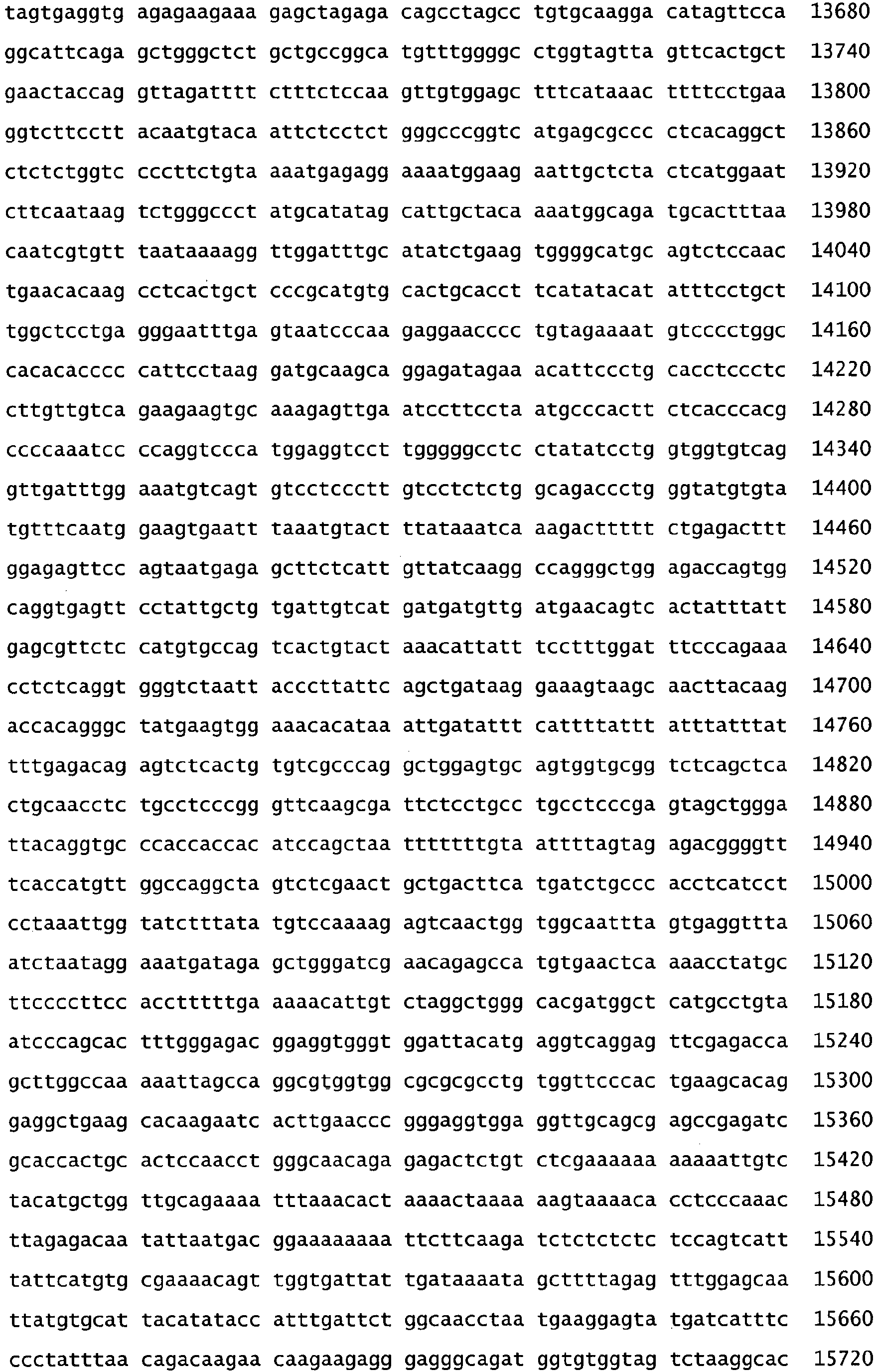






- <210> 42
<211> 65624
<212> DNA
<213> Homo sapiens - <400> 42




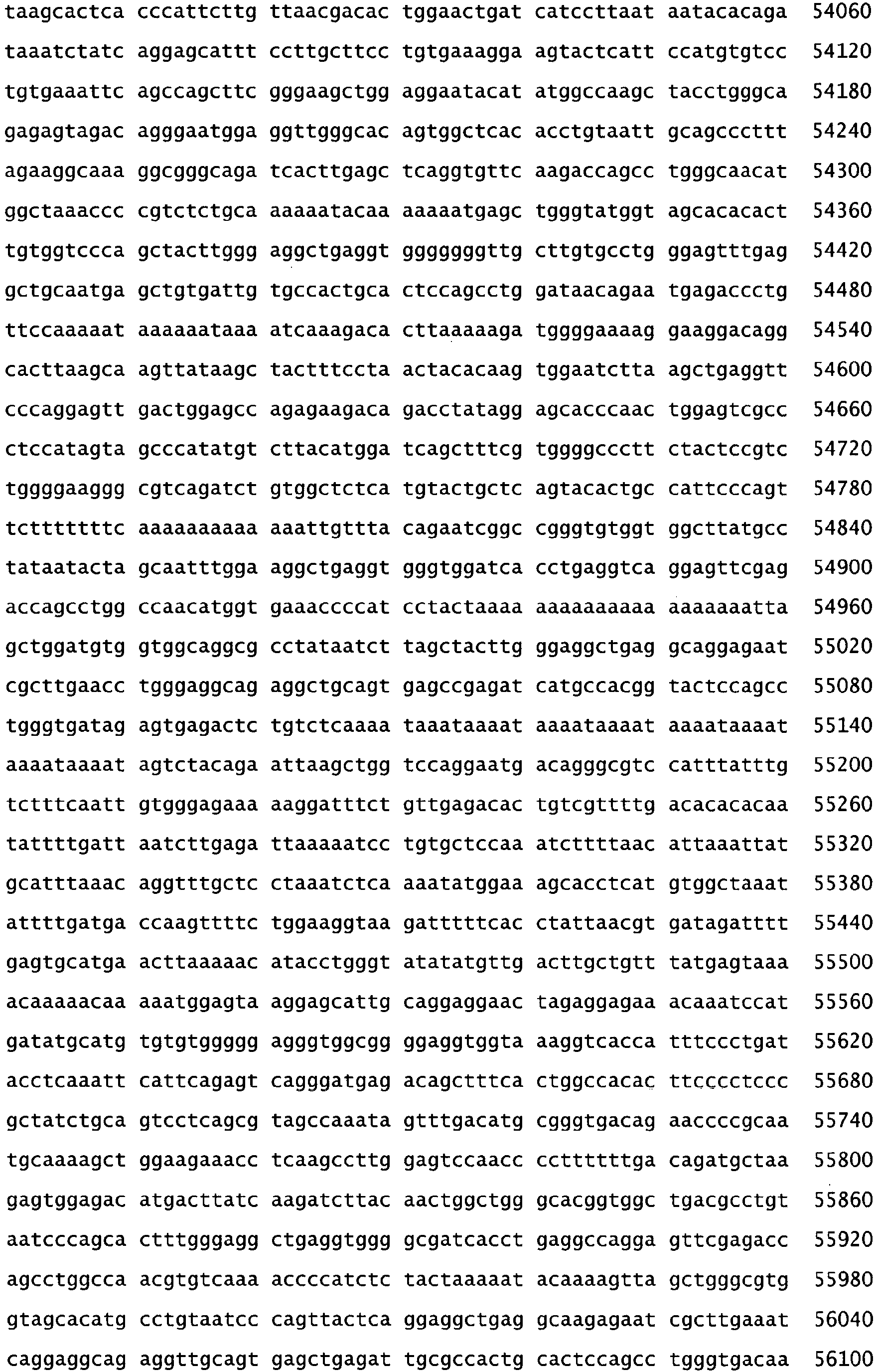


Claims (15)
- A method of discriminating the RHD*DIIIa-CE(4-7)-D or RHD*DIIIa-CE(4-7)-D-like blood type variants, which express the C+W antigen and lack a D antigen, from RHD*DIIIa, RHD*DIVa-2 and other blood type variants, of a subject, the method comprising:determining at least 4 markers in a sample that has been obtained from the subject,wherein the markers comprise:wherein:(i) the presence or absence of an RHCE*C allele;(ii) the presence or absence of an RHD/RHCE hybrid exon 3 (RHD/CE Hex03) allele;(iii) the absence of, or a single nucleotide polymorphism (SNP) variant within, any one of RHD exon 4, RHD exon 5, or RHD exon 6; and(iv) the absence of, or SNP variant within, RHD exon 7,absence of said RHCE*C allele; presence of said RHD/RHCE hybrid exon 3 allele;absence of RHD exon 4, RHD exon 5 or RHD exon 6; and absence of RHD exon 7 in combination indicate that the sample contains said RHD*DIIIa-CE(4-7)-D or said RHD*DIIIa-CE(4-7)-D-like blood type variant.
- A method according to claim 1, wherein:a) the SNP variant within RHD exon 4 is at position 602 of the RHD coding sequence (rs1053355),b) the SNP variant within RHD exon 5 is at position 667 of the RHD coding sequence (rs1053356),c) the SNP variant within RHD exon 6 is at position 819 of the RHD coding sequence; and/ord) the SNP variant within RHD exon 7 is at position 1048 of the RHD coding sequence (rs41307826),wherein the RHD coding sequence is as set forth in SEQ ID NO: 1.
- A method according to claim 1 or 2, wherein the markers further comprise:(v) the presence or absence of an RHD exon 3 allele,wherein the absence of said RHD exon 3 further indicates that the sample contains said RHD*DIIIa-CE(4-7)-D or said RHD*DIIIa-CE(4-7-D-like blood type variant.
- A method according to any one of the preceding claims, wherein:a) the method further comprises determining the RHD and RHC antigen phenotypes of the subject in accordance with Table 1; and/orb) the method comprises detecting the presence or absence of a blood type variant selected from: RHD*DIIIa; RHD*DIVa-2; or RHD*DIIIa-CE(4-7)-D or RHD*DIIIa-CE(4-7)-D)-like blood type variants, e.g. wherein the method comprises detecting the presence or absence of RHD*DIIIa-CE(4-7)-D or RHD*DIIIa-CE(4-7)-D)-like blood type variants; and/orc) marker (iii) is the SNP within RHD exon 4 at position 602 of the RHD coding sequence (rs1053355); and/ord) the RHCE*C allele is determined by determining the presence or absence of RHCE*C intron 2, or any one of the following positions in the RHCE coding sequence: position 307 (exon 2), position 48 (exon 1), position 150 (exon 2), position 178 (exon 2), position 201 (exon 2) and/or position 203 (exon 2),wherein the RHD coding sequence is as set forth in SEQ ID NO: 1 and wherein the RCHE coding sequence is as set forth in SEQ ID NO: 2.
- A method according to any one of the preceding claims, wherein the sample comprises nucleic acid and the method comprises amplifying the nucleic acid or a portion thereof by PCR using primers, e.g. wherein:a) the PCR primers for determining the RHCE*C allele are a forward PCR primer specific for RHCE*C, and a non-specific reverse PCR primer, e.g. wherein(i) the non-specific reverse primer is shared with RHD, RHC*C and/or RHC*c; and/or(ii) the PCR primers comprise:Forward: 5'-GGCCACCACCATTTGAA-3' (SEQ ID NO: 3)Reverse: 5'-CCATGAACATGCCACTTCAC-3', (SEQ ID NO: 4); and/orb) the PCR primers for determining the RHD/CE Hex03 allele are forward and reverse PCR primers targeting sequences located in introns 2 and 3, or introns 3 and 2, respectively, e.g. wherein(i) the PCR primers comprise:Forward primer: 5'-TCCTGGCTCTCCCTCTCT-3' (SEQ ID NO: 9)Reverse primer: 5'-TTTTCAAAACCCCGGAAG-3 (SEQ ID NO: 10);and/orc) the PCR primers for determining the SNP within RHD exon 4 at position 602 of the RHD coding sequence (rs1053355) are forward and reverse primers targeting sequences located in introns 3 and 4, or introns 4 and 3, respectively, e.g. wherein(i) the PCR primers comprise:Forward primer: 5'-GCTCTGAACTTTCTCCAAGGACT-3' (SEQ ID NO: 17)Reverse primer: 5'-ATTCTGCTCAGCCCAAGTAG-3' (SEQ ID NO: 18); and/ord) the PCR primers for determining the SNP within RHD exon 5 at position 667 of the RHD coding sequence (rs1053356) are forward and reverse primers targeting sequences located in introns 4 and 5, or introns 5 and 4, respectively, e.g. wherein(i) the PCR primers comprise:Forward primer: 5'-TTGAATTAAGCACTTCACAGAGCA-3' (SEQ ID NO: 19)Reverse primer: 5'-CACCTTGCTGATCTTCCC-3' (SEQ ID NO: 20); and/ore) the PCR primers for determining the SNP within RHD exon 6 at position 819 of the RHD coding sequence are forward and reverse primers targeting sequences located in introns 5 and 6, or introns 6 and 5, respectively, e.g. wherein(i) the PCR primers comprise:Forward primer: 5'-AGTAGTGAGCTGGCCCATCA-3' (SEQ ID NO: 21)Reverse primer: 5'-CTTCAGCCAAAGCAGAGGAG-3' (SEQ ID NO: 22); and/orf) the PCR primers for determining the SNP within RHD exon 7 at position 1048 of the RHD coding sequence (rs41307826) are forward and reverse primers targeting sequences located in introns 6 and 7, or introns 7 and 6, respectively, e.g. wherein(i) the PCR primers comprise:Forward primer: 5'-ACAAACTCCCCGATGATGTGAGTG-3' (SEQ ID NO: 35)Reverse primer: 5'-GAGGCTGAGAAAGGTTAAGCCA-3' (SEQ ID NO: 36); and/org) as dependent from claim 3, the PCR primers for determining the RHD exon 3 allele are forward and reverse primers targeting sequences located in introns 2 and 3, or introns 3 and 2, respectively, e.g. whereinwherein the RHD coding sequence is as set forth in SEQ ID NO: 1.(i) the PCR primers comprise:Forward primer: 5'-TCCTGGCTCTCCCTCTCT-3' (SEQ ID NO: 15)Reverse primer: 5'-GTTGTCTTTATTTTTCAAAACCCT-3' (SEQ ID NO:16);
- A method according to claim 5, wherein the amplified nucleic acid comprises a label, e.g. whereina) the label comprises a biotinylated nucleotide; and/orb) the label comprises a fluorescent moiety.
- A method according to any one of the preceding claims, wherein the sample comprises nucleic acid, and the method comprises amplifying the nucleic acid or a portion thereof by PCR using primers, fragmenting the amplified nucleic acid, and labelling the fragmented nucleic acid with biotinylated ddNTPS using a terminal deoxynucleotidyl transferase (TdT) enzyme.
- A method according to any one of the preceding claims, wherein determining the presence, absence or SNP variant of a marker comprises contacting nucleic acid containing each marker with one or more probes, e.g. wherein:a) as dependent from claim 3, the probes for determining the presence or absence of RHD/CE Hex03 or RHD exon 3 contact an SNP located in both RHD/CE Hex03 and RHD exon 3, wherein one SNP variant is specific for RHD/CE Hex03, and another SNP variant is specific for RHD exon 3, e.g. wherein(i) the SNP is at position 410 of the coding sequence, located within both RHD/CE Hex03 and RHD exon 3; and/or(ii) the probes comprise:(1) 5'-TTTTACAGACGCCTGCTACCATG-3', (SEQ ID NO: 5)(2) 5'-CATGGTAGCAGGCGTCTGTAAAA-3', (SEQ ID NO: 6)(3) 5'-TTTTACAGACGTCTGCTACCATG-3', (SEQ ID NO: 7) and(4) 5'-CATGGTAGCAGACGTCTGTAAAA-3', (SEQ ID NO: 8); and/orb) the probes for determining the absence or SNP variant of the SNP at: position 602 of the RHD coding sequence located within exon 4 (rs1053355), position 667 of the RHD coding sequence located within exon 5 (rs1053356), or position 819 of the RHD coding sequence located within exon 6 comprise:(i) RHD exon 4:(1) 5'-ATAAAGATCAGACAGCAACGATACC-3' (SEQ ID NO: 23)(2) 5'-TAAAGATCAGACAGCAACGATAC-3' (SEQ ID NO: 24)(3) 5'-ATAAAGATCAGAGAGCAACGATACC-3' (SEQ ID NO: 25)(4) 5'-TAAAGATCAGAGAGCAACGATAC-3' (SEQ ID NO: 26);(ii) RHD exon 5:(1) 5'-CTGGCCAAGTTTCAACTCTGC-3' (SEQ ID NO: 27)(2) 5'-TGGCCAAGTTTCAACTCTG-3' (SEQ ID NO: 28)(3) 5'-CTGGCCAAGTGTCAACTCTGC-3' (SEQ ID NO: 29)(4) 5'-TGGCCAAGTGTCAACTCTG-3' (SEQ ID NO: 30);(iii) RHD exon 6:(1) 5'-GTGCACAGTGCGGTGTTGGCAGG-3' (SEQ ID NO: 31)(2) 5'- TGCACAGTGCGGTGTTGGCAG -3' (SEQ ID NO: 32)(3) 5'- GTGCACAGTGCAGTGTTGGCAGG -3' (SEQ ID NO: 33)(4) 5'-TGCACAGTGCAGTGTTGGCAG-3' (SEQ ID NO: 34); and/orc) the probes for determining the SNP variant of the SNP at position 1048 of the RHD coding sequence located within exon 7 (rs41307826)comprise:wherein the RHD coding sequence is as set forth in SEQ ID NO:1.(1) 5'-TGCTGGTGCTTGATACCGTCGGA-3' (SEQ ID NO: 37)(2) 5'-GCTGGTGCTTGATACCGTCGG-3' (SEQ ID NO: 38)(3) 5'-TGCTGGTGCTTCATACCGTCGGA-3' (SEQ ID NO: 39)(4) 5'-GCTGGTGCT'fiCATACCGTCGG-3' (SEQ ID NO: 40);
- A method according to claim 8, whereina) one or more of the probes comprise a label, e.g. wherein the label is a fluorescent moiety; and/orb) one or more of the probes is attached to a solid support or conjugated to one or more particles.
- Use of a set of primers in a method for discriminating the RHD*DIIIa-CE(4-7)-D or RHD*DIIIa-CE(4-7_-D)-like blood type variants, which express the C+W antigen and lack a D antigen, from RHD*DIIIa, RHD*DIVa-2 and other blood type variants, by amplifying nucleic acid comprising at least the four markers of claim 1, wherein the set of primers comprises at least three primer pairs selected from the primers set forth in:(i) claim 5(a),(ii) claim 5(b),(iii) any one of claims 5(c), 5(d) or 5(e)(iv) claim 5(f), and(v) claim 5(g).
- Use according to claim 10, wherein the set of primers comprises at least three primer pairs selected from the primers set forth in:(i) claim 5(a)(ii),(ii) claim 5(b)(i),(iii) any one of claims 5(c)(i), 5(d)(i) or 5(e)(i),(iv) claim 5(f)(i), and(v) claim 5(g)(i).
- Use according to claim 10 or claim 11, wherein at least 50% of the primers in the set are the primer pairs defined in claim 10 or 11.
- Use of a set of probes in a method for discriminating the RHD*DIIIa-CE(4-7)-D or RHD*DIIIa-CE(4-7_-D)-like blood type variants, which express the C+W antigen and lack a D antigen, from RHD*DIIIa, RHD*DIVa-2 and other blood type variants, by determining the presence, absence or single nucleotide polymorphism (SNP) variant of at least the four markers of claim 1, wherein the set of probes comprises:(i) the probes of SEQ ID NOs: 5, 6, 7 and 8;(ii) the probes of SEQ ID NOs: 23, 24, 25 and 26;(iii) the probes of SEQ ID NOs: 31, 32, 33 and 34(iv) the probes of SEQ ID NOs: 27, 28, 29 and 30; and(v) the probes of SEQ ID NOs: 37, 38, 39 and 40.
- Use according to claim 13, wherein:a) the probes are immobilised on a solid support or conjugated to one or more particles, e.g. wherein the solid support comprises one or more attached labels, e.g. wherein the label is a fluorochrome; and/orb) one or more probes comprise a label, e.g wherein the label is a fluorescent moiety.
- Use of a kit for genotyping a subject, the kit comprising a set of PCR primers as defined in any one of claims 10 to 12, and a set of probes as defined in any one of claims 13 to 14.
Priority Applications (4)
| Application Number | Priority Date | Filing Date | Title |
|---|---|---|---|
| ES10197481.4T ES2445709T3 (en) | 2010-12-31 | 2010-12-31 | Method for the identification by molecular techniques of genetic variants that do not encode D (D-) antigen and encode altered C (C + W) antigen |
| EP10197481.4A EP2471949B1 (en) | 2010-12-31 | 2010-12-31 | Method for the identification by molecular techniques of genetic variants that encode no D antigen (D-) and altered C antigen (C+W) |
| US13/339,058 US20120172239A1 (en) | 2010-12-31 | 2011-12-28 | Method for the identification by molecular techniques of genetic variants that encode no d antigen (d-) and altered c antigen (c+w) |
| US14/938,405 US20160060696A1 (en) | 2010-12-31 | 2015-11-11 | Method for the identification by molecular techniques of genetic variants that encode no d antigen (d-) and altered c antigen (c+w) |
Applications Claiming Priority (1)
| Application Number | Priority Date | Filing Date | Title |
|---|---|---|---|
| EP10197481.4A EP2471949B1 (en) | 2010-12-31 | 2010-12-31 | Method for the identification by molecular techniques of genetic variants that encode no D antigen (D-) and altered C antigen (C+W) |
Publications (2)
| Publication Number | Publication Date |
|---|---|
| EP2471949A1 EP2471949A1 (en) | 2012-07-04 |
| EP2471949B1 true EP2471949B1 (en) | 2013-12-25 |
Family
ID=43838055
Family Applications (1)
| Application Number | Title | Priority Date | Filing Date |
|---|---|---|---|
| EP10197481.4A Not-in-force EP2471949B1 (en) | 2010-12-31 | 2010-12-31 | Method for the identification by molecular techniques of genetic variants that encode no D antigen (D-) and altered C antigen (C+W) |
Country Status (3)
| Country | Link |
|---|---|
| US (2) | US20120172239A1 (en) |
| EP (1) | EP2471949B1 (en) |
| ES (1) | ES2445709T3 (en) |
Families Citing this family (3)
| Publication number | Priority date | Publication date | Assignee | Title |
|---|---|---|---|---|
| WO2012171990A1 (en) * | 2011-06-17 | 2012-12-20 | Progenika Biopharma, S.A. | Discrimination of blood type variants |
| US9359643B2 (en) | 2013-03-08 | 2016-06-07 | Progenika Biopharma S.A. | Discrimination of blood type variants |
| CN113249466B (en) * | 2021-06-01 | 2022-04-15 | 青岛大学附属医院 | A SNP locus of the RHCE blood group gene that triggers hemolytic transfusion reaction and severe hemolytic disease of the newborn |
Family Cites Families (17)
| Publication number | Priority date | Publication date | Assignee | Title |
|---|---|---|---|---|
| DE10049363A1 (en) * | 2000-04-20 | 2001-10-31 | Adnagen Gmbh | Procedure, diagnostic kit and microarray for determining the rhesus factor |
| EP1591534A1 (en) * | 2004-04-01 | 2005-11-02 | Stichting Sanquin Bloedvoorziening | A method of genotyping blood cell antigens and a kit suitable for genotyping blood cell antigens |
| JP2008513036A (en) * | 2004-09-22 | 2008-05-01 | ユニバーシティ オブ ザ ウエスト オブ イングランド, ブリストル | Genotyping of RHD and ABO by multiplex PCR |
| US8153363B2 (en) * | 2005-01-13 | 2012-04-10 | Progenika Biopharma S.A. | Methods and products for in vitro genotyping |
| CA2594730A1 (en) * | 2005-01-13 | 2006-07-20 | Progenika Biopharma, S.A. | Methods and products for in vitro genotyping |
| EP2038429B1 (en) * | 2006-06-30 | 2013-08-21 | Nugen Technologies, Inc. | Methods for fragmentation and labeling of nucleic acids |
| JP2010530912A (en) | 2007-06-22 | 2010-09-16 | フィオ コーポレイション | Manufacturing system and method for polymer microbeads doped with quantum dots |
| FR2932561B1 (en) | 2008-06-11 | 2010-08-20 | Nexter Munitions | MICRO INITIATOR SECURE |
| WO2010002366A1 (en) | 2008-07-03 | 2010-01-07 | Wireless Extenders, Inc. | A method for scanning uplink frequencies in a wireless repeater |
| EP2141802A1 (en) | 2008-07-03 | 2010-01-06 | Stmicroelectronics SA | Switched capacitor amplifier |
| CN101339488A (en) | 2008-07-03 | 2009-01-07 | 腾讯数码(天津)有限公司 | Mobile terminal game content display process and device |
| CN102124674B (en) | 2008-07-03 | 2015-08-12 | 纽约市哥伦比亚大学理事会 | Method and system for controlling traffic on a communication network |
| WO2010002367A1 (en) | 2008-07-03 | 2010-01-07 | Prediction Sciences Llc | Diagnostic markers of breast cancer treatment and progression and methods of use thereof |
| DE102008031717A1 (en) | 2008-07-04 | 2010-01-07 | Bayerische Motoren Werke Aktiengesellschaft | Car navigation system |
| DE102008032253B4 (en) | 2008-07-09 | 2013-05-29 | Man Truck & Bus Ag | Self-igniting internal combustion engine with ether fumigation of combustion air for vehicles and method for ether fumigation of combustion air in a self-igniting internal combustion engine for vehicles |
| WO2010003649A1 (en) | 2008-07-10 | 2010-01-14 | Borealis Ag | Process for preparing a cable |
| ES2390411T3 (en) | 2008-07-11 | 2012-11-12 | Basf Se | Liquid mixtures of bis and tris phosphite ester with oxyalkylene bridge |
-
2010
- 2010-12-31 ES ES10197481.4T patent/ES2445709T3/en active Active
- 2010-12-31 EP EP10197481.4A patent/EP2471949B1/en not_active Not-in-force
-
2011
- 2011-12-28 US US13/339,058 patent/US20120172239A1/en not_active Abandoned
-
2015
- 2015-11-11 US US14/938,405 patent/US20160060696A1/en not_active Abandoned
Also Published As
| Publication number | Publication date |
|---|---|
| ES2445709T3 (en) | 2014-03-04 |
| US20120172239A1 (en) | 2012-07-05 |
| EP2471949A1 (en) | 2012-07-04 |
| US20160060696A1 (en) | 2016-03-03 |
Similar Documents
| Publication | Publication Date | Title |
|---|---|---|
| US7914990B2 (en) | Methods and products for in vitro genotyping | |
| KR101157526B1 (en) | Snp for diagnosing adhd, microarray and kit comprising the same, and method of diagnosing adhd using thereof | |
| US9637788B2 (en) | Discrimination of blood type variants | |
| AU2016286088A1 (en) | Single nucleotide polymorphism in HLA-B*15:02 and use thereof | |
| KR102158716B1 (en) | SNP marker for diagnosis of intracranial aneurysm comprising SNP of ARHGAP32 gene | |
| US20160060696A1 (en) | Method for the identification by molecular techniques of genetic variants that encode no d antigen (d-) and altered c antigen (c+w) | |
| JP2008513036A (en) | Genotyping of RHD and ABO by multiplex PCR | |
| AU2008311801A1 (en) | Detection of blood group genes | |
| US20040209254A1 (en) | Diagnostic polymorphisms for the tgf-beta1 promoter | |
| EP1856279B1 (en) | Method of diagnosing breast cancer and compositions therefor | |
| US7833710B2 (en) | Polynucleotide associated with breast cancer comprising single nucleotide polymorphism, microarray and diagnostic kit comprising the same and method for diagnosing breast cancer using the same | |
| WO2008090632A1 (en) | Marker for detecting the proposed efficacy of treatment | |
| KR20160040677A (en) | Method for detecting predisposition for hepatitis B to become chronic | |
| KR102511596B1 (en) | A single nucleotide polymorphism marker composition for diagnosing an adverse reactions with angiotensin converting enzyme inhibitor and a method using the same | |
| KR101167934B1 (en) | Polynucleotides derived from TICAM1 gene comprising single nucleotide polymorphisms, microarrays and diagnostic kits comprising the same, and analytic methods for autism spectrum disorder using the same | |
| EP1716255A2 (en) | A polynucleotide associated with a colon cancer comprising single nucleotide polymorphism, microarray and diagnostic kit comprising the same and method for diagnosing a colon cancer using the polynucleotide | |
| KR102158723B1 (en) | SNP marker for diagnosis of intracranial aneurysm comprising SNP of SPCS3 gene | |
| KR102158719B1 (en) | SNP marker for diagnosis of intracranial aneurysm comprising SNP of LOC102724084 gene | |
| KR102158725B1 (en) | SNP marker for diagnosis of intracranial aneurysm comprising SNP of MINK1 gene | |
| KR101167942B1 (en) | Polynucleotides derived from ALG12 gene comprising single nucleotide polymorphisms, microarrays and diagnostic kits comprising the same, and analytic methods for autism spectrum disorders using the same | |
| WO2006098401A1 (en) | Method for determination of risk of rheumatoid arthritis | |
| JP2006254738A (en) | Diabetes disease susceptibility gene and method for detecting difficulty in developing diabetes | |
| WO2002072888A2 (en) | Polymorphisms in the human cmoat gene and uses thereof | |
| KR20100104754A (en) | Polynucleotides comprising single nucleotide polymorphism derived from defa4 gene, microarrays and diagnostic kits comprising the same, and detection methods using the same |
Legal Events
| Date | Code | Title | Description |
|---|---|---|---|
| 17P | Request for examination filed |
Effective date: 20120322 |
|
| AK | Designated contracting states |
Kind code of ref document: A1 Designated state(s): AL AT BE BG CH CY CZ DE DK EE ES FI FR GB GR HR HU IE IS IT LI LT LU LV MC MK MT NL NO PL PT RO RS SE SI SK SM TR |
|
| AX | Request for extension of the european patent |
Extension state: BA ME |
|
| PUAI | Public reference made under article 153(3) epc to a published international application that has entered the european phase |
Free format text: ORIGINAL CODE: 0009012 |
|
| 17Q | First examination report despatched |
Effective date: 20120828 |
|
| GRAP | Despatch of communication of intention to grant a patent |
Free format text: ORIGINAL CODE: EPIDOSNIGR1 |
|
| INTG | Intention to grant announced |
Effective date: 20130725 |
|
| RIN1 | Information on inventor provided before grant (corrected) |
Inventor name: MARTINEZ, ANTONIO Inventor name: OCHOA, JORGE Inventor name: SIMON, LAUREANO Inventor name: TEJEDOR, DIEGO Inventor name: LOPEZ, MONICA |
|
| GRAS | Grant fee paid |
Free format text: ORIGINAL CODE: EPIDOSNIGR3 |
|
| GRAA | (expected) grant |
Free format text: ORIGINAL CODE: 0009210 |
|
| RAP1 | Party data changed (applicant data changed or rights of an application transferred) |
Owner name: PROGENIKA BIOPHARMA, S.A. |
|
| RIN1 | Information on inventor provided before grant (corrected) |
Inventor name: SIMON, LAUREANO Inventor name: MARTINEZ, ANTONIO Inventor name: TEJEDOR, DIEGO Inventor name: LOPEZ, MONICA Inventor name: OCHOA, JORGE |
|
| AK | Designated contracting states |
Kind code of ref document: B1 Designated state(s): AL AT BE BG CH CY CZ DE DK EE ES FI FR GB GR HR HU IE IS IT LI LT LU LV MC MK MT NL NO PL PT RO RS SE SI SK SM TR |
|
| REG | Reference to a national code |
Ref country code: GB Ref legal event code: FG4D |
|
| REG | Reference to a national code |
Ref country code: CH Ref legal event code: EP |
|
| REG | Reference to a national code |
Ref country code: AT Ref legal event code: REF Ref document number: 646697 Country of ref document: AT Kind code of ref document: T Effective date: 20140115 |
|
| REG | Reference to a national code |
Ref country code: IE Ref legal event code: FG4D |
|
| REG | Reference to a national code |
Ref country code: DE Ref legal event code: R096 Ref document number: 602010012636 Country of ref document: DE Effective date: 20140213 |
|
| REG | Reference to a national code |
Ref country code: NL Ref legal event code: T3 |
|
| REG | Reference to a national code |
Ref country code: ES Ref legal event code: FG2A Ref document number: 2445709 Country of ref document: ES Kind code of ref document: T3 Effective date: 20140304 |
|
| PG25 | Lapsed in a contracting state [announced via postgrant information from national office to epo] |
Ref country code: LT Free format text: LAPSE BECAUSE OF FAILURE TO SUBMIT A TRANSLATION OF THE DESCRIPTION OR TO PAY THE FEE WITHIN THE PRESCRIBED TIME-LIMIT Effective date: 20131225 Ref country code: FI Free format text: LAPSE BECAUSE OF FAILURE TO SUBMIT A TRANSLATION OF THE DESCRIPTION OR TO PAY THE FEE WITHIN THE PRESCRIBED TIME-LIMIT Effective date: 20131225 Ref country code: NO Free format text: LAPSE BECAUSE OF FAILURE TO SUBMIT A TRANSLATION OF THE DESCRIPTION OR TO PAY THE FEE WITHIN THE PRESCRIBED TIME-LIMIT Effective date: 20140325 Ref country code: SE Free format text: LAPSE BECAUSE OF FAILURE TO SUBMIT A TRANSLATION OF THE DESCRIPTION OR TO PAY THE FEE WITHIN THE PRESCRIBED TIME-LIMIT Effective date: 20131225 Ref country code: HR Free format text: LAPSE BECAUSE OF FAILURE TO SUBMIT A TRANSLATION OF THE DESCRIPTION OR TO PAY THE FEE WITHIN THE PRESCRIBED TIME-LIMIT Effective date: 20131225 |
|
| REG | Reference to a national code |
Ref country code: AT Ref legal event code: MK05 Ref document number: 646697 Country of ref document: AT Kind code of ref document: T Effective date: 20131225 |
|
| REG | Reference to a national code |
Ref country code: LT Ref legal event code: MG4D |
|
| PG25 | Lapsed in a contracting state [announced via postgrant information from national office to epo] |
Ref country code: RS Free format text: LAPSE BECAUSE OF FAILURE TO SUBMIT A TRANSLATION OF THE DESCRIPTION OR TO PAY THE FEE WITHIN THE PRESCRIBED TIME-LIMIT Effective date: 20131225 Ref country code: LV Free format text: LAPSE BECAUSE OF FAILURE TO SUBMIT A TRANSLATION OF THE DESCRIPTION OR TO PAY THE FEE WITHIN THE PRESCRIBED TIME-LIMIT Effective date: 20131225 |
|
| PG25 | Lapsed in a contracting state [announced via postgrant information from national office to epo] |
Ref country code: BE Free format text: LAPSE BECAUSE OF FAILURE TO SUBMIT A TRANSLATION OF THE DESCRIPTION OR TO PAY THE FEE WITHIN THE PRESCRIBED TIME-LIMIT Effective date: 20131225 Ref country code: IS Free format text: LAPSE BECAUSE OF FAILURE TO SUBMIT A TRANSLATION OF THE DESCRIPTION OR TO PAY THE FEE WITHIN THE PRESCRIBED TIME-LIMIT Effective date: 20140425 Ref country code: EE Free format text: LAPSE BECAUSE OF FAILURE TO SUBMIT A TRANSLATION OF THE DESCRIPTION OR TO PAY THE FEE WITHIN THE PRESCRIBED TIME-LIMIT Effective date: 20131225 |
|
| PG25 | Lapsed in a contracting state [announced via postgrant information from national office to epo] |
Ref country code: CZ Free format text: LAPSE BECAUSE OF FAILURE TO SUBMIT A TRANSLATION OF THE DESCRIPTION OR TO PAY THE FEE WITHIN THE PRESCRIBED TIME-LIMIT Effective date: 20131225 Ref country code: PT Free format text: LAPSE BECAUSE OF FAILURE TO SUBMIT A TRANSLATION OF THE DESCRIPTION OR TO PAY THE FEE WITHIN THE PRESCRIBED TIME-LIMIT Effective date: 20140428 Ref country code: CY Free format text: LAPSE BECAUSE OF FAILURE TO SUBMIT A TRANSLATION OF THE DESCRIPTION OR TO PAY THE FEE WITHIN THE PRESCRIBED TIME-LIMIT Effective date: 20131225 Ref country code: SK Free format text: LAPSE BECAUSE OF FAILURE TO SUBMIT A TRANSLATION OF THE DESCRIPTION OR TO PAY THE FEE WITHIN THE PRESCRIBED TIME-LIMIT Effective date: 20131225 Ref country code: AT Free format text: LAPSE BECAUSE OF FAILURE TO SUBMIT A TRANSLATION OF THE DESCRIPTION OR TO PAY THE FEE WITHIN THE PRESCRIBED TIME-LIMIT Effective date: 20131225 Ref country code: RO Free format text: LAPSE BECAUSE OF FAILURE TO SUBMIT A TRANSLATION OF THE DESCRIPTION OR TO PAY THE FEE WITHIN THE PRESCRIBED TIME-LIMIT Effective date: 20131225 |
|
| REG | Reference to a national code |
Ref country code: IE Ref legal event code: MM4A |
|
| REG | Reference to a national code |
Ref country code: DE Ref legal event code: R097 Ref document number: 602010012636 Country of ref document: DE |
|
| PG25 | Lapsed in a contracting state [announced via postgrant information from national office to epo] |
Ref country code: MC Free format text: LAPSE BECAUSE OF FAILURE TO SUBMIT A TRANSLATION OF THE DESCRIPTION OR TO PAY THE FEE WITHIN THE PRESCRIBED TIME-LIMIT Effective date: 20131225 |
|
| PG25 | Lapsed in a contracting state [announced via postgrant information from national office to epo] |
Ref country code: IE Free format text: LAPSE BECAUSE OF NON-PAYMENT OF DUE FEES Effective date: 20131231 Ref country code: DK Free format text: LAPSE BECAUSE OF FAILURE TO SUBMIT A TRANSLATION OF THE DESCRIPTION OR TO PAY THE FEE WITHIN THE PRESCRIBED TIME-LIMIT Effective date: 20131225 |
|
| PLBE | No opposition filed within time limit |
Free format text: ORIGINAL CODE: 0009261 |
|
| STAA | Information on the status of an ep patent application or granted ep patent |
Free format text: STATUS: NO OPPOSITION FILED WITHIN TIME LIMIT |
|
| PG25 | Lapsed in a contracting state [announced via postgrant information from national office to epo] |
Ref country code: PL Free format text: LAPSE BECAUSE OF FAILURE TO SUBMIT A TRANSLATION OF THE DESCRIPTION OR TO PAY THE FEE WITHIN THE PRESCRIBED TIME-LIMIT Effective date: 20131225 |
|
| 26N | No opposition filed |
Effective date: 20140926 |
|
| REG | Reference to a national code |
Ref country code: DE Ref legal event code: R097 Ref document number: 602010012636 Country of ref document: DE Effective date: 20140926 |
|
| PG25 | Lapsed in a contracting state [announced via postgrant information from national office to epo] |
Ref country code: SM Free format text: LAPSE BECAUSE OF FAILURE TO SUBMIT A TRANSLATION OF THE DESCRIPTION OR TO PAY THE FEE WITHIN THE PRESCRIBED TIME-LIMIT Effective date: 20131225 Ref country code: SI Free format text: LAPSE BECAUSE OF FAILURE TO SUBMIT A TRANSLATION OF THE DESCRIPTION OR TO PAY THE FEE WITHIN THE PRESCRIBED TIME-LIMIT Effective date: 20131225 |
|
| PG25 | Lapsed in a contracting state [announced via postgrant information from national office to epo] |
Ref country code: BG Free format text: LAPSE BECAUSE OF FAILURE TO SUBMIT A TRANSLATION OF THE DESCRIPTION OR TO PAY THE FEE WITHIN THE PRESCRIBED TIME-LIMIT Effective date: 20131225 Ref country code: MK Free format text: LAPSE BECAUSE OF FAILURE TO SUBMIT A TRANSLATION OF THE DESCRIPTION OR TO PAY THE FEE WITHIN THE PRESCRIBED TIME-LIMIT Effective date: 20131225 Ref country code: HU Free format text: LAPSE BECAUSE OF FAILURE TO SUBMIT A TRANSLATION OF THE DESCRIPTION OR TO PAY THE FEE WITHIN THE PRESCRIBED TIME-LIMIT; INVALID AB INITIO Effective date: 20101231 Ref country code: LU Free format text: LAPSE BECAUSE OF NON-PAYMENT OF DUE FEES Effective date: 20131231 |
|
| REG | Reference to a national code |
Ref country code: CH Ref legal event code: PL |
|
| PG25 | Lapsed in a contracting state [announced via postgrant information from national office to epo] |
Ref country code: GR Free format text: LAPSE BECAUSE OF NON-PAYMENT OF DUE FEES Effective date: 20131225 Ref country code: MT Free format text: LAPSE BECAUSE OF FAILURE TO SUBMIT A TRANSLATION OF THE DESCRIPTION OR TO PAY THE FEE WITHIN THE PRESCRIBED TIME-LIMIT Effective date: 20131225 |
|
| PG25 | Lapsed in a contracting state [announced via postgrant information from national office to epo] |
Ref country code: LI Free format text: LAPSE BECAUSE OF NON-PAYMENT OF DUE FEES Effective date: 20141231 Ref country code: CH Free format text: LAPSE BECAUSE OF NON-PAYMENT OF DUE FEES Effective date: 20141231 |
|
| REG | Reference to a national code |
Ref country code: FR Ref legal event code: PLFP Year of fee payment: 6 |
|
| PG25 | Lapsed in a contracting state [announced via postgrant information from national office to epo] |
Ref country code: GR Free format text: LAPSE BECAUSE OF FAILURE TO SUBMIT A TRANSLATION OF THE DESCRIPTION OR TO PAY THE FEE WITHIN THE PRESCRIBED TIME-LIMIT Effective date: 20140326 |
|
| PG25 | Lapsed in a contracting state [announced via postgrant information from national office to epo] |
Ref country code: TR Free format text: LAPSE BECAUSE OF FAILURE TO SUBMIT A TRANSLATION OF THE DESCRIPTION OR TO PAY THE FEE WITHIN THE PRESCRIBED TIME-LIMIT Effective date: 20131225 |
|
| REG | Reference to a national code |
Ref country code: FR Ref legal event code: PLFP Year of fee payment: 7 |
|
| PGFP | Annual fee paid to national office [announced via postgrant information from national office to epo] |
Ref country code: FR Payment date: 20161026 Year of fee payment: 7 Ref country code: NL Payment date: 20161026 Year of fee payment: 7 Ref country code: DE Payment date: 20161026 Year of fee payment: 7 Ref country code: GB Payment date: 20161020 Year of fee payment: 7 |
|
| PGFP | Annual fee paid to national office [announced via postgrant information from national office to epo] |
Ref country code: IT Payment date: 20161027 Year of fee payment: 7 Ref country code: ES Payment date: 20161221 Year of fee payment: 7 |
|
| REG | Reference to a national code |
Ref country code: DE Ref legal event code: R119 Ref document number: 602010012636 Country of ref document: DE |
|
| REG | Reference to a national code |
Ref country code: NL Ref legal event code: MM Effective date: 20180101 |
|
| GBPC | Gb: european patent ceased through non-payment of renewal fee |
Effective date: 20171231 |
|
| PG25 | Lapsed in a contracting state [announced via postgrant information from national office to epo] |
Ref country code: NL Free format text: LAPSE BECAUSE OF NON-PAYMENT OF DUE FEES Effective date: 20180101 |
|
| REG | Reference to a national code |
Ref country code: FR Ref legal event code: ST Effective date: 20180831 |
|
| PG25 | Lapsed in a contracting state [announced via postgrant information from national office to epo] |
Ref country code: IT Free format text: LAPSE BECAUSE OF NON-PAYMENT OF DUE FEES Effective date: 20171231 Ref country code: DE Free format text: LAPSE BECAUSE OF NON-PAYMENT OF DUE FEES Effective date: 20180703 Ref country code: AL Free format text: LAPSE BECAUSE OF FAILURE TO SUBMIT A TRANSLATION OF THE DESCRIPTION OR TO PAY THE FEE WITHIN THE PRESCRIBED TIME-LIMIT Effective date: 20131225 Ref country code: FR Free format text: LAPSE BECAUSE OF NON-PAYMENT OF DUE FEES Effective date: 20180102 |
|
| PG25 | Lapsed in a contracting state [announced via postgrant information from national office to epo] |
Ref country code: GB Free format text: LAPSE BECAUSE OF NON-PAYMENT OF DUE FEES Effective date: 20171231 |
|
| REG | Reference to a national code |
Ref country code: ES Ref legal event code: FD2A Effective date: 20190704 |
|
| PG25 | Lapsed in a contracting state [announced via postgrant information from national office to epo] |
Ref country code: ES Free format text: LAPSE BECAUSE OF NON-PAYMENT OF DUE FEES Effective date: 20180101 |