EP2471799B1 - Samarium complex and uses thereof - Google Patents
Samarium complex and uses thereof Download PDFInfo
- Publication number
- EP2471799B1 EP2471799B1 EP10804266.4A EP10804266A EP2471799B1 EP 2471799 B1 EP2471799 B1 EP 2471799B1 EP 10804266 A EP10804266 A EP 10804266A EP 2471799 B1 EP2471799 B1 EP 2471799B1
- Authority
- EP
- European Patent Office
- Prior art keywords
- group
- hfa
- chain
- samarium complex
- samarium
- Prior art date
- Legal status (The legal status is an assumption and is not a legal conclusion. Google has not performed a legal analysis and makes no representation as to the accuracy of the status listed.)
- Not-in-force
Links
- 0 CC(*(C)C)P(Cc1cccc(CP(C(C)(C)C)(C(C)(C)C)=O)n1)(C(C)(C)C)=O Chemical compound CC(*(C)C)P(Cc1cccc(CP(C(C)(C)C)(C(C)(C)C)=O)n1)(C(C)(C)C)=O 0.000 description 7
- XZMOBMBSRLIJFL-UHFFFAOYSA-N CC(CCC1C)P1C(C(OC1=O)=O)=C1P1(C(C)CCC1C)=O Chemical compound CC(CCC1C)P1C(C(OC1=O)=O)=C1P1(C(C)CCC1C)=O XZMOBMBSRLIJFL-UHFFFAOYSA-N 0.000 description 1
- SNNSYOGHCCSZMU-UHFFFAOYSA-N CC1C(P(CC2OC(C)(C)OC2CP(c2ccccc2)(c2ccccc2)=O)(c2ccccc2)=O)=CC=CC1 Chemical compound CC1C(P(CC2OC(C)(C)OC2CP(c2ccccc2)(c2ccccc2)=O)(c2ccccc2)=O)=CC=CC1 SNNSYOGHCCSZMU-UHFFFAOYSA-N 0.000 description 1
- FXCYJNJQLLGGGH-UHFFFAOYSA-N O=P(C(C1C=CC2C1)C2P(c1ccccc1)(c1ccccc1)=O)(c1ccccc1)c1ccccc1 Chemical compound O=P(C(C1C=CC2C1)C2P(c1ccccc1)(c1ccccc1)=O)(c1ccccc1)c1ccccc1 FXCYJNJQLLGGGH-UHFFFAOYSA-N 0.000 description 1
- DHCOPNRFTYEXPD-UHFFFAOYSA-N O=P(Cc1cc(CP(C2CCCC2)(C2CCCC2)=O)ccc1)(C1CCCC1)C1CCCC1 Chemical compound O=P(Cc1cc(CP(C2CCCC2)(C2CCCC2)=O)ccc1)(C1CCCC1)C1CCCC1 DHCOPNRFTYEXPD-UHFFFAOYSA-N 0.000 description 1
- ZAXOHAZNONBOSY-UHFFFAOYSA-N O=P(c1ccccc1)(c1ccccc1)c1cccc(OCCCOc2ccc3)c1-c2c3P(c1ccccc1)(c1ccccc1)=O Chemical compound O=P(c1ccccc1)(c1ccccc1)c1cccc(OCCCOc2ccc3)c1-c2c3P(c1ccccc1)(c1ccccc1)=O ZAXOHAZNONBOSY-UHFFFAOYSA-N 0.000 description 1
Images

Classifications
-
- C—CHEMISTRY; METALLURGY
- C07—ORGANIC CHEMISTRY
- C07F—ACYCLIC, CARBOCYCLIC OR HETEROCYCLIC COMPOUNDS CONTAINING ELEMENTS OTHER THAN CARBON, HYDROGEN, HALOGEN, OXYGEN, NITROGEN, SULFUR, SELENIUM OR TELLURIUM
- C07F9/00—Compounds containing elements of Groups 5 or 15 of the Periodic Table
- C07F9/02—Phosphorus compounds
- C07F9/28—Phosphorus compounds with one or more P—C bonds
- C07F9/50—Organo-phosphines
- C07F9/53—Organo-phosphine oxides; Organo-phosphine thioxides
- C07F9/5329—Polyphosphine oxides or thioxides
-
- C—CHEMISTRY; METALLURGY
- C07—ORGANIC CHEMISTRY
- C07F—ACYCLIC, CARBOCYCLIC OR HETEROCYCLIC COMPOUNDS CONTAINING ELEMENTS OTHER THAN CARBON, HYDROGEN, HALOGEN, OXYGEN, NITROGEN, SULFUR, SELENIUM OR TELLURIUM
- C07F5/00—Compounds containing elements of Groups 3 or 13 of the Periodic Table
- C07F5/003—Compounds containing elements of Groups 3 or 13 of the Periodic Table without C-Metal linkages
-
- C—CHEMISTRY; METALLURGY
- C07—ORGANIC CHEMISTRY
- C07F—ACYCLIC, CARBOCYCLIC OR HETEROCYCLIC COMPOUNDS CONTAINING ELEMENTS OTHER THAN CARBON, HYDROGEN, HALOGEN, OXYGEN, NITROGEN, SULFUR, SELENIUM OR TELLURIUM
- C07F9/00—Compounds containing elements of Groups 5 or 15 of the Periodic Table
- C07F9/02—Phosphorus compounds
- C07F9/28—Phosphorus compounds with one or more P—C bonds
- C07F9/50—Organo-phosphines
- C07F9/53—Organo-phosphine oxides; Organo-phosphine thioxides
- C07F9/5345—Complexes or chelates of phosphine-oxides or thioxides with metallic compounds or metals
-
- C—CHEMISTRY; METALLURGY
- C07—ORGANIC CHEMISTRY
- C07F—ACYCLIC, CARBOCYCLIC OR HETEROCYCLIC COMPOUNDS CONTAINING ELEMENTS OTHER THAN CARBON, HYDROGEN, HALOGEN, OXYGEN, NITROGEN, SULFUR, SELENIUM OR TELLURIUM
- C07F9/00—Compounds containing elements of Groups 5 or 15 of the Periodic Table
- C07F9/02—Phosphorus compounds
- C07F9/547—Heterocyclic compounds, e.g. containing phosphorus as a ring hetero atom
- C07F9/553—Heterocyclic compounds, e.g. containing phosphorus as a ring hetero atom having one nitrogen atom as the only ring hetero atom
- C07F9/572—Five-membered rings
-
- C—CHEMISTRY; METALLURGY
- C07—ORGANIC CHEMISTRY
- C07F—ACYCLIC, CARBOCYCLIC OR HETEROCYCLIC COMPOUNDS CONTAINING ELEMENTS OTHER THAN CARBON, HYDROGEN, HALOGEN, OXYGEN, NITROGEN, SULFUR, SELENIUM OR TELLURIUM
- C07F9/00—Compounds containing elements of Groups 5 or 15 of the Periodic Table
- C07F9/02—Phosphorus compounds
- C07F9/547—Heterocyclic compounds, e.g. containing phosphorus as a ring hetero atom
- C07F9/553—Heterocyclic compounds, e.g. containing phosphorus as a ring hetero atom having one nitrogen atom as the only ring hetero atom
- C07F9/576—Six-membered rings
- C07F9/58—Pyridine rings
-
- C—CHEMISTRY; METALLURGY
- C07—ORGANIC CHEMISTRY
- C07F—ACYCLIC, CARBOCYCLIC OR HETEROCYCLIC COMPOUNDS CONTAINING ELEMENTS OTHER THAN CARBON, HYDROGEN, HALOGEN, OXYGEN, NITROGEN, SULFUR, SELENIUM OR TELLURIUM
- C07F9/00—Compounds containing elements of Groups 5 or 15 of the Periodic Table
- C07F9/02—Phosphorus compounds
- C07F9/547—Heterocyclic compounds, e.g. containing phosphorus as a ring hetero atom
- C07F9/655—Heterocyclic compounds, e.g. containing phosphorus as a ring hetero atom having oxygen atoms, with or without sulfur, selenium, or tellurium atoms, as the only ring hetero atoms
- C07F9/65515—Heterocyclic compounds, e.g. containing phosphorus as a ring hetero atom having oxygen atoms, with or without sulfur, selenium, or tellurium atoms, as the only ring hetero atoms the oxygen atom being part of a five-membered ring
-
- C—CHEMISTRY; METALLURGY
- C07—ORGANIC CHEMISTRY
- C07F—ACYCLIC, CARBOCYCLIC OR HETEROCYCLIC COMPOUNDS CONTAINING ELEMENTS OTHER THAN CARBON, HYDROGEN, HALOGEN, OXYGEN, NITROGEN, SULFUR, SELENIUM OR TELLURIUM
- C07F9/00—Compounds containing elements of Groups 5 or 15 of the Periodic Table
- C07F9/02—Phosphorus compounds
- C07F9/547—Heterocyclic compounds, e.g. containing phosphorus as a ring hetero atom
- C07F9/655—Heterocyclic compounds, e.g. containing phosphorus as a ring hetero atom having oxygen atoms, with or without sulfur, selenium, or tellurium atoms, as the only ring hetero atoms
- C07F9/6552—Heterocyclic compounds, e.g. containing phosphorus as a ring hetero atom having oxygen atoms, with or without sulfur, selenium, or tellurium atoms, as the only ring hetero atoms the oxygen atom being part of a six-membered ring
- C07F9/65522—Heterocyclic compounds, e.g. containing phosphorus as a ring hetero atom having oxygen atoms, with or without sulfur, selenium, or tellurium atoms, as the only ring hetero atoms the oxygen atom being part of a six-membered ring condensed with carbocyclic rings or carbocyclic ring systems
-
- C—CHEMISTRY; METALLURGY
- C07—ORGANIC CHEMISTRY
- C07F—ACYCLIC, CARBOCYCLIC OR HETEROCYCLIC COMPOUNDS CONTAINING ELEMENTS OTHER THAN CARBON, HYDROGEN, HALOGEN, OXYGEN, NITROGEN, SULFUR, SELENIUM OR TELLURIUM
- C07F9/00—Compounds containing elements of Groups 5 or 15 of the Periodic Table
- C07F9/02—Phosphorus compounds
- C07F9/547—Heterocyclic compounds, e.g. containing phosphorus as a ring hetero atom
- C07F9/655—Heterocyclic compounds, e.g. containing phosphorus as a ring hetero atom having oxygen atoms, with or without sulfur, selenium, or tellurium atoms, as the only ring hetero atoms
- C07F9/65525—Heterocyclic compounds, e.g. containing phosphorus as a ring hetero atom having oxygen atoms, with or without sulfur, selenium, or tellurium atoms, as the only ring hetero atoms the oxygen atom being part of a seven-(or more) membered ring
- C07F9/65527—Heterocyclic compounds, e.g. containing phosphorus as a ring hetero atom having oxygen atoms, with or without sulfur, selenium, or tellurium atoms, as the only ring hetero atoms the oxygen atom being part of a seven-(or more) membered ring condensed with carbocyclic rings or carbocyclic ring systems
-
- C—CHEMISTRY; METALLURGY
- C09—DYES; PAINTS; POLISHES; NATURAL RESINS; ADHESIVES; COMPOSITIONS NOT OTHERWISE PROVIDED FOR; APPLICATIONS OF MATERIALS NOT OTHERWISE PROVIDED FOR
- C09K—MATERIALS FOR MISCELLANEOUS APPLICATIONS, NOT PROVIDED FOR ELSEWHERE
- C09K11/00—Luminescent materials, e.g. electroluminescent or chemiluminescent
- C09K11/06—Luminescent materials, e.g. electroluminescent or chemiluminescent containing organic luminescent materials
-
- H—ELECTRICITY
- H05—ELECTRIC TECHNIQUES NOT OTHERWISE PROVIDED FOR
- H05B—ELECTRIC HEATING; ELECTRIC LIGHT SOURCES NOT OTHERWISE PROVIDED FOR; CIRCUIT ARRANGEMENTS FOR ELECTRIC LIGHT SOURCES, IN GENERAL
- H05B33/00—Electroluminescent light sources
- H05B33/12—Light sources with substantially two-dimensional [2D] radiating surfaces
- H05B33/14—Light sources with substantially two-dimensional [2D] radiating surfaces characterised by the chemical or physical composition or the arrangement of the electroluminescent material, or by the simultaneous addition of the electroluminescent material in or onto the light source
-
- H—ELECTRICITY
- H10—SEMICONDUCTOR DEVICES; ELECTRIC SOLID-STATE DEVICES NOT OTHERWISE PROVIDED FOR
- H10K—ORGANIC ELECTRIC SOLID-STATE DEVICES
- H10K85/00—Organic materials used in the body or electrodes of devices covered by this subclass
- H10K85/30—Coordination compounds
- H10K85/351—Metal complexes comprising lanthanides or actinides, e.g. comprising europium
-
- C—CHEMISTRY; METALLURGY
- C09—DYES; PAINTS; POLISHES; NATURAL RESINS; ADHESIVES; COMPOSITIONS NOT OTHERWISE PROVIDED FOR; APPLICATIONS OF MATERIALS NOT OTHERWISE PROVIDED FOR
- C09K—MATERIALS FOR MISCELLANEOUS APPLICATIONS, NOT PROVIDED FOR ELSEWHERE
- C09K2211/00—Chemical nature of organic luminescent or tenebrescent compounds
- C09K2211/10—Non-macromolecular compounds
- C09K2211/1003—Carbocyclic compounds
- C09K2211/1007—Non-condensed systems
-
- C—CHEMISTRY; METALLURGY
- C09—DYES; PAINTS; POLISHES; NATURAL RESINS; ADHESIVES; COMPOSITIONS NOT OTHERWISE PROVIDED FOR; APPLICATIONS OF MATERIALS NOT OTHERWISE PROVIDED FOR
- C09K—MATERIALS FOR MISCELLANEOUS APPLICATIONS, NOT PROVIDED FOR ELSEWHERE
- C09K2211/00—Chemical nature of organic luminescent or tenebrescent compounds
- C09K2211/10—Non-macromolecular compounds
- C09K2211/1018—Heterocyclic compounds
- C09K2211/1025—Heterocyclic compounds characterised by ligands
- C09K2211/1088—Heterocyclic compounds characterised by ligands containing oxygen as the only heteroatom
-
- C—CHEMISTRY; METALLURGY
- C09—DYES; PAINTS; POLISHES; NATURAL RESINS; ADHESIVES; COMPOSITIONS NOT OTHERWISE PROVIDED FOR; APPLICATIONS OF MATERIALS NOT OTHERWISE PROVIDED FOR
- C09K—MATERIALS FOR MISCELLANEOUS APPLICATIONS, NOT PROVIDED FOR ELSEWHERE
- C09K2211/00—Chemical nature of organic luminescent or tenebrescent compounds
- C09K2211/18—Metal complexes
- C09K2211/182—Metal complexes of the rare earth metals, i.e. Sc, Y or lanthanide
-
- H—ELECTRICITY
- H10—SEMICONDUCTOR DEVICES; ELECTRIC SOLID-STATE DEVICES NOT OTHERWISE PROVIDED FOR
- H10K—ORGANIC ELECTRIC SOLID-STATE DEVICES
- H10K2101/00—Properties of the organic materials covered by group H10K85/00
- H10K2101/10—Triplet emission
-
- H—ELECTRICITY
- H10—SEMICONDUCTOR DEVICES; ELECTRIC SOLID-STATE DEVICES NOT OTHERWISE PROVIDED FOR
- H10K—ORGANIC ELECTRIC SOLID-STATE DEVICES
- H10K50/00—Organic light-emitting devices
- H10K50/10—OLEDs or polymer light-emitting diodes [PLED]
- H10K50/11—OLEDs or polymer light-emitting diodes [PLED] characterised by the electroluminescent [EL] layers
Definitions
- the present invention relates to a samarium complex having emission properties, and uses thereof.
- rare earth ions which emit light of a broad wavelength area, in a range from ultraviolet to infrared rays. This emission of light is based on electron transition derived from an f orbit which cannot be easily affected by the external field, such as a ligand field. Therefore, a wavelength interval of an emission band is extremely narrow as compared to that of an organic fluorescent substance and like substance, and color purity is theoretically high.
- the rare earth ion compares favorably with an organic fluorescent substance, in terms of heat, light, and stability over excitation. Furthermore, the rare earth ion is nonpoisonous, and therefore can be used easily industrially.
- the rare earth ion Since the rare earth ion has excellent characteristics as such, a rare-earth complex in which various ligands are coordinated to a rare earth ion are used for various purposes. More specifically, the rare-earth complex is used for various uses such as luminous ink and organic electroluminescence elements.
- Patent Literatures 1 to 4 the inventors of the present invention have developed several rare-earth complexes until now (for example, see Patent Literatures 1 to 4, and Non Patent Literature 1).
- the present invention is accomplished in view of the foregoing problem, and an object thereof is to provide a samarium complex having a high luminous efficiency.
- a samarium complex according to the present invention is a samarium complex represented by the following general formula (I): wherein
- the samarium complex according to the present invention has the foregoing structure, the light energy that excites the samarium ion is not easily released as thermal energy. As a result, the samarium ion is sufficiently excited, thereby showing high luminous efficiency.
- a phosphine oxide bidentate ligand (n number of ligand(s) coordinated to Sm(III) in general formula (I)) includes two or more bonds (for example, an unsaturated bond, an arylene group) in a joint part in which two P atoms are linked together. For this reason, it is assumed that a change in the configuration in the phosphine oxide bidentate ligand is restricted, thereby contributing to the emission properties. The idea that luminous efficiency improves by controlling a change in configuration is not known until now.
- the luminous material according to the present invention includes the samarium complex according to the present invention described above.
- the samarium complex according to the present invention demonstrates outstanding emission properties, it is possible to provide a luminous material which can be suitably used for luminous ink or organic electroluminescence elements.
- a light emitting device includes: a light source; and the luminous material according to the present invention.
- the samarium complex according to the present invention demonstrates outstanding emission properties. Hence, it is possible to provide a light emitting device which demonstrates outstanding emission properties.
- the samarium complex according to the present invention has a structure represented by general formula (I). Hence, the samarium complex has a high luminous efficiency.
- a samarium complex according to the present embodiment is represented by the following general formula (I): wherein
- the samarium complex having the foregoing structure, has a high quantum yield and shows a sharp emission spectrum. Accordingly, the samarium complex can be suitably used for luminous ink, organic electroluminescent elements, laser oscillation devices, and the like.
- the alicyclic hydrocarbon group of A 3 , A 4 , R 2 - R 5 , and Y is not particularly limited as long as it is a group, other than an aromatic compound, containing a ring structure in which carbon atoms are linked together in a ring state.
- the ring structure may be monocyclic or polycyclic.
- the alicyclic hydrocarbon group preferably has a carbon number in a range of 3 to 20, more preferably in a range of 4 to 11.
- alicyclic hydrocarbon examples include, for example, cycloalkanes such as cyclopentane, cyclohexane, methyl cyclohexane, and dicyclohexane, and cycloalkenes such as cyclohexene and bicycloheptene.
- cycloalkanes such as cyclopentane, cyclohexane, methyl cyclohexane, and dicyclohexane
- cycloalkenes such as cyclohexene and bicycloheptene.
- the aromatic hydrocarbon group having a condensation polycyclic structure not particularly limited as long as it is a group containing a polycyclic hydrocarbon having aromatic properties.
- the aromatic hydrocarbon group preferably has a carbon number in a range of 9 to 30, more preferably in a range of 9 to 20.
- Examples of the aromatic hydrocarbon include, indene, naphthalene, anthracene, phenanthrene, fluorene, biphenylene, naphthacene, and pyrene.
- the aromatic hydrocarbon group of A 3 , A 4 , R 2 - R 5 , and Y is not particularly limited as long as it is a group containing a cyclic hydrocarbon having aromatic properties, and may be monocyclic or polycyclic.
- the aromatic hydrocarbon group preferably has a carbon number in a range of 6 to 20, more preferably in a range of 6 to 18, and further preferably in a range of 6 to 10.
- Examples of the aromatic hydrocarbon are, in addition to those exemplified as the aromatic hydrocarbon group having a condensation polycyclic structure, benzene, biphenyl, and terphenyl.
- the heterocyclic group of A 3 , A 4 , R 2 - R 5 , and Y is not particularly limited as long as it is a group containing a ring structure including at least one hetero atom (for example, N, O, P, S), and the group may or may not have aromatic properties.
- the ring structure thereof may be monocyclic or polycyclic.
- the heterocyclic group preferably has a carbon number in a range of 3 to 30, more preferably in a range of 3 to 20.
- the heterocycle is monocyclic or is a condensed ring of 2 to 6 rings, of a five-membered ring or a six membered-ring.
- the heterocycle of the five-membered ring are franc, pyrrole, oxazole, isoxazole, thiazole, imidazole, pyrazole, thiophene, bithiophene and the like.
- the heterocycle of the six membered-ring are pyridine, pyran, triazine and the like.
- Examples of the condensed ring of the five-membered ring or six membered-ring are benzofuran, coumarin, benzopyran, carbazole, xanthene, 9-dimethylxanthene, quinoline, dibenzofuran and the like. However, these are not limited to the above examples.
- the alkenylene group of A 3 and A 4 is not particularly limited as long as it has at least one unsaturated bond in a carbon chain that links together carbon atoms having a free valence, and may be of a straight chain or a branched chain. Moreover, at least one or more groups selected from the above-described group consisting of alicyclic hydrocarbon groups, aromatic hydrocarbon groups, and heterocyclic groups, may be substituted.
- the alkylene group preferably has a carbon number in a range of 2 to 30, more preferably in a range of 2 to 20.
- the alkynylene group of A 3 and A 4 is not particularly limited as long as it has one or more unsaturated bonds in a carbon chain that links together carbon atoms having a free valence, and may be of a straight chain or a branched chain. Moreover, the alkynylene group may have at least one or more groups selected from the above-described group consisting of alicyclic hydrocarbon groups, aromatic hydrocarbon groups, and heterocyclic groups be substituted.
- the alkynylene group preferably has a carbon number in a range of 2 to 30, more preferably in a range of 2 to 20.
- the alkyl group of R 2 - R 5 , and Y preferably has a carbon number in a range of 1 to 20, and more preferably has a carbon number in a range of 1 to 8.
- the alkenyl group and alkynyl group of R 2 - R 5 preferably has a carbon number in a range of 2 to 20, and more preferably has a carbon number in a range of 2 to 8.
- At least one of R 2 , R 3 , R 4 , and R 5 is preferably an alkyl group, an alkenyl group, or an alkynyl group which has a branched chain, and is more preferably an alkyl group having a branched chain. This allows for further improving the luminous efficiency.
- the group having a straight chain or a branched chain and containing no hydrogen atom in Y has a carbon number in a range of 1 to 20.
- Examples thereof are a perhalogenated alkyl group, alkenyl group, alkynyl group, cycloalkyl group, or cycloalkenyl group, aromatic group, heteroaromatic group, or aralkyl group.
- the group may be an ether, ester, or keton in which one or more of -O- or the like intervenes any C-C bond.
- halogen atoms bonding to an aromatic ring of the perhalogenated aromatic group, perhalogenated heteroaromatic group, or perhalogenated aralkyl group may be substituted by a substituent containing no hydrogen atom (for example, cyano, nitro, nitroso, C 1 -C 4 perhalogenated alkoxy, C 2 -C 5 perhalogenated alkoxy carbonyl, C 2 -C 20 perhalogenated alkylcarbonyloxy).
- a substituent containing no hydrogen atom for example, cyano, nitro, nitroso, C 1 -C 4 perhalogenated alkoxy, C 2 -C 5 perhalogenated alkoxy carbonyl, C 2 -C 20 perhalogenated alkylcarbonyloxy.
- the group having a straight chain or a branched chain and containing no hydrogen atom is a perfluorinated alkyl group or a perfluorinated alkenyl group, is further preferable that its carbon number is in a range of 1 to 4, and is most preferably CF 3 .
- X 1 and X 2 are each independently a perhalogenated alkyl group having a carbon number in a range of 1 to 20, e.g. C 1 to C 20 straight chain or a C 1 to C 20 branched chain and which contains no hydrogen atom.
- phosphine oxide bidentate ligand (n number of ligand(s) coordinated to Sm(III) in general formula (I)) used in the samarium complex according to the present embodiment are ligands as exemplified below.
- the ligand(s) can easily be synthesized by oxidizing a commercially available phosphine compound. Since the phosphine compound is relatively cheap, the samarium complex according to the present embodiment may serve advantageously at a time when the samarium complex is applied into industrial use.
- each of the substituents in a samarium complex can be appropriately selected in a range in which a coordination of the phosphine oxide bidentate ligand to the samarium metal is not hindered.
- the samarium complex according to the present invention shows excellent emission properties.
- Such configuration is an original configuration found out as a result of originality and creativity of the inventors of the present invention.
- the samarium complex described above can be synthesized by reacting two types of ligands with a samarium metal salt, according to a method disclosed in Non Patent Literature 1 ( Nakamura K. et al. J. Phys. Chem. A, Vol. 111, No.16, 3029-3037 (2007 )).
- the phosphine oxide bidentate ligand described above can be synthesized by, for example, oxidizing a corresponding phosphine compound with hydrogen peroxide or the like.
- Organic phosphorus compounds are generally stable, and it is easy to synthesize phosphine oxide. Accordingly, a person skilled in the art would be able to synthesize phosphine compounds other than the above, as appropriate.
- the luminous material according to the present embodiment contains the samarium complex described above.
- the luminous material is not particularly limited as long as the luminous material contains the samarium complex.
- the luminous material is a composition in which nanocrystals of the samarium complex are contained in a dispersed state.
- the luminous material according to the present invention is a composition in which nanocrystals of the samarium complex are contained in a suspended state.
- Such compositions may contain solely one type of the samarium complex or may contain a plurality of types in combination.
- the samarium complex is used as nano crystals, it is preferable that its crystal size is not more than 200 nm.
- the content of the samarium complex in the luminous material according to the present embodiment is not particularly limited, and can be set as appropriate in accordance with specific purposes or types of media.
- the dispersion medium used for the luminous material is not particularly limited, and a preferable medium is selected as appropriate depending on its use.
- Examples of the desirable medium encompass resin, inorganic material, organic-inorganic hybrid material, and like material.
- the resin encompass polyimide resin, polyamide resin, polymethyl methacrylic resin, polyacrylate, polystyrene resin, polyethylenenaphthalate resin, polyester resin, polyurethane, polycarbonate resin, epoxy resin, polyethylene terephthalate resin, vinyl chloride resin, vinylidene chloride resin, acrylonitrile butadiene styrene (ABS) resin, acrylonitrile styrene (AS) resin, cycloolefin resin, siloxane polymer and these halides or deuterides.
- the resin may be used solely or a plurality of two or more types may be used in combination.
- An example of the inorganic material is glass or the like prepared by a sol-gel method.
- the luminous material according to the present embodiment may further be added with an additive for providing a specific function to the luminous material, in accordance with its use or the like.
- additives such as an antioxidant, an inorganic filler, a stabilizer, an antistatic agent, dye, a pigment, a fire retardant, an inorganic filler, and an elastomer for improving shock-proof properties are examples of the additives.
- Additives such as a lubricant may also be added in order to improve processability of the luminous material according to the present embodiment.
- a leveling agent may be added to the luminous material.
- antioxidant encompass the followings: 2,6-di-t-butyl-4-methylphenol, 2,2'-dioxy-3,3'-di-t-butyl-5,5'-dimethylphenylmethane, tetrakis [methylene-3-(3,5-di-t-butyl-4-hydroxyphenyl) propionate] methane, 1,1,3-tris (2-methyl-4-hydroxy-5-t-buthylphenyl) butane, 1,3,5-trimethyl-2,4,6-tris (3,5-di-t-butyl-4-hydroxybenzyl-benzene), stearyl- ⁇ -(3,5-di-t-butyl-4-hydroxyphenyl) propionate, 2,2'-dioxy-3,3'-di-t-butyl-5,5'-diethylphenylmethane, 3,9-bis [1,1-dimethyl-2-[ ⁇ -(3-t-butyl-4-hydroxy
- inorganic filler encompass the followings: calcium carbonates, carbon fibers, and metal oxides.
- leveling agent includes the following: a fluoro nonionic surface active agent, a special acrylic resin leveling agent, and a silicone leveling agent.
- the luminous material according to the present embodiment is not particularly limited in its form, and for example forms such as plate, powder, grain, granule, paste, liquid, and emulsion are possible examples of the form of the luminous material. However, since the luminous efficiency improves by the luminous material being present in its crystalline state, it is preferable that the luminous material is in either the plate, powder, grain or granule form.
- the production method of the luminous material according to the present embodiment is not particularly limited, and a preferable method is selected as appropriate in accordance with a composition, shape, use, and the like of the luminous material.
- the luminous material in a case where the luminous material is powder, the luminous material can be produced by (i) mixing the samarium complex, the medium, and the other additives exemplified above as necessary with a 2-axis extruding machine, Brabender, roll kneader, etc., and (ii) either using an extruder to form the luminous material into a pellet or further crushing this pellet with a crushing machine to make the pellet into powder.
- the luminous material according to the present invention may be of a form of a carrier which holds the nano crystals of the samarium complex on its surface. Just one type of the samarium complex may be held on such a carrier, or a plurality of types of the samarium complexes may be held in combination.
- the quantity of the samarium complex on which the luminous material according to the present embodiment is held is not particularly limited, and the quantity is set as appropriate in accordance with a specific use and type of the carrier.
- the production method of the luminous material according to the present embodiment is not particularly limited.
- the luminous material can be produced by (i) casting a dispersion or a suspension of the luminous material on a carrier (polymer or substrate), and (ii) removing the medium from a formed solution layer. How the dispersion or suspension is cast on the carrier is not particularly limited.
- the luminous material can also be produced by forming, on the surface of the carrier, a film of the luminous material according to the present embodiment.
- the film of the luminous material can be formed on the surface of the carrier by employing a conventionally known method (e.g., a wet process such as a brush coating method, an immersion application method, a spray coating method, a plate coating method, a spinner coating method, a bead coating method, and a curtain coating method; or a film forming method such as gravure printing, screen printing, offset printing, or anastatic printing).
- the carrier used for the luminous material according to the present embodiment is not particularly limited, and a preferable carrier is selected as appropriate depending on its use.
- a preferable carrier are, for example, the resins, inorganic material, and organic-inorganic hybrid material described above.
- a light emitting device includes a light source and the luminous material described above.
- the luminous material described above is irradiated with light emitted from a light source, which excites the samarium complex in the luminous material and emits light.
- the light emitting device according to the present embodiment shows outstanding emission properties.
- a conventionally known light source may be employed as the light source, and examples thereof include a heavy hydrogen lamp, a tungsten lamp, an ultraviolet LED, a xenon lamp, a mercury lamp, a blacklight, a halogen lamp, a short wavelength semiconductor laser and the like.
- R 1 is -A 3 -O-A 4 -.
- the foregoing structure allows for obtaining a higher luminous efficiency.
- X 1 and X 2 are each independently a perhalogenated alkyl group having a carbon number in a range of 1 to 20, e.g. a C 1 - C 20 straight chain or a C 1 - C 20 branched chain and which contains no hydrogen atom.
- the luminous efficiency is increased more.
- the luminous efficiency is considered as being increased more due to the fact that since X 1 and X 2 do not contain a hydrogen atom in the arrangement, a molecular vibration is small, and as a result electrons excited by molecular vibration is prevented from being deactivated.
- the luminous efficiency increases more.
- the arrangement allows for preventing reverse movement of excited energy, thereby allowing for efficiently emitting excited energy. It is thought that as a result, the luminous efficiency is further improved.
- R 2 , R 3 , R 4 and R 5 is a C 1 - C 20 alkyl group, a C 2 - C 20 alkynyl group, or a C 2 - C 20 alkenyl group, having a branched chain.
- the foregoing structure allows for the luminous efficiency to increase more.
- hexafluoroacetylacetonato may be hereinafter abbreviated as "hfa”.
- Absorption-spectrum measurement was carried out by use of JASCO V-660, and emission-spectrum measurement was carried out by use of HITACHI F-4500.
- Heavy acetone solution of 1.0 ⁇ 10 -2 M was prepared and was used for measurement.
- Ar bubbling was performed for 30 minutes before measurement. The measurement was performed at an excitation wavelength of 465 nm (direct excitation of Eu(III) ion).
- Eu(hfa) 3 was prepared by a method disclosed in Non Patent Literature 1 ( Nakamura K. et al., J. Phys. Chem. A, Vol. 111, No.16, 3029-3037. (2007 )).
- Fig. 1 shows an emission spectrum of Eu(hfa) 3 (XANTPO), and Table 1 shows its quantum yield ⁇ , its relative emission intensity I rel , its emission lifetime ⁇ obs , its radiation kinetic constant k r , and its nonradiation kinetic constant k nr .
- XANTPO Eu(hfa) 3
- the emission properties of Eu(hfa) 3 was evaluated by the same method as Example 1.
- Fig. 1 shows its emission spectrum
- Table 1 shows its quantum yield ⁇ , its relative emission intensity I rel , its emission lifetime ⁇ obs , its radiation kinetic constant k r , and its nonradiation kinetic constant k nr .
- Eu(hfa) 3 (tert-BuXANTPO) emits light with a quantum yield higher than that of Eu(hfa) 3 (BIPHEPO).
- the emission intensity was of a same degree as Eu(hfa) 3 (BIPHEPO).
- Fig. 2 shows the emission spectrum of Sm(hfa) 3 (XANTPO).
- Table 2 shows its quantum yield ⁇ , its emission lifetime ⁇ obs , its radiation kinetic constant k r , and its nonradiation kinetic constant k nr .
- Fig. 2 shows the emission spectrum of Sm(hfa) 3 (tert-BuXANTPO).
- Table 2 shows its quantum yield ⁇ , its emission lifetime ⁇ obs , its radiation kinetic constant k r , and its nonradiation kinetic constant k nr .
- Fig. 2 shows the emission spectrum of Sm(hfa) 3 (DPEPO). As a result, it was confirmed that very strong emission was observed around 650 nm that is close to a more pure red.
- Table 2 shows its quantum yield ⁇ , its emission lifetime ⁇ obs , its radiation kinetic constant k r , and its nonradiation kinetic constant k nr .
- the quantum yield of Sm complex obtained in Examples 4 to 6 is in a range of 2.4 to 5.0 %, this is an extremely high value for a Sm complex (a quantum yield of 5.0 % is the world's maximum value among Sm complexes).
- the Sm complex is an ideal substance as luminous material for use in display since the Sm complex emits a deeper red light than the Eu complex.
- a samarium complex according to the present invention has excellent emission properties. Therefore, the samarium complex can be suitably used in luminous ink and/or organic electroluminescence elements.
Landscapes
- Chemical & Material Sciences (AREA)
- Organic Chemistry (AREA)
- Health & Medical Sciences (AREA)
- Life Sciences & Earth Sciences (AREA)
- Biochemistry (AREA)
- General Health & Medical Sciences (AREA)
- Molecular Biology (AREA)
- Engineering & Computer Science (AREA)
- Materials Engineering (AREA)
- Inorganic Chemistry (AREA)
- Electroluminescent Light Sources (AREA)
- Organic Low-Molecular-Weight Compounds And Preparation Thereof (AREA)
Description
- The present invention relates to a samarium complex having emission properties, and uses thereof.
- It is known that there are some rare earth ions which emit light of a broad wavelength area, in a range from ultraviolet to infrared rays. This emission of light is based on electron transition derived from an f orbit which cannot be easily affected by the external field, such as a ligand field. Therefore, a wavelength interval of an emission band is extremely narrow as compared to that of an organic fluorescent substance and like substance, and color purity is theoretically high. The rare earth ion compares favorably with an organic fluorescent substance, in terms of heat, light, and stability over excitation. Furthermore, the rare earth ion is nonpoisonous, and therefore can be used easily industrially.
- Since the rare earth ion has excellent characteristics as such, a rare-earth complex in which various ligands are coordinated to a rare earth ion are used for various purposes. More specifically, the rare-earth complex is used for various uses such as luminous ink and organic electroluminescence elements.
- In order to enable application of the rare earth ion having such an excellent characteristic in further various fields, various researches have been performed regarding the rare earth ion and the rare-earth complex.
- For example, the inventors of the present invention have developed several rare-earth complexes until now (for example, see Patent Literatures 1 to 4, and Non Patent Literature 1).
- International Publication
WO98/40388 (International Publication Date: September 17, 1998 - Japanese Patent Application Publication, Tokukai, No.
2000-63682 A (Publication Date: February 29, 2000 - Japanese Patent Application Publication, Tokukai, No.
2003-81986 A (Publication Date: March 19, 2003 - Japanese Patent Application Publication, Tokukai, No.
2008-31120 A (Publication Date: February 14, 2008 - Nakamura K. et al., J. Phys. Chem. A, Vol. 111, No.16, 3029-3037 (2007).
- Moudam, O. et al. have reported on Europium complexes in solution and in PMMA (Chem. Commun. No. 43, 6649-6651 (2009)).
- Kawai H. et al. have described the emission properties of samarium complexes (Journal of Alloys and Compounds, Vol. 488, 612-614 (2009)).
- Although various rare-earth complexes have been developed until now as described above, there are still few rare-earth complexes which have high luminous efficiency. For this reason, in order to use the rare-earth complex for broader uses, more kinds of rare-earth complexes which have a high luminous efficiency are in demand.
- The present invention is accomplished in view of the foregoing problem, and an object thereof is to provide a samarium complex having a high luminous efficiency.
- In order to attain the object, a samarium complex according to the present invention is a samarium complex represented by the following general formula (I):

- R1 is -A3-O-A4-
- A3 and A4 each independently being an alicyclic hydrocarbon group, an aromatic hydrocarbon group, a heterocyclic group, or an alkenylene group or alkynylene group having a straight chain or a branched chain and having at least one unsaturated bond in a carbon chain that links together carbon atoms having a free valence,
- R2, R3, R4, and R5 each independently being an alkyl group, alkenyl group or alkynyl group each having a straight chain or a branched chain, or alternatively an alicyclic hydrocarbon group, an aromatic hydrocarbon group, a heterocyclic group, or alternatively a halogen group, a hydroxyl group, a sulfonic group, a carbonyl group, a nitro group, a cyano group, or an amino group, two adjacent ones of R2, R3, R4, and R5 may together form a ring structure,
- X1 and X2 are perhalogenated alkyl groups having a carbon number in a range of 1 to 20, Y being hydrogen, heavy hydrogen, a halogen group, a hydroxyl group, a sulfonic group, a carbonyl group, a nitro group, a cyano group, an amino group, an alkyl group having a straight chain or a branched chain, or alternatively an alicyclic hydrocarbon group, an aromatic hydrocarbon group, a heterocyclic group, or a group made of a straight chain or a branched chain including no hydrogen atom, and
- n being 1 or 2; m being 2, 3, or 4.
- Since the samarium complex according to the present invention has the foregoing structure, the light energy that excites the samarium ion is not easily released as thermal energy. As a result, the samarium ion is sufficiently excited, thereby showing high luminous efficiency.
- That is, in the foregoing structure, a phosphine oxide bidentate ligand (n number of ligand(s) coordinated to Sm(III) in general formula (I)) includes two or more bonds (for example, an unsaturated bond, an arylene group) in a joint part in which two P atoms are linked together. For this reason, it is assumed that a change in the configuration in the phosphine oxide bidentate ligand is restricted, thereby contributing to the emission properties. The idea that luminous efficiency improves by controlling a change in configuration is not known until now.
- The luminous material according to the present invention includes the samarium complex according to the present invention described above.
- According to the arrangement, since the samarium complex according to the present invention demonstrates outstanding emission properties, it is possible to provide a luminous material which can be suitably used for luminous ink or organic electroluminescence elements.
- A light emitting device according to the present invention includes: a light source; and the luminous material according to the present invention.
- According to the arrangement, the samarium complex according to the present invention demonstrates outstanding emission properties. Hence, it is possible to provide a light emitting device which demonstrates outstanding emission properties.
- As described above, the samarium complex according to the present invention has a structure represented by general formula (I). Hence, the samarium complex has a high luminous efficiency.
-
-
Fig. 1
Fig. 1 is a graph illustrating emission spectra of rare-earth complexes prepared in Examples 1, 2 and 3 (not covered by the claims). -
Fig. 2
Fig. 2 is a graph illustrating emission spectra of samarium complexes prepared in Examples 4, 5 and 6. - A samarium complex according to the present embodiment is represented by the following general formula (I):

- R1 is -A3-O-A4-,
- A3 and A4 each independently being an alicyclic hydrocarbon group, an aromatic hydrocarbon group, a heterocyclic group, or an alkenylene group or alkynylene group having a straight chain or a branched chain and having at least one unsaturated bond in a carbon chain that links together carbon atoms having a free valence,
- R2, R3, R4, and R5 each independently being an alkyl group, alkenyl group or alkynyl group each having a straight chain or a branched chain, or alternatively an alicyclic hydrocarbon group, an aromatic hydrocarbon group, a heterocyclic group, or alternatively a halogen group, a hydroxyl group, a sulfonic group, a carbonyl group, a nitro group, a cyano group, or an amino group, two adjacent ones of R2, R3, R4, and R5 may together form a ring structure,
- X1 and X2 are perhalogenated alkyl groups having a carbon number in a range of 1 to 20,
- Y being hydrogen, heavy hydrogen, a halogen group, a hydroxyl group, a sulfonic group, a carbonyl group, a nitro group, a cyano group, an amino group, an alkyl group having a straight chain or a branched chain, or alternatively an alicyclic hydrocarbon group, an aromatic hydrocarbon group, a heterocyclic group, or a group made of a straight chain or a branched chain including no hydrogen atom, and
- n being 1 or 2; m being 2, 3, or 4.
- The samarium complex, having the foregoing structure, has a high quantum yield and shows a sharp emission spectrum. Accordingly, the samarium complex can be suitably used for luminous ink, organic electroluminescent elements, laser oscillation devices, and the like.
- The alicyclic hydrocarbon group of A3, A4, R2 - R5, and Y is not particularly limited as long as it is a group, other than an aromatic compound, containing a ring structure in which carbon atoms are linked together in a ring state. The ring structure may be monocyclic or polycyclic. The alicyclic hydrocarbon group preferably has a carbon number in a range of 3 to 20, more preferably in a range of 4 to 11. Specific examples of the alicyclic hydrocarbon are, for example, cycloalkanes such as cyclopentane, cyclohexane, methyl cyclohexane, and dicyclohexane, and cycloalkenes such as cyclohexene and bicycloheptene.
- The aromatic hydrocarbon group having a condensation polycyclic structure, not particularly limited as long as it is a group containing a polycyclic hydrocarbon having aromatic properties. The aromatic hydrocarbon group preferably has a carbon number in a range of 9 to 30, more preferably in a range of 9 to 20. Examples of the aromatic hydrocarbon include, indene, naphthalene, anthracene, phenanthrene, fluorene, biphenylene, naphthacene, and pyrene.
- The aromatic hydrocarbon group of A3, A4, R2 - R5, and Y is not particularly limited as long as it is a group containing a cyclic hydrocarbon having aromatic properties, and may be monocyclic or polycyclic. The aromatic hydrocarbon group preferably has a carbon number in a range of 6 to 20, more preferably in a range of 6 to 18, and further preferably in a range of 6 to 10. Examples of the aromatic hydrocarbon are, in addition to those exemplified as the aromatic hydrocarbon group having a condensation polycyclic structure, benzene, biphenyl, and terphenyl.
- The heterocyclic group of A3, A4, R2 - R5, and Y is not particularly limited as long as it is a group containing a ring structure including at least one hetero atom (for example, N, O, P, S), and the group may or may not have aromatic properties. The ring structure thereof may be monocyclic or polycyclic. The heterocyclic group preferably has a carbon number in a range of 3 to 30, more preferably in a range of 3 to 20.
- It is preferable that the heterocycle is monocyclic or is a condensed ring of 2 to 6 rings, of a five-membered ring or a six membered-ring. Examples of the heterocycle of the five-membered ring are franc, pyrrole, oxazole, isoxazole, thiazole, imidazole, pyrazole, thiophene, bithiophene and the like. Examples of the heterocycle of the six membered-ring are pyridine, pyran, triazine and the like. Examples of the condensed ring of the five-membered ring or six membered-ring are benzofuran, coumarin, benzopyran, carbazole, xanthene, 9-dimethylxanthene, quinoline, dibenzofuran and the like. However, these are not limited to the above examples.
- The alkenylene group of A3 and A4 is not particularly limited as long as it has at least one unsaturated bond in a carbon chain that links together carbon atoms having a free valence, and may be of a straight chain or a branched chain. Moreover, at least one or more groups selected from the above-described group consisting of alicyclic hydrocarbon groups, aromatic hydrocarbon groups, and heterocyclic groups, may be substituted. The alkylene group preferably has a carbon number in a range of 2 to 30, more preferably in a range of 2 to 20.
- The expression of "has at least one unsaturated bond in a carbon chain that links together carbon atoms having a free valence" in the present specification specifically means to have at least one unsaturated bond in a carbon chain which links together carbon atoms having a free valence at a shortest distance. For example, -CH=CH-CH2- falls under this definition, whereas -CH(CH=CH2)- does not fall under this definition.
- The alkynylene group of A3 and A4 is not particularly limited as long as it has one or more unsaturated bonds in a carbon chain that links together carbon atoms having a free valence, and may be of a straight chain or a branched chain. Moreover, the alkynylene group may have at least one or more groups selected from the above-described group consisting of alicyclic hydrocarbon groups, aromatic hydrocarbon groups, and heterocyclic groups be substituted. The alkynylene group preferably has a carbon number in a range of 2 to 30, more preferably in a range of 2 to 20.
- The alkyl group of R2 - R5, and Y preferably has a carbon number in a range of 1 to 20, and more preferably has a carbon number in a range of 1 to 8. The alkenyl group and alkynyl group of R2 - R5 preferably has a carbon number in a range of 2 to 20, and more preferably has a carbon number in a range of 2 to 8.
- In the present embodiment, at least one of R2, R3, R4, and R5 is preferably an alkyl group, an alkenyl group, or an alkynyl group which has a branched chain, and is more preferably an alkyl group having a branched chain. This allows for further improving the luminous efficiency.
- It is preferable that the group having a straight chain or a branched chain and containing no hydrogen atom in Y, has a carbon number in a range of 1 to 20. Examples thereof are a perhalogenated alkyl group, alkenyl group, alkynyl group, cycloalkyl group, or cycloalkenyl group, aromatic group, heteroaromatic group, or aralkyl group. However, it is not limited to these groups. The group may be an ether, ester, or keton in which one or more of -O- or the like intervenes any C-C bond. Moreover, one or more of halogen atoms bonding to an aromatic ring of the perhalogenated aromatic group, perhalogenated heteroaromatic group, or perhalogenated aralkyl group, may be substituted by a substituent containing no hydrogen atom (for example, cyano, nitro, nitroso, C1-C4 perhalogenated alkoxy, C2-C5 perhalogenated alkoxy carbonyl, C2-C20 perhalogenated alkylcarbonyloxy).
- It is preferable that the group having a straight chain or a branched chain and containing no hydrogen atom is a perfluorinated alkyl group or a perfluorinated alkenyl group, is further preferable that its carbon number is in a range of 1 to 4, and is most preferably CF3.
- X1 and X2 are each independently a perhalogenated alkyl group having a carbon number in a range of 1 to 20, e.g. C1 to C20 straight chain or a C1 to C20 branched chain and which contains no hydrogen atom.
- Specific examples of a phosphine oxide bidentate ligand (n number of ligand(s) coordinated to Sm(III) in general formula (I)) used in the samarium complex according to the present embodiment are ligands as exemplified below.

- As described later, the ligand(s) can easily be synthesized by oxidizing a commercially available phosphine compound. Since the phosphine compound is relatively cheap, the samarium complex according to the present embodiment may serve advantageously at a time when the samarium complex is applied into industrial use.
- Although Eu(hfa)3 (BIPHEPO) disclosed in Non Patent Literature 1 (Nakamura K. et al. J. Phys. Chem. A, Vol. 1 1 1, No. 16, 3029-3037 (2007)) shows excellent emission properties, in order to synthesize a ligand of BIPHEPO, it is necessary to use expensive base material.
- A person skilled in the art who read this specification would easily understand that each of the substituents in a samarium complex can be appropriately selected in a range in which a coordination of the phosphine oxide bidentate ligand to the samarium metal is not hindered.
- As described above, the samarium complex according to the present invention, by having the foregoing structure, shows excellent emission properties. Such configuration is an original configuration found out as a result of originality and creativity of the inventors of the present invention.
- The samarium complex described above can be synthesized by reacting two types of ligands with a samarium metal salt, according to a method disclosed in Non Patent Literature 1 (Nakamura K. et al. J. Phys. Chem. A, Vol. 111, No.16, 3029-3037 (2007)).
- The phosphine oxide bidentate ligand described above can be synthesized by, for example, oxidizing a corresponding phosphine compound with hydrogen peroxide or the like.
- The following commercially available compounds may be exemplified as a preferable phosphine compound.

- Organic phosphorus compounds are generally stable, and it is easy to synthesize phosphine oxide. Accordingly, a person skilled in the art would be able to synthesize phosphine compounds other than the above, as appropriate.
- As to a diketone bidentate ligand (m number of ligand(s) coordinated to Sm(III) in general formula (I)), a person skilled in the art would be able to synthesize this in accordance with Patent Literature 2 (Tokukai, No.
2000-63682 A 2003-81986 A - The luminous material according to the present embodiment contains the samarium complex described above. The luminous material is not particularly limited as long as the luminous material contains the samarium complex.
- In one embodiment, the luminous material is a composition in which nanocrystals of the samarium complex are contained in a dispersed state. In another embodiment, the luminous material according to the present invention is a composition in which nanocrystals of the samarium complex are contained in a suspended state. Such compositions may contain solely one type of the samarium complex or may contain a plurality of types in combination. By use of the rare-earth complex as nano crystals, the luminous material becomes more difficult to be affected by a medium, and thus the emission properties of the samarium complex is maintained. Since the samarium complex in the crystal state cannot be easily affected by oxygen or water, it is possible to attain a high durability.
- If the samarium complex is used as nano crystals, it is preferable that its crystal size is not more than 200 nm.
- The content of the samarium complex in the luminous material according to the present embodiment is not particularly limited, and can be set as appropriate in accordance with specific purposes or types of media.
- The dispersion medium used for the luminous material is not particularly limited, and a preferable medium is selected as appropriate depending on its use. Examples of the desirable medium encompass resin, inorganic material, organic-inorganic hybrid material, and like material.
- Examples of the resin encompass polyimide resin, polyamide resin, polymethyl methacrylic resin, polyacrylate, polystyrene resin, polyethylenenaphthalate resin, polyester resin, polyurethane, polycarbonate resin, epoxy resin, polyethylene terephthalate resin, vinyl chloride resin, vinylidene chloride resin, acrylonitrile butadiene styrene (ABS) resin, acrylonitrile styrene (AS) resin, cycloolefin resin, siloxane polymer and these halides or deuterides. The resin may be used solely or a plurality of two or more types may be used in combination. An example of the inorganic material is glass or the like prepared by a sol-gel method.
- Furthermore, the luminous material according to the present embodiment may further be added with an additive for providing a specific function to the luminous material, in accordance with its use or the like. For example, additives such as an antioxidant, an inorganic filler, a stabilizer, an antistatic agent, dye, a pigment, a fire retardant, an inorganic filler, and an elastomer for improving shock-proof properties are examples of the additives. Additives such as a lubricant may also be added in order to improve processability of the luminous material according to the present embodiment. In a case where a cast film is to be formed by casting the luminous material according to the present embodiment, a leveling agent may be added to the luminous material.
- Examples of the antioxidant encompass the followings: 2,6-di-t-butyl-4-methylphenol, 2,2'-dioxy-3,3'-di-t-butyl-5,5'-dimethylphenylmethane, tetrakis [methylene-3-(3,5-di-t-butyl-4-hydroxyphenyl) propionate] methane, 1,1,3-tris (2-methyl-4-hydroxy-5-t-buthylphenyl) butane, 1,3,5-trimethyl-2,4,6-tris (3,5-di-t-butyl-4-hydroxybenzyl-benzene), stearyl-β-(3,5-di-t-butyl-4-hydroxyphenyl) propionate, 2,2'-dioxy-3,3'-di-t-butyl-5,5'-diethylphenylmethane, 3,9-bis [1,1-dimethyl-2-[β-(3-t-butyl-4-hydroxy-5-methylphenyl) propionyloxy]ethyl], 2,4,8,10-tetraoxyspiro [5,5] undecane, tris (2,4-di-t-buthylphenyl) phosphite, cyclic-neopentane-tetrailbis (2,4-di-t-butylphenyl) phosphite, cyclic-neopentane-tetrailbis (2,6-di-t-butyl-4-methylphenyl) phosphite, 2,2-methylene bis (4,6-di-t-butylphenyl) octyl phosphite.
- Examples of the inorganic filler encompass the followings: calcium carbonates, carbon fibers, and metal oxides.
- Examples of the leveling agent includes the following: a fluoro nonionic surface active agent, a special acrylic resin leveling agent, and a silicone leveling agent.
- The luminous material according to the present embodiment is not particularly limited in its form, and for example forms such as plate, powder, grain, granule, paste, liquid, and emulsion are possible examples of the form of the luminous material. However, since the luminous efficiency improves by the luminous material being present in its crystalline state, it is preferable that the luminous material is in either the plate, powder, grain or granule form.
- The production method of the luminous material according to the present embodiment is not particularly limited, and a preferable method is selected as appropriate in accordance with a composition, shape, use, and the like of the luminous material. For instance, in a case where the luminous material is powder, the luminous material can be produced by (i) mixing the samarium complex, the medium, and the other additives exemplified above as necessary with a 2-axis extruding machine, Brabender, roll kneader, etc., and (ii) either using an extruder to form the luminous material into a pellet or further crushing this pellet with a crushing machine to make the pellet into powder.
- In another embodiment, the luminous material according to the present invention may be of a form of a carrier which holds the nano crystals of the samarium complex on its surface. Just one type of the samarium complex may be held on such a carrier, or a plurality of types of the samarium complexes may be held in combination. The quantity of the samarium complex on which the luminous material according to the present embodiment is held is not particularly limited, and the quantity is set as appropriate in accordance with a specific use and type of the carrier.
- The production method of the luminous material according to the present embodiment is not particularly limited. For example, the luminous material can be produced by (i) casting a dispersion or a suspension of the luminous material on a carrier (polymer or substrate), and (ii) removing the medium from a formed solution layer. How the dispersion or suspension is cast on the carrier is not particularly limited.
- The luminous material can also be produced by forming, on the surface of the carrier, a film of the luminous material according to the present embodiment. The film of the luminous material can be formed on the surface of the carrier by employing a conventionally known method (e.g., a wet process such as a brush coating method, an immersion application method, a spray coating method, a plate coating method, a spinner coating method, a bead coating method, and a curtain coating method; or a film forming method such as gravure printing, screen printing, offset printing, or anastatic printing).
- The carrier used for the luminous material according to the present embodiment is not particularly limited, and a preferable carrier is selected as appropriate depending on its use. Examples of a preferable carrier are, for example, the resins, inorganic material, and organic-inorganic hybrid material described above.
- A light emitting device according to the present embodiment includes a light source and the luminous material described above. In the light emitting device, the luminous material described above is irradiated with light emitted from a light source, which excites the samarium complex in the luminous material and emits light. As a result, the light emitting device according to the present embodiment shows outstanding emission properties.
- A conventionally known light source may be employed as the light source, and examples thereof include a heavy hydrogen lamp, a tungsten lamp, an ultraviolet LED, a xenon lamp, a mercury lamp, a blacklight, a halogen lamp, a short wavelength semiconductor laser and the like.
- In the samarium complex according to the present invention, R1 is -A3-O-A4-.
- According to the arrangement, the foregoing structure allows for obtaining a higher luminous efficiency.
- In the samarium complex according to the invention, X1 and X2 are each independently a perhalogenated alkyl group having a carbon number in a range of 1 to 20, e.g. a C1 - C20 straight chain or a C1 - C20 branched chain and which contains no hydrogen atom.
- With the arrangement, the luminous efficiency is increased more. The luminous efficiency is considered as being increased more due to the fact that since X1 and X2 do not contain a hydrogen atom in the arrangement, a molecular vibration is small, and as a result electrons excited by molecular vibration is prevented from being deactivated.
- With the arrangement, the luminous efficiency increases more. The arrangement allows for preventing reverse movement of excited energy, thereby allowing for efficiently emitting excited energy. It is thought that as a result, the luminous efficiency is further improved.
- In the samarium complex according to the present invention, it is preferable that at least one of R2, R3, R4 and R5 is a C1 - C20 alkyl group, a C2 - C20 alkynyl group, or a C2 - C20 alkenyl group, having a branched chain.
- According to the arrangement, the foregoing structure allows for the luminous efficiency to increase more.
- The present invention is not limited to the description of the embodiments above, but may be altered by a skilled person within the scope of the claims. An embodiment based on a proper combination of technical means disclosed in different embodiments is encompassed in the technical scope of the present invention.
- The present invention is explained below in detail based on Examples. However, the present invention is not limited to the following examples. Note that "hexafluoroacetylacetonato" may be hereinafter abbreviated as "hfa".
- Unless specified, raw materials and solvents were used as they are in their commercially available state (Nacalai Tesque, Inc., Wako Pure Chemical Industries, Ltd., Tokyo Chemical Industries, Co., Ltd, Aldrich Co.). Identification of each compound was carried out by 1H NMR (JEOL, 300 MHz), 31P NMR (JEOL, 200 MHz), FAB-Mass spectrum (JEOL, JMS-700, MStation), ESI-Mass spectrum (JEOL, JMS-700, MStation), FT-IR measurement (JASCO FT/IR-420), and elementary analysis (Perkin Elmer 2400II).
-

- Compound 1 (1.0 g, 1.7 mmol) (purchased from Tokyo Chemical Industries, Co., Ltd.) was melted in CH2C12, and H2O2 (30 %, 4.0 mL) was dropped therein while cooling the mixture at 0 °C. This mixture was stirred for 2 hours. A reaction solution was separated by use of CH2C12 and an organic layer was dried with magnesium sulfate. Thereafter, magnesium sulfate was removed by filtration and the solvent was distilled off. An obtained solid was washed with hexane and filtered, which yielded a compound 2 (white powder, 1.06 g, 100 %).
- IR (ATR) 1190 (st, P=O), 1100-1229 (st, C-O-C) cm-1
- 1H NMR (300 MHz, CDCl3/TMS) 67.58-7.60 (d, J = 6 Hz, 2H), 7.30-7.47 (m, 20H), 6.94-7.00 (t, J = 6Hz, 2H), 6.78-6.85 (m, 2H), 1.69 (s, 6H) ppm.
- 31P NMR (200 MHz, CDCl3, 25 °C) δ33.55 (1P), 30.32 (1P) ppm
- FAB-Mass (m/z) = 611 [M+H]+.
-

- In 20 mL of methanol, 0.20 g (0.33 mmol, 1.0 Eq) of compound 2 and 0.32 g (0.39 mmol, 1.2 Eq) of Eu(hfa)3(H2O)2 were dissolved, and this mixture was heated to reflux for 12 hours at 80 °C. After distilling off the methanol under reduced pressure, an obtained solid was washed with chloroform and impurities were removed by filtration. A solvent contained in the filtrate was distilled off under reduced pressure, which yielded a compound 3 (yellowish-white colored crystals, 0.20 g, 44 %).
- IR (ATR) 1653 (st, C=O), 1137 (st, P=O), 1095-1251 (st, C-O-C and st, C-F) cm-1
- 1H NMR (300 MHz, CDCl3/TMS) δ7.62-7.65 (d), 7.26 (br), 7.04 (br), 6.74 (br), and 1.88 (s) ppm
- 31P NMR (200 MHz, acetone-d6, 25 °C) δ-92.12 (2P), -98.86 (2P) ppm
- ESI-Mass (m/z) [M]+ calcd. for C49H34EuF12O7P2 +, 1177.081; found, 1177.081
- ESI-Mass (m/z) [M-(hfa)]+ calcd. for C88H66EuF12O10P4, 1787.264; Found, 1787.264
- Anal. Calcd. for C93H67EuF18O12P4 · 1.5CHCl3: C, 52.22; H, 3.18. Found: C, 52.11; H, 3.25.
- Absorption-spectrum measurement was carried out by use of JASCO V-660, and emission-spectrum measurement was carried out by use of HITACHI F-4500. Heavy acetone solution of 1.0 × 10⁻² M was prepared and was used for measurement. In order to prevent quenching caused by dissolved oxygen, Ar bubbling was performed for 30 minutes before measurement. The measurement was performed at an excitation wavelength of 465 nm (direct excitation of Eu(III) ion). Quantum yield was calculated by a comparison method using a known Eu(III) complex (ϕ = 0.60 in a heavy acetone solution of Eu(hfa)3 (BIPHEPO), 5.0 × 10⁻² M).
- Eu(hfa)3 (BIPHEPO) was prepared by a method disclosed in Non Patent Literature 1 (Nakamura K. et al., J. Phys. Chem. A, Vol. 111, No.16, 3029-3037. (2007)).
-
Fig. 1 shows an emission spectrum of Eu(hfa)3 (XANTPO), and Table 1 shows its quantum yield ϕ, its relative emission intensity Irel, its emission lifetime τobs, its radiation kinetic constant kr, and its nonradiation kinetic constant knr. As a result, it was confirmed that Eu(hfa)3 (XANTPO) emits light with a high quantum yield of a same degree as Eu(hfa)3 (BIPHEPO). - Each emission spectrum shown in
Fig. 1 was standardized with an emission intensity of 592 nm. -

- Compound 3 (1.0 g, 2.0 mmol) (purchased from Tokyo Chemical Industries, Co., Ltd.) was melted in CH2Cl2, and H2O2 (30 %, 4.5 mL) was dropped therein while cooling the mixture at 0 °C. This mixture was stirred for 2 hours. The reaction solution was separated with use of CH2C12 and an organic layer was dried with magnesium sulfate. Thereafter, magnesium sulfate was removed by filtration and the solvent was distilled off. An obtained solid was washed with hexane and was filtered, which yielded a compound 4 (white powder, 0.97 g, 91 %).
- IR (ATR) 1180 (st, P=O), 1103-1200 (st, C-O-C) cm-1
- 1H NMR (300 MHz, CDCl3/TMS) δ 7.82-7.84 (d, J = 6 Hz, 2H), 7.53-7.60 (m, 2H), 7.40-7.46 (m, 2H), 1.67 (s, 6H), 1.35-1.46 (m, 36H) ppm
- 31P NMR (200 MHz, CDCl3, 25 °C) δ 69.53 (1P), 58.36 (1P) ppm
- FAB-Mass (m/z) = 531 [M+H]+.
-

- In 20 mL of methanol, 0.22 g (0.41 mmol, 1.0 Eq) of compound 4 and 0.40 g (0.49 mmol, 1.2 Eq) of Eu(hfa)3(H2O)2 were melted, and this mixture was heated to reflux for 12 hours at 80 °C. After distilling off the methanol under reduced pressure, an obtained solid was washed with chloroform and impurities were removed by filtration. The solvent contained in the filtrate was distilled off under reduced pressure, thereby obtaining compound 5 (colorless, transparent amorphous state, 0.35 g, 66 %).
- IR (ATR) 1653 (st, C=O), 1138 (st, P=O), 1098-1249 (st, C-O-C and st, C-F) cm-1
- 1H NMR (300 MHz, CDCl3/TMS) δ 7.41 (br, 2H), 7.07 (br, 2H), 6.83 (br, 2H), 1.68 (s, 6H), 1.41- 1.46 (d, J = 15 Hz, 36H) ppm.
- 31P NMR (200 MHz, acetone-d6, 25 °C) δ 68.41 (2P) ppm
- ESI-Mass (m/z) [M]+ calcd. for C41H50EuF12O7P2 +, 1097.206; found, 1097.206
- Anal. Calcd. for C46H51EuF18O9P2: C, 42.38; H, 3.94. Found: C, 42.93; H, 4.00.
- The emission properties of Eu(hfa)3 (tert-BuXANTPO) was evaluated by the same method as Example 1.
Fig. 1 shows its emission spectrum, and Table 1 shows its quantum yield ϕ, its relative emission intensity Irel, its emission lifetime τobs, its radiation kinetic constant kr, and its nonradiation kinetic constant knr. As a result, it was confirmed that Eu(hfa)3 (tert-BuXANTPO) emits light with a quantum yield higher than that of Eu(hfa)3 (BIPHEPO). The emission intensity was of a same degree as Eu(hfa)3 (BIPHEPO). -

- Compound 8 (5.0 g, 9.3 mmol) was melted in 100 mL of CH2C12, and H2O2 (30 %, 4.0 mL, 186 mmol) was dropped therein while the mixture was being ice bathed. This mixture was stirred for 4 hours. The reactant was quenched with distilled water after stirring, and CH2C12 extraction was performed 3 times. An organic layer was dried with anhydrous magnesium sulfate, and the solvent was distilled off. An obtained solid was purified by a reprecipitation method with use of hexane, which yielded a compound 9 (white powder, 5.0 g, 94 %).
- IR (ATR) 1183 (st, P=O), 1070-1226 (st, C-O-C) cm-1
- 1H NMR (300 MHz, CDCl3, 25 °C) δ7.06-7.71 (m, 26H, Ar), 6.02-6.07 (m, 2H, Ar) ppm
- 31P NMR (200 MHz, CDCl3, 25 °C) 826.41 (2P) ppm
- FAB-Mass(m/z) = 571 [M+H]+.
-
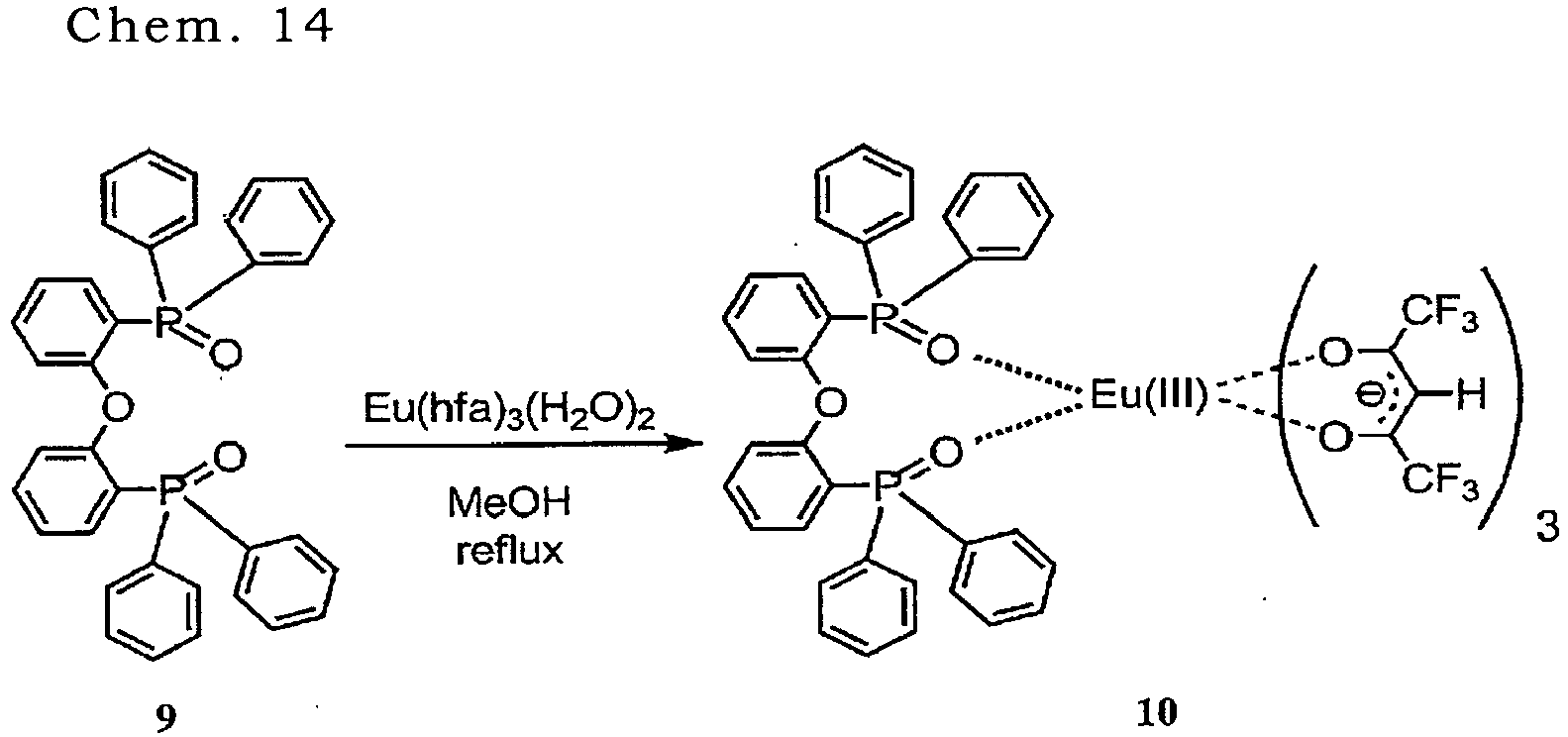
- In methanol, 1 equivalent amount of compound 9 and 1.2 equivalent amounts of Eu(hfa)3(H2O)2 were melted, and this mixture was heated to reflux for 8 hours at 80 °C. After distilling off the methanol under reduced pressure, an obtained solid was washed with chloroform and impurities were removed by filtration. A solvent contained in the filtrate was distilled off under reduced pressure, which yielded a yellowish-white colored powder. Recrystallization was carried out with methanol, which yielded a compound 10 (colorless minute block-shaped crystals, 0.62 g, 74 %).
- IR (ATR) 1653 (st, C=O) and 1135 (st, P=O), 1098-1251 (st, C-O-C and st, C-F) cm-1
- 1H NMR (500 MHz, acetone-d6, 25 °C) δ7.32-7.64 (m, 22H, Ar), 7.10-7.13 (t, J = 7.5 Hz, 2H, Ar), 6.90-6.95 (dd, J = 7.5 Hz, 2H, Ar), 6.73 (s, 3H, hfa-H), 6.29-6.30 (m, 2H, Ar) ppm 31P NMR (200 MHz, acetone-d6, 25 °C) δ-113.42 (2P) ppm
- ESI-Mass (m/z) Calcd. for C46H30EuF12O7P2 [M- (hfa)]+: 1137.049. Found: 1137.049
- Anal. Calcd. for C51H31EuF18O9P2 : C, 45.59; H, 2.33. Found: C, 45.76; H, 2.11.
- The emission properties of Eu(hfa)3 (DPEPO) was evaluated in the same method as Example 1.
Fig. 1 shows its emission spectrum, and Table 1 shows its quantum yield ϕ, its emission lifetime τobs, its radiation kinetic constant kr, and its nonradiation kinetic constant knr. As a result, it was confirmed that Eu(hfa)3 (DPEPO) emitted light with a quantum yield higher than that of Eu(hfa)3 (BIPHEPO). - As shown in Table 1, the luminous efficiency of Eu(hfa)3 (DPEPO) and Eu(hfa)3 (tert-BuXANTPO) showed values higher than that of Eu(hfa)3 (BIPHEPO) that is known as a rare-earth complex with high luminous efficiency. For this reason, when such a rare-earth complex is used for luminous security ink for example, it is possible to achieve a security ink having high emission abilities and having high functions.
Table 1 Ex. Complex Quantum yield ϕ/% Emission lifetime τobs/ms Radiation kinetic constant kr/s-1 Nonradiation kinetic constant knr/s-1 Relative emission intensity Irel 1 Eu(hfa)3 (XANTPO) 54 1.3 4.4×10² 3.6×10² 18 2 Eu(hfa)3 (tert-BuXANTPO) 71 1.2 5.5×10² 2.7×10² 26 3 Eu(hfa)3 (DPEPO) 72 1.5 4.7×10² 1.8×10² - Eu(hfa)3 (BIPHEPO) 60 1.3 4.6x 10² 3.4×10² 28 -

- In 30 mL of methanol, 0.50 g (0.85 mmol, 1.0 Eq) of compound 2 and 0.76 g (0.94 mmol, 1.1 Eq) of Sm(hfa)3(H2O)2 were melted, and this mixture was heated to reflux for 12 hours at 80 °C. After distilling off the methanol under reduced pressure, the obtained solid was washed with chloroform and impurities were removed by filtration. The solvent contained in the filtrate was distilled off under reduced pressure, which yielded a compound 6 (white powder, 0.79 g, 68 %).
- IR (ATR) 1653 (st, C=O), 1138 (st, P=O), 1100-1252 (st, C-O-C and st, C-F) cm-1
- 1H NMR (300 MHz, CDCl3/TMS) δ 6.41-7.94 (m), 1.49-1.71 (t, J = 33 Hz) ppm.
- 1H NMR (500 MHz, acetone-d6, 25 °C) δ 5.81-8.09 (m), 1.67 (s, Me), 1.52 (s, Me) ppm
- 31P NMR (200 MHz, acetone-d6, 25 °C) δ 33.03 (2P), 32.80 (2P) ppm
- ESI-Mass (m/z) [M]+calcd. for C49H34F12O7P2Sm+, 1176.079; found, 1176.081
- ESI-Mass (m/z) [M-(hfa)]+calcd. for C88H66SmF12O10P4, 1786.257; Found, 1786.261
- Anal. Calcd. for C93H78SmF15O15P4: C, 55.99; H, 3.94. Found: C, 55.54; H, 3.53.
- For the emission-spectrum measurement, HITACHI F-4500 was used. Heavy acetone solution of 1.0 × 10⁻² M was prepared and was used for measurement. In order to prevent quenching caused by dissolved oxygen, Ar bubbling was performed for 30 minutes before measurement. The measurement was performed at an excitation wavelength of 481 nm (direct excitation of Sm(III) ion). Quantum yield was calculated by a comparison method using known Sm(III) complex (ϕ = 0.031 in heavy DMSO solution of Sm(hfa)3(H2O)2 and 1.0 × 10⁻¹ M).
-
Fig. 2 shows the emission spectrum of Sm(hfa)3 (XANTPO). As a result, it was confirmed that Sm(hfa)3 (XANTPO) emits an extremely strong light in the vicinity of 650 nm which is close to a pure red color. - Table 2 shows its quantum yield ϕ, its emission lifetime τobs, its radiation kinetic constant kr, and its nonradiation kinetic constant knr. As a result, it was confirmed that Sm(hfa)3 (XANTPO) emits light with a quantum yield higher than that of Sm(hfa)3(H2O)2.
- Each emission spectrum shown in
Fig. 1 was standardized with an emission intensity of 598 nm. -

- In 20 mL of methanol, 0.30 g (0.57 mmol, 1.0 Eq) of compound 4 and 0.55 g (0.68 mmol, 1.2 Eq) of Sm(hfa)3(H2O)2 were melted, and this mixture was heated to reflux for 12 hours at 80 °C. After distilling off the methanol under reduced pressure, an obtained solid was washed with chloroform and impurities were removed by filtration. A solvent in the filtrate was distilled under reduced pressure, which yielded a compound 7 (white powder, 0.39 g, 53 %).
- IR (ATR) 1653 (st, C=O), 1137 (st, P=O), 1100-1252 (st, C-O-C and st, C-F) cm-1
- 1H NMR (300 MHz, CDCl3/TMS) δ 7.82 (m), 7.26-7.60 (m), 1.26-1.79(m) ppm.
- 1H NMR (500 MHz, acetone-d6, 25 °C) δ 8.06-8.08 (d, J = 7.5 Hz, 2H, Ar), 7.73-7.77 (m, 2H, Ar), 7.50-7.53 (t, J = 7.5 Hz, 2H, Ar), 6.73 (s, 3H, hfa-H), 1.83 (s, 6H, 2Me), 0.52-0.55 (d, J = 15 Hz, 36H, 4tBu) ppm
- 31P NMR (200 MHz, acetone-d6, 25 °C) δ 62.37 (2P) ppm
- ESI-Mass (m/z) [M]+calcd. for C41H50F12O7P2Sm+, 1096.204; found, 1096.200
- Anal. Calcd. for C46H51SmF18O9P2: C, 42.43; H, 3.95. Found: C, 42.68; H, 3.71.
- The emission properties of Sm(hfa)3 (tert-BuXANTPO) were evaluated in the same method as Example 4.
Fig. 2 shows the emission spectrum of Sm(hfa)3 (tert-BuXANTPO). As a result, it was confirmed that an extremely strong light was emitted around 650 nm that is close to a pure red color. - Table 2 shows its quantum yield ϕ, its emission lifetime τobs, its radiation kinetic constant kr, and its nonradiation kinetic constant knr. As a result, it was confirmed that Sm(hfa)3 (tert-BuXANTPO) emits light with a quantum yield of a same degree as Sm(hfa)3(H2O)2.
-

- In methanol, 1 equivalent amount of compound 9 and 1.2 equivalent amounts of Sm(hfa)3(H2O)2 were melted, and this mixture was heated to reflux for 8 hours at 80 °C. After distilling off the methanol under reduced pressure, an obtained solid was washed with chloroform and impurities were removed by filtration. A solvent contained in the filtrate was distilled off under reduced pressure, which yielded a yellowish-white colored powder. Recrystallization was carried out with methanol, which yielded a compound 11 (colorless minute block-form crystals, 0.66 g, 79 %).
- IR (ATR) 1653 (st, C=O), 1134 (st, P=O), 1098-1250cm-1
- 1H NMR (500 MHz, acetone-d6, 25 °C) 87.32-7.64 (m, 22H, Ar), 7.10-7.13 (t, J = 7.5 Hz, 2H, Ar), 6.90-6.95 (dd, J = 7.5 Hz, 2H, Ar), 6.73 (s, 3H, hfa-H), 6.29-6.30 (m, 2H, Ar) ppm
- 31P NMR (200 MHz, acetone-d6, 25 °C) 829.17 (2P) ppm
- ESI-Mass (m/z) Calcd. for C46H30SmF12O7P2 [M- (hfa)]+: 1136.048. Found: 1136.044
- Anal. Calcd. for C51H31SmF18O9P2: C, 45.64; H, 2.33. Found: C, 45.54; H, 2.18.
- The emission properties of Sm(hfa)3 (DPEPO) were evaluated in the same method as Example 4.
Fig. 2 shows the emission spectrum of Sm(hfa)3 (DPEPO). As a result, it was confirmed that very strong emission was observed around 650 nm that is close to a more pure red. - Table 2 shows its quantum yield ϕ, its emission lifetime τobs, its radiation kinetic constant kr, and its nonradiation kinetic constant knr. As a result, it was confirmed that Sm(hfa)3 (DPEPO) emits light with a quantum yield higher than that of Sm(hfa)3(H2O)2.
- Although the quantum yield of Sm complex obtained in Examples 4 to 6 is in a range of 2.4 to 5.0 %, this is an extremely high value for a Sm complex (a quantum yield of 5.0 % is the world's maximum value among Sm complexes). The Sm complex is an ideal substance as luminous material for use in display since the Sm complex emits a deeper red light than the Eu complex. However, it is generally difficult to have the Sm complex emit light, and in most cases, the quantum yield of the Sm complex was not more than 1 %. Namely, the Sm complex obtained in Examples 4 to 6 show extremely strong light emission as compared to the conventionally-reported Sm complex.
Table 2 Ex. Complex Quantum yield ϕ/% Emission lifetime τobs/ms Radiation kinetic constant kr/s-1 Nonradiation kinetic constant knr/s-1 4 Sm(hfa)3 (XANTPO) 3.8 0.35 1.1×10² 2.8×10² 5 Sm(hfa)3 (tBu-XANTPO) 2.4 0.15 1.6×10² 6.5×10² 6 Sm(hfa)3 (DPEPO) 5.0 0.28 1.8×10² 3.3×10² - A samarium complex according to the present invention has excellent emission properties. Therefore, the samarium complex can be suitably used in luminous ink and/or organic electroluminescence elements.
Claims (5)
- A samarium complex represented by the following general formula (I):
 R1 is -A3-O-A4A3 and A4 each independently being an alicyclic hydrocarbon group, an aromatic hydrocarbon group, a heterocyclic group, or an alkenylene group or alkynylene group having a straight chain or a branched chain and having at least one unsaturated bond in a carbon chain that links together carbon atoms having a free valence,R2, R3, R4, and R5 each independently being an alkyl group, alkenyl group or alkynyl group each having a straight chain or a branched chain, or alternatively an alicyclic hydrocarbon group, an aromatic hydrocarbon group, a heterocyclic group, or alternatively a halogen group, a hydroxyl group, a sulfonic group, a carbonyl group, a nitro group, a cyano group, or an amino group, two adjacent ones of R2, R3, R4, and R5 may together form a ring structure,X1 and X2 are perhalogenated alkyl groups having a carbon number in a range of 1 to 20,Y being hydrogen, heavy hydrogen, a halogen group, a hydroxyl group, a sulfonic group, a carbonyl group, a nitro group, a cyano group, an amino group an alkyl group having a straight chain or a branched chain, or alternatively, an alicyclic hydrocarbon group, an aromatic hydrocarbon group, a heterocyclic group, or a group made of a straight chain or abranched chain including no hydrogen atom, andn being 1 or 2; m being 2, 3, or 4.
 - The samarium complex according to claim 1, wherein
A3 and A4 are each independently an aromatic hydrocarbon group. - The samarium complex according to claim 1 or 2, wherein
at least one of R2, R3, R4, and R5 is a C1 - C20 alkyl group, a C2 - C20 alkenyl group, or a C2 - C20 alkynyl group, having a branched chain. - Luminous material comprising the samarium complex as set forth in any one of claims 1 through 3.
- A light emitting device comprising:a light source; andthe luminous material as set forth in claim 4.
Applications Claiming Priority (2)
| Application Number | Priority Date | Filing Date | Title |
|---|---|---|---|
| JP2009176558 | 2009-07-29 | ||
| PCT/JP2010/061960 WO2011013520A1 (en) | 2009-07-29 | 2010-07-15 | Rare-earth complex and uses thereof |
Publications (3)
| Publication Number | Publication Date |
|---|---|
| EP2471799A1 EP2471799A1 (en) | 2012-07-04 |
| EP2471799A4 EP2471799A4 (en) | 2013-07-17 |
| EP2471799B1 true EP2471799B1 (en) | 2015-04-15 |
Family
ID=43529178
Family Applications (1)
| Application Number | Title | Priority Date | Filing Date |
|---|---|---|---|
| EP10804266.4A Not-in-force EP2471799B1 (en) | 2009-07-29 | 2010-07-15 | Samarium complex and uses thereof |
Country Status (4)
| Country | Link |
|---|---|
| US (1) | US8975385B2 (en) |
| EP (1) | EP2471799B1 (en) |
| JP (1) | JP5737719B2 (en) |
| WO (1) | WO2011013520A1 (en) |
Families Citing this family (17)
| Publication number | Priority date | Publication date | Assignee | Title |
|---|---|---|---|---|
| US9051427B2 (en) | 2011-05-02 | 2015-06-09 | National University Corporation Hokkaido University | Rare-earth complex polymer and plastic molded product |
| JP6270093B2 (en) * | 2012-11-07 | 2018-01-31 | 国立大学法人北海道大学 | Luminescent composite materials and phosphor nanocrystals |
| FR3001730B1 (en) * | 2013-02-07 | 2016-01-08 | Commissariat Energie Atomique | NOVEL METALLOPOLYMERS AND THEIR USE |
| JP6296398B2 (en) * | 2013-02-19 | 2018-03-20 | 国立大学法人 奈良先端科学技術大学院大学 | Ink set, printed matter, and printing method |
| JP6333527B2 (en) * | 2013-09-05 | 2018-05-30 | 国立大学法人北海道大学 | Thin film for organic EL device and manufacturing method thereof |
| WO2015194592A1 (en) * | 2014-06-17 | 2015-12-23 | 株式会社ブリヂストン | Sealing film for solar cells and solar cell using same |
| US10297770B2 (en) | 2015-03-27 | 2019-05-21 | Universal Display Corporation | Organic electroluminescent materials and devices |
| US20180182960A1 (en) * | 2015-06-23 | 2018-06-28 | Novaled Gmbh | Organic Light Emitting Device Comprising Polar Matrix and Metal Dopant |
| WO2017191795A1 (en) * | 2016-05-02 | 2017-11-09 | 国立大学法人北海道大学 | Rare-earth complex polymer |
| JP6749816B2 (en) * | 2016-09-01 | 2020-09-02 | 国立大学法人北海道大学 | Eu complex and organic EL device |
| JP7217621B2 (en) * | 2017-11-27 | 2023-02-03 | 東ソー株式会社 | Europium complex and use thereof |
| WO2019103155A1 (en) * | 2017-11-27 | 2019-05-31 | 東ソー株式会社 | Europium complex |
| EP3502116B1 (en) * | 2017-12-20 | 2020-11-25 | Novaled GmbH | Compound and an organic semiconducting layer comprising the same |
| EP3822277B1 (en) * | 2018-07-10 | 2025-09-03 | National University Corporation Hokkaido University | Rare-earth complex, light-emitting material, light-emitting object, light-emitting device, interlayer for laminated glass, laminated glass, windshield for vehicle, wavelength conversion material, and security material |
| JP7270909B2 (en) * | 2019-07-18 | 2023-05-11 | 国立大学法人北海道大学 | Bisphosphine oxide rare earth complex and optical functional material |
| CN117616032A (en) * | 2021-07-05 | 2024-02-27 | 东曹株式会社 | Rare earth complex |
| EP4365180A4 (en) * | 2021-07-05 | 2025-10-01 | Tosoh Corp | RARE EARTH COMPLEX |
Family Cites Families (11)
| Publication number | Priority date | Publication date | Assignee | Title |
|---|---|---|---|---|
| KR20000076120A (en) | 1997-03-11 | 2000-12-26 | 후지타 기요시 | Rare Earth Complexes |
| JP2000063682A (en) | 1998-08-25 | 2000-02-29 | New Japan Chem Co Ltd | Resin composition containing rare earth complex, and molded item |
| JP3668966B2 (en) | 2001-09-07 | 2005-07-06 | 関西ティー・エル・オー株式会社 | Rare earth complex, optical functional material and light emitting device using the same |
| JP4378100B2 (en) * | 2003-03-01 | 2009-12-02 | 国立大学法人 奈良先端科学技術大学院大学 | Luminescent rare earth complex |
| JP3687791B2 (en) | 2003-08-26 | 2005-08-24 | 大日本インキ化学工業株式会社 | Novel rare earth complexes with circularly polarized light emission |
| US20080171858A1 (en) | 2003-08-26 | 2008-07-17 | Dainippon Ink & Chemicals , Inc. | Optically Active Rare Earth Complex Having Circularly Polarized Luminescence |
| CN1687080A (en) * | 2005-04-14 | 2005-10-26 | 复旦大学 | Rare earth complexes chelated by aromatic base substituted diphosphine dioxide and its synthesizing process |
| CN100475931C (en) * | 2005-07-21 | 2009-04-08 | 复旦大学 | Organic rare earth complexes with adjustable carrier transport ability, their preparation methods and applications |
| JP2007210945A (en) * | 2006-02-09 | 2007-08-23 | Nichia Chem Ind Ltd | Lanthanoid complexes and room temperature phosphorescent materials |
| JP5110484B2 (en) | 2006-07-31 | 2012-12-26 | 国立大学法人 奈良先端科学技術大学院大学 | Rare earth complexes and their use |
| JP2008297250A (en) | 2007-05-31 | 2008-12-11 | Toshiba Corp | Fluorescent rare earth complex, and light emitting element, security medium, and lighting device using the same |
-
2010
- 2010-07-15 EP EP10804266.4A patent/EP2471799B1/en not_active Not-in-force
- 2010-07-15 WO PCT/JP2010/061960 patent/WO2011013520A1/en not_active Ceased
- 2010-07-15 JP JP2011524734A patent/JP5737719B2/en not_active Expired - Fee Related
- 2010-07-15 US US13/387,013 patent/US8975385B2/en active Active
Non-Patent Citations (1)
| Title |
|---|
| KAWAI H ET AL: "Emission properties of Sm(III) complexes having remarkably deep-red emission band", JOURNAL OF ALLOYS AND COMPOUNDS, ELSEVIER SEQUOIA, LAUSANNE, CH, vol. 488, no. 2, 4 December 2009 (2009-12-04), pages 612 - 614, XP026790300, ISSN: 0925-8388, [retrieved on 20081118] * |
Also Published As
| Publication number | Publication date |
|---|---|
| US20120140439A1 (en) | 2012-06-07 |
| EP2471799A4 (en) | 2013-07-17 |
| EP2471799A1 (en) | 2012-07-04 |
| US8975385B2 (en) | 2015-03-10 |
| JP5737719B2 (en) | 2015-06-17 |
| WO2011013520A1 (en) | 2011-02-03 |
| JPWO2011013520A1 (en) | 2013-01-07 |
Similar Documents
| Publication | Publication Date | Title |
|---|---|---|
| US8975385B2 (en) | Rare-earth complex and uses thereof | |
| JP5812583B2 (en) | Triazine derivative, method for producing the same, and organic electroluminescent device comprising the same | |
| KR101880785B1 (en) | Phosphorescent heteroleptic phenylbenzimidazole dopants and new synthetic methodolgy | |
| US20170044428A1 (en) | Metal organic framework (mof) yellow phosphors and their applications in white light emitting devices | |
| KR20080061300A (en) | Light emitting device, light emitting device, and electronic device using organometallic complex and organometallic complex | |
| US11499093B2 (en) | Rare earth complex and light emitting element | |
| KR20180055853A (en) | Metal complex | |
| KR101252603B1 (en) | Deep-Blue Phosphorescent Iridium(III) Complexes Utilizing N-Methylimidazolyltriazoles | |
| WO2010032395A1 (en) | Rare earth complex nanocrystals and applications thereof | |
| KR20220081948A (en) | Tandem carbene phosphors | |
| KR102677298B1 (en) | Pyromethene boron complex, color conversion composition, color conversion film, light source unit, display and lighting device | |
| JP5294242B2 (en) | Metal coordination compound and light emitting material using the same | |
| JP3687791B2 (en) | Novel rare earth complexes with circularly polarized light emission | |
| KR101418996B1 (en) | Light-emitting organic platinum complex, light-emitting material containing this complex and functional device | |
| JP5611606B2 (en) | Rare earth complex, and fluorescent medium, light emitting element, security medium and lighting device using the same | |
| KR20230012400A (en) | Organic electroluminescent materials and devices | |
| JP5841783B2 (en) | New fluorene compounds | |
| CN103289677A (en) | Iridium complex phosphor material taking phthalazine derivative as ligand and preparation method thereof | |
| JP7274134B2 (en) | Rare earth compounds, light emitters, light emitting devices, wavelength conversion materials and security materials | |
| US12291545B2 (en) | Rare earth complex, rare earth complex solution, luminescent molded article, method for producing luminescent product, luminescent sheet, and vinyl greenhouse for agriculture | |
| KR20230091833A (en) | Organic electroluminescent materials and devices | |
| KR20230013007A (en) | Organic electroluminescent materials and devices | |
| WO2018155484A1 (en) | Phosphine oxide compound, rare earth complex, and light-emitting material | |
| EP3904359A1 (en) | Rare earth compound, phosphine oxide compound, and luminescent body | |
| EP1659128B1 (en) | Novel optically active rare earth complex emitting circularly polarized light |
Legal Events
| Date | Code | Title | Description |
|---|---|---|---|
| PUAI | Public reference made under article 153(3) epc to a published international application that has entered the european phase |
Free format text: ORIGINAL CODE: 0009012 |
|
| 17P | Request for examination filed |
Effective date: 20120206 |
|
| AK | Designated contracting states |
Kind code of ref document: A1 Designated state(s): AL AT BE BG CH CY CZ DE DK EE ES FI FR GB GR HR HU IE IS IT LI LT LU LV MC MK MT NL NO PL PT RO SE SI SK SM TR |
|
| RIN1 | Information on inventor provided before grant (corrected) |
Inventor name: NAKAGAWA, TETSUYA Inventor name: NAKASHIMA, TAKUYA Inventor name: MIYATA, KOHEI Inventor name: KAWAI, TSUYOSHI Inventor name: HASEGAWA, YASUCHIKA |
|
| RIN1 | Information on inventor provided before grant (corrected) |
Inventor name: NAKAGAWA, TETSUYA Inventor name: KAWAI, TSUYOSHI Inventor name: HASEGAWA, YASUCHIKA Inventor name: MIYATA, KOHEI Inventor name: NAKASHIMA, TAKUYA |
|
| DAX | Request for extension of the european patent (deleted) | ||
| A4 | Supplementary search report drawn up and despatched |
Effective date: 20130617 |
|
| RIC1 | Information provided on ipc code assigned before grant |
Ipc: C07F 9/655 20060101ALI20130611BHEP Ipc: C09K 11/06 20060101ALI20130611BHEP Ipc: C07F 9/53 20060101AFI20130611BHEP Ipc: C07F 5/00 20060101ALI20130611BHEP Ipc: H01L 51/50 20060101ALI20130611BHEP Ipc: C07C 49/92 20060101ALI20130611BHEP |
|
| 17Q | First examination report despatched |
Effective date: 20131202 |
|
| GRAP | Despatch of communication of intention to grant a patent |
Free format text: ORIGINAL CODE: EPIDOSNIGR1 |
|
| INTG | Intention to grant announced |
Effective date: 20141013 |
|
| GRAJ | Information related to disapproval of communication of intention to grant by the applicant or resumption of examination proceedings by the epo deleted |
Free format text: ORIGINAL CODE: EPIDOSDIGR1 |
|
| GRAP | Despatch of communication of intention to grant a patent |
Free format text: ORIGINAL CODE: EPIDOSNIGR1 |
|
| INTG | Intention to grant announced |
Effective date: 20150115 |
|
| GRAS | Grant fee paid |
Free format text: ORIGINAL CODE: EPIDOSNIGR3 |
|
| GRAA | (expected) grant |
Free format text: ORIGINAL CODE: 0009210 |
|
| AK | Designated contracting states |
Kind code of ref document: B1 Designated state(s): AL AT BE BG CH CY CZ DE DK EE ES FI FR GB GR HR HU IE IS IT LI LT LU LV MC MK MT NL NO PL PT RO SE SI SK SM TR |
|
| REG | Reference to a national code |
Ref country code: GB Ref legal event code: FG4D Ref country code: CH Ref legal event code: EP |
|
| REG | Reference to a national code |
Ref country code: IE Ref legal event code: FG4D |
|
| REG | Reference to a national code |
Ref country code: AT Ref legal event code: REF Ref document number: 721908 Country of ref document: AT Kind code of ref document: T Effective date: 20150515 |
|
| REG | Reference to a national code |
Ref country code: DE Ref legal event code: R096 Ref document number: 602010024023 Country of ref document: DE Effective date: 20150528 |
|
| REG | Reference to a national code |
Ref country code: NL Ref legal event code: VDEP Effective date: 20150415 |
|
| REG | Reference to a national code |
Ref country code: AT Ref legal event code: MK05 Ref document number: 721908 Country of ref document: AT Kind code of ref document: T Effective date: 20150415 |
|
| REG | Reference to a national code |
Ref country code: LT Ref legal event code: MG4D |
|
| PG25 | Lapsed in a contracting state [announced via postgrant information from national office to epo] |
Ref country code: NL Free format text: LAPSE BECAUSE OF FAILURE TO SUBMIT A TRANSLATION OF THE DESCRIPTION OR TO PAY THE FEE WITHIN THE PRESCRIBED TIME-LIMIT Effective date: 20150415 |
|
| PG25 | Lapsed in a contracting state [announced via postgrant information from national office to epo] |
Ref country code: ES Free format text: LAPSE BECAUSE OF FAILURE TO SUBMIT A TRANSLATION OF THE DESCRIPTION OR TO PAY THE FEE WITHIN THE PRESCRIBED TIME-LIMIT Effective date: 20150415 Ref country code: FI Free format text: LAPSE BECAUSE OF FAILURE TO SUBMIT A TRANSLATION OF THE DESCRIPTION OR TO PAY THE FEE WITHIN THE PRESCRIBED TIME-LIMIT Effective date: 20150415 Ref country code: LT Free format text: LAPSE BECAUSE OF FAILURE TO SUBMIT A TRANSLATION OF THE DESCRIPTION OR TO PAY THE FEE WITHIN THE PRESCRIBED TIME-LIMIT Effective date: 20150415 Ref country code: PT Free format text: LAPSE BECAUSE OF FAILURE TO SUBMIT A TRANSLATION OF THE DESCRIPTION OR TO PAY THE FEE WITHIN THE PRESCRIBED TIME-LIMIT Effective date: 20150817 Ref country code: HR Free format text: LAPSE BECAUSE OF FAILURE TO SUBMIT A TRANSLATION OF THE DESCRIPTION OR TO PAY THE FEE WITHIN THE PRESCRIBED TIME-LIMIT Effective date: 20150415 Ref country code: NO Free format text: LAPSE BECAUSE OF FAILURE TO SUBMIT A TRANSLATION OF THE DESCRIPTION OR TO PAY THE FEE WITHIN THE PRESCRIBED TIME-LIMIT Effective date: 20150715 |
|
| PG25 | Lapsed in a contracting state [announced via postgrant information from national office to epo] |
Ref country code: GR Free format text: LAPSE BECAUSE OF FAILURE TO SUBMIT A TRANSLATION OF THE DESCRIPTION OR TO PAY THE FEE WITHIN THE PRESCRIBED TIME-LIMIT Effective date: 20150716 Ref country code: AT Free format text: LAPSE BECAUSE OF FAILURE TO SUBMIT A TRANSLATION OF THE DESCRIPTION OR TO PAY THE FEE WITHIN THE PRESCRIBED TIME-LIMIT Effective date: 20150415 Ref country code: LV Free format text: LAPSE BECAUSE OF FAILURE TO SUBMIT A TRANSLATION OF THE DESCRIPTION OR TO PAY THE FEE WITHIN THE PRESCRIBED TIME-LIMIT Effective date: 20150415 Ref country code: IS Free format text: LAPSE BECAUSE OF FAILURE TO SUBMIT A TRANSLATION OF THE DESCRIPTION OR TO PAY THE FEE WITHIN THE PRESCRIBED TIME-LIMIT Effective date: 20150815 |
|
| REG | Reference to a national code |
Ref country code: DE Ref legal event code: R097 Ref document number: 602010024023 Country of ref document: DE |
|
| PG25 | Lapsed in a contracting state [announced via postgrant information from national office to epo] |
Ref country code: EE Free format text: LAPSE BECAUSE OF FAILURE TO SUBMIT A TRANSLATION OF THE DESCRIPTION OR TO PAY THE FEE WITHIN THE PRESCRIBED TIME-LIMIT Effective date: 20150415 Ref country code: DK Free format text: LAPSE BECAUSE OF FAILURE TO SUBMIT A TRANSLATION OF THE DESCRIPTION OR TO PAY THE FEE WITHIN THE PRESCRIBED TIME-LIMIT Effective date: 20150415 |
|
| PLBE | No opposition filed within time limit |
Free format text: ORIGINAL CODE: 0009261 |
|
| STAA | Information on the status of an ep patent application or granted ep patent |
Free format text: STATUS: NO OPPOSITION FILED WITHIN TIME LIMIT |
|
| PG25 | Lapsed in a contracting state [announced via postgrant information from national office to epo] |
Ref country code: RO Free format text: LAPSE BECAUSE OF NON-PAYMENT OF DUE FEES Effective date: 20150415 Ref country code: SK Free format text: LAPSE BECAUSE OF FAILURE TO SUBMIT A TRANSLATION OF THE DESCRIPTION OR TO PAY THE FEE WITHIN THE PRESCRIBED TIME-LIMIT Effective date: 20150415 Ref country code: PL Free format text: LAPSE BECAUSE OF FAILURE TO SUBMIT A TRANSLATION OF THE DESCRIPTION OR TO PAY THE FEE WITHIN THE PRESCRIBED TIME-LIMIT Effective date: 20150415 Ref country code: CZ Free format text: LAPSE BECAUSE OF FAILURE TO SUBMIT A TRANSLATION OF THE DESCRIPTION OR TO PAY THE FEE WITHIN THE PRESCRIBED TIME-LIMIT Effective date: 20150415 Ref country code: MC Free format text: LAPSE BECAUSE OF FAILURE TO SUBMIT A TRANSLATION OF THE DESCRIPTION OR TO PAY THE FEE WITHIN THE PRESCRIBED TIME-LIMIT Effective date: 20150415 |
|
| REG | Reference to a national code |
Ref country code: CH Ref legal event code: PL |
|
| 26N | No opposition filed |
Effective date: 20160118 |
|
| GBPC | Gb: european patent ceased through non-payment of renewal fee |
Effective date: 20150715 |
|
| PG25 | Lapsed in a contracting state [announced via postgrant information from national office to epo] |
Ref country code: LU Free format text: LAPSE BECAUSE OF FAILURE TO SUBMIT A TRANSLATION OF THE DESCRIPTION OR TO PAY THE FEE WITHIN THE PRESCRIBED TIME-LIMIT Effective date: 20150715 |
|
| REG | Reference to a national code |
Ref country code: IE Ref legal event code: MM4A |
|
| PG25 | Lapsed in a contracting state [announced via postgrant information from national office to epo] |
Ref country code: IT Free format text: LAPSE BECAUSE OF FAILURE TO SUBMIT A TRANSLATION OF THE DESCRIPTION OR TO PAY THE FEE WITHIN THE PRESCRIBED TIME-LIMIT Effective date: 20150415 Ref country code: GB Free format text: LAPSE BECAUSE OF NON-PAYMENT OF DUE FEES Effective date: 20150715 Ref country code: LI Free format text: LAPSE BECAUSE OF NON-PAYMENT OF DUE FEES Effective date: 20150731 Ref country code: CH Free format text: LAPSE BECAUSE OF NON-PAYMENT OF DUE FEES Effective date: 20150731 |
|
| REG | Reference to a national code |
Ref country code: FR Ref legal event code: ST Effective date: 20160331 |
|
| PG25 | Lapsed in a contracting state [announced via postgrant information from national office to epo] |
Ref country code: FR Free format text: LAPSE BECAUSE OF NON-PAYMENT OF DUE FEES Effective date: 20150731 Ref country code: SI Free format text: LAPSE BECAUSE OF FAILURE TO SUBMIT A TRANSLATION OF THE DESCRIPTION OR TO PAY THE FEE WITHIN THE PRESCRIBED TIME-LIMIT Effective date: 20150415 |
|
| PG25 | Lapsed in a contracting state [announced via postgrant information from national office to epo] |
Ref country code: IE Free format text: LAPSE BECAUSE OF NON-PAYMENT OF DUE FEES Effective date: 20150715 |
|
| PG25 | Lapsed in a contracting state [announced via postgrant information from national office to epo] |
Ref country code: BE Free format text: LAPSE BECAUSE OF FAILURE TO SUBMIT A TRANSLATION OF THE DESCRIPTION OR TO PAY THE FEE WITHIN THE PRESCRIBED TIME-LIMIT Effective date: 20150415 |
|
| PG25 | Lapsed in a contracting state [announced via postgrant information from national office to epo] |
Ref country code: MT Free format text: LAPSE BECAUSE OF FAILURE TO SUBMIT A TRANSLATION OF THE DESCRIPTION OR TO PAY THE FEE WITHIN THE PRESCRIBED TIME-LIMIT Effective date: 20150415 |
|
| PG25 | Lapsed in a contracting state [announced via postgrant information from national office to epo] |
Ref country code: HU Free format text: LAPSE BECAUSE OF FAILURE TO SUBMIT A TRANSLATION OF THE DESCRIPTION OR TO PAY THE FEE WITHIN THE PRESCRIBED TIME-LIMIT; INVALID AB INITIO Effective date: 20100715 Ref country code: SM Free format text: LAPSE BECAUSE OF FAILURE TO SUBMIT A TRANSLATION OF THE DESCRIPTION OR TO PAY THE FEE WITHIN THE PRESCRIBED TIME-LIMIT Effective date: 20150415 Ref country code: BG Free format text: LAPSE BECAUSE OF FAILURE TO SUBMIT A TRANSLATION OF THE DESCRIPTION OR TO PAY THE FEE WITHIN THE PRESCRIBED TIME-LIMIT Effective date: 20150415 |
|
| PG25 | Lapsed in a contracting state [announced via postgrant information from national office to epo] |
Ref country code: SE Free format text: LAPSE BECAUSE OF FAILURE TO SUBMIT A TRANSLATION OF THE DESCRIPTION OR TO PAY THE FEE WITHIN THE PRESCRIBED TIME-LIMIT Effective date: 20150415 Ref country code: CY Free format text: LAPSE BECAUSE OF FAILURE TO SUBMIT A TRANSLATION OF THE DESCRIPTION OR TO PAY THE FEE WITHIN THE PRESCRIBED TIME-LIMIT Effective date: 20150415 |
|
| PG25 | Lapsed in a contracting state [announced via postgrant information from national office to epo] |
Ref country code: TR Free format text: LAPSE BECAUSE OF FAILURE TO SUBMIT A TRANSLATION OF THE DESCRIPTION OR TO PAY THE FEE WITHIN THE PRESCRIBED TIME-LIMIT Effective date: 20150415 |
|
| PG25 | Lapsed in a contracting state [announced via postgrant information from national office to epo] |
Ref country code: MK Free format text: LAPSE BECAUSE OF FAILURE TO SUBMIT A TRANSLATION OF THE DESCRIPTION OR TO PAY THE FEE WITHIN THE PRESCRIBED TIME-LIMIT Effective date: 20150415 |
|
| PG25 | Lapsed in a contracting state [announced via postgrant information from national office to epo] |
Ref country code: AL Free format text: LAPSE BECAUSE OF FAILURE TO SUBMIT A TRANSLATION OF THE DESCRIPTION OR TO PAY THE FEE WITHIN THE PRESCRIBED TIME-LIMIT Effective date: 20150415 |
|
| PGFP | Annual fee paid to national office [announced via postgrant information from national office to epo] |
Ref country code: DE Payment date: 20230531 Year of fee payment: 14 |
|
| REG | Reference to a national code |
Ref country code: DE Ref legal event code: R119 Ref document number: 602010024023 Country of ref document: DE |
|
| PG25 | Lapsed in a contracting state [announced via postgrant information from national office to epo] |
Ref country code: DE Free format text: LAPSE BECAUSE OF NON-PAYMENT OF DUE FEES Effective date: 20250201 |