EP2471774A1 - Piperidinyl derivatives as modulators of chemokine receptor activity - Google Patents
Piperidinyl derivatives as modulators of chemokine receptor activity Download PDFInfo
- Publication number
- EP2471774A1 EP2471774A1 EP11188840A EP11188840A EP2471774A1 EP 2471774 A1 EP2471774 A1 EP 2471774A1 EP 11188840 A EP11188840 A EP 11188840A EP 11188840 A EP11188840 A EP 11188840A EP 2471774 A1 EP2471774 A1 EP 2471774A1
- Authority
- EP
- European Patent Office
- Prior art keywords
- chlorophenyl
- mmol
- methyl
- oxobutan
- piperidin
- Prior art date
- Legal status (The legal status is an assumption and is not a legal conclusion. Google has not performed a legal analysis and makes no representation as to the accuracy of the status listed.)
- Granted
Links
- 125000003386 piperidinyl group Chemical group 0.000 title abstract description 6
- 230000000694 effects Effects 0.000 title description 15
- 102000009410 Chemokine receptor Human genes 0.000 title description 10
- 108050000299 Chemokine receptor Proteins 0.000 title description 10
- 150000001875 compounds Chemical class 0.000 claims description 181
- 238000000034 method Methods 0.000 abstract description 80
- 102000000013 Chemokine CCL3 Human genes 0.000 abstract description 31
- 108700012434 CCL3 Proteins 0.000 abstract description 30
- 150000003839 salts Chemical class 0.000 abstract description 20
- 206010039073 rheumatoid arthritis Diseases 0.000 abstract description 15
- 208000027866 inflammatory disease Diseases 0.000 abstract description 12
- 208000006673 asthma Diseases 0.000 abstract description 6
- 102100031172 C-C chemokine receptor type 1 Human genes 0.000 abstract description 5
- 101710149814 C-C chemokine receptor type 1 Proteins 0.000 abstract description 4
- 208000026935 allergic disease Diseases 0.000 abstract description 4
- 206010052779 Transplant rejections Diseases 0.000 abstract description 3
- 230000001363 autoimmune Effects 0.000 abstract description 3
- 230000007170 pathology Effects 0.000 abstract description 2
- XEKOWRVHYACXOJ-UHFFFAOYSA-N Ethyl acetate Chemical compound CCOC(C)=O XEKOWRVHYACXOJ-UHFFFAOYSA-N 0.000 description 453
- YMWUJEATGCHHMB-UHFFFAOYSA-N Dichloromethane Chemical compound ClCCl YMWUJEATGCHHMB-UHFFFAOYSA-N 0.000 description 384
- OKKJLVBELUTLKV-UHFFFAOYSA-N Methanol Chemical compound OC OKKJLVBELUTLKV-UHFFFAOYSA-N 0.000 description 234
- 235000019439 ethyl acetate Nutrition 0.000 description 187
- ZMANZCXQSJIPKH-UHFFFAOYSA-N Triethylamine Chemical compound CCN(CC)CC ZMANZCXQSJIPKH-UHFFFAOYSA-N 0.000 description 168
- 238000006243 chemical reaction Methods 0.000 description 167
- 239000000243 solution Substances 0.000 description 161
- 239000000203 mixture Substances 0.000 description 147
- VLKZOEOYAKHREP-UHFFFAOYSA-N n-Hexane Chemical compound CCCCCC VLKZOEOYAKHREP-UHFFFAOYSA-N 0.000 description 137
- 125000000217 alkyl group Chemical group 0.000 description 126
- VEXZGXHMUGYJMC-UHFFFAOYSA-N Hydrochloric acid Chemical compound Cl VEXZGXHMUGYJMC-UHFFFAOYSA-N 0.000 description 120
- WYURNTSHIVDZCO-UHFFFAOYSA-N Tetrahydrofuran Chemical compound C1CCOC1 WYURNTSHIVDZCO-UHFFFAOYSA-N 0.000 description 111
- 238000002360 preparation method Methods 0.000 description 100
- HEMHJVSKTPXQMS-UHFFFAOYSA-M Sodium hydroxide Chemical compound [OH-].[Na+] HEMHJVSKTPXQMS-UHFFFAOYSA-M 0.000 description 99
- 125000003118 aryl group Chemical group 0.000 description 94
- 239000007787 solid Substances 0.000 description 90
- -1 =O) Natural products 0.000 description 85
- PMZURENOXWZQFD-UHFFFAOYSA-L Sodium Sulfate Chemical compound [Na+].[Na+].[O-]S([O-])(=O)=O PMZURENOXWZQFD-UHFFFAOYSA-L 0.000 description 84
- 229910052938 sodium sulfate Inorganic materials 0.000 description 84
- XLYOFNOQVPJJNP-UHFFFAOYSA-N water Substances O XLYOFNOQVPJJNP-UHFFFAOYSA-N 0.000 description 82
- 125000001072 heteroaryl group Chemical group 0.000 description 81
- ZMXDDKWLCZADIW-UHFFFAOYSA-N N,N-Dimethylformamide Chemical compound CN(C)C=O ZMXDDKWLCZADIW-UHFFFAOYSA-N 0.000 description 79
- 229940093499 ethyl acetate Drugs 0.000 description 78
- 125000000753 cycloalkyl group Chemical group 0.000 description 77
- VYPSYNLAJGMNEJ-UHFFFAOYSA-N Silicium dioxide Chemical compound O=[Si]=O VYPSYNLAJGMNEJ-UHFFFAOYSA-N 0.000 description 76
- 235000011152 sodium sulphate Nutrition 0.000 description 76
- 239000011521 glass Substances 0.000 description 67
- 125000003710 aryl alkyl group Chemical group 0.000 description 66
- 239000000741 silica gel Substances 0.000 description 64
- 229910002027 silica gel Inorganic materials 0.000 description 64
- RTZKZFJDLAIYFH-UHFFFAOYSA-N Diethyl ether Chemical compound CCOCC RTZKZFJDLAIYFH-UHFFFAOYSA-N 0.000 description 62
- UIIMBOGNXHQVGW-UHFFFAOYSA-M Sodium bicarbonate Chemical compound [Na+].OC([O-])=O UIIMBOGNXHQVGW-UHFFFAOYSA-M 0.000 description 62
- 238000003756 stirring Methods 0.000 description 62
- JGFZNNIVVJXRND-UHFFFAOYSA-N N,N-Diisopropylethylamine (DIPEA) Chemical compound CCN(C(C)C)C(C)C JGFZNNIVVJXRND-UHFFFAOYSA-N 0.000 description 61
- NPZTUJOABDZTLV-UHFFFAOYSA-N hydroxybenzotriazole Substances O=C1C=CC=C2NNN=C12 NPZTUJOABDZTLV-UHFFFAOYSA-N 0.000 description 60
- WSLDOOZREJYCGB-UHFFFAOYSA-N 1,2-Dichloroethane Chemical compound ClCCCl WSLDOOZREJYCGB-UHFFFAOYSA-N 0.000 description 59
- LMDZBCPBFSXMTL-UHFFFAOYSA-N 1-Ethyl-3-(3-dimethylaminopropyl)carbodiimide Substances CCN=C=NCCCN(C)C LMDZBCPBFSXMTL-UHFFFAOYSA-N 0.000 description 59
- 125000004446 heteroarylalkyl group Chemical group 0.000 description 55
- WEVYAHXRMPXWCK-UHFFFAOYSA-N Acetonitrile Chemical compound CC#N WEVYAHXRMPXWCK-UHFFFAOYSA-N 0.000 description 53
- 125000001316 cycloalkyl alkyl group Chemical group 0.000 description 51
- 239000000047 product Substances 0.000 description 49
- WPYMKLBDIGXBTP-UHFFFAOYSA-N benzoic acid group Chemical group C(C1=CC=CC=C1)(=O)O WPYMKLBDIGXBTP-UHFFFAOYSA-N 0.000 description 47
- 125000005843 halogen group Chemical group 0.000 description 47
- 239000012267 brine Substances 0.000 description 42
- 125000004093 cyano group Chemical group *C#N 0.000 description 42
- 239000010410 layer Substances 0.000 description 42
- 239000011541 reaction mixture Substances 0.000 description 42
- HPALAKNZSZLMCH-UHFFFAOYSA-M sodium;chloride;hydrate Chemical compound O.[Na+].[Cl-] HPALAKNZSZLMCH-UHFFFAOYSA-M 0.000 description 42
- 125000000623 heterocyclic group Chemical group 0.000 description 40
- 125000004104 aryloxy group Chemical group 0.000 description 39
- LFQSCWFLJHTTHZ-UHFFFAOYSA-N Ethanol Chemical compound CCO LFQSCWFLJHTTHZ-UHFFFAOYSA-N 0.000 description 37
- 238000002953 preparative HPLC Methods 0.000 description 36
- YEDUAINPPJYDJZ-UHFFFAOYSA-N 2-hydroxybenzothiazole Chemical compound C1=CC=C2SC(O)=NC2=C1 YEDUAINPPJYDJZ-UHFFFAOYSA-N 0.000 description 35
- 125000003342 alkenyl group Chemical group 0.000 description 35
- 238000007792 addition Methods 0.000 description 34
- 125000001188 haloalkyl group Chemical group 0.000 description 33
- 239000012074 organic phase Substances 0.000 description 33
- 125000000304 alkynyl group Chemical group 0.000 description 32
- 125000000449 nitro group Chemical group [O-][N+](*)=O 0.000 description 32
- 239000001257 hydrogen Substances 0.000 description 31
- 229910052739 hydrogen Inorganic materials 0.000 description 31
- 238000004895 liquid chromatography mass spectrometry Methods 0.000 description 30
- 239000003921 oil Substances 0.000 description 30
- 235000019198 oils Nutrition 0.000 description 30
- 229910000030 sodium bicarbonate Inorganic materials 0.000 description 30
- 239000002904 solvent Substances 0.000 description 30
- WFDIJRYMOXRFFG-UHFFFAOYSA-N Acetic anhydride Chemical compound CC(=O)OC(C)=O WFDIJRYMOXRFFG-UHFFFAOYSA-N 0.000 description 29
- 238000004128 high performance liquid chromatography Methods 0.000 description 27
- IJGRMHOSHXDMSA-UHFFFAOYSA-N Atomic nitrogen Chemical compound N#N IJGRMHOSHXDMSA-UHFFFAOYSA-N 0.000 description 26
- FULOIBGSGQFSBH-QAPCUYQASA-N (2r)-2-amino-1-[(4s)-4-(4-chlorophenyl)-4-hydroxy-3,3-dimethylpiperidin-1-yl]-3-methylbutan-1-one Chemical compound CC1(C)CN(C(=O)[C@H](N)C(C)C)CC[C@]1(O)C1=CC=C(Cl)C=C1 FULOIBGSGQFSBH-QAPCUYQASA-N 0.000 description 25
- 125000004415 heterocyclylalkyl group Chemical group 0.000 description 25
- 238000003786 synthesis reaction Methods 0.000 description 25
- QTBSBXVTEAMEQO-UHFFFAOYSA-N Acetic acid Chemical compound CC(O)=O QTBSBXVTEAMEQO-UHFFFAOYSA-N 0.000 description 24
- IMNFDUFMRHMDMM-UHFFFAOYSA-N N-Heptane Chemical compound CCCCCCC IMNFDUFMRHMDMM-UHFFFAOYSA-N 0.000 description 24
- RYHBNJHYFVUHQT-UHFFFAOYSA-N 1,4-Dioxane Chemical compound C1COCCO1 RYHBNJHYFVUHQT-UHFFFAOYSA-N 0.000 description 23
- 239000005711 Benzoic acid Substances 0.000 description 23
- 235000010233 benzoic acid Nutrition 0.000 description 23
- 239000012044 organic layer Substances 0.000 description 23
- CSNNHWWHGAXBCP-UHFFFAOYSA-L Magnesium sulfate Chemical compound [Mg+2].[O-][S+2]([O-])([O-])[O-] CSNNHWWHGAXBCP-UHFFFAOYSA-L 0.000 description 22
- 239000002253 acid Substances 0.000 description 22
- 239000000843 powder Substances 0.000 description 22
- KJZPSLZQMISKHY-UHFFFAOYSA-N 4-(4-chlorophenyl)piperidine;hydrochloride Chemical compound Cl.C1=CC(Cl)=CC=C1C1CCNCC1 KJZPSLZQMISKHY-UHFFFAOYSA-N 0.000 description 20
- 230000015572 biosynthetic process Effects 0.000 description 20
- 125000005842 heteroatom Chemical group 0.000 description 20
- 235000017557 sodium bicarbonate Nutrition 0.000 description 20
- 125000001424 substituent group Chemical group 0.000 description 20
- 125000004432 carbon atom Chemical group C* 0.000 description 19
- 229910052717 sulfur Inorganic materials 0.000 description 19
- YXFVVABEGXRONW-UHFFFAOYSA-N Toluene Chemical compound CC1=CC=CC=C1 YXFVVABEGXRONW-UHFFFAOYSA-N 0.000 description 18
- 239000012230 colorless oil Substances 0.000 description 18
- 208000037265 diseases, disorders, signs and symptoms Diseases 0.000 description 18
- 229910052757 nitrogen Inorganic materials 0.000 description 18
- 229910052760 oxygen Inorganic materials 0.000 description 18
- DTQVDTLACAAQTR-UHFFFAOYSA-N trifluoroacetic acid Substances OC(=O)C(F)(F)F DTQVDTLACAAQTR-UHFFFAOYSA-N 0.000 description 18
- NQRYJNQNLNOLGT-UHFFFAOYSA-N Piperidine Chemical compound C1CCNCC1 NQRYJNQNLNOLGT-UHFFFAOYSA-N 0.000 description 16
- CDBYLPFSWZWCQE-UHFFFAOYSA-L Sodium Carbonate Chemical compound [Na+].[Na+].[O-]C([O-])=O CDBYLPFSWZWCQE-UHFFFAOYSA-L 0.000 description 16
- JBDSSBMEKXHSJF-UHFFFAOYSA-N cyclopentanecarboxylic acid Chemical compound OC(=O)C1CCCC1 JBDSSBMEKXHSJF-UHFFFAOYSA-N 0.000 description 16
- 238000001914 filtration Methods 0.000 description 16
- 150000002431 hydrogen Chemical group 0.000 description 16
- 229920005989 resin Polymers 0.000 description 16
- 239000011347 resin Substances 0.000 description 16
- 229960004132 diethyl ether Drugs 0.000 description 15
- 239000000725 suspension Substances 0.000 description 15
- NLXLAEXVIDQMFP-UHFFFAOYSA-N Ammonia chloride Chemical class [NH4+].[Cl-] NLXLAEXVIDQMFP-UHFFFAOYSA-N 0.000 description 14
- BWHMMNNQKKPAPP-UHFFFAOYSA-L potassium carbonate Chemical compound [K+].[K+].[O-]C([O-])=O BWHMMNNQKKPAPP-UHFFFAOYSA-L 0.000 description 14
- 229940002612 prodrug Drugs 0.000 description 13
- 239000000651 prodrug Substances 0.000 description 13
- UAONFNSVLAIVKR-XFULWGLBSA-N (2r)-2-amino-1-[4-(4-chlorophenyl)piperidin-1-yl]-3-methylbutan-1-one;hydrochloride Chemical compound Cl.C1CN(C(=O)[C@H](N)C(C)C)CCC1C1=CC=C(Cl)C=C1 UAONFNSVLAIVKR-XFULWGLBSA-N 0.000 description 12
- SZXBQTSZISFIAO-SSDOTTSWSA-N (2r)-3-methyl-2-[(2-methylpropan-2-yl)oxycarbonylamino]butanoic acid Chemical compound CC(C)[C@H](C(O)=O)NC(=O)OC(C)(C)C SZXBQTSZISFIAO-SSDOTTSWSA-N 0.000 description 12
- 108010055166 Chemokine CCL5 Proteins 0.000 description 12
- 102000019034 Chemokines Human genes 0.000 description 12
- 108010012236 Chemokines Proteins 0.000 description 12
- JUJWROOIHBZHMG-UHFFFAOYSA-N Pyridine Chemical compound C1=CC=NC=C1 JUJWROOIHBZHMG-UHFFFAOYSA-N 0.000 description 12
- 239000000284 extract Substances 0.000 description 12
- 239000008194 pharmaceutical composition Substances 0.000 description 12
- LZAYOZUFUAMFLD-UHFFFAOYSA-N 4-(4-chlorophenyl)-4-hydroxypiperidine Chemical compound C=1C=C(Cl)C=CC=1C1(O)CCNCC1 LZAYOZUFUAMFLD-UHFFFAOYSA-N 0.000 description 11
- 102100032367 C-C motif chemokine 5 Human genes 0.000 description 11
- FAPWRFPIFSIZLT-UHFFFAOYSA-M Sodium chloride Chemical compound [Na+].[Cl-] FAPWRFPIFSIZLT-UHFFFAOYSA-M 0.000 description 11
- 150000001412 amines Chemical class 0.000 description 11
- 238000002474 experimental method Methods 0.000 description 11
- 229910052943 magnesium sulfate Inorganic materials 0.000 description 11
- 238000000746 purification Methods 0.000 description 11
- 239000000126 substance Substances 0.000 description 11
- PNFVIPIQXAIUAY-ZCFIWIBFSA-N (2r)-2-[(2-methylpropan-2-yl)oxycarbonylamino]butanoic acid Chemical compound CC[C@H](C(O)=O)NC(=O)OC(C)(C)C PNFVIPIQXAIUAY-ZCFIWIBFSA-N 0.000 description 10
- XKRFYHLGVUSROY-UHFFFAOYSA-N Argon Chemical compound [Ar] XKRFYHLGVUSROY-UHFFFAOYSA-N 0.000 description 10
- HEDRZPFGACZZDS-UHFFFAOYSA-N Chloroform Chemical compound ClC(Cl)Cl HEDRZPFGACZZDS-UHFFFAOYSA-N 0.000 description 10
- 239000004480 active ingredient Substances 0.000 description 10
- 229910052799 carbon Inorganic materials 0.000 description 10
- 239000000706 filtrate Substances 0.000 description 10
- 201000006417 multiple sclerosis Diseases 0.000 description 10
- GEHJYWRUCIMESM-UHFFFAOYSA-L sodium sulfite Chemical compound [Na+].[Na+].[O-]S([O-])=O GEHJYWRUCIMESM-UHFFFAOYSA-L 0.000 description 10
- CSCPPACGZOOCGX-UHFFFAOYSA-N Acetone Chemical compound CC(C)=O CSCPPACGZOOCGX-UHFFFAOYSA-N 0.000 description 9
- 102100032366 C-C motif chemokine 7 Human genes 0.000 description 9
- 101710155834 C-C motif chemokine 7 Proteins 0.000 description 9
- 208000011231 Crohn disease Diseases 0.000 description 9
- 206010020751 Hypersensitivity Diseases 0.000 description 9
- 208000022559 Inflammatory bowel disease Diseases 0.000 description 9
- 208000034578 Multiple myelomas Diseases 0.000 description 9
- 208000001132 Osteoporosis Diseases 0.000 description 9
- 206010035226 Plasma cell myeloma Diseases 0.000 description 9
- 201000004681 Psoriasis Diseases 0.000 description 9
- 125000003545 alkoxy group Chemical group 0.000 description 9
- 125000004414 alkyl thio group Chemical group 0.000 description 9
- 230000007815 allergy Effects 0.000 description 9
- 150000001732 carboxylic acid derivatives Chemical class 0.000 description 9
- 238000004440 column chromatography Methods 0.000 description 9
- 210000000795 conjunctiva Anatomy 0.000 description 9
- 201000010099 disease Diseases 0.000 description 9
- 208000035475 disorder Diseases 0.000 description 9
- 206010073071 hepatocellular carcinoma Diseases 0.000 description 9
- 231100000844 hepatocellular carcinoma Toxicity 0.000 description 9
- 210000003630 histaminocyte Anatomy 0.000 description 9
- 125000004435 hydrogen atom Chemical group [H]* 0.000 description 9
- 150000002500 ions Chemical class 0.000 description 9
- MZRVEZGGRBJDDB-UHFFFAOYSA-N n-Butyllithium Substances [Li]CCCC MZRVEZGGRBJDDB-UHFFFAOYSA-N 0.000 description 9
- NFHFRUOZVGFOOS-UHFFFAOYSA-N palladium;triphenylphosphane Chemical compound [Pd].C1=CC=CC=C1P(C=1C=CC=CC=1)C1=CC=CC=C1.C1=CC=CC=C1P(C=1C=CC=CC=1)C1=CC=CC=C1.C1=CC=CC=C1P(C=1C=CC=CC=1)C1=CC=CC=C1.C1=CC=CC=C1P(C=1C=CC=CC=1)C1=CC=CC=C1 NFHFRUOZVGFOOS-UHFFFAOYSA-N 0.000 description 9
- 238000010992 reflux Methods 0.000 description 9
- 201000002793 renal fibrosis Diseases 0.000 description 9
- 210000004927 skin cell Anatomy 0.000 description 9
- 239000011734 sodium Substances 0.000 description 9
- 201000000596 systemic lupus erythematosus Diseases 0.000 description 9
- XUFFSJFUQNKXCW-CFILVAQYSA-N (2r)-2-amino-1-[(4s)-4-(4-chlorophenyl)-4-hydroxy-3,3-dimethylpiperidin-1-yl]-3-methylbutan-1-one;hydrochloride Chemical compound Cl.CC1(C)CN(C(=O)[C@H](N)C(C)C)CC[C@]1(O)C1=CC=C(Cl)C=C1 XUFFSJFUQNKXCW-CFILVAQYSA-N 0.000 description 8
- MIYQNOPLWKCHED-UHFFFAOYSA-N 2-benzamido-3-methylbutanoic acid Chemical compound CC(C)C(C(O)=O)NC(=O)C1=CC=CC=C1 MIYQNOPLWKCHED-UHFFFAOYSA-N 0.000 description 8
- XRHGYUZYPHTUJZ-UHFFFAOYSA-N 4-chlorobenzoic acid Chemical compound OC(=O)C1=CC=C(Cl)C=C1 XRHGYUZYPHTUJZ-UHFFFAOYSA-N 0.000 description 8
- UFHFLCQGNIYNRP-UHFFFAOYSA-N Hydrogen Chemical compound [H][H] UFHFLCQGNIYNRP-UHFFFAOYSA-N 0.000 description 8
- WMFOQBRAJBCJND-UHFFFAOYSA-M Lithium hydroxide Chemical compound [Li+].[OH-] WMFOQBRAJBCJND-UHFFFAOYSA-M 0.000 description 8
- 239000007832 Na2SO4 Substances 0.000 description 8
- PVNIIMVLHYAWGP-UHFFFAOYSA-N Niacin Chemical compound OC(=O)C1=CC=CN=C1 PVNIIMVLHYAWGP-UHFFFAOYSA-N 0.000 description 8
- 125000004429 atom Chemical group 0.000 description 8
- 210000004027 cell Anatomy 0.000 description 8
- 239000003814 drug Substances 0.000 description 8
- 239000006260 foam Substances 0.000 description 8
- 125000002887 hydroxy group Chemical group [H]O* 0.000 description 8
- 239000000463 material Substances 0.000 description 8
- RGMBQSQBOCNMHJ-UHFFFAOYSA-N 4-(4-chlorophenyl)-3,3-dimethylpiperidine Chemical compound CC1(C)CNCCC1C1=CC=C(Cl)C=C1 RGMBQSQBOCNMHJ-UHFFFAOYSA-N 0.000 description 7
- 102100023702 C-C motif chemokine 13 Human genes 0.000 description 7
- 101710112613 C-C motif chemokine 13 Proteins 0.000 description 7
- 108010017319 CCR1 Receptors Proteins 0.000 description 7
- 241000282414 Homo sapiens Species 0.000 description 7
- 241000699670 Mus sp. Species 0.000 description 7
- 125000001041 indolyl group Chemical group 0.000 description 7
- 125000001997 phenyl group Chemical group [H]C1=C([H])C([H])=C(*)C([H])=C1[H] 0.000 description 7
- 229910000027 potassium carbonate Inorganic materials 0.000 description 7
- 239000002244 precipitate Substances 0.000 description 7
- 125000004076 pyridyl group Chemical group 0.000 description 7
- LULAYUGMBFYYEX-UHFFFAOYSA-N 3-chlorobenzoic acid Chemical compound OC(=O)C1=CC=CC(Cl)=C1 LULAYUGMBFYYEX-UHFFFAOYSA-N 0.000 description 6
- LNAWVHQNXJKQGI-UHFFFAOYSA-N 4-(4-chlorophenyl)-3,3-dimethyl-2,6-dihydro-1h-pyridine Chemical compound CC1(C)CNCC=C1C1=CC=C(Cl)C=C1 LNAWVHQNXJKQGI-UHFFFAOYSA-N 0.000 description 6
- 208000023275 Autoimmune disease Diseases 0.000 description 6
- UHOVQNZJYSORNB-UHFFFAOYSA-N Benzene Chemical compound C1=CC=CC=C1 UHOVQNZJYSORNB-UHFFFAOYSA-N 0.000 description 6
- 102000004500 CCR1 Receptors Human genes 0.000 description 6
- IAZDPXIOMUYVGZ-UHFFFAOYSA-N Dimethylsulphoxide Chemical compound CS(C)=O IAZDPXIOMUYVGZ-UHFFFAOYSA-N 0.000 description 6
- 241000725303 Human immunodeficiency virus Species 0.000 description 6
- KFZMGEQAYNKOFK-UHFFFAOYSA-N Isopropanol Chemical compound CC(C)O KFZMGEQAYNKOFK-UHFFFAOYSA-N 0.000 description 6
- DKGAVHZHDRPRBM-UHFFFAOYSA-N Tert-Butanol Chemical compound CC(C)(C)O DKGAVHZHDRPRBM-UHFFFAOYSA-N 0.000 description 6
- 150000003862 amino acid derivatives Chemical class 0.000 description 6
- 239000008346 aqueous phase Substances 0.000 description 6
- 125000003785 benzimidazolyl group Chemical group N1=C(NC2=C1C=CC=C2)* 0.000 description 6
- 230000008878 coupling Effects 0.000 description 6
- 238000010168 coupling process Methods 0.000 description 6
- 238000005859 coupling reaction Methods 0.000 description 6
- 239000012043 crude product Substances 0.000 description 6
- INQOMBQAUSQDDS-UHFFFAOYSA-N iodomethane Chemical compound IC INQOMBQAUSQDDS-UHFFFAOYSA-N 0.000 description 6
- UMJSCPRVCHMLSP-UHFFFAOYSA-N pyridine Natural products COC1=CC=CN=C1 UMJSCPRVCHMLSP-UHFFFAOYSA-N 0.000 description 6
- 238000004808 supercritical fluid chromatography Methods 0.000 description 6
- 125000001544 thienyl group Chemical group 0.000 description 6
- WJKHJLXJJJATHN-UHFFFAOYSA-N triflic anhydride Chemical compound FC(F)(F)S(=O)(=O)OS(=O)(=O)C(F)(F)F WJKHJLXJJJATHN-UHFFFAOYSA-N 0.000 description 6
- MXDBIMUDGOIXCV-ZDUSSCGKSA-N (4s)-4-(4-chlorophenyl)-3,3-dimethylpiperidin-4-ol Chemical compound CC1(C)CNCC[C@]1(O)C1=CC=C(Cl)C=C1 MXDBIMUDGOIXCV-ZDUSSCGKSA-N 0.000 description 5
- UAONFNSVLAIVKR-UHFFFAOYSA-N 2-amino-1-[4-(4-chlorophenyl)piperidin-1-yl]-3-methylbutan-1-one;hydrochloride Chemical compound Cl.C1CN(C(=O)C(N)C(C)C)CCC1C1=CC=C(Cl)C=C1 UAONFNSVLAIVKR-UHFFFAOYSA-N 0.000 description 5
- GSIXWKOFWOJOTN-JOCHJYFZSA-N 3-(chloromethyl)-n-[(2r)-1-[4-(4-chlorophenyl)piperidin-1-yl]-3-methyl-1-oxobutan-2-yl]benzamide Chemical compound N([C@H](C(C)C)C(=O)N1CCC(CC1)C=1C=CC(Cl)=CC=1)C(=O)C1=CC=CC(CCl)=C1 GSIXWKOFWOJOTN-JOCHJYFZSA-N 0.000 description 5
- WMZNGTSLFSJHMZ-UHFFFAOYSA-N 3-methoxycarbonylbenzoic acid Chemical compound COC(=O)C1=CC=CC(C(O)=O)=C1 WMZNGTSLFSJHMZ-UHFFFAOYSA-N 0.000 description 5
- JXNABRLHKRRNDL-NLFFAJNJSA-N 5-[[(2r)-1-[(4s)-4-(4-chlorophenyl)-4-hydroxy-3,3-dimethylpiperidin-1-yl]-3-methyl-1-oxobutan-2-yl]amino]-2,2-dimethyl-5-oxopentanoic acid Chemical compound CC1(C)CN(C(=O)[C@H](NC(=O)CCC(C)(C)C(O)=O)C(C)C)CC[C@]1(O)C1=CC=C(Cl)C=C1 JXNABRLHKRRNDL-NLFFAJNJSA-N 0.000 description 5
- 201000001263 Psoriatic Arthritis Diseases 0.000 description 5
- 208000036824 Psoriatic arthropathy Diseases 0.000 description 5
- UIIMBOGNXHQVGW-DEQYMQKBSA-M Sodium bicarbonate-14C Chemical compound [Na+].O[14C]([O-])=O UIIMBOGNXHQVGW-DEQYMQKBSA-M 0.000 description 5
- OKJPEAGHQZHRQV-UHFFFAOYSA-N Triiodomethane Natural products IC(I)I OKJPEAGHQZHRQV-UHFFFAOYSA-N 0.000 description 5
- SSEWWWUVIXAVMC-BEFAXECRSA-N [(2r)-1-[(4s)-4-(4-chlorophenyl)-4-hydroxy-3,3-dimethylpiperidin-1-yl]-3-methyl-1-oxobutan-2-yl]thiourea Chemical compound CC1(C)CN(C(=O)[C@H](NC(N)=S)C(C)C)CC[C@]1(O)C1=CC=C(Cl)C=C1 SSEWWWUVIXAVMC-BEFAXECRSA-N 0.000 description 5
- 230000002378 acidificating effect Effects 0.000 description 5
- 150000001413 amino acids Chemical group 0.000 description 5
- 239000005557 antagonist Substances 0.000 description 5
- 239000007864 aqueous solution Substances 0.000 description 5
- 229910052786 argon Inorganic materials 0.000 description 5
- 125000004658 aryl carbonyl amino group Chemical group 0.000 description 5
- 229910052736 halogen Inorganic materials 0.000 description 5
- 150000002367 halogens Chemical class 0.000 description 5
- 230000003993 interaction Effects 0.000 description 5
- 239000012948 isocyanate Substances 0.000 description 5
- 150000002513 isocyanates Chemical class 0.000 description 5
- 239000002932 luster Substances 0.000 description 5
- 230000001404 mediated effect Effects 0.000 description 5
- WLJVXDMOQOGPHL-UHFFFAOYSA-N phenylacetic acid Chemical compound OC(=O)CC1=CC=CC=C1 WLJVXDMOQOGPHL-UHFFFAOYSA-N 0.000 description 5
- 125000002924 primary amino group Chemical group [H]N([H])* 0.000 description 5
- 239000000377 silicon dioxide Substances 0.000 description 5
- 239000011780 sodium chloride Substances 0.000 description 5
- 150000003573 thiols Chemical class 0.000 description 5
- WIHIXSCKSFSENF-YBNJHJSASA-N (1r,3r)-n-[(2r)-1-[(4s)-4-(4-chlorophenyl)-4-hydroxy-3,3-dimethylpiperidin-1-yl]-3-methyl-1-oxobutan-2-yl]-3-hydroxycyclopentane-1-carboxamide Chemical compound N([C@H](C(C)C)C(=O)N1CC(C)(C)[C@@](O)(C=2C=CC(Cl)=CC=2)CC1)C(=O)[C@@H]1CC[C@@H](O)C1 WIHIXSCKSFSENF-YBNJHJSASA-N 0.000 description 4
- XINQFOMFQFGGCQ-UHFFFAOYSA-L (2-dodecoxy-2-oxoethyl)-[6-[(2-dodecoxy-2-oxoethyl)-dimethylazaniumyl]hexyl]-dimethylazanium;dichloride Chemical compound [Cl-].[Cl-].CCCCCCCCCCCCOC(=O)C[N+](C)(C)CCCCCC[N+](C)(C)CC(=O)OCCCCCCCCCCCC XINQFOMFQFGGCQ-UHFFFAOYSA-L 0.000 description 4
- PMIQXSCQEWHHSP-OEMAIJDKSA-N (2r)-2-amino-1-[4-(4-chlorophenyl)-3,3-dimethylpiperidin-1-yl]-3-methylbutan-1-one Chemical compound CC1(C)CN(C(=O)[C@H](N)C(C)C)CCC1C1=CC=C(Cl)C=C1 PMIQXSCQEWHHSP-OEMAIJDKSA-N 0.000 description 4
- OIOGOSIKRKSBPL-PFEQFJNWSA-N (2r)-2-amino-1-[4-(4-chlorophenyl)piperidin-1-yl]butan-1-one;hydrochloride Chemical compound Cl.C1CN(C(=O)[C@H](N)CC)CCC1C1=CC=C(Cl)C=C1 OIOGOSIKRKSBPL-PFEQFJNWSA-N 0.000 description 4
- FNXUFYHJXUHTJB-UZLBHIALSA-N 1-[(2r)-1-[(4s)-4-(4-chlorophenyl)-4-hydroxy-3,3-dimethylpiperidin-1-yl]-3-methyl-1-oxobutan-2-yl]-3-methylurea Chemical compound CC1(C)CN(C(=O)[C@@H](C(C)C)NC(=O)NC)CC[C@]1(O)C1=CC=C(Cl)C=C1 FNXUFYHJXUHTJB-UZLBHIALSA-N 0.000 description 4
- BYJBASYLKNLDRC-QGZVFWFLSA-N 2-chloro-n-[(2r)-1-[4-(4-chlorophenyl)piperidin-1-yl]-3-methyl-1-oxobutan-2-yl]acetamide Chemical compound C1CN(C(=O)[C@H](NC(=O)CCl)C(C)C)CCC1C1=CC=C(Cl)C=C1 BYJBASYLKNLDRC-QGZVFWFLSA-N 0.000 description 4
- BTCISLRMHJIUKD-UHFFFAOYSA-N 3-chloro-n-[1-[4-(4-chlorophenyl)piperidin-1-yl]-1-oxopropan-2-yl]benzamide Chemical compound C1CC(C=2C=CC(Cl)=CC=2)CCN1C(=O)C(C)NC(=O)C1=CC=CC(Cl)=C1 BTCISLRMHJIUKD-UHFFFAOYSA-N 0.000 description 4
- VHYFNPMBLIVWCW-UHFFFAOYSA-N 4-Dimethylaminopyridine Chemical compound CN(C)C1=CC=NC=C1 VHYFNPMBLIVWCW-UHFFFAOYSA-N 0.000 description 4
- 125000005986 4-piperidonyl group Chemical group 0.000 description 4
- 125000002471 4H-quinolizinyl group Chemical group C=1(C=CCN2C=CC=CC12)* 0.000 description 4
- NZXDDARZZVUCKO-OFNKIYASSA-N 5-[[(2r)-1-[(4s)-4-(4-chlorophenyl)-4-hydroxy-3,3-dimethylpiperidin-1-yl]-3-methyl-1-oxobutan-2-yl]amino]-5-oxopentanoic acid Chemical compound CC1(C)CN(C(=O)[C@H](NC(=O)CCCC(O)=O)C(C)C)CC[C@]1(O)C1=CC=C(Cl)C=C1 NZXDDARZZVUCKO-OFNKIYASSA-N 0.000 description 4
- 206010001889 Alveolitis Diseases 0.000 description 4
- 206010002329 Aneurysm Diseases 0.000 description 4
- 206010003210 Arteriosclerosis Diseases 0.000 description 4
- 102100021943 C-C motif chemokine 2 Human genes 0.000 description 4
- 101710155857 C-C motif chemokine 2 Proteins 0.000 description 4
- 102000001902 CC Chemokines Human genes 0.000 description 4
- 108010040471 CC Chemokines Proteins 0.000 description 4
- 206010007559 Cardiac failure congestive Diseases 0.000 description 4
- VGCXGMAHQTYDJK-UHFFFAOYSA-N Chloroacetyl chloride Chemical compound ClCC(Cl)=O VGCXGMAHQTYDJK-UHFFFAOYSA-N 0.000 description 4
- 206010012289 Dementia Diseases 0.000 description 4
- 208000009386 Experimental Arthritis Diseases 0.000 description 4
- 206010018364 Glomerulonephritis Diseases 0.000 description 4
- 208000031886 HIV Infections Diseases 0.000 description 4
- 208000037357 HIV infectious disease Diseases 0.000 description 4
- 206010019280 Heart failures Diseases 0.000 description 4
- OAKJQQAXSVQMHS-UHFFFAOYSA-N Hydrazine Chemical compound NN OAKJQQAXSVQMHS-UHFFFAOYSA-N 0.000 description 4
- 201000009794 Idiopathic Pulmonary Fibrosis Diseases 0.000 description 4
- 208000008839 Kidney Neoplasms Diseases 0.000 description 4
- 206010037660 Pyrexia Diseases 0.000 description 4
- 206010038389 Renal cancer Diseases 0.000 description 4
- PXIPVTKHYLBLMZ-UHFFFAOYSA-N Sodium azide Chemical compound [Na+].[N-]=[N+]=[N-] PXIPVTKHYLBLMZ-UHFFFAOYSA-N 0.000 description 4
- QAOWNCQODCNURD-UHFFFAOYSA-N Sulfuric acid Chemical compound OS(O)(=O)=O QAOWNCQODCNURD-UHFFFAOYSA-N 0.000 description 4
- 208000030886 Traumatic Brain injury Diseases 0.000 description 4
- OXDHASPHXWOEHM-OAQYLSRUSA-N [3-[[(2r)-1-[4-(4-chlorophenyl)piperidin-1-yl]-3-methyl-1-oxobutan-2-yl]carbamoyl]phenyl]boronic acid Chemical compound N([C@H](C(C)C)C(=O)N1CCC(CC1)C=1C=CC(Cl)=CC=1)C(=O)C1=CC=CC(B(O)O)=C1 OXDHASPHXWOEHM-OAQYLSRUSA-N 0.000 description 4
- 125000005236 alkanoylamino group Chemical group 0.000 description 4
- 229940024606 amino acid Drugs 0.000 description 4
- 235000001014 amino acid Nutrition 0.000 description 4
- 238000004458 analytical method Methods 0.000 description 4
- 208000011775 arteriosclerosis disease Diseases 0.000 description 4
- 239000002585 base Substances 0.000 description 4
- 125000004603 benzisoxazolyl group Chemical group O1N=C(C2=C1C=CC=C2)* 0.000 description 4
- 125000000499 benzofuranyl group Chemical group O1C(=CC2=C1C=CC=C2)* 0.000 description 4
- 125000001164 benzothiazolyl group Chemical group S1C(=NC2=C1C=CC=C2)* 0.000 description 4
- 125000004541 benzoxazolyl group Chemical group O1C(=NC2=C1C=CC=C2)* 0.000 description 4
- 239000003153 chemical reaction reagent Substances 0.000 description 4
- 230000003399 chemotactic effect Effects 0.000 description 4
- GKIRPKYJQBWNGO-OCEACIFDSA-N clomifene Chemical compound C1=CC(OCCN(CC)CC)=CC=C1C(\C=1C=CC=CC=1)=C(\Cl)C1=CC=CC=C1 GKIRPKYJQBWNGO-OCEACIFDSA-N 0.000 description 4
- 206010009887 colitis Diseases 0.000 description 4
- 229940079593 drug Drugs 0.000 description 4
- 230000002526 effect on cardiovascular system Effects 0.000 description 4
- 150000002148 esters Chemical class 0.000 description 4
- JCXLZWMDXJFOOI-UHFFFAOYSA-N ethyl 2-aminopropanoate;hydron;chloride Chemical compound [Cl-].CCOC(=O)C(C)[NH3+] JCXLZWMDXJFOOI-UHFFFAOYSA-N 0.000 description 4
- 201000001155 extrinsic allergic alveolitis Diseases 0.000 description 4
- 125000002541 furyl group Chemical group 0.000 description 4
- 208000033519 human immunodeficiency virus infectious disease Diseases 0.000 description 4
- 208000022098 hypersensitivity pneumonitis Diseases 0.000 description 4
- 125000002883 imidazolyl group Chemical group 0.000 description 4
- 239000012535 impurity Substances 0.000 description 4
- 125000003453 indazolyl group Chemical group N1N=C(C2=C1C=CC=C2)* 0.000 description 4
- 208000015181 infectious disease Diseases 0.000 description 4
- 208000036971 interstitial lung disease 2 Diseases 0.000 description 4
- 201000010982 kidney cancer Diseases 0.000 description 4
- 210000000265 leukocyte Anatomy 0.000 description 4
- DLEDOFVPSDKWEF-UHFFFAOYSA-N lithium butane Chemical compound [Li+].CCC[CH2-] DLEDOFVPSDKWEF-UHFFFAOYSA-N 0.000 description 4
- 235000019341 magnesium sulphate Nutrition 0.000 description 4
- BSRHEJXVIGJSAM-YDYNHKSESA-N methyl 2-[3-[[(2r)-1-[(4s)-4-(4-chlorophenyl)-4-hydroxy-3,3-dimethylpiperidin-1-yl]-3-methyl-1-oxobutan-2-yl]carbamoyl]phenyl]benzoate Chemical compound COC(=O)C1=CC=CC=C1C1=CC=CC(C(=O)N[C@H](C(C)C)C(=O)N2CC(C)(C)[C@@](O)(C=3C=CC(Cl)=CC=3)CC2)=C1 BSRHEJXVIGJSAM-YDYNHKSESA-N 0.000 description 4
- 125000002496 methyl group Chemical group [H]C([H])([H])* 0.000 description 4
- LKPFBGKZCCBZDK-UHFFFAOYSA-N n-hydroxypiperidine Chemical compound ON1CCCCC1 LKPFBGKZCCBZDK-UHFFFAOYSA-N 0.000 description 4
- 230000003589 nefrotoxic effect Effects 0.000 description 4
- 201000008383 nephritis Diseases 0.000 description 4
- 231100000381 nephrotoxic Toxicity 0.000 description 4
- 210000000440 neutrophil Anatomy 0.000 description 4
- 229960003512 nicotinic acid Drugs 0.000 description 4
- 235000001968 nicotinic acid Nutrition 0.000 description 4
- 239000011664 nicotinic acid Substances 0.000 description 4
- 210000000056 organ Anatomy 0.000 description 4
- 201000008482 osteoarthritis Diseases 0.000 description 4
- 125000002971 oxazolyl group Chemical group 0.000 description 4
- XHXFXVLFKHQFAL-UHFFFAOYSA-N phosphoryl trichloride Chemical compound ClP(Cl)(Cl)=O XHXFXVLFKHQFAL-UHFFFAOYSA-N 0.000 description 4
- 125000001042 pteridinyl group Chemical group N1=C(N=CC2=NC=CN=C12)* 0.000 description 4
- 125000003373 pyrazinyl group Chemical group 0.000 description 4
- 125000000714 pyrimidinyl group Chemical group 0.000 description 4
- 125000002943 quinolinyl group Chemical group N1=C(C=CC2=CC=CC=C12)* 0.000 description 4
- 102000005962 receptors Human genes 0.000 description 4
- 108020003175 receptors Proteins 0.000 description 4
- 229920006395 saturated elastomer Polymers 0.000 description 4
- 210000002966 serum Anatomy 0.000 description 4
- 229910000029 sodium carbonate Inorganic materials 0.000 description 4
- DYHSDKLCOJIUFX-UHFFFAOYSA-N tert-butoxycarbonyl anhydride Chemical compound CC(C)(C)OC(=O)OC(=O)OC(C)(C)C DYHSDKLCOJIUFX-UHFFFAOYSA-N 0.000 description 4
- 125000003831 tetrazolyl group Chemical group 0.000 description 4
- 125000000335 thiazolyl group Chemical group 0.000 description 4
- 238000002054 transplantation Methods 0.000 description 4
- 125000002023 trifluoromethyl group Chemical group FC(F)(F)* 0.000 description 4
- XWWQLKYMTLWXKN-RFZPGFLSSA-N (1r,3r)-3-hydroxycyclopentane-1-carboxylic acid Chemical compound O[C@@H]1CC[C@@H](C(O)=O)C1 XWWQLKYMTLWXKN-RFZPGFLSSA-N 0.000 description 3
- LBXGBQDKZKMWJO-HSUXUTPPSA-N (1r,3r,4r)-3-hydroxy-4-methylcyclopentane-1-carboxylic acid Chemical compound C[C@@H]1C[C@@H](C(O)=O)C[C@H]1O LBXGBQDKZKMWJO-HSUXUTPPSA-N 0.000 description 3
- QNAHYKJWOQPUFE-TVLLSFCTSA-N (1r,3s,4s)-n-[(2r)-1-[(4s)-4-(4-chlorophenyl)-4-hydroxy-3,3-dimethylpiperidin-1-yl]-3-methyl-1-oxobutan-2-yl]-3-hydroxy-4-methylcyclopentane-1-carboxamide Chemical compound N([C@H](C(C)C)C(=O)N1CC(C)(C)[C@@](O)(C=2C=CC(Cl)=CC=2)CC1)C(=O)[C@@H]1C[C@H](C)[C@@H](O)C1 QNAHYKJWOQPUFE-TVLLSFCTSA-N 0.000 description 3
- CTGYNFSOQGRDKS-RQJHMYQMSA-N (1s,3r)-3-(1-methyltetrazol-5-yl)cyclohexane-1-carboxylic acid Chemical compound CN1N=NN=C1[C@H]1C[C@@H](C(O)=O)CCC1 CTGYNFSOQGRDKS-RQJHMYQMSA-N 0.000 description 3
- HIDSBMUGZSDZKS-LPUWMQPKSA-N (1s,3r)-n-[(2r)-1-[(4s)-4-(4-chlorophenyl)-4-hydroxy-3,3-dimethylpiperidin-1-yl]-3-methyl-1-oxobutan-2-yl]-3-(1-methyltetrazol-5-yl)cyclohexane-1-carboxamide Chemical compound C1([C@@H]2CCC[C@@H](C2)C(=O)N[C@H](C(C)C)C(=O)N2CC(C)(C)[C@@](O)(C=3C=CC(Cl)=CC=3)CC2)=NN=NN1C HIDSBMUGZSDZKS-LPUWMQPKSA-N 0.000 description 3
- LBXGBQDKZKMWJO-ZLUOBGJFSA-N (1s,3s,4s)-3-hydroxy-4-methylcyclopentane-1-carboxylic acid Chemical compound C[C@H]1C[C@H](C(O)=O)C[C@@H]1O LBXGBQDKZKMWJO-ZLUOBGJFSA-N 0.000 description 3
- BMBUHXFNQAVATN-APWZRJJASA-N (2r)-1-[(4s)-4-(4-chlorophenyl)-4-hydroxy-3,3-dimethylpiperidin-1-yl]-3-methyl-2-(methylamino)butan-1-one Chemical compound CC1(C)CN(C(=O)[C@@H](C(C)C)NC)CC[C@]1(O)C1=CC=C(Cl)C=C1 BMBUHXFNQAVATN-APWZRJJASA-N 0.000 description 3
- OZZQOEUECVDAPX-JOCHJYFZSA-N (2r)-1-[4-(4-chlorophenyl)piperidin-1-yl]-3-methyl-2-[(2-methyl-5-phenyl-1,2,4-triazol-3-yl)amino]butan-1-one Chemical compound N([C@H](C(C)C)C(=O)N1CCC(CC1)C=1C=CC(Cl)=CC=1)C(N(N=1)C)=NC=1C1=CC=CC=C1 OZZQOEUECVDAPX-JOCHJYFZSA-N 0.000 description 3
- FVNYRUCRTBAUDE-OAQYLSRUSA-N (2r)-1-[4-(4-chlorophenyl)piperidin-1-yl]-3-methyl-2-[(5-phenyl-1h-1,2,4-triazol-3-yl)amino]butan-1-one Chemical compound N([C@H](C(C)C)C(=O)N1CCC(CC1)C=1C=CC(Cl)=CC=1)C(NN=1)=NC=1C1=CC=CC=C1 FVNYRUCRTBAUDE-OAQYLSRUSA-N 0.000 description 3
- JJMJKUOEICFYPW-GCJKJVERSA-N (2r)-2-[[4-(chloromethyl)-1,3-thiazol-2-yl]amino]-1-[(4s)-4-(4-chlorophenyl)-4-hydroxy-3,3-dimethylpiperidin-1-yl]-3-methylbutan-1-one Chemical compound N([C@H](C(C)C)C(=O)N1CC(C)(C)[C@@](O)(C=2C=CC(Cl)=CC=2)CC1)C1=NC(CCl)=CS1 JJMJKUOEICFYPW-GCJKJVERSA-N 0.000 description 3
- CHQREYMQTVRSTB-HDOFKVMESA-N (2r)-2-amino-1-[4-(4-chloro-3-methoxyphenyl)-4-hydroxy-3,3-dimethylpiperidin-1-yl]-3-methylbutan-1-one;hydrochloride Chemical compound Cl.C1=C(Cl)C(OC)=CC(C2(O)C(CN(CC2)C(=O)[C@H](N)C(C)C)(C)C)=C1 CHQREYMQTVRSTB-HDOFKVMESA-N 0.000 description 3
- ZEPYHJDXCWFYDG-YBALOMJJSA-N (2r)-2-amino-1-[4-(4-chlorophenyl)-4-hydroxy-2-methylpiperidin-1-yl]-3-methylbutan-1-one;hydrochloride Chemical compound Cl.C1C(C)N(C(=O)[C@H](N)C(C)C)CCC1(O)C1=CC=C(Cl)C=C1 ZEPYHJDXCWFYDG-YBALOMJJSA-N 0.000 description 3
- OXJPZTFUKSIZNN-PFEQFJNWSA-N (2r)-2-amino-1-[4-(4-chlorophenyl)-4-hydroxypiperidin-1-yl]-3-methylbutan-1-one;hydrochloride Chemical compound Cl.C1CN(C(=O)[C@H](N)C(C)C)CCC1(O)C1=CC=C(Cl)C=C1 OXJPZTFUKSIZNN-PFEQFJNWSA-N 0.000 description 3
- JGXZDZMAPNDLMB-GMUIIQOCSA-N (2r)-2-amino-1-[4-(4-chlorophenyl)piperidin-1-yl]-2-cyclohexylethanone;hydrochloride Chemical compound Cl.C1([C@@H](N)C(=O)N2CCC(CC2)C=2C=CC(Cl)=CC=2)CCCCC1 JGXZDZMAPNDLMB-GMUIIQOCSA-N 0.000 description 3
- BQDOGLKTNDELLQ-XFULWGLBSA-N (2r)-2-amino-1-[4-(4-fluorophenyl)piperidin-1-yl]-3-methylbutan-1-one;hydrochloride Chemical compound Cl.C1CN(C(=O)[C@H](N)C(C)C)CCC1C1=CC=C(F)C=C1 BQDOGLKTNDELLQ-XFULWGLBSA-N 0.000 description 3
- VDGTXLQSVKUIKM-NNJIEVJOSA-N (2r)-2-amino-1-[8-(4-chlorophenyl)-8-hydroxy-5-azaspiro[2.5]octan-5-yl]-3-methylbutan-1-one Chemical compound C1CC21CN(C(=O)[C@H](N)C(C)C)CCC2(O)C1=CC=C(Cl)C=C1 VDGTXLQSVKUIKM-NNJIEVJOSA-N 0.000 description 3
- RVHYRAWXTSULGZ-DRLORSAXSA-N (2r)-2-amino-n-[(2r)-1-[(4s)-4-(4-chlorophenyl)-4-hydroxy-3,3-dimethylpiperidin-1-yl]-3-methyl-1-oxobutan-2-yl]-2-phenylacetamide Chemical compound C1([C@@H](N)C(=O)N[C@H](C(C)C)C(=O)N2CC(C)(C)[C@@](O)(C=3C=CC(Cl)=CC=3)CC2)=CC=CC=C1 RVHYRAWXTSULGZ-DRLORSAXSA-N 0.000 description 3
- ZCCFEQMWXOTXPG-CVHDTDHSSA-N (2r,3s)-2-amino-1-[4-(4-chlorophenyl)piperidin-1-yl]-3-methylpentan-1-one;hydrochloride Chemical compound Cl.C1CN(C(=O)[C@H](N)[C@@H](C)CC)CCC1C1=CC=C(Cl)C=C1 ZCCFEQMWXOTXPG-CVHDTDHSSA-N 0.000 description 3
- XDBHWPLGGBLUHH-UHFFFAOYSA-N (3-cyanophenyl)boronic acid Chemical compound OB(O)C1=CC=CC(C#N)=C1 XDBHWPLGGBLUHH-UHFFFAOYSA-N 0.000 description 3
- TWYFMFDOSSOCFK-PWAGRJGVSA-N (3r)-n-[(2r)-1-[(4s)-4-(4-chlorophenyl)-4-hydroxy-3,3-dimethylpiperidin-1-yl]-3-methyl-1-oxobutan-2-yl]piperidine-3-carboxamide Chemical compound N([C@H](C(C)C)C(=O)N1CC(C)(C)[C@@](O)(C=2C=CC(Cl)=CC=2)CC1)C(=O)[C@@H]1CCCNC1 TWYFMFDOSSOCFK-PWAGRJGVSA-N 0.000 description 3
- RXMGUCDQKYNGFE-HFXUHXBXSA-N (3r)-n-[(2r)-1-[(4s)-4-(4-chlorophenyl)-4-hydroxy-3,3-dimethylpiperidin-1-yl]-3-methyl-1-oxobutan-2-yl]pyrrolidine-3-carboxamide Chemical compound N([C@H](C(C)C)C(=O)N1CC(C)(C)[C@@](O)(C=2C=CC(Cl)=CC=2)CC1)C(=O)[C@@H]1CCNC1 RXMGUCDQKYNGFE-HFXUHXBXSA-N 0.000 description 3
- MXDBIMUDGOIXCV-CYBMUJFWSA-N (4r)-4-(4-chlorophenyl)-3,3-dimethylpiperidin-4-ol Chemical compound CC1(C)CNCC[C@@]1(O)C1=CC=C(Cl)C=C1 MXDBIMUDGOIXCV-CYBMUJFWSA-N 0.000 description 3
- 125000001399 1,2,3-triazolyl group Chemical group N1N=NC(=C1)* 0.000 description 3
- 125000001376 1,2,4-triazolyl group Chemical group N1N=C(N=C1)* 0.000 description 3
- BWEBAYWRTBTESD-UHFFFAOYSA-N 1-[4-(4-chlorophenyl)piperidin-1-yl]-3-methyl-2-(5-phenyltetrazol-2-yl)butan-1-one Chemical compound N1=NC(C=2C=CC=CC=2)=NN1C(C(C)C)C(=O)N(CC1)CCC1C1=CC=C(Cl)C=C1 BWEBAYWRTBTESD-UHFFFAOYSA-N 0.000 description 3
- RRTVDNYEBSVCSS-UHFFFAOYSA-N 1-[4-(4-chlorophenyl)piperidin-1-yl]-3-methyl-2-[(5-phenyl-1,3,4-oxadiazol-2-yl)amino]butan-1-one Chemical compound C1CC(C=2C=CC(Cl)=CC=2)CCN1C(=O)C(C(C)C)NC(O1)=NN=C1C1=CC=CC=C1 RRTVDNYEBSVCSS-UHFFFAOYSA-N 0.000 description 3
- PISMOFJKBAWUDG-UHFFFAOYSA-N 2-amino-1-[4-(4-chlorophenyl)piperidin-1-yl]-3,3-dimethylbutan-1-one;hydrochloride Chemical compound Cl.C1CN(C(=O)C(N)C(C)(C)C)CCC1C1=CC=C(Cl)C=C1 PISMOFJKBAWUDG-UHFFFAOYSA-N 0.000 description 3
- KZWJXINEWNHYCA-UHFFFAOYSA-N 2-amino-1-[4-(4-chlorophenyl)piperidin-1-yl]-4-methylpentan-1-one;hydrochloride Chemical compound Cl.C1CN(C(=O)C(N)CC(C)C)CCC1C1=CC=C(Cl)C=C1 KZWJXINEWNHYCA-UHFFFAOYSA-N 0.000 description 3
- UTRWTNCCVYULFA-UHFFFAOYSA-N 2-amino-1-[4-(4-chlorophenyl)piperidin-1-yl]pentan-1-one;hydrochloride Chemical compound Cl.C1CN(C(=O)C(N)CCC)CCC1C1=CC=C(Cl)C=C1 UTRWTNCCVYULFA-UHFFFAOYSA-N 0.000 description 3
- JOPORVSSFJWMSB-UHFFFAOYSA-N 2-benzamido-3-methylbut-2-enoic acid Chemical compound CC(C)=C(C(O)=O)NC(=O)C1=CC=CC=C1 JOPORVSSFJWMSB-UHFFFAOYSA-N 0.000 description 3
- MAATXCBFHPJVFO-UHFFFAOYSA-N 2-bromo-1-[4-(4-chlorophenyl)piperidin-1-yl]-3-methylbutan-1-one Chemical compound C1CN(C(=O)C(Br)C(C)C)CCC1C1=CC=C(Cl)C=C1 MAATXCBFHPJVFO-UHFFFAOYSA-N 0.000 description 3
- UEBARDWJXBGYEJ-UHFFFAOYSA-N 2-bromo-3-methylbutanoic acid Chemical compound CC(C)C(Br)C(O)=O UEBARDWJXBGYEJ-UHFFFAOYSA-N 0.000 description 3
- SFPYUCAURFMFBO-XLIONFOSSA-N 2-chloro-n-[(2r)-1-[(4s)-4-(4-chlorophenyl)-4-hydroxy-3,3-dimethylpiperidin-1-yl]-3-methyl-1-oxobutan-2-yl]acetamide Chemical compound CC1(C)CN(C(=O)[C@H](NC(=O)CCl)C(C)C)CC[C@]1(O)C1=CC=C(Cl)C=C1 SFPYUCAURFMFBO-XLIONFOSSA-N 0.000 description 3
- DGMOBVGABMBZSB-UHFFFAOYSA-N 2-methylpropanoyl chloride Chemical compound CC(C)C(Cl)=O DGMOBVGABMBZSB-UHFFFAOYSA-N 0.000 description 3
- ZFNGAQRDYXTELO-GJZUVCINSA-N 3-(chloromethyl)-n-[(2r)-1-[(4s)-4-(4-chlorophenyl)-4-hydroxy-3,3-dimethylpiperidin-1-yl]-3-methyl-1-oxobutan-2-yl]benzamide Chemical compound N([C@H](C(C)C)C(=O)N1CC(C)(C)[C@@](O)(C=2C=CC(Cl)=CC=2)CC1)C(=O)C1=CC=CC(CCl)=C1 ZFNGAQRDYXTELO-GJZUVCINSA-N 0.000 description 3
- FPQQSJJWHUJYPU-UHFFFAOYSA-N 3-(dimethylamino)propyliminomethylidene-ethylazanium;chloride Chemical compound Cl.CCN=C=NCCCN(C)C FPQQSJJWHUJYPU-UHFFFAOYSA-N 0.000 description 3
- IQYQWQZLCQYPJS-UHFFFAOYSA-N 3-(methylsulfonylcarbamoyl)benzoic acid Chemical compound CS(=O)(=O)NC(=O)C1=CC=CC(C(O)=O)=C1 IQYQWQZLCQYPJS-UHFFFAOYSA-N 0.000 description 3
- XOMOQOXFWHMLIV-UHFFFAOYSA-N 3-[2-(carbamoylamino)phenyl]benzoic acid Chemical compound NC(=O)NC1=CC=CC=C1C1=CC=CC(C(O)=O)=C1 XOMOQOXFWHMLIV-UHFFFAOYSA-N 0.000 description 3
- NTWCYMVLVYVOHZ-BWKNWUBXSA-N 3-bromo-n-[(2r)-1-[(4s)-4-(4-chlorophenyl)-4-hydroxy-3,3-dimethylpiperidin-1-yl]-3-methyl-1-oxobutan-2-yl]benzamide Chemical compound N([C@H](C(C)C)C(=O)N1CC(C)(C)[C@@](O)(C=2C=CC(Cl)=CC=2)CC1)C(=O)C1=CC=CC(Br)=C1 NTWCYMVLVYVOHZ-BWKNWUBXSA-N 0.000 description 3
- AMZMHJBOVSYVEB-UHFFFAOYSA-N 3-methyl-2-[(5-phenyl-1,3,4-oxadiazol-2-yl)amino]butanoic acid Chemical compound O1C(NC(C(C)C)C(O)=O)=NN=C1C1=CC=CC=C1 AMZMHJBOVSYVEB-UHFFFAOYSA-N 0.000 description 3
- NAETXYOXMDYNLE-UHFFFAOYSA-N 3-sulfamoylbenzoic acid Chemical compound NS(=O)(=O)C1=CC=CC(C(O)=O)=C1 NAETXYOXMDYNLE-UHFFFAOYSA-N 0.000 description 3
- KUXJCRHVVUAUGO-UHFFFAOYSA-N 4-(3,4-dichlorophenyl)-1,2,3,6-tetrahydropyridine;hydrochloride Chemical compound Cl.C1=C(Cl)C(Cl)=CC=C1C1=CCNCC1 KUXJCRHVVUAUGO-UHFFFAOYSA-N 0.000 description 3
- OLLFIIRHBCZFGF-UHFFFAOYSA-N 4-(3,4-dichlorophenyl)piperidine;hydrochloride Chemical compound Cl.C1=C(Cl)C(Cl)=CC=C1C1CCNCC1 OLLFIIRHBCZFGF-UHFFFAOYSA-N 0.000 description 3
- BGVHCPROMIJRSO-UHFFFAOYSA-N 4-(4-chloro-3-methoxyphenyl)-3,3-dimethylpiperidin-4-ol;hydrochloride Chemical compound Cl.C1=C(Cl)C(OC)=CC(C2(O)C(CNCC2)(C)C)=C1 BGVHCPROMIJRSO-UHFFFAOYSA-N 0.000 description 3
- WOQOIBWLTIHLLB-UHFFFAOYSA-N 4-(4-chlorophenyl)-2-methylpiperidine;hydrochloride Chemical compound Cl.C1CNC(C)CC1C1=CC=C(Cl)C=C1 WOQOIBWLTIHLLB-UHFFFAOYSA-N 0.000 description 3
- VXDBQRLYBUQWRG-UHFFFAOYSA-N 4-(4-fluorophenyl)-3,3-dimethylpiperidin-4-ol Chemical compound CC1(C)CNCCC1(O)C1=CC=C(F)C=C1 VXDBQRLYBUQWRG-UHFFFAOYSA-N 0.000 description 3
- PZCSCANRNDRQKA-UHFFFAOYSA-N 8-(4-chlorophenyl)-5-azaspiro[2.5]octan-8-ol Chemical compound C=1C=C(Cl)C=CC=1C1(O)CCNCC11CC1 PZCSCANRNDRQKA-UHFFFAOYSA-N 0.000 description 3
- WVDDGKGOMKODPV-UHFFFAOYSA-N Benzyl alcohol Chemical compound OCC1=CC=CC=C1 WVDDGKGOMKODPV-UHFFFAOYSA-N 0.000 description 3
- 102100024167 C-C chemokine receptor type 3 Human genes 0.000 description 3
- 102100035875 C-C chemokine receptor type 5 Human genes 0.000 description 3
- 102100034871 C-C motif chemokine 8 Human genes 0.000 description 3
- 101710155833 C-C motif chemokine 8 Proteins 0.000 description 3
- OYPRJOBELJOOCE-UHFFFAOYSA-N Calcium Chemical compound [Ca] OYPRJOBELJOOCE-UHFFFAOYSA-N 0.000 description 3
- QGJOPFRUJISHPQ-UHFFFAOYSA-N Carbon disulfide Chemical compound S=C=S QGJOPFRUJISHPQ-UHFFFAOYSA-N 0.000 description 3
- 241000124008 Mammalia Species 0.000 description 3
- KDLHZDBZIXYQEI-UHFFFAOYSA-N Palladium Chemical compound [Pd] KDLHZDBZIXYQEI-UHFFFAOYSA-N 0.000 description 3
- 210000001744 T-lymphocyte Anatomy 0.000 description 3
- XHHHQURLGZVHJA-UHFFFAOYSA-N [2-(3-hydroxyphenyl)phenyl]urea Chemical compound NC(=O)NC1=CC=CC=C1C1=CC=CC(O)=C1 XHHHQURLGZVHJA-UHFFFAOYSA-N 0.000 description 3
- RYOCGWFLBJXXKN-HSZRJFAPSA-N [3-[[(2r)-1-[4-(4-chlorophenyl)piperidin-1-yl]-3-methyl-1-oxobutan-2-yl]carbamoyl]phenyl] acetate Chemical compound N([C@H](C(C)C)C(=O)N1CCC(CC1)C=1C=CC(Cl)=CC=1)C(=O)C1=CC=CC(OC(C)=O)=C1 RYOCGWFLBJXXKN-HSZRJFAPSA-N 0.000 description 3
- 229960003767 alanine Drugs 0.000 description 3
- 235000004279 alanine Nutrition 0.000 description 3
- 235000019270 ammonium chloride Nutrition 0.000 description 3
- 230000008485 antagonism Effects 0.000 description 3
- 206010003246 arthritis Diseases 0.000 description 3
- 125000005110 aryl thio group Chemical group 0.000 description 3
- 125000004604 benzisothiazolyl group Chemical group S1N=C(C2=C1C=CC=C2)* 0.000 description 3
- 125000005512 benztetrazolyl group Chemical group 0.000 description 3
- UNLADPZOJZCZRP-RAIGVLPGSA-N benzyl (1r,3r,4r)-3-hydroxy-4-methylcyclopentane-1-carboxylate Chemical compound C1[C@@H](O)[C@H](C)C[C@H]1C(=O)OCC1=CC=CC=C1 UNLADPZOJZCZRP-RAIGVLPGSA-N 0.000 description 3
- UNLADPZOJZCZRP-DRZSPHRISA-N benzyl (1s,3s,4s)-3-hydroxy-4-methylcyclopentane-1-carboxylate Chemical compound C1[C@H](O)[C@@H](C)C[C@@H]1C(=O)OCC1=CC=CC=C1 UNLADPZOJZCZRP-DRZSPHRISA-N 0.000 description 3
- MUFUGIACTYQDPB-IINJVQNMSA-N benzyl n-[(4r)-4-amino-5-[(4s)-4-(4-chlorophenyl)-4-hydroxy-3,3-dimethylpiperidin-1-yl]-5-oxopentyl]carbamate;hydrochloride Chemical compound Cl.C1([C@@]2(O)CCN(CC2(C)C)C(=O)[C@H](N)CCCNC(=O)OCC=2C=CC=CC=2)=CC=C(Cl)C=C1 MUFUGIACTYQDPB-IINJVQNMSA-N 0.000 description 3
- ZHMGDJHQCXAOBY-ZUKKLESISA-N benzyl n-[(4r)-5-[(4s)-4-(4-chlorophenyl)-4-hydroxy-3,3-dimethylpiperidin-1-yl]-4-(cyclopentanecarbonylamino)-5-oxopentyl]carbamate Chemical compound C1([C@@]2(O)CCN(CC2(C)C)C(=O)[C@@H](CCCNC(=O)OCC=2C=CC=CC=2)NC(=O)C2CCCC2)=CC=C(Cl)C=C1 ZHMGDJHQCXAOBY-ZUKKLESISA-N 0.000 description 3
- 125000001584 benzyloxycarbonyl group Chemical group C(=O)(OCC1=CC=CC=C1)* 0.000 description 3
- 125000002619 bicyclic group Chemical group 0.000 description 3
- 229910052794 bromium Inorganic materials 0.000 description 3
- 239000011575 calcium Substances 0.000 description 3
- 229910052791 calcium Inorganic materials 0.000 description 3
- 230000001413 cellular effect Effects 0.000 description 3
- 230000008859 change Effects 0.000 description 3
- 239000003795 chemical substances by application Substances 0.000 description 3
- 238000004587 chromatography analysis Methods 0.000 description 3
- 125000000259 cinnolinyl group Chemical group N1=NC(=CC2=CC=CC=C12)* 0.000 description 3
- 229910052681 coesite Inorganic materials 0.000 description 3
- 229910052906 cristobalite Inorganic materials 0.000 description 3
- WEPUZBYKXNKSDH-UHFFFAOYSA-N cyclopentanecarbonyl chloride Chemical compound ClC(=O)C1CCCC1 WEPUZBYKXNKSDH-UHFFFAOYSA-N 0.000 description 3
- 230000008030 elimination Effects 0.000 description 3
- 238000003379 elimination reaction Methods 0.000 description 3
- 210000003979 eosinophil Anatomy 0.000 description 3
- QRZASQMUABCTIP-UHFFFAOYSA-N ethyl 2-(benzamidocarbamoylamino)-3-methylbutanoate Chemical compound CCOC(=O)C(C(C)C)NC(=O)NNC(=O)C1=CC=CC=C1 QRZASQMUABCTIP-UHFFFAOYSA-N 0.000 description 3
- VVLAKNHMBJMJNY-RNAHPLFWSA-N ethyl 2-[[3-[[(2r)-1-[(4s)-4-(4-chlorophenyl)-4-hydroxy-3,3-dimethylpiperidin-1-yl]-3-methyl-1-oxobutan-2-yl]carbamoyl]phenyl]carbamoylamino]acetate Chemical compound CCOC(=O)CNC(=O)NC1=CC=CC(C(=O)N[C@H](C(C)C)C(=O)N2CC(C)(C)[C@@](O)(C=3C=CC(Cl)=CC=3)CC2)=C1 VVLAKNHMBJMJNY-RNAHPLFWSA-N 0.000 description 3
- WHMADLZULWLYPU-UHFFFAOYSA-N ethyl 3-methyl-2-[(5-phenyl-1,3,4-oxadiazol-2-yl)amino]butanoate Chemical compound O1C(NC(C(=O)OCC)C(C)C)=NN=C1C1=CC=CC=C1 WHMADLZULWLYPU-UHFFFAOYSA-N 0.000 description 3
- 239000007789 gas Substances 0.000 description 3
- 230000007062 hydrolysis Effects 0.000 description 3
- 238000006460 hydrolysis reaction Methods 0.000 description 3
- RAXXELZNTBOGNW-UHFFFAOYSA-N imidazole Natural products C1=CNC=N1 RAXXELZNTBOGNW-UHFFFAOYSA-N 0.000 description 3
- 230000003834 intracellular effect Effects 0.000 description 3
- 125000002183 isoquinolinyl group Chemical group C1(=NC=CC2=CC=CC=C12)* 0.000 description 3
- 125000000842 isoxazolyl group Chemical group 0.000 description 3
- AEUKDPKXTPNBNY-XEYRWQBLSA-N mcp 2 Chemical compound C([C@@H](C(=O)N[C@@H](CS)C(=O)N[C@@H](CCCNC(N)=N)C(=O)N[C@@H]([C@@H](C)CC)C(=O)N[C@@H](CCCNC(N)=N)C(=O)NCC(=O)N[C@@H](CCCNC(N)=N)C(=O)N[C@@H]([C@@H](C)CC)C(=O)N[C@@H](CC=1NC=NC=1)C(=O)N1[C@@H](CCC1)C(=O)N[C@@H](CC(C)C)C(=O)N[C@@H](CS)C(=O)N[C@@H](CS)C(=O)N[C@@H](CCCNC(N)=N)C(=O)N[C@@H](CCCNC(N)=N)C(O)=O)NC(=O)CNC(=O)[C@H](C)NC(=O)[C@H](CCCNC(N)=N)NC(=O)[C@H](CCCNC(N)=N)NC(=O)[C@H](CCC(O)=O)NC(=O)[C@H](CC(C)C)NC(=O)[C@H]1N(CCC1)C(=O)[C@H](CC(C)C)NC(=O)[C@H](CS)NC(=O)[C@H](CC(C)C)NC(=O)[C@H](C)NC(=O)[C@H](CCCNC(N)=N)NC(=O)[C@H](CCCNC(N)=N)NC(=O)[C@H](CS)NC(=O)[C@H](C)NC(=O)[C@H](CS)NC(=O)[C@@H](NC(=O)[C@@H](N)C(C)C)C(C)C)C1=CC=CC=C1 AEUKDPKXTPNBNY-XEYRWQBLSA-N 0.000 description 3
- HNQIVZYLYMDVSB-UHFFFAOYSA-N methanesulfonimidic acid Chemical compound CS(N)(=O)=O HNQIVZYLYMDVSB-UHFFFAOYSA-N 0.000 description 3
- LXRWJXNWOOVYJA-SFYZADRCSA-N methyl (1S,3R)-3-(1-methyltetrazol-5-yl)cyclohexane-1-carboxylate Chemical compound CN1N=NN=C1[C@H]1C[C@H](CCC1)C(=O)OC LXRWJXNWOOVYJA-SFYZADRCSA-N 0.000 description 3
- TYIJCILADXMKSL-YWEHKCAJSA-N methyl 2-[2-[[(2r)-1-[(4s)-4-(4-chlorophenyl)-4-hydroxy-3,3-dimethylpiperidin-1-yl]-3-methyl-1-oxobutan-2-yl]amino]-2-oxoethoxy]benzoate Chemical compound COC(=O)C1=CC=CC=C1OCC(=O)N[C@H](C(C)C)C(=O)N1CC(C)(C)[C@@](O)(C=2C=CC(Cl)=CC=2)CC1 TYIJCILADXMKSL-YWEHKCAJSA-N 0.000 description 3
- GNGRYLKCTJFXKP-UHFFFAOYSA-N methyl 2-[[(2-methylpropan-2-yl)oxycarbonylamino]methyl]benzoate Chemical compound COC(=O)C1=CC=CC=C1CNC(=O)OC(C)(C)C GNGRYLKCTJFXKP-UHFFFAOYSA-N 0.000 description 3
- AHAQQEGUPULIOZ-UHFFFAOYSA-N methyl 2-aminobutanoate;hydrochloride Chemical compound Cl.CCC(N)C(=O)OC AHAQQEGUPULIOZ-UHFFFAOYSA-N 0.000 description 3
- IOLHOLVOXGPYJC-UHFFFAOYSA-N methyl 3-(methylsulfonylcarbamoyl)benzoate Chemical compound COC(=O)C1=CC=CC(C(=O)NS(C)(=O)=O)=C1 IOLHOLVOXGPYJC-UHFFFAOYSA-N 0.000 description 3
- HMLBBALYECVWQD-ZUKKLESISA-N methyl 3-[[(2r)-1-[(4s)-4-(4-chlorophenyl)-4-hydroxy-3,3-dimethylpiperidin-1-yl]-3-methyl-1-oxobutan-2-yl]carbamoyl]-5-pyridin-2-ylbenzoate Chemical compound C=1C(C(=O)OC)=CC(C(=O)N[C@H](C(C)C)C(=O)N2CC(C)(C)[C@@](O)(C=3C=CC(Cl)=CC=3)CC2)=CC=1C1=CC=CC=N1 HMLBBALYECVWQD-ZUKKLESISA-N 0.000 description 3
- RJCBHQXHNLJNJC-AMGIVPHBSA-N methyl 3-bromo-5-[[(2r)-1-[(4s)-4-(4-chlorophenyl)-4-hydroxy-3,3-dimethylpiperidin-1-yl]-3-methyl-1-oxobutan-2-yl]carbamoyl]benzoate Chemical compound COC(=O)C1=CC(Br)=CC(C(=O)N[C@H](C(C)C)C(=O)N2CC(C)(C)[C@@](O)(C=3C=CC(Cl)=CC=3)CC2)=C1 RJCBHQXHNLJNJC-AMGIVPHBSA-N 0.000 description 3
- QFEQZQSSCQBOBB-YDYNHKSESA-N methyl 4-[3-[[(2r)-1-[(4s)-4-(4-chlorophenyl)-4-hydroxy-3,3-dimethylpiperidin-1-yl]-3-methyl-1-oxobutan-2-yl]carbamoyl]phenyl]benzoate Chemical compound C1=CC(C(=O)OC)=CC=C1C1=CC=CC(C(=O)N[C@H](C(C)C)C(=O)N2CC(C)(C)[C@@](O)(C=3C=CC(Cl)=CC=3)CC2)=C1 QFEQZQSSCQBOBB-YDYNHKSESA-N 0.000 description 3
- HAMGRBXTJNITHG-UHFFFAOYSA-N methyl isocyanate Chemical compound CN=C=O HAMGRBXTJNITHG-UHFFFAOYSA-N 0.000 description 3
- OCGLYEMWKBOWMP-JOCHJYFZSA-N methyl n-benzoyl-n'-[(2r)-1-[4-(4-chlorophenyl)piperidin-1-yl]-3-methyl-1-oxobutan-2-yl]carbamimidothioate Chemical compound O=C([C@@H](C(C)C)NC(/SC)=N/C(=O)C=1C=CC=CC=1)N(CC1)CCC1C1=CC=C(Cl)C=C1 OCGLYEMWKBOWMP-JOCHJYFZSA-N 0.000 description 3
- 150000007522 mineralic acids Chemical class 0.000 description 3
- 125000002950 monocyclic group Chemical group 0.000 description 3
- ZAIPZLJPLACGNW-QPPBQGQZSA-N n-[(2r)-1-[(4s)-4-(4-chlorophenyl)-4-hydroxy-3,3-dimethylpiperidin-1-yl]-3-methyl-1-oxobutan-2-yl]-2-piperazin-1-ylacetamide Chemical compound N([C@H](C(C)C)C(=O)N1CC(C)(C)[C@@](O)(C=2C=CC(Cl)=CC=2)CC1)C(=O)CN1CCNCC1 ZAIPZLJPLACGNW-QPPBQGQZSA-N 0.000 description 3
- INQKNZOHKZBUSK-YYYVOVIVSA-N n-[(2r)-1-[(4s)-4-(4-chlorophenyl)-4-hydroxy-3,3-dimethylpiperidin-1-yl]-3-methyl-1-oxobutan-2-yl]-3-[(e)-3-(dimethylamino)prop-2-enoyl]benzamide Chemical compound N([C@H](C(C)C)C(=O)N1CC(C)(C)[C@@](O)(C=2C=CC(Cl)=CC=2)CC1)C(=O)C1=CC=CC(C(=O)\C=C\N(C)C)=C1 INQKNZOHKZBUSK-YYYVOVIVSA-N 0.000 description 3
- YQAYHKVZTHFONF-BWKNWUBXSA-N n-[(2r)-1-[(4s)-4-(4-chlorophenyl)-4-hydroxy-3,3-dimethylpiperidin-1-yl]-3-methyl-1-oxobutan-2-yl]-3-sulfamoylbenzamide Chemical compound N([C@H](C(C)C)C(=O)N1CC(C)(C)[C@@](O)(C=2C=CC(Cl)=CC=2)CC1)C(=O)C1=CC=CC(S(N)(=O)=O)=C1 YQAYHKVZTHFONF-BWKNWUBXSA-N 0.000 description 3
- CBWAXVIRZRCXDO-HXUWFJFHSA-N n-[(2r)-1-[4-(4-chlorophenyl)piperidin-1-yl]-3-methyl-1-oxobutan-2-yl]-2-pyrazol-1-ylacetamide Chemical compound N([C@H](C(C)C)C(=O)N1CCC(CC1)C=1C=CC(Cl)=CC=1)C(=O)CN1C=CC=N1 CBWAXVIRZRCXDO-HXUWFJFHSA-N 0.000 description 3
- JNAKEXZANBUHFQ-UFZJIDKFSA-N n-[(2r)-5-amino-1-[(4s)-4-(4-chlorophenyl)-4-hydroxy-3,3-dimethylpiperidin-1-yl]-1-oxopentan-2-yl]cyclopentanecarboxamide;2,2,2-trifluoroacetic acid Chemical compound OC(=O)C(F)(F)F.C1([C@@]2(O)CCN(CC2(C)C)C(=O)[C@@H](CCCN)NC(=O)C2CCCC2)=CC=C(Cl)C=C1 JNAKEXZANBUHFQ-UFZJIDKFSA-N 0.000 description 3
- ILGGYNUVDZYXAN-UHFFFAOYSA-N n-[1-[4-(4-chlorophenyl)piperidin-1-yl]-3-methyl-1-oxobut-2-en-2-yl]benzamide Chemical compound C1CC(C=2C=CC(Cl)=CC=2)CCN1C(=O)C(=C(C)C)NC(=O)C1=CC=CC=C1 ILGGYNUVDZYXAN-UHFFFAOYSA-N 0.000 description 3
- VYLUBMRMTZFBRS-OAQYLSRUSA-N n-[[(2r)-1-[4-(4-chlorophenyl)piperidin-1-yl]-3-methyl-1-oxobutan-2-yl]carbamothioyl]benzamide Chemical compound N([C@H](C(C)C)C(=O)N1CCC(CC1)C=1C=CC(Cl)=CC=1)C(=S)NC(=O)C1=CC=CC=C1 VYLUBMRMTZFBRS-OAQYLSRUSA-N 0.000 description 3
- 125000004433 nitrogen atom Chemical group N* 0.000 description 3
- 231100000252 nontoxic Toxicity 0.000 description 3
- 230000003000 nontoxic effect Effects 0.000 description 3
- ABOWWXKUVBYAJQ-BWKNWUBXSA-N phenyl n-[(2r)-1-[(4s)-4-(4-chlorophenyl)-4-hydroxy-3,3-dimethylpiperidin-1-yl]-3-methyl-1-oxobutan-2-yl]carbamate Chemical compound N([C@H](C(C)C)C(=O)N1CC(C)(C)[C@@](O)(C=2C=CC(Cl)=CC=2)CC1)C(=O)OC1=CC=CC=C1 ABOWWXKUVBYAJQ-BWKNWUBXSA-N 0.000 description 3
- 150000003053 piperidines Chemical class 0.000 description 3
- 125000004928 piperidonyl group Chemical group 0.000 description 3
- 125000003226 pyrazolyl group Chemical group 0.000 description 3
- 125000002098 pyridazinyl group Chemical group 0.000 description 3
- 125000000168 pyrrolyl group Chemical group 0.000 description 3
- 125000002294 quinazolinyl group Chemical group N1=C(N=CC2=CC=CC=C12)* 0.000 description 3
- 230000002829 reductive effect Effects 0.000 description 3
- 230000004044 response Effects 0.000 description 3
- 238000002390 rotary evaporation Methods 0.000 description 3
- 235000010265 sodium sulphite Nutrition 0.000 description 3
- 239000007858 starting material Substances 0.000 description 3
- 229910052682 stishovite Inorganic materials 0.000 description 3
- LHGIUXUZVQGVLU-KNAJXNNHSA-N tert-butyl (2s)-2-[2-[[(2r)-1-[(4s)-4-(4-chlorophenyl)-4-hydroxy-3,3-dimethylpiperidin-1-yl]-3-methyl-1-oxobutan-2-yl]amino]-2-oxoethyl]pyrrolidine-1-carboxylate Chemical compound N([C@H](C(C)C)C(=O)N1CC(C)(C)[C@@](O)(C=2C=CC(Cl)=CC=2)CC1)C(=O)C[C@@H]1CCCN1C(=O)OC(C)(C)C LHGIUXUZVQGVLU-KNAJXNNHSA-N 0.000 description 3
- MKVXNIYCNPZBTE-IFVWFWILSA-N tert-butyl (3r)-3-[2-[[(2r)-1-[(4s)-4-(4-chlorophenyl)-4-hydroxy-3,3-dimethylpiperidin-1-yl]-3-methyl-1-oxobutan-2-yl]amino]-2-oxoethyl]pyrrolidine-1-carboxylate Chemical compound N([C@H](C(C)C)C(=O)N1CC(C)(C)[C@@](O)(C=2C=CC(Cl)=CC=2)CC1)C(=O)C[C@H]1CCN(C(=O)OC(C)(C)C)C1 MKVXNIYCNPZBTE-IFVWFWILSA-N 0.000 description 3
- OHQAZCMYWLUIJP-XCSROIPSSA-N tert-butyl (3r)-3-[[(2r)-1-[(4s)-4-(4-chlorophenyl)-4-hydroxy-3,3-dimethylpiperidin-1-yl]-3-methyl-1-oxobutan-2-yl]carbamoyl]piperidine-1-carboxylate Chemical compound N([C@H](C(C)C)C(=O)N1CC(C)(C)[C@@](O)(C=2C=CC(Cl)=CC=2)CC1)C(=O)[C@@H]1CCCN(C(=O)OC(C)(C)C)C1 OHQAZCMYWLUIJP-XCSROIPSSA-N 0.000 description 3
- ULSBRLLCTLXUDO-VVDSWQSDSA-N tert-butyl (3r)-3-[[(2r)-1-[(4s)-4-(4-chlorophenyl)-4-hydroxy-3,3-dimethylpiperidin-1-yl]-3-methyl-1-oxobutan-2-yl]carbamoyl]pyrrolidine-1-carboxylate Chemical compound N([C@H](C(C)C)C(=O)N1CC(C)(C)[C@@](O)(C=2C=CC(Cl)=CC=2)CC1)C(=O)[C@@H]1CCN(C(=O)OC(C)(C)C)C1 ULSBRLLCTLXUDO-VVDSWQSDSA-N 0.000 description 3
- MKVXNIYCNPZBTE-LASKTHCNSA-N tert-butyl (3s)-3-[2-[[(2r)-1-[(4s)-4-(4-chlorophenyl)-4-hydroxy-3,3-dimethylpiperidin-1-yl]-3-methyl-1-oxobutan-2-yl]amino]-2-oxoethyl]pyrrolidine-1-carboxylate Chemical compound N([C@H](C(C)C)C(=O)N1CC(C)(C)[C@@](O)(C=2C=CC(Cl)=CC=2)CC1)C(=O)C[C@@H]1CCN(C(=O)OC(C)(C)C)C1 MKVXNIYCNPZBTE-LASKTHCNSA-N 0.000 description 3
- ZGBNAQMTVWNOBS-UHFFFAOYSA-N tert-butyl 2-methyl-2-(phenoxycarbonylamino)propanoate Chemical compound CC(C)(C)OC(=O)C(C)(C)NC(=O)OC1=CC=CC=C1 ZGBNAQMTVWNOBS-UHFFFAOYSA-N 0.000 description 3
- PMOQNUIOMRKRKL-ZBLYBZFDSA-N tert-butyl 3-[[(2r)-1-[(4s)-4-(4-chlorophenyl)-4-hydroxy-3,3-dimethylpiperidin-1-yl]-3-methyl-1-oxobutan-2-yl]carbamoyl]azetidine-1-carboxylate Chemical compound N([C@H](C(C)C)C(=O)N1CC(C)(C)[C@@](O)(C=2C=CC(Cl)=CC=2)CC1)C(=O)C1CN(C(=O)OC(C)(C)C)C1 PMOQNUIOMRKRKL-ZBLYBZFDSA-N 0.000 description 3
- DURZJTUJYPOWNB-UHFFFAOYSA-N tert-butyl 4-(3,4-dichlorophenyl)-4-hydroxypiperidine-1-carboxylate Chemical compound C1CN(C(=O)OC(C)(C)C)CCC1(O)C1=CC=C(Cl)C(Cl)=C1 DURZJTUJYPOWNB-UHFFFAOYSA-N 0.000 description 3
- DWBTUQRXEWALHV-UHFFFAOYSA-N tert-butyl 4-(4-chloro-3-methoxyphenyl)-4-hydroxy-3,3-dimethylpiperidine-1-carboxylate Chemical compound C1=C(Cl)C(OC)=CC(C2(O)C(CN(CC2)C(=O)OC(C)(C)C)(C)C)=C1 DWBTUQRXEWALHV-UHFFFAOYSA-N 0.000 description 3
- HZMPRLGAIXGWDB-UHFFFAOYSA-N tert-butyl 4-(4-chlorophenyl)-2-methylpiperidine-1-carboxylate Chemical compound C1CN(C(=O)OC(C)(C)C)C(C)CC1C1=CC=C(Cl)C=C1 HZMPRLGAIXGWDB-UHFFFAOYSA-N 0.000 description 3
- RITJAJLJJVSASF-GIGWZHCTSA-N tert-butyl 4-[2-[[(2r)-1-[(4s)-4-(4-chlorophenyl)-4-hydroxy-3,3-dimethylpiperidin-1-yl]-3-methyl-1-oxobutan-2-yl]amino]-2-oxoethyl]piperazine-1-carboxylate Chemical compound N([C@H](C(C)C)C(=O)N1CC(C)(C)[C@@](O)(C=2C=CC(Cl)=CC=2)CC1)C(=O)CN1CCN(C(=O)OC(C)(C)C)CC1 RITJAJLJJVSASF-GIGWZHCTSA-N 0.000 description 3
- ROUYFJUVMYHXFJ-UHFFFAOYSA-N tert-butyl 4-oxopiperidine-1-carboxylate Chemical compound CC(C)(C)OC(=O)N1CCC(=O)CC1 ROUYFJUVMYHXFJ-UHFFFAOYSA-N 0.000 description 3
- YWOASLVBLQZNQZ-DVECYGJZSA-N tert-butyl n-[(2r)-1-[(4s)-4-(4-chlorophenyl)-4-hydroxy-3,3-dimethylpiperidin-1-yl]-3-methyl-1-oxobutan-2-yl]-n-methylcarbamate Chemical compound CC1(C)CN(C(=O)[C@H](N(C)C(=O)OC(C)(C)C)C(C)C)CC[C@]1(O)C1=CC=C(Cl)C=C1 YWOASLVBLQZNQZ-DVECYGJZSA-N 0.000 description 3
- IUWIMNLYJSNITJ-PHSANKKPSA-N tert-butyl n-[(2r)-1-[4-(4-chloro-3-methoxyphenyl)-4-hydroxy-3,3-dimethylpiperidin-1-yl]-3-methyl-1-oxobutan-2-yl]carbamate Chemical compound C1=C(Cl)C(OC)=CC(C2(O)C(CN(CC2)C(=O)[C@H](NC(=O)OC(C)(C)C)C(C)C)(C)C)=C1 IUWIMNLYJSNITJ-PHSANKKPSA-N 0.000 description 3
- OUQZATJHJXMIDK-QGZVFWFLSA-N tert-butyl n-[(2r)-1-[4-(4-chlorophenyl)-4-hydroxypiperidin-1-yl]-3-methyl-1-oxobutan-2-yl]carbamate Chemical compound C1CN(C(=O)[C@H](NC(=O)OC(C)(C)C)C(C)C)CCC1(O)C1=CC=C(Cl)C=C1 OUQZATJHJXMIDK-QGZVFWFLSA-N 0.000 description 3
- YLVTWGPYMSRSQK-QGZVFWFLSA-N tert-butyl n-[(2r)-1-[4-(4-chlorophenyl)piperidin-1-yl]-1-oxobutan-2-yl]carbamate Chemical compound C1CN(C(=O)[C@H](NC(=O)OC(C)(C)C)CC)CCC1C1=CC=C(Cl)C=C1 YLVTWGPYMSRSQK-QGZVFWFLSA-N 0.000 description 3
- 238000002560 therapeutic procedure Methods 0.000 description 3
- 229910052905 tridymite Inorganic materials 0.000 description 3
- YOLUSOFTODTRQV-UHFFFAOYSA-N (2-bromo-5-chlorophenyl)methanol Chemical compound OCC1=CC(Cl)=CC=C1Br YOLUSOFTODTRQV-UHFFFAOYSA-N 0.000 description 2
- QXEDXIJDCOADGG-UHFFFAOYSA-N (2-bromophenyl)urea Chemical compound NC(=O)NC1=CC=CC=C1Br QXEDXIJDCOADGG-UHFFFAOYSA-N 0.000 description 2
- MDANMYLDVQGZPI-OAHLLOKOSA-N (2r)-2-amino-1-(6-chlorospiro[1h-2-benzofuran-3,4'-piperidine]-1'-yl)-3-methylbutan-1-one Chemical compound C1CN(C(=O)[C@H](N)C(C)C)CCC21C1=CC=C(Cl)C=C1CO2 MDANMYLDVQGZPI-OAHLLOKOSA-N 0.000 description 2
- CCJYGTLKGZZKPH-DAYGRLMNSA-N (2r)-2-amino-1-[(4r,5s)-4-(4-chlorophenyl)-4,5-dihydroxy-3,3-dimethylpiperidin-1-yl]-3-methylbutan-1-one Chemical compound CC1(C)CN(C(=O)[C@H](N)C(C)C)C[C@H](O)[C@@]1(O)C1=CC=C(Cl)C=C1 CCJYGTLKGZZKPH-DAYGRLMNSA-N 0.000 description 2
- JWYASPZLLVTMKV-XFULWGLBSA-N (2r)-2-amino-1-[4-(4-bromophenyl)piperidin-1-yl]-3-methylbutan-1-one;hydrochloride Chemical compound Cl.C1CN(C(=O)[C@H](N)C(C)C)CCC1C1=CC=C(Br)C=C1 JWYASPZLLVTMKV-XFULWGLBSA-N 0.000 description 2
- ZCCFEQMWXOTXPG-LWPABBACSA-N (2r)-2-amino-1-[4-(4-chlorophenyl)piperidin-1-yl]-3-methylpentan-1-one;hydrochloride Chemical compound Cl.C1CN(C(=O)[C@H](N)C(C)CC)CCC1C1=CC=C(Cl)C=C1 ZCCFEQMWXOTXPG-LWPABBACSA-N 0.000 description 2
- XDUWUYAZVOPFDS-OEMAIJDKSA-N (2r)-2-amino-1-[4-(4-fluorophenyl)-3,3-dimethylpiperidin-1-yl]-3-methylbutan-1-one Chemical compound CC1(C)CN(C(=O)[C@H](N)C(C)C)CCC1C1=CC=C(F)C=C1 XDUWUYAZVOPFDS-OEMAIJDKSA-N 0.000 description 2
- WEFUHXVVSSAZDH-NNJIEVJOSA-N (2r)-2-amino-1-[4-(4-fluorophenyl)-4-hydroxy-3,3-dimethylpiperidin-1-yl]-3-methylbutan-1-one Chemical compound CC1(C)CN(C(=O)[C@H](N)C(C)C)CCC1(O)C1=CC=C(F)C=C1 WEFUHXVVSSAZDH-NNJIEVJOSA-N 0.000 description 2
- CXWIOIVLMWLTGH-NNJIEVJOSA-N (2r)-2-amino-1-[4-amino-4-(4-chlorophenyl)-3,3-dimethylpiperidin-1-yl]-3-methylbutan-1-one Chemical compound CC1(C)CN(C(=O)[C@H](N)C(C)C)CCC1(N)C1=CC=C(Cl)C=C1 CXWIOIVLMWLTGH-NNJIEVJOSA-N 0.000 description 2
- BUIUEPJGESNDEA-SECBINFHSA-N (2r)-3-methyl-2-(2-trimethylsilylethoxycarbonylamino)butanoic acid Chemical compound CC(C)[C@H](C(O)=O)NC(=O)OCC[Si](C)(C)C BUIUEPJGESNDEA-SECBINFHSA-N 0.000 description 2
- ZCCFEQMWXOTXPG-VQZRABBESA-N (2r,3r)-2-amino-1-[4-(4-chlorophenyl)piperidin-1-yl]-3-methylpentan-1-one;hydrochloride Chemical compound Cl.C1CN(C(=O)[C@H](N)[C@H](C)CC)CCC1C1=CC=C(Cl)C=C1 ZCCFEQMWXOTXPG-VQZRABBESA-N 0.000 description 2
- 125000004502 1,2,3-oxadiazolyl group Chemical group 0.000 description 2
- 125000004511 1,2,3-thiadiazolyl group Chemical group 0.000 description 2
- 125000004504 1,2,4-oxadiazolyl group Chemical group 0.000 description 2
- 125000004514 1,2,4-thiadiazolyl group Chemical group 0.000 description 2
- 125000004506 1,2,5-oxadiazolyl group Chemical group 0.000 description 2
- 125000004517 1,2,5-thiadiazolyl group Chemical group 0.000 description 2
- 125000001781 1,3,4-oxadiazolyl group Chemical group 0.000 description 2
- 125000004520 1,3,4-thiadiazolyl group Chemical group 0.000 description 2
- BDNKZNFMNDZQMI-UHFFFAOYSA-N 1,3-diisopropylcarbodiimide Chemical compound CC(C)N=C=NC(C)C BDNKZNFMNDZQMI-UHFFFAOYSA-N 0.000 description 2
- SLCZTTFGMSRTDO-UHFFFAOYSA-N 1,4-diacetylpiperazine-2-carboxylic acid Chemical compound CC(=O)N1CCN(C(C)=O)C(C(O)=O)C1 SLCZTTFGMSRTDO-UHFFFAOYSA-N 0.000 description 2
- MJUVRTYWUMPBTR-MRXNPFEDSA-N 1-(2,2-difluoro-1,3-benzodioxol-5-yl)-n-[1-[(2r)-2,3-dihydroxypropyl]-6-fluoro-2-(1-hydroxy-2-methylpropan-2-yl)indol-5-yl]cyclopropane-1-carboxamide Chemical compound FC=1C=C2N(C[C@@H](O)CO)C(C(C)(CO)C)=CC2=CC=1NC(=O)C1(C=2C=C3OC(F)(F)OC3=CC=2)CC1 MJUVRTYWUMPBTR-MRXNPFEDSA-N 0.000 description 2
- FGDTWGFIKCHCLO-UHFFFAOYSA-N 1-(4-chlorophenyl)piperidine;hydrochloride Chemical compound Cl.C1=CC(Cl)=CC=C1N1CCCCC1 FGDTWGFIKCHCLO-UHFFFAOYSA-N 0.000 description 2
- UYFOIFFRGUQHRL-UHFFFAOYSA-N 1-benzyl-4-(4-chlorophenyl)-3,3-dimethylpiperidin-4-ol Chemical compound C1CC(C=2C=CC(Cl)=CC=2)(O)C(C)(C)CN1CC1=CC=CC=C1 UYFOIFFRGUQHRL-UHFFFAOYSA-N 0.000 description 2
- NEPMNRJWGDTSHP-UHFFFAOYSA-N 1-benzyl-4-(4-chlorophenyl)-3,3-dimethylpiperidine Chemical compound C1CC(C=2C=CC(Cl)=CC=2)C(C)(C)CN1CC1=CC=CC=C1 NEPMNRJWGDTSHP-UHFFFAOYSA-N 0.000 description 2
- NHDODQWIKUYWMW-UHFFFAOYSA-N 1-bromo-4-chlorobenzene Chemical compound ClC1=CC=C(Br)C=C1 NHDODQWIKUYWMW-UHFFFAOYSA-N 0.000 description 2
- WPHDSZIGJGWEGM-AMGIVPHBSA-N 1-n-[(2r)-1-[(4s)-4-(4-chlorophenyl)-4-hydroxy-3,3-dimethylpiperidin-1-yl]-3-methyl-1-oxobutan-2-yl]-3-n-methylsulfonylbenzene-1,3-dicarboxamide Chemical compound N([C@H](C(C)C)C(=O)N1CC(C)(C)[C@@](O)(C=2C=CC(Cl)=CC=2)CC1)C(=O)C1=CC=CC(C(=O)NS(C)(=O)=O)=C1 WPHDSZIGJGWEGM-AMGIVPHBSA-N 0.000 description 2
- 125000004214 1-pyrrolidinyl group Chemical group [H]C1([H])N(*)C([H])([H])C([H])([H])C1([H])[H] 0.000 description 2
- BAXOFTOLAUCFNW-UHFFFAOYSA-N 1H-indazole Chemical compound C1=CC=C2C=NNC2=C1 BAXOFTOLAUCFNW-UHFFFAOYSA-N 0.000 description 2
- AYAXOAGNHBKNTN-UHFFFAOYSA-N 2-(phenylmethoxymethyl)tetrazole Chemical compound C=1C=CC=CC=1COCN1N=CN=N1 AYAXOAGNHBKNTN-UHFFFAOYSA-N 0.000 description 2
- VYCDVTGBGFGGJV-UHFFFAOYSA-N 2-[(3-chlorobenzoyl)amino]propanoic acid Chemical compound OC(=O)C(C)NC(=O)C1=CC=CC(Cl)=C1 VYCDVTGBGFGGJV-UHFFFAOYSA-N 0.000 description 2
- FAZMFLNCRFKVDW-UHFFFAOYSA-N 2-[[(2-methylpropan-2-yl)oxycarbonylamino]methyl]benzoic acid Chemical compound CC(C)(C)OC(=O)NCC1=CC=CC=C1C(O)=O FAZMFLNCRFKVDW-UHFFFAOYSA-N 0.000 description 2
- IFBYESDOJKZOGK-VGSWGCGISA-N 2-[[(2r)-1-[(4s)-4-(4-chlorophenyl)-4-hydroxy-3,3-dimethylpiperidin-1-yl]-3-methyl-1-oxobutan-2-yl]amino]-1,3-thiazole-4-carboxylic acid Chemical compound N([C@H](C(C)C)C(=O)N1CC(C)(C)[C@@](O)(C=2C=CC(Cl)=CC=2)CC1)C1=NC(C(O)=O)=CS1 IFBYESDOJKZOGK-VGSWGCGISA-N 0.000 description 2
- JOCCCKOFQRTOIM-UHFFFAOYSA-M 2-chloroethyl(dimethyl)sulfanium;iodide Chemical compound [I-].C[S+](C)CCCl JOCCCKOFQRTOIM-UHFFFAOYSA-M 0.000 description 2
- YCAIYRWHKSJKEB-UHFFFAOYSA-N 3-(chloromethyl)benzoyl chloride Chemical compound ClCC1=CC=CC(C(Cl)=O)=C1 YCAIYRWHKSJKEB-UHFFFAOYSA-N 0.000 description 2
- PHOGQXFIZGFZJZ-UHFFFAOYSA-N 3-[(2-ethoxy-2-oxoethyl)carbamoylamino]benzoic acid Chemical compound CCOC(=O)CNC(=O)NC1=CC=CC(C(O)=O)=C1 PHOGQXFIZGFZJZ-UHFFFAOYSA-N 0.000 description 2
- YGYGASJNJTYNOL-CQSZACIVSA-N 3-[(4r)-2,2-dimethyl-1,1-dioxothian-4-yl]-5-(4-fluorophenyl)-1h-indole-7-carboxamide Chemical compound C1CS(=O)(=O)C(C)(C)C[C@@H]1C1=CNC2=C(C(N)=O)C=C(C=3C=CC(F)=CC=3)C=C12 YGYGASJNJTYNOL-CQSZACIVSA-N 0.000 description 2
- ARYRWKAMVDXUOH-KCWPFWIISA-N 3-acetyl-n-[(2r)-1-[(4s)-4-(4-chlorophenyl)-4-hydroxy-3,3-dimethylpiperidin-1-yl]-3-methyl-1-oxobutan-2-yl]benzamide Chemical compound N([C@H](C(C)C)C(=O)N1CC(C)(C)[C@@](O)(C=2C=CC(Cl)=CC=2)CC1)C(=O)C1=CC=CC(C(C)=O)=C1 ARYRWKAMVDXUOH-KCWPFWIISA-N 0.000 description 2
- DBVFWZMQJQMJCB-UHFFFAOYSA-N 3-boronobenzoic acid Chemical compound OB(O)C1=CC=CC(C(O)=O)=C1 DBVFWZMQJQMJCB-UHFFFAOYSA-N 0.000 description 2
- IJFXRHURBJZNAO-UHFFFAOYSA-N 3-hydroxybenzoic acid Chemical compound OC(=O)C1=CC=CC(O)=C1 IJFXRHURBJZNAO-UHFFFAOYSA-N 0.000 description 2
- ISULZYQDGYXDFW-UHFFFAOYSA-N 3-methylbutanoyl chloride Chemical compound CC(C)CC(Cl)=O ISULZYQDGYXDFW-UHFFFAOYSA-N 0.000 description 2
- GERPGAMMZYVTMO-UHFFFAOYSA-N 4-(4-chlorophenyl)-3,3-dimethylpiperidin-4-amine Chemical compound CC1(C)CNCCC1(N)C1=CC=C(Cl)C=C1 GERPGAMMZYVTMO-UHFFFAOYSA-N 0.000 description 2
- IYQZYHQZDCCNKI-UHFFFAOYSA-N 4-(4-fluorophenyl)-3,3-dimethyl-2,6-dihydro-1h-pyridine Chemical compound CC1(C)CNCC=C1C1=CC=C(F)C=C1 IYQZYHQZDCCNKI-UHFFFAOYSA-N 0.000 description 2
- ZBEQUADQHVLQLF-UHFFFAOYSA-N 4-(4-fluorophenyl)-3,3-dimethylpiperidine Chemical compound CC1(C)CNCCC1C1=CC=C(F)C=C1 ZBEQUADQHVLQLF-UHFFFAOYSA-N 0.000 description 2
- VJPPLCNBDLZIFG-ZDUSSCGKSA-N 4-[(3S)-3-(but-2-ynoylamino)piperidin-1-yl]-5-fluoro-2,3-dimethyl-1H-indole-7-carboxamide Chemical compound C(C#CC)(=O)N[C@@H]1CN(CCC1)C1=C2C(=C(NC2=C(C=C1F)C(=O)N)C)C VJPPLCNBDLZIFG-ZDUSSCGKSA-N 0.000 description 2
- GAMYYCRTACQSBR-UHFFFAOYSA-N 4-azabenzimidazole Chemical compound C1=CC=C2NC=NC2=N1 GAMYYCRTACQSBR-UHFFFAOYSA-N 0.000 description 2
- 229960000549 4-dimethylaminophenol Drugs 0.000 description 2
- CYBHWCLUGRHMCK-UHFFFAOYSA-N 4aH-carbazole Chemical compound C1=CC=C2C3C=CC=CC3=NC2=C1 CYBHWCLUGRHMCK-UHFFFAOYSA-N 0.000 description 2
- ZUKZVXUSZUGBOH-UHFFFAOYSA-N 6-chlorospiro[1h-2-benzofuran-3,4'-piperidine] Chemical compound C=1C(Cl)=CC=C2C=1COC21CCNCC1 ZUKZVXUSZUGBOH-UHFFFAOYSA-N 0.000 description 2
- UNQYAAAWKOOBFQ-UHFFFAOYSA-N 7-[(4-chlorophenyl)methyl]-8-[4-chloro-3-(trifluoromethoxy)phenoxy]-1-(3-hydroxypropyl)-3-methylpurine-2,6-dione Chemical compound C=1C=C(Cl)C=CC=1CN1C=2C(=O)N(CCCO)C(=O)N(C)C=2N=C1OC1=CC=C(Cl)C(OC(F)(F)F)=C1 UNQYAAAWKOOBFQ-UHFFFAOYSA-N 0.000 description 2
- HBAQYPYDRFILMT-UHFFFAOYSA-N 8-[3-(1-cyclopropylpyrazol-4-yl)-1H-pyrazolo[4,3-d]pyrimidin-5-yl]-3-methyl-3,8-diazabicyclo[3.2.1]octan-2-one Chemical class C1(CC1)N1N=CC(=C1)C1=NNC2=C1N=C(N=C2)N1C2C(N(CC1CC2)C)=O HBAQYPYDRFILMT-UHFFFAOYSA-N 0.000 description 2
- DLFVBJFMPXGRIB-UHFFFAOYSA-N Acetamide Chemical compound CC(N)=O DLFVBJFMPXGRIB-UHFFFAOYSA-N 0.000 description 2
- VHUUQVKOLVNVRT-UHFFFAOYSA-N Ammonium hydroxide Chemical compound [NH4+].[OH-] VHUUQVKOLVNVRT-UHFFFAOYSA-N 0.000 description 2
- KZMGYPLQYOPHEL-UHFFFAOYSA-N Boron trifluoride etherate Chemical compound FB(F)F.CCOCC KZMGYPLQYOPHEL-UHFFFAOYSA-N 0.000 description 2
- 101710149862 C-C chemokine receptor type 3 Proteins 0.000 description 2
- 101710149870 C-C chemokine receptor type 5 Proteins 0.000 description 2
- 102100036305 C-C chemokine receptor type 8 Human genes 0.000 description 2
- 102100023703 C-C motif chemokine 15 Human genes 0.000 description 2
- 108050006947 CXC Chemokine Proteins 0.000 description 2
- 102000019388 CXC chemokine Human genes 0.000 description 2
- 108010055165 Chemokine CCL4 Proteins 0.000 description 2
- 102000001326 Chemokine CCL4 Human genes 0.000 description 2
- KZSNJWFQEVHDMF-SCSAIBSYSA-N D-valine Chemical compound CC(C)[C@@H](N)C(O)=O KZSNJWFQEVHDMF-SCSAIBSYSA-N 0.000 description 2
- 108091006027 G proteins Proteins 0.000 description 2
- 102000030782 GTP binding Human genes 0.000 description 2
- 108091000058 GTP-Binding Proteins 0.000 description 2
- 102100034221 Growth-regulated alpha protein Human genes 0.000 description 2
- 241000282412 Homo Species 0.000 description 2
- 101000978376 Homo sapiens C-C motif chemokine 15 Proteins 0.000 description 2
- 101001069921 Homo sapiens Growth-regulated alpha protein Proteins 0.000 description 2
- 206010061218 Inflammation Diseases 0.000 description 2
- 102000004890 Interleukin-8 Human genes 0.000 description 2
- 108090001007 Interleukin-8 Proteins 0.000 description 2
- 241001465754 Metazoa Species 0.000 description 2
- 239000012359 Methanesulfonyl chloride Substances 0.000 description 2
- BAVYZALUXZFZLV-UHFFFAOYSA-N Methylamine Chemical compound NC BAVYZALUXZFZLV-UHFFFAOYSA-N 0.000 description 2
- YNAVUWVOSKDBBP-UHFFFAOYSA-N Morpholine Chemical compound C1COCCN1 YNAVUWVOSKDBBP-UHFFFAOYSA-N 0.000 description 2
- 101000978374 Mus musculus C-C motif chemokine 12 Proteins 0.000 description 2
- KWYHDKDOAIKMQN-UHFFFAOYSA-N N,N,N',N'-tetramethylethylenediamine Chemical compound CN(C)CCN(C)C KWYHDKDOAIKMQN-UHFFFAOYSA-N 0.000 description 2
- 229910019213 POCl3 Inorganic materials 0.000 description 2
- WTKZEGDFNFYCGP-UHFFFAOYSA-N Pyrazole Chemical compound C=1C=NNC=1 WTKZEGDFNFYCGP-UHFFFAOYSA-N 0.000 description 2
- 241000700159 Rattus Species 0.000 description 2
- WQDUMFSSJAZKTM-UHFFFAOYSA-N Sodium methoxide Chemical compound [Na+].[O-]C WQDUMFSSJAZKTM-UHFFFAOYSA-N 0.000 description 2
- BBAWTPDTGRXPDG-UHFFFAOYSA-N [1,3]thiazolo[4,5-b]pyridine Chemical compound C1=CC=C2SC=NC2=N1 BBAWTPDTGRXPDG-UHFFFAOYSA-N 0.000 description 2
- GLYOPNLBKCBTMI-UHFFFAOYSA-N [2-chloro-2-(1-chloro-2-phenylethoxy)ethyl]benzene Chemical compound C=1C=CC=CC=1CC(Cl)OC(Cl)CC1=CC=CC=C1 GLYOPNLBKCBTMI-UHFFFAOYSA-N 0.000 description 2
- WETWJCDKMRHUPV-UHFFFAOYSA-N acetyl chloride Chemical compound CC(Cl)=O WETWJCDKMRHUPV-UHFFFAOYSA-N 0.000 description 2
- 239000012346 acetyl chloride Substances 0.000 description 2
- 125000000641 acridinyl group Chemical group C1(=CC=CC2=NC3=CC=CC=C3C=C12)* 0.000 description 2
- 230000009471 action Effects 0.000 description 2
- 125000002252 acyl group Chemical group 0.000 description 2
- 125000001931 aliphatic group Chemical group 0.000 description 2
- 125000004450 alkenylene group Chemical group 0.000 description 2
- 125000003282 alkyl amino group Chemical group 0.000 description 2
- 125000002947 alkylene group Chemical group 0.000 description 2
- 150000001408 amides Chemical class 0.000 description 2
- 125000004659 aryl alkyl thio group Chemical group 0.000 description 2
- 125000002102 aryl alkyloxo group Chemical group 0.000 description 2
- 150000001502 aryl halides Chemical class 0.000 description 2
- 125000005160 aryl oxy alkyl group Chemical group 0.000 description 2
- 125000004931 azocinyl group Chemical group N1=C(C=CC=CC=C1)* 0.000 description 2
- 210000003651 basophil Anatomy 0.000 description 2
- HUMNYLRZRPPJDN-UHFFFAOYSA-N benzaldehyde Chemical compound O=CC1=CC=CC=C1 HUMNYLRZRPPJDN-UHFFFAOYSA-N 0.000 description 2
- 125000004196 benzothienyl group Chemical group S1C(=CC2=C1C=CC=C2)* 0.000 description 2
- CPEKAXYCDKETEN-UHFFFAOYSA-N benzoyl isothiocyanate Chemical compound S=C=NC(=O)C1=CC=CC=C1 CPEKAXYCDKETEN-UHFFFAOYSA-N 0.000 description 2
- YCKIMXZHBPIYML-UHFFFAOYSA-N benzyl cyclopent-3-ene-1-carboxylate Chemical compound C1C=CCC1C(=O)OCC1=CC=CC=C1 YCKIMXZHBPIYML-UHFFFAOYSA-N 0.000 description 2
- 125000002618 bicyclic heterocycle group Chemical group 0.000 description 2
- 210000004369 blood Anatomy 0.000 description 2
- 239000008280 blood Substances 0.000 description 2
- 125000000609 carbazolyl group Chemical group C1(=CC=CC=2C3=CC=CC=C3NC12)* 0.000 description 2
- 125000004623 carbolinyl group Chemical group 0.000 description 2
- 239000003054 catalyst Substances 0.000 description 2
- 229910052801 chlorine Inorganic materials 0.000 description 2
- 125000003016 chromanyl group Chemical group O1C(CCC2=CC=CC=C12)* 0.000 description 2
- 125000004230 chromenyl group Chemical group O1C(C=CC2=CC=CC=C12)* 0.000 description 2
- 238000001816 cooling Methods 0.000 description 2
- 239000013058 crude material Substances 0.000 description 2
- 125000004122 cyclic group Chemical group 0.000 description 2
- 125000001559 cyclopropyl group Chemical group [H]C1([H])C([H])([H])C1([H])* 0.000 description 2
- 125000004856 decahydroquinolinyl group Chemical group N1(CCCC2CCCCC12)* 0.000 description 2
- 238000011161 development Methods 0.000 description 2
- XBDQKXXYIPTUBI-UHFFFAOYSA-N dimethylselenoniopropionate Natural products CCC(O)=O XBDQKXXYIPTUBI-UHFFFAOYSA-N 0.000 description 2
- 239000003937 drug carrier Substances 0.000 description 2
- XDMMDKIBPVSDBX-MRXNPFEDSA-N ethyl (4r)-4-(4-chlorophenyl)-4-hydroxy-3,3-dimethylpiperidine-1-carboxylate Chemical compound CC1(C)CN(C(=O)OCC)CC[C@@]1(O)C1=CC=C(Cl)C=C1 XDMMDKIBPVSDBX-MRXNPFEDSA-N 0.000 description 2
- KVYBGQCHDXGLJL-DVECYGJZSA-N ethyl 2-[[(2r)-1-[(4s)-4-(4-chlorophenyl)-4-hydroxy-3,3-dimethylpiperidin-1-yl]-3-methyl-1-oxobutan-2-yl]amino]-1,3-thiazole-4-carboxylate Chemical compound CCOC(=O)C1=CSC(N[C@H](C(C)C)C(=O)N2CC(C)(C)[C@@](O)(C=3C=CC(Cl)=CC=3)CC2)=N1 KVYBGQCHDXGLJL-DVECYGJZSA-N 0.000 description 2
- PRCGOYMACVQGAY-UHFFFAOYSA-N ethyl 3-[2-(phenylmethoxymethyl)tetrazol-5-yl]benzoate Chemical compound CCOC(=O)C1=CC=CC(C2=NN(COCC=3C=CC=CC=3)N=N2)=C1 PRCGOYMACVQGAY-UHFFFAOYSA-N 0.000 description 2
- IFWDVOLAMZZULJ-UHFFFAOYSA-N ethyl 4-acetamido-4-(4-chlorophenyl)-3,3-dimethylpiperidine-1-carboxylate Chemical compound CC1(C)CN(C(=O)OCC)CCC1(NC(C)=O)C1=CC=C(Cl)C=C1 IFWDVOLAMZZULJ-UHFFFAOYSA-N 0.000 description 2
- 239000002024 ethyl acetate extract Substances 0.000 description 2
- 125000001495 ethyl group Chemical group [H]C([H])([H])C([H])([H])* 0.000 description 2
- 229910052731 fluorine Inorganic materials 0.000 description 2
- 125000003838 furazanyl group Chemical group 0.000 description 2
- 229940093915 gynecological organic acid Drugs 0.000 description 2
- 125000004447 heteroarylalkenyl group Chemical group 0.000 description 2
- 125000005553 heteroaryloxy group Chemical group 0.000 description 2
- 239000012456 homogeneous solution Substances 0.000 description 2
- 125000002768 hydroxyalkyl group Chemical group 0.000 description 2
- 125000002632 imidazolidinyl group Chemical group 0.000 description 2
- 125000002636 imidazolinyl group Chemical group 0.000 description 2
- 238000001727 in vivo Methods 0.000 description 2
- 125000004926 indolenyl group Chemical group 0.000 description 2
- 125000003387 indolinyl group Chemical group N1(CCC2=CC=CC=C12)* 0.000 description 2
- 125000003406 indolizinyl group Chemical group C=1(C=CN2C=CC=CC12)* 0.000 description 2
- 230000002757 inflammatory effect Effects 0.000 description 2
- 230000004054 inflammatory process Effects 0.000 description 2
- 230000004941 influx Effects 0.000 description 2
- 239000007924 injection Substances 0.000 description 2
- 238000002347 injection Methods 0.000 description 2
- XKTZWUACRZHVAN-VADRZIEHSA-N interleukin-8 Chemical compound C([C@H](NC(=O)[C@H](CC(O)=O)NC(=O)[C@H](CC=1C2=CC=CC=C2NC=1)NC(=O)[C@@H](NC(C)=O)CCSC)C(=O)N[C@@H](CC(O)=O)C(=O)N[C@@H](CC(O)=O)C(=O)N[C@@H](CC(C)C)C(=O)N[C@@H](CC(N)=O)C(=O)N[C@@H](CC=1C=CC=CC=1)C(=O)N[C@@H]([C@@H](C)O)C(=O)NCC(=O)N[C@@H](CCSC)C(=O)N1[C@H](CCC1)C(=O)N1[C@H](CCC1)C(=O)N[C@@H](C)C(=O)N[C@H](CC(O)=O)C(=O)N[C@H](CCC(O)=O)C(=O)N[C@H](CC(O)=O)C(=O)N[C@H](CC=1C=CC(O)=CC=1)C(=O)N[C@H](CO)C(=O)N1[C@H](CCC1)C(N)=O)C1=CC=CC=C1 XKTZWUACRZHVAN-VADRZIEHSA-N 0.000 description 2
- 229940096397 interleukin-8 Drugs 0.000 description 2
- 125000001977 isobenzofuranyl group Chemical group C=1(OC=C2C=CC=CC12)* 0.000 description 2
- FGKJLKRYENPLQH-UHFFFAOYSA-N isocaproic acid Chemical group CC(C)CCC(O)=O FGKJLKRYENPLQH-UHFFFAOYSA-N 0.000 description 2
- 125000003384 isochromanyl group Chemical group C1(OCCC2=CC=CC=C12)* 0.000 description 2
- 125000005438 isoindazolyl group Chemical group 0.000 description 2
- 125000004594 isoindolinyl group Chemical group C1(NCC2=CC=CC=C12)* 0.000 description 2
- 125000000904 isoindolyl group Chemical group C=1(NC=C2C=CC=CC12)* 0.000 description 2
- 125000001449 isopropyl group Chemical group [H]C([H])([H])C([H])(*)C([H])([H])[H] 0.000 description 2
- 125000001786 isothiazolyl group Chemical group 0.000 description 2
- 239000003446 ligand Substances 0.000 description 2
- 210000002540 macrophage Anatomy 0.000 description 2
- QARBMVPHQWIHKH-UHFFFAOYSA-N methanesulfonyl chloride Chemical compound CS(Cl)(=O)=O QARBMVPHQWIHKH-UHFFFAOYSA-N 0.000 description 2
- OSWPMRLSEDHDFF-UHFFFAOYSA-N methyl salicylate Chemical compound COC(=O)C1=CC=CC=C1O OSWPMRLSEDHDFF-UHFFFAOYSA-N 0.000 description 2
- NQMRYBIKMRVZLB-UHFFFAOYSA-N methylamine hydrochloride Chemical compound [Cl-].[NH3+]C NQMRYBIKMRVZLB-UHFFFAOYSA-N 0.000 description 2
- 125000002757 morpholinyl group Chemical group 0.000 description 2
- REPVNSJSTLRQEQ-UHFFFAOYSA-N n,n-dimethylacetamide;n,n-dimethylformamide Chemical compound CN(C)C=O.CN(C)C(C)=O REPVNSJSTLRQEQ-UHFFFAOYSA-N 0.000 description 2
- VYNSOOXYXVOYHY-LEEZEASISA-N n-[(2r)-1-[(4s)-4-(4-chlorophenyl)-4-hydroxy-3,3-dimethylpiperidin-1-yl]-3-methyl-1-oxobutan-2-yl]-2-[(2s)-pyrrolidin-2-yl]acetamide Chemical compound N([C@H](C(C)C)C(=O)N1CC(C)(C)[C@@](O)(C=2C=CC(Cl)=CC=2)CC1)C(=O)C[C@@H]1CCCN1 VYNSOOXYXVOYHY-LEEZEASISA-N 0.000 description 2
- HVZRWNZTCALYJI-JKHABCDFSA-N n-[(2r)-1-[(4s)-4-(4-chlorophenyl)-4-hydroxy-3,3-dimethylpiperidin-1-yl]-3-methyl-1-oxobutan-2-yl]-2-[(3r)-pyrrolidin-3-yl]acetamide Chemical compound N([C@H](C(C)C)C(=O)N1CC(C)(C)[C@@](O)(C=2C=CC(Cl)=CC=2)CC1)C(=O)C[C@H]1CCNC1 HVZRWNZTCALYJI-JKHABCDFSA-N 0.000 description 2
- HVZRWNZTCALYJI-UQJUWTFNSA-N n-[(2r)-1-[(4s)-4-(4-chlorophenyl)-4-hydroxy-3,3-dimethylpiperidin-1-yl]-3-methyl-1-oxobutan-2-yl]-2-[(3s)-pyrrolidin-3-yl]acetamide Chemical compound N([C@H](C(C)C)C(=O)N1CC(C)(C)[C@@](O)(C=2C=CC(Cl)=CC=2)CC1)C(=O)C[C@@H]1CCNC1 HVZRWNZTCALYJI-UQJUWTFNSA-N 0.000 description 2
- VNQTZJJHWMBPLV-GCJKJVERSA-N n-[(2r)-1-[(4s)-4-(4-chlorophenyl)-4-hydroxy-3,3-dimethylpiperidin-1-yl]-3-methyl-1-oxobutan-2-yl]azetidine-3-carboxamide Chemical compound N([C@H](C(C)C)C(=O)N1CC(C)(C)[C@@](O)(C=2C=CC(Cl)=CC=2)CC1)C(=O)C1CNC1 VNQTZJJHWMBPLV-GCJKJVERSA-N 0.000 description 2
- QOLZTUJZIFZTTF-BWKNWUBXSA-N n-[(2r)-1-[(4s)-4-(4-chlorophenyl)-4-hydroxy-3,3-dimethylpiperidin-1-yl]-3-methyl-1-oxobutan-2-yl]benzamide Chemical compound N([C@H](C(C)C)C(=O)N1CC(C)(C)[C@@](O)(C=2C=CC(Cl)=CC=2)CC1)C(=O)C1=CC=CC=C1 QOLZTUJZIFZTTF-BWKNWUBXSA-N 0.000 description 2
- MZZVGANHQUEBCM-BPGUCPLFSA-N n-[(2r)-1-[4-(4-chlorophenyl)-3,3-dimethylpiperidin-1-yl]-3-methyl-1-oxobutan-2-yl]pyridine-3-carboxamide Chemical compound N([C@H](C(C)C)C(=O)N1CC(C)(C)C(C=2C=CC(Cl)=CC=2)CC1)C(=O)C1=CC=CN=C1 MZZVGANHQUEBCM-BPGUCPLFSA-N 0.000 description 2
- IFYDWYVPVAMGRO-UHFFFAOYSA-N n-[3-(dimethylamino)propyl]tetradecanamide Chemical compound CCCCCCCCCCCCCC(=O)NCCCN(C)C IFYDWYVPVAMGRO-UHFFFAOYSA-N 0.000 description 2
- 125000004593 naphthyridinyl group Chemical group N1=C(C=CC2=CC=CN=C12)* 0.000 description 2
- GIFQDXHOVPRFBK-UHFFFAOYSA-N o-[1-benzyl-4-(4-chlorophenyl)-3,3-dimethylpiperidin-4-yl] methylsulfanylmethanethioate Chemical compound C1C(C)(C)C(OC(=S)SC)(C=2C=CC(Cl)=CC=2)CCN1CC1=CC=CC=C1 GIFQDXHOVPRFBK-UHFFFAOYSA-N 0.000 description 2
- 125000004930 octahydroisoquinolinyl group Chemical group C1(NCCC2CCCC=C12)* 0.000 description 2
- 150000007524 organic acids Chemical class 0.000 description 2
- 235000005985 organic acids Nutrition 0.000 description 2
- 239000003960 organic solvent Substances 0.000 description 2
- 125000001715 oxadiazolyl group Chemical group 0.000 description 2
- 125000000160 oxazolidinyl group Chemical group 0.000 description 2
- QNNHQVPFZIFNFK-UHFFFAOYSA-N oxazolo[4,5-b]pyridine Chemical compound C1=CC=C2OC=NC2=N1 QNNHQVPFZIFNFK-UHFFFAOYSA-N 0.000 description 2
- 125000004430 oxygen atom Chemical group O* 0.000 description 2
- NXJCBFBQEVOTOW-UHFFFAOYSA-L palladium(2+);dihydroxide Chemical compound O[Pd]O NXJCBFBQEVOTOW-UHFFFAOYSA-L 0.000 description 2
- 125000004934 phenanthridinyl group Chemical group C1(=CC=CC2=NC=C3C=CC=CC3=C12)* 0.000 description 2
- 125000004625 phenanthrolinyl group Chemical group N1=C(C=CC2=CC=C3C=CC=NC3=C12)* 0.000 description 2
- 125000004624 phenarsazinyl group Chemical group C1(=CC=CC2=NC3=CC=CC=C3[As]=C12)* 0.000 description 2
- 125000001791 phenazinyl group Chemical group C1(=CC=CC2=NC3=CC=CC=C3N=C12)* 0.000 description 2
- 125000001484 phenothiazinyl group Chemical group C1(=CC=CC=2SC3=CC=CC=C3NC12)* 0.000 description 2
- 125000005954 phenoxathiinyl group Chemical group 0.000 description 2
- 125000001644 phenoxazinyl group Chemical group C1(=CC=CC=2OC3=CC=CC=C3NC12)* 0.000 description 2
- AHWALFGBDFAJAI-UHFFFAOYSA-N phenyl carbonochloridate Chemical compound ClC(=O)OC1=CC=CC=C1 AHWALFGBDFAJAI-UHFFFAOYSA-N 0.000 description 2
- DGTNSSLYPYDJGL-UHFFFAOYSA-N phenyl isocyanate Chemical compound O=C=NC1=CC=CC=C1 DGTNSSLYPYDJGL-UHFFFAOYSA-N 0.000 description 2
- 229960003424 phenylacetic acid Drugs 0.000 description 2
- 239000003279 phenylacetic acid Substances 0.000 description 2
- 125000004592 phthalazinyl group Chemical group C1(=NN=CC2=CC=CC=C12)* 0.000 description 2
- HYAFETHFCAUJAY-UHFFFAOYSA-N pioglitazone Chemical compound N1=CC(CC)=CC=C1CCOC(C=C1)=CC=C1CC1C(=O)NC(=O)S1 HYAFETHFCAUJAY-UHFFFAOYSA-N 0.000 description 2
- 125000004193 piperazinyl group Chemical group 0.000 description 2
- 125000000587 piperidin-1-yl group Chemical group [H]C1([H])N(*)C([H])([H])C([H])([H])C([H])([H])C1([H])[H] 0.000 description 2
- LPNYRYFBWFDTMA-UHFFFAOYSA-N potassium tert-butoxide Chemical compound [K+].CC(C)(C)[O-] LPNYRYFBWFDTMA-UHFFFAOYSA-N 0.000 description 2
- 230000008569 process Effects 0.000 description 2
- 108090000765 processed proteins & peptides Proteins 0.000 description 2
- 125000006239 protecting group Chemical group 0.000 description 2
- 235000018102 proteins Nutrition 0.000 description 2
- 102000004169 proteins and genes Human genes 0.000 description 2
- 108090000623 proteins and genes Proteins 0.000 description 2
- 125000000561 purinyl group Chemical group N1=C(N=C2N=CNC2=C1)* 0.000 description 2
- 125000004309 pyranyl group Chemical group O1C(C=CC=C1)* 0.000 description 2
- 125000003072 pyrazolidinyl group Chemical group 0.000 description 2
- 125000002755 pyrazolinyl group Chemical group 0.000 description 2
- 125000000719 pyrrolidinyl group Chemical group 0.000 description 2
- 125000001422 pyrrolinyl group Chemical group 0.000 description 2
- 125000001567 quinoxalinyl group Chemical group N1=C(C=NC2=CC=CC=C12)* 0.000 description 2
- 125000004621 quinuclidinyl group Chemical group N12C(CC(CC1)CC2)* 0.000 description 2
- 150000003254 radicals Chemical class 0.000 description 2
- 238000007127 saponification reaction Methods 0.000 description 2
- 238000010898 silica gel chromatography Methods 0.000 description 2
- WBHQBSYUUJJSRZ-UHFFFAOYSA-M sodium bisulfate Chemical class [Na+].OS([O-])(=O)=O WBHQBSYUUJJSRZ-UHFFFAOYSA-M 0.000 description 2
- ZVCDLGYNFYZZOK-UHFFFAOYSA-M sodium cyanate Chemical compound [Na]OC#N ZVCDLGYNFYZZOK-UHFFFAOYSA-M 0.000 description 2
- 239000012321 sodium triacetoxyborohydride Substances 0.000 description 2
- XLDUYGSKHCAXTP-IINJVQNMSA-M sodium;[3-[[(2r)-1-[(4s)-4-(4-chlorophenyl)-4-hydroxy-3,3-dimethylpiperidin-1-yl]-3-methyl-1-oxobutan-2-yl]carbamoyl]phenyl]methanesulfonate Chemical compound [Na+].N([C@H](C(C)C)C(=O)N1CC(C)(C)[C@@](O)(C=2C=CC(Cl)=CC=2)CC1)C(=O)C1=CC=CC(CS([O-])(=O)=O)=C1 XLDUYGSKHCAXTP-IINJVQNMSA-M 0.000 description 2
- 125000004434 sulfur atom Chemical group 0.000 description 2
- 208000024891 symptom Diseases 0.000 description 2
- 238000010189 synthetic method Methods 0.000 description 2
- DOOHNJAYDPDEKQ-KSSFIOAISA-N tert-butyl (4r,5s)-4-(4-chlorophenyl)-4,5-dihydroxy-3,3-dimethylpiperidine-1-carboxylate Chemical compound CC1(C)CN(C(=O)OC(C)(C)C)C[C@H](O)[C@@]1(O)C1=CC=C(Cl)C=C1 DOOHNJAYDPDEKQ-KSSFIOAISA-N 0.000 description 2
- MXCAGVCUIHYAGH-UHFFFAOYSA-N tert-butyl 3,3-dimethyl-4-oxopiperidine-1-carboxylate Chemical compound CC(C)(C)OC(=O)N1CCC(=O)C(C)(C)C1 MXCAGVCUIHYAGH-UHFFFAOYSA-N 0.000 description 2
- GICVFFWUGINAJW-UHFFFAOYSA-N tert-butyl 4-(4-chlorophenyl)-3,3-dimethyl-2,6-dihydropyridine-1-carboxylate Chemical compound CC1(C)CN(C(=O)OC(C)(C)C)CC=C1C1=CC=C(Cl)C=C1 GICVFFWUGINAJW-UHFFFAOYSA-N 0.000 description 2
- QZXJQRCAGAUPEP-UHFFFAOYSA-N tert-butyl 4-(4-fluorophenyl)-4-hydroxy-3,3-dimethylpiperidine-1-carboxylate Chemical compound CC1(C)CN(C(=O)OC(C)(C)C)CCC1(O)C1=CC=C(F)C=C1 QZXJQRCAGAUPEP-UHFFFAOYSA-N 0.000 description 2
- WUQOASYMRPMEIJ-UHFFFAOYSA-N tert-butyl 4-[4-chloro-2-(hydroxymethyl)phenyl]-4-hydroxypiperidine-1-carboxylate Chemical compound C1CN(C(=O)OC(C)(C)C)CCC1(O)C1=CC=C(Cl)C=C1CO WUQOASYMRPMEIJ-UHFFFAOYSA-N 0.000 description 2
- WWRIBFOZQLSECA-UHFFFAOYSA-N tert-butyl 6-chlorospiro[1h-2-benzofuran-3,4'-piperidine]-1'-carboxylate Chemical compound C1CN(C(=O)OC(C)(C)C)CCC21C1=CC=C(Cl)C=C1CO2 WWRIBFOZQLSECA-UHFFFAOYSA-N 0.000 description 2
- UIHPBPSBCASYCQ-UHFFFAOYSA-N tert-butyl 8-(4-chlorophenyl)-8-hydroxy-5-azaspiro[2.5]octane-5-carboxylate Chemical compound C1CC21CN(C(=O)OC(C)(C)C)CCC2(O)C1=CC=C(Cl)C=C1 UIHPBPSBCASYCQ-UHFFFAOYSA-N 0.000 description 2
- IEHDYRJCLKTFQY-UHFFFAOYSA-N tert-butyl 8-oxo-5-azaspiro[2.5]octane-5-carboxylate Chemical compound C1N(C(=O)OC(C)(C)C)CCC(=O)C11CC1 IEHDYRJCLKTFQY-UHFFFAOYSA-N 0.000 description 2
- XNPKYUKWPXJQJC-GOSISDBHSA-N tert-butyl n-[(2r)-1-(6-chlorospiro[1h-2-benzofuran-3,4'-piperidine]-1'-yl)-3-methyl-1-oxobutan-2-yl]carbamate Chemical compound C1CN(C(=O)[C@H](NC(=O)OC(C)(C)C)C(C)C)CCC21C1=CC=C(Cl)C=C1CO2 XNPKYUKWPXJQJC-GOSISDBHSA-N 0.000 description 2
- WOVIJTXDBVBZES-IXFSTUDKSA-N tert-butyl n-[(2r)-1-[(4r,5s)-4-(4-chlorophenyl)-4,5-dihydroxy-3,3-dimethylpiperidin-1-yl]-3-methyl-1-oxobutan-2-yl]carbamate Chemical compound CC1(C)CN(C(=O)[C@H](NC(=O)OC(C)(C)C)C(C)C)C[C@H](O)[C@@]1(O)C1=CC=C(Cl)C=C1 WOVIJTXDBVBZES-IXFSTUDKSA-N 0.000 description 2
- WBXHMKUGXGBYIG-JPYJTQIMSA-N tert-butyl n-[(2r)-1-[(4s)-4-(4-chlorophenyl)-4-hydroxy-3,3-dimethylpiperidin-1-yl]-3-methyl-1-oxobutan-2-yl]carbamate Chemical compound CC1(C)CN(C(=O)[C@H](NC(=O)OC(C)(C)C)C(C)C)CC[C@]1(O)C1=CC=C(Cl)C=C1 WBXHMKUGXGBYIG-JPYJTQIMSA-N 0.000 description 2
- OIAHQDHIJJRGKI-MUMRKEEXSA-N tert-butyl n-[(2r)-1-[4-(4-chlorophenyl)-3,3-dimethylpiperidin-1-yl]-3-methyl-1-oxobutan-2-yl]carbamate Chemical compound CC1(C)CN(C(=O)[C@H](NC(=O)OC(C)(C)C)C(C)C)CCC1C1=CC=C(Cl)C=C1 OIAHQDHIJJRGKI-MUMRKEEXSA-N 0.000 description 2
- OSCXHMRFAHJQRV-MUMRKEEXSA-N tert-butyl n-[(2r)-1-[4-(4-fluorophenyl)-3,3-dimethylpiperidin-1-yl]-3-methyl-1-oxobutan-2-yl]carbamate Chemical compound CC1(C)CN(C(=O)[C@H](NC(=O)OC(C)(C)C)C(C)C)CCC1C1=CC=C(F)C=C1 OSCXHMRFAHJQRV-MUMRKEEXSA-N 0.000 description 2
- TUSLLDGGRHYVNK-FKSKYRLFSA-N tert-butyl n-[(2r)-1-[4-(4-fluorophenyl)-4-hydroxy-3,3-dimethylpiperidin-1-yl]-3-methyl-1-oxobutan-2-yl]carbamate Chemical compound CC1(C)CN(C(=O)[C@H](NC(=O)OC(C)(C)C)C(C)C)CCC1(O)C1=CC=C(F)C=C1 TUSLLDGGRHYVNK-FKSKYRLFSA-N 0.000 description 2
- XGBGATLRMSKQMJ-FKSKYRLFSA-N tert-butyl n-[(2r)-1-[4-amino-4-(4-chlorophenyl)-3,3-dimethylpiperidin-1-yl]-3-methyl-1-oxobutan-2-yl]carbamate Chemical compound CC1(C)CN(C(=O)[C@H](NC(=O)OC(C)(C)C)C(C)C)CCC1(N)C1=CC=C(Cl)C=C1 XGBGATLRMSKQMJ-FKSKYRLFSA-N 0.000 description 2
- YLQBMQCUIZJEEH-UHFFFAOYSA-N tetrahydrofuran Natural products C=1C=COC=1 YLQBMQCUIZJEEH-UHFFFAOYSA-N 0.000 description 2
- 125000003718 tetrahydrofuranyl group Chemical group 0.000 description 2
- 125000003039 tetrahydroisoquinolinyl group Chemical group C1(NCCC2=CC=CC=C12)* 0.000 description 2
- 125000000147 tetrahydroquinolinyl group Chemical group N1(CCCC2=CC=CC=C12)* 0.000 description 2
- 125000004627 thianthrenyl group Chemical group C1(=CC=CC=2SC3=CC=CC=C3SC12)* 0.000 description 2
- 230000009466 transformation Effects 0.000 description 2
- 238000000844 transformation Methods 0.000 description 2
- 125000004306 triazinyl group Chemical group 0.000 description 2
- KQKFNIVNRRMMHA-UHFFFAOYSA-N tributyl-[2-(phenylmethoxymethyl)tetrazol-5-yl]stannane Chemical compound N1=C([Sn](CCCC)(CCCC)CCCC)N=NN1COCC1=CC=CC=C1 KQKFNIVNRRMMHA-UHFFFAOYSA-N 0.000 description 2
- DBGVGMSCBYYSLD-UHFFFAOYSA-N tributylstannane Chemical compound CCCC[SnH](CCCC)CCCC DBGVGMSCBYYSLD-UHFFFAOYSA-N 0.000 description 2
- RIOQSEWOXXDEQQ-UHFFFAOYSA-N triphenylphosphine Chemical compound C1=CC=CC=C1P(C=1C=CC=CC=1)C1=CC=CC=C1 RIOQSEWOXXDEQQ-UHFFFAOYSA-N 0.000 description 2
- LWIHDJKSTIGBAC-UHFFFAOYSA-K tripotassium phosphate Chemical compound [K+].[K+].[K+].[O-]P([O-])([O-])=O LWIHDJKSTIGBAC-UHFFFAOYSA-K 0.000 description 2
- 238000010626 work up procedure Methods 0.000 description 2
- 125000001834 xanthenyl group Chemical group C1=CC=CC=2OC3=CC=CC=C3C(C12)* 0.000 description 2
- VNDYJBBGRKZCSX-UHFFFAOYSA-L zinc bromide Chemical compound Br[Zn]Br VNDYJBBGRKZCSX-UHFFFAOYSA-L 0.000 description 2
- 125000004933 β-carbolinyl group Chemical group C1(=NC=CC=2C3=CC=CC=C3NC12)* 0.000 description 2
- UIHCIWFUAXSGGG-ZOICRDBHSA-N (1r,3r)-n-[(2r)-1-[8-(4-chlorophenyl)-8-hydroxy-5-azaspiro[2.5]octan-5-yl]-3-methyl-1-oxobutan-2-yl]-3-hydroxycyclopentane-1-carboxamide Chemical compound N([C@H](C(C)C)C(=O)N1CC2(CC2)C(O)(C=2C=CC(Cl)=CC=2)CC1)C(=O)[C@@H]1CC[C@@H](O)C1 UIHCIWFUAXSGGG-ZOICRDBHSA-N 0.000 description 1
- HIDSBMUGZSDZKS-WNEZSIOCSA-N (1r,3s)-n-[(2r)-1-[(4s)-4-(4-chlorophenyl)-4-hydroxy-3,3-dimethylpiperidin-1-yl]-3-methyl-1-oxobutan-2-yl]-3-(1-methyltetrazol-5-yl)cyclohexane-1-carboxamide Chemical compound C1([C@H]2CCC[C@H](C2)C(=O)N[C@H](C(C)C)C(=O)N2CC(C)(C)[C@@](O)(C=3C=CC(Cl)=CC=3)CC2)=NN=NN1C HIDSBMUGZSDZKS-WNEZSIOCSA-N 0.000 description 1
- KLZOTDOJMRMLDX-YBBVPDDNSA-N (1r,3s,5z)-5-[(2e)-2-[(1s,3as,7as)-1-[(1r)-1-(4-ethyl-4-hydroxyhexoxy)ethyl]-7a-methyl-2,3,3a,5,6,7-hexahydro-1h-inden-4-ylidene]ethylidene]-4-methylidenecyclohexane-1,3-diol Chemical compound C1(/[C@@H]2CC[C@@H]([C@]2(CCC1)C)[C@@H](C)OCCCC(O)(CC)CC)=C\C=C1\C[C@@H](O)C[C@H](O)C1=C KLZOTDOJMRMLDX-YBBVPDDNSA-N 0.000 description 1
- PODOUIALODEQFA-NKWVEPMBSA-N (1s,3r)-3-methoxycarbonylcyclohexane-1-carboxylic acid Chemical compound COC(=O)[C@@H]1CCC[C@H](C(O)=O)C1 PODOUIALODEQFA-NKWVEPMBSA-N 0.000 description 1
- QNAHYKJWOQPUFE-KRGCRVRXSA-N (1s,3r,4r)-n-[(2r)-1-[(4s)-4-(4-chlorophenyl)-4-hydroxy-3,3-dimethylpiperidin-1-yl]-3-methyl-1-oxobutan-2-yl]-3-hydroxy-4-methylcyclopentane-1-carboxamide Chemical compound N([C@H](C(C)C)C(=O)N1CC(C)(C)[C@@](O)(C=2C=CC(Cl)=CC=2)CC1)C(=O)[C@H]1C[C@@H](C)[C@H](O)C1 QNAHYKJWOQPUFE-KRGCRVRXSA-N 0.000 description 1
- YHFYRVZIONNYSM-WHFBIAKZSA-N (1s,3s)-3-aminocyclopentan-1-ol Chemical compound N[C@H]1CC[C@H](O)C1 YHFYRVZIONNYSM-WHFBIAKZSA-N 0.000 description 1
- FLDNDAMSCINJDX-UHFFFAOYSA-N (2,5-dioxopyrrolidin-1-yl) 2-trimethylsilylethyl carbonate Chemical compound C[Si](C)(C)CCOC(=O)ON1C(=O)CCC1=O FLDNDAMSCINJDX-UHFFFAOYSA-N 0.000 description 1
- NPLZNDDFVCGRAG-UHFFFAOYSA-N (2-cyanophenyl)boronic acid Chemical compound OB(O)C1=CC=CC=C1C#N NPLZNDDFVCGRAG-UHFFFAOYSA-N 0.000 description 1
- KMAXKKPBYJTVIC-GCJKJVERSA-N (2r)-1-[(4s)-4-(4-chlorophenyl)-4-hydroxy-3,3-dimethylpiperidin-1-yl]-2-[(2-chloropyrimidin-4-yl)amino]-3-methylbutan-1-one Chemical compound N([C@H](C(C)C)C(=O)N1CC(C)(C)[C@@](O)(C=2C=CC(Cl)=CC=2)CC1)C1=CC=NC(Cl)=N1 KMAXKKPBYJTVIC-GCJKJVERSA-N 0.000 description 1
- XDVNDZUGXXULBV-GCJKJVERSA-N (2r)-1-[(4s)-4-(4-chlorophenyl)-4-hydroxy-3,3-dimethylpiperidin-1-yl]-2-[(4-chloropyrimidin-2-yl)amino]-3-methylbutan-1-one Chemical compound N([C@H](C(C)C)C(=O)N1CC(C)(C)[C@@](O)(C=2C=CC(Cl)=CC=2)CC1)C1=NC=CC(Cl)=N1 XDVNDZUGXXULBV-GCJKJVERSA-N 0.000 description 1
- XWJJTDACEYYESV-YKSBVNFPSA-N (2r)-1-[(4s)-4-(4-chlorophenyl)-4-hydroxy-3,3-dimethylpiperidin-1-yl]-2-[[4-(ethoxymethyl)-1,3-thiazol-2-yl]amino]-3-methylbutan-1-one Chemical compound CCOCC1=CSC(N[C@H](C(C)C)C(=O)N2CC(C)(C)[C@@](O)(C=3C=CC(Cl)=CC=3)CC2)=N1 XWJJTDACEYYESV-YKSBVNFPSA-N 0.000 description 1
- UVEVOQSMFVDHDH-GCJKJVERSA-N (2r)-1-[(4s)-4-(4-chlorophenyl)-4-hydroxy-3,3-dimethylpiperidin-1-yl]-2-[[4-(hydroxymethyl)-1,3-thiazol-2-yl]amino]-3-methylbutan-1-one Chemical compound N([C@H](C(C)C)C(=O)N1CC(C)(C)[C@@](O)(C=2C=CC(Cl)=CC=2)CC1)C1=NC(CO)=CS1 UVEVOQSMFVDHDH-GCJKJVERSA-N 0.000 description 1
- ROPWRURUBBKQIO-RLWLMLJZSA-N (2r)-1-[(4s)-4-(4-chlorophenyl)-4-hydroxy-3,3-dimethylpiperidin-1-yl]-3-methyl-2-[[4-(morpholine-4-carbonyl)-1,3-thiazol-2-yl]amino]butan-1-one Chemical compound N([C@H](C(C)C)C(=O)N1CC(C)(C)[C@@](O)(C=2C=CC(Cl)=CC=2)CC1)C(SC=1)=NC=1C(=O)N1CCOCC1 ROPWRURUBBKQIO-RLWLMLJZSA-N 0.000 description 1
- SRQXZIJGXNLAON-JOCHJYFZSA-N (2r)-1-[4-(4-chlorophenyl)piperidin-1-yl]-2-[(7-chloroquinazolin-4-yl)amino]-3-methylbutan-1-one Chemical compound O=C([C@H](NC=1C2=CC=C(Cl)C=C2N=CN=1)C(C)C)N(CC1)CCC1C1=CC=C(Cl)C=C1 SRQXZIJGXNLAON-JOCHJYFZSA-N 0.000 description 1
- BMCNXVDHPANABE-BWKNWUBXSA-N (2r)-2-(1,3-benzoxazol-2-ylamino)-1-[(4s)-4-(4-chlorophenyl)-4-hydroxy-3,3-dimethylpiperidin-1-yl]-3-methylbutan-1-one Chemical compound C1([C@]2(CCN(CC2(C)C)C(=O)[C@H](NC=2OC3=CC=CC=C3N=2)C(C)C)O)=CC=C(Cl)C=C1 BMCNXVDHPANABE-BWKNWUBXSA-N 0.000 description 1
- HOBFSNNENNQQIU-SNVBAGLBSA-N (2r)-2-[(2-methylpropan-2-yl)oxycarbonylamino]-2-phenylacetic acid Chemical compound CC(C)(C)OC(=O)N[C@@H](C(O)=O)C1=CC=CC=C1 HOBFSNNENNQQIU-SNVBAGLBSA-N 0.000 description 1
- QVHJQCGUWFKTSE-RXMQYKEDSA-N (2r)-2-[(2-methylpropan-2-yl)oxycarbonylamino]propanoic acid Chemical compound OC(=O)[C@@H](C)NC(=O)OC(C)(C)C QVHJQCGUWFKTSE-RXMQYKEDSA-N 0.000 description 1
- YZYBWVDZPOYZNC-GKAFBRTNSA-N (2r)-2-acetamido-n-[(2r)-1-[(4s)-4-(4-chlorophenyl)-4-hydroxy-3,3-dimethylpiperidin-1-yl]-3-methyl-1-oxobutan-2-yl]-2-phenylacetamide Chemical compound C1([C@@H](NC(C)=O)C(=O)N[C@H](C(C)C)C(=O)N2CC(C)(C)[C@@](O)(C=3C=CC(Cl)=CC=3)CC2)=CC=CC=C1 YZYBWVDZPOYZNC-GKAFBRTNSA-N 0.000 description 1
- YYOFEQWQEDHBEI-PCIXGOCCSA-N (2r)-2-amino-1-[4-(4-chlorophenyl)-2-methylpiperidin-1-yl]-3-methylbutan-1-one;hydrochloride Chemical compound Cl.C1C(C)N(C(=O)[C@H](N)C(C)C)CCC1C1=CC=C(Cl)C=C1 YYOFEQWQEDHBEI-PCIXGOCCSA-N 0.000 description 1
- NGJHSKHHAMQROK-OAHLLOKOSA-N (2r)-2-amino-1-[4-(4-chlorophenyl)piperidin-1-yl]-3-methylbutan-1-one Chemical compound C1CN(C(=O)[C@H](N)C(C)C)CCC1C1=CC=C(Cl)C=C1 NGJHSKHHAMQROK-OAHLLOKOSA-N 0.000 description 1
- OOSBBOXTMCXIAW-QPPBQGQZSA-N (2r)-2-anilino-1-[(4s)-4-(4-chlorophenyl)-4-hydroxy-3,3-dimethylpiperidin-1-yl]-3-methylbutan-1-one Chemical compound N([C@H](C(C)C)C(=O)N1CC(C)(C)[C@@](O)(C=2C=CC(Cl)=CC=2)CC1)C1=CC=CC=C1 OOSBBOXTMCXIAW-QPPBQGQZSA-N 0.000 description 1
- MBRPCSKHPRLQQQ-SNVBAGLBSA-N (2r)-2-anilino-3-methylbutanoic acid Chemical compound CC(C)[C@H](C(O)=O)NC1=CC=CC=C1 MBRPCSKHPRLQQQ-SNVBAGLBSA-N 0.000 description 1
- CUSYTUPJAYLNFQ-CQSZACIVSA-N (2r)-2-cyclohexyl-2-(phenylmethoxycarbonylamino)acetic acid Chemical compound N([C@@H](C(=O)O)C1CCCCC1)C(=O)OCC1=CC=CC=C1 CUSYTUPJAYLNFQ-CQSZACIVSA-N 0.000 description 1
- QSUXZIPXYDQFCX-SNVBAGLBSA-N (2r)-2-cyclohexyl-2-[(2-methylpropan-2-yl)oxycarbonylamino]acetic acid Chemical compound CC(C)(C)OC(=O)N[C@@H](C(O)=O)C1CCCCC1 QSUXZIPXYDQFCX-SNVBAGLBSA-N 0.000 description 1
- XPUAXAVJMJDPDH-MRVPVSSYSA-N (2r)-3-methyl-2-[methyl-[(2-methylpropan-2-yl)oxycarbonyl]amino]butanoic acid Chemical compound CC(C)[C@H](C(O)=O)N(C)C(=O)OC(C)(C)C XPUAXAVJMJDPDH-MRVPVSSYSA-N 0.000 description 1
- NWZSZGALRFJKBT-KNIFDHDWSA-N (2s)-2,6-diaminohexanoic acid;(2s)-2-hydroxybutanedioic acid Chemical compound OC(=O)[C@@H](O)CC(O)=O.NCCCC[C@H](N)C(O)=O NWZSZGALRFJKBT-KNIFDHDWSA-N 0.000 description 1
- CLXYNASCNHKWOJ-KDMSHTFNSA-N (2s)-2-amino-n-[(2r)-1-[(4s)-4-(4-chlorophenyl)-4-hydroxy-3,3-dimethylpiperidin-1-yl]-3-methyl-1-oxobutan-2-yl]propanamide;2,2,2-trifluoroacetic acid Chemical compound OC(=O)C(F)(F)F.CC1(C)CN(C(=O)[C@H](NC(=O)[C@H](C)N)C(C)C)CC[C@]1(O)C1=CC=C(Cl)C=C1 CLXYNASCNHKWOJ-KDMSHTFNSA-N 0.000 description 1
- MIYQNOPLWKCHED-JTQLQIEISA-N (2s)-2-benzamido-3-methylbutanoic acid Chemical compound CC(C)[C@@H](C(O)=O)NC(=O)C1=CC=CC=C1 MIYQNOPLWKCHED-JTQLQIEISA-N 0.000 description 1
- IOQIWWTVXOPYQR-APPZFPTMSA-N (2s,3r)-2-benzamido-3-hydroxybutanoic acid Chemical compound C[C@@H](O)[C@@H](C(O)=O)NC(=O)C1=CC=CC=C1 IOQIWWTVXOPYQR-APPZFPTMSA-N 0.000 description 1
- UOWRPTFJISFGPI-UHFFFAOYSA-N (3-methoxycarbonylphenyl)methylazanium;chloride Chemical compound Cl.COC(=O)C1=CC=CC(CN)=C1 UOWRPTFJISFGPI-UHFFFAOYSA-N 0.000 description 1
- OEVVJBXQCDGMJI-MWMGYGRKSA-N (3r)-1-(4-amino-4-oxobutanoyl)-n-[(2r)-1-[(4s)-4-(4-chlorophenyl)-4-hydroxy-3,3-dimethylpiperidin-1-yl]-3-methyl-1-oxobutan-2-yl]piperidine-3-carboxamide Chemical compound N([C@H](C(C)C)C(=O)N1CC(C)(C)[C@@](O)(C=2C=CC(Cl)=CC=2)CC1)C(=O)[C@@H]1CCCN(C(=O)CCC(N)=O)C1 OEVVJBXQCDGMJI-MWMGYGRKSA-N 0.000 description 1
- NXILIHONWRXHFA-MRVPVSSYSA-N (3r)-1-[(2-methylpropan-2-yl)oxycarbonyl]piperidine-3-carboxylic acid Chemical compound CC(C)(C)OC(=O)N1CCC[C@@H](C(O)=O)C1 NXILIHONWRXHFA-MRVPVSSYSA-N 0.000 description 1
- HRMRQBJUFWFQLX-SSDOTTSWSA-N (3r)-1-[(2-methylpropan-2-yl)oxycarbonyl]pyrrolidine-3-carboxylic acid Chemical compound CC(C)(C)OC(=O)N1CC[C@@H](C(O)=O)C1 HRMRQBJUFWFQLX-SSDOTTSWSA-N 0.000 description 1
- DHPMAONSQCMSLD-XKPFWTEKSA-N (3r)-3-n-[(2r)-1-[(4s)-4-(4-chlorophenyl)-4-hydroxy-3,3-dimethylpiperidin-1-yl]-3-methyl-1-oxobutan-2-yl]pyrrolidine-1,3-dicarboxamide Chemical compound N([C@H](C(C)C)C(=O)N1CC(C)(C)[C@@](O)(C=2C=CC(Cl)=CC=2)CC1)C(=O)[C@@H]1CCN(C(N)=O)C1 DHPMAONSQCMSLD-XKPFWTEKSA-N 0.000 description 1
- QJDMGQCWCCAJPC-KBMIEXCESA-N (3r)-n-[(2r)-1-[4-(4-chlorophenyl)piperidin-1-yl]-3-methyl-1-oxobutan-2-yl]-3-phenylbutanamide Chemical compound C1([C@H](C)CC(=O)N[C@H](C(C)C)C(=O)N2CCC(CC2)C=2C=CC(Cl)=CC=2)=CC=CC=C1 QJDMGQCWCCAJPC-KBMIEXCESA-N 0.000 description 1
- UHQOTOYOXZAPAT-AAEUAGOBSA-N (3s,4r)-4-(4-chlorophenyl)-5,5-dimethylpiperidine-3,4-diol Chemical compound CC1(C)CNC[C@H](O)[C@@]1(O)C1=CC=C(Cl)C=C1 UHQOTOYOXZAPAT-AAEUAGOBSA-N 0.000 description 1
- CEBAHYWORUOILU-UHFFFAOYSA-N (4-cyanophenyl)boronic acid Chemical compound OB(O)C1=CC=C(C#N)C=C1 CEBAHYWORUOILU-UHFFFAOYSA-N 0.000 description 1
- QUPFKBITVLIQNA-KPKJPENVSA-N (5e)-2-sulfanylidene-5-[[5-[3-(trifluoromethyl)phenyl]furan-2-yl]methylidene]-1,3-thiazolidin-4-one Chemical compound FC(F)(F)C1=CC=CC(C=2OC(\C=C\3C(NC(=S)S/3)=O)=CC=2)=C1 QUPFKBITVLIQNA-KPKJPENVSA-N 0.000 description 1
- SCYULBFZEHDVBN-UHFFFAOYSA-N 1,1-Dichloroethane Chemical compound CC(Cl)Cl SCYULBFZEHDVBN-UHFFFAOYSA-N 0.000 description 1
- SUNMBRGCANLOEG-UHFFFAOYSA-N 1,3-dichloroacetone Chemical compound ClCC(=O)CCl SUNMBRGCANLOEG-UHFFFAOYSA-N 0.000 description 1
- LWIKOJCICQGBSE-ODWFZDEGSA-N 1,4-diacetyl-n-[(2r)-1-[(4s)-4-(4-chlorophenyl)-4-hydroxy-3,3-dimethylpiperidin-1-yl]-3-methyl-1-oxobutan-2-yl]piperazine-2-carboxamide Chemical compound N([C@H](C(C)C)C(=O)N1CC(C)(C)[C@@](O)(C=2C=CC(Cl)=CC=2)CC1)C(=O)C1CN(C(C)=O)CCN1C(C)=O LWIKOJCICQGBSE-ODWFZDEGSA-N 0.000 description 1
- OACWQRGNHICZFD-UHFFFAOYSA-N 1-(4-bromophenyl)piperidine Chemical compound C1=CC(Br)=CC=C1N1CCCCC1 OACWQRGNHICZFD-UHFFFAOYSA-N 0.000 description 1
- ZUBDFEMHDHJGCX-UHFFFAOYSA-N 1-(4-chlorophenyl)piperidin-4-ol Chemical compound C1CC(O)CCN1C1=CC=C(Cl)C=C1 ZUBDFEMHDHJGCX-UHFFFAOYSA-N 0.000 description 1
- XXMFOSHQVLWESK-UHFFFAOYSA-N 1-(4-fluorophenyl)piperidine;hydrochloride Chemical compound Cl.C1=CC(F)=CC=C1N1CCCCC1 XXMFOSHQVLWESK-UHFFFAOYSA-N 0.000 description 1
- WVCDIRJAAAKFIY-UHFFFAOYSA-N 1-(phenylmethoxymethyl)-2,3-dihydrotetrazole Chemical compound N1NN=CN1COCC1=CC=CC=C1 WVCDIRJAAAKFIY-UHFFFAOYSA-N 0.000 description 1
- ASOKPJOREAFHNY-UHFFFAOYSA-N 1-Hydroxybenzotriazole Chemical compound C1=CC=C2N(O)N=NC2=C1 ASOKPJOREAFHNY-UHFFFAOYSA-N 0.000 description 1
- NCADHSLPNSTDMJ-UHFFFAOYSA-N 1-[(2-methylpropan-2-yl)oxycarbonyl]azetidine-3-carboxylic acid Chemical compound CC(C)(C)OC(=O)N1CC(C(O)=O)C1 NCADHSLPNSTDMJ-UHFFFAOYSA-N 0.000 description 1
- OHILZTIHDULTLZ-KTIHBUSBSA-N 1-[(2r)-1-[(4s)-4-(4-chlorophenyl)-4-hydroxy-3,3-dimethylpiperidin-1-yl]-3-methyl-1-oxobutan-2-yl]-3-[(1s,3s)-3-hydroxycyclopentyl]urea Chemical compound N([C@H](C(C)C)C(=O)N1CC(C)(C)[C@@](O)(C=2C=CC(Cl)=CC=2)CC1)C(=O)N[C@H]1CC[C@H](O)C1 OHILZTIHDULTLZ-KTIHBUSBSA-N 0.000 description 1
- IYXJFNAYJSQZSH-YKSBVNFPSA-N 1-[(2r)-1-[(4s)-4-(4-chlorophenyl)-4-hydroxy-3,3-dimethylpiperidin-1-yl]-3-methyl-1-oxobutan-2-yl]-3-cyclopentylurea Chemical compound N([C@H](C(C)C)C(=O)N1CC(C)(C)[C@@](O)(C=2C=CC(Cl)=CC=2)CC1)C(=O)NC1CCCC1 IYXJFNAYJSQZSH-YKSBVNFPSA-N 0.000 description 1
- CBZXWJOHZWYWCW-OAQYLSRUSA-N 1-[(2r)-1-[4-(4-chlorophenyl)piperidin-1-yl]-3-methyl-1-oxobutan-2-yl]-3-(2-fluorophenyl)urea Chemical compound N([C@H](C(C)C)C(=O)N1CCC(CC1)C=1C=CC(Cl)=CC=1)C(=O)NC1=CC=CC=C1F CBZXWJOHZWYWCW-OAQYLSRUSA-N 0.000 description 1
- DKCQJLZFCPQSPK-HSZRJFAPSA-N 1-[(2r)-1-[4-(4-chlorophenyl)piperidin-1-yl]-3-methyl-1-oxobutan-2-yl]-3-(2-phenylethyl)urea Chemical compound N([C@H](C(C)C)C(=O)N1CCC(CC1)C=1C=CC(Cl)=CC=1)C(=O)NCCC1=CC=CC=C1 DKCQJLZFCPQSPK-HSZRJFAPSA-N 0.000 description 1
- GQQRALPKSMWQJU-OAQYLSRUSA-N 1-[(2r)-1-[4-(4-chlorophenyl)piperidin-1-yl]-3-methyl-1-oxobutan-2-yl]-3-(3-fluorophenyl)urea Chemical compound N([C@H](C(C)C)C(=O)N1CCC(CC1)C=1C=CC(Cl)=CC=1)C(=O)NC1=CC=CC(F)=C1 GQQRALPKSMWQJU-OAQYLSRUSA-N 0.000 description 1
- MGJNMIWBUIOTAZ-HXUWFJFHSA-N 1-[(2r)-1-[4-(4-chlorophenyl)piperidin-1-yl]-3-methyl-1-oxobutan-2-yl]-3-cyclopentylurea Chemical compound N([C@H](C(C)C)C(=O)N1CCC(CC1)C=1C=CC(Cl)=CC=1)C(=O)NC1CCCC1 MGJNMIWBUIOTAZ-HXUWFJFHSA-N 0.000 description 1
- RJNCQVNJJVUHAL-OAQYLSRUSA-N 1-[(2r)-1-[4-(4-chlorophenyl)piperidin-1-yl]-3-methyl-1-oxobutan-2-yl]-3-phenylurea Chemical compound N([C@H](C(C)C)C(=O)N1CCC(CC1)C=1C=CC(Cl)=CC=1)C(=O)NC1=CC=CC=C1 RJNCQVNJJVUHAL-OAQYLSRUSA-N 0.000 description 1
- ABDDQTDRAHXHOC-QMMMGPOBSA-N 1-[(7s)-5,7-dihydro-4h-thieno[2,3-c]pyran-7-yl]-n-methylmethanamine Chemical compound CNC[C@@H]1OCCC2=C1SC=C2 ABDDQTDRAHXHOC-QMMMGPOBSA-N 0.000 description 1
- YLYOUWCIXNIFAH-YKSBVNFPSA-N 1-acetyl-n-[(2r)-1-[(4s)-4-(4-chlorophenyl)-4-hydroxy-3,3-dimethylpiperidin-1-yl]-3-methyl-1-oxobutan-2-yl]azetidine-3-carboxamide Chemical compound N([C@H](C(C)C)C(=O)N1CC(C)(C)[C@@](O)(C=2C=CC(Cl)=CC=2)CC1)C(=O)C1CN(C(C)=O)C1 YLYOUWCIXNIFAH-YKSBVNFPSA-N 0.000 description 1
- WSZNTDMKYPKCLW-JOCHJYFZSA-N 1-benzyl-3-[(2r)-1-[4-(4-chlorophenyl)piperidin-1-yl]-3-methyl-1-oxobutan-2-yl]urea Chemical compound N([C@H](C(C)C)C(=O)N1CCC(CC1)C=1C=CC(Cl)=CC=1)C(=O)NCC1=CC=CC=C1 WSZNTDMKYPKCLW-JOCHJYFZSA-N 0.000 description 1
- ISHYFWKKWKXXPL-UHFFFAOYSA-N 1-bromo-2,4-dichlorobenzene Chemical compound ClC1=CC=C(Br)C(Cl)=C1 ISHYFWKKWKXXPL-UHFFFAOYSA-N 0.000 description 1
- ORPVVAKYSXQCJI-UHFFFAOYSA-N 1-bromo-2-nitrobenzene Chemical compound [O-][N+](=O)C1=CC=CC=C1Br ORPVVAKYSXQCJI-UHFFFAOYSA-N 0.000 description 1
- AITNMTXHTIIIBB-UHFFFAOYSA-N 1-bromo-4-fluorobenzene Chemical compound FC1=CC=C(Br)C=C1 AITNMTXHTIIIBB-UHFFFAOYSA-N 0.000 description 1
- MYFKLQFBFSHBPA-UHFFFAOYSA-N 1-chloro-2-methylsulfanylethane Chemical compound CSCCCl MYFKLQFBFSHBPA-UHFFFAOYSA-N 0.000 description 1
- 125000001637 1-naphthyl group Chemical group [H]C1=C([H])C([H])=C2C(*)=C([H])C([H])=C([H])C2=C1[H] 0.000 description 1
- KJUGUADJHNHALS-UHFFFAOYSA-N 1H-tetrazole Chemical compound C=1N=NNN=1 KJUGUADJHNHALS-UHFFFAOYSA-N 0.000 description 1
- RBZRMBCLZMEYEH-UHFFFAOYSA-N 1h-pyrazol-1-ium-1-carboximidamide;chloride Chemical compound Cl.NC(=N)N1C=CC=N1 RBZRMBCLZMEYEH-UHFFFAOYSA-N 0.000 description 1
- BTTNYQZNBZNDOR-UHFFFAOYSA-N 2,4-dichloropyrimidine Chemical compound ClC1=CC=NC(Cl)=N1 BTTNYQZNBZNDOR-UHFFFAOYSA-N 0.000 description 1
- JPSKCQCQZUGWNM-UHFFFAOYSA-N 2,7-Oxepanedione Chemical compound O=C1CCCCC(=O)O1 JPSKCQCQZUGWNM-UHFFFAOYSA-N 0.000 description 1
- VHHZEHQQYNAIHI-UHFFFAOYSA-N 2-(1-benzothiophen-3-yl)-n-[1-[4-(4-chlorophenyl)piperidin-1-yl]-3-methyl-1-oxobutan-2-yl]acetamide Chemical compound C=1SC2=CC=CC=C2C=1CC(=O)NC(C(C)C)C(=O)N(CC1)CCC1C1=CC=C(Cl)C=C1 VHHZEHQQYNAIHI-UHFFFAOYSA-N 0.000 description 1
- OZAIFHULBGXAKX-UHFFFAOYSA-N 2-(2-cyanopropan-2-yldiazenyl)-2-methylpropanenitrile Chemical compound N#CC(C)(C)N=NC(C)(C)C#N OZAIFHULBGXAKX-UHFFFAOYSA-N 0.000 description 1
- KRYCCBLVGQUESB-HSZRJFAPSA-N 2-(3-chlorophenyl)-n-[(2r)-1-[4-(4-chlorophenyl)piperidin-1-yl]-3-methyl-1-oxobutan-2-yl]acetamide Chemical compound N([C@H](C(C)C)C(=O)N1CCC(CC1)C=1C=CC(Cl)=CC=1)C(=O)CC1=CC=CC(Cl)=C1 KRYCCBLVGQUESB-HSZRJFAPSA-N 0.000 description 1
- GTVWYLKBYZCYGA-BVAGGSTKSA-N 2-(4-acetylpiperazin-1-yl)-n-[(2r)-1-[(4s)-4-(4-chlorophenyl)-4-hydroxy-3,3-dimethylpiperidin-1-yl]-3-methyl-1-oxobutan-2-yl]acetamide Chemical compound N([C@H](C(C)C)C(=O)N1CC(C)(C)[C@@](O)(C=2C=CC(Cl)=CC=2)CC1)C(=O)CN1CCN(C(C)=O)CC1 GTVWYLKBYZCYGA-BVAGGSTKSA-N 0.000 description 1
- XOPUGIJZTXRKLA-HSZRJFAPSA-N 2-(4-aminophenyl)-n-[(2r)-1-[4-(4-chlorophenyl)piperidin-1-yl]-3-methyl-1-oxobutan-2-yl]acetamide Chemical compound N([C@H](C(C)C)C(=O)N1CCC(CC1)C=1C=CC(Cl)=CC=1)C(=O)CC1=CC=C(N)C=C1 XOPUGIJZTXRKLA-HSZRJFAPSA-N 0.000 description 1
- INWOAUUPYIXDHN-UHFFFAOYSA-N 2-[(2-methylpropan-2-yl)oxycarbonylamino]pentanoic acid Chemical compound CCCC(C(O)=O)NC(=O)OC(C)(C)C INWOAUUPYIXDHN-UHFFFAOYSA-N 0.000 description 1
- GDWKIRLZWQQMIE-QMMMGPOBSA-N 2-[(2s)-1-[(2-methylpropan-2-yl)oxycarbonyl]pyrrolidin-2-yl]acetic acid Chemical compound CC(C)(C)OC(=O)N1CCC[C@H]1CC(O)=O GDWKIRLZWQQMIE-QMMMGPOBSA-N 0.000 description 1
- KBQIKTLEFKWOKH-SYVJQLTCSA-N 2-[(2s)-1-acetylpyrrolidin-2-yl]-n-[(2r)-1-[(4s)-4-(4-chlorophenyl)-4-hydroxy-3,3-dimethylpiperidin-1-yl]-3-methyl-1-oxobutan-2-yl]acetamide Chemical compound N([C@H](C(C)C)C(=O)N1CC(C)(C)[C@@](O)(C=2C=CC(Cl)=CC=2)CC1)C(=O)C[C@@H]1CCCN1C(C)=O KBQIKTLEFKWOKH-SYVJQLTCSA-N 0.000 description 1
- SKEXQIJIXQSFRX-MRVPVSSYSA-N 2-[(3r)-1-[(2-methylpropan-2-yl)oxycarbonyl]pyrrolidin-3-yl]acetic acid Chemical compound CC(C)(C)OC(=O)N1CC[C@H](CC(O)=O)C1 SKEXQIJIXQSFRX-MRVPVSSYSA-N 0.000 description 1
- FWUBRQNSROPFRN-RTGAMMJTSA-N 2-[(3r)-1-acetylpyrrolidin-3-yl]-n-[(2r)-1-[(4s)-4-(4-chlorophenyl)-4-hydroxy-3,3-dimethylpiperidin-1-yl]-3-methyl-1-oxobutan-2-yl]acetamide Chemical compound N([C@H](C(C)C)C(=O)N1CC(C)(C)[C@@](O)(C=2C=CC(Cl)=CC=2)CC1)C(=O)C[C@H]1CCN(C(C)=O)C1 FWUBRQNSROPFRN-RTGAMMJTSA-N 0.000 description 1
- SKEXQIJIXQSFRX-QMMMGPOBSA-N 2-[(3s)-1-[(2-methylpropan-2-yl)oxycarbonyl]pyrrolidin-3-yl]acetic acid Chemical compound CC(C)(C)OC(=O)N1CC[C@@H](CC(O)=O)C1 SKEXQIJIXQSFRX-QMMMGPOBSA-N 0.000 description 1
- FWUBRQNSROPFRN-CNPGNWEMSA-N 2-[(3s)-1-acetylpyrrolidin-3-yl]-n-[(2r)-1-[(4s)-4-(4-chlorophenyl)-4-hydroxy-3,3-dimethylpiperidin-1-yl]-3-methyl-1-oxobutan-2-yl]acetamide Chemical compound N([C@H](C(C)C)C(=O)N1CC(C)(C)[C@@](O)(C=2C=CC(Cl)=CC=2)CC1)C(=O)C[C@@H]1CCN(C(C)=O)C1 FWUBRQNSROPFRN-CNPGNWEMSA-N 0.000 description 1
- QNYDHKHITLDLRM-KCWPFWIISA-N 2-[2-[[(2r)-1-[(4s)-4-(4-chlorophenyl)-4-hydroxy-3,3-dimethylpiperidin-1-yl]-3-methyl-1-oxobutan-2-yl]amino]-2-oxoethoxy]benzoic acid Chemical compound N([C@H](C(C)C)C(=O)N1CC(C)(C)[C@@](O)(C=2C=CC(Cl)=CC=2)CC1)C(=O)COC1=CC=CC=C1C(O)=O QNYDHKHITLDLRM-KCWPFWIISA-N 0.000 description 1
- BCNRZZCUIKQOPM-ZUKKLESISA-N 2-[3-[[(2r)-1-[(4s)-4-(4-chlorophenyl)-4-hydroxy-3,3-dimethylpiperidin-1-yl]-3-methyl-1-oxobutan-2-yl]carbamoyl]phenyl]benzoic acid Chemical compound N([C@H](C(C)C)C(=O)N1CC(C)(C)[C@@](O)(C=2C=CC(Cl)=CC=2)CC1)C(=O)C(C=1)=CC=CC=1C1=CC=CC=C1C(O)=O BCNRZZCUIKQOPM-ZUKKLESISA-N 0.000 description 1
- WZBHMXRBXXCEDD-UHFFFAOYSA-N 2-[4-[(2-methylpropan-2-yl)oxycarbonyl]piperazin-1-yl]acetic acid Chemical compound CC(C)(C)OC(=O)N1CCN(CC(O)=O)CC1 WZBHMXRBXXCEDD-UHFFFAOYSA-N 0.000 description 1
- IZBZQUREHISXFJ-UHFFFAOYSA-N 2-[4-chloro-5-methyl-3-(trifluoromethyl)pyrazol-1-yl]acetic acid Chemical compound CC1=C(Cl)C(C(F)(F)F)=NN1CC(O)=O IZBZQUREHISXFJ-UHFFFAOYSA-N 0.000 description 1
- HGMHBUNFWJHRBT-LXFBAYGMSA-N 2-[[3-[[(2r)-1-[(4s)-4-(4-chlorophenyl)-4-hydroxy-3,3-dimethylpiperidin-1-yl]-3-methyl-1-oxobutan-2-yl]carbamoyl]phenyl]carbamoylamino]acetic acid Chemical compound N([C@H](C(C)C)C(=O)N1CC(C)(C)[C@@](O)(C=2C=CC(Cl)=CC=2)CC1)C(=O)C1=CC=CC(NC(=O)NCC(O)=O)=C1 HGMHBUNFWJHRBT-LXFBAYGMSA-N 0.000 description 1
- 125000005273 2-acetoxybenzoic acid group Chemical group 0.000 description 1
- AWRTWZVKQZVQQM-UHFFFAOYSA-N 2-amino-2-benzoylpentanoic acid Chemical compound CCCC(N)(C(O)=O)C(=O)C1=CC=CC=C1 AWRTWZVKQZVQQM-UHFFFAOYSA-N 0.000 description 1
- XMIXOFCCJMKMAS-UHFFFAOYSA-N 2-amino-2-phenylmethoxycarbonylhexanoic acid Chemical compound CCCCC(N)(C(O)=O)C(=O)OCC1=CC=CC=C1 XMIXOFCCJMKMAS-UHFFFAOYSA-N 0.000 description 1
- ZFUKCHCGMBNYHH-UHFFFAOYSA-N 2-azaniumyl-3-fluoro-3-methylbutanoate Chemical compound CC(C)(F)C(N)C(O)=O ZFUKCHCGMBNYHH-UHFFFAOYSA-N 0.000 description 1
- POLGZPYHEPOBFG-UHFFFAOYSA-N 2-benzamido-4-methylpentanoic acid Chemical compound CC(C)CC(C(O)=O)NC(=O)C1=CC=CC=C1 POLGZPYHEPOBFG-UHFFFAOYSA-N 0.000 description 1
- PPFRJEXUPZWQPI-UHFFFAOYSA-N 2-benzamido-4-methylsulfanylbutanoic acid Chemical compound CSCCC(C(O)=O)NC(=O)C1=CC=CC=C1 PPFRJEXUPZWQPI-UHFFFAOYSA-N 0.000 description 1
- IRRBYUKTLUDDBX-OAQYLSRUSA-N 2-bromo-n-[(2r)-1-[4-(4-chlorophenyl)piperidin-1-yl]-3-methyl-1-oxobutan-2-yl]benzamide Chemical compound N([C@H](C(C)C)C(=O)N1CCC(CC1)C=1C=CC(Cl)=CC=1)C(=O)C1=CC=CC=C1Br IRRBYUKTLUDDBX-OAQYLSRUSA-N 0.000 description 1
- 125000004974 2-butenyl group Chemical group C(C=CC)* 0.000 description 1
- 125000000069 2-butynyl group Chemical group [H]C([H])([H])C#CC([H])([H])* 0.000 description 1
- BBVQDWDBTWSGHQ-UHFFFAOYSA-N 2-chloro-1,3-benzoxazole Chemical compound C1=CC=C2OC(Cl)=NC2=C1 BBVQDWDBTWSGHQ-UHFFFAOYSA-N 0.000 description 1
- CBJYHCRTMLDWJN-UHFFFAOYSA-N 2-chloro-n-[1-[4-(4-chlorophenyl)piperidin-1-yl]-1-oxopentan-2-yl]benzamide Chemical compound C1CC(C=2C=CC(Cl)=CC=2)CCN1C(=O)C(CCC)NC(=O)C1=CC=CC=C1Cl CBJYHCRTMLDWJN-UHFFFAOYSA-N 0.000 description 1
- MPRDVSDIKYFDQW-UHFFFAOYSA-N 2-chloro-n-[1-[4-(4-chlorophenyl)piperidin-1-yl]-3,3-dimethyl-1-oxobutan-2-yl]benzamide Chemical compound C1CC(C=2C=CC(Cl)=CC=2)CCN1C(=O)C(C(C)(C)C)NC(=O)C1=CC=CC=C1Cl MPRDVSDIKYFDQW-UHFFFAOYSA-N 0.000 description 1
- OJDDYYHVNCAYOB-UHFFFAOYSA-N 2-chloro-n-[1-[4-(4-chlorophenyl)piperidin-1-yl]-4-methyl-1-oxopentan-2-yl]benzamide Chemical compound C1CC(C=2C=CC(Cl)=CC=2)CCN1C(=O)C(CC(C)C)NC(=O)C1=CC=CC=C1Cl OJDDYYHVNCAYOB-UHFFFAOYSA-N 0.000 description 1
- 125000006040 2-hexenyl group Chemical group 0.000 description 1
- GSLTVFIVJMCNBH-UHFFFAOYSA-N 2-isocyanatopropane Chemical compound CC(C)N=C=O GSLTVFIVJMCNBH-UHFFFAOYSA-N 0.000 description 1
- 125000001622 2-naphthyl group Chemical group [H]C1=C([H])C([H])=C2C([H])=C(*)C([H])=C([H])C2=C1[H] 0.000 description 1
- 125000003903 2-propenyl group Chemical group [H]C([*])([H])C([H])=C([H])[H] 0.000 description 1
- 125000001494 2-propynyl group Chemical group [H]C#CC([H])([H])* 0.000 description 1
- DSPRKEVGUKJCMO-CGHJUBPDSA-N 2-trimethylsilylethyl n-[(2r)-1-[8-(4-chlorophenyl)-8-hydroxy-5-azaspiro[2.5]octan-5-yl]-3-methyl-1-oxobutan-2-yl]carbamate Chemical compound C1CC21CN(C(=O)[C@H](NC(=O)OCC[Si](C)(C)C)C(C)C)CCC2(O)C1=CC=C(Cl)C=C1 DSPRKEVGUKJCMO-CGHJUBPDSA-N 0.000 description 1
- LRFZIPCTFBPFLX-UHFFFAOYSA-N 3,3-dimethyl-2-[(2-methylpropan-2-yl)oxycarbonylamino]butanoic acid Chemical compound CC(C)(C)OC(=O)NC(C(O)=O)C(C)(C)C LRFZIPCTFBPFLX-UHFFFAOYSA-N 0.000 description 1
- PAVNZLVXYJDFNR-UHFFFAOYSA-N 3,3-dimethyloxane-2,6-dione Chemical compound CC1(C)CCC(=O)OC1=O PAVNZLVXYJDFNR-UHFFFAOYSA-N 0.000 description 1
- LKYMDJVTUDHIHZ-UHFFFAOYSA-N 3,5-dichloro-n-[1-[4-(4-chlorophenyl)piperidin-1-yl]-3-methyl-1-oxobutan-2-yl]benzamide Chemical compound C1CC(C=2C=CC(Cl)=CC=2)CCN1C(=O)C(C(C)C)NC(=O)C1=CC(Cl)=CC(Cl)=C1 LKYMDJVTUDHIHZ-UHFFFAOYSA-N 0.000 description 1
- AJHPGXZOIAYYDW-UHFFFAOYSA-N 3-(2-cyanophenyl)-2-[(2-methylpropan-2-yl)oxycarbonylamino]propanoic acid Chemical compound CC(C)(C)OC(=O)NC(C(O)=O)CC1=CC=CC=C1C#N AJHPGXZOIAYYDW-UHFFFAOYSA-N 0.000 description 1
- WUPZXYHQWDAHQT-UHFFFAOYSA-N 3-(2-methoxycarbonylphenyl)benzoic acid Chemical compound COC(=O)C1=CC=CC=C1C1=CC=CC(C(O)=O)=C1 WUPZXYHQWDAHQT-UHFFFAOYSA-N 0.000 description 1
- PRVSSMDSSNMJJN-KCWPFWIISA-N 3-(acetylsulfamoyl)-n-[(2r)-1-[(4s)-4-(4-chlorophenyl)-4-hydroxy-3,3-dimethylpiperidin-1-yl]-3-methyl-1-oxobutan-2-yl]benzamide Chemical compound N([C@H](C(C)C)C(=O)N1CC(C)(C)[C@@](O)(C=2C=CC(Cl)=CC=2)CC1)C(=O)C1=CC=CC(S(=O)(=O)NC(C)=O)=C1 PRVSSMDSSNMJJN-KCWPFWIISA-N 0.000 description 1
- MBMUXKAYEQRSFR-UHFFFAOYSA-N 3-(benzenesulfonyl)-n-[1-[4-(4-chlorophenyl)piperidin-1-yl]-3-methyl-1-oxobutan-2-yl]propanamide Chemical compound C1CC(C=2C=CC(Cl)=CC=2)CCN1C(=O)C(C(C)C)NC(=O)CCS(=O)(=O)C1=CC=CC=C1 MBMUXKAYEQRSFR-UHFFFAOYSA-N 0.000 description 1
- JWPDIPSUJBSWBY-ZUKKLESISA-N 3-(benzoylsulfamoyl)-n-[(2r)-1-[(4s)-4-(4-chlorophenyl)-4-hydroxy-3,3-dimethylpiperidin-1-yl]-3-methyl-1-oxobutan-2-yl]benzamide Chemical compound N([C@H](C(C)C)C(=O)N1CC(C)(C)[C@@](O)(C=2C=CC(Cl)=CC=2)CC1)C(=O)C(C=1)=CC=CC=1S(=O)(=O)NC(=O)C1=CC=CC=C1 JWPDIPSUJBSWBY-ZUKKLESISA-N 0.000 description 1
- CLRHPARGAJQQBG-GJZUVCINSA-N 3-[(2r)-1-[(4s)-4-(4-chlorophenyl)-4-hydroxy-3,3-dimethylpiperidin-1-yl]-3-methyl-1-oxobutan-2-yl]-1-methyl-1-phenylurea Chemical compound N([C@H](C(C)C)C(=O)N1CC(C)(C)[C@@](O)(C=2C=CC(Cl)=CC=2)CC1)C(=O)N(C)C1=CC=CC=C1 CLRHPARGAJQQBG-GJZUVCINSA-N 0.000 description 1
- BMFZCZDBDSWUET-ZUKKLESISA-N 3-[2-(carbamoylamino)phenyl]-n-[(2r)-1-[(4s)-4-(4-chlorophenyl)-4-hydroxy-3,3-dimethylpiperidin-1-yl]-3-methyl-1-oxobutan-2-yl]benzamide Chemical compound N([C@H](C(C)C)C(=O)N1CC(C)(C)[C@@](O)(C=2C=CC(Cl)=CC=2)CC1)C(=O)C(C=1)=CC=CC=1C1=CC=CC=C1NC(N)=O BMFZCZDBDSWUET-ZUKKLESISA-N 0.000 description 1
- RMTYGGKFIKQFFL-UHFFFAOYSA-N 3-[2-(phenylmethoxymethyl)tetrazol-5-yl]benzoic acid Chemical compound OC(=O)C1=CC=CC(C2=NN(COCC=3C=CC=CC=3)N=N2)=C1 RMTYGGKFIKQFFL-UHFFFAOYSA-N 0.000 description 1
- WNEODWDFDXWOLU-QHCPKHFHSA-N 3-[3-(hydroxymethyl)-4-[1-methyl-5-[[5-[(2s)-2-methyl-4-(oxetan-3-yl)piperazin-1-yl]pyridin-2-yl]amino]-6-oxopyridin-3-yl]pyridin-2-yl]-7,7-dimethyl-1,2,6,8-tetrahydrocyclopenta[3,4]pyrrolo[3,5-b]pyrazin-4-one Chemical compound C([C@@H](N(CC1)C=2C=NC(NC=3C(N(C)C=C(C=3)C=3C(=C(N4C(C5=CC=6CC(C)(C)CC=6N5CC4)=O)N=CC=3)CO)=O)=CC=2)C)N1C1COC1 WNEODWDFDXWOLU-QHCPKHFHSA-N 0.000 description 1
- KRFZZDSKXPJIGO-NEEKEDPPSA-N 3-[[(2r)-1-[(4s)-4-(4-chlorophenyl)-4-hydroxy-3,3-dimethylpiperidin-1-yl]-3-methyl-1-oxobutan-2-yl]carbamoyl]-5-pyridin-2-ylbenzoic acid Chemical compound N([C@H](C(C)C)C(=O)N1CC(C)(C)[C@@](O)(C=2C=CC(Cl)=CC=2)CC1)C(=O)C(C=1)=CC(C(O)=O)=CC=1C1=CC=CC=N1 KRFZZDSKXPJIGO-NEEKEDPPSA-N 0.000 description 1
- WKGIJDMLCYCICI-IPVFLDMMSA-N 3-[[(2r)-1-[(4s,5r)-4-(4-chlorophenyl)-4,5-dihydroxy-3,3-dimethylpiperidin-1-yl]-3-methyl-1-oxobutan-2-yl]carbamoyl]benzoic acid Chemical compound N([C@H](C(C)C)C(=O)N1CC(C)(C)[C@@](O)(C=2C=CC(Cl)=CC=2)[C@H](O)C1)C(=O)C1=CC=CC(C(O)=O)=C1 WKGIJDMLCYCICI-IPVFLDMMSA-N 0.000 description 1
- XPOFOIUCEORYNW-FOIFJWKZSA-N 3-[[(2r)-1-[4-(4-chlorophenyl)-3,3-dimethylpiperidin-1-yl]-3-methyl-1-oxobutan-2-yl]carbamoyl]benzoic acid Chemical compound N([C@H](C(C)C)C(=O)N1CC(C)(C)C(C=2C=CC(Cl)=CC=2)CC1)C(=O)C1=CC=CC(C(O)=O)=C1 XPOFOIUCEORYNW-FOIFJWKZSA-N 0.000 description 1
- ZJUMKDAZLVBYQW-OSMGYRLQSA-N 3-[[(2r)-1-[4-amino-4-(4-chlorophenyl)-3,3-dimethylpiperidin-1-yl]-3-methyl-1-oxobutan-2-yl]carbamoyl]benzoic acid Chemical compound N([C@H](C(C)C)C(=O)N1CC(C)(C)C(N)(C=2C=CC(Cl)=CC=2)CC1)C(=O)C1=CC=CC(C(O)=O)=C1 ZJUMKDAZLVBYQW-OSMGYRLQSA-N 0.000 description 1
- GWNXXMURODRYGK-OSMGYRLQSA-N 3-[[(2r)-1-[8-(4-chlorophenyl)-8-hydroxy-5-azaspiro[2.5]octan-5-yl]-3-methyl-1-oxobutan-2-yl]carbamoyl]benzoic acid Chemical compound N([C@H](C(C)C)C(=O)N1CC2(CC2)C(O)(C=2C=CC(Cl)=CC=2)CC1)C(=O)C1=CC=CC(C(O)=O)=C1 GWNXXMURODRYGK-OSMGYRLQSA-N 0.000 description 1
- CHZPJUSFUDUEMZ-UHFFFAOYSA-N 3-acetylbenzoic acid Chemical compound CC(=O)C1=CC=CC(C(O)=O)=C1 CHZPJUSFUDUEMZ-UHFFFAOYSA-N 0.000 description 1
- NGMYCWFGNSXLMP-UHFFFAOYSA-N 3-acetyloxybenzoic acid Chemical compound CC(=O)OC1=CC=CC(C(O)=O)=C1 NGMYCWFGNSXLMP-UHFFFAOYSA-N 0.000 description 1
- TYVDTBAYKFDCNA-OAQYLSRUSA-N 3-amino-n-[(2r)-1-[4-(4-chlorophenyl)piperidin-1-yl]-3-methyl-1-oxobutan-2-yl]benzamide Chemical compound N([C@H](C(C)C)C(=O)N1CCC(CC1)C=1C=CC(Cl)=CC=1)C(=O)C1=CC=CC(N)=C1 TYVDTBAYKFDCNA-OAQYLSRUSA-N 0.000 description 1
- AXJXRLHTQQONQR-UHFFFAOYSA-N 3-benzoylbenzoic acid Chemical compound OC(=O)C1=CC=CC(C(=O)C=2C=CC=CC=2)=C1 AXJXRLHTQQONQR-UHFFFAOYSA-N 0.000 description 1
- QIXJVAGZPJKDGY-UHFFFAOYSA-N 3-bromo-5-methoxycarbonylbenzoic acid Chemical compound COC(=O)C1=CC(Br)=CC(C(O)=O)=C1 QIXJVAGZPJKDGY-UHFFFAOYSA-N 0.000 description 1
- VOIZNVUXCQLQHS-UHFFFAOYSA-N 3-bromobenzoic acid Chemical compound OC(=O)C1=CC=CC(Br)=C1 VOIZNVUXCQLQHS-UHFFFAOYSA-N 0.000 description 1
- 125000004975 3-butenyl group Chemical group C(CC=C)* 0.000 description 1
- 125000000474 3-butynyl group Chemical group [H]C#CC([H])([H])C([H])([H])* 0.000 description 1
- HLARAVKGVUMKCY-UHFFFAOYSA-N 3-chloro-5-methoxycarbonylbenzoic acid Chemical compound COC(=O)C1=CC(Cl)=CC(C(O)=O)=C1 HLARAVKGVUMKCY-UHFFFAOYSA-N 0.000 description 1
- KSHROPYWAHZYSN-UHFFFAOYSA-N 3-chloro-n-[1-[4-(4-chlorophenyl)-3,6-dihydro-2h-pyridin-1-yl]-1-oxopropan-2-yl]benzamide Chemical compound C1CC(C=2C=CC(Cl)=CC=2)=CCN1C(=O)C(C)NC(=O)C1=CC=CC(Cl)=C1 KSHROPYWAHZYSN-UHFFFAOYSA-N 0.000 description 1
- ZCYFEKICOBTSSG-UHFFFAOYSA-N 3-chloro-n-[1-[4-(4-chlorophenyl)piperidin-1-yl]-1-oxobutan-2-yl]benzamide Chemical compound C1CC(C=2C=CC(Cl)=CC=2)CCN1C(=O)C(CC)NC(=O)C1=CC=CC(Cl)=C1 ZCYFEKICOBTSSG-UHFFFAOYSA-N 0.000 description 1
- SHTZSAXEJVUILG-UHFFFAOYSA-N 3-chloro-n-[1-[4-(4-chlorophenyl)piperidin-1-yl]-1-oxopentan-2-yl]benzamide Chemical compound C1CC(C=2C=CC(Cl)=CC=2)CCN1C(=O)C(CCC)NC(=O)C1=CC=CC(Cl)=C1 SHTZSAXEJVUILG-UHFFFAOYSA-N 0.000 description 1
- VDPFJPDJLOFYJX-UHFFFAOYSA-N 3-chloro-n-[1-[4-(4-chlorophenyl)piperidin-1-yl]-3,3-dimethyl-1-oxobutan-2-yl]benzamide Chemical compound C1CC(C=2C=CC(Cl)=CC=2)CCN1C(=O)C(C(C)(C)C)NC(=O)C1=CC=CC(Cl)=C1 VDPFJPDJLOFYJX-UHFFFAOYSA-N 0.000 description 1
- QTCJYZYQXDIABF-UHFFFAOYSA-N 3-chloro-n-[1-[4-(4-chlorophenyl)piperidin-1-yl]-4-methyl-1-oxopentan-2-yl]benzamide Chemical compound C1CC(C=2C=CC(Cl)=CC=2)CCN1C(=O)C(CC(C)C)NC(=O)C1=CC=CC(Cl)=C1 QTCJYZYQXDIABF-UHFFFAOYSA-N 0.000 description 1
- NHQDETIJWKXCTC-UHFFFAOYSA-N 3-chloroperbenzoic acid Chemical compound OOC(=O)C1=CC=CC(Cl)=C1 NHQDETIJWKXCTC-UHFFFAOYSA-N 0.000 description 1
- 125000006041 3-hexenyl group Chemical group 0.000 description 1
- CANZBRDGRHNSGZ-UHFFFAOYSA-N 3-methyl-2-(phenylmethoxycarbonylamino)butanoic acid Chemical compound CC(C)C(C(O)=O)NC(=O)OCC1=CC=CC=C1 CANZBRDGRHNSGZ-UHFFFAOYSA-N 0.000 description 1
- SZXBQTSZISFIAO-UHFFFAOYSA-N 3-methyl-2-[(2-methylpropan-2-yl)oxycarbonylamino]butanoic acid Chemical compound CC(C)C(C(O)=O)NC(=O)OC(C)(C)C SZXBQTSZISFIAO-UHFFFAOYSA-N 0.000 description 1
- QJCNLJWUIOIMMF-UHFFFAOYSA-N 3-methyl-2-[(2-methylpropan-2-yl)oxycarbonylamino]pentanoic acid Chemical compound CCC(C)C(C(O)=O)NC(=O)OC(C)(C)C QJCNLJWUIOIMMF-UHFFFAOYSA-N 0.000 description 1
- GHDMVTUOLYXWCO-UHFFFAOYSA-N 3-piperazin-1-ylbenzoic acid Chemical compound OC(=O)C1=CC=CC(N2CCNCC2)=C1 GHDMVTUOLYXWCO-UHFFFAOYSA-N 0.000 description 1
- FLQRORYAJSTYLT-UHFFFAOYSA-N 3-piperidin-1-ylbenzoic acid Chemical compound OC(=O)C1=CC=CC(N2CCCCC2)=C1 FLQRORYAJSTYLT-UHFFFAOYSA-N 0.000 description 1
- FDPHWQSGEWRZOL-UHFFFAOYSA-N 4,7-dichloroquinazoline Chemical compound ClC1=NC=NC2=CC(Cl)=CC=C21 FDPHWQSGEWRZOL-UHFFFAOYSA-N 0.000 description 1
- QNLXJYQUWCNYBH-UHFFFAOYSA-N 4-(4-bromophenyl)piperidin-4-ol Chemical compound C=1C=C(Br)C=CC=1C1(O)CCNCC1 QNLXJYQUWCNYBH-UHFFFAOYSA-N 0.000 description 1
- NGDJUNABWNTULX-UHFFFAOYSA-N 4-(4-chlorophenyl)-1,2,3,6-tetrahydropyridine;hydron;chloride Chemical compound Cl.C1=CC(Cl)=CC=C1C1=CCNCC1 NGDJUNABWNTULX-UHFFFAOYSA-N 0.000 description 1
- MXDBIMUDGOIXCV-UHFFFAOYSA-N 4-(4-chlorophenyl)-3,3-dimethylpiperidin-4-ol Chemical compound CC1(C)CNCCC1(O)C1=CC=C(Cl)C=C1 MXDBIMUDGOIXCV-UHFFFAOYSA-N 0.000 description 1
- UHQOTOYOXZAPAT-UHFFFAOYSA-N 4-(4-chlorophenyl)-5,5-dimethylpiperidine-3,4-diol Chemical compound CC1(C)CNCC(O)C1(O)C1=CC=C(Cl)C=C1 UHQOTOYOXZAPAT-UHFFFAOYSA-N 0.000 description 1
- VKQHTSSNSJIMAL-UHFFFAOYSA-N 4-(4-chlorophenyl)piperidine Chemical compound C1=CC(Cl)=CC=C1C1CCNCC1 VKQHTSSNSJIMAL-UHFFFAOYSA-N 0.000 description 1
- QXWRXWPNHLIZBV-UHFFFAOYSA-N 4-(4-fluorophenyl)piperidin-4-ol Chemical compound C=1C=C(F)C=CC=1C1(O)CCNCC1 QXWRXWPNHLIZBV-UHFFFAOYSA-N 0.000 description 1
- ILPIXXSCUKTFGB-UHFFFAOYSA-N 4-(4-fluorophenyl)piperidine;hydrochloride Chemical compound Cl.C1=CC(F)=CC=C1C1CCNCC1 ILPIXXSCUKTFGB-UHFFFAOYSA-N 0.000 description 1
- JBENJDSBNWTAPE-ZUKKLESISA-N 4-[3-[[(2r)-1-[(4s)-4-(4-chlorophenyl)-4-hydroxy-3,3-dimethylpiperidin-1-yl]-3-methyl-1-oxobutan-2-yl]carbamoyl]phenyl]benzoic acid Chemical compound N([C@H](C(C)C)C(=O)N1CC(C)(C)[C@@](O)(C=2C=CC(Cl)=CC=2)CC1)C(=O)C(C=1)=CC=CC=1C1=CC=C(C(O)=O)C=C1 JBENJDSBNWTAPE-ZUKKLESISA-N 0.000 description 1
- CFPZDVAZISWERM-UHFFFAOYSA-N 4-bromo-1,2-dichlorobenzene Chemical compound ClC1=CC=C(Br)C=C1Cl CFPZDVAZISWERM-UHFFFAOYSA-N 0.000 description 1
- UAMVKOTWSHJOSY-UHFFFAOYSA-N 4-bromo-1-chloro-2-methoxybenzene Chemical compound COC1=CC(Br)=CC=C1Cl UAMVKOTWSHJOSY-UHFFFAOYSA-N 0.000 description 1
- OJNBXNWWYXBHGZ-UHFFFAOYSA-N 4-chloro-6-(trifluoromethyl)quinazoline Chemical compound N1=CN=C(Cl)C2=CC(C(F)(F)F)=CC=C21 OJNBXNWWYXBHGZ-UHFFFAOYSA-N 0.000 description 1
- PJUAOYSBZVOHBU-UHFFFAOYSA-N 4-chloro-n-[1-[4-(4-chlorophenyl)-3,6-dihydro-2h-pyridin-1-yl]-1-oxobutan-2-yl]benzamide Chemical compound C1CC(C=2C=CC(Cl)=CC=2)=CCN1C(=O)C(CC)NC(=O)C1=CC=C(Cl)C=C1 PJUAOYSBZVOHBU-UHFFFAOYSA-N 0.000 description 1
- OAOUNRHBYRVMLY-UHFFFAOYSA-N 4-chloro-n-[1-[4-(4-chlorophenyl)piperidin-1-yl]-1-oxobutan-2-yl]benzamide Chemical compound C1CC(C=2C=CC(Cl)=CC=2)CCN1C(=O)C(CC)NC(=O)C1=CC=C(Cl)C=C1 OAOUNRHBYRVMLY-UHFFFAOYSA-N 0.000 description 1
- YBEQQRDCVWVMMV-UHFFFAOYSA-N 4-chloro-n-[1-[4-(4-chlorophenyl)piperidin-1-yl]-1-oxopentan-2-yl]benzamide Chemical compound C1CC(C=2C=CC(Cl)=CC=2)CCN1C(=O)C(CCC)NC(=O)C1=CC=C(Cl)C=C1 YBEQQRDCVWVMMV-UHFFFAOYSA-N 0.000 description 1
- FWZSTBSJEZTROO-UHFFFAOYSA-N 4-chloro-n-[1-[4-(4-chlorophenyl)piperidin-1-yl]-3,3-dimethyl-1-oxobutan-2-yl]benzamide Chemical compound C1CC(C=2C=CC(Cl)=CC=2)CCN1C(=O)C(C(C)(C)C)NC(=O)C1=CC=C(Cl)C=C1 FWZSTBSJEZTROO-UHFFFAOYSA-N 0.000 description 1
- CTDPZNSMBIDHRU-UHFFFAOYSA-N 4-chloro-n-[1-[4-(4-chlorophenyl)piperidin-1-yl]-4-methyl-1-oxopentan-2-yl]benzamide Chemical compound C1CC(C=2C=CC(Cl)=CC=2)CCN1C(=O)C(CC(C)C)NC(=O)C1=CC=C(Cl)C=C1 CTDPZNSMBIDHRU-UHFFFAOYSA-N 0.000 description 1
- LUNOXNMCFPFPMO-UHFFFAOYSA-N 4-methoxy-1h-indole Chemical compound COC1=CC=CC2=C1C=CN2 LUNOXNMCFPFPMO-UHFFFAOYSA-N 0.000 description 1
- ZQJNPHCQABYENK-UHFFFAOYSA-N 4-methoxycarbonylcyclohexane-1-carboxylic acid Chemical compound COC(=O)C1CCC(C(O)=O)CC1 ZQJNPHCQABYENK-UHFFFAOYSA-N 0.000 description 1
- MDXGYYOJGPFFJL-UHFFFAOYSA-N 4-methyl-2-[(2-methylpropan-2-yl)oxycarbonylamino]pentanoic acid Chemical compound CC(C)CC(C(O)=O)NC(=O)OC(C)(C)C MDXGYYOJGPFFJL-UHFFFAOYSA-N 0.000 description 1
- OEDUIFSDODUDRK-UHFFFAOYSA-N 5-phenyl-1h-pyrazole Chemical compound N1N=CC=C1C1=CC=CC=C1 OEDUIFSDODUDRK-UHFFFAOYSA-N 0.000 description 1
- MARUHZGHZWCEQU-UHFFFAOYSA-N 5-phenyl-2h-tetrazole Chemical compound C1=CC=CC=C1C1=NNN=N1 MARUHZGHZWCEQU-UHFFFAOYSA-N 0.000 description 1
- HSUSXMWDSNWTIW-QPPBQGQZSA-N 6-[[(2r)-1-[(4s)-4-(4-chlorophenyl)-4-hydroxy-3,3-dimethylpiperidin-1-yl]-3-methyl-1-oxobutan-2-yl]amino]-6-oxohexanoic acid Chemical compound CC1(C)CN(C(=O)[C@H](NC(=O)CCCCC(O)=O)C(C)C)CC[C@]1(O)C1=CC=C(Cl)C=C1 HSUSXMWDSNWTIW-QPPBQGQZSA-N 0.000 description 1
- OZAIFHULBGXAKX-VAWYXSNFSA-N AIBN Substances N#CC(C)(C)\N=N\C(C)(C)C#N OZAIFHULBGXAKX-VAWYXSNFSA-N 0.000 description 1
- 208000031873 Animal Disease Models Diseases 0.000 description 1
- BSYNRYMUTXBXSQ-UHFFFAOYSA-N Aspirin Chemical compound CC(=O)OC1=CC=CC=C1C(O)=O BSYNRYMUTXBXSQ-UHFFFAOYSA-N 0.000 description 1
- 201000001320 Atherosclerosis Diseases 0.000 description 1
- 102100034065 Atypical chemokine receptor 4 Human genes 0.000 description 1
- 108700036632 Atypical chemokine receptor 4 Proteins 0.000 description 1
- WKBOTKDWSSQWDR-UHFFFAOYSA-N Bromine atom Chemical compound [Br] WKBOTKDWSSQWDR-UHFFFAOYSA-N 0.000 description 1
- COVZYZSDYWQREU-UHFFFAOYSA-N Busulfan Chemical compound CS(=O)(=O)OCCCCOS(C)(=O)=O COVZYZSDYWQREU-UHFFFAOYSA-N 0.000 description 1
- 108050005711 C Chemokine Proteins 0.000 description 1
- 102000017483 C chemokine Human genes 0.000 description 1
- 102100031174 C-C chemokine receptor type 10 Human genes 0.000 description 1
- 101710109563 C-C chemokine receptor type 10 Proteins 0.000 description 1
- 102100031151 C-C chemokine receptor type 2 Human genes 0.000 description 1
- 101710149815 C-C chemokine receptor type 2 Proteins 0.000 description 1
- 102100037853 C-C chemokine receptor type 4 Human genes 0.000 description 1
- 102100036302 C-C chemokine receptor type 6 Human genes 0.000 description 1
- 101710149871 C-C chemokine receptor type 6 Proteins 0.000 description 1
- 102100036301 C-C chemokine receptor type 7 Human genes 0.000 description 1
- 101710149858 C-C chemokine receptor type 7 Proteins 0.000 description 1
- 101710149872 C-C chemokine receptor type 8 Proteins 0.000 description 1
- 102100036841 C-C motif chemokine 1 Human genes 0.000 description 1
- 102100023705 C-C motif chemokine 14 Human genes 0.000 description 1
- 102100023700 C-C motif chemokine 16 Human genes 0.000 description 1
- 102100023698 C-C motif chemokine 17 Human genes 0.000 description 1
- 102100036848 C-C motif chemokine 20 Human genes 0.000 description 1
- 102100036850 C-C motif chemokine 23 Human genes 0.000 description 1
- 102100036849 C-C motif chemokine 24 Human genes 0.000 description 1
- 102100031650 C-X-C chemokine receptor type 4 Human genes 0.000 description 1
- TYBUROIYCCVOLL-NYRJJRHWSA-N C1CC21CN(C(=O)[C@H](NC(O)=O)C(C)C)CCC2(O)C1=CC=C(Cl)C=C1 Chemical compound C1CC21CN(C(=O)[C@H](NC(O)=O)C(C)C)CCC2(O)C1=CC=C(Cl)C=C1 TYBUROIYCCVOLL-NYRJJRHWSA-N 0.000 description 1
- 102000018211 CC chemokine receptor 1 Human genes 0.000 description 1
- 108010039171 CC cytokine receptor-4 Proteins 0.000 description 1
- OKTJSMMVPCPJKN-UHFFFAOYSA-N Carbon Chemical compound [C] OKTJSMMVPCPJKN-UHFFFAOYSA-N 0.000 description 1
- 102000000844 Cell Surface Receptors Human genes 0.000 description 1
- 108010001857 Cell Surface Receptors Proteins 0.000 description 1
- 108010082548 Chemokine CCL11 Proteins 0.000 description 1
- 108010083647 Chemokine CCL24 Proteins 0.000 description 1
- 108010078239 Chemokine CX3CL1 Proteins 0.000 description 1
- 229940122444 Chemokine receptor antagonist Drugs 0.000 description 1
- VEXZGXHMUGYJMC-UHFFFAOYSA-M Chloride anion Chemical compound [Cl-] VEXZGXHMUGYJMC-UHFFFAOYSA-M 0.000 description 1
- 102000008186 Collagen Human genes 0.000 description 1
- 108010035532 Collagen Proteins 0.000 description 1
- 229910021595 Copper(I) iodide Inorganic materials 0.000 description 1
- 241000701022 Cytomegalovirus Species 0.000 description 1
- 229930182831 D-valine Natural products 0.000 description 1
- FVIGODVHAVLZOO-UHFFFAOYSA-N Dixanthogen Chemical compound CCOC(=S)SSC(=S)OCC FVIGODVHAVLZOO-UHFFFAOYSA-N 0.000 description 1
- SNRUBQQJIBEYMU-UHFFFAOYSA-N Dodecane Natural products CCCCCCCCCCCC SNRUBQQJIBEYMU-UHFFFAOYSA-N 0.000 description 1
- 102100023688 Eotaxin Human genes 0.000 description 1
- OTMSDBZUPAUEDD-UHFFFAOYSA-N Ethane Chemical compound CC OTMSDBZUPAUEDD-UHFFFAOYSA-N 0.000 description 1
- 102000013818 Fractalkine Human genes 0.000 description 1
- 239000007821 HATU Substances 0.000 description 1
- 101000728693 Homo sapiens 28S ribosomal protein S11, mitochondrial Proteins 0.000 description 1
- 101000777564 Homo sapiens C-C chemokine receptor type 1 Proteins 0.000 description 1
- 101000980744 Homo sapiens C-C chemokine receptor type 3 Proteins 0.000 description 1
- 101000946926 Homo sapiens C-C chemokine receptor type 5 Proteins 0.000 description 1
- 101000716063 Homo sapiens C-C chemokine receptor type 8 Proteins 0.000 description 1
- 101000978381 Homo sapiens C-C motif chemokine 14 Proteins 0.000 description 1
- 101000978375 Homo sapiens C-C motif chemokine 16 Proteins 0.000 description 1
- 101000978362 Homo sapiens C-C motif chemokine 17 Proteins 0.000 description 1
- 101000713099 Homo sapiens C-C motif chemokine 20 Proteins 0.000 description 1
- 101000713081 Homo sapiens C-C motif chemokine 23 Proteins 0.000 description 1
- 101000947174 Homo sapiens C-X-C chemokine receptor type 1 Proteins 0.000 description 1
- 101000922348 Homo sapiens C-X-C chemokine receptor type 4 Proteins 0.000 description 1
- 101000668165 Homo sapiens RNA-binding motif, single-stranded-interacting protein 1 Proteins 0.000 description 1
- CPELXLSAUQHCOX-UHFFFAOYSA-N Hydrogen bromide Chemical compound Br CPELXLSAUQHCOX-UHFFFAOYSA-N 0.000 description 1
- 229930194542 Keto Natural products 0.000 description 1
- 102000009571 Macrophage Inflammatory Proteins Human genes 0.000 description 1
- 108010009474 Macrophage Inflammatory Proteins Proteins 0.000 description 1
- 108010064136 Monocyte Chemoattractant Proteins Proteins 0.000 description 1
- 102000014962 Monocyte Chemoattractant Proteins Human genes 0.000 description 1
- 101100490183 Mus musculus Ackr4 gene Proteins 0.000 description 1
- 101000974353 Mus musculus Nuclear receptor coactivator 5 Proteins 0.000 description 1
- 238000005481 NMR spectroscopy Methods 0.000 description 1
- LGRFSURHDFAFJT-UHFFFAOYSA-N Phthalic anhydride Natural products C1=CC=C2C(=O)OC(=O)C2=C1 LGRFSURHDFAFJT-UHFFFAOYSA-N 0.000 description 1
- 241000219061 Rheum Species 0.000 description 1
- KEAYESYHFKHZAL-UHFFFAOYSA-N Sodium Chemical compound [Na] KEAYESYHFKHZAL-UHFFFAOYSA-N 0.000 description 1
- NINIDFKCEFEMDL-UHFFFAOYSA-N Sulfur Chemical group [S] NINIDFKCEFEMDL-UHFFFAOYSA-N 0.000 description 1
- 238000006069 Suzuki reaction reaction Methods 0.000 description 1
- FEWJPZIEWOKRBE-UHFFFAOYSA-N Tartaric acid Natural products [H+].[H+].[O-]C(=O)C(O)C(O)C([O-])=O FEWJPZIEWOKRBE-UHFFFAOYSA-N 0.000 description 1
- GCTFWCDSFPMHHS-UHFFFAOYSA-M Tributyltin chloride Chemical compound CCCC[Sn](Cl)(CCCC)CCCC GCTFWCDSFPMHHS-UHFFFAOYSA-M 0.000 description 1
- XLYOFNOQVPJJNP-PWCQTSIFSA-N Tritiated water Chemical compound [3H]O[3H] XLYOFNOQVPJJNP-PWCQTSIFSA-N 0.000 description 1
- KOXRHFCZQLEKRK-CBLKJZFPSA-N [(1r,3r)-3-[[(2r)-1-[(4s)-4-(4-chlorophenyl)-4-hydroxy-3,3-dimethylpiperidin-1-yl]-3-methyl-1-oxobutan-2-yl]carbamoyl]cyclopentyl] 3-methylbutanoate Chemical compound C1[C@H](OC(=O)CC(C)C)CC[C@H]1C(=O)N[C@H](C(C)C)C(=O)N1CC(C)(C)[C@@](O)(C=2C=CC(Cl)=CC=2)CC1 KOXRHFCZQLEKRK-CBLKJZFPSA-N 0.000 description 1
- RHBQEGHDXOFVSY-SMXKYELJSA-N [(1r,3r)-3-[[(2r)-1-[(4s)-4-(4-chlorophenyl)-4-hydroxy-3,3-dimethylpiperidin-1-yl]-3-methyl-1-oxobutan-2-yl]carbamoyl]cyclopentyl] acetate Chemical compound N([C@H](C(C)C)C(=O)N1CC(C)(C)[C@@](O)(C=2C=CC(Cl)=CC=2)CC1)C(=O)[C@@H]1CC[C@@H](OC(C)=O)C1 RHBQEGHDXOFVSY-SMXKYELJSA-N 0.000 description 1
- UMCDOQXOQKXANZ-GCJKJVERSA-N [(4s)-4-(4-chlorophenyl)-3,3-dimethyl-1-[(2r)-3-methyl-2-(methylcarbamoylamino)butanoyl]piperidin-4-yl] acetate Chemical compound CC1(C)CN(C(=O)[C@@H](C(C)C)NC(=O)NC)CC[C@]1(OC(C)=O)C1=CC=C(Cl)C=C1 UMCDOQXOQKXANZ-GCJKJVERSA-N 0.000 description 1
- 150000001242 acetic acid derivatives Chemical class 0.000 description 1
- 150000007513 acids Chemical class 0.000 description 1
- 230000003213 activating effect Effects 0.000 description 1
- 239000003513 alkali Substances 0.000 description 1
- 150000001336 alkenes Chemical class 0.000 description 1
- 125000004183 alkoxy alkyl group Chemical group 0.000 description 1
- 125000004453 alkoxycarbonyl group Chemical group 0.000 description 1
- 125000004457 alkyl amino carbonyl group Chemical group 0.000 description 1
- 125000003806 alkyl carbonyl amino group Chemical group 0.000 description 1
- 125000004448 alkyl carbonyl group Chemical group 0.000 description 1
- 125000005196 alkyl carbonyloxy group Chemical group 0.000 description 1
- 230000029936 alkylation Effects 0.000 description 1
- 238000005804 alkylation reaction Methods 0.000 description 1
- 125000004419 alkynylene group Chemical group 0.000 description 1
- 230000000172 allergic effect Effects 0.000 description 1
- 238000010976 amide bond formation reaction Methods 0.000 description 1
- 239000000538 analytical sample Substances 0.000 description 1
- 150000008064 anhydrides Chemical class 0.000 description 1
- 238000011558 animal model by disease Methods 0.000 description 1
- 239000004599 antimicrobial Substances 0.000 description 1
- 125000006615 aromatic heterocyclic group Chemical group 0.000 description 1
- 125000001691 aryl alkyl amino group Chemical group 0.000 description 1
- 125000005100 aryl amino carbonyl group Chemical group 0.000 description 1
- 125000001769 aryl amino group Chemical group 0.000 description 1
- 125000005129 aryl carbonyl group Chemical group 0.000 description 1
- 125000005199 aryl carbonyloxy group Chemical group 0.000 description 1
- 125000005135 aryl sulfinyl group Chemical group 0.000 description 1
- 125000004657 aryl sulfonyl amino group Chemical group 0.000 description 1
- 125000005164 aryl thioalkyl group Chemical group 0.000 description 1
- 125000005325 aryloxy aryl group Chemical group 0.000 description 1
- 239000012298 atmosphere Substances 0.000 description 1
- QVGXLLKOCUKJST-UHFFFAOYSA-N atomic oxygen Chemical compound [O] QVGXLLKOCUKJST-UHFFFAOYSA-N 0.000 description 1
- 210000003719 b-lymphocyte Anatomy 0.000 description 1
- 230000008901 benefit Effects 0.000 description 1
- 150000001558 benzoic acid derivatives Chemical class 0.000 description 1
- RROBIDXNTUAHFW-UHFFFAOYSA-N benzotriazol-1-yloxy-tris(dimethylamino)phosphanium Chemical compound C1=CC=C2N(O[P+](N(C)C)(N(C)C)N(C)C)N=NC2=C1 RROBIDXNTUAHFW-UHFFFAOYSA-N 0.000 description 1
- PASDCCFISLVPSO-UHFFFAOYSA-N benzoyl chloride Chemical compound ClC(=O)C1=CC=CC=C1 PASDCCFISLVPSO-UHFFFAOYSA-N 0.000 description 1
- 235000019445 benzyl alcohol Nutrition 0.000 description 1
- FUGBGGAOWHYFNM-XMMPIXPASA-N benzyl n-[(1r)-2-[4-(4-chlorophenyl)-4-hydroxypiperidin-1-yl]-1-cyclohexyl-2-oxoethyl]carbamate Chemical compound N([C@@H](C(=O)N1CCC(CC1)(O)C=1C=CC(Cl)=CC=1)C1CCCCC1)C(=O)OCC1=CC=CC=C1 FUGBGGAOWHYFNM-XMMPIXPASA-N 0.000 description 1
- YWFUCWOUDGSYSC-HXUWFJFHSA-N benzyl n-[(2r)-1-[4-(4-chlorophenyl)-4-hydroxypiperidin-1-yl]-1-oxobutan-2-yl]carbamate Chemical compound N([C@H](CC)C(=O)N1CCC(O)(CC1)C=1C=CC(Cl)=CC=1)C(=O)OCC1=CC=CC=C1 YWFUCWOUDGSYSC-HXUWFJFHSA-N 0.000 description 1
- UMWZYNHWASBASI-UHFFFAOYSA-N benzyl n-[1-[4-(4-chlorophenyl)-4-hydroxypiperidin-1-yl]-1-oxohexan-2-yl]carbamate Chemical compound C1CC(O)(C=2C=CC(Cl)=CC=2)CCN1C(=O)C(CCCC)NC(=O)OCC1=CC=CC=C1 UMWZYNHWASBASI-UHFFFAOYSA-N 0.000 description 1
- SXYCZGAPAXCYEA-UHFFFAOYSA-N benzyl n-[1-[4-(4-chlorophenyl)-4-hydroxypiperidin-1-yl]-3-methyl-1-oxobutan-2-yl]carbamate Chemical compound C1CC(O)(C=2C=CC(Cl)=CC=2)CCN1C(=O)C(C(C)C)NC(=O)OCC1=CC=CC=C1 SXYCZGAPAXCYEA-UHFFFAOYSA-N 0.000 description 1
- 150000001602 bicycloalkyls Chemical group 0.000 description 1
- 239000012867 bioactive agent Substances 0.000 description 1
- ZADPBFCGQRWHPN-UHFFFAOYSA-N boronic acid Chemical compound OBO ZADPBFCGQRWHPN-UHFFFAOYSA-N 0.000 description 1
- GDTBXPJZTBHREO-UHFFFAOYSA-N bromine Substances BrBr GDTBXPJZTBHREO-UHFFFAOYSA-N 0.000 description 1
- 125000001246 bromo group Chemical group Br* 0.000 description 1
- JHIWVOJDXOSYLW-UHFFFAOYSA-N butyl 2,2-difluorocyclopropane-1-carboxylate Chemical compound CCCCOC(=O)C1CC1(F)F JHIWVOJDXOSYLW-UHFFFAOYSA-N 0.000 description 1
- 125000000484 butyl group Chemical group [H]C([*])([H])C([H])([H])C([H])([H])C([H])([H])[H] 0.000 description 1
- 239000006227 byproduct Substances 0.000 description 1
- FJDQFPXHSGXQBY-UHFFFAOYSA-L caesium carbonate Chemical compound [Cs+].[Cs+].[O-]C([O-])=O FJDQFPXHSGXQBY-UHFFFAOYSA-L 0.000 description 1
- 229910000024 caesium carbonate Inorganic materials 0.000 description 1
- 125000003917 carbamoyl group Chemical group [H]N([H])C(*)=O 0.000 description 1
- 125000002837 carbocyclic group Chemical group 0.000 description 1
- 150000004649 carbonic acid derivatives Chemical class 0.000 description 1
- 150000001735 carboxylic acids Chemical class 0.000 description 1
- 230000012292 cell migration Effects 0.000 description 1
- 239000002559 chemokine receptor antagonist Substances 0.000 description 1
- FZFAMSAMCHXGEF-UHFFFAOYSA-N chloro formate Chemical compound ClOC=O FZFAMSAMCHXGEF-UHFFFAOYSA-N 0.000 description 1
- 125000001309 chloro group Chemical group Cl* 0.000 description 1
- QOPVNWQGBQYBBP-UHFFFAOYSA-N chloroethyl chloroformate Chemical compound CC(Cl)OC(Cl)=O QOPVNWQGBQYBBP-UHFFFAOYSA-N 0.000 description 1
- 229920001436 collagen Polymers 0.000 description 1
- 235000008504 concentrate Nutrition 0.000 description 1
- 239000012141 concentrate Substances 0.000 description 1
- 239000000470 constituent Substances 0.000 description 1
- 238000007796 conventional method Methods 0.000 description 1
- DOBRDRYODQBAMW-UHFFFAOYSA-N copper(i) cyanide Chemical compound [Cu+].N#[C-] DOBRDRYODQBAMW-UHFFFAOYSA-N 0.000 description 1
- LSXDOTMGLUJQCM-UHFFFAOYSA-M copper(i) iodide Chemical compound I[Cu] LSXDOTMGLUJQCM-UHFFFAOYSA-M 0.000 description 1
- 125000005112 cycloalkylalkoxy group Chemical group 0.000 description 1
- 125000001995 cyclobutyl group Chemical group [H]C1([H])C([H])([H])C([H])(*)C1([H])[H] 0.000 description 1
- 125000000582 cycloheptyl group Chemical group [H]C1([H])C([H])([H])C([H])([H])C([H])([H])C([H])(*)C([H])([H])C1([H])[H] 0.000 description 1
- 125000000596 cyclohexenyl group Chemical group C1(=CCCCC1)* 0.000 description 1
- 125000000113 cyclohexyl group Chemical group [H]C1([H])C([H])([H])C([H])([H])C([H])(*)C([H])([H])C1([H])[H] 0.000 description 1
- 125000000640 cyclooctyl group Chemical group [H]C1([H])C([H])([H])C([H])([H])C([H])([H])C([H])(*)C([H])([H])C([H])([H])C1([H])[H] 0.000 description 1
- XVSYDLITVYBCBD-UHFFFAOYSA-N cyclopent-3-ene-1-carboxylic acid Chemical compound OC(=O)C1CC=CC1 XVSYDLITVYBCBD-UHFFFAOYSA-N 0.000 description 1
- 125000001511 cyclopentyl group Chemical group [H]C1([H])C([H])([H])C([H])([H])C([H])(*)C1([H])[H] 0.000 description 1
- 235000018417 cysteine Nutrition 0.000 description 1
- 125000000151 cysteine group Chemical class N[C@@H](CS)C(=O)* 0.000 description 1
- 125000002704 decyl group Chemical group [H]C([H])([H])C([H])([H])C([H])([H])C([H])([H])C([H])([H])C([H])([H])C([H])([H])C([H])([H])C([H])([H])C([H])([H])* 0.000 description 1
- 210000004443 dendritic cell Anatomy 0.000 description 1
- 238000010511 deprotection reaction Methods 0.000 description 1
- 238000013461 design Methods 0.000 description 1
- 238000010790 dilution Methods 0.000 description 1
- 239000012895 dilution Substances 0.000 description 1
- 125000003438 dodecyl group Chemical group [H]C([H])([H])C([H])([H])C([H])([H])C([H])([H])C([H])([H])C([H])([H])C([H])([H])C([H])([H])C([H])([H])C([H])([H])C([H])([H])C([H])([H])* 0.000 description 1
- 239000002552 dosage form Substances 0.000 description 1
- 238000009510 drug design Methods 0.000 description 1
- 238000009509 drug development Methods 0.000 description 1
- 238000001035 drying Methods 0.000 description 1
- 239000003480 eluent Substances 0.000 description 1
- 238000010931 ester hydrolysis Methods 0.000 description 1
- DUVOZUPPHBRJJO-UHFFFAOYSA-N ethyl 2-isocyanatoacetate Chemical compound CCOC(=O)CN=C=O DUVOZUPPHBRJJO-UHFFFAOYSA-N 0.000 description 1
- VICYTAYPKBLQFB-UHFFFAOYSA-N ethyl 3-bromo-2-oxopropanoate Chemical compound CCOC(=O)C(=O)CBr VICYTAYPKBLQFB-UHFFFAOYSA-N 0.000 description 1
- QAUASTLEZAPQTB-UHFFFAOYSA-N ethyl 3-bromobenzoate Chemical compound CCOC(=O)C1=CC=CC(Br)=C1 QAUASTLEZAPQTB-UHFFFAOYSA-N 0.000 description 1
- RIFGWPKJUGCATF-UHFFFAOYSA-N ethyl chloroformate Chemical compound CCOC(Cl)=O RIFGWPKJUGCATF-UHFFFAOYSA-N 0.000 description 1
- 239000012065 filter cake Substances 0.000 description 1
- 238000003818 flash chromatography Methods 0.000 description 1
- 125000001153 fluoro group Chemical group F* 0.000 description 1
- FIMAYKDZLLQUDW-UHFFFAOYSA-N fluoro(dioxido)borane;trimethyloxidanium Chemical compound C[O+](C)C.C[O+](C)C.[O-]B([O-])F FIMAYKDZLLQUDW-UHFFFAOYSA-N 0.000 description 1
- 238000011010 flushing procedure Methods 0.000 description 1
- 239000011888 foil Substances 0.000 description 1
- 238000009472 formulation Methods 0.000 description 1
- 238000001640 fractional crystallisation Methods 0.000 description 1
- 125000000524 functional group Chemical group 0.000 description 1
- 238000007306 functionalization reaction Methods 0.000 description 1
- VANNPISTIUFMLH-UHFFFAOYSA-N glutaric anhydride Chemical compound O=C1CCCC(=O)O1 VANNPISTIUFMLH-UHFFFAOYSA-N 0.000 description 1
- 150000004820 halides Chemical class 0.000 description 1
- 125000004438 haloalkoxy group Chemical group 0.000 description 1
- 230000036541 health Effects 0.000 description 1
- 238000010438 heat treatment Methods 0.000 description 1
- 125000003187 heptyl group Chemical group [H]C([*])([H])C([H])([H])C([H])([H])C([H])([H])C([H])([H])C([H])([H])C([H])([H])[H] 0.000 description 1
- 125000005114 heteroarylalkoxy group Chemical group 0.000 description 1
- 125000005368 heteroarylthio group Chemical group 0.000 description 1
- 125000004051 hexyl group Chemical group [H]C([H])([H])C([H])([H])C([H])([H])C([H])([H])C([H])([H])C([H])([H])* 0.000 description 1
- IKDUDTNKRLTJSI-UHFFFAOYSA-N hydrazine monohydrate Substances O.NN IKDUDTNKRLTJSI-UHFFFAOYSA-N 0.000 description 1
- WNSDZBQLMGKPQS-UHFFFAOYSA-N hydron;piperazine-2-carboxylic acid;dichloride Chemical compound Cl.Cl.OC(=O)C1CNCCN1 WNSDZBQLMGKPQS-UHFFFAOYSA-N 0.000 description 1
- 150000002443 hydroxylamines Chemical class 0.000 description 1
- UWYVPFMHMJIBHE-OWOJBTEDSA-N hydroxymaleic acid group Chemical group O/C(/C(=O)O)=C/C(=O)O UWYVPFMHMJIBHE-OWOJBTEDSA-N 0.000 description 1
- AUONNNVJUCSETH-UHFFFAOYSA-N icosanoyl icosanoate Chemical compound CCCCCCCCCCCCCCCCCCCC(=O)OC(=O)CCCCCCCCCCCCCCCCCCC AUONNNVJUCSETH-UHFFFAOYSA-N 0.000 description 1
- 210000000987 immune system Anatomy 0.000 description 1
- 230000036039 immunity Effects 0.000 description 1
- 230000004957 immunoregulator effect Effects 0.000 description 1
- 230000002458 infectious effect Effects 0.000 description 1
- 239000003112 inhibitor Substances 0.000 description 1
- 230000002401 inhibitory effect Effects 0.000 description 1
- 229910052500 inorganic mineral Inorganic materials 0.000 description 1
- 239000002198 insoluble material Substances 0.000 description 1
- 239000000543 intermediate Substances 0.000 description 1
- 125000002346 iodo group Chemical group I* 0.000 description 1
- 230000007794 irritation Effects 0.000 description 1
- 125000000959 isobutyl group Chemical group [H]C([H])([H])C([H])(C([H])([H])[H])C([H])([H])* 0.000 description 1
- CZALJDQHONFVFU-UHFFFAOYSA-N isocyanatocyclopentane Chemical compound O=C=NC1CCCC1 CZALJDQHONFVFU-UHFFFAOYSA-N 0.000 description 1
- 125000004491 isohexyl group Chemical group C(CCC(C)C)* 0.000 description 1
- 238000002955 isolation Methods 0.000 description 1
- 150000002540 isothiocyanates Chemical class 0.000 description 1
- 208000018937 joint inflammation Diseases 0.000 description 1
- 125000000468 ketone group Chemical group 0.000 description 1
- YECIFGHRMFEPJK-UHFFFAOYSA-N lidocaine hydrochloride monohydrate Chemical compound O.[Cl-].CC[NH+](CC)CC(=O)NC1=C(C)C=CC=C1C YECIFGHRMFEPJK-UHFFFAOYSA-N 0.000 description 1
- 230000000670 limiting effect Effects 0.000 description 1
- 238000004811 liquid chromatography Methods 0.000 description 1
- WGOPGODQLGJZGL-UHFFFAOYSA-N lithium;butane Chemical compound [Li+].CC[CH-]C WGOPGODQLGJZGL-UHFFFAOYSA-N 0.000 description 1
- 108010017286 macrophage inflammatory protein 1alpha receptor Proteins 0.000 description 1
- 210000004962 mammalian cell Anatomy 0.000 description 1
- 238000004519 manufacturing process Methods 0.000 description 1
- 238000004949 mass spectrometry Methods 0.000 description 1
- 230000004060 metabolic process Effects 0.000 description 1
- RLUJGNYDANRABZ-SFYZADRCSA-N methyl (1S,3R)-3-(methylcarbamoyl)cyclohexane-1-carboxylate Chemical compound CNC(=O)[C@H]1C[C@H](CCC1)C(=O)OC RLUJGNYDANRABZ-SFYZADRCSA-N 0.000 description 1
- RMCMHUFPMHONOO-UHFFFAOYSA-N methyl 2-(aminomethyl)benzoate;hydrochloride Chemical compound Cl.COC(=O)C1=CC=CC=C1CN RMCMHUFPMHONOO-UHFFFAOYSA-N 0.000 description 1
- YSYBPKZBNJCZCS-YKSBVNFPSA-N methyl 2-[2-[[(2r)-1-[(4s)-4-(4-chlorophenyl)-4-hydroxy-3,3-dimethylpiperidin-1-yl]-3-methyl-1-oxobutan-2-yl]amino]-1,3-thiazol-4-yl]acetate Chemical compound COC(=O)CC1=CSC(N[C@H](C(C)C)C(=O)N2CC(C)(C)[C@@](O)(C=3C=CC(Cl)=CC=3)CC2)=N1 YSYBPKZBNJCZCS-YKSBVNFPSA-N 0.000 description 1
- BIECSXCXIXHDBC-UHFFFAOYSA-N methyl 2-bromo-5-chlorobenzoate Chemical compound COC(=O)C1=CC(Cl)=CC=C1Br BIECSXCXIXHDBC-UHFFFAOYSA-N 0.000 description 1
- JGESTBSARICQPQ-VHFRWLAGSA-N methyl 3-[[(2r)-1-[(4s,5r)-4-(4-chlorophenyl)-4,5-dihydroxy-3,3-dimethylpiperidin-1-yl]-3-methyl-1-oxobutan-2-yl]carbamoyl]benzoate Chemical compound COC(=O)C1=CC=CC(C(=O)N[C@H](C(C)C)C(=O)N2CC(C)(C)[C@@](O)(C=3C=CC(Cl)=CC=3)[C@H](O)C2)=C1 JGESTBSARICQPQ-VHFRWLAGSA-N 0.000 description 1
- KTTUYQVLJDFEOR-HSZRJFAPSA-N methyl 3-[[(2r)-1-[4-(4-chlorophenyl)-3,3-dimethyl-2,6-dihydropyridin-1-yl]-3-methyl-1-oxobutan-2-yl]carbamoyl]benzoate Chemical compound COC(=O)C1=CC=CC(C(=O)N[C@H](C(C)C)C(=O)N2CC(C)(C)C(C=3C=CC(Cl)=CC=3)=CC2)=C1 KTTUYQVLJDFEOR-HSZRJFAPSA-N 0.000 description 1
- HGEIUGPTXQVRBK-XVPAFAEQSA-N methyl 3-[[(2r)-1-[4-amino-4-(4-chlorophenyl)-3,3-dimethylpiperidin-1-yl]-3-methyl-1-oxobutan-2-yl]carbamoyl]benzoate Chemical compound COC(=O)C1=CC=CC(C(=O)N[C@H](C(C)C)C(=O)N2CC(C)(C)C(N)(C=3C=CC(Cl)=CC=3)CC2)=C1 HGEIUGPTXQVRBK-XVPAFAEQSA-N 0.000 description 1
- HFLMYYLFSNEOOT-UHFFFAOYSA-N methyl 4-chloro-3-oxobutanoate Chemical compound COC(=O)CC(=O)CCl HFLMYYLFSNEOOT-UHFFFAOYSA-N 0.000 description 1
- 125000005911 methyl carbonate group Chemical class 0.000 description 1
- 229960001047 methyl salicylate Drugs 0.000 description 1
- DVSDBMFJEQPWNO-UHFFFAOYSA-N methyllithium Chemical compound C[Li] DVSDBMFJEQPWNO-UHFFFAOYSA-N 0.000 description 1
- 230000005012 migration Effects 0.000 description 1
- 238000013508 migration Methods 0.000 description 1
- 235000010755 mineral Nutrition 0.000 description 1
- 239000011707 mineral Substances 0.000 description 1
- 239000002808 molecular sieve Substances 0.000 description 1
- 210000001616 monocyte Anatomy 0.000 description 1
- HDZGCSFEDULWCS-UHFFFAOYSA-N monomethylhydrazine Chemical compound CNN HDZGCSFEDULWCS-UHFFFAOYSA-N 0.000 description 1
- 125000004573 morpholin-4-yl group Chemical group N1(CCOCC1)* 0.000 description 1
- HYGKVBZSJVPTOD-NLFFAJNJSA-N n'-[(2r)-1-[(4s)-4-(4-chlorophenyl)-4-hydroxy-3,3-dimethylpiperidin-1-yl]-3-methyl-1-oxobutan-2-yl]-2,2-dimethylpentanediamide Chemical compound CC1(C)CN(C(=O)[C@H](NC(=O)CCC(C)(C)C(N)=O)C(C)C)CC[C@]1(O)C1=CC=C(Cl)C=C1 HYGKVBZSJVPTOD-NLFFAJNJSA-N 0.000 description 1
- MKHPUFNHBWQZMK-AMGIVPHBSA-N n'-[(2r)-1-[(4s)-4-(4-chlorophenyl)-4-hydroxy-3,3-dimethylpiperidin-1-yl]-3-methyl-1-oxobutan-2-yl]-n,n,2,2-tetramethylpentanediamide Chemical compound CC1(C)CN(C(=O)[C@H](NC(=O)CCC(C)(C)C(=O)N(C)C)C(C)C)CC[C@]1(O)C1=CC=C(Cl)C=C1 MKHPUFNHBWQZMK-AMGIVPHBSA-N 0.000 description 1
- OFHOIYNRGRXRPC-QPPBQGQZSA-N n'-[(2r)-1-[(4s)-4-(4-chlorophenyl)-4-hydroxy-3,3-dimethylpiperidin-1-yl]-3-methyl-1-oxobutan-2-yl]-n-methylpentanediamide Chemical compound CC1(C)CN(C(=O)[C@@H](C(C)C)NC(=O)CCCC(=O)NC)CC[C@]1(O)C1=CC=C(Cl)C=C1 OFHOIYNRGRXRPC-QPPBQGQZSA-N 0.000 description 1
- XFRMQQHIJCRPKA-XMMPIXPASA-N n-[(1r)-2-[4-(4-chlorophenyl)piperidin-1-yl]-1-cyclohexyl-2-oxoethyl]-4-methylpentanamide Chemical compound C1([C@@H](NC(=O)CCC(C)C)C(=O)N2CCC(CC2)C=2C=CC(Cl)=CC=2)CCCCC1 XFRMQQHIJCRPKA-XMMPIXPASA-N 0.000 description 1
- MFMVJSBNKQSLTA-XMMPIXPASA-N n-[(1r)-2-[4-(4-chlorophenyl)piperidin-1-yl]-1-cyclohexyl-2-oxoethyl]benzamide Chemical compound C1=CC(Cl)=CC=C1C1CCN(C(=O)[C@H](NC(=O)C=2C=CC=CC=2)C2CCCCC2)CC1 MFMVJSBNKQSLTA-XMMPIXPASA-N 0.000 description 1
- FTOYLORFGFQGTI-HXUWFJFHSA-N n-[(2r)-1-(6-chlorospiro[1h-2-benzofuran-3,4'-piperidine]-1'-yl)-3-methyl-1-oxobutan-2-yl]pyridine-3-carboxamide Chemical compound N([C@H](C(C)C)C(=O)N1CCC2(CC1)C1=CC=C(Cl)C=C1CO2)C(=O)C1=CC=CN=C1 FTOYLORFGFQGTI-HXUWFJFHSA-N 0.000 description 1
- GWRLGWOIPJLHRX-ROKPMTFOSA-N n-[(2r)-1-[(4r,5s)-4-(4-chlorophenyl)-4,5-dihydroxy-3,3-dimethylpiperidin-1-yl]-3-methyl-1-oxobutan-2-yl]cyclopentanecarboxamide Chemical compound N([C@H](C(C)C)C(=O)N1CC(C)(C)[C@](O)(C=2C=CC(Cl)=CC=2)[C@@H](O)C1)C(=O)C1CCCC1 GWRLGWOIPJLHRX-ROKPMTFOSA-N 0.000 description 1
- XCKYHHXOKYLGLU-YWEHKCAJSA-N n-[(2r)-1-[(4s)-4-(4-chlorophenyl)-4-hydroxy-3,3-dimethylpiperidin-1-yl]-3-methyl-1-oxobutan-2-yl]-3-(1h-pyrazol-5-yl)benzamide Chemical compound N([C@H](C(C)C)C(=O)N1CC(C)(C)[C@@](O)(C=2C=CC(Cl)=CC=2)CC1)C(=O)C(C=1)=CC=CC=1C1=CC=NN1 XCKYHHXOKYLGLU-YWEHKCAJSA-N 0.000 description 1
- ZPOZNEPWMMGAGM-YWEHKCAJSA-N n-[(2r)-1-[(4s)-4-(4-chlorophenyl)-4-hydroxy-3,3-dimethylpiperidin-1-yl]-3-methyl-1-oxobutan-2-yl]-3-(propanoylsulfamoyl)benzamide Chemical compound CCC(=O)NS(=O)(=O)C1=CC=CC(C(=O)N[C@H](C(C)C)C(=O)N2CC(C)(C)[C@@](O)(C=3C=CC(Cl)=CC=3)CC2)=C1 ZPOZNEPWMMGAGM-YWEHKCAJSA-N 0.000 description 1
- XZKARAURAUVVED-GJZUVCINSA-N n-[(2r)-1-[(4s)-4-(4-chlorophenyl)-4-hydroxy-3,3-dimethylpiperidin-1-yl]-3-methyl-1-oxobutan-2-yl]-3-(sulfamoylmethyl)benzamide Chemical compound N([C@H](C(C)C)C(=O)N1CC(C)(C)[C@@](O)(C=2C=CC(Cl)=CC=2)CC1)C(=O)C1=CC=CC(CS(N)(=O)=O)=C1 XZKARAURAUVVED-GJZUVCINSA-N 0.000 description 1
- WCMIGGCHNINYHU-SJHOIFEDSA-N n-[(2r)-1-[(4s)-4-(4-chlorophenyl)-4-hydroxy-3,3-dimethylpiperidin-1-yl]-3-methyl-1-oxobutan-2-yl]-3-[2-(phenylmethoxymethyl)tetrazol-5-yl]benzamide Chemical compound N([C@H](C(C)C)C(=O)N1CC(C)(C)[C@@](O)(C=2C=CC(Cl)=CC=2)CC1)C(=O)C(C=1)=CC=CC=1C(=N1)N=NN1COCC1=CC=CC=C1 WCMIGGCHNINYHU-SJHOIFEDSA-N 0.000 description 1
- VGGXJWNKYPHCBD-RDGATRHJSA-N n-[(2r)-1-[(4s)-4-(4-chlorophenyl)-4-hydroxy-3,3-dimethylpiperidin-1-yl]-3-methyl-1-oxobutan-2-yl]-n',n'-dimethylpentanediamide Chemical compound CC1(C)CN(C(=O)[C@H](NC(=O)CCCC(=O)N(C)C)C(C)C)CC[C@]1(O)C1=CC=C(Cl)C=C1 VGGXJWNKYPHCBD-RDGATRHJSA-N 0.000 description 1
- DKAAJLKKRMJSNV-BWKNWUBXSA-N n-[(2r)-1-[(4s)-4-(4-chlorophenyl)-4-hydroxy-3,3-dimethylpiperidin-1-yl]-3-methyl-1-oxobutan-2-yl]-n-methylcyclopentanecarboxamide Chemical compound CN([C@H](C(C)C)C(=O)N1CC(C)(C)[C@@](O)(C=2C=CC(Cl)=CC=2)CC1)C(=O)C1CCCC1 DKAAJLKKRMJSNV-BWKNWUBXSA-N 0.000 description 1
- QLPYIYHTWMRONX-NLFFAJNJSA-N n-[(2r)-1-[(4s)-4-(4-chlorophenyl)-4-hydroxy-3,3-dimethylpiperidin-1-yl]-5-(diaminomethylideneamino)-1-oxopentan-2-yl]cyclopentanecarboxamide Chemical compound C1([C@@]2(O)CCN(CC2(C)C)C(=O)[C@@H](CCCNC(N)=N)NC(=O)C2CCCC2)=CC=C(Cl)C=C1 QLPYIYHTWMRONX-NLFFAJNJSA-N 0.000 description 1
- WMHLPHQNGLIZJQ-OAQYLSRUSA-N n-[(2r)-1-[4-(4-bromophenyl)piperidin-1-yl]-3-methyl-1-oxobutan-2-yl]benzamide Chemical compound N([C@H](C(C)C)C(=O)N1CCC(CC1)C=1C=CC(Br)=CC=1)C(=O)C1=CC=CC=C1 WMHLPHQNGLIZJQ-OAQYLSRUSA-N 0.000 description 1
- WEPDPRSFPMCHIZ-JGKWMGOWSA-N n-[(2r)-1-[4-(4-chloro-3-methoxyphenyl)-4-hydroxy-3,3-dimethylpiperidin-1-yl]-3-methyl-1-oxobutan-2-yl]cyclopentanecarboxamide Chemical compound C1=C(Cl)C(OC)=CC(C2(O)C(CN(CC2)C(=O)[C@H](NC(=O)C2CCCC2)C(C)C)(C)C)=C1 WEPDPRSFPMCHIZ-JGKWMGOWSA-N 0.000 description 1
- CLGKVWFORDSDQM-FOIFJWKZSA-N n-[(2r)-1-[4-(4-chlorophenyl)-3,3-dimethylpiperidin-1-yl]-3-methyl-1-oxobutan-2-yl]-3-sulfamoylbenzamide Chemical compound N([C@H](C(C)C)C(=O)N1CC(C)(C)C(C=2C=CC(Cl)=CC=2)CC1)C(=O)C1=CC=CC(S(N)(=O)=O)=C1 CLGKVWFORDSDQM-FOIFJWKZSA-N 0.000 description 1
- NJANXKSCDDZLDY-LJQANCHMSA-N n-[(2r)-1-[4-(4-chlorophenyl)-4-hydroxypiperidin-1-yl]-3-methyl-1-oxobutan-2-yl]cyclopentanecarboxamide Chemical compound N([C@H](C(C)C)C(=O)N1CCC(O)(CC1)C=1C=CC(Cl)=CC=1)C(=O)C1CCCC1 NJANXKSCDDZLDY-LJQANCHMSA-N 0.000 description 1
- LJZRKWVMBZNHBG-GOSISDBHSA-N n-[(2r)-1-[4-(4-chlorophenyl)piperidin-1-yl]-1-oxobutan-2-yl]-1,3-benzothiazole-2-carboxamide Chemical compound O=C([C@H](NC(=O)C=1SC2=CC=CC=C2N=1)CC)N(CC1)CCC1C1=CC=C(Cl)C=C1 LJZRKWVMBZNHBG-GOSISDBHSA-N 0.000 description 1
- AONVLWLNGSANCR-OAQYLSRUSA-N n-[(2r)-1-[4-(4-chlorophenyl)piperidin-1-yl]-1-oxobutan-2-yl]-2-phenylacetamide Chemical compound N([C@H](CC)C(=O)N1CCC(CC1)C=1C=CC(Cl)=CC=1)C(=O)CC1=CC=CC=C1 AONVLWLNGSANCR-OAQYLSRUSA-N 0.000 description 1
- HJXZVBMZTOBIQC-AREMUKBSSA-N n-[(2r)-1-[4-(4-chlorophenyl)piperidin-1-yl]-1-oxobutan-2-yl]-2-phenylbenzamide Chemical compound N([C@H](CC)C(=O)N1CCC(CC1)C=1C=CC(Cl)=CC=1)C(=O)C1=CC=CC=C1C1=CC=CC=C1 HJXZVBMZTOBIQC-AREMUKBSSA-N 0.000 description 1
- BIQLSSARYGLMJF-GOSISDBHSA-N n-[(2r)-1-[4-(4-chlorophenyl)piperidin-1-yl]-1-oxobutan-2-yl]-3-methylbutanamide Chemical compound C1CN(C(=O)[C@H](NC(=O)CC(C)C)CC)CCC1C1=CC=C(Cl)C=C1 BIQLSSARYGLMJF-GOSISDBHSA-N 0.000 description 1
- YPGCZDBIIHJNDP-AREMUKBSSA-N n-[(2r)-1-[4-(4-chlorophenyl)piperidin-1-yl]-1-oxobutan-2-yl]-3-phenylbenzamide Chemical compound N([C@H](CC)C(=O)N1CCC(CC1)C=1C=CC(Cl)=CC=1)C(=O)C(C=1)=CC=CC=1C1=CC=CC=C1 YPGCZDBIIHJNDP-AREMUKBSSA-N 0.000 description 1
- SVXDYXFHEFHRLD-JOCHJYFZSA-N n-[(2r)-1-[4-(4-chlorophenyl)piperidin-1-yl]-1-oxobutan-2-yl]-3-phenylpropanamide Chemical compound N([C@H](CC)C(=O)N1CCC(CC1)C=1C=CC(Cl)=CC=1)C(=O)CCC1=CC=CC=C1 SVXDYXFHEFHRLD-JOCHJYFZSA-N 0.000 description 1
- GRWCXOFGAVITCN-LJQANCHMSA-N n-[(2r)-1-[4-(4-chlorophenyl)piperidin-1-yl]-1-oxobutan-2-yl]-4-methylpentanamide Chemical compound C1CN(C(=O)[C@H](NC(=O)CCC(C)C)CC)CCC1C1=CC=C(Cl)C=C1 GRWCXOFGAVITCN-LJQANCHMSA-N 0.000 description 1
- PXKZQMZYUXDERS-HXUWFJFHSA-N n-[(2r)-1-[4-(4-chlorophenyl)piperidin-1-yl]-1-oxobutan-2-yl]benzamide Chemical compound N([C@H](CC)C(=O)N1CCC(CC1)C=1C=CC(Cl)=CC=1)C(=O)C1=CC=CC=C1 PXKZQMZYUXDERS-HXUWFJFHSA-N 0.000 description 1
- SRYDBXXPDHYHFT-OAQYLSRUSA-N n-[(2r)-1-[4-(4-chlorophenyl)piperidin-1-yl]-3-methyl-1-oxobutan-2-yl]-1,3-benzothiazole-2-carboxamide Chemical compound O=C([C@H](NC(=O)C=1SC2=CC=CC=C2N=1)C(C)C)N(CC1)CCC1C1=CC=C(Cl)C=C1 SRYDBXXPDHYHFT-OAQYLSRUSA-N 0.000 description 1
- QYJCRBWPMYTMQR-HSZRJFAPSA-N n-[(2r)-1-[4-(4-chlorophenyl)piperidin-1-yl]-3-methyl-1-oxobutan-2-yl]-1-benzofuran-2-carboxamide Chemical compound O=C([C@H](NC(=O)C=1OC2=CC=CC=C2C=1)C(C)C)N(CC1)CCC1C1=CC=C(Cl)C=C1 QYJCRBWPMYTMQR-HSZRJFAPSA-N 0.000 description 1
- ZMEYVXBVFFMHLD-HSZRJFAPSA-N n-[(2r)-1-[4-(4-chlorophenyl)piperidin-1-yl]-3-methyl-1-oxobutan-2-yl]-1-benzothiophene-2-carboxamide Chemical compound O=C([C@H](NC(=O)C=1SC2=CC=CC=C2C=1)C(C)C)N(CC1)CCC1C1=CC=C(Cl)C=C1 ZMEYVXBVFFMHLD-HSZRJFAPSA-N 0.000 description 1
- IFFGUNOJRKKOAK-HSZRJFAPSA-N n-[(2r)-1-[4-(4-chlorophenyl)piperidin-1-yl]-3-methyl-1-oxobutan-2-yl]-1-benzothiophene-3-carboxamide Chemical compound O=C([C@H](NC(=O)C=1C2=CC=CC=C2SC=1)C(C)C)N(CC1)CCC1C1=CC=C(Cl)C=C1 IFFGUNOJRKKOAK-HSZRJFAPSA-N 0.000 description 1
- RUXMYWSVLXJNIN-XMMPIXPASA-N n-[(2r)-1-[4-(4-chlorophenyl)piperidin-1-yl]-3-methyl-1-oxobutan-2-yl]-2,4,6-trimethylbenzamide Chemical compound N([C@H](C(C)C)C(=O)N1CCC(CC1)C=1C=CC(Cl)=CC=1)C(=O)C1=C(C)C=C(C)C=C1C RUXMYWSVLXJNIN-XMMPIXPASA-N 0.000 description 1
- UXPZYDUDXSXQST-HSZRJFAPSA-N n-[(2r)-1-[4-(4-chlorophenyl)piperidin-1-yl]-3-methyl-1-oxobutan-2-yl]-2-(2-fluorophenyl)acetamide Chemical compound N([C@H](C(C)C)C(=O)N1CCC(CC1)C=1C=CC(Cl)=CC=1)C(=O)CC1=CC=CC=C1F UXPZYDUDXSXQST-HSZRJFAPSA-N 0.000 description 1
- VMSWIVPXQFNVHA-HSZRJFAPSA-N n-[(2r)-1-[4-(4-chlorophenyl)piperidin-1-yl]-3-methyl-1-oxobutan-2-yl]-2-(3-fluorophenyl)acetamide Chemical compound N([C@H](C(C)C)C(=O)N1CCC(CC1)C=1C=CC(Cl)=CC=1)C(=O)CC1=CC=CC(F)=C1 VMSWIVPXQFNVHA-HSZRJFAPSA-N 0.000 description 1
- KYCFJQUEEBUOLG-GDLZYMKVSA-N n-[(2r)-1-[4-(4-chlorophenyl)piperidin-1-yl]-3-methyl-1-oxobutan-2-yl]-2-(4-phenylphenyl)acetamide Chemical compound N([C@H](C(C)C)C(=O)N1CCC(CC1)C=1C=CC(Cl)=CC=1)C(=O)CC(C=C1)=CC=C1C1=CC=CC=C1 KYCFJQUEEBUOLG-GDLZYMKVSA-N 0.000 description 1
- PFTYUNOOJRHJLV-HSZRJFAPSA-N n-[(2r)-1-[4-(4-chlorophenyl)piperidin-1-yl]-3-methyl-1-oxobutan-2-yl]-2-[2-(trifluoromethyl)phenyl]acetamide Chemical compound N([C@H](C(C)C)C(=O)N1CCC(CC1)C=1C=CC(Cl)=CC=1)C(=O)CC1=CC=CC=C1C(F)(F)F PFTYUNOOJRHJLV-HSZRJFAPSA-N 0.000 description 1
- GXUNSRNNIBNEBV-HSZRJFAPSA-N n-[(2r)-1-[4-(4-chlorophenyl)piperidin-1-yl]-3-methyl-1-oxobutan-2-yl]-2-[4-(trifluoromethyl)phenyl]acetamide Chemical compound N([C@H](C(C)C)C(=O)N1CCC(CC1)C=1C=CC(Cl)=CC=1)C(=O)CC1=CC=C(C(F)(F)F)C=C1 GXUNSRNNIBNEBV-HSZRJFAPSA-N 0.000 description 1
- XQKBDYNRBLDKBE-HSZRJFAPSA-N n-[(2r)-1-[4-(4-chlorophenyl)piperidin-1-yl]-3-methyl-1-oxobutan-2-yl]-2-cyclohexylacetamide Chemical compound N([C@H](C(C)C)C(=O)N1CCC(CC1)C=1C=CC(Cl)=CC=1)C(=O)CC1CCCCC1 XQKBDYNRBLDKBE-HSZRJFAPSA-N 0.000 description 1
- HALAMAYDWYYSCI-IVAFLUGOSA-N n-[(2r)-1-[4-(4-chlorophenyl)piperidin-1-yl]-3-methyl-1-oxobutan-2-yl]-2-cyclopent-2-en-1-ylacetamide Chemical compound N([C@H](C(C)C)C(=O)N1CCC(CC1)C=1C=CC(Cl)=CC=1)C(=O)CC1CCC=C1 HALAMAYDWYYSCI-IVAFLUGOSA-N 0.000 description 1
- RUDHTCBFHFLADY-JOCHJYFZSA-N n-[(2r)-1-[4-(4-chlorophenyl)piperidin-1-yl]-3-methyl-1-oxobutan-2-yl]-2-cyclopentylacetamide Chemical compound N([C@H](C(C)C)C(=O)N1CCC(CC1)C=1C=CC(Cl)=CC=1)C(=O)CC1CCCC1 RUDHTCBFHFLADY-JOCHJYFZSA-N 0.000 description 1
- YFQZRNZHMWCWRS-HXUWFJFHSA-N n-[(2r)-1-[4-(4-chlorophenyl)piperidin-1-yl]-3-methyl-1-oxobutan-2-yl]-2-cyclopropylacetamide Chemical compound N([C@H](C(C)C)C(=O)N1CCC(CC1)C=1C=CC(Cl)=CC=1)C(=O)CC1CC1 YFQZRNZHMWCWRS-HXUWFJFHSA-N 0.000 description 1
- XARMZAVQMJMYJM-JOCHJYFZSA-N n-[(2r)-1-[4-(4-chlorophenyl)piperidin-1-yl]-3-methyl-1-oxobutan-2-yl]-2-methylbenzamide Chemical compound N([C@H](C(C)C)C(=O)N1CCC(CC1)C=1C=CC(Cl)=CC=1)C(=O)C1=CC=CC=C1C XARMZAVQMJMYJM-JOCHJYFZSA-N 0.000 description 1
- AFILLXUYNGQXCP-OAQYLSRUSA-N n-[(2r)-1-[4-(4-chlorophenyl)piperidin-1-yl]-3-methyl-1-oxobutan-2-yl]-2-nitrobenzamide Chemical compound N([C@H](C(C)C)C(=O)N1CCC(CC1)C=1C=CC(Cl)=CC=1)C(=O)C1=CC=CC=C1[N+]([O-])=O AFILLXUYNGQXCP-OAQYLSRUSA-N 0.000 description 1
- NTQWFDUPBRGKKM-HSZRJFAPSA-N n-[(2r)-1-[4-(4-chlorophenyl)piperidin-1-yl]-3-methyl-1-oxobutan-2-yl]-2-phenylacetamide Chemical compound N([C@H](C(C)C)C(=O)N1CCC(CC1)C=1C=CC(Cl)=CC=1)C(=O)CC1=CC=CC=C1 NTQWFDUPBRGKKM-HSZRJFAPSA-N 0.000 description 1
- FYCILOJKNOGUQT-OAQYLSRUSA-N n-[(2r)-1-[4-(4-chlorophenyl)piperidin-1-yl]-3-methyl-1-oxobutan-2-yl]-3,4-difluorobenzamide Chemical compound N([C@H](C(C)C)C(=O)N1CCC(CC1)C=1C=CC(Cl)=CC=1)C(=O)C1=CC=C(F)C(F)=C1 FYCILOJKNOGUQT-OAQYLSRUSA-N 0.000 description 1
- YWJJKEPBYDLZKV-XMMPIXPASA-N n-[(2r)-1-[4-(4-chlorophenyl)piperidin-1-yl]-3-methyl-1-oxobutan-2-yl]-3-(2-fluorophenyl)propanamide Chemical compound N([C@H](C(C)C)C(=O)N1CCC(CC1)C=1C=CC(Cl)=CC=1)C(=O)CCC1=CC=CC=C1F YWJJKEPBYDLZKV-XMMPIXPASA-N 0.000 description 1
- UPYAKVYJUXUDPY-RUZDIDTESA-N n-[(2r)-1-[4-(4-chlorophenyl)piperidin-1-yl]-3-methyl-1-oxobutan-2-yl]-3-(2-methylphenyl)propanamide Chemical compound N([C@H](C(C)C)C(=O)N1CCC(CC1)C=1C=CC(Cl)=CC=1)C(=O)CCC1=CC=CC=C1C UPYAKVYJUXUDPY-RUZDIDTESA-N 0.000 description 1
- VRBJLUGZMSWZCE-HHHXNRCGSA-N n-[(2r)-1-[4-(4-chlorophenyl)piperidin-1-yl]-3-methyl-1-oxobutan-2-yl]-3-(2-nitrophenyl)benzamide Chemical compound N([C@H](C(C)C)C(=O)N1CCC(CC1)C=1C=CC(Cl)=CC=1)C(=O)C(C=1)=CC=CC=1C1=CC=CC=C1[N+]([O-])=O VRBJLUGZMSWZCE-HHHXNRCGSA-N 0.000 description 1
- VLGRVUOWKUZYPP-RUZDIDTESA-N n-[(2r)-1-[4-(4-chlorophenyl)piperidin-1-yl]-3-methyl-1-oxobutan-2-yl]-3-(3-methylphenyl)propanamide Chemical compound N([C@H](C(C)C)C(=O)N1CCC(CC1)C=1C=CC(Cl)=CC=1)C(=O)CCC1=CC=CC(C)=C1 VLGRVUOWKUZYPP-RUZDIDTESA-N 0.000 description 1
- YZXSFGXQXOPVGD-HSZRJFAPSA-N n-[(2r)-1-[4-(4-chlorophenyl)piperidin-1-yl]-3-methyl-1-oxobutan-2-yl]-3-cyclopentylpropanamide Chemical compound N([C@H](C(C)C)C(=O)N1CCC(CC1)C=1C=CC(Cl)=CC=1)C(=O)CCC1CCCC1 YZXSFGXQXOPVGD-HSZRJFAPSA-N 0.000 description 1
- ALVUGHOSJCUAKT-OAQYLSRUSA-N n-[(2r)-1-[4-(4-chlorophenyl)piperidin-1-yl]-3-methyl-1-oxobutan-2-yl]-3-fluorobenzamide Chemical compound N([C@H](C(C)C)C(=O)N1CCC(CC1)C=1C=CC(Cl)=CC=1)C(=O)C1=CC=CC(F)=C1 ALVUGHOSJCUAKT-OAQYLSRUSA-N 0.000 description 1
- YWZIMVNFUHVTPR-HSZRJFAPSA-N n-[(2r)-1-[4-(4-chlorophenyl)piperidin-1-yl]-3-methyl-1-oxobutan-2-yl]-3-methyl-1-benzothiophene-2-carboxamide Chemical compound O=C([C@H](NC(=O)C1=C(C2=CC=CC=C2S1)C)C(C)C)N(CC1)CCC1C1=CC=C(Cl)C=C1 YWZIMVNFUHVTPR-HSZRJFAPSA-N 0.000 description 1
- QDAXOGLOHFQKLR-HXUWFJFHSA-N n-[(2r)-1-[4-(4-chlorophenyl)piperidin-1-yl]-3-methyl-1-oxobutan-2-yl]-3-methylbutanamide Chemical compound C1CN(C(=O)[C@@H](C(C)C)NC(=O)CC(C)C)CCC1C1=CC=C(Cl)C=C1 QDAXOGLOHFQKLR-HXUWFJFHSA-N 0.000 description 1
- DVXXHHBCRXMOCF-OAQYLSRUSA-N n-[(2r)-1-[4-(4-chlorophenyl)piperidin-1-yl]-3-methyl-1-oxobutan-2-yl]-3-nitrobenzamide Chemical compound N([C@H](C(C)C)C(=O)N1CCC(CC1)C=1C=CC(Cl)=CC=1)C(=O)C1=CC=CC([N+]([O-])=O)=C1 DVXXHHBCRXMOCF-OAQYLSRUSA-N 0.000 description 1
- QJDMGQCWCCAJPC-OPEAARRCSA-N n-[(2r)-1-[4-(4-chlorophenyl)piperidin-1-yl]-3-methyl-1-oxobutan-2-yl]-3-phenylbutanamide Chemical compound N([C@H](C(C)C)C(=O)N1CCC(CC1)C=1C=CC(Cl)=CC=1)C(=O)CC(C)C1=CC=CC=C1 QJDMGQCWCCAJPC-OPEAARRCSA-N 0.000 description 1
- BNWNISRSSMUKDN-XMMPIXPASA-N n-[(2r)-1-[4-(4-chlorophenyl)piperidin-1-yl]-3-methyl-1-oxobutan-2-yl]-3-phenylprop-2-enamide Chemical compound N([C@H](C(C)C)C(=O)N1CCC(CC1)C=1C=CC(Cl)=CC=1)C(=O)C=CC1=CC=CC=C1 BNWNISRSSMUKDN-XMMPIXPASA-N 0.000 description 1
- GDLQCOGSRCDHHZ-XMMPIXPASA-N n-[(2r)-1-[4-(4-chlorophenyl)piperidin-1-yl]-3-methyl-1-oxobutan-2-yl]-3-phenylpropanamide Chemical compound N([C@H](C(C)C)C(=O)N1CCC(CC1)C=1C=CC(Cl)=CC=1)C(=O)CCC1=CC=CC=C1 GDLQCOGSRCDHHZ-XMMPIXPASA-N 0.000 description 1
- HAJSYFOYQMCIJU-JANGERMGSA-N n-[(2r)-1-[4-(4-chlorophenyl)piperidin-1-yl]-3-methyl-1-oxobutan-2-yl]-4,4,4-trifluoro-3-methylbutanamide Chemical compound C1CN(C(=O)[C@H](NC(=O)CC(C)C(F)(F)F)C(C)C)CCC1C1=CC=C(Cl)C=C1 HAJSYFOYQMCIJU-JANGERMGSA-N 0.000 description 1
- LAPXCBVJZPQGLN-OAQYLSRUSA-N n-[(2r)-1-[4-(4-chlorophenyl)piperidin-1-yl]-3-methyl-1-oxobutan-2-yl]-4-fluorobenzamide Chemical compound N([C@H](C(C)C)C(=O)N1CCC(CC1)C=1C=CC(Cl)=CC=1)C(=O)C1=CC=C(F)C=C1 LAPXCBVJZPQGLN-OAQYLSRUSA-N 0.000 description 1
- GWJCJFWFFAAGMQ-JOCHJYFZSA-N n-[(2r)-1-[4-(4-chlorophenyl)piperidin-1-yl]-3-methyl-1-oxobutan-2-yl]-4-methylbenzamide Chemical compound N([C@H](C(C)C)C(=O)N1CCC(CC1)C=1C=CC(Cl)=CC=1)C(=O)C1=CC=C(C)C=C1 GWJCJFWFFAAGMQ-JOCHJYFZSA-N 0.000 description 1
- VEFOJMOTRHRECP-OAQYLSRUSA-N n-[(2r)-1-[4-(4-chlorophenyl)piperidin-1-yl]-3-methyl-1-oxobutan-2-yl]-4-methylpentanamide Chemical compound C1CN(C(=O)[C@@H](C(C)C)NC(=O)CCC(C)C)CCC1C1=CC=C(Cl)C=C1 VEFOJMOTRHRECP-OAQYLSRUSA-N 0.000 description 1
- FLGLUKASMBSBTO-JOCHJYFZSA-N n-[(2r)-1-[4-(4-chlorophenyl)piperidin-1-yl]-3-methyl-1-oxobutan-2-yl]-5-fluoro-2-methylbenzamide Chemical compound N([C@H](C(C)C)C(=O)N1CCC(CC1)C=1C=CC(Cl)=CC=1)C(=O)C1=CC(F)=CC=C1C FLGLUKASMBSBTO-JOCHJYFZSA-N 0.000 description 1
- TYQNFWIJWOXJPV-OAQYLSRUSA-N n-[(2r)-1-[4-(4-chlorophenyl)piperidin-1-yl]-3-methyl-1-oxobutan-2-yl]benzamide Chemical compound N([C@H](C(C)C)C(=O)N1CCC(CC1)C=1C=CC(Cl)=CC=1)C(=O)C1=CC=CC=C1 TYQNFWIJWOXJPV-OAQYLSRUSA-N 0.000 description 1
- JJUAVGQQQZXFID-HXUWFJFHSA-N n-[(2r)-1-[4-(4-chlorophenyl)piperidin-1-yl]-3-methyl-1-oxobutan-2-yl]cyclopentanecarboxamide Chemical compound N([C@H](C(C)C)C(=O)N1CCC(CC1)C=1C=CC(Cl)=CC=1)C(=O)C1CCCC1 JJUAVGQQQZXFID-HXUWFJFHSA-N 0.000 description 1
- ANGUWCDGAKFWIH-VXNXSFHZSA-N n-[(2r)-1-[4-(4-chlorophenyl)piperidin-1-yl]-3-methyl-1-oxopentan-2-yl]-1,3-benzothiazole-2-carboxamide Chemical compound O=C([C@H](NC(=O)C=1SC2=CC=CC=C2N=1)C(C)CC)N(CC1)CCC1C1=CC=C(Cl)C=C1 ANGUWCDGAKFWIH-VXNXSFHZSA-N 0.000 description 1
- AQJUEMIRQVLDAR-XCWJXAQQSA-N n-[(2r)-1-[4-(4-chlorophenyl)piperidin-1-yl]-3-methyl-1-oxopentan-2-yl]-2-methylpropanamide Chemical compound C1CN(C(=O)[C@H](NC(=O)C(C)C)C(C)CC)CCC1C1=CC=C(Cl)C=C1 AQJUEMIRQVLDAR-XCWJXAQQSA-N 0.000 description 1
- BANWPFWYILZWSG-VCUSLETLSA-N n-[(2r)-1-[4-(4-chlorophenyl)piperidin-1-yl]-3-methyl-1-oxopentan-2-yl]-2-phenylacetamide Chemical compound N([C@H](C(C)CC)C(=O)N1CCC(CC1)C=1C=CC(Cl)=CC=1)C(=O)CC1=CC=CC=C1 BANWPFWYILZWSG-VCUSLETLSA-N 0.000 description 1
- RPLJLDNEVJYNIJ-ZSTWXAJCSA-N n-[(2r)-1-[4-(4-chlorophenyl)piperidin-1-yl]-3-methyl-1-oxopentan-2-yl]-2-phenylbenzamide Chemical compound N([C@H](C(C)CC)C(=O)N1CCC(CC1)C=1C=CC(Cl)=CC=1)C(=O)C1=CC=CC=C1C1=CC=CC=C1 RPLJLDNEVJYNIJ-ZSTWXAJCSA-N 0.000 description 1
- GTLNKVSEDJRKCO-CAWMZFRYSA-N n-[(2r)-1-[4-(4-chlorophenyl)piperidin-1-yl]-3-methyl-1-oxopentan-2-yl]-3-methylbutanamide Chemical compound C1CN(C(=O)[C@H](NC(=O)CC(C)C)C(C)CC)CCC1C1=CC=C(Cl)C=C1 GTLNKVSEDJRKCO-CAWMZFRYSA-N 0.000 description 1
- ZCWCXNZEYPANFA-ZSTWXAJCSA-N n-[(2r)-1-[4-(4-chlorophenyl)piperidin-1-yl]-3-methyl-1-oxopentan-2-yl]-3-phenylbenzamide Chemical compound N([C@H](C(C)CC)C(=O)N1CCC(CC1)C=1C=CC(Cl)=CC=1)C(=O)C(C=1)=CC=CC=1C1=CC=CC=C1 ZCWCXNZEYPANFA-ZSTWXAJCSA-N 0.000 description 1
- USWDEOHUZSSEHO-OPEAARRCSA-N n-[(2r)-1-[4-(4-chlorophenyl)piperidin-1-yl]-3-methyl-1-oxopentan-2-yl]-3-phenylpropanamide Chemical compound N([C@H](C(C)CC)C(=O)N1CCC(CC1)C=1C=CC(Cl)=CC=1)C(=O)CCC1=CC=CC=C1 USWDEOHUZSSEHO-OPEAARRCSA-N 0.000 description 1
- GHAKWXNMHXCGHT-IVAFLUGOSA-N n-[(2r)-1-[4-(4-chlorophenyl)piperidin-1-yl]-3-methyl-1-oxopentan-2-yl]-4-methylpentanamide Chemical compound C1CN(C(=O)[C@H](NC(=O)CCC(C)C)C(C)CC)CCC1C1=CC=C(Cl)C=C1 GHAKWXNMHXCGHT-IVAFLUGOSA-N 0.000 description 1
- GWRIKZGCOGRUSR-BPGUCPLFSA-N n-[(2r)-1-[4-(4-fluorophenyl)-3,3-dimethylpiperidin-1-yl]-3-methyl-1-oxobutan-2-yl]cyclopentanecarboxamide Chemical compound N([C@H](C(C)C)C(=O)N1CC(C)(C)C(C=2C=CC(F)=CC=2)CC1)C(=O)C1CCCC1 GWRIKZGCOGRUSR-BPGUCPLFSA-N 0.000 description 1
- GDBTWUNJSUQSGO-CGHJUBPDSA-N n-[(2r)-1-[4-(4-fluorophenyl)-4-hydroxy-3,3-dimethylpiperidin-1-yl]-3-methyl-1-oxobutan-2-yl]cyclopentanecarboxamide Chemical compound N([C@H](C(C)C)C(=O)N1CC(C)(C)C(O)(C=2C=CC(F)=CC=2)CC1)C(=O)C1CCCC1 GDBTWUNJSUQSGO-CGHJUBPDSA-N 0.000 description 1
- KVMLOEVFDVIUIY-JGKWMGOWSA-N n-[(2r)-1-[4-amino-4-(4-chlorophenyl)-3,3-dimethylpiperidin-1-yl]-3-methyl-1-oxobutan-2-yl]-4-chlorobenzamide Chemical compound N([C@H](C(C)C)C(=O)N1CC(C)(C)C(N)(C=2C=CC(Cl)=CC=2)CC1)C(=O)C1=CC=C(Cl)C=C1 KVMLOEVFDVIUIY-JGKWMGOWSA-N 0.000 description 1
- HEPHWMFNKQUFCM-VGOFRKELSA-N n-[(2r,3r)-1-[4-(4-chlorophenyl)piperidin-1-yl]-3-methyl-1-oxopentan-2-yl]benzamide Chemical compound N([C@H]([C@H](C)CC)C(=O)N1CCC(CC1)C=1C=CC(Cl)=CC=1)C(=O)C1=CC=CC=C1 HEPHWMFNKQUFCM-VGOFRKELSA-N 0.000 description 1
- HFZSXKVGBWWLJM-UHFFFAOYSA-N n-[1-(3,3-dimethyl-4-oxopiperidin-1-yl)-3-methyl-1-oxobutan-2-yl]benzamide Chemical compound C1CC(=O)C(C)(C)CN1C(=O)C(C(C)C)NC(=O)C1=CC=CC=C1 HFZSXKVGBWWLJM-UHFFFAOYSA-N 0.000 description 1
- MYVCORAVEGHIMO-UHFFFAOYSA-N n-[1-[4-(2,4-dichlorophenyl)-4-hydroxypiperidin-1-yl]-3-methyl-1-oxobutan-2-yl]benzamide Chemical compound C1CC(O)(C=2C(=CC(Cl)=CC=2)Cl)CCN1C(=O)C(C(C)C)NC(=O)C1=CC=CC=C1 MYVCORAVEGHIMO-UHFFFAOYSA-N 0.000 description 1
- KFFUBLDRPVYLGQ-UHFFFAOYSA-N n-[1-[4-(4-bromophenyl)-4-hydroxypiperidin-1-yl]-3-methyl-1-oxobutan-2-yl]benzamide Chemical compound C1CC(O)(C=2C=CC(Br)=CC=2)CCN1C(=O)C(C(C)C)NC(=O)C1=CC=CC=C1 KFFUBLDRPVYLGQ-UHFFFAOYSA-N 0.000 description 1
- DWQSNRURQWAIAX-UHFFFAOYSA-N n-[1-[4-(4-chlorophenyl)-3,6-dihydro-2h-pyridin-1-yl]-3-methyl-1-oxobutan-2-yl]benzamide Chemical compound C1CC(C=2C=CC(Cl)=CC=2)=CCN1C(=O)C(C(C)C)NC(=O)C1=CC=CC=C1 DWQSNRURQWAIAX-UHFFFAOYSA-N 0.000 description 1
- QOLZTUJZIFZTTF-UHFFFAOYSA-N n-[1-[4-(4-chlorophenyl)-4-hydroxy-3,3-dimethylpiperidin-1-yl]-3-methyl-1-oxobutan-2-yl]benzamide Chemical compound C1CC(O)(C=2C=CC(Cl)=CC=2)C(C)(C)CN1C(=O)C(C(C)C)NC(=O)C1=CC=CC=C1 QOLZTUJZIFZTTF-UHFFFAOYSA-N 0.000 description 1
- XJJHHILXHFZEEP-UHFFFAOYSA-N n-[1-[4-(4-chlorophenyl)-4-hydroxypiperidin-1-yl]-1-oxobut-2-en-2-yl]benzamide Chemical compound C1CC(O)(C=2C=CC(Cl)=CC=2)CCN1C(=O)C(=CC)NC(=O)C1=CC=CC=C1 XJJHHILXHFZEEP-UHFFFAOYSA-N 0.000 description 1
- RXXLADDTCRLFRA-UHFFFAOYSA-N n-[1-[4-(4-chlorophenyl)-4-hydroxypiperidin-1-yl]-1-oxopentan-2-yl]benzamide Chemical compound C1CC(O)(C=2C=CC(Cl)=CC=2)CCN1C(=O)C(CCC)NC(=O)C1=CC=CC=C1 RXXLADDTCRLFRA-UHFFFAOYSA-N 0.000 description 1
- DMJAZWLPFLIXLF-UHFFFAOYSA-N n-[1-[4-(4-chlorophenyl)-4-hydroxypiperidin-1-yl]-3-methyl-1-oxobutan-2-yl]benzamide Chemical compound C1CC(O)(C=2C=CC(Cl)=CC=2)CCN1C(=O)C(C(C)C)NC(=O)C1=CC=CC=C1 DMJAZWLPFLIXLF-UHFFFAOYSA-N 0.000 description 1
- AMYMXOZDTLBQEV-UHFFFAOYSA-N n-[1-[4-(4-chlorophenyl)-4-hydroxypiperidin-1-yl]-4-methyl-1-oxopentan-2-yl]benzamide Chemical compound C1CC(O)(C=2C=CC(Cl)=CC=2)CCN1C(=O)C(CC(C)C)NC(=O)C1=CC=CC=C1 AMYMXOZDTLBQEV-UHFFFAOYSA-N 0.000 description 1
- WRSQLCTWJSBKIA-UHFFFAOYSA-N n-[1-[4-(4-chlorophenyl)-4-hydroxypiperidin-1-yl]-4-methylsulfanyl-1-oxobutan-2-yl]benzamide Chemical compound C1CC(O)(C=2C=CC(Cl)=CC=2)CCN1C(=O)C(CCSC)NC(=O)C1=CC=CC=C1 WRSQLCTWJSBKIA-UHFFFAOYSA-N 0.000 description 1
- NJPSQBCGFDMLNA-UHFFFAOYSA-N n-[1-[4-(4-chlorophenyl)piperidin-1-yl]-1-oxopentan-2-yl]-2-methylbenzamide Chemical compound C1CC(C=2C=CC(Cl)=CC=2)CCN1C(=O)C(CCC)NC(=O)C1=CC=CC=C1C NJPSQBCGFDMLNA-UHFFFAOYSA-N 0.000 description 1
- JSCHKZOSJKQCNC-UHFFFAOYSA-N n-[1-[4-(4-chlorophenyl)piperidin-1-yl]-1-oxopentan-2-yl]benzamide Chemical compound C1CC(C=2C=CC(Cl)=CC=2)CCN1C(=O)C(CCC)NC(=O)C1=CC=CC=C1 JSCHKZOSJKQCNC-UHFFFAOYSA-N 0.000 description 1
- XOJLDMCGBQIJOP-UHFFFAOYSA-N n-[1-[4-(4-chlorophenyl)piperidin-1-yl]-1-oxopentan-2-yl]naphthalene-1-carboxamide Chemical compound C=1C=CC2=CC=CC=C2C=1C(=O)NC(CCC)C(=O)N(CC1)CCC1C1=CC=C(Cl)C=C1 XOJLDMCGBQIJOP-UHFFFAOYSA-N 0.000 description 1
- HJEJGZGXMRYDDF-UHFFFAOYSA-N n-[1-[4-(4-chlorophenyl)piperidin-1-yl]-1-oxopentan-2-yl]naphthalene-2-carboxamide Chemical compound C=1C=C2C=CC=CC2=CC=1C(=O)NC(CCC)C(=O)N(CC1)CCC1C1=CC=C(Cl)C=C1 HJEJGZGXMRYDDF-UHFFFAOYSA-N 0.000 description 1
- JDINXGAGMZNXJB-UHFFFAOYSA-N n-[1-[4-(4-chlorophenyl)piperidin-1-yl]-3,3-dimethyl-1-oxobutan-2-yl]-2-methylbenzamide Chemical compound CC1=CC=CC=C1C(=O)NC(C(C)(C)C)C(=O)N1CCC(C=2C=CC(Cl)=CC=2)CC1 JDINXGAGMZNXJB-UHFFFAOYSA-N 0.000 description 1
- UAUVXYFYOWXQKG-UHFFFAOYSA-N n-[1-[4-(4-chlorophenyl)piperidin-1-yl]-3,3-dimethyl-1-oxobutan-2-yl]benzamide Chemical compound C1CC(C=2C=CC(Cl)=CC=2)CCN1C(=O)C(C(C)(C)C)NC(=O)C1=CC=CC=C1 UAUVXYFYOWXQKG-UHFFFAOYSA-N 0.000 description 1
- XRTKPZMJTFXJHQ-UHFFFAOYSA-N n-[1-[4-(4-chlorophenyl)piperidin-1-yl]-3,3-dimethyl-1-oxobutan-2-yl]naphthalene-1-carboxamide Chemical compound C=1C=CC2=CC=CC=C2C=1C(=O)NC(C(C)(C)C)C(=O)N(CC1)CCC1C1=CC=C(Cl)C=C1 XRTKPZMJTFXJHQ-UHFFFAOYSA-N 0.000 description 1
- JVMMRYPKUIDNII-UHFFFAOYSA-N n-[1-[4-(4-chlorophenyl)piperidin-1-yl]-3-methyl-1-oxobutan-2-yl]-1,3-benzodioxole-5-carboxamide Chemical compound C=1C=C2OCOC2=CC=1C(=O)NC(C(C)C)C(=O)N(CC1)CCC1C1=CC=C(Cl)C=C1 JVMMRYPKUIDNII-UHFFFAOYSA-N 0.000 description 1
- SRYDBXXPDHYHFT-UHFFFAOYSA-N n-[1-[4-(4-chlorophenyl)piperidin-1-yl]-3-methyl-1-oxobutan-2-yl]-1,3-benzothiazole-2-carboxamide Chemical compound N=1C2=CC=CC=C2SC=1C(=O)NC(C(C)C)C(=O)N(CC1)CCC1C1=CC=C(Cl)C=C1 SRYDBXXPDHYHFT-UHFFFAOYSA-N 0.000 description 1
- QYJCRBWPMYTMQR-UHFFFAOYSA-N n-[1-[4-(4-chlorophenyl)piperidin-1-yl]-3-methyl-1-oxobutan-2-yl]-1-benzofuran-2-carboxamide Chemical compound C=1C2=CC=CC=C2OC=1C(=O)NC(C(C)C)C(=O)N(CC1)CCC1C1=CC=C(Cl)C=C1 QYJCRBWPMYTMQR-UHFFFAOYSA-N 0.000 description 1
- ZMEYVXBVFFMHLD-UHFFFAOYSA-N n-[1-[4-(4-chlorophenyl)piperidin-1-yl]-3-methyl-1-oxobutan-2-yl]-1-benzothiophene-2-carboxamide Chemical compound C=1C2=CC=CC=C2SC=1C(=O)NC(C(C)C)C(=O)N(CC1)CCC1C1=CC=C(Cl)C=C1 ZMEYVXBVFFMHLD-UHFFFAOYSA-N 0.000 description 1
- BIPXLWDKRNNXHX-UHFFFAOYSA-N n-[1-[4-(4-chlorophenyl)piperidin-1-yl]-3-methyl-1-oxobutan-2-yl]-1-phenylmethanesulfonamide Chemical compound C1CC(C=2C=CC(Cl)=CC=2)CCN1C(=O)C(C(C)C)NS(=O)(=O)CC1=CC=CC=C1 BIPXLWDKRNNXHX-UHFFFAOYSA-N 0.000 description 1
- JTHRDHHLFYGEMM-UHFFFAOYSA-N n-[1-[4-(4-chlorophenyl)piperidin-1-yl]-3-methyl-1-oxobutan-2-yl]-2,2-diphenylacetamide Chemical compound C1CC(C=2C=CC(Cl)=CC=2)CCN1C(=O)C(C(C)C)NC(=O)C(C=1C=CC=CC=1)C1=CC=CC=C1 JTHRDHHLFYGEMM-UHFFFAOYSA-N 0.000 description 1
- FFRUAXVVWCDMLM-UHFFFAOYSA-N n-[1-[4-(4-chlorophenyl)piperidin-1-yl]-3-methyl-1-oxobutan-2-yl]-2,3-dimethylbenzamide Chemical compound C1CC(C=2C=CC(Cl)=CC=2)CCN1C(=O)C(C(C)C)NC(=O)C1=CC=CC(C)=C1C FFRUAXVVWCDMLM-UHFFFAOYSA-N 0.000 description 1
- XPHQEZZCEBJHQQ-UHFFFAOYSA-N n-[1-[4-(4-chlorophenyl)piperidin-1-yl]-3-methyl-1-oxobutan-2-yl]-2,5-dimethylbenzamide Chemical compound C1CC(C=2C=CC(Cl)=CC=2)CCN1C(=O)C(C(C)C)NC(=O)C1=CC(C)=CC=C1C XPHQEZZCEBJHQQ-UHFFFAOYSA-N 0.000 description 1
- AALMJZSDFHYBPE-UHFFFAOYSA-N n-[1-[4-(4-chlorophenyl)piperidin-1-yl]-3-methyl-1-oxobutan-2-yl]-2,6-dimethylbenzamide Chemical compound C1CC(C=2C=CC(Cl)=CC=2)CCN1C(=O)C(C(C)C)NC(=O)C1=C(C)C=CC=C1C AALMJZSDFHYBPE-UHFFFAOYSA-N 0.000 description 1
- UXPZYDUDXSXQST-UHFFFAOYSA-N n-[1-[4-(4-chlorophenyl)piperidin-1-yl]-3-methyl-1-oxobutan-2-yl]-2-(2-fluorophenyl)acetamide Chemical compound C1CC(C=2C=CC(Cl)=CC=2)CCN1C(=O)C(C(C)C)NC(=O)CC1=CC=CC=C1F UXPZYDUDXSXQST-UHFFFAOYSA-N 0.000 description 1
- AMNDDVGCWSFBCP-UHFFFAOYSA-N n-[1-[4-(4-chlorophenyl)piperidin-1-yl]-3-methyl-1-oxobutan-2-yl]-2-(2-methylphenyl)acetamide Chemical compound C1CC(C=2C=CC(Cl)=CC=2)CCN1C(=O)C(C(C)C)NC(=O)CC1=CC=CC=C1C AMNDDVGCWSFBCP-UHFFFAOYSA-N 0.000 description 1
- VMSWIVPXQFNVHA-UHFFFAOYSA-N n-[1-[4-(4-chlorophenyl)piperidin-1-yl]-3-methyl-1-oxobutan-2-yl]-2-(3-fluorophenyl)acetamide Chemical compound C1CC(C=2C=CC(Cl)=CC=2)CCN1C(=O)C(C(C)C)NC(=O)CC1=CC=CC(F)=C1 VMSWIVPXQFNVHA-UHFFFAOYSA-N 0.000 description 1
- GYOOHKZJEQRRJY-UHFFFAOYSA-N n-[1-[4-(4-chlorophenyl)piperidin-1-yl]-3-methyl-1-oxobutan-2-yl]-2-(3-methylphenyl)acetamide Chemical compound C1CC(C=2C=CC(Cl)=CC=2)CCN1C(=O)C(C(C)C)NC(=O)CC1=CC=CC(C)=C1 GYOOHKZJEQRRJY-UHFFFAOYSA-N 0.000 description 1
- YCYAWRDJDFTECL-UHFFFAOYSA-N n-[1-[4-(4-chlorophenyl)piperidin-1-yl]-3-methyl-1-oxobutan-2-yl]-2-(4-fluorophenyl)acetamide Chemical compound C1CC(C=2C=CC(Cl)=CC=2)CCN1C(=O)C(C(C)C)NC(=O)CC1=CC=C(F)C=C1 YCYAWRDJDFTECL-UHFFFAOYSA-N 0.000 description 1
- UVGVTEMLTWWUPN-UHFFFAOYSA-N n-[1-[4-(4-chlorophenyl)piperidin-1-yl]-3-methyl-1-oxobutan-2-yl]-2-(4-methylphenyl)acetamide Chemical compound C1CC(C=2C=CC(Cl)=CC=2)CCN1C(=O)C(C(C)C)NC(=O)CC1=CC=C(C)C=C1 UVGVTEMLTWWUPN-UHFFFAOYSA-N 0.000 description 1
- RUDHTCBFHFLADY-UHFFFAOYSA-N n-[1-[4-(4-chlorophenyl)piperidin-1-yl]-3-methyl-1-oxobutan-2-yl]-2-cyclopentylacetamide Chemical compound C1CC(C=2C=CC(Cl)=CC=2)CCN1C(=O)C(C(C)C)NC(=O)CC1CCCC1 RUDHTCBFHFLADY-UHFFFAOYSA-N 0.000 description 1
- XOJHZODSVIVZFO-UHFFFAOYSA-N n-[1-[4-(4-chlorophenyl)piperidin-1-yl]-3-methyl-1-oxobutan-2-yl]-2-ethylbenzamide Chemical compound CCC1=CC=CC=C1C(=O)NC(C(C)C)C(=O)N1CCC(C=2C=CC(Cl)=CC=2)CC1 XOJHZODSVIVZFO-UHFFFAOYSA-N 0.000 description 1
- BOLBTQGCPGOQCM-UHFFFAOYSA-N n-[1-[4-(4-chlorophenyl)piperidin-1-yl]-3-methyl-1-oxobutan-2-yl]-2-fluorobenzamide Chemical compound C1CC(C=2C=CC(Cl)=CC=2)CCN1C(=O)C(C(C)C)NC(=O)C1=CC=CC=C1F BOLBTQGCPGOQCM-UHFFFAOYSA-N 0.000 description 1
- CVJRZFDEEHTEAX-UHFFFAOYSA-N n-[1-[4-(4-chlorophenyl)piperidin-1-yl]-3-methyl-1-oxobutan-2-yl]-2-methoxybenzamide Chemical compound COC1=CC=CC=C1C(=O)NC(C(C)C)C(=O)N1CCC(C=2C=CC(Cl)=CC=2)CC1 CVJRZFDEEHTEAX-UHFFFAOYSA-N 0.000 description 1
- XARMZAVQMJMYJM-UHFFFAOYSA-N n-[1-[4-(4-chlorophenyl)piperidin-1-yl]-3-methyl-1-oxobutan-2-yl]-2-methylbenzamide Chemical compound C1CC(C=2C=CC(Cl)=CC=2)CCN1C(=O)C(C(C)C)NC(=O)C1=CC=CC=C1C XARMZAVQMJMYJM-UHFFFAOYSA-N 0.000 description 1
- BLASTQMPHSPAPH-UHFFFAOYSA-N n-[1-[4-(4-chlorophenyl)piperidin-1-yl]-3-methyl-1-oxobutan-2-yl]-2-methylpropanamide Chemical compound C1CN(C(=O)C(NC(=O)C(C)C)C(C)C)CCC1C1=CC=C(Cl)C=C1 BLASTQMPHSPAPH-UHFFFAOYSA-N 0.000 description 1
- SMQKYFSZLIXQOW-UHFFFAOYSA-N n-[1-[4-(4-chlorophenyl)piperidin-1-yl]-3-methyl-1-oxobutan-2-yl]-2-phenyl-1,3-thiazole-4-carboxamide Chemical compound C1CC(C=2C=CC(Cl)=CC=2)CCN1C(=O)C(C(C)C)NC(=O)C(N=1)=CSC=1C1=CC=CC=C1 SMQKYFSZLIXQOW-UHFFFAOYSA-N 0.000 description 1
- NTQWFDUPBRGKKM-UHFFFAOYSA-N n-[1-[4-(4-chlorophenyl)piperidin-1-yl]-3-methyl-1-oxobutan-2-yl]-2-phenylacetamide Chemical compound C1CC(C=2C=CC(Cl)=CC=2)CCN1C(=O)C(C(C)C)NC(=O)CC1=CC=CC=C1 NTQWFDUPBRGKKM-UHFFFAOYSA-N 0.000 description 1
- NLLPVHAVHGNJJX-UHFFFAOYSA-N n-[1-[4-(4-chlorophenyl)piperidin-1-yl]-3-methyl-1-oxobutan-2-yl]-2-phenylmethoxyacetamide Chemical compound C1CC(C=2C=CC(Cl)=CC=2)CCN1C(=O)C(C(C)C)NC(=O)COCC1=CC=CC=C1 NLLPVHAVHGNJJX-UHFFFAOYSA-N 0.000 description 1
- BGPYOBHFJAVJBP-UHFFFAOYSA-N n-[1-[4-(4-chlorophenyl)piperidin-1-yl]-3-methyl-1-oxobutan-2-yl]-2-phenylpropanamide Chemical compound C1CC(C=2C=CC(Cl)=CC=2)CCN1C(=O)C(C(C)C)NC(=O)C(C)C1=CC=CC=C1 BGPYOBHFJAVJBP-UHFFFAOYSA-N 0.000 description 1
- LPBBUCFMOGVXHC-UHFFFAOYSA-N n-[1-[4-(4-chlorophenyl)piperidin-1-yl]-3-methyl-1-oxobutan-2-yl]-3,3-dimethylbutanamide Chemical compound C1CN(C(=O)C(NC(=O)CC(C)(C)C)C(C)C)CCC1C1=CC=C(Cl)C=C1 LPBBUCFMOGVXHC-UHFFFAOYSA-N 0.000 description 1
- KIGDOGMSZCODBZ-UHFFFAOYSA-N n-[1-[4-(4-chlorophenyl)piperidin-1-yl]-3-methyl-1-oxobutan-2-yl]-3,3-diphenylpropanamide Chemical compound C1CC(C=2C=CC(Cl)=CC=2)CCN1C(=O)C(C(C)C)NC(=O)CC(C=1C=CC=CC=1)C1=CC=CC=C1 KIGDOGMSZCODBZ-UHFFFAOYSA-N 0.000 description 1
- FYCILOJKNOGUQT-UHFFFAOYSA-N n-[1-[4-(4-chlorophenyl)piperidin-1-yl]-3-methyl-1-oxobutan-2-yl]-3,4-difluorobenzamide Chemical compound C1CC(C=2C=CC(Cl)=CC=2)CCN1C(=O)C(C(C)C)NC(=O)C1=CC=C(F)C(F)=C1 FYCILOJKNOGUQT-UHFFFAOYSA-N 0.000 description 1
- CAPIDKMUVXZZGG-UHFFFAOYSA-N n-[1-[4-(4-chlorophenyl)piperidin-1-yl]-3-methyl-1-oxobutan-2-yl]-3,4-dimethylbenzamide Chemical compound C1CC(C=2C=CC(Cl)=CC=2)CCN1C(=O)C(C(C)C)NC(=O)C1=CC=C(C)C(C)=C1 CAPIDKMUVXZZGG-UHFFFAOYSA-N 0.000 description 1
- FTGBQCKMPUZUSR-UHFFFAOYSA-N n-[1-[4-(4-chlorophenyl)piperidin-1-yl]-3-methyl-1-oxobutan-2-yl]-3,5-dimethylbenzamide Chemical compound C1CC(C=2C=CC(Cl)=CC=2)CCN1C(=O)C(C(C)C)NC(=O)C1=CC(C)=CC(C)=C1 FTGBQCKMPUZUSR-UHFFFAOYSA-N 0.000 description 1
- UPYAKVYJUXUDPY-UHFFFAOYSA-N n-[1-[4-(4-chlorophenyl)piperidin-1-yl]-3-methyl-1-oxobutan-2-yl]-3-(2-methylphenyl)propanamide Chemical compound C1CC(C=2C=CC(Cl)=CC=2)CCN1C(=O)C(C(C)C)NC(=O)CCC1=CC=CC=C1C UPYAKVYJUXUDPY-UHFFFAOYSA-N 0.000 description 1
- JTWUCCGERHCYGQ-UHFFFAOYSA-N n-[1-[4-(4-chlorophenyl)piperidin-1-yl]-3-methyl-1-oxobutan-2-yl]-3-(3-fluorophenyl)propanamide Chemical compound C1CC(C=2C=CC(Cl)=CC=2)CCN1C(=O)C(C(C)C)NC(=O)CCC1=CC=CC(F)=C1 JTWUCCGERHCYGQ-UHFFFAOYSA-N 0.000 description 1
- VLGRVUOWKUZYPP-UHFFFAOYSA-N n-[1-[4-(4-chlorophenyl)piperidin-1-yl]-3-methyl-1-oxobutan-2-yl]-3-(3-methylphenyl)propanamide Chemical compound C1CC(C=2C=CC(Cl)=CC=2)CCN1C(=O)C(C(C)C)NC(=O)CCC1=CC=CC(C)=C1 VLGRVUOWKUZYPP-UHFFFAOYSA-N 0.000 description 1
- VLVKSKNOZUFXCR-UHFFFAOYSA-N n-[1-[4-(4-chlorophenyl)piperidin-1-yl]-3-methyl-1-oxobutan-2-yl]-3-(4-fluorophenyl)propanamide Chemical compound C1CC(C=2C=CC(Cl)=CC=2)CCN1C(=O)C(C(C)C)NC(=O)CCC1=CC=C(F)C=C1 VLVKSKNOZUFXCR-UHFFFAOYSA-N 0.000 description 1
- JHIUBSAFHHHZGV-UHFFFAOYSA-N n-[1-[4-(4-chlorophenyl)piperidin-1-yl]-3-methyl-1-oxobutan-2-yl]-3-(4-methylphenyl)propanamide Chemical compound C1CC(C=2C=CC(Cl)=CC=2)CCN1C(=O)C(C(C)C)NC(=O)CCC1=CC=C(C)C=C1 JHIUBSAFHHHZGV-UHFFFAOYSA-N 0.000 description 1
- FNOGBBWUMGENBD-UHFFFAOYSA-N n-[1-[4-(4-chlorophenyl)piperidin-1-yl]-3-methyl-1-oxobutan-2-yl]-3-(trifluoromethyl)benzamide Chemical compound C1CC(C=2C=CC(Cl)=CC=2)CCN1C(=O)C(C(C)C)NC(=O)C1=CC=CC(C(F)(F)F)=C1 FNOGBBWUMGENBD-UHFFFAOYSA-N 0.000 description 1
- ALVUGHOSJCUAKT-UHFFFAOYSA-N n-[1-[4-(4-chlorophenyl)piperidin-1-yl]-3-methyl-1-oxobutan-2-yl]-3-fluorobenzamide Chemical compound C1CC(C=2C=CC(Cl)=CC=2)CCN1C(=O)C(C(C)C)NC(=O)C1=CC=CC(F)=C1 ALVUGHOSJCUAKT-UHFFFAOYSA-N 0.000 description 1
- QGZOLZUDVIKONQ-UHFFFAOYSA-N n-[1-[4-(4-chlorophenyl)piperidin-1-yl]-3-methyl-1-oxobutan-2-yl]-3-methoxybenzamide Chemical compound COC1=CC=CC(C(=O)NC(C(C)C)C(=O)N2CCC(CC2)C=2C=CC(Cl)=CC=2)=C1 QGZOLZUDVIKONQ-UHFFFAOYSA-N 0.000 description 1
- PANGKXLJSVBEJV-UHFFFAOYSA-N n-[1-[4-(4-chlorophenyl)piperidin-1-yl]-3-methyl-1-oxobutan-2-yl]-3-methoxypropanamide Chemical compound C1CN(C(=O)C(C(C)C)NC(=O)CCOC)CCC1C1=CC=C(Cl)C=C1 PANGKXLJSVBEJV-UHFFFAOYSA-N 0.000 description 1
- SZOSAJSDIBNMBH-UHFFFAOYSA-N n-[1-[4-(4-chlorophenyl)piperidin-1-yl]-3-methyl-1-oxobutan-2-yl]-3-methylbenzamide Chemical compound C1CC(C=2C=CC(Cl)=CC=2)CCN1C(=O)C(C(C)C)NC(=O)C1=CC=CC(C)=C1 SZOSAJSDIBNMBH-UHFFFAOYSA-N 0.000 description 1
- QDAXOGLOHFQKLR-UHFFFAOYSA-N n-[1-[4-(4-chlorophenyl)piperidin-1-yl]-3-methyl-1-oxobutan-2-yl]-3-methylbutanamide Chemical compound C1CN(C(=O)C(C(C)C)NC(=O)CC(C)C)CCC1C1=CC=C(Cl)C=C1 QDAXOGLOHFQKLR-UHFFFAOYSA-N 0.000 description 1
- YINKVUANUHVPNR-UHFFFAOYSA-N n-[1-[4-(4-chlorophenyl)piperidin-1-yl]-3-methyl-1-oxobutan-2-yl]-3-phenoxybenzamide Chemical compound C1CC(C=2C=CC(Cl)=CC=2)CCN1C(=O)C(C(C)C)NC(=O)C(C=1)=CC=CC=1OC1=CC=CC=C1 YINKVUANUHVPNR-UHFFFAOYSA-N 0.000 description 1
- QJDMGQCWCCAJPC-UHFFFAOYSA-N n-[1-[4-(4-chlorophenyl)piperidin-1-yl]-3-methyl-1-oxobutan-2-yl]-3-phenylbutanamide Chemical compound C1CC(C=2C=CC(Cl)=CC=2)CCN1C(=O)C(C(C)C)NC(=O)CC(C)C1=CC=CC=C1 QJDMGQCWCCAJPC-UHFFFAOYSA-N 0.000 description 1
- GDLQCOGSRCDHHZ-UHFFFAOYSA-N n-[1-[4-(4-chlorophenyl)piperidin-1-yl]-3-methyl-1-oxobutan-2-yl]-3-phenylpropanamide Chemical compound C1CC(C=2C=CC(Cl)=CC=2)CCN1C(=O)C(C(C)C)NC(=O)CCC1=CC=CC=C1 GDLQCOGSRCDHHZ-UHFFFAOYSA-N 0.000 description 1
- CYCOVVAAXJFEET-UHFFFAOYSA-N n-[1-[4-(4-chlorophenyl)piperidin-1-yl]-3-methyl-1-oxobutan-2-yl]-4-(trifluoromethoxy)benzamide Chemical compound C1CC(C=2C=CC(Cl)=CC=2)CCN1C(=O)C(C(C)C)NC(=O)C1=CC=C(OC(F)(F)F)C=C1 CYCOVVAAXJFEET-UHFFFAOYSA-N 0.000 description 1
- SSJWFMHRKYJNOO-UHFFFAOYSA-N n-[1-[4-(4-chlorophenyl)piperidin-1-yl]-3-methyl-1-oxobutan-2-yl]-4-(trifluoromethyl)benzamide Chemical compound C1CC(C=2C=CC(Cl)=CC=2)CCN1C(=O)C(C(C)C)NC(=O)C1=CC=C(C(F)(F)F)C=C1 SSJWFMHRKYJNOO-UHFFFAOYSA-N 0.000 description 1
- LAPXCBVJZPQGLN-UHFFFAOYSA-N n-[1-[4-(4-chlorophenyl)piperidin-1-yl]-3-methyl-1-oxobutan-2-yl]-4-fluorobenzamide Chemical compound C1CC(C=2C=CC(Cl)=CC=2)CCN1C(=O)C(C(C)C)NC(=O)C1=CC=C(F)C=C1 LAPXCBVJZPQGLN-UHFFFAOYSA-N 0.000 description 1
- SBEFHCMWFKFOSC-UHFFFAOYSA-N n-[1-[4-(4-chlorophenyl)piperidin-1-yl]-3-methyl-1-oxobutan-2-yl]-4-methoxybenzamide Chemical compound C1=CC(OC)=CC=C1C(=O)NC(C(C)C)C(=O)N1CCC(C=2C=CC(Cl)=CC=2)CC1 SBEFHCMWFKFOSC-UHFFFAOYSA-N 0.000 description 1
- GWJCJFWFFAAGMQ-UHFFFAOYSA-N n-[1-[4-(4-chlorophenyl)piperidin-1-yl]-3-methyl-1-oxobutan-2-yl]-4-methylbenzamide Chemical compound C1CC(C=2C=CC(Cl)=CC=2)CCN1C(=O)C(C(C)C)NC(=O)C1=CC=C(C)C=C1 GWJCJFWFFAAGMQ-UHFFFAOYSA-N 0.000 description 1
- VEFOJMOTRHRECP-UHFFFAOYSA-N n-[1-[4-(4-chlorophenyl)piperidin-1-yl]-3-methyl-1-oxobutan-2-yl]-4-methylpentanamide Chemical compound C1CN(C(=O)C(C(C)C)NC(=O)CCC(C)C)CCC1C1=CC=C(Cl)C=C1 VEFOJMOTRHRECP-UHFFFAOYSA-N 0.000 description 1
- HWPQHMBNHFGBKM-UHFFFAOYSA-N n-[1-[4-(4-chlorophenyl)piperidin-1-yl]-3-methyl-1-oxobutan-2-yl]-4-propan-2-ylbenzamide Chemical compound C1CC(C=2C=CC(Cl)=CC=2)CCN1C(=O)C(C(C)C)NC(=O)C1=CC=C(C(C)C)C=C1 HWPQHMBNHFGBKM-UHFFFAOYSA-N 0.000 description 1
- TYQNFWIJWOXJPV-UHFFFAOYSA-N n-[1-[4-(4-chlorophenyl)piperidin-1-yl]-3-methyl-1-oxobutan-2-yl]benzamide Chemical compound C1CC(C=2C=CC(Cl)=CC=2)CCN1C(=O)C(C(C)C)NC(=O)C1=CC=CC=C1 TYQNFWIJWOXJPV-UHFFFAOYSA-N 0.000 description 1
- PFPBYTMHBRFCIG-UHFFFAOYSA-N n-[1-[4-(4-chlorophenyl)piperidin-1-yl]-3-methyl-1-oxobutan-2-yl]cyclohexanecarboxamide Chemical compound C1CC(C=2C=CC(Cl)=CC=2)CCN1C(=O)C(C(C)C)NC(=O)C1CCCCC1 PFPBYTMHBRFCIG-UHFFFAOYSA-N 0.000 description 1
- JJUAVGQQQZXFID-UHFFFAOYSA-N n-[1-[4-(4-chlorophenyl)piperidin-1-yl]-3-methyl-1-oxobutan-2-yl]cyclopentanecarboxamide Chemical compound C1CC(C=2C=CC(Cl)=CC=2)CCN1C(=O)C(C(C)C)NC(=O)C1CCCC1 JJUAVGQQQZXFID-UHFFFAOYSA-N 0.000 description 1
- VYNVWRBBGJSXHV-UHFFFAOYSA-N n-[1-[4-(4-chlorophenyl)piperidin-1-yl]-3-methyl-1-oxobutan-2-yl]furan-2-carboxamide Chemical compound C1CC(C=2C=CC(Cl)=CC=2)CCN1C(=O)C(C(C)C)NC(=O)C1=CC=CO1 VYNVWRBBGJSXHV-UHFFFAOYSA-N 0.000 description 1
- CJUDLYXSYAODJN-UHFFFAOYSA-N n-[1-[4-(4-chlorophenyl)piperidin-1-yl]-3-methyl-1-oxobutan-2-yl]naphthalene-1-carboxamide Chemical compound C=1C=CC2=CC=CC=C2C=1C(=O)NC(C(C)C)C(=O)N(CC1)CCC1C1=CC=C(Cl)C=C1 CJUDLYXSYAODJN-UHFFFAOYSA-N 0.000 description 1
- OGQOMMFGBZFBQS-UHFFFAOYSA-N n-[1-[4-(4-chlorophenyl)piperidin-1-yl]-3-methyl-1-oxobutan-2-yl]naphthalene-2-carboxamide Chemical compound C=1C=C2C=CC=CC2=CC=1C(=O)NC(C(C)C)C(=O)N(CC1)CCC1C1=CC=C(Cl)C=C1 OGQOMMFGBZFBQS-UHFFFAOYSA-N 0.000 description 1
- PTRXNAGSTRCOKF-UHFFFAOYSA-N n-[1-[4-(4-chlorophenyl)piperidin-1-yl]-3-methyl-1-oxobutan-2-yl]oxolane-2-carboxamide Chemical compound C1CC(C=2C=CC(Cl)=CC=2)CCN1C(=O)C(C(C)C)NC(=O)C1CCCO1 PTRXNAGSTRCOKF-UHFFFAOYSA-N 0.000 description 1
- LCRLLBHAPFHCMY-UHFFFAOYSA-N n-[1-[4-(4-chlorophenyl)piperidin-1-yl]-3-methyl-1-oxobutan-2-yl]pyrazine-2-carboxamide Chemical compound C1CC(C=2C=CC(Cl)=CC=2)CCN1C(=O)C(C(C)C)NC(=O)C1=CN=CC=N1 LCRLLBHAPFHCMY-UHFFFAOYSA-N 0.000 description 1
- FBGSWXRJHPTNAY-UHFFFAOYSA-N n-[1-[4-(4-chlorophenyl)piperidin-1-yl]-3-methyl-1-oxobutan-2-yl]pyridine-2-carboxamide Chemical compound C1CC(C=2C=CC(Cl)=CC=2)CCN1C(=O)C(C(C)C)NC(=O)C1=CC=CC=N1 FBGSWXRJHPTNAY-UHFFFAOYSA-N 0.000 description 1
- VCYHRBPZGFHWOQ-UHFFFAOYSA-N n-[1-[4-(4-chlorophenyl)piperidin-1-yl]-3-methyl-1-oxobutan-2-yl]pyridine-3-carboxamide Chemical compound C1CC(C=2C=CC(Cl)=CC=2)CCN1C(=O)C(C(C)C)NC(=O)C1=CC=CN=C1 VCYHRBPZGFHWOQ-UHFFFAOYSA-N 0.000 description 1
- TWDRZWDDMSCDQE-UHFFFAOYSA-N n-[1-[4-(4-chlorophenyl)piperidin-1-yl]-3-methyl-1-oxobutan-2-yl]pyridine-4-carboxamide Chemical compound C1CC(C=2C=CC(Cl)=CC=2)CCN1C(=O)C(C(C)C)NC(=O)C1=CC=NC=C1 TWDRZWDDMSCDQE-UHFFFAOYSA-N 0.000 description 1
- MOYDZANFJXBJEA-UHFFFAOYSA-N n-[1-[4-(4-chlorophenyl)piperidin-1-yl]-3-methyl-1-oxobutan-2-yl]quinoline-4-carboxamide Chemical compound C=1C=NC2=CC=CC=C2C=1C(=O)NC(C(C)C)C(=O)N(CC1)CCC1C1=CC=C(Cl)C=C1 MOYDZANFJXBJEA-UHFFFAOYSA-N 0.000 description 1
- ZVSHBSGWILHEBM-UHFFFAOYSA-N n-[1-[4-(4-chlorophenyl)piperidin-1-yl]-3-methyl-1-oxobutan-2-yl]thiophene-3-carboxamide Chemical compound C1CC(C=2C=CC(Cl)=CC=2)CCN1C(=O)C(C(C)C)NC(=O)C=1C=CSC=1 ZVSHBSGWILHEBM-UHFFFAOYSA-N 0.000 description 1
- XBOPKNKBGDXPOY-UHFFFAOYSA-N n-[1-[4-(4-chlorophenyl)piperidin-1-yl]-4-methyl-1-oxopentan-2-yl]benzamide Chemical compound C1CC(C=2C=CC(Cl)=CC=2)CCN1C(=O)C(CC(C)C)NC(=O)C1=CC=CC=C1 XBOPKNKBGDXPOY-UHFFFAOYSA-N 0.000 description 1
- IQNCSYBHRDMNAG-UHFFFAOYSA-N n-[1-[4-(4-chlorophenyl)piperidin-1-yl]-4-methyl-1-oxopentan-2-yl]naphthalene-1-carboxamide Chemical compound C=1C=CC2=CC=CC=C2C=1C(=O)NC(CC(C)C)C(=O)N(CC1)CCC1C1=CC=C(Cl)C=C1 IQNCSYBHRDMNAG-UHFFFAOYSA-N 0.000 description 1
- HIVQJPIBTXOFJH-UHFFFAOYSA-N n-[1-[4-(4-chlorophenyl)piperidin-1-yl]-4-methyl-1-oxopentan-2-yl]naphthalene-2-carboxamide Chemical compound C=1C=C2C=CC=CC2=CC=1C(=O)NC(CC(C)C)C(=O)N(CC1)CCC1C1=CC=C(Cl)C=C1 HIVQJPIBTXOFJH-UHFFFAOYSA-N 0.000 description 1
- UOXPTNGUNWLGMI-UHFFFAOYSA-N n-[1-[4-(4-fluorophenyl)-4-hydroxypiperidin-1-yl]-3-methyl-1-oxobutan-2-yl]benzamide Chemical compound C1CC(O)(C=2C=CC(F)=CC=2)CCN1C(=O)C(C(C)C)NC(=O)C1=CC=CC=C1 UOXPTNGUNWLGMI-UHFFFAOYSA-N 0.000 description 1
- KSPBYVNPXUIKTK-UHFFFAOYSA-N n-[1-[4-(4-fluorophenyl)piperidin-1-yl]-3-methyl-1-oxobutan-2-yl]benzamide Chemical compound C1CC(C=2C=CC(F)=CC=2)CCN1C(=O)C(C(C)C)NC(=O)C1=CC=CC=C1 KSPBYVNPXUIKTK-UHFFFAOYSA-N 0.000 description 1
- LZDNBZPEMASJIG-UHFFFAOYSA-N n-[3-methyl-1-oxo-1-(4-oxopiperidin-1-yl)butan-2-yl]benzamide Chemical compound C1CC(=O)CCN1C(=O)C(C(C)C)NC(=O)C1=CC=CC=C1 LZDNBZPEMASJIG-UHFFFAOYSA-N 0.000 description 1
- SYSQUGFVNFXIIT-UHFFFAOYSA-N n-[4-(1,3-benzoxazol-2-yl)phenyl]-4-nitrobenzenesulfonamide Chemical class C1=CC([N+](=O)[O-])=CC=C1S(=O)(=O)NC1=CC=C(C=2OC3=CC=CC=C3N=2)C=C1 SYSQUGFVNFXIIT-UHFFFAOYSA-N 0.000 description 1
- CPGWSLFYXMRNDV-UHFFFAOYSA-N n-methyl-n-phenylcarbamoyl chloride Chemical compound ClC(=O)N(C)C1=CC=CC=C1 CPGWSLFYXMRNDV-UHFFFAOYSA-N 0.000 description 1
- 125000001624 naphthyl group Chemical group 0.000 description 1
- YCWSUKQGVSGXJO-NTUHNPAUSA-N nifuroxazide Chemical group C1=CC(O)=CC=C1C(=O)N\N=C\C1=CC=C([N+]([O-])=O)O1 YCWSUKQGVSGXJO-NTUHNPAUSA-N 0.000 description 1
- 239000012457 nonaqueous media Substances 0.000 description 1
- 125000001400 nonyl group Chemical group [H]C([*])([H])C([H])([H])C([H])([H])C([H])([H])C([H])([H])C([H])([H])C([H])([H])C([H])([H])C([H])([H])[H] 0.000 description 1
- 239000012038 nucleophile Substances 0.000 description 1
- 125000002347 octyl group Chemical group [H]C([*])([H])C([H])([H])C([H])([H])C([H])([H])C([H])([H])C([H])([H])C([H])([H])C([H])([H])[H] 0.000 description 1
- WCPAKWJPBJAGKN-UHFFFAOYSA-N oxadiazole Chemical compound C1=CON=N1 WCPAKWJPBJAGKN-UHFFFAOYSA-N 0.000 description 1
- 125000004043 oxo group Chemical group O=* 0.000 description 1
- 239000001301 oxygen Substances 0.000 description 1
- LXNAVEXFUKBNMK-UHFFFAOYSA-N palladium(II) acetate Substances [Pd].CC(O)=O.CC(O)=O LXNAVEXFUKBNMK-UHFFFAOYSA-N 0.000 description 1
- YJVFFLUZDVXJQI-UHFFFAOYSA-L palladium(ii) acetate Chemical compound [Pd+2].CC([O-])=O.CC([O-])=O YJVFFLUZDVXJQI-UHFFFAOYSA-L 0.000 description 1
- QNGNSVIICDLXHT-UHFFFAOYSA-N para-ethylbenzaldehyde Natural products CCC1=CC=C(C=O)C=C1 QNGNSVIICDLXHT-UHFFFAOYSA-N 0.000 description 1
- 239000004031 partial agonist Substances 0.000 description 1
- 125000001147 pentyl group Chemical group C(CCCC)* 0.000 description 1
- 210000005259 peripheral blood Anatomy 0.000 description 1
- 239000011886 peripheral blood Substances 0.000 description 1
- 239000012071 phase Substances 0.000 description 1
- NSXBMBIDWCWNTB-UHFFFAOYSA-N phenyl n-(1,3,4-thiadiazol-2-yl)carbamate Chemical compound C=1C=CC=CC=1OC(=O)NC1=NN=CS1 NSXBMBIDWCWNTB-UHFFFAOYSA-N 0.000 description 1
- OAHKWDDSKCRNFE-UHFFFAOYSA-N phenylmethanesulfonyl chloride Chemical compound ClS(=O)(=O)CC1=CC=CC=C1 OAHKWDDSKCRNFE-UHFFFAOYSA-N 0.000 description 1
- UYWQUFXKFGHYNT-UHFFFAOYSA-N phenylmethyl ester of formic acid Natural products O=COCC1=CC=CC=C1 UYWQUFXKFGHYNT-UHFFFAOYSA-N 0.000 description 1
- UHZYTMXLRWXGPK-UHFFFAOYSA-N phosphorus pentachloride Chemical compound ClP(Cl)(Cl)(Cl)Cl UHZYTMXLRWXGPK-UHFFFAOYSA-N 0.000 description 1
- LEGMHPGYPXPXKB-UHFFFAOYSA-N piperidin-2-ol Chemical compound OC1CCCCN1 LEGMHPGYPXPXKB-UHFFFAOYSA-N 0.000 description 1
- 229960005235 piperonyl butoxide Drugs 0.000 description 1
- 125000004591 piperonyl group Chemical group C(C1=CC=2OCOC2C=C1)* 0.000 description 1
- 125000005547 pivalate group Chemical group 0.000 description 1
- 229920005990 polystyrene resin Polymers 0.000 description 1
- 229910000160 potassium phosphate Inorganic materials 0.000 description 1
- 235000011009 potassium phosphates Nutrition 0.000 description 1
- 230000002265 prevention Effects 0.000 description 1
- 235000019260 propionic acid Nutrition 0.000 description 1
- 125000001436 propyl group Chemical group [H]C([*])([H])C([H])([H])C([H])([H])[H] 0.000 description 1
- 150000003242 quaternary ammonium salts Chemical class 0.000 description 1
- IUVKMZGDUIUOCP-BTNSXGMBSA-N quinbolone Chemical compound O([C@H]1CC[C@H]2[C@H]3[C@@H]([C@]4(C=CC(=O)C=C4CC3)C)CC[C@@]21C)C1=CCCC1 IUVKMZGDUIUOCP-BTNSXGMBSA-N 0.000 description 1
- RAYMXZBXQCGRGX-UHFFFAOYSA-N quinoline-5-carboxylic acid Chemical compound C1=CC=C2C(C(=O)O)=CC=CC2=N1 RAYMXZBXQCGRGX-UHFFFAOYSA-N 0.000 description 1
- GHMLBKRAJCXXBS-UHFFFAOYSA-N resorcinol Chemical compound OC1=CC=CC(O)=C1 GHMLBKRAJCXXBS-UHFFFAOYSA-N 0.000 description 1
- 125000006413 ring segment Chemical group 0.000 description 1
- 239000000523 sample Substances 0.000 description 1
- 125000002914 sec-butyl group Chemical group [H]C([H])([H])C([H])([H])C([H])(*)C([H])([H])[H] 0.000 description 1
- 238000000926 separation method Methods 0.000 description 1
- 235000012239 silicon dioxide Nutrition 0.000 description 1
- 150000003384 small molecules Chemical class 0.000 description 1
- URGAHOPLAPQHLN-UHFFFAOYSA-N sodium aluminosilicate Chemical compound [Na+].[Al+3].[O-][Si]([O-])=O.[O-][Si]([O-])=O URGAHOPLAPQHLN-UHFFFAOYSA-N 0.000 description 1
- 239000012279 sodium borohydride Substances 0.000 description 1
- 229910000033 sodium borohydride Inorganic materials 0.000 description 1
- 239000012312 sodium hydride Substances 0.000 description 1
- 229910000104 sodium hydride Inorganic materials 0.000 description 1
- ZMLBYAZLCISINC-VZYDHVRKSA-M sodium;[3-[[(2r)-1-[4-(4-chlorophenyl)piperidin-1-yl]-3-methyl-1-oxobutan-2-yl]carbamoyl]phenyl]methanesulfonate Chemical compound [Na+].N([C@H](C(C)C)C(=O)N1CCC(CC1)C=1C=CC(Cl)=CC=1)C(=O)C1=CC=CC(CS([O-])(=O)=O)=C1 ZMLBYAZLCISINC-VZYDHVRKSA-M 0.000 description 1
- 150000003413 spiro compounds Chemical class 0.000 description 1
- 230000000638 stimulation Effects 0.000 description 1
- 238000006467 substitution reaction Methods 0.000 description 1
- JDVPQXZIJDEHAN-UHFFFAOYSA-N succinamic acid Chemical compound NC(=O)CCC(O)=O JDVPQXZIJDEHAN-UHFFFAOYSA-N 0.000 description 1
- 210000001179 synovial fluid Anatomy 0.000 description 1
- OFZIJPFRDXYSFD-UHFFFAOYSA-N tert-butyl 2-(4-chlorophenyl)piperidine-1-carboxylate Chemical compound CC(C)(C)OC(=O)N1CCCCC1C1=CC=C(Cl)C=C1 OFZIJPFRDXYSFD-UHFFFAOYSA-N 0.000 description 1
- UQYBBJMFRPRYSY-HRFSGMKKSA-N tert-butyl 2-[[(2r)-1-[(4s)-4-(4-chlorophenyl)-4-hydroxy-3,3-dimethylpiperidin-1-yl]-3-methyl-1-oxobutan-2-yl]carbamoylamino]-2-methylpropanoate Chemical compound CC1(C)CN(C(=O)[C@H](NC(=O)NC(C)(C)C(=O)OC(C)(C)C)C(C)C)CC[C@]1(O)C1=CC=C(Cl)C=C1 UQYBBJMFRPRYSY-HRFSGMKKSA-N 0.000 description 1
- LSVYCJILORYVCD-UHFFFAOYSA-N tert-butyl 2-amino-2-methylpropanoate Chemical compound CC(C)(C)OC(=O)C(C)(C)N LSVYCJILORYVCD-UHFFFAOYSA-N 0.000 description 1
- HQMYWQCBINPHBB-UHFFFAOYSA-N tert-butyl 2-methyl-4-oxopiperidine-1-carboxylate Chemical compound CC1CC(=O)CCN1C(=O)OC(C)(C)C HQMYWQCBINPHBB-UHFFFAOYSA-N 0.000 description 1
- 125000000999 tert-butyl group Chemical group [H]C([H])([H])C(*)(C([H])([H])[H])C([H])([H])[H] 0.000 description 1
- 125000005931 tert-butyloxycarbonyl group Chemical group [H]C([H])([H])C(OC(*)=O)(C([H])([H])[H])C([H])([H])[H] 0.000 description 1
- FPGGTKZVZWFYPV-UHFFFAOYSA-M tetrabutylammonium fluoride Chemical compound [F-].CCCC[N+](CCCC)(CCCC)CCCC FPGGTKZVZWFYPV-UHFFFAOYSA-M 0.000 description 1
- VDZOOKBUILJEDG-UHFFFAOYSA-M tetrabutylammonium hydroxide Chemical compound [OH-].CCCC[N+](CCCC)(CCCC)CCCC VDZOOKBUILJEDG-UHFFFAOYSA-M 0.000 description 1
- 229940124597 therapeutic agent Drugs 0.000 description 1
- 230000001225 therapeutic effect Effects 0.000 description 1
- 125000004001 thioalkyl group Chemical group 0.000 description 1
- 210000001519 tissue Anatomy 0.000 description 1
- 231100000419 toxicity Toxicity 0.000 description 1
- 230000001988 toxicity Effects 0.000 description 1
- 150000003852 triazoles Chemical class 0.000 description 1
- GYUURHMITDQTRU-UHFFFAOYSA-N tributyl(pyridin-2-yl)stannane Chemical compound CCCC[Sn](CCCC)(CCCC)C1=CC=CC=N1 GYUURHMITDQTRU-UHFFFAOYSA-N 0.000 description 1
- 125000000876 trifluoromethoxy group Chemical group FC(F)(F)O* 0.000 description 1
- 125000004385 trihaloalkyl group Chemical group 0.000 description 1
- 125000002948 undecyl group Chemical group [H]C([*])([H])C([H])([H])C([H])([H])C([H])([H])C([H])([H])C([H])([H])C([H])([H])C([H])([H])C([H])([H])C([H])([H])C([H])([H])[H] 0.000 description 1
- 241001529453 unidentified herpesvirus Species 0.000 description 1
- 230000035899 viability Effects 0.000 description 1
- 125000000391 vinyl group Chemical group [H]C([*])=C([H])[H] 0.000 description 1
- 229920002554 vinyl polymer Polymers 0.000 description 1
- 230000003612 virological effect Effects 0.000 description 1
- 238000005406 washing Methods 0.000 description 1
- 229940102001 zinc bromide Drugs 0.000 description 1
Classifications
-
- C—CHEMISTRY; METALLURGY
- C07—ORGANIC CHEMISTRY
- C07D—HETEROCYCLIC COMPOUNDS
- C07D211/00—Heterocyclic compounds containing hydrogenated pyridine rings, not condensed with other rings
- C07D211/04—Heterocyclic compounds containing hydrogenated pyridine rings, not condensed with other rings with only hydrogen or carbon atoms directly attached to the ring nitrogen atom
- C07D211/06—Heterocyclic compounds containing hydrogenated pyridine rings, not condensed with other rings with only hydrogen or carbon atoms directly attached to the ring nitrogen atom having no double bonds between ring members or between ring members and non-ring members
- C07D211/36—Heterocyclic compounds containing hydrogenated pyridine rings, not condensed with other rings with only hydrogen or carbon atoms directly attached to the ring nitrogen atom having no double bonds between ring members or between ring members and non-ring members with hetero atoms or with carbon atoms having three bonds to hetero atoms with at the most one bond to halogen, e.g. ester or nitrile radicals, directly attached to ring carbon atoms
- C07D211/40—Oxygen atoms
- C07D211/44—Oxygen atoms attached in position 4
- C07D211/52—Oxygen atoms attached in position 4 having an aryl radical as the second substituent in position 4
-
- C—CHEMISTRY; METALLURGY
- C07—ORGANIC CHEMISTRY
- C07D—HETEROCYCLIC COMPOUNDS
- C07D211/00—Heterocyclic compounds containing hydrogenated pyridine rings, not condensed with other rings
- C07D211/04—Heterocyclic compounds containing hydrogenated pyridine rings, not condensed with other rings with only hydrogen or carbon atoms directly attached to the ring nitrogen atom
- C07D211/06—Heterocyclic compounds containing hydrogenated pyridine rings, not condensed with other rings with only hydrogen or carbon atoms directly attached to the ring nitrogen atom having no double bonds between ring members or between ring members and non-ring members
- C07D211/08—Heterocyclic compounds containing hydrogenated pyridine rings, not condensed with other rings with only hydrogen or carbon atoms directly attached to the ring nitrogen atom having no double bonds between ring members or between ring members and non-ring members with hydrocarbon or substituted hydrocarbon radicals directly attached to ring carbon atoms
- C07D211/10—Heterocyclic compounds containing hydrogenated pyridine rings, not condensed with other rings with only hydrogen or carbon atoms directly attached to the ring nitrogen atom having no double bonds between ring members or between ring members and non-ring members with hydrocarbon or substituted hydrocarbon radicals directly attached to ring carbon atoms with radicals containing only carbon and hydrogen atoms attached to ring carbon atoms
- C07D211/14—Heterocyclic compounds containing hydrogenated pyridine rings, not condensed with other rings with only hydrogen or carbon atoms directly attached to the ring nitrogen atom having no double bonds between ring members or between ring members and non-ring members with hydrocarbon or substituted hydrocarbon radicals directly attached to ring carbon atoms with radicals containing only carbon and hydrogen atoms attached to ring carbon atoms with hydrocarbon or substituted hydrocarbon radicals attached to the ring nitrogen atom
-
- A—HUMAN NECESSITIES
- A61—MEDICAL OR VETERINARY SCIENCE; HYGIENE
- A61P—SPECIFIC THERAPEUTIC ACTIVITY OF CHEMICAL COMPOUNDS OR MEDICINAL PREPARATIONS
- A61P1/00—Drugs for disorders of the alimentary tract or the digestive system
- A61P1/04—Drugs for disorders of the alimentary tract or the digestive system for ulcers, gastritis or reflux esophagitis, e.g. antacids, inhibitors of acid secretion, mucosal protectants
-
- A—HUMAN NECESSITIES
- A61—MEDICAL OR VETERINARY SCIENCE; HYGIENE
- A61P—SPECIFIC THERAPEUTIC ACTIVITY OF CHEMICAL COMPOUNDS OR MEDICINAL PREPARATIONS
- A61P1/00—Drugs for disorders of the alimentary tract or the digestive system
- A61P1/16—Drugs for disorders of the alimentary tract or the digestive system for liver or gallbladder disorders, e.g. hepatoprotective agents, cholagogues, litholytics
-
- A—HUMAN NECESSITIES
- A61—MEDICAL OR VETERINARY SCIENCE; HYGIENE
- A61P—SPECIFIC THERAPEUTIC ACTIVITY OF CHEMICAL COMPOUNDS OR MEDICINAL PREPARATIONS
- A61P11/00—Drugs for disorders of the respiratory system
-
- A—HUMAN NECESSITIES
- A61—MEDICAL OR VETERINARY SCIENCE; HYGIENE
- A61P—SPECIFIC THERAPEUTIC ACTIVITY OF CHEMICAL COMPOUNDS OR MEDICINAL PREPARATIONS
- A61P11/00—Drugs for disorders of the respiratory system
- A61P11/06—Antiasthmatics
-
- A—HUMAN NECESSITIES
- A61—MEDICAL OR VETERINARY SCIENCE; HYGIENE
- A61P—SPECIFIC THERAPEUTIC ACTIVITY OF CHEMICAL COMPOUNDS OR MEDICINAL PREPARATIONS
- A61P13/00—Drugs for disorders of the urinary system
- A61P13/12—Drugs for disorders of the urinary system of the kidneys
-
- A—HUMAN NECESSITIES
- A61—MEDICAL OR VETERINARY SCIENCE; HYGIENE
- A61P—SPECIFIC THERAPEUTIC ACTIVITY OF CHEMICAL COMPOUNDS OR MEDICINAL PREPARATIONS
- A61P17/00—Drugs for dermatological disorders
- A61P17/06—Antipsoriatics
-
- A—HUMAN NECESSITIES
- A61—MEDICAL OR VETERINARY SCIENCE; HYGIENE
- A61P—SPECIFIC THERAPEUTIC ACTIVITY OF CHEMICAL COMPOUNDS OR MEDICINAL PREPARATIONS
- A61P19/00—Drugs for skeletal disorders
-
- A—HUMAN NECESSITIES
- A61—MEDICAL OR VETERINARY SCIENCE; HYGIENE
- A61P—SPECIFIC THERAPEUTIC ACTIVITY OF CHEMICAL COMPOUNDS OR MEDICINAL PREPARATIONS
- A61P19/00—Drugs for skeletal disorders
- A61P19/02—Drugs for skeletal disorders for joint disorders, e.g. arthritis, arthrosis
-
- A—HUMAN NECESSITIES
- A61—MEDICAL OR VETERINARY SCIENCE; HYGIENE
- A61P—SPECIFIC THERAPEUTIC ACTIVITY OF CHEMICAL COMPOUNDS OR MEDICINAL PREPARATIONS
- A61P19/00—Drugs for skeletal disorders
- A61P19/08—Drugs for skeletal disorders for bone diseases, e.g. rachitism, Paget's disease
- A61P19/10—Drugs for skeletal disorders for bone diseases, e.g. rachitism, Paget's disease for osteoporosis
-
- A—HUMAN NECESSITIES
- A61—MEDICAL OR VETERINARY SCIENCE; HYGIENE
- A61P—SPECIFIC THERAPEUTIC ACTIVITY OF CHEMICAL COMPOUNDS OR MEDICINAL PREPARATIONS
- A61P25/00—Drugs for disorders of the nervous system
-
- A—HUMAN NECESSITIES
- A61—MEDICAL OR VETERINARY SCIENCE; HYGIENE
- A61P—SPECIFIC THERAPEUTIC ACTIVITY OF CHEMICAL COMPOUNDS OR MEDICINAL PREPARATIONS
- A61P25/00—Drugs for disorders of the nervous system
- A61P25/28—Drugs for disorders of the nervous system for treating neurodegenerative disorders of the central nervous system, e.g. nootropic agents, cognition enhancers, drugs for treating Alzheimer's disease or other forms of dementia
-
- A—HUMAN NECESSITIES
- A61—MEDICAL OR VETERINARY SCIENCE; HYGIENE
- A61P—SPECIFIC THERAPEUTIC ACTIVITY OF CHEMICAL COMPOUNDS OR MEDICINAL PREPARATIONS
- A61P29/00—Non-central analgesic, antipyretic or antiinflammatory agents, e.g. antirheumatic agents; Non-steroidal antiinflammatory drugs [NSAID]
-
- A—HUMAN NECESSITIES
- A61—MEDICAL OR VETERINARY SCIENCE; HYGIENE
- A61P—SPECIFIC THERAPEUTIC ACTIVITY OF CHEMICAL COMPOUNDS OR MEDICINAL PREPARATIONS
- A61P31/00—Antiinfectives, i.e. antibiotics, antiseptics, chemotherapeutics
- A61P31/12—Antivirals
- A61P31/14—Antivirals for RNA viruses
- A61P31/18—Antivirals for RNA viruses for HIV
-
- A—HUMAN NECESSITIES
- A61—MEDICAL OR VETERINARY SCIENCE; HYGIENE
- A61P—SPECIFIC THERAPEUTIC ACTIVITY OF CHEMICAL COMPOUNDS OR MEDICINAL PREPARATIONS
- A61P35/00—Antineoplastic agents
-
- A—HUMAN NECESSITIES
- A61—MEDICAL OR VETERINARY SCIENCE; HYGIENE
- A61P—SPECIFIC THERAPEUTIC ACTIVITY OF CHEMICAL COMPOUNDS OR MEDICINAL PREPARATIONS
- A61P37/00—Drugs for immunological or allergic disorders
-
- A—HUMAN NECESSITIES
- A61—MEDICAL OR VETERINARY SCIENCE; HYGIENE
- A61P—SPECIFIC THERAPEUTIC ACTIVITY OF CHEMICAL COMPOUNDS OR MEDICINAL PREPARATIONS
- A61P37/00—Drugs for immunological or allergic disorders
- A61P37/02—Immunomodulators
-
- A—HUMAN NECESSITIES
- A61—MEDICAL OR VETERINARY SCIENCE; HYGIENE
- A61P—SPECIFIC THERAPEUTIC ACTIVITY OF CHEMICAL COMPOUNDS OR MEDICINAL PREPARATIONS
- A61P37/00—Drugs for immunological or allergic disorders
- A61P37/02—Immunomodulators
- A61P37/06—Immunosuppressants, e.g. drugs for graft rejection
-
- A—HUMAN NECESSITIES
- A61—MEDICAL OR VETERINARY SCIENCE; HYGIENE
- A61P—SPECIFIC THERAPEUTIC ACTIVITY OF CHEMICAL COMPOUNDS OR MEDICINAL PREPARATIONS
- A61P37/00—Drugs for immunological or allergic disorders
- A61P37/08—Antiallergic agents
-
- A—HUMAN NECESSITIES
- A61—MEDICAL OR VETERINARY SCIENCE; HYGIENE
- A61P—SPECIFIC THERAPEUTIC ACTIVITY OF CHEMICAL COMPOUNDS OR MEDICINAL PREPARATIONS
- A61P9/00—Drugs for disorders of the cardiovascular system
-
- A—HUMAN NECESSITIES
- A61—MEDICAL OR VETERINARY SCIENCE; HYGIENE
- A61P—SPECIFIC THERAPEUTIC ACTIVITY OF CHEMICAL COMPOUNDS OR MEDICINAL PREPARATIONS
- A61P9/00—Drugs for disorders of the cardiovascular system
- A61P9/04—Inotropic agents, i.e. stimulants of cardiac contraction; Drugs for heart failure
-
- A—HUMAN NECESSITIES
- A61—MEDICAL OR VETERINARY SCIENCE; HYGIENE
- A61P—SPECIFIC THERAPEUTIC ACTIVITY OF CHEMICAL COMPOUNDS OR MEDICINAL PREPARATIONS
- A61P9/00—Drugs for disorders of the cardiovascular system
- A61P9/10—Drugs for disorders of the cardiovascular system for treating ischaemic or atherosclerotic diseases, e.g. antianginal drugs, coronary vasodilators, drugs for myocardial infarction, retinopathy, cerebrovascula insufficiency, renal arteriosclerosis
-
- C—CHEMISTRY; METALLURGY
- C07—ORGANIC CHEMISTRY
- C07D—HETEROCYCLIC COMPOUNDS
- C07D211/00—Heterocyclic compounds containing hydrogenated pyridine rings, not condensed with other rings
- C07D211/04—Heterocyclic compounds containing hydrogenated pyridine rings, not condensed with other rings with only hydrogen or carbon atoms directly attached to the ring nitrogen atom
- C07D211/06—Heterocyclic compounds containing hydrogenated pyridine rings, not condensed with other rings with only hydrogen or carbon atoms directly attached to the ring nitrogen atom having no double bonds between ring members or between ring members and non-ring members
- C07D211/08—Heterocyclic compounds containing hydrogenated pyridine rings, not condensed with other rings with only hydrogen or carbon atoms directly attached to the ring nitrogen atom having no double bonds between ring members or between ring members and non-ring members with hydrocarbon or substituted hydrocarbon radicals directly attached to ring carbon atoms
- C07D211/18—Heterocyclic compounds containing hydrogenated pyridine rings, not condensed with other rings with only hydrogen or carbon atoms directly attached to the ring nitrogen atom having no double bonds between ring members or between ring members and non-ring members with hydrocarbon or substituted hydrocarbon radicals directly attached to ring carbon atoms with substituted hydrocarbon radicals attached to ring carbon atoms
-
- C—CHEMISTRY; METALLURGY
- C07—ORGANIC CHEMISTRY
- C07D—HETEROCYCLIC COMPOUNDS
- C07D211/00—Heterocyclic compounds containing hydrogenated pyridine rings, not condensed with other rings
- C07D211/04—Heterocyclic compounds containing hydrogenated pyridine rings, not condensed with other rings with only hydrogen or carbon atoms directly attached to the ring nitrogen atom
- C07D211/06—Heterocyclic compounds containing hydrogenated pyridine rings, not condensed with other rings with only hydrogen or carbon atoms directly attached to the ring nitrogen atom having no double bonds between ring members or between ring members and non-ring members
- C07D211/36—Heterocyclic compounds containing hydrogenated pyridine rings, not condensed with other rings with only hydrogen or carbon atoms directly attached to the ring nitrogen atom having no double bonds between ring members or between ring members and non-ring members with hetero atoms or with carbon atoms having three bonds to hetero atoms with at the most one bond to halogen, e.g. ester or nitrile radicals, directly attached to ring carbon atoms
- C07D211/38—Halogen atoms or nitro radicals
-
- C—CHEMISTRY; METALLURGY
- C07—ORGANIC CHEMISTRY
- C07D—HETEROCYCLIC COMPOUNDS
- C07D211/00—Heterocyclic compounds containing hydrogenated pyridine rings, not condensed with other rings
- C07D211/04—Heterocyclic compounds containing hydrogenated pyridine rings, not condensed with other rings with only hydrogen or carbon atoms directly attached to the ring nitrogen atom
- C07D211/06—Heterocyclic compounds containing hydrogenated pyridine rings, not condensed with other rings with only hydrogen or carbon atoms directly attached to the ring nitrogen atom having no double bonds between ring members or between ring members and non-ring members
- C07D211/36—Heterocyclic compounds containing hydrogenated pyridine rings, not condensed with other rings with only hydrogen or carbon atoms directly attached to the ring nitrogen atom having no double bonds between ring members or between ring members and non-ring members with hetero atoms or with carbon atoms having three bonds to hetero atoms with at the most one bond to halogen, e.g. ester or nitrile radicals, directly attached to ring carbon atoms
- C07D211/56—Nitrogen atoms
- C07D211/58—Nitrogen atoms attached in position 4
-
- C—CHEMISTRY; METALLURGY
- C07—ORGANIC CHEMISTRY
- C07D—HETEROCYCLIC COMPOUNDS
- C07D211/00—Heterocyclic compounds containing hydrogenated pyridine rings, not condensed with other rings
- C07D211/04—Heterocyclic compounds containing hydrogenated pyridine rings, not condensed with other rings with only hydrogen or carbon atoms directly attached to the ring nitrogen atom
- C07D211/68—Heterocyclic compounds containing hydrogenated pyridine rings, not condensed with other rings with only hydrogen or carbon atoms directly attached to the ring nitrogen atom having one double bond between ring members or between a ring member and a non-ring member
- C07D211/70—Heterocyclic compounds containing hydrogenated pyridine rings, not condensed with other rings with only hydrogen or carbon atoms directly attached to the ring nitrogen atom having one double bond between ring members or between a ring member and a non-ring member with only hydrogen atoms, hydrocarbon or substituted hydrocarbon radicals, directly attached to ring carbon atoms
-
- C—CHEMISTRY; METALLURGY
- C07—ORGANIC CHEMISTRY
- C07D—HETEROCYCLIC COMPOUNDS
- C07D401/00—Heterocyclic compounds containing two or more hetero rings, having nitrogen atoms as the only ring hetero atoms, at least one ring being a six-membered ring with only one nitrogen atom
- C07D401/02—Heterocyclic compounds containing two or more hetero rings, having nitrogen atoms as the only ring hetero atoms, at least one ring being a six-membered ring with only one nitrogen atom containing two hetero rings
- C07D401/12—Heterocyclic compounds containing two or more hetero rings, having nitrogen atoms as the only ring hetero atoms, at least one ring being a six-membered ring with only one nitrogen atom containing two hetero rings linked by a chain containing hetero atoms as chain links
-
- C—CHEMISTRY; METALLURGY
- C07—ORGANIC CHEMISTRY
- C07D—HETEROCYCLIC COMPOUNDS
- C07D401/00—Heterocyclic compounds containing two or more hetero rings, having nitrogen atoms as the only ring hetero atoms, at least one ring being a six-membered ring with only one nitrogen atom
- C07D401/14—Heterocyclic compounds containing two or more hetero rings, having nitrogen atoms as the only ring hetero atoms, at least one ring being a six-membered ring with only one nitrogen atom containing three or more hetero rings
-
- C—CHEMISTRY; METALLURGY
- C07—ORGANIC CHEMISTRY
- C07D—HETEROCYCLIC COMPOUNDS
- C07D405/00—Heterocyclic compounds containing both one or more hetero rings having oxygen atoms as the only ring hetero atoms, and one or more rings having nitrogen as the only ring hetero atom
- C07D405/02—Heterocyclic compounds containing both one or more hetero rings having oxygen atoms as the only ring hetero atoms, and one or more rings having nitrogen as the only ring hetero atom containing two hetero rings
- C07D405/12—Heterocyclic compounds containing both one or more hetero rings having oxygen atoms as the only ring hetero atoms, and one or more rings having nitrogen as the only ring hetero atom containing two hetero rings linked by a chain containing hetero atoms as chain links
-
- C—CHEMISTRY; METALLURGY
- C07—ORGANIC CHEMISTRY
- C07D—HETEROCYCLIC COMPOUNDS
- C07D409/00—Heterocyclic compounds containing two or more hetero rings, at least one ring having sulfur atoms as the only ring hetero atoms
- C07D409/02—Heterocyclic compounds containing two or more hetero rings, at least one ring having sulfur atoms as the only ring hetero atoms containing two hetero rings
- C07D409/12—Heterocyclic compounds containing two or more hetero rings, at least one ring having sulfur atoms as the only ring hetero atoms containing two hetero rings linked by a chain containing hetero atoms as chain links
-
- C—CHEMISTRY; METALLURGY
- C07—ORGANIC CHEMISTRY
- C07D—HETEROCYCLIC COMPOUNDS
- C07D413/00—Heterocyclic compounds containing two or more hetero rings, at least one ring having nitrogen and oxygen atoms as the only ring hetero atoms
- C07D413/02—Heterocyclic compounds containing two or more hetero rings, at least one ring having nitrogen and oxygen atoms as the only ring hetero atoms containing two hetero rings
- C07D413/12—Heterocyclic compounds containing two or more hetero rings, at least one ring having nitrogen and oxygen atoms as the only ring hetero atoms containing two hetero rings linked by a chain containing hetero atoms as chain links
-
- C—CHEMISTRY; METALLURGY
- C07—ORGANIC CHEMISTRY
- C07D—HETEROCYCLIC COMPOUNDS
- C07D417/00—Heterocyclic compounds containing two or more hetero rings, at least one ring having nitrogen and sulfur atoms as the only ring hetero atoms, not provided for by group C07D415/00
- C07D417/02—Heterocyclic compounds containing two or more hetero rings, at least one ring having nitrogen and sulfur atoms as the only ring hetero atoms, not provided for by group C07D415/00 containing two hetero rings
- C07D417/12—Heterocyclic compounds containing two or more hetero rings, at least one ring having nitrogen and sulfur atoms as the only ring hetero atoms, not provided for by group C07D415/00 containing two hetero rings linked by a chain containing hetero atoms as chain links
-
- C—CHEMISTRY; METALLURGY
- C07—ORGANIC CHEMISTRY
- C07D—HETEROCYCLIC COMPOUNDS
- C07D417/00—Heterocyclic compounds containing two or more hetero rings, at least one ring having nitrogen and sulfur atoms as the only ring hetero atoms, not provided for by group C07D415/00
- C07D417/14—Heterocyclic compounds containing two or more hetero rings, at least one ring having nitrogen and sulfur atoms as the only ring hetero atoms, not provided for by group C07D415/00 containing three or more hetero rings
-
- C—CHEMISTRY; METALLURGY
- C07—ORGANIC CHEMISTRY
- C07D—HETEROCYCLIC COMPOUNDS
- C07D471/00—Heterocyclic compounds containing nitrogen atoms as the only ring hetero atoms in the condensed system, at least one ring being a six-membered ring with one nitrogen atom, not provided for by groups C07D451/00 - C07D463/00
- C07D471/02—Heterocyclic compounds containing nitrogen atoms as the only ring hetero atoms in the condensed system, at least one ring being a six-membered ring with one nitrogen atom, not provided for by groups C07D451/00 - C07D463/00 in which the condensed system contains two hetero rings
- C07D471/04—Ortho-condensed systems
-
- C—CHEMISTRY; METALLURGY
- C07—ORGANIC CHEMISTRY
- C07D—HETEROCYCLIC COMPOUNDS
- C07D487/00—Heterocyclic compounds containing nitrogen atoms as the only ring hetero atoms in the condensed system, not provided for by groups C07D451/00 - C07D477/00
- C07D487/02—Heterocyclic compounds containing nitrogen atoms as the only ring hetero atoms in the condensed system, not provided for by groups C07D451/00 - C07D477/00 in which the condensed system contains two hetero rings
- C07D487/04—Ortho-condensed systems
-
- C—CHEMISTRY; METALLURGY
- C07—ORGANIC CHEMISTRY
- C07D—HETEROCYCLIC COMPOUNDS
- C07D491/00—Heterocyclic compounds containing in the condensed ring system both one or more rings having oxygen atoms as the only ring hetero atoms and one or more rings having nitrogen atoms as the only ring hetero atoms, not provided for by groups C07D451/00 - C07D459/00, C07D463/00, C07D477/00 or C07D489/00
- C07D491/02—Heterocyclic compounds containing in the condensed ring system both one or more rings having oxygen atoms as the only ring hetero atoms and one or more rings having nitrogen atoms as the only ring hetero atoms, not provided for by groups C07D451/00 - C07D459/00, C07D463/00, C07D477/00 or C07D489/00 in which the condensed system contains two hetero rings
- C07D491/10—Spiro-condensed systems
-
- C—CHEMISTRY; METALLURGY
- C07—ORGANIC CHEMISTRY
- C07D—HETEROCYCLIC COMPOUNDS
- C07D491/00—Heterocyclic compounds containing in the condensed ring system both one or more rings having oxygen atoms as the only ring hetero atoms and one or more rings having nitrogen atoms as the only ring hetero atoms, not provided for by groups C07D451/00 - C07D459/00, C07D463/00, C07D477/00 or C07D489/00
- C07D491/02—Heterocyclic compounds containing in the condensed ring system both one or more rings having oxygen atoms as the only ring hetero atoms and one or more rings having nitrogen atoms as the only ring hetero atoms, not provided for by groups C07D451/00 - C07D459/00, C07D463/00, C07D477/00 or C07D489/00 in which the condensed system contains two hetero rings
- C07D491/10—Spiro-condensed systems
- C07D491/107—Spiro-condensed systems with only one oxygen atom as ring hetero atom in the oxygen-containing ring
Definitions
- This invention relates generally to modulators of chemokine receptor activity, pharmaceutical compositions containing the same, and methods of using the same as agents for treatment and prevention of inflammatory diseases, allergic and autoimmune diseases, and in particular, rheumatoid arthritis and transplant rejection.
- Chemokines are chemotactic cytokines, of molecular weight 6-15 kDa, that are released by a wide variety of cells to attract and activate, among other cell types, macrophages, T and B lymphocytes, eosinophils, basophils and neutrophils (reviewed in: Luster, New Eng. J. Med. 1998, 338, 436-445 and Rollins, Blood 1997, 90, 909-928 ).
- CXC chemotactic cytokines
- CC chemotactic cytokines, of molecular weight 6-15 kDa, that are released by a wide variety of cells to attract and activate, among other cell types, macrophages, T and B lymphocytes, eosinophils, basophils and neutrophils (reviewed in: Luster, New Eng. J. Med. 1998, 338, 436-445 and Rollins, Blood 1997, 90, 909-928 ).
- CXC single amino acid
- CC adjacent
- the CXC chemokines such as interleukin-8 (IL-8), neutrophil-activating protein-2 (NAP-2) and melanoma growth stimulatory activity protein (MGSA) are chemotactic primarily for neutrophils and T lymphocytes, whereas the CC chemokines, such as RANTES, MIP-1 ⁇ , MIP-1 ⁇ , the monocyte chemotactic proteins (MCP-1, MCP-2, MCP-3, MCP-4, and MCP-5) and the eotaxins (-1 and -2) are chemotactic for, among other cell types, macrophages, T lymphocytes, eosinophils, dendritic cells, and basophils.
- chemokines lymphotactin-1, lymphotactin-2 both C chemokines
- fractalkine a CX 3 C chemokine
- chemokines bind to specific cell-surface receptors belonging to the family of G-protein-coupled seven-transmembrane-domain proteins (reviewed in: Horuk, Trends Pharm. Sci. 1994, 15, 159-165 ) which are termed "chemokine receptors.”
- chemokine receptors On binding their cognate ligands, chemokine receptors transduce an intracellular signal though the associated trimeric G proteins, resulting in, among other responses, a rapid increase in intracellular calcium concentration, changes in cell shape, increased expression of cellular adhesion molecules, degranulation, and promotion of cell migration.
- CCR-1 or "CKR-1" or "CC-CKR-1" [MIP-1 ⁇ , MCP-3, MCP-4, RANTES] ( Ben-Barruch, et al., Cell 1993, 72, 415-425 , and Luster, New Eng. J. Med.
- CCR-2A and CCR-2B (or "CKR-2A”/"CKR-2B” or “CC-CKR-2A”/"CC-CKR-2B") [MCP-1, MCP-2, MCP-3, MCP-4, MCP-5] ( Charo, et al., Proc. Natl. Acad. Sci. USA 1994, 91, 2752-2756 , and Luster, New Eng. J. Med. 1998, 338, 436-445 ); CCR-3 (or "CKR-3” or "CC-CKR-3”) [eotaxin-1, eotaxin-2, RANTES, MCP-3, MCP-4] ( Combadiere, et al., J. Biol. Chem.
- CCR-5 or "CKR-5" OR “CC-CKR-5" [MIP-1 ⁇ , RANTES, MIP-1 ⁇ ] ( Sanson, et al., Biochemistry 1996, 35, 3362-3367 ); CCR-6 (or “CKR-6” or “CC-CKR-6") [LARC] ( Baba, et al., J. Biol. Chem. 1997, 272, 14893-14898 ); CCR-7 (or “CKR-7” or "CC-CKR-7”) [ELC] ( Yoshie et al., J. Leukoc. Biol.
- CCR-8 or “CKR-8” or “CC-CKR-8" [I-309] ( Napolitano et al., J. Immunol., 1996, 157, 2759-2763 ); CCR-10 (or “CKR-10” or “CC-CKR-10") [MCP-1, MCP-3] ( Bonini, et al., DNA and Cell Biol. 1997, 16, 1249-1256 ); and CCR-11 [MCP-1, MCP-2, and MCP-4] ( Schweickert, et al., J. Biol. Chem. 2000, 275, 90550 ).
- mammalian cytomegaloviruses In addition to the mammalian chemokine receptors, mammalian cytomegaloviruses, herpesviruses and poxviruses have been shown to express, in infected cells, proteins with the binding properties of chemokine receptors (reviewed in: Wells and Schwartz, Curr. Opin. Biotech. 1997, 8, 741-748 ).
- Human CC chemokines such as RANTES and MCP-3, can cause rapid mobilization of calcium via these virally encoded receptors. Receptor expression may be permissive for infection by allowing for the subversion of normal immune system surveillance and response to infection.
- human chemokine receptors such as CXCR4, CCR2, CCR3, CCR5 and CCR8, can act as co-receptors for the infection of mammalian cells by microbes as with, for example, the human immunodeficiency viruses (HIV).
- HAV human immunodeficiency viruses
- chemokines and their cognate receptors have been implicated as being important mediators of inflammatory, infectious, and immunoregulatory disorders and diseases, including asthma and allergic diseases, as well as autoimmune pathologies such as rheumatoid arthritis and atherosclerosis (reviewed in: P. H. Carter, Current Opinion in Chemical Biology 2002, 6, 510 ; Trivedi, et al, Ann. Reports Med. Chem. 2000, 35, 191 ; Saunders and Tarby, Drug Disc. Today 1999, 4, 80 ; Premack and Schall, Nature Medicine 1996, 2, 1174 ).
- chemokine macrophage inflammatory protein-1 MIP-1 ⁇
- CCR-1 Chemokine Receptor 1
- chemokine MIP-1 ⁇ binds to CCR-1, it induces a rapid increase in intracellular calcium concentration, increased expression of cellular adhesion molecules, cellular degranulation, and the promotion of leukocyte migration.
- MIP-1 ⁇ -/- mice had normal numbers of leukocytes, but were unable to recruit monocytes into sites of viral inflammation after immune challenge ( Cook, D., et al., Science. 1995, 269, 1583-1585 ). Recently, MIP-1 ⁇ -/- mice were shown to be resistant to collagen antibody induced arthritis ( Chintalacharuvu, S. R. Immun. Lett. 2005, 202-204 ).
- CCR-1 -/- mice were unable to recruit neutrophils when challenged with MIP-1 ⁇ in vivo; moreover, the peripheral blood neutrophils of CCR-1 null mice did not migrate in response to MIP-1 ⁇ ( Gao, B. et al. J. Exp. Med. 1997, 185, 1959-1968 ), thereby demonstrating the specificity of the MIP-1 ⁇ /CCR-1 interaction.
- the viability and generally normal health of the MIP-1 ⁇ -/- and CCR-1 -/- animals is noteworthy, in that disruption of the MIP-1 ⁇ /CCR-1 interaction does not induce physiological crisis.
- these data lead one to the conclusion that molecules that block the actions of MIP-1 ⁇ would be useful in treating a number of inflammatory and autoimmune disorders. This hypothesis has now been validated in a number of different animal disease models, as described below.
- MIP-1 ⁇ is elevated in the synovial fluid and blood of patients with rheumatoid arthritis ( Alisa Koch, et al., J. Clin. Invest. 1994, 93, 921-928 ). Moreover, several studies have demonstrated the potential therapeutic value of antagonism of the MIP-1 ⁇ /CCR1 interaction in treating rheumatoid arthritis ( Pease, J. E. & Horuk, R. Expert Opin. Invest. Drugs 2005, 14, 785-796 ).
- An antibody to MIP-1 ⁇ was shown to ameliorate experimental autoimmune encepahlomytis (EAE), a model of multiple sclerosis, in mice ( Karpus, W. J., et al., J. Immun. 1995, 5003-5010 ). Likewise, inflammatory disease symptoms could be controlled via direct administration of antibodies for MIP-1 ⁇ to mice with collagen-induced arthritis ( Lukacs, N. W., et al., J. Clin. Invest. 1995, 95, 2868-2876 ).
- CCR-1 is also the receptor for the chemokines RANTES, MCP-3, HCC-1, Lkn-1/HCC-2, HCC-4, and MPIF-1 ( Carter, P. H. Curr. Opin Chem. Bio. 2002, 6, 510-525 ). Since it is presumed that the new compounds of the present invention described herein antagonize MIP-1 ⁇ by binding to the CCR-1 receptor, it may be that these compounds are also effective antagonists of the actions of the aforementioned ligand that are mediated by CCR-1. Accordingly, when reference is made herein to "antagonism of MIP-1 ⁇ ,” it is to be assumed that this is equivalent to “antagonism of chemokine stimulation of CCR-1.”
- the present invention provides novel antagonists or partial agonists/antagonists of MIP-1 ⁇ or CCR-1 receptor activity, or pharmaceutically acceptable salts or prodrugs thereof.
- the present invention provides pharmaceutical compositions comprising a pharmaceutically acceptable carrier and a therapeutically effective amount of at least one of the compounds of the present invention or a pharmaceutically acceptable salt or prodrug form thereof.
- the present invention provides a method for treating rheumatoid arthritis and transplant rejection, comprising administering to a host in need of such treatment a therapeutically effective amount of at least one of the compounds of the present invention or a pharmaceutically acceptable salt or prodrug form thereof.
- the present invention provides a method for treating inflammatory diseases, comprising administering to a host in need of such treatment a therapeutically effective amount of at least one of the compounds of the present invention or a pharmaceutically acceptable salt or prodrug form thereof.
- the present invention provides novel cyclic derivatives for use in therapy.
- the present invention provides the use of novel cyclic derivatives for the manufacture of a medicament for the treatment of inflammatory diseases.
- the present invention provides novel compounds of formula (I): or stereoisomers or prodrugs or pharmaceutically acceptable salt forms thereof, wherein:
- the present invention provides novel compounds of formula (Ib): or stereoisomers or prodrugs or pharmaceutically acceptable salt forms thereof, wherein:
- compounds of Formula (Ib) of the eighth embodiment are provided having the formula (Ib'): in which W is hydrogen or OH and m is 1 or 2.
- compounds of the present invention preferably compounds according to the ninth embodiment, are provided wherein: R 2 is isopropyl, sec -butyl or cyclopropyl; R 4 is methyl; R 5 is Cl, F or Br; and R 1 is alkyl, cycloalkyl, aryl or heteroaryl, all of which may be optionally substituted with 0-5 R 1a .
- the present invention provides novel compounds of formula (Ic): or stereoisomers or prodrugs or pharmaceutically acceptable salt forms thereof, wherein:
- the present invention provides novel compounds of formula (Ie): or stereoisomers or prodrugs or pharmaceutically acceptable salt forms thereof, wherein:
- compounds of the present invention are selected from the compounds exemplified in the examples. In one embodiment, compounds of the present invention are selected from from the group consisting of:
- the present invention is directed to a pharmaceutical composition, comprising a pharmaceutically acceptable carrier and a therapeutically effective amount of a compound of the present invention.
- the present invention is directed to a method for modulation of chemokine or chemokine receptor activity comprising administering to a patient in need thereof a therapeutically effective amount of a compound of the present invention.
- the present invention is directed to a method for modulation of CCR-1 receptor activity comprising administering to a patient in need thereof a therapeutically effective amount of a compound of the present invention.
- the present invention is directed to a method for modulation of MIP-1 ⁇ , MCP-3, MCP-4, RANTES activity, preferably modulation of MIP-1 ⁇ activity, that is mediated by the CCR-1 receptor comprising administering to a patient in need thereof a therapeutically effective amount of a compound of the present invention.
- the present invention is directed to a method for treating disorders, comprising administering to a patient in need thereof a therapeutically effective amount of a compound of the present invention, said wherein said disorder is selected from osteoarthritis, aneurysm, fever, cardiovascular effects, Crohn's disease, congestive heart failure, autoimmune diseases, HIV-infection, HIV-associated dementia, psoriasis, idiopathic pulmonary fibrosis, transplant arteriosclerosis, physically- or chemically-induced brain trauma, inflammatory bowel disease, alveolitis, colitis, systemic lupus erythematosus, nephrotoxic serum nephritis, glomerularnephritis, asthma, multiple sclerosis, artherosclerosis, rheumatoid arthritis, restinosis, organ transplantation, psoriatic arthritis, multiple myeloma, allergies, for example, skin and mast cell degranulation in eye conjunctiva, hepatocellular carcinoma, osteo
- the present invention is directed to a method for treating inflammatory diseases, comprising administering to a patient in need thereof a therapeutically effective amount of a compound of the present invention.
- the present invention is directed to a method for treating inflammatory bowel disease, comprising administering to a patient in need thereof a therapeutically effective amount of a compound of the present invention.
- the present invention is directed to a method for treating Crohn's disease, comprising administering to a patient in need thereof a therapeutically effective amount of a compound of the present invention.
- the present invention is directed to a method for treating psoriasis, comprising administering to a patient in need thereof a therapeutically effective amount of a compound of the present invention.
- the present invention is directed to a method for treating systemic lupus erythematosus, comprising administering to a patient in need thereof a therapeutically effective amount of a compound of the present invention.
- the present invention is directed to a method for treating multiple sclerosis, comprising administering to a patient in need thereof a therapeutically effective amount of a compound of the present invention.
- the present invention is directed to a method for treating rheumatoid arthritis, comprising administering to a patient in need thereof a therapeutically effective amount of a compound of the present invention.
- the present invention is directed to a method for treating psoriatic arthritis, comprising administering to a patient in need thereof a therapeutically effective amount of a compound of the present invention.
- the present invention is directed to a method for treating multiple myeloma, comprising administering to a patient in need thereof a therapeutically effective amount of a compound of the present invention.
- the present invention is directed to a method for treating allergies, for example, skin and mast cell degranulation in eye conjunctiva, comprising administering to a patient in need thereof a therapeutically effective amount of a compound of the present invention.
- the present invention is directed to a method for treating hepatocellular carcinoma, comprising administering to a patient in need thereof a therapeutically effective amount of a compound of the present invention.
- the present invention is directed to a method for treating osteoporosis, comprising administering to a patient in need thereof a therapeutically effective amount of a compound of the present invention.
- the present invention is directed to a method for treating renal fibrosis, comprising administering to a patient in need thereof a therapeutically effective amount of a compound of the present invention.
- the present invention is directed to a method for treating inflammatory diseases, for example, inflammatory diseases which are at least partially mediated by CCR-1, comprising administering to a patient in need thereof a therapeutically effective amount of a compound of the present invention.
- the present invention is directed to a method for modulation of CCR1 activity comprising administering to a patient in need thereof a therapeutically effective amount of a compound of the present invention.
- the present invention is directed the use of a compound of the present invention in the preparation of a medicament for the treatment of a disorder
- said disorder is selected from osteoarthritis, aneurysm, fever, cardiovascular effects, Crohn's disease, congestive heart failure, autoimmune diseases, HIV-infection, HIV-associated dementia, psoriasis, idiopathic pulmonary fibrosis, transplant arteriosclerosis, physically- or chemically-induced brain trauma, inflammatory bowel disease, alveolitis, colitis, systemic lupus erythematosus, nephrotoxic serum nephritis, glomerularnephritis, asthma, multiple sclerosis, artherosclerosis, rheumatoid arthritis, restinosis, organ transplantation, psoriatic arthritis, multiple myeloma, allergies, for example, skin and mast cell degranulation in eye conjunctiva, hepatocellular carcinoma, osteoporosis, renal fibrosis and cancer
- the present invention is directed to a compound of the present invention for use in therapy.
- the present invention is directed to a pharmaceutical composition
- a pharmaceutical composition comprising a compound of the present invention and one or more active ingredients.
- the present invention is directed to a method for modulation of chemokine or chemokine receptor activity comprising administering to a patient in need thereof a therapeutically effective amount of a pharmaceutical composition comprised of a compound of the present invention and one or more active ingredients.
- the present invention is directed to a method for modulation of CCR-1 receptor activity comprising administering to a patient in need thereof a therapeutically effective amount of a pharmaceutical composition comprised of a compound of the present invention and one or more active ingredients.
- the present invention is directed to a method for modulation of MIP-1 ⁇ , MCP-3, MCP-4, RANTES activity, preferably modulation of MIP-1 ⁇ activity, that is mediated by the CCR-1 receptor comprising administering to a patient in need thereof a therapeutically effective amount of a pharmaceutical composition comprised of a compound of the present invention and one or more active ingredients.
- the present invention is directed to a method for treating a disorder, comprising administering to a patient in need thereof a therapeutically effective amount of a pharmaceutical composition comprised of a compound of the present invention and one or more active ingredients, wherein said disorder is selected from osteoarthritis, aneurysm, fever, cardiovascular effects, Crohn's disease, congestive heart failure, autoimmune diseases, HIV-infection, HIV-associated dementia, psoriasis, idiopathic pulmonary fibrosis, transplant arteriosclerosis, physically- or chemically-induced brain trauma, inflammatory bowel disease, alveolitis, colitis, systemic lupus erythematosus, nephrotoxic serum nephritis, glomerularnephritis, asthma, multiple sclerosis, artherosclerosis, rheumatoid arthritis, restinosis, organ transplantation, psoriatic arthritis, multiple myeloma, allergies, for example, skin and mast cell degranulation in eye
- the present invention is directed to a method for treating inflammatory diseases, preferably, inflammatory diseases which are at least partially mediated by CCR-1, comprising administering to a patient in need thereof a therapeutically effective amount of a pharmaceutical composition comprised of a compound of present invention and one or more active ingredients.
- the present invention is directed to a method for modulation of CCR-1 activity comprising administering to a patient in need thereof a therapeutically effective amount of a pharmaceutical composition comprised of a compound of the present invention and one or more active ingredients.
- the present invention is directed to the use of a pharmaceutical composition comprised of a compound of the present invention and one or more active ingredients in the preparation of a medicament for the treatment of a disorder
- said disorder is selected from osteoarthritis, aneurysm, fever, cardiovascular effects, Crohn's disease, congestive heart failure, autoimmune diseases, HIV-infection, HIV-associated dementia, psoriasis, idiopathic pulmonary fibrosis, transplant arteriosclerosis, physically- or chemically-induced brain trauma, inflammatory bowel disease, alveolitis, colitis, systemic lupus erythematosus, nephrotoxic serum nephritis, glomerularnephritis, asthma, multiple sclerosis, artherosclerosis, rheumatoid arthritis, restinosis, organ transplantation, psoriatic arthritis, multiple myeloma, allergies, for example, skin and mast cell degranulation in eye conjunctiva, hepatocellular carcinoma
- the present invention is directed to the use of a pharmaceutical composition comprised of a compound of the present invention and one or more active ingredients in therapy.
- the compounds herein described may have asymmetric centers.
- One enantiomer of a compound of The present invention may display superior activity compared with the other. Thus, all of the stereochemistries are considered to be a part of the present invention.
- separation of the racemic material can be achieved by HPLC using a chiral column or by a resolution using a resolving agent such as camphonic chloride as in Steven D. Young, et al, Antimicrobial Agents and Chemotheraphy, 1995, 2602-2605 .
- substituted means that any one or more hydrogens on the designated atom or ring is replaced with a selection from the indicated group, provided that the designated atom's or ring atom's normal valency is not exceeded, and that the substitution results in a stable compound.
- 2 hydrogens on the atom are replaced.
- any variable e.g., R 4
- its definition at each occurrence is independent of its definition at every other occurrence.
- R 4 e.g., R 4
- R 4 at each occurrence is selected independently from the definition of R 4 .
- combinations of substituents and/or variables are permissible only if such combinations result in stable compounds.
- alkyl is intended to include both branched and straight-chain saturated aliphatic hydrocarbon groups containing 1 to 20 carbons, preferably 1 to 10 carbons, more preferably 1 to 8 carbons, in the normal chain, such as methyl, ethyl, propyl, isopropyl, butyl, t-butyl, isobutyl, pentyl, hexyl, isohexyl, heptyl, 4,4-dimethylpentyl, octyl, 2,2,4-trimethyl-pentyl, nonyl, decyl, undecyl, dodecyl, the various branched chain isomers thereof, and the like as well as such groups may optionally include 1 to 4 substituents such as halo, for example F, Br, Cl, or I, or CF 3 , alkyl, alkoxy, aryl, aryloxy, aryl(aryl) or diaryl, aryl
- alkenyl refers to straight or branched chain radicals of 2 to 20 carbons, preferably 2 to 12 carbons, and more preferably 1 to 8 carbons in the normal chain, which include one to six double bonds in the normal chain, such as vinyl, 2-propenyl, 3-butenyl, 2-butenyl, 4-pentenyl, 3-pentenyl, 2-hexenyl, 3-hexenyl, 2-heptenyl, 3-heptenyl, 4-heptenyl, 3-octenyl, 3-nonenyl, 4-decenyl, 3-undecenyl, 4-dodecenyl, 4,8,12-tetradecatrienyl, and the like, and which may be optionally substituted with 1 to 4 substituents, namely, halogen, haloalkyl, alkyl, alkoxy, alkenyl, alkynyl, aryl, ary
- alkynyl refers to straight or branched chain radicals of 2 to 20 carbons, preferably 2 to 12 carbons and more preferably 2 to 8 carbons in the normal chain, which include one triple bond in the normal chain, such as 2-propynyl, 3-butynyl, 2-butynyl, 4-pentynyl, 3-pentynyl, 2-hexynyl, 3-hexynyl, 2-heptynyl, 3-heptynyl, 4-heptynyl, 3-octynyl, 3-nonynyl, 4-decynyl,3-undecynyl, 4-dodecynyl, and the like, and which may be optionally substituted with 1 to 4 substituents, namely, halogen, haloalkyl, alkyl, alkoxy, alkenyl, alkynyl, aryl
- cycloalkyl as employed herein alone or as part of another group includes saturated or partially unsaturated (containing 1 or 2 double bonds) cyclic hydrocarbon groups containing 1 to 3 rings, including monocyclic alkyl, bicyclic alkyl (or bicycloalkyl) and tricyclic alkyl, containing a total of 3 to 20 carbons forming the ring, preferably 3 to 10 carbons, forming the ring and which may be fused to 1 or 2 aromatic rings as described for aryl, which includes cyclopropyl, cyclobutyl, cyclopentyl, cyclohexyl, cycloheptyl, cyclooctyl, cyclodecyl and cyclododecyl, cyclohexenyl, any of which groups may be optionally substituted with 1 to 4 substituents such as halogen, alkyl, alkoxy, hydroxy, aryl, aryloxy, arylal
- alkyl groups as defined above have single bonds for attachment to other groups at two different carbon atoms, they are termed “alkylene” groups and may optionally be substituted as defined above for “alkyl”.
- alkenyl groups as defined above and alkynyl groups as defined above, respectively, have single bonds for attachment at two different carbon atoms, they are termed “alkenylene groups” and “alkynylene groups”, respectively, and may optionally be substituted as defined above for “alkenyl” and “alkynyl”.
- aryl refers to monocyclic and bicyclic aromatic groups containing 6 to 10 carbons in the ring portion (such as phenyl or naphthyl, including 1-naphthyl and 2-naphthyl) and may optionally include 1 to 3 additional rings fused to a carbocyclic ring or a heterocyclic ring (such as aryl, cycloalkyl, heteroaryl, or cycloheteroalkyl rings for example and may be optionally substituted through available carbon atoms with 1, 2, or 3 substituents, for example, hydrogen, halo, haloalkyl, alkyl, haloalkyl, alkoxy, haloalkoxy, alkenyl, trifluoromethyl, trifluoromethoxy, alkynyl, cycloalkyl-alkyl, cycloheteroalkyl, cycloheteroalkylalky
- lower alkoxy as employed herein alone or as part of another group includes any of the above alkyl, aralkyl, or aryl groups linked to an oxygen atom.
- amino refers to amino that may be substituted with one or two substituents, which may be the same or different, such as alkyl, aryl, arylalkyl, heteroaryl, heteroarylalkyl, cycloheteroalkyl, cycloheteroalkylalkyl, cycloalkyl, cycloalkylalkyl, haloalkyl, hydroxyalkyl, alkoxyalkyl, or thioalkyl.
- substituents may be further substituted with a carboxylic acid and/or any of the R 1 groups or substituents for R 1 as set out above.
- amino substituents may be taken together with the nitrogen atom to which they are attached to form 1-pyrrolidinyl, 1-piperidinyl, 1-azepinyl, 4-morpholinyl, 4-thiamorpholinyl, 1-piperazinyl, 4-alkyl-1-piperazinyl, 4-arylalkyl-1-piperazinyl, 4-diarylalkyl-1-piperazinyl, 1-pyrrolidinyl, 1-piperidinyl, or 1-azepinyl, optionally substituted with alkyl, alkoxy, alkylthio, halo, trifluoromethyl, or hydroxy.
- lower alkylthio as employed herein alone or as part of another group includes any of the above alkyl, aralkyl, or aryl groups linked to a sulfur atom.
- lower alkylamino as employed herein alone or as part of another group includes any of the above alkyl, aryl, or arylalkyl groups linked to a nitrogen atom.
- heterocyclyl or “heterocyclic system” is intended to mean a stable 5, 6, or 7-membered monocyclic or bicyclic or 7, 8, 9, or 10-membered bicyclic heterocyclic ring which is saturated, partially unsaturated or unsaturated (aromatic), and which consists of carbon atoms and 1, 2, 3, or 4 heteroatoms independently selected from the group consisting of N, NH, O and S and including any bicyclic group in which any of the above-defined heterocyclic rings is fused to a benzene ring.
- the nitrogen and sulfur heteroatoms may optionally be oxidized.
- the heterocyclic ring may be attached to its pendant group at any heteroatom or carbon atom, which results in a stable structure.
- heterocyclic rings described herein may be substituted on carbon or on a nitrogen atom if the resulting compound is stable. If specifically noted, a nitrogen in the heterocycle may optionally be quaternized. It is preferred that when the total number of S and O atoms in the heterocycle exceeds 1, then these heteroatoms are not adjacent to one another.
- aromatic heterocyclic system or “heteroaryl” is intended to mean a stable 5- to 7- membered monocyclic or bicyclic or 7- to 10-membered bicyclic heterocyclic aromatic ring which consists of carbon atoms and from 1 to 4 heterotams independently selected from the group consisting of N, O and S and is aromatic in nature.
- heterocycles include, but are not limited to, 1H-indazole, 2-pyrrolidonyl, 2H,6H-1,5,2-dithiazinyl, 2H-pyrrolyl, 1H-indolyl, 4-piperidonyl, 4aH-carbazole, 4H-quinolizinyl, 6H-1,2,5-thiadiazinyl, acridinyl, azocinyl, benzimidazolyl, benzofuranyl, benzothiofuranyl, benzothiophenyl, benzoxazolyl, benzthiazolyl, benztriazolyl, benztetrazolyl, benzisoxazolyl, benzisothiazolyl, benzimidazalonyl, carbazolyl, 4a H -carbazolyl, ⁇ carbolinyl, chromanyl, chromenyl, cinnolinyl, decahydroquinolinyl,
- the heterocycles include, but are not limited to, pyridinyl, thiophenyl, furanyl, indazolyl, benzothiazolyl, benzimidazolyl, benzothiaphenyl, benzofuranyl, benzoxazolyl, benzisoxazolyl, quinolinyl, isoquinolinyl, imidazolyl, indolyl, isoidolyl, piperidinyl, piperidonyl, 4-piperidonyl, piperonyl, pyrrazolyl, 1,2,4-triazolyl, 1,2,3-triazolyl, tetrazolyl, thiazolyl, oxazolyl, pyrazinyl, and pyrimidinyl. Also included are fused ring and spiro compounds containing, for example, the above heterocycles.
- heteroaryls are 1H-indazole, 2H,6H-1,5,2-dithiazinyl, indolyl, 4aH-carbazole, 4H-quinolizinyl, 6H-1,2,5-thiadiazinyl, acridinyl, azocinyl, benzimidazolyl, benzofuranyl, benzothiofuranyl, benzothiophenyl, benzoxazolyl, benzthiazolyl, benztriazolyl, benztetrazolyl, benzisoxazolyl, benzisothiazolyl, benzimidazalonyl, carbazolyl, 4a H -carbazolyl, ⁇ carbolinyl, chromanyl, chromenyl, cinnolinyl, decahydroquinolinyl, 2 H ,6 H -1,5,2-dithiazinyl, dihydrofuro[2,3- b .
- heteroaryls are indolyl, benzimidazolyl, benzofuranyl, benzothiofuranyl, benzoxazolyl, benzthiazolyl, benztriazolyl, benztetrazolyl, benzisoxazolyl, benzisothiazolyl, benzimidazalonyl, cinnolinyl, furanyl, imidazolyl, indazolyl, indolyl, isoquinolinyl isothiazolyl, isoxazolyl, oxazolyl, pyrazinyl, pyrazolyl, pyrazolotriazinyl, pyridazinyl, pyridyl, pyridinyl, pyrimidinyl, pyrrolyl, quinazolinyl, quinolinyl, thiazolyl, thienyl, and tetrazolyl.
- heterocyclylalkyl or “heterocyclyl” as used herein alone or as part of another group refers to heterocyclyl groups as defined above linked through a C atom or heteroatom to an alkyl chain.
- heteroarylalkyl or “heteroarylalkenyl” as used herein alone or as part of another group refers to a heteroaryl group as defined above linked through a C atom or heteroatom to an alkyl chain, alkylene, or alkenylene as defined above.
- cyano refers to a -CN group.
- nitro refers to an ⁇ NO 2 group.
- hydroxy refers to an OH group.
- phrases "pharmaceutically acceptable” is employed herein to refer to those compounds, materials, compositions, and/or dosage forms which are, within the scope of sound medical judgment, suitable for use in contact with the tissues of human beings and animals without excessive toxicity, irritation, allergic response, or other problem or complication, commensurate with a reasonable benefit/risk ratio.
- pharmaceutically acceptable salts refer to derivatives of the disclosed compounds wherein the parent compound is modified by making acid or base salts thereof.
- pharmaceutically acceptable salts include, but are not limited to, mineral or organic acid salts of basic residues such as amines; alkali or organic salts of acidic residues such as carboxylic acids; and the like.
- the pharmaceutically acceptable salts include the conventional non-toxic salts or the quaternary ammonium salts of the parent compound formed, for example, from non-toxic inorganic or organic acids.
- such conventional non-toxic salts include those derived from inorganic acids such as hydrochloric, hydrobromic, sulfuric, sulfamic, phosphoric, nitric and the like; and the salts prepared from organic acids such as acetic, propionic, succinic, glycolic, stearic, lactic, malic, tartaric, citric, ascorbic, pamoic, maleic, hydroxymaleic, phenylacetic, glutamic, benzoic, salicylic, sulfanilic, 2-acetoxybenzoic, fumaric, toluenesulfonic, methanesulfonic, ethane disulfonic, oxalic, isethionic, and the like.
- inorganic acids such as hydrochloric, hydrobromic, sulfuric, sulfamic, phosphoric, nitric and the like
- organic acids such as acetic, propionic, succinic, glycolic, stearic, lactic,
- the pharmaceutically acceptable salts of the present invention can be synthesized from the parent compound which contains a basic or acidic moiety by conventional chemical methods.
- such salts can be prepared by reacting the free acid or base forms of these compounds with a stoichiometric amount of the appropriate base or acid in water or in an organic solvent, or in a mixture of the two; generally, nonaqueous media like ether, ethyl acetate, ethanol, isopropanol, or acetonitrile are preferred.
- Lists of suitable salts are found in Remington's Pharmaceutical Sciences, 17th ed., Mack Publishing Company, Easton, PA, 1985, p. 1418 , the disclosure of which is hereby incorporated by reference.
- any compound that can be converted in vivo to provide the bioactive agent i.e., the compound of formula I, Ia, Ib, Ib', Ic, Id or Ie
- the bioactive agent i.e., the compound of formula I, Ia, Ib, Ib', Ic, Id or Ie
- the compound of formula I, Ia, Ib, Ib', Ic, Id or Ie is a prodrug within the scope and spirit of the invention.
- prodrugs as employed herein includes esters and carbonates formed by reacting one or more hydroxyls of compounds of the present invention with alkyl, alkoxy, or aryl substituted acylating agents employing procedures known to those skilled in the art to generate acetates, pivalates, methylcarbonates, benzoates, and the like.
- compounds of the present invention are, subsequent to their preparation, preferably isolated and purified to obtain a composition containing an amount by weight equal to or greater than 99% fo the compound ("substantially pure” compound), which is then used or formulated as described herein.
- substantially pure compounds of the present invention are also contemplated herein as part of the present invention.
- All stereoisomers of the compounds of the instant invention are contemplated, either in admixture or in pure or substantially pure form.
- the compounds of the present invention can have asymmetric centers at any of the carbon atoms including any one of the R substituents and/or exhibit polymorphism. Consequently, compounds of the present invention can exist in enantiomeric, or diastereomeric forms, or in mixtures thereof.
- the processes for preparation can utilize racemates, enantiomers, or diastereomers as starting materials. When diastereomeric or enantiomeric products are prepared, they can be separated by conventional methods for example, chromatographic or fractional crystallization.
- Solid compound and “stable structure” are meant to indicate a compound that is sufficiently robust to survive isolation to a useful degree of purity from a reaction mixture, and formulation into an efficacious therapeutic agent.
- the present invention is intended to embody stable compounds.
- “Therapeutically effective amount” is intended to include an amount of a compound of the present invention alone or an amount of the combination of compounds claimed or an amount of a compound of the present invention in combination with other active ingredients effective to inhibit MIP-1 ⁇ or effective to treat or prevent inflammatory disorders.
- treating cover the treatment of a disease-state in a mammal, particularly in a human, and include: (a) preventing the disease-state from occurring in a mammal, in particular, when such mammal is predisposed to the disease-state but has not yet been diagnosed as having it; (b) inhibiting the disease-state, i.e., arresting it development; and/or (c) relieving the disease-state, i.e., causing regression of the disease state.
- the compounds of the present invention can be prepared in a number of ways well known to one skilled in the art of organic synthesis.
- the compounds of the present invention can be synthesized using the methods described below, together with synthetic methods known in the art of synthetic organic chemistry, or variations thereon as appreciated by those skilled in the art. Preferred methods include, but are not limited to, those described below. All references cited herein are hereby incorporated in their entirety herein by reference.
- novel compounds of this invention may be prepared using the reactions and techniques described in this section.
- the reactions are performed in solvents appropriate to the reagents and materials employed and are suitable for the transformations being effected.
- all proposed reaction conditions including choice of solvent, reaction atmosphere, reaction temperature, duration of the experiment and work up procedures, are chosen to be the conditions standard for that reaction, which should be readily recognized by one skilled in the art. It is understood by one skilled in the art of organic synthesis that the functionality present on various portions of the molecule must be compatible with the reagents and reactions proposed. Such restrictions to the substituents that are compatible with the reaction conditions will be readily apparent to one skilled in the art and alternate methods must then be used.
- Chemokine receptor antagonists of the present invention can be prepared from the protected amino acid derivative 1.1 by coupling with a piperidine 1.2 under standard amide bond forming conditions to yield 1.3 as shown in Scheme 1. Deprotection of the nitrogen can provide an amine 1.4 which can be reacted further with derivatizing reagents to provide (I & Ia). Additionally, protected amino acid derivatives, such as 1.5, can be reacted with a substituted piperidine 1.6, and further transformed to compounds of the invention Ib and Ib' using a similar sequence as in the preparation of I.
- compounds of the present invention can be synthesized as shown in Scheme 2. Coupling of the functionalized amino acid derivative 2.1 with piperidine 1.2 or 1.6 under standard amide bond forming conditions can provide compound I and Ia, (A) or Ib and Ib' (B).
- Hydroxypiperidine and dihydropiperidine analogs can be prepared according to the methods outlined in Scheme 3.
- the funtionalized acid 2.1 can be coupled to the hydroxy piperidine 3.1 to furnish 3.2, which in itself can be used as a chemokine inhibitor. Elimination of the hydroxyl group under acidic conditions can yield dihydropiperidines of the present invention.
- a resin supported synthesis can also be employed using the reactions outlined in Scheme 4. Coupling of an amine ester to a properly functionalized resin can give 4.1 which upon amine functionalization can form 4.2. Standard saponification can yield the pendant acid derivatized resin 4.3. Amide bond formation with amine 1.2 or 3.1 can furnish analogs 4.4 and 4.5, respectively. Removal from the resin using acid can furnish the dihydropiperidine (Ie) from hydroxypiperidine 4.5 and the piperidine (I & Ia) from 4.4.
- Compounds of the invention can also be prepared according to the methods outlined in Scheme 5.
- An appropriately functionalized amine 1.4 can be reacted with an isothiocyanate followed by alkylation in the presence of a base with iodomethane to furnish 5.1.
- Compound 5.1 can be further reacted with, for example a hydrazine or a hydroxylamine derivative, to furnish the substituted triazole or the oxadiazole of the present invention.
- compounds of the present invention can be prepared by reaction compound 6.1 with an appropriate acid containing a displaceable leaving group, such as bromine to give compound 6.2.
- Compound 6.2 can be reacted with an amine in an appropriate solvent to furnish compounds of the present invention.
- Additional compounds of the present invention can be prepared according to the methods in Scheme 8.
- Compound 8.1 can be reacted with an aryl halide or hereroaryl halide to give the appropriately substituted amine.
- compound 8.1 could be reacted with an anhydride to provide the amide or reacted with a haloacetyl halide, such as chloroacetyl chloride, followed by a nucleophile, such as pyrazole to give the substituted amide.
- Additional compounds of the present invention can also be prepared according to the methods outlined in Scheme 9.
- An amino acid such as D-valine (9.1)
- an aryl halide such as -iodobenzene
- This amino acid can then be reacted with an appropriately substituted piperidine, such as 9.3 to provide compounds of the invention of the general formula (Id).
- Step 1 (R)-Tert-butyl 1-(4-(4-chlorophenyl)piperidin-1-yl)-1-oxobutan-2-ylcarbamate
- N-Boc-D-2-aminobutanoic acid was dissolved in 2 mL of chloroform.
- DIEA 0.65 mL
- HOBt 0.19 g
- 4-(4-chlorophenyl)piperidine hydrochloride 0.32 g
- EDC 0.26 g
- the resulting solution was allowed to stir overnight.
- the resulting solution was diluted with chloroform and washed with 5% v/v HCl/water. The organic fraction was extracted with a saturated aqueous solution of sodium bicarbonate.
- Examples 2 to 8 as described in Table 1, were prepared in a similar manner as described for the preparation of Example 1.
- the appropriate acid needed to produce the product listed was used in place of the benzoic acid used in Example 1.
- the data in the "MS" column represents the values observed for the (M + H) + ions in MS experiments.
- Examples 10 to 74 as described in Table 2, were prepared in a similar manner as described for the preparation of Example 9.
- the appropriate acid needed to produce the product listed was used in place of the phenylacetic acid used in Example 9.
- the data in the "MS" column represents the values observed for the (M + H) + ions in MS experiments.
- Examples 76 to 148 were prepared in a similar manner as described for the preparation of Example 75.
- the appropriate acid needed to produce the product listed was used in place of the benzoic acid used in Example 75.
- the acids were obtained from their corresponding commercially available esters after standard saponification (NaOH, THF).
- the data in the "MS" column represents the values observed for the (M + H) + ions in MS experiments.
- Examples 151 to 177 were prepared in a similar manner as described for the preparation of Example 150.
- the appropriate acid needed to produce the product listed was used in place of the benzoic acid used in Example 150.
- the data in the "MS" column represents the values observed for the (M + H) + ions in MS experiments.
- Examples 181 to 186 were prepared in a similar manner as described for the preparation of Example 180.
- the appropriate acid needed to produce the product listed was used in place of the benzoic acid used in Example 180.
- the data in the "MS" column represents the values observed for the (M + H) + ions in MS experiments.
- Examples 188 to 192 were prepared in a similar manner as described for the preparation of Example 187.
- the appropriate acid needed to produce the product listed was used in place of the benzoic acid used in Example 187.
- the data in the "MS" column represents the values observed for the (M + H) + ions in MS experiments.
- Examples 195 to 199 were prepared in a similar manner as described for the preparation of Example 194.
- the appropriate acid needed to produce the product listed was used in place of the benzoic acid used in Example 194.
- the data in the "MS" column represents the values observed for the (M + H) + ions in MS experiments.
- Examples 202 to 206 were prepared in a similar manner as described for the preparation of Example 201.
- the appropriate isocyanate needed to produce the product listed was used in place of the isocyanate used in Example 201.
- the data in the "MS" column represents the values observed for the (M + H) + ions in MS experiments.
- the resin was filtered and washed with solvents as follows: DMF (1 x 50 mL); 6:3:1 THF/water/acetic acid (2 x 50 mL); DMF (2 x 50 mL); THF (2 x 50 mL); and DCM (2 x 50 mL) to provide an alanine ester derivatized resin.
- Step 2 A set of microkans
- the alanine ester derivatized resin of Step 1 was loaded into an Irori microkans (20 mg per microkan).
- a set of 60 microkans were suspended in DMF (200 mL) and then charged with 3-chlorobenzoic acid (3.95 g), HOBt (3.41 g), DIEA (8.8 mL), and N,N '-diisopropylcarbodiimide (3.95 mL).
- the resulting mixture was shaken at rt for 16 h. After this time, the solvents were removed by filtration and the microkans were washed with DMF (4 x 200 mL), THF (4 x 200 mL), and DCM (4x 200 mL) to provide a set of microkans.
- a set of 180 microkans of Step 2 were added to a mixture of THF (150 mL), 40% tetra-N-butylammonium hydroxide/water (50 mL), and methanol (30 mL). The resulting mixture was shaken at 40° C for 40 h and then allowed to cool to rt. Once at the prescribed temperature, the solvents were removed by filtration, and the microkans were washed with 8:1:1 THF/water/acetic acid (2 x 200 mL), THF (3 x 200 mL), and DCM (3 x 200 mL).
- Step 4 Microkans containing resin-bound 3-chloro-N-(1-(4-(4-chlorophenyl)piperidin-1-yl)-1-oxopropan-2-yl)benzamide
- a set of 30 microkans of Step 3 was suspended in DMF (80 mL) and treated with HOBt (0.57 g), DIEA (1.57 mL), N,N' -diisopropylcarbodiimide (0.66 mL) and 4-(4-chlorophenyl)piperidine hydrochloride (1.39 g). The resulting microkans were shaken at rt.
- microkans were isolated by filtration and washed with DMF (4 x 100 mL), THF (3 x 100 mL), and DCM (3 x 100 mL) to provide microkans containing resin-bound 3-chloro-N-(1-(4-(4-chlorophenyl)piperidin-1-yl)-1-oxopropan-2-yl)benzamide.
- Example 222 was prepared in a similar manner as described for the preparation of Example 221 with the exception that 4-(4-chlorophenyl)-4-hydroxypiperidine was substitute for 4-(4-chlorophenyl)piperidine hydrochloride in Step 4.
- Example 224 was prepared in a similar manner as described for the preparation of Example 221 with the exceptions that 2-aminobutyric acid methyl ester hydrochloride was substituted for DL-alanine ethyl ester hydrochloride in Step 1, 4-chlorobenzoic acid was substituted for 3-chlorobenzoic acid in Step 2, and 4-(4-chlorophenyl)-4-hydroxypiperidine was substituted for 4-(4-chlorophenyl)piperidine hydrochloride in Step 4.
- Examples 227 to 252 were prepared in a similar manner as described for the preparation of Example 150 substituting (2R,3S)-2-amino-1-(4-(4-chlorophenyl)piperidin-1-yl)-3-methylpentan-1-one hydrochloride for (2R)-2-amino-1-(4-(4-chlorophenyl)piperidin-1-yl)-3-methylpentan-1-one hydrochloride.
- the appropriate acid needed to produce the product listed was used in place of the benzoic acid used in Example 150.
- Examples 253 to 271 were prepared in a similar manner as described for the preparation of Example 75 using (R)-2-amino-1-(4-(4-fluorophenyl)piperidin-1-yl)-3-methylbutan-1-one hydrochloride instead of (R)-2-amino-1-(4-(4-chlorophenyl)piperidin-1-yl)-3-methylbutan-1-one hydrochloride.
- the appropriate acid needed to produce the product listed was used in place of the benzoic acid used in Example 75.
- Examples 272 to 275 were prepared in a similar manner as described for the preparation of Example 201.
- the appropriate chloroformate needed to produce the product listed was used in place of the isocyanate used in Example 201.
- the data in the "MS" column represents the values observed for the (M + H) + ions in MS experiments. TABLE 11 Example Structure MS 272 395.60 273 415.50 274 445.50 275 429.50
- Step 1 (R)-N-(1-(4-(4-chlorophenyl)piperidin-1-yl)-3-methyl-1-oxobutan-2-ylcarbamothioyl)benzamide
- Step 2 (R,Z)-methyl N'-benzoyl-N-(1-(4-(4-chlorophenyl)piperidin-1-yl)-3-methyl-1-oxobutan-2-yl)carbamimidothioate
- Step 3 (R)-1-(4-(4-chlorophenyl)piperidin-1-yl)-3-methyl-2-(3-phenyl-1H-1,2,4-triazol-5-ylamino)butan-1-one
- Step 4 (R)-1-(4-(4-chlorophenyl)piperidin-1-yl)-3-methyl-2-(1-methyl-3-phenyl-1H-1,2,4-triazol-5-ylamino)butan-1-one
- Step 2 1-(4-(4-chlorophenyl)piperidin-1-yl)-3-methyl-2-(5-phenyl-2H-tetrazol-2-yl)butan-1-one
- Step 2 ethyl 3-methyl-2-(5-phenyl-1,3,4-oxadiazol-2-ylamino)butanoate
- Step 4 1-(4-(4-Chlorophenyl)piperidin-1-yl)-3-methyl-2-(5-phenyl-1,3,4-oxadiazol-2-ylamino)butan-1-one
- Examples 280 to 287 were prepared in a similar manner as described for the preparation of Example 279. Typical yields ranged from 20-55%. TABLE 12 Example Structure m / z (M+1) 280 453 281 419 282 405 283 419 284 459 285 433 286 391 287 403
- Step 1 (R)-3-(chloromethyl)-N-(1-(4-(4-chlorophenyl)piperidin-1-yl)-3-methyl-1-oxobutan-2-yl)benzamide
- Step 2 (R)-3-(chloromethyl)-N-(1-(4-(4-chlorophenyl)piperidin-1-yl)-3-methyl-1-oxobutan-2-yl)benzamide
- Step 1 (R)-2-chloro-N-(1-(4-(4-chlorophenyl)piperidin-1-yl)-3-methyl-1-oxobutan-2-yl)acetamide
- Step 2 (R)-N-(1-(4-(4-chlorophenyl)piperidin-1-yl)-3-methyl-1-oxobutan-2-yl)-2-(1H-pyrazol-1-yl)acetamide
- Example 291 was prepared from Example 122 in a similar manner as described by Sharpless and Demko (J. Org. Chem. 2001, 66, 7945-7950 ).
- a 5 mL microwave reaction tube was charged with Example 122 (115 mg, 0.27 mmol, 1.0 eq.), zinc bromide (92 mg, 0.41 mmol, 1.5 eq.), sodium azide (53 mg, 0.81 mmol, 3.0 eq.), water (2 mL) and isopropanol (1 mL). The tube was sealed and then heated via microwave at 175 °C for 5 h.
- Example 292 was prepared in a similar manner as described for the preparation of Example 291 starting from Example 123. MS found: 467.3 (M + H) + .
- a 20 ml scintillation vial was charged with Example 291 (47 mg, 0.10 mmol, 1.0 eq.), trimethyloxonium fluoroborate (20 mg, 0.13 mmol, 1.3 eq.), proton sponge (60 mg, 0.25 mmol, 2.5 eq.), 4 A molecular sieves (200 mg), and DCM (2 mL).
- the vial was filled with argon gas and sealed. The mixture was allowed to stir overnight at room temperature. After this time, the reaction mixture was diluted with ethyl acetate (50 mL), washed 3 X with water (20 mL) followed by brine. The organic phase was dried over sodium sulfate and concentrated in-vacuo to yield a residue.
- Example 130 A 5 mL microwave reaction tube was charged with Example 130 (298 mg, 0.62 mmol, 1.0 eq.), 3-cyanophenylboronic acid (101 mg, 0.69 mmol, 1.1 eq.), 2 M aqueous potassium phosphate solution (0.93 mL, 1.86 mmol, 3.0 eq.), and DMF (3 mL). The resulting solution was degassed under vacuum and then backfilled with argon. Tetrakis(triphenylphosphine)palladium(0) (50 mg) was added and the resulting mixture was again degassed as described above. The tube was sealed, and the reaction mixture was heated via microwave at 150 °C for 30 minutes. After this time, the reaction mixture was cooled to rt..
- Example 295 was prepared in a similar manner as described for the preparation of Example 294 using 4-cyanophenylboronic acid. MS found: 500.3 (M + H) + .
- Example 296 was prepared in a similar manner as described for the preparation of Example 294 using 2-cyanophenylboronic acid. MS found: 500.3 (M + H) + .
- Example 297 was prepared in a similar manner as described for the preparation of Example 294 using 3-cyanophenylboronic acid and (R)-2-bromo-N-(1-(4-(4-chlorophenyl)piperidin-1-yl)-3-methyl-1-oxobutan-2-yl)benzamide. MS found: 500.4 (M + H) + .
- Example 298 was prepared in a similar manner as described for the preparation of Example 291 using Example 296. MS found: 543 (M + H).
- Example 299 was isolated as a by-product of the conversion of Example 296 to Example 298. MS found: 518 (M + H).
- Example 300 was prepared in a similar manner as described for the preparation of Example 291 using Example 295. MS found: 543.4 (M + H).
- Example 301 was prepared in a similar manner as described for the preparation of Example 291 using Example 294. MS found: 543.5 (M + H).
- Example 302 was prepared in a similar manner as described for the preparation of Example 291 using Example 297. MS found: 543.5 (M + H).
- Step 1 (R)-3-((1-(4-(4-chlorophenyl)piperidin-1-yl)-3-methyl-1-oxobutan-2-yl)carbamoyl)phenyl acetate
- Example 304 was prepared in a similar manner as described for the preparation of Example 303 using 2-acetoxy benzoic acid. MS found 415.2 (M + H).
- Example 128 120 mg, 0.27 mmol was dissolved in a mixture of methanol (5 mL) and ethyl acetate (5 mL). 5% Pd on carbon (8 mg) was added. The reaction system was degassed and charged with hydrogen three times and then allowed to stir at rt for one hour with a hydrogen balloon. The mixture was filtered and washed with ethyl acetate. The combined filtration was concentrated and purified by prep-HPLC. The product containing fraction was concentrated and lyophilized to give Example 305 (89 mg, 62%). MS found: 414.2 (M + H).
- Example 306 was prepared in a similar manner as described for the preparation of Example 305 using Example 129. MS found: 414.2 (M + H).
- Example 307 was concentrated and lyophilized to give Example 307 as a yellow solid (10 mg, 91.2% yield). MS found: 457.3 (M + H).
- Example 308 was prepared in a similar manner as described for the preparation of Example 307 using Example 306. MS found: 457.3 (M + H).
- Example 305 To a solution of Example 305 (15 mg, 0.036 mmol) in DCM (2 mL) was added isobutyryl chloride (4.2 ⁇ L, 0.04 mmol) and pyridine (4.5 ⁇ L, 004 mmol). The reaction was stirred at rt for 30 min and then concentrated to provide a residue. The residue was purified by preparative HPLC. The product containing fraction was concentrated and lyophilized to give Example 309 as a yellow powder (10 mg, 57.4%). MS found: 484.3 (M + H).
- Example 311 was prepared in a similar manner as described for the preparation of Example 310. MS found: 477.3 (M+H) + .
- Example 312 was prepared in a similar manner as described for the preparation of Example 310. MS found: 493.2 (M + H)
- Step 1 Methyl 2-(( tert -butoxycarbonyl)aminomethyl)benzoate
- Methyl 2-(aminomethyl)benzoate-hydrochloride 500 mg, 2.48 mmol, 1 eq was dissolved in 10 mL of THF at 25 °C under nitrogen. Triethylamine (0.35 mL, 4.96 mmol, 2 eq) was added followed by BOC anhydride (541 mg, 2.48 mmol, 1 eq). The reaction was stirred for 20 hours. After this time, saturated NH 4 Cl (10 mL) was added and the product was extracted 3 times with methylene chloride. The organic extracts were combined, dried over sodium sulfate and stripped to give methyl 2-(( tert -butoxycarbonyl)aminomethyl)benzoate (650 mg) as a light-colored oil.
- Step 2 2-(( Tert -butoxycarbonyl)aminomethyl)benzoic acid
- Example 313 was prepared in a similar manner as described for the preparation of Example 75. MS found: 429.3 (M - Boc)
- Example 314 was prepared in a similar manner as described for the preparation of Example 313 using methyl 3-(aminomethyl)benzoate-hydrochloride. MS found: 528.4 (M+H).
- Example 315 was prepared in a similar manner as described for the preparation of Steps 1 and 2 of Example 313 using 3-(piperazin-1-yl) benzoic acid. MS Found: 583.5 (M+H).
- Example 315 was deprotected utilizing either TFA in dichlormethane or HCl in dioxane to provide Example 316 after preparative HPLC. MS Found: 483.4 (M+H).
- Example 317 was prepared in a similar manner as described for the preparation of Example 316 using 2-(piperazin-1-yl)benzoic acid. MS found 483.4 (M + H).
- Example 318 was prepared in a similar manner as described for the preparation of Steps 1 and 2 of Example 314 using 3-(piperidin-1-yl) benzoic acid. MS found: 582.5 (M + H).
- Example 318 was deprotected utilizing either TFA in dichlormethane or HCl in dioxane to provide Example 319 after preparative HPLC. MS found: 482.1 (M + H).
- Example 320 was prepared in a similar manner as described for the preparation of Example 75 using trans-1,4-Cyclohexanedicarboxylic acid monomethyl ester. MS found: 463.4 (M + H).
- Example 321 was prepared in a similar manner as described for the preparation of Example 290 using 3-phenylpyrazole. MS found: 479.4 (M+).
- Example 322 was prepared in a similar manner as described for the preparation of Example 290 using 4-methoxy indole. MS found: 482.3 (M+).
- Example 317 15 mg, 0.025 mmol
- pyridine 2 mL
- acetic anhydride 7 ⁇ L, 0.075 mmol
- Example 325 was prepared in a similar manner as described for the preparation of Example 75 using 3-benzoylbenzoic acid. MS found: 503.2 (M+H).
- Example 326 was prepared by reacting a solution of Example 325 (50 mg, 0.1 mmol) in methanol (3 mL) with NaBH 4 (4 mg, 0.1 mmol) for 24 h. Aqueous workup followed by purification via silica gel provided Example 326 (40 mg, 80% yield) as an off-white solid. MS found: 505.3 (M+H).
- Step 1 (R)-2-amino-1-((S)-4-(4-chlorophenyl)-4-hydroxy-3,3-dimethylpiperidin-1-yl)-3-methylbutan-1-one hydrochloride
- Step 2 N-((R)-1-((S)-4-(4-chlorophenyl)-4-hydroxy-3,3-dimethylpiperidin-1-yl)-3-methyl-1-oxobutan-2-yl)benzamide
- Example 327 was prepared in a similar manner as described in Example 75 from (R)-2-amino-1-((S)-4-(4-chlorophenyl)-4-hydroxy-3,3-dimethylpiperidin-1-yl)-3-methylbutan-1-one hydrochloride and benzoic acid.
- Example 328 was prepared in a similar manner as described for the preparation of Example 75 using (R)-2-amino-1-((S)-4-(4-chlorophenyl)-4-hydroxy-3,3-dimethylpiperidin-1-yl)-3-methylbutan-1-one hydrochloride and quinoline-5-carboxylic acid. MS found: 443.3 (M+).
- Example 329 was prepared in a similar manner as described for the preparation of Example 328 with the exception that 4-chorobenzoic acid was used instead of benzoic acid. MS found 477.2 (M+).
- Step 1 (R)-3-(1-(4-(4-chlorophenyl)piperidin-1-yl)-3-methyl-1-oxobutan-2-ylcarbamoyl)phenylboronic acid.
- Step 2 (R)-3-(1-(4-(4-chlorophenyl)piperidin-1-yl)-3-methyl-1-oxobutan-2-ylcarbamoyl)phenylboronic acid
- Example 331 was prepared in a similar manner as described for the preparation of Example 75 using 2'-ureidobiphenyl-3-carboxylic acid. MS found 533.4 (M+H).
- Example 142 To a solution of Example 142 (30 mg, 0.05 mmol) in acetone was added KOH (6 mg 0.1 mmol) and iodomethane (10 ⁇ L, 0.16 mmol). The resulting mixture was stirred at room temperature for 48 h. After this time, EtOAc was added to the solution, and the resulting mixture was washed with water and brine. The organic layer was dried and concentrated to an oil. The oil was purified by preparative HPLC to provide Example 332 (18 mg). MS found: 453.4 (M+H).
- Example 333 was prepared in a similar manner as described for the preparation of Example 323 with the exception that Example 305 was used in place of (R)-2-amino-1-(4-(4-chlorophenyl)piperidin-1-yl)-3-methylbutan-1-one hydrochloride. MS found: 541.3 (M + ).
- Example 305 To a solution of Example 305 (31 mg, 0.075 mmol) in DCM (1 mL) was added methanesulfonyl chloride (6 ⁇ L, 0.075 mmol) and pyridine (8 ⁇ L, 075 mmol). The reaction was stirred at rt for 30 min and and additional aliguots (1 equiv each) of pyridine and methanesulfonyl chloride was added. The reaction was stirred and then concentrated to yield a residue. The residue was purified by preparative HPLC. The product containing fraction was concentrated and lyophilized to give Example 334 as a white solid powder (21 mg). MS found: 492.2 (M+).
- Examples 335 to 404 were prepared in a similar manner as described for the preparation of Example 75.
- the appropriate acid needed to produce the product listed was used in place of the benzoic acid used in Example 75.
- Examples 404, 398, 399, 401 and 403 were prepared from the corresponding esters of Examples 395, 396, 397, 400 and 402, respectively, via standard hydrolysis.
- Examples 405 to 438 were prepared in a similar manner as described for the preparation of Example 294.
- the boronic acid needed to produce the product listed was used in place of the 3-cyanophenylboronic acid used in Example 294.
- Step 1 Tert -butyl 4-(3,4-dichlorophenyl)-4-hydroxypiperidine-1-carboxylate
- n-BuLi (2 M, 2 mL, 5.21 mmol) was added into a solution of 4-bromo-1,2-dichlorobenzene (1.07 g, 4.74 mmol) in dry THF (10 mL) at -78 °C. The mixture was stirred for 20 mins and then a solution of tert-butyl 4-oxopiperidine-1-carboxylate (0.95 g, 4.74 mmol) in THF (5 mL) was added. The mixture was further stirred at -78 °C for 1h.
- Example 439 was prepared in a similar manner as described for the preparation of Example 75 by reacting 4-(3,4-dichlorophenyl)piperidine hydrochloride with N-Boc-D-valine, followed by Boc group removal and coupling with 3-hydroxy benzoic acid. MS found 449.2 (M + ).
- Examples 459 to 497 as described in Table 16, were prepared in a similar manner as described for the preparation of Example 328.
- the appropriate acid and piperidine needed to produce the product listed was used in place of the benzoic acid used in Example 328.
- Examples 463, 496 and 497 were prepared from the corresponding esters Examples 462, 494 and 495, respectively, via standard hydrolysis.
- Example 498 was prepared in a similar manner as described for the preparation of Example 309 with the exception that isopropyl isocyanate was used in place of isobutyryl chloride. MS found: 499.3 (M + ).
- Example 499 was prepared in a similar manner as described for the preparation of Example 309 with the exception that trifluoromethanesulfonic anhydride was used in place of isobutyryl chloride. MS found: 545.9 (M + ).
- Example 500 was prepared by reacting with methyl sulfonamide and Example 394 in a similar manner as described for the preparation of Example 1. MS found: 553.9 (M + ).
- Step 1 4-(4-Chlorophenyl)-3,3-dimethyl-1,2,3,6-tetrahydropyridine
- Step 1 (R)-2-(4-aminophenyl)-N-(1-(4-(4-chlorophenyl)piperidin-1-yl)-3-methyl-1-oxobutan-2-yl)acetamide
- Example 382 was reduced under hydrogen balloon in a similar manner as described for the preparation of Example 305 to furnish the above amine.
- Step 1 Tert -butyl 4-(4-chlorophenyl)-2-methylpiperidine-1-carboxylate
- 4-(4-Chlorophenyl)-2-methylpiperidine hydrochloride was prepared from tert -butyl 4-(4-chlorophenyl)-2-methylpiperidine-1-carboxylate in a similar manner as described for the preparation of Step 2, Example 439.
- Example 504 was prepared in a similar manner as described for the preparation of Example 503 using (2R)-2-amino-1-(4-(4-chlorophenyl)-2-methylpiperidin-1-yl)-3-methylbutan-1-one hydrochloride with the exception that 3-chloro-5-(methoxycarbonyl)benzoic acid was used in place of 4-chloro benzoic acid in Step 3. MS found: 505.1 (M+).
- Example 505 was prepared from 504 under standard ester hydrolysis (1 N NaOH, methanol) conditions. MS found: 491.2 (M+).
- Example 508 was prepared in a similar manner as described for the preparation of Example 328 using (R)-4-(4-chlorophenyl)-3,3-dimethylpiperidin-4-ol. MS found: 443.3 (M+).
- Step 1 (R)-tert-butyl 1-(4-(4-chlorophenyl)-4-hydroxypiperidin-1-yl)-3-methyl-1-oxobutan-2-ylcarbamate
- N-Boc-D-valine (2.22g, 10.2 mmol), EDC (1.96 g, 10.2 mmol), HOBt (1.38 g, 10.2 mmol) was dissolved in dichloromethane (40 mL).
- DIPEA 4.0 mL, 23.3 mmol
- 4-hydroxy-(4-chlorophenyl)piperidine (1.98 g, 9.34 mmol) was added and the solution was stirred at rt for 2h.
- the reaction was concentrated and the resulting oily residue partitioned between EtOAc (150 mL) and water (50 mL), shaken and then separated.
- Step 2 (R)-2-amino-1-(4-(4-chlorophenyl)-4-hydroxypiperidin-1-yl)-3-methylbutan-1-one hydrochloride
- Step 1 tert-butyl 4-(4-chloro-3-methoxyphenyl)-4-hydroxy-3,3-dimethylpiperidine-1-carboxylate
- Step 3 tert-butyl (2R)-1-(4-(4-chloro-3-methoxyphenyl)-4-hydroxy-3,3-dimethylpiperidin-1-yl)-3-methyl-1-oxobutan-2-ylcarbamate
- N-Boc-D-valine 85 mg, 0.39 mmol
- EDC 75 mg, 0.39 mmol
- HOBt 53 mg, 0.39 mmol
- dichloromethane 2 mL
- 4-(4-Chloro-3-methoxyphenyl)-3,3-dimethylpiperidin-4-ol hydrochloride 100 mg, 0.33 mmol
- DIPEA 136 ⁇ L, 0.78 mmol
- Step 4 (2R)-2-amino-1-(4-(4-chloro-3-methoxyphenyl)-4-hydroxy-3,3-dimethylpiperidin-1-yl)-3-methylbutan-1-one hydrochloride
- Step 2 Benzyl (R)-4-amino-5-((S)-4-(4-chlorophenyl)-4-hydroxy-3,3-dimethylpiperidin-1-yl)-5-oxopentylcarbamate hydrochloride
- step 1 The product of step 1, above was deprotected in 4N HCl in dioxane (5 mL) to furnish benzyl (R)-4-amino-5-((S)-4-(4-chlorophenyl)-4-hydroxy-3,3-dimethylpiperidin-1-yl)-5-oxopentylcarbamate hydrochloride (463 mg, crude product).
- Step 3 benzyl (R)-5-((S)-4-(4-chlorophenyl)-4-hydroxy-3,3-dimethylpiperidin-1-yl)-4-(cyclopentanecarboxamido)-5-oxopentylcarbamate
- Step 4 N-((R)-5-amino-1-((S)-4-(4-chlorophenyl)-4-hydroxy-3,3-dimethylpiperidin-1-yl)-1-oxopentan-2-yl)cyclopentanecarboxamide 2,2,2-trifluoroacetate
- Step 2 ethyl 2-(3-(3-((R)-1-((S)-4-(4-chlorophenyl)-4-hydroxy-3,3-dimethylpiperidin-1-yl)-3-methyl-1-oxobutan-2-ylcarbamoyl)phenyl)ureido)acetate
- Example 516 (27.0 mg, 72 % yield), which was isolated as a white solid. MS found: 537.22 (M+) + .
- Example 518 (24 mg, 86 % yield) as a white solid.
- HPLC purity >95%, rt 3.85 min; MS found 485.19 (M+) + .
- Step 1 N-((R)-1-((S)-4-(4-chlorophenyl)-4-hydroxy-3,3-dimethylpiperidin-1-yl)-3-methyl-1-oxobutan-2-yl)-3-((E)-3-(dimethylamino)acryloyl)benzamide
- Step 1 1-((R)-1-((S)-4-(4-chlorophenyl)-4-hydroxy-3,3-dimethylpiperidin-1-yl)-3-methyl-1-oxobutan-2-yl)thiourea
- Example 521 (14.1 mg, 74 % yield) which was lyopholized to a white powder overnight.
- Step 1 (R)-2-(4-(chloromethyl)thiazol-2-ylamino)-1-((S)-4-(4-chlorophenyl)-4-hydroxy-3,3-dimethylpiperidin-1-yl)-3-methylbutan-1-one
- Example 523 (12.5 mg, 33% yield), was isolated from Step #2, Example 522: ⁇ 95% pure, rt 3.55 min; MS found 480.34 (M+) + .
- Example 527 (25.2 mg, 0.048 mmol, 60.0 % yield) as a white solid.
- HPLC purity >99.5%, 3.12 min; LCMS: 410.28 (M+).
- Step 1 (R)-2-amino-N-((R)-1-((S)-4-(4-chlorophenyl)-4-hydroxy-3,3-dimethylpiperidin-1-yl)-3-methyl-1-oxobutan-2-yl)-2-phenylacetamide
- Step 1 Methyl 3'-((R)-1-((S)-4-(4-chlorophenyl)-4-hydroxy-3,3-dimethylpiperidin-1-yl)-3-methyl-1-oxobutan-2-ylcarbamoyl)biphenyl-2-carboxylate
- Methyl 3'-((R)-1-((S)-4-(4-chlorophenyl)-4-hydroxy-3,3-dimethylpiperidin-1-yl)-3-methyl-1-oxobutan-2-ylcarbamoyl)biphenyl-2-carboxylate 35 mg, 0.061 mmol was dissolved in MeOH (3 mL) and added 1N NaOH (0.12 mL, 0.12 mmoL and stirred at 25 °C overnight. The MeOH was removed in vacuo and the aqueous was washed 2 times with diethyl ether.
- Step 1 tert-butyl (R)-1-((S)-4-(4-chlorophenyl)-4-hydroxy-3,3-dimethylpiperidin-1-yl)-3-methyl-1-oxobutan-2-yl(methyl)carbamate
- Step 2 (R)-1-((S)-4-(4-chlorophenyl)-4-hydroxy-3,3-dimethylpiperidin-1-yl)-3-methyl-2-(methylamino)butan-1-one
- Step 1 ( ⁇ )- cis -methyl 3-(methylcarbamoyl)cydohexanecarboxylate
- Step 2 ( ⁇ )- cis -Methyl 3-(1-methyl-1H-tetrazol-5-yl)cyclohexanecarboxylate
- Step 3 ( ⁇ )- cis -3-(1-methyl-1H-tetrazol-5-yl)cyclohexanecarboxylic acid
- Step 4 ( ⁇ )- cis- ( ⁇ ) - cis-3-(1-methyl-1H-tetrazol-5-yl)cyclohexanecarboxylic
- Step 5 Examples 533A and 533B
- Step 1 2-chloro-N-((R)-1-((S)-4-(4-chlorophenyl)-4-hydroxy-3,3-dimethylpiperidin-1-yl)-3-methyl-1-oxobutan-2-yl)acetamide
- Step 2 methyl 2-(2-((R)-1-((S)-4-(4-chlorophenyl)-4-hydroxy-3,3-dimethylpiperidin-1-yl)-3-methyl-1-oxobutan-2-ylamino)-2-oxoethoxy)benzoate
- Step 1 (R)-tert-butyl 3-((R)-1-((S)-4-(4-chlorophenyl)-4-hydroxy-3,3-dimethylpiperidin-1-yl)-3-methyl-1-oxobutan-2-ylcarbamoyl)piperidine-1-carboxylate
- Step 2 (R)-N-((R)-1-((S)-4-(4-chlorophenyl)-4-hydroxy-3,3-dimethylpiperidin-1-yl)-3-methyl-1-oxobutan-2-yl)piperidine-3-carboxamide, HCl
- Step 1 Phenyl (R)-1-((S)-4-(4-chlorophenyl)-4-hydroxy-3,3-dimethylpiperidin-1-yl)-3-methyl-1-oxobutan-2-ylcarbamate
- Phenyl (R)-1-((S)-4-(4-chlorophenyl)-4-hydroxy-3,3-dimethylpiperidin-1-yl)-3-methyl-1-oxobutan-2-ylcarbamate (30 mg, 0.065 mmol), (1S,3S)-3-aminocyclopentanol (7 mg, 0.065 mmol) and triethylamine (0.018 mL, 0.131 mmol) were mixed in acetonitrile (3 mL) at 25 °C then heated in a microwave reactor at 150 °C for 30 minutes.
- Step 1 5-((R)-1-((S)-4-(4-chlorophenyl)-4-hydroxy-3,3-dimethylpiperidin-1-yl)-3-methyl-1-oxobutan-2-ylamino)-2,2-dimethyl-5-oxopentanoic acid
- Step 1 (R)-tert-butyl 3-((R)-1-((S)-4-(4-chlorophenyl)-4-hydroxy-3,3-dimethylpiperidin-1-yl)-3-methyl-1-oxobutan-2-ylcarbamoyl)pyrrolidine-1-carboxylate
- Step 2 (R)-N-((R)-1-((S)-4-(4-chlorophenyl)-4-hydroxy-3,3-dimethylpiperidin-1-yl)-3-methyl-1-oxobutan-2-yl)pyrrolidine-3-carboxamide, HCl
- Step 1 Tert-butyl 4-(2-((R)-1-((S)-4-(4-chlorophenyl)-4-hydroxy-3,3-dimethylpiperidin-1-yl)-3-methyl-1-oxobutan-2-ylamino)-2-oxoethyl)piperazine-1-carboxylate
- Step 2 N-((R)-1-((S)-4-(4-chlorophenyl)-4-hydroxy-3,3-dimethylpiperidin-1-yl)-3-methyl-1-oxobutan-2-yl)-2-(piperazin-1-yl)acetamide, HCl
- Step 1 5-((R)-1-((S)-4-(4-chlorophenyl)-4-hydroxy-3,3-dimethylpiperidin-1-yl)-3-methyl-1-oxobutan-2-ylamino)-5-oxopentanoic acid
- Step 1 Tert-butyl 3-((R)-1-((S)-4-(4-chlorophenyl)-4-hydroxy-3,3-dimethylpiperidin-1-yl)-3-methyl-1-oxobutan-2-ylcarbamoyl)azetidine-1-carboxylate
- Step 2 N-((R)-1-((S)-4-(4-chlorophenyl)-4-hydroxy-3,3-dimethylpiperidin-1-yl)-3-methyl-1-oxobutan-2-yl)azetidine-3-carboxamide, HCl
- Step 1 N-((R)-1-((S)-4-(4-chlorophenyl)-4-hydroxy-3,3-dimethylpiperidin-1-yl)-3-methyl-1-oxobutan-2-yl)-3-sulfamoylbenzamide
Landscapes
- Chemical & Material Sciences (AREA)
- Organic Chemistry (AREA)
- Health & Medical Sciences (AREA)
- Life Sciences & Earth Sciences (AREA)
- Engineering & Computer Science (AREA)
- Bioinformatics & Cheminformatics (AREA)
- Nuclear Medicine, Radiotherapy & Molecular Imaging (AREA)
- Veterinary Medicine (AREA)
- General Chemical & Material Sciences (AREA)
- Medicinal Chemistry (AREA)
- Chemical Kinetics & Catalysis (AREA)
- Pharmacology & Pharmacy (AREA)
- Animal Behavior & Ethology (AREA)
- General Health & Medical Sciences (AREA)
- Public Health (AREA)
- Immunology (AREA)
- Physical Education & Sports Medicine (AREA)
- Pulmonology (AREA)
- Cardiology (AREA)
- Rheumatology (AREA)
- Neurosurgery (AREA)
- Biomedical Technology (AREA)
- Orthopedic Medicine & Surgery (AREA)
- Heart & Thoracic Surgery (AREA)
- Neurology (AREA)
- Urology & Nephrology (AREA)
- Virology (AREA)
- Hospice & Palliative Care (AREA)
- Psychiatry (AREA)
- Dermatology (AREA)
- Transplantation (AREA)
- Oncology (AREA)
- Communicable Diseases (AREA)
- AIDS & HIV (AREA)
- Tropical Medicine & Parasitology (AREA)
- Pain & Pain Management (AREA)
- Vascular Medicine (AREA)
- Molecular Biology (AREA)
- Gastroenterology & Hepatology (AREA)
- Pharmaceuticals Containing Other Organic And Inorganic Compounds (AREA)
Abstract
Description
- This invention relates generally to modulators of chemokine receptor activity, pharmaceutical compositions containing the same, and methods of using the same as agents for treatment and prevention of inflammatory diseases, allergic and autoimmune diseases, and in particular, rheumatoid arthritis and transplant rejection.
- Chemokines are chemotactic cytokines, of molecular weight 6-15 kDa, that are released by a wide variety of cells to attract and activate, among other cell types, macrophages, T and B lymphocytes, eosinophils, basophils and neutrophils (reviewed in: Luster, New Eng. J. Med. 1998, 338, 436-445 and Rollins, Blood 1997, 90, 909-928). There are two major classes of chemokines, CXC and CC, depending on whether the first two cysteines in the amino acid sequence are separated by a single amino acid (CXC) or are adjacent (CC). The CXC chemokines, such as interleukin-8 (IL-8), neutrophil-activating protein-2 (NAP-2) and melanoma growth stimulatory activity protein (MGSA) are chemotactic primarily for neutrophils and T lymphocytes, whereas the CC chemokines, such as RANTES, MIP-1α, MIP-1β, the monocyte chemotactic proteins (MCP-1, MCP-2, MCP-3, MCP-4, and MCP-5) and the eotaxins (-1 and -2) are chemotactic for, among other cell types, macrophages, T lymphocytes, eosinophils, dendritic cells, and basophils. There also exist the chemokines lymphotactin-1, lymphotactin-2 (both C chemokines), and fractalkine (a CX3C chemokine) that do not fall into either of the major chemokine subfamilies.
- The chemokines bind to specific cell-surface receptors belonging to the family of G-protein-coupled seven-transmembrane-domain proteins (reviewed in: Horuk, Trends Pharm. Sci. 1994, 15, 159-165) which are termed "chemokine receptors." On binding their cognate ligands, chemokine receptors transduce an intracellular signal though the associated trimeric G proteins, resulting in, among other responses, a rapid increase in intracellular calcium concentration, changes in cell shape, increased expression of cellular adhesion molecules, degranulation, and promotion of cell migration. There are at least ten human chemokine receptors that bind or respond to CC chemokines with the following characteristic patterns(reviewed in Zlotnik and Oshie Immunity 2000, 12, 121): CCR-1 (or "CKR-1" or "CC-CKR-1") [MIP-1α, MCP-3, MCP-4, RANTES] (Ben-Barruch, et al., Cell 1993, 72, 415-425, and Luster, New Eng. J. Med. 1998, 338, 436-445); CCR-2A and CCR-2B (or "CKR-2A"/"CKR-2B" or "CC-CKR-2A"/"CC-CKR-2B") [MCP-1, MCP-2, MCP-3, MCP-4, MCP-5] (Charo, et al., Proc. Natl. Acad. Sci. USA 1994, 91, 2752-2756, and Luster, New Eng. J. Med. 1998, 338, 436-445); CCR-3 (or "CKR-3" or "CC-CKR-3") [eotaxin-1, eotaxin-2, RANTES, MCP-3, MCP-4] (Combadiere, et al., J. Biol. Chem. 1995, 270, 16491-16494, and Luster, New Eng. J. Med. 1998, 338, 436-445); CCR-4 (or "CKR-4" or "CC-CKR-4") [TARC, MDC] (Power, et al., J. Biol. Chem. 1995, 270, 19495-19500, and Luster, New Eng. J. Med. 1998, 338, 436-445); CCR-5 (or "CKR-5" OR "CC-CKR-5") [MIP-1α, RANTES, MIP-1β] (Sanson, et al., Biochemistry 1996, 35, 3362-3367); CCR-6 (or "CKR-6" or "CC-CKR-6") [LARC] (Baba, et al., J. Biol. Chem. 1997, 272, 14893-14898); CCR-7 (or "CKR-7" or "CC-CKR-7") [ELC] (Yoshie et al., J. Leukoc. Biol. 1997, 62, 634-644); CCR-8 (or "CKR-8" or "CC-CKR-8") [I-309] (Napolitano et al., J. Immunol., 1996, 157, 2759-2763); CCR-10 (or "CKR-10" or "CC-CKR-10") [MCP-1, MCP-3] (Bonini, et al., DNA and Cell Biol. 1997, 16, 1249-1256); and CCR-11 [MCP-1, MCP-2, and MCP-4] (Schweickert, et al., J. Biol. Chem. 2000, 275, 90550).
- In addition to the mammalian chemokine receptors, mammalian cytomegaloviruses, herpesviruses and poxviruses have been shown to express, in infected cells, proteins with the binding properties of chemokine receptors (reviewed in: Wells and Schwartz, Curr. Opin. Biotech. 1997, 8, 741-748). Human CC chemokines, such as RANTES and MCP-3, can cause rapid mobilization of calcium via these virally encoded receptors. Receptor expression may be permissive for infection by allowing for the subversion of normal immune system surveillance and response to infection. Additionally, human chemokine receptors, such as CXCR4, CCR2, CCR3, CCR5 and CCR8, can act as co-receptors for the infection of mammalian cells by microbes as with, for example, the human immunodeficiency viruses (HIV).
- The chemokines and their cognate receptors have been implicated as being important mediators of inflammatory, infectious, and immunoregulatory disorders and diseases, including asthma and allergic diseases, as well as autoimmune pathologies such as rheumatoid arthritis and atherosclerosis (reviewed in: P. H. Carter, Current Opinion in Chemical Biology 2002, 6, 510; Trivedi, et al, Ann. Reports Med. Chem. 2000, 35, 191; Saunders and Tarby, Drug Disc. Today 1999, 4, 80; Premack and Schall, Nature Medicine 1996, 2, 1174). For example, the chemokine macrophage inflammatory protein-1 (MIP-1α) and its receptor CC Chemokine Receptor 1 (CCR-1) play a pivotal role in attracting leukocytes to sites of inflammation and in subsequently activating these cells. When the chemokine MIP-1α binds to CCR-1, it induces a rapid increase in intracellular calcium concentration, increased expression of cellular adhesion molecules, cellular degranulation, and the promotion of leukocyte migration.
- In addition, demonstration of the chemotactic properties of MIP-1α in humans has been provided experimentally. Human subjects, when injected intradermally with MIP-1α, experienced a rapid and significant influx of leukocytes to the site of injection (Brummet, M. E. J. Immun. 2000, 164, 3392-3401).
- Demonstration of the importance of the MIP-1α/CCR-1 interaction has been provided by experiments with genetically modified mice. MIP-1α -/- mice had normal numbers of leukocytes, but were unable to recruit monocytes into sites of viral inflammation after immune challenge (Cook, D., et al., Science. 1995, 269, 1583-1585). Recently, MIP-1α -/- mice were shown to be resistant to collagen antibody induced arthritis (Chintalacharuvu, S. R. Immun. Lett. 2005, 202-204). Likewise, CCR-1 -/- mice were unable to recruit neutrophils when challenged with MIP-1α in vivo; moreover, the peripheral blood neutrophils of CCR-1 null mice did not migrate in response to MIP-1α (Gao, B. et al. J. Exp. Med. 1997, 185, 1959-1968), thereby demonstrating the specificity of the MIP-1α/CCR-1 interaction. The viability and generally normal health of the MIP-1α -/- and CCR-1 -/- animals is noteworthy, in that disruption of the MIP-1α/CCR-1 interaction does not induce physiological crisis. Taken together, these data lead one to the conclusion that molecules that block the actions of MIP-1α would be useful in treating a number of inflammatory and autoimmune disorders. This hypothesis has now been validated in a number of different animal disease models, as described below.
- It is known that MIP-1α is elevated in the synovial fluid and blood of patients with rheumatoid arthritis (Alisa Koch, et al., J. Clin. Invest. 1994, 93, 921-928). Moreover, several studies have demonstrated the potential therapeutic value of antagonism of the MIP-1α/CCR1 interaction in treating rheumatoid arthritis (Pease, J. E. & Horuk, R. Expert Opin. Invest. Drugs 2005, 14, 785-796).
- An antibody to MIP-1α was shown to ameliorate experimental autoimmune encepahlomytis (EAE), a model of multiple sclerosis, in mice (Karpus, W. J., et al., J. Immun. 1995, 5003-5010). Likewise, inflammatory disease symptoms could be controlled via direct administration of antibodies for MIP-1α to mice with collagen-induced arthritis (Lukacs, N. W., et al., J. Clin. Invest. 1995, 95, 2868-2876).
- It should also be noted that CCR-1 is also the receptor for the chemokines RANTES, MCP-3, HCC-1, Lkn-1/HCC-2, HCC-4, and MPIF-1 (Carter, P. H. Curr. Opin Chem. Bio. 2002, 6, 510-525). Since it is presumed that the new compounds of the present invention described herein antagonize MIP-1α by binding to the CCR-1 receptor, it may be that these compounds are also effective antagonists of the actions of the aforementioned ligand that are mediated by CCR-1. Accordingly, when reference is made herein to "antagonism of MIP-1α," it is to be assumed that this is equivalent to "antagonism of chemokine stimulation of CCR-1."
- For example, demonstration of the chemotactic properties of RANTES in humans has been provided experimentally. Human subjects, when injected intradermally with RANTES, experienced an influx of eosinophils to the site of injection (Beck, L. A. et al. J. Immun. 1997, 159, 2962-2972). Likewise, a RANTES antibody has demonstrated the ability to ameliorate the symptoms of disease in the rat Adjuvant induced arthritis (AIA) model (Barnes, D. A. et al. J. Clin Invest. 1998, 101, 2910-2919). Similar results were obtained when using a peptide derived antagonist of the RANTES/CCR-1 interaction in both the rat AIA (Shahrara, S. et al. Arthritis & Rheum. 2005, 52, 1907-1919) and the mouse CIA (Plater-Zyberk, C. et al. Imm. Lett. 1997, 57, 117-120) disease models of joint inflammation.
- Recently, a number of groups have described the development of small molecule antagonists of MIP-1α (reviewed in: Carson, K. G., et al, Ann. Reports Med. Chem. 2004, 39, 149-158).
- Accordingly, the present invention provides novel antagonists or partial agonists/antagonists of MIP-1α or CCR-1 receptor activity, or pharmaceutically acceptable salts or prodrugs thereof.
- The present invention provides pharmaceutical compositions comprising a pharmaceutically acceptable carrier and a therapeutically effective amount of at least one of the compounds of the present invention or a pharmaceutically acceptable salt or prodrug form thereof.
- The present invention provides a method for treating rheumatoid arthritis and transplant rejection, comprising administering to a host in need of such treatment a therapeutically effective amount of at least one of the compounds of the present invention or a pharmaceutically acceptable salt or prodrug form thereof.
- The present invention provides a method for treating inflammatory diseases, comprising administering to a host in need of such treatment a therapeutically effective amount of at least one of the compounds of the present invention or a pharmaceutically acceptable salt or prodrug form thereof.
- The present invention provides novel cyclic derivatives for use in therapy.
- The present invention provides the use of novel cyclic derivatives for the manufacture of a medicament for the treatment of inflammatory diseases. These and other features of the invention, which will become apparent during the following detailed description, have been achieved by the inventors' discovery that the substituted piperidinyl derivatives of the present invention are effective modulators of MIP-1α and chemokine activity.
- In a first embodiment, the present invention provides novel compounds of formula (I):
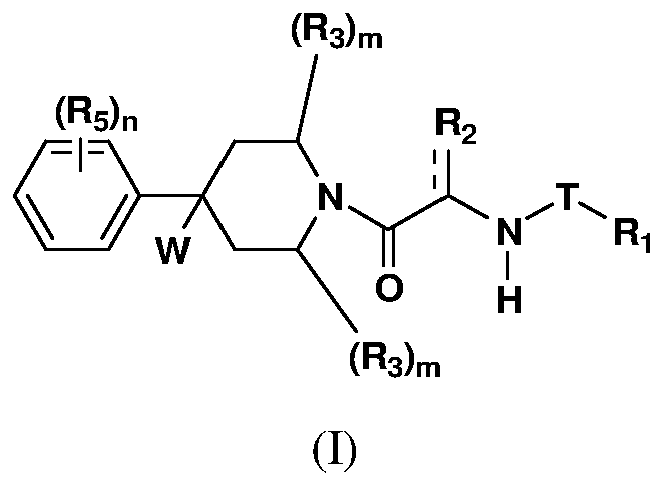
wherein: - the dashed line represents an optional double bond;
- T is

- R1 is alkyl, cycloalkyl, aryl, heterocyclyl or heteroaryl, all of which may be optionally substituted with 0-5 R1a;
- R1a, at each occurrence, is independently selected from alkyl, haloalkyl, aryl, alkenyl, alkynyl, cycloalkyl, cycloalkylalkyl, heteroaryl, heteroarylalkyl, heterocyclyl heterocyclylalkyl, halo, -NH2, -CN, -NO2, -C(=O)OH, -C(=O)O(CR8R8)rR10, -O(CF2)rCF3, -O(CR8R8)rR10, -OH, -SH, -S(CR8R8)rR10, -S(O)3H, -P(O)3H2, -C(=O)NR9R9, -NR9R9, -S(O)2NR9R9, -NR9S(O)2(CF2)rCF3, -C(=O)NR9S(O)2R6, -S(O)2NR9C(=O)OR6, -S(O)2NR9C(=O)NR9R9, -C(=O)NR9S(O)2(CF2)rCF3, -C(=O)(CR8R8)rR10, -NR9C(=O)H, -NR9C(=O)(CR8R8)rR10, -OC(=O)(CR8R8)rR10, -C(=NR14)NR9R9, -NHC(=NR14)NR14R14, -S(=O)(CR8R8)rR10, -S(O)2(CR8R8)rR10, -NR9C(=O)OR8, -NR9S(O2)R8, -S(O)2NR9C(O)R6, aryloxy or arylalkyl, wherein the aryl, cycloalkyl, cycloalkylalkyl, heteroaryl, heteroarylalkyl, heterocyclyl heterocyclylalkyl, aryloxy and arylalkyl may be optionally substituted with 0-3 R1b;
- R1b, at each occurrence, is independently selected from alkyl, haloalkyl, aryl, alkenyl, alkynyl, cycloalkyl, cycloalkylalkyl, heteroaryl, heteroarylalkyl, heterocyclyl heterocyclylalkyl, halo, -NH2, -CN, -NO2, -C(=O)OH, -C(=O)O(CR8R8)rR10, -O(CF2)rCF3, -O(CR8R8)rR10, -OH, -SH, -S(CR8R8)rR10, -S(O)3H, -P(O)3H2, -C(=O)NR9R9, -NR9R9, -S(O)2NR9R9, -NR9S(O)2(CF2)rCF3, -C(=O)NR9S(O)2R6, -S(O)2NR9C(=O)OR6, -S(O)2NR9C(=O)NR9R9, -C(=O)NR9S(O)2(CF2)rCF3, -C(=O)(CR8R8)rR10, -NR9C(=O)H, -NR9C(=O)(CR8R8)rR10, -OC(=O)(CR8R8)rR10, -C(=NR14)NR9R9, -NHC(=NR14)NR14R14, -S(=O)(CR8R8)rR10, -S(O)2(CR8R8)rR10, -NR9C(=O)OR8, -NR9S(O2)R8, aryloxy or arylalkyl;
- R2 is alkyl, cycloalkyl, cycloalkylalkyl, or alkenyl, wherein the alkyl may be optionally substituted with -OH;
- R3, at each occurrence, is alkyl; or any two R3's attached to the same carbon atom may form a 3- to 6- membered ring;
- W is hydrogen, F, -OH, -CN, -NH2;
- R5 is halo, -CN or -Oalkyl; or
- W and one R5 are taken together with the carbon atoms to which each is attached to form a 3- to 6-membered oxygen containing ring wherein said ring may be optionally substituted with one or more R5's;
- R6, at each occurrence, is independently alkyl, cycloalkyl, cycloalkylalkyl, aryl, arylalkyl, heteroaryl or heteroarylalkyl;
- R8, at each occurrence, is independently hydrogen or alkyl;
- R9, at each occurrence, is independently hydrogen, alkyl, cycloalkyl, aryl, arylalkyl, heteroaryl, heteroarylalkyl, heterocyclyl or heterocyclylalkyl, wherein the aryl, arylalkyl, heteroaryl, heteroarylalkyl, heterocyclyl or heterocyclylalkyl may be optionally substituted with 0-5 R9a, and the heteroaryl, heteroarylalkyl, heterocyclyl or heterocyclylalkyl contain 1-4 heteroatoms selected from N, O, and S;
- R9a, at each occurrence, is independently selected from alkyl, haloalkyl, aryl, alkenyl, alkynyl, cycloalkyl, cycloalkylalkyl, heteroaryl, heteroarylalkyl, heterocyclyl heterocyclylalkyl, halo, -NH2, -CN, -NO2, -C(=O)OH, -C(=O)O(CR8R8)rR14, -O(CF2)rCF3, -O(CR8R8)rR14, -OH, -SH, -S(CR8R8)rR14, -S(O)3H, -P(O)3H2, -C(=O)NR14R14, -NR14R14, -S(O)2NR14R14, -NR14S(O)2(CF2)rCF3, -C(=O)NR14S(O)2R6, -S(O)2NR14C(=O)OR6, -S(O)2NR14C(=O)NR14R14, -C(=O)NR14S(O)2(CF2)rCF3, -C(=O)(CR8R8),R14, -NR14C(=O)H, -NR14C(=O)(CR8R8)rR14, -OC(=O)(CR8R8)rR14, -C(=NR14)NR14R14, -NHC(=NR14)NR14R14, -S(=O)(CR8R8)rR14, -S(O)2(CR8R8)rR14, -NR14C(=O)OR8, -NR14S(O2)R8, aryloxy or arylalkyl;
- R10, at each occurrence, is independently selected from alkyl, aryl, arylalkyl, heterocyclyl or heterocyclylalkyl, wherein the alkyl, aryl, arylalkyl, heterocyclyl or heterocyclylalkyl may be optionally substituted with 0-3 R10a, and the heterocyclyl and heterocyclylalkyl contain 1-4 heteroatoms selected from N, O, and S;
- R10a, at each occurrence, is independently selected from alkyl, haloalkyl, aryl, alkenyl, alkynyl, cycloalkyl, cycloalkylalkyl, heteroaryl, heteroarylalkyl, heterocyclyl heterocyclylalkyl, halo, -NH2, -CN, -NO2, -C(=O)OH, -C(=O)O(CR8R8)rR14, -O(CF2)rCF3, -O(CR8R8)rR14, -OH, -SH, -S(CR8R8)rR14, -S(O)3H, -P(O)3H2, -C(=O)NR14R14, -NR14R14, -S(O)2NR14R14, -NR14S(O)2(CF2)rCF3, -C(=O)NR14S(O)2R6, -S(O)2NR14C(=O)OR6, -S(O)2NR14C(=O)NR14R14, -C(=O)NR14S(O)2(CF2)rCF3, -C(=O)(CR8R8)rR14, -NR14C(=O)H, -NR14C(=O)(CR8R8)rR14, -OC(=O)(CR8R8)rR14, -C(=NR14)NR14R14, -NHC(=NR14)NR14R14, -S(=O)(CR8R8)rR14, -S(O)2(CR8R8)rR14, -NR14C(=O)OR8, -NR14S(O2)R8, aryloxy or arylalkyl;
- R14, at each occurrence, is independently selected from hydrogen, alkyl, cycloalkyl or phenyl;
- m, at each occurrence, is 0-2;
- n is 1-3; and
- r is 0-5.
- In a second embodiment, compounds of Formula (I) of the first embodiment are provided having the formula (Ia):

- In a third embodiment, compounds of the present invention, preferably compounds according to the second embodiment, are provided wherein:
- T is

- W is hydrogen, F, -OH, -NH2;
- R5 is halo, -CN or -Oalkyl;
- n is 1-2; and
- r is 0-4.
- In a fourth embodiment, compounds of the present invention, preferably compounds according to the second embodiment, are provided wherein:

- R2 is alkyl, cycloalkyl, or cycloalkylalkyl, wherein the alkyl may be optionally substituted with -OH;
- W is hydrogen, F, -OH, -NH2;
- R5 is halo or -CN;
- n is 1-2; and
- r is 0-3.
- In a fifth embodiment, compounds of the present invention, preferably compounds according to the second embodiment, are provided wherein:

- R2 is alkyl or cycloalkyl, wherein the alkyl may be optionally substituted with -OH;
- W is hydrogen, F, -OH, -NH2;
- R5 is halo;
- n is 1-2; and
- r is 0-2.
- In a sixth embodiment, compounds of the present invention, preferably compounds according to the second embodiment, are provided wherein:
- T is

- R2 is alkyl or cycloalkyl, wherein the alkyl may be optionally substituted with -OH;
- R3, at each occurrence, is alkyl;
- W is hydrogen, -OH or -NH2;
- R5 is halo;
- n is 1-2; and
- r is 0-2.
- In a seventh embodiment, compounds of the present invention, preferably comopunds according to the second embodiment, are provided wherein:
- T is

- R2 is alkyl or cycloalkyl;
- R3, at each occurrence, is alkyl;
- W is hydrogen or -OH;
- R5 is halo;
- n is 1-2; and
- r is 0-2.
- In an eighth embodiment, the present invention provides novel compounds of formula (Ib):


- R1 is alkyl, cycloalkyl, aryl, heterocyclyl or heteroaryl, all of which may be optionally substituted with 0-5 R1a;
- R1a, at each occurrence, is independently selected from alkyl, haloalkyl, aryl, alkenyl, alkynyl, cycloalkyl, cycloalkylalkyl, heteroaryl, heteroarylalkyl, heterocyclyl heterocyclylalkyl, halo, -NH2, -CN, -NO2, -C(=O)OH, -C(=O)O(CR8R8)rR10, -O(CF2)rCF3, -O(CR8R8)rR10, -OH, -SH, -S(CR8R8)rR10, -S(O)3H, -P(O)3H2, -C(=O)NR9R9, -NR9R9, -S(O)2NR9R9, -NR9S(O)2(CF2)rCF3, -C(=O)NR9S(O)2R6, -S(O)2NR9C(=O)OR6, -S(O)2NR9C(=O)NR9R9, -C(=O)NR9S(O)2(CF2)rCF3, -C(=O)(CR8R8)rR10, -NR9C(=O)H, -NR9C(=O)(CR8R8)rR10, -OC(=O)(CR8R8)rR10, -C(=NR14)NR9R9, -NHC(=NR14)NR14R14, -S(=O)(CR8R8)rR10, -S(O)2(CR8R8)rR10, -NR9C(=O)OR8, -NR9S(O2)R8, -S(O)2NR9C(O)R6, aryloxy or arylalkyl, wherein the aryl, cycloalkyl, cycloalkylalkyl, heteroaryl, heteroarylalkyl, heterocyclyl heterocyclylalkyl, aryloxy and arylalkyl may be optionally substituted with 0-3 R1b;
- R1b, at each occurrence, is independently selected from alkyl, haloalkyl, aryl, alkenyl, alkynyl, cycloalkyl, cycloalkylalkyl, heteroaryl, heteroarylalkyl, heterocyclyl heterocyclylalkyl, halo, -NH2, -CN, -NO2, -C(=O)OH, -C(=O)O(CR8R8)rR10, -O(CF2)rCF3, -O(CR8R8)rR10, -OH, -SH, -S(CR8R8)rR10, -S(O)3H, -P(O)3H2, -C(=O)NR9R9, -NR9R9, -S(O)2NR9R9, -NR9S(O)2(CF2)rCF3, -C(=O)NR9S(O)2R6, -S(O)2NR9C(=O)OR6, -S(O)2NR9C(=O)NR9R9, -C(=O)NR9S(O)2(CF2)rCF3, -C(=O)(CR8R8)rR10, -NR9C(=O)H, -NR9C(=O)(CR8R8)rR10, -OC(=O)(CR8R8)rR10, -C(=NR14)NR9R9, -NHC(=NR14)NR14R14, -S(=O)(CR8R8)rR10, -S(O)2(CR8R8)rR10, -NR9C(=O)OR8, -NR9S(O2)R8, aryloxy or arylalkyl;
- R2 is alkyl, cycloalkyl, cycloalkylalkyl, arylalkyl, - CH2CH2CH2NHC(=NR14)NR14R14, -CH2CH2S(CR8R8)rR10 or -CH2CH2CN, wherein the alkyl and arylalkyl may be optionally substituted with -OH;
- R4, at each occurrence, is F, -OH or alkyl; or any two alkyl R4's attached to the same carbon atom may form a 3- to 6-membered ring, which optionally may contain 1-4 heteroatoms selected from N, O, and S;
- W is hydrogen, F, -OH, -CN, -NH2;
- R5 is halo, -CN or -Oalkyl;
- R6, at each occurrence, is independently alkyl, cycloalkyl, cycloalkylalkyl, aryl, arylalkyl, heteroaryl or heteroarylalkyl;
- R8, at each occurrence, is independently hydrogen or alkyl;
- R9, at each occurrence, is independently hydrogen, alkyl, cycloalkyl, aryl, arylalkyl, heteroaryl, heteroarylalkyl, heterocyclyl or heterocyclylalkyl, wherein the aryl, arylalkyl, heteroaryl, heteroarylalkyl, heterocyclyl or heterocyclylalkyl may be optionally substituted with 0-5 R9a, and the heteroaryl, heteroarylalkyl, heterocyclyl or heterocyclylalkyl contain 1-4 heteroatoms selected from N, O, and S;
- R9a, at each occurrence, is independently selected from alkyl, haloalkyl, aryl, alkenyl, alkynyl, cycloalkyl, cycloalkylalkyl, heteroaryl, heteroarylalkyl, heterocyclyl heterocyclylalkyl, halo, -NH2, -CN, -NO2, -C(=O)OH, -C(=O)O(CR8R8)rR14, -O(CF2)rCF3, -O(CR8R8)rR14, -OH, -SH, -S(CR8R8)rR14, -S(O)3H, -P(O)3H2, -C(=O)NR14R14, -NR14R14, -S(O)2NR14R14, -NR14S(O)2(CF2)rCF3, -C(=O)NR14S(O)2R6, -S(O)2NR14C(=O)OR6, -S(O)2NR14C(=O)NR14R14, -C(=O)NR14S(O)2(CF2)rCF3, -C(=O)(CR8R8)rR14, -NR14C(=O)H, -NR14C(=O)(CR8R8)rR14, -OC(=O)(CR8R8)rR14, -C(=NR14)NR14R14, -NHC(=NR14)NR14R14, -S(=O)(CR8R8)rR14, -S(O)2(CR8R8)rR14, -NR14C(=O)OR8, -NR14S(O2)R8, aryloxy or arylalkyl;
- R10, at each occurrence, is independently selected from alkyl, aryl, arylalkyl, heterocyclyl or heterocyclylalkyl, wherein the alkyl, aryl, arylalkyl, heterocyclyl or heterocyclylalkyl may be optionally substituted with 0-3 R10a, and the heterocyclyl and heterocyclylalkyl contain 1-4 heteroatoms selected from N, O, and S;
- R10a, at each occurrence, is independently selected from alkyl, haloalkyl, aryl, alkenyl, alkynyl, cycloalkyl, cycloalkylalkyl, heteroaryl, heteroarylalkyl, heterocyclyl heterocyclylalkyl, halo, -NH2, -CN, -NO2, -C(=O)OH, -C(=O)O(CR8R8)rR14, -O(CF2)rCF3, -O(CR8R8)rR14, -OH, -SH, -S(CR8R8)rR14, -S(O)3H, -P(O)3H2, -C(=O)NR14R14, -NR14R14, -S(O)2NR14R14, -NR14S(O)2(CF2)rCF3, -C(=O)NR14S(O)2R6, -S(O)2NR14C(=O)OR6, -S(O)2NR14C(=O)NR14R14, -C(=O)NR14S(O)2(CF2)rCF3, -C(=O)(CR8R8)rR14, -NR14C(=O)H, -NR14C(=O)(CR8R8)rR14, -OC(=O)(CR8R8)rR14, -C(=NR14)NR14R14, -NHC(=NR14)NR14R14, -S(=O)(CR8R8)rR14, -S(O)2(CR8R8)rR14, -NR14C(=O)OR8, -NR14S(O2)R8, aryloxy or arylalkyl;
- R14, at each occurrence, is independently selected from hydrogen, alkyl, cycloalkyl or phenyl;
- m, at each occurrence, is 0-2; and
- r is 0-5.
- In a ninth embodiment, compounds of Formula (Ib) of the eighth embodiment are provided having the formula (Ib'):

- In a tenth embodiment, compounds of the present invention, preferably compounds according to the ninth embodiment, are provided wherein:

- R2 is alkyl, cycloalkyl, cycloalkylalkyl, -CH2CH2CH2-NHC(=NH)NH2, - CH2CH2SCH3, -CH2CH2CN,

- R4, at each occurrence, is -OH or alkyl; or any two alkyl R4's attached to the same carbon atom may form a 3- to 6-membered ring, which optionally may contain 1-4 heteroatoms selected from N, O, and S; and
- r is 0-4.
- In an eleventh embodiment, compounds of the present invention, preferably compounds according to the ninth embodiment, are provided wherein:
- T is

- R2 is alkyl, cycloalkyl, cycloalkylalkyl, -CH2CH2SCH3, -CH2CH2CN,

- R4, at each occurrence, is -OH or alkyl; or any two alkyl R4's attached to the same carbon atom may form a 3- to 6-membered ring, which optionally may contain 1-4 heteroatoms selected from N, O, and S;
- R5 is halo or -CN; and
- r is 0-3.
- In a twelth embodiment, compounds of the present invention, preferably compounds according to the ninth embodiment, are provided wherein:

- R2 is alkyl, cycloalkyl, cycloalkylalkyl,

- R4, at each occurrence, is alkyl; or any two alkyl R4's attached to the same carbon atom may form a 3- to 6-membered ring, which optionally may contain 1-4 heteroatoms selected from N, O, and S;
- R5 is halo; and
- r is 0-2.
- In a thirteenth embodiment, compounds of the present invention, preferably compounds according to the ninth embodiment, are provided wherein:
- T is

- R2 is alkyl, cycloalkyl, or cycloalkylalkyl, wherein the alkyl may be optionally substituted with -OH;
- R4, at each occurrence, is alkyl;
- R5 is halo; and
- r is 0-2.
- In a fourtheenth embodiment, compounds of the present invention, preferably comounds according to the ninth embodiment, are provided wherein:
- T is

- R2 is alkyl or cycloalkyl;
- R4, at each occurrence, is alkyl;
- R5 is halo; and
- r is 0-2.
- In a fifteenth embodiment, compounds of the present invention, preferably compounds according to the ninth embodiment, are provided wherein: R2 is isopropyl, sec-butyl or cyclopropyl; R4 is methyl; R5 is Cl, F or Br; and R1 is alkyl, cycloalkyl, aryl or heteroaryl, all of which may be optionally substituted with 0-5 R1a.
- In a sixteenth embodiment, compounds of the present invention, preferably compounds according to the fifteenth embodiment, are provided wherein:
- T is

- In a seventeenth embodiment, the present invention provides novel compounds of formula (Ic):

- R15 is -NHR1, heteroaryl or aryl, wherein the heteroaryl and aryl may be optionally substituted with 0-3 R1a;
- R1 is aryl or heteroaryl, both of which may be optionally substituted with 0-3 R1a, provided that when R1 is phenyl, R1a cannot be ortho-methoxy;
- R1a, at each occurrence, is independently selected from alkyl, haloalkyl, aryl, alkenyl, alkynyl, cycloalkyl, cycloalkylalkyl, heteroaryl, heteroarylalkyl, heterocyclyl heterocyclylalkyl, halo, -NH2, -CN, -NO2, -C(=O)OH, -C(=O)O(CR8R8)rR10, -O(CF2)rCF3, -O(CR8R8)rR10, -OH, -SH, -S(CR8R8)rR10, -S(O)3H, -P(O)3H2, -C(=O)NR9R9, -NR9R9, -S(O)2NR9R9, -NR9S(O)2(CF2)rCF3, -C(=O)NR9S(O)2R6, -S(O)2NR9C(=O)OR6, -S(O)2NR9C(=O)NR9R9, -C(=O)NR9S(O)2(CF2)rCF3, -C(=O)(CR8R8)rR10, -NR9C(=O)H, -NR9C(=O)(CR8R8)rR10, -OC(=O)(CR8R8)rR10, -C(=NR14)NR9R9, -NHC(=NR14)NR14R14, -S(=O)(CR8R8)rR10, -S(O)2(CR8R8)rR10, -NR9C(=O)OR8, -NR9S(O2)R8, -S(O)2NR9C(O)R6, aryloxy or arylalkyl, wherein the aryl, cycloalkyl, cycloalkylalkyl, heteroaryl, heteroarylalkyl, heterocyclyl heterocyclylalkyl, aryloxy and arylalkyl may be optionally substituted with 0-3 R1b;
- R1b, at each occurrence, is independently selected from alkyl, haloalkyl, aryl, alkenyl, alkynyl, cycloalkyl, cycloalkylalkyl, heteroaryl, heteroarylalkyl, heterocyclyl heterocyclylalkyl, halo, -NH2, -CN, -NO2, -C(=O)OH, -C(=O)O(CR8R8)rR10, -O(CF2)rCF3, -O(CR8R8)rR10, -OH, -SH, -S(CR8R8)rR10, -S(O)3H, -P(O)3H2, -C(=O)NR9R9, -NR9R9, -S(O)2NR9R9, -NR9S(O)2(CF2)rCF3, -C(=O)NR9S(O)2R6, -S(O)2NR9C(=O)OR6, -S(O)2NR9C(=O)NR9R9, -C(=O)NR9S(O)2(CF2)rCF3, -C(=O)(CR8R8)rR10, -NR9C(=O)H, -NR9C(=O)(CR8R8)rR10, -OC(=O)(CR8R8)rR10, -C(=NR14)NR9R9, -NHC(=NR14)NR14R14, -S(=O)(CR8R8)rR10, -S(O)2(CR8R8)rR10, -NR9C(=O)OR8, -NR9S(O2)R8, aryloxy or arylalkyl;
- R2 is alkyl, cycloalkyl or cycloalkylalkyl, wherein the alkyl may be optionally substituted with -OH;
- R4, at each occurrence, is F, -OH or alkyl; or any two alkyl R4's attached to the same carbon atom may form a 3- to 6-membered ring, which optionally may contain 1-4 heteroatoms selected from N, O, and S;
- W is hydrogen, F, -OH or-NH2;
- R5 is halo, -CN or -Oalkyl;
- R6, at each occurrence, is independently alkyl, cycloalkyl, cycloalkylalkyl, aryl, arylalkyl, heteroaryl or heteroarylalkyl;
- R8, at each occurrence, is independently hydrogen or alkyl;
- R9, at each occurrence, is independently hydrogen, alkyl, cycloalkyl, aryl, arylalkyl, heteroaryl, heteroarylalkyl, heterocyclyl or heterocyclylalkyl, wherein the aryl, arylalkyl, heteroaryl, heteroarylalkyl, heterocyclyl or heterocyclylalkyl may be optionally substituted with 0-5 R9a, and the heteroaryl, heteroarylalkyl, heterocyclyl or heterocyclylalkyl contain 1-4 heteroatoms selected from N, O, and S;
- R9a, at each occurrence, is independently selected from alkyl, haloalkyl, aryl, alkenyl, alkynyl, cycloalkyl, cycloalkylalkyl, heteroaryl, heteroarylalkyl, heterocyclyl heterocyclylalkyl, halo, -NH2, -CN, -NO2, -C(=O)OH, -C(=O)O(CR8R8)rR14, -O(CF2)rCF3, -O(CR8R8)rR14, -OH, -SH, -S(CR8R8)rR14, -S(O)3H, -P(O)3H2, -C(=O)NR14R14, -NR14R14, -S(O)2NR14R14, -NR14S(O)2(CF2)rCF3, -C(=O)NR14S(O)2R6, -S(O)2NR14C(=O)OR6, -S(O)2NR14C(=O)NR14R14, -C(=O)NR14S(O)2(CF2)rCF3, -C(=O)(CR8R8)rR14, -NR14C(=O)H, -NR14C(=O)(CR8R8)rR14, -OC(=O)(CR8R8)rR14, -C(=NR14)NR14R14, -NHC(=NR14)NR14R14, -S(=O)(CR8R8)rR14, -S(O)2(CR8R8)rR14, -NR14C(=O)OR8, -NR14S(O2)R8, aryloxy or arylalkyl;
- R10, at each occurrence, is independently selected from alkyl, aryl, arylalkyl, heterocyclyl or heterocyclylalkyl, wherein the alkyl, aryl, arylalkyl, heterocyclyl or heterocyclylalkyl may be optionally substituted with 0-3 R10a, and the heterocyclyl and heterocyclylalkyl contain 1-4 heteroatoms selected from N, O, and S;
- R10a, at each occurrence, is independently selected from alkyl, haloalkyl, aryl, alkenyl, alkynyl, cycloalkyl, cycloalkylalkyl, heteroaryl, heteroarylalkyl, heterocyclyl heterocyclylalkyl, halo, -NH2, -CN, -NO2, -C(=O)OH, -C(=O)O(CR8R8)rR14, -O(CF2)rCF3, -O(CR8R8)rR14, -OH, -SH, -S(CR8R8)rR14, -S(O)3H, -P(O)3H2, -C(=O)NR14R14, -NR14R14, -S(O)2NR14R14, -NR14S(O)2(CF2)rCF3, -C(=O)NR14S(O)2R6, -S(O)2NR14C(=O)OR6, -S(O)2NR14C(=O)NR14R14, -C(=O)NR14S(O)2(CF2)rCF3, -C(=O)(CR8R8)rR14, -NR14C(=O)H, -NR14C(=O)(CR8R8)rR14, -OC(=O)(CR8R8)rR14, -C(=NR14)NR14R14, -NHC(=NR14)NR14R14, -S(=O)(CR8R8)rR14, -S(O)2(CR8R8)rR14, -NR14C(=O)OR8, -NR14S(O2)R8, aryloxy or arylalkyl;
- R14, at each occurrence, is independently selected from hydrogen, alkyl, cycloalkyl or phenyl;
- m, at each occurrence, is 0-2;
- n is 1-3; and
- r is 0-5.
- In a eigtheenth embodiment, compounds of Formula (Ic) of the seventeenth embodiment are provided having the formula (Id):

- In a nineteenth another embodiment, compounds of the present invention, preferably compounds according to the seventeenth embodiment, are provided wherein:
- R15 is -NHR1, heteroaryl or aryl, wherein the heteroaryl and aryl may be optionally substituted with 0-3 R1a;
- R1 is aryl or heteroaryl, both of which may be optionally substituted with 0-3 R1a;
- R1a, at each occurrence, is independently selected from alkyl, haloalkyl, aryl, alkenyl, alkynyl, cycloalkyl, cycloalkylalkyl, heteroaryl, heteroarylalkyl, heterocyclyl heterocyclylalkyl, halo, -NH2, -CN, -NO2, -C(=O)OH, -C(=O)O(CR8R8)rR10, -O(CF2)rCF3, -O(CR8R8)rR10, -OH, -SH, -S(CR8R8)rR10, -S(O)3H, -P(O)3H2, -C(=O)NR9R9, -NR9R9, -S(O)2NR9R9, -NR9S(O)2(CF2)rCF3, -C(=O)NR9S(O)2R6, -S(O)2NR9C(=O)OR6, -S(O)2NR9C(=O)NR9R9, -C(=O)NR9S(O)2(CF2)rCF3, -C(=O)(CR8R8)rR10, -NR9C(=O)H, -NR9C(=O)(CR8R8)rR10, -OC(=O)(CR8R8)rR10, -C(=NR14)NR9R9, -NHC(=NR14)NR14R14, -S(=O)(CR8R8)rR10, -S(O)2(CR8R8)rR10, -NR9C(=O)OR8, -NR9S(O2)R8, -S(O)2NR9C(O)R6, aryloxy or arylalkyl, wherein the aryl, cycloalkyl, cycloalkylalkyl, heteroaryl, heteroarylalkyl, heterocyclyl heterocyclylalkyl, aryloxy and arylalkyl may be optionally substituted with 0-3 R1b;
- R1b, at each occurrence, is independently selected from alkyl, haloalkyl, aryl, alkenyl, alkynyl, cycloalkyl, cycloalkylalkyl, heteroaryl, heteroarylalkyl, heterocyclyl heterocyclylalkyl, halo, -NH2, -CN, -NO2, -C(=O)OH, -C(=O)O(CR8R8)rR10, -O(CF2)rCF3, -O(CR8R8)rR10, -OH, -SH, -S(CR8R8)rR10, -S(O)3H, -P(O)3H2, -C(=O)NR9R9, -NR9R9, -S(O)2NR9R9, -NR9S(O)2(CF2)rCF3, -C(=O)NR9S(O)2R6, -S(O)2NR9C(=O)OR6, -S(O)2NR9C(=O)NR9R9, -C(=O)NR9S(O)2(CF2)rCF3, -C(=O)(CR8R8)rR10, -NR9C(=O)H, -NR9C(=O)(CR8R8)rR10, -OC(=O)(CR8R8)rR10, -C(=NR14)NR9R9, -NHC(=NR14)NR14R14, -S(=O)(CR8R8)rR10, -S(O)2(CR8R8)rR10, -NR9C(=O)OR8, -NR9S(O2)R8, aryloxy or arylalkyl;
- R2 is alkyl or cycloalkyl, wherein the alkyl may be optionally substituted with -OH;
- W is hydrogen, F, or -OH;
- n is 1-2; and
- r is 0-4.
- In a twentieth embodiment, compounds of the present invention, preferably compounds according to the seventeenth embodiment, are provided wherein:
- R15 is -NHR1, heteroaryl or aryl, wherein the heteroaryl and aryl may be optionally substituted with 0-3 R1a;
- R1 is aryl or heteroaryl, which may be optionally substituted with 0-3 R1a;
- R1a, at each occurrence, is independently selected from alkyl, haloalkyl, aryl, alkenyl, alkynyl, cycloalkyl, cycloalkylalkyl, heteroaryl, heteroarylalkyl, heterocyclyl heterocyclylalkyl, halo, -NH2, -CN, -NO2, -C(=O)OH, -C(=O)O(CR8R8)rR10, -O(CF2)rCF3, -O(CR8R8)rR10, -OH, -SH, -S(CR8R8)rR10, -S(O)3H, -P(O)3H2, -C(=O)NR9R9, -NR9R9, -S(O)2NR9R9, -NR9S(O)2(CF2)rCF3, -C(=O)NR9S(O)2R6, -S(O)2NR9C(=O)OR6, -S(O)2NR9C(=O)NR9R9, -C(=O)NR9S(O)2(CF2)rCF3, -C(=O)(CR8R8)rR10, -NR9C(=O)H, -NR9C(=O)(CR8R8)rR10, -OC(=O)(CR8R8)rR10, -C(=NR14)NR9R9, -NHC(=NR14)NR14R14, -S(=O)(CR8R8)rR10, -S(O)2(CR8R8)rR10, -NR9C(=O)OR8, -NR9S(O2)R8, -S(O)2NR9C(O)R6, aryloxy or arylalkyl, wherein the aryl, cycloalkyl, cycloalkylalkyl, heteroaryl, heteroarylalkyl, heterocyclyl heterocyclylalkyl, aryloxy and arylalkyl may be optionally substituted with 0-3 R1b;
- R1b, at each occurrence, is independently selected from alkyl, haloalkyl, aryl, alkenyl, alkynyl, cycloalkyl, cycloalkylalkyl, heteroaryl, heteroarylalkyl, heterocyclyl heterocyclylalkyl, halo, -NH2, -CN, -NO2, -C(=O)OH, -C(=O)O(CR8R8)rR10, -O(CF2)rCF3, -O(CR8R8)rR10, -OH, -SH, -S(CR8R8)rR10, -S(O)3H, -P(O)3H2, -C(=O)NR9R9, -NR9R9, -S(O)2NR9R9, -NR9S(O)2(CF2)rCF3, -C(=O)NR9S(O)2R6, -S(O)2NR9C(=O)OR6, -S(O)2NR9C(=O)NR9R9, -C(=O)NR9S(O)2(CF2)rCF3, -C(=O)(CR8R8)rR10, -NR9C(=O)H, -NR9C(=O)(CR8R8)rR10, -OC(=O)(CR8R8)rR10, -C(=NR14)NR9R9, -NHC(=NR14)NR14R14, -S(=O)(CR8R8)rR10, -S(O)2(CR8R8)rR10, -NR9C(=O)OR8, -NR9S(O2)R8, aryloxy or arylalkyl;
- R2 is alkyl or cycloalkyl, wherein the alkyl may be optionally substituted with -OH;
- R4, at each occurrence, is OH or alkyl; or any two alkyl R4's attached to the same carbon atom may form a 3- to 6-membered ring, which optionally may contain 1-4 heteroatoms selected from N, O, and S;
- W is hydrogen or -OH;
- R5 is halo or -CN;
- n is 1-2; and
- r is 0-3.
- In a twenty first embodiment, compounds of the present invention, preferably compounds according to the seventeenth embodiment, are provided wherein:
- R15 is -NHR1, heteroaryl or aryl, wherein the heteroaryl and aryl may be optionally substituted with 0-3 R1a;
- R1 is aryl or heteroaryl, which may be optionally substituted with 0-3 R1a;
- R1a, at each occurrence, is independently selected from alkyl, haloalkyl, aryl, alkenyl, alkynyl, cycloalkyl, cycloalkylalkyl, heteroaryl, heteroarylalkyl, heterocyclyl heterocyclylalkyl, halo, -NH2, -CN, -NO2, -C(=O)OH, -C(=O)O(CR8R8)rR10, -O(CF2)rCF3, -O(CR8R8)rR10, -OH, -SH, -S(CR8R8)rR10, -S(O)3H, -P(O)3H2, -C(=O)NR9R9, -NR9R9, -S(O)2NR9R9, -NR9S(O)2(CF2)rCF3, -C(=O)NR9S(O)2R6, -S(O)2NR9C(=O)OR6, -S(O)2NR9C(=O)NR9R9, -C(=O)NR9S(O)2(CF2)rCF3, -C(=O)(CR8R8)rR10, -NR9C(=O)H, -NR9C(=O)(CR8R8)rR10, -OC(=O)(CR8R8)rR10, -C(=NR14)NR9R9, -NHC(=NR14)NR14R14, -S(=O)(CR8R8)nR10, -S(O)2(CR8R8)rR10, -NR9C(=O)OR8, -NR9S(O2)R8, -S(O)2NR9C(O)R6, aryloxy or arylalkyl, wherein the aryl, cycloalkyl, cycloalkylalkyl, heteroaryl, heteroarylalkyl, heterocyclyl heterocyclylalkyl, aryloxy and arylalkyl may be optionally substituted with 0-3 R1b;
- R1b, at each occurrence, is independently selected from alkyl, haloalkyl, aryl, alkenyl, alkynyl, cycloalkyl, cycloalkylalkyl, heteroaryl, heteroarylalkyl, heterocyclyl heterocyclylalkyl, halo, -NH2, -CN, -NO2, -C(=O)OH, -C(=O)O(CR8R8)rR10, -O(CF2)rCF3, -O(CR8R8)rR10, -OH, -SH, -S(CR8R8)rR10, -S(O)3H, -P(O)3H2, -C(=O)NR9R9, -NR9R9, -S(O)2NR9R9, -NR9S(O)2(CF2)rCF3, -C(=O)NR9S(O)2R6, -S(O)2NR9C(=O)OR6, -S(O)2NR9C(=O)NR9R9, -C(=O)NR9S(O)2(CF2)rCF3, -C(=O)(CR8R8)rR10, -NR9C(=O)H, -NR9C(=O)(CR8R8)rR10, -OC(=O)(CR8R8)rR10, -C(=NR14)NR9R9, -NHC(=NR14)NR14R14, -S(=O)(CR8R8)rR10, -S(O)2(CR8R8)rR10, -NR9C(=O)OR8, -NR9S(O2)R8, aryloxy or arylalkyl;
- R2 is alkyl or cycloalkyl, wherein the alkyl may be optionally substituted with -OH;
- R4, at each occurrence, is alkyl; or any two R4's attached to the same carbon atom may form a 3- to 6-membered ring, which optionally may contain 1-4 heteroatoms selected from N, O, and S;
- W is hydrogen or -OH;
- R5 is halo;
- n is 1-2; and
- r is 0-2.
- In a twenty second embodiment, compounds of the present invention, preferably compounds according to the seventeenth embodiment, are provided wherein:
- R15 is -NHR1 or heteroaryl, wherein the heteroaryl may be optionally substituted with 0-3 R1a;
- R1 is aryl or heteroaryl, which may be optionally substituted with 0-3 R1a;
- R1a, at each occurrence, is independently selected from alkyl, haloalkyl, aryl, alkenyl, alkynyl, cycloalkyl, cycloalkylalkyl, heteroaryl, heteroarylalkyl, heterocyclyl heterocyclylalkyl, halo, -NH2, -CN, -NO2, -C(=O)OH, -C(=O)O(CR8R8)rR10, -O(CF2)rCF3, -O(CR8R8)rR10, -OH, -SH, -S(CR8R8)rR10, -S(O)3H, -P(O)3H2, -C(=O)NR9R9, -NR9R9, -S(O)2NR9R9, -NR9S(O)2(CF2)rCF3, -C(=O)NR9S(O)2R6, -S(O)2NR9C(=O)OR6, -S(O)2NR9C(=O)NR9R9, -C(=O)NR9S(O)2(CF2)rCF3, -C(=O)(CR8R8)rR10, -NR9C(=O)H, -NR9C(=O)(CR8R8)rR10, -OC(=O)(CR8R8)rR10, -C(=NR14)NR9R9, -NHC(=NR14)NR14R14, -S(=O)(CR8R8)rR10, -S(O)2(CR8R8)rR10, -NR9C(=O)OR8, -NR9S(O2)R8, -S(O)2NR9C(O)R6, aryloxy or arylalkyl, wherein the aryl, cycloalkyl, cycloalkylalkyl, heteroaryl, heteroarylalkyl, heterocyclyl heterocyclylalkyl, aryloxy and arylalkyl may be optionally substituted with 0-3 R1b;
- R1b, at each occurrence, is independently selected from alkyl, haloalkyl, aryl, alkenyl, alkynyl, cycloalkyl, cycloalkylalkyl, heteroaryl, heteroarylalkyl, heterocyclyl heterocyclylalkyl, halo, -NH2, -CN, -NO2, -C(=O)OH, -C(=O)O(CR8R8)rR10, -O(CF2)rCF3, -O(CR8R8)rR10, -OH, -SH, -S(CR8R8)rR10, -S(O)3H, -P(O)3H2, -C(=O)NR9R9, -NR9R9, -S(O)2NR9R9, -NR9S(O)2(CF2)rCF3, -C(=O)NR9S(O)2R6, -S(O)2NR9C(=O)OR6, -S(O)2NR9C(=O)NR9R9, -C(=O)NR9S(O)2(CF2)rCF3, -C(=O)(CR8R8)rR10, -NR9C(=O)H, -NR9C(=O)(CR8R8)rR10, -OC(=O)(CR8R8)rR10, -C(=NR14)NR9R9, -NHC(=NR14)NR14R14, -S(=O)(CR8R8)rR10, -S(O)2(CR8R8)rR10, -NR9C(=O)OR8, -NR9S(O2)R8, aryloxy or arylalkyl;
- R2 is alkyl or cycloalkyl, wherein the alkyl may be optionally substituted with -OH;
- R4, at each occurrence, is alkyl;
- W is hydrogen or -OH;
- R5 is halo;
- n is 1-2; and
- r is 0-2.
- In a twenty third embodiment, compounds of the present invention, preferably compounds according to the seventeenth embodiment, are provided wherein:
- R15 is -NHR1;
- R1 is aryl or heteroaryl, which may be optionally substituted with 0-3 R1a;
- R1a, at each occurrence, is independently selected from alkyl, haloalkyl, aryl, alkenyl, alkynyl, cycloalkyl, cycloalkylalkyl, heteroaryl, heteroarylalkyl, heterocyclyl heterocyclylalkyl, halo, -NH2, -CN, -NO2, -C(=O)OH, -C(=O)O(CR8R8)rR10, -O(CF2)rCF3, -O(CR8R8)rR10, -OH, -SH, -S(CR8R8)rR10, -S(O)3H, -P(O)3H2, -C(=O)NR9R9, -NR9R9, -S(O)2NR9R9, -NR9S(O)2(CF2)rCF3, -C(=O)NR9S(O)2R6, -S(O)2NR9C(=O)OR6, -S(O)2NR9C(=O)NR9R9, -C(=O)NR9S(O)2(CF2)rCF3, -C(=O)(CR8R8)rR10, -NR9C(=O)H, -NR9C(=O)(CR8R8)rR10, -OC(=O)(CR8R8)rR10, -C(=NR14)NR9R9, -NHC(=NR14)NR14R14, -S(=O)(CR8R8)rR10, -S(O)2(CR8R8)rR10, -NR9C(=O)OR8, -NR9S(O2)R8, -S(O)2NR9C(O)R6, aryloxy or arylalkyl, wherein the aryl, cycloalkyl, cycloalkylalkyl, heteroaryl, heteroarylalkyl, heterocyclyl heterocyclylalkyl, aryloxy and arylalkyl may be optionally substituted with 0-3 R1b;
- R1b, at each occurrence, is independently selected from alkyl, haloalkyl, aryl, alkenyl, alkynyl, cycloalkyl, cycloalkylalkyl, heteroaryl, heteroarylalkyl, heterocyclyl heterocyclylalkyl, halo, -NH2, -CN, -NO2, -C(=O)OH, -C(=O)O(CR8R8)rR10, -O(CF2)rCF3, -O(CR8R8)rR10, -OH, -SH, -S(CR8R8)rR10, -S(O)3H, -P(O)3H2, -C(=O)NR9R9, -NR9R9, -S(O)2NR9R9, -NR9S(O)2(CF2)rCF3, -C(=O)NR9S(O)2R6, -S(O2NR9C(=O)OR6, -S(O)2NR9C(=O)NR9R9, -C(=O)NR9S(O)2(CF2)rCF3, -C(=O)(CR8R8)rR10, -NR9C(=O)H, -NR9C(=O)(CR8R8)rR10, -OC(=O)(CR8R8)rR10, -C(=NR14)NR9R9, -NHC(=NR14)NR14R14, -S(=O)(CR8R8)rR10, -S(O)2(CR8R8)rR10, -NR9C(=O)OR8, -NR9S(O2)R8, aryloxy or arylalkyl;
- R2 is alkyl or cycloalkyl;
- R4, at each occurrence, is alkyl;
- W is hydrogen or -OH;
- R5 is halo;
- n is 1-2; and
- r is 0-2.
- In a twenty fourth embodiment, the present invention provides novel compounds of formula (Ie):

- the dashed line represents an optional double bond;
- T is
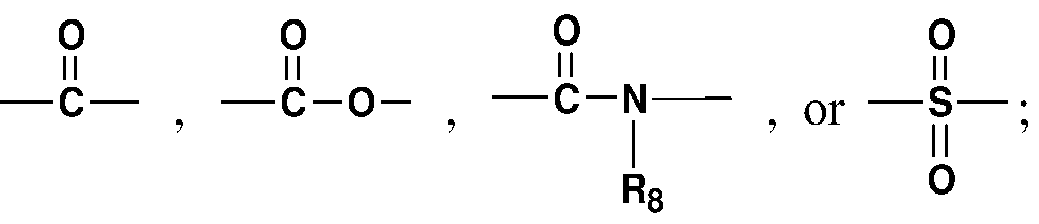
- R1 is alkyl, cycloalkyl, aryl, heterocyclyl or heteroaryl, all of which may be optionally substituted with 0-5 R1a;
- R1a, at each occurrence, is independently selected from alkyl, haloalkyl, aryl, alkenyl, alkynyl, cycloalkyl, cycloalkylalkyl, heteroaryl, heteroarylalkyl, heterocyclyl heterocyclylalkyl, halo, -NH2, -CN, -NO2, -C(=O)OH, -C(=O)O(CR8R8)rR10, -O(CF2)rCF3, -O(CR8R8)rR10, -OH, -SH, -S(CR8R8)rR10, -S(O)3H, -P(O)3H2, -C(=O)NR9R9, -NR9R9, -S(O)2NR9R9, -NR9S(O)2(CF2)rCF3, -C(=O)NR9S(O)2R6, -S(O)2NR9C(=O)OR6, -S(O)2NR9C(=O)NR9R9, -C(=O)NR9S(O)2(CF2)rCF3, -C(=O)(CR8R8)rR10, -NR9C(=O)H, -NR9C(=O)(CR8R8)rR10, -OC(=O)(CR8R8)rR10, -C(=NR14)NR9R9, -NHC(=NR14)NR14R14, -S(=O)(CR8R8)rR10, -S(O)2(CR8R8)rR10, -NR9C(=O)OR8, -NR9S(O2)R8, -S(O)2NR9C(O)R6, aryloxy or arylalkyl, wherein the aryl, cycloalkyl, cycloalkylalkyl, heteroaryl, heteroarylalkyl, heterocyclyl heterocyclylalkyl, aryloxy and arylalkyl may be optionally substituted with 0-3 R1b;
- R1b, at each occurrence, is independently selected from alkyl, haloalkyl, aryl, alkenyl, alkynyl, cycloalkyl, cycloalkylalkyl, heteroaryl, heteroarylalkyl, heterocyclyl heterocyclylalkyl, halo, -NH2, -CN, -NO2, -C(=O)OH, -C(=O)O(CR8R8)rR10, -O(CF2)rCF3, -O(CR8R8)rR10, -OH, -SH, -S(CR8R8)rR10, -S(O)3H, -P(O)3H2, -C(=O)NR9R9, -NR9R9, -S(O)2NR9R9, -NR9S(O)2(CF2)rCF3, -C(=O)NR9S(O)2R6, -S(O)2NR9C(=O)OR6, -S(O)2NR9C(=O)NR9R9, -C(=O)NR9S(O)2(CF2)rCF3, -C(=O)(CR8R8)rR10, -NR9C(=O)H, -NR9C(=O)(CR8R8)rR10, -OC(=O)(CR8R8)rR10, -C(=NR14)NR9R9, -NHC(=NR14)NR14R14, -S(=O)(CR8R8)rR10, -S(O)2(CR8R8)rR10, -NR9C(=O)OR8, -NR9S(O2)R8, aryloxy or arylalkyl;
- R2 is alkyl, cycloalkyl, cycloalkylalkyl, or alkenyl, wherein the alkyl may be optionally substituted with -OH;
- R5 is halo, -CN or -Oalkyl;
- R6, at each occurrence, is independently alkyl, cycloalkyl, cycloalkylalkyl, aryl, arylalkyl, heteroaryl or heteroarylalkyl;
- R8, at each occurrence, is independently hydrogen or alkyl;
- R9, at each occurrence, is independently hydrogen, alkyl, cycloalkyl, aryl, arylalkyl, heteroaryl, heteroarylalkyl, heterocyclyl or heterocyclylalkyl, wherein the aryl, arylalkyl, heteroaryl, heteroarylalkyl, heterocyclyl or heterocyclylalkyl may be optionally substituted with 0-5 R9a, and the heteroaryl, heteroarylalkyl, heterocyclyl or heterocyclylalkyl contain 1-4 heteroatoms selected from N, O, and S;
- R9a, at each occurrence, is independently selected from alkyl, haloalkyl, aryl, alkenyl, alkynyl, cycloalkyl, cycloalkylalkyl, heteroaryl, heteroarylalkyl, heterocyclyl heterocyclylalkyl, halo, -NH2, -CN, -NO2, -C(=O)OH, -C(=O)O(CR8R8)rR14, -O(CF2)rCF3, -O(CR8R8)rR14, -OH, -SH, -S(CR8R8)rR14, -S(O)3H, -P(O)3H2, -C(=O)NR14R14, -NR14R14, -S(O)2NR14R14, -NR14S(O)2(CF2)rCF3, -C(=O)NR14S(O)R6, -S(O)2NR14C(=O)OR6, -S(O)2NR14C(=O)NR14R14, -C(=O)NR14S(O)2(CF2)rCF3, -C(=O)(CR8R8)rR14, -NR14C(=O)H, -NR14C(=O)(CR8R8)rR14, -OC(=O)(CR8R8)rR14, -C(=NR14)NR14R14, -NHC(=NR14)NR14R14, -S(=O)(CR8R8)rR14, -S(O)2(CR8R8)rR14, -NR14C(=O)OR8, -NR14S(O2)R8, aryloxy or arylalkyl;
- R10, at each occurrence, is independently selected from alkyl, aryl, arylalkyl, heterocyclyl or heterocyclylalkyl, wherein the alkyl, aryl, arylalkyl, heterocyclyl or heterocyclylalkyl may be optionally substituted with 0-3 R10a, and the heterocyclyl and heterocyclylalkyl contain 1-4 heteroatoms selected from N, O, and S;
- R10a, at each occurrence, is independently selected from alkyl, haloalkyl, aryl, alkenyl, alkynyl, cycloalkyl, cycloalkylalkyl, heteroaryl, heteroarylalkyl, heterocyclyl heterocyclylalkyl, halo, -NH2, -CN, -NO2, -C(=O)OH, -C(=O)O(CR8R8)rR14, -O(CF2)rCF3, -O(CR8R8)rR14, -OH, -SH, -S(CR8R8)rR14, -S(O)3H, -P(O)3H2, -C(=O)NR14R14, -NR14R14, -S(O)2NR14R14, -NR14S(O)2(CF2)rCF3, -C(=O)NR14S(O)2R6, -S(O)2NR14C(=O)OR6, -S(O)2NR14C(=O)NR14R14, -C(=O)NR14S(O)2(CF2)rCF3, -C(=O)(CR8R8)rR14, -NR14C(=O)H, -NR14C(=O)(CR8R8)rR14, -OC(=O)(CR8R8)rR14, -C(=NR14)NR14R14, -NHC(=NR14)NR14R14, -S(=O)(CR8R8)rR14, -S(O)2(CR8R8)rR14, -NR14C(=O)OR8, -NR14S(O2)R8, aryloxy or arylalkyl;
- R14, at each occurrence, is independently selected from hydrogen, alkyl, cycloalkyl or phenyl;
- m, at each occurrence, is 0-2;
- n is 1-3; and
- r is 0-5.
- In one embodiment, compounds of the present invention are selected from the compounds exemplified in the examples.
In one embodiment, compounds of the present invention are selected from from the group consisting of:


- In another embodiment, the present invention is directed to a pharmaceutical composition, comprising a pharmaceutically acceptable carrier and a therapeutically effective amount of a compound of the present invention.
- In another embodiment, the present invention is directed to a method for modulation of chemokine or chemokine receptor activity comprising administering to a patient in need thereof a therapeutically effective amount of a compound of the present invention.
- In another embodiment, the present invention is directed to a method for modulation of CCR-1 receptor activity comprising administering to a patient in need thereof a therapeutically effective amount of a compound of the present invention.
- In another embodiment, the present invention is directed to a method for modulation of MIP-1α, MCP-3, MCP-4, RANTES activity, preferably modulation of MIP-1α activity, that is mediated by the CCR-1 receptor comprising administering to a patient in need thereof a therapeutically effective amount of a compound of the present invention.
- In another embodiment, the present invention is directed to a method for treating disorders, comprising administering to a patient in need thereof a therapeutically effective amount of a compound of the present invention, said wherein said disorder is selected from osteoarthritis, aneurysm, fever, cardiovascular effects, Crohn's disease, congestive heart failure, autoimmune diseases, HIV-infection, HIV-associated dementia, psoriasis, idiopathic pulmonary fibrosis, transplant arteriosclerosis, physically- or chemically-induced brain trauma, inflammatory bowel disease, alveolitis, colitis, systemic lupus erythematosus, nephrotoxic serum nephritis, glomerularnephritis, asthma, multiple sclerosis, artherosclerosis, rheumatoid arthritis, restinosis, organ transplantation, psoriatic arthritis, multiple myeloma, allergies, for example, skin and mast cell degranulation in eye conjunctiva, hepatocellular carcinoma, osteoporosis, renal fibrosis and cancer, preferably, Crohn's disease, psoriasis, inflammatory bowel disease, systemic lupus erythematosus, multiple sclerosis, rheumatoid arthritis, multiple myeloma, allergies, for example, skin and mast cell degranulation in eye conjunctiva, hepatocellular carcinoma, osteoporosis and renal fibrosis.
- In another embodiment, the present invention is directed to a method for treating inflammatory diseases, comprising administering to a patient in need thereof a therapeutically effective amount of a compound of the present invention.
- In another embodiment, the present invention is directed to a method for treating inflammatory bowel disease, comprising administering to a patient in need thereof a therapeutically effective amount of a compound of the present invention.
- In another embodiment, the present invention is directed to a method for treating Crohn's disease, comprising administering to a patient in need thereof a therapeutically effective amount of a compound of the present invention.
- In another embodiment, the present invention is directed to a method for treating psoriasis, comprising administering to a patient in need thereof a therapeutically effective amount of a compound of the present invention.
- In another embodiment, the present invention is directed to a method for treating systemic lupus erythematosus, comprising administering to a patient in need thereof a therapeutically effective amount of a compound of the present invention.
- In another embodiment, the present invention is directed to a method for treating multiple sclerosis, comprising administering to a patient in need thereof a therapeutically effective amount of a compound of the present invention.
- In another embodiment, the present invention is directed to a method for treating rheumatoid arthritis, comprising administering to a patient in need thereof a therapeutically effective amount of a compound of the present invention.
- In another embodiment, the present invention is directed to a method for treating psoriatic arthritis, comprising administering to a patient in need thereof a therapeutically effective amount of a compound of the present invention.
- In another embodiment, the present invention is directed to a method for treating multiple myeloma, comprising administering to a patient in need thereof a therapeutically effective amount of a compound of the present invention.
- In another embodiment, the present invention is directed to a method for treating allergies, for example, skin and mast cell degranulation in eye conjunctiva, comprising administering to a patient in need thereof a therapeutically effective amount of a compound of the present invention.
- In another embodiment, the present invention is directed to a method for treating hepatocellular carcinoma, comprising administering to a patient in need thereof a therapeutically effective amount of a compound of the present invention.
- In another embodiment, the present invention is directed to a method for treating osteoporosis, comprising administering to a patient in need thereof a therapeutically effective amount of a compound of the present invention.
- In another embodiment, the present invention is directed to a method for treating renal fibrosis, comprising administering to a patient in need thereof a therapeutically effective amount of a compound of the present invention.
- In another embodiment, the present invention is directed to a method for treating inflammatory diseases, for example, inflammatory diseases which are at least partially mediated by CCR-1, comprising administering to a patient in need thereof a therapeutically effective amount of a compound of the present invention.
- In another embodiment, the present invention is directed to a method for modulation of CCR1 activity comprising administering to a patient in need thereof a therapeutically effective amount of a compound of the present invention.
- In another embodiment, the present invention is directed the use of a compound of the present invention in the preparation of a medicament for the treatment of a disorder, said disorder is selected from osteoarthritis, aneurysm, fever, cardiovascular effects, Crohn's disease, congestive heart failure, autoimmune diseases, HIV-infection, HIV-associated dementia, psoriasis, idiopathic pulmonary fibrosis, transplant arteriosclerosis, physically- or chemically-induced brain trauma, inflammatory bowel disease, alveolitis, colitis, systemic lupus erythematosus, nephrotoxic serum nephritis, glomerularnephritis, asthma, multiple sclerosis, artherosclerosis, rheumatoid arthritis, restinosis, organ transplantation, psoriatic arthritis, multiple myeloma, allergies, for example, skin and mast cell degranulation in eye conjunctiva, hepatocellular carcinoma, osteoporosis, renal fibrosis and cancer, preferably, Crohn's disease, psoriasis, inflammatory bowel disease, systemic lupus erythematosus, multiple sclerosis, rheumatoid arthritis, multiple myeloma, allergies, for example, skin and mast cell degranulation in eye conjunctiva, hepatocellular carcinoma, osteoporosis and renal fibrosis.
- In another embodiment, the present invention is directed to a compound of the present invention for use in therapy.
- In another embodiment, the present invention is directed to a pharmaceutical composition comprising a compound of the present invention and one or more active ingredients.
- In another embodiment, the present invention is directed to a method for modulation of chemokine or chemokine receptor activity comprising administering to a patient in need thereof a therapeutically effective amount of a pharmaceutical composition comprised of a compound of the present invention and one or more active ingredients.
- In another embodiment, the present invention is directed to a method for modulation of CCR-1 receptor activity comprising administering to a patient in need thereof a therapeutically effective amount of a pharmaceutical composition comprised of a compound of the present invention and one or more active ingredients.
- In yet another embodiment, the present invention is directed to a method for modulation of MIP-1α, MCP-3, MCP-4, RANTES activity, preferably modulation of MIP-1α activity, that is mediated by the CCR-1 receptor comprising administering to a patient in need thereof a therapeutically effective amount of a pharmaceutical composition comprised of a compound of the present invention and one or more active ingredients.
- In another embodiment, the present invention is directed to a method for treating a disorder, comprising administering to a patient in need thereof a therapeutically effective amount of a pharmaceutical composition comprised of a compound of the present invention and one or more active ingredients, wherein said disorder is selected from osteoarthritis, aneurysm, fever, cardiovascular effects, Crohn's disease, congestive heart failure, autoimmune diseases, HIV-infection, HIV-associated dementia, psoriasis, idiopathic pulmonary fibrosis, transplant arteriosclerosis, physically- or chemically-induced brain trauma, inflammatory bowel disease, alveolitis, colitis, systemic lupus erythematosus, nephrotoxic serum nephritis, glomerularnephritis, asthma, multiple sclerosis, artherosclerosis, rheumatoid arthritis, restinosis, organ transplantation, psoriatic arthritis, multiple myeloma, allergies, for example, skin and mast cell degranulation in eye conjunctiva, hepatocellular carcinoma, osteoporosis, renal fibrosis and cancer, preferably, Crohn's disease, psoriasis, inflammatory bowel disease, systemic lupus erythematosus, multiple sclerosis, rheumatoid arthritis, multiple myeloma, allergies, for example, skin and mast cell degranulation in eye conjunctiva, hepatocellular carcinoma, osteoporosis and renal fibrosis.
- In yet another embodiment, the present invention, is directed to a method for treating inflammatory diseases, preferably, inflammatory diseases which are at least partially mediated by CCR-1, comprising administering to a patient in need thereof a therapeutically effective amount of a pharmaceutical composition comprised of a compound of present invention and one or more active ingredients.
- In another embodiment, the present invention is directed to a method for modulation of CCR-1 activity comprising administering to a patient in need thereof a therapeutically effective amount of a pharmaceutical composition comprised of a compound of the present invention and one or more active ingredients.
- In another embodiment, the present invention is directed to the use of a pharmaceutical composition comprised of a compound of the present invention and one or more active ingredients in the preparation of a medicament for the treatment of a disorder, said disorder is selected from osteoarthritis, aneurysm, fever, cardiovascular effects, Crohn's disease, congestive heart failure, autoimmune diseases, HIV-infection, HIV-associated dementia, psoriasis, idiopathic pulmonary fibrosis, transplant arteriosclerosis, physically- or chemically-induced brain trauma, inflammatory bowel disease, alveolitis, colitis, systemic lupus erythematosus, nephrotoxic serum nephritis, glomerularnephritis, asthma, multiple sclerosis, artherosclerosis, rheumatoid arthritis, restinosis, organ transplantation, psoriatic arthritis, multiple myeloma, allergies, for example, skin and mast cell degranulation in eye conjunctiva, hepatocellular carcinoma, osteoporosis, renal fibrosis and cancer, preferably, Crohn's disease, psoriasis, inflammatory bowel disease, systemic lupus erythematosus, multiple sclerosis, rheumatoid arthritis, multiple myeloma, allergies, for example, skin and mast cell degranulation in eye conjunctiva, hepatocellular carcinoma, osteoporosis and renal fibrosis.
- In still yet another embodiment, the present invention is directed to the use of a pharmaceutical composition comprised of a compound of the present invention and one or more active ingredients in therapy.
- The invention may be embodied in other specific forms without departing from the spirit or essential attributes thereof. This invention also encompasses all combinations of alternative aspects of the invention noted herein. It is understood that any and all embodiments of the present invention may be taken in conjunction with any other embodiment to describe additional embodiments of the present invention. Furthermore, any elements of an embodiment may be combined with any and all other elements from any of the embodiments to describe additional embodiments.
- The compounds herein described may have asymmetric centers. Compounds of the present invention containing an asymmetrically substituted atom may be isolated in optically active or racemic forms. It is well known in the art how to prepare optically active forms, such as by resolution of racemic forms or by synthesis from optically active starting materials. Many geometric isomers of olefins, C=N double bonds, and the like can also be present in the compounds described herein, and all such stable isomers are contemplated in the present invention. Cis and trans geometric isomers of the compounds of the present invention are described and may be isolated as a mixture of isomers or as separated isomeric forms. All chiral, diastereomeric, racemic forms and all geometric isomeric forms of a structure are intended, unless the specific stereochemistry or isomeric form is specifically indicated.
- One enantiomer of a compound of The present invention may display superior activity compared with the other. Thus, all of the stereochemistries are considered to be a part of the present invention. When required, separation of the racemic material can be achieved by HPLC using a chiral column or by a resolution using a resolving agent such as camphonic chloride as in Steven D. Young, et al, Antimicrobial Agents and Chemotheraphy, 1995, 2602-2605.
- The term "substituted," as used herein, means that any one or more hydrogens on the designated atom or ring is replaced with a selection from the indicated group, provided that the designated atom's or ring atom's normal valency is not exceeded, and that the substitution results in a stable compound. When a substitent is keto (i.e., =O), then 2 hydrogens on the atom are replaced.
- When any variable (e.g., R4) occurs more than one time in any constituent or formula for a compound, its definition at each occurrence is independent of its definition at every other occurrence. Thus, for example, if a group is shown to be substituted with (R4)m and m is 0-3, then said group may optionally be substituted with up to three R4 groups and R4 at each occurrence is selected independently from the definition of R4. Also, combinations of substituents and/or variables are permissible only if such combinations result in stable compounds.
- When a bond to a substituent is shown to cross a bond connecting two atoms in a ring, then such substituent may be bonded to any atom on the ring. When a substituent is listed without indicating the atom via which such substituent is bonded to the rest of the compound of a given formula, then such substituent may be bonded via any atom in such substituent. Combinations of substituents and/or variables are permissible only if such combinations result in stable compounds.
- As used herein, "alkyl" is intended to include both branched and straight-chain saturated aliphatic hydrocarbon groups containing 1 to 20 carbons, preferably 1 to 10 carbons, more preferably 1 to 8 carbons, in the normal chain, such as methyl, ethyl, propyl, isopropyl, butyl, t-butyl, isobutyl, pentyl, hexyl, isohexyl, heptyl, 4,4-dimethylpentyl, octyl, 2,2,4-trimethyl-pentyl, nonyl, decyl, undecyl, dodecyl, the various branched chain isomers thereof, and the like as well as such groups may optionally include 1 to 4 substituents such as halo, for example F, Br, Cl, or I, or CF3, alkyl, alkoxy, aryl, aryloxy, aryl(aryl) or diaryl, arylalkyl, arylalkyloxy, alkenyl, cycloalkyl, cycloalkylalkyl, cycloalkylalkyloxy, amino, hydroxy, hydroxyalkyl, acyl, heteroaryl, heteroaryloxy, heteroarylalkyl, heteroarylalkoxy, aryloxyalkyl, alkylthio, arylalkylthio, aryloxyaryl, alkylamido, alkanoylamino, arylcarbonylamino, nitro, cyano, thiol, haloalkyl, trihaloalkyl, and/or alkylthio.
- Unless otherwise indicated, the term "alkenyl" as used herein by itself or as part of another group refers to straight or branched chain radicals of 2 to 20 carbons, preferably 2 to 12 carbons, and more preferably 1 to 8 carbons in the normal chain, which include one to six double bonds in the normal chain, such as vinyl, 2-propenyl, 3-butenyl, 2-butenyl, 4-pentenyl, 3-pentenyl, 2-hexenyl, 3-hexenyl, 2-heptenyl, 3-heptenyl, 4-heptenyl, 3-octenyl, 3-nonenyl, 4-decenyl, 3-undecenyl, 4-dodecenyl, 4,8,12-tetradecatrienyl, and the like, and which may be optionally substituted with 1 to 4 substituents, namely, halogen, haloalkyl, alkyl, alkoxy, alkenyl, alkynyl, aryl, arylalkyl, cycloalkyl, amino, hydroxy, heteroaryl, cycloheteroalkyl, alkanoylamino, alkylamido, arylcarbonyl-amino, nitro, cyano, thiol, alkylthio, and/or any of the alkyl substituents set out herein.
- Unless otherwise indicated, the term "alkynyl" as used herein by itself or as part of another group refers to straight or branched chain radicals of 2 to 20 carbons, preferably 2 to 12 carbons and more preferably 2 to 8 carbons in the normal chain, which include one triple bond in the normal chain, such as 2-propynyl, 3-butynyl, 2-butynyl, 4-pentynyl, 3-pentynyl, 2-hexynyl, 3-hexynyl, 2-heptynyl, 3-heptynyl, 4-heptynyl, 3-octynyl, 3-nonynyl, 4-decynyl,3-undecynyl, 4-dodecynyl, and the like, and which may be optionally substituted with 1 to 4 substituents, namely, halogen, haloalkyl, alkyl, alkoxy, alkenyl, alkynyl, aryl, arylalkyl, cycloalkyl, amino, heteroaryl, cycloheteroalkyl, hydroxy, alkanoylamino, alkylamido, arylcarbonylamino, nitro, cyano, thiol, and/or alkylthio, and/or any of the alkyl substituents set out herein.
- Unless otherwise indicated, the term "cycloalkyl" as employed herein alone or as part of another group includes saturated or partially unsaturated (containing 1 or 2 double bonds) cyclic hydrocarbon groups containing 1 to 3 rings, including monocyclic alkyl, bicyclic alkyl (or bicycloalkyl) and tricyclic alkyl, containing a total of 3 to 20 carbons forming the ring, preferably 3 to 10 carbons, forming the ring and which may be fused to 1 or 2 aromatic rings as described for aryl, which includes cyclopropyl, cyclobutyl, cyclopentyl, cyclohexyl, cycloheptyl, cyclooctyl, cyclodecyl and cyclododecyl, cyclohexenyl,


- Where alkyl groups as defined above have single bonds for attachment to other groups at two different carbon atoms, they are termed "alkylene" groups and may optionally be substituted as defined above for "alkyl".
- Where alkenyl groups as defined above and alkynyl groups as defined above, respectively, have single bonds for attachment at two different carbon atoms, they are termed "alkenylene groups" and "alkynylene groups", respectively, and may optionally be substituted as defined above for "alkenyl" and "alkynyl".
- "Halo" or "halogen" as used herein refers to fluoro, chloro, bromo, and iodo; and "haloalkyl" is intended to include both branched and straight-chain saturated aliphatic hydrocarbon groups, for example CF3, having the specified number of carbon atoms, substituted with 1 or more halogen (for example -CvFw where v = 1 to 3 and w = 1 to (2v+1)).
- Unless otherwise indicated, the term "aryl" as employed herein alone or as part of another group refers to monocyclic and bicyclic aromatic groups containing 6 to 10 carbons in the ring portion (such as phenyl or naphthyl, including 1-naphthyl and 2-naphthyl) and may optionally include 1 to 3 additional rings fused to a carbocyclic ring or a heterocyclic ring (such as aryl, cycloalkyl, heteroaryl, or cycloheteroalkyl rings for example


- Unless otherwise indicated, the term "lower alkoxy", "alkoxy", "aryloxy" or "aralkoxy" as employed herein alone or as part of another group includes any of the above alkyl, aralkyl, or aryl groups linked to an oxygen atom.
- Unless otherwise indicated, the term "amino" as employed herein alone or as part of another group refers to amino that may be substituted with one or two substituents, which may be the same or different, such as alkyl, aryl, arylalkyl, heteroaryl, heteroarylalkyl, cycloheteroalkyl, cycloheteroalkylalkyl, cycloalkyl, cycloalkylalkyl, haloalkyl, hydroxyalkyl, alkoxyalkyl, or thioalkyl. These substituents may be further substituted with a carboxylic acid and/or any of the R1 groups or substituents for R1 as set out above. In addition, the amino substituents may be taken together with the nitrogen atom to which they are attached to form 1-pyrrolidinyl, 1-piperidinyl, 1-azepinyl, 4-morpholinyl, 4-thiamorpholinyl, 1-piperazinyl, 4-alkyl-1-piperazinyl, 4-arylalkyl-1-piperazinyl, 4-diarylalkyl-1-piperazinyl, 1-pyrrolidinyl, 1-piperidinyl, or 1-azepinyl, optionally substituted with alkyl, alkoxy, alkylthio, halo, trifluoromethyl, or hydroxy.
- Unless otherwise indicated, the term "lower alkylthio," "alkylthio," "arylthio," or "aralkylthio" as employed herein alone or as part of another group includes any of the above alkyl, aralkyl, or aryl groups linked to a sulfur atom.
- Unless otherwise indicated, the term "lower alkylamino," "alkylamino," "arylamino," or "arylalkylamino" as employed herein alone or as part of another group includes any of the above alkyl, aryl, or arylalkyl groups linked to a nitrogen atom.
- As used herein, the term "heterocyclyl" or "heterocyclic system" is intended to mean a stable 5, 6, or 7-membered monocyclic or bicyclic or 7, 8, 9, or 10-membered bicyclic heterocyclic ring which is saturated, partially unsaturated or unsaturated (aromatic), and which consists of carbon atoms and 1, 2, 3, or 4 heteroatoms independently selected from the group consisting of N, NH, O and S and including any bicyclic group in which any of the above-defined heterocyclic rings is fused to a benzene ring. The nitrogen and sulfur heteroatoms may optionally be oxidized. The heterocyclic ring may be attached to its pendant group at any heteroatom or carbon atom, which results in a stable structure. The heterocyclic rings described herein may be substituted on carbon or on a nitrogen atom if the resulting compound is stable. If specifically noted, a nitrogen in the heterocycle may optionally be quaternized. It is preferred that when the total number of S and O atoms in the heterocycle exceeds 1, then these heteroatoms are not adjacent to one another. As used herein, the term "aromatic heterocyclic system" or "heteroaryl" is intended to mean a stable 5- to 7- membered monocyclic or bicyclic or 7- to 10-membered bicyclic heterocyclic aromatic ring which consists of carbon atoms and from 1 to 4 heterotams independently selected from the group consisting of N, O and S and is aromatic in nature.
- Examples of heterocycles include, but are not limited to, 1H-indazole, 2-pyrrolidonyl, 2H,6H-1,5,2-dithiazinyl, 2H-pyrrolyl, 1H-indolyl, 4-piperidonyl, 4aH-carbazole, 4H-quinolizinyl, 6H-1,2,5-thiadiazinyl, acridinyl, azocinyl, benzimidazolyl, benzofuranyl, benzothiofuranyl, benzothiophenyl, benzoxazolyl, benzthiazolyl, benztriazolyl, benztetrazolyl, benzisoxazolyl, benzisothiazolyl, benzimidazalonyl, carbazolyl, 4aH-carbazolyl, β―carbolinyl, chromanyl, chromenyl, cinnolinyl, decahydroquinolinyl, 2H,6H-1,5,2-dithiazinyl, dihydrofuro[2,3-b]tetrahydrofuran, furanyl, furazanyl, imidazolidinyl, imidazolinyl, imidazolyl, indazolyl, indolenyl, indolinyl, indolizinyl, indolyl, isobenzofuranyl, isochromanyl, isoindazolyl, isoindolinyl, isoindolyl, isoquinolinyl (benzimidazolyl), isothiazolyl, isoxazolyl, morpholinyl, naphthyridinyl, octahydroisoquinolinyl, oxadiazolyl, 1,2,3-oxadiazolyl, 1,2,4-oxadiazolyl, 1,2,5-oxadiazolyl, 1,3,4-oxadiazolyl, oxazolidinyl, oxazolyl, oxazolidinylperimidinyl, phenanthridinyl, phenanthrolinyl, phenarsazinyl, phenazinyl, phenothiazinyl, phenoxathiinyl, phenoxazinyl, phthalazinyl, piperazinyl, piperidinyl, pteridinyl, piperidonyl, 4-piperidonyl, pteridinyl, purinyl, pyranyl, pyrazinyl, pyrazolidinyl, pyrazolinyl, pyrazolyl, pyridazinyl, pyridooxazole, pyridoimidazole, pyridothiazole, pyridinyl, pyridyl, pyrimidinyl, pyrrolidinyl, pyrrolinyl, pyrrolyl, quinazolinyl, quinolinyl, 4H-quinolizinyl, quinoxalinyl, quinuclidinyl, carbolinyl, tetrahydrofuranyl, tetrahydroisoquinolinyl, tetrahydroquinolinyl, 6H-1,2,5-thiadiazinyl, 1,2,3-thiadiazolyl, 1,2,4-thiadiazolyl, 1,2,5-thiadiazolyl, 1,3,4-thiadiazolyl, thianthrenyl, thiazolyl, thienyl, thienothiazolyl, thienooxazolyl, thienoimidazolyl, thiophenyl, triazinyl, 1,2,3-triazolyl, 1,2,4-triazolyl, 1,2,5-triazolyl, 1,3,4-triazolyl, tetrazolyl, and xanthenyl. In another aspect of the invention, the heterocycles include, but are not limited to, pyridinyl, thiophenyl, furanyl, indazolyl, benzothiazolyl, benzimidazolyl, benzothiaphenyl, benzofuranyl, benzoxazolyl, benzisoxazolyl, quinolinyl, isoquinolinyl, imidazolyl, indolyl, isoidolyl, piperidinyl, piperidonyl, 4-piperidonyl, piperonyl, pyrrazolyl, 1,2,4-triazolyl, 1,2,3-triazolyl, tetrazolyl, thiazolyl, oxazolyl, pyrazinyl, and pyrimidinyl. Also included are fused ring and spiro compounds containing, for example, the above heterocycles.
- Examples of heteroaryls are 1H-indazole, 2H,6H-1,5,2-dithiazinyl, indolyl, 4aH-carbazole, 4H-quinolizinyl, 6H-1,2,5-thiadiazinyl, acridinyl, azocinyl, benzimidazolyl, benzofuranyl, benzothiofuranyl, benzothiophenyl, benzoxazolyl, benzthiazolyl, benztriazolyl, benztetrazolyl, benzisoxazolyl, benzisothiazolyl, benzimidazalonyl, carbazolyl, 4aH-carbazolyl, β―carbolinyl, chromanyl, chromenyl, cinnolinyl, decahydroquinolinyl, 2H,6H-1,5,2-dithiazinyl, dihydrofuro[2,3-b]tetrahydrofuran, furanyl, furazanyl, imidazolidinyl, imidazolinyl, imidazolyl, indazolyl, indolenyl, indolinyl, indolizinyl, indolyl, isobenzofuranyl, isochromanyl, isoindazolyl, isoindolinyl, isoindolyl, isoquinolinyl (benzimidazolyl), isothiazolyl, isoxazolyl, morpholinyl, naphthyridinyl, octahydroisoquinolinyl, oxadiazolyl, 1,2,3-oxadiazolyl, 1,2,4-oxadiazolyl, 1,2,5-oxadiazolyl, 1,3,4-oxadiazolyl, oxazolidinyl, oxazolyl, oxazolidinylperimidinyl, phenanthridinyl, phenanthrolinyl, phenarsazinyl, phenazinyl, phenothiazinyl, phenoxathiinyl, phenoxazinyl, phthalazinyl, piperazinyl, piperidinyl, pteridinyl, piperidonyl, 4-piperidonyl, pteridinyl, purinyl, pyranyl, pyrazinyl, pyrazolidinyl, pyrazolinyl, pyrazolyl, pyrazolotriazinyl, pyridazinyl, pyridooxazole, pyridoimidazole, pyridothiazole, pyridinyl, pyridyl, pyrimidinyl, pyrrolidinyl, pyrrolinyl, pyrrolyl, quinazolinyl, quinolinyl, 4H-quinolizinyl, quinoxalinyl, quinuclidinyl, carbolinyl, tetrahydrofuranyl, tetrahydroisoquinolinyl, tetrahydroquinolinyl, 6H-1,2,5-thiadiazinyl, 1,2,3-thiadiazolyl, 1,2,4-thiadiazolyl, 1,2,5-thiadiazolyl, 1,3,4-thiadiazolyl, thianthrenyl, thiazolyl, thienyl, thienothiazolyl, thienooxazolyl, thienoimidazolyl, thiophenyl, triazinyl, 1,2,3-triazolyl, 1,2,4-triazolyl, 1,2,5-triazolyl, 1,3,4-triazolyl, tetrazolyl, and xanthenyl. In another aspect of the invention, examples of heteroaryls are indolyl, benzimidazolyl, benzofuranyl, benzothiofuranyl, benzoxazolyl, benzthiazolyl, benztriazolyl, benztetrazolyl, benzisoxazolyl, benzisothiazolyl, benzimidazalonyl, cinnolinyl, furanyl, imidazolyl, indazolyl, indolyl, isoquinolinyl isothiazolyl, isoxazolyl, oxazolyl, pyrazinyl, pyrazolyl, pyrazolotriazinyl, pyridazinyl, pyridyl, pyridinyl, pyrimidinyl, pyrrolyl, quinazolinyl, quinolinyl, thiazolyl, thienyl, and tetrazolyl.
- The term " heterocyclylalkyl" or "heterocyclyl" as used herein alone or as part of another group refers to heterocyclyl groups as defined above linked through a C atom or heteroatom to an alkyl chain.
- The term "heteroarylalkyl" or "heteroarylalkenyl" as used herein alone or as part of another group refers to a heteroaryl group as defined above linked through a C atom or heteroatom to an alkyl chain, alkylene, or alkenylene as defined above.
- The term "cyano" as used herein, refers to a -CN group.
- The term "nitro" as used herein, refers to an ―NO2 group.
- The term "hydroxy" as used herein, refers to an OH group.
- The phrase "pharmaceutically acceptable" is employed herein to refer to those compounds, materials, compositions, and/or dosage forms which are, within the scope of sound medical judgment, suitable for use in contact with the tissues of human beings and animals without excessive toxicity, irritation, allergic response, or other problem or complication, commensurate with a reasonable benefit/risk ratio.
- As used herein, "pharmaceutically acceptable salts" refer to derivatives of the disclosed compounds wherein the parent compound is modified by making acid or base salts thereof. Examples of pharmaceutically acceptable salts include, but are not limited to, mineral or organic acid salts of basic residues such as amines; alkali or organic salts of acidic residues such as carboxylic acids; and the like. The pharmaceutically acceptable salts include the conventional non-toxic salts or the quaternary ammonium salts of the parent compound formed, for example, from non-toxic inorganic or organic acids. For example, such conventional non-toxic salts include those derived from inorganic acids such as hydrochloric, hydrobromic, sulfuric, sulfamic, phosphoric, nitric and the like; and the salts prepared from organic acids such as acetic, propionic, succinic, glycolic, stearic, lactic, malic, tartaric, citric, ascorbic, pamoic, maleic, hydroxymaleic, phenylacetic, glutamic, benzoic, salicylic, sulfanilic, 2-acetoxybenzoic, fumaric, toluenesulfonic, methanesulfonic, ethane disulfonic, oxalic, isethionic, and the like.
- The pharmaceutically acceptable salts of the present invention can be synthesized from the parent compound which contains a basic or acidic moiety by conventional chemical methods. Generally, such salts can be prepared by reacting the free acid or base forms of these compounds with a stoichiometric amount of the appropriate base or acid in water or in an organic solvent, or in a mixture of the two; generally, nonaqueous media like ether, ethyl acetate, ethanol, isopropanol, or acetonitrile are preferred. Lists of suitable salts are found in Remington's Pharmaceutical Sciences, 17th ed., Mack Publishing Company, Easton, PA, 1985, p. 1418, the disclosure of which is hereby incorporated by reference.
- Any compound that can be converted in vivo to provide the bioactive agent (i.e., the compound of formula I, Ia, Ib, Ib', Ic, Id or Ie) is a prodrug within the scope and spirit of the invention.
- The term "prodrugs" as employed herein includes esters and carbonates formed by reacting one or more hydroxyls of compounds of the present invention with alkyl, alkoxy, or aryl substituted acylating agents employing procedures known to those skilled in the art to generate acetates, pivalates, methylcarbonates, benzoates, and the like.
- Various forms of prodrugs are well known in the art and are described in:
- a) The Practice of Medicinal Chemistry, Camille G. Wermuth et al., Ch. 31, (Academic Press, 1996);
- b) Design of Prodrugs, edited by H. Bundgaard, (Elsevier, 1985);
- c) A Textbook of Drug Design and Development, P. Krogsgaard―Larson and H. Bundgaard, eds. Ch. 5, pgs 113 ― 191 (Harwood Academic Publishers, 1991); and
- d) Hydrolysis in Drug and Prodrug Metabolism, Bernard Testa and Joachim M. Mayer, (Wiley-VCH, 2003).
- In addition, compounds of the the present invention are, subsequent to their preparation, preferably isolated and purified to obtain a composition containing an amount by weight equal to or greater than 99% fo the compound ("substantially pure" compound), which is then used or formulated as described herein. Such "substantially pure" compounds of the present invention are also contemplated herein as part of the present invention.
- All stereoisomers of the compounds of the instant invention are contemplated, either in admixture or in pure or substantially pure form. The compounds of the present invention can have asymmetric centers at any of the carbon atoms including any one of the R substituents and/or exhibit polymorphism. Consequently, compounds of the present invention can exist in enantiomeric, or diastereomeric forms, or in mixtures thereof. The processes for preparation can utilize racemates, enantiomers, or diastereomers as starting materials. When diastereomeric or enantiomeric products are prepared, they can be separated by conventional methods for example, chromatographic or fractional crystallization.
- "Stable compound" and "stable structure" are meant to indicate a compound that is sufficiently robust to survive isolation to a useful degree of purity from a reaction mixture, and formulation into an efficacious therapeutic agent. The present invention is intended to embody stable compounds.
- "Therapeutically effective amount" is intended to include an amount of a compound of the present invention alone or an amount of the combination of compounds claimed or an amount of a compound of the present invention in combination with other active ingredients effective to inhibit MIP-1α or effective to treat or prevent inflammatory disorders.
- As used herein, "treating" or "treatment" cover the treatment of a disease-state in a mammal, particularly in a human, and include: (a) preventing the disease-state from occurring in a mammal, in particular, when such mammal is predisposed to the disease-state but has not yet been diagnosed as having it; (b) inhibiting the disease-state, i.e., arresting it development; and/or (c) relieving the disease-state, i.e., causing regression of the disease state.
- The compounds of the present invention can be prepared in a number of ways well known to one skilled in the art of organic synthesis. The compounds of the present invention can be synthesized using the methods described below, together with synthetic methods known in the art of synthetic organic chemistry, or variations thereon as appreciated by those skilled in the art. Preferred methods include, but are not limited to, those described below. All references cited herein are hereby incorporated in their entirety herein by reference.
- The novel compounds of this invention may be prepared using the reactions and techniques described in this section. The reactions are performed in solvents appropriate to the reagents and materials employed and are suitable for the transformations being effected. Also, in the description of the synthetic methods described below, it is to be understood that all proposed reaction conditions, including choice of solvent, reaction atmosphere, reaction temperature, duration of the experiment and work up procedures, are chosen to be the conditions standard for that reaction, which should be readily recognized by one skilled in the art. It is understood by one skilled in the art of organic synthesis that the functionality present on various portions of the molecule must be compatible with the reagents and reactions proposed. Such restrictions to the substituents that are compatible with the reaction conditions will be readily apparent to one skilled in the art and alternate methods must then be used. This will sometimes require a judgment to modify the order of the synthetic steps or to select one particular process scheme over another in order to obtain a desired compound of the invention. It will also be recognized that another major consideration in the planning of any synthetic route in this field is the judicious choice of the protecting group used for protection of the reactive functional groups present in the compounds described in this invention. An authoritative account describing the many alternatives to the trained practitioner is Greene and Wuts (Protective Groups In Organic Synthesis, Third Edition, Wiley and Sons, 1999).
- Chemokine receptor antagonists of the present invention can be prepared from the protected amino acid derivative 1.1 by coupling with a piperidine 1.2 under standard amide bond forming conditions to yield 1.3 as shown in Scheme 1. Deprotection of the nitrogen can provide an amine 1.4 which can be reacted further with derivatizing reagents to provide (I & Ia). Additionally, protected amino acid derivatives, such as 1.5, can be reacted with a substituted piperidine 1.6, and further transformed to compounds of the invention Ib and Ib' using a similar sequence as in the preparation of I.

- Alternatively, compounds of the present invention can be synthesized as shown in Scheme 2. Coupling of the functionalized amino acid derivative 2.1 with piperidine 1.2 or 1.6 under standard amide bond forming conditions can provide compound I and Ia, (A) or Ib and Ib' (B).

- Hydroxypiperidine and dihydropiperidine analogs can be prepared according to the methods outlined in Scheme 3. The funtionalized acid 2.1 can be coupled to the hydroxy piperidine 3.1 to furnish 3.2, which in itself can be used as a chemokine inhibitor. Elimination of the hydroxyl group under acidic conditions can yield dihydropiperidines of the the present invention.

- A resin supported synthesis can also be employed using the reactions outlined in Scheme 4. Coupling of an amine ester to a properly functionalized resin can give 4.1 which upon amine functionalization can form 4.2. Standard saponification can yield the pendant acid derivatized resin 4.3. Amide bond formation with amine 1.2 or 3.1 can furnish analogs 4.4 and 4.5, respectively. Removal from the resin using acid can furnish the dihydropiperidine (Ie) from hydroxypiperidine 4.5 and the piperidine (I & Ia) from 4.4.

- Compounds of the invention can also be prepared according to the methods outlined in Scheme 5. An appropriately functionalized amine 1.4 can be reacted with an isothiocyanate followed by alkylation in the presence of a base with iodomethane to furnish 5.1. Compound 5.1 can be further reacted with, for example a hydrazine or a hydroxylamine derivative, to furnish the substituted triazole or the oxadiazole of the present invention.

- Furthermore, compounds of the present invention can be prepared by reaction compound 6.1 with an appropriate acid containing a displaceable leaving group, such as bromine to give compound 6.2. Compound 6.2 can be reacted with an amine in an appropriate solvent to furnish compounds of the present invention.

- Alternatively, compounds of the present invention can be synthesized as shown in Schemes 7a and 7b. Reacting a properly functionalized analog of compounds of the present invention under a variety of conditions known to those skilled in the art can provide additional compounds of the present invention. It is to be assumed that the examples shown in Schemes 7a and 7b are merely representative of a variety of transformations and interconversions of functionality that are possible with the knowledge of one skilled in the art of organic synthesis.


- Additional compounds of the present invention can be prepared according to the methods in Scheme 8. Compound 8.1 can be reacted with an aryl halide or hereroaryl halide to give the appropriately substituted amine. Furthermore, compound 8.1 could be reacted with an anhydride to provide the amide or reacted with a haloacetyl halide, such as chloroacetyl chloride, followed by a nucleophile, such as pyrazole to give the substituted amide.

- Additional compounds of the present invention can also be prepared according to the methods outlined in Scheme 9. An amino acid, such as D-valine (9.1), can be reacted with an aryl halide, such as -iodobenzene to give the N-aryl amino acid 9.2. This amino acid can then be reacted with an appropriately substituted piperidine, such as 9.3 to provide compounds of the invention of the general formula (Id).

- Other features of the invention will become apparent in the course of the following descriptions of exemplary embodiments that are given for illustration of the invention and are not intended to be limiting thereof.
- Abbreviations used in the Examples are defined as follows: "1 x" for once, "2 x" for twice, "3 x" for thrice, "Boc" for tert-butyloxycarbonyl, "°C" for degrees Celsius, "Cbz" for benzyloxycarbonyl, "DCM" for dichloromethane, "DMF" for N,N-dimethylformamide, "DIEA" for N,N-diisopropylethylamine, "EDC" for N-(3-dimethylaminopropyl)-N-ethylcarbodiimide hydrochloride, "eq" for equivalent or equivalents, "g" for gram or grams, "HOBt" for 1-hydroxybenzotriazole, "LC" for liquid chromatography, "mg" for milligram or milligrams, "mL" for milliliter or milliliters, "µL" for microliter or microliters, "h" for hour or hours, "M" for molar, "MeOH" for methanol, "min" for minute or minutes, "MS" for mass spectroscopy, "rt." for room temperature, "TFA" for trifluoroacetic acid, "THF" for tetrahydrofuran, and "v/v" for volume to volume ratio. "D", "L", "R" and "S" are stereochemical designations familiar to those skilled in the art. Chemical names were derived using ChemDraw Ultra, version 8.0.8. When this program failed to provide a name for the exact structure in question, an appropriate name was assigned using the same methodology utilized by the program.
-

-

- N-Boc-D-2-aminobutanoic acid was dissolved in 2 mL of chloroform. DIEA (0.65 mL), HOBt (0.19 g) and 4-(4-chlorophenyl)piperidine hydrochloride (0.32 g) were added and the solution was stirred at rt for 15 minutes. After this time, EDC (0.26 g) was added and the resulting solution was allowed to stir overnight. At the conclusion of this period, the resulting solution was diluted with chloroform and washed with 5% v/v HCl/water. The organic fraction was extracted with a saturated aqueous solution of sodium bicarbonate. The combined organic fractions were dried over solid magnesium sulfate, filtered, and concentrated by rotary evaporation to give (R)-tert-butyl 1-(4-(4-chlorophenyl)piperidin-1-yl)-1-oxobutan-2-ylcarbamate. MS found: (M + Na)+ = 403.
- A 4M solution of HCl in dioxane (8 mL) was added to (R)-tert-butyl 1-(4-(4-chlorophenyl)piperidin-1-yl)-1-oxobutan-2-ylcarbamate (0.46 g) and the resulting solution was allowed to stir at rt. for 1.5 h. After this time, the solvent was removed by rotary evaporation to provide an oil. The oil was dried overnight in vacuo to provide (R)-2-amino-1-(4-(4-chlorophenyl)piperidin-1-yl)butan-1-one hydrochloride. MS found: (M + H)+ = 281.
-

- 2-Amino-1-(4-(4-chlorophenyl)piperidin-1-yl)-3-methylbutan-1-one hydrochloride was prepared in a similar manner as described in Preparation A with the exception that N-Boc-DL-valine was substituted for N-Boc-D-2-aminobutanoic acid in Step 1. MS found: (M + H)+ = 295.
-

- (R)-2-Amino-1-(4-(4-chlorophenyl)piperidin-1-yl)-3-methylbutan-1-one hydrochloride was prepared in a similar manner as described in Preparation A with the exception that N-Boc-D-valine was substituted for N-Boc-D-2-aminobutanoic acid in Step 1. MS found: (M + H)+ = 295.
-

- (2R,3R)-2-Amino-1-(4-(4-chlorophenyl)piperidin-1-yl)-3-methylpentan-1-one hydrochloride was prepared in a similar manner as described in Preparation A with the exception that N-Boc-D-isoleucine was substituted for N-Boc-D-2-aminobutanoic acid in Step 1. MS found: (M + H)+ = 309.
-

- (R)-2-Amino-1-(4-(4-chlorophenyl)piperidin-1-yl)-2-cyclohexylethanone hydrochloride was prepared in a similar manner as described in Preparation A with the exception that N-Boc-D-cyclohexylglycine was substituted for N-Boc-D-2-aminobutanoic acid in Step 1. MS found: (M + H)+ = 335.
-

- 2-Amino-1-(4-(4-chlorophenyl)piperidin-1-yl)pentan-1-one hydrochloride was prepared in a similar manner as described in Preparation A with the exception that N-Boc-DL-norvaline was substituted for N-Boc-D-2-aminobutanoic acid in Step 1. MS found: (M + H)+ = 295.
-

- 2-Amino-1-(4-(4-chlorophenyl)piperidin-1-yl)-4-methylpentan-1-one hydrochloride was prepared in a similar manner as described in Preparation A with the exception that N-Boc-DL-leucine was substituted for N-Boc-D-2-aminobutanoic acid in Step 1. MS found: (M + H)+ = 309.
-

- 2-Amino-1-(4-(4-chlorophenyl)piperidin-1-yl)-3,3-dimethylbutan-1-one hydrochloride was prepared in a similar manner as described in Preparation A with the exception that N-Boc-DL-α-tert-butylglycine was substituted for N-Boc-D-2-aminobutanoic acid in Step 1. MS found: (M + H)+ = 309.
-

- (2R,3S)-2-Amino-1-(4-(4-chlorophenyl)piperidin-1-yl)-3-methylpentan-1-one hydrochloride was prepared in a similar manner as described in Preparation A with the exception that N-Boc-D-allo-isoleucine was substituted for N-Boc-D-2-aminobutanoic acid in Step 1. MS found: (M + H) = 309.3.
-

- (R)-2-Amino-1-(4-(4-chlorophenyl)piperidin-1-yl)-2-cyclopropylethaone hydrochloride was prepared in a similar manner as described in Preparation A with the exception that N-Boc-D-cyclopropyl glycine was substituted for N-Boc-D-2-aminobutanoic acid in Step 1. MS found: (M + H)+ = 293.2.
-

- (R)-2-Amino-1-(4-(4-fluorophenyl)piperidin-1-yl)-3-methylbutan-1-one hydrochloride was prepared in a similar manner as described in Preparation C starting from 4-fluorophenyl piperidine hydrochloride. MS found: (M + H)+ = 279.3.
-

- A reaction vessel was charged with HOBt (8 mg), benzoic acid (7 mg) and EDC (11 mg) in DMF (0.6 mL), and the resulting solution was allowed to agitate at rt. for 15 min. After this time, a solution of (R)-2-amino-1-(4-(4-chlorophenyl)piperidin-1-yl)butan-1-one hydrochloride (14 mg) in DIEA (38 µL) and DMF (187 µL) was added. Upon completion of addition, the reaction mixture was shaken overnight at rt. At the conclusion of this period, the resulting solution was diluted with MeOH and purified by preparative LC-MS to provide Example 1. MS found: (M + H)+ = 386.
- Examples 2 to 8, as described in Table 1, were prepared in a similar manner as described for the preparation of Example 1. In the synthesis of Examples 2 to 8, the appropriate acid needed to produce the product listed was used in place of the benzoic acid used in Example 1. The data in the "MS" column represents the values observed for the (M + H)+ ions in MS experiments.
TABLE 1 Example Structure MS Chemical Name 2 
380 (R)-N-(1-(4-(4-chlorophenyl)piperidin-1-yl)-1-oxobutan-2-yl)-4-methylpentanamide 3 
366 (R)-N-(1-(4-(4-chlorophenyl)piperidin-1-yl)-1-oxobutan-2-yl)-3-methylbutanamide 4 
400 (R)-N-(1-(4-(4-chlorophenyl)piperidin-1-yl)-1-oxobutan-2-yl)-2-phenylacetamide 5 
414 (R)-N-(1-(4-(4-chlorophenyl)piperidin-1-yl)-1-oxobutan-2-yl)-3-phenylpropanamide 6 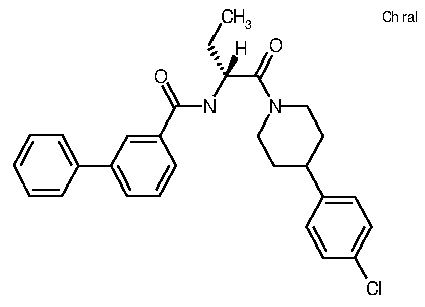
462 (R)-N-(1-(4-(4-chlorophenyl)piperidin-1-yl)-1-oxobutan-2-yl)-3-phenylbenzamide 7 
462 (R)-N-(1-(4-(4-chlorophenyl)piperidin-1-yl)-1-oxobutan-2-yl)-2-phenylbenzamide 8 
443 (R)-N-(1-(4-(4-chlorophenyl)piperidin-1-yl)-1-oxobutan-2-yl)benzo[d]thiazole-2-carboxamide -

- A reaction tube was charged with HOBt (10 mg), phenylacetic acid (12 mg) and EDC (14 mg) in DMF (0.7 mL). The resulting mixture was agitated at rt. for 15 min, and then a solution of 2-amino-1-(4-(4-chlorophenyl)piperidin-1-yl)-3-methylbutan-1-one hydrochloride (20 mg) in DIEA (50 µL) and DMF (250 µL) was added and the resulting mixture was shaken overnight at rt. At the conclusion of this period, the resulting solution was diluted with MeOH and purified by preparative LC-MS to provide Example 9. MS found: (M + H)+ = 414.
- Examples 10 to 74, as described in Table 2, were prepared in a similar manner as described for the preparation of Example 9. In the synthesis of the Examples 10 to 74, the appropriate acid needed to produce the product listed was used in place of the phenylacetic acid used in Example 9. The data in the "MS" column represents the values observed for the (M + H)+ ions in MS experiments.
TABLE 2 Example Structure MS Chemical Name 10 
432 N-(1-(4-(4-chlorophenyl)piperidin-1-yl)-3-methyl-1-oxobutan-2-yl)-2-(4-fluorophenyl)acetamide 11 
406 N-(1-(4-(4-chlorophenyl)piperidin-1-yl)-3-methyl-1-oxobutan-2-yl)-2-cyclopentylacetamide 12 
442 N-(1-(4-(4-chlorophenyl)piperidin-1-yl)-3-methyl-1-oxobutan-2-yl)-3-phenylbutanamide 13 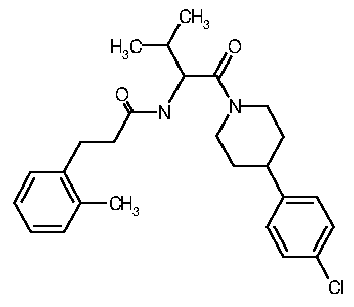
442 N-(1-(4-(4-chlorophenyl)piperidin-1-yl)-3-methyl-1-oxobutan-2-yl)-3-o-tolylpropanamide 14 
436 N-(1-(4-(4-chlorophenyl)piperidin-1-yl)-3-methyl-1-oxobutan-2-yl)-3,4-difluorobenzamide 15 
428 N-(1-(4-(4-chlorophenyl)piperidin-1-yl)-3-methyl-1-oxobutan-2-yl)-2,5-dimethylbenzamide 16 
442 N-(1-(4-(4-chlorophenyl)piperidin-1-yl)-3-methyl-1-oxobutan-2-yl)-3-m-tolylpropanamide 17 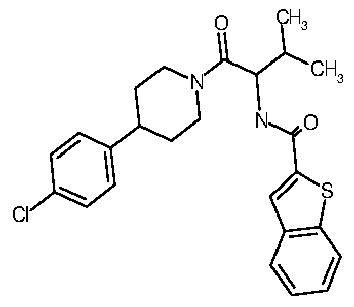
456 N-(1-(4-(4-chlorophenyl)piperidin-1-yl)-3-methyl-1-oxobutan-2-yl)benzo[b]thiophene-2-carboxamide 18 
446 N-(1-(4-(4-chlorophenyl)piperidin-1-yl)-3-methyl-1-oxobutan-2-yl)-3-(4-fluorophenyl)propanamide 19 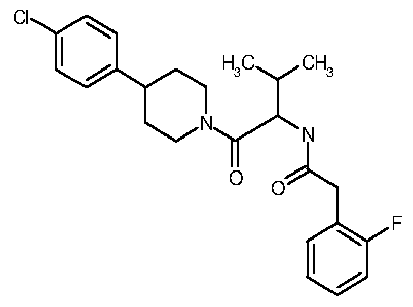
432 N-(1-(4-(4-chlorophenyl)piperidin-1-yl)-3-methyl-1-oxobutan-2-yl)-2-(2-fluorophenyl)acetamide 20 
428 N-(1-(4-(4-chlorophenyl)piperidin-1-yl)-3-methyl-1-oxobutan-2-yl)-2,3-dimethylbenzamide 21 
380 N-(1-(4-(4-chlorophenyl)piperidin-1-yl)-3-methyl-1-oxobutan-2-yl)-3-methylbutanamide 22 
392 N-(1-(4-(4-chlorophenyl)piperidin-1-yl)-3-methyl-1-oxobutan-2-yl)cyclopentanecarboxamide 23 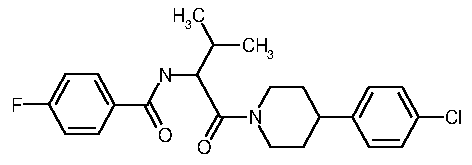
418 N-(1-(4-(4-chlorophenyl)piperidin-1-yl)-3-methyl-1-oxobutan-2-yl)-4-fluorobenzamide 24 
442 N-(1-(4-(4-chlorophenyl)piperidin-1-yl)-3-methyl-1-oxobutan-2-yl)-3-p-tolylpropanamide 25 
394 N-(1-(4-(4-chlorophenyl)piperidin-1-yl)-3-methyl-1-oxobutan-2-yl)-4-methylpentanamide 26 
457 N-(1-(4-(4-chlorophenyl)piperidin-1-yl)-3-methyl-1-oxobutan-2-yl)benzo[d]thiazole-2-carboxamide 27 
428 N-(1-(4-(4-chlorophenyl)piperidin-1-yl)-3-methyl-1-oxobutan-2-yl)-3-phenylpropanamide 28 
446 N-(1-(4-(4-chlorophenyl)piperidin-1-yl)-3-methyl-1-oxobutan-2-yl)-3-(3-fluorophenyl)propanamide 29 
440 N-(1-(4-(4-chlorophenyl)piperidin-1-yl)-3-methyl-1-oxobutan-2-yl)benzofuran-2-carboxamide 30 
428 N-(1-(4-(4-chlorophenyl)piperidin-1-yl)-3-methyl-1-oxobutan-2-yl)-2,6-dimethylbenzamide 31 
418 N-(1-(4-(4-chlorophenyl)piperidin-1-yl)-3-methyl-1-oxobutan-2-yl)-3-fluorobenzamide 32 
414 N-(1-(4-(4-chlorophenyl)piperidin-1-yl)-3-methyl-1-oxobutan-2-yl)-2-methylbenzamide 33 
428 N-(1-(4-(4-chlorophenyl)piperidin-1-yl)-3-methyl-1-oxobutan-2-yl)-2-p-tolylacetamide 34 
432 N-(1-(4-(4-chlorophenyl)piperidin-1-yl)-3-methyl-1-oxobutan-2-yl)-2-(3-fluorophenyl)acetamide 35 
430 N-(1-(4-(4-chlorophenyl)piperidin-1-yl)-3-methyl-1-oxobutan-2-yl)-2-methoxybenzamide 36 
414 N-(1-(4-(4-chlorophenyl)piperidin-1-yl)-3-methyl-1-oxobutan-2-yl)-4-methylbenzamide 37 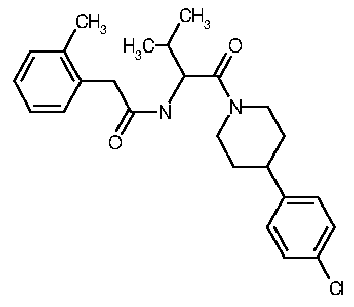
428 N-(1-(4-(4-chlorophenyl)piperidin-1-yl)-3-methyl-1-oxobutan-2-yl)-2-o-tolylacetamide 38 
430 N-(1-(4-(4-chlorophenyl)piperidin-1-yl)-3-methyl-1-oxobutan-2-yl)-3-methoxybenzamide 39 
451 N-(1-(4-(4-chlorophenyl)piperidin-1-yl)-3-methyl-1-oxobutan-2-yl)quinoline-4-carboxamide 40 
414 N-(1-(4-(4-chlorophenyl)piperidin-1-yl)-3-methyl-1-oxobutan-2-yl)-3-methylbenzamide 41 
394 N-(1-(4-(4-chlorophenyl)piperidin-1-yl)-3-methyl-1-oxobutan-2-yl)-3,3-dimethylbutanamide 42 
428 N-(1-(4-(4-chlorophenyl)piperidin-1-yl)-3-methyl-1-oxobutan-2-yl)-2-phenylpropanamide 43 
428 N-(1-(4-(4-chlorophenyl)piperidin-1-yl)-3-methyl-1-oxobutan-2-yl)-2-ethylbenzamide 44 
406 N-(1-(4-(4-chlorophenyl)piperidin-1-yl)-3-methyl-1-oxobutan-2-yl)cyclohexanecarboxamide 45 
406 N-(1-(4-(4-chlorophenyl)piperidin-1-yl)-3-methyl-1-oxobutan-2-yl)thiophene-3-carboxamide 46 
418 N-(1-(4-(4-chlorophenyl)piperidin-1-yl)-3-methyl-1-oxobutan-2-yl)-2-fluorobenzamide 47 
450 N-(1-(4-(4-chlorophenyl)piperidin-1-yl)-3-methyl-1-oxobutan-2-yl)-2-naphthamide 48 
428 N-(1-(4-(4-chlorophenyl)piperidin-1-yl)-3-methyl-1-oxobutan-2-yl)-3,4-dimethylbenzamide 49 
428 N-(1-(4-(4-chlorophenyl)piperidin-1-yl)-3-methyl-1-oxobutan-2-yl)-2-m-tolylacetamide 50 
444 N-(1-(4-(4-chlorophenyl)piperidin-1-yl)-3-methyl-1-oxobutan-2-yl)benzo[d] [1,3]dioxole-5-carboxamide 51 
492 N-(1-(4-(4-chlorophenyl)piperidin-1-yl)-3-methyl-1-oxobutan-2-yl)-3-phenoxybenzamide 52 
450 N-(1-(4-(4-chlorophenyl)piperidin-1-yl)-3-methyl-1-oxobutan-2-yl)-1-naphthamide 53 
469 3,5-dichloro-N-(1-(4-(4-chlorophenyl)piperidin-1-yl)-3-methyl-1-oxobutan-2-yl)benzamide 54 
470 2-(benzo[b]thiophen-3-yl)-N-(1-(4-(4-chlorophenyl)piperidin-1-yl)-3-methyl-1-oxobutan-2-yl)acetamide 55 
430 N-(1-(4-(4-chlorophenyl)piperidin-1-yl)-3-methyl-1-oxobutan-2-yl)-4-methoxybenzamide 56 
468 N-(1-(4-(4-chlorophenyl)piperidin-1-yl)-3-methyl-1-oxobutan-2-yl)-3-(trifluoromethyl)benzamide 57 
401 N-(1-(4-(4-chlorophenyl)piperidin-1-yl)-3-methyl-1-oxobutan-2-yl)nicotinamide 58 
444 2-(benzyloxy)-N-(1-(4-(4-chlorophenyl)piperidin-1-yl)-3-methyl-1-oxobutan-2-yl)acetamide 59 
468 N-(1-(4-(4-chlorophenyl)piperidin-1-yl)-3-methyl-1-oxobutan-2-yl)-4-(trifluoromethyl)benzamide 60 
478 N-(1-(4-(4-chlorophenyl)piperidin-1-yl)-3-methyl-1-oxobutan-2-yl)-3-(phenylsulfonyl)propanamide 61 
428 N-(1-(4-(4-chlorophenyl)piperidin-1-yl)-3-methyl-1-oxobutan-2-yl)-3,5-dimethylbenzamide 62 
504 N-(1-(4-(4-chlorophenyl)piperidin-1-yl)-3-methyl-1-oxobutan-2-yl)-3,3-diphenylpropanamide 63 
403 N-(1-(4-(4-chlorophenyl)piperidin-1-yl)-3-methyl-1-oxobutan-2-yl)-1-methyl- H-pyrrole-2-carboxamide 64 
483 N-(1-(4-(4-chlorophenyl)piperidin-1-yl)-3-methyl-1-oxobutan-2-yl)-2-phenylthiazole-4-carboxamide 65 
442 N-(1-(4-(4-chlorophenyl)piperidin-1-yl)-3-methyl-1-oxobutan-2-yl)-4-isopropylbenzamide 66 
484 N-(1-(4-(4-chlorophenyl)piperidin-1-yl)-3-methyl-1-oxobutan-2-yl)-4-(trifluoromethoxy)benzamide 67 
401 N-(1-(4-(4-chlorophenyl)piperidin-1-yl)-3-methyl-1-oxobutan-2-yl)picolinamide 68 
366 N-(1-(4-(4-chlorophenyl)piperidin-1-yl)-3-methyl-1-oxobutan-2-yl)isobutyramide 69 
401 N-(1-(4-(4-chlorophenyl)piperidin-1-yl)-3-methyl-1-oxobutan-2-yl)isonicotinamide 70 
382 N-(1-(4-(4-chlorophenyl)piperidin-1-yl)-3-methyl-1-oxobutan-2-yl)-3-methoxypropanamide 71 
490 N-(1-(4-(4-chlorophenyl)piperidin-1-yl)-3-methyl-1-oxobutan-2-yl)-2,2-diphenylacetamide 72 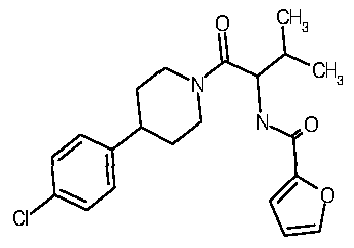
390 N-(1-(4-(4-chlorophenyl)piperidin-1-yl)-3-methyl-1-oxobutan-2-yl)furan-2-carboxamide 73 
394 N-(1-(4-(4-chlorophenyl)piperidin-1-yl)-3-methyl-1-oxobutan-2-yl)-tetrahydrofuran-2-carboxamide 74 
402 N-(1-(4-(4-chlorophenyl)piperidin-1-yl)-3-methyl-1-oxobutan-2-yl)pyrazine-2-carboxamide -

- (R)-2-Amino-1-(4-(4-chlorophenyl)piperidin-1-yl)-3-methylbutan-1-one hydrochloride (41 mg) was added to DMF (1 mL). The resulting mixture was stirred until homogeneous and then HOBt (19 mg), DIEA (65 µL), benzoic acid (17 mg) and EDC (26 mg) were added. The resulting solution was allowed to stir overnight at rt. After this time, the solution was diluted with MeOH and purified by preparative LC-MS to provide Example 75. MS found: (M + Na)+ = 421.
- Examples 76 to 148, as described in Table 3, were prepared in a similar manner as described for the preparation of Example 75. In the synthesis of Examples 76 to 148, the appropriate acid needed to produce the product listed was used in place of the benzoic acid used in Example 75. In Examples # 139, 140, 143, 144 and 149, the acids were obtained from their corresponding commercially available esters after standard saponification (NaOH, THF). The data in the "MS" column represents the values observed for the (M + H)+ ions in MS experiments.
TABLE 3 Example Structure MS Chemical Name 76 
394 (R)-N-(1-(4-(4-chlorophenyl)piperidin-1-yl)-3-methyl-1-oxobutan-2-yl)-4-methylpentanamide 77 
418 (R)-N-(1-(4-(4-chlorophenyl)piperidin-1-yl)-3-methyl-1-oxobutan-2-yl)-4-fluorobenzamide 78 
392 (R)-N-(1-(4-(4-chlorophenyl)piperidin-1-yl)-3-methyl-1-oxobutan-2-yl)cyclopentanecarboxamide 79 
428 (R)-N-(1-(4-(4-chlorophenyl)piperidin-1-yl)-3-methyl-1-oxobutan-2-yl)-3-phenylpropanamide 80 
414 (R)-N-(1-(4-(4-chlorophenyl)piperidin-1-yl)-3-methyl-1-oxobutan-2-yl)-2-methylbenzamide 81 
380 (R)-N-(1-(4-(4-chlorophenyl)piperidin-1-yl)-3-methyl-1-oxobutan-2-yl)-3-methylbutanamide 82 
418 (R)-N-(1-(4-(4-chlorophenyl)piperidin-1-yl)-3-methyl-1-oxobutan-2-yl)-3-fluorobenzamide 83 
456 (R)-N-(1-(4-(4-chlorophenyl)piperidin-1-yl)-3-methyl-1-oxobutan-2-yl)benzo[b]thiophene-2-carboxamide 84 
414 (R)-N-(1-(4-(4-chlorophenyl)piperidin-1-yl)-3-methyl-1-oxobutan-2-yl)-4-methylbenzamide 85 
414 (R)-N-(1-(4-(4-chlorophenyl)piperidin-1-yl)-3-methyl-1-oxobutan-2-yl)-2-phenylacetamide 86 
420 (R)-N-(1-(4-(4-chlorophenyl)piperidin-1-yl)-3-methyl-1-oxobutan-2-yl)-2-cyclohexylacetamide 87 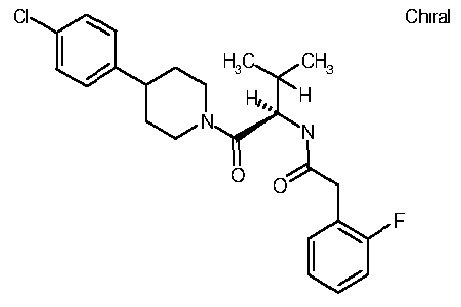
432 (R)-N-(1-(4-(4-chlorophenyl)piperidin-1-yl)-3-methyl-1-oxobutan-2-yl)-2-(2-fluorophenyl)acetamide 88 
436 (R)-N-(1-(4-(4-chlorophenyl)piperidin-1-yl)-3-methyl-1-oxobutan-2-yl)-3,4-difluorobenzamide 89 
446 (R)-N-(1-(4-(4-chlorophenyl)piperidin-1-yl)-3-methyl-1-oxobutan-2-yl)-3-(2-fluorophenyl)propanamide 90 
457 (R)-N-(1-(4-(4-chlorophenyl)piperidin-1-yl)-3-methyl-1-oxobutan-2-yl)benzo [d]thiazole-2-carboxamide 91 
442 (R)-N-(1-(4-(4-chlorophenyl)piperidin-1-yl)-3-methyl-1-oxobutan-2-yl)-3-o-tolylpropanamide 92 
406 (R)-N-(1-(4-(4-chlorophenyl)piperidin-1-yl)-3-methyl-1-oxobutan-2-yl)-2-cyclopentylacetamide 93 
434 N-((R)-1-(4-(4-chlorophenyl)piperidin-1-yl)-3-methyl-1-oxobutan-2-yl)-4,4,4-trifluoro-3-methylbutanamide 94 
442 (R)-N-(1-(4-(4-chlorophenyl)piperidin-1-yl)-3-methyl-1-oxobutan-2-yl)-3-m-tolylpropanamide 95 
404 N-((R)-1-(4-(4-chlorophenyl)piperidin-1-yl)-3-methyl-1-oxobutan-2-yl)-2-(cyclopent-2-enyl)acetamide 96 
432 (R)-N-(1-(4-(4-chlorophenyl)piperidin-1-yl)-3-methyl-1-oxobutan-2-yl)-5-fluoro-2-methylbenzamide 97 
442 (R)-N-((R)-1-(4-(4-chlorophenyl)piperidin-1-yl)-3-methyl-1-oxobutan-2-yl)-3-phenylbutanamide 98 
432 (R)-N-(1-(4-(4-chlorophenyl)piperidin-1-yl)-3-methyl-1-oxobutan-2-yl)-2-(3-fluorophenyl)acetamide 99 
448 (R)-2-(3-chlorophenyl)-N-(1-(4-(4-chlorophenyl)piperidin-1-yl)-3-methyl-1-oxobutan-2-yl)acetamide 100 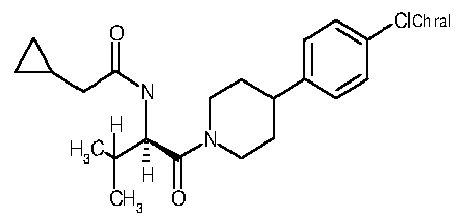
378 (R)-N-(1-(4-(4-chlorophenyl)piperidin-1-yl)-3-methyl-1-oxobutan-2-yl)-2-cyclopropylacetamide 101 
442 N-((R)-1-(4-(4-chlorophenyl)piperidin-1-yl)-3-methyl-1-oxobutan-2-yl)-3-phenylbutanamide 102 
440 (R)-N-(1-(4-(4-chlorophenyl)piperidin-1-yl)-3-methyl-1-oxobutan-2-yl)benzofuran-2-carboxamide 103 
426 (R)-N-(1-(4-(4-chlorophenyl)piperidin-1-yl)-3-methyl-1-oxobutan-2-yl)cinnamamide 104 
420 (R)-N-(1-(4-(4-chlorophenyl)piperidin-1-yl)-3-methyl-1-oxobutan-2-yl)-3-cyclopentylpropanamide 105 
456 (R)-N-(1-(4-(4-chlorophenyl)piperidin-1-yl)-3-methyl-1-oxobutan-2-yl)benzo[b]thiophene-3-carboxamide 106 
482 (R)-N-(1-(4-(4-chlorophenyl)piperidin-1-yl)-3-methyl-1-oxobutan-2-yl)-2-(2-(trifluoromethyl)phenyl)acetamide 107 
444 (R)-N-(1-(4-(4-chlorophenyl)piperidin-1-yl)-3-methyl-1-oxobutan-2-yl)-2-(0-tolyloxy) acetamide 108 
482 (R)-N-(1-(4-(4-chlorophenyl)piperidin-1-yl)-3-methyl-1-oxobutan-2-yl)-2-(4-(trifluoromethyl)phenyl)acetamide 109 
470 (R)-N-(1-(4-(4-chlorophenyl)piperidin-1-yl)-3-methyl-1-oxobutan-2-yl)-3-methylbenzo[b]thiophene-2-carboxamide 110 
442 (R)-N-(1-(4-(4-chlorophenyl)piperidin-1-yl)-3-methyl-1-oxobutan-2-yl)-2,4,6-trimethylbenzamide 111 
490 (R)-N-(1-(4-(4-chlorophenyl)piperidin-1-yl)-3-methyl-1-oxobutan-2-yl)-2-(4-(phenyl)phenyl)acetamide 112 
427.1 113 
427.1 114 
427.1 115 
441.1 116 
445.1 117 
419.1 118 
447.1 119 
441.1 120 
441.1 121 
439.1 122 
424.3 123 
424.3 124 
405.3 125 
413.3 126 
429.3 127 
424.4 128 
444.3 (R)-N-(1-(4-(4-chlorophenyl)piperidin-1-yl)-3-methyl-1-oxobutan-2-yl)-3-nitrobenzamide 129 
444.3 (R)-N-(1-(4-(4-chlorophenyl)piperidin-1-yl)-3-methyl-1-oxobutan-2-yl)-2-nitrobenzamide 130 
479.25 (M+H) 131 
457.4 132 
477.3 133 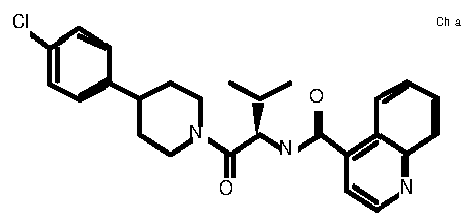
450.4 134 
478.3 135 
442.3 136 
457.3 137 
501.2 (M+Na) 138 
468.4 139 
438.4 140 
438.4 141 
431.4 142 
439.4 143 
438.3 144 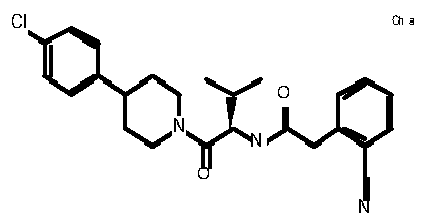
439.3 145 
431.3 146 
471.3 147 
420.4 (M-boc) 148 
438.3 -

- (R)-2-Amino-1-(4-(4-bromophenyl)piperidin-1-yl)-3-methylbutan-1-one hydrochloride was prepared in a similar manner as described in Preparation A with the exception that 4-bromophenyl piperidine was substituted for 4-chlorophenyl piperidine hydrochloride in Step 1.
- Example 149 was prepared in a similar manner as described for the preparation of Example 75. MS found: (M + Na)+ = 443.2.
-
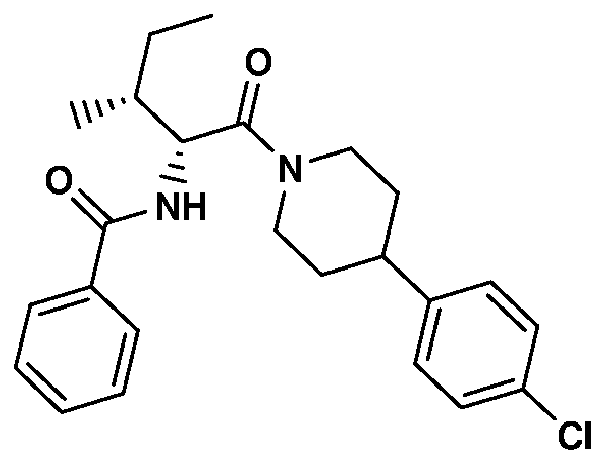
- A reaction tube was charged with HOBt (8 mg), benzoic acid (7 mg) and EDC (11 mg) in DMF (0.6 mL) and then agitated at rt. for 15 min. After this time, a solution of (2R)-2-amino-1-(4-(4-chlorophenyl)piperidin-1-yl)-3-methylpentan-1-one hydrochloride (16 mg) in DIEA (38 µL) and DMF (187 µL) was added. Upon completion of addition, the reaction mixture was shaken overnight at rt. At the conclusion of this period, the resulting solution was diluted with MeOH and purified by preparative LC-MS to provide Example 150. MS found: (M + H)+ = 414.
- Examples 151 to 177, as described in Table 4, were prepared in a similar manner as described for the preparation of Example 150. In the synthesis of Examples 151 to 177, the appropriate acid needed to produce the product listed was used in place of the benzoic acid used in Example 150. The data in the "MS" column represents the values observed for the (M + H)+ ions in MS experiments.
TABLE 4 Example Structure MS Chemical Name 151 
380 N-((2R)-1-(4-(4-chlorophenyl)piperidin-1-yl)-3-methyl-1-oxopentan-2-yl)isobutyramide 152 
394 N-((2R)-1-(4-(4-chlorophenyl)piperidin-1-yl)-3-methyl-1-oxopentan-2-yl)-3-methylbutanamide 153 
408 N-((2R)-1-(4-(4-chlorophenyl)piperidin-1-yl)-3-methyl-1-oxopentan-2-yl)-4-methylpentanamide 154 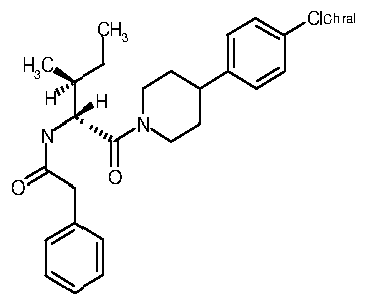
428 N-((2R)-1-(4-(4-chlorophenyl)piperidin-1-yl)-3-methyl-1-oxopentan-2-yl)-2-phenylacetamide 155 
442 N-((2R)-1-(4-(4-chlorophenyl)piperidin-1-yl)-3-methyl-1-oxopentan-2-yl)-3-phenylpropanamide 156 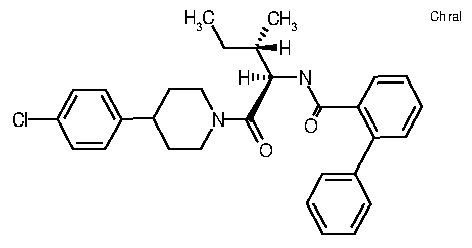
490 N-((2R)-1-(4-(4-chlorophenyl)piperidin-1-yl)-3-methyl-1-oxopentan-2-yl)-2-phenylbenzamide 157 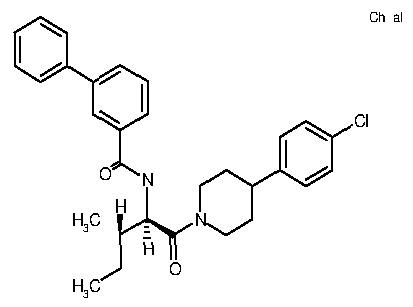
490 N-((2R)-1-(4-(4-chlorophenyl)piperidin-1-yl)-3-methyl-1-oxopentan-2-yl)-3-phenylbenzamide 158 
471 N-((2R)-1-(4-(4-chlorophenyl)piperidin-1-yl)-3-methyl-1-oxopentan-2-yl)benzo[d]thiazole-2-carboxamide 159 
391.6 160 
405.6 161 
414.5 162 
419.6 163 
427.5 164 
427.5 165 
431.5 166 
431.5 167 
431.5 168 
433.6 169 
445.5 170 
445.5 171 
445.5 172 
447.5 173 
449.5 174 
449.5 175 
456.5 176 
464.5 177 
465.5 -

- A reaction tube was charged with HOBt (8 mg), benzoic acid (7 mg) and EDC (11 mg) in DMF (0.6 mL) and then allowed to agitate at rt. for 15 min. After this time, a solution of (R)-2-amino-1-(4-(4-chlorophenyl)piperidin-1-yl)-2-cyclohexylethanone hydrochloride (16 mg) in DIEA (38 µL) and DMF (187 µL) was added. Upon completion of addition, the reaction mixture and was shaken overnight at rt. At the conclusion of this period, the resulting solution was diluted with MeOH and purified by preparative LC-MS to provide Example 178. MS found: (M + H)+ = 440.
-

- Example 179 was prepared, substituting 4-methylpentanoic acid for benzoic acid, in a similar manner as described for the preparation of Example 178. MS found: (M + H)+ = 434.
-

- A reaction tube was charged with HOBt (13 mg), benzoic acid (9 mg) and EDC (18 mg) in DMF (0.75 mL) and then agitated at rt. for 15 min. A solution of 2-amino-1-(4-(4-chlorophenyl)piperidin-1-yl)pentan-1-one hydrochloride (20 mg) in DIEA (65 µL) and DMF (185 µL) was added to the reaction tube, and the resulting mixture was shaken overnight at rt. After this time, the resulting solution was diluted with MeOH and purified by preparative LC-MS to provide Example 180. MS found: (M + H)+ = 400.
- Examples 181 to 186, as described in Table 5, were prepared in a similar manner as described for the preparation of Example 180. In the synthesis of Examples 181 to 186, the appropriate acid needed to produce the product listed was used in place of the benzoic acid used in Example 180. The data in the "MS" column represents the values observed for the (M + H)+ ions in MS experiments.
TABLE 5 Example Structure MS Chemical Name 181 
414 N-(1-(4-(4-chlorophenyl)piperidin-1-yl)-1-oxopentan-2-yl)-2-methylbenzamide 182 
434 2-chloro-N-(1-(4-(4-chlorophenyl)piperidin-1-yl)-1-oxopentan-2-yl)benzamide 183 
434 3-chloro-N-(1-(4-(4-chlorophenyl)piperidin-1-yl)-1-oxopentan-2-yl)benzamide 184 
434 4-chloro-N-(1-(4-(4-chlorophenyl)piperidin-1-yl)-1-oxopentan-2-yl)benzamide 185 
450 N-(1-(4-(4-chlorophenyl)piperidin-1-yl)-1-oxopentan-2-yl)-1-naphthamide 186 
450 N-(1-(4-(4-chlorophenyl)piperidin-1-yl)-1-oxopentan-2-yl)-2-naphthamide -

- A reaction tube was charged with HOBt (13 mg), benzoic acid (9 mg) and EDC (18 mg) in DMF (0.75 mL) and then agitated for 15 min. After this time, a solution of 2-amino-1-(4-(4-chlorophenyl)piperidin-1-yl)-4-methylpentan-1-one hydrochloride (21 mg) in DIEA (65 µL) and DMF (185 µL) was added to the reaction tube. After the reaction mixture was shaken overnight at rt., the resulting solution was diluted with MeOH and purified by preparative LC-MS to provide Example 187. MS found: (M+H)+ = 414.
- Examples 188 to 192, as described in Table 6, were prepared in a similar manner as described for the preparation of Example 187. In the synthesis of Examples 188 to 192, the appropriate acid needed to produce the product listed was used in place of the benzoic acid used in Example 187. The data in the "MS" column represents the values observed for the (M + H)+ ions in MS experiments.
TABLE 6 Example Structure MS Chemical Name 188 
448 2-chloro-N-(1-(4-(4-chlorophenyl)piperidin-1-yl)-4-methyl-1-oxopentan-2-yl)benzamide 189 
448 3-chloro-N-(1-(4-(4-chlorophenyl)piperidin-1-yl)-4-methyl-1-oxopentan-2-yl)benzamide 190 
448 4-chloro-N-(1-(4-(4-chlorophenyl)piperidin-1-yl)-4-methyl-1-oxopentan-2-yl)benzamide 191 
464 N-(1-(4-(4-chlorophenyl)piperidin-1-yl)-4-methyl-1-oxopentan-2-yl)-1-naphthamide 192 
464 N-(1-(4-(4-chlorophenyl)piperidin-1-yl)-4-methyl-1-oxopentan-2-yl)-2-naphthamide -

- Example 193 was prepared in a similar manner as described for the preparation of Example 187. In the synthesis of Example 193, the appropriate acid needed to produce the product was used in place of the benzoic acid used in Example 187. MS found: (M + H)+= 428.
-

- A reaction tube was charged with HOBt (13 mg), benzoic acid (9 mg) and EDC (18 mg) in DMF (0.75 mL) and then agitated for 15 min. After this time, a solution of 2-amino-1-(4-(4-chlorophenyl)piperidin-1-yl)-3,3-dimethylbutan-1-one hydrochloride (21 mg) in DIEA (65 µL) and DMF (185 µL) was added to the tube and the reaction mixture was shaken overnight at rt. At the conclusion of this period, the resulting solution was diluted with MeOH and purified by preparative LC-MS to provide Example 194. MS found: (M + H)+ = 414.
- Examples 195 to 199, as described in Table 7, were prepared in a similar manner as described for the preparation of Example 194. In the synthesis of Examples 195 to 199, the appropriate acid needed to produce the product listed was used in place of the benzoic acid used in Example 194. The data in the "MS" column represents the values observed for the (M + H)+ ions in MS experiments.
TABLE 7 Example Structure MS Chemical Name 195 
428 N-(1-(4-(4-chlorophenyl)piperidin-1-yl)-3,3-dimethyl-1-oxobutan-2-yl)-2-methylbenzamide 196 
448 2-chloro-N-(1-(4-(4-chlorophenyl)piperidin-1-yl)-3,3-dimethyl-1-oxobutan-2-yl)benzamide 197 
448 3-chloro-N-(1-(4-(4-chlorophenyl)piperidin-1-yl)-3,3-dimethyl-1-oxobutan-2-yl)benzamide 198 
448 4-chloro-N-(1-(4-(4-chlorophenyl)piperidin-1-yl)-3,3-dimethyl-1-oxobutan-2-yl)benzamide 199 
464 N-(1-(4-(4-chlorophenyl)piperidin-1-yl)-3,3-dimethyl-1-oxobutan-2-yl)-1-naphthamide -
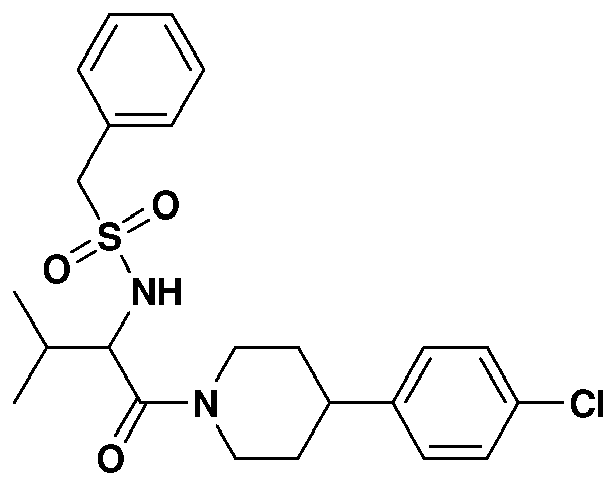
- A reaction tube was charged with benzylsulfonyl chloride(14 mg), DIEA (50 µL) and 2-amino-1-(4-(4-chlorophenyl)piperidin-1-yl)-3-methylbutan-1-one hydrochloride (20 mg) in DCM (0.3 mL). The reaction miture was shaken overnight at rt. At the conclusion of this period, the resulting solution was diluted with MeOH and purified by preparative LC-MS to provide Example 200. MS found: (M + H)+ = 450.
-

- A reaction tube was charged with phenyl isocyanate (12 mg), (R)-2-amino-1-(4-(4-chlorophenyl)piperidin-1-yl)-3-methylbutan-1-one hydrochloride (17 mg) and 1,4-dioxane (0.75 mL). The reaction miture was shaken overnight at rt. After this time, the resulting solution was diluted with MeOH and purified by preparative LC-MS to provide Example 201. MS found: (M + H)+ = 429.
- Examples 202 to 206, as described in Table 8, were prepared in a similar manner as described for the preparation of Example 201. In the synthesis of Examples 202 to 206, the appropriate isocyanate needed to produce the product listed was used in place of the isocyanate used in Example 201. The data in the "MS" column represents the values observed for the (M + H)+ ions in MS experiments.
TABLE 8 Example Structure MS Chemical Name 202 
407 (R)-1-(1-(4-(4-chlorophenyl)piperidin-1-yl)-3-methyl-1-oxobutan-2-yl)-3-cyclopentylurea 203 
433 (R)-1-(1-(4-(4-chlorophenyl)piperidin-1-yl)-3-methyl-1-oxobutan-2-yl)-3-(2-fluorophenyl)urea 204 
433 (R)-1-(1-(4-(4-chlorophenyl)piperidin-1-yl)-3-methyl-1-oxobutan-2-yl)-3-(3-fluorophenyl)urea 205 
415 (R)-1-benzyl-3-(1-(4-(4-chlorophenyl)piperidin-1-yl)-3-methyl-1-oxobutan-2-yl)urea 206 
443 (R)-1-(1-(4-(4-chlorophenyl)piperidin-1-yl)-3-methyl-1-oxobutan-2-yl)-3-phenethylurea -

- Example 207 was prepared in a similar manner as described for the preparation of Example 201. In the synthesis of Examples 207, the appropriate isocyanate needed to produce the product was used in place of the isocyanate used in Example 201. MS found: (M + H)+= 380.6.
-

- A reaction vessel was charged with benzoyl-DL-valine (24 mg), HOBt (16 mg), DIEA (57 µL), 4-(4-chlorophenyl)piperidine hydrochloride (28 mg) and EDC (23 mg) in DMF (1.5 mL) and then agitated at rt. for 16 h. At the conclusion of this period, the resulting solution was diluted with MeOH and purified by preparative LC-MS to provide Example 208. MS found: (M + H)+ = 399.
-

- Example 209 was prepared in a similar manner as described for the preparation of Example 208 with the exception that 4-(4-chlorophenyl)-4-hydroxypiperidine was substituted for 4-(4-chlorophenyl)piperidine hydrochloride. MS found: (M + H)+ = 415.
-

- Example 210 was prepared in a similar manner as described for the preparation of Example 208 with exception that 4-(4-bromophenyl)-4-hydroxypiperidine was substituted for 4-(4-chlorophenyl)piperidine hydrochloride. MS found: (M + H)+= 460.
-

- Example 211 was prepared in a similar manner as described for the preparation of Example 208 with the exception that 4-(4-chlorophenyl)-1,2,3,6-tetrahydropyridine hydrochloride was substituted for 4-(4-chlorophenyl)piperidine hydrochloride. MS found: (M + H)+ = 398.
-

- Example 212 was prepared in a similar manner as described for the preparation of Example 208 with the exception that 4-(4-fluorophenyl)piperidine hydrochloride was substituted for 4-(4-chlorophenyl)piperidine hydrochloride, to provide the title compound. MS found: (M + H)+ = 383.
-

- Example 213 was prepared in a similar manner as described for the preparation of Example 208 with the exceptions that Cbz-DL-valine and 4-(4-chlorophenyl)-4-hydroxypiperidine were substituted for benzoyl-DL-valine and 4-(4-chlorophenyl)piperidine hydrochloride, respectively. MS found: (M + H)+ = 446.
-

- Example 214 was prepared in a similar manner as described for the preparation of Example 208 with the exceptions that Cbz-D-2-aminobutyric acid and 4-(4-chlorophenyl)-4-hydroxypiperidine were substituted for benzoyl-DL-valine and 4-(4-chlorophenyl)piperidine hydrochloride, respectively. MS found: (M + H)+ = 431.
-

- Example 215 was prepared in a similar manner as described for the preparation of Example 208 with the exceptions that benzoyl-DL-leucine and 4-(4-chlorophenyl)-4-hydroxypiperidine were substituted for benzoyl-DL-valine and 4-(4-chlorophenyl)piperidine hydrochloride, respectively. MS found: (M + H)+ = 430.
-

- Example 216 was prepared in a similar manner as described for the preparation of Example 208 with the exceptions that benzoyl-2-aminopentanoic acid and 4-(4-chlorophenyl)-4-hydroxypiperidine were substituted for benzoyl-DL-valine and 4-(4-chlorophenyl)piperidine hydrochloride, respectively. MS found: (M + H)+ = 415.
-

- Example 217 was prepared in a similar manner as described for the preparation of Example 208 with the exceptions that benzoyl-DL-methionine and 4-(4-chlorophenyl)-4-hydroxypiperidine were substituted for benzoyl-DL-valine and 4-(4-chlorophenyl)piperidine hydrochloride, respectively. MS found: (M + H)+ = 448.
-

- Example 218 was prepared in a similar manner as described for the preparation of Example 208 with the exceptions that Cbz-2-aminohexanoic acid and 4-(4-chlorophenyl)-4-hydroxypiperidine were substituted for benzoyl-DL-valine and 4-(4-chlorophenyl)piperidine hydrochloride, respectively. MS found: (M + H)+ = 460.
-

- Example 219 was prepared in a similar manner as described for the preparation of Example 208 with the exceptions that Cbz-D-cyclohexylglycine and 4-(4-chlorophenyl)-4-hydroxypiperidine were substituted for benzoyl-DL-valine and 4-(4-chlorophenyl)piperidine hydrochloride, respectivley. MS found: (M + H)+ = 486.
-

- Example 220 was prepared in a similar manner as described for the preparation of Example 208 with the exception that 4-(4-fluorophenyl)-4-hydroxypiperidine was substituted for 4-(4-chlorophenyl)piperidine hydrochloride, to provide the title compound. MS found: (M + H)+ = 399.
-

- A 250 mL peptide vessel was charged with polystyrene resin functionalized with a 4-formyl-3-methoxyphenyl linker (1.1 mmol/g, 4.7 g) and DMF (50 mL). To this suspension was added DIEA (4.5 mL), DL-alanine ethyl ester hydrochloride (2.0 g), acetic acid (4.3 mL) and sodium triacetoxyborohydride (2.2 g). Following 16 h of shaking at rt. the resin was filtered and washed with solvents as follows: DMF (1 x 50 mL); 6:3:1 THF/water/acetic acid (2 x 50 mL); DMF (2 x 50 mL); THF (2 x 50 mL); and DCM (2 x 50 mL) to provide an alanine ester derivatized resin.
- The alanine ester derivatized resin of Step 1 was loaded into an Irori microkans (20 mg per microkan). A set of 60 microkans were suspended in DMF (200 mL) and then charged with 3-chlorobenzoic acid (3.95 g), HOBt (3.41 g), DIEA (8.8 mL), and N,N'-diisopropylcarbodiimide (3.95 mL). The resulting mixture was shaken at rt for 16 h. After this time, the solvents were removed by filtration and the microkans were washed with DMF (4 x 200 mL), THF (4 x 200 mL), and DCM (4x 200 mL) to provide a set of microkans.
- A set of 180 microkans of Step 2 were added to a mixture of THF (150 mL), 40% tetra-N-butylammonium hydroxide/water (50 mL), and methanol (30 mL). The resulting mixture was shaken at 40° C for 40 h and then allowed to cool to rt. Once at the prescribed temperature, the solvents were removed by filtration, and the microkans were washed with 8:1:1 THF/water/acetic acid (2 x 200 mL), THF (3 x 200 mL), and DCM (3 x 200 mL). The reaction mixture was checked for completion by treating a small sample of the ethyl 2-(3-chlorobenzamido)propanoate resin with 40% v/v TFA/DCM. Said treatment indicated that the reaction was completed and that the desired product, namely, 2-(3-chlorobenzamido)propanoic acid resin, had been provided. MS found: (M + Na)+ = 250.
- A set of 30 microkans of Step 3 was suspended in DMF (80 mL) and treated with HOBt (0.57 g), DIEA (1.57 mL), N,N'-diisopropylcarbodiimide (0.66 mL) and 4-(4-chlorophenyl)piperidine hydrochloride (1.39 g). The resulting microkans were shaken at rt. For 16 h, After this time, the microkans were isolated by filtration and washed with DMF (4 x 100 mL), THF (3 x 100 mL), and DCM (3 x 100 mL) to provide microkans containing resin-bound 3-chloro-N-(1-(4-(4-chlorophenyl)piperidin-1-yl)-1-oxopropan-2-yl)benzamide.
- The microkans containing resin-bound 3-chloro-N-(1-(4-(4-chlorophenyl)piperidin-1-yl)-1-oxopropan-2-yl)benzamide produce in Step 4were opened and the loose resin was suspended in 30% v/v TFA/DCM. The resulting suspension was stirred at rt. For 1 h. Upon completion of this period, the resin was removed by filtration and the filtrate was concentrated in vacuo to provid an oil. The oil was dissolved in methanol (2 mL) and purified by preparative LC-MS to provide Example 221. MS found: (M + Na)+ = 427.
-

- Example 222 was prepared in a similar manner as described for the preparation of Example 221 with the exception that 4-(4-chlorophenyl)-4-hydroxypiperidine was substitute for 4-(4-chlorophenyl)piperidine hydrochloride in Step 4. Example 222 was provided via elimination during Step 5. MS found: (M + H)+ = 405.
-

- Example 223 was prepared in a similar manner as described for the preparation of Example 221 with the exceptions that 2-aminobutyric acid methyl ester hydrochloride was substituted for DL-alanine ethyl ester hydrochloride in Step 1 and 4-chlorobenzoic acid was substituted for 3-chlorobenzoic acid in Step 2. MS found: (M + H)+ = 419.
-

- Example 224 was prepared in a similar manner as described for the preparation of Example 221 with the exceptions that 2-aminobutyric acid methyl ester hydrochloride was substituted for DL-alanine ethyl ester hydrochloride in Step 1, 4-chlorobenzoic acid was substituted for 3-chlorobenzoic acid in Step 2, and 4-(4-chlorophenyl)-4-hydroxypiperidine was substituted for 4-(4-chlorophenyl)piperidine hydrochloride in Step 4. Example 224 was provided by elimination during Step 5. MS found: (M + H)+ = 417.
-

- Example 225 was prepared in a similar manner as described for the preparation of Example 221 with the exception that 2-aminobutyric acid methyl ester hydrochloride was substituted for DL-alanine ethyl ester hydrochloride in Step 1. MS found: (M + H)+ = 419.
-

- A reaction vessel was charged with N-benzoyl-L-threonine (56 mg), HOBt (42 mg), DIEA (130 µL), 4-(4-chlorophenyl)-4-hydroxypiperidine (66 mg), EDC (60 mg), DMF (1 mL) and 1,2-dichloroethane (1 mL). The reaction mixture was stirred for 16 h at rt and then diluted with methanol (0.5 mL). Upon completion of dilution, the reaction mixture was purified by preparative LC-MS to provide Example 226. MS found: (M + H)+ = 399.
- Examples 227 to 252, as described in Table 9, were prepared in a similar manner as described for the preparation of Example 150 substituting (2R,3S)-2-amino-1-(4-(4-chlorophenyl)piperidin-1-yl)-3-methylpentan-1-one hydrochloride for (2R)-2-amino-1-(4-(4-chlorophenyl)piperidin-1-yl)-3-methylpentan-1-one hydrochloride. In the synthesis of Examples 227 to 252, the appropriate acid needed to produce the product listed was used in place of the benzoic acid used in Example 150.
TABLE 9 Example Structure MS 227 
391.6 228 
393.6 229 
405.6 230 
407.6 231 
414.5 232 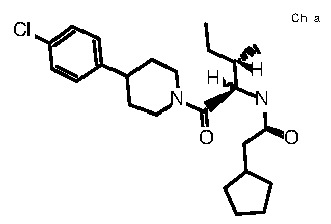
419.6 233 
427.5 234 
427.5 235 
427.5 236 
431.5 237 
431.5 238 
431.5 239 
433.6 240 
445.5 241 
445.5 242 
445.5 243 
447.5 244 
449.5 245 
449.5 246 
456.5 247 
463.5 248 
464.5 249 
465.5 250 
491.5 251 
505.5 252 
413.4 - Examples 253 to 271, as described in Table 10, were prepared in a similar manner as described for the preparation of Example 75 using (R)-2-amino-1-(4-(4-fluorophenyl)piperidin-1-yl)-3-methylbutan-1-one hydrochloride instead of (R)-2-amino-1-(4-(4-chlorophenyl)piperidin-1-yl)-3-methylbutan-1-one hydrochloride. In the synthesis of Examples 253 to 271, the appropriate acid needed to produce the product listed was used in place of the benzoic acid used in Example 75.
TABLE 10 Example Structure MS (M+H) 253 
363.2 254 
375.2 255 
377.2 256 
389.2 257 
397.4 258 
397.2 259 
397.2 260 
401.1 261 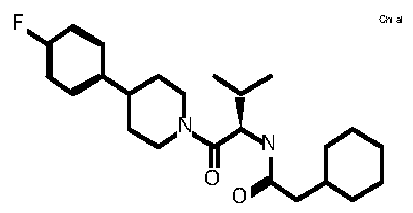
403.2 262 
415.4 263 
415.6 264 
415.3 265 
417.3 266 
419.1 267 
426.2 268 
434.0 269 
461.1 270 
475.1 271 
383.4 - Examples 272 to 275, as described in Table 11, were prepared in a similar manner as described for the preparation of Example 201. In the synthesis of Examples 272 to 275, the appropriate chloroformate needed to produce the product listed was used in place of the isocyanate used in Example 201. The data in the "MS" column represents the values observed for the (M + H)+ ions in MS experiments.
TABLE 11 Example Structure MS 272 
395.60 273 
415.50 274 
445.50 275 
429.50 -

-

- To a solution of (R)-2-Amino-1-(4-(4-chlorophenyl)piperidin-1-yl)-3-methylbutan-1-one hydrochloride (250 mg, 0.75 mmol) in DCM (2 mL) was added DIEA (175 µL, 1 mmol) followed by the dropwise addition of benzoylisothiocyanate (106 µL, 0.78 mmol). The reaction was stirred for 2h at rt., acidified with 1 N aqueous HCl solution to pH 3 and then extracted with Et2O (3X10 mL). The extracts were combined, washed sequentially with sat. aqueous NaHCO3 solution (1X10 mL) and sat. aqueous NaCl solution (1X10 mL), dried (MgSO4), and the solvent removed to give (R)-N-(1-(4-(4-chlorophenyl)piperidin-1-yl)-3-methyl-1-oxobutan-2-ylcarbamothioyl)benzamide (m/z, 458, M+1) as an oil (300 mg) in greater than 90% HPLC purity.
-

- To a solution of (R)-N-(1-(4-(4-chlorophenyl)piperidin-1-yl)-3-methyl-1-oxobutan-2-ylcarbamothioyl)benzamide (300 mg, crude) in CH3CN (2 mL) was added K2CO3 (275 mg, 2 mmol) followed by MeI (75 µL, 2 mmol). The reaction was stirred for 4h at rt., diluted with Et2O (10 mL) and the solids were filtered through a plug of celite. The filtrate was condensed in vacuo to give (R,Z)-methyl N'-benzoyl-N-(1-(4-(4-chlorophenyl)piperidin-1-yl)-3-methyl-1-oxobutan-2-yl)carbamimidothioate (300mg, m/z 473, M+1) as a foam, which was used in subsequent steps without purification.
-

- (R,Z)-Methyl N'-benzoyl-N-(1-(4-(4-chlorophenyl)piperidin-1-yl)-3-methyl-1-oxobutan-2-yl)carbamimidothioate (47 mg, 0.1 mmol) was dissolved in THF (0.5 mL) and treated with anhydrous hydrazine (10 µL, 0.3 mmol). The reaction was stirred at rt. overnight. After this time, the THF was removed in vacuo and the resulting residue was dissolved in methanol and then purified by preparative HPLC to give (R)-1-(4-(4-chlorophenyl)piperidin-1-yl)-3-methyl-2-(3-phenyl-1H-1,2,4-triazol-5-ylamino)butan-1-one (20 mg, 45%). MS found: 438 (M+H).
-

- (R)-1-(4-(4-Chlorophenyl)piperidin-1-yl)-3-methyl-2-(3-phenyl-1H-1,2,4-triazol-5-ylamino)butan-1-one (40 mg, 0.09mmol) was dissolved in THF (0.5 mL) and then treated with MeNHNH2 (10 µL, excess). The reaction was stirred at rt. overnight. After this time, the THF was removed in vacuo and the remains were taken up in MeOH and then purified by preparative HPLC to give (R)-1-(4-(4-chlorophenyl)piperidin-1-yl)-3-methyl-2-(1-methyl-3-phenyl-1H-1,2,4-triazol-5-ylamino)butan-1-one (18 mg, 47%) as a 90/10 mixture of N1-CH3 /N2-CH3 isomers. MS found: 452 (M+H).
-

- To a solution of 2-amino-1-(4-(4-chlorophenyl)piperidin-1-yl)-3-methylbutan-1-one hydrochloride in ethanol was added TEA (4 eq) and 4-chloro-6-(trifluoromethyl)quinazoline (1.1 eq, see
WO 05/021500 -

-

- A mixture of 2-bromo-3-methylbutanoic acid (14) (400mg, 2.2 mmol), 4-(4-chlorophenyl)-piperidine hydrochloride (500mg, 2.2 mmol), HOBt (300mg, 2.2 mmol) and EDCI (425 mg, 2.2 mmol) was suspended in DMF (10 mL). DIEA (1.4 mL, 8 mmol) was added and the reaction was stirred overnight. After this time, the reaction was diluted with Et2O (100 mL) and washed sequentially with H2O (2X40 mL); aqueous 1N HCl (2X20 mL); aqueous sat. NaHCO3 (1X20 mL) solution and aqueous sat. NaCl (1X20 mL) solution. The Et2O layer was dried (MgSO4), and the solvents were removed to give 2-bromo-1-(4-(4-chlorophenyl)piperidin-1-yl)-3-methylbutan-1-one (600 mg, 85 %) as an impure oil, which was used without purification. MS found: 360 (M+H).
- A mixture of 2-bromo-1-(4-(4-chlorophenyl)piperidin-1-yl)-3-methylbutan-1-one (40 mg, 0.11 mmol), K2CO3 (50 mg, 0.36 mmol) and 5-phenyl-2H-tetrazole (15 mg, 0.1 mmol) in CH3CN (1 mL) was heated at 170 °C for 30 min in a microwave reactor. After this time, the reaction was filtered through a plug of celite, diluted with MeOH and purified directly by preparative HPLC to give 1-(4-(4-chlorophenyl)piperidin-1-yl)-3-methyl-2-(5-phenyl-2H-tetrazol-2-yl)butan-1-one (9 mg, 21 %) as a solid. MS found: 424 (M+H).
-

-

- To a solution of benzyolhydrazide (489 mg, 5.0 mmol) in DCM (10 ml) was added dropwise a solution of ethyl-2-cyanato-3-methyl butyrate (0.856 g, 5.0 mmol) in DCM (5 mL). The reaction was stirred at rt for 3h and the solvent was removed in vacuo to give ethyl 2-(2-benzoylhydrazinecarboxamido)-3-methylbutanoate in greater than >90% purity as judged by LCMS. MS found: 308 (M+H).
-
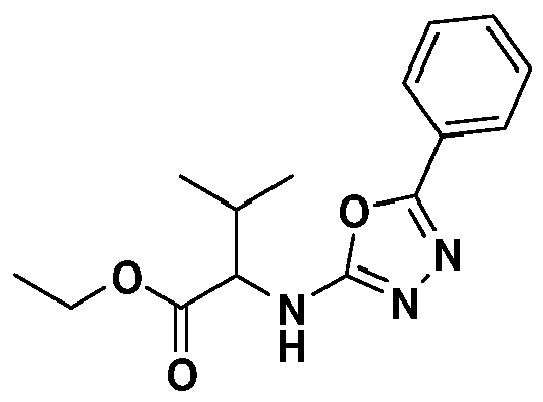
- To a solution of crude ethyl 2-(2-benzoylhydrazinecarboxamido)-3-methylbutanoate (assumed 5 mmol) in DCE (10 ml) was added POCl3 (1.5 g, 10 mmol). Upon completion of addition, the reaction was heated at 75-80 °C overnight. After this time, the excess solvent and POCl3 were removed in vacuo. The resulting remains were dissolved in EtOAc (75 ml) and washed sequentially with sat. aqueous NaHCO3 (2X25 mL) solution and sat. aqueous NaCl (25 mL) solution and dried over MgSO4. The solvent was removed in vacuo to give ethyl 3-methyl-2-(5-phenyl-1,3,4-oxadiazol-2-ylamino)butanoate in greater than 90% purity by LCMS; m/z (290, M+1).
-

- Crude ethyl 3-methyl-2-(5-phenyl-1,3,4-oxadiazol-2-ylamino)butanoate (assumed 5 mmol) was dissolved in a mixture of THF (10 ml) and MeOH (2ml) and then treated dropwise (exothermic) with aqueous1 N NaOH (6 mL) solution. The reaction was stirred for 1h, diluted with H2O (50 mL) and then extracted with Et2O (1X50 mL). The aqueous layer was acidified to pH 3 with aqueous 1N HCl solution and then extracted with EtOAc (3 X 35 mL). The EtOAc extracts were combined, washed with sat. aqueous NaCl solution, dried (MgSO4) and the solvent was removed in vacuo to give 3-methyl-2-(5-phenyl-1,3,4-oxadiazol-2-ylamino)butanoic acid in 50-75% yield over 3 steps in purity >90% as judged by LCMS. MS found: 262 (M+H).
- 3-Methyl-2-(5-phenyl-1,3,4-oxadiazol-2-ylamino)butanoic acid (80 mg, 0.3 mmol), EDCI (65 mg, 0.33 mmol), 4-(4-chlorophenyl)-piperidine hydrochloride (78 mg, 0.33 mmol) and HOBt (40 mg, 0.3 mmol) were combined and suspended in DMF (2 mL). Diisopropylethylamine (210 µL, 1.2 mmol) was added and the reaction was stirred at rt. overnight. After this time, methanol (2mL) was added to the reaction and the mixture was purified directly by preparative HPLC to give 1-(4-(4-chlorophenyl)piperidin-1-yl)-3-methyl-2-(5-phenyl-1,3,4-oxadiazol-2-ylamino)butan-1-one (60mg, 30%). MS found: 439 (M+H).
- Examples 280 to 287, as described in Table 12, were prepared in a similar manner as described for the preparation of Example 279. Typical yields ranged from 20-55%.
TABLE 12 Example Structure m/z (M+1) 280 
453 281 
419 282 
405 283 
419 284 
459 285 
433 286 
391 287 
403 -

-

- To a suspension of 3-fluoro-DL-valine (165 mg, 1 mmol) in ethyl acetate (10 mL) was added NaHCO3 (sat. aq., 5 mL) followed by benzoyl chloride (1 mmol). The solution was stirred for 4h, acidified with 1N HCl, and then extracted into ethyl acetate. The organic extracts were dried over MgSO4, filtered and concentrated to provide the crude 2-benzamido-3-methylbut-2-enoic acid.
- The crude 2-benzamido-3-methylbut-2-enoic acid from Step 1 was coupled with 4-(4-chlorophenyl)piperidine hydrochloride in a similar manner as described for the preparation of Example 75 to provide Example 288, N-(1-(4-(4-chlorophenyl)piperidin-1-yl)-3-methyl-1-oxobut-2-en-2-yl)benzamide. MS found: 397 (M + H).
-

-

- To a solution of (R)-2-Amino-1-(4-(4-chlorophenyl)piperidin-1-yl)-3-methylbutan-1-one hydrochloride (30.5 mg, 0.092 mmol) in DCM (1 mL) cooled to 0°C was added DIEA (17.4 µL, 0.1 mmol) followed by 3-chloromethyl benzoylchloride (14.2 µL, 0.1 mmol). Upon completion of addition, the reaction mixture was allowed to warm slowly to rt. where it stirred overnight. After this time, the solution was diluted with dichloromethane and quenched by the addition of aqueous NaHCO3. The layers were separated and the organic layer was dried over Na2SO4, filtered, and concentrated to yield a residue. The residue was purified via SiO2 chromatography to give the (R)-3-(chloromethyl)-N-(1-(4-(4-chlorophenyl)piperidin-1-yl)-3-methyl-1-oxobutan-2-yl)benzamide as a clear glassy solid (23.7 mg, 58% yield). MS found: 447.3 (M+), 449.3 (M+2).
- To (R)-3-(chloromethyl)-N-(1-(4-(4-chlorophenyl)piperidin-1-yl)-3-methyl-1-oxobutan-2-yl)benzamide (23.7 mg, 0.053 mmol) was added Na2SO3 (34 mg, 0.27 mmol), water (0.25 mL), and ethanol (0.25 mL). The resulting solution was heated at 100 °C for 3 h. After this time, the solution was cooled to rt. and then concentrated to a residue. The residue was loaded onto a pre-washed C18 cartridge in water (1-2 mL) and the column was then eluted with water followed by 20% acetonitrile/water to provide Example 289, (R)-3-(chloromethyl)-N-(1-(4-(4-chlorophenyl)piperidin-1-yl)-3-methyl-1-oxobutan-2-yl)benzamide (19.2 mg, 70% yield), as a white solid. MS found: 493.3 (M+), 495.3 (M+2).
-

-

- To a solution of (R)-2-amino-1-(4-(4-chlorophenyl)piperidin-1-yl)-3-methylbutan-1-one hydrochloride (340 mg, 1.03 mmol) in DCM (10 mL) cooled to 0°C was added TEA (144 µL, 1.03 mmol) followed by chloroacetylchloride (82 µL, 1.03 mmol). Upon completion of addition, the reaction mixture was held at 0 °C for 4 h. After this time, an additional aliquot of chloroacetyl chloride (60 µL) was added followed by additional TEA (150 µL). The resulting solution was diluted with dichloromethane (40 mL) and quenched by the addition of aqueous NaHCO3 (25 mL). The layers were separated. The organic layer was dried over Na2SO4, filtered, and concentrated to yield a residue. The residue was purified via SiO2 chromatography (20% to 50% EtOac/heptane) to give (R)-2-chloro-N-(1-(4-(4-chlorophenyl)piperidin-1-yl)-3-methyl-1-oxobutan-2-yl)acetamide as a clear glassy solid (349 mg, 92% yield). MS found: 371.3 (M+), 373.3 (M+2).
- In a sealed vial were added consecutively (R)-2-chloro-N-(1-(4-(4-chlorophenyl)piperidin-1-yl)-3-methyl-1-oxobutan-2-yl)acetamide (31.4 mg, 0.085 mmol), pyrazole (11.5 mg, 0.17 mmol), K2CO3 (35.2 mg, 0.26 mmol) and acetonitrile (0.4 mL). The reaction mixture was then heated at 75 °C for 36 h, cooled to rt., and the solids were filtered. The filtrate was concentrated and purified by preparative HPLC to provide Example 290, (R)-N-(1-(4-(4-chlorophenyl)piperidin-1-yl)-3-methyl-1-oxobutan-2-yl)-2-(1H-pyrazol-1-yl)acetamide (32 mg, 94% yield) as a white solid. MS found: 403.3 (M+H).
-
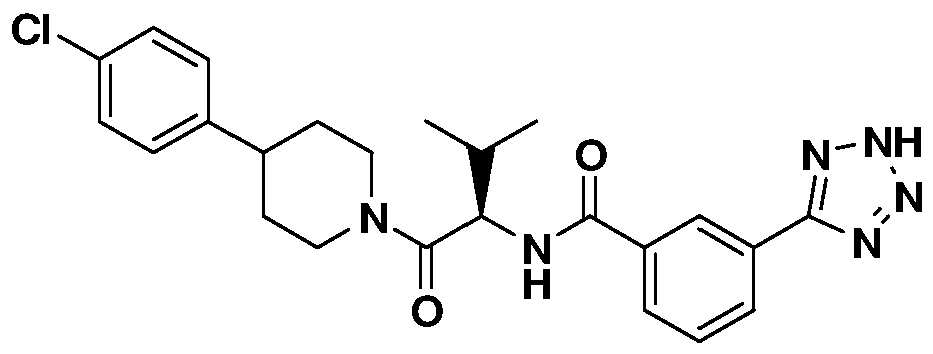
- Example 291 was prepared from Example 122 in a similar manner as described by Sharpless and Demko (J. Org. Chem. 2001, 66, 7945-7950). A 5 mL microwave reaction tube was charged with Example 122 (115 mg, 0.27 mmol, 1.0 eq.), zinc bromide (92 mg, 0.41 mmol, 1.5 eq.), sodium azide (53 mg, 0.81 mmol, 3.0 eq.), water (2 mL) and isopropanol (1 mL). The tube was sealed and then heated via microwave at 175 °C for 5 h. After this time, the reaction mixture was partitioned between methylene chloride (5 mL) and 1 N aqueous HCl (5 mL), the layers were separated, and the organic layer was washed with 1 N HCl (2 times), water, and then brine. The combined aqueous phases were extracted with methylene chloride. The combined organic phases were dried over sodium sulfate and then concentrated in-vacuo to yield a residue. The residue was purified over silica gel, eluting with 5% - 10% - 15% - 20% methanol/methylene chloride, to provide Example 291 (33 mg) as a colorless glass. MS (APCI) found: 467.2 (M + H)+.
-

- Example 292 was prepared in a similar manner as described for the preparation of Example 291 starting from Example 123. MS found: 467.3 (M + H)+.
-

- A 20 ml scintillation vial was charged with Example 291 (47 mg, 0.10 mmol, 1.0 eq.), trimethyloxonium fluoroborate (20 mg, 0.13 mmol, 1.3 eq.), proton sponge (60 mg, 0.25 mmol, 2.5 eq.), 4 A molecular sieves (200 mg), and DCM (2 mL). The vial was filled with argon gas and sealed. The mixture was allowed to stir overnight at room temperature. After this time, the reaction mixture was diluted with ethyl acetate (50 mL), washed 3 X with water (20 mL) followed by brine. The organic phase was dried over sodium sulfate and concentrated in-vacuo to yield a residue. The residue was purified over silica gel, eluting with 30% - 50% ethyl acetate/hexanes - 100% ethyl acetate, to yield crude product (38 mg) as a colorless glass contaminated with proton sponge. The crude product was purified by prep HPLC, using a Phenomenex Luna 5 µ, C18 (2), 250 x 21.2 mm column, under the following conditions: 100% water (5 min) then 0% to 90% acetonitrile in water (0.05% TFA in each solvent) over 15 minutes. Lyopholization of the fractions containing the major peak yielded Example 293 (11 mg) as a colorless powder. MS (ESI) found: 481.3 (M+H)+.
-

- A 5 mL microwave reaction tube was charged with Example 130 (298 mg, 0.62 mmol, 1.0 eq.), 3-cyanophenylboronic acid (101 mg, 0.69 mmol, 1.1 eq.), 2 M aqueous potassium phosphate solution (0.93 mL, 1.86 mmol, 3.0 eq.), and DMF (3 mL). The resulting solution was degassed under vacuum and then backfilled with argon. Tetrakis(triphenylphosphine)palladium(0) (50 mg) was added and the resulting mixture was again degassed as described above. The tube was sealed, and the reaction mixture was heated via microwave at 150 °C for 30 minutes. After this time, the reaction mixture was cooled to rt.. The reaction mixture was filterd to remove some solids, and the filter cake was rinsed with ethyl acetate. The combined filtrates were concentrated in-vacuo to yield a residue. The residue was purified over silica gel, eluting with 25% - 50% ethyl acetate/hexanes, to yield Example 294 (202 mg) as a colorless foam. MS (ESI) found: 500.3 (M+H)+.
-

- Example 295 was prepared in a similar manner as described for the preparation of Example 294 using 4-cyanophenylboronic acid. MS found: 500.3 (M + H)+.
-

- Example 296 was prepared in a similar manner as described for the preparation of Example 294 using 2-cyanophenylboronic acid. MS found: 500.3 (M + H)+.
-

- Example 297was prepared in a similar manner as described for the preparation of Example 294 using 3-cyanophenylboronic acid and (R)-2-bromo-N-(1-(4-(4-chlorophenyl)piperidin-1-yl)-3-methyl-1-oxobutan-2-yl)benzamide. MS found: 500.4 (M + H)+.
-

- Example 298 was prepared in a similar manner as described for the preparation of Example 291 using Example 296. MS found: 543 (M + H).
-

- Example 299 was isolated as a by-product of the conversion of Example 296 to Example 298. MS found: 518 (M + H).
-

- Example 300 was prepared in a similar manner as described for the preparation of Example 291 using Example 295. MS found: 543.4 (M + H).
-

- Example 301 was prepared in a similar manner as described for the preparation of Example 291 using Example 294. MS found: 543.5 (M + H).
-

- Example 302 was prepared in a similar manner as described for the preparation of Example 291 using Example 297. MS found: 543.5 (M + H).
-

- (R)-2-Amino-1-(4-(4-chlorophenyl)piperidin-1-yl)-3-methylbutan-1-one hydrochloride was coupled with 3-acetoxy benzoic acid in a similar manner as described for the preparation of Example 75 to give (R)-3-((1-(4-(4-chlorophenyl)piperidin-1-yl)-3-methyl-1-oxobutan-2-yl)carbamoyl)phenyl acetate (115 mg, 50% yield). MS found: 457.3 (M+).
- To a solution of (R)-3-((1-(4-(4-chlorophenyl)piperidin-1-yl)-3-methyl-1-oxobutan-2-yl)carbamoyl)phenyl acetate (115 mg, 0.25 mmol) in methanol (2 mL) was added a solution of sodium methoxide (0.5 M, 0.5 mL) in methanol. The mixture was stirred at room temperature for one hour. After this time, the mixture was concentrated and then neutralized to pH = 5 with 1 N HCl. The resulting precipitated solid was collected by filtration, rinsed with water, and dried under vacuum to give Example 303 (90 mg, 86.7% yield) as an off-white solid. MS found: 415.2 (M + H).
-

- Example 304 was prepared in a similar manner as described for the preparation of Example 303 using 2-acetoxy benzoic acid. MS found 415.2 (M + H).
-

- Example 128 (120 mg, 0.27 mmol) was dissolved in a mixture of methanol (5 mL) and ethyl acetate (5 mL). 5% Pd on carbon (8 mg) was added. The reaction system was degassed and charged with hydrogen three times and then allowed to stir at rt for one hour with a hydrogen balloon. The mixture was filtered and washed with ethyl acetate. The combined filtration was concentrated and purified by prep-HPLC. The product containing fraction was concentrated and lyophilized to give Example 305 (89 mg, 62%). MS found: 414.2 (M + H).
-

- Example 306 was prepared in a similar manner as described for the preparation of Example 305 using Example 129. MS found: 414.2 (M + H).
-

- Sodium cyanate (2 mg, 0.031 mmol) was added into a solution of Example 305 (10 mg, 0.024 mmol) in acetic acid (1 mL). The mixture was stirred at rt for two hours and then concentrated to yield a residue. The residue was purified by prep-HPLC. The product containing fraction was concentrated and lyophilized to give Example 307 as a yellow solid (10 mg, 91.2% yield). MS found: 457.3 (M + H).
-

- Example 308 was prepared in a similar manner as described for the preparation of Example 307 using Example 306. MS found: 457.3 (M + H).
-

- To a solution of Example 305 (15 mg, 0.036 mmol) in DCM (2 mL) was added isobutyryl chloride (4.2 µL, 0.04 mmol) and pyridine (4.5 µL, 004 mmol). The reaction was stirred at rt for 30 min and then concentrated to provide a residue. The residue was purified by preparative HPLC. The product containing fraction was concentrated and lyophilized to give Example 309 as a yellow powder (10 mg, 57.4%). MS found: 484.3 (M + H).
-

- A solution of (R)-2-amino-1-(4-(4-chlorophenyl)piperidine-1-yl)-3-methylbutan-1-one hydrochloride (40 mg, 0.136 mmol, 1 eq) and phthalic anhydride (20 mg, 0.136 mmol, 1 eq) were stirred at 25 °C in 3 mL of chloroform for 20 hours. After this time, the reaction was concentrated and purified by preparative HPLC to afford Example 310, yield = 55%. MS found: 443.30 (M+H)+.
-

- Example 311 was prepared in a similar manner as described for the preparation of Example 310. MS found: 477.3 (M+H)+.
-

- Example 312 was prepared in a similar manner as described for the preparation of Example 310. MS found: 493.2 (M + H)
-

-

- Methyl 2-(aminomethyl)benzoate-hydrochloride (500 mg, 2.48 mmol, 1 eq) was dissolved in 10 mL of THF at 25 °C under nitrogen. Triethylamine (0.35 mL, 4.96 mmol, 2 eq) was added followed by BOC anhydride (541 mg, 2.48 mmol, 1 eq). The reaction was stirred for 20 hours. After this time, saturated NH4Cl (10 mL) was added and the product was extracted 3 times with methylene chloride. The organic extracts were combined, dried over sodium sulfate and stripped to give methyl 2-((tert-butoxycarbonyl)aminomethyl)benzoate (650 mg) as a light-colored oil.
-

- Methyl 2-((tert-butoxycarbonyl)aminomethyl)benzoate (600 mg, 1.99 mmol, 1 eq) was dissolved in 5 mL of THF at 25 °C. 1 N NaOH (5.96 mL, 5.96 mmol, 3 eq) was added and the reaction stirred for 20 hours. After this time, 1.0 N HCl (5.86 mL) was added and the product was extracted 3 times with chloroform. The organic extracts were combined, dried over sodium sulfate and stripped to give 2-((tert-butoxycarbonyl)aminomethyl)benzoic acid (560 mg, 98% yield). MS (M+H-BOC)+ found: 152.3.
- Example 313 was prepared in a similar manner as described for the preparation of Example 75. MS found: 429.3 (M - Boc)
-

- Example 314 was prepared in a similar manner as described for the preparation of Example 313 using methyl 3-(aminomethyl)benzoate-hydrochloride. MS found: 528.4 (M+H).
-

- Example 315 was prepared in a similar manner as described for the preparation of Steps 1 and 2 of Example 313 using 3-(piperazin-1-yl) benzoic acid. MS Found: 583.5 (M+H).
-

- Example 315 was deprotected utilizing either TFA in dichlormethane or HCl in dioxane to provide Example 316 after preparative HPLC. MS Found: 483.4 (M+H).
-

- Example 317 was prepared in a similar manner as described for the preparation of Example 316 using 2-(piperazin-1-yl)benzoic acid. MS found 483.4 (M + H).
-

- Example 318 was prepared in a similar manner as described for the preparation of Steps 1 and 2 of Example 314 using 3-(piperidin-1-yl) benzoic acid. MS found: 582.5 (M + H).
-

- Example 318 was deprotected utilizing either TFA in dichlormethane or HCl in dioxane to provide Example 319 after preparative HPLC. MS found: 482.1 (M + H).
-

- Example 320 was prepared in a similar manner as described for the preparation of Example 75 using trans-1,4-Cyclohexanedicarboxylic acid monomethyl ester. MS found: 463.4 (M + H).
-

- Example 321 was prepared in a similar manner as described for the preparation of Example 290 using 3-phenylpyrazole. MS found: 479.4 (M+).
-

- Example 322 was prepared in a similar manner as described for the preparation of Example 290 using 4-methoxy indole. MS found: 482.3 (M+).
-

- To a solution of (R)-2-amino-1-(4-(4-chlorophenyl)piperidin-1-yl)-3-methylbutan-1-one hydrochloride (59 mg, 0.195 mmol) in THF (2 mL) was added phenyl 1,3,4-thiadiazol-2-ylcarbamate (45 mg, 0.2 mmol) and DIPEA (35 µL, 0.2 mmol), the mixture was stirred at 50 °C overnight and then concentrated to provide a residue. The residue was purified by prep-HPLC. The product containing fraction was concentrated and lyophilized to give Example 323 as a white powder (52 mg, 55 %). MS found: 422.3 (M+H).
-

- To a solution of Example 317 (15 mg, 0.025 mmol) in pyridine (2 mL) was added acetic anhydride (7 µL, 0.075 mmol) and the reaction allowed to stir overnight. After this time, the mixture was purified by preparative HPLC and the product isolated by extracting NaOH neutralized product fractions to give Example 324 (17 mg) as a colorless film. MS found: 525.5 (M+).
-

- Example 325 was prepared in a similar manner as described for the preparation of Example 75 using 3-benzoylbenzoic acid. MS found: 503.2 (M+H).
-

- Example 326 was prepared by reacting a solution of Example 325 (50 mg, 0.1 mmol) in methanol (3 mL) with NaBH4 (4 mg, 0.1 mmol) for 24 h. Aqueous workup followed by purification via silica gel provided Example 326 (40 mg, 80% yield) as an off-white solid. MS found: 505.3 (M+H).
-

-

- (R)-2-amino-1-((S)-4-(4-chlorophenyl)-4-hydroxy-3,3-dimethylpiperidin-1-yl)-3-methylbutan-1-one hydrochloride was prepared in a similar manner as described in Preparation C with the exception that (S)-4-(4-chlorophenyl)-3,3-dimethylpiperidin-4-ol (
WO 04/043965 - Example 327 was prepared in a similar manner as described in Example 75 from (R)-2-amino-1-((S)-4-(4-chlorophenyl)-4-hydroxy-3,3-dimethylpiperidin-1-yl)-3-methylbutan-1-one hydrochloride and benzoic acid.
-

- Example 328 was prepared in a similar manner as described for the preparation of Example 75 using (R)-2-amino-1-((S)-4-(4-chlorophenyl)-4-hydroxy-3,3-dimethylpiperidin-1-yl)-3-methylbutan-1-one hydrochloride and quinoline-5-carboxylic acid. MS found: 443.3 (M+).
-

- Example 329 was prepared in a similar manner as described for the preparation of Example 328 with the exception that 4-chorobenzoic acid was used instead of benzoic acid. MS found 477.2 (M+).
-

-

- (R)-3-(1-(4-(4-chlorophenyl)piperidin-1-yl)-3-methyl-1-oxobutan-2-ylcarbamoyl)phenylboronic acid was prepared in a similar manner as Example 75 using 3-carboxybenzeneboronic acid.
- A solution of (R)-3-(1-(4-(4-chlorophenyl)piperidin-1-yl)-3-methyl-1-oxobutan-2-ylcarbamoyl)phenylboronic acid (100 mg, 2.26 mmol), 1-bromo-2-nitrobenzene (46 mg 2.26 mmol), Na2CO3 (72 mg, 6.7 mmol) and Pd(Ph3P)4 (13 mg) in toluene (5 mL) water (3 mL) and ethanol (3 mL) was heated at 100 °C for 30 min. After this time, the reaction mixture was cooled, filtered and then concentrated. Water was added and the resulting solution was extracted with ethyl actetate. The combined organic extracts were dried and concentrated to provide crude material. The crude material was purified via column chromatography (25% EtOAc/hexane to 50% EtOAc/hexane) to provide Example 330 as an off-white glass. MS found: 520.2 (M+H).
-
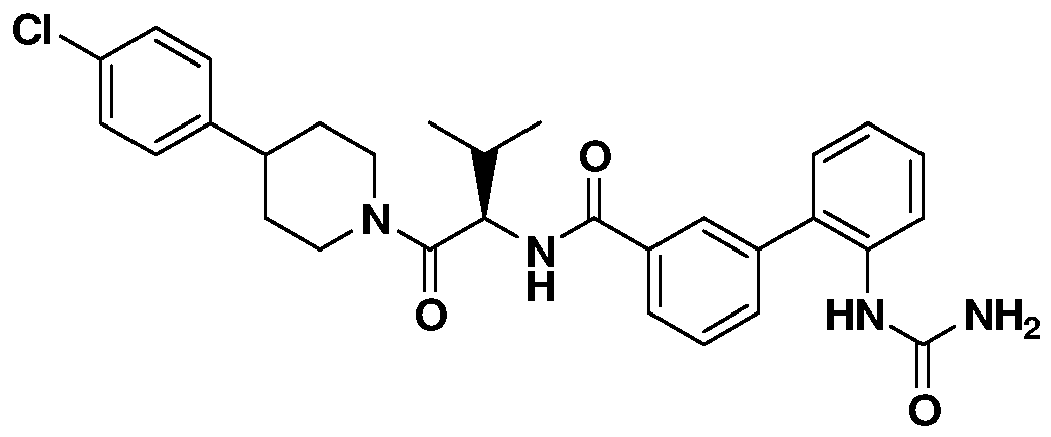
-

- 3-Carboxyphenyl boronic acid (100 mg, 0.60 mmol), 2-bromophenyl urea (130 mg, 0.60 mmol), tetrakis(triphenylphosphine)palladium(0) (35 mg, 0.030 mmol), sodium carbonate (192 mg, 1.81 mmol), toluene (5 mL), water (3 mL), and ethanol (3 mL) were mixed at 25 °C under nitrogen then heated in a microwave reactor for 30 minutes at 100 °C. Water (5 mL) was added followed by removal of the EtOH in vacuo. The aqueous layer was washed with diethyl ether (2x) and the pH was adjusted to 3 with 1N HCl. The aqueous layer was extracted with ethyl acetate (2x) and the combined were dried over sodium sulfate and then concentrated in vacuo to give 2'-ureidobiphenyl-3-carboxylic acid (150 mg, 0.58 mmol, 97% yield) as a tan glass. MS found: (M + H)+ = 257.29
- Example 331 was prepared in a similar manner as described for the preparation of Example 75 using 2'-ureidobiphenyl-3-carboxylic acid. MS found 533.4 (M+H).
-

- To a solution of Example 142 (30 mg, 0.05 mmol) in acetone was added KOH (6 mg 0.1 mmol) and iodomethane (10 µL, 0.16 mmol). The resulting mixture was stirred at room temperature for 48 h. After this time, EtOAc was added to the solution, and the resulting mixture was washed with water and brine. The organic layer was dried and concentrated to an oil. The oil was purified by preparative HPLC to provide Example 332 (18 mg). MS found: 453.4 (M+H).
-

- Example 333 was prepared in a similar manner as described for the preparation of Example 323 with the exception that Example 305 was used in place of (R)-2-amino-1-(4-(4-chlorophenyl)piperidin-1-yl)-3-methylbutan-1-one hydrochloride. MS found: 541.3 (M+).
-

- To a solution of Example 305 (31 mg, 0.075 mmol) in DCM (1 mL) was added methanesulfonyl chloride (6 µL, 0.075 mmol) and pyridine (8 µL, 075 mmol). The reaction was stirred at rt for 30 min and and additional aliguots (1 equiv each) of pyridine and methanesulfonyl chloride was added. The reaction was stirred and then concentrated to yield a residue. The residue was purified by preparative HPLC. The product containing fraction was concentrated and lyophilized to give Example 334 as a white solid powder (21 mg). MS found: 492.2 (M+).
- Examples 335 to 404, as described in Table 13, were prepared in a similar manner as described for the preparation of Example 75. In the synthesis of Examples 344 to 404, the appropriate acid needed to produce the product listed was used in place of the benzoic acid used in Example 75. Examples 404, 398, 399, 401 and 403 were prepared from the corresponding esters of Examples 395, 396, 397, 400 and 402, respectively, via standard hydrolysis.
TABLE 13 Example Structure MS (M+) 335 
450.3 336 
466.3 337 
416.3 338 
512.2 339 
427.3 340 
433.4 341 
433.3 342 
450.3 343 
497.2 344 
429.2 345 
455.3 346 
449.2 347 
433.2 348 
457.3 349 
450.3 350 
418.3 351 
429.2 352 
466.2 353 
445.2 354 
478.2 355 
475.3 356 
430.2 357 
414.3 358 
443.3 359 
429.3 360 
443.3 361 
429.3 362 
481.2 363 
427.3 364 
443.3 365 
429.3 366 
414.3 367 
414.3 368 
438.2 369 
483.2 370 
483.2 371 
439.3 372 
457.3 373 
433.2 374 
439.3 375 
465.3 376 
438.4 377 
456.4 378 
438.4 379 
454.4 380 
458.1 381 
458.2 382 
458.0 383 
466.3 384 
438.3 385 
473.3 386 
429.3 387 
447.3 388 
492.2 389 
513.2 390 
457.3 391 
443.1 392 
487.3 393 
491.2 394 
477.0 395 
487.1 396 
535.1 397 
533.2 398 
521.0 399 
519.2 400 
533.2 401 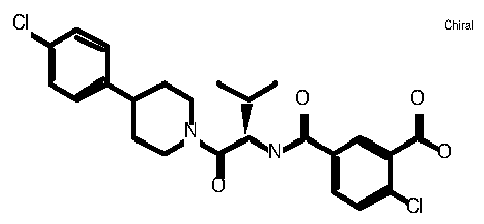
477.1 402 
472.2 403 
444.1 404 
473.0 - Examples 405 to 438, as described in Table 14, were prepared in a similar manner as described for the preparation of Example 294. In the synthesis of Examples 404 to 438, the boronic acid needed to produce the product listed was used in place of the 3-cyanophenylboronic acid used in Example 294.
TABLE 14 Example Structure MS (M+) 405 
509.3 406 
489.4 407 
505.4 408 
489.4 409 
489.4 410 
509.3 411 
505.4 412 
476.3 413 
491.3 414 
491.3 415 
491.3 416 
518.4 417 
465.3 418 
559.3 419 
519.3 420 
568.3 421 
532.3 422 
546.3 423 
490.3 424 
532.3 425 
505.3 426 
568.3 427 
517.3 428 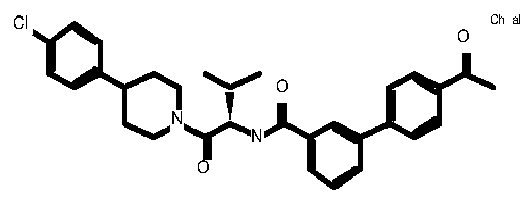
517.3 429 
532.3 430 
518.3 431 
553.3 432 
517.3 433 
481.2 434 
509.2 435 
518.3 436 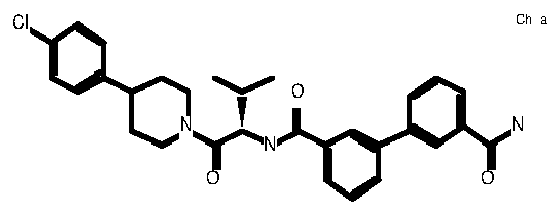
518.3 437 
553.2 438 
490.3 -
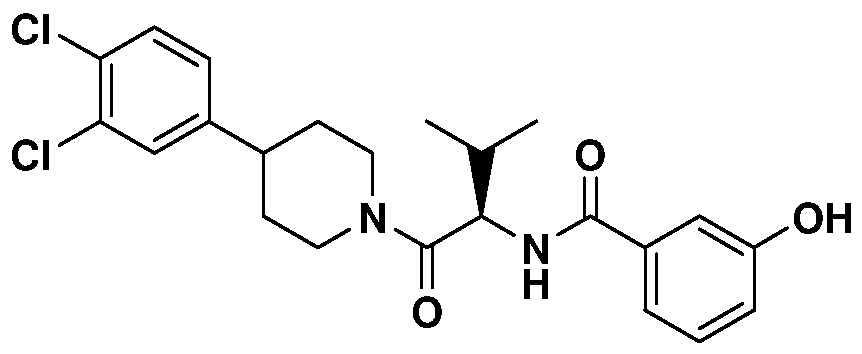
-

- n-BuLi (2.5 M, 2 mL, 5.21 mmol) was added into a solution of 4-bromo-1,2-dichlorobenzene (1.07 g, 4.74 mmol) in dry THF (10 mL) at -78 °C. The mixture was stirred for 20 mins and then a solution of tert-butyl 4-oxopiperidine-1-carboxylate (0.95 g, 4.74 mmol) in THF (5 mL) was added. The mixture was further stirred at -78 °C for 1h. After this time, the reaction was quenched with NH4Cl (aq., 15 mL), extracted with ethyl acetate (50 mL X 3), dried over Na2SO4 and concentrated to yield a residue. The residue was purified by flash chromatography using 10-30% ethyl acetate in hexanes as an eluent to provide tert-butyl 4-(3,4-dichlorophenyl)-4-hydroxypiperidine-1-carboxylate (1.6 g, 90% purity, 88% yield) as a colorless oil. MS found: 346.3 (M+).
-

- HCl (conc., 1.5 mL) was slowly added to a flask containing tert-butyl 4-(3,4-dichlorophenyl)-4-hydroxypiperidine-1-carboxylate (200 mg, 0.58 mmol). The mixture was stirred at rt for 30 mins, heated to 90 °C for 5h and then cooled overnight. The resulting precipitate was collected by filtration to give 4-(3,4-dichlorophenyl)-1,2,3,6-tetrahydropyridine hydrochloride (107 mg, 70% yield). MS found: 215.6 (M+).
-

- A balloon filled with hydrogen was charged into a solution of 4-(3,4-dichlorophenyl)-1,2,3,6-tetrahydropyridine hydrochloride (107 mg, 0.41 mmol) in the presence of 5% Pd/C (5% mmol) after the system was degassed. The reaction was stirred at rt for 2h, filtered, rinsed with MeOH and then concentrated to give 4-(3,4-Dichlorophenyl)piperidine hydrochloride (79 mg, 72% yield) as an oil. MS found: 266.4 (M+).
- Example 439 was prepared in a similar manner as described for the preparation of Example 75 by reacting 4-(3,4-dichlorophenyl)piperidine hydrochloride with N-Boc-D-valine, followed by Boc group removal and coupling with 3-hydroxy benzoic acid. MS found 449.2 (M+).
- Examples 440 to 458, as described in Table 15, were prepared in a similar manner as described for the preparation of Example 439. In the synthesis of Examples 449 to 458, the appropriate acid and piperidine needed to produce the product listed was used in place of the benzoic acid used in Example 439.
TABLE 15 Example Structure MS (M+) 440 
413.2 441 
461.3 442 
435.3 443 
417.3 444 
445.3 445 
417.3 446 
449 447 
451.3 448 
397.3 449 
423.3 450 
461.3 451 
417.3 452 
409.3 453 
461.3 454 
381.4 (M+H) 455 
407.4 (M+H) 456 
503.2 457 
415 458 
390.2 (M+H) - Examples 459 to 497, as described in Table 16, were prepared in a similar manner as described for the preparation of Example 328. In the synthesis of Examples 459 to 496, the appropriate acid and piperidine needed to produce the product listed was used in place of the benzoic acid used in Example 328. Examples 463, 496 and 497 were prepared from the corresponding esters Examples 462, 494 and 495, respectively, via standard hydrolysis.
TABLE 16 Example Structure MS (M+) 459 
477.2 460 
436.3 (M+H) 461 
461.2 462 
501.3 463 
487.3 464 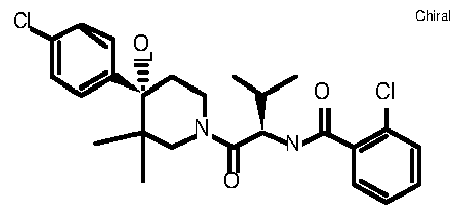
477.2 465 
459.2 466 
423.3 467 
381.3 468 
535.3 469 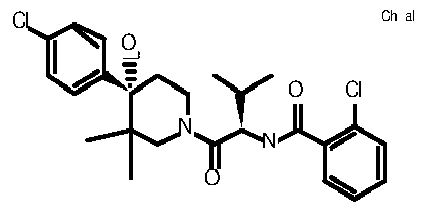
477.2 470 
473.3 471 
459.3 472 
519.3 473 
473.3 474 
459.2 475 
500.3 476 
473.3 477 
459.3 478 
519.4 479 
409.4 480 
423.3 481 
471.3 482 
437.4 483 
423.4 484 
457.3 485 
483.3 486 
522.3 487 
500.3 488 
485.2 489 
535.3 490 
519.3 491 
522.3 492 
500.3 493 
501.3 494 
535.2 495 
577.2 496 
521.1 497 
521.1 -

- Example 498 was prepared in a similar manner as described for the preparation of Example 309 with the exception that isopropyl isocyanate was used in place of isobutyryl chloride. MS found: 499.3 (M+).
-

- Example 499 was prepared in a similar manner as described for the preparation of Example 309 with the exception that trifluoromethanesulfonic anhydride was used in place of isobutyryl chloride. MS found: 545.9 (M+).
-

- Example 500 was prepared by reacting with methyl sulfonamide and Example 394 in a similar manner as described for the preparation of Example 1. MS found: 553.9 (M+).
-

- (S)-4-(4-chlorophenyl)-3,3-dimethylpiperidin-4-ol was dehydrated under acidic conditions in a similar manner as described for the preparation of Example 439 to give 4-(4-chlorophenyl)-3,3-dimethyl-1,2,3,6-tetrahydropyridine.
- 4-(4-Chlorophenyl)-3,3-dimethyl-1,2,3,6-tetrahydropyridine was coupled with racemic N-benzoyl valine in a similar manner as described for the preparation of Example 1 to give Example 501. MS found: 426.3 (M+).
-

-

- Example 382 was reduced under hydrogen balloon in a similar manner as described for the preparation of Example 305 to furnish the above amine.
- The amine from Step 1 was treated with trifluoromethanesulfonic anhydride to furnish Example 502. MS found: 560.1 (M+).
-

- A solution of N-Boc-4-chlorophenylpiperidine (6.0 g, 20.3 mmol) in ether (50 mL) was cooled to -78 °C and TMEDA (6.73 mL, 44.6 mmoL) was added followed by sec-butyl lithium (17.4 mL, 24.3 mmol) while maintaining the temperature below -60 °C. After stirring for 5 h, iodomethane (1 eq) was added and the reaction was allowed to warm to rt. Once at the prescribed temperature, the reaction was quenched with water (50 mL) and the layers were separated. The aquesous layer was extracted with ether (50 mL) and the combined organic extracts were dried over Na2SO4, filtered and concentrated to an oil. The oil was purifed by HPLC to give tert-butyl 4-(4-chlorophenyl)-2-methylpiperidine-1-carboxylate (1.35 g, 22% yield) as an oil. MS found: 310.3 (M+H).
- 4-(4-Chlorophenyl)-2-methylpiperidine hydrochloride was prepared from tert-butyl 4-(4-chlorophenyl)-2-methylpiperidine-1-carboxylate in a similar manner as described for the preparation of Step 2, Example 439.
- 4-(4-Chlorophenyl)-2-methylpiperidine hydrochloride was converted to Example 503 in a similar manner as described for the preparation of the 3-step sequence outlined in Preparation C and Example 75 (EDC/HOBt coupling with Boc-D-valine, Boc removal with HCl in dioxane, and finally EDC/HOBt coupling with 4-chloro benzoic acid). MS found: 447.2 (M+)
-

- Example 504 was prepared in a similar manner as described for the preparation of Example 503 using (2R)-2-amino-1-(4-(4-chlorophenyl)-2-methylpiperidin-1-yl)-3-methylbutan-1-one hydrochloride with the exception that 3-chloro-5-(methoxycarbonyl)benzoic acid was used in place of 4-chloro benzoic acid in Step 3. MS found: 505.1 (M+).
-

- Example 505 was prepared from 504 under standard ester hydrolysis (1 N NaOH, methanol) conditions. MS found: 491.2 (M+).
-

- (2R)-2-amino-1-(4-(4-chlorophenyl)-4-hydroxy-2-methylpiperidin-1-yl)-3-methylbutan-1-one hydrochloride was prepared from tert-Butyl 2-methyl-4-oxopiperidine-1-carboxylate in a similar manner as described for the preparation of Example 439. MS found: 463.2.
- 4-Chlorobenzoic acid was coupled to (2R)-2-amino-1-(4-(4-chlorophenyl)-4-hydroxy-2-methylpiperidin-1-yl)-3-methylbutan-1-one hydrochloride in a similar manner as described for the preparation of Example 75. MS found: 463.2 (M+).
-

- To a stirred solution of 2-(4-chloro-5-methyl-3-(trifluoromethyl)-1H-pyrazol-1-yl)acetic acid (see
US 2004/0162282 , 36.5 mg, 0.15 mmol), EDCi (32 mg, 0.17 mmol) and HOBt (22 mg, 0.17 mmol) in DMF (0.3 mL) was added 4-chlorophenylpiperidine hydrochloride (42 mg, 0.18 mmol) and DIPEA (66 µL). Upon completion of addition, the reaction mixture was stirred for 18 h and then purified directly by HPLC to provide Example 507 (46.5 mg, 74%) as a white solid. MS found: 420.1 (M+). -

- Example 508 was prepared in a similar manner as described for the preparation of Example 328 using (R)-4-(4-chlorophenyl)-3,3-dimethylpiperidin-4-ol. MS found: 443.3 (M+).
-

-

- 3-Hydroxy phenol and 2-bromophenyl urea were reacted under Suzuki cross coupling conditions in a similar manner as described for the preparation of Example 294 to provide 1-(3'-hydroxybiphenyl-2-yl)urea.
- To a stirred solution of (R)-2-chloro-N-(1-(4-(4-chlorophenyl)piperidin-1-yl)-3-methyl-1-oxobutan-2-yl)acetamide (40 mg, 0.14 mmol) and K2CO3 (39 mg, 0.28 mmol) in DMSO (2 mL) was added 1-(3'-hydroxybiphenyl-2-yl)urea (32 mg, 0.14 mmol). Upon completion of addition, the reaction mixtured was stirred or 18 h. After this time, the reaction mixture was purified via preparative HPLC to provide Example 509 (36% yield). MS found: 563.2 (M+).
-

- A reaction tube was charged with methyl isocyanate (3 µL), (R)-2-amino-1-((S)-4-(4-chlorophenyl)-4-hydroxy-3,3-dimethylpiperidin-1-yl)-3-methylbutan-1-one hydrochloride (20 mg) and THF (2 mL). Triethylamine (7.4 µL) was added and the reaction mixture was shaken overnight at rt. After this time, the resulting solution concentrated and purified by preparative silica gel chromatography (100% EtOAc to 20% MeOH/CH2Cl2) to provide Example 510. MS found: (M + H)+ = 396.3.
-

- A reaction tube was charged with cyclopentyl isocyanate (9 µL), (R)-2-amino-1-((S)-4-(4-chlorophenyl)-4-hydroxy-3,3-dimethylpiperidin-1-yl)-3-methylbutan-1-one hydrochloride (30 mg) and THF (2 mL). Triethylamine (11 µL) was added and the reaction mixture was shaken overnight at rt. After this time, the resulting solution concentrated and purified by preparative silica gel chromatography (100% EtOAc to 20% MeOH/CH2Cl2) to provide Example 511. MS found: (M + H)+ = 450.2.
-

-

- N-Boc-D-valine (2.22g, 10.2 mmol), EDC (1.96 g, 10.2 mmol), HOBt (1.38 g, 10.2 mmol) was dissolved in dichloromethane (40 mL). DIPEA (4.0 mL, 23.3 mmol) and 4-hydroxy-(4-chlorophenyl)piperidine (1.98 g, 9.34 mmol) was added and the solution was stirred at rt for 2h. The reaction was concentrated and the resulting oily residue partitioned between EtOAc (150 mL) and water (50 mL), shaken and then separated. The organic layer was then washed with aq NaHCO3 (50 mL) and brine and the combined organic fractions were dried over solid sodium sulfate. The solution was filtered and concentrated by to give (R)-tert-butyl 1-(4-(4-chlorophenyl)-4-hydroxypiperidin-1-yl)-3-methyl-1-oxobutan-2-ylcarbamate (3.9 g) as a white foam. MS found: (M+)+ = 411.1.
-

- A 4M solution of HCl in dioxane (10 mL) was added to (R)-tert-butyl 1-(4-(4-chlorophenyl)-4-hydroxypiperidin-1-yl)-3-methyl-1-oxobutan-2-ylcarbamate (2.0 g) and the resulting solution was allowed to stir at rt. for 1 h. After this time, the solvent was removed by rotary evaporation to provide an oil. The oil was dried overnight in vacuo to provide (R)-2-amino-1-(4-(4-chlorophenyl)-4-hydroxypiperidin-1-yl)-3-methylbutan-1-one hydrochloride as a white foam.
- To a solution of (R)-2-amino-1-(4-(4-chlorophenyl)-4-hydroxypiperidin-1-yl)-3-methylbutan-1-one hydrochloride (31.1 mg, 0.09 mmol) and cyclopentane carbonyl chloride (12 µL, 0.09 mmoL) in dichloromethane (0.5 mL) was added DIPEA (34.3 µL, 0.2 mmol) and the reaction solution was allowed to stir at rt for 1h. The solvents were removed and the residue was partitioned between EtOAc (3 mL) and water (1.5 mL). the layers were separated, dried over sodium sulfate, filtered and concentrated in vacuo. The crude product was purified via column chromatography (33% EtOAc/heptane) to afford Example 512 (29.1 mg, 80% yield) as a white solid. MS found 407.04 (M+)+; HPLC rt 3.66 min.
-

-

- To a solution of 5-bromo-2-chloro-anisole (1.613 g, 7.3 mmol) in THF (15 mL) at -78 °C was added n-butyl lithium (4.75 mL, 7.6 mmol, 1.6 M) dropwise over 15 min and the resulting solution was allowed to stir at -78 °C for 1 h. A solution of tert-butyl 3,3-dimethyl-4-oxopiperidine-1-carboxylate (prepared in the manner described in International Patent Application
WO 04/043965 -

- tert-Butyl 4-(4-chloro-3-methoxyphenyl)-4-hydroxy-3,3-dimethylpiperidine-1-carboxylate (1.36 g, 2.39 mmol) was added 4N HCl in dioxane (10 mL) and stirred for 30 min. The solvents were removed in vacuo and the resulting solids were dried azeotropically with toluene and then further dried under high vacuum to afford 4-(4-chloro-3-methoxyphenyl)-3,3-dimethylpiperidin-4-ol hydrochloride as a white solid.
-

- N-Boc-D-valine (85 mg, 0.39 mmol), EDC (75 mg, 0.39 mmol), HOBt (53 mg, 0.39 mmol) was dissolved in dichloromethane (2 mL). 4-(4-Chloro-3-methoxyphenyl)-3,3-dimethylpiperidin-4-ol hydrochloride (100 mg, 0.33 mmol) was added fllowed by DIPEA (136 µL, 0.78 mmol) and the solution was stirred at rt for 10 min. The reaction was concentrated and the resulting oily residue waspurifed via column chromatography (10% to 50% EtOAc/heptane) to furnish tert-butyl (2R)-1-(4-(4-chloro-3-methoxyphenyl)-4-hydroxy-3,3-dimethylpiperidin-1-yl)-3-methyl-1-oxobutan-2-ylcarbamate (153 mg, 99% yield) MS found: (M-Boc)+ = 396.3.
-

- tert-Butyl (2R)-1-(4-(4-chloro-3-methoxyphenyl)-4-hydroxy-3,3-dimethylpiperidin-1-yl)-3-methyl-1-oxobutan-2-ylcarbamate (153 mg, 0.33 mmol) was added 4N HCl in dioxane (2 mL) and stirred for 60 min. The solvents were removed in vacuo and the resulting solids were dried azeotropically with toluene and then further dried under high vacuum to afford (2R)-2-amino-1-(4-(4-chloro-3-methoxyphenyl)-4-hydroxy-3,3-dimethylpiperidin-1-yl)-3-methylbutan-1-one hydrochloride as a white solid.
- To a solution of (2R)-2-amino-1-(4-(4-chloro-3-methoxyphenyl)-4-hydroxy-3,3-dimethylpiperidin-1-yl)-3-methylbutan-1-one hydrochloride (20 mg, 0.05 mmol) and cyclopentane carbonyl chloride (7.4 µL, 0.06 mmoL) in dichloromethane (0.3 mL) was added DIPEA (22 µL, 0.13 mmol) and the reaction solution was allowed to stir at rt for 16h. The solvents were removed and the residue was purified preparative HPLC to afford Example 513 (14.5 mg, 60% yield) as a white solid. MS found 465.3 (M+)+; HPLC rt 3.89 min.
-

-

- To a solution of Boc-D-ORN(Cbz)-OH (336 mg, 0.92 mmol), EDC (176 mg, 0.92 mmol) and HOBt (124 mg, 0.92 mmol) in dichloromethane (5 mL) was added (S)-4(4-chlorphenyl)-3,3-dimethylpiperdin-4-ol (200 mg, 0.83 mmol) followed by DIPEA (0.16 mL, 0.92 mmol). The solution was stirred for 2 h then poured into EtOAc and washed successively with water, aq. NaHCO3, and brine. The organic layer was dried over magnesium sulfate, concentrated and dried under high vacuum to afford the crude solid which was used without further purification. MS found 588.4 (M+)+.
-

- The product of step 1, above was deprotected in 4N HCl in dioxane (5 mL) to furnish benzyl (R)-4-amino-5-((S)-4-(4-chlorophenyl)-4-hydroxy-3,3-dimethylpiperidin-1-yl)-5-oxopentylcarbamate hydrochloride (463 mg, crude product).
-

- Benzyl (R)-4-amino-5-((S)-4-(4-chlorophenyl)-4-hydroxy-3,3-dimethylpiperidin-1-yl)-5-oxopentylcarbamate hydrochloride (50.5 mg, 0.096 mmol) was dissolved in dichloromethane (0.5 mL) and added cyclopentane carbonylchloride (14 µL, 0.12 mmol) followed by DIPEA (42 µL, 0.24 mmol). The solution was stirred for 2 h, concentrated, and partitioned between EtOAc (2 mL) and aq NaHCO3 (0.5 mL). The EtOAc layer was separated, dried over magnesium sulfate, and concentrated to give benzyl (R)-5-((S)-4-(4-chlorophenyl)-4-hydroxy-3,3-dimethylpiperidin-1-yl)-4-(cyclopentanecarboxamido)-5-oxopentylcarbamate which was used without further purification.
-

- Benzyl (R)-5-((S)-4-(4-chlorophenyl)-4-hydroxy-3,3-dimethylpiperidin-1-yl)-4-(cyclopentanecarboxamido)-5-oxopentylcarbamate (0.096 mmol from step 3) was added HBr in acetic acid (0.5 mL) and the resulting solution was stirred for 1 h. Ether (15 mL) was added and stirring continued for an additional hour. The ether was removed via pipet and the gummy solids were washed again with ether. The residue was dissolved in MeOH, added solid potassium carbonate then filtered. The crude solutionwas purified via preparative HPLC to afford N-((R)-5-amino-1-((S)-4-(4-chlorophenyl)-4-hydroxy-3,3-dimethylpiperidin-1-yl)-1-oxopentan-2-yl)cyclopentanecarboxamide 2,2,2-trifluoroacetate (20.6 mg, 38% yield). MS found 450.29 (M+)+.
- To a mixture of afford N-((R)-5-amino-1-((S)-4-(4-chlorophenyl)-4-hydroxy-3,3-dimethylpiperidin-1-yl)-1-oxopentan-2-yl)cyclopentanecarboxamide 2,2,2-trifluoroacetate (10.6 mg, 0.019 mmol) and 1H-pyrazole-1-carboxamidine hydrochloride (3.03 mg, 0.021 mmol) in DMF was added DIPEA (13.1 µl, 0.075 mmol). The reaction mixture was stirred for 3 h at room temperature. The crude reaction mixture was diluted with MeOH and purified directly by preparative HPLC to give Example 514 (8.1 mg, 60% yield) as a white solid. MS found : 492.23 (M+)+.
-

-

- To a solution of 3-aminobenzoic acid (140 mg, 1 mmol) in THF (5 mL) at 0 °C was added ethyl isocyanato acetate (150 µL, 1.3 mmol). The reaction solution was allowed to warm to room temperature and stir for 18h. The mixture was then poured into EtOAc (40 mL) and washed successively with water (15 mL) and brine (15 mL). The organic layer was dried over Na2SO3, filtered and concentrated to an oil which was used without further purification. MS found 267.17 (M+)+.
-

- To a resealable vial was added (R)-2-amino-1-((S)-4-(4-chlorophenyl)-4-hydroxy-3,3-dimethylpiperidin-1-yl)-3-methylbutan-1-one, HCl, (24.1mg, 0.064 mmol), 3-(3-(2-ethoxy-2-oxoethyl)ureido)benzoic acid (17.10 mg, 0.064 mmol), and benzotriazol-1-yloxytris(dimethylamino)-phosphonium hexafluorophosphate(BOP) (28.4 mg, 0.064 mmol). The solids were then added DMF (0.25 ml) followed by DIPEA (0.022 mL, 0.126 mmol). After stirring for 1 h, water (1.25 mL) was added to the reaction mixture and the precipitated solids stirred rapidly for several hours. The solids were collected by filtration and washed with water (2x0.5 mL) to give ethyl 2-(3-(3-((R)-1-((S)-4-(4-chlorophenyl)-4-hydroxy-3,3-dimethylpiperidin-1-yl)-3-methyl-1-oxobutan-2-ylcarbamoyl)phenyl)ureido)acetate (34.8 mg, 90% yield) a white solid. MS found : 587.26 (M+)+.
- To a solution of ethyl 2-(3-(3-((R)-1-((S)-4-(4-chlorophenyl)-4-hydroxy-3,3-dimethylpiperidin-1-yl)-3-methyl-1-oxobutan-2-ylcarbamoyl)phenyl)ureido)acetate, (34 mg, 0.058 mmol) in THF (0.2 mL) and methanol (0.2 mL) was added aqueous NaOH (1N) (60 µL, 0.058 mmol). HPLC/LCMS at 1 h indicates complete consumption of starting material and conversion to product (559.26, M+). The reaction was then nuetralized with 1 N HCl (0.06 mL), diluted with water (0.2 mL) and concentrated to remove organic solvents. The resulting oily suspension was dissolved in methanol and purifed directly by preparative HPLC. The product containing fraction was concentrated and the solids dried under high vacuum to give Example 515 (27.7 mg, 71% yield) as a white solid. MS found: 559.27 (M+)+.
-

-

- To an ice cooled solution of R)-2-amino-1-((S)-4-(4-chlorophenyl)-4-hydroxy-3,3-dimethylpiperidin-1-yl)-3-methylbutan-1-one, HCl, (30.3 mg, 0.089 mmol), in CH2Cl2 (0.8 mL) was added 3-(chloromethyl)benzoyl chloride (14 µL, 0.098 mmol) followed by DIPEA (34.4 µL, 0.197 mmol). The reaction was stirred overnight then patitioned between EtOAc and dilute aq. NaHCO3. The aqueous layer was further extracted with EtOAc then dried over Na2SO4. Filter, strip, and flash to purify (20% EtOAc/heptane to 60% EtOAc/heptane) to afford 3-(chloromethyl)-N-((R)-1-((S)-4-(4-chlorophenyl)-4-hydroxy-3,3-dimethylpiperidin-1-yl)-3-methyl-1-oxobutan-2-yl)benzamide (33 mg, 75% yield). MS found: 491.20 (M+)+.
- To a solution of 3-(chloromethyl)-N-((R)-1-((S)-4-(4-chlorophenyl)-4-hydroxy-3,3-dimethylpiperidin-1-yl)-3-methyl-1-oxobutan-2-yl)benzamide, (33 mg, 0.067 mmol) in Ethanol (0.25 mL)/Water (0.25 mL) was added Sodium Sulfite (0.016 mL, 0.336 mmol) and the reaction vessel heated at reflux overnight. The reaction was cooled to room temperature then concentrated on a rotovap. The remaining suspension was loaded onto a 1 gram C18 cartridge (pre-wetted with water) and eluted sequentially with water, 10% MeCN/water, 20% MeCN/water then 50% MeCN/water. The product containing fractions were combined, concentrated, and lyophilized to give Example 516 (27.0 mg, 72 % yield), which was isolated as a white solid. MS found: 537.22 (M+)+.
-

- To an solution of (R)-2-amino-1-((S)-4-(4-chlorophenyl)-4-hydroxy-3,3-dimethylpiperidin-1-yl)-3-methylbutan-1-one, HCl, (23.7 mg, 0.07 mmol), ) in EtOH (300 µL) was added 2-chlorobenzoxazole (8 µL, 0.070 mmol) and TEA (19.50 µL, 0.140 mmol). The reaction solution was heated at 150 °C for 45 min. The reaction was purified directly by preparative HPLC to furnish Example 517 (21 mg, 53% yield). MS found: 456.3 (M+)+.
-

- To a solution of 3-acetylbenzoic acid (10.4 mg, 0.063 mmol), (R)-2-amino-1-((S)-4-(4-chlorophenyl)-4-hydroxy-3,3-dimethylpiperidin-1-yl)-3-methylbutan-1-one (21.6 mg, 0.058 mmol), EDC (12.14 mg, 0.063 mmol), and HOBt (9.69 mg, 0.063 mmol) in DMF (250 µL) was added DIPEA (11.06 µL, 0.063 mmol) after stirring for ~20 min. The reaction mixture was stirred for 30 min then added water (1 mL). The precipitated solids were stirred for 45 min, filtered, and rinsed with water to afford Example 518 (24 mg, 86 % yield) as a white solid. HPLC purity: >95%, rt 3.85 min; MS found 485.19 (M+)+.
-

-
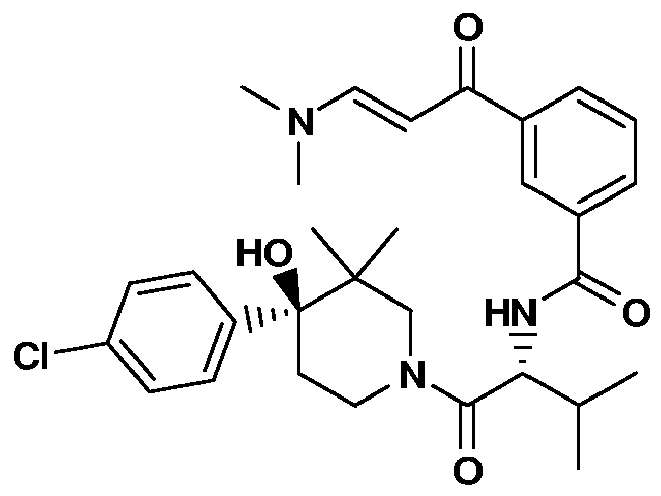
- 3-Acetyl-N-((R)-1-((S)-4-(4-chlorophenyl)-4-hydroxy-3,3-dimethylpiperidin-1-yl)-3-methyl-1-oxobutan-2-yl)benzamide was added DMF-DMA (0.3 mL) and the reaction mixture heated at 105 °C for ~5 h. The residual DMF-DMA was removed on a rotovap and the crude product was dried on house high vac for ~3 h to afford N-((R)-1-((S)-4-(4-chlorophenyl)-4-hydroxy-3,3-dimethylpiperidin-1-yl)-3-methyl-1-oxobutan-2-yl)-3-((E)-3-(dimethylamino)acryloyl)benzamide.
- To a solution of N-((R)-1-((S)-4-(4-chlorophenyl)-4-hydroxy-3,3-dimethylpiperidin-1-yl)-3-methyl-1-oxobutan-2-yl)-3-((E)-3-(dimethylamino)acryloyl)benzamide, (11 mg, 0.020 mmol) in ethanol (0.3 mL) was added hydrazine hydrate (20 µL, 0.411 mmol). The reaction was stirred overnight and the crude reaction purified directly via preparative HPLC to give Example 519 (10.0 mg, 0.016 mmol, 79 % yield), as a white solid. HPLC purity >99%, rt 3.92 min; MS found: 509.30 (M+)+.
-

-

- To a solution of (R)-2-amino-1-((S)-4-(4-chlorophenyl)-4-hydroxy-3,3-dimethylpiperidin-1-yl)-3-methylbutan-1-one, HCl (141.6 mg, 0.377 mmol) in CHCl3 (2 mL) at 0 °C was added DIPEA (0.066 mL, 0.377 mmol) followed by the dropwise addition of benzoyl isothiocyanate (0.051 mL, 0.377 mmol). The reaction was stirred for 1 h then concentrated on a rotovap and added MeOH (2 mL). 5 N NaOH (0.080 mL) was added and the resulting mixture was stirred for 1 h then at 65 °C for 1 h. Cool to rt and concentrate. Add water (1 mL) and stir rapidly over the weekend. Extract into EtOAc (3 X 25 mL), dry over Na2SO4, filter, strip. Purify via column chromatography (50% EA/heptane to 75% EA/heptane) to afford 1-((R)-1-((S)-4-(4-chlorophenyl)-4-hydroxy-3,3-dimethylpiperidin-1-yl)-3-methyl-1-oxobutan-2-yl)thiourea (135 mg, 90 % yield) as a white solid. HPLC purity: 98.6%, rt 3.64 min; MS found: 420.24 (M+Na)+.
- To a solution of 1-((R)-1-((S)-4-(4-chlorophenyl)-4-hydroxy-3,3-dimethylpiperidin-1-yl)-3-methyl-1-oxobutan-2-yl)thiourea (21.4 mg, 0.054 mmol) in EtOH (0.3 mL) was added methyl 4-chloroacetoacetate (7.4 µL, 0.065 mmol) and the reaction mixture heated at 80 °C overnight. The reaction mixture was concentrated and purified vai column chromatography (33% EA/heptane to 50% EA/heptane) to afford Example 520 (13.7 mg, 51.6 % yield) as a clear glass. HPLC purity: 96.7%, rt 3.41 min; MS found: 494.25 (M+)+.
-

- To a suspension of sodium (3-((R)-1-((S)-4-(4-chlorophenyl)-4-hydroxy-3,3-dimethylpiperidin-1-yl)-3-methyl-1-oxobutan-2-ylcarbamoyl)phenyl)methanesulfonate (19.9 mg, 0.036 mmol) in CH2Cl2 (1 mL) was added phosphorus pentachloride (0.012 mL, 0.089 mmol) in one portion. The reaction mixture was stirred for 2 h then quenched with water (1 mL) and stirred rapidly for 30 min. The layers were separated and the aqueous layer was extracted with CH2Cl2 (2 X 10 mL). The combined organics were washed with brine, dried over Na2SO4, filtered, and concentrated. CH2Cl2 (0.6 mL) was added and the solution cooled to 0 °C upon which aq. NH4OH (0.5 mL) was added drop wise with rapid stirring. The mixture was stirred rapidly while gradually reaching room temperature. The reaction was diluted with CH2Cl2 (~15 mL) and water (3 mL), the layers separated and the aq. layer further extracted with CH2Cl2 (15 mL). The combined organic layers were dried (Na2SO4), filtered, and concentrated. The crude product was purified via column chromatography (50% EA/heptane to 100% EA) to furnish Example 521 (14.1 mg, 74 % yield) which was lyopholized to a white powder overnight. HPLC purity: >99%, rt 3.59 min; LCMS: 536.18 (M+)+.
-

-

- To a suspension of 1-((R)-1-((S)-4-(4-chlorophenyl)-4-hydroxy-3,3-dimethylpiperidin-1-yl)-3-methyl-1-oxobutan-2-yl)thiourea (29 mg, 0.073 mmol) in acetone (300 µL) was added 1,3-dichloropropan-2-one (14 mg, 0.105 mmol) and the reaction mixture was stirred overnight at rt. The solvents were removed and the residue purified via column chromatography (SiO2, 25% EtOAc/hep then 50% EtOAc/hep then 10% EtOAc with 0.06% DIPEA). (R)-2-(4-(chloromethyl)thiazol-2-ylamino)-1-((S)-4-(4-chlorophenyl)-4-hydroxy-3,3-dimethylpiperidin-1-yl)-3-methylbutan-1-one (35 mg, >95 % yield) was isolated as a clear glass. HPLC purity: >99%, rt 3.87 min; MS found: 470.22 (M+)+.
- A solution of (R)-2-(4-(chloromethyl)thiazol-2-ylamino)-1-((S)-4-(4-chlorophenyl)-4-hydroxy-3,3-dimethylpiperidin-1-yl)-3-methylbutan-1-one (30 mg, 0.064 mmol) and Sodium Sulfite (40.2 mg, 0.319 mmol) in EtOH (0.6 mL)/Water (0.3 mL) was stirred at 80 °C. The mixture was heated for 2 h, cooled and purified directly via preparative HPLC to give Example 522 (4.8 mg, 13.3% yield). HPLC purity >97, tr 3.12 min; MS found 452.31 (M+)+.
-

- An additional product, Example 523 (12.5 mg, 33% yield), was isolated from Step #2, Example 522: ~95% pure, rt 3.55 min; MS found 480.34 (M+)+.
-

- 1-((R)-1-((S)-4-(4-chlorophenyl)-4-hydroxy-3,3-dimethylpiperidin-1-yl)-3-methyl-1-oxobutan-2-yl)thiourea (67.5 mg, 0.170 mmol) and ethyl bromopyruvate (0.026 mL, 0.187 mmol) in EtOH (0.6 mL) were heated at ~65 °C overnight. The reaction was neutralized with 2 equiv TEA in CH2Cl2, concentrated, and purified via column chromatography (20% to 40% EtOAc/heptane) to afford Example 524 (74.9 mg, 89 % yield) as a clear glass. HPLC purity: 99.5%, 4.00 min; LCMS: 494.28 (M+)+.
-

- To a solution of ethyl 2-((R)-1-((S)-4-(4-chlorophenyl)-4-hydroxy-3,3-dimethylpiperidin-1-yl)-3-methyl-1-oxobutan-2-ylamino)thiazole-4-carboxylate (69 mg, 0.140 mmol) in MeOH (0.28 ml)/THF (0.280 ml) was added NaOH, 1N (0.140 ml, 0.140 mmol) and the reaction stirred at room temperature. The reaction was stirred for 8h and then neutralized with 1 N HCL. The solvents were removed and water (~1 mL) was added. The resulting solids were stirred and sonicated briefly, filtered and rinsed with water. HPLC purity of crude solids, ~90%; MS found: 466.26 (M+)+.
-

- To a vial containing 2-((R)-1-((S)-4-(4-chlorophenyl)-4-hydroxy-3,3-dimethylpiperidin-1-yl)-3-methyl-1-oxobutan-2-ylamino)thiazole-4-carboxylic acid (14.4 mg, 0.031 mmol), HOBT (5.68 mg, 0.037 mmol), and EDC (7.11 mg, 0.037 mmol) was added DMF (0.2 mL). The reaction mixture was stirred for ~30 min followed by addition of morpholine (8.08 µL, 0.093 mmol). The reaction was stirred overnight and the product was purified directly by preparative HPLC and lyopholized to a solid. HPLC purity: 97.8%, Tr 3.70 min; LCMS: 535.31 (M+)+.
-

- To a solution of (R)-2-amino-1-((S)-4-(4-chlorophenyl)-4-hydroxy-3,3-dimethylpiperidin-1-yl)-3-methylbutan-1-one hydrochloride (30.1 mg, 0.080 mmol), (R)-2-(tert-butoxycarbonylamino)propanoic acid (16.69 mg, 0.088 mmol), HOBt (13.51 mg, 0.088 mmol), and EDC (16.91 mg, 0.088 mmol) in DMF was added DIPEA (0.031 mL, 0.176 mmol). The reaction mixture was stirred for 2 h then added water (1 mL) slowly. The precipitated solids were stirred for 2h, filtered and dried under high vacuum. The dried white solids were dissolved in CH2Cl2 (0.25 mL), added TFA (0.1 mL) and stirred for 4h. The solvents were removed via N2 sweep and the product purified by preparative HPLC to afford Example 527 (25.2 mg, 0.048 mmol, 60.0 % yield) as a white solid. HPLC purity: >99.5%, 3.12 min; LCMS: 410.28 (M+).
-

- A solution of (R)-3-methyl-2-(phenylamino)butanoic acid (20 mg, 0.103 mmol), EDC (21.8 mg, 0.114 mmol), and HOBT (17.4 mg, 0.114 mmol) in dichloromethane (414 µL) was added (S)-4-(4-chlorophenyl)-3,3-dimethylpiperidin-4-ol (24.8 mg, 0.103 mmol) then DIPEA (19.89 µL, 0.114 mmol). The reaction was stirred for 30 min, the solvents removed and the residue purified directly by preparative HPLC to afford Example 528 (24.8 mg, 45 % yield) as a white solid. HPLC purity: >98%, Tr 4.03 min; MS found: 415.20 (M+)+.
-
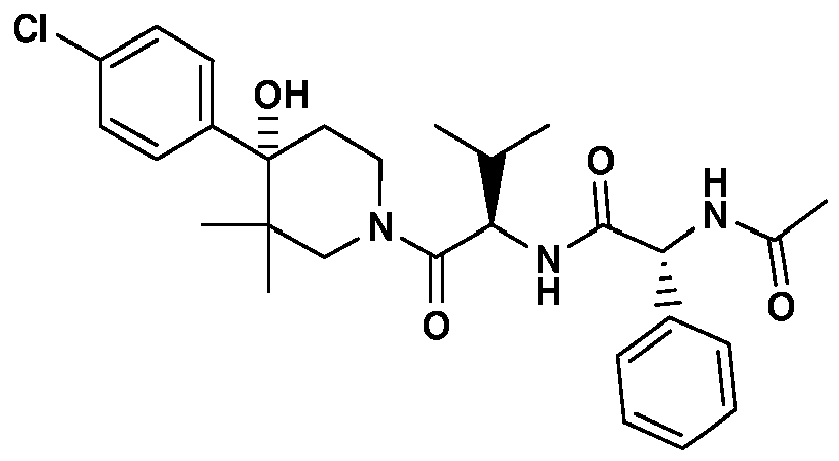
-

- To a solution of (R)-2-amino-1-((S)-4-(4-chlorophenyl)-4-hydroxy-3,3-dimethylpiperidin-1-yl)-3-methylbutan-1-one hydrochloride (30.0 mg, 0.080 mmol), Boc-D-phenyl glycine (22.1 mg, 0.088 mmol), HOBt (13.5 mg, 0.088 mmol), and EDC (16.9 mg, 0.088 mmol) in DMF was added DIPEA (0.031 mL, 0.176 mmol The reaction mixture was stirred for 2 h then added water (1 mL) slowly. The precipitated solids were stirred for 2h, filtered and dried under high vacuum. The dried white solids were dissolved in CH2Cl2 (0.25 mL), added TFA (0.1 mL) and stirred for 4h. The solvents were removed via N2 sweep and the product purified by preparative HPLC to afford (R)-2-amino-N-((R)-1-((S)-4-(4-chlorophenyl)-4-hydroxy-3,3-dimethylpiperidin-1-yl)-3-methyl-1-oxobutan-2-yl)-2-phenylacetamide, TFA (21.7 mg, 46% yield) as a white solid. HPLC purity: 95.2%, 3.14 min; MS found: 410.27 (M+)+.
- To a solution of (R)-2-amino-N-((R)-1-((S)-4-(4-chlorophenyl)-4-hydroxy-3,3-dimethylpiperidin-1-yl)-3-methyl-1-oxobutan-2-yl)-2-phenylacetamide, TFA, (6.9 mg, 0.012 mmol) in CH2Cl2 (0.2 mL) was added Ac2O (1.3 µL, 0.014 mmol) followed by DIPEA (4.1 µL, 0.024 mmol). The reaction was concentrated and purified via prep TLC to afford Example 529 (4 mg, 66.1 % yield) after drying. HPLC purity: >99%, tr 3.67 min; MS found: 514.21 (M+)+.
-

- (R)-2-Amino-1-((S)-4-(4-chlorophenyl)-4-hydroxy-3,3-dimethylpiperidin-1-yl)-3-methylbutan-1-one, HCl (25 mg, 0.067 mmol) was stirred in THF (2 mL) and methylene chloride (2 mL) at 25 °C then triethylamine (0.019 mL, 0.13 mmol) was added followed by phenyl isocyanate (0.015 mL, 0.13 mmol). The reaction was stirred overnight then purified over silica gel (3:1 1 to 1:1 hexanes/EtOAc to 100% THF) to obtain Example 530 (9.0 mg, 0.020 mmol, 29.5 % yield). MS found: (M + H)+ = 458.28.
-
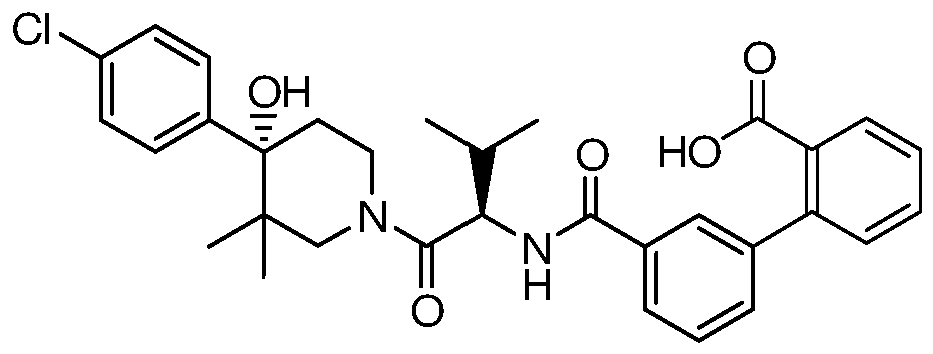
-

- (R)-2-Amino-1-((S)-4-(4-chlorophenyl)-4-hydroxy-3,3-dimethylpiperidin-1-yl)-3-methylbutan-1-one (40 mg, 0.107 mmol), 2'-(methoxycarbonyl)biphenyl-3-carboxylic acid (33 mg, 0.128 mmol), HOBT (20 mg, 0.128 mmol), EDC (25 mg, 0.128 mmol) and triethylamine (0.030 mL, 0.213 mmol) were mixed in methylene chloride (3 mL) at 25 °C with stirring. The reaction was stirred for 20 hours then worked up by adding methylene chloride and washing with sat'd sodium bicarbonate. The methylene chloride layer was dried over sodium sulfate and concentrated in vacuo to give a white glass which was purified over silica gel (3:1 to 1:1 Hexanes/EtOAc) to obtain methyl 3'-((R)-1-((S)-4-(4-chlorophenyl)-4-hydroxy-3,3-dimethylpiperidin-1-yl)-3-methyl-1-oxobutan-2-ylcarbamoyl)biphenyl-2-carboxylate (40 mg, 0.069 mmol, 65.0 % yield) as a white glass. MS found: (M + H)+ = 577.31.
- Methyl 3'-((R)-1-((S)-4-(4-chlorophenyl)-4-hydroxy-3,3-dimethylpiperidin-1-yl)-3-methyl-1-oxobutan-2-ylcarbamoyl)biphenyl-2-carboxylate (35 mg, 0.061 mmol) was dissolved in MeOH (3 mL) and added 1N NaOH (0.12 mL, 0.12 mmoL and stirred at 25 °C overnight. The MeOH was removed in vacuo and the aqueous was washed 2 times with diethyl ether. The basic aqueous was acidified to pH = 3 with 1N HCl, then extracted 2 times with methylene chloride to give Example 531 (30 mg, 0.053 mmol, 88.0 % yield) as a white glass product. MS found: (M + H)+ = 563.30.
-

-

- (S)-4-(4-chlorophenyl)-3,3-dimethylpiperidin-4-ol (100 mg, 0.417 mmol), (R)-2-(tert-butoxycarbonyl(methyl)amino)-3-methylbutanoic acid (116 mg, 0.501 mmol), HOBT (77 mg, 0.501 mmol), EDC (96 mg, 0.501 mmol) and triethylamine (0.116 mL, 0.834 mmol) were mixed in methylene chloride (3 mL) at 25 °C with stirring. The reaction was stirred for 20 hours then washed with sat'd sodium bicarbonate. The methylene chloride layer was dried over sodium sulfate and concentrated in vacuo to give a white glass which was purified over silica gel (9:1 to 3:1 to 1:1 Hexanes/EtOAc) to obtain tert-butyl (R)-1-((S)-4-(4-chlorophenyl)-4-hydroxy-3,3-dimethylpiperidin-1-yl)-3-methyl-1-oxobutan-2-yl(methyl)carbamate (190 mg, 0.417 mmol, 100 % yield) as a white glass. MS found: (M + H)+ = 453.15.
-

- tert-Butyl (R)-1-((S)-4-(4-chlorophenyl)-4-hydroxy-3,3-dimethylpiperidin-1-yl)-3-methyl-1-oxobutan-2-yl(methyl)carbamate (190 mg, 0.42 mmol) was dissolved in dioxane (3 mL) at 25 °C with stirring then 4N HCl in dioxane (0.524 mL, 2.10 mmol) was added. The reaction was stirred for 20 then concentrated to obtain (R)-1-((S)-4-(4-chlorophenyl)-4-hydroxy-3,3-dimethylpiperidin-1-yl)-3-methyl-2-(methylamino)butan-1-one, HCl (150 mg, 0.39 mmol, 92 % yield) as a white solid. MS found: (M + H)+ = 353.22.
- (R)-1-((S)-4-(4-Chlorophenyl)-4-hydroxy-3,3-dimethylpiperidin-1-yl)-3-methyl-2-(methylamino)butan-1-one, HCl (30 mg, 0.077 mmol), cyclopentanecarboxylic acid (11 mg, 0.092 mmol), HOBT (15 mg, 0.092 mmol), EDC (18 mg, 0.092 mmol) and triethylamine (0.021 mL, 0.154 mmol) were mixed in methylene chloride (3 mL) at 25 °C with stirring. The reaction was stirred for 20 hours then washed with sat'd sodium bicarbonate. The methylene chloride layer was dried over sodium sulfate and concentrated in vacuo to give a white glass which was purified over silica gel (3:1 to 1:1 Hexanes/EtOAc) to obtain Example 532 (25 mg, 0.056 mmol, 72.3 % yield) as a white glass. MS found: (M + H)+ = 449.20.
-

-
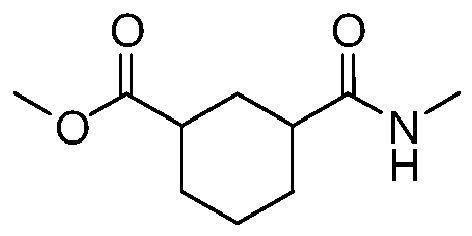
- (±)- cis-3-(Methoxycarbonyl)cyclohexanecarboxylic acid (500 mg, 2.69 mmol), methylamine, HCl (218 mg, 3.22 mmol), HOBT (493 mg, 3.22 mmol), EDC (618 mg, 3.22 mmol) and triethylamine (0.75 mL, 5.37 mmol) were mixed and stirred in methylene chloride (10mL) at 25 °C. The reaction was stirred overnight then washed with 1N HCl, sat'd sodium bicarbonate, and brine. The organic layer was dried over sodium sulfate and concentrated in vacuo to give (±)- cis-3-(methyl 3-(methylcarbamoyl) cyclohexanecarboxylate (460 mg, 2.309 mmol, 86 % yield) as a white glass. MS found: (M + H)+ = 200.10.
-

- (±)- cis-Methyl 3-(methylcarbamoyl)cyclohexanecarboxylate (460 mg, 2.309 mmol) was dissolved in Acetonitrile (5 mL) at 25 °C under nitrogen with stirring, then sodium azide (150 mg, 2.309 mmol)was added. Cooled to 0 °C then added trifluoromethanesulfonic anhydride (0.390 mL, 2.309 mmol) dropwise over 2 minutes. The reaction was a colorless solution. Stirred for 20 hours then added sat'd sodium bicarbonate and stirred for 15 minutes, then added a little EtOAc and concentrated in vacuo the acetonitrile. Added more EtOAc and separated the layers. The EtOAc layer was rinsed again with sat'd sodium bicarbonate then 1 time with brine. The EtOAc layer was dried over sodium sulfate and stripped to give of a colorless oil. Obtained (±)- cis-methyl 3-(1-methyl-1H-tetrazol-5-yl)cyclohexanecarboxylate (350 mg, 1.561 mmol, 68 % yield) as a colorless oil for product. MS found: (M + H)+ = 225.00.
-

- (±)- cis-Methyl 3-(1-methyl-1H-tetrazol-5-yl)cyclohexanecarboxylate (350 mg, 1.56 mmol) was dissolved in MeOH (3 mL) at 25 °C with stirring then 1.000 N NaOH (3.12 mL, 3.12 mmol) was added. Stirred for 3 hours then worked up by adding a little water then concentrating in vacuo the methanol. The pH was adjusted to = 3 with conc. HCl. No solids formed. The acidic aqueous was extracted 3 times with methylene chloride. The methylene chloride extracts were combined, dried (sodium sulfate) and concentrated in vacuo to give (±)- cis-3-(1-methyl-1H-tetrazol-5-yl)cyclohexanecarboxylic (230 mg, 1.094 mmol, 70 % yield) of a white solid as product. MS found: (M + H)+ = 211.10.
-

- (R)-2-Amino-1-((S)-4-(4-chlorophenyl)-4-hydroxy-3,3-dimethylpiperidin-1-yl)-3-methylbutan-1-one (25 mg, 0.067 mmol), (±)- cis-3-(1-methyl-1H-tetrazol-5-yl)cyclohexanecarboxylic acid (17 mg, 0.080 mmol), HOBT (12 mg, 0.080 mmol), EDC (15 mg, 0.080 mmol) and triethylamine (0.019 mL, 0.133 mmol) were mixed in methylene chloride (3 mL) at 25 °C with stirring. The reaction was stirred for 20 hours then washed with sat'd sodium bicarbonate. The methylene chloride layer was dried over sodium sulfate and concentrated in vacuo to give a white glass which was purified over silica gel (1:1 Hexanes/EtOAc to 100% EtOAc to 4:1 methylene chloride) to obtain (±)- cis-N-((R)-1-((S)-4-(4-chlorophenyl)-4-hydroxy-3,3-dimethylpiperidin-1-yl)-3-methyl-1-oxobutan-2-yl)-3-(1-methyl-1H-tetrazol-5-yl)cyclohexanecarboxamide (35 mg, 0.066 mmol, 99 % yield) as a white glass. MS found: (M + H)+ = 531.46.
- (±)- cis-N-((R)-1-((S)-4-(4-chlorophenyl)-4-hydroxy-3,3-dimethylpiperidin-1-yl)-3-methyl-1-oxobutan-2-yl)-3-(1-methyl-1H-tetrazol-5-yl)cyclohexanecarboxamide was separated by SFC HPLC to give Example 533A (4.0 mg, 7.53 µmol), white solids for product, MS found: (M + H)+ = 531.43 and Example 533B (4.0 mg, 7.53 µmol), white solids for product. MS found: (M + H)+ = 531.43.
-
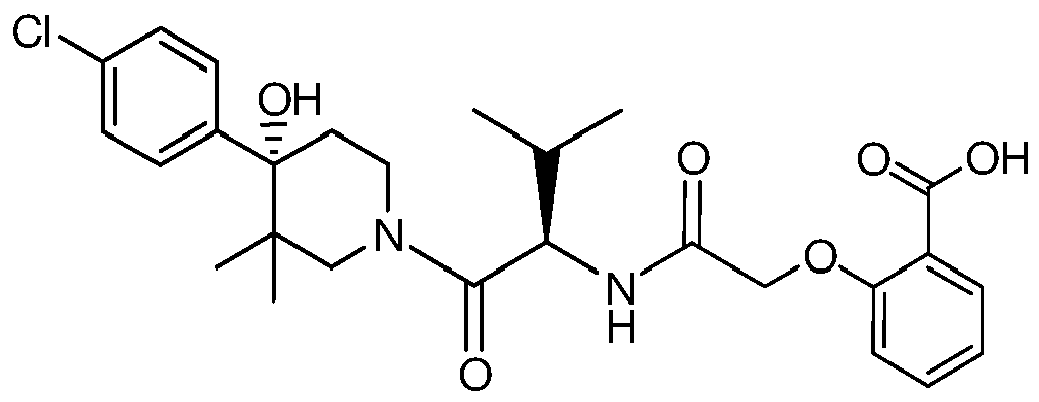
-

- (R)-2-Amino-1-((S)-4-(4-chlorophenyl)-4-hydroxy-3,3-dimethylpiperidin-1-yl)-3-methylbutan-1-one, HCl (100 mg, 0.266 mmol), triethylamine (0.074 mL, 0.533 mmol) and methylene chloride (5 mL) were mixed and stirred at 25 °C then 2-chloroacetyl chloride (0.021 mL, 0.266 mmol) in 1 mL of methylene chloride was added dropwise. The reaction was stirred for 1 hour then concentrated in vacuo to give 2-chloro-N-((R)-1-((S)-4-(4-chlorophenyl)-4-hydroxy-3,3-dimethylpiperidin-1-yl)-3-methyl-1-oxobutan-2-yl)acetamide (90 mg, 0.218 mmol, 82 % yield) as a tan solid. MS found: (M + H)+ = 415.46. The product was used without further purification.
-

- 2-Chloro-N-((R)-1-((S)-4-(4-chlorophenyl)-4-hydroxy-3,3-dimethylpiperidin-1-yl)-3-methyl-1-oxobutan-2-yl)acetamide (35 mg, 0.084 mmol), potassium carbonate (35 mg, 0.253 mmol), methyl 2-hydroxybenzoate (13 mg, 0.084 mmol) and DMSO (3 mL) were mixed with stirring at 25 °C. The reaction was stirred for 20 hours, diluted with EtOAc, and then rinsed 4 times with water. The organic layer was dried over sodium sulfate and concentrated in vacuo to give an amber oil which was purified over silica gel in (3:1 1 to 1:1 hexanes/EtOAc to 100% EtOAc) to obtain methyl 2-(2-((R)-1-((S)-4-(4-chlorophenyl)-4-hydroxy-3,3-dimethylpiperidin-1-yl)-3-methyl-1-oxobutan-2-ylamino)-2-oxoethoxy)benzoate (18 mg, 0.034 mmol, 40 % yield) as a white glass. MS found: (M + H)+ = 531.21.
- Methyl2-(2-((R)-1-((S)-4-(4-chlorophenyl)-4-hydroxy-3,3-dimethylpiperidin-1-yl)-3-methyl-1-oxobutan-2-ylamino)-2-oxoethoxy)benzoate (18 mg, 0.034 mmol) was dissolved in Methanol (2 mL) at 25 °C with stirring then 1.0 N NaOH (0.068 mL, 0.068 mmol) was added. The reaction was stirred 20 hours, added water, then concentrated to remove the MeOH. The basic aqueous was acidified to pH = 3 with 1N HCl, then extracted with methylene chloride. The organic layers were combined, dried over sodium sulfate and concentrated in vacuo to give Example 534 (11 mg, 0.021 mmol, 62 % yield) as a white solid. MS found: (M + H)+ = 517.35.
-

-

- (R)-2-amino-1-((S)-4-(4-chlorophenyl)-4-hydroxy-3,3-dimethylpiperidin-1-yl)-3-methylbutan-1-one, HCl (100 mg, 0.266 mmol), (R)-1-(tert-butoxycarbonyl)piperidine-3-carboxylic acid (73 mg, 0.320 mmol), HOBT (49 mg, 0.320 mmol), EDC (61 mg, 0.320 mmol) and triethylamine (0.074 mL, 0.533 mmol) were mixed in methylene chloride (3 mL) at 25 °C with stirring. The reaction was stirred for 20 hours then washed with sat'd sodium bicarbonate. The methylene chloride layer was dried over sodium sulfate and concentrated in vacuo to give a white glass which was purified over silica gel (1:1 Hexanes/EtOAc to 100% EtOAc to 4:1 methylene chloride/MeOH) to obtain (R)-tert-butyl 3-((R)-1-((S)-4-(4-chlorophenyl)-4-hydroxy-3,3-dimethylpiperidin-1-yl)-3-methyl-1-oxobutan-2-ylcarbamoyl)piperidine-1-carboxylate (125 mg, 227 mmol, 85% yield) as a white solid. MS found: (M + H)+ = 550.52.
-

- (R)-tert-butyl 3-((R)-1-((S)-4-(4-chlorophenyl)-4-hydroxy-3,3-dimethylpiperidin-1-yl)-3-methyl-1-oxobutan-2-ylcarbamoyl)piperidine-1-carboxylate (125 mg, 0.23 mmol) was stirred in Dioxane (2) at 25 °C under nitrogen then 4N HCl in dioxane (0.284 mL, 1.14 mmol) added. The reaction was stirred for 3 hours then concentrated to obtain (R)-N-((R)-1-((S)-4-(4-chlorophenyl)-4-hydroxy-3,3-dimethylpiperidin-1-yl)-3-methyl-1-oxobutan-2-yl)piperidine-3-carboxamide, HCl (100 mg, 0.206 mmol, 90 % yield) as a white glass. MS found: (M + H)+ = 450.23.
- (R)-N-((R)-1-((S)-4-(4-chlorophenyl)-4-hydroxy-3,3-dimethylpiperidin-1-yl)-3-methyl-1-oxobutan-2-yl)piperidine-3-carboxamide, HCl (30 mg, 0.062 mmol), 4-amino-4-oxobutanoic acid (9 mg, 0.074 mmol), HOBT (11 mg, 0.074 mmol), EDC (14 mg, 0.074 mmol) and triethylamine (0.017 mL, 0.124 mmol) were mixed in methylene chloride (3 mL) at 25 °C with stirring. The reaction was stirred for 20 hours then washed with sat'd sodium bicarbonate. The methylene chloride layer was dried over sodium sulfate and concentrated in vacuo to give a white glass which was purified over silica gel (100% EtOAc to 4:1 methylene chloride) to obtain Example 535 (24 mg, 0.044 mmol, 70 % yield) as a white glass. MS found: (M + H)+ = 549.48.
-

-

- (R)-2-amino-1-((S)-4-(4-chlorophenyl)-4-hydroxy-3,3-dimethylpiperidin-1-yl)-3-methylbutan-1-one (500 mg, 1.33 mmol), triethylamine (0.371 mL, 2.66 mmol) and methylene chloride (10 mL) were mixed at 0 °C under nitrogen then a methylene chloride solution of phenyl carbonochloridate (209 mg, 1.33 mmol) was added dropwise via an addition funnel. The reaction was stirred for 1 hour, diluted with EtOAc, and washed consecutively with 1N HCl and sat'd sodium bicarbonate. The organic layer was dried over sodium sulfate and concentrated in vacuo to give a white glass which was purified over silica gel (3:1 to 1:1 hexanes/EtOAc) to obtain phenyl (R)-1-((S)-4-(4-chlorophenyl)-4-hydroxy-3,3-dimethylpiperidin-1-yl)-3-methyl-1-oxobutan-2-ylcarbamate (365 mg, 0.795 mmol, 59 % yield) as a white glass. MS found: (M + H)+ = 459.32.
- Phenyl (R)-1-((S)-4-(4-chlorophenyl)-4-hydroxy-3,3-dimethylpiperidin-1-yl)-3-methyl-1-oxobutan-2-ylcarbamate (30 mg, 0.065 mmol), (1S,3S)-3-aminocyclopentanol (7 mg, 0.065 mmol) and triethylamine (0.018 mL, 0.131 mmol) were mixed in acetonitrile (3 mL) at 25 °C then heated in a microwave reactor at 150 °C for 30 minutes. The solvent was concentrated in vacuo then the residue purified over silica gel (1:1 hexanes/EtOAc to 100% EtOAc to 1:1 methylene chloride/MeOH) to obtain Example 536 (20 mg, 0.043 mmol, 65% yield) as a white glass. MS found: (M + H)+ = 466.37.
-

-

- (R)-2-amino-1-((S)-4-(4-chlorophenyl)-4-hydroxy-3,3-dimethylpiperidin-1-yl)-3-methylbutan-1-one, HCl (50 mg, 0.133 mmol), 3,3-dimethyldihydro-2H-pyran-2,6(3H)-dione (19 mg, 0.133 mmol) and triethylamine (0.037 mL, 0.266 mmol) were mixed in methylene chloride (3 mL) at 25 °C with stirring. The reaction was stirred for 20 hours, concentrated in vacuo, and purified over silica gel (1:1 hexanes/EtOAc to 100% EtOAc to 4:1 methylene chloride/MeOH) to obtain 5-((R)-1-((S)-4-(4-chlorophenyl)-4-hydroxy-3,3-dimethylpiperidin-1-yl)-3-methyl-1-oxobutan-2-ylamino)-2,2-dimethyl-5-oxopentanoic acid (50 mg, 0.104 mmol, 78 % yield) as a white glass. MS found: (M + H)+ = 481.34.
- 5-((R)-1-((S)-4-(4-chlorophenyl)-4-hydroxy-3,3-dimethylpiperidin-1-yl)-3-methyl-1-oxobutan-2-ylamino)-2,2-dimethyl-5-oxopentanoic acid (25 mg, 0.052 mmol), ammonium chloride (14 mg, 0.260 mmol), HOBT (10 mg, 0.062 mmol), EDC (12 mg, 0.062 mmol) and triethylamine (7.24 µl, 0.052 mmol) were mixed in acetonitrile (2 mL) at 25 °C with stirring. The reaction was stirred for 20 hours, concentrated, and then methylene chloride was added. The methylene chloride layer was washed with sat'd sodium bicarbonate, dried over sodium sulfate, and concentrated in vacuo to give a white glass which was purified over silica gel (1:1 Hexanes/EtOAc to 100% EtOAc to 4:1 methylene chloride/MeOH) to obtain Example 537 (22 mg, 0.046 mmol, 88 % yield) as a white glass. MS found: (M + H+ = 480.29.
-

-

- Followed the procedure of Example 535, Step 1, using (R)-1-(tert-butoxycarbonyl)pyrrolidine-3-carboxylic acid (0.69 g, 3.20 mmol), (R)-tert-butyl3-((R)-1-((S)-4-(4-chlorophenyl)-4-hydroxy-3,3-dimethylpiperidin-1-yl)-3-methyl-1-oxobutan-2-ylcarbamoyl)pyrrolidine-1-carboxylate (1.1 g, 2.05 mmol, 77 % yield) was obtained as a white glass. MS found: (M + H)+ = 436.43.
-

- Followed the procedure of Example 535, Step 2, using (R)-tert-butyl 3-((R)-1-((S)-4-(4-chlorophenyl)-4-hydroxy-3,3-dimethylpiperidin-1-yl)-3-methyl-1-oxobutan-2-ylcarbamoyl)pyrrolidine-1-carboxylate (1.1 g, 2.052 mmol), (R)-N-((R)-1-((S)-4-(4-chlorophenyl)-4-hydroxy-3,3-dimethylpiperidin-1-yl)-3-methyl-1-oxobutan-2-yl)pyrrolidine-3-carboxamide, HCl (1.0 g, 2.12 mmol, 100 % yield) was obtained as a white solid. MS found: (M + H)+ = 436.28.
- (R)-N-((R)-1-((S)-4-(4-chlorophenyl)-4-hydroxy-3,3-dimethylpiperidin-1-yl)-3-methyl-1-oxobutan-2-yl)pyrrolidine-3-carboxamide, HCl (40 mg, 0.085 mmol) was stirred in acetic acid (3 mL) at 25 °C then sodium cyanate (6.60 mg, 0.102 mmol) was added. After stirring for 2 hours, the reaction was heated at 50 ° C for 20 hours. The pH was adjusted to pH = 7-8 with 1N NaOH and the aqueous was then extracted with EtOAc. The EtOAc layers were combined, washed with sat'd sodium bicarbonate, dried (sodium sulfate) and concentrated in vacuo to give a tan glass which was purified over silica gel (1:1 hexanes/EtOAc to 100% EtOAc to 4:1 methylene chloride/MeOH) to obtain Example 538 (10 mg, 0.021 mmol, 24 % yield) as a white solid. MS found: (M + H)+ = 479.37.
-

-

- Piperazine-2-carboxylic acid, 2HCl (200 mg, 0.985 mmol), triethylamine (0.137 mL , 0.985 mmol) and acetic anhydride (0.093 mL, 0.985 mmol) were mixed in methylene chloride (3 mL) at 25 °C with stirring. Added 1 mL of 4N HCl in dioxane, then concentrated in vacuo 3 times from methylene chloride/MeOH to give of white solids. MS found: (M + H)+ = 215.24. The product was used without further purification.
- (R)-2-Amino-1-((S)-4-(4-chlorophenyl)-4-hydroxy-3,3-dimethylpiperidin-1-yl)-3-methylbutan-1-one (30 mg, 0.080 mmol), 1,4-diacetylpiperazine-2-carboxylic acid (21 mg, 0.096 mmol), HOBT (15 mg, 0.096 mmol), EDC (18 mg, 0.096 mmol) and triethylamine (0.022 mL, 0.160 mmol) were mixed in methylene chloride (3 mL) at 25 °C with stirring. The reaction was stirred for 20 hours then washed with sat'd sodium bicarbonate. The methylene chloride layer was dried over sodium sulfate and concentrated in vacuo to give a white glass which was purified over silica gel (1:1 Hexanes/EtOAc to 100% EtOAc to 4:1 methylene chloride/MeOH) to obtain Example 539 (40 mg, 0.075 mmol, 94 % yield) as a white solid. MS found: (M + H)+ = 535.45.
-
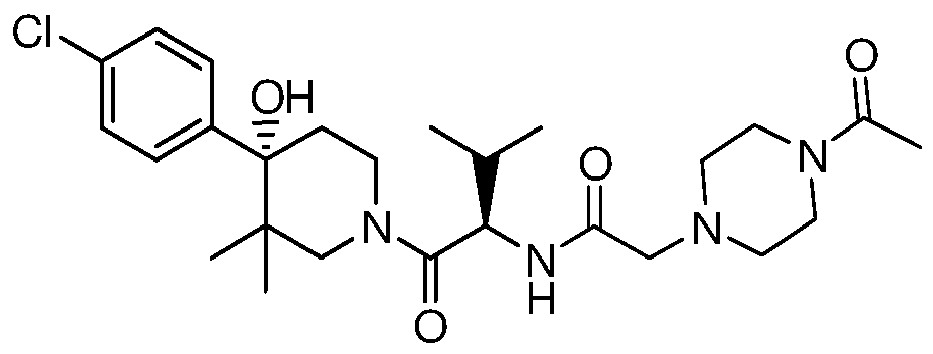
-

- Following the procedure of Example 535, Step 1, using 2-(4-(tert-butoxycarbonyl)piperazin-1-yl)acetic acid (47 mg, 0.192 mmol), tert-butyl 4-(2-((R)-1-((S)-4-(4-chlorophenyl)-4-hydroxy-3,3-dimethylpiperidin-1-yl)-3-methyl-1-oxobutan-2-ylamino)-2-oxoethyl)piperazine-1-carboxylate (47 mg, 0.083 mmol, 52% yield) was obtained as a white glass. MS found: (M + H)+ = 565.38.
-

- Followin the procedure of Example 535, Step 2, using tert-butyl 4-(2-((R)-1-((S)-4-(4-chlorophenyl)-4-hydroxy-3,3-dimethylpiperidin-1-yl)-3-methyl-1-oxobutan-2-ylamino)-2-oxoethyl)piperazine-1-carboxylate (70 mg, 0.124 mmol), N-((R)-1-((S)-4-(4-chlorophenyl)-4-hydroxy-3,3-dimethylpiperidin-1-yl)-3-methyl-1-oxobutan-2-yl)-2-(piperazin-1-yl)acetamide, HCl (60 mg, 0.120 mmol, 97% yield) was obtained as a white solid. MS found: (M + H)+ = 465.44.
- N-((R)-1-((S)-4-(4-chlorophenyl)-4-hydroxy-3,3-dimethylpiperidin-1-yl)-3-methyl-1-oxobutan-2-yl)-2-(piperazin-1-yl)acetamide, HCl (30 mg, 0.060 mmol), triethylamine (0.042 mL, 0.299 mmol), and acetic anhydride (0.028 ml, 0.299 mmol) were mixed in methylene chloride (3 mL) at 25 °C with stirring. The reaction was stirred for 3 hours, concentrated in vacuo, and the residue purified over silica gel (1:1 hexanes/EtOAc to 100% EtOAc to 4:1 methylene chloride/MeOH) to afford Example 540 (21 mg, 0.041 mmol, 69% yield) as a colorless oil. MS found: (M + H)+ = 507.46.
-

- 5-((R)-1-((S)-4-(4-chlorophenyl)-4-hydroxy-3,3-dimethylpiperidin-1-yl)-3-methyl-1-oxobutan-2-ylamino)-2,2-dimethyl-5-oxopentanoic acid (from Example 537, Step 1) (25 mg, 0.052 mmol), methylamine hydrochloride (4 mg, 0.062 mmol), HOBT (10 mg, 0.062 mmol), EDC (12 mg, 0.062 mmol) and triethylamine (0.014 mL, 0.104 mmol) were mixed in methylene chloride (3 mL) at 25 °C with stirring. The reaction was stirred for 20 hours then washed with sat'd sodium bicarbonate. The methylene chloride layer was dried over sodium sulfate and concentrated in vacuo to give a white glass which was purified over silica gel (1:1 Hexanes/EtOAc to 100% EtOAc to 4:1 methylene chloride) to obtain Example 541 (25 mg, 0.051 mmol, 97 % yield) as a white glass. MS found: (M + H)+ = 494.47.
-

- 5-((R)-1-((S)-4-(4-chlorophenyl)-4-hydroxy-3,3-dimethylpiperidin-1-yl)-3-methyl-1-oxobutan-2-ylamino)-2,2-dimethyl-5-oxopentanoic acid (from Example 537, Step 1) (25 mg, 0.052 mmol), 2.0 M dimethylamine in THF (0.031 mL, 0.062 mmol), HOBT (10 mg, 0.062 mmol), EDC (12 mg, 0.062 mmol) and triethylamine (0.014 mL, 0.104 mmol) were mixed in methylene chloride (3 mL) at 25 °C with stirring. The reaction was stirred for 20 hours then washed with sat'd sodium bicarbonate. The methylene chloride layer was dried over sodium sulfate and concentrated in vacuo to give a white glass which was purified over silica gel (1:1 Hexanes/EtOAc to 100% EtOAc to 4:1 methylene chloride) to obtain Example 542 (10 mg, 0.020 mmol, 38%) as a white glass. MS found: (M + H)+ = 508.49.
-

-

- Following the procedure of Example 537, Step 1, using dihydro-2H-pyran-2,6(3H)-dione (18 mg, 0.160 mmol). The solvent was evaporated then the residue purified over silica gel (1:1 hexanes/EtOAc to 100% EtOAc to 4:1 methylene chloride/MeOH) to obtain 5-((R)-1-((S)-4-(4-chlorophenyl)-4-hydroxy-3,3-dimethylpiperidin-1-yl)-3-methyl-1-oxobutan-2-ylamino)-5-oxopentanoic acid (56 mg, 0.124 mmol, 77 % yield) as a white glass. MS found: (M + H)+ = 453.35.
- 5-((R)-1-((S)-4-(4-chlorophenyl)-4-hydroxy-3,3-dimethylpiperidin-1-yl)-3-methyl-1-oxobutan-2-ylamino)-5-oxopentanoic acid (25 mg, 0.055 mmol), methylamine hydrochloride (5 mg, 0.066 mmol), HOBT (10mg, 0.066 mmol), EDC (13 mg, 0.066 mmol) and triethylamine (0.015 mL, 0.110 mmol) were mixed in methylene chloride (3 mL) at 25 °C with stirring. The reaction was stirred for 20 hours then washed with sat'd sodium bicarbonate. The methylene chloride layer was dried over sodium sulfate and concentrated in vacuo to give a white glass which was purified over silica gel (1:1 Hexanes/EtOAc to 100% EtOAc to 4:1 1 methylene chloride) to obtain Example 543 (23 mg, 0.049 mmol, 89 % yield) as a white glass. MS found: (M + H)+ = 466.41.
-

- 5-((R)-1-((S)-4-(4-chlorophenyl)-4-hydroxy-3,3-dimethylpiperidin-1-yl)-3-methyl-1-oxobutan-2-ylamino)-5-oxopentanoic acid (from Example 543, Step 1) (25 mg, 0.055 mmol), 2.0 M dimethylamine in THF (0.033 mL, 0.066 mmol), HOBT (10 mg, 0.066 mmol), EDC (13 mg, 0.066 mmol) and triethylamine (0.015 mL, 0.110 mmol) were mixed in methylene chloride (3 mL) at 25 °C with stirring. The reaction was stirred for 20 hours then washed with sat'd sodium bicarbonate. The methylene chloride layer was dried over sodium sulfate and concentrated in vacuo to give a white glass which was purified over silica gel (1:1 Hexanes/EtOAc to 100% EtOAc to 4:1 methylene chloride) to obtain Example 544 (16 mg, 0.033 mmol, 60% yield) as a white glass. MS found: (M + H)+ = 480.44.
-

- (R)-2-amino-1-((S)-4-(4-chlorophenyl)-4-hydroxy-3,3-dimethylpiperidin-1-yl)-3-methylbutan-1-one (50 mg, 0.133 mmol), oxepane-2,7-dione (20 mg, 0.160 mmol), HOBT (24 mg, 0.160 mmol), EDC (31 mg, 0.160 mmol) and triethylamine (0.037 mL, 0.266 mmol) were mixed in methylene chloride (3 mL) at 25 °C with stirring. The reaction was stirred for 20 hours and then the solvent was evaporated. The resulting residue was purified over silica gel (100% EtOAc to 4:1 methylene chloride/MeOH) to obtain Example 545 (50 mg, 0.107 mmol, 80 % yield) as a white glass. MS found: (M + H)+ = 467.38.
-

-

- Following the procedure of Example 535, Step 1, using 1-(tert-butoxycarbonyl)azetidine-3-carboxylic acid (32 mg, 0.160 mmol), tert-butyl 3-((R)-1-((S)-4-(4-chlorophenyl)-4-hydroxy-3,3-dimethylpiperidin-1-yl)-3-methyl-1-oxobutan-2-ylcarbamoyl)azetidine-1-carboxylate (50 mg, 0.096 mmol, 71 % yield) was obtained as a white glass. MS found: (M + H)+ = 522.39.
-

- Following the procedure of Example 535, Step 2, using tert-butyl 3-((R)-1-((S)-4-(4-chlorophenyl)-4-hydroxy-3,3-dimethylpiperidin-1-yl)-3-methyl-1-oxobutan-2-ylcarbamoyl)azetidine-1-carboxylate (45 mg, 0.086 mmol), N-((R)-1-((S)-4-(4-chlorophenyl)-4-hydroxy-3,3-dimethylpiperidin-1-yl)-3-methyl-1-oxobutan-2-yl)azetidine-3-carboxamide, HCl (39 mg, 0.085 mmol, 99 % yield) was obtained as a white glass. MS found: (M + H)+ = 422.32.
- Following the procedure of Example 539, Step 1 using acetic anhydride (0.036 mL, 0.382 mmol), Example 546 (6.0 mg, 10.38 µmol, 13 % yield) was obtained as a white solid after purification by LCMS HPLC. MS found: (M + H)+ = 464.29.
-
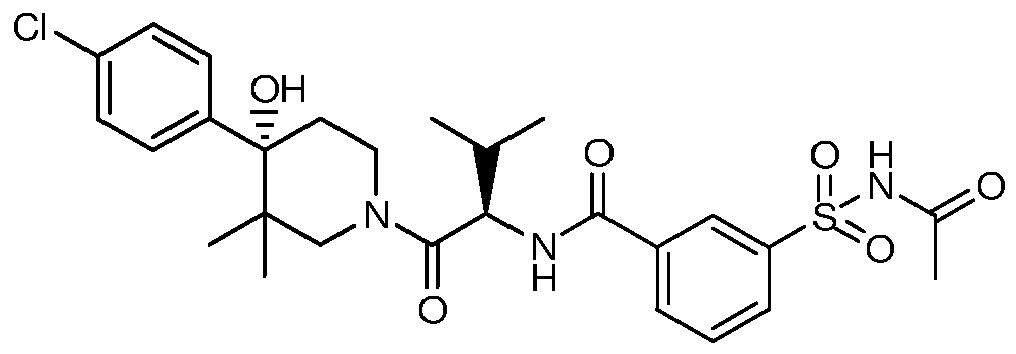
-

- (R)-2-Amino-1-((S)-4-(4-chlorophenyl)-4-hydroxy-3,3-dimethylpiperidin-1-yl)-3-methylbutan-1-one (200 mg, 0.533 mmol), 3-sulfamoylbenzoic acid (129 mg, 0.639 mmol), HOBT (98 mg, 0.639 mmol), EDC (123 mg, 0.639 mmol) and triethylamine (0.149 mL, 1.066 mmol) were mixed in methylene chloride (3 mL) at 25 °C with stirring. The reaction was stirred for 20 hours then washed with sat'd sodium bicarbonate. The methylene chloride layer was dried over sodium sulfate and concentrated in vacuo to give a white glass which was purified over silica gel (1:1 Hexanes/EtOAc to 100% EtOAc) to obtain N-((R)-1-((S)-4-(4-chlorophenyl)-4-hydroxy-3,3-dimethylpiperidin-1-yl)-3-methyl-1-oxobutan-2-yl)-3-sulfamoylbenzamide (197 mg, 0.377 mmol, 70% yield) as a white glass. MS found: (M + H)+ = 522.32.
- N-((R)-1-((S)-4-(4-chlorophenyl)-4-hydroxy-3,3-dimethylpiperidin-1-yl)-3-methyl-1-oxobutan-2-yl)-3-sulfamoylbenzamide (40 mg, 0.077 mmol), acetic acid (5.70 µl, 0.100 mmol), DMAP (12 mg, 0.100 mmol), EDC (19 mg, 0.100 mmol) and triethylamine (0.021 mL, 0.153 mmol) were mixed and stirred in methylene chloride (3 mL). The reaction was stirred for 20 hours then washed with 1N HCl (2x) and brine. The organic layer was dried over sodium sulfate and concentrated in vacuo and purified over silica gel (1:1 hexanes/EtOAc to 100% EtOAc) to obtain Example 547 (27 mg, 0.048 mmol, 62 % yield) as a white glass. MS found: (M + H)+ = 564.36.
-

- Following the procedure of Example 547, Step 2, using propionic acid (7.38 mg, 0.100 mmol), Example 548 (25 mg, 0.043 mmol, 56 % yield) was obtained as a white glass. MS found: (M + H)+ = 578.38.
-

- Following the procedure of Example 547, Step 2, using benzoic acid (12 mg, 0.100 mmol), Example 549 (35 mg, 0.056 mmol, 73.0 % yield) was obtained as a white glass. MS found: (M + H)+ = 626.40.
-

-

- Following the procedure of Example 535, Step 1, using (S)-2-(1-(tert-butoxycarbonyl)pyrrolidin-3-yl)acetic acid (37 mg, 0.160 mmol), (S)-tert-butyl 3-(2-((R)-1-((S)-4-(4-chlorophenyl)-4-hydroxy-3,3-dimethylpiperidin-1-yl)-3-methyl-1-oxobutan-2-ylamino)-2-oxoethyl)pyrrolidine-1-carboxylate (60 mg, 0.109 mmol, 82 % yield) was obtained as a white glass. MS found: (M + H)+ = 550.48.
-

- Following the procedure of Example 535, Step 2, using (S)-tert-butyl 3-(2-((R)-1-((S)-4-(4-chlorophenyl)-4-hydroxy-3,3-dimethylpiperidin-1-yl)-3-methyl-1-oxobutan-2-ylamino)-2-oxoethyl)pyrrolidine-1-carboxylate (55 mg, 0.100 mmol), N-((R)-1-((S)-4-(4-chlorophenyl)-4-hydroxy-3,3-dimethylpiperidin-1-yl)-3-methyl-1-oxobutan-2-yl)-2-((S)-pyrrolidin-3-yl)acetamide, HCl (45 mg, 0.093 mmol, 93% yield) was obtained as a white solid. MS found: (M + H)+ = 450.35.
- Following the procedure of Example 537, Step 1 using acetic anhydride (0.039 ml, 0.411 mmol), Example 550 (40 mg, 0.081 mmol, 99% yield) was obtained as a white glass. MS found: (M + H)+ = 492.39.
-

-

- Following the procedure of Example 535, Step 1, using (R)-2-(1-(tert-butoxycarbonyl)pyrrolidin-3-yl)acetic acid (37 mg, 0.160 mmol), (R)-tert-butyl 3-(2-((R)-1-((S)-4-(4-chlorophenyl)-4-hydroxy-3,3-dimethylpiperidin-1-yl)-3-methyl-1-oxobutan-2-ylamino)-2-oxoethyl)pyrrolidine-1-carboxylate (60 mg, 0.109 mmol, 82 % yield) was obtained as a white glass. MS found: (M + H)+ = 550.42.
-

- Following the procedure of Example 535, Step 2, using (R)-tert-butyl 3-(2-((R)-1-((S)-4-(4-chlorophenyl)-4-hydroxy-3,3-dimethylpiperidin-1-yl)-3-methyl-1-oxobutan-2-ylamino)-2-oxoethyl)pyrrolidine-1-carboxylate (55 mg, 0.100 mmol), N-((R)-1-((S)-4-(4-chlorophenyl)-4-hydroxy-3,3-dimethylpiperidin-1-yl)-3-methyl-1-oxobutan-2-yl)-2-((R)-pyrrolidin-3-yl)acetamide, HCl (45 mg, 0.093 mmol, 93 % yield) was obtained as a white solid. MS found: (M + H)+ = 450.37.
- Following the procedure of Example 537, Step 1 using acetic anhydride (0.039 ml, 0.411 mmol), Example 551 (40 mg, 0.081 mmol, 99 % yield) was obtained as a white glass. MS found: (M + H)+ = 492.39.
-

-

- Following the procedure of Example 535, Step 1, using (S)-2-(1-(tert-butoxycarbonyl)pyrrolidin-2-yl)acetic acid (37 mg, 0.160 mmol), (S)-tert-butyl 2-(2-((R)-1-((S)-4-(4-chlorophenyl)-4-hydroxy-3,3-dimethylpiperidin-1-yl)-3-methyl-1-oxobutan-2-ylamino)-2-oxoethyl)pyrrolidine-1-carboxylate (60 mg, 0.109 mmol, 82 % yield) was obtained as a white glass. MS found: (M + H)+ = 550.42.
-

- Following the procedure of Example 535, Step 2, using (S)-tert-butyl 2-(2-((R)-1-((S)-4-(4-chlorophenyl)-4-hydroxy-3,3-dimethylpiperidin-1-yl)-3-methyl-1-oxobutan-2-ylamino)-2-oxoethyl)pyrrolidine-1-carboxylate (55 mg, 0.100 mmol), N-((R)-1-((S)-4-(4-chlorophenyl)-4-hydroxy-3,3-dimethylpiperidin-1-yl)-3-methyl-1-oxobutan-2-yl)-2-((S)-pyrrolidin-2-yl)acetamide, HCl (48 mg, 0.099 mmol, 99 % yield) was obtained as a white glass. MS found: (M + H)+ = 450.39.
- Following the procedure of Example 537, Step 1 using acetic anhydride (0.024 ml, 0.257 mmol), Example 552 (20 mg, 0.041 mmol, 79 % yield) was obtained as a white glass. MS found: (M + H)+ = 492.40.
-

- (R)-2-amino-1-((S)-4-(4-chlorophenyl)-4-hydroxy-3,3-dimethylpiperidin-1-yl)-3-methylbutan-1-one, HCl (30 mg, 0.080 mmol), 2'-ureidobiphenyl-3-carboxylic acid (25 mg, 0.096 mmol), HOBT (15 mg, 0.096 mmol), EDC (18 mg, 0.096 mmol) and triethylamine (0.022 mL, 0.160 mmol) were mixed in methylene chloride (3 mL) at 25 °C with stirring. The reaction was stirred for 20 hours then washed with sat'd sodium bicarbonate. The methylene chloride layer was dried over sodium sulfate and concentrated in vacuo to give a white glass which was purified over silica gel (1:1 Hexanes/EtOAc to 100% EtOAc to 4:1 methylene chloride/MeOH) to obtain Example 553 (40 mg, 0.069 mmol, 87 % yield) as a tan solid. MS found: (M + H)+ = 577.39.
-

-

- (R)-2-Amino-1-((S)-4-(4-chlorophenyl)-4-hydroxy-3,3-dimethylpiperidin-1-yl)-3-methylbutan-1-one, HCl (100 mg, 0.266 mmol), 3-bromo-5-(methoxycarbonyl)benzoic acid (83 mg, 0.320 mmol), HOBT (49 mg, 0.320 mmol), EDC (61 mg, 0.320 mmol) and triethylamine (0.074 mL, 0.533 mmol) were mixed in methylene chloride (5 mL) at 25 °C with stirring. The reaction was stirred for 20 hours then washed with sat'd sodium bicarbonate. The methylene chloride layer was dried over sodium sulfate and concentrated in vacuo to give a white glass which was purified over silica gel (3:1 1 to 1:1 Hexanes/EtOAc to 100% EtOAc) to obtain methyl 3-bromo-5-((R)-1-((S)-4-(4-chlorophenyl)-4-hydroxy-3,3-dimethylpiperidin-1-yl)-3-methyl-1-oxobutan-2-ylcarbamoyl)benzoate (120 mg, 0.207 mmol, 78 % yield) as a white glass. MS found: (M + H)+ = 579.10/581.13.
-

- Methyl 3-bromo-5-((R)-1-((S)-4-(4-chlorophenyl)-4-hydroxy-3,3-dimethylpiperidin-1-yl)-3-methyl-1-oxobutan-2-ylcarbamoyl)benzoate (40 mg, 0.069 mmol) was dissolved in toluene (3 mL) at 25 °C then 2-(tributylstannyl)pyridine (76 mg, 0.207 mmol) was added. The reaction was degassed then placed under nitrogen. Tetrakis(triphenylphosphine)palladium(0) (4 mg, 3.45 µmol) was added and the reaction heated at reflux for 2 hours. The reaction was concentrated in vacuo to give a dark residue which was then dissolved in MeOH, filtered to remove insoluble material, then purified by LCMS HPLC. The obtained colorless oil was dissolved in EtOAc, dried over sodium sulfate and concentrated in vacuo to give methyl 3-((R)-1-((S)-4-(4-chlorophenyl)-4-hydroxy-3,3-dimethylpiperidin-1-yl)-3-methyl-1-oxobutan-2-ylcarbamoyl)-5-(pyridin-2-yl)benzoate (30 mg, 0.052 mmol, 75% yield) as a white glass. MS found: (M + H)+ = 578.34.
- Methyl 3-((R)-1-((S)-4-(4-chlorophenyl)-4-hydroxy-3,3-dimethylpiperidin-1-yl)-3-methyl-1-oxobutan-2-ylcarbamoyl)-5-(pyridin-2-yl)benzoate (25 mg, 0.043 mmol) was dissolved in MeOH (2 mL) at 25 °C then 1N NaOH (0.086 mL, 0.086 mmol) added with stirring. The reaction was stirred for 2 hours, diluted with water and concentrated to remove MeOH. The aqueous was acidified to pH = 3 with 1N HCl and the formed solids were extracted into methylene chloride. The organic layers were combined, dried (sodium sulfate) and concentrated in vacuo to give Example 554 (12 mg, 0.021 mmol, 49 % yield) as a white solid. MS found: (M + H)+ = 564.33.
-

-

- tert-Butyl 2-amino-2-methylpropanoate, HCl (66 mg, 0.337 mmol) and triethylamine (0.047 mL, 0.337 mmol) were mixed and stirred in THF (10 mL) at 25 °C then cooled to 0 °C and added a THF solution of phenyl carbonochloridate (53 mg, 0.337 mmol). The reaction was stirred for 20 hours, diluted with EtOAc, and washed with 1N HCl and brine. The organic layer was dried (sodium sulfate) and concentrated in vacuo to give tert-butyl 2-methyl-2-(phenoxycarbonylamino)propanoate (90 mg, 0.322 mmol, 96% yield) of a white glass as product. MS found: (M + H)+ = 280.30.
- (R)-2-amino-1-((S)-4-(4-chlorophenyl)-4-hydroxy-3,3-dimethylpiperidin-1-yl)-3-methylbutan-1-one, HCl (40 mg, 0.107 mmol), tert-butyl 2-methyl-2-(phenoxycarbonylamino)propanoate (30 mg, 0.107 mmol) and triethylamine (0.030 mL, 0.213 mmol) were mixed in acetonitrile (3 mL) at 25 °C then heated at 150 °C for 60 minutes in a microwave reactor. The reaction was concentrated in vacuo then purified over silica gel (3:1 1 to 1:1 hexanes/EtOAc to 100% EtOAc) to obtain Example 555 (40 mg, 0.076 mmol, 72 % yield) as a white glass. MS found: (M + H)+ = 524.35.
-

-

- (R)-2-amino-1-((S)-4-(4-chlorophenyl)-4-hydroxy-3,3-dimethylpiperidin-1-yl)-3-methylbutan-1-one, HCl (100 mg, 0.266 mmol), 3-bromobenzoic acid (64 mg, 0.320 mmol), HOBT (49 mg, 0.320 mmol), EDC (61 mg, 0.320 mmol) and triethylamine (0.074 mL, 0.533 mmol) were mixed in methylene chloride (5 mL) at 25 °C with stirring. The reaction was stirred for 20 hours then washed with sat'd sodium bicarbonate. The methylene chloride layer was dried over sodium sulfate and concentrated in vacuo to give a white glass which was purified over silica gel (3:1 to 1:1 Hexanes/EtOAc to 100% EtOAc) to obtain 3-bromo-N-((R)-1-((S)-4-(4-chlorophenyl)-4-hydroxy-3,3-dimethylpiperidin-1-yl)-3-methyl-1-oxobutan-2-yl)benzamide (100 mg, 0.192 mmol, 72 % yield) as a white solid. MS found: (M + H)+ = 521.1/523.1.
-

- 3-Bromo-N-((R)-1-((S)-4-(4-chlorophenyl)-4-hydroxy-3,3-dimethylpiperidin-1-yl)-3-methyl-1-oxobutan-2-yl)benzamide (50 mg, 0.096 mmol), 4-(methoxycarbonyl) phenylboronic acid (17 mg, 0.096 mmol), 1.5M cesium carbonate (0.192 ml, 0.287 mmol) and palladium(II) acetate (1.08 mg, 4.79 µmol) were dissolved in DMF (3 mL) in a microwave tube at 25 °C then heated at 60 °C for 30 minutes. The reaction was diluted with EtOAc then washed with water (4x). The organic layer was dried (sodium sulfate) and concentrated in vacuo to give methyl 3'-((R)-1-((S)-4-(4-chlorophenyl)-4-hydroxy-3,3-dimethylpiperidin-1-yl)-3-methyl-1-oxobutan-2-ylcarbamoyl)biphenyl-4-carboxylate (44 mg, 0.076 mmol, 80% yield) as a white solid. MS found: (M + H)+ = 577.32.
- Methyl 3'-((R)-1-((S)-4-(4-chlorophenyl)-4-hydroxy-3,3-dimethylpiperidin-1-yl)-3-methyl-1-oxobutan-2-ylcarbamoyl)biphenyl-4-carboxylate (40 mg, 0.069 mmol) was dissolved in MeOH (3 ml) and added 1N NaOH (0.14 mL, 0.14 mmol) at 25 °C and stirred over the weekend. The MeOH was removed in vacuo and the aqueous was acidified to pH = 3 with 1N HCl. The formed solids were extracted 2 times with methylene chloride. The organic layers were combined, dried (sodium sulfate) and concentrated in vacuo to give Example 556 (30 mg, 0.053 mmol, 77 % yield) of white solids as product. MS found: (M + H)+ = 563.32.
-

- (R)-2-Amino-1-((S)-4-(4-chlorophenyl)-4-hydroxy-3,3-dimethylpiperidin-1-yl)-3-methylbutan-1-one, HCl (25 mg, 0.067 mmol) and methyl(phenyl)carbamic chloride (11 mg, 0.067 mmol) were stirred in acetonitrile (2 ml) at 25 °C, then heated for 20 hours at 60 °C. The reaction was cooled to rt, concentrated and purified over silica gel (3:1 hexanes / EtOAc to 1:1 hexanes / EtOAc to 100% EtOAc) to obtain Example 557 (30 mg, 0.064 mmol, 95% yield) as a white solid. MS found: (M + H)+ = 472.28.
-

-

- 3-(Methoxycarbonyl)benzoic acid (500 mg, 2.78 mmol), methyl sulfonamide (264 mg, 2.78 mmol), HATU (1.06 g, 2.78 mmol), and diisopropylethylamine (1.45 mL, 8.33 mmol) were mixed in methylene chloride (20 mL) with stirring. The reaction was stirred for 20 hours, added sat'd ammonium chloride, and extracted with methylene chloride. The organic extracts were combined, dried over sodium sulfate and concentrated to give an amber oil which was purified over silica gel (1:1 hexanes/ethyl acetate to 100% ethyl acetate to 4:1 methylene chloride/methanol) to obtain methyl 3-(methylsulfonylcarbamoyl)benzoate (700 mg, 2.72 mmol, 97% yield). MS found: (M + H)+ = 258.07.
-

- Methyl 3-(methylsulfonylcarbamoyl)benzoate (700 mg, 2.72 mmol) was dissolved in methanol at 25 °C with stirring then 1.0 N NaOH (5.56 mL, 5.56 mmol) was added. The reaction mixture was stirred for 20 hours, diluted with water, and the methanol removed in vacuo. The aqueous was washed with diethyl ether (2x) then acidified to pH = 3 with 1N HCl. The resulting solution was extracted with ethyl acetate to give 3-(methylsulfonylcarbamoyl)benzoic acid (285 mg, 1.12 mmol, 42% yield). MS found: (M + H)+ = 244.00.
- (R)-2-amino-1-((S)-4-(4-chlorophenyl)-4-hydroxy-3,3-dimethylpiperidin-1-yl)-3-methylbutan-1-one, HCl (20 mg, 0.053 mmol), 3-(methylsulfonylcarbamoyl)benzoic acid (17 mg, 0.069 mmol), DMAP (8 mg, 0.069 mmol), EDC (13 mg, 0.069 mmol) and triethylamine (8 µL, 0.053 mmol) were mixed in methylene chloride (3 mL) with stirring. The reaction was stirred for 20 hours, diluted with methylene chloride (10 mL) then washed with 1N HCl (2 x 5 mL). The organic layer was dried over sodium sulfate then concentrated in vacuo to give a solid which was purified over silica gel (100% ethylacetate to 4:1 methylene chloride/methanol) to obtain Example 558 (15 mg, 2.66 mmol, 50% yield) as a white solids. MS found: (M + H)+ = 564.26.
-

- 1-Bromo-4-chlorobenzene (17 mg, 0.091 mmol) and N-(1-(3,3-dimethyl-4-oxopiperidin-1-yl)-3-methyl-1-oxobutan-2-yl)benzamide (0.11 mL, 0.18 mmol) were dissolved in THF (5 mL) at 25 °C under nitrogen then the reaction was cooled to -70 °C with stirring, then 1.6 M n-butyllithium in hexanes was added dropwise via an addition funnel. The reaction was stirred at -70 °C for 2 hours then quenched with sat'd ammonium chloride (5 mL). The reaction was extracted 3 times with ethyl acetate and the combined organic extracts were dried over sodium sulfate then concentrated in vacuo to give a colorless oil which was purified by LCMS HPLC to give Example 559 (7 mg, 1.58 mmol, 17% yield). MS found: (M + H)+ = 443.20.
-

-

- (R)-2-Amino-1-((S)-4-(4-chlorophenyl)-4-hydroxy-3,3-dimethylpiperidin-1-yl)-3-methylbutan-1-one, HCl (20 mg, 0.053 mmol) and triethylamine (7.4 µL, 0.053 mmol) were mixed in THF (2 mL) at 25 °C with stirring. Methyl isocyanate (6 µg, 0.11 mmol) was added. After 1 hour, additional methyl isocyanate (30 µg, 0.55 mmol) was added and the reaction heated at 100 °C for 30 minutes ni a microwave reactor. The reaction was cooled, diluted with methylene chloride and washed with water (5 mL). The organic layer was dried over sodium sulfate and concentrated in vacuo to give an oil which was purified over silica gel (100% ethyl acetate to 4:1 methylene chloride/methanol) to give 1-((R)-1-((S)-4-(4-chlorophenyl)-4-hydroxy-3,3-dimethylpiperidin-1-yl)-3-methyl-1-oxobutan-2-yl)-3-methylurea (18 mg, 45 mmol, 86% yield) as an off-white solid. MS found: (M + H)+ = 396.19.
- 1-((R)-1-((S)-4-(4-chlorophenyl)-4-hydroxy-3,3-dimethylpiperidin-1-yl)-3-methyl-1-oxobutan-2-yl)-3-methylurea (18 mg, 45 mmol) and triethylamine (6 µL) were mixed in THF (2 mL) at 25 °C with stirring then acetyl chloride (3 µL, 45 mmol) was added. Stirred for 20 hours then added additional acetyl chloride (15 µL, 225 mmol). Stirred stirring was continued for 6 hours and then the reaction mixture was filtered, diluted with water (3 mL) and extracted into methylene chloride. The organic extracts were combined, dried over sodium sulfate and concentrated in vacuo to give a colorless oil which was purified by HPLC to give Example 560 (3 mg, 5.4 mmol, 12% yield) as a white solid. MS found: (M + H)+ = 438.37.
-

- (R)-2-amino-1-(4-(4-chlorophenyl)piperidin-1-yl)-3-methylbutan-1-one, HCl (25 mg, 0.085 mmol), 4,7-dichloroquinazoline (20 mg, 0.10 mmol) and triethylamine (47 µL) were mixed in isopropanol (2 mL) at 25 °C then heated at 100 °C for 30 minutes in a microwave reactor. The reaction was concentrated in vacuo and purified over silica gel (9:1 1 to 1:1 hexanes/ethyl acetate) to obtain Example 561 (31 mg, 68 mmol, 80% yield) as a white solid. MS found: (M + H)+ = 457.03.
-
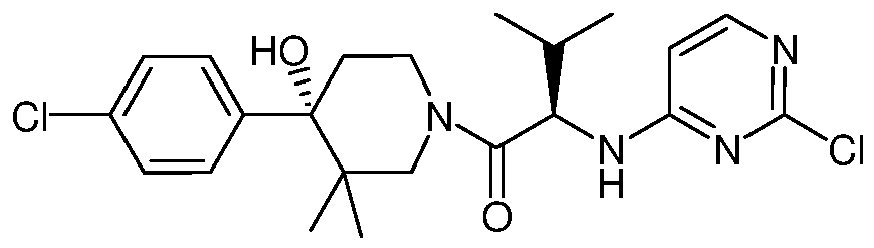

- A reaction vessel was charged with 2,4-dichloropyrimidine (21.5 mg, 0.144 mmoles, 1 eq), (R)-2-amino-1-((S)-4-(4-chlorophenyl)-4-hydroxy-3,3-dimethylpiperidin-1-yl)-3-methylbutan-1-one (54.0 mg, 0.144 mmol, 1 eq), triethylamine (0.024 mL, 0.144 mmol, 1 eq) and DMF (2 mL) The reaction mixture was stirred overnight at rt. At the conclusion of this period, the resulting solution was evaporated, diluted with MeOH and purified by preparative LC-MS. The resulting fractions were lyophilized to provide 35.5 mg of Example 562 and 8.4 mg of Example 563. Example 562, MS found: (M + H)+ = 451.37. Example 563, MS found: (M + H)+ = 451.27.
-

- A reaction vessel was charged with N-(3-methyl-1-oxo-1-(4-oxopiperidin-1-yl)butan-2-yl)benzamide (68.4 mg, 0.23 mmoles, 1.0 eq), 1-bromo-2,4-dichlorobenzene (112.4 mg, 0.50 mmol, 2.2eq), and THF (20 mL). The stirred reaction mixture was cooled to -78 °C. 1.6 M n-BuLi in hexanes (0.31 mL, 0.50 mmoles, 1.0 eq) was added dropwise thereto via syringe (Caution: exotherm). The mixture was allowed to warm to rt in 2 hours. The mixture was quenched with water. Ethyl acetate was added thereto and the layers were separated. The organic layer was consecutively washed with 1N NaOH (3x) and 1N HCl (1x). The organic layer was dried (MgSO4) and the solvent removed in vacuo. The residue was dissolved in MeOH and purified by preparative LC-MS. The collected fractions were evaporated and the residue dissolved in methylene chloride, dried (MgSO4) and the solvent removed in vacuo to provide 30 mg of Example 564 as a white solid. MS found: (M + H)+ = 449.03.
-

-

- A mixture of (2-chloroethyl)(methyl)sulfane (24.73 g, 224 mmol) and iodomethane (100 mL, 1600 mmol) was stirred for two days at room temperature, during which time a solid precipitated. The reaction was diluted with 300 mL diethyl ether, and the suspension was stirred for 2 h. The solids were collected by filtration, rinsed with diethyl ether, and dried under vacuum to yield 27.2 g of a dark amber, sticky solid. This was stirred in 100 mL of 9:1 diethyl ether/methanol. The solids were collected by filtration, rinsed with diethyl ether, and dried under vacuum to yield the title compound (23.7g, 94 mmol, 42.0 % yield) as a pale yellow powder. Used as-is in the next step.
-

- A solution of potassium tert-butoxide(3.26 g, 27.6 mmol) in tert-butanol (40 mL) was treated with tert-butyl 4-oxopiperidine-1-carboxylate (5 g, 25.09 mmol), causing the reaction to turn bright orange. The mixture was stirred for 1 h, then treated with (2-chloroethyl)dimethylsulfonium iodide (5.70 g, 22.59 mmol), added in three portions at 10 minute intervals. This addition caused the color of the reaction to gradually fade to pale yellow. The mixture was stirred for 2 hours, then diluted with tert-butanol (10 mL), treated with potassium tert-butoxide(2.96 g, 25.09 mmol), and stirred overnight at room temperature. The reaction was poured into water (100 mL) and extracted 3 x with 100 mL ethyl acetate. The combined organic phases were washed with water and brine, then dried over sodium sulfate and concentrated in-vacuo. The residue was purified over a 5 x 15 cm silica gel column, eluting with ethyl acetate/hexanes (10% - 15% - 20% - 25% EtOAc, 1 L at each concentration), to yield the title compound (1.15 g, 5.10 mmol, 20.34 % yield) as a colorless oil.
-

- In a flame-dried 100 mL three necked flask, a solution of 1-bromo-4-chlorobenzene (3.51 g, 18.36 mmol) in THF (20 mL) was cooled to -78 °C and treated with the dropwise addition of 1.6 M BuLi in hexanes (12.00 mL, 19.19 mmol) at a rate which did not allow the temperature to exceed -60 °C. The mixture was stirred at -78 °C for 1 h, during which time a white precipitate was observed. The mixture was treated with the dropwise addition of a solution of tert-butyl 8-oxo-5-azaspiro[2.5]octane-5-carboxylate (1.88g, 8.35 mmol) in THF (5 mL), at a rate which did not allow the temperature to exceed -60 °C. The mixture was stirred for 3 h, then allowed to warm to -20 °C and quenched with saturated ammonium chloride solution. The mixture was extracted 3 x with ethyl acetate, the combined organic phases were washed with water followed by brine, then dried over sodium sulfate and concentrated in-vacuo. The residue was purified over a 5 x 15 cm silica gel column, eluting with ethyl acetate/hexanes (5% - 10% - 15% - 20% ethyl acetate, to yield the title compound (1.81g, 5.36 mmol, 64.2 % yield) as a colorless powder. MS (ESI+) = 264.27, (M-tBuO)+, 220 (M-H2O-Boc) +.
-

- A solution of tert-butyl 8-(4-chlorophenyl)-8-hydroxy-5-azaspiro[2.5]octane-5-carboxylate (1.81 g, 5.36 mmol) in dioxane (2 mL) was treated with 4.0 M HCl in dioxane (7 mL, 28.0 mmol), and the reaction was stirred for 30 minutes at room temperature. The mixture was concentrated in-vacuo then concentrated 2 x from methylene chloride to remove residual HCl. The residue was dissolved in water and washed 2 x with diethyl ether. The aqueous phase was treated with sodium bicarbonate until the mixture was basic, then washed 2 x with 10 mL diethyl ether. The aqueous phase was treated with solid sodium hydroxide until the pH was > 13, and the mixture was extracted 5 x with ethyl acetate. The combined ethyl acetate extracts were dried over sodium sulfate and concentrated in vacuo to yield (±)-8-(4-chlorophenyl)-5-azaspiro[2.5]octan-8-ol as a colorless powder (1.1 g, 87% yield). MS (ESI+) = 238.1, (M+H) +.The isomers were separated via chiral super critical fluid chromatography to yield 463 mg of isomer A and 522 mg of isomer B.
-
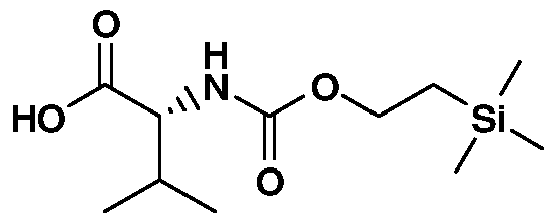
- A mixture of (R)-2-amino-3-methylbutanoic acid (2.01 g, 17.16 mmol) and 2,5-dioxopyrrolidin-1-yl 2-(trimethylsilyl)ethyl carbonate (4.89 g, 18.87 mmol) in 1:1 dioxane/water (40 mL) was treated with triethylamine (3.59 mL, 25.7 mmol), and the mixture was stirred for two days at room temperature. The mixture was acidified with saturated sodium hydrogen sulfate and extracted 3 x with ethyl acetate. The combined organic phases were washed with saturated sodium hydrogen sulfate, water, and brine, then dried over sodium sulfate and concentrated in-vacuo to yield the title compound (4.17 g, 15.96 mmol, 93 % yield) as an amber oil.
- A solution of 8-(4-chlorophenyl)-5-azaspiro[2.5]octan-8-ol, isomer A (463 mg, 1.948 mmol), (R)-3-methyl-2-((2-(trimethylsilyl)ethoxy)carbonylamino)butanoic acid (560 mg, 2.142 mmol), EDC (821 mg, 4.28 mmol), and HOBT (656 mg, 4.28 mmol) in methylene chloride (10 mL) was stirred at room temperature for 30 minutes, the mixture was treated with triethylamine (1.086 mL, 7.79 mmol), and the reaction was stirred for an additional 30 minutes at room temperature. The reaction was concentrated in vacuo, and the residue was taken up in ethyl acetate. The organic phase was washed 3 x with 1 N NaOH, 3 x with 1 N HCl, and once with brine, then dried over sodium sulfate and concentrated in-vacuo. The residue was purified over silica gel eluting with ethyl acetate/hexanes (25 - 50% EtOAc) to yield the title compound (754 mg, 1.567 mmol, 80 % yield) as a colorless, viscous oil.
-

- A solution of 2-(trimethylsilyl)ethyl (2R)-1-(8-(4-chlorophenyl)-8-hydroxy-5-azaspiro[2.5]octan-5-yl)-3-methyl-1-oxobutan-2-ylcarbamate (754 mg, 1.567 mmol) in THF (10 mL) was treated with TBAF (1.0 M in THF) (6.27 mL, 6.27 mmol), and the mixture was stirred overnight at room temperature. The reaction mixtue was concentrated in-vacuo, and the residue was partitioned between EtOAc and saturated sodium bicarbonate. The layers were separated, and the organic phase was washed 2 x with saturate sodium bicarbonate, once with water, and once with brine. The combined aqueous phases were extracted once with ethyl acetate, and the combined organic phases were washed with water and brine, then dried over sodium sulfate and concentrated in-vacuo. The residue was taken up in acetonitrile (100 mL), and washed 3 x with 20 mL of hexanes. The acetonitrile phase was concentrated in-vacuo to yield the title compound (420mg, 1.247 mmol, 80 % yield) as a colorless glass. MS (ESI+) = 337.4, (M+H)+.
- A mixture of (R)-2-amino-1-(8-(4-chlorophenyl)-8-hydroxy-5-azaspiro[2.5]octan-5-yl)-3-methylbutan-1-one, HCl (41.7 mg, 0.112 mmol), (1R,3R)-3-hydroxycyclopentanecarboxylic acid (16 mg, 0.123 mmol), HOBT (37.7 mg, 0.246 mmol), and triethylamine (78 µL, 0.559 mmol) in methylene chloride was treated with EDC (47.1 mg, 0.246 mmol), and the reaction was allowed to stir overnight at room temperature. The mixture was concentrated in-vacuo, and the residue was taken up in ethyl acetate. The organic phase was washed 3 X with saturated sodium carbonate, 3 X with 1M HCl, and once with brine, dried over sodium sulfate, and concentrated in-vacuo. The residue was purified over a 12 g silica gel column via ISCO, eluting at 30 mL/min with a 0-10% MeOH/EtOAc gradient over 35 minutes to yield Example 565 (33mg, 0.073 mmol, 65.8 % yield) as a colorless glass.. MS (ESI+) = 431.13, (M+H-H2O)+.
- The following examples in Table 17 were prepared using the procedures described in Example 565, substituting the appropriate carboxylic acid for (1R,3R)-3-hydroxycyclopentanecarboxylic acid in Step 8.
Table 17 Example Carboxylic Acid Structure MS (ESI+) 566 4-Chlorobenzoic acid 
475.3 567 Nicotinic acid 
442.4 568 3-Sulfamoylbenzoic acid 
502.3 569 Cyclopentanoic acid 
433.3 -

- A mixture of (2R)-2-amino-1-(8-(4-chlorophenyl)-8-hydroxy-5-azaspiro[2.5]octan-5-yl)-3-methylbutan-1-one (21mg, 0.062 mmol), 3-(methoxycarbonyl)benzoic acid (12.35 mg, 0.069 mmol), HOBT (21.00 mg, 0.137 mmol), and triethylamine (35 µl, 0.251 mmol) in CH2Cl2 (2 mL) was treated with EDC (26.3 mg, 0.137 mmol), and the mixture was stirred for three days at room temperature. The mixture was concentrated in-vacuo, and the residue was taken up in ethyl acetate. The organic phase was washed 3 X with saturated sodium carbonate, 3 X with 1M HCl, and once with saturated sodium chloride, dried over sodium sulfate, and concentrated in-vacuo. The residue was taken up in THF (1 mL), treated with 0.5 M LiOH (aq) (187 µl, 0.094 mmol), and the mixture was stirred overnight at room temperature. The reaction mixture was diluted with 1:1 acetonitrile/water, and injected directly onto the prep HPLC for purification to yield Example 571 (9.2mg, 0.019 mmol, 30.4 % yield). MS (ESI+) =485.29, (M+H)+.
-

-

- A solution of (S)-4-(4-chlorophenyl)-3,3-dimethylpiperidin-4-ol (6.3 g, 26.3 mmol), Boc-D-Val-OH (6.28 g, 28.9 mmol), EDC (11.08 g, 57.8 mmol), and HOBT (8.85 g, 57.8 mmol) in methylene chloride (250 mL) was stirred at room temperature for 30 minutes, treated with triethylamine (14.65 mL, 105 mmol), and stirred at room temperature for 3 hours. The solution was washed 3 X with saturated sodium carbonate, 3 X with 1M HCl, once with water, and once with brine, dried over sodium sulfate, and concentrated in-vacuo. The residue was purified over a 330 g silica gel column via ISCO, eluting at 100 mL/min with a 0-100% ethyl acetate/hexanes gradient over 40 minutes to yield the title compound (11.0 g, 25.06 mmol, 95 % yield) as a colorless glass. MS (ESI+) = 439.18, (M+H)+.
-

- A solution of tert-butyl (R)-1-((S)-4-(4-chlorophenyl)-4-hydroxy-3,3-dimethylpiperidin-1-yl)-3-methyl-1-oxobutan-2-ylcarbamate (11 g, 25.06 mmol) in 4 M HCl in dioxane (100 mL, 400 mmol) was stirred at room temperature for 2 h. The mixture was concentrated in-vacuo, then concentrated 3 x from methanol and 3 x from methylene chloride to remove residual HCl, to yield the title compound (9.3 g, 24.78 mmol, 99 % yield) as a colorless powder. MS (ESI+) = 339, (M+H)+.
- A mixture of (R)-2-amino-1-((S)-4-(4-chlorophenyl)-4-hydroxy-3,3-dimethylpiperidin-1-yl)-3-methylbutan-1-one, HCl (5.77 g, 15.37 mmol), (1R,3R)-3-hydroxycyclopentanecarboxylic acid (2 g, 15.37 mmol), HOBT (5.18 g, 33.8 mmol), and triethylamine (10.71 mL, 77 mmol) in methylene chloride (100 mL) was treated with EDC (6.48 g, 33.8 mmol), and the reaction was allowed to stir overnight at room temperature. The mixture was concentrated in-vacuo, and the residue was taken up in ethyl acetate. The organic phase was washed 3 X with saturated sodium carbonate, 3 X with 1M HCl, and once with brine, dried over sodium sulfate, and concentrated in-vacuo. The residue was purified over a 330 g silica gel column via ISCO, eluting at 100 mL/min with ethyl acetate for 10 minutes followed by a 0-10% methanol/ethyl acetate gradient over 35 minutes to yield 3.2 g of (1R,3R)-N-((R)-1-((S)-4-(4-chlorophenyl)-4-hydroxy-3,3-dimethylpiperidin-1-yl)-3-methyl-1-oxobutan-2-yl)-3-hydroxycyclopentanecarboxamide as a colorless solid. Another 1.7 g of desired product which contained a small amount of impurity was also isolated. This material was subjected to the chromatography conditions described above, substituting an 80 g silica column and a 60 mL/minute flow rate, to yield an additional 800 mg of(1R,3R)-N-((R)-1-((S)-4-(4-chlorophenyl)-4-hydroxy-3,3-dimethylpiperidin-1-yl)-3-methyl-1-oxobutan-2-yl)-3-hydroxycyclopentanecarboxamide as a colorless solid, and 700 mg of material which was 88.6% pure by HPLC. The three lots of material were combined and purified by chiral super-critical fluid chromatography to yield Example 572 (3.7 g, 53% yield). An analytical sample was crystallized by dissolving 400 mg in 2 mL of acetone, adding water until the solution became hazy (3 mL), heating the mixture until a clear solution was observed, and allowing the mixture to stand uncovered at room temperature overnight. The resulting solids were collected by filtration and dried under vacuum at 60° C to yield 265 mg of crystalline powder.
-

-

- In a round bottom flask equipped with a reflux condenser and a Dean-Stark trap, a solution of cyclopent-3-enecarboxylic acid (5.2 g, 46.4 mmol) and benzyl alcohol (6.03 mL, 58.0 mmol) in benzene (100 mL) was treated with sulfuric acid (0.3 mL, 5.63 mmol), and the mixture was heated to revlux. Over the course of 2.5 hours, ~0.9 mL of water was collected in the Dean-Stark trap. The mixture was cooled to room temperature and treated with saturated aqueous sodium carbonate solution (25 mL). The layers were separated, and the organic phase was washed 3 x with 25 mL saturated sodium carbonate, once with water, and once with brine, then dried over sodium sulfate and concentrated in-vacuo. The residue was purified over a 8 x 10 cm silica gel column, eluting with ethyl acetate/hexanes (5% - 10% - 15% - 20% ethyl acetate), to yield the title compound (4.54 g, 22.45 mmol, 48.4 % yield) as a colorless oil.
-

- The titled compounds were prepared via the method of Lizotte, et. al.; J. Org. Chem.; 1983; 48(20); 3594-3597. A solution of benzyl cyclopent-3-enecarboxylate (4.54 g, 22.45 mmol) in methylene chloride (50 mL) was cooled to 0 °C and treated with the dropwise addition of a solution of m-CPBA (7.04 g, 31.4 mmol) in methylene chloride (50.0 mL) over 40 minutes. The resulting suspension was allowed to come to room temperature and stirred overnight. The mixture was treated with 20 mL of saturated sodium sulfite and stirred for 20 minutes. The solids were removed by filtration, rinsed with methylene chloride, and the layers of the filtrate were separated. The organic phase was washed with saturated sodium sulfite, 3 x with saturated sodium bicarbonate, once with water, and once with brine, then dried over sodium sulfate and concentrated in-vacuo to 3.6 g of an amber oil. The residue was purified over a 5 x 15 cm silica gel column, eluting with ethyl acetate/hexanes (15% EtOAc), to yield trans-benzyl 6-oxabicyclo[3.1.0]hexane-3-carboxylate (3.4 g, 64% yield) and cis-benzyl 6-oxabicyclo[3.1.0]hexane-3-carboxylate (1.2 g, 24.5% yield) as colorless oils.
-

- A 50 mL three neck round bottom flask equipped with a magnetic stirrer and two addition funnels, which had been flame dried under agron, charged with COPPER(I) CYANIDE (226 mg, 2.52 mmol), and evacuated under high vacuum overnight, was charged with THF (5 mL), and the suspension was cooled to -78 °C. The mixture was treated with the dropwise addition of methyllithium (1.6 M in diethylether) (3.15 mL, 5.04 mmol). When the addition was complete, the cooling bath was removed, and the suspention was allowed to slowly warm, until a homogeneous solution was observed. The solution was cooled to -78 °C, then treated with the slow dropwise addition of a solution of trans-benzyl 6-oxabicyclo[3.1.0]hexane-3-carboxylate (250mg, 1.145 mmol) in THF (5 mL) followed by boron trifluoride etherate (0.581 mL, 4.58 mmol) in one portion. The mixture was stirred at -78 °C for 2 h, at which point a precipitate was observed, and the color quickly changed to bright yellow. The reaction was allowed to slowly come to room temperature, during which the color began to turn grey. The reaction was quenched with 30 mL of a 9:1 aqueous solution of saturated NH4Cl and 10% NH4OH, and the mixture was stirred for 30 minutes. The resulting deep blue mixture was filtered to remove a small amount of precipitate, and extracted 3 x with ethyl acetate. The combined organic phases were washed with water followed by brine, then dried over sodium sulfate and concentrated in-vacuo. The residue was purified over a 2 x 15 cm silica gel column, eluting with ethyl acetate/hexanes (25% - 50% EtOAc), to yield a racemic mixture of (1R,3R,4R)-benzyl 3-hydroxy-4-methylcyclopentanecarboxylate and (1S,3S,4S)-benzyl 3-hydroxy-4-methylcyclopentanecarboxylate (225mg, 0.480 mmol, 84 % yield) as a colorless oil.
-
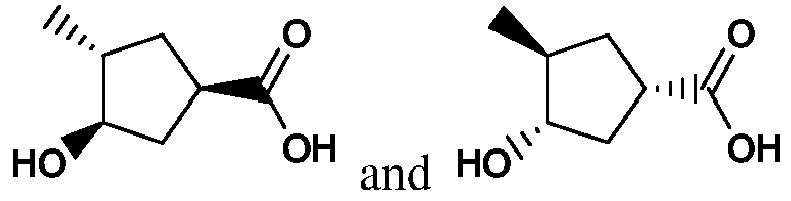
- A racemic mixture of (1R,3R,4R)-benzyl 3-hydroxy-4-methylcyclopentanecarboxylate and (1S,3S,4S)-benzyl 3-hydroxy-4-methylcyclopentanecarboxylate (217mg, 0.463 mmol) and palladium hydroxide on carbon (65.0 mg, 0.463 mmol) in methanol (10 mL) was degassed under vacuum/nitrogen, and the mixture was hydrogenated overnight at 50 psi. The catalyst was removed by filtration and rinsed with methanol. The filtrates were combined and concentrated in-vacuo to yield a racemic mixture of (1R,3R,4R)-3-hydroxy-4-methylcyclopentanecarboxylic acid and (1S,3S,4S)-3-hydroxy-4-methylcyclopentanecarboxylic acid (131 mg, 0.454 mmol, 98 % yield) as a colorless oil which solidified upon standing overnight.
- A mixture of (R)-2-amino-1-((S)-4-(4-chlorophenyl)-4-hydroxy-3,3-dimethylpiperidin-1-yl)-3-methylbutan-1-one, HCl (56.0 mg, 0.149 mmol), (±)-[(1R,3R,4R)-3-hydroxy-4-methylcyclopentanecarboxylic acid, (1S,3S,4S)-3-hydroxy-4-methylcyclopentanecarboxylic acid (47.3 mg, .164 mmol)], HOBT (50.2 mg, 0.328 mmol), and triethylamine (0.104 mL, 0.745 mmol) in methylene chloride (2 mL) was treated with EDC (62.9 mg, 0.328 mmol), and the reaction was allowed to stir overnight at room temperature. The mixture was concentrated in-vacuo, and the residue was taken up in ethyl acetate. The organic phase was washed 3 X with 1M NaOH, 3 X with 1M HCl, and once with brine, dried over sodium sulfate, and concentrated in-vacuo. The residue was purified over a 2 x 10 cm silica gel column, eluting with 50 - 100% EtOAc/Hexanes then 5% MeOH/EtOAc to yield 47 mg of a mixture of the two titled compounds. The two diastereomers were separated via chiral super-critical fluid chromatography to yield 20.0 mg of Example 572A, and 15.2 mg of Example 572B. MS (ESI+) = 465.2, M+ for both isomers.
-

- Examples 572C and 572D were prepared using the procedures described in Examples 572A and 572B, substituting cis-benzyl 6-oxabicyclo[3.1.0]hexane-3-carboxylate for trans-benzyl 6-oxabicyclo[3.1.0]hexane-3-carboxylate in Step 3. MS (ESI+) = 465.2, M+ for both isomers.
-

-

- A suspension of (R)-4-(4-chlorophenyl)-3,3-dimethylpiperidin-4-ol, D-(-)-Tartaric Acid (6.2 g, 15.90 mmol) in concentrated hydrochloric acid (150 mL) was refluxed for 27 hours, during which time a clear solution was observed. The solution was cooled to 0° C, which caused a white solid to precipitate, and the pH was adjusted to ~13 with the slow, careful addition of solid sodium hydroxide. The aqueous was extracted with EtOAc (3 x 300 mL), the combined organic layers were washed with 1N NaOH (3 x 100 mL), once with brine (100 mL), then dried over sodium sulfate and concentrated in-vacuo to yield the title compound (3.46 g, 15.60 mmol, 98 % yield) as a pale yellow oil. MS (ESI+) = 222/224, (M+H)+ .
-
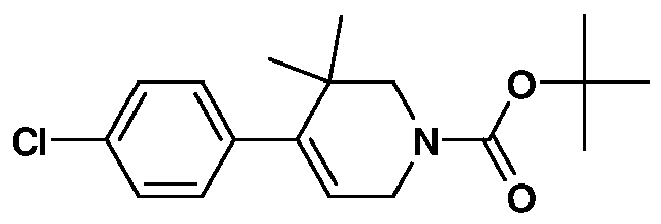
- A solution of 4-(4-chlorophenyl)-3,3-dimethyl-1,2,3,6-tetrahydropyridine (3.46 g, 15.60 mmol) in THF (50 mL) was treated di-tert-butyl dicarbonate (3.99 mL, 17.17 mmol), causing a color change to amber, and the mixture was stirred overnight at room temperature. The solution was concentrated in-vacuo, and the residue was purified by flushing through silica gel, eluting with hexanes/ethyl acetate (10%-15% EtOAc), to yield the title compound (5.0 g, 15.54 mmol, 100 % yield) as a colorless + oil. MS (ESI+) = 266, (M+H-t-Bu) .
-

- The title compound was prepared via the method of Sharpless, et. al., J. Org. Chem. 57, 1992, 2768. A stirring suspension of AD-MIX-alpha (2.3g, 1.554 mmol) and methanesulfonamide (148 mg, 1.554 mmol) in 1:1 tert-butanol/water (16 mL) was cooled to 0 °C, then treated with tert-butyl 4-(4-chlorophenyl)-5,5-dimethyl-5,6-dihydropyridine-1(2H)-carboxylate (500mg, 1.554 mmol). The mixture was allowed to come to room temperature, and stirred for 8 days. The reaction was treated with sodium sulfite (3 g), stirred for 30 minutes, then extracted 3 x with ethyl acetate. The combined organic phases were washed 3 X with 1M NaOH, once with water, and once with brine, dried over sodium sulfate, and concentrated in-vacuo. The residue was purified over silica gel, eluting with ethyl acetate/hexanes (10% - 20% - 50% EtOAc) to yield the title compound (196mg, 0.551 mmol, 35.5 % yield) as a colorless foam. MS (ESI+) = 378.26, (M+Na)+.
-

- A solution of (4R,5S)-tert-butyl 4-(4-chlorophenyl)-4,5-dihydroxy-3,3-dimethylpiperidine-1-carboxylate (196mg, 0.551 mmol) in dioxane (3 mL) was treated with 4N HCl in Dioxane (5 mL, 20.00 mmol), and the mixture was stirred for 1h, upon which a precipitate was observed. The mixture was diluted with dichloromethane (5 mL) to facilitate stirring, and the reaction was stirred for an additional 2 h. The mixture was concentrated in-vacuo, then concentrated 3 x from dichloromethane to remove residual HCl and dioxane. The residue was used as-is in + the next step. MS (ESI+) = 256.29, (M+H) .
-

- A mixture of 4-(4-chlorophenyl)-5,5-dimethylpiperidine-3,4-diol, HCl (155mg, 0.530 mmol), Boc-D-Val-OH (127 mg, 0.584 mmol), HOBT (179 mg, 1.167 mmol), and triethylamine (0.296 mL, 2.122 mmol) in dichloromethane (5 mL) was treated with EDC (224 mg, 1.167 mmol), and the mixture was stirred overnight at room temperature. The mixture was concentrated in-vacuo, and the residue was taken up in ethyl acetate. The organic phase was washed 3 X with 1M NaOH, 3 X with 1M HCl, and once with brine, dried over sodium sulfate, and concentrated in-vacuo. The residue was purified over silica gel, eluting with ethyl acetate/methylene chloride (0% - 10% - 50% EtOAc) to yield the title compound as a colorless foam. + 455.4 (M+H)+.
-

- A solution of tert-butyl (R)-1-((4R,5S)-4-(4-chlorophenyl)-4,5-dihydroxy-3,3-dimethylpiperidin-1-yl)-3-methyl-1-oxobutan-2-ylcarbamate (200mg, 0.440 mmol) in dioxane (3 mL) was treated with 4N HCl in dioxane (3 mL, 12.00 mmol), and the mixture was allowed to stir at room temperature for 6 hours. The mixture was concentrated in-vacuo and concentrated 3 x from methylene chloride to remove residual dioxane and HCl. The residue was used as-is in the next step. MS (ESI+) = + 355.34, (M+H)+.
- A mixture of (R)-2-amino-1-((4R,5S)-4-(4-chlorophenyl)-4,5-dihydroxy-3,3-dimethylpiperidin-1-yl)-3-methylbutan-1-one (22 mg, 0.056 mmol), cyclopentanecarboxylic acid (6.70 µl, 0.062 mmol), HOBT (18.94 mg, 0.124 mmol), and TEA (39 µl, 0.280 mmol) in dichloromethane (2 mL) was treated with EDC (23.71 mg, 0.124 mmol), and the mixture was stirred overnight at room temperature. The solvent was blown off with a stream of nitrogen, and the residue was taken up in 1:1 acetonitrile/water and purified via prep HPLC to yield Example 573 (16.5mg, 0.029 mmol, 51.9 % yield) as a colorless powder. MS (ESI+) = 452.4, (M+H)+.
- The following examples in Table 18 were prepared using the procedures described in Example 573, substituting AD-Mix-beta for AD-Mix-alpha in Step 3, and the appropriate carboxylic acid in Step 7.
Table 18 Example Carboxylic Acid Structure MS (ESI+) 574 Mono-Methyl isophthalate 
517.4 575 cyclopentanec arboxylic acid 
452.4 -

- A solution of methyl 3-((R)-1-((4S,5R)-4-(4-chlorophenyl)-4,5-dihydroxy-3,3-dimethylpiperidin-1-yl)-3-methyl-1-oxobutan-2-ylcarbamoyl)benzoate (30mg, 0.058 mmol) in methanol (2 mL) was treated with 1 M NaOH (aq) (1 mL, 1.000 mmol), and the mixture was stirred overnight. The reaction mixture was acidified with 1 N HCl (1.1 mL), diluted with 1:1 acetonitrile/water, and injected directly onto the prep HPLC for purification to yield Example 576 (17mg, 0.028 mmol, 47.5 % yield) as a colorless powder. MS (ESI+) = 503.3 (M+H)+.
-

-

- A solution of (R)-4-(4-chlorophenyl)-3,3-dimethylpiperidin-4-ol (1.96g, 8.18 mmol) in Pyridine (20 mL) was cooled to 0 °C, then treated with the dropwise addition of ethyl chloroformate (0.942 mL, 9.81 mmol), causing a color change to orange. The mixture was allowed to come to room temperature and stirred over night. The reaction was concentrated in-vacuo, and the residue was taken up in ethyl acetate, washed 3 x with 1M NaOH, 3 x with 1M HCl, once with brine, dried over sodium sulfate, and concentrated in-vacuo to yield the title compound (2.4 g, 7.70 mmol, 94 % yield). The residue was used as-is in the next step. MS (ESI+) = 334, (M+Na)+.
-

- A suspension of (R)-ethyl 4-(4-chlorophenyl)-4-hydroxy-3,3-dimethylpiperidine-1-carboxylate (322mg, 1.033 mmol) in acetonitrile (3 mL) was treated with sulfuric acid (0.275 mL, 5.16 mmol), and the resulting clear solution was stirred overnight at room temperature. The reaction was quenched with saturated sodium carbonate, and then extracted 3 x with ethyl acetate. The combined organic phases were washed with brine, dried over sodium sulfate, and concentrated in-vacuo. The residue was purified over silica gel, eluting with ethyl acetate/hexanes (10% - 25% - 100% EtOAc) to yield the title compound (245mg, 0.694 mmol, 67.2 % yield) as a colorless foam.
-
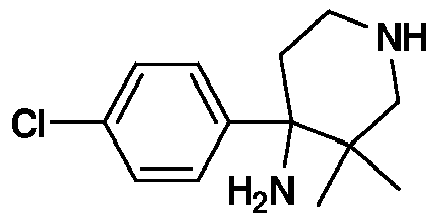
- A solution of ethyl 4-acetamido-4-(4-chlorophenyl)-3,3-dimethylpiperidine-1-carboxylate (2.04 g, 5.78 mmol) in ethanol (25 mL) was treated with 5 N NaOH (aq) (23.13 mL, 116 mmol), and the mixture was heated at reflux for two days. During the reflux, a colorless, soapy solid predipitated. Water was added until a clear solution was observed. The ethanol was removed under reduced pressure, and the aqueous mixture was extracted 4 x with ethyl acetate. The combined organic layers were dried over sodium sulfate and concentrated in-vacuo to yield the title compound (1.28 g, 5.36 mmol, 93 % yield) as a colorless powder. MS (ESI+) = 239, (M+H)+.
-
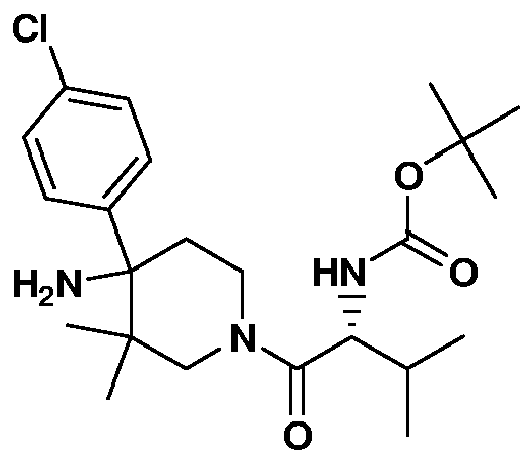
- A mixture of 4-(4-chlorophenyl)-3,3-dimethylpiperidin-4-amine (488mg, 2.044 mmol), Boc-D-Val-OH (444 mg, 2.044 mmol), HOBT (626 mg, 4.09 mmol), and triethylamine (1.140 mL, 8.18 mmol) in dichloromethane (5 mL) was treated with EDC (784 mg, 4.09 mmol), and the mixture was stirred overnight at room temperature. The mixture was concentrated in-vacuo, and the residue was taken up in ethyl acetate. The organic phase was washed 3 X with WATER, 3 X with sat. sodium carbonate, and 1 X with sat sodium chloride, dried over sodium sulfate, and concentrated in-vacuo. The residue was purified over silica gel, eluting with ethyl acetate/hexanes (25% - 50% - 100% EtOAc) to yield the title compound (845mg, 1.929 mmol, 94 % yield) as a colorless glass. MS (ESI+) = 438.36, M+.
-
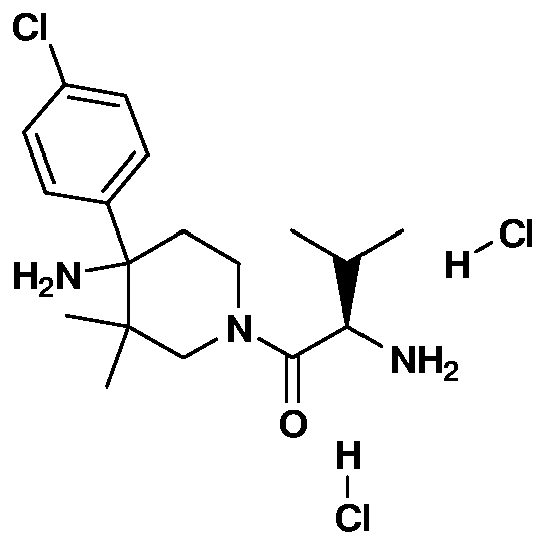
- The title compound was prepared from (R)-tert-butyl 1-(4-amino-4-(4-chlorophenyl)-3,3-dimethylpiperidin-1-yl)-3-methyl-1-oxobutan-2-ylcarbamate using the procedure described in Example 571, Step 2. MS (ESI+) = 338.5, (M+H)+.
- A mixture of (R)-2-amino-1-(4-amino-4-(4-chlorophenyl)-3,3-dimethylpiperidin-1-yl)-3-methylbutan-1-one, 2HCl (330mg, 0.803 mmol), 4-chlorobenzoic acid (126 mg, 0.803 mmol), HOBT (246 mg, 1.607 mmol), and triethylamine (0.672 mL, 4.82 mmol) in methylene chloride (3 mL) was treated with EDC (308 mg, 1.607 mmol), and the mixture was stirred overnight at room temperature. The mixture was concentrated in-vacuo, and the residue was taken up in ethyl acetate. The organic phase was washed 3 X with saturated sodium carbonate, 3 X with 1N HCl, and once with brine, dried over sodium sulfate, and concentrated in-vacuo. The residue was purified over silica gel, eluting with ethyl acetate/methylene chloride (10% - 25% - 50% - 100% EtOAc) to yield Example 577 (255mg, 0.535 mmol, 66.6 % yield) as a colorless powder. MS (ESI+) = 476.4, M+. The isomers were separated via chiral super-critical fluid chromatography to yield 69 mg of isomer A, and 16 mg of isomer B.
- The following examples in Table 19 were prepared using the procedure described in Example 577, Step 6, substituting the appropriate carboxylic acid for 4-chlorobenzoic acid. The following examples were tested as diastereomeric mixtures.
Table 19 Example Carboxylic Acid Structure MS (ESI+) 578 Mono-Methyl isophthalate 
500.4 579 cyclopentanecarboxylic acid 
435.4 -

- Example 580 was prepared from (R)-methyl 3-(1-(4-amino-4-(4-chlorophenyl)-3,3-dimethylpiperidin-1-yl)-3-methyl-1-oxobutan-2-ylcarbamoyl)benzoate using the procedure described in Example 576. MS (ESI+) = 486.3, (M+H)+.
-

-

- A suspension of 4-(4-chlorophenyl)-3,3-dimethylpiperidin-4-ol (540mg, 2.252 mmol) and benzaldehyde (0.274 mL, 2.70 mmol) in methylene chloride (15 mL) was treated with sodium triacetoxyborohydride (716 mg, 3.38 mmol), and the mixture was stirred overnight at room temperature. The mixture was concentrated in-vacuo. The residue was taken up in ethyl acetate, washed 3 x with 1 N NaOH, once with brine, dried over sodium sulfate, and concentrated in-vacuo to yield the title compound (696mg, 2.110 mmol, 94 % yield) as a colorless oil. MS (ESI+) = 330.14, (M+H)+.
-

- A solution of 1-benzyl-4-(4-chlorophenyl)-3,3-dimethylpiperidin-4-ol (6.9g, 20.92 mmol) and imidazole (0.214 g, 3.14 mmol) in THF (175 mL) was treated with sodium hydride (2.510 g, 62.8 mmol) in two portions. The mixture was heated at reflux overnight. Vigorous gas evolution was observed 20 minutes after heat was applied, before the reaction reached reflux temperature. The mixture was cooled to room temperature, and treated with carbon disulfide (23.96 mL, 397 mmol), causing the color to change to a burnt amber. The reaction was returned to reflux temperature for 2 hours. The mixture was cooled to room temperature, treated with iodomethane (1.570 mL, 25.1 mmol), and stirred at room temperature for 1.5 hours. The reaction was quenched with brine, and the mixture was extracted 3 x with ethyl acetate. The combined organic phases were washed with brine, dried over sodium sulfate, and concentrated in-vacuo. The residue was purified over a 8 x 10 cm silica gel column, eluting with ethyl acetate/hexanes (5% - 10% - 15% - 20% ethyl acetate), to yield the title compound (7.3 g, 17.38 mmol, 83 % yield) as an amber oil. MS (ESI+) = 421, (M+H)+.
-

- A solution of O-1-benzyl-4-(4-chlorophenyl)-3,3-dimethylpiperidin-4-yl S-methyl carbonodithioate (7.3g, 17.38 mmol), tributyltin hydride (4.68 mL, 17.38 mmol), and AIBN (0.856 g, 5.21 mmol) in benzene (150 mL) was degassed with argon, then refluxed overnight. The mixture was concentrated in-vacuo. The residue was adsorbed onto a small amount of silica gel and purified over a 8 x 15 cm silica gel column, eluting with ethyl acetate/hexanes (0% - 5%-20% EtOAc), to yield in two fractions 6.2 g of a strong smelling amber oil. The oil was adsorbed onto a small amount of silica gel and purified over a 5 x 15 cm silica gel column, eluting with ethyl acetate/hexanes (0 - 5% EtOAc), to yield the title compound (4.8 g, 14.38 mmol, 83 % yield) as a colorless oil.
-

- A solution of 1-benzyl-4-(4-chlorophenyl)-3,3-dimethylpiperidine (4.8 g, 15.29 mmol) and 1-chloroethyl chloroformate (1.667 mL, 15.45 mmol) in dichloroethane (40 mL) was stirred overnight at room temperature, then refluxed for 3 hours. The solution was concentrated in-vacuo. The residue was taken up in methanol (50 mL), the mixture was refluxed overnight The mixture was diluted with 75 mL of 1 N HCl, and the methanol was removed under vacuum. The aqueous solution was washed 3 x with diethyl ether (20 mL), and the mixture was treated with the careful addition of saturated sodium bicarbonate to reach pH 8. The aqueous solution was washed 3 x with diethyl ether (25 mL), and the mixture was treated with the careful addition of solid sodium hydroxide to reach pH > 13. The aqueous phase was extracted 3 x with ethyl acetate (50 mL), and the combined organic phases were dried over sodium sulfate and concentrated in vacuo to yield (±)-4-(4-chlorophenyl)-3,3-dimethylpiperidine (2.44g, 10.91 mmol, 71.3 % yield) as a pale yellow oil which solidified upon standing. MS: (ESI+) = 224.3, (M+H)+. The enantiomers were separated via chiral super-critical fluid chromatography to yield 1.09 g of isomer A, and 1.05 g of isomer B.
-

- A mixture of 4-(4-chlorophenyl)-3,3-dimethylpiperidine, isomer A (1.1g, 4.92 mmol), Boc-D-Val-OH (1.068 g, 4.92 mmol), HOBT (1.656 g, 10.82 mmol), and triethylamine (3.43 mL, 24.58 mmol) in methylene chloride (20 mL) was treated with EDC (2.073 g, 10.82 mmol), and the reaction was allowed to stir overnight at room temperature. The mixture was concentrated in-vacuo, and the residue was taken up in ethyl acetate. The organic phase was washed 3 X with 1M NaOH, 3 X with 1M HCl, and once with brine, dried over sodium sulfate, and concentrated in-vacuo to yield the title compound (2.25g). MS (ESI+) = 423.5, (M+H)+.
-

- The title compound was prepared from tert-butyl (2R)-1-(4-(4-chlorophenyl)-3,3-dimethylpiperidin-1-yl)-3-methyl-1-oxobutan-2-ylcarbamate using the conditions described in Example 572, step 2. MS (ESI+) = 323.39, (M+H)+.
- A mixture of (2R)-2-amino-1-(4-(4-chlorophenyl)-3,3-dimethylpiperidin-1-yl)-3-methylbutan-1-one, HCl (32 mg, 0.089 mmol), 3-sulfamoylbenzoic acid (19.71 mg, 0.098 mmol), HOBT (30.0 mg, 0.196 mmol), and triethylamine (62.1 µL, 0.445 mmol) in methylene chloride was treated with EDC (37.6 mg, 0.196 mmol), and the reaction was allowed to stir for two days at room temperature. The mixture was concentrated in-vacuo, and the residue was taken up in ethyl acetate. The organic phase was washed 3 X with 1M NaOH, 3 X with 1M HCl, and 1 X with brine, dried over sodium sulfate, and concentrated in-vacuo. The residue was purified via prep HPLC to yield Example 581 (27mg, 0.053 mmol, 59.9 % yield) as a colorless powder. MS (ESI+) = 506.2, M+.
-
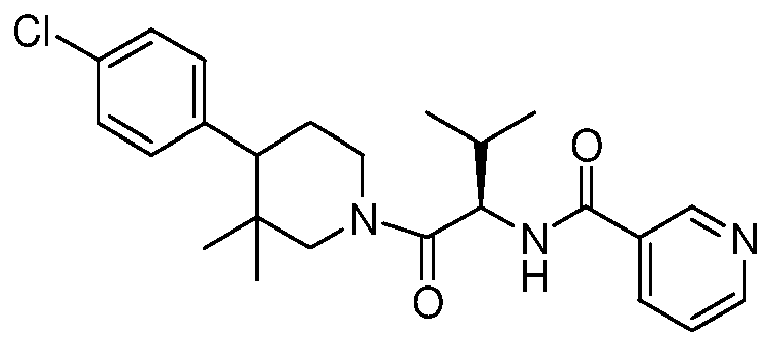
- A mixture of (2R)-2-amino-1-(4-(4-chlorophenyl)-3,3-dimethylpiperidin-1-yl)-3-methylbutan-1-one, HCl (30mg, 0.083 mmol), nicotinic acid (11.31 mg, 0.092 mmol), HOBT (28.1 mg, 0.184 mmol), and triethylamine (58.2 µL, 0.417 mmol) in methylene chloride was treated with EDC (35.2 mg, 0.184 mmol), and the reaction was allowed to stir overnight at room temperature. The mixture was concentrated in-vacuo, and the residue was taken up in ethyl acetate. The organic phase was washed 3 X with water, 3 X with 1M NaOH, and once with brine, dried over sodium sulfate, and concentrated in-vacuo. The residue was purified via prep HPLC. Fractions containing the desired product were combined and freeze-dried to yield a colorless powder. NMR indicates that this material contained a ~15% impurity. The material was stirred in 1 N NaOH and extracted 3 x with ethyl acetate. The combined organic phases were dried over sodium sulfate and concentrated in-vacuo. The residue was purified via 1 MM silica prep plate, eluting with 1:1 EtOAc/Hexanes to yield Example 582a (13mg, 0.030 mmol, 36.4 % yield) as a colorless film. MS (ESI+) = 428.5, (M+H)+.
- The diastereomeric analog of Example 582a was prepared using isomer B of 4-(4-chlorophenyl)-3,3-dimethylpiperidine prepared in Example 581, step 4.
- The following examples in Table 20 were prepared using the procedures described in Example 581, substituting (±)-4-(4-chlorophenyl)-3,3-dimethylpiperidine for 4-(4-chlorophenyl)-3,3-dimethylpiperidine, isomer A in Step 5, and the appropriate carboxylic acid in Step 7. Examples 583 and 584 were contaminated with a 15% impurity, in which the (±)-4-(4-chlorophenyl)-3,3-dimethylpiperidine moiety of the examples was replaced with a 4-(4-chlorophenyl)-3,3-dimethyl-1,2,3,6-tetrahydropyridine moiety, as seen in Example 586.
Table 20 Example Carboxylic Acid Structure MS (ESI+) 583 Nicotinic Acid 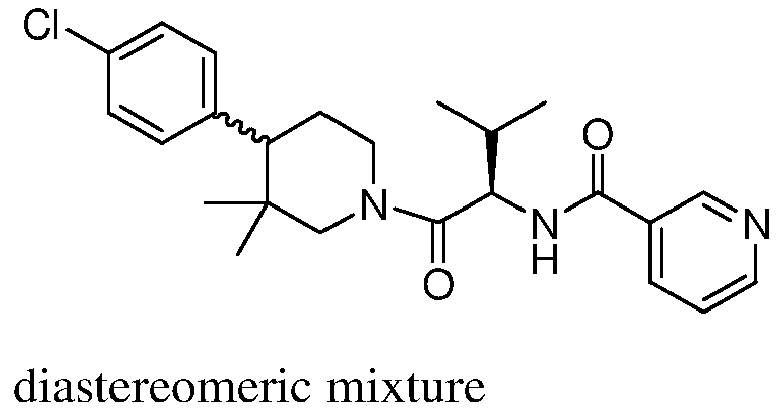
428.4 584 cyclopentanecarboxylic acid 
420.5 -

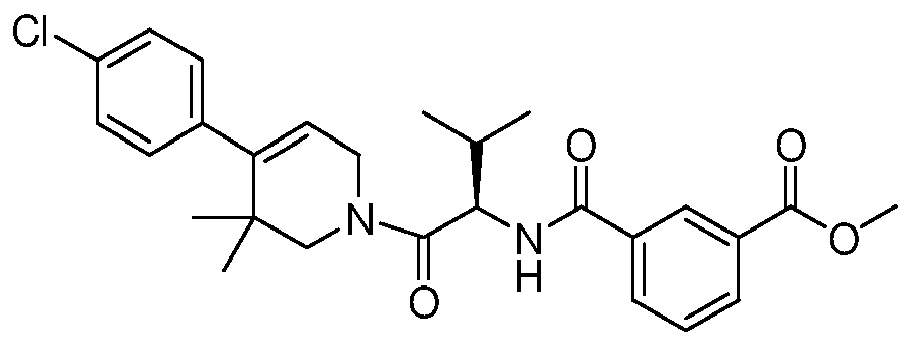
- A mixture of (2R)-2-amino-1-(4-(4-chlorophenyl)-3,3-dimethylpiperidin-1-yl)-3-methylbutan-1-one, HCl (60mg, 0.167 mmol), 3-(methoxycarbonyl)benzoic acid (33.1 mg, 0.184 mmol), HOBT (56.3 mg, 0.367 mmol), and triethylamine (116 µL, 0.835 mmol) in methylene chloride was treated with EDC (70.4 mg, 0.367 mmol), and the reaction was allowed to stir overnight at room temperature. The mixture was concentrated in-vacuo, and the residue was taken up in ethyl acetate. The organic phase was washed 3 X with saturated sodium carbonate, 3 X with 1M HCl, and once with brine, dried over sodium sulfate, and concentrated in-vacuo. The residue was taken up in methanol and purified via prep HPLC to yield two products: Example 585 (9mg, 0.019 mmol, 11.1 % yield), MS (ESI+) = 485.4, M+, and Example 586 (1.7mg, 3.52 µmol, 2.1 % yield), MS = 483.4, M+, as colorless powders.
-

-

- A solution of methyl 2-bromo-5-chlorobenzoate (4.9 g, 19.64 mmol) in THF (50 mL) was cooled to 0 °C and treated with the dropwise addition of LAH (1.0M in THF) (20.62 mL, 20.62 mmol), causing a mild exotherm and gas evolution. The mixture was allowed to warm to room temperature and stirred for 3 hours. The reaction was quenched using the Steinhardt procedure (see Fieser & Fieser, Reagents for Organic Synthesis, p. 584). The resulting precipitate was removed by filtration and washed with ethyl acetate. The combined filtrates were concentrated in-vacuo to yield a colorless oil which solidified upon standing. The residue was purified over a 330g silica gel column via ISCO, eluting with a 10-100% EtOAc/Hexanes gradient over 30 minutes, to yield the title compound (2.04 g, 47% yield) as a colorless powder.
-

- A solution of (2-bromo-5-chlorophenyl)methanol (1.48g, 6.68 mmol) in anhydrous THF (30 mL) was cooled to -78 °C and treated with the dropwise additon of n-BuLi (1.6 M in hexanes) (8.77 mL, 14.03 mmol), and the mixture was stirred for 30 minutes at -78 °C, during which a thick white precipitate was observed. The dianion was treated with the dropwise addition of a solution of tert-butyl 4-oxopiperidine-1-carboxylate (1.465 g, 7.35 mmol) in THF (10 mL), and the mixture was stirred for 1 hour at -78 °C, during which a yellow homogeneous solution was observed, then allowed to warm to room temperature and stirred overnight. The reaction was quenched with saturated ammonium chloride and the mixture was extracted 3 x with ethyl acetate. The combined organic phases were washed with water and brine, then dried over sodium sulfate and concentrated in-vacuo. The residue was split into two equal fractions, and each was purified over a 40 g silica gel column via ISCO, eluting with a 10-100% EtOAc/Hexanes gradient over 15 minutes. The fractions from each run which contained the desried product were combined to yield the title compound (1.4 g, 4.10 mmol, 61.3 % yield) as a colorless foam. MS (ESI+) = 268, (M+H-tBuOH)+.
-

- A solution of tert-butyl 4-(4-chloro-2-(hydroxymethyl)phenyl)-4-hydroxypiperidine-1-carboxylate (1.3g, 3.80 mmol) and triphenylphosphine (1.496 g, 5.70 mmol) in THF (20 mL) was treated with DEAD (0.903 mL, 5.70 mmol), and the mixture was stirred overnight at room temperature. The mixture was concentrated in-vacuo, and the residue was purified over silica gel, eluting with ethyl acetate/hexanes (5% - 25% ethyl acetate), to yield the title compound (1.19 g, 3.67 mmol, 97 % yield) as a colorless oil.
-

- The title compound was prepared from tert-butyl 5-chloro-3H-spiro[isobenzofuran-1,4'-piperidine]-1'-carboxylate using the procedure described in Example 571, Step 2.
-

- The title compound was prepared from 5-chloro-3H-spiro[isobenzofuran-1,4'-piperidine], HCl and Boc-D-Val-OH using the procedure described in Example 565, Step 6.
-

- The title compound was prepared from (R)-tert-butyl 1-(5-chloro-3H-spiro[isobenzofuran-1,4'-piperidine]-1'-yl)-3-methyl-1-oxobutan-2-ylcarbamate using the procedure described in Example 571, Step 2. MS (ESI+) = 323.2, (M+H)+.
- A mixture of (R)-2-amino-1-(5-chloro-3H-spiro[isobenzofuran-1,4'-piperidine]-1'-yl)-3-methylbutan-1-one, HCl (28mg, 0.078 mmol), nicotinic acid (10.55 mg, 0.086 mmol), HOBT (26.3 mg, 0.171 mmol), and triethylamine (54.3 µL, 0.390 mmol) in methylene chloride was treated with EDC (32.9 mg, 0.171 mmol), and the reaction was allowed to stir overnight at room temperature. The mixture was concentrated in-vacuo, and the residue was taken up in ethyl acetate. The organic phase was washed 3 X with water, 3 X with 1M NaOH, and 1 X with brine, dried over sodium sulfate, and concentrated in-vacuo. The residue was purified via prep HPLC to yield Example 587 (21mg, 0.039 mmol, 49.7 % yield) as a colorless powder. MS (ESI+) = 428.1, (M+H)+.
-

- A solution of (1R,3R)-N-((R)-1-((S)-4-(4-chlorophenyl)-4-hydroxy-3,3-dimethylpiperidin-1-yl)-3-methyl-1-oxobutan-2-yl)-3-hydroxycyclopentanecarboxamide (20mg, 0.044 mmol) in pyridine (0.5 mL) was treated with acetic anhydride (5.02 µl, 0.053 mmol), and the mixture was stirred overnight at room temperature. Analysis by LC/MS indicated only 50% conversion, so the mixture was treated with acetic anhydride (5.02 µl, 0.053 mmol), and stirred for two days at room temperature. The reaction was concentrated in-vacuo, and the residue was purified via prep HPLC to yield Example 588 (11.6mg, 0.024 mmol, 53.1 % yield) as a colorless powder. MS (ESI+) = 493.2, M+.
-

- A solution of (1R,3R)-N-((R)-1-((S)-4-(4-chlorophenyl)-4-hydroxy-3,3-dimethylpiperidin-1-yl)-3-methyl-1-oxobutan-2-yl)-3-hydroxycyclopentanecarboxamide (20 mg, 0.044 mmol) and triethylamine (12 µl, 0.086 mmol) in methylene chloride (0.5 mL) was treated with isovaleryl chloride (5.41 µl, 0.044 mmol), and the mixture was stirred overnight at room temperature. Analysis by LC/MS indicated only ~50% conversion, so the mixture was treated with isovaleryl chloride (5.41 µl, 0.044 mmol), and stirred for four days at room temperature. The reaction was concentrated in-vacuo, and the residue was purified via prep HPLC to yield Example 589 (14mg, 0.026 mmol, 59.0 % yield) as a colorless powder. MS (ESI+) = 535.2, M+.
-

-

- A solution of 1-Bromo-4-fluorobenzene (5.32 mL, 48.4 mmol) in THF (100 mL) was cooled to -78 °C, and treated with the dropwise addition of 1.6 M BuLi in hexane (30.2 mL, 48.4 mmol), at a rate which did not allow the temperature of the reaction to exceed -60 °C. The mixture was stirred at -78 °C for 30 minutes, then treated with the dropwise addition of a solution of tert-butyl 3,3-dimethyl-4-oxopiperidine-1-carboxylate (5 g, 22.00 mmol) in THF (50 mL) at a rate which did not allow the temperature to exceed -60 °C. The mixture was stiirred at -78 °C for 1.5 H, then allowed to warm to 10 °C and quenched with saturated NH4Cl (50 mL). The layers were separated, and the organic phase was concentrated in-vacuo. The aqueous was extracted with ethyl acetate (100 mL), and the organic phase was combined with the residue from the original organic phase. This solution was washed 3 X with water, 1 X with brine, dried over sodium sulfate, and concentrated in-vacuo. The residue was digested with hexanes (70 mL), and the resulting white powder was collected by filtration, rinsed with hot hexanes, and dried under vacuum to yield the title compound (3.3 g, 10.20 mmol, 46.4 % yield). MS (ESI+) = 324.4, (M+H)+, 250.3, (M-tBuOH)+.
-

- The title compound was prepared from tert-butyl 4-(4-fluorophenyl)-4-hydroxy-3,3-dimethylpiperidine-1-carboxylate using the procedure described in Example 571, Step 2. MS (ESI+) =224.32, (M+H)+.
-

- The title compound was prepared from of 4-(4-fluorophenyl)-3,3-dimethylpiperidin-4-ol, HCl and Boc-D-Val-OH using the procedure described in Example 565, Step 6. MS (ESI+) = 424.4, (M+H)+.
-

- The title compound was prepared from (R)-tert-butyl 1-(4-(4-fluorophenyl)-4-hydroxy-3,3-dimethylpiperidin-1-yl)-3-methyl-1-oxobutan-2-ylcarbamate using the procedure described in Example 571, Step 2. MS (ESI+) = 323.4, (M+H)+.
- Example 590 was prepared from (R)-2-amino-1-(4-(4-fluorophenyl)-4-hydroxy-3,3-dimethylpiperidin-1-yl)-3-methylbutan-1-one, HCl and cyclopentanecarboxylic acid using the procedure described in Example 573, Step 7. MS (ESI+) = 420.4, M+.
-

-

- The title compound was prepared from 4-(4-fluorophenyl)-3,3-dimethylpiperidin-4-ol, HCl using the procedure described in Example 573, Step 1. MS (ESI+) = 206.3, M+.
-

- A mixture of 4-(4-fluorophenyl)-3,3-dimethyl-1,2,3,6-tetrahydropyridine (450mg, 2.192 mmol), palladium hydroxide on carbon (308 mg, 2.192 mmol), and acetic acid (1.5 mL, 26.2 mmol) in methanol (10 mL) was degassed under nitrogen/vacuum, then hydrogenated at 50 psi for two days. The catalyst was removed by filtration and rinsed with methanol, and the filtrate was concentrated in vacuo to yield the title compound (442mg, 2.132 mmol, 97 % yield) as a pale yellow oil. MS (ESI+) = 208.29, (M+H)+.
-

- The title compound was prepared from 4-(4-fluorophenyl)-3,3-dimethylpiperidine and Boc-D-Val-OH using the procedure described in Example 581, Step 5. MS (ESI+) = 351.40, (M-tert-Bu)+.
-

- The title compound was prepared from (R)-tert-butyl 1-(4-(4-fluorophenyl)-3,3-dimethylpiperidin-1-yl)-3-methyl-1-oxobutan-2-ylcarbamate using the conditions described in Example 571, Step 2. MS (ESI+) = 307.4, (M+H)+.
- The title compound was prepared from of (R)-2-amino-1-(4-(4-fluorophenyl)-3,3-dimethylpiperidin-1-yl)-3-methylbutan-1-one, HCl and cyclopentanecarboxylic acid using the conditions described in Example 573, Step 7. MS (ESI+) = 404.4, M+.
-
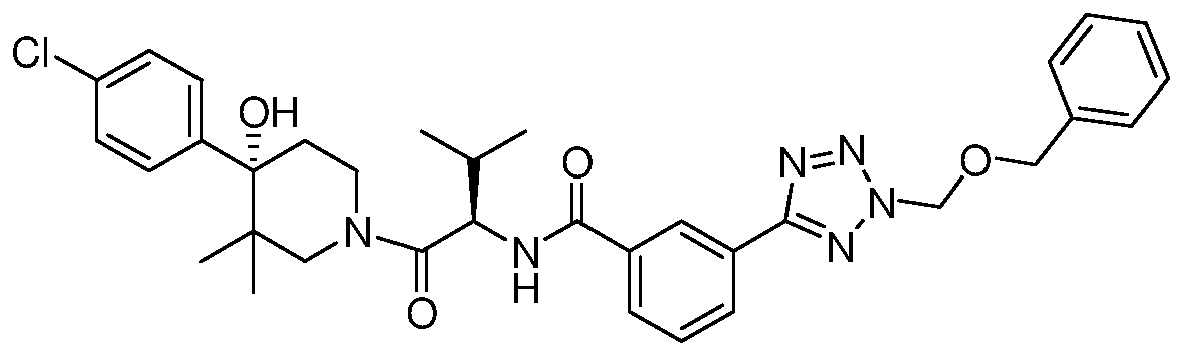
-

- A suspension of 1-H-tetrazole (2.0 g, 28.5 mmol) and potassium carbonate (5.9 g, 42.7 mmol) in DMF (30 mL) was treated with benzyl chloromethyl ether (5.36 g, 34.2 mmol), and the mixture was stirred for 4 hours. Analysis by LC/MS indicated that the reaction was not complete, so the reaction was treated with benzyl chloromethyl ether (0.5 g, 3.19 mmol) and stirred overnight. The mixture was filtered, and the filtrate was concentrated in-vacuo. The residue was diluted with diethyl ether (200 mL), washed 5 X with water (50 mL), once with brine, dried over sodium sulfate, and concentrated in-vacuo. The residue was purified over a 6 x 20 mm silica gel column, eluting with 20% then 30% ethyl acetate/hexanes to yield the title compound (2.39 g, 44% yield), and 1-(benzyloxymethyl)-2H-tetrazole (2.56 g, 47% yield).
-

- In a flame-dried three-neck flask, a solution of 2-(benzyloxymethyl)-2H-tetrazole (2.01 g, 10.57 mmol) and tetramethylethylenediamine (3.16 mL, 21.4 mmol) in diethyl ether (30 mL) was cooled to -78 °C and treated with the dropwise addition of n-butyllithium (1.6 M in hexanes, 7.3 mL, 11.62 mmol), causing the color of the solution to turn dark red. The mixture was stirred for 10 minutes, then transferred via canulus to a solution of tributyltin chloride (2.9 mL, 10.57 mmol) in diethyl ether (20 mL) which had been pre-cooled to -78 °C. The reaction was stirred for 45 minutes, then quenched with saturated ammonium chloride solution. The mixture was allowed to come to room temperature, and the layers were separated. The aqueous phase was extracted 3 x with ethyl acetate, and the combined organic phases were washed with brine, dried over sodium sulfate, and concentrated in-vacuo. The residue was purified over silica gel, eluting with 1% then 5% then 10% ethyl acetate/hexanes to yield the title compound (3.0 g, 60% yield) as a colorless oil.
-

- A solution of ethyl-3-bromobenzoate (0.47 g, 2.05 mmol) and 2-(benzyloxymethyl)-5-(tributylstannyl)-2H-tetrazole in toluene (20 mL) was degassed under vacuum and argon. To this solution was added copper (I) iodide (20 mg, 0.20 mmol) and tetrakis(triphenylphosphine)palladium(0) (115 mg, 0.10 mmol), and the mixture was again degassed under vacuum and argon. The flask and condenser were covered in foil to exclude light, and the reaction was heated at reflux temperature for 3 hours. After cooling to room temperature, the mixture was filtered and the filtrate was concentrated in-vacuo. The residue was purified over a 3.5 X 12 cm silica gel column, eluting with 5% then 10% then 15% ethyl acetate/hexanes to yield the title compound as a colorless oil which contained 5% of a tributyltin impurity. MS (ESI+) = 339.22, (M+H)+. The oil was used as-is in the next step.
-

- A solution of ethyl 3-(2-(benzyloxymethyl)-2H-tetrazol-5-yl)benzoate (653 mg, 1.93 mmol) in THF (10 mL) was treated with a 0.5 M aqueous lithium hydroxide solution (5.8 mL, 2.9 mmol), and the reaction was stirred overnight. Analysis by LC/MS indicated that the reaction had not gone to completion, so the mixture was treated with a 0.5 M aqueous lithium hydroxide solution (1 mL, 0.5 mmol), and the reaction was stirred for an additional 6 hours. The THF was removed under reduced pressure, and the aqueous solution was treated with 1 N HCl (3.5 mL, 3.5 mmol). The mixture was extracted 3 x with ethyl acetate, and the combined organic phases were dried over sodium sulfate and concentrated in-vacuo to yield the title compound as a colorless powder which was used as-is in the next step.
- A mixture of (R)-2-amino-1-((S)-4-(4-chlorophenyl)-4-hydroxy-3,3-dimethylpiperidin-1-yl)-3-methylbutan-1-one, HCl (35 mg, 0.09 mmol), 3-(2-(benzyloxymethyl)-2H-tetrazol-5-yl)benzoic acid (29 mg, 0.09 mmol), HOBT (25 mg, 0.19 mmol), and triethylamine (0.052 mL, 0.37 mmol) in methylene chloride (2 mL) was treated with EDC (36 mg, 0.19 mmol), and the reaction was allowed to stir overnight at room temperature. The reaction mixture was applied directly to a 2 X 10 cm silica gel column, and the product was eluted with methylene chloride then 10% to 20% ethyl acetate/methylene chloride to yield Example 592 (45 mg, 80% yield) as a colorless glass. MS (ESI+) = 631.3, M+.
-

- A solution of 3-(2-(benzyloxymethyl)-2H-tetrazol-5-yl)-N-((R)-1-((S)-4-(4-chlorophenyl)-4-hydroxy-3,3-dimethylpiperidin-1-yl)-3-methyl-1-oxobutan-2-yl)benzamide (34 mg, 0.05 mmol) in methanol (1 mL) was treated with 6 M HCl (0.2 mL, 1.2 mmol), and the mixture was heated to 50 °C, at which point the starting material precipitated. The mixture was diluted with methanol (3 mL) and 6 M HCl (0.2 mL, 1.2 mmol), and the reaction was heated at 50 °C for 10 hours. The mixture was concentrated in-vacuo, and the residue was purified over silica gel, eluting with 25% to 50% ethyl acetate/hexanes, then 100% ethyl acetate, then 5% to 10% to 15% methanol/ethyl acetate to yield Example 593 (19 mg, 75% yield) as a colorless glass. MS (ESI+) = 511.2, M+. Analysis by LC/MS indicates 88% purity.
-

- A solution of (R)-2-amino-1-((S)-4-(4-chlorophenyl)-4-hydroxy-3,3-dimethylpiperidin-1-yl)-3-methylbutan-1-one, HCl (32 mg, 0.09 mmol) and phthalic anhydride (14 mg, 0.09 mmol) in methylene chloride (1 mL) was stirred overnight at room temperature. The mixture was concentrated in-vacuo, and the residue was purified via prep HPLC to yield Example 594 (25 mg, 57% yield) as a colorless powder. MS (ESI+) = 487.18, M+.
-

-

- A solution of 3-(methoxycarbonyl)benzoic acid (1.05g, 5.83 mmol) in THF (25 mL) was cooled to 0 °C, and treated with the dropwise addition of 2.0 M borane-methylsulfide complex in THF (14.57 mL, 29.1 mmol) at a rate which did not allow the temperature to exceed 5 °C. The mixture was stirred at 0 °C for 15 minutes, then allowed to warm to room temperature and stirred for 4 hours. The reaction was cooled to 0 °C and quenched with the addition of small pieces of ice, causing vigorous gas evolution. When gas evolution had ceased, the mixture was diluted with brine and extracted 3 x with ethyl acetate. The combined organic phases were washed 3 x with dilute bleach to remove residual methyl sulfide, 3 x with saturated sodium carbonate to remove any unreacted acid, 1 x with water, and 1x with brine, then dried over sodium sulfate and concentrated in vacuo to yield the title compound (845mg, 5.09 mmol, 87 % yield) as a colorless oil.
-

- A solution of methyl 3-(hydroxymethyl)benzoate (845mg, 5.09 mmol) in methanol (15 mL) was treated with 1 M NaOH (aq) (15.300 mL, 15.30 mmol), and the reaction was stirred overnight at room temperature. The methanol was removed under reduced pressure, and the remaining aqueous solution was washed 3 x with 10 mL of diethyl ether. The aqueous phase was acidified to pH 1 with concentrated HCl, then extracted 3 x with 20 mL of ethyl acetate. The combined organic phases were washed with brine, dried over sodium sulfate, and concentrated in-vacuo to yield the title compound (680mg, 4.47 mmol, 88 % yield) as a colorless powder. MS (ESI+) = 153.10, (M+H)+.
- Example 595 was prepared from (R)-2-amino-1-((S)-4-(4-chlorophenyl)-4-hydroxy-3,3-dimethylpiperidin-1-yl)-3-methylbutan-1-one, HCl and 3-(hydroxymethyl)benzoic acid using the procedure described in Example 573, Step 7. MS (ESI+) = 473.4, (M+H)+.
-

- A solution of N-((R)-1-((S)-4-(4-chlorophenyl)-4-hydroxy-3,3-dimethylpiperidin-1-yl)-3-methyl-1-oxobutan-2-yl)-3-(hydroxymethyl)benzamide (37mg, 0.078 mmol) in Pyridine (0.6 mL) was treated with acetic anhydride (0.015 mL, 0.156 mmol), and the mixture was stirred overnight at room temperature. The reaction was concentrated in-vacuo, and the residue was purified via prep HPLC to yield Example 596 (25mg, 0.049 mmol, 62.1 % yield) as a colorless powder. MS (ESI+) = 515.4, M+.
-

-
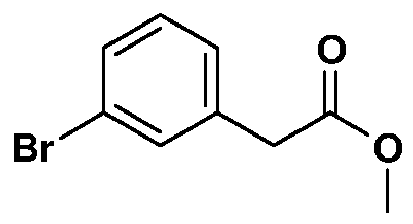
- A solution of 2-(3-bromophenyl)acetic acid (2.64 g, 12.28 mmol) in 8:2 benzene/methanol (50 mL) was cooled to 0 °C, then treated with the dropwise addition of 2.0 M TMS-diazomethane in hexanes (6.14 mL, 12.28 mmol) over 10 minutes. The mixture was allowed to come to room temperature and stirred for 7 days. The mixture was concentrated in-vacuo, and the residue was purified over silica gel, eluting with 10% ethyl acetate/hexanes to yield the title compound (1.96 g, 8.56 mmol, 69.7 % yield) as a colorless oil.
-

- A solution of methyl 2-(3-bromophenyl)acetate (502mg, 2.191 mmol) in THF (10 mL) was cooled to -78 °C, and 0.5 M potassium hexamethyldisilazide in toluene (4.82 mL, 2.411 mmol) was added dropwise at a rate which did not allow the temperature to exceed -60 °C. The mixture was allowed to stir at -78 °C for 20 minutes, allowed to warm to -30 °C, stirred for 20 minutes, recooled to -78 °C, and quenched with iodomethane (0.206 mL, 3.29 mmol). The reaction was allowed to come to room temperature and stirred for 1 h. The mixture was recooled to -78 °C, and the additions described above were repeated a second time. The mixture was allowed to come to room temperature and stirred overnight. The reaction was quenched with water, then extracted 3 x with ethyl acetate. The combined organic phases were washed with brine, dried over sodium sulfate, and concentrated in-vacuo. The residue was purified over silica gel, eluting with 10% ethyl acetate/hexanes to yield the title compound (513mg, 1.995 mmol, 91 % yield) as a colorless oil.
-

- A mixture of methyl 2-(3-bromophenyl)-2-methylpropanoate (260mg, 1.011 mmol), bis(triphenylphosphine)palladium(II) chloride (71.0 mg, 0.101 mmol), and Hunig'sBase (0.353 mL, 2.022 mmol) in methanol (5mL) in a 50 mL sealable reaction bottle was treated with carbon monoxide (28.3 mg, 1.011 mmol) via a gas dispersion tube for two minutes, the bottle was sealed, and the mixture was heated overnight at 80 °C. The reaction was cooled to room temperature, and the catalyst was removed by filtration and rinsed with methanol. The filtrate was concentrated in-vacuo, and the residue was purified over a 2 x 15 cm silica gel column, eluting with ethyl acetate/hexanes (5% - 10% - 15% - 20% ethyl acetate), to yield the title compound (54mg, 0.229 mmol, 22.60 % yield) as a colorless oil.
-

- A solution of methyl 3-(1-methoxy-2-methyl-1-oxopropan-2-yl)benzoate (54mg, 0.229 mmol) in methanol (2 mL) was treated with 1 M NaOH (aq) (1mL, 1.000 mmol), and the mixture was stirred overnight at room temperature. The mixture was treated with 1.0 N HCl (aq) (1.2 mL), and the methanol was removed in-vacuo. The remaining aqueous mixture was freezed dried to yield a mixture of the title compound and sodium chloride as colorless powder, which was used as-is in the next step.
- A mixture of (R)-2-amino-1-((S)-4-(4-chlorophenyl)-4-hydroxy-3,3-dimethylpiperidin-1-yl)-3-methylbutan-1-one, HCl (78 mg, .208 mmol), 3-(2-carboxypropan-2-yl)benzoic acid (47.7 mg, .229 mmol), HOBT (70.1 mg, 0.458 mmol), and triethylamine (0.145 mL, 1.040 mmol) in methylene chloride (1 mL) was treated with EDC (88 mg, 0.458 mmol), and the mixture was stirred overnight at room temperature.. The mixture was concentrated in-vacuo, and the residue was taken up in ethyl acetate. The organic phase was washed 3 X with water, 3 X with 1M HCl, and once with brine, dried over sodium sulfate, and concentrated in-vacuo. The residue was purified via prep HPLC. Fractions containing the mono-coupled product were combined and freeze-dried to yield a colorless powder which was a 2:1 mixture of two regioisomers. Fractions containing the bis-coupled product were combined and freeze dried to yield N-((R)-1-((S)-4-(4-chlorophenyl)-4-hydroxy-3,3-dimethylpiperidin-1-yl)-3-methyl-1-oxobutan-2-yl)-3-(1-((R)-1-((S)-4-(4-chlorophenyl)-4-hydroxy-3,3-dimethylpiperidin-1-yl)-3-methyl-1-oxobutan-2-ylamino)-2-methyl-1-oxopropan-2-yl)benzamide (13mg, 0.015 mmol, 7.35 % yield) as a colorless powder. The 2:1 mixture of mono-coupled products was purified via a 1 mm silica prep plate, eluting 3 x with 5% MeOH/CH2Cl2, to yield Example 597 (16 mg, 0.027 mmol, 13.09 % yield) as an amber solid. MS (ESI+) = 529.5, M+. This material was contaminated with 10% of 3-(1-((R)-1-((S)-4-(4-chlorophenyl)-4-hydroxy-3,3-dimethylpiperidin-1-yl)-3-methyl-1-oxobutan-2-ylamino)-2-methyl-1-oxopropan-2-yl)benzoic acid.
-

-

- A 22% solution of sodium ethoxide in ethanol (53 mL, 165 mmol) was added dropwise to a magnetically stirred suspension of tert-butylcarbamadine hydrochloride (20.0 g, 146 mmol) in ethanol (100 mL). When the addition was complete, the yellow suspension was warmed to 50° C, the heating mantle was removed, and a solution of mucobromic acid (15.7 g, 61 mmol) in ethanol (50 mL) was added dropwise at a rate which did not allow the temperature to exceed 55° C. When this addition was complete, a 22% solution of sodium ethoxide in ethanol (32 mL, 98 mmol) was added dropwise, then the mixture was allowed to cool to room temperature. The suspension was filtered, the solids were rinsed with ethanol (2 x 20 mL), and the combined filtrates were concentrated in-vacuo. The residue thus obtained was stirred in 2 N aqueous HCl (30 mL). The resulting solids were collected by filtration, rinsed with ice-cold water (2 x 20 mL), and air dried to yield 12.1 g of a beige powder as product. MS (ESI+) = 259, 261, (M+H)+. Yield = 76%.
-

- A 2.0 M hexanes solution of trimethylsilyldiazomethane (11.8 mL, 23.62 mmol) was added dropwise to a stirring solution of 5-bromo-2-tert-butyl-pyrimidine-4-carboxylic acid (6.12 g, 23.62 mmol) in 9 : 1 benzene/methanol (100 mL), and the reaction was stirred for 2 days. TLC analysis showed that the reaction was complete, so the mixture was concentrated in-vacuo. The residue was dissolved in ethyl acetate (100 mL), washed with water (3 x 20 mL), dried over sodium sulfate, then concentrated in-vacuo. Purified over silica gel, eluting with 10% ethyl acetate/hexanes, to yield 5.2 g of a colorless oil as product. MS (ESI+) = 273/275, (M+H)+. Yield = 81%.
-
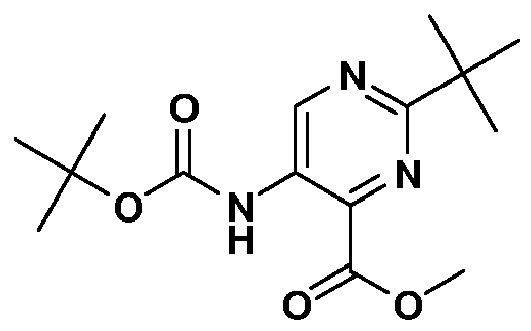
- A flame dried reaction tube charged with tert-butylcarbamate (140 mg, 1.2 mmolol), cesium carbonate (456 mg, 1.4 mmol), 4,5-bis(diphenylphosphino)-9,9-dimethylxanthane (18 mg, 0.03 mmol), and tris(dibenzylidineacetone)dipalladium(0) (19 mg, 0.02 mmol) was evacuated under vacuum, then backfilled with argon. Dioxane (2 mL) and 5-bromo-2-tert-butyl-pyrimidine-4-carboxylic acid methyl ester (273 mg, 1.0 mmol) were added, and the mixture was degassed under vacuum. The tube was then backfilled with argon, sealed, and heated at 100° C for 2 hours. Analysis by LC/MS showed complete consumption of starting bromide. The mixture was diluted with methylene chloride (20 mL), filtered to remove solids, and concentrated in-vacuo. The residue was purified over silica gel, eluting with 10% ethyl acetate/heptane, to yield 152 mg of white solids as product. MS (ESI+) = 310, (M+H)+. Yield = 50%.
-

- 5-tert-Butoxycarbonylamino-2-tert-butyl-pyrimidine-4-carboxylic acid methyl ester (2.4 g, 7.75 mmol) was dissolved in a 4 M solution of HCl in dioxane (30 mL). After 10 minutes of stirring, a thick white solid precipitated. The reaction was allowed to stir overnight, during which time the mixture became a homogenous, amber solution. Concentrated in-vacuo, and the residue was concentrated from toluene (2 x 50 mL) followed by methylene chloride (3 x 50 mL) to remove excess HCl. The resulting 1.85 g of yellow solids was used without further purification in the next step. MS (ESI+) = 210, (M+H)+.
-

- A mixture of 5-amino-2-tert-butyl-pyrimidine-4-carboxylic acid methyl ester, HCl salt (1.1 g, 4.48 mmol) and formamidine acetate (1.86 g, 17.90 mmol) in 2-ethoxyethanol (20 mL) was heated at reflux for 5 hours. LC/MS analysis showed the reaction to be essentially complete, so the mixture was cooled to room temperature, then concentrated in-vacuo. The residue was purified over silica gel, eluting with ethyl acetate, 1% methanol/ethyl acetate, then 2% methanol/ethyl acetate to yield 1.06 g of a beige solid as product. MS (ESI+) = 205, (M+H)+. Yield = 94%.
-

- 6-tert-Butyl-pyrimido[5,4-d]pyrimidin-4-ol (210 mg, 1.03 mmol) was dissolved in phosphorous oxychloride (10 mL), and the mixture was heated at reflux for 4 hours. The solution was concentrated in-vacuo, then concentrated from methylene chloride (3 x 50 mL) to remove excess phosphorous oxychloride. The residue was stirred for 10 minutes in saturated sodium bicarbonate (50 mL), then extracted with ethyl acetate (3 x 30 mL). The combined organic phases were washed with water (30 mL), followed by brine (30 mL), dried over sodium sulfate, then concentrated in-vacuo. The residue was purified over silica gel, eluting with 50% ethyl acetate/heptane, to yield 150 mg of a white solid as product. NMR (500 MHz, CDCl3) δ 9.61 (s, 1H), 9.15 (S, 1H), 1.52 (s, 9H).
- A solution of (R)-2-amino-1-((S)-4-(4-chlorophenyl)-4-hydroxy-3,3-dimethylpiperidin-1-yl)-3-methylbutan-1-one, HCl (17 mg, 0.04 mmol), 2-tert-Butyl-8-chloro-pyrimido[5,4-d]pyrimidine(10 mg, 0.04 mmol), and triethylamine (0.016 mL, 0.11 mmol) in isopropanol (1 mL) was stirred overnight at room temperature. The solution was diluted with 1 : 1 acetonitrile/water (2 mL), and the mixture was purified via prep HPLC to yield Example 598 as a pale yellow powder. MS (ESI+) = 526.3, M+.
-

-

- A solution of formamadine acetate (836 mg, 8.03 mmol) and 2-amino-3-bromobenzoic acid (578 mg, 2.68 mmol) in 2-ethoxyethanol (15 mL) was heated at reflux for 18 h. Cooled to room temperature, upon which a precipitate was observed. Diluted with diethyl ether (15 mL), and stirred for 20 minutes. The solids were collected by vacuum filtration, rinsed with 2-ethoxyethanol (5 mL), followed by diethyl ether, then air dried to yield the title compound (445mg, 1.977 mmol, 73.9 % yield) as a tan powder. MS (ESI+) = 225.1/227.1, (M+H)+.
-

- A suspension of 8-bromoquinazolin-4-ol (410mg, 1.822 mmol) in phosphorous oxychloride (15.000 mL, 161 mmol) was heated to reflux. After refluxing 45 min, a clear, amber solution was observed. Refluxed an additional 30 min, concentrated in-vacuo, and concentrated 2 x from methylene chloride to remove residual phosphorous oxychloride. The residue was taken up in ethyl acetate (50 mL), treated with the careful addition of saturated sodium bicarbonate, and this mixture was stirred for 5 minutes, until gas evolution had ceased. The layers were separated, the and the aqueous phase was extracted with ethyl acetate (20 mL). The combined organic phases were washed with saturated sodium bicarbonate, water, and saturated sodium chloride, dried over sodium sulfate, and concentrated in-vacuo to yield the title compound (442mg, 1.815 mmol, 100 % yield) as a tan powder which was used as-is in the next step.
- A solution of (R)-2-amino-1-((S)-4-(4-chlorophenyl)-4-hydroxy-3,3-dimethylpiperidin-1-yl)-3-methylbutan-1-one, HCl (35mg, 0.093 mmol) and N,N-Diisopropylethylamine (0.049 mL, 0.280 mmol) in 2-Propanol (1mL) was treated with 8-bromo-4-chloroquinazoline (24.9 mg, 0.103 mmol) , and the mixture was stirred overnight at room temperature. The reaction mixture was diluted with 1:1 acetonitrile/water, and injected directly onto the prep HPLC for purification. Fractions containing the desired product were freeze dried to yield 38 mg of colorless powder which was ~80% pure by NMR/LCMS. The powder was repurified via HPLC to yield Example 599 (24mg, 0.036 mmol, 39.0 % yield). MS (ESI+) = 545.13/547.24, M+.
-

-
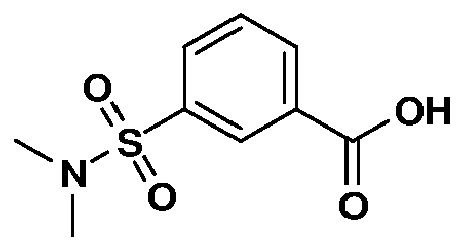
- A solution of 3-(chlorosulfonyl)benzoic acid (152mg, 0.689 mmol) in methylene chloride (2 mL) was treated with 2.0 M dimethylamine in THF (1.137 mL, 2.274 mmol), and the mixture was stirred overnight at room temperature. The reaction was quenched with 1 N HCl, and extracted 3 x with EtOAc. The combined organic phases were washed with 1 N HCl followed by brine, then dried over sodium sulfate and concentrated in-vacuo to yield the title compound (138mg, 0.602 mmol, 87 % yield). MS (ESI+) = 230.18, (M+H)+.
- Example 600 was prepared from (R)-2-amino-1-((S)-4-(4-chlorophenyl)-4-hydroxy-3,3-dimethylpiperidin-1-yl)-3-methylbutan-1-one, HCl and 3-(N,N-dimethylsulfamoyl)benzoic acid using the procedure described in Example 573, Step 7. MS (ESI+) = 550.38, M+.
-

-

- A mixture of (S)-4-(4-chlorophenyl)-3,3-dimethylpiperidin-4-ol (107 mg, 0.45 mmol), Boc-D-Ala-OH (93 mg, 0.49 mmol), HOBT (133 mg, 0.98 mmol), and triethylamine (0.25 mL, 1.78 mmol) in methylene chloride (2 mL) was treated with EDC (187 mg, 0.98 mmol), and the reaction was allowed to stir overnight at room temperature. The solvent was evaporated with a stream of nitrogen, and the residue was taken up in ethyl acetate. The organic phase was washed 3 X with 1M NaOH, 3 X with 1M HCl, and once with brine, dried over sodium sulfate, and concentrated in-vacuo. The residue was dissolved in dioxane (2 mL) and treated with 4 N HCl in dioxane (2 mL, 8 mmol). The mixture was stirred for 4 hours, then concentrated in-vacuo. Twice, the residue was taken up in methylene chloride (10 mL) and the mixture was concentrated in-vacuo, to remove residual HCl, to yield the title compound. MS (ESI+) = 311.3, (M+H)+.
-

- The title compound was prepared from (R)-2-amino-1-((S)-4-(4-chlorophenyl)-4-hydroxy-3,3-dimethylpiperidin-1-yl)propan-1-one, HCl (47 mg, 0.14 mmol) and mono-methyl isophthalate (27 mg, 0.16 mmol) using the conditions described in Example 572, Step 5. MS (ESI+) = 473.3, M+.
- A solution of methyl 3-((R)-1-((S)-4-(4-chlorophenyl)-4-hydroxy-3,3-dimethylpiperidin-1-yl)-1-oxopropan-2-ylcarbamoyl)benzoate (33 mg, 0.07 mmol) in THF (1 mL) was treated with 0.5 M aqueous lithium hydroxide, and the mixture was stirred overnight at room temperature. The reaction mixture was purified via prep HPLC to yield Example 601 (24 mg, 75% yield) as a colorless powder. MS (ESI+) = 459.3, M+.
-

- Example 602 was prepared from (R)-3-oxocyclopentanecarboxylic acid , prepared via the method of Curry, et. al. J. Med. Chem. 1988, 31, 861. (304 mg, 2.37 mmol) and (R)-2-amino-1-((S)-4-(4-chlorophenyl)-4-hydroxy-3,3-dimethylpiperidin-1-yl)-3-methylbutan-1-one, HCl (810 mg, 2.16 mmol) using the procedures described in Examples 572A and 572B, Step 5. MS (ESI+) = 449.5, M+.
-

-

- A solution of (R)-3-oxocyclopentanecarboxylic acid, prepared via the method of Curry, et. al. J. Med. Chem. 1988, 31, 861. (215 mg, 1.678 mmol) in THF (10 mL) was cooled to -78 °C, then treated with the dropwise addition of 1.6 M methyllithium in diethyl ether (2.927 mL, 4.68 mmol) at a rate which did not allow the temperature to rise above -60 °C. The mixture was allowed to stir at -78 °C for 2 h, then allowed to warm to 0 °C and quenched with 1 N HCl. The layers were separated, and the aqueous phase was extracted 3 x with ethyl acetate. The aqueous phase was concentrated in-vacuo, then concentrated 3 x from isopropanol to remove all water. NMR of the residue indicated a complex mixture of materials. The material was used as-is in the next step.
- Example 603 was prepared from (R)-2-amino-1-((S)-4-(4-chlorophenyl)-4-hydroxy-3,3-dimethylpiperidin-1-yl)-3-methylbutan-1-one, HCl and mixture of materials prepared in Step A., which contained (1R)-3-hydroxy-3-methylcyclopentanecarboxylic acid, using the procedure described in Example 573, Step 7. MS (ESI+) = 465.5, M+.
-

-

- To a solution of 8 g (0.0494 mol, 1eq) of 5-amino-2-(trifluoromethyl) pyridine in 160 mL of water and 160 mL of methanol was added 8 mL of conc. HCl followed by 8.2 g (0.0494 mol, 1eq) of potassium iodide and 5.2 g (0.0243 mol, 0.5 eq) of potassium iodate and stirred at RT for 48 h. The reaction mixture was basified with 10% NaOH solution and extracted with ethyl acetate. The organic layer was washed with brine and concentrated. The crude product obtained was purified by 60-120 silica gel using 10 % of ethyl acetated in pet ether to get 12.5 g (87.9 %) of off white solid. Results: 1H NMR (CDCl3, 400 MHz): 6.94 (1H, d), 7.42 (1H, d), 4.0-5.0 (2H, bs). MS 289 (M+H)+.
-

- 12.5 g (0.434 mol, 1eq) of 5-amino-6-iodo-2-(trifluoromethyl) pyridine was dissolved in 125 mL of dry DMF and degasified with nitrogen for 5 min. 6.1g (0.519 mol, 1.2eq) of zinc cyanide and 5 g (0.1 eq) of Pd(PPh3)4 were added and heated at 100 °C for over night. The reaction mixture was quenched with water and extracted with ethyl acetate. The organic layer was washed with brine and concentrated. The crude product obtained was purified by 60-120 silica gel using 15 % of ethyl acetate in pet ether to get 7g (86.31 %) of pale yellow solid. 1H NMR (CDCl3, 400 MHz): 4.85 (2H, bs), 7.25 (1H, d), 7.62 (1H, d). MS 188 (M+H)+.
-

- 7 g (0.0374 mol, 1eq) of 5-amino-6-cyano-2-(trifluoromethyl) pyridine dissolved in 106 ml of 90 % sulfuric acid was and heated at 70 °C for 3 h. The reaction mixture was cooled to RT and quenched with ice water and extracted with ethyl acetate. The organic layer was washed with brine and concentrated. The solid product obtained was washed with to get 6.8 g (89.47 %) of off white solid. 1H NMR (CDCl3, 400 MHz) 5.5 (1H, bs), 7.1 (1H, d), 7.53 (1H, d), 7.80 (1H, bs). MS 206 (M+H)+.
-

- 6.8 g (0.0332 mol, 1eq) of 3-amino-6-trifluoromethyl-pyridine-2-carboxylic acid amide in 170 ml of triethylorthoformate under nitrogen was heated at 145 °C for 8 h. Excess triethylorthoformate was removed under reduced pressure and the solid product obtained was washed with pet-ether and dried under vacuum to get 6.8 g (95.37 %) of white solid. 1H NMR (CDCl3, 400 MHz): 8.11 (1H, d), 8.35 (1H, d), 12.28 (1H, bs). MS 216 (M+H)+.
-
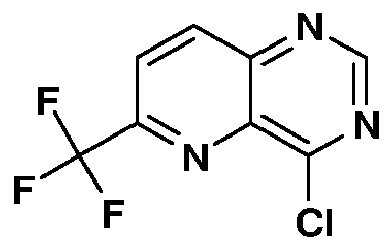
- The title compound was prepared from trifluoromethyl-3H-pyrido[3,2-d]pyrimidin-4-one using the procedure described in Example 599, Step 2. A POCl3 (9.3 ml) suspension of 6-Trifluoromethyl-3H-pyrido[3,2-d]pyrimidin-4-one (1.0 g, 4.7 mmol) was heated at reflux for 4 hours, over which time the amber suspension became a clear, deep blue solution. The reaction was cooled to room temperature and concentrated under reduced pressure. The residue concentrated from dichloromethane 3 X to remove residual POCl3. The residue was partitioned between 1:1 EtOAc and saturated sodium bicarbonate (28 ml). The mixture was stirred until visible gas evolution ceased. The suspension was filtered through a plug of celite. The layers of the filtrate were separated, and the organic phase was washed successively with saturated sodium bicarbonate and saturated sodium chloride, dried with magnesium sulfate and concentrated under reduced pressure to yield the semi-pure product as a purple solid. No further purification was carried out. The crude product was greater than 90% pure (as determined by analytical HPLC). MS: ES+ 234.11 (M+H, 100%
- Example 604 was prepared from (R)-2-amino-1-((S)-4-(4-chlorophenyl)-4-hydroxy-3,3-dimethylpiperidin-1-yl)-3-methylbutan-1-one, HCl and 4-chloro-6-(trifluoromethyl)pyrido[3,2-d]pyrimidine using the procedure described in Example 598, Step 7. MS (ESI+) = 536.3, M+.
-
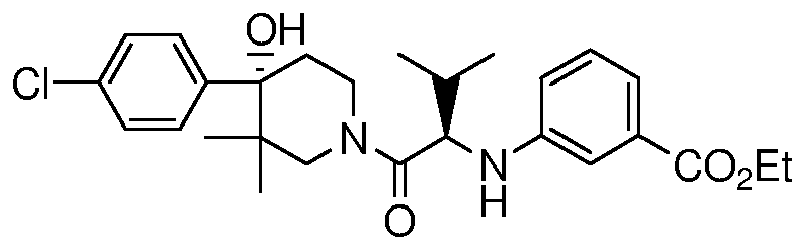
-

- Ethyl 3-iodobenzoate (857 mg, 3.10 mmol), DMF (5mL), copper(I) iodide (65 mg, 0.34 mmol), N1,N2-dimethylaminoethylene (62.9 mg, 0.714 mmol), D-valine (400 mg, 3.41 mmol) and potassium carbonate (429 mg, 3.10 mmol) were charged into a flask. The flask was evacuated, then filled with nitrogen over several cycles to remove oxygen, then the reaction was heated to 140 °C under nitrogen for 4 hrs. The reaction was cooled, the DMF removed by evaporation, and 1 N HCl added. The reaction mixture was partitioned between EtOAc and water, and the organic layer was dried over sodium sulfate, filtered, and concentrated to yield a brown oil. This was used in next step without further purification.
- (S)-4-(4-Chlorophenyl)-3,3-dimethylpiperidin-4-ol (106 mg, 0.44 mmol), (R)-2-(3-(ethoxycarbonyl)phenylamino)-3-methylbutanoic acid (167 mg, 0.44 mmol), DIPEA (228 mg, 1.76 mmol), HOBT (59.5 mg, 0.44 mmol), EDC (101 mg, 0.53 mmol), and DMF (2 mL) were stirred overnight at rt. The reaction was partitioned between EtOAc and water, the organics were dried over sodium sulfate, filtered, concentrated, and the residue was purified by preparative reverse phase HPLC (MeOH/water/TFA) yielding Example 605 as a white solid (109 mg, 50.7% yield) M+H=487.19.
-

- Ethyl-3-(R)-1-(S)-4-(4-chlorophenyl)-4-hydroxy-3,3-dimethylpiperidine-1-yl)-3-methyl-1-oxobutan-2-ylamino)benzoate (92 mg), MeOH, and 1N sodium hydroxide was stirred overnight at rt. The reaction was concentrated and the residue was purified by preparative reverse-phase HPLC (MeOH / water / TFA) to give Example 606 as a white solid (83.3 mg 95.7% yield).
-

-

- 3-Iodopyridine (525 mg, 2.58 mmol), D-valine (250 mg, 2.13 mmol), copper(I) iodide (40.6 mg, 0.213 mmol), dimethylaminoethanol (400 mg, 4.49 mmol), potassium phosphate tribasic (1359 mg, 6.40 mmol), and water (2 mL) was stirred at 80 °C overnight. The reaction was washed with EtOAc, then the aqueous portion was concentrated. The residue was slurried with MeOH and the MeOH portion was concentrated. The product was isolated using preparative reverse phase HPLC (MeOH / water / TFA) and used in next step without further purification.
- (R)-3-Methyl-2-(pyridine-3-ylamino)butanoic acid (162 mg, 0.83 mmol), (S)-4-(4-chlorophenyl)-3,3-dimethylpiperidin-4-ol (200 mg, 0.83 mmol), EDC (320 mg, 1.67 mmol), HOBT (113 mg, 0.83 mmol), DIPEA (431 mg, 3.34 mmol), and DMF (4 mL) was stirred overnight at rt. Example 607 was isolated as a greenish solid using preparative reverse phase HPLC (22.5 mg, 6.5% yield). M+H = 416.18.
-

-

- 5-Bromopyrimidine (407 mg, 2.56 mmol), D-valine (250 mg, 2.13 mmol), copper(I) iodide (40.6 mg, 0.213 mmol), dimethylaminoethanol (400 mg, 4.49 mmol), potassium phosphate tribasic (1359 mg, 6.40 mmol), and water (2 mL) was stirred at 80 °C for several hours. 1 N hydrochloric acid (3 mL) was added to the reaction mixture followed by TFA (3 mL) and the reaction was extracted with EtOAc. The organic portion was dried over sodium sulfate, filtered, concentrated, and the product was isolated as a brown solid using preparative reverse-phase HPLC and used in next step without further purification.
- (R)-3-Methyl-2-(pyridine-3-ylamino)butanoic (64 mg, 0.207 mmol), (S)-4-(4-chlorophenyl)-3,3-dimethylpiperidin-4-ol (59.4 mg, 0.248 mmol), EDC (47.5 mg, 0.248 mmol), HOBT (27.9 mg, 0.207 mmol), DIPEA (107 mg, 0.826 mmol), and DMF (2 mL) was stirred overnight at rt. Example 608 was isolated as a light tan solid using preparative reverse phase HPLC. (6.6 mg, 7.7 % yield). M+H = 417.15.
-

-

- 4-Isopropylbenzoic acid (4.26 g, 25.9 mmol), sulfuric acid (25 mL), and water (2 mL) was heated to 95 °C and iodine (14.42 g, 56.8 mmol) was slowly added portionwise. The reaction was maintained at this temperature for 48 h. The reaction was cooled, poured into ice and extracted with methylene chloride. The organic extracts were dried over sodium sulfate, filtered, concentrated and then purified by reverse phase HPLC (MeOH / water / TFA) to yield 3-iodo-4-isopropylbenzoic acid (60 mg).
-

- A parr reactor was charged with 3-iodo-4-isopropylbenzoic acid (60 mg, 0.207 mmol), palladium acetate, MeOH (25 mL), 1,3-bis(diphenylphosphino)propane (4.31 mg, 0.021 mmol), and potassium carbonate (57 mg, 0.414 mmol) and pressurized with 80 psi of carbon monoxide gas. The reaction was heated at 75 °C overnight. The reaction was cooled, concentrated, and partitioned between 15 mL water/15 mL methylene chloride. The aqueous portion was acidified with 1 N HCl and extracted with methylene chloride. The organics were dried over sodium sulfate, filtered, and concentrated to yield a yellowish solid (40 mg).
- 4-Isopropyl-3-(methoxycarbonyl)benzoic acid (40 mg, 0.180 mmol) , HOBT (20 mg, 0.15 mmol), EDC (56.3 mg, 015 mmol), DIPEA (58.2 mg, 0.58 mmol), and DMF (2 mL) was stirred briefly at rt, then (R)-2-amino-1-((S)-4-(4-chlorophenyl)-4-hydroxy-3,3-dimethylpiperidin-1-yl)-3-methylbutan-1-one hydrochloride was added. The reaction was stirred overnight at rt then purified by reverse phase HPLC to yield Example 609 as a white solid (47 mg, 58% yield), M+H=543.31.
-

- Methyl-5-((R)-1-((S)-4-(4-chlorophenyl)-4-hydroxy-3,3-dimethylpiperidin-1-yl)-3-methyl-1-oxobutan-2-ylcarbamoyl)-2-isopropylbenzoate (Example 609, 45 mg) was stirred overnight at rt in MeOH (5 mL) and 1 N sodium hydroxide (5 mL). The reaction was acidified with 1 N HCl (10 mL) and extracted into methylene chloride. The organic layer was dried over sodium sulfate, filtered, concentrated to yield Example 610 as a white solid (39.6 mg).
-

-

- To a stirred solution of isopentylnitrite (365 mg, 3.12 mmol) in DMF (8 mL) at 65 °C was added 2,6-diiodo-4-(trifluoromethyl)aniline (685 mg, 1.66 mmol). The reaction was stirred overnight at rt then poured into 1 N HCl (10 mL) and extracted with methylene chloride. The organic layer was dried over sodium sulfate, filtered, concentrated and the residue was purified on silica (hexanes) to afford a pink solid.
-

- A Parr reactor was charged with 3,5-diiodobenzotrifluoride (450 mg, 1.13 mmol), 1,3-bis(diphenylphosphino)propane (46.6 mg, 0.11 mmol), MeOH (30 mL), and potassium carbonate (313 mg, 2.3 mmol). The reactor was then charged with 80 psi carbon monoxide gas and heated to 100 °C overnight with stirring. The crude reaction mixture was filtered through Celite and concentrated to a purple solid which was redissolved into methylene chloride and washed with water. The aqueous portion was acidified and extracted with methylene chloride, dried over sodium sulfate, and concentrated to afford 3-(methoxycarbonyl)-5-(trifluoromethyl)benzoic acid as a crude solid which was used without further purification.
- 3-(Methoxycarbonyl)-5-(trifluoromethyl)benzoic acid (58 mg, 0.234 mmol) HOBT (78 mg, 0.58 mmol), EDC (74 mg, 0.38 mmol), DIPEA (75 mg, 0.58 mmol), and DMF (1 mL) was stirred for 30 min at rt, then (R)-2-amino-1-((S)-4-(4-chlorophenyl)-4-hydroxy-3,3-dimethylpiperidin-1-yl)-3-methylbutan-1-one hydrochloride was added. The reaction was stirred overnight at rt and Example 611 was isolated as a white solid using preparative reverse phase HPLC (36 mg, 11% yield), M+H=569.18.
-

- Example 612 was prepared in a similar manner as Example 610. M+H=555.2
-

-

- A parr reactor was charged with 3-bromo-4-methylbenzoic acid, MeOH (50 mL), palladium acetate (0.44 g, 1.95 mmol), bis(1,3-diphenylphosphino)propane, and potassium carbonate (4.0 g, 29.3 mmol) was pressurized to 80 psi with carbon monoxide gas. The reaction was maintained at this temperature for 48 h. The reaction was cooled, acidified with 1 N HCl, and extracted with methylene chloride. The organic extracts were dried over sodium sulfate, filtered, concentrated and then purified by reverse phase HPLC to yield the title compound.
- 4-Methyl 1-3-(methoxycarbonyl)benzoic acid (32 mg, 0.165 mmol) , HOBT (22 mg, 0.165 mmol), EDC (39 mg, 0.25 mmol), DIPEA (50 mg, 0.38 mmol), and DMF (1 mL) was stirred briefly at rt, then (R)-2-amino-1-((S)-4-(4-chlorophenyl)-4-hydroxy-3,3-dimethylpiperidin-1-yl)-3-methylbutan-1-one hydrochloride was added. The reaction was stirred overnight at rt then purified by reverse phase HPLC to yield Example 613 (44.6 mg, 68 % yield), M+H=515.35
-

- Example 614 was prepared in a similar manner as Example 610 (28.1 mg, 87.5% yield) M+H = 501.34.
-

-

- 5-Methylisophthalic acid (1.21 g, 6.5 mmol), dichloroethane (20 mL), DMF (3 drops), and thionyl chloride (2.42 g, 20 mmol) was heated to 80 °C for 4 hrs. The reaction was concentrated to dryness and a solution of MeOH (208 mg, 6.5 mmol) was added slowly and the reaction was stirred overnight at rt. 1 N Hydrochloric acid (10 mL) was added and reaction stirred for 1 hr. The pH was adjusted with sat'd sodium bicarbonate (50 mL) and the aqueous solution was extracted with methylene chloride to remove the diester. The aqueous portion was then acidified with 1 N HCl and extracted with methylene chloride/ MeOH 95:5. The organic extracts were dried over sodium sulfate, filtered, concentrated, and the product was isolated via preparative reverse-phase HPLC.
-

- 5-Methyl 1-3-(methoxycarbonyl)benzoic acid (35 mg, 0.180 mmol), HOBT (21 mg, 0.156 mmol), EDC (48 mg, 0.31 mmol), DIPEA (81 mg, 0.63 mmol), and chloroform (2 mL) was stirred briefly at rt, then (R)-2-amino-1-((S)-4-(4-chlorophenyl)-4-hydroxy-3,3-dimethylpiperidin-1-yl)-3-methylbutan-1-one hydrochloride was added. Reaction stirred overnight at rt, concentrated and purified via reverse phase HPLC to yield methyl-3-((R)-1-((S)-4-(chlorophenyl)-4-hydroxy-3,3-dimethylpiperidin-1-yl)-3-methyl-1-oxobutan-2-ylcarbamoyl)-5-methylbenzoate.
- Methyl-3-((R)-1-((S)-4-(chlorophenyl)-4-hydroxy-3,3-dimethylpiperidin-1-yl)-3-methyl-1-oxobutan-2-ylcarbamoyl)-5-methylbenzoate (21 mg) was stirred overnight in THF (0.5 mL), MeOH (0.5 mL) and 1 N NaOH (0.5 mL). The reaction acidified with 1 N hydrochloric acid then partitioned between water (10 mL) and methylene chloride (10 mL). The layers were separated and the organic layer was dried over sodium sulfate, filtered, then concentrated to yield Example 615 (18 mg, 90% yield), M+H= 501.29.
-

- N-((R)-1-((S)-4-(4-Chlorophenyl)-4-hydroxy-3,3-dimethylpiperidin-1-yl)-3-methyl-1-oxobutan-2-yl)cyclopentanecarboxamide (30 mg, 0.069 mmol) was dissolved into methylene chloride (2 mL) then cooled to -78 °C and DAST (13.3 mg, 0.083 mmol) was added. The reaction was stirred overnight at rt. HPLC showed some starting material present and 2 additional drops of DAST was added at rt. Some starting material was still present and 2 additional drops DAST was added and HPLC then showed the reaction was complete. The reaction was concentrated and Example 616 was isolated as a white solid by preparative reverse-phase HPLC (15.3 mg, 51% yield), M+H=437.38.
-

- (R)-N-(1-(4-(4-chlorophenyl)-4-hydroxypiperidin-1-yl)-3-methyl-1-oxobutan-2-yl)cyclopentanecarboxamide was converted to Example 617 using the methods outlined for Example 616. (23.2 mg, 42% yield), M+23= 431.36.
-

-

- Methyl 2-(2-((R)-1-((S)-4-(4-chlorophenyl)-4-hydroxy-3,3-dimethylpiperidin-1-yl)-3-methyl-1-oxobutan-2-ylamino)thiazol-4-yl)acetate (Example 520, 356 mg, 0.895 mmol) was stirred overnight in 1 N sodium hydroxide (2 mL) and ethanol (15 mL). The reaction was neutralized to pH 7 with 0.1N hydrochloric acid and the product was extracted with EtOAc: MeOH 95:5. The organic extracts were dried over sodium sulfate, filtered, and concentrated to yield the title compound (180 mg) which was used without further purification.
- 2-(2-((R)-1-((S)-4-(4-chlorophenyl)-4-hydroxy-3,3-dimethylpiperidin-1-yl)-3-methyl-1-oxobutan-2-ylamino)thiazol-4-yl)acidic acid (30 mg, 0.062 mmol), DMF (1 mL), HOBT (8.4 mg, 0.06 mmol), EDC (18 mg, 0.094 mmol), isopropylamine hydrochloride (10 mg, 0.125 mmol), and DIPEA (32 mg, 0.25 mmol) was stirred 72 hrs at rt. Example 618 was isolated directly by reverse phase HPLC (3.4 mg, 10.4% yield), M+H = 521.29.
-

- Example 619 was prepared in a similar fashion as Example 618 (2.9 mg, 8.5% yield), M+H = 547.34.
-

- Example 620 was prepared in a similar fashion as Example 618 (36.3 mg, 62% yield), M+H=549.
-

- 1-((R)-1-((S)-4-(4-chlorophenyl)-4-hydroxy-3,3-dimethylpiperidin-1-yl)-3-methyl-1-oxobutan-2-)thiourea (50 mg, 0.126 mmol), ethanol (5 mL), and 1-chloropropan-2-one was heated at 80 °C for 4 hrs. The reaction was cooled and the product isolated by reverse phase preparative HPLC to afford Example 621 as a white solid (36.5 mg, 66.6% yield) M+H=436.2.
-

- 1-((R)-1-((S)-4-(4-chlorophenyl)-4-hydroxy-3,3-dimethylpiperidin-1-yl)-3-methyl-1-oxobutan-2-)thiourea (55 mg, 0.138 mmol), ethanol (6 mL), and 3-chloro-1,1,1-trifluoropropan-2-one (24.3 mg, 0.166 mmol) was stirred at 80 °C for 3 days. The reaction was cooled and the product isolated by reverse phase preparative HPLC to afford Example 622 as a white solid (14.3 mg, 21% yield) M+H=490.12.
-

-

- (R)-2-amino-1-((S)-4-(4-chlorophenyl)-4-hydroxy-3,3-dimethylpiperidin-1-yl)-3-methylbutan-1-one hydrochloride (338 mg, 0.90 mmol), THF (5 mL), and 6-chloronicotinoyl chloride (132 mg, 0.75 mmol) was cooled to 0 °C and DIPEA (233 mg, 1.80 mmol) was added dropwise. The reaction was allowed to warm to rt and stir overnight. The solvent was then removed and residue was partitioned between methylene chloride and saturated sodium bicarbonate. The layers were separated and the organic extracts were dried, filtered, and concentrated to yield 6-chloro-N-((R)-1-((S)-4-(chlorophenyl)-4-hydroxy-3,3-dimethylpiperidin-1-yl)-3-methyl-1-oxobutan-2-yl)nicotinamide as a white solid.
- A microwave vial was charged with 6-chloro-N-((R)-1-((S)-4-(chlorophenyl)-4-hydroxy-3,3-dimethylpiperidin-1-yl)-3-methyl-1-oxobutan-2-yl)nicotinamide (18 mg, 0.038 mmol), 2-propanol (1 mL), and freshly prepared sodium propan-2-olate (0.5 mL, 0.083 mmol). The vial was sealed and heated for 30 minutes at 150 °C. The product was isolated visa preparative reverse phase HPLC to give Example 623 (13.2 mg, 69.9% yield) as a white solid. M+H= 502.41
-

-

- (R)-1-((S)-4-(4-Chlorophenyl)-4-hydroxy-3,3-dimethylpiperidin-1-yl)-3-methyl)-1-oxobutan-2-aminium chloride (150 mg, 0.40 mmol), THF(10 mL), and 5,6-dichloronicotinoyl chloride (101 mg, 0.48 mmol) was stirred together at rt then DIPEA (114 mg, 0.88 mmol) was added dropwise. The reaction was stirred overnight, then the solvent was removed and residue was partitioned between EtOAc and 1N sodium hydroxide. The organic extracts were dried, filtered, and concentrated to yield 5,6-dichloro-N-((R)-1-((S)-4-(4-chlorophenyl)-4-hydroxy-3,3-dimethylpiperidin-1-yl)-3-methyl-1-oxobutan-2-yl)nicotinamide as a white solid.
- 5,6-Dichloro-N-((R)-1-((S)-4-(4-chlorophenyl)-4-hydroxy-3,3-dimethylpiperidin-1-yl)-3-methyl-1-oxobutan-2-yl)nicotinamide (35 mg, 0.068 mmol), 0.5 mL DMF, and sodium phenolate (9.51 mg, 0.08 mmol) was heated for 1 hr at 120 °C. Example 624 was isolated as a white solid by preparative reverse phase HPLC (13.7 mg, 35.2% yield), M+H= 570.07.
-

- Example 625 was prepared in a similar manner as Example 624. (25.6 mg, 51.6% yield), M+H = 508.05.
-

- A microwave vial was charged with 6-chloro-N-((R)-1-((S)-4-(chlorophenyl)-4-hydroxy-3,3-dimethylpiperidin-1-yl)-3-methyl-1-oxobutan-2-yl)nicotinamide (25 mg, 0.05 mmol), ethanol (1 mL), methylamine hydrochloride (7.06 mg, 0.105 mmol), and DIPEA (40.5 mg, 0.31 mmol). The vial was sealed and heated in a microwave reactor for 6 hrs at 150 °C. Example 626 was isolated as a white solid by preparative reverse phase HPLC (15.1 mg, 61.1% yield), M+H=473.33.
-

-

- (S)-4-(4-chlorophenyl)-3,3-dimethylpiperidin-4-ol (100 mg, 0.42 mmol), (R)-2-(tert-butoxycarbonylamino)butanoic acid (102 mg, 0.50 mmol), HOBT (68 mg, 0.5 mmol), EDC (155 mg, 1 mmol), DIPEA (129 mg, 1 mmol), and chlororform (2 mL) was stirred overnight at rt. The reaction mixture was then partitioned between methylene chloride and saturated sodium bicarbonate solution, the layers were separated and the organic extracts were dried over magnesium sulfate, filtered, and concentrated to yield the product, which was used in next step without further purification.
-

- tert-Butyl (R)-1-((S)-4-(4-chlorophenyl)-4-hydroxy-3,3-dimethylpiperidin-1-yl)-1-oxobutan-2-ylcarbamate (200 mg, 0.46 mmol) and 4 N Hydrochloric acid in dioxane (8 mL) was stirred at rt for 2 hrs. The reaction mixture was then concentrated and dried under high vacuum to yield the product, which was used in next step without further purification.
- (R)-1-((S)-4-(4-chlorophenyl)-4-hydroxy-3,3-dimethylpiperidin-1-yl)-1-oxobutan-2-aminium chloride (52.4 mg, 0.14 mmol), cyclopentane carbonylchloride (20 mg, 0.17 mmol), THF (5 mL), and DIPEA (135 mg, 1.1 mmol) were stirred overnight at rt.. The reaction was concentrated, and Example 627 was isolated as a white solid using preparative reverse-phase HPLC (30.75 mg, 52.3% yield), M+H=421.31.
-

-

- (R)-1-((S)-4-(4-chlorophenyl)-4-hydroxy-3,3-dimethylpiperidin-1-yl)-1-oxobutan-2-aminium chloride (52.4 mg, 0.14 mmol), methyl 3-(chlorocarbonyl)benzoate (33 mg, 0.17 mmol), THF (5 mL), and diispropylethylamine (135 mg, 1.1 mmol) were stirred overnight at rt. The reaction was concentrated and the product isolated as a white solid using preparative reverse-phase HPLC.
- Methyl 3-((R)-1-((S)-4-(4-chlorophenyl)-4-hydroxy-3,3-dimethylpiperidin-1-yl)-1-oxobutan-2-ylcarbamoyl)benzoate (49 mg, 0.10 mmol), MeOH (1 mL), and 1 N sodium hydroxide (0.6 mL) were stirred for 4 at rt for 4 h, then acidified with 1N hydrochloric acid (1 mL). The product was extracted into methylene chloride. The organic layer was dried over magnesium sulfate, filtered, and concentrated to yield Example 628 as a white solid. (34.0 mg, 72.0% yield), M+H= 473.27.
-

- (R)-3-(1-(4-(4-chlorophenyl)-4-hydroxypiperidin-1-yl)-3-methyl-1-oxobutan-2-ylcarbamoyl)benzoic acid (170 mg, 0.35 mmol), DMF (5 mL), HOBT (52 mg, 0.38 mmol), EDC (108 mg, 0.70 mmol), and DIPEA (136 mg, 1.0 mmol) was stirred at rt. Ammonium chloride (8 mg, 0.13 mmol) was added and the reaction stirred overnight. The product was isolated directly via preparative reverse-phase HPLC to give Example 629 (19.0 mg, 73.3% yield) as a white solid, M+H=486.25.
-

-

- (R)-3-(1-(4-(4-Chlorophenyl)-4-hydroxypiperidin-1-yl)-3-methyl-1-oxobutan-2-ylcarbamoyl)benzoic acid (30.5 mg, 0.06 mmol)), chloroform (1 mL), HOBT (9 mg, 0.06 mmol), EDC (20 mg, 0.13 mmol), ethylamino acetate hydrochloride, and DIPEA (32 mg, 0.25 mmol) was stirred at rt for 18 h. The product was purified directly via preparative reverse-phase HPLC.
- Ethyl 2-(3-((R)-1-((S)-4-(4-chlorophenyl)-4-hydroxy-3,3-dimethylpiperidin-1-yl)-3-methyl-1-oxobutan-2-ylcarbamoyl)benzamido)acetate was stirred overnight at rt in THF (0.5 mL), MeOH (0.50 mL), and 0.5 mL 1 N sodium hydroxide. The reaction was acidified with 1 N hydrochloric acid (1 mL) and product was extracted into methylene chloride. The organic extracts were dried over sodium sulfate, filtered, and concentrated. The product was purified via preparative reverse-phase HPLC to afford Example 630 (3.4 mg, 10.4% yield), as a white solid. M+H= 544.24.
-

-

- 3-Nitrobenzoyl chloride (112 mg, 0.67 mmol) was added into a mixture of (R)-2-amino-1-((S)-4-(4-chlorophenyl)-4-hydroxy-3,3-dimethylpiperidin-1-yl)-3-methylbutan-1-one hydrochloride (250 mg, 0.668 mmol) and DIPEA (240 µL, 1.35 mmol) in dichloromethane (2 mL). The mixture was stirred at rt for 1h. The reaction was quenched with aq NaHCO3, extracted with dichloromethane, dried over Na2SO4, filtered and concentrated. The residue was purified by a flash column using 30% EtOAc in hexanes as an eluent to give N-((R)-1-((S)-4-(4-chlorophenyl)-4-hydroxy-3,3-dimethylpiperidin-1-yl)-3-methyl-1-oxobutan-2-yl)-2-nitrobenzamide (287 mg) as a yellow solid.
-
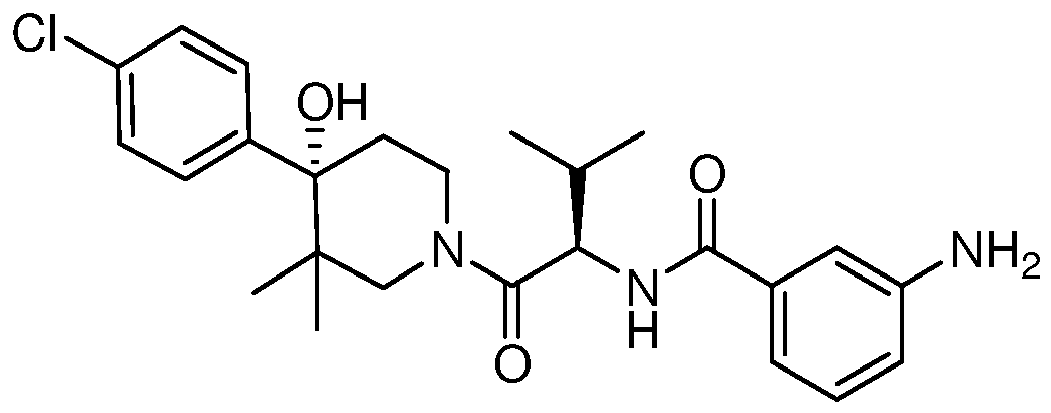
- To a solution of N-((R)-1-((S)-4-(4-chlorophenyl)-4-hydroxy-3,3-dimethylpiperidin-1-yl)-3-methyl-1-oxobutan-2-yl)-2-nitrobenzamide (287 mg) in methanol (10 mL), was added Pd/C (5%, 10% mmol). The mixture was degassed and charged with hydrogen for 3h. The reaction was filtered and rinsed with methanol then EtOAc. The filtrate was concentrated to give a mixture of 3-amino-N-((R)-1-((S)-4-(4-chlorophenyl)-4-hydroxy-3,3-dimethylpiperidin-1-yl)-3-methyl-1-oxobutan-2-yl)benzamide and 3-amino-N-((R)-1-((S)-4-hydroxy-3,3-dimethyl-4-phenylpiperidin-1-yl)-3-methyl-1-oxobutan-2-yl)benzamide (213 mg).
- To a mixture of 3-amino-N-((R)-1-((S)-4-(4-chlorophenyl)-4-hydroxy-3,3-dimethylpiperidin-1-yl)-3-methyl-1-oxobutan-2-yl)benzamidefrom Step 2 (30 mg, 0.068 mmol) in dichloromethane (0.5 mL) was added acetyl chloride (15 µL) and DIPEA (15 µL). The mixture was stirred at rt for 1h and concentrated. The residue was purified by Prep-HPLC to give Example 631 (12 mg) as a yellow solid. MS found 500.2 (M+).
-

-

- To a suspension of 6-aminopicolinic acid (33 mg, 0.24 mmol) in DMF (2 mL) was added EDC (45.9 mg, 0.24 mmol), HOBt (32.3 mg, 0.24 mmol). The mixture was stirred at rt for 0.5h, then was added DIPEA (0.083 mL, 0.48 mmol) and (R)-2-amino-1-((S)-4-(4-chlorophenyl)-4-hydroxy-3,3-dimethylpiperidin-1-yl)-3-methylbutan-1-one hydrochloride (90 mg, 0.239 mmol). The mixture was stirred at rt overnight. The reaction was quenched with NaHCO3 (aq) and stirred at rt for 1h, extracted by EtOAc, washed with brine and dried over Na2SO4. After concentrating in vacuo, the residue was triturated with CH2Cl2 and filtered to give a yellow solid as 6-amino-N-((R)-1-((S)-4-(4-chlorophenyl)-4-hydroxy-3,3-dimethylpiperidin-1-yl)-3-methyl-1-oxobutan-2-yl)picolinamide (86 mg, 0.187 mmol, 78 % yield).
- To a mixture of 6-amino-N-((R)-1-((S)-4-(4-chlorophenyl)-4-hydroxy-3,3-dimethylpiperidin-1-yl)-3-methyl-1-oxobutan-2-yl)picolinamide (18 mg, 0.039 mmol) and DIPEA (7.50 µL, 0.043 mmol) in CH2Cl2 (1 mL), was added acetyl chloride (3.08 mg, 0.039 mmol). The mixture was stirred at rt for 1h, concentrated and purified by Prep-HPLC. The product containing fraction was concentrated and lyophilyzied to give Example 632 (11 mg, 0.022 mmol, 56 % yield) as a white TFA salt. MS found 501.2 (M+)
-

-

- (2R,3S)-2-(tert-butoxycarbonylamino)-3-methylpentanoic acid (197 mg, 0.85 mmol), EDC (162 mg, 0.85 mmol), HOBt (115 mg, 0.85 mmol) was dissolved in chloroform (10 mL). DIPEA (0.15 mL, 0.85 mmol) and (S)-4-(4-chlorophenyl)-3,3-dimethylpiperidin-4-ol (200 mg, 0.834 mmol) were added. The mixture was stirred at rt for 2h, diluted with dichloromethane and washed with aq NaHCO3 and brine. The organic layer was dried over Na2SO4, filtered and concentrated to give tert-butyl (2R,3S)-1-((S)-4-(4-chlorophenyl)-4-hydroxy-3,3-dimethylpiperidin-1-yl)-3-methyl-1-oxopentan-2-ylcarbamate (327 mg) as a yellow solid.
-
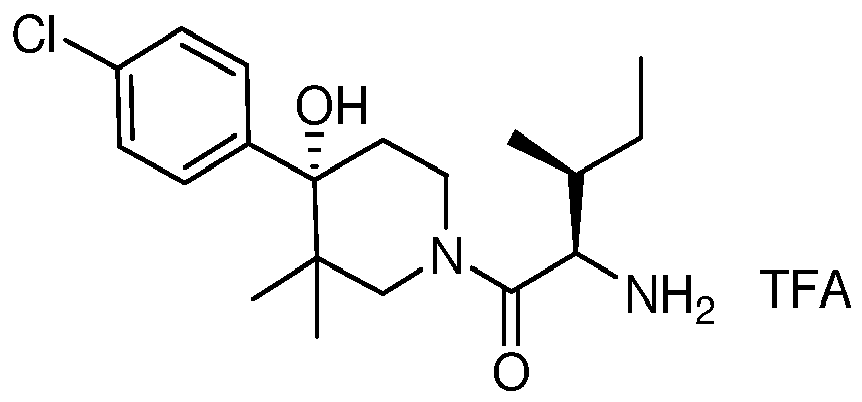
- TFA (0.5mL) was added into a solution of 4-(4-chlorophenyl)-4-hydroxy-3,3-dimethylpiperidin-1-yl)-3-methyl-1-oxopentan-2-ylcarbamate (327 mg) in dichloromethane (2 mL) and the mixture was allowed to stirred at rt for 1h. The mixture was concentrated and the residue was dried overnight in vacuo to provide (2R,3S)-2-amino-1-((S)-4-(4-chlorophenyl)-4-hydroxy-3,3-dimethylpiperidin-1-yl)-3-methylpentan-1-one trifluoroacetic acid as a light brown oil.
- To a solution of 2R,3S)-2-amino-1-((S)-4-(4-chlorophenyl)-4-hydroxy-3,3-dimethylpiperidin-1-yl)-3-methylpentan-1-one trifluoroacetic acid (35 mg, 0.1 mmol) in dichloromethane (0.5 mL) was added DIPEA (44 µL, 0.25 mmol) and 4-chlorobenzoyl chloride (26 mg, 0.15 mmol). The mixture was stirred at rt for 0.5h and concentrated. The residue was purified by prep-HPLC to give Example 633 (14 mg, 29% yield). MS found 491.2 (M+H).
-
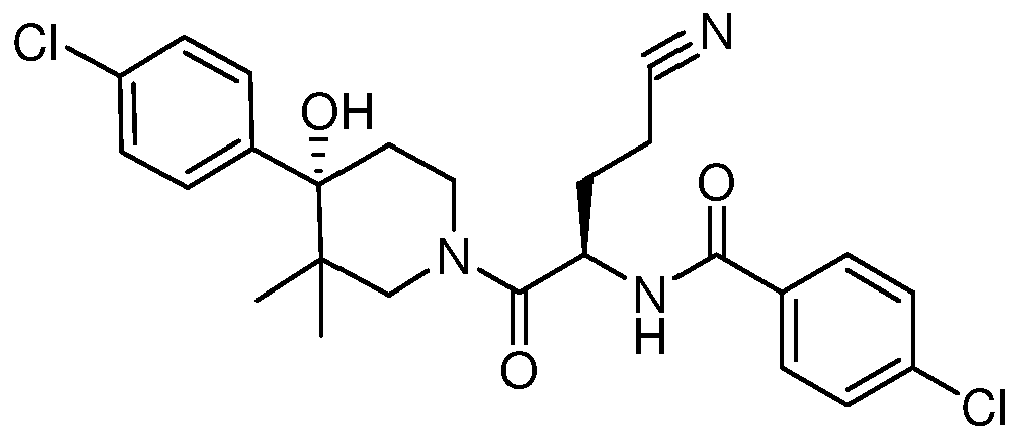
- To a solution of (R)-4-amino-5-((S)-4-(4-chlorophenyl)-4-hydroxy-3,3-dimethylpiperidin-1-yl)-5-oxopentanamide (25 mg, 0.068 mmol) in dichloromethane (1 mL) was added DIPEA (30 µL, 0.17 mmoL) and 4-chlorobenzoyl chloride (17 mg, 0.1 mmol). The mixture was stirred at rt for 1h and concentrated. The residue was purified by Prep-HPLC to give Example 634 (15 mg, 45% yield). MS found 488.2 (M+).
-

- To a solution of 2-(dimethylamino)acetic acid (6.2 mg, 0.06 mmol) in DMF (0.5 mL), was added HOBt (8.1 mg, 0.06 mmol), EDC (12 mg, 0.06 mmol). The mixture was stirred at rt for 1h, then was added 3-amino-N-((R)-1-((S)-4-(4-chlorophenyl)-4-hydroxy-3,3-dimethylpiperidin-1-yl)-3-methyl-1-oxobutan-2-yl)benzamide (25 mg, 0.055 mmol). The mixture was then stirred at rt for 2h and purified via preparative HPLC to give Example 635 (16 mg, 54% yield). MS found 543.3 (M+).
-

- To a solution of 3-amino-N-((R)-1-((S)-4-(4-chlorophenyl)-4-hydroxy-3,3-dimethylpiperidin-1-yl)-3-methyl-1-oxobutan-2-yl)benzamide (23 mg, 0.05 mmol) in HOAc (0.5 mL), was added NaOCN (4 mg, 6 mmol). The mixture was stirred at rt for 3h then concentrated. The residue was added aq NaHCO3 and extracted into EtOAc. The organic extracts were dried over Na2SO4, filtered and concentrated. The residue was purified via HPLC to give Example 636A (6 mg), MS found 501.2 (M+H) and Example 636B (4 mg) MS found 500.3 (M+).
-

-

- To a solution of (S)-3-(tert-butoxycarbonylamino)-4-methylpentanoic acid (279 mg, 1.21 mmol) in CHCl3 (5 mL) was added EDC (231 mg, 1.205 mmol), HOBt (0.219 mL, 1.21 mmol) and methyl 4-(4-chlorophenyl)piperidine-4-carboxylate (279 mg). The mixture was stirred at rt overnight. The reaction was then quenched with aq NaHCO3 and extracted by CH2Cl2. The organic extracts were washed with 0.5N HCl, brine, then dried over Na2SO4 and concentrated to give a yellow oil. The oil was dissolved in CH2Cl2 (3 mL) and TFA (1mL) was added. The mixture was stirred at rt for 3h and concentrated to give (R)-methyl 1-(2-amino-3-methylbutanoyl)-4-(4-chlorophenyl)piperidine-4-carboxylate, TFA salt (432 mg, 0.960 mmol, 88 % yield).
-

- To a solution of (R)-methyl 1-(2-amino-3-methylbutanoyl)-4-(4-chlorophenyl)piperidine-4-carboxylate (396 mg, 1.123 mmol) and benzoyl chloride (0.139 ml, 1.2 mmol) in CH2Cl2 (5 mL) was added N-ethyl-N-isopropylpropan-2-amine (0.401 mL, 2.3 mmol). The mixture was stirred for 1h at rt. The reaction was quenched with NaHCO3 (aq), extracted with dichloromethane, dried over Na2SO4 and concentrated. The residue was purified via column chromatography (20% EtOAc/heptane) to give (R)-methyl 1-(2-benzamido-3-methylbutanoyl)-4-(4-chlorophenyl)piperidine-4-carboxylate (467 mg, 91 % yield) as a yellow solid.
-

- To a solution of (R)-methyl 1-(2-benzamido-3-methylbutanoyl)-4-(4-chlorophenyl)piperidine-4-carboxylate (467 mg, 0.99 mmol) in THF (5 mL) was added aq NaOH (625 mg, 2.5 mmol, 10%). The mixture was stirred at rt for 4h. The reaction was quenched with HCl (2N) to pH = 3, extracted into EtOAc then dried over Na2SO4 to give the desired product (451 mg, 96% yield) as a yellow solid.
-

- To a solution of the product of Step 3 (20 mg, 0.045 mmol) in DMF (200 µL), was added EDC (7.71 mg, 0.050 mmol) and HOBt (6.71 mg, 0.050 mmol). The reaction was stirred at rt for 0.5h and aq. NH4OH (100 µL) was added. The mixture was stirred at rt for 0.5h, quenched with water (2 mL), stirred at rt for 0.5h and filtered and purified by Prep-HPLC to give the desired product (10 mg, 0.023 mmol, 50.1 % yield).
- To a solution of the product of Step 4 (30 mg, 0.068 mmol) and pyridine (11 µL, 0.136 mmol) in THF (4 mL) at 0, was added 2,2,2-trifluoroacetic anhydride (0.014 mL, 0.102 mmol). The mixture was stirred at 0 °C for 2 h, then at rt for 2h. The reaction was quenched with NaHCO3, extracted into EtOAc. The organic extracts were washed brine, concentrated, and the residue was purified by Prep-HPLC to give Example 637 (19 mg, 0.045 mmol, 66.0 % yield). MS found 424.3 (M+).
-

- To ethanol (2 mL), was added sodium hydride (14.4 mg, 0.36 mmol). The mixture was stirred at rt for 15 min. The mixture was then added 2-chloro-N-((R)-1-((S)-4-(4-chlorophenyl)-4-hydroxy-3,3-dimethylpiperidin-1-yl)-3-methyl-1-oxobutan-2-yl)acetamide (30 mg, 0.072 mmol) and then heated at 120 °C for 30 min. The reaction was concentrated and purified by Prep-HPLC to give Example 638 (18 mg, 59% yield). MS found 425.2 (M+)
-

- To a solution of 2-chloro-N-((R)-1-((S)-4-(4-chlorophenyl)-4-hydroxy-3,3-dimethylpiperidin-1-yl)-3-methyl-1-oxobutan-2-yl)acetamide (30 mg, 0.072 mmol) and 1H-pyrazole (50 µL) in acetonitrile (1 mL), was added K2CO3 (13.8 mg, 0.1 mmol). The reaction was heated at 120 °C for 1h, filtered, and purified by prep-HPLC to give Example 639 (12 mg, 38% yield). MS found 447.2 (M+)
-

- To a mixture of 2-acetamidoacetic acid (7.55 mg, 0.064 mmol) in DMF (500 µL), was added HOBt (8.71 mg, 0.064 mmol) and EDCI (12.38 mg, 0.064 mmol). The mixture was stirred at rt for 0.5h, added (R)-2-amino-1-((S)-4-(4-chlorophenyl)-4-hydroxy-3,3-dimethylpiperidin-1-yl)-3-methylbutan-1-one hydrochloride (22 mg, 0.059 mmol) and DIPEA (11.21 µL, 0.064 mmol), then stirred at rt for 2h. The reaction was purified by prep-HPLC to give Example 640 (19 mg, 0.043 mmol, 74.0 % yield) as a white solid. MS found 438.3 (M+)
-

-

- To a solution of (R)-2-amino-1-((S)-4-(4-chlorophenyl)-4-hydroxy-3,3-dimethylpiperidin-1-yl)-3-methylbutan-1-one hydrochloride (111 mg, 0.296 mmol), 2-chloro-4,6-dimethoxy-1,3,5-triazine (57.1 mg, 0.325 mmol), formic acid (0.012 mL, 0.325 mmol) and NMM (0.068 mL, 0.62 mmol) CH2Cl2 (10 mL), was added DMAP (3.61 mg, 0.03 mmol). The mixture was stirred at rt for 3h. The reaction was filtered and the filtrate was washed with Na2CO3, 0.5N HCl, and brine. The organic layer was dried over Na2SO4 and Concentrated to give N-((R)-1-((S)-4-(4-chlorophenyl)-4-hydroxy-3,3-dimethylpiperidin-1-yl)-3-methyl-1-oxobutan-2-yl)formamide (76 mg, 0.207 mmol, 70.0 % yield).
-

- To a mixture of N-((2S)-1-((4R)-4-(4-chlorophenyl)-4-hydroxy-3,3-dimethylcyclohexyl)-3-methyl-1-oxobutan-2-yl)formamide (109 mg, 0.298 mmol) and TEA (0.208 mL, 1.490 mmol) in CH2Cl2 (5 mL) was added POCl3 (0.027 mL, 0.298 mmol) at 0 ° under N2. The mixture was stirred at 0-5 °C for 3h. The mixture was quenched with NaHCO3(aq), extracted into CH2Cl2, and dried over Na2SO4. After concentrating, the crude residue was purified via column chromatography (CH2Cl2) to give (2S)-1-((4R)-4-(4-chlorophenyl)-4-hydroxy-3,3-dimethylcyclohexyl)-2-isocyano-3-methylbutan-1-one (85 mg, 0.244 mmol, 82 % yield) as a light yellow oil.
- To a mixture of (2S)-1-((4R)-4-(4-chlorophenyl)-4-hydroxy-3,3-dimethylcyclohexyl)-2-isocyano-3-methylbutan-1-one (90 mg, 0.26 mmol) and (Z)-tert-butyl 2-(3-bromo-1-ethoxy-1-oxopropan-2-ylidene)hydrazinecarboxylate (80 mg, 0.26 mmol) in CH2Cl2 (10 mL), was added sodium carbonate (137 mg, 1.29 mmol). The mixture was stirred at rt for 18h. The reaction was quenched with water, extracted into CH2Cl2 and the combined organic extracts were dried over Na2SO4 and concentrated. The product dissolved in CH2Cl2 (2 mL) and then TFA (0.5 mL) was added. The mixture was stirred at rt for 2h, concentrated and purified via prep-HPLC to give Example 641 (6 mg, 0.013 mmol, 4.87 % yield) a yellow solid. MS found 477.2 (M+).
-

- To a solution of (R)-2-(4-(chloromethyl)thiazol-2-ylamino)-1-((S)-4-(4-chlorophenyl)-4-hydroxy-3,3-dimethylpiperidin-1-yl)-3-methylbutan-1-one (18 mg, 0.04 mmol) in Acetonitrile (1 mL) was added 1H-pyrazole (5.21 mg, 0.08 mmol) and potassium carbonate (10.6 mg, 0.08 mmol). The mixture was heated at 80 °C for 1.5h then cooled. The crude reaction was purified via Prep-HPLC to give Example 642 (9 mg, 0.018 mmol, 46.9 % yield) as a yellow solid. MS found 502.2 (M+).
-
- A mixture of 2-chloro-N-((R)-1-((S)-4-(4-chlorophenyl)-4-hydroxy-3,3-dimethylpiperidin-1-yl)-3-methyl-1-oxobutan-2-yl)acetamide (40 mg, 0.096 mmol) and sodium sulfite (60.7 mg, 0.482 mmol) in EtOH and water was heated at 120c for 1h. The mixture was filtered, concentrated. Purified via preparative HPLC to give Example 643 (26 mg, 0.056 mmol, 58.6 % yield). MS found 461.2 (M+).
-

- To a mixture of 6-amino-N-((R)-1-((S)-4-(4-chlorophenyl)-4-hydroxy-3,3-dimethylpiperidin-1-yl)-3-methyl-1-oxobutan-2-yl)picolinamide (18 mg, 0.039 mmol) and DIPEA (10.23 µL, 0.059 mmol) in CH2Cl2 (1 mL) was added methanesulfonic anhydride (10.25 mg, 0.059 mmol). The mixture was stirred at rt for 3h. The mixture was concentrated and purified by Prep-HPLC to give Example 644 (6 mg, 0.011 mmol, 28.5 % yield) as a TFA salt. MS found 537.2 (M+).
-

- To a mixture of 3-amino-N-((R)-1-((S)-4-(4-chlorophenyl)-4-hydroxy-3,3-dimethylpiperidin-1-yl)-3-methyl-1-oxobutan-2-yl)propanamide (20 mg, 0.049 mmol) and DIPEA (0.021 mL, 0.122 mmol) in CH2Cl2 (1 mL), was added methyl carbonochloridate (6.9 mg, 0.073 mmol). The mixture was stirred at rt for 2h, concentrated, and the residue was purified by Prep HPLC to give Example 645 (15 mg, 0.032 mmol, 65.7 % yield) as a white solid. MS found 468.2 (M+H).
-
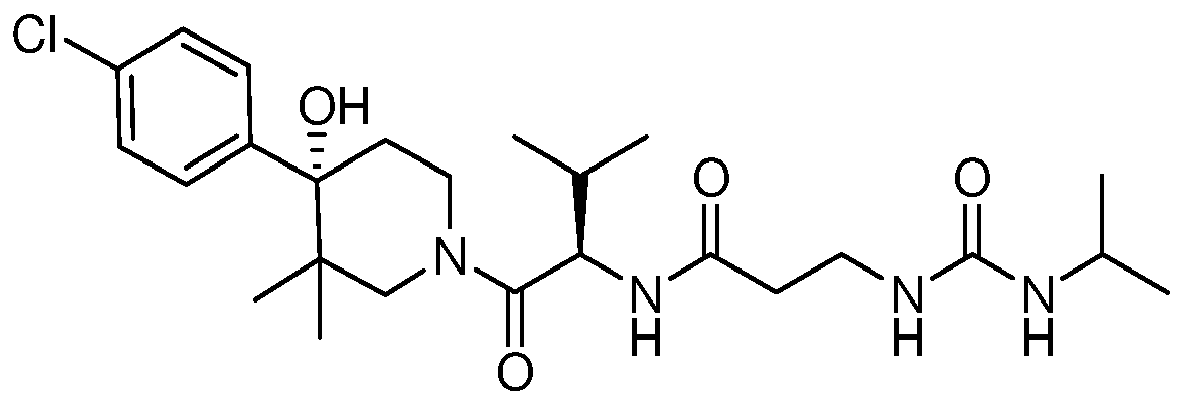
- To a mixture of 3-amino-N-((R)-1-((S)-4-(4-chlorophenyl)-4-hydroxy-3,3-dimethylpiperidin-1-yl)-3-methyl-1-oxobutan-2-yl)propanamide (20 mg, 0.049 mmol) and DIPEA (0.021 ml, 0.122 mmol) in CH2Cl2 (1.5 ml), was added 2-isocyanatopropane (2.076 mg, 0.024 mmol). The mixture was stirred at rt for 2h and then was concentrated. The residue was purified by Prep-HPLC to give Example 646 (21 mg, 0.042 mmol, 87 % yield) as a white solid. MS found 495.3 (M+).
-

- To a mixture of 2-amino-N-((R)-1-((S)-4-(4-chlorophenyl)-4-hydroxy-3,3-dimethylpiperidin-1-yl)-3-methyl-1-oxobutan-2-yl)acetamide, TFA (30 mg, 0.059 mmol) and 2-bromo-1H-benzo[d]imidazole (11.6 mg, 0.07 mmol) in MeOH (1 mL), was added DIPEA (0.011 mL, 0.07 mmol). The mixture was heated at 150 °C for 1h, cooled and concentrated. The crude residue was purified via prep HPLC to give Example 647 (12 mg, 0.023 mmol, 39.8 % yield) as an off-white solid. MS found 512.3 (M+).
-

- Cyclopentanecarboxylic acid (7.61 mg, 0.067 mmol), HOBt (9.01 mg, 0.067 mmol) and EDCI (12.80 mg, 0.067 mmol) were dissolved in DMF (0.3 ml). The mixture was stirred at rt for 0.5h, then was added 2-amino-N-((R)-1-((S)-4-(4-chlorophenyl)-4-hydroxy-3,3-dimethylpiperidin-1-yl)-3-methyl-1-oxobutan-2-yl)acetamide, TFA (34 mg, 0.067 mmol) and DIPEA (0.014 ml, 0.080 mmol). The mixture was stirred for 2h, concentrated, and purified via Prep-HPLC to give Example 648 (9 mg, 0.018 mmol, 27.4 % yield). MS found 492.2 (M+).
-

- To a solution of methyl 2-((R)-1-((S)-4-(4-chlorophenyl)-4-hydroxy-3,3-dimethylpiperidin-1-yl)-3-methyl-1-oxobutan-2-ylamino)thiazole-5-carboxylate (65 mg, 0.135 mmol) in THF (1 mL) and MeOH (1 mL) was added sodium hydroxide (108 mg, 0.271 mmol). The mixture was stirred at rt for 18 h and then neutralized with 1 N HCl. The resulting solids were filtered and rinsed with water to give Example 649 (60 mg, 0.129 mmol, 95 % yield). MS found 466.2 (M+).
-

- 2-((R)-1-((S)-4-(4-chlorophenyl)-4-hydroxy-3,3-dimethylpiperidin-1-yl)-3-methyl-1-oxobutan-2-ylamino)thiazole-5-carboxylic acid (20 mg, 0.043 mmol), HOBt (5.80 mg, 0.043 mmol) and EDCI (10.71 mg, 0.056 mmol) were dissolved in CH2Cl2 (0.5 mL). The mixture was stirred at rt for 0.5h and added iso-propylamine (3.04 mg, 0.052 mmol) and DIPEA (9.70 µL, 0.056 mmol). The mixture was stirred at rt for 1h, concentrated, and the residue was purified by Prep-HPLC to give Example 650 (12 mg, 0.024 mmol, 55.1% yield) as an off-white solid. MS found 507.2 (M+).
-

-

- To a solution of ethyl 2-aminooxazole-4-carboxylate (1.56 g, 9.99 mmol) in THF (4 mL) and MeOH (4 mL), was added sodium hydroxide (8.0 g, 20 mmol, 10%) aq solution. The reaction was stirred at rt for 18 h then quenched with 4N HCl to pH=3. The aqueous solution was concetrated to give a yellow solid as a mixed acid and salts. The mixture was washed with EtOAc and MeOH, and the filtrate was collected and concentrated to give sodium 2-aminooxazole-4-carboxylate as a yellow solid.
-

- Sodium 2-aminooxazole-4-carboxylate (75 mg, 0.500 mmol), HOBt (67.5 mg, 0.500 mmol) and EDCI (96 mg, 0.500 mmol) were dissolved in DMF (0.5 mL). The mixture was stirred at rt for 0.5h, then was added (R)-2-amino-1-((S)-4-(4-chlorophenyl)-4-hydroxy-3,3-dimethylpiperidin-1-yl)-3-methylbutan-1-one hydrochloride (188 mg, 0.500 mmol) and further stirred for 2h. The reaction was quenched with water and stirred at rt for 2h. The solids were filtered and rinsed with water to give 2-amino-N-((R)-1-((S)-4-(4-chlorophenyl)-4-hydroxy-3,3-dimethylpiperidin-1-yl)-3-methyl-1-oxobutan-2-yl)oxazole-4-carboxamide (169 mg, 0.376 mmol, 75 % yield).
- To a solution of 2-amino-N-((R)-1-((S)-4-(4-chlorophenyl)-4-hydroxy-3,3-dimethylpiperidin-1-yl)-3-methyl-1-oxobutan-2-yl)oxazole-4-carboxamide (20 mg, 0.045 mmol) and DIPEA (7.75 µL, 0.045 mmol) in CH2Cl2 (1 mL) was added cyclopentanecarbonyl chloride (11.8 mg, 0.09 mmol). The mixture was stirred at rt for 1h and concentrated. The residue was purified by Prep-HPLC to give Example 651 (9 mg, 0.017 mmol, 37.1 % yield). MS found 545.2 (M+).
- The following examples, as described in Table 21, were prepared in similar manners as described for the preparation of the examples described above. Examples containing a carboxylic acid functional group were prepared for the corresponding esters following standard alkali base procedures known to one of ordinary skill in the art.
Table 21 Example Structure LCMS (M+) or (M+H)+ Example for general method of preparation 652 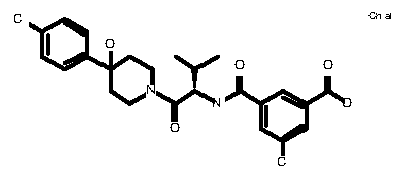
434.9 512 653 
448.9 512 654 
458.9 512 655 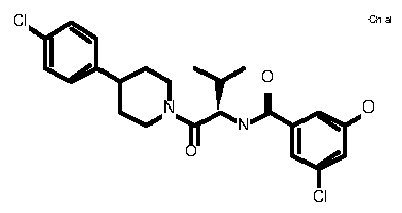
448.9 75 656 
464.9 512 657 
473.9 327 658 
501.2 327 659 
478.0 327 660 
458.9 327 661 
430.9 512 662 
393.1 75 663 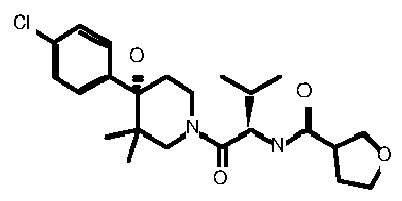
458.9 327 664 
432.9 327 665 
495.2 513 666 
439.3 513 667 
531.2 513 668 
515.3 327 669 
449.3 327 670 
491.2 327 671 
489.3 513 672 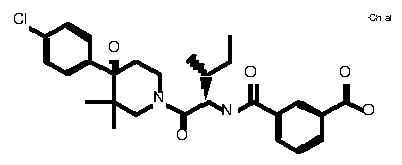
501.2 327 673 
450.3 327 674 
469.2 327 675 
470.2 327 676 
460.2 327 677 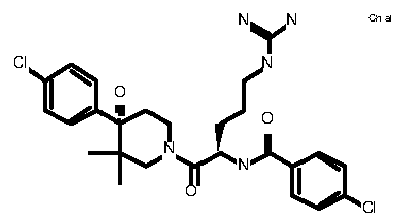
534.1 514 678 
523.4 519 679 
498.3 520 680 
537.2 520 681 
499.2 520 682 
550.3 520 683 
455.3 517 684 
467.2 517 685 
501.2 517 686 
501.2 517 687 
485.2 517 688 
493.3 517 689 
417.2 517 690 
422.2 520 691 
410.3 527 692 
472.3 527 693 
410.3 527 694 
486.3 527 695 
486.2 527 696 
452.2 527 697 
452.3 527 698 
478.2 527 699 
492.2 527 700 
472.1 327 701 
525.3 527 702 
526.3 327 703 
379.2 512 704 
363.2 75 705 
482.2 631 706 
518.1 631 707 
518.1 631 708 
510.1 631 709 
448.1 631 710 
526 631 711 
490.1 631 712 
381.2 512 713 
433.1 512 714 
395.2 512 715 
471.1 513 716 
461.1 513 717 
501.3 633 718 
449.3 633 719 
528.3 631 720 
534.3 631 721 
432.3 632 722 
530.3 631 723 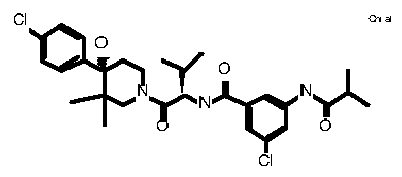
562.3 631 724 516.3 631 725 
550.2 632 726 
536.3 631 727 
466.3 631 728 
500.3 631 729 
530.2 631 730 
482.3 631 731 
516.3 631 732 
496.3 631 733 
577.3 635 734 
590.1 631 735 
624.2 631 736 
496.3 631 737 
502.3 631 738 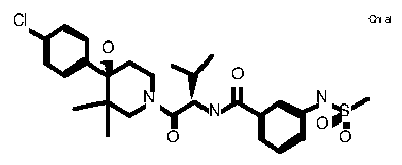
536.2 631 739 
482.3 631 740 
472.2 517 741 
480.2 520 742 
439.2 638 743 
465.2 638 744 
452.3 640 745 
500.3 640 746 
514.3 640 747 
514.3 640 748 
517.3 632 749 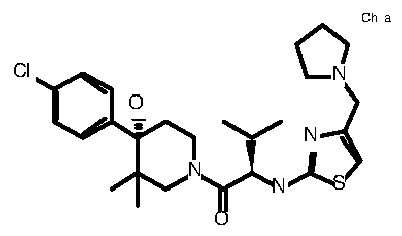
505.3 642 750 
466.3 645 751 
481.3 646 752 
526.3 647 753 
474.3 647 754 
506.2 648 755 
454.2 645 756 
535.3 650 757 
463.3 627 758 
487.3 627 759 
491.3 627 760 
501.3 627 761 
477.3 627 762 
487.3 628 763 
501.3 628 764 
585.3 627 765 
499.3 627 766 
595.3 627 767 
551.2 628 768 
629.3 327 769 
513.2 327 770 
628.3 629 771 
514.3 629 772 
586.3 630 773 
526.7 629 774 
528.3 629 775 
558.26 630 776 
558.3 630 777 
572.3 630 778 
500.3 629 779 
461.3 327 780 
529.4 626 781 
528.4 623 782 
501.5 626 783 
487.5 626 784 
487.4 626 785 
513.5 626 786 
501.4 626 787 
572.6 626 788 
488.4 623 789 
566.6 623 790 
550.2 623 791 
502.4 623 792 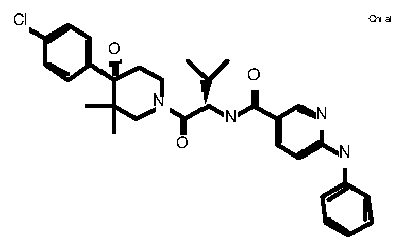
535.1 626 793 
514.2 629 794 
550.2 623 795 
435.2 327 796 
501.2 327 797 
521 327 798 
1H NMR (400 MHz, CD30D) d ppm: 7.47 (dd, J=11.97, 8.68 Hz, 2 H), 7.30 (dd, J=8.46, 4.72 Hz, 2 H), 4.92-4.83 (m, 1H+ H2O), 4.53 (d, J=13.18 Hz, 0.5 H), 4.26-4.19 (m, 1H), 4.15-3.91 (m, 1H), 3.73-3.49 (m, 1.5 H), 3.25 ― 3.03 (m, 1 H), 2.78 ― 2.49 (m 327 799 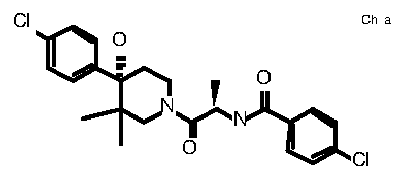
449.3 327 800 
459.3 327 801 
473.3 327 802 
407.3 327 803 
491.3 327 804 
515.4 327 805 
451.3 327 806 
451.3 327 807 
451.3 327 808 
444.4 327 809 
536.3 517 810 
444.3 327 811 
502.3 327 812 
488.2 601 813 
460.3 327 814 
444.3 327 815 
516.3 327 816 
488.3 327 817 
502.4 327 818 
488.3 327 819 
503.3 327 820 
485.4 590 821 
412.5 591 822 
469.4 591 823 
471.4 590 824 
455.4 590 825 
537.4 600 826 
521.3 589 827 
508.2 589 828 
465.2 327 829 
416.1 512 830 
506.2 587 831 
485 587 832 
419.1 587 833 
471.1 587 833 
475.1 531, Step 2 834 
472.19 531, Step 1 835 
444.11 531, Step 2 836 
449.2 531, Step 1 837 
463.24 531, Step 1 838 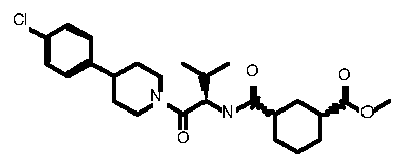
463.2 531, Step 1 839 
449.21 531, Step 2 840 
435.19 531, Step 2 841 
449.18 531, Step 2 842 
473.15 531, Step 1 843 
459.16 531, Step 2 844 
438.2 531, Step 1 845 
416.28 559 846 
457.23 531, Step 2 847 
459.14 531, Step 1 848 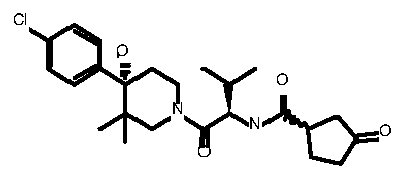
449.4 327 849 
463.4 327 850 
424.4 530 851 
438.45 530 852 
486.23 530 853 
410 530 854 
472 530 855 
438 530 856 
438.01 530 857 
477.37 530 858 
561 530 859 
477.4 327 860 
477.39 327 861 
516.33 530 862 
449.43 327 863 
491.32 327 864 
515.39 327 865 
507.41 327 866 
501.36 327 867 
493.35 327 868 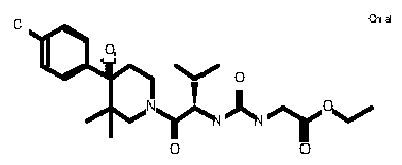
468.35 530 869 
482.34 530 870 
440.34 530 871 
454.35 530 872 
423.36 327 873 
465.25 327 874 
489.28 327 875 
475.23 327 876 
437.27 327 877 
479.16 327 878 
503.22 327 879 
407.18 327 880 
460.24 327 881 
489.21 327 882 
581.14 327 883 
577.29 327 884 
567.11 327 885 
563.21 327 886 
498.22 536, Step 2 887 
530.3 536, Step 2 888 
530.3 536, Step 2 889 
530.3 536, Step 2 890 
516.29 530 891 
516.29 530 892 
516.28 530 893 
598.21 558 894 
424.25 327 895 
506.36 536, Step 2 896 
468.31 536, Step 2 897 
438.33 536, Step 2 898 
438.34 536, Step 2 899 
531.34 327 900 
452.3 530 901 
627.42 535, Step 1 902 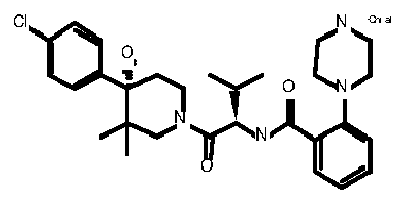
527.34 535, Step 2 903 
453.29 327 904 
425.24 327 905 
545.36 327 906 
536.37 535, Step 1 907 
436.31 535, Step 2 908 
601.23 327 909 
436.28 557 910 
453.29 327 911 
453.28 327 912 
577.28 327 913 
563.27 327 914 
453.26 327 915 
453.29 327 916 
536.36 327 917 
441.25 Preparation C 918 
646.39 327 919 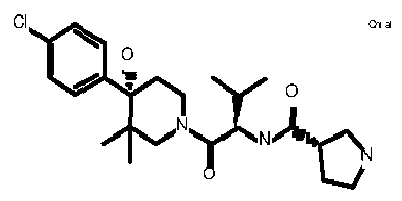
436.29 535, Step 2 920 
546.36 535, Step 2 921 
572.37 327 922 
433.27 327 923 
499.23 327 924 
437.28 327 925 
503.23 327 926 
485.26 327 927 
489.25 327 928 
482.29 555 929 
577.32 556, Step 2 930 
563.32 556, Step 3 931 
467.29 537, Step 1 932 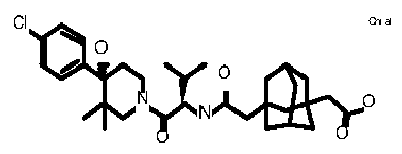
573.34 327 933 
577.31 327 934 
473.28 327 935 
563.3 327 936 
550.37 535, Step 1 937 
550.38 535, Step 1 938 
525.24 327 939 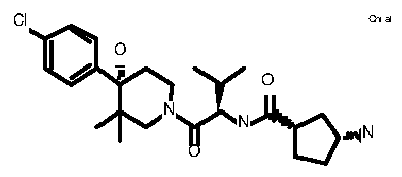
450.26 535, Step 2 940 
515.28 537, Step 1 941 
550.37 535, Step 1 942 
550.39 535, Step 1 943 
492.31 537, Step 1 944 
492.32 537, Step 1 945 
450.29 535, Step 2 946 
492.29 537, Step 1 947 
492.28 537, Step 1 948 
578.34 554, Step 1 949 
564.33 554, Step 2 950 
517.33 327 951 
837.43 327 952 
597.32 327 953 
439.17 327 954 
464.25 327 955 
620.13 547 956 
568.12 547 957 
559.32 327 958 
460.31 537, Step 1 959 
460.31 537, Step 1 960 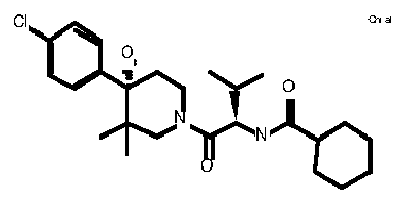
449.32 327 961 
506.36 327 962 
493.34 327 963 
465.24 327 964 
479.22 327 965 
550.35 535, Step 1 966 
492.4 535, Step 3 967 
550.44 535, Step 1 968 
519.36 327 969 
450.43 535, Step 2 970 
503.31 327 971 
492.39 535, Step 3 972 
492.36 327 973 
550.45 535, Step 1 974 
550.42 552 975 
522.39 546, Step 1 976 
450.39 552, Step 2 977 
422.32 546, Step 2 978 
465.38 327 979 
492.4 552, Step 1 980 
550.49 551 981 
550.48 551 982 
481.33 537 983 
453.35 540 984 
450.37 551 985 
450.35 550 986 
531.45 533 987 
466.32 327 988 
565.38 540 989 
465.44 540 990 
480.38 536 991 
452.33 536 992 
452.34 536 993 
489.35 536 994 
480.44 536 995 
480.44 536 996 
450.47 327 997 
465.44 327 998 
583.3 327 999 
569.36 327 1000 
438.41 327 1001 
450.41 327 1002 
464.47 327 1003 
494.42 327 1004 
397.37 327 1005 
447.26 327 1006 
449.25 327 1007 
466.25 536 1008 
466.41 536 1009 
466.26 536 1010 
480.29 536 1011 
474.21 327 1012 
513.35 327 1013 
507.31 327 1014 
447.18 327 1015 
461.17 327 1016 
496.12 327 1017 
510.24 327 1018 
448.24 327 1019 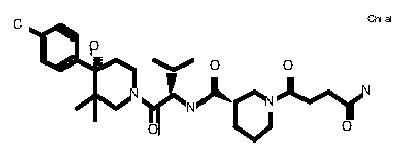
549.48 535 1020 
549.49 552 1021 
549.48 552 1022 
531.21 534, Step 2 1023 
531.29 534, Step 2 1024 
531.3 534, Step 2 1025 
517.43 534, Step 3 1026 
517.4 534, Step 3 1027 
524.13 327 1028 
509.15 327 1029 
425.22 Preparation C 1030 
437.2 Preparation C 1031 
499.18 327 1032 
421.09 327 1033 
455.16 327 1034 
681.37 327 1035 
437.11 327 1036 
437.12 327 1037 
437.24 327 1038 
437.16 327 1039 
522.3 327 1040 
522.24 327 1041 
522.24 327 1042A 
547.13 327 1042B 
483.27 327 1043 
467.23 327 1044 
533.21 327 1045 
509.15 327 1046 
519.22 327 1047 
747.34 327 1048 
835.47 327 1049 
470.42 327 1050 
508.43 327 1051 
510.45 327 1052 
551.48 327 1053 
492.46 327 1054 
467.43 327 1055 
511.4 327 1056 
511.47 327 1057 
459.38 327 1058 
520.39 327 1059 
520.38 327 1060 
520.38 327 1061 
461.43 327 1062 
497.43 327 1063 
575.49 327 1064 
602/604.47 327 1065 
472.17 327 1066 
472.17 327 1067 
472.16 327 1068 
493.27 1069 
507.28 1070 
479.38 1071 
417.46 1072 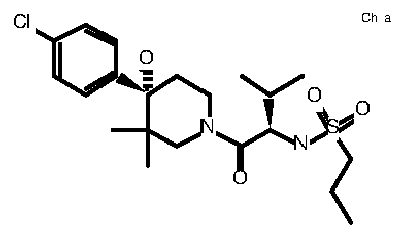
445.45 1073 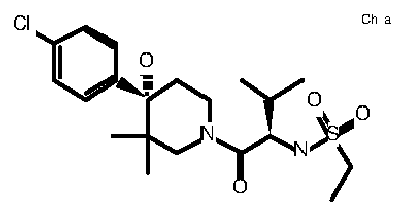
431.42 1074 
513.23 1075 
493.33 1076 
507.29 1077 
509.27 1078 
397.46 1079 
493.29 1080 
489.34 1081 
459.39 1082 
473.38 1083 
439.47 1084 
425.48 1085 
457.45 1086 
461.43 1087 
457.45 1088 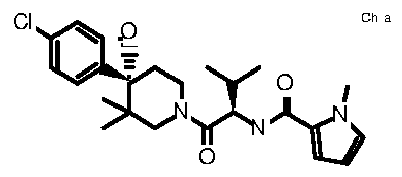
446.46 1089 
433.47 1090 
449.41 1091 
445.46 1092 
494.37 1093 
479.37 1094 
487.39 1095 
424.50 1096 
395.51 1097 
437.51 1098 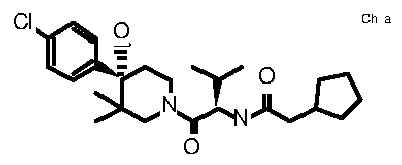
449.50 1099 
421.51 1100 
407.50 1101 
457.45 1102 
449.40 1103 
499.34 1104 
485.42 1105 
471.43 1106 
491.34 1107 
475.42 1108 
471.44 1109 
473.40 1110 
491.35 1111 
473.43 1112 
463.48 1113 
453.45 1114 
473.41 1115 
449.45 1116 
425.48 1117 
421.48 1118 
423.52 1119 
499.31 1120 
483.43 1121 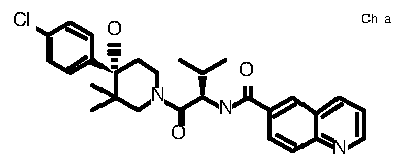
494.36 1122 
485.42 1123 
485.43 1124 
463.50 1125 
471.48 1126 
468.44 1127 
535.38 1128 
482.45 1129 
494.42 1130 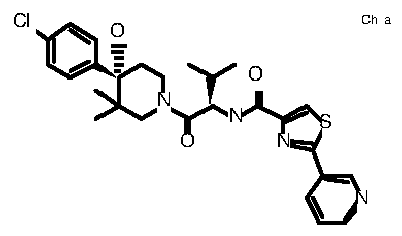
527.34 1131 
521.33 1132 
509.37 1133 
526.31 1134 
471.45 1135 
547.35 1136 
485.44 1137 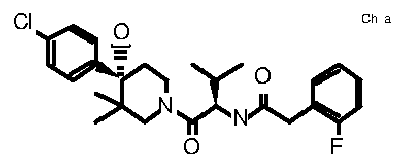
475.40 1138 
475.42 1139 
525.30 1140 
469.41 1141 
463.40 1142 
478.50 1143 
458.49 1144 
505.35 1145 
478.48 1146 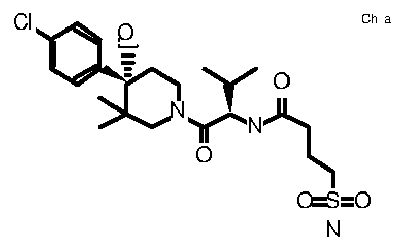
488.39 1147 
458.48 1148 
533.34 1149 
501.39 1150 
421.50 1151 
523.23 1152 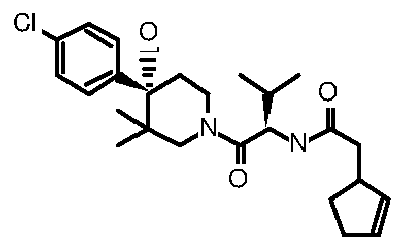
447.49 1153 
471.44 1154 
471.45 1155 
475.43 1156 
489.43 1157 
515.46 1158 
475.52 1159 
547.34 1160 
482.45 1161 
473.46 1162 
499.47 1163 
556.25 1164 
460.47 1165 
485.47 1166 
477.43 1167 
489.40 1168 
483.40 1169 
501.38 1170 
533.34 1171 
544.32 1172 
520.34 1173 
468.39 1174 
473.40 1175 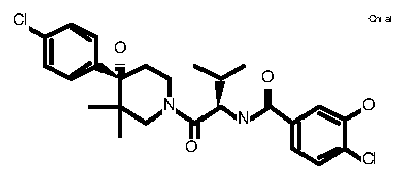
493.31 1176 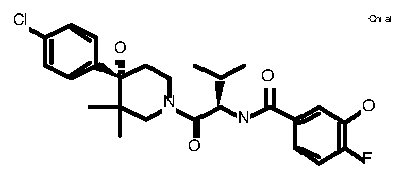
477.36 1177 
458.43 1178 
526.36 1179 
489.36 1180 
425.47 1181 
487.41 1182 
439.48 1183 
541.25 1184 
482.38 1185 
439.48 1186 
462.41 1187 
549.30 1188 
533.33 1189 
535.30 1190 
549.29 1191 
549.29 1192 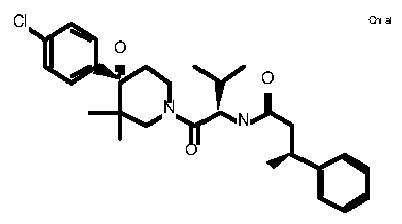
485.41 1193 
485.42 1194 
473.41 1195 
487.43 1196 
439.48 1197 
439.48 1198 
516.34 1199 
458.41 1200 
488.37 1201 
486.38 1202 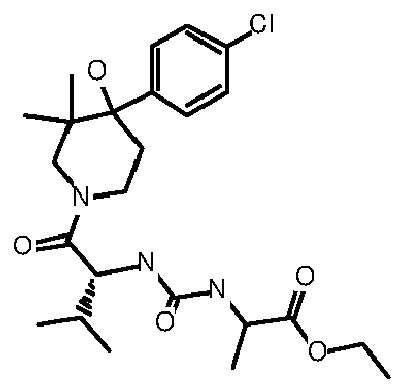
482.39 1203 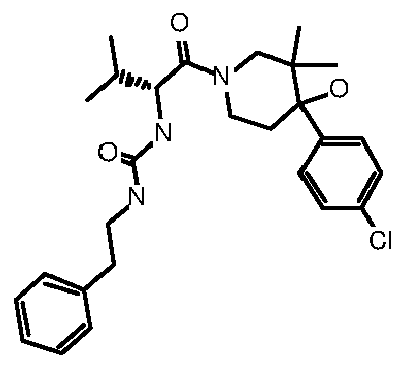
486.39 1204 
500.39 1205 
527.27 1206 
441.45 1207 
459.44 1208 
502.36 1209 
486.40 1210 
506.30 1211 
626.37 1212 
578.34 1213 
630.33 1214 
618.29 1215 
676.35 1216 
534.46 1217 
537.47 1218 
553.44 1219 
533.52 1220 
553.43 1221 
576.48 1222 
537.46 1223 
553.43 1224 
537.47 1225 
535.47 1226 
535.47 1227 
562.49 1228 
534.47 1229 
603.43 1230 
544.45 1231 
603.41 1232 
544.47 1233 
576.45 1234 
612.41 1235 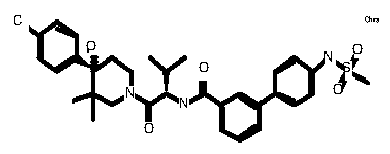
612.41 1236 
576.47 1237 
612.42 1238 
590.47 1239 
590.46 1240 
562.43 1241 
562.44 1242 
632.37 1243 
644.39 1244 
644.43 1245 
641.42 1246 
640.41 1247 
678.38 1248 
644.38 1249 
660.36 1250 
660.45 1251 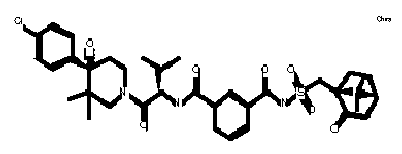
700.46 1252 
691.37 1253 
640.43 1254 
640.44 1255 
627.41 1256 
681.44 1257 
411.38 1258 
445.43 1259 
487.36 1260 
445.47 1261 
427.31 1262 
445.47 1263 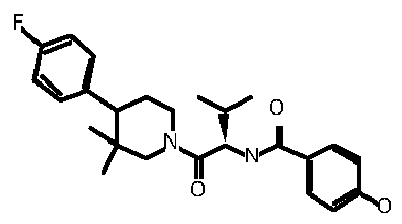
427.37 1264 
377.42 1265 
391.43 1266 
363.43 1267 
412.43 1268 
412.39 1269 
349.39 1270 
487.37 1271 
456.34 1272 
459.47 1273 
458.33 1274 
536.47 1275 
462.29 1276 
504.44 1277 
512.46 1278 
542.42 1279 
487.27 1280 
488.48 1281 
510.46 1282 
510.31 1283 
494.39 1284 
511.45 1285 
512.40 1286 
458.46 1287 
526.43 1288 
469.42 1289 
462.43 1290 
526.44 1291 
536.44 1292 
520.49 1293 
472.48 1294 
554.43 1295 
540.36 1296 
506.42 1297 
492.41 1298 
520.41 1299 
521.41 1300 
508.37 1301 
516.38 1302 
522.40 1303 
507.34 1304 
535.38 1305 
549.43 1306 
585.36 1307 
535.42 1308 
546.36 1309 
507.45 1310 
556.42 1311 
555.39 1312 
521.42 1313 
543.37 1314 
542.35 1315 
514.34 1316 
528.37 1317 
619.35 1318 
549.41 1319 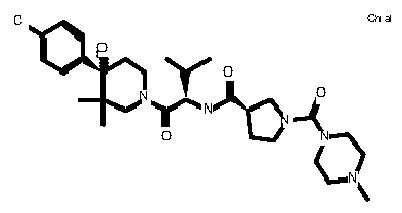
562.42 1320 
576.34 1321 
458.44 1322 
512.30 1323 
459.42 1324 
501.38 1325 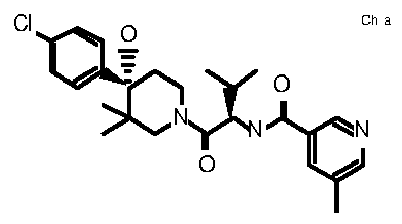
458.41 1326 
541.44 1327 
523.11 1328 
499.11 1329 
528.12 1330 
532.04 1331 
528.11 1332 
445.30 1333 
483.30 1334 
495.28 1335 
495.28 1336 
495.27 1337 
438.44 1338 
453.40 1339 
453.44 1340 
436.40 1341 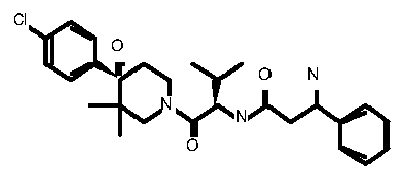
486.41 1342 
450.42 1343 
498.41 1344 
454.34 1345 
500.42 1346 
452.42 1347 
452.43 1348 
438.42 1349 
493.35 1350 
502.40 1351 
440.38 1352 
487.39 1353 
410.36 1354 
410.37 1355 
452.37 1356 
439.2 1357 
429.3 1358 
488.3 1359 
473.2 1360 
440.2 1361 
487.3 1362 
460.2 - It is noted that the proceeding examples, while illustrative of the present invention, are not in sequential order and some example numbers may be missing.
- In general, compounds of the present invention, such as particular compounds disclosed in the preceding examples, have been shown to be modulators of chemokine receptor activity at concentrations equivalent to, or more potently than, 20 µM, preferably 10 µM, more preferably 5 µM. By displaying activity at these concentrations, compounds of the present invention are expected to be useful in the treatment of human diseases associated with chemokines and their cognate receptors. Potencies can be calculated and expressed as either inhibition constants (Ki values) or as IC50 values, and refer to activity measured employing the assay system(s) described below.
- Compounds of the present invention have activity in the antagonism of MIP-1α binding to human THP-1 cells described here.
- Millipore filter plates (#MABVN1250) are treated with 100 µl of binding buffer (0.5% bovine serum albumin, 20 mM HEPES buffer and 5 mM magnesium chloride in RPMI 1640 media) for thirty minutes at room temperature. To measure binding, 50 µl of binding buffer, with or without a known concentration of compound, is combined with 50 µl of 125-I labeled human MIP-1α (to give a final concentration of 50 pM radioligand) and 50 µl of binding buffer containing 5x10⁵ cells. Cells used for such binding assays can include the THP-1 cell line, which expresses the endogenous CCR1 receptor, or human peripheral blood mononuclear cells, isolated by Ficoll-Hypaque gradient centrifugation, or human monocytes (Weiner et al., J. Immunol. Methods, 1980, 36, 89). The mixture of compound, cells and radioligand is incubated at room temperature for thirty minutes. Plates are placed onto a vacuum manifold, vacuum applied, and the plates washed three times with binding buffer containing 0.5M NaCl. The plastic skirt is removed from the plate, the plate allowed to air dry, the wells punched out and counted. The percent inhibition of binding is calculated using the total counts obtained in the absence of any competing compound and the background binding determined by addition of 100 nM MIP-1α in place of the test compound.
- Compounds of the present invention have activity in the antagonism of MIP-1α-induced calcium influx assay described here.
- Calcium mobilization is measured using the fluorescent Ca2+ indicator dye, fluo-3. Cells used can include cell lines that express the endogenous CCR1 receptor such as MonoMac-6 cells and THP-1 cells, or freshly obtained human monocytes isolated as described by Weiner et al., J. Immunol. Methods, 36, 89-97 (1980). The cells are incubated at 8 x 10⁵ cells/mL in phosphate-buffered saline containing 0.1% bovine serum albumin, 20 mM HEPES buffer, 5 mM glucose, 1% fetal bovine serum, 4 µM fluo-3 AM and 2.5 mM probenecid for 60 minutes at 37 °C. After washing three times in phosphate-buffered saline containing 0.1% bovine serum albumin, 20 mM HEPES, 5 mM glucose and 2.5 mM probenecid, the cells are resuspended in phosphate-buffered saline containing 0.5% bovine serum albumin, 20 mM HEPES and 2.5 mM probenecid at a final concentration of 2-4 x 10⁶ cells/mL. Cells are plated into 96-well, black-wall microplates (100 µl/well) and the plates centrifuged at 200 x g for 5 minutes. Various graded concentrations of compound are added to the wells (50 µl/well) and after 5 minutes, 50 µl/well of MIP-1α is added to give a final concentration of 10 nM. Calcium mobilization occurs immediately after addition of ligand and is detected using a fluorescent-imaging plate reader, utilizing an argon laser (488 nm). Cell-associated fluorescence is measured for 3 minutes (every second for the first 90 seconds and every 10 seconds for the next 90 seconds). Data are generated as arbitrary fluorescence units and the change in fluorescence for each well determined as the maximum-minimum differential. Compound-dependent inhibition is calculated relative to the response of MIP-1α alone.
- Compounds of the present invention have activity in the antagonism of MIP-1α-induced THP-1 cells chemotaxis assay described here.
- BD Falcon HTX Fluoroblok 96-Multiwell Insert System plates (8 micron, catalog #351164) are warmed in a 37 °C incubator. After centrifugation, THP-1 cells (1.5 x 10⁷ cells per plate) are resuspended in 1 mL of RPMI 1640 medium (without phenol red). 5 µl of 1 mg/mL calcein-AM (Molecular Probes catalog#C-3100) are added to the cell suspension. After mixing gently, the cells are incubated at 37 °C for 30 minutes. 14 mL of RPMI 1640 (with 0.1% BSA) are added and the cells centrifuged at 1300 rpm for 5 minutes. The pellet is resuspended in 7.5 mL of pre-warmed RPMI 1640 (with 0.1% BSA). A 20 nM solution of human MIP-1α is also warmed at 37 °C. Compounds are diluted in RPMI 1640 to give concentrations twice the final values. The THP-1 cell suspension and the 20 nM MIP-1α solution are mixed 1:1 in polypropylene tubes with pre-warmed RPMI with or without a dilution of the test compounds. These mixtures are warmed in a 37 °C tube warmer. 50 µl of the cell suspension + compound are added to each of the insert wells. 225 µl of MIP-1α + compound are added to the lower reservoirs of the BD-Falcon Fluoroblok. The Fluoroblok plate is placed in a 37 °C incubator, incubated for 60 minutes and read in a Cytofluor II Fluorescence Multi-Well Plate Reader (PerSeptive Biosystems, Inc.) under instrumental settings of excitation wavelength at 485 nm and detection wavelength at 530 nm. Data are generated as arbitrary fluorescence units and the change in fluorescence for each well determined as the maximum-background differential. Compound-dependent inhibition is calculated relative to the response of MIP-1α alone.
- Mammalian chemokine receptors provide a target for interfering with or promoting immune cell function in a mammal, such as a human. Compounds that inhibit or promote chemokine receptor function are particularly useful for modulating immune cell function for therapeutic purposes.
- Accordingly, the present invention is directed to compounds which are useful in the prevention and/or treatment of a wide variety of inflammatory, infectious, and immunoregulatory disorders and diseases, including asthma and allergic diseases, infection by pathogenic microbes (which, by definition, includes viruses), as well as autoimmune pathologies such as the rheumatoid arthritis and atherosclerosis.
- For example, an instant compound which inhibits one or more functions of a mammalian chemokine receptor (e.g., a human chemokine receptor) may be administered to inhibit (i.e., reduce or prevent) inflammation or infectious disease. As a result, one or more inflammatory process, such as leukocyte emigration, adhesion, chemotaxis, exocytosis (e.g., of enzymes, histamine) or inflammatory mediator release, is inhibited.
- Similarly, an instant compound which promotes one or more functions of the mammalian chemokine receptor (e.g., a human chemokine) as administered to stimulate (induce or enhance) an immune or inflammatory response, such as leukocyte emigration, adhesion, chemotaxis, exocytosis (e.g., of enzymes, histamine) or inflammatory mediator release, resulting in the beneficial stimulation of inflammatory processes. For example, eosinophils can be recruited to combat parasitic infections. In addition, treatment of the aforementioned inflammatory, allergic and autoimmune diseases can also be contemplated for an instant compound which promotes one or more functions of the mammalian chemokine receptor if one contemplates the delivery of sufficient compound to cause the loss of receptor expression on cells through the induction of chemokine receptor internalization or the delivery of compound in a manner that results in the misdirection of the migration of cells.
- In addition to primates, such as humans, a variety of other mammals can be treated according to the method of the present invention. For instance, mammals, including but not limited to, cows, sheep, goats, horses, dogs, cats, guinea pigs, rats or other bovine, ovine, equine, canine, feline, rodent or murine species can be treated. However, the method can also be practiced in other species, such as avian species. The subject treated in the methods above is a mammal, male or female, in whom modulation of chemokine receptor activity is desired. "Modulation" as used herein is intended to encompass antagonism, agonism, partial antagonism and/or partial agonism.
- Diseases or conditions of human or other species which can be treated with inhibitors of chemokine receptor function, include, but are not limited to: inflammatory or allergic diseases and conditions, including respiratory allergic diseases such as asthma, allergic rhinitis, hypersensitivity lung diseases, hypersensitivity pneumonitis, eosinophilic cellulitis (e.g., Well's syndrome), eosinophilic pneumonias (e.g., Loeffler's syndrome, chronic eosinophilic pneumonia), eosinophilic fasciitis (e.g., Shulman's syndrome), delayed-type hypersensitivity, interstitial lung diseases (ILD) (e.g., idiopathic pulmonary fibrosis, or ILD associated with rheumatoid arthritis, systemic lupus erythematosus, ankylosing spondylitis, systemic sclerosis, Sjogren's syndrome, polymyositis or dermatomyositis); systemic anaphylaxis or hypersensitivity responses, drug allergies (e.g., to penicillin, cephalosporins), eosinophilia-myalgia syndrome due to the ingestion of contaminated tryptophan, insect sting allergies; autoimmune diseases, such as rheumatoid arthritis, psoriatic arthritis, multiple sclerosis, systemic lupus erythematosus, myasthenia gravis, juvenile onset diabetes; glomerulonephritis, autoimmune thyroiditis, Behcet's disease; graft rejection (e.g., in transplantation), including allograft rejection or graft-versus-host disease; inflammatory bowel diseases, such as Crohn's disease and ulcerative colitis; spondyloarthropathies; scleroderma; psoriasis (including T-cell mediated psoriasis) and inflammatory dermatoses such as an dermatitis, eczema, atopic dermatitis, allergic contact dermatitis, urticaria; vasculitis (e.g., necrotizing, cutaneous, and hypersensitivity vasculitis); eosinophilic myositis, eosinophilic fasciitis; cancers with leukocyte infiltration of the skin or organs. Other diseases or conditions in which undesirable inflammatory responses are to be inhibited can be treated, including, but not limited to, reperfusion injury, atherosclerosis, certain hematological malignancies, cytokine-induced toxicity (e.g., septic shock, endotoxic shock), polymyositis, dermatomyositis. Infectious diseases or conditions of human or other species which can be treated with inhibitors of chemokine receptor function, include, but are not limited to, HIV.
- Diseases or conditions of humans or other species which can be treated with promoters of chemokine receptor function, include, but are not limited to: immunosuppression, such as that in individuals with immunodeficiency syndromes such as AIDS or other viral infections, individuals undergoing radiation therapy, chemotherapy, therapy for autoimmune disease or drug therapy (e.g., corticosteroid therapy), which causes immunosuppression; immunosuppression due to congenital deficiency in receptor function or other causes; and infections diseases, such as parasitic diseases, including, but not limited to helminth infections, such as nematodes (round worms); (Trichuriasis, Enterobiasis, Ascariasis, Hookworm, Strongyloidiasis, Trichinosis, filariasis); trematodes (flukes) (Schistosomiasis, Clonorchiasis), cestodes (tape worms) (Echinococcosis, Taeniasis saginata, Cysticercosis); visceral worms, visceral larva migraines (e.g., Toxocara), eosinophilic gastroenteritis (e.g., Anisaki sp., Phocanema sp.), cutaneous larva migraines (Ancylostona braziliense, Ancylostoma caninum). The compounds of the present invention are accordingly useful in the prevention and treatment of a wide variety of inflammatory, infectious and immunoregulatory disorders and diseases.
- In addition, treatment of the aforementioned inflammatory, allergic and autoimmune diseases can also be contemplated for promoters of chemokine receptor function if one contemplates the delivery of sufficient compound to cause the loss of receptor expression on cells through the induction of chemokine receptor internalization or delivery of compound in a manner that results in the misdirection of the migration of cells.
- In another aspect, the instant invention may be used to evaluate the putative specific agonists or antagonists of a G protein coupled receptor. The present invention is directed to the use of these compounds in the preparation and execution of screening assays for compounds that modulate the activity of chemokine receptors. Furthermore, the compounds of this invention are useful in establishing or determining the binding site of other compounds to chemokine receptors, e.g., by competitive inhibition or as a reference in an assay to compare its known activity to a compound with an unknown activity. When developing new assays or protocols, compounds according to the present invention could be used to test their effectiveness. Specifically, such compounds may be provided in a commercial kit, for example, for use in pharmaceutical research involving the aforementioned diseases. The compounds of the instant invention are also useful for the evaluation of putative specific modulators of the chemokine receptors. In addition, one could utilize compounds of this invention to examine the specificity of G protein coupled receptors that are not thought to be chemokine receptors, either by serving as examples of compounds which do not bind or as structural variants of compounds active on these receptors which may help define specific sites of interaction.
- The compounds of the present invention are used to treat or prevent disorders selected from rheumatoid arthritis, osteoarthritis, septic shock, atherosclerosis, aneurysm, fever, cardiovascular effects, haemodynamic shock, sepsis syndrome, post ischemic reperfusion injury, malaria, Crohn's disease, inflammatory bowel diseases, mycobacterial infection, meningitis, psoriasis, congestive heart failure, fibrotic diseases, cachexia, graft rejection, autoimmune diseases, skin inflammatory diseases, multiple sclerosis, radiation damage, hyperoxic alveolar injury, HIV, HIV dementia, non-insulin dependent diabetes melitus, asthma, allergic rhinitis, atopic dermatitis, idiopathic pulmonary fibrosis, bullous pemphigoid, helminthic parasitic infections, allergic colitis, eczema, conjunctivitis, transplantation, familial eosinophilia, eosinophilic cellulitis, eosinophilic pneumonias, eosinophilic fasciitis, eosinophilic gastroenteritis, drug induced eosinophilia, cystic fibrosis, Churg-Strauss syndrome, lymphoma, Hodgkin's disease, colonic carcinoma, Felty's syndrome, sarcoidosis, uveitis, Alzheimer, Glomerulonephritis, and systemic lupus erythematosus.
- In another aspect, the compounds are used to treat or prevent inflammatory disorders selected from rheumatoid arthritis, osteoarthritis, atherosclerosis, aneurysm, fever, cardiovascular effects, Crohn's disease, inflammatory bowel diseases, psoriasis, congestive heart failure, multiple sclerosis, autoimmune diseases, skin inflammatory diseases.
- In another aspect, the compounds are used to treat or prevent inflammatory disorders selected from rheumatoid arthritis, osteoarthritis, atherosclerosis, Crohn's disease, inflammatory bowel diseases, and multiple sclerosis.
- Combined therapy to prevent and treat inflammatory, infectious and immunoregulatory disorders and diseases, including asthma and allergic diseases, as well as autoimmune pathologies such as rheumatoid arthritis and atherosclerosis, and those pathologies noted above is illustrated by the combination of the compounds of this invention and other compounds which are known for such utilities. For example, in the treatment or prevention of inflammation, the present compounds may be used in conjunction with an anti-inflammatory or analgesic agent such as an opiate agonist, a lipoxygenase inhibitor, a cyclooxygenase-2 inhibitor, an interleukin inhibitor, such as an interleukin-1 inhibitor, a tumor necrosis factor inhibitor, an NMDA antagonist, an inhibitor or nitric oxide or an inhibitor of the synthesis of nitric oxide, a non-steroidal anti-inflammatory agent, a phosphodiesterase inhibitor, or a cytokine-suppressing anti-inflammatory agent, for example with a compound such as acetaminophen, aspirin, codeine, fentaynl, ibuprofen, indomethacin, ketorolac, morphine, naproxen, phenacetin, piroxicam, a steroidal analgesic, sufentanyl, sunlindac, interferon alpha and the like. Similarly, the instant compounds may be administered with a pain reliever; a potentiator such as caffeine, an H2-antagonist, simethicone, aluminum or magnesium hydroxide; a decongestant such as phenylephrine, phenylpropanolamine, pseudophedrine, oxymetazoline, ephinephrine, naphazoline, xylometazoline, propylhexedrine, or levodesoxy-ephedrine; and antitussive such as codeine, hydrocodone, caramiphen, carbetapentane, or dextramethorphan; a diuretic; and a sedating or non-sedating antihistamine. Likewise, compounds of the present invention may be used in combination with other drugs that are used in the treatment/prevention/suppression or amelioration of the diseases or conditions for which compound of the present invention are useful. Such other drugs may be administered, by a route and in an amount commonly used therefore, contemporaneously or sequentially with a compound of the present invention. When a compound of the present invention is used contemporaneously with one or more other drugs, a pharmaceutical composition containing such other drugs in addition to the compound of the present invention may be used. Accordingly, the pharmaceutical compositions of the present invention include those that also contain one or more other active ingredients, in addition to a compound of the present invention.
- Examples of other active ingredients that may be combined with a compound of the present invention, either administered separately or in the same pharmaceutical compositions, include, but are not limited to: (a) integrin antagonists such as those for selectins, ICAMs and VLA-4; (b) steroids such as beclomethasone, methylprednisolone, betamethasone, prednisone, dexamethasone, and hydrocortisone; (c) immunosuppressants such as cyclosporin, tacrolimus, rapamycin and other FK-506 type immunosuppressants; (d) antihistamines (H1-histamine antagonists) such as bromopheniramine, chlorpheniramine, dexchlorpheniramine, triprolidine, clemastine, diphenhydramine, diphenylpyraline, tripelennamine, hydroxyzine, methdilazine, promethazine, trimeprazine, azatadine, cyproheptadine, antazoline, pheniramine pyrilamine, astemizole, terfenadine, loratadine, cetirizine, fexofenadine, descarboethoxyloratadine, and the like; (e) non-steroidal anti-asthmatics such as b2-agonists (terbutaline, metaproterenol, fenoterol, isoetharine, albuteral, bitolterol, and pirbuterol), theophylline, cromolyn sodium, atropine, ipratropium bromide, leukotriene antagonists (zafirlukast, montelukast, pranlukast, iralukast, pobilukast, SKB-102,203), leukotriene biosynthesis inhibitors (zileuton, BAY-1005); (f) non-steroidal anti-inflammatory agents (NSAIDs) such as propionic acid derivatives (alminoprofen, benxaprofen, bucloxic acid, carprofen, fenbufen, fenoprofen, fluprofen, flurbiprofen, ibuprofen, indoprofen, ketoprofen, miroprofen, naproxen, oxaprozin, pirprofen, pranoprofen, suprofen, tiaprofenic acid, and tioxaprofen), acetic acid derivatives (indomethacin, acemetacin, alclofenac, clidanac, diclofenac, fenclofenac, fenclozic acid, fentiazac, furofenac, ibufenac, isoxepac, oxpinac, sulindac, tiopinac, tolmetin, zidometacin, and zomepirac), fenamic acid derivatives (flufenamic acid, meclofenamic acid, mefenamic acid, niflumic acid and tolfenamic acid), biphenylcarboxylic acid derivatives (diflunisal and flufenisal), oxicams (isoxicam, piroxicam, sudoxicam and tenoxican), salicylates (acetyl salicylic acid, sulfasalazine) and the pyrazolones (apazone, bezpiperylon, feprazone, mofebutazone, oxyphenbutazone, phenylbutazone); (g) cyclooxygenase-2 (COX-2) inhibitors; (h) inhibitors of phosphodiesterase type IV (PDE-IV); (I) other antagonists of the chemokine receptors; (j) cholesterol lowering agents such as HMG-COA reductase inhibitors (lovastatin, simvastatin and pravastatin, fluvastatin, atorvsatatin, and other statins), sequestrants (cholestyramine and colestipol), nicotonic acid, fenofibric acid derivatives (gemfibrozil, clofibrat, fenofibrate and benzafibrate), and probucol; (k) anti-diabetic agents such as insulin, sulfonylureas, biguanides (metformin), a-glucosidase inhibitors (acarbose) and glitazones (troglitazone ad pioglitazone); (1) preparations of interferons (interferon alpha-2a, interferon-2B, interferon alpha-N3, interferon beta-1a, interferon beta-1b, interferon gamma-1b); (m) antiviral compounds such as efavirenz, nevirapine, indinavir, ganciclovir, lamivudine, famciclovir, and zalcitabine; (o) other compound such as 5-aminosalicylic acid an prodrugs thereof, anti-metabolites such as azathioprine and 6-mercaptopurine, and cytotoxic cancer chemotherapeutic agents. The weight ratio of the compound of the present invention to the second active ingredient may be varied and will depend upon the effective doses of each ingredient.
- Generally, an effective dose of each will be used. Thus, for example, when a compound of the present invention is combined with an NSAID the weight ratio of the compound of the present invention to the NSAID will generally range from about 1000:1 to about 1:1000, or alternatively from about 200:1 to about 1:200. Combinations of a compound of the present invention and other active ingredients will generally also be within the aforementioned range, but in each case, an effective dose of each active ingredient should be used.
- The compounds are administered to a mammal in a therapeutically effective amount. By "therapeutically effective amount" it is meant an amount of a compound of the present invention that, when administered alone or in combination with an additional therapeutic agent to a mammal, is effective to prevent or ameliorate the thromboembolic disease condition or the progression of the disease.
- The compounds of this invention can be administered in such oral dosage forms as tablets, capsules (each of which includes sustained release or timed release formulations), pills, powders, granules, elixirs, tinctures, suspensions, syrups, and emulsions. They may also be administered in intravenous (bolus or infusion), intraperitoneal, subcutaneous, or intramuscular form, all using dosage forms well known to those of ordinary skill in the pharmaceutical arts. They can be administered alone, but generally will be administered with a pharmaceutical carrier selected on the basis of the chosen route of administration and standard pharmaceutical practice.
- The dosage regimen for the compounds of the present invention will, of course, vary depending upon known factors, such as the pharmacodynamic characteristics of the particular agent and its mode and route of administration; the species, age, sex, health, medical condition, and weight of the recipient; the nature and extent of the symptoms; the kind of concurrent treatment; the frequency of treatment; the route of administration, the renal and hepatic function of the patient, and the effect desired. A physician or veterinarian can determine and prescribe the effective amount of the drug required to prevent, counter, or arrest the progress of the thromboembolic disorder.
- By way of general guidance, the daily oral dosage of each active ingredient, when used for the indicated effects, will range between about 0.001 to 1000 mg/kg of body weight, or between about 0.01 to 100 mg/kg of body weight per day, or alternatively, between about 1.0 to 20 mg/kg/day. Intravenously, the doses will range from about 1 to about 10 mg/kg/minute during a constant rate infusion. Compounds of this invention may be administered in a single daily dose, or the total daily dosage may be administered in divided doses of two, three, or four times daily.
- Compounds of this invention can be administered in intranasal form via topical use of suitable intranasal vehicles, or via transdermal routes, using transdermal skin patches. When administered in the form of a transdermal delivery system, the dosage administration will, of course, be continuous rather than intermittent throughout the dosage regimen.
- The compounds are typically administered in admixture with suitable pharmaceutical diluents, excipients, or carriers (collectively referred to herein as pharmaceutical carriers) suitably selected with respect to the intended form of administration, that is, oral tablets, capsules, elixirs, syrups and the like, and consistent with conventional pharmaceutical practices.
- For instance, for oral administration in the form of a tablet or capsule, the active drug component can be combined with an oral, non-toxic, pharmaceutically acceptable, inert carrier such as lactose, starch, sucrose, glucose, methyl cellulose, magnesium stearate, dicalcium phosphate, calcium sulfate, mannitol, sorbitol and the like; for oral administration in liquid form, the oral drug components can be combined with any oral, non-toxic, pharmaceutically acceptable inert carrier such as ethanol, glycerol, water, and the like. Moreover, when desired or necessary, suitable binders, lubricants, disintegrating agents, and coloring agents can also be incorporated into the mixture. Suitable binders include starch, gelatin, natural sugars such as glucose or beta-lactose, corn sweeteners, natural and synthetic gums such as acacia, tragacanth, or sodium alginate, carboxymethylcellulose, polyethylene glycol, waxes, and the like. Lubricants used in these dosage forms include sodium oleate, sodium stearate, magnesium stearate, sodium benzoate, sodium acetate, sodium chloride, and the like. Disintegrators include, without limitation, starch, methyl cellulose, agar, bentonite, xanthan gum, and the like.
- The compounds of the present invention can also be administered in the form of liposome delivery systems, such as small unilamellar vesicles, large unilamellar vesicles, and multilamellar vesicles. Liposomes can be formed from a variety of phospholipids, such as cholesterol, stearylamine, or phosphatidylcholines.
- Compounds of the present invention may also be coupled with soluble polymers as targetable drug carriers. Such polymers can include polyvinylpyrrolidone, pyran copolymer, polyhydroxypropylmethacrylamide-phenol, polyhydroxyethylaspartamidephenol, or polyethyleneoxide-polylysine substituted with palmitoyl residues. Furthermore, the compounds of the present invention may be coupled to a class of biodegradable polymers useful in achieving controlled release of a drug, for example, polylactic acid, polyglycolic acid, copolymers of polylactic and polyglycolic acid, polyepsilon caprolactone, polyhydroxy butyric acid, polyorthoesters, polyacetals, polydihydropyrans, polycyanoacylates, and crosslinked or amphipathic block copolymers of hydrogels.
- Dosage forms (pharmaceutical compositions) suitable for administration may contain from about 1 milligram to about 100 milligrams of active ingredient per dosage unit. In these pharmaceutical compositions the active ingredient will ordinarily be present in an amount of about 0.5-95% by weight based on the total weight of the composition.
- Gelatin capsules may contain the active ingredient and powdered carriers, such as lactose, starch, cellulose derivatives, magnesium stearate, stearic acid, and the like. Similar diluents can be used to make compressed tablets. Both tablets and capsules can be manufactured as sustained release products to provide for continuous release of medication over a period of hours. Compressed tablets can be sugar coated or film coated to mask any unpleasant taste and protect the tablet from the atmosphere, or enteric coated for selective disintegration in the gastrointestinal tract.
- Liquid dosage forms for oral administration can contain coloring and flavoring to increase patient acceptance.
- In general, water, a suitable oil, saline, aqueous dextrose (glucose), and related sugar solutions and glycols such as propylene glycol or polyethylene glycols are suitable carriers for parenteral solutions. Solutions for parenteral administration may contain a water soluble salt of the active ingredient, suitable stabilizing agents, and if necessary, buffer substances. Antioxidizing agents such as sodium bisulfite, sodium sulfite, or ascorbic acid, either alone or combined, are suitable stabilizing agents. Also used are citric acid and its salts and sodium EDTA. In addition, parenteral solutions can contain preservatives, such as benzalkonium chloride, methyl- or propyl-paraben, and chlorobutanol.
- Suitable pharmaceutical carriers are described in Remington's Pharmaceutical Sciences, Mack Publishing Company, a standard reference text in this field.
- Representative useful pharmaceutical dosage-forms for administration of the compounds of this invention can be illustrated as follows:
- A large number of unit capsules can be prepared by filling standard two-piece hard gelatin capsules each with 100 milligrams of powdered active ingredient, 150 milligrams of lactose, 50 milligrams of cellulose, and 6 milligrams magnesium stearate.
- A mixture of active ingredient in a digestible oil such as soybean oil, cottonseed oil or olive oil may be prepared and injected by means of a positive displacement pump into gelatin to form soft gelatin capsules containing 100 milligrams of the active ingredient. The capsules should be washed and dried.
- Tablets may be prepared by conventional procedures so that the dosage unit is 100 milligrams of active ingredient, 0.2 milligrams of colloidal silicon dioxide, 5 milligrams of magnesium stearate, 275 milligrams of microcrystalline cellulose, 11 milligrams of starch and 98.8 milligrams of lactose. Appropriate coatings may be applied to increase palatability or delay absorption.
- A parenteral composition suitable for administration by injection may be prepared by stirring 1.5% by weight of active ingredient in 10% by volume propylene glycol and water. The solution should be made isotonic with sodium chloride and sterilized.
- An aqueous suspension can be prepared for oral administration so that each 5 mL contain 100 mg of finely divided active ingredient, 200 mg of sodium carboxymethyl cellulose, 5 mg of sodium benzoate, 1.0 g of sorbitol solution, U.S.P., and 0.025 mL of vanillin.
- Where the compounds of this invention are combined with other anticoagulant agents, for example, a daily dosage may be about 0.1 to 100 milligrams of the compound of the present invention and about 1 to 7.5 milligrams of the second anticoagulant, per kilogram of patient body weight. For a tablet dosage form, the compounds of this invention generally may be present in an amount of about 5 to 10 milligrams per dosage unit, and the second anti-coagulant in an amount of about 1 to 5 milligrams per dosage unit.
- Where two or more of the foregoing second therapeutic agents are administered with the compound of the present invention, generally the amount of each component in a typical daily dosage and typical dosage form may be reduced relative to the usual dosage of the agent when administered alone, in view of the additive or synergistic effect of the therapeutic agents when administered in combination. Particularly when provided as a single dosage unit, the potential exists for a chemical interaction between the combined active ingredients. For this reason, when the compound of the present invention and a second therapeutic agent are combined in a single dosage unit they are formulated such that although the active ingredients are combined in a single dosage unit, the physical contact between the active ingredients is minimized (that is, reduced). For example, one active ingredient may be enteric coated. By enteric coating one of the active ingredients, it is possible not only to minimize the contact between the combined active ingredients, but also, it is possible to control the release of one of these components in the gastrointestinal tract such that one of these components is not released in the stomach but rather is released in the intestines. One of the active ingredients may also be coated with a material which effects a sustained-release throughout the gastrointestinal tract and also serves to minimize physical contact between the combined active ingredients. Furthermore, the sustained-released component can be additionally enteric coated such that the release of this component occurs only in the intestine. Still another approach would involve the formulation of a combination product in which the one component is coated with a sustained and/or enteric release polymer, and the other component is also coated with a polymer such as a lowviscosity grade of hydroxypropyl methylcellulose (HPMC) or other appropriate materials as known in the art, in order to further separate the active components. The polymer coating serves to form an additional barrier to interaction with the other component.
- These as well as other ways of minimizing contact between the components of combination products of the present invention, whether administered in a single dosage form or administered in separate forms but at the same time by the same manner, will be readily apparent to those skilled in the art, once armed with the present disclosure.
- While the invention has been described in detail and with reference to specific embodiments thereof, it will be apparent to one skilled in the art that various changes and modifications can be made therein without departing from the spirit and scope thereof.
Claims (1)
- A compound selected from the following:

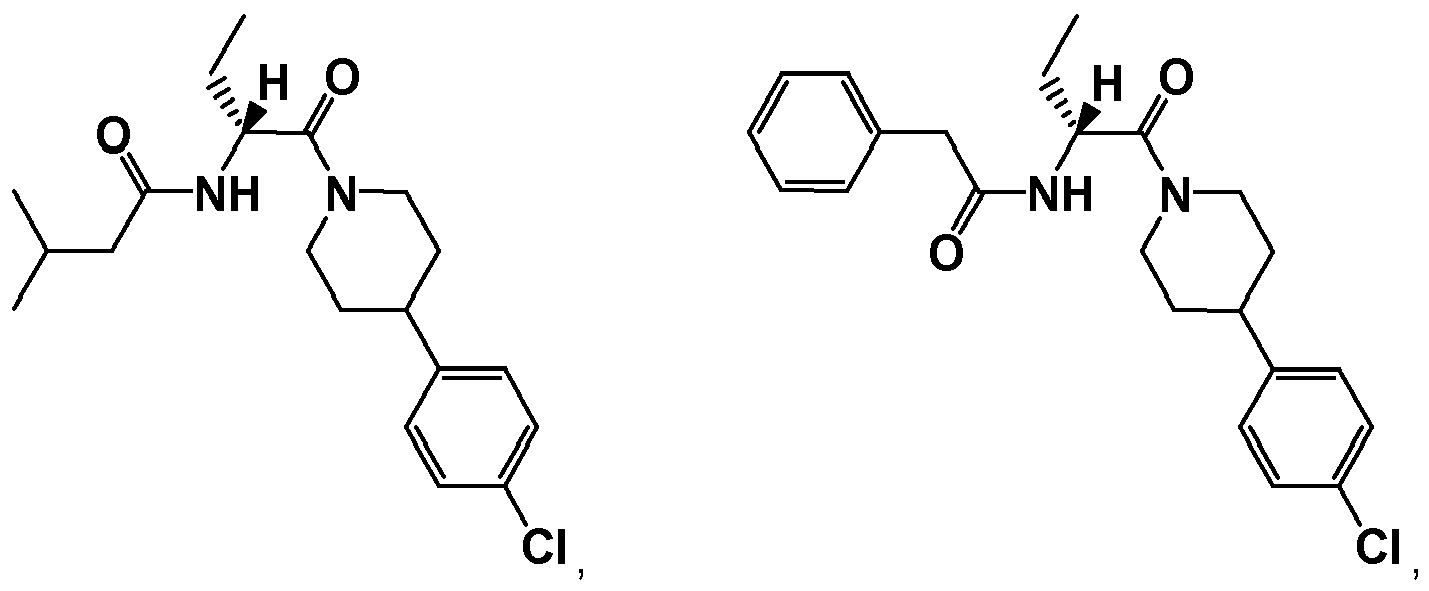


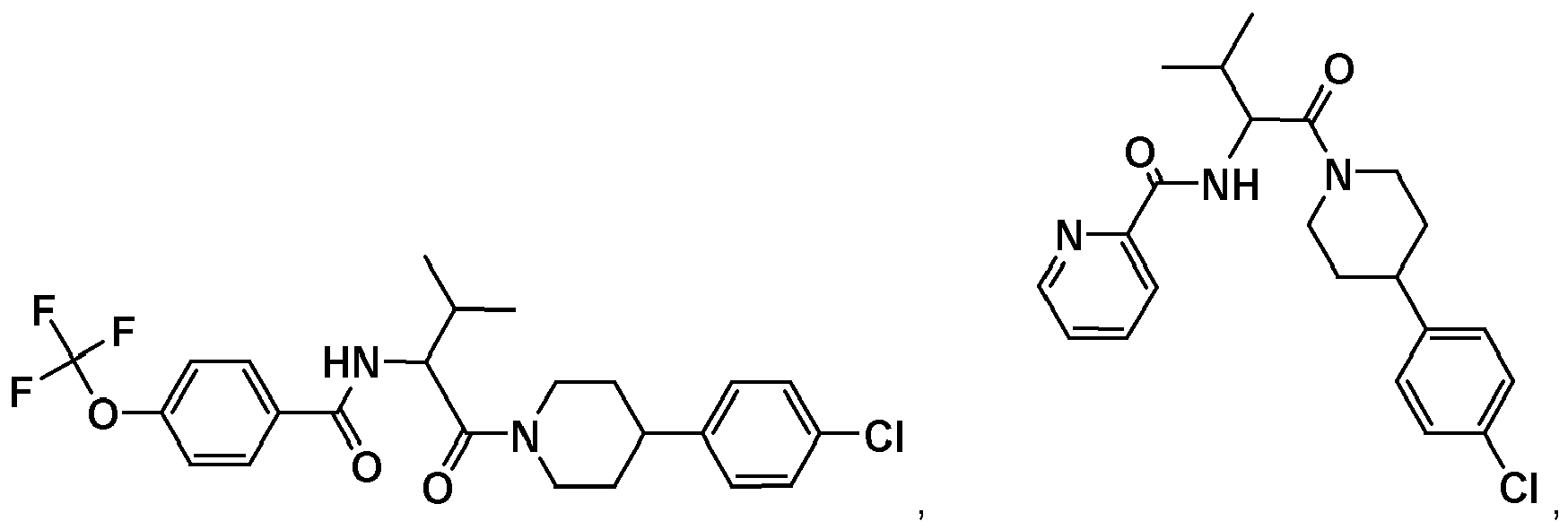
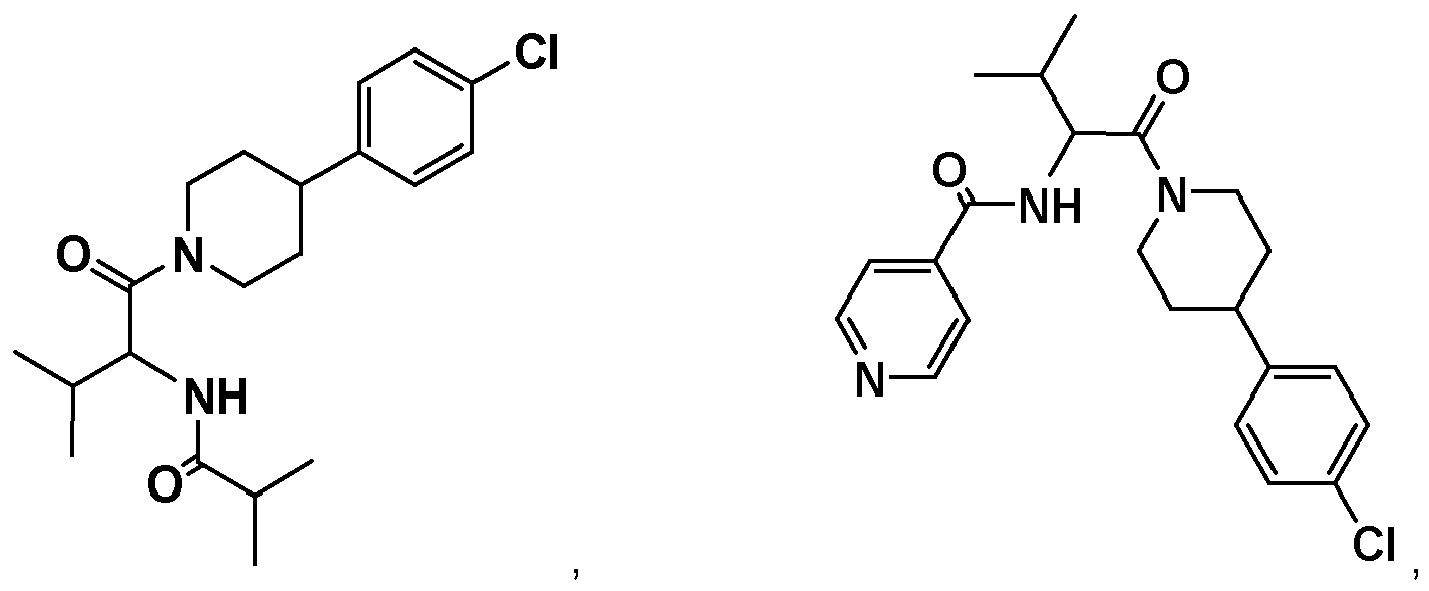
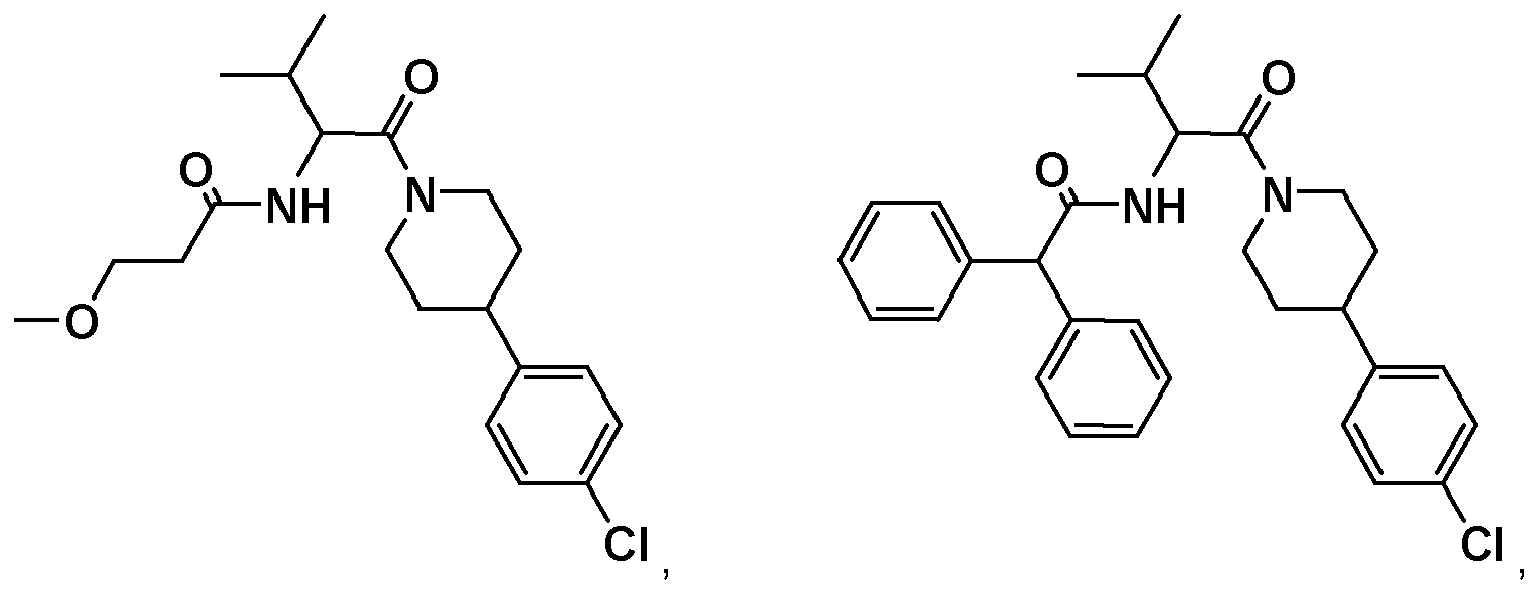


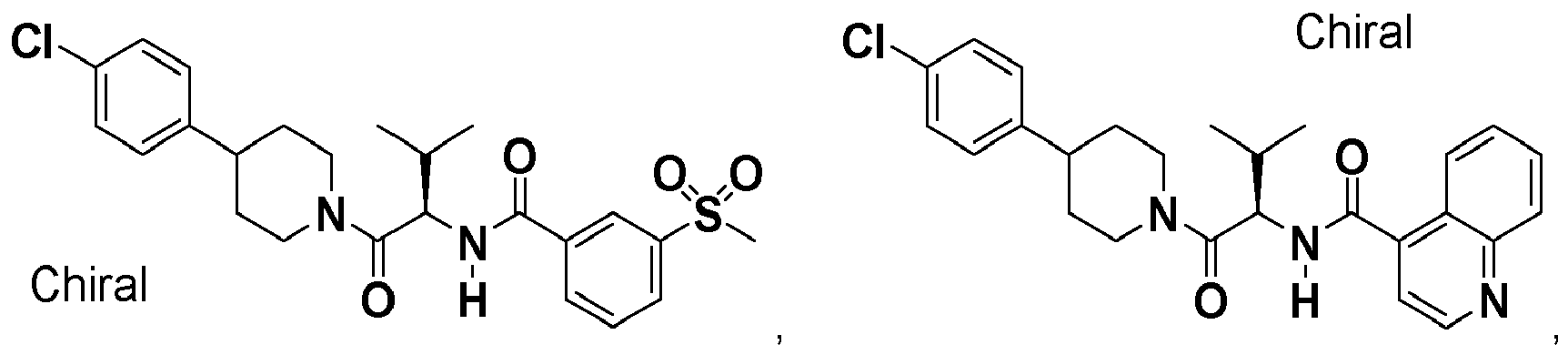


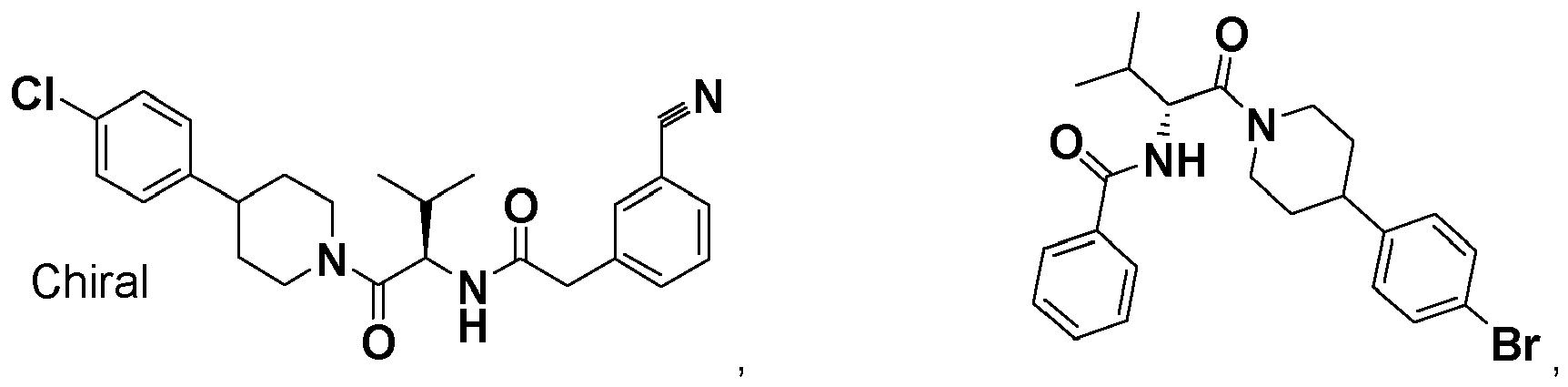
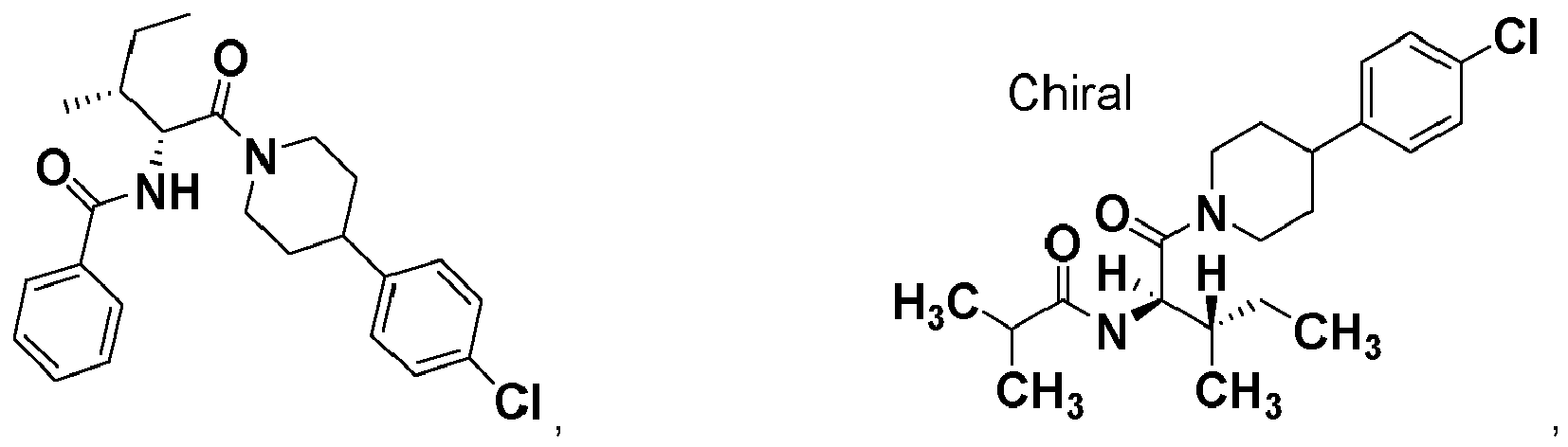


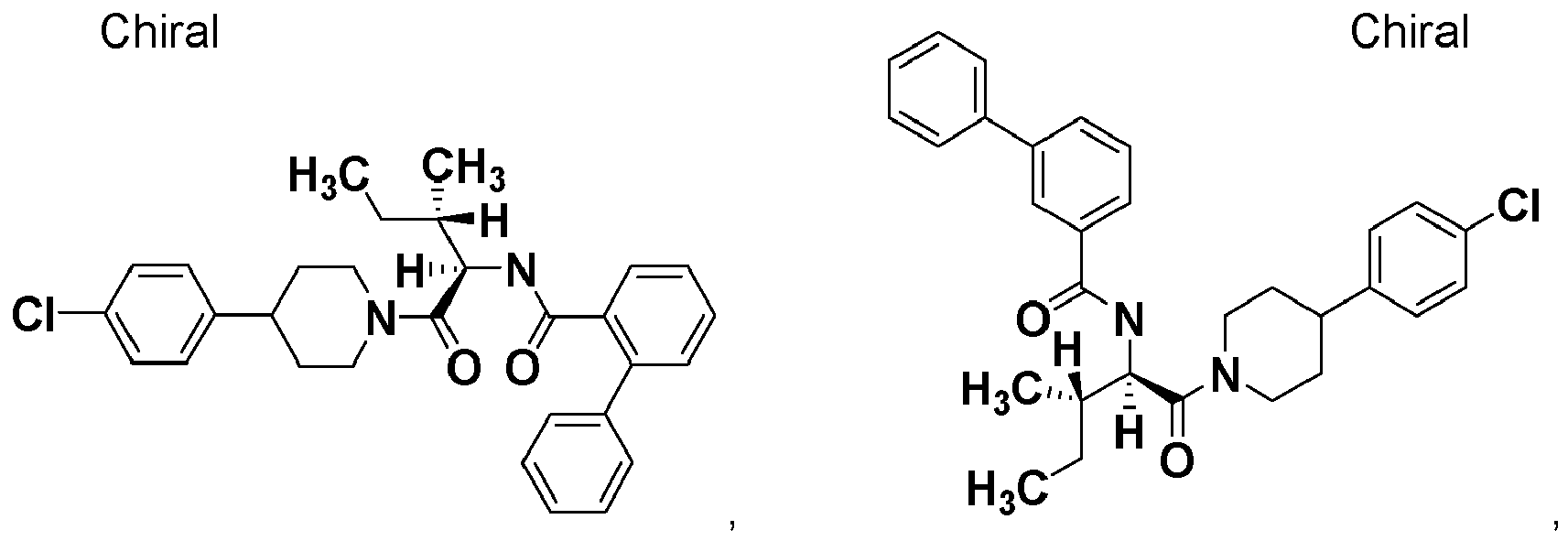

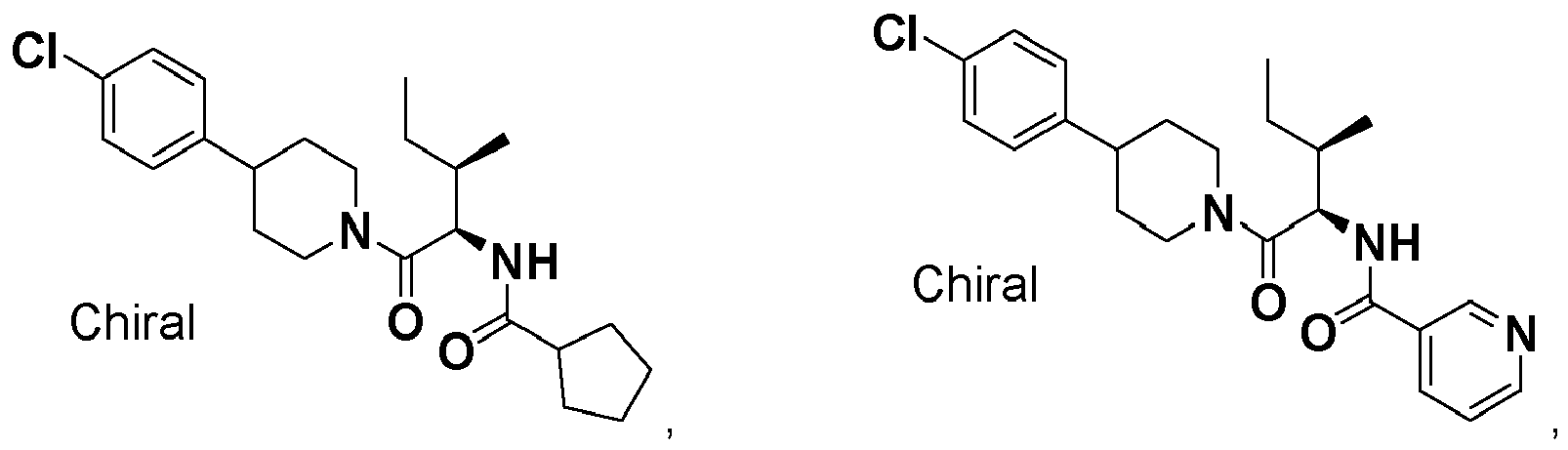


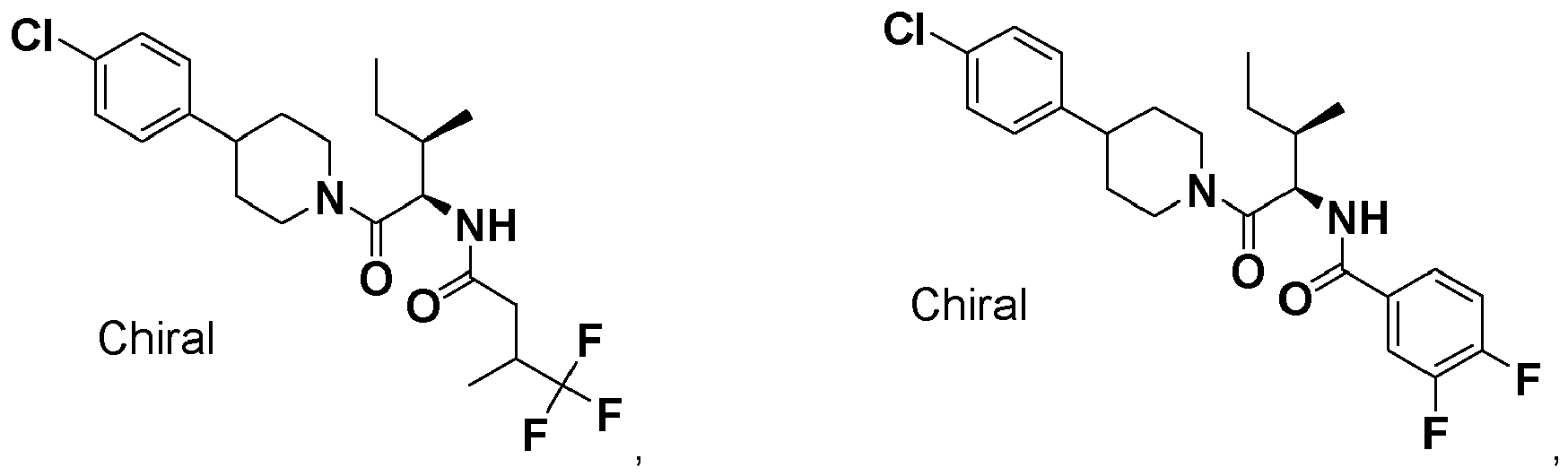


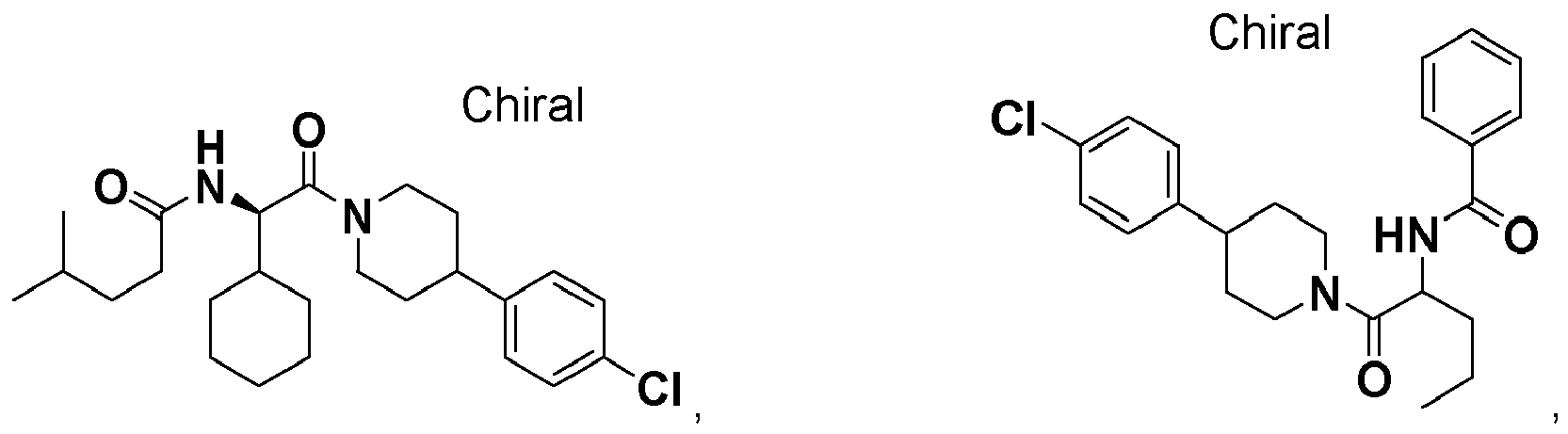


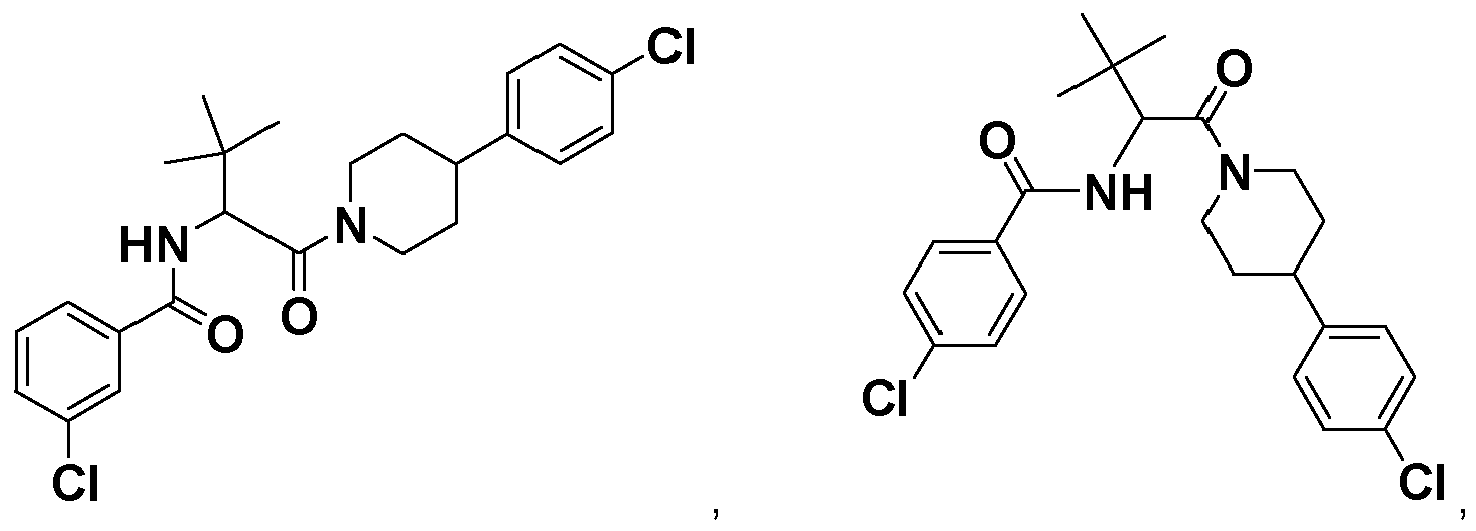


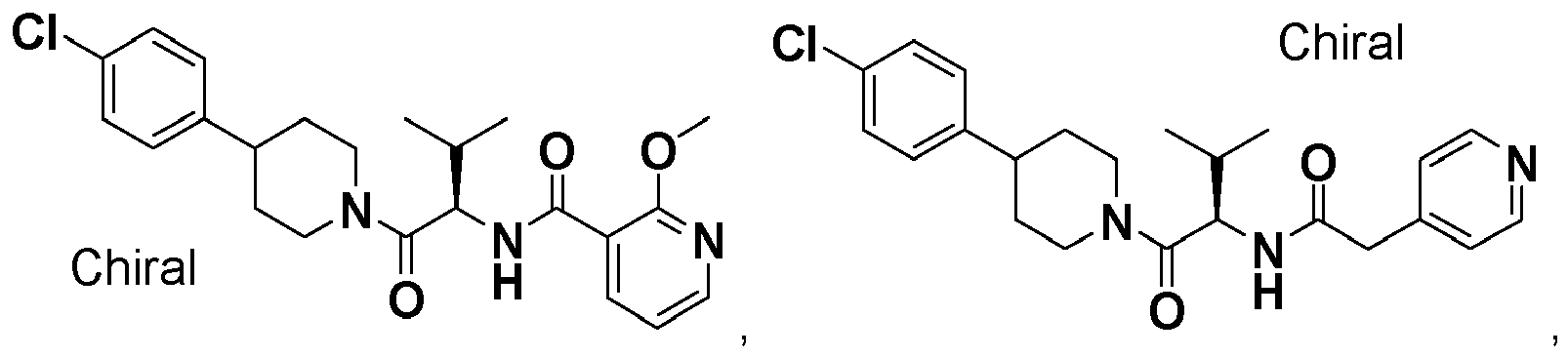


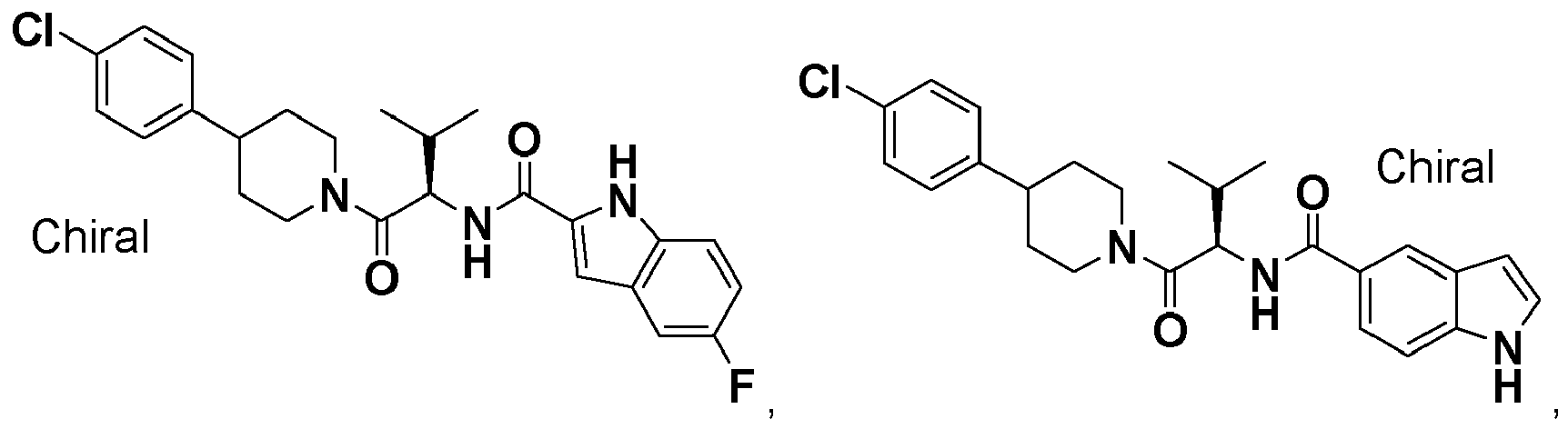





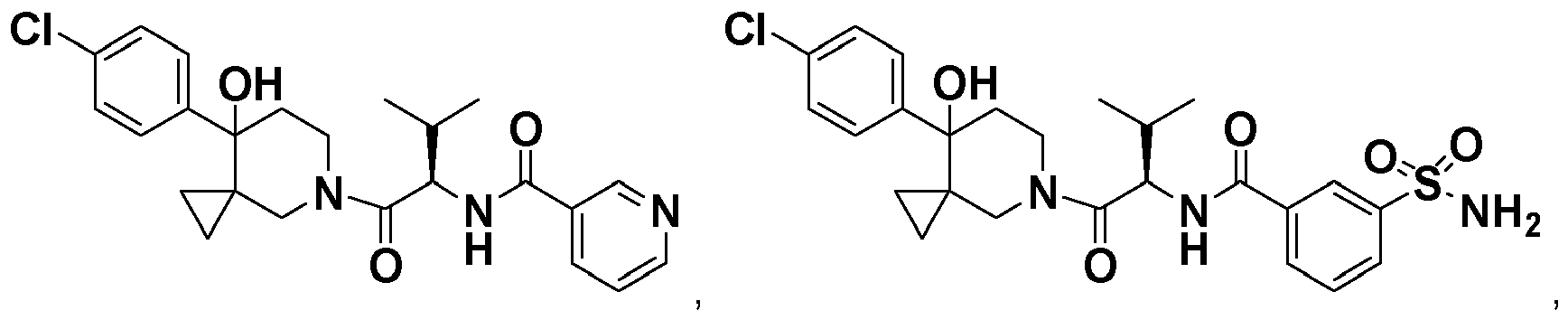


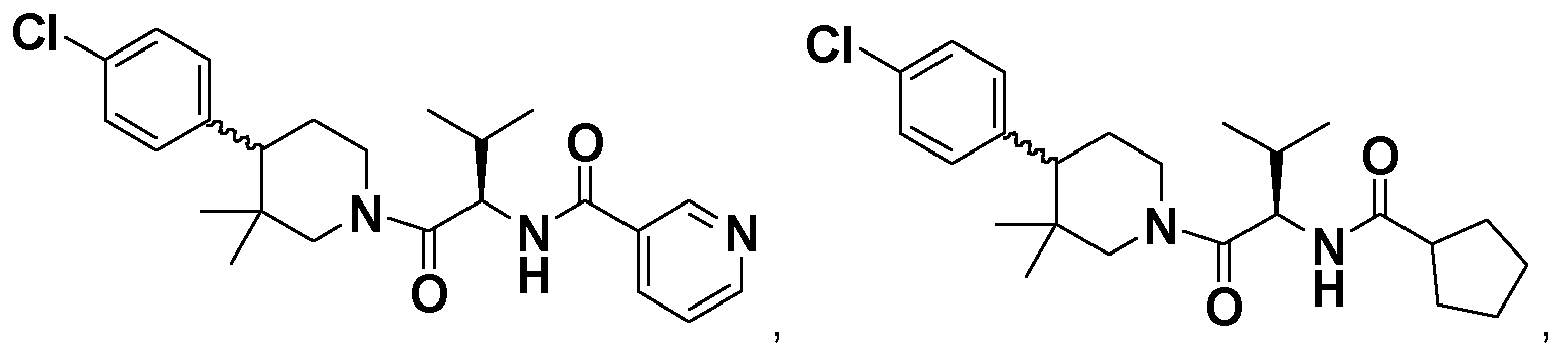


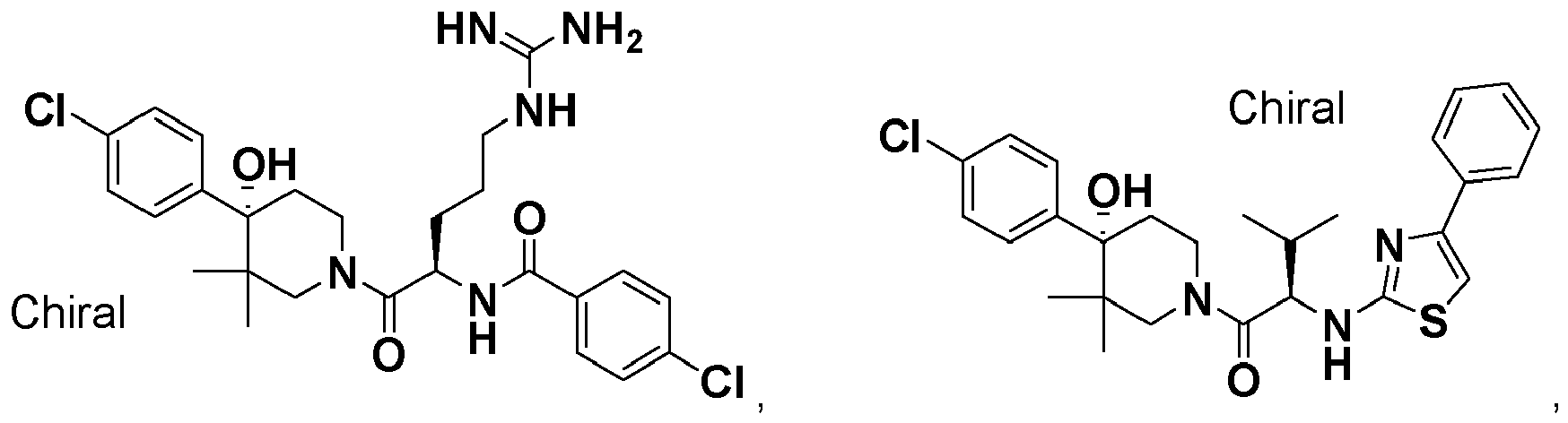


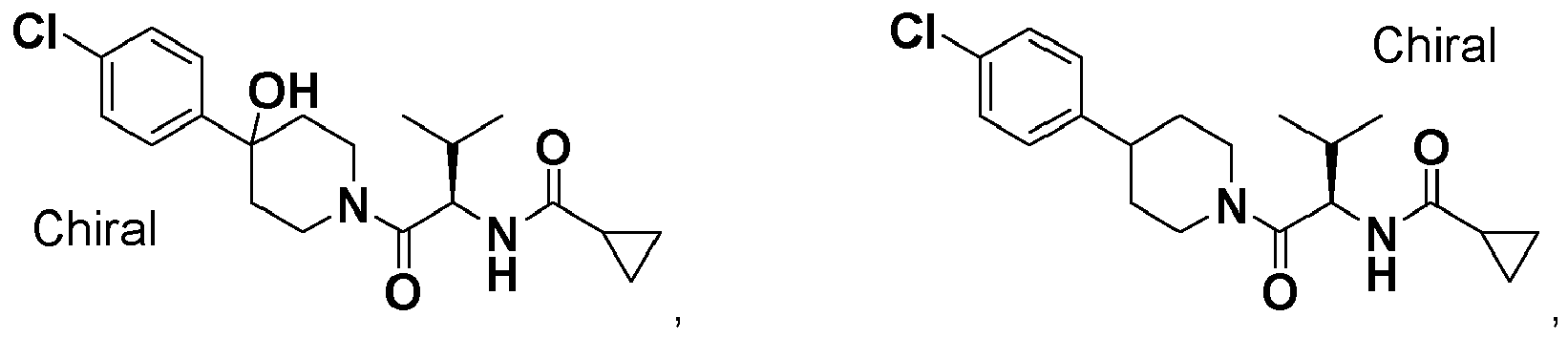


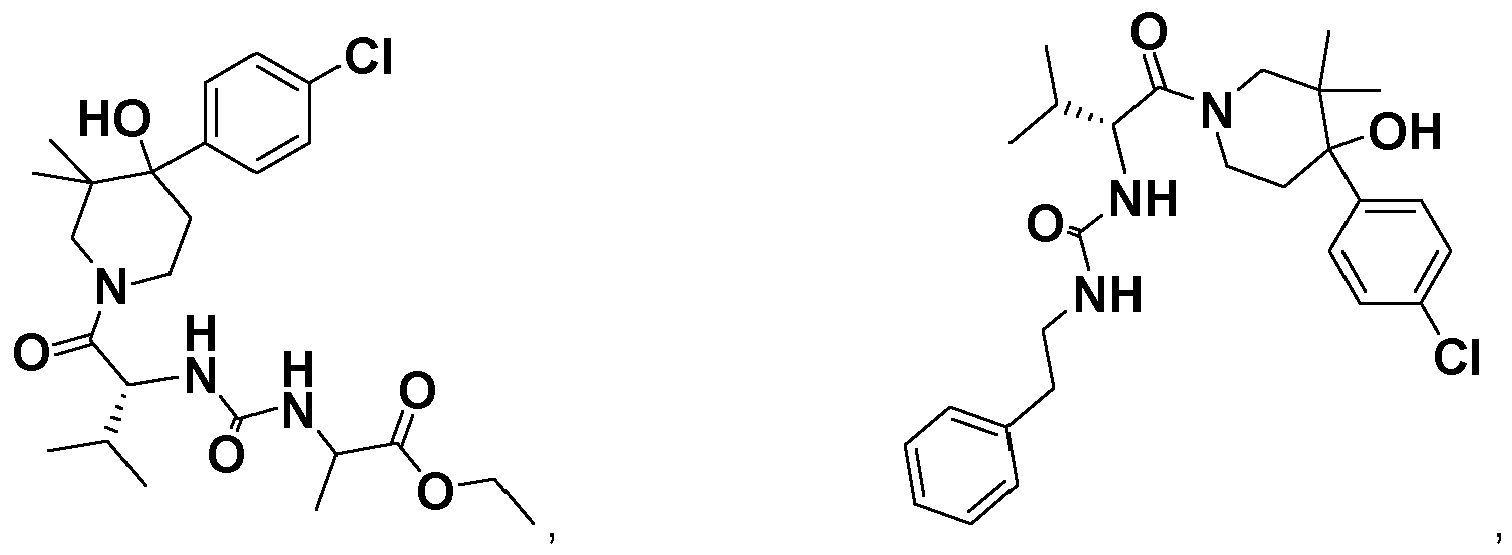


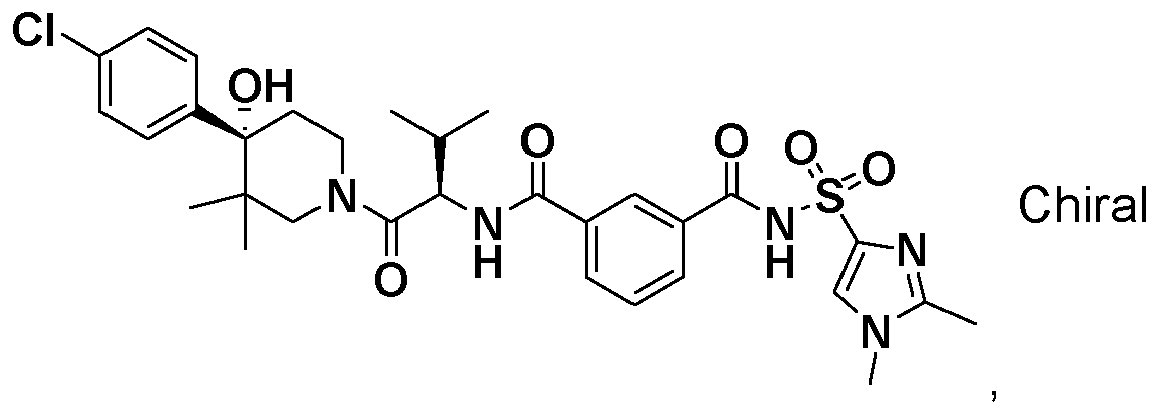


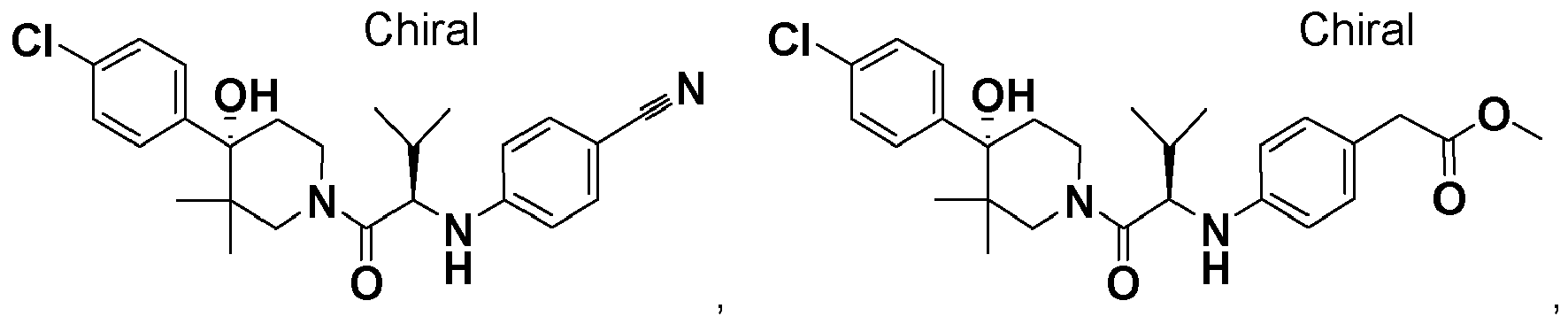

Applications Claiming Priority (3)
| Application Number | Priority Date | Filing Date | Title |
|---|---|---|---|
| US76280106P | 2006-01-27 | 2006-01-27 | |
| US11/625,874 US7601844B2 (en) | 2006-01-27 | 2007-01-23 | Piperidinyl derivatives as modulators of chemokine receptor activity |
| EP07763650A EP2049486A2 (en) | 2006-01-27 | 2007-01-25 | Piperidinyl derivatives as modulators of chemokine receptor activity |
Related Parent Applications (2)
| Application Number | Title | Priority Date | Filing Date |
|---|---|---|---|
| EP07763650.4 Division | 2007-01-25 | ||
| EP07763650A Division EP2049486A2 (en) | 2006-01-27 | 2007-01-25 | Piperidinyl derivatives as modulators of chemokine receptor activity |
Publications (2)
| Publication Number | Publication Date |
|---|---|
| EP2471774A1 true EP2471774A1 (en) | 2012-07-04 |
| EP2471774B1 EP2471774B1 (en) | 2016-08-24 |
Family
ID=38335618
Family Applications (3)
| Application Number | Title | Priority Date | Filing Date |
|---|---|---|---|
| EP11188797.2A Active EP2471773B1 (en) | 2006-01-27 | 2007-01-25 | Piperidinyl derivatives as modulators of chemokine receptor activity |
| EP07763650A Withdrawn EP2049486A2 (en) | 2006-01-27 | 2007-01-25 | Piperidinyl derivatives as modulators of chemokine receptor activity |
| EP11188840.0A Not-in-force EP2471774B1 (en) | 2006-01-27 | 2007-01-25 | Piperidinyl derivatives as modulators of chemokine receptor activity |
Family Applications Before (2)
| Application Number | Title | Priority Date | Filing Date |
|---|---|---|---|
| EP11188797.2A Active EP2471773B1 (en) | 2006-01-27 | 2007-01-25 | Piperidinyl derivatives as modulators of chemokine receptor activity |
| EP07763650A Withdrawn EP2049486A2 (en) | 2006-01-27 | 2007-01-25 | Piperidinyl derivatives as modulators of chemokine receptor activity |
Country Status (16)
| Country | Link |
|---|---|
| US (3) | US7601844B2 (en) |
| EP (3) | EP2471773B1 (en) |
| JP (1) | JP5124481B2 (en) |
| KR (1) | KR101348491B1 (en) |
| AR (1) | AR059229A1 (en) |
| AU (1) | AU2007212236B2 (en) |
| BR (1) | BRPI0707307A2 (en) |
| CA (1) | CA2651987C (en) |
| EA (1) | EA019192B1 (en) |
| IL (1) | IL192976A (en) |
| MX (1) | MX2008009512A (en) |
| NO (1) | NO20083359L (en) |
| NZ (1) | NZ570036A (en) |
| PE (1) | PE20071236A1 (en) |
| TW (1) | TWI424993B (en) |
| WO (1) | WO2007092681A2 (en) |
Cited By (1)
| Publication number | Priority date | Publication date | Assignee | Title |
|---|---|---|---|---|
| EP3978484A4 (en) * | 2019-06-03 | 2023-10-25 | Hangzhou Westan Pharmaceutical Technology Co., Ltd. | HETEROAROMATIC ACETAMIDE DERIVATIVE AND THEREOF PREPARATION AND USE |
Families Citing this family (47)
| Publication number | Priority date | Publication date | Assignee | Title |
|---|---|---|---|---|
| US7601844B2 (en) * | 2006-01-27 | 2009-10-13 | Bristol-Myers Squibb Company | Piperidinyl derivatives as modulators of chemokine receptor activity |
| EP2086935A1 (en) * | 2006-10-16 | 2009-08-12 | Grünenthal GmbH | Substituted sulfonamide derivatives for use as bradykinin 1 receptor modulators |
| JP2010534669A (en) * | 2007-07-24 | 2010-11-11 | ブリストル−マイヤーズ スクイブ カンパニー | Acyclic derivatives as modulators of chemokine receptor activity |
| EP2173714B9 (en) * | 2007-07-24 | 2013-04-10 | Bristol-Myers Squibb Company | Piperidine derivatives as modulators of chemokine receptor activity |
| EP2238127B1 (en) | 2007-12-26 | 2012-08-15 | Sanofi | Pyrazole-carboxamide derivatives as p2y12 antagonists |
| WO2009111607A1 (en) | 2008-03-07 | 2009-09-11 | Bristol-Myers Squibb Company | Hydroxyalkanyl amides as modulators of chemokine receptor activity |
| KR20100125316A (en) * | 2008-03-26 | 2010-11-30 | 다이이찌 산쿄 가부시키가이샤 | Hydroxyquinoxalinecarboxamide derivative |
| JP5657524B2 (en) | 2008-04-24 | 2015-01-21 | エフツージー リミテッド | Pyrrole antifungal agent |
| WO2009133834A1 (en) * | 2008-04-28 | 2009-11-05 | 塩野義製薬株式会社 | Keto-amide derivative having inhibitory activity on endothelial lipase |
| US7829574B2 (en) | 2008-05-09 | 2010-11-09 | Hutchison Medipharma Enterprises Limited | Substituted quinazoline compounds and their use in treating angiogenesis-related diseases |
| TWI433838B (en) * | 2008-06-25 | 2014-04-11 | 必治妥美雅史谷比公司 | Piperidinyl derivative as a modulator of chemokine receptor activity |
| WO2010087471A1 (en) * | 2009-02-02 | 2010-08-05 | 第一三共株式会社 | Hydroxypyrazinecarboxamide derivatives |
| US8865701B2 (en) | 2009-02-20 | 2014-10-21 | Merck Sharp & Dohme Corp. | Spiropyrrolidine beta-secretase inhibitors for the treatment of alzheimer'S disease |
| GB0912975D0 (en) * | 2009-07-24 | 2009-09-02 | Syngenta Ltd | Formulations |
| CN102648193A (en) | 2009-10-07 | 2012-08-22 | 百时美施贵宝公司 | Spirocyclic compounds as modulators of chemokine receptor activity |
| US8410139B2 (en) * | 2009-10-07 | 2013-04-02 | Bristol-Myers Squibb Company | Prodrugs of a piperidinyl derivative as modulators of chemokine receptor activity |
| US8686152B2 (en) | 2010-03-10 | 2014-04-01 | Janssen Pharmaceutica Nv | 4,4-disubstituted piperidine derivatives useful as inhibitors of dipeptidyl peptidase-1 (DPP-1) |
| EP2544684B1 (en) * | 2010-03-10 | 2014-12-24 | Janssen Pharmaceutica NV | 4,4-disubstituted piperidine derivatives useful as inhibitors of dipeptidyl peptidase-1 (dpp-1) |
| AU2011229862B2 (en) * | 2010-03-25 | 2014-07-24 | Abbvie Inc. | Apoptosis-inducing agents for the treatment of cancer and immune and autoimmune diseases |
| US8642622B2 (en) * | 2010-06-16 | 2014-02-04 | Bristol-Myers Squibb Company | Piperidinyl compound as a modulator of chemokine receptor activity |
| FR2962649B1 (en) * | 2010-07-19 | 2025-10-24 | Conservatoire Nat Arts Et Metiers | TREATMENT OF A PATHOLOGY RELATED TO AN EXCESSIVE EFFECT OF TNF WITH A BENZENE SULFONAMIDE COMPOUND |
| US9273028B2 (en) | 2010-10-29 | 2016-03-01 | Biogen Ma Inc. | Heterocyclic tyrosine kinase inhibitors |
| US20140081025A1 (en) * | 2011-05-10 | 2014-03-20 | Taisho Pharmaceutical Co., Ltd. | Heteroaromatic ring derivative |
| CN103732589B (en) | 2011-05-25 | 2016-03-30 | 百时美施贵宝公司 | Can be used as the sulphonamide of the replacement of anti-apoptotic BCL inhibitor |
| UY34094A (en) | 2011-05-27 | 2013-01-03 | Novartis Ag | DERIVATIVES OF PIPERIDINE 3-ESPIROCYCLIC AS AGRONISTS OF GHRELINE RECEPTORS |
| IN2014DN07954A (en) | 2012-03-13 | 2015-05-01 | Basf Se | |
| WO2013162984A1 (en) | 2012-04-25 | 2013-10-31 | Bristol-Myers Squibb Company | Methods for identifying subjects with an increased likelihood of responding to ccr1 antagonist |
| FR3000065A1 (en) * | 2012-12-21 | 2014-06-27 | Univ Lille Ii Droit & Sante | BICYCLIC COMPOUNDS HAVING ACTIVITY POTENTIATING THE ACTIVITY OF AN ACTIVE ANTIBIOTIC AGAINST MYCOBACTERIA-PHARMACEUTICAL COMPOSITION AND PRODUCT COMPRISING SUCH COMPOUNDS |
| EA030003B1 (en) | 2012-12-21 | 2018-06-29 | Джилид Сайэнс, Инк. | Polycyclic carbamoylpyridone compound and pharmaceutical use thereof for treating hiv infection |
| CA2900309A1 (en) * | 2013-02-14 | 2014-08-21 | Galderma Research & Development | Method for synthesising 4-piperidin-4-yl-benzene-1,3-diol and the salts of same and novel compound tert-butyl 4-(2,4-dihydroxy-phenyl)-4-hydroxy-piperidine-1-carboxylate |
| MX364743B (en) * | 2013-07-11 | 2019-05-06 | Evestra Inc | Pro-drug forming compounds. |
| NO2865735T3 (en) | 2013-07-12 | 2018-07-21 | ||
| CA2923101A1 (en) | 2013-09-16 | 2015-03-19 | Basf Se | Fungicidal pyrimidine compounds |
| WO2015036059A1 (en) | 2013-09-16 | 2015-03-19 | Basf Se | Fungicidal pyrimidine compounds |
| KR20160133004A (en) | 2014-04-04 | 2016-11-21 | 엑스-알엑스, 인크. | Substituted spirocyclic inhibitors of autotaxin |
| CN107205972A (en) * | 2014-04-23 | 2017-09-26 | X-Rx股份有限公司 | Substituted N-(2-(amino)-2-oxoethyl)benzamide inhibitors of autotaxin and their preparation and use in the treatment of LPA-dependent or LPA-mediated diseases |
| TW201613936A (en) | 2014-06-20 | 2016-04-16 | Gilead Sciences Inc | Crystalline forms of(2R,5S,13aR)-8-hydroxy-7,9-dioxo-n-(2,4,6-trifluorobenzyl)-2,3,4,5,7,9,13,13a-octahydro-2,5-methanopyrido[1',2':4,5]pyrazino[2,1-b][1,3]oxazepine-10-carboxamide |
| TWI744723B (en) | 2014-06-20 | 2021-11-01 | 美商基利科學股份有限公司 | Synthesis of polycyclic-carbamoylpyridone compounds |
| NO2717902T3 (en) | 2014-06-20 | 2018-06-23 | ||
| PL3221308T3 (en) | 2014-11-21 | 2019-03-29 | F2G Limited | Antifungal agents |
| WO2016120355A2 (en) * | 2015-01-30 | 2016-08-04 | Basf Se | Herbicidal phenylpyrimidines |
| RU2612970C1 (en) * | 2015-10-05 | 2017-03-14 | Федеральное государственное казённое военное образовательное учреждение высшего профессионального образования "Военная академия радиационной, химической и биологической защиты имени Маршала Советского Союза С.К. Тимошенко" г. Кострома Министерства обороны Российской Федерации | Method for 1-benzyl-4-propioanilido-4-piperidinecarbonitrile preparation |
| EP3512839A4 (en) * | 2016-09-18 | 2020-03-25 | H. Lee Moffitt Cancer Center And Research Institute, Inc. | YAP1 INHIBITORS TARGETING THE INTERACTION OF YAP1 WITH OCT4 |
| JP7177495B2 (en) * | 2016-09-21 | 2022-11-24 | ベクタス・バイオシステムズ・リミテッド | Compositions for treating hypertension and/or fibrosis |
| ES3035674T3 (en) | 2016-12-14 | 2025-09-08 | Sk Biopharmaceuticals Co Ltd | Use of carbamate compound for prevention, alleviation, or treatment of demyelinating disease |
| US11819503B2 (en) | 2019-04-23 | 2023-11-21 | F2G Ltd | Method of treating coccidioides infection |
| CN122180510A (en) * | 2023-10-20 | 2026-06-09 | 腾维治疗公司 | Compounds, compositions and methods |
Citations (9)
| Publication number | Priority date | Publication date | Assignee | Title |
|---|---|---|---|---|
| US6194448B1 (en) * | 1998-04-16 | 2001-02-27 | Texas Biotechnology Corporation | N, N-disubstituted amides that inhibit the binding of integrins to their receptors |
| US6344449B1 (en) * | 1996-09-10 | 2002-02-05 | Dr. Karl Thomae Gmbh | Modified aminoacids, pharmaceuticals containing these compounds and method for their production |
| WO2002070511A1 (en) * | 2001-03-02 | 2002-09-12 | Bristol-Myers Squibb Company | Compounds useful as modulators of melanocortin receptors and pharmaceutical compositions comprising same |
| WO2002092582A1 (en) * | 2001-05-16 | 2002-11-21 | Graffinity Pharmaceuticals Ag | Protease-inhibitors |
| US20040006067A1 (en) * | 2001-07-25 | 2004-01-08 | Fotsch Christopher H. | Substituted piperidines and methods of use |
| WO2004043965A1 (en) | 2002-11-13 | 2004-05-27 | Millennium Pharmaceuticals, Inc. | Ccr1 antagonists for the treatment of i.a. demyelinating inflammatory disease |
| US20040162282A1 (en) | 2002-06-12 | 2004-08-19 | Chemocentryx, Inc. | Substituted piperazines |
| WO2005021500A1 (en) | 2003-08-21 | 2005-03-10 | Bristol-Myers Squibb Company | Cyclic derivatives as modulators of chemokine receptor activity |
| US20050227968A1 (en) * | 2004-03-03 | 2005-10-13 | Boehringer Ingelheim International Gmbh | Selected CGRP-antagonists process for preparing them and their use as pharmaceutical compositions |
Family Cites Families (39)
| Publication number | Priority date | Publication date | Assignee | Title |
|---|---|---|---|---|
| JPS60163855A (en) * | 1984-02-06 | 1985-08-26 | Mitsubishi Chem Ind Ltd | Arginine derivative and its acid addition salt acceptable as drug |
| GB9104656D0 (en) | 1991-03-05 | 1991-04-17 | Zambeletti Spa L | Pharmaceuticals |
| DE4243858A1 (en) | 1992-12-23 | 1994-06-30 | Thomae Gmbh Dr K | Amino acid derivatives, medicaments containing these compounds and processes for their preparation |
| US5459151A (en) | 1993-04-30 | 1995-10-17 | American Home Products Corporation | N-acyl substituted phenyl piperidines as bronchodilators and antiinflammatory agents |
| US5492920A (en) * | 1993-12-10 | 1996-02-20 | Merck & Co., Inc. | Piperidine, pyrrolidine and hexahydro-1H-azepines promote release of growth hormone |
| US5777112A (en) | 1994-06-13 | 1998-07-07 | Merck & Co., Inc | Piperazine compounds promote release of growth hormone |
| CA2226740A1 (en) | 1995-07-13 | 1997-01-30 | Mitsuyoshi Azuma | Piperazine derivative and its uses |
| EP0944388A4 (en) | 1996-04-03 | 2001-08-16 | Merck & Co Inc | FARNESYL PROTEIN TRANSFERASE INHIBITORS |
| WO1998017625A1 (en) | 1996-10-22 | 1998-04-30 | Daiichi Pharmaceutical Co., Ltd. | Novel remedies for infectious diseases |
| US5847148A (en) * | 1997-04-10 | 1998-12-08 | Pharmacia & Upjohn Company | Thiadiazole derivatives useful for the treatment of diseases related to connective tissue degradation |
| ZA987383B (en) | 1997-08-19 | 2000-02-17 | Lilly Co Eli | Treatment of congestive heart failure with growth hormone secretagogues. |
| ZA987385B (en) | 1997-08-19 | 2000-04-18 | Lilly Co Eli | Growth hormone secretagogues. |
| DE69925160T2 (en) * | 1998-12-17 | 2006-02-16 | Wyeth | ARYLPIPERIDINE AND ARYL 1,2,5,6-TETRAHYDROPYRIDINAMIDE DERIVATIVES WITH 5HT1A RECEPTOR ACTIVITY |
| US6391865B1 (en) * | 1999-05-04 | 2002-05-21 | Schering Corporation | Piperazine derivatives useful as CCR5 antagonists |
| WO2000074679A1 (en) | 1999-06-04 | 2000-12-14 | Merck & Co., Inc. | Substituted piperidines as melanocortin-4 receptor agonists |
| DE10041402A1 (en) * | 2000-08-23 | 2002-03-14 | Morphochem Ag | Novel compounds that inhibit factor Xa activity |
| JP2001354657A (en) | 2000-06-09 | 2001-12-25 | Sds Biotech:Kk | Substituted piperazine derivative and agricultural and horticultiral fungicide |
| AU2001268607A1 (en) * | 2000-06-21 | 2002-01-02 | Bristol-Myers Squibb Company | Piperidine amides as modulators of chemokine receptor activity |
| JP2004523530A (en) | 2001-01-23 | 2004-08-05 | イーライ・リリー・アンド・カンパニー | Piperazine and piperidine derivatives as melanocortin receptor agonists |
| WO2003007949A1 (en) | 2001-07-18 | 2003-01-30 | Merck & Co., Inc. | Bridged piperidine derivatives as melanocortin receptor agonists |
| MY141661A (en) | 2001-09-06 | 2010-05-31 | Schering Corp | 17b-hydroxysteroid dehydrogenase type 3 inhibitors for the treatment of androgen dependent diseases |
| KR20040068317A (en) * | 2001-12-20 | 2004-07-30 | 오에스아이 파마슈티컬스, 인코포레이티드 | Pyrimidine a2b selective antagonist compounds, their synthesis and use |
| DE60236458D1 (en) * | 2001-12-20 | 2010-07-01 | Osi Pharm Inc | PYRROLOPYRIMIDINE A2B SELECTIVE ANTAGONISTIC COMPOUNDS, THEIR SYNTHESIS AND USE |
| US7041681B2 (en) | 2002-04-29 | 2006-05-09 | Janssen Pharmaceutica N.V. | Compounds as opioid receptor modulators |
| US20050256130A1 (en) | 2002-06-12 | 2005-11-17 | Chemocentryx, Inc. | Substituted piperazines |
| GB0224917D0 (en) | 2002-10-25 | 2002-12-04 | Novartis Ag | Organic compounds |
| WO2004042351A2 (en) | 2002-10-30 | 2004-05-21 | Merck & Co., Inc. | Piperidinyl-alpha-aminoamide modulators of chemokine receptor activity |
| CA2512886A1 (en) | 2003-02-28 | 2004-09-10 | Galderma Research & Development, S.N.C. | Ligands that modulate lxr-type receptors |
| US6846836B2 (en) * | 2003-04-18 | 2005-01-25 | Bristol-Myers Squibb Company | N-substituted phenylurea inhibitors of mitochondrial F1F0 ATP hydrolase |
| EP1633737A1 (en) | 2003-06-13 | 2006-03-15 | Schering Aktiengesellschaft | Quinolyl amide derivatives as ccr-5 antagonists |
| GB0315203D0 (en) | 2003-06-28 | 2003-08-06 | Celltech R&D Ltd | Chemical compounds |
| DE10358539A1 (en) * | 2003-12-15 | 2005-07-07 | Merck Patent Gmbh | carboxamide |
| JP4775259B2 (en) * | 2004-03-31 | 2011-09-21 | 味の素株式会社 | Aniline derivative |
| GB0412468D0 (en) | 2004-06-04 | 2004-07-07 | Astrazeneca Ab | Chemical compounds |
| US7723360B2 (en) | 2004-08-06 | 2010-05-25 | Boehringer Ingelheim International Gmbh | Alkyl-and piperidine-substituted benzimidazole derivatives |
| WO2007073432A2 (en) * | 2005-10-11 | 2007-06-28 | Chemocentryx, Inc. | Piperidine derivatives and methods of use |
| US7615556B2 (en) * | 2006-01-27 | 2009-11-10 | Bristol-Myers Squibb Company | Piperazinyl derivatives as modulators of chemokine receptor activity |
| US7601844B2 (en) * | 2006-01-27 | 2009-10-13 | Bristol-Myers Squibb Company | Piperidinyl derivatives as modulators of chemokine receptor activity |
| JP2010534669A (en) * | 2007-07-24 | 2010-11-11 | ブリストル−マイヤーズ スクイブ カンパニー | Acyclic derivatives as modulators of chemokine receptor activity |
-
2007
- 2007-01-23 US US11/625,874 patent/US7601844B2/en active Active
- 2007-01-25 KR KR1020087020904A patent/KR101348491B1/en not_active Expired - Fee Related
- 2007-01-25 MX MX2008009512A patent/MX2008009512A/en active IP Right Grant
- 2007-01-25 AU AU2007212236A patent/AU2007212236B2/en not_active Ceased
- 2007-01-25 CA CA2651987A patent/CA2651987C/en not_active Expired - Fee Related
- 2007-01-25 WO PCT/US2007/061012 patent/WO2007092681A2/en not_active Ceased
- 2007-01-25 EP EP11188797.2A patent/EP2471773B1/en active Active
- 2007-01-25 EP EP07763650A patent/EP2049486A2/en not_active Withdrawn
- 2007-01-25 EA EA200801757A patent/EA019192B1/en not_active IP Right Cessation
- 2007-01-25 BR BRPI0707307-0A patent/BRPI0707307A2/en not_active IP Right Cessation
- 2007-01-25 PE PE2007000089A patent/PE20071236A1/en not_active Application Discontinuation
- 2007-01-25 EP EP11188840.0A patent/EP2471774B1/en not_active Not-in-force
- 2007-01-25 JP JP2008552563A patent/JP5124481B2/en not_active Expired - Fee Related
- 2007-01-25 NZ NZ570036A patent/NZ570036A/en not_active IP Right Cessation
- 2007-01-26 TW TW096103072A patent/TWI424993B/en not_active IP Right Cessation
- 2007-01-29 AR ARP070100372A patent/AR059229A1/en not_active Application Discontinuation
-
2008
- 2008-07-22 IL IL192976A patent/IL192976A/en not_active IP Right Cessation
- 2008-07-31 NO NO20083359A patent/NO20083359L/en not_active Application Discontinuation
-
2009
- 2009-07-20 US US12/505,724 patent/US7985861B2/en active Active
-
2011
- 2011-06-08 US US13/155,460 patent/US20110245226A1/en not_active Abandoned
Patent Citations (9)
| Publication number | Priority date | Publication date | Assignee | Title |
|---|---|---|---|---|
| US6344449B1 (en) * | 1996-09-10 | 2002-02-05 | Dr. Karl Thomae Gmbh | Modified aminoacids, pharmaceuticals containing these compounds and method for their production |
| US6194448B1 (en) * | 1998-04-16 | 2001-02-27 | Texas Biotechnology Corporation | N, N-disubstituted amides that inhibit the binding of integrins to their receptors |
| WO2002070511A1 (en) * | 2001-03-02 | 2002-09-12 | Bristol-Myers Squibb Company | Compounds useful as modulators of melanocortin receptors and pharmaceutical compositions comprising same |
| WO2002092582A1 (en) * | 2001-05-16 | 2002-11-21 | Graffinity Pharmaceuticals Ag | Protease-inhibitors |
| US20040006067A1 (en) * | 2001-07-25 | 2004-01-08 | Fotsch Christopher H. | Substituted piperidines and methods of use |
| US20040162282A1 (en) | 2002-06-12 | 2004-08-19 | Chemocentryx, Inc. | Substituted piperazines |
| WO2004043965A1 (en) | 2002-11-13 | 2004-05-27 | Millennium Pharmaceuticals, Inc. | Ccr1 antagonists for the treatment of i.a. demyelinating inflammatory disease |
| WO2005021500A1 (en) | 2003-08-21 | 2005-03-10 | Bristol-Myers Squibb Company | Cyclic derivatives as modulators of chemokine receptor activity |
| US20050227968A1 (en) * | 2004-03-03 | 2005-10-13 | Boehringer Ingelheim International Gmbh | Selected CGRP-antagonists process for preparing them and their use as pharmaceutical compositions |
Non-Patent Citations (44)
| Title |
|---|
| "A Textbook of Drug Design and Development", 1991, HARWOOD ACADEMIC PUBLISHERS, pages: 113 - 191 |
| "Design of Prodrugs", 1985, ELSEVIER |
| "Remington's Pharmaceutical Sciences", 1985, MACK PUBLISHING COMPANY, pages: 1418 |
| ALISA KOCH ET AL., J. CLIN. INVEST., vol. 93, 1994, pages 921 - 928 |
| BABA ET AL., J. BIOL. CHEM., vol. 272, 1997, pages 14893 - 14898 |
| BARNES, D. A. ET AL., J. CLIN INVEST., vol. 101, 1998, pages 2910 - 2919 |
| BECK, L. A. ET AL., J. IMMUN., vol. 159, 1997, pages 2962 - 2972 |
| BEN-BARRUCH ET AL., CELL, vol. 72, 1993, pages 415 - 425 |
| BERNARD TESTA, JOACHIM M. MAYER: "Hydrolysis in Drug and Prodrug Metabolism", 2003, WILEY-VCH |
| BONINI ET AL., DNA AND CELL BIOL., vol. 16, 1997, pages 1249 - 1256 |
| BRUMMET, M. E., J. IMMUN., vol. 164, 2000, pages 3392 - 3401 |
| CAMILLE G. WERMUTH ET AL.: "The Practice of Medicinal Chemistry", 1996, ACADEMIC PRESS |
| CARSON, K. G. ET AL., ANN. REPORTS MED. CHEM., vol. 39, 2004, pages 149 - 158 |
| CARTER, P. H., CURR. OPIN CHEM. BIO., vol. 6, 2002, pages 510 - 525 |
| CHARO ET AL., PROC. NATL. ACAD. SCI. USA, vol. 91, 1994, pages 2752 - 2756 |
| CHINTALACHARUVU, S. R., IMMUN. LETT., 2005, pages 202 - 204 |
| COMBADIERE ET AL., J. BIOL. CHEM., vol. 270, 1995, pages 16491 - 16494 |
| COOK, D. ET AL., SCIENCE, vol. 269, 1995, pages 1583 - 1585 |
| CURRY, J. MED. CHEM., vol. 31, 1988, pages 861 |
| GAO, B. ET AL., J. EXP. MED., vol. 185, 1997, pages 1959 - 1968 |
| GREENE, WUTS: "Protective Groups In Organic Synthesis", 1999, WILEY AND SONS |
| HORUK, TRENDS PHARM. SCI., vol. 15, 1994, pages 159 - 165 |
| KARPUS, W. J. ET AL., J. IMMUN., 1995, pages 5003 - 5010 |
| LIZOTTE, J. ORG. CHEM., vol. 48, no. 20, 1983, pages 3594 - 3597 |
| LUKACS, N. W. ET AL., J. CLIN. INVEST., vol. 95, 1995, pages 2868 - 2876 |
| LUSTER, NEW ENG. J. MED., vol. 338, 1998, pages 436 - 445 |
| NAPOLITANO ET AL., J. IMMUNOL., vol. 157, 1996, pages 2759 - 2763 |
| P. H. CARTER, CURRENT OPINION IN CHEMICAL BIOLOGY, vol. 6, 2002, pages 510 |
| PEASE, J. E., HORUK, R., EXPERT OPIN. INVEST. DRUGS, vol. 14, 2005, pages 785 - 796 |
| PLATER-ZYBERK, C. ET AL., IMM. LETT., vol. 57, 1997, pages 117 - 120 |
| POWER ET AL., J. BIOL. CHEM., vol. 270, 1995, pages 19495 - 19500 |
| PREMACK, SCHALL, NATURE MEDICINE, vol. 2, 1996, pages 1174 |
| ROLLINS, BLOOD, vol. 90, 1997, pages 909 - 928 |
| SANSON ET AL., BIOCHEMISTRY, vol. 35, 1996, pages 3362 - 3367 |
| SAUNDERS, TARBY, DRUG DISC. TODAY, vol. 4, 1999, pages 80 |
| SCHWEICKERT ET AL., J. BIOL. CHEM., vol. 275, 2000, pages 90550 |
| SHAHRARA, S. ET AL., ARTHRITIS & RHEUM., vol. 52, 2005, pages 1907 - 1919 |
| SHARPLESS, DEMKO, J. ORG. CHEM., vol. 66, 2001, pages 7945 - 7950 |
| SHARPLESS, J. ORG. CHEM., vol. 57, 1992, pages 2768 |
| STEVEN D. YOUNG ET AL., ANTIMICROBIAL AGENTS AND CHEMOTHERAPHY, 1995, pages 2602 - 2605 |
| TRIVEDI ET AL., ANN. REPORTS MED. CHEM., vol. 35, 2000, pages 191 |
| WELLS, SCHWARTZ, CURR. OPIN. BIOTECH., vol. 8, 1997, pages 741 - 748 |
| YOSHIE ET AL., J. LEUKOC. BIOL., vol. 62, 1997, pages 634 - 644 |
| ZLOTNIK, OSHIE, IMMUNITY, vol. 12, 2000, pages 121 |
Cited By (1)
| Publication number | Priority date | Publication date | Assignee | Title |
|---|---|---|---|---|
| EP3978484A4 (en) * | 2019-06-03 | 2023-10-25 | Hangzhou Westan Pharmaceutical Technology Co., Ltd. | HETEROAROMATIC ACETAMIDE DERIVATIVE AND THEREOF PREPARATION AND USE |
Also Published As
| Publication number | Publication date |
|---|---|
| EP2471773B1 (en) | 2016-03-23 |
| US7601844B2 (en) | 2009-10-13 |
| WO2007092681A3 (en) | 2009-03-12 |
| CA2651987C (en) | 2014-09-23 |
| PE20071236A1 (en) | 2007-12-14 |
| EP2471773A1 (en) | 2012-07-04 |
| CA2651987A1 (en) | 2007-08-16 |
| AU2007212236A1 (en) | 2007-08-16 |
| BRPI0707307A2 (en) | 2011-05-03 |
| TW200738660A (en) | 2007-10-16 |
| IL192976A (en) | 2015-05-31 |
| EP2471774B1 (en) | 2016-08-24 |
| JP2009526764A (en) | 2009-07-23 |
| EA200801757A1 (en) | 2009-08-28 |
| US20070208056A1 (en) | 2007-09-06 |
| WO2007092681A2 (en) | 2007-08-16 |
| KR20080095890A (en) | 2008-10-29 |
| MX2008009512A (en) | 2009-02-26 |
| NO20083359L (en) | 2008-10-15 |
| EA019192B1 (en) | 2014-01-30 |
| NZ570036A (en) | 2011-06-30 |
| EP2049486A2 (en) | 2009-04-22 |
| US20110245226A1 (en) | 2011-10-06 |
| TWI424993B (en) | 2014-02-01 |
| AR059229A1 (en) | 2008-03-19 |
| AU2007212236B2 (en) | 2012-05-24 |
| KR101348491B1 (en) | 2014-01-06 |
| US7985861B2 (en) | 2011-07-26 |
| US20090298833A1 (en) | 2009-12-03 |
| JP5124481B2 (en) | 2013-01-23 |
Similar Documents
| Publication | Publication Date | Title |
|---|---|---|
| US7601844B2 (en) | Piperidinyl derivatives as modulators of chemokine receptor activity | |
| US7615556B2 (en) | Piperazinyl derivatives as modulators of chemokine receptor activity | |
| US8501782B2 (en) | Piperidinyl derivatives as modulators of chemokine receptor activity | |
| US8536198B2 (en) | Piperidine derivatives as modulators of chemokine receptor activity | |
| US8492550B2 (en) | Hydroxyalkanyl amides as modulators of chemokine receptor activity | |
| US8324251B2 (en) | Cyclic modulators of chemokine receptor activity | |
| CN101600691A (en) | Piperidinyl derivatives as modulators of chemokine receptor activity | |
| HK1168343A (en) | Piperidinyl derivatives as modulators of chemokine receptor activity | |
| HK1087712A1 (en) | Cyclic derivatives as modulators of chemokine receptor activity |
Legal Events
| Date | Code | Title | Description |
|---|---|---|---|
| AC | Divisional application: reference to earlier application |
Ref document number: 2049486 Country of ref document: EP Kind code of ref document: P |
|
| AK | Designated contracting states |
Kind code of ref document: A1 Designated state(s): AT BE BG CH CY CZ DE DK EE ES FI FR GB GR HU IE IS IT LI LT LU LV MC NL PL PT RO SE SI SK TR |
|
| AX | Request for extension of the european patent |
Extension state: AL BA HR MK RS |
|
| PUAI | Public reference made under article 153(3) epc to a published international application that has entered the european phase |
Free format text: ORIGINAL CODE: 0009012 |
|
| 17P | Request for examination filed |
Effective date: 20130104 |
|
| 17Q | First examination report despatched |
Effective date: 20140130 |
|
| GRAP | Despatch of communication of intention to grant a patent |
Free format text: ORIGINAL CODE: EPIDOSNIGR1 |
|
| INTG | Intention to grant announced |
Effective date: 20160318 |
|
| GRAS | Grant fee paid |
Free format text: ORIGINAL CODE: EPIDOSNIGR3 |
|
| GRAA | (expected) grant |
Free format text: ORIGINAL CODE: 0009210 |
|
| AC | Divisional application: reference to earlier application |
Ref document number: 2049486 Country of ref document: EP Kind code of ref document: P |
|
| AK | Designated contracting states |
Kind code of ref document: B1 Designated state(s): AT BE BG CH CY CZ DE DK EE ES FI FR GB GR HU IE IS IT LI LT LU LV MC NL PL PT RO SE SI SK TR |
|
| REG | Reference to a national code |
Ref country code: GB Ref legal event code: FG4D |
|
| REG | Reference to a national code |
Ref country code: CH Ref legal event code: EP |
|
| REG | Reference to a national code |
Ref country code: AT Ref legal event code: REF Ref document number: 822949 Country of ref document: AT Kind code of ref document: T Effective date: 20160915 |
|
| REG | Reference to a national code |
Ref country code: IE Ref legal event code: FG4D |
|
| REG | Reference to a national code |
Ref country code: DE Ref legal event code: R096 Ref document number: 602007047672 Country of ref document: DE |
|
| REG | Reference to a national code |
Ref country code: FR Ref legal event code: PLFP Year of fee payment: 11 |
|
| REG | Reference to a national code |
Ref country code: LT Ref legal event code: MG4D |
|
| REG | Reference to a national code |
Ref country code: NL Ref legal event code: MP Effective date: 20160824 |
|
| REG | Reference to a national code |
Ref country code: AT Ref legal event code: MK05 Ref document number: 822949 Country of ref document: AT Kind code of ref document: T Effective date: 20160824 |
|
| PG25 | Lapsed in a contracting state [announced via postgrant information from national office to epo] |
Ref country code: IT Free format text: LAPSE BECAUSE OF FAILURE TO SUBMIT A TRANSLATION OF THE DESCRIPTION OR TO PAY THE FEE WITHIN THE PRESCRIBED TIME-LIMIT Effective date: 20160824 Ref country code: LT Free format text: LAPSE BECAUSE OF FAILURE TO SUBMIT A TRANSLATION OF THE DESCRIPTION OR TO PAY THE FEE WITHIN THE PRESCRIBED TIME-LIMIT Effective date: 20160824 Ref country code: FI Free format text: LAPSE BECAUSE OF FAILURE TO SUBMIT A TRANSLATION OF THE DESCRIPTION OR TO PAY THE FEE WITHIN THE PRESCRIBED TIME-LIMIT Effective date: 20160824 Ref country code: NL Free format text: LAPSE BECAUSE OF FAILURE TO SUBMIT A TRANSLATION OF THE DESCRIPTION OR TO PAY THE FEE WITHIN THE PRESCRIBED TIME-LIMIT Effective date: 20160824 |
|
| PG25 | Lapsed in a contracting state [announced via postgrant information from national office to epo] |
Ref country code: SE Free format text: LAPSE BECAUSE OF FAILURE TO SUBMIT A TRANSLATION OF THE DESCRIPTION OR TO PAY THE FEE WITHIN THE PRESCRIBED TIME-LIMIT Effective date: 20160824 Ref country code: GR Free format text: LAPSE BECAUSE OF FAILURE TO SUBMIT A TRANSLATION OF THE DESCRIPTION OR TO PAY THE FEE WITHIN THE PRESCRIBED TIME-LIMIT Effective date: 20161125 Ref country code: PT Free format text: LAPSE BECAUSE OF FAILURE TO SUBMIT A TRANSLATION OF THE DESCRIPTION OR TO PAY THE FEE WITHIN THE PRESCRIBED TIME-LIMIT Effective date: 20161226 Ref country code: LV Free format text: LAPSE BECAUSE OF FAILURE TO SUBMIT A TRANSLATION OF THE DESCRIPTION OR TO PAY THE FEE WITHIN THE PRESCRIBED TIME-LIMIT Effective date: 20160824 Ref country code: ES Free format text: LAPSE BECAUSE OF FAILURE TO SUBMIT A TRANSLATION OF THE DESCRIPTION OR TO PAY THE FEE WITHIN THE PRESCRIBED TIME-LIMIT Effective date: 20160824 Ref country code: AT Free format text: LAPSE BECAUSE OF FAILURE TO SUBMIT A TRANSLATION OF THE DESCRIPTION OR TO PAY THE FEE WITHIN THE PRESCRIBED TIME-LIMIT Effective date: 20160824 |
|
| PG25 | Lapsed in a contracting state [announced via postgrant information from national office to epo] |
Ref country code: RO Free format text: LAPSE BECAUSE OF FAILURE TO SUBMIT A TRANSLATION OF THE DESCRIPTION OR TO PAY THE FEE WITHIN THE PRESCRIBED TIME-LIMIT Effective date: 20160824 Ref country code: EE Free format text: LAPSE BECAUSE OF FAILURE TO SUBMIT A TRANSLATION OF THE DESCRIPTION OR TO PAY THE FEE WITHIN THE PRESCRIBED TIME-LIMIT Effective date: 20160824 |
|
| REG | Reference to a national code |
Ref country code: DE Ref legal event code: R097 Ref document number: 602007047672 Country of ref document: DE |
|
| PG25 | Lapsed in a contracting state [announced via postgrant information from national office to epo] |
Ref country code: BE Free format text: LAPSE BECAUSE OF FAILURE TO SUBMIT A TRANSLATION OF THE DESCRIPTION OR TO PAY THE FEE WITHIN THE PRESCRIBED TIME-LIMIT Effective date: 20160824 Ref country code: SK Free format text: LAPSE BECAUSE OF FAILURE TO SUBMIT A TRANSLATION OF THE DESCRIPTION OR TO PAY THE FEE WITHIN THE PRESCRIBED TIME-LIMIT Effective date: 20160824 Ref country code: PL Free format text: LAPSE BECAUSE OF FAILURE TO SUBMIT A TRANSLATION OF THE DESCRIPTION OR TO PAY THE FEE WITHIN THE PRESCRIBED TIME-LIMIT Effective date: 20160824 Ref country code: CZ Free format text: LAPSE BECAUSE OF FAILURE TO SUBMIT A TRANSLATION OF THE DESCRIPTION OR TO PAY THE FEE WITHIN THE PRESCRIBED TIME-LIMIT Effective date: 20160824 Ref country code: BG Free format text: LAPSE BECAUSE OF FAILURE TO SUBMIT A TRANSLATION OF THE DESCRIPTION OR TO PAY THE FEE WITHIN THE PRESCRIBED TIME-LIMIT Effective date: 20161124 Ref country code: DK Free format text: LAPSE BECAUSE OF FAILURE TO SUBMIT A TRANSLATION OF THE DESCRIPTION OR TO PAY THE FEE WITHIN THE PRESCRIBED TIME-LIMIT Effective date: 20160824 |
|
| PLBE | No opposition filed within time limit |
Free format text: ORIGINAL CODE: 0009261 |
|
| STAA | Information on the status of an ep patent application or granted ep patent |
Free format text: STATUS: NO OPPOSITION FILED WITHIN TIME LIMIT |
|
| 26N | No opposition filed |
Effective date: 20170526 |
|
| PG25 | Lapsed in a contracting state [announced via postgrant information from national office to epo] |
Ref country code: SI Free format text: LAPSE BECAUSE OF FAILURE TO SUBMIT A TRANSLATION OF THE DESCRIPTION OR TO PAY THE FEE WITHIN THE PRESCRIBED TIME-LIMIT Effective date: 20160824 |
|
| REG | Reference to a national code |
Ref country code: CH Ref legal event code: PL |
|
| PG25 | Lapsed in a contracting state [announced via postgrant information from national office to epo] |
Ref country code: MC Free format text: LAPSE BECAUSE OF FAILURE TO SUBMIT A TRANSLATION OF THE DESCRIPTION OR TO PAY THE FEE WITHIN THE PRESCRIBED TIME-LIMIT Effective date: 20160824 |
|
| PG25 | Lapsed in a contracting state [announced via postgrant information from national office to epo] |
Ref country code: LI Free format text: LAPSE BECAUSE OF NON-PAYMENT OF DUE FEES Effective date: 20170131 Ref country code: CH Free format text: LAPSE BECAUSE OF NON-PAYMENT OF DUE FEES Effective date: 20170131 |
|
| REG | Reference to a national code |
Ref country code: IE Ref legal event code: MM4A |
|
| PG25 | Lapsed in a contracting state [announced via postgrant information from national office to epo] |
Ref country code: LU Free format text: LAPSE BECAUSE OF NON-PAYMENT OF DUE FEES Effective date: 20170125 |
|
| REG | Reference to a national code |
Ref country code: FR Ref legal event code: PLFP Year of fee payment: 12 |
|
| PGFP | Annual fee paid to national office [announced via postgrant information from national office to epo] |
Ref country code: FR Payment date: 20171211 Year of fee payment: 12 |
|
| PG25 | Lapsed in a contracting state [announced via postgrant information from national office to epo] |
Ref country code: IE Free format text: LAPSE BECAUSE OF NON-PAYMENT OF DUE FEES Effective date: 20170125 |
|
| PGFP | Annual fee paid to national office [announced via postgrant information from national office to epo] |
Ref country code: GB Payment date: 20180124 Year of fee payment: 12 Ref country code: DE Payment date: 20180110 Year of fee payment: 12 |
|
| PG25 | Lapsed in a contracting state [announced via postgrant information from national office to epo] |
Ref country code: HU Free format text: LAPSE BECAUSE OF FAILURE TO SUBMIT A TRANSLATION OF THE DESCRIPTION OR TO PAY THE FEE WITHIN THE PRESCRIBED TIME-LIMIT; INVALID AB INITIO Effective date: 20070125 |
|
| REG | Reference to a national code |
Ref country code: DE Ref legal event code: R119 Ref document number: 602007047672 Country of ref document: DE |
|
| GBPC | Gb: european patent ceased through non-payment of renewal fee |
Effective date: 20190125 |
|
| PG25 | Lapsed in a contracting state [announced via postgrant information from national office to epo] |
Ref country code: CY Free format text: LAPSE BECAUSE OF NON-PAYMENT OF DUE FEES Effective date: 20160824 Ref country code: FR Free format text: LAPSE BECAUSE OF NON-PAYMENT OF DUE FEES Effective date: 20190131 Ref country code: DE Free format text: LAPSE BECAUSE OF NON-PAYMENT OF DUE FEES Effective date: 20190801 |
|
| PG25 | Lapsed in a contracting state [announced via postgrant information from national office to epo] |
Ref country code: GB Free format text: LAPSE BECAUSE OF NON-PAYMENT OF DUE FEES Effective date: 20190125 |
|
| PG25 | Lapsed in a contracting state [announced via postgrant information from national office to epo] |
Ref country code: TR Free format text: LAPSE BECAUSE OF FAILURE TO SUBMIT A TRANSLATION OF THE DESCRIPTION OR TO PAY THE FEE WITHIN THE PRESCRIBED TIME-LIMIT Effective date: 20160824 |
|
| PG25 | Lapsed in a contracting state [announced via postgrant information from national office to epo] |
Ref country code: IS Free format text: LAPSE BECAUSE OF FAILURE TO SUBMIT A TRANSLATION OF THE DESCRIPTION OR TO PAY THE FEE WITHIN THE PRESCRIBED TIME-LIMIT Effective date: 20161224 |
|
| P01 | Opt-out of the competence of the unified patent court (upc) registered |
Effective date: 20230404 |