EP2471750B1 - Method for recovering precious metals using surface-modified biomass - Google Patents
Method for recovering precious metals using surface-modified biomass Download PDFInfo
- Publication number
- EP2471750B1 EP2471750B1 EP09758545.9A EP09758545A EP2471750B1 EP 2471750 B1 EP2471750 B1 EP 2471750B1 EP 09758545 A EP09758545 A EP 09758545A EP 2471750 B1 EP2471750 B1 EP 2471750B1
- Authority
- EP
- European Patent Office
- Prior art keywords
- biomass
- group
- precious metal
- precious
- adsorption
- Prior art date
- Legal status (The legal status is an assumption and is not a legal conclusion. Google has not performed a legal analysis and makes no representation as to the accuracy of the status listed.)
- Not-in-force
Links
Images

Classifications
-
- B—PERFORMING OPERATIONS; TRANSPORTING
- B01—PHYSICAL OR CHEMICAL PROCESSES OR APPARATUS IN GENERAL
- B01J—CHEMICAL OR PHYSICAL PROCESSES, e.g. CATALYSIS OR COLLOID CHEMISTRY; THEIR RELEVANT APPARATUS
- B01J20/00—Solid sorbent compositions or filter aid compositions; Sorbents for chromatography; Processes for preparing, regenerating or reactivating thereof
- B01J20/22—Solid sorbent compositions or filter aid compositions; Sorbents for chromatography; Processes for preparing, regenerating or reactivating thereof comprising organic material
- B01J20/26—Synthetic macromolecular compounds
-
- C—CHEMISTRY; METALLURGY
- C22—METALLURGY; FERROUS OR NON-FERROUS ALLOYS; TREATMENT OF ALLOYS OR NON-FERROUS METALS
- C22B—PRODUCTION AND REFINING OF METALS; PRETREATMENT OF RAW MATERIALS
- C22B9/00—General processes of refining or remelting of metals; Apparatus for electroslag or arc remelting of metals
- C22B9/02—Refining by liquating, filtering, centrifuging, distilling, or supersonic wave action including acoustic waves
-
- B—PERFORMING OPERATIONS; TRANSPORTING
- B01—PHYSICAL OR CHEMICAL PROCESSES OR APPARATUS IN GENERAL
- B01J—CHEMICAL OR PHYSICAL PROCESSES, e.g. CATALYSIS OR COLLOID CHEMISTRY; THEIR RELEVANT APPARATUS
- B01J20/00—Solid sorbent compositions or filter aid compositions; Sorbents for chromatography; Processes for preparing, regenerating or reactivating thereof
- B01J20/22—Solid sorbent compositions or filter aid compositions; Sorbents for chromatography; Processes for preparing, regenerating or reactivating thereof comprising organic material
- B01J20/26—Synthetic macromolecular compounds
- B01J20/265—Synthetic macromolecular compounds modified or post-treated polymers
-
- B—PERFORMING OPERATIONS; TRANSPORTING
- B01—PHYSICAL OR CHEMICAL PROCESSES OR APPARATUS IN GENERAL
- B01J—CHEMICAL OR PHYSICAL PROCESSES, e.g. CATALYSIS OR COLLOID CHEMISTRY; THEIR RELEVANT APPARATUS
- B01J20/00—Solid sorbent compositions or filter aid compositions; Sorbents for chromatography; Processes for preparing, regenerating or reactivating thereof
- B01J20/22—Solid sorbent compositions or filter aid compositions; Sorbents for chromatography; Processes for preparing, regenerating or reactivating thereof comprising organic material
- B01J20/26—Synthetic macromolecular compounds
- B01J20/265—Synthetic macromolecular compounds modified or post-treated polymers
- B01J20/267—Cross-linked polymers
-
- B—PERFORMING OPERATIONS; TRANSPORTING
- B01—PHYSICAL OR CHEMICAL PROCESSES OR APPARATUS IN GENERAL
- B01J—CHEMICAL OR PHYSICAL PROCESSES, e.g. CATALYSIS OR COLLOID CHEMISTRY; THEIR RELEVANT APPARATUS
- B01J20/00—Solid sorbent compositions or filter aid compositions; Sorbents for chromatography; Processes for preparing, regenerating or reactivating thereof
- B01J20/30—Processes for preparing, regenerating, or reactivating
- B01J20/32—Impregnating or coating ; Solid sorbent compositions obtained from processes involving impregnating or coating
- B01J20/3202—Impregnating or coating ; Solid sorbent compositions obtained from processes involving impregnating or coating characterised by the carrier, support or substrate used for impregnation or coating
- B01J20/3206—Organic carriers, supports or substrates
-
- B—PERFORMING OPERATIONS; TRANSPORTING
- B01—PHYSICAL OR CHEMICAL PROCESSES OR APPARATUS IN GENERAL
- B01J—CHEMICAL OR PHYSICAL PROCESSES, e.g. CATALYSIS OR COLLOID CHEMISTRY; THEIR RELEVANT APPARATUS
- B01J20/00—Solid sorbent compositions or filter aid compositions; Sorbents for chromatography; Processes for preparing, regenerating or reactivating thereof
- B01J20/30—Processes for preparing, regenerating, or reactivating
- B01J20/32—Impregnating or coating ; Solid sorbent compositions obtained from processes involving impregnating or coating
- B01J20/3231—Impregnating or coating ; Solid sorbent compositions obtained from processes involving impregnating or coating characterised by the coating or impregnating layer
- B01J20/3242—Layers with a functional group, e.g. an affinity material, a ligand, a reactant or a complexing group
-
- B—PERFORMING OPERATIONS; TRANSPORTING
- B01—PHYSICAL OR CHEMICAL PROCESSES OR APPARATUS IN GENERAL
- B01J—CHEMICAL OR PHYSICAL PROCESSES, e.g. CATALYSIS OR COLLOID CHEMISTRY; THEIR RELEVANT APPARATUS
- B01J20/00—Solid sorbent compositions or filter aid compositions; Sorbents for chromatography; Processes for preparing, regenerating or reactivating thereof
- B01J20/30—Processes for preparing, regenerating, or reactivating
- B01J20/32—Impregnating or coating ; Solid sorbent compositions obtained from processes involving impregnating or coating
- B01J20/3231—Impregnating or coating ; Solid sorbent compositions obtained from processes involving impregnating or coating characterised by the coating or impregnating layer
- B01J20/3242—Layers with a functional group, e.g. an affinity material, a ligand, a reactant or a complexing group
- B01J20/3268—Macromolecular compounds
- B01J20/327—Polymers obtained by reactions involving only carbon to carbon unsaturated bonds
-
- B—PERFORMING OPERATIONS; TRANSPORTING
- B01—PHYSICAL OR CHEMICAL PROCESSES OR APPARATUS IN GENERAL
- B01J—CHEMICAL OR PHYSICAL PROCESSES, e.g. CATALYSIS OR COLLOID CHEMISTRY; THEIR RELEVANT APPARATUS
- B01J20/00—Solid sorbent compositions or filter aid compositions; Sorbents for chromatography; Processes for preparing, regenerating or reactivating thereof
- B01J20/30—Processes for preparing, regenerating, or reactivating
- B01J20/32—Impregnating or coating ; Solid sorbent compositions obtained from processes involving impregnating or coating
- B01J20/3231—Impregnating or coating ; Solid sorbent compositions obtained from processes involving impregnating or coating characterised by the coating or impregnating layer
- B01J20/3242—Layers with a functional group, e.g. an affinity material, a ligand, a reactant or a complexing group
- B01J20/3268—Macromolecular compounds
- B01J20/3272—Polymers obtained by reactions otherwise than involving only carbon to carbon unsaturated bonds
-
- B—PERFORMING OPERATIONS; TRANSPORTING
- B01—PHYSICAL OR CHEMICAL PROCESSES OR APPARATUS IN GENERAL
- B01J—CHEMICAL OR PHYSICAL PROCESSES, e.g. CATALYSIS OR COLLOID CHEMISTRY; THEIR RELEVANT APPARATUS
- B01J20/00—Solid sorbent compositions or filter aid compositions; Sorbents for chromatography; Processes for preparing, regenerating or reactivating thereof
- B01J20/30—Processes for preparing, regenerating, or reactivating
- B01J20/32—Impregnating or coating ; Solid sorbent compositions obtained from processes involving impregnating or coating
- B01J20/3231—Impregnating or coating ; Solid sorbent compositions obtained from processes involving impregnating or coating characterised by the coating or impregnating layer
- B01J20/3242—Layers with a functional group, e.g. an affinity material, a ligand, a reactant or a complexing group
- B01J20/3268—Macromolecular compounds
- B01J20/328—Polymers on the carrier being further modified
-
- B—PERFORMING OPERATIONS; TRANSPORTING
- B01—PHYSICAL OR CHEMICAL PROCESSES OR APPARATUS IN GENERAL
- B01J—CHEMICAL OR PHYSICAL PROCESSES, e.g. CATALYSIS OR COLLOID CHEMISTRY; THEIR RELEVANT APPARATUS
- B01J20/00—Solid sorbent compositions or filter aid compositions; Sorbents for chromatography; Processes for preparing, regenerating or reactivating thereof
- B01J20/30—Processes for preparing, regenerating, or reactivating
- B01J20/32—Impregnating or coating ; Solid sorbent compositions obtained from processes involving impregnating or coating
- B01J20/3231—Impregnating or coating ; Solid sorbent compositions obtained from processes involving impregnating or coating characterised by the coating or impregnating layer
- B01J20/3242—Layers with a functional group, e.g. an affinity material, a ligand, a reactant or a complexing group
- B01J20/3268—Macromolecular compounds
- B01J20/328—Polymers on the carrier being further modified
- B01J20/3282—Crosslinked polymers
-
- B—PERFORMING OPERATIONS; TRANSPORTING
- B01—PHYSICAL OR CHEMICAL PROCESSES OR APPARATUS IN GENERAL
- B01J—CHEMICAL OR PHYSICAL PROCESSES, e.g. CATALYSIS OR COLLOID CHEMISTRY; THEIR RELEVANT APPARATUS
- B01J45/00—Ion-exchange in which a complex or a chelate is formed; Use of material as complex or chelate forming ion-exchangers; Treatment of material for improving the complex or chelate forming ion-exchange properties
-
- C—CHEMISTRY; METALLURGY
- C02—TREATMENT OF WATER, WASTE WATER, SEWAGE, OR SLUDGE
- C02F—TREATMENT OF WATER, WASTE WATER, SEWAGE, OR SLUDGE
- C02F1/00—Treatment of water, waste water, or sewage
- C02F1/28—Treatment of water, waste water, or sewage by sorption
- C02F1/288—Treatment of water, waste water, or sewage by sorption using composite sorbents, e.g. coated, impregnated, multi-layered
-
- C—CHEMISTRY; METALLURGY
- C22—METALLURGY; FERROUS OR NON-FERROUS ALLOYS; TREATMENT OF ALLOYS OR NON-FERROUS METALS
- C22B—PRODUCTION AND REFINING OF METALS; PRETREATMENT OF RAW MATERIALS
- C22B11/00—Obtaining noble metals
- C22B11/04—Obtaining noble metals by wet processes
- C22B11/042—Recovery of noble metals from waste materials
-
- C—CHEMISTRY; METALLURGY
- C22—METALLURGY; FERROUS OR NON-FERROUS ALLOYS; TREATMENT OF ALLOYS OR NON-FERROUS METALS
- C22B—PRODUCTION AND REFINING OF METALS; PRETREATMENT OF RAW MATERIALS
- C22B11/00—Obtaining noble metals
- C22B11/04—Obtaining noble metals by wet processes
- C22B11/042—Recovery of noble metals from waste materials
- C22B11/044—Recovery of noble metals from waste materials from pyrometallurgical residues, e.g. from ashes, dross, flue dust, mud, skim, slag, sludge
-
- C—CHEMISTRY; METALLURGY
- C22—METALLURGY; FERROUS OR NON-FERROUS ALLOYS; TREATMENT OF ALLOYS OR NON-FERROUS METALS
- C22B—PRODUCTION AND REFINING OF METALS; PRETREATMENT OF RAW MATERIALS
- C22B11/00—Obtaining noble metals
- C22B11/04—Obtaining noble metals by wet processes
- C22B11/042—Recovery of noble metals from waste materials
- C22B11/046—Recovery of noble metals from waste materials from manufactured products, e.g. from printed circuit boards, from photographic films, paper or baths
-
- C—CHEMISTRY; METALLURGY
- C22—METALLURGY; FERROUS OR NON-FERROUS ALLOYS; TREATMENT OF ALLOYS OR NON-FERROUS METALS
- C22B—PRODUCTION AND REFINING OF METALS; PRETREATMENT OF RAW MATERIALS
- C22B3/00—Extraction of metal compounds from ores or concentrates by wet processes
- C22B3/20—Treatment or purification of solutions, e.g. obtained by leaching
- C22B3/22—Treatment or purification of solutions, e.g. obtained by leaching by physical processes, e.g. by filtration, by magnetic means, or by thermal decomposition
- C22B3/24—Treatment or purification of solutions, e.g. obtained by leaching by physical processes, e.g. by filtration, by magnetic means, or by thermal decomposition by adsorption on solid substances, e.g. by extraction with solid resins
-
- C—CHEMISTRY; METALLURGY
- C22—METALLURGY; FERROUS OR NON-FERROUS ALLOYS; TREATMENT OF ALLOYS OR NON-FERROUS METALS
- C22B—PRODUCTION AND REFINING OF METALS; PRETREATMENT OF RAW MATERIALS
- C22B7/00—Working up raw materials other than ores, e.g. scrap, to produce non-ferrous metals and compounds thereof; Methods of a general interest or applied to the winning of more than two metals
-
- B—PERFORMING OPERATIONS; TRANSPORTING
- B01—PHYSICAL OR CHEMICAL PROCESSES OR APPARATUS IN GENERAL
- B01J—CHEMICAL OR PHYSICAL PROCESSES, e.g. CATALYSIS OR COLLOID CHEMISTRY; THEIR RELEVANT APPARATUS
- B01J2220/00—Aspects relating to sorbent materials
- B01J2220/40—Aspects relating to the composition of sorbent or filter aid materials
- B01J2220/48—Sorbents characterised by the starting material used for their preparation
- B01J2220/4812—Sorbents characterised by the starting material used for their preparation the starting material being of organic character
- B01J2220/4868—Cells, spores, bacteria
-
- B—PERFORMING OPERATIONS; TRANSPORTING
- B82—NANOTECHNOLOGY
- B82Y—SPECIFIC USES OR APPLICATIONS OF NANOSTRUCTURES; MEASUREMENT OR ANALYSIS OF NANOSTRUCTURES; MANUFACTURE OR TREATMENT OF NANOSTRUCTURES
- B82Y40/00—Manufacture or treatment of nanostructures
-
- C—CHEMISTRY; METALLURGY
- C02—TREATMENT OF WATER, WASTE WATER, SEWAGE, OR SLUDGE
- C02F—TREATMENT OF WATER, WASTE WATER, SEWAGE, OR SLUDGE
- C02F1/00—Treatment of water, waste water, or sewage
- C02F1/28—Treatment of water, waste water, or sewage by sorption
- C02F1/286—Treatment of water, waste water, or sewage by sorption using natural organic sorbents or derivatives thereof
-
- C—CHEMISTRY; METALLURGY
- C02—TREATMENT OF WATER, WASTE WATER, SEWAGE, OR SLUDGE
- C02F—TREATMENT OF WATER, WASTE WATER, SEWAGE, OR SLUDGE
- C02F1/00—Treatment of water, waste water, or sewage
- C02F1/42—Treatment of water, waste water, or sewage by ion-exchange
- C02F2001/422—Treatment of water, waste water, or sewage by ion-exchange using anionic exchangers
-
- C—CHEMISTRY; METALLURGY
- C02—TREATMENT OF WATER, WASTE WATER, SEWAGE, OR SLUDGE
- C02F—TREATMENT OF WATER, WASTE WATER, SEWAGE, OR SLUDGE
- C02F2101/00—Nature of the contaminant
- C02F2101/10—Inorganic compounds
- C02F2101/20—Heavy metals or heavy metal compounds
-
- Y—GENERAL TAGGING OF NEW TECHNOLOGICAL DEVELOPMENTS; GENERAL TAGGING OF CROSS-SECTIONAL TECHNOLOGIES SPANNING OVER SEVERAL SECTIONS OF THE IPC; TECHNICAL SUBJECTS COVERED BY FORMER USPC CROSS-REFERENCE ART COLLECTIONS [XRACs] AND DIGESTS
- Y02—TECHNOLOGIES OR APPLICATIONS FOR MITIGATION OR ADAPTATION AGAINST CLIMATE CHANGE
- Y02P—CLIMATE CHANGE MITIGATION TECHNOLOGIES IN THE PRODUCTION OR PROCESSING OF GOODS
- Y02P10/00—Technologies related to metal processing
- Y02P10/20—Recycling
-
- Y—GENERAL TAGGING OF NEW TECHNOLOGICAL DEVELOPMENTS; GENERAL TAGGING OF CROSS-SECTIONAL TECHNOLOGIES SPANNING OVER SEVERAL SECTIONS OF THE IPC; TECHNICAL SUBJECTS COVERED BY FORMER USPC CROSS-REFERENCE ART COLLECTIONS [XRACs] AND DIGESTS
- Y10—TECHNICAL SUBJECTS COVERED BY FORMER USPC
- Y10S—TECHNICAL SUBJECTS COVERED BY FORMER USPC CROSS-REFERENCE ART COLLECTIONS [XRACs] AND DIGESTS
- Y10S977/00—Nanotechnology
- Y10S977/70—Nanostructure
- Y10S977/734—Fullerenes, i.e. graphene-based structures, such as nanohorns, nanococoons, nanoscrolls or fullerene-like structures, e.g. WS2 or MoS2 chalcogenide nanotubes, planar C3N4, etc.
- Y10S977/742—Carbon nanotubes, CNTs
Definitions
- the present invention relates to a recovery method of precious metals using a surface-modified bacterial biomass which is crosslinked with an amine group containing cationic polymers on the surface of the bacterial biomass.
- Wastewaters containing heavy metals such as lead, mercury, cadmium, etc., and dyes are being produced in various industrial facilities such as dye houses, etc.
- wastewater containing these heavy metals or dyes is released into the water system, serious contamination is caused, resulting in destruction of the aquatic ecosystem and adversely affecting human health as a result of biological concentration.
- effective treatment methods have been sought.
- Chemical treatment, physicochemical treatment, and biological treatment are used as methods for removing contaminants such as dyes, heavy metals, etc., in industrial wastewater.
- Representative examples of chemical treatment are chlorine-based oxidation, Fenton's reagent method, an ozone method, etc.
- these chemical treatment methods are disadvantageous in that chemical sludge is produced, hazardous intermediates are generated, and operating costs are high.
- the activated sludge process in which organic materials are generally adsorbed or decomposed by activated aerobic microorganisms, is the most commonly used as biological treatment, the process is disadvantageous since a large amount of sludge is produced and solid-liquid separation is very difficult in a sedimentation tank.
- the refining process of recovering precious metals from mineral resources and secondary resources includes enrichment, extraction, separation and purification, and recovery processes of precious metals.
- the separation and purification of precious metals is very closely associated with solution chemistry, and commonly used separation and purification methods are largely chemical precipitation and crystallization method, solvent extraction and ion exchange method, oxidation-distillation method, electrorefining method, etc.
- the separation and purification of precious metals is usually performed by using chemical precipitation method or solvent extraction method.
- environmental regulations and regulations against human health hazards of working conditions have become stricter, the development of a new separation technology, which is more environmentally-friendly and may secure safe operations, is urgent needed.
- a technical problem to be solved by the present invention is to provide a recovery method of precious metals, which is environmentally-friendly and harmless to the human health.
- the present invention relates to a recovery method of precious metals, by combining one or more surface-modified bacterial biomass including a polyethyleneimine group which is crosslinked by an amine group or hydroxyl group onto the surface of the bacterial biomass into a precious metal-containing solution to adsorb the precious metals; incinerating an adsorbent on which the precious metals are adsorbed; heating the precious metals and ash produced in the incinerating to temperatures of melting points of the precious metals or more to separate the precious metals from the ash.
- the surface-modified biomass of the present invention is obtained by recycling fermented waste, it is environmentally-friendly and economical, and may be widely used as an inexpensive material for biosorption, which may substitute for conventional and expensive adsorbents.
- the surface-modified bacterial biomass using Corynebacterium cells of the present invention is excellent in adsorption, economical, and reproducible, and may provide a biosorbent which may effectively remove and/or recover anionic solutes such as dye materials and precious metals from waste waters.
- the surface-modified biomass of the present invention shows excellent adsorption on anionic contaminants.
- solid-phase concentrated precious metals may be recovered in a way which is environment-friendly, economical, and harmless to the human body by using a surface-modified biomass devoid of any addition chemicals like solvents, extracting agents, reducing agents, etc.
- FIG. 6 is a graph illustrating the desorption rate of palladium according to the content of thiourea added to 0.1 M of an HCl solution.
- the present invention relates to a recovery method of precious metals using a surface-modified bacterial biomass including amine group-containing cationic polymers which are crosslinked on the surface of the bacterial biomass.
- biomass refers to a living or deceased biological material which may be used in industrial production, and in particular, a bacterial biomass of the present invention refers to a biomass consisting of deceased bacterial cells, such as Escherichia coli or Corynebacterium.
- Bacteria such as E. coli or Corynebacterium are widely used as strains which produce materials such as antibiotics, anticancer drugs, amino acids, nucleic acids, etc., and disposed as solid fermentation waste after the bacteria are used and terminated.
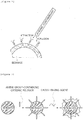
- FIG. 1 is a schematic view illustrating the structure of main functional groups when a bacterial biomass is present as a solid waste in an aqueous solution.
- anionic functional groups (carboxyl group or phosphate group) and a cationic functional groups (amine group) are abundantly present in the bacterial biomass.
- a cationic polymer including a large amount of an amine group as a cationic functional group is additionally introduced into the surface of a bacterial biomass, such that the content of the cationic functional group may be increased or a functional group in which an anionic functional group is blocked or removed may be used.
- the bacterial biomass includes an amine-group containing cationic polymer which is crosslinked on the surface of the bacterial biomass.
- amine-group containing cationic polymer refers to a polymer which includes an amine group in a main chain or a side chain thereof and is positively charged as a whole.
- the amine-group containing cationic polymer of the present invention may be prepared by polymerizing one or more cationic monomers or polymerizing one or more non-ionic monomers with one or more cationic monomers.
- the amine group-containing cationic polymer is crosslinked by an amine group or a hydroxyl group on the surface of the bacterial biomass.
- the bacterial biomass may consist of one or more bacterial cells selected from the group consisting of Corynebacterium sp., Escherichia sp., Bacillus sp., and Serratia sp.
- Non-limiting examples of bacteria constituting the bacterial biomass may include bacteria, such as Corynebacterium ammoniagenes, Corynebacterium glutamicum, Escherichia coli, Bacillus megatherium, Serratia marcescens, Brevibacterium ammoniagenes, etc.
- the examples may include Corynebacterium betae, Corynebacterium beticola, Corynebacterium bovis, Corynebacterium callunae, Corynebacterium cystitidis, Corynebacterium diphtheriae, Corynebacterium equi, Corynebacterium fascians, Corynebacterium flaccumfaci, Corynebacterium flavescens, Corynebacterium hoagii, Corynebacterium ilicis, Corynebacterium insidiosum, Corynebacterium kutscheri, Corynebacterium lilium, etc.
- the amine group-containing cationic polymer in the present invention consists of polyethyleneimine
- the amine group-containing cationic polymer may be a polyethyleneimine homopolymer of the following Formula 1 where n is 10 to 500.
- the amine group-containing cationic polymer may have 70% or more by mole of cationic charges, and the molecular weight of the amine group-containing cationic polymer is not particularly limited, but may be, for example, in a range of 1,000 to 200,000.
- the amine group-containing cationic polymer may be a polyethyleneimine homopolymer, and the biomass may be a biomass of Corynebacterium glutamicum.
- An anionic functional group may be additionally blocked on the surface of a surface-modified bacterial biomass in order to increase the adsorption capability of anionic contaminants.
- a dried bacterial biomass may be added to an amine group-containing cationic polymer solution for reaction. Subsequently, a cross-linking agent may be added to the mixture of the bacterial biomass and the amine group-containing cationic polymer solution for reaction, and finally the biomass may be washed and dried to prepare a surface-modified bacterial biomass.
- the amine group-containing cationic polymer used in the present invention may have 70% or more by mole of cationic charges, and the molecular weight of the polymer may be in a range of 1,000 to 200,000.
- the method may additionally include blocking an anionic functional group on the surface of the surface-modified bacterial biomass to minimize a functional group having repulsion against anionic contaminants.
- An anionic functional group on the surface of the surface-modified bacterial biomass may be substituted and blocked by a compound having a cationic functional group such as an amine group or an amino group, etc.
- the amine group-containing cationic polymer solution may include one or more selected from the group consisting of water, alcohol, chloroform, and pyridine as a solvent.
- the biomass may be dispersed in a sufficient amount of an amine group-containing cationic polymer, and the mixing ratio of the biomass to the amine group-containing cationic polymer is, for example, 1 : 0.5 to 2 (w:w), and preferably 1 : 1 to 2 (w:w).
- the temperature for reacting the bacterial biomass with the amine group-containing cationic polymer is not particularly limited, but reaction may be performed, for example, at about 20 to about 150°C so as to increase the reaction efficiency.
- the cross-linking agent may be one or more selected from the group consisting of glutaraldehyde, isocyanide derivatives, and bisdiazobenzidine.
- the cross-linking agent may be mixed in the form of a solution at a volume ratio of about 1 : 1 to 10 : 1 with a mixture of the biomass and the amine group-containing cationic polymer, and preferably at a volume ratio of about 5 : 1.
- a solvent one or more selected from the group consisting of water, methanol, chloroform, pyridine, and alcohols such as ethanol and butanol may be used.
- the biomass is washed and dried.
- the washing and drying method is not particularly limited.
- the biomass may be lyophilized or dried in an oven at high temperatures for a predetermined time.
- the drying temperature and drying time may be arbitrarily controlled according to the water content of the biomass, etc.
- a surface-modified bacterial biomass available in the present invention may be a biomass in which an anionic functional group may be blocked or removed on the surface of the biomass in order to increase the adsorption capability of anionic complexes.
- an anionic functional group such as a carboxyl group and a phosphate group, which is present on the surface of the bacterial biomass, is present in a negatively charged state in water, and thus exerts repulsion against an anionic precious metal complex.
- the repulsion serves to interfere with the biomass to prevent binding to an anionic complex.
- the bacterial biomass may employ a surface-modified biomass in which an anionic functional group, such as a carboxyl group, a phosphate group, and a sulfonate group, which acts as an interfering group, is substituted by a compound having a cationic functional group, such as an amine group or an amino group.
- an anionic functional group such as a carboxyl group, a phosphate group, and a sulfonate group, which acts as an interfering group
- a compound having a cationic functional group such as an amine group or an amino group.
- the bacterial biomass may employ a surface-modified biomass in which a carboxyl group, a phosphate group, and a sulfonate group on the surface of the biomass is alkylated, cycloalkylated, or arylated.
- the surface-modified biomass may be represented by the following Formula 2 as an example, and the Formula 2 has a structure in which hydrogen of the carboxyl group or the phosphate group of the bacterial biomass is substituted by an alkyl group, a cycloalkyl group, an aryl group, or an amine group.
- Formula 2 Biomass-COOR where R is an alkyl group having a carbon number of 1 to 10, a cycloalkyl group having a carbon number of 3 to 10, or an aryl group having a carbon number of 6 to 15, or NR 1 R 2 .
- R1 and R2 each are hydrogen, an alkyl group having a carbon number of 1 to 10, a cycloalkyl group having a carbon number of 3 to 10, or an aryl group having a carbon number of 6 to 15.
- a method for achieving alkylation, cycloakylation, and arylation with an amino group of the biomass may include adding the biomass to a mixed solution of aldehyde and carboxylic acid for reaction.
- 1 to 40 ml of aldehyde and 1 to 160 ml of carboxylic acid are preferably mixed based on 1 g of the biomass.
- a volume ratio of aldehyde to carboxylic acid is more preferably 1 to 1/4.
- the mixing ratio of aldehyde: carboxylic acid: biomass is the most preferably 20 ml: 40 ml: 1 g.
- the aldehyde is formaldehyde and the carboxylic acid is formic acid in terms of reducibility, and an alkylation method of an amino group of the biomass by using these may be represented by the following Reaction Formula 1.
- the above reaction is preferably performed at 10 to 100°C for 1 to 48 hours.
- the above reaction may be performed at 10 to 1000 rpm in a mixed reactor.
- a surface-modified biomass which has increased anionic properties may be used.
- a bacterial biomass which has increased anionic properties may be prepared by additionally binding a compound which includes one or more of a carboxyl group, a sulfonate group, and a phosphate group to the raw biomass.
- the compound having a carboxyl group additionally bound to the raw biomass may be represented by the following Formula 3.
- R 1 -CH 2 -COOCH 2 -Biomass where R 1 is a carboxyl group, a linear or branched alkyl group having a carbon number of 1 to 10, which includes one or more carboxyl groups, an alkenyl group or an alkoxy group, and may be represented by the following Formula 4.
- R 2 and R 3 each are H, -OH, -COOH, and -CH 2 -COOOH.
- a compound having the carboxyl group may be represented by the following Formula 5.
- the following Formula 5 has a structure in which an amine group or an amino group of the raw biomass is substituted by a compound having a carboxyl group.
- R 4 is a linear or branched alkylene group having a carbon number of 1 to 10 or a linear or branched alkenylene group having a carbon number of 2 to 10, and R 5 is H, Na, or K.
- a structure in which an amine group or an amino group of the biomass is alkylated, cycloalkylated or arylated may be represented by the following Formula 6.
- an amino group is substituted by an alkyl group, a cycloalkyl group, and an aryl group, the case is referred to as alkylation, cycloalkyation, and arylation, respectively.
- R is an alkyl group having a carbon number of 1 to 10
- This step is for adsorbing precious metal in a precious metal-containing solution by using the surface-modified bacterial biomass previously mentioned.
- the surface-modified bacterial biomass may be used as an adsorbent.
- the precious metal-containing solution may include waste materials containing non-ferrous metals, such as a waste catalyst, waste scrap, a waste dry battery, an industrial waste liquid, converter dust, a waste can, etc.
- the industrial waste liquid containing precious metals is usually generated in an industry using precious metals as catalysts in chemical processes and electric and electronics industry.
- waste water is produced in a state where ruthenium (Ru) and iridium (Ir) are included in the acetic acid waste liquid from in chemical plants, and various precious metals (in particular, platinum, rhodium, etc.) are included in an ICP-analyzed waste water.
- ruthenium (Ru) and iridium (Ir) are included in the acetic acid waste liquid from in chemical plants
- various precious metals in particular, platinum, rhodium, etc.
- the precious metal may be one or more selected from the group consisting of gold, silver, palladium, platinum, iridium, osmium, rhodium, and ruthenium.
- a dissolving agent is used to dissolve the precious metal and prepare an aqueous solution such that the precious metal may form various ligands and coordination complexes.
- the dissolving agent may include one or more of hydrochloric acid, nitric acid, aqua regia, sulfuric acid, cyanide (CN), and halogen elements.
- the halogen elements include fluorine (F), chlorine (Cl), bromine (Br), iodine (I), astatine (At), etc., and preferably, may include one or more of iodine (I) and bromine (Br).
- platinum group metals which are not readily soluble in acids are dissolved by hydrochloric acid in the presence of an oxidant.
- the oxidant are nitric acid, gaseous chlorine, hypochlorite (HOCl), sodium hypochlorite (NaOCl), sodium chlorate (NaClO 3 ), hydrogen peroxide (H 2 O 2 ), etc., (Bradford, 1975).
- Platinum, palladium, and rhodium are respectively dissolved in PtCl 6 -2 , PdCl 4 2 , and RhCl 6 -3 by hydrochloric acid in the presence of a chlorine-based oxidant.
- sulfuric acid may be used, and more specifically, 60% H 2 SO 4 solution+0.1 M solution may be used to dissolve platinum group metals.
- Iodine/iodide may be used as the dissolving agent, and preferably, may be used to dissolve palladium.
- the dissolution may employ a cyanide process using cyanide (CN).
- CN cyanide
- the structure of a complex dissolved and formed by the dissolving agent may include palladium (PdCl 4 2- , PdCl 3 - ), gold (Au(CN) 2 - ), platinum (PtCl 4 2- , PtCl 6 4- ), etc.
- the precious metal complex is charged, and preferably negatively charged.
- the adsorption of the bacterial biomass, in which the content of the cationic functional group is increased or the anionic functional group is blocked, as described above, to the anionic precious metal complex may be achieved by static electric attraction.
- This step is for incinerating an adsorption material on which the precious metals are adsorbed.
- the incineration step may include separating the precious metal-containing adsorbent from a solution and then drying the material at 20 to 100°C. During drying, all the residual water in the adsorption material may be removed.
- the precious metal-containing adsorption material may be burnt at 300°C or more and less than the melting point of the precious metal in the incineration step.
- the incineration may be performed preferably at 600 to 1000°C, and most preferably at 800 to 1000°C.
- the recovery rate and purity of the metal is the highest when the temperature is around about 900°C.
- the recovery rate of the precious metal may be controlled according to incineration conditions under which the precious metal adsorbed on activated carbon is incinerated and recovered (in particular, temperature and oxygen concentration).
- the bacterial biomass as an adsorption material may be generally ignited at 600°C and burnt, the precious metal is not melted or burnt at the temperature.
- the device When the incineration is complete, the device is cooled and ash containing metals is collected.
- This step is for melting the precious metal to separate the metal from the ash.
- the step may include heating the precious metal contained in the ash to the melting point or more of the precious metal to melt the metal, and separating the precious metal in the liquid phase from the ash.
- the precious metal may be melted if the metal is heated to a point of the temperature or more.
- the heating temperature may be the melting point to 3100°C.
- Another embodiment not according to present invention involves a recovery method of a precious metal, including inputting the surface-modified bacterial biomass to a precious metal-containing solution to adsorb a precious metal; and adding the bacterial biomass to a strong acid solution to desorb the adsorbed precious metal from the bacterial biomass.
- This embodiment not according to present invention relates to a method for recovering precious metals adsorbed on the bacterial biomass by desorption.
- the desorption step may be a step of adding the bacterial biomass to a mixed solution of thiourea and strong acid for desorption. If a mixture of acid and thiourea is used as a mixed solution used in the desorption, the desorption efficiency is greatly increased.
- an aqueous solution of hydrochloric acid, sulfuric acid, or nitric acid as the strong acid is used.
- the strong acid aqueous solution may be in a range of 0.01 to 10 M, and preferably 0.1 to 3 M, and thiourea may be used in a range of 0.005 to 5 M, and preferably 0.1 to 1 M.
- K s is the Sips model isotherm constant ((1/g) ⁇ s )
- a s is the Sips model constant
- ⁇ s is the Sips model exponent ((1/mg) ⁇ s )
- C f is the final concentration of the dye.
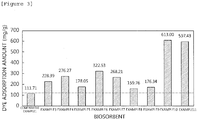
- Corynebacterium glutamicum biomass as a fermentation waste was washed, followed by evaluation of the adsorption amount without any treatment by using an adsorbent in the same manner as in the Examples, and then the result was shown in the following Table 1 and FIG. 3 .
- the PEI surface-modified biomass showed a significant difference in adsorption according to PEI, GA, and reaction time, and when the ratio of PEI (w/v) to GA (v/v) was 5:1 and the reaction time was 60 min, the maximum adsorption amount of RR4 (reactive dye) was 613 mg/g, which was the best result. This is a result that the adsorption was enhanced by about 5.5 times, compared to the raw biomass.
- Corynebacterium glutamicum biomass (Daesang Co. Gunsan Plant, Gunsan, Jeonbuk, Korea) as a fermentation waste, which was obtained in the form of a dried powder from a fermentation process, was added to a mixed solution of 2.5 ml of pyridine and 95 ml of chloroform and stirred at room temperature. Subsequently, 5 ml of 4-bromobutyryl chloride was added dropwise to the mixed solution and the mixture was allowed to be reacted in a sealed state under stirring at 25°C for 12 hours to acylate the biomass. The acylated biomass was washed with chloroform to remove unreacted 4-bromobutyryl chloride.
- the biomass obtained in the previous step was added to 90 ml of a tert-amyl alcohol solution to which 10 g of polyethyleneimine (weight-average molecular weight 25000 g/l) and 0.1 g of KOH were added and the mixture was stirred at 75°C for about 24 hours. After the reaction was completed, the biomass was washed several times with methanol and de-ionized water and then lyophilized to obtain a biomass which was surface-modified with polyethyleneimine.
- Ash produced by combustion, platinum, and rhodium were collected and heated to about 1850°C in a dry furnace device to melt platinum and separate the metal from the ash, and heated to about 2000°C to melt rhodium and separate the metal from the ash.
- a Corynebacterium glutamicum biomass (Daesang Co. Gunsan Plant, Gunsan, Jeonbuk, Korea) as a fermentation waste, which was obtained in the form of a dried powder from a fermentation process, was subjected to acid treatment with a 1 N HNO 3 solution at room temperature for 24 hours.
- the acid-treated biomass was washed three times with distilled water and dried at 60°C for 24 hours.
- 3 g of the dried biomass was dispersed in 300 mL of anhydrous methanol, and HNO 3 as an acid catalyst was added thereto to make the final concentration 1 M.
- the mixture was stirred at 160 rpm at room temperature for 6 hours by using a rotating stirrer for reaction and then a biomass, in which a carboxyl group was removed, was obtained.
- Adsorption amount mg / g initial metal concentration ⁇ final metal concentration mg / l ⁇ volume l amount of absorbent g
- Purity % Weight of precious metal in the ash g Weight of the ash g
- precious metal such as gold, platinum, etc.
- a bacterial biomass even though it is subjected to simple processes, such as adsorption/incineration/separation, compared to conventional chemical precipitation methods or solvent extraction methods.
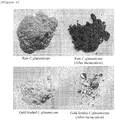
- the top photo in FIG. 4 shows a raw biomass on which gold was not adsorbed and a product obtained by incinerating the biomass
- the bottom photo shows a raw biomass on which gold was adsorbed and an adsorption material including gold, obtained by incinerating the biomass (in Example 12).
- the bottom photo in FIG. 4 it is confirmed that a substantial amount of gold was adsorbed on the biomass in Example 12.
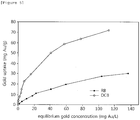
- FIG. 5 is a graph illustrating the maximum adsorption amounts of gold to the biomass in Example 12 and Comparative Example 2. Referring to FIG. 5 , the maximum adsorption amount of gold in Comparative Example 2 was only about 30 mg/g, while the amount in Example 12 was 72 mg/g, indicating a 2.4 fold increase in adsorption.
- Example 11 0.03 g of the polyethyleneimine surface-treated biomass (PEIB) obtained in Example 11 was added to 30 mL of a palladium (Pd) solution (100 mg/L) and the mixture was stirred at room temperature overnight. Subsequently, the PEIB, on which palladium was adsorbed, was added to a solution in which thiourea in a range of 0 to 2 M was mixed with 0.1 M of an HCl solution, and the mixture was stirred at room temperature overnight.
- Pd palladium
- FIG. 6 is a graph illustrating the desorption rate of palladium according to the content of thiourea added to 0.1 M of the HCl solution. Referring to FIG. 6 , it is determined that only a sample which did not include thiourea showed a 30% desorption, while other samples which included thiourea showed almost a 100% desorption rate.
- the desorption rate is a value obtained by converting 86.5 mg/g which is an amount of palladium adsorbed on the PEIB into 100.
Landscapes
- Chemical & Material Sciences (AREA)
- Organic Chemistry (AREA)
- Engineering & Computer Science (AREA)
- Chemical Kinetics & Catalysis (AREA)
- Analytical Chemistry (AREA)
- Manufacturing & Machinery (AREA)
- Materials Engineering (AREA)
- Mechanical Engineering (AREA)
- Metallurgy (AREA)
- Environmental & Geological Engineering (AREA)
- Life Sciences & Earth Sciences (AREA)
- General Life Sciences & Earth Sciences (AREA)
- Geology (AREA)
- Geochemistry & Mineralogy (AREA)
- Hydrology & Water Resources (AREA)
- Water Supply & Treatment (AREA)
- Acoustics & Sound (AREA)
- Physics & Mathematics (AREA)
- Manufacture And Refinement Of Metals (AREA)
- Solid-Sorbent Or Filter-Aiding Compositions (AREA)
- Micro-Organisms Or Cultivation Processes Thereof (AREA)
- Water Treatment By Sorption (AREA)
- Processes Of Treating Macromolecular Substances (AREA)
Description
- The present invention relates to a recovery method of precious metals using a surface-modified bacterial biomass which is crosslinked with an amine group containing cationic polymers on the surface of the bacterial biomass.
- Wastewaters containing heavy metals such as lead, mercury, cadmium, etc., and dyes are being produced in various industrial facilities such as dye houses, etc. When wastewater containing these heavy metals or dyes is released into the water system, serious contamination is caused, resulting in destruction of the aquatic ecosystem and adversely affecting human health as a result of biological concentration. Thus, effective treatment methods have been sought.
- Chemical treatment, physicochemical treatment, and biological treatment are used as methods for removing contaminants such as dyes, heavy metals, etc., in industrial wastewater. Representative examples of chemical treatment are chlorine-based oxidation, Fenton's reagent method, an ozone method, etc. However, these chemical treatment methods are disadvantageous in that chemical sludge is produced, hazardous intermediates are generated, and operating costs are high. Although the activated sludge process, in which organic materials are generally adsorbed or decomposed by activated aerobic microorganisms, is the most commonly used as biological treatment, the process is disadvantageous since a large amount of sludge is produced and solid-liquid separation is very difficult in a sedimentation tank. In addition, most of the dyes in dye wastewaters consist of materials which are difficult to be biologically decomposed and, if decomposed, may produce toxic by-products, and thus the treatment efficiency is poor. Although precipitation, ion exchange, adsorption, electrophoresis, and film removal method are used as physical treatments of industrial wastewaters, these methods have problems such as production of large amounts of sludge, non-selectivity, excessive initial facility costs, high operating costs, etc. Thus, a biological method, which is environmentally-friendly and has high selectivity and efficiency for non-degradable materials such as dyes, heavy metals, etc., is needed. When these non-degradable materials are removed by using a biological method, these materials may be selectively removed, and higher economical efficiency would be expected if an appropriate immobilization method could be used, compared to conventional processes. Thus, research interests are increasingly focused on biosorption technology. The main advantages of this technique are the reusability of biomaterial,low operating cost, improved selectivity for specific metals of interest, removal of heavy metals from effluent, irrespective of toxicity, short operation time, and no production of secondary compounds which might be toxic. Therefore, there is need for development of a biomass which may treat non-degradable contaminants such as dyes, heavy metals, etc. effectively.
- The refining process of recovering precious metals from mineral resources and secondary resources (scrap and waste materials generated during the manufacturing process, waste products disposed after use, etc.) includes enrichment, extraction, separation and purification, and recovery processes of precious metals. The separation and purification of precious metals is very closely associated with solution chemistry, and commonly used separation and purification methods are largely chemical precipitation and crystallization method, solvent extraction and ion exchange method, oxidation-distillation method, electrorefining method, etc. Among the methods, the separation and purification of precious metals is usually performed by using chemical precipitation method or solvent extraction method. However, recently as environmental regulations and regulations against human health hazards of working conditions have become stricter, the development of a new separation technology, which is more environmentally-friendly and may secure safe operations, is desperately needed.
- VIJAYARAGHAVAN K ET AL: "Bacterial biosorbents and biosorption", BIOTECHNOLOGY ADVANCES, ELSEVIER PUBLISHING, BARKING, GB, vol. 26, no. 3, 1 May 2008 (2008-05-01), pages 266-291, XP022586261 , discloses the use of bacterial biomass for adsorbing precious metals.
- A technical problem to be solved by the present invention is to provide a recovery method of precious metals, which is environmentally-friendly and harmless to the human health.
- The present invention relates to a recovery method of precious metals, by combining one or more surface-modified bacterial biomass including a polyethyleneimine group which is crosslinked by an amine group or hydroxyl group onto the surface of the bacterial biomass into a precious metal-containing solution to adsorb the precious metals; incinerating an adsorbent on which the precious metals are adsorbed; heating the precious metals and ash produced in the incinerating to temperatures of melting points of the precious metals or more to separate the precious metals from the ash.
- Since the surface-modified biomass of the present invention is obtained by recycling fermented waste, it is environmentally-friendly and economical, and may be widely used as an inexpensive material for biosorption, which may substitute for conventional and expensive adsorbents.
- The surface-modified bacterial biomass using Corynebacterium cells of the present invention is excellent in adsorption, economical, and reproducible, and may provide a biosorbent which may effectively remove and/or recover anionic solutes such as dye materials and precious metals from waste waters. In particular, the surface-modified biomass of the present invention shows excellent adsorption on anionic contaminants.
- According to the recovery method of precious metals of the present invention, solid-phase concentrated precious metals may be recovered in a way which is environment-friendly, economical, and harmless to the human body by using a surface-modified biomass devoid of any addition chemicals like solvents, extracting agents, reducing agents, etc.
-
-
FIG. 1 is a schematic view illustrating the structure of a main functional group when a bacterial biomass is present in an aqueous solution. -
FIG. 2 is a schematic view to describe a preparation method of a surface-modified bacterial biomass -
FIG. 3 is a graph illustrating a comparison of results of dyes adsorbed by using biomasses in Examples 1 to 10 and Comparative Example 1. -
FIG. 4 shows a raw biomass on which gold was not adsorbed and a product obtained by incinerating the biomass(top), and the photo below shows a raw biomass on which gold was adsorbed and a biosorbent including gold, obtained by incinerating the biomass. -
FIG. 5 is a graph illustrating the maximum amount of gold adsorbed on the biomass in Example 12 and Comparative Example 2. -
FIG. 6 is a graph illustrating the desorption rate of palladium according to the content of thiourea added to 0.1 M of an HCl solution. - Hereinafter, the present invention will be described in more detail.
- The present invention relates to a recovery method of precious metals using a surface-modified bacterial biomass including amine group-containing cationic polymers which are crosslinked on the surface of the bacterial biomass.
- As used herein, the term "biomass" refers to a living or deceased biological material which may be used in industrial production, and in particular, a bacterial biomass of the present invention refers to a biomass consisting of deceased bacterial cells, such as Escherichia coli or Corynebacterium.
- Bacteria such as E. coli or Corynebacterium are widely used as strains which produce materials such as antibiotics, anticancer drugs, amino acids, nucleic acids, etc., and disposed as solid fermentation waste after the bacteria are used and terminated.
-
FIG. 1 is a schematic view illustrating the structure of main functional groups when a bacterial biomass is present as a solid waste in an aqueous solution. Referring toFIG. 1 , anionic functional groups (carboxyl group or phosphate group) and a cationic functional groups (amine group) are abundantly present in the bacterial biomass. - In the present invention, in order to adsorb a precious metal showing anionic properties in a solution, a cationic polymer including a large amount of an amine group as a cationic functional group is additionally introduced into the surface of a bacterial biomass, such that the content of the cationic functional group may be increased or a functional group in which an anionic functional group is blocked or removed may be used.
- The bacterial biomass includes an amine-group containing cationic polymer which is crosslinked on the surface of the bacterial biomass.
- As used herein, the term "amine-group containing cationic polymer" refers to a polymer which includes an amine group in a main chain or a side chain thereof and is positively charged as a whole. The amine-group containing cationic polymer of the present invention may be prepared by polymerizing one or more cationic monomers or polymerizing one or more non-ionic monomers with one or more cationic monomers.
- The amine group-containing cationic polymer is crosslinked by an amine group or a hydroxyl group on the surface of the bacterial biomass.
- In the present invention, the bacterial biomass may consist of one or more bacterial cells selected from the group consisting of Corynebacterium sp., Escherichia sp., Bacillus sp., and Serratia sp.
- Non-limiting examples of bacteria constituting the bacterial biomass may include bacteria, such as Corynebacterium ammoniagenes, Corynebacterium glutamicum, Escherichia coli, Bacillus megatherium, Serratia marcescens, Brevibacterium ammoniagenes, etc.
- Besides the above-mentioned bacteria, the examples may include Corynebacterium betae, Corynebacterium beticola, Corynebacterium bovis, Corynebacterium callunae, Corynebacterium cystitidis, Corynebacterium diphtheriae, Corynebacterium equi, Corynebacterium fascians, Corynebacterium flaccumfaci, Corynebacterium flavescens, Corynebacterium hoagii, Corynebacterium ilicis, Corynebacterium insidiosum, Corynebacterium kutscheri, Corynebacterium lilium, etc.
- The amine group-containing cationic polymer in the present invention consists of polyethyleneimine
- The amine group-containing cationic polymer may be a polyethyleneimine homopolymer of the following Formula 1

- The amine group-containing cationic polymer may have 70% or more by mole of cationic charges, and the molecular weight of the amine group-containing cationic polymer is not particularly limited, but may be, for example, in a range of 1,000 to 200,000.
- The amine group-containing cationic polymer may be a polyethyleneimine homopolymer, and the biomass may be a biomass of Corynebacterium glutamicum.
- An anionic functional group may be additionally blocked on the surface of a surface-modified bacterial biomass in order to increase the adsorption capability of anionic contaminants.
- When a surface-modified bacterial biomass is prepared, a dried bacterial biomass may be added to an amine group-containing cationic polymer solution for reaction. Subsequently, a cross-linking agent may be added to the mixture of the bacterial biomass and the amine group-containing cationic polymer solution for reaction, and finally the biomass may be washed and dried to prepare a surface-modified bacterial biomass.
- The amine group-containing cationic polymer used in the present invention may have 70% or more by mole of cationic charges, and the molecular weight of the polymer may be in a range of 1,000 to 200,000.
- The method may additionally include blocking an anionic functional group on the surface of the surface-modified bacterial biomass to minimize a functional group having repulsion against anionic contaminants. An anionic functional group on the surface of the surface-modified bacterial biomass may be substituted and blocked by a compound having a cationic functional group such as an amine group or an amino group, etc.
- The amine group-containing cationic polymer solution may include one or more selected from the group consisting of water, alcohol, chloroform, and pyridine as a solvent. In the step, the biomass may be dispersed in a sufficient amount of an amine group-containing cationic polymer, and the mixing ratio of the biomass to the amine group-containing cationic polymer is, for example, 1 : 0.5 to 2 (w:w), and preferably 1 : 1 to 2 (w:w).
- The temperature for reacting the bacterial biomass with the amine group-containing cationic polymer is not particularly limited, but reaction may be performed, for example, at about 20 to about 150°C so as to increase the reaction efficiency.
- When the amine group-containing cationic polymer is crosslinked on the surface of the bacterial biomass, a treatment with a cross-linking agent is performed so as to strengthen the chemical bond between the bacterial biomass and the amine group-containing cationic polymer. In this case, the cross-linking agent may be one or more selected from the group consisting of glutaraldehyde, isocyanide derivatives, and bisdiazobenzidine.
- As shown in
FIG. 2 , the cross-linking agent may be mixed in the form of a solution at a volume ratio of about 1 : 1 to 10 : 1 with a mixture of the biomass and the amine group-containing cationic polymer, and preferably at a volume ratio of about 5 : 1. - As a solvent, one or more selected from the group consisting of water, methanol, chloroform, pyridine, and alcohols such as ethanol and butanol may be used.
- After the treatment with the cross-linking agent, the biomass is washed and dried. The washing and drying method is not particularly limited. For example, the biomass may be lyophilized or dried in an oven at high temperatures for a predetermined time. The drying temperature and drying time may be arbitrarily controlled according to the water content of the biomass, etc.
- A surface-modified bacterial biomass available in the present invention may be a biomass in which an anionic functional group may be blocked or removed on the surface of the biomass in order to increase the adsorption capability of anionic complexes.
- As shown in
FIG. 1 , an anionic functional group, such as a carboxyl group and a phosphate group, which is present on the surface of the bacterial biomass, is present in a negatively charged state in water, and thus exerts repulsion against an anionic precious metal complex. The repulsion serves to interfere with the biomass to prevent binding to an anionic complex. - The bacterial biomass may employ a surface-modified biomass in which an anionic functional group, such as a carboxyl group, a phosphate group, and a sulfonate group, which acts as an interfering group, is substituted by a compound having a cationic functional group, such as an amine group or an amino group.
- The bacterial biomass may employ a surface-modified biomass in which a carboxyl group, a phosphate group, and a sulfonate group on the surface of the biomass is alkylated, cycloalkylated, or arylated.
- The surface-modified biomass may be represented by the following Formula 2 as an example, and the Formula 2 has a structure in which hydrogen of the carboxyl group or the phosphate group of the bacterial biomass is substituted by an alkyl group, a cycloalkyl group, an aryl group, or an amine group.
[Formula 2] Biomass-COOR
where R is an alkyl group having a carbon number of 1 to 10, a cycloalkyl group having a carbon number of 3 to 10, or an aryl group having a carbon number of 6 to 15, or NR1R2. R1 and R2 each are hydrogen, an alkyl group having a carbon number of 1 to 10, a cycloalkyl group having a carbon number of 3 to 10, or an aryl group having a carbon number of 6 to 15. - When the carbon number is large high in the Formula, it may be difficult to achieve the commercialization, and thus alkylation with an alkyl group having a carbon number of 1 to 6 is more preferable, and methylation is the most preferable.
- A method for achieving alkylation, cycloakylation, and arylation with an amino group of the biomass may include adding the biomass to a mixed solution of aldehyde and carboxylic acid for reaction.
- Although there is no limitation on the mixing ratio of the aldehyde, carboxylic acid, and biomass, 1 to 40 ml of aldehyde and 1 to 160 ml of carboxylic acid are preferably mixed based on 1 g of the biomass.
- In the mixing ratio, a volume ratio of aldehyde to carboxylic acid is more preferably 1 to 1/4.
- The mixing ratio of aldehyde: carboxylic acid: biomass is the most preferably 20 ml: 40 ml: 1 g.
- Preferably, the aldehyde is formaldehyde and the carboxylic acid is formic acid in terms of reducibility, and an alkylation method of an amino group of the biomass by using these may be represented by the following Reaction Formula 1.

- The above reaction is preferably performed at 10 to 100°C for 1 to 48 hours. The above reaction may be performed at 10 to 1000 rpm in a mixed reactor.
- When a precious metal complex is cationic, a surface-modified biomass which has increased anionic properties may be used. A bacterial biomass which has increased anionic properties may be prepared by additionally binding a compound which includes one or more of a carboxyl group, a sulfonate group, and a phosphate group to the raw biomass.
- The compound having a carboxyl group additionally bound to the raw biomass may be represented by the following Formula 3.
[Formula 3] R1 -CH2-COOCH2-Biomass
where R1 is a carboxyl group, a linear or branched alkyl group having a carbon number of 1 to 10, which includes one or more carboxyl groups, an alkenyl group or an alkoxy group, and may be represented by the following Formula 4.
- A compound having the carboxyl group may be represented by the following Formula 5. The following Formula 5 has a structure in which an amine group or an amino group of the raw biomass is substituted by a compound having a carboxyl group.
[Formula 5] Biomass-NHR4COOR5
where R4 is a linear or branched alkylene group having a carbon number of 1 to 10 or a linear or branched alkenylene group having a carbon number of 2 to 10, and R5 is H, Na, or K. - A structure in which an amine group or an amino group of the biomass is alkylated, cycloalkylated or arylated may be represented by the following Formula 6. When an amino group is substituted by an alkyl group, a cycloalkyl group, and an aryl group, the case is referred to as alkylation, cycloalkyation, and arylation, respectively.
[Formula 6] Biomass-N(R)2
where R is an alkyl group having a carbon number of 1 to 10, a cycloalkyl group having a carbon number of 3 to 10, or an aryl group having a carbon number of 6 to 15. - Hereinafter, the method for recovering precious metals by using the surface-modified biomass will be described in detail.
- This step is for adsorbing precious metal in a precious metal-containing solution by using the surface-modified bacterial biomass previously mentioned. The surface-modified bacterial biomass may be used as an adsorbent.
- The precious metal-containing solution may include waste materials containing non-ferrous metals, such as a waste catalyst, waste scrap, a waste dry battery, an industrial waste liquid, converter dust, a waste can, etc.
- The industrial waste liquid containing precious metals is usually generated in an industry using precious metals as catalysts in chemical processes and electric and electronics industry. In particular, waste water is produced in a state where ruthenium (Ru) and iridium (Ir) are included in the acetic acid waste liquid from in chemical plants, and various precious metals (in particular, platinum, rhodium, etc.) are included in an ICP-analyzed waste water.
- The precious metal may be one or more selected from the group consisting of gold, silver, palladium, platinum, iridium, osmium, rhodium, and ruthenium.
- Preferably, a dissolving agent is used to dissolve the precious metal and prepare an aqueous solution such that the precious metal may form various ligands and coordination complexes.
- As the dissolving agent, known dissolving agents may be appropriately selected according to the kind of the precious metal. The dissolving agent may include one or more of hydrochloric acid, nitric acid, aqua regia, sulfuric acid, cyanide (CN), and halogen elements. The halogen elements include fluorine (F), chlorine (Cl), bromine (Br), iodine (I), astatine (At), etc., and preferably, may include one or more of iodine (I) and bromine (Br).
- For example, platinum group metals which are not readily soluble in acids are dissolved by hydrochloric acid in the presence of an oxidant. Examples of the oxidant are nitric acid, gaseous chlorine, hypochlorite (HOCl), sodium hypochlorite (NaOCl), sodium chlorate (NaClO3), hydrogen peroxide (H2O2), etc., (Bradford, 1975). Platinum, palladium, and rhodium are respectively dissolved in PtCl6 -2, PdCl4 2, and RhCl6 -3 by hydrochloric acid in the presence of a chlorine-based oxidant.
- As the dissolving agent, sulfuric acid may be used, and more specifically, 60% H2SO4 solution+0.1 M solution may be used to dissolve platinum group metals.
- Iodine/iodide may be used as the dissolving agent, and preferably, may be used to dissolve palladium.
- The dissolution may employ a cyanide process using cyanide (CN).
- The structure of a complex dissolved and formed by the dissolving agent may include palladium (PdCl4 2-, PdCl3 -), gold (Au(CN)2 -), platinum (PtCl4 2-, PtCl6 4-), etc.
- The precious metal complex is charged, and preferably negatively charged. The adsorption of the bacterial biomass, in which the content of the cationic functional group is increased or the anionic functional group is blocked, as described above, to the anionic precious metal complex may be achieved by static electric attraction.
- This step is for incinerating an adsorption material on which the precious metals are adsorbed.
- The incineration step may include separating the precious metal-containing adsorbent from a solution and then drying the material at 20 to 100°C. During drying, all the residual water in the adsorption material may be removed.
- Subsequently, the precious metal-containing adsorption material may be burnt at 300°C or more and less than the melting point of the precious metal in the incineration step. The incineration may be performed preferably at 600 to 1000°C, and most preferably at 800 to 1000°C. The recovery rate and purity of the metal is the highest when the temperature is around about 900°C.
- The recovery rate of the precious metal may be controlled according to incineration conditions under which the precious metal adsorbed on activated carbon is incinerated and recovered (in particular, temperature and oxygen concentration).
- Although the bacterial biomass as an adsorption material may be generally ignited at 600°C and burnt, the precious metal is not melted or burnt at the temperature.
- When the incineration is complete, the device is cooled and ash containing metals is collected.
- This step is for melting the precious metal to separate the metal from the ash.
- The step may include heating the precious metal contained in the ash to the melting point or more of the precious metal to melt the metal, and separating the precious metal in the liquid phase from the ash.
- Since the melting point of gold which is one of the precious metals, is 1064°C and the melting point of platinum is 1768.3°C, the precious metal may be melted if the metal is heated to a point of the temperature or more. Preferably, the heating temperature may be the melting point to 3100°C.
- Another embodiment not according to present invention involves a recovery method of a precious metal, including inputting the surface-modified bacterial biomass to a precious metal-containing solution to adsorb a precious metal; and adding the bacterial biomass to a strong acid solution to desorb the adsorbed precious metal from the bacterial biomass.
- This embodiment not according to present invention relates to a method for recovering precious metals adsorbed on the bacterial biomass by desorption.
- The desorption step may be a step of adding the bacterial biomass to a mixed solution of thiourea and strong acid for desorption. If a mixture of acid and thiourea is used as a mixed solution used in the desorption, the desorption efficiency is greatly increased.
- Preferably, an aqueous solution of hydrochloric acid, sulfuric acid, or nitric acid as the strong acid is used. The strong acid aqueous solution may be in a range of 0.01 to 10 M, and preferably 0.1 to 3 M, and thiourea may be used in a range of 0.005 to 5 M, and preferably 0.1 to 1 M.
- Hereinafter, the present invention will be described in more detail with reference to Examples. However, these Examples are intended to illustrate preferred embodiments of the present invention and do not limit the scope of the present invention.
- 2 g of Corynebacterium glutamicum biomass as a fermentation waste, which was dried without any pretreatment was put into 500 ml of distilled water containing polyethylenenimine(PEI) at various concentrations as described in the following Table 1 and stirred at room temperature for 2 hours. Subsequently, as shown in the following Table 1, 500 mL of a glutaraldehyde (GA) solution was added to each of the mixed solutions including the biomass at different concentrations and stirred by varying the reaction time as shown in the following Table 1. Then, the ratio of each component is described as in the following table. After the completion of the reaction, the mixture was washed with de-ionized water and lyophilized to obtain a PEI-surface modified biomass, the amount of adsorption was evaluated by the following method, and the result was shown in the following Table 1 and
FIG. 3 . - In order to confirm the dye adsorption of the biomass, an isothermal adsorption experiment was performed at pH=2. This experiment was an experiment in which temperature and pH were constantly maintained and the adsorption amount of a dye was measured at various dye concentrations. The experiment was performed by adding each of 0.4 g of the biomass in Examples 1 to 10 and Comparative Example 1 and 40 mL of an RR4 dye aqueous solution obtained by varying the initial concentration of the dye from 50 mg/L to 2000 mg/L to a plurality of 50 mL tubes and then maintaining the pH of each tube at a constant value. Each tube was stirred at 160 rpm at room temperature of about 25°C for 24 hours. During the adsorption experiment, the pH of the solution was constantly adjusted to 6 by using a 1 N HNO3 aqueous solution while the pH was being observed. After the adsorption reached the equilibrium, the residual concentration of the dye was analyzed. In order to calculate the maximum adsorption and binding affinity, the experimental data were regressed by using the Langmuir model in the following Mathematical Formula 1 and a Sips model in the following Mathematical Formula 2.


- The Corynebacterium glutamicum biomass as a fermentation waste was washed, followed by evaluation of the adsorption amount without any treatment by using an adsorbent in the same manner as in the Examples, and then the result was shown in the following Table 1 and
FIG. 3 .[Table 1] Sample Comparative Example 1 Example 2 3 4 5 6 7 8 9 10 Reaction time (min) 10 10 10 10 60 10 60 60 60 PEI % (w/v) 5 15 5 15 1 0.1 0.1 0.5 1 GA % (v/v) 0.5 0.5 1.5 1.5 1 0.05 0.05 0.1 0.2 PEI:GA 10:1 30:1 3.3:1 10:1 1:1 2:1 2:1 5:1 5:1 Adsorption amount (mg/g) 111.71 228.4 276.3 178.1 322.5 268.2 159.8 176.3 613.0 597.4 Increase fold level (fold) 1.00 2.04 2.47 1.59 2.89 2.40 1.43 1.58 5.49 5.35 - As confirmed from the results of Table 1 and
FIG. 3 , the PEI surface-modified biomass showed a significant difference in adsorption according to PEI, GA, and reaction time, and when the ratio of PEI (w/v) to GA (v/v) was 5:1 and the reaction time was 60 min, the maximum adsorption amount of RR4 (reactive dye) was 613 mg/g, which was the best result. This is a result that the adsorption was enhanced by about 5.5 times, compared to the raw biomass. - 10 g of Corynebacterium glutamicum biomass (Daesang Co. Gunsan Plant, Gunsan, Jeonbuk, Korea) as a fermentation waste, which was obtained in the form of a dried powder from a fermentation process, was added to a mixed solution of 2.5 ml of pyridine and 95 ml of chloroform and stirred at room temperature. Subsequently, 5 ml of 4-bromobutyryl chloride was added dropwise to the mixed solution and the mixture was allowed to be reacted in a sealed state under stirring at 25°C for 12 hours to acylate the biomass. The acylated biomass was washed with chloroform to remove unreacted 4-bromobutyryl chloride.
- Subsequently, the biomass obtained in the previous step was added to 90 ml of a tert-amyl alcohol solution to which 10 g of polyethyleneimine (weight-average molecular weight 25000 g/l) and 0.1 g of KOH were added and the mixture was stirred at 75°C for about 24 hours. After the reaction was completed, the biomass was washed several times with methanol and de-ionized water and then lyophilized to obtain a biomass which was surface-modified with polyethyleneimine.
- In order to recover platinum and rhodium from an ICP-analyzed waste water which usually contained platinum and rhodium, 5 g/L of the surface-modified biomass obtained above was added thereto and the mixture was stirred with a pH level of 0.58 for 2 hours to adsorb platinum and rhodium. Subsequently, the biomass on which platinum and rhodium were adsorbed was heated to 20 to 100°C in a drier to remove moisture. The biomass was heated to about 600°C in a combustion furnace. Ash produced by combustion, platinum, and rhodium were collected and heated to about 1850°C in a dry furnace device to melt platinum and separate the metal from the ash, and heated to about 2000°C to melt rhodium and separate the metal from the ash.
- A Corynebacterium glutamicum biomass (Daesang Co. Gunsan Plant, Gunsan, Jeonbuk, Korea) as a fermentation waste, which was obtained in the form of a dried powder from a fermentation process, was subjected to acid treatment with a 1 N HNO3 solution at room temperature for 24 hours. The acid-treated biomass was washed three times with distilled water and dried at 60°C for 24 hours. 3 g of the dried biomass was dispersed in 300 mL of anhydrous methanol, and HNO3 as an acid catalyst was added thereto to make the final concentration 1 M. Next, the mixture was stirred at 160 rpm at room temperature for 6 hours by using a rotating stirrer for reaction and then a biomass, in which a carboxyl group was removed, was obtained.
- Hydrochloric acid as a dissolving agent was added to a gold mixture (KAu(CN)2) to dissolve gold, 5 g/L of the surface-modified biomass obtained above was added thereto, and the mixture was stirred at pH = 2.5 for 2 hours to adsorb gold. Subsequently, the biomass on which gold was adsorbed was heated to 20 to 100°C in a drier to remove moisture. The biomass was heated to about 600°C in a combustion furnace. Ash produced by combustion and gold were collected and heated to about 1200°C in a dry furnace device to melt gold and separate the metal from the ash.
- A Corynebacterium glutamicum biomass as a fermentation waste was washed and then an experiment was performed without any treatment in the same manner as in Example 12.
- The following Table 2 shows the adsorption amounts and purities of precious metals in Examples 11 and 12.
[Table 2] Precious metal a)Adsorption amount (mg/g) b)Purity (%) Example 11 Platinum 69.3 58.7 63.0 59.9 Example 12 Gold 63.5 58.9 71.7 61.9 a) Adsorption amount refers to an amount of a precious metal adsorbed by an adsorption material, and the data were obtained in a state prior to incineration.
b) This is represented by percentage (%) of a precious metal included in the ash after the adsorption material containing the precious metal was incinerated. - Here adsorption amount and purity of metal were calculated by using the following two equations:


- Referring to Table 2, it is confirmed that precious metal such as gold, platinum, etc., may be obtained in a way which is harmless to the human body by using a bacterial biomass even though it is subjected to simple processes, such as adsorption/incineration/separation, compared to conventional chemical precipitation methods or solvent extraction methods.
- The top photo in
FIG. 4 shows a raw biomass on which gold was not adsorbed and a product obtained by incinerating the biomass, and the bottom photo shows a raw biomass on which gold was adsorbed and an adsorption material including gold, obtained by incinerating the biomass (in Example 12). Referring to the bottom photo inFIG. 4 , it is confirmed that a substantial amount of gold was adsorbed on the biomass in Example 12. -
FIG. 5 is a graph illustrating the maximum adsorption amounts of gold to the biomass in Example 12 and Comparative Example 2. Referring toFIG. 5 , the maximum adsorption amount of gold in Comparative Example 2 was only about 30 mg/g, while the amount in Example 12 was 72 mg/g, indicating a 2.4 fold increase in adsorption. - 0.03 g of the polyethyleneimine surface-treated biomass (PEIB) obtained in Example 11 was added to 30 mL of a palladium (Pd) solution (100 mg/L) and the mixture was stirred at room temperature overnight. Subsequently, the PEIB, on which palladium was adsorbed, was added to a solution in which thiourea in a range of 0 to 2 M was mixed with 0.1 M of an HCl solution, and the mixture was stirred at room temperature overnight.
-
FIG. 6 is a graph illustrating the desorption rate of palladium according to the content of thiourea added to 0.1 M of the HCl solution. Referring toFIG. 6 , it is determined that only a sample which did not include thiourea showed a 30% desorption, while other samples which included thiourea showed almost a 100% desorption rate. Here, the desorption rate is a value obtained by converting 86.5 mg/g which is an amount of palladium adsorbed on the PEIB into 100.
Claims (4)
- A recovery method of precious metals, comprising:putting one or more adsorption materials of a surface-modified bacterial biomass into a precious metal-containing solution to adsorb the precious metal, wherein the bacterial biomass is a surface-modified bacterial biomass comprising polyethyleneimine which is crosslinked on the surface of thebacterial biomass by an amine group or a hydroxyl group;
incinerating an adsorption material on which the precious metals are adsorbed;
andheating the precious metals and ash produced in the incinerating to temperatures of melting points of the precious metal or more to separate the precious metals from the ash. - The method of claim 1, wherein the incineration is performed by burning the adsorption material on which the precious metal is adsorbed at less than the melting point of the precious metal.
- The method of claim 1, wherein the incineration is performed by burning the adsorption material on which the precious metal is adsorbed at 600 to 1000°C.
- The method of claim 1, wherein the separating comprises heating the precious metal comprised in the ash from the melting point of the precious metal to 3100°C to melt the metal; and separating the precious metal in the liquid phase from the ash.
Applications Claiming Priority (2)
| Application Number | Priority Date | Filing Date | Title |
|---|---|---|---|
| KR20090032092A KR101100770B1 (en) | 2009-04-14 | 2009-04-14 | Recovery method of valuable metals |
| PCT/KR2009/004151 WO2009148292A2 (en) | 2008-05-30 | 2009-07-27 | Surface-modified biomass, preparation method thereof, and method for recovering valuable metals using the same |
Publications (3)
| Publication Number | Publication Date |
|---|---|
| EP2471750A2 EP2471750A2 (en) | 2012-07-04 |
| EP2471750A4 EP2471750A4 (en) | 2015-12-16 |
| EP2471750B1 true EP2471750B1 (en) | 2017-01-11 |
Family
ID=43133087
Family Applications (1)
| Application Number | Title | Priority Date | Filing Date |
|---|---|---|---|
| EP09758545.9A Not-in-force EP2471750B1 (en) | 2009-04-14 | 2009-07-27 | Method for recovering precious metals using surface-modified biomass |
Country Status (4)
| Country | Link |
|---|---|
| US (1) | US8906132B2 (en) |
| EP (1) | EP2471750B1 (en) |
| JP (1) | JP2012523247A (en) |
| KR (1) | KR101100770B1 (en) |
Families Citing this family (14)
| Publication number | Priority date | Publication date | Assignee | Title |
|---|---|---|---|---|
| KR101224503B1 (en) * | 2011-03-09 | 2013-02-04 | (주)알티아이엔지니어링 | Method for recovering platinum group matals from platinum group matals industrial waste |
| KR101268441B1 (en) * | 2012-09-25 | 2013-06-04 | 한국지질자원연구원 | Recovering method of platinum from platinum scrap leaching solution using synthetic extraction resins |
| KR101426683B1 (en) * | 2012-09-26 | 2014-08-07 | (주)알티아이엔지니어링 | Apparatus for recovery of precious metal and recovery method using the same |
| CN104561576B (en) * | 2013-10-11 | 2017-10-27 | 贺利氏贵金属有限责任两合公司 | The method that noble metal is reclaimed from long-chain hydro carbons, tar, oils |
| US20160319444A1 (en) | 2013-12-20 | 2016-11-03 | Greene Lyon Group, Inc. | Method and apparatus for recovery of noble metals, including recovery of noble metals from plated and/or filled scrap |
| CA3154883C (en) | 2015-03-30 | 2023-12-19 | Cyplus Gmbh | Biological ore processing for the isolation of heavy metals |
| CN104743681B (en) * | 2015-04-13 | 2017-03-01 | 西安石油大学 | The preparation method and application of sewage purification medium |
| CN107922992B (en) | 2015-06-24 | 2021-03-02 | 格林里昂集团有限公司 | Selective removal of precious metals using acidic fluids including nitrate ion-containing fluids |
| ITUB20152810A1 (en) * | 2015-08-03 | 2017-02-03 | Univ Degli Studi Genova | METHOD FOR RECOVERING PRECIOUS METALS AND RARE EARTH FROM WASTE MATERIALS |
| KR102500551B1 (en) | 2016-03-03 | 2023-02-17 | 엘티메탈 주식회사 | Method for recovering valuableness metals from waste protein solution containing valuableness metals |
| EP3415647A1 (en) * | 2017-06-13 | 2018-12-19 | B.R.A.I.N. Ag | A process for recovering precious metals from secondary resources |
| CN110839629A (en) * | 2019-09-05 | 2020-02-28 | 中国计量大学 | Preparation method and application of efficient antibacterial bactericide for melons, fruits and vegetables |
| KR102370974B1 (en) * | 2020-02-28 | 2022-03-14 | 전북대학교산학협력단 | Method for preparing metal leaching from waste printed circuit board using bioleaching-adsorption combined system |
| CN111514867A (en) * | 2020-06-03 | 2020-08-11 | 李娟� | Polyethyleneimine grafted nano Fe3O4-graphene adsorption material and preparation method thereof |
Family Cites Families (12)
| Publication number | Priority date | Publication date | Assignee | Title |
|---|---|---|---|---|
| US4212943A (en) * | 1978-03-27 | 1980-07-15 | Miles Laboratories, Inc. | Production of bacterial cell aggregate |
| DE3002883A1 (en) * | 1980-01-28 | 1981-07-30 | Ernst Prof. Dr. 7400 Tübingen Bayer | Precious metal and mercury recovery from aq. solns. - with polymeric thio-ureide(s) prepd. by reacting polyethyleneimine or polyvinyl amine with isothiocyanate |
| AU1854083A (en) * | 1982-10-14 | 1984-04-19 | J.T. Baker Chemicals B.V. | Selective separation of noble metals |
| US4898827A (en) * | 1984-10-17 | 1990-02-06 | Advanced Mineral Technologies, Inc. | Metal recovery |
| JPH0793876B2 (en) * | 1990-07-12 | 1995-10-11 | 味の素株式会社 | Noble metal adsorbent |
| KR20010097621A (en) | 2000-04-25 | 2001-11-08 | 유대식 | Bacterium removing chemical softener and chemical dextrin, and manufacture method of its immobilized cells |
| DE10136527A1 (en) * | 2001-07-26 | 2003-02-13 | Fraunhofer Ges Forschung | Novel optionally crosslinked adducts for use as adsorbents or ion-exchangers are obtained by reacting functionalized renewable materials with polyalkylenepolyamines or polyalkyleneimines |
| CA2355491A1 (en) * | 2001-08-21 | 2003-02-21 | Edward Ramsay | Process for the recovery of precious metals from fine carbon |
| KR100502883B1 (en) * | 2002-07-10 | 2005-07-25 | 한국과학기술연구원 | Recovery of Gold from Acidic Thiourea Solution with Activated Charcoal |
| US7358223B2 (en) | 2004-10-04 | 2008-04-15 | Nitto Denko Corporation | Biodegradable cationic polymers |
| JP5132919B2 (en) | 2006-11-17 | 2013-01-30 | 国立大学法人九州大学 | Silver recovery method |
| KR100894585B1 (en) * | 2008-05-30 | 2009-04-24 | 전북대학교산학협력단 | Surface-Modified Biomass, Manufacturing Method thereof and Biosorbent Using the Same |
-
2009
- 2009-04-14 KR KR20090032092A patent/KR101100770B1/en not_active Expired - Fee Related
- 2009-07-27 US US13/264,216 patent/US8906132B2/en not_active Expired - Fee Related
- 2009-07-27 EP EP09758545.9A patent/EP2471750B1/en not_active Not-in-force
- 2009-07-27 JP JP2012505794A patent/JP2012523247A/en active Pending
Also Published As
| Publication number | Publication date |
|---|---|
| US20120036962A1 (en) | 2012-02-16 |
| KR20100113678A (en) | 2010-10-22 |
| US8906132B2 (en) | 2014-12-09 |
| EP2471750A2 (en) | 2012-07-04 |
| KR101100770B1 (en) | 2011-12-29 |
| EP2471750A4 (en) | 2015-12-16 |
| JP2012523247A (en) | 2012-10-04 |
Similar Documents
| Publication | Publication Date | Title |
|---|---|---|
| US8906132B2 (en) | Surface-modified biomass, preparation method thereof, and method for recovering valuable metals using the same | |
| Won et al. | Biosorbents for recovery of precious metals | |
| Wu et al. | Recovery of gold from hydrometallurgical leaching solution of electronic waste via spontaneous reduction by polyaniline | |
| AU2011201167B2 (en) | Method of leaching copper sulfide ore | |
| RU2674272C2 (en) | Method of extracting gold | |
| Adeeyo et al. | Recovery of precious metals from processed wastewater: conventional techniques nexus advanced and pragmatic alternatives | |
| AU2005219091B2 (en) | Process and plant for the removal of metals by biosorption from mining or industrial effluents | |
| US7479220B2 (en) | Plant for the removal of metals by biosorption from mining or industrial effluents | |
| CN110637100A (en) | A method for recovering precious metals from renewable resources | |
| Cheung et al. | Separation of transition metals and chelated complexes in wastewaters | |
| JP5711999B2 (en) | Adsorbent and precious metal recovery method | |
| CN100424204C (en) | Recovery of precious metals using thiocyanate leachate | |
| US20220205061A1 (en) | Materials and processes for recovering precious metals | |
| EP1242638B1 (en) | A process for the recovery of copper from aqueous solutions containing iodinated organic compounds | |
| Tiwari et al. | Biosorption of precious metals from wastewater | |
| De | Bioleaching of Spent Automobile Catalyst: Recovery of Palladium | |
| KR20060081883A (en) | Treatment of Aromatic Nitrogen Compounds Using Zero Value Iron and Manganese Oxides | |
| GB2282823A (en) | Recovery of precious metals from acid solutions by electroactive polymers | |
| KR20190036607A (en) | Method for separating and recovering silver, platinum metals and heavy metals from industrial waste | |
| Tapia et al. | Gold Biosorption From an Electronic Scrap Leachate Using Dead Biomass of Aspergillus Niger | |
| Kumar et al. | Removal and recovery of vanadium from industrial wastewaters | |
| CN113880184A (en) | A kind of method of recovering NTO in wastewater | |
| KR20140127958A (en) | Recovery method of high-purity valuable metals | |
| WO2024232764A1 (en) | Process for recovering metal from feedstocks | |
| Riordan et al. | Electric field-assisted biosorption |
Legal Events
| Date | Code | Title | Description |
|---|---|---|---|
| PUAI | Public reference made under article 153(3) epc to a published international application that has entered the european phase |
Free format text: ORIGINAL CODE: 0009012 |
|
| PUAB | Information related to the publication of an a document modified or deleted |
Free format text: ORIGINAL CODE: 0009199EPPU |
|
| PUAI | Public reference made under article 153(3) epc to a published international application that has entered the european phase |
Free format text: ORIGINAL CODE: 0009012 |
|
| 17P | Request for examination filed |
Effective date: 20111013 |
|
| AK | Designated contracting states |
Kind code of ref document: A2 Designated state(s): AT BE BG CH CY CZ DE DK EE ES FI FR GB GR HR HU IE IS IT LI LT LU LV MC MK MT NL NO PL PT RO SE SI SK SM TR |
|
| DAX | Request for extension of the european patent (deleted) | ||
| REG | Reference to a national code |
Ref country code: DE Ref legal event code: R079 Ref document number: 602009043715 Country of ref document: DE Free format text: PREVIOUS MAIN CLASS: C02F0003340000 Ipc: B01J0020320000 |
|
| A4 | Supplementary search report drawn up and despatched |
Effective date: 20151118 |
|
| RIC1 | Information provided on ipc code assigned before grant |
Ipc: B01J 20/32 20060101AFI20151110BHEP Ipc: B01J 20/26 20060101ALI20151110BHEP Ipc: C02F 3/34 20060101ALI20151110BHEP Ipc: C22B 3/24 20060101ALI20151110BHEP Ipc: B01J 45/00 20060101ALI20151110BHEP Ipc: B01J 41/12 20060101ALI20151110BHEP Ipc: C02F 1/28 20060101ALI20151110BHEP Ipc: C22B 11/00 20060101ALI20151110BHEP Ipc: C02F 1/42 20060101ALI20151110BHEP Ipc: C22B 3/00 20060101ALI20151110BHEP |
|
| GRAP | Despatch of communication of intention to grant a patent |
Free format text: ORIGINAL CODE: EPIDOSNIGR1 |
|
| INTG | Intention to grant announced |
Effective date: 20160722 |
|
| GRAS | Grant fee paid |
Free format text: ORIGINAL CODE: EPIDOSNIGR3 |
|
| GRAA | (expected) grant |
Free format text: ORIGINAL CODE: 0009210 |
|
| AK | Designated contracting states |
Kind code of ref document: B1 Designated state(s): AT BE BG CH CY CZ DE DK EE ES FI FR GB GR HR HU IE IS IT LI LT LU LV MC MK MT NL NO PL PT RO SE SI SK SM TR |
|
| REG | Reference to a national code |
Ref country code: GB Ref legal event code: FG4D |
|
| REG | Reference to a national code |
Ref country code: CH Ref legal event code: EP |
|
| REG | Reference to a national code |
Ref country code: AT Ref legal event code: REF Ref document number: 860758 Country of ref document: AT Kind code of ref document: T Effective date: 20170115 |
|
| REG | Reference to a national code |
Ref country code: IE Ref legal event code: FG4D |
|
| REG | Reference to a national code |
Ref country code: DE Ref legal event code: R096 Ref document number: 602009043715 Country of ref document: DE |
|
| REG | Reference to a national code |
Ref country code: LT Ref legal event code: MG4D |
|
| REG | Reference to a national code |
Ref country code: NL Ref legal event code: MP Effective date: 20170111 |
|
| REG | Reference to a national code |
Ref country code: AT Ref legal event code: MK05 Ref document number: 860758 Country of ref document: AT Kind code of ref document: T Effective date: 20170111 |
|
| PG25 | Lapsed in a contracting state [announced via postgrant information from national office to epo] |
Ref country code: NL Free format text: LAPSE BECAUSE OF FAILURE TO SUBMIT A TRANSLATION OF THE DESCRIPTION OR TO PAY THE FEE WITHIN THE PRESCRIBED TIME-LIMIT Effective date: 20170111 |
|
| REG | Reference to a national code |
Ref country code: FR Ref legal event code: PLFP Year of fee payment: 9 |
|
| PG25 | Lapsed in a contracting state [announced via postgrant information from national office to epo] |
Ref country code: IS Free format text: LAPSE BECAUSE OF FAILURE TO SUBMIT A TRANSLATION OF THE DESCRIPTION OR TO PAY THE FEE WITHIN THE PRESCRIBED TIME-LIMIT Effective date: 20170511 Ref country code: LT Free format text: LAPSE BECAUSE OF FAILURE TO SUBMIT A TRANSLATION OF THE DESCRIPTION OR TO PAY THE FEE WITHIN THE PRESCRIBED TIME-LIMIT Effective date: 20170111 Ref country code: FI Free format text: LAPSE BECAUSE OF FAILURE TO SUBMIT A TRANSLATION OF THE DESCRIPTION OR TO PAY THE FEE WITHIN THE PRESCRIBED TIME-LIMIT Effective date: 20170111 Ref country code: HR Free format text: LAPSE BECAUSE OF FAILURE TO SUBMIT A TRANSLATION OF THE DESCRIPTION OR TO PAY THE FEE WITHIN THE PRESCRIBED TIME-LIMIT Effective date: 20170111 Ref country code: GR Free format text: LAPSE BECAUSE OF FAILURE TO SUBMIT A TRANSLATION OF THE DESCRIPTION OR TO PAY THE FEE WITHIN THE PRESCRIBED TIME-LIMIT Effective date: 20170412 Ref country code: NO Free format text: LAPSE BECAUSE OF FAILURE TO SUBMIT A TRANSLATION OF THE DESCRIPTION OR TO PAY THE FEE WITHIN THE PRESCRIBED TIME-LIMIT Effective date: 20170411 |
|
| PG25 | Lapsed in a contracting state [announced via postgrant information from national office to epo] |
Ref country code: SE Free format text: LAPSE BECAUSE OF FAILURE TO SUBMIT A TRANSLATION OF THE DESCRIPTION OR TO PAY THE FEE WITHIN THE PRESCRIBED TIME-LIMIT Effective date: 20170111 Ref country code: ES Free format text: LAPSE BECAUSE OF FAILURE TO SUBMIT A TRANSLATION OF THE DESCRIPTION OR TO PAY THE FEE WITHIN THE PRESCRIBED TIME-LIMIT Effective date: 20170111 Ref country code: LV Free format text: LAPSE BECAUSE OF FAILURE TO SUBMIT A TRANSLATION OF THE DESCRIPTION OR TO PAY THE FEE WITHIN THE PRESCRIBED TIME-LIMIT Effective date: 20170111 Ref country code: PT Free format text: LAPSE BECAUSE OF FAILURE TO SUBMIT A TRANSLATION OF THE DESCRIPTION OR TO PAY THE FEE WITHIN THE PRESCRIBED TIME-LIMIT Effective date: 20170511 Ref country code: AT Free format text: LAPSE BECAUSE OF FAILURE TO SUBMIT A TRANSLATION OF THE DESCRIPTION OR TO PAY THE FEE WITHIN THE PRESCRIBED TIME-LIMIT Effective date: 20170111 Ref country code: BG Free format text: LAPSE BECAUSE OF FAILURE TO SUBMIT A TRANSLATION OF THE DESCRIPTION OR TO PAY THE FEE WITHIN THE PRESCRIBED TIME-LIMIT Effective date: 20170411 Ref country code: PL Free format text: LAPSE BECAUSE OF FAILURE TO SUBMIT A TRANSLATION OF THE DESCRIPTION OR TO PAY THE FEE WITHIN THE PRESCRIBED TIME-LIMIT Effective date: 20170111 |
|
| REG | Reference to a national code |
Ref country code: DE Ref legal event code: R097 Ref document number: 602009043715 Country of ref document: DE |
|
| PG25 | Lapsed in a contracting state [announced via postgrant information from national office to epo] |
Ref country code: SK Free format text: LAPSE BECAUSE OF FAILURE TO SUBMIT A TRANSLATION OF THE DESCRIPTION OR TO PAY THE FEE WITHIN THE PRESCRIBED TIME-LIMIT Effective date: 20170111 Ref country code: EE Free format text: LAPSE BECAUSE OF FAILURE TO SUBMIT A TRANSLATION OF THE DESCRIPTION OR TO PAY THE FEE WITHIN THE PRESCRIBED TIME-LIMIT Effective date: 20170111 Ref country code: IT Free format text: LAPSE BECAUSE OF FAILURE TO SUBMIT A TRANSLATION OF THE DESCRIPTION OR TO PAY THE FEE WITHIN THE PRESCRIBED TIME-LIMIT Effective date: 20170111 Ref country code: RO Free format text: LAPSE BECAUSE OF FAILURE TO SUBMIT A TRANSLATION OF THE DESCRIPTION OR TO PAY THE FEE WITHIN THE PRESCRIBED TIME-LIMIT Effective date: 20170111 Ref country code: CZ Free format text: LAPSE BECAUSE OF FAILURE TO SUBMIT A TRANSLATION OF THE DESCRIPTION OR TO PAY THE FEE WITHIN THE PRESCRIBED TIME-LIMIT Effective date: 20170111 |
|
| PLBE | No opposition filed within time limit |
Free format text: ORIGINAL CODE: 0009261 |
|
| STAA | Information on the status of an ep patent application or granted ep patent |
Free format text: STATUS: NO OPPOSITION FILED WITHIN TIME LIMIT |
|
| PG25 | Lapsed in a contracting state [announced via postgrant information from national office to epo] |
Ref country code: DK Free format text: LAPSE BECAUSE OF FAILURE TO SUBMIT A TRANSLATION OF THE DESCRIPTION OR TO PAY THE FEE WITHIN THE PRESCRIBED TIME-LIMIT Effective date: 20170111 Ref country code: SM Free format text: LAPSE BECAUSE OF FAILURE TO SUBMIT A TRANSLATION OF THE DESCRIPTION OR TO PAY THE FEE WITHIN THE PRESCRIBED TIME-LIMIT Effective date: 20170111 |
|
| 26N | No opposition filed |
Effective date: 20171012 |
|
| PG25 | Lapsed in a contracting state [announced via postgrant information from national office to epo] |
Ref country code: SI Free format text: LAPSE BECAUSE OF FAILURE TO SUBMIT A TRANSLATION OF THE DESCRIPTION OR TO PAY THE FEE WITHIN THE PRESCRIBED TIME-LIMIT Effective date: 20170111 |
|
| REG | Reference to a national code |
Ref country code: CH Ref legal event code: PL |
|
| REG | Reference to a national code |
Ref country code: IE Ref legal event code: MM4A |
|
| PG25 | Lapsed in a contracting state [announced via postgrant information from national office to epo] |
Ref country code: IE Free format text: LAPSE BECAUSE OF NON-PAYMENT OF DUE FEES Effective date: 20170727 Ref country code: LI Free format text: LAPSE BECAUSE OF NON-PAYMENT OF DUE FEES Effective date: 20170731 Ref country code: CH Free format text: LAPSE BECAUSE OF NON-PAYMENT OF DUE FEES Effective date: 20170731 |
|
| REG | Reference to a national code |
Ref country code: BE Ref legal event code: MM Effective date: 20170731 |
|
| PG25 | Lapsed in a contracting state [announced via postgrant information from national office to epo] |
Ref country code: LU Free format text: LAPSE BECAUSE OF NON-PAYMENT OF DUE FEES Effective date: 20170727 |
|
| REG | Reference to a national code |
Ref country code: FR Ref legal event code: PLFP Year of fee payment: 10 |
|
| PG25 | Lapsed in a contracting state [announced via postgrant information from national office to epo] |
Ref country code: BE Free format text: LAPSE BECAUSE OF NON-PAYMENT OF DUE FEES Effective date: 20170731 |
|
| PG25 | Lapsed in a contracting state [announced via postgrant information from national office to epo] |
Ref country code: MT Free format text: LAPSE BECAUSE OF NON-PAYMENT OF DUE FEES Effective date: 20170727 |
|
| PGFP | Annual fee paid to national office [announced via postgrant information from national office to epo] |
Ref country code: DE Payment date: 20180730 Year of fee payment: 10 Ref country code: FR Payment date: 20180724 Year of fee payment: 10 |
|
| PGFP | Annual fee paid to national office [announced via postgrant information from national office to epo] |
Ref country code: GB Payment date: 20180724 Year of fee payment: 10 |
|
| PG25 | Lapsed in a contracting state [announced via postgrant information from national office to epo] |
Ref country code: MC Free format text: LAPSE BECAUSE OF FAILURE TO SUBMIT A TRANSLATION OF THE DESCRIPTION OR TO PAY THE FEE WITHIN THE PRESCRIBED TIME-LIMIT Effective date: 20170111 Ref country code: HU Free format text: LAPSE BECAUSE OF FAILURE TO SUBMIT A TRANSLATION OF THE DESCRIPTION OR TO PAY THE FEE WITHIN THE PRESCRIBED TIME-LIMIT; INVALID AB INITIO Effective date: 20090727 |
|
| PG25 | Lapsed in a contracting state [announced via postgrant information from national office to epo] |
Ref country code: CY Free format text: LAPSE BECAUSE OF NON-PAYMENT OF DUE FEES Effective date: 20170111 |
|
| PG25 | Lapsed in a contracting state [announced via postgrant information from national office to epo] |
Ref country code: MK Free format text: LAPSE BECAUSE OF FAILURE TO SUBMIT A TRANSLATION OF THE DESCRIPTION OR TO PAY THE FEE WITHIN THE PRESCRIBED TIME-LIMIT Effective date: 20170111 |
|
| REG | Reference to a national code |
Ref country code: DE Ref legal event code: R119 Ref document number: 602009043715 Country of ref document: DE |
|
| GBPC | Gb: european patent ceased through non-payment of renewal fee |
Effective date: 20190727 |
|
| PG25 | Lapsed in a contracting state [announced via postgrant information from national office to epo] |
Ref country code: TR Free format text: LAPSE BECAUSE OF FAILURE TO SUBMIT A TRANSLATION OF THE DESCRIPTION OR TO PAY THE FEE WITHIN THE PRESCRIBED TIME-LIMIT Effective date: 20170111 |
|
| PG25 | Lapsed in a contracting state [announced via postgrant information from national office to epo] |
Ref country code: GB Free format text: LAPSE BECAUSE OF NON-PAYMENT OF DUE FEES Effective date: 20190727 Ref country code: DE Free format text: LAPSE BECAUSE OF NON-PAYMENT OF DUE FEES Effective date: 20200201 |
|
| PG25 | Lapsed in a contracting state [announced via postgrant information from national office to epo] |
Ref country code: FR Free format text: LAPSE BECAUSE OF NON-PAYMENT OF DUE FEES Effective date: 20190731 |