EP2471029B1 - Gefaltetes und bedrucktes pflegeetikett für textilien - Google Patents
Gefaltetes und bedrucktes pflegeetikett für textilien Download PDFInfo
- Publication number
- EP2471029B1 EP2471029B1 EP10742707.2A EP10742707A EP2471029B1 EP 2471029 B1 EP2471029 B1 EP 2471029B1 EP 10742707 A EP10742707 A EP 10742707A EP 2471029 B1 EP2471029 B1 EP 2471029B1
- Authority
- EP
- European Patent Office
- Prior art keywords
- care label
- antenna structure
- folded
- label according
- fabric ribbon
- Prior art date
- Legal status (The legal status is an assumption and is not a legal conclusion. Google has not performed a legal analysis and makes no representation as to the accuracy of the status listed.)
- Active
Links
Images
Classifications
-
- G—PHYSICS
- G06—COMPUTING OR CALCULATING; COUNTING
- G06K—GRAPHICAL DATA READING; PRESENTATION OF DATA; RECORD CARRIERS; HANDLING RECORD CARRIERS
- G06K19/00—Record carriers for use with machines and with at least a part designed to carry digital markings
- G06K19/06—Record carriers for use with machines and with at least a part designed to carry digital markings characterised by the kind of the digital marking, e.g. shape, nature, code
- G06K19/067—Record carriers with conductive marks, printed circuits or semiconductor circuit elements, e.g. credit or identity cards also with resonating or responding marks without active components
- G06K19/07—Record carriers with conductive marks, printed circuits or semiconductor circuit elements, e.g. credit or identity cards also with resonating or responding marks without active components with integrated circuit chips
- G06K19/077—Constructional details, e.g. mounting of circuits in the carrier
- G06K19/07749—Constructional details, e.g. mounting of circuits in the carrier the record carrier being capable of non-contact communication, e.g. constructional details of the antenna of a non-contact smart card
Definitions
- the invention relates to a folded and printed care label for textiles.
- Garments such as shirts, T-shirts, pants, etc. are known to be provided on their inside with a textile care label, which is usually printed on one side with information.
- This information usually refers to instructions for the care (cleaning and washing) of the garment and, where appropriate, the indication of the manufacturer of the garment concerned.
- the relevant care label consists of a strip-shaped fabric tape which is folded in its center, whereby two sections are formed, which lie one above the other in the folded state of the fabric tape.
- the printed side is located on the two visible outsides of the folded sections.
- the printed information requires relatively much space, whereby the fabric tape is comparatively long. Therefore, it is common to fold the fabric tape as described, whereby the length of the fabric tape, so the length of the care label is halved.
- the invention proposes the use of a transponder, which is clearly superior to the usual barcodes in terms of readability, the amount of information stored and the security against manipulation.
- a transponder is for example through the documents WO 2008/011739 A1 and WO 2005/071605 A2 known.
- the invention proceeds as follows. To generate care labels, an antenna structure in the fabric band is first produced in the strip-shaped fabric band at the same time as the production.
- the antenna structure is preferably an E-field emitter.
- the fabric tape is provided with periodic repeat marks which serve as cut marks and mark the locations where the fabric tape is cut to form a single care label.
- the antenna can also be printed with a conductive ink or applied with an additional conductive coating.
- Coated care labels have a worse feel, but can be printed better.
- the detection wafer is inductively coupled inductively or capacitively into the woven or textile antenna structure.
- the fabric tape is folded in its center, in such a way that the antenna structure of the E-field emitter of the two superimposed parts lie on each other.
- the antenna structure is in this case preferably mirror-symmetrical to the folded edge.
- the antenna structures generally lie one above the other, or preferably lie congruently on one another, practically two antennas coupled in parallel are formed, by means of which the transponder becomes very broadband.
- the transponder is thus insensitive to moods, as they can occur, for example, when introduced into various types of textiles in practice.
- thin conductive threads are used. After the folding process, these thin threads are superimposed, resulting in more volume and a larger radiating surface with respect to the superimposed antenna threads.
- insulated conductive threads are used.
- the transponder on the care label is able to work, although after folding the antenna structures of the two folded parts of the fabric band are superimposed, whereby two parallel antennas are formed. It was found that after the folding process, a new antenna structure arises, with a different resonance frequency than in the unfolded state. Due to the new - folded - antenna structure of the transponder is very broadband. This is accompanied by a poorer quality of the antenna, however, the transponder is able to work for the intended use, the broadband resonant frequency in the desired manner has an order of 860 MHz. This frequency deviates significantly from the resonant frequency exhibited by the antenna structure in the unfolded state of the fabric tape.
- the folding of the fabric tape is preferably carried out such that the detection wafer is covered by the one folded portion and is thus arranged inside between the superimposed portions.
- transponder for labeling textiles. This is done in such a way that a transponder is attached to the usual hangtag (paper or cardboard hangtag) of the item of clothing.
- the invention provides a novel way of using a textile transponder with a woven antenna structure in a folded care label.
- the textile transponder according to the invention has significant advantages over the tag provided with a transponder.
- the transponder is sewn in, as it were, "with the first seam" during the production of the care label and is ready for use immediately after completion of the item of clothing provided with the care label. This allows a very early benefit through identification during production, processing, packaging and shipping.
- the known transponder is attached to the Hantag later on the item of clothing or only on the packaging, while the item of clothing is immediately marked clearly in the invention. There are also no additional costs for attaching a tag with transponder.
- the antenna is woven into the fabric of the care label, so that one speaks of a textile antenna.
- This textile antenna is considerably more resistant than the tag transponder.
- the textile transponder in the invention allows the storage of much more information than the usual barcode.
- the transponder can be read without the need for visual contact.
- each item of clothing provided with the care label according to the invention can be identified clearly and more accurately than with a bar code.
- a particular garment X is the Yth piece of a total of Z pieces of series production.
- the attachment of the Detektierplättchens on the care label can be done by the Detetierplättchen is glued to the strip-shaped fabric tape.
- the garments with the care labels are subjected after production to a so-called enzyme washing, which is very aggressive. In such cases, it can not be ruled out that the glued-on detection plate will come off. Therefore, it is also possible to sew the Detektierplättchen, so the chip with the coupling loop on the care label, as you sew a spare button to the care label.
- the transponder can also be used as theft protection (EAS), so that an additional EAS marking is not necessary.
- EAS theft protection
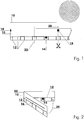
- Fig. 1 shows a unwound from a roll strip-shaped fabric tape 10 for producing a care label.
- an endless antenna is woven as an E-field emitter 12.
- On the fabric tape 10 is in the lower region where the E-field emitter 12 is located, a Detektierplättchen 14 - in a conventional manner of a chip and a coupling loop - glued, namely centrally between two vertically extending parts of the E. Field radiator 12.
- the fabric tape 10 is provided with periodically repeating repeat marks 18 which define cutting lines 20 along which the fabric tape 10 is cut to form a single care label.
- the fabric tape 10 is printed on its one rear side.
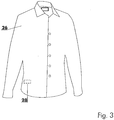
- FIG. 2 illustrates how a folded care label is formed from the cut-away portion of the fabric tape 10 by folding along a fold line 22.
- dashed line 24 of the folding process is indicated.
- the folding along the central fold line 22 takes place such that the two antenna structures of the folded parts lie on one another after completion of the folding process, whereby practically two parallel antennas are formed, whereby the transponder operates very broadband.
- the two printed pages 16 are visible from the outside.
- the Detektierplättchen 14 is in the folded state of the fabric tape 10 inside between the folded parts of the fabric tape, since it is in Fig. 2 is covered by the lower part of the fabric tape 10.
- FIG. 3 shows a garment 26, for example a shirt, on the inside of which the folded care label 28 according to the invention is attached with a transponder.
- the transponder operates for example in the UHF range at about 900 MHz.
Landscapes
- Engineering & Computer Science (AREA)
- Computer Hardware Design (AREA)
- Microelectronics & Electronic Packaging (AREA)
- Physics & Mathematics (AREA)
- General Physics & Mathematics (AREA)
- Theoretical Computer Science (AREA)
- Treatment Of Fiber Materials (AREA)
- Professional, Industrial, Or Sporting Protective Garments (AREA)
- Details Of Aerials (AREA)
- Woven Fabrics (AREA)
Description
- Die Erfindung betrifft ein gefaltetes und bedrucktes Pflegeetikett für Textilien.
- Bekleidungsstücke, wie Hemden, T-Shirts, Hosen usw. werden bekanntlich auf ihrer Innenseite mit einem textilen Pflegeetikett versehen, welches zumeist einseitig mit Informationen bedruckt ist. Diese Informationen betreffen üblicherweise Anleitungen zur Pflege (Reinigung und Wäsche) des Bekleidungsstückes sowie gegebenenfalls noch die Angabe des Herstellers des betreffenden Bekleidungsstückes.
- Das diesbezügliche Pflegeetikett besteht aus einem streifenförmigen Gewebeband, welches in seiner Mitte gefaltet wird, wodurch zwei Abschnitte gebildet werden, die im gefalteten Zustand des Gewebebandes übereinander liegen. Die bedruckte Seite befindet sich dabei auf den beiden sichtbaren Außenseiten der gefalteten Abschnitte.
- Die aufgedruckten Informationen benötigen verhältnismäßig viel Platz, wodurch das Gewebeband vergleichsweise lang wird. Deshalb ist es üblich, das Gewebeband wie beschrieben zu falten, wodurch die Länge des Gewebebandes, also die Länge des Pflegeetiketts halbiert wird.
- In der Praxis besteht zunehmend der Wunsch, dem Bekleidungsstück noch weitere Informationen zuzuordnen, wie z.B. Farbe und Größe des Bekleidungsstückes.
- Man könnte nun daran denken, zu diesem Zweck auf das Pflegeetikett einen Barcode anzubringen bzw. aufzudrucken, allerdings würde das Pflegeetikett dann unter Umständen noch länger werden.
- Außerdem hat sich in der Praxis gezeigt, dass die Verwendung von Barcodes mit Nachteilen behaftet ist. So muss der Barcode zum Lesen und zum Erfassen seiner Informationen stets sichtbar zugänglich sein. Es ist daher erforderlich, das Bekleidungsstück in die Hand zu nehmen und Pflegeetikett so zu positionieren, dass der Barcode optisch sichtbar gelesen werden kann.
- Hier greift die Erfindung ein, welcher die Aufgabe zugrundeliegt, in einem Pflegeetikett wesentlich mehr Informationen zur Identifikation des betreffenden Bekleidungsstückes bei Produktion, Logistik, Vertrieb usw. unterzubringen und zu speichern und diese Informationen problemlos ablesen zu können, ohne dass das Pflegeetikett optisch einsehbar ist, und ohne dass die Länge des Pflegeetiketts verlängert werden muß.
- Die Lösung dieser Aufgabe erfolgt durch die Merkmale des Patentanspruchs 1. Vorteilhafte Weiterbildungen der Erfindung sind in den Unteransprüchen wiedergegeben.
- Die Erfindung schlägt den Einsatz eines Transponders vor, welcher hinsichtlich der Lesbarkeit, des Umfangs der gespeicherten Informationen sowie der Manipulationssicherheit den üblichen Barcodes deutlich überlegen ist. Ein solcher Transponder ist beispielsweise durch die Dokumente
WO 2008/011739 A1 undWO 2005/071605 A2 bekannt. - Bei der Erfindung wird wie folgt vorgegangen. Zur Erzeugung von Pflegeetiketten wird zunächst in das streifenförmige Gewebeband zugleich mit der Herstellung eine Antennenstruktur in dem Gewebeband erzeugt. Bei der Antennenstruktur handelt es sich vorzugsweise um einen E-Feld-Strahler. Das Gewebeband ist mit periodischen Rapportmarken versehen, die als Schneidemarken dienen und die Stellen kennzeichnen, an denen das Gewebeband durchgeschnitten wird, um ein einzelnes Pflegeetikett zu bilden.
- Bei mit Kunststoff beschichteten Pflegeetiketten kann die Antenne auch mit einer leitenden Farbe aufgedruckt oder durch eine zusätzliche leitfähige Beschichtung aufgebracht werden. Beschichtete Pflegeetiketten haben eine schlechtere Haptik, lassen sich aber besser bedrucken.
- Auf das Gewebeband wird ein an sich bekanntes sehr kleines Detektierplättchen, bestehend aus einem Chip mit einem kreisförmigen Koppelelement, im Bereich des E-Feld-Strahlers angebracht. Der Chip, die Koppelschleife und der E-Feld-Strahler bilden zusammen den eigentlichen textilen arbeitsfähigen Transponder mit einer angenehmen textilen Haptik, da es sich bei dem Pflegeetikett um ein Gewebe handelt, anders als bei bekannten Plastik-Transpondern, die einfach in eine textile Tasche eingelegt werden.
- Vorteilhafterweise, da im Textilfertigungsprozess sehr schlecht leitende Verbindungen herstellbar sind, wird das Detektierplättchen kontaktlos induktiv oder kapazitiv in die gewebte bzw. textile Antennenstruktur eingekoppelt.
- Das Gewebeband wird in seiner Mitte gefaltet, und zwar in der Weise, dass die Antennenstruktur des E-Feld-Strahlers der beiden übereinander gefalteten Teile aufeinanderliegen. Die Antennenstruktur ist hierbei vorzugsweise spiegelsymmetrisch zur Faltkante gelegt.
- Wenn die Antennenstrukturen allgemein übereinanderliegen, oder vorzugsweise deckungsgleich aufeinanderliegen, entstehen praktisch zwei parallel gekoppelte Antennen, durch welche der Transponder sehr breitbandig wird. Der Transponder ist damit unempfindlich gegen Verstimmungen, wie sie zum Beispiel beim Einbringen in verschiedenartige Textilien in der Praxis auftreten können.
- Bei dem Webverfahren zur Erzeugung der Antennenstruktur aus Kett- und/oder Schussfäden werden dünne leitende Fäden verwendet. Nach dem Faltvorgang liegen diese dünnen Fäden übereinander, wodurch hinsichtlich der übereinanderliegenden Antennenfäden mehr Volumen und eine größere Abstrahlfläche entsteht. Vorzugsweise werden isolierte leitende Fäden verwendet.
- Überraschend hat sich bei der Erfindung gezeigt, dass der Transponder auf dem Pflegeetikett arbeitsfähig ist, obwohl nach dem Falten die Antennenstrukturen der beiden gefalteten Teile des Gewebebandes übereinanderliegen, wodurch zwei parallele Antennen gebildet werden. Es wurde gefunden, dass nach dem Faltvorgang eine neue Antennenstruktur entsteht, mit einer anderen Resonanzfrequenz als im nicht gefalteten Zustand. Durch die neue - gefaltete - Antennenstruktur wird der Transponder sehr breitbandig. Damit einher geht eine schlechtere Güte der Antenne, gleichwohl ist der Transponder für den vorgesehenen Einsatzzweck arbeitsfähig, wobei die breitbandige Resonanzfrequenz in gewünschter Weise eine Größenordnung von 860 MHz besitzt. Diese Frequenz weicht erheblich von der Resonanzfrequenz ab, welche die Antennenstruktur im nicht gefalteten Zustand des Gewebebandes aufweist.
- Das Falten des Gewebebandes erfolgt vorzugsweise derart, dass das Detektierplättchen von dem einen gefalteten Abschnitt abgedeckt ist und somit innen zwischen den aufeinander liegenden Abschnitten angeordnet ist.
- Es ist zwar an sich schon bekannt, zur Kennzeichnung von Textilien einen Transponder zu verwenden. Dies erfolgt in der Weise, dass ein Transponder an dem üblichen Anhängeetikett (Hangtag aus Papier oder Karton) des Bekleidungsstückes angebracht wird. Demgegenüber sieht die Erfindung in neuartiger Weise die Verwendung eines textilen Transponders mit eingewebter Antennenstruktur bei einem gefalteten Pflegeetikett vor.
- Der textile Transponder gemäß der Erfindung weist gegenüber dem mit einem Transponder versehenen Handtag erhebliche Vorteile auf. Bei der Erfingung wird der Transponder direkt bei der Produktion des Pflegeetiketts sozusagen "mit der ersten Naht" eingenäht und steht unmittelbar nach Fertigstellung des mit dem Pflegeetikettes versehenen Bekleidungsstückes arbeitsfähig zur Verfügung. Dadurch ist ein sehr frühzeitiger Nutzen durch Identifikation während der Produktion, Aufbereitung, Verpachung und Versand möglich.
- Demgegenüber wird der bekannte Transponder am Hantag erst später am Bekleidungsstück bzw. nur an der Verpackung befestigt, während das Bekleidungsstück bei der Erfindung sofort eindeutig gekennzeichnet ist. Es entstehen auch keine zusätzlichen Kosten für das Anbringen eines Handtags mit Transponder.
- Bei der Erfindung ist die Antenne in das Gewebe des Pflegeetiketts eingewebt, so dass man von einer textilen Antenne spricht. Diese textile Antenne ist erheblich widerstandsfähiger als bei dem Handtag-Transponder.
- Insgesamt ist er textile Transponder bei der Erfindung sehr unempfindlich gegen textile Aufbereitung oder Reinigung nach dem Versand. Demgegenüber würde sich ein Handtag aus Papier oder Pappe bereits bei den hohen Heissdampftemperaturen einer üblichen ersten Reinigung nach der Produktion im so genannten "Tunnelfinisher" auflösen. Deshalb kann das Hantag erst am Ende der Kette von der Herstellung über den Versand, der Lagerung bis zum Verkauf (Supply Chain) angebracht werden.
- Der textile Transponder bei der Erfindung ermöglicht die Speicherung von wesentlich mehr Informationen als bei dem üblichen Barcode. Außerdem lässt sich der Transponder lesen, ohne dass ein Sichtkontakt erforderlich ist.
- Mithilfe des Transponders lässt sich jedes mit dem erfindungsgemäßen Pflegeetikett versehenes Bekleidungsstück eindeutig und genauer als mit einem Barcode kennzeichnen. So lässt sich zum Beispiel feststellen, dass ein bestimmtes Kleidungsstück X das Y-te Stück von insgesamt Z Stück einer Serienproduktion ist.
- Es sind auch von Anfang an weitere wichtige Informationen für die Logistik, die Lagerhaltung und den Vertrieb möglich.
- Die Befestigung des Detektierplättchens auf dem Pflegeetikett kann dadurch erfolgen, dass das Detetierplättchen auf das streifenförmige Gewebeband aufgeklebt wird.
- In vielen Fällen werden die Bekleidungsstücke mit den Pflegeetiketten nach der Produktion einer so genannten Enzymwäsche unterzogen, die sehr agressiv verläuft. In solchen Fällen lässt sich nicht ausschließen, dass das aufgeklebte Detektierplättchen sich löst. Daher besteht auch die Möglichkeit, das Detektierplättchen, also den Chip mit der Koppelschleife, auf das Pflegeetikett aufzunähen, so wie man einen Ersatzknopf an das Pflegeetikett annäht.
- Als ein Vorteil der Erfindung ist es auch noch anzusehen, dass der Transponder auch als Diebstahlschutz (EAS) verwendet werden kann, so dass eine zusätzliche EAS-Kennzeichnung nicht nötig ist.
- Anhand des in der Zeichnung dargestellten Ausführungsbeispiels wird die Erfindung nachfolgend näher erläutert. Es zeigen:
- Fig. 1
- eine Seitenansicht und eine Draufsicht eines Gewebebandes mit einer eingewebten Antenne und mit einem Detektierplättchen,
- Fig. 2
- einen abgeschnittenen Teil eines Gewebebandes, welches längs einer mittleren Faltlinie gefaltet wird, und
- Fig. 3
- ein Bekleidungsstück mit einem Pflegeetikett.
-
Fig. 1 zeigt ein von einer Rolle abgewickeltes streifenförmiges Gewebeband 10 zur Herstellung eines Pflegeetiketts. In das Gewebeband 10 ist eine endlose Antenne als E-Feld-Strahler 12 eingewebt. Auf das Gewebeband 10 ist im unteren Bereich, wo sich der E-Feld-Strahler 12 befindet, ein Detektierplättchen 14 - bestehend in an sich bekannter Weise aus einem Chip und einer Koppelschleife - aufgeklebt, und zwar mittig zwischen zwei sich senkrecht erstreckenden Teilen des E-Feld-Strahlers 12. - Das Gewebeband 10 ist mit sich periodisch wiederholenden Rapportmarken 18 versehen, welche Schneidelinien 20 festlegen, längs deren das Gewebeband 10 geschnitten wird, um ein einzelnes Pflegeetikett bilden zu können. In
Figur 1 ist das Gewebeband 10 auf seiner einen rückwärtigen Seite bedruckt. -
Figur 2 veranschaulicht, wie aus dem abgeschnittenen Teil des Gewebebandes 10 durch Falten längs einer Faltenlinie 22 ein gefaltetes Pflegeetikett gebildet wird. Durch die gestrichelte Linie 24 ist der Faltvorgang angedeutet. Das Falten längs der mittigen Faltenlinie 22 erfolgt derart, dass die beiden Antennenstrukturen der gefalteten Teile nach Abschluss des Faltvorganges aufeinander liegen, wodurch praktisch zwei parallele Antennen gebildet werden, wodurch der Transponder sehr breitbandig arbeitet. Im zusammengefalteten Zustand des streifenförmigen Gewebebandes 10 sind die beiden bedruckten Seiten 16 von außen sichtbar. - Das Detektierplättchen 14 liegt im zusammengefalteten Zustand des Gewebebandes 10 innen zwischen den gefalteten Teilen des Gewebebandes, da es in
Fig. 2 von dem unteren Teil des Gewebebandes 10 abgedeckt wird. -
Figur 3 zeigt ein Bekleidungsstück 26, zum Beispiel ein Hemd, an dessen Innenseite das erfindungsgemäße gefaltete Pflegeetikett 28 mit einem Transponder angebracht ist. Der Transponder arbeitet beispielsweise im UHF-Bereich bei etwa 900 MHz.
Claims (12)
- Gefaltetes und bedrucktes Pflegeetikett (28) für Textilien (26), dadurch gekennzeichnet, dass in ein das Pflegeetikett (28) bildendes Stück eines Gewebebandes (10) eine Antennenstruktur (12) eingewebt ist, dass neben einer mittig angeordneten Faltlinie (22) ein Detektierplättchen (14) im Bereich der Antennenstruktur (12) auf dem Gewebeband befestigt ist, und dass das Gewebeband (10) längs der Faltlinie (22) derart gefaltet ist, dass die Antennenstrukturen (12) der gefalteten Abschnitte nach dem Falten übereinander liegend.
- Pflegeetikett nach Anspruch 1, dadurch gekennzeichnet, dass die Antennenstruktur (12) spiegelsymmetrisch zur Faltlinie (22) angeordnet ist.
- Pflegeetikett nach Anspruch 1, dadurch gekennzeichnet, dass die Antennenstrukturen der gefalteten Abschnitte nach dem Falten deckungsgleich aufeinander liegen.
- Pflegeetikett nach einem der vorhergehenden Ansprüche 1 - 3, gekennzeichnet durch folgende Merkmale:a) bei der Herstellung eines endlosen streifenförmigen Gewebebandes (10) als Basismaterial für das Pflegeetikett (28) ist zugleich eine endlose Antennenstruktur (12) aus elektrisch leitfähigem Material in das Gewebeband (10) eingewebt,b) die Antennenstruktur (12) ist durch einen Faden mit leitfähigem Anteil als Kett- oder Schussfaden eingetragen,c) die Antennenstruktur (12) wiederholt sich in ihrem Aufbau periodisch,d) das Gewebeband (10) ist mit sich periodisch wiederholenden Rapportmarken (18) versehen, welche Schneidlinien (20) festlegen,e) ein abgeschnittener Abschnitt zwischen zwei benachbarten Rapportmarken (18) bildet die Grundlage für ein einzelnes Pflegeetikett (28),f) auf dem Pflegeetikett (28) befindet sich im Bereich der Antennenstruktur (12) ein Detektierplättchen (14) aus einem Chip und einer Koppelschleife zur Kopplung mit der Antennenstruktur (12),g) der abgeschnittene Abschnitt des Gewebebandes (10) ist längs einer mittigen Faltlinie (22) gefaltet.
- Pflegeetikett nach einem der vorhergehenden Ansprüche 1 - 4, dadurch gekennzeichnet, dass die Antennenstruktur (12) durch einen E-Feld-Strahler gebildet ist.
- Pflegeetikett nach einem der vorhergehenden Ansprüche 1 - 5, dadurch gekennzeichnet, dass das Detektierplättchen (14) auf das Pflegeetikett (28) aufgeklebt ist.
- Pflegeetikett nach einem der vorhergehenden Ansprüche 1 - 6, dadurch gekennzeichnet, dass das Detektierplättchen (14) an das Pflegeetikett (28) angenäht ist.
- Pflegeetikett nach einem der vorhergehenden Ansprüche 1 - 7, dadurch gekennzeichnet, dass durch das Falten eine neue Antennenstruktur (12) gebildet ist, durch welche die Bandbreite des Transponders erhöht wird.
- Pflegeetikett nach einem der vorhergehenden Ansprüche 1 - 8, dadurch gekennzeichnet, dass das Detektierplättchen (14) kontaktlos in die gewebte und gefaltete Antennenstruktur (12) eingekoppelt ist.
- Pflegeetikett nach einem oder mehreren der vorhergehenden Ansprüche 1 - 7, dadurch gekennzeichnet, dass die Antennenstruktur (12) durch auf das mit Kunststoff beschichtete Gewebeband (10) aufgedruckte leitende Farbe gebildet ist.
- Pflegeetikett nach einem oder mehreren der vorhergehenden Ansprüche 1 - 7, dadurch gekennzeichnet, dass die Antennenstruktur bei einem mit Kunststoff beschichteten Gewebeband (10) durch eine zusätzliche leitfähige Beschichtung gebildet ist.
- Pflegeetikett nach einem oder mehreren der vorhergehenden Ansprüche 1 - 5, dadurch gekennzeichnet, dass die eingewebten, die Antennenstruktur (12) bildenden Antennenfäden isolierte Drähte sind.
Applications Claiming Priority (2)
| Application Number | Priority Date | Filing Date | Title |
|---|---|---|---|
| DE102009038511A DE102009038511A1 (de) | 2009-08-25 | 2009-08-25 | Gefaltetes und bedrucktes Pflegeetikett für Textilien |
| PCT/DE2010/000760 WO2011023151A2 (de) | 2009-08-25 | 2010-07-01 | Gefaltetes und bedrucktes pflegeetikett für textilien |
Publications (2)
| Publication Number | Publication Date |
|---|---|
| EP2471029A2 EP2471029A2 (de) | 2012-07-04 |
| EP2471029B1 true EP2471029B1 (de) | 2017-05-03 |
Family
ID=43532098
Family Applications (1)
| Application Number | Title | Priority Date | Filing Date |
|---|---|---|---|
| EP10742707.2A Active EP2471029B1 (de) | 2009-08-25 | 2010-07-01 | Gefaltetes und bedrucktes pflegeetikett für textilien |
Country Status (4)
| Country | Link |
|---|---|
| US (1) | US8740091B2 (de) |
| EP (1) | EP2471029B1 (de) |
| DE (1) | DE102009038511A1 (de) |
| WO (1) | WO2011023151A2 (de) |
Families Citing this family (2)
| Publication number | Priority date | Publication date | Assignee | Title |
|---|---|---|---|---|
| JP7077536B2 (ja) * | 2017-05-29 | 2022-05-31 | 大日本印刷株式会社 | Icタグおよびicタグリール |
| WO2026043592A1 (en) * | 2024-08-19 | 2026-02-26 | Sensormatic Electronics, LLC | Multi-layer radio frequency identification label and method of making same |
Family Cites Families (12)
| Publication number | Priority date | Publication date | Assignee | Title |
|---|---|---|---|---|
| US5508684A (en) * | 1995-03-02 | 1996-04-16 | Becker; Richard S. | Article tag |
| DE102004003461C5 (de) * | 2004-01-22 | 2009-11-19 | ASTRA Gesellschaft für Asset Management mbH & Co. KG | Textilmaterial mit einem HF-Transponder |
| DE102004005017A1 (de) | 2004-01-30 | 2005-09-01 | ASTRA Gesellschaft für Asset Management mbH & Co. KG | Textilmaterial mit Antennenkomponenten eines HF-Transponders |
| TWI457835B (zh) * | 2004-02-04 | 2014-10-21 | Semiconductor Energy Lab | 攜帶薄膜積體電路的物品 |
| TW200614591A (en) * | 2004-09-14 | 2006-05-01 | Textilma Ag | Textile strip comprising an integrated antenna thread for an RF transponder |
| DE102005018531B4 (de) * | 2005-04-21 | 2008-08-14 | Eads Deutschland Gmbh | Gefaltete Monopolantenne |
| US20060238436A1 (en) | 2005-04-23 | 2006-10-26 | Applied Radar | Method for constructing microwave antennas and circuits incorporated within nonwoven fabric |
| US7913917B2 (en) | 2006-07-24 | 2011-03-29 | Textilma Ag | RFID tag |
| DE102007008316A1 (de) * | 2007-02-16 | 2008-08-21 | ASTRA Gesellschaft für Asset Management mbH & Co. KG | Textilmaterial mit einem Schaltungsmodul und einer Antenne |
| TW200905574A (en) * | 2007-07-03 | 2009-02-01 | Textilma Ag | Rfid transponder chip module with connecting means for an antenna, textile tag with an rfid transponder chip module, and use of an rfid transponder chip module |
| DE102008027246A1 (de) * | 2008-06-06 | 2009-12-10 | ASTRA Gesellschaft für Asset Management mbH & Co. KG | Waschbares Produkt |
| US8936197B2 (en) * | 2009-11-17 | 2015-01-20 | Avery Dennison Corporation | Integral tracking tag for consumer goods |
-
2009
- 2009-08-25 DE DE102009038511A patent/DE102009038511A1/de active Granted
-
2010
- 2010-07-01 WO PCT/DE2010/000760 patent/WO2011023151A2/de not_active Ceased
- 2010-07-01 US US13/391,872 patent/US8740091B2/en active Active
- 2010-07-01 EP EP10742707.2A patent/EP2471029B1/de active Active
Non-Patent Citations (1)
| Title |
|---|
| None * |
Also Published As
| Publication number | Publication date |
|---|---|
| EP2471029A2 (de) | 2012-07-04 |
| WO2011023151A3 (de) | 2012-03-15 |
| US20120217308A1 (en) | 2012-08-30 |
| WO2011023151A2 (de) | 2011-03-03 |
| US8740091B2 (en) | 2014-06-03 |
| DE102009038511A1 (de) | 2011-03-10 |
Similar Documents
| Publication | Publication Date | Title |
|---|---|---|
| EP1870797B1 (de) | Informationsträger für Textilien | |
| DE102004003461B4 (de) | Textilmaterial mit einem HF-Transponder | |
| DE19853226C1 (de) | Verfahren zur Entfernung von Einheiten aus Laminatbahnen, die eine Vielzahl von Einheiten aufweisen | |
| EP2066836B1 (de) | Rfid-textiletikette | |
| EP2044258B1 (de) | Rfid-etikette | |
| DE102007016584B4 (de) | Textilinformationsträger | |
| DE102017006450B4 (de) | RFID-Transponder für eine kontaktlose Kommunikation mit Plastikgehäuse | |
| EP1965461B1 (de) | Textilmaterial mit einem Schaltungsmodul und einer Antenne | |
| DE10357193A1 (de) | Textiletikett und Verfahren zu dessen Herstellung | |
| EP2603384B1 (de) | Bedruckungsobjekt und drucker zum bedrucken eines bedruckungsobjektes | |
| WO2006089439A1 (de) | Transponder-faden sowie seine verwendung | |
| EP1714352B1 (de) | Textilmaterial mit antennenkomponenten eines hf-transponders | |
| WO2009000446A1 (de) | Etikett, insbesondere für textilwaren | |
| EP1892650B1 (de) | Verfahren zum kontaktlosen Testen von auf einer Materialbahn aufgebrachten Antenne | |
| EP2288743B1 (de) | Waschbares produkt | |
| WO2011023151A2 (de) | Gefaltetes und bedrucktes pflegeetikett für textilien | |
| DE102005010841A1 (de) | Textilinformationsträger und Verfahren zur Herstellung eines Textilinformationsträgers | |
| DE10203911A1 (de) | Transponder, Bahnmaterial mit Transpondern sowie Handelswaren mit Transpondern | |
| DE3508369A1 (de) | Etikettartiges gebilde und verfahren zu seiner herstellung | |
| EP1907994A1 (de) | Textiles flächengebilde, insbesondere etikett, mit einem chip | |
| DE3217601C2 (de) | Anordnung zur Kennzeichnung textiler Warenbahnen durch Markierungen mittels Löchern | |
| DE69128093T2 (de) | Stoff, der mit einer optisch lesbaren markierung versehen ist und dessen herstellung | |
| DE202020005513U1 (de) | Bespannungen | |
| EP3008668A1 (de) | Herstellungsverfahren für tragbare datenträger | |
| DE202013006697U1 (de) | Vorrichtung zur Aufnahme und Befestigung von Etiketten an Textilien |
Legal Events
| Date | Code | Title | Description |
|---|---|---|---|
| PUAI | Public reference made under article 153(3) epc to a published international application that has entered the european phase |
Free format text: ORIGINAL CODE: 0009012 |
|
| 17P | Request for examination filed |
Effective date: 20120224 |
|
| AK | Designated contracting states |
Kind code of ref document: A2 Designated state(s): AL AT BE BG CH CY CZ DE DK EE ES FI FR GB GR HR HU IE IS IT LI LT LU LV MC MK MT NL NO PL PT RO SE SI SK SM TR |
|
| DAX | Request for extension of the european patent (deleted) | ||
| GRAP | Despatch of communication of intention to grant a patent |
Free format text: ORIGINAL CODE: EPIDOSNIGR1 |
|
| INTG | Intention to grant announced |
Effective date: 20170207 |
|
| GRAS | Grant fee paid |
Free format text: ORIGINAL CODE: EPIDOSNIGR3 |
|
| GRAA | (expected) grant |
Free format text: ORIGINAL CODE: 0009210 |
|
| AK | Designated contracting states |
Kind code of ref document: B1 Designated state(s): AL AT BE BG CH CY CZ DE DK EE ES FI FR GB GR HR HU IE IS IT LI LT LU LV MC MK MT NL NO PL PT RO SE SI SK SM TR |
|
| REG | Reference to a national code |
Ref country code: GB Ref legal event code: FG4D Free format text: NOT ENGLISH |
|
| REG | Reference to a national code |
Ref country code: AT Ref legal event code: REF Ref document number: 890735 Country of ref document: AT Kind code of ref document: T Effective date: 20170515 Ref country code: CH Ref legal event code: EP |
|
| REG | Reference to a national code |
Ref country code: IE Ref legal event code: FG4D Free format text: LANGUAGE OF EP DOCUMENT: GERMAN |
|
| REG | Reference to a national code |
Ref country code: DE Ref legal event code: R096 Ref document number: 502010013553 Country of ref document: DE |
|
| REG | Reference to a national code |
Ref country code: FR Ref legal event code: PLFP Year of fee payment: 8 |
|
| REG | Reference to a national code |
Ref country code: NL Ref legal event code: MP Effective date: 20170503 |
|
| REG | Reference to a national code |
Ref country code: LT Ref legal event code: MG4D |
|
| PG25 | Lapsed in a contracting state [announced via postgrant information from national office to epo] |
Ref country code: FI Free format text: LAPSE BECAUSE OF FAILURE TO SUBMIT A TRANSLATION OF THE DESCRIPTION OR TO PAY THE FEE WITHIN THE PRESCRIBED TIME-LIMIT Effective date: 20170503 Ref country code: NO Free format text: LAPSE BECAUSE OF FAILURE TO SUBMIT A TRANSLATION OF THE DESCRIPTION OR TO PAY THE FEE WITHIN THE PRESCRIBED TIME-LIMIT Effective date: 20170803 Ref country code: ES Free format text: LAPSE BECAUSE OF FAILURE TO SUBMIT A TRANSLATION OF THE DESCRIPTION OR TO PAY THE FEE WITHIN THE PRESCRIBED TIME-LIMIT Effective date: 20170503 Ref country code: GR Free format text: LAPSE BECAUSE OF FAILURE TO SUBMIT A TRANSLATION OF THE DESCRIPTION OR TO PAY THE FEE WITHIN THE PRESCRIBED TIME-LIMIT Effective date: 20170804 Ref country code: HR Free format text: LAPSE BECAUSE OF FAILURE TO SUBMIT A TRANSLATION OF THE DESCRIPTION OR TO PAY THE FEE WITHIN THE PRESCRIBED TIME-LIMIT Effective date: 20170503 Ref country code: LT Free format text: LAPSE BECAUSE OF FAILURE TO SUBMIT A TRANSLATION OF THE DESCRIPTION OR TO PAY THE FEE WITHIN THE PRESCRIBED TIME-LIMIT Effective date: 20170503 |
|
| PG25 | Lapsed in a contracting state [announced via postgrant information from national office to epo] |
Ref country code: SE Free format text: LAPSE BECAUSE OF FAILURE TO SUBMIT A TRANSLATION OF THE DESCRIPTION OR TO PAY THE FEE WITHIN THE PRESCRIBED TIME-LIMIT Effective date: 20170503 Ref country code: PL Free format text: LAPSE BECAUSE OF FAILURE TO SUBMIT A TRANSLATION OF THE DESCRIPTION OR TO PAY THE FEE WITHIN THE PRESCRIBED TIME-LIMIT Effective date: 20170503 Ref country code: BG Free format text: LAPSE BECAUSE OF FAILURE TO SUBMIT A TRANSLATION OF THE DESCRIPTION OR TO PAY THE FEE WITHIN THE PRESCRIBED TIME-LIMIT Effective date: 20170803 Ref country code: NL Free format text: LAPSE BECAUSE OF FAILURE TO SUBMIT A TRANSLATION OF THE DESCRIPTION OR TO PAY THE FEE WITHIN THE PRESCRIBED TIME-LIMIT Effective date: 20170503 Ref country code: LV Free format text: LAPSE BECAUSE OF FAILURE TO SUBMIT A TRANSLATION OF THE DESCRIPTION OR TO PAY THE FEE WITHIN THE PRESCRIBED TIME-LIMIT Effective date: 20170503 Ref country code: IS Free format text: LAPSE BECAUSE OF FAILURE TO SUBMIT A TRANSLATION OF THE DESCRIPTION OR TO PAY THE FEE WITHIN THE PRESCRIBED TIME-LIMIT Effective date: 20170903 |
|
| PG25 | Lapsed in a contracting state [announced via postgrant information from national office to epo] |
Ref country code: SK Free format text: LAPSE BECAUSE OF FAILURE TO SUBMIT A TRANSLATION OF THE DESCRIPTION OR TO PAY THE FEE WITHIN THE PRESCRIBED TIME-LIMIT Effective date: 20170503 Ref country code: DK Free format text: LAPSE BECAUSE OF FAILURE TO SUBMIT A TRANSLATION OF THE DESCRIPTION OR TO PAY THE FEE WITHIN THE PRESCRIBED TIME-LIMIT Effective date: 20170503 Ref country code: CZ Free format text: LAPSE BECAUSE OF FAILURE TO SUBMIT A TRANSLATION OF THE DESCRIPTION OR TO PAY THE FEE WITHIN THE PRESCRIBED TIME-LIMIT Effective date: 20170503 Ref country code: RO Free format text: LAPSE BECAUSE OF FAILURE TO SUBMIT A TRANSLATION OF THE DESCRIPTION OR TO PAY THE FEE WITHIN THE PRESCRIBED TIME-LIMIT Effective date: 20170503 Ref country code: EE Free format text: LAPSE BECAUSE OF FAILURE TO SUBMIT A TRANSLATION OF THE DESCRIPTION OR TO PAY THE FEE WITHIN THE PRESCRIBED TIME-LIMIT Effective date: 20170503 |
|
| REG | Reference to a national code |
Ref country code: DE Ref legal event code: R097 Ref document number: 502010013553 Country of ref document: DE |
|
| PG25 | Lapsed in a contracting state [announced via postgrant information from national office to epo] |
Ref country code: SM Free format text: LAPSE BECAUSE OF FAILURE TO SUBMIT A TRANSLATION OF THE DESCRIPTION OR TO PAY THE FEE WITHIN THE PRESCRIBED TIME-LIMIT Effective date: 20170503 Ref country code: IT Free format text: LAPSE BECAUSE OF FAILURE TO SUBMIT A TRANSLATION OF THE DESCRIPTION OR TO PAY THE FEE WITHIN THE PRESCRIBED TIME-LIMIT Effective date: 20170503 |
|
| REG | Reference to a national code |
Ref country code: CH Ref legal event code: PL |
|
| PLBE | No opposition filed within time limit |
Free format text: ORIGINAL CODE: 0009261 |
|
| STAA | Information on the status of an ep patent application or granted ep patent |
Free format text: STATUS: NO OPPOSITION FILED WITHIN TIME LIMIT |
|
| 26N | No opposition filed |
Effective date: 20180206 |
|
| REG | Reference to a national code |
Ref country code: IE Ref legal event code: MM4A |
|
| PG25 | Lapsed in a contracting state [announced via postgrant information from national office to epo] |
Ref country code: LI Free format text: LAPSE BECAUSE OF NON-PAYMENT OF DUE FEES Effective date: 20170731 Ref country code: CH Free format text: LAPSE BECAUSE OF NON-PAYMENT OF DUE FEES Effective date: 20170731 Ref country code: IE Free format text: LAPSE BECAUSE OF NON-PAYMENT OF DUE FEES Effective date: 20170701 |
|
| PG25 | Lapsed in a contracting state [announced via postgrant information from national office to epo] |
Ref country code: SI Free format text: LAPSE BECAUSE OF FAILURE TO SUBMIT A TRANSLATION OF THE DESCRIPTION OR TO PAY THE FEE WITHIN THE PRESCRIBED TIME-LIMIT Effective date: 20170503 |
|
| REG | Reference to a national code |
Ref country code: BE Ref legal event code: MM Effective date: 20170731 |
|
| PG25 | Lapsed in a contracting state [announced via postgrant information from national office to epo] |
Ref country code: LU Free format text: LAPSE BECAUSE OF NON-PAYMENT OF DUE FEES Effective date: 20170701 |
|
| REG | Reference to a national code |
Ref country code: FR Ref legal event code: PLFP Year of fee payment: 9 |
|
| PG25 | Lapsed in a contracting state [announced via postgrant information from national office to epo] |
Ref country code: BE Free format text: LAPSE BECAUSE OF NON-PAYMENT OF DUE FEES Effective date: 20170731 |
|
| REG | Reference to a national code |
Ref country code: AT Ref legal event code: MM01 Ref document number: 890735 Country of ref document: AT Kind code of ref document: T Effective date: 20170701 |
|
| PG25 | Lapsed in a contracting state [announced via postgrant information from national office to epo] |
Ref country code: MT Free format text: LAPSE BECAUSE OF FAILURE TO SUBMIT A TRANSLATION OF THE DESCRIPTION OR TO PAY THE FEE WITHIN THE PRESCRIBED TIME-LIMIT Effective date: 20170503 |
|
| PG25 | Lapsed in a contracting state [announced via postgrant information from national office to epo] |
Ref country code: AT Free format text: LAPSE BECAUSE OF NON-PAYMENT OF DUE FEES Effective date: 20170701 |
|
| PG25 | Lapsed in a contracting state [announced via postgrant information from national office to epo] |
Ref country code: HU Free format text: LAPSE BECAUSE OF FAILURE TO SUBMIT A TRANSLATION OF THE DESCRIPTION OR TO PAY THE FEE WITHIN THE PRESCRIBED TIME-LIMIT; INVALID AB INITIO Effective date: 20100701 Ref country code: MC Free format text: LAPSE BECAUSE OF FAILURE TO SUBMIT A TRANSLATION OF THE DESCRIPTION OR TO PAY THE FEE WITHIN THE PRESCRIBED TIME-LIMIT Effective date: 20170503 |
|
| PG25 | Lapsed in a contracting state [announced via postgrant information from national office to epo] |
Ref country code: CY Free format text: LAPSE BECAUSE OF NON-PAYMENT OF DUE FEES Effective date: 20170503 |
|
| PG25 | Lapsed in a contracting state [announced via postgrant information from national office to epo] |
Ref country code: MK Free format text: LAPSE BECAUSE OF FAILURE TO SUBMIT A TRANSLATION OF THE DESCRIPTION OR TO PAY THE FEE WITHIN THE PRESCRIBED TIME-LIMIT Effective date: 20170503 |
|
| PG25 | Lapsed in a contracting state [announced via postgrant information from national office to epo] |
Ref country code: TR Free format text: LAPSE BECAUSE OF FAILURE TO SUBMIT A TRANSLATION OF THE DESCRIPTION OR TO PAY THE FEE WITHIN THE PRESCRIBED TIME-LIMIT Effective date: 20170503 |
|
| PG25 | Lapsed in a contracting state [announced via postgrant information from national office to epo] |
Ref country code: PT Free format text: LAPSE BECAUSE OF FAILURE TO SUBMIT A TRANSLATION OF THE DESCRIPTION OR TO PAY THE FEE WITHIN THE PRESCRIBED TIME-LIMIT Effective date: 20170503 |
|
| PG25 | Lapsed in a contracting state [announced via postgrant information from national office to epo] |
Ref country code: AL Free format text: LAPSE BECAUSE OF FAILURE TO SUBMIT A TRANSLATION OF THE DESCRIPTION OR TO PAY THE FEE WITHIN THE PRESCRIBED TIME-LIMIT Effective date: 20170503 |
|
| P01 | Opt-out of the competence of the unified patent court (upc) registered |
Effective date: 20230530 |
|
| PGFP | Annual fee paid to national office [announced via postgrant information from national office to epo] |
Ref country code: DE Payment date: 20250723 Year of fee payment: 16 |
|
| PGFP | Annual fee paid to national office [announced via postgrant information from national office to epo] |
Ref country code: GB Payment date: 20250724 Year of fee payment: 16 |
|
| PGFP | Annual fee paid to national office [announced via postgrant information from national office to epo] |
Ref country code: FR Payment date: 20250723 Year of fee payment: 16 |