EP2469445A1 - Optimierung von Anti-Malware-Verarbeitung durch automatische Korrektur von Erkennungsregeln - Google Patents
Optimierung von Anti-Malware-Verarbeitung durch automatische Korrektur von Erkennungsregeln Download PDFInfo
- Publication number
- EP2469445A1 EP2469445A1 EP11161997A EP11161997A EP2469445A1 EP 2469445 A1 EP2469445 A1 EP 2469445A1 EP 11161997 A EP11161997 A EP 11161997A EP 11161997 A EP11161997 A EP 11161997A EP 2469445 A1 EP2469445 A1 EP 2469445A1
- Authority
- EP
- European Patent Office
- Prior art keywords
- rules
- database
- rating
- rule
- correction coefficients
- Prior art date
- Legal status (The legal status is an assumption and is not a legal conclusion. Google has not performed a legal analysis and makes no representation as to the accuracy of the status listed.)
- Granted
Links
Images



Classifications
-
- G—PHYSICS
- G06—COMPUTING OR CALCULATING; COUNTING
- G06F—ELECTRIC DIGITAL DATA PROCESSING
- G06F21/00—Security arrangements for protecting computers, components thereof, programs or data against unauthorised activity
- G06F21/50—Monitoring users, programs or devices to maintain the integrity of platforms, e.g. of processors, firmware or operating systems
- G06F21/55—Detecting local intrusion or implementing counter-measures
- G06F21/56—Computer malware detection or handling, e.g. anti-virus arrangements
-
- G—PHYSICS
- G06—COMPUTING OR CALCULATING; COUNTING
- G06F—ELECTRIC DIGITAL DATA PROCESSING
- G06F21/00—Security arrangements for protecting computers, components thereof, programs or data against unauthorised activity
- G06F21/50—Monitoring users, programs or devices to maintain the integrity of platforms, e.g. of processors, firmware or operating systems
- G06F21/55—Detecting local intrusion or implementing counter-measures
- G06F21/56—Computer malware detection or handling, e.g. anti-virus arrangements
- G06F21/566—Dynamic detection, i.e. detection performed at run-time, e.g. emulation, suspicious activities
Definitions
- the present invention is related to a computer-implemented method for optimization of anti-virus (AV) processing according to claim 1 and to a system implemented on a computer according to the preamble of claim 18.
- AV anti-virus
- Signature scanning systems use sample code patterns extracted from known malware code and scan for the occurrence of these patterns in other program code.
- a primary limitation of the signature scanning method is that only known malicious code is detected, that is, only code that matches the stored sample signatures of known malicious code is identified as being infected. All viruses or malicious code not previously identified, and all viruses or malicious code created after the last update to the signature database, will not be detected.
- Integrity checking systems extract a code sample from known, benign application program code.
- the code sample is stored, together with information from the program file, such as the executable program header and the file length, as well as the date and the time stamp of the sample.
- the program file is checked at regular intervals against this database to ensure that the program file has not been modified.
- a main disadvantage of an integrity check-based virus detection system is that a great many warnings of virus activity issue whenever any modification of an application program is performed. It is difficult for a user to determine when a warning represents a legitimate attack on the computer system.
- white lists the lists of known "clean" software components, links, libraries and other clean objects.
- hash values can be used.
- the white lists have to be constantly updated. When white lists are used, some false-positive determinations are inevitably made.
- US Patent No. 7,530,106 discloses a system for analyzing the behavior of executed files based on a set of rules.
- the malware is detected using ratings of computer processes calculated according to the rules.
- the rules are generated based on analyses of known malware processes.
- Each rule has a fallowing structure: a rule identifier, an API function invoked by the rule, rule parameters and a danger level.
- the rule is invoked, if the process calls the API function with rule parameters. Then, a rating of the process is increased according to the rule value.
- the rules are stored in updatable databases. As new viruses appear, the rule databases are updated. Creation of the new rules or modification of the old ones is an effortful and expensive task. So, it is important that the rules are tested for correctness of application. New rules can have some errors in their code (i.e., bugs) or they can generate errors when applied by an AV module during malware scanning. Thus, some rules can have zero effectiveness. These rules are stored in the rule database, but never work in the AV process. The rules with zero effectiveness may not work due to a number of factors. For example, a rule can have excessively strict (i.e., narrow) parameters, the rule can have errors or the processes detected by this rule are no longer found in the modem malware objects or applications.
- the AV system uses an entire set of rules from the database for checking the suspect objects.
- zero effectiveness rules do not affect the overall rating, but reduce the effectiveness of the AV system.
- these rules occupy the space in the database which makes frequent updates more difficult. Therefore, the new rules need to be tested prior to being applied in the AV system.
- Conventional systems do not offer automatic testing of the new rules.
- Any AV system has a probability of errors raised during its operation.
- the errors can be of two types.
- the errors of the first type occur if the AV system detects a malware object when this object is actually harmless. In other words, the system produces a false-positive determination.
- a second type of error occurs when the AV system does not detect a real malware object. In order to make the AV system more efficient, it is necessary to reduce a probability of both types of errors.
- the present invention is intended as a method and system for optimization of anti-malware (AV) processing that substantially obviates one or several of the disadvantages of the related art.
- AV anti-malware
- a system and a method for optimization of AV processing In one embodiment, a number of false-positive determinations by an AV system are reduced by correcting detection rules using correction coefficients. In another exemplary embodiment, a number of malware objects detected by an AV system are increased by correction of ratings determined by the rules using correction coefficients.
- an automated testing of new detection rules used by the AV system is provided.
- the new rules having zero correction coefficients are added to the rules database and results of application of the new rules are analyzed and the rules are corrected or modified for further testing.
- a method and a system for optimization of AV processing is provided.
- the proposed method and system provide for minimization of false-positive determinations, for increase in a number of detected malware objects and for automated testing of the detection rules.
- a system and a method for reducing a number of false-positive determinations by an AV system by modifying ratings set by detection rules using correction coefficients In another exemplary embodiment, a number of malware objects detected by an AV system are increased by correction of ratings determined by the rules using correction coefficients.
- an automated testing of new detection rules used by the AV system is provided.
- the new rules having "zero" correction coefficients are added to a rule database and results of application of the new rules are analyzed. Then the rules are corrected or modified for further testing.
- use of process rating allows for an increase in a number of malware objects detected by the AV system and for a decrease in a number of false-positive determinations.
- a number of correctly detected objects are increased and a number of false-positive determinations are decreased, the probability of both types of errors is reduced.
- an object is the code that is stored in nonvolatile memory (e.g., on a hard disk), and the process is the code loaded into memory for execution.
- a malicious object results in a malicious process.
- an optimized AV system that increases a number of detected malware objects using process rating is desired. It is apparent that a system with automated testing and correction of the new rules is desired as well. It is also desired to make a decision whether to store the new rule into a database based on the test results.
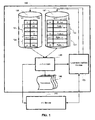
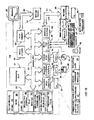
- FIG. 1 illustrates user side architecture of an AV system, in accordance with the exemplary embodiment.
- An exemplary system includes a user computer 100 connected to an AV server 160.
- the user computer 100 has an AV module 110 installed on it.
- the AV module 110 scans the user computer 100 for malware objects (for example, executable files that launch malicious processes).
- the AV module 110 checks the processes 140 instantiated by the objects.
- the AV module 110 uses a set of rules 132 from a rule database 130 located on the user side.
- the rules 132 contain descriptions of known harmful processes.
- Each rule 132 has an assigned unique number 131.
- the user computer 100 also has a database 120 of correction coefficients 122.
- the correction coefficients 120 are also used by the AV module 110 for detection of malware objects.
- Each rule 132 has a corresponding coefficient 122 in the database 120.
- Each coefficient 122 has an assigned number 121 corresponding to the rule 131.
- the databases 120 and 130 can be updated on the user side by an update module 150.
- New rules 134 (required to be tested) are placed into the rules database 130.
- the database 130 contains new rules 134 that need to be tested as well as already tested rules 133 that are being used by the AV module 110.
- the new rules are provided to the AV module 110 for testing.
- the coefficients database 120 is also divided into two parts: coefficients 123 corresponding to the already tested rules 133 and coefficients 124 corresponding to the new rules 134 that need to be tested.
- the AV module 110 is connected to the update module 150 and starts the update module 150 prior to AV scan of the user computer.
- the update module 150 connects to a server 160 update module 280 (see FIG. 2 ) and provides information about versions of the databases 120 and 130.
- the update module 280 compares the database versions with the versions of available databases on the server 160. If the server update module 280 determines that a newer version of a database is available, this version is transferred to the user update module 150, which replaces the databases 120 and 130 by newer versions. Note that the databases 120 and 130 are updated independently.
- the coefficients database 120 has a much smaller size than the rules database 130, For example, the coefficients database 120 may have at least 300, 700 or thousand times smaller size than the rules database 130. This allows for frequent updates of coefficients without noticeable overload of a network. Thus, independent update of these databases allows for reduction of network overhead.
- the AV module 110 connects to the AV server 160, if it detects a malicious process and corresponding malware object.
- the AV module 110 terminates the malicious process.
- the AV module starts analyzing it.
- an aggregate process rating is formed, which indicates whether the object is malicious.
- rule ratings, static rating and current rating are used.
- the current rating is generated on the AV server, and at the beginning of the analysis of the process, the AV module sends a control sum of the object to the AV server, and receives back a current rating.
- the AV module 110 generates a checksum (or digest) of a detected malware object using hash functions, such as, for example, MD5, MD4, SHA1, SHA256 or CRC32. Then, the AV module 110 sends the checksum and information about the detection rules (their numbers and their own ratings, i.e., the ratings set by the rules) used to detect the malware object and an aggregate process rating to AV server 160.
- hash functions such as, for example, MD5, MD4, SHA1, SHA256 or CRC32.
- the AV server 160 accumulates received data.
- the AV server 160 sends a response to the AV module 110.
- R is the aggregate process rating
- Ki is the correction coefficient corresponded to the triggered rule. If it is not possible to obtain the current rating of the process, the AV system uses the static rating.
- a process of generating rating is depicted in FIG. 4 and is discussed below.
- the proposed system has a collection of rules and each rule has its own rating.
- each rule has its own rating.
- the system analyzes a process to determine whether it is malicious, some of the rules are triggered. So, for the specific rule (the one that is triggered), it is a malware process and corresponding malware object.
- Each rule has its own weight (i.e., rating), and the AV module aggregates all ratings of the triggered rules.
- the second group is a static rating.
- the AV module generates the static rating for every scanned object.
- the static rating depends on parameters of the object such as size, type, attributes, location, etc.
- the third group is the current rating that is generated by the rating generation module 320 module of the AV server 160.
- the report generation unit 210 receives the request and sends it to the rating generation module 320 which searches through statistics in the data storage 220.
- the rating generation module 320 returns an average rating (i.e., a current rating) to the user AV module 110.
- the AV module 110 accumulates all the ratings (the ratings of the rules, the static rating and the current rating) and generates the aggregate process rating for the scanned object (see FIG. 4 ) .
- the aggregate process rating is the sum of the ratings of the rules, the static rating and the current rating.
- FIG. 2 illustrates a server side architecture of an AV system for minimization of false-positives using detection rules and for optimization of malware detection using ratings, in accordance with the exemplary embodiment.
- the AV server 160 receives information about all detected malware objects from the user computer 100. All data is received into a report generation unit 210, which processes the data and stores into data storage 220.
- Analysis module 230 processes data from the data storage 220 and finds "clean" objects based on checksums 421.
- the analysis module 230 uses data from black list storage 240, containing checksums of known malware objects.
- the analysis module 230 finds the checksums that are present in the data storage 220, but are not found in the black list storage 240. Object corresponding to these checksums are clean and thus a false-positive determination was made by the AV system with respect to these objects.
- the analysis module 230 analyses the rules that triggered the false-positive determination during AV processing.
- a number 423 of a rule defined by checksum 421 (see FIG. 3 ) that triggered on a "clean" object is determined.
- the aggregate process rating 422 of the process reflecting by how much the threshold has been exceeded and rating 424 set by each rule when generating the aggregate rating 422 are taken in consideration.
- the analysis module 230 operates in two stages: performing current analysis of the false-positives and performing a full analysis of the false-positives.
- the current analysis is performed frequently (for example, every few hours).
- a database of correction coefficients 250 is generated for the rules that triggered the false-positive determinations.
- the coefficients are generated based on collected statistics.
- the system collects data into the data storage 220. Every few hours the system performs current analysis and determines if there are any "clean" objects that have been detected as malicious (by comparing the checksums). As a result, a number of rules that made false-positive determination are identified. The rules' own ratings are determined.
- the analysis module 230 can decrease the own ratings of the rules that made false-positive determination. Rating decrease amount depends on rating's contribution to the aggregate process rating relative to the other ratings. For example, statistics indicate that one rule often makes contributions to false-positive detection. If its rating is higher (compared with other ratings considering the correction coefficients), the rule's rating is decreased. Thus, the main goal of minimizing the number of "clean" objects detected as malware is accomplished.
- Yet another main goal is not to determine malicious objects as "clean" objects. For this, the suspicious objects are analyzed. (see also discussion below regarding reducing false-positives and improving detection).
- the database 250 contains only coefficients that are different from one (i.e., not equal to "1"). This minimizes the size of the database 250 that contains rule numbers 251 and corresponding correction coefficients 252.
- the process rating is changed using the correction coefficients 252. This prevents a false-positive determination of the "clean" objects in the future.
- a full analysis of false-positives is typically performed less frequently than the current analysis.
- the analysis module 230 processes data collected over a long period of time (for example, a week). As a result of the full analysis, the analysis module 230 generates rules for a database 260.
- the rules database 260 contains numbers of rules 261 and corrected rules 262. Based on the full analysis, the system can make a decision to correct the rule structure (not the coefficients) or to create a new rule (with expert's help). These rules must be tested in the same manner as the rules 264.
- the base coefficient that directly affects rating set by the rule when the malware object is detected is changed.
- the statistics are collected in a real time mode, thus, after the coefficient changes, this is reflected in the statistics in the data storage 220.
- the next correction takes into consideration previous statistics, collected after the previous round of corrections.
- Changes can also affect a rule structure. This procedure is performed by an expert (i.e., a person) in a semi-automatic mode.
- the rules are tested. Initially, the coefficient is set at "0". If the rule is correct, the coefficient for modified rules equals to "1", and it can be corrected based on the results of application of the modified rules using the database 250.
- the analysis module 230 drops correction coefficients by assigning coefficient "1" to modified rules.
- a correction coefficient for modified rules equals to "1" and it can be corrected based on results of application of the modified rules using the database 250.
- dropping of correction coefficients is not performed by the analysis module 230. Since the coefficients database 250 is updated frequently, the coefficients can be efficiently corrected based on the application of modified rules.
- detection rules are created by experts. New rules requiring testing are placed into the rules database 260.
- the database 260 contains new rules 264 that need to be tested and already tested rules 263 that are being used by the AV module 110.
- the new rules are provided to the user computer 100 for testing by the AV module 110.
- the coefficients database 250 is also divided into two parts: coefficients 253 corresponding to the already tested rules 263 and coefficients 254 corresponding to the new rules 264 that need to be tested.
- the new rules do not affect the AV processing.
- the new rules do not have any input into generating of the aggregate process rating. This is achieved by the correction coefficients.
- coefficients corresponding to the rules being tested are initially set to equal zero. Then these rules have no input into aggregate rating. Therefore, all coefficients 254 equal zero, because they correspond to the new rules 264 that needed to be tested.
- the AV module 110 employs the new rules 264 and results of application of these rules are provided to the server 160 and analyzed. Note that the AV module 110 employs all rules from the database 130, but the rules being tested do not affect the results of operation of the AV module 110 (due to the zero correction coefficients). However, the information about automatic application of the rules being tested (for example, a rule number and a checksum of an object that triggered the rule application) is sent to the server 160 for further analysis.
- the data related to the rules that were triggered and automatically applied is provided to the report generation unit 210 that processes the data and stores it into the data storage 220.
- Analysis module 230 processes data from the data storage 220 and finds the checksums 421 (see FIG. 3 ) of the objects that triggered the tested rule. The analyses module 230 compares these checksums against the checksums of known malware objects in the black list storage 240. If the checksums match, it means that the rule had worked correctly and detected a malware object(s).
- a checksum in the data storage 220 does not have a matching checksum in the black list 240, it means that the rule has detected a "clean" object(s) - i.e., a false-positive determination was made by the AV system with respect to these objects. Therefore, this rule is incorrect and needs to be corrected. Also, some rules can be "zero effectiveness" rules. This means that there are no objects detected by these rules.
- the analysis module 230 finds the zero effectiveness rules that did not work correctly during the AV processing.
- the rules database 260 is used.
- the analysis module 230 compares rule numbers in the database 220 with the rule numbers 261 in the database 260.
- the rules that have no numbers in the database 220 are the rules that have not been triggered during the AV processing ⁇ i.e., the zero effectiveness rules. Thus, the new rules are tested and the rules that do not work at all are determined.
- the analysis module 230 sets a new coefficient (instead of a zero coefficient) in the correction coefficients database 250.
- the rule is moved from a group of rules 264 being tested into a group 263 of already tested rules that have coefficients equal "1". Then, after the next update of the database 250, these rules will be used by the AV module 110 and will have an input into the aggregate rating.
- the rules that do not pass the tests for any reason are deleted from the rules database 260 and are placed into incorrect rules database 270.
- Incorrect rules 272 can be reviewed and corrected by an expert. Once the rules 272 are corrected, they can be moved to the rules database 260 for another round of testing.
- the reason for not passing the test by a detection rule can be, for example, the rule was triggered by a "clean" object (i.e., an object that does not have a matching checksum in the blacklist 240) or the rule that had not been triggered at all by malware objects.
- the exemplary embodiment addresses two main issues: when the system detects a "clean" object as malware and when the system does not detect malware object but detects it as a suspect object.
- the system detects "clean” objects, all the information about these objects is collected in the data storage 220. After that, the checksums in the data storage 220 are compared with the checksums stored in the black list storage 240 to determine the "clean" objects and the rules that have been triggered by them. Next the coefficients for the triggered rules are reduced. So, the next time these "clear" objects will not be detected by the same rules.
- the information about these objects is collected in the data storage 220.
- the checksums in the data storage 220 are compared with the checksums stored in the black list storage 240 to determine the malware objects and the rules that have been triggered by them.
- the next step is increasing coefficients for triggered rules, so the next time these suspect objects will be detected as malware.
- the analysis module 230 analyses the rules that allowed for a malware object to be undetected during AV processing.
- a number 423 of a rule defined by checksum 421 (see FIG. 3 ) that worked on an undetected malware object is determined.
- Rating 422 of the process, reflecting by how much the threshold has been undershot, and rating 424 set by each rule are taken in consideration when generating the aggregate rating.
- the analysis module 230 operates in two stages: performing a current analysis of the false-positives and performing a full analysis of the false-positives.
- the current analysis is performed frequently (for example, every few hours).
- a database of correction coefficients 250 is generated for the rules that allowed for undetected malware objects.
- the database 250 contains only coefficients that are different from "1". This advantageously minimizes the size of the database 250 that contains rule numbers 251 and corresponding correction coefficients 252.
- the process rating is changed using the correction coefficients 252. This prevents the malware objects from being undetected in the future.
- a full analysis of undetected instances is performed less frequently than the current analysis.
- the analysis module 230 processes data collected over a long period of time (for example, a week). As a result of the full analysis, the analysis module 230 generates rules database 260.
- the rules database 260 contains numbers of rules 261 and corrected rules 262.
- the base coefficient that directly affects rating set by the rule when the malware object is detected, is changed. Changes can also affect a rule structure. This procedure is performed by an expert in a semi-automatic mode.
- the analysis module 230 drops correction coefficients by assigning coefficient "1" to modified rules.
- a correction coefficient for modified rules equals to "1" and it can be corrected based on results of application of the modified rules using the database 250.
- dropping of correction coefficients is not performed by analysis module 230. Since the coefficients database 250 is updated frequently, the coefficients can be efficiently corrected based on the application of modified rules. If the correction coefficient database and the rules database cannot be updated on the user side by an AV server update module 280, the latest versions are used.
- the rating generation module 320 receives a checksum of an object from the report generation unit 210. The rating generation module 320 finds matching checksums in the data storage 220. Then, the rating generation module 320 sends a response containing an average current rating of the object to the AV module 110. The average current rating is calculated based on rating set for a given object by different rules. The AV module 110 uses received current rating at generation of the aggregate rating of the process instantiated by the checked object. The aggregate rating is calculated base on rating set by different rules that have been applied to the object.
- the static rating generated by the AV module 110 (without the AV server 160) is used only. This situation can happen if the data storage 220 does not have any data related to a suspect object.
- FIG. 3 illustrates a structure of data storage, in accordance with the exemplary embodiment.
- the accumulated data storage 220 is a database that has tables for storing data received from the AV module 110. These tables have at least the following fields: a checksum 421 of an object, an aggregate rating 422, a number of a triggered rule 423 that worked for the object defined by the checksum 421 and rating 424 set by the rule 423.
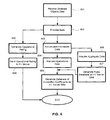
- FIG. 4 illustrates a process of generating ratings, in accordance with the exemplary embodiment.
- the AV module 110 scans user computer 100 ( FIG. 1 ).
- the AV module 110 checks running processes 140 in order to determine malware objects that instantiated these processes.
- the basic coefficient (associated with the rule) affects the rating set by this rule.
- a resulting (i.e., aggregate) rating is generated taking into account correction coefficients 504-506 that assist in changing the rating of a particular rule in an efficient manner.
- the aggregate rating is also affected by a static rating 508.
- the static rating 508 is determined by the AV module 110 at the initial analysis of object's parameters (i.e., such as, object attributes, location, size, type, etc.).
- the AV module 110 produces the static rating based on the static parameters (i.e., file attributes).
- a current (operational) rating 509 received from the AV server 160 is used together with the static rating 508.
- the current rating 509 provides a more general interpretation of a threat presented by a suspect object, because the current rating 509 is generated based on object's data received from the AV means located on several user computers. Use of the current (operational) rating in AV processing is more effective. Therefore, a current rating is used whenever possible, while static rating is disregarded.
- Each rule makes an input into ultimate malware detection.
- the input from each rule consists of two components: basic coefficient R and correction coefficient K.
- the inputs from each rule are summed up and combined with the static rating 508 or the current rating 509 to create an aggregate process rating 507.
- the AV module 110 sends the data related to the process to AV server 160.
- a predetermined threshold i.e. a danger threshold 1150 or a safety threshold 1140
- a danger threshold 1150 If the aggregate process rating exceeds a danger threshold 1150 (see FIG. 9 ), the process is dangerous and the corresponding object is malware.
- the danger threshold is fixed (greater than 75%, for example).
- the safety threshold is also fixed and could be less than 50% (for example). Suspect objects thresholds are between these thresholds.
- the rules typically define a percentage-based rating for a particular process. For instance, a particular rule is triggered, and it gives a 20% rating to a process.
- the coefficient will affect the rating (for example, in the range of 0 to 5).
- a safety threshold 1140 If a safety threshold 1140 is not reached, an object is considered “clean.” If the aggregate rating falls between the thresholds 1140 and 1150, the object is considered suspicious.
- the correction coefficients 504-506 change the rating set by a particular rule. Therefore, if a rule is triggered by malware objects that do not have a rating reaching the threshold, the coefficient of this rule can be increased. Then, the input of this rule into the aggregate rating 507 is increased. Consequently, a number of detected malware objects is increased by the objects that previously had lower rating and had been detected only as suspicious. A number of detected malware objects also increases as the rules database is updated (when basic coefficient or rule structure are changed). In this case, the rating R set by the rule is corrected so that the rule provides a larger input when triggered by the malware objects.
- the coefficients are determined based on results of the statistics, received when working with the particular rule and the selected coefficient.
- the coefficient of this rule can be reduced. Note that in this case, the coefficient changes, while the rule itself can remain the same, since it is sufficient to update just the coefficients database to effect the changes. Thus, the input of this rule into the aggregate rating 507 is minimized and a number of false-positives caused by this rule are reduced. Use of the correction coefficients on the entire set of rules reduces the overall number of false-positives in the AV system.
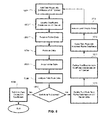
- FIG. 5 illustrates a block diagram of an AV processing algorithm based on process rating, in accordance with the exemplary embodiment.
- the databases of correction coefficients and rules are updated on a user side in step 601.
- a process is launched in step 602 and the process rating is generated in step 603. If it is determined in step 604 that the process rating exceeds the safety threshold, the process-related data is sent to the AV server in step 605. Otherwise, execution of the process is continued in step 609.
- step 606 If, in step 606, it is determined that the process rating exceeds the danger threshold, the process-related data is sent to the AV server in step 607 (for example, a checksum 421 of an object, an aggregate rating 422, a number of a triggered rule 423 that worked for the object defined by the checksum 421 and rating 424 set by the rule 423). After that the process is blocked in step 608. Otherwise, the analysis of the process is completed.
- the process-related data is sent to the AV server in step 607 (for example, a checksum 421 of an object, an aggregate rating 422, a number of a triggered rule 423 that worked for the object defined by the checksum 421 and rating 424 set by the rule 423). After that the process is blocked in step 608. Otherwise, the analysis of the process is completed.
- FIG. 6 illustrates a block diagram of an algorithm for minimization of false-positive determination and for optimization of malware detection, in accordance with the exemplary embodiment.
- the AV server receives data about the objects identified by the AV software 110.
- the received data is processed and is structured in a manner that is convenient for subsequent processing by the module 220.
- the processed data is stored. With some periodicity, e.g., once every few hours, the analysis module 230 analyzes the collected data in step 804, after which the coefficients database is formed in step 805.
- the analysis module 230 in step 806, analyzes the data collected over a longer period of time, for example, a week.
- the rules database is formed on the basis of this analysis in step 807.
- the analysis module 230 renews the database of correction coefficients. At this point, the database of correction coefficients and a database of rules are both ready for loading and updates.
- the rating generation module 320 receives from the report generation unit 210 a control sum or a hash value of the object being examined.
- the current (operational) rating is formed based on the control sum/hash value, and is sent to the AV module on the user side, in step 809.
- FIG. 7 illustrates a block diagram of an algorithm for testing detection rules, in accordance with the exemplary embodiment.
- the database of correction coefficients and rules on the user side is updated in step 701.
- a process is launched in step 702 and the process is checked against the rules in step 703. If the test rule triggered on the process in step 704, in step 705 the rule data is sent to the AV server for further analysis. Otherwise, the process execution is continued in step 706.
- the following data is sent: a checksum 421 of an object, an aggregate rating 422, a number of a triggered rule 423 that worked for the object defined by the checksum 421 and rating 424 set by the rule 423.
- the rules being tested have a zero correction coefficient, therefore, they do not affect the aggregate rating.
- FIG. 8 illustrates a block diagram of an algorithm for automated correction of rules, in accordance with the exemplary embodiment.
- a test rule is added into a database on the AV server.
- the coefficient database is updated on the AV server in step 1002.
- the correct rules data is received in step 1003 and processed in step 1004.
- the rule's data is accumulated in step 1005 and analyzed in step 1006. If, in step 1007, it is determined that a test rule is correct, a non-zero correction coefficient is set for this rule in step 1008.
- step 1010 the test rule is deleted from the rules database on the AV server. Then, the corresponding coefficient is deleted from the coefficients database on the AV server in step 1011. The test rule is saved into the incorrect rules database 270 in step 1012. In step 1013, the test rule is reviewed (by an expert) and modified. Then, in step 1001 the modified rule is added to the rules database 260 for further testing.
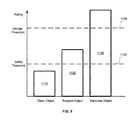
- FIG. 9 illustrates classification of c homeed objects based on rating, in accordance with the exemplary embodiment.
- the safety threshold 1140 There are two predetermined thresholds: the safety threshold 1140 and the danger threshold 1150. Three situations are possible: process rating is less than a safety threshold 1140 and an object 1110 is considered "clean"; process rating exceeds the safety threshold 1140 but does not reach a danger threshold 1150 and an object 1120 is considered suspicious; and process rating exceeds the danger threshold 1150 and an object 1130 is considered dangerous (i.e., malicious).
- the safety threshold 1140 is set depending on the danger threshold 1150 and can be, for example, at 50% of the danger threshold 1150.
- the boundaries are typically fixed, what changes is the rating coefficients and the rules.
- the objects are divided into three groups. Based on the actions they attempt during the process execution: malicious, clean, and suspicious.
- the danger threshold has a particular value (for example, 75%), which defines all malicious objects for which the rule is triggered.
- the anger threshold is selected based on the ratings of the rules that are triggered for the malicious objects.
- a similar concept applies to clean objects. All ratings below the safety threshold (e.g., 50%) define clean objects, and the safety threshold is thereby derived.
- the coefficients and ratings change, to ensure that false-positives and false-negatives are minimized.
- the preferred embodiment is directed to analyzing the suspicious objects that can be malware object despite their relatively low ratings.
- an exemplary system for implementing the invention includes a general purpose computing device in the form of a computer or server 100 or the like, including a processing unit 21, a system memory 22, and a system bus 23 that couples various system components including the system memory to the processing unit 21.
- the system bus 23 may be any of several types of bus structures including a memory bus or memory controller, a peripheral bus, and a local bus using any of a variety of bus architectures.
- the system memory includes read-only memory (ROM) 24 and random access memory (RAM) 25.
- ROM read-only memory
- RAM random access memory
- the computer 100 may further include a hard disk drive 27 for reading from and writing to a hard disk, not shown, a magnetic disk drive 28 for reading from or writing to a removable magnetic disk 29 , and an optical disk drive 30 for reading from or writing to a removable optical disk 31 such as a CD-ROM, DVD-ROM or other optical media.
- a hard disk drive 27 for reading from and writing to a hard disk, not shown
- a magnetic disk drive 28 for reading from or writing to a removable magnetic disk 29
- an optical disk drive 30 for reading from or writing to a removable optical disk 31 such as a CD-ROM, DVD-ROM or other optical media.
- the hard disk drive 27 , magnetic disk drive 28 , and optical disk drive 30 are connected to the system bus 23 by a hard disk drive interface 32, a magnetic disk drive interface 33 , and an optical drive interface 34 , respectively.
- the drives and their associated computer-readable media provide non-volatile storage of computer readable instructions, data structures, program modules and other data for the computer 100.
- exemplary environment described herein employs a hard disk, a removable magnetic disk 29 and a removable optical disk 31, it should be appreciated by those skilled in the art that other types of computer readable media that can store data that is accessible by a computer, such as magnetic cassettes, flash memory cards, digital video disks, Bernoulli cartridges, random access memories (RAMs), read-only memories (ROMs) and the like may also be used in the exemplary operating environment.
- RAMs random access memories
- ROMs read-only memories
- a number of program modules may be stored on the hard disk, magnetic disk 29, optical disk 31, ROM 24 or RAM 25, including an operating system 35.
- the computer 100 includes a file system 36 associated with or included within the operating system 35, one or more application programs 37, other program modules 38 and program data 39.
- a user may enter commands and information into the computer 100 through input devices such as a keyboard 40 and pointing device 42.
- Other input devices may include a microphone, joystick, game pad, satellite dish, scanner or the like.
- serial port interface 46 that is coupled to the system bus, but may be connected by other interfaces, such as a parallel port, game port or universal serial bus (USB).
- a monitor 47 or other type of display device is also connected to the system bus 23 via an interface, such as a video adapter 48.
- computers typically include other peripheral output devices (not shown), such as speakers and printers.
- the computer 100 may operate in a networked environment using logical connections to one or more remote computers 49 .
- the remote computer (or computers) 49 may be another computer, a server, a router, a network PC, a peer device or other common network node, and typically includes many or all of the elements described above relative to the computer 100 , although only a memory storage device 50 has been illustrated.
- the logical connections include a local area network (LAN) 51 and a wide area network (WAN) 52 .
- LAN local area network
- WAN wide area network
- the computer 100 When used in a LAN networking environment, the computer 100 is connected to the local network 51 through a network interface or adapter 53. When used in a WAN networking environment, the computer 100 typically includes a modem 54 or other means for establishing communications over the wide area network 52, such as the Internet.
- the modem 54 which may be internal or external, is connected to the system bus 23 via the serial port interface 46.
- program modules depicted relative to the computer 100, or portions thereof may be stored in the remote memory storage device. It will be appreciated that the network connections shown are exemplary and other means of establishing a communications link between the computers may be used.
Landscapes
- Engineering & Computer Science (AREA)
- Computer Security & Cryptography (AREA)
- Software Systems (AREA)
- Computer Hardware Design (AREA)
- General Engineering & Computer Science (AREA)
- Theoretical Computer Science (AREA)
- Virology (AREA)
- Health & Medical Sciences (AREA)
- Physics & Mathematics (AREA)
- General Physics & Mathematics (AREA)
- General Health & Medical Sciences (AREA)
- Management, Administration, Business Operations System, And Electronic Commerce (AREA)
- Storage Device Security (AREA)
- Information Retrieval, Db Structures And Fs Structures Therefor (AREA)
Applications Claiming Priority (1)
| Application Number | Priority Date | Filing Date | Title |
|---|---|---|---|
| US12/978,453 US8640245B2 (en) | 2010-12-24 | 2010-12-24 | Optimization of anti-malware processing by automated correction of detection rules |
Publications (2)
| Publication Number | Publication Date |
|---|---|
| EP2469445A1 true EP2469445A1 (de) | 2012-06-27 |
| EP2469445B1 EP2469445B1 (de) | 2014-07-30 |
Family
ID=44778742
Family Applications (1)
| Application Number | Title | Priority Date | Filing Date |
|---|---|---|---|
| EP11161997.9A Active EP2469445B1 (de) | 2010-12-24 | 2011-04-12 | Optimierung von Anti-Malware-Verarbeitung durch automatische Korrektur von Erkennungsregeln |
Country Status (3)
| Country | Link |
|---|---|
| US (1) | US8640245B2 (de) |
| EP (1) | EP2469445B1 (de) |
| CN (1) | CN102222192B (de) |
Cited By (6)
| Publication number | Priority date | Publication date | Assignee | Title |
|---|---|---|---|---|
| WO2015105758A1 (en) * | 2014-01-13 | 2015-07-16 | Cisco Technology, Inc. | Dynamic filtering for sdn api calls across a security boundary |
| EP2940957A1 (de) * | 2014-04-28 | 2015-11-04 | Baidu Online Network Technology (Beijing) Co., Ltd | Verfahren, Vorrichtung und System zur Detektion bösartigen Prozessverhaltens |
| EP3077944A4 (de) * | 2013-12-02 | 2017-07-12 | Intel Corporation | Schutzsystem mit sicherheitsregelauswertung |
| CN107317799A (zh) * | 2017-05-26 | 2017-11-03 | 北京金山安全管理系统技术有限公司 | 病毒预警处理方法及装置 |
| EP4060534A1 (de) * | 2021-03-15 | 2022-09-21 | AO Kaspersky Lab | Systeme und verfahren zur modifizierung einer regel zur detektion von bösartigem code |
| CN115309785A (zh) * | 2022-08-08 | 2022-11-08 | 北京百度网讯科技有限公司 | 文件规则引擎库的生成、文件信息检测方法、装置及设备 |
Families Citing this family (45)
| Publication number | Priority date | Publication date | Assignee | Title |
|---|---|---|---|---|
| RU2487405C1 (ru) * | 2011-11-24 | 2013-07-10 | Закрытое акционерное общество "Лаборатория Касперского" | Система и способ для исправления антивирусных записей |
| US9202047B2 (en) | 2012-05-14 | 2015-12-01 | Qualcomm Incorporated | System, apparatus, and method for adaptive observation of mobile device behavior |
| US9747440B2 (en) | 2012-08-15 | 2017-08-29 | Qualcomm Incorporated | On-line behavioral analysis engine in mobile device with multiple analyzer model providers |
| US9319897B2 (en) | 2012-08-15 | 2016-04-19 | Qualcomm Incorporated | Secure behavior analysis over trusted execution environment |
| US9256511B2 (en) * | 2012-09-04 | 2016-02-09 | International Business Machines Corporation | Computer software application self-testing |
| CN103780589A (zh) * | 2012-10-24 | 2014-05-07 | 腾讯科技(深圳)有限公司 | 病毒提示方法、客户端设备和服务器 |
| US8914886B2 (en) * | 2012-10-29 | 2014-12-16 | Mcafee, Inc. | Dynamic quarantining for malware detection |
| US9792432B2 (en) * | 2012-11-09 | 2017-10-17 | Nokia Technologies Oy | Method and apparatus for privacy-oriented code optimization |
| US10089582B2 (en) | 2013-01-02 | 2018-10-02 | Qualcomm Incorporated | Using normalized confidence values for classifying mobile device behaviors |
| US9742559B2 (en) | 2013-01-22 | 2017-08-22 | Qualcomm Incorporated | Inter-module authentication for securing application execution integrity within a computing device |
| CN105074718A (zh) * | 2013-02-15 | 2015-11-18 | 高通股份有限公司 | 具有多个分析仪模型提供商的移动设备中的在线行为分析引擎 |
| US9858413B1 (en) * | 2013-07-03 | 2018-01-02 | Trend Micro Inc. | Reduction of false positives in malware detection using file property analysis |
| RU2568285C2 (ru) | 2013-09-30 | 2015-11-20 | Закрытое акционерное общество "Лаборатория Касперского" | Способ и система анализа работы правил обнаружения программного обеспечения |
| EP2854065B1 (de) * | 2013-09-30 | 2018-06-06 | AO Kaspersky Lab | System und Verfahren zur Bewertung von Malware-Erkennungsregeln |
| CN103618626A (zh) * | 2013-11-28 | 2014-03-05 | 北京奇虎科技有限公司 | 一种基于日志的安全分析报告生成的方法和系统 |
| RU2587429C2 (ru) | 2013-12-05 | 2016-06-20 | Закрытое акционерное общество "Лаборатория Касперского" | Система и способ оценки надежности правила категоризации |
| CN103824020B (zh) * | 2014-02-20 | 2017-10-24 | 北京深思数盾科技股份有限公司 | 自动实现软件程序免杀的方法 |
| EP3099024B1 (de) * | 2014-03-19 | 2019-01-02 | Nippon Telegraph and Telephone Corporation | Vorrichtung zur anpassung von analyseregeln , system zur anpassung von analyseregeln, verfahren zur anpassung von analyseregeln und programm zur anpassung von analyseregeln |
| US9591015B1 (en) | 2014-03-28 | 2017-03-07 | Fireeye, Inc. | System and method for offloading packet processing and static analysis operations |
| US9734450B2 (en) * | 2014-06-05 | 2017-08-15 | Lenovo Enterprise Solutions (Singapore) Pte. Ltd. | Data loss prevention to remove false positives |
| US10805340B1 (en) | 2014-06-26 | 2020-10-13 | Fireeye, Inc. | Infection vector and malware tracking with an interactive user display |
| US9465939B2 (en) | 2014-06-27 | 2016-10-11 | Mcafee, Inc. | Mitigation of malware |
| CN104091071B (zh) * | 2014-07-09 | 2017-11-07 | 北京智谷睿拓技术服务有限公司 | 应用程序的风险确定方法及确定装置 |
| US9690933B1 (en) * | 2014-12-22 | 2017-06-27 | Fireeye, Inc. | Framework for classifying an object as malicious with machine learning for deploying updated predictive models |
| US10834109B2 (en) * | 2014-12-23 | 2020-11-10 | Mcafee, Llc | Determining a reputation for a process |
| US9838417B1 (en) | 2014-12-30 | 2017-12-05 | Fireeye, Inc. | Intelligent context aware user interaction for malware detection |
| US10148693B2 (en) | 2015-03-25 | 2018-12-04 | Fireeye, Inc. | Exploit detection system |
| US10075454B1 (en) * | 2015-03-31 | 2018-09-11 | Symantec Corporation | Using telemetry data to detect false positives |
| CN105187394B (zh) * | 2015-08-10 | 2018-01-12 | 济南大学 | 具有移动终端恶意软件行为检测能力的代理服务器及方法 |
| US10021120B1 (en) | 2015-11-09 | 2018-07-10 | 8X8, Inc. | Delayed replication for protection of replicated databases |
| US10043026B1 (en) | 2015-11-09 | 2018-08-07 | 8X8, Inc. | Restricted replication for protection of replicated databases |
| US10248788B2 (en) * | 2016-06-28 | 2019-04-02 | International Business Machines Corporation | Detecting harmful applications prior to installation on a user device |
| US10489589B2 (en) | 2016-11-21 | 2019-11-26 | Cylance Inc. | Anomaly based malware detection |
| US10243989B1 (en) * | 2017-07-27 | 2019-03-26 | Trend Micro Incorporated | Systems and methods for inspecting emails for malicious content |
| US11003773B1 (en) * | 2018-03-30 | 2021-05-11 | Fireeye, Inc. | System and method for automatically generating malware detection rule recommendations |
| CN109815697B (zh) * | 2018-12-29 | 2021-04-27 | 360企业安全技术(珠海)有限公司 | 误报行为处理方法及装置 |
| US11550910B2 (en) | 2019-09-30 | 2023-01-10 | AVAST Software s.r.o. | Creating generic rules in a high dimensional sparse feature space using negative feedback |
| US20220292198A1 (en) * | 2021-03-15 | 2022-09-15 | AO Kaspersky Lab | Systems and methods for modifying a malicious code detection rule |
| US11909773B2 (en) | 2021-04-02 | 2024-02-20 | Target Brands, Inc. | Continuous improvement of security detection rules |
| US12218962B2 (en) | 2021-12-09 | 2025-02-04 | Netflow, UAB | Adaptive online service access control |
| US12348533B2 (en) * | 2021-12-09 | 2025-07-01 | Netflow, UAB | Adaptive online system access control |
| CN115225370B (zh) * | 2022-07-18 | 2023-11-10 | 北京天融信网络安全技术有限公司 | 一种规则库优化方法、装置、电子设备及存储介质 |
| CN115277224A (zh) * | 2022-07-29 | 2022-11-01 | 北京天融信网络安全技术有限公司 | 确定应用防护规则的方法、装置、存储介质及电子设备 |
| CN116932697B (zh) * | 2023-08-02 | 2025-09-02 | 中国平安财产保险股份有限公司 | 一种基于规则引擎优化的业务数据处理方法及相关设备 |
| JP7651633B2 (ja) * | 2023-09-01 | 2025-03-26 | キヤノン株式会社 | 情報処理装置、情報処理方法およびプログラム |
Citations (7)
| Publication number | Priority date | Publication date | Assignee | Title |
|---|---|---|---|---|
| US20030065926A1 (en) * | 2001-07-30 | 2003-04-03 | Schultz Matthew G. | System and methods for detection of new malicious executables |
| US20070143851A1 (en) * | 2005-12-21 | 2007-06-21 | Fiberlink | Method and systems for controlling access to computing resources based on known security vulnerabilities |
| US20070220043A1 (en) * | 2006-03-17 | 2007-09-20 | Pc Tools Technology Pty Limited | Determination of related entities |
| US20070300286A1 (en) * | 2002-03-08 | 2007-12-27 | Secure Computing Corporation | Systems and methods for message threat management |
| US20070300300A1 (en) * | 2006-06-27 | 2007-12-27 | Matsushita Electric Industrial Co., Ltd. | Statistical instrusion detection using log files |
| US7530106B1 (en) | 2008-07-02 | 2009-05-05 | Kaspersky Lab, Zao | System and method for security rating of computer processes |
| US7640589B1 (en) * | 2009-06-19 | 2009-12-29 | Kaspersky Lab, Zao | Detection and minimization of false positives in anti-malware processing |
Family Cites Families (15)
| Publication number | Priority date | Publication date | Assignee | Title |
|---|---|---|---|---|
| CA2279134A1 (en) | 1999-07-29 | 2001-01-29 | Tianmin Liu | Novel strategy for carbohydrate-based therapeutic vaccines |
| US7231637B1 (en) * | 2001-07-26 | 2007-06-12 | Mcafee, Inc. | Security and software testing of pre-release anti-virus updates on client and transmitting the results to the server |
| US7290282B1 (en) | 2002-04-08 | 2007-10-30 | Symantec Corporation | Reducing false positive computer virus detections |
| US6868865B2 (en) | 2002-04-12 | 2005-03-22 | Control Components, Inc. | Rotary drag valve |
| US7237008B1 (en) | 2002-05-10 | 2007-06-26 | Mcafee, Inc. | Detecting malware carried by an e-mail message |
| US7370361B2 (en) | 2004-02-06 | 2008-05-06 | Trend Micro Incorporated | System and method for securing computers against computer virus |
| US7334005B2 (en) * | 2005-04-13 | 2008-02-19 | Symantec Corporation | Controllable deployment of software updates |
| CN100490392C (zh) * | 2006-04-19 | 2009-05-20 | 腾讯科技(深圳)有限公司 | 一种垃圾邮件处理系统及分检垃圾邮件的方法 |
| US7953969B2 (en) * | 2007-04-16 | 2011-05-31 | Microsoft Corporation | Reduction of false positive reputations through collection of overrides from customer deployments |
| US8087086B1 (en) * | 2008-06-30 | 2011-12-27 | Symantec Corporation | Method for mitigating false positive generation in antivirus software |
| US8931086B2 (en) * | 2008-09-26 | 2015-01-06 | Symantec Corporation | Method and apparatus for reducing false positive detection of malware |
| US8356354B2 (en) * | 2009-11-23 | 2013-01-15 | Kaspersky Lab, Zao | Silent-mode signature testing in anti-malware processing |
| US8719935B2 (en) * | 2010-01-08 | 2014-05-06 | Microsoft Corporation | Mitigating false positives in malware detection |
| US8584235B2 (en) * | 2011-11-02 | 2013-11-12 | Bitdefender IPR Management Ltd. | Fuzzy whitelisting anti-malware systems and methods |
| RU2487405C1 (ru) * | 2011-11-24 | 2013-07-10 | Закрытое акционерное общество "Лаборатория Касперского" | Система и способ для исправления антивирусных записей |
-
2010
- 2010-12-24 US US12/978,453 patent/US8640245B2/en active Active
-
2011
- 2011-04-12 EP EP11161997.9A patent/EP2469445B1/de active Active
- 2011-06-23 CN CN201110171270.5A patent/CN102222192B/zh active Active
Patent Citations (7)
| Publication number | Priority date | Publication date | Assignee | Title |
|---|---|---|---|---|
| US20030065926A1 (en) * | 2001-07-30 | 2003-04-03 | Schultz Matthew G. | System and methods for detection of new malicious executables |
| US20070300286A1 (en) * | 2002-03-08 | 2007-12-27 | Secure Computing Corporation | Systems and methods for message threat management |
| US20070143851A1 (en) * | 2005-12-21 | 2007-06-21 | Fiberlink | Method and systems for controlling access to computing resources based on known security vulnerabilities |
| US20070220043A1 (en) * | 2006-03-17 | 2007-09-20 | Pc Tools Technology Pty Limited | Determination of related entities |
| US20070300300A1 (en) * | 2006-06-27 | 2007-12-27 | Matsushita Electric Industrial Co., Ltd. | Statistical instrusion detection using log files |
| US7530106B1 (en) | 2008-07-02 | 2009-05-05 | Kaspersky Lab, Zao | System and method for security rating of computer processes |
| US7640589B1 (en) * | 2009-06-19 | 2009-12-29 | Kaspersky Lab, Zao | Detection and minimization of false positives in anti-malware processing |
Non-Patent Citations (2)
| Title |
|---|
| DRAGOS GAVRILUT ET AL: "Malware detection using machine learning", COMPUTER SCIENCE AND INFORMATION TECHNOLOGY, 2009. IMCSIT '09. INTERNATIONAL MULTICONFERENCE ON, IEEE, PISCATAWAY, NJ, USA, 12 October 2009 (2009-10-12), pages 735 - 741, XP031579927, ISBN: 978-1-4244-5314-6 * |
| LUNT T F ET AL: "Knowledge-based intrusion detection", AI SYSTEMS IN GOVERNMENT CONFERENCE, 1989.,PROCEEDINGS OF THE ANNUAL WASHINGTON, DC, USA 27-31 MARCH 1989, WASHINGTON, DC, USA,IEEE COMPUT. SOC. PR, US, 27 March 1989 (1989-03-27), pages 102 - 107, XP010015634, ISBN: 978-0-8186-1934-2, DOI: 10.1109/AISIG.1989.47311 * |
Cited By (10)
| Publication number | Priority date | Publication date | Assignee | Title |
|---|---|---|---|---|
| EP3077944A4 (de) * | 2013-12-02 | 2017-07-12 | Intel Corporation | Schutzsystem mit sicherheitsregelauswertung |
| WO2015105758A1 (en) * | 2014-01-13 | 2015-07-16 | Cisco Technology, Inc. | Dynamic filtering for sdn api calls across a security boundary |
| US9258315B2 (en) | 2014-01-13 | 2016-02-09 | Cisco Technology, Inc. | Dynamic filtering for SDN API calls across a security boundary |
| CN105934927A (zh) * | 2014-01-13 | 2016-09-07 | 思科技术公司 | 针对跨安全边界的sdn api调用的动态过滤 |
| EP2940957A1 (de) * | 2014-04-28 | 2015-11-04 | Baidu Online Network Technology (Beijing) Co., Ltd | Verfahren, Vorrichtung und System zur Detektion bösartigen Prozessverhaltens |
| US9842208B2 (en) | 2014-04-28 | 2017-12-12 | Baidu Online Network Technology (Beijing) Co., Ltd. | Method, apparatus and system for detecting malicious process behavior |
| CN107317799A (zh) * | 2017-05-26 | 2017-11-03 | 北京金山安全管理系统技术有限公司 | 病毒预警处理方法及装置 |
| EP4060534A1 (de) * | 2021-03-15 | 2022-09-21 | AO Kaspersky Lab | Systeme und verfahren zur modifizierung einer regel zur detektion von bösartigem code |
| CN115309785A (zh) * | 2022-08-08 | 2022-11-08 | 北京百度网讯科技有限公司 | 文件规则引擎库的生成、文件信息检测方法、装置及设备 |
| CN115309785B (zh) * | 2022-08-08 | 2023-07-07 | 北京百度网讯科技有限公司 | 文件规则引擎库的生成、文件信息检测方法、装置及设备 |
Also Published As
| Publication number | Publication date |
|---|---|
| US8640245B2 (en) | 2014-01-28 |
| CN102222192A (zh) | 2011-10-19 |
| US20120167219A1 (en) | 2012-06-28 |
| CN102222192B (zh) | 2014-10-15 |
| EP2469445B1 (de) | 2014-07-30 |
Similar Documents
| Publication | Publication Date | Title |
|---|---|---|
| EP2469445B1 (de) | Optimierung von Anti-Malware-Verarbeitung durch automatische Korrektur von Erkennungsregeln | |
| US8356354B2 (en) | Silent-mode signature testing in anti-malware processing | |
| US7640589B1 (en) | Detection and minimization of false positives in anti-malware processing | |
| RU2487405C1 (ru) | Система и способ для исправления антивирусных записей | |
| US7478431B1 (en) | Heuristic detection of computer viruses | |
| US8312546B2 (en) | Systems, apparatus, and methods for detecting malware | |
| US8261344B2 (en) | Method and system for classification of software using characteristics and combinations of such characteristics | |
| US7458099B1 (en) | Selective detection of malicious computer code | |
| US8239944B1 (en) | Reducing malware signature set size through server-side processing | |
| CN102483780B (zh) | 防病毒扫描 | |
| RU2514140C1 (ru) | Система и способ увеличения качества обнаружений вредоносных объектов с использованием правил и приоритетов | |
| US7540030B1 (en) | Method and system for automatic cure against malware | |
| US6785820B1 (en) | System, method and computer program product for conditionally updating a security program | |
| JP5511097B2 (ja) | 中央集中的にマルウェアを検出するための知的ハッシュ | |
| US7725941B1 (en) | Method and system for antimalware scanning with variable scan settings | |
| US7882561B2 (en) | System and method of caching decisions on when to scan for malware | |
| US7231637B1 (en) | Security and software testing of pre-release anti-virus updates on client and transmitting the results to the server | |
| US20070152854A1 (en) | Forgery detection using entropy modeling | |
| GB2400932A (en) | System for checking files for viruses | |
| US20040068663A1 (en) | Performance of malicious computer code detection | |
| RU101233U1 (ru) | Система ограничения прав доступа к ресурсам на основе расчета рейтинга опасности | |
| EP4060534B1 (de) | Systeme und verfahren zur modifizierung einer regel zur detektion von bösartigem code | |
| RU107615U1 (ru) | Система уменьшения количества ложных срабатываний антивирусной системы | |
| RU101224U1 (ru) | Система выявления и минимизации риска ложных срабатываний | |
| RU108870U1 (ru) | Система увеличения количества обнаружений вредоносных объектов |
Legal Events
| Date | Code | Title | Description |
|---|---|---|---|
| 17P | Request for examination filed |
Effective date: 20110412 |
|
| AK | Designated contracting states |
Kind code of ref document: A1 Designated state(s): AL AT BE BG CH CY CZ DE DK EE ES FI FR GB GR HR HU IE IS IT LI LT LU LV MC MK MT NL NO PL PT RO RS SE SI SK SM TR |
|
| AX | Request for extension of the european patent |
Extension state: BA ME |
|
| PUAI | Public reference made under article 153(3) epc to a published international application that has entered the european phase |
Free format text: ORIGINAL CODE: 0009012 |
|
| 17Q | First examination report despatched |
Effective date: 20120919 |
|
| RAP1 | Party data changed (applicant data changed or rights of an application transferred) |
Owner name: KASPERSKY LAB, ZAO |
|
| REG | Reference to a national code |
Ref country code: DE Ref legal event code: R079 Ref document number: 602011008676 Country of ref document: DE Free format text: PREVIOUS MAIN CLASS: G06F0021000000 Ipc: G06F0021560000 |
|
| GRAP | Despatch of communication of intention to grant a patent |
Free format text: ORIGINAL CODE: EPIDOSNIGR1 |
|
| RIC1 | Information provided on ipc code assigned before grant |
Ipc: G06F 21/56 20130101AFI20140120BHEP |
|
| INTG | Intention to grant announced |
Effective date: 20140226 |
|
| GRAS | Grant fee paid |
Free format text: ORIGINAL CODE: EPIDOSNIGR3 |
|
| GRAA | (expected) grant |
Free format text: ORIGINAL CODE: 0009210 |
|
| AK | Designated contracting states |
Kind code of ref document: B1 Designated state(s): AL AT BE BG CH CY CZ DE DK EE ES FI FR GB GR HR HU IE IS IT LI LT LU LV MC MK MT NL NO PL PT RO RS SE SI SK SM TR |
|
| AX | Request for extension of the european patent |
Extension state: BA ME |
|
| REG | Reference to a national code |
Ref country code: GB Ref legal event code: FG4D |
|
| REG | Reference to a national code |
Ref country code: CH Ref legal event code: EP |
|
| REG | Reference to a national code |
Ref country code: AT Ref legal event code: REF Ref document number: 680276 Country of ref document: AT Kind code of ref document: T Effective date: 20140815 |
|
| REG | Reference to a national code |
Ref country code: IE Ref legal event code: FG4D |
|
| REG | Reference to a national code |
Ref country code: DE Ref legal event code: R096 Ref document number: 602011008676 Country of ref document: DE Effective date: 20140911 |
|
| REG | Reference to a national code |
Ref country code: AT Ref legal event code: MK05 Ref document number: 680276 Country of ref document: AT Kind code of ref document: T Effective date: 20140730 |
|
| REG | Reference to a national code |
Ref country code: NL Ref legal event code: VDEP Effective date: 20140730 |
|
| REG | Reference to a national code |
Ref country code: LT Ref legal event code: MG4D |
|
| PG25 | Lapsed in a contracting state [announced via postgrant information from national office to epo] |
Ref country code: GR Free format text: LAPSE BECAUSE OF FAILURE TO SUBMIT A TRANSLATION OF THE DESCRIPTION OR TO PAY THE FEE WITHIN THE PRESCRIBED TIME-LIMIT Effective date: 20141031 Ref country code: BG Free format text: LAPSE BECAUSE OF FAILURE TO SUBMIT A TRANSLATION OF THE DESCRIPTION OR TO PAY THE FEE WITHIN THE PRESCRIBED TIME-LIMIT Effective date: 20141030 Ref country code: ES Free format text: LAPSE BECAUSE OF FAILURE TO SUBMIT A TRANSLATION OF THE DESCRIPTION OR TO PAY THE FEE WITHIN THE PRESCRIBED TIME-LIMIT Effective date: 20140730 Ref country code: FI Free format text: LAPSE BECAUSE OF FAILURE TO SUBMIT A TRANSLATION OF THE DESCRIPTION OR TO PAY THE FEE WITHIN THE PRESCRIBED TIME-LIMIT Effective date: 20140730 Ref country code: NO Free format text: LAPSE BECAUSE OF FAILURE TO SUBMIT A TRANSLATION OF THE DESCRIPTION OR TO PAY THE FEE WITHIN THE PRESCRIBED TIME-LIMIT Effective date: 20141030 Ref country code: PT Free format text: LAPSE BECAUSE OF FAILURE TO SUBMIT A TRANSLATION OF THE DESCRIPTION OR TO PAY THE FEE WITHIN THE PRESCRIBED TIME-LIMIT Effective date: 20141202 Ref country code: LT Free format text: LAPSE BECAUSE OF FAILURE TO SUBMIT A TRANSLATION OF THE DESCRIPTION OR TO PAY THE FEE WITHIN THE PRESCRIBED TIME-LIMIT Effective date: 20140730 Ref country code: SE Free format text: LAPSE BECAUSE OF FAILURE TO SUBMIT A TRANSLATION OF THE DESCRIPTION OR TO PAY THE FEE WITHIN THE PRESCRIBED TIME-LIMIT Effective date: 20140730 |
|
| PG25 | Lapsed in a contracting state [announced via postgrant information from national office to epo] |
Ref country code: IS Free format text: LAPSE BECAUSE OF FAILURE TO SUBMIT A TRANSLATION OF THE DESCRIPTION OR TO PAY THE FEE WITHIN THE PRESCRIBED TIME-LIMIT Effective date: 20141130 Ref country code: RS Free format text: LAPSE BECAUSE OF FAILURE TO SUBMIT A TRANSLATION OF THE DESCRIPTION OR TO PAY THE FEE WITHIN THE PRESCRIBED TIME-LIMIT Effective date: 20140730 Ref country code: CY Free format text: LAPSE BECAUSE OF FAILURE TO SUBMIT A TRANSLATION OF THE DESCRIPTION OR TO PAY THE FEE WITHIN THE PRESCRIBED TIME-LIMIT Effective date: 20140730 Ref country code: NL Free format text: LAPSE BECAUSE OF FAILURE TO SUBMIT A TRANSLATION OF THE DESCRIPTION OR TO PAY THE FEE WITHIN THE PRESCRIBED TIME-LIMIT Effective date: 20140730 Ref country code: LV Free format text: LAPSE BECAUSE OF FAILURE TO SUBMIT A TRANSLATION OF THE DESCRIPTION OR TO PAY THE FEE WITHIN THE PRESCRIBED TIME-LIMIT Effective date: 20140730 Ref country code: PL Free format text: LAPSE BECAUSE OF FAILURE TO SUBMIT A TRANSLATION OF THE DESCRIPTION OR TO PAY THE FEE WITHIN THE PRESCRIBED TIME-LIMIT Effective date: 20140730 Ref country code: AT Free format text: LAPSE BECAUSE OF FAILURE TO SUBMIT A TRANSLATION OF THE DESCRIPTION OR TO PAY THE FEE WITHIN THE PRESCRIBED TIME-LIMIT Effective date: 20140730 Ref country code: HR Free format text: LAPSE BECAUSE OF FAILURE TO SUBMIT A TRANSLATION OF THE DESCRIPTION OR TO PAY THE FEE WITHIN THE PRESCRIBED TIME-LIMIT Effective date: 20140730 |
|
| REG | Reference to a national code |
Ref country code: FR Ref legal event code: PLFP Year of fee payment: 5 |
|
| PG25 | Lapsed in a contracting state [announced via postgrant information from national office to epo] |
Ref country code: SK Free format text: LAPSE BECAUSE OF FAILURE TO SUBMIT A TRANSLATION OF THE DESCRIPTION OR TO PAY THE FEE WITHIN THE PRESCRIBED TIME-LIMIT Effective date: 20140730 Ref country code: RO Free format text: LAPSE BECAUSE OF FAILURE TO SUBMIT A TRANSLATION OF THE DESCRIPTION OR TO PAY THE FEE WITHIN THE PRESCRIBED TIME-LIMIT Effective date: 20140730 Ref country code: IT Free format text: LAPSE BECAUSE OF FAILURE TO SUBMIT A TRANSLATION OF THE DESCRIPTION OR TO PAY THE FEE WITHIN THE PRESCRIBED TIME-LIMIT Effective date: 20140730 Ref country code: EE Free format text: LAPSE BECAUSE OF FAILURE TO SUBMIT A TRANSLATION OF THE DESCRIPTION OR TO PAY THE FEE WITHIN THE PRESCRIBED TIME-LIMIT Effective date: 20140730 Ref country code: CZ Free format text: LAPSE BECAUSE OF FAILURE TO SUBMIT A TRANSLATION OF THE DESCRIPTION OR TO PAY THE FEE WITHIN THE PRESCRIBED TIME-LIMIT Effective date: 20140730 Ref country code: DK Free format text: LAPSE BECAUSE OF FAILURE TO SUBMIT A TRANSLATION OF THE DESCRIPTION OR TO PAY THE FEE WITHIN THE PRESCRIBED TIME-LIMIT Effective date: 20140730 |
|
| REG | Reference to a national code |
Ref country code: DE Ref legal event code: R097 Ref document number: 602011008676 Country of ref document: DE |
|
| PLBE | No opposition filed within time limit |
Free format text: ORIGINAL CODE: 0009261 |
|
| STAA | Information on the status of an ep patent application or granted ep patent |
Free format text: STATUS: NO OPPOSITION FILED WITHIN TIME LIMIT |
|
| 26N | No opposition filed |
Effective date: 20150504 |
|
| PG25 | Lapsed in a contracting state [announced via postgrant information from national office to epo] |
Ref country code: LU Free format text: LAPSE BECAUSE OF FAILURE TO SUBMIT A TRANSLATION OF THE DESCRIPTION OR TO PAY THE FEE WITHIN THE PRESCRIBED TIME-LIMIT Effective date: 20150412 Ref country code: SI Free format text: LAPSE BECAUSE OF FAILURE TO SUBMIT A TRANSLATION OF THE DESCRIPTION OR TO PAY THE FEE WITHIN THE PRESCRIBED TIME-LIMIT Effective date: 20140730 Ref country code: MC Free format text: LAPSE BECAUSE OF FAILURE TO SUBMIT A TRANSLATION OF THE DESCRIPTION OR TO PAY THE FEE WITHIN THE PRESCRIBED TIME-LIMIT Effective date: 20140730 |
|
| REG | Reference to a national code |
Ref country code: CH Ref legal event code: PL |
|
| REG | Reference to a national code |
Ref country code: IE Ref legal event code: MM4A |
|
| PG25 | Lapsed in a contracting state [announced via postgrant information from national office to epo] |
Ref country code: CH Free format text: LAPSE BECAUSE OF NON-PAYMENT OF DUE FEES Effective date: 20150430 Ref country code: LI Free format text: LAPSE BECAUSE OF NON-PAYMENT OF DUE FEES Effective date: 20150430 |
|
| REG | Reference to a national code |
Ref country code: FR Ref legal event code: PLFP Year of fee payment: 6 |
|
| PG25 | Lapsed in a contracting state [announced via postgrant information from national office to epo] |
Ref country code: IE Free format text: LAPSE BECAUSE OF NON-PAYMENT OF DUE FEES Effective date: 20150412 |
|
| PG25 | Lapsed in a contracting state [announced via postgrant information from national office to epo] |
Ref country code: BE Free format text: LAPSE BECAUSE OF FAILURE TO SUBMIT A TRANSLATION OF THE DESCRIPTION OR TO PAY THE FEE WITHIN THE PRESCRIBED TIME-LIMIT Effective date: 20140730 |
|
| PG25 | Lapsed in a contracting state [announced via postgrant information from national office to epo] |
Ref country code: MT Free format text: LAPSE BECAUSE OF FAILURE TO SUBMIT A TRANSLATION OF THE DESCRIPTION OR TO PAY THE FEE WITHIN THE PRESCRIBED TIME-LIMIT Effective date: 20140730 |
|
| REG | Reference to a national code |
Ref country code: FR Ref legal event code: PLFP Year of fee payment: 7 |
|
| PG25 | Lapsed in a contracting state [announced via postgrant information from national office to epo] |
Ref country code: HU Free format text: LAPSE BECAUSE OF FAILURE TO SUBMIT A TRANSLATION OF THE DESCRIPTION OR TO PAY THE FEE WITHIN THE PRESCRIBED TIME-LIMIT; INVALID AB INITIO Effective date: 20110412 Ref country code: SM Free format text: LAPSE BECAUSE OF FAILURE TO SUBMIT A TRANSLATION OF THE DESCRIPTION OR TO PAY THE FEE WITHIN THE PRESCRIBED TIME-LIMIT Effective date: 20140730 |
|
| PG25 | Lapsed in a contracting state [announced via postgrant information from national office to epo] |
Ref country code: TR Free format text: LAPSE BECAUSE OF FAILURE TO SUBMIT A TRANSLATION OF THE DESCRIPTION OR TO PAY THE FEE WITHIN THE PRESCRIBED TIME-LIMIT Effective date: 20140730 |
|
| REG | Reference to a national code |
Ref country code: FR Ref legal event code: PLFP Year of fee payment: 8 |
|
| PG25 | Lapsed in a contracting state [announced via postgrant information from national office to epo] |
Ref country code: MK Free format text: LAPSE BECAUSE OF FAILURE TO SUBMIT A TRANSLATION OF THE DESCRIPTION OR TO PAY THE FEE WITHIN THE PRESCRIBED TIME-LIMIT Effective date: 20140730 |
|
| PG25 | Lapsed in a contracting state [announced via postgrant information from national office to epo] |
Ref country code: AL Free format text: LAPSE BECAUSE OF FAILURE TO SUBMIT A TRANSLATION OF THE DESCRIPTION OR TO PAY THE FEE WITHIN THE PRESCRIBED TIME-LIMIT Effective date: 20140730 |
|
| PGFP | Annual fee paid to national office [announced via postgrant information from national office to epo] |
Ref country code: FR Payment date: 20250310 Year of fee payment: 15 |
|
| PGFP | Annual fee paid to national office [announced via postgrant information from national office to epo] |
Ref country code: GB Payment date: 20250306 Year of fee payment: 15 |
|
| PGFP | Annual fee paid to national office [announced via postgrant information from national office to epo] |
Ref country code: DE Payment date: 20250305 Year of fee payment: 15 |