EP2468842A1 - Compositions comprising polyglyceryl nonionic surfactants - Google Patents
Compositions comprising polyglyceryl nonionic surfactants Download PDFInfo
- Publication number
- EP2468842A1 EP2468842A1 EP11194609A EP11194609A EP2468842A1 EP 2468842 A1 EP2468842 A1 EP 2468842A1 EP 11194609 A EP11194609 A EP 11194609A EP 11194609 A EP11194609 A EP 11194609A EP 2468842 A1 EP2468842 A1 EP 2468842A1
- Authority
- EP
- European Patent Office
- Prior art keywords
- polyglyceryl
- caprate
- laurate
- composition
- cocoate
- Prior art date
- Legal status (The legal status is an assumption and is not a legal conclusion. Google has not performed a legal analysis and makes no representation as to the accuracy of the status listed.)
- Granted
Links
- 239000000203 mixture Substances 0.000 title claims abstract description 132
- 239000002736 nonionic surfactant Substances 0.000 title claims abstract description 40
- 239000002888 zwitterionic surfactant Substances 0.000 claims abstract description 27
- 239000003945 anionic surfactant Substances 0.000 claims abstract description 26
- 239000000463 material Substances 0.000 claims abstract description 22
- 150000007524 organic acids Chemical class 0.000 claims abstract description 20
- 125000000129 anionic group Chemical group 0.000 claims abstract description 19
- XLYOFNOQVPJJNP-UHFFFAOYSA-N water Substances O XLYOFNOQVPJJNP-UHFFFAOYSA-N 0.000 claims abstract description 15
- 239000003755 preservative agent Substances 0.000 claims abstract description 14
- QAOWNCQODCNURD-UHFFFAOYSA-L Sulfate Chemical compound [O-]S([O-])(=O)=O QAOWNCQODCNURD-UHFFFAOYSA-L 0.000 claims abstract description 13
- 230000002335 preservative effect Effects 0.000 claims abstract description 12
- -1 acyl aspartates Chemical class 0.000 claims description 53
- GHVNFZFCNZKVNT-UHFFFAOYSA-M decanoate Chemical compound CCCCCCCCCC([O-])=O GHVNFZFCNZKVNT-UHFFFAOYSA-M 0.000 claims description 43
- 125000000217 alkyl group Chemical group 0.000 claims description 31
- 229940071160 cocoate Drugs 0.000 claims description 23
- 229940105132 myristate Drugs 0.000 claims description 22
- WWZKQHOCKIZLMA-UHFFFAOYSA-M octanoate Chemical compound CCCCCCCC([O-])=O WWZKQHOCKIZLMA-UHFFFAOYSA-M 0.000 claims description 22
- TUNFSRHWOTWDNC-UHFFFAOYSA-N tetradecanoic acid Chemical compound CCCCCCCCCCCCCC(O)=O TUNFSRHWOTWDNC-UHFFFAOYSA-N 0.000 claims description 22
- 125000002252 acyl group Chemical group 0.000 claims description 19
- POULHZVOKOAJMA-UHFFFAOYSA-M dodecanoate Chemical compound CCCCCCCCCCCC([O-])=O POULHZVOKOAJMA-UHFFFAOYSA-M 0.000 claims description 19
- 229940070765 laurate Drugs 0.000 claims description 19
- 235000014113 dietary fatty acids Nutrition 0.000 claims description 15
- 239000000194 fatty acid Substances 0.000 claims description 15
- 229930195729 fatty acid Natural products 0.000 claims description 15
- 238000000034 method Methods 0.000 claims description 14
- 239000001534 FEMA 4201 Substances 0.000 claims description 8
- 150000002148 esters Chemical class 0.000 claims description 7
- 229940097941 polyglyceryl-10 laurate Drugs 0.000 claims description 7
- 239000004711 α-olefin Substances 0.000 claims description 7
- WPYMKLBDIGXBTP-UHFFFAOYSA-N benzoic acid Chemical compound OC(=O)C1=CC=CC=C1 WPYMKLBDIGXBTP-UHFFFAOYSA-N 0.000 claims description 6
- QIQXTHQIDYTFRH-UHFFFAOYSA-N octadecanoic acid Chemical compound CCCCCCCCCCCCCCCCCC(O)=O QIQXTHQIDYTFRH-UHFFFAOYSA-N 0.000 claims description 6
- 229940049964 oleate Drugs 0.000 claims description 6
- ZQPPMHVWECSIRJ-KTKRTIGZSA-N oleic acid Chemical compound CCCCCCCC\C=C/CCCCCCCC(O)=O ZQPPMHVWECSIRJ-KTKRTIGZSA-N 0.000 claims description 6
- 150000003871 sulfonates Chemical class 0.000 claims description 6
- 239000000654 additive Substances 0.000 claims description 5
- WXMKPNITSTVMEF-UHFFFAOYSA-M sodium benzoate Chemical compound [Na+].[O-]C(=O)C1=CC=CC=C1 WXMKPNITSTVMEF-UHFFFAOYSA-M 0.000 claims description 5
- 239000004299 sodium benzoate Substances 0.000 claims description 5
- 235000010234 sodium benzoate Nutrition 0.000 claims description 5
- ZEYHEAKUIGZSGI-UHFFFAOYSA-N 4-methoxybenzoic acid Chemical compound COC1=CC=C(C(O)=O)C=C1 ZEYHEAKUIGZSGI-UHFFFAOYSA-N 0.000 claims description 4
- 229910019142 PO4 Inorganic materials 0.000 claims description 4
- 150000002170 ethers Chemical class 0.000 claims description 4
- 235000021317 phosphate Nutrition 0.000 claims description 4
- CHHHXKFHOYLYRE-UHFFFAOYSA-M 2,4-Hexadienoic acid, potassium salt (1:1), (2E,4E)- Chemical compound [K+].CC=CC=CC([O-])=O CHHHXKFHOYLYRE-UHFFFAOYSA-M 0.000 claims description 3
- 239000005711 Benzoic acid Substances 0.000 claims description 3
- 229940045714 alkyl sulfonate alkylating agent Drugs 0.000 claims description 3
- 150000008052 alkyl sulfonates Chemical class 0.000 claims description 3
- 235000010233 benzoic acid Nutrition 0.000 claims description 3
- BEFDCLMNVWHSGT-UHFFFAOYSA-N ethenylcyclopentane Chemical compound C=CC1CCCC1 BEFDCLMNVWHSGT-UHFFFAOYSA-N 0.000 claims description 3
- 229940061570 polyglyceryl-10 stearate Drugs 0.000 claims description 3
- 239000004302 potassium sorbate Substances 0.000 claims description 3
- 235000010241 potassium sorbate Nutrition 0.000 claims description 3
- 229940069338 potassium sorbate Drugs 0.000 claims description 3
- 239000004334 sorbic acid Substances 0.000 claims description 3
- 235000010199 sorbic acid Nutrition 0.000 claims description 3
- 229940075582 sorbic acid Drugs 0.000 claims description 3
- 239000006071 cream Substances 0.000 claims description 2
- 239000000499 gel Substances 0.000 claims description 2
- 239000006210 lotion Substances 0.000 claims description 2
- 239000002453 shampoo Substances 0.000 claims description 2
- 150000001875 compounds Chemical class 0.000 claims 3
- 230000000996 additive effect Effects 0.000 claims 1
- 229920006395 saturated elastomer Polymers 0.000 description 27
- 239000000693 micelle Substances 0.000 description 23
- 150000001768 cations Chemical class 0.000 description 21
- 239000011734 sodium Substances 0.000 description 20
- 229910052708 sodium Inorganic materials 0.000 description 20
- DGAQECJNVWCQMB-PUAWFVPOSA-M Ilexoside XXIX Chemical compound C[C@@H]1CC[C@@]2(CC[C@@]3(C(=CC[C@H]4[C@]3(CC[C@@H]5[C@@]4(CC[C@@H](C5(C)C)OS(=O)(=O)[O-])C)C)[C@@H]2[C@]1(C)O)C)C(=O)O[C@H]6[C@@H]([C@H]([C@@H]([C@H](O6)CO)O)O)O.[Na+] DGAQECJNVWCQMB-PUAWFVPOSA-M 0.000 description 19
- 125000000400 lauroyl group Chemical group O=C([*])C([H])([H])C([H])([H])C([H])([H])C([H])([H])C([H])([H])C([H])([H])C([H])([H])C([H])([H])C([H])([H])C([H])([H])C([H])([H])[H] 0.000 description 14
- KRKNYBCHXYNGOX-UHFFFAOYSA-N citric acid Chemical compound OC(=O)CC(O)(C(O)=O)CC(O)=O KRKNYBCHXYNGOX-UHFFFAOYSA-N 0.000 description 12
- 125000003438 dodecyl group Chemical group [H]C([H])([H])C([H])([H])C([H])([H])C([H])([H])C([H])([H])C([H])([H])C([H])([H])C([H])([H])C([H])([H])C([H])([H])C([H])([H])C([H])([H])* 0.000 description 12
- 239000006260 foam Substances 0.000 description 12
- 125000003976 glyceryl group Chemical group [H]C([*])([H])C(O[H])([H])C(O[H])([H])[H] 0.000 description 12
- 239000000243 solution Substances 0.000 description 11
- 238000002296 dynamic light scattering Methods 0.000 description 10
- 230000000694 effects Effects 0.000 description 9
- PEDCQBHIVMGVHV-UHFFFAOYSA-N Glycerine Chemical compound OCC(O)CO PEDCQBHIVMGVHV-UHFFFAOYSA-N 0.000 description 8
- 229940080421 coco glucoside Drugs 0.000 description 8
- 238000005259 measurement Methods 0.000 description 8
- 235000005985 organic acids Nutrition 0.000 description 8
- 239000004094 surface-active agent Substances 0.000 description 8
- 210000004027 cell Anatomy 0.000 description 7
- 230000000052 comparative effect Effects 0.000 description 7
- 239000010410 layer Substances 0.000 description 7
- 125000002496 methyl group Chemical group [H]C([H])([H])* 0.000 description 7
- 241000894007 species Species 0.000 description 7
- OSCJHTSDLYVCQC-UHFFFAOYSA-N 2-ethylhexyl 4-[[4-[4-(tert-butylcarbamoyl)anilino]-6-[4-(2-ethylhexoxycarbonyl)anilino]-1,3,5-triazin-2-yl]amino]benzoate Chemical compound C1=CC(C(=O)OCC(CC)CCCC)=CC=C1NC1=NC(NC=2C=CC(=CC=2)C(=O)NC(C)(C)C)=NC(NC=2C=CC(=CC=2)C(=O)OCC(CC)CCCC)=N1 OSCJHTSDLYVCQC-UHFFFAOYSA-N 0.000 description 6
- FZIPCQLKPTZZIM-UHFFFAOYSA-N 2-oxidanylpropane-1,2,3-tricarboxylic acid Chemical compound OC(=O)CC(O)(C(O)=O)CC(O)=O.OC(=O)CC(O)(C(O)=O)CC(O)=O FZIPCQLKPTZZIM-UHFFFAOYSA-N 0.000 description 6
- 238000009472 formulation Methods 0.000 description 6
- 230000035699 permeability Effects 0.000 description 6
- 239000008213 purified water Substances 0.000 description 6
- 239000000523 sample Substances 0.000 description 6
- 238000003756 stirring Methods 0.000 description 6
- 229920003171 Poly (ethylene oxide) Polymers 0.000 description 5
- 230000004888 barrier function Effects 0.000 description 5
- 229920006037 cross link polymer Polymers 0.000 description 5
- 238000010790 dilution Methods 0.000 description 5
- 239000012895 dilution Substances 0.000 description 5
- 229940078443 disodium 2-sulfolaurate Drugs 0.000 description 5
- KKGXXVNMUUFEDZ-UHFFFAOYSA-L disodium;2-sulfonatododecanoate Chemical compound [Na+].[Na+].CCCCCCCCCCC(C([O-])=O)S([O-])(=O)=O KKGXXVNMUUFEDZ-UHFFFAOYSA-L 0.000 description 5
- XJCRCPKBJWRZAX-UHFFFAOYSA-L disodium;dibenzoate Chemical compound [Na+].[Na+].[O-]C(=O)C1=CC=CC=C1.[O-]C(=O)C1=CC=CC=C1 XJCRCPKBJWRZAX-UHFFFAOYSA-L 0.000 description 5
- 238000002360 preparation method Methods 0.000 description 5
- 229940048107 sodium methyl 2-sulfolaurate Drugs 0.000 description 5
- QJNQZLCZCZEFAW-UHFFFAOYSA-N 1-methoxy-1-oxododecane-2-sulfonic acid;sodium Chemical compound [Na].CCCCCCCCCCC(S(O)(=O)=O)C(=O)OC QJNQZLCZCZEFAW-UHFFFAOYSA-N 0.000 description 4
- 244000007835 Cyamopsis tetragonoloba Species 0.000 description 4
- 229910052783 alkali metal Inorganic materials 0.000 description 4
- 150000001340 alkali metals Chemical class 0.000 description 4
- 150000003863 ammonium salts Chemical class 0.000 description 4
- 125000001419 myristoyl group Chemical group O=C([*])C([H])([H])C([H])([H])C([H])([H])C([H])([H])C([H])([H])C([H])([H])C([H])([H])C([H])([H])C([H])([H])C([H])([H])C([H])([H])C([H])([H])C([H])([H])[H] 0.000 description 4
- 150000003904 phospholipids Chemical class 0.000 description 4
- 239000006254 rheological additive Substances 0.000 description 4
- FSYKKLYZXJSNPZ-UHFFFAOYSA-N sarcosine Chemical compound C[NH2+]CC([O-])=O FSYKKLYZXJSNPZ-UHFFFAOYSA-N 0.000 description 4
- OYINQIKIQCNQOX-UHFFFAOYSA-M 2-hydroxybutyl(trimethyl)azanium;chloride Chemical compound [Cl-].CCC(O)C[N+](C)(C)C OYINQIKIQCNQOX-UHFFFAOYSA-M 0.000 description 3
- WQPMYSHJKXVTME-UHFFFAOYSA-N 3-hydroxypropane-1-sulfonic acid Chemical compound OCCCS(O)(=O)=O WQPMYSHJKXVTME-UHFFFAOYSA-N 0.000 description 3
- QTBSBXVTEAMEQO-UHFFFAOYSA-N Acetic acid Chemical compound CC(O)=O QTBSBXVTEAMEQO-UHFFFAOYSA-N 0.000 description 3
- KWIUHFFTVRNATP-UHFFFAOYSA-N Betaine Natural products C[N+](C)(C)CC([O-])=O KWIUHFFTVRNATP-UHFFFAOYSA-N 0.000 description 3
- JDRSMPFHFNXQRB-CMTNHCDUSA-N Decyl beta-D-threo-hexopyranoside Chemical compound CCCCCCCCCCO[C@@H]1O[C@H](CO)C(O)[C@H](O)C1O JDRSMPFHFNXQRB-CMTNHCDUSA-N 0.000 description 3
- KWIUHFFTVRNATP-UHFFFAOYSA-O N,N,N-trimethylglycinium Chemical compound C[N+](C)(C)CC(O)=O KWIUHFFTVRNATP-UHFFFAOYSA-O 0.000 description 3
- HEMHJVSKTPXQMS-UHFFFAOYSA-M Sodium hydroxide Chemical compound [OH-].[Na+] HEMHJVSKTPXQMS-UHFFFAOYSA-M 0.000 description 3
- 150000001252 acrylic acid derivatives Chemical class 0.000 description 3
- 235000010443 alginic acid Nutrition 0.000 description 3
- 229920000615 alginic acid Polymers 0.000 description 3
- 238000004458 analytical method Methods 0.000 description 3
- 238000003556 assay Methods 0.000 description 3
- 230000008901 benefit Effects 0.000 description 3
- 229960003237 betaine Drugs 0.000 description 3
- 239000003795 chemical substances by application Substances 0.000 description 3
- MRUAUOIMASANKQ-UHFFFAOYSA-N cocamidopropyl betaine Chemical compound CCCCCCCCCCCC(=O)NCCC[N+](C)(C)CC([O-])=O MRUAUOIMASANKQ-UHFFFAOYSA-N 0.000 description 3
- 229940073507 cocamidopropyl betaine Drugs 0.000 description 3
- 230000003750 conditioning effect Effects 0.000 description 3
- JDRSMPFHFNXQRB-IBEHDNSVSA-N decyl glucoside Chemical compound CCCCCCCCCCO[C@@H]1O[C@H](CO)[C@@H](O)[C@H](O)[C@H]1O JDRSMPFHFNXQRB-IBEHDNSVSA-N 0.000 description 3
- 229940073499 decyl glucoside Drugs 0.000 description 3
- 238000009826 distribution Methods 0.000 description 3
- 239000000839 emulsion Substances 0.000 description 3
- 230000001747 exhibiting effect Effects 0.000 description 3
- 239000012530 fluid Substances 0.000 description 3
- 238000005187 foaming Methods 0.000 description 3
- 235000011187 glycerol Nutrition 0.000 description 3
- 239000002085 irritant Substances 0.000 description 3
- 231100000021 irritant Toxicity 0.000 description 3
- 230000007794 irritation Effects 0.000 description 3
- 229940048848 lauryl glucoside Drugs 0.000 description 3
- 239000000178 monomer Substances 0.000 description 3
- LPUQAYUQRXPFSQ-DFWYDOINSA-M monosodium L-glutamate Chemical compound [Na+].[O-]C(=O)[C@@H](N)CCC(O)=O LPUQAYUQRXPFSQ-DFWYDOINSA-M 0.000 description 3
- 125000002811 oleoyl group Chemical group O=C([*])C([H])([H])C([H])([H])C([H])([H])C([H])([H])C([H])([H])C([H])([H])C([H])([H])/C([H])=C([H])\C([H])([H])C([H])([H])C([H])([H])C([H])([H])C([H])([H])C([H])([H])C([H])([H])C([H])([H])[H] 0.000 description 3
- 238000006116 polymerization reaction Methods 0.000 description 3
- 229940079781 sodium cocoyl glutamate Drugs 0.000 description 3
- CSKVLUWCGPWCQR-UHFFFAOYSA-M sodium;3-hydroxypropane-1-sulfonate Chemical compound [Na+].OCCCS([O-])(=O)=O CSKVLUWCGPWCQR-UHFFFAOYSA-M 0.000 description 3
- 210000001578 tight junction Anatomy 0.000 description 3
- JNYAEWCLZODPBN-JGWLITMVSA-N (2r,3r,4s)-2-[(1r)-1,2-dihydroxyethyl]oxolane-3,4-diol Chemical class OC[C@@H](O)[C@H]1OC[C@H](O)[C@H]1O JNYAEWCLZODPBN-JGWLITMVSA-N 0.000 description 2
- 0 *C(CN(CCNC(*)=O)CCO)=O Chemical compound *C(CN(CCNC(*)=O)CCO)=O 0.000 description 2
- CMCBDXRRFKYBDG-UHFFFAOYSA-N 1-dodecoxydodecane Chemical compound CCCCCCCCCCCCOCCCCCCCCCCCC CMCBDXRRFKYBDG-UHFFFAOYSA-N 0.000 description 2
- ZKWJQNCOTNUNMF-QXMHVHEDSA-N 2-[dimethyl-[3-[[(z)-octadec-9-enoyl]amino]propyl]azaniumyl]acetate Chemical compound CCCCCCCC\C=C/CCCCCCCC(=O)NCCC[N+](C)(C)CC([O-])=O ZKWJQNCOTNUNMF-QXMHVHEDSA-N 0.000 description 2
- IXOCGRPBILEGOX-UHFFFAOYSA-N 3-[3-(dodecanoylamino)propyl-dimethylazaniumyl]-2-hydroxypropane-1-sulfonate Chemical compound CCCCCCCCCCCC(=O)NCCC[N+](C)(C)CC(O)CS([O-])(=O)=O IXOCGRPBILEGOX-UHFFFAOYSA-N 0.000 description 2
- DDGPBVIAYDDWDH-UHFFFAOYSA-N 3-[dodecyl(dimethyl)azaniumyl]-2-hydroxypropane-1-sulfonate Chemical compound CCCCCCCCCCCC[N+](C)(C)CC(O)CS([O-])(=O)=O DDGPBVIAYDDWDH-UHFFFAOYSA-N 0.000 description 2
- BYMMIQCVDHHYGG-UHFFFAOYSA-N Cl.OP(O)(O)=O Chemical compound Cl.OP(O)(O)=O BYMMIQCVDHHYGG-UHFFFAOYSA-N 0.000 description 2
- FEWJPZIEWOKRBE-JCYAYHJZSA-N Dextrotartaric acid Chemical compound OC(=O)[C@H](O)[C@@H](O)C(O)=O FEWJPZIEWOKRBE-JCYAYHJZSA-N 0.000 description 2
- QXNVGIXVLWOKEQ-UHFFFAOYSA-N Disodium Chemical compound [Na][Na] QXNVGIXVLWOKEQ-UHFFFAOYSA-N 0.000 description 2
- AEMRFAOFKBGASW-UHFFFAOYSA-N Glycolic acid Chemical compound OCC(O)=O AEMRFAOFKBGASW-UHFFFAOYSA-N 0.000 description 2
- VEXZGXHMUGYJMC-UHFFFAOYSA-N Hydrochloric acid Chemical compound Cl VEXZGXHMUGYJMC-UHFFFAOYSA-N 0.000 description 2
- 239000004721 Polyphenylene oxide Substances 0.000 description 2
- FAPWRFPIFSIZLT-UHFFFAOYSA-M Sodium chloride Chemical compound [Na+].[Cl-] FAPWRFPIFSIZLT-UHFFFAOYSA-M 0.000 description 2
- 229920002125 Sokalan® Polymers 0.000 description 2
- LWZFANDGMFTDAV-BURFUSLBSA-N [(2r)-2-[(2r,3r,4s)-3,4-dihydroxyoxolan-2-yl]-2-hydroxyethyl] dodecanoate Chemical compound CCCCCCCCCCCC(=O)OC[C@@H](O)[C@H]1OC[C@H](O)[C@H]1O LWZFANDGMFTDAV-BURFUSLBSA-N 0.000 description 2
- NIXOWILDQLNWCW-UHFFFAOYSA-N acrylic acid group Chemical group C(C=C)(=O)O NIXOWILDQLNWCW-UHFFFAOYSA-N 0.000 description 2
- 150000001450 anions Chemical class 0.000 description 2
- 229920006317 cationic polymer Polymers 0.000 description 2
- 229920001577 copolymer Polymers 0.000 description 2
- 125000004122 cyclic group Chemical group 0.000 description 2
- 125000002704 decyl group Chemical group [H]C([H])([H])C([H])([H])C([H])([H])C([H])([H])C([H])([H])C([H])([H])C([H])([H])C([H])([H])C([H])([H])C([H])([H])* 0.000 description 2
- PXEDJBXQKAGXNJ-QTNFYWBSSA-L disodium L-glutamate Chemical compound [Na+].[Na+].[O-]C(=O)[C@@H](N)CCC([O-])=O PXEDJBXQKAGXNJ-QTNFYWBSSA-L 0.000 description 2
- 229940047642 disodium cocoamphodiacetate Drugs 0.000 description 2
- 229940079779 disodium cocoyl glutamate Drugs 0.000 description 2
- HWUINYGRRJTXGE-UTLKBRERSA-L disodium;(2s)-2-(dodecanoylamino)pentanedioate Chemical compound [Na+].[Na+].CCCCCCCCCCCC(=O)N[C@H](C([O-])=O)CCC([O-])=O HWUINYGRRJTXGE-UTLKBRERSA-L 0.000 description 2
- NJDNXYGOVLYJHP-UHFFFAOYSA-L disodium;2-(3-oxido-6-oxoxanthen-9-yl)benzoate Chemical compound [Na+].[Na+].[O-]C(=O)C1=CC=CC=C1C1=C2C=CC(=O)C=C2OC2=CC([O-])=CC=C21 NJDNXYGOVLYJHP-UHFFFAOYSA-L 0.000 description 2
- GLSRFBDXBWZNLH-UHFFFAOYSA-L disodium;2-chloroacetate;2-(4,5-dihydroimidazol-1-yl)ethanol;hydroxide Chemical compound [OH-].[Na+].[Na+].[O-]C(=O)CCl.OCCN1CCN=C1 GLSRFBDXBWZNLH-UHFFFAOYSA-L 0.000 description 2
- 239000006185 dispersion Substances 0.000 description 2
- WSDISUOETYTPRL-UHFFFAOYSA-N dmdm hydantoin Chemical compound CC1(C)N(CO)C(=O)N(CO)C1=O WSDISUOETYTPRL-UHFFFAOYSA-N 0.000 description 2
- 239000003995 emulsifying agent Substances 0.000 description 2
- 238000001914 filtration Methods 0.000 description 2
- GNBHRKFJIUUOQI-UHFFFAOYSA-N fluorescein Chemical compound O1C(=O)C2=CC=CC=C2C21C1=CC=C(O)C=C1OC1=CC(O)=CC=C21 GNBHRKFJIUUOQI-UHFFFAOYSA-N 0.000 description 2
- 239000003205 fragrance Substances 0.000 description 2
- 150000002314 glycerols Chemical class 0.000 description 2
- 229920000591 gum Polymers 0.000 description 2
- 230000002209 hydrophobic effect Effects 0.000 description 2
- 239000004615 ingredient Substances 0.000 description 2
- JVTAAEKCZFNVCJ-UHFFFAOYSA-N lactic acid Chemical compound CC(O)C(O)=O JVTAAEKCZFNVCJ-UHFFFAOYSA-N 0.000 description 2
- PYIDGJJWBIBVIA-UYTYNIKBSA-N lauryl glucoside Chemical compound CCCCCCCCCCCCO[C@@H]1O[C@H](CO)[C@@H](O)[C@H](O)[C@H]1O PYIDGJJWBIBVIA-UYTYNIKBSA-N 0.000 description 2
- 239000012982 microporous membrane Substances 0.000 description 2
- NJTGANWAUPEOAX-UHFFFAOYSA-N molport-023-220-454 Chemical compound OCC(O)CO.OCC(O)CO NJTGANWAUPEOAX-UHFFFAOYSA-N 0.000 description 2
- 239000002245 particle Substances 0.000 description 2
- 229920000570 polyether Polymers 0.000 description 2
- 229920001282 polysaccharide Polymers 0.000 description 2
- 239000005017 polysaccharide Substances 0.000 description 2
- 150000004804 polysaccharides Chemical class 0.000 description 2
- 238000000518 rheometry Methods 0.000 description 2
- 238000007151 ring opening polymerisation reaction Methods 0.000 description 2
- YGSDEFSMJLZEOE-UHFFFAOYSA-N salicylic acid Chemical compound OC(=O)C1=CC=CC=C1O YGSDEFSMJLZEOE-UHFFFAOYSA-N 0.000 description 2
- 229940096501 sodium cocoamphoacetate Drugs 0.000 description 2
- 229940075560 sodium lauryl sulfoacetate Drugs 0.000 description 2
- UAJTZZNRJCKXJN-UHFFFAOYSA-M sodium;2-dodecoxy-2-oxoethanesulfonate Chemical compound [Na+].CCCCCCCCCCCCOC(=O)CS([O-])(=O)=O UAJTZZNRJCKXJN-UHFFFAOYSA-M 0.000 description 2
- 239000002904 solvent Substances 0.000 description 2
- 229950006451 sorbitan laurate Drugs 0.000 description 2
- 235000011067 sorbitan monolaureate Nutrition 0.000 description 2
- 239000008399 tap water Substances 0.000 description 2
- 235000020679 tap water Nutrition 0.000 description 2
- 238000010998 test method Methods 0.000 description 2
- DNIAPMSPPWPWGF-VKHMYHEASA-N (+)-propylene glycol Chemical compound C[C@H](O)CO DNIAPMSPPWPWGF-VKHMYHEASA-N 0.000 description 1
- YSRSBDQINUMTIF-SNVBAGLBSA-N (2r)-decane-1,2-diol Chemical compound CCCCCCCC[C@@H](O)CO YSRSBDQINUMTIF-SNVBAGLBSA-N 0.000 description 1
- BJEPYKJPYRNKOW-REOHCLBHSA-N (S)-malic acid Chemical compound OC(=O)[C@@H](O)CC(O)=O BJEPYKJPYRNKOW-REOHCLBHSA-N 0.000 description 1
- YPFDHNVEDLHUCE-UHFFFAOYSA-N 1,3-propanediol Substances OCCCO YPFDHNVEDLHUCE-UHFFFAOYSA-N 0.000 description 1
- HXKKHQJGJAFBHI-UHFFFAOYSA-N 1-aminopropan-2-ol Chemical compound CC(O)CN HXKKHQJGJAFBHI-UHFFFAOYSA-N 0.000 description 1
- MQFYRUGXOJAUQK-UHFFFAOYSA-N 2-[2-[2-(2-octadecanoyloxyethoxy)ethoxy]ethoxy]ethyl octadecanoate Chemical compound CCCCCCCCCCCCCCCCCC(=O)OCCOCCOCCOCCOC(=O)CCCCCCCCCCCCCCCCC MQFYRUGXOJAUQK-UHFFFAOYSA-N 0.000 description 1
- AMRBZKOCOOPYNY-QXMHVHEDSA-N 2-[dimethyl-[(z)-octadec-9-enyl]azaniumyl]acetate Chemical compound CCCCCCCC\C=C/CCCCCCCC[N+](C)(C)CC([O-])=O AMRBZKOCOOPYNY-QXMHVHEDSA-N 0.000 description 1
- NCZPCONIKBICGS-UHFFFAOYSA-N 3-(2-ethylhexoxy)propane-1,2-diol Chemical compound CCCCC(CC)COCC(O)CO NCZPCONIKBICGS-UHFFFAOYSA-N 0.000 description 1
- RMTFNDVZYPHUEF-XZBKPIIZSA-N 3-O-methyl-D-glucose Chemical compound O=C[C@H](O)[C@@H](OC)[C@H](O)[C@H](O)CO RMTFNDVZYPHUEF-XZBKPIIZSA-N 0.000 description 1
- QDDVYXATFUPZBK-UHFFFAOYSA-N 3-[dimethyl-[3-(tetradecanoylamino)propyl]azaniumyl]-2-hydroxypropane-1-sulfonate Chemical compound CCCCCCCCCCCCCC(=O)NCCC[N+](C)(C)CC(O)CS([O-])(=O)=O QDDVYXATFUPZBK-UHFFFAOYSA-N 0.000 description 1
- CNIGBCBFYDWQHS-QXMHVHEDSA-N 3-[dimethyl-[3-[[(z)-octadec-9-enoyl]amino]propyl]azaniumyl]-2-hydroxypropane-1-sulfonate Chemical compound CCCCCCCC\C=C/CCCCCCCC(=O)NCCC[N+](C)(C)CC(O)CS([O-])(=O)=O CNIGBCBFYDWQHS-QXMHVHEDSA-N 0.000 description 1
- 229940099451 3-iodo-2-propynylbutylcarbamate Drugs 0.000 description 1
- WYVVKGNFXHOCQV-UHFFFAOYSA-N 3-iodoprop-2-yn-1-yl butylcarbamate Chemical compound CCCCNC(=O)OCC#CI WYVVKGNFXHOCQV-UHFFFAOYSA-N 0.000 description 1
- JFMGYULNQJPJCY-UHFFFAOYSA-N 4-(hydroxymethyl)-1,3-dioxolan-2-one Chemical compound OCC1COC(=O)O1 JFMGYULNQJPJCY-UHFFFAOYSA-N 0.000 description 1
- FHVDTGUDJYJELY-UHFFFAOYSA-N 6-{[2-carboxy-4,5-dihydroxy-6-(phosphanyloxy)oxan-3-yl]oxy}-4,5-dihydroxy-3-phosphanyloxane-2-carboxylic acid Chemical compound O1C(C(O)=O)C(P)C(O)C(O)C1OC1C(C(O)=O)OC(OP)C(O)C1O FHVDTGUDJYJELY-UHFFFAOYSA-N 0.000 description 1
- 208000002874 Acne Vulgaris Diseases 0.000 description 1
- UXVMQQNJUSDDNG-UHFFFAOYSA-L Calcium chloride Chemical compound [Cl-].[Cl-].[Ca+2] UXVMQQNJUSDDNG-UHFFFAOYSA-L 0.000 description 1
- 241000282465 Canis Species 0.000 description 1
- 241001012508 Carpiodes cyprinus Species 0.000 description 1
- 239000001884 Cassia gum Substances 0.000 description 1
- RZXLPPRPEOUENN-UHFFFAOYSA-N Chlorfenson Chemical compound C1=CC(Cl)=CC=C1OS(=O)(=O)C1=CC=C(Cl)C=C1 RZXLPPRPEOUENN-UHFFFAOYSA-N 0.000 description 1
- 241000206575 Chondrus crispus Species 0.000 description 1
- KRKNYBCHXYNGOX-UHFFFAOYSA-K Citrate Chemical compound [O-]C(=O)CC(O)(CC([O-])=O)C([O-])=O KRKNYBCHXYNGOX-UHFFFAOYSA-K 0.000 description 1
- 102000008186 Collagen Human genes 0.000 description 1
- 108010035532 Collagen Proteins 0.000 description 1
- PHOQVHQSTUBQQK-SQOUGZDYSA-N D-glucono-1,5-lactone Chemical compound OC[C@H]1OC(=O)[C@H](O)[C@@H](O)[C@@H]1O PHOQVHQSTUBQQK-SQOUGZDYSA-N 0.000 description 1
- 201000004624 Dermatitis Diseases 0.000 description 1
- IAYPIBMASNFSPL-UHFFFAOYSA-N Ethylene oxide Chemical compound C1CO1 IAYPIBMASNFSPL-UHFFFAOYSA-N 0.000 description 1
- 229920002148 Gellan gum Polymers 0.000 description 1
- CTKINSOISVBQLD-UHFFFAOYSA-N Glycidol Chemical compound OCC1CO1 CTKINSOISVBQLD-UHFFFAOYSA-N 0.000 description 1
- 229920002907 Guar gum Polymers 0.000 description 1
- 239000004354 Hydroxyethyl cellulose Substances 0.000 description 1
- 229920000663 Hydroxyethyl cellulose Polymers 0.000 description 1
- 229920000168 Microcrystalline cellulose Polymers 0.000 description 1
- 208000000112 Myalgia Diseases 0.000 description 1
- QGCUAFIULMNFPJ-UHFFFAOYSA-N Myristamidopropyl betaine Chemical compound CCCCCCCCCCCCCC(=O)NCCC[N+](C)(C)CC([O-])=O QGCUAFIULMNFPJ-UHFFFAOYSA-N 0.000 description 1
- 229920000688 Poly[(2-ethyldimethylammonioethyl methacrylate ethyl sulfate)-co-(1-vinylpyrrolidone)] Polymers 0.000 description 1
- ZLMJMSJWJFRBEC-UHFFFAOYSA-N Potassium Chemical compound [K] ZLMJMSJWJFRBEC-UHFFFAOYSA-N 0.000 description 1
- 208000003251 Pruritus Diseases 0.000 description 1
- 206010040880 Skin irritation Diseases 0.000 description 1
- 206010040954 Skin wrinkling Diseases 0.000 description 1
- DBMJMQXJHONAFJ-UHFFFAOYSA-M Sodium laurylsulphate Chemical compound [Na+].CCCCCCCCCCCCOS([O-])(=O)=O DBMJMQXJHONAFJ-UHFFFAOYSA-M 0.000 description 1
- 229920002472 Starch Polymers 0.000 description 1
- 229930006000 Sucrose Natural products 0.000 description 1
- CZMRCDWAGMRECN-UGDNZRGBSA-N Sucrose Chemical compound O[C@H]1[C@H](O)[C@@H](CO)O[C@@]1(CO)O[C@@H]1[C@H](O)[C@@H](O)[C@H](O)[C@@H](CO)O1 CZMRCDWAGMRECN-UGDNZRGBSA-N 0.000 description 1
- ULUAUXLGCMPNKK-UHFFFAOYSA-N Sulfobutanedioic acid Chemical compound OC(=O)CC(C(O)=O)S(O)(=O)=O ULUAUXLGCMPNKK-UHFFFAOYSA-N 0.000 description 1
- FEWJPZIEWOKRBE-UHFFFAOYSA-N Tartaric acid Natural products [H+].[H+].[O-]C(=O)C(O)C(O)C([O-])=O FEWJPZIEWOKRBE-UHFFFAOYSA-N 0.000 description 1
- NENOAJSZZPODGJ-OIMNJJJWSA-N [(2r)-2-[(2r,3r,4s)-3,4-dihydroxyoxolan-2-yl]-2-hydroxyethyl] octanoate Chemical compound CCCCCCCC(=O)OC[C@@H](O)[C@H]1OC[C@H](O)[C@H]1O NENOAJSZZPODGJ-OIMNJJJWSA-N 0.000 description 1
- GCSPRLPXTPMSTL-IBDNADADSA-N [(2s,3r,4s,5s,6r)-2-[(2s,3s,4s,5r)-3,4-dihydroxy-2,5-bis(hydroxymethyl)oxolan-2-yl]-3,4,5-trihydroxy-6-(hydroxymethyl)oxan-2-yl] dodecanoate Chemical compound CCCCCCCCCCCC(=O)O[C@@]1([C@]2(CO)[C@H]([C@H](O)[C@@H](CO)O2)O)O[C@H](CO)[C@@H](O)[C@H](O)[C@H]1O GCSPRLPXTPMSTL-IBDNADADSA-N 0.000 description 1
- JNGWKQJZIUZUPR-UHFFFAOYSA-N [3-(dodecanoylamino)propyl](hydroxy)dimethylammonium Chemical compound CCCCCCCCCCCC(=O)NCCC[N+](C)(C)[O-] JNGWKQJZIUZUPR-UHFFFAOYSA-N 0.000 description 1
- SOWMUTYVMPQQBQ-UHFFFAOYSA-N [3-bis[3-[dimethyl-[3-(tetradecanoylamino)propyl]azaniumyl]-2-hydroxypropoxy]phosphoryloxy-2-hydroxypropyl]-dimethyl-[3-(tetradecanoylamino)propyl]azanium trichloride Chemical compound [Cl-].[Cl-].[Cl-].CCCCCCCCCCCCCC(=O)NCCC[N+](C)(C)CC(O)COP(=O)(OCC(O)C[N+](C)(C)CCCNC(=O)CCCCCCCCCCCCC)OCC(O)C[N+](C)(C)CCCNC(=O)CCCCCCCCCCCCC SOWMUTYVMPQQBQ-UHFFFAOYSA-N 0.000 description 1
- ISRLGZXSKRDKID-JXBDSQKUSA-N [3-bis[3-[dimethyl-[3-[[(9z,12z)-octadeca-9,12-dienoyl]amino]propyl]azaniumyl]-2-hydroxypropoxy]phosphoryloxy-2-hydroxypropyl]-dimethyl-[3-[[(9z,12z)-octadeca-9,12-dienoyl]amino]propyl]azanium;trichloride Chemical compound [Cl-].[Cl-].[Cl-].CCCCC\C=C/C\C=C/CCCCCCCC(=O)NCCC[N+](C)(C)CC(O)COP(=O)(OCC(O)C[N+](C)(C)CCCNC(=O)CCCCCCC\C=C/C\C=C/CCCCC)OCC(O)C[N+](C)(C)CCCNC(=O)CCCCCCC\C=C/C\C=C/CCCCC ISRLGZXSKRDKID-JXBDSQKUSA-N 0.000 description 1
- DPXJVFZANSGRMM-UHFFFAOYSA-N acetic acid;2,3,4,5,6-pentahydroxyhexanal;sodium Chemical compound [Na].CC(O)=O.OCC(O)C(O)C(O)C(O)C=O DPXJVFZANSGRMM-UHFFFAOYSA-N 0.000 description 1
- 230000002378 acidificating effect Effects 0.000 description 1
- 206010000496 acne Diseases 0.000 description 1
- 229920006243 acrylic copolymer Polymers 0.000 description 1
- 238000013019 agitation Methods 0.000 description 1
- 229940072056 alginate Drugs 0.000 description 1
- 239000000783 alginic acid Substances 0.000 description 1
- 229960001126 alginic acid Drugs 0.000 description 1
- 150000004781 alginic acids Chemical class 0.000 description 1
- 125000005250 alkyl acrylate group Chemical group 0.000 description 1
- 150000003973 alkyl amines Chemical class 0.000 description 1
- 150000005215 alkyl ethers Chemical class 0.000 description 1
- 150000008051 alkyl sulfates Chemical class 0.000 description 1
- BJEPYKJPYRNKOW-UHFFFAOYSA-N alpha-hydroxysuccinic acid Natural products OC(=O)C(O)CC(O)=O BJEPYKJPYRNKOW-UHFFFAOYSA-N 0.000 description 1
- 150000001412 amines Chemical class 0.000 description 1
- 238000000149 argon plasma sintering Methods 0.000 description 1
- 239000012131 assay buffer Substances 0.000 description 1
- 239000002585 base Substances 0.000 description 1
- BUOSLGZEBFSUDD-BGPZCGNYSA-N bis[(1s,3s,4r,5r)-4-methoxycarbonyl-8-methyl-8-azabicyclo[3.2.1]octan-3-yl] 2,4-diphenylcyclobutane-1,3-dicarboxylate Chemical compound O([C@H]1C[C@@H]2CC[C@@H](N2C)[C@H]1C(=O)OC)C(=O)C1C(C=2C=CC=CC=2)C(C(=O)O[C@@H]2[C@@H]([C@H]3CC[C@H](N3C)C2)C(=O)OC)C1C1=CC=CC=C1 BUOSLGZEBFSUDD-BGPZCGNYSA-N 0.000 description 1
- 235000010410 calcium alginate Nutrition 0.000 description 1
- 239000000648 calcium alginate Substances 0.000 description 1
- 229960002681 calcium alginate Drugs 0.000 description 1
- 239000001110 calcium chloride Substances 0.000 description 1
- 229910001628 calcium chloride Inorganic materials 0.000 description 1
- OKHHGHGGPDJQHR-YMOPUZKJSA-L calcium;(2s,3s,4s,5s,6r)-6-[(2r,3s,4r,5s,6r)-2-carboxy-6-[(2r,3s,4r,5s,6r)-2-carboxylato-4,5,6-trihydroxyoxan-3-yl]oxy-4,5-dihydroxyoxan-3-yl]oxy-3,4,5-trihydroxyoxane-2-carboxylate Chemical compound [Ca+2].O[C@@H]1[C@H](O)[C@H](O)O[C@@H](C([O-])=O)[C@H]1O[C@H]1[C@@H](O)[C@@H](O)[C@H](O[C@H]2[C@H]([C@@H](O)[C@H](O)[C@H](O2)C([O-])=O)O)[C@H](C(O)=O)O1 OKHHGHGGPDJQHR-YMOPUZKJSA-L 0.000 description 1
- 239000001768 carboxy methyl cellulose Substances 0.000 description 1
- 150000001732 carboxylic acid derivatives Chemical group 0.000 description 1
- MRUAUOIMASANKQ-UHFFFAOYSA-O carboxymethyl-[3-(dodecanoylamino)propyl]-dimethylazanium Chemical compound CCCCCCCCCCCC(=O)NCCC[N+](C)(C)CC(O)=O MRUAUOIMASANKQ-UHFFFAOYSA-O 0.000 description 1
- 235000010418 carrageenan Nutrition 0.000 description 1
- 239000000679 carrageenan Substances 0.000 description 1
- 229920001525 carrageenan Polymers 0.000 description 1
- 229940113118 carrageenan Drugs 0.000 description 1
- 235000019318 cassia gum Nutrition 0.000 description 1
- 230000015556 catabolic process Effects 0.000 description 1
- 125000002091 cationic group Chemical group 0.000 description 1
- 239000003093 cationic surfactant Substances 0.000 description 1
- 239000013553 cell monolayer Substances 0.000 description 1
- 235000010980 cellulose Nutrition 0.000 description 1
- 229920002678 cellulose Polymers 0.000 description 1
- 239000001913 cellulose Substances 0.000 description 1
- 229920003086 cellulose ether Polymers 0.000 description 1
- 229940031728 cocamidopropylamine oxide Drugs 0.000 description 1
- 229940117583 cocamine Drugs 0.000 description 1
- 229920001436 collagen Polymers 0.000 description 1
- 238000011109 contamination Methods 0.000 description 1
- 238000001816 cooling Methods 0.000 description 1
- 239000002537 cosmetic Substances 0.000 description 1
- 229940097037 decylene glycol Drugs 0.000 description 1
- 239000008367 deionised water Substances 0.000 description 1
- 229910021641 deionized water Inorganic materials 0.000 description 1
- 150000005690 diesters Chemical class 0.000 description 1
- 239000012470 diluted sample Substances 0.000 description 1
- 238000007865 diluting Methods 0.000 description 1
- GWTCIAGIKURVBJ-UHFFFAOYSA-L dipotassium;dodecyl phosphate Chemical compound [K+].[K+].CCCCCCCCCCCCOP([O-])([O-])=O GWTCIAGIKURVBJ-UHFFFAOYSA-L 0.000 description 1
- 229940079857 disodium cocoamphodipropionate Drugs 0.000 description 1
- 229940079881 disodium lauroamphodiacetate Drugs 0.000 description 1
- 229940079886 disodium lauryl sulfosuccinate Drugs 0.000 description 1
- WUIVWRSHESPBPX-GXKRWWSZSA-L disodium;(2s)-2-(dodecanoylamino)butanedioate Chemical compound [Na+].[Na+].CCCCCCCCCCCC(=O)N[C@H](C([O-])=O)CC([O-])=O WUIVWRSHESPBPX-GXKRWWSZSA-L 0.000 description 1
- QKQCPXJIOJLHAL-UHFFFAOYSA-L disodium;2-[2-(carboxylatomethoxy)ethyl-[2-(dodecanoylamino)ethyl]amino]acetate Chemical compound [Na+].[Na+].CCCCCCCCCCCC(=O)NCCN(CC([O-])=O)CCOCC([O-])=O QKQCPXJIOJLHAL-UHFFFAOYSA-L 0.000 description 1
- HQYLVDYBSIUTBB-UHFFFAOYSA-L disodium;3-[2-(2-carboxylatoethoxy)ethyl-[2-(dodecanoylamino)ethyl]amino]propanoate Chemical compound [Na+].[Na+].CCCCCCCCCCCC(=O)NCCN(CCC([O-])=O)CCOCCC([O-])=O HQYLVDYBSIUTBB-UHFFFAOYSA-L 0.000 description 1
- KJDVLQDNIBGVMR-UHFFFAOYSA-L disodium;3-[2-aminoethyl-[2-(2-carboxylatoethoxy)ethyl]amino]propanoate Chemical compound [Na+].[Na+].[O-]C(=O)CCN(CCN)CCOCCC([O-])=O KJDVLQDNIBGVMR-UHFFFAOYSA-L 0.000 description 1
- SYELZBGXAIXKHU-UHFFFAOYSA-N dodecyldimethylamine N-oxide Chemical compound CCCCCCCCCCCC[N+](C)(C)[O-] SYELZBGXAIXKHU-UHFFFAOYSA-N 0.000 description 1
- 239000003974 emollient agent Substances 0.000 description 1
- 210000000981 epithelium Anatomy 0.000 description 1
- 210000003560 epithelium corneal Anatomy 0.000 description 1
- 229940100524 ethylhexylglycerin Drugs 0.000 description 1
- 235000010492 gellan gum Nutrition 0.000 description 1
- 239000000216 gellan gum Substances 0.000 description 1
- 235000012209 glucono delta-lactone Nutrition 0.000 description 1
- 229960003681 gluconolactone Drugs 0.000 description 1
- 229930182478 glucoside Natural products 0.000 description 1
- 229930182470 glycoside Natural products 0.000 description 1
- 150000002338 glycosides Chemical class 0.000 description 1
- 238000010438 heat treatment Methods 0.000 description 1
- IPCSVZSSVZVIGE-UHFFFAOYSA-M hexadecanoate Chemical compound CCCCCCCCCCCCCCCC([O-])=O IPCSVZSSVZVIGE-UHFFFAOYSA-M 0.000 description 1
- 235000011167 hydrochloric acid Nutrition 0.000 description 1
- 125000001165 hydrophobic group Chemical group 0.000 description 1
- 235000019447 hydroxyethyl cellulose Nutrition 0.000 description 1
- 239000001866 hydroxypropyl methyl cellulose Substances 0.000 description 1
- 235000010979 hydroxypropyl methyl cellulose Nutrition 0.000 description 1
- 229920003088 hydroxypropyl methyl cellulose Polymers 0.000 description 1
- UFVKGYZPFZQRLF-UHFFFAOYSA-N hydroxypropyl methyl cellulose Chemical compound OC1C(O)C(OC)OC(CO)C1OC1C(O)C(O)C(OC2C(C(O)C(OC3C(C(O)C(O)C(CO)O3)O)C(CO)O2)O)C(CO)O1 UFVKGYZPFZQRLF-UHFFFAOYSA-N 0.000 description 1
- 238000001727 in vivo Methods 0.000 description 1
- 230000002452 interceptive effect Effects 0.000 description 1
- 210000003734 kidney Anatomy 0.000 description 1
- 239000004310 lactic acid Substances 0.000 description 1
- 235000014655 lactic acid Nutrition 0.000 description 1
- 229940075468 lauramidopropyl betaine Drugs 0.000 description 1
- 229940026210 lauramidopropylamine oxide Drugs 0.000 description 1
- 229940048866 lauramine oxide Drugs 0.000 description 1
- 229940094506 lauryl betaine Drugs 0.000 description 1
- IZWSFJTYBVKZNK-UHFFFAOYSA-N lauryl sulfobetaine Chemical compound CCCCCCCCCCCC[N+](C)(C)CCCS([O-])(=O)=O IZWSFJTYBVKZNK-UHFFFAOYSA-N 0.000 description 1
- 239000001630 malic acid Substances 0.000 description 1
- 235000011090 malic acid Nutrition 0.000 description 1
- 239000003550 marker Substances 0.000 description 1
- 230000000813 microbial effect Effects 0.000 description 1
- 235000019813 microcrystalline cellulose Nutrition 0.000 description 1
- 239000008108 microcrystalline cellulose Substances 0.000 description 1
- 229940016286 microcrystalline cellulose Drugs 0.000 description 1
- 150000007522 mineralic acids Chemical class 0.000 description 1
- 238000002156 mixing Methods 0.000 description 1
- 208000013465 muscle pain Diseases 0.000 description 1
- DVEKCXOJTLDBFE-UHFFFAOYSA-N n-dodecyl-n,n-dimethylglycinate Chemical compound CCCCCCCCCCCC[N+](C)(C)CC([O-])=O DVEKCXOJTLDBFE-UHFFFAOYSA-N 0.000 description 1
- AEIJTFQOBWATKX-UHFFFAOYSA-N octane-1,2-diol Chemical compound CCCCCCC(O)CO AEIJTFQOBWATKX-UHFFFAOYSA-N 0.000 description 1
- 125000002801 octanoyl group Chemical group C(CCCCCCC)(=O)* 0.000 description 1
- JRZJOMJEPLMPRA-UHFFFAOYSA-N olefin Natural products CCCCCCCC=C JRZJOMJEPLMPRA-UHFFFAOYSA-N 0.000 description 1
- 125000001117 oleyl group Chemical group [H]C([*])([H])C([H])([H])C([H])([H])C([H])([H])C([H])([H])C([H])([H])C([H])([H])C([H])([H])/C([H])=C([H])\C([H])([H])C([H])([H])C([H])([H])C([H])([H])C([H])([H])C([H])([H])C([H])([H])C([H])([H])[H] 0.000 description 1
- 238000006384 oligomerization reaction Methods 0.000 description 1
- 239000003605 opacifier Substances 0.000 description 1
- 238000007383 open-end spinning Methods 0.000 description 1
- 125000006353 oxyethylene group Chemical group 0.000 description 1
- FJKROLUGYXJWQN-UHFFFAOYSA-N papa-hydroxy-benzoic acid Natural products OC(=O)C1=CC=C(O)C=C1 FJKROLUGYXJWQN-UHFFFAOYSA-N 0.000 description 1
- 229920001277 pectin Polymers 0.000 description 1
- 239000001814 pectin Substances 0.000 description 1
- 235000010987 pectin Nutrition 0.000 description 1
- WVDDGKGOMKODPV-ZQBYOMGUSA-N phenyl(114C)methanol Chemical compound O[14CH2]C1=CC=CC=C1 WVDDGKGOMKODPV-ZQBYOMGUSA-N 0.000 description 1
- 239000010452 phosphate Substances 0.000 description 1
- 229920001983 poloxamer Polymers 0.000 description 1
- 238000012643 polycondensation polymerization Methods 0.000 description 1
- 229920000223 polyglycerol Polymers 0.000 description 1
- 229920000642 polymer Polymers 0.000 description 1
- 229920001296 polysiloxane Polymers 0.000 description 1
- 229920000136 polysorbate Polymers 0.000 description 1
- 229940068965 polysorbates Drugs 0.000 description 1
- 229920000166 polytrimethylene carbonate Polymers 0.000 description 1
- 229910052700 potassium Inorganic materials 0.000 description 1
- 239000011591 potassium Substances 0.000 description 1
- 229940033623 potassium lauryl phosphate Drugs 0.000 description 1
- 238000007142 ring opening reaction Methods 0.000 description 1
- 229960004889 salicylic acid Drugs 0.000 description 1
- 238000004513 sizing Methods 0.000 description 1
- 230000036556 skin irritation Effects 0.000 description 1
- 231100000475 skin irritation Toxicity 0.000 description 1
- CQQFHQIXAHHOHI-UHFFFAOYSA-M sodium 3-[2-(dodecanoylamino)ethyl-(2-hydroxyethyl)amino]-2-hydroxypropane-1-sulfonate Chemical compound CCCCCCCCCCCC(=O)NCCN(CCO)CC(CS(=O)(=O)[O-])O.[Na+] CQQFHQIXAHHOHI-UHFFFAOYSA-M 0.000 description 1
- 229940080230 sodium c12-14 olefin sulfonate Drugs 0.000 description 1
- 229940031688 sodium c14-16 olefin sulfonate Drugs 0.000 description 1
- 235000019812 sodium carboxymethyl cellulose Nutrition 0.000 description 1
- 229920001027 sodium carboxymethylcellulose Polymers 0.000 description 1
- 239000011780 sodium chloride Substances 0.000 description 1
- 229940079776 sodium cocoyl isethionate Drugs 0.000 description 1
- 229940007636 sodium lauroyl methyl isethionate Drugs 0.000 description 1
- 235000019333 sodium laurylsulphate Nutrition 0.000 description 1
- ZUFONQSOSYEWCN-UHFFFAOYSA-M sodium;2-(methylamino)acetate Chemical compound [Na+].CNCC([O-])=O ZUFONQSOSYEWCN-UHFFFAOYSA-M 0.000 description 1
- BVAQZSBSTBYZPX-UHFFFAOYSA-M sodium;2-[2-(dodecanoylamino)ethyl-(2-hydroxyethyl)-[2-hydroxy-3-[hydroxy(oxido)phosphoryl]oxypropyl]azaniumyl]acetate Chemical compound [Na+].CCCCCCCCCCCC(=O)NCC[N+](CCO)(CC([O-])=O)CC(O)COP(O)([O-])=O BVAQZSBSTBYZPX-UHFFFAOYSA-M 0.000 description 1
- HVFAVOFILADWEZ-UHFFFAOYSA-M sodium;2-[2-(dodecanoylamino)ethyl-(2-hydroxyethyl)amino]acetate Chemical compound [Na+].CCCCCCCCCCCC(=O)NCCN(CCO)CC([O-])=O HVFAVOFILADWEZ-UHFFFAOYSA-M 0.000 description 1
- NVIZQHFCDBQNPH-UHFFFAOYSA-M sodium;2-dodecanoyloxypropane-1-sulfonate Chemical compound [Na+].CCCCCCCCCCCC(=O)OC(C)CS([O-])(=O)=O NVIZQHFCDBQNPH-UHFFFAOYSA-M 0.000 description 1
- 239000008107 starch Substances 0.000 description 1
- 235000019698 starch Nutrition 0.000 description 1
- 229940073743 steareth-20 methacrylate Drugs 0.000 description 1
- 238000003860 storage Methods 0.000 description 1
- 239000010902 straw Substances 0.000 description 1
- 238000006467 substitution reaction Methods 0.000 description 1
- 239000005720 sucrose Substances 0.000 description 1
- 150000003445 sucroses Chemical class 0.000 description 1
- BDHFUVZGWQCTTF-UHFFFAOYSA-M sulfonate Chemical compound [O-]S(=O)=O BDHFUVZGWQCTTF-UHFFFAOYSA-M 0.000 description 1
- 238000006277 sulfonation reaction Methods 0.000 description 1
- 229920001059 synthetic polymer Polymers 0.000 description 1
- 239000011975 tartaric acid Substances 0.000 description 1
- 235000002906 tartaric acid Nutrition 0.000 description 1
- 229940095064 tartrate Drugs 0.000 description 1
- 239000002562 thickening agent Substances 0.000 description 1
- 150000005691 triesters Chemical class 0.000 description 1
- 238000005199 ultracentrifugation Methods 0.000 description 1
- 235000015099 wheat brans Nutrition 0.000 description 1
- 230000037303 wrinkles Effects 0.000 description 1
- 229920001285 xanthan gum Polymers 0.000 description 1
- 239000000230 xanthan gum Substances 0.000 description 1
- 235000010493 xanthan gum Nutrition 0.000 description 1
- 229940082509 xanthan gum Drugs 0.000 description 1
- UHVMMEOXYDMDKI-JKYCWFKZSA-L zinc;1-(5-cyanopyridin-2-yl)-3-[(1s,2s)-2-(6-fluoro-2-hydroxy-3-propanoylphenyl)cyclopropyl]urea;diacetate Chemical compound [Zn+2].CC([O-])=O.CC([O-])=O.CCC(=O)C1=CC=C(F)C([C@H]2[C@H](C2)NC(=O)NC=2N=CC(=CC=2)C#N)=C1O UHVMMEOXYDMDKI-JKYCWFKZSA-L 0.000 description 1
Images

Classifications
-
- C—CHEMISTRY; METALLURGY
- C11—ANIMAL OR VEGETABLE OILS, FATS, FATTY SUBSTANCES OR WAXES; FATTY ACIDS THEREFROM; DETERGENTS; CANDLES
- C11D—DETERGENT COMPOSITIONS; USE OF SINGLE SUBSTANCES AS DETERGENTS; SOAP OR SOAP-MAKING; RESIN SOAPS; RECOVERY OF GLYCEROL
- C11D1/00—Detergent compositions based essentially on surface-active compounds; Use of these compounds as a detergent
- C11D1/66—Non-ionic compounds
- C11D1/83—Mixtures of non-ionic with anionic compounds
-
- C—CHEMISTRY; METALLURGY
- C11—ANIMAL OR VEGETABLE OILS, FATS, FATTY SUBSTANCES OR WAXES; FATTY ACIDS THEREFROM; DETERGENTS; CANDLES
- C11D—DETERGENT COMPOSITIONS; USE OF SINGLE SUBSTANCES AS DETERGENTS; SOAP OR SOAP-MAKING; RESIN SOAPS; RECOVERY OF GLYCEROL
- C11D1/00—Detergent compositions based essentially on surface-active compounds; Use of these compounds as a detergent
- C11D1/008—Polymeric surface-active agents
-
- A—HUMAN NECESSITIES
- A61—MEDICAL OR VETERINARY SCIENCE; HYGIENE
- A61K—PREPARATIONS FOR MEDICAL, DENTAL OR TOILETRY PURPOSES
- A61K8/00—Cosmetics or similar toiletry preparations
- A61K8/18—Cosmetics or similar toiletry preparations characterised by the composition
- A61K8/30—Cosmetics or similar toiletry preparations characterised by the composition containing organic compounds
- A61K8/33—Cosmetics or similar toiletry preparations characterised by the composition containing organic compounds containing oxygen
- A61K8/36—Carboxylic acids; Salts or anhydrides thereof
- A61K8/368—Carboxylic acids; Salts or anhydrides thereof with carboxyl groups directly bound to carbon atoms of aromatic rings
-
- A—HUMAN NECESSITIES
- A61—MEDICAL OR VETERINARY SCIENCE; HYGIENE
- A61K—PREPARATIONS FOR MEDICAL, DENTAL OR TOILETRY PURPOSES
- A61K8/00—Cosmetics or similar toiletry preparations
- A61K8/18—Cosmetics or similar toiletry preparations characterised by the composition
- A61K8/30—Cosmetics or similar toiletry preparations characterised by the composition containing organic compounds
- A61K8/33—Cosmetics or similar toiletry preparations characterised by the composition containing organic compounds containing oxygen
- A61K8/39—Derivatives containing from 2 to 10 oxyalkylene groups
-
- A—HUMAN NECESSITIES
- A61—MEDICAL OR VETERINARY SCIENCE; HYGIENE
- A61K—PREPARATIONS FOR MEDICAL, DENTAL OR TOILETRY PURPOSES
- A61K8/00—Cosmetics or similar toiletry preparations
- A61K8/18—Cosmetics or similar toiletry preparations characterised by the composition
- A61K8/30—Cosmetics or similar toiletry preparations characterised by the composition containing organic compounds
- A61K8/40—Cosmetics or similar toiletry preparations characterised by the composition containing organic compounds containing nitrogen
- A61K8/44—Aminocarboxylic acids or derivatives thereof, e.g. aminocarboxylic acids containing sulfur; Salts; Esters or N-acylated derivatives thereof
-
- A—HUMAN NECESSITIES
- A61—MEDICAL OR VETERINARY SCIENCE; HYGIENE
- A61Q—SPECIFIC USE OF COSMETICS OR SIMILAR TOILETRY PREPARATIONS
- A61Q19/00—Preparations for care of the skin
-
- C—CHEMISTRY; METALLURGY
- C11—ANIMAL OR VEGETABLE OILS, FATS, FATTY SUBSTANCES OR WAXES; FATTY ACIDS THEREFROM; DETERGENTS; CANDLES
- C11D—DETERGENT COMPOSITIONS; USE OF SINGLE SUBSTANCES AS DETERGENTS; SOAP OR SOAP-MAKING; RESIN SOAPS; RECOVERY OF GLYCEROL
- C11D1/00—Detergent compositions based essentially on surface-active compounds; Use of these compounds as a detergent
- C11D1/86—Mixtures of anionic, cationic, and non-ionic compounds
-
- C—CHEMISTRY; METALLURGY
- C11—ANIMAL OR VEGETABLE OILS, FATS, FATTY SUBSTANCES OR WAXES; FATTY ACIDS THEREFROM; DETERGENTS; CANDLES
- C11D—DETERGENT COMPOSITIONS; USE OF SINGLE SUBSTANCES AS DETERGENTS; SOAP OR SOAP-MAKING; RESIN SOAPS; RECOVERY OF GLYCEROL
- C11D1/00—Detergent compositions based essentially on surface-active compounds; Use of these compounds as a detergent
- C11D1/88—Ampholytes; Electroneutral compounds
- C11D1/94—Mixtures with anionic, cationic or non-ionic compounds
-
- C—CHEMISTRY; METALLURGY
- C11—ANIMAL OR VEGETABLE OILS, FATS, FATTY SUBSTANCES OR WAXES; FATTY ACIDS THEREFROM; DETERGENTS; CANDLES
- C11D—DETERGENT COMPOSITIONS; USE OF SINGLE SUBSTANCES AS DETERGENTS; SOAP OR SOAP-MAKING; RESIN SOAPS; RECOVERY OF GLYCEROL
- C11D3/00—Other compounding ingredients of detergent compositions covered in group C11D1/00
- C11D3/16—Organic compounds
-
- C—CHEMISTRY; METALLURGY
- C11—ANIMAL OR VEGETABLE OILS, FATS, FATTY SUBSTANCES OR WAXES; FATTY ACIDS THEREFROM; DETERGENTS; CANDLES
- C11D—DETERGENT COMPOSITIONS; USE OF SINGLE SUBSTANCES AS DETERGENTS; SOAP OR SOAP-MAKING; RESIN SOAPS; RECOVERY OF GLYCEROL
- C11D3/00—Other compounding ingredients of detergent compositions covered in group C11D1/00
- C11D3/16—Organic compounds
- C11D3/20—Organic compounds containing oxygen
- C11D3/2075—Carboxylic acids-salts thereof
-
- A—HUMAN NECESSITIES
- A61—MEDICAL OR VETERINARY SCIENCE; HYGIENE
- A61K—PREPARATIONS FOR MEDICAL, DENTAL OR TOILETRY PURPOSES
- A61K8/00—Cosmetics or similar toiletry preparations
- A61K8/18—Cosmetics or similar toiletry preparations characterised by the composition
-
- A—HUMAN NECESSITIES
- A61—MEDICAL OR VETERINARY SCIENCE; HYGIENE
- A61K—PREPARATIONS FOR MEDICAL, DENTAL OR TOILETRY PURPOSES
- A61K8/00—Cosmetics or similar toiletry preparations
- A61K8/18—Cosmetics or similar toiletry preparations characterised by the composition
- A61K8/30—Cosmetics or similar toiletry preparations characterised by the composition containing organic compounds
- A61K8/33—Cosmetics or similar toiletry preparations characterised by the composition containing organic compounds containing oxygen
- A61K8/36—Carboxylic acids; Salts or anhydrides thereof
-
- A—HUMAN NECESSITIES
- A61—MEDICAL OR VETERINARY SCIENCE; HYGIENE
- A61K—PREPARATIONS FOR MEDICAL, DENTAL OR TOILETRY PURPOSES
- A61K8/00—Cosmetics or similar toiletry preparations
- A61K8/18—Cosmetics or similar toiletry preparations characterised by the composition
- A61K8/30—Cosmetics or similar toiletry preparations characterised by the composition containing organic compounds
- A61K8/33—Cosmetics or similar toiletry preparations characterised by the composition containing organic compounds containing oxygen
- A61K8/37—Esters of carboxylic acids
-
- A—HUMAN NECESSITIES
- A61—MEDICAL OR VETERINARY SCIENCE; HYGIENE
- A61Q—SPECIFIC USE OF COSMETICS OR SIMILAR TOILETRY PREPARATIONS
- A61Q19/00—Preparations for care of the skin
- A61Q19/10—Washing or bathing preparations
-
- A—HUMAN NECESSITIES
- A61—MEDICAL OR VETERINARY SCIENCE; HYGIENE
- A61Q—SPECIFIC USE OF COSMETICS OR SIMILAR TOILETRY PREPARATIONS
- A61Q5/00—Preparations for care of the hair
- A61Q5/02—Preparations for cleaning the hair
-
- C—CHEMISTRY; METALLURGY
- C11—ANIMAL OR VEGETABLE OILS, FATS, FATTY SUBSTANCES OR WAXES; FATTY ACIDS THEREFROM; DETERGENTS; CANDLES
- C11D—DETERGENT COMPOSITIONS; USE OF SINGLE SUBSTANCES AS DETERGENTS; SOAP OR SOAP-MAKING; RESIN SOAPS; RECOVERY OF GLYCEROL
- C11D1/00—Detergent compositions based essentially on surface-active compounds; Use of these compounds as a detergent
- C11D1/66—Non-ionic compounds
- C11D1/74—Carboxylates or sulfonates esters of polyoxyalkylene glycols
-
- C—CHEMISTRY; METALLURGY
- C11—ANIMAL OR VEGETABLE OILS, FATS, FATTY SUBSTANCES OR WAXES; FATTY ACIDS THEREFROM; DETERGENTS; CANDLES
- C11D—DETERGENT COMPOSITIONS; USE OF SINGLE SUBSTANCES AS DETERGENTS; SOAP OR SOAP-MAKING; RESIN SOAPS; RECOVERY OF GLYCEROL
- C11D1/00—Detergent compositions based essentially on surface-active compounds; Use of these compounds as a detergent
- C11D1/88—Ampholytes; Electroneutral compounds
Definitions
- the present invention relates to compositions comprising polyglyceryl nonionic surfactants. More specifically, in preferred embodiments, it relates to mild cleansing compositions comprising polyglyceryl nonionic surfactants.
- Applicants have recognized the desirability of developing clear and mild cleansers having a relatively low pH, e.g. of about 5.4 or less, that are also substantially free of ethoxylated (EO) materials. While certain EO-free cleansers have been made previously at higher pH, for example, as described in U.S. Patent No. 5,478,490 issued to Russo et al , applicants have recognized that a relatively low pH can have significant negative effects on the clarity, as well as the viscosity and other properties associated with consumer appeal of a cleanser.
- EO ethoxylated
- the present invention provides compositions comprising a polyglyceryl nonionic surfactant, a zwitterionic surfactant, an organic acid preservative and water, wherein the composition is substantially free of ethoxylated materials and has a pH of about 5.4 or less.
- the present invention provides compositions comprising a polyglyceryl nonionic surfactant, a zwitterionic surfactant, an organic acid preservative, a non-sulfate anionic surfactant and water, wherein the composition is substantially free of ethoxylated materials and has a pH of about 5.4 or less.
- the present invention provides compositions comprising a polyglyceryl nonionic surfactant, a zwitterionic surfactant, an organic acid preservative, and water, wherein the composition is substantially free of ethoxylated materials, substantially free of sulfated anionic surfactants, and has a pH of about 5.4 or less.
- the present invention provides methods of cleansing the skin comprising applying to skin a composition of the present invention.
- compositions of the present invention overcome the disadvantages of the prior art and provide compositions that exhibit an unexpected combination of desirable properties as compared to the prior art.
- embodiments of the present invention provide compositions having one or more properties including clarity, good viscosity, and/or foaming action, while maintaining excellent mildness to the skin and eyes without the aid of ethoxylated surfactants.
- compositions of the present invention have tested the clarity associated with compositions of the present invention as compared to comparable compositions comprising sulfated anionic surfactants and discovered unexpectedly that the compositions of the present invention exhibit significant benefits in clarity over the other compositions. For example, as shown in the Examples, compositions of the present invention tended to exhibit high clarity and low turbidity.
- compositions that are substantially free of ethoxylated materials comprise less than 0.5 %, more preferably less than 0.1%, and even more preferable are free of, ethoxylated materials.
- ethoxylated material means a material comprising one or more moieties derived from or prepared by the ring-opening oligomerization or polymerization of ethylene oxide and/or comprising one or more oxyethylene (-CH 2 CH 2 O-) moieties.
- ethoxylated materials include, but are not limited to, ethoxylated surfactants, emulsifiers, solubilizers, rheology modifiers, conditioning agents, preservatives, and the like, such as, for example anionic surfactants: polyoxyethylene alkyl ether sulfates (a.k.a.
- alkyl ether sulfates polyoxyethylene alkyl ether carboxylates (a.k.a. alkyl ether carboxylates), polyoxyethylene alkyl ether sulfosuccinate esters; nonionic surfactants, emulsifiers, and solubilizers: polyoxyethylene alkyl ethers and esters, polysorbates, ethoxylated sorbitan fatty acid esters, ethoxylated glyceryl fatty acid esters, poloxamers; rheology modifiers: polyoxyethylene esters (e.g. PEG-150 Distearate), ethyoxylated alkyl glucoside esters (e.g.
- PEG-120 Methyl Glucose Trioleate acrylic copolymers with ethoxylated associative macromonomers (e.g. Acrylates/Steareth-20 Methacrylate Copolymer), ethoxylated cellulose ethers (e.g. Hydroxyethylcellulose); conditioning agents: ethoxylated polyquatemiums (e.g. Polyquaternium-10); and the like.
- ethoxylated associative macromonomers e.g. Acrylates/Steareth-20 Methacrylate Copolymer
- ethoxylated cellulose ethers e.g. Hydroxyethylcellulose
- conditioning agents ethoxylated polyquatemiums (e.g. Polyquaternium-10); and the like.
- glyceryl repeat unit refers to a repeat unit that is a structural derivative of glycerol (C 3 H 8 O 3 ), such as repeat units corresponding to dehydrated glycerol (C 3 H 6 O 2 ). Examples of glyceryl repeat units include:
- a "polyglyceryl moiety” means a linear, branched, and/or cyclic polyether moiety comprising two or more glyceryl repeat units.
- Polyglyceryl moieties may be derived via any of a variety of synthetic routes, including but not limited to condensation polymerization of glycerol, ring-opening polymerization of glycerol carbonate, and ring-opening polymerization of glycidol.
- the polyglyceryl moieties may comprise homopolyethers wherein all of the repeat units are glyceryl repeat units.
- the polyglyceryl moieties may be copolyethers, that is, they comprise both glyceryl repeat units and additional polyether repeat units that are not glyceryl repeat units.
- glycerol may be copolymerized with 1,3-propanediol to yield a copolyether comprising both glyceryl repeat units described above and oxypropylene repeat units of the formula:
- PG polyglyceryl moiety
- polyglyceryl nonionic surfactant means an amphiphilic molecule comprising one or more nonionic hydrophilic segments comprised of a polyglyceryl moiety and one or more hydrophobic moieties.
- PGEs of the present invention may include polyglyceryl moieties bearing multiple ester substitutions (i.e.
- any suitable polyglyceryl nonionic surfactants may be used in the compositions of the present invention.
- the polyglyceryl nonionic surfactants are selected from the group consisting of polyglyceryl esters, polyglyceryl ethers, polyglyceryl sorbitan fatty acid esters, combinations of two or more thereof and the like. More preferably, the polyglyceryl nonionic surfactants are selected from the group consisting of polyglyceryl esters, polyglyceryl ethers, and combinations of two or more thereof.
- compositions of the present invention comprise one or more polyglyceryl nonionic surfactants selected from the group consisting of: polyglyceryl-4 caprylate/caprate, polyglyceryl-5 caprylate/caprate, polyglyceryl-6 caprylate/caprate, polyglyceryl-7 caprylate/caprate, polyglyceryl-8 caprylate/caprate, polyglyceryl-9 caprylate/caprate, polyglyceryl-10 caprylate/caprate, polyglyceryl-4 caprate, polyglyceryl-5 caprate, polyglyceryl-6 caprate, polyglyceryl-7 caprate, polyglyceryl-8 caprate, polyglyceryl-9 caprate, polyglyceryl-10 caprate, polyglyceryl-4 laurate, polyglyceryl-5 laurate, polyglyceryl-6 laurate, polyglyceryl-7 laurate, polyglyceryl-8 laurate, polyglyceryl-9 laurate, polyglyceryl-10 la
- the polyglyceryl nonionic surfactants used in the present invention have a total combined glyceryl degree of polymerization (DP) (i.e. total of all glyceryl repeat units in a given molecule) of from about 4 to about 40 repeat units. More preferably, the polyglyceryl nonionic surfactants have a DP of from about 6 to about 30, more preferably from about 6 to about 20, more preferably, from about 6 to about 15, and more preferably from about 6 to about 12 glyceryl repeat units.
- DP total combined glyceryl degree of polymerization
- compositions of the present invention may comprise from greater than zero to about 25 % by weight of polyglyceryl nonionic surfactant.
- the compositions comprise from about 0.05 wt% to about 20 wt%, more preferably from about 0.1 wt% to about 15 wt%, and even more preferably from about 0.2 wt% to about 10 wt%, and still more preferably from about 0.25 wt% to about 5 wt% of total polyglyceryl nonionic surfactant.
- zwitterionic surfactant refers to an amphiphilic molecule comprising a hydrophobic group and one or more hydrophilic groups comprising two moieties of opposite formal charges or capable of bearing opposite formal charges (as a function of acid-base properties and solution pH). Any suitable zwitteronic surfactant may be used in the present invention. Examples of suitable zwitteronic surfactants include:
- compositions of the present invention may comprise from greater than zero to about 30 % by weight of zwitterionic surfactant.
- the compositions comprise from about 0.5 wt% to about 25 wt%, more preferable from about 1.0 wt% to about 20 wt%, still more preferably from about 2.0 wt% to about 15 wt%, and even more preferably from about 2.5 wt% to about 12.5 wt% of total zwitterionic surfactant.
- any suitable ratio of wt% polyglyceryl nonionic surfactant to wt% zwitterionic surfactant may be used in accord with the present invention.
- the ratio of wt% polyglyceryl nonionic surfactant : wt% zwitterionic surfactant may be from about 0.01:1 1 to about 5:1.
- the wt% polyglyceryl nonionic surfactant : wt% zwitterionic surfactant ratio is from about 0.025:1 to about 4:1, more preferably from about 0.05:1 to about 3:1. More preferably, the wt% polyglyceryl nonionic surfactant: wt% zwitterionic surfactant ratio is from about 0.06:1 to about 2.5:1, and more preferably from about 0.01:1 to about 2:1.
- organic acids that comprise at least one carboxylic acid moiety and are capable of preserving a composition of the present invention against microbial contamination may be used in accord with the present invention as an organic acid preservative.
- suitable organic acids include benzoic acid and alkali metal and ammonium salts thereof (e.g. sodium benzoate and the like), sorbic acid and alkali metal and ammonium salts thereof (e.g. potassium sorbate and the like), p-anisic acid and alkali metal and ammonium salts thereof, salicylic acid and alkali metal and ammonium salts thereof, and the like.
- the organic acid preservative comprises benzoic acid/sodium benzoate, sorbic acid/potassium sorbate, or combinations thereof.
- the final pH of the composition is preferably kept at about 5.4 or less, more preferably below 5.4, more preferably below 5.2, more preferably below 5.0, and most preferably below 4.9.
- the pH of the composition may be adjusted as low as 3.0 provided that formula stability and performance (e.g. foaming) are not negatively affected.
- the pH of the composition may be adjusted to the appropriate acidic value using any cosmetically acceptable organic or inorganic acid, such as citric acid, acetic acid, glycolic acid, lactic acid, malic acid, tartaric acid, hydrochloric acid, combinations of two or more thereof or the like.
- compositions of the present invention may comprise from greater than zero to about 5 % by weight of organic acid preservative.
- the compositions may comprise from about 0.05 wt% to about 3 wt%, more preferably from about 0.1 wt% to about 2.5 wt%, and even more preferably from about 0.25 wt% to about 2 wt% of organic acid preservative.
- compositions of the present invention may comprise a non-sulfate anionic surfactant selected from the group consisting of acyl aspartates, acyl glutamates, acyl isethionates, acyl taurates, alkyl sulfoacetates, alpha-sulfo fatty acid esters, alpha-sulfo fatty acid salts, alpha-olefin sulfonates, alkyl sulfonates, alkyl phosphates, anionic derivatives of alkyl polyglucosides, and combinations of two or more thereof.
- suitable non-sulfate anionic surfactants include, but are not limited, to:
- Anionic derivatives of alkyl polyglucosides including: sodium lauryl glucoside carboxylate, disodium coco-glucoside citrate, sodium coco-glucoside tartrate, disodium coco-glucoside sulfosuccinate; sodium cocoglucosides hydroxypropylsulfonate, sodium decylglucosides hydroxypropylsulfonate, sodium laurylglucosides hydroxypropylsulfonate; sodium hydroxypropylsulfonate cocoglucoside crosspolymer, sodium hydroxypropylsulfonate decylglucoside crosspolymer, sodium hydroxypropylsulfonate laurylglucoside crosspolymer; anionic polymeric APG derivatives, such as those described in O'Lenick, U.S.
- non-sulfate anionic surfactants are selected from the group consisting of acyl glutamates, alpha-sulfo fatty acid esters, alpha-sulfo fatty acid salts, alpha-olefin sulfonates, and combinations of two or more thereof.
- non-sulfate anionic surfactant may be used in the compositions of the present invention.
- the compositions may comprise from greater than zero to about 25% by weight of non-sulfate anionic.
- the compositions comprise from about 0.25 wt% to about 20 wt%, more preferable from about 0.5 wt% to about 15 wt%, still more preferably from about 1.0 wt% to about 12.5 wt%, and even more preferably from about 1.5 wt% to about 10 wt% of total non-sulfate anionic surfactants.
- any suitable ratio of wt% non-sulfate anionic surfactant to wt% zwitterionic surfactant may be used in accord with the present invention.
- the ratio of wt% non-sulfate anionic surfactant : wt% zwitterionic surfactant may be from about 0.1: to about 10:1.
- the wt% non-sulfate anionic surfactant : wt% zwitterionic surfactant ratio is from about 0.02:1 to about 5:1, more preferably from about 0.3:1 to about 4:1.
- the wt.% polyglyceryl nonionic surfactant: wt% zwitterionic surfactant ratio is from about 0.5:1 to about 2:1.
- compositions of the present invention may be substantially free of sulfated anionic surfactants.
- substantially free of sulfated anionic surfactants means a composition that comprises less than 1% by weight of total sulfated anionic surfactants, such as alkyl sulfates, alkyl ether sulfates, alkyl monoglyceryl ether sulfates, and the like.
- compositions that are substantially free of sulfated anionic surfactants comprise less than 0.5 %, more preferably less than 0.1%, and even more preferable are free of, sulfated anionic surfactants.
- compositions of the present invention may also contain any of a variety of other ingredients suitable to produce an aesthically-desireable composition with additional functional or cosmetic benefits.
- ingredients include but are not limited to: (a) non-ethoxylated nonionic surfactants other than polyglyceryl nonionic surfactants, including but not limited to, alkyl polyglucosides (e.g. decyl glucoside, coco-glucoside, lauryl glucoside), alkyl polypentosides (e.g. caprylyl/capryl wheat bran/straw glycosides), sucrose esters (e.g. sucrose cocoate, sucrose laurate), sorbitan esters (e.g.
- rheology modifiers including but not limited to, naturally-derived polysaccharides including xanthan gum, dehydroxanthan gum, Cyamopsis tetragonoloba (guar) gum, cassia gum, Chondrus crispus (carrageenan) gum, alginic acid and alginate gums (e.g. algin, calcium alginate, etc.), gellan gum, pectin, microcrystalline cellulose, nonethoxylated derivatives of cellulose (e.g.
- ethoxylated monomers or ethoxylated surfactants e.g. as processing or dispersing aids
- acrylic alkali-swellable emulsion (ASE) polymers such as Acrylates Copolymer, available under the trade name Carbopol ® AQUA SF-1 from Lubrizol Corp., Brecksville, OH
- hydrophobically-modified acrylate crosspolymers such as Acrylates C10-30 Alkyl Acrylates Crosspolymer, available under the trade name Carbopol ® 1382 from Lubrizol Corp., Brecksville, OH, as well as, non-ethoxylated micellar thickeners, such as: cocamide MIPA, lauryl lactyl lactate, or sorbitan sesquicaprylate, and combinations of two or more thereof and the like; (c) conditioning agents, such as: cocamide MIPA, lauryl lactyl lactate, or sorbitan sesquicaprylate, and combinations of two or more thereof
- compositions produced via the present invention may preferably be used as or in personal care products for treating or cleansing at least a portion of the human body.
- preferred personal care products include various products suitable for application to the skin, hair, and/or vaginal region of the body, such as shampoos, hand, face, and/or body washes, bath additives, gels, lotions, creams, and the like.
- shampoos, hand, face, and/or body washes bath additives, gels, lotions, creams, and the like.
- the instant methods provide personal care products having reduced irritation to the skin and/or eyes and, may have one or more of desirable properties such as foaming characteristics, rheology, and functionality, even at high surfactant concentrations.
- the present invention provides methods of treating and/or cleansing the human body comprising contacting at least a portion of the body with a composition of the present invention.
- Preferred methods may comprise contacting mammalian skin, hair and/or vaginal region with a composition of the present invention to cleanse such region and/or treat such region for any of a variety of conditions including, but not limited to, acne, wrinkles, dermatitis, dryness, muscle pain, itch, and the like.
- the contacting step comprises applying a composition of the present invention to human skin, hair or vaginal region.
- the cleansing methods of the present invention may further comprise any of a variety of additional, optional steps associated conventionally with cleansing hair and skin including, for example, lathering, rinsing steps, and the like.
- the samples are analyzed using a Zetasizer Nano ZS DLS instrument (Malvern Instruments, Inc., Southborough, Mass.) operating at 25.0° C. Samples must yield a minimum count rate of 100,000 counts per second (cps) for accurate determination of micelle d H and micelle size distribution. For samples with count rates below this minimum, the sample concentration maybe be gradually increased (i.e. diluted less) until the minimum count rate is achieved. Values of micelle d H and the micelle size distribution are calculated using the Dispersion Technology Software (DTS) v4.10 package (Malvern Instruments Inc., Southborough, Mass.), which calculates the peak-average micelle d H according to the nonlinear least squares fitting method. Values of average micelle d H are reported herein as the peak-average micelle d H . The reported values of micelle d H are the average of three individual measurement runs.
- DTS Dispersion Technology Software
- Additives exhibiting relatively large values of d H (i.e. greater than about 200 nm) compared to micellar species for example, high MW polymeric rheology modifiers, polymeric conditioners, particulate opacifiers, (micro)emulsions of hydrophobic emollients, silicone (micro)emulsions, etc., are routinely added to cleansing compositions comprising micellar species.
- high MW polymeric rheology modifiers, polymeric conditioners, particulate opacifiers, (micro)emulsions of hydrophobic emollients, silicone (micro)emulsions, etc. are routinely added to cleansing compositions comprising micellar species.
- DLS light scattering intensities orders of magnitude greater than the relatively smaller micellar species in the diluted sample. The scattering intensity of such materials will overwhelm the scattering signal of the micellar species, thus interfering in the accurate determination of micelle d H .
- this type of interference will lead to an erroneously large measured value of micelle d H .
- additives exhibiting large values of d H should be separated from the sample via filtration or ultracentrifugation prior to determination of the micelle d H of the sample.
- higher order analysis of the DLS data using the Dispersion Technology Software v4.10 package may also be employed to obtain enhanced resolution and properly characterize micelle d H in the presence of nonmicellar scattering species.
- compositions E1-E9 were made in accord with the following procedure: Unless otherwise indicated, all materials were added in the weight percent amounts as indicated for each composition in Tables 1 and 2, and the particular polyglyceryl nonionic, zwitterionic, and anionic surfactants used for each composition were those also indicated in Tables 1 and 2.
- To an appropriately sized vessel equipped with a hotplate and overhead mechanical stirrer 60 parts water, sodium benzoate, and sodium chloride (if any) were added. While mixing at 200-250 rpm and heating to 40-50 °C, the polyglyceryl nonionic surfactant(s) was (were) added. The zwitterionic and anionic surfactants were added, and the batch was allowed to mix at 40-50 °C until uniform.
- the Zero Shear Viscosity, Max. Foam Volume, Turbidity, TEP, and Average Micelle size were measured for E1-E9 in accord with the Zero Shear Viscosity Test, Formulation Foam Test, Clarity Test, TEP Test and DLS Test, respectively, as described herein. The results are shown in Table 3.
- compositions E10 and E11 were made in accord with the procedure of Example 1, with the additional steps of adding the glycerin with the water and sodium benzoate, and adding any nonionic surfactant (e.g. Coco-Glucoside for E11) with the zwitterionic and anionic surfactants.
- nonionic surfactant e.g. Coco-Glucoside for E11
- Table 4 The Zero Shear Viscosity, Max. Foam Volume, Turbidity, TEP, and Average Micelle size were measured as above and reported in Table 5.
- Comparative compositions C1-C3 were made in accord with the procedure of Example 2, except that no polyglyceryl nonionic surfactant is added.
- the materials and amounts for C1-C3 are shown in Table 6.
- the TEP and Average Micelle size were measured as above and reported in Table 7.
- the comparative examples are normalized to the same surfactant concentrations (wt %) as corresponding Inventive Examples (e.g. C1 corresponds to E2 without polyglyceryl nonionics and normalized to equivalent surfactant concentration (14.28 wt% active); C2 similarly corresponds to E3; and C3 corresponds to E2 with alkyl polyglucoside nonionics substituted for polyglyceryl nonionics).
- Comparative compositions C4 and C5 as shown in Table 8 correspond to, and were made in accord with the procedure for, Examples 1 and 3, respectively, in U.S. Patent No. 5,478,490 issued to Russo et al , except that the pH of the compositions was lowered to 4.5 with citric acid. Applicants discovered that when prepared at such relatively low pH values, C4 and C5 were both opaque (Turbidity of greater than 100 per the Clarity Test) and unstable (the compositions phase separated upon standing overnight).
- Comparative compositions C6-C9 were made in accord with the procedure of Example 1. The materials and amounts for C6-C9 are shown in Table 9. Compositions C6-C9 were tested in accord with the Clarity Test and all four compositions exhibited a turbidity of >100 (opaque).
- the Zero-Shear Viscosity as a function of pH was measured for E2 and E7 in accord with the Zero-Shear Viscosity Test.
- E2 and E7 were prepared and the pH measured.
- the pH for each was lowered using citric acid and Zero-Shear Viscosity and pH measured again. This was repeated as shown in Fig. 1 .
- applicants discovered that improved viscosity was realized at relatively low pH for the compositions.
Landscapes
- Health & Medical Sciences (AREA)
- Life Sciences & Earth Sciences (AREA)
- Chemical & Material Sciences (AREA)
- Public Health (AREA)
- Veterinary Medicine (AREA)
- General Health & Medical Sciences (AREA)
- Animal Behavior & Ethology (AREA)
- Chemical Kinetics & Catalysis (AREA)
- Organic Chemistry (AREA)
- Wood Science & Technology (AREA)
- Engineering & Computer Science (AREA)
- Oil, Petroleum & Natural Gas (AREA)
- Birds (AREA)
- Epidemiology (AREA)
- Emergency Medicine (AREA)
- Dermatology (AREA)
- Cosmetics (AREA)
- Agricultural Chemicals And Associated Chemicals (AREA)
Abstract
Description
- The present invention relates to compositions comprising polyglyceryl nonionic surfactants. More specifically, in preferred embodiments, it relates to mild cleansing compositions comprising polyglyceryl nonionic surfactants.
- Applicants have recognized the desirability of developing clear and mild cleansers having a relatively low pH, e.g. of about 5.4 or less, that are also substantially free of ethoxylated (EO) materials. While certain EO-free cleansers have been made previously at higher pH, for example, as described in
U.S. Patent No. 5,478,490 issued to Russo et al , applicants have recognized that a relatively low pH can have significant negative effects on the clarity, as well as the viscosity and other properties associated with consumer appeal of a cleanser. - Accordingly, applicants have recognized the need to develop cleansers at low pH that exhibit clarity, mildness, and/or desirable viscosity for consumer use.
- According to one aspect, the present invention provides compositions comprising a polyglyceryl nonionic surfactant, a zwitterionic surfactant, an organic acid preservative and water, wherein the composition is substantially free of ethoxylated materials and has a pH of about 5.4 or less.
- According to one aspect, the present invention provides compositions comprising a polyglyceryl nonionic surfactant, a zwitterionic surfactant, an organic acid preservative, a non-sulfate anionic surfactant and water, wherein the composition is substantially free of ethoxylated materials and has a pH of about 5.4 or less.
- According to another aspect, the present invention provides compositions comprising a polyglyceryl nonionic surfactant, a zwitterionic surfactant, an organic acid preservative, and water, wherein the composition is substantially free of ethoxylated materials, substantially free of sulfated anionic surfactants, and has a pH of about 5.4 or less.
- According to another aspect, the present invention provides methods of cleansing the skin comprising applying to skin a composition of the present invention.
-
-
FIG. 1 is a graphical depiction of the Zero-Shear Viscosity as a function of pH for certain compositions of the claimed invention. - Applicants have discovered that the compositions of the present invention overcome the disadvantages of the prior art and provide compositions that exhibit an unexpected combination of desirable properties as compared to the prior art. In particular, embodiments of the present invention provide compositions having one or more properties including clarity, good viscosity, and/or foaming action, while maintaining excellent mildness to the skin and eyes without the aid of ethoxylated surfactants.
- More specifically, applicants have tested the clarity associated with compositions of the present invention as compared to comparable compositions comprising sulfated anionic surfactants and discovered unexpectedly that the compositions of the present invention exhibit significant benefits in clarity over the other compositions. For example, as shown in the Examples, compositions of the present invention tended to exhibit high clarity and low turbidity.
- All percentages listed in this specification are percentages by weight, unless otherwise specifically mentioned.
- As used herein, the term "substantially free of ethoxylated materials" means a composition that comprises less than 1% by weight of total ethoxylated materials. Preferably, compositions that are substantially free of ethoxylated materials comprise less than 0.5 %, more preferably less than 0.1%, and even more preferable are free of, ethoxylated materials.
- As used herein, the term "ethoxylated material" means a material comprising one or more moieties derived from or prepared by the ring-opening oligomerization or polymerization of ethylene oxide and/or comprising one or more oxyethylene (-CH2CH2O-) moieties. Examples of ethoxylated materials include, but are not limited to, ethoxylated surfactants, emulsifiers, solubilizers, rheology modifiers, conditioning agents, preservatives, and the like, such as, for example anionic surfactants: polyoxyethylene alkyl ether sulfates (a.k.a. alkyl ether sulfates), polyoxyethylene alkyl ether carboxylates (a.k.a. alkyl ether carboxylates), polyoxyethylene alkyl ether sulfosuccinate esters; nonionic surfactants, emulsifiers, and solubilizers: polyoxyethylene alkyl ethers and esters, polysorbates, ethoxylated sorbitan fatty acid esters, ethoxylated glyceryl fatty acid esters, poloxamers; rheology modifiers: polyoxyethylene esters (e.g. PEG-150 Distearate), ethyoxylated alkyl glucoside esters (e.g. PEG-120 Methyl Glucose Trioleate), acrylic copolymers with ethoxylated associative macromonomers (e.g. Acrylates/Steareth-20 Methacrylate Copolymer), ethoxylated cellulose ethers (e.g. Hydroxyethylcellulose); conditioning agents: ethoxylated polyquatemiums (e.g. Polyquaternium-10); and the like.
- As used herein, the term "glyceryl repeat unit" refers to a repeat unit that is a structural derivative of glycerol (C3H8O3), such as repeat units corresponding to dehydrated glycerol (C3H6O2). Examples of glyceryl repeat units include:
- (a) linear-1,4 (L1,4) repeat units of the formula:

- (b) linear-1,3 (L1,3) PG repeat units of the formula:
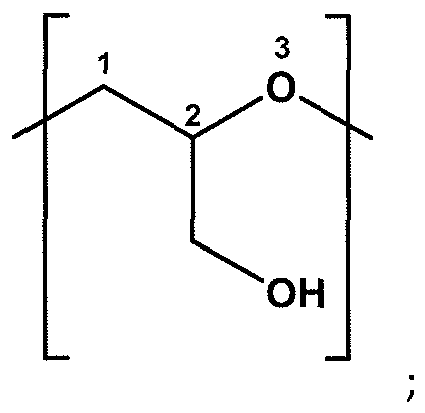
- (c) dendritic (D) PG repeat units, which lead to branched and cyclic PGs, of the formula:

- (d) terminal-1,2 (T1,2) units (shown attached to a polyglyceryl moiety PG) of the formula:

- and (e) terminal-1,3 (T1,3) units (shown attached to a polyglyceryl moiety PG) of the formula:

- As used herein, a "polyglyceryl moiety" means a linear, branched, and/or cyclic polyether moiety comprising two or more glyceryl repeat units. Polyglyceryl moieties may be derived via any of a variety of synthetic routes, including but not limited to condensation polymerization of glycerol, ring-opening polymerization of glycerol carbonate, and ring-opening polymerization of glycidol. The polyglyceryl moieties may comprise homopolyethers wherein all of the repeat units are glyceryl repeat units. The polyglyceryl moieties may be copolyethers, that is, they comprise both glyceryl repeat units and additional polyether repeat units that are not glyceryl repeat units. For example, glycerol may be copolymerized with 1,3-propanediol to yield a copolyether comprising both glyceryl repeat units described above and oxypropylene repeat units of the formula:

- As used herein, the term "polyglyceryl nonionic surfactant" means an amphiphilic molecule comprising one or more nonionic hydrophilic segments comprised of a polyglyceryl moiety and one or more hydrophobic moieties. Examples of polyglyceryl nonionic surfactants include, but are not limited to, polyglyceryl esters (PGEs), such as polyglyceryl-10 laurate where PG = polyglyceryl moiety comprising ten (10) glyceryl repeat units, and R = C11H23:


Bevinakatti, et al. WO 2009016375 , assigned to Croda International PLC)
- Any suitable polyglyceryl nonionic surfactants may be used in the compositions of the present invention. Preferably, the polyglyceryl nonionic surfactants are selected from the group consisting of polyglyceryl esters, polyglyceryl ethers, polyglyceryl sorbitan fatty acid esters, combinations of two or more thereof and the like. More preferably, the polyglyceryl nonionic surfactants are selected from the group consisting of polyglyceryl esters, polyglyceryl ethers, and combinations of two or more thereof. Preferably, the compositions of the present invention comprise one or more polyglyceryl nonionic surfactants selected from the group consisting of: polyglyceryl-4 caprylate/caprate, polyglyceryl-5 caprylate/caprate, polyglyceryl-6 caprylate/caprate, polyglyceryl-7 caprylate/caprate, polyglyceryl-8 caprylate/caprate, polyglyceryl-9 caprylate/caprate, polyglyceryl-10 caprylate/caprate, polyglyceryl-4 caprate, polyglyceryl-5 caprate, polyglyceryl-6 caprate, polyglyceryl-7 caprate, polyglyceryl-8 caprate, polyglyceryl-9 caprate, polyglyceryl-10 caprate, polyglyceryl-4 laurate, polyglyceryl-5 laurate, polyglyceryl-6 laurate, polyglyceryl-7 laurate, polyglyceryl-8 laurate, polyglyceryl-9 laurate, polyglyceryl-10 laurate, polyglyceryl-6 cocoate, polyglyceryl-7 cocoate, polyglyceryl-8 cocoate, polyglyceryl-9 cocoate, polyglyceryl-10 cocoate, polyglyceryl-11 cocoate, polyglyceryl-12 cocoate, polyglyceryl-6 myristate, polyglyceryl-7 myristate, polyglyceryl-8 myristate, polyglyceryl-9 myristate, polyglyceryl-10 myristate, polyglyceryl-11 myristate, polyglyceryl-12 myristate, polyglyceryl-10 oleate, polyglyceryl-11 oleate, polyglyceryl-12 oleate, polyglyceryl-10 stearate, polyglyceryl-11 stearate, polyglyceryl-12 stearate, and combinations of two or more thereof.
- Preferably, the polyglyceryl nonionic surfactants used in the present invention have a total combined glyceryl degree of polymerization (DP) (i.e. total of all glyceryl repeat units in a given molecule) of from about 4 to about 40 repeat units. More preferably, the polyglyceryl nonionic surfactants have a DP of from about 6 to about 30, more preferably from about 6 to about 20, more preferably, from about 6 to about 15, and more preferably from about 6 to about 12 glyceryl repeat units.
- Any suitable amount of polyglyceryl nonionic surfactant may be used in the compositions of the present invention. The compositions may comprise from greater than zero to about 25 % by weight of polyglyceryl nonionic surfactant. Preferably, the compositions comprise from about 0.05 wt% to about 20 wt%, more preferably from about 0.1 wt% to about 15 wt%, and even more preferably from about 0.2 wt% to about 10 wt%, and still more preferably from about 0.25 wt% to about 5 wt% of total polyglyceryl nonionic surfactant.
- As used herein the term "zwitterionic surfactant" refers to an amphiphilic molecule comprising a hydrophobic group and one or more hydrophilic groups comprising two moieties of opposite formal charges or capable of bearing opposite formal charges (as a function of acid-base properties and solution pH). Any suitable zwitteronic surfactant may be used in the present invention. Examples of suitable zwitteronic surfactants include:
- Alkyl betaines of the formula:

- Alkyl hydroxysultaines of the formula:

- Alkyl sultaines of the formula:

- Alkylamidoalkyl betaines of the formula:

- Alkylamidoalkyl hydroxysultaines of the formula:

- Alkylamidoalkyl sultaines of the formula:

- Alkyl phosphobetaines of the formula:

- Phospholipids of the formula:

U.S. Pat. Nos. 5,215,976 ;5,286,719 ;5,648,348 ; and5,650,402 , which disclose phospholipids which are hereby incorporated by reference), such as sodium coco PG-dimonium chloride phosphate, where R = coco alkyl, x = 2, B = O-, y = 1, z = 1, A = Cl-, a = 1, and M = Na+. - Phospholipids of the formula:

U.S. Pat. Nos. 5,215,976 ;5,286,719 ;5,648,348 ; and5,650,402 , which disclose phospholipids which are hereby incorporated by reference). Examples include cocamidopropyl PG-dimonium chloride phosphate (RCO = coco acyl, n = 3, x = 3, z = 3, A = Cl-, B and M are absent, y = 0, and a = 0) and myristamidopropyl PG-dimonium chloride phosphate (RCO = myristoyl, n = 3, x = 3, z = 3, A = Cl-, B and M are absent, y = 0, and a = 0). - Amphoacetates of the formula:

- Amphodiacetates of the formula:

- Amphopropionates of the formula:

- Amphodipropionates of the formula:

- Amphohydroxypropylsulfonates of the formula:

- Amphohydroxyalkylphosphates of the formula:

- Alkyl amine oxides of the formula:

- Alkylamidoalkyl amine oxides of the formula:

- Any suitable amount of zwitterionic surfactant may be used in the compositions of the present invention. The compositions may comprise from greater than zero to about 30 % by weight of zwitterionic surfactant. Preferably, the compositions comprise from about 0.5 wt% to about 25 wt%, more preferable from about 1.0 wt% to about 20 wt%, still more preferably from about 2.0 wt% to about 15 wt%, and even more preferably from about 2.5 wt% to about 12.5 wt% of total zwitterionic surfactant.
- Any suitable ratio of wt% polyglyceryl nonionic surfactant to wt% zwitterionic surfactant may be used in accord with the present invention. The ratio of wt% polyglyceryl nonionic surfactant : wt% zwitterionic surfactant may be from about 0.01:1 1 to about 5:1. Preferably, the wt% polyglyceryl nonionic surfactant : wt% zwitterionic surfactant ratio is from about 0.025:1 to about 4:1, more preferably from about 0.05:1 to about 3:1. More preferably, the wt% polyglyceryl nonionic surfactant: wt% zwitterionic surfactant ratio is from about 0.06:1 to about 2.5:1, and more preferably from about 0.01:1 to about 2:1.
- Any organic acids that comprise at least one carboxylic acid moiety and are capable of preserving a composition of the present invention against microbial contamination may be used in accord with the present invention as an organic acid preservative. Examples of suitable organic acids include benzoic acid and alkali metal and ammonium salts thereof (e.g. sodium benzoate and the like), sorbic acid and alkali metal and ammonium salts thereof (e.g. potassium sorbate and the like), p-anisic acid and alkali metal and ammonium salts thereof, salicylic acid and alkali metal and ammonium salts thereof, and the like. Preferably, the organic acid preservative comprises benzoic acid/sodium benzoate, sorbic acid/potassium sorbate, or combinations thereof.
- To ensure that the organic acid is present in its active protonated form, the final pH of the composition is preferably kept at about 5.4 or less, more preferably below 5.4, more preferably below 5.2, more preferably below 5.0, and most preferably below 4.9. The pH of the composition may be adjusted as low as 3.0 provided that formula stability and performance (e.g. foaming) are not negatively affected. The pH of the composition may be adjusted to the appropriate acidic value using any cosmetically acceptable organic or inorganic acid, such as citric acid, acetic acid, glycolic acid, lactic acid, malic acid, tartaric acid, hydrochloric acid, combinations of two or more thereof or the like.
- Any suitable amount of organic acid preservative may be used in the compositions of the present invention. The compositions may comprise from greater than zero to about 5 % by weight of organic acid preservative. Preferably, the compositions comprise from about 0.05 wt% to about 3 wt%, more preferably from about 0.1 wt% to about 2.5 wt%, and even more preferably from about 0.25 wt% to about 2 wt% of organic acid preservative.
- The compositions of the present invention may comprise a non-sulfate anionic surfactant selected from the group consisting of acyl aspartates, acyl glutamates, acyl isethionates, acyl taurates, alkyl sulfoacetates, alpha-sulfo fatty acid esters, alpha-sulfo fatty acid salts, alpha-olefin sulfonates, alkyl sulfonates, alkyl phosphates, anionic derivatives of alkyl polyglucosides, and combinations of two or more thereof. Examples of such suitable non-sulfate anionic surfactants include, but are not limited, to:
- Alpha olefin sulfonates prepared by sulfonation of long chain alpha olefins. Alpha olefin sulfonates consist of mixtures of alkene sulfonates,


- Alkyl sulfonates:

(c) Alkyl glyceryl ether sulfonates:
- α-Sulfo fatty acid esters

- α-Sulfo fatty acid salts

- Alkyl sulfoacetates

- Acyl isethionates

- Acyl glutamates

- Acyl aspartates

- Acyl taurates

- Alkyl phosphates

- Anionic derivatives of alkyl polyglucosides, including: sodium lauryl glucoside carboxylate, disodium coco-glucoside citrate, sodium coco-glucoside tartrate, disodium coco-glucoside sulfosuccinate; sodium cocoglucosides hydroxypropylsulfonate, sodium decylglucosides hydroxypropylsulfonate, sodium laurylglucosides hydroxypropylsulfonate; sodium hydroxypropylsulfonate cocoglucoside crosspolymer, sodium hydroxypropylsulfonate decylglucoside crosspolymer, sodium hydroxypropylsulfonate laurylglucoside crosspolymer; anionic polymeric APG derivatives, such as those described in
O'Lenick, U.S. Pat. Nos. 7,507,399 ;7,375,064 ; and7,335,627 , which are hereby incorporated by reference); and combinations of two or more thereof, and the like. Preferably, the non-sulfate anionic surfactants are selected from the group consisting of acyl glutamates, alpha-sulfo fatty acid esters, alpha-sulfo fatty acid salts, alpha-olefin sulfonates, and combinations of two or more thereof. - Any suitable amount of non-sulfate anionic surfactant may be used in the compositions of the present invention. The compositions may comprise from greater than zero to about 25% by weight of non-sulfate anionic. Preferably, the compositions comprise from about 0.25 wt% to about 20 wt%, more preferable from about 0.5 wt% to about 15 wt%, still more preferably from about 1.0 wt% to about 12.5 wt%, and even more preferably from about 1.5 wt% to about 10 wt% of total non-sulfate anionic surfactants.
- Any suitable ratio of wt% non-sulfate anionic surfactant to wt% zwitterionic surfactant may be used in accord with the present invention. The ratio of wt% non-sulfate anionic surfactant : wt% zwitterionic surfactant may be from about 0.1: to about 10:1. Preferably, the wt% non-sulfate anionic surfactant : wt% zwitterionic surfactant ratio is from about 0.02:1 to about 5:1, more preferably from about 0.3:1 to about 4:1. More preferably, the wt.% polyglyceryl nonionic surfactant: wt% zwitterionic surfactant ratio is from about 0.5:1 to about 2:1.
- The compositions of the present invention may be substantially free of sulfated anionic surfactants. As used herein "substantially free of sulfated anionic surfactants" means a composition that comprises less than 1% by weight of total sulfated anionic surfactants, such as alkyl sulfates, alkyl ether sulfates, alkyl monoglyceryl ether sulfates, and the like. Preferably, compositions that are substantially free of sulfated anionic surfactants comprise less than 0.5 %, more preferably less than 0.1%, and even more preferable are free of, sulfated anionic surfactants.
- The compositions of the present invention may also contain any of a variety of other ingredients suitable to produce an aesthically-desireable composition with additional functional or cosmetic benefits. Such ingredients include but are not limited to: (a) non-ethoxylated nonionic surfactants other than polyglyceryl nonionic surfactants, including but not limited to, alkyl polyglucosides (e.g. decyl glucoside, coco-glucoside, lauryl glucoside), alkyl polypentosides (e.g. caprylyl/capryl wheat bran/straw glycosides), sucrose esters (e.g. sucrose cocoate, sucrose laurate), sorbitan esters (e.g. sorbitan laurate, sorbitan caprylate), and combinations of two or more thereof and the like; (b) rheology modifiers, including but not limited to, naturally-derived polysaccharides including xanthan gum, dehydroxanthan gum, Cyamopsis tetragonoloba (guar) gum, cassia gum, Chondrus crispus (carrageenan) gum, alginic acid and alginate gums (e.g. algin, calcium alginate, etc.), gellan gum, pectin, microcrystalline cellulose, nonethoxylated derivatives of cellulose (e.g. sodium carboxymethylcellulose, hydroxypropyl methylcellulose, etc.), and hydroxypropyl guar, and synthetic polymers that do not comprise ethoxylated monomers or ethoxylated surfactants (e.g. as processing or dispersing aids), such as, acrylic alkali-swellable emulsion (ASE) polymers, such as Acrylates Copolymer, available under the trade name Carbopol® AQUA SF-1 from Lubrizol Corp., Brecksville, OH, hydrophobically-modified acrylate crosspolymers, such as Acrylates C10-30 Alkyl Acrylates Crosspolymer, available under the trade name Carbopol® 1382 from Lubrizol Corp., Brecksville, OH, as well as, non-ethoxylated micellar thickeners, such as: cocamide MIPA, lauryl lactyl lactate, or sorbitan sesquicaprylate, and combinations of two or more thereof and the like; (c) conditioning agents including but not limited to cationic surfactants, cationic polymers, such as, cationically-modified polysaccharides, including starch hydroxypropyltrimonium chloride, guar hydroxypropyltrimonium chloride, and hydroxypropyl guar hydroxypropyltrimonium chloride, cationic polymers derived from the (co)polymerization of ethylenically-unsaturated cationic monomers with optional hydrophilic monomers, including polyquaternium-5, polyquaternium-6, polyquaternium-7, polyquaternium-11, polyquaternium-14, polyquaternium-15, polyquaternium-28, polyquaternium-39, polyquaternium-44; polyquaternium-76; and combinations of two or more thereof, and the like; and (d) other preservatives and preservative boosters including but not limited to benzyl alcohol, caprylyl glycol, decylene glycol, ethylhexylglycerin, gluconolactone, methylisothazolinone, and combinations of two or more thereof, and the like.
- The compositions produced via the present invention may preferably be used as or in personal care products for treating or cleansing at least a portion of the human body. Examples of preferred personal care products include various products suitable for application to the skin, hair, and/or vaginal region of the body, such as shampoos, hand, face, and/or body washes, bath additives, gels, lotions, creams, and the like. As discussed above, applicants have discovered unexpectedly that the instant methods provide personal care products having reduced irritation to the skin and/or eyes and, may have one or more of desirable properties such as foaming characteristics, rheology, and functionality, even at high surfactant concentrations.
- The present invention provides methods of treating and/or cleansing the human body comprising contacting at least a portion of the body with a composition of the present invention. Preferred methods may comprise contacting mammalian skin, hair and/or vaginal region with a composition of the present invention to cleanse such region and/or treat such region for any of a variety of conditions including, but not limited to, acne, wrinkles, dermatitis, dryness, muscle pain, itch, and the like. Preferably, the contacting step comprises applying a composition of the present invention to human skin, hair or vaginal region.
- The cleansing methods of the present invention may further comprise any of a variety of additional, optional steps associated conventionally with cleansing hair and skin including, for example, lathering, rinsing steps, and the like.
- Test methods used in the Examples are described as follows:
- Zero-Shear Viscosity Test: Determinations of zero-shear apparent viscosity of the cleansing compositions were conducted on a controlled-stress rheometer (AR-2000, TA Instruments Ltd., New Castle, DE, USA). Steady-state shear stress sweeps were performed at 25.0 ± 0.1 °C using a double-wall Couette geometry. Data acquisition and analysis were performed with the Rheology Advantage software v4.1.10 (TA Instruments Ltd., New Castle, DE, USA). Zero-shear apparent viscosities for Newtonian fluids are reported as the average of viscosity values obtained over a range of shear stresses (0.02 - 1.0 Pa). For pseudoplastic (shear-thinning) fluids, zero-shear apparent viscosities were calculated via the fitting of shear stress sweep data to an Ellis viscosity model.
- Transepithial Permeability (TEP) Assay: Irritation to the eyes and/or skin expected for a given formulation is measured in accordance with the Invittox Protocol Number 86, the "Transepithelial Permeability (TEP) Assay" as set forth in Invittox Protocol Number 86 (May 1994), incorporated herein by reference. In general, the ocular and/or skin irritation potential of a product can be evaluated by determining its effect on the permeability of a cell layer, as assessed by the leakage of fluorescein through the layer. Monolayers of Madin-Darby canine kidney (MDCK) cells are grown to confluence on microporous inserts in a 24-well plate containing medium or assay buffer in the lower wells. Exposure of a layer of MDCK cells grown on a microporous membrane to a test sample is a model for the first event that occurs when an irritant comes in contact with the eye. In vivo, the outermost layers of the corneal epithelium form a selectively permeable barrier due to the presence of tight junctions between cells. On exposure to an irritant, the tight junctions separate, thereby removing the permeability barrier. Fluid is imbibed to the underlying layers of epithelium and to the stroma, causing the collagen lamellae to separate, resulting in opacity. The TEP assay measures the effect of an irritant on the breakdown of tight junctions between cells in a layer of MDCK cells grown on a microporous insert. Damage is evaluated spectrophotometrically, by measuring the amount of marker dye (sodium fluorescein) that leaks through the cell layer and microporous membrane to the lower well.
The irritation potential of a formulation is evaluated by measuring the damage to the permeability barrier in the cell monolayer following a 15 minute exposure to dilutions of the product. Barrier damage is assessed by the amount of sodium fluorescein that has leaked through to the lower well after 30 minutes, as determined spectrophotometrically. The fluorescein leakage is plotted against the concentration of test material to determine the EC50 (the concentration of test material that causes 50% of maximum dye leakage, i.e., 50% damage to the permeability barrier). Higher scores are indicative of milder formulas. - Formulation Foam Test: The following Formulation Foam Test was performed on various cleansing compositions to determine the foam volume upon agitation according to the present invention. First, a solution of the test composition is prepared in simulated tap water. To represent the hardness of tap water, 0.36 g of calcium chloride is dissolved in 995 g of DI water. Five (5.0) grams of test composition is then added to this solution and mixed until homogeneous. To determine the Formulation Foam Volume, the test composition (1000 mL) was added to the sample tank of a SITA R-2000 foam tester (commercially available from Future Digital Scientific, Co.; Bethpage, N.Y.). The test parameters were set to repeat three runs (series count = 3) of 250 ml sample size (fill volume = 250 ml) with thirteen stir cycles (stir count = 13) for a 15 second stir time per cycle (stir time = 15 seconds) with the rotor spinning at 1200 RPM (revolution = 1200) at a temperature setting of 30° C ± 2° C. Foam volume data was collected at the end of each stir cycle and the average and standard deviation of the three runs was determined. The Maximum Foam Volume was reported for each Example as the value after the thirteenth stir cycle.
- Clarity Test: The clarity of the cleansing compositions was determined via turbidity measurements on a
HF Scientific Micro 1000 IR Turbidimeter operating at ambient temperature (22 °C ± 1 °C). Clarity is reported in terms of turbidity measured in nephelometric turbidity units (NTU), with clearer formulas having lower turbidity values. - Dynamic Light Scattering (DLS) Test: Dynamic light scattering (DLS, also known as Photon Correlation Spectroscopy or PCS) is a well-known method for determination of average micelle size (measured as hydrodynamic diameter, dH) and micelle size distribution (A comprehensive explanation of the technique can be found in the ISO test method ISO 13321:1996(E)). The hydrodynamic size measured by DLS is defined as the size of a hypothetical hard sphere that diffuses in the same fashion as that of the particle being measured. In practice, micellar species are dynamic (tumbling), solvated species that maybe isotropic (spherical) or anisotropic (e.g. ellipsoidal or cylindrical) in shape. Because of this, the diameter calculated from the diffusional properties of the micelle will be indicative of the apparent size of the dynamic hydrated/solvated particle; hence the terminology, "hydrodynamic diameter." Micellar solutions for determination of micelle dH are prepared by diluting the compositions to 3.0% of their original concentration with 0.1 µm-filtered deionized water, obtained from a Millipore-Q filtration system. (The target dilution of 3.0% is chosen because it is within the typical concentration range of 1.0%-10% dilution that is encountered during the use of rinse-off personal care compositions. The target dilution is also within the range of dilutions employed in the TEP test.) The samples are agitated on a vortex mixer at 1000 rpm for a minimum of five minutes and then allowed to stand overnight prior to analysis. Samples are passed through a 0.2 µm Anatop-Plus syringe filter into dust-free disposable acrylic sizing cuvettes and sealed.
- The samples are analyzed using a Zetasizer Nano ZS DLS instrument (Malvern Instruments, Inc., Southborough, Mass.) operating at 25.0° C. Samples must yield a minimum count rate of 100,000 counts per second (cps) for accurate determination of micelle dH and micelle size distribution. For samples with count rates below this minimum, the sample concentration maybe be gradually increased (i.e. diluted less) until the minimum count rate is achieved. Values of micelle dH and the micelle size distribution are calculated using the Dispersion Technology Software (DTS) v4.10 package (Malvern Instruments Inc., Southborough, Mass.), which calculates the peak-average micelle dH according to the nonlinear least squares fitting method. Values of average micelle dH are reported herein as the peak-average micelle dH. The reported values of micelle dH are the average of three individual measurement runs.
- Additives exhibiting relatively large values of dH (i.e. greater than about 200 nm) compared to micellar species, for example, high MW polymeric rheology modifiers, polymeric conditioners, particulate opacifiers, (micro)emulsions of hydrophobic emollients, silicone (micro)emulsions, etc., are routinely added to cleansing compositions comprising micellar species. To those skilled in the art of DLS, it is apparent that such nonmicellar materials will exhibit light scattering intensities orders of magnitude greater than the relatively smaller micellar species in the diluted sample. The scattering intensity of such materials will overwhelm the scattering signal of the micellar species, thus interfering in the accurate determination of micelle dH. Typically, this type of interference will lead to an erroneously large measured value of micelle dH. To avoid such interference, it is most preferable to measure the micelle dH of the composition in the absence of additives exhibiting values of dH greater than about 200 nm. Those skilled in the art of DLS will recognize that additives exhibiting large values of dH should be separated from the sample via filtration or ultracentrifugation prior to determination of the micelle dH of the sample. Alternatively, higher order analysis of the DLS data using the Dispersion Technology Software v4.10 package may also be employed to obtain enhanced resolution and properly characterize micelle dH in the presence of nonmicellar scattering species.
- Compositions E1-E9 were made in accord with the following procedure: Unless otherwise indicated, all materials were added in the weight percent amounts as indicated for each composition in Tables 1 and 2, and the particular polyglyceryl nonionic, zwitterionic, and anionic surfactants used for each composition were those also indicated in Tables 1 and 2. To an appropriately sized vessel equipped with a hotplate and overhead mechanical stirrer, 60 parts water, sodium benzoate, and sodium chloride (if any) were added. While mixing at 200-250 rpm and heating to 40-50 °C, the polyglyceryl nonionic surfactant(s) was (were) added. The zwitterionic and anionic surfactants were added, and the batch was allowed to mix at 40-50 °C until uniform. The batch was allowed to mix while cooling to below 30 °C and was then adjusted to the desired pH value (pH = 4.5 - 4.9 using necessary amount of citric acid and/or sodium hydroxide solutions (20% w/w). Water was added in q.s. to 100 wt%, and the batch is allowed to mix until uniform before being discharged to an appropriate storage vessel.
- The Zero Shear Viscosity, Max. Foam Volume, Turbidity, TEP, and Average Micelle size were measured for E1-E9 in accord with the Zero Shear Viscosity Test, Formulation Foam Test, Clarity Test, TEP Test and DLS Test, respectively, as described herein. The results are shown in Table 3.
Table 1 INCI name Trade Name Acti vity (%) E1 wt.% E2 wt.% E3 wt.% E4 wt.% E5 wt.% Polyglyceryl nonionic Polyglyceryl-10 Oleate Polyaldo 10-1-O (Lonza) 100 3.60 3.60 3.60 - 3.60 Polyglyceryl-10 Laurate Polyaldo 10-1-L (Lonza) 100 - 1.00 1.00 3.60 - Zwitterionic Coco-Betaine Dehyton AB-30 (Cognis) 30 12.50 18.77 18.77 12.50 - Lauryl Hydroxysultaine Mackam LHS (Rhodia-McIntyre) 42 - - - - 8.93 Anionic Sodium Cocoyl Glutamate Plantapon ACG HC (Cognis) 42 6.44 9.64 - - 6.43 Sodium Methyl 2-Sulfolaurate (and) Disodium 2-Sulfolaurate Alpha-Step PC-48 (Stepan) 38 - - 10.66 7.11 - Organic acids Sodium Benzoate Sodium Benzoate, NF, FCC 100 0.50 0.50 0.50 0.50 0.50 Citric Acid Citric Acid solution 20 Q.S. to pH 4.5 Q.S. to pH 4.5 Q.S. to pH 4.9 Q.S. to pH 4.9 Q.S. to pH 4.5 Other Sodium Choride Sodium Choride, USP 100 - 4.00 - - - Water Purified water, USP 100 Q.S. to 100% Q.S. to 100% Q.S. to 100% Q.S. to 100% Q.S. to 100% Table 2 INCI name Trade Name Acti vity (%) E6 wt.% E7 wt.% E8 wt.% E9 wt.% Polyglyceryl nonionic Polyglyceryl-10 Oleate Polyaldo 10-1-O (Lonza) 100 3.60 3.60 3.60 3.60 Polyglyceryl-10 Laurate Polyaldo 10-1-L (Lonza) 100 1.00 1.00 1.00 - Polyglyceryl-10 Lauryl Ether PGLAL ML 10 (Daicel) 100 - - - 1.00 Zwitterionic Lauryl Hydroxysultaine Mackam LHS (Rhodia-McIntyre) 42 13.40 - - - Sodium Lauroamphohydroxypropylsulfonate Mackam LS (Rhodia-McIntyre) 35 - 16.08 16.08 16.08 Anionic Sodium Cocoyl Glutamate Plantapon ACG HC (Cognis) 42 9.64 9.64 - 9.64 Sodium Methyl 2-Sulfolaurate (and) Disodium 2-Sulfolaurate Alpha-Step PC-48 (Stepan) 38 - 10.66 - - Organic Acids Sodium Benzoate Sodium Benzoate, NF, FCC 100 0.50 0.50 0.50 0.50 Citric Acid Citric Acid solution 20 Q.S. to pH 4.5 Q.S. to pH 4.9 Q.S. to pH 4.5 Q.S. to pH 4.5 Other Water Purified water, USP 100 Q.S. to 100% Q.S. to 100% Q.S. to 100% Q.S. to 100% Table 3 Zero Shear Viscosity (cP) Max. Foam Vol. (mL) Turbidity (IR, NTU) TEP EC50 value (%) Average Micelle dH (nm) E1 219 512 ± 6 9.0 4.73 ± 1.91 20.5 E2 295 746 ± 12 5.7 3.63 ± 1.71 14.1 E3 488 830 ± 1 4.8 3.18 ± 0.91 6.6 E4 582 830 ± 6 9.7 3.32 ± 0.40 6.5 E5 273 584 ± 7 8.8 4.26 ± 1.70 14.4 E6 253 793 ± 5 7.8 2.97 ± 0.26 10.9 E7 434 841 ± 7 7.5 2.22 ± 0.26 8.0 E8 548 799 ± 4 12.8 4.61 ± 0.90 15.4 E9 305 776 ± 9 7.4 3.68 ± 0.35 12.1 - Compositions E10 and E11 were made in accord with the procedure of Example 1, with the additional steps of adding the glycerin with the water and sodium benzoate, and adding any nonionic surfactant (e.g. Coco-Glucoside for E11) with the zwitterionic and anionic surfactants. The materials and amounts for E10 and E11 are shown in Table 4. The Zero Shear Viscosity, Max. Foam Volume, Turbidity, TEP, and Average Micelle size were measured as above and reported in Table 5.
Table 4 INCI name Trade Name Activity (%) E10 wt.% E11 wt.% Polyglyceryl nonionic Polyglyceryl-10 Laurate Polyaldo 10-1-L (Lonza) 100 1.00 1.00 Zwitterionic Cocamidopropyl-Betaine Tegobetaine L7-V (Evonik) 30 10.00 10.00 Anionic Sodium C14-C16 Olefin Sulfonate Bioterge AS-90 (Stepan) 85 2.20 2.20 Organic Acids Sodium Benzoate Sodium Benzoate, NF, FCC 100 0.50 0.50 Citric Acid Citric Acid solution 20 Q.S. to pH 4.5 Q.S. to pH 4.5 Other Coco-Glucoside Plantacare 818 NP (Cognis) 52 - 6.00 Glycerin Glycerin, USP 100 0.50 0.50 Sodium Choride Sodium Choride, USP 100 2.40 0.40 Water Purified water, USP 100 Q.S. to 100% Q.S. to 100% Table 5 Zero Shear Viscosity (cP) Max. Foam Vol. (mL) Turbidity (IR, NTU) TEP EC50 value (%) Average Micelle dH (nm) E10 1519 609 ± 10 16.5 3.38 ± 0.71 10.3 E11 844 828 ± 6 14.6 3.76 ± 0.58 9.4 - Comparative compositions C1-C3 were made in accord with the procedure of Example 2, except that no polyglyceryl nonionic surfactant is added. The materials and amounts for C1-C3 are shown in Table 6. The TEP and Average Micelle size were measured as above and reported in Table 7. Applicants note the comparative examples are normalized to the same surfactant concentrations (wt %) as corresponding Inventive Examples (e.g. C1 corresponds to E2 without polyglyceryl nonionics and normalized to equivalent surfactant concentration (14.28 wt% active); C2 similarly corresponds to E3; and C3 corresponds to E2 with alkyl polyglucoside nonionics substituted for polyglyceryl nonionics).
Table 6 INCI name Trade Name Activity (%) C1 wt.% C2 wt.% C3 wt.% Zwitterionic Coco-Betaine Dehyton AB-30 (Cognis) 30 27.67 27.67 18.77 Anionic Sodium Cocoyl Glutamate Plantapon ACG HC (Cognis) 42 14.24 - 9.64 Sodium Methyl 2-Sulfolaurate (and) Disodium 2-Sulfolaurate Alpha-Step PC-48 (Stepan) 38 - 15.74 - Organic Acids Sodium Benzoate Sodium Benzoate, NF, FCC 100 0.50 0.50 0.50 Citric Acid Citric Acid solution 20 Q.S. to pH 4.5 Q.S. to pH 4.8 Q.S. to pH 4.5 Other Coco Glucoside Plantacare 818 NP (Cognis) 52 - - 6.92 Decyl Glucoside Plantaren 2000N UP (Cognis) 52 - - 1.92 Sodium Choride Sodium Choride, USP 100 4.00 - - Water Purified water, USP 100 Q.S. to 100% Q.S. to 100% Q.S. to 100% Table 7 TEP EC50 value (%) Average Micelle dH (nm) C1 1.34 ± 0.20 10.1 C2 3.36 ± 0.25 5.8 C3 2.42 ± 0.14 17.5 - Comparative compositions C4 and C5 as shown in Table 8 correspond to, and were made in accord with the procedure for, Examples 1 and 3, respectively, in
U.S. Patent No. 5,478,490 issued to Russo et al , except that the pH of the compositions was lowered to 4.5 with citric acid. Applicants discovered that when prepared at such relatively low pH values, C4 and C5 were both opaque (Turbidity of greater than 100 per the Clarity Test) and unstable (the compositions phase separated upon standing overnight).Table 8 INCI name Trade Name Activity (%) C4 wt.% C5 wt.% Polyglyceryl nonionic Polyglyceryl-10 Oleate Polyaldo 10-1-O (Lonza) 100 1.50 1.50 Zwitterionic Cocamidopropyl Betaine Tegobetaine L7-V (Evoink) 30 10.00 10.00 Sodium Cocoamphoacetate Amphoterge W (Lonza) 40 2.00 3.00 Disodium Cocoamphodiacetate Amphoterge W-2 (Lonza) 40 2.00 3.00 Anionic Sodium Lauryl Sulfate Stepanol WA-EXTRA (Stepan) 30 6.00 5.00 Organic Acids Citric Acid Citric Acid solution 20 Q.S. to pH 4.5 Q.S. to pH 4.5 Other DMDM Hydantoin (and) Iodopropynyl Butylcarbamate Glydant Plus 100 0.05 0.05 Glycerin Glycerin, USP 100 2.50 2.50 Fragrance Fragrance TA H23194/01 (Givaudan) 100 0.50 0.50 Water Purified water, USP 100 Q.S. to 100% Q.S. to 100% - Comparative compositions C6-C9 were made in accord with the procedure of Example 1. The materials and amounts for C6-C9 are shown in Table 9. Compositions C6-C9 were tested in accord with the Clarity Test and all four compositions exhibited a turbidity of >100 (opaque).
Table 9 INCI name Trade Name Acti vity (%) C6 wt.% C7 wt.% C8 wt.% C9 wt.% Polyglyceryl nonionic Polyglyceryl-10 Oleate Polyaldo 10-1-O (Lonza) 100 3.60 3.60 3.60 3.60 Zwitterionic Coco-Betaine Dehyton AB-30 (Cognis) 30 12.50 12.50 12.50 12.50 Anionic Sodium Cocoyl Sarcosinate Hamposyl C-30 (Chattem) 30 9.00 - - - Disodium Lauryl Sulfosuccinate Mackanate LO (McIntyre) 40 - 6.75 - - Sodium Methyl 2-Sulfolaurate (and) Disodium 2-Sulfolaurate (and) Sodium Lauryl Sulfoacetate Stepan Mild PCL (Stepan) 23 - - 11.54 - Sodium Lauroyl Lactylate Stepan SLL-FB (Stepan) 100 - - - 2.70 Organic Acids Sodium Benzoate Sodium Benzoate, NF, FCC 100 0.50 0.50 0.50 0.50 Citric Acid Citric Acid solution 20 Q.S. to pH 4.5 Q.S. to pH 4.5 Q.S. to pH 4.9 Q.S. to pH 4.9 Other Water Purified water, USP 100 Q.S. to 100% Q.S. to 100% Q.S. to 100% Q.S. to 100% - The Zero-Shear Viscosity as a function of pH was measured for E2 and E7 in accord with the Zero-Shear Viscosity Test. E2 and E7 were prepared and the pH measured. The pH for each was lowered using citric acid and Zero-Shear Viscosity and pH measured again. This was repeated as shown in
Fig. 1 . As a result, applicants discovered that improved viscosity was realized at relatively low pH for the compositions.
Claims (14)
- A composition comprising a polyglyceryl nonionic surfactant, a zwitterionic surfactant, an organic acid preservative, and water, wherein the composition is substantially free of ethoxylated materials and has a pH of about 5.4 or less.
- The composition of claim 1, further comprises a non-sulfate anionic surfactant selected from the group consisting of acyl aspartates, acyl glutamates, acyl isethionates, acyl taurates, alkyl sulfoacetates, alpha-sulfo fatty acid esters, alpha-sulfo fatty acid salts, alpha-olefin sulfonates, alkyl sulfonates, alkyl phosphates, anionic derivatives of alkyl polyglucosides, and combinations of two or more thereof.
- The composition of claim 1 or claim 2, which is substantially free of sulfated anionic surfactants.
- The composition of any preceding claim, wherein said polyglyceryl nonionic surfactant comprises a compound selected from the group consisting of polyglyceryl esters, polyglyceryl ethers, polyglyceryl sorbitan fatty acid esters, and combinations of two or more thereof.
- The composition of any of claims 1 to 3, wherein said polyglyceryl nonionic surfactant comprises a compound selected from the group consisting of polyglyceryl-4 caprylate/caprate, polyglyceryl-5 caprylate/caprate, polyglyceryl-6 caprylate/caprate, polyglyceryl-7 caprylate/caprate, polyglyceryl-8 caprylate/caprate, polyglyceryl-9 caprylate/caprate, polyglyceryl-10 caprylate/caprate, polyglyceryl-4 caprate, polyglyceryl-5 caprate, polyglyceryl-6 caprate, polyglyceryl-7 caprate, polyglyceryl-8 caprate, polyglyceryl-9 caprate, polyglyceryl-10 caprate, polyglyceryl-4 laurate, polyglyceryl-5 laurate, polyglyceryl-6 laurate, polyglyceryl-7 laurate, polyglyceryl-8 laurate, polyglyceryl-9 laurate, polyglyceryl-10 laurate, polyglyceryl-6 cocoate, polyglyceryl-7 cocoate, polyglyceryl-8 cocoate, polyglyceryl-9 cocoate, polyglyceryl-10 cocoate, polyglyceryl-11 cocoate, polyglyceryl-12 cocoate, polyglyceryl-6 myristate, polyglyceryl-7 myristate, polyglyceryl-8 myristate, polyglyceryl-9 myristate, polyglyceryl-10 myristate, polyglyceryl-11 myristate, polyglyceryl-12 myristate, polyglyceryl-10 oleate, polyglyceryl-11 oleate, polyglyceryl-12 oleate, polyglyceryl-10 stearate, polyglyceryl-11 stearate, polyglyceryl-12 stearate, and combinations of two or more thereof.
- The composition of any preceding claim, wherein said polyglyceryl nonionic surfactant has a DP of about 6 to about 20.
- The composition of any preceding claim, wherein said zwitterionic surfactant is selected from the group consisting of alkyl betaines, alkyl hydroxysultaines, alkylamidoalkyl betaines, alkylamidoalkyl hydroxysultaines, amphohydroxypropylsulfonates, and combinations of two or more thereof.
- The composition of any preceding claim, comprising a ratio of wt% polyglyceryl nonionic surfactant : wt% zwitterionic surfactant of from about 0.05:1 to about 3:1.
- The composition of any one of claims 1 to 7 comprising a ratio of wt% polyglyceryl nonionic surfactant : wt% zwitterionic surfactant of from about 0.025:1 to about 4:1.
- The composition of any preceding claim, wherein said organic acid comprises benzoic acid, sorbic acid, p-anisic acid or a combination thereof.
- The composition of any preceding claim, comprising a ratio of wt% non-sulfate anionic surfactant : wt% zwitterionic surfactant of from about 0.3:1 to about 4:1.
- A personal care product suitable for application to the skin, hair, and/or vaginal region of the body comprising a composition of any preceding claim, said product being in the form of a shampoo, wash, bath additive, gel, lotion, or cream.
- The personal care product of claim 12 wherein said polyglyceryl nonionic surfactant comprises a compound selected from the group consisting of polyglyceryl-4 caprylate/caprate, polyglyceryl-5 caprylate/caprate, polyglyceryl-6 caprylate/caprate, polyglyceryl-7 caprylate/caprate, polyglyceryl-8 caprylate/caprate, polyglyceryl-9 caprylate/caprate, polyglyceryl-10 caprylate/caprate, polyglyceryl-4 caprate, polyglyceryl-5 caprate, polyglyceryl-6 caprate, polyglyceryl-7 caprate, polyglyceryl-8 caprate, polyglyceryl-9 caprate, polyglyceryl-10 caprate, polyglyceryl-4 laurate, polyglyceryl-5 laurate, polyglyceryl-6 laurate, polyglyceryl-7 laurate, polyglyceryl-8 laurate, polyglyceryl-9 laurate, polyglyceryl-10 laurate, polyglyceryl-6 cocoate, polyglyceryl-7 cocoate, polyglyceryl-8 cocoate, polyglyceryl-9 cocoate, polyglyceryl-10 cocoate, polyglyceryl-11 cocoate, polyglyceryl-12 cocoate, polyglyceryl-6 myristate, polyglyceryl-7 myristate, polyglyceryl-8 myristate, polyglyceryl-9 myristate, polyglyceryl-10 myristate, polyglyceryl-11 myristate, polyglyceryl-12 myristate, polyglyceryl-10 oleate, polyglyceryl-11 oleate, polyglyceryl-12 oleate, polyglyceryl-10 stearate, polyglyceryl-11 stearate, polyglyceryl-12 stearate, and combinations of two or more thereof, said zwitterionic surfactant is selected from the group consisting of alkyl betaines, alkyl hydroxysultaines, alkylamidoalkyl betaines, alkylamidoalkyl hydroxysultaines, amphohydroxypropylsulfonates, and combinations of two or more thereof, said non-sulfate anionic surfactant (when present) is selected from the group consisting of acyl glutamates, alpha-sulfo fatty acid esters, alpha-sulfo fatty acid salts, alpha-olefin sulfonates, and combinations of two or more thereof, and said organic acid comprises sodium benzoate, potassium sorbate, or a combination thereof.
- A method of cleansing the human body comprising the step of applying to at least a portion of the human body, a composition of any preceding claim.
Applications Claiming Priority (1)
| Application Number | Priority Date | Filing Date | Title |
|---|---|---|---|
| US12/974,268 US8227393B2 (en) | 2010-12-21 | 2010-12-21 | Compositions comprising a polyglyceryl nonionic surfactant and a zwitterionic surfactant |
Publications (2)
| Publication Number | Publication Date |
|---|---|
| EP2468842A1 true EP2468842A1 (en) | 2012-06-27 |
| EP2468842B1 EP2468842B1 (en) | 2016-12-14 |
Family
ID=45445810
Family Applications (1)
| Application Number | Title | Priority Date | Filing Date |
|---|---|---|---|
| EP11194609.1A Not-in-force EP2468842B1 (en) | 2010-12-21 | 2011-12-20 | Compositions comprising polyglyceryl nonionic surfactants |
Country Status (9)
| Country | Link |
|---|---|
| US (1) | US8227393B2 (en) |
| EP (1) | EP2468842B1 (en) |
| KR (1) | KR101875375B1 (en) |
| CN (1) | CN102552063B (en) |
| AU (1) | AU2011250841B2 (en) |
| BR (1) | BRPI1106007B1 (en) |
| CA (1) | CA2762192C (en) |
| PH (1) | PH12011000376A1 (en) |
| RU (1) | RU2619209C2 (en) |
Cited By (12)
| Publication number | Priority date | Publication date | Assignee | Title |
|---|---|---|---|---|
| WO2013057045A3 (en) * | 2011-10-20 | 2013-10-03 | Henkel Ag & Co. Kgaa | Mild cosmetic cleansing composition |
| EP2724710A2 (en) * | 2012-10-25 | 2014-04-30 | Henkel AG & Co. KGaA | Hair care composition comprising cationic alkyl polyglycosides and polyglycerol esters |
| EP2841542A4 (en) * | 2012-04-23 | 2015-11-25 | Basf Se | Tear free baby cleanser |
| EP2990026A1 (en) * | 2014-08-27 | 2016-03-02 | Basf Se | Aqueous tenside compositions |
| WO2018115635A1 (en) * | 2016-12-23 | 2018-06-28 | Societe D'exploitation De Produits Pour Les Industries Chimiques Seppic | Novel surfactant mixture, novel composition comprising same and use thereof in foam liquids for fighting fires |
| WO2018234647A1 (en) * | 2017-06-22 | 2018-12-27 | Societe D'exploitation De Produits Pour Les Industries Chimiques Seppic | NOVEL SURFACE MIXTURE, NOVEL COMPOSITION COMPRISING SAME AND USE THEREOF IN EMULTERS FOR COMBATTING FIRES |
| WO2020104129A1 (en) | 2018-11-22 | 2020-05-28 | Beiersdorf Ag | A cosmetic cleansing composition |
| WO2020194100A1 (en) * | 2019-03-25 | 2020-10-01 | Johnson & Johnson Consumer Inc. | Non-rinse micellar water composition |
| US20210059916A1 (en) * | 2018-03-30 | 2021-03-04 | Amorepacific Corporation | Cosmetic composition for makeup removal comprising water-soluble surfactant and oil-soluble surfactant |
| WO2021202400A1 (en) * | 2020-03-30 | 2021-10-07 | Colgate-Palmolive Company | Personal care compositions |
| FR3128875A1 (en) * | 2021-11-10 | 2023-05-12 | Farevacare | CONCENTRATED COSMETIC COMPOSITION TO DILUTE |
| US11975087B2 (en) | 2020-03-30 | 2024-05-07 | Colgate-Palmolive Company | Sulfate-free personal care compositions and methods for preventing and treating pollution damage to skin |
Families Citing this family (38)
| Publication number | Priority date | Publication date | Assignee | Title |
|---|---|---|---|---|
| US9012379B2 (en) * | 2013-03-05 | 2015-04-21 | Halliburton Energy Services, Inc. | Alkyl polyglycoside derivative as biodegradable spacer surfactant |
| CN106232098A (en) * | 2013-12-11 | 2016-12-14 | 赫尔克里士公司 | The not personal care cleansing compositions of containing sulfate |
| EP3145481B1 (en) * | 2014-05-21 | 2023-04-19 | Rhodia Operations | Sulfate-free personal care compositions |
| CN104523448A (en) * | 2014-12-08 | 2015-04-22 | 成都顺发消洗科技有限公司 | Personal care skin moisturizing wash care liquid |
| CN104586653B (en) * | 2015-02-13 | 2017-09-29 | 广东华润顺峰药业有限公司 | Shampoo used also as bath lotion suitable for infant and preparation method thereof |
| KR101671726B1 (en) * | 2015-04-09 | 2016-11-04 | 한국콜마주식회사 | Low irritant human body cleanser composition |
| US20180094211A1 (en) * | 2015-04-13 | 2018-04-05 | Rhodia Operations | Mild surfactant formulations for skin cleansing |
| WO2016186663A1 (en) * | 2015-05-20 | 2016-11-24 | Halliburton Energy Services, Inc. | Alkylpolyglucoside derivative fluid loss control additives for wellbore treatment fluids |
| WO2017025647A1 (en) * | 2015-08-13 | 2017-02-16 | Arch Personal Care Products, Lp | Wet wipe concentrate |
| KR102407154B1 (en) * | 2015-11-26 | 2022-06-10 | (주)아모레퍼시픽 | Hair cleansing composition |
| EP3390598A4 (en) * | 2015-12-14 | 2019-07-10 | Sino Lion USA LLC | CLEANING THICKENING COMPOSITIONS AND RELATED APPLICATIONS AND PREPARATION METHODS |
| CN106118893A (en) * | 2016-06-30 | 2016-11-16 | 江绍玫 | A kind of gentleness, green cleaning agent and preparation method thereof |
| CN106118892A (en) * | 2016-06-30 | 2016-11-16 | 江绍玫 | A kind of omnipotent food stage cleaning agent and preparation method thereof |
| KR102679493B1 (en) | 2017-01-31 | 2024-07-01 | 킴벌리-클라크 월드와이드, 인크. | Antibacterial composition containing benzoic acid ester and method for inhibiting bacterial growth using the same |
| US10980732B2 (en) * | 2017-02-28 | 2021-04-20 | L'oreal | Hair care compositions comprising polysaccharides and polyol |
| FR3063894B1 (en) * | 2017-03-17 | 2021-06-18 | Oleon Nv | CONCENTRATE INCLUDING AT LEAST ONE MANNOSYLERYTHRITOL LIPID AND AT LEAST ONE FATTY ACID AND POLYGLYCEROL ESTER |
| US10640452B2 (en) | 2018-01-12 | 2020-05-05 | Eastman Chemical Company | Branched trialkyl quaternary ammonium compounds |
| JP7476113B2 (en) | 2018-05-11 | 2024-04-30 | ユニリーバー・アイピー・ホールディングス・ベスローテン・ヴェンノーツハップ | Cleansing Composition |
| JP7539839B2 (en) | 2018-05-11 | 2024-08-26 | ユニリーバー・アイピー・ホールディングス・ベスローテン・ヴェンノーツハップ | Sulfate-free cleansing composition |
| WO2020034202A1 (en) | 2018-08-17 | 2020-02-20 | Beiersdorf Daily Chemical (Wuhan) Co. Ltd. | A cleansing composition |
| EP3856356A1 (en) * | 2018-10-29 | 2021-08-04 | Lonza Solutions AG | Hair cleansing and conditioning composition |
| CN109260030B (en) * | 2018-12-03 | 2021-11-02 | 昌正医疗(苏州)有限公司 | Micellar composition and its preparation method and application |
| WO2020254318A1 (en) | 2019-06-21 | 2020-12-24 | Unilever Plc | Cleansing composition |
| DE102019209908A1 (en) | 2019-07-05 | 2021-01-07 | Beiersdorf Ag | Cleaning preparation containing fatty acid polyglyceryl ester |
| BR112022005353A2 (en) | 2019-11-11 | 2022-06-14 | Unilever Ip Holdings B V | Sulfate-free surfactant cleansing composition and hair, scalp or skin treatment method |
| CN114727933B (en) * | 2019-11-20 | 2024-03-08 | 宝洁公司 | Porous soluble solid structures |
| KR102792841B1 (en) * | 2020-01-31 | 2025-04-11 | (주)아모레퍼시픽 | A sulfate-free detergent composition |
| US11590073B2 (en) | 2020-06-09 | 2023-02-28 | The Procter & Gamble Company | Methods and compositions for reducing the feeling of vaginal dryness |
| CN111773141A (en) * | 2020-08-21 | 2020-10-16 | 上海宏度精细化工有限公司 | Washing and discharging two-in-one composition and preparation method thereof |
| CN112076108A (en) * | 2020-09-11 | 2020-12-15 | 福建省梦娇兰日用化学品有限公司 | Children hair cleaning product containing bionic phospholipid structure conditioning agent |
| CN115778889A (en) * | 2021-09-09 | 2023-03-14 | 高露洁-棕榄公司 | Personal care compositions |
| US20230240972A1 (en) * | 2021-10-08 | 2023-08-03 | Inolex Investment Corporation | Biobased Polyglyceryl Esters and Mouth Rinse Compositions Comprising the Same |
| KR20240089195A (en) * | 2021-10-08 | 2024-06-20 | 인올렉스 인베스트먼트 코포레이션 | Bio-based polyglyceryl ester and composition containing the same |
| EP4186489A1 (en) * | 2021-11-26 | 2023-05-31 | Kao Corporation | Personal cleansing composition comprising alpha-sulfo fatty acid surfactants |
| CN114606073B (en) * | 2022-04-07 | 2023-12-05 | 上海和黄白猫有限公司 | Detergent with maximum viscosity-temperature curve |
| KR102443277B1 (en) * | 2022-07-15 | 2022-09-15 | 이엘플러스 주식회사 | Multipurpose CLEANING SOLUTION COMPOSITION with Eco-friendly And Hypoallergenic Properties |
| CN121175400A (en) * | 2023-04-25 | 2025-12-19 | 3M创新有限公司 | Cleaning composition |
| WO2025097020A1 (en) * | 2023-11-02 | 2025-05-08 | Design Therapeutics, Inc. | Process for polyethylene glycol synthesis |
Citations (11)
| Publication number | Priority date | Publication date | Assignee | Title |
|---|---|---|---|---|
| EP0499700A1 (en) * | 1991-02-20 | 1992-08-26 | Deutsche Solvay-Werke Gesellschaft mit beschränkter Haftung | Mixture of fatty acid esters of polyglycerine |
| US5215976A (en) | 1991-10-28 | 1993-06-01 | Mona Industries, Inc. | Phospholipids useful as spermicidal agents |
| US5286719A (en) | 1991-10-28 | 1994-02-15 | Mona Industries, Inc. | Phospholipid virucidal compositions |
| US5478490A (en) | 1992-05-07 | 1995-12-26 | Lonza Inc. | Shampoos containing polyglyceryl esters |
| US5648348A (en) | 1991-10-28 | 1997-07-15 | Mona Industries, Inc. | Phospholipid antimicrobial compositions |
| US20030211066A1 (en) * | 1995-06-22 | 2003-11-13 | 3M Innovative Properties Company | Stable hydroalcoholic compositions |
| EP1674132A1 (en) * | 2004-12-16 | 2006-06-28 | KPSS-Kao Professional Salon Services GmbH | Mild cleansing composition |
| US7335627B1 (en) | 2006-05-25 | 2008-02-26 | Surfa Tech Corporation | Polymeric alkylpolyglycoside carboxylates |
| US7375064B1 (en) | 2007-02-20 | 2008-05-20 | Surfatech Corporation | Functionalized polymeric surfactants based upon alkyl polyglycosides |
| WO2009016375A2 (en) | 2007-07-31 | 2009-02-05 | Croda International Plc | Polyglycerol ethers of sorbitan carboxylic acid esters |
| US7507399B1 (en) | 2004-08-05 | 2009-03-24 | Surfatech Corporation | Functionalized polymeric surfactants based upon alkyl polyglycosides |
Family Cites Families (12)
| Publication number | Priority date | Publication date | Assignee | Title |
|---|---|---|---|---|
| US2999069A (en) | 1957-11-18 | 1961-09-05 | Johnson & Johnson | Detergent composition |
| US3055836A (en) | 1957-12-24 | 1962-09-25 | Johnson & Johnson | Detergent composition |
| US3950417A (en) | 1975-02-28 | 1976-04-13 | Johnson & Johnson | High-lathering non-irritating detergent compositions |
| US4177171A (en) | 1975-11-03 | 1979-12-04 | Johnson & Johnson | Shampoo |
| KR950702819A (en) * | 1992-09-08 | 1995-08-23 | 제이코버스 코넬리스 레이서 | Substantially colorless mild shampoo composition (MILD, SUBSTANTIALLY COLORIESS SHAMPOO COMPOSTION) |
| KR100439932B1 (en) * | 1995-08-07 | 2004-09-18 | 유니레버 엔.브이. | Liquid Cleansing Composition Comprising Soluble, Lamellar Phase Inducing Structurant |
| JPH11148099A (en) | 1997-11-14 | 1999-06-02 | Lion Corp | Neutral liquid detergent composition |
| US6762159B2 (en) | 2000-10-17 | 2004-07-13 | Mitsubisi Chemical Corporation | Polyglycerol fatty acid ester for detergent and detergent containing the same |
| US7803746B2 (en) * | 2004-12-16 | 2010-09-28 | Georgia-Pacific Consumer Products Lp | Antimicrobial foam hand soap comprising inulin or an inulin surfactant |
| EP1975224A1 (en) * | 2007-03-30 | 2008-10-01 | Johnson & Johnson Consumer France SAS | Mild, foaming cleansing composition |
| US20110091393A1 (en) * | 2007-11-06 | 2011-04-21 | Michael Simmonds | Exothylate-free personal care cleansing compositions |
| US8329626B2 (en) * | 2010-06-24 | 2012-12-11 | Johnson & Johnson Consumer Companies, Inc. | Low-irritating, clear cleansing compositions with relatively low pH |
-
2010
- 2010-12-21 US US12/974,268 patent/US8227393B2/en not_active Expired - Fee Related
-
2011
- 2011-11-17 AU AU2011250841A patent/AU2011250841B2/en not_active Ceased
- 2011-11-22 PH PH1/2011/000376A patent/PH12011000376A1/en unknown
- 2011-12-14 CA CA2762192A patent/CA2762192C/en not_active Expired - Fee Related
- 2011-12-19 CN CN201110427852.5A patent/CN102552063B/en not_active Expired - Fee Related
- 2011-12-20 KR KR1020110137927A patent/KR101875375B1/en active Active
- 2011-12-20 EP EP11194609.1A patent/EP2468842B1/en not_active Not-in-force
- 2011-12-20 RU RU2011152104A patent/RU2619209C2/en not_active IP Right Cessation
- 2011-12-21 BR BRPI1106007-7A patent/BRPI1106007B1/en not_active IP Right Cessation
Patent Citations (12)
| Publication number | Priority date | Publication date | Assignee | Title |
|---|---|---|---|---|
| EP0499700A1 (en) * | 1991-02-20 | 1992-08-26 | Deutsche Solvay-Werke Gesellschaft mit beschränkter Haftung | Mixture of fatty acid esters of polyglycerine |
| US5215976A (en) | 1991-10-28 | 1993-06-01 | Mona Industries, Inc. | Phospholipids useful as spermicidal agents |
| US5286719A (en) | 1991-10-28 | 1994-02-15 | Mona Industries, Inc. | Phospholipid virucidal compositions |
| US5648348A (en) | 1991-10-28 | 1997-07-15 | Mona Industries, Inc. | Phospholipid antimicrobial compositions |
| US5650402A (en) | 1991-10-28 | 1997-07-22 | Mona Industries, Inc. | Phospholipid antimicrobial compositions |
| US5478490A (en) | 1992-05-07 | 1995-12-26 | Lonza Inc. | Shampoos containing polyglyceryl esters |
| US20030211066A1 (en) * | 1995-06-22 | 2003-11-13 | 3M Innovative Properties Company | Stable hydroalcoholic compositions |
| US7507399B1 (en) | 2004-08-05 | 2009-03-24 | Surfatech Corporation | Functionalized polymeric surfactants based upon alkyl polyglycosides |
| EP1674132A1 (en) * | 2004-12-16 | 2006-06-28 | KPSS-Kao Professional Salon Services GmbH | Mild cleansing composition |
| US7335627B1 (en) | 2006-05-25 | 2008-02-26 | Surfa Tech Corporation | Polymeric alkylpolyglycoside carboxylates |
| US7375064B1 (en) | 2007-02-20 | 2008-05-20 | Surfatech Corporation | Functionalized polymeric surfactants based upon alkyl polyglycosides |
| WO2009016375A2 (en) | 2007-07-31 | 2009-02-05 | Croda International Plc | Polyglycerol ethers of sorbitan carboxylic acid esters |
Cited By (21)
| Publication number | Priority date | Publication date | Assignee | Title |
|---|---|---|---|---|
| WO2013057045A3 (en) * | 2011-10-20 | 2013-10-03 | Henkel Ag & Co. Kgaa | Mild cosmetic cleansing composition |
| US9216147B2 (en) | 2011-10-20 | 2015-12-22 | Henkel Ag & Co. Kgaa | Mild cosmetic cleansing composition |
| EP2841542A4 (en) * | 2012-04-23 | 2015-11-25 | Basf Se | Tear free baby cleanser |
| EP2724710A2 (en) * | 2012-10-25 | 2014-04-30 | Henkel AG & Co. KGaA | Hair care composition comprising cationic alkyl polyglycosides and polyglycerol esters |
| US10370618B2 (en) | 2014-08-27 | 2019-08-06 | Basf Se | Aqueous surfactant compositions |
| WO2016030172A1 (en) * | 2014-08-27 | 2016-03-03 | Basf Se | Aqueous surfactant compositions |
| EP2990026A1 (en) * | 2014-08-27 | 2016-03-02 | Basf Se | Aqueous tenside compositions |
| WO2018115635A1 (en) * | 2016-12-23 | 2018-06-28 | Societe D'exploitation De Produits Pour Les Industries Chimiques Seppic | Novel surfactant mixture, novel composition comprising same and use thereof in foam liquids for fighting fires |
| FR3061025A1 (en) * | 2016-12-23 | 2018-06-29 | Societe D'exploitation De Produits Pour Les Industries Chimiques Seppic | NOVEL SURFACE MIXTURE, NOVEL COMPOSITION COMPRISING THE SAME AND USE THEREOF IN EMULSIONS FOR COMBATTING FIRES |
| WO2018234647A1 (en) * | 2017-06-22 | 2018-12-27 | Societe D'exploitation De Produits Pour Les Industries Chimiques Seppic | NOVEL SURFACE MIXTURE, NOVEL COMPOSITION COMPRISING SAME AND USE THEREOF IN EMULTERS FOR COMBATTING FIRES |
| FR3068042A1 (en) * | 2017-06-22 | 2018-12-28 | Societe D'exploitation De Produits Pour Les Industries Chimiques Seppic | NOVEL SURFACE MIXTURE, NOVEL COMPOSITION COMPRISING THE SAME AND USE THEREOF IN EMULSIONS FOR COMBATTING FIRES |
| US20210059916A1 (en) * | 2018-03-30 | 2021-03-04 | Amorepacific Corporation | Cosmetic composition for makeup removal comprising water-soluble surfactant and oil-soluble surfactant |
| US11904039B2 (en) * | 2018-03-30 | 2024-02-20 | Amorepacific Corporation | Cosmetic composition for makeup removal comprising water-soluble surfactant and oil-soluble surfactant |
| WO2020104129A1 (en) | 2018-11-22 | 2020-05-28 | Beiersdorf Ag | A cosmetic cleansing composition |
| WO2020194100A1 (en) * | 2019-03-25 | 2020-10-01 | Johnson & Johnson Consumer Inc. | Non-rinse micellar water composition |
| US11602492B2 (en) | 2019-03-25 | 2023-03-14 | Johnson & Johnson Consumer Inc. | Non-rinse micellar water chassis |
| WO2021202400A1 (en) * | 2020-03-30 | 2021-10-07 | Colgate-Palmolive Company | Personal care compositions |
| AU2021245822B2 (en) * | 2020-03-30 | 2024-03-28 | Colgate-Palmolive Company | Personal care compositions |
| US11975087B2 (en) | 2020-03-30 | 2024-05-07 | Colgate-Palmolive Company | Sulfate-free personal care compositions and methods for preventing and treating pollution damage to skin |
| US12605321B2 (en) | 2020-03-30 | 2026-04-21 | Colgate-Palmolive Company | Personal care compositions |
| FR3128875A1 (en) * | 2021-11-10 | 2023-05-12 | Farevacare | CONCENTRATED COSMETIC COMPOSITION TO DILUTE |
Also Published As
| Publication number | Publication date |
|---|---|
| AU2011250841A1 (en) | 2012-07-05 |
| BRPI1106007A2 (en) | 2013-04-09 |
| KR101875375B1 (en) | 2018-07-06 |
| AU2011250841B2 (en) | 2014-03-06 |
| CN102552063B (en) | 2016-02-24 |
| CN102552063A (en) | 2012-07-11 |
| RU2011152104A (en) | 2013-06-27 |
| RU2619209C2 (en) | 2017-05-12 |
| US20120157365A1 (en) | 2012-06-21 |
| EP2468842B1 (en) | 2016-12-14 |
| CA2762192A1 (en) | 2012-06-21 |
| US8227393B2 (en) | 2012-07-24 |
| BRPI1106007B1 (en) | 2018-01-16 |
| KR20120070513A (en) | 2012-06-29 |
| PH12011000376A1 (en) | 2013-05-27 |
| CA2762192C (en) | 2018-02-20 |
Similar Documents
| Publication | Publication Date | Title |
|---|---|---|
| EP2468842B1 (en) | Compositions comprising polyglyceryl nonionic surfactants | |
| KR102655497B1 (en) | Compositions Comprising Zwitterionic Alkyl-Alkanoylamides and/or Alkyl Alkanoates | |
| EP2468246B1 (en) | Skin cleansing compositions with polyglycerol esters and hydrophobically modified polymers | |
| KR102080460B1 (en) | Cationic polyglyceryl compositions and compounds | |
| EP2695598B1 (en) | Cationic polyglyceryl compositions and compounds | |
| AU2014242241A1 (en) | Cleansing bars comprising superhydrophilic amphiphilic copolymers and methods of use thereof | |
| EP4231991A1 (en) | Opacifier compositions | |
| US20260076887A1 (en) | Personal care compositions containing tailored monolipid-rhamnolipids and sulfate-free surfactants | |
| WO2025184088A1 (en) | Personal care compositions containing tailored monolipid-rhamnolipids and sulfate-free surfactants |
Legal Events
| Date | Code | Title | Description |
|---|---|---|---|
| AK | Designated contracting states |
Kind code of ref document: A1 Designated state(s): AL AT BE BG CH CY CZ DE DK EE ES FI FR GB GR HR HU IE IS IT LI LT LU LV MC MK MT NL NO PL PT RO RS SE SI SK SM TR |
|
| AX | Request for extension of the european patent |
Extension state: BA ME |
|
| PUAI | Public reference made under article 153(3) epc to a published international application that has entered the european phase |
Free format text: ORIGINAL CODE: 0009012 |
|
| 17P | Request for examination filed |
Effective date: 20121228 |
|
| 17Q | First examination report despatched |
Effective date: 20131203 |
|
| GRAP | Despatch of communication of intention to grant a patent |
Free format text: ORIGINAL CODE: EPIDOSNIGR1 |
|
| INTG | Intention to grant announced |
Effective date: 20160624 |
|
| GRAS | Grant fee paid |
Free format text: ORIGINAL CODE: EPIDOSNIGR3 |
|
| GRAA | (expected) grant |
Free format text: ORIGINAL CODE: 0009210 |
|
| AK | Designated contracting states |
Kind code of ref document: B1 Designated state(s): AL AT BE BG CH CY CZ DE DK EE ES FI FR GB GR HR HU IE IS IT LI LT LU LV MC MK MT NL NO PL PT RO RS SE SI SK SM TR |
|
| RAP1 | Party data changed (applicant data changed or rights of an application transferred) |
Owner name: JOHNSON & JOHNSON CONSUMER INC. |
|
| REG | Reference to a national code |
Ref country code: GB Ref legal event code: FG4D |
|
| REG | Reference to a national code |
Ref country code: CH Ref legal event code: EP |
|
| REG | Reference to a national code |
Ref country code: FR Ref legal event code: PLFP Year of fee payment: 6 |
|
| REG | Reference to a national code |
Ref country code: IE Ref legal event code: FG4D |
|
| REG | Reference to a national code |
Ref country code: AT Ref legal event code: REF Ref document number: 853593 Country of ref document: AT Kind code of ref document: T Effective date: 20170115 |
|
| REG | Reference to a national code |
Ref country code: DE Ref legal event code: R096 Ref document number: 602011033337 Country of ref document: DE |
|
| PG25 | Lapsed in a contracting state [announced via postgrant information from national office to epo] |
Ref country code: LV Free format text: LAPSE BECAUSE OF FAILURE TO SUBMIT A TRANSLATION OF THE DESCRIPTION OR TO PAY THE FEE WITHIN THE PRESCRIBED TIME-LIMIT Effective date: 20161214 |
|
| REG | Reference to a national code |
Ref country code: LT Ref legal event code: MG4D |
|
| REG | Reference to a national code |
Ref country code: NL Ref legal event code: MP Effective date: 20161214 |
|
| PG25 | Lapsed in a contracting state [announced via postgrant information from national office to epo] |
Ref country code: LT Free format text: LAPSE BECAUSE OF FAILURE TO SUBMIT A TRANSLATION OF THE DESCRIPTION OR TO PAY THE FEE WITHIN THE PRESCRIBED TIME-LIMIT Effective date: 20161214 Ref country code: NO Free format text: LAPSE BECAUSE OF FAILURE TO SUBMIT A TRANSLATION OF THE DESCRIPTION OR TO PAY THE FEE WITHIN THE PRESCRIBED TIME-LIMIT Effective date: 20170314 Ref country code: SE Free format text: LAPSE BECAUSE OF FAILURE TO SUBMIT A TRANSLATION OF THE DESCRIPTION OR TO PAY THE FEE WITHIN THE PRESCRIBED TIME-LIMIT Effective date: 20161214 Ref country code: GR Free format text: LAPSE BECAUSE OF FAILURE TO SUBMIT A TRANSLATION OF THE DESCRIPTION OR TO PAY THE FEE WITHIN THE PRESCRIBED TIME-LIMIT Effective date: 20170315 |
|
| REG | Reference to a national code |
Ref country code: AT Ref legal event code: MK05 Ref document number: 853593 Country of ref document: AT Kind code of ref document: T Effective date: 20161214 |
|
| PG25 | Lapsed in a contracting state [announced via postgrant information from national office to epo] |
Ref country code: HR Free format text: LAPSE BECAUSE OF FAILURE TO SUBMIT A TRANSLATION OF THE DESCRIPTION OR TO PAY THE FEE WITHIN THE PRESCRIBED TIME-LIMIT Effective date: 20161214 Ref country code: FI Free format text: LAPSE BECAUSE OF FAILURE TO SUBMIT A TRANSLATION OF THE DESCRIPTION OR TO PAY THE FEE WITHIN THE PRESCRIBED TIME-LIMIT Effective date: 20161214 Ref country code: BE Free format text: LAPSE BECAUSE OF NON-PAYMENT OF DUE FEES Effective date: 20161231 Ref country code: RS Free format text: LAPSE BECAUSE OF FAILURE TO SUBMIT A TRANSLATION OF THE DESCRIPTION OR TO PAY THE FEE WITHIN THE PRESCRIBED TIME-LIMIT Effective date: 20161214 |
|
| PG25 | Lapsed in a contracting state [announced via postgrant information from national office to epo] |
Ref country code: NL Free format text: LAPSE BECAUSE OF FAILURE TO SUBMIT A TRANSLATION OF THE DESCRIPTION OR TO PAY THE FEE WITHIN THE PRESCRIBED TIME-LIMIT Effective date: 20161214 |
|
| PG25 | Lapsed in a contracting state [announced via postgrant information from national office to epo] |
Ref country code: CZ Free format text: LAPSE BECAUSE OF FAILURE TO SUBMIT A TRANSLATION OF THE DESCRIPTION OR TO PAY THE FEE WITHIN THE PRESCRIBED TIME-LIMIT Effective date: 20161214 Ref country code: IS Free format text: LAPSE BECAUSE OF FAILURE TO SUBMIT A TRANSLATION OF THE DESCRIPTION OR TO PAY THE FEE WITHIN THE PRESCRIBED TIME-LIMIT Effective date: 20170414 Ref country code: SK Free format text: LAPSE BECAUSE OF FAILURE TO SUBMIT A TRANSLATION OF THE DESCRIPTION OR TO PAY THE FEE WITHIN THE PRESCRIBED TIME-LIMIT Effective date: 20161214 Ref country code: RO Free format text: LAPSE BECAUSE OF FAILURE TO SUBMIT A TRANSLATION OF THE DESCRIPTION OR TO PAY THE FEE WITHIN THE PRESCRIBED TIME-LIMIT Effective date: 20161214 Ref country code: EE Free format text: LAPSE BECAUSE OF FAILURE TO SUBMIT A TRANSLATION OF THE DESCRIPTION OR TO PAY THE FEE WITHIN THE PRESCRIBED TIME-LIMIT Effective date: 20161214 |
|
| REG | Reference to a national code |
Ref country code: CH Ref legal event code: PL |
|
| PG25 | Lapsed in a contracting state [announced via postgrant information from national office to epo] |
Ref country code: PT Free format text: LAPSE BECAUSE OF FAILURE TO SUBMIT A TRANSLATION OF THE DESCRIPTION OR TO PAY THE FEE WITHIN THE PRESCRIBED TIME-LIMIT Effective date: 20170414 Ref country code: BE Free format text: LAPSE BECAUSE OF FAILURE TO SUBMIT A TRANSLATION OF THE DESCRIPTION OR TO PAY THE FEE WITHIN THE PRESCRIBED TIME-LIMIT Effective date: 20161214 Ref country code: IT Free format text: LAPSE BECAUSE OF FAILURE TO SUBMIT A TRANSLATION OF THE DESCRIPTION OR TO PAY THE FEE WITHIN THE PRESCRIBED TIME-LIMIT Effective date: 20161214 Ref country code: ES Free format text: LAPSE BECAUSE OF FAILURE TO SUBMIT A TRANSLATION OF THE DESCRIPTION OR TO PAY THE FEE WITHIN THE PRESCRIBED TIME-LIMIT Effective date: 20161214 Ref country code: SM Free format text: LAPSE BECAUSE OF FAILURE TO SUBMIT A TRANSLATION OF THE DESCRIPTION OR TO PAY THE FEE WITHIN THE PRESCRIBED TIME-LIMIT Effective date: 20161214 Ref country code: BG Free format text: LAPSE BECAUSE OF FAILURE TO SUBMIT A TRANSLATION OF THE DESCRIPTION OR TO PAY THE FEE WITHIN THE PRESCRIBED TIME-LIMIT Effective date: 20170314 Ref country code: AT Free format text: LAPSE BECAUSE OF FAILURE TO SUBMIT A TRANSLATION OF THE DESCRIPTION OR TO PAY THE FEE WITHIN THE PRESCRIBED TIME-LIMIT Effective date: 20161214 Ref country code: PL Free format text: LAPSE BECAUSE OF FAILURE TO SUBMIT A TRANSLATION OF THE DESCRIPTION OR TO PAY THE FEE WITHIN THE PRESCRIBED TIME-LIMIT Effective date: 20161214 |
|
| REG | Reference to a national code |
Ref country code: DE Ref legal event code: R097 Ref document number: 602011033337 Country of ref document: DE |
|
| PG25 | Lapsed in a contracting state [announced via postgrant information from national office to epo] |
Ref country code: MC Free format text: LAPSE BECAUSE OF FAILURE TO SUBMIT A TRANSLATION OF THE DESCRIPTION OR TO PAY THE FEE WITHIN THE PRESCRIBED TIME-LIMIT Effective date: 20161214 |
|
| REG | Reference to a national code |
Ref country code: IE Ref legal event code: MM4A |
|
| PLBE | No opposition filed within time limit |
Free format text: ORIGINAL CODE: 0009261 |
|
| STAA | Information on the status of an ep patent application or granted ep patent |
Free format text: STATUS: NO OPPOSITION FILED WITHIN TIME LIMIT |
|
| PG25 | Lapsed in a contracting state [announced via postgrant information from national office to epo] |
Ref country code: LU Free format text: LAPSE BECAUSE OF NON-PAYMENT OF DUE FEES Effective date: 20161220 Ref country code: LI Free format text: LAPSE BECAUSE OF NON-PAYMENT OF DUE FEES Effective date: 20161231 Ref country code: CH Free format text: LAPSE BECAUSE OF NON-PAYMENT OF DUE FEES Effective date: 20161231 |
|
| REG | Reference to a national code |
Ref country code: FR Ref legal event code: PLFP Year of fee payment: 7 |
|
| 26N | No opposition filed |
Effective date: 20170915 |
|
| PG25 | Lapsed in a contracting state [announced via postgrant information from national office to epo] |
Ref country code: DK Free format text: LAPSE BECAUSE OF FAILURE TO SUBMIT A TRANSLATION OF THE DESCRIPTION OR TO PAY THE FEE WITHIN THE PRESCRIBED TIME-LIMIT Effective date: 20161214 Ref country code: IE Free format text: LAPSE BECAUSE OF NON-PAYMENT OF DUE FEES Effective date: 20161220 |
|
| PG25 | Lapsed in a contracting state [announced via postgrant information from national office to epo] |
Ref country code: SI Free format text: LAPSE BECAUSE OF FAILURE TO SUBMIT A TRANSLATION OF THE DESCRIPTION OR TO PAY THE FEE WITHIN THE PRESCRIBED TIME-LIMIT Effective date: 20161214 |
|
| PG25 | Lapsed in a contracting state [announced via postgrant information from national office to epo] |
Ref country code: CY Free format text: LAPSE BECAUSE OF FAILURE TO SUBMIT A TRANSLATION OF THE DESCRIPTION OR TO PAY THE FEE WITHIN THE PRESCRIBED TIME-LIMIT Effective date: 20161214 Ref country code: HU Free format text: LAPSE BECAUSE OF FAILURE TO SUBMIT A TRANSLATION OF THE DESCRIPTION OR TO PAY THE FEE WITHIN THE PRESCRIBED TIME-LIMIT; INVALID AB INITIO Effective date: 20111220 |
|
| PG25 | Lapsed in a contracting state [announced via postgrant information from national office to epo] |
Ref country code: TR Free format text: LAPSE BECAUSE OF FAILURE TO SUBMIT A TRANSLATION OF THE DESCRIPTION OR TO PAY THE FEE WITHIN THE PRESCRIBED TIME-LIMIT Effective date: 20161214 Ref country code: MK Free format text: LAPSE BECAUSE OF FAILURE TO SUBMIT A TRANSLATION OF THE DESCRIPTION OR TO PAY THE FEE WITHIN THE PRESCRIBED TIME-LIMIT Effective date: 20161214 |
|
| PG25 | Lapsed in a contracting state [announced via postgrant information from national office to epo] |
Ref country code: MT Free format text: LAPSE BECAUSE OF NON-PAYMENT OF DUE FEES Effective date: 20161220 |
|
| PGFP | Annual fee paid to national office [announced via postgrant information from national office to epo] |
Ref country code: DE Payment date: 20181204 Year of fee payment: 8 |
|
| PGFP | Annual fee paid to national office [announced via postgrant information from national office to epo] |
Ref country code: GB Payment date: 20181219 Year of fee payment: 8 Ref country code: FR Payment date: 20181121 Year of fee payment: 8 |
|
| REG | Reference to a national code |
Ref country code: DE Ref legal event code: R119 Ref document number: 602011033337 Country of ref document: DE |
|
| PG25 | Lapsed in a contracting state [announced via postgrant information from national office to epo] |
Ref country code: AL Free format text: LAPSE BECAUSE OF FAILURE TO SUBMIT A TRANSLATION OF THE DESCRIPTION OR TO PAY THE FEE WITHIN THE PRESCRIBED TIME-LIMIT Effective date: 20161214 |
|
| GBPC | Gb: european patent ceased through non-payment of renewal fee |
Effective date: 20191220 |
|
| PG25 | Lapsed in a contracting state [announced via postgrant information from national office to epo] |
Ref country code: DE Free format text: LAPSE BECAUSE OF NON-PAYMENT OF DUE FEES Effective date: 20200701 Ref country code: GB Free format text: LAPSE BECAUSE OF NON-PAYMENT OF DUE FEES Effective date: 20191220 Ref country code: FR Free format text: LAPSE BECAUSE OF NON-PAYMENT OF DUE FEES Effective date: 20191231 |