EP2468737A1 - Sulfone derivative - Google Patents
Sulfone derivative Download PDFInfo
- Publication number
- EP2468737A1 EP2468737A1 EP10806469A EP10806469A EP2468737A1 EP 2468737 A1 EP2468737 A1 EP 2468737A1 EP 10806469 A EP10806469 A EP 10806469A EP 10806469 A EP10806469 A EP 10806469A EP 2468737 A1 EP2468737 A1 EP 2468737A1
- Authority
- EP
- European Patent Office
- Prior art keywords
- compound
- group
- compound according
- phenyl
- isopropyl
- Prior art date
- Legal status (The legal status is an assumption and is not a legal conclusion. Google has not performed a legal analysis and makes no representation as to the accuracy of the status listed.)
- Granted
Links
- 0 C[C@@](*)(C=C(C)C(NO)=N)C=C(*=C=C)*(I)=O Chemical compound C[C@@](*)(C=C(C)C(NO)=N)C=C(*=C=C)*(I)=O 0.000 description 4
- NNTGAWVZMJBMBV-UHFFFAOYSA-N CC(c(cc1)cc(F)c1SC)=O Chemical compound CC(c(cc1)cc(F)c1SC)=O NNTGAWVZMJBMBV-UHFFFAOYSA-N 0.000 description 1
- MHCRHXMNJIQMMA-UHFFFAOYSA-N CCC(C(OCC(c(cc1)cc(F)c1SC)=O)=O)Oc(cc1)ccc1-c1n[o]c(C(C)C)n1 Chemical compound CCC(C(OCC(c(cc1)cc(F)c1SC)=O)=O)Oc(cc1)ccc1-c1n[o]c(C(C)C)n1 MHCRHXMNJIQMMA-UHFFFAOYSA-N 0.000 description 1
- YOCNSDCQZGGRCQ-UHFFFAOYSA-N CCC(c1nc(-c(cc2)cc(F)c2S(C)(=O)=O)n[o]1)Oc(cc1)ccc1-c1n[o]c(C(C)C)n1 Chemical compound CCC(c1nc(-c(cc2)cc(F)c2S(C)(=O)=O)n[o]1)Oc(cc1)ccc1-c1n[o]c(C(C)C)n1 YOCNSDCQZGGRCQ-UHFFFAOYSA-N 0.000 description 1
- SHPFCPLBXLPSNT-LLVKDONJSA-N CC[C@H](C(O)=O)Oc(cc1)ccc1-c1n[o]c(CC)n1 Chemical compound CC[C@H](C(O)=O)Oc(cc1)ccc1-c1n[o]c(CC)n1 SHPFCPLBXLPSNT-LLVKDONJSA-N 0.000 description 1
Classifications
-
- C—CHEMISTRY; METALLURGY
- C07—ORGANIC CHEMISTRY
- C07D—HETEROCYCLIC COMPOUNDS
- C07D271/00—Heterocyclic compounds containing five-membered rings having two nitrogen atoms and one oxygen atom as the only ring hetero atoms
- C07D271/02—Heterocyclic compounds containing five-membered rings having two nitrogen atoms and one oxygen atom as the only ring hetero atoms not condensed with other rings
- C07D271/06—1,2,4-Oxadiazoles; Hydrogenated 1,2,4-oxadiazoles
-
- A—HUMAN NECESSITIES
- A61—MEDICAL OR VETERINARY SCIENCE; HYGIENE
- A61K—PREPARATIONS FOR MEDICAL, DENTAL OR TOILETRY PURPOSES
- A61K31/00—Medicinal preparations containing organic active ingredients
- A61K31/33—Heterocyclic compounds
- A61K31/395—Heterocyclic compounds having nitrogen as a ring hetero atom, e.g. guanethidine or rifamycins
- A61K31/41—Heterocyclic compounds having nitrogen as a ring hetero atom, e.g. guanethidine or rifamycins having five-membered rings with two or more ring hetero atoms, at least one of which being nitrogen, e.g. tetrazole
- A61K31/4245—Oxadiazoles
-
- A—HUMAN NECESSITIES
- A61—MEDICAL OR VETERINARY SCIENCE; HYGIENE
- A61K—PREPARATIONS FOR MEDICAL, DENTAL OR TOILETRY PURPOSES
- A61K31/00—Medicinal preparations containing organic active ingredients
- A61K31/33—Heterocyclic compounds
- A61K31/395—Heterocyclic compounds having nitrogen as a ring hetero atom, e.g. guanethidine or rifamycins
- A61K31/435—Heterocyclic compounds having nitrogen as a ring hetero atom, e.g. guanethidine or rifamycins having six-membered rings with one nitrogen as the only ring hetero atom
- A61K31/44—Non condensed pyridines; Hydrogenated derivatives thereof
- A61K31/4427—Non condensed pyridines; Hydrogenated derivatives thereof containing further heterocyclic ring systems
- A61K31/4439—Non condensed pyridines; Hydrogenated derivatives thereof containing further heterocyclic ring systems containing a five-membered ring with nitrogen as a ring hetero atom, e.g. omeprazole
-
- A—HUMAN NECESSITIES
- A61—MEDICAL OR VETERINARY SCIENCE; HYGIENE
- A61K—PREPARATIONS FOR MEDICAL, DENTAL OR TOILETRY PURPOSES
- A61K31/00—Medicinal preparations containing organic active ingredients
- A61K31/33—Heterocyclic compounds
- A61K31/395—Heterocyclic compounds having nitrogen as a ring hetero atom, e.g. guanethidine or rifamycins
- A61K31/435—Heterocyclic compounds having nitrogen as a ring hetero atom, e.g. guanethidine or rifamycins having six-membered rings with one nitrogen as the only ring hetero atom
- A61K31/47—Quinolines; Isoquinolines
- A61K31/472—Non-condensed isoquinolines, e.g. papaverine
- A61K31/4725—Non-condensed isoquinolines, e.g. papaverine containing further heterocyclic rings
-
- A—HUMAN NECESSITIES
- A61—MEDICAL OR VETERINARY SCIENCE; HYGIENE
- A61P—SPECIFIC THERAPEUTIC ACTIVITY OF CHEMICAL COMPOUNDS OR MEDICINAL PREPARATIONS
- A61P1/00—Drugs for disorders of the alimentary tract or the digestive system
- A61P1/18—Drugs for disorders of the alimentary tract or the digestive system for pancreatic disorders, e.g. pancreatic enzymes
-
- A—HUMAN NECESSITIES
- A61—MEDICAL OR VETERINARY SCIENCE; HYGIENE
- A61P—SPECIFIC THERAPEUTIC ACTIVITY OF CHEMICAL COMPOUNDS OR MEDICINAL PREPARATIONS
- A61P3/00—Drugs for disorders of the metabolism
-
- A—HUMAN NECESSITIES
- A61—MEDICAL OR VETERINARY SCIENCE; HYGIENE
- A61P—SPECIFIC THERAPEUTIC ACTIVITY OF CHEMICAL COMPOUNDS OR MEDICINAL PREPARATIONS
- A61P3/00—Drugs for disorders of the metabolism
- A61P3/04—Anorexiants; Antiobesity agents
-
- A—HUMAN NECESSITIES
- A61—MEDICAL OR VETERINARY SCIENCE; HYGIENE
- A61P—SPECIFIC THERAPEUTIC ACTIVITY OF CHEMICAL COMPOUNDS OR MEDICINAL PREPARATIONS
- A61P3/00—Drugs for disorders of the metabolism
- A61P3/08—Drugs for disorders of the metabolism for glucose homeostasis
- A61P3/10—Drugs for disorders of the metabolism for glucose homeostasis for hyperglycaemia, e.g. antidiabetics
-
- C—CHEMISTRY; METALLURGY
- C07—ORGANIC CHEMISTRY
- C07D—HETEROCYCLIC COMPOUNDS
- C07D271/00—Heterocyclic compounds containing five-membered rings having two nitrogen atoms and one oxygen atom as the only ring hetero atoms
- C07D271/02—Heterocyclic compounds containing five-membered rings having two nitrogen atoms and one oxygen atom as the only ring hetero atoms not condensed with other rings
- C07D271/06—1,2,4-Oxadiazoles; Hydrogenated 1,2,4-oxadiazoles
- C07D271/07—1,2,4-Oxadiazoles; Hydrogenated 1,2,4-oxadiazoles with oxygen, sulfur or nitrogen atoms, directly attached to ring carbon atoms, the nitrogen atoms not forming part of a nitro radical
-
- C—CHEMISTRY; METALLURGY
- C07—ORGANIC CHEMISTRY
- C07D—HETEROCYCLIC COMPOUNDS
- C07D413/00—Heterocyclic compounds containing two or more hetero rings, at least one ring having nitrogen and oxygen atoms as the only ring hetero atoms
- C07D413/02—Heterocyclic compounds containing two or more hetero rings, at least one ring having nitrogen and oxygen atoms as the only ring hetero atoms containing two hetero rings
- C07D413/12—Heterocyclic compounds containing two or more hetero rings, at least one ring having nitrogen and oxygen atoms as the only ring hetero atoms containing two hetero rings linked by a chain containing hetero atoms as chain links
-
- C—CHEMISTRY; METALLURGY
- C07—ORGANIC CHEMISTRY
- C07D—HETEROCYCLIC COMPOUNDS
- C07D413/00—Heterocyclic compounds containing two or more hetero rings, at least one ring having nitrogen and oxygen atoms as the only ring hetero atoms
- C07D413/14—Heterocyclic compounds containing two or more hetero rings, at least one ring having nitrogen and oxygen atoms as the only ring hetero atoms containing three or more hetero rings
Definitions
- the present invention relates to a novel sulfone derivative having a hypoglycemic action and/or a ⁇ cell- or pancreas-protecting action, or a pharmaceutically acceptable salt thereof, and to a pharmaceutical composition containing these as active ingredients.
- Diabetes mellitus is a metabolic disease primarily characterized by a chronic hyperglycemic state due to a lack of insulin action.
- the treatment of diabetes is generally by drug therapy together with diet therapy and exercise therapy.
- oral hypoglycemic agents in use which are a class of therapeutic drugs for diabetes, include biguanide agents and thiazolidinedione agents that improve insulin resistance; sulfonylurea agents and glinide drugs that promote insulin secretion from pancreatic ⁇ cells; and a-glucosidase inhibitors that inhibit sugar absorption.
- biguanide agents have adverse side effects such as digestive symptoms and lactic acidosis; thiazolidinedione agents have adverse side products such as weight gain and edema; sulfonylurea agents and glinide drugs have adverse side effects such as hypoglycemia or secondary failure due to long-term use; and a-glucosidase inhibitors have adverse side effects such as diarrhea. Therefore, development of an oral hypoglycemic agent which can address such problems is desired.
- piperidine compounds have been developed as oral hypoglycemic agents having new structures (see, for example, Patent Literatures 1 to 4).
- the compounds described in the above-described patent literatures have a problem in that a sufficient hypoglycemic action and a ⁇ cell- or pancreas-protecting action cannot be easily obtained.
- the patent literatures described above disclose compounds containing a cyclohexane ring or a piperidine ring in their structures, but neither describe nor suggest any compounds containing a benzene ring, a pyridine ring or a pyridazine ring in their structures, instead of a cyclohexane ring or a piperidine ring.
- an object of the present invention is to provide compounds which have a new structure that is neither described nor suggested in the above patent literatures and has an excellent hypoglycemic action and a ⁇ cell- or pancreas-protecting action, or a pharmaceutically acceptable salt thereof; a pharmaceutical composition having an excellent therapeutic effect and/or prophylactic effect on type 1 diabetes, type 2 diabetes and the like, which cause an increase in the blood sugar level due to abnormal sugar metabolism; and a pharmaceutical composition having a ⁇ cell- or pancreas-protecting action.
- the present invention provides:
- R 1 represents a C1-C6 alkyl group
- R 2 and R 3 each independently represent a hydrogen atom or a Cl-C6 alkyl group
- R 4 represents a C1-C6 alkyl group
- R 5 and R 6 each independently represent a halogen atom or a Cl-C6 alkyl group
- m and n each independently represent an integer from 0 to 4
- V, W, X, Y and Z each independently represent CH or N, or a pharmaceutically acceptable salt thereof;
- a sulfone compound having an excellent hypoglycemic action or a pharmaceutically acceptable salt thereof and a pharmaceutical composition having an excellent therapeutic effect and/or prophylactic effect for type 1 diabetes, type 2 diabetes and the like, which cause an increase in the blood sugar level.
- Cl-C6 alkyl group as used in the present specification means a linear, branched or cyclic alkyl group having 1 to 6 carbon atoms. Specific examples include a methyl group, an ethyl group, a propyl group, an isopropyl group, a cyclopropyl group, a butyl group, an isobutyl group, a sec-butyl group, a tert-butyl group, a pentyl group, a 1,2-dimethylpropyl group, an isopentyl group, a hexyl group, and an isohexyl group.
- halogen atom as used in the present specification means a fluorine atom, a chlorine atom, a bromine atom or an iodine atom.
- a “pharmaceutically acceptable salt” as used in the present specification means a salt that is formed by allowing the compound of the present invention to react with an acid or a base.
- the salt examples include hydrohalogenic acid salts such as hydrofluorides, hydrochlorides, hydrobromides, and hydroiodides; inorganic acid salts such as hydrochlorides, nitrates, perchlorates, sulfates and phosphates; lower alkanesulfonic acid salts such as methanesulfonates, trifluoromethanesulfonates, and ethanesulfonates; arylsulfonic acid salts such as benzenesulfonates, and p-toluenesulfonates; organic acid salts such as acetates, malates, fumarates, succinates, citrates, ascorbates, tartrates, oxalates, and maleates; alkali metal salts such as sodium salts, potassium salts, and lithium salts; alkaline earth metal salts such as calcium salts and magnesium salts; metal salts such as aluminum salts and iron salts; inorganic salts such
- the compound of the present invention absorbs water when, for example, left to stand in the atmosphere or the like, so that adsorbed water may adhere to the compound and a hydrate may be formed. Therefore, such hydrates are also included in the concept of the salt of the present invention.
- the compound of the present invention may have asymmetric carbon atoms in the molecule, the compound has optical isomers. These isomers and mixtures of these isomers are all represented by a single formula, that is, the general formula (I). Therefore, the present invention encompasses all of the optical isomers of the compound represented by the general formula (I), and mixtures of these optical isomers in any ratios.
- Such an optical isomer can be produced by, for example, using raw materials having optical activity instead of the raw materials used in the production methods, Reference Examples and Examples that will be described below, or can be obtained by subjecting a compound that has been produced by making reference to the production methods, Reference Examples, Examples and the like that will be described below, to an optical resolution method that is known in the relevant art, for example, a diastereomer method, an enzymatic reaction method, or an optical resolution method based on chromatography.
- the present invention may also encompass compounds in which one or more of the atoms constituting the compound represented by the general formula (I) have been substituted with isotopes of the atoms.
- Isotopes include two classes such as radioactive isotopes and stable isotopes, and examples of the isotopes include, for example, isotopes of hydrogen ( 2 H and 3 H), isotopes of carbon ( 11 C, 13 C and 14 C), isotopes of nitrogen ( 13 N and 15 N), isotopes of oxygen ( 15 O, 17 O and 18 O), and isotopes of fluorine 18 F).
- a composition containing a compound labeled with an isotope is useful as, for example, a therapeutic agent, a prophylactic agent, a research reagent, an assay reagent, a diagnostic agent, or an in vivo diagnostic imaging agent.
- Compounds labeled with isotopes and mixtures of compounds labeled with isotopes in any ratios are all included in the present invention.
- a compound labeled with an isotope can be produced by methods known in the relevant art, for example, using raw materials labeled with isotopes instead of the raw materials used in the production methods of the present invention that will be described below.
- the present invention may also encompass prodrugs of the compound represented by the general formula (I).
- a prodrug is a derivative of the compound represented by the general formula (I), and means a compound which is enzymatically or chemically converted to the compound of the present invention in the living body.
- prodrug examples include compounds in which an amino group in the molecule has been acylated, alkylated or phosphorylated; compounds in which a carboxyl group in the molecule has been esterified or amidated; and compounds in which a hydroxyl group in the molecule has been acylated, alkylated or phosphorylated (see, for example, Povl Krogsgaard-Larsen, et al., "A Textbook of Drug Design and Development", Second Edition, Harwood Academic Publishers, 1996, pp. 351-385 ).
- Such a prodrug can be produced from the compound represented by the general formula (I) by methods known in the relevant art.
- V preferably represents CH.
- W preferably represents CH.
- X preferably represents N.
- Y preferably represents CH.
- Z preferably represents CH.
- R 1 preferably represents a C1-C3 alkyl group; and more preferably a methyl group.
- R 2 preferably represents a hydrogen atom or a C1-C3 alkyl group; more preferably a hydrogen atom, a methyl group, an ethyl group, a propyl group or an isopropyl group; and even more preferably an ethyl group.
- R 3 preferably represents a hydrogen atom or a C1-C3 alkyl group; more preferably a hydrogen atom or a methyl group; and even more preferably a hydrogen atom.
- R 4 preferably represents a C1-C3 alkyl group; more preferably an ethyl group, an isopropyl group or a tert-butyl group; and even more preferably an isopropyl group.
- R 5 preferably represents a halogen atom or a C1-C3 alkyl group; more preferably a fluorine atom or a methyl group; and even more preferably a fluorine atom.
- R 6 preferably represents a C1-C3 alkyl group; and more preferably a methyl group.
- m preferably represents 0 or 1; and more preferably 1.
- n preferably represents 0 or 1; and more preferably 0.
- V is CH; W is CH; X is N; Y is CH; Z is CH; R 1 and R 4 are each independently a C1-C3 alkyl group; R 2 and R 3 are each independently a hydrogen atom or a C1-C3 alkyl group; R 5 is a halogen atom or a C1-C3 alkyl group; R 6 is a C1-C3 alkyl group; m is 0 or 1; and n is 0 or 1.
- a more preferred combination is the combination in which V is CH; W is CH; X is N; Y is CH; Z is CH; R 1 is a methyl group; R 2 is a hydrogen atom, a methyl group, an ethyl group, a propyl group or an isopropyl group; R 3 is a hydrogen atom or a methyl group; R 4 is an ethyl group, an isopropyl group or a tert-butyl group; R 5 is a fluorine atom or a methyl group; m represents 1; and n represents 0.
- the compound of the present invention can be produced by, for example, the following methods A to C.
- the benzene-based compounds pyridine-based compounds, pyridazine-based compounds or amino-based compounds that are used as the starting raw materials in the following production methods, commercially available compounds can be used.
- Method A is a method for producing a compound (Ia) of the present invention represented by the general formula (I), in which X is N.
- Method B is a method for producing a compound (Ib) of the present invention represented by the general formula (I), in which X is CH.
- a protective group to such a group and removal of the introduced protective group may be carried out as necessary.
- these protective groups There are no particular limitations on these protective groups as long as they are conventionally used protective groups, but examples include those protective groups described in T.H. Greene, P.G. Wuts, Protective Groups in Organic Synthesis. Third Edition, 1999, John Wiley & Sons, Inc. , or the like.
- the reaction for introducing these protective groups and the reaction for removing the protective groups can be carried out according to routine methods, such as the methods described in the literature mentioned above.
- R represents a protective group for a carboxyl group
- Halo represents a halogen atom
- V, W, Y, Z, R 1 , R 2 , R 3 , R 4 , R 5 , R 6 , m and n respectively have the same meanings as defined above.
- Step A-I is a step for producing a compound (2) by allowing a compound (1) to react with hydroxylamine.
- Examples of a solvent used therein include methanol, ethanol, a methanol/toluene mixed solvent, dimethylformamide (DMF) and dimethyl sulfoxide, and a preferred example is ethanol.
- hydroxylamine used therein examples include a 50 w/w% aqueous solution of hydroxylamine and hydroxylamine hydrochloride, and a preferred example is a 50 w/w% aqueous solution of hydroxylamine.
- Examples of a reagent used therein include sodium carbonate, potassium carbonate, cesium carbonate, potassium tert-butoxide, triethylamine, and diisopropylethylamine.
- the reaction temperature is 0°C to 150°C, and preferably 50°C to 100°C.
- the reaction time is 10 minutes to 24 hours, and preferably 30 minutes to 5 hours.
- the workup may be carried out according to the following procedure, for example.
- the reaction mixture is cooled to room temperature, subsequently the solvent is distilled off under reduced pressure, and the resulting residue is washed with hexane.
- Step A-II is a step for producing a compound (5) by allowing a compound (3) to react with a compound (4) in the presence of a base.
- Examples of a solvent used therein include tetrahydrofuran (THF), 1,4-dioxane, acetonitrile, acetone and DMF, and a preferred example is acetonitrile.
- THF tetrahydrofuran
- 1,4-dioxane 1,4-dioxane
- acetonitrile acetone and DMF
- a preferred example is acetonitrile.
- Examples of the base used therein include sodium carbonate, potassium carbonate, cesium carbonate, potassium tert-butoxide and sodium hydroxide, and a preferred example is potassium carbonate.
- the reaction temperature is 0°C to 150°C, and preferably 20°C to 130°C.
- the reaction time is 30 minutes to 24 hours, and preferably 30 minutes to 6 hours.
- the workup may be carried out according to the following procedure, for example.
- the reaction mixture is cooled to room temperature, and then the insoluble matter is removed by using Celite.
- the solvent is distilled off under reduced pressure from the reaction mixture from which the insoluble matter has been removed.
- the resulting residue is purified by silica gel chromatography, or is washed with an organic solvent, water or the like.
- Step A-III is a step for producing a compound (6) by allowing the compound (5) obtained in step A-II to react with hydroxylamine.
- Examples of a solvent used therein include the same solvents as the solvents used in step A-I, and a preferred example is ethanol.
- hydroxylamine used therein include the same hydroxylamines as the hydroxylamines used in step A-I, and a preferred example is a 50 w/w% aqueous solution of hydroxylamine.
- Examples of a reagent used therein include the same reagents as the reagents used in step A-I.
- the reaction temperature is 0°C to 150°C, and preferably 50°C to 100°C.
- the reaction time is 10 minutes to 24 hours, and preferably 30 minutes to 5 hours.
- the workup may be carried out according to the following procedure, for example.
- the reaction mixture is cooled to room temperature, subsequently the solvent is distilled off under reduced pressure, and the resulting residue is washed with hexane.
- Step A-IV is a step for producing a compound (8) by allowing the compound (6) obtained in step A--III to react with an acid halide (7).
- Examples of a solvent used therein include THF, DMF, toluene and pyridine, and a preferred example is pyridine.
- Examples of a reagent used therein include pyridine, triethylamine, diisopropylethylamine, and sodium hydride.
- the reaction temperature is 20°C to 150°C, and preferably 40°C to 100°C.
- the reaction time is 30 minutes to 24 hours, and preferably 30 minutes to 10 hours.
- the workup may be carried out according to the following procedure, for example.
- a saturated ammonium chloride solution, water or saturated brine is added to the reaction mixture, the product is extracted using an organic solvent such as ethyl acetate, and the organic layer thus obtained is dried over sodium sulfate. After the insoluble matter is removed, the solvent is distilled off under reduced pressure.
- Step A-V is a step for producing a compound (9) by hydrolyzing the compound (8) obtained in step A-IV.
- Examples of a solvent used therein include THF, methanol, ethanol and isopropyl alcohol, and a preferred example is methanol.
- Examples of a reagent used therein include an aqueous solution of sodium hydroxide, an aqueous solution of potassium hydroxide and an aqueous solution of lithium hydroxide, and a preferred example is an aqueous solution of sodium hydroxide.
- the reaction temperature is 0°C to 130°C, and preferably 20°C to 70°C.
- the reaction time is 30 minutes to 12 hours, and preferably 30 minutes to 4 hours.
- the workup may be carried out according to the following procedure, for example.
- An acid such as hydrochloric acid is added to the reaction mixture to make the reaction mixture acidic or neutral, and the product is extracted using an organic solvent such as ethyl acetate.
- the organic layer thus obtained is dried over a desiccant such as sodium sulfate. The insoluble matter is removed, and then the solvent is distilled off under reduced pressure.
- Step A-VI is a step for producing a compound (1a) by allowing the compound (2) obtained in step A-I to react with the compound (9) obtained in step A-V.
- Examples of a solvent used therein include 3-dimethyl-2-imidazolidinone, and DMF.
- Examples of a reagent used therein include 1-(3-dimethylaminopropyl)-3-ethylcarbodiimide, and 1-hydroxybenzotriazole.
- the reaction temperature is 30°C to 130°C, and preferably 50°C to 110°C.
- the reaction time is 30 minutes to 12 hours, and preferably 30 minutes to 6 hours.
- the workup may be carried out according to the following procedure, for example.
- Water is added to the reaction mixture, and then the product is extracted using an organic solvent such as ethyl acetate.
- the organic layer thus obtained is washed with water, saturated brine or the like, and is dried over a desiccant such as sodium sulfate.
- the solvent is distilled off under reduced pressure, and the residue is purified by silica gel chromatography.
- Halo, V, W, Y, Z, R 1 , R 2 , R 3 , R 4 , R 5 , R 6 , m and n respectively have the same meanings as defined above.
- Step B-I is a step for producing a compound (11) by reacting the compound (9) obtained in step A-V described above, with a compound (10).
- Examples of a solvent used therein include THF, DMF, 1,4-dioxane, acetonitrile and acetone, and a preferred example is DMF or acetone.
- Examples of a reagent used therein include potassium tert-butoxide, cesium carbonate, potassium carbonate, sodium carbonate, sodium hydride, triethylamine and diisopropylethylamine, and a preferred example is triethylamine.
- the reaction temperature is 0°C to 100°C, and preferably 20°C to 80°C.
- the reaction time is 30 minutes to 24 hours, and preferably 30 minutes to 6 hours.
- the workup may be carried out according to the following procedure, for example.
- Water is added to the reaction mixture, and the mixture is subjected to extraction with an organic solvent such as ethyl acetate.
- the organic layer thus obtained is washed sequentially with water and saturated brine.
- the organic layer is dried over a desiccant such as sodium sulfate or anhydrous sodium sulfate, and then the resulting residue is purified by silica gel chromatography.
- Step B-II is a step for producing a compound (12) by cyclizing the compound (11) obtained in step B-I.
- Examples of a solvent used therein include toluene and acetic acid.
- Examples of a reagent used therein include ammonium trifluoroacetate and ammonium acetate, and a preferred example is ammonium trifluoroacetate.
- the reaction temperature is 80°C to 200°C, and preferably 100°C to 160°C.
- the reaction time is 30 minutes to 24 hours, and preferably 30 minutes to 12 hours.
- a workup may be carried out according to step B-1.
- Step B-III is a step for producing a compound (Ib) by oxidizing the compound (12) obtained in step B-II.
- Examples of a solvent used therein include dichloromethane, dichloroethane and chloroform, and a preferred example is dichloromethane.
- Examples of a reagent used therein include an aqueous hydrogen peroxide solution, peracetic acid, pertrifluoroacetic acid, dimethyldioxirane, Oxone (trade name) and m-chloroperbenzoic acid, and a preferred example is m-chloroperbenzoic acid.
- the reaction temperature is -30°C to 50°C, and preferably -10°C to 30°C.
- the reaction time is 5 minutes to 24 hours, and preferably 10 minutes to 12 hours.
- the workup may be carried out according to the following procedure, for example.
- the precipitate is filtered, and then the filtrate is diluted with ethyl acetate.
- sodium sulfite is added to the dilution, and the mixture is washed sequentially with a 1 N aqueous solution of sodium hydroxide and saturated brine.
- the mixture is dried over a desiccant such as sodium sulfate, and the solvent is distilled off under reduced pressure.
- the resulting residue is purified by silica gel chromatography.
- the compound of the present invention can be produced by using the methods described above, and can also be easily produced from known compounds according to Reference Examples and Examples that will be described below.
- the compound of the present invention represented by the general formula (I) or a pharmaceutically acceptable salt thereof obtained by the methods described above has an excellent hypoglycemic action, and can therefore be used as an active ingredient of a pharmaceutical composition that can be used in the treatment and/or prevention of type 1 diabetes, type 2 diabetes, gestational diabetes, hyperglycemia due to other factors, impaired glucose tolerance (IGT), obesity, diabetes-associated diseases (for example, hyperlipidemia, hypercholesterolemia, abnormal lipid metabolism, hypertension, fatty liver, metabolic syndrome, edema, heart failure, angina pectoris, myocardial infarction, arteriosclerosis, hyperuricemia, and gout), or diabetic complications (for example, retinosis, kidney failure, neuropathy, cataract, gangrenous leg, infections, and ketosis).
- ITT impaired glucose tolerance
- diabetes-associated diseases for example, hyperlipidemia, hypercholesterolemia, abnormal lipid metabolism, hypertension, fatty liver, metabolic syndrome, edema, heart failure, angina pectoris
- the compound of the present invention or a pharmaceutically acceptable salt thereof has an excellent ⁇ cell- or pancreas-protecting action
- the compound or the salt can be used as an active ingredient of a pharmaceutical composition that can be used to protect ⁇ cells or the pancreas.
- the compound of the present invention can also be used in combination with a therapeutic drug for diabetes other than the compound of the present invention, a therapeutic drug for diabetic complications, a therapeutic drug for hyperlipidemia, a therapeutic drug for hypertension, and the like.
- a pharmaceutical composition containing the compound of the present invention represented by the general formula (I) or a pharmaceutically acceptable salt thereof is administered to a mammal (for example, a human being, a horse, a cow or a pig; preferably a human being), the pharmaceutical composition can be administered systemically or topically, and orally or parenterally.
- a mammal for example, a human being, a horse, a cow or a pig; preferably a human being
- the pharmaceutical composition can be administered systemically or topically, and orally or parenterally.
- the pharmaceutical composition of the present invention can be prepared according to the formulation methods for various conventionally used preparations, by selecting appropriate dosage forms in accordance with the administration mode.
- dosage forms of the pharmaceutical composition for oral use include tablets, pills, powders, granules, capsules, liquids, suspensions, emulsions, syrups, and elixirs.
- Pharmaceutical compositions of such dosage forms can be prepared according to conventional methods, by appropriately selecting as necessary, excipients, binders, disintegrants, lubricating agents, swelling agents, swelling aids, coating agents, plasticizers, stabilizers, antiseptics, antioxidants, colorants, dissolution aids, suspending agents, emulsifiers, sweeteners, preservatives, buffers, diluents, wetting agents and the like, which are conventionally used as additives.
- dosage forms of a pharmaceutical composition for parenteral use include injectable preparations, ointments, gels, creams, poultices, patches, aerosols, inhalants, sprays, eye drops, nose drops, and suppositories.
- Pharmaceutical compositions of such dosage forms can be prepared according to conventional methods, by appropriately selecting as necessary, stabilizers, antiseptics, dissolution aids, moisturizers, preservatives, antioxidants, fragrances, gelling agents, neutralizing agents, buffers, isotonic agents, surfactants, colorants, buffering agents, thickeners, wetting agents, fillers, absorption promoting agents, suspending agents, binders, and the like, which are conventionally used as additives.
- the amount of administration of the compound of the present invention represented by the general formula (I) or a pharmaceutically acceptable salt thereof may vary according to symptoms, age, body weight or the like.
- the compound or the salt is administered once or several times a day, in an amount of 1 to 2000 mg, and preferably 1 to 400 mg, in terms of the compound, per dose for an adult; and in the case of parenteral administration, the compound or the salt is administered once or several times a day, in an amount of 0.01 to 500 mg, and preferably 0.1 to 300 mg, in terms of the compound, per dose for an adult.
- Potassium carbonate (14.5 g, 105 mmol) was added to an acetonitrile (80.0 mL) solution of 4-cyanophenol (5.00 g, 42.0 mmol) and ethyl 2-bromobutyrate (9.83 g, 50.4 mmol) at room temperature, and the mixture was stirred for 3 hours at 80°C. After the mixture was cooled to room temperature, water was added to the reaction mixture, and the mixture was subjected to extraction two times with ethyl acetate. The organic layer thus obtained was washed with saturated brine, and then was dried over anhydrous sodium sulfate.
- Triethylamine (119 ⁇ L, 0.855 mmol) was added to an acetone (2. 90 mL) solution of the compound obtained in Reference Example 23 (150 mg, 0.570 mmol) and the compound obtained in Reference Example 7 (182 mg, 0.627 mmol) at room temperature, and the mixture was stirred for 30 minutes at the same temperature. Water was added to the reaction mixture, and the mixture was subjected to extraction two times with ethyl acetate. The organic layer thus obtained was washed with a saturated sodium hydrogen carbonate solution and saturated brine, and then was dried over anhydrous sodium sulfate. The solvent was distilled off under reduced pressure. Thus, the title compound (269 mg, yield: 100%) was obtained.
- a 60% sodium hydride (14.7 g, 367 mmol) was added to a 1,4-dioxane (300 mL) solution of the compound obtained in Reference Example 9 (30.0 g, 147 mmol) at room temperature, and the mixture was stirred for 10 minutes at the same temperature and then was heated to 100°C. Subsequently, a 1,4-dioxane (50 mL) solution of (S)-2-chlorobutyric acid (19.7 mL, 191 mmol) at 100°C was added dropwise to the mixture, and the resulting mixture was further stirred for 4 hours at the same temperature. The reaction mixture was cooled to room temperature, and then 2 N hydrochloric acid was added thereto.
- the reaction mixture was cooled to room temperature, subsequently water was added thereto, and the mixture was subjected to extraction two times with ethyl acetate.
- the organic layer thus obtained was washed with a saturated aqueous solution of sodium hydrogen carbonate and saturated brine, and then was dried over anhydrous sodium sulfate.
- the reaction mixture was cooled down to room temperature, subsequently water was added to the reaction mixture, and the mixture was subj ected to extraction two times with ethyl acetate.
- the organic layer thus obtained was washed with a saturated aqueous solution of sodium hydrogen carbonate and 10% brine, and then was dried over anhydrous sodium sulfate.
- mice were fasted, starting from a time point between the 17 th hour and the 18 th hour of the day before the test day.
- blood was collected from the caudal vein, and then the liquid for administration previously prepared was orally administered. Blood was collected again from the caudal vein thirty minutes after the administration (the blood sugar level at this time is designated as a pre-value).
- a 30% glucose solution was orally administered in an amount of 10 ml/kg, and thereby, the mice were subjected to glucose load. After the glucose load, blood was collected from the caudal vein at time points of 15, 30, 60 and 120 minutes. Each of the collected blood samples was centrifuged to separate blood plasma.
- the pre-value, and the blood glucose level values at 15, 30, 60 and 120 minutes after the glucose load were measured with a Glucoloader GXT (A&T Corp.) using the separated blood plasma samples, and the decrease rate (%) of the blood sugar level AUC with respect to a vehicle-administered group was calculated. Meanwhile, the vehicle-administered group was administered with a 0.5 w/v% methyl cellulose solution or a 5 %v/v N,N-dimethylformamide/0.5 w/v% methyl cellulose mixed solution.
- the compounds of Examples 2, 7, 8, 11 and 22 decreased the AUC by 5% or more and less than 15%, and the compounds of Examples 1, 3 to 6, 18 and 23 decreased the AUC by 15% or more.
- Rat oGTT oral glucose tolerance test
- a test compound is weighed, and then a suspension liquid thereof is prepared using a 0.5 w/v% methyl cellulose solution.
- Zucker Fatty rats and Zucker Diabetic Fatty rats male, 8 to 20 weeks old are purchased from Charles River Laboratories Japan, Inc., and before the test, grouping of the rats is carried out on the basis of the blood sugar levels and body weights of the administered groups.
- the rats are fasted , starting from a time point between the l5 th hour and the 18 th hour of the day before the test day. On the test day, blood is collected from the caudal vein, and then the suspension liquid previously prepared is orally administered.
- Blood is collected again from the caudal vein thirty minutes after the administration (the blood sugar level at this time is designated as a pre-value). Subsequently, a 50% glucose solution is orally administered in an amount of 4 ml/kg, and thereby, the rats are subjected to glucose load. After the glucose load, blood is collected from the caudal vein at time points of 30 minutes, 1, 2 and 3 hours. Each of the collected blood samples is centrifuged to separate blood plasma.
- the pre-value, and the blood glucose level values at 30 minutes, 1, 2 and 3 hours after the glucose load are measured with a Glucoloader GXT (A&T Corp.) using the separated blood plasma samples, and the decrease rate (%) of the blood sugar level AUC with respect to a vehicle-administered group is calculated. Meanwhile, the vehicle-administered group is administered with a 0.5 w/v% methyl cellulose solution.
- the blood plasma samples obtained by the method described above are used for the measurement of the plasma concentration of the test compound.
- blood is collected 4 hours to 8 hours after the administration, and even after 24 hours.
- the blood plasma is subjected to protein removal, and then is fed to a liquid chromatography/mass analyzer to calculate the compound concentration in the blood plasma.
- the P cell (pancreas)-protecting action of a test compound can be confirmed by making reference to the method described in Junko Ogawa, et al., Life Sciences, Vol. 65, No. 12, pp. 1287-1296 (1999 ).
- the compound of the present invention or a pharmaceutically acceptable salt thereof is useful as an active ingredient of a pharmaceutical composition for treating and/or preventing type 1 diabetes, type 2 diabetes, gestational diabetes, hyperglycemia due to other factors, impaired glucose tolerance, diabetes-associated diseases, diabetic complications and the like, and protecting ⁇ cells or the pancreas.
Landscapes
- Chemical & Material Sciences (AREA)
- Health & Medical Sciences (AREA)
- Organic Chemistry (AREA)
- Veterinary Medicine (AREA)
- Public Health (AREA)
- General Health & Medical Sciences (AREA)
- Animal Behavior & Ethology (AREA)
- Life Sciences & Earth Sciences (AREA)
- Pharmacology & Pharmacy (AREA)
- Medicinal Chemistry (AREA)
- Epidemiology (AREA)
- Diabetes (AREA)
- Nuclear Medicine, Radiotherapy & Molecular Imaging (AREA)
- General Chemical & Material Sciences (AREA)
- Chemical Kinetics & Catalysis (AREA)
- Bioinformatics & Cheminformatics (AREA)
- Engineering & Computer Science (AREA)
- Obesity (AREA)
- Hematology (AREA)
- Endocrinology (AREA)
- Child & Adolescent Psychology (AREA)
- Emergency Medicine (AREA)
- Pharmaceuticals Containing Other Organic And Inorganic Compounds (AREA)
- Heterocyclic Carbon Compounds Containing A Hetero Ring Having Nitrogen And Oxygen As The Only Ring Hetero Atoms (AREA)
- Plural Heterocyclic Compounds (AREA)
Abstract
Description
- The present invention relates to a novel sulfone derivative having a hypoglycemic action and/or a β cell- or pancreas-protecting action, or a pharmaceutically acceptable salt thereof, and to a pharmaceutical composition containing these as active ingredients.
- Diabetes mellitus is a metabolic disease primarily characterized by a chronic hyperglycemic state due to a lack of insulin action. The treatment of diabetes is generally by drug therapy together with diet therapy and exercise therapy. Examples of oral hypoglycemic agents in use, which are a class of therapeutic drugs for diabetes, include biguanide agents and thiazolidinedione agents that improve insulin resistance; sulfonylurea agents and glinide drugs that promote insulin secretion from pancreatic β cells; and a-glucosidase inhibitors that inhibit sugar absorption.
- However, it is reported that biguanide agents have adverse side effects such as digestive symptoms and lactic acidosis; thiazolidinedione agents have adverse side products such as weight gain and edema; sulfonylurea agents and glinide drugs have adverse side effects such as hypoglycemia or secondary failure due to long-term use; and a-glucosidase inhibitors have adverse side effects such as diarrhea. Therefore, development of an oral hypoglycemic agent which can address such problems is desired.
- Furthermore, in recent years, piperidine compounds have been developed as oral hypoglycemic agents having new structures (see, for example, Patent Literatures 1 to 4).
-
- Patent Literature 1:
WO 07/116229 - Patent Literature 2:
WO 07/003960 - Patent Literature 3:
WO 07/003962 - Patent Literature 4:
WO 05/061489 - However, the compounds described in the above-described patent literatures have a problem in that a sufficient hypoglycemic action and a β cell- or pancreas-protecting action cannot be easily obtained. Furthermore, the patent literatures described above disclose compounds containing a cyclohexane ring or a piperidine ring in their structures, but neither describe nor suggest any compounds containing a benzene ring, a pyridine ring or a pyridazine ring in their structures, instead of a cyclohexane ring or a piperidine ring. Thus, an object of the present invention is to provide compounds which have a new structure that is neither described nor suggested in the above patent literatures and has an excellent hypoglycemic action and a β cell- or pancreas-protecting action, or a pharmaceutically acceptable salt thereof; a pharmaceutical composition having an excellent therapeutic effect and/or prophylactic effect on type 1 diabetes, type 2 diabetes and the like, which cause an increase in the blood sugar level due to abnormal sugar metabolism; and a pharmaceutical composition having a β cell- or pancreas-protecting action.
- The present invention provides:
- (1) A compound represented by general formula (I):
-

- wherein R1 represents a C1-C6 alkyl group;
R2 and R3 each independently represent a hydrogen atom or a Cl-C6 alkyl group;
R4 represents a C1-C6 alkyl group;
R5 and R6 each independently represent a halogen atom or a Cl-C6 alkyl group;
m and n each independently represent an integer from 0 to 4; and
V, W, X, Y and Z each independently represent CH or N, or a pharmaceutically acceptable salt thereof; - (2) the compound as set forth in item (1), wherein Y and Z both represent CH;
- (3) the compound as set forth in item (1) or (2), wherein V and W both represent CH;
- (4) the compound as set forth in any one of items (1) to (3), wherein X represents N;
- (5) the compound as set forth in any one of items (1) to (4), wherein R1 represents a C1-C3 alkyl group;
- (6) the compound as set forth in any one of items (1) to (4), wherein R1 represents a methyl group;
- (7) the compound as set forth in any one of items (1) to (6), wherein R2 represents a hydrogen atom or a C1-C3 alkyl group;
- (8) the compound as set forth in any one of items (1) to (6), wherein R2 represents a hydrogen atom, a methyl group, an ethyl group, a propyl group or an isopropyl group;
- (9) the compound as set forth in any one of items (1) to (8), wherein R3 represents a hydrogen atom or a C1-C3 alkyl group;
- (10) the compound as set forth in any one of items (1) to (8), wherein R3 represents a hydrogen atom or a methyl group;
- (11) the compound as set forth in any one of items (1) to (10), wherein R4 represents a C1-C3 alkyl group;
- (12) the compound as set forth in any one of items (1) to (10), wherein R4 represents an ethyl group, an isopropyl group or a tert-butyl group;
- (13) the compound as set forth in any one of items (1) to (12), wherein R5 represents a halogen atom or a C1-C3 alkyl group, and m represents 1;
- (14) the compound as set forth in any one of items (1) to (12), wherein R5 represents a fluorine atom or a methyl group, and m represents 1;
- (15) the compound as set forth in any one of items (1) to (14), wherein R6 represents a C1-C3 alkyl group, and n represents 1;
- (16) the compound as set forth in any one of items (1) to (14), wherein n represents 0;
- (17) a compound selected from the group consisting of the following compounds:
- 3-[3-fluoro-4-methylsulfonyl]phenyl]-5-{1-[4-(5-isopr opyl-1,2,4-oxadiazol-3-yl)phenoxy]propyl}-1,2,4-oxadiazole;
- 3-[3-fluoro-4-methylsulfonyl]phenyl]-5-{1-[4-(5-isopr opyl-1,2,4-oxadiazol-3-yl)phenoxy]ethyl}-1,2,4-oxadiazole;
- 3-[3-fluoro-4-(methylsulfonyl)phenyl]-5-{1-[4-(5-isop ropyl-1,2,4-oxadiazol-3-yl)phenoxy]butyl}-1,2,4-oxadiazole;
- 5-ethyl-3-[4-(1-{3-[3-fluoro-4-(methylsulfonyl)phenyl ]-1,2,4-oxadiazol-5-yl}propyl)phenyl]-1,2,4-oxadiazole;
- 5-(1-{3-[3-fluoro-4-(methylsulfonyl)phenyl]-1,2,4-oxa diazol-5-yl}propoxy)-2-(5-isopropyl-1,2,4-oxadiazol-3-yl)py ridine;
- 3-[4-(1-{4-[3-fluoro-4-(methylsulfonyl)phenyl]-1,3-ox azol-2-yl}propoxy)phenyl]-5-isopropyl-1,2,4-oxadiazole;
- 3-[3-fluoro-4-(methylsulfonyl)phenyl]-5-{(1R)-1-[4-(5 -isopropyl-1,2,4-oxadiazol-3-yl)phenoxylpropyl}-1,2,4-oxadi azole; and
- 5-ethyl-3-(4-{[(1R)-1-{3-[3-fluoro-4-(methylsulfonyl) phenyl]-1,2,4-oxadiazoi-5-yllpropylloxylphenyl)-1,2,4-oxadi azole;
- (18) a pharmaceutical composition comprising, as an active ingredient, the compound as set forth in any one of items (1) to (17), or a pharmaceutically acceptable salt thereof;
- (19) the pharmaceutical composition as set forth in item (18), for treating and/or preventing type 1 diabetes, type 2 diabetes, a diabetes-associated disease, or obesity;
- (20) the pharmaceutical composition as set forth in item (18), for protecting β cells or the pancreas;
- (21) use of the compound as set forth in any one of items (1) to (17) or a pharmaceutically acceptable salt thereof, for preparing a pharmaceutical composition;
- (22) a method for treating and/or preventing a disease, the method including administering to a mammal a pharmacologically effective amount of the compound as set forth in any one of items (1) to (17) or a pharmaceutically acceptable salt thereof;
- (23) the method as set forth in item (22), wherein the disease is type 1 diabetes, type 2 diabetes, a diabetes-associated disease, or obesity;
- (24) a method for protecting β cells or pancreas, the method including administering to a mammal a pharmacologically effective amount of the compound as set forth in any one of items (1) to (17) or a pharmaceutically acceptable salt thereof; and
- (25) the method as set forth in any one of items (22) to (24), wherein the mammal is a human being.
- According to the present invention, there can be provided a sulfone compound having an excellent hypoglycemic action or a pharmaceutically acceptable salt thereof, and a pharmaceutical composition having an excellent therapeutic effect and/or prophylactic effect for type 1 diabetes, type 2 diabetes and the like, which cause an increase in the blood sugar level.
- A "Cl-C6 alkyl group" as used in the present specification means a linear, branched or cyclic alkyl group having 1 to 6 carbon atoms. Specific examples include a methyl group, an ethyl group, a propyl group, an isopropyl group, a cyclopropyl group, a butyl group, an isobutyl group, a sec-butyl group, a tert-butyl group, a pentyl group, a 1,2-dimethylpropyl group, an isopentyl group, a hexyl group, and an isohexyl group.
- A "halogen atom" as used in the present specification means a fluorine atom, a chlorine atom, a bromine atom or an iodine atom.
- A "pharmaceutically acceptable salt" as used in the present specification means a salt that is formed by allowing the compound of the present invention to react with an acid or a base.
- Examples of the salt include hydrohalogenic acid salts such as hydrofluorides, hydrochlorides, hydrobromides, and hydroiodides; inorganic acid salts such as hydrochlorides, nitrates, perchlorates, sulfates and phosphates; lower alkanesulfonic acid salts such as methanesulfonates, trifluoromethanesulfonates, and ethanesulfonates; arylsulfonic acid salts such as benzenesulfonates, and p-toluenesulfonates; organic acid salts such as acetates, malates, fumarates, succinates, citrates, ascorbates, tartrates, oxalates, and maleates; alkali metal salts such as sodium salts, potassium salts, and lithium salts; alkaline earth metal salts such as calcium salts and magnesium salts; metal salts such as aluminum salts and iron salts; inorganic salts such as ammonium salts; amine salts including organic salts such as t-octylamine salts, dibenzylamine salts, morpholine salts, glucosamine salts, phenylglycine alkyl ester salts, ethylenediamine salts, N-methylglucamine salts, guanidine salts, diethylamine salts, triethylamine salts, dicyclohexylamine salts, N,N'-dibenzylethylenediamine salts, chloroprocaine salts, procaine salts, diethanolamine salts, N-benzylphenethylamine salts, piperazine salts, tetramethylammonium salts, and tris(hydroxymethyl)aminomethane salts; and amino acid salts such as glycine salts, lysine salts, arginine salts, ornithine salts, glutamates, and aspartates.
- The compound of the present invention absorbs water when, for example, left to stand in the atmosphere or the like, so that adsorbed water may adhere to the compound and a hydrate may be formed. Therefore, such hydrates are also included in the concept of the salt of the present invention.
- Since the compound of the present invention may have asymmetric carbon atoms in the molecule, the compound has optical isomers. These isomers and mixtures of these isomers are all represented by a single formula, that is, the general formula (I). Therefore, the present invention encompasses all of the optical isomers of the compound represented by the general formula (I), and mixtures of these optical isomers in any ratios. Such an optical isomer can be produced by, for example, using raw materials having optical activity instead of the raw materials used in the production methods, Reference Examples and Examples that will be described below, or can be obtained by subjecting a compound that has been produced by making reference to the production methods, Reference Examples, Examples and the like that will be described below, to an optical resolution method that is known in the relevant art, for example, a diastereomer method, an enzymatic reaction method, or an optical resolution method based on chromatography.
- The present invention may also encompass compounds in which one or more of the atoms constituting the compound represented by the general formula (I) have been substituted with isotopes of the atoms. Isotopes include two classes such as radioactive isotopes and stable isotopes, and examples of the isotopes include, for example, isotopes of hydrogen (2H and 3H), isotopes of carbon (11C, 13C and 14C), isotopes of nitrogen (13N and 15N), isotopes of oxygen (15O, 17O and 18O), and isotopes of fluorine 18F). A composition containing a compound labeled with an isotope is useful as, for example, a therapeutic agent, a prophylactic agent, a research reagent, an assay reagent, a diagnostic agent, or an in vivo diagnostic imaging agent. Compounds labeled with isotopes and mixtures of compounds labeled with isotopes in any ratios are all included in the present invention. A compound labeled with an isotope can be produced by methods known in the relevant art, for example, using raw materials labeled with isotopes instead of the raw materials used in the production methods of the present invention that will be described below.
- The present invention may also encompass prodrugs of the compound represented by the general formula (I). A prodrug is a derivative of the compound represented by the general formula (I), and means a compound which is enzymatically or chemically converted to the compound of the present invention in the living body.
- Examples of the prodrug include compounds in which an amino group in the molecule has been acylated, alkylated or phosphorylated; compounds in which a carboxyl group in the molecule has been esterified or amidated; and compounds in which a hydroxyl group in the molecule has been acylated, alkylated or phosphorylated (see, for example, Povl Krogsgaard-Larsen, et al., "A Textbook of Drug Design and Development", Second Edition, Harwood Academic Publishers, 1996, pp. 351-385). Such a prodrug can be produced from the compound represented by the general formula (I) by methods known in the relevant art.
- V preferably represents CH.
- W preferably represents CH.
- X preferably represents N.
- Y preferably represents CH.
- Z preferably represents CH.
- R1 preferably represents a C1-C3 alkyl group; and more preferably a methyl group.
- R2 preferably represents a hydrogen atom or a C1-C3 alkyl group; more preferably a hydrogen atom, a methyl group, an ethyl group, a propyl group or an isopropyl group; and even more preferably an ethyl group.
- R3 preferably represents a hydrogen atom or a C1-C3 alkyl group; more preferably a hydrogen atom or a methyl group; and even more preferably a hydrogen atom.
- R4 preferably represents a C1-C3 alkyl group; more preferably an ethyl group, an isopropyl group or a tert-butyl group; and even more preferably an isopropyl group.
- R5 preferably represents a halogen atom or a C1-C3 alkyl group; more preferably a fluorine atom or a methyl group; and even more preferably a fluorine atom.
- R6 preferably represents a C1-C3 alkyl group; and more preferably a methyl group.
- m preferably represents 0 or 1; and more preferably 1.
- n preferably represents 0 or 1; and more preferably 0.
- A preferred combination of V, W, X, Y, Z, R1, R2, R3, R4, R5, R6, m and n in the general formula (I) is the combination in which V is CH; W is CH; X is N; Y is CH; Z is CH; R1 and R4 are each independently a C1-C3 alkyl group; R2 and R3 are each independently a hydrogen atom or a C1-C3 alkyl group; R5 is a halogen atom or a C1-C3 alkyl group; R6 is a C1-C3 alkyl group; m is 0 or 1; and n is 0 or 1.
- A more preferred combination is the combination in which V is CH; W is CH; X is N; Y is CH; Z is CH; R1 is a methyl group; R2 is a hydrogen atom, a methyl group, an ethyl group, a propyl group or an isopropyl group; R3 is a hydrogen atom or a methyl group; R4 is an ethyl group, an isopropyl group or a tert-butyl group; R5 is a fluorine atom or a methyl group; m represents 1; and n represents 0.
- The compound of the present invention can be produced by, for example, the following methods A to C. In addition, for the benzene-based compounds, pyridine-based compounds, pyridazine-based compounds or amino-based compounds that are used as the starting raw materials in the following production methods, commercially available compounds can be used.
- Method A is a method for producing a compound (Ia) of the present invention represented by the general formula (I), in which X is N.
- Method B is a method for producing a compound (Ib) of the present invention represented by the general formula (I), in which X is CH.
- In the reactions of the various steps of the methods described below, when a compound serving as a reaction substrate has a group which inhibits the intended reaction (for example, a hydroxyl group, or a carboxyl group), introduction of a protective group to such a group and removal of the introduced protective group may be carried out as necessary. There are no particular limitations on these protective groups as long as they are conventionally used protective groups, but examples include those protective groups described in T.H. Greene, P.G. Wuts, Protective Groups in Organic Synthesis. Third Edition, 1999, John Wiley & Sons, Inc., or the like. The reaction for introducing these protective groups and the reaction for removing the protective groups can be carried out according to routine methods, such as the methods described in the literature mentioned above.
- Explanations of the various steps in method A and method B will be described below.
-

-

- wherein R represents a protective group for a carboxyl group; Halo represents a halogen atom; and V, W, Y, Z, R1, R2, R3, R4, R5, R6, m and n respectively have the same meanings as defined above.
- Step A-I is a step for producing a compound (2) by allowing a compound (1) to react with hydroxylamine.
- Examples of a solvent used therein include methanol, ethanol, a methanol/toluene mixed solvent, dimethylformamide (DMF) and dimethyl sulfoxide, and a preferred example is ethanol.
- Examples of hydroxylamine used therein include a 50 w/w% aqueous solution of hydroxylamine and hydroxylamine hydrochloride, and a preferred example is a 50 w/w% aqueous solution of hydroxylamine.
- Examples of a reagent used therein include sodium carbonate, potassium carbonate, cesium carbonate, potassium tert-butoxide, triethylamine, and diisopropylethylamine.
- The reaction temperature is 0°C to 150°C, and preferably 50°C to 100°C. The reaction time is 10 minutes to 24 hours, and preferably 30 minutes to 5 hours.
- When a workup is needed, the workup may be carried out according to the following procedure, for example. The reaction mixture is cooled to room temperature, subsequently the solvent is distilled off under reduced pressure, and the resulting residue is washed with hexane.
- Step A-II is a step for producing a compound (5) by allowing a compound (3) to react with a compound (4) in the presence of a base.
- Examples of a solvent used therein include tetrahydrofuran (THF), 1,4-dioxane, acetonitrile, acetone and DMF, and a preferred example is acetonitrile.
- Examples of the base used therein include sodium carbonate, potassium carbonate, cesium carbonate, potassium tert-butoxide and sodium hydroxide, and a preferred example is potassium carbonate.
- The reaction temperature is 0°C to 150°C, and preferably 20°C to 130°C. The reaction time is 30 minutes to 24 hours, and preferably 30 minutes to 6 hours.
- When a workup is needed, the workup may be carried out according to the following procedure, for example. The reaction mixture is cooled to room temperature, and then the insoluble matter is removed by using Celite. The solvent is distilled off under reduced pressure from the reaction mixture from which the insoluble matter has been removed. The resulting residue is purified by silica gel chromatography, or is washed with an organic solvent, water or the like.
- Step A-III is a step for producing a compound (6) by allowing the compound (5) obtained in step A-II to react with hydroxylamine.
- Examples of a solvent used therein include the same solvents as the solvents used in step A-I, and a preferred example is ethanol.
- Examples of hydroxylamine used therein include the same hydroxylamines as the hydroxylamines used in step A-I, and a preferred example is a 50 w/w% aqueous solution of hydroxylamine.
- Examples of a reagent used therein include the same reagents as the reagents used in step A-I.
- The reaction temperature is 0°C to 150°C, and preferably 50°C to 100°C. The reaction time is 10 minutes to 24 hours, and preferably 30 minutes to 5 hours.
- When a workup is needed, the workup may be carried out according to the following procedure, for example. The reaction mixture is cooled to room temperature, subsequently the solvent is distilled off under reduced pressure, and the resulting residue is washed with hexane.
- Step A-IV is a step for producing a compound (8) by allowing the compound (6) obtained in step A--III to react with an acid halide (7).
- Examples of a solvent used therein include THF, DMF, toluene and pyridine, and a preferred example is pyridine.
- Examples of a reagent used therein include pyridine, triethylamine, diisopropylethylamine, and sodium hydride.
- The reaction temperature is 20°C to 150°C, and preferably 40°C to 100°C. The reaction time is 30 minutes to 24 hours, and preferably 30 minutes to 10 hours.
- When a workup is needed, the workup may be carried out according to the following procedure, for example. A saturated ammonium chloride solution, water or saturated brine is added to the reaction mixture, the product is extracted using an organic solvent such as ethyl acetate, and the organic layer thus obtained is dried over sodium sulfate. After the insoluble matter is removed, the solvent is distilled off under reduced pressure.
- Step A-V is a step for producing a compound (9) by hydrolyzing the compound (8) obtained in step A-IV.
- Examples of a solvent used therein include THF, methanol, ethanol and isopropyl alcohol, and a preferred example is methanol.
- Examples of a reagent used therein include an aqueous solution of sodium hydroxide, an aqueous solution of potassium hydroxide and an aqueous solution of lithium hydroxide, and a preferred example is an aqueous solution of sodium hydroxide.
- The reaction temperature is 0°C to 130°C, and preferably 20°C to 70°C. The reaction time is 30 minutes to 12 hours, and preferably 30 minutes to 4 hours.
- When a workup is needed, the workup may be carried out according to the following procedure, for example. An acid such as hydrochloric acid is added to the reaction mixture to make the reaction mixture acidic or neutral, and the product is extracted using an organic solvent such as ethyl acetate. The organic layer thus obtained is dried over a desiccant such as sodium sulfate. The insoluble matter is removed, and then the solvent is distilled off under reduced pressure.
- Step A-VI is a step for producing a compound (1a) by allowing the compound (2) obtained in step A-I to react with the compound (9) obtained in step A-V.
- Examples of a solvent used therein include 3-dimethyl-2-imidazolidinone, and DMF.
- Examples of a reagent used therein include 1-(3-dimethylaminopropyl)-3-ethylcarbodiimide, and 1-hydroxybenzotriazole.
- The reaction temperature is 30°C to 130°C, and preferably 50°C to 110°C. The reaction time is 30 minutes to 12 hours, and preferably 30 minutes to 6 hours.
- When a workup is needed, the workup may be carried out according to the following procedure, for example. Water is added to the reaction mixture, and then the product is extracted using an organic solvent such as ethyl acetate. The organic layer thus obtained is washed with water, saturated brine or the like, and is dried over a desiccant such as sodium sulfate. The solvent is distilled off under reduced pressure, and the residue is purified by silica gel chromatography.
- Method B
-

- wherein Halo, V, W, Y, Z, R1, R2, R3, R4, R5, R6, m and n respectively have the same meanings as defined above.
- Step B-I is a step for producing a compound (11) by reacting the compound (9) obtained in step A-V described above, with a compound (10).
- Examples of a solvent used therein include THF, DMF, 1,4-dioxane, acetonitrile and acetone, and a preferred example is DMF or acetone.
- Examples of a reagent used therein include potassium tert-butoxide, cesium carbonate, potassium carbonate, sodium carbonate, sodium hydride, triethylamine and diisopropylethylamine, and a preferred example is triethylamine.
- The reaction temperature is 0°C to 100°C, and preferably 20°C to 80°C. The reaction time is 30 minutes to 24 hours, and preferably 30 minutes to 6 hours.
- When a workup is needed, the workup may be carried out according to the following procedure, for example. Water is added to the reaction mixture, and the mixture is subjected to extraction with an organic solvent such as ethyl acetate. The organic layer thus obtained is washed sequentially with water and saturated brine. Subsequently, the organic layer is dried over a desiccant such as sodium sulfate or anhydrous sodium sulfate, and then the resulting residue is purified by silica gel chromatography.
- Step B-II is a step for producing a compound (12) by cyclizing the compound (11) obtained in step B-I.
- Examples of a solvent used therein include toluene and acetic acid.
- Examples of a reagent used therein include ammonium trifluoroacetate and ammonium acetate, and a preferred example is ammonium trifluoroacetate.
- The reaction temperature is 80°C to 200°C, and preferably 100°C to 160°C. The reaction time is 30 minutes to 24 hours, and preferably 30 minutes to 12 hours.
- When a workup is needed, for example, a workup may be carried out according to step B-1.
- Step B-III is a step for producing a compound (Ib) by oxidizing the compound (12) obtained in step B-II.
- Examples of a solvent used therein include dichloromethane, dichloroethane and chloroform, and a preferred example is dichloromethane.
- Examples of a reagent used therein include an aqueous hydrogen peroxide solution, peracetic acid, pertrifluoroacetic acid, dimethyldioxirane, Oxone (trade name) and m-chloroperbenzoic acid, and a preferred example is m-chloroperbenzoic acid.
- The reaction temperature is -30°C to 50°C, and preferably -10°C to 30°C. The reaction time is 5 minutes to 24 hours, and preferably 10 minutes to 12 hours.
- When a workup is needed, the workup may be carried out according to the following procedure, for example. The precipitate is filtered, and then the filtrate is diluted with ethyl acetate. Subsequently, sodium sulfite is added to the dilution, and the mixture is washed sequentially with a 1 N aqueous solution of sodium hydroxide and saturated brine. Subsequently, the mixture is dried over a desiccant such as sodium sulfate, and the solvent is distilled off under reduced pressure. The resulting residue is purified by silica gel chromatography.
- The compound of the present invention can be produced by using the methods described above, and can also be easily produced from known compounds according to Reference Examples and Examples that will be described below.
- The compound of the present invention represented by the general formula (I) or a pharmaceutically acceptable salt thereof obtained by the methods described above has an excellent hypoglycemic action, and can therefore be used as an active ingredient of a pharmaceutical composition that can be used in the treatment and/or prevention of type 1 diabetes, type 2 diabetes, gestational diabetes, hyperglycemia due to other factors, impaired glucose tolerance (IGT), obesity, diabetes-associated diseases (for example, hyperlipidemia, hypercholesterolemia, abnormal lipid metabolism, hypertension, fatty liver, metabolic syndrome, edema, heart failure, angina pectoris, myocardial infarction, arteriosclerosis, hyperuricemia, and gout), or diabetic complications (for example, retinosis, kidney failure, neuropathy, cataract, gangrenous leg, infections, and ketosis).
- Furthermore, since the compound of the present invention or a pharmaceutically acceptable salt thereof has an excellent β cell- or pancreas-protecting action, the compound or the salt can be used as an active ingredient of a pharmaceutical composition that can be used to protect β cells or the pancreas.
- The compound of the present invention can also be used in combination with a therapeutic drug for diabetes other than the compound of the present invention, a therapeutic drug for diabetic complications, a therapeutic drug for hyperlipidemia, a therapeutic drug for hypertension, and the like.
- When a pharmaceutical composition containing the compound of the present invention represented by the general formula (I) or a pharmaceutically acceptable salt thereof is administered to a mammal (for example, a human being, a horse, a cow or a pig; preferably a human being), the pharmaceutical composition can be administered systemically or topically, and orally or parenterally.
- The pharmaceutical composition of the present invention can be prepared according to the formulation methods for various conventionally used preparations, by selecting appropriate dosage forms in accordance with the administration mode.
- Examples of dosage forms of the pharmaceutical composition for oral use include tablets, pills, powders, granules, capsules, liquids, suspensions, emulsions, syrups, and elixirs. Pharmaceutical compositions of such dosage forms can be prepared according to conventional methods, by appropriately selecting as necessary, excipients, binders, disintegrants, lubricating agents, swelling agents, swelling aids, coating agents, plasticizers, stabilizers, antiseptics, antioxidants, colorants, dissolution aids, suspending agents, emulsifiers, sweeteners, preservatives, buffers, diluents, wetting agents and the like, which are conventionally used as additives.
- Examples of dosage forms of a pharmaceutical composition for parenteral use include injectable preparations, ointments, gels, creams, poultices, patches, aerosols, inhalants, sprays, eye drops, nose drops, and suppositories. Pharmaceutical compositions of such dosage forms can be prepared according to conventional methods, by appropriately selecting as necessary, stabilizers, antiseptics, dissolution aids, moisturizers, preservatives, antioxidants, fragrances, gelling agents, neutralizing agents, buffers, isotonic agents, surfactants, colorants, buffering agents, thickeners, wetting agents, fillers, absorption promoting agents, suspending agents, binders, and the like, which are conventionally used as additives.
- The amount of administration of the compound of the present invention represented by the general formula (I) or a pharmaceutically acceptable salt thereof may vary according to symptoms, age, body weight or the like. However, in the case of oral administration, the compound or the salt is administered once or several times a day, in an amount of 1 to 2000 mg, and preferably 1 to 400 mg, in terms of the compound, per dose for an adult; and in the case of parenteral administration, the compound or the salt is administered once or several times a day, in an amount of 0.01 to 500 mg, and preferably 0.1 to 300 mg, in terms of the compound, per dose for an adult.
- Hereinafter, the present invention will be described in more detail by way of Reference Examples, Examples, Formulation Examples and Test Examples, but the scope of the present invention is not intended to be limited to these.
-
-

- Sodium thiomethoxide (3.88 g, 55.3 mmol) was added to a dimethylformamide (100 mL) solution of 3,4-difluorobenzonitrile (7.00 g, 50.3 mmol) over 20 minutes under ice water cooling, and the mixture was further stirred for 20 minutes at the same temperature. Water (200 mL) was added to the reaction mixture, and the solid precipitated therefrom was collected by filtration and washed with water. Thus, a crude product of the title compound was obtained. The crude product thus obtained was dissolved in ethyl acetate, and was dried over anhydrous sodium sulfate. The solvent was distilled off under reduced pressure. Thus, the title compound (7.30 g, yield: 87%) was obtained.
1H-NMR (400MHz, CDCl3) δppm: 7.42 (1H, dd, J=8Hz, 1Hz), 7.28 (1H, dd, J=10Hz, 1Hz), 7.24 (1H, dd, J=10Hz, 8Hz), 2.52 (3H, s). -

- 3-Chloroperbenzoic acid (24.3 g, 91.7 mmol) was added to a methylene chloride (220 mL) solution of the compound obtained in Reference Example 1 (7.30 g, 43.7 mmol) under ice water cooling, and the mixture was stirred for 30 minutes at the same temperature and then was further stirred for 19 hours at room temperature. A saturated aqueous solution of sodium hydrogen carbonate was added to the reaction mixture, and the mixture was subjected to extraction two times with methylene chloride. The organic layer thus obtained was washed with a 1.5 M aqueous solution of sodium sulfite, and then was dried over anhydrous sodium sulfate. The solvent was distilled off under reduced pressure. The resulting residue was washed with hexane-ethyl acetate (5:1, v/v). Thus, the title compound (8.27 g, yield: 95%) was obtained.
1H-NMR (400MHz, CDCl3) δppm: 8.12 (1H, dd, J= 9Hz, 8Hz), 7.67 (1H, dd, J=8Hz, 1Hz), 7.58 (1H, dd, J = 9Hz, 1Hz), 3.27 (3H, s). -

- A 50% aqueous solution of hydroxylamine (6.25 mL, 94.6 mmol) was added to an ethanol (63.0 mL) solution of the compound obtained in Reference Example 2 (6.28 g, 31.5 mmol) at room temperature, and then the mixture was stirred for 30 minutes at the same temperature and then was further stirred for 30 minutes under ice water cooling. The solid precipitated therefrom was collected by filtration, and was washed with 2-propanol-water (10:1, v/v). Thus, the title compound (6.45 g, yield: 88%) was obtained.
1H-NMR (400MHz, DMSO-d6) δppm: 10.14 (1H, s), 7.85 (1H, t, J=12Hz, 8Hz), 7.77 (1H, dd, J=8Hz, 1Hz), 7.74 (1H, dd, J=12Hz, 1 Hz), 6.07 (2H, s), 3.34 (3H, s). - (Reference Example 4) Ethyl 2- (4-cyanophenoxy) butanoate
-

- Potassium carbonate (14.5 g, 105 mmol) was added to an acetonitrile (80.0 mL) solution of 4-cyanophenol (5.00 g, 42.0 mmol) and ethyl 2-bromobutyrate (9.83 g, 50.4 mmol) at room temperature, and the mixture was stirred for 3 hours at 80°C. After the mixture was cooled to room temperature, water was added to the reaction mixture, and the mixture was subjected to extraction two times with ethyl acetate. The organic layer thus obtained was washed with saturated brine, and then was dried over anhydrous sodium sulfate. The solvent was distilled off under reduced pressure, and the resulting residue was purified by silica gel column chromatography (hexane:ethyl acetate = 9:1 → 2:1, v/v). Thus, the title compound (9.79 g, yield: 100%) was obtained.
1H-NMR (400MHz, CDCl3) δppm: 7.58 (2H, d, J=9Hz), 6.92 (2H, d, J=9Hz), 4.61 (1H, t, J=6Hz), 4.25-4.20 (2H, m), 2.06-1.99 (2H, m), 1.25 (3H, t, J=7Hz), 1.08 (3H, t, J=7Hz). - (Reference Example 5) Ethyl 2-{4-[amino(hydroxyimino)methyl]phenoxy}butanoate
-

- A 50% aqueous solution of hydroxylamine (8.32 mL, 126 mmol) was added to an ethanol (42.0 mL) solution of the compound obtained in Reference Example 4 (9.97 g, 42.0 mmol) at room temperature, and the mixture was stirred for 2.5 hours at 80°C. After the reaction mixture was cooled to room temperature, water was added to the reaction mixture, and the mixture was subjected to extraction two times with ethyl acetate. The organic layer thus obtained was washed with saturated brine, and then was dried over anhydrous sodium sulfate. The solvent was distilled off under reduced pressure, and the resulting residue was purified by silica gel column chromatography (hexane:ethyl acetate = 1:1 → 0:1, v/v). Thus, the title compound (9.82 g, yield: 88%) was obtained.
1H-NMR (400MHz, CDCl3) δppm: 7.54 (2H, d, J=9Hz), 6.89 (2H, d, J=9Hz), 4.81 (2H, s), 4.58 (1H, t, J=6Hz), 4.22 (2H, q, J=7Hz), 2.03-1.97 (2H, m), 1.24 (3H, t, J=7Hz), 1.08 (3H, t, J=8Hz). - (Reference Example 6) Ethyl 2-[4-(5-isopropyl-1,2,4-oxadiazol-3-yl)phenoxy]butanoate
-

- Isobutyric acid chloride (1.29 mL, 12.4 mmol) was added to a pyridine (16.0 mL) solution of the compound obtained in Reference Example 5 (3.00 g, 11.3 mmol) at room temperature, and the mixture was stirred for 2 hours at 100°C. After the mixture was cooled to room temperature, the reaction mixture was concentrated under reduced pressure, and water was added thereto. The mixture was subj ected to extraction two times with ethyl acetate, and the organic layer thus obtained was washed with a 1 M aqueous hydrochloric acid solution and saturated brine and was dried over anhydrous sodium sulfate. The solvent was distilled off under reduced pressure, and the resulting residue was purified by silica gel column chromatography (hexane:ethyl acetate = 3:1, v/v). Thus, the title compound (3.25 g, yield: 91%) was obtained.
1H-NMR (400MHz, CDCl3) δppm: 8.00 (2H, d, J=9Hz), 6.95 (2H, d, J=9Hz), 4.62 (1H, t, J=6Hz), 4.22 (2H, q, J=7Hz), 3.31-3.22 (1H, m), 2.05-1.99 (2H, m), 1.45 (6H, d, J=7Hz), 1.24 (3H, t, J=7Hz), 1.10 (3H, t, J=7Hz). - 2-[4-(5-Isopropyl-1,2,4-oxadiazol-3-yl)phenoxy]butanoic acid
-

- The compound obtained in Reference Example 6 (1.50 g, 4.71 mmol) was dissolved in a tetrahydrofuran (6.00 mL)-methanol (6.00 mL) solution, and a 1 M aqueous solution of sodium hydroxide (5.65 mL, 5.65 mmol) was added thereto. The mixture was stirred for 30 minutes at room temperature. The reaction mixture was concentrated under reduced pressure, and water and a 1 M aqueous hydrochloric acid solution were added thereto. The mixture was subjected to extraction two times with ethyl acetate, and the organic layer thus obtained was washed with saturated brine and then was dried over anhydrous sodium sulfate. The solvent was distilled off under reduced pressure, and the resulting residue was washed with hexane. Thus, the title compound (1.30 g, yield: 95%) was obtained.
1H-NMR (400MHz, CDCl3) δppm: 8.00 (2H, d, J=9Hz), 6.98 (2H, d, J=9Hz), 4.69 (1H, dd, J=6Hz, 5Hz), 3.31-3.25 (1H, m), 2.10-2.03 (2H, m), 1.45 (6H, d, J=7Hz), 1.13 (3H, t, J=7Hz). -

- A 50% aqueous solution of hydroxylamine (39.6 mL, 400 mmol) was added to a 2-propanol (400 mL) solution of 4-cyanophenol (23.8 g, 200 mmol) at room temperature, and the mixture was stirred for 4 hours at 80°C and then was cooled to room temperature. A solid precipitated therefrom was collected by filtration, and was washed with 2-propanol-water (10:1, v/v). Thus, the title compound 26.2 g, yield: 86%) was obtained.
1H-NMR (400MHz, DMSO-d6) δppm: 9.40-9.36 (1H, br-s), 7.47 (2H, d, J=9Hz), 6.72 (2H, d, J=9Hz), 5.61 (2H, s). - 4-(5-Isopropyl-1,2,4-oxadiazol-3-yl)phenol
-

- The synthesis was carried out in the same manner as in Reference Example 6, except that the compound obtained in Reference Example 8 (20.0 g, 131 mmol) was used in place of ethyl 2-{4-[amino(hydroxyimino)methyl]phenoxy}butanoate. Thus, the title compound (19.2 g, yield: 72%) was obtained. 1H-NMR (400MHz, CDCl3) δppm: 7.96 (2H, d, J=9Hz), 6.91 (2H, d, J=9Hz), 5.73-5.69 (1H, br-s), 3.30-3.25 (1H, m), 1.45 (7H, d, J=7Hz).
- 2-[4-(5-isopropyl-1,2,4-oxadiazol-3-yl)phenoxy]propionate
-

- The synthesis was carried out in the same manner as in Reference Example 4, except that the compound obtained in Reference Example 9 (2.00 g, 9.79 mmol) was used in place of 4-cyanophenol, and ethyl 2-bromopropionate (2.13 g, 11.8 mmol) was used in place of ethyl 2-bromobutyrate. Thus, the title compound (2.64 g, yield: 89%) was obtained.
1H-NMR (400MHz, CDCl3) δppm: 8.00 (2H, d, J=9Hz), 6.95 (2H, d, J=9Hz), 4.81 (1H, q, J=6Hz), 4.22 (2H, q, J=7Hz), 3.29-3.23 (1H, m), 1. 65 (3H, d, J=6Hz), 1. 44 (6H, d, J=7Hz), 1.25 (3H, t, J=7Hz). - 2-[4-(5-Isopropyl-1,2,4-oxadiazoi-3-yl)phenoxy]propionic acid
-

- The synthesis was carried out in the same manner as in Reference Example 7, except that the compound obtained in Reference Example 10 was used in place of ethyl 2-[4-(5-isopropyl-l,2,4-oxadiazol-3-yl)phenoxy]butanoate. Thus, the title compound (1.26 g, yield: 87%) was obtained. 1H-NMR (400MHz, CDCl3) δppm: 8.01 (2H, d, J=9Hz), 6.98 (2H, d, J=9Hz), 4.88 (1H, q, J=7Hz), 3.32-3.25 (1H, m), 1.70 (3H, d, J=7Hz), 1.45 (6H, d, J=7Hz).
- 2-[4-(5-isopropyl-1,2,4-oxadiazol-3-yl)phenoxy]pentanoate
-

- The synthesis was carried out in the same manner as in Reference Example 10, except that ethyl 2-bromopentanoate (302 µL, 1.76 mmol) was used in place of ethyl 2-bromopropionate. Thus, the title compound (488 mg, yield: 100%) was obtained. 1H-NMR (400MHz, CDCl3) δppm: 8.00 (2H, d, J=9Hz), 6.95 (2H, d, J=9Hz), 4.68 (1H, dd, J=8Hz, 5Hz), 4.22 (2H, q, J=7Hz), 3.26 (1H, sept, J=7Hz), 2.02-1.89 (2H, m), 1.62-1.51 (2H, m), 1.45 (6H, d, J=7Hz), 1.24 (3H, t, J=7Hz), 0.99 (3H, t, J=7Hz).
- 2-[4-(S-Isopropyl-1,2,4-oxadiazol-3-yl)phenoxy]pentanoic acid
-

- The synthesis was carried out in the same manner as in Reference Example 7, except that the compound obtained in Reference Example 12 (590 mg, 1.78 mmol) was used in place of ethyl
2-[4-(5-isopropyl-1,2,4-oxadiazol-3-yl)phenoxy]butanoate. Thus, the title compound (419 mg, yield: 78%) was obtained. 1H-NMR (400MHz, CDCl3) δppm: 8.00 (2H, d, J=9Hz), 6.97 (2H, d, J=9Hz), 4.73 (1H, dd, J=8Hz, 5Hz), 3.28 (1H, sept, J=7Hz), 2. 05-1. 97 (2H, m), 1.85-1.54 (2H, m), 1. 45 (6H, d, J=7Hz), 1.00 (3H, t, J=7Hz). - 2-[4-(5-ethyl-1,2,4-oxadiazol-3-yl)phenoxy]butanoate
-

- The synthesis was carried out in the same manner as in Reference Example 6, except that the compound obtained in Reference Example 5 (4.10 g, 15.4 mmol) was used, and propionic acid chloride (1.47 mL, 17.0 mmol) was used in place of isobutyric acid chloride. Thus, the title compound (1.95 g, yield: 42%) was obtained.
1H-NMR (400MHz, CDCl3) δppm: 8.00 (2H, d, J=8Hz), 6.96 (2H, d, J=8Hz), 4.63 (1H, t, J=6Hz), 4.23 (2H, q, J=7Hz), 2.96 (2H, q, J=7Hz), 2.02 (2H, q, J=7Hz), 1.44 (3H, t, J=7Hz), 1.25 (3H, t, J=7Hz), 1.10 (3H, t, J=7Hz). - 2-[4-(5-Ethyl-1,2,4-oxadiazoi-3-yl)phenoxy]butanoic acid
-

- The synthesis was carried out in the same manner as in Reference Example 7, except that the compound obtained in Reference Example 14 (1.95 g, 6.41 mmol) was used in place of ethyl 2-[4-(5-isopropyl-1,2,4-oxadiazol-3-yl) phenoxy]butanoate. Thus, the title compound (1.77 g, yield: 100%) was obtained.
1H-NMR (400MHz, CDCl3) δppm: 8.00 (2H, d, J=9Hz), 6.99 (2H, d, J=9Hz), 4.69 (1H, t, J=6Hz), 2.97 (2H, q, J=8Hz), 2.11-2.05 (2H, m), 1.44 (3H, t, J=8Hz), 1.13 (3H, t, J=8Hz). - 5-Hydroxypyridine-2-carbonitrile
-

- Concentrated sulfuric acid (21.0 mL) was added to a suspension of 3-amino-6-cyanopyridine (5.00 g, 42.0 mmol) in water (75.0 mL), and then a 1.6 M aqueous solution of sodium nitrite (29.0 mL, 46.4 mmol) was slowly added dropwise thereto under ice water cooling. This suspension was stirred for 6 hours at 100°C. The reaction mixture was cooled to room temperature, and then was diluted with ethyl acetate (100 mL). The organic layer was washed sequentially with water and saturated brine, and was dried over anhydrous sodium sulfate. The solvent was distilled off under reduced pressure, and the resulting residue was purified by silica gel column chromatography (hexane: ethyl acetate = 9:1 → 1:1, v/v). Thus, the title compound was obtained.
- 2-[(6-cyanopyridin-3-yl)oxy]butanoate
-

- The synthesis was carried out in the same manner as in Reference Example 4, except that the compound obtained in Reference Example 16 (500 mg, 4.16 mmol) was used in place of 4-cyanophenol. Thus, the title compound was obtained.
- 2-({6-[amino(hydroxyimino)methyl]pyridin-3-yl}oxy)butanoate
-

- The synthesis was carried out in the same manner as in Reference Example 5, except that the compound obtained in Reference Example 17 (958 mg, 4.10 mmol) was used in place of ethyl 2-(4-cyanophenoxy)butanoate. Thus, the title compound was obtained.
- 2-{[6-{5-isopropyl-1,2,4-oxadiazol-3-yl)pyridin-3-yl]oxy}bu tanoate
-

- The synthesis was carried out in the same manner as in Reference Example 6, except that the compound obtained in Reference Example 18 (1.10 g, 4.18 mmol) was used in place of ethyl 2-{4-[amino(hydroxyimino)methyl]phenoxy}butanoate. Thus, the title compound was obtained.
- 2-{ [6-(5-Isopropyl-l,2,4-oxadiazol-3-yl)pyridin-3-yl]oxy}bu tanoic acid
-

- The synthesis was carried out in the same manner as in Reference Example 6, except that the compound obtained in Reference Example 19 (1.03 g, 3.23 mmol) was used in place of ethyl
2-[4-(5-isopropyl-1,2,4-oxadiazol-3-yl)phenoxy]butanoate. Thus, the title compound was obtained. - 3'-Fluoro-4'-methylthioacetophenone
-

- The synthesis was carried out in the same manner as in Reference Example 1, except that 3',4'-difluoroacetophenone (10.0 g, 64.0 mmol) was used in place of
3,4-difluorobenzonitrile. Thus, the title compound (10.3 g, yield: 87%) was obtained.
1H-NMR (400MHz, CDCl3) δpom: 7.71 (1H, dd, J=8Hz, 1Hz), 7.59 (1H, dd, J=10Hz, 1Hz), 7.25 (1H, dd, J= 10Hz, 8Hz), 2.57 (3H, s), 2.52 (3H, s). - ({1-[3-Fluoro-4-(methylthio)phenyl]vinyl}oxy)(trimethyl)sil ane
-

- To a methylene chloride (14.0mL) solution of the compound obtained in Reference Example 21 (500 mg, 2.71 mmol), triethylamine (605 µL, 4.34 mmol) and trimethylsilyl trifluoromethanesulfonate (688 µL, 3.80 mmol) were added at room temperature, and the mixture was stirred for 30 minutes. A saturated aqueous solution of sodium hydrogen carbonate was added to the reaction mixture, and the mixture was subjected to extraction two times with methylene chloride and was dried over anhydrous sodium sulfate. The solvent was distilled off under reduced pressure, and the product was used in the subsequent reaction.
- 2-Bromo-1-[3-fluoro-4-(methylthio)phenyl]ethanone
-

- The compound obtained in Reference Example 22 was dissolved in tetrahydrofuran (14.0 mL), and N-bromosuccinimide (483 mg, 2.71 mmol) was added to the solution under ice water cooling. The mixture was stirred for 15 minutes at the same temperature. Water and saturated brine were added to the reaction mixture, and the mixture was subjected to extraction two times with ethyl acetate. The organic layer thus obtained was washed with saturated brine, and then was dried over anhydrous sodium sulfate. The solvent was distilled off under reduced pressure, and the resulting residue was purified by silica gel column chromatography (hexane:ethyl acetate = 3:1 → 2:1, v/v). Thus, the title compound (675 mg, yield: 95%) was obtained.
1H-NMR (400MHz, CDCl3) δppm: 7.75 (1H, dd, J=8Hz, 1Hz), 7.63 (1H, dd, J=10Hz, 1Hz), 7.27 (1H, dd, J=10Hz, 8Hz), 4.37 (2H, s), 2.54 (3H, s). - 2-[3-Fluoro-4-(methylthio)phenyl]-2-oxoethyl 2-[4-(5-isopropyl-1,2,4-oxadiazol-3-yl)phenoxy]butanoate
-

- Triethylamine (119 µL, 0.855 mmol) was added to an acetone (2. 90 mL) solution of the compound obtained in Reference Example 23 (150 mg, 0.570 mmol) and the compound obtained in Reference Example 7 (182 mg, 0.627 mmol) at room temperature, and the mixture was stirred for 30 minutes at the same temperature. Water was added to the reaction mixture, and the mixture was subjected to extraction two times with ethyl acetate. The organic layer thus obtained was washed with a saturated sodium hydrogen carbonate solution and saturated brine, and then was dried over anhydrous sodium sulfate. The solvent was distilled off under reduced pressure. Thus, the title compound (269 mg, yield: 100%) was obtained.
1H-NMR (400MHz, CDCl3) δppm: 8.02 (2H, d, J=12Hz), 7.62 (1H, dd, J=8Hz, 1Hz), 7.54 (1H, dd, J=10Hz, 1Hz), 7.24 (1H, dd, J =10Hz, 8Hz), 7.05 (2H, d, J=12Hz), 5.39 (1H, d, J=16Hz), 5.30 (1H, d, J=16Hz), 4.81 (1H, dd, J=7Hz, 5Hz), 3.31-3.23 (1H, m), 2.52 (3H, s), 2.22-2.09 (2H, m), 1.45 (6H, d, J=7Hz), 1.18 (3H, t, J=7Hz). - 3-[4-(1-{4-[3-Fluoro-4-(methylthio)phenyl]-1,3-oxazol-2-yl} propoxy)phenyl]-5-isopropyl-1,2,4-oxadiazole
-

- Ammonium trifluoroacetate (2.00 g) was added to the compound obtained in Reference Example 24 (164 mg, 0.346 mmol), and the mixture was stirred for 4 hours at 150°C. The reaction mixture was cooled to room temperature, subsequently water was added thereto, and the mixture was subjected to extraction two times with ethyl acetate. The organic layer thus obtained was washed with saturated brine, and then was dried over anhydrous sodium sulfate. The solvent was distilled off under reduced pressure, and the resulting residue was purified by silica gel column chromatography (hexane: ethyl acetate = 1:0 → 2:1, v/v). Thus, the title compound (101 mg, yield: 64%) was obtained. 1H-NMR (400MHz, CDCl3) δppm: 7.98 (2H, d, J=9Hz), 7.85 (1H, s), 7.45 (1H, dd, J=8Hz, 2Hz), 7.42 (1H, dd, J=10Hz, 2Hz), 7.27 (1H, dd, J=10Hz, 8Hz), 7.10 (2H, d, J=9Hz), 5.33 (1H, t, J=7Hz), 3.29-3.20 (1H, m), 2.49 (3H, s), 2.29-2.12 (2H, m), 1.43 (6H, d, J=7Hz), 1.08 (3H, t, J=8Hz).
- (2R)-2-[4-(5-isopropyl-1,2,4-oxadiazol-3-yl)phenoxy]butyric acid
-
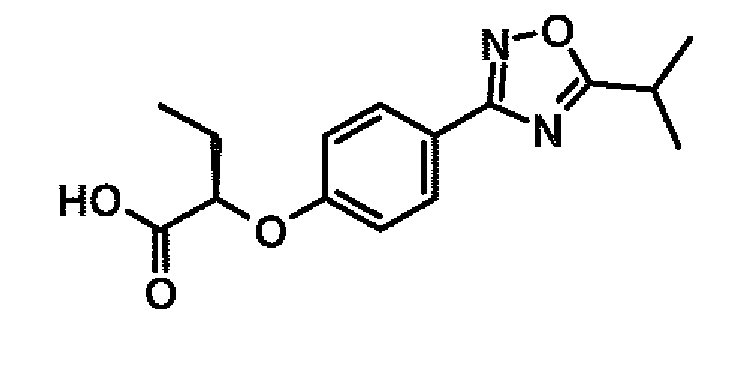
- A 60% sodium hydride (14.7 g, 367 mmol) was added to a 1,4-dioxane (300 mL) solution of the compound obtained in Reference Example 9 (30.0 g, 147 mmol) at room temperature, and the mixture was stirred for 10 minutes at the same temperature and then was heated to 100°C. Subsequently, a 1,4-dioxane (50 mL) solution of (S)-2-chlorobutyric acid (19.7 mL, 191 mmol) at 100°C was added dropwise to the mixture, and the resulting mixture was further stirred for 4 hours at the same temperature. The reaction mixture was cooled to room temperature, and then 2 N hydrochloric acid was added thereto. The mixture was subjected to extraction two times with ethyl acetate, and the organic layer thus obtained was washed with saturated brine and then was dried over anhydrous magnesium sulfate. The solvent was distilled off under reduced pressure, and the resulting residue was washed with hexane-ethyl acetate (3:1, v/v). Thus, the title compound (30.4 g, yield: 71%) was obtained.
1H-NMR (500MHz, CDCl3) δppm: 8.00 (2H, d, J = 9 Hz), 6.98 (2H, d, J = 9 Hz), 4.69 (1H, dd, J = 7, 6 Hz), 3.32-3.24 (1H, m), 2.13-2.02 (2H, m), 1.45 (6H, d, J = 7 Hz), 1.13 (3H, t, J = 7 Hz). - 4-(5-Ethyl-1,2,4-oxadiazol-3-yl)phenol
-

- Propionic acid chloride (1.14 mL, 13.1 mmol) was added to a pyridine (20 mL) solution of the compound obtained in Reference example 8 (2.00 g, 13.1 mmol) at 0°C, and the mixture was stirred for 15 minutes at 0°C. Subsequently, the reaction mixture was heated to 80°C, and was stirred for 3 hours. The reaction mixture was cooled to room temperature, subsequently water and 2 N hydrochloric acid were added thereto, and the mixture was subjected to extraction two times with ethyl acetate. The organic layer thus obtained was washed with saturated brine, and then was dried over anhydrous sodium sulfate. The solvent was distilled off under reduced pressure, and the resulting residue was purified by silica gel column chromatography (hexane:ethyl acetate = 95:5 → 80:20, v/v). Thus, the title compound (1.98 g, yield: 80%) was obtained.
1H-NMR (400MHz, CDCl3)δppm: 7.96 (2H, d, J = 9 Hz), 6.92 (2H, d, J = 9 Hz), 2.97 (2H, q, J = 8 Hz), 1.44 (3H, t, J = 8 Hz). - (2R)-2-[4-(5-ethyl-1,2,4-oxadiazol-3-yl)phenoxy]butyric acid
-

- 60% Sodium hydride (673 mg, 16.8 mmol) was added in small amounts to a 1,4-dioxane (28 mL) solution of the compound obtained in Reference Example 27 (800 mg, 4.21 mmol) at room temperature, and the mixture was stirred for 10 minutes at room temperature. Subsequently, a dioxane solution (2 mL) of (S)-2-chlorobutyric acid (563 uL, 5.46 mmol) was added to the reaction mixture, and the mixture was stirred for 4.5 hours at 100°C. The reaction mixture was cooled to room temperature, subsequently water and 2 N hydrochloric acid were added thereto, and the mixture was subjected to extraction three times with ethyl acetate. The organic layer thus obtained was washed with saturated brine, and then was dried over anhydrous sodium sulfate. The solvent was distilled off under reduced pressure, and the resulting residue was washed with hexane-ethyl acetate (10:1, v/v). Thus, the title compound (571 mg, yield: 66%) was obtained.
- 3-[3-Fluoro-4-methylsulfonyl]phenyl]-5-{1-[4-(5-isopropyl-1 ,2,4-oxadiazol-3-yl)phenoxy]propyl}-1,2,4-oxadiazole
-

- To a dimethylformamide (1.50 mL) solution of the compound obtained in Reference Example 7 (87.5 mg, 0.301 mmol), N-(3-dimethylaminopropyl)-N'-ethylcarbodiimide (116 mg, 0.603 mmol), 1-hydroxybenzotriazole monohydrate (46.2 mg, 0.301 mmol) and the compound obtained in Reference Example 3 (70.0 mg, 0.301 mmol) were added at room temperature, and the mixture was stirred for 5 hours at 100°C. The reaction mixture was cooled to room temperature, subsequently water was added to the reaction mixture, and the mixture was subjected to extraction two times with ethyl acetate. The organic layer thus obtained was washed with saturated brine, and then was dried over anhydrous sodium sulfate. The solvent was distilled off under reduced pressure, and the resulting residue was purified by silica gel column chromatography (hexane: ethyl acetate =4:1 → 2:3, v/v). Thus, the title compound (84 mg, yield: 57%) was obtained.
1H-NMR (400MHz, CDCl3 δppm: 8.18-7.95 (5H, m), 7.17-7.03 (2H, m), 5.56 (1H, t, J=7Hz), 3.31-3.25 (1H, m), 3.30 (3H, s), 2.47-2.16 (2H, m), 1.45 (6H, d, J=7Hz), 1.16 (3H, t, J=7Hz); MS(FAB+) m/z: 487 [M+H]+ - 3-[3-Fluoro-4-methylsulfonyl]phenyl]-5-{1-[4-(5-isopropyl-1 ,2,4-oxadiazol-3-yl)phenoxy]ethyl}-1,2,4-oxadiazole
-

- The synthesis was carried out in the same manner as in Example 1, except that the compound obtained in Reference Example 11 (59.5 mg, 0.215 mmol) was used in place of 2-[4-(5-isopropyl-1,2,4-oxadiazol-3-yl)phenoxy]butanoic acid. Thus, the title compound (96 mg, yield: 94%) was obtained.
1H-NMR (400MHz, CDCl3) δppm: 8.18-7.95 (5H, m), 7.17-7.03 (2H, m), 5.77 (1H, q, J=7Hz), 3.31-3.26 (1H, m), 3.30 (3H, s), 1.95 (3H, d, J=7Hz), 1.45(6H, d, J=7Hz); MS(FAB+) m/z: 473 [M+H]+ - 3-[3-Fluoro-4-(methylsulfonyl)phenyl]-5-{1-[4-(5-isopropyl-1,2,4-oxadiazol-3-yl)phenoxy]butyl}-1,2,4-oxadiazole
-

- The synthesis was carried out in the same manner as in Example 1, except that the compound obtained in Reference Example 13 (210 mg, 1.38 mmol) was used in place of 2-[4-(5-isopropyl-1,2,4-oxadiazol-3-yl)phenoxy]butanoic acid. Thus, the title compound (240 mg, yield: 53%) was obtained.
1H-NMR (400MHz, CDCl3) δppm: 8.18-7.95 (5H, m), 7.17-7.03 (2H, m), 5.56 (1H, t, J=7Hz), 3.31-3.25 (1H, m), 3.30 (3H, s), 2.47-2.16 (2H, m), 1.75-1.46 (2H, m), 1.45 (6H, d, J=7Hz), 1.25 (3H, t, J=7Hz); MS (ESI) m/z: 501 [M+H]+. - 5-Ethyl-3-[4-(1-{3-[3-fluoro-4-(methylsulfonyl)phenyl]-1,2, 4-oxadiazol-5-yl}propoxy)phenyl]-1,2,4-oxadiazole
-

- The synthesis was carried out in the same manner as in Example I, except that the compound synthesized in Reference Example 15 (112 mg, 0.431 mmol) was used in place of 2-[4-(5-isopropyl-1,2,4-oxadiazol-3-yl)phenoxy]butanoic acid. Thus, the title compound (129 mg, yield: 63%) was obtained.
1H-NMR (400MHz, DMSO-d6) δppm: 8.11-8.03 (2H, m), 7.98-7.92 (2H, m), 7.28-7.23 (2H, m), 6.08 (1H, t, J=7Hz), 3.37 (3H, s), 3.01 (2H, q, J=7Hz), 2.51-2.49 (1H, m), 2.24-2.18 (2H, m), 1.32 (3H, t, J=7Hz), 1.06 (3H, t, J=7Hz); MS (FAB+) m/z: 473 [M+H]+. - 5-(1-{3-[3-Fluoro-4-(methylsulfonyl)phenyl]-1,2,4-oxadiazol -5-yl}propoxy)-2-(5-isopropyl-1,2,4-oxadiazol-3-yl)pyridine
-

- The synthesis was carried out in the same manner as in Example 1, except that the compound synthesized in Reference Example 20 (300 mg, 1.03 mmol) was used in place of 2-[4-(5-isopropyl-1,2,4-oxadiazol-3-yl)phenoxy]butanoic acid. Thus, the title compound (189 mg, yield: 63%) was obtained.
1H-NMR (400MHz, DMSO-d6) δppm: 8.60 (1H, d, J=3Hz), 8.08-8.02 (4H, m), 7.74 (1H, dd, J=9Hz, 3Hz), 6.16 (1H, t, J=6Hz), 3.39 (3H, s), 3.37-3.30 (1H, m), 2.29-2.21 (2H, m), 1.37 (6H, d, J=6Hz), 1.08 (3H, t, J=7Hz); MS (FAB+) m/z: 488 [M+H]+. - 3-[4-(1-{4-[3-Fluoro-4-(methylsulfonyl)phenyl]-1,3-oxazol-2 -yl}propoxy)phenyl]-5-isopropyl-1,2,4-oxadiazole
-

- 3-Chloroperbenzoic acid (113 mg, 0.425 mmol) was added to a methylene chloride (2.20 mL) solution of the compound obtained in Reference Example 25 (97.2 g, 0.213 mmol) under ice water cooling, and the mixture was stirred for 15 minutes and then was further stirred for 13 hours at room temperature. A saturated aqueous solution of sodium hydrogen carbonate was added to the reaction mixture, and the mixture was subjected to extraction two times with methylene chloride. The organic layer thus obtained was washed with a 1.5 M aqueous solution of sodium sulfite, and then was dried over anhydrous sodium sulfate. The solvent was distilled off under reduced pressure, and the resulting residue was purified by silica gel column chromatography (hexane: ethyl acetate = 4:1 → 1:1, v/v) . Thus, the title compound (101 mg, yield: 64%) was obtained.
1H-NMR (400MHz, CDCl3) δppm: 8.04-7.98 (4H, m), 7.70-7.67 (2H, m), 7.14-7.10 (2H, m), 5.38 (1H, t, J=7Hz), 3.32-3.23 (1H, m), 3.26 (3H, s), 2.60-2.11 (2H, m), 1.46 (6H, d, J=7Hz), 1.12 (3H, t, J=7Hz) ; MS(FAB+) m/z: 486 [M+H]+. - Compounds of Examples 7 to 21 were obtained by making reference to the Reference Examples and Examples described above.
-
[Table 1] Example Structural formula NMR data 7 
1H-NMR (400MHz, DMSO-d6) δppm: 8.26 (2H, d, J = 9Hz), 8.12 (2H, d, J = 9Hz), 7.95 (2H, d, J = 9Hz), 7.25 ( 2H, d, J = 9Hz), 6.03 (1H, t, J = 7H z), 3.29 (3H, s), 2.98 (2H, q, J = 7 Hz), 2.25-2.18 (2H, m), 1.32 (3H, t , J = 7Hz), 1.06 (3H, t, J = 7Hz); M S(FAB+) m/z: 455 [M+H]+. 8 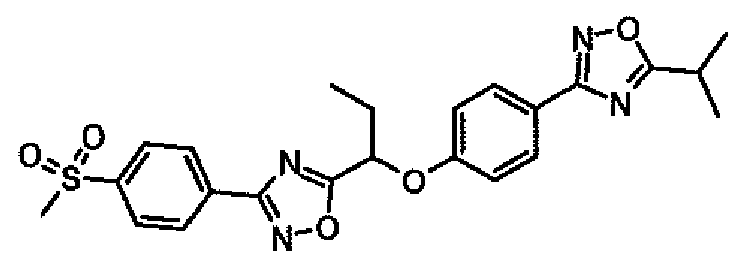
1H-NMR (400MHz, DMSO-d6) δppm: 8.26 -8.20 (2H, m), 8.13-8.07 (2H, m), 7 .98-7.89 (2H, m), 7.25-7.14 (2H. m) , 6.00 (1H, t, J=7Hz), 3.33-3.29 (4 H, m), 2.33-2.12 (2H, m), 1.32 (6H, d, J=7Hz), 1.06(3H, t, J=7Hz); MS( FAB+) m/z: 469 [M+H]+. 9 
1H-NMR (400MHz, DMSO-d6) δppm: 8.26 -7.80 (5H, m), 7.25-7.14 (2H, m), 6 .00 (1H, t, J=7Hz), 3.33-3.29 (4H, m), 2.23-2.12 (2H, m), 1.32 (6H, d, J=7Hz), 1.06(3H, t, J=7Hz); MS(FAB +) m/z: 487 [M+H]+. 10 
1H-NMR (400MHz, DMSO-d6) δppm: 8.26 -8.20 (2H, m), 8.13-8.07 (2H, m), 7 .98-7.89 (2H, m), 7.25-7.14 (2H, m) , 6.00 (1H, t, J=7Hz), 3.31 (3H, s) , 2.33-2.12 (2H, m), 1.32 (9H, s), 1.06(3H, t, J=7Hz); MS(FAB+) m/z: 4 83 [M+H]+. 11 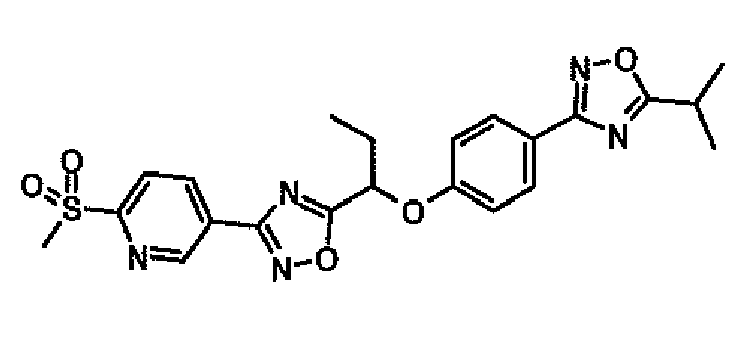
1H-NMR {400MHz, CDCl3} δppm: 9.42 ( 1H, d, J=2Hz), 8.65 (1H, dd, J=8Hz, 2Hz), 8.13 (1H, d, J=8Hz), 8.09-8. 01 (2H, m), 7.13-7.08 (2H, m), 5.56 (1H, t, J=7Hz), 3.31 (3H, s), 3.30 -3.28 (1H, m), 2.41-2.23 (2H, m), 1 .46 (6H, d, J=7Hz), 1.18 (3H, t, J= 7Hz); MS(FAB+) m/z: 470 [M+H]+. 12 
1H-NMR (400MHz, CDCl3) δppm: 8.20-8 .00 (5H, m), 7.12-7.02 (2H, m), 5.5 4 (1H, t, J=7Hz), 3.30-3.28 (1H, m) , 3.13 (3H, s), 2.81 (3H, s), 2.37-2.24 (2H, m), 1.46 (6H, d, J=7Hz), 1.17 (3H, t, J=7Hz); MS(FAB+) m/z: 483 [M+H]+. -
[Table 2] Example Structural formula NMR data 13 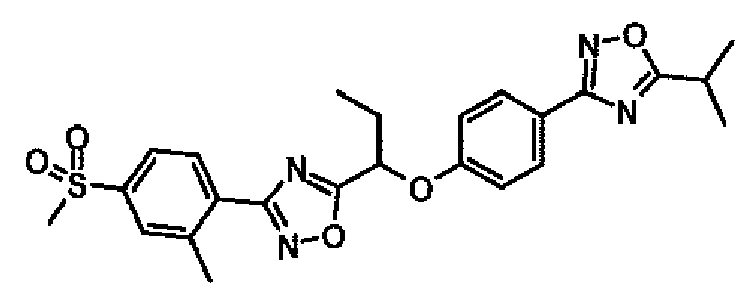
1H-NMR (400MHz, CDCl3) δppm: 8.25 ( 1H, d, J=8Hz), 8.05-7.89 (4H, m), 7 .11-7.10 (2H, m), 5.56 (1H, t, J=7H z), 3.32-3.26 (1H, m), 3.24 (3H, s) , 2.73 (3H, s), 2.38-2.26 (2H, m), 1.46 (6H, d, J=7Hz), 1.19 (3H, t, J =7Hz); MS(FAB+) m/z: 483 [M+H]+. 14 
1H-NMR (400MHz, CDCl3) δppm: 9.33 ( 1H, d, J=2Hz), 8.38-8.26 (2H, m), 8 . 10-8.15 (2H, m), 7.12-7.06 (2H, m) , 4.92 (1H, t, J=7Hz), 3.35-3.25 (1 H, m), 3.31 (3H, s), 2.21-2.13 (2H, m), 1.46 (6H, d, J=7Hz), 1.22 (3H, t, J=7Hz); MS(FAB+) m/z: 470 [M+H]+ 15 
1H-NMR (400MHz, DMSO-d6) δppm: 8.62 (1H, s), 8.07-7.96 (4H, m), 6.61-6 .60 (1H, m), 6.08-6.04 (1H, m), 3.3 4-3.24 (4H, m), 2.51-2.48 (2H, m), 1.34 (6H, d, J=7Hz), 0.95 (3H, d, J =7Hz); MS(FAB+) m/z: 488 [M+H]+. 16 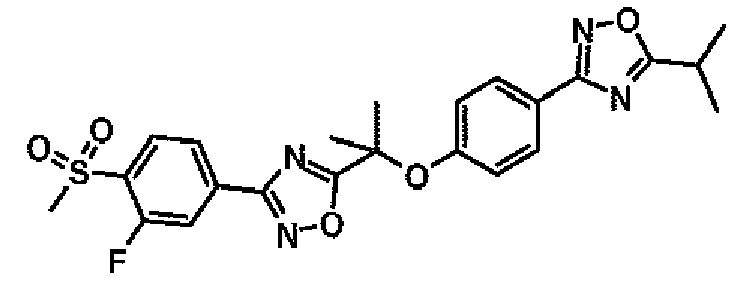
1H-NMR (400MHz, CDCl3) δppm: 8.09-7 .88 (5H, m), 6.84-6.80 (2H, m), 3.2 8-3.26 (4H, m), 1.95 (6H, s), 1.32 (6H, d, J=7Hz) ; MS(FAB+) m/z: 488 [ M+H]+. 17 
1H-NMR (400MHz, CDCl3) δppm: 8.09-7 .90 (5H, m), 7.04-7.00 (2H, m), 5.2 8 (1H, d, J=7Hz), 3.29-3.18 (4H, m) , 2.60-2.46 (1H, m), 1.41 (6H, d, J =7Hz), 1.19 (3H, d, J=7Hz), 1.04 (3 H, d, J=7Hz) ; MS(FAB+) m/z: 502 [M+ H]+ . 18 
1H-NMR (400MHz, DMSO-d6) δppm: 8.14 -7.95 (5H, m), 7.31-7.25 (2H, m), 6 .06 (1H, t, J=7Hz), 3.42 (3H, s), 2 .66 (3H, s), 2.54-2.52 (2H, m), 1.0 9 (3H, t, J=7Hz); MS(FAB+) m/z: 459 [M+H]+. -
[Table 3] Example Structural formula NMR data 19 
1H-NMR (400MHz, CDCl3) δppm: 8.10-7 .94 (5H, m), 7.11-7.05 (2H, m), 5.4 1 (2H, s), 3.27-3.20 (4H, m), 1.42 (6H, d, J=7Hz); MS(FAB+) m/z: 459 [ M+H]+. 20 
1H-NMR (400MHz, CDCl3) δppm: 8.12-7 .77 (5H, m), 6.86 (1H, d, J=8Hz), 5 .52 (1H, t, J=7Hz), 3.19-3.18 (4H, m), 2.39-2.20 (5H, m), 1.42 (6H, d, J=7Hz), 1.26 (3H, t, J=7Hz). 21 
1H-NMR (400MHz, CDCl3) δppm: 8.11-7 .88 (m, 4H), 6.95-6.82 (2H, m), 5.4 9 (1H, t, J=7Hz), 3.80-3.82 (4H, m) ,2.56 (3H, s), 2.31-2.15 (2H, m), 1.47 (6H, d, J=7Hz), 1.12 (3H, t, J =7Hz). - 3-[3-Fluoro-4-(methylsulfonyl)phenyl]-5-{(1R)-1-[4-(5-isopr opyl-1,2,4-oxadiazol-3-yl)phenoxy]propyl}-1,2,4-oxadiazole
-

- To an N,N-dimethylformamide (50 mL) solution of the compound obtained in Reference Exampple 26 (2.90 g, 10.0 mmol), 1-hydroxybenzotriazole monohydrate (1.53 g, 10.0 mmol) and N-(3-dimethylaminopropyl)-N'-ethylcarbodiimide (3.83 g, 20.0 mmol) were added at room temperature, and the mixture was stirred for 30 minutes at the same temperature. Subsequently, the compound obtained in Reference Example 3 (2.32 g, 10.0 mmol) was added thereto at room temperature, and then the mixture was stirred for 15 minutes and then was further stirred for 3.5 hours at 100°C. The reaction mixture was cooled to room temperature, subsequently water was added thereto, and the mixture was subjected to extraction two times with ethyl acetate. The organic layer thus obtained was washed with a saturated aqueous solution of sodium hydrogen carbonate and saturated brine, and then was dried over anhydrous sodium sulfate. The solvent was distilled off under reduced pressure, and the resulting residue was purified by silica gel column chromatography (hexane:ethyl acetate = 80:20 → 50:50, v/v). Thus, the title compound (3.99 g, yield: 82%) was obtained.
1H-NMR (500MHz, CDCl3) δppm: 8.10-7.97 (5H, m), 7.06 (2H, d, J = 9 Hz), 5.52 (1H, dd, J = 7, 6 Hz), 3.28-3.23 (1H, m), 3.26 (3H, s), 2.35-2.20 (2H, m), 1.43 (6H, d, J = 7 Hz), 1.15 (3H, t, J = 7 Hz); MS(FAB+) m/z: 487 [M+H]+. - 5-Ethyl-3-(4-{[(1R)-1-(3-[3-fluoro-4-(methylsulfonyl)phenyl ]-1,2,4-oxadiazol-5-yl)propyl]oxy}phenyl)-1,2,4-oxadiazole
-

- To a 1,3-dimethyl-2-imidazolidinone (10 mL) solution of the compound obtained in Reference Example 28 (571 mg, 2.07 mmol), 1-hydroxybenzotriazole monohydrate (317 mg, 2.07 mmol) and N-(3-dimethylaminopropyl)-N'-ethylcarbodiimide (594 mg, 3.10 mmol) were added at room temperature, and the mixture was stirred for 15 minutes at the same temperature. Subsequently, the compound obtained in Reference Example 3 (480 mg, 2.07 mmol) was added thereto, and the mixture was stirred for 30 minutes and was further stirred for 2 hours at 100°C. The reaction mixture was cooled down to room temperature, subsequently water was added to the reaction mixture, and the mixture was subj ected to extraction two times with ethyl acetate. The organic layer thus obtained was washed with a saturated aqueous solution of sodium hydrogen carbonate and 10% brine, and then was dried over anhydrous sodium sulfate. The solvent was distilled off under reduced pressure, and the resulting residue was purified by silica gel column chromatography (hexane:ethyl acetate = 80:20 → 50:50, v/v). Thus, the title compound (660 mg, yield: 66%) was obtained.
1H-NMR (400MHz, CDCl3) δppm: 8.11-8.06 (2H, m), 8.01 (2H, d, J =9Hz), 8.02-7.96 (1H, m), 7.06 (2H, d, J =9Hz), 5.52 (1H, t, J =7Hz), 3.26 (3H, s), 2.95 (2H, q, J =8Hz), 2.31-2.24 (2H, m), 1.43 (3H, t, J =8Hz), 1.15(3H, t, J =7Hz); MS (FAB+) m/z: 473 [M+H]+. - 5 g of each of the compounds obtained in the Examples, 90 g of lactose, 34 g of corn starch, 20 g of crystalline cellulose, and 1 g of magnesium stearate are mixed with a blender, and then the blend is tabletted with a tabletting machine. Thereby, tablets are obtained.
- 2.0 to 10.0 mg of a test compound was weighed, and then a 0.5 w/v% methyl cellulose solution was added thereto to prepare a liquid for administration at a concentration of 1 mg/ml. Alternatively, 1.0 to 10.0 mg of a test compound was weighed, and then N,N-dimethylformamide was added thereto to prepare a compound solution at a concentration of 20 mg/ml. This was further diluted to 20 times using a 0.5 w/v% methyl cellulose solution, and thereby a liquid for administration at a final concentration of 1 mg/ml was prepared. C57/BL6J mice (male, 6 to 8 weeks old) were purchased from Charles River Laboratories Japan, Inc., and were raised until they were 9 to 13 weeks old. The mice were fasted, starting from a time point between the 17th hour and the 18th hour of the day before the test day. On the test day, blood was collected from the caudal vein, and then the liquid for administration previously prepared was orally administered. Blood was collected again from the caudal vein thirty minutes after the administration (the blood sugar level at this time is designated as a pre-value). Subsequently, a 30% glucose solution was orally administered in an amount of 10 ml/kg, and thereby, the mice were subjected to glucose load. After the glucose load, blood was collected from the caudal vein at time points of 15, 30, 60 and 120 minutes. Each of the collected blood samples was centrifuged to separate blood plasma. The pre-value, and the blood glucose level values at 15, 30, 60 and 120 minutes after the glucose load were measured with a Glucoloader GXT (A&T Corp.) using the separated blood plasma samples, and the decrease rate (%) of the blood sugar level AUC with respect to a vehicle-administered group was calculated. Meanwhile, the vehicle-administered group was administered with a 0.5 w/v% methyl cellulose solution or a 5 %v/v N,N-dimethylformamide/0.5 w/v% methyl cellulose mixed solution.
- As a result, the compounds of Examples 2, 7, 8, 11 and 22 decreased the AUC by 5% or more and less than 15%, and the compounds of Examples 1, 3 to 6, 18 and 23 decreased the AUC by 15% or more.
- A test compound is weighed, and then a suspension liquid thereof is prepared using a 0.5 w/v% methyl cellulose solution. Zucker Fatty rats and Zucker Diabetic Fatty rats (male, 8 to 20 weeks old) are purchased from Charles River Laboratories Japan, Inc., and before the test, grouping of the rats is carried out on the basis of the blood sugar levels and body weights of the administered groups. The rats are fasted , starting from a time point between the l5th hour and the 18th hour of the day before the test day. On the test day, blood is collected from the caudal vein, and then the suspension liquid previously prepared is orally administered. Blood is collected again from the caudal vein thirty minutes after the administration (the blood sugar level at this time is designated as a pre-value). Subsequently, a 50% glucose solution is orally administered in an amount of 4 ml/kg, and thereby, the rats are subjected to glucose load. After the glucose load, blood is collected from the caudal vein at time points of 30 minutes, 1, 2 and 3 hours. Each of the collected blood samples is centrifuged to separate blood plasma. The pre-value, and the blood glucose level values at 30 minutes, 1, 2 and 3 hours after the glucose load are measured with a Glucoloader GXT (A&T Corp.) using the separated blood plasma samples, and the decrease rate (%) of the blood sugar level AUC with respect to a vehicle-administered group is calculated. Meanwhile, the vehicle-administered group is administered with a 0.5 w/v% methyl cellulose solution.
- The blood plasma samples obtained by the method described above are used for the measurement of the plasma concentration of the test compound. In order to measure the plasma concentration of the test compound for a day, blood is collected 4 hours to 8 hours after the administration, and even after 24 hours. The blood plasma is subjected to protein removal, and then is fed to a liquid chromatography/mass analyzer to calculate the compound concentration in the blood plasma.
- The P cell (pancreas)-protecting action of a test compound can be confirmed by making reference to the method described in Junko Ogawa, et al., Life Sciences, Vol. 65, No. 12, pp. 1287-1296 (1999).
- The compound of the present invention or a pharmaceutically acceptable salt thereof is useful as an active ingredient of a pharmaceutical composition for treating and/or preventing type 1 diabetes, type 2 diabetes, gestational diabetes, hyperglycemia due to other factors, impaired glucose tolerance, diabetes-associated diseases, diabetic complications and the like, and protecting β cells or the pancreas.
Claims (23)
- A compound represented by general formula (I):

R2 and R3 each independently represent a hydrogen atom or a C1-C6 alkyl group;
R4 represents a C1-C6 alkyl group;
R5 and R6 each independently represent a halogen atom or a C1-C6 alkyl group;
m and n each independently represent an integer from 0 to 4; and
V, W, X, Y and Z each independently represent CH or N, or a pharmaceutically acceptable salt thereof. - The compound according to claim 1, wherein Y and Z both represent CH.
- The compound according to claim 1 or 2, wherein V and W both represent CH.
- The compound according to any one of claims 1 to 3, wherein X represents N.
- The compound according to any one of claims 1 to 4, wherein R1 represents a C1-C3 alkyl group.
- The compound according to any one of claims 1 to 4, wherein R1 represents a methyl group.
- The compound according to any one of claims 1 to 6, wherein R2 represents a hydrogen atom or a C1-C3 alkyl group.
- The compound according to any one of claims 1 to 6, wherein R2 represents a hydrogen atom, a methyl group, an ethyl group, a propyl group or an isopropyl group.
- The compound according to any one of claims 1 to 8, wherein R3 represents a hydrogen atom or a C1-C3 alkyl group.
- The compound according to any one of claims 1 to 8, wherein R3 represents a hydrogen atom or a methyl group.
- The compound according to any one of claims 1 to 10, wherein R4 represents a C1-C3 alkyl group.
- The compound according to any one of claims 1 to 10, wherein R4 represents an ethyl group, an isopropyl group, or a tert-butyl group.
- The compound according to any one of claims I to 12, wherein R5 represents a halogen atom or a C1-C3 alkyl group, and m represents 1.
- The compound according to any one of claims 1 to 12, wherein R5 represents a fluorine atom or a methyl group, and m represents 1.
- The compound according to any one of claims 1 to 14, wherein R6 represents a C1-C3 alkyl group, and n represents 1.
- The compound according to any one of claims 1 to 14, wherein n represents 0.
- A compound selected from the group consisting of the following compounds:3-[3-FIuoro-4-methylsulfonyl]phenyl]-5-{1-[4-(5-isopropyl-1,2,4-oxadiazol-3-yl)phenoxy]propyl}-1,2,4-oxadiazole;3-[3-Fluoro-4-methylsulfonyl]phenyl]-5-{1-[4-(5-isopropyl-1,2,4-oxadiazol-3-yl)phenoxy]ethyl}-1,2,4-oxadiazole;3-[3-Fluoro-4-(methylsulfonyl)phenyl]-5-{1-[4-(5-isopropyl-1,2,4-oxadiazol-3-yl)phenoxy]butyl}-1,2,4-oxadiazole;5-Ethyl-3-[4-(1-{3-[3-fluoro-4-(methylsulfonyl)phenyl ]-1,2,4-oxadiazol-5-yl}propyl)phenyl]-1,2,4-oxadiazole;5-(1-{3-[3-Fluoro-4-(methylsulfonyl)phenyl]-1,2,4-oxadiazol-5-yl}propoxy)-2-(5-isopropyl-1,2,4-oxadiazoI-3-yl)pyridine;3-[4-(1-{4-[3-Fluoro-4-(methylsulfonyl)phenyl]-1,3-oxazol-2-yl}propoxy)phenyl]-5-isopropyl-1,2,4-oxadiazole;3-[3-Fluoro-4-(methylsulfonyl)phenyl]-5-{ (IR)-1-[4-(5-isopropyl-1,2,4-oxadiazol-3-yl)phenoxy]propyl}-1,2,4-oxadiazole; and5-Ethyl-3-(4-{ [(IR)-1-{3-[3-fluoro-4-(methylsulfonyl) phenyl]-1,2,4-oxadiazol-5-yl}propl]oxy}phenyl)-1,2,4-oxadiazole,or a pharmaceutically acceptable salt thereof.
- A pharmaceutical composition comprising, as an active ingredient, the compound according to any one of claims 1 to 17, or a pharmaceutically acceptable salt thereof.
- The pharmaceutical composition according to claim 18, for treating and/or preventing type 1 diabetes, type 2 diabetes, a diabetes-associated disease, or obesity.
- The pharmaceutical composition according to claim 18, for protecting β cells or the pancreas.
- Use of the compound according to any one of claims 1 to 17 or a pharmaceutically acceptable salt thereof, for preparing a pharmaceutical composition.
- A method for treating and/or preventing a disease, the method comprising administering to a mammal a pharmacologically effective amount of the compound according to any one of claims 1 to 17 or a pharmaceutically acceptable salt thereof.
- The method according to claim 22, wherein the mammal is a human being.
Applications Claiming Priority (2)
| Application Number | Priority Date | Filing Date | Title |
|---|---|---|---|
| JP2009182721 | 2009-08-05 | ||
| PCT/JP2010/063150 WO2011016470A1 (en) | 2009-08-05 | 2010-08-04 | Sulfone derivative |
Publications (3)
| Publication Number | Publication Date |
|---|---|
| EP2468737A1 true EP2468737A1 (en) | 2012-06-27 |
| EP2468737A4 EP2468737A4 (en) | 2013-01-23 |
| EP2468737B1 EP2468737B1 (en) | 2013-10-30 |
Family
ID=43544365
Family Applications (1)
| Application Number | Title | Priority Date | Filing Date |
|---|---|---|---|
| EP10806469.2A Not-in-force EP2468737B1 (en) | 2009-08-05 | 2010-08-04 | Sulfone derivative |
Country Status (10)
| Country | Link |
|---|---|
| US (1) | US8754112B2 (en) |
| EP (1) | EP2468737B1 (en) |
| JP (1) | JP5546543B2 (en) |
| KR (1) | KR20120051668A (en) |
| CN (1) | CN102548977B (en) |
| BR (1) | BR112012002293A2 (en) |
| CA (1) | CA2770405C (en) |
| ES (1) | ES2439801T3 (en) |
| TW (1) | TWI452045B (en) |
| WO (1) | WO2011016470A1 (en) |
Cited By (1)
| Publication number | Priority date | Publication date | Assignee | Title |
|---|---|---|---|---|
| EP2805941A4 (en) * | 2012-01-18 | 2015-08-05 | Daiichi Sankyo Co Ltd | SUBSTITUTED PHENYLAZOLE DERIVATIVE |
Families Citing this family (2)
| Publication number | Priority date | Publication date | Assignee | Title |
|---|---|---|---|---|
| SG189320A1 (en) | 2010-10-14 | 2013-05-31 | Daiichi Sankyo Co Ltd | Acylbenzene derivative |
| WO2018224455A1 (en) | 2017-06-07 | 2018-12-13 | Basf Se | Substituted cyclopropyl derivatives |
Family Cites Families (9)
| Publication number | Priority date | Publication date | Assignee | Title |
|---|---|---|---|---|
| JP2000511903A (en) * | 1996-06-07 | 2000-09-12 | メルク エンド カンパニー インコーポレーテッド | Oxadiazole benzenesulfonamide as a selective beta 3 agonist for the treatment of diabetes and obesity |
| US8207147B2 (en) | 2003-12-24 | 2012-06-26 | Prosidion Limited | Heterocyclic derivatives as GPCR receptor agonists |
| EP1586573B1 (en) * | 2004-04-01 | 2007-02-07 | Sanofi-Aventis Deutschland GmbH | Oxadiazolones, processes for their preparation and their use as pharmaceuticals |
| PE20060362A1 (en) * | 2004-05-24 | 2006-05-15 | Irm Llc | OXAZOLE COMPOUNDS AS PPAR MODULATORS |
| EP1623983A1 (en) * | 2004-08-05 | 2006-02-08 | Santhera Pharmaceuticals (Deutschland) Aktiengesellschaft | Heterocyclic compounds useful as DPP-IV inhibitors |
| US20090325924A1 (en) | 2005-06-30 | 2009-12-31 | Stuart Edward | GPCR Agonists |
| AU2006264649A1 (en) * | 2005-06-30 | 2007-01-11 | Prosidion Limited | GPCR agonists |
| GB0606913D0 (en) * | 2006-04-06 | 2006-05-17 | Prosidion Ltd | Compounds |
| NZ571869A (en) * | 2006-04-06 | 2011-11-25 | Prosidion Ltd | Heterocyclic GPCR agonists |
-
2010
- 2010-08-04 BR BR112012002293A patent/BR112012002293A2/en active Search and Examination
- 2010-08-04 EP EP10806469.2A patent/EP2468737B1/en not_active Not-in-force
- 2010-08-04 ES ES10806469.2T patent/ES2439801T3/en active Active
- 2010-08-04 JP JP2011525905A patent/JP5546543B2/en not_active Expired - Fee Related
- 2010-08-04 WO PCT/JP2010/063150 patent/WO2011016470A1/en not_active Ceased
- 2010-08-04 CA CA2770405A patent/CA2770405C/en not_active Expired - Fee Related
- 2010-08-04 TW TW099125845A patent/TWI452045B/en not_active IP Right Cessation
- 2010-08-04 US US13/388,218 patent/US8754112B2/en not_active Expired - Fee Related
- 2010-08-04 KR KR1020127002914A patent/KR20120051668A/en not_active Abandoned
- 2010-08-04 CN CN201080045601.4A patent/CN102548977B/en not_active Expired - Fee Related
Non-Patent Citations (2)
| Title |
|---|
| No further relevant documents disclosed * |
| See also references of WO2011016470A1 * |
Cited By (2)
| Publication number | Priority date | Publication date | Assignee | Title |
|---|---|---|---|---|
| EP2805941A4 (en) * | 2012-01-18 | 2015-08-05 | Daiichi Sankyo Co Ltd | SUBSTITUTED PHENYLAZOLE DERIVATIVE |
| EP3009433A1 (en) * | 2012-01-18 | 2016-04-20 | Daiichi Sankyo Company, Limited | 2-phenyl-1,3-oxazole and 5-phenyl-1,2,4-oxadiazole derivatives for the treatment of diabetes |
Also Published As
| Publication number | Publication date |
|---|---|
| CN102548977B (en) | 2014-07-23 |
| JPWO2011016470A1 (en) | 2013-01-10 |
| JP5546543B2 (en) | 2014-07-09 |
| ES2439801T3 (en) | 2014-01-24 |
| TWI452045B (en) | 2014-09-11 |
| CA2770405A1 (en) | 2011-02-10 |
| US8754112B2 (en) | 2014-06-17 |
| CA2770405C (en) | 2015-03-17 |
| HK1171011A1 (en) | 2013-03-15 |
| US20120129891A1 (en) | 2012-05-24 |
| KR20120051668A (en) | 2012-05-22 |
| TW201109322A (en) | 2011-03-16 |
| CN102548977A (en) | 2012-07-04 |
| WO2011016470A1 (en) | 2011-02-10 |
| EP2468737B1 (en) | 2013-10-30 |
| BR112012002293A2 (en) | 2016-06-14 |
| EP2468737A4 (en) | 2013-01-23 |
Similar Documents
| Publication | Publication Date | Title |
|---|---|---|
| US11834427B2 (en) | Griseofulvin compound | |
| EP2468737B1 (en) | Sulfone derivative | |
| EP2463279B1 (en) | 4-(1,2,4-dioxazol-3-yl)benzamides for the treatment of diabetes and obesity | |
| HK1220448A1 (en) | 2-phenyl-1,3-oxazole and 5-phenyl-1,2,4-oxadiazole derivatives for the treatment of diabetes | |
| CA2843238C (en) | N-hetero-ring-substituted amide derivative | |
| HK1171011B (en) | Sulfone derivative | |
| HK1171010B (en) | 4-(1,2,4-dioxazol-3-yl)benzamides for the treatment of diabetes and obesity | |
| HK1198033B (en) | N-hetero-ring-substituted amide derivative | |
| NZ620339B2 (en) | N-hetero-ring-substituted amide derivative |
Legal Events
| Date | Code | Title | Description |
|---|---|---|---|
| PUAI | Public reference made under article 153(3) epc to a published international application that has entered the european phase |
Free format text: ORIGINAL CODE: 0009012 |
|
| 17P | Request for examination filed |
Effective date: 20120111 |
|
| AK | Designated contracting states |
Kind code of ref document: A1 Designated state(s): AL AT BE BG CH CY CZ DE DK EE ES FI FR GB GR HR HU IE IS IT LI LT LU LV MC MK MT NL NO PL PT RO SE SI SK SM TR |
|
| DAX | Request for extension of the european patent (deleted) | ||
| A4 | Supplementary search report drawn up and despatched |
Effective date: 20130102 |
|
| RIC1 | Information provided on ipc code assigned before grant |
Ipc: A61P 3/10 20060101ALI20121218BHEP Ipc: A61K 31/4439 20060101ALI20121218BHEP Ipc: C07D 271/06 20060101AFI20121218BHEP Ipc: A61K 31/4245 20060101ALI20121218BHEP Ipc: C07D 413/12 20060101ALI20121218BHEP Ipc: C07D 413/14 20060101ALI20121218BHEP Ipc: A61P 3/04 20060101ALI20121218BHEP |
|
| REG | Reference to a national code |
Ref country code: HK Ref legal event code: DE Ref document number: 1171011 Country of ref document: HK |
|
| RIC1 | Information provided on ipc code assigned before grant |
Ipc: A61P 3/10 20060101ALI20130402BHEP Ipc: C07C 247/00 20060101ALI20130402BHEP Ipc: A61K 31/4245 20060101ALI20130402BHEP Ipc: C07D 413/14 20060101ALI20130402BHEP Ipc: C07D 413/12 20060101ALI20130402BHEP Ipc: A61P 3/04 20060101ALI20130402BHEP Ipc: C07D 271/06 20060101AFI20130402BHEP Ipc: A61K 31/4439 20060101ALI20130402BHEP |
|
| GRAP | Despatch of communication of intention to grant a patent |
Free format text: ORIGINAL CODE: EPIDOSNIGR1 |
|
| INTG | Intention to grant announced |
Effective date: 20130517 |
|
| GRAS | Grant fee paid |
Free format text: ORIGINAL CODE: EPIDOSNIGR3 |
|
| GRAA | (expected) grant |
Free format text: ORIGINAL CODE: 0009210 |
|
| AK | Designated contracting states |
Kind code of ref document: B1 Designated state(s): AL AT BE BG CH CY CZ DE DK EE ES FI FR GB GR HR HU IE IS IT LI LT LU LV MC MK MT NL NO PL PT RO SE SI SK SM TR |
|
| REG | Reference to a national code |
Ref country code: GB Ref legal event code: FG4D |
|
| REG | Reference to a national code |
Ref country code: CH Ref legal event code: EP |
|
| REG | Reference to a national code |
Ref country code: AT Ref legal event code: REF Ref document number: 638448 Country of ref document: AT Kind code of ref document: T Effective date: 20131115 |
|
| REG | Reference to a national code |
Ref country code: IE Ref legal event code: FG4D |
|
| REG | Reference to a national code |
Ref country code: DE Ref legal event code: R096 Ref document number: 602010011379 Country of ref document: DE Effective date: 20131224 |
|
| REG | Reference to a national code |
Ref country code: ES Ref legal event code: FG2A Ref document number: 2439801 Country of ref document: ES Kind code of ref document: T3 Effective date: 20140124 |
|
| REG | Reference to a national code |
Ref country code: NL Ref legal event code: VDEP Effective date: 20131030 |
|
| REG | Reference to a national code |
Ref country code: AT Ref legal event code: MK05 Ref document number: 638448 Country of ref document: AT Kind code of ref document: T Effective date: 20131030 |
|
| REG | Reference to a national code |
Ref country code: LT Ref legal event code: MG4D |
|
| PG25 | Lapsed in a contracting state [announced via postgrant information from national office to epo] |
Ref country code: NO Free format text: LAPSE BECAUSE OF FAILURE TO SUBMIT A TRANSLATION OF THE DESCRIPTION OR TO PAY THE FEE WITHIN THE PRESCRIBED TIME-LIMIT Effective date: 20140130 Ref country code: BE Free format text: LAPSE BECAUSE OF FAILURE TO SUBMIT A TRANSLATION OF THE DESCRIPTION OR TO PAY THE FEE WITHIN THE PRESCRIBED TIME-LIMIT Effective date: 20131030 Ref country code: NL Free format text: LAPSE BECAUSE OF FAILURE TO SUBMIT A TRANSLATION OF THE DESCRIPTION OR TO PAY THE FEE WITHIN THE PRESCRIBED TIME-LIMIT Effective date: 20131030 Ref country code: SE Free format text: LAPSE BECAUSE OF FAILURE TO SUBMIT A TRANSLATION OF THE DESCRIPTION OR TO PAY THE FEE WITHIN THE PRESCRIBED TIME-LIMIT Effective date: 20131030 Ref country code: LT Free format text: LAPSE BECAUSE OF FAILURE TO SUBMIT A TRANSLATION OF THE DESCRIPTION OR TO PAY THE FEE WITHIN THE PRESCRIBED TIME-LIMIT Effective date: 20131030 Ref country code: IS Free format text: LAPSE BECAUSE OF FAILURE TO SUBMIT A TRANSLATION OF THE DESCRIPTION OR TO PAY THE FEE WITHIN THE PRESCRIBED TIME-LIMIT Effective date: 20140228 Ref country code: FI Free format text: LAPSE BECAUSE OF FAILURE TO SUBMIT A TRANSLATION OF THE DESCRIPTION OR TO PAY THE FEE WITHIN THE PRESCRIBED TIME-LIMIT Effective date: 20131030 Ref country code: HR Free format text: LAPSE BECAUSE OF FAILURE TO SUBMIT A TRANSLATION OF THE DESCRIPTION OR TO PAY THE FEE WITHIN THE PRESCRIBED TIME-LIMIT Effective date: 20131030 |
|
| REG | Reference to a national code |
Ref country code: HK Ref legal event code: GR Ref document number: 1171011 Country of ref document: HK |
|
| PG25 | Lapsed in a contracting state [announced via postgrant information from national office to epo] |
Ref country code: AT Free format text: LAPSE BECAUSE OF FAILURE TO SUBMIT A TRANSLATION OF THE DESCRIPTION OR TO PAY THE FEE WITHIN THE PRESCRIBED TIME-LIMIT Effective date: 20131030 Ref country code: CY Free format text: LAPSE BECAUSE OF FAILURE TO SUBMIT A TRANSLATION OF THE DESCRIPTION OR TO PAY THE FEE WITHIN THE PRESCRIBED TIME-LIMIT Effective date: 20131030 Ref country code: LV Free format text: LAPSE BECAUSE OF FAILURE TO SUBMIT A TRANSLATION OF THE DESCRIPTION OR TO PAY THE FEE WITHIN THE PRESCRIBED TIME-LIMIT Effective date: 20131030 |
|
| PG25 | Lapsed in a contracting state [announced via postgrant information from national office to epo] |
Ref country code: PT Free format text: LAPSE BECAUSE OF FAILURE TO SUBMIT A TRANSLATION OF THE DESCRIPTION OR TO PAY THE FEE WITHIN THE PRESCRIBED TIME-LIMIT Effective date: 20140228 |
|
| PG25 | Lapsed in a contracting state [announced via postgrant information from national office to epo] |
Ref country code: EE Free format text: LAPSE BECAUSE OF FAILURE TO SUBMIT A TRANSLATION OF THE DESCRIPTION OR TO PAY THE FEE WITHIN THE PRESCRIBED TIME-LIMIT Effective date: 20131030 |
|
| REG | Reference to a national code |
Ref country code: DE Ref legal event code: R097 Ref document number: 602010011379 Country of ref document: DE |
|
| PG25 | Lapsed in a contracting state [announced via postgrant information from national office to epo] |
Ref country code: PL Free format text: LAPSE BECAUSE OF FAILURE TO SUBMIT A TRANSLATION OF THE DESCRIPTION OR TO PAY THE FEE WITHIN THE PRESCRIBED TIME-LIMIT Effective date: 20131030 Ref country code: CZ Free format text: LAPSE BECAUSE OF FAILURE TO SUBMIT A TRANSLATION OF THE DESCRIPTION OR TO PAY THE FEE WITHIN THE PRESCRIBED TIME-LIMIT Effective date: 20131030 Ref country code: RO Free format text: LAPSE BECAUSE OF FAILURE TO SUBMIT A TRANSLATION OF THE DESCRIPTION OR TO PAY THE FEE WITHIN THE PRESCRIBED TIME-LIMIT Effective date: 20131030 Ref country code: SK Free format text: LAPSE BECAUSE OF FAILURE TO SUBMIT A TRANSLATION OF THE DESCRIPTION OR TO PAY THE FEE WITHIN THE PRESCRIBED TIME-LIMIT Effective date: 20131030 |
|
| PLBE | No opposition filed within time limit |
Free format text: ORIGINAL CODE: 0009261 |
|
| STAA | Information on the status of an ep patent application or granted ep patent |
Free format text: STATUS: NO OPPOSITION FILED WITHIN TIME LIMIT |
|
| PG25 | Lapsed in a contracting state [announced via postgrant information from national office to epo] |
Ref country code: DK Free format text: LAPSE BECAUSE OF FAILURE TO SUBMIT A TRANSLATION OF THE DESCRIPTION OR TO PAY THE FEE WITHIN THE PRESCRIBED TIME-LIMIT Effective date: 20131030 |
|
| 26N | No opposition filed |
Effective date: 20140731 |
|
| REG | Reference to a national code |
Ref country code: DE Ref legal event code: R097 Ref document number: 602010011379 Country of ref document: DE Effective date: 20140731 |
|
| PG25 | Lapsed in a contracting state [announced via postgrant information from national office to epo] |
Ref country code: SI Free format text: LAPSE BECAUSE OF FAILURE TO SUBMIT A TRANSLATION OF THE DESCRIPTION OR TO PAY THE FEE WITHIN THE PRESCRIBED TIME-LIMIT Effective date: 20131030 |
|
| PG25 | Lapsed in a contracting state [announced via postgrant information from national office to epo] |
Ref country code: LU Free format text: LAPSE BECAUSE OF FAILURE TO SUBMIT A TRANSLATION OF THE DESCRIPTION OR TO PAY THE FEE WITHIN THE PRESCRIBED TIME-LIMIT Effective date: 20140804 Ref country code: MC Free format text: LAPSE BECAUSE OF FAILURE TO SUBMIT A TRANSLATION OF THE DESCRIPTION OR TO PAY THE FEE WITHIN THE PRESCRIBED TIME-LIMIT Effective date: 20131030 |
|
| REG | Reference to a national code |
Ref country code: CH Ref legal event code: PL |
|
| PG25 | Lapsed in a contracting state [announced via postgrant information from national office to epo] |
Ref country code: CH Free format text: LAPSE BECAUSE OF NON-PAYMENT OF DUE FEES Effective date: 20140831 Ref country code: LI Free format text: LAPSE BECAUSE OF NON-PAYMENT OF DUE FEES Effective date: 20140831 |
|
| REG | Reference to a national code |
Ref country code: IE Ref legal event code: MM4A |
|
| PG25 | Lapsed in a contracting state [announced via postgrant information from national office to epo] |
Ref country code: IE Free format text: LAPSE BECAUSE OF NON-PAYMENT OF DUE FEES Effective date: 20140804 |
|
| PG25 | Lapsed in a contracting state [announced via postgrant information from national office to epo] |
Ref country code: SM Free format text: LAPSE BECAUSE OF FAILURE TO SUBMIT A TRANSLATION OF THE DESCRIPTION OR TO PAY THE FEE WITHIN THE PRESCRIBED TIME-LIMIT Effective date: 20131030 |
|
| PG25 | Lapsed in a contracting state [announced via postgrant information from national office to epo] |
Ref country code: BG Free format text: LAPSE BECAUSE OF FAILURE TO SUBMIT A TRANSLATION OF THE DESCRIPTION OR TO PAY THE FEE WITHIN THE PRESCRIBED TIME-LIMIT Effective date: 20131030 Ref country code: MT Free format text: LAPSE BECAUSE OF FAILURE TO SUBMIT A TRANSLATION OF THE DESCRIPTION OR TO PAY THE FEE WITHIN THE PRESCRIBED TIME-LIMIT Effective date: 20131030 Ref country code: GR Free format text: LAPSE BECAUSE OF FAILURE TO SUBMIT A TRANSLATION OF THE DESCRIPTION OR TO PAY THE FEE WITHIN THE PRESCRIBED TIME-LIMIT Effective date: 20140131 |
|
| REG | Reference to a national code |
Ref country code: FR Ref legal event code: PLFP Year of fee payment: 7 |
|
| PG25 | Lapsed in a contracting state [announced via postgrant information from national office to epo] |
Ref country code: HU Free format text: LAPSE BECAUSE OF FAILURE TO SUBMIT A TRANSLATION OF THE DESCRIPTION OR TO PAY THE FEE WITHIN THE PRESCRIBED TIME-LIMIT; INVALID AB INITIO Effective date: 20100804 Ref country code: TR Free format text: LAPSE BECAUSE OF FAILURE TO SUBMIT A TRANSLATION OF THE DESCRIPTION OR TO PAY THE FEE WITHIN THE PRESCRIBED TIME-LIMIT Effective date: 20131030 |
|
| REG | Reference to a national code |
Ref country code: FR Ref legal event code: PLFP Year of fee payment: 8 |
|
| PGFP | Annual fee paid to national office [announced via postgrant information from national office to epo] |
Ref country code: IT Payment date: 20170824 Year of fee payment: 8 Ref country code: GB Payment date: 20170802 Year of fee payment: 8 Ref country code: FR Payment date: 20170714 Year of fee payment: 8 Ref country code: ES Payment date: 20170906 Year of fee payment: 8 Ref country code: DE Payment date: 20170801 Year of fee payment: 8 |
|
| PG25 | Lapsed in a contracting state [announced via postgrant information from national office to epo] |
Ref country code: MK Free format text: LAPSE BECAUSE OF FAILURE TO SUBMIT A TRANSLATION OF THE DESCRIPTION OR TO PAY THE FEE WITHIN THE PRESCRIBED TIME-LIMIT Effective date: 20131030 |
|
| PG25 | Lapsed in a contracting state [announced via postgrant information from national office to epo] |
Ref country code: AL Free format text: LAPSE BECAUSE OF FAILURE TO SUBMIT A TRANSLATION OF THE DESCRIPTION OR TO PAY THE FEE WITHIN THE PRESCRIBED TIME-LIMIT Effective date: 20131030 |
|
| REG | Reference to a national code |
Ref country code: DE Ref legal event code: R119 Ref document number: 602010011379 Country of ref document: DE |
|
| GBPC | Gb: european patent ceased through non-payment of renewal fee |
Effective date: 20180804 |
|
| PG25 | Lapsed in a contracting state [announced via postgrant information from national office to epo] |
Ref country code: IT Free format text: LAPSE BECAUSE OF NON-PAYMENT OF DUE FEES Effective date: 20180804 Ref country code: DE Free format text: LAPSE BECAUSE OF NON-PAYMENT OF DUE FEES Effective date: 20190301 |
|
| PG25 | Lapsed in a contracting state [announced via postgrant information from national office to epo] |
Ref country code: FR Free format text: LAPSE BECAUSE OF NON-PAYMENT OF DUE FEES Effective date: 20180831 |
|
| REG | Reference to a national code |
Ref country code: ES Ref legal event code: FD2A Effective date: 20190918 |
|
| PG25 | Lapsed in a contracting state [announced via postgrant information from national office to epo] |
Ref country code: GB Free format text: LAPSE BECAUSE OF NON-PAYMENT OF DUE FEES Effective date: 20180804 Ref country code: ES Free format text: LAPSE BECAUSE OF NON-PAYMENT OF DUE FEES Effective date: 20180805 |