EP2468593A1 - Improvements in or relating to brake control - Google Patents
Improvements in or relating to brake control Download PDFInfo
- Publication number
- EP2468593A1 EP2468593A1 EP11193352A EP11193352A EP2468593A1 EP 2468593 A1 EP2468593 A1 EP 2468593A1 EP 11193352 A EP11193352 A EP 11193352A EP 11193352 A EP11193352 A EP 11193352A EP 2468593 A1 EP2468593 A1 EP 2468593A1
- Authority
- EP
- European Patent Office
- Prior art keywords
- braking effort
- brake
- vehicle
- brake control
- wheels
- Prior art date
- Legal status (The legal status is an assumption and is not a legal conclusion. Google has not performed a legal analysis and makes no representation as to the accuracy of the status listed.)
- Granted
Links
- 238000000034 method Methods 0.000 claims description 9
- 230000004044 response Effects 0.000 claims description 4
- 230000008901 benefit Effects 0.000 description 3
- 230000004913 activation Effects 0.000 description 2
- 230000000694 effects Effects 0.000 description 2
- 230000007246 mechanism Effects 0.000 description 2
- 239000013589 supplement Substances 0.000 description 2
- 230000001133 acceleration Effects 0.000 description 1
- 230000000295 complement effect Effects 0.000 description 1
- 230000000994 depressogenic effect Effects 0.000 description 1
- 238000010586 diagram Methods 0.000 description 1
- 230000000979 retarding effect Effects 0.000 description 1
Images
Classifications
-
- G—PHYSICS
- G07—CHECKING-DEVICES
- G07F—COIN-FREED OR LIKE APPARATUS
- G07F17/00—Coin-freed apparatus for hiring articles; Coin-freed facilities or services
- G07F17/24—Coin-freed apparatus for hiring articles; Coin-freed facilities or services for parking meters
-
- B—PERFORMING OPERATIONS; TRANSPORTING
- B60—VEHICLES IN GENERAL
- B60T—VEHICLE BRAKE CONTROL SYSTEMS OR PARTS THEREOF; BRAKE CONTROL SYSTEMS OR PARTS THEREOF, IN GENERAL; ARRANGEMENT OF BRAKING ELEMENTS ON VEHICLES IN GENERAL; PORTABLE DEVICES FOR PREVENTING UNWANTED MOVEMENT OF VEHICLES; VEHICLE MODIFICATIONS TO FACILITATE COOLING OF BRAKES
- B60T7/00—Brake-action initiating means
- B60T7/12—Brake-action initiating means for automatic initiation; for initiation not subject to will of driver or passenger
-
- B—PERFORMING OPERATIONS; TRANSPORTING
- B60—VEHICLES IN GENERAL
- B60T—VEHICLE BRAKE CONTROL SYSTEMS OR PARTS THEREOF; BRAKE CONTROL SYSTEMS OR PARTS THEREOF, IN GENERAL; ARRANGEMENT OF BRAKING ELEMENTS ON VEHICLES IN GENERAL; PORTABLE DEVICES FOR PREVENTING UNWANTED MOVEMENT OF VEHICLES; VEHICLE MODIFICATIONS TO FACILITATE COOLING OF BRAKES
- B60T17/00—Component parts, details, or accessories of power brake systems not covered by groups B60T8/00, B60T13/00 or B60T15/00, or presenting other characteristic features
- B60T17/18—Safety devices; Monitoring
-
- B—PERFORMING OPERATIONS; TRANSPORTING
- B60—VEHICLES IN GENERAL
- B60T—VEHICLE BRAKE CONTROL SYSTEMS OR PARTS THEREOF; BRAKE CONTROL SYSTEMS OR PARTS THEREOF, IN GENERAL; ARRANGEMENT OF BRAKING ELEMENTS ON VEHICLES IN GENERAL; PORTABLE DEVICES FOR PREVENTING UNWANTED MOVEMENT OF VEHICLES; VEHICLE MODIFICATIONS TO FACILITATE COOLING OF BRAKES
- B60T2201/00—Particular use of vehicle brake systems; Special systems using also the brakes; Special software modules within the brake system controller
- B60T2201/06—Hill holder; Start aid systems on inclined road
Definitions
- the present invention relates to brake control systems for motor vehicles and methods of braking motor vehicles.
- it relates to such brake control systems and methods of braking, in which safety is enhanced after the vehicle is brought to a stationary state, i.e. standstill.
- Brake control systems for motor vehicles are known, particularly in relation to the so-called service brakes of motor vehicles.
- Service brakes are the primary mechanism for slowing or stopping a motor vehicle and, as is known in the art, may take a variety of forms.
- service brakes are disc brakes and of the hydraulic type, acting on all wheels of the vehicle (i.e. typically four in the case of a motor car).
- Motor vehicles are also required to have a mechanical parking brake (sometimes referred to as a handbrake), which is distinct from the service brakes.
- the parking brake functions primarily to hold the vehicle in standstill but also acts as an emergency brake, for example should there be a major failure with the service brake system.
- the parking brake may take a variety of forms but is most commonly a disc brake of the mechanical type (actuated by cables).
- the parking brake though of the mechanical type, is controlled electronically, i.e. is operable with the help of a button, via an associated control module.
- the parking brake generally does not act on all wheels of the vehicle. For example, in the case of a motor car, it may exert a braking effort only on the wheels of the rear axle (i.e. two wheels).
- the service brakes may hold the vehicle in standstill when the parking brake is engaged, but may subsequently be released when a driver leaves the vehicle.
- holding of the vehicle by the service brakes need not necessarily result from direct driver input. It may also result from an automatic braking component supplied by the brake control system, possibly without any application of the brake pedal by the driver, for example to help the driver by preventing unwanted vehicle motion. Particularly where an electronic parking brake is used in such a vehicle, it can be difficult for a driver to know whether the vehicle is being held in standstill by the service brakes or by the parking brake.
- the invention resides in a brake control system for a motor vehicle having wheels, service brakes for supplying a service braking effort to a plurality of the wheels, sensing means for detecting standstill of the vehicle, and a parking brake engageable to supply a park braking effort to a subset of the plurality of wheels, the system comprising: brake actuation means for actuating the service brakes to supply the service braking effort; and brake control means for controlling the brake actuation means to supply an automatic component of the service braking effort, wherein the brake control means is arranged, when standstill of the vehicle is detected and before the parking brake is engaged, to cause the brake actuation means to supply the automatic component of the service braking effort only to the subset of the plurality of wheels.
- automatic component of the service braking effort is meant a component of the service braking effort that does not correspond to a driver brake input.
- the automatic component may be caused by the brake control means (by commanding the brake actuation means to maintain or increase braking effort) based on a programmed response to one or more vehicle conditions, e.g. vehicle movement or lack thereof, vehicle inclination angle, gear selection, and/or throttle application.
- the automatic component may vary over time. At any given time, the automatic component may be the sole component of the service braking effort, may complement, or cooperate with, a driver input component of the service braking effort, or may be reduced to zero (e.g. while the driver input component is found to be sufficient to maintain standstill). To facilitate cooperation between the automatic component and the driver input component, the driver input component may be monitored or handled by the brake control means.
- the plurality of wheels may preferably comprise four or more wheels.
- the term "subset" as used herein refers to a proper subset.
- the subset of the plurality of wheels always comprises at least one wheel less than the plurality of wheels.
- the subset of the plurality of wheels may comprise three or fewer wheels, e.g. two wheels.
- the brake control system of the first aspect of the invention enhances safety and improves driver feedback. Specifically, the brake control system ensures that the driver is not given a false sense of security when the vehicle is held in standstill by the service brakes, particularly when there is no driver input component of the service braking effort. The driver experiences the effect of a braking effort supplied only to the subset of the plurality of wheels whilst still in control of the vehicle, before the parking brake is engaged.
- the invention particularly improves safety in situations where a braking effort supplied to the plurality of wheels is sufficient to hold the vehicle in standstill, but a braking effort supplied to the subset of the plurality of wheels is not, for example because the vehicle is on a very steep slope and/or the subset of the plurality of wheels is supported on slippery ground.
- the brake control means may be arranged to ensure that, during standstill of the vehicle, the automatic component of the service braking effort does not exceed the park braking effort.
- the invention resides in a brake control system for a motor vehicle having wheels, service brakes for supplying a service braking effort to a plurality of the wheels, sensing means for detecting standstill of the vehicle, and a parking brake engageable to supply a park braking effort to a subset of the plurality of wheels, the system comprising: brake actuation means for actuating the service brakes to supply the service braking effort; and brake control means for controlling the brake actuation means to supply an automatic component of the service braking effort, wherein the brake control means is arranged, when standstill of the vehicle is detected and before the parking brake is engaged, to ensure that the automatic component of the service braking effort does not exceed the park braking effort.
- the automatic component of the service braking effort may be supplied only to the subset of the plurality of wheels.
- the brake control means may be arranged to determine a first braking effort threshold suitable for holding the vehicle in standstill with service braking effort supplied only to the subset of the plurality of wheels.
- the brake control system may comprise sensing means for detecting a vehicle gradient (i.e. inclination angle) and the brake control means may be arranged to determine the first braking effort threshold based on a signal from the gradient sensing means.
- the first braking effort threshold may additionally be determined based on a vehicle gear selection and/or based on a vehicle load weight.
- the brake control means may be arranged, when the vehicle is in standstill, to adjust the automatic component of the service braking effort so that the service braking effort (supplied to the subset of the plurality of wheels according to the first aspect of the invention) is greater than or equal to the first braking effort threshold.
- the vehicle gradient may make it impossible to determine a threshold suitable for holding the vehicle in standstill.
- the first threshold may optionally be set as maximum braking effort.
- the brake control systems according to the first and second aspects may preferably further comprise a brake input for controlling (either directly or via the brake control means) the brake actuation means to supply a driver input component of the service braking effort to the plurality of wheels.
- the brake control means may advantageously be arranged, during standstill of the vehicle, to cause a variation in the automatic component of the service braking effort in response to a variation in the driver input component of the service braking effort.
- the brake control means may be arranged to determine a second braking effort threshold suitable for holding the vehicle in standstill with service braking effort supplied to the plurality of wheels.
- the brake control means may then preferably be arranged to increase the automatic component of the service braking effort, most preferably to equal or exceed the first braking effort threshold, when a driver input component of the service braking effort supplied to the plurality of wheels falls below the second braking effort threshold.
- the supply of the automatic component of the service braking effort only to the subset of the plurality of wheels, and/or ensuring that the automatic component of the service braking effort does not exceed the park braking effort need not be continuous.
- the brake control means may be arranged to cause the above to occur only for a predetermined time period during standstill, such as 3 seconds or less. However, preferably the above may occur, either individually or in combination, at all times when standstill of the vehicle is detected.
- the brake actuation means and the parking brake may be distinct (i.e. actuated by separate mechanisms). Additionally or alternatively, the brake actuation means may be of the hydraulic type and/or the parking brake may be of the mechanical type.
- the brake control means may be arranged to cease supply of the automatic component of the service brake effort after the parking brake is engaged.
- the brake control means may also preferably be arranged to cease supply of the automatic component of the service brake effort and/or disengage the parking brake in response to a driver accelerator input.
- the brake control systems of the first and second aspects of the invention share the objective of providing a service braking effort that emulates, or at least does not exceed, the park braking effort.
- the brake control systems, and in particular the brake control means may be arranged to emulate the park braking effort in terms of overall vehicle retarding power.
- the invention resides in a method of braking a motor vehicle, the method comprising: applying a first service braking effort to a plurality of wheels of the vehicle to bring the vehicle to a standstill, applying a second service braking effort to a subset of the plurality of wheels to hold the vehicle in standstill, applying a park braking effort to the subset of the plurality of wheels, and releasing the second service braking effort.
- the service braking effort may preferably be applied hydraulically and the park braking effort may preferably be applied mechanically.
- the second service braking effort may advantageously not exceed the park braking effort.
- the invention also extends to a motor vehicle comprising any of the brake control systems described herein or operated according to any method described herein.
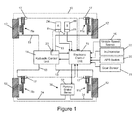
- FIG. 1 there is shown a motor vehicle 10 in a dashed outline with a brake control system according to an embodiment of the invention.
- the brake control system is in an activated state for the purpose of the invention when an "Automatic Parking Brake” (APB) mode is activated, as will be described.
- APB Automatic Parking Brake
- the brake control system is deactivated for the purpose of the invention.
- the brake control system may additionally perform other brake functions not forming part of the invention, for example such those described in EP 0 784 551 B1 or EP 1 777 133 A1 to facilitate hill descent.
- the brake control system includes in a conventional manner a brake arrangement with front axle disc brakes 11a and rear axle disc brakes 11b on four wheels 12.
- Each disc brake 11a, 11b is hydraulically operated through a hydraulic line 13 by a hydraulic control (HC) unit 14 which functions as a brake actuation means for actuating the disc brakes 11a, 11b to supply a service braking effort.
- the HC unit 14 is controlled by an electronic control (EC) unit 15, which functions as a brake control means for the service brakes 11 a 11 b.
- FIG. 1 is only a diagram of the most important functional components of the brake control system in accordance with the invention. Further details of the brake control system are described in EP 0 784 551 B1 and are included in the description by reference and thus will not be further described.
- the EC unit 15 receives a vehicle speed signal from movement sensing means in the form of a vehicle speed sensor 16, an individual wheel speed signal from a wheel speed sensor 17 on each wheel 12 and a driver demand signal from an accelerator (or throttle) pedal 18, which incorporates an accelerator pedal position sensor 19.
- the EC unit 15 also receives an APB signal from a driver APB activation switch 20, a gear signal from a drive gear sensor 21 and an inclination angle signal from a gradient sensing means, in this embodiment an inclinometer 22.
- the EC unit 15 receives a pedal braking signal from a brake light switch 9 on a brake pedal 24.
- the EC unit 15 may comprise a plurality of interconnected or integral modules (not shown).
- the brake pedal 24 is also associated with a master cylinder 8, which is connected to a brake pressure sensor 23 forming part of the HC unit 14.
- the brake pressure sensor 23 is arranged to send a driver braking signal from the brake pressure sensor 23 to the EC unit 15, which is indicative of a driver input component of the service braking effort.
- the EC unit 15 also controls an electronic parking brake 30, which is of a conventional mechanical type, comprising a parking brake servo 32 that operates a mechanical linkage 34 to engage the parking brake 30 to supply a park braking effort within the two rear disc brakes 11b.
- the mechanical linkage is operated to supply the park braking effort by actuating a braking shoe within a separate mechanical drum brake unit mounted inside the rear rotors.
- each disc brake 11a, 11b comprises a calliper that includes an integrated electric motor performing the role of the parking brake based on commands from an electronic controller (which may optionally be a module of the EC unit 15).
- the EC unit 15 is active to control the HC unit 14 and the parking brake 30 when the APB switch 20 is switched on by the driver to select APB mode.
- the EC unit 15 controls the HC unit 14 in conjunction with driver input from the brake pedal 24, by supplying an automatic component of the service braking effort as needed.
- the EC unit 15 controls the parking brake 30 in conjunction with a manual parking brake engage/release input, which the driver may provide via a suitable switch (not shown).
- the brake control system specifically the EC unit 15, is configured to engage the parking brake 30 automatically when the vehicle is in standstill, by sending an engage signal to the servo 32.
- the EC unit 15 is configured to engage the parking brake 30 to supply a park braking effort after the vehicle is detected to have been stationary for a period of around two minutes.
- the EC unit 15 In APB mode the EC unit 15 also handles automatic release of the parking brake 30. Thus, when the EC unit 15 receives a driver demand signal showing that the accelerator pedal 18 is depressed by the driver, it releases the parking brake by sending a release signal to the servo 32.
- the EC unit 15 provides a hydraulic vehicle hold by ensuring, through the addition of an automatic service brake component as necessary, that the HC unit 14 supplies a braking effort that maintains the vehicle in standstill, unless the driver presses the accelerator pedal 18, e.g. to pull away.
- the parking brake 30 acts on the two rear wheels of the vehicle, whilst the service brakes (disc brakes 11 a, 11 b as controlled by the HC unit 14) act on all four wheels of the vehicle.
- the EC unit 15 is configured to cause the HC unit 14 to supply any automatic component of the service braking effort to the rear axle disc brakes 11b only, i.e. not in the front axle disc brakes 11a, when standstill of the vehicle is detected. In this manner, once the brake pedal is released, the service brakes emulate the park braking effort before the parking brake 30 is engaged, thereby providing the driver with early feedback regarding the effectiveness of the park braking effort.
- the HC unit 14 uses hydraulic pressure to control the disc brakes 11a, 11b, the braking effort caused by the HC unit 14 at each brake 11 a, 11 b is equivalent to the relevant hydraulic brake pressure.
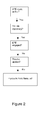
- Figure 2 illustrates how the EC unit 15 of the brake control system determines whether hydraulic vehicle hold is required. Assuming that APB is active and, before taking steps to ensure hydraulic vehicle hold, the EC unit 15 checks that (i) based on a signal from the vehicle speed sensor 16, the vehicle is in standstill, (ii) the electronic parking brake (EPB) 30 is not engaged, and (iii) based on the driver demand signal from the accelerator pedal 18, the accelerator pedal is not being pressed. If these conditions are met, the EC unit 15 proceeds to ensure hydraulic vehicle hold as will be described later with reference to Figure 3 . In the meantime, the EC unit continues to monitor the conditions.
- EPB electronic parking brake
- the brake control system does not proceed to initiate hydraulic hold as described in Figure 3 .
- the EC unit 15 is configured to continue to attempt hydraulic hold, or at least to limit vehicle speed or acceleration to a predetermined limit using all the service brakes 11a 11b, when the vehicle is detected to be moving despite an ongoing attempt to hold the vehicle stationary, i.e. if hydraulic vehicle hold is failing, e.g. due to a very steep slope.
- Hydraulic vehicle hold is ceased if the EC unit 15 has engaged the parking brake 30, i.e. typically after the period of two minutes, or if the driver engages the parking brake manually.
- the EC unit 15 also sends a command to the HC unit 14 to cease hydraulic vehicle hold as soon as it receives a driver demand signal indicating that the accelerator pedal 18 is being pressed.
- a torque threshold is set (based on applied throttle, selected gear and vehicle inclination angle) at which the EC unit 15 ceases hydraulic vehicle hold.
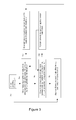
- the EC unit 15 determines that hydraulic vehicle hold is required (according to the conditions described above in relation to Figure 2 ) the EC unit 15 causes the HC unit 14 to supply an automatic component of the service braking effort, to supplement driver input as necessary.
- the automatic component of the service braking effort is supplied only in the rear axle disc brakes 11 b, either by maintaining existing hydraulic pressure (e.g. through valve closure) or by generating new hydraulic pressure.
- the EC unit 15 does not cause the HC unit 14 to supply any automatic component of the service braking effort in the front axle disc brakes 11a.
- the EC unit 15 determines continuously the following overall braking effort (i.e. hydraulic pressure) thresholds:
- the EC unit 15 determines firstly, based on a signal from the brake pressure sensor 23, whether the driver is applying any braking effort via the brake pedal 24. If the driver is applying no braking effort then the EC unit 15 causes the HC unit 14 to supply an automatic service braking effort (i.e. hydraulic pressure) at the rear disc brakes 11 b at threshold B. This effort is maintained until hydraulic vehicle hold ends, either because the accelerator pedal 18 is pressed or because the parking brake 30 is engaged.
- an automatic service braking effort i.e. hydraulic pressure
- the EC unit 15 determines whether the driver input component is greater than or equal to threshold B.
- the EC unit 15 allows the service braking effort to follow brake pedal input as long as the effort remains equal to or above threshold B and continues to monitor the brake pressure sensor 23.
- the service braking effort comprises no automatic component in this case.
- the EC unit 15 maintains the braking effort in the rear service brakes 11 b. Specifically, if the driver alters the driver input component in this situation, the EC unit 15 allows the service braking effort in the rear service brakes to equal the driver input component only as long as the braking effort is increased (until threshold B is reached - for which see above). If the driver reduces the input braking effort then the EC unit 15 causes the HC unit 14 to maintain the braking effort in the rear axle service brakes 11 b as a (partially) automatic component of the service braking effort. Furthermore, if the applied braking effort drops below threshold A, the EC unit 15 causes the HC unit 14 to generate additional automatic braking effort in the rear axle service brakes 11b to further increase the automatic component of the service braking effort, until threshold B is reached.
- the operational mode described above enhances safety because, in standstill and before the parking brake is engaged, the automatic component of the service braking effort is supplied only to the rear axle wheels.
- the driver is not given a false sense of security when the vehicle is held in standstill by the service brakes, particularly when there is no driver input component of the service braking effort.
- the driver experiences the effect of a braking effort supplied only to the subset of the plurality of wheels whilst still in control of the vehicle, before the parking brake is engaged.
Landscapes
- Engineering & Computer Science (AREA)
- Transportation (AREA)
- Mechanical Engineering (AREA)
- Physics & Mathematics (AREA)
- General Physics & Mathematics (AREA)
- Regulating Braking Force (AREA)
Abstract
Description
- The present invention relates to brake control systems for motor vehicles and methods of braking motor vehicles. In particular, though not exclusively, it relates to such brake control systems and methods of braking, in which safety is enhanced after the vehicle is brought to a stationary state, i.e. standstill.
- Brake control systems for motor vehicles are known, particularly in relation to the so-called service brakes of motor vehicles. Service brakes are the primary mechanism for slowing or stopping a motor vehicle and, as is known in the art, may take a variety of forms. Most commonly, service brakes are disc brakes and of the hydraulic type, acting on all wheels of the vehicle (i.e. typically four in the case of a motor car).
- Motor vehicles are also required to have a mechanical parking brake (sometimes referred to as a handbrake), which is distinct from the service brakes. The parking brake functions primarily to hold the vehicle in standstill but also acts as an emergency brake, for example should there be a major failure with the service brake system.
- The parking brake may take a variety of forms but is most commonly a disc brake of the mechanical type (actuated by cables). In many modern motor vehicles, the parking brake, though of the mechanical type, is controlled electronically, i.e. is operable with the help of a button, via an associated control module. Unlike the service brakes, the parking brake generally does not act on all wheels of the vehicle. For example, in the case of a motor car, it may exert a braking effort only on the wheels of the rear axle (i.e. two wheels).
- Once a vehicle is in standstill, there is often an overlap between braking effort supplied by the service brakes and braking effort supplied by the parking brake. For example, the service brakes may hold the vehicle in standstill when the parking brake is engaged, but may subsequently be released when a driver leaves the vehicle.
- In modern vehicles with brake control systems for the service brakes, holding of the vehicle by the service brakes need not necessarily result from direct driver input. It may also result from an automatic braking component supplied by the brake control system, possibly without any application of the brake pedal by the driver, for example to help the driver by preventing unwanted vehicle motion. Particularly where an electronic parking brake is used in such a vehicle, it can be difficult for a driver to know whether the vehicle is being held in standstill by the service brakes or by the parking brake.
- It has now been found that, in many cases, given that the service brakes and parking brake are typically separate systems supplying differing braking efforts, lack of feedback to the driver as described above represents a potential safety hazard. For example, when the vehicle is in a position where the service brakes are capable of maintaining standstill whilst the parking brake is not, the driver may assume that the vehicle is safely parked and exit the vehicle when the vehicle is in fact only held in standstill by the service brakes.
- It is an object of the invention to overcome or mitigate the problems described above.
- From a first aspect, the invention resides in a brake control system for a motor vehicle having wheels, service brakes for supplying a service braking effort to a plurality of the wheels, sensing means for detecting standstill of the vehicle, and a parking brake engageable to supply a park braking effort to a subset of the plurality of wheels, the system comprising: brake actuation means for actuating the service brakes to supply the service braking effort; and brake control means for controlling the brake actuation means to supply an automatic component of the service braking effort, wherein the brake control means is arranged, when standstill of the vehicle is detected and before the parking brake is engaged, to cause the brake actuation means to supply the automatic component of the service braking effort only to the subset of the plurality of wheels.
- By "automatic component of the service braking effort" is meant a component of the service braking effort that does not correspond to a driver brake input. For example, the automatic component may be caused by the brake control means (by commanding the brake actuation means to maintain or increase braking effort) based on a programmed response to one or more vehicle conditions, e.g. vehicle movement or lack thereof, vehicle inclination angle, gear selection, and/or throttle application.
- The automatic component may vary over time. At any given time, the automatic component may be the sole component of the service braking effort, may complement, or cooperate with, a driver input component of the service braking effort, or may be reduced to zero (e.g. while the driver input component is found to be sufficient to maintain standstill). To facilitate cooperation between the automatic component and the driver input component, the driver input component may be monitored or handled by the brake control means.
- The plurality of wheels may preferably comprise four or more wheels. The term "subset" as used herein refers to a proper subset. Thus the subset of the plurality of wheels always comprises at least one wheel less than the plurality of wheels. Preferably, the subset of the plurality of wheels may comprise three or fewer wheels, e.g. two wheels.
- Because, in standstill and before the parking brake is engaged, the automatic component of the service braking effort is supplied only to the subset of the plurality of wheels, the brake control system of the first aspect of the invention enhances safety and improves driver feedback. Specifically, the brake control system ensures that the driver is not given a false sense of security when the vehicle is held in standstill by the service brakes, particularly when there is no driver input component of the service braking effort. The driver experiences the effect of a braking effort supplied only to the subset of the plurality of wheels whilst still in control of the vehicle, before the parking brake is engaged.
- The invention particularly improves safety in situations where a braking effort supplied to the plurality of wheels is sufficient to hold the vehicle in standstill, but a braking effort supplied to the subset of the plurality of wheels is not, for example because the vehicle is on a very steep slope and/or the subset of the plurality of wheels is supported on slippery ground.
- More generally, it has been appreciated that, during standstill of the vehicle, the automatic component of the service braking effort should preferably not exceed the park braking effort. Thus the brake control means may be arranged to ensure that, during standstill of the vehicle, the automatic component of the service braking effort does not exceed the park braking effort.
- Furthermore, from a second aspect, the invention resides in a brake control system for a motor vehicle having wheels, service brakes for supplying a service braking effort to a plurality of the wheels, sensing means for detecting standstill of the vehicle, and a parking brake engageable to supply a park braking effort to a subset of the plurality of wheels, the system comprising: brake actuation means for actuating the service brakes to supply the service braking effort; and brake control means for controlling the brake actuation means to supply an automatic component of the service braking effort, wherein the brake control means is arranged, when standstill of the vehicle is detected and before the parking brake is engaged, to ensure that the automatic component of the service braking effort does not exceed the park braking effort. Preferably, the automatic component of the service braking effort may be supplied only to the subset of the plurality of wheels.
- The following preferred and advantageous features relate to both the first and the second aspect of the invention.
- Advantageously, the brake control means may be arranged to determine a first braking effort threshold suitable for holding the vehicle in standstill with service braking effort supplied only to the subset of the plurality of wheels. Conveniently, the brake control system may comprise sensing means for detecting a vehicle gradient (i.e. inclination angle) and the brake control means may be arranged to determine the first braking effort threshold based on a signal from the gradient sensing means. The first braking effort threshold may additionally be determined based on a vehicle gear selection and/or based on a vehicle load weight.
- Preferably, the brake control means may be arranged, when the vehicle is in standstill, to adjust the automatic component of the service braking effort so that the service braking effort (supplied to the subset of the plurality of wheels according to the first aspect of the invention) is greater than or equal to the first braking effort threshold.
- It will be appreciated that in some circumstances the vehicle gradient may make it impossible to determine a threshold suitable for holding the vehicle in standstill. In such a case the first threshold may optionally be set as maximum braking effort.
- The brake control systems according to the first and second aspects may preferably further comprise a brake input for controlling (either directly or via the brake control means) the brake actuation means to supply a driver input component of the service braking effort to the plurality of wheels. The brake control means may advantageously be arranged, during standstill of the vehicle, to cause a variation in the automatic component of the service braking effort in response to a variation in the driver input component of the service braking effort.
- Advantageously, the brake control means may be arranged to determine a second braking effort threshold suitable for holding the vehicle in standstill with service braking effort supplied to the plurality of wheels. The brake control means may then preferably be arranged to increase the automatic component of the service braking effort, most preferably to equal or exceed the first braking effort threshold, when a driver input component of the service braking effort supplied to the plurality of wheels falls below the second braking effort threshold.
- As the objectives of the invention can be achieved within a limited timeframe, the supply of the automatic component of the service braking effort only to the subset of the plurality of wheels, and/or ensuring that the automatic component of the service braking effort does not exceed the park braking effort, need not be continuous. For example, the brake control means may be arranged to cause the above to occur only for a predetermined time period during standstill, such as 3 seconds or less. However, preferably the above may occur, either individually or in combination, at all times when standstill of the vehicle is detected.
- To take maximum advantage of the safety benefits of the present invention, the brake actuation means and the parking brake may be distinct (i.e. actuated by separate mechanisms). Additionally or alternatively, the brake actuation means may be of the hydraulic type and/or the parking brake may be of the mechanical type.
- Advantageously, the brake control means may be arranged to cease supply of the automatic component of the service brake effort after the parking brake is engaged. The brake control means may also preferably be arranged to cease supply of the automatic component of the service brake effort and/or disengage the parking brake in response to a driver accelerator input.
- The brake control systems of the first and second aspects of the invention share the objective of providing a service braking effort that emulates, or at least does not exceed, the park braking effort. Advantageously, the brake control systems, and in particular the brake control means, may be arranged to emulate the park braking effort in terms of overall vehicle retarding power.
- From a third aspect, the invention resides in a method of braking a motor vehicle, the method comprising: applying a first service braking effort to a plurality of wheels of the vehicle to bring the vehicle to a standstill, applying a second service braking effort to a subset of the plurality of wheels to hold the vehicle in standstill, applying a park braking effort to the subset of the plurality of wheels, and releasing the second service braking effort.
- The advantages and preferred features of the first and second aspect of the invention apply mutatis mutandis to the third aspect of the invention. For example the service braking effort may preferably be applied hydraulically and the park braking effort may preferably be applied mechanically. Furthermore, the second service braking effort may advantageously not exceed the park braking effort.
- The invention also extends to a motor vehicle comprising any of the brake control systems described herein or operated according to any method described herein.
- Within the scope of this application it is envisaged that the various aspects, embodiments, examples, features and alternatives set out in the preceding paragraphs, in the claims and/or in the following description and drawings may be taken independently or in any combination thereof. Features described in connection with one embodiment are applicable to all embodiments except where there is incompatibility of features.
- The invention will now be described by way of example with reference to the accompanying drawings in which:
-
Figure 1 is a schematic drawing of a brake control system for a motor vehicle in accordance with an embodiment of the present invention; -
Figure 2 is a flowchart summarising steps taken by the brake control system ofFigure 1 to determine whether a hydraulic vehicle hold is required according to one operational mode; and -
Figure 3 is a flow chart summarising the steps taken by the brake control system ofFigure 1 to implement the hydraulic vehicle hold when required according toFigure 2 . - Referring to
Figure 1 , there is shown amotor vehicle 10 in a dashed outline with a brake control system according to an embodiment of the invention. - The brake control system is in an activated state for the purpose of the invention when an "Automatic Parking Brake" (APB) mode is activated, as will be described. By contrast, when the APB mode is deactivated, the brake control system is deactivated for the purpose of the invention. Irrespective of the APB activation state, the brake control system may additionally perform other brake functions not forming part of the invention, for example such those described in
EP 0 784 551 B1 orEP 1 777 133 A1 to facilitate hill descent. - The brake control system includes in a conventional manner a brake arrangement with front
axle disc brakes 11a and rearaxle disc brakes 11b on fourwheels 12. Eachdisc brake hydraulic line 13 by a hydraulic control (HC)unit 14 which functions as a brake actuation means for actuating thedisc brakes HC unit 14 is controlled by an electronic control (EC)unit 15, which functions as a brake control means for theservice brakes 11 a 11 b. -
Figure 1 is only a diagram of the most important functional components of the brake control system in accordance with the invention. Further details of the brake control system are described inEP 0 784 551 B1 and are included in the description by reference and thus will not be further described. - The
EC unit 15 receives a vehicle speed signal from movement sensing means in the form of avehicle speed sensor 16, an individual wheel speed signal from awheel speed sensor 17 on eachwheel 12 and a driver demand signal from an accelerator (or throttle)pedal 18, which incorporates an accelerator pedal position sensor 19. TheEC unit 15 also receives an APB signal from a driverAPB activation switch 20, a gear signal from adrive gear sensor 21 and an inclination angle signal from a gradient sensing means, in this embodiment aninclinometer 22. TheEC unit 15 receives a pedal braking signal from abrake light switch 9 on abrake pedal 24. TheEC unit 15 may comprise a plurality of interconnected or integral modules (not shown). - The
brake pedal 24 is also associated with amaster cylinder 8, which is connected to abrake pressure sensor 23 forming part of theHC unit 14. Thebrake pressure sensor 23 is arranged to send a driver braking signal from thebrake pressure sensor 23 to theEC unit 15, which is indicative of a driver input component of the service braking effort. - The
EC unit 15 also controls anelectronic parking brake 30, which is of a conventional mechanical type, comprising aparking brake servo 32 that operates amechanical linkage 34 to engage theparking brake 30 to supply a park braking effort within the tworear disc brakes 11b. An alternative embodiment (not shown) the mechanical linkage is operated to supply the park braking effort by actuating a braking shoe within a separate mechanical drum brake unit mounted inside the rear rotors. In yet another alternative embodiment (not shown) eachdisc brake - The
EC unit 15 is active to control theHC unit 14 and theparking brake 30 when theAPB switch 20 is switched on by the driver to select APB mode. TheEC unit 15 controls theHC unit 14 in conjunction with driver input from thebrake pedal 24, by supplying an automatic component of the service braking effort as needed. Similarly, theEC unit 15 controls theparking brake 30 in conjunction with a manual parking brake engage/release input, which the driver may provide via a suitable switch (not shown). - When APB mode is active, the brake control system, specifically the
EC unit 15, is configured to engage theparking brake 30 automatically when the vehicle is in standstill, by sending an engage signal to theservo 32. Specifically, theEC unit 15 is configured to engage theparking brake 30 to supply a park braking effort after the vehicle is detected to have been stationary for a period of around two minutes. - In APB mode the
EC unit 15 also handles automatic release of theparking brake 30. Thus, when theEC unit 15 receives a driver demand signal showing that theaccelerator pedal 18 is depressed by the driver, it releases the parking brake by sending a release signal to theservo 32. - During the two minutes before the parking brake is engaged, the
EC unit 15 provides a hydraulic vehicle hold by ensuring, through the addition of an automatic service brake component as necessary, that theHC unit 14 supplies a braking effort that maintains the vehicle in standstill, unless the driver presses theaccelerator pedal 18, e.g. to pull away. - As aforesaid, the
parking brake 30 acts on the two rear wheels of the vehicle, whilst the service brakes (disc brakes EC unit 15 is configured to cause theHC unit 14 to supply any automatic component of the service braking effort to the rearaxle disc brakes 11b only, i.e. not in the frontaxle disc brakes 11a, when standstill of the vehicle is detected. In this manner, once the brake pedal is released, the service brakes emulate the park braking effort before theparking brake 30 is engaged, thereby providing the driver with early feedback regarding the effectiveness of the park braking effort. - Since the
HC unit 14 uses hydraulic pressure to control thedisc brakes HC unit 14 at eachbrake - An exemplary operational mode of the brake control system will now be described with reference to the flowchart of
Figures 2 and3 . -
Figure 2 illustrates how theEC unit 15 of the brake control system determines whether hydraulic vehicle hold is required. Assuming that APB is active and, before taking steps to ensure hydraulic vehicle hold, theEC unit 15 checks that (i) based on a signal from thevehicle speed sensor 16, the vehicle is in standstill, (ii) the electronic parking brake (EPB) 30 is not engaged, and (iii) based on the driver demand signal from theaccelerator pedal 18, the accelerator pedal is not being pressed. If these conditions are met, theEC unit 15 proceeds to ensure hydraulic vehicle hold as will be described later with reference toFigure 3 . In the meantime, the EC unit continues to monitor the conditions. - If the vehicle speed sensor indicates to the
EC unit 15 that the vehicle is moving then the brake control system does not proceed to initiate hydraulic hold as described inFigure 3 . However to enhance safety, theEC unit 15 is configured to continue to attempt hydraulic hold, or at least to limit vehicle speed or acceleration to a predetermined limit using all theservice brakes 11a - Hydraulic vehicle hold is ceased if the
EC unit 15 has engaged theparking brake 30, i.e. typically after the period of two minutes, or if the driver engages the parking brake manually. - The
EC unit 15 also sends a command to theHC unit 14 to cease hydraulic vehicle hold as soon as it receives a driver demand signal indicating that theaccelerator pedal 18 is being pressed. In an alternative mode of operation, to facilitate hill starts, a torque threshold is set (based on applied throttle, selected gear and vehicle inclination angle) at which theEC unit 15 ceases hydraulic vehicle hold. - Referring now to
Figure 3 , in summary, as long as theEC unit 15 determines that hydraulic vehicle hold is required (according to the conditions described above in relation toFigure 2 ) theEC unit 15 causes theHC unit 14 to supply an automatic component of the service braking effort, to supplement driver input as necessary. The automatic component of the service braking effort is supplied only in the rearaxle disc brakes 11 b, either by maintaining existing hydraulic pressure (e.g. through valve closure) or by generating new hydraulic pressure. Notably theEC unit 15 does not cause theHC unit 14 to supply any automatic component of the service braking effort in the frontaxle disc brakes 11a. - Since the automatic component of the service braking effort is supplied to the same number of wheels as the mechanical park braking effort, it typically does not exceed the park braking effort.
- To be able to supplement any driver input hydraulic vehicle hold with an automatic service braking effort as necessary, the
EC unit 15 determines continuously the following overall braking effort (i.e. hydraulic pressure) thresholds: - Threshold A - the effort needed in each of the four
disc brakes service brakes - Threshold B - the effort needed in the two rear
axle disc brakes 11 b to hold the vehicle in standstill in its current gear (as detected by the drive gear sensor 21) at its current inclination angle (as detected by the inclinometer 22) using only the two rearaxle service brakes 11 b. - With these thresholds known, as shown in
Figure 3 , theEC unit 15 determines firstly, based on a signal from thebrake pressure sensor 23, whether the driver is applying any braking effort via thebrake pedal 24. If the driver is applying no braking effort then theEC unit 15 causes theHC unit 14 to supply an automatic service braking effort (i.e. hydraulic pressure) at therear disc brakes 11 b at threshold B. This effort is maintained until hydraulic vehicle hold ends, either because theaccelerator pedal 18 is pressed or because theparking brake 30 is engaged. - If the
EC unit 15 determines from thebrake pressure sensor 23 that the driver is applying a braking effort via thebrake pedal 24, i.e. that there is an existing driver input component of the service braking effort, then theEC unit 15 determines whether the driver input component is greater than or equal to threshold B. TheEC unit 15 allows the service braking effort to follow brake pedal input as long as the effort remains equal to or above threshold B and continues to monitor thebrake pressure sensor 23. The service braking effort comprises no automatic component in this case. - If the driver input component applied by the driver is below threshold B, the
EC unit 15 maintains the braking effort in therear service brakes 11 b. Specifically, if the driver alters the driver input component in this situation, theEC unit 15 allows the service braking effort in the rear service brakes to equal the driver input component only as long as the braking effort is increased (until threshold B is reached - for which see above). If the driver reduces the input braking effort then theEC unit 15 causes theHC unit 14 to maintain the braking effort in the rearaxle service brakes 11 b as a (partially) automatic component of the service braking effort. Furthermore, if the applied braking effort drops below threshold A, theEC unit 15 causes theHC unit 14 to generate additional automatic braking effort in the rearaxle service brakes 11b to further increase the automatic component of the service braking effort, until threshold B is reached. - The operational mode described above enhances safety because, in standstill and before the parking brake is engaged, the automatic component of the service braking effort is supplied only to the rear axle wheels. The driver is not given a false sense of security when the vehicle is held in standstill by the service brakes, particularly when there is no driver input component of the service braking effort. The driver experiences the effect of a braking effort supplied only to the subset of the plurality of wheels whilst still in control of the vehicle, before the parking brake is engaged.
Claims (15)
- A brake control system for a motor vehicle having wheels, service brakes for supplying a service braking effort to a plurality of the wheels, sensing means for detecting standstill of the vehicle, and a parking brake engageable to supply a park braking effort to a subset of the plurality of wheels, the system comprising: brake actuation means for actuating the service brakes to supply the service braking effort; and brake control means for controlling the brake actuation means to supply an automatic component of the service braking effort, wherein the brake control means is arranged, when standstill of the vehicle is detected and before the parking brake is engaged, to cause the brake actuation means to supply the automatic component of the service braking effort only to the subset of the plurality of wheels.
- The brake control system of claim 1 wherein the brake control means is arranged to determine a first braking effort threshold suitable for holding the vehicle in standstill with service braking effort supplied only to the subset of the plurality of wheels.
- The brake control system of claim 2 further comprising gradient sensing means for detecting a vehicle gradient and wherein the brake control means is arranged to determine the first braking effort threshold based on a signal from the gradient sensing means.
- The brake control system of claim 2 or claim 3 wherein the brake control means is arranged, when the vehicle is in standstill, to adjust the automatic component of the service braking effort so that the service braking effort supplied to the subset of the plurality of wheels is greater than or equal to the first braking effort threshold.
- The brake control system of any preceding claim further comprising a brake input for controlling the brake actuation means to supply a driver input component of the service braking effort to the plurality of wheels and wherein the brake control means is arranged, during standstill of the vehicle, to cause a variation in the automatic component of the service braking effort in response to a variation in the driver input component.
- The brake control system of any preceding claim wherein the brake control means is arranged to determine a second braking effort threshold suitable for holding the vehicle in standstill with service braking effort supplied to the plurality of wheels.
- The brake control system of claim 6 wherein the brake control means is arranged to increase the automatic component of the service braking effort when a driver input component of the service braking effort supplied to the plurality of wheels falls below the second braking effort threshold.
- The brake control system of any preceding claim wherein any automatic component of the service braking effort is supplied only to the subset of the plurality of wheels at all times when standstill of the vehicle is detected.
- The brake control system of any preceding claim wherein the brake actuation means and the parking brake are distinct, with the brake actuation means being of the hydraulic type and the parking brake being of the mechanical type.
- The brake control system of any preceding claim wherein the brake control means is arranged to ensure that, during standstill of the vehicle, the automatic component of the service braking effort does not exceed the park braking effort.
- A brake control system for a motor vehicle having wheels, service brakes for supplying a service braking effort to a plurality of the wheels, sensing means for detecting standstill of the vehicle, and a parking brake engageable to supply a park braking effort to a subset of the plurality of wheels, the system comprising: brake actuation means for actuating the service brakes to supply the service braking effort; and brake control means for controlling the brake actuation means to supply an automatic component of the service braking effort, wherein the brake control means is arranged, when standstill of the vehicle is detected and before the parking brake is engaged, to ensure that the automatic component of the service braking effort does not exceed the park braking effort.
- A method of braking a motor vehicle, the method comprising: applying a first service braking effort to a plurality of wheels of the vehicle to bring the vehicle to a standstill, applying a second service braking effort to a subset of the plurality of wheels to hold the vehicle in standstill, applying a park braking effort to the subset of the plurality of wheels, and releasing the second service braking effort.
- The method of claim 12 wherein the service braking effort is applied hydraulically and the park braking effort is applied mechanically.
- The method of claim 12 or claim 13 wherein the second service braking effort does not exceed the park braking effort.
- A motor vehicle comprising a brake control system according to any one of claims 1 to 11.
Applications Claiming Priority (1)
| Application Number | Priority Date | Filing Date | Title |
|---|---|---|---|
| GB1021663.8A GB2486669A (en) | 2010-12-22 | 2010-12-22 | Brake control to ensure automatic service brake effort does not exceed parking brake effort |
Publications (2)
| Publication Number | Publication Date |
|---|---|
| EP2468593A1 true EP2468593A1 (en) | 2012-06-27 |
| EP2468593B1 EP2468593B1 (en) | 2016-07-27 |
Family
ID=43598745
Family Applications (1)
| Application Number | Title | Priority Date | Filing Date |
|---|---|---|---|
| EP11193352.9A Not-in-force EP2468593B1 (en) | 2010-12-22 | 2011-12-13 | Improvements in or relating to brake control |
Country Status (3)
| Country | Link |
|---|---|
| US (2) | US20120161508A1 (en) |
| EP (1) | EP2468593B1 (en) |
| GB (1) | GB2486669A (en) |
Cited By (3)
| Publication number | Priority date | Publication date | Assignee | Title |
|---|---|---|---|---|
| US9233666B2 (en) * | 2014-06-03 | 2016-01-12 | Ford Global Technologies, Llc | Shift-by-wire vehicle and method to verify securement |
| EP3069946A1 (en) * | 2015-03-20 | 2016-09-21 | KNORR-BREMSE Systeme für Nutzfahrzeuge GmbH | Control circuit for electronically controlled parking brake |
| CN107848505A (en) * | 2015-07-27 | 2018-03-27 | 日产自动车株式会社 | Brake control and brake control method |
Families Citing this family (17)
| Publication number | Priority date | Publication date | Assignee | Title |
|---|---|---|---|---|
| DE102010002020A1 (en) * | 2010-02-17 | 2011-08-18 | Deere & Company, Ill. | Device for controlling a parking brake for a motor vehicle |
| GB2483719B (en) * | 2010-09-20 | 2013-06-19 | Land Rover Uk Ltd | Improvements relating to brake control |
| JP5838255B2 (en) * | 2012-02-16 | 2016-01-06 | 日立建機株式会社 | Parking brake control device for transport vehicles |
| US8909449B2 (en) * | 2012-11-27 | 2014-12-09 | Bendix Commercial Vehicle Systems Llc | System, controller and method for preventing vehicle rollaway |
| DE102013104601A1 (en) * | 2013-05-06 | 2014-11-06 | Dr. Ing. H.C. F. Porsche Aktiengesellschaft | Method and device for preventing a stationary vehicle from rolling away |
| DE102013007955B4 (en) | 2013-05-08 | 2024-02-29 | Caterpillar Inc. | Device for actuating a service brake and locking a pendulum axle of a mobile excavator |
| DE202013005826U1 (en) * | 2013-06-28 | 2014-09-29 | GM Global Technology Operations LLC (n. d. Ges. d. Staates Delaware) | Arrangement for detecting the disembarkation of an occupant of a vehicle from the vehicle, arrangement for activating or deactivating a function in a vehicle, and vehicle |
| EP3205538B1 (en) * | 2014-10-09 | 2021-03-17 | Robert Bosch GmbH | Method and device for controlling motorcycle brake for assisting motorcycle departure |
| DE102015216214A1 (en) * | 2015-08-25 | 2017-03-02 | Robert Bosch Gmbh | Method and device for driver assistance |
| DE102015220283A1 (en) * | 2015-10-19 | 2017-04-20 | Robert Bosch Gmbh | Method and apparatus for performing a driver-independent braking force maintenance function in a motor vehicle at its standstill on a roadway inclined in the vehicle longitudinal direction |
| WO2018021688A1 (en) * | 2016-07-25 | 2018-02-01 | 한승우 | Vehicle driving apparatus, vehicle driving method, and vehicle comprising same |
| DE102016223860A1 (en) * | 2016-11-30 | 2018-05-30 | Robert Bosch Gmbh | Method for operating at least one parking brake of a motor vehicle |
| DE102018201384A1 (en) * | 2018-01-30 | 2019-08-01 | Robert Bosch Gmbh | Method and device for operating an automated parking brake |
| DE102020107548A1 (en) * | 2020-03-19 | 2021-09-23 | Ford Global Technologies Llc | Motor vehicle and method for operating a motor vehicle |
| CN114248746B (en) * | 2020-09-25 | 2023-04-11 | 芜湖伯特利电子控制系统有限公司 | Control method for redundant control of motor vehicle braking |
| CN114670652A (en) * | 2022-04-26 | 2022-06-28 | 江苏英拓动力科技有限公司 | Multi-mode braking control method of double-side independent electric drive crawler vehicle |
| US12330608B2 (en) | 2022-10-14 | 2025-06-17 | Akebono Brake Industry Co., Ltd. | Method for controlling an electromechanical brake system |
Citations (5)
| Publication number | Priority date | Publication date | Assignee | Title |
|---|---|---|---|---|
| EP0784551B1 (en) | 1994-10-12 | 1999-03-31 | Rover Group Limited | Brake control system |
| DE10238870A1 (en) * | 2002-08-24 | 2004-03-11 | Daimlerchrysler Ag | Carrying out automatic vehicle braking involves automatically producing braking torque holding vehicle stationary with working brake, applying parking brake/releasing working brake after holding time |
| WO2005042320A1 (en) * | 2003-10-31 | 2005-05-12 | Lucas Automotive Gmbh | Method for stabilizing a motor vehicle whose speed is reduced to a standstill and brake system for carrying out said method |
| EP1777133A1 (en) | 2005-10-21 | 2007-04-25 | Ford Global Technologies, LLC | Brake control system |
| US20080191546A1 (en) * | 2007-02-13 | 2008-08-14 | Louis Gino Plantamura | Automatic braking system for a motor vehicle |
Family Cites Families (5)
| Publication number | Priority date | Publication date | Assignee | Title |
|---|---|---|---|---|
| DE10213346B4 (en) * | 2002-03-01 | 2017-10-19 | Continental Teves Ag & Co. Ohg | Method for controlling a motor vehicle brake system |
| WO2005063541A1 (en) * | 2003-12-24 | 2005-07-14 | Continental Teves Ag & Co. Ohg | Method for pressure build up control in an electronic adjustable braking system |
| DE102004004992B4 (en) * | 2004-01-30 | 2008-03-13 | Lucas Automotive Gmbh | Method for operating the braking equipment of a vehicle |
| DE102005023665C5 (en) * | 2005-05-23 | 2020-05-14 | Knorr-Bremse Systeme für Nutzfahrzeuge GmbH | Method for automatically braking a vehicle equipped with an electronically controlled braking device |
| DE102007030780A1 (en) * | 2007-07-03 | 2009-01-08 | Continental Automotive Gmbh | Method and arrangement for the road-specific parking brake of a vehicle |
-
2010
- 2010-12-22 GB GB1021663.8A patent/GB2486669A/en not_active Withdrawn
-
2011
- 2011-12-13 EP EP11193352.9A patent/EP2468593B1/en not_active Not-in-force
- 2011-12-19 US US13/329,629 patent/US20120161508A1/en not_active Abandoned
-
2017
- 2017-08-21 US US15/681,641 patent/US20170345249A1/en not_active Abandoned
Patent Citations (5)
| Publication number | Priority date | Publication date | Assignee | Title |
|---|---|---|---|---|
| EP0784551B1 (en) | 1994-10-12 | 1999-03-31 | Rover Group Limited | Brake control system |
| DE10238870A1 (en) * | 2002-08-24 | 2004-03-11 | Daimlerchrysler Ag | Carrying out automatic vehicle braking involves automatically producing braking torque holding vehicle stationary with working brake, applying parking brake/releasing working brake after holding time |
| WO2005042320A1 (en) * | 2003-10-31 | 2005-05-12 | Lucas Automotive Gmbh | Method for stabilizing a motor vehicle whose speed is reduced to a standstill and brake system for carrying out said method |
| EP1777133A1 (en) | 2005-10-21 | 2007-04-25 | Ford Global Technologies, LLC | Brake control system |
| US20080191546A1 (en) * | 2007-02-13 | 2008-08-14 | Louis Gino Plantamura | Automatic braking system for a motor vehicle |
Cited By (9)
| Publication number | Priority date | Publication date | Assignee | Title |
|---|---|---|---|---|
| US9233666B2 (en) * | 2014-06-03 | 2016-01-12 | Ford Global Technologies, Llc | Shift-by-wire vehicle and method to verify securement |
| EP3069946A1 (en) * | 2015-03-20 | 2016-09-21 | KNORR-BREMSE Systeme für Nutzfahrzeuge GmbH | Control circuit for electronically controlled parking brake |
| WO2016150697A1 (en) * | 2015-03-20 | 2016-09-29 | Knorr-Bremse Systeme für Nutzfahrzeuge GmbH | Control circuit for electronically controlled parking brake |
| CN107428318A (en) * | 2015-03-20 | 2017-12-01 | 克诺尔商用车制动系统有限公司 | Control circuit for electronic control type EPB |
| CN107428318B (en) * | 2015-03-20 | 2019-11-12 | 克诺尔商用车制动系统有限公司 | Control circuit for electronically controlled parking brake |
| CN107848505A (en) * | 2015-07-27 | 2018-03-27 | 日产自动车株式会社 | Brake control and brake control method |
| EP3330142A4 (en) * | 2015-07-27 | 2018-08-01 | Nissan Motor Co., Ltd. | Braking control device and braking control method |
| CN107848505B (en) * | 2015-07-27 | 2019-03-08 | 日产自动车株式会社 | Brake control device and brake control method |
| US10766469B2 (en) | 2015-07-27 | 2020-09-08 | Nissan Motor Co., Ltd. | Braking control device and braking control method |
Also Published As
| Publication number | Publication date |
|---|---|
| GB2486669A (en) | 2012-06-27 |
| US20120161508A1 (en) | 2012-06-28 |
| EP2468593B1 (en) | 2016-07-27 |
| GB201021663D0 (en) | 2011-02-02 |
| US20170345249A1 (en) | 2017-11-30 |
Similar Documents
| Publication | Publication Date | Title |
|---|---|---|
| EP2468593B1 (en) | Improvements in or relating to brake control | |
| US10086807B2 (en) | Method and control device for operating a braking device of a drive train with an automatic gearbox of a vehicle | |
| JP6870149B2 (en) | Electric brake device and electric brake control device | |
| KR102535553B1 (en) | electric brake device | |
| JP5936817B2 (en) | Slope start assist method for automobile, slope start assist device and vehicle | |
| US9592798B2 (en) | Braking system and braking control method in parking | |
| US7762633B2 (en) | Brake control system | |
| US6439675B1 (en) | Method and device for controlling a braking system | |
| US9387841B2 (en) | Brake control | |
| US8255138B2 (en) | Method for starting a motor vehicle on an inclined route | |
| JP2008507443A (en) | Brake device for a vehicle having an electric parking brake and method for controlling the brake device | |
| JP6846077B2 (en) | Brake system | |
| KR20180026913A (en) | Electronic control brake system in a vehicle and control method thereof | |
| JP7352403B2 (en) | Electric brake equipment and brake control equipment | |
| JP2019130938A (en) | Electric brake device and electric brake controller | |
| JP2017171215A (en) | Brake system | |
| JP6745739B2 (en) | Brake system | |
| JP6361621B2 (en) | Vehicle stop control device | |
| KR101315061B1 (en) | Electronic parking brake system and method of controlling the same |
Legal Events
| Date | Code | Title | Description |
|---|---|---|---|
| AK | Designated contracting states |
Kind code of ref document: A1 Designated state(s): AL AT BE BG CH CY CZ DE DK EE ES FI FR GB GR HR HU IE IS IT LI LT LU LV MC MK MT NL NO PL PT RO RS SE SI SK SM TR |
|
| AX | Request for extension of the european patent |
Extension state: BA ME |
|
| PUAI | Public reference made under article 153(3) epc to a published international application that has entered the european phase |
Free format text: ORIGINAL CODE: 0009012 |
|
| 17P | Request for examination filed |
Effective date: 20130102 |
|
| RIC1 | Information provided on ipc code assigned before grant |
Ipc: B60T 17/18 20060101ALI20130131BHEP Ipc: B60T 7/12 20060101AFI20130131BHEP |
|
| 17Q | First examination report despatched |
Effective date: 20130315 |
|
| RAP1 | Party data changed (applicant data changed or rights of an application transferred) |
Owner name: JAGUAR LAND ROVER LIMITED |
|
| GRAP | Despatch of communication of intention to grant a patent |
Free format text: ORIGINAL CODE: EPIDOSNIGR1 |
|
| INTG | Intention to grant announced |
Effective date: 20160519 |
|
| GRAS | Grant fee paid |
Free format text: ORIGINAL CODE: EPIDOSNIGR3 |
|
| GRAA | (expected) grant |
Free format text: ORIGINAL CODE: 0009210 |
|
| AK | Designated contracting states |
Kind code of ref document: B1 Designated state(s): AL AT BE BG CH CY CZ DE DK EE ES FI FR GB GR HR HU IE IS IT LI LT LU LV MC MK MT NL NO PL PT RO RS SE SI SK SM TR |
|
| REG | Reference to a national code |
Ref country code: GB Ref legal event code: FG4D |
|
| REG | Reference to a national code |
Ref country code: CH Ref legal event code: EP |
|
| REG | Reference to a national code |
Ref country code: AT Ref legal event code: REF Ref document number: 815529 Country of ref document: AT Kind code of ref document: T Effective date: 20160815 |
|
| REG | Reference to a national code |
Ref country code: IE Ref legal event code: FG4D |
|
| REG | Reference to a national code |
Ref country code: DE Ref legal event code: R096 Ref document number: 602011028525 Country of ref document: DE |
|
| REG | Reference to a national code |
Ref country code: FR Ref legal event code: PLFP Year of fee payment: 6 |
|
| REG | Reference to a national code |
Ref country code: LT Ref legal event code: MG4D |
|
| REG | Reference to a national code |
Ref country code: NL Ref legal event code: MP Effective date: 20160727 |
|
| REG | Reference to a national code |
Ref country code: AT Ref legal event code: MK05 Ref document number: 815529 Country of ref document: AT Kind code of ref document: T Effective date: 20160727 |
|
| PG25 | Lapsed in a contracting state [announced via postgrant information from national office to epo] |
Ref country code: FI Free format text: LAPSE BECAUSE OF FAILURE TO SUBMIT A TRANSLATION OF THE DESCRIPTION OR TO PAY THE FEE WITHIN THE PRESCRIBED TIME-LIMIT Effective date: 20160727 Ref country code: LT Free format text: LAPSE BECAUSE OF FAILURE TO SUBMIT A TRANSLATION OF THE DESCRIPTION OR TO PAY THE FEE WITHIN THE PRESCRIBED TIME-LIMIT Effective date: 20160727 Ref country code: NO Free format text: LAPSE BECAUSE OF FAILURE TO SUBMIT A TRANSLATION OF THE DESCRIPTION OR TO PAY THE FEE WITHIN THE PRESCRIBED TIME-LIMIT Effective date: 20161027 Ref country code: HR Free format text: LAPSE BECAUSE OF FAILURE TO SUBMIT A TRANSLATION OF THE DESCRIPTION OR TO PAY THE FEE WITHIN THE PRESCRIBED TIME-LIMIT Effective date: 20160727 Ref country code: IT Free format text: LAPSE BECAUSE OF FAILURE TO SUBMIT A TRANSLATION OF THE DESCRIPTION OR TO PAY THE FEE WITHIN THE PRESCRIBED TIME-LIMIT Effective date: 20160727 Ref country code: RS Free format text: LAPSE BECAUSE OF FAILURE TO SUBMIT A TRANSLATION OF THE DESCRIPTION OR TO PAY THE FEE WITHIN THE PRESCRIBED TIME-LIMIT Effective date: 20160727 Ref country code: NL Free format text: LAPSE BECAUSE OF FAILURE TO SUBMIT A TRANSLATION OF THE DESCRIPTION OR TO PAY THE FEE WITHIN THE PRESCRIBED TIME-LIMIT Effective date: 20160727 Ref country code: IS Free format text: LAPSE BECAUSE OF FAILURE TO SUBMIT A TRANSLATION OF THE DESCRIPTION OR TO PAY THE FEE WITHIN THE PRESCRIBED TIME-LIMIT Effective date: 20161127 |
|
| PG25 | Lapsed in a contracting state [announced via postgrant information from national office to epo] |
Ref country code: AT Free format text: LAPSE BECAUSE OF FAILURE TO SUBMIT A TRANSLATION OF THE DESCRIPTION OR TO PAY THE FEE WITHIN THE PRESCRIBED TIME-LIMIT Effective date: 20160727 Ref country code: SE Free format text: LAPSE BECAUSE OF FAILURE TO SUBMIT A TRANSLATION OF THE DESCRIPTION OR TO PAY THE FEE WITHIN THE PRESCRIBED TIME-LIMIT Effective date: 20160727 Ref country code: PL Free format text: LAPSE BECAUSE OF FAILURE TO SUBMIT A TRANSLATION OF THE DESCRIPTION OR TO PAY THE FEE WITHIN THE PRESCRIBED TIME-LIMIT Effective date: 20160727 Ref country code: ES Free format text: LAPSE BECAUSE OF FAILURE TO SUBMIT A TRANSLATION OF THE DESCRIPTION OR TO PAY THE FEE WITHIN THE PRESCRIBED TIME-LIMIT Effective date: 20160727 Ref country code: LV Free format text: LAPSE BECAUSE OF FAILURE TO SUBMIT A TRANSLATION OF THE DESCRIPTION OR TO PAY THE FEE WITHIN THE PRESCRIBED TIME-LIMIT Effective date: 20160727 Ref country code: BE Free format text: LAPSE BECAUSE OF FAILURE TO SUBMIT A TRANSLATION OF THE DESCRIPTION OR TO PAY THE FEE WITHIN THE PRESCRIBED TIME-LIMIT Effective date: 20160727 Ref country code: PT Free format text: LAPSE BECAUSE OF FAILURE TO SUBMIT A TRANSLATION OF THE DESCRIPTION OR TO PAY THE FEE WITHIN THE PRESCRIBED TIME-LIMIT Effective date: 20161128 Ref country code: GR Free format text: LAPSE BECAUSE OF FAILURE TO SUBMIT A TRANSLATION OF THE DESCRIPTION OR TO PAY THE FEE WITHIN THE PRESCRIBED TIME-LIMIT Effective date: 20161028 |
|
| PG25 | Lapsed in a contracting state [announced via postgrant information from national office to epo] |
Ref country code: RO Free format text: LAPSE BECAUSE OF FAILURE TO SUBMIT A TRANSLATION OF THE DESCRIPTION OR TO PAY THE FEE WITHIN THE PRESCRIBED TIME-LIMIT Effective date: 20160727 Ref country code: EE Free format text: LAPSE BECAUSE OF FAILURE TO SUBMIT A TRANSLATION OF THE DESCRIPTION OR TO PAY THE FEE WITHIN THE PRESCRIBED TIME-LIMIT Effective date: 20160727 |
|
| REG | Reference to a national code |
Ref country code: DE Ref legal event code: R097 Ref document number: 602011028525 Country of ref document: DE |
|
| PG25 | Lapsed in a contracting state [announced via postgrant information from national office to epo] |
Ref country code: SM Free format text: LAPSE BECAUSE OF FAILURE TO SUBMIT A TRANSLATION OF THE DESCRIPTION OR TO PAY THE FEE WITHIN THE PRESCRIBED TIME-LIMIT Effective date: 20160727 Ref country code: CZ Free format text: LAPSE BECAUSE OF FAILURE TO SUBMIT A TRANSLATION OF THE DESCRIPTION OR TO PAY THE FEE WITHIN THE PRESCRIBED TIME-LIMIT Effective date: 20160727 Ref country code: DK Free format text: LAPSE BECAUSE OF FAILURE TO SUBMIT A TRANSLATION OF THE DESCRIPTION OR TO PAY THE FEE WITHIN THE PRESCRIBED TIME-LIMIT Effective date: 20160727 Ref country code: SK Free format text: LAPSE BECAUSE OF FAILURE TO SUBMIT A TRANSLATION OF THE DESCRIPTION OR TO PAY THE FEE WITHIN THE PRESCRIBED TIME-LIMIT Effective date: 20160727 Ref country code: BG Free format text: LAPSE BECAUSE OF FAILURE TO SUBMIT A TRANSLATION OF THE DESCRIPTION OR TO PAY THE FEE WITHIN THE PRESCRIBED TIME-LIMIT Effective date: 20161027 |
|
| PLBE | No opposition filed within time limit |
Free format text: ORIGINAL CODE: 0009261 |
|
| STAA | Information on the status of an ep patent application or granted ep patent |
Free format text: STATUS: NO OPPOSITION FILED WITHIN TIME LIMIT |
|
| 26N | No opposition filed |
Effective date: 20170502 |
|
| REG | Reference to a national code |
Ref country code: CH Ref legal event code: PL |
|
| PG25 | Lapsed in a contracting state [announced via postgrant information from national office to epo] |
Ref country code: SI Free format text: LAPSE BECAUSE OF FAILURE TO SUBMIT A TRANSLATION OF THE DESCRIPTION OR TO PAY THE FEE WITHIN THE PRESCRIBED TIME-LIMIT Effective date: 20160727 |
|
| PG25 | Lapsed in a contracting state [announced via postgrant information from national office to epo] |
Ref country code: MC Free format text: LAPSE BECAUSE OF FAILURE TO SUBMIT A TRANSLATION OF THE DESCRIPTION OR TO PAY THE FEE WITHIN THE PRESCRIBED TIME-LIMIT Effective date: 20160727 |
|
| REG | Reference to a national code |
Ref country code: IE Ref legal event code: MM4A |
|
| PG25 | Lapsed in a contracting state [announced via postgrant information from national office to epo] |
Ref country code: LI Free format text: LAPSE BECAUSE OF NON-PAYMENT OF DUE FEES Effective date: 20161231 Ref country code: CH Free format text: LAPSE BECAUSE OF NON-PAYMENT OF DUE FEES Effective date: 20161231 Ref country code: LU Free format text: LAPSE BECAUSE OF NON-PAYMENT OF DUE FEES Effective date: 20161213 |
|
| REG | Reference to a national code |
Ref country code: FR Ref legal event code: PLFP Year of fee payment: 7 |
|
| PG25 | Lapsed in a contracting state [announced via postgrant information from national office to epo] |
Ref country code: IE Free format text: LAPSE BECAUSE OF NON-PAYMENT OF DUE FEES Effective date: 20161213 |
|
| PG25 | Lapsed in a contracting state [announced via postgrant information from national office to epo] |
Ref country code: HU Free format text: LAPSE BECAUSE OF FAILURE TO SUBMIT A TRANSLATION OF THE DESCRIPTION OR TO PAY THE FEE WITHIN THE PRESCRIBED TIME-LIMIT; INVALID AB INITIO Effective date: 20111213 Ref country code: CY Free format text: LAPSE BECAUSE OF FAILURE TO SUBMIT A TRANSLATION OF THE DESCRIPTION OR TO PAY THE FEE WITHIN THE PRESCRIBED TIME-LIMIT Effective date: 20160727 |
|
| PG25 | Lapsed in a contracting state [announced via postgrant information from national office to epo] |
Ref country code: MK Free format text: LAPSE BECAUSE OF FAILURE TO SUBMIT A TRANSLATION OF THE DESCRIPTION OR TO PAY THE FEE WITHIN THE PRESCRIBED TIME-LIMIT Effective date: 20160727 Ref country code: TR Free format text: LAPSE BECAUSE OF FAILURE TO SUBMIT A TRANSLATION OF THE DESCRIPTION OR TO PAY THE FEE WITHIN THE PRESCRIBED TIME-LIMIT Effective date: 20160727 |
|
| PG25 | Lapsed in a contracting state [announced via postgrant information from national office to epo] |
Ref country code: MT Free format text: LAPSE BECAUSE OF NON-PAYMENT OF DUE FEES Effective date: 20161213 |
|
| PG25 | Lapsed in a contracting state [announced via postgrant information from national office to epo] |
Ref country code: AL Free format text: LAPSE BECAUSE OF FAILURE TO SUBMIT A TRANSLATION OF THE DESCRIPTION OR TO PAY THE FEE WITHIN THE PRESCRIBED TIME-LIMIT Effective date: 20160727 |
|
| PGFP | Annual fee paid to national office [announced via postgrant information from national office to epo] |
Ref country code: DE Payment date: 20181126 Year of fee payment: 8 |
|
| PGFP | Annual fee paid to national office [announced via postgrant information from national office to epo] |
Ref country code: GB Payment date: 20181127 Year of fee payment: 8 Ref country code: FR Payment date: 20181127 Year of fee payment: 8 |
|
| REG | Reference to a national code |
Ref country code: DE Ref legal event code: R119 Ref document number: 602011028525 Country of ref document: DE |
|
| GBPC | Gb: european patent ceased through non-payment of renewal fee |
Effective date: 20191213 |
|
| PG25 | Lapsed in a contracting state [announced via postgrant information from national office to epo] |
Ref country code: DE Free format text: LAPSE BECAUSE OF NON-PAYMENT OF DUE FEES Effective date: 20200701 Ref country code: GB Free format text: LAPSE BECAUSE OF NON-PAYMENT OF DUE FEES Effective date: 20191213 Ref country code: FR Free format text: LAPSE BECAUSE OF NON-PAYMENT OF DUE FEES Effective date: 20191231 |