EP2466469A2 - Apparatus and method for dynamically reconfiguring state of application program in a many-core system - Google Patents
Apparatus and method for dynamically reconfiguring state of application program in a many-core system Download PDFInfo
- Publication number
- EP2466469A2 EP2466469A2 EP11193126A EP11193126A EP2466469A2 EP 2466469 A2 EP2466469 A2 EP 2466469A2 EP 11193126 A EP11193126 A EP 11193126A EP 11193126 A EP11193126 A EP 11193126A EP 2466469 A2 EP2466469 A2 EP 2466469A2
- Authority
- EP
- European Patent Office
- Prior art keywords
- application program
- information
- many
- morphing
- property
- Prior art date
- Legal status (The legal status is an assumption and is not a legal conclusion. Google has not performed a legal analysis and makes no representation as to the accuracy of the status listed.)
- Ceased
Links
Images



Classifications
-
- G—PHYSICS
- G06—COMPUTING OR CALCULATING; COUNTING
- G06F—ELECTRIC DIGITAL DATA PROCESSING
- G06F11/00—Error detection; Error correction; Monitoring
- G06F11/30—Monitoring
- G06F11/34—Recording or statistical evaluation of computer activity, e.g. of down time, of input/output operation ; Recording or statistical evaluation of user activity, e.g. usability assessment
- G06F11/3409—Recording or statistical evaluation of computer activity, e.g. of down time, of input/output operation ; Recording or statistical evaluation of user activity, e.g. usability assessment for performance assessment
- G06F11/3433—Recording or statistical evaluation of computer activity, e.g. of down time, of input/output operation ; Recording or statistical evaluation of user activity, e.g. usability assessment for performance assessment for load management
-
- G—PHYSICS
- G06—COMPUTING OR CALCULATING; COUNTING
- G06F—ELECTRIC DIGITAL DATA PROCESSING
- G06F8/00—Arrangements for software engineering
- G06F8/20—Software design
-
- G—PHYSICS
- G06—COMPUTING OR CALCULATING; COUNTING
- G06F—ELECTRIC DIGITAL DATA PROCESSING
- G06F9/00—Arrangements for program control, e.g. control units
- G06F9/06—Arrangements for program control, e.g. control units using stored programs, i.e. using an internal store of processing equipment to receive or retain programs
- G06F9/44—Arrangements for executing specific programs
- G06F9/445—Program loading or initiating
- G06F9/44521—Dynamic linking or loading; Link editing at or after load time, e.g. Java class loading
- G06F9/44526—Plug-ins; Add-ons
-
- G—PHYSICS
- G06—COMPUTING OR CALCULATING; COUNTING
- G06F—ELECTRIC DIGITAL DATA PROCESSING
- G06F8/00—Arrangements for software engineering
- G06F8/70—Software maintenance or management
- G06F8/76—Adapting program code to run in a different environment; Porting
Definitions
- Example embodiments of the following description relate to management of an application program in a system configured with a plurality of cores, and more particularly, to a technical aspect that an application program registers and transfers, to a runtime manager (RTM), a morphing instance and performance information of the application program, and the RTM optimizes an operation of the application program using measured system information and information of the application program.
- RTM runtime manager
- multi-core architecture came about as the chip density of processors has increased. For example, the number of on-chip processing resources has increased based on Moore's law.
- Multi-core chips can include about 10 cores, however it is expected that hundreds of cores can be included in a single chip in the near future.
- PCs personal computers
- super computers including clusters, and even in embedded systems.
- a plurality of applications need to share computing resources in multiple cores, and there are various computing resource requirements of an application program operating in multiple cores. Additionally, in a dynamic environment, idle resources of a system are frequently changed, and requirements of the application program are also changed during execution of the application program. Traditional static parallelism of the application program tends not to achieve good performance in the dynamic environment.
- an apparatus for dynamically reconfiguring a state of an application program in a many-core system including a registration unit to receive registration information from an application program, in response to a state change of the application program, and a many-core runtime management unit to process the state change of the application program based on the received registration information.
- the foregoing and/or other aspects are achieved by providing a method of dynamically reconfiguring a state of an application program in a many-core system, the apparatus including receiving registration information from an application program, in response to a state change of the application program, monitoring at least one of a performance of the application program and the state of the application program, and processing the state change of the application program based on at least one of the received registration information and a monitoring result obtained by the monitoring.
- FIG. 1 illustrates a block diagram of an apparatus 100 for dynamically reconfiguring a state of an application program in a many-core system according to example embodiments.
- the apparatus 100 of FIG. 1 may include a registration unit 110, a many-core runtime management unit 120, and a monitoring unit 130.
- the registration unit 110 may receive registration information from the application program, in response to a state reconfiguration of the application program, that is, in response to a state change of the application program.
- the state reconfiguration of the application program may be processed based on a monitored performance of the application program, using a predetermined instance at a predetermined time by an algorithm defined in advance, so that the application program may achieve the best performance.
- the many-core runtime management unit 120 may instruct and process morphing of the application program, based on the received registration information, by using a runtime manager (RTM).
- RTM runtime manager
- the RTM may verify a morphing range, and characteristics of each morphing from the application program.
- the application program may have various types of morphing instance sets that may change themselves.
- the many-core runtime management unit 120 may manage system resources, and may determine resource allocation, scheduling, and morphing of the application program, using the RTM.
- the RTM may monitor a performance of the application program.
- the RTM may instruct the application program to perform morphing. Accordingly, the RTM may be operated in connection with the monitoring unit 130.
- the many-core runtime management unit 120 may change at least one algorithm corresponding to the application program, or may divide data connected with the application program, to process the state change of the application program.
- the monitoring unit 130 may monitor at least one of the performance and the state of the application program.
- the many-core runtime management unit 120 may process the morphing of the application program, based on the received registration information and a monitoring result obtained by the monitoring unit 130.
- the registration unit 110 will be further described.
- FIG. 2 illustrates a block diagram of a registration unit 200 according to example embodiments.
- the registration unit 200 of FIG. 2 may include a hardware property registration unit 210, a software property registration unit 220, a performance property registration unit 230, and a range registration unit 240.
- an application program needs to provide an RTM of a many-core runtime management unit 250 with registration information, such as range information, property information, and the like.
- registration information such as range information, property information, and the like.
- the range information and the property information may be used for the state change of the application program.
- the registration unit 200 may receive the registration information from the application program.
- the hardware property registration unit 210 may receive registration information associated with a hardware property
- the software property registration unit 220 may receive registration information associated with a software property.
- the performance property registration unit 230 may receive registration information associated with a performance property.
- the range registration unit 240 may receive registration information regarding a morphing range where the application program is morphable.
- the range information may include at least one of hardware property information, software property information, and performance information that correspond to the application program.
- the hardware property information may include at least one of information on a usage of a scratchpad memory (SPM), information on a total memory usage, information on a usage of a central processing unit (CPU), network usage information, and bus usage information.
- SPM scratchpad memory
- CPU central processing unit
- bus usage information may include at least one of information on a usage of a scratchpad memory (SPM), information on a total memory usage, information on a usage of a central processing unit (CPU), network usage information, and bus usage information.
- the software property information may include at least one of information on a number of threads corresponding to the application program, information on a parallelism overhead, information on a communication density, information on a memory access density, and information on a cache usage.
- the performance information may include information regarding a current performance of the application program that is received from the application program.
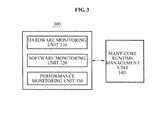
- FIG. 3 illustrates a block diagram of a monitoring unit 300 according to example embodiments.
- the monitoring unit 300 of FIG. 3 may include a hardware monitoring unit 310, a software monitoring unit 320, and a performance monitoring unit 330.
- the hardware monitoring unit 310 may monitor hardware corresponding to an application program
- the software monitoring unit 320 may monitor software corresponding to the application program.
- the performance monitoring unit 330 may monitor a performance of the application program.
- a many-core runtime management unit 340 may instruct the application program to perform morphing of the application program, based on a result of monitoring at least one of the performance and state of the application program.
- an RTM of the many-core runtime management unit 340 may monitor the performance of the application program, and a state of a system, using the monitoring unit 300.
- the application program may form a morphing instance set by either implementing various algorithms or changing a data division scheme.
- a morphing instance of the application program may be compiled by actual hard coding, or may be dynamically generated by a source code generator and compiled in a runtime.
- the changeable range may be expressed by, for example, a hardware property, a software property, a performance property, and a morphing range.
- the hardware property may include, for example, an SPM usage, a total memory usage, a CPU usage, a network usage, a bus usage, and the like.
- the SPM usage may enable each morphing instance to achieve an optimal performance.
- the RTM may monitor a performance of hardware using the monitoring unit 300, and may select a morphing instance based on a state of the hardware.
- the software property may include, for example, a number of threads used by the morphing instance, a parallelism overhead, a communication density, a memory access density, a cache usage, and the like.
- a predetermined instance may have a large overhead for initial parallelism, but may have a small overhead for synchronization.
- Another instance may have a small overhead for initial parallelism, but may have a large overhead for synchronization.
- the performance property may be information received by the RTM to enable the application program to measure the performance of the application program.
- FIG. 4 illustrates a flowchart of a method of dynamically reconfiguring a state of an application program in a many-core system according to example embodiments.
- registration information may be received from the application program, in response to a state change of the application program.
- the registration information may include at least one of information on a usage of a SPM, information on a total memory usage, information on a usage of a CPU, network usage information, bus usage information, information on a number of threads, information on a parallelism overhead, information on a communication density, information on a memory access density, information on a cache usage, and information regarding a current performance of the application program.
- At least one of a performance and a state of the application program may be monitored.
- the application program may register, in an RTM, a morphing range and characteristics of the application program.
- the RTM may measure and monitor the performance of the application program.
- the state change of the application program that is, morphing of the application program may be processed based on the received registration information, and a monitoring result obtained in operation 402.
- At least one algorithm corresponding to the application program may be changed, or data connected with the application program may be divided.
- the RTM may select a suitable morphing time and a suitable morphing instance to morph the application program depending on a change in a state of a system and a change in a performance of the application program, based on the registration information.
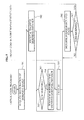
- FIG. 5 illustrates a flowchart of operations performed between a many-core runtime management unit and an application program according to example embodiments.
- the application program when the application program is executed, the application program may request an RTM of the many-core runtime management unit to register a morphing range of the application program, and may register a property of a morphing instance in operation 501.
- the application program may request the RTM to collect information through profiling.
- the RTM of the many-core runtime management unit may select the best morphing instance based on a current system status, and may transfer the selected morphing instance to the application program.
- the application program may determine, based on the selected morphing instance, whether there is a need to perform new morphing.
- the application program may perform the new morphing based on the received morphing instance in operation 504, and may then be executed in operation 505.
- the application program may be executed in operation 505 directly, without needing to perform the new morphing.
- the application program may frequently transfer a procedure to the RTM, and may determine whether a new morphing instruction is received from the RTM at a determined point. For example, when the new morphing instruction is received, the application program may be morphed to a corresponding state, and may perform an application.
- the RTM may monitor a performance of a system, and the state of the application program, using a performance hint and system information in operation 506, and may determine whether morphing needs to be performed in operation 507.
- the performance hint may be received from the application program to the RTM, and the system information may be measured by the RTM.
- the RTM may select the best morphing instance, and may instruct the application program to perform the morphing.
- an RTM of a system level may function to measure a performance and a system load and accordingly, it is possible to more easily design an application program, and to improve a performance of the application program.
- the application program may be optimized by the RTM and thus, it is possible to use a variety of information of the system level. Additionally, the application program may be optimized by adjusting scheduling or resource allocation in the system level.
- the application program may be optimized during execution of the application program, without a need to interrupt or restart the application program.
- the method of dynamically reconfiguring a state of an application program in a many-core system may be recorded in non-transitory computer-readable media including program instructions to implement various operations embodied by a computer.
- the media may also include, alone or in combination with the program instructions, data files, data structures, and the like.
- the program instructions recorded on the media may be those specially designed and constructed for the purposes of the example embodiments, or they may be of the kind well-known and available to those having skill in the computer software arts.
- non-transitory computer-readable media examples include magnetic media such as hard disks, floppy disks, and magnetic tape; optical media such as CD ROM disks and DVDs; magneto-optical media such as optical disks; and hardware devices that are specially configured to store and perform program instructions, such as read-only memory (ROM), random access memory (RAM), flash memory, and the like.
- program instructions include both machine code, such as produced by a compiler, and files containing higher level code that may be executed by the computer using an interpreter.
- the described hardware devices may be configured to act as one or more software modules in order to perform the operations of the above-described example embodiments, or vice versa.
- the apparatus and method for dynamically reconfiguring a state of an application program in a many-core system may use one or more processors, which may include a microprocessor, central processing unit (CPU), digital signal processor (DSP), or application-specific integrated circuit (ASIC), as well as portions or combinations of these and other processing devices.
- processors which may include a microprocessor, central processing unit (CPU), digital signal processor (DSP), or application-specific integrated circuit (ASIC), as well as portions or combinations of these and other processing devices.
- the example embodiments described herein refer to flowchart illustrations of the apparatus and method for dynamically reconfiguring a state of an application program in a many-core system. It will be understood that each block of the flowchart illustrations, and combinations of blocks in the flowchart illustrations, can be implemented by computer program instructions. These computer program instructions can be provided to one or more processors of a general purpose computer, special purpose computer, or other programmable data processing apparatus to produce a machine, such that the instructions, which execute via the one or more processors of the computer or other programmable data processing apparatus, may implement the functions specified in the flowchart block or blocks.
- Each block of the flowchart illustrations may represent a unit, module, segment, or portion of code, which comprises one or more executable instructions for implementing the specified logical function(s). It should also be noted that in some alternative implementations, the functions noted in the blocks may occur out of the order. For example, two blocks shown in succession may in fact be executed substantially concurrently or the blocks may sometimes be executed in the reverse order, depending upon the functionality involved.
- module may refer to, but is not limited to, a software or hardware component, such as a Field Programmable Gate Array (FPGA) or Application Specific Integrated Circuit (ASIC), which performs certain tasks.
- a module or unit may be configured to reside on an addressable storage medium and configured to execute on one or more processors.
- a module or unit may include, by way of example, components, such as software components, object-oriented software components, class components and task components, processes, functions, attributes, procedures, subroutines, segments of program code, drivers, firmware, microcode, circuitry, data, databases, data structures, tables, arrays, and variables.
- components such as software components, object-oriented software components, class components and task components, processes, functions, attributes, procedures, subroutines, segments of program code, drivers, firmware, microcode, circuitry, data, databases, data structures, tables, arrays, and variables.
- the functionality provided for in the components and modules/units may be combined into fewer components and modules/units or further separated into additional components and modules.
Landscapes
- Engineering & Computer Science (AREA)
- Theoretical Computer Science (AREA)
- General Engineering & Computer Science (AREA)
- Software Systems (AREA)
- Physics & Mathematics (AREA)
- General Physics & Mathematics (AREA)
- Computer Hardware Design (AREA)
- Quality & Reliability (AREA)
- Debugging And Monitoring (AREA)
- Stored Programmes (AREA)
Abstract
Description
- This application claims the benefit of Korean Patent Application No.
10-2010-0127408, filed on December 14, 2010 - Example embodiments of the following description relate to management of an application program in a system configured with a plurality of cores, and more particularly, to a technical aspect that an application program registers and transfers, to a runtime manager (RTM), a morphing instance and performance information of the application program, and the RTM optimizes an operation of the application program using measured system information and information of the application program.
- One of the most noticeable trends in the design of microprocessors may be the utilization of multi-core processors. Since the advent of dual-core products, a movement toward the use of multi-core processors has become more prevalent, with the development of many-core processors, which utilize a large number of core processors, arising.
- Historically, multi-core architecture came about as the chip density of processors has increased. For example, the number of on-chip processing resources has increased based on Moore's law.
- Conventional multi-core chips can include about 10 cores, however it is expected that hundreds of cores can be included in a single chip in the near future. As the use of multi-core architecture is becoming more common, parallel processing is being increasingly performed in personal computers (PCs), as well as in super computers, including clusters, and even in embedded systems.
- Similar to cluster computing, a plurality of applications need to share computing resources in multiple cores, and there are various computing resource requirements of an application program operating in multiple cores. Additionally, in a dynamic environment, idle resources of a system are frequently changed, and requirements of the application program are also changed during execution of the application program. Traditional static parallelism of the application program tends not to achieve good performance in the dynamic environment.
- The foregoing and/or other aspects are achieved by providing an apparatus for dynamically reconfiguring a state of an application program in a many-core system, the apparatus including a registration unit to receive registration information from an application program, in response to a state change of the application program, and a many-core runtime management unit to process the state change of the application program based on the received registration information.
- The foregoing and/or other aspects are achieved by providing a method of dynamically reconfiguring a state of an application program in a many-core system, the apparatus including receiving registration information from an application program, in response to a state change of the application program, monitoring at least one of a performance of the application program and the state of the application program, and processing the state change of the application program based on at least one of the received registration information and a monitoring result obtained by the monitoring.
- Additional aspects, features, and/or advantages of example embodiments will be set forth in part in the description which follows and, in part, will be apparent from the description, or may be learned by practice of the disclosure.
- These and/or other aspects and advantages will become apparent and more readily appreciated from the following description of the example embodiments, taken in conjunction with the accompanying drawings of which:
-
FIG. 1 illustrates a block diagram of an apparatus for dynamically reconfiguring a state of an application program in a many-core system according to example embodiments; -
FIG. 2 illustrates a block diagram of a registration unit according to example embodiments; -
FIG. 3 illustrates a block diagram of a monitoring unit according to example embodiments; -
FIG. 4 illustrates a flowchart of a method of dynamically reconfiguring a state of an application program in a many-core system according to example embodiments; and -
FIG. 5 illustrates a flowchart of operations performed between a many-core runtime management unit and an application program according to example embodiments. - Reference will now be made in detail to example embodiments, examples of which are illustrated in the accompanying drawings, wherein like reference numerals refer to like elements throughout. Example embodiments are described below to explain the present disclosure by referring to the figures.
-
FIG. 1 illustrates a block diagram of anapparatus 100 for dynamically reconfiguring a state of an application program in a many-core system according to example embodiments. - The
apparatus 100 ofFIG. 1 may include aregistration unit 110, a many-coreruntime management unit 120, and amonitoring unit 130. - The
registration unit 110 may receive registration information from the application program, in response to a state reconfiguration of the application program, that is, in response to a state change of the application program. - The state reconfiguration of the application program may be processed based on a monitored performance of the application program, using a predetermined instance at a predetermined time by an algorithm defined in advance, so that the application program may achieve the best performance.
- Hereinafter, the state reconfiguration of the application program, or the state change of the application program will be referred to as "morphing of the application program".
- The many-core
runtime management unit 120 may instruct and process morphing of the application program, based on the received registration information, by using a runtime manager (RTM). - The RTM may verify a morphing range, and characteristics of each morphing from the application program.
- The application program may have various types of morphing instance sets that may change themselves.
- The many-core
runtime management unit 120 may manage system resources, and may determine resource allocation, scheduling, and morphing of the application program, using the RTM. - The RTM may monitor a performance of the application program. When the application program needs to be changed, the RTM may instruct the application program to perform morphing. Accordingly, the RTM may be operated in connection with the
monitoring unit 130. - The many-core
runtime management unit 120 may change at least one algorithm corresponding to the application program, or may divide data connected with the application program, to process the state change of the application program. - The
monitoring unit 130 may monitor at least one of the performance and the state of the application program. - Accordingly, the many-core
runtime management unit 120 may process the morphing of the application program, based on the received registration information and a monitoring result obtained by themonitoring unit 130. - First, the
registration unit 110 will be further described. -
FIG. 2 illustrates a block diagram of aregistration unit 200 according to example embodiments. - The
registration unit 200 ofFIG. 2 may include a hardwareproperty registration unit 210, a softwareproperty registration unit 220, a performanceproperty registration unit 230, and arange registration unit 240. - To perform the morphing, an application program needs to provide an RTM of a many-core
runtime management unit 250 with registration information, such as range information, property information, and the like. Here, the range information and the property information may be used for the state change of the application program. Theregistration unit 200 may receive the registration information from the application program. - Specifically, the hardware
property registration unit 210 may receive registration information associated with a hardware property, and the softwareproperty registration unit 220 may receive registration information associated with a software property. - Similarly, the performance
property registration unit 230 may receive registration information associated with a performance property. Therange registration unit 240 may receive registration information regarding a morphing range where the application program is morphable. - The range information may include at least one of hardware property information, software property information, and performance information that correspond to the application program.
- The hardware property information may include at least one of information on a usage of a scratchpad memory (SPM), information on a total memory usage, information on a usage of a central processing unit (CPU), network usage information, and bus usage information.
- Additionally, the software property information may include at least one of information on a number of threads corresponding to the application program, information on a parallelism overhead, information on a communication density, information on a memory access density, and information on a cache usage.
- Furthermore, the performance information may include information regarding a current performance of the application program that is received from the application program.
-
FIG. 3 illustrates a block diagram of amonitoring unit 300 according to example embodiments. - The
monitoring unit 300 ofFIG. 3 may include ahardware monitoring unit 310, asoftware monitoring unit 320, and a performance monitoring unit 330. Thehardware monitoring unit 310 may monitor hardware corresponding to an application program, and thesoftware monitoring unit 320 may monitor software corresponding to the application program. Additionally, the performance monitoring unit 330 may monitor a performance of the application program. - A many-core
runtime management unit 340 according to example embodiments may instruct the application program to perform morphing of the application program, based on a result of monitoring at least one of the performance and state of the application program. - In other words, an RTM of the many-core
runtime management unit 340 may monitor the performance of the application program, and a state of a system, using themonitoring unit 300. - The application program according to example embodiments may form a morphing instance set by either implementing various algorithms or changing a data division scheme. A morphing instance of the application program may be compiled by actual hard coding, or may be dynamically generated by a source code generator and compiled in a runtime.
- An application program written as described above may need to notify the RTM of a changeable range of the application program. The changeable range may be expressed by, for example, a hardware property, a software property, a performance property, and a morphing range. The hardware property may include, for example, an SPM usage, a total memory usage, a CPU usage, a network usage, a bus usage, and the like. Here, the SPM usage may enable each morphing instance to achieve an optimal performance.
- In other words, the RTM may monitor a performance of hardware using the
monitoring unit 300, and may select a morphing instance based on a state of the hardware. - The software property may include, for example, a number of threads used by the morphing instance, a parallelism overhead, a communication density, a memory access density, a cache usage, and the like.
- A predetermined instance may have a large overhead for initial parallelism, but may have a small overhead for synchronization. Another instance may have a small overhead for initial parallelism, but may have a large overhead for synchronization. The performance property may be information received by the RTM to enable the application program to measure the performance of the application program.
- To measure the performance of the application program, a scheme by which the RTM counts a simple heartbeat may be used, or other complex schemes may be registered.
-
FIG. 4 illustrates a flowchart of a method of dynamically reconfiguring a state of an application program in a many-core system according to example embodiments. - In
operation 401, registration information may be received from the application program, in response to a state change of the application program. - Here, the registration information may include at least one of information on a usage of a SPM, information on a total memory usage, information on a usage of a CPU, network usage information, bus usage information, information on a number of threads, information on a parallelism overhead, information on a communication density, information on a memory access density, information on a cache usage, and information regarding a current performance of the application program.
- In
operation 402, at least one of a performance and a state of the application program may be monitored. - Specifically, the application program may register, in an RTM, a morphing range and characteristics of the application program. The RTM may measure and monitor the performance of the application program.
- In
operation 403, the state change of the application program, that is, morphing of the application program may be processed based on the received registration information, and a monitoring result obtained inoperation 402. - Here, at least one algorithm corresponding to the application program may be changed, or data connected with the application program may be divided.
- The RTM may select a suitable morphing time and a suitable morphing instance to morph the application program depending on a change in a state of a system and a change in a performance of the application program, based on the registration information.
-
FIG. 5 illustrates a flowchart of operations performed between a many-core runtime management unit and an application program according to example embodiments. - Referring to
FIG. 5 , when the application program is executed, the application program may request an RTM of the many-core runtime management unit to register a morphing range of the application program, and may register a property of a morphing instance inoperation 501. - When instance property information does not exist, the application program may request the RTM to collect information through profiling.
- In
operation 502, the RTM of the many-core runtime management unit may select the best morphing instance based on a current system status, and may transfer the selected morphing instance to the application program. - In
operation 503, the application program may determine, based on the selected morphing instance, whether there is a need to perform new morphing. When the new morphing needs to be performed, the application program may perform the new morphing based on the received morphing instance inoperation 504, and may then be executed inoperation 505. - Conversely, when there is no new morphing, the application program may be executed in
operation 505 directly, without needing to perform the new morphing. - During execution, the application program may frequently transfer a procedure to the RTM, and may determine whether a new morphing instruction is received from the RTM at a determined point. For example, when the new morphing instruction is received, the application program may be morphed to a corresponding state, and may perform an application.
- The RTM may monitor a performance of a system, and the state of the application program, using a performance hint and system information in
operation 506, and may determine whether morphing needs to be performed inoperation 507. Here, the performance hint may be received from the application program to the RTM, and the system information may be measured by the RTM. - When it is determined that the morphing needs to be performed, that is, when a morphing time comes, the RTM may select the best morphing instance, and may instruct the application program to perform the morphing.
- Thus, according to example embodiments, it is possible to manage an application program, so that the application program may achieve the best performance in a system including a plurality of cores.
- Specifically, an RTM of a system level may function to measure a performance and a system load and accordingly, it is possible to more easily design an application program, and to improve a performance of the application program.
- In other words, the application program may be optimized by the RTM and thus, it is possible to use a variety of information of the system level. Additionally, the application program may be optimized by adjusting scheduling or resource allocation in the system level.
- In addition, the application program may be optimized during execution of the application program, without a need to interrupt or restart the application program.
- The method of dynamically reconfiguring a state of an application program in a many-core system according to the above-described example embodiments may be recorded in non-transitory computer-readable media including program instructions to implement various operations embodied by a computer. The media may also include, alone or in combination with the program instructions, data files, data structures, and the like. The program instructions recorded on the media may be those specially designed and constructed for the purposes of the example embodiments, or they may be of the kind well-known and available to those having skill in the computer software arts. Examples of non-transitory computer-readable media include magnetic media such as hard disks, floppy disks, and magnetic tape; optical media such as CD ROM disks and DVDs; magneto-optical media such as optical disks; and hardware devices that are specially configured to store and perform program instructions, such as read-only memory (ROM), random access memory (RAM), flash memory, and the like. Examples of program instructions include both machine code, such as produced by a compiler, and files containing higher level code that may be executed by the computer using an interpreter. The described hardware devices may be configured to act as one or more software modules in order to perform the operations of the above-described example embodiments, or vice versa.
- The apparatus and method for dynamically reconfiguring a state of an application program in a many-core system according to the above-described example embodiments may use one or more processors, which may include a microprocessor, central processing unit (CPU), digital signal processor (DSP), or application-specific integrated circuit (ASIC), as well as portions or combinations of these and other processing devices.
- The example embodiments described herein refer to flowchart illustrations of the apparatus and method for dynamically reconfiguring a state of an application program in a many-core system. It will be understood that each block of the flowchart illustrations, and combinations of blocks in the flowchart illustrations, can be implemented by computer program instructions. These computer program instructions can be provided to one or more processors of a general purpose computer, special purpose computer, or other programmable data processing apparatus to produce a machine, such that the instructions, which execute via the one or more processors of the computer or other programmable data processing apparatus, may implement the functions specified in the flowchart block or blocks.
- Each block of the flowchart illustrations may represent a unit, module, segment, or portion of code, which comprises one or more executable instructions for implementing the specified logical function(s). It should also be noted that in some alternative implementations, the functions noted in the blocks may occur out of the order. For example, two blocks shown in succession may in fact be executed substantially concurrently or the blocks may sometimes be executed in the reverse order, depending upon the functionality involved.
- The terms "module", and "unit," as used herein, may refer to, but is not limited to, a software or hardware component, such as a Field Programmable Gate Array (FPGA) or Application Specific Integrated Circuit (ASIC), which performs certain tasks. A module or unit may be configured to reside on an addressable storage medium and configured to execute on one or more processors. Thus, a module or unit may include, by way of example, components, such as software components, object-oriented software components, class components and task components, processes, functions, attributes, procedures, subroutines, segments of program code, drivers, firmware, microcode, circuitry, data, databases, data structures, tables, arrays, and variables. The functionality provided for in the components and modules/units may be combined into fewer components and modules/units or further separated into additional components and modules.
- Although example embodiments have been shown and described, it would be appreciated by those skilled in the art that changes may be made in these example embodiments without departing from the scope of the claims.
-
- Embodiment 1: An apparatus for dynamically reconfiguring a state of an application program in a many-core system, the apparatus comprising:
- a registration unit to receive registration information from the application program, in response to a state change of the application program; and
- a many-core runtime management unit to process the state change of the application program based on the received registration information.
- Embodiment 2: The apparatus of embodiment 1, further comprising:
- a monitoring unit to monitor at least one of a performance of the application program and the state of the application program.
- Embodiment 3: The apparatus of embodiment 2, wherein the many-core runtime management unit processes the state change of the application program, based on a monitoring result obtained by the monitoring unit and the received registration information.
- Embodiment 4: The apparatus of embodiment 2, wherein the monitoring unit comprises:
- a hardware monitoring unit to monitor hardware corresponding to the application program;
- a software monitoring unit to monitor software corresponding to the application program; and
- a performance monitoring unit to monitor the performance of the application program.
- Embodiment 5: The apparatus of embodiment 2, wherein the many-core runtime management unit instructs the application program to change the state of the application program, based on a monitoring result obtained by the monitoring unit.
- Embodiment 6: The apparatus of embodiment 1, wherein the registration information comprises at least one of range information and property information that are used for the state change.
- Embodiment 7: The apparatus of embodiment 6, wherein the range information comprises at least one of hardware property information, software property information, and performance information that correspond to the application program.
- Embodiment 8: The apparatus of embodiment 7, wherein the hardware property information comprises at least one of information on a usage of a scratchpad memory (SPM), information on a total memory usage, information on a usage of a central processing unit (CPU), network usage information, and bus usage information.
- Embodiment 9: The apparatus of embodiment 7, wherein the software property information comprises at least one of information on a number of threads corresponding to the application program, information on a parallelism overhead, information on a communication density, information on a memory access density, and information on a cache usage.
- Embodiment 10: The apparatus of embodiment 1, wherein the performance information comprises information regarding a current performance of the application program that is received from the application program.
- Embodiment 11: The apparatus of embodiment 1, wherein the many-core runtime management unit either changes at least one algorithm corresponding to the application program, or divides data connected with the application program, and processes the state change of the application program.
- Embodiment 12: The apparatus of embodiment 1, wherein the many-core runtime management unit determines resource allocation, scheduling, and a state change of the application program using a runtime manager.
- Embodiment 13: The apparatus of embodiment 1, wherein the registration unit comprises:
- a hardware property registration unit to receive registration information associated with a hardware property;
- a software property registration unit to receive registration information associated with a software property;
- a performance property registration unit to receive registration information associated with a performance property; and
- a range registration unit to receive registration information regarding range information to determine when a state change of the application program is possible.
- Embodiment 14: The apparatus of embodiment 1, wherein the state change is performed by hard coding or by dynamically generating code using a source code generator to compile the code in a runtime.
- Embodiment 15: A method of dynamically reconfiguring a state of an application program in a many-core system, the method comprising:
- receiving registration information from an application program, in response to a state change of the application program;
- monitoring at least one of a performance of the application program and the state of the application program; and
- processing the state change of the application program based on at least one of the received registration information and a monitoring result obtained by the monitoring.
- Embodiment 16: The method of embodiment 15, wherein the registration information comprises at least one of information on a usage of a scratchpad memory (SPM), information on a total memory usage, information on a usage of a central processing unit (CPU), network usage information, bus usage information, information on a number of threads, information on a parallelism overhead, information on a communication density, information on a memory access density, information on a cache usage, and information regarding a current performance of the application program.
- Embodiment 17: The method of embodiment 15, wherein the processing comprises either changing at least one algorithm corresponding to the application program, or dividing data connected with the application program.
- Embodiment 18: A non-transitory computer readable recording medium to store a program, that when executed, causes a computer to implement the method of embodiment 15.
- Embodiment 19: A method for dynamically reconfiguring a state of an application program in a many-core system, the method comprising:
- registering a morphing range of the application program with a many-core runtime management unit;
- receiving a morphing instance selected by the many-core runtime management unit;
- determining whether to perform a new morphing based on the selected morphing instance;
- performing a new morphing when it is determined based on the selected morphing instance there is a need to perform new morphing; and
- executing the application program.
- Embodiment 20: The method of embodiment 19, wherein the application program registers a property of a morphing instance with the many-core runtime management unit, and when instance property information does not exist, the method further comprises: requesting the many-core runtime management unit to collect morphing instance information through profiling.
Claims (15)
- An apparatus for dynamically reconfiguring a state of an application program in a many-core system, the apparatus comprising:a registration unit to receive registration information from the application program, in response to a state change of the application program; anda many-core runtime management unit to process the state change of the application program based on the received registration information.
- The apparatus of claim 1, further comprising:a monitoring unit to monitor at least one of a performance of the application program and the state of the application program.
- The apparatus of claim 2, wherein the many-core runtime management unit is adapted to process the state change of the application program, based on a monitoring result obtained by the monitoring unit and the received registration information.
- The apparatus of claim 2, wherein the monitoring unit comprises:a hardware monitoring unit to monitor hardware corresponding to the application program;a software monitoring unit to monitor software corresponding to the application program; anda performance monitoring unit to monitor the performance of the application program.
- The apparatus of claim 2, wherein the many-core runtime management unit is adapted to instruct the application program to change the state of the application program, based on a monitoring result obtained by the monitoring unit.
- The apparatus of one of claims 1 to 5, wherein the registration information comprises at least one of range information and property information that are used for the state change, and wherein the range information comprises at least one of hardware property information, software property information, and performance information that correspond to the application program, and
wherein the hardware property information comprises at least one of information on a usage of a scratchpad memory, SPM, information on a total memory usage, information on a usage of a central processing unit, CPU, network usage information, and bus usage information, or wherein the software property information comprises at least one of information on a number of threads corresponding to the application program, information on a parallelism overhead, information on a communication density, information on a memory access density, and information on a cache usage. - The apparatus of one of claims 1 to 6, wherein the performance information comprises information regarding a current performance of the application program that is received from the application program.
- The apparatus of one of claims 1 to 7, wherein the many-core runtime management unit either changes at least one algorithm corresponding to the application program, or divides data connected with the application program, and processes the state change of the application program.
- The apparatus of one of claims 1 to 8, wherein the many-core runtime management unit determines resource allocation, scheduling, and a state change of the application program using a runtime manager.
- The apparatus of one of claims 1 to 9, wherein the registration unit comprises:a hardware property registration unit to receive registration information associated with a hardware property;a software property registration unit to receive registration information associated with a software property;a performance property registration unit to receive registration information associated with a performance property; anda range registration unit to receive registration information regarding range information to determine when a state change of the application program is possible.
- The apparatus of one of claims 1 to 10, wherein the state change is performed by hard coding or by dynamically generating code using a source code generator to compile the code in a runtime.
- A method for dynamically reconfiguring a state of an application program in a many-core system, the method comprising:registering a morphing range of the application program with a many-core runtime management unit;receiving a morphing instance selected by the many-core runtime management unit;determining whether to perform a new morphing based on the selected morphing instance;performing a new morphing when it is determined based on the selected morphing instance there is a need to perform new morphing; andexecuting the application program.
- The method of claim 12, wherein the application program registers a property of a morphing instance with the many-core runtime management unit, and when instance property information does not exist, the method further comprises: requesting the many-core runtime management unit to collect morphing instance information through profiling.
- A method of dynamically reconfiguring a state of an application program in a many-core system, the method adapted to operate the apparatus of one of claims 1 to 11.
- A non-transitory computer-readable recording medium to store a program, that when executed, causes a computer to implement the method of claim 14.
Applications Claiming Priority (1)
| Application Number | Priority Date | Filing Date | Title |
|---|---|---|---|
| KR1020100127408A KR101671184B1 (en) | 2010-12-14 | 2010-12-14 | Apparatus for dynamically self-adapting of software framework on many-core systems and method of the same |
Publications (2)
| Publication Number | Publication Date |
|---|---|
| EP2466469A2 true EP2466469A2 (en) | 2012-06-20 |
| EP2466469A3 EP2466469A3 (en) | 2014-07-30 |
Family
ID=45442847
Family Applications (1)
| Application Number | Title | Priority Date | Filing Date |
|---|---|---|---|
| EP11193126.7A Ceased EP2466469A3 (en) | 2010-12-14 | 2011-12-13 | Apparatus and method for dynamically reconfiguring state of application program in a many-core system |
Country Status (3)
| Country | Link |
|---|---|
| US (1) | US8914808B2 (en) |
| EP (1) | EP2466469A3 (en) |
| KR (1) | KR101671184B1 (en) |
Cited By (3)
| Publication number | Priority date | Publication date | Assignee | Title |
|---|---|---|---|---|
| CN102799560A (en) * | 2012-09-07 | 2012-11-28 | 上海交通大学 | Dynamic reconfigurable subnetting method and system based on network on chip |
| CN107450988A (en) * | 2017-07-31 | 2017-12-08 | 广东欧珀移动通信有限公司 | Resource allocation method and Related product |
| US11016812B2 (en) | 2017-07-31 | 2021-05-25 | Guangdong Oppo Mobile Telecommunications Corp., Ltd. | Method for resource allocation and terminal device |
Families Citing this family (8)
| Publication number | Priority date | Publication date | Assignee | Title |
|---|---|---|---|---|
| KR102014721B1 (en) * | 2013-01-29 | 2019-10-21 | 삼성전자 주식회사 | Programmable intelligent storage architecture based on application and business requirements |
| CN103645954B (en) * | 2013-11-21 | 2018-12-14 | 华为技术有限公司 | A kind of CPU dispatching method based on heterogeneous multi-core system, device and system |
| WO2015089780A1 (en) * | 2013-12-19 | 2015-06-25 | 华为技术有限公司 | Method and device for scheduling application process |
| WO2015113211A1 (en) * | 2014-01-28 | 2015-08-06 | 华为技术有限公司 | Reentrant resource scheduling method, device and system |
| KR101797929B1 (en) | 2015-08-26 | 2017-11-15 | 서경대학교 산학협력단 | Assigning processes to cores in many-core platform and communication method between core processes |
| US10649914B1 (en) * | 2016-07-01 | 2020-05-12 | The Board Of Trustees Of The University Of Illinois | Scratchpad-based operating system for multi-core embedded systems |
| KR102009425B1 (en) * | 2018-02-09 | 2019-08-09 | 울산과학기술원 | Method for managing performance of computing system, program and computer readable storage medium therefor |
| KR102132598B1 (en) * | 2018-10-23 | 2020-07-10 | 울산과학기술원 | Method and apparatus of partitioning memory bandwidth of system |
Citations (1)
| Publication number | Priority date | Publication date | Assignee | Title |
|---|---|---|---|---|
| KR20100127408A (en) | 2009-05-26 | 2010-12-06 | 전자부품연구원 | Composition for Capacitor Dielectric |
Family Cites Families (12)
| Publication number | Priority date | Publication date | Assignee | Title |
|---|---|---|---|---|
| US5303369A (en) | 1990-08-31 | 1994-04-12 | Texas Instruments Incorporated | Scheduling system for multiprocessor operating system |
| FR2854260B1 (en) | 2003-04-28 | 2006-03-10 | France Telecom | METHOD FOR DYNAMIC OPTIMIZATION OF APPLICATION PERFORMANCE, CORRESPONDING DEVICE AND COMPUTER PROGRAM |
| US7379989B2 (en) * | 2003-07-31 | 2008-05-27 | International Business Machines Corporation | Method for dual agent processes and dual active server processes |
| US7543091B2 (en) | 2004-09-22 | 2009-06-02 | Kabushiki Kaisha Toshiba | Self-organized parallel processing system |
| US7734895B1 (en) | 2005-04-28 | 2010-06-08 | Massachusetts Institute Of Technology | Configuring sets of processor cores for processing instructions |
| US7730246B2 (en) * | 2005-06-30 | 2010-06-01 | Intel Corporation | Opportunistic transmission of software state information within a link based computing system |
| US20110179477A1 (en) * | 2005-12-09 | 2011-07-21 | Harris Corporation | System including property-based weighted trust score application tokens for access control and related methods |
| US9141435B2 (en) | 2007-07-30 | 2015-09-22 | Sybase, Inc. | System and methodology providing workload management in database cluster |
| KR100962531B1 (en) | 2007-12-11 | 2010-06-15 | 한국전자통신연구원 | Apparatus for performing multi-threading framework supporting dynamic load balancing and processing method using the same |
| US8495342B2 (en) | 2008-12-16 | 2013-07-23 | International Business Machines Corporation | Configuring plural cores to perform an instruction having a multi-core characteristic |
| KR101572879B1 (en) * | 2009-04-29 | 2015-12-01 | 삼성전자주식회사 | Dynamic parallel system and method for parallel application program |
| US9645839B2 (en) * | 2010-10-27 | 2017-05-09 | Microsoft Technology Licensing, Llc | Stateful applications operating in a stateless cloud computing environment |
-
2010
- 2010-12-14 KR KR1020100127408A patent/KR101671184B1/en active Active
-
2011
- 2011-11-16 US US13/297,744 patent/US8914808B2/en active Active
- 2011-12-13 EP EP11193126.7A patent/EP2466469A3/en not_active Ceased
Patent Citations (1)
| Publication number | Priority date | Publication date | Assignee | Title |
|---|---|---|---|---|
| KR20100127408A (en) | 2009-05-26 | 2010-12-06 | 전자부품연구원 | Composition for Capacitor Dielectric |
Cited By (4)
| Publication number | Priority date | Publication date | Assignee | Title |
|---|---|---|---|---|
| CN102799560A (en) * | 2012-09-07 | 2012-11-28 | 上海交通大学 | Dynamic reconfigurable subnetting method and system based on network on chip |
| CN107450988A (en) * | 2017-07-31 | 2017-12-08 | 广东欧珀移动通信有限公司 | Resource allocation method and Related product |
| CN107450988B (en) * | 2017-07-31 | 2019-12-27 | Oppo广东移动通信有限公司 | Resource allocation method and related product |
| US11016812B2 (en) | 2017-07-31 | 2021-05-25 | Guangdong Oppo Mobile Telecommunications Corp., Ltd. | Method for resource allocation and terminal device |
Also Published As
| Publication number | Publication date |
|---|---|
| US20120151502A1 (en) | 2012-06-14 |
| EP2466469A3 (en) | 2014-07-30 |
| KR101671184B1 (en) | 2016-11-01 |
| US8914808B2 (en) | 2014-12-16 |
| KR20120066189A (en) | 2012-06-22 |
Similar Documents
| Publication | Publication Date | Title |
|---|---|---|
| US8914808B2 (en) | Apparatus and method for dynamically reconfiguring state of application program in a many-core system | |
| US8171267B2 (en) | Method and apparatus for migrating task in multi-processor system | |
| US9413683B2 (en) | Managing resources in a distributed system using dynamic clusters | |
| JP6219512B2 (en) | Virtual hadoop manager | |
| US10713095B2 (en) | Multi-core processor and method of controlling the same using revisable translation tables | |
| JP5564564B2 (en) | Method and apparatus for non-uniformly changing the performance of a computing unit according to performance sensitivity | |
| US8810584B2 (en) | Smart power management in graphics processing unit (GPU) based cluster computing during predictably occurring idle time | |
| US20150286492A1 (en) | Optimized resource allocation and management in a virtualized computing environment | |
| WO2012066640A1 (en) | Computer system, migration method, and management server | |
| KR102063716B1 (en) | Processing apparatus of managing power based data and method thereof | |
| US20120239952A1 (en) | Information processing apparatus, power control method, and recording medium | |
| US11169720B1 (en) | System and method for creating on-demand virtual filesystem having virtual burst buffers created on the fly | |
| US10768684B2 (en) | Reducing power by vacating subsets of CPUs and memory | |
| US10228970B2 (en) | Domain bounding for symmetric multiprocessing systems | |
| US9141441B2 (en) | Managing computing resources through aggregated core management | |
| US20230024130A1 (en) | Workload aware virtual processing units | |
| WO2016092856A1 (en) | Information processing device, information processing system, task processing method, and storage medium for storing program | |
| KR101140914B1 (en) | Technique for controlling computing resources | |
| CN1841330A (en) | Method and system for managing multi-node SMP system | |
| JP2016012344A (en) | Method and resource manager for executing an application | |
| CN107528871B (en) | Data analysis in storage systems | |
| CN105677481B (en) | A kind of data processing method, system and electronic equipment | |
| US8505020B2 (en) | Computer workload migration using processor pooling | |
| CN119597491B (en) | A GPU resource isolation method, system, medium and product | |
| JP2023531893A (en) | Core selection based on usage policy and core constraints |
Legal Events
| Date | Code | Title | Description |
|---|---|---|---|
| PUAI | Public reference made under article 153(3) epc to a published international application that has entered the european phase |
Free format text: ORIGINAL CODE: 0009012 |
|
| AK | Designated contracting states |
Kind code of ref document: A2 Designated state(s): AL AT BE BG CH CY CZ DE DK EE ES FI FR GB GR HR HU IE IS IT LI LT LU LV MC MK MT NL NO PL PT RO RS SE SI SK SM TR |
|
| AX | Request for extension of the european patent |
Extension state: BA ME |
|
| RAP1 | Party data changed (applicant data changed or rights of an application transferred) |
Owner name: SAMSUNG ELECTRONICS CO., LTD. Owner name: UNIVERSITY OF SOUTHERN CALIFORNIA |
|
| PUAL | Search report despatched |
Free format text: ORIGINAL CODE: 0009013 |
|
| AK | Designated contracting states |
Kind code of ref document: A3 Designated state(s): AL AT BE BG CH CY CZ DE DK EE ES FI FR GB GR HR HU IE IS IT LI LT LU LV MC MK MT NL NO PL PT RO RS SE SI SK SM TR |
|
| AX | Request for extension of the european patent |
Extension state: BA ME |
|
| RIC1 | Information provided on ipc code assigned before grant |
Ipc: G06F 11/34 20060101AFI20140624BHEP Ipc: G06F 9/44 20060101ALN20140624BHEP Ipc: G06F 9/50 20060101ALI20140624BHEP |
|
| 17P | Request for examination filed |
Effective date: 20150130 |
|
| RBV | Designated contracting states (corrected) |
Designated state(s): AL AT BE BG CH CY CZ DE DK EE ES FI FR GB GR HR HU IE IS IT LI LT LU LV MC MK MT NL NO PL PT RO RS SE SI SK SM TR |
|
| 17Q | First examination report despatched |
Effective date: 20160226 |
|
| STAA | Information on the status of an ep patent application or granted ep patent |
Free format text: STATUS: THE APPLICATION HAS BEEN REFUSED |
|
| 18R | Application refused |
Effective date: 20171116 |