EP2465977B1 - Methods for producing a high temperature oxidation resistant coating on superalloy substrates - Google Patents
Methods for producing a high temperature oxidation resistant coating on superalloy substrates Download PDFInfo
- Publication number
- EP2465977B1 EP2465977B1 EP11193119A EP11193119A EP2465977B1 EP 2465977 B1 EP2465977 B1 EP 2465977B1 EP 11193119 A EP11193119 A EP 11193119A EP 11193119 A EP11193119 A EP 11193119A EP 2465977 B1 EP2465977 B1 EP 2465977B1
- Authority
- EP
- European Patent Office
- Prior art keywords
- aluminum
- chloride
- ionic liquid
- component
- superalloy
- Prior art date
- Legal status (The legal status is an assumption and is not a legal conclusion. Google has not performed a legal analysis and makes no representation as to the accuracy of the status listed.)
- Not-in-force
Links
- 229910000601 superalloy Inorganic materials 0.000 title claims description 80
- 238000000576 coating method Methods 0.000 title claims description 53
- 239000011248 coating agent Substances 0.000 title claims description 47
- 238000000034 method Methods 0.000 title claims description 47
- 230000003647 oxidation Effects 0.000 title claims description 32
- 238000007254 oxidation reaction Methods 0.000 title claims description 32
- 239000000758 substrate Substances 0.000 title description 15
- 229910052782 aluminium Inorganic materials 0.000 claims description 90
- XAGFODPZIPBFFR-UHFFFAOYSA-N aluminium Chemical compound [Al] XAGFODPZIPBFFR-UHFFFAOYSA-N 0.000 claims description 90
- 239000002608 ionic liquid Substances 0.000 claims description 53
- 238000007747 plating Methods 0.000 claims description 38
- 229910000838 Al alloy Inorganic materials 0.000 claims description 25
- 238000009713 electroplating Methods 0.000 claims description 25
- 150000003839 salts Chemical class 0.000 claims description 20
- 238000010438 heat treatment Methods 0.000 claims description 15
- PNEYBMLMFCGWSK-UHFFFAOYSA-N Alumina Chemical compound [O-2].[O-2].[O-2].[Al+3].[Al+3] PNEYBMLMFCGWSK-UHFFFAOYSA-N 0.000 claims description 13
- 238000000151 deposition Methods 0.000 claims description 13
- VEXZGXHMUGYJMC-UHFFFAOYSA-M Chloride anion Chemical compound [Cl-] VEXZGXHMUGYJMC-UHFFFAOYSA-M 0.000 claims description 10
- AZDRQVAHHNSJOQ-UHFFFAOYSA-N alumane Chemical class [AlH3] AZDRQVAHHNSJOQ-UHFFFAOYSA-N 0.000 claims description 10
- 229910052735 hafnium Inorganic materials 0.000 claims description 10
- VBJZVLUMGGDVMO-UHFFFAOYSA-N hafnium atom Chemical compound [Hf] VBJZVLUMGGDVMO-UHFFFAOYSA-N 0.000 claims description 9
- XLYOFNOQVPJJNP-UHFFFAOYSA-N water Substances O XLYOFNOQVPJJNP-UHFFFAOYSA-N 0.000 claims description 9
- 239000012720 thermal barrier coating Substances 0.000 claims description 6
- QCWXUUIWCKQGHC-UHFFFAOYSA-N Zirconium Chemical compound [Zr] QCWXUUIWCKQGHC-UHFFFAOYSA-N 0.000 claims description 5
- 239000002245 particle Substances 0.000 claims description 5
- 229910052726 zirconium Inorganic materials 0.000 claims description 5
- PDPJQWYGJJBYLF-UHFFFAOYSA-J hafnium tetrachloride Chemical compound Cl[Hf](Cl)(Cl)Cl PDPJQWYGJJBYLF-UHFFFAOYSA-J 0.000 claims description 4
- 239000010970 precious metal Substances 0.000 claims description 4
- 239000002904 solvent Substances 0.000 claims description 4
- DUNKXUFBGCUVQW-UHFFFAOYSA-J zirconium tetrachloride Chemical compound Cl[Zr](Cl)(Cl)Cl DUNKXUFBGCUVQW-UHFFFAOYSA-J 0.000 claims description 4
- XUIMIQQOPSSXEZ-UHFFFAOYSA-N Silicon Chemical compound [Si] XUIMIQQOPSSXEZ-UHFFFAOYSA-N 0.000 claims description 3
- 239000011651 chromium Substances 0.000 claims description 3
- 229910052746 lanthanum Inorganic materials 0.000 claims description 3
- FZLIPJUXYLNCLC-UHFFFAOYSA-N lanthanum atom Chemical compound [La] FZLIPJUXYLNCLC-UHFFFAOYSA-N 0.000 claims description 3
- 229910052710 silicon Inorganic materials 0.000 claims description 3
- 239000010703 silicon Substances 0.000 claims description 3
- 239000010936 titanium Substances 0.000 claims description 3
- VYZAMTAEIAYCRO-UHFFFAOYSA-N Chromium Chemical compound [Cr] VYZAMTAEIAYCRO-UHFFFAOYSA-N 0.000 claims description 2
- RTAQQCXQSZGOHL-UHFFFAOYSA-N Titanium Chemical compound [Ti] RTAQQCXQSZGOHL-UHFFFAOYSA-N 0.000 claims description 2
- 229910052792 caesium Inorganic materials 0.000 claims description 2
- TVFDJXOCXUVLDH-UHFFFAOYSA-N caesium atom Chemical compound [Cs] TVFDJXOCXUVLDH-UHFFFAOYSA-N 0.000 claims description 2
- 229910052804 chromium Inorganic materials 0.000 claims description 2
- 238000004519 manufacturing process Methods 0.000 claims description 2
- 229910052702 rhenium Inorganic materials 0.000 claims description 2
- WUAPFZMCVAUBPE-UHFFFAOYSA-N rhenium atom Chemical compound [Re] WUAPFZMCVAUBPE-UHFFFAOYSA-N 0.000 claims description 2
- FDNAPBUWERUEDA-UHFFFAOYSA-N silicon tetrachloride Chemical compound Cl[Si](Cl)(Cl)Cl FDNAPBUWERUEDA-UHFFFAOYSA-N 0.000 claims description 2
- 229910052715 tantalum Inorganic materials 0.000 claims description 2
- GUVRBAGPIYLISA-UHFFFAOYSA-N tantalum atom Chemical compound [Ta] GUVRBAGPIYLISA-UHFFFAOYSA-N 0.000 claims description 2
- 229910052719 titanium Inorganic materials 0.000 claims description 2
- 229910052727 yttrium Inorganic materials 0.000 claims description 2
- VWQVUPCCIRVNHF-UHFFFAOYSA-N yttrium atom Chemical compound [Y] VWQVUPCCIRVNHF-UHFFFAOYSA-N 0.000 claims description 2
- OBOSXEWFRARQPU-UHFFFAOYSA-N 2-n,2-n-dimethylpyridine-2,5-diamine Chemical compound CN(C)C1=CC=C(N)C=N1 OBOSXEWFRARQPU-UHFFFAOYSA-N 0.000 claims 1
- XZQYTGKSBZGQMO-UHFFFAOYSA-I Rhenium(V) chloride Inorganic materials Cl[Re](Cl)(Cl)(Cl)Cl XZQYTGKSBZGQMO-UHFFFAOYSA-I 0.000 claims 1
- 238000005299 abrasion Methods 0.000 claims 1
- 239000003929 acidic solution Substances 0.000 claims 1
- 239000012670 alkaline solution Substances 0.000 claims 1
- AIYUHDOJVYHVIT-UHFFFAOYSA-M caesium chloride Chemical compound [Cl-].[Cs+] AIYUHDOJVYHVIT-UHFFFAOYSA-M 0.000 claims 1
- ICAKDTKJOYSXGC-UHFFFAOYSA-K lanthanum(iii) chloride Chemical compound Cl[La](Cl)Cl ICAKDTKJOYSXGC-UHFFFAOYSA-K 0.000 claims 1
- OEIMLTQPLAGXMX-UHFFFAOYSA-I tantalum(v) chloride Chemical compound Cl[Ta](Cl)(Cl)(Cl)Cl OEIMLTQPLAGXMX-UHFFFAOYSA-I 0.000 claims 1
- UXMRNSHDSCDMLG-UHFFFAOYSA-J tetrachlororhenium Chemical compound Cl[Re](Cl)(Cl)Cl UXMRNSHDSCDMLG-UHFFFAOYSA-J 0.000 claims 1
- XJDNKRIXUMDJCW-UHFFFAOYSA-J titanium tetrachloride Chemical compound Cl[Ti](Cl)(Cl)Cl XJDNKRIXUMDJCW-UHFFFAOYSA-J 0.000 claims 1
- 239000010410 layer Substances 0.000 description 34
- BASFCYQUMIYNBI-UHFFFAOYSA-N platinum Chemical compound [Pt] BASFCYQUMIYNBI-UHFFFAOYSA-N 0.000 description 26
- VSCWAEJMTAWNJL-UHFFFAOYSA-K aluminium trichloride Chemical compound Cl[Al](Cl)Cl VSCWAEJMTAWNJL-UHFFFAOYSA-K 0.000 description 14
- 229910052697 platinum Inorganic materials 0.000 description 13
- 230000000873 masking effect Effects 0.000 description 12
- PXHVJJICTQNCMI-UHFFFAOYSA-N Nickel Chemical compound [Ni] PXHVJJICTQNCMI-UHFFFAOYSA-N 0.000 description 10
- 229910000951 Aluminide Inorganic materials 0.000 description 9
- BMQZYMYBQZGEEY-UHFFFAOYSA-M 1-ethyl-3-methylimidazolium chloride Chemical compound [Cl-].CCN1C=C[N+](C)=C1 BMQZYMYBQZGEEY-UHFFFAOYSA-M 0.000 description 7
- QVGXLLKOCUKJST-UHFFFAOYSA-N atomic oxygen Chemical compound [O] QVGXLLKOCUKJST-UHFFFAOYSA-N 0.000 description 7
- 238000005229 chemical vapour deposition Methods 0.000 description 7
- 230000008021 deposition Effects 0.000 description 7
- 238000009792 diffusion process Methods 0.000 description 7
- 239000007789 gas Substances 0.000 description 7
- 229910052760 oxygen Inorganic materials 0.000 description 7
- 239000001301 oxygen Substances 0.000 description 7
- QTBSBXVTEAMEQO-UHFFFAOYSA-N Acetic acid Chemical compound CC(O)=O QTBSBXVTEAMEQO-UHFFFAOYSA-N 0.000 description 6
- KWYUFKZDYYNOTN-UHFFFAOYSA-M Potassium hydroxide Chemical compound [OH-].[K+] KWYUFKZDYYNOTN-UHFFFAOYSA-M 0.000 description 6
- HEMHJVSKTPXQMS-UHFFFAOYSA-M Sodium hydroxide Chemical compound [OH-].[Na+] HEMHJVSKTPXQMS-UHFFFAOYSA-M 0.000 description 6
- 239000010953 base metal Substances 0.000 description 6
- -1 chloride anions Chemical class 0.000 description 6
- 239000000463 material Substances 0.000 description 5
- 229910052759 nickel Inorganic materials 0.000 description 5
- CSCPPACGZOOCGX-UHFFFAOYSA-N Acetone Chemical compound CC(C)=O CSCPPACGZOOCGX-UHFFFAOYSA-N 0.000 description 4
- 229910045601 alloy Inorganic materials 0.000 description 4
- 239000000956 alloy Substances 0.000 description 4
- 238000005137 deposition process Methods 0.000 description 4
- 238000001878 scanning electron micrograph Methods 0.000 description 4
- 239000002344 surface layer Substances 0.000 description 4
- LFQSCWFLJHTTHZ-UHFFFAOYSA-N Ethanol Chemical compound CCO LFQSCWFLJHTTHZ-UHFFFAOYSA-N 0.000 description 3
- KFZMGEQAYNKOFK-UHFFFAOYSA-N Isopropanol Chemical compound CC(C)O KFZMGEQAYNKOFK-UHFFFAOYSA-N 0.000 description 3
- QAOWNCQODCNURD-UHFFFAOYSA-N Sulfuric acid Chemical compound OS(O)(=O)=O QAOWNCQODCNURD-UHFFFAOYSA-N 0.000 description 3
- 150000001450 anions Chemical class 0.000 description 3
- 230000007797 corrosion Effects 0.000 description 3
- 238000005260 corrosion Methods 0.000 description 3
- 239000007788 liquid Substances 0.000 description 3
- 150000003376 silicon Chemical class 0.000 description 3
- ZXMGHDIOOHOAAE-UHFFFAOYSA-N 1,1,1-trifluoro-n-(trifluoromethylsulfonyl)methanesulfonamide Chemical compound FC(F)(F)S(=O)(=O)NS(=O)(=O)C(F)(F)F ZXMGHDIOOHOAAE-UHFFFAOYSA-N 0.000 description 2
- QTBSBXVTEAMEQO-UHFFFAOYSA-M Acetate Chemical compound CC([O-])=O QTBSBXVTEAMEQO-UHFFFAOYSA-M 0.000 description 2
- IJGRMHOSHXDMSA-UHFFFAOYSA-N Atomic nitrogen Chemical compound N#N IJGRMHOSHXDMSA-UHFFFAOYSA-N 0.000 description 2
- VEXZGXHMUGYJMC-UHFFFAOYSA-N Hydrochloric acid Chemical compound Cl VEXZGXHMUGYJMC-UHFFFAOYSA-N 0.000 description 2
- WMFOQBRAJBCJND-UHFFFAOYSA-M Lithium hydroxide Chemical compound [Li+].[OH-] WMFOQBRAJBCJND-UHFFFAOYSA-M 0.000 description 2
- NBIIXXVUZAFLBC-UHFFFAOYSA-N Phosphoric acid Chemical compound OP(O)(O)=O NBIIXXVUZAFLBC-UHFFFAOYSA-N 0.000 description 2
- 229920006362 Teflon® Polymers 0.000 description 2
- 239000002253 acid Substances 0.000 description 2
- 239000003570 air Substances 0.000 description 2
- GIGQFSYNIXPBCE-UHFFFAOYSA-N alumane;platinum Chemical compound [AlH3].[Pt] GIGQFSYNIXPBCE-UHFFFAOYSA-N 0.000 description 2
- CSDREXVUYHZDNP-UHFFFAOYSA-N alumanylidynesilicon Chemical compound [Al].[Si] CSDREXVUYHZDNP-UHFFFAOYSA-N 0.000 description 2
- 230000015572 biosynthetic process Effects 0.000 description 2
- 238000000861 blow drying Methods 0.000 description 2
- KRKNYBCHXYNGOX-UHFFFAOYSA-N citric acid Natural products OC(=O)CC(O)(C(O)=O)CC(O)=O KRKNYBCHXYNGOX-UHFFFAOYSA-N 0.000 description 2
- 239000010941 cobalt Substances 0.000 description 2
- 229910017052 cobalt Inorganic materials 0.000 description 2
- GUTLYIVDDKVIGB-UHFFFAOYSA-N cobalt atom Chemical compound [Co] GUTLYIVDDKVIGB-UHFFFAOYSA-N 0.000 description 2
- 150000001875 compounds Chemical class 0.000 description 2
- 230000003247 decreasing effect Effects 0.000 description 2
- 238000005530 etching Methods 0.000 description 2
- 150000002362 hafnium Chemical class 0.000 description 2
- 229910052751 metal Inorganic materials 0.000 description 2
- 239000002184 metal Substances 0.000 description 2
- 239000004033 plastic Substances 0.000 description 2
- 239000011253 protective coating Substances 0.000 description 2
- 238000010926 purge Methods 0.000 description 2
- 230000035882 stress Effects 0.000 description 2
- 239000000126 substance Substances 0.000 description 2
- STBLNCCBQMHSRC-BATDWUPUSA-N (2s)-n-[(3s,4s)-5-acetyl-7-cyano-4-methyl-1-[(2-methylnaphthalen-1-yl)methyl]-2-oxo-3,4-dihydro-1,5-benzodiazepin-3-yl]-2-(methylamino)propanamide Chemical compound O=C1[C@@H](NC(=O)[C@H](C)NC)[C@H](C)N(C(C)=O)C2=CC(C#N)=CC=C2N1CC1=C(C)C=CC2=CC=CC=C12 STBLNCCBQMHSRC-BATDWUPUSA-N 0.000 description 1
- NJMWOUFKYKNWDW-UHFFFAOYSA-N 1-ethyl-3-methylimidazolium Chemical compound CCN1C=C[N+](C)=C1 NJMWOUFKYKNWDW-UHFFFAOYSA-N 0.000 description 1
- PXRKCOCTEMYUEG-UHFFFAOYSA-N 5-aminoisoindole-1,3-dione Chemical compound NC1=CC=C2C(=O)NC(=O)C2=C1 PXRKCOCTEMYUEG-UHFFFAOYSA-N 0.000 description 1
- 229910052684 Cerium Inorganic materials 0.000 description 1
- 229910001029 Hf alloy Inorganic materials 0.000 description 1
- UFHFLCQGNIYNRP-UHFFFAOYSA-N Hydrogen Chemical compound [H][H] UFHFLCQGNIYNRP-UHFFFAOYSA-N 0.000 description 1
- GRYLNZFGIOXLOG-UHFFFAOYSA-N Nitric acid Chemical compound O[N+]([O-])=O GRYLNZFGIOXLOG-UHFFFAOYSA-N 0.000 description 1
- VYPSYNLAJGMNEJ-UHFFFAOYSA-N Silicium dioxide Chemical compound O=[Si]=O VYPSYNLAJGMNEJ-UHFFFAOYSA-N 0.000 description 1
- NINIDFKCEFEMDL-UHFFFAOYSA-N Sulfur Chemical compound [S] NINIDFKCEFEMDL-UHFFFAOYSA-N 0.000 description 1
- 150000007513 acids Chemical class 0.000 description 1
- 238000007792 addition Methods 0.000 description 1
- 230000032683 aging Effects 0.000 description 1
- 238000005275 alloying Methods 0.000 description 1
- VYBYZVVRYQDCGQ-UHFFFAOYSA-N alumane;hafnium Chemical compound [AlH3].[Hf] VYBYZVVRYQDCGQ-UHFFFAOYSA-N 0.000 description 1
- 238000005269 aluminizing Methods 0.000 description 1
- RVYOQIHOUTVEKU-UHFFFAOYSA-N aluminum hafnium Chemical compound [Al].[Hf] RVYOQIHOUTVEKU-UHFFFAOYSA-N 0.000 description 1
- 239000012080 ambient air Substances 0.000 description 1
- HSLXOARVFIWOQF-UHFFFAOYSA-N bis(trifluoromethylsulfonyl)azanide;1-butyl-1-methylpyrrolidin-1-ium Chemical compound CCCC[N+]1(C)CCCC1.FC(F)(F)S(=O)(=O)[N-]S(=O)(=O)C(F)(F)F HSLXOARVFIWOQF-UHFFFAOYSA-N 0.000 description 1
- 238000005422 blasting Methods 0.000 description 1
- 239000003518 caustics Substances 0.000 description 1
- ZMIGMASIKSOYAM-UHFFFAOYSA-N cerium Chemical compound [Ce][Ce][Ce][Ce][Ce][Ce][Ce][Ce][Ce][Ce][Ce][Ce][Ce][Ce][Ce][Ce][Ce][Ce][Ce][Ce][Ce][Ce][Ce][Ce][Ce][Ce][Ce][Ce][Ce][Ce][Ce][Ce][Ce][Ce][Ce][Ce][Ce][Ce] ZMIGMASIKSOYAM-UHFFFAOYSA-N 0.000 description 1
- 159000000006 cesium salts Chemical class 0.000 description 1
- 150000003841 chloride salts Chemical class 0.000 description 1
- 150000001805 chlorine compounds Chemical class 0.000 description 1
- 229940125878 compound 36 Drugs 0.000 description 1
- 229910052593 corundum Inorganic materials 0.000 description 1
- 230000001419 dependent effect Effects 0.000 description 1
- 238000010586 diagram Methods 0.000 description 1
- 238000007598 dipping method Methods 0.000 description 1
- 238000004070 electrodeposition Methods 0.000 description 1
- 230000007613 environmental effect Effects 0.000 description 1
- 230000003628 erosive effect Effects 0.000 description 1
- 239000011521 glass Substances 0.000 description 1
- 239000001257 hydrogen Substances 0.000 description 1
- 229910052739 hydrogen Inorganic materials 0.000 description 1
- 239000012535 impurity Substances 0.000 description 1
- 239000011261 inert gas Substances 0.000 description 1
- 229910052500 inorganic mineral Inorganic materials 0.000 description 1
- 150000002500 ions Chemical class 0.000 description 1
- 150000002603 lanthanum Chemical class 0.000 description 1
- 150000002739 metals Chemical class 0.000 description 1
- 239000011707 mineral Substances 0.000 description 1
- 239000000203 mixture Substances 0.000 description 1
- 229910017604 nitric acid Inorganic materials 0.000 description 1
- 229910052757 nitrogen Inorganic materials 0.000 description 1
- 150000007524 organic acids Chemical class 0.000 description 1
- 235000005985 organic acids Nutrition 0.000 description 1
- 150000002892 organic cations Chemical class 0.000 description 1
- 239000003960 organic solvent Substances 0.000 description 1
- 230000001590 oxidative effect Effects 0.000 description 1
- TWNQGVIAIRXVLR-UHFFFAOYSA-N oxo(oxoalumanyloxy)alumane Chemical compound O=[Al]O[Al]=O TWNQGVIAIRXVLR-UHFFFAOYSA-N 0.000 description 1
- 230000001681 protective effect Effects 0.000 description 1
- 230000009257 reactivity Effects 0.000 description 1
- 230000002829 reductive effect Effects 0.000 description 1
- 230000000717 retained effect Effects 0.000 description 1
- 150000003281 rhenium Chemical class 0.000 description 1
- 239000004576 sand Substances 0.000 description 1
- VSZWPYCFIRKVQL-UHFFFAOYSA-N selanylidenegallium;selenium Chemical compound [Se].[Se]=[Ga].[Se]=[Ga] VSZWPYCFIRKVQL-UHFFFAOYSA-N 0.000 description 1
- 239000002356 single layer Substances 0.000 description 1
- 238000007581 slurry coating method Methods 0.000 description 1
- 238000005507 spraying Methods 0.000 description 1
- 229910052717 sulfur Inorganic materials 0.000 description 1
- 239000011593 sulfur Substances 0.000 description 1
- 150000003481 tantalum Chemical class 0.000 description 1
- 150000003608 titanium Chemical class 0.000 description 1
- 238000011282 treatment Methods 0.000 description 1
- 229910001845 yogo sapphire Inorganic materials 0.000 description 1
- 150000003746 yttrium Chemical class 0.000 description 1
- 150000003754 zirconium Chemical class 0.000 description 1
Images


Classifications
-
- C—CHEMISTRY; METALLURGY
- C25—ELECTROLYTIC OR ELECTROPHORETIC PROCESSES; APPARATUS THEREFOR
- C25D—PROCESSES FOR THE ELECTROLYTIC OR ELECTROPHORETIC PRODUCTION OF COATINGS; ELECTROFORMING; APPARATUS THEREFOR
- C25D5/00—Electroplating characterised by the process; Pretreatment or after-treatment of workpieces
- C25D5/48—After-treatment of electroplated surfaces
- C25D5/50—After-treatment of electroplated surfaces by heat-treatment
-
- C—CHEMISTRY; METALLURGY
- C25—ELECTROLYTIC OR ELECTROPHORETIC PROCESSES; APPARATUS THEREFOR
- C25D—PROCESSES FOR THE ELECTROLYTIC OR ELECTROPHORETIC PRODUCTION OF COATINGS; ELECTROFORMING; APPARATUS THEREFOR
- C25D3/00—Electroplating: Baths therefor
- C25D3/02—Electroplating: Baths therefor from solutions
- C25D3/42—Electroplating: Baths therefor from solutions of light metals
- C25D3/44—Aluminium
-
- C—CHEMISTRY; METALLURGY
- C25—ELECTROLYTIC OR ELECTROPHORETIC PROCESSES; APPARATUS THEREFOR
- C25D—PROCESSES FOR THE ELECTROLYTIC OR ELECTROPHORETIC PRODUCTION OF COATINGS; ELECTROFORMING; APPARATUS THEREFOR
- C25D3/00—Electroplating: Baths therefor
- C25D3/02—Electroplating: Baths therefor from solutions
- C25D3/56—Electroplating: Baths therefor from solutions of alloys
-
- C—CHEMISTRY; METALLURGY
- C25—ELECTROLYTIC OR ELECTROPHORETIC PROCESSES; APPARATUS THEREFOR
- C25D—PROCESSES FOR THE ELECTROLYTIC OR ELECTROPHORETIC PRODUCTION OF COATINGS; ELECTROFORMING; APPARATUS THEREFOR
- C25D3/00—Electroplating: Baths therefor
- C25D3/66—Electroplating: Baths therefor from melts
- C25D3/665—Electroplating: Baths therefor from melts from ionic liquids
-
- C—CHEMISTRY; METALLURGY
- C25—ELECTROLYTIC OR ELECTROPHORETIC PROCESSES; APPARATUS THEREFOR
- C25D—PROCESSES FOR THE ELECTROLYTIC OR ELECTROPHORETIC PRODUCTION OF COATINGS; ELECTROFORMING; APPARATUS THEREFOR
- C25D7/00—Electroplating characterised by the article coated
-
- C—CHEMISTRY; METALLURGY
- C25—ELECTROLYTIC OR ELECTROPHORETIC PROCESSES; APPARATUS THEREFOR
- C25D—PROCESSES FOR THE ELECTROLYTIC OR ELECTROPHORETIC PRODUCTION OF COATINGS; ELECTROFORMING; APPARATUS THEREFOR
- C25D7/00—Electroplating characterised by the article coated
- C25D7/008—Thermal barrier coatings
-
- F—MECHANICAL ENGINEERING; LIGHTING; HEATING; WEAPONS; BLASTING
- F01—MACHINES OR ENGINES IN GENERAL; ENGINE PLANTS IN GENERAL; STEAM ENGINES
- F01D—NON-POSITIVE DISPLACEMENT MACHINES OR ENGINES, e.g. STEAM TURBINES
- F01D5/00—Blades; Blade-carrying members; Heating, heat-insulating, cooling or antivibration means on the blades or the members
- F01D5/12—Blades
- F01D5/28—Selecting particular materials; Particular measures relating thereto; Measures against erosion or corrosion
- F01D5/288—Protective coatings for blades
-
- Y—GENERAL TAGGING OF NEW TECHNOLOGICAL DEVELOPMENTS; GENERAL TAGGING OF CROSS-SECTIONAL TECHNOLOGIES SPANNING OVER SEVERAL SECTIONS OF THE IPC; TECHNICAL SUBJECTS COVERED BY FORMER USPC CROSS-REFERENCE ART COLLECTIONS [XRACs] AND DIGESTS
- Y10—TECHNICAL SUBJECTS COVERED BY FORMER USPC
- Y10T—TECHNICAL SUBJECTS COVERED BY FORMER US CLASSIFICATION
- Y10T428/00—Stock material or miscellaneous articles
- Y10T428/12—All metal or with adjacent metals
- Y10T428/12493—Composite; i.e., plural, adjacent, spatially distinct metal components [e.g., layers, joint, etc.]
- Y10T428/12736—Al-base component
Definitions
- the present invention generally relates to protective coatings for superalloy components that are used at high temperatures, and more particularly relates to methods for producing a high temperature oxidation resistant coating on superalloy substrates and the coated superalloy substrates thereby produced.
- Aerospace components made of superalloys such as nickel and cobalt-based superalloys are susceptible to oxidation, reducing their service life and necessitating their replacement or repair.
- gas turbine engine components such as, for example, the burner assembly, turbine vanes, nozzles, and blades are susceptible to oxidation because they encounter severe operating conditions at high temperature conditions.
- severe operating conditions include high gas velocities and exposure to salt, sulfur, and sand causing hot corrosion or erosion and "high temperature conditions” refers to temperatures of 700°C to 1150°C.
- the oxidation resistance of such superalloy components can be enhanced by applying protective coatings.
- Simple aluminide coatings are used on superalloy components to improve oxidation resistance, especially when cost is an issue. Platinum aluminide coatings are used in even more demanding applications.
- CVD chemical vapor deposition
- pack cementation is less costly, there are also drawbacks associated with this conventional deposition technique, such as the introduction of impurities into the aluminum, thereby reducing coating life.
- the temperatures used are high so that the aluminum diffuses into the superalloy substrate/component as it is deposited such that the surface aluminide is only 20-30% aluminum.
- Aluminum electroplating processes may also be used to deposit aluminum at high purity levels, but conventional aluminum electroplating is complex, costly, performed at high temperatures, and/or requires the use of flammable solvents and pyrophoric compounds, which decompose, evaporate and are oxygen-sensitive, necessitating costly specialized equipment and presenting serious safety and environmental challenges to a commercial production facility.
- the aluminum is present after plating as an aluminum layer on the surface of the substrate. The aluminum layer needs bonding and diffusion into the superalloy component to produce a high temperature oxidation resistant aluminide coating.
- aluminide coating refers to the coating after diffusion of aluminum into the superalloy component.
- Ionic liquids have been used to deposit aluminum on non-superalloy substrates for corrosion and wear and tear resistance in a lab-scale three-step process that includes a first pretreatment step in which the substrate is cleaned, degreased, pickled, and then dried. In the second step, the metal substrate is then electroplated using the ionic liquid at a temperature ranging from 60 to 100°C. The third step includes removing the ionic liquid from the substrate.
- R.E. reactive elements
- silicon, hafnium, zirconium, cerium, and lanthanum increase the oxidation resistance of high temperature aluminide coatings.
- the co-deposition of aluminum and the reactive element is difficult, expensive, and can be dangerous.
- the co-deposit requires at least two separate deposition processes, such as the initial deposit of aluminum by a chemical vapor deposition process, pack cementation process, or the like followed by deposition of the reactive element by another chemical vapor deposition process in the same or a different reactor.
- a heat-treated slurry coating containing aluminum and hafnium particles has also been used in an attempt to co-deposit aluminum and hafnium to form a protective aluminide-hafnium coating, but the results have been disappointing with the hafnium particles not sufficiently diffusing into the aluminum, the base metal of the coated component oxidizing, and the concentration of the reactive element unable to be controlled.
- the method comprises applying aluminum or an aluminum alloy to at least one surface of the superalloy component by electroplating in an ionic liquid aluminum plating bath to form a plated component.
- the plated component is heat treated at a first temperature of about 600 to about 650°C for about 15 to about 45 minutes and then further heat treated at a second temperature of about 700°C to about 1050°C for about 0.50 hours to about two hours or a second temperature of about 750°C to about 900°C for about 12 to about 20 hours.
- the method comprises selecting a superalloy component to be coated.
- An ionic liquid aluminum plating bath is formed or selected.
- At least one surface of the superalloy component is electroplated under electroplating conditions in the ionic liquid aluminum plating bath to form a plated component.
- the plated component is heated to a first temperature in a range of 600°C to 650°C and held at the first temperature for about 15 minutes to about 45 minutes.
- the plated component is heated to a second temperature in a range of 700 to 1050°C and held for about 0.50 hours to about two hours or a second temperature in a range of 750°C to 900°C for about 12 to about 20 hours.
- the coated superalloy component comprises a component comprised of a superalloy material and an aluminide or aluminide alumina alloy coating on the component including an alpha alumina surface layer.
- FIG. 1 is a flow diagram of methods for producing a high temperature oxidation resistant coating on superalloy substrates, according to exemplary embodiments of the present invention
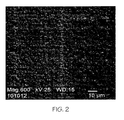
- FIG. 2 is a SEM micrograph (600X magnified) of the top surface of a high temperature oxidation resistant coating produced in accordance with exemplary embodiments.
- FIG. 3 is a SEM micrograph of a cross-section of a platinum-plated superalloy component coated with an aluminum alloy high temperature oxidation resistant coating produced in accordance with exemplary embodiments.
- Various embodiments are directed to methods for producing a high purity, high temperature oxidation resistant coating on superalloy components by applying aluminum or an aluminum alloy to at least one surface of the superalloy substrate at a heating temperature at or below 100°C in an ionic liquid aluminum plating bath comprising an ionic liquid and an aluminum salt.
- the ionic liquid aluminum plating bath may further comprise a dry salt of a reactive element to co-deposit aluminum and the reactive element (the "aluminum alloy”) in a single step and further improve the oxidation resistance of the coating at high temperatures, i.e., temperatures from 700 to 1150°C, to extend the life of the superalloy component.
- the coating may include one layer or multiple layers formed in any sequence.
- the coating may include, for example, platinum alloyed with aluminum, platinum alloyed with the aluminum alloy, a platinum layer or layers, or a combination thereof.
- a thermal barrier coating may be used with the high temperature oxidation resistant coating.
- "high purity” means a purity greater than 99.5%
- a method 10 for producing a high temperature oxidation resistant coating on a superalloy component begins by providing the superalloy component 30 (step 12).
- the superalloy component comprises a component comprised of a cobalt-based superalloy, a nickel-based superalloy, or a combination thereof.
- the superalloy is the base metal.
- Suitable exemplary superalloys include, for example, MARM247 and SC180.
- the surface portions of the superalloy component to be coated are activated by pre-treating to remove any oxide scale on the base metal (step 14).
- the oxide scale may be removed by, for example, wet blasting with abrasive particles, by chemical treatment, or by other methods as known in the art.
- Certain surface portions of the superalloy component are not coated and therefore, these surface portions may be covered (masked) prior to electroplating the superalloy component as hereinafter described and as known in the art.
- surface portions where the coating is to be retained may be masked after electroplating followed by etching away the unmasked coating with a selective etchant that will not etch the base metal.
- Suitable exemplary mask materials include glass or Teflon® non-stick coatings.
- Suitable exemplary etchants include, for example, KOH, NaOH, LiOH, dilute HCl, H 2 SO 4 , H 2 SO 4 /H 3 PO 4 , commercial etchants containing H 3 PO 4 , HNO 3 /acetic acid, or the like.
- step 16 The masking step, whether performed prior to, after, or both prior and after electroplating is referred to as step 16.
- the mask material used is compatible with ionic liquids.
- the electroplating is performed at relatively low temperatures (less than 100°C)
- low temperature masking techniques may be used.
- Plastic masking materials such as, for example, a Teflon® non-stick mask are suitable and can be quickly placed on the areas not to be coated either as tape wrapped or as a perform which acts as a glove.
- Such masks may be relatively quickly applied and quickly removed and can be reused, making such low temperature masking techniques much less expensive and time consuming than conventional high temperature masking techniques.
- method 10 continues by applying aluminum, or an aluminum alloy to the activated surface(s) of the superalloy component by electroplating the superalloy component (masked or unmasked) in an ionic liquid aluminum plating bath to form a plated superalloy component (step 18).
- the ionic liquid aluminum plating bath comprises an aluminum salt dissolved in an ionic liquid.
- the ionic liquid aluminum plating bath may further comprise a dry salt of a reactive element if the aluminum alloy is to be applied, as hereinafter described. Both salts (aluminum and reactive element) are dissolved in the ionic liquid and both metals are electrochemically deposited from the bath as an alloy.
- the amount of each salt in the ionic liquid should be such that the bath is liquid at room temperature and that it forms a good deposit as determined, for example, by SEM micrograph.
- the aluminum salt dissolved in the ionic liquid comprises, for example, Aluminum chloride (AlCl 3 ).
- Possible suitable anions other than chloride anions that are soluble in the ionic liquid aluminum plating bath and can be used in the aluminum salt include, for example, acetate, hexafluorophosphate, and tetrafluoroborate anions as determined by the quality of the deposit.
- Suitable exemplary ionic liquids are commercially available from, for example, BASF Corporation, Rhineland-Palatinate, Germany and include 1-ethyl-3-methylimidazolium chloride (also known as EMIM Cl), I-ethyl-3-methylimidazolium bis(trifluoromethyl-sulfonyl) amide (also known as [EMIM] Tf 2 N), 1-butyl-1-lmethylpyrrolidinium bis(trifluoromethyl sulfonyl) amide (also known as [BMP] Tf 2 N), 1-butyl-1-methyl-pyrrolidinium bis(trifluoromethylsulfonyl)amide (also known as [Py(1,4)]Tf(2)N), and combinations thereof.
- EMIM Cl 1-ethyl-3-methylimidazolium chloride
- EMIM I-ethyl-3-methylimidazolium bis(trifluoromethyl-sulfonyl) amide
- ionic liquid refers to salts that are liquid at low temperatures (typically below 100°C) due to their chemical structure, comprised of mostly voluminous, organic cations and a wide range of ions. They do not contain any other non-ionic components like organic solvent or water. Ionic liquids are not flammable or pyrophoric and have low or no vapor pressure, and therefore do not evaporate or cause emissions.
- An exemplary ionic liquid aluminum plating bath comprising 1-ethyl-3-methylimidazolium chloride (EMIM Cl) and AlCl 3 is available commercially from BASF Corporation, and marketed under the trade name BASF BasionicsTM A103.
- EMIM Cl 1-ethyl-3-methylimidazolium chloride
- AlCl 3 is available commercially from BASF Corporation, and marketed under the trade name BASF BasionicsTM A103.
- ionic liquid aluminum plating baths may be commercially available or prepared using separately available ionic liquids and aluminum salts.
- an ionic liquid aluminum plating bath of EMIM-Cl and AlCl 3 in a molar ratio of 1.0 to 1.5 has the following weight percentages of ionic liquid (EMIM Cl) and aluminum salt (AlCl 3 ): 42.3 wt% EMIM Cl and 57.7 wt% AlCl 3 .
- the weight percentage of AlCl 3 in EMIM-C1 ionic liquid may vary +/- 25%, i.e., 43 to 72 wt% in the above example.
- the ionic liquid aluminum plating bath may further comprise a dry salt of a "reactive element".
- Reactive elements include silicon (Si), hafnium (Hf), zirconium (Zr), cesium (Cs), lanthanum (La), yttrium (Y), tantalum (Ta), titanium (Ti), rhenium (Re), or combinations thereof.
- the dry salt of the reactive element comprises dry hafnium salts, for example, anhydrous hafnium chloride (HfCl 4 ), dry silicon salts, for example, anhydrous silicon chloride, dry zirconium salts, for example, anhydrous Zirconium (IV) chloride (ZrCl 4 ), dry cesium salts, dry lanthanum salts, dry yttrium salts, dry tantalum salts, dry titanium salts, dry rhenium salts, or combinations thereof.
- “Dry salts" are substantially liquid/moisture-free.
- the salt of the reactive element is preferably in a +4 valence state because of its solubility in the ionic liquid aluminum plating bath, however other valance states may be used if the desired solubility is present. While chloride salts have been described, it is to be understood that other reactive element salts may be used such as, for example, reactive element salts of acetate, hexafluorophosphate, and tetrafluoroborate anions.
- the anion of the reactive element salt may be different or the same as the anion of the aluminum salt. Reactive elements have the potential to spontaneously combust and react with water.
- the concentration of reactive element in the deposit comprises 0.05 wt% to 10 wt% (i.e., the ratio of reactive element to aluminum throughout the deposit, no matter the number of layers, desirably remains constant).
- the concentration of hafnium chloride comprises 0.001 wt% to 5 wt%, preferably 0.0025 to 0.100 wt%. This preferred range is for a single layer. Multiple layers with thin hafnium concentrated layers would require higher bath concentrations of HfCl 4 .
- a similar concentration range of reactive element salts other than hafnium chloride in the ionic liquid aluminum plating bath may be used.
- the step of applying aluminum or the aluminum alloy is performed at electroplating conditions as hereinafter described, and may be performed in ambient air (i.e., in the presence of oxygen). It is preferred that the electroplating be performed in a substantially moisture-free environment.
- the ionic liquid aluminum plating bath remains stable up to a water content of 0.1 percent by weight. At higher water content, electrodeposition of aluminum ceases, chloroaluminates are formed, water electrolyzes into hydrogen and oxygen, and the bath forms undesirable compounds and vapors.
- a commercial electroplating tank or other vessel equipped with a cover and a purge gas supply as known in the art may be used to form positive pressure to substantially prevent the moisture from the air getting into the ionic liquid aluminum plating bath.
- Suitable exemplary purge gas may be nitrogen or other inert gas, dry air, or the like.
- the aluminum or aluminum alloy layer is formed on the superalloy component(s) using the ionic liquid aluminum plating bath with one or more aluminum anodes and the superalloy component(s) to be coated (i.e., plated) as cathode.
- a pure reactive element anode may be used to replenish the reactive element fraction, the aluminum being replenished continuously through the aluminum anode.
- Suitable electroplating conditions are known to one skilled in the art and vary depending on the desired thickness of the electroplated layer(s) or coating. The total thickness of the coating is 15 to 45 microns.
- the aluminum or aluminum alloy may be applied directly on the superalloy component to form the aluminum or aluminum alloy layer.
- the time and current density are dependent on each other, i.e., if the plating time is increased, the current density may be decreased and vice versa.
- Current density is essentially the rate at which the deposit forms. For example, if the current density is doubled, the time is cut in half. In order to produce clear bright deposits, the current density may have to increase as the reactive element concentration increases.
- Suitable electroplating temperatures range between 70° to 100°C, preferably 90°C to 95°C with a potential of 0.05 volts to 1.50 volts.
- Elemental precious metals such as, for example, platinum may also be included in the ionic liquid aluminum plating bath to form, respectively, a platinum-aluminum layer or a platinum-aluminum alloy layer.
- a platinum layer may be applied to the surface of the superalloy component prior to applying the aluminum or aluminum alloy to at least one surface of the superalloy component and the all layers thermally diffused into the superalloy component in another operation to form a platinum aluminide coating, as hereinafter described.
- an initial platinum layer may be diffused into the superalloy component prior to electroplating of the aluminum or aluminum alloy.
- a platinum layer may also or alternatively be used over the aluminum or aluminum alloy.
- Chromium (Cr) could also be beneficially plated with the A1 alloy or as a separate layer to improve corrosion resistance.
- the plated superalloy component is rinsed with a solvent such as acetone, alcohol, or a combination thereof (step 20).
- a solvent such as acetone, alcohol, or a combination thereof.
- the plated superalloy component be rinsed with at least one acetone rinse to substantially remove the water-reactive species in the ionic liquid before rinsing the plated superalloy component with at least one water rinse.
- the plated superalloy component may then be dried, for example, by blow drying or the like.
- chloride scale residual chloride
- method 10 continues by substantially removing the chloride scale from the surface of the plated superalloy component (step 22).
- the chloride scale may be removed by an alkaline rinse, an acid rinse using, for example, mineral acids such as HCl, H 2 SO 4 , or organic acids such as citric or acetic acid, or by an abrasive wet rinse because the plating is non-porous.
- the alkaline rinse may be an alkaline cleaner, or a caustic such as sodium hydroxide, potassium hydroxide, or the like.
- a desired pH of the alkaline rinse is from 10 to 14.
- the abrasive wet rinse comprises a water jet containing abrasive particles.
- Both the alkaline rinse and the abrasive wet rinse etch away the chloride scale and a very thin layer of the plating without etching the base metal of the superalloy component. For example, about 0.1 microns of the plating may be etched away.
- the plated superalloy component may be rinsed with at least one water rinse and then dried, for example, by blow drying or the like or using a solvent dip such as, for example, 2-propanol or ethanol to dry more rapidly.
- Method 10 continues by heat treating the plated superalloy component in a first heating step at a first temperature less than 1050°C, preferably 600°C to 650°C and held for about 15 to about 45 minutes (step 24) and then further heating at a second temperature of 700°C to 1050°C for about 0.50 hours to about two hours (step 25).
- the second heating step causes diffusion of the aluminum or aluminum alloy into the superalloy component.
- Heat treatment may be performed in any conventional manner.
- the coating materials do not diffuse as deeply into the superalloy component as with conventional diffusion temperatures, thereby reducing embrittlement of the superalloy component.
- the mechanical properties of the coating are improved.
- alpha alumina which increases the oxidation resistance of the base metal as compared to other types of aluminas, may not be formed as the surface oxide. Therefore, an optional third heat treatment at 1000°C to 1050°C for about 5 to about 45 minutes may be desired in order to substantially ensure formation of an alpha alumina oxide layer in the coating.
- the third heat treatment may be performed, for example, in a separate furnace operation.
- other techniques to form the alpha alumina surface layer after the first and second heat treatments may be used including, for example, formation of high purity alpha alumina by, for example, a CVD process or a sol gel type process as known in the art.
- the plated superalloy component is heat treated in the first heating step followed by further heating at a second temperature of 750°C to 900°C and holding for a longer residence time of about 12 to about 20 hours to diffuse aluminum into the superalloy component forming the alpha alumina (or alpha alumina alloy) surface layer (step 27). Costs are reduced by avoiding additional heating in a separate furnace operation or using other techniques to form the alpha alumina surface layer. In addition, a separate aging step as known in the art is rendered unnecessary.
- the high purity, high temperature oxidation resistant coating produced in accordance with exemplary embodiments may be comprised of one or more layers, formed in any sequence, and having varying concentrations of reactive elements, if any.
- a ternary deposit of aluminum, and two reactive elements may be performed by electroplating in an ionic liquid aluminum plating bath that includes two dry reactive element salts in addition to the ionic liquid and the aluminum salt.
- a binary deposit could be performed more than once.
- the superalloy component may be electroplated in an ionic liquid aluminum plating bath containing, for example, a dry hafnium salt to form an aluminum-hafnium layer followed by another dip in an ionic liquid aluminum plating bath containing, for example, a dry silicon salt to form an aluminum-silicon layer.
- the rinsing and heating steps may optionally be performed between dips.
- a pure aluminum layer may be deposited over and/or under an aluminum alloy layer having a concentration of about 0.5 wt% to about 10 wt% of the reactive element or the reactive element may be distributed throughout an aluminum layer.
- Several elements may be deposited simultaneously by including their dry salts in the ionic liquid aluminum plating bath.
- hafnium and silicon salts at low concentrations may be introduced into the ionic liquid aluminum plating bath or alternatively, a hafnium-aluminum layer deposited, then a silicon-aluminum layer, and then a pure aluminum layer formed. While the pure aluminum layer is described as the uppermost layer, it is to be understood that the layers may be formed in any sequence.
- the high temperature oxidation resistant coating of the present invention may be used with a thermal barrier coating (TBC).
- TBC thermal barrier coating
- the high temperature oxidation resistant coating may be used as an intermediate coat between the superalloy component and the thermal barrier coating.
- the oxidation resistant coating may be used on new and repaired and overhauled turbine engine components.
- Electroplating conditions included the following:
- a platinum plated SC-180 superalloy substrate was electroplated using an ionic liquid aluminum plating bath comprising 400 grams BASF AL03 and 2.5 grams anhydrous ZrCl 4 .
- the electroplating conditions included the following:
- the electroplated sample was rinsed, the chloride scale removed, and then was heat treated at 625°C for 15 minutes followed by further heat treating at 750°C for one hour.
- the SEM of the cross section of the coated superalloy component 26 is shown in FIG. 3 .
- the coating 28 comprises an aluminum alloy layer 34 (aluminum and the reactive element zirconium) and an underlying platinum layer 32 on the superalloy component 30.
- a plastic mounting compound 36 used to hold the sample while being polish is also shown.
- the low oxygen, and aluminum and zirconium content of the aluminum alloy (Al/Zr) coating measured in the sample zone marked with an X is shown in the following TABLE 2: TABLE 2 Elements: WT% Oxygen 0.27 Aluminum 32.95 Zirconium 67
- the low oxygen concentration of the Example 1 and 2 coatings indicates little or no oxidation of the coating.
- the methods for producing a high purity, dense high temperature oxidation resistant coating on a superalloy substrate are simplified, low cost, and environmentally friendly.
- the aluminum and reactive element are able to be applied in a single deposition step and low temperature masking techniques can be used.
- the oxidation resistant coating extends the life of the coated superalloy component produced from such methods.
Landscapes
- Chemical & Material Sciences (AREA)
- Engineering & Computer Science (AREA)
- Materials Engineering (AREA)
- Organic Chemistry (AREA)
- Electrochemistry (AREA)
- Metallurgy (AREA)
- Chemical Kinetics & Catalysis (AREA)
- Mechanical Engineering (AREA)
- General Engineering & Computer Science (AREA)
- Electroplating Methods And Accessories (AREA)
- Other Surface Treatments For Metallic Materials (AREA)
- Solid-Phase Diffusion Into Metallic Material Surfaces (AREA)
- Turbine Rotor Nozzle Sealing (AREA)
Description
- The present invention generally relates to protective coatings for superalloy components that are used at high temperatures, and more particularly relates to methods for producing a high temperature oxidation resistant coating on superalloy substrates and the coated superalloy substrates thereby produced.
- Aerospace components made of superalloys such as nickel and cobalt-based superalloys are susceptible to oxidation, reducing their service life and necessitating their replacement or repair. For example, gas turbine engine components such as, for example, the burner assembly, turbine vanes, nozzles, and blades are susceptible to oxidation because they encounter severe operating conditions at high temperature conditions. As used herein, "severe operating conditions" include high gas velocities and exposure to salt, sulfur, and sand causing hot corrosion or erosion and "high temperature conditions" refers to temperatures of 700°C to 1150°C. The oxidation resistance of such superalloy components can be enhanced by applying protective coatings.
- Simple aluminide coatings are used on superalloy components to improve oxidation resistance, especially when cost is an issue. Platinum aluminide coatings are used in even more demanding applications. There are several drawbacks to conventional aluminum deposition techniques. For example, chemical vapor deposition (CVD) is costly and requires using dangerous gases. While deposition using pack cementation is less costly, there are also drawbacks associated with this conventional deposition technique, such as the introduction of impurities into the aluminum, thereby reducing coating life. For both of these gaseous aluminizing processes, the temperatures used are high so that the aluminum diffuses into the superalloy substrate/component as it is deposited such that the surface aluminide is only 20-30% aluminum. There are lower temperature aluminum CVD deposition processes that do not result in aluminum diffusion, but these processes are only used in a few specialized applications, because of the dangerous gases involved. In addition, as CVD and pack cementation deposition processes are performed at high temperatures, under aggressive deposition conditions, high cost masking techniques prior to deposition are used to ensure that high stress areas of the superalloy component are not coated. After deposition or coating, the masks are removed. High temperature (and high cost) masking techniques include applying masking pastes to the component by spraying or dipping. Extreme care (and labor) has to be taken to ensure that only the desired areas are coated. These pastes form hard deposits that are difficult and labor intensive to remove.
- Aluminum electroplating processes may also be used to deposit aluminum at high purity levels, but conventional aluminum electroplating is complex, costly, performed at high temperatures, and/or requires the use of flammable solvents and pyrophoric compounds, which decompose, evaporate and are oxygen-sensitive, necessitating costly specialized equipment and presenting serious safety and environmental challenges to a commercial production facility. In addition, for all aluminum electroplating processes on superalloys, the aluminum is present after plating as an aluminum layer on the surface of the substrate. The aluminum layer needs bonding and diffusion into the superalloy component to produce a high temperature oxidation resistant aluminide coating. As used herein, the term "aluminide coating" refers to the coating after diffusion of aluminum into the superalloy component. If conventional aluminum diffusion temperatures of 1050°C to 1100°C are used, undesirable microstructures are created. In addition, as conventional diffusion into a superalloy component causes its embrittlement reducing its life, great care has to be taken to ensure that high stress areas are not coated using high temperature masking techniques as previously described.
- Ionic liquids have been used to deposit aluminum on non-superalloy substrates for corrosion and wear and tear resistance in a lab-scale three-step process that includes a first pretreatment step in which the substrate is cleaned, degreased, pickled, and then dried. In the second step, the metal substrate is then electroplated using the ionic liquid at a temperature ranging from 60 to 100°C. The third step includes removing the ionic liquid from the substrate.
- It is well established that small additions of the so-called "reactive elements" (R.E.) such as silicon, hafnium, zirconium, cerium, and lanthanum increase the oxidation resistance of high temperature aluminide coatings. Unfortunately, the co-deposition of aluminum and the reactive element is difficult, expensive, and can be dangerous. In a best case scenario, the co-deposit requires at least two separate deposition processes, such as the initial deposit of aluminum by a chemical vapor deposition process, pack cementation process, or the like followed by deposition of the reactive element by another chemical vapor deposition process in the same or a different reactor. A heat-treated slurry coating containing aluminum and hafnium particles has also been used in an attempt to co-deposit aluminum and hafnium to form a protective aluminide-hafnium coating, but the results have been disappointing with the hafnium particles not sufficiently diffusing into the aluminum, the base metal of the coated component oxidizing, and the concentration of the reactive element unable to be controlled.
- Accordingly, it is desirable to provide methods for producing a high purity, high temperature oxidation resistant coating on superalloy components, including gas turbine engine components. In addition, it is desirable to provide methods for producing a high temperature oxidation resistant coating on a superalloy component using a simplified, lower cost, safe, and environmentally-friendly method including the use of low temperature masking techniques. Furthermore, other desirable features and characteristics of the present invention will become apparent from the subsequent detailed description of the invention and the appended claims, taken in conjunction with the accompanying drawings and this background of the invention.
- Methods are provided for producing a high temperature oxidation resistant coating on a superalloy component. In accordance with one exemplary embodiment, the method comprises applying aluminum or an aluminum alloy to at least one surface of the superalloy component by electroplating in an ionic liquid aluminum plating bath to form a plated component. The plated component is heat treated at a first temperature of about 600 to about 650°C for about 15 to about 45 minutes and then further heat treated at a second temperature of about 700°C to about 1050°C for about 0.50 hours to about two hours or a second temperature of about 750°C to about 900°C for about 12 to about 20 hours.
- Methods are provided for producing a high temperature oxidation resistant coating on a superalloy component, in accordance with yet another exemplary embodiment of the present invention. The method comprises selecting a superalloy component to be coated. An ionic liquid aluminum plating bath is formed or selected. At least one surface of the superalloy component is electroplated under electroplating conditions in the ionic liquid aluminum plating bath to form a plated component. The plated component is heated to a first temperature in a range of 600°C to 650°C and held at the first temperature for about 15 minutes to about 45 minutes. The plated component is heated to a second temperature in a range of 700 to 1050°C and held for about 0.50 hours to about two hours or a second temperature in a range of 750°C to 900°C for about 12 to about 20 hours.
- Superalloy components coated with a high temperature oxidation resistant coating are provided, in accordance with yet another exemplary embodiment of the present invention. The coated superalloy component comprises a component comprised of a superalloy material and an aluminide or aluminide alumina alloy coating on the component including an alpha alumina surface layer.
- The present invention will hereinafter be described in conjunction with the following drawing figures, wherein like numerals denote like elements, and
-
FIG. 1 is a flow diagram of methods for producing a high temperature oxidation resistant coating on superalloy substrates, according to exemplary embodiments of the present invention; -
FIG. 2 is a SEM micrograph (600X magnified) of the top surface of a high temperature oxidation resistant coating produced in accordance with exemplary embodiments; and -
FIG. 3 is a SEM micrograph of a cross-section of a platinum-plated superalloy component coated with an aluminum alloy high temperature oxidation resistant coating produced in accordance with exemplary embodiments. - The following detailed description is merely exemplary in nature and is not intended to limit the invention or the application and uses of the invention. As used herein, the word "exemplary" means "serving as an example, instance, or illustration." Thus, any embodiment described herein as "exemplary" is not necessarily to be construed as preferred or advantageous over other embodiments. All of the embodiments described herein are exemplary embodiments provided to enable persons skilled in the art to make or use the invention and not to limit the scope of the invention which is defined by the claims. Furthermore, there is no intention to be bound by any expressed or implied theory presented in the preceding technical field, background, brief summary, or the following detailed description.
- Various embodiments are directed to methods for producing a high purity, high temperature oxidation resistant coating on superalloy components by applying aluminum or an aluminum alloy to at least one surface of the superalloy substrate at a heating temperature at or below 100°C in an ionic liquid aluminum plating bath comprising an ionic liquid and an aluminum salt. The ionic liquid aluminum plating bath may further comprise a dry salt of a reactive element to co-deposit aluminum and the reactive element (the "aluminum alloy") in a single step and further improve the oxidation resistance of the coating at high temperatures, i.e., temperatures from 700 to 1150°C, to extend the life of the superalloy component. The coating may include one layer or multiple layers formed in any sequence. The coating may include, for example, platinum alloyed with aluminum, platinum alloyed with the aluminum alloy, a platinum layer or layers, or a combination thereof. A thermal barrier coating may be used with the high temperature oxidation resistant coating. As used herein, "high purity" means a purity greater than 99.5%
- Referring to
FIGS. 1 and3 , amethod 10 for producing a high temperature oxidation resistant coating on a superalloy component begins by providing the superalloy component 30 (step 12). The superalloy component comprises a component comprised of a cobalt-based superalloy, a nickel-based superalloy, or a combination thereof. As used herein, the superalloy is the base metal. Suitable exemplary superalloys include, for example, MARM247 and SC180. The surface portions of the superalloy component to be coated are activated by pre-treating to remove any oxide scale on the base metal (step 14). The oxide scale may be removed by, for example, wet blasting with abrasive particles, by chemical treatment, or by other methods as known in the art. - Certain surface portions of the superalloy component are not coated and therefore, these surface portions may be covered (masked) prior to electroplating the superalloy component as hereinafter described and as known in the art. Alternatively or additionally, surface portions where the coating is to be retained may be masked after electroplating followed by etching away the unmasked coating with a selective etchant that will not etch the base metal. Suitable exemplary mask materials include glass or Teflon® non-stick coatings. Suitable exemplary etchants include, for example, KOH, NaOH, LiOH, dilute HCl, H2SO4, H2SO4/H3PO4, commercial etchants containing H3PO4, HNO3/acetic acid, or the like. The masking step, whether performed prior to, after, or both prior and after electroplating is referred to as
step 16. When the masking step is performed prior to electroplating, the mask material used is compatible with ionic liquids. As the electroplating is performed at relatively low temperatures (less than 100°C), low temperature masking techniques may be used. Plastic masking materials such as, for example, a Teflon® non-stick mask are suitable and can be quickly placed on the areas not to be coated either as tape wrapped or as a perform which acts as a glove. Such masks may be relatively quickly applied and quickly removed and can be reused, making such low temperature masking techniques much less expensive and time consuming than conventional high temperature masking techniques. - Still referring to
FIG. 1 ,method 10 continues by applying aluminum, or an aluminum alloy to the activated surface(s) of the superalloy component by electroplating the superalloy component (masked or unmasked) in an ionic liquid aluminum plating bath to form a plated superalloy component (step 18). The ionic liquid aluminum plating bath comprises an aluminum salt dissolved in an ionic liquid. As noted previously, the ionic liquid aluminum plating bath may further comprise a dry salt of a reactive element if the aluminum alloy is to be applied, as hereinafter described. Both salts (aluminum and reactive element) are dissolved in the ionic liquid and both metals are electrochemically deposited from the bath as an alloy. The amount of each salt in the ionic liquid should be such that the bath is liquid at room temperature and that it forms a good deposit as determined, for example, by SEM micrograph. The aluminum salt dissolved in the ionic liquid comprises, for example, Aluminum chloride (AlCl3). Possible suitable anions other than chloride anions that are soluble in the ionic liquid aluminum plating bath and can be used in the aluminum salt include, for example, acetate, hexafluorophosphate, and tetrafluoroborate anions as determined by the quality of the deposit. Suitable exemplary ionic liquids are commercially available from, for example, BASF Corporation, Rhineland-Palatinate, Germany and include 1-ethyl-3-methylimidazolium chloride (also known as EMIM Cl), I-ethyl-3-methylimidazolium bis(trifluoromethyl-sulfonyl) amide (also known as [EMIM] Tf2N), 1-butyl-1-lmethylpyrrolidinium bis(trifluoromethyl sulfonyl) amide (also known as [BMP] Tf2N), 1-butyl-1-methyl-pyrrolidinium bis(trifluoromethylsulfonyl)amide (also known as [Py(1,4)]Tf(2)N), and combinations thereof. As used herein, the term "ionic liquid" refers to salts that are liquid at low temperatures (typically below 100°C) due to their chemical structure, comprised of mostly voluminous, organic cations and a wide range of ions. They do not contain any other non-ionic components like organic solvent or water. Ionic liquids are not flammable or pyrophoric and have low or no vapor pressure, and therefore do not evaporate or cause emissions. An exemplary ionic liquid aluminum plating bath comprising 1-ethyl-3-methylimidazolium chloride (EMIM Cl) and AlCl3 is available commercially from BASF Corporation, and marketed under the trade name BASF Basionics™ A103. Other suitable ionic liquid aluminum plating baths may be commercially available or prepared using separately available ionic liquids and aluminum salts. For example, an ionic liquid aluminum plating bath of EMIM-Cl and AlCl3 in a molar ratio of 1.0 to 1.5 has the following weight percentages of ionic liquid (EMIM Cl) and aluminum salt (AlCl3): 42.3 wt% EMIM Cl and 57.7 wt% AlCl3. The weight percentage of AlCl3 in EMIM-C1 ionic liquid may vary +/- 25%, i.e., 43 to 72 wt% in the above example. - As noted previously, in an embodiment, the ionic liquid aluminum plating bath may further comprise a dry salt of a "reactive element". "Reactive elements" include silicon (Si), hafnium (Hf), zirconium (Zr), cesium (Cs), lanthanum (La), yttrium (Y), tantalum (Ta), titanium (Ti), rhenium (Re), or combinations thereof. The dry salt of the reactive element comprises dry hafnium salts, for example, anhydrous hafnium chloride (HfCl4), dry silicon salts, for example, anhydrous silicon chloride, dry zirconium salts, for example, anhydrous Zirconium (IV) chloride (ZrCl4), dry cesium salts, dry lanthanum salts, dry yttrium salts, dry tantalum salts, dry titanium salts, dry rhenium salts, or combinations thereof. "Dry salts" are substantially liquid/moisture-free. The salt of the reactive element is preferably in a +4 valence state because of its solubility in the ionic liquid aluminum plating bath, however other valance states may be used if the desired solubility is present. While chloride salts have been described, it is to be understood that other reactive element salts may be used such as, for example, reactive element salts of acetate, hexafluorophosphate, and tetrafluoroborate anions. The anion of the reactive element salt may be different or the same as the anion of the aluminum salt. Reactive elements have the potential to spontaneously combust and react with water. By alloying the reactive element salt with aluminum in the ionic liquid aluminum plating bath in a single electroplating step in accordance with exemplary embodiments, the reactivity of the reactive element and their susceptibility to oxidation is decreased, thereby making deposition simpler and safer than conventional two step deposition processes. The concentration of reactive element in the deposit comprises 0.05 wt% to 10 wt% (i.e., the ratio of reactive element to aluminum throughout the deposit, no matter the number of layers, desirably remains constant). In the ionic liquid aluminum plating bath, the concentration of hafnium chloride comprises 0.001 wt% to 5 wt%, preferably 0.0025 to 0.100 wt%. This preferred range is for a single layer. Multiple layers with thin hafnium concentrated layers would require higher bath concentrations of HfCl4. A similar concentration range of reactive element salts other than hafnium chloride in the ionic liquid aluminum plating bath may be used.
- The step of applying aluminum or the aluminum alloy is performed at electroplating conditions as hereinafter described, and may be performed in ambient air (i.e., in the presence of oxygen). It is preferred that the electroplating be performed in a substantially moisture-free environment. The ionic liquid aluminum plating bath remains stable up to a water content of 0.1 percent by weight. At higher water content, electrodeposition of aluminum ceases, chloroaluminates are formed, water electrolyzes into hydrogen and oxygen, and the bath forms undesirable compounds and vapors. A commercial electroplating tank or other vessel equipped with a cover and a purge gas supply as known in the art may be used to form positive pressure to substantially prevent the moisture from the air getting into the ionic liquid aluminum plating bath. Suitable exemplary purge gas may be nitrogen or other inert gas, dry air, or the like. The aluminum or aluminum alloy layer is formed on the superalloy component(s) using the ionic liquid aluminum plating bath with one or more aluminum anodes and the superalloy component(s) to be coated (i.e., plated) as cathode. A pure reactive element anode may be used to replenish the reactive element fraction, the aluminum being replenished continuously through the aluminum anode. Suitable electroplating conditions are known to one skilled in the art and vary depending on the desired thickness of the electroplated layer(s) or coating. The total thickness of the coating is 15 to 45 microns. The aluminum or aluminum alloy may be applied directly on the superalloy component to form the aluminum or aluminum alloy layer. For example, the time and current density are dependent on each other, i.e., if the plating time is increased, the current density may be decreased and vice versa. Current density is essentially the rate at which the deposit forms. For example, if the current density is doubled, the time is cut in half. In order to produce clear bright deposits, the current density may have to increase as the reactive element concentration increases. Suitable electroplating temperatures range between 70° to 100°C, preferably 90°C to 95°C with a potential of 0.05 volts to 1.50 volts.
- Elemental precious metals such as, for example, platinum may also be included in the ionic liquid aluminum plating bath to form, respectively, a platinum-aluminum layer or a platinum-aluminum alloy layer. Alternatively or additionally, a platinum layer may be applied to the surface of the superalloy component prior to applying the aluminum or aluminum alloy to at least one surface of the superalloy component and the all layers thermally diffused into the superalloy component in another operation to form a platinum aluminide coating, as hereinafter described. Alternatively, an initial platinum layer may be diffused into the superalloy component prior to electroplating of the aluminum or aluminum alloy. A platinum layer may also or alternatively be used over the aluminum or aluminum alloy. The presence of platinum in the coating, either as a separate layer or alloyed with aluminum (with and without a reactive element) increases the high temperature oxidation resistance of the coating over a coating not containing platinum. Chromium (Cr) could also be beneficially plated with the A1 alloy or as a separate layer to improve corrosion resistance.
- After removal of the plated superalloy component from the ionic liquid aluminum plating bath, the plated superalloy component is rinsed with a solvent such as acetone, alcohol, or a combination thereof (step 20). As ionic liquids are water-reactive as described previously, it is preferred that the plated superalloy component be rinsed with at least one acetone rinse to substantially remove the water-reactive species in the ionic liquid before rinsing the plated superalloy component with at least one water rinse. The plated superalloy component may then be dried, for example, by blow drying or the like. It is difficult to remove all the chlorides during such rinsing step, and while not wishing to be bound by any particular theory, it is believed that residual chloride may remain on the surface of the plated superalloy component trapped under aluminum oxide (alumina or Al2O3) scale formed on the surface of the plated superalloy component. Performance of the coated superalloy component may suffer if the scale and residual chloride (hereinafter collectively referred to as "chloride scale") are not substantially removed.
- Referring again to
FIG. 1 , in accordance with an exemplary alternative embodiment,method 10 continues by substantially removing the chloride scale from the surface of the plated superalloy component (step 22). The chloride scale may be removed by an alkaline rinse, an acid rinse using, for example, mineral acids such as HCl, H2SO4, or organic acids such as citric or acetic acid, or by an abrasive wet rinse because the plating is non-porous. The alkaline rinse may be an alkaline cleaner, or a caustic such as sodium hydroxide, potassium hydroxide, or the like. A desired pH of the alkaline rinse is from 10 to 14. The abrasive wet rinse comprises a water jet containing abrasive particles. Both the alkaline rinse and the abrasive wet rinse etch away the chloride scale and a very thin layer of the plating without etching the base metal of the superalloy component. For example, about 0.1 microns of the plating may be etched away. After removal of the chloride scale, the plated superalloy component may be rinsed with at least one water rinse and then dried, for example, by blow drying or the like or using a solvent dip such as, for example, 2-propanol or ethanol to dry more rapidly. -
Method 10 continues by heat treating the plated superalloy component in a first heating step at a first temperature less than 1050°C, preferably 600°C to 650°C and held for about 15 to about 45 minutes (step 24) and then further heating at a second temperature of 700°C to 1050°C for about 0.50 hours to about two hours (step 25). The second heating step causes diffusion of the aluminum or aluminum alloy into the superalloy component. Heat treatment may be performed in any conventional manner. At the relatively low temperatures of the first and second heating steps, the coating materials do not diffuse as deeply into the superalloy component as with conventional diffusion temperatures, thereby reducing embrittlement of the superalloy component. Thus, the mechanical properties of the coating are improved. However, at such temperatures, alpha alumina, which increases the oxidation resistance of the base metal as compared to other types of aluminas, may not be formed as the surface oxide. Therefore, an optional third heat treatment at 1000°C to 1050°C for about 5 to about 45 minutes may be desired in order to substantially ensure formation of an alpha alumina oxide layer in the coating. The third heat treatment may be performed, for example, in a separate furnace operation. Alternatively, other techniques to form the alpha alumina surface layer after the first and second heat treatments may be used including, for example, formation of high purity alpha alumina by, for example, a CVD process or a sol gel type process as known in the art. - In accordance with another exemplary embodiment, the plated superalloy component is heat treated in the first heating step followed by further heating at a second temperature of 750°C to 900°C and holding for a longer residence time of about 12 to about 20 hours to diffuse aluminum into the superalloy component forming the alpha alumina (or alpha alumina alloy) surface layer (step 27). Costs are reduced by avoiding additional heating in a separate furnace operation or using other techniques to form the alpha alumina surface layer. In addition, a separate aging step as known in the art is rendered unnecessary.
- The high purity, high temperature oxidation resistant coating produced in accordance with exemplary embodiments may be comprised of one or more layers, formed in any sequence, and having varying concentrations of reactive elements, if any. For example, a ternary deposit of aluminum, and two reactive elements may be performed by electroplating in an ionic liquid aluminum plating bath that includes two dry reactive element salts in addition to the ionic liquid and the aluminum salt. A binary deposit could be performed more than once. For example, the superalloy component may be electroplated in an ionic liquid aluminum plating bath containing, for example, a dry hafnium salt to form an aluminum-hafnium layer followed by another dip in an ionic liquid aluminum plating bath containing, for example, a dry silicon salt to form an aluminum-silicon layer. The rinsing and heating steps may optionally be performed between dips. A pure aluminum layer may be deposited over and/or under an aluminum alloy layer having a concentration of about 0.5 wt% to about 10 wt% of the reactive element or the reactive element may be distributed throughout an aluminum layer. Several elements may be deposited simultaneously by including their dry salts in the ionic liquid aluminum plating bath. For example, hafnium and silicon salts at low concentrations may be introduced into the ionic liquid aluminum plating bath or alternatively, a hafnium-aluminum layer deposited, then a silicon-aluminum layer, and then a pure aluminum layer formed. While the pure aluminum layer is described as the uppermost layer, it is to be understood that the layers may be formed in any sequence.
- The high temperature oxidation resistant coating of the present invention may be used with a thermal barrier coating (TBC). For example, the high temperature oxidation resistant coating may be used as an intermediate coat between the superalloy component and the thermal barrier coating. There may also be additional intermediate coats between the superalloy component and the thermal barrier coating. The oxidation resistant coating may be used on new and repaired and overhauled turbine engine components.
- The following examples were prepared according to the steps described above. The examples are provided for illustration purposes only, and are not meant to limit the various embodiments of the present invention in any way. The coatings produced in accordance with these examples were analyzed by scanning electron micrography (SEM).
- A 1 inch x 1 inch square (2.5 cm x 2.5 cm) of a pure nickel substrate was electroplated using an ionic liquid aluminum plating bath of 400 grams BASF AL03 and 0.05 grams of anhydrous HfCl4. Electroplating conditions included the following:
- Current density = 13.1 amps/ft2 (ASF) (14.1 mA/cm2
- Time = 75 minutes
- Temperature = 90.0 to 90.6°C
- Potential = 1.05 volts
- A platinum plated SC-180 superalloy substrate was electroplated using an ionic liquid aluminum plating bath comprising 400 grams BASF AL03 and 2.5 grams anhydrous ZrCl4. The electroplating conditions included the following:
- Current density = 7.3 amps/ft2 (= 7.9 mA/cm2)
- Duration = 60 minutes
- Bath Temperature = 92°C
- Bath Voltage/Potential = .48 volts
- The electroplated sample was rinsed, the chloride scale removed, and then was heat treated at 625°C for 15 minutes followed by further heat treating at 750°C for one hour. The SEM of the cross section of the
coated superalloy component 26 is shown inFIG. 3 . Thecoating 28 comprises an aluminum alloy layer 34 (aluminum and the reactive element zirconium) and anunderlying platinum layer 32 on thesuperalloy component 30. Aplastic mounting compound 36 used to hold the sample while being polish is also shown. The low oxygen, and aluminum and zirconium content of the aluminum alloy (Al/Zr) coating measured in the sample zone marked with an X is shown in the following TABLE 2:TABLE 2 Elements: WT% Oxygen 0.27 Aluminum 32.95 Zirconium 67 - The low oxygen concentration of the Example 1 and 2 coatings indicates little or no oxidation of the coating.
- From the foregoing, it is to be appreciated that the methods for producing a high purity, dense high temperature oxidation resistant coating on a superalloy substrate are simplified, low cost, and environmentally friendly. The aluminum and reactive element are able to be applied in a single deposition step and low temperature masking techniques can be used. The oxidation resistant coating extends the life of the coated superalloy component produced from such methods.
| WT% | |
| Elements: | |
| Oxygen | 0.15 |
| Aluminum | 73.9 |
| Nickel | 2.2 |
| Hafnium | 23.24 |
Claims (9)
- A method for producing a high temperature oxidation resistant coating on a superalloy component, the method comprising the steps of:applying aluminum or an aluminum alloy to at least one surface of the superalloy component by electroplating at electroplating conditions in an ionic liquid aluminum plating bath forming a plated component; andheat treating the plated component at a first temperature of 600 to 650°C for about 15 to about 45 minutes and then further heat treating the plated component at a second temperature of 700°C to 1050°C for about 0.50 hours to about two hours or 750°C to 900°C for about 12 to about 20 hours.
- The method of claim 1, wherein the step of applying aluminum or an aluminum alloy comprises electroplating in the ionic liquid aluminum plating bath comprising an ionic liquid and an aluminum salt.
- The method of claim 1, wherein the step of applying an aluminum alloy comprises electroplating in the ionic liquid aluminum plating bath comprising an ionic liquid, an aluminum salt, and a dry salt of a reactive element.
- The method of claim 3, wherein the reactive element is selected from the group consisting of hafnium, zirconium, cesium, lanthanum, silicon, rhenium, yttrium, tantalum, titanium, and combinations thereof, the reactive element comprising 0.05% to 10 wt% of the high temperature oxidation resistant coating, and the dry salt of the reactive element is selected from the group consisting of hafnium chloride, zirconium chloride, cesium chloride, lanthanum chloride, silicon chloride, rhenium chloride, yttrium chloride, tantalum chloride, titanium chloride, and combinations thereof.
- The method of claim 1, further comprising the step of forming an alpha alumina oxide layer on the surface of the plated component, wherein the step of forming an alpha alumina oxide layer comprises heating treating the plated component at a third temperature of 1000°C to 1050°C for about 5 to about 45 minutes after the further heat treating step at a second temperature of 700°C to 1050°C for about 0.50 hours to about two hours.
- The method of claim 1, further comprising the step of removing chloride scale after the applying step and before the heating steps, the removing step comprising rinsing with a solvent, rinsing with an alkaline or acidic solution, abrasion, or water jet with abrasive particles, or a combination thereof.
- The method of claim 1, further comprising the step of depositing a precious metal on the superalloy component prior to, after, during, or a combination thereof, the step of applying aluminum or an aluminum alloy, wherein the step of depositing a precious metal on the superalloy component during the step of applying aluminum or an aluminum alloy comprises adding an anhydrous salt of the precious metal to the ionic liquid aluminum plating bath.
- The method of claim 7, further comprising forming a thermal barrier coating over the plated component.
- The method of claim 7, further comprising the step of depositing chromium on the superalloy component prior to or during the applying step.
Applications Claiming Priority (1)
| Application Number | Priority Date | Filing Date | Title |
|---|---|---|---|
| US12/970,592 US8778164B2 (en) | 2010-12-16 | 2010-12-16 | Methods for producing a high temperature oxidation resistant coating on superalloy substrates and the coated superalloy substrates thereby produced |
Publications (2)
| Publication Number | Publication Date |
|---|---|
| EP2465977A1 EP2465977A1 (en) | 2012-06-20 |
| EP2465977B1 true EP2465977B1 (en) | 2013-01-23 |
Family
ID=45445771
Family Applications (1)
| Application Number | Title | Priority Date | Filing Date |
|---|---|---|---|
| EP11193119A Not-in-force EP2465977B1 (en) | 2010-12-16 | 2011-12-12 | Methods for producing a high temperature oxidation resistant coating on superalloy substrates |
Country Status (2)
| Country | Link |
|---|---|
| US (1) | US8778164B2 (en) |
| EP (1) | EP2465977B1 (en) |
Families Citing this family (16)
| Publication number | Priority date | Publication date | Assignee | Title |
|---|---|---|---|---|
| US9771661B2 (en) | 2012-02-06 | 2017-09-26 | Honeywell International Inc. | Methods for producing a high temperature oxidation resistant MCrAlX coating on superalloy substrates |
| WO2014136235A1 (en) * | 2013-03-07 | 2014-09-12 | 株式会社日立製作所 | Method for forming aluminide coating film on base |
| FR3008718B1 (en) * | 2013-07-16 | 2016-12-09 | Snecma | PROCESS FOR PRODUCING A PLATINUM-BASED METAL SUB-LAYER ON A METALLIC SUBSTRATE |
| US9903034B2 (en) * | 2013-11-22 | 2018-02-27 | Sikorsky Aircraft Corporation | Methods and materials for electroplating aluminum in ionic liquids |
| US20160298252A1 (en) * | 2013-12-11 | 2016-10-13 | United Technologies Corporation | High purity aluminum coating with zinc sacrificial underlayer for aluminum alloy fan blade protection |
| US10087540B2 (en) | 2015-02-17 | 2018-10-02 | Honeywell International Inc. | Surface modifiers for ionic liquid aluminum electroplating solutions, processes for electroplating aluminum therefrom, and methods for producing an aluminum coating using the same |
| EP3088571B1 (en) * | 2015-04-28 | 2021-06-02 | The Boeing Company | Environmentally friendly aluminum coatings as sacrificial coatings for high strength steel alloys |
| CN106283135A (en) * | 2015-05-25 | 2017-01-04 | 中国科学院金属研究所 | A kind of method introducing rare metal Hf element in the coating |
| US10392948B2 (en) * | 2016-04-26 | 2019-08-27 | Honeywell International Inc. | Methods and articles relating to ionic liquid bath plating of aluminum-containing layers utilizing shaped consumable aluminum anodes |
| CN107699928B (en) * | 2016-12-01 | 2019-05-17 | 中国人民解放军国防科学技术大学 | The preparation method of black rhenium coating |
| US20210172069A1 (en) * | 2017-05-18 | 2021-06-10 | Magna International Inc. | Coating for steel, coated steel and a method of the same |
| US10240245B2 (en) | 2017-06-28 | 2019-03-26 | Honeywell International Inc. | Systems, methods, and anodes for enhanced ionic liquid bath plating of turbomachine components and other workpieces |
| CN108166021B (en) * | 2017-12-27 | 2019-10-11 | 中国人民大学 | A method for low-temperature electrolysis of aluminum in deep eutectic solvent |
| DE102018212110B4 (en) * | 2018-07-20 | 2024-10-31 | Alantum Europe Gmbh | Method for producing an open-pored metal body with an oxide layer and a metal body produced by the method |
| US20210156041A1 (en) * | 2019-11-22 | 2021-05-27 | Hamilton Sundstrand Corporation | Metallic coating and method of application |
| CN118127382B (en) * | 2024-02-29 | 2025-10-24 | 美图(福建)铝业有限公司 | Antibacterial and corrosion-resistant aluminum material and its preparation process |
Family Cites Families (32)
| Publication number | Priority date | Publication date | Assignee | Title |
|---|---|---|---|---|
| US3607413A (en) * | 1968-09-10 | 1971-09-21 | Standard Oil Co Ohio | Method for electrochemical alloying of aluminum and lithium |
| US4123594A (en) | 1977-09-22 | 1978-10-31 | General Electric Company | Metallic coated article of improved environmental resistance |
| JPS61179900A (en) | 1984-10-05 | 1986-08-12 | ビ−エイジエイ リミテツド | Metal protective coating and its production |
| EP0184985A3 (en) | 1984-12-12 | 1987-12-23 | Eltech Systems Corporation | Coating for metallic substrates, method of production and use of the coating |
| GB8706951D0 (en) | 1987-03-24 | 1988-04-27 | Baj Ltd | Overlay coating |
| GB8818069D0 (en) | 1988-07-29 | 1988-09-28 | Baj Ltd | Improvements relating to electrodeposited coatings |
| US5716720A (en) | 1995-03-21 | 1998-02-10 | Howmet Corporation | Thermal barrier coating system with intermediate phase bondcoat |
| US6123997A (en) | 1995-12-22 | 2000-09-26 | General Electric Company | Method for forming a thermal barrier coating |
| US5989733A (en) | 1996-07-23 | 1999-11-23 | Howmet Research Corporation | Active element modified platinum aluminide diffusion coating and CVD coating method |
| US6113770A (en) * | 1997-09-18 | 2000-09-05 | Pioneer Metal Finishing Corporation | Method for anodizing using single polarity pulses |
| FR2773173B1 (en) | 1997-12-31 | 2001-05-11 | Conseil Et De Prospective Scie | HIGH POROSITY THREE-DIMENSIONAL STRUCTURES IN CHROME-BASED ALLOYS |
| FR2787472B1 (en) | 1998-12-16 | 2001-03-09 | Onera (Off Nat Aerospatiale) | PROCESS FOR PRODUCING A METAL ALLOY POWDER OF THE MCRALY TYPE AND COATINGS OBTAINED THEREWITH |
| US20020132132A1 (en) | 2000-12-12 | 2002-09-19 | Sudhangshu Bose | Method of forming an active-element containing aluminide as stand alone coating and as bond coat and coated article |
| US6998151B2 (en) | 2002-05-10 | 2006-02-14 | General Electric Company | Method for applying a NiAl based coating by an electroplating technique |
| JP3765292B2 (en) | 2002-06-28 | 2006-04-12 | 独立行政法人科学技術振興機構 | Method for producing high temperature oxidation resistant heat resistant alloy member |
| JP3708909B2 (en) | 2002-06-28 | 2005-10-19 | 独立行政法人科学技術振興機構 | Method for producing a high-temperature oxidation-resistant heat-resistant alloy member formed by depositing a rhenium-containing alloy film |
| US7569131B2 (en) * | 2002-08-12 | 2009-08-04 | International Business Machines Corporation | Method for producing multiple magnetic layers of materials with known thickness and composition using a one-step electrodeposition process |
| US6974636B2 (en) | 2003-09-22 | 2005-12-13 | General Electric Company | Protective coating for turbine engine component |
| EP1533401A1 (en) | 2003-11-14 | 2005-05-25 | Aluminal Oberflächtentechnik GmbH & Co. KG | Electroplating of substrates followed by a diffusion step |
| US20060057418A1 (en) | 2004-09-16 | 2006-03-16 | Aeromet Technologies, Inc. | Alluminide coatings containing silicon and yttrium for superalloys and method of forming such coatings |
| US7320832B2 (en) | 2004-12-17 | 2008-01-22 | Integran Technologies Inc. | Fine-grained metallic coatings having the coefficient of thermal expansion matched to the one of the substrate |
| CA2642427C (en) | 2006-02-15 | 2014-03-25 | Akzo Nobel N.V. | Method to electrodeposit metals using ionic liquids |
| CA2660141A1 (en) | 2006-08-07 | 2008-02-14 | Francois Cardarelli | Composite metallic materials, uses thereof and process for making same |
| US7989020B2 (en) | 2007-02-08 | 2011-08-02 | Honeywell International Inc. | Method of forming bond coating for a thermal barrier coating |
| DE102007008011A1 (en) | 2007-02-15 | 2008-08-21 | Rolls-Royce Deutschland Ltd & Co Kg | Process for forming an aluminum diffusion layer for oxidation protection |
| EP1983079A1 (en) | 2007-04-17 | 2008-10-22 | Nederlandse Organisatie voor Toegepast-Natuuurwetenschappelijk Onderzoek TNO | Barrier layer and method for making the same |
| EP1983078A1 (en) | 2007-04-17 | 2008-10-22 | Nederlandse Organisatie voor toegepast- natuurwetenschappelijk onderzoek TNO | Electrodeposition |
| WO2009139833A2 (en) | 2008-05-16 | 2009-11-19 | Corning Incorporated | Aluminide barrier layers and methods of making and using thereof |
| US10030312B2 (en) * | 2009-10-14 | 2018-07-24 | Massachusetts Institute Of Technology | Electrodeposited alloys and methods of making same using power pulses |
| CN102041532B (en) | 2009-10-19 | 2012-08-29 | 浙江大学 | Al-Cr-Fe alloy coating on stainless steel surface and preparation method thereof |
| EP2330233A1 (en) | 2009-12-01 | 2011-06-08 | Consorzio Interuniversitario Nazionale per la Scienza Tecnologia dei Materiali | A method for making a protective coating on a metal substrate |
| CN101914792B (en) | 2010-08-11 | 2012-07-04 | 浙江大学 | Al-Cr alloy coating and preparation method thereof |
-
2010
- 2010-12-16 US US12/970,592 patent/US8778164B2/en active Active
-
2011
- 2011-12-12 EP EP11193119A patent/EP2465977B1/en not_active Not-in-force
Also Published As
| Publication number | Publication date |
|---|---|
| US8778164B2 (en) | 2014-07-15 |
| US20120156519A1 (en) | 2012-06-21 |
| EP2465977A1 (en) | 2012-06-20 |
Similar Documents
| Publication | Publication Date | Title |
|---|---|---|
| US8778164B2 (en) | Methods for producing a high temperature oxidation resistant coating on superalloy substrates and the coated superalloy substrates thereby produced | |
| US9771661B2 (en) | Methods for producing a high temperature oxidation resistant MCrAlX coating on superalloy substrates | |
| JP6126852B2 (en) | Gas turbine component coating and coating method | |
| US8273231B2 (en) | Methods of depositing coatings with γ-Ni + γ′-Ni3A1 phase constitution | |
| EP2096194B1 (en) | Protective coating for metallic seals | |
| EP3080338B1 (en) | Nickel-chromium-aluminum composite by electrodeposition | |
| EP1522608A2 (en) | Diffusion barrier and protective coating for turbine engine component and method for forming | |
| US20090261068A1 (en) | Method for selectively removing coatings from metal substrates | |
| US20050145503A1 (en) | Platinum aluminide coating and method thereof | |
| US20200291797A1 (en) | Electrodeposited nickel-chromium alloy | |
| Ghasemi et al. | Electrodeposition of rhenium-base layer as a diffusion barrier between the NiCoCrAlY coating and a Ni-based superalloy | |
| Allahyarzadeh et al. | Electrodeposition on superalloy substrates: a review | |
| JP2007138934A (en) | Coating substrate forming method and stripping method | |
| JP6404226B2 (en) | Electrode for oxygen generation in industrial electrochemical processes, method for producing the electrode, and method for cathodic electrodeposition of metal from aqueous solution using the electrode | |
| EP3059335B1 (en) | Surface modifiers for ionic liquid aluminum electroplating solutions, processes for electroplating aluminum therefrom, and methods for producing an aluminum coating using the same | |
| US20160040312A1 (en) | Sacrificial coating and procedure for electroplating aluminum on aluminum alloys | |
| JP2010031300A (en) | High speed plating method of palladium and palladium alloy | |
| EP1123987A1 (en) | Repairable diffusion aluminide coatings | |
| US20160153106A1 (en) | Method for producing a metal undercoat made from platinum on a metal substrate | |
| EP2739760B1 (en) | Method for forming an improved thermal barrier coating (tbc) and a thermal-barrier-coated article | |
| EP1467003A1 (en) | METHOD FOR FORMING Re−Cr ALLOY COATING FILM THROUGH ELECTROPLATING USING Cr(IV)−CONTAINING BATH | |
| US20240159156A1 (en) | Methods for creating a nickel strike layer and nickel electrolytic bondcoat onto a non-conductive carbon fiber composite surface and the coating system derived therefrom | |
| UCHIDA et al. | Preparation of Cyclic Oxidation Resistant Coating Consisting of Ni Aluminide and Ni-Hf Alloy Layers on Ni-Cr-Al Alloy by Electrodeposition | |
| JP2003277972A (en) | Method for forming Re-Cr alloy film by electrolytic plating using Cr (III) -containing bath |
Legal Events
| Date | Code | Title | Description |
|---|---|---|---|
| PUAI | Public reference made under article 153(3) epc to a published international application that has entered the european phase |
Free format text: ORIGINAL CODE: 0009012 |
|
| 17P | Request for examination filed |
Effective date: 20111212 |
|
| AK | Designated contracting states |
Kind code of ref document: A1 Designated state(s): AL AT BE BG CH CY CZ DE DK EE ES FI FR GB GR HR HU IE IS IT LI LT LU LV MC MK MT NL NO PL PT RO RS SE SI SK SM TR |
|
| AX | Request for extension of the european patent |
Extension state: BA ME |
|
| 17Q | First examination report despatched |
Effective date: 20120529 |
|
| RIC1 | Information provided on ipc code assigned before grant |
Ipc: C25D 3/56 20060101ALI20120719BHEP Ipc: C25D 5/50 20060101ALI20120719BHEP Ipc: B05D 3/02 20060101ALI20120719BHEP Ipc: C25D 7/00 20060101ALI20120719BHEP Ipc: C25D 3/66 20060101ALI20120719BHEP Ipc: F01D 5/28 20060101ALI20120719BHEP Ipc: C25D 3/44 20060101AFI20120719BHEP |
|
| GRAP | Despatch of communication of intention to grant a patent |
Free format text: ORIGINAL CODE: EPIDOSNIGR1 |
|
| GRAS | Grant fee paid |
Free format text: ORIGINAL CODE: EPIDOSNIGR3 |
|
| GRAA | (expected) grant |
Free format text: ORIGINAL CODE: 0009210 |
|
| AK | Designated contracting states |
Kind code of ref document: B1 Designated state(s): AL AT BE BG CH CY CZ DE DK EE ES FI FR GB GR HR HU IE IS IT LI LT LU LV MC MK MT NL NO PL PT RO RS SE SI SK SM TR |
|
| REG | Reference to a national code |
Ref country code: GB Ref legal event code: FG4D |
|
| REG | Reference to a national code |
Ref country code: CH Ref legal event code: EP |
|
| REG | Reference to a national code |
Ref country code: AT Ref legal event code: REF Ref document number: 595036 Country of ref document: AT Kind code of ref document: T Effective date: 20130215 Ref country code: CH Ref legal event code: EP |
|
| REG | Reference to a national code |
Ref country code: IE Ref legal event code: FG4D |
|
| REG | Reference to a national code |
Ref country code: DE Ref legal event code: R096 Ref document number: 602011000850 Country of ref document: DE Effective date: 20130314 |
|
| REG | Reference to a national code |
Ref country code: AT Ref legal event code: MK05 Ref document number: 595036 Country of ref document: AT Kind code of ref document: T Effective date: 20130123 |
|
| REG | Reference to a national code |
Ref country code: LT Ref legal event code: MG4D |
|
| REG | Reference to a national code |
Ref country code: NL Ref legal event code: VDEP Effective date: 20130123 |
|
| PG25 | Lapsed in a contracting state [announced via postgrant information from national office to epo] |
Ref country code: BE Free format text: LAPSE BECAUSE OF FAILURE TO SUBMIT A TRANSLATION OF THE DESCRIPTION OR TO PAY THE FEE WITHIN THE PRESCRIBED TIME-LIMIT Effective date: 20130123 Ref country code: AT Free format text: LAPSE BECAUSE OF FAILURE TO SUBMIT A TRANSLATION OF THE DESCRIPTION OR TO PAY THE FEE WITHIN THE PRESCRIBED TIME-LIMIT Effective date: 20130123 Ref country code: NO Free format text: LAPSE BECAUSE OF FAILURE TO SUBMIT A TRANSLATION OF THE DESCRIPTION OR TO PAY THE FEE WITHIN THE PRESCRIBED TIME-LIMIT Effective date: 20130423 Ref country code: ES Free format text: LAPSE BECAUSE OF FAILURE TO SUBMIT A TRANSLATION OF THE DESCRIPTION OR TO PAY THE FEE WITHIN THE PRESCRIBED TIME-LIMIT Effective date: 20130504 Ref country code: LT Free format text: LAPSE BECAUSE OF FAILURE TO SUBMIT A TRANSLATION OF THE DESCRIPTION OR TO PAY THE FEE WITHIN THE PRESCRIBED TIME-LIMIT Effective date: 20130123 Ref country code: BG Free format text: LAPSE BECAUSE OF FAILURE TO SUBMIT A TRANSLATION OF THE DESCRIPTION OR TO PAY THE FEE WITHIN THE PRESCRIBED TIME-LIMIT Effective date: 20130423 Ref country code: SE Free format text: LAPSE BECAUSE OF FAILURE TO SUBMIT A TRANSLATION OF THE DESCRIPTION OR TO PAY THE FEE WITHIN THE PRESCRIBED TIME-LIMIT Effective date: 20130123 Ref country code: IS Free format text: LAPSE BECAUSE OF FAILURE TO SUBMIT A TRANSLATION OF THE DESCRIPTION OR TO PAY THE FEE WITHIN THE PRESCRIBED TIME-LIMIT Effective date: 20130523 |
|
| PG25 | Lapsed in a contracting state [announced via postgrant information from national office to epo] |
Ref country code: PT Free format text: LAPSE BECAUSE OF FAILURE TO SUBMIT A TRANSLATION OF THE DESCRIPTION OR TO PAY THE FEE WITHIN THE PRESCRIBED TIME-LIMIT Effective date: 20130523 Ref country code: SI Free format text: LAPSE BECAUSE OF FAILURE TO SUBMIT A TRANSLATION OF THE DESCRIPTION OR TO PAY THE FEE WITHIN THE PRESCRIBED TIME-LIMIT Effective date: 20130123 Ref country code: LV Free format text: LAPSE BECAUSE OF FAILURE TO SUBMIT A TRANSLATION OF THE DESCRIPTION OR TO PAY THE FEE WITHIN THE PRESCRIBED TIME-LIMIT Effective date: 20130123 Ref country code: NL Free format text: LAPSE BECAUSE OF FAILURE TO SUBMIT A TRANSLATION OF THE DESCRIPTION OR TO PAY THE FEE WITHIN THE PRESCRIBED TIME-LIMIT Effective date: 20130123 Ref country code: FI Free format text: LAPSE BECAUSE OF FAILURE TO SUBMIT A TRANSLATION OF THE DESCRIPTION OR TO PAY THE FEE WITHIN THE PRESCRIBED TIME-LIMIT Effective date: 20130123 Ref country code: PL Free format text: LAPSE BECAUSE OF FAILURE TO SUBMIT A TRANSLATION OF THE DESCRIPTION OR TO PAY THE FEE WITHIN THE PRESCRIBED TIME-LIMIT Effective date: 20130123 Ref country code: GR Free format text: LAPSE BECAUSE OF FAILURE TO SUBMIT A TRANSLATION OF THE DESCRIPTION OR TO PAY THE FEE WITHIN THE PRESCRIBED TIME-LIMIT Effective date: 20130424 |
|
| PG25 | Lapsed in a contracting state [announced via postgrant information from national office to epo] |
Ref country code: HR Free format text: LAPSE BECAUSE OF FAILURE TO SUBMIT A TRANSLATION OF THE DESCRIPTION OR TO PAY THE FEE WITHIN THE PRESCRIBED TIME-LIMIT Effective date: 20130123 Ref country code: RS Free format text: LAPSE BECAUSE OF FAILURE TO SUBMIT A TRANSLATION OF THE DESCRIPTION OR TO PAY THE FEE WITHIN THE PRESCRIBED TIME-LIMIT Effective date: 20130123 |
|
| PG25 | Lapsed in a contracting state [announced via postgrant information from national office to epo] |
Ref country code: SK Free format text: LAPSE BECAUSE OF FAILURE TO SUBMIT A TRANSLATION OF THE DESCRIPTION OR TO PAY THE FEE WITHIN THE PRESCRIBED TIME-LIMIT Effective date: 20130123 Ref country code: CZ Free format text: LAPSE BECAUSE OF FAILURE TO SUBMIT A TRANSLATION OF THE DESCRIPTION OR TO PAY THE FEE WITHIN THE PRESCRIBED TIME-LIMIT Effective date: 20130123 Ref country code: DK Free format text: LAPSE BECAUSE OF FAILURE TO SUBMIT A TRANSLATION OF THE DESCRIPTION OR TO PAY THE FEE WITHIN THE PRESCRIBED TIME-LIMIT Effective date: 20130123 Ref country code: EE Free format text: LAPSE BECAUSE OF FAILURE TO SUBMIT A TRANSLATION OF THE DESCRIPTION OR TO PAY THE FEE WITHIN THE PRESCRIBED TIME-LIMIT Effective date: 20130123 Ref country code: RO Free format text: LAPSE BECAUSE OF FAILURE TO SUBMIT A TRANSLATION OF THE DESCRIPTION OR TO PAY THE FEE WITHIN THE PRESCRIBED TIME-LIMIT Effective date: 20130123 |
|
| PG25 | Lapsed in a contracting state [announced via postgrant information from national office to epo] |
Ref country code: CY Free format text: LAPSE BECAUSE OF FAILURE TO SUBMIT A TRANSLATION OF THE DESCRIPTION OR TO PAY THE FEE WITHIN THE PRESCRIBED TIME-LIMIT Effective date: 20130123 |
|
| PLBE | No opposition filed within time limit |
Free format text: ORIGINAL CODE: 0009261 |
|
| STAA | Information on the status of an ep patent application or granted ep patent |
Free format text: STATUS: NO OPPOSITION FILED WITHIN TIME LIMIT |
|
| PG25 | Lapsed in a contracting state [announced via postgrant information from national office to epo] |
Ref country code: IT Free format text: LAPSE BECAUSE OF FAILURE TO SUBMIT A TRANSLATION OF THE DESCRIPTION OR TO PAY THE FEE WITHIN THE PRESCRIBED TIME-LIMIT Effective date: 20130123 |
|
| 26N | No opposition filed |
Effective date: 20131024 |
|
| REG | Reference to a national code |
Ref country code: DE Ref legal event code: R097 Ref document number: 602011000850 Country of ref document: DE Effective date: 20131024 |
|
| PG25 | Lapsed in a contracting state [announced via postgrant information from national office to epo] |
Ref country code: MC Free format text: LAPSE BECAUSE OF FAILURE TO SUBMIT A TRANSLATION OF THE DESCRIPTION OR TO PAY THE FEE WITHIN THE PRESCRIBED TIME-LIMIT Effective date: 20130123 |
|
| PG25 | Lapsed in a contracting state [announced via postgrant information from national office to epo] |
Ref country code: LU Free format text: LAPSE BECAUSE OF FAILURE TO SUBMIT A TRANSLATION OF THE DESCRIPTION OR TO PAY THE FEE WITHIN THE PRESCRIBED TIME-LIMIT Effective date: 20131212 |
|
| REG | Reference to a national code |
Ref country code: IE Ref legal event code: MM4A |
|
| REG | Reference to a national code |
Ref country code: FR Ref legal event code: ST Effective date: 20140829 |
|
| PG25 | Lapsed in a contracting state [announced via postgrant information from national office to epo] |
Ref country code: IE Free format text: LAPSE BECAUSE OF NON-PAYMENT OF DUE FEES Effective date: 20131212 |
|
| PG25 | Lapsed in a contracting state [announced via postgrant information from national office to epo] |
Ref country code: FR Free format text: LAPSE BECAUSE OF NON-PAYMENT OF DUE FEES Effective date: 20131231 |
|
| PG25 | Lapsed in a contracting state [announced via postgrant information from national office to epo] |
Ref country code: SM Free format text: LAPSE BECAUSE OF FAILURE TO SUBMIT A TRANSLATION OF THE DESCRIPTION OR TO PAY THE FEE WITHIN THE PRESCRIBED TIME-LIMIT Effective date: 20130123 |
|
| PG25 | Lapsed in a contracting state [announced via postgrant information from national office to epo] |
Ref country code: TR Free format text: LAPSE BECAUSE OF FAILURE TO SUBMIT A TRANSLATION OF THE DESCRIPTION OR TO PAY THE FEE WITHIN THE PRESCRIBED TIME-LIMIT Effective date: 20130123 |
|
| PG25 | Lapsed in a contracting state [announced via postgrant information from national office to epo] |
Ref country code: HU Free format text: LAPSE BECAUSE OF FAILURE TO SUBMIT A TRANSLATION OF THE DESCRIPTION OR TO PAY THE FEE WITHIN THE PRESCRIBED TIME-LIMIT; INVALID AB INITIO Effective date: 20111212 Ref country code: MK Free format text: LAPSE BECAUSE OF FAILURE TO SUBMIT A TRANSLATION OF THE DESCRIPTION OR TO PAY THE FEE WITHIN THE PRESCRIBED TIME-LIMIT Effective date: 20130123 |
|
| REG | Reference to a national code |
Ref country code: CH Ref legal event code: PL |
|
| PG25 | Lapsed in a contracting state [announced via postgrant information from national office to epo] |
Ref country code: MT Free format text: LAPSE BECAUSE OF FAILURE TO SUBMIT A TRANSLATION OF THE DESCRIPTION OR TO PAY THE FEE WITHIN THE PRESCRIBED TIME-LIMIT Effective date: 20130123 |
|
| PG25 | Lapsed in a contracting state [announced via postgrant information from national office to epo] |
Ref country code: LI Free format text: LAPSE BECAUSE OF NON-PAYMENT OF DUE FEES Effective date: 20141231 Ref country code: CH Free format text: LAPSE BECAUSE OF NON-PAYMENT OF DUE FEES Effective date: 20141231 |
|
| GBPC | Gb: european patent ceased through non-payment of renewal fee |
Effective date: 20151212 |
|
| PG25 | Lapsed in a contracting state [announced via postgrant information from national office to epo] |
Ref country code: GB Free format text: LAPSE BECAUSE OF NON-PAYMENT OF DUE FEES Effective date: 20151212 |
|
| PG25 | Lapsed in a contracting state [announced via postgrant information from national office to epo] |
Ref country code: AL Free format text: LAPSE BECAUSE OF FAILURE TO SUBMIT A TRANSLATION OF THE DESCRIPTION OR TO PAY THE FEE WITHIN THE PRESCRIBED TIME-LIMIT Effective date: 20130123 |
|
| PGFP | Annual fee paid to national office [announced via postgrant information from national office to epo] |
Ref country code: DE Payment date: 20190228 Year of fee payment: 8 |
|
| REG | Reference to a national code |
Ref country code: DE Ref legal event code: R119 Ref document number: 602011000850 Country of ref document: DE |
|
| PG25 | Lapsed in a contracting state [announced via postgrant information from national office to epo] |
Ref country code: DE Free format text: LAPSE BECAUSE OF NON-PAYMENT OF DUE FEES Effective date: 20200701 |
|
| P01 | Opt-out of the competence of the unified patent court (upc) registered |
Effective date: 20230525 |