EP2463310A1 - Rubber composition and pneumatic tire - Google Patents
Rubber composition and pneumatic tire Download PDFInfo
- Publication number
- EP2463310A1 EP2463310A1 EP11009547A EP11009547A EP2463310A1 EP 2463310 A1 EP2463310 A1 EP 2463310A1 EP 11009547 A EP11009547 A EP 11009547A EP 11009547 A EP11009547 A EP 11009547A EP 2463310 A1 EP2463310 A1 EP 2463310A1
- Authority
- EP
- European Patent Office
- Prior art keywords
- group
- groups
- amino
- exemplified
- formula
- Prior art date
- Legal status (The legal status is an assumption and is not a legal conclusion. Google has not performed a legal analysis and makes no representation as to the accuracy of the status listed.)
- Granted
Links
- 229920001971 elastomer Polymers 0.000 title claims abstract description 69
- 239000005060 rubber Substances 0.000 title claims abstract description 69
- 239000000203 mixture Substances 0.000 title claims abstract description 41
- 229920000642 polymer Polymers 0.000 claims abstract description 134
- VYPSYNLAJGMNEJ-UHFFFAOYSA-N Silicium dioxide Chemical compound O=[Si]=O VYPSYNLAJGMNEJ-UHFFFAOYSA-N 0.000 claims abstract description 61
- 150000001993 dienes Chemical class 0.000 claims abstract description 53
- 244000043261 Hevea brasiliensis Species 0.000 claims abstract description 31
- 229920003052 natural elastomer Polymers 0.000 claims abstract description 31
- 229920001194 natural rubber Polymers 0.000 claims abstract description 31
- 239000000377 silicon dioxide Substances 0.000 claims abstract description 30
- 239000000470 constituent Substances 0.000 claims abstract description 28
- 239000006229 carbon black Substances 0.000 claims abstract description 26
- 125000001183 hydrocarbyl group Chemical group 0.000 claims description 170
- 229910052757 nitrogen Inorganic materials 0.000 claims description 118
- 125000004433 nitrogen atom Chemical group N* 0.000 claims description 91
- 125000003808 silyl group Chemical group [H][Si]([H])([H])[*] 0.000 claims description 31
- 125000004122 cyclic group Chemical group 0.000 claims description 29
- 229920002554 vinyl polymer Polymers 0.000 claims description 28
- 125000002887 hydroxy group Chemical group [H]O* 0.000 claims description 23
- 238000005299 abrasion Methods 0.000 abstract description 49
- 239000000446 fuel Substances 0.000 abstract description 49
- -1 dimethylaminoethyl Chemical group 0.000 description 261
- 125000000217 alkyl group Chemical group 0.000 description 95
- 150000001875 compounds Chemical class 0.000 description 83
- 125000003277 amino group Chemical group 0.000 description 82
- 125000004430 oxygen atom Chemical group O* 0.000 description 70
- 125000002947 alkylene group Chemical group 0.000 description 69
- 125000002496 methyl group Chemical group [H]C([H])([H])* 0.000 description 61
- 125000001424 substituent group Chemical group 0.000 description 60
- 125000001495 ethyl group Chemical group [H]C([H])([H])C([H])([H])* 0.000 description 57
- 238000006116 polymerization reaction Methods 0.000 description 54
- 239000000243 solution Substances 0.000 description 52
- VLKZOEOYAKHREP-UHFFFAOYSA-N n-Hexane Chemical compound CCCCCC VLKZOEOYAKHREP-UHFFFAOYSA-N 0.000 description 50
- PPBRXRYQALVLMV-UHFFFAOYSA-N Styrene Chemical compound C=CC1=CC=CC=C1 PPBRXRYQALVLMV-UHFFFAOYSA-N 0.000 description 46
- KAKZBPTYRLMSJV-UHFFFAOYSA-N Butadiene Chemical compound C=CC=C KAKZBPTYRLMSJV-UHFFFAOYSA-N 0.000 description 44
- 125000004183 alkoxy alkyl group Chemical group 0.000 description 44
- IJGRMHOSHXDMSA-UHFFFAOYSA-N nitrogen Substances N#N IJGRMHOSHXDMSA-UHFFFAOYSA-N 0.000 description 41
- 125000004429 atom Chemical group 0.000 description 38
- XUIMIQQOPSSXEZ-UHFFFAOYSA-N Silicon Chemical group [Si] XUIMIQQOPSSXEZ-UHFFFAOYSA-N 0.000 description 37
- 125000004435 hydrogen atom Chemical group [H]* 0.000 description 37
- 125000004108 n-butyl group Chemical group [H]C([H])([H])C([H])([H])C([H])([H])C([H])([H])* 0.000 description 37
- 229910052710 silicon Inorganic materials 0.000 description 37
- 125000004123 n-propyl group Chemical group [H]C([H])([H])C([H])([H])C([H])([H])* 0.000 description 35
- QJGQUHMNIGDVPM-UHFFFAOYSA-N nitrogen group Chemical group [N] QJGQUHMNIGDVPM-UHFFFAOYSA-N 0.000 description 29
- 125000004178 (C1-C4) alkyl group Chemical group 0.000 description 28
- 239000003795 chemical substances by application Substances 0.000 description 27
- 125000002924 primary amino group Chemical group [H]N([H])* 0.000 description 26
- 125000001449 isopropyl group Chemical group [H]C([H])([H])C([H])(*)C([H])([H])[H] 0.000 description 23
- 238000000034 method Methods 0.000 description 23
- 125000002914 sec-butyl group Chemical group [H]C([H])([H])C([H])([H])C([H])(*)C([H])([H])[H] 0.000 description 23
- 125000000999 tert-butyl group Chemical group [H]C([H])([H])C(*)(C([H])([H])[H])C([H])([H])[H] 0.000 description 23
- 125000002015 acyclic group Chemical group 0.000 description 22
- 235000019241 carbon black Nutrition 0.000 description 22
- 125000004184 methoxymethyl group Chemical group [H]C([H])([H])OC([H])([H])* 0.000 description 21
- 125000004663 dialkyl amino group Chemical group 0.000 description 20
- 125000001436 propyl group Chemical group [H]C([*])([H])C([H])([H])C([H])([H])[H] 0.000 description 20
- 239000004593 Epoxy Substances 0.000 description 19
- 125000005448 ethoxyethyl group Chemical group [H]C([H])([H])C([H])([H])OC([H])([H])C([H])([H])* 0.000 description 19
- 238000004519 manufacturing process Methods 0.000 description 19
- 238000004073 vulcanization Methods 0.000 description 19
- OKKJLVBELUTLKV-UHFFFAOYSA-N Methanol Chemical compound OC OKKJLVBELUTLKV-UHFFFAOYSA-N 0.000 description 18
- 238000003756 stirring Methods 0.000 description 18
- 125000004665 trialkylsilyl group Chemical group 0.000 description 18
- 125000003545 alkoxy group Chemical group 0.000 description 17
- 125000005745 ethoxymethyl group Chemical group [H]C([H])([H])C([H])([H])OC([H])([H])* 0.000 description 17
- WYURNTSHIVDZCO-UHFFFAOYSA-N Tetrahydrofuran Chemical compound C1CCOC1 WYURNTSHIVDZCO-UHFFFAOYSA-N 0.000 description 16
- 125000001997 phenyl group Chemical group [H]C1=C([H])C([H])=C(*)C([H])=C1[H] 0.000 description 16
- 229910052783 alkali metal Inorganic materials 0.000 description 15
- 150000001340 alkali metals Chemical class 0.000 description 15
- 229920003048 styrene butadiene rubber Polymers 0.000 description 15
- MZRVEZGGRBJDDB-UHFFFAOYSA-N N-Butyllithium Chemical compound [Li]CCCC MZRVEZGGRBJDDB-UHFFFAOYSA-N 0.000 description 14
- 125000004985 dialkyl amino alkyl group Chemical group 0.000 description 14
- 125000000524 functional group Chemical group 0.000 description 14
- 239000000178 monomer Substances 0.000 description 14
- 239000005062 Polybutadiene Substances 0.000 description 13
- MZVQCMJNVPIDEA-UHFFFAOYSA-N [CH2]CN(CC)CC Chemical group [CH2]CN(CC)CC MZVQCMJNVPIDEA-UHFFFAOYSA-N 0.000 description 13
- 125000004573 morpholin-4-yl group Chemical group N1(CCOCC1)* 0.000 description 13
- IORUEKDKNHHQAL-UHFFFAOYSA-N [2-tert-butyl-6-[(3-tert-butyl-2-hydroxy-5-methylphenyl)methyl]-4-methylphenyl] prop-2-enoate Chemical compound CC(C)(C)C1=CC(C)=CC(CC=2C(=C(C=C(C)C=2)C(C)(C)C)OC(=O)C=C)=C1O IORUEKDKNHHQAL-UHFFFAOYSA-N 0.000 description 12
- 125000003118 aryl group Chemical group 0.000 description 12
- 239000002174 Styrene-butadiene Substances 0.000 description 11
- 150000002430 hydrocarbons Chemical group 0.000 description 11
- FGDGAYJQUFBEHU-UHFFFAOYSA-N 1-N,1-N,1-N',1-N'-tetraethyl-3-silylprop-2-ene-1,1-diamine Chemical group C(C)N(CC)C(N(CC)CC)C=C[SiH3] FGDGAYJQUFBEHU-UHFFFAOYSA-N 0.000 description 10
- KXDAEFPNCMNJSK-UHFFFAOYSA-N Benzamide Chemical compound NC(=O)C1=CC=CC=C1 KXDAEFPNCMNJSK-UHFFFAOYSA-N 0.000 description 10
- 239000006087 Silane Coupling Agent Substances 0.000 description 10
- DOIRQSBPFJWKBE-UHFFFAOYSA-N dibutyl phthalate Chemical compound CCCCOC(=O)C1=CC=CC=C1C(=O)OCCCC DOIRQSBPFJWKBE-UHFFFAOYSA-N 0.000 description 10
- 238000011156 evaluation Methods 0.000 description 10
- 238000010528 free radical solution polymerization reaction Methods 0.000 description 10
- 229930195733 hydrocarbon Natural products 0.000 description 10
- 239000002994 raw material Substances 0.000 description 10
- 238000003786 synthesis reaction Methods 0.000 description 10
- 125000000026 trimethylsilyl group Chemical group [H]C([H])([H])[Si]([*])(C([H])([H])[H])C([H])([H])[H] 0.000 description 10
- BGNGWHSBYQYVRX-UHFFFAOYSA-N 4-(dimethylamino)benzaldehyde Chemical compound CN(C)C1=CC=C(C=O)C=C1 BGNGWHSBYQYVRX-UHFFFAOYSA-N 0.000 description 9
- QYKIQEUNHZKYBP-UHFFFAOYSA-N Vinyl ether Chemical group C=COC=C QYKIQEUNHZKYBP-UHFFFAOYSA-N 0.000 description 9
- 238000006735 epoxidation reaction Methods 0.000 description 9
- 125000004836 hexamethylene group Chemical group [H]C([H])([*:2])C([H])([H])C([H])([H])C([H])([H])C([H])([H])C([H])([H])[*:1] 0.000 description 9
- 150000003377 silicon compounds Chemical class 0.000 description 9
- 239000004215 Carbon black (E152) Substances 0.000 description 8
- RRHGJUQNOFWUDK-UHFFFAOYSA-N Isoprene Chemical compound CC(=C)C=C RRHGJUQNOFWUDK-UHFFFAOYSA-N 0.000 description 8
- 238000010521 absorption reaction Methods 0.000 description 8
- 125000002897 diene group Chemical group 0.000 description 8
- JBKVHLHDHHXQEQ-UHFFFAOYSA-N epsilon-caprolactam Chemical class O=C1CCCCCN1 JBKVHLHDHHXQEQ-UHFFFAOYSA-N 0.000 description 8
- 125000000623 heterocyclic group Chemical group 0.000 description 8
- 230000006872 improvement Effects 0.000 description 8
- 238000012360 testing method Methods 0.000 description 8
- YLQBMQCUIZJEEH-UHFFFAOYSA-N tetrahydrofuran Natural products C=1C=COC=1 YLQBMQCUIZJEEH-UHFFFAOYSA-N 0.000 description 8
- LZDKZFUFMNSQCJ-UHFFFAOYSA-N 1,2-diethoxyethane Chemical compound CCOCCOCC LZDKZFUFMNSQCJ-UHFFFAOYSA-N 0.000 description 7
- XDTMQSROBMDMFD-UHFFFAOYSA-N Cyclohexane Chemical compound C1CCCCC1 XDTMQSROBMDMFD-UHFFFAOYSA-N 0.000 description 7
- 150000001732 carboxylic acid derivatives Chemical class 0.000 description 7
- 239000003054 catalyst Substances 0.000 description 7
- 230000000052 comparative effect Effects 0.000 description 7
- 238000009826 distribution Methods 0.000 description 7
- 125000001301 ethoxy group Chemical group [H]C([H])([H])C([H])([H])O* 0.000 description 7
- 125000000956 methoxy group Chemical group [H]C([H])([H])O* 0.000 description 7
- 125000006274 (C1-C3)alkoxy group Chemical group 0.000 description 6
- OKTJSMMVPCPJKN-UHFFFAOYSA-N Carbon Chemical compound [C] OKTJSMMVPCPJKN-UHFFFAOYSA-N 0.000 description 6
- 239000007983 Tris buffer Substances 0.000 description 6
- VSVVZZQIUJXYQA-UHFFFAOYSA-N [3-(3-dodecylsulfanylpropanoyloxy)-2,2-bis(3-dodecylsulfanylpropanoyloxymethyl)propyl] 3-dodecylsulfanylpropanoate Chemical compound CCCCCCCCCCCCSCCC(=O)OCC(COC(=O)CCSCCCCCCCCCCCC)(COC(=O)CCSCCCCCCCCCCCC)COC(=O)CCSCCCCCCCCCCCC VSVVZZQIUJXYQA-UHFFFAOYSA-N 0.000 description 6
- 239000000654 additive Substances 0.000 description 6
- 150000008064 anhydrides Chemical class 0.000 description 6
- 125000003710 aryl alkyl group Chemical group 0.000 description 6
- 125000001797 benzyl group Chemical group [H]C1=C([H])C([H])=C(C([H])=C1[H])C([H])([H])* 0.000 description 6
- 230000015572 biosynthetic process Effects 0.000 description 6
- 230000005484 gravity Effects 0.000 description 6
- 125000000743 hydrocarbylene group Chemical group 0.000 description 6
- 125000001624 naphthyl group Chemical group 0.000 description 6
- 239000003921 oil Substances 0.000 description 6
- NFHFRUOZVGFOOS-UHFFFAOYSA-N palladium;triphenylphosphane Chemical compound [Pd].C1=CC=CC=C1P(C=1C=CC=CC=1)C1=CC=CC=C1.C1=CC=CC=C1P(C=1C=CC=CC=1)C1=CC=CC=C1.C1=CC=CC=C1P(C=1C=CC=CC=1)C1=CC=CC=C1.C1=CC=CC=C1P(C=1C=CC=CC=1)C1=CC=CC=C1 NFHFRUOZVGFOOS-UHFFFAOYSA-N 0.000 description 6
- LGOPTUPXVVNJFH-UHFFFAOYSA-N pentadecanethioic s-acid Chemical compound CCCCCCCCCCCCCCC(O)=S LGOPTUPXVVNJFH-UHFFFAOYSA-N 0.000 description 6
- 229910001220 stainless steel Inorganic materials 0.000 description 6
- 239000010935 stainless steel Substances 0.000 description 6
- 125000005648 substituted hydrocarbylene group Chemical group 0.000 description 6
- 125000003944 tolyl group Chemical group 0.000 description 6
- 125000005369 trialkoxysilyl group Chemical group 0.000 description 6
- 125000006273 (C1-C3) alkyl group Chemical group 0.000 description 5
- RHUGNDJTIKRTIP-UHFFFAOYSA-N 1-N,1-N,1-N',1-N'-tetrabutyl-3-silylprop-2-ene-1,1-diamine Chemical group C(CCC)N(CCCC)C(N(CCCC)CCCC)C=C[SiH3] RHUGNDJTIKRTIP-UHFFFAOYSA-N 0.000 description 5
- 125000004214 1-pyrrolidinyl group Chemical group [H]C1([H])N(*)C([H])([H])C([H])([H])C1([H])[H] 0.000 description 5
- 239000004606 Fillers/Extenders Substances 0.000 description 5
- NINIDFKCEFEMDL-UHFFFAOYSA-N Sulfur Chemical compound [S] NINIDFKCEFEMDL-UHFFFAOYSA-N 0.000 description 5
- XLOMVQKBTHCTTD-UHFFFAOYSA-N Zinc monoxide Chemical compound [Zn]=O XLOMVQKBTHCTTD-UHFFFAOYSA-N 0.000 description 5
- 125000000753 cycloalkyl group Chemical group 0.000 description 5
- 125000000113 cyclohexyl group Chemical group [H]C1([H])C([H])([H])C([H])([H])C([H])(*)C([H])([H])C1([H])[H] 0.000 description 5
- 230000000694 effects Effects 0.000 description 5
- 125000000219 ethylidene group Chemical group [H]C(=[*])C([H])([H])[H] 0.000 description 5
- 125000003055 glycidyl group Chemical group C(C1CO1)* 0.000 description 5
- ZFSLODLOARCGLH-UHFFFAOYSA-N isocyanuric acid Chemical compound OC1=NC(O)=NC(O)=N1 ZFSLODLOARCGLH-UHFFFAOYSA-N 0.000 description 5
- 125000001972 isopentyl group Chemical group [H]C([H])([H])C([H])(C([H])([H])[H])C([H])([H])C([H])([H])* 0.000 description 5
- 125000001280 n-hexyl group Chemical group C(CCCCC)* 0.000 description 5
- 125000000740 n-pentyl group Chemical group [H]C([H])([H])C([H])([H])C([H])([H])C([H])([H])C([H])([H])* 0.000 description 5
- 125000001971 neopentyl group Chemical group [H]C([*])([H])C(C([H])([H])[H])(C([H])([H])[H])C([H])([H])[H] 0.000 description 5
- 125000005936 piperidyl group Chemical group 0.000 description 5
- 230000008569 process Effects 0.000 description 5
- 238000005096 rolling process Methods 0.000 description 5
- 238000001179 sorption measurement Methods 0.000 description 5
- 125000003718 tetrahydrofuranyl group Chemical group 0.000 description 5
- MYRTYDVEIRVNKP-UHFFFAOYSA-N 1,2-Divinylbenzene Chemical compound C=CC1=CC=CC=C1C=C MYRTYDVEIRVNKP-UHFFFAOYSA-N 0.000 description 4
- CYSGHNMQYZDMIA-UHFFFAOYSA-N 1,3-Dimethyl-2-imidazolidinon Chemical compound CN1CCN(C)C1=O CYSGHNMQYZDMIA-UHFFFAOYSA-N 0.000 description 4
- SDJHPPZKZZWAKF-UHFFFAOYSA-N 2,3-dimethylbuta-1,3-diene Chemical compound CC(=C)C(C)=C SDJHPPZKZZWAKF-UHFFFAOYSA-N 0.000 description 4
- VVBLNCFGVYUYGU-UHFFFAOYSA-N 4,4'-Bis(dimethylamino)benzophenone Chemical compound C1=CC(N(C)C)=CC=C1C(=O)C1=CC=C(N(C)C)C=C1 VVBLNCFGVYUYGU-UHFFFAOYSA-N 0.000 description 4
- DLFVBJFMPXGRIB-UHFFFAOYSA-N Acetamide Chemical compound CC(N)=O DLFVBJFMPXGRIB-UHFFFAOYSA-N 0.000 description 4
- ZHNUHDYFZUAESO-UHFFFAOYSA-N Formamide Chemical compound NC=O ZHNUHDYFZUAESO-UHFFFAOYSA-N 0.000 description 4
- ZRALSGWEFCBTJO-UHFFFAOYSA-N Guanidine Chemical compound NC(N)=N ZRALSGWEFCBTJO-UHFFFAOYSA-N 0.000 description 4
- WHXSMMKQMYFTQS-UHFFFAOYSA-N Lithium Chemical compound [Li] WHXSMMKQMYFTQS-UHFFFAOYSA-N 0.000 description 4
- BAPJBEWLBFYGME-UHFFFAOYSA-N Methyl acrylate Chemical compound COC(=O)C=C BAPJBEWLBFYGME-UHFFFAOYSA-N 0.000 description 4
- 150000001241 acetals Chemical class 0.000 description 4
- 150000001733 carboxylic acid esters Chemical class 0.000 description 4
- 229920001577 copolymer Polymers 0.000 description 4
- 239000007822 coupling agent Substances 0.000 description 4
- RTZKZFJDLAIYFH-UHFFFAOYSA-N ether Substances CCOCC RTZKZFJDLAIYFH-UHFFFAOYSA-N 0.000 description 4
- 238000005227 gel permeation chromatography Methods 0.000 description 4
- 125000005842 heteroatom Chemical group 0.000 description 4
- 229910052744 lithium Inorganic materials 0.000 description 4
- 238000002156 mixing Methods 0.000 description 4
- BVBBZEKOMUDXMZ-UHFFFAOYSA-N n,n-diethyl-3-triethoxysilylpropan-1-amine Chemical compound CCO[Si](OCC)(OCC)CCCN(CC)CC BVBBZEKOMUDXMZ-UHFFFAOYSA-N 0.000 description 4
- QIQXTHQIDYTFRH-UHFFFAOYSA-N octadecanoic acid Chemical compound CCCCCCCCCCCCCCCCCC(O)=O QIQXTHQIDYTFRH-UHFFFAOYSA-N 0.000 description 4
- 229920002857 polybutadiene Polymers 0.000 description 4
- 125000003373 pyrazinyl group Chemical group 0.000 description 4
- 125000003011 styrenyl group Chemical group [H]\C(*)=C(/[H])C1=C([H])C([H])=C([H])C([H])=C1[H] 0.000 description 4
- 239000000126 substance Substances 0.000 description 4
- 229910052717 sulfur Inorganic materials 0.000 description 4
- 239000011593 sulfur Substances 0.000 description 4
- ILMRJRBKQSSXGY-UHFFFAOYSA-N tert-butyl(dimethyl)silicon Chemical group C[Si](C)C(C)(C)C ILMRJRBKQSSXGY-UHFFFAOYSA-N 0.000 description 4
- 150000003953 γ-lactams Chemical class 0.000 description 4
- DILGFNGRCSGBCP-UHFFFAOYSA-N 1-N,1-N,1-N',1-N'-tetrapropyl-3-silylprop-2-ene-1,1-diamine Chemical group C(CC)N(CCC)C(N(CCC)CCC)C=C[SiH3] DILGFNGRCSGBCP-UHFFFAOYSA-N 0.000 description 3
- 150000008625 2-imidazolidinones Chemical class 0.000 description 3
- UHOVQNZJYSORNB-UHFFFAOYSA-N Benzene Chemical compound C1=CC=CC=C1 UHOVQNZJYSORNB-UHFFFAOYSA-N 0.000 description 3
- ZMXDDKWLCZADIW-UHFFFAOYSA-N N,N-Dimethylformamide Chemical compound CN(C)C=O ZMXDDKWLCZADIW-UHFFFAOYSA-N 0.000 description 3
- ZSXGLVDWWRXATF-UHFFFAOYSA-N N,N-dimethylformamide dimethyl acetal Chemical compound COC(OC)N(C)C ZSXGLVDWWRXATF-UHFFFAOYSA-N 0.000 description 3
- 235000021355 Stearic acid Nutrition 0.000 description 3
- YXFVVABEGXRONW-UHFFFAOYSA-N Toluene Chemical compound CC1=CC=CC=C1 YXFVVABEGXRONW-UHFFFAOYSA-N 0.000 description 3
- ZMANZCXQSJIPKH-UHFFFAOYSA-N Triethylamine Chemical compound CCN(CC)CC ZMANZCXQSJIPKH-UHFFFAOYSA-N 0.000 description 3
- 150000008062 acetophenones Chemical class 0.000 description 3
- XYLMUPLGERFSHI-UHFFFAOYSA-N alpha-Methylstyrene Chemical compound CC(=C)C1=CC=CC=C1 XYLMUPLGERFSHI-UHFFFAOYSA-N 0.000 description 3
- 150000004945 aromatic hydrocarbons Chemical class 0.000 description 3
- 239000012965 benzophenone Substances 0.000 description 3
- 150000008366 benzophenones Chemical class 0.000 description 3
- 230000007062 hydrolysis Effects 0.000 description 3
- 238000006460 hydrolysis reaction Methods 0.000 description 3
- 238000010348 incorporation Methods 0.000 description 3
- 230000007774 longterm Effects 0.000 description 3
- FQPSGWSUVKBHSU-UHFFFAOYSA-N methacrylamide Chemical class CC(=C)C(N)=O FQPSGWSUVKBHSU-UHFFFAOYSA-N 0.000 description 3
- 239000002480 mineral oil Substances 0.000 description 3
- DEQZTKGFXNUBJL-UHFFFAOYSA-N n-(1,3-benzothiazol-2-ylsulfanyl)cyclohexanamine Chemical compound C1CCCCC1NSC1=NC2=CC=CC=C2S1 DEQZTKGFXNUBJL-UHFFFAOYSA-N 0.000 description 3
- ADTJPOBHAXXXFS-UHFFFAOYSA-N n-[3-(dimethylamino)propyl]prop-2-enamide Chemical compound CN(C)CCCNC(=O)C=C ADTJPOBHAXXXFS-UHFFFAOYSA-N 0.000 description 3
- OQCDKBAXFALNLD-UHFFFAOYSA-N octadecanoic acid Natural products CCCCCCCC(C)CCCCCCCCC(O)=O OQCDKBAXFALNLD-UHFFFAOYSA-N 0.000 description 3
- QLNJFJADRCOGBJ-UHFFFAOYSA-N propionamide Chemical compound CCC(N)=O QLNJFJADRCOGBJ-UHFFFAOYSA-N 0.000 description 3
- 230000003014 reinforcing effect Effects 0.000 description 3
- 125000000467 secondary amino group Chemical group [H]N([*:1])[*:2] 0.000 description 3
- 239000002904 solvent Substances 0.000 description 3
- 239000008117 stearic acid Substances 0.000 description 3
- KUAZQDVKQLNFPE-UHFFFAOYSA-N thiram Chemical compound CN(C)C(=S)SSC(=S)N(C)C KUAZQDVKQLNFPE-UHFFFAOYSA-N 0.000 description 3
- 229960002447 thiram Drugs 0.000 description 3
- VTHOKNTVYKTUPI-UHFFFAOYSA-N triethoxy-[3-(3-triethoxysilylpropyltetrasulfanyl)propyl]silane Chemical compound CCO[Si](OCC)(OCC)CCCSSSSCCC[Si](OCC)(OCC)OCC VTHOKNTVYKTUPI-UHFFFAOYSA-N 0.000 description 3
- PZJJKWKADRNWSW-UHFFFAOYSA-N trimethoxysilicon Chemical group CO[Si](OC)OC PZJJKWKADRNWSW-UHFFFAOYSA-N 0.000 description 3
- 239000004636 vulcanized rubber Substances 0.000 description 3
- 239000011787 zinc oxide Substances 0.000 description 3
- 235000014692 zinc oxide Nutrition 0.000 description 3
- AHAREKHAZNPPMI-AATRIKPKSA-N (3e)-hexa-1,3-diene Chemical compound CC\C=C\C=C AHAREKHAZNPPMI-AATRIKPKSA-N 0.000 description 2
- CGCQHMFVCNWSOV-UHFFFAOYSA-N (4-morpholin-4-ylphenyl)-phenylmethanone Chemical compound C=1C=C(N2CCOCC2)C=CC=1C(=O)C1=CC=CC=C1 CGCQHMFVCNWSOV-UHFFFAOYSA-N 0.000 description 2
- PMJHHCWVYXUKFD-SNAWJCMRSA-N (E)-1,3-pentadiene Chemical compound C\C=C\C=C PMJHHCWVYXUKFD-SNAWJCMRSA-N 0.000 description 2
- BWKAYBPLDRWMCJ-UHFFFAOYSA-N 1,1-diethoxy-n,n-dimethylmethanamine Chemical compound CCOC(N(C)C)OCC BWKAYBPLDRWMCJ-UHFFFAOYSA-N 0.000 description 2
- WVAFEFUPWRPQSY-UHFFFAOYSA-N 1,2,3-tris(ethenyl)benzene Chemical compound C=CC1=CC=CC(C=C)=C1C=C WVAFEFUPWRPQSY-UHFFFAOYSA-N 0.000 description 2
- QLLUAUADIMPKIH-UHFFFAOYSA-N 1,2-bis(ethenyl)naphthalene Chemical compound C1=CC=CC2=C(C=C)C(C=C)=CC=C21 QLLUAUADIMPKIH-UHFFFAOYSA-N 0.000 description 2
- YXIWHUQXZSMYRE-UHFFFAOYSA-N 1,3-benzothiazole-2-thiol Chemical compound C1=CC=C2SC(S)=NC2=C1 YXIWHUQXZSMYRE-UHFFFAOYSA-N 0.000 description 2
- NYCCIHSMVNRABA-UHFFFAOYSA-N 1,3-diethylimidazolidin-2-one Chemical compound CCN1CCN(CC)C1=O NYCCIHSMVNRABA-UHFFFAOYSA-N 0.000 description 2
- OWRCNXZUPFZXOS-UHFFFAOYSA-N 1,3-diphenylguanidine Chemical compound C=1C=CC=CC=1NC(=N)NC1=CC=CC=C1 OWRCNXZUPFZXOS-UHFFFAOYSA-N 0.000 description 2
- NFJSYLMJBNUDNG-UHFFFAOYSA-N 1,3-dipropylimidazolidin-2-one Chemical compound CCCN1CCN(CCC)C1=O NFJSYLMJBNUDNG-UHFFFAOYSA-N 0.000 description 2
- GAIQQJIMVVUTQN-UHFFFAOYSA-N 1-(4-imidazol-1-ylphenyl)ethanone Chemical compound C1=CC(C(=O)C)=CC=C1N1C=NC=C1 GAIQQJIMVVUTQN-UHFFFAOYSA-N 0.000 description 2
- AKQWEDMTPCAESO-UHFFFAOYSA-N 1-(4-morpholin-4-ylphenyl)ethanone Chemical compound C1=CC(C(=O)C)=CC=C1N1CCOCC1 AKQWEDMTPCAESO-UHFFFAOYSA-N 0.000 description 2
- VXNZUUAINFGPBY-UHFFFAOYSA-N 1-Butene Chemical compound CCC=C VXNZUUAINFGPBY-UHFFFAOYSA-N 0.000 description 2
- LIKMAJRDDDTEIG-UHFFFAOYSA-N 1-hexene Chemical compound CCCCC=C LIKMAJRDDDTEIG-UHFFFAOYSA-N 0.000 description 2
- JMVIVASFFKKFQK-UHFFFAOYSA-N 1-phenylpyrrolidin-2-one Chemical compound O=C1CCCN1C1=CC=CC=C1 JMVIVASFFKKFQK-UHFFFAOYSA-N 0.000 description 2
- IGGDKDTUCAWDAN-UHFFFAOYSA-N 1-vinylnaphthalene Chemical compound C1=CC=C2C(C=C)=CC=CC2=C1 IGGDKDTUCAWDAN-UHFFFAOYSA-N 0.000 description 2
- RYPKRALMXUUNKS-UHFFFAOYSA-N 2-Hexene Natural products CCCC=CC RYPKRALMXUUNKS-UHFFFAOYSA-N 0.000 description 2
- 125000002941 2-furyl group Chemical group O1C([*])=C([H])C([H])=C1[H] 0.000 description 2
- 125000004105 2-pyridyl group Chemical group N1=C([*])C([H])=C([H])C([H])=C1[H] 0.000 description 2
- WBUSESIMOZDSHU-UHFFFAOYSA-N 3-(4,5-dihydroimidazol-1-yl)propyl-triethoxysilane Chemical compound CCO[Si](OCC)(OCC)CCCN1CCN=C1 WBUSESIMOZDSHU-UHFFFAOYSA-N 0.000 description 2
- IHDMWJVVHWITIM-UHFFFAOYSA-N 3-(4,5-dihydroimidazol-1-yl)propyl-trimethoxysilane Chemical compound CO[Si](OC)(OC)CCCN1CCN=C1 IHDMWJVVHWITIM-UHFFFAOYSA-N 0.000 description 2
- LLIFKTIQXYJAHL-UHFFFAOYSA-N 3-imidazol-1-ylpropyl(trimethoxy)silane Chemical compound CO[Si](OC)(OC)CCCN1C=CN=C1 LLIFKTIQXYJAHL-UHFFFAOYSA-N 0.000 description 2
- 125000003349 3-pyridyl group Chemical group N1=C([H])C([*])=C([H])C([H])=C1[H] 0.000 description 2
- 125000000339 4-pyridyl group Chemical group N1=C([H])C([H])=C([*])C([H])=C1[H] 0.000 description 2
- KWOLFJPFCHCOCG-UHFFFAOYSA-N Acetophenone Natural products CC(=O)C1=CC=CC=C1 KWOLFJPFCHCOCG-UHFFFAOYSA-N 0.000 description 2
- NLHHRLWOUZZQLW-UHFFFAOYSA-N Acrylonitrile Chemical compound C=CC#N NLHHRLWOUZZQLW-UHFFFAOYSA-N 0.000 description 2
- VTYYLEPIZMXCLO-UHFFFAOYSA-L Calcium carbonate Chemical compound [Ca+2].[O-]C([O-])=O VTYYLEPIZMXCLO-UHFFFAOYSA-L 0.000 description 2
- RGSFGYAAUTVSQA-UHFFFAOYSA-N Cyclopentane Chemical compound C1CCCC1 RGSFGYAAUTVSQA-UHFFFAOYSA-N 0.000 description 2
- XTHFKEDIFFGKHM-UHFFFAOYSA-N Dimethoxyethane Chemical compound COCCOC XTHFKEDIFFGKHM-UHFFFAOYSA-N 0.000 description 2
- GDFCSMCGLZFNFY-UHFFFAOYSA-N Dimethylaminopropyl Methacrylamide Chemical compound CN(C)CCCNC(=O)C(C)=C GDFCSMCGLZFNFY-UHFFFAOYSA-N 0.000 description 2
- JIGUQPWFLRLWPJ-UHFFFAOYSA-N Ethyl acrylate Chemical compound CCOC(=O)C=C JIGUQPWFLRLWPJ-UHFFFAOYSA-N 0.000 description 2
- YNQLUTRBYVCPMQ-UHFFFAOYSA-N Ethylbenzene Chemical compound CCC1=CC=CC=C1 YNQLUTRBYVCPMQ-UHFFFAOYSA-N 0.000 description 2
- MHAJPDPJQMAIIY-UHFFFAOYSA-N Hydrogen peroxide Chemical compound OO MHAJPDPJQMAIIY-UHFFFAOYSA-N 0.000 description 2
- VQTUBCCKSQIDNK-UHFFFAOYSA-N Isobutene Chemical compound CC(C)=C VQTUBCCKSQIDNK-UHFFFAOYSA-N 0.000 description 2
- VVQNEPGJFQJSBK-UHFFFAOYSA-N Methyl methacrylate Chemical compound COC(=O)C(C)=C VVQNEPGJFQJSBK-UHFFFAOYSA-N 0.000 description 2
- CHJJGSNFBQVOTG-UHFFFAOYSA-N N-methyl-guanidine Natural products CNC(N)=N CHJJGSNFBQVOTG-UHFFFAOYSA-N 0.000 description 2
- ZWXPDGCFMMFNRW-UHFFFAOYSA-N N-methylcaprolactam Chemical compound CN1CCCCCC1=O ZWXPDGCFMMFNRW-UHFFFAOYSA-N 0.000 description 2
- 238000005481 NMR spectroscopy Methods 0.000 description 2
- OFBQJSOFQDEBGM-UHFFFAOYSA-N Pentane Chemical compound CCCCC OFBQJSOFQDEBGM-UHFFFAOYSA-N 0.000 description 2
- ATUOYWHBWRKTHZ-UHFFFAOYSA-N Propane Chemical compound CCC ATUOYWHBWRKTHZ-UHFFFAOYSA-N 0.000 description 2
- QQONPFPTGQHPMA-UHFFFAOYSA-N Propene Chemical compound CC=C QQONPFPTGQHPMA-UHFFFAOYSA-N 0.000 description 2
- JUJWROOIHBZHMG-UHFFFAOYSA-N Pyridine Chemical compound C1=CC=NC=C1 JUJWROOIHBZHMG-UHFFFAOYSA-N 0.000 description 2
- SMWDFEZZVXVKRB-UHFFFAOYSA-N Quinoline Chemical compound N1=CC=CC2=CC=CC=C21 SMWDFEZZVXVKRB-UHFFFAOYSA-N 0.000 description 2
- FZWLAAWBMGSTSO-UHFFFAOYSA-N Thiazole Chemical compound C1=CSC=N1 FZWLAAWBMGSTSO-UHFFFAOYSA-N 0.000 description 2
- IDLJKTNBZKSHIY-UHFFFAOYSA-N [4-(diethylamino)phenyl]-phenylmethanone Chemical compound C1=CC(N(CC)CC)=CC=C1C(=O)C1=CC=CC=C1 IDLJKTNBZKSHIY-UHFFFAOYSA-N 0.000 description 2
- BEUGBYXJXMVRFO-UHFFFAOYSA-N [4-(dimethylamino)phenyl]-phenylmethanone Chemical compound C1=CC(N(C)C)=CC=C1C(=O)C1=CC=CC=C1 BEUGBYXJXMVRFO-UHFFFAOYSA-N 0.000 description 2
- DHKHKXVYLBGOIT-UHFFFAOYSA-N acetaldehyde Diethyl Acetal Natural products CCOC(C)OCC DHKHKXVYLBGOIT-UHFFFAOYSA-N 0.000 description 2
- 150000003926 acrylamides Chemical class 0.000 description 2
- 125000001931 aliphatic group Chemical group 0.000 description 2
- 150000001338 aliphatic hydrocarbons Chemical class 0.000 description 2
- 125000004171 alkoxy aryl group Chemical group 0.000 description 2
- RDOXTESZEPMUJZ-UHFFFAOYSA-N anisole Chemical compound COC1=CC=CC=C1 RDOXTESZEPMUJZ-UHFFFAOYSA-N 0.000 description 2
- 239000003963 antioxidant agent Substances 0.000 description 2
- 125000000732 arylene group Chemical group 0.000 description 2
- 150000003935 benzaldehydes Chemical class 0.000 description 2
- VYHBFRJRBHMIQZ-UHFFFAOYSA-N bis[4-(diethylamino)phenyl]methanone Chemical compound C1=CC(N(CC)CC)=CC=C1C(=O)C1=CC=C(N(CC)CC)C=C1 VYHBFRJRBHMIQZ-UHFFFAOYSA-N 0.000 description 2
- 239000011203 carbon fibre reinforced carbon Substances 0.000 description 2
- IJOOHPMOJXWVHK-UHFFFAOYSA-N chlorotrimethylsilane Chemical compound C[Si](C)(C)Cl IJOOHPMOJXWVHK-UHFFFAOYSA-N 0.000 description 2
- 150000001923 cyclic compounds Chemical class 0.000 description 2
- UJTGYJODGVUOGO-UHFFFAOYSA-N diethoxy-methyl-propylsilane Chemical compound CCC[Si](C)(OCC)OCC UJTGYJODGVUOGO-UHFFFAOYSA-N 0.000 description 2
- GGSUCNLOZRCGPQ-UHFFFAOYSA-N diethylaniline Chemical compound CCN(CC)C1=CC=CC=C1 GGSUCNLOZRCGPQ-UHFFFAOYSA-N 0.000 description 2
- SWSQBOPZIKWTGO-UHFFFAOYSA-N dimethylaminoamidine Natural products CN(C)C(N)=N SWSQBOPZIKWTGO-UHFFFAOYSA-N 0.000 description 2
- USIUVYZYUHIAEV-UHFFFAOYSA-N diphenyl ether Chemical compound C=1C=CC=CC=1OC1=CC=CC=C1 USIUVYZYUHIAEV-UHFFFAOYSA-N 0.000 description 2
- SUPCQIBBMFXVTL-UHFFFAOYSA-N ethyl 2-methylprop-2-enoate Chemical compound CCOC(=O)C(C)=C SUPCQIBBMFXVTL-UHFFFAOYSA-N 0.000 description 2
- 238000001125 extrusion Methods 0.000 description 2
- 239000000945 filler Substances 0.000 description 2
- 150000002391 heterocyclic compounds Chemical class 0.000 description 2
- 239000001257 hydrogen Substances 0.000 description 2
- 229910052739 hydrogen Inorganic materials 0.000 description 2
- 125000002883 imidazolyl group Chemical group 0.000 description 2
- 238000012844 infrared spectroscopy analysis Methods 0.000 description 2
- NNPPMTNAJDCUHE-UHFFFAOYSA-N isobutane Chemical compound CC(C)C NNPPMTNAJDCUHE-UHFFFAOYSA-N 0.000 description 2
- QWTDNUCVQCZILF-UHFFFAOYSA-N isopentane Chemical compound CCC(C)C QWTDNUCVQCZILF-UHFFFAOYSA-N 0.000 description 2
- 150000002736 metal compounds Chemical class 0.000 description 2
- FEFFTVKGDICQTD-UHFFFAOYSA-N n,n-bis(methylamino)acetamide Chemical compound CNN(NC)C(C)=O FEFFTVKGDICQTD-UHFFFAOYSA-N 0.000 description 2
- ZLDHYRXZZNDOKU-UHFFFAOYSA-N n,n-diethyl-3-trimethoxysilylpropan-1-amine Chemical compound CCN(CC)CCC[Si](OC)(OC)OC ZLDHYRXZZNDOKU-UHFFFAOYSA-N 0.000 description 2
- AQIQPUUNTCVHBS-UHFFFAOYSA-N n,n-dimethyl-3-triethoxysilylpropan-1-amine Chemical compound CCO[Si](OCC)(OCC)CCCN(C)C AQIQPUUNTCVHBS-UHFFFAOYSA-N 0.000 description 2
- QIOYHIUHPGORLS-UHFFFAOYSA-N n,n-dimethyl-3-trimethoxysilylpropan-1-amine Chemical compound CO[Si](OC)(OC)CCCN(C)C QIOYHIUHPGORLS-UHFFFAOYSA-N 0.000 description 2
- AYZXEGOJMRKZCV-UHFFFAOYSA-N n-(diethoxymethyl)-n-ethylethanamine Chemical compound CCOC(OCC)N(CC)CC AYZXEGOJMRKZCV-UHFFFAOYSA-N 0.000 description 2
- QDKJWXBGYXJIOS-UHFFFAOYSA-N n-(dimethoxymethyl)-n-ethylethanamine Chemical compound CCN(CC)C(OC)OC QDKJWXBGYXJIOS-UHFFFAOYSA-N 0.000 description 2
- FIRXZHKWFHIBOF-UHFFFAOYSA-N n-(dimethylamino-ethenyl-methylsilyl)-n-methylmethanamine Chemical compound CN(C)[Si](C)(C=C)N(C)C FIRXZHKWFHIBOF-UHFFFAOYSA-N 0.000 description 2
- VNLHOYZHPQDOMS-UHFFFAOYSA-N n-[3-(diethylamino)propyl]-2-methylprop-2-enamide Chemical compound CCN(CC)CCCNC(=O)C(C)=C VNLHOYZHPQDOMS-UHFFFAOYSA-N 0.000 description 2
- GFOCCLOYMMHTIU-UHFFFAOYSA-N n-[3-(diethylamino)propyl]prop-2-enamide Chemical compound CCN(CC)CCCNC(=O)C=C GFOCCLOYMMHTIU-UHFFFAOYSA-N 0.000 description 2
- DRRZZMBHJXLZRS-UHFFFAOYSA-N n-[3-[dimethoxy(methyl)silyl]propyl]cyclohexanamine Chemical compound CO[Si](C)(OC)CCCNC1CCCCC1 DRRZZMBHJXLZRS-UHFFFAOYSA-N 0.000 description 2
- PLGLPMXIBOWGOL-UHFFFAOYSA-N n-methyl-n-(3-triethoxysilylpropyl)propanamide Chemical compound CCO[Si](OCC)(OCC)CCCN(C)C(=O)CC PLGLPMXIBOWGOL-UHFFFAOYSA-N 0.000 description 2
- OCTBQOFPWLCNLD-UHFFFAOYSA-N n-methyl-n-(3-trimethoxysilylpropyl)propanamide Chemical compound CCC(=O)N(C)CCC[Si](OC)(OC)OC OCTBQOFPWLCNLD-UHFFFAOYSA-N 0.000 description 2
- 150000002900 organolithium compounds Chemical class 0.000 description 2
- YWAKXRMUMFPDSH-UHFFFAOYSA-N pentene Chemical compound CCCC=C YWAKXRMUMFPDSH-UHFFFAOYSA-N 0.000 description 2
- QMMOXUPEWRXHJS-UHFFFAOYSA-N pentene-2 Natural products CCC=CC QMMOXUPEWRXHJS-UHFFFAOYSA-N 0.000 description 2
- PNJWIWWMYCMZRO-UHFFFAOYSA-N pent‐4‐en‐2‐one Natural products CC(=O)CC=C PNJWIWWMYCMZRO-UHFFFAOYSA-N 0.000 description 2
- PMJHHCWVYXUKFD-UHFFFAOYSA-N piperylene Natural products CC=CC=C PMJHHCWVYXUKFD-UHFFFAOYSA-N 0.000 description 2
- HJWLCRVIBGQPNF-UHFFFAOYSA-N prop-2-enylbenzene Chemical compound C=CCC1=CC=CC=C1 HJWLCRVIBGQPNF-UHFFFAOYSA-N 0.000 description 2
- 229940080818 propionamide Drugs 0.000 description 2
- QAZLUNIWYYOJPC-UHFFFAOYSA-M sulfenamide Chemical compound [Cl-].COC1=C(C)C=[N+]2C3=NC4=CC=C(OC)C=C4N3SCC2=C1C QAZLUNIWYYOJPC-UHFFFAOYSA-M 0.000 description 2
- 238000005987 sulfurization reaction Methods 0.000 description 2
- 150000003512 tertiary amines Chemical class 0.000 description 2
- URLXRQIVAJGITA-UHFFFAOYSA-N triethoxy(3-imidazol-1-ylpropyl)silane Chemical compound CCO[Si](OCC)(OCC)CCCN1C=CN=C1 URLXRQIVAJGITA-UHFFFAOYSA-N 0.000 description 2
- NBXZNTLFQLUFES-UHFFFAOYSA-N triethoxy(propyl)silane Chemical compound CCC[Si](OCC)(OCC)OCC NBXZNTLFQLUFES-UHFFFAOYSA-N 0.000 description 2
- JXUKBNICSRJFAP-UHFFFAOYSA-N triethoxy-[3-(oxiran-2-ylmethoxy)propyl]silane Chemical compound CCO[Si](OCC)(OCC)CCCOCC1CO1 JXUKBNICSRJFAP-UHFFFAOYSA-N 0.000 description 2
- VNMQOCYXFWAWMZ-UHFFFAOYSA-N triethoxy-[3-(oxolan-2-ylmethoxy)propyl]silane Chemical compound CCO[Si](OCC)(OCC)CCCOCC1CCCO1 VNMQOCYXFWAWMZ-UHFFFAOYSA-N 0.000 description 2
- HQYALQRYBUJWDH-UHFFFAOYSA-N trimethoxy(propyl)silane Chemical compound CCC[Si](OC)(OC)OC HQYALQRYBUJWDH-UHFFFAOYSA-N 0.000 description 2
- BPSIOYPQMFLKFR-UHFFFAOYSA-N trimethoxy-[3-(oxiran-2-ylmethoxy)propyl]silane Chemical compound CO[Si](OC)(OC)CCCOCC1CO1 BPSIOYPQMFLKFR-UHFFFAOYSA-N 0.000 description 2
- BYXIHUNXHHGLJN-UHFFFAOYSA-N trimethoxy-[3-(oxolan-2-ylmethoxy)propyl]silane Chemical compound CO[Si](OC)(OC)CCCOCC1CCCO1 BYXIHUNXHHGLJN-UHFFFAOYSA-N 0.000 description 2
- YWWDBCBWQNCYNR-UHFFFAOYSA-N trimethylphosphine Chemical compound CP(C)C YWWDBCBWQNCYNR-UHFFFAOYSA-N 0.000 description 2
- RIOQSEWOXXDEQQ-UHFFFAOYSA-N triphenylphosphine Chemical compound C1=CC=CC=C1P(C=1C=CC=CC=1)C1=CC=CC=C1 RIOQSEWOXXDEQQ-UHFFFAOYSA-N 0.000 description 2
- 125000000391 vinyl group Chemical group [H]C([*])=C([H])[H] 0.000 description 2
- PYBMGIXPURIWKX-UHFFFAOYSA-N (4-imidazol-1-ylphenyl)-phenylmethanone Chemical compound C=1C=C(N2C=NC=C2)C=CC=1C(=O)C1=CC=CC=C1 PYBMGIXPURIWKX-UHFFFAOYSA-N 0.000 description 1
- 125000000008 (C1-C10) alkyl group Chemical group 0.000 description 1
- WTEDERDIVUTUDD-UHFFFAOYSA-N 1,1-diethoxy-n,n-diethylethanamine Chemical compound CCOC(C)(OCC)N(CC)CC WTEDERDIVUTUDD-UHFFFAOYSA-N 0.000 description 1
- UGNAWRZXZQATIE-UHFFFAOYSA-N 1,1-diethoxy-n,n-diethylpropan-1-amine Chemical compound CCOC(CC)(OCC)N(CC)CC UGNAWRZXZQATIE-UHFFFAOYSA-N 0.000 description 1
- XUFDMPZZAIRCGV-UHFFFAOYSA-N 1,1-diethoxy-n,n-dimethylethanamine Chemical compound CCOC(C)(N(C)C)OCC XUFDMPZZAIRCGV-UHFFFAOYSA-N 0.000 description 1
- RNFIRCUQAQFVAN-UHFFFAOYSA-N 1,1-diethoxy-n,n-dimethylpropan-1-amine Chemical compound CCOC(CC)(N(C)C)OCC RNFIRCUQAQFVAN-UHFFFAOYSA-N 0.000 description 1
- JQCUTFXFGSQRNM-UHFFFAOYSA-N 1,1-diethoxy-n,n-dipropylpropan-1-amine Chemical compound CCCN(CCC)C(CC)(OCC)OCC JQCUTFXFGSQRNM-UHFFFAOYSA-N 0.000 description 1
- MYOKPSNMMVMHBI-UHFFFAOYSA-N 1,1-diethoxyethane;potassium Chemical compound [K].CCOC(C)OCC MYOKPSNMMVMHBI-UHFFFAOYSA-N 0.000 description 1
- FBZVZUSVGKOWHG-UHFFFAOYSA-N 1,1-dimethoxy-n,n-dimethylethanamine Chemical compound COC(C)(OC)N(C)C FBZVZUSVGKOWHG-UHFFFAOYSA-N 0.000 description 1
- LPNPCLQUEFACPP-UHFFFAOYSA-N 1,1-dimethoxy-n,n-dimethylpropan-1-amine Chemical compound CCC(OC)(OC)N(C)C LPNPCLQUEFACPP-UHFFFAOYSA-N 0.000 description 1
- WLIAUKHDTUKJHA-UHFFFAOYSA-N 1,1-dimethoxy-n,n-dipropylpropan-1-amine Chemical compound CCCN(CCC)C(CC)(OC)OC WLIAUKHDTUKJHA-UHFFFAOYSA-N 0.000 description 1
- OPNUROKCUBTKLF-UHFFFAOYSA-N 1,2-bis(2-methylphenyl)guanidine Chemical compound CC1=CC=CC=C1N\C(N)=N\C1=CC=CC=C1C OPNUROKCUBTKLF-UHFFFAOYSA-N 0.000 description 1
- PBONVSBAAQAITF-UHFFFAOYSA-N 1,3-diphenylimidazolidin-2-one Chemical compound O=C1N(C=2C=CC=CC=2)CCN1C1=CC=CC=C1 PBONVSBAAQAITF-UHFFFAOYSA-N 0.000 description 1
- KKACSBHNOIWUNX-UHFFFAOYSA-N 1,3-ditert-butylimidazolidin-2-one Chemical compound CC(C)(C)N1CCN(C(C)(C)C)C1=O KKACSBHNOIWUNX-UHFFFAOYSA-N 0.000 description 1
- RYHBNJHYFVUHQT-UHFFFAOYSA-N 1,4-Dioxane Chemical compound C1COCCO1 RYHBNJHYFVUHQT-UHFFFAOYSA-N 0.000 description 1
- GDXHBFHOEYVPED-UHFFFAOYSA-N 1-(2-butoxyethoxy)butane Chemical compound CCCCOCCOCCCC GDXHBFHOEYVPED-UHFFFAOYSA-N 0.000 description 1
- BIGGKCBCQKACRF-UHFFFAOYSA-N 1-(4-methoxyphenyl)azepan-2-one Chemical compound C1=CC(OC)=CC=C1N1C(=O)CCCCC1 BIGGKCBCQKACRF-UHFFFAOYSA-N 0.000 description 1
- CZRGCZUCMQLTCA-UHFFFAOYSA-N 1-(4-methoxyphenyl)piperidin-2-one Chemical compound C1=CC(OC)=CC=C1N1C(=O)CCCC1 CZRGCZUCMQLTCA-UHFFFAOYSA-N 0.000 description 1
- IDJCCRRYIMWLSQ-UHFFFAOYSA-N 1-(4-methoxyphenyl)pyrrolidin-2-one Chemical compound C1=CC(OC)=CC=C1N1C(=O)CCC1 IDJCCRRYIMWLSQ-UHFFFAOYSA-N 0.000 description 1
- CFGKQMDTYPWENR-UHFFFAOYSA-N 1-(4-methylphenyl)piperidin-2-one Chemical compound C1=CC(C)=CC=C1N1C(=O)CCCC1 CFGKQMDTYPWENR-UHFFFAOYSA-N 0.000 description 1
- ORPHOKOVVUFNKE-UHFFFAOYSA-N 1-(4-methylphenyl)pyrrolidin-2-one Chemical compound C1=CC(C)=CC=C1N1C(=O)CCC1 ORPHOKOVVUFNKE-UHFFFAOYSA-N 0.000 description 1
- RWOPYRCPKJKRAI-UHFFFAOYSA-N 1-N,1-N',2-N-tributyl-1-N,1-N',2-N-tripropyl-2-silylethene-1,1,2-triamine Chemical compound C(CCC)N(CCC)C(=C(N(CCCC)CCC)N(CCCC)CCC)[SiH3] RWOPYRCPKJKRAI-UHFFFAOYSA-N 0.000 description 1
- KNDAUNKFZNWQDC-UHFFFAOYSA-N 1-N,1-N',2-N-triethyl-1-N,1-N',2-N-trimethyl-2-silylethene-1,1,2-triamine Chemical compound C(C)N(C)C(=C(N(CC)C)N(CC)C)[SiH3] KNDAUNKFZNWQDC-UHFFFAOYSA-N 0.000 description 1
- NUNPBFTWANYIFG-UHFFFAOYSA-N 1-N,1-N',2-N-triethyl-1-N,1-N',2-N-tripropyl-2-silylethene-1,1,2-triamine Chemical compound C(C)N(CCC)C(=C(N(CC)CCC)N(CC)CCC)[SiH3] NUNPBFTWANYIFG-UHFFFAOYSA-N 0.000 description 1
- GBLJCVXABKLVBO-UHFFFAOYSA-N 1-N,1-N'-dibutyl-1-N,1-N'-dipropyl-3-silylprop-2-ene-1,1-diamine Chemical compound C(CCC)N(CCC)C(N(CCCC)CCC)C=C[SiH3] GBLJCVXABKLVBO-UHFFFAOYSA-N 0.000 description 1
- CZQLVWVDPFECLQ-UHFFFAOYSA-N 1-N,1-N'-dibutyl-1-N,1-N'-dipropyl-4-silylbut-3-ene-1,1-diamine Chemical compound C(CCC)N(CCC)C(CC=C[SiH3])N(CCCC)CCC CZQLVWVDPFECLQ-UHFFFAOYSA-N 0.000 description 1
- SVSKSHZEHZXWBT-UHFFFAOYSA-N 1-N,1-N'-dibutyl-1-N,1-N'-dipropyl-5-silylpent-4-ene-1,1-diamine Chemical compound C(CCC)N(CCC)C(CCC=C[SiH3])N(CCCC)CCC SVSKSHZEHZXWBT-UHFFFAOYSA-N 0.000 description 1
- FKGNVIOMQYUQMO-UHFFFAOYSA-N 1-N,1-N'-dibutyl-1-N,1-N'-dipropyl-6-silylhex-5-ene-1,1-diamine Chemical compound C(CCC)N(CCC)C(CCCC=C[SiH3])N(CCCC)CCC FKGNVIOMQYUQMO-UHFFFAOYSA-N 0.000 description 1
- FEXPEPILSDSOLL-UHFFFAOYSA-N 1-N,1-N'-diethyl-1-N,1-N'-di(propan-2-yl)-3-silylprop-2-ene-1,1-diamine Chemical compound C(C)N(C(C)C)C(N(CC)C(C)C)C=C[SiH3] FEXPEPILSDSOLL-UHFFFAOYSA-N 0.000 description 1
- YULAPRGXAONWPV-UHFFFAOYSA-N 1-N,1-N'-diethyl-1-N,1-N'-di(propan-2-yl)-4-silylbut-3-ene-1,1-diamine Chemical compound C(C)N(C(C)C)C(CC=C[SiH3])N(CC)C(C)C YULAPRGXAONWPV-UHFFFAOYSA-N 0.000 description 1
- QKXLNLNJXNLEFJ-UHFFFAOYSA-N 1-N,1-N'-diethyl-1-N,1-N'-di(propan-2-yl)-5-silylpent-4-ene-1,1-diamine Chemical compound C(C)N(C(C)C)C(CCC=C[SiH3])N(CC)C(C)C QKXLNLNJXNLEFJ-UHFFFAOYSA-N 0.000 description 1
- MDHXUJAUTRRAMO-UHFFFAOYSA-N 1-N,1-N'-diethyl-1-N,1-N'-di(propan-2-yl)-6-silylhex-5-ene-1,1-diamine Chemical compound C(C)N(C(C)C)C(CCCC=C[SiH3])N(CC)C(C)C MDHXUJAUTRRAMO-UHFFFAOYSA-N 0.000 description 1
- FKILQBLJPXJVFV-UHFFFAOYSA-N 1-N,1-N'-diethyl-1-N,1-N'-dimethyl-3-silylprop-2-ene-1,1-diamine Chemical compound C(C)N(C)C(N(CC)C)C=C[SiH3] FKILQBLJPXJVFV-UHFFFAOYSA-N 0.000 description 1
- SQHNQIJUCSPMBL-UHFFFAOYSA-N 1-N,1-N'-diethyl-1-N,1-N'-dimethyl-4-silylbut-3-ene-1,1-diamine Chemical compound C(C)N(C)C(CC=C[SiH3])N(CC)C SQHNQIJUCSPMBL-UHFFFAOYSA-N 0.000 description 1
- YGIQDWSMFZNRRG-UHFFFAOYSA-N 1-N,1-N'-diethyl-1-N,1-N'-dimethyl-5-silylpent-4-ene-1,1-diamine Chemical compound C(C)N(C)C(CCC=C[SiH3])N(CC)C YGIQDWSMFZNRRG-UHFFFAOYSA-N 0.000 description 1
- XKROSMDCOWLKRV-UHFFFAOYSA-N 1-N,1-N'-diethyl-1-N,1-N'-dimethyl-6-silylhex-5-ene-1,1-diamine Chemical compound C(C)N(C)C(CCCC=C[SiH3])N(CC)C XKROSMDCOWLKRV-UHFFFAOYSA-N 0.000 description 1
- MNDKOBUVDJCLTC-UHFFFAOYSA-N 1-N,1-N'-diethyl-1-N,1-N'-dipropyl-3-silylprop-2-ene-1,1-diamine Chemical compound C(C)N(CCC)C(N(CC)CCC)C=C[SiH3] MNDKOBUVDJCLTC-UHFFFAOYSA-N 0.000 description 1
- DWIWEAYLXPPHPB-UHFFFAOYSA-N 1-N,1-N'-diethyl-1-N,1-N'-dipropyl-4-silylbut-3-ene-1,1-diamine Chemical compound C(C)N(CCC)C(CC=C[SiH3])N(CC)CCC DWIWEAYLXPPHPB-UHFFFAOYSA-N 0.000 description 1
- OFKBCNDLUMWEBU-UHFFFAOYSA-N 1-N,1-N'-diethyl-1-N,1-N'-dipropyl-5-silylpent-4-ene-1,1-diamine Chemical compound C(C)N(CCC)C(CCC=C[SiH3])N(CC)CCC OFKBCNDLUMWEBU-UHFFFAOYSA-N 0.000 description 1
- XMOWDRCNTZSSEE-UHFFFAOYSA-N 1-N,1-N'-diethyl-1-N,1-N'-dipropyl-6-silylhex-5-ene-1,1-diamine Chemical compound C(C)N(CCC)C(CCCC=C[SiH3])N(CC)CCC XMOWDRCNTZSSEE-UHFFFAOYSA-N 0.000 description 1
- OXXLYTYJKPAXFC-UHFFFAOYSA-N 1-N,1-N,1-N',1-N',2-N,2-N-hexamethyl-2-silylethene-1,1,2-triamine Chemical compound CN(C)C([SiH3])=C(N(C)C)N(C)C OXXLYTYJKPAXFC-UHFFFAOYSA-N 0.000 description 1
- PJLBKOGQMLEKFE-UHFFFAOYSA-N 1-N,1-N,1-N',1-N',2-N,2-N-hexapropyl-2-silylethene-1,1,2-triamine Chemical compound C(CC)N(CCC)C(=C(N(CCC)CCC)N(CCC)CCC)[SiH3] PJLBKOGQMLEKFE-UHFFFAOYSA-N 0.000 description 1
- BFUUNISZCKASER-UHFFFAOYSA-N 1-N,1-N,1-N',1-N'-tetra(propan-2-yl)-3-silylprop-2-ene-1,1-diamine Chemical compound C(C)(C)N(C(C)C)C(N(C(C)C)C(C)C)C=C[SiH3] BFUUNISZCKASER-UHFFFAOYSA-N 0.000 description 1
- KOYTWBTVDHDLKJ-UHFFFAOYSA-N 1-N,1-N,1-N',1-N'-tetra(propan-2-yl)-4-silylbut-3-ene-1,1-diamine Chemical compound C(C)(C)N(C(C)C)C(CC=C[SiH3])N(C(C)C)C(C)C KOYTWBTVDHDLKJ-UHFFFAOYSA-N 0.000 description 1
- UQPPAQNYDXGDOQ-UHFFFAOYSA-N 1-N,1-N,1-N',1-N'-tetra(propan-2-yl)-5-silylpent-4-ene-1,1-diamine Chemical compound C(C)(C)N(C(C)C)C(CCC=C[SiH3])N(C(C)C)C(C)C UQPPAQNYDXGDOQ-UHFFFAOYSA-N 0.000 description 1
- XFVGXMLAMAKKOV-UHFFFAOYSA-N 1-N,1-N,1-N',1-N'-tetra(propan-2-yl)-6-silylhex-5-ene-1,1-diamine Chemical compound C(C)(C)N(C(C)C)C(CCCC=C[SiH3])N(C(C)C)C(C)C XFVGXMLAMAKKOV-UHFFFAOYSA-N 0.000 description 1
- LKLRQCXDNCSNDP-UHFFFAOYSA-N 1-N,1-N,1-N',1-N'-tetrabutyl-4-silylbut-3-ene-1,1-diamine Chemical compound C(CCC)N(CCCC)C(CC=C[SiH3])N(CCCC)CCCC LKLRQCXDNCSNDP-UHFFFAOYSA-N 0.000 description 1
- UJIPQYYGLIHUDA-UHFFFAOYSA-N 1-N,1-N,1-N',1-N'-tetrabutyl-5-silylpent-4-ene-1,1-diamine Chemical compound C(CCC)N(CCCC)C(CCC=C[SiH3])N(CCCC)CCCC UJIPQYYGLIHUDA-UHFFFAOYSA-N 0.000 description 1
- NHEZYTADBXPTNG-UHFFFAOYSA-N 1-N,1-N,1-N',1-N'-tetrabutyl-6-silylhex-5-ene-1,1-diamine Chemical compound C(CCC)N(CCCC)C(CCCC=C[SiH3])N(CCCC)CCCC NHEZYTADBXPTNG-UHFFFAOYSA-N 0.000 description 1
- NSKUCOOHKRLHFY-UHFFFAOYSA-N 1-N,1-N,1-N',1-N'-tetraethyl-2-(3-silylprop-2-enoxy)ethane-1,1-diamine Chemical compound C(C)N(CC)C(COCC=C[SiH3])N(CC)CC NSKUCOOHKRLHFY-UHFFFAOYSA-N 0.000 description 1
- LEFIKCYFVNQJKY-UHFFFAOYSA-N 1-N,1-N,1-N',1-N'-tetraethyl-2-(4-silylbut-3-enoxy)ethane-1,1-diamine Chemical compound C(C)N(CC)C(COCCC=C[SiH3])N(CC)CC LEFIKCYFVNQJKY-UHFFFAOYSA-N 0.000 description 1
- BPEAZRNMASGWAK-UHFFFAOYSA-N 1-N,1-N,1-N',1-N'-tetraethyl-4-silylbut-3-ene-1,1-diamine Chemical compound C(C)N(CC)C(CC=C[SiH3])N(CC)CC BPEAZRNMASGWAK-UHFFFAOYSA-N 0.000 description 1
- CWMJGHSLENDTGV-UHFFFAOYSA-N 1-N,1-N,1-N',1-N'-tetraethyl-5-silylpent-4-ene-1,1-diamine Chemical compound C(C)N(CC)C(CCC=C[SiH3])N(CC)CC CWMJGHSLENDTGV-UHFFFAOYSA-N 0.000 description 1
- MXVZUWUWHIVXTI-UHFFFAOYSA-N 1-N,1-N,1-N',1-N'-tetraethyl-6-silylhex-5-ene-1,1-diamine Chemical compound C(C)N(CC)C(CCCC=C[SiH3])N(CC)CC MXVZUWUWHIVXTI-UHFFFAOYSA-N 0.000 description 1
- FXGSFUOSKCPGOG-UHFFFAOYSA-N 1-N,1-N,1-N',1-N'-tetramethyl-2-(3-silylprop-2-enoxy)ethane-1,1-diamine Chemical compound CN(C)C(COCC=C[SiH3])N(C)C FXGSFUOSKCPGOG-UHFFFAOYSA-N 0.000 description 1
- JLNIEHZSPOCRRX-UHFFFAOYSA-N 1-N,1-N,1-N',1-N'-tetramethyl-2-(4-silylbut-3-enoxy)ethane-1,1-diamine Chemical compound CN(C)C(COCCC=C[SiH3])N(C)C JLNIEHZSPOCRRX-UHFFFAOYSA-N 0.000 description 1
- TUZQHABOCFYEIT-UHFFFAOYSA-N 1-N,1-N,1-N',1-N'-tetramethyl-4-silylbut-3-ene-1,1-diamine Chemical compound CN(C)C(CC=C[SiH3])N(C)C TUZQHABOCFYEIT-UHFFFAOYSA-N 0.000 description 1
- QXSNESACPSCPOC-UHFFFAOYSA-N 1-N,1-N,1-N',1-N'-tetramethyl-5-silylpent-4-ene-1,1-diamine Chemical compound CN(C)C(CCC=C[SiH3])N(C)C QXSNESACPSCPOC-UHFFFAOYSA-N 0.000 description 1
- VYLPXNRWPQLGQO-UHFFFAOYSA-N 1-N,1-N,1-N',1-N'-tetramethyl-6-silylhex-5-ene-1,1-diamine Chemical compound CN(C)C(CCCC=C[SiH3])N(C)C VYLPXNRWPQLGQO-UHFFFAOYSA-N 0.000 description 1
- PQWGLDMMADVAGK-UHFFFAOYSA-N 1-N,1-N,1-N',1-N'-tetrapropyl-4-silylbut-3-ene-1,1-diamine Chemical compound C(CC)N(CCC)C(CC=C[SiH3])N(CCC)CCC PQWGLDMMADVAGK-UHFFFAOYSA-N 0.000 description 1
- JOOJQVMQDZGXRV-UHFFFAOYSA-N 1-N,1-N,1-N',1-N'-tetrapropyl-5-silylpent-4-ene-1,1-diamine Chemical compound C(CC)N(CCC)C(CCC=C[SiH3])N(CCC)CCC JOOJQVMQDZGXRV-UHFFFAOYSA-N 0.000 description 1
- HDQRPJBFWBVCOJ-UHFFFAOYSA-N 1-N,1-N,1-N',1-N'-tetrapropyl-6-silylhex-5-ene-1,1-diamine Chemical compound C(CC)N(CCC)C(CCCC=C[SiH3])N(CCC)CCC HDQRPJBFWBVCOJ-UHFFFAOYSA-N 0.000 description 1
- HMIBQFXWSUBFTG-UHFFFAOYSA-N 1-[4-(diethylamino)phenyl]ethanone Chemical compound CCN(CC)C1=CC=C(C(C)=O)C=C1 HMIBQFXWSUBFTG-UHFFFAOYSA-N 0.000 description 1
- HUDYANRNMZDQGA-UHFFFAOYSA-N 1-[4-(dimethylamino)phenyl]ethanone Chemical compound CN(C)C1=CC=C(C(C)=O)C=C1 HUDYANRNMZDQGA-UHFFFAOYSA-N 0.000 description 1
- DLQFLDJHAGXWMQ-UHFFFAOYSA-N 1-[bis(trimethylsilyl)amino]silyl-2-methylprop-1-ene Chemical compound C[Si](C)(C)N([Si](C)(C)C)[SiH2]C=C(C)C DLQFLDJHAGXWMQ-UHFFFAOYSA-N 0.000 description 1
- JNAJROBGNKKASE-UHFFFAOYSA-N 1-[bis[tert-butyl(dimethyl)silyl]amino]silyl-2-methylprop-1-ene Chemical compound C(C)(C)(C)[Si](C)(C)N([Si](C(C)(C)C)(C)C)[SiH2]C=C(C)C JNAJROBGNKKASE-UHFFFAOYSA-N 0.000 description 1
- DJGIITKNTHQYPX-UHFFFAOYSA-N 1-benzylazepan-2-one Chemical compound O=C1CCCCCN1CC1=CC=CC=C1 DJGIITKNTHQYPX-UHFFFAOYSA-N 0.000 description 1
- LVUQCTGSDJLWCE-UHFFFAOYSA-N 1-benzylpyrrolidin-2-one Chemical compound O=C1CCCN1CC1=CC=CC=C1 LVUQCTGSDJLWCE-UHFFFAOYSA-N 0.000 description 1
- DURPTKYDGMDSBL-UHFFFAOYSA-N 1-butoxybutane Chemical compound CCCCOCCCC DURPTKYDGMDSBL-UHFFFAOYSA-N 0.000 description 1
- URYASYFPXPVYEC-UHFFFAOYSA-N 1-ethoxy-1-methoxy-n,n-dimethylethanamine Chemical compound CCOC(C)(OC)N(C)C URYASYFPXPVYEC-UHFFFAOYSA-N 0.000 description 1
- ZYYRMTLBWQFNHI-UHFFFAOYSA-N 1-ethoxy-1-methoxy-n,n-dimethylmethanamine Chemical compound CCOC(OC)N(C)C ZYYRMTLBWQFNHI-UHFFFAOYSA-N 0.000 description 1
- YQAJBERNPQWTRD-UHFFFAOYSA-N 1-ethoxy-1-methoxy-n,n-dimethylpropan-1-amine Chemical compound CCOC(CC)(OC)N(C)C YQAJBERNPQWTRD-UHFFFAOYSA-N 0.000 description 1
- VQRYVPMGCIGVOQ-UHFFFAOYSA-N 1-ethoxy-1-methoxy-n,n-dipropylpropan-1-amine Chemical compound CCCN(CCC)C(CC)(OC)OCC VQRYVPMGCIGVOQ-UHFFFAOYSA-N 0.000 description 1
- RRQYJINTUHWNHW-UHFFFAOYSA-N 1-ethoxy-2-(2-ethoxyethoxy)ethane Chemical compound CCOCCOCCOCC RRQYJINTUHWNHW-UHFFFAOYSA-N 0.000 description 1
- XECINULGYTYINY-UHFFFAOYSA-N 1-ethoxy-n,n-diethyl-1-methoxyethanamine Chemical compound CCOC(C)(OC)N(CC)CC XECINULGYTYINY-UHFFFAOYSA-N 0.000 description 1
- TXSCKLVTSMPTTH-UHFFFAOYSA-N 1-ethoxy-n,n-diethyl-1-methoxypropan-1-amine Chemical compound CCOC(CC)(OC)N(CC)CC TXSCKLVTSMPTTH-UHFFFAOYSA-N 0.000 description 1
- GWCFTYITFDWLAY-UHFFFAOYSA-N 1-ethylazepan-2-one Chemical compound CCN1CCCCCC1=O GWCFTYITFDWLAY-UHFFFAOYSA-N 0.000 description 1
- QOEUNLQGZBSTBB-UHFFFAOYSA-N 1-methylazetidin-2-one Chemical compound CN1CCC1=O QOEUNLQGZBSTBB-UHFFFAOYSA-N 0.000 description 1
- BXCKRTFSZSXWRM-UHFFFAOYSA-N 1-n,1-n,1-n',1-n'-tetramethyl-3-silylprop-2-ene-1,1-diamine Chemical group CN(C)C(N(C)C)C=C[SiH3] BXCKRTFSZSXWRM-UHFFFAOYSA-N 0.000 description 1
- ZUMRZCLVLLRVIF-UHFFFAOYSA-N 1-n,1-n,2-n,2-n-tetramethylbenzene-1,2-dicarboxamide Chemical compound CN(C)C(=O)C1=CC=CC=C1C(=O)N(C)C ZUMRZCLVLLRVIF-UHFFFAOYSA-N 0.000 description 1
- VFOGRNUNUOKGPI-UHFFFAOYSA-N 1-naphthalen-1-ylpiperidin-2-one Chemical compound O=C1CCCCN1C1=CC=CC2=CC=CC=C12 VFOGRNUNUOKGPI-UHFFFAOYSA-N 0.000 description 1
- KDRONXZNFIQMDV-UHFFFAOYSA-N 1-naphthalen-1-ylpyrrolidin-2-one Chemical compound O=C1CCCN1C1=CC=CC2=CC=CC=C12 KDRONXZNFIQMDV-UHFFFAOYSA-N 0.000 description 1
- LGGAXKDNMMFJGL-UHFFFAOYSA-N 1-phenyl-2-(1h-pyrazol-4-yl)ethanone Chemical compound C=1C=CC=CC=1C(=O)CC=1C=NNC=1 LGGAXKDNMMFJGL-UHFFFAOYSA-N 0.000 description 1
- PPBBOELSIAPOOU-UHFFFAOYSA-N 1-phenylazepan-2-one Chemical compound O=C1CCCCCN1C1=CC=CC=C1 PPBBOELSIAPOOU-UHFFFAOYSA-N 0.000 description 1
- OPISVEPYALEQJT-UHFFFAOYSA-N 1-phenylazetidin-2-one Chemical compound O=C1CCN1C1=CC=CC=C1 OPISVEPYALEQJT-UHFFFAOYSA-N 0.000 description 1
- NKOGCJIYHZVBDR-UHFFFAOYSA-N 1-phenylpiperidin-2-one Chemical compound O=C1CCCCN1C1=CC=CC=C1 NKOGCJIYHZVBDR-UHFFFAOYSA-N 0.000 description 1
- BWISIXSYQURMMY-UHFFFAOYSA-N 1-propylazepan-2-one Chemical compound CCCN1CCCCCC1=O BWISIXSYQURMMY-UHFFFAOYSA-N 0.000 description 1
- FROZUZNPDROCKK-UHFFFAOYSA-N 1-tert-butyl-5-methylpyrrolidin-2-one Chemical compound CC1CCC(=O)N1C(C)(C)C FROZUZNPDROCKK-UHFFFAOYSA-N 0.000 description 1
- IXWFVUKPESPKNM-UHFFFAOYSA-N 1-tert-butylazetidin-2-one Chemical compound CC(C)(C)N1CCC1=O IXWFVUKPESPKNM-UHFFFAOYSA-N 0.000 description 1
- KQWWEHABLZOLQW-UHFFFAOYSA-N 1-tert-butylpiperidin-2-one Chemical compound CC(C)(C)N1CCCCC1=O KQWWEHABLZOLQW-UHFFFAOYSA-N 0.000 description 1
- LUVQSCCABURXJL-UHFFFAOYSA-N 1-tert-butylpyrrolidin-2-one Chemical compound CC(C)(C)N1CCCC1=O LUVQSCCABURXJL-UHFFFAOYSA-N 0.000 description 1
- SJIXRGNQPBQWMK-UHFFFAOYSA-N 2-(diethylamino)ethyl 2-methylprop-2-enoate Chemical compound CCN(CC)CCOC(=O)C(C)=C SJIXRGNQPBQWMK-UHFFFAOYSA-N 0.000 description 1
- QHVBLSNVXDSMEB-UHFFFAOYSA-N 2-(diethylamino)ethyl prop-2-enoate Chemical compound CCN(CC)CCOC(=O)C=C QHVBLSNVXDSMEB-UHFFFAOYSA-N 0.000 description 1
- JKNCOURZONDCGV-UHFFFAOYSA-N 2-(dimethylamino)ethyl 2-methylprop-2-enoate Chemical compound CN(C)CCOC(=O)C(C)=C JKNCOURZONDCGV-UHFFFAOYSA-N 0.000 description 1
- DPBJAVGHACCNRL-UHFFFAOYSA-N 2-(dimethylamino)ethyl prop-2-enoate Chemical compound CN(C)CCOC(=O)C=C DPBJAVGHACCNRL-UHFFFAOYSA-N 0.000 description 1
- DJKKWVGWYCKUFC-UHFFFAOYSA-N 2-butoxyethyl 2-methylprop-2-enoate Chemical compound CCCCOCCOC(=O)C(C)=C DJKKWVGWYCKUFC-UHFFFAOYSA-N 0.000 description 1
- FWWXYLGCHHIKNY-UHFFFAOYSA-N 2-ethoxyethyl prop-2-enoate Chemical compound CCOCCOC(=O)C=C FWWXYLGCHHIKNY-UHFFFAOYSA-N 0.000 description 1
- JZDSOQSUCWVBMV-UHFFFAOYSA-N 2-ethylisoindole-1,3-dione Chemical compound C1=CC=C2C(=O)N(CC)C(=O)C2=C1 JZDSOQSUCWVBMV-UHFFFAOYSA-N 0.000 description 1
- CRWNQZTZTZWPOF-UHFFFAOYSA-N 2-methyl-4-phenylpyridine Chemical compound C1=NC(C)=CC(C=2C=CC=CC=2)=C1 CRWNQZTZTZWPOF-UHFFFAOYSA-N 0.000 description 1
- CZQQRROBXLQHRM-UHFFFAOYSA-N 2-methyl-n-(3-morpholin-4-ylpropyl)prop-2-enamide Chemical compound CC(=C)C(=O)NCCCN1CCOCC1 CZQQRROBXLQHRM-UHFFFAOYSA-N 0.000 description 1
- CLKLLOQFHJTTNV-UHFFFAOYSA-N 2-methyl-n-(oxiran-2-ylmethyl)prop-2-enamide Chemical compound CC(=C)C(=O)NCC1CO1 CLKLLOQFHJTTNV-UHFFFAOYSA-N 0.000 description 1
- JJOYJOCWEDSDOO-UHFFFAOYSA-N 2-methyl-n-(oxolan-2-ylmethyl)prop-2-enamide Chemical compound CC(=C)C(=O)NCC1CCCO1 JJOYJOCWEDSDOO-UHFFFAOYSA-N 0.000 description 1
- NYGLFZZNGBYARC-UHFFFAOYSA-N 2-methyl-n-(propoxymethyl)prop-2-enamide Chemical compound CCCOCNC(=O)C(C)=C NYGLFZZNGBYARC-UHFFFAOYSA-N 0.000 description 1
- ZXLYYQUMYFHCLQ-UHFFFAOYSA-N 2-methylisoindole-1,3-dione Chemical compound C1=CC=C2C(=O)N(C)C(=O)C2=C1 ZXLYYQUMYFHCLQ-UHFFFAOYSA-N 0.000 description 1
- NSIWGZFZGMIPEC-UHFFFAOYSA-N 2-propoxyethyl 2-methylprop-2-enoate Chemical compound CCCOCCOC(=O)C(C)=C NSIWGZFZGMIPEC-UHFFFAOYSA-N 0.000 description 1
- ACHWNFGWACZQHU-UHFFFAOYSA-N 2-propoxyethyl prop-2-enoate Chemical compound CCCOCCOC(=O)C=C ACHWNFGWACZQHU-UHFFFAOYSA-N 0.000 description 1
- DVNPFNZTPMWRAX-UHFFFAOYSA-N 2-triethoxysilylethanethiol Chemical compound CCO[Si](CCS)(OCC)OCC DVNPFNZTPMWRAX-UHFFFAOYSA-N 0.000 description 1
- LOSLJXKHQKRRFN-UHFFFAOYSA-N 2-trimethoxysilylethanethiol Chemical compound CO[Si](OC)(OC)CCS LOSLJXKHQKRRFN-UHFFFAOYSA-N 0.000 description 1
- JBWNCVPBIRQXIT-UHFFFAOYSA-N 3,3-bis(4,5-dihydro-1H-imidazol-2-yl)prop-1-enylsilane Chemical compound N1C(=NCC1)C(C=1NCCN1)C=C[SiH3] JBWNCVPBIRQXIT-UHFFFAOYSA-N 0.000 description 1
- DFGCAZFFNGMAKU-UHFFFAOYSA-N 3,3-bis(azepan-1-yl)prop-1-enylsilane Chemical compound N1(CCCCCC1)C(N1CCCCCC1)C=C[SiH3] DFGCAZFFNGMAKU-UHFFFAOYSA-N 0.000 description 1
- GSHSUXAWVWLKNK-UHFFFAOYSA-N 3,3-di(piperidin-1-yl)prop-1-enylsilane Chemical compound N1(CCCCC1)C(N1CCCCC1)C=C[SiH3] GSHSUXAWVWLKNK-UHFFFAOYSA-N 0.000 description 1
- MIVLBUSQEWXPED-UHFFFAOYSA-N 3,3-dimorpholin-4-ylprop-1-enylsilane Chemical compound O1CCN(CC1)C(N1CCOCC1)C=C[SiH3] MIVLBUSQEWXPED-UHFFFAOYSA-N 0.000 description 1
- NPYZWPOTVPWAMH-UHFFFAOYSA-N 3,5-bis(dihexylamino)benzaldehyde Chemical compound CCCCCCN(CCCCCC)C1=CC(C=O)=CC(N(CCCCCC)CCCCCC)=C1 NPYZWPOTVPWAMH-UHFFFAOYSA-N 0.000 description 1
- XYKNGYCQUIQASK-UHFFFAOYSA-N 3-(1,3-benzothiazol-2-yl)propyl-(dimethoxymethyl)silane Chemical compound C1=CC=C2SC(CCC[SiH2]C(OC)OC)=NC2=C1 XYKNGYCQUIQASK-UHFFFAOYSA-N 0.000 description 1
- IABJHLPWGMWHLX-UHFFFAOYSA-N 3-(1,3-benzothiazol-2-yl)propyl-trimethoxysilane Chemical compound C1=CC=C2SC(CCC[Si](OC)(OC)OC)=NC2=C1 IABJHLPWGMWHLX-UHFFFAOYSA-N 0.000 description 1
- QPISLCVEROXXQD-UHFFFAOYSA-N 3-(1,3-benzothiazol-2-yltetrasulfanyl)propyl-triethoxysilane Chemical compound C1=CC=C2SC(SSSSCCC[Si](OCC)(OCC)OCC)=NC2=C1 QPISLCVEROXXQD-UHFFFAOYSA-N 0.000 description 1
- HFGLXKZGFFRQAR-UHFFFAOYSA-N 3-(1,3-benzothiazol-2-yltetrasulfanyl)propyl-trimethoxysilane Chemical compound C1=CC=C2SC(SSSSCCC[Si](OC)(OC)OC)=NC2=C1 HFGLXKZGFFRQAR-UHFFFAOYSA-N 0.000 description 1
- BKCOOZIJJMZJLU-UHFFFAOYSA-N 3-(2-ethoxyethoxy)propyl-trimethoxysilane Chemical compound CCOCCOCCC[Si](OC)(OC)OC BKCOOZIJJMZJLU-UHFFFAOYSA-N 0.000 description 1
- CBPIBCDYLRRTOI-UHFFFAOYSA-N 3-(3-triethoxysilylpropyl)furan-2,5-dione Chemical compound CCO[Si](OCC)(OCC)CCCC1=CC(=O)OC1=O CBPIBCDYLRRTOI-UHFFFAOYSA-N 0.000 description 1
- GXDMUOPCQNLBCZ-UHFFFAOYSA-N 3-(3-triethoxysilylpropyl)oxolane-2,5-dione Chemical compound CCO[Si](OCC)(OCC)CCCC1CC(=O)OC1=O GXDMUOPCQNLBCZ-UHFFFAOYSA-N 0.000 description 1
- WLKSOUIARBCUFF-UHFFFAOYSA-N 3-(3-trimethoxysilylpropyl)furan-2,5-dione Chemical compound CO[Si](OC)(OC)CCCC1=CC(=O)OC1=O WLKSOUIARBCUFF-UHFFFAOYSA-N 0.000 description 1
- ZADOWCXTUZWAKL-UHFFFAOYSA-N 3-(3-trimethoxysilylpropyl)oxolane-2,5-dione Chemical compound CO[Si](OC)(OC)CCCC1CC(=O)OC1=O ZADOWCXTUZWAKL-UHFFFAOYSA-N 0.000 description 1
- PCUPXNDEQDWEMM-UHFFFAOYSA-N 3-(diethylamino)propyl 2-methylprop-2-enoate Chemical compound CCN(CC)CCCOC(=O)C(C)=C PCUPXNDEQDWEMM-UHFFFAOYSA-N 0.000 description 1
- XUYDVDHTTIQNMB-UHFFFAOYSA-N 3-(diethylamino)propyl prop-2-enoate Chemical compound CCN(CC)CCCOC(=O)C=C XUYDVDHTTIQNMB-UHFFFAOYSA-N 0.000 description 1
- LOOUJXUUGIUEBC-UHFFFAOYSA-N 3-(dimethoxymethylsilyl)propane-1-thiol Chemical compound COC(OC)[SiH2]CCCS LOOUJXUUGIUEBC-UHFFFAOYSA-N 0.000 description 1
- WWJCRUKUIQRCGP-UHFFFAOYSA-N 3-(dimethylamino)propyl 2-methylprop-2-enoate Chemical compound CN(C)CCCOC(=O)C(C)=C WWJCRUKUIQRCGP-UHFFFAOYSA-N 0.000 description 1
- UFQHFMGRRVQFNA-UHFFFAOYSA-N 3-(dimethylamino)propyl prop-2-enoate Chemical compound CN(C)CCCOC(=O)C=C UFQHFMGRRVQFNA-UHFFFAOYSA-N 0.000 description 1
- LKORWALJQUXHIQ-UHFFFAOYSA-N 3-(ethoxymethoxy)propyl-trimethoxysilane Chemical compound CCOCOCCC[Si](OC)(OC)OC LKORWALJQUXHIQ-UHFFFAOYSA-N 0.000 description 1
- CQWSKEQAPKFKGM-UHFFFAOYSA-N 3-[[bis(trimethylsilyl)amino]silylmethylidene]pentane Chemical compound C[Si](C)(C)N([Si](C)(C)C)[SiH2]C=C(CC)CC CQWSKEQAPKFKGM-UHFFFAOYSA-N 0.000 description 1
- LFSYYQLSBHHTHY-UHFFFAOYSA-N 3-[[bis[tert-butyl(dimethyl)silyl]amino]silylmethylidene]pentane Chemical compound C(C)(C)(C)[Si](C)(C)N([Si](C(C)(C)C)(C)C)[SiH2]C=C(CC)CC LFSYYQLSBHHTHY-UHFFFAOYSA-N 0.000 description 1
- HPSODHRSIYRMAR-UHFFFAOYSA-N 3-[bis(oxiran-2-ylmethyl)amino]propyl 2-methylprop-2-enoate Chemical compound C1OC1CN(CCCOC(=O)C(=C)C)CC1CO1 HPSODHRSIYRMAR-UHFFFAOYSA-N 0.000 description 1
- UUYQXKIOYHRPFN-UHFFFAOYSA-N 3-[bis(oxiran-2-ylmethyl)amino]propyl prop-2-enoate Chemical compound C1OC1CN(CCCOC(=O)C=C)CC1CO1 UUYQXKIOYHRPFN-UHFFFAOYSA-N 0.000 description 1
- CIILHEIGEHDZJR-UHFFFAOYSA-N 3-[bis(oxolan-2-ylmethyl)amino]propyl 2-methylprop-2-enoate Chemical compound C1CCOC1CN(CCCOC(=O)C(=C)C)CC1CCCO1 CIILHEIGEHDZJR-UHFFFAOYSA-N 0.000 description 1
- QBKTVQMXGCFXRL-UHFFFAOYSA-N 3-[bis(oxolan-2-ylmethyl)amino]propyl prop-2-enoate Chemical compound C1CCOC1CN(CCCOC(=O)C=C)CC1CCCO1 QBKTVQMXGCFXRL-UHFFFAOYSA-N 0.000 description 1
- KCVDFXRBSRUZCJ-UHFFFAOYSA-N 3-[diethoxy(ethyl)silyl]-n,n-bis(2-ethoxyethyl)propan-1-amine Chemical compound CCOCCN(CCOCC)CCC[Si](CC)(OCC)OCC KCVDFXRBSRUZCJ-UHFFFAOYSA-N 0.000 description 1
- UWLYHTCTAAOQEO-UHFFFAOYSA-N 3-[diethoxy(ethyl)silyl]-n,n-bis(2-methoxyethyl)propan-1-amine Chemical compound CCO[Si](CC)(OCC)CCCN(CCOC)CCOC UWLYHTCTAAOQEO-UHFFFAOYSA-N 0.000 description 1
- SAQQMIJBXKQWTJ-UHFFFAOYSA-N 3-[diethoxy(ethyl)silyl]-n,n-bis(ethoxymethyl)propan-1-amine Chemical compound CCOCN(COCC)CCC[Si](CC)(OCC)OCC SAQQMIJBXKQWTJ-UHFFFAOYSA-N 0.000 description 1
- XRBJBVAZLOCTCT-UHFFFAOYSA-N 3-[diethoxy(ethyl)silyl]-n,n-bis(methoxymethyl)propan-1-amine Chemical compound CCO[Si](CC)(OCC)CCCN(COC)COC XRBJBVAZLOCTCT-UHFFFAOYSA-N 0.000 description 1
- SMWBGMVEUPXJEE-UHFFFAOYSA-N 3-[diethoxy(ethyl)silyl]-n,n-bis(oxiran-2-ylmethyl)propan-1-amine Chemical compound C1OC1CN(CCC[Si](CC)(OCC)OCC)CC1CO1 SMWBGMVEUPXJEE-UHFFFAOYSA-N 0.000 description 1
- XVPINBNEDNRPMB-UHFFFAOYSA-N 3-[diethoxy(ethyl)silyl]-n,n-bis(oxolan-2-ylmethyl)propan-1-amine Chemical compound C1CCOC1CN(CCC[Si](CC)(OCC)OCC)CC1CCCO1 XVPINBNEDNRPMB-UHFFFAOYSA-N 0.000 description 1
- JXLIKUGYFPWNTD-UHFFFAOYSA-N 3-[diethoxy(ethyl)silyl]-n,n-diethylpropan-1-amine Chemical compound CCO[Si](CC)(OCC)CCCN(CC)CC JXLIKUGYFPWNTD-UHFFFAOYSA-N 0.000 description 1
- XOXVZVBHKYKBRQ-UHFFFAOYSA-N 3-[diethoxy(ethyl)silyl]-n,n-dimethylpropan-1-amine Chemical compound CCO[Si](CC)(OCC)CCCN(C)C XOXVZVBHKYKBRQ-UHFFFAOYSA-N 0.000 description 1
- XIELXPWEYYNZPN-UHFFFAOYSA-N 3-[diethoxy(ethyl)silyl]-n-ethyl-n-methylpropan-1-amine Chemical compound CCO[Si](CC)(OCC)CCCN(C)CC XIELXPWEYYNZPN-UHFFFAOYSA-N 0.000 description 1
- HBNPCKWYEDISDE-UHFFFAOYSA-N 3-[diethoxy(methyl)silyl]-n,n-bis(2-ethoxyethyl)propan-1-amine Chemical compound CCOCCN(CCOCC)CCC[Si](C)(OCC)OCC HBNPCKWYEDISDE-UHFFFAOYSA-N 0.000 description 1
- XZAYSJSDDOFXHA-UHFFFAOYSA-N 3-[diethoxy(methyl)silyl]-n,n-bis(2-methoxyethyl)propan-1-amine Chemical compound CCO[Si](C)(OCC)CCCN(CCOC)CCOC XZAYSJSDDOFXHA-UHFFFAOYSA-N 0.000 description 1
- VHSWFXWICMOVTJ-UHFFFAOYSA-N 3-[diethoxy(methyl)silyl]-n,n-bis(ethoxymethyl)propan-1-amine Chemical compound CCOCN(COCC)CCC[Si](C)(OCC)OCC VHSWFXWICMOVTJ-UHFFFAOYSA-N 0.000 description 1
- XESPIBZIWUTWJD-UHFFFAOYSA-N 3-[diethoxy(methyl)silyl]-n,n-bis(methoxymethyl)propan-1-amine Chemical compound CCO[Si](C)(OCC)CCCN(COC)COC XESPIBZIWUTWJD-UHFFFAOYSA-N 0.000 description 1
- MZUABMFUTWDAAN-UHFFFAOYSA-N 3-[diethoxy(methyl)silyl]-n,n-bis(oxiran-2-ylmethyl)propan-1-amine Chemical compound C1OC1CN(CCC[Si](C)(OCC)OCC)CC1CO1 MZUABMFUTWDAAN-UHFFFAOYSA-N 0.000 description 1
- MMFHWKAKVICCRY-UHFFFAOYSA-N 3-[diethoxy(methyl)silyl]-n,n-bis(oxolan-2-ylmethyl)propan-1-amine Chemical compound C1CCOC1CN(CCC[Si](C)(OCC)OCC)CC1CCCO1 MMFHWKAKVICCRY-UHFFFAOYSA-N 0.000 description 1
- DIGKGWWSMMWBIZ-UHFFFAOYSA-N 3-[diethoxy(methyl)silyl]-n,n-bis(trimethylsilyl)propan-1-amine Chemical compound CCO[Si](C)(OCC)CCCN([Si](C)(C)C)[Si](C)(C)C DIGKGWWSMMWBIZ-UHFFFAOYSA-N 0.000 description 1
- HCBHAYZGECJCGL-UHFFFAOYSA-N 3-[diethoxy(methyl)silyl]-n,n-diethylpropan-1-amine Chemical compound CCO[Si](C)(OCC)CCCN(CC)CC HCBHAYZGECJCGL-UHFFFAOYSA-N 0.000 description 1
- ZZNRMMYTKJBVPD-UHFFFAOYSA-N 3-[diethoxy(methyl)silyl]-n,n-dimethylpropan-1-amine Chemical compound CCO[Si](C)(OCC)CCCN(C)C ZZNRMMYTKJBVPD-UHFFFAOYSA-N 0.000 description 1
- QJMRDDHWFQMHHG-UHFFFAOYSA-N 3-[diethoxy(methyl)silyl]-n-ethyl-n-methylpropan-1-amine Chemical compound CCO[Si](C)(OCC)CCCN(C)CC QJMRDDHWFQMHHG-UHFFFAOYSA-N 0.000 description 1
- YXYIQHOBVRXREA-UHFFFAOYSA-N 3-[diethyl(methoxy)silyl]-n,n-bis(2-ethoxyethyl)propan-1-amine Chemical compound CCOCCN(CCOCC)CCC[Si](CC)(CC)OC YXYIQHOBVRXREA-UHFFFAOYSA-N 0.000 description 1
- QGUQGVVBQCBFEU-UHFFFAOYSA-N 3-[diethyl(methoxy)silyl]-n,n-bis(2-methoxyethyl)propan-1-amine Chemical compound CC[Si](CC)(OC)CCCN(CCOC)CCOC QGUQGVVBQCBFEU-UHFFFAOYSA-N 0.000 description 1
- IISRJOKHDCOACG-UHFFFAOYSA-N 3-[diethyl(methoxy)silyl]-n,n-bis(ethoxymethyl)propan-1-amine Chemical compound CCOCN(COCC)CCC[Si](CC)(CC)OC IISRJOKHDCOACG-UHFFFAOYSA-N 0.000 description 1
- ZUWOCSJUEFFTGX-UHFFFAOYSA-N 3-[diethyl(methoxy)silyl]-n,n-bis(methoxymethyl)propan-1-amine Chemical compound CC[Si](CC)(OC)CCCN(COC)COC ZUWOCSJUEFFTGX-UHFFFAOYSA-N 0.000 description 1
- GARPAWOHXUHBAJ-UHFFFAOYSA-N 3-[diethyl(methoxy)silyl]-n,n-bis(oxiran-2-ylmethyl)propan-1-amine Chemical compound C1OC1CN(CCC[Si](CC)(CC)OC)CC1CO1 GARPAWOHXUHBAJ-UHFFFAOYSA-N 0.000 description 1
- CKEGQTRGZVQTRL-UHFFFAOYSA-N 3-[diethyl(methoxy)silyl]-n,n-bis(oxolan-2-ylmethyl)propan-1-amine Chemical compound C1CCOC1CN(CCC[Si](CC)(CC)OC)CC1CCCO1 CKEGQTRGZVQTRL-UHFFFAOYSA-N 0.000 description 1
- MOJHZDOBDXPXKA-UHFFFAOYSA-N 3-[diethyl(methoxy)silyl]-n,n-diethylpropan-1-amine Chemical compound CCN(CC)CCC[Si](CC)(CC)OC MOJHZDOBDXPXKA-UHFFFAOYSA-N 0.000 description 1
- MJGJWNRXINKSGS-UHFFFAOYSA-N 3-[diethyl(methoxy)silyl]-n,n-dimethylpropan-1-amine Chemical compound CC[Si](CC)(OC)CCCN(C)C MJGJWNRXINKSGS-UHFFFAOYSA-N 0.000 description 1
- HSTSSZYYEZCJPG-UHFFFAOYSA-N 3-[dimethoxy(methyl)silyl]-n,n-bis(2-ethoxyethyl)propan-1-amine Chemical compound CCOCCN(CCOCC)CCC[Si](C)(OC)OC HSTSSZYYEZCJPG-UHFFFAOYSA-N 0.000 description 1
- UOAGINKVEXSXHF-UHFFFAOYSA-N 3-[dimethoxy(methyl)silyl]-n,n-bis(2-methoxyethyl)propan-1-amine Chemical compound COCCN(CCOC)CCC[Si](C)(OC)OC UOAGINKVEXSXHF-UHFFFAOYSA-N 0.000 description 1
- KWMAKSQUJRHCOU-UHFFFAOYSA-N 3-[dimethoxy(methyl)silyl]-n,n-bis(ethoxymethyl)propan-1-amine Chemical compound CCOCN(COCC)CCC[Si](C)(OC)OC KWMAKSQUJRHCOU-UHFFFAOYSA-N 0.000 description 1
- PCRCCZHQRZGYGX-UHFFFAOYSA-N 3-[dimethoxy(methyl)silyl]-n,n-bis(methoxymethyl)propan-1-amine Chemical compound COCN(COC)CCC[Si](C)(OC)OC PCRCCZHQRZGYGX-UHFFFAOYSA-N 0.000 description 1
- BFSKAPBJBBLXNV-UHFFFAOYSA-N 3-[dimethoxy(methyl)silyl]-n,n-bis(oxiran-2-ylmethyl)propan-1-amine Chemical compound C1OC1CN(CCC[Si](C)(OC)OC)CC1CO1 BFSKAPBJBBLXNV-UHFFFAOYSA-N 0.000 description 1
- LDTRVPJTPMLRED-UHFFFAOYSA-N 3-[dimethoxy(methyl)silyl]-n,n-bis(oxolan-2-ylmethyl)propan-1-amine Chemical compound C1CCOC1CN(CCC[Si](C)(OC)OC)CC1CCCO1 LDTRVPJTPMLRED-UHFFFAOYSA-N 0.000 description 1
- JRFVCFVEJBDLDT-UHFFFAOYSA-N 3-[dimethoxy(methyl)silyl]-n,n-bis(trimethylsilyl)propan-1-amine Chemical compound CO[Si](C)(OC)CCCN([Si](C)(C)C)[Si](C)(C)C JRFVCFVEJBDLDT-UHFFFAOYSA-N 0.000 description 1
- FHLZUEPKLGQEQP-UHFFFAOYSA-N 3-[dimethoxy(methyl)silyl]-n,n-diethylpropan-1-amine Chemical compound CCN(CC)CCC[Si](C)(OC)OC FHLZUEPKLGQEQP-UHFFFAOYSA-N 0.000 description 1
- JXNGSNLOFNAVJI-UHFFFAOYSA-N 3-[dimethoxy(methyl)silyl]-n,n-dimethylpropan-1-amine Chemical compound CO[Si](C)(OC)CCCN(C)C JXNGSNLOFNAVJI-UHFFFAOYSA-N 0.000 description 1
- RHBNYEOSLNYDAQ-UHFFFAOYSA-N 3-[dimethoxy(methyl)silyl]-n-ethyl-n-methylpropan-1-amine Chemical compound CCN(C)CCC[Si](C)(OC)OC RHBNYEOSLNYDAQ-UHFFFAOYSA-N 0.000 description 1
- BXFJHGSTXPFVTA-UHFFFAOYSA-N 3-[ethoxy(diethyl)silyl]-n,n-bis(2-ethoxyethyl)propan-1-amine Chemical compound CCOCCN(CCOCC)CCC[Si](CC)(CC)OCC BXFJHGSTXPFVTA-UHFFFAOYSA-N 0.000 description 1
- WAYOGDZRVVLBQM-UHFFFAOYSA-N 3-[ethoxy(diethyl)silyl]-n,n-bis(2-methoxyethyl)propan-1-amine Chemical compound CCO[Si](CC)(CC)CCCN(CCOC)CCOC WAYOGDZRVVLBQM-UHFFFAOYSA-N 0.000 description 1
- XGAQCNLKSVXMCY-UHFFFAOYSA-N 3-[ethoxy(diethyl)silyl]-n,n-bis(ethoxymethyl)propan-1-amine Chemical compound CCOCN(COCC)CCC[Si](CC)(CC)OCC XGAQCNLKSVXMCY-UHFFFAOYSA-N 0.000 description 1
- JOWOAYYZKCJCPB-UHFFFAOYSA-N 3-[ethoxy(diethyl)silyl]-n,n-bis(methoxymethyl)propan-1-amine Chemical compound CCO[Si](CC)(CC)CCCN(COC)COC JOWOAYYZKCJCPB-UHFFFAOYSA-N 0.000 description 1
- DTUIHYSSZKFARZ-UHFFFAOYSA-N 3-[ethoxy(diethyl)silyl]-n,n-bis(oxiran-2-ylmethyl)propan-1-amine Chemical compound C1OC1CN(CCC[Si](CC)(CC)OCC)CC1CO1 DTUIHYSSZKFARZ-UHFFFAOYSA-N 0.000 description 1
- NHUHZBKEKGBWIM-UHFFFAOYSA-N 3-[ethoxy(diethyl)silyl]-n,n-bis(oxolan-2-ylmethyl)propan-1-amine Chemical compound C1CCOC1CN(CCC[Si](CC)(CC)OCC)CC1CCCO1 NHUHZBKEKGBWIM-UHFFFAOYSA-N 0.000 description 1
- CPPFTSLANRBFAG-UHFFFAOYSA-N 3-[ethoxy(diethyl)silyl]-n,n-diethylpropan-1-amine Chemical compound CCO[Si](CC)(CC)CCCN(CC)CC CPPFTSLANRBFAG-UHFFFAOYSA-N 0.000 description 1
- LQUKNUKGQAAFQA-UHFFFAOYSA-N 3-[ethoxy(diethyl)silyl]-n,n-dimethylpropan-1-amine Chemical compound CCO[Si](CC)(CC)CCCN(C)C LQUKNUKGQAAFQA-UHFFFAOYSA-N 0.000 description 1
- VUEYJUCPHJQUBE-UHFFFAOYSA-N 3-[ethoxy(dimethyl)silyl]-n,n-bis(2-ethoxyethyl)propan-1-amine Chemical compound CCOCCN(CCOCC)CCC[Si](C)(C)OCC VUEYJUCPHJQUBE-UHFFFAOYSA-N 0.000 description 1
- LJYNDRAHJMAHPX-UHFFFAOYSA-N 3-[ethoxy(dimethyl)silyl]-n,n-bis(2-methoxyethyl)propan-1-amine Chemical compound CCO[Si](C)(C)CCCN(CCOC)CCOC LJYNDRAHJMAHPX-UHFFFAOYSA-N 0.000 description 1
- DMVUKNLYROYJHA-UHFFFAOYSA-N 3-[ethoxy(dimethyl)silyl]-n,n-bis(ethoxymethyl)propan-1-amine Chemical compound CCOCN(COCC)CCC[Si](C)(C)OCC DMVUKNLYROYJHA-UHFFFAOYSA-N 0.000 description 1
- JJQJUYMCWCJKGE-UHFFFAOYSA-N 3-[ethoxy(dimethyl)silyl]-n,n-bis(methoxymethyl)propan-1-amine Chemical compound CCO[Si](C)(C)CCCN(COC)COC JJQJUYMCWCJKGE-UHFFFAOYSA-N 0.000 description 1
- LNZYHCFTESZNBN-UHFFFAOYSA-N 3-[ethoxy(dimethyl)silyl]-n,n-bis(oxiran-2-ylmethyl)propan-1-amine Chemical compound C1OC1CN(CCC[Si](C)(C)OCC)CC1CO1 LNZYHCFTESZNBN-UHFFFAOYSA-N 0.000 description 1
- XRKIHUZTNMPIKC-UHFFFAOYSA-N 3-[ethoxy(dimethyl)silyl]-n,n-bis(oxolan-2-ylmethyl)propan-1-amine Chemical compound C1CCOC1CN(CCC[Si](C)(C)OCC)CC1CCCO1 XRKIHUZTNMPIKC-UHFFFAOYSA-N 0.000 description 1
- BTYFYRHAWNJIQM-UHFFFAOYSA-N 3-[ethoxy(dimethyl)silyl]-n,n-bis(trimethylsilyl)propan-1-amine Chemical compound CCO[Si](C)(C)CCCN([Si](C)(C)C)[Si](C)(C)C BTYFYRHAWNJIQM-UHFFFAOYSA-N 0.000 description 1
- JFQQDUFCGOBUNA-UHFFFAOYSA-N 3-[ethoxy(dimethyl)silyl]-n,n-diethylpropan-1-amine Chemical compound CCO[Si](C)(C)CCCN(CC)CC JFQQDUFCGOBUNA-UHFFFAOYSA-N 0.000 description 1
- ZIJAQDFHWMLVRT-UHFFFAOYSA-N 3-[ethoxy(dimethyl)silyl]-n,n-dimethylpropan-1-amine Chemical compound CCO[Si](C)(C)CCCN(C)C ZIJAQDFHWMLVRT-UHFFFAOYSA-N 0.000 description 1
- YJPQVKXCOQQJHA-UHFFFAOYSA-N 3-[ethyl(dimethoxy)silyl]-n,n-bis(2-methoxyethyl)propan-1-amine Chemical compound CC[Si](OC)(OC)CCCN(CCOC)CCOC YJPQVKXCOQQJHA-UHFFFAOYSA-N 0.000 description 1
- XZSOUMKQCQQNRV-UHFFFAOYSA-N 3-[ethyl(dimethoxy)silyl]-n,n-bis(methoxymethyl)propan-1-amine Chemical compound CC[Si](OC)(OC)CCCN(COC)COC XZSOUMKQCQQNRV-UHFFFAOYSA-N 0.000 description 1
- UOAAVXCBHRCPRA-UHFFFAOYSA-N 3-[ethyl(dimethoxy)silyl]-n,n-bis(oxiran-2-ylmethyl)propan-1-amine Chemical compound C1OC1CN(CCC[Si](CC)(OC)OC)CC1CO1 UOAAVXCBHRCPRA-UHFFFAOYSA-N 0.000 description 1
- BSWYRSINXOQUNN-UHFFFAOYSA-N 3-[ethyl(dimethoxy)silyl]-n,n-bis(oxolan-2-ylmethyl)propan-1-amine Chemical compound C1CCOC1CN(CCC[Si](CC)(OC)OC)CC1CCCO1 BSWYRSINXOQUNN-UHFFFAOYSA-N 0.000 description 1
- VOJILLAOZIBFTF-UHFFFAOYSA-N 3-[ethyl(dimethoxy)silyl]-n,n-dimethylpropan-1-amine Chemical compound CC[Si](OC)(OC)CCCN(C)C VOJILLAOZIBFTF-UHFFFAOYSA-N 0.000 description 1
- XPDPCOYLENDONH-UHFFFAOYSA-N 3-[methoxy(dimethyl)silyl]-n,n-bis(2-methoxyethyl)propan-1-amine Chemical compound COCCN(CCOC)CCC[Si](C)(C)OC XPDPCOYLENDONH-UHFFFAOYSA-N 0.000 description 1
- YUANJPZXWMLPAZ-UHFFFAOYSA-N 3-[methoxy(dimethyl)silyl]-n,n-bis(methoxymethyl)propan-1-amine Chemical compound COCN(COC)CCC[Si](C)(C)OC YUANJPZXWMLPAZ-UHFFFAOYSA-N 0.000 description 1
- KRKYYROWGCMBTQ-UHFFFAOYSA-N 3-[methoxy(dimethyl)silyl]-n,n-bis(oxiran-2-ylmethyl)propan-1-amine Chemical compound C1OC1CN(CCC[Si](C)(C)OC)CC1CO1 KRKYYROWGCMBTQ-UHFFFAOYSA-N 0.000 description 1
- KLWSPAUVKOVRRC-UHFFFAOYSA-N 3-[methoxy(dimethyl)silyl]-n,n-bis(oxolan-2-ylmethyl)propan-1-amine Chemical compound C1CCOC1CN(CCC[Si](C)(C)OC)CC1CCCO1 KLWSPAUVKOVRRC-UHFFFAOYSA-N 0.000 description 1
- GUFBOKVOZQUQOJ-UHFFFAOYSA-N 3-[methoxy(dimethyl)silyl]-n,n-bis(trimethylsilyl)propan-1-amine Chemical compound CO[Si](C)(C)CCCN([Si](C)(C)C)[Si](C)(C)C GUFBOKVOZQUQOJ-UHFFFAOYSA-N 0.000 description 1
- BNNQAWRZJYZWDX-UHFFFAOYSA-N 3-[methoxy(dimethyl)silyl]-n,n-dimethylpropan-1-amine Chemical compound CO[Si](C)(C)CCCN(C)C BNNQAWRZJYZWDX-UHFFFAOYSA-N 0.000 description 1
- BUZICZZQJDLXJN-UHFFFAOYSA-N 3-azaniumyl-4-hydroxybutanoate Chemical compound OCC(N)CC(O)=O BUZICZZQJDLXJN-UHFFFAOYSA-N 0.000 description 1
- SGHHJMNTTHMRDX-UHFFFAOYSA-N 3-butan-2-yloxypropyl(trimethoxy)silane Chemical compound CCC(C)OCCC[Si](OC)(OC)OC SGHHJMNTTHMRDX-UHFFFAOYSA-N 0.000 description 1
- UYMVUIBPDVEYKA-UHFFFAOYSA-N 3-butoxypropyl(trimethoxy)silane Chemical compound CCCCOCCC[Si](OC)(OC)OC UYMVUIBPDVEYKA-UHFFFAOYSA-N 0.000 description 1
- QKOGQKOMPJPHIZ-UHFFFAOYSA-N 3-ethoxypropyl 2-methylprop-2-enoate Chemical compound CCOCCCOC(=O)C(C)=C QKOGQKOMPJPHIZ-UHFFFAOYSA-N 0.000 description 1
- UACBZRBYLSMNGV-UHFFFAOYSA-N 3-ethoxypropyl prop-2-enoate Chemical compound CCOCCCOC(=O)C=C UACBZRBYLSMNGV-UHFFFAOYSA-N 0.000 description 1
- HBBBMMMSWKEHKC-UHFFFAOYSA-N 3-ethoxypropyl(trimethoxy)silane Chemical compound CCOCCC[Si](OC)(OC)OC HBBBMMMSWKEHKC-UHFFFAOYSA-N 0.000 description 1
- GDWQNWXRAPFIKB-UHFFFAOYSA-N 3-methoxypropyl 2-methylprop-2-enoate Chemical compound COCCCOC(=O)C(C)=C GDWQNWXRAPFIKB-UHFFFAOYSA-N 0.000 description 1
- LHEKBWMWMVRJMO-UHFFFAOYSA-N 3-methoxypropyl prop-2-enoate Chemical compound COCCCOC(=O)C=C LHEKBWMWMVRJMO-UHFFFAOYSA-N 0.000 description 1
- QWVSDLSUAFWNAV-UHFFFAOYSA-N 3-silylprop-2-ene-1,1-diol Chemical group OC(O)C=C[SiH3] QWVSDLSUAFWNAV-UHFFFAOYSA-N 0.000 description 1
- SLSKAIZCBJQHFI-UHFFFAOYSA-N 3-triethoxysilyl-n,n-bis(trimethylsilyl)propan-1-amine Chemical compound CCO[Si](OCC)(OCC)CCCN([Si](C)(C)C)[Si](C)(C)C SLSKAIZCBJQHFI-UHFFFAOYSA-N 0.000 description 1
- DCQBZYNUSLHVJC-UHFFFAOYSA-N 3-triethoxysilylpropane-1-thiol Chemical compound CCO[Si](OCC)(OCC)CCCS DCQBZYNUSLHVJC-UHFFFAOYSA-N 0.000 description 1
- URDOJQUSEUXVRP-UHFFFAOYSA-N 3-triethoxysilylpropyl 2-methylprop-2-enoate Chemical compound CCO[Si](OCC)(OCC)CCCOC(=O)C(C)=C URDOJQUSEUXVRP-UHFFFAOYSA-N 0.000 description 1
- ZSFMFCWJHYPFPG-UHFFFAOYSA-N 3-triethoxysilylpropyl 2-methylthiirane-2-carboxylate Chemical compound CCO[Si](OCC)(OCC)CCCOC(=O)C1(C)CS1 ZSFMFCWJHYPFPG-UHFFFAOYSA-N 0.000 description 1
- XDQWJFXZTAWJST-UHFFFAOYSA-N 3-triethoxysilylpropyl prop-2-enoate Chemical compound CCO[Si](OCC)(OCC)CCCOC(=O)C=C XDQWJFXZTAWJST-UHFFFAOYSA-N 0.000 description 1
- JOGZENPUTBJZBI-UHFFFAOYSA-N 3-trimethoxysilyl-n,n-bis(trimethylsilyl)propan-1-amine Chemical compound CO[Si](OC)(OC)CCCN([Si](C)(C)C)[Si](C)(C)C JOGZENPUTBJZBI-UHFFFAOYSA-N 0.000 description 1
- UUEWCQRISZBELL-UHFFFAOYSA-N 3-trimethoxysilylpropane-1-thiol Chemical compound CO[Si](OC)(OC)CCCS UUEWCQRISZBELL-UHFFFAOYSA-N 0.000 description 1
- XDLMVUHYZWKMMD-UHFFFAOYSA-N 3-trimethoxysilylpropyl 2-methylprop-2-enoate Chemical compound CO[Si](OC)(OC)CCCOC(=O)C(C)=C XDLMVUHYZWKMMD-UHFFFAOYSA-N 0.000 description 1
- AKQWHIMDQYDQSR-UHFFFAOYSA-N 3-trimethoxysilylpropyl 2-methylthiirane-2-carboxylate Chemical compound CO[Si](OC)(OC)CCCOC(=O)C1(C)CS1 AKQWHIMDQYDQSR-UHFFFAOYSA-N 0.000 description 1
- KBQVDAIIQCXKPI-UHFFFAOYSA-N 3-trimethoxysilylpropyl prop-2-enoate Chemical compound CO[Si](OC)(OC)CCCOC(=O)C=C KBQVDAIIQCXKPI-UHFFFAOYSA-N 0.000 description 1
- MNFZZNNFORDXSV-UHFFFAOYSA-N 4-(diethylamino)benzaldehyde Chemical compound CCN(CC)C1=CC=C(C=O)C=C1 MNFZZNNFORDXSV-UHFFFAOYSA-N 0.000 description 1
- DVLDIOYTAAOOML-UHFFFAOYSA-N 4-(diethylamino)butyl 2-methylprop-2-enoate Chemical compound CCN(CC)CCCCOC(=O)C(C)=C DVLDIOYTAAOOML-UHFFFAOYSA-N 0.000 description 1
- HBTKQKFURUBIHW-UHFFFAOYSA-N 4-(diethylamino)butyl prop-2-enoate Chemical compound CCN(CC)CCCCOC(=O)C=C HBTKQKFURUBIHW-UHFFFAOYSA-N 0.000 description 1
- OAKUJYMZERNLLT-UHFFFAOYSA-N 4-(dimethylamino)butyl 2-methylprop-2-enoate Chemical compound CN(C)CCCCOC(=O)C(C)=C OAKUJYMZERNLLT-UHFFFAOYSA-N 0.000 description 1
- QGXMPHBQJFXJCI-UHFFFAOYSA-N 4-(dimethylamino)butyl prop-2-enoate Chemical compound CN(C)CCCCOC(=O)C=C QGXMPHBQJFXJCI-UHFFFAOYSA-N 0.000 description 1
- VXEGSRKPIUDPQT-UHFFFAOYSA-N 4-[4-(4-methoxyphenyl)piperazin-1-yl]aniline Chemical compound C1=CC(OC)=CC=C1N1CCN(C=2C=CC(N)=CC=2)CC1 VXEGSRKPIUDPQT-UHFFFAOYSA-N 0.000 description 1
- NUKYPUAOHBNCPY-UHFFFAOYSA-N 4-aminopyridine Chemical compound NC1=CC=NC=C1 NUKYPUAOHBNCPY-UHFFFAOYSA-N 0.000 description 1
- VKSABXHARNALNR-UHFFFAOYSA-N 5-methyl-1-phenylpyrrolidin-2-one Chemical compound CC1CCC(=O)N1C1=CC=CC=C1 VKSABXHARNALNR-UHFFFAOYSA-N 0.000 description 1
- NUXLDNTZFXDNBA-UHFFFAOYSA-N 6-bromo-2-methyl-4h-1,4-benzoxazin-3-one Chemical compound C1=C(Br)C=C2NC(=O)C(C)OC2=C1 NUXLDNTZFXDNBA-UHFFFAOYSA-N 0.000 description 1
- HRPVXLWXLXDGHG-UHFFFAOYSA-N Acrylamide Chemical compound NC(=O)C=C HRPVXLWXLXDGHG-UHFFFAOYSA-N 0.000 description 1
- 238000004438 BET method Methods 0.000 description 1
- JDYBVMXLZQUVMU-UHFFFAOYSA-N C(C)N(CC)C(=C(N(CC)CC)N(CC)CC)[SiH3] Chemical compound C(C)N(CC)C(=C(N(CC)CC)N(CC)CC)[SiH3] JDYBVMXLZQUVMU-UHFFFAOYSA-N 0.000 description 1
- FSPIGXNLDXWYKZ-UHFFFAOYSA-N CCO[Si](CCC[S+]=C(N(C)C)SSSSC(N(C)C)=[S+]CCC[Si](OCC)(OCC)OCC)(OCC)OCC Chemical compound CCO[Si](CCC[S+]=C(N(C)C)SSSSC(N(C)C)=[S+]CCC[Si](OCC)(OCC)OCC)(OCC)OCC FSPIGXNLDXWYKZ-UHFFFAOYSA-N 0.000 description 1
- SXLPVOKGQWNWFD-UHFFFAOYSA-N CCO[Si](CC[S+]=C(N(C)C)SSSSC(N(C)C)=[S+]CC[Si](OCC)(OCC)OCC)(OCC)OCC Chemical compound CCO[Si](CC[S+]=C(N(C)C)SSSSC(N(C)C)=[S+]CC[Si](OCC)(OCC)OCC)(OCC)OCC SXLPVOKGQWNWFD-UHFFFAOYSA-N 0.000 description 1
- ZZOXWBGGPBLVNQ-UHFFFAOYSA-N CN(C)C(SSSSC(N(C)C)=[S+]CCC[SiH2]C(OC)OC)=[S+]CCC[SiH2]C(OC)OC Chemical compound CN(C)C(SSSSC(N(C)C)=[S+]CCC[SiH2]C(OC)OC)=[S+]CCC[SiH2]C(OC)OC ZZOXWBGGPBLVNQ-UHFFFAOYSA-N 0.000 description 1
- SKFGZHGVWONCTD-UHFFFAOYSA-N CN(C)C(SSSSC(N(C)C)=[S+]CCC[Si](OC)(OC)OC)=[S+]CCC[Si](OC)(OC)OC Chemical compound CN(C)C(SSSSC(N(C)C)=[S+]CCC[Si](OC)(OC)OC)=[S+]CCC[Si](OC)(OC)OC SKFGZHGVWONCTD-UHFFFAOYSA-N 0.000 description 1
- UFHFLCQGNIYNRP-UHFFFAOYSA-N Hydrogen Chemical compound [H][H] UFHFLCQGNIYNRP-UHFFFAOYSA-N 0.000 description 1
- DGAQECJNVWCQMB-PUAWFVPOSA-M Ilexoside XXIX Chemical compound C[C@@H]1CC[C@@]2(CC[C@@]3(C(=CC[C@H]4[C@]3(CC[C@@H]5[C@@]4(CC[C@@H](C5(C)C)OS(=O)(=O)[O-])C)C)[C@@H]2[C@]1(C)O)C)C(=O)O[C@H]6[C@@H]([C@H]([C@@H]([C@H](O6)CO)O)O)O.[Na+] DGAQECJNVWCQMB-PUAWFVPOSA-M 0.000 description 1
- 239000006237 Intermediate SAF Substances 0.000 description 1
- JHWNWJKBPDFINM-UHFFFAOYSA-N Laurolactam Chemical class O=C1CCCCCCCCCCCN1 JHWNWJKBPDFINM-UHFFFAOYSA-N 0.000 description 1
- NTNNINYDTQBKQE-UHFFFAOYSA-N N,N,N',N'-tetraethyl-1-(3-silylprop-2-enoxy)methanediamine Chemical compound C(C)N(CC)C(OCC=C[SiH3])N(CC)CC NTNNINYDTQBKQE-UHFFFAOYSA-N 0.000 description 1
- YWPPOKBCNADCKB-UHFFFAOYSA-N N,N,N',N'-tetraethyl-1-(4-silylbut-3-enoxy)methanediamine Chemical compound C(C)N(CC)C(OCCC=C[SiH3])N(CC)CC YWPPOKBCNADCKB-UHFFFAOYSA-N 0.000 description 1
- TZFLEQPRSYGHLY-UHFFFAOYSA-N N,N,N',N'-tetramethyl-1-(3-silylprop-2-enoxy)methanediamine Chemical compound CN(C)C(OCC=C[SiH3])N(C)C TZFLEQPRSYGHLY-UHFFFAOYSA-N 0.000 description 1
- IQBLPEPMWNYCGF-UHFFFAOYSA-N N,N,N',N'-tetramethyl-1-(4-silylbut-3-enoxy)methanediamine Chemical compound CN(C)C(OCCC=C[SiH3])N(C)C IQBLPEPMWNYCGF-UHFFFAOYSA-N 0.000 description 1
- KWYHDKDOAIKMQN-UHFFFAOYSA-N N,N,N',N'-tetramethylethylenediamine Chemical compound CN(C)CCN(C)C KWYHDKDOAIKMQN-UHFFFAOYSA-N 0.000 description 1
- FXHOOIRPVKKKFG-UHFFFAOYSA-N N,N-Dimethylacetamide Chemical compound CN(C)C(C)=O FXHOOIRPVKKKFG-UHFFFAOYSA-N 0.000 description 1
- SUAKHGWARZSWIH-UHFFFAOYSA-N N,N‐diethylformamide Chemical compound CCN(CC)C=O SUAKHGWARZSWIH-UHFFFAOYSA-N 0.000 description 1
- JCSXFSMSUPBTKG-UHFFFAOYSA-N N-(2-butylhex-1-enylsilyl)-N-ethylethanamine Chemical compound C(C)N(CC)[SiH2]C=C(CCCC)CCCC JCSXFSMSUPBTKG-UHFFFAOYSA-N 0.000 description 1
- LPRTXRXVYOGRSS-UHFFFAOYSA-N N-(2-butylhex-1-enylsilyl)-N-ethylpropan-1-amine Chemical compound C(C)N(CCC)[SiH2]C=C(CCCC)CCCC LPRTXRXVYOGRSS-UHFFFAOYSA-N 0.000 description 1
- ZNVKJMSBLDXXEB-UHFFFAOYSA-N N-(2-butylhex-1-enylsilyl)-N-ethylpropan-2-amine Chemical compound C(C)N(C(C)C)[SiH2]C=C(CCCC)CCCC ZNVKJMSBLDXXEB-UHFFFAOYSA-N 0.000 description 1
- KQEKDSPNJDBOTJ-UHFFFAOYSA-N N-(2-butylhex-1-enylsilyl)-N-methylethanamine Chemical compound C(C)N(C)[SiH2]C=C(CCCC)CCCC KQEKDSPNJDBOTJ-UHFFFAOYSA-N 0.000 description 1
- OHUNKWHWSAZYLY-UHFFFAOYSA-N N-(2-butylhex-1-enylsilyl)-N-methylmethanamine Chemical compound CN(C)[SiH2]C=C(CCCC)CCCC OHUNKWHWSAZYLY-UHFFFAOYSA-N 0.000 description 1
- BSVXVERXRWWBFK-UHFFFAOYSA-N N-(2-butylhex-1-enylsilyl)-N-propan-2-ylpropan-2-amine Chemical compound C(C)(C)N(C(C)C)[SiH2]C=C(CCCC)CCCC BSVXVERXRWWBFK-UHFFFAOYSA-N 0.000 description 1
- NIIWGFXXXVJYLF-UHFFFAOYSA-N N-(2-butylhex-1-enylsilyl)-N-propylbutan-1-amine Chemical compound C(CCC)N(CCC)[SiH2]C=C(CCCC)CCCC NIIWGFXXXVJYLF-UHFFFAOYSA-N 0.000 description 1
- WLABSZQEELBSRO-UHFFFAOYSA-N N-(2-butylhex-1-enylsilyl)-N-propylpropan-1-amine Chemical compound C(CC)N(CCC)[SiH2]C=C(CCCC)CCCC WLABSZQEELBSRO-UHFFFAOYSA-N 0.000 description 1
- BYPCYVWVWGPJBM-UHFFFAOYSA-N N-(2-ethylbut-1-enylsilyl)-N-methylethanamine Chemical compound C(C)N(C)[SiH2]C=C(CC)CC BYPCYVWVWGPJBM-UHFFFAOYSA-N 0.000 description 1
- PFFKLWLTKCZTCJ-UHFFFAOYSA-N N-(2-ethylbut-1-enylsilyl)-N-methylmethanamine Chemical compound CN(C)[SiH2]C=C(CC)CC PFFKLWLTKCZTCJ-UHFFFAOYSA-N 0.000 description 1
- KXFDZYMATUCRRH-UHFFFAOYSA-N N-(2-ethylbut-1-enylsilyl)-N-propan-2-ylpropan-2-amine Chemical compound C(C)(C)N(C(C)C)[SiH2]C=C(CC)CC KXFDZYMATUCRRH-UHFFFAOYSA-N 0.000 description 1
- WDXIYDNZVOFMFU-UHFFFAOYSA-N N-(2-ethylbut-1-enylsilyl)-N-propylbutan-1-amine Chemical compound C(CCC)N(CCC)[SiH2]C=C(CC)CC WDXIYDNZVOFMFU-UHFFFAOYSA-N 0.000 description 1
- LZOXERYFWLPXDZ-UHFFFAOYSA-N N-(2-ethylbut-1-enylsilyl)-N-propylpropan-1-amine Chemical compound C(CC)N(CCC)[SiH2]C=C(CC)CC LZOXERYFWLPXDZ-UHFFFAOYSA-N 0.000 description 1
- LJLXNCSVWZLQJQ-UHFFFAOYSA-N N-(2-methylprop-1-enylsilyl)-N-propan-2-ylpropan-2-amine Chemical compound C(C)(C)N(C(C)C)[SiH2]C=C(C)C LJLXNCSVWZLQJQ-UHFFFAOYSA-N 0.000 description 1
- UKJRBHINPAZDKL-UHFFFAOYSA-N N-(2-methylprop-1-enylsilyl)-N-propylbutan-1-amine Chemical compound C(CCC)N(CCC)[SiH2]C=C(C)C UKJRBHINPAZDKL-UHFFFAOYSA-N 0.000 description 1
- FCIZFMMRSZRXHJ-UHFFFAOYSA-N N-(2-methylprop-1-enylsilyl)-N-propylpropan-1-amine Chemical compound C(CC)N(CCC)[SiH2]C=C(C)C FCIZFMMRSZRXHJ-UHFFFAOYSA-N 0.000 description 1
- FDTZELYNVHEOLS-UHFFFAOYSA-N N-(3,3-diethoxyprop-1-enylsilyl)-N-ethylethanamine Chemical compound C(C)N(CC)[SiH2]C=CC(OCC)OCC FDTZELYNVHEOLS-UHFFFAOYSA-N 0.000 description 1
- ANOSQJVWWPOJOQ-UHFFFAOYSA-N N-(3,3-diethoxyprop-1-enylsilyl)-N-methylmethanamine Chemical compound CN(C)[SiH2]C=CC(OCC)OCC ANOSQJVWWPOJOQ-UHFFFAOYSA-N 0.000 description 1
- KCSANPSOQUENRC-UHFFFAOYSA-N N-(3,3-dimethoxyprop-1-enylsilyl)-N-ethylethanamine Chemical compound C(C)N(CC)[SiH2]C=CC(OC)OC KCSANPSOQUENRC-UHFFFAOYSA-N 0.000 description 1
- DQVXYDLLNAUKBN-UHFFFAOYSA-N N-(3,3-dimethoxyprop-1-enylsilyl)-N-methylmethanamine Chemical compound CN(C)[SiH2]C=CC(OC)OC DQVXYDLLNAUKBN-UHFFFAOYSA-N 0.000 description 1
- NWUBOXRXWSLFOX-UHFFFAOYSA-N N-(4,4-diethoxybut-1-enylsilyl)-N-ethylethanamine Chemical compound C(C)N(CC)[SiH2]C=CCC(OCC)OCC NWUBOXRXWSLFOX-UHFFFAOYSA-N 0.000 description 1
- MRLOIESCLGCEEE-UHFFFAOYSA-N N-(4,4-diethoxybut-1-enylsilyl)-N-methylmethanamine Chemical compound CN(C)[SiH2]C=CCC(OCC)OCC MRLOIESCLGCEEE-UHFFFAOYSA-N 0.000 description 1
- IHDQKGLBJSIPIO-UHFFFAOYSA-N N-(4,4-dimethoxybut-1-enylsilyl)-N-ethylethanamine Chemical compound C(C)N(CC)[SiH2]C=CCC(OC)OC IHDQKGLBJSIPIO-UHFFFAOYSA-N 0.000 description 1
- SSCLYBHHCQIZSJ-UHFFFAOYSA-N N-(4,4-dimethoxybut-1-enylsilyl)-N-methylmethanamine Chemical compound CN(C)[SiH2]C=CCC(OC)OC SSCLYBHHCQIZSJ-UHFFFAOYSA-N 0.000 description 1
- SECXISVLQFMRJM-UHFFFAOYSA-N N-Methylpyrrolidone Chemical compound CN1CCCC1=O SECXISVLQFMRJM-UHFFFAOYSA-N 0.000 description 1
- VUFPOAHNHNSIBO-UHFFFAOYSA-N N-butyl-N-(2-butylhex-1-enylsilyl)butan-1-amine Chemical compound C(CCC)N(CCCC)[SiH2]C=C(CCCC)CCCC VUFPOAHNHNSIBO-UHFFFAOYSA-N 0.000 description 1
- KEIFEZJTCRKUSQ-UHFFFAOYSA-N N-butyl-N-(2-ethylbut-1-enylsilyl)butan-1-amine Chemical compound C(CCC)N(CCCC)[SiH2]C=C(CC)CC KEIFEZJTCRKUSQ-UHFFFAOYSA-N 0.000 description 1
- DRPMTNBURUYRIE-UHFFFAOYSA-N N-butyl-N-(2-methylprop-1-enylsilyl)butan-1-amine Chemical compound C(CCC)N(CCCC)[SiH2]C=C(C)C DRPMTNBURUYRIE-UHFFFAOYSA-N 0.000 description 1
- CCCFLJFCLCSVFL-UHFFFAOYSA-N N-butyl-N-(2-propylpent-1-enylsilyl)butan-1-amine Chemical compound C(CCC)N(CCCC)[SiH2]C=C(CCC)CCC CCCFLJFCLCSVFL-UHFFFAOYSA-N 0.000 description 1
- ODGMPHOXFSFTAE-UHFFFAOYSA-N N-ethyl-N-(2-ethylbut-1-enylsilyl)ethanamine Chemical compound C(C)N(CC)[SiH2]C=C(CC)CC ODGMPHOXFSFTAE-UHFFFAOYSA-N 0.000 description 1
- MCJWAPLDEIFJPC-UHFFFAOYSA-N N-ethyl-N-(2-ethylbut-1-enylsilyl)propan-1-amine Chemical compound C(C)N(CCC)[SiH2]C=C(CC)CC MCJWAPLDEIFJPC-UHFFFAOYSA-N 0.000 description 1
- BLQBRIVPIBJCMT-UHFFFAOYSA-N N-ethyl-N-(2-ethylbut-1-enylsilyl)propan-2-amine Chemical compound C(C)N(C(C)C)[SiH2]C=C(CC)CC BLQBRIVPIBJCMT-UHFFFAOYSA-N 0.000 description 1
- OCTHFCZOQHUXHH-UHFFFAOYSA-N N-ethyl-N-(2-methylprop-1-enylsilyl)ethanamine Chemical compound C(C)N(CC)[SiH2]C=C(C)C OCTHFCZOQHUXHH-UHFFFAOYSA-N 0.000 description 1
- QAJXZYJEEPZWJV-UHFFFAOYSA-N N-ethyl-N-(2-methylprop-1-enylsilyl)propan-1-amine Chemical compound C(C)N(CCC)[SiH2]C=C(C)C QAJXZYJEEPZWJV-UHFFFAOYSA-N 0.000 description 1
- VYXCAPVLTJVYJK-UHFFFAOYSA-N N-ethyl-N-(2-methylprop-1-enylsilyl)propan-2-amine Chemical compound C(C)N(C(C)C)[SiH2]C=C(C)C VYXCAPVLTJVYJK-UHFFFAOYSA-N 0.000 description 1
- URXXIVNUYFEDRQ-UHFFFAOYSA-N N-ethyl-N-(2-propylpent-1-enylsilyl)ethanamine Chemical compound C(C)N(CC)[SiH2]C=C(CCC)CCC URXXIVNUYFEDRQ-UHFFFAOYSA-N 0.000 description 1
- ABUKMYCCFVALTO-UHFFFAOYSA-N N-ethyl-N-(2-propylpent-1-enylsilyl)propan-1-amine Chemical compound C(C)N(CCC)[SiH2]C=C(CCC)CCC ABUKMYCCFVALTO-UHFFFAOYSA-N 0.000 description 1
- IJKKYVVJKIAEJF-UHFFFAOYSA-N N-ethyl-N-(2-propylpent-1-enylsilyl)propan-2-amine Chemical compound C(C)N(C(C)C)[SiH2]C=C(CCC)CCC IJKKYVVJKIAEJF-UHFFFAOYSA-N 0.000 description 1
- OUBMGJOQLXMSNT-UHFFFAOYSA-N N-isopropyl-N'-phenyl-p-phenylenediamine Chemical compound C1=CC(NC(C)C)=CC=C1NC1=CC=CC=C1 OUBMGJOQLXMSNT-UHFFFAOYSA-N 0.000 description 1
- KDKMJJRTZITCRZ-UHFFFAOYSA-N N-methyl-N-(2-methylprop-1-enylsilyl)ethanamine Chemical compound C(C)N(C)[SiH2]C=C(C)C KDKMJJRTZITCRZ-UHFFFAOYSA-N 0.000 description 1
- RNJUVQSLWIPHEO-UHFFFAOYSA-N N-methyl-N-(2-propylpent-1-enylsilyl)ethanamine Chemical compound C(C)N(C)[SiH2]C=C(CCC)CCC RNJUVQSLWIPHEO-UHFFFAOYSA-N 0.000 description 1
- NCFUUIKIEQZOCT-UHFFFAOYSA-N N-methyl-N-(2-propylpent-1-enylsilyl)methanamine Chemical compound CN(C)[SiH2]C=C(CCC)CCC NCFUUIKIEQZOCT-UHFFFAOYSA-N 0.000 description 1
- QLDDCCNFAQCNND-UHFFFAOYSA-N N-propan-2-yl-N-(2-propylpent-1-enylsilyl)propan-2-amine Chemical compound C(C)(C)N(C(C)C)[SiH2]C=C(CCC)CCC QLDDCCNFAQCNND-UHFFFAOYSA-N 0.000 description 1
- YDRBLKFVVWCPHV-UHFFFAOYSA-N N-propyl-N-(2-propylpent-1-enylsilyl)butan-1-amine Chemical compound C(CCC)N(CCC)[SiH2]C=C(CCC)CCC YDRBLKFVVWCPHV-UHFFFAOYSA-N 0.000 description 1
- DSPWVXMEZWQRBP-UHFFFAOYSA-N N-propyl-N-(2-propylpent-1-enylsilyl)propan-1-amine Chemical compound C(CC)N(CCC)[SiH2]C=C(CCC)CCC DSPWVXMEZWQRBP-UHFFFAOYSA-N 0.000 description 1
- 239000006057 Non-nutritive feed additive Substances 0.000 description 1
- CTQNGGLPUBDAKN-UHFFFAOYSA-N O-Xylene Chemical compound CC1=CC=CC=C1C CTQNGGLPUBDAKN-UHFFFAOYSA-N 0.000 description 1
- XYFCBTPGUUZFHI-UHFFFAOYSA-N Phosphine Natural products P XYFCBTPGUUZFHI-UHFFFAOYSA-N 0.000 description 1
- 239000004793 Polystyrene Substances 0.000 description 1
- ZLMJMSJWJFRBEC-UHFFFAOYSA-N Potassium Chemical compound [K] ZLMJMSJWJFRBEC-UHFFFAOYSA-N 0.000 description 1
- BOTDANWDWHJENH-UHFFFAOYSA-N Tetraethyl orthosilicate Chemical compound CCO[Si](OCC)(OCC)OCC BOTDANWDWHJENH-UHFFFAOYSA-N 0.000 description 1
- LCXXNKZQVOXMEH-UHFFFAOYSA-N Tetrahydrofurfuryl methacrylate Chemical compound CC(=C)C(=O)OCC1CCCO1 LCXXNKZQVOXMEH-UHFFFAOYSA-N 0.000 description 1
- DHXVGJBLRPWPCS-UHFFFAOYSA-N Tetrahydropyran Chemical compound C1CCOCC1 DHXVGJBLRPWPCS-UHFFFAOYSA-N 0.000 description 1
- ATJFFYVFTNAWJD-UHFFFAOYSA-N Tin Chemical group [Sn] ATJFFYVFTNAWJD-UHFFFAOYSA-N 0.000 description 1
- 229910021627 Tin(IV) chloride Inorganic materials 0.000 description 1
- DSFMJFDULGUHIS-UHFFFAOYSA-N [3-(diethylamino)phenyl]-phenylmethanone Chemical compound CCN(CC)C1=CC=CC(C(=O)C=2C=CC=CC=2)=C1 DSFMJFDULGUHIS-UHFFFAOYSA-N 0.000 description 1
- ULKGJCZWZPDUJZ-UHFFFAOYSA-N [3-(dimethylamino)phenyl]-phenylmethanone Chemical compound CN(C)C1=CC=CC(C(=O)C=2C=CC=CC=2)=C1 ULKGJCZWZPDUJZ-UHFFFAOYSA-N 0.000 description 1
- NTVIBFNHMURTMP-UHFFFAOYSA-N [Li]CC=CC[Li] Chemical compound [Li]CC=CC[Li] NTVIBFNHMURTMP-UHFFFAOYSA-N 0.000 description 1
- 150000003869 acetamides Chemical class 0.000 description 1
- 150000001252 acrylic acid derivatives Chemical class 0.000 description 1
- 125000003647 acryloyl group Chemical group O=C([*])C([H])=C([H])[H] 0.000 description 1
- 150000001339 alkali metal compounds Chemical class 0.000 description 1
- 125000003342 alkenyl group Chemical group 0.000 description 1
- 125000005083 alkoxyalkoxy group Chemical group 0.000 description 1
- HSFWRNGVRCDJHI-UHFFFAOYSA-N alpha-acetylene Natural products C#C HSFWRNGVRCDJHI-UHFFFAOYSA-N 0.000 description 1
- WNROFYMDJYEPJX-UHFFFAOYSA-K aluminium hydroxide Chemical compound [OH-].[OH-].[OH-].[Al+3] WNROFYMDJYEPJX-UHFFFAOYSA-K 0.000 description 1
- PNEYBMLMFCGWSK-UHFFFAOYSA-N aluminium oxide Inorganic materials [O-2].[O-2].[O-2].[Al+3].[Al+3] PNEYBMLMFCGWSK-UHFFFAOYSA-N 0.000 description 1
- 125000003368 amide group Chemical group 0.000 description 1
- 238000004458 analytical method Methods 0.000 description 1
- 230000003078 antioxidant effect Effects 0.000 description 1
- 150000001491 aromatic compounds Chemical class 0.000 description 1
- 150000008378 aryl ethers Chemical class 0.000 description 1
- 239000010426 asphalt Substances 0.000 description 1
- MNFORVFSTILPAW-UHFFFAOYSA-N azetidin-2-one Chemical class O=C1CCN1 MNFORVFSTILPAW-UHFFFAOYSA-N 0.000 description 1
- 239000011324 bead Substances 0.000 description 1
- 150000003936 benzamides Chemical class 0.000 description 1
- 238000012662 bulk polymerization Methods 0.000 description 1
- 229920005549 butyl rubber Polymers 0.000 description 1
- 229910052792 caesium Inorganic materials 0.000 description 1
- TVFDJXOCXUVLDH-UHFFFAOYSA-N caesium atom Chemical compound [Cs] TVFDJXOCXUVLDH-UHFFFAOYSA-N 0.000 description 1
- 229910000019 calcium carbonate Inorganic materials 0.000 description 1
- 229910052799 carbon Inorganic materials 0.000 description 1
- 125000003262 carboxylic acid ester group Chemical group [H]C([H])([*:2])OC(=O)C([H])([H])[*:1] 0.000 description 1
- 230000008859 change Effects 0.000 description 1
- KWTSZCJMWHGPOS-UHFFFAOYSA-M chloro(trimethyl)stannane Chemical compound C[Sn](C)(C)Cl KWTSZCJMWHGPOS-UHFFFAOYSA-M 0.000 description 1
- XENVCRGQTABGKY-ZHACJKMWSA-N chlorohydrin Chemical compound CC#CC#CC#CC#C\C=C\C(Cl)CO XENVCRGQTABGKY-ZHACJKMWSA-N 0.000 description 1
- IAQRGUVFOMOMEM-ARJAWSKDSA-N cis-but-2-ene Chemical compound C\C=C/C IAQRGUVFOMOMEM-ARJAWSKDSA-N 0.000 description 1
- 239000004927 clay Substances 0.000 description 1
- 229910052570 clay Inorganic materials 0.000 description 1
- 239000000701 coagulant Substances 0.000 description 1
- 238000013329 compounding Methods 0.000 description 1
- 238000011437 continuous method Methods 0.000 description 1
- 239000013078 crystal Substances 0.000 description 1
- 150000004292 cyclic ethers Chemical class 0.000 description 1
- 125000000392 cycloalkenyl group Chemical group 0.000 description 1
- 230000007423 decrease Effects 0.000 description 1
- 238000013461 design Methods 0.000 description 1
- AFZSMODLJJCVPP-UHFFFAOYSA-N dibenzothiazol-2-yl disulfide Chemical compound C1=CC=C2SC(SSC=3SC4=CC=CC=C4N=3)=NC2=C1 AFZSMODLJJCVPP-UHFFFAOYSA-N 0.000 description 1
- PKKGKUDPKRTKLJ-UHFFFAOYSA-L dichloro(dimethyl)stannane Chemical compound C[Sn](C)(Cl)Cl PKKGKUDPKRTKLJ-UHFFFAOYSA-L 0.000 description 1
- 229920003244 diene elastomer Polymers 0.000 description 1
- ZMAPKOCENOWQRE-UHFFFAOYSA-N diethoxy(diethyl)silane Chemical compound CCO[Si](CC)(CC)OCC ZMAPKOCENOWQRE-UHFFFAOYSA-N 0.000 description 1
- JAPSLWBHQPYVBU-UHFFFAOYSA-N diethoxy-ethyl-(3-morpholin-4-ylpropyl)silane Chemical compound CCO[Si](CC)(OCC)CCCN1CCOCC1 JAPSLWBHQPYVBU-UHFFFAOYSA-N 0.000 description 1
- MMLNBOQYASXWCC-UHFFFAOYSA-N diethoxy-ethyl-(3-piperazin-1-ylpropyl)silane Chemical compound CCO[Si](CC)(OCC)CCCN1CCNCC1 MMLNBOQYASXWCC-UHFFFAOYSA-N 0.000 description 1
- UPQSLTRGZOJYDB-UHFFFAOYSA-N diethoxy-methyl-(3-morpholin-4-ylpropyl)silane Chemical compound CCO[Si](C)(OCC)CCCN1CCOCC1 UPQSLTRGZOJYDB-UHFFFAOYSA-N 0.000 description 1
- LPJGNMYFZQJTPW-UHFFFAOYSA-N diethoxy-methyl-(3-piperazin-1-ylpropyl)silane Chemical compound CCO[Si](C)(OCC)CCCN1CCNCC1 LPJGNMYFZQJTPW-UHFFFAOYSA-N 0.000 description 1
- GSYVJAOBRKCNOT-UHFFFAOYSA-N diethoxymethyl-[3-[3-(diethoxymethylsilyl)propyltetrasulfanyl]propyl]silane Chemical compound CCOC(OCC)[SiH2]CCCSSSSCCC[SiH2]C(OCC)OCC GSYVJAOBRKCNOT-UHFFFAOYSA-N 0.000 description 1
- VSYLGGHSEIWGJV-UHFFFAOYSA-N diethyl(dimethoxy)silane Chemical compound CC[Si](CC)(OC)OC VSYLGGHSEIWGJV-UHFFFAOYSA-N 0.000 description 1
- 125000001664 diethylamino group Chemical group [H]C([H])([H])C([H])([H])N(*)C([H])([H])C([H])([H])[H] 0.000 description 1
- 229940019778 diethylene glycol diethyl ether Drugs 0.000 description 1
- JJQZDUKDJDQPMQ-UHFFFAOYSA-N dimethoxy(dimethyl)silane Chemical compound CO[Si](C)(C)OC JJQZDUKDJDQPMQ-UHFFFAOYSA-N 0.000 description 1
- DUVRRNWJXAYEHK-UHFFFAOYSA-N dimethoxy-methyl-(3-morpholin-4-ylpropyl)silane Chemical compound CO[Si](C)(OC)CCCN1CCOCC1 DUVRRNWJXAYEHK-UHFFFAOYSA-N 0.000 description 1
- CTLDFURRFMJGON-UHFFFAOYSA-N dimethoxy-methyl-(3-piperazin-1-ylpropyl)silane Chemical compound CO[Si](C)(OC)CCCN1CCNCC1 CTLDFURRFMJGON-UHFFFAOYSA-N 0.000 description 1
- AFABGHUZZDYHJO-UHFFFAOYSA-N dimethyl butane Natural products CCCC(C)C AFABGHUZZDYHJO-UHFFFAOYSA-N 0.000 description 1
- 125000002147 dimethylamino group Chemical group [H]C([H])([H])N(*)C([H])([H])[H] 0.000 description 1
- LIKFHECYJZWXFJ-UHFFFAOYSA-N dimethyldichlorosilane Chemical compound C[Si](C)(Cl)Cl LIKFHECYJZWXFJ-UHFFFAOYSA-N 0.000 description 1
- YYLGKUPAFFKGRQ-UHFFFAOYSA-N dimethyldiethoxysilane Chemical compound CCO[Si](C)(C)OCC YYLGKUPAFFKGRQ-UHFFFAOYSA-N 0.000 description 1
- CFEDQIMFTNQAEJ-UHFFFAOYSA-N disodium phenylbenzene Chemical compound C1(=[C-]C=CC=C1)C1=[C-]C=CC=C1.[Na+].[Na+] CFEDQIMFTNQAEJ-UHFFFAOYSA-N 0.000 description 1
- 239000006185 dispersion Substances 0.000 description 1
- 239000000839 emulsion Substances 0.000 description 1
- 230000007613 environmental effect Effects 0.000 description 1
- FJKIXWOMBXYWOQ-UHFFFAOYSA-N ethenoxyethane Chemical group CCOC=C FJKIXWOMBXYWOQ-UHFFFAOYSA-N 0.000 description 1
- 150000002170 ethers Chemical class 0.000 description 1
- 125000005677 ethinylene group Chemical group [*:2]C#C[*:1] 0.000 description 1
- ARFLASKVLJTEJD-UHFFFAOYSA-N ethyl 2-bromopropanoate Chemical compound CCOC(=O)C(C)Br ARFLASKVLJTEJD-UHFFFAOYSA-N 0.000 description 1
- XWNVSPGTJSGNPU-UHFFFAOYSA-N ethyl 4-chloro-1h-indole-2-carboxylate Chemical compound C1=CC=C2NC(C(=O)OCC)=CC2=C1Cl XWNVSPGTJSGNPU-UHFFFAOYSA-N 0.000 description 1
- SBRXLTRZCJVAPH-UHFFFAOYSA-N ethyl(trimethoxy)silane Chemical compound CC[Si](OC)(OC)OC SBRXLTRZCJVAPH-UHFFFAOYSA-N 0.000 description 1
- PRYLZHBSXXSYTJ-UHFFFAOYSA-N ethyl-dimethoxy-(3-morpholin-4-ylpropyl)silane Chemical compound CC[Si](OC)(OC)CCCN1CCOCC1 PRYLZHBSXXSYTJ-UHFFFAOYSA-N 0.000 description 1
- JSPBUKNQKNJFPL-UHFFFAOYSA-N ethyl-dimethoxy-(3-piperazin-1-ylpropyl)silane Chemical compound CC[Si](OC)(OC)CCCN1CCNCC1 JSPBUKNQKNJFPL-UHFFFAOYSA-N 0.000 description 1
- BLHLJVCOVBYQQS-UHFFFAOYSA-N ethyllithium Chemical compound [Li]CC BLHLJVCOVBYQQS-UHFFFAOYSA-N 0.000 description 1
- 150000003948 formamides Chemical class 0.000 description 1
- 238000012685 gas phase polymerization Methods 0.000 description 1
- 238000001879 gelation Methods 0.000 description 1
- VOZRXNHHFUQHIL-UHFFFAOYSA-N glycidyl methacrylate Chemical compound CC(=C)C(=O)OCC1CO1 VOZRXNHHFUQHIL-UHFFFAOYSA-N 0.000 description 1
- BEBCJVAWIBVWNZ-UHFFFAOYSA-N glycinamide Chemical compound NCC(N)=O BEBCJVAWIBVWNZ-UHFFFAOYSA-N 0.000 description 1
- 239000010439 graphite Substances 0.000 description 1
- 229910002804 graphite Inorganic materials 0.000 description 1
- 125000005843 halogen group Chemical group 0.000 description 1
- DMEGYFMYUHOHGS-UHFFFAOYSA-N heptamethylene Natural products C1CCCCCC1 DMEGYFMYUHOHGS-UHFFFAOYSA-N 0.000 description 1
- YAMHXTCMCPHKLN-UHFFFAOYSA-N imidazolidin-2-one Chemical compound O=C1NCCN1 YAMHXTCMCPHKLN-UHFFFAOYSA-N 0.000 description 1
- 239000004615 ingredient Substances 0.000 description 1
- 230000000977 initiatory effect Effects 0.000 description 1
- 230000003993 interaction Effects 0.000 description 1
- 239000001282 iso-butane Substances 0.000 description 1
- 238000004898 kneading Methods 0.000 description 1
- 150000003951 lactams Chemical class 0.000 description 1
- WGOPGODQLGJZGL-UHFFFAOYSA-N lithium;butane Chemical compound [Li+].CC[CH-]C WGOPGODQLGJZGL-UHFFFAOYSA-N 0.000 description 1
- RRFBKRFYFCJYFK-UHFFFAOYSA-N lithium;n,n-dimethylpropan-1-amine Chemical compound [Li+].CN(C)CC[CH2-] RRFBKRFYFCJYFK-UHFFFAOYSA-N 0.000 description 1
- DWNRISLZVCBTRN-UHFFFAOYSA-N lithium;piperidin-1-ide Chemical compound [Li]N1CCCCC1 DWNRISLZVCBTRN-UHFFFAOYSA-N 0.000 description 1
- SZAVVKVUMPLRRS-UHFFFAOYSA-N lithium;propane Chemical compound [Li+].C[CH-]C SZAVVKVUMPLRRS-UHFFFAOYSA-N 0.000 description 1
- XBEREOHJDYAKDA-UHFFFAOYSA-N lithium;propane Chemical compound [Li+].CC[CH2-] XBEREOHJDYAKDA-UHFFFAOYSA-N 0.000 description 1
- FJDQVJUXXNIHNB-UHFFFAOYSA-N lithium;pyrrolidin-1-ide Chemical compound [Li+].C1CC[N-]C1 FJDQVJUXXNIHNB-UHFFFAOYSA-N 0.000 description 1
- 239000000314 lubricant Substances 0.000 description 1
- 239000000463 material Substances 0.000 description 1
- 238000005259 measurement Methods 0.000 description 1
- 150000002734 metacrylic acid derivatives Chemical class 0.000 description 1
- UZKWTJUDCOPSNM-UHFFFAOYSA-N methoxybenzene Substances CCCCOC=C UZKWTJUDCOPSNM-UHFFFAOYSA-N 0.000 description 1
- 239000005055 methyl trichlorosilane Substances 0.000 description 1
- JLUFWMXJHAVVNN-UHFFFAOYSA-N methyltrichlorosilane Chemical compound C[Si](Cl)(Cl)Cl JLUFWMXJHAVVNN-UHFFFAOYSA-N 0.000 description 1
- BFXIKLCIZHOAAZ-UHFFFAOYSA-N methyltrimethoxysilane Chemical compound CO[Si](C)(OC)OC BFXIKLCIZHOAAZ-UHFFFAOYSA-N 0.000 description 1
- 239000010445 mica Substances 0.000 description 1
- 229910052618 mica group Inorganic materials 0.000 description 1
- 238000005065 mining Methods 0.000 description 1
- UIWVQFSAXYWENY-UHFFFAOYSA-N n'-ethylacetohydrazide Chemical compound CCNNC(C)=O UIWVQFSAXYWENY-UHFFFAOYSA-N 0.000 description 1
- QRWZCJXEAOZAAW-UHFFFAOYSA-N n,n,2-trimethylprop-2-enamide Chemical compound CN(C)C(=O)C(C)=C QRWZCJXEAOZAAW-UHFFFAOYSA-N 0.000 description 1
- JHSFTPARNUSDIV-UHFFFAOYSA-N n,n-bis(2-ethoxyethyl)-3-[ethyl(dimethoxy)silyl]propan-1-amine Chemical compound CCOCCN(CCOCC)CCC[Si](CC)(OC)OC JHSFTPARNUSDIV-UHFFFAOYSA-N 0.000 description 1
- OZVHLNWYIIPSRT-UHFFFAOYSA-N n,n-bis(2-ethoxyethyl)-3-[methoxy(dimethyl)silyl]propan-1-amine Chemical compound CCOCCN(CCOCC)CCC[Si](C)(C)OC OZVHLNWYIIPSRT-UHFFFAOYSA-N 0.000 description 1
- OPIANWKDQAWYFT-UHFFFAOYSA-N n,n-bis(2-ethoxyethyl)-3-triethoxysilylpropan-1-amine Chemical compound CCOCCN(CCOCC)CCC[Si](OCC)(OCC)OCC OPIANWKDQAWYFT-UHFFFAOYSA-N 0.000 description 1
- DZLPRJTVEVXCAU-UHFFFAOYSA-N n,n-bis(2-ethoxyethyl)-3-trimethoxysilylpropan-1-amine Chemical compound CCOCCN(CCOCC)CCC[Si](OC)(OC)OC DZLPRJTVEVXCAU-UHFFFAOYSA-N 0.000 description 1
- KCQLCAXIYRWGHR-UHFFFAOYSA-N n,n-bis(2-methoxyethyl)-3-triethoxysilylpropan-1-amine Chemical compound CCO[Si](OCC)(OCC)CCCN(CCOC)CCOC KCQLCAXIYRWGHR-UHFFFAOYSA-N 0.000 description 1
- BBCCHGCCDLYOAY-UHFFFAOYSA-N n,n-bis(2-methoxyethyl)-3-trimethoxysilylpropan-1-amine Chemical compound COCCN(CCOC)CCC[Si](OC)(OC)OC BBCCHGCCDLYOAY-UHFFFAOYSA-N 0.000 description 1
- IZEJVKLASFUMAV-UHFFFAOYSA-N n,n-bis(ethoxymethyl)-3-[ethyl(dimethoxy)silyl]propan-1-amine Chemical compound CCOCN(COCC)CCC[Si](CC)(OC)OC IZEJVKLASFUMAV-UHFFFAOYSA-N 0.000 description 1
- QRGRPUZTCRXLBP-UHFFFAOYSA-N n,n-bis(ethoxymethyl)-3-[methoxy(dimethyl)silyl]propan-1-amine Chemical compound CCOCN(COCC)CCC[Si](C)(C)OC QRGRPUZTCRXLBP-UHFFFAOYSA-N 0.000 description 1
- CHVPLLZSYZOYAX-UHFFFAOYSA-N n,n-bis(ethoxymethyl)-3-triethoxysilylpropan-1-amine Chemical compound CCOCN(COCC)CCC[Si](OCC)(OCC)OCC CHVPLLZSYZOYAX-UHFFFAOYSA-N 0.000 description 1
- CNZLZFGGTGRTOA-UHFFFAOYSA-N n,n-bis(ethoxymethyl)-3-trimethoxysilylpropan-1-amine Chemical compound CCOCN(COCC)CCC[Si](OC)(OC)OC CNZLZFGGTGRTOA-UHFFFAOYSA-N 0.000 description 1
- SOECAZROVPOFNY-UHFFFAOYSA-N n,n-bis(methoxymethyl)-3-triethoxysilylpropan-1-amine Chemical compound CCO[Si](OCC)(OCC)CCCN(COC)COC SOECAZROVPOFNY-UHFFFAOYSA-N 0.000 description 1
- PZOLTDYADAKEEV-UHFFFAOYSA-N n,n-bis(methoxymethyl)-3-trimethoxysilylpropan-1-amine Chemical compound COCN(COC)CCC[Si](OC)(OC)OC PZOLTDYADAKEEV-UHFFFAOYSA-N 0.000 description 1
- SZTIJNQKKSEUSN-UHFFFAOYSA-N n,n-bis(oxiran-2-ylmethyl)-3-triethoxysilylpropan-1-amine Chemical compound C1OC1CN(CCC[Si](OCC)(OCC)OCC)CC1CO1 SZTIJNQKKSEUSN-UHFFFAOYSA-N 0.000 description 1
- CNADBQPFSYIFSN-UHFFFAOYSA-N n,n-bis(oxiran-2-ylmethyl)-3-trimethoxysilylpropan-1-amine Chemical compound C1OC1CN(CCC[Si](OC)(OC)OC)CC1CO1 CNADBQPFSYIFSN-UHFFFAOYSA-N 0.000 description 1
- QMOHRQXPGHTONM-UHFFFAOYSA-N n,n-bis(oxolan-2-ylmethyl)-3-triethoxysilylpropan-1-amine Chemical compound C1CCOC1CN(CCC[Si](OCC)(OCC)OCC)CC1CCCO1 QMOHRQXPGHTONM-UHFFFAOYSA-N 0.000 description 1
- FHWHUUWHHCAMKG-UHFFFAOYSA-N n,n-bis(oxolan-2-ylmethyl)-3-trimethoxysilylpropan-1-amine Chemical compound C1CCOC1CN(CCC[Si](OC)(OC)OC)CC1CCCO1 FHWHUUWHHCAMKG-UHFFFAOYSA-N 0.000 description 1
- ATZSHSYGPSTIJJ-UHFFFAOYSA-N n,n-bis[tert-butyl(dimethyl)silyl]-3-[diethoxy(methyl)silyl]propan-1-amine Chemical compound CCO[Si](C)(OCC)CCCN([Si](C)(C)C(C)(C)C)[Si](C)(C)C(C)(C)C ATZSHSYGPSTIJJ-UHFFFAOYSA-N 0.000 description 1
- FMJUJIFUEZKCMZ-UHFFFAOYSA-N n,n-bis[tert-butyl(dimethyl)silyl]-3-[dimethoxy(methyl)silyl]propan-1-amine Chemical compound CO[Si](C)(OC)CCCN([Si](C)(C)C(C)(C)C)[Si](C)(C)C(C)(C)C FMJUJIFUEZKCMZ-UHFFFAOYSA-N 0.000 description 1
- NGMPBGCFCNIRCT-UHFFFAOYSA-N n,n-bis[tert-butyl(dimethyl)silyl]-3-[ethoxy(dimethyl)silyl]propan-1-amine Chemical compound CCO[Si](C)(C)CCCN([Si](C)(C)C(C)(C)C)[Si](C)(C)C(C)(C)C NGMPBGCFCNIRCT-UHFFFAOYSA-N 0.000 description 1
- BIULUKRGFHXJQN-UHFFFAOYSA-N n,n-bis[tert-butyl(dimethyl)silyl]-3-[methoxy(dimethyl)silyl]propan-1-amine Chemical compound CO[Si](C)(C)CCCN([Si](C)(C)C(C)(C)C)[Si](C)(C)C(C)(C)C BIULUKRGFHXJQN-UHFFFAOYSA-N 0.000 description 1
- GKTWWAJTJPCQMZ-UHFFFAOYSA-N n,n-bis[tert-butyl(dimethyl)silyl]-3-triethoxysilylpropan-1-amine Chemical compound CCO[Si](OCC)(OCC)CCCN([Si](C)(C)C(C)(C)C)[Si](C)(C)C(C)(C)C GKTWWAJTJPCQMZ-UHFFFAOYSA-N 0.000 description 1
- CFJCSSSZTAGBPR-UHFFFAOYSA-N n,n-bis[tert-butyl(dimethyl)silyl]-3-trimethoxysilylpropan-1-amine Chemical compound CO[Si](OC)(OC)CCCN([Si](C)(C)C(C)(C)C)[Si](C)(C)C(C)(C)C CFJCSSSZTAGBPR-UHFFFAOYSA-N 0.000 description 1
- LGGKIGXTFGVXFQ-UHFFFAOYSA-N n,n-diethyl-1,1-dimethoxyethanamine Chemical compound CCN(CC)C(C)(OC)OC LGGKIGXTFGVXFQ-UHFFFAOYSA-N 0.000 description 1
- CPJXOPCFYUIDOW-UHFFFAOYSA-N n,n-diethyl-1,1-dimethoxypropan-1-amine Chemical compound CCN(CC)C(CC)(OC)OC CPJXOPCFYUIDOW-UHFFFAOYSA-N 0.000 description 1
- JMCVCHBBHPFWBF-UHFFFAOYSA-N n,n-diethyl-2-methylprop-2-enamide Chemical compound CCN(CC)C(=O)C(C)=C JMCVCHBBHPFWBF-UHFFFAOYSA-N 0.000 description 1
- QXSOPEVDMQFDOI-UHFFFAOYSA-N n,n-diethyl-3-[ethyl(dimethoxy)silyl]propan-1-amine Chemical compound CCN(CC)CCC[Si](CC)(OC)OC QXSOPEVDMQFDOI-UHFFFAOYSA-N 0.000 description 1
- SLONIUALCCYCDN-UHFFFAOYSA-N n,n-diethyl-3-[methoxy(dimethyl)silyl]propan-1-amine Chemical compound CCN(CC)CCC[Si](C)(C)OC SLONIUALCCYCDN-UHFFFAOYSA-N 0.000 description 1
- AJFDBNQQDYLMJN-UHFFFAOYSA-N n,n-diethylacetamide Chemical compound CCN(CC)C(C)=O AJFDBNQQDYLMJN-UHFFFAOYSA-N 0.000 description 1
- OVHHHVAVHBHXAK-UHFFFAOYSA-N n,n-diethylprop-2-enamide Chemical compound CCN(CC)C(=O)C=C OVHHHVAVHBHXAK-UHFFFAOYSA-N 0.000 description 1
- 229940088644 n,n-dimethylacrylamide Drugs 0.000 description 1
- IMNDHOCGZLYMRO-UHFFFAOYSA-N n,n-dimethylbenzamide Chemical compound CN(C)C(=O)C1=CC=CC=C1 IMNDHOCGZLYMRO-UHFFFAOYSA-N 0.000 description 1
- NINOYJQVULROET-UHFFFAOYSA-N n,n-dimethylethenamine Chemical group CN(C)C=C NINOYJQVULROET-UHFFFAOYSA-N 0.000 description 1
- YLGYACDQVQQZSW-UHFFFAOYSA-N n,n-dimethylprop-2-enamide Chemical compound CN(C)C(=O)C=C YLGYACDQVQQZSW-UHFFFAOYSA-N 0.000 description 1
- MBHINSULENHCMF-UHFFFAOYSA-N n,n-dimethylpropanamide Chemical compound CCC(=O)N(C)C MBHINSULENHCMF-UHFFFAOYSA-N 0.000 description 1
- FJEVKYZLIRAAKE-UHFFFAOYSA-N n,n-dimethylpyridine-3-carboxamide Chemical compound CN(C)C(=O)C1=CC=CN=C1 FJEVKYZLIRAAKE-UHFFFAOYSA-N 0.000 description 1
- MJCZLSWKIUTATQ-UHFFFAOYSA-N n-(1,1-diethoxyethyl)-n-propylpropan-1-amine Chemical compound CCCN(CCC)C(C)(OCC)OCC MJCZLSWKIUTATQ-UHFFFAOYSA-N 0.000 description 1
- OSAMOHQKLLSNIY-UHFFFAOYSA-N n-(1,1-dimethoxyethyl)-n-propylpropan-1-amine Chemical compound CCCN(CCC)C(C)(OC)OC OSAMOHQKLLSNIY-UHFFFAOYSA-N 0.000 description 1
- IUJLOAKJZQBENM-UHFFFAOYSA-N n-(1,3-benzothiazol-2-ylsulfanyl)-2-methylpropan-2-amine Chemical compound C1=CC=C2SC(SNC(C)(C)C)=NC2=C1 IUJLOAKJZQBENM-UHFFFAOYSA-N 0.000 description 1
- FLTHUIAUKLHKIH-UHFFFAOYSA-N n-(1-ethoxy-1-methoxyethyl)-n-propylpropan-1-amine Chemical compound CCCN(CCC)C(C)(OC)OCC FLTHUIAUKLHKIH-UHFFFAOYSA-N 0.000 description 1
- OSZATKDOEFRPMS-UHFFFAOYSA-N n-(3-cyanopropyl)-2-methylprop-2-enamide Chemical compound CC(=C)C(=O)NCCCC#N OSZATKDOEFRPMS-UHFFFAOYSA-N 0.000 description 1
- GHSNTKGHISEGCD-UHFFFAOYSA-N n-(3-cyanopropyl)prop-2-enamide Chemical compound C=CC(=O)NCCCC#N GHSNTKGHISEGCD-UHFFFAOYSA-N 0.000 description 1
- NGAATTKZMMWOBW-UHFFFAOYSA-N n-(3-ethoxypropyl)-2-methylprop-2-enamide Chemical compound CCOCCCNC(=O)C(C)=C NGAATTKZMMWOBW-UHFFFAOYSA-N 0.000 description 1
- NIHIVAISWHSKJZ-UHFFFAOYSA-N n-(3-ethoxypropyl)prop-2-enamide Chemical compound CCOCCCNC(=O)C=C NIHIVAISWHSKJZ-UHFFFAOYSA-N 0.000 description 1
- IRMNYAOVVDEOKP-UHFFFAOYSA-N n-(3-methoxypropyl)-2-methylprop-2-enamide Chemical compound COCCCNC(=O)C(C)=C IRMNYAOVVDEOKP-UHFFFAOYSA-N 0.000 description 1
- RWJGITGQDQSWJG-UHFFFAOYSA-N n-(3-methoxypropyl)prop-2-enamide Chemical compound COCCCNC(=O)C=C RWJGITGQDQSWJG-UHFFFAOYSA-N 0.000 description 1
- OSVIOFVAMHTXBO-UHFFFAOYSA-N n-(3-morpholin-4-ylpropyl)prop-2-enamide Chemical compound C=CC(=O)NCCCN1CCOCC1 OSVIOFVAMHTXBO-UHFFFAOYSA-N 0.000 description 1
- ADGJZVKOKVENDN-UHFFFAOYSA-N n-(butoxymethyl)-2-methylprop-2-enamide Chemical compound CCCCOCNC(=O)C(C)=C ADGJZVKOKVENDN-UHFFFAOYSA-N 0.000 description 1
- UTSYWKJYFPPRAP-UHFFFAOYSA-N n-(butoxymethyl)prop-2-enamide Chemical compound CCCCOCNC(=O)C=C UTSYWKJYFPPRAP-UHFFFAOYSA-N 0.000 description 1
- MVFNFSUDNGVQRI-UHFFFAOYSA-N n-(diethoxymethyl)-n-propylpropan-1-amine Chemical compound CCCN(CCC)C(OCC)OCC MVFNFSUDNGVQRI-UHFFFAOYSA-N 0.000 description 1
- UBDMUSUZLGMOPG-UHFFFAOYSA-N n-(dimethoxymethyl)-n-propylpropan-1-amine Chemical compound CCCN(CCC)C(OC)OC UBDMUSUZLGMOPG-UHFFFAOYSA-N 0.000 description 1
- PSCWDXZBRYGBDI-UHFFFAOYSA-N n-(oxiran-2-ylmethyl)prop-2-enamide Chemical compound C=CC(=O)NCC1CO1 PSCWDXZBRYGBDI-UHFFFAOYSA-N 0.000 description 1
- STFMGZHSOQTVJM-UHFFFAOYSA-N n-(oxolan-2-yl)-n-(3-triethoxysilylpropyl)oxolan-2-amine Chemical compound C1CCOC1N(CCC[Si](OCC)(OCC)OCC)C1CCCO1 STFMGZHSOQTVJM-UHFFFAOYSA-N 0.000 description 1
- DDEZCMGYIYMTGO-UHFFFAOYSA-N n-(oxolan-2-yl)-n-(3-trimethoxysilylpropyl)oxolan-2-amine Chemical compound C1CCOC1N(CCC[Si](OC)(OC)OC)C1CCCO1 DDEZCMGYIYMTGO-UHFFFAOYSA-N 0.000 description 1
- KPEKHIHQXHOSRM-UHFFFAOYSA-N n-(oxolan-2-ylmethyl)prop-2-enamide Chemical compound C=CC(=O)NCC1CCCO1 KPEKHIHQXHOSRM-UHFFFAOYSA-N 0.000 description 1
- XTMDYDPHCFUVKQ-UHFFFAOYSA-N n-(propoxymethyl)prop-2-enamide Chemical compound CCCOCNC(=O)C=C XTMDYDPHCFUVKQ-UHFFFAOYSA-N 0.000 description 1
- GVBMMNAPRZDGEY-UHFFFAOYSA-N n-[2-(diethylamino)ethyl]-2-methylprop-2-enamide Chemical compound CCN(CC)CCNC(=O)C(C)=C GVBMMNAPRZDGEY-UHFFFAOYSA-N 0.000 description 1
- CXSANWNPQKKNJO-UHFFFAOYSA-N n-[2-(diethylamino)ethyl]prop-2-enamide Chemical compound CCN(CC)CCNC(=O)C=C CXSANWNPQKKNJO-UHFFFAOYSA-N 0.000 description 1
- DCBBWYIVFRLKCD-UHFFFAOYSA-N n-[2-(dimethylamino)ethyl]-2-methylprop-2-enamide Chemical compound CN(C)CCNC(=O)C(C)=C DCBBWYIVFRLKCD-UHFFFAOYSA-N 0.000 description 1
- WDQKICIMIPUDBL-UHFFFAOYSA-N n-[2-(dimethylamino)ethyl]prop-2-enamide Chemical compound CN(C)CCNC(=O)C=C WDQKICIMIPUDBL-UHFFFAOYSA-N 0.000 description 1
- KDQVRCZTMDOWOZ-UHFFFAOYSA-N n-[3-[bis(oxiran-2-ylmethyl)amino]propyl]-2-methylprop-2-enamide Chemical compound C1OC1CN(CCCNC(=O)C(=C)C)CC1CO1 KDQVRCZTMDOWOZ-UHFFFAOYSA-N 0.000 description 1
- MKWJYCGCMPHADH-UHFFFAOYSA-N n-[3-[bis(oxiran-2-ylmethyl)amino]propyl]prop-2-enamide Chemical compound C1OC1CN(CCCNC(=O)C=C)CC1CO1 MKWJYCGCMPHADH-UHFFFAOYSA-N 0.000 description 1
- KCUDXNFATVRJAI-UHFFFAOYSA-N n-[3-[bis(oxolan-2-ylmethyl)amino]propyl]-2-methylprop-2-enamide Chemical compound C1CCOC1CN(CCCNC(=O)C(=C)C)CC1CCCO1 KCUDXNFATVRJAI-UHFFFAOYSA-N 0.000 description 1
- WYKRSPJCMWFRQX-UHFFFAOYSA-N n-[3-[bis(oxolan-2-ylmethyl)amino]propyl]prop-2-enamide Chemical compound C1CCOC1CN(CCCNC(=O)C=C)CC1CCCO1 WYKRSPJCMWFRQX-UHFFFAOYSA-N 0.000 description 1
- KGFVFTLILBKVRO-UHFFFAOYSA-N n-[3-[diethoxy(ethyl)silyl]propyl]-n-(oxolan-2-yl)oxolan-2-amine Chemical compound C1CCOC1N(CCC[Si](CC)(OCC)OCC)C1CCCO1 KGFVFTLILBKVRO-UHFFFAOYSA-N 0.000 description 1
- XCOKWSXTMAEEFX-UHFFFAOYSA-N n-[3-[diethoxy(methyl)silyl]propyl]-n-(oxolan-2-yl)oxolan-2-amine Chemical compound C1CCOC1N(CCC[Si](C)(OCC)OCC)C1CCCO1 XCOKWSXTMAEEFX-UHFFFAOYSA-N 0.000 description 1
- ZQKQFECDKZJOKE-UHFFFAOYSA-N n-[3-[diethyl(methoxy)silyl]propyl]-n-(oxolan-2-yl)oxolan-2-amine Chemical compound C1CCOC1N(CCC[Si](CC)(CC)OC)C1CCCO1 ZQKQFECDKZJOKE-UHFFFAOYSA-N 0.000 description 1
- WSKYZMJTQMKJFX-UHFFFAOYSA-N n-[3-[dimethoxy(methyl)silyl]propyl]-n-(oxolan-2-yl)oxolan-2-amine Chemical compound C1CCOC1N(CCC[Si](C)(OC)OC)C1CCCO1 WSKYZMJTQMKJFX-UHFFFAOYSA-N 0.000 description 1
- FARIYOBECXJLGG-UHFFFAOYSA-N n-[3-[ethoxy(diethyl)silyl]propyl]-n-(oxolan-2-yl)oxolan-2-amine Chemical compound C1CCOC1N(CCC[Si](CC)(CC)OCC)C1CCCO1 FARIYOBECXJLGG-UHFFFAOYSA-N 0.000 description 1
- WMAIBDZUENDUNS-UHFFFAOYSA-N n-[3-[ethoxy(dimethyl)silyl]propyl]-n-(oxolan-2-yl)oxolan-2-amine Chemical compound C1CCOC1N(CCC[Si](C)(C)OCC)C1CCCO1 WMAIBDZUENDUNS-UHFFFAOYSA-N 0.000 description 1
- LBCRDKKWBVSSMO-UHFFFAOYSA-N n-[3-[ethyl(dimethoxy)silyl]propyl]-n-(oxolan-2-yl)oxolan-2-amine Chemical compound C1CCOC1N(CCC[Si](CC)(OC)OC)C1CCCO1 LBCRDKKWBVSSMO-UHFFFAOYSA-N 0.000 description 1
- JDCQOIDYTYKJII-UHFFFAOYSA-N n-[3-[methoxy(dimethyl)silyl]propyl]-n-(oxolan-2-yl)oxolan-2-amine Chemical compound C1CCOC1N(CCC[Si](C)(C)OC)C1CCCO1 JDCQOIDYTYKJII-UHFFFAOYSA-N 0.000 description 1
- JILYLRLSDROPIF-UHFFFAOYSA-N n-[4-(diethylamino)butyl]-2-methylprop-2-enamide Chemical compound CCN(CC)CCCCNC(=O)C(C)=C JILYLRLSDROPIF-UHFFFAOYSA-N 0.000 description 1
- WIHBGWZUKCXNDA-UHFFFAOYSA-N n-[4-(diethylamino)butyl]prop-2-enamide Chemical compound CCN(CC)CCCCNC(=O)C=C WIHBGWZUKCXNDA-UHFFFAOYSA-N 0.000 description 1
- LKZTYRFSAJOGIT-UHFFFAOYSA-N n-[4-(dimethylamino)butyl]-2-methylprop-2-enamide Chemical compound CN(C)CCCCNC(=O)C(C)=C LKZTYRFSAJOGIT-UHFFFAOYSA-N 0.000 description 1
- QYMUDOWMRHNHHP-UHFFFAOYSA-N n-[4-(dimethylamino)butyl]prop-2-enamide Chemical compound CN(C)CCCCNC(=O)C=C QYMUDOWMRHNHHP-UHFFFAOYSA-N 0.000 description 1
- FHYTZITXNBWWNN-UHFFFAOYSA-N n-[ethenyl(dimethyl)silyl]-n-methylmethanamine Chemical compound CN(C)[Si](C)(C)C=C FHYTZITXNBWWNN-UHFFFAOYSA-N 0.000 description 1
- MXTHNQQIAMVSGQ-UHFFFAOYSA-N n-[ethoxy(methoxy)methyl]-n-ethylethanamine Chemical compound CCOC(OC)N(CC)CC MXTHNQQIAMVSGQ-UHFFFAOYSA-N 0.000 description 1
- RNJYDWZKCRIQAH-UHFFFAOYSA-N n-[ethoxy(methoxy)methyl]-n-propylpropan-1-amine Chemical compound CCCN(CCC)C(OC)OCC RNJYDWZKCRIQAH-UHFFFAOYSA-N 0.000 description 1
- KBDYPDHUODKDRK-UHFFFAOYSA-N n-acetyl-n-phenylacetamide Chemical compound CC(=O)N(C(C)=O)C1=CC=CC=C1 KBDYPDHUODKDRK-UHFFFAOYSA-N 0.000 description 1
- IJDNQMDRQITEOD-UHFFFAOYSA-N n-butane Chemical compound CCCC IJDNQMDRQITEOD-UHFFFAOYSA-N 0.000 description 1
- IQFXJRXOTKFGPN-UHFFFAOYSA-N n-ethenyl-n-ethylethanamine Chemical group CCN(CC)C=C IQFXJRXOTKFGPN-UHFFFAOYSA-N 0.000 description 1
- KUDYNCIQJYDLBB-UHFFFAOYSA-N n-ethyl-3-[ethyl(dimethoxy)silyl]-n-methylpropan-1-amine Chemical compound CCN(C)CCC[Si](CC)(OC)OC KUDYNCIQJYDLBB-UHFFFAOYSA-N 0.000 description 1
- SMXOSEKTHMHFNM-UHFFFAOYSA-N n-ethyl-n-methyl-3-triethoxysilylpropan-1-amine Chemical compound CCO[Si](OCC)(OCC)CCCN(C)CC SMXOSEKTHMHFNM-UHFFFAOYSA-N 0.000 description 1
- LRDKHFIMZPKOKL-UHFFFAOYSA-N n-ethyl-n-methyl-3-trimethoxysilylpropan-1-amine Chemical compound CCN(C)CCC[Si](OC)(OC)OC LRDKHFIMZPKOKL-UHFFFAOYSA-N 0.000 description 1
- RAOYTBVFGGKPKG-UHFFFAOYSA-N n-methyl-n-(2-triethoxysilylethyl)acetamide Chemical compound CCO[Si](OCC)(OCC)CCN(C)C(C)=O RAOYTBVFGGKPKG-UHFFFAOYSA-N 0.000 description 1
- YSVWSPIZAAWEBR-UHFFFAOYSA-N n-methyl-n-(2-triethoxysilylethyl)propanamide Chemical compound CCO[Si](OCC)(OCC)CCN(C)C(=O)CC YSVWSPIZAAWEBR-UHFFFAOYSA-N 0.000 description 1
- ZPMDCFTYXXAWKD-UHFFFAOYSA-N n-methyl-n-(2-trimethoxysilylethyl)acetamide Chemical compound CO[Si](OC)(OC)CCN(C)C(C)=O ZPMDCFTYXXAWKD-UHFFFAOYSA-N 0.000 description 1
- QRVUJGHCYUDDGB-UHFFFAOYSA-N n-methyl-n-(2-trimethoxysilylethyl)propanamide Chemical compound CCC(=O)N(C)CC[Si](OC)(OC)OC QRVUJGHCYUDDGB-UHFFFAOYSA-N 0.000 description 1
- WZFBEHLZOVJRGY-UHFFFAOYSA-N n-methyl-n-(3-triethoxysilylpropyl)acetamide Chemical compound CCO[Si](OCC)(OCC)CCCN(C)C(C)=O WZFBEHLZOVJRGY-UHFFFAOYSA-N 0.000 description 1
- RSOQGAOPMJGECD-UHFFFAOYSA-N n-methyl-n-(3-trimethoxysilylpropyl)acetamide Chemical compound CO[Si](OC)(OC)CCCN(C)C(C)=O RSOQGAOPMJGECD-UHFFFAOYSA-N 0.000 description 1
- WRGOOHULDXJZRK-UHFFFAOYSA-N n-methyl-n-(triethoxysilylmethyl)acetamide Chemical compound CCO[Si](OCC)(OCC)CN(C)C(C)=O WRGOOHULDXJZRK-UHFFFAOYSA-N 0.000 description 1
- KTFLSJWHWYSJNF-UHFFFAOYSA-N n-methyl-n-(triethoxysilylmethyl)propanamide Chemical compound CCO[Si](OCC)(OCC)CN(C)C(=O)CC KTFLSJWHWYSJNF-UHFFFAOYSA-N 0.000 description 1
- LDTKKHAKHFHXAJ-UHFFFAOYSA-N n-methyl-n-(trimethoxysilylmethyl)acetamide Chemical compound CO[Si](OC)(OC)CN(C)C(C)=O LDTKKHAKHFHXAJ-UHFFFAOYSA-N 0.000 description 1
- KUGXDAILFIENCV-UHFFFAOYSA-N n-methyl-n-(trimethoxysilylmethyl)propanamide Chemical compound CCC(=O)N(C)C[Si](OC)(OC)OC KUGXDAILFIENCV-UHFFFAOYSA-N 0.000 description 1
- 125000004957 naphthylene group Chemical group 0.000 description 1
- 150000005480 nicotinamides Chemical class 0.000 description 1
- NCYVXEGFNDZQCU-UHFFFAOYSA-N nikethamide Chemical compound CCN(CC)C(=O)C1=CC=CN=C1 NCYVXEGFNDZQCU-UHFFFAOYSA-N 0.000 description 1
- 150000003961 organosilicon compounds Chemical class 0.000 description 1
- 125000001181 organosilyl group Chemical group [SiH3]* 0.000 description 1
- 230000003647 oxidation Effects 0.000 description 1
- 238000007254 oxidation reaction Methods 0.000 description 1
- RPQRDASANLAFCM-UHFFFAOYSA-N oxiran-2-ylmethyl prop-2-enoate Chemical compound C=CC(=O)OCC1CO1 RPQRDASANLAFCM-UHFFFAOYSA-N 0.000 description 1
- CAZVNFHXWQYGPD-UHFFFAOYSA-N oxolane;potassium Chemical compound [K].C1CCOC1 CAZVNFHXWQYGPD-UHFFFAOYSA-N 0.000 description 1
- 150000004965 peroxy acids Chemical class 0.000 description 1
- KKIJHJPBDKXFFZ-UHFFFAOYSA-N phenyl-[4-(1h-pyrazol-5-yl)phenyl]methanone Chemical compound C=1C=C(C=2NN=CC=2)C=CC=1C(=O)C1=CC=CC=C1 KKIJHJPBDKXFFZ-UHFFFAOYSA-N 0.000 description 1
- 125000000843 phenylene group Chemical group C1(=C(C=CC=C1)*)* 0.000 description 1
- NHKJPPKXDNZFBJ-UHFFFAOYSA-N phenyllithium Chemical compound [Li]C1=CC=CC=C1 NHKJPPKXDNZFBJ-UHFFFAOYSA-N 0.000 description 1
- 150000003003 phosphines Chemical class 0.000 description 1
- 229910000073 phosphorus hydride Inorganic materials 0.000 description 1
- NAYYNDKKHOIIOD-UHFFFAOYSA-N phthalamide Chemical class NC(=O)C1=CC=CC=C1C(N)=O NAYYNDKKHOIIOD-UHFFFAOYSA-N 0.000 description 1
- XKJCHHZQLQNZHY-UHFFFAOYSA-N phthalimide Chemical class C1=CC=C2C(=O)NC(=O)C2=C1 XKJCHHZQLQNZHY-UHFFFAOYSA-N 0.000 description 1
- 125000004193 piperazinyl group Chemical group 0.000 description 1
- XUWHAWMETYGRKB-UHFFFAOYSA-N piperidin-2-one Chemical class O=C1CCCCN1 XUWHAWMETYGRKB-UHFFFAOYSA-N 0.000 description 1
- 229920000570 polyether Polymers 0.000 description 1
- 229920002223 polystyrene Polymers 0.000 description 1
- 229910052700 potassium Inorganic materials 0.000 description 1
- 239000011591 potassium Substances 0.000 description 1
- ZBJSHDVMDCJOEZ-UHFFFAOYSA-N potassium;1h-naphthalen-1-ide Chemical compound [K+].[C-]1=CC=CC2=CC=CC=C21 ZBJSHDVMDCJOEZ-UHFFFAOYSA-N 0.000 description 1
- 239000001294 propane Substances 0.000 description 1
- 125000003226 pyrazolyl group Chemical group 0.000 description 1
- UMJSCPRVCHMLSP-UHFFFAOYSA-N pyridine Natural products COC1=CC=CN=C1 UMJSCPRVCHMLSP-UHFFFAOYSA-N 0.000 description 1
- 125000000714 pyrimidinyl group Chemical group 0.000 description 1
- 125000000168 pyrrolyl group Chemical group 0.000 description 1
- 238000011084 recovery Methods 0.000 description 1
- 239000012744 reinforcing agent Substances 0.000 description 1
- 230000000630 rising effect Effects 0.000 description 1
- 229910052701 rubidium Inorganic materials 0.000 description 1
- IGLNJRXAVVLDKE-UHFFFAOYSA-N rubidium atom Chemical compound [Rb] IGLNJRXAVVLDKE-UHFFFAOYSA-N 0.000 description 1
- 238000000926 separation method Methods 0.000 description 1
- 239000005049 silicon tetrachloride Substances 0.000 description 1
- 229910052708 sodium Inorganic materials 0.000 description 1
- 239000011734 sodium Substances 0.000 description 1
- 159000000000 sodium salts Chemical class 0.000 description 1
- QLUMLEDLZDMGDW-UHFFFAOYSA-N sodium;1h-naphthalen-1-ide Chemical compound [Na+].[C-]1=CC=CC2=CC=CC=C21 QLUMLEDLZDMGDW-UHFFFAOYSA-N 0.000 description 1
- 238000006467 substitution reaction Methods 0.000 description 1
- 239000000454 talc Substances 0.000 description 1
- 229910052623 talc Inorganic materials 0.000 description 1
- MUTNCGKQJGXKEM-UHFFFAOYSA-N tamibarotene Chemical compound C=1C=C2C(C)(C)CCC(C)(C)C2=CC=1NC(=O)C1=CC=C(C(O)=O)C=C1 MUTNCGKQJGXKEM-UHFFFAOYSA-N 0.000 description 1
- 238000011191 terminal modification Methods 0.000 description 1
- 238000010998 test method Methods 0.000 description 1
- OPTBBAGXQYOFTL-UHFFFAOYSA-N tetraethylphthalamide Chemical compound CCN(CC)C(=O)C1=CC=CC=C1C(=O)N(CC)CC OPTBBAGXQYOFTL-UHFFFAOYSA-N 0.000 description 1
- LFQCEHFDDXELDD-UHFFFAOYSA-N tetramethyl orthosilicate Chemical compound CO[Si](OC)(OC)OC LFQCEHFDDXELDD-UHFFFAOYSA-N 0.000 description 1
- 229910052718 tin Inorganic materials 0.000 description 1
- HPGGPRDJHPYFRM-UHFFFAOYSA-J tin(iv) chloride Chemical compound Cl[Sn](Cl)(Cl)Cl HPGGPRDJHPYFRM-UHFFFAOYSA-J 0.000 description 1
- 238000004448 titration Methods 0.000 description 1
- IAQRGUVFOMOMEM-ONEGZZNKSA-N trans-but-2-ene Chemical compound C\C=C\C IAQRGUVFOMOMEM-ONEGZZNKSA-N 0.000 description 1
- 125000005389 trialkylsiloxy group Chemical group 0.000 description 1
- IMFACGCPASFAPR-UHFFFAOYSA-N tributylamine Chemical compound CCCCN(CCCC)CCCC IMFACGCPASFAPR-UHFFFAOYSA-N 0.000 description 1
- YFRLQYJXUZRYDN-UHFFFAOYSA-K trichloro(methyl)stannane Chemical compound C[Sn](Cl)(Cl)Cl YFRLQYJXUZRYDN-UHFFFAOYSA-K 0.000 description 1
- XHSMJSNXQUKFBB-UHFFFAOYSA-N triethoxy(3-morpholin-4-ylpropyl)silane Chemical compound CCO[Si](OCC)(OCC)CCCN1CCOCC1 XHSMJSNXQUKFBB-UHFFFAOYSA-N 0.000 description 1
- CQERQNNEKFKVFU-UHFFFAOYSA-N triethoxy(3-piperazin-1-ylpropyl)silane Chemical compound CCO[Si](OCC)(OCC)CCCN1CCNCC1 CQERQNNEKFKVFU-UHFFFAOYSA-N 0.000 description 1
- DENFJSAFJTVPJR-UHFFFAOYSA-N triethoxy(ethyl)silane Chemical compound CCO[Si](CC)(OCC)OCC DENFJSAFJTVPJR-UHFFFAOYSA-N 0.000 description 1
- CPUDPFPXCZDNGI-UHFFFAOYSA-N triethoxy(methyl)silane Chemical compound CCO[Si](C)(OCC)OCC CPUDPFPXCZDNGI-UHFFFAOYSA-N 0.000 description 1
- ASAOXGWSIOQTDI-UHFFFAOYSA-N triethoxy-[2-(2-triethoxysilylethyltetrasulfanyl)ethyl]silane Chemical compound CCO[Si](OCC)(OCC)CCSSSSCC[Si](OCC)(OCC)OCC ASAOXGWSIOQTDI-UHFFFAOYSA-N 0.000 description 1
- RWJUTPORTOUFDY-UHFFFAOYSA-N triethoxy-[2-(oxiran-2-ylmethoxy)ethyl]silane Chemical compound CCO[Si](OCC)(OCC)CCOCC1CO1 RWJUTPORTOUFDY-UHFFFAOYSA-N 0.000 description 1
- QZUTWXSGNMUZBM-UHFFFAOYSA-N triethoxy-[2-(oxolan-2-ylmethoxy)ethyl]silane Chemical compound CCO[Si](OCC)(OCC)CCOCC1CCCO1 QZUTWXSGNMUZBM-UHFFFAOYSA-N 0.000 description 1
- MISUCTGXHWAUER-UHFFFAOYSA-N triethoxy-[3-(2-ethoxyethoxy)propyl]silane Chemical compound CCOCCOCCC[Si](OCC)(OCC)OCC MISUCTGXHWAUER-UHFFFAOYSA-N 0.000 description 1
- VQFCQIBNDODVOM-UHFFFAOYSA-N triethoxy-[3-(2-methoxyethoxy)propyl]silane Chemical compound CCO[Si](OCC)(OCC)CCCOCCOC VQFCQIBNDODVOM-UHFFFAOYSA-N 0.000 description 1
- FBBATURSCRIBHN-UHFFFAOYSA-N triethoxy-[3-(3-triethoxysilylpropyldisulfanyl)propyl]silane Chemical compound CCO[Si](OCC)(OCC)CCCSSCCC[Si](OCC)(OCC)OCC FBBATURSCRIBHN-UHFFFAOYSA-N 0.000 description 1
- KLFNHRIZTXWZHT-UHFFFAOYSA-N triethoxy-[3-(3-triethoxysilylpropyltrisulfanyl)propyl]silane Chemical compound CCO[Si](OCC)(OCC)CCCSSSCCC[Si](OCC)(OCC)OCC KLFNHRIZTXWZHT-UHFFFAOYSA-N 0.000 description 1
- NSAGBLCZIZOQLH-UHFFFAOYSA-N triethoxy-[3-(ethoxymethoxy)propyl]silane Chemical compound CCOCOCCC[Si](OCC)(OCC)OCC NSAGBLCZIZOQLH-UHFFFAOYSA-N 0.000 description 1
- OMHOCEUKGBUUBP-UHFFFAOYSA-N triethoxy-[3-(methoxymethoxy)propyl]silane Chemical compound CCO[Si](OCC)(OCC)CCCOCOC OMHOCEUKGBUUBP-UHFFFAOYSA-N 0.000 description 1
- RXJKFRMDXUJTEX-UHFFFAOYSA-N triethylphosphine Chemical compound CCP(CC)CC RXJKFRMDXUJTEX-UHFFFAOYSA-N 0.000 description 1
- JPMBLOQPQSYOMC-UHFFFAOYSA-N trimethoxy(3-methoxypropyl)silane Chemical compound COCCC[Si](OC)(OC)OC JPMBLOQPQSYOMC-UHFFFAOYSA-N 0.000 description 1
- YJDOIAGBSYPPCK-UHFFFAOYSA-N trimethoxy(3-morpholin-4-ylpropyl)silane Chemical compound CO[Si](OC)(OC)CCCN1CCOCC1 YJDOIAGBSYPPCK-UHFFFAOYSA-N 0.000 description 1
- HXYMWKLNCJPAKW-UHFFFAOYSA-N trimethoxy(3-piperazin-1-ylpropyl)silane Chemical compound CO[Si](OC)(OC)CCCN1CCNCC1 HXYMWKLNCJPAKW-UHFFFAOYSA-N 0.000 description 1
- VHXAXVOGSZEZKH-UHFFFAOYSA-N trimethoxy(3-propan-2-yloxypropyl)silane Chemical compound CO[Si](OC)(OC)CCCOC(C)C VHXAXVOGSZEZKH-UHFFFAOYSA-N 0.000 description 1
- NLSFXUALGZKXNV-UHFFFAOYSA-N trimethoxy(3-propoxypropyl)silane Chemical compound CCCOCCC[Si](OC)(OC)OC NLSFXUALGZKXNV-UHFFFAOYSA-N 0.000 description 1
- JSXKIRYGYMKWSK-UHFFFAOYSA-N trimethoxy-[2-(2-trimethoxysilylethyltetrasulfanyl)ethyl]silane Chemical compound CO[Si](OC)(OC)CCSSSSCC[Si](OC)(OC)OC JSXKIRYGYMKWSK-UHFFFAOYSA-N 0.000 description 1
- ZNXDCSVNCSSUNB-UHFFFAOYSA-N trimethoxy-[2-(oxiran-2-ylmethoxy)ethyl]silane Chemical compound CO[Si](OC)(OC)CCOCC1CO1 ZNXDCSVNCSSUNB-UHFFFAOYSA-N 0.000 description 1
- IWUSCXAORAAWIO-UHFFFAOYSA-N trimethoxy-[2-(oxolan-2-ylmethoxy)ethyl]silane Chemical compound CO[Si](OC)(OC)CCOCC1CCCO1 IWUSCXAORAAWIO-UHFFFAOYSA-N 0.000 description 1
- BJTBHSSNDGKAJO-UHFFFAOYSA-N trimethoxy-[3-(2-methoxyethoxy)propyl]silane Chemical compound COCCOCCC[Si](OC)(OC)OC BJTBHSSNDGKAJO-UHFFFAOYSA-N 0.000 description 1
- JTTSZDBCLAKKAY-UHFFFAOYSA-N trimethoxy-[3-(3-trimethoxysilylpropyltetrasulfanyl)propyl]silane Chemical compound CO[Si](OC)(OC)CCCSSSSCCC[Si](OC)(OC)OC JTTSZDBCLAKKAY-UHFFFAOYSA-N 0.000 description 1
- YFFNIIAVGWYOQJ-UHFFFAOYSA-N trimethoxy-[3-(methoxymethoxy)propyl]silane Chemical compound COCOCCC[Si](OC)(OC)OC YFFNIIAVGWYOQJ-UHFFFAOYSA-N 0.000 description 1
- SAKLXMOLLSWVHU-UHFFFAOYSA-N trimethoxy-[3-[(2-methylpropan-2-yl)oxy]propyl]silane Chemical compound CO[Si](OC)(OC)CCCOC(C)(C)C SAKLXMOLLSWVHU-UHFFFAOYSA-N 0.000 description 1
- 239000005051 trimethylchlorosilane Substances 0.000 description 1
- YFTHZRPMJXBUME-UHFFFAOYSA-N tripropylamine Chemical compound CCCN(CCC)CCC YFTHZRPMJXBUME-UHFFFAOYSA-N 0.000 description 1
- 239000012936 vulcanization activator Substances 0.000 description 1
- 239000008096 xylene Substances 0.000 description 1
Classifications
-
- C—CHEMISTRY; METALLURGY
- C08—ORGANIC MACROMOLECULAR COMPOUNDS; THEIR PREPARATION OR CHEMICAL WORKING-UP; COMPOSITIONS BASED THEREON
- C08C—TREATMENT OR CHEMICAL MODIFICATION OF RUBBERS
- C08C19/00—Chemical modification of rubber
- C08C19/30—Addition of a reagent which reacts with a hetero atom or a group containing hetero atoms of the macromolecule
- C08C19/42—Addition of a reagent which reacts with a hetero atom or a group containing hetero atoms of the macromolecule reacting with metals or metal-containing groups
- C08C19/44—Addition of a reagent which reacts with a hetero atom or a group containing hetero atoms of the macromolecule reacting with metals or metal-containing groups of polymers containing metal atoms exclusively at one or both ends of the skeleton
-
- C—CHEMISTRY; METALLURGY
- C08—ORGANIC MACROMOLECULAR COMPOUNDS; THEIR PREPARATION OR CHEMICAL WORKING-UP; COMPOSITIONS BASED THEREON
- C08L—COMPOSITIONS OF MACROMOLECULAR COMPOUNDS
- C08L15/00—Compositions of rubber derivatives
-
- C—CHEMISTRY; METALLURGY
- C08—ORGANIC MACROMOLECULAR COMPOUNDS; THEIR PREPARATION OR CHEMICAL WORKING-UP; COMPOSITIONS BASED THEREON
- C08L—COMPOSITIONS OF MACROMOLECULAR COMPOUNDS
- C08L7/00—Compositions of natural rubber
-
- C—CHEMISTRY; METALLURGY
- C08—ORGANIC MACROMOLECULAR COMPOUNDS; THEIR PREPARATION OR CHEMICAL WORKING-UP; COMPOSITIONS BASED THEREON
- C08L—COMPOSITIONS OF MACROMOLECULAR COMPOUNDS
- C08L9/00—Compositions of homopolymers or copolymers of conjugated diene hydrocarbons
-
- C—CHEMISTRY; METALLURGY
- C08—ORGANIC MACROMOLECULAR COMPOUNDS; THEIR PREPARATION OR CHEMICAL WORKING-UP; COMPOSITIONS BASED THEREON
- C08C—TREATMENT OR CHEMICAL MODIFICATION OF RUBBERS
- C08C19/00—Chemical modification of rubber
- C08C19/04—Oxidation
- C08C19/06—Epoxidation
-
- C—CHEMISTRY; METALLURGY
- C08—ORGANIC MACROMOLECULAR COMPOUNDS; THEIR PREPARATION OR CHEMICAL WORKING-UP; COMPOSITIONS BASED THEREON
- C08L—COMPOSITIONS OF MACROMOLECULAR COMPOUNDS
- C08L2205/00—Polymer mixtures characterised by other features
- C08L2205/02—Polymer mixtures characterised by other features containing two or more polymers of the same C08L -group
-
- C—CHEMISTRY; METALLURGY
- C08—ORGANIC MACROMOLECULAR COMPOUNDS; THEIR PREPARATION OR CHEMICAL WORKING-UP; COMPOSITIONS BASED THEREON
- C08L—COMPOSITIONS OF MACROMOLECULAR COMPOUNDS
- C08L2205/00—Polymer mixtures characterised by other features
- C08L2205/03—Polymer mixtures characterised by other features containing three or more polymers in a blend
- C08L2205/035—Polymer mixtures characterised by other features containing three or more polymers in a blend containing four or more polymers in a blend
Definitions
- the present invention relates to a rubber composition and a pneumatic tire produced using the rubber composition.
- rubber compositions used for automotive tires For example, rubber compositions containing a conjugated diene polymer (e.g., polybutadiene, butadiene-styrene copolymer, and so forth) and a filler (e.g., carbon black, silica, and so forth) are used for the rubber compositions for automotive tires.
- a conjugated diene polymer e.g., polybutadiene, butadiene-styrene copolymer, and so forth
- a filler e.g., carbon black, silica, and so forth
- Patent Document 1 An example of a method for improving the fuel economy is provided in Patent Document 1; this method uses a diene rubber that has been modified by an organosilicon compound that contains an amino group and alkoxy group.
- Wet-grip performance and abrasion resistance are also properties required of the rubber compositions used for automotive tires; however, these properties generally assume an inverse relationship with the fuel economy and it has been difficult to obtain these individual properties in good balance at high property levels.
- Patent Document 1 JP 2000-344955 A
- An object of the present invention is to solve the problems identified above by providing a rubber composition that exhibits a well-balanced improvement in fuel economy, wet-grip performance, and abrasion resistance and by providing a pneumatic tire that uses the rubber composition.
- the present invention relates to a rubber composition containing a rubber component, and carbon black and/or silica, wherein based on 100% by mass of the rubber component, the rubber component contains 5 to 50% by mass of natural rubber, 0.3 to 10% by mass of an epoxidized natural rubber, and at least 5% by mass of a conjugated diene polymer that has a constituent unit based on a conjugated diene and a constituent unit represented by formula (I) below, at least one terminal of the polymer being modified, and wherein a total content of the carbon black and the silica is 3 to 100 parts by mass per 100 parts by mass of the rubber component: (wherein, X 1 , X 2 , and X 3 each independently represent a group represented by formula (Ia) below, a hydroxyl group, a hydrocarbyl group, or a substituted hydrocarbyl group, and at least one of X 1 , X 2 , and X 3 is a group represented by formula (Ia) or a hydroxyl
- R 1 and R 2 in formula (Ia) are preferably C 1-6 hydrocarbyl groups.
- Two of X 1 , X 2 , and X 3 in formula (I) are preferably selected from a hydroxyl group and a group represented by formula (Ia).
- the vinyl bond content in the aforementioned conjugated diene polymer is from at least 10 mol% to not more than 80 mol% per 100 mol% of the constituent unit based on a conjugated diene.
- the present invention further relates to a pneumatic tire produced using the rubber composition described above.
- the present invention because it is a rubber composition that incorporates prescribed amounts of natural rubber, an epoxidized natural rubber, a specific conjugated diene polymer, and carbon black and/or silica, can provide a pneumatic tire in which the fuel economy, wet-grip performance, and abrasion resistance are improved in good balance.
- the rubber composition of the present invention contains natural rubber (NR), an epoxidized natural rubber (ENR), a conjugated diene polymer that has a constituent unit based on a conjugated diene and a constituent unit represented by formula (I) below wherein at least one terminal of the polymer has been modified, and carbon black and/or silica: (in the formula, X 1 , X 2 , and X 3 each independently represent a group represented by formula (Ia) below, a hydroxyl group, a hydrocarbyl group, or a substituted hydrocarbyl group, and at least one of X 1 , X 2 , and X 3 is a group represented by formula (Ia) or a hydroxyl group) (in the formula, R 1 and R 2 each independently represent a C 1-6 hydrocarbyl group, a C 1-6 substituted hydrocarbyl group, a silyl group, or a substituted silyl group, and R 1 and R 2 may be bonded to each other to form
- the conjugated diene for the conjugated diene-based constituent unit can be exemplified by 1,3-butadiene, isoprene, 1,3-pentadiene, 2,3-dimethyl-1,3-butadiene, 1,3-hexadiene, and so forth, and one of these or two or more may be used. 1,3-butadiene and isoprene are preferred from the standpoint of ease of availability.
- X 1 , X 2 , and X 3 in formula (I) in the constituent unit represented by formula (I) each independently represent a group represented by formula (Ia), a hydroxyl group, a hydrocarbyl group, or a substituted hydrocarbyl group, and at least one of X 1 , X 2 , and X 3 is a group represented by formula (Ia) or a hydroxyl group.
- R 1 and R 2 in formula (Ia) each independently represent a C 1-6 hydrocarbyl group, a C 1-6 substituted hydrocarbyl group, a silyl group, or a substituted silyl group, and R 1 and R 2 may be bonded to each other to form a cyclic structure together with the nitrogen atom.
- hydrocarbyl group denotes a hydrocarbon residue. This hydrocarbon residue refers to a monovalent group provided by the removal of hydrogen from a hydrocarbon.
- substituted hydrocarbyl group denotes a group provided by the substitution of one or more hydrogen atoms on a hydrocarbon residue with substituent groups.
- hydrocarbyloxy group denotes a group provided by substituting the hydrogen atom on a hydroxyl group with a hydrocarbyl group
- substituted hydrocarbyloxy group denotes a group provided by substituting one or more hydrogen atoms in a hydrocarbyloxy group with substituent groups.
- substituted silyl group denotes a group provided by substituting one or more hydrogen atoms in a silyl group with substituent groups.
- the C 1-6 hydrocarbyl group encompassed by R 1 and R 2 can be exemplified by alkyl groups such as methyl, ethyl, n-propyl, isopropyl, n-butyl, sec-butyl, tert-butyl, n-pentyl, neopentyl, isopentyl, and n-hexyl; cycloalkyl groups such as cyclohexyl; and a phenyl group.
- the C 1-6 substituted hydrocarbyl group encompassed by R 1 and R 2 can be exemplified by substituted hydrocarbyl groups having as a substituent at least one type of group selected from the group consisting of nitrogen atom-bearing groups, oxygen atom-bearing groups, and silicon atom-bearing groups.
- the groups having a nitrogen atom-bearing group as a substituent can be exemplified by dialkylaminoalkyl groups such as dimethylaminoethyl and diethylaminoethyl; the groups having an oxygen atom-bearing group as a substituent can be exemplified by alkoxyalkyl groups such as methoxymethyl, methoxyethyl, ethoxymethyl, and ethoxyethyl; and the groups having a silicon atom-bearing group as a substituent can be exemplified by trialkylsilylalkyl groups such as trimethylsilylmethyl.
- the substituted silyl group encompassed by R 1 and R 2 can be exemplified by trialkylsilyl groups such as trimethylsilyl, triethylsilyl, and t-butyldimethylsilyl.
- Groups in which R 1 and R 2 are bonded to each other can be exemplified by C 1-12 divalent groups optionally having at least one type of atom selected from the group of atoms consisting of a nitrogen atom, oxygen atom, and silicon atom.
- the hydrocarbyl group for R 1 and R 2 is preferably an alkyl group, with a C 1-4 alkyl group being more preferred and methyl, ethyl, n-propyl, and n-butyl groups being even more preferred and ethyl and n-butyl groups being particularly preferred.
- the substituted hydrocarbyl group for R 1 and R 2 is preferably an alkoxyalkyl group and more preferably a C 1-4 alkoxyalkyl group.
- the substituted silyl group for R 1 and R 2 is preferably a trialkylsilyl group and more preferably a trimethylsilyl group.
- R 1 and R 2 are, independently, preferably an alkyl, alkoxyalkyl, or substituted silyl, or are a nitrogenous group in which R 1 and R 2 are bonded to each other, and are, independently, more preferably an alkyl, even more preferably a C 1-4 alkyl, and yet more preferably methyl, ethyl, n-propyl, or n-butyl.
- the group given by formula (Ia) may be an acyclic amino group or a cyclic amino group.
- the acyclic amino group can be exemplified by dialkylamino groups such as dimethylamino, diethylamino, di(n-propyl)amino, di(isopropyl)amino, di(n-butyl)amino, di(sec-butyl)amino, di(tert-butyl)amino, di(neopentyl)amino, and ethylmethylamino; di(alkoxyalkyl)amino groups such as di(methoxymethyl)amino, di(methoxyethyl)amino, di(ethoxymethyl)amino, and di(ethoxyethyl)amino; and di(trialkylsilyl)amino groups such as di(trimethylsilyl)amino and di(t-butyldi
- the cyclic amino group can be exemplified by 1-polymethyleneimino groups such as 1-pyrrolidinyl, 1-piperidino, 1-hexamethyleneimino, 1-heptamethyleneimino, 1-octamethyleneimino, 1-decamethyleneimino, and 1-dodecamethyleneimino.
- the cyclic amino group can also be exemplified by 1-imidazolyl, 4,5-dihydro-1-imidazolyl, 1-imidazolidinyl, 1-piperazinyl, and morpholino.
- the group represented by formula (Ia) is preferably an acyclic amino group, more preferably a dialkylamino group, even more preferably a dialkylamino group which is substituted by a C 1-4 alkyl, and yet more preferably dimethylamino, diethylamino, di(n-propyl)amino, or di(n-butyl)amino.
- the hydrocarbyl group encompassed by X 1 , X 2 , and X 3 in formula (I) can be exemplified by alkyl groups such as methyl, ethyl, n-propyl, isopropyl, n-butyl, sec-butyl, and tert-butyl.
- the substituted hydrocarbyl group can be exemplified by alkoxyalkyl groups such as methoxymethyl, ethoxymethyl, methoxyethyl, and ethoxyethyl.
- the hydrocarbyl group for X 1 , X 2 , and X 3 is preferably an alkyl group, more preferably a C 1-4 alkyl group, and even more preferably a methyl or ethyl group.
- the substituted hydrocarbyl group for X 1 , X 2 , and X 3 is preferably an alkoxyalkyl group and more preferably a C 1-4 alkoxyalkyl group.
- an alkyl or alkoxyalkyl is preferred; a C 1-4 alkyl or C 1-4 alkoxyalkyl is more preferred; a C 1-4 alkyl is even more preferred; and a methyl or ethyl group is yet more preferred.
- At least one of X 1 , X 2 , and X 3 in formula (I) is a hydroxyl group or a group represented by formula (Ia).
- at least two of X 1 , X 2 , and X 3 in formula (I) are, independently, a hydroxyl group or a group represented by formula (Ia), and more preferably two of X 1 , X 2 , and X 3 in formula (I) are, independently, a hydroxyl group or a group represented by formula (Ia).
- At least one of X 1 , X 2 , and X 3 is a hydroxyl group, more preferably at least two of X 1 , X 2 , and X 3 are hydroxyl groups, and even more preferably two of X 1 , X 2 , and X 3 are hydroxyl groups.
- the constituent unit represented by formula (I) is preferably a constituent unit in which two of X 1 , X 2 , and X 3 are, independently, an acyclic amino group or a hydroxyl group.
- the constituent unit in which two of X 1 , X 2 , and X 3 are acyclic amino groups is preferably a bis(dialkylamino)alkylvinylsilane unit and is more preferably a bis(dimethylamino)methylvinylsilane unit, bis(diethylamino)methylvinylsilane unit, bis(di(n-propyl)amino)methylvinylsilane unit, or bis(di(n-butyl)amino)methylvinylsilane unit.
- the constituent unit in which two of X 1 , X 2 , and X 3 are hydroxyl groups is preferably a dihydroxyalkylvinylsilane unit and more preferably a dihydroxymethylvinylsilane unit.
- the content of the constituent unit represented by formula (I) in the conjugated diene polymer is preferably, expressed per unit mass of the polymer, from at least 0.001 mmol/g-polymer to not more than 0.1 mmol/g-polymer. From at least 0.002 mmol/g-polymer to not more than 0.07 mmol/g-polymer is more preferred. From at least 0.003 mmol/g-polymer to not more than 0.05 mmol/g-polymer is even more preferred.
- At least one terminal of the conjugated diene polymer is modified by a modifying agent.
- the modifying agent is preferably a modifying agent that has a functional group that contains at least one selection from the group consisting of a nitrogen atom, oxygen atom, and silicon atom.
- Suitable examples of the modifying agent are compounds with the following formula (II) (modifying agent 1) : (in the formula, n represents an integer from 1 to 10; R 3 , R 4 , and R 5 each independently represent a C 1-4 hydrocarbyl group or a C 1-4 hydrocarbyloxy group; at least one of R 3 , R 4 , and R 5 is a hydrocarbyloxy group; and A 1 represents a nitrogen atom-bearing functional group).
- R 3 , R 4 , and R 5 in formula (II) each independently represent a C 1-4 hydrocarbyl group or a C 1-4 hydrocarbyloxy group, and at least one of R 3 , R 4 , and R 5 is a hydrocarbyloxy group.
- the hydrocarbyl group encompassed by R 3 , R 4 , and R 5 can be exemplified by alkyl groups such as methyl, ethyl, n-propyl, isopropyl, n-butyl, sec-butyl, and tert-butyl.
- the hydrocarbyloxy group encompassed by R 3 , R 4 , and R 5 can be exemplified by alkoxy groups such as methoxy, ethoxy, n-propoxy, isopropoxy, n-butoxy, sec-butoxy, and t-butoxy.
- the hydrocarbyl group for R 3 , R 4 , and R 5 is preferably an alkyl group and more preferably a C 1-3 alkyl group and even more preferably a methyl or ethyl group.
- the hydrocarbyloxy group for R 3 , R 4 , and R 5 is preferably an alkoxy group and more preferably a C 1-3 alkoxy group and even more preferably a methoxy or ethoxy group.
- R 3 , R 4 , and R 5 Viewing R 3 , R 4 , and R 5 from the perspective of increasing the fuel economy, wet-grip performance, and abrasion resistance in good balance, preferably at least two of R 3 , R 4 , and R 5 are hydrocarbyloxy groups, and more preferably the three of R 3 , R 4 , and R 5 are hydrocarbyloxy groups.
- n in formula (II) represents an integer from 1 to 10.
- n is preferably at least 3; viewed from the perspective of improving the economics, n is preferably not more than 4.
- n is particularly preferably 3.
- a 1 in formula (II) is a nitrogen atom-bearing functional group and can be exemplified by amino, isocyano, cyano, pyridyl, piperidyl, pyrazinyl, morpholino, and so forth.
- R 6 and R 7 each independently represent a C 1-6 group optionally having at least one type of atom selected from the group of atoms consisting of a nitrogen atom, oxygen atom, and silicon atom; R 6 and R 7 may be bonded to each other to form a cyclic structure together with the nitrogen atom; and R 6 and R 7 may be a single group bonded to the nitrogen by a double bond).
- R 6 and R 7 in formula (IIa) can be exemplified by C 1-6 hydrocarbyl groups, C 1-6 substituted hydrocarbyl groups, and substituted silyl groups.
- the hydrocarbyl group for R 6 and R 7 can be exemplified by alkyl groups such as methyl, ethyl, n-propyl, isopropyl, n-butyl, sec-butyl, tert-butyl, n-pentyl, neopentyl, isopentyl, and n-hexyl; cycloalkyl groups such as cyclohexyl; and a phenyl group.
- the substituted hydrocarbyl group for R 6 and R 7 can be exemplified by substituted hydrocarbyl groups that have as a substituent at least one type of group selected from the group consisting of nitrogen atom-bearing groups, oxygen atom-bearing groups, and silicon atom-bearing groups.
- the groups that have a nitrogen atom-bearing group as a substituent can be exemplified by dialkylaminoalkyl groups such as dimethylaminoethyl and diethylaminoethyl groups.
- the groups that have an oxygen atom-bearing group as a substituent can be exemplified by alkoxyalkyl groups such as methoxymethyl, methoxyethyl, ethoxymethyl, and ethoxyethyl; alkylene oxide groups such as epoxy and tetrahydrofuranyl; and alkylene oxide alkyl groups such as glycidyl and tetrahydrofurfuryl.
- the groups that have a silicon atom-bearing group as a substituent can be exemplified by trialkylsilylalkyl groups such as trimethylsilylmethyl.
- alkylene oxide group denotes a monovalent group provided by removing a hydrogen atom from the ring of a cyclic ether compound
- alkylene oxide alkyl group denotes a group provided by substituting at least one hydrogen atom in an alkyl group with an alkylene oxide group.
- the substituted silyl group for R 6 and R 7 can be exemplified by trialkylsilyl groups such as trimethylsilyl, triethylsilyl, and t-butyldimethylsilyl, and trialkoxysilyl groups such as trimethoxysilyl.
- Groups in which R 6 and R 7 are bonded to each other can be exemplified by C 2-12 divalent groups optionally having at least one type of atom selected from the group of atoms consisting of a nitrogen atom, oxygen atom, and silicon atom.
- the single group bonded to the nitrogen by a double bond and encompassed by R 6 and R 7 can be exemplified by C 2-12 divalent groups optionally having at least one type of atom selected from the group of atoms consisting of a nitrogen atom, oxygen atom, and silicon atom. Examples thereof include an ethylidene group, 1-methylpropylidene group, 1,3-dimethylbutylidene group, 1-methylethylidene group, and 4-N,N-dimethylaminobenzylidene group.
- the hydrocarbyl group for R 6 and R 7 is preferably an alkyl group; more preferably a C 1-4 alkyl group; even more preferably a methyl, ethyl, n-propyl, or n-butyl group; and yet more preferably a methyl or ethyl group.
- the substituted hydrocarbyl group for R 6 and R 7 is preferably an alkoxyalkyl group, alkylene oxide group, or alkylene oxide alkyl group.
- the substituted silyl group for R 6 and R 7 is preferably a trialkylsilyl group or trialkoxysilyl group, more preferably a trialkylsilyl group, and even more preferably a trimethylsilyl or triethylsilyl group.
- R 6 and R 7 are preferably a nitrogenous group in which R 6 and R 7 are bonded to each other, or are, independently, preferably an alkyl group, an alkoxyalkyl group, an alkylene oxide group, an alkylene oxide alkyl group, or a substituted silyl group and more preferably an alkyl group, alkylene oxide group, alkylene oxide alkyl group, or trialkylsilyl group.
- the group represented by formula (IIa) can be exemplified by acyclic amino groups and cyclic amino groups.
- the acyclic amino group can be exemplified by dialkylamino groups such as dimethylamino, diethylamino, di(n-propyl)amino, di(isopropyl)amino, di(n-butyl)amino, di(sec-butyl)amino, di(tert-butyl)amino, di(neopentyl)amino, and ethylmethylamino; di(alkoxyalkyl)amino groups such as di(methoxymethyl)amino, di(methoxyethyl)amino, di(ethoxymethyl)amino, and di(ethoxyethyl)amino; and di(trialkylsilyl)amino groups such as di(trimethylsilyl)amino and di(t-but
- di(alkylene oxide)amino groups such as di(epoxy)amino and di(tetrahydrofuranyl)amino
- di(alkylene oxide alkyl)amino groups such as di(glycidyl)amino and di(tetrahydrofurfuryl)amino
- Additional examples are an ethylideneamino group, 1-methylpropylideneamino group, 1,3-dimethylbutylideneamino group, 1-methylethylideneamino group, and 4-N,N-dimethylaminobenzylideneamino group.
- di(alkylene oxide)amino group denotes an amino group in which two hydrogen atoms bonded to the nitrogen atom are substituted by two alkylene oxide groups
- di(alkylene oxide alkyl)amino group denotes an amino group in which two hydrogen atoms bonded to the nitrogen atom are substituted by two alkylene oxide alkyl groups
- the cyclic amino group can be exemplified by 1-polymethyleneimino groups such as 1-pyrrolidinyl, 1-piperidino, 1-hexamethyleneimino, 1-heptamethyleneimino, 1-octamethyleneimino, 1-decamethyleneimino, and 1-dodecamethyleneimino.
- the cyclic amino group can also be exemplified by 1-imidazolyl, 4,5-dihydro-1-imidazolyl, 1-imidazolidinyl, 1-piperazinyl, and morpholino.
- the group represented by formula (IIa) is preferably an acyclic amino group and is more preferably a dialkylamino group, di(alkylene oxide)amino group, di(alkylene oxide alkyl)amino group, or di(trialkylsilyl)amino group.
- the compound represented by formula (II) can be exemplified by compounds in which formula (IIa) is an acyclic amino group such as a dialkylamino group, di(alkoxyalkyl)amino group, di(alkylene oxide)amino group, di(alkylene oxide alkyl)amino group, or trialkylsilyl group.
- formula (IIa) is an acyclic amino group such as a dialkylamino group, di(alkoxyalkyl)amino group, di(alkylene oxide)amino group, di(alkylene oxide alkyl)amino group, or trialkylsilyl group.
- [3-(dialkylamino)propyl]alkyldialkoxysilanes such as [3-(dimethylamino)propyl]methyldimethoxysilane, [3-(diethylamino)propyl]methyldimethoxysilane, [3-(ethylmethylamino)propyl]methyldimethoxysilane, [3-(dimethylamino)propyl]ethyldimethoxysilane, [3-(diethylamino)propyl]ethyldimethoxysilane, [3-(ethylmethylamino)propyl]ethyldimethoxysilane, [3-(dimethylamino)propyl]methyldiethoxysilane, [3-(diethylamino)propyl]methyldiethoxysilane, [3-(ethylmethylamino)propyl]methyldiethoxysilane,
- [3-(dialkylamino)propyl]dialkylalkoxysilanes such as [3-(dimethylamino)propyl]dimethylmethoxysilane, [3-(diethylamino)propyl]dimethylmethoxysilane, [3-(dimethylamino)propyl]diethylmethoxysilane, [3-(diethylamino)propyl]diethylmethoxysilane, [3-(dimethylamino)propyl]dimethylethoxysilane, [3-(diethylamino)propyl]dimethylethoxysilane, [3-(dimethylamino)propyl]diethylethoxysilane, and [3-(diethylamino)propyl]diethylethoxysilane.
- ⁇ 3-[di(alkoxyalkyl)amino]propyl ⁇ alkyldialkoxysilanes such as ⁇ 3-[di(methoxymethyl)amino]propyl ⁇ methyldimethoxysilane, ⁇ 3-[di(ethoxymethyl)amino]propyl ⁇ methyldimethoxysilane, ⁇ 3-[di(methoxyethyl)amino]propyl ⁇ methyldimethoxysilane, ⁇ 3-[di(ethoxyethyl)amino]propyl ⁇ methyldimethoxysilane, ⁇ 3-[di(methoxymethyl)amino]propyl ⁇ ethyldimethoxysilane, ⁇ 3-[di(ethoxymethyl)amino]propyl ⁇ ethyldimethoxysilane, ⁇ 3-[di(ethoxymethyl)amino]propyl ⁇ ethyldime
- ⁇ 3-[di(alkoxyalkyl)amino]propyl ⁇ dialkylalkoxysilanes such as ⁇ 3-[di(methoxymethyl)amino]propyl ⁇ dimethylmethoxysilane, ⁇ 3-[di(ethoxymethyl)amino]propyl ⁇ dimethylmethoxysilane, ⁇ 3-[di(methoxyethyl)amino]propyl ⁇ dimethylmethoxysilane, ⁇ 3-[di(ethoxyethyl)amino]propyl ⁇ dimethylmethoxysilane, ⁇ 3-[di(methoxymethyl)amino]propyl ⁇ diethylmethoxysilane, ⁇ 3-[di(ethoxymethyl)amino]propyl ⁇ diethylmethoxysilane, ⁇ 3-[di(ethoxymethyl)amino]propyl ⁇ diethyl
- the compound in which formula (IIa) is a di(alkylene oxide)amino group can be exemplified by the following: compounds in which formula (IIa) is a di(epoxy)amino group, such as ⁇ 3-[di(epoxy)amino]propyl ⁇ trimethoxysilane, ⁇ 3-[di(epoxy)amino]propyl ⁇ triethoxysilane, ⁇ 3-[di(epoxy)amino]propyl ⁇ methyldimethoxysilane, ⁇ 3-[di(epoxy)amino]propyl ⁇ ethyldimethoxysilane, ⁇ 3-[di(epoxy)amino]propyl ⁇ methyldiethoxysilane, ⁇ 3-[di(epoxy)amino]propyl ⁇ ethyldiethoxysilane, ⁇ 3-[di(epoxy)amino]propy
- formula (IIa) is a di(tetrahydrofuranyl)amino group, such as ⁇ 3-[di(tetrahydrofuranyl)amino]propyl ⁇ trimethoxysilane, ⁇ 3-[di(tetrahydrofuranyl)amino]propyl ⁇ triethoxysilane, ⁇ 3-[di(tetrahydrofuranyl)amino]propyl ⁇ methyldimethoxysilane, ⁇ 3-[di(tetrahydrofuranyl)amino]propyl ⁇ ethyldimethoxysilane, ⁇ 3-[di(tetrahydrofuranyl)amino]propyl ⁇ methyldiethoxysilane, ⁇ 3-[di(tetrahydrofuranyl)amino]propyl ⁇ ethyldiethoxysilane, ⁇ 3-[di(tetrahydrofuranyl)amino]
- the compound in which formula (IIa) is a di(alkylene oxide alkyl)amino group can be exemplified by compounds in which formula (IIa) is a di(glycidyl)amino group, such as ⁇ 3-[di(glycidyl)amino]propyl ⁇ trimethoxysilane, ⁇ 3-[di(glycidyl)amino]propyl ⁇ triethoxysilane, ⁇ 3-[di(glycidyl)amino]propyl ⁇ methyldimethoxysilane, ⁇ 3-[di(glycidyl)amino]propyl ⁇ ethyldimethoxysilane, ⁇ 3-[di(glycidyl)amino]propyl ⁇ methyldiethoxysilane, ⁇ 3-[di(glycidyl)amino]propyl ⁇ ethyldiethoxysilane, ⁇ 3-
- formula (IIa) is a di(tetrahydrofurfuryl)amino group, such as ⁇ 3-[di(tetrahydrofurfuryl)amino]propyl ⁇ trimethoxysilane, ⁇ 3-[di(tetrahydrofurfuryl)amino]propyl ⁇ triethoxysilane, ⁇ 3-[di(tetrahydrofurfuryl)amino]propyl ⁇ methyldimethoxy-silane, ⁇ 3-[di(tetrahydrofurfuryl)amino]propyl ⁇ ethyldimethoxysilane, ⁇ 3-[di(tetrahydrofurfuryl)amino]propyl ⁇ methyldiethoxysilane, ⁇ 3-[di(tetrahydrofurfuryl)amino]propyl ⁇ ethyldiethoxysilane, ⁇ 3-[di(tetrahydro
- ⁇ 3-[di(trialkylsilyl)amino]propyl ⁇ alkyldialkoxysilanes such as ⁇ 3-[di(trimethylsilyl)amino]propyl ⁇ methyldimethoxysilane, ⁇ 3-[di(t-butyldimethylsilyl)amino]propyl ⁇ methyldimethoxysilane, ⁇ 3-[di(trimethylsilyl)amino]propyl ⁇ methyldiethoxysilane, and ⁇ 3-[di(t-butyldimethylsilyl)amino]propyl ⁇ methyldiethoxysilane; and
- ⁇ 3-[di(trialkylsilyl)amino]propyl ⁇ dialkylalkoxysilanes such as ⁇ 3-[di(trimethylsilyl)amino]propyl ⁇ dimethylmethoxysilane, ⁇ 3-[di(t-butyldimethylsilyl)amino]propyl ⁇ dimethylmethoxysilane, ⁇ 3-[di(trimethylsilyl)amino]propyl ⁇ dimethylethoxysilane, and ⁇ 3-[di(t-butyldimethylsilyl)amino]propyl ⁇ dimethylethoxysilane.
- [3-(dialkylamino)propyl]trialkoxysilanes are preferred among the preceding, and [3-(dimethylamino)propyl]trimethoxysilane, [3-(diethylamino)propyl]trimethoxysilane, [3-(dimethylamino)propyl]triethoxysilane, and [3-(diethylamino)propyl]triethoxysilane are more preferred.
- the compound represented by formula (II) can also be exemplified by compounds in which formula (IIa) is a cyclic amino group such as a 1-piperidino group, 1-hexamethyleneimino group, 1-imidazolyl group, 4,5-dihydro-1-imidazolyl group, 1-piperazinyl group, or morpholino group.
- formula (IIa) is a cyclic amino group such as a 1-piperidino group, 1-hexamethyleneimino group, 1-imidazolyl group, 4,5-dihydro-1-imidazolyl group, 1-piperazinyl group, or morpholino group.
- the compound in which formula (IIa) is a 1-piperidino group can be exemplified by 3-(1-piperidino)propyltrimethoxysilane, 3-(1-piperidino)propyltriethoxysilane, 3-(1-piperidino)propylmethyldimethoxysilane, 3-(1-piperidino)propylethyldimethoxysilane, 3-(1-piperidino)propylmethyldiethoxysilane, and 3-(1-piperidino)propylethyldiethoxysilane.
- the compound in which formula (IIa) is a 1-hexamethyleneimino group can be exemplified by 3-(1-hexamethyleneimino)propyltrimethoxysilane, 3-(1-hexamethyleneimino)propyltriethoxysilane, 3-(1-hexamethyleneimino)propylmethyldimethoxysilane, 3-(1-hexamethyleneimino)propylethyldimethoxysilane, 3-(1-hexamethyleneimino)propylmethyldiethoxysilane, and 3-(1-hexamethyleneimino)propylethyldiethoxysilane.
- the compound in which formula (IIa) is a 1-imidazolyl group can be exemplified by N-(3-trimethoxysilylpropyl)imidazole and N-(3-triethoxysilylpropyl)imidazole.
- the compound in which formula (IIa) is a 4,5-dihydro-1-imidazolyl group can be exemplified by N-(3-trimethoxysilylpropyl)-4,5-dihydroimidazole and N-(3-triethoxysilylpropyl)-4,5-dihydroimidazole.
- the compound in which formula (IIa) is a 1-piperazinyl group can be exemplified by 3-(1-piperazinyl)propyltrimethoxysilane, 3-(1-piperazinyl)propyltriethoxysilane, 3-(1-piperazinyl)propylmethyldimethoxysilane, 3-(1-piperazinyl)propylethyldimethoxysilane, 3-(1-piperazinyl)propylmethyldiethoxysilane, and 3-(1-piperazinyl)propylethyldiethoxysilane.
- the compound in which formula (IIa) is a morpholino group can be exemplified by 3-morpholinopropyltrimethoxysilane, 3-morpholinopropyltriethoxysilane, 3-morpholinopropylmethyldimethoxysilane, 3-morpholinopropylethyldimethoxysilane, 3-morpholinopropylmethyldiethoxysilane, and 3-morpholinopropylethyldiethoxysilane.
- modifying agent 2 Compounds having a group represented by formula (III) below (modifying agent 2) are also suitable examples of the aforementioned modifying agent: (in the formula, p represents an integer of 0 or 1, T represents a C 1-20 hydrocarbylene group or a C 1-20 substituted hydrocarbylene group, and A 2 represents a nitrogen atom-bearing functional group).
- T represents a C 1-20 hydrocarbylene group or a C 1-20 substituted hydrocarbylene group.
- a 2 represents a nitrogen atom-bearing functional group and can be exemplified by amino, isocyano, cyano, pyridyl, piperidyl, pyrazinyl, morpholino, and so forth.
- the compound having a group represented by formula (III) can be exemplified by compounds having a group with the following formula (IIIa), in which p in formula (III) is 0 and A 2 is an amino group.
- the compound having a group represented by formula (IIIa) can be exemplified by carboxylic acid amide compounds, e.g., formamide, acetamide, propionamide, and so forth.
- carboxylic acid amide compounds e.g., formamide, acetamide, propionamide, and so forth.
- Other examples are cyclic compounds such as imidazolidinone and derivatives thereof and lactams.
- the compound having a group represented by formula (IIIa) can be exemplified by carboxylic acid amide compounds with the following formula (IV): (in the formula, R 8 represents a hydrogen atom, a C 1-10 hydrocarbyl group, a C 1-10 substituted hydrocarbyl group, or a heterocyclic group having a nitrogen atom and/or oxygen atom as a heteroatom; R 9 and R 10 each independently represent a C 1-10 group optionally having at least one type of atom selected from the group of atoms consisting of a nitrogen atom, oxygen atom, and silicon atom; R 9 and R 10 may be bonded to each other to form a cyclic structure together with the nitrogen atom; and R 9 and R 10 may be a single group bonded to the nitrogen by a double bond).
- R 8 represents a hydrogen atom, a C 1-10 hydrocarbyl group, a C 1-10 substituted hydrocarbyl group, or a heterocyclic group having a nitrogen atom and/or oxygen atom as
- the hydrocarbyl group encompassed by R 8 can be exemplified by alkyl groups such as methyl, ethyl, n-propyl, isopropyl, n-butyl, sec-butyl, and t-butyl; aryl groups such as phenyl, methylphenyl, ethylphenyl, and naphthyl; and aralkyl groups such as benzyl.
- the substituted hydrocarbyl group encompassed by R 8 can be exemplified by substituted hydrocarbyl groups having as a substituent at least one type of group selected from the group consisting of nitrogen atom-bearing groups and oxygen atom-bearing groups.
- the group that has a nitrogen atom-bearing group as a substituent can be exemplified by dialkylaminoalkyl groups such as dimethylaminoethyl and diethylaminoethyl, while the group that has an oxygen atom-bearing group as a substituent can be exemplified by alkoxyalkyl groups such as methoxymethyl, methoxyethyl, ethoxymethyl, and ethoxyethyl.
- the heterocyclic group having a nitrogen atom and/or oxygen atom as a heteroatom encompassed by R 8 , represents a residue of a heterocyclic compound that contains a nitrogen atom and/or oxygen atom in a ring; this group can be exemplified by a 2-pyridyl group, 3-pyridyl group, 4-pyridyl group, and 2-furyl group.
- R 8 is preferably a C 1-10 hydrocarbyl group or a C 1-10 substituted hydrocarbyl group, is more preferably a C 1-4 alkyl group, and is particularly preferably a methyl, ethyl, n-propyl, or n-butyl group.
- the R 9 and R 10 in formula (IV) can be exemplified by C 1-10 hydrocarbyl groups and C 1-10 substituted hydrocarbyl groups.
- the hydrocarbyl groups encompassed by R 9 and R 10 can be exemplified by alkyl groups such as methyl, ethyl, n-propyl, isopropyl, n-butyl, sec-butyl, and t-butyl; aryl groups such as phenyl, methylphenyl, ethylphenyl, and naphthyl; and aralkyl groups such as benzyl.
- substituted hydrocarbyl groups encompassed by R 9 and R 10 can be exemplified by substituted hydrocarbyl groups having as a substituent at least one type of group selected from the group consisting of nitrogen atom-bearing groups and oxygen atom-bearing groups.
- the group that has a nitrogen atom-bearing group as a substituent can be exemplified by dialkylaminoalkyl groups such as dimethylaminoethyl and diethylaminoethyl, while the group that has an oxygen atom-bearing group as a substituent can be exemplified by alkoxyalkyl groups such as methoxymethyl, methoxyethyl, ethoxymethyl, and ethoxyethyl.
- R 9 and R 10 are bonded to each other can be exemplified by C 2-20 divalent groups optionally having at least one type of atom selected from the group of atoms consisting of a nitrogen atom, oxygen atom, and silicon atom.
- the single group bonded to the nitrogen by a double bond and encompassed by R 9 and R 10 can be exemplified by C 2-12 divalent groups optionally having at least one type of atom selected from the group of atoms consisting of a nitrogen atom and oxygen atom. Examples thereof include an ethylidene group, 1-methylpropylidene group, 1,3-dimethylbutylidene group, 1-methylethylidene group, and 4-N,N-dimethylaminobenzylidene group.
- R 9 and R 10 are, independently, preferably a hydrocarbyl group, more preferably an alkyl group, even more preferably a C 1-4 alkyl group, and particularly preferably a methyl, ethyl, n-propyl, or n-butyl group.
- the carboxylic acid amide compound represented by formula (IV) can be exemplified by formamide compounds such as formamide, N,N-dimethylformamide, and N,N-diethylformamide; acetamide compounds such as acetamide, N,N-dimethylacetamide, N,N-diethylacetamide, aminoacetamide, N,N-dimethyl-N',N'-dimethylaminoacetamide, N,N-dimethylaminoacetamide, N-ethylaminoacetamide, N,N-dimethyl-N'-ethylaminoacetamide, N,N-dimethylaminoacetamide, and N-phenyldiacetamide; propionamide compounds such as propionamide and N,N-dimethylpropionamide; pyridylamide compounds such as 4-pyridylamide and N,N-dimethyl-4-pyridylamide; benzamide compounds such as benzamide, N
- the cyclic compound having a group represented by formula (IIIa) can be exemplified by compounds with the following formula (Va) and compounds with the following formula (Vb): (in the formula, e represents an integer from 0 to 10 and R 11 and R 12 each independently represent a C 1-20 hydrocarbyl group or C 1-20 substituted hydrocarbyl group) (in the formula, f represents an integer from 0 to 10 and R 13 represents a C 1-20 hydrocarbyl group or C 1-20 substituted hydrocarbyl group).
- R 11 , R 12 , and R 13 in formulas (Va) and (Vb) each independently represent a C 1-20 hydrocarbyl group or C 1-20 substituted hydrocarbyl group.
- the hydrocarbyl groups encompassed by R 11 , R 12 , and R 13 can be exemplified by alkyl groups such as methyl, ethyl, n-propyl, isopropyl, n-butyl, sec-butyl, and t-butyl; aryl groups such as phenyl, methylphenyl, ethylphenyl, and naphthyl; and aralkyl groups such as benzyl.
- substituted hydrocarbyl groups encompassed by R 11 , R 12 , and R 13 can be exemplified by substituted hydrocarbyl groups that have as a substituent at least one type of group selected from the group consisting of nitrogen atom-bearing groups, oxygen atom-bearing groups, and silicon atom-bearing groups.
- the group having a nitrogen atom-bearing group as a substituent can be exemplified by dialkylaminoalkyl groups such as dimethylaminoethyl and diethylaminoethyl; the group having an oxygen atom-bearing group as a substituent can be exemplified by alkoxyalkyl groups such as methoxymethyl, methoxyethyl, ethoxymethyl, and ethoxyethyl, and by alkoxyaryl groups such as methoxyphenyl and ethoxyphenyl; and the group having a silicon atom-bearing group as a substituent can be exemplified by trimethylsilylmethyl, t-butyldimethylsilyloxymethyl, and trimethoxysilylpropyl.
- R 11 and R 12 in formula (Va) are, independently, preferably a hydrocarbyl group, more preferably an alkyl group, and even more preferably a methyl group.
- R 13 in formula (Vb) is preferably a hydrocarbyl group, more preferably an alkyl group or aryl group, and even more preferably a methyl or phenyl group.
- e and f in formulas (Va) and (Vb) each represent an integer from 0 to 10.
- e and f are, independently, preferably at least 2 when viewed from the perspective of increasing the fuel economy, wet-grip performance, and abrasion resistance in good balance, but are, independently, preferably not more than 7 from the perspective of improving the economics of production.
- the compound represented by formula (Va) can be exemplified by 1,3-hydrocarbyl-substituted 2-imidazolidinones such as 1,3-dimethyl-2-imidazolidinone, 1,3-diethyl-2-imidazolidinone, 1,3-di(n-propyl)-2-imidazolidinone, 1,3-di(t-butyl)-2-imidazolidinone, and 1,3-diphenyl-2-imidazolidinone.
- 2-imidazolidinones such as 1,3-dimethyl-2-imidazolidinone, 1,3-diethyl-2-imidazolidinone, 1,3-di(n-propyl)-2-imidazolidinone, 1,3-di(t-butyl)-2-imidazolidinone, and 1,3-diphenyl-2-imidazolidinone.
- the compound represented by formula (Va) is preferably a 1,3-substituted 2-imidazolidinone, more preferably a 1,3-hydrocarbyl-substituted 2-imidazolidinone, and even more preferably a 1,3-dialkyl-2-imidazolidinone.
- the 1,3-dialkyl-2-imidazolidinone is preferably 1,3-dimethyl-2-imidazolidinone, 1,3-diethyl-2-imidazolidinone, or 1,3-di(n-propyl)-2-imidazolidinone and more preferably 1,3-dimethyl-2-imidazolidinone.
- the compound represented by formula (Vb) can be exemplified by ⁇ -propiolactam compounds such as N-methyl- ⁇ -propiolactam, N-(t-butyl)- ⁇ -propiolactam, and N-phenyl- ⁇ -propiolactam; 2-pyrrolidone compounds such as 1-methyl-2-pyrrolidone, 1-(t-butyl)-2-pyrrolidone, 1-phenyl-2-pyrrolidone, 1-(p-methylphenyl)-2-pyrrolidone, 1-(p-methoxyphenyl)-2-pyrrolidone, 1-benzyl-2-pyrrolidone, 1-naphthyl-2-pyrrolidone, 1-phenyl-5-methyl-2-pyrrolidone, 1-(t-butyl)-5-methyl-2-pyrrolidone, and 1-(t-butyl)-1,3-dimethyl-2-pyrrolidone; 2-piperidone compounds such as 1-(t-but
- the compound represented by formula (Vb) is preferably a 2-pyrrolidone compound or an ⁇ -caprolactam compound; more preferably a 1-hydrocarbyl-substituted 2-pyrrolidone or N-hydrocarbyl-substituted ⁇ -caprolactam; even more preferably a 1-alkyl-substituted 2-pyrrolidone, 1-aryl-substituted 2-pyrrolidone, N-alkyl-substituted ⁇ -caprolactam, or N-aryl-substituted ⁇ -caprolactam; and particularly preferably 1-phenyl-2-pyrrolidone or N-methyl- ⁇ -caprolactam.
- the compound having a group represented by formula (III) can also be exemplified by compounds having a group with the following formula (IIIb), in which p in formula (III) is 1 and A 2 is an amino group: (in the formula, T represents a C 1-20 hydrocarbylene group or C 1-20 substituted hydrocarbylene group).
- the compound having a group represented by formula (IIIb) can be exemplified by benzaldehyde compounds, acetophenone compounds, and benzophenone compounds.
- the compound having a group represented by formula (IIIb) can be exemplified by compounds with the following formula (VI): (in the formula, R 14 represents a hydrogen atom, a C 1-10 hydrocarbyl group, a C 1-10 substituted hydrocarbyl group, or a heterocyclic group having a nitrogen atom and/or oxygen atom as a heteroatom; R 15 and R 16 each independently represent a C 1-10 group optionally having at least one type of atom selected from the group of atoms consisting of a nitrogen atom, oxygen atom, and silicon atom; R 15 and R 16 may be bonded to each other to form a cyclic structure together with the nitrogen atom; R 15 and R 16 may be a single group bonded to the nitrogen by a double bond; and T represents a C 1-20 hydrocarbylene group or C 1-20 substituted hydrocarbylene group).
- R 14 represents a hydrogen atom, a C 1-10 hydrocarbyl group, a C 1-10 substituted hydrocarbyl group, or
- the hydrocarbyl group encompassed by R 14 can be exemplified by alkyl groups such as methyl, ethyl, n-propyl, isopropyl, n-butyl, sec-butyl, and t-butyl; aryl groups such as phenyl, methylphenyl, ethylphenyl, and naphthyl; and aralkyl groups such as benzyl.
- the substituted hydrocarbyl group encompassed by R 14 can be exemplified by substituted hydrocarbyl groups having as a substituent at least one type of group selected from the group consisting of nitrogen atom-bearing groups and oxygen atom-bearing groups.
- the group having a nitrogen atom-bearing group as a substituent can be exemplified by dialkylaminoalkyl groups such as dimethylaminoethyl and diethylaminoethyl, while the group having an oxygen atom-bearing group as a substituent can be exemplified by alkoxyalkyl groups such as methoxymethyl, methoxyethyl, ethoxymethyl, and ethoxyethyl.
- the heterocyclic group having a nitrogen atom and/or oxygen atom as a heteroatom encompassed by R 14 , represents a residue of a heterocyclic compound that contains a nitrogen atom and/or oxygen atom in a ring; this group can be exemplified by a 2-pyridyl group, 3-pyridyl group, 4-pyridyl group, and 2-furyl group.
- R 14 is preferably a hydrogen atom, a C 1-10 hydrocarbyl group, or a C 1-10 substituted hydrocarbyl group.
- the C 1-10 hydrocarbyl group is preferably a C 1-4 alkyl group or a phenyl group and particularly preferably a methyl, ethyl, n-propyl, n-butyl, or phenyl group.
- the C 1-10 substituted hydrocarbyl group is preferably an aryl group that has a nitrogen atom-bearing group as a substituent and more preferably a dialkylaminophenyl group or a 4-morpholinophenyl group.
- R 15 and R 16 in formula (VI) can be exemplified by C 1-10 hydrocarbyl groups and C 1 - 10 substituted hydrocarbyl groups.
- the hydrocarbyl groups encompassed by R 15 and R 16 can be exemplified by alkyl groups such as methyl, ethyl, n-propyl, isopropyl, n-butyl, sec-butyl, and t-butyl; aryl groups such as phenyl, methylphenyl, ethylphenyl, and naphthyl; and aralkyl groups such as benzyl.
- the substituted hydrocarbyl groups encompassed by R 15 and R 16 can be exemplified by substituted hydrocarbyl groups having as a substituent at least one type of group selected from the group consisting of nitrogen atom-bearing groups and oxygen atom-bearing groups.
- the group having a nitrogen atom-bearing group as a substituent can be exemplified by dialkylaminoalkyl groups such as dimethylaminoethyl and diethylaminoethyl, while the group having an oxygen atom-bearing group as a substituent can be exemplified by alkoxyalkyl groups such as methoxymethyl, methoxyethyl, ethoxymethyl, and ethoxyethyl.
- R 15 and R 16 are bonded to each other can be exemplified by C 2-20 divalent groups optionally having at least one type of atom selected from the group of atoms consisting of a nitrogen atom, oxygen atom, and silicon atom.
- the single group bonded to the nitrogen by a double bond and encompassed by R 15 and R 16 can be exemplified by C 2-12 divalent groups optionally having at least one type of atom selected from the group of atoms consisting of a nitrogen atom and oxygen atom. Examples thereof include an ethylidene group, 1-methylpropylidene group, 1,3-dimethylbutylidene group, 1-methylethylidene group, and 4-N,N-dimethylaminobenzylidene group.
- R 15 and R 16 are, independently, preferably a hydrocarbyl group, more preferably an alkyl group, even more preferably a C 1-4 alkyl group, and particularly preferably a methyl, ethyl, n-propyl, or n-butyl group.
- the hydrocarbylene group encompassed by T can be exemplified by alkylene groups such as methylene, ethylene, trimethylene, tetramethylene, pentamethylene, and hexamethylene; and arylene groups such as phenylene, methylphenylene, ethylphenylene, and naphthylene.
- the substituted hydrocarbylene group encompassed by T can be exemplified by substituted hydrocarbylene groups that have as a substituent at least one type of group selected from the group consisting of nitrogen atom-bearing groups and oxygen atom-bearing groups.
- the group that has a nitrogen atom-bearing group as a substituent can be exemplified by dialkylaminoalkylene groups such as dimethylaminoethylene and diethylaminoethylene; and dialkylaminoarylene groups such as dimethylaminophenylene and diethylaminophenylene, while the group that has an oxygen atom-bearing group as a substituent can be exemplified by alkoxyalkylene groups such as methoxymethylene, methoxyethylene, ethoxymethylene, and ethoxyethylene.
- T is preferably a hydrocarbylene group, more preferably an arylene group, and even more preferably a phenylene group.
- the compound represented by formula (VI) can be exemplified by dialkylamino-substituted benzaldehyde compounds such as 4-dimethylaminobenzaldehyde, 4-diethylaminobenzaldehyde, and 3,5-bis(dihexylamino)benzaldehyde; dialkylamino-substituted acetophenone compounds such as 4-dimethylaminoacetophenone and 4-diethylaminoacetophenone; heterocyclic group-substituted acetophenone compounds such as 4-morpholinoacetophenone, 4'-imidazol-1-yl-acetophenone, and 4-pyrazolylacetophenone; dialkylamino-substituted benzophenone compounds such as 4,4'-bis(dimethylamino)benzophenone, 4,4'-bis(diethylamino)benzophenone, 4-dimethylaminobenzophenone, 4-diethyla
- the compound represented by formula (VI) is preferably a substituted acetophenone compound or substituted benzophenone compound and can be exemplified by compounds with the following formula (Vc) and compounds with the following formula (Vd):
- r represents an integer of 1 or 2
- Y 1 represents a nitrogen atom-bearing functional group that is a substituent on the benzene ring, and when a plurality of Y 1 's are present, the plurality of Y 1 's may be the same as each other or may differ from one another
- s represents an integer of 1 or 2
- t represents an integer from 0 to 2
- Y 2 and Y 3 each represent a nitrogen atom-bearing functional group that is a substituent on the benzene ring; when a plurality of Y 2 's are present, the plurality of Y 2 's may be the same as each other or may differ from one another; and when a plurality of Y 3 's
- Y 1 , Y 2 , and Y 3 in formulas (Vc) and (Vd) represent nitrogen atom-bearing functional groups and can be exemplified by amino, isocyano, cyano, pyridyl, piperidyl, pyrazinyl, pyrimidinyl, pyrrolyl, imidazolyl, pyrazolyl, and morpholino groups.
- a dialkylamino, imidazolyl, and morpholino groups are preferred.
- a C 1-10 alkyl group is preferred for the alkyl in the dialkylamino group.
- the compound represented by formula (VI) is more preferably a heterocyclic group-substituted acetophenone compound, a dialkylamino-substituted benzophenone compound, or a heterocyclic group-substituted benzophenone compound and is particularly preferably 4'-imidazol-1-yl-acetophenone, 4-morpholinoacetophenone, 4-dimethylaminobenzophenone, 4-diethylaminobenzophenone, 4,4'-bis(dimethylamino)benzophenone, 4,4'-bis(diethylamino)benzophenone, or 4-morpholinobenzophenone.
- modifying agent 3 Compounds with the following formula (VII) (modifying agent 3) are also suitable examples of the modifying agent: (in the formula, g represents an integer from 1 to 10; R 17 represents a hydrogen atom, a C 1-6 hydrocarbyl group, or a C 1-6 substituted hydrocarbyl group; A 3 represents an oxygen atom or the group: -NR 18 - (R 18 represents a hydrogen atom or a C 1-10 hydrocarbyl group); and A 4 represents a functional group bearing a nitrogen atom and/or oxygen atom).
- g represents an integer from 1 to 10
- R 17 represents a hydrogen atom, a C 1-6 hydrocarbyl group, or a C 1-6 substituted hydrocarbyl group
- a 3 represents an oxygen atom or the group: -NR 18 - (R 18 represents a hydrogen atom or a C 1-10 hydrocarbyl group)
- a 4 represents a functional group bearing a nitrogen atom and/or oxygen atom).
- g represents an integer from 1 to 10. Viewed from the perspective of improving the fuel economy, wet-grip performance, and abrasion resistance in good balance, g is preferably at least 2; however, viewed from the perspective of improving the economics of production, g is more preferably not more than 4. 3 is even more preferred.
- R 17 in formula (VII) represents a hydrogen atom, a C 1-6 hydrocarbyl group, or a C 1-6 substituted hydrocarbyl group.
- the hydrocarbyl group encompassed by R 17 can be exemplified by alkyl groups such as methyl, ethyl, n-propyl, isopropyl, n-butyl, sec-butyl, and t-butyl.
- the substituted hydrocarbyl group encompassed by R 17 can be exemplified by substituted hydrocarbyl groups having as a substituent at least one type of group selected from the group consisting of nitrogen atom-bearing groups, oxygen atom-bearing groups, and silicon atom-bearing groups.
- the group having a nitrogen atom-bearing group as a substituent can be exemplified by dialkylaminoalkyl groups such as dimethylaminoethyl and diethylaminoethyl; the group having an oxygen atom-bearing group as a substituent can be exemplified by alkoxyalkyl groups such as methoxymethyl, methoxyethyl, ethoxymethyl, and ethoxyethyl; and the group having a silicon atom-bearing group as a substituent can be exemplified by trialkylsilylalkyl groups such as trimethylsilylmethyl, trialkylsilyloxyalkyl groups such as t-butyldimethylsilyloxymethyl, and trialkoxysilylalkyl groups such as trimethoxysilylpropyl.
- dialkylaminoalkyl groups such as dimethylaminoethyl and diethylaminoethyl
- the hydrocarbyl group for R 17 is preferably an alkyl group, more preferably a C 1-4 alkyl group, even more preferably a methyl or ethyl group, and yet more preferably a methyl group.
- the substituted hydrocarbyl group for R 17 is preferably an alkoxyalkyl group, more preferably a C 1-4 alkoxyalkyl group, even more preferably a methoxymethyl or ethoxyethyl group, and yet more preferably a methoxymethyl group.
- R 17 is preferably a hydrogen atom, an alkyl group, or an alkoxyalkyl group; more preferably a hydrogen atom, a C 1-4 alkyl, or C 1-4 alkoxyalkyl group; even more preferably a hydrogen atom, a methyl, or methoxymethyl group; and yet more preferably a hydrogen atom or a methyl group.
- a 3 in formula (VII) represents an oxygen atom or the group: -NR 18 - wherein R 18 represents a hydrogen atom or a C 1-10 hydrocarbyl group.
- the hydrocarbyl group encompassed by R 18 can be exemplified by alkyl groups such as methyl, ethyl, n-propyl, isopropyl, n-butyl, sec-butyl, and t-butyl; aryl groups such as phenyl, methylphenyl, ethylphenyl, and naphthyl; and aralkyl groups such as benzyl.
- the hydrocarbyl group for R 18 is preferably an alkyl group, more preferably a C 1-4 alkyl group, and even more preferably a methyl or ethyl group.
- R 18 is preferably a hydrogen atom or an alkyl group, more preferably a hydrogen atom or a C 1-4 alkyl group; even more preferably a hydrogen atom, a methyl or ethyl group; and yet more preferably a hydrogen atom or a methyl group.
- a 4 in formula (VII) represents a functional group bearing a nitrogen atom and/or oxygen atom.
- the nitrogen atom-bearing functional group can be exemplified by amino, isocyano, cyano, pyridyl, piperidyl, piperazinyl, and morpholino.
- the oxygen atom-bearing functional group can be exemplified by alkoxy groups such as methoxy, ethoxy, n-propoxy, isopropoxy, n-butoxy, sec-butoxy, and t-butoxy; alkoxyalkyl groups such as methoxymethyl, methoxyethyl, ethoxymethyl, and ethoxyethyl; alkoxyaryl groups such as methoxyphenyl and ethoxyphenyl; and alkylene oxide groups such as epoxy and tetrahydrofuranyl.
- alkoxy groups such as methoxy, ethoxy, n-propoxy, isopropoxy, n-butoxy, sec-butoxy, and t-butoxy
- alkoxyalkyl groups such as methoxymethyl, methoxyethyl, ethoxymethyl, and ethoxyethyl
- alkoxyaryl groups such as methoxyphenyl and ethoxyphenyl
- a hydroxyl group or a group having the following formula (VIII) is preferred for A 4 , and a group having the following formula (VIII) is more preferred: (in the formula, R 19 and R 20 each independently represent a C 1-6 group optionally having at least one type of atom selected from the group of atoms consisting of a nitrogen atom, oxygen atom, and silicon atom; R 19 and R 20 may be bonded to each other to form a cyclic structure together with the nitrogen atom; and R 19 and R 20 may be a single group bonded to the nitrogen by a double bond).
- R 19 and R 20 in formula (VIII) can be exemplified by C 1-6 hydrocarbyl groups, C 1-6 substituted hydrocarbyl groups, and substituted silyl groups.
- the hydrocarbyl groups encompassed by R 19 and R 20 can be exemplified by alkyl groups such as methyl, ethyl, n-propyl, isopropyl, n-butyl, sec-butyl, tert-butyl, n-pentyl, neopentyl, isopentyl, and n-hexyl; cycloalkyl groups such as cyclohexyl; and a phenyl group.
- the substituted hydrocarbyl groups encompassed by R 19 and R 20 can be exemplified by substituted hydrocarbyl groups that have as a substituent at least one type of group selected from the group consisting of nitrogen atom-bearing groups, oxygen atom-bearing groups, and silicon atom-bearing groups.
- the group having a nitrogen atom-bearing group as a substituent can be exemplified by dialkylaminoalkyl groups such as dimethylaminoethyl and diethylaminoethyl.
- the group having an oxygen atom-bearing group as a substituent can be exemplified by alkoxyalkyl groups such as methoxymethyl, methoxyethyl, ethoxymethyl, and ethoxyethyl; alkylene oxide groups such as epoxy and tetrahydrofuranyl; and alkylene oxide alkyl groups such as glycidyl and tetrahydrofurfuryl.
- the group having a silicon atom-bearing group as a substituent can be exemplified by trialkylsilylalkyl groups such as trimethylsilylmethyl.
- alkylene oxide group denotes a monovalent group provided by removing a hydrogen atom from the ring of a cyclic ether compound.
- alkylene oxide alkyl group denotes a group provided by substituting at least one hydrogen atom in an alkyl group with an alkylene oxide group.
- the substituted silyl groups encompassed by R 19 and R 20 can be exemplified by trialkylsilyl groups such as trimethylsilyl, triethylsilyl, and t-butyldimethysilyl; and trialkoxysilyl groups such as trimethoxysilyl.
- R 19 and R 20 are bonded to each other can be exemplified by C 2-12 divalent groups optionally having at least one type of atom selected from the group of atoms consisting of a nitrogen atom, oxygen atom, and silicon atom.
- the single group bonded to the nitrogen by a double bond and encompassed by R 19 and R 20 can be exemplified by C 2-12 divalent groups optionally having at least one type of atom selected from the group of atoms consisting of a nitrogen atom, oxygen atom, and silicon atom. Examples thereof include an ethylidene group, 1-methylpropylidene group, 1,3-dimethylbutylidene group, 1-methylethylidene group, and 4-N,N-dimethylaminobenzylidene group.
- the hydrocarbyl group for R 19 and R 20 is preferably an alkyl group; more preferably a C 1-4 alkyl group; even more preferably a methyl, ethyl, n-propyl, or n-butyl group; and yet more preferably a methyl or ethyl group.
- the substituted hydrocarbyl group for R 19 and R 20 is preferably an alkoxyalkyl group, alkylene oxide group, or alkylene oxide alkyl group.
- the substituted silyl group for R 19 and R 20 is preferably a trialkylsilyl group or trialkoxysilyl group, more preferably a trialkylsilyl group, and even more preferably a trimethylsilyl or triethylsilyl group.
- R 19 and R 20 are preferably a nitrogenous group in which R 19 and R 20 are bonded to each other, or are, independently, preferably an alkyl group, alkoxyalkyl group, alkylene oxide group, alkylene oxide alkyl group, or substituted silyl group and more preferably an alkyl group, alkylene oxide group, alkylene oxide alkyl group, or trialkylsilyl group.
- the group represented by formula (VIII) can be exemplified by acyclic amino groups and cyclic amino groups.
- the acyclic amino group can be exemplified by dialkylamino groups such as dimethylamino, diethylamino, di(n-propyl)amino, di(isopropyl)amino, di(n-butyl)amino, di(sec-butyl)amino, di(tert-butyl)amino, di(neopentyl)amino, and ethylmethylamino; di(alkoxyalkyl)amino groups such as di(methoxymethyl)amino, di(methoxyethyl)amino, di(ethoxymethyl)amino, and di(ethoxyethyl)amino; and di(trialkylsilyl)amino groups such as di(trimethylsilyl)amino and di(t-buty
- di(alkylene oxide)amino groups such as di(epoxy)amino and di(tetrahydrofuranyl)amino
- di(alkylene oxide alkyl)amino groups such as di(glycidyl)amino and di(tetrahydrofurfuryl)amino
- Additional examples are an ethylideneamino group, 1-methylpropylideneamino group, 1,3-dimethylbutylideneamino group, 1-methylethylideneamino group, and 4-N,N-dimethylaminobenzylideneamino group.
- di(alkylene oxide)amino group denotes an amino group in which two hydrogen atoms bonded to the nitrogen atom are substituted by two alkylene oxide groups
- di(alkylene oxide alkyl)amino group denotes an amino group in which two hydrogen atoms bonded to the nitrogen atom are substituted by two alkylene oxide alkyl groups
- the cyclic amino group can be exemplified by 1-polymethyleneimino groups such as 1-pyrrolidinyl, 1-piperidino, 1-hexamethyleneimino, 1-heptamethyleneimino, 1-octamethyleneimino, 1-decamethyleneimino, and 1-dodecamethyleneimino.
- the cyclic amino group can also be exemplified by 1-imidazolyl, 4,5-dihydro-1-imidazolyl, 1-imidazolidinyl, 1-piperazinyl, and morpholino.
- the group represented by formula (VIII) is preferably an acyclic amino group and is more preferably a dialkylamino group, di(alkylene oxide)amino group, di(alkylene oxide alkyl)amino group, or di(trialkylsilyl)amino group.
- Acrylamide compounds and methacrylamide compounds are examples of the compound represented by formula (VII) in which A 3 is a secondary amino group.
- the acrylamide compound in which A 4 is a nitrogen atom-bearing group can be exemplified by N-(2-dimethylaminoethyl)acrylamide, N-(2-diethylaminoethyl)acrylamide, N-(3-dimethylaminopropyl)acrylamide, N-(3-diethylaminopropyl)acrylamide, N-(4-dimethylaminobutyl)acrylamide, N-(4-diethylaminobutyl)acrylamide, N-(3-morpholinopropyl)acrylamide, and N-(3-cyanopropyl)acrylamide.
- the methacrylamide compound in which A 4 is a nitrogen atom-bearing group can be exemplified by N-(2-dimethylaminoethyl)methacrylamide, N-(2-diethylaminoethyl)methacrylamide, N-(3-dimethylaminopropyl)methacrylamide, N-(3-diethylaminopropyl)methacrylamide, N-(4-dimethylaminobutyl)methacrylamide, N-(4-diethylaminobutyl)methacrylamide, N-(3-morpholinopropyl)methacrylamide, and N-(3-cyanopropyl)methacrylamide.
- the acrylamide compound in which A 4 is an oxygen atom-bearing group can be exemplified by N-(3-methoxypropyl)acrylamide, N-(3-ethoxypropyl)acrylamide, N-(propoxymethyl)acrylamide, N-(butoxymethyl)acrylamide, N-glycidylacrylamide, and N-tetrahydrofurfurylacrylamide.
- the methacrylamide compound in which A 4 is an oxygen atom-bearing group can be exemplified by N-(3-methoxypropyl)methacrylamide, N-(3-ethoxypropyl)methacrylamide, N-(propoxymethyl)methacrylamide, N-(butoxymethyl)methacrylamide, N-glycidylmethacrylamide, and N-tetrahydrofurfurylmethacrylamide.
- the acrylamide compound in which A 4 is a group bearing both nitrogen and oxygen atoms can be exemplified by N-(3-di(glycidyl)aminopropyl)acrylamide and N-(3-di(tetrahydrofurfuryl)aminopropyl)acrylamide.
- the methacrylamide compound in which A 4 is a group bearing both nitrogen and oxygen atoms can be exemplified by N-(3-di(glycidyl)aminopropyl)methacrylamide and N-(3-di(tetrahydrofurfuryl)aminopropyl)methacrylamide.
- Acrylate compounds and methacrylate compounds are examples of the compound represented by formula (VII) in which A 3 is an oxygen atom.
- the acrylate compound in which A 4 is a nitrogen atom-bearing group can be exemplified by 2-dimethylaminoethyl acrylate, 2-diethylaminoethyl acrylate, 3-dimethylaminopropyl acrylate, 3-diethylaminopropyl acrylate, 4-dimethylaminobutyl acrylate, and 4-diethylaminobutyl acrylate.
- the methacrylate compound in which A 4 is a nitrogen atom-bearing group can be exemplified by 2-dimethylaminoethyl methacrylate, 2-diethylaminoethyl methacrylate, 3-dimethylaminopropyl methacrylate, 3-diethylaminopropyl methacrylate, 4-dimethylaminobutyl methacrylate, and 4-diethylaminobutyl methacrylate.
- the acrylate compound in which A 4 is an oxygen atom-bearing group can be exemplified by 2-ethoxyethyl acrylate, 2-propoxyethyl acrylate, 2-butoxyethyl acrylate, 3-methoxypropyl acrylate, 3-ethoxypropyl acrylate, glycidyl acrylate, and tetrahydrofurfuryl acrylate.
- the methacrylate compound in which A 4 is an oxygen atom-bearing group can be exemplified by 2-ethoxyethyl methacrylate, 2-propoxyethyl methacrylate, 2-butoxyethyl methacrylate, 3-methoxypropyl methacrylate, 3-ethoxypropyl methacrylate, glycidyl methacrylate, and tetrahydrofurfuryl methacrylate.
- the acrylate compound in which A 4 is a group bearing both nitrogen and oxygen atoms can be exemplified by 3-di(glycidyl)aminopropyl acrylate and 3-di(tetrahydrofurfuryl)aminopropyl acrylate.
- the methacrylate compound in which A 4 is a group bearing both nitrogen and oxygen atoms can be exemplified by 3-di(glycidyl)aminopropyl methacrylate and 3-di(tetrahydrofurfuryl)aminopropyl methacrylate.
- the compound represented by formula (VII) is preferably a compound in which A 4 is a group represented by formula (VIII), more preferably a compound in which A 3 is an amino group and A 4 is a group represented by formula (VIII), and even more preferably a compound in which A 3 is a secondary amino group (-NH-) and A 4 is a group represented by formula (VIII).
- the compound in which A 3 is a secondary amino group and A 4 is a group represented by formula (VIII) is preferably an N-(3-dialkylaminopropyl)acrylamide or N-(3-dialkylaminopropyl)methacrylamide and more preferably N-(3-dimethylaminopropyl)acrylamide, N-(3-diethylaminopropyl)acrylamide, N-(3-dimethylaminopropyl)methacrylamide, or N-(3-diethylaminopropyl)methacrylamide.
- Silicon compounds (modifying agent 4) having a group with the following formula (IX) and/or a group with the following formula (X) are also suitable examples of the aforementioned modifying agent.
- Examples of a group having the group represented by formula (IX) include an amide group, carboxylic acid ester group, methacryloyl group, and acryloyl group.
- Examples of a group having the group represented by formula (X) include oxydialkylene groups such as oxydimethylene and oxydiethylene; and alkylene oxide groups such as epoxy and tetrahydrofuranyl.
- alkylene oxide group denotes a monovalent group provided by removing a hydrogen atom from the ring of a cyclic ether compound.
- the silicon compound preferably has a group with the following formula (XI): (in the formula, R 21 , R 22 , and R 23 each independently represent a C 1-4 hydrocarbyl group or C 1-4 hydrocarbyloxy group, and at least one of R 21 , R 22 , and R 23 is a hydrocarbyloxy group).
- the hydrocarbyl groups encompassed by R 21 , R 22 , and R 23 in formula (XI) can be exemplified by alkyl groups such as methyl, ethyl, n-propyl, isopropyl, n-butyl, sec-butyl, and tert-butyl.
- the hydrocarbyloxy groups encompassed by R 21 , R 22 , and R 23 can be exemplified by alkoxy groups such as methoxy, ethoxy, n-propoxy, isopropoxy, n-butoxy, sec-butoxy, and t-butoxy.
- the hydrocarbyl group for R 21 , R 22 , and R 23 is preferably an alkyl group, more preferably a C 1-3 alkyl group, and even more preferably a methyl or ethyl group.
- the hydrocarbyloxy group for R 21 , R 22 , and R 23 is preferably an alkoxy group, more preferably a C 1-3 alkoxy group, and even more preferably a methoxy or ethoxy group.
- R 21 , R 22 , and R 23 are hydrocarbyloxy groups, and more preferably the three of R 21 , R 22 , and R 23 are hydrocarbyloxy groups.
- the silicon compound having both a group represented by formula (IX) and a group represented by formula (XI) can be exemplified by silicon compounds having a group with the following formula (IXa): (in the formula, h represents an integer from 1 to 10; and R 24 , R 25 , and R 26 each independently represent a C 1-4 hydrocarbyl group or a C 1-4 hydrocarbyloxy group, and at least one of R 24 , R 25 , and R 26 is a hydrocarbyloxy group).
- h represents an integer from 1 to 10. h is preferably at least 2 when viewed from the perspective of increasing the fuel economy, wet-grip performance, and abrasion resistance in good balance, while h is preferably not more than 4 when viewed from the perspective of improving the economics of production. h is particularly preferably 3.
- Exemplary groups and preferred groups for R 24 , R 25 , and R 26 are the same as the exemplary groups and preferred groups provided above for R 21 , R 22 , and R 23 in formula (XI).
- the silicon compound having a group represented by formula (IXa) can be exemplified by compounds with the following formula (IXb) and compounds with the following formula (IXc) : (in the formula, i represents an integer from 1 to 10; R 27 , R 28 , and R 29 each independently represent a C 1-4 hydrocarbyl group or a C 1-4 hydrocarbyloxy group, and at least one of R 27 , R 28 , and R 29 is a hydrocarbyloxy group; and R 30 and R 31 each independently represent a C 1-10 hydrocarbyl group, a C 1-10 substituted hydrocarbyl group, a C 1-10 hydrocarbyloxy group, or a C 1-10 substituted hydrocarbyloxy group, and R 30 and R 31 may be bonded to each other)
- R 32 to R 40 each independently represent a C 1-4 hydrocarbyl group or a C 1-4 hydrocarbyloxy group; at least one of R 32 , R 33 , and R 34 is a hydrocarbyloxy group; at least one of R 35 , R 36 , and R 37 is a hydrocarbyloxy group; and at least one of R 38 , R 39 , and R 40 is a hydrocarbyloxy group).
- i in formula (IXb) represents an integer from 1 to 10.
- i is preferably at least 2 when viewed from the perspective of increasing the fuel economy, wet-grip performance, and abrasion resistance in good balance, while i is preferably not more than 4 when viewed from the perspective of improving the economics of production.
- i is particularly preferably 3.
- the hydrocarbyl groups encompassed by R 27 , R 28 , and R 29 in formula (IXb) can be exemplified by alkyl groups such as methyl, ethyl, n-propyl, isopropyl, n-butyl, sec-butyl, and tert-butyl.
- the hydrocarbyloxy groups encompassed by R 27 , R 28 , and R 29 can be exemplified by alkoxy groups such as methoxy, ethoxy, n-propoxy, isopropoxy, n-butoxy, sec-butoxy, and t-butoxy.
- the hydrocarbyl group for R 27 , R 28 , and R 29 is preferably an alkyl group, more preferably a C 1-3 alkyl group, and even more preferably a methyl or ethyl group.
- the hydrocarbyloxy group for R 27 , R 28 , and R 29 is preferably an alkoxy group, more preferably a C 1-3 alkoxy group, and even more preferably a methoxy or ethoxy group.
- R 27 , R 28 , and R 29 when viewed from the perspective of increasing the fuel economy, wet-grip performance, and abrasion resistance in good balance, preferably at least two of R 27 , R 28 , and R 29 are hydrocarbyloxy groups, and more preferably the three of R 27 , R 28 , and R 29 are hydrocarbyloxy groups.
- the hydrocarbyl groups encompassed by R 30 and R 31 can be exemplified by alkyl groups such as methyl, ethyl, n-propyl, isopropyl, n-butyl, sec-butyl, and tert-butyl.
- substituted hydrocarbyl groups encompassed by R 30 and R 31 can be exemplified by substituted hydrocarbyl groups having as a substituent at least one type of group selected from the group consisting of nitrogen atom-bearing groups, oxygen atom-bearing groups, and silicon atom-bearing groups.
- the group having a nitrogen atom-bearing group as a substituent can be exemplified by dialkylaminoalkyl groups such as dimethylaminoethyl and diethylaminoethyl; the group having an oxygen atom-bearing group as a substituent can be exemplified by alkoxyalkyl groups such as methoxymethyl, methoxyethyl, ethoxymethyl, and ethoxyethyl; and the group having a silicon atom-bearing group as a substituent can be exemplified by trialkylsilylalkyl groups such as trimethylsilylmethyl and triethylsilylmethyl.
- the hydrocarbyloxy groups encompassed by R 30 and R 31 can be exemplified by alkoxy groups such as methoxy, ethoxy, n-propoxy, isopropoxy, n-butoxy, sec-butoxy, and t-butoxy.
- the substituted hydrocarbyloxy groups encompassed by R 30 and R 31 can be exemplified by alkoxyalkoxy groups such as methoxymethoxy, methoxyethoxy, ethoxymethoxy, and ethoxyethoxy.
- R 30 and R 31 are bonded to each other can be exemplified by C 2-12 divalent groups optionally having at least one type of atom selected from the group of atoms consisting of a nitrogen atom, oxygen atom, and silicon atom.
- R 30 is preferably an alkyl group, more preferably a C 1-4 alkyl group, and even more preferably a methyl or ethyl group.
- R 31 is preferably an alkyl group, more preferably a C 1-4 alkyl group, and even more preferably a methyl or ethyl group.
- j, k, and 1 in formula (IXc) each independently represent an integer from 1 to 10. At least 2 is preferred when viewed from the perspective of increasing the fuel economy, wet-grip performance, and abrasion resistance in good balance, while not more than 4 is preferred when viewed from the perspective of improving the economics of production. 3 is particularly preferred.
- the hydrocarbyl groups encompassed by R 32 to R 40 in formula (IXc) can be exemplified by alkyl groups such as methyl, ethyl, n-propyl, isopropyl, n-butyl, sec-butyl, and tert-butyl.
- the hydrocarbyloxy groups encompassed by R 32 to R 40 can be exemplified by alkoxy groups such as methoxy, ethoxy, n-propoxy, isopropoxy, n-butoxy, sec-butoxy, and t-butoxy.
- the hydrocarbyl group for R 32 to R 40 is preferably an alkyl group, more preferably a C 1-3 alkyl group, and even more preferably a methyl or ethyl group.
- the hydrocarbyloxy group for R 32 to R 40 is preferably an alkoxy group, more preferably a C 1-3 alkoxy group, and even more preferably a methoxy or ethoxy group.
- R 32 , R 33 , and R 34 when viewed from the perspective of increasing the fuel economy, wet-grip performance, and abrasion resistance in good balance, preferably at least two of R 32 , R 33 , and R 34 are hydrocarbyloxy groups, and more preferably the three of R 32 , R 33 , and R 34 are hydrocarbyloxy groups.
- R 35 , R 36 , and R 37 when viewed from the perspective of increasing the fuel economy, wet-grip performance, and abrasion resistance in good balance, preferably at least two of R 35 , R 36 , and R 37 are hydrocarbyloxy groups, and more preferably the three of R 35 , R 36 , and R 37 are hydrocarbyloxy groups.
- R 38 , R 39 , and R 40 when viewed from the perspective of increasing the fuel economy, wet-grip performance, and abrasion resistance in good balance, preferably at least two of R 38 , R 39 , and R 40 are hydrocarbyloxy groups, and more preferably the three of R 38 , R 39 , and R 40 are hydrocarbyloxy groups.
- N-alkyl-N-trialkoxysilylalkyl-substituted carboxylic acid amides such as N-alkyl-N-trialkoxysilylalkylacetamides, e.g., N-methyl-N-(trimethoxysilylmethyl)acetamide, N-methyl-N-(triethoxysilylmethyl)acetamide, N-methyl-N-(2-trimethoxysilylethyl)acetamide, N-methyl-N-(2-triethoxysilylethyl)acetamide, N-methyl-N-(3-trimethoxysilylpropyl)acetamide, and N-methyl-N-(3-triethoxysilylpropyl)acetamide; and N-alkyl-N-trialkoxysilylalkylpropionamides, e.g., N-methyl-N-(trimethoxysilylmethyl)acetamide, N-methyl-N-(tri
- the compound represented by formula (IXb) is preferably an N-alkyl-N-trialkoxysilylalkyl-substituted carboxylic acid amide, more preferably an N-alkyl-N-trialkoxysilylalkylpropionamide, and even more preferably N-methyl-N-(3-trimethoxysilylpropyl)propionamide or N-methyl-N-(3-triethoxysilylpropyl)propionamide.
- the compound represented by formula (IXc) can be exemplified by 1,3,5-tris(trialkoxysilylalkyl)isocyanurates such as 1,3,5-tris(trimethoxysilylmethyl)isocyanurate, 1,3,5-tris(triethoxysilylmethyl)isocyanurate, 1,3,5-tris(trimethoxysilylethyl)isocyanurate, 1,3,5-tris(triethoxysilylethyl)isocyanurate, 1,3,5-tris(3-trimethoxysilylpropyl)isocyanurate, and 1,3,5-tris(3-triethoxysilylpropyl)isocyanurate.
- 1,3,5-tris(trialkoxysilylalkyl)isocyanurates such as 1,3,5-tris(trimethoxysilylmethyl)isocyanurate, 1,3,5-tris(triethoxysilylmethyl)is
- the compound represented by formula (IXc) is preferably 1,3,5-tris(3-trimethoxysilylpropyl)isocyanurate or 1,3,5-tris(3-triethoxysilylpropyl)isocyanurate.
- the silicon compound having both a group represented by formula (X) and a group represented by formula (XI) can be exemplified by silicon compounds with the following formula (Xa): (in the formula, v represents an integer from 1 to 10; R 41 , R 42 , and R 43 each independently represent a C 1-4 hydrocarbyl group or a C 1-4 hydrocarbyloxy group, and at least one of R 41 , R 42 , and R 43 represents a hydrocarbyloxy group; and R 44 represents a C 1-10 hydrocarbyl group or a C 1-10 substituted hydrocarbyl group).
- v in formula (Xa) represents an integer from 1 to 10.
- v is preferably at least 2 from the perspective of increasing the fuel economy, wet-grip performance, and abrasion resistance in good balance, and is preferably not more than 4 from the perspective of improving the economics of production. 3 is particularly preferred for v.
- the hydrocarbyl groups encompassed by R 41 , R 42 , and R 43 in formula (Xa) can be exemplified by alkyl groups such as methyl, ethyl, n-propyl, isopropyl, n-butyl, sec-butyl, and tert-butyl.
- the hydrocarbyloxy groups encompassed by R 41 , R 42 , and R 43 can be exemplified by alkoxy groups such as methoxy, ethoxy, n-propoxy, isopropoxy, n-butoxy, sec-butoxy, and t-butoxy.
- the hydrocarbyl group for R 41 , R 42 , and R 43 is preferably an alkyl group, more preferably a C 1-3 alkyl group, and even more preferably a methyl or ethyl group.
- the hydrocarbyloxy group for R 41 , R 42 , and R 43 is preferably an alkoxy group, more preferably a C 1-3 alkoxy group, and even more preferably a methoxy or ethoxy group.
- R 41 , R 42 , and R 43 when viewed from the perspective of increasing the fuel economy, wet-grip performance, and abrasion resistance in good balance, preferably at least two of R 41 , R 42 , and R 43 are hydrocarbyloxy groups, and more preferably the three of R 41 , R 42 , and R 43 are hydrocarbyloxy groups.
- the hydrocarbyl group encompassed by R 44 can be exemplified by alkyl groups such as methyl, ethyl, n-propyl, isopropyl, n-butyl, sec-butyl, and tert-butyl groups.
- the substituted hydrocarbyl group encompassed by R 44 can be exemplified by substituted hydrocarbyl groups that have as a substituent at least one type of group selected from the group consisting of nitrogen atom-bearing groups, oxygen atom-bearing groups, and silicon atom-bearing groups.
- the group that has a nitrogen atom-bearing group as a substituent can be exemplified by dialkylaminoalkyl groups such as dimethylaminoethyl and diethylaminoethyl.
- the group that has an oxygen atom-bearing group as a substituent can be exemplified by alkoxyalkyl groups such as methoxymethyl, methoxyethyl, ethoxymethyl, and ethoxyethyl; and alkylene oxide alkyl groups such as glycidyl and tetrahydrofurfuryl.
- the group that has a silicon atom-bearing group as a substituent can be exemplified by trialkylsilylalkyl groups such as trimethylsilylmethyl.
- alkylene oxide alkyl group denotes a group provided by substituting at least one hydrogen atom of an alkyl group with an alkylene oxide group.
- R 44 is preferably an alkylene oxide alkyl group and more preferably a glycidyl group or tetrahydrofurfuryl group.
- the compound represented by formula (Xa) in which R 44 is an alkyl group can be exemplified by 3-(alkoxy)propyltrialkoxysilanes such as 3-(methoxy)propyltrimethoxysilane, 3-(ethoxy)propyltrimethoxysilane, 3-(n-propoxy)propyltrimethoxysilane, 3-(isopropoxy)propyltrimethoxysilane, 3-(n-butoxy)propyltrimethoxysilane, 3-(sec-butoxy)propyltrimethoxysilane, and 3-(t-butoxy)propyltrimethoxysilane.
- 3-(alkoxy)propyltrialkoxysilanes such as 3-(methoxy)propyltrimethoxysilane, 3-(ethoxy)propyltrimethoxysilane, 3-(n-propoxy)propyltrimethoxysilane, 3-(isopropoxy)propyl
- the compound represented by formula (Xa) in which R 44 is an alkylene oxide alkyl group can be exemplified by glycidoxyalkyltrialkoxysilanes such as 2-glycidoxyethyltrimethoxysilane, 3-glycidoxypropyltrimethoxysilane, 2-glycidoxyethyltriethoxysilane, and 3-glycidoxypropyltriethoxysilane; and tetrahydrofurfuryloxyalkyltrialkoxysilanes such as 2-tetrahydrofurfuryloxyethyltrimethoxysilane, 3-tetrahydrofurfuryloxypropyltrimethoxysilane, 2-tetrahydrofurfuryloxyethyltriethoxysilane, and 3-tetrahydrofurfuryloxypropyltriethoxysilane.
- glycidoxyalkyltrialkoxysilanes such as 2-g
- the compound represented by formula (Xa) in which R 44 is an alkoxyalkyl group can be exemplified by 3-(alkoxyalkoxy)propyltrialkoxysilanes such as 3-(methoxymethoxy)propyltrimethoxysilane, 3-(methoxyethoxy)propyltrimethoxysilane, 3-(ethoxymethoxy)propyltrimethoxysilane, 3-(ethoxyethoxy)propyltrimethoxysilane, 3-(methoxymethoxy)propyltriethoxysilane, 3-(methoxyethoxy)propyltriethoxysilane, 3-(ethoxymethoxy)propyltriethoxysilane, and 3-(ethoxyethoxy)propyltriethoxysilane.
- 3-(alkoxyalkoxy)propyltrialkoxysilanes such as 3-(methoxymethoxy)propyltrimethoxys
- the compound represented by formula (Xa) is preferably a compound in which R 44 is an alkylene oxide alkyl group, and more preferably 3-glycidoxypropyltrimethoxysilane, 3-glycidoxypropyltriethoxysilane, 3-tetrahydrofurfuryloxypropyltrimethoxysilane, or 3-tetrahydrofurfuryloxypropyltriethoxysilane.
- the silicon compound that has a group represented by formula (IX) plus a group represented by formula (X) plus a group represented by formula (XI) can be exemplified by acryloxyalkyltrialkoxysilanes and methacryloxyalkyltrialkoxysilanes.
- the acryloxyalkyltrialkoxysilane can be exemplified by 3-acryloxypropyltrialkoxysilanes such as 3-acryloxypropyltrimethoxysilane and 3-acryloxypropyltriethoxysilane.
- the methacryloxyalkyltrialkoxysilane can be exemplified by 3-methacryloxypropyltrialkoxysilanes such as 3-methacryloxypropyltrimethoxysilane and 3-methacryloxypropyltriethoxysilane.
- the silicon compound that has a group represented by formula (IX) plus a group represented by formula (X) plus a group represented by formula (XI) can be further exemplified by trialkoxysilylalkylsuccinic anhydrides and trialkoxysilylalkylmaleic anhydrides.
- the trialkoxysilylalkylsuccinic anhydride can be exemplified by 3-trialkoxysilylpropylsuccinic anhydrides such as 3-trimethoxysilylpropylsuccinic anhydride and 3-triethoxysilylpropylsuccinic anhydride.
- the trialkoxysilylalkylmaleic anhydride can be exemplified by 3-trialkoxysilylpropylmaleic anhydrides such as 3-trimethoxysilylpropylmaleic anhydride and 3-triethoxysilylpropylmaleic anhydride.
- w represents an integer from 1 to 11 and is preferably at least 1 when viewed from the standpoint of increasing the fuel economy, wet-grip performance, and abrasion resistance in good balance, but is preferably not more than 4 when viewed from the standpoint of improving the economics of production.
- a 5 is a nitrogen atom-bearing functional group and can be exemplified by amino, isocyano, cyano, pyridyl, piperidyl, pyrazinyl, and morpholino.
- the compound having a group represented by formula (XII) can be exemplified by compounds with the following formula (XIII): (in the formula, z represents an integer from 0 to 10; R 45 represents a C 1-5 hydrocarbyl group; R 46 , R 47 , R 48 , and R 49 each independently represent a hydrogen atom or a C 1-5 hydrocarbyl group, C 1-5 substituted hydrocarbyl group, or C 1-5 hydrocarbyloxy group; when a plurality of R 46 's are present, the plurality of R 46 's may be the same as each other or may differ from one another, and when a plurality of R 47 's are present, the plurality of R 47 's may be the same as each other or may differ from one another; R 50 and R 51 each independently represent a C 1-6 group optionally having at least one type of atom selected from the group of atoms consisting of a nitrogen atom, oxygen atom, and silicon atom; R 50 and R 51 may be bonded to
- z in formula (XIII) represents an integer from 0 to 10. Viewed from the standpoint of improving the economics, z is preferably not more than 3 and more preferably 0.
- R 45 in formula (XIII) represents a C 1-5 hydrocarbyl group.
- the hydrocarbyl group for R 45 can be exemplified by alkyl groups such as methyl, ethyl, n-propyl, isopropyl, n-butyl, sec-butyl, and t-butyl.
- the hydrocarbyl group for R 45 is preferably an alkyl group, more preferably a C 1-4 alkyl group, and even more preferably a methyl or ethyl group.
- R 46 to R 49 in formula (XIII) each independently represent a hydrogen atom or a C 1-5 hydrocarbyl group, C 1-5 substituted hydrocarbyl group, or C 1-5 hydrocarbyloxy group; when a plurality of R 46 's are present, the plurality of R 46 's may be the same as each other or may differ from one another, and when a plurality of R 47 's are present, the plurality of R 47 's may be the same as each other or may differ from one another.
- the hydrocarbyl groups encompassed by R 46 to R 49 can be exemplified by alkyl groups such as methyl, ethyl, n-propyl, isopropyl, n-butyl, sec-butyl, and t-butyl.
- the substituted hydrocarbyl groups encompassed by R 46 to R 49 can be exemplified by substituted hydrocarbyl groups having as a substituent at least one type of group selected from the group consisting of nitrogen atom-bearing groups and oxygen atom-bearing groups.
- the group having a nitrogen atom-bearing group as a substituent can be exemplified by dialkylaminoalkyl groups such as dimethylaminoethyl and diethylaminoethyl, while the group having an oxygen atom-bearing group as a substituent can be exemplified by alkoxyalkyl groups such as methoxymethyl, methoxyethyl, ethoxymethyl, and ethoxyethyl.
- the hydrocarbyloxy groups encompassed by R 46 to R 49 can be exemplified by alkoxy groups such as methoxy, ethoxy, n-propoxy, isopropoxy, n-butoxy, sec-butoxy, and t-butoxy.
- the hydrocarbyl group for R 46 to R 49 is preferably an alkyl group, more preferably a C 1-4 alkyl group, and even more preferably a methyl or ethyl group.
- the substituted hydrocarbyl group for R 46 to R 49 is preferably an alkoxyalkyl group, more preferably a C 1-4 alkoxyalkyl group, and even more preferably a methoxymethyl or ethoxyethyl group.
- the hydrocarbyloxy group for R 46 to R 49 is preferably an alkoxy group, more preferably a C 1-3 alkoxy group, and even more preferably a methoxy or ethoxy group.
- one of R 48 and R 49 is a hydrogen atom. More preferably, one of R 48 and R 49 is a hydrogen atom and the other is an alkyl group or alkoxy group. Even more preferably, one of R 48 and R 49 is a hydrogen atom and the other is an alkoxy group. Methoxy and ethoxy groups are particularly preferred.
- R 50 and R 51 in formula (XIII) each independently represent a C 1-6 group optionally having at least one type of atom selected from the group of atoms consisting of a nitrogen atom, oxygen atom, and silicon atom; R 50 and R 51 may be bonded to each other to form a cyclic structure together with the nitrogen atom; and R 50 and R 51 may be a single group bonded to the nitrogen by a double bond.
- R 50 and R 51 in formula (XIII) can be exemplified by C 1-6 hydrocarbyl groups, C 1-6 substituted hydrocarbyl groups, and substituted silyl groups.
- the hydrocarbyl groups encompassed by R 50 and R 51 can be exemplified by alkyl groups such as methyl, ethyl, n-propyl, isopropyl, n-butyl, sec-butyl, tert-butyl, n-pentyl, neopentyl, isopentyl, and n-hexyl; cycloalkyl groups such as cyclohexyl; and a phenyl group.
- the substituted hydrocarbyl groups encompassed by R 50 and R 51 can be exemplified by substituted hydrocarbyl groups that have as a substituent at least one type of group selected from the group consisting of nitrogen atom-bearing groups, oxygen atom-bearing groups, and silicon atom-bearing groups.
- the group that has a nitrogen atom-bearing group as a substituent can be exemplified by dialkylaminoalkyl groups such as dimethylaminoethyl and diethylaminoethyl.
- the group that has an oxygen atom-bearing group as a substituent can be exemplified by alkoxyalkyl groups such as methoxymethyl, methoxyethyl, ethoxymethyl, and ethoxyethyl; alkylene oxide groups such as epoxy and tetrahydrofuranyl; and alkylene oxide alkyl groups such as glycidyl and tetrahydrofurfuryl.
- the group that has a silicon atom-bearing group as a substituent can be exemplified by trialkylsilylalkyl groups such as trimethylsilylmethyl.
- alkylene oxide group denotes a monovalent group provided by removing a hydrogen atom from the ring of a cyclic ether compound
- alkylene oxide alkyl group denotes a group provided by substituting at least one hydrogen atom in an alkyl group with an alkylene oxide group.
- the substituted silyl groups encompassed by R 50 and R 51 can be exemplified by trialkylsilyl groups such as trimethylsilyl, triethylsilyl, and t-butyldimethylsilyl; and trialkoxysilyl groups such as trimethoxysilyl.
- R 50 and R 51 are bonded to each other can be exemplified by C 2-12 divalent groups optionally having at least one type of atom selected from the group of atoms consisting of a nitrogen atom, oxygen atom, and silicon atom.
- the single group bonded to the nitrogen by a double bond and encompassed by R 50 and R 51 can be exemplified by C 2-12 divalent groups optionally having at least one type of atom selected from the group of atoms consisting of a nitrogen atom, oxygen atom, and silicon atom. Examples thereof include an ethylidene group, 1-methylpropylidene group, 1,3-dimethylbutylidene group, 1-methylethylidene group, and 4-N,N-dimethylaminobenzylidene group.
- the hydrocarbyl group for R 50 and R 51 is preferably an alkyl group; more preferably a C 1-4 alkyl group; even more preferably a methyl, ethyl, n-propyl, or n-butyl group; and still more preferably a methyl or ethyl group.
- the substituted hydrocarbyl group for R 50 and R 51 is preferably an alkoxyalkyl group, alkylene oxide group, or alkylene oxide alkyl group.
- the substituted silyl group for R 50 and R 51 is preferably a trialkylsilyl or trialkoxysilyl group, more preferably a trialkylsilyl group, and even more preferably a trimethylsilyl or triethylsilyl group.
- R 50 and R 51 are, independently, preferably an alkyl, alkoxyalkyl, or substituted silyl group, or are preferably a nitrogenous group in which R 50 and R 51 are bonded to each other.
- R 50 and R 51 are, independently, more preferably a C 1-4 alkyl group; even more preferably a methyl, ethyl, n-propyl, or n-butyl group; and still more preferably a methyl or ethyl group.
- Acyclic amino groups and cyclic amino groups are examples of the amino group in which R 50 and R 51 are bonded to the nitrogen atom.
- the acyclic amino group can be exemplified by dialkylamino groups such as dimethylamino, diethylamino, di(n-propyl)amino, di(isopropyl)amino, di(n-butyl)amino, di(sec-butyl)amino, di(tert-butyl)amino, di(neopentyl)amino, and ethylmethylamino; di(alkoxyalkyl)amino groups such as di(methoxymethyl)amino, di(methoxyethyl)amino, di(ethoxymethyl)amino, and di(ethoxyethyl)amino; and di(trialkylsilyl)amino groups such as di(trimethylsilyl)amino and di(t
- di(alkylene oxide)amino groups such as di(epoxy)amino and di(tetrahydrofuranyl)amino
- di(alkylene oxide alkyl)amino groups such as di(glycidyl)amino and di(tetrahydrofurfuryl)amino
- Additional examples are an ethylideneamino group, 1-methylpropylideneamino group, 1,3-dimethylbutylideneamino group, 1-methylethylideneamino group, and 4-N,N-dimethylaminobenzylideneamino group.
- the cyclic amino group can be exemplified by 1-polymethyleneimino groups such as 1-pyrrolidinyl, 1-piperidino, 1-hexamethyleneimino, 1-heptamethyleneimino, 1-octamethyleneimino, 1-decamethyleneimino, and 1-dodecamethyleneimino.
- the cyclic amino group can also be exemplified by 1-imidazolyl, 4,5-dihydro-1-imidazolyl, 1-imidazolidinyl, 1-piperazinyl, and morpholino groups.
- the amino group in which R 50 and R 51 are bonded to the nitrogen atom is preferably an acyclic amino group, is more preferably a dialkylamino group, and is even more preferably a dimethylamino or diethylamino group.
- the compound represented by formula (XIII) can be exemplified by N,N-dialkyl-substituted carboxylic acid amide dialkyl acetal compounds.
- N,N-dialkyl-substituted carboxylic acid amide dialkyl acetal compound can be exemplified by N,N-dialkylformamide dialkyl acetals such as N,N-dimethylformamide dimethyl acetal, N,N-diethylformamide dimethyl acetal, N,N-di(n-propyl)formamide dimethyl acetal, N,N-dimethylformamide diethyl acetal, N,N-diethylformamide diethyl acetal, N,N-di(n-propyl)formamide diethyl acetal, N,N-dimethylformamide ethyl methyl acetal, N,N-diethylformamide ethyl methyl acetal, and N,N-di(n-propyl)formamide ethyl methyl acetal;
- N,N-dialkylacetamide dialkyl acetals such as N,N-dimethylacetamide dimethyl acetal, N,N-diethylacetamide dimethyl acetal, N,N-di(n-propyl)acetamide dimethyl acetal, N,N-dimethylacetamide diethyl acetal, N,N-diethylacetamide diethyl acetal, N,N-di(n-propyl)acetamide diethyl acetal, N,N-dimethylacetamide ethyl methyl acetal, N,N-diethylacetamide ethyl methyl acetal, and N,N-di(n-propyl)acetamide ethyl methyl acetal; and
- N,N-dialkylpropionamide dialkyl acetals such as N,N-dimethylpropionamide dimethyl acetal, N,N-diethylpropionamide dimethyl acetal, N,N-di(n-propyl)propionamide dimethyl acetal, N,N-dimethylpropionamide diethyl acetal, N,N-diethylpropionamide diethyl acetal, N,N-di(n-propyl)propionamide diethyl acetal, N,N-dimethylpropionamide ethyl methyl acetal, N,N-diethylpropionamide ethyl methyl acetal, and N,N-di(n-propyl)propionamide ethyl methyl acetal.
- N,N-dialkylformamide dialkyl acetals are preferred among the preceding and N,N-dimethylformamide dimethyl acetal, N,N-diethylformamide dimethyl acetal, N,N-dimethylformamide diethyl acetal, and N,N-diethylformamide diethyl acetal are more preferred.
- the conjugated diene polymer may also have a constituent unit based on another monomer.
- This other monomer can be exemplified by aromatic vinyls, vinyl nitriles, and unsaturated carboxylic acid esters.
- the aromatic vinyl can be exemplified by styrene, ⁇ -methylstyrene, vinyltoluene, vinylnaphthalene, divinylbenzene, trivinylbenzene, and divinylnaphthalene.
- the vinyl nitrile can be exemplified by acrylonitrile, and the unsaturated carboxylic acid ester can be exemplified by methyl acrylate, ethyl acrylate, methyl methacrylate, and ethyl methacrylate.
- Aromatic vinyls are preferred among the preceding, and styrene is more preferred.
- the conjugated diene polymer preferably has an aromatic vinyl-based constituent unit (aromatic vinyl unit) based on a consideration of the abrasion resistance.
- aromatic vinyl unit content is preferably at least 10% by mass (the conjugated diene unit content is not more than 90% by mass) and more preferably at least 15% by mass (the conjugated diene unit content is not more than 85% by mass).
- the aromatic vinyl unit content is preferably not more than 50% by mass (the conjugated diene unit content is at least 50% by mass) and more preferably not more than 45% by mass (the conjugated diene unit content is at least 55% by mass).
- the vinyl bond content in the conjugated diene polymer is preferably not more than 80 mol% and more preferably not more than 70 mol%.
- the vinyl bond content is preferably at least 10 mol%, more preferably at least 15 mol%, even more preferably at least 20 mol%, and particularly preferably at least 40 mol%.
- the vinyl bond content can be determined by infrared spectroscopic analysis from the intensity of the absorption in the vicinity of 910 cm -1 , which is an absorption peak for the vinyl group.
- the molecular weight distribution of the conjugated diene polymer is preferably 1 to 5 and is more preferably 1 to 2.
- the molecular weight distribution can be determined by measuring the number-average molecular weight (Mn) and the weight-average molecular weight (Mw) by gel permeation chromatography (GPC) and dividing Mw by Mn.
- solution polymerization is particularly preferred from the standpoint of, inter alia, the processability and the flexibility of polymer design. Batch methods and continuous methods may be used for the polymerization.
- the conjugated diene polymer can be obtained by reacting monomers comprising a conjugated diene and a vinyl compound represented by the following formula (XIV) in a hydrocarbon solvent in the presence of an alkali metal catalyst for polymerization and additionally reacting a modifying agent with the polymer terminal:
- X 4 , X 5 , and X 6 each independently represent a group with the following formula (XIVa), a hydrocarbyl group, or a substituted hydrocarbyl group, and at least one of X 4 , X 5 , and X 6 is a group with the following formula (XIVa):
- R 52 and R 53 each independently represent a C 1-6 hydrocarbyl group, a C 1-6 substituted hydrocarbyl group, a silyl group, or a substituted silyl group, and R 52 and R 53 may be bonded to each other to form a cyclic structure together with
- the alkali metal catalyst used in solution polymerization methods can be exemplified by alkali metals, organoalkali metal compounds, alkali metal/polar compound complexes, and alkali metal-containing oligomers.
- the alkali metal can be exemplified by lithium, sodium, potassium, rubidium, and cesium.
- the organoalkali metal compound can be exemplified by ethyllithium, n-propyllithium, iso-propyllithium, n-butyllithium, sec-butyllithium, t-octyllithium, n-decyllithium, phenyllithium, 2-naphthyllithium, 2-butylphenyllithium, 4-phenylbutyllithium, cyclohexyllithium, 4-cyclopentyllithium, dimethylaminopropyllithium, diethylaminopropyllithium, t-butyldimethylsilyloxypropyllithium, N-morpholinopropyllithium, lithium hexamethyleneimide, lithium pyrrolidide, lithium piperidide, lithium heptamethyleneimide, lithium dodecamethyleneimide, 1,4-dilithio-2-butene, sodium naphthalenide, sodium biphen
- the alkali metal/polar compound complex can be exemplified by a potassium-tetrahydrofuran complex and a potassium-diethoxyethane complex.
- the alkali metal-containing oligomer can be exemplified by a sodium salt of ⁇ -methylstyrene tetramer.
- Organolithium compounds and organosodium compounds are preferred among the preceding, and C 2-20 organolithium compounds or organosodium compounds are more preferred.
- the hydrocarbon solvent used by solution polymerization methods is a solvent that does not deactivate an alkali metal compound catalyst and can be exemplified by aliphatic hydrocarbons, aromatic hydrocarbons, and alicyclic hydrocarbons.
- the aliphatic hydrocarbon can be exemplified by propane, n-butane, isobutane, n-pentane, iso-pentane, n-hexane, propene, 1-butene, iso-butene, trans-2-butene, cis-2-butene, 1-pentene, 2-pentene, 1-hexene, and 2-hexene.
- the aromatic hydrocarbon can be exemplified by benzene, toluene, xylene, and ethylbenzene.
- the alicyclic hydrocarbon can be exemplified by cyclopentane and cyclohexane. A single one of these may be used or two or more may be used in combination. C 2-12 hydrocarbons are preferred among the preceding.
- Monomers comprising a conjugated diene and a vinyl compound represented by formula (XIV) are polymerized in solution polymerization to produce a conjugated diene polymer having an alkali metal originating from the above-described alkali metal catalyst at the polymer chain terminal.
- the conjugated diene can be exemplified by 1,3-butadiene, isoprene, 1,3-pentadiene, 2,3-dimethyl-1,3-butadiene, and 1,3-hexadiene. A single one of these may be used or two or more may be used in combination. Based on ease of availability, 1,3-butadiene and isoprene are preferred among the preceding.
- X 4 , X 5 , and X 6 in formula (XIV) each independently represent a group represented by formula (XIVa), a hydrocarbyl group, or a substituted hydrocarbyl group, and at least one of X 4 , X 5 , and X 6 is a group represented by formula (XIVa).
- R 52 and R 53 in formula (XIVa) each independently represent a C 1-6 hydrocarbyl group, a C 1-6 substituted hydrocarbyl group, a silyl group, or a substituted silyl group, and R 52 and R 53 may be bonded to each other to form a cyclic structure together with the nitrogen atom.
- the C 1-6 hydrocarbyl groups encompassed by R 52 and R 53 can be exemplified by alkyl groups such as methyl, ethyl, n-propyl, isopropyl, n-butyl, sec-butyl, tert-butyl, n-pentyl, neopentyl, isopentyl, and n-hexyl; cycloalkyl groups such as cyclohexyl; and a phenyl group.
- the C 1-6 substituted hydrocarbyl groups encompassed by R 52 and R 53 can be exemplified by substituted hydrocarbyl groups having as a substituent at least one type of group selected from the group consisting of nitrogen atom-bearing groups, oxygen atom-bearing groups, and silicon atom-bearing groups.
- the group having a nitrogen atom-bearing group as a substituent can be exemplified by dialkylaminoalkyl groups such as dimethylaminoethyl and diethylaminoethyl; the group having an oxygen atom-bearing group as a substituent can be exemplified by alkoxyalkyl groups such as methoxymethyl, methoxyethyl, ethoxymethyl, and ethoxyethyl; and the group having a silicon atom-bearing group as a substituent can be exemplified by trialkylsilylalkyl groups such as trimethylsilylmethyl.
- the substituted silyl groups encompassed by R 52 and R 53 can be exemplified by trialkylsilyl groups such as trimethylsilyl, triethylsilyl, and t-butyldimethylsilyl.
- R 52 and R 53 are bonded to each other can be exemplified by C 1-12 divalent groups optionally having at least one type of atom selected from the group of atoms consisting of a nitrogen atom, oxygen atom, and silicon atom.
- the hydrocarbyl group for R 52 and R 53 is preferably an alkyl group; more preferably a C 1-4 alkyl group; even more preferably a methyl, ethyl, n-propyl, or n-butyl group; and particularly preferably an ethyl or n-butyl group.
- the substituted hydrocarbyl group for R 52 and R 53 is preferably an alkoxyalkyl group and more preferably a C 1-4 alkoxyalkyl group.
- the substituted silyl group for R 52 and R 53 is preferably a trialkylsilyl group and more preferably a trimethylsilyl group.
- R 52 and R 53 are, independently, preferably an alkyl, alkoxyalkyl, or substituted silyl group, or are a nitrogenous group in which R 52 and R 53 are bonded to each other.
- R 52 and R 53 are, independently, more preferably an alkyl group, even more preferably a C 1-4 alkyl group, and yet more preferably a methyl, ethyl, n-propyl, or n-butyl group.
- the group represented by formula (XIVa) may be an acyclic amino group or a cyclic amino group.
- the acyclic amino group can be exemplified by dialkylamino groups such as dimethylamino, diethylamino, di(n-propyl)amino, di(isopropyl)amino, di(n-butyl)amino, di(sec-butyl)amino, di(tert-butyl)amino, di(neopentyl)amino, and ethylmethylamino; di(alkoxyalkyl)amino groups such as di(methoxymethyl)amino, di(methoxyethyl)amino, di(ethoxymethyl)amino, and di(ethoxyethyl)amino; and di(trialkylsilyl)amino groups such as di(trimethylsilyl)amino and di(t-butyld
- the cyclic amino group can be exemplified by 1-polymethyleneimino groups such as 1-pyrrolidinyl, 1-piperidino, 1-hexamethyleneimino, 1-heptamethyleneimino, 1-octamethyleneimino, 1-decamethyleneimino, and 1-dodecamethyleneimino.
- the cyclic amino group can also be exemplified by 1-imidazolyl, 4,5-dihydro-1-imidazolyl, 1-imidazolidinyl, 1-piperazinyl, and morpholino.
- the group represented by formula (XIVa) is preferably an acyclic amino group, more preferably a dialkylamino group, even more preferably a dialkylamino group which is substituted by a C 1-4 alkyl group, and yet more preferably a dimethylamino, diethylamino, di(n-propyl)amino, or di(n-butyl)amino group.
- hydrocarbyl groups encompassed by X 4 , X 5 , and X 6 in formula (XIV) can be exemplified by alkyl groups such as methyl, ethyl, n-propyl, isopropyl, n-butyl, sec-butyl, and tert-butyl.
- the substituted hydrocarbyl groups can also be exemplified by alkoxyalkyl groups such as methoxymethyl, ethoxymethyl, methoxyethyl, and ethoxyethyl.
- the hydrocarbyl group for X 4 , X 5 , and X 6 is preferably an alkyl group, more preferably a C 1-4 alkyl group, and even more preferably a methyl or ethyl group.
- the substituted hydrocarbyl group for X 4 , X 5 , and X 6 is preferably an alkoxyalkyl group and more preferably a C 1-4 alkoxyalkyl group.
- an alkyl or alkoxyalkyl group is preferred; a C 1-4 alkyl or C 1-4 alkoxyalkyl group is more preferred; a C 1-4 alkyl group is even more preferred; and a methyl or ethyl group is still more preferred.
- At least one of X 4 , X 5 , and X 6 in formula (XIV) is a group represented by formula (XIVa).
- XIVa Preferably at least two of X 4 , X 5 , and X 6 in formula (XIV) are groups represented by formula (XIVa) and more preferably two of X 4 , X 5 , and X 6 in formula (XIV) are groups represented by formula (XIVa).
- Examples of the vinyl compound of formula (XIV) that can be used in solution polymerization include compounds in which one of X 4 , X 5 , and X 6 is an acyclic amino group represented by formula (XIVa) and two of X 4 , X 5 , and X 6 are, independently, a hydrocarbyl group or substituted hydrocarbyl group, e.g., (dialkylamino)dialkylvinylsilanes, ⁇ di(trialkylsilyl)amino ⁇ dialkylvinylsilanes, and (dialkylamino)dialkoxyalkylvinylsilanes.
- a hydrocarbyl group or substituted hydrocarbyl group e.g., (dialkylamino)dialkylvinylsilanes, ⁇ di(trialkylsilyl)amino ⁇ dialkylvinylsilanes, and (dialkylamino)dialkoxyalkylvinyls
- the (dialkylamino)dialkylvinylsilane can be exemplified by (dimethylamino)dimethylvinylsilane, (ethylmethylamino)dimethylvinylsilane, (diethylamino)dimethylvinylsilane, (ethyl-n-propylamino)dimethylvinylsilane, (ethylisopropylamino)dimethylvinylsilane, (di(n-propyl)amino)dimethylvinylsilane, (diisopropylamino)dimethylvinylsilane, (n-butyl-n-propylamino)dimethylvinylsilane, (di(n-butyl)amino)dimethylvinylsilane, (dimethylamino)diethylvinylsilane, (ethylmethylamino)diethy
- the ⁇ di(trialkylsilyl)amino ⁇ dialkylvinylsilane can be exemplified by ⁇ di(trimethylsilyl)amino ⁇ dimethylvinylsilane, ⁇ di(t-butyldimethylsilyl)amino ⁇ dimethylvinylsilane, ⁇ di(trimethylsilyl)amino ⁇ diethylvinylsilane, and ⁇ di(t-butyldimethylsilyl)amino ⁇ diethylvinylsilane.
- the (dialkylamino)dialkoxyalkylvinylsilane can be exemplified by (dimethylamino)dimethoxymethylvinylsilane, (dimethylamino)dimethoxyethylvinylsilane, (dimethylamino)diethoxymethylvinylsilane, (dimethylamino)diethoxyethylvinylsilane, (diethylamino)dimethoxymethylvinylsilane, (diethylamino)dimethoxyethylvinylsilane, (diethylamino)diethoxymethylvinylsilane, and (diethylamino)diethoxyethylvinylsilane.
- X 4 , X 5 , and X 6 are acyclic amino groups represented by formula (XIVa) and one of X 4 , X 5 , and X 6 is a hydrocarbyl group or substituted hydrocarbyl group, e.g., bis(dialkylamino)alkylvinylsilanes, bis ⁇ di(trialkylsilyl)-amino ⁇ alkylvinylsilanes, and bis(dialkylamino)alkoxyalkyl-vinylsilanes.
- the bis(dialkylamino)alkylvinylsilane can be exemplified by bis(dimethylamino)methylvinylsilane, bis(ethylmethylamino)methylvinylsilane, bis(diethylamino)methylvinylsilane, bis(ethyl-n-propylamino)methylvinylsilane, bis(ethylisopropylamino)methylvinylsilane, bis(di(n-propyl)amino)methylvinylsilane, bis(diisopropylamino)methylvinylsilane, bis(n-butyl-n-propylamino)methylvinylsilane, bis(di(n-butyl)amino)methylvinylsilane, bis(dimethylamino)ethylvinylsilane, bis(ethylmethylamino)ethylvinylsi
- the bis ⁇ di(trialkylsilyl)amino ⁇ alkylvinylsilane can be exemplified by bis ⁇ di(trimethylsilyl)amino ⁇ methylvinylsilane, bis ⁇ di(t-butyldimethylsilyl)amino ⁇ methylvinylsilane, bis ⁇ di(trimethylsilyl)amino ⁇ ethylvinylsilane, and bis ⁇ di(t-butyldimethylsilyl)amino ⁇ ethylvinylsilane.
- the bis(dialkylamino)alkoxyalkylvinylsilane can be exemplified by bis(dimethylamino)methoxymethylvinylsilane, bis(dimethylamino)methoxyethylvinylsilane, bis(dimethylamino)ethoxymethylvinylsilane, bis(dimethylamino)ethoxyethylvinylsilane, bis(diethylamino)methoxymethylvinylsilane, bis(diethylamino)methoxyethylvinylsilane, bis(diethylamino)ethoxymethylvinylsilane, and bis(diethylamino)ethoxyethylvinylsilane.
- XIVa acyclic amino groups represented by formula (XIVa), such as tri(dialkylamino)vinylsilanes. Examples thereof include:
- Additional examples are compounds in which two of X 4 , X 5 , and X 6 are cyclic amino groups represented by formula (XIVa) and one of X 4 , X 5 , and X 6 is a hydrocarbyl group or substituted hydrocarbyl group, e.g., bis(morpholino)methylvinylsilane, bis(piperidino)methylvinylsilane, bis(4,5-dihydroimidazolyl)methylvinylsilane, and bis(hexamethyleneimino)methylvinylsilane.
- the vinyl compound represented by formula (XIV) in which two of X 4 , X 5 , and X 6 are groups represented by formula (XIVa) is preferably a vinyl compound in which two of X 4 , X 5 , and X 6 are acyclic amino groups, and, viewed in terms of the fuel economy, wet-grip performance, and abrasion resistance, is more preferably a bis(dialkylamino)alkylvinylsilane and even more preferably is bis(dimethylamino)methylvinylsilane, bis(diethylamino)methylvinylsilane, bis(di(n-propyl)amino)methylvinylsilane, or bis(di(n-butyl)amino)methylvinylsilane.
- Preferred among the preceding in terms of easy availability of the compound are bis(diethylamino)methylvinylsilane and bis(di(n-butyl)amino
- polymerization may be carried out by combining another monomer with the conjugated diene and vinyl compound of formula (XIV).
- the other monomer can be exemplified by aromatic vinyls, vinyl nitriles, and unsaturated carboxylic acid esters.
- the aromatic vinyl can be exemplified by styrene, ⁇ -methylstyrene, vinyltoluene, vinylnaphthalene, divinylbenzene, trivinylbenzene, and divinylnaphthalene.
- the vinyl nitrile can be exemplified by acrylonitrile, and the unsaturated carboxylic acid ester can be exemplified by methyl acrylate, ethyl acrylate, methyl methacrylate, and ethyl methacrylate.
- Aromatic vinyls are preferred among the preceding, and styrene is more preferred.
- polymerization may be carried out in the presence, for example, of an agent that adjusts the vinyl bond content of the conjugated diene unit or an agent that adjusts the distribution in the conjugated diene polymer chain of the conjugated diene unit and a constituent unit based on a monomer other than the conjugated diene (these agents are collectively referred to below as "regulators").
- agents can be exemplified by ether compounds, tertiary amines, and phosphine compounds.
- the ether compound can be exemplified by cyclic ethers such as tetrahydrofuran, tetrahydropyran, and 1,4-dioxane; aliphatic monoethers such as diethyl ether and dibutyl ether; aliphatic polyethers such as ethylene glycol dimethyl ether, ethylene glycol diethyl ether, ethylene glycol dibutyl ether, diethylene glycol diethyl ether, and diethylene glycol dibutyl ether; and aromatic ethers such as diphenyl ether and anisole.
- cyclic ethers such as tetrahydrofuran, tetrahydropyran, and 1,4-dioxane
- aliphatic monoethers such as diethyl ether and dibutyl ether
- aliphatic polyethers such as ethylene glycol dimethyl ether, ethylene glycol diethyl ether, ethylene glycol dibutyl
- the tertiary amine can be exemplified by triethylamine, tripropylamine, tributylamine, N,N,N',N'-tetramethylethylenediamine, N,N-diethylaniline, pyridine, and quinoline.
- the phosphine compound can be exemplified by trimethylphosphine, triethylphosphine, and triphenylphosphine. A single one of these may be used or two or more may be used in combination.
- the polymerization temperature in solution polymerization is generally 25 to 100°C and is preferably 35 to 90°C. 50 to 80°C is more preferred.
- the polymerization time is generally 10 minutes to 5 hours.
- the amount of modifying agent used in the step of modifying the polymer terminal is generally 0.1 to 3 moles, preferably 0.5 to 2 moles, and more preferably 0.7 to 1.5 moles, in each case per 1 mole of an alkali metal derived from the alkali metal catalyst.
- the temperature in the modifying step is generally 25 to 100°C and is preferably 35 to 90°C and more preferably 50 to 80°C.
- the contact time is generally 60 seconds to 5 hours, preferably 5 minutes to 1 hour, and more preferably 15 minutes to 1 hour.
- a coupling agent may be added to the hydrocarbon solution of the conjugated diene polymer as necessary from initiation of polymerization of monomers by the alkali metal catalyst to termination of polymerization.
- This coupling agent can be exemplified by compounds with the following formula (XV): R 54 a ML 4-a (XV) (in the formula, R 54 represents an alkyl group, an alkenyl group, a cycloalkenyl group, or an aromatic residue; M represents a silicon atom or a tin atom; L represents a halogen atom or a hydrocarbyloxy group; and a is an integer from 0 to 2).
- aromatic residue denotes a monovalent group provided by removing a hydrogen bonded to the aromatic ring from an aromatic hydrocarbon.
- the coupling agent represented by formula (XV) can be exemplified by silicon tetrachloride, methyltrichlorosilane, dimethyldichlorosilane, trimethylchlorosilane, tin tetrachloride, methyltrichlorotin, dimethyldichlorotin, trimethylchlorotin, tetramethoxysilane, methyltrimethoxysilane, dimethoxydimethylsilane, methyltriethoxysilane, ethyltrimethoxysilane, dimethoxydiethylsilane, diethoxydimethylsilane, tetraethoxysilane, ethyltriethoxysilane, and diethoxydiethylsilane.
- the amount of coupling agent viewed from the perspective of the processability of the conjugated diene polymer, is preferably at least 0.03 mol and more preferably at least 0.05 mol, in each case per 1 mol of an alkali metal derived from the alkali metal catalyst. Viewed in terms of the fuel economy, it is preferably not more than 0.4 mol and more preferably not more than 0.3 mol.
- the conjugated diene polymer can be recovered by known recovery methods from the hydrocarbon solution of the conjugated diene polymer, for example, by (1) the addition of a coagulant to the hydrocarbon solution of the conjugated diene polymer or (2) the addition of steam to the hydrocarbon solution of the conjugated diene polymer.
- the recovered conjugated diene polymer may be dried using a known drier, for example, a band drier or an extrusion drier.
- a treatment in which the formula (Ia) group in the polymer is replaced by a hydroxyl group is preferably carried out, for example, by hydrolysis, in the production method of the conjugated diene polymer.
- This treatment may be carried out on the polymer by itself or on the composition thereof as described later.
- the hydrolysis method can be exemplified by known hydrolysis methods, e.g., methods using steam stripping.
- the treatment can convert X 1 , X 2 , and/or X 3 in formula (I) into hydroxyl groups and can thereby improve the fuel economy, wet-grip performance, and abrasion resistance in a more balanced manner.
- the conjugated diene polymer can be used for the rubber component in the rubber composition of the present invention, and is preferably used in combination with, for example, other rubbers and additives.
- the content of the conjugated diene polymer in 100% by mass of the rubber component is at least 5% by mass, preferably at least 8% by mass, and more preferably at least 10% by mass.
- a content of the conjugated diene polymer of less than 5% by mass tends to result in less improvenment in the fuel economy.
- the content of the conjugated diene polymer is preferably not more than 50% by mass, more preferably not more than 45% by mass, and even more preferably not more than 40% by mass.
- a content of the conjugated diene polymer in excess of 50% by mass tends to result in a decline in the abrasion resistance and drive up the cost.
- the rubber composition of the present invention uses NR and ENR for the rubber component. This can improve the fuel economy, wet-grip performance, and abrasion resistance in good balance.
- NR there are no particular limitations on the NR.
- commonly used natural rubbers in the tire industry can be used, such as SIR20, RSS #3, TSR20, deproteinized natural rubber (DPNR), highly purified natural rubber (HPNR), and so forth.
- the content of the NR in the rubber component taken to be 100% by mass is at least 5% by mass and preferably at least 7% by mass.
- the abrasion resistance exhibits a declining trend when the NR content is less than 5% by mass.
- the NR content is also not more than 50% by mass and preferably not more than 40% by mass.
- the wet-grip performance exhibits a declining trend when the NR content is more than 50% by mass.
- ENR epoxidized natural rubber
- commercially available epoxidized natural rubbers can be used, or the ENR can be produced by the epoxidation of natural rubber (NR).
- the method of epoxidizing natural rubber is not particularly limited and can be exemplified by the chlorohydrin process, the direct oxidation process, the hydrogen peroxide process, the alkyl hydroperoxide process, the peracid process, and so forth.
- the epoxidation degree of the ENR is preferably at least 12 mol% and more preferably at least 15 mol%. A satisfactory improvement in the wet-grip performance may not be obtained when the epoxidation degree is below 12 mol%.
- the ENR epoxidation degree is preferably not more than 80 mol% and more preferably not more than 60 mol%. When the epoxidation degree is above 80 mol%, gelation of the rubber component may appear and the rolling resistance also tends to be large.
- the "epoxidation degree” denotes the average value of a percentage for the number of epoxidized carbon-carbon double bonds with reference to the total number of carbon-carbon double bonds in the natural rubber component prior to epoxidation, and may be determined, for example, by titrimetry or nuclear magnetic resonance (NMR) analysis.
- the content of the ENR in the rubber component taken to be 100% by mass is at least 0.3% by mass, preferably at least 0.5% by mass, and more preferably at least 1% by mass. An improvement due to the ENR tends to be inadequate when the ENR content is less than 0.3% by mass.
- the ENR content is not more than 10% by mass and preferably not more than 8% by mass.
- the abrasion resistance exhibits a declining tread when the ENR content is above 10% by mass.
- the total content of the NR and ENR in the rubber component taken to be 100% by mass is preferably at least 5.5% by mass and more preferably at least 10% by mass.
- the total content is preferably not more than 60% by mass and more preferably not more than 50% by mass.
- a rubber other than the previously described conjugated diene polymer, NR, and ENR may be used.
- This other rubber can be exemplified by heretofore known styrene-butadiene copolymer rubbers (SBR), polybutadiene rubbers (BR), butadiene-isoprene copolymer rubbers, and butyl rubbers. Additional examples of the rubber are ethylene-propylene copolymers and ethylene-octene copolymers. These rubbers may be used in combinations of two or more.
- SBR styrene-butadiene copolymer rubbers
- BR polybutadiene rubbers
- butadiene-isoprene copolymer rubbers butyl rubbers.
- Additional examples of the rubber are ethylene-propylene copolymers and ethylene-octene copolymers. These rubbers may be used in combinations of two or more.
- the use of BR and/or SBR is preferred
- BR there are no particular limitations on the BR, and commonly used BRs in the tire industry can be used, for example, high-cis BR such as BR1220 from Zeon Corporation and BR130B and BR150B from Ube Industries, Ltd., and BR containing syndiotactic polybutadiene crystals, such as VCR412 and VCR617 from Ube Industries, Ltd.
- high-cis BR such as BR1220 from Zeon Corporation and BR130B and BR150B from Ube Industries, Ltd.
- BR containing syndiotactic polybutadiene crystals such as VCR412 and VCR617 from Ube Industries, Ltd.
- the content of the BR in the rubber component taken to be 100% by mass is preferably at least 5% by mass and more preferably at least 8% by mass.
- a trend of a declining abrasion resistance appears when the BR content is below 5% by mass.
- the BR content is preferably not more than 40% by mass and more preferably not more than 30% by mass.
- a trend of a declining wet-grip performance appears when the BR content is above 40% by mass.
- SBR emulsion polymerized styrene-butadiene rubber
- S-SBR solution polymerized styrene-butadiene rubber
- the SBR used is preferably a modified SBR in which terminal modification has been carried out using a modifying agent. While there are no particular limitations on the modifying agent, the uses of the previously described modifying agents 1 to 5 are preferred from the standpoint of obtaining a satisfactory manifestation of the effects of the present invention, and the use of modifying agent 1 is more preferred.
- the content of the SBR in the rubber component taken to be 100% by mass is preferably at least 10% by mass and more preferably at least 20% by mass.
- a trend of a declining wet-grip performance appears when the SBR content is less than 10% by mass.
- the SBR content is also preferably not more than 80% by mass and more preferably not more than 70% by mass.
- a trend of a declining abrasion resistance appears when the SBR content is above 80% by mass.
- the rubber composition of the present invention characteristically incorporates carbon black and/or silica as a reinforcing agent.
- the rubber composition of the present invention because it contains the previously described conjugated diene polymer, exhibits an excellent dispersion of the carbon black and silica and can thereby provide a well-balanced improvement in fuel economy, wet-grip performance, and abrasion resistance.
- the carbon black can be exemplified by furnace blacks (furnace carbon blacks) such as SAF, ISAF, HAF, MAF, FEF, SRF, GPF, APF, FF, CF, SCF, and ECF; acetylene blacks (acetylene carbon blacks); thermal blacks (thermal carbon blacks) such as FT and MT; channel blacks (channel carbon blacks) such as EPC, MPC, and CC; and graphite.
- furnace blacks furnace carbon blacks
- acetylene blacks acetylene carbon blacks
- thermal blacks thermal carbon blacks
- channel blacks channel carbon blacks
- EPC MPC
- MPC MPC
- CC graphite
- the nitrogen adsorption specific surface area (N 2 SA) of the carbon black is generally 5 to 200 m 2 /g, while a lower limit of 50 m 2 /g and an upper limit of 150 m 2 /g are preferred.
- the dibutyl phthalate (DBP) absorption of the carbon black is generally 5 to 300 mL/100 g, while a lower limit of 80 mL/100 g and an upper limit of 180 mL/100 g are preferred.
- the nitrogen adsorption specific surface area is measured according to ASTM D4820-93, and the DBP absorption is measured according to ASTM D2414-93.
- Applicable commercial products are available under the trade names SEAST 6, SEAST 7HM, and SEAST KH from Tokai Carbon Co., Ltd., CK3 and Special Black 4A from Degussa, and so forth.
- the carbon black content expressed per 100 parts by mass of the rubber component, is preferably 3 to 100 parts by mass, more preferably 5 to 100 parts by mass, and even more preferably 5 to 40 parts by mass.
- the abrasion resistance tends to be unsatisfactory when the carbon black content is below 3 parts by mass, while the processability tends to deteriorate when the carbon black content is in excess of 100 parts by mass.
- a single carbon black may be used, or two or more may be used in combination.
- silica dry silica (anhydrous silica) and wet silica (hydrous silica)
- dry silica anhydrous silica
- wet silica hydrophilic silica
- a single silica may be used or two or more may be used in combination.
- the silica preferably has a nitrogen adsorption specific surface area (N 2 SA) of 40 to 400 m 2 /g and more preferably of 60 to 360 m 2 /g.
- N 2 SA nitrogen adsorption specific surface area
- the nitrogen adsorption specific surface area of silica is a value measured by the BET method based on ASTM D3037-81.
- the silica content expressed per 100 parts by mass of the rubber component, is preferably 3 to 100 parts by mass and more preferably 5 to 100 parts by mass.
- the abrasion resistance tends to be unsatisfactory when the silica content is less than 3 parts by mass, while the processability tends to deteriorate when the silica content exceeds 100 parts by mass.
- the total content of the carbon black and the silica, expressed per 100 parts by mass of the rubber component, is 3 to 100 parts by mass and preferably 5 to 100 parts by mass.
- the abrasion resistance tends to be unsatisfactory when the total content is less than 3 parts by mass, while the processability tends to deteriorate when the total content exceeds 100 parts by mass.
- a silane coupling agent may also be used when the silica is incorporated.
- This silane coupling agent can be exemplified by bis(3-triethoxysilylpropyl)tetrasulfide, bis(3-triethoxysilylpropyl)trisulfide, bis(3-triethoxysilylpropyl)disulfide, bis(2-triethoxysilylethyl)tetrasulfide, bis(3-trimethoxysilylpropyl)tetrasulfide, bis(2-trimethoxysilylethyl)tetrasulfide, 3-mercaptopropyltrimethoxysilane, 3-mercaptopropyltriethoxysilane, 2-mercaptoethyltrimethoxysilane, 2-mercaptoethyltriethoxysilane, 3-trimethoxysilylpropyl-N,N-dimethylthiocarbamo
- Bis(3-triethoxysilylpropyl)tetrasulfide and 3-trimethoxysilylpropylbenzothiazolyltetrasulfide are preferred among the preceding, inter alia, from the standpoint of the reinforcing improvement effect.
- a single silane coupling agent may be used or two or more may be used in combination.
- the amount of silane coupling agent, expressed per 100 parts by mass of the silica is preferably at least 1 part by mass and more preferably at least 2 parts by mass. When the silane coupling agent is incorporated in an amount less than 1 part by mass, the unvulcanized rubber composition may assume a high viscosity and the processability tends to deteriorate.
- the amount of silane coupling agent, expressed per 100 parts by mass of the silica is preferably not more than 20 parts by mass and more preferably not more than 15 parts by mass. When the silane coupling agent is incorporated in an amount in excess of 20 parts by mass, an effect of the silane coupling agent commensurate with its quantity of incorporation may not be obtained and high costs tend to be encountered.
- additives can be used as the additives, for example, vulcanizing agents such as sulfur; vulcanization accelerators such as thiazole vulcanization accelerators, thiuram vulcanization accelerators, sulfenamide vulcanization accelerators, and guanidine vulcanization accelerators; vulcanization activators such as stearic acid and zinc oxide; organoperoxides; fillers such as calcium carbonate, talc, alumina, clay, aluminum hydroxide, and mica; silane coupling agents; processing aids such as extender oils and lubricants; and antioxidants.
- vulcanizing agents such as sulfur
- vulcanization accelerators such as thiazole vulcanization accelerators, thiuram vulcanization accelerators, sulfenamide vulcanization accelerators, and guanidine vulcanization accelerators
- vulcanization activators such as stearic acid and zinc oxide
- organoperoxides such as calcium carbonate, talc,
- the polycyclic aromatic content of the extender oil is preferably less than 3% by mass and more preferably less than 1% by mass.
- the polycyclic aromatic content is measured based on British Institute of Petroleum method 346/92.
- the aromatic compound content (CA) of the extender oil is preferably at least 20% by mass. Combinations of two or more of these extender oils may be used.
- the vulcanization accelerator can be exemplified by thiazole vulcanization accelerators such as 2-mercaptobenzothiazole, dibenzothiazyl disulfide, and N-cyclohexyl-2-benzothiazylsulfenamide; thiuram vulcanization accelerators such as tetramethylthiuram monosulfide and tetramethylthiuram disulfide; sulfenamide vulcanization accelerators such as N-cyclohexyl-2-benzothiazolesulfenamide, N-t-butyl-2-benzothiazolesulfenamide, N-oxyethylene-2-benzothiazolesulfenamide, and N,N'-diisopropyl-2-benzothiazolesulfenamide; and guanidine vulcanization accelerators such as diphenylguanidine, di-ortho-tolylguanidine, and ortho-tolylguanidine. Its quantity of use,
- Known methods can be used to add the other rubbers, additives, and so forth, to the conjugated diene polymer to produce the rubber composition; for example, a method can be used in which the ingredients are mixed using a known mixer, e.g., a roll or Banbury mixer.
- the mixing temperature is generally 50 to 200°C and preferably 80 to 190°C, and the mixing time is generally 30 seconds to 30 minutes and preferably 1 to 30 minutes.
- the mixing temperature is generally not more than 100°C and is preferably from room temperature to 80°C.
- the composition in which the vulcanizing agent and vulcanization accelerator have been incorporated is typically used after application thereto of a vulcanizing treatment, e.g., press vulcanization.
- the vulcanization temperature is generally 120 to 200°C and preferably 140 to 180°C.
- the rubber composition of the present invention exhibits an excellent balance among the fuel economy, wet-grip performance, and abrasion resistance and can provide a significant improvement in these properties.
- the rubber composition of the present invention can be suitably used for various tire components and is particularly well suited for treads.
- the pneumatic tire of the present invention can be produced by usual methods using the previously described rubber composition.
- the rubber composition into which various additives have been incorporated as necessary, is extrusion processed in the unvulcanized stage into the shape of a tire tread and is molded by a usual method on a tire building machine and assembled with other tire components to form an unvulcanized tire.
- This unvulcanized tire is hot-pressed in a vulcanizer to produce a pneumatic tire according to the present invention.
- the pneumatic tire of the present invention is suitably used as a tire for automobiles and trucks/buses (heavy-load tires).
- the vinyl bond content in the polymer was determined by infrared spectroscopic analysis from the strength of the absorption in the vicinity of 910 cm -1 , which is an absorption peak for a vinyl group.
- the styrene unit content in a polymer was determined from the refractive index according to JIS K6383 (1995).
- the weight-average molecular weight (Mw) and the number-average molecular weight (Mn) were measured by gel permeation chromatography (GPC) using the conditions (1) to (8) described below.
- the molecular weight distribution (Mw/Mn) of a polymer was determined from the measured Mw and Mn.
- a strip-shaped test specimen (width 1 mm or 2 mm x length 40 mm) was punched from a sheet of the vulcanized rubber composition and this was submitted to testing.
- the tan ⁇ was measured at a temperature of 50°C, a dynamic strain amplitude of 1%, and a frequency of 10 Hz.
- the value of the reciprocal of tan ⁇ is given as an index assigning 100 to Comparative Example 1. A larger numerical value indicates a lower rolling resistance and thus better fuel economy.
- the rolling resistance was measured using a rolling resistance tester by running a test tire at a speed of 80 km/h, a load of 3.43 kN, and an internal pressure of 230 kPa on a 15 x 6JJ rim, and is reported as an index using Comparative Example 1 as 100. A larger index is better (better fuel economy).
- Test tires were run mounted on all the wheels of a vehicle (domestic FF 2000 cc), and the change in the pattern groove depth was determined pre- versus post-running for 30000 km. The results are given in index form with larger numbers indicating a better abrasion resistance.
- the 1,3-butadiene and styrene were copolymerized for 3 hours while continuously feeding monomers into the polymerization reactor.
- the amount of 1,3-butadiene fed over the whole polymerization was 821 g, and the amount of styrene fed was 259 g.
- the resulting polymer solution was then stirred at a stirring rate of 130 rpm; 11.1 mmol [3-(diethylamino)propyl]triethoxysilane was added; and stirring was carried out for 15 minutes. 20 mL of a hexane solution containing 0.54 mL methanol was added to the polymer solution and the polymer solution was stirred for an additional 5 minutes.
- the 1,3-butadiene and styrene were copolymerized for 3 hours while continuously feeding monomers into the polymerization reactor.
- the amount of 1,3-butadiene fed over the whole polymerization was 821 g, and the amount of styrene fed was 259 g.
- the resulting polymer solution was then stirred at a stirring rate of 130 rpm; 11.0 mmol 1,3-dimethyl-2-imidazolidinone was added; and stirring was carried out for 15 minutes. 20 mL of a hexane solution containing 0.54 mL methanol was added to the polymer solution and the polymer solution was stirred for an additional 5 minutes.
- the 1,3-butadiene and styrene were copolymerized for 3 hours while continuously feeding monomers into the polymerization reactor.
- the amount of 1,3-butadiene fed over the whole polymerization was 821 g, and the amount of styrene fed was 259 g.
- the resulting polymer solution was then stirred at a stirring rate of 130 rpm; 10.5 mmol N-(3-dimethylaminopropyl)acrylamide was added; and stirring was carried out for 15 minutes. 20 mL of a hexane solution containing 0.54 mL methanol was added to the polymer solution and the polymer solution was stirred for an additional 5 minutes.
- the 1,3-butadiene and styrene were copolymerized for 3 hours while continuously feeding monomers into the polymerization reactor.
- the amount of 1,3-butadiene fed over the whole polymerization was 821 g, and the amount of styrene fed was 259 g.
- the resulting polymer solution was then stirred at a stirring rate of 130 rpm; 4.0 mmol 1,3,5-tris(3-trimethoxysilylpropyl)isocyanurate was added; and stirring was carried out for 15 minutes. 20 mL of a hexane solution containing 0.80 mL methanol was added to the polymer solution and the polymer solution was stirred for an additional 5 minutes.
- the 1,3-butadiene and styrene were copolymerized for 3 hours while continuously feeding monomers into the polymerization reactor.
- the amount of 1,3-butadiene fed over the whole polymerization was 821 g, and the amount of styrene fed was 259 g.
- the resulting polymer solution was then stirred at a stirring rate of 130 rpm; 11.5 mmol N,N-dimethylformamide dimethyl acetal was added; and stirring was carried out for 15 minutes. 20 mL of a hexane solution containing 0.54 mL methanol was added to the polymer solution and the polymer solution was stirred for an additional 5 minutes.
- the stirring rate was 130 rpm; the temperature within the polymerization reactor was 65°C; and monomers were continuously fed into the polymerization reactor.
- the amount of 1,3-butadiene fed was 169 g, and the amount of styrene fed was 101 g.
- 11.1 mmol [3-(diethylamino)propyl]triethoxysilane was introduced as the cyclohexane solution into the polymerization reactor at a stirring rate of 130 rpm and a temperature within the polymerization reactor of 65°C and stirring was carried out for 30 minutes. 20 mL of a hexane solution containing 0.14 mL methanol was then introduced into the polymerization reactor and the polymer solution was stirred for 5 minutes.
- Polymers 7-11 were produced in the same manner as in the syntheses of polymers 1-5 except that bis(di(n-butyl)amino)methylvinylsilane (11.1mmol) was used in place of bis(diethylamino)methylvinylsilane (11.1 mmol). The evaluation results for polymers 7-11 are shown in Table 1.
- Polymers 12-21 were produced in the same manner as in the syntheses of polymers 1-5 and polymers 7-11 except that the polymer solution was evaporated at room temperature for 24 hours and then dried under reduced pressure at 55°C for 12 hours, instead of the steam stripping.
- the evaluation results for polymers 12-21 are shown in Table 2.
- Natural rubber RSS #3
- Epoxidized natural rubber 1 ENR25 (epoxidation degree: 25 mol%) from Kumpulan Guthrie Berhad
- Epoxidized natural rubber 2 ENR50 (epoxidation degree: 50 mol%) from Kumpulan Guthrie Berhad Butadiene rubber: Ubepol BR150B from Ube Industries, Ltd.
- Polymers 1 to 21 see Production Examples 1 to 21 above Silica: Ultrasil VN3-G (N 2 SA: 175 m 2 /g) from Degussa Silane coupling agent: Si69 (bis(3-triethoxysilylpropyl)tetrasulfide) from Degussa Carbon black: Diablack N339 (N 2 SA: 96 m 2 /g, DBP absorption: 124 mL/100 g) from Mitsubishi Chemical Corporation Oil: X-140 from Japan Energy Corporation Antioxidant: Antigene 3C from Sumitomo Chemical Co., Ltd.
- Stearic acid Tsubaki stearic acid beads, from NOF Corporation
- Zinc oxide zinc white #1, from Mitsui Mining & Smelting Co., Ltd.
- Wax Sannoc N from Ouchi Shinko Chemical Industrial Co., Ltd.
- Sulfur sulfur powder from Tsurumi Chemical Industry Co., Ltd.
- Vulcanization accelerator 1 Soxinol CZ from Sumitomo Chemical Co., Ltd.
- Vulcanization accelerator 2 Soxinol D from Sumitomo Chemical Co., Ltd.
- the materials other than the sulfur and vulcanization accelerators were mixed for 5 minutes at 150°C using a 1.7-L Banbury mixer from Kobe Steel, Ltd., to obtain a kneadate.
- the sulfur and vulcanization accelerators were then added to the obtained kneadate and kneading was performed using an open roll for 5 minutes at 80°C to obtain an unvulcanized rubber composition.
- the obtained unvulcanized rubber composition was press-vulcanized for 20 minutes at 170°C using a 0.5 mm-thick mold to obtain a vulcanized rubber composition.
- the unvulcanized rubber composition was molded into a tread shape and assembled with the other tire components on a tire building machine to form an unvulcanized tire.
- the unvulcanized tire was vulcanized for 12 minutes at 170°C to produce a test tire (size: 195/65R15).
- the rubber compositions according to the examples which contained NR, ENR, and a terminal-modified polymer (polymers 1 to 5 and polymers 7-21) that had a conjugated diene-based constituent unit and a constituent unit of formula (I), exhibited a well-balanced improvement in fuel economy, wet-grip performance, and abrasion resistance compared to the rubber compositions of the comparative examples.
Landscapes
- Chemical & Material Sciences (AREA)
- Health & Medical Sciences (AREA)
- Chemical Kinetics & Catalysis (AREA)
- Medicinal Chemistry (AREA)
- Polymers & Plastics (AREA)
- Organic Chemistry (AREA)
- General Chemical & Material Sciences (AREA)
- Compositions Of Macromolecular Compounds (AREA)
- Tires In General (AREA)
Abstract
Description
- The present invention relates to a rubber composition and a pneumatic tire produced using the rubber composition.
- The demands on automobiles for better fuel economy have been increasing in recent years as concern with environmental issues has been rising, and good fuel economy is also being required of the rubber compositions used for automotive tires. For example, rubber compositions containing a conjugated diene polymer (e.g., polybutadiene, butadiene-styrene copolymer, and so forth) and a filler (e.g., carbon black, silica, and so forth) are used for the rubber compositions for automotive tires.
- An example of a method for improving the fuel economy is provided in Patent Document 1; this method uses a diene rubber that has been modified by an organosilicon compound that contains an amino group and alkoxy group. However, there has been demand in recent years for additional improvements in fuel economy. Wet-grip performance and abrasion resistance are also properties required of the rubber compositions used for automotive tires; however, these properties generally assume an inverse relationship with the fuel economy and it has been difficult to obtain these individual properties in good balance at high property levels.
- Patent Document 1:
JP 2000-344955 A - An object of the present invention is to solve the problems identified above by providing a rubber composition that exhibits a well-balanced improvement in fuel economy, wet-grip performance, and abrasion resistance and by providing a pneumatic tire that uses the rubber composition.
- The present invention relates to a rubber composition containing a rubber component, and carbon black and/or silica, wherein based on 100% by mass of the rubber component, the rubber component contains 5 to 50% by mass of natural rubber, 0.3 to 10% by mass of an epoxidized natural rubber, and at least 5% by mass of a conjugated diene polymer that has a constituent unit based on a conjugated diene and a constituent unit represented by formula (I) below, at least one terminal of the polymer being modified, and wherein a total content of the carbon black and the silica is 3 to 100 parts by mass per 100 parts by mass of the rubber component:


- R1 and R2 in formula (Ia) are preferably C1-6 hydrocarbyl groups.
- Two of X1, X2, and X3 in formula (I) are preferably selected from a hydroxyl group and a group represented by formula (Ia).
- The vinyl bond content in the aforementioned conjugated diene polymer is from at least 10 mol% to not more than 80 mol% per 100 mol% of the constituent unit based on a conjugated diene.
- The present invention further relates to a pneumatic tire produced using the rubber composition described above.
- The present invention, because it is a rubber composition that incorporates prescribed amounts of natural rubber, an epoxidized natural rubber, a specific conjugated diene polymer, and carbon black and/or silica, can provide a pneumatic tire in which the fuel economy, wet-grip performance, and abrasion resistance are improved in good balance.
- The rubber composition of the present invention contains natural rubber (NR), an epoxidized natural rubber (ENR), a conjugated diene polymer that has a constituent unit based on a conjugated diene and a constituent unit represented by formula (I) below wherein at least one terminal of the polymer has been modified, and carbon black and/or silica:


- The conjugated diene for the conjugated diene-based constituent unit can be exemplified by 1,3-butadiene, isoprene, 1,3-pentadiene, 2,3-dimethyl-1,3-butadiene, 1,3-hexadiene, and so forth, and one of these or two or more may be used. 1,3-butadiene and isoprene are preferred from the standpoint of ease of availability.
- X1, X2, and X3 in formula (I) in the constituent unit represented by formula (I) each independently represent a group represented by formula (Ia), a hydroxyl group, a hydrocarbyl group, or a substituted hydrocarbyl group, and at least one of X1, X2, and X3 is a group represented by formula (Ia) or a hydroxyl group.
- R1 and R2 in formula (Ia) each independently represent a C1-6 hydrocarbyl group, a C1-6 substituted hydrocarbyl group, a silyl group, or a substituted silyl group, and R1 and R2 may be bonded to each other to form a cyclic structure together with the nitrogen atom.
- As used herein, the term "hydrocarbyl group" denotes a hydrocarbon residue. This hydrocarbon residue refers to a monovalent group provided by the removal of hydrogen from a hydrocarbon. The term "substituted hydrocarbyl group" denotes a group provided by the substitution of one or more hydrogen atoms on a hydrocarbon residue with substituent groups. The term "hydrocarbyloxy group" denotes a group provided by substituting the hydrogen atom on a hydroxyl group with a hydrocarbyl group, while the term "substituted hydrocarbyloxy group" denotes a group provided by substituting one or more hydrogen atoms in a hydrocarbyloxy group with substituent groups. The term "substituted silyl group" denotes a group provided by substituting one or more hydrogen atoms in a silyl group with substituent groups.
- The C1-6 hydrocarbyl group encompassed by R1 and R2 can be exemplified by alkyl groups such as methyl, ethyl, n-propyl, isopropyl, n-butyl, sec-butyl, tert-butyl, n-pentyl, neopentyl, isopentyl, and n-hexyl; cycloalkyl groups such as cyclohexyl; and a phenyl group.
- The C1-6 substituted hydrocarbyl group encompassed by R1 and R2 can be exemplified by substituted hydrocarbyl groups having as a substituent at least one type of group selected from the group consisting of nitrogen atom-bearing groups, oxygen atom-bearing groups, and silicon atom-bearing groups.
The groups having a nitrogen atom-bearing group as a substituent can be exemplified by dialkylaminoalkyl groups such as dimethylaminoethyl and diethylaminoethyl; the groups having an oxygen atom-bearing group as a substituent can be exemplified by alkoxyalkyl groups such as methoxymethyl, methoxyethyl, ethoxymethyl, and ethoxyethyl; and the groups having a silicon atom-bearing group as a substituent can be exemplified by trialkylsilylalkyl groups such as trimethylsilylmethyl. - The substituted silyl group encompassed by R1 and R2 can be exemplified by trialkylsilyl groups such as trimethylsilyl, triethylsilyl, and t-butyldimethylsilyl.
- Groups in which R1 and R2 are bonded to each other can be exemplified by C1-12 divalent groups optionally having at least one type of atom selected from the group of atoms consisting of a nitrogen atom, oxygen atom, and silicon atom. Examples thereof include alkylene groups such as trimethylene, tetramethylene, pentamethylene, and hexamethylene; oxydialkylene groups such as oxydiethylene and oxydipropylene; and nitrogenous groups such as the group represented by -CH2CH2-NH-CH2- and the group represented by -CH2CH2-N=CH-.
- The group in which R1 and R2 are bonded to each other is preferably a nitrogenous group and more preferably the group represented by -CH2CH2-NH-CH2- or the group represented by -CH2CH2-N=CH-.
- The hydrocarbyl group for R1 and R2 is preferably an alkyl group, with a C1-4 alkyl group being more preferred and methyl, ethyl, n-propyl, and n-butyl groups being even more preferred and ethyl and n-butyl groups being particularly preferred. The substituted hydrocarbyl group for R1 and R2 is preferably an alkoxyalkyl group and more preferably a C1-4 alkoxyalkyl group. The substituted silyl group for R1 and R2 is preferably a trialkylsilyl group and more preferably a trimethylsilyl group.
- R1 and R2 are, independently, preferably an alkyl, alkoxyalkyl, or substituted silyl, or are a nitrogenous group in which R1 and R2 are bonded to each other, and are, independently, more preferably an alkyl, even more preferably a C1-4 alkyl, and yet more preferably methyl, ethyl, n-propyl, or n-butyl.
- The group given by formula (Ia) may be an acyclic amino group or a cyclic amino group.
The acyclic amino group can be exemplified by dialkylamino groups such as dimethylamino, diethylamino, di(n-propyl)amino, di(isopropyl)amino, di(n-butyl)amino, di(sec-butyl)amino, di(tert-butyl)amino,
di(neopentyl)amino, and ethylmethylamino;
di(alkoxyalkyl)amino groups such as
di(methoxymethyl)amino, di(methoxyethyl)amino, di(ethoxymethyl)amino, and di(ethoxyethyl)amino; and di(trialkylsilyl)amino groups such as
di(trimethylsilyl)amino and di(t-butyldimethylsilyl)amino. - The cyclic amino group can be exemplified by 1-polymethyleneimino groups such as 1-pyrrolidinyl, 1-piperidino, 1-hexamethyleneimino, 1-heptamethyleneimino, 1-octamethyleneimino, 1-decamethyleneimino, and 1-dodecamethyleneimino. The cyclic amino group can also be exemplified by 1-imidazolyl, 4,5-dihydro-1-imidazolyl, 1-imidazolidinyl, 1-piperazinyl, and morpholino.
- Viewed from the perspective of economics and ease of availability, the group represented by formula (Ia) is preferably an acyclic amino group, more preferably a dialkylamino group, even more preferably a dialkylamino group which is substituted by a C1-4 alkyl, and yet more preferably dimethylamino, diethylamino, di(n-propyl)amino, or di(n-butyl)amino.
- The hydrocarbyl group encompassed by X1, X2, and X3 in formula (I) can be exemplified by alkyl groups such as methyl, ethyl, n-propyl, isopropyl, n-butyl, sec-butyl, and tert-butyl. The substituted hydrocarbyl group can be exemplified by alkoxyalkyl groups such as methoxymethyl, ethoxymethyl, methoxyethyl, and ethoxyethyl.
- The hydrocarbyl group for X1, X2, and X3 is preferably an alkyl group, more preferably a C1-4 alkyl group, and even more preferably a methyl or ethyl group. The substituted hydrocarbyl group for X1, X2, and X3 is preferably an alkoxyalkyl group and more preferably a C1-4 alkoxyalkyl group.
- With respect to the hydrocarbyl group and substituted hydrocarbyl group for X1, X2, and X3, an alkyl or alkoxyalkyl is preferred; a C1-4 alkyl or C1-4 alkoxyalkyl is more preferred; a C1-4 alkyl is even more preferred; and a methyl or ethyl group is yet more preferred.
- At least one of X1, X2, and X3 in formula (I) is a hydroxyl group or a group represented by formula (Ia). Preferably at least two of X1, X2, and X3 in formula (I) are, independently, a hydroxyl group or a group represented by formula (Ia), and more preferably two of X1, X2, and X3 in formula (I) are, independently, a hydroxyl group or a group represented by formula (Ia). Viewed from the standpoint of obtaining fuel economy, wet-grip performance, and abrasion resistance in good balance and at high levels, preferably at least one of X1, X2, and X3 is a hydroxyl group, more preferably at least two of X1, X2, and X3 are hydroxyl groups, and even more preferably two of X1, X2, and X3 are hydroxyl groups.
- Viewed from the perspective of increasing the fuel economy, wet-grip performance, and abrasion resistance in good balance, the constituent unit represented by formula (I) is preferably a constituent unit in which two of X1, X2, and X3 are, independently, an acyclic amino group or a hydroxyl group. The constituent unit in which two of X1, X2, and X3 are acyclic amino groups is preferably a bis(dialkylamino)alkylvinylsilane unit and is more preferably a bis(dimethylamino)methylvinylsilane unit, bis(diethylamino)methylvinylsilane unit, bis(di(n-propyl)amino)methylvinylsilane unit, or bis(di(n-butyl)amino)methylvinylsilane unit. The constituent unit in which two of X1, X2, and X3 are hydroxyl groups is preferably a dihydroxyalkylvinylsilane unit and more preferably a dihydroxymethylvinylsilane unit.
- The content of the constituent unit represented by formula (I) in the conjugated diene polymer, viewed from the perspective of increasing the fuel economy, wet-grip performance, and abrasion resistance in good balance, is preferably, expressed per unit mass of the polymer, from at least 0.001 mmol/g-polymer to not more than 0.1 mmol/g-polymer. From at least 0.002 mmol/g-polymer to not more than 0.07 mmol/g-polymer is more preferred. From at least 0.003 mmol/g-polymer to not more than 0.05 mmol/g-polymer is even more preferred.
- At least one terminal of the conjugated diene polymer is modified by a modifying agent. From the standpoint of generating interaction with the silica or carbon black, the modifying agent is preferably a modifying agent that has a functional group that contains at least one selection from the group consisting of a nitrogen atom, oxygen atom, and silicon atom.
- Suitable examples of the modifying agent are compounds with the following formula (II) (modifying agent 1) :

- R3, R4, and R5 in formula (II) each independently represent a C1-4 hydrocarbyl group or a C1-4 hydrocarbyloxy group, and at least one of R3, R4, and R5 is a hydrocarbyloxy group.
- The hydrocarbyl group encompassed by R3, R4, and R5 can be exemplified by alkyl groups such as methyl, ethyl, n-propyl, isopropyl, n-butyl, sec-butyl, and tert-butyl. The hydrocarbyloxy group encompassed by R3, R4, and R5 can be exemplified by alkoxy groups such as methoxy, ethoxy, n-propoxy, isopropoxy, n-butoxy, sec-butoxy, and t-butoxy.
- The hydrocarbyl group for R3, R4, and R5 is preferably an alkyl group and more preferably a C1-3 alkyl group and even more preferably a methyl or ethyl group. The hydrocarbyloxy group for R3, R4, and R5 is preferably an alkoxy group and more preferably a C1-3 alkoxy group and even more preferably a methoxy or ethoxy group.
- Viewing R3, R4, and R5 from the perspective of increasing the fuel economy, wet-grip performance, and abrasion resistance in good balance, preferably at least two of R3, R4, and R5 are hydrocarbyloxy groups, and more preferably the three of R3, R4, and R5 are hydrocarbyloxy groups.
- n in formula (II) represents an integer from 1 to 10. Viewed from the perspective of increasing the fuel economy, wet-grip performance, and abrasion resistance in good balance, n is preferably at least 3; viewed from the perspective of improving the economics, n is preferably not more than 4. n is particularly preferably 3.
- A1 in formula (II) is a nitrogen atom-bearing functional group and can be exemplified by amino, isocyano, cyano, pyridyl, piperidyl, pyrazinyl, morpholino, and so forth.
- Groups represented by the following formula (IIa) are preferred for A1:

- The R6 and R7 in formula (IIa) can be exemplified by C1-6 hydrocarbyl groups, C1-6 substituted hydrocarbyl groups, and substituted silyl groups.
- The hydrocarbyl group for R6 and R7 can be exemplified by alkyl groups such as methyl, ethyl, n-propyl, isopropyl, n-butyl, sec-butyl, tert-butyl, n-pentyl, neopentyl, isopentyl, and n-hexyl; cycloalkyl groups such as cyclohexyl; and a phenyl group.
- The substituted hydrocarbyl group for R6 and R7 can be exemplified by substituted hydrocarbyl groups that have as a substituent at least one type of group selected from the group consisting of nitrogen atom-bearing groups, oxygen atom-bearing groups, and silicon atom-bearing groups. The groups that have a nitrogen atom-bearing group as a substituent can be exemplified by dialkylaminoalkyl groups such as dimethylaminoethyl and diethylaminoethyl groups. The groups that have an oxygen atom-bearing group as a substituent can be exemplified by alkoxyalkyl groups such as methoxymethyl, methoxyethyl, ethoxymethyl, and ethoxyethyl; alkylene oxide groups such as epoxy and tetrahydrofuranyl; and alkylene oxide alkyl groups such as glycidyl and tetrahydrofurfuryl. The groups that have a silicon atom-bearing group as a substituent can be exemplified by trialkylsilylalkyl groups such as trimethylsilylmethyl.
- As used herein, the term "alkylene oxide group" denotes a monovalent group provided by removing a hydrogen atom from the ring of a cyclic ether compound, while the term "alkylene oxide alkyl group" denotes a group provided by substituting at least one hydrogen atom in an alkyl group with an alkylene oxide group.
- The substituted silyl group for R6 and R7 can be exemplified by trialkylsilyl groups such as trimethylsilyl, triethylsilyl, and t-butyldimethylsilyl, and trialkoxysilyl groups such as trimethoxysilyl.
- Groups in which R6 and R7 are bonded to each other can be exemplified by C2-12 divalent groups optionally having at least one type of atom selected from the group of atoms consisting of a nitrogen atom, oxygen atom, and silicon atom. Examples thereof include alkylene groups such as trimethylene, tetramethylene, pentamethylene, and hexamethylene; oxydialkylene groups such as oxydiethylene and oxydipropylene; and nitrogenous groups such as the group represented by -CH2CH2-NH-CH2- and the group represented by -CH2CH2-N=CH-.
- The group in which R6 and R7 are bonded to each other is preferably a nitrogenous group and more preferably the group represented by -CH2CH2-NH-CH2- or the group represented by -CH2CH2-N=CH-.
- The single group bonded to the nitrogen by a double bond and encompassed by R6 and R7 can be exemplified by C2-12 divalent groups optionally having at least one type of atom selected from the group of atoms consisting of a nitrogen atom, oxygen atom, and silicon atom. Examples thereof include an ethylidene group, 1-methylpropylidene group, 1,3-dimethylbutylidene group, 1-methylethylidene group, and 4-N,N-dimethylaminobenzylidene group.
- The hydrocarbyl group for R6 and R7 is preferably an alkyl group; more preferably a C1-4 alkyl group; even more preferably a methyl, ethyl, n-propyl, or n-butyl group; and yet more preferably a methyl or ethyl group. The substituted hydrocarbyl group for R6 and R7 is preferably an alkoxyalkyl group, alkylene oxide group, or alkylene oxide alkyl group. The substituted silyl group for R6 and R7 is preferably a trialkylsilyl group or trialkoxysilyl group, more preferably a trialkylsilyl group, and even more preferably a trimethylsilyl or triethylsilyl group.
- R6 and R7 are preferably a nitrogenous group in which R6 and R7 are bonded to each other, or are, independently, preferably an alkyl group, an alkoxyalkyl group, an alkylene oxide group, an alkylene oxide alkyl group, or a substituted silyl group and more preferably an alkyl group, alkylene oxide group, alkylene oxide alkyl group, or trialkylsilyl group.
- The group represented by formula (IIa) can be exemplified by acyclic amino groups and cyclic amino groups.
The acyclic amino group can be exemplified by dialkylamino groups such as dimethylamino, diethylamino, di(n-propyl)amino, di(isopropyl)amino, di(n-butyl)amino, di(sec-butyl)amino, di(tert-butyl)amino,
di(neopentyl)amino, and ethylmethylamino;
di(alkoxyalkyl)amino groups such as
di(methoxymethyl)amino, di(methoxyethyl)amino, di(ethoxymethyl)amino, and di(ethoxyethyl)amino; and di(trialkylsilyl)amino groups such as
di(trimethylsilyl)amino and di(t-butyldimethylsilyl)amino. Other examples are di(alkylene oxide)amino groups such as di(epoxy)amino and di(tetrahydrofuranyl)amino; and di(alkylene oxide alkyl)amino groups such as di(glycidyl)amino and di(tetrahydrofurfuryl)amino. Additional examples are an ethylideneamino group, 1-methylpropylideneamino group, 1,3-dimethylbutylideneamino group, 1-methylethylideneamino group, and 4-N,N-dimethylaminobenzylideneamino group.
As used herein, the term "di(alkylene oxide)amino group" denotes an amino group in which two hydrogen atoms bonded to the nitrogen atom are substituted by two alkylene oxide groups, while the term "di(alkylene oxide alkyl)amino group" denotes an amino group in which two hydrogen atoms bonded to the nitrogen atom are substituted by two alkylene oxide alkyl groups. - The cyclic amino group can be exemplified by 1-polymethyleneimino groups such as 1-pyrrolidinyl, 1-piperidino, 1-hexamethyleneimino, 1-heptamethyleneimino, 1-octamethyleneimino, 1-decamethyleneimino, and 1-dodecamethyleneimino. The cyclic amino group can also be exemplified by 1-imidazolyl, 4,5-dihydro-1-imidazolyl, 1-imidazolidinyl, 1-piperazinyl, and morpholino.
- Viewed from the perspective of the fuel economy, wet-grip performance, abrasion resistance, and long-term stability and easy availability of the compound, the group represented by formula (IIa) is preferably an acyclic amino group and is more preferably a dialkylamino group, di(alkylene oxide)amino group, di(alkylene oxide alkyl)amino group, or di(trialkylsilyl)amino group.
- The compound represented by formula (II) can be exemplified by compounds in which formula (IIa) is an acyclic amino group such as a dialkylamino group, di(alkoxyalkyl)amino group, di(alkylene oxide)amino group, di(alkylene oxide alkyl)amino group, or trialkylsilyl group.
- The compound in which formula (IIa) is a dialkylamino group can be exemplified by the following:
- [3-(dialkylamino)propyl]trialkoxysilanes such as
[3-(dimethylamino)propyl]trimethoxysilane,
[3-(diethylamino)propyl]trimethoxysilane,
[3-(ethylmethylamino)propyl]trimethoxysilane,
[3-(dimethylamino)propyl]triethoxysilane,
[3-(diethylamino)propyl]triethoxysilane, and
[3-(ethylmethylamino)propyl]triethoxysilane; - [3-(dialkylamino)propyl]alkyldialkoxysilanes such as
[3-(dimethylamino)propyl]methyldimethoxysilane,
[3-(diethylamino)propyl]methyldimethoxysilane,
[3-(ethylmethylamino)propyl]methyldimethoxysilane,
[3-(dimethylamino)propyl]ethyldimethoxysilane,
[3-(diethylamino)propyl]ethyldimethoxysilane,
[3-(ethylmethylamino)propyl]ethyldimethoxysilane,
[3-(dimethylamino)propyl]methyldiethoxysilane,
[3-(diethylamino)propyl]methyldiethoxysilane,
[3-(ethylmethylamino)propyl]methyldiethoxysilane,
[3-(dimethylamino)propyl]ethyldiethoxysilane,
[3-(diethylamino)propyl]ethyldiethoxysilane, and [3-(ethylmethylamino)propyl]ethyldiethoxysilane; and - [3-(dialkylamino)propyl]dialkylalkoxysilanes such as
[3-(dimethylamino)propyl]dimethylmethoxysilane,
[3-(diethylamino)propyl]dimethylmethoxysilane,
[3-(dimethylamino)propyl]diethylmethoxysilane,
[3-(diethylamino)propyl]diethylmethoxysilane,
[3-(dimethylamino)propyl]dimethylethoxysilane,
[3-(diethylamino)propyl]dimethylethoxysilane,
[3-(dimethylamino)propyl]diethylethoxysilane, and
[3-(diethylamino)propyl]diethylethoxysilane. - The compound in which formula (IIa) is a di(alkoxyalkyl)amino group can be exemplified by the following:
- {3-[di(alkoxyalkyl)amino]propyl}trialkoxysilanes such as
{3-[di(methoxymethyl)amino]propyl}trimethoxysilane,
{3-[di(ethoxymethyl)amino]propyl}trimethoxysilane,
{3-[di(methoxyethyl)amino]propyl}trimethoxysilane,
{3-[di(ethoxyethyl)amino]propyl}trimethoxysilane,
{3-[di(methoxymethyl)amino]propyl}triethoxysilane,
{3-[di(ethoxymethyl)amino]propyl}triethoxysilane,
{3-[di(methoxyethyl)amino]propyl}triethoxysilane, and
{3-[di(ethoxyethyl)amino]propyl}triethoxysilane; - {3-[di(alkoxyalkyl)amino]propyl}alkyldialkoxysilanes such as
{3-[di(methoxymethyl)amino]propyl}methyldimethoxysilane,
{3-[di(ethoxymethyl)amino]propyl}methyldimethoxysilane,
{3-[di(methoxyethyl)amino]propyl}methyldimethoxysilane,
{3-[di(ethoxyethyl)amino]propyl}methyldimethoxysilane,
{3-[di(methoxymethyl)amino]propyl}ethyldimethoxysilane,
{3-[di(ethoxymethyl)amino]propyl}ethyldimethoxysilane,
{3-[di(methoxyethyl)amino]propyl}ethyldimethoxysilane,
{3-[di(ethoxyethyl)amino]propyl}ethyldimethoxysilane,
{3-[di(methoxymethyl)amino]propyl}methyldiethoxysilane,
{3-[di(ethoxymethyl)amino]propyl}methyldiethoxysilane,
{3-[di(methoxyethyl)amino]propyl}methyldiethoxysilane,
{3-[di(ethoxyethyl)amino]propyl}methyldiethoxysilane,
{3-[di(methoxymethyl)amino]propyl}ethyldiethoxysilane,
{3-[di(ethoxymethyl)amino]propyl}ethyldiethoxysilane,
{3-[di(methoxyethyl)amino]propyl}ethyldiethoxysilane,
and
{3-[di(ethoxyethyl)amino]propyl}ethyldiethoxysilane; and - {3-[di(alkoxyalkyl)amino]propyl}dialkylalkoxysilanes such as
{3-[di(methoxymethyl)amino]propyl}dimethylmethoxysilane,
{3-[di(ethoxymethyl)amino]propyl}dimethylmethoxysilane,
{3-[di(methoxyethyl)amino]propyl}dimethylmethoxysilane,
{3-[di(ethoxyethyl)amino]propyl}dimethylmethoxysilane,
{3-[di(methoxymethyl)amino]propyl}diethylmethoxysilane,
{3-[di(ethoxymethyl)amino]propyl}diethylmethoxysilane,
{3-[di(methoxyethyl)amino]propyl}diethylmethoxysilane,
{3-[di(ethoxyethyl)amino]propyl}diethylmethoxysilane,
{3-[di(methoxymethyl)amino]propyl}dimethylethoxysilane,
{3-[di(ethoxymethyl)amino]propyl}dimethylethoxysilane,
{3-[di(methoxyethyl)amino]propyl}dimethylethoxysilane,
{3-[di(ethoxyethyl)amino]propyl}dimethylethoxysilane,
{3-[di(methoxymethyl)amino]propyl}diethylethoxysilane,
{3-[di(ethoxymethyl)amino]propyl}diethylethoxysilane,
{3-[di(methoxyethyl)amino]propyl}diethylethoxysilane,
and
{3-[di(ethoxyethyl)amino]propyl}diethylethoxysilane. - The compound in which formula (IIa) is a di(alkylene oxide)amino group can be exemplified by the following: compounds in which formula (IIa) is a di(epoxy)amino group, such as
{3-[di(epoxy)amino]propyl}trimethoxysilane,
{3-[di(epoxy)amino]propyl}triethoxysilane,
{3-[di(epoxy)amino]propyl}methyldimethoxysilane,
{3-[di(epoxy)amino]propyl}ethyldimethoxysilane,
{3-[di(epoxy)amino]propyl}methyldiethoxysilane,
{3-[di(epoxy)amino]propyl}ethyldiethoxysilane,
{3-[di(epoxy)amino]propyl}dimethylmethoxysilane,
{3-[di(epoxy)amino]propyl}diethylmethoxysilane,
{3-[di(epoxy)amino]propyl}dimethylethoxysilane, and
{3-[di(epoxy)amino]propyl}diethylethoxysilane; and - compounds in which formula (IIa) is a di(tetrahydrofuranyl)amino group, such as
{3-[di(tetrahydrofuranyl)amino]propyl}trimethoxysilane,
{3-[di(tetrahydrofuranyl)amino]propyl}triethoxysilane,
{3-[di(tetrahydrofuranyl)amino]propyl}methyldimethoxysilane,
{3-[di(tetrahydrofuranyl)amino]propyl}ethyldimethoxysilane,
{3-[di(tetrahydrofuranyl)amino]propyl}methyldiethoxysilane,
{3-[di(tetrahydrofuranyl)amino]propyl}ethyldiethoxysilane,
{3-[di(tetrahydrofuranyl)amino]propyl}dimethylmethoxysilane,
{3-[di(tetrahydrofuranyl)amino]propyl}diethylmethoxysilane,
{3-[di(tetrahydrofuranyl)amino]propyl}dimethylethoxysilane,
and
{3-[di(tetrahydrofuranyl)amino]propyl}diethylethoxysilane. - The compound in which formula (IIa) is a di(alkylene oxide alkyl)amino group can be exemplified by compounds in which formula (IIa) is a di(glycidyl)amino group, such as
{3-[di(glycidyl)amino]propyl}trimethoxysilane,
{3-[di(glycidyl)amino]propyl}triethoxysilane,
{3-[di(glycidyl)amino]propyl}methyldimethoxysilane,
{3-[di(glycidyl)amino]propyl}ethyldimethoxysilane,
{3-[di(glycidyl)amino]propyl}methyldiethoxysilane,
{3-[di(glycidyl)amino]propyl}ethyldiethoxysilane,
{3-[di(glycidyl)amino]propyl}dimethylmethoxysilane,
{3-[di(glycidyl)amino]propyl}diethylmethoxysilane,
{3-[di(glycidyl)amino]propyl}dimethylethoxysilane,
and
{3-[di(glycidyl)amino]propyl}diethylethoxysilane; and - compounds in which formula (IIa) is a di(tetrahydrofurfuryl)amino group, such as
{3-[di(tetrahydrofurfuryl)amino]propyl}trimethoxysilane,
{3-[di(tetrahydrofurfuryl)amino]propyl}triethoxysilane,
{3-[di(tetrahydrofurfuryl)amino]propyl}methyldimethoxy-silane,
{3-[di(tetrahydrofurfuryl)amino]propyl}ethyldimethoxysilane,
{3-[di(tetrahydrofurfuryl)amino]propyl}methyldiethoxysilane,
{3-[di(tetrahydrofurfuryl)amino]propyl}ethyldiethoxysilane,
{3-[di(tetrahydrofurfuryl)amino]propyl}dimethylmethoxy-silane,
{3-[di(tetrahydrofurfuryl)amino]propyl}diethylmethoxysilane,
{3-[di(tetrahydrofurfuryl)amino]propyl}dimethylethoxysilane,
and
{3-[di(tetrahydrofurfuryl)amino]propyl}diethylethoxysilane. - The compound in which formula (IIa) is a trialkylsilyl group can be exemplified by the following:
- {3-[di(trialkylsilyl)amino]propyl}trialkoxysilanes such as
{3-[di(trimethylsilyl)amino]propyl}trimethoxysilane,
{3-[di(t-butyldimethylsilyl)amino]propyl}trimethoxysilane,
{3-[di(trimethylsilyl)amino]propyl}triethoxysilane, and
{3-[di(t-butyldimethylsilyl)amino]propyl}triethoxysilane; - {3-[di(trialkylsilyl)amino]propyl}alkyldialkoxysilanes such as
{3-[di(trimethylsilyl)amino]propyl}methyldimethoxysilane,
{3-[di(t-butyldimethylsilyl)amino]propyl}methyldimethoxysilane,
{3-[di(trimethylsilyl)amino]propyl}methyldiethoxysilane,
and
{3-[di(t-butyldimethylsilyl)amino]propyl}methyldiethoxysilane;
and - {3-[di(trialkylsilyl)amino]propyl}dialkylalkoxysilanes such as
{3-[di(trimethylsilyl)amino]propyl}dimethylmethoxysilane,
{3-[di(t-butyldimethylsilyl)amino]propyl}dimethylmethoxysilane,
{3-[di(trimethylsilyl)amino]propyl}dimethylethoxysilane,
and
{3-[di(t-butyldimethylsilyl)amino]propyl}dimethylethoxysilane. - [3-(dialkylamino)propyl]trialkoxysilanes are preferred among the preceding, and
[3-(dimethylamino)propyl]trimethoxysilane,
[3-(diethylamino)propyl]trimethoxysilane,
[3-(dimethylamino)propyl]triethoxysilane, and
[3-(diethylamino)propyl]triethoxysilane
are more preferred. - The compound represented by formula (II) can also be exemplified by compounds in which formula (IIa) is a cyclic amino group such as a 1-piperidino group, 1-hexamethyleneimino group, 1-imidazolyl group, 4,5-dihydro-1-imidazolyl group, 1-piperazinyl group, or morpholino group.
- The compound in which formula (IIa) is a 1-piperidino group can be exemplified by
3-(1-piperidino)propyltrimethoxysilane,
3-(1-piperidino)propyltriethoxysilane,
3-(1-piperidino)propylmethyldimethoxysilane,
3-(1-piperidino)propylethyldimethoxysilane,
3-(1-piperidino)propylmethyldiethoxysilane, and
3-(1-piperidino)propylethyldiethoxysilane. - The compound in which formula (IIa) is a 1-hexamethyleneimino group can be exemplified by
3-(1-hexamethyleneimino)propyltrimethoxysilane,
3-(1-hexamethyleneimino)propyltriethoxysilane,
3-(1-hexamethyleneimino)propylmethyldimethoxysilane,
3-(1-hexamethyleneimino)propylethyldimethoxysilane,
3-(1-hexamethyleneimino)propylmethyldiethoxysilane, and
3-(1-hexamethyleneimino)propylethyldiethoxysilane. - The compound in which formula (IIa) is a 1-imidazolyl group can be exemplified by
N-(3-trimethoxysilylpropyl)imidazole and
N-(3-triethoxysilylpropyl)imidazole. - The compound in which formula (IIa) is a 4,5-dihydro-1-imidazolyl group can be exemplified by N-(3-trimethoxysilylpropyl)-4,5-dihydroimidazole and N-(3-triethoxysilylpropyl)-4,5-dihydroimidazole.
- The compound in which formula (IIa) is a 1-piperazinyl group can be exemplified by
3-(1-piperazinyl)propyltrimethoxysilane,
3-(1-piperazinyl)propyltriethoxysilane,
3-(1-piperazinyl)propylmethyldimethoxysilane,
3-(1-piperazinyl)propylethyldimethoxysilane,
3-(1-piperazinyl)propylmethyldiethoxysilane, and
3-(1-piperazinyl)propylethyldiethoxysilane. - The compound in which formula (IIa) is a morpholino group can be exemplified by
3-morpholinopropyltrimethoxysilane,
3-morpholinopropyltriethoxysilane,
3-morpholinopropylmethyldimethoxysilane,
3-morpholinopropylethyldimethoxysilane,
3-morpholinopropylmethyldiethoxysilane, and
3-morpholinopropylethyldiethoxysilane. - Among the preceding, compounds in which formula (IIa) is a 1-imidazolyl group and compounds in which formula (IIa) is a 4,5-dihydro-1-imidazolyl group are preferred, and
N-(3-trimethoxysilylpropyl)imidazole,
N-(3-triethoxysilylpropyl)imidazole,
N-(3-trimethoxysilylpropyl)-4,5-dihydroimidazole, and
N-(3-triethoxysilylpropyl)-4,5-dihydroimidazole
are more preferred. - Compounds having a group represented by formula (III) below (modifying agent 2) are also suitable examples of the aforementioned modifying agent:

- p represents an integer of 0 or 1. T represents a C1-20 hydrocarbylene group or a C1-20 substituted hydrocarbylene group. A2 represents a nitrogen atom-bearing functional group and can be exemplified by amino, isocyano, cyano, pyridyl, piperidyl, pyrazinyl, morpholino, and so forth.
- The compound having a group represented by formula (III) can be exemplified by compounds having a group with the following formula (IIIa), in which p in formula (III) is 0 and A2 is an amino group.

- The compound having a group represented by formula (IIIa) can be exemplified by carboxylic acid amide compounds, e.g., formamide, acetamide, propionamide, and so forth. Other examples are cyclic compounds such as imidazolidinone and derivatives thereof and lactams.
- The compound having a group represented by formula (IIIa) can be exemplified by carboxylic acid amide compounds with the following formula (IV):

- The hydrocarbyl group encompassed by R8 can be exemplified by alkyl groups such as methyl, ethyl, n-propyl, isopropyl, n-butyl, sec-butyl, and t-butyl; aryl groups such as phenyl, methylphenyl, ethylphenyl, and naphthyl; and aralkyl groups such as benzyl.
- The substituted hydrocarbyl group encompassed by R8 can be exemplified by substituted hydrocarbyl groups having as a substituent at least one type of group selected from the group consisting of nitrogen atom-bearing groups and oxygen atom-bearing groups. The group that has a nitrogen atom-bearing group as a substituent can be exemplified by dialkylaminoalkyl groups such as dimethylaminoethyl and diethylaminoethyl, while the group that has an oxygen atom-bearing group as a substituent can be exemplified by alkoxyalkyl groups such as methoxymethyl, methoxyethyl, ethoxymethyl, and ethoxyethyl.
- The heterocyclic group having a nitrogen atom and/or oxygen atom as a heteroatom, encompassed by R8, represents a residue of a heterocyclic compound that contains a nitrogen atom and/or oxygen atom in a ring; this group can be exemplified by a 2-pyridyl group, 3-pyridyl group, 4-pyridyl group, and 2-furyl group.
- R8 is preferably a C1-10 hydrocarbyl group or a C1-10 substituted hydrocarbyl group, is more preferably a C1-4 alkyl group, and is particularly preferably a methyl, ethyl, n-propyl, or n-butyl group.
- The R9 and R10 in formula (IV) can be exemplified by C1-10 hydrocarbyl groups and C1-10 substituted hydrocarbyl groups. The hydrocarbyl groups encompassed by R9 and R10 can be exemplified by alkyl groups such as methyl, ethyl, n-propyl, isopropyl, n-butyl, sec-butyl, and t-butyl; aryl groups such as phenyl, methylphenyl, ethylphenyl, and naphthyl; and aralkyl groups such as benzyl.
- The substituted hydrocarbyl groups encompassed by R9 and R10 can be exemplified by substituted hydrocarbyl groups having as a substituent at least one type of group selected from the group consisting of nitrogen atom-bearing groups and oxygen atom-bearing groups. The group that has a nitrogen atom-bearing group as a substituent can be exemplified by dialkylaminoalkyl groups such as dimethylaminoethyl and diethylaminoethyl, while the group that has an oxygen atom-bearing group as a substituent can be exemplified by alkoxyalkyl groups such as methoxymethyl, methoxyethyl, ethoxymethyl, and ethoxyethyl.
- The group in which R9 and R10 are bonded to each other can be exemplified by C2-20 divalent groups optionally having at least one type of atom selected from the group of atoms consisting of a nitrogen atom, oxygen atom, and silicon atom. Examples thereof include alkylene groups such as trimethylene, tetramethylene, pentamethylene, and hexamethylene; oxydialkylene groups such as oxydiethylene and oxydipropylene; and nitrogenous groups such as the group represented by -CH2CH2-NH-CH2- and the group represented by -CH2CH2-N=CH-.
- The single group bonded to the nitrogen by a double bond and encompassed by R9 and R10 can be exemplified by C2-12 divalent groups optionally having at least one type of atom selected from the group of atoms consisting of a nitrogen atom and oxygen atom. Examples thereof include an ethylidene group, 1-methylpropylidene group, 1,3-dimethylbutylidene group, 1-methylethylidene group, and 4-N,N-dimethylaminobenzylidene group.
- R9 and R10 are, independently, preferably a hydrocarbyl group, more preferably an alkyl group, even more preferably a C1-4 alkyl group, and particularly preferably a methyl, ethyl, n-propyl, or n-butyl group.
- The carboxylic acid amide compound represented by formula (IV) can be exemplified by formamide compounds such as formamide, N,N-dimethylformamide, and N,N-diethylformamide; acetamide compounds such as acetamide, N,N-dimethylacetamide, N,N-diethylacetamide, aminoacetamide, N,N-dimethyl-N',N'-dimethylaminoacetamide, N,N-dimethylaminoacetamide, N-ethylaminoacetamide, N,N-dimethyl-N'-ethylaminoacetamide, N,N-dimethylaminoacetamide, and N-phenyldiacetamide; propionamide compounds such as propionamide and N,N-dimethylpropionamide; pyridylamide compounds such as 4-pyridylamide and N,N-dimethyl-4-pyridylamide; benzamide compounds such as benzamide, N,N-dimethylbenzamide, N',N'-(p-dimethylamino)benzamide, N',N'-(p-diethylamino)benzamide, N,N-dimethyl-N',N'-(p-dimethylamino)benzamide, and N,N-dimethyl-N',N'-(p-diethylamino)benzamide; acrylamide compounds such as N,N-dimethylacrylamide and N,N-diethylacrylamide; methacrylamide compounds such as N,N-dimethylmethacrylamide and N,N-diethylmethacrylamide; nicotinamide compounds such as N,N-dimethylnicotinamide and N,N-diethylnicotinamide; phthalamide compounds such as N,N,N',N'-tetramethylphthalamide and N,N,N',N'-tetraethylphthalamide; and phthalimide compounds such as N-methylphthalimide and N-ethylphthalimide.
- The cyclic compound having a group represented by formula (IIIa) can be exemplified by compounds with the following formula (Va) and compounds with the following formula (Vb):


- R11, R12, and R13 in formulas (Va) and (Vb) each independently represent a C1-20 hydrocarbyl group or C1-20 substituted hydrocarbyl group. The hydrocarbyl groups encompassed by R11, R12, and R13 can be exemplified by alkyl groups such as methyl, ethyl, n-propyl, isopropyl, n-butyl, sec-butyl, and t-butyl; aryl groups such as phenyl, methylphenyl, ethylphenyl, and naphthyl; and aralkyl groups such as benzyl.
- The substituted hydrocarbyl groups encompassed by R11, R12, and R13 can be exemplified by substituted hydrocarbyl groups that have as a substituent at least one type of group selected from the group consisting of nitrogen atom-bearing groups, oxygen atom-bearing groups, and silicon atom-bearing groups. The group having a nitrogen atom-bearing group as a substituent can be exemplified by dialkylaminoalkyl groups such as dimethylaminoethyl and diethylaminoethyl; the group having an oxygen atom-bearing group as a substituent can be exemplified by alkoxyalkyl groups such as methoxymethyl, methoxyethyl, ethoxymethyl, and ethoxyethyl, and by alkoxyaryl groups such as methoxyphenyl and ethoxyphenyl; and the group having a silicon atom-bearing group as a substituent can be exemplified by trimethylsilylmethyl, t-butyldimethylsilyloxymethyl, and trimethoxysilylpropyl.
- The R11 and R12 in formula (Va) are, independently, preferably a hydrocarbyl group, more preferably an alkyl group, and even more preferably a methyl group.
- R13 in formula (Vb) is preferably a hydrocarbyl group, more preferably an alkyl group or aryl group, and even more preferably a methyl or phenyl group.
- e and f in formulas (Va) and (Vb) each represent an integer from 0 to 10. e and f are, independently, preferably at least 2 when viewed from the perspective of increasing the fuel economy, wet-grip performance, and abrasion resistance in good balance, but are, independently, preferably not more than 7 from the perspective of improving the economics of production.
- The compound represented by formula (Va) can be exemplified by 1,3-hydrocarbyl-substituted 2-imidazolidinones such as 1,3-dimethyl-2-imidazolidinone, 1,3-diethyl-2-imidazolidinone, 1,3-di(n-propyl)-2-imidazolidinone, 1,3-di(t-butyl)-2-imidazolidinone, and 1,3-diphenyl-2-imidazolidinone. The compound represented by formula (Va) is preferably a 1,3-substituted 2-imidazolidinone, more preferably a 1,3-hydrocarbyl-substituted 2-imidazolidinone, and even more preferably a 1,3-dialkyl-2-imidazolidinone. The 1,3-dialkyl-2-imidazolidinone is preferably 1,3-dimethyl-2-imidazolidinone, 1,3-diethyl-2-imidazolidinone, or 1,3-di(n-propyl)-2-imidazolidinone and more preferably 1,3-dimethyl-2-imidazolidinone.
- The compound represented by formula (Vb) can be exemplified by
β-propiolactam compounds such as N-methyl-β-propiolactam, N-(t-butyl)-β-propiolactam, and N-phenyl-β-propiolactam;
2-pyrrolidone compounds such as 1-methyl-2-pyrrolidone, 1-(t-butyl)-2-pyrrolidone, 1-phenyl-2-pyrrolidone, 1-(p-methylphenyl)-2-pyrrolidone, 1-(p-methoxyphenyl)-2-pyrrolidone, 1-benzyl-2-pyrrolidone, 1-naphthyl-2-pyrrolidone, 1-phenyl-5-methyl-2-pyrrolidone, 1-(t-butyl)-5-methyl-2-pyrrolidone, and 1-(t-butyl)-1,3-dimethyl-2-pyrrolidone;
2-piperidone compounds such as 1-(t-butyl)-2-piperidone, 1-phenyl-2-piperidone, 1-(p-methylphenyl)-2-piperidone, 1-(p-methoxyphenyl)-2-piperidone, and 1-naphthyl-2-piperidone;
ε-caprolactam compounds such as N-methyl-ε-caprolactam, N-ethyl-ε-caprolactam, N-(n-propyl)-ε-caprolactam, N-phenyl-ε-caprolactam, N-(p-methoxyphenyl)-ε-caprolactam, and N-benzyl-ε-caprolactam; and
ω-laurolactam compounds such as N-phenyl-ω-laurolactam. - The compound represented by formula (Vb) is preferably a 2-pyrrolidone compound or an ε-caprolactam compound; more preferably a 1-hydrocarbyl-substituted 2-pyrrolidone or N-hydrocarbyl-substituted ε-caprolactam; even more preferably a 1-alkyl-substituted 2-pyrrolidone, 1-aryl-substituted 2-pyrrolidone, N-alkyl-substituted ε-caprolactam, or N-aryl-substituted ε-caprolactam; and particularly preferably 1-phenyl-2-pyrrolidone or N-methyl-ε-caprolactam.
- The compound having a group represented by formula (III) can also be exemplified by compounds having a group with the following formula (IIIb), in which p in formula (III) is 1 and A2 is an amino group:

- The compound having a group represented by formula (IIIb) can be exemplified by compounds with the following formula (VI):

- The hydrocarbyl group encompassed by R14 can be exemplified by alkyl groups such as methyl, ethyl, n-propyl, isopropyl, n-butyl, sec-butyl, and t-butyl; aryl groups such as phenyl, methylphenyl, ethylphenyl, and naphthyl; and aralkyl groups such as benzyl.
- The substituted hydrocarbyl group encompassed by R14 can be exemplified by substituted hydrocarbyl groups having as a substituent at least one type of group selected from the group consisting of nitrogen atom-bearing groups and oxygen atom-bearing groups. The group having a nitrogen atom-bearing group as a substituent can be exemplified by dialkylaminoalkyl groups such as dimethylaminoethyl and diethylaminoethyl, while the group having an oxygen atom-bearing group as a substituent can be exemplified by alkoxyalkyl groups such as methoxymethyl, methoxyethyl, ethoxymethyl, and ethoxyethyl.
- The heterocyclic group having a nitrogen atom and/or oxygen atom as a heteroatom, encompassed by R14, represents a residue of a heterocyclic compound that contains a nitrogen atom and/or oxygen atom in a ring; this group can be exemplified by a 2-pyridyl group, 3-pyridyl group, 4-pyridyl group, and 2-furyl group.
- R14 is preferably a hydrogen atom, a C1-10 hydrocarbyl group, or a C1-10 substituted hydrocarbyl group. The C1-10 hydrocarbyl group is preferably a C1-4 alkyl group or a phenyl group and particularly preferably a methyl, ethyl, n-propyl, n-butyl, or phenyl group. The C1-10 substituted hydrocarbyl group is preferably an aryl group that has a nitrogen atom-bearing group as a substituent and more preferably a dialkylaminophenyl group or a 4-morpholinophenyl group.
- R15 and R16 in formula (VI) can be exemplified by C1-10 hydrocarbyl groups and C1-10 substituted hydrocarbyl groups.
- The hydrocarbyl groups encompassed by R15 and R16 can be exemplified by alkyl groups such as methyl, ethyl, n-propyl, isopropyl, n-butyl, sec-butyl, and t-butyl; aryl groups such as phenyl, methylphenyl, ethylphenyl, and naphthyl; and aralkyl groups such as benzyl.
- The substituted hydrocarbyl groups encompassed by R15 and R16 can be exemplified by substituted hydrocarbyl groups having as a substituent at least one type of group selected from the group consisting of nitrogen atom-bearing groups and oxygen atom-bearing groups. The group having a nitrogen atom-bearing group as a substituent can be exemplified by dialkylaminoalkyl groups such as dimethylaminoethyl and diethylaminoethyl, while the group having an oxygen atom-bearing group as a substituent can be exemplified by alkoxyalkyl groups such as methoxymethyl, methoxyethyl, ethoxymethyl, and ethoxyethyl.
- The group in which R15 and R16 are bonded to each other can be exemplified by C2-20 divalent groups optionally having at least one type of atom selected from the group of atoms consisting of a nitrogen atom, oxygen atom, and silicon atom. Examples thereof include alkylene groups such as trimethylene, tetramethylene, pentamethylene, and hexamethylene; oxydialkylene groups such as oxydiethylene and oxydipropylene; and nitrogenous groups such as the group represented by -CH2CH2-NH-CH2- and the group represented by -CH2CH2-N=CH-.
- The single group bonded to the nitrogen by a double bond and encompassed by R15 and R16 can be exemplified by C2-12 divalent groups optionally having at least one type of atom selected from the group of atoms consisting of a nitrogen atom and oxygen atom. Examples thereof include an ethylidene group, 1-methylpropylidene group, 1,3-dimethylbutylidene group, 1-methylethylidene group, and 4-N,N-dimethylaminobenzylidene group.
- R15 and R16 are, independently, preferably a hydrocarbyl group, more preferably an alkyl group, even more preferably a C1-4 alkyl group, and particularly preferably a methyl, ethyl, n-propyl, or n-butyl group.
- The hydrocarbylene group encompassed by T can be exemplified by alkylene groups such as methylene, ethylene, trimethylene, tetramethylene, pentamethylene, and hexamethylene; and arylene groups such as phenylene, methylphenylene, ethylphenylene, and naphthylene.
- The substituted hydrocarbylene group encompassed by T can be exemplified by substituted hydrocarbylene groups that have as a substituent at least one type of group selected from the group consisting of nitrogen atom-bearing groups and oxygen atom-bearing groups. The group that has a nitrogen atom-bearing group as a substituent can be exemplified by dialkylaminoalkylene groups such as dimethylaminoethylene and diethylaminoethylene; and dialkylaminoarylene groups such as dimethylaminophenylene and diethylaminophenylene, while the group that has an oxygen atom-bearing group as a substituent can be exemplified by alkoxyalkylene groups such as methoxymethylene, methoxyethylene, ethoxymethylene, and ethoxyethylene.
- T is preferably a hydrocarbylene group, more preferably an arylene group, and even more preferably a phenylene group.
- The compound represented by formula (VI) can be exemplified by dialkylamino-substituted benzaldehyde compounds such as 4-dimethylaminobenzaldehyde, 4-diethylaminobenzaldehyde, and 3,5-bis(dihexylamino)benzaldehyde; dialkylamino-substituted acetophenone compounds such as 4-dimethylaminoacetophenone and 4-diethylaminoacetophenone; heterocyclic group-substituted acetophenone compounds such as 4-morpholinoacetophenone, 4'-imidazol-1-yl-acetophenone, and 4-pyrazolylacetophenone; dialkylamino-substituted benzophenone compounds such as 4,4'-bis(dimethylamino)benzophenone, 4,4'-bis(diethylamino)benzophenone, 4-dimethylaminobenzophenone, 4-diethylaminobenzophenone, 3-dimethylaminobenzophenone, and 3-diethylaminobenzophenone; and heterocyclic group-substituted benzophenone compounds such as 4-morpholinobenzophenone, 4'-(imidazol-1-yl)benzophenone, and 4-pyrazolylbenzophenone.
- The compound represented by formula (VI) is preferably a substituted acetophenone compound or substituted benzophenone compound and can be exemplified by compounds with the following formula (Vc) and compounds with the following formula (Vd):


- Y1, Y2, and Y3 in formulas (Vc) and (Vd) represent nitrogen atom-bearing functional groups and can be exemplified by amino, isocyano, cyano, pyridyl, piperidyl, pyrazinyl, pyrimidinyl, pyrrolyl, imidazolyl, pyrazolyl, and morpholino groups. A dialkylamino, imidazolyl, and morpholino groups are preferred. A C1-10 alkyl group is preferred for the alkyl in the dialkylamino group.
- The compound represented by formula (VI) is more preferably a heterocyclic group-substituted acetophenone compound, a dialkylamino-substituted benzophenone compound, or a heterocyclic group-substituted benzophenone compound and is particularly preferably 4'-imidazol-1-yl-acetophenone, 4-morpholinoacetophenone, 4-dimethylaminobenzophenone, 4-diethylaminobenzophenone, 4,4'-bis(dimethylamino)benzophenone, 4,4'-bis(diethylamino)benzophenone, or 4-morpholinobenzophenone.
- Compounds with the following formula (VII) (modifying agent 3) are also suitable examples of the modifying agent:

- g represents an integer from 1 to 10. Viewed from the perspective of improving the fuel economy, wet-grip performance, and abrasion resistance in good balance, g is preferably at least 2; however, viewed from the perspective of improving the economics of production, g is more preferably not more than 4. 3 is even more preferred.
- R17 in formula (VII) represents a hydrogen atom, a C1-6 hydrocarbyl group, or a C1-6 substituted hydrocarbyl group.
- The hydrocarbyl group encompassed by R17 can be exemplified by alkyl groups such as methyl, ethyl, n-propyl, isopropyl, n-butyl, sec-butyl, and t-butyl.
- The substituted hydrocarbyl group encompassed by R17 can be exemplified by substituted hydrocarbyl groups having as a substituent at least one type of group selected from the group consisting of nitrogen atom-bearing groups, oxygen atom-bearing groups, and silicon atom-bearing groups. The group having a nitrogen atom-bearing group as a substituent can be exemplified by dialkylaminoalkyl groups such as dimethylaminoethyl and diethylaminoethyl; the group having an oxygen atom-bearing group as a substituent can be exemplified by alkoxyalkyl groups such as methoxymethyl, methoxyethyl, ethoxymethyl, and ethoxyethyl; and the group having a silicon atom-bearing group as a substituent can be exemplified by trialkylsilylalkyl groups such as trimethylsilylmethyl, trialkylsilyloxyalkyl groups such as t-butyldimethylsilyloxymethyl, and trialkoxysilylalkyl groups such as trimethoxysilylpropyl.
- The hydrocarbyl group for R17 is preferably an alkyl group, more preferably a C1-4 alkyl group, even more preferably a methyl or ethyl group, and yet more preferably a methyl group. The substituted hydrocarbyl group for R17 is preferably an alkoxyalkyl group, more preferably a C1-4 alkoxyalkyl group, even more preferably a methoxymethyl or ethoxyethyl group, and yet more preferably a methoxymethyl group.
- Viewed in economic terms and from the perspective of increasing the fuel economy, wet-grip performance, and abrasion resistance in good balance, R17 is preferably a hydrogen atom, an alkyl group, or an alkoxyalkyl group; more preferably a hydrogen atom, a C1-4 alkyl, or C1-4 alkoxyalkyl group; even more preferably a hydrogen atom, a methyl, or methoxymethyl group; and yet more preferably a hydrogen atom or a methyl group.
- A3 in formula (VII) represents an oxygen atom or the group: -NR18- wherein R18 represents a hydrogen atom or a C1-10 hydrocarbyl group.
- The hydrocarbyl group encompassed by R18 can be exemplified by alkyl groups such as methyl, ethyl, n-propyl, isopropyl, n-butyl, sec-butyl, and t-butyl; aryl groups such as phenyl, methylphenyl, ethylphenyl, and naphthyl; and aralkyl groups such as benzyl.
- The hydrocarbyl group for R18 is preferably an alkyl group, more preferably a C1-4 alkyl group, and even more preferably a methyl or ethyl group.
- R18 is preferably a hydrogen atom or an alkyl group, more preferably a hydrogen atom or a C1-4 alkyl group; even more preferably a hydrogen atom, a methyl or ethyl group; and yet more preferably a hydrogen atom or a methyl group.
- A4 in formula (VII) represents a functional group bearing a nitrogen atom and/or oxygen atom. The nitrogen atom-bearing functional group can be exemplified by amino, isocyano, cyano, pyridyl, piperidyl, piperazinyl, and morpholino.
- The oxygen atom-bearing functional group can be exemplified by alkoxy groups such as methoxy, ethoxy, n-propoxy, isopropoxy, n-butoxy, sec-butoxy, and t-butoxy; alkoxyalkyl groups such as methoxymethyl, methoxyethyl, ethoxymethyl, and ethoxyethyl; alkoxyaryl groups such as methoxyphenyl and ethoxyphenyl; and alkylene oxide groups such as epoxy and tetrahydrofuranyl. Other examples are trialkylsilyloxy groups such as trimethylsilyloxy, triethylsilyloxy, and t-butyldimethylsilyloxy. A hydroxyl group is also an example.
- A hydroxyl group or a group having the following formula (VIII) is preferred for A4, and a group having the following formula (VIII) is more preferred:

- R19 and R20 in formula (VIII) can be exemplified by C1-6 hydrocarbyl groups, C1-6 substituted hydrocarbyl groups, and substituted silyl groups.
- The hydrocarbyl groups encompassed by R19 and R20 can be exemplified by alkyl groups such as methyl, ethyl, n-propyl, isopropyl, n-butyl, sec-butyl, tert-butyl, n-pentyl, neopentyl, isopentyl, and n-hexyl; cycloalkyl groups such as cyclohexyl; and a phenyl group.
- The substituted hydrocarbyl groups encompassed by R19 and R20 can be exemplified by substituted hydrocarbyl groups that have as a substituent at least one type of group selected from the group consisting of nitrogen atom-bearing groups, oxygen atom-bearing groups, and silicon atom-bearing groups. The group having a nitrogen atom-bearing group as a substituent can be exemplified by dialkylaminoalkyl groups such as dimethylaminoethyl and diethylaminoethyl. The group having an oxygen atom-bearing group as a substituent can be exemplified by alkoxyalkyl groups such as methoxymethyl, methoxyethyl, ethoxymethyl, and ethoxyethyl; alkylene oxide groups such as epoxy and tetrahydrofuranyl; and alkylene oxide alkyl groups such as glycidyl and tetrahydrofurfuryl. The group having a silicon atom-bearing group as a substituent can be exemplified by trialkylsilylalkyl groups such as trimethylsilylmethyl.
As used herein, the term "alkylene oxide group" denotes a monovalent group provided by removing a hydrogen atom from the ring of a cyclic ether compound. The term "alkylene oxide alkyl group" denotes a group provided by substituting at least one hydrogen atom in an alkyl group with an alkylene oxide group. - The substituted silyl groups encompassed by R19 and R20 can be exemplified by trialkylsilyl groups such as trimethylsilyl, triethylsilyl, and t-butyldimethysilyl; and trialkoxysilyl groups such as trimethoxysilyl.
- The group in which R19 and R20 are bonded to each other can be exemplified by C2-12 divalent groups optionally having at least one type of atom selected from the group of atoms consisting of a nitrogen atom, oxygen atom, and silicon atom. Examples thereof include alkylene groups such as trimethylene, tetramethylene, pentamethylene, and hexamethylene; oxydialkylene groups such as oxydiethylene and oxydipropylene; and nitrogenous groups such as the group represented by -CH2CH2-NH-CH2- and the group represented by -CH2CH2-N=CH-.
- The group in which R19 and R20 are bonded to each other is preferably a nitrogenous group and more preferably the group represented by -CH2CH2-NH-CH2- or the group represented by -CH2CH2-N=CH-.
- The single group bonded to the nitrogen by a double bond and encompassed by R19 and R20 can be exemplified by C2-12 divalent groups optionally having at least one type of atom selected from the group of atoms consisting of a nitrogen atom, oxygen atom, and silicon atom. Examples thereof include an ethylidene group, 1-methylpropylidene group, 1,3-dimethylbutylidene group, 1-methylethylidene group, and 4-N,N-dimethylaminobenzylidene group.
- The hydrocarbyl group for R19 and R20 is preferably an alkyl group; more preferably a C1-4 alkyl group; even more preferably a methyl, ethyl, n-propyl, or n-butyl group; and yet more preferably a methyl or ethyl group. The substituted hydrocarbyl group for R19 and R20 is preferably an alkoxyalkyl group, alkylene oxide group, or alkylene oxide alkyl group. The substituted silyl group for R19 and R20 is preferably a trialkylsilyl group or trialkoxysilyl group, more preferably a trialkylsilyl group, and even more preferably a trimethylsilyl or triethylsilyl group.
- R19 and R20 are preferably a nitrogenous group in which R19 and R20 are bonded to each other, or are, independently, preferably an alkyl group, alkoxyalkyl group, alkylene oxide group, alkylene oxide alkyl group, or substituted silyl group and more preferably an alkyl group, alkylene oxide group, alkylene oxide alkyl group, or trialkylsilyl group.
- The group represented by formula (VIII) can be exemplified by acyclic amino groups and cyclic amino groups.
The acyclic amino group can be exemplified by dialkylamino groups such as dimethylamino, diethylamino,
di(n-propyl)amino, di(isopropyl)amino, di(n-butyl)amino,
di(sec-butyl)amino, di(tert-butyl)amino,
di(neopentyl)amino, and ethylmethylamino;
di(alkoxyalkyl)amino groups such as
di(methoxymethyl)amino, di(methoxyethyl)amino,
di(ethoxymethyl)amino, and di(ethoxyethyl)amino; and
di(trialkylsilyl)amino groups such as
di(trimethylsilyl)amino and di(t-butyldimethylsilyl)amino. Other examples are di(alkylene oxide)amino groups such as
di(epoxy)amino and di(tetrahydrofuranyl)amino; and
di(alkylene oxide alkyl)amino groups such as
di(glycidyl)amino and di(tetrahydrofurfuryl)amino.
Additional examples are an ethylideneamino group, 1-methylpropylideneamino group, 1,3-dimethylbutylideneamino group, 1-methylethylideneamino group, and 4-N,N-dimethylaminobenzylideneamino group.
As used herein, the term "di(alkylene oxide)amino group" denotes an amino group in which two hydrogen atoms bonded to the nitrogen atom are substituted by two alkylene oxide groups, while the term "di(alkylene oxide alkyl)amino group" denotes an amino group in which two hydrogen atoms bonded to the nitrogen atom are substituted by two alkylene oxide alkyl groups. - The cyclic amino group can be exemplified by 1-polymethyleneimino groups such as 1-pyrrolidinyl, 1-piperidino, 1-hexamethyleneimino, 1-heptamethyleneimino, 1-octamethyleneimino, 1-decamethyleneimino, and 1-dodecamethyleneimino. The cyclic amino group can also be exemplified by 1-imidazolyl, 4,5-dihydro-1-imidazolyl, 1-imidazolidinyl, 1-piperazinyl, and morpholino.
- Viewed from the perspective of the fuel economy, wet-grip performance, abrasion resistance, and long-term stability and easy availability of the compound, the group represented by formula (VIII) is preferably an acyclic amino group and is more preferably a dialkylamino group, di(alkylene oxide)amino group, di(alkylene oxide alkyl)amino group, or di(trialkylsilyl)amino group.
- Acrylamide compounds and methacrylamide compounds are examples of the compound represented by formula (VII) in which A3 is a secondary amino group.
- The acrylamide compound in which A4 is a nitrogen atom-bearing group can be exemplified by
N-(2-dimethylaminoethyl)acrylamide,
N-(2-diethylaminoethyl)acrylamide,
N-(3-dimethylaminopropyl)acrylamide,
N-(3-diethylaminopropyl)acrylamide,
N-(4-dimethylaminobutyl)acrylamide,
N-(4-diethylaminobutyl)acrylamide,
N-(3-morpholinopropyl)acrylamide, and
N-(3-cyanopropyl)acrylamide. - The methacrylamide compound in which A4 is a nitrogen atom-bearing group can be exemplified by
N-(2-dimethylaminoethyl)methacrylamide,
N-(2-diethylaminoethyl)methacrylamide,
N-(3-dimethylaminopropyl)methacrylamide,
N-(3-diethylaminopropyl)methacrylamide,
N-(4-dimethylaminobutyl)methacrylamide,
N-(4-diethylaminobutyl)methacrylamide,
N-(3-morpholinopropyl)methacrylamide, and
N-(3-cyanopropyl)methacrylamide. - The acrylamide compound in which A4 is an oxygen atom-bearing group can be exemplified by
N-(3-methoxypropyl)acrylamide,
N-(3-ethoxypropyl)acrylamide,
N-(propoxymethyl)acrylamide,
N-(butoxymethyl)acrylamide,
N-glycidylacrylamide, and
N-tetrahydrofurfurylacrylamide. - The methacrylamide compound in which A4 is an oxygen atom-bearing group can be exemplified by
N-(3-methoxypropyl)methacrylamide,
N-(3-ethoxypropyl)methacrylamide,
N-(propoxymethyl)methacrylamide,
N-(butoxymethyl)methacrylamide,
N-glycidylmethacrylamide, and
N-tetrahydrofurfurylmethacrylamide. - The acrylamide compound in which A4 is a group bearing both nitrogen and oxygen atoms can be exemplified by
N-(3-di(glycidyl)aminopropyl)acrylamide and N-(3-di(tetrahydrofurfuryl)aminopropyl)acrylamide. - The methacrylamide compound in which A4 is a group bearing both nitrogen and oxygen atoms can be exemplified by
N-(3-di(glycidyl)aminopropyl)methacrylamide and N-(3-di(tetrahydrofurfuryl)aminopropyl)methacrylamide. - Acrylate compounds and methacrylate compounds are examples of the compound represented by formula (VII) in which A3 is an oxygen atom.
- The acrylate compound in which A4 is a nitrogen atom-bearing group can be exemplified by
2-dimethylaminoethyl acrylate,
2-diethylaminoethyl acrylate,
3-dimethylaminopropyl acrylate,
3-diethylaminopropyl acrylate,
4-dimethylaminobutyl acrylate, and
4-diethylaminobutyl acrylate. - The methacrylate compound in which A4 is a nitrogen atom-bearing group can be exemplified by
2-dimethylaminoethyl methacrylate,
2-diethylaminoethyl methacrylate,
3-dimethylaminopropyl methacrylate,
3-diethylaminopropyl methacrylate,
4-dimethylaminobutyl methacrylate, and
4-diethylaminobutyl methacrylate. - The acrylate compound in which A4 is an oxygen atom-bearing group can be exemplified by
2-ethoxyethyl acrylate,
2-propoxyethyl acrylate,
2-butoxyethyl acrylate,
3-methoxypropyl acrylate,
3-ethoxypropyl acrylate,
glycidyl acrylate, and
tetrahydrofurfuryl acrylate. - The methacrylate compound in which A4 is an oxygen atom-bearing group can be exemplified by
2-ethoxyethyl methacrylate,
2-propoxyethyl methacrylate,
2-butoxyethyl methacrylate,
3-methoxypropyl methacrylate,
3-ethoxypropyl methacrylate,
glycidyl methacrylate, and
tetrahydrofurfuryl methacrylate. - The acrylate compound in which A4 is a group bearing both nitrogen and oxygen atoms can be exemplified by
3-di(glycidyl)aminopropyl acrylate and
3-di(tetrahydrofurfuryl)aminopropyl acrylate.
The methacrylate compound in which A4 is a group bearing both nitrogen and oxygen atoms can be exemplified by
3-di(glycidyl)aminopropyl methacrylate and
3-di(tetrahydrofurfuryl)aminopropyl methacrylate. - Viewed from the perspective of increasing the fuel economy, wet-grip performance, and abrasion resistance in good balance, the compound represented by formula (VII) is preferably a compound in which A4 is a group represented by formula (VIII), more preferably a compound in which A3 is an amino group and A4 is a group represented by formula (VIII), and even more preferably a compound in which A3 is a secondary amino group (-NH-) and A4 is a group represented by formula (VIII).
- The compound in which A3 is a secondary amino group and A4 is a group represented by formula (VIII) is preferably
an N-(3-dialkylaminopropyl)acrylamide or
N-(3-dialkylaminopropyl)methacrylamide
and more preferably
N-(3-dimethylaminopropyl)acrylamide,
N-(3-diethylaminopropyl)acrylamide,
N-(3-dimethylaminopropyl)methacrylamide, or
N-(3-diethylaminopropyl)methacrylamide. - Silicon compounds (modifying agent 4) having a group with the following formula (IX) and/or a group with the following formula (X) are also suitable examples of the aforementioned modifying agent.


- Examples of a group having the group represented by formula (IX) include an amide group, carboxylic acid ester group, methacryloyl group, and acryloyl group. Examples of a group having the group represented by formula (X) include oxydialkylene groups such as oxydimethylene and oxydiethylene; and alkylene oxide groups such as epoxy and tetrahydrofuranyl.
As used herein, the term "alkylene oxide group" denotes a monovalent group provided by removing a hydrogen atom from the ring of a cyclic ether compound. - The silicon compound preferably has a group with the following formula (XI):

- The hydrocarbyl groups encompassed by R21, R22, and R23 in formula (XI) can be exemplified by alkyl groups such as methyl, ethyl, n-propyl, isopropyl, n-butyl, sec-butyl, and tert-butyl. The hydrocarbyloxy groups encompassed by R21, R22, and R23 can be exemplified by alkoxy groups such as methoxy, ethoxy, n-propoxy, isopropoxy, n-butoxy, sec-butoxy, and t-butoxy.
- The hydrocarbyl group for R21, R22, and R23 is preferably an alkyl group, more preferably a C1-3 alkyl group, and even more preferably a methyl or ethyl group. The hydrocarbyloxy group for R21, R22, and R23 is preferably an alkoxy group, more preferably a C1-3 alkoxy group, and even more preferably a methoxy or ethoxy group.
- Viewed from the perspective of increasing the fuel economy, wet-grip performance, and abrasion resistance in good balance, preferably at least two of R21, R22, and R23 are hydrocarbyloxy groups, and more preferably the three of R21, R22, and R23 are hydrocarbyloxy groups.
- The silicon compound having both a group represented by formula (IX) and a group represented by formula (XI) can be exemplified by silicon compounds having a group with the following formula (IXa):

- h represents an integer from 1 to 10. h is preferably at least 2 when viewed from the perspective of increasing the fuel economy, wet-grip performance, and abrasion resistance in good balance, while h is preferably not more than 4 when viewed from the perspective of improving the economics of production. h is particularly preferably 3.
- Exemplary groups and preferred groups for R24, R25, and R26 are the same as the exemplary groups and preferred groups provided above for R21, R22, and R23 in formula (XI).
- The silicon compound having a group represented by formula (IXa) can be exemplified by compounds with the following formula (IXb) and compounds with the following formula (IXc) :

-

- i in formula (IXb) represents an integer from 1 to 10. i is preferably at least 2 when viewed from the perspective of increasing the fuel economy, wet-grip performance, and abrasion resistance in good balance, while i is preferably not more than 4 when viewed from the perspective of improving the economics of production. i is particularly preferably 3.
- The hydrocarbyl groups encompassed by R27, R28, and R29 in formula (IXb) can be exemplified by alkyl groups such as methyl, ethyl, n-propyl, isopropyl, n-butyl, sec-butyl, and tert-butyl. The hydrocarbyloxy groups encompassed by R27, R28, and R29 can be exemplified by alkoxy groups such
as methoxy, ethoxy, n-propoxy, isopropoxy, n-butoxy, sec-butoxy, and t-butoxy. - The hydrocarbyl group for R27, R28, and R29 is preferably an alkyl group, more preferably a C1-3 alkyl group, and even more preferably a methyl or ethyl group. The hydrocarbyloxy group for R27, R28, and R29 is preferably an alkoxy group, more preferably a C1-3 alkoxy group, and even more preferably a methoxy or ethoxy group.
- With regard to R27, R28, and R29, when viewed from the perspective of increasing the fuel economy, wet-grip performance, and abrasion resistance in good balance, preferably at least two of R27, R28, and R29 are hydrocarbyloxy groups, and more preferably the three of R27, R28, and R29 are hydrocarbyloxy groups.
- The hydrocarbyl groups encompassed by R30 and R31 can be exemplified by alkyl groups such as methyl, ethyl, n-propyl, isopropyl, n-butyl, sec-butyl, and tert-butyl.
- The substituted hydrocarbyl groups encompassed by R30 and R31 can be exemplified by substituted hydrocarbyl groups having as a substituent at least one type of group selected from the group consisting of nitrogen atom-bearing groups, oxygen atom-bearing groups, and silicon atom-bearing groups. The group having a nitrogen atom-bearing group as a substituent can be exemplified by dialkylaminoalkyl groups such as dimethylaminoethyl and diethylaminoethyl; the group having an oxygen atom-bearing group as a substituent can be exemplified by alkoxyalkyl groups such as methoxymethyl, methoxyethyl, ethoxymethyl, and ethoxyethyl; and the group having a silicon atom-bearing group as a substituent can be exemplified by trialkylsilylalkyl groups such as trimethylsilylmethyl and triethylsilylmethyl.
- The hydrocarbyloxy groups encompassed by R30 and R31 can be exemplified by alkoxy groups such as methoxy, ethoxy, n-propoxy, isopropoxy, n-butoxy, sec-butoxy, and t-butoxy. The substituted hydrocarbyloxy groups encompassed by R30 and R31 can be exemplified by alkoxyalkoxy groups such as methoxymethoxy, methoxyethoxy, ethoxymethoxy, and ethoxyethoxy.
- The group in which R30 and R31 are bonded to each other can be exemplified by C2-12 divalent groups optionally having at least one type of atom selected from the group of atoms consisting of a nitrogen atom, oxygen atom, and silicon atom. Examples thereof include alkylene groups such as trimethylene, tetramethylene, pentamethylene, and hexamethylene; oxydialkylene groups such as oxydiethylene and oxydipropylene; and nitrogenous groups such as the group represented by -CH2CH2-NH-CH2- and the group represented by -CH2CH2-N=CH-.
- R30 is preferably an alkyl group, more preferably a C1-4 alkyl group, and even more preferably a methyl or ethyl group.
- R31 is preferably an alkyl group, more preferably a C1-4 alkyl group, and even more preferably a methyl or ethyl group.
- j, k, and 1 in formula (IXc) each independently represent an integer from 1 to 10. At least 2 is preferred when viewed from the perspective of increasing the fuel economy, wet-grip performance, and abrasion resistance in good balance, while not more than 4 is preferred when viewed from the perspective of improving the economics of production. 3 is particularly preferred.
- The hydrocarbyl groups encompassed by R32 to R40 in formula (IXc) can be exemplified by alkyl groups such as methyl, ethyl, n-propyl, isopropyl, n-butyl, sec-butyl, and tert-butyl. The hydrocarbyloxy groups encompassed by R32 to R40 can be exemplified by alkoxy groups such as methoxy, ethoxy, n-propoxy, isopropoxy, n-butoxy, sec-butoxy, and t-butoxy.
- The hydrocarbyl group for R32 to R40 is preferably an alkyl group, more preferably a C1-3 alkyl group, and even more preferably a methyl or ethyl group. The hydrocarbyloxy group for R32 to R40 is preferably an alkoxy group, more preferably a C1-3 alkoxy group, and even more preferably a methoxy or ethoxy group.
- With regard to R32, R33, and R34, when viewed from the perspective of increasing the fuel economy, wet-grip performance, and abrasion resistance in good balance, preferably at least two of R32, R33, and R34 are hydrocarbyloxy groups, and more preferably the three of R32, R33, and R34 are hydrocarbyloxy groups. With regard to R35, R36, and R37, when viewed from the perspective of increasing the fuel economy, wet-grip performance, and abrasion resistance in good balance, preferably at least two of R35, R36, and R37 are hydrocarbyloxy groups, and more preferably the three of R35, R36, and R37 are hydrocarbyloxy groups. With regard to R38, R39, and R40, when viewed from the perspective of increasing the fuel economy, wet-grip performance, and abrasion resistance in good balance, preferably at least two of R38, R39, and R40 are hydrocarbyloxy groups, and more preferably the three of R38, R39, and R40 are hydrocarbyloxy groups.
- The compound represented by formula (IXb) can be exemplified by N-alkyl-N-trialkoxysilylalkyl-substituted carboxylic acid amides such as
N-alkyl-N-trialkoxysilylalkylacetamides, e.g.,
N-methyl-N-(trimethoxysilylmethyl)acetamide,
N-methyl-N-(triethoxysilylmethyl)acetamide,
N-methyl-N-(2-trimethoxysilylethyl)acetamide,
N-methyl-N-(2-triethoxysilylethyl)acetamide,
N-methyl-N-(3-trimethoxysilylpropyl)acetamide, and
N-methyl-N-(3-triethoxysilylpropyl)acetamide; and
N-alkyl-N-trialkoxysilylalkylpropionamides, e.g.,
N-methyl-N-(trimethoxysilylmethyl)propionamide,
N-methyl-N-(triethoxysilylmethyl)propionamide,
N-methyl-N-(2-trimethoxysilylethyl)propionamide,
N-methyl-N-(2-triethoxysilylethyl)propionamide,
N-methyl-N-(3-trimethoxysilylpropyl)propionamide, and
N-methyl-N-(3-triethoxysilylpropyl)propionamide. - The compound represented by formula (IXb) is preferably an N-alkyl-N-trialkoxysilylalkyl-substituted carboxylic acid amide, more preferably an N-alkyl-N-trialkoxysilylalkylpropionamide, and even more preferably N-methyl-N-(3-trimethoxysilylpropyl)propionamide or N-methyl-N-(3-triethoxysilylpropyl)propionamide.
- The compound represented by formula (IXc) can be exemplified by 1,3,5-tris(trialkoxysilylalkyl)isocyanurates such as 1,3,5-tris(trimethoxysilylmethyl)isocyanurate, 1,3,5-tris(triethoxysilylmethyl)isocyanurate, 1,3,5-tris(trimethoxysilylethyl)isocyanurate, 1,3,5-tris(triethoxysilylethyl)isocyanurate, 1,3,5-tris(3-trimethoxysilylpropyl)isocyanurate, and 1,3,5-tris(3-triethoxysilylpropyl)isocyanurate.
- The compound represented by formula (IXc) is preferably 1,3,5-tris(3-trimethoxysilylpropyl)isocyanurate or 1,3,5-tris(3-triethoxysilylpropyl)isocyanurate.
- The silicon compound having both a group represented by formula (X) and a group represented by formula (XI) can be exemplified by silicon compounds with the following formula (Xa):
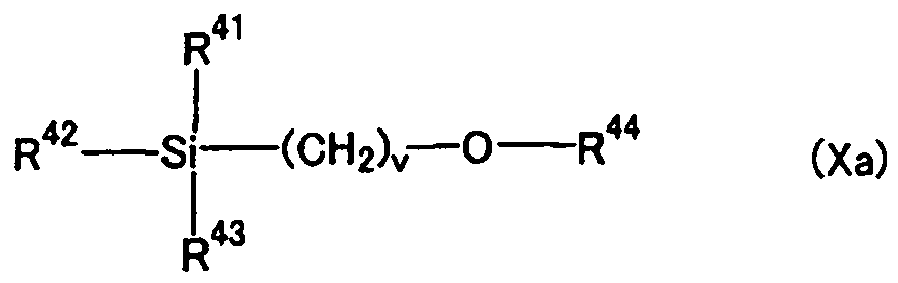
- v in formula (Xa) represents an integer from 1 to 10. v is preferably at least 2 from the perspective of increasing the fuel economy, wet-grip performance, and abrasion resistance in good balance, and is preferably not more than 4 from the perspective of improving the economics of production. 3 is particularly preferred for v.
- The hydrocarbyl groups encompassed by R41, R42, and R43 in formula (Xa) can be exemplified by alkyl groups such as methyl, ethyl, n-propyl, isopropyl, n-butyl, sec-butyl, and tert-butyl. The hydrocarbyloxy groups encompassed by R41, R42, and R43 can be exemplified by alkoxy groups such
as methoxy, ethoxy, n-propoxy, isopropoxy, n-butoxy, sec-butoxy, and t-butoxy. - The hydrocarbyl group for R41, R42, and R43 is preferably an alkyl group, more preferably a C1-3 alkyl group, and even more preferably a methyl or ethyl group. The hydrocarbyloxy group for R41, R42, and R43 is preferably an alkoxy group, more preferably a C1-3 alkoxy group, and even more preferably a methoxy or ethoxy group.
- With regard to R41, R42, and R43, when viewed from the perspective of increasing the fuel economy, wet-grip performance, and abrasion resistance in good balance, preferably at least two of R41, R42, and R43 are hydrocarbyloxy groups, and more preferably the three of R41, R42, and R43 are hydrocarbyloxy groups.
- The hydrocarbyl group encompassed by R44 can be exemplified by alkyl groups such as methyl, ethyl, n-propyl, isopropyl, n-butyl, sec-butyl, and tert-butyl groups.
- The substituted hydrocarbyl group encompassed by R44 can be exemplified by substituted hydrocarbyl groups that have as a substituent at least one type of group selected from the group consisting of nitrogen atom-bearing groups, oxygen atom-bearing groups, and silicon atom-bearing groups. The group that has a nitrogen atom-bearing group as a substituent can be exemplified by dialkylaminoalkyl groups such as dimethylaminoethyl and diethylaminoethyl. The group that has an oxygen atom-bearing group as a substituent can be exemplified by alkoxyalkyl groups such as methoxymethyl, methoxyethyl, ethoxymethyl, and ethoxyethyl; and alkylene oxide alkyl groups such as glycidyl and tetrahydrofurfuryl. The group that has a silicon atom-bearing group as a substituent can be exemplified by trialkylsilylalkyl groups such as trimethylsilylmethyl.
As used herein, the term "alkylene oxide alkyl group" denotes a group provided by substituting at least one hydrogen atom of an alkyl group with an alkylene oxide group. - R44 is preferably an alkylene oxide alkyl group and more preferably a glycidyl group or tetrahydrofurfuryl group.
- The compound represented by formula (Xa) in which R44 is an alkyl group can be exemplified by
3-(alkoxy)propyltrialkoxysilanes such as
3-(methoxy)propyltrimethoxysilane,
3-(ethoxy)propyltrimethoxysilane,
3-(n-propoxy)propyltrimethoxysilane,
3-(isopropoxy)propyltrimethoxysilane,
3-(n-butoxy)propyltrimethoxysilane,
3-(sec-butoxy)propyltrimethoxysilane, and
3-(t-butoxy)propyltrimethoxysilane. - The compound represented by formula (Xa) in which R44 is an alkylene oxide alkyl group can be exemplified by glycidoxyalkyltrialkoxysilanes such as
2-glycidoxyethyltrimethoxysilane,
3-glycidoxypropyltrimethoxysilane,
2-glycidoxyethyltriethoxysilane, and
3-glycidoxypropyltriethoxysilane; and tetrahydrofurfuryloxyalkyltrialkoxysilanes such as
2-tetrahydrofurfuryloxyethyltrimethoxysilane,
3-tetrahydrofurfuryloxypropyltrimethoxysilane,
2-tetrahydrofurfuryloxyethyltriethoxysilane, and
3-tetrahydrofurfuryloxypropyltriethoxysilane. - The compound represented by formula (Xa) in which R44 is an alkoxyalkyl group can be exemplified by 3-(alkoxyalkoxy)propyltrialkoxysilanes such as
3-(methoxymethoxy)propyltrimethoxysilane,
3-(methoxyethoxy)propyltrimethoxysilane,
3-(ethoxymethoxy)propyltrimethoxysilane,
3-(ethoxyethoxy)propyltrimethoxysilane,
3-(methoxymethoxy)propyltriethoxysilane,
3-(methoxyethoxy)propyltriethoxysilane,
3-(ethoxymethoxy)propyltriethoxysilane, and
3-(ethoxyethoxy)propyltriethoxysilane. - The compound represented by formula (Xa) is preferably a compound in which R44 is an alkylene oxide alkyl group, and more preferably
3-glycidoxypropyltrimethoxysilane,
3-glycidoxypropyltriethoxysilane,
3-tetrahydrofurfuryloxypropyltrimethoxysilane, or
3-tetrahydrofurfuryloxypropyltriethoxysilane. - The silicon compound that has a group represented by formula (IX) plus a group represented by formula (X) plus a group represented by formula (XI) can be exemplified by
acryloxyalkyltrialkoxysilanes and
methacryloxyalkyltrialkoxysilanes. - The acryloxyalkyltrialkoxysilane can be exemplified by 3-acryloxypropyltrialkoxysilanes such as 3-acryloxypropyltrimethoxysilane and
3-acryloxypropyltriethoxysilane.
The methacryloxyalkyltrialkoxysilane can be exemplified by 3-methacryloxypropyltrialkoxysilanes such as
3-methacryloxypropyltrimethoxysilane and
3-methacryloxypropyltriethoxysilane. - The silicon compound that has a group represented by formula (IX) plus a group represented by formula (X) plus a group represented by formula (XI) can be further exemplified by trialkoxysilylalkylsuccinic anhydrides and trialkoxysilylalkylmaleic anhydrides.
- The trialkoxysilylalkylsuccinic anhydride can be exemplified by 3-trialkoxysilylpropylsuccinic anhydrides such as 3-trimethoxysilylpropylsuccinic anhydride and 3-triethoxysilylpropylsuccinic anhydride.
The trialkoxysilylalkylmaleic anhydride can be exemplified by 3-trialkoxysilylpropylmaleic anhydrides such as 3-trimethoxysilylpropylmaleic anhydride and 3-triethoxysilylpropylmaleic anhydride. - Compounds having a group represented by formula (XII) below (modifying agent 5) are also suitable examples of the aforementioned modifying agent.

- w represents an integer from 1 to 11 and is preferably at least 1 when viewed from the standpoint of increasing the fuel economy, wet-grip performance, and abrasion resistance in good balance, but is preferably not more than 4 when viewed from the standpoint of improving the economics of production. A5 is a nitrogen atom-bearing functional group and can be exemplified by amino, isocyano, cyano, pyridyl, piperidyl, pyrazinyl, and morpholino.
- The compound having a group represented by formula (XII) can be exemplified by compounds with the following formula (XIII):

- z in formula (XIII) represents an integer from 0 to 10. Viewed from the standpoint of improving the economics, z is preferably not more than 3 and more preferably 0.
- R45 in formula (XIII) represents a C1-5 hydrocarbyl group. The hydrocarbyl group for R45 can be exemplified by alkyl groups such as methyl, ethyl, n-propyl, isopropyl, n-butyl, sec-butyl, and t-butyl.
- The hydrocarbyl group for R45 is preferably an alkyl group, more preferably a C1-4 alkyl group, and even more preferably a methyl or ethyl group.
- R46 to R49 in formula (XIII) each independently represent a hydrogen atom or a C1-5 hydrocarbyl group, C1-5 substituted hydrocarbyl group, or C1-5 hydrocarbyloxy group; when a plurality of R46's are present, the plurality of R46's may be the same as each other or may differ from one another, and when a plurality of R47's are present, the plurality of R47's may be the same as each other or may differ from one another.
- The hydrocarbyl groups encompassed by R46 to R49 can be exemplified by alkyl groups such as methyl, ethyl, n-propyl, isopropyl, n-butyl, sec-butyl, and t-butyl.
- The substituted hydrocarbyl groups encompassed by R46 to R49 can be exemplified by substituted hydrocarbyl groups having as a substituent at least one type of group selected from the group consisting of nitrogen atom-bearing groups and oxygen atom-bearing groups. The group having a nitrogen atom-bearing group as a substituent can be exemplified by dialkylaminoalkyl groups such as dimethylaminoethyl and diethylaminoethyl, while the group having an oxygen atom-bearing group as a substituent can be exemplified by alkoxyalkyl groups such as methoxymethyl, methoxyethyl, ethoxymethyl, and ethoxyethyl.
- The hydrocarbyloxy groups encompassed by R46 to R49 can be exemplified by alkoxy groups such as methoxy, ethoxy, n-propoxy, isopropoxy, n-butoxy, sec-butoxy, and t-butoxy.
- The hydrocarbyl group for R46 to R49 is preferably an alkyl group, more preferably a C1-4 alkyl group, and even more preferably a methyl or ethyl group.
- The substituted hydrocarbyl group for R46 to R49 is preferably an alkoxyalkyl group, more preferably a C1-4 alkoxyalkyl group, and even more preferably a methoxymethyl or ethoxyethyl group.
- The hydrocarbyloxy group for R46 to R49 is preferably an alkoxy group, more preferably a C1-3 alkoxy group, and even more preferably a methoxy or ethoxy group.
- Viewed from an economic perspective and from the perspective of increasing the fuel economy, wet-grip performance, and abrasion resistance in good balance, preferably one of R48 and R49 is a hydrogen atom. More preferably, one of R48 and R49 is a hydrogen atom and the other is an alkyl group or alkoxy group. Even more preferably, one of R48 and R49 is a hydrogen atom and the other is an alkoxy group. Methoxy and ethoxy groups are particularly preferred.
- R50 and R51 in formula (XIII) each independently represent a C1-6 group optionally having at least one type of atom selected from the group of atoms consisting of a nitrogen atom, oxygen atom, and silicon atom; R50 and R51 may be bonded to each other to form a cyclic structure together with the nitrogen atom; and R50 and R51 may be a single group bonded to the nitrogen by a double bond.
- R50 and R51 in formula (XIII) can be exemplified by C1-6 hydrocarbyl groups, C1-6 substituted hydrocarbyl groups, and substituted silyl groups.
- The hydrocarbyl groups encompassed by R50 and R51 can be exemplified by alkyl groups such as methyl, ethyl, n-propyl, isopropyl, n-butyl, sec-butyl, tert-butyl, n-pentyl, neopentyl, isopentyl, and n-hexyl; cycloalkyl groups such as cyclohexyl; and a phenyl group.
- The substituted hydrocarbyl groups encompassed by R50 and R51 can be exemplified by substituted hydrocarbyl groups that have as a substituent at least one type of group selected from the group consisting of nitrogen atom-bearing groups, oxygen atom-bearing groups, and silicon atom-bearing groups. The group that has a nitrogen atom-bearing group as a substituent can be exemplified by dialkylaminoalkyl groups such as dimethylaminoethyl and diethylaminoethyl. The group that has an oxygen atom-bearing group as a substituent can be exemplified by alkoxyalkyl groups such as methoxymethyl, methoxyethyl, ethoxymethyl, and ethoxyethyl; alkylene oxide groups such as epoxy and tetrahydrofuranyl; and alkylene oxide alkyl groups such as glycidyl and tetrahydrofurfuryl. The group that has a silicon atom-bearing group as a substituent can be exemplified by trialkylsilylalkyl groups such as trimethylsilylmethyl.
As used herein, the term "alkylene oxide group" denotes a monovalent group provided by removing a hydrogen atom from the ring of a cyclic ether compound, while the term "alkylene oxide alkyl group" denotes a group provided by substituting at least one hydrogen atom in an alkyl group with an alkylene oxide group. - The substituted silyl groups encompassed by R50 and R51 can be exemplified by trialkylsilyl groups such as trimethylsilyl, triethylsilyl, and t-butyldimethylsilyl; and trialkoxysilyl groups such as trimethoxysilyl.
- The group in which R50 and R51 are bonded to each other can be exemplified by C2-12 divalent groups optionally having at least one type of atom selected from the group of atoms consisting of a nitrogen atom, oxygen atom, and silicon atom. Examples thereof include alkylene groups such as trimethylene, tetramethylene, pentamethylene, and hexamethylene; oxydialkylene groups such as oxydiethylene and oxydipropylene; and nitrogenous groups such as the group represented by -CH2CH2-NH-CH2- and the group represented by -CH2CH2-N=CH-.
- The group in which R50 and R51 are bonded to each other is preferably a nitrogenous group and more preferably the group represented by -CH2CH2-NH-CH2- or the group represented by -CH2CH2-N=CH-.
- The single group bonded to the nitrogen by a double bond and encompassed by R50 and R51 can be exemplified by C2-12 divalent groups optionally having at least one type of atom selected from the group of atoms consisting of a nitrogen atom, oxygen atom, and silicon atom. Examples thereof include an ethylidene group, 1-methylpropylidene group, 1,3-dimethylbutylidene group, 1-methylethylidene group, and 4-N,N-dimethylaminobenzylidene group.
- The hydrocarbyl group for R50 and R51 is preferably an alkyl group; more preferably a C1-4 alkyl group; even more preferably a methyl, ethyl, n-propyl, or n-butyl group; and still more preferably a methyl or ethyl group. The substituted hydrocarbyl group for R50 and R51 is preferably an alkoxyalkyl group, alkylene oxide group, or alkylene oxide alkyl group. The substituted silyl group for R50 and R51 is preferably a trialkylsilyl or trialkoxysilyl group, more preferably a trialkylsilyl group, and even more preferably a trimethylsilyl or triethylsilyl group.
- R50 and R51 are, independently, preferably an alkyl, alkoxyalkyl, or substituted silyl group, or are preferably a nitrogenous group in which R50 and R51 are bonded to each other. R50 and R51 are, independently, more preferably a C1-4 alkyl group; even more preferably a methyl, ethyl, n-propyl, or n-butyl group; and still more preferably a methyl or ethyl group.
- Acyclic amino groups and cyclic amino groups are examples of the amino group in which R50 and R51 are bonded to the nitrogen atom.
The acyclic amino group can be exemplified by
dialkylamino groups such as dimethylamino, diethylamino,
di(n-propyl)amino, di(isopropyl)amino, di(n-butyl)amino,
di(sec-butyl)amino, di(tert-butyl)amino,
di(neopentyl)amino, and ethylmethylamino;
di(alkoxyalkyl)amino groups such as
di(methoxymethyl)amino, di(methoxyethyl)amino,
di(ethoxymethyl)amino, and di(ethoxyethyl)amino; and
di(trialkylsilyl)amino groups such as
di(trimethylsilyl)amino and di(t-butyldimethylsilyl)amino.
Other examples are di(alkylene oxide)amino groups such as
di(epoxy)amino and di(tetrahydrofuranyl)amino; and
di(alkylene oxide alkyl)amino groups such as
di(glycidyl)amino and di(tetrahydrofurfuryl)amino. Additional examples are an ethylideneamino group, 1-methylpropylideneamino group, 1,3-dimethylbutylideneamino group, 1-methylethylideneamino group, and 4-N,N-dimethylaminobenzylideneamino group. - The cyclic amino group can be exemplified by 1-polymethyleneimino groups such as 1-pyrrolidinyl, 1-piperidino, 1-hexamethyleneimino, 1-heptamethyleneimino, 1-octamethyleneimino, 1-decamethyleneimino, and 1-dodecamethyleneimino. The cyclic amino group can also be exemplified by 1-imidazolyl, 4,5-dihydro-1-imidazolyl, 1-imidazolidinyl, 1-piperazinyl, and morpholino groups.
- Viewed from the perspective of the fuel economy, wet-grip performance, abrasion resistance, and long-term stability and easy availability of the compound, the amino group in which R50 and R51 are bonded to the nitrogen atom is preferably an acyclic amino group, is more preferably a dialkylamino group, and is even more preferably a dimethylamino or diethylamino group.
- The compound represented by formula (XIII) can be exemplified by N,N-dialkyl-substituted carboxylic acid amide dialkyl acetal compounds.
- The N,N-dialkyl-substituted carboxylic acid amide dialkyl acetal compound can be exemplified by N,N-dialkylformamide dialkyl acetals such as
N,N-dimethylformamide dimethyl acetal,
N,N-diethylformamide dimethyl acetal,
N,N-di(n-propyl)formamide dimethyl acetal,
N,N-dimethylformamide diethyl acetal,
N,N-diethylformamide diethyl acetal,
N,N-di(n-propyl)formamide diethyl acetal,
N,N-dimethylformamide ethyl methyl acetal,
N,N-diethylformamide ethyl methyl acetal, and
N,N-di(n-propyl)formamide ethyl methyl acetal; - N,N-dialkylacetamide dialkyl acetals such as
N,N-dimethylacetamide dimethyl acetal,
N,N-diethylacetamide dimethyl acetal,
N,N-di(n-propyl)acetamide dimethyl acetal,
N,N-dimethylacetamide diethyl acetal,
N,N-diethylacetamide diethyl acetal,
N,N-di(n-propyl)acetamide diethyl acetal,
N,N-dimethylacetamide ethyl methyl acetal,
N,N-diethylacetamide ethyl methyl acetal, and
N,N-di(n-propyl)acetamide ethyl methyl acetal; and - N,N-dialkylpropionamide dialkyl acetals such as
N,N-dimethylpropionamide dimethyl acetal,
N,N-diethylpropionamide dimethyl acetal,
N,N-di(n-propyl)propionamide dimethyl acetal,
N,N-dimethylpropionamide diethyl acetal,
N,N-diethylpropionamide diethyl acetal,
N,N-di(n-propyl)propionamide diethyl acetal,
N,N-dimethylpropionamide ethyl methyl acetal,
N,N-diethylpropionamide ethyl methyl acetal, and
N,N-di(n-propyl)propionamide ethyl methyl acetal. - Viewed from the perspective of increasing the fuel economy, wet-grip performance, and abrasion resistance in good balance, N,N-dialkylformamide dialkyl acetals are preferred among the preceding and
N,N-dimethylformamide dimethyl acetal,
N,N-diethylformamide dimethyl acetal,
N,N-dimethylformamide diethyl acetal, and
N,N-diethylformamide diethyl acetal
are more preferred. - In addition to the conjugated diene-based constituent unit (conjugated diene unit), the conjugated diene polymer may also have a constituent unit based on another monomer. This other monomer can be exemplified by aromatic vinyls, vinyl nitriles, and unsaturated carboxylic acid esters. The aromatic vinyl can be exemplified by styrene, α-methylstyrene, vinyltoluene, vinylnaphthalene, divinylbenzene, trivinylbenzene, and divinylnaphthalene. The vinyl nitrile can be exemplified by acrylonitrile, and the unsaturated carboxylic acid ester can be exemplified by methyl acrylate, ethyl acrylate, methyl methacrylate, and ethyl methacrylate. Aromatic vinyls are preferred among the preceding, and styrene is more preferred.
- The conjugated diene polymer preferably has an aromatic vinyl-based constituent unit (aromatic vinyl unit) based on a consideration of the abrasion resistance. In this case, letting the sum of the conjugated diene unit and aromatic vinyl unit be 100% by mass, the aromatic vinyl unit content is preferably at least 10% by mass (the conjugated diene unit content is not more than 90% by mass) and more preferably at least 15% by mass (the conjugated diene unit content is not more than 85% by mass). Viewed in terms of fuel economy, the aromatic vinyl unit content is preferably not more than 50% by mass (the conjugated diene unit content is at least 50% by mass) and more preferably not more than 45% by mass (the conjugated diene unit content is at least 55% by mass).
- Letting the conjugated diene unit content be 100 mol%, the vinyl bond content in the conjugated diene polymer, viewed from the perspective of the fuel economy, is preferably not more than 80 mol% and more preferably not more than 70 mol%. In addition, when viewed in terms of the wet-grip performance, the vinyl bond content is preferably at least 10 mol%, more preferably at least 15 mol%, even more preferably at least 20 mol%, and particularly preferably at least 40 mol%. The vinyl bond content can be determined by infrared spectroscopic analysis from the intensity of the absorption in the vicinity of 910 cm-1, which is an absorption peak for the vinyl group.
- The molecular weight distribution of the conjugated diene polymer, viewed from the standpoint of the fuel economy, is preferably 1 to 5 and is more preferably 1 to 2. The molecular weight distribution can be determined by measuring the number-average molecular weight (Mn) and the weight-average molecular weight (Mw) by gel permeation chromatography (GPC) and dividing Mw by Mn.
- There are no particular limitations on the polymerization method for the conjugated diene polymer, and solution polymerization, gas-phase polymerization, and bulk polymerization can be used. However, solution polymerization is particularly preferred from the standpoint of, inter alia, the processability and the flexibility of polymer design. Batch methods and continuous methods may be used for the polymerization.
When, for example, production is carried out by a solution polymerization method, the conjugated diene polymer can be obtained by reacting monomers comprising a conjugated diene and a vinyl compound represented by the following formula (XIV) in a hydrocarbon solvent in the presence of an alkali metal catalyst for polymerization and additionally reacting a modifying agent with the polymer terminal:

- The alkali metal catalyst used in solution polymerization methods can be exemplified by alkali metals, organoalkali metal compounds, alkali metal/polar compound complexes, and alkali metal-containing oligomers. The alkali metal can be exemplified by lithium, sodium, potassium, rubidium, and cesium. The organoalkali metal compound can be exemplified by ethyllithium, n-propyllithium, iso-propyllithium, n-butyllithium, sec-butyllithium, t-octyllithium, n-decyllithium, phenyllithium, 2-naphthyllithium, 2-butylphenyllithium, 4-phenylbutyllithium, cyclohexyllithium, 4-cyclopentyllithium, dimethylaminopropyllithium, diethylaminopropyllithium, t-butyldimethylsilyloxypropyllithium, N-morpholinopropyllithium, lithium hexamethyleneimide, lithium pyrrolidide, lithium piperidide, lithium heptamethyleneimide, lithium dodecamethyleneimide, 1,4-dilithio-2-butene, sodium naphthalenide, sodium biphenylide, and potassium naphthalenide. The alkali metal/polar compound complex can be exemplified by a potassium-tetrahydrofuran complex and a potassium-diethoxyethane complex. The alkali metal-containing oligomer can be exemplified by a sodium salt of α-methylstyrene tetramer. Organolithium compounds and organosodium compounds are preferred among the preceding, and C2-20 organolithium compounds or organosodium compounds are more preferred.
- The hydrocarbon solvent used by solution polymerization methods is a solvent that does not deactivate an alkali metal compound catalyst and can be exemplified by aliphatic hydrocarbons, aromatic hydrocarbons, and alicyclic hydrocarbons. The aliphatic hydrocarbon can be exemplified by propane, n-butane, isobutane, n-pentane, iso-pentane, n-hexane, propene, 1-butene, iso-butene, trans-2-butene, cis-2-butene, 1-pentene, 2-pentene, 1-hexene, and 2-hexene. The aromatic hydrocarbon can be exemplified by benzene, toluene, xylene, and ethylbenzene. The alicyclic hydrocarbon can be exemplified by cyclopentane and cyclohexane. A single one of these may be used or two or more may be used in combination. C2-12 hydrocarbons are preferred among the preceding.
- Monomers comprising a conjugated diene and a vinyl compound represented by formula (XIV) are polymerized in solution polymerization to produce a conjugated diene polymer having an alkali metal originating from the above-described alkali metal catalyst at the polymer chain terminal. The conjugated diene can be exemplified by 1,3-butadiene, isoprene, 1,3-pentadiene, 2,3-dimethyl-1,3-butadiene, and 1,3-hexadiene. A single one of these may be used or two or more may be used in combination. Based on ease of availability, 1,3-butadiene and isoprene are preferred among the preceding.
- X4, X5, and X6 in formula (XIV) each independently represent a group represented by formula (XIVa), a hydrocarbyl group, or a substituted hydrocarbyl group, and at least one of X4, X5, and X6 is a group represented by formula (XIVa).
- R52 and R53 in formula (XIVa) each independently represent a C1-6 hydrocarbyl group, a C1-6 substituted hydrocarbyl group, a silyl group, or a substituted silyl group, and R52 and R53 may be bonded to each other to form a cyclic structure together with the nitrogen atom.
- The C1-6 hydrocarbyl groups encompassed by R52 and R53 can be exemplified by alkyl groups such as methyl, ethyl, n-propyl, isopropyl, n-butyl, sec-butyl, tert-butyl, n-pentyl, neopentyl, isopentyl, and n-hexyl; cycloalkyl groups such as cyclohexyl; and a phenyl group.
- The C1-6 substituted hydrocarbyl groups encompassed by R52 and R53 can be exemplified by substituted hydrocarbyl groups having as a substituent at least one type of group selected from the group consisting of nitrogen atom-bearing groups, oxygen atom-bearing groups, and silicon atom-bearing groups. The group having a nitrogen atom-bearing group as a substituent can be exemplified by dialkylaminoalkyl groups such as dimethylaminoethyl and diethylaminoethyl; the group having an oxygen atom-bearing group as a substituent can be exemplified by alkoxyalkyl groups such as methoxymethyl, methoxyethyl, ethoxymethyl, and ethoxyethyl; and the group having a silicon atom-bearing group as a substituent can be exemplified by trialkylsilylalkyl groups such as trimethylsilylmethyl.
- The substituted silyl groups encompassed by R52 and R53 can be exemplified by trialkylsilyl groups such as trimethylsilyl, triethylsilyl, and t-butyldimethylsilyl.
- The group in which R52 and R53 are bonded to each other can be exemplified by C1-12 divalent groups optionally having at least one type of atom selected from the group of atoms consisting of a nitrogen atom, oxygen atom, and silicon atom. Examples thereof include alkylene groups such as trimethylene, tetramethylene, pentamethylene, and hexamethylene; oxydialkylene groups such as oxydiethylene and oxydipropylene; and nitrogenous groups such as the group represented by -CH2CH2-NH-CH2- and the group represented by -CH2CH2-N=CH-.
- The group in which R52 and R53 are bonded to each other is preferably a nitrogenous group and more preferably the group represented by -CH2CH2-NH-CH2- or the group represented by -CH2CH2-N=CH-.
- The hydrocarbyl group for R52 and R53 is preferably an alkyl group; more preferably a C1-4 alkyl group; even more preferably a methyl, ethyl, n-propyl, or n-butyl group; and particularly preferably an ethyl or n-butyl group. The substituted hydrocarbyl group for R52 and R53 is preferably an alkoxyalkyl group and more preferably a C1-4 alkoxyalkyl group. The substituted silyl group for R52 and R53 is preferably a trialkylsilyl group and more preferably a trimethylsilyl group.
- R52 and R53 are, independently, preferably an alkyl, alkoxyalkyl, or substituted silyl group, or are a nitrogenous group in which R52 and R53 are bonded to each other. R52 and R53 are, independently, more preferably an alkyl group, even more preferably a C1-4 alkyl group, and yet more preferably a methyl, ethyl, n-propyl, or n-butyl group.
- The group represented by formula (XIVa) may be an acyclic amino group or a cyclic amino group.
The acyclic amino group can be exemplified by
dialkylamino groups such as dimethylamino, diethylamino,
di(n-propyl)amino, di(isopropyl)amino, di(n-butyl)amino,
di(sec-butyl)amino, di(tert-butyl)amino,
di(neopentyl)amino, and ethylmethylamino;
di(alkoxyalkyl)amino groups such as
di(methoxymethyl)amino, di(methoxyethyl)amino,
di(ethoxymethyl)amino, and di(ethoxyethyl)amino; and
di(trialkylsilyl)amino groups such as
di(trimethylsilyl)amino and di(t-butyldimethylsilyl)amino. - The cyclic amino group can be exemplified by 1-polymethyleneimino groups such as 1-pyrrolidinyl, 1-piperidino, 1-hexamethyleneimino, 1-heptamethyleneimino, 1-octamethyleneimino, 1-decamethyleneimino, and 1-dodecamethyleneimino.
The cyclic amino group can also be exemplified by 1-imidazolyl, 4,5-dihydro-1-imidazolyl, 1-imidazolidinyl, 1-piperazinyl, and morpholino. - Viewed from the perspective of economics and ease of availability, the group represented by formula (XIVa) is preferably an acyclic amino group, more preferably a dialkylamino group, even more preferably a dialkylamino group which is substituted by a C1-4 alkyl group, and yet more preferably a dimethylamino, diethylamino, di(n-propyl)amino, or di(n-butyl)amino group.
- The hydrocarbyl groups encompassed by X4, X5, and X6 in formula (XIV) can be exemplified by alkyl groups such as methyl, ethyl, n-propyl, isopropyl, n-butyl, sec-butyl, and tert-butyl.
The substituted hydrocarbyl groups can also be exemplified by alkoxyalkyl groups such as methoxymethyl, ethoxymethyl, methoxyethyl, and ethoxyethyl. - The hydrocarbyl group for X4, X5, and X6 is preferably an alkyl group, more preferably a C1-4 alkyl group, and even more preferably a methyl or ethyl group. The substituted hydrocarbyl group for X4, X5, and X6 is preferably an alkoxyalkyl group and more preferably a C1-4 alkoxyalkyl group.
- With respect to the hydrocarbyl group and substituted hydrocarbyl group for X4, X5, and X6, an alkyl or alkoxyalkyl group is preferred; a C1-4 alkyl or C1-4 alkoxyalkyl group is more preferred; a C1-4 alkyl group is even more preferred; and a methyl or ethyl group is still more preferred.
- At least one of X4, X5, and X6 in formula (XIV) is a group represented by formula (XIVa). Preferably at least two of X4, X5, and X6 in formula (XIV) are groups represented by formula (XIVa) and more preferably two of X4, X5, and X6 in formula (XIV) are groups represented by formula (XIVa).
- Examples of the vinyl compound of formula (XIV) that can be used in solution polymerization include compounds in which one of X4, X5, and X6 is an acyclic amino group represented by formula (XIVa) and two of X4, X5, and X6 are, independently, a hydrocarbyl group or substituted hydrocarbyl group, e.g.,
(dialkylamino)dialkylvinylsilanes, {di(trialkylsilyl)amino}dialkylvinylsilanes, and (dialkylamino)dialkoxyalkylvinylsilanes.
The (dialkylamino)dialkylvinylsilane can be exemplified by
(dimethylamino)dimethylvinylsilane,
(ethylmethylamino)dimethylvinylsilane,
(diethylamino)dimethylvinylsilane,
(ethyl-n-propylamino)dimethylvinylsilane,
(ethylisopropylamino)dimethylvinylsilane,
(di(n-propyl)amino)dimethylvinylsilane,
(diisopropylamino)dimethylvinylsilane,
(n-butyl-n-propylamino)dimethylvinylsilane,
(di(n-butyl)amino)dimethylvinylsilane,
(dimethylamino)diethylvinylsilane,
(ethylmethylamino)diethylvinylsilane,
(diethylamino)diethylvinylsilane,
(ethyl-n-propylamino)diethylvinylsilane,
(ethylisopropylamino)diethylvinylsilane,
(di(n-propyl)amino)diethylvinylsilane,
(diisopropylamino)diethylvinylsilane,
(n-butyl-n-propylamino)diethylvinylsilane,
(di(n-butyl)amino)diethylvinylsilane,
(dimethylamino)dipropylvinylsilane,
(ethylmethylamino)dipropylvinylsilane,
(diethylamino)dipropylvinylsilane,
(ethyl-n-propylamino)dipropylvinylsilane,
(ethylisopropylamino)dipropylvinylsilane,
(di(n-propyl)amino)dipropylvinylsilane,
(diisopropylamino)dipropylvinylsilane,
(n-butyl-n-propylamino)dipropylvinylsilane,
(di(n-butyl)amino)dipropylvinylsilane,
(dimethylamino)dibutylvinylsilane,
(ethylmethylamino)dibutylvinylsilane,
(diethylamino)dibutylvinylsilane,
(ethyl-n-propylamino)dibutylvinylsilane,
(ethylisopropylamino)dibutylvinylsilane,
(di(n-propyl)amino)dibutylvinylsilane,
(diisopropylamino)dibutylvinylsilane,
(n-butyl-n-propylamino)dibutylvinylsilane, and
(di(n-butyl)amino)dibutylvinylsilane.
The {di(trialkylsilyl)amino}dialkylvinylsilane can be exemplified by
{di(trimethylsilyl)amino}dimethylvinylsilane,
{di(t-butyldimethylsilyl)amino}dimethylvinylsilane,
{di(trimethylsilyl)amino}diethylvinylsilane, and
{di(t-butyldimethylsilyl)amino}diethylvinylsilane.
The (dialkylamino)dialkoxyalkylvinylsilane can be exemplified by
(dimethylamino)dimethoxymethylvinylsilane,
(dimethylamino)dimethoxyethylvinylsilane,
(dimethylamino)diethoxymethylvinylsilane,
(dimethylamino)diethoxyethylvinylsilane,
(diethylamino)dimethoxymethylvinylsilane,
(diethylamino)dimethoxyethylvinylsilane,
(diethylamino)diethoxymethylvinylsilane, and
(diethylamino)diethoxyethylvinylsilane. - Other examples are compounds in which two of X4, X5, and X6 are acyclic amino groups represented by formula (XIVa) and one of X4, X5, and X6 is a hydrocarbyl group or substituted hydrocarbyl group, e.g., bis(dialkylamino)alkylvinylsilanes, bis{di(trialkylsilyl)-amino}alkylvinylsilanes, and bis(dialkylamino)alkoxyalkyl-vinylsilanes.
The bis(dialkylamino)alkylvinylsilane can be exemplified by
bis(dimethylamino)methylvinylsilane,
bis(ethylmethylamino)methylvinylsilane,
bis(diethylamino)methylvinylsilane,
bis(ethyl-n-propylamino)methylvinylsilane,
bis(ethylisopropylamino)methylvinylsilane,
bis(di(n-propyl)amino)methylvinylsilane,
bis(diisopropylamino)methylvinylsilane,
bis(n-butyl-n-propylamino)methylvinylsilane,
bis(di(n-butyl)amino)methylvinylsilane,
bis(dimethylamino)ethylvinylsilane,
bis(ethylmethylamino)ethylvinylsilane,
bis(diethylamino)ethylvinylsilane,
bis(ethyl-n-propylamino)ethylvinylsilane,
bis(ethylisopropylamino)ethylvinylsilane,
bis(di(n-propyl)amino)ethylvinylsilane,
bis(diisopropylamino)ethylvinylsilane,
bis(n-butyl-n-propylamino)ethylvinylsilane,
bis(di(n-butyl)amino)ethylvinylsilane,
bis(dimethylamino)propylvinylsilane,
bis(ethylmethylamino)propylvinylsilane,
bis(diethylamino)propylvinylsilane,
bis(ethyl-n-propylamino)propylvinylsilane,
bis(ethylisopropylamino)propylvinylsilane,
bis(di(n-propyl)amino)propylvinylsilane,
bis(diisopropylamino)propylvinylsilane,
bis(n-butyl-n-propylamino)propylvinylsilane,
bis(di(n-butyl)amino)propylvinylsilane,
bis(dimethylamino)butylvinylsilane,
bis(ethylmethylamino)butylvinylsilane,
bis(diethylamino)butylvinylsilane,
bis(ethyl-n-propylamino)butylvinylsilane,
bis(ethylisopropylamino)butylvinylsilane,
bis(di(n-propyl)amino)butylvinylsilane,
bis(diisopropylamino)butylvinylsilane,
bis(n-butyl-n-propylamino)butylvinylsilane, and
bis(di(n-butyl)amino)butylvinylsilane.
The bis{di(trialkylsilyl)amino}alkylvinylsilane can be exemplified by
bis{di(trimethylsilyl)amino}methylvinylsilane,
bis{di(t-butyldimethylsilyl)amino}methylvinylsilane,
bis{di(trimethylsilyl)amino}ethylvinylsilane, and
bis{di(t-butyldimethylsilyl)amino}ethylvinylsilane.
The bis(dialkylamino)alkoxyalkylvinylsilane can be exemplified by
bis(dimethylamino)methoxymethylvinylsilane,
bis(dimethylamino)methoxyethylvinylsilane,
bis(dimethylamino)ethoxymethylvinylsilane,
bis(dimethylamino)ethoxyethylvinylsilane,
bis(diethylamino)methoxymethylvinylsilane,
bis(diethylamino)methoxyethylvinylsilane,
bis(diethylamino)ethoxymethylvinylsilane, and
bis(diethylamino)ethoxyethylvinylsilane. - Additional examples are compounds in which the three of X4, X5, and X6 are acyclic amino groups represented by formula (XIVa), such as tri(dialkylamino)vinylsilanes. Examples thereof include:
- tri(dimethylamino)vinylsilane,
- tri(ethylmethylamino)vinylsilane,
- tri(diethylamino)vinylsilane,
- tri(ethylpropylamino)vinylsilane,
- tri(dipropylamino)vinylsilane, and
- tri(butylpropylamino)vinylsilane.
- Additional examples are compounds in which two of X4, X5, and X6 are cyclic amino groups represented by formula (XIVa) and one of X4, X5, and X6 is a hydrocarbyl group or substituted hydrocarbyl group, e.g.,
bis(morpholino)methylvinylsilane,
bis(piperidino)methylvinylsilane,
bis(4,5-dihydroimidazolyl)methylvinylsilane, and
bis(hexamethyleneimino)methylvinylsilane. - The vinyl compound represented by formula (XIV) in which two of X4, X5, and X6 are groups represented by formula (XIVa) is preferably a vinyl compound in which two of X4, X5, and X6 are acyclic amino groups, and, viewed in terms of the fuel economy, wet-grip performance, and abrasion resistance, is more preferably a bis(dialkylamino)alkylvinylsilane and even more preferably is bis(dimethylamino)methylvinylsilane,
bis(diethylamino)methylvinylsilane,
bis(di(n-propyl)amino)methylvinylsilane, or
bis(di(n-butyl)amino)methylvinylsilane. Preferred among the preceding in terms of easy availability of the compound are bis(diethylamino)methylvinylsilane and bis(di(n-butyl)amino)methylvinylsilane. - In the solution polymerization, polymerization may be carried out by combining another monomer with the conjugated diene and vinyl compound of formula (XIV). The other monomer can be exemplified by aromatic vinyls, vinyl nitriles, and unsaturated carboxylic acid esters. The aromatic vinyl can be exemplified by styrene, α-methylstyrene, vinyltoluene, vinylnaphthalene, divinylbenzene, trivinylbenzene, and divinylnaphthalene. The vinyl nitrile can be exemplified by acrylonitrile, and the unsaturated carboxylic acid ester can be exemplified by methyl acrylate, ethyl acrylate, methyl methacrylate, and ethyl methacrylate. Aromatic vinyls are preferred among the preceding, and styrene is more preferred.
- In the solution polymerization, polymerization may be carried out in the presence, for example, of an agent that adjusts the vinyl bond content of the conjugated diene unit or an agent that adjusts the distribution in the conjugated diene polymer chain of the conjugated diene unit and a constituent unit based on a monomer other than the conjugated diene (these agents are collectively referred to below as "regulators"). These agents can be exemplified by ether compounds, tertiary amines, and phosphine compounds. The ether compound can be exemplified by cyclic ethers such as tetrahydrofuran, tetrahydropyran, and 1,4-dioxane; aliphatic monoethers such as diethyl ether and dibutyl ether; aliphatic polyethers such as ethylene glycol dimethyl ether, ethylene glycol diethyl ether, ethylene glycol dibutyl ether, diethylene glycol diethyl ether, and diethylene glycol dibutyl ether; and aromatic ethers such as diphenyl ether and anisole. The tertiary amine can be exemplified by triethylamine, tripropylamine, tributylamine, N,N,N',N'-tetramethylethylenediamine, N,N-diethylaniline, pyridine, and quinoline. The phosphine compound can be exemplified by trimethylphosphine, triethylphosphine, and triphenylphosphine. A single one of these may be used or two or more may be used in combination.
- The polymerization temperature in solution polymerization is generally 25 to 100°C and is preferably 35 to 90°C. 50 to 80°C is more preferred. The polymerization time is generally 10 minutes to 5 hours.
- The amount of modifying agent used in the step of modifying the polymer terminal is generally 0.1 to 3 moles, preferably 0.5 to 2 moles, and more preferably 0.7 to 1.5 moles, in each case per 1 mole of an alkali metal derived from the alkali metal catalyst.
- The temperature in the modifying step is generally 25 to 100°C and is preferably 35 to 90°C and more preferably 50 to 80°C. The contact time is generally 60 seconds to 5 hours, preferably 5 minutes to 1 hour, and more preferably 15 minutes to 1 hour.
- In the production method of the conjugated diene polymer, a coupling agent may be added to the hydrocarbon solution of the conjugated diene polymer as necessary from initiation of polymerization of monomers by the alkali metal catalyst to termination of polymerization. This coupling agent can be exemplified by compounds with the following formula (XV):
R54 aML4-a (XV)
(in the formula, R54 represents an alkyl group, an alkenyl group, a cycloalkenyl group, or an aromatic residue; M represents a silicon atom or a tin atom; L represents a halogen atom or a hydrocarbyloxy group; and a is an integer from 0 to 2).
The term "aromatic residue" denotes a monovalent group provided by removing a hydrogen bonded to the aromatic ring from an aromatic hydrocarbon. - The coupling agent represented by formula (XV) can be exemplified by silicon tetrachloride, methyltrichlorosilane, dimethyldichlorosilane, trimethylchlorosilane, tin tetrachloride,
methyltrichlorotin, dimethyldichlorotin,
trimethylchlorotin, tetramethoxysilane,
methyltrimethoxysilane, dimethoxydimethylsilane,
methyltriethoxysilane, ethyltrimethoxysilane,
dimethoxydiethylsilane, diethoxydimethylsilane,
tetraethoxysilane, ethyltriethoxysilane, and
diethoxydiethylsilane. - The amount of coupling agent, viewed from the perspective of the processability of the conjugated diene polymer, is preferably at least 0.03 mol and more preferably at least 0.05 mol, in each case per 1 mol of an alkali metal derived from the alkali metal catalyst. Viewed in terms of the fuel economy, it is preferably not more than 0.4 mol and more preferably not more than 0.3 mol.
- The conjugated diene polymer can be recovered by known recovery methods from the hydrocarbon solution of the conjugated diene polymer, for example, by (1) the addition of a coagulant to the hydrocarbon solution of the conjugated diene polymer or (2) the addition of steam to the hydrocarbon solution of the conjugated diene polymer. The recovered conjugated diene polymer may be dried using a known drier, for example, a band drier or an extrusion drier.
- A treatment in which the formula (Ia) group in the polymer is replaced by a hydroxyl group is preferably carried out, for example, by hydrolysis, in the production method of the conjugated diene polymer. This treatment may be carried out on the polymer by itself or on the composition thereof as described later. The hydrolysis method can be exemplified by known hydrolysis methods, e.g., methods using steam stripping. The treatment can convert X1, X2, and/or X3 in formula (I) into hydroxyl groups and can thereby improve the fuel economy, wet-grip performance, and abrasion resistance in a more balanced manner.
- The conjugated diene polymer can be used for the rubber component in the rubber composition of the present invention, and is preferably used in combination with, for example, other rubbers and additives.
- The content of the conjugated diene polymer in 100% by mass of the rubber component is at least 5% by mass, preferably at least 8% by mass, and more preferably at least 10% by mass. A content of the conjugated diene polymer of less than 5% by mass tends to result in less improvenment in the fuel economy. The content of the conjugated diene polymer is preferably not more than 50% by mass, more preferably not more than 45% by mass, and even more preferably not more than 40% by mass. A content of the conjugated diene polymer in excess of 50% by mass tends to result in a decline in the abrasion resistance and drive up the cost.
- In addition to the conjugated diene polymer described in the preceding, the rubber composition of the present invention uses NR and ENR for the rubber component. This can improve the fuel economy, wet-grip performance, and abrasion resistance in good balance.
- There are no particular limitations on the NR. For example, commonly used natural rubbers in the tire industry can be used, such as SIR20, RSS #3, TSR20, deproteinized natural rubber (DPNR), highly purified natural rubber (HPNR), and so forth.
- The content of the NR in the rubber component taken to be 100% by mass is at least 5% by mass and preferably at least 7% by mass. The abrasion resistance exhibits a declining trend when the NR content is less than 5% by mass. The NR content is also not more than 50% by mass and preferably not more than 40% by mass. The wet-grip performance exhibits a declining trend when the NR content is more than 50% by mass.
- There are no particular limitations on the ENR, and commercially available epoxidized natural rubbers can be used, or the ENR can be produced by the epoxidation of natural rubber (NR). The method of epoxidizing natural rubber is not particularly limited and can be exemplified by the chlorohydrin process, the direct oxidation process, the hydrogen peroxide process, the alkyl hydroperoxide process, the peracid process, and so forth.
- The epoxidation degree of the ENR is preferably at least 12 mol% and more preferably at least 15 mol%. A satisfactory improvement in the wet-grip performance may not be obtained when the epoxidation degree is below 12 mol%. In addition, the ENR epoxidation degree is preferably not more than 80 mol% and more preferably not more than 60 mol%. When the epoxidation degree is above 80 mol%, gelation of the rubber component may appear and the rolling resistance also tends to be large.
The "epoxidation degree" denotes the average value of a percentage for the number of epoxidized carbon-carbon double bonds with reference to the total number of carbon-carbon double bonds in the natural rubber component prior to epoxidation, and may be determined, for example, by titrimetry or nuclear magnetic resonance (NMR) analysis. - The content of the ENR in the rubber component taken to be 100% by mass is at least 0.3% by mass, preferably at least 0.5% by mass, and more preferably at least 1% by mass. An improvement due to the ENR tends to be inadequate when the ENR content is less than 0.3% by mass. In addition, the ENR content is not more than 10% by mass and preferably not more than 8% by mass. The abrasion resistance exhibits a declining tread when the ENR content is above 10% by mass.
- The total content of the NR and ENR in the rubber component taken to be 100% by mass is preferably at least 5.5% by mass and more preferably at least 10% by mass. In addition, the total content is preferably not more than 60% by mass and more preferably not more than 50% by mass. The effects of the present invention are well manifested in the indicated range.
- A rubber other than the previously described conjugated diene polymer, NR, and ENR may be used. This other rubber can be exemplified by heretofore known styrene-butadiene copolymer rubbers (SBR), polybutadiene rubbers (BR), butadiene-isoprene copolymer rubbers, and butyl rubbers. Additional examples of the rubber are ethylene-propylene copolymers and ethylene-octene copolymers. These rubbers may be used in combinations of two or more. Among the preceding, the use of BR and/or SBR is preferred because this can improve the fuel economy, wet-grip performance, and abrasion resistance in good balance; the use of both BR and SBR is more preferred.
- There are no particular limitations on the BR, and commonly used BRs in the tire industry can be used, for example, high-cis BR such as BR1220 from Zeon Corporation and BR130B and BR150B from Ube Industries, Ltd., and BR containing syndiotactic polybutadiene crystals, such as VCR412 and VCR617 from Ube Industries, Ltd.
- The content of the BR in the rubber component taken to be 100% by mass is preferably at least 5% by mass and more preferably at least 8% by mass. A trend of a declining abrasion resistance appears when the BR content is below 5% by mass. The BR content is preferably not more than 40% by mass and more preferably not more than 30% by mass. A trend of a declining wet-grip performance appears when the BR content is above 40% by mass.
- There are no particular limitations on the SBR, and commonly used SBRs in the tire industry can be used, for example, emulsion polymerized styrene-butadiene rubber (E-SBR) and solution polymerized styrene-butadiene rubber (S-SBR). The styrene content in the SBR is preferably from 20 to 50% by mass and more preferably from 25 to 45% by mass.
- From the standpoint of obtaining a satisfactory manifestation of the effects of the present invention, the SBR used is preferably a modified SBR in which terminal modification has been carried out using a modifying agent. While there are no particular limitations on the modifying agent, the uses of the previously described modifying agents 1 to 5 are preferred from the standpoint of obtaining a satisfactory manifestation of the effects of the present invention, and the use of modifying agent 1 is more preferred.
- The content of the SBR in the rubber component taken to be 100% by mass is preferably at least 10% by mass and more preferably at least 20% by mass. A trend of a declining wet-grip performance appears when the SBR content is less than 10% by mass. The SBR content is also preferably not more than 80% by mass and more preferably not more than 70% by mass. A trend of a declining abrasion resistance appears when the SBR content is above 80% by mass.
- The rubber composition of the present invention characteristically incorporates carbon black and/or silica as a reinforcing agent. The rubber composition of the present invention, because it contains the previously described conjugated diene polymer, exhibits an excellent dispersion of the carbon black and silica and can thereby provide a well-balanced improvement in fuel economy, wet-grip performance, and abrasion resistance.
- The carbon black can be exemplified by furnace blacks (furnace carbon blacks) such as SAF, ISAF, HAF, MAF, FEF, SRF, GPF, APF, FF, CF, SCF, and ECF; acetylene blacks (acetylene carbon blacks); thermal blacks (thermal carbon blacks) such as FT and MT; channel blacks (channel carbon blacks) such as EPC, MPC, and CC; and graphite. A single one of these may be used or two or more may be used in combination.
- The nitrogen adsorption specific surface area (N2SA) of the carbon black is generally 5 to 200 m2/g, while a lower limit of 50 m2/g and an upper limit of 150 m2/g are preferred. The dibutyl phthalate (DBP) absorption of the carbon black is generally 5 to 300 mL/100 g, while a lower limit of 80 mL/100 g and an upper limit of 180 mL/100 g are preferred. When the carbon black has an N2SA or DBP absorption less than the lower limits on the indicated ranges, little reinforcing effect may be obtained and a trend of a declining abrasion resistance is seen. When the upper limits on the indicated ranges are exceeded, the dispersibility may be poor and the hysteresis loss tends to be increased, so that a trend of a declining fuel economy is seen. The nitrogen adsorption specific surface area is measured according to ASTM D4820-93, and the DBP absorption is measured according to ASTM D2414-93. Applicable commercial products are available under the trade names SEAST 6, SEAST 7HM, and SEAST KH from Tokai Carbon Co., Ltd., CK3 and Special Black 4A from Degussa, and so forth.
- The carbon black content, expressed per 100 parts by mass of the rubber component, is preferably 3 to 100 parts by mass, more preferably 5 to 100 parts by mass, and even more preferably 5 to 40 parts by mass. The abrasion resistance tends to be unsatisfactory when the carbon black content is below 3 parts by mass, while the processability tends to deteriorate when the carbon black content is in excess of 100 parts by mass. A single carbon black may be used, or two or more may be used in combination.
- Commonly used silicas in the tire industry, e.g., dry silica (anhydrous silica) and wet silica (hydrous silica), can be used as the silica. A single silica may be used or two or more may be used in combination.
- The silica preferably has a nitrogen adsorption specific surface area (N2SA) of 40 to 400 m2/g and more preferably of 60 to 360 m2/g. When the silica has a nitrogen adsorption specific surface area of less than 40 m2/g, little reinforcing effect may be obtained and a trend of a declining abrasion resistance is seen. For a silica that exceeds 400 m2/g, the dispersibility may be poor and the hysteresis loss may be increased, so that a trend of a declining fuel economy is seen.
The nitrogen adsorption specific surface area of silica is a value measured by the BET method based on ASTM D3037-81. - The silica content, expressed per 100 parts by mass of the rubber component, is preferably 3 to 100 parts by mass and more preferably 5 to 100 parts by mass. The abrasion resistance tends to be unsatisfactory when the silica content is less than 3 parts by mass, while the processability tends to deteriorate when the silica content exceeds 100 parts by mass.
- The total content of the carbon black and the silica, expressed per 100 parts by mass of the rubber component, is 3 to 100 parts by mass and preferably 5 to 100 parts by mass. The abrasion resistance tends to be unsatisfactory when the total content is less than 3 parts by mass, while the processability tends to deteriorate when the total content exceeds 100 parts by mass.
- A silane coupling agent may also be used when the silica is incorporated. This silane coupling agent can be exemplified by
bis(3-triethoxysilylpropyl)tetrasulfide, bis(3-triethoxysilylpropyl)trisulfide,
bis(3-triethoxysilylpropyl)disulfide,
bis(2-triethoxysilylethyl)tetrasulfide,
bis(3-trimethoxysilylpropyl)tetrasulfide,
bis(2-trimethoxysilylethyl)tetrasulfide,
3-mercaptopropyltrimethoxysilane,
3-mercaptopropyltriethoxysilane,
2-mercaptoethyltrimethoxysilane,
2-mercaptoethyltriethoxysilane,
3-trimethoxysilylpropyl-N,N-dimethylthiocarbamoyl-tetrasulfide,
3-triethoxysilylpropyl-N,N-dimethylthiocarbamoyl-tetrasulfide,
2-triethoxysilylethyl-N,N-dimethylthiocarbamoyltetrasulfide,
3-trimethoxysilylpropylbenzothiazole tetrasulfide,
3-triethoxysilylpropylbenzothiazolyltetrasulfide,
3-triethoxysilylpropyl methacrylate monosulfide,
3-trimethoxysilylpropyl methacrylate monosulfide,
bis(3-diethoxymethylsilylpropyl)tetrasulfide,
3-mercaptopropyldimethoxymethylsilane,
dimethoxymethylsilylpropyl-N,N-dimethylthiocarbamoyl-tetrasulfide, and
dimethoxymethylsilylpropylbenzothiazole tetrasulfide. Bis(3-triethoxysilylpropyl)tetrasulfide and 3-trimethoxysilylpropylbenzothiazolyltetrasulfide are preferred among the preceding, inter alia, from the standpoint of the reinforcing improvement effect. A single silane coupling agent may be used or two or more may be used in combination. - The amount of silane coupling agent, expressed per 100 parts by mass of the silica, is preferably at least 1 part by mass and more preferably at least 2 parts by mass. When the silane coupling agent is incorporated in an amount less than 1 part by mass, the unvulcanized rubber composition may assume a high viscosity and the processability tends to deteriorate. In addition, the amount of silane coupling agent, expressed per 100 parts by mass of the silica, is preferably not more than 20 parts by mass and more preferably not more than 15 parts by mass. When the silane coupling agent is incorporated in an amount in excess of 20 parts by mass, an effect of the silane coupling agent commensurate with its quantity of incorporation may not be obtained and high costs tend to be encountered.
- Known additives can be used as the additives, for example, vulcanizing agents such as sulfur; vulcanization accelerators such as thiazole vulcanization accelerators, thiuram vulcanization accelerators, sulfenamide vulcanization accelerators, and guanidine vulcanization accelerators; vulcanization activators such as stearic acid and zinc oxide; organoperoxides; fillers such as calcium carbonate, talc, alumina, clay, aluminum hydroxide, and mica; silane coupling agents; processing aids such as extender oils and lubricants; and antioxidants.
- The extender oil can be exemplified by aromatic mineral oils (viscosity-gravity constant (VGC value) = 0.900 to 1.049), naphthenic mineral oils (VGC value = 0.850 to 0.899), and paraffinic mineral oils (VGC value = 0.790 to 0.849). The polycyclic aromatic content of the extender oil is preferably less than 3% by mass and more preferably less than 1% by mass. The polycyclic aromatic content is measured based on British Institute of Petroleum method 346/92. In addition, the aromatic compound content (CA) of the extender oil is preferably at least 20% by mass. Combinations of two or more of these extender oils may be used.
- The vulcanization accelerator can be exemplified by thiazole vulcanization accelerators such as 2-mercaptobenzothiazole, dibenzothiazyl disulfide, and N-cyclohexyl-2-benzothiazylsulfenamide; thiuram vulcanization accelerators such as tetramethylthiuram monosulfide and tetramethylthiuram disulfide; sulfenamide vulcanization accelerators such as N-cyclohexyl-2-benzothiazolesulfenamide, N-t-butyl-2-benzothiazolesulfenamide, N-oxyethylene-2-benzothiazolesulfenamide, and N,N'-diisopropyl-2-benzothiazolesulfenamide; and guanidine vulcanization accelerators such as diphenylguanidine, di-ortho-tolylguanidine, and ortho-tolylguanidine. Its quantity of use, expressed per 100 parts by mass of the rubber component, is preferably 0.1 to 5 parts by mass and more preferably 0.2 to 3 parts by mass.
- Known methods can be used to add the other rubbers, additives, and so forth, to the conjugated diene polymer to produce the rubber composition; for example, a method can be used in which the ingredients are mixed using a known mixer, e.g., a roll or Banbury mixer.
- With regard to the mixing conditions during the incorporation of additives other than a vulcanizing agent or vulcanization accelerator, the mixing temperature is generally 50 to 200°C and preferably 80 to 190°C, and the mixing time is generally 30 seconds to 30 minutes and preferably 1 to 30 minutes.
During the incorporation of a vulcanizing agent or vulcanization accelerator, the mixing temperature is generally not more than 100°C and is preferably from room temperature to 80°C. The composition in which the vulcanizing agent and vulcanization accelerator have been incorporated is typically used after application thereto of a vulcanizing treatment, e.g., press vulcanization. The vulcanization temperature is generally 120 to 200°C and preferably 140 to 180°C. - The rubber composition of the present invention exhibits an excellent balance among the fuel economy, wet-grip performance, and abrasion resistance and can provide a significant improvement in these properties.
- The rubber composition of the present invention can be suitably used for various tire components and is particularly well suited for treads.
- The pneumatic tire of the present invention can be produced by usual methods using the previously described rubber composition. Thus, the rubber composition, into which various additives have been incorporated as necessary, is extrusion processed in the unvulcanized stage into the shape of a tire tread and is molded by a usual method on a tire building machine and assembled with other tire components to form an unvulcanized tire. This unvulcanized tire is hot-pressed in a vulcanizer to produce a pneumatic tire according to the present invention.
- The pneumatic tire of the present invention is suitably used as a tire for automobiles and trucks/buses (heavy-load tires).
- The present invention is described in detail by the following examples.
The property evaluations were carried out using the following methods. - The vinyl bond content in the polymer was determined by infrared spectroscopic analysis from the strength of the absorption in the vicinity of 910 cm-1, which is an absorption peak for a vinyl group.
- The styrene unit content in a polymer was determined from the refractive index according to JIS K6383 (1995).
- The weight-average molecular weight (Mw) and the number-average molecular weight (Mn) were measured by gel permeation chromatography (GPC) using the conditions (1) to (8) described below. The molecular weight distribution (Mw/Mn) of a polymer was determined from the measured Mw and Mn.
- (1) instrument: HLC-8020 from Tosoh Corporation
- (2) separation columns: 2 x GMH-XL in series, from Tosoh Corporation
- (3) measurement temperature: 40°C
- (4) carrier: tetrahydrofuran
- (5) flow rate: 0.6 mL/minute
- (6) quantity of introduction: 5 µL
- (7) detector: differential refractometer
- (8) molecular weight standards: polystyrene standards
- A strip-shaped test specimen (width 1 mm or 2 mm x length 40 mm) was punched from a sheet of the vulcanized rubber composition and this was submitted to testing. Using a spectrometer from Ueshima Seisakusho Co., Ltd., the tan δ was measured at a temperature of 50°C, a dynamic strain amplitude of 1%, and a frequency of 10 Hz. The value of the reciprocal of tan δ is given as an index assigning 100 to Comparative Example 1. A larger numerical value indicates a lower rolling resistance and thus better fuel economy.
- The rolling resistance was measured using a rolling resistance tester by running a test tire at a speed of 80 km/h, a load of 3.43 kN, and an internal pressure of 230 kPa on a 15 x 6JJ rim, and is reported as an index using Comparative Example 1 as 100. A larger index is better (better fuel economy).
- Test tires were mounted on all the wheels of a vehicle (domestic FF 2000 cc) and the braking distance was determined from an initial speed of 100 km/h on a wet asphalt road surface. The results are given in index form with larger numbers indicating a better wet-skid performance (wet-grip performance). Indexing was performed using the following formula. Wet-skid performance = (Braking distance in Comparative Example 1) / (Braking distance in the particular example or comparative example) x 100
- Test tires were run mounted on all the wheels of a vehicle (domestic FF 2000 cc), and the change in the pattern groove depth was determined pre- versus post-running for 30000 km. The results are given in index form with larger numbers indicating a better abrasion resistance.
- The interior of a 20-L stainless steel polymerization reactor was washed and dried and substituted with dry nitrogen, and 10.2 kg hexane (specific gravity = 0.68 g/cm3), 547 g 1,3-butadiene, 173 g styrene, 6.1 mL tetrahydrofuran, and 5.0 mL ethylene glycol diethyl ether were introduced into the polymerization reactor. 11.1 mmol bis(diethylamino)methylvinylsilane and 13.1 mmol n-butyllithium were then introduced, as the cyclohexane solution and n-hexane solution, respectively, to initiate the polymerization.
Using a stirring rate of 130 rpm and a temperature within the polymerization reactor of 65°C, the 1,3-butadiene and styrene were copolymerized for 3 hours while continuously feeding monomers into the polymerization reactor. The amount of 1,3-butadiene fed over the whole polymerization was 821 g, and the amount of styrene fed was 259 g.
The resulting polymer solution was then stirred at a stirring rate of 130 rpm; 11.1 mmol [3-(diethylamino)propyl]triethoxysilane was added; and stirring was carried out for 15 minutes. 20 mL of a hexane solution containing 0.54 mL methanol was added to the polymer solution and the polymer solution was stirred for an additional 5 minutes. - 1.8 g 2-tert-butyl-6-(3-tert-butyl-2-hydroxy-5-methylbenzyl)-4-methylphenyl acrylate (trade name: Sumilizer GM, from Sumitomo Chemical Co., Ltd.) and 0.9 g pentaerythrityl tetrakis(3-laurylthiopropionate) (trade name: Sumilizer TP-D, from Sumitomo Chemical Co., Ltd.) were added to the polymer solution and polymer 1 was then recovered from the polymer solution by steam stripping. The evaluation results for polymer 1 are shown in Table 1. The content of a constituent unit of formula (I) in the polymer, as calculated from the amounts of raw materials introduced and the amounts of raw materials fed into the polymerization reactor, was 0.006 mmol/g-polymer (per unit mass of the polymer).
- The interior of a 20-L stainless steel polymerization reactor was washed and dried and substituted with dry nitrogen, and 10.2 kg hexane (specific gravity = 0.68 g/cm3), 547 g 1,3-butadiene, 173 g styrene, 6.1 mL tetrahydrofuran, and 5.0 mL ethylene glycol diethyl ether were introduced into the polymerization reactor. 11.0 mmol bis(diethylamino)methylvinylsilane and 14.3 mmol n-butyllithium were then introduced, as the cyclohexane solution and n-hexane solution, respectively, to initiate the polymerization.
Using a stirring rate of 130 rpm and a temperature within the polymerization reactor of 65°C, the 1,3-butadiene and styrene were copolymerized for 3 hours while continuously feeding monomers into the polymerization reactor. The amount of 1,3-butadiene fed over the whole polymerization was 821 g, and the amount of styrene fed was 259 g.
The resulting polymer solution was then stirred at a stirring rate of 130 rpm; 11.0 mmol 1,3-dimethyl-2-imidazolidinone was added; and stirring was carried out for 15 minutes. 20 mL of a hexane solution containing 0.54 mL methanol was added to the polymer solution and the polymer solution was stirred for an additional 5 minutes. - 1.8 g 2-tert-butyl-6-(3-tert-butyl-2-hydroxy-5-methylbenzyl)-4-methylphenyl acrylate (trade name: Sumilizer GM, from Sumitomo Chemical Co., Ltd.) and 0.9 g pentaerythrityl tetrakis(3-laurylthiopropionate) (trade name: Sumilizer TP-D, from Sumitomo Chemical Co., Ltd.) were added to the polymer solution and polymer 2 was then recovered from the polymer solution by steam stripping. The evaluation results for polymer 2 are shown in Table 1. The content of a constituent unit of formula (I) in the polymer, as calculated from the amounts of raw materials introduced and the amounts of raw materials fed into the polymerization reactor, was 0.006 mmol/g-polymer (per unit mass of the polymer).
- The interior of a 20-L stainless steel polymerization reactor was washed and dried and substituted with dry nitrogen, and 10.2 kg hexane (specific gravity = 0.68 g/cm3), 547 g 1,3-butadiene, 173 g styrene, 6.1 mL tetrahydrofuran, and 5.0 mL ethylene glycol diethyl ether were introduced into the polymerization reactor. 10.5 mmol bis(diethylamino)methylvinylsilane and 14.9 mmol n-butyllithium were then introduced, as the cyclohexane solution and n-hexane solution, respectively, to initiate the polymerization.
Using a stirring rate of 130 rpm and a temperature within the polymerization reactor of 65°C, the 1,3-butadiene and styrene were copolymerized for 3 hours while continuously feeding monomers into the polymerization reactor. The amount of 1,3-butadiene fed over the whole polymerization was 821 g, and the amount of styrene fed was 259 g.
The resulting polymer solution was then stirred at a stirring rate of 130 rpm; 10.5 mmol N-(3-dimethylaminopropyl)acrylamide was added; and stirring was carried out for 15 minutes. 20 mL of a hexane solution containing 0.54 mL methanol was added to the polymer solution and the polymer solution was stirred for an additional 5 minutes. - 1.8 g 2-tert-butyl-6-(3-tert-butyl-2-hydroxy-5-methylbenzyl)-4-methylphenyl acrylate (trade name: Sumilizer GM, from Sumitomo Chemical Co., Ltd.) and 0.9 g pentaerythrityl tetrakis(3-laurylthiopropionate) (trade name: Sumilizer TP-D, from Sumitomo Chemical Co., Ltd.) were added to the polymer solution and polymer 3 was then recovered from the polymer solution by steam stripping. The evaluation results for polymer 3 are shown in Table 1. The content of a constituent unit of formula (I) in the polymer, as calculated from the amounts of raw materials introduced and the amounts of raw materials fed into the polymerization reactor, was 0.006 mmol/g-polymer (per unit mass of the polymer).
- The interior of a 20-L stainless steel polymerization reactor was washed and dried and substituted with dry nitrogen, and 10.2 kg hexane (specific gravity = 0.68 g/cm3), 547 g 1,3-butadiene, 173 g styrene, 6.1 mL tetrahydrofuran, and 5.0 mL ethylene glycol diethyl ether were introduced into the polymerization reactor. 16.0 mmol bis(diethylamino)methylvinylsilane and 18.5 mmol n-butyllithium were then introduced, as the cyclohexane solution and n-hexane solution, respectively, to initiate the polymerization.
Using a stirring rate of 130 rpm and a temperature within the polymerization reactor of 65°C, the 1,3-butadiene and styrene were copolymerized for 3 hours while continuously feeding monomers into the polymerization reactor. The amount of 1,3-butadiene fed over the whole polymerization was 821 g, and the amount of styrene fed was 259 g.
The resulting polymer solution was then stirred at a stirring rate of 130 rpm; 4.0 mmol 1,3,5-tris(3-trimethoxysilylpropyl)isocyanurate was added; and stirring was carried out for 15 minutes. 20 mL of a hexane solution containing 0.80 mL methanol was added to the polymer solution and the polymer solution was stirred for an additional 5 minutes. - 1.8 g 2-tert-butyl-6-(3-tert-butyl-2-hydroxy-5-methylbenzyl)-4-methylphenyl acrylate (trade name: Sumilizer GM, from Sumitomo Chemical Co., Ltd.) and 0.9 g pentaerythrityl tetrakis(3-laurylthiopropionate) (trade name: Sumilizer TP-D, from Sumitomo Chemical Co., Ltd.) were added to the polymer solution and polymer 4 was then recovered from the polymer solution by steam stripping. The evaluation results for polymer 4 are shown in Table 1. The content of a constituent unit of formula (I) in the polymer, as calculated from the amounts of raw materials introduced and the amounts of raw materials fed into the polymerization reactor, was 0.009 mmol/g-polymer (per unit mass of the polymer).
- The interior of a 20-L stainless steel polymerization reactor was washed and dried and substituted with dry nitrogen, and 10.2 kg hexane (specific gravity = 0.68 g/cm3), 547 g 1,3-butadiene, 173 g styrene, 6.1 mL tetrahydrofuran, and 5.0 mL ethylene glycol diethyl ether were introduced into the polymerization reactor. 11.5 mmol bis(diethylamino)methylvinylsilane and 14.1 mmol n-butyllithium were then introduced, as the cyclohexane solution and n-hexane solution, respectively, to initiate the polymerization.
Using a stirring rate of 130 rpm and a temperature within the polymerization reactor of 65°C, the 1,3-butadiene and styrene were copolymerized for 3 hours while continuously feeding monomers into the polymerization reactor. The amount of 1,3-butadiene fed over the whole polymerization was 821 g, and the amount of styrene fed was 259 g.
The resulting polymer solution was then stirred at a stirring rate of 130 rpm; 11.5 mmol N,N-dimethylformamide dimethyl acetal was added; and stirring was carried out for 15 minutes. 20 mL of a hexane solution containing 0.54 mL methanol was added to the polymer solution and the polymer solution was stirred for an additional 5 minutes. - 1.8 g 2-tert-butyl-6-(3-tert-butyl-2-hydroxy-5-methylbenzyl)-4-methylphenyl acrylate (trade name: Sumilizer GM, from Sumitomo Chemical Co., Ltd.) and 0.9 g pentaerythrityl tetrakis(3-laurylthiopropionate) (trade name: Sumilizer TP-D, from Sumitomo Chemical Co., Ltd.) were added to the polymer solution and polymer 5 was then recovered from the polymer solution by steam stripping. The evaluation results for polymer 5 are shown in Table 1. The content of a constituent unit of formula (I) in the polymer, as calculated from the amounts of raw materials introduced and the amounts of raw materials fed into the polymerization reactor, was 0.006 mmol/g-polymer (per unit mass of the polymer).
- The interior of a 5-L stainless steel polymerization reactor was washed and dried and substituted with dry nitrogen, and 2.55 kg hexane (specific gravity = 0.68 g/cm3), 137 g 1,3-butadiene, 43 g styrene, 1.0 mL tetrahydrofuran, and 1.0 mL ethylene glycol diethyl ether were introduced into the polymerization reactor. 3.6 mmol n-butyllithium was then introduced as the n-hexane solution and the 1,3-butadiene and styrene were copolymerized for 2.5 hours. During the polymerization, the stirring rate was 130 rpm; the temperature within the polymerization reactor was 65°C; and monomers were continuously fed into the polymerization reactor. The amount of 1,3-butadiene fed was 169 g, and the amount of styrene fed was 101 g.
After the polymerization for 2.5 hours, 11.1 mmol [3-(diethylamino)propyl]triethoxysilane was introduced as the cyclohexane solution into the polymerization reactor at a stirring rate of 130 rpm and a temperature within the polymerization reactor of 65°C and stirring was carried out for 30 minutes.
20 mL of a hexane solution containing 0.14 mL methanol was then introduced into the polymerization reactor and the polymer solution was stirred for 5 minutes. - 1.8 g 2-tert-butyl-6-(3-tert-butyl-2-hydroxy-5-methylbenzyl)-4-methylphenyl acrylate (trade name: Sumilizer GM, from Sumitomo Chemical Co., Ltd.) and 0.9 g pentaerythrityl tetrakis(3-laurylthiopropionate) (trade name: Sumilizer TP-D, from Sumitomo Chemical Co., Ltd.) were added to the polymer solution and polymer 6 was then recovered from the polymer solution by steam stripping. The evaluation results for polymer 6 are shown in Table 1.
- Polymers 7-11 were produced in the same manner as in the syntheses of polymers 1-5 except that bis(di(n-butyl)amino)methylvinylsilane (11.1mmol) was used in place of bis(diethylamino)methylvinylsilane (11.1 mmol). The evaluation results for polymers 7-11 are shown in Table 1.
- Polymers 12-21 were produced in the same manner as in the syntheses of polymers 1-5 and polymers 7-11 except that the polymer solution was evaporated at room temperature for 24 hours and then dried under reduced pressure at 55°C for 12 hours, instead of the steam stripping. The evaluation results for polymers 12-21 are shown in Table 2.
-
[Table 1] Polymers 1 2 3 4 5 6 7 8 9 10 11 Styrene unit content 25 24 24 25 25 33 24 23 25 23 24 (% by mass) Vinyl bond content 59 60 58 59 59 42 60 59 59 60 58 (mol%) Molecular weight 1.2 1.2 1.3 1.3 1.2 1.1 1.2 1.2 1.2 1.3 1.2 distribution (Mw/Mn) -
[Table 2] Polymers 12 13 14 15 16 17 18 19 20 21 Styrene unit content 25 24 24 25 25 24 23 25 23 24 (% by mass) Vinyl bond content 59 60 58 59 59 60 59 59 60 58 (mol%) Molecular weight 1.2 1.2 1.3 1.3 1.2 1.2 1.2 1.2 1.3 1.2 distribution (Mw/Mn) - The various chemicals used in the examples and comparative examples are described below.
Natural rubber: RSS #3
Epoxidized natural rubber 1: ENR25 (epoxidation degree: 25 mol%) from Kumpulan Guthrie Berhad
Epoxidized natural rubber 2: ENR50 (epoxidation degree: 50 mol%) from Kumpulan Guthrie Berhad
Butadiene rubber: Ubepol BR150B from Ube Industries, Ltd. Polymers 1 to 21: see Production Examples 1 to 21 above Silica: Ultrasil VN3-G (N2SA: 175 m2/g) from Degussa Silane coupling agent: Si69 (bis(3-triethoxysilylpropyl)tetrasulfide) from Degussa
Carbon black: Diablack N339 (N2SA: 96 m2/g, DBP absorption: 124 mL/100 g) from Mitsubishi Chemical Corporation
Oil: X-140 from Japan Energy Corporation
Antioxidant: Antigene 3C from Sumitomo Chemical Co., Ltd.
Stearic acid: Tsubaki stearic acid beads, from NOF Corporation
Zinc oxide: zinc white #1, from Mitsui Mining & Smelting Co., Ltd.
Wax: Sannoc N from Ouchi Shinko Chemical Industrial Co., Ltd. Sulfur: sulfur powder from Tsurumi Chemical Industry Co., Ltd.
Vulcanization accelerator 1: Soxinol CZ from Sumitomo Chemical Co., Ltd.
Vulcanization accelerator 2: Soxinol D from Sumitomo Chemical Co., Ltd. - Using the compounding recipes shown in Tables 3 and 4, the materials other than the sulfur and vulcanization accelerators were mixed for 5 minutes at 150°C using a 1.7-L Banbury mixer from Kobe Steel, Ltd., to obtain a kneadate. The sulfur and vulcanization accelerators were then added to the obtained kneadate and kneading was performed using an open roll for 5 minutes at 80°C to obtain an unvulcanized rubber composition. The obtained unvulcanized rubber composition was press-vulcanized for 20 minutes at 170°C using a 0.5 mm-thick mold to obtain a vulcanized rubber composition.
In addition, the unvulcanized rubber composition was molded into a tread shape and assembled with the other tire components on a tire building machine to form an unvulcanized tire. The unvulcanized tire was vulcanized for 12 minutes at 170°C to produce a test tire (size: 195/65R15). - The evaluations by the previously described test methods were carried out on the obtained vulcanized rubber compositions and test tires. The results of these tests are shown in Tables 3 and 4.
-

-


- As is shown in Tables 3 and 4, the rubber compositions according to the examples, which contained NR, ENR, and a terminal-modified polymer (polymers 1 to 5 and polymers 7-21) that had a conjugated diene-based constituent unit and a constituent unit of formula (I), exhibited a well-balanced improvement in fuel economy, wet-grip performance, and abrasion resistance compared to the rubber compositions of the comparative examples.
Claims (5)
- A rubber composition containing a rubber component, and carbon black and/or silica,
wherein based on 100% by mass of the rubber component, the rubber component contains 5 to 50% by mass of natural rubber, 0.3 to 10% by mass of an epoxidized natural rubber, and at least 5% by mass of a conjugated diene polymer that has a constituent unit based on a conjugated diene and a constituent unit represented by formula (I) below, at least one terminal of the polymer being modified, and
wherein a total content of the carbon black and the silica is 3 to 100 parts by mass per 100 parts by mass of the rubber component:

- The rubber composition according to claim 1,
wherein R1 and R2 in formula (Ia) are C1-6 hydrocarbyl groups. - The rubber composition according to claim 1 or 2,
wherein two of X1, X2, and X3 in formula (I) are selected from a hydroxyl group and a group represented by formula (Ia). - The rubber composition according to any one of claims 1 to 3,
wherein a vinyl bond content in the conjugated diene polymer is from at least 10 mol% to not more than 80 mol% per 100 mol% of the constituent unit based on a conjugated diene. - A pneumatic tire produced using the rubber composition according to any one of claims 1 to 4.
Applications Claiming Priority (1)
| Application Number | Priority Date | Filing Date | Title |
|---|---|---|---|
| JP2010277117 | 2010-12-13 |
Publications (2)
| Publication Number | Publication Date |
|---|---|
| EP2463310A1 true EP2463310A1 (en) | 2012-06-13 |
| EP2463310B1 EP2463310B1 (en) | 2014-02-19 |
Family
ID=45349338
Family Applications (1)
| Application Number | Title | Priority Date | Filing Date |
|---|---|---|---|
| EP11009547.8A Not-in-force EP2463310B1 (en) | 2010-12-13 | 2011-12-02 | Rubber composition and pneumatic tire |
Country Status (2)
| Country | Link |
|---|---|
| EP (1) | EP2463310B1 (en) |
| CN (1) | CN102604177B (en) |
Cited By (1)
| Publication number | Priority date | Publication date | Assignee | Title |
|---|---|---|---|---|
| CN104672557A (en) * | 2013-11-29 | 2015-06-03 | 招远市东晟橡胶制品有限公司 | Pneumatic rubber tire |
Families Citing this family (2)
| Publication number | Priority date | Publication date | Assignee | Title |
|---|---|---|---|---|
| FR2999586B1 (en) * | 2012-12-17 | 2014-12-26 | Michelin & Cie | PNEUMATIC COMPRISING A RUBBER COMPOSITION COMPRISING AN EPOXY POLYMER RETICULATED BY A CARBOXYLIC ACIDIC ACID |
| JP6437855B2 (en) * | 2014-05-15 | 2018-12-12 | 住友ゴム工業株式会社 | studless tire |
Citations (3)
| Publication number | Priority date | Publication date | Assignee | Title |
|---|---|---|---|---|
| EP0042481A1 (en) * | 1980-06-19 | 1981-12-30 | Hüls Aktiengesellschaft | 1,3-Diene-homo and copolymers containing reactive silyl groups, process for their preparation and their use |
| JP2000344955A (en) | 1999-06-04 | 2000-12-12 | Sumitomo Rubber Ind Ltd | Modified diene rubber composition |
| EP2196324A1 (en) * | 2008-12-10 | 2010-06-16 | Sumitomo Rubber Industries, Ltd. | Tread rubber composition for studless tire and studless tire |
Family Cites Families (6)
| Publication number | Priority date | Publication date | Assignee | Title |
|---|---|---|---|---|
| EP1577341B1 (en) * | 2004-03-18 | 2006-12-13 | Sumitomo Rubber Industries, Ltd. | Rubber composition for tire tread and pneumatic tire using the same |
| CN101659732A (en) * | 2008-08-27 | 2010-03-03 | 住友化学株式会社 | Conjugated diene polymer, conjugated diene polymer composition, and method for producing conjugated diene polymer |
| TW201022301A (en) * | 2008-08-27 | 2010-06-16 | Sumitomo Chemical Co | Conjugated diene polymer, conjugated diene polymer composition, and method for producing conjugated diene polymer |
| SG159473A1 (en) * | 2008-08-27 | 2010-03-30 | Sumitomo Chemical Co | Conjugated diene polymer, conjugated diene polymer composition, and method for producing conjugated diene polymer |
| SG159479A1 (en) * | 2008-08-27 | 2010-03-30 | Sumitomo Chemical Co | Conjugated diene polymer, conjugated diene polymer composition, and method for producing conjugated diene polymer |
| TW201026727A (en) * | 2008-08-27 | 2010-07-16 | Sumitomo Chemical Co | Conjugated diene polymer, conjugated diene polymer composition, and method for porducing conjugated diene polymer |
-
2011
- 2011-12-02 EP EP11009547.8A patent/EP2463310B1/en not_active Not-in-force
- 2011-12-13 CN CN201110463082.XA patent/CN102604177B/en not_active Expired - Fee Related
Patent Citations (3)
| Publication number | Priority date | Publication date | Assignee | Title |
|---|---|---|---|---|
| EP0042481A1 (en) * | 1980-06-19 | 1981-12-30 | Hüls Aktiengesellschaft | 1,3-Diene-homo and copolymers containing reactive silyl groups, process for their preparation and their use |
| JP2000344955A (en) | 1999-06-04 | 2000-12-12 | Sumitomo Rubber Ind Ltd | Modified diene rubber composition |
| EP2196324A1 (en) * | 2008-12-10 | 2010-06-16 | Sumitomo Rubber Industries, Ltd. | Tread rubber composition for studless tire and studless tire |
Cited By (1)
| Publication number | Priority date | Publication date | Assignee | Title |
|---|---|---|---|---|
| CN104672557A (en) * | 2013-11-29 | 2015-06-03 | 招远市东晟橡胶制品有限公司 | Pneumatic rubber tire |
Also Published As
| Publication number | Publication date |
|---|---|
| CN102604177B (en) | 2016-03-02 |
| EP2463310B1 (en) | 2014-02-19 |
| CN102604177A (en) | 2012-07-25 |
Similar Documents
| Publication | Publication Date | Title |
|---|---|---|
| US9267020B2 (en) | Rubber composition and pneumatic tire | |
| EP2597117B1 (en) | Rubber composition and pneumatic tire | |
| EP2597116B1 (en) | Rubber composition and pneumatic tire | |
| EP3064546B1 (en) | Pneumatic tire | |
| EP2597115B1 (en) | Rubber composition and pneumatic tire | |
| US20130090409A1 (en) | Rubber composition and pneumatic tire | |
| EP2679629B1 (en) | Rubber composition and pneumatic tire | |
| EP2700671A1 (en) | Rubber composition and pneumatic tire | |
| EP2679628B1 (en) | Rubber composition and pneumatic tire | |
| EP2674457B1 (en) | Rubber composition and pneumatic tire | |
| EP2671916B1 (en) | Rubber composition and pneumatic tire | |
| JP2013253207A (en) | Rubber composition for truck and/or bus tire, and truck and/or bus tire | |
| JP5827570B2 (en) | Sidewall rubber composition and pneumatic tire | |
| EP2703443A1 (en) | Rubber composition and pneumatic tire | |
| JP6041552B2 (en) | Sidewall rubber composition and pneumatic tire | |
| EP2463310B1 (en) | Rubber composition and pneumatic tire | |
| JP2013249424A (en) | Rubber composition for sidewall and pneumatic tire | |
| JP5977087B2 (en) | Rubber composition for truck / bus tire and truck / bus tire | |
| JP2013204002A (en) | Rubber composition for base tread and pneumatic tire | |
| JP5933310B2 (en) | Rubber composition for truck / bus tire and truck / bus tire | |
| JP5952088B2 (en) | Sidewall rubber composition and pneumatic tire | |
| JP2013139530A (en) | Rubber composition for base tread and pneumatic tire | |
| JP2014019721A (en) | Rubber composition for side wall and pneumatic tire | |
| JP2013221103A (en) | Rubber composition for base tread and pneumatic tire |
Legal Events
| Date | Code | Title | Description |
|---|---|---|---|
| PUAI | Public reference made under article 153(3) epc to a published international application that has entered the european phase |
Free format text: ORIGINAL CODE: 0009012 |
|
| 17P | Request for examination filed |
Effective date: 20120313 |
|
| AK | Designated contracting states |
Kind code of ref document: A1 Designated state(s): AL AT BE BG CH CY CZ DE DK EE ES FI FR GB GR HR HU IE IS IT LI LT LU LV MC MK MT NL NO PL PT RO RS SE SI SK SM TR |
|
| AX | Request for extension of the european patent |
Extension state: BA ME |
|
| GRAP | Despatch of communication of intention to grant a patent |
Free format text: ORIGINAL CODE: EPIDOSNIGR1 |
|
| INTG | Intention to grant announced |
Effective date: 20130711 |
|
| GRAS | Grant fee paid |
Free format text: ORIGINAL CODE: EPIDOSNIGR3 |
|
| GRAA | (expected) grant |
Free format text: ORIGINAL CODE: 0009210 |
|
| AK | Designated contracting states |
Kind code of ref document: B1 Designated state(s): AL AT BE BG CH CY CZ DE DK EE ES FI FR GB GR HR HU IE IS IT LI LT LU LV MC MK MT NL NO PL PT RO RS SE SI SK SM TR |
|
| REG | Reference to a national code |
Ref country code: GB Ref legal event code: FG4D |
|
| REG | Reference to a national code |
Ref country code: CH Ref legal event code: EP |
|
| REG | Reference to a national code |
Ref country code: AT Ref legal event code: REF Ref document number: 652803 Country of ref document: AT Kind code of ref document: T Effective date: 20140315 |
|
| REG | Reference to a national code |
Ref country code: DE Ref legal event code: R096 Ref document number: 602011004966 Country of ref document: DE Effective date: 20140403 |
|
| REG | Reference to a national code |
Ref country code: IE Ref legal event code: FG4D |
|
| REG | Reference to a national code |
Ref country code: NL Ref legal event code: VDEP Effective date: 20140219 |
|
| REG | Reference to a national code |
Ref country code: AT Ref legal event code: MK05 Ref document number: 652803 Country of ref document: AT Kind code of ref document: T Effective date: 20140219 |
|
| REG | Reference to a national code |
Ref country code: LT Ref legal event code: MG4D |
|
| PG25 | Lapsed in a contracting state [announced via postgrant information from national office to epo] |
Ref country code: IS Free format text: LAPSE BECAUSE OF FAILURE TO SUBMIT A TRANSLATION OF THE DESCRIPTION OR TO PAY THE FEE WITHIN THE PRESCRIBED TIME-LIMIT Effective date: 20140619 Ref country code: NO Free format text: LAPSE BECAUSE OF FAILURE TO SUBMIT A TRANSLATION OF THE DESCRIPTION OR TO PAY THE FEE WITHIN THE PRESCRIBED TIME-LIMIT Effective date: 20140519 Ref country code: LT Free format text: LAPSE BECAUSE OF FAILURE TO SUBMIT A TRANSLATION OF THE DESCRIPTION OR TO PAY THE FEE WITHIN THE PRESCRIBED TIME-LIMIT Effective date: 20140219 |
|
| PG25 | Lapsed in a contracting state [announced via postgrant information from national office to epo] |
Ref country code: NL Free format text: LAPSE BECAUSE OF FAILURE TO SUBMIT A TRANSLATION OF THE DESCRIPTION OR TO PAY THE FEE WITHIN THE PRESCRIBED TIME-LIMIT Effective date: 20140219 Ref country code: FI Free format text: LAPSE BECAUSE OF FAILURE TO SUBMIT A TRANSLATION OF THE DESCRIPTION OR TO PAY THE FEE WITHIN THE PRESCRIBED TIME-LIMIT Effective date: 20140219 Ref country code: ES Free format text: LAPSE BECAUSE OF FAILURE TO SUBMIT A TRANSLATION OF THE DESCRIPTION OR TO PAY THE FEE WITHIN THE PRESCRIBED TIME-LIMIT Effective date: 20140219 Ref country code: CY Free format text: LAPSE BECAUSE OF FAILURE TO SUBMIT A TRANSLATION OF THE DESCRIPTION OR TO PAY THE FEE WITHIN THE PRESCRIBED TIME-LIMIT Effective date: 20140219 Ref country code: AT Free format text: LAPSE BECAUSE OF FAILURE TO SUBMIT A TRANSLATION OF THE DESCRIPTION OR TO PAY THE FEE WITHIN THE PRESCRIBED TIME-LIMIT Effective date: 20140219 Ref country code: PT Free format text: LAPSE BECAUSE OF FAILURE TO SUBMIT A TRANSLATION OF THE DESCRIPTION OR TO PAY THE FEE WITHIN THE PRESCRIBED TIME-LIMIT Effective date: 20140619 Ref country code: SE Free format text: LAPSE BECAUSE OF FAILURE TO SUBMIT A TRANSLATION OF THE DESCRIPTION OR TO PAY THE FEE WITHIN THE PRESCRIBED TIME-LIMIT Effective date: 20140219 |
|
| PG25 | Lapsed in a contracting state [announced via postgrant information from national office to epo] |
Ref country code: LV Free format text: LAPSE BECAUSE OF FAILURE TO SUBMIT A TRANSLATION OF THE DESCRIPTION OR TO PAY THE FEE WITHIN THE PRESCRIBED TIME-LIMIT Effective date: 20140219 Ref country code: BE Free format text: LAPSE BECAUSE OF FAILURE TO SUBMIT A TRANSLATION OF THE DESCRIPTION OR TO PAY THE FEE WITHIN THE PRESCRIBED TIME-LIMIT Effective date: 20140219 Ref country code: RS Free format text: LAPSE BECAUSE OF FAILURE TO SUBMIT A TRANSLATION OF THE DESCRIPTION OR TO PAY THE FEE WITHIN THE PRESCRIBED TIME-LIMIT Effective date: 20140219 Ref country code: HR Free format text: LAPSE BECAUSE OF FAILURE TO SUBMIT A TRANSLATION OF THE DESCRIPTION OR TO PAY THE FEE WITHIN THE PRESCRIBED TIME-LIMIT Effective date: 20140219 |
|
| PG25 | Lapsed in a contracting state [announced via postgrant information from national office to epo] |
Ref country code: DK Free format text: LAPSE BECAUSE OF FAILURE TO SUBMIT A TRANSLATION OF THE DESCRIPTION OR TO PAY THE FEE WITHIN THE PRESCRIBED TIME-LIMIT Effective date: 20140219 Ref country code: RO Free format text: LAPSE BECAUSE OF FAILURE TO SUBMIT A TRANSLATION OF THE DESCRIPTION OR TO PAY THE FEE WITHIN THE PRESCRIBED TIME-LIMIT Effective date: 20140219 Ref country code: CZ Free format text: LAPSE BECAUSE OF FAILURE TO SUBMIT A TRANSLATION OF THE DESCRIPTION OR TO PAY THE FEE WITHIN THE PRESCRIBED TIME-LIMIT Effective date: 20140219 Ref country code: EE Free format text: LAPSE BECAUSE OF FAILURE TO SUBMIT A TRANSLATION OF THE DESCRIPTION OR TO PAY THE FEE WITHIN THE PRESCRIBED TIME-LIMIT Effective date: 20140219 |
|
| REG | Reference to a national code |
Ref country code: DE Ref legal event code: R097 Ref document number: 602011004966 Country of ref document: DE |
|
| PG25 | Lapsed in a contracting state [announced via postgrant information from national office to epo] |
Ref country code: SK Free format text: LAPSE BECAUSE OF FAILURE TO SUBMIT A TRANSLATION OF THE DESCRIPTION OR TO PAY THE FEE WITHIN THE PRESCRIBED TIME-LIMIT Effective date: 20140219 Ref country code: PL Free format text: LAPSE BECAUSE OF FAILURE TO SUBMIT A TRANSLATION OF THE DESCRIPTION OR TO PAY THE FEE WITHIN THE PRESCRIBED TIME-LIMIT Effective date: 20140219 |
|
| PLBE | No opposition filed within time limit |
Free format text: ORIGINAL CODE: 0009261 |
|
| STAA | Information on the status of an ep patent application or granted ep patent |
Free format text: STATUS: NO OPPOSITION FILED WITHIN TIME LIMIT |
|
| 26N | No opposition filed |
Effective date: 20141120 |
|
| PG25 | Lapsed in a contracting state [announced via postgrant information from national office to epo] |
Ref country code: RS Free format text: LAPSE BECAUSE OF FAILURE TO SUBMIT A TRANSLATION OF THE DESCRIPTION OR TO PAY THE FEE WITHIN THE PRESCRIBED TIME-LIMIT Effective date: 20140903 |
|
| REG | Reference to a national code |
Ref country code: DE Ref legal event code: R097 Ref document number: 602011004966 Country of ref document: DE Effective date: 20141120 |
|
| PG25 | Lapsed in a contracting state [announced via postgrant information from national office to epo] |
Ref country code: IT Free format text: LAPSE BECAUSE OF FAILURE TO SUBMIT A TRANSLATION OF THE DESCRIPTION OR TO PAY THE FEE WITHIN THE PRESCRIBED TIME-LIMIT Effective date: 20140219 |
|
| PG25 | Lapsed in a contracting state [announced via postgrant information from national office to epo] |
Ref country code: SI Free format text: LAPSE BECAUSE OF FAILURE TO SUBMIT A TRANSLATION OF THE DESCRIPTION OR TO PAY THE FEE WITHIN THE PRESCRIBED TIME-LIMIT Effective date: 20140219 |
|
| PG25 | Lapsed in a contracting state [announced via postgrant information from national office to epo] |
Ref country code: LU Free format text: LAPSE BECAUSE OF FAILURE TO SUBMIT A TRANSLATION OF THE DESCRIPTION OR TO PAY THE FEE WITHIN THE PRESCRIBED TIME-LIMIT Effective date: 20141202 |
|
| REG | Reference to a national code |
Ref country code: CH Ref legal event code: PL |
|
| REG | Reference to a national code |
Ref country code: IE Ref legal event code: MM4A |
|
| PG25 | Lapsed in a contracting state [announced via postgrant information from national office to epo] |
Ref country code: IE Free format text: LAPSE BECAUSE OF NON-PAYMENT OF DUE FEES Effective date: 20141202 Ref country code: LI Free format text: LAPSE BECAUSE OF NON-PAYMENT OF DUE FEES Effective date: 20141231 Ref country code: CH Free format text: LAPSE BECAUSE OF NON-PAYMENT OF DUE FEES Effective date: 20141231 |
|
| REG | Reference to a national code |
Ref country code: FR Ref legal event code: PLFP Year of fee payment: 5 |
|
| PG25 | Lapsed in a contracting state [announced via postgrant information from national office to epo] |
Ref country code: SM Free format text: LAPSE BECAUSE OF FAILURE TO SUBMIT A TRANSLATION OF THE DESCRIPTION OR TO PAY THE FEE WITHIN THE PRESCRIBED TIME-LIMIT Effective date: 20140219 |
|
| PG25 | Lapsed in a contracting state [announced via postgrant information from national office to epo] |
Ref country code: MC Free format text: LAPSE BECAUSE OF FAILURE TO SUBMIT A TRANSLATION OF THE DESCRIPTION OR TO PAY THE FEE WITHIN THE PRESCRIBED TIME-LIMIT Effective date: 20140219 |
|
| PG25 | Lapsed in a contracting state [announced via postgrant information from national office to epo] |
Ref country code: BG Free format text: LAPSE BECAUSE OF FAILURE TO SUBMIT A TRANSLATION OF THE DESCRIPTION OR TO PAY THE FEE WITHIN THE PRESCRIBED TIME-LIMIT Effective date: 20140219 Ref country code: GR Free format text: LAPSE BECAUSE OF FAILURE TO SUBMIT A TRANSLATION OF THE DESCRIPTION OR TO PAY THE FEE WITHIN THE PRESCRIBED TIME-LIMIT Effective date: 20140520 |
|
| PG25 | Lapsed in a contracting state [announced via postgrant information from national office to epo] |
Ref country code: HU Free format text: LAPSE BECAUSE OF FAILURE TO SUBMIT A TRANSLATION OF THE DESCRIPTION OR TO PAY THE FEE WITHIN THE PRESCRIBED TIME-LIMIT; INVALID AB INITIO Effective date: 20111202 Ref country code: MT Free format text: LAPSE BECAUSE OF FAILURE TO SUBMIT A TRANSLATION OF THE DESCRIPTION OR TO PAY THE FEE WITHIN THE PRESCRIBED TIME-LIMIT Effective date: 20140219 Ref country code: TR Free format text: LAPSE BECAUSE OF FAILURE TO SUBMIT A TRANSLATION OF THE DESCRIPTION OR TO PAY THE FEE WITHIN THE PRESCRIBED TIME-LIMIT Effective date: 20140219 |
|
| GBPC | Gb: european patent ceased through non-payment of renewal fee |
Effective date: 20151202 |
|
| PG25 | Lapsed in a contracting state [announced via postgrant information from national office to epo] |
Ref country code: GB Free format text: LAPSE BECAUSE OF NON-PAYMENT OF DUE FEES Effective date: 20151202 |
|
| REG | Reference to a national code |
Ref country code: FR Ref legal event code: PLFP Year of fee payment: 6 |
|
| REG | Reference to a national code |
Ref country code: FR Ref legal event code: PLFP Year of fee payment: 7 |
|
| PG25 | Lapsed in a contracting state [announced via postgrant information from national office to epo] |
Ref country code: MK Free format text: LAPSE BECAUSE OF FAILURE TO SUBMIT A TRANSLATION OF THE DESCRIPTION OR TO PAY THE FEE WITHIN THE PRESCRIBED TIME-LIMIT Effective date: 20140219 |
|
| PG25 | Lapsed in a contracting state [announced via postgrant information from national office to epo] |
Ref country code: AL Free format text: LAPSE BECAUSE OF FAILURE TO SUBMIT A TRANSLATION OF THE DESCRIPTION OR TO PAY THE FEE WITHIN THE PRESCRIBED TIME-LIMIT Effective date: 20140219 |
|
| PGFP | Annual fee paid to national office [announced via postgrant information from national office to epo] |
Ref country code: DE Payment date: 20181120 Year of fee payment: 8 |
|
| PGFP | Annual fee paid to national office [announced via postgrant information from national office to epo] |
Ref country code: FR Payment date: 20181120 Year of fee payment: 8 |
|
| REG | Reference to a national code |
Ref country code: DE Ref legal event code: R119 Ref document number: 602011004966 Country of ref document: DE |
|
| PG25 | Lapsed in a contracting state [announced via postgrant information from national office to epo] |
Ref country code: DE Free format text: LAPSE BECAUSE OF NON-PAYMENT OF DUE FEES Effective date: 20200701 Ref country code: FR Free format text: LAPSE BECAUSE OF NON-PAYMENT OF DUE FEES Effective date: 20191231 |