EP2463281A1 - Method for producing cyclic sulfonic acid ester and intermediate thereof - Google Patents
Method for producing cyclic sulfonic acid ester and intermediate thereof Download PDFInfo
- Publication number
- EP2463281A1 EP2463281A1 EP10806439A EP10806439A EP2463281A1 EP 2463281 A1 EP2463281 A1 EP 2463281A1 EP 10806439 A EP10806439 A EP 10806439A EP 10806439 A EP10806439 A EP 10806439A EP 2463281 A1 EP2463281 A1 EP 2463281A1
- Authority
- EP
- European Patent Office
- Prior art keywords
- general formula
- acid
- anhydride
- group
- chloride
- Prior art date
- Legal status (The legal status is an assumption and is not a legal conclusion. Google has not performed a legal analysis and makes no representation as to the accuracy of the status listed.)
- Granted
Links
- -1 cyclic sulfonic acid ester Chemical class 0.000 title claims abstract description 116
- 238000004519 manufacturing process Methods 0.000 title claims abstract description 26
- 239000002253 acid Substances 0.000 claims abstract description 36
- XLYOFNOQVPJJNP-UHFFFAOYSA-N water Substances O XLYOFNOQVPJJNP-UHFFFAOYSA-N 0.000 claims abstract description 36
- 150000004820 halides Chemical class 0.000 claims abstract description 28
- 150000008065 acid anhydrides Chemical class 0.000 claims abstract description 26
- LFQSCWFLJHTTHZ-UHFFFAOYSA-N Ethanol Chemical compound CCO LFQSCWFLJHTTHZ-UHFFFAOYSA-N 0.000 claims abstract description 19
- 150000001875 compounds Chemical class 0.000 claims description 88
- 238000000034 method Methods 0.000 claims description 35
- WFDIJRYMOXRFFG-UHFFFAOYSA-N Acetic anhydride Chemical compound CC(=O)OC(C)=O WFDIJRYMOXRFFG-UHFFFAOYSA-N 0.000 claims description 22
- 239000002585 base Substances 0.000 claims description 22
- 125000005843 halogen group Chemical group 0.000 claims description 12
- 239000012359 Methanesulfonyl chloride Substances 0.000 claims description 10
- 125000004435 hydrogen atom Chemical group [H]* 0.000 claims description 10
- 229910052783 alkali metal Inorganic materials 0.000 claims description 8
- 125000006273 (C1-C3) alkyl group Chemical group 0.000 claims description 7
- 150000008064 anhydrides Chemical class 0.000 claims description 7
- 150000001340 alkali metals Chemical group 0.000 claims description 3
- 150000001244 carboxylic acid anhydrides Chemical class 0.000 claims 1
- QARBMVPHQWIHKH-KHWXYDKHSA-N methanesulfonyl chloride Chemical group C[35S](Cl)(=O)=O QARBMVPHQWIHKH-KHWXYDKHSA-N 0.000 claims 1
- 150000003461 sulfonyl halides Chemical class 0.000 claims 1
- 150000008053 sultones Chemical class 0.000 abstract description 34
- LSNNMFCWUKXFEE-UHFFFAOYSA-N Sulfurous acid Chemical compound OS(O)=O LSNNMFCWUKXFEE-UHFFFAOYSA-N 0.000 abstract description 17
- 125000004122 cyclic group Chemical group 0.000 abstract description 17
- 150000002009 diols Chemical class 0.000 abstract description 16
- 150000003459 sulfonic acid esters Chemical class 0.000 abstract 1
- 238000006243 chemical reaction Methods 0.000 description 81
- 239000000243 solution Substances 0.000 description 43
- YXFVVABEGXRONW-UHFFFAOYSA-N Toluene Chemical compound CC1=CC=CC=C1 YXFVVABEGXRONW-UHFFFAOYSA-N 0.000 description 39
- XEKOWRVHYACXOJ-UHFFFAOYSA-N Ethyl acetate Chemical compound CCOC(C)=O XEKOWRVHYACXOJ-UHFFFAOYSA-N 0.000 description 33
- 239000012044 organic layer Substances 0.000 description 26
- 239000003960 organic solvent Substances 0.000 description 25
- ZMXDDKWLCZADIW-UHFFFAOYSA-N N,N-Dimethylformamide Chemical compound CN(C)C=O ZMXDDKWLCZADIW-UHFFFAOYSA-N 0.000 description 24
- 239000013078 crystal Substances 0.000 description 19
- IFDLFCDWOFLKEB-UHFFFAOYSA-N 2-methylbutylbenzene Chemical compound CCC(C)CC1=CC=CC=C1 IFDLFCDWOFLKEB-UHFFFAOYSA-N 0.000 description 17
- ZMANZCXQSJIPKH-UHFFFAOYSA-N Triethylamine Chemical compound CCN(CC)CC ZMANZCXQSJIPKH-UHFFFAOYSA-N 0.000 description 17
- 239000000126 substance Substances 0.000 description 17
- WYURNTSHIVDZCO-UHFFFAOYSA-N Tetrahydrofuran Chemical compound C1CCOC1 WYURNTSHIVDZCO-UHFFFAOYSA-N 0.000 description 16
- OKKJLVBELUTLKV-UHFFFAOYSA-N Methanol Chemical compound OC OKKJLVBELUTLKV-UHFFFAOYSA-N 0.000 description 15
- 238000005160 1H NMR spectroscopy Methods 0.000 description 12
- WEVYAHXRMPXWCK-UHFFFAOYSA-N Acetonitrile Chemical compound CC#N WEVYAHXRMPXWCK-UHFFFAOYSA-N 0.000 description 12
- UHOVQNZJYSORNB-UHFFFAOYSA-N Benzene Chemical compound C1=CC=CC=C1 UHOVQNZJYSORNB-UHFFFAOYSA-N 0.000 description 12
- YMWUJEATGCHHMB-UHFFFAOYSA-N Dichloromethane Chemical compound ClCCl YMWUJEATGCHHMB-UHFFFAOYSA-N 0.000 description 12
- RTZKZFJDLAIYFH-UHFFFAOYSA-N Diethyl ether Chemical compound CCOCC RTZKZFJDLAIYFH-UHFFFAOYSA-N 0.000 description 12
- VLKZOEOYAKHREP-UHFFFAOYSA-N n-Hexane Chemical compound CCCCCC VLKZOEOYAKHREP-UHFFFAOYSA-N 0.000 description 12
- CPELXLSAUQHCOX-UHFFFAOYSA-M Bromide Chemical compound [Br-] CPELXLSAUQHCOX-UHFFFAOYSA-M 0.000 description 10
- XMBWDFGMSWQBCA-UHFFFAOYSA-N hydrogen iodide Chemical compound I XMBWDFGMSWQBCA-UHFFFAOYSA-N 0.000 description 10
- BWHMMNNQKKPAPP-UHFFFAOYSA-L potassium carbonate Chemical compound [K+].[K+].[O-]C([O-])=O BWHMMNNQKKPAPP-UHFFFAOYSA-L 0.000 description 10
- FYSNRJHAOHDILO-UHFFFAOYSA-N thionyl chloride Chemical compound ClS(Cl)=O FYSNRJHAOHDILO-UHFFFAOYSA-N 0.000 description 10
- 230000015572 biosynthetic process Effects 0.000 description 9
- 238000003786 synthesis reaction Methods 0.000 description 9
- 238000005406 washing Methods 0.000 description 9
- GQHTUMJGOHRCHB-UHFFFAOYSA-N 2,3,4,6,7,8,9,10-octahydropyrimido[1,2-a]azepine Chemical compound C1CCCCN2CCCN=C21 GQHTUMJGOHRCHB-UHFFFAOYSA-N 0.000 description 8
- HEDRZPFGACZZDS-UHFFFAOYSA-N Chloroform Chemical compound ClC(Cl)Cl HEDRZPFGACZZDS-UHFFFAOYSA-N 0.000 description 8
- HEDRZPFGACZZDS-MICDWDOJSA-N Trichloro(2H)methane Chemical compound [2H]C(Cl)(Cl)Cl HEDRZPFGACZZDS-MICDWDOJSA-N 0.000 description 8
- 238000005580 one pot reaction Methods 0.000 description 8
- 238000011403 purification operation Methods 0.000 description 8
- 230000035484 reaction time Effects 0.000 description 8
- 229910052708 sodium Inorganic materials 0.000 description 8
- VZGDMQKNWNREIO-UHFFFAOYSA-N tetrachloromethane Chemical compound ClC(Cl)(Cl)Cl VZGDMQKNWNREIO-UHFFFAOYSA-N 0.000 description 8
- YLQBMQCUIZJEEH-UHFFFAOYSA-N tetrahydrofuran Natural products C=1C=COC=1 YLQBMQCUIZJEEH-UHFFFAOYSA-N 0.000 description 8
- VEXZGXHMUGYJMC-UHFFFAOYSA-N Hydrochloric acid Chemical compound Cl VEXZGXHMUGYJMC-UHFFFAOYSA-N 0.000 description 7
- 239000002994 raw material Substances 0.000 description 7
- JUJWROOIHBZHMG-UHFFFAOYSA-N Pyridine Chemical compound C1=CC=NC=C1 JUJWROOIHBZHMG-UHFFFAOYSA-N 0.000 description 6
- HEMHJVSKTPXQMS-UHFFFAOYSA-M Sodium hydroxide Chemical compound [OH-].[Na+] HEMHJVSKTPXQMS-UHFFFAOYSA-M 0.000 description 6
- 239000003054 catalyst Substances 0.000 description 6
- 239000000543 intermediate Substances 0.000 description 6
- 239000011255 nonaqueous electrolyte Substances 0.000 description 6
- VEXZGXHMUGYJMC-UHFFFAOYSA-M Chloride anion Chemical compound [Cl-] VEXZGXHMUGYJMC-UHFFFAOYSA-M 0.000 description 5
- DGAQECJNVWCQMB-PUAWFVPOSA-M Ilexoside XXIX Chemical compound C[C@@H]1CC[C@@]2(CC[C@@]3(C(=CC[C@H]4[C@]3(CC[C@@H]5[C@@]4(CC[C@@H](C5(C)C)OS(=O)(=O)[O-])C)C)[C@@H]2[C@]1(C)O)C)C(=O)O[C@H]6[C@@H]([C@H]([C@@H]([C@H](O6)CO)O)O)O.[Na+] DGAQECJNVWCQMB-PUAWFVPOSA-M 0.000 description 5
- HBBGRARXTFLTSG-UHFFFAOYSA-N Lithium ion Chemical compound [Li+] HBBGRARXTFLTSG-UHFFFAOYSA-N 0.000 description 5
- 229910001416 lithium ion Inorganic materials 0.000 description 5
- 238000005259 measurement Methods 0.000 description 5
- QARBMVPHQWIHKH-UHFFFAOYSA-N methanesulfonyl chloride Chemical compound CS(Cl)(=O)=O QARBMVPHQWIHKH-UHFFFAOYSA-N 0.000 description 5
- 229910000027 potassium carbonate Inorganic materials 0.000 description 5
- 239000000047 product Substances 0.000 description 5
- 239000011734 sodium Substances 0.000 description 5
- UZMKOEWHQQPOBJ-UHFFFAOYSA-M sodium;2,3-dihydroxypropane-1-sulfonate Chemical compound [Na+].OCC(O)CS([O-])(=O)=O UZMKOEWHQQPOBJ-UHFFFAOYSA-M 0.000 description 5
- 239000000725 suspension Substances 0.000 description 5
- SCYULBFZEHDVBN-UHFFFAOYSA-N 1,1-Dichloroethane Chemical compound CC(Cl)Cl SCYULBFZEHDVBN-UHFFFAOYSA-N 0.000 description 4
- FSSPGSAQUIYDCN-UHFFFAOYSA-N 1,3-Propane sultone Chemical compound O=S1(=O)CCCO1 FSSPGSAQUIYDCN-UHFFFAOYSA-N 0.000 description 4
- SGUVLZREKBPKCE-UHFFFAOYSA-N 1,5-diazabicyclo[4.3.0]-non-5-ene Chemical compound C1CCN=C2CCCN21 SGUVLZREKBPKCE-UHFFFAOYSA-N 0.000 description 4
- YYROPELSRYBVMQ-UHFFFAOYSA-N 4-toluenesulfonyl chloride Chemical compound CC1=CC=C(S(Cl)(=O)=O)C=C1 YYROPELSRYBVMQ-UHFFFAOYSA-N 0.000 description 4
- ZAFNJMIOTHYJRJ-UHFFFAOYSA-N Diisopropyl ether Chemical compound CC(C)OC(C)C ZAFNJMIOTHYJRJ-UHFFFAOYSA-N 0.000 description 4
- IAZDPXIOMUYVGZ-UHFFFAOYSA-N Dimethylsulphoxide Chemical compound CS(C)=O IAZDPXIOMUYVGZ-UHFFFAOYSA-N 0.000 description 4
- CDBYLPFSWZWCQE-UHFFFAOYSA-L Sodium Carbonate Chemical compound [Na+].[Na+].[O-]C([O-])=O CDBYLPFSWZWCQE-UHFFFAOYSA-L 0.000 description 4
- 239000000654 additive Substances 0.000 description 4
- 230000000996 additive effect Effects 0.000 description 4
- 125000003236 benzoyl group Chemical group [H]C1=C([H])C([H])=C(C([H])=C1[H])C(*)=O 0.000 description 4
- 238000006664 bond formation reaction Methods 0.000 description 4
- 238000000354 decomposition reaction Methods 0.000 description 4
- 238000007269 dehydrobromination reaction Methods 0.000 description 4
- IEJIGPNLZYLLBP-UHFFFAOYSA-N dimethyl carbonate Chemical compound COC(=O)OC IEJIGPNLZYLLBP-UHFFFAOYSA-N 0.000 description 4
- 230000000694 effects Effects 0.000 description 4
- FUZZWVXGSFPDMH-UHFFFAOYSA-N hexanoic acid Chemical compound CCCCCC(O)=O FUZZWVXGSFPDMH-UHFFFAOYSA-N 0.000 description 4
- ZCSHNCUQKCANBX-UHFFFAOYSA-N lithium diisopropylamide Chemical compound [Li+].CC(C)[N-]C(C)C ZCSHNCUQKCANBX-UHFFFAOYSA-N 0.000 description 4
- 239000000203 mixture Substances 0.000 description 4
- GEHJYWRUCIMESM-UHFFFAOYSA-L sodium sulfite Chemical compound [Na+].[Na+].[O-]S([O-])=O GEHJYWRUCIMESM-UHFFFAOYSA-L 0.000 description 4
- WJKHJLXJJJATHN-UHFFFAOYSA-N triflic anhydride Chemical compound FC(F)(F)S(=O)(=O)OS(=O)(=O)C(F)(F)F WJKHJLXJJJATHN-UHFFFAOYSA-N 0.000 description 4
- QAEDZJGFFMLHHQ-UHFFFAOYSA-N trifluoroacetic anhydride Chemical compound FC(F)(F)C(=O)OC(=O)C(F)(F)F QAEDZJGFFMLHHQ-UHFFFAOYSA-N 0.000 description 4
- RYHBNJHYFVUHQT-UHFFFAOYSA-N 1,4-Dioxane Chemical compound C1COCCO1 RYHBNJHYFVUHQT-UHFFFAOYSA-N 0.000 description 3
- JHUFGBSGINLPOW-UHFFFAOYSA-N 3-chloro-4-(trifluoromethoxy)benzoyl cyanide Chemical compound FC(F)(F)OC1=CC=C(C(=O)C#N)C=C1Cl JHUFGBSGINLPOW-UHFFFAOYSA-N 0.000 description 3
- VHYFNPMBLIVWCW-UHFFFAOYSA-N 4-Dimethylaminopyridine Chemical compound CN(C)C1=CC=NC=C1 VHYFNPMBLIVWCW-UHFFFAOYSA-N 0.000 description 3
- QTBSBXVTEAMEQO-UHFFFAOYSA-N Acetic acid Chemical compound CC(O)=O QTBSBXVTEAMEQO-UHFFFAOYSA-N 0.000 description 3
- KWYUFKZDYYNOTN-UHFFFAOYSA-M Potassium hydroxide Chemical compound [OH-].[K+] KWYUFKZDYYNOTN-UHFFFAOYSA-M 0.000 description 3
- 125000002777 acetyl group Chemical group [H]C([H])([H])C(*)=O 0.000 description 3
- 239000006227 byproduct Substances 0.000 description 3
- BVKZGUZCCUSVTD-UHFFFAOYSA-N carbonic acid Chemical compound OC(O)=O BVKZGUZCCUSVTD-UHFFFAOYSA-N 0.000 description 3
- 238000004440 column chromatography Methods 0.000 description 3
- DAPZDAPTZFJZTO-UHFFFAOYSA-N heptanoyl heptanoate Chemical compound CCCCCCC(=O)OC(=O)CCCCCC DAPZDAPTZFJZTO-UHFFFAOYSA-N 0.000 description 3
- PKHMTIRCAFTBDS-UHFFFAOYSA-N hexanoyl hexanoate Chemical compound CCCCCC(=O)OC(=O)CCCCC PKHMTIRCAFTBDS-UHFFFAOYSA-N 0.000 description 3
- 238000002955 isolation Methods 0.000 description 3
- 229910052744 lithium Inorganic materials 0.000 description 3
- 125000004674 methylcarbonyl group Chemical group CC(=O)* 0.000 description 3
- 125000004170 methylsulfonyl group Chemical group [H]C([H])([H])S(*)(=O)=O 0.000 description 3
- DUCKXCGALKOSJF-UHFFFAOYSA-N pentanoyl pentanoate Chemical compound CCCCC(=O)OC(=O)CCCC DUCKXCGALKOSJF-UHFFFAOYSA-N 0.000 description 3
- UMJSCPRVCHMLSP-UHFFFAOYSA-N pyridine Natural products COC1=CC=CN=C1 UMJSCPRVCHMLSP-UHFFFAOYSA-N 0.000 description 3
- 230000002829 reductive effect Effects 0.000 description 3
- 238000007363 ring formation reaction Methods 0.000 description 3
- 125000004436 sodium atom Chemical group 0.000 description 3
- 239000002904 solvent Substances 0.000 description 3
- 150000003512 tertiary amines Chemical class 0.000 description 3
- PDVFSPNIEOYOQL-UHFFFAOYSA-N (4-methylphenyl)sulfonyl 4-methylbenzenesulfonate Chemical compound C1=CC(C)=CC=C1S(=O)(=O)OS(=O)(=O)C1=CC=C(C)C=C1 PDVFSPNIEOYOQL-UHFFFAOYSA-N 0.000 description 2
- 125000004739 (C1-C6) alkylsulfonyl group Chemical group 0.000 description 2
- DTJIBVSGNIAPCX-UHFFFAOYSA-N 2,2,2-trifluoroacetyl bromide Chemical compound FC(F)(F)C(Br)=O DTJIBVSGNIAPCX-UHFFFAOYSA-N 0.000 description 2
- NOGFHTGYPKWWRX-UHFFFAOYSA-N 2,2,6,6-tetramethyloxan-4-one Chemical compound CC1(C)CC(=O)CC(C)(C)O1 NOGFHTGYPKWWRX-UHFFFAOYSA-N 0.000 description 2
- KRFHNSRRDDKHDT-UHFFFAOYSA-N 2-methylhexanoyl 2-methylhexanoate Chemical compound CCCCC(C)C(=O)OC(=O)C(C)CCCC KRFHNSRRDDKHDT-UHFFFAOYSA-N 0.000 description 2
- NCYCWNILADFMPI-UHFFFAOYSA-N 2-methylpentanoyl 2-methylpentanoate Chemical compound CCCC(C)C(=O)OC(=O)C(C)CCC NCYCWNILADFMPI-UHFFFAOYSA-N 0.000 description 2
- ICNCZFQYZKPYMS-UHFFFAOYSA-N 2-methylpropanoyl bromide Chemical compound CC(C)C(Br)=O ICNCZFQYZKPYMS-UHFFFAOYSA-N 0.000 description 2
- DGMOBVGABMBZSB-UHFFFAOYSA-N 2-methylpropanoyl chloride Chemical compound CC(C)C(Cl)=O DGMOBVGABMBZSB-UHFFFAOYSA-N 0.000 description 2
- KCEQXZOUGLIKRE-UHFFFAOYSA-N 2-methylpropanoyl iodide Chemical compound CC(C)C(I)=O KCEQXZOUGLIKRE-UHFFFAOYSA-N 0.000 description 2
- FREZLSIGWNCSOQ-UHFFFAOYSA-N 3-methylbutanoyl 3-methylbutanoate Chemical compound CC(C)CC(=O)OC(=O)CC(C)C FREZLSIGWNCSOQ-UHFFFAOYSA-N 0.000 description 2
- LBXKQIWKQYEXRO-UHFFFAOYSA-N 3-methylbutanoyl bromide Chemical compound CC(C)CC(Br)=O LBXKQIWKQYEXRO-UHFFFAOYSA-N 0.000 description 2
- ISULZYQDGYXDFW-UHFFFAOYSA-N 3-methylbutanoyl chloride Chemical compound CC(C)CC(Cl)=O ISULZYQDGYXDFW-UHFFFAOYSA-N 0.000 description 2
- LPRLLZQCRBKCFR-UHFFFAOYSA-N 3-methylbutanoyl iodide Chemical compound CC(C)CC(I)=O LPRLLZQCRBKCFR-UHFFFAOYSA-N 0.000 description 2
- NTSFJZORNYYLFW-UHFFFAOYSA-N 4-methylbenzenesulfonyl bromide Chemical compound CC1=CC=C(S(Br)(=O)=O)C=C1 NTSFJZORNYYLFW-UHFFFAOYSA-N 0.000 description 2
- NTSLROIKFLNUIJ-UHFFFAOYSA-N 5-Ethyl-2-methylpyridine Chemical compound CCC1=CC=C(C)N=C1 NTSLROIKFLNUIJ-UHFFFAOYSA-N 0.000 description 2
- WKBOTKDWSSQWDR-UHFFFAOYSA-N Bromine atom Chemical compound [Br] WKBOTKDWSSQWDR-UHFFFAOYSA-N 0.000 description 2
- KFZMGEQAYNKOFK-UHFFFAOYSA-N Isopropanol Chemical compound CC(C)O KFZMGEQAYNKOFK-UHFFFAOYSA-N 0.000 description 2
- AFVFQIVMOAPDHO-UHFFFAOYSA-N Methanesulfonic acid Chemical compound CS(O)(=O)=O AFVFQIVMOAPDHO-UHFFFAOYSA-N 0.000 description 2
- LRHPLDYGYMQRHN-UHFFFAOYSA-N N-Butanol Chemical compound CCCCO LRHPLDYGYMQRHN-UHFFFAOYSA-N 0.000 description 2
- MZRVEZGGRBJDDB-UHFFFAOYSA-N N-Butyllithium Chemical compound [Li]CCCC MZRVEZGGRBJDDB-UHFFFAOYSA-N 0.000 description 2
- NBIIXXVUZAFLBC-UHFFFAOYSA-N Phosphoric acid Chemical compound OP(O)(O)=O NBIIXXVUZAFLBC-UHFFFAOYSA-N 0.000 description 2
- ZLMJMSJWJFRBEC-UHFFFAOYSA-N Potassium Chemical group [K] ZLMJMSJWJFRBEC-UHFFFAOYSA-N 0.000 description 2
- KJTLSVCANCCWHF-UHFFFAOYSA-N Ruthenium Chemical compound [Ru] KJTLSVCANCCWHF-UHFFFAOYSA-N 0.000 description 2
- UIIMBOGNXHQVGW-UHFFFAOYSA-M Sodium bicarbonate Chemical class [Na+].OC([O-])=O UIIMBOGNXHQVGW-UHFFFAOYSA-M 0.000 description 2
- FAPWRFPIFSIZLT-UHFFFAOYSA-M Sodium chloride Chemical compound [Na+].[Cl-] FAPWRFPIFSIZLT-UHFFFAOYSA-M 0.000 description 2
- WQDUMFSSJAZKTM-UHFFFAOYSA-N Sodium methoxide Chemical compound [Na+].[O-]C WQDUMFSSJAZKTM-UHFFFAOYSA-N 0.000 description 2
- QAOWNCQODCNURD-UHFFFAOYSA-N Sulfuric acid Chemical compound OS(O)(=O)=O QAOWNCQODCNURD-UHFFFAOYSA-N 0.000 description 2
- DKGAVHZHDRPRBM-UHFFFAOYSA-N Tert-Butanol Chemical compound CC(C)(C)O DKGAVHZHDRPRBM-UHFFFAOYSA-N 0.000 description 2
- QQIRAVWVGBTHMJ-UHFFFAOYSA-N [dimethyl-(trimethylsilylamino)silyl]methane;lithium Chemical compound [Li].C[Si](C)(C)N[Si](C)(C)C QQIRAVWVGBTHMJ-UHFFFAOYSA-N 0.000 description 2
- FXXACINHVKSMDR-UHFFFAOYSA-N acetyl bromide Chemical compound CC(Br)=O FXXACINHVKSMDR-UHFFFAOYSA-N 0.000 description 2
- WETWJCDKMRHUPV-UHFFFAOYSA-N acetyl chloride Chemical compound CC(Cl)=O WETWJCDKMRHUPV-UHFFFAOYSA-N 0.000 description 2
- 239000012346 acetyl chloride Substances 0.000 description 2
- 125000004448 alkyl carbonyl group Chemical group 0.000 description 2
- XXROGKLTLUQVRX-UHFFFAOYSA-N allyl alcohol Chemical compound OCC=C XXROGKLTLUQVRX-UHFFFAOYSA-N 0.000 description 2
- 239000007864 aqueous solution Substances 0.000 description 2
- 125000005129 aryl carbonyl group Chemical group 0.000 description 2
- 125000004391 aryl sulfonyl group Chemical group 0.000 description 2
- CHIHQLCVLOXUJW-UHFFFAOYSA-N benzoic anhydride Chemical compound C=1C=CC=CC=1C(=O)OC(=O)C1=CC=CC=C1 CHIHQLCVLOXUJW-UHFFFAOYSA-N 0.000 description 2
- AQIHMSVIAGNIDM-UHFFFAOYSA-N benzoyl bromide Chemical compound BrC(=O)C1=CC=CC=C1 AQIHMSVIAGNIDM-UHFFFAOYSA-N 0.000 description 2
- PASDCCFISLVPSO-UHFFFAOYSA-N benzoyl chloride Chemical compound ClC(=O)C1=CC=CC=C1 PASDCCFISLVPSO-UHFFFAOYSA-N 0.000 description 2
- BTANRVKWQNVYAZ-UHFFFAOYSA-N butan-2-ol Chemical compound CCC(C)O BTANRVKWQNVYAZ-UHFFFAOYSA-N 0.000 description 2
- YHASWHZGWUONAO-UHFFFAOYSA-N butanoyl butanoate Chemical compound CCCC(=O)OC(=O)CCC YHASWHZGWUONAO-UHFFFAOYSA-N 0.000 description 2
- DVECBJCOGJRVPX-UHFFFAOYSA-N butyryl chloride Chemical compound CCCC(Cl)=O DVECBJCOGJRVPX-UHFFFAOYSA-N 0.000 description 2
- FJDQFPXHSGXQBY-UHFFFAOYSA-L caesium carbonate Chemical compound [Cs+].[Cs+].[O-]C([O-])=O FJDQFPXHSGXQBY-UHFFFAOYSA-L 0.000 description 2
- 229910000024 caesium carbonate Inorganic materials 0.000 description 2
- 239000003153 chemical reaction reagent Substances 0.000 description 2
- 239000007810 chemical reaction solvent Substances 0.000 description 2
- 229910052801 chlorine Inorganic materials 0.000 description 2
- 125000001309 chloro group Chemical group Cl* 0.000 description 2
- GKIRPKYJQBWNGO-OCEACIFDSA-N clomifene Chemical compound C1=CC(OCCN(CC)CC)=CC=C1C(\C=1C=CC=CC=1)=C(\Cl)C1=CC=CC=C1 GKIRPKYJQBWNGO-OCEACIFDSA-N 0.000 description 2
- 238000001816 cooling Methods 0.000 description 2
- VRLDVERQJMEPIF-UHFFFAOYSA-N dbdmh Chemical compound CC1(C)N(Br)C(=O)N(Br)C1=O VRLDVERQJMEPIF-UHFFFAOYSA-N 0.000 description 2
- GGSUCNLOZRCGPQ-UHFFFAOYSA-N diethylaniline Chemical compound CCN(CC)C1=CC=CC=C1 GGSUCNLOZRCGPQ-UHFFFAOYSA-N 0.000 description 2
- 239000003792 electrolyte Substances 0.000 description 2
- 238000001914 filtration Methods 0.000 description 2
- 238000001879 gelation Methods 0.000 description 2
- VILVQWOKZHEUOO-UHFFFAOYSA-N heptanoyl bromide Chemical compound CCCCCCC(Br)=O VILVQWOKZHEUOO-UHFFFAOYSA-N 0.000 description 2
- UCVODTZQZHMTPN-UHFFFAOYSA-N heptanoyl chloride Chemical compound CCCCCCC(Cl)=O UCVODTZQZHMTPN-UHFFFAOYSA-N 0.000 description 2
- SHVUDDIRPLEDAK-UHFFFAOYSA-N heptanoyl iodide Chemical compound CCCCCCC(I)=O SHVUDDIRPLEDAK-UHFFFAOYSA-N 0.000 description 2
- YWGHUJQYGPDNKT-UHFFFAOYSA-N hexanoyl chloride Chemical compound CCCCCC(Cl)=O YWGHUJQYGPDNKT-UHFFFAOYSA-N 0.000 description 2
- 239000012433 hydrogen halide Substances 0.000 description 2
- 229910000039 hydrogen halide Inorganic materials 0.000 description 2
- ZXEKIIBDNHEJCQ-UHFFFAOYSA-N isobutanol Chemical compound CC(C)CO ZXEKIIBDNHEJCQ-UHFFFAOYSA-N 0.000 description 2
- LSACYLWPPQLVSM-UHFFFAOYSA-N isobutyric acid anhydride Chemical compound CC(C)C(=O)OC(=O)C(C)C LSACYLWPPQLVSM-UHFFFAOYSA-N 0.000 description 2
- 150000002641 lithium Chemical group 0.000 description 2
- IZDROVVXIHRYMH-UHFFFAOYSA-N methanesulfonic anhydride Chemical compound CS(=O)(=O)OS(C)(=O)=O IZDROVVXIHRYMH-UHFFFAOYSA-N 0.000 description 2
- ITYJDNHFRZSTJY-UHFFFAOYSA-N methanesulfonyl bromide Chemical compound CS(Br)(=O)=O ITYJDNHFRZSTJY-UHFFFAOYSA-N 0.000 description 2
- 125000002496 methyl group Chemical group [H]C([H])([H])* 0.000 description 2
- DPSWVNZELZWTKT-UHFFFAOYSA-N naphthalene-1-carbonyl bromide Chemical compound C1=CC=C2C(C(=O)Br)=CC=CC2=C1 DPSWVNZELZWTKT-UHFFFAOYSA-N 0.000 description 2
- NSNPSJGHTQIXDO-UHFFFAOYSA-N naphthalene-1-carbonyl chloride Chemical compound C1=CC=C2C(C(=O)Cl)=CC=CC2=C1 NSNPSJGHTQIXDO-UHFFFAOYSA-N 0.000 description 2
- LFDXHVHUFHJSMP-UHFFFAOYSA-N naphthalene-1-carbonyl iodide Chemical compound C1=CC=C2C(C(=O)I)=CC=CC2=C1 LFDXHVHUFHJSMP-UHFFFAOYSA-N 0.000 description 2
- BYVCTYDTPSKPRM-UHFFFAOYSA-N naphthalene-1-carbonyl naphthalene-1-carboxylate Chemical compound C1=CC=C2C(C(OC(=O)C=3C4=CC=CC=C4C=CC=3)=O)=CC=CC2=C1 BYVCTYDTPSKPRM-UHFFFAOYSA-N 0.000 description 2
- AMYLWDZBDUEFCB-UHFFFAOYSA-N naphthalene-2-carbonyl bromide Chemical compound C1=CC=CC2=CC(C(=O)Br)=CC=C21 AMYLWDZBDUEFCB-UHFFFAOYSA-N 0.000 description 2
- XNLBCXGRQWUJLU-UHFFFAOYSA-N naphthalene-2-carbonyl chloride Chemical compound C1=CC=CC2=CC(C(=O)Cl)=CC=C21 XNLBCXGRQWUJLU-UHFFFAOYSA-N 0.000 description 2
- FLDIMTDAOZSTJR-UHFFFAOYSA-N naphthalene-2-carbonyl iodide Chemical compound C1=CC=CC2=CC(C(=O)I)=CC=C21 FLDIMTDAOZSTJR-UHFFFAOYSA-N 0.000 description 2
- YKFDZICYFPICJW-UHFFFAOYSA-N naphthalene-2-carbonyl naphthalene-2-carboxylate Chemical compound C1=CC=CC2=CC(C(OC(=O)C=3C=C4C=CC=CC4=CC=3)=O)=CC=C21 YKFDZICYFPICJW-UHFFFAOYSA-N 0.000 description 2
- XGISHOFUAFNYQF-UHFFFAOYSA-N pentanoyl chloride Chemical compound CCCCC(Cl)=O XGISHOFUAFNYQF-UHFFFAOYSA-N 0.000 description 2
- IUGYQRQAERSCNH-UHFFFAOYSA-N pivalic acid Chemical compound CC(C)(C)C(O)=O IUGYQRQAERSCNH-UHFFFAOYSA-N 0.000 description 2
- BDERNNFJNOPAEC-UHFFFAOYSA-N propan-1-ol Chemical compound CCCO BDERNNFJNOPAEC-UHFFFAOYSA-N 0.000 description 2
- RIBFXMJCUYXJDZ-UHFFFAOYSA-N propanoyl bromide Chemical compound CCC(Br)=O RIBFXMJCUYXJDZ-UHFFFAOYSA-N 0.000 description 2
- RZWZRACFZGVKFM-UHFFFAOYSA-N propanoyl chloride Chemical compound CCC(Cl)=O RZWZRACFZGVKFM-UHFFFAOYSA-N 0.000 description 2
- GLCSNYFRXVGJJF-UHFFFAOYSA-N propanoyl iodide Chemical compound CCC(I)=O GLCSNYFRXVGJJF-UHFFFAOYSA-N 0.000 description 2
- WYVAMUWZEOHJOQ-UHFFFAOYSA-N propionic anhydride Chemical compound CCC(=O)OC(=O)CC WYVAMUWZEOHJOQ-UHFFFAOYSA-N 0.000 description 2
- 229910052707 ruthenium Inorganic materials 0.000 description 2
- WRIKHQLVHPKCJU-UHFFFAOYSA-N sodium bis(trimethylsilyl)amide Chemical compound C[Si](C)(C)N([Na])[Si](C)(C)C WRIKHQLVHPKCJU-UHFFFAOYSA-N 0.000 description 2
- 229910000029 sodium carbonate Inorganic materials 0.000 description 2
- 235000010265 sodium sulphite Nutrition 0.000 description 2
- MFRIHAYPQRLWNB-UHFFFAOYSA-N sodium tert-butoxide Chemical compound [Na+].CC(C)(C)[O-] MFRIHAYPQRLWNB-UHFFFAOYSA-N 0.000 description 2
- 239000007787 solid Substances 0.000 description 2
- 230000002194 synthesizing effect Effects 0.000 description 2
- 238000012360 testing method Methods 0.000 description 2
- JOXIMZWYDAKGHI-UHFFFAOYSA-N toluene-4-sulfonic acid Chemical compound CC1=CC=C(S(O)(=O)=O)C=C1 JOXIMZWYDAKGHI-UHFFFAOYSA-N 0.000 description 2
- PNQBEPDZQUOCNY-UHFFFAOYSA-N trifluoroacetyl chloride Chemical compound FC(F)(F)C(Cl)=O PNQBEPDZQUOCNY-UHFFFAOYSA-N 0.000 description 2
- 125000004044 trifluoroacetyl group Chemical group FC(C(=O)*)(F)F 0.000 description 2
- IMNIECVIVJOTBH-UHFFFAOYSA-N trifluoromethanesulfonyl bromide Chemical compound FC(F)(F)S(Br)(=O)=O IMNIECVIVJOTBH-UHFFFAOYSA-N 0.000 description 2
- GRGCWBWNLSTIEN-UHFFFAOYSA-N trifluoromethanesulfonyl chloride Chemical compound FC(F)(F)S(Cl)(=O)=O GRGCWBWNLSTIEN-UHFFFAOYSA-N 0.000 description 2
- 125000001889 triflyl group Chemical group FC(F)(F)S(*)(=O)=O 0.000 description 2
- AXHLTKQEAUZHIO-UHFFFAOYSA-N (2,3-dimethylbenzoyl) 2,3-dimethylbenzoate Chemical compound CC1=CC=CC(C(=O)OC(=O)C=2C(=C(C)C=CC=2)C)=C1C AXHLTKQEAUZHIO-UHFFFAOYSA-N 0.000 description 1
- HOXFYGHUKYIPQM-UHFFFAOYSA-N (2,3-dimethylphenyl)sulfonyl 2,3-dimethylbenzenesulfonate Chemical compound CC1=CC=CC(S(=O)(=O)OS(=O)(=O)C=2C(=C(C)C=CC=2)C)=C1C HOXFYGHUKYIPQM-UHFFFAOYSA-N 0.000 description 1
- IBTNAKFCXDQGMP-UHFFFAOYSA-N (2,4-dimethylbenzoyl) 2,4-dimethylbenzoate Chemical compound CC1=CC(C)=CC=C1C(=O)OC(=O)C1=CC=C(C)C=C1C IBTNAKFCXDQGMP-UHFFFAOYSA-N 0.000 description 1
- QMXVBYNRJLHJOR-UHFFFAOYSA-N (2,4-dimethylphenyl)sulfonyl 2,4-dimethylbenzenesulfonate Chemical compound CC1=CC(C)=CC=C1S(=O)(=O)OS(=O)(=O)C1=CC=C(C)C=C1C QMXVBYNRJLHJOR-UHFFFAOYSA-N 0.000 description 1
- IIJSNXJOUVLYSM-UHFFFAOYSA-N (2,5-dimethylbenzoyl) 2,5-dimethylbenzoate Chemical compound CC1=CC=C(C)C(C(=O)OC(=O)C=2C(=CC=C(C)C=2)C)=C1 IIJSNXJOUVLYSM-UHFFFAOYSA-N 0.000 description 1
- BXRCZFRYAQARMA-UHFFFAOYSA-N (2,5-dimethylphenyl)sulfonyl 2,5-dimethylbenzenesulfonate Chemical compound CC1=CC=C(C)C(S(=O)(=O)OS(=O)(=O)C=2C(=CC=C(C)C=2)C)=C1 BXRCZFRYAQARMA-UHFFFAOYSA-N 0.000 description 1
- XFMPEIBTNAPWGX-UHFFFAOYSA-N (2,6-dimethylbenzoyl) 2,6-dimethylbenzoate Chemical compound CC1=CC=CC(C)=C1C(=O)OC(=O)C1=C(C)C=CC=C1C XFMPEIBTNAPWGX-UHFFFAOYSA-N 0.000 description 1
- KKULLDKZJJWAGD-UHFFFAOYSA-N (2,6-dimethylphenyl)sulfonyl 2,6-dimethylbenzenesulfonate Chemical compound CC1=CC=CC(C)=C1S(=O)(=O)OS(=O)(=O)C1=C(C)C=CC=C1C KKULLDKZJJWAGD-UHFFFAOYSA-N 0.000 description 1
- YLBSXJWDERHYFY-UHFFFAOYSA-N (2-methylbenzoyl) 2-methylbenzoate Chemical compound CC1=CC=CC=C1C(=O)OC(=O)C1=CC=CC=C1C YLBSXJWDERHYFY-UHFFFAOYSA-N 0.000 description 1
- VPAHTUQECJIGCK-UHFFFAOYSA-N (2-methylphenyl)sulfonyl 2-methylbenzenesulfonate Chemical compound CC1=CC=CC=C1S(=O)(=O)OS(=O)(=O)C1=CC=CC=C1C VPAHTUQECJIGCK-UHFFFAOYSA-N 0.000 description 1
- FEQYPQVLYDYRKB-UHFFFAOYSA-N (3,4-dimethylbenzoyl) 3,4-dimethylbenzoate Chemical compound C1=C(C)C(C)=CC=C1C(=O)OC(=O)C1=CC=C(C)C(C)=C1 FEQYPQVLYDYRKB-UHFFFAOYSA-N 0.000 description 1
- NQBAXAYGVXBTET-UHFFFAOYSA-N (3,4-dimethylphenyl)sulfonyl 3,4-dimethylbenzenesulfonate Chemical compound C1=C(C)C(C)=CC=C1S(=O)(=O)OS(=O)(=O)C1=CC=C(C)C(C)=C1 NQBAXAYGVXBTET-UHFFFAOYSA-N 0.000 description 1
- AOSWHQDEXHYBMJ-UHFFFAOYSA-N (3,5-dimethylbenzoyl) 3,5-dimethylbenzoate Chemical compound CC1=CC(C)=CC(C(=O)OC(=O)C=2C=C(C)C=C(C)C=2)=C1 AOSWHQDEXHYBMJ-UHFFFAOYSA-N 0.000 description 1
- IYGNWDASDVYFGF-UHFFFAOYSA-N (3,5-dimethylphenyl)sulfonyl 3,5-dimethylbenzenesulfonate Chemical compound CC1=CC(C)=CC(S(=O)(=O)OS(=O)(=O)C=2C=C(C)C=C(C)C=2)=C1 IYGNWDASDVYFGF-UHFFFAOYSA-N 0.000 description 1
- DGZSQLHPEZFGSI-UHFFFAOYSA-N (3-methylbenzoyl) 3-methylbenzoate Chemical compound CC1=CC=CC(C(=O)OC(=O)C=2C=C(C)C=CC=2)=C1 DGZSQLHPEZFGSI-UHFFFAOYSA-N 0.000 description 1
- VQVAKAPOKHBWSK-UHFFFAOYSA-N (3-methylphenyl)sulfonyl 3-methylbenzenesulfonate Chemical compound CC1=CC=CC(S(=O)(=O)OS(=O)(=O)C=2C=C(C)C=CC=2)=C1 VQVAKAPOKHBWSK-UHFFFAOYSA-N 0.000 description 1
- BJMLLSSSTGHJJE-UHFFFAOYSA-N (4-methylbenzoyl) 4-methylbenzoate Chemical compound C1=CC(C)=CC=C1C(=O)OC(=O)C1=CC=C(C)C=C1 BJMLLSSSTGHJJE-UHFFFAOYSA-N 0.000 description 1
- 125000004877 1,2-dimethylbutylcarbonyl group Chemical group CC(C(CC)C)C(=O)* 0.000 description 1
- 125000004868 1,2-dimethylpropylcarbonyl group Chemical group CC(C(C)C)C(=O)* 0.000 description 1
- RCTWZRNOJCMIDN-UHFFFAOYSA-N 1-bromoheptan-2-one Chemical compound CCCCCC(=O)CBr RCTWZRNOJCMIDN-UHFFFAOYSA-N 0.000 description 1
- YMIISQFLRUQIIW-UHFFFAOYSA-N 1-bromohexan-2-one Chemical compound CCCCC(=O)CBr YMIISQFLRUQIIW-UHFFFAOYSA-N 0.000 description 1
- SNVVZCPNLVAKLC-UHFFFAOYSA-N 1-chloroheptan-2-one Chemical compound CCCCCC(=O)CCl SNVVZCPNLVAKLC-UHFFFAOYSA-N 0.000 description 1
- FVXNLWRKEVZHKO-UHFFFAOYSA-N 1-chlorohexan-2-one Chemical compound CCCCC(=O)CCl FVXNLWRKEVZHKO-UHFFFAOYSA-N 0.000 description 1
- CSCPPACGZOOCGX-MICDWDOJSA-N 1-deuteriopropan-2-one Chemical compound [2H]CC(C)=O CSCPPACGZOOCGX-MICDWDOJSA-N 0.000 description 1
- 125000004882 1-ethylbutylcarbonyl group Chemical group C(C)C(CCC)C(=O)* 0.000 description 1
- 125000004870 1-ethylpropylcarbonyl group Chemical group C(C)C(CC)C(=O)* 0.000 description 1
- RTHQXAXNEAXIEE-UHFFFAOYSA-N 1-iodoheptan-2-one Chemical compound CCCCCC(=O)CI RTHQXAXNEAXIEE-UHFFFAOYSA-N 0.000 description 1
- IKXVTBIDZIKXTQ-UHFFFAOYSA-N 1-iodohexan-2-one Chemical compound CCCCC(=O)CI IKXVTBIDZIKXTQ-UHFFFAOYSA-N 0.000 description 1
- MTRCYRVBLMQHPZ-UHFFFAOYSA-N 2,2,2-trifluoroacetyl iodide Chemical compound FC(F)(F)C(I)=O MTRCYRVBLMQHPZ-UHFFFAOYSA-N 0.000 description 1
- VUAXHMVRKOTJKP-UHFFFAOYSA-N 2,2-dimethylbutyric acid Chemical compound CCC(C)(C)C(O)=O VUAXHMVRKOTJKP-UHFFFAOYSA-N 0.000 description 1
- XHTLUNLFCDFLOB-UHFFFAOYSA-N 2,2-dimethylpropane-1-sulfonyl bromide Chemical compound CC(C)(C)CS(Br)(=O)=O XHTLUNLFCDFLOB-UHFFFAOYSA-N 0.000 description 1
- RSLHISYPEJMMDT-UHFFFAOYSA-N 2,2-dimethylpropane-1-sulfonyl chloride Chemical compound CC(C)(C)CS(Cl)(=O)=O RSLHISYPEJMMDT-UHFFFAOYSA-N 0.000 description 1
- NWPQUCGIBHBBSH-UHFFFAOYSA-N 2,2-dimethylpropane-1-sulfonyl iodide Chemical compound CC(C)(C)CS(I)(=O)=O NWPQUCGIBHBBSH-UHFFFAOYSA-N 0.000 description 1
- PGZVFRAEAAXREB-UHFFFAOYSA-N 2,2-dimethylpropanoyl 2,2-dimethylpropanoate Chemical compound CC(C)(C)C(=O)OC(=O)C(C)(C)C PGZVFRAEAAXREB-UHFFFAOYSA-N 0.000 description 1
- JVSFQJZRHXAUGT-UHFFFAOYSA-N 2,2-dimethylpropanoyl chloride Chemical compound CC(C)(C)C(Cl)=O JVSFQJZRHXAUGT-UHFFFAOYSA-N 0.000 description 1
- ZMRIJANMVBDREA-UHFFFAOYSA-N 2,2-dimethylpropylsulfonyl 2,2-dimethylpropane-1-sulfonate Chemical compound CC(C)(C)CS(=O)(=O)OS(=O)(=O)CC(C)(C)C ZMRIJANMVBDREA-UHFFFAOYSA-N 0.000 description 1
- GINBUJPDLWSPAE-UHFFFAOYSA-N 2,2-dioxooxathiolan-3-ol Chemical compound OC1CCOS1(=O)=O GINBUJPDLWSPAE-UHFFFAOYSA-N 0.000 description 1
- QHYBYHOPVOOUHY-UHFFFAOYSA-N 2,3-dimethylbenzenesulfonyl bromide Chemical compound CC1=CC=CC(S(Br)(=O)=O)=C1C QHYBYHOPVOOUHY-UHFFFAOYSA-N 0.000 description 1
- VUNHYCUCWBMXLT-UHFFFAOYSA-N 2,3-dimethylbenzenesulfonyl chloride Chemical compound CC1=CC=CC(S(Cl)(=O)=O)=C1C VUNHYCUCWBMXLT-UHFFFAOYSA-N 0.000 description 1
- DCRCZAYYRSDSQY-UHFFFAOYSA-N 2,3-dimethylbenzenesulfonyl iodide Chemical compound CC1=CC=CC(S(I)(=O)=O)=C1C DCRCZAYYRSDSQY-UHFFFAOYSA-N 0.000 description 1
- MQWLEZWIWIQFQQ-UHFFFAOYSA-N 2,3-dimethylbenzoyl bromide Chemical compound CC1=CC=CC(C(Br)=O)=C1C MQWLEZWIWIQFQQ-UHFFFAOYSA-N 0.000 description 1
- WFNKMVDATNLZBX-UHFFFAOYSA-N 2,3-dimethylbenzoyl chloride Chemical compound CC1=CC=CC(C(Cl)=O)=C1C WFNKMVDATNLZBX-UHFFFAOYSA-N 0.000 description 1
- AJQBNKMDLPNOAK-UHFFFAOYSA-N 2,3-dimethylbenzoyl iodide Chemical compound CC1=CC=CC(C(I)=O)=C1C AJQBNKMDLPNOAK-UHFFFAOYSA-N 0.000 description 1
- JIRIUMHQSBNAOS-UHFFFAOYSA-N 2,3-dimethylbutane-1-sulfonyl bromide Chemical compound CC(C)C(C)CS(Br)(=O)=O JIRIUMHQSBNAOS-UHFFFAOYSA-N 0.000 description 1
- MIOSINMTJQXFPB-UHFFFAOYSA-N 2,3-dimethylbutane-1-sulfonyl chloride Chemical compound CC(C)C(C)CS(Cl)(=O)=O MIOSINMTJQXFPB-UHFFFAOYSA-N 0.000 description 1
- QODGEZRHMZWCTL-UHFFFAOYSA-N 2,3-dimethylbutane-1-sulfonyl iodide Chemical compound CC(C)C(C)CS(I)(=O)=O QODGEZRHMZWCTL-UHFFFAOYSA-N 0.000 description 1
- 125000004880 2,3-dimethylbutylcarbonyl group Chemical group CC(CC(=O)*)C(C)C 0.000 description 1
- JCUCNSUQYJCZCS-UHFFFAOYSA-N 2,3-dimethylbutylsulfonyl 2,3-dimethylbutane-1-sulfonate Chemical compound CC(C)C(C)CS(=O)(=O)OS(=O)(=O)CC(C)C(C)C JCUCNSUQYJCZCS-UHFFFAOYSA-N 0.000 description 1
- UDDHLASQVKVDJF-UHFFFAOYSA-N 2,3-dimethylpentanoyl 2,3-dimethylpentanoate Chemical compound CCC(C)C(C)C(=O)OC(=O)C(C)C(C)CC UDDHLASQVKVDJF-UHFFFAOYSA-N 0.000 description 1
- PVEPMLVTDVGGFX-UHFFFAOYSA-N 2,3-dimethylpentanoyl bromide Chemical compound CCC(C)C(C)C(Br)=O PVEPMLVTDVGGFX-UHFFFAOYSA-N 0.000 description 1
- FSGGRUIWAMENJN-UHFFFAOYSA-N 2,3-dimethylpentanoyl chloride Chemical compound CCC(C)C(C)C(Cl)=O FSGGRUIWAMENJN-UHFFFAOYSA-N 0.000 description 1
- DUZQKXUZLQFMJX-UHFFFAOYSA-N 2,3-dimethylpentanoyl iodide Chemical compound CCC(C)C(C)C(I)=O DUZQKXUZLQFMJX-UHFFFAOYSA-N 0.000 description 1
- ODQCUKONAYWSSN-UHFFFAOYSA-N 2,4-dimethylbenzenesulfonyl bromide Chemical compound CC1=CC=C(S(Br)(=O)=O)C(C)=C1 ODQCUKONAYWSSN-UHFFFAOYSA-N 0.000 description 1
- FREOGXBZEAMJQN-UHFFFAOYSA-N 2,4-dimethylbenzenesulfonyl chloride Chemical compound CC1=CC=C(S(Cl)(=O)=O)C(C)=C1 FREOGXBZEAMJQN-UHFFFAOYSA-N 0.000 description 1
- XMCPSHSPSSJONP-UHFFFAOYSA-N 2,4-dimethylbenzenesulfonyl iodide Chemical compound CC1=CC=C(S(I)(=O)=O)C(C)=C1 XMCPSHSPSSJONP-UHFFFAOYSA-N 0.000 description 1
- MGTCVZORPNSVMQ-UHFFFAOYSA-N 2,4-dimethylbenzoyl bromide Chemical compound CC1=CC=C(C(Br)=O)C(C)=C1 MGTCVZORPNSVMQ-UHFFFAOYSA-N 0.000 description 1
- JUOGRBULLOEKKQ-UHFFFAOYSA-N 2,4-dimethylbenzoyl chloride Chemical compound CC1=CC=C(C(Cl)=O)C(C)=C1 JUOGRBULLOEKKQ-UHFFFAOYSA-N 0.000 description 1
- CABCNXRDNWVDOA-UHFFFAOYSA-N 2,4-dimethylbenzoyl iodide Chemical compound CC1=CC=C(C(I)=O)C(C)=C1 CABCNXRDNWVDOA-UHFFFAOYSA-N 0.000 description 1
- XBDDQTKUEZLFAU-UHFFFAOYSA-N 2,5-dimethylbenzenesulfonyl bromide Chemical compound CC1=CC=C(C)C(S(Br)(=O)=O)=C1 XBDDQTKUEZLFAU-UHFFFAOYSA-N 0.000 description 1
- FZVZUIBYLZZOEW-UHFFFAOYSA-N 2,5-dimethylbenzenesulfonyl chloride Chemical compound CC1=CC=C(C)C(S(Cl)(=O)=O)=C1 FZVZUIBYLZZOEW-UHFFFAOYSA-N 0.000 description 1
- JOAPSRCBZQWZEE-UHFFFAOYSA-N 2,5-dimethylbenzenesulfonyl iodide Chemical compound CC1=CC=C(C)C(S(I)(=O)=O)=C1 JOAPSRCBZQWZEE-UHFFFAOYSA-N 0.000 description 1
- FOQNAQKAQVETHE-UHFFFAOYSA-N 2,5-dimethylbenzoyl bromide Chemical compound CC1=CC=C(C)C(C(Br)=O)=C1 FOQNAQKAQVETHE-UHFFFAOYSA-N 0.000 description 1
- MGBRPGMQNVRQCG-UHFFFAOYSA-N 2,5-dimethylbenzoyl chloride Chemical compound CC1=CC=C(C)C(C(Cl)=O)=C1 MGBRPGMQNVRQCG-UHFFFAOYSA-N 0.000 description 1
- JGOAEEPQKUKLMR-UHFFFAOYSA-N 2,5-dimethylbenzoyl iodide Chemical compound CC1=CC=C(C)C(C(I)=O)=C1 JGOAEEPQKUKLMR-UHFFFAOYSA-N 0.000 description 1
- KDQKSJWPEKIWTR-UHFFFAOYSA-N 2,6-dimethylbenzenesulfonyl bromide Chemical compound CC1=CC=CC(C)=C1S(Br)(=O)=O KDQKSJWPEKIWTR-UHFFFAOYSA-N 0.000 description 1
- FKRXAOXJRNLGQK-UHFFFAOYSA-N 2,6-dimethylbenzenesulfonyl chloride Chemical compound CC1=CC=CC(C)=C1S(Cl)(=O)=O FKRXAOXJRNLGQK-UHFFFAOYSA-N 0.000 description 1
- ZSHAQGZOMJNIFJ-UHFFFAOYSA-N 2,6-dimethylbenzenesulfonyl iodide Chemical compound CC1=CC=CC(C)=C1S(I)(=O)=O ZSHAQGZOMJNIFJ-UHFFFAOYSA-N 0.000 description 1
- MKRSPMFGVLLSBV-UHFFFAOYSA-N 2,6-dimethylbenzoyl bromide Chemical compound CC1=CC=CC(C)=C1C(Br)=O MKRSPMFGVLLSBV-UHFFFAOYSA-N 0.000 description 1
- CFLAYISSADVCJH-UHFFFAOYSA-N 2,6-dimethylbenzoyl chloride Chemical compound CC1=CC=CC(C)=C1C(Cl)=O CFLAYISSADVCJH-UHFFFAOYSA-N 0.000 description 1
- VPYAOGLKDOOORS-UHFFFAOYSA-N 2,6-dimethylbenzoyl iodide Chemical compound CC1=CC=CC(C)=C1C(I)=O VPYAOGLKDOOORS-UHFFFAOYSA-N 0.000 description 1
- NGNBDVOYPDDBFK-UHFFFAOYSA-N 2-[2,4-di(pentan-2-yl)phenoxy]acetyl chloride Chemical compound CCCC(C)C1=CC=C(OCC(Cl)=O)C(C(C)CCC)=C1 NGNBDVOYPDDBFK-UHFFFAOYSA-N 0.000 description 1
- PYTRYANKJCLKPU-UHFFFAOYSA-N 2-bromo-2-methylhexanal Chemical compound CCCCC(C)(Br)C=O PYTRYANKJCLKPU-UHFFFAOYSA-N 0.000 description 1
- MIQVGPSPOBFFSX-UHFFFAOYSA-N 2-bromo-2-methylpentanal Chemical compound CCCC(C)(Br)C=O MIQVGPSPOBFFSX-UHFFFAOYSA-N 0.000 description 1
- VJZUGGAHFCVHEY-UHFFFAOYSA-N 2-chloro-2-methylhexanal Chemical compound CCCCC(C)(Cl)C=O VJZUGGAHFCVHEY-UHFFFAOYSA-N 0.000 description 1
- DHJFMSZPEGNWPZ-UHFFFAOYSA-N 2-chloro-2-methylpentanal Chemical compound CCCC(C)(Cl)C=O DHJFMSZPEGNWPZ-UHFFFAOYSA-N 0.000 description 1
- JHOQRKNCPFWEEQ-UHFFFAOYSA-N 2-iodo-2-methylhexanal Chemical compound CCCCC(C)(I)C=O JHOQRKNCPFWEEQ-UHFFFAOYSA-N 0.000 description 1
- YLGLGDWOHOAPHN-UHFFFAOYSA-N 2-iodo-2-methylpentanal Chemical compound CCCC(C)(I)C=O YLGLGDWOHOAPHN-UHFFFAOYSA-N 0.000 description 1
- XHYWBRRKTDWEHT-UHFFFAOYSA-N 2-methylbenzenesulfonyl bromide Chemical compound CC1=CC=CC=C1S(Br)(=O)=O XHYWBRRKTDWEHT-UHFFFAOYSA-N 0.000 description 1
- HDECRAPHCDXMIJ-UHFFFAOYSA-N 2-methylbenzenesulfonyl chloride Chemical compound CC1=CC=CC=C1S(Cl)(=O)=O HDECRAPHCDXMIJ-UHFFFAOYSA-N 0.000 description 1
- NLBNZVCENRNCTC-UHFFFAOYSA-N 2-methylbenzenesulfonyl iodide Chemical compound CC1=CC=CC=C1S(I)(=O)=O NLBNZVCENRNCTC-UHFFFAOYSA-N 0.000 description 1
- RHMCYKIIVOITAK-UHFFFAOYSA-N 2-methylbenzoyl bromide Chemical compound CC1=CC=CC=C1C(Br)=O RHMCYKIIVOITAK-UHFFFAOYSA-N 0.000 description 1
- GPZXFICWCMCQPF-UHFFFAOYSA-N 2-methylbenzoyl chloride Chemical compound CC1=CC=CC=C1C(Cl)=O GPZXFICWCMCQPF-UHFFFAOYSA-N 0.000 description 1
- XCELXUUDJXVLOP-UHFFFAOYSA-N 2-methylbenzoyl iodide Chemical compound CC1=CC=CC=C1C(I)=O XCELXUUDJXVLOP-UHFFFAOYSA-N 0.000 description 1
- MLKVPEUAILPQMO-UHFFFAOYSA-N 2-methylbutan-2-ylsulfonyl 2-methylbutane-2-sulfonate Chemical compound CCC(C)(C)S(=O)(=O)OS(=O)(=O)C(C)(C)CC MLKVPEUAILPQMO-UHFFFAOYSA-N 0.000 description 1
- CGRMTUQPBSAOPG-UHFFFAOYSA-N 2-methylbutane-1-sulfonyl bromide Chemical compound CCC(C)CS(Br)(=O)=O CGRMTUQPBSAOPG-UHFFFAOYSA-N 0.000 description 1
- JLBKFFNJUYWPMW-UHFFFAOYSA-N 2-methylbutane-1-sulfonyl chloride Chemical compound CCC(C)CS(Cl)(=O)=O JLBKFFNJUYWPMW-UHFFFAOYSA-N 0.000 description 1
- WBAXKAZPRDHABM-UHFFFAOYSA-N 2-methylbutane-1-sulfonyl iodide Chemical compound CCC(C)CS(I)(=O)=O WBAXKAZPRDHABM-UHFFFAOYSA-N 0.000 description 1
- ZVZSKVKDVMHAKA-UHFFFAOYSA-N 2-methylbutane-2-sulfonyl bromide Chemical compound CCC(C)(C)S(Br)(=O)=O ZVZSKVKDVMHAKA-UHFFFAOYSA-N 0.000 description 1
- SAKMQEBULSKIQM-UHFFFAOYSA-N 2-methylbutane-2-sulfonyl chloride Chemical compound CCC(C)(C)S(Cl)(=O)=O SAKMQEBULSKIQM-UHFFFAOYSA-N 0.000 description 1
- DMYBOQRBXLLJGE-UHFFFAOYSA-N 2-methylbutane-2-sulfonyl iodide Chemical compound CCC(C)(C)S(I)(=O)=O DMYBOQRBXLLJGE-UHFFFAOYSA-N 0.000 description 1
- WRTPVONNQPWNRH-UHFFFAOYSA-N 2-methylbutanoyl 2-methylbutanoate Chemical compound CCC(C)C(=O)OC(=O)C(C)CC WRTPVONNQPWNRH-UHFFFAOYSA-N 0.000 description 1
- 125000004680 2-methylbutylcarbonyl group Chemical group CC(CC(=O)*)CC 0.000 description 1
- CNIQVDXBTNUASL-UHFFFAOYSA-N 2-methylbutylsulfonyl 2-methylbutane-1-sulfonate Chemical compound CCC(C)CS(=O)(=O)OS(=O)(=O)CC(C)CC CNIQVDXBTNUASL-UHFFFAOYSA-N 0.000 description 1
- SFZZHUVZFNZFLQ-UHFFFAOYSA-N 2-methylhexanoyl bromide Chemical compound CCCCC(C)C(Br)=O SFZZHUVZFNZFLQ-UHFFFAOYSA-N 0.000 description 1
- WKEBLSOTVYFYKY-UHFFFAOYSA-N 2-methylhexanoyl chloride Chemical compound CCCCC(C)C(Cl)=O WKEBLSOTVYFYKY-UHFFFAOYSA-N 0.000 description 1
- JWBHAELFUUTTHB-UHFFFAOYSA-N 2-methylhexanoyl iodide Chemical compound CCCCC(C)C(I)=O JWBHAELFUUTTHB-UHFFFAOYSA-N 0.000 description 1
- MUBUDOAFNCYVQL-UHFFFAOYSA-N 2-methylpentan-2-ylsulfonyl 2-methylpentane-2-sulfonate Chemical compound CCCC(C)(C)S(=O)(=O)OS(=O)(=O)C(C)(C)CCC MUBUDOAFNCYVQL-UHFFFAOYSA-N 0.000 description 1
- RDOSCSGKESDPEV-UHFFFAOYSA-N 2-methylpentane-1-sulfonyl bromide Chemical compound CCCC(C)CS(Br)(=O)=O RDOSCSGKESDPEV-UHFFFAOYSA-N 0.000 description 1
- IOBOQLMHBUFMAK-UHFFFAOYSA-N 2-methylpentane-1-sulfonyl chloride Chemical compound CCCC(C)CS(Cl)(=O)=O IOBOQLMHBUFMAK-UHFFFAOYSA-N 0.000 description 1
- GJQXTYQVSMTIEJ-UHFFFAOYSA-N 2-methylpentane-1-sulfonyl iodide Chemical compound CCCC(C)CS(I)(=O)=O GJQXTYQVSMTIEJ-UHFFFAOYSA-N 0.000 description 1
- ZOCPCMWMNXKVOW-UHFFFAOYSA-N 2-methylpentane-2-sulfonyl bromide Chemical compound CCCC(C)(C)S(Br)(=O)=O ZOCPCMWMNXKVOW-UHFFFAOYSA-N 0.000 description 1
- NWGNZDAUJSCUCL-UHFFFAOYSA-N 2-methylpentane-2-sulfonyl chloride Chemical compound CCCC(C)(C)S(Cl)(=O)=O NWGNZDAUJSCUCL-UHFFFAOYSA-N 0.000 description 1
- FXWPYDDRVHMDRW-UHFFFAOYSA-N 2-methylpentane-2-sulfonyl iodide Chemical compound CCCC(C)(C)S(I)(=O)=O FXWPYDDRVHMDRW-UHFFFAOYSA-N 0.000 description 1
- NIYUZOMOWQPXAZ-UHFFFAOYSA-N 2-methylpentanoyl bromide Chemical compound CCCC(C)C(Br)=O NIYUZOMOWQPXAZ-UHFFFAOYSA-N 0.000 description 1
- MFIQXAVMTLKUJR-UHFFFAOYSA-N 2-methylpentanoyl chloride Chemical compound CCCC(C)C(Cl)=O MFIQXAVMTLKUJR-UHFFFAOYSA-N 0.000 description 1
- GWXPIZVEEWSBNH-UHFFFAOYSA-N 2-methylpentanoyl iodide Chemical compound CCCC(C)C(I)=O GWXPIZVEEWSBNH-UHFFFAOYSA-N 0.000 description 1
- 125000004873 2-methylpentylcarbonyl group Chemical group CC(CC(=O)*)CCC 0.000 description 1
- MWAMUGXZUXBSDN-UHFFFAOYSA-N 2-methylpentylsulfonyl 2-methylpentane-1-sulfonate Chemical compound CCCC(C)CS(=O)(=O)OS(=O)(=O)CC(C)CCC MWAMUGXZUXBSDN-UHFFFAOYSA-N 0.000 description 1
- NSDHDHYDPZZOLV-UHFFFAOYSA-N 2-methylpropane-1-sulfonyl bromide Chemical compound CC(C)CS(Br)(=O)=O NSDHDHYDPZZOLV-UHFFFAOYSA-N 0.000 description 1
- NQLNHTOCFWUYQE-UHFFFAOYSA-N 2-methylpropane-1-sulfonyl chloride Chemical compound CC(C)CS(Cl)(=O)=O NQLNHTOCFWUYQE-UHFFFAOYSA-N 0.000 description 1
- KSQILXCVNSVKMO-UHFFFAOYSA-N 2-methylpropane-1-sulfonyl iodide Chemical compound CC(C)CS(I)(=O)=O KSQILXCVNSVKMO-UHFFFAOYSA-N 0.000 description 1
- AKJOGECUEUODCO-UHFFFAOYSA-N 2-methylpropane-2-sulfonyl bromide Chemical compound CC(C)(C)S(Br)(=O)=O AKJOGECUEUODCO-UHFFFAOYSA-N 0.000 description 1
- WFBUQJSXXDVYFZ-UHFFFAOYSA-N 2-methylpropane-2-sulfonyl chloride Chemical compound CC(C)(C)S(Cl)(=O)=O WFBUQJSXXDVYFZ-UHFFFAOYSA-N 0.000 description 1
- GWFRDHBLKZWOSV-UHFFFAOYSA-N 2-methylpropane-2-sulfonyl iodide Chemical compound CC(C)(C)S(I)(=O)=O GWFRDHBLKZWOSV-UHFFFAOYSA-N 0.000 description 1
- IPDLABYLUVQKTQ-UHFFFAOYSA-N 2-methylpropylsulfonyl 2-methylpropane-1-sulfonate Chemical compound CC(C)CS(=O)(=O)OS(=O)(=O)CC(C)C IPDLABYLUVQKTQ-UHFFFAOYSA-N 0.000 description 1
- BUTKIHRNYUEGKB-UHFFFAOYSA-N 3,3-dimethylbutanoyl chloride Chemical compound CC(C)(C)CC(Cl)=O BUTKIHRNYUEGKB-UHFFFAOYSA-N 0.000 description 1
- NXEBCJIMDORDFM-UHFFFAOYSA-N 3,4-dimethylbenzenesulfonyl bromide Chemical compound CC1=CC=C(S(Br)(=O)=O)C=C1C NXEBCJIMDORDFM-UHFFFAOYSA-N 0.000 description 1
- DNMQPRPJIWTNAX-UHFFFAOYSA-N 3,4-dimethylbenzenesulfonyl chloride Chemical compound CC1=CC=C(S(Cl)(=O)=O)C=C1C DNMQPRPJIWTNAX-UHFFFAOYSA-N 0.000 description 1
- RNXKJQZCYHDVSM-UHFFFAOYSA-N 3,4-dimethylbenzenesulfonyl iodide Chemical compound CC1=CC=C(S(I)(=O)=O)C=C1C RNXKJQZCYHDVSM-UHFFFAOYSA-N 0.000 description 1
- DYYARLRZNXVKFA-UHFFFAOYSA-N 3,4-dimethylbenzoyl bromide Chemical compound CC1=CC=C(C(Br)=O)C=C1C DYYARLRZNXVKFA-UHFFFAOYSA-N 0.000 description 1
- RGAKSNQOIIYQRM-UHFFFAOYSA-N 3,4-dimethylbenzoyl chloride Chemical compound CC1=CC=C(C(Cl)=O)C=C1C RGAKSNQOIIYQRM-UHFFFAOYSA-N 0.000 description 1
- HWQKIYNJZZCWSZ-UHFFFAOYSA-N 3,4-dimethylbenzoyl iodide Chemical compound CC1=CC=C(C(I)=O)C=C1C HWQKIYNJZZCWSZ-UHFFFAOYSA-N 0.000 description 1
- XLESOZPKLDFFIW-UHFFFAOYSA-N 3,5-dimethylbenzenesulfonyl bromide Chemical compound CC1=CC(C)=CC(S(Br)(=O)=O)=C1 XLESOZPKLDFFIW-UHFFFAOYSA-N 0.000 description 1
- LSAGRAXLOLZVKO-UHFFFAOYSA-N 3,5-dimethylbenzenesulfonyl chloride Chemical compound CC1=CC(C)=CC(S(Cl)(=O)=O)=C1 LSAGRAXLOLZVKO-UHFFFAOYSA-N 0.000 description 1
- FXXBTKSBFNHLBH-UHFFFAOYSA-N 3,5-dimethylbenzenesulfonyl iodide Chemical compound CC1=CC(C)=CC(S(I)(=O)=O)=C1 FXXBTKSBFNHLBH-UHFFFAOYSA-N 0.000 description 1
- ATUYDMWURVYKPX-UHFFFAOYSA-N 3,5-dimethylbenzoyl bromide Chemical compound CC1=CC(C)=CC(C(Br)=O)=C1 ATUYDMWURVYKPX-UHFFFAOYSA-N 0.000 description 1
- ZJIOBDJEKDUUCI-UHFFFAOYSA-N 3,5-dimethylbenzoyl chloride Chemical compound CC1=CC(C)=CC(C(Cl)=O)=C1 ZJIOBDJEKDUUCI-UHFFFAOYSA-N 0.000 description 1
- MOSAOONHKJYHHT-UHFFFAOYSA-N 3,5-dimethylbenzoyl iodide Chemical compound CC1=CC(C)=CC(C(I)=O)=C1 MOSAOONHKJYHHT-UHFFFAOYSA-N 0.000 description 1
- SSZWWUDQMAHNAQ-UHFFFAOYSA-N 3-chloropropane-1,2-diol Chemical compound OCC(O)CCl SSZWWUDQMAHNAQ-UHFFFAOYSA-N 0.000 description 1
- YYOVXFUSKLLKFV-UHFFFAOYSA-N 3-methylbenzenesulfonyl bromide Chemical compound CC1=CC=CC(S(Br)(=O)=O)=C1 YYOVXFUSKLLKFV-UHFFFAOYSA-N 0.000 description 1
- KFPMLWUKHQMEBU-UHFFFAOYSA-N 3-methylbenzenesulfonyl chloride Chemical compound CC1=CC=CC(S(Cl)(=O)=O)=C1 KFPMLWUKHQMEBU-UHFFFAOYSA-N 0.000 description 1
- ABBMJPWOEQCQPJ-UHFFFAOYSA-N 3-methylbenzenesulfonyl iodide Chemical compound CC1=CC=CC(S(I)(=O)=O)=C1 ABBMJPWOEQCQPJ-UHFFFAOYSA-N 0.000 description 1
- HWMXQHXUIHJYDP-UHFFFAOYSA-N 3-methylbenzoyl bromide Chemical compound CC1=CC=CC(C(Br)=O)=C1 HWMXQHXUIHJYDP-UHFFFAOYSA-N 0.000 description 1
- YHOYYHYBFSYOSQ-UHFFFAOYSA-N 3-methylbenzoyl chloride Chemical compound CC1=CC=CC(C(Cl)=O)=C1 YHOYYHYBFSYOSQ-UHFFFAOYSA-N 0.000 description 1
- OHCBXMQAQFFESR-UHFFFAOYSA-N 3-methylbenzoyl iodide Chemical compound CC1=CC=CC(C(I)=O)=C1 OHCBXMQAQFFESR-UHFFFAOYSA-N 0.000 description 1
- QYZRTDVFPXGKPX-UHFFFAOYSA-N 3-methylbutan-2-ylsulfonyl 3-methylbutane-2-sulfonate Chemical compound CC(C)C(C)S(=O)(=O)OS(=O)(=O)C(C)C(C)C QYZRTDVFPXGKPX-UHFFFAOYSA-N 0.000 description 1
- SEMIOLZPLZGSRR-UHFFFAOYSA-N 3-methylbutane-1-sulfonyl bromide Chemical compound CC(C)CCS(Br)(=O)=O SEMIOLZPLZGSRR-UHFFFAOYSA-N 0.000 description 1
- CAOXTJCSAJIUGW-UHFFFAOYSA-N 3-methylbutane-1-sulfonyl chloride Chemical compound CC(C)CCS(Cl)(=O)=O CAOXTJCSAJIUGW-UHFFFAOYSA-N 0.000 description 1
- SKDIVTNDWXWZGC-UHFFFAOYSA-N 3-methylbutane-1-sulfonyl iodide Chemical compound CC(C)CCS(I)(=O)=O SKDIVTNDWXWZGC-UHFFFAOYSA-N 0.000 description 1
- KNLHELXGTGEGQI-UHFFFAOYSA-N 3-methylbutane-2-sulfonyl bromide Chemical compound CC(C)C(C)S(Br)(=O)=O KNLHELXGTGEGQI-UHFFFAOYSA-N 0.000 description 1
- VLNMHTQPLCZFKY-UHFFFAOYSA-N 3-methylbutane-2-sulfonyl chloride Chemical compound CC(C)C(C)S(Cl)(=O)=O VLNMHTQPLCZFKY-UHFFFAOYSA-N 0.000 description 1
- VLHDJDNGMKNKNP-UHFFFAOYSA-N 3-methylbutane-2-sulfonyl iodide Chemical compound CC(C)C(C)S(I)(=O)=O VLHDJDNGMKNKNP-UHFFFAOYSA-N 0.000 description 1
- BUWITWKMQGRTDO-UHFFFAOYSA-N 3-methylbutylsulfonyl 3-methylbutane-1-sulfonate Chemical compound CC(C)CCS(=O)(=O)OS(=O)(=O)CCC(C)C BUWITWKMQGRTDO-UHFFFAOYSA-N 0.000 description 1
- FGKRSXCHJAIKFO-UHFFFAOYSA-N 3-methylpentan-2-ylsulfonyl 3-methylpentane-2-sulfonate Chemical compound CCC(C)C(C)S(=O)(=O)OS(=O)(=O)C(C)C(C)CC FGKRSXCHJAIKFO-UHFFFAOYSA-N 0.000 description 1
- QZLTXFLLYWXHMI-UHFFFAOYSA-N 3-methylpentane-2-sulfonyl bromide Chemical compound CCC(C)C(C)S(Br)(=O)=O QZLTXFLLYWXHMI-UHFFFAOYSA-N 0.000 description 1
- DQLKIZBRPWEHJN-UHFFFAOYSA-N 3-methylpentane-2-sulfonyl chloride Chemical compound CCC(C)C(C)S(Cl)(=O)=O DQLKIZBRPWEHJN-UHFFFAOYSA-N 0.000 description 1
- SPORZLWXXFCZEW-UHFFFAOYSA-N 3-methylpentane-2-sulfonyl iodide Chemical compound CCC(C)C(C)S(I)(=O)=O SPORZLWXXFCZEW-UHFFFAOYSA-N 0.000 description 1
- YPFUJZAAZJXMIP-UHFFFAOYSA-N 3-sulfopropanediol Chemical compound OCC(O)CS(O)(=O)=O YPFUJZAAZJXMIP-UHFFFAOYSA-N 0.000 description 1
- HMMSZUQCCUWXRA-UHFFFAOYSA-N 4,4-dimethyl valeric acid Chemical compound CC(C)(C)CCC(O)=O HMMSZUQCCUWXRA-UHFFFAOYSA-N 0.000 description 1
- JJWZQJJEKFKGNZ-UHFFFAOYSA-N 4,4-dimethylpentanoyl chloride Chemical compound CC(C)(C)CCC(Cl)=O JJWZQJJEKFKGNZ-UHFFFAOYSA-N 0.000 description 1
- 229960000549 4-dimethylaminophenol Drugs 0.000 description 1
- VJXRKZJMGVSXPX-UHFFFAOYSA-N 4-ethylpyridine Chemical compound CCC1=CC=NC=C1 VJXRKZJMGVSXPX-UHFFFAOYSA-N 0.000 description 1
- YDZYREHHCRHTRZ-UHFFFAOYSA-N 4-methylbenzenesulfonyl iodide Chemical compound CC1=CC=C(S(I)(=O)=O)C=C1 YDZYREHHCRHTRZ-UHFFFAOYSA-N 0.000 description 1
- VFKIQINEAKWHGO-UHFFFAOYSA-N 4-methylbenzoyl bromide Chemical compound CC1=CC=C(C(Br)=O)C=C1 VFKIQINEAKWHGO-UHFFFAOYSA-N 0.000 description 1
- NQUVCRCCRXRJCK-UHFFFAOYSA-N 4-methylbenzoyl chloride Chemical compound CC1=CC=C(C(Cl)=O)C=C1 NQUVCRCCRXRJCK-UHFFFAOYSA-N 0.000 description 1
- CFIHWWCCMJZNQD-UHFFFAOYSA-N 4-methylbenzoyl iodide Chemical compound CC1=CC=C(C(I)=O)C=C1 CFIHWWCCMJZNQD-UHFFFAOYSA-N 0.000 description 1
- BCFWCBCYCPVOEC-UHFFFAOYSA-N 4-methylpentane-1-sulfonyl bromide Chemical compound CC(C)CCCS(Br)(=O)=O BCFWCBCYCPVOEC-UHFFFAOYSA-N 0.000 description 1
- RSKNWLPGAZIHTP-UHFFFAOYSA-N 4-methylpentane-1-sulfonyl chloride Chemical compound CC(C)CCCS(Cl)(=O)=O RSKNWLPGAZIHTP-UHFFFAOYSA-N 0.000 description 1
- WIQVSPIYTPFAHG-UHFFFAOYSA-N 4-methylpentane-1-sulfonyl iodide Chemical compound CC(C)CCCS(I)(=O)=O WIQVSPIYTPFAHG-UHFFFAOYSA-N 0.000 description 1
- URZYJMFUPBREMV-UHFFFAOYSA-N 4-methylpentanoyl 4-methylpentanoate Chemical compound CC(C)CCC(=O)OC(=O)CCC(C)C URZYJMFUPBREMV-UHFFFAOYSA-N 0.000 description 1
- KVAJIWWXDUORPD-UHFFFAOYSA-N 4-methylpentanoyl bromide Chemical compound CC(C)CCC(Br)=O KVAJIWWXDUORPD-UHFFFAOYSA-N 0.000 description 1
- SVWCVXFHTHCJJB-UHFFFAOYSA-N 4-methylpentanoyl chloride Chemical compound CC(C)CCC(Cl)=O SVWCVXFHTHCJJB-UHFFFAOYSA-N 0.000 description 1
- LGSRUVDYIHAJBD-UHFFFAOYSA-N 4-methylpentanoyl iodide Chemical compound CC(C)CCC(I)=O LGSRUVDYIHAJBD-UHFFFAOYSA-N 0.000 description 1
- OZLDOKUBVUTDTC-UHFFFAOYSA-N 4-methylpentylsulfonyl 4-methylpentane-1-sulfonate Chemical compound CC(C)CCCS(=O)(=O)OS(=O)(=O)CCCC(C)C OZLDOKUBVUTDTC-UHFFFAOYSA-N 0.000 description 1
- YZFHKCLSTBDMOU-UHFFFAOYSA-N 5-methylhexanoyl 5-methylhexanoate Chemical compound CC(C)CCCC(=O)OC(=O)CCCC(C)C YZFHKCLSTBDMOU-UHFFFAOYSA-N 0.000 description 1
- TYAHEQRCYDARFU-UHFFFAOYSA-N 5-methylhexanoyl bromide Chemical compound CC(C)CCCC(Br)=O TYAHEQRCYDARFU-UHFFFAOYSA-N 0.000 description 1
- HLDHFOCXVJJMBT-UHFFFAOYSA-N 5-methylhexanoyl chloride Chemical compound CC(C)CCCC(Cl)=O HLDHFOCXVJJMBT-UHFFFAOYSA-N 0.000 description 1
- IDWZUVWTEYMWBJ-UHFFFAOYSA-N 5-methylhexanoyl iodide Chemical compound CC(C)CCCC(I)=O IDWZUVWTEYMWBJ-UHFFFAOYSA-N 0.000 description 1
- ZCYVEMRRCGMTRW-UHFFFAOYSA-N 7553-56-2 Chemical group [I] ZCYVEMRRCGMTRW-UHFFFAOYSA-N 0.000 description 1
- 0 CC(*1)(C1(C1*)O)OS1(=O)=O Chemical compound CC(*1)(C1(C1*)O)OS1(=O)=O 0.000 description 1
- BRLQWZUYTZBJKN-UHFFFAOYSA-N Epichlorohydrin Chemical compound ClCC1CO1 BRLQWZUYTZBJKN-UHFFFAOYSA-N 0.000 description 1
- GRYLNZFGIOXLOG-UHFFFAOYSA-N Nitric acid Chemical compound O[N+]([O-])=O GRYLNZFGIOXLOG-UHFFFAOYSA-N 0.000 description 1
- FFNGUBLXHNVBKT-UHFFFAOYSA-N O=S1OC(CS(Cl)(=O)=O)CO1 Chemical compound O=S1OC(CS(Cl)(=O)=O)CO1 FFNGUBLXHNVBKT-UHFFFAOYSA-N 0.000 description 1
- DVQKQGSDXMHXSV-UHFFFAOYSA-N OC(CO1)CS1(=O)=O Chemical compound OC(CO1)CS1(=O)=O DVQKQGSDXMHXSV-UHFFFAOYSA-N 0.000 description 1
- KEAYESYHFKHZAL-UHFFFAOYSA-N Sodium Chemical compound [Na] KEAYESYHFKHZAL-UHFFFAOYSA-N 0.000 description 1
- DWAQJAXMDSEUJJ-UHFFFAOYSA-M Sodium bisulfite Chemical compound [Na+].OS([O-])=O DWAQJAXMDSEUJJ-UHFFFAOYSA-M 0.000 description 1
- FYJKEHKQUPSJDH-UHFFFAOYSA-N [dimethyl-(trimethylsilylamino)silyl]methane;potassium Chemical compound [K].C[Si](C)(C)N[Si](C)(C)C FYJKEHKQUPSJDH-UHFFFAOYSA-N 0.000 description 1
- LEKJTGQWLAUGQA-UHFFFAOYSA-N acetyl iodide Chemical compound CC(I)=O LEKJTGQWLAUGQA-UHFFFAOYSA-N 0.000 description 1
- 230000002378 acidificating effect Effects 0.000 description 1
- 150000007513 acids Chemical class 0.000 description 1
- 125000002252 acyl group Chemical group 0.000 description 1
- 229910001508 alkali metal halide Inorganic materials 0.000 description 1
- 150000008045 alkali metal halides Chemical class 0.000 description 1
- 150000008044 alkali metal hydroxides Chemical class 0.000 description 1
- 125000000217 alkyl group Chemical group 0.000 description 1
- BHELZAPQIKSEDF-UHFFFAOYSA-N allyl bromide Chemical compound BrCC=C BHELZAPQIKSEDF-UHFFFAOYSA-N 0.000 description 1
- 229910000147 aluminium phosphate Inorganic materials 0.000 description 1
- 150000001408 amides Chemical class 0.000 description 1
- 125000004429 atom Chemical group 0.000 description 1
- MLWPJXZKQOPTKZ-UHFFFAOYSA-N benzenesulfonyl benzenesulfonate Chemical compound C=1C=CC=CC=1S(=O)(=O)OS(=O)(=O)C1=CC=CC=C1 MLWPJXZKQOPTKZ-UHFFFAOYSA-N 0.000 description 1
- CGWWQPZGKPHLBU-UHFFFAOYSA-N benzenesulfonyl bromide Chemical compound BrS(=O)(=O)C1=CC=CC=C1 CGWWQPZGKPHLBU-UHFFFAOYSA-N 0.000 description 1
- CSKNSYBAZOQPLR-UHFFFAOYSA-N benzenesulfonyl chloride Chemical compound ClS(=O)(=O)C1=CC=CC=C1 CSKNSYBAZOQPLR-UHFFFAOYSA-N 0.000 description 1
- LTYQFBLSWFTJQD-UHFFFAOYSA-N benzenesulfonyl iodide Chemical compound IS(=O)(=O)C1=CC=CC=C1 LTYQFBLSWFTJQD-UHFFFAOYSA-N 0.000 description 1
- WPCXDBCEDWUSOU-UHFFFAOYSA-N benzoyl iodide Chemical compound IC(=O)C1=CC=CC=C1 WPCXDBCEDWUSOU-UHFFFAOYSA-N 0.000 description 1
- GDTBXPJZTBHREO-UHFFFAOYSA-N bromine Substances BrBr GDTBXPJZTBHREO-UHFFFAOYSA-N 0.000 description 1
- 229910052794 bromium Inorganic materials 0.000 description 1
- JTKVAPHTKKKOGA-UHFFFAOYSA-N butan-2-ylsulfonyl butane-2-sulfonate Chemical compound CCC(C)S(=O)(=O)OS(=O)(=O)C(C)CC JTKVAPHTKKKOGA-UHFFFAOYSA-N 0.000 description 1
- KWYMVQMYZBVTAZ-UHFFFAOYSA-N butane-1-sulfonyl bromide Chemical compound CCCCS(Br)(=O)=O KWYMVQMYZBVTAZ-UHFFFAOYSA-N 0.000 description 1
- WEDIIKBPDQQQJU-UHFFFAOYSA-N butane-1-sulfonyl chloride Chemical compound CCCCS(Cl)(=O)=O WEDIIKBPDQQQJU-UHFFFAOYSA-N 0.000 description 1
- UUAPWCCIDQUXDN-UHFFFAOYSA-N butane-1-sulfonyl iodide Chemical compound CCCCS(I)(=O)=O UUAPWCCIDQUXDN-UHFFFAOYSA-N 0.000 description 1
- ITSUDCGZBPTIOX-UHFFFAOYSA-N butane-2-sulfonyl bromide Chemical compound CCC(C)S(Br)(=O)=O ITSUDCGZBPTIOX-UHFFFAOYSA-N 0.000 description 1
- WKIXWKIEOCQGAF-UHFFFAOYSA-N butane-2-sulfonyl chloride Chemical compound CCC(C)S(Cl)(=O)=O WKIXWKIEOCQGAF-UHFFFAOYSA-N 0.000 description 1
- QTVROPOXSYWVHS-UHFFFAOYSA-N butane-2-sulfonyl iodide Chemical compound CCC(C)S(I)(=O)=O QTVROPOXSYWVHS-UHFFFAOYSA-N 0.000 description 1
- QAWBXZYPFCFQLA-UHFFFAOYSA-N butanoyl bromide Chemical compound CCCC(Br)=O QAWBXZYPFCFQLA-UHFFFAOYSA-N 0.000 description 1
- ZEEDSWFDNIDARI-UHFFFAOYSA-N butanoyl iodide Chemical compound CCCC(I)=O ZEEDSWFDNIDARI-UHFFFAOYSA-N 0.000 description 1
- HXJNXHRCVBYKFI-UHFFFAOYSA-N butylsulfonyl butane-1-sulfonate Chemical compound CCCCS(=O)(=O)OS(=O)(=O)CCCC HXJNXHRCVBYKFI-UHFFFAOYSA-N 0.000 description 1
- TVFDJXOCXUVLDH-UHFFFAOYSA-N caesium atom Chemical group [Cs] TVFDJXOCXUVLDH-UHFFFAOYSA-N 0.000 description 1
- 239000003795 chemical substances by application Substances 0.000 description 1
- 238000004587 chromatography analysis Methods 0.000 description 1
- 238000007796 conventional method Methods 0.000 description 1
- AVLJDNPAYGPMMJ-UHFFFAOYSA-N cyclobutanecarbonyl bromide Chemical compound BrC(=O)C1CCC1 AVLJDNPAYGPMMJ-UHFFFAOYSA-N 0.000 description 1
- JFWMYCVMQSLLOO-UHFFFAOYSA-N cyclobutanecarbonyl chloride Chemical compound ClC(=O)C1CCC1 JFWMYCVMQSLLOO-UHFFFAOYSA-N 0.000 description 1
- DLDCKPBXRSRJPV-UHFFFAOYSA-N cyclobutanecarbonyl cyclobutanecarboxylate Chemical compound C1CCC1C(=O)OC(=O)C1CCC1 DLDCKPBXRSRJPV-UHFFFAOYSA-N 0.000 description 1
- HBCURPCIVIHERE-UHFFFAOYSA-N cyclobutanecarbonyl iodide Chemical compound IC(=O)C1CCC1 HBCURPCIVIHERE-UHFFFAOYSA-N 0.000 description 1
- PQIIUCNYUJUBAW-UHFFFAOYSA-N cyclobutanesulfonyl bromide Chemical compound BrS(=O)(=O)C1CCC1 PQIIUCNYUJUBAW-UHFFFAOYSA-N 0.000 description 1
- REWZIICPWFGXJJ-UHFFFAOYSA-N cyclobutanesulfonyl chloride Chemical compound ClS(=O)(=O)C1CCC1 REWZIICPWFGXJJ-UHFFFAOYSA-N 0.000 description 1
- HRSPDASGFBBZOE-UHFFFAOYSA-N cyclobutanesulfonyl iodide Chemical compound IS(=O)(=O)C1CCC1 HRSPDASGFBBZOE-UHFFFAOYSA-N 0.000 description 1
- KTHXBEHDVMTNOH-UHFFFAOYSA-N cyclobutanol Chemical compound OC1CCC1 KTHXBEHDVMTNOH-UHFFFAOYSA-N 0.000 description 1
- 125000006637 cyclobutyl carbonyl group Chemical group 0.000 description 1
- ZMVVLVSIFREJDZ-UHFFFAOYSA-N cyclobutylsulfonyl cyclobutanesulfonate Chemical compound C1CCC1S(=O)(=O)OS(=O)(=O)C1CCC1 ZMVVLVSIFREJDZ-UHFFFAOYSA-N 0.000 description 1
- LDLKUPVDJGDYCK-UHFFFAOYSA-N cyclohexanecarbonyl bromide Chemical compound BrC(=O)C1CCCCC1 LDLKUPVDJGDYCK-UHFFFAOYSA-N 0.000 description 1
- RVOJTCZRIKWHDX-UHFFFAOYSA-N cyclohexanecarbonyl chloride Chemical compound ClC(=O)C1CCCCC1 RVOJTCZRIKWHDX-UHFFFAOYSA-N 0.000 description 1
- JOHUAELJNSBTGS-UHFFFAOYSA-N cyclohexanecarbonyl cyclohexanecarboxylate Chemical compound C1CCCCC1C(=O)OC(=O)C1CCCCC1 JOHUAELJNSBTGS-UHFFFAOYSA-N 0.000 description 1
- ULUQQIRUGGLYGG-UHFFFAOYSA-N cyclohexanecarbonyl iodide Chemical compound IC(=O)C1CCCCC1 ULUQQIRUGGLYGG-UHFFFAOYSA-N 0.000 description 1
- ATMCCIFVSUJWBF-UHFFFAOYSA-N cyclohexanesulfonyl bromide Chemical compound BrS(=O)(=O)C1CCCCC1 ATMCCIFVSUJWBF-UHFFFAOYSA-N 0.000 description 1
- MJWVCJUSRGLHFO-UHFFFAOYSA-N cyclohexanesulfonyl chloride Chemical compound ClS(=O)(=O)C1CCCCC1 MJWVCJUSRGLHFO-UHFFFAOYSA-N 0.000 description 1
- YEXRIBVSCXPJFY-UHFFFAOYSA-N cyclohexanesulfonyl iodide Chemical compound IS(=O)(=O)C1CCCCC1 YEXRIBVSCXPJFY-UHFFFAOYSA-N 0.000 description 1
- 125000006639 cyclohexyl carbonyl group Chemical group 0.000 description 1
- QCZCTZJTIHCKMZ-UHFFFAOYSA-N cyclohexylsulfonyl cyclohexanesulfonate Chemical compound C1CCCCC1S(=O)(=O)OS(=O)(=O)C1CCCCC1 QCZCTZJTIHCKMZ-UHFFFAOYSA-N 0.000 description 1
- BAIYPAYRNAZBMS-UHFFFAOYSA-N cyclopentanecarbonyl bromide Chemical compound BrC(=O)C1CCCC1 BAIYPAYRNAZBMS-UHFFFAOYSA-N 0.000 description 1
- WEPUZBYKXNKSDH-UHFFFAOYSA-N cyclopentanecarbonyl chloride Chemical compound ClC(=O)C1CCCC1 WEPUZBYKXNKSDH-UHFFFAOYSA-N 0.000 description 1
- GRCAXSKSTZXYIK-UHFFFAOYSA-N cyclopentanecarbonyl cyclopentanecarboxylate Chemical compound C1CCCC1C(=O)OC(=O)C1CCCC1 GRCAXSKSTZXYIK-UHFFFAOYSA-N 0.000 description 1
- LYMLENOAUYXWPX-UHFFFAOYSA-N cyclopentanecarbonyl iodide Chemical compound IC(=O)C1CCCC1 LYMLENOAUYXWPX-UHFFFAOYSA-N 0.000 description 1
- KPLWSKUODXVSKN-UHFFFAOYSA-N cyclopentanesulfonyl bromide Chemical compound BrS(=O)(=O)C1CCCC1 KPLWSKUODXVSKN-UHFFFAOYSA-N 0.000 description 1
- HZVKYZHPDGEECE-UHFFFAOYSA-N cyclopentanesulfonyl chloride Chemical compound ClS(=O)(=O)C1CCCC1 HZVKYZHPDGEECE-UHFFFAOYSA-N 0.000 description 1
- YLSJGRUZPMCYSA-UHFFFAOYSA-N cyclopentanesulfonyl iodide Chemical compound IS(=O)(=O)C1CCCC1 YLSJGRUZPMCYSA-UHFFFAOYSA-N 0.000 description 1
- 125000006638 cyclopentyl carbonyl group Chemical group 0.000 description 1
- UQSRKGQQWFMJMW-UHFFFAOYSA-N cyclopentylsulfonyl cyclopentanesulfonate Chemical compound C1CCCC1S(=O)(=O)OS(=O)(=O)C1CCCC1 UQSRKGQQWFMJMW-UHFFFAOYSA-N 0.000 description 1
- 238000006704 dehydrohalogenation reaction Methods 0.000 description 1
- 238000011161 development Methods 0.000 description 1
- 238000003379 elimination reaction Methods 0.000 description 1
- SBBFZWWBMFILKH-UHFFFAOYSA-N ethanesulfonyl bromide Chemical compound CCS(Br)(=O)=O SBBFZWWBMFILKH-UHFFFAOYSA-N 0.000 description 1
- FRYHCSODNHYDPU-UHFFFAOYSA-N ethanesulfonyl chloride Chemical compound CCS(Cl)(=O)=O FRYHCSODNHYDPU-UHFFFAOYSA-N 0.000 description 1
- ASMKQMVBLSAYBC-UHFFFAOYSA-N ethanesulfonyl iodide Chemical compound CCS(I)(=O)=O ASMKQMVBLSAYBC-UHFFFAOYSA-N 0.000 description 1
- KFOZNPPBKHYHQD-UHFFFAOYSA-N ethenesulfonyl chloride Chemical compound ClS(=O)(=O)C=C KFOZNPPBKHYHQD-UHFFFAOYSA-N 0.000 description 1
- 125000001495 ethyl group Chemical group [H]C([H])([H])C([H])([H])* 0.000 description 1
- 125000004672 ethylcarbonyl group Chemical group [H]C([H])([H])C([H])([H])C(*)=O 0.000 description 1
- CCJXQRNXZKSOGJ-UHFFFAOYSA-N ethylsulfonyl ethanesulfonate Chemical compound CCS(=O)(=O)OS(=O)(=O)CC CCJXQRNXZKSOGJ-UHFFFAOYSA-N 0.000 description 1
- 229910052731 fluorine Inorganic materials 0.000 description 1
- 125000001153 fluoro group Chemical group F* 0.000 description 1
- 239000007789 gas Substances 0.000 description 1
- 229910052736 halogen Inorganic materials 0.000 description 1
- 230000002140 halogenating effect Effects 0.000 description 1
- 238000005658 halogenation reaction Methods 0.000 description 1
- 150000002367 halogens Chemical group 0.000 description 1
- 238000010438 heat treatment Methods 0.000 description 1
- HTCGOPKVLOZFDD-UHFFFAOYSA-N hexan-2-ylsulfonyl hexane-2-sulfonate Chemical compound CCCCC(C)S(=O)(=O)OS(=O)(=O)C(C)CCCC HTCGOPKVLOZFDD-UHFFFAOYSA-N 0.000 description 1
- OCHFVDRIDOMVJR-UHFFFAOYSA-N hexan-3-ylsulfonyl hexane-3-sulfonate Chemical compound CCCC(CC)S(=O)(=O)OS(=O)(=O)C(CC)CCC OCHFVDRIDOMVJR-UHFFFAOYSA-N 0.000 description 1
- AEDACIOXVRZBSU-UHFFFAOYSA-N hexane-1-sulfonyl bromide Chemical compound CCCCCCS(Br)(=O)=O AEDACIOXVRZBSU-UHFFFAOYSA-N 0.000 description 1
- AEHJDQSLTMFLQO-UHFFFAOYSA-N hexane-1-sulfonyl chloride Chemical compound CCCCCCS(Cl)(=O)=O AEHJDQSLTMFLQO-UHFFFAOYSA-N 0.000 description 1
- HRJGHYZVXQPUKX-UHFFFAOYSA-N hexane-1-sulfonyl iodide Chemical compound CCCCCCS(I)(=O)=O HRJGHYZVXQPUKX-UHFFFAOYSA-N 0.000 description 1
- KYIUIMHCQAOPCB-UHFFFAOYSA-N hexane-2-sulfonyl bromide Chemical compound CCCCC(C)S(Br)(=O)=O KYIUIMHCQAOPCB-UHFFFAOYSA-N 0.000 description 1
- TXMDDAIWDUEVBS-UHFFFAOYSA-N hexane-2-sulfonyl chloride Chemical compound CCCCC(C)S(Cl)(=O)=O TXMDDAIWDUEVBS-UHFFFAOYSA-N 0.000 description 1
- IMGBLYGCULJDIS-UHFFFAOYSA-N hexane-2-sulfonyl iodide Chemical compound CCCCC(C)S(I)(=O)=O IMGBLYGCULJDIS-UHFFFAOYSA-N 0.000 description 1
- SEWJHEDNTCEUBV-UHFFFAOYSA-N hexane-3-sulfonyl bromide Chemical compound CCCC(CC)S(Br)(=O)=O SEWJHEDNTCEUBV-UHFFFAOYSA-N 0.000 description 1
- VGAVSZUJLYKYPO-UHFFFAOYSA-N hexane-3-sulfonyl chloride Chemical compound CCCC(CC)S(Cl)(=O)=O VGAVSZUJLYKYPO-UHFFFAOYSA-N 0.000 description 1
- MXIQRFHJGWYSQR-UHFFFAOYSA-N hexane-3-sulfonyl iodide Chemical compound CCCC(CC)S(I)(=O)=O MXIQRFHJGWYSQR-UHFFFAOYSA-N 0.000 description 1
- NIPYIXMXODGEES-UHFFFAOYSA-N hexanoyl bromide Chemical compound CCCCCC(Br)=O NIPYIXMXODGEES-UHFFFAOYSA-N 0.000 description 1
- PPLRQMSZYDFUAX-UHFFFAOYSA-N hexanoyl iodide Chemical compound CCCCCC(I)=O PPLRQMSZYDFUAX-UHFFFAOYSA-N 0.000 description 1
- PJCGDVXUAOWKCY-UHFFFAOYSA-N hexylsulfonyl hexane-1-sulfonate Chemical compound CCCCCCS(=O)(=O)OS(=O)(=O)CCCCCC PJCGDVXUAOWKCY-UHFFFAOYSA-N 0.000 description 1
- IXCSERBJSXMMFS-UHFFFAOYSA-N hydrogen chloride Substances Cl.Cl IXCSERBJSXMMFS-UHFFFAOYSA-N 0.000 description 1
- 229910000041 hydrogen chloride Inorganic materials 0.000 description 1
- 238000006460 hydrolysis reaction Methods 0.000 description 1
- 239000003999 initiator Substances 0.000 description 1
- 238000010813 internal standard method Methods 0.000 description 1
- 229910052740 iodine Inorganic materials 0.000 description 1
- 125000006328 iso-butylcarbonyl group Chemical group [H]C([H])([H])C([H])(C(*)=O)C([H])([H])[H] 0.000 description 1
- 125000001449 isopropyl group Chemical group [H]C([H])([H])C([H])(*)C([H])([H])[H] 0.000 description 1
- 239000010410 layer Substances 0.000 description 1
- 239000007788 liquid Substances 0.000 description 1
- LZWQNOHZMQIFBX-UHFFFAOYSA-N lithium;2-methylpropan-2-olate Chemical compound [Li+].CC(C)(C)[O-] LZWQNOHZMQIFBX-UHFFFAOYSA-N 0.000 description 1
- UBJFKNSINUCEAL-UHFFFAOYSA-N lithium;2-methylpropane Chemical compound [Li+].C[C-](C)C UBJFKNSINUCEAL-UHFFFAOYSA-N 0.000 description 1
- WGOPGODQLGJZGL-UHFFFAOYSA-N lithium;butane Chemical compound [Li+].CC[CH-]C WGOPGODQLGJZGL-UHFFFAOYSA-N 0.000 description 1
- CETVQRFGPOGIQJ-UHFFFAOYSA-N lithium;hexane Chemical compound [Li+].CCCCC[CH2-] CETVQRFGPOGIQJ-UHFFFAOYSA-N 0.000 description 1
- 229910052751 metal Inorganic materials 0.000 description 1
- 239000002184 metal Substances 0.000 description 1
- 229940098779 methanesulfonic acid Drugs 0.000 description 1
- ONQHJHZPCWQDOO-UHFFFAOYSA-N methanesulfonyl iodide Chemical compound CS(I)(=O)=O ONQHJHZPCWQDOO-UHFFFAOYSA-N 0.000 description 1
- 150000007522 mineralic acids Chemical class 0.000 description 1
- SYSQUGFVNFXIIT-UHFFFAOYSA-N n-[4-(1,3-benzoxazol-2-yl)phenyl]-4-nitrobenzenesulfonamide Chemical class C1=CC([N+](=O)[O-])=CC=C1S(=O)(=O)NC1=CC=C(C=2OC3=CC=CC=C3N=2)C=C1 SYSQUGFVNFXIIT-UHFFFAOYSA-N 0.000 description 1
- 125000004676 n-butylcarbonyl group Chemical group [H]C([H])([H])C([H])([H])C([H])([H])C([H])([H])C(*)=O 0.000 description 1
- JIKUXBYRTXDNIY-UHFFFAOYSA-N n-methyl-n-phenylformamide Chemical compound O=CN(C)C1=CC=CC=C1 JIKUXBYRTXDNIY-UHFFFAOYSA-N 0.000 description 1
- 125000004123 n-propyl group Chemical group [H]C([H])([H])C([H])([H])C([H])([H])* 0.000 description 1
- 125000006252 n-propylcarbonyl group Chemical group [H]C([H])([H])C([H])([H])C([H])([H])C(*)=O 0.000 description 1
- QYCQIUHHERJURX-UHFFFAOYSA-N naphthalen-1-ylsulfonyl naphthalene-1-sulfonate Chemical compound C1=CC=C2C(S(=O)(OS(=O)(=O)C=3C4=CC=CC=C4C=CC=3)=O)=CC=CC2=C1 QYCQIUHHERJURX-UHFFFAOYSA-N 0.000 description 1
- FFYSUTMFXUMKAU-UHFFFAOYSA-N naphthalen-2-ylsulfonyl naphthalene-2-sulfonate Chemical compound C1=CC=CC2=CC(S(=O)(OS(=O)(=O)C=3C=C4C=CC=CC4=CC=3)=O)=CC=C21 FFYSUTMFXUMKAU-UHFFFAOYSA-N 0.000 description 1
- URVYRHYNIQLISB-UHFFFAOYSA-N naphthalene-1-sulfonyl bromide Chemical compound C1=CC=C2C(S(=O)(=O)Br)=CC=CC2=C1 URVYRHYNIQLISB-UHFFFAOYSA-N 0.000 description 1
- DASJFYAPNPUBGG-UHFFFAOYSA-N naphthalene-1-sulfonyl chloride Chemical compound C1=CC=C2C(S(=O)(=O)Cl)=CC=CC2=C1 DASJFYAPNPUBGG-UHFFFAOYSA-N 0.000 description 1
- VYGGBHYJFXBJQD-UHFFFAOYSA-N naphthalene-1-sulfonyl iodide Chemical compound C1=CC=C2C(S(=O)(=O)I)=CC=CC2=C1 VYGGBHYJFXBJQD-UHFFFAOYSA-N 0.000 description 1
- NKCWAFPTDRTPGI-UHFFFAOYSA-N naphthalene-2-sulfonyl bromide Chemical compound C1=CC=CC2=CC(S(=O)(=O)Br)=CC=C21 NKCWAFPTDRTPGI-UHFFFAOYSA-N 0.000 description 1
- OPECTNGATDYLSS-UHFFFAOYSA-N naphthalene-2-sulfonyl chloride Chemical compound C1=CC=CC2=CC(S(=O)(=O)Cl)=CC=C21 OPECTNGATDYLSS-UHFFFAOYSA-N 0.000 description 1
- UNVUQOWGGOKQAG-UHFFFAOYSA-N naphthalene-2-sulfonyl iodide Chemical compound C1=CC=CC2=CC(S(=O)(=O)I)=CC=C21 UNVUQOWGGOKQAG-UHFFFAOYSA-N 0.000 description 1
- 229910017604 nitric acid Inorganic materials 0.000 description 1
- 150000007524 organic acids Chemical class 0.000 description 1
- WGZODOYSCHTXSH-UHFFFAOYSA-N pentan-2-ylsulfonyl pentane-2-sulfonate Chemical compound CCCC(C)S(=O)(=O)OS(=O)(=O)C(C)CCC WGZODOYSCHTXSH-UHFFFAOYSA-N 0.000 description 1
- DLYVALBJPCAKPM-UHFFFAOYSA-N pentan-3-ylsulfonyl pentane-3-sulfonate Chemical compound CCC(CC)S(=O)(=O)OS(=O)(=O)C(CC)CC DLYVALBJPCAKPM-UHFFFAOYSA-N 0.000 description 1
- AMPNHWBSBDFBFD-UHFFFAOYSA-N pentane-1-sulfonyl bromide Chemical compound CCCCCS(Br)(=O)=O AMPNHWBSBDFBFD-UHFFFAOYSA-N 0.000 description 1
- PWQOZRPSDQKNPW-UHFFFAOYSA-N pentane-1-sulfonyl chloride Chemical compound CCCCCS(Cl)(=O)=O PWQOZRPSDQKNPW-UHFFFAOYSA-N 0.000 description 1
- ZKGHXCSDIPSLOE-UHFFFAOYSA-N pentane-1-sulfonyl iodide Chemical compound CCCCCS(I)(=O)=O ZKGHXCSDIPSLOE-UHFFFAOYSA-N 0.000 description 1
- UBRISWQSFJZHIC-UHFFFAOYSA-N pentane-2-sulfonyl bromide Chemical compound CCCC(C)S(Br)(=O)=O UBRISWQSFJZHIC-UHFFFAOYSA-N 0.000 description 1
- SWDKDEZOYSRUBC-UHFFFAOYSA-N pentane-2-sulfonyl chloride Chemical compound CCCC(C)S(Cl)(=O)=O SWDKDEZOYSRUBC-UHFFFAOYSA-N 0.000 description 1
- LNICGQDCMZUWFH-UHFFFAOYSA-N pentane-2-sulfonyl iodide Chemical compound CCCC(C)S(I)(=O)=O LNICGQDCMZUWFH-UHFFFAOYSA-N 0.000 description 1
- SVDWJRXIWQPDQP-UHFFFAOYSA-N pentane-3-sulfonyl bromide Chemical compound CCC(CC)S(Br)(=O)=O SVDWJRXIWQPDQP-UHFFFAOYSA-N 0.000 description 1
- CVTFMAWCVJKVHP-UHFFFAOYSA-N pentane-3-sulfonyl chloride Chemical compound CCC(CC)S(Cl)(=O)=O CVTFMAWCVJKVHP-UHFFFAOYSA-N 0.000 description 1
- SAVDNCZONQBXKW-UHFFFAOYSA-N pentane-3-sulfonyl iodide Chemical compound CCC(CC)S(I)(=O)=O SAVDNCZONQBXKW-UHFFFAOYSA-N 0.000 description 1
- FDOHPUYPQQKECS-UHFFFAOYSA-N pentanoyl bromide Chemical compound CCCCC(Br)=O FDOHPUYPQQKECS-UHFFFAOYSA-N 0.000 description 1
- QDWMCUPRHGXOCP-UHFFFAOYSA-N pentanoyl iodide Chemical compound CCCCC(I)=O QDWMCUPRHGXOCP-UHFFFAOYSA-N 0.000 description 1
- KXPYQQGRMTVAMD-UHFFFAOYSA-N pentylsulfonyl pentane-1-sulfonate Chemical compound CCCCCS(=O)(=O)OS(=O)(=O)CCCCC KXPYQQGRMTVAMD-UHFFFAOYSA-N 0.000 description 1
- 125000003170 phenylsulfonyl group Chemical group C1(=CC=CC=C1)S(=O)(=O)* 0.000 description 1
- XHXFXVLFKHQFAL-UHFFFAOYSA-N phosphoryl trichloride Chemical compound ClP(Cl)(Cl)=O XHXFXVLFKHQFAL-UHFFFAOYSA-N 0.000 description 1
- IUBQJLUDMLPAGT-UHFFFAOYSA-N potassium bis(trimethylsilyl)amide Chemical compound C[Si](C)(C)N([K])[Si](C)(C)C IUBQJLUDMLPAGT-UHFFFAOYSA-N 0.000 description 1
- RPDAUEIUDPHABB-UHFFFAOYSA-N potassium ethoxide Chemical compound [K+].CC[O-] RPDAUEIUDPHABB-UHFFFAOYSA-N 0.000 description 1
- NTTOTNSKUYCDAV-UHFFFAOYSA-N potassium hydride Chemical compound [KH] NTTOTNSKUYCDAV-UHFFFAOYSA-N 0.000 description 1
- 229910000105 potassium hydride Inorganic materials 0.000 description 1
- BDAWXSQJJCIFIK-UHFFFAOYSA-N potassium methoxide Chemical compound [K+].[O-]C BDAWXSQJJCIFIK-UHFFFAOYSA-N 0.000 description 1
- LPNYRYFBWFDTMA-UHFFFAOYSA-N potassium tert-butoxide Chemical compound [K+].CC(C)(C)[O-] LPNYRYFBWFDTMA-UHFFFAOYSA-N 0.000 description 1
- 230000001737 promoting effect Effects 0.000 description 1
- AAHFRWRQQDVWPX-UHFFFAOYSA-N prop-2-ene-1-sulfonyl chloride Chemical compound ClS(=O)(=O)CC=C AAHFRWRQQDVWPX-UHFFFAOYSA-N 0.000 description 1
- OUAJDQWUJSRQDL-UHFFFAOYSA-N propan-2-ylsulfonyl propane-2-sulfonate Chemical compound CC(C)S(=O)(=O)OS(=O)(=O)C(C)C OUAJDQWUJSRQDL-UHFFFAOYSA-N 0.000 description 1
- HLVVVMPXONYIGM-UHFFFAOYSA-N propane-1-sulfonyl bromide Chemical compound CCCS(Br)(=O)=O HLVVVMPXONYIGM-UHFFFAOYSA-N 0.000 description 1
- KPBSJEBFALFJTO-UHFFFAOYSA-N propane-1-sulfonyl chloride Chemical compound CCCS(Cl)(=O)=O KPBSJEBFALFJTO-UHFFFAOYSA-N 0.000 description 1
- IALNQMYRDNSDPR-UHFFFAOYSA-N propane-1-sulfonyl iodide Chemical compound CCCS(I)(=O)=O IALNQMYRDNSDPR-UHFFFAOYSA-N 0.000 description 1
- KXISIZDVFQWWDO-UHFFFAOYSA-N propane-2-sulfonyl bromide Chemical compound CC(C)S(Br)(=O)=O KXISIZDVFQWWDO-UHFFFAOYSA-N 0.000 description 1
- DRINJBFRTLBHNF-UHFFFAOYSA-N propane-2-sulfonyl chloride Chemical compound CC(C)S(Cl)(=O)=O DRINJBFRTLBHNF-UHFFFAOYSA-N 0.000 description 1
- KIOQSTZWXKXHJJ-UHFFFAOYSA-N propane-2-sulfonyl iodide Chemical compound CC(C)S(I)(=O)=O KIOQSTZWXKXHJJ-UHFFFAOYSA-N 0.000 description 1
- OTRCLINFKXQIBG-UHFFFAOYSA-N propylsulfonyl propane-1-sulfonate Chemical compound CCCS(=O)(=O)OS(=O)(=O)CCC OTRCLINFKXQIBG-UHFFFAOYSA-N 0.000 description 1
- 238000000746 purification Methods 0.000 description 1
- 150000003254 radicals Chemical class 0.000 description 1
- 238000001953 recrystallisation Methods 0.000 description 1
- 238000006798 ring closing metathesis reaction Methods 0.000 description 1
- 229910052701 rubidium Inorganic materials 0.000 description 1
- IGLNJRXAVVLDKE-UHFFFAOYSA-N rubidium atom Chemical group [Rb] IGLNJRXAVVLDKE-UHFFFAOYSA-N 0.000 description 1
- 229920006395 saturated elastomer Polymers 0.000 description 1
- 239000011780 sodium chloride Substances 0.000 description 1
- HRZFUMHJMZEROT-UHFFFAOYSA-L sodium disulfite Chemical compound [Na+].[Na+].[O-]S(=O)S([O-])(=O)=O HRZFUMHJMZEROT-UHFFFAOYSA-L 0.000 description 1
- QDRKDTQENPPHOJ-UHFFFAOYSA-N sodium ethoxide Chemical compound [Na+].CC[O-] QDRKDTQENPPHOJ-UHFFFAOYSA-N 0.000 description 1
- 239000012312 sodium hydride Substances 0.000 description 1
- 229910000104 sodium hydride Inorganic materials 0.000 description 1
- 229940079827 sodium hydrogen sulfite Drugs 0.000 description 1
- 235000010267 sodium hydrogen sulphite Nutrition 0.000 description 1
- 229940001584 sodium metabisulfite Drugs 0.000 description 1
- 235000010262 sodium metabisulphite Nutrition 0.000 description 1
- TZLNJNUWVOGZJU-UHFFFAOYSA-M sodium;3-chloro-2-hydroxypropane-1-sulfonate Chemical compound [Na+].ClCC(O)CS([O-])(=O)=O TZLNJNUWVOGZJU-UHFFFAOYSA-M 0.000 description 1
- 238000003756 stirring Methods 0.000 description 1
- 238000006467 substitution reaction Methods 0.000 description 1
- 125000006253 t-butylcarbonyl group Chemical group [H]C([H])([H])C(C(*)=O)(C([H])([H])[H])C([H])([H])[H] 0.000 description 1
- JUWLWILZEJAZOQ-UHFFFAOYSA-N tert-butylsulfonyl 2-methylpropane-2-sulfonate Chemical compound CC(C)(C)S(=O)(=O)OS(=O)(=O)C(C)(C)C JUWLWILZEJAZOQ-UHFFFAOYSA-N 0.000 description 1
- HFRXJVQOXRXOPP-UHFFFAOYSA-N thionyl bromide Chemical compound BrS(Br)=O HFRXJVQOXRXOPP-UHFFFAOYSA-N 0.000 description 1
- RKIDPTUGNXTOMU-UHFFFAOYSA-N thionyl iodide Chemical compound IS(I)=O RKIDPTUGNXTOMU-UHFFFAOYSA-N 0.000 description 1
- BSRHWVYDTOKOQO-UHFFFAOYSA-N trifluoromethanesulfonyl iodide Chemical compound FC(F)(F)S(I)(=O)=O BSRHWVYDTOKOQO-UHFFFAOYSA-N 0.000 description 1
- 239000002699 waste material Substances 0.000 description 1
Classifications
-
- C—CHEMISTRY; METALLURGY
- C07—ORGANIC CHEMISTRY
- C07D—HETEROCYCLIC COMPOUNDS
- C07D327/00—Heterocyclic compounds containing rings having oxygen and sulfur atoms as the only ring hetero atoms
- C07D327/02—Heterocyclic compounds containing rings having oxygen and sulfur atoms as the only ring hetero atoms one oxygen atom and one sulfur atom
- C07D327/04—Five-membered rings
-
- C—CHEMISTRY; METALLURGY
- C07—ORGANIC CHEMISTRY
- C07D—HETEROCYCLIC COMPOUNDS
- C07D327/00—Heterocyclic compounds containing rings having oxygen and sulfur atoms as the only ring hetero atoms
- C07D327/10—Heterocyclic compounds containing rings having oxygen and sulfur atoms as the only ring hetero atoms two oxygen atoms and one sulfur atom, e.g. cyclic sulfates
-
- H—ELECTRICITY
- H01—ELECTRIC ELEMENTS
- H01M—PROCESSES OR MEANS, e.g. BATTERIES, FOR THE DIRECT CONVERSION OF CHEMICAL ENERGY INTO ELECTRICAL ENERGY
- H01M10/00—Secondary cells; Manufacture thereof
- H01M10/05—Accumulators with non-aqueous electrolyte
- H01M10/056—Accumulators with non-aqueous electrolyte characterised by the materials used as electrolytes, e.g. mixed inorganic/organic electrolytes
- H01M10/0564—Accumulators with non-aqueous electrolyte characterised by the materials used as electrolytes, e.g. mixed inorganic/organic electrolytes the electrolyte being constituted of organic materials only
- H01M10/0566—Liquid materials
- H01M10/0567—Liquid materials characterised by the additives
-
- H—ELECTRICITY
- H01—ELECTRIC ELEMENTS
- H01M—PROCESSES OR MEANS, e.g. BATTERIES, FOR THE DIRECT CONVERSION OF CHEMICAL ENERGY INTO ELECTRICAL ENERGY
- H01M10/00—Secondary cells; Manufacture thereof
- H01M10/05—Accumulators with non-aqueous electrolyte
- H01M10/056—Accumulators with non-aqueous electrolyte characterised by the materials used as electrolytes, e.g. mixed inorganic/organic electrolytes
- H01M10/0564—Accumulators with non-aqueous electrolyte characterised by the materials used as electrolytes, e.g. mixed inorganic/organic electrolytes the electrolyte being constituted of organic materials only
- H01M10/0566—Liquid materials
- H01M10/0569—Liquid materials characterised by the solvents
-
- Y—GENERAL TAGGING OF NEW TECHNOLOGICAL DEVELOPMENTS; GENERAL TAGGING OF CROSS-SECTIONAL TECHNOLOGIES SPANNING OVER SEVERAL SECTIONS OF THE IPC; TECHNICAL SUBJECTS COVERED BY FORMER USPC CROSS-REFERENCE ART COLLECTIONS [XRACs] AND DIGESTS
- Y02—TECHNOLOGIES OR APPLICATIONS FOR MITIGATION OR ADAPTATION AGAINST CLIMATE CHANGE
- Y02E—REDUCTION OF GREENHOUSE GAS [GHG] EMISSIONS, RELATED TO ENERGY GENERATION, TRANSMISSION OR DISTRIBUTION
- Y02E60/00—Enabling technologies; Technologies with a potential or indirect contribution to GHG emissions mitigation
- Y02E60/10—Energy storage using batteries
Definitions
- the present invention relates to a method for producing a cyclic sulfonic acid ester (sultone) which is useful, for example, as an additive to non-aqueous electrolyte in a lithium ion secondary battery or the like.
- the present invention relates to an efficient method for producing a cyclic sulfonic acid ester (sultone) using dihydroxysulfonate as a raw material.
- a cyclic sulfonic acid ester is a useful compound, for example, as an additive to non-aqueous electrolyte in a lithium ion secondary battery, which is capable of improving various battery characteristics.
- an unsaturated sultone such as 1,3-propenesultone
- not only an effect to suppress reductive decomposition reaction of electrolyte on a negative electrode can be expected, but also decrease of battery capacity in high-temperature storage test and cycle test can be suppressed, and gas generation associated with decomposition of electrolyte can be also suppressed (see, for example, Patent Literature 1 and the like).
- non-aqueous electrolyte containing, for example, hydroxysultone such as hydroxypropanesultone provides an effect to suppress decrease of charge and discharge efficiency which is significant in a lithium ion secondary battery, prolongation of cycle life, and an effect to suppress decrease of battery capacity (see, for example, Patent Literature 2, and the like).
- an unsaturated sultone such as 1,3-propenesultone which is a kind of such cyclic sulfonic acid ester (sultone)
- a method for producing an unsaturated sultone such as 1,3-propenesultone which is a kind of such cyclic sulfonic acid ester (sultone)
- hydroxysultone such as 2-hydroxy-1,3-propanesultone
- a method for producing hydroxysultone specifically, for example, (5) a method where sodium hydrogen sulfite prepared from sodium metabisulfite and sodium hydroxide is reacted with epichlorohydrin to obtain sodium 3-chloro-2-hydroxypropanesulfite, which is thereafter subjected to ring-closing reaction under heat condition to obtain the 1,3-propenesultone has been described (see, for example, Patent Literature 4 and the like).
- the problem to be solved by the present invention is to provide an efficient method for producing a cyclic sulfonic acid ester (sultone) as the target which is capable of not only obtaining at low cost in high yield, but also obtaining the cyclic sulfonic acid ester (sultone) stably even in a commercial scale.
- An aspect of the present invention is a method for producing a compound represented by the general formula [1]: (wherein n moieties of R 1 , n moieties of R 2 , R 3 , R 4 and R 5 represent each independently a hydrogen atom or a C1-3 alkyl group, and n represents an integer of 1 or 2) comprising a first step where a compound represented by the general formula [2]: (wherein n moieties of R 1 , n moieties of R 2 , R 3 , R 4 and R 5 and n are same as above, and M represents an alkali metal atom) and a thionyl halide are reacted to obtain a compound represented by the general formula [3]: (wherein X represents a halogen atom, and n moieties of R 1 , n moieties of R 2 , R 3 , R 4 and R 5 and n are same as above); and a second step where the aforementioned compound represented by the general formula [3]
- another aspect of the present invention is a method for producing a compound represented by the general formula [4]: (wherein R 2 , R 3 , R 4 and R 5 represent each independently a hydrogen atom or a C1-3 alkyl group) comprising a third step where a compound represented by the general formula [1']: (wherein R 2 , R 3 , R 4 and R 5 are same as above) is reacted with an acid halide or an acid anhydride to obtain a compound represented by the general formula [5]: (wherein L represents a leaving group derived from the aforementioned acid halide or acid anhydride, and R 2 , R 3 , R 4 and R 5 are same as above), subsequently the compound represented by the aforementioned general formula [5] is treated with a base.
- Another aspect of the present invention is a compound represented by the above-described general formula [3].
- a cyclic sulfonic acid ester (sultone) as the target such as a hydroxylsultone represented by the general formula [1] and an unsaturated sultone represented by the general formula [4] can be obtained in high yield, but also production of the cyclic sulfonic acid ester (sultone) with a stable yield even in a commercial scale can be realized.
- the C1-3 alkyl group represented by R 1 in the general formulas [1], [2] and [3] as well as R 2 , R 3 , R 4 and R 5 in the general formulas [1], [1'], [2], [3], [4] and [5] may be either linear or branched one.
- the C1-3 alkyl group includes, for example, a methyl group, an ethyl group, a n-propyl group, an isopropyl group, and the like, and among them, a methyl group of C1 alkyl group is preferable.
- the alkali metal atom represented by M in the general formula [2] includes, for example, a lithium atom, a sodium atom, a potassium atom, a rubidium atom, a cesium atom, and the like. Among them, a lithium atom, a sodium atom and a potassium atom are preferable, and further a sodium atom is more preferable.
- the halogen atom represented by X in the general formula [3] includes, for example, a fluorine atom, a chlorine atom, a bromine atom, an iodine atom, and the like. Among them, a chlorine atom is preferable.
- the leaving group derived from acid halide or acid anhydride represented by L in the general formula [5] includes C1-6 alkylsulfonyl group which is optionally substituted by a halogen atom, C6-10 arylsulfonyl group, C2-7 alkylcarbonyl group (acyl group) which is optionally substituted by a halogen atom, C7-11 arylcarbonyl group, and the like.
- the leaving group includes C1-6 alkylsulfonyl group which is optionally substituted by a halogen atom such as, for example, a methanesulfonyl group, an ethanesulfonyl group, a n-propanesulfonyl group, an isopropanesulfonyl group, a n-butanesulfonyl group, an isobutanesulfonyl group, a sec-butanesulfonyl group, a tert-butanesulfonyl group, a cyclobutanesulfonyl group, a n-pentanesulfonyl group, an isopentanesulfonyl group, a sec-pentanesulfonyl group, a tert-pentanesulfonyl group, a neopentanesulfonyl group, a 2-methylbutanesulfonyl group
- a methanesulfonyl group, a p-toluenesulfonyl group, a trifluoromethanesulfonyl group, a methylcarbonyl group (an acetyl group), a trifluoromethylcarbonyl group (a trifluoroacetyl group), a phenylcarbonyl group (a benzoyl group) are preferable, and further a methanesulfonyl group and a methylcarbonyl group (an acetyl group) are more preferable.
- a preferred specific example of the compound represented by the above-described general formulas [1], [2] and [3] includes a compound where R 1 is a hydrogen atom and n is 1 in the general formulas [1], [2] and [3]. More specifically, a preferred specific example of the compound represented by the general formula [2] includes a compound represented by the general formula [2']: (wherein R 2 , R 3 , R 4 , R 5 and M are same as above); a preferred specific example of the compound represented by the general formula [3] includes a compound represented by the general formula [3']: (wherein R 2 , R 3 , R 4 , R 5 and X are same as above); and a preferred specific example of the compound represented by the general formula [1] includes a compound represented by the above-described general formula [1'].
- the compound represented by the general formula [2'] and the compound represented by the general formula [3'] are useful as intermediates for obtaining not only a saturated sultone such as the compound represented by the general formula [1'] (hydroxysultone), but also a compound represented by the general formula [4] (unsaturated sultone) in high yield as well as with high selectivity. Therefore, the production method of the present invention is a preferable production method as a method for obtaining a compound represented by the above-described general formula [1'] (hydroxysultone) and a compound represented by the above-described general formula [4] (unsaturated sultone).
- More preferred specific examples of the compounds represented by the above-described general formulas [1] to [5] include compounds where all of R 1 , R 2 , R 3 , R 4 and R 5 in the general formulas [1] to [5] are each a hydrogen atom, and n is 1 in the general formulas [1], [2] and [3].
- a more preferred example of the compound represented by the general formula [2] includes a compound represented by the general formula [2"]: (wherein M is same as above); a more preferred example of the compound represented by the general formula [3] includes a compound represented by the general formula [3"]: (wherein X is same as above); a more preferred example of the compound represented by the general formulas [1] and [1'] includes a compound represented by the formula [1 "]: a more preferred example of the compound represented by the general formula [5] includes a compound represented by the general formula [5']: (wherein L is same as above); a more preferred example of the compound represented by the general formula [4] includes a compound represented by the formula [4']: The compound represented by the above formula [1"] (2-hydroxy-1,3-propanesultone) and the compound represented by the above formula [4'] (1,3-propenesultone) are preferable compounds as an additive to non-aqueous electrolyte in a lithium i
- the present invention is a more preferable production method as a method for obtaining the compound represented by the above formula [1 "] (2-hydroxy-1,3-propanesultone) and the compound represented by the above formula [4'] (1,3-propenesultone).
- the compounds represented by the above-described general formulas [2"], [3"] and [5'] are more preferable compounds as intermediates of the sultones.
- the compound represented by the above-described general formula [1] (hydroxysultone) can be synthesized by reacting a compound represented by the above-described general formula [2] (a diol) with a predetermined amount of a thionyl halide to the compound (the diol) to obtain a compound represented by the above-described general formula [3] (cyclic sulfite) (a first step), and reacting the cyclic sulfite with water or/and an alcohol (a second step).
- the compound represented by the above-described general formula [4] (unsaturated sultone) can be synthesized by reacting the compound represented by the above-described general formula [1'] (hydroxysultone) which is obtained by the above-described first step and second step with a predetermined amount of acid halide or acid anhydride to the compound (hydroxysultone) to obtain a compound represented by the above-described general formula [5], subsequently treating the compound with a base (a third step).
- the compound represented by the general formula [1] (hydroxysultone) can be obtained in higher yield as well as with higher efficiency compared with the case where the above-described first step and second step are carried out stepwise.
- the compound represented by the general formula [4] (unsaturated sultone) can be further more efficiently obtained compared with the case where these steps are carried out stepwise.
- the compound represented by the general formula [2] to be used in the present invention that is, as the diol represented by the general formula [2]
- a commercially available one or a synthesized one by a usual method may be appropriately used.
- the usual method includes a method where an alkali metal salt of alkenylsulfonic acid such as sodium allylsulfonate and sodium homoallylsulfonate is epoxidized, thereafter hydrolysis reaction is carried out, and the like.
- a diol represented by the general formula [2] a diol wherein all of R 1 , R 2 , R 3 , R 4 and R 5 in the general formula [2] are each a hydrogen atom as well as n is 1, that is, an alkali metal salt of 2,3-dihydroxypropanesulfonic acid is preferably used.
- the thionyl halide to be reacted with the diol represented by the general formula [2] in the above-described first step a commercially available one may be sufficiently used.
- the thionyl halide includes, for example, thionyl chloride, thionyl bromide, thionyl iodide, and the like, and among them, thionyl chloride is preferable from the viewpoint that it is economical and the handling is easy.
- amount of thionyl halide to be used is usually 1.6 to 20 equivalents, and preferably 1.8 to 10 equivalents relative to the diol represented by the general formula [2]. It should be noted that as for these thionyl halides, one kind may be used alone or plural kinds may be used in combination.
- the above-described first step may be carried out in the absence of solvent or in an organic solvent.
- the solvent is not particularly limited, so long as the organic solvent does not react with the diol represented by the general formula [2] as a raw material of the reaction.
- hexane, benzene, toluene, dichloromethane, dichloroethane, chloroform, carbon tetrachloride, diethyl ether, diisopropyl ether, tetrahydrofuran (THF), ethyl acetate, dimethyl carbonate, acetonitrile, dioxane, and the like are preferably used.
- amount of the organic solvent to be used is not particularly limited, but, for example, usually 0.1 to 20 mL, and preferably 0.2 to 10 mL relative to 1 mmol of the diol represented by the general formula [2]. It should be noted that as for these organic solvents, one kind may be used alone or plural kinds may be used in combination.
- the above-described first step may be carried out in the presence of a catalyst which is capable of promoting the reaction.
- the catalyst includes N,N-disubstituted amide such as, for example, N,N-dimethylformamide and N-methyl-N-phenylformamide; tertiary amine such as, for example, triethylamine and N,N-diethylaniline; nitrogen-containing heterocyclic compound such as, for example, pyridine, 4-ethylpyridine, 2-methyl-5-ethylpyridine and 4-(N,N-dimethylamino)pyridine (DMAP); and the like.
- N,N-disubstituted amide such as, for example, N,N-dimethylformamide and N-methyl-N-phenylformamide
- tertiary amine such as, for example, triethylamine and N,N-diethylaniline
- nitrogen-containing heterocyclic compound such as, for example, pyr
- amount of the catalyst to be used is not particularly limited, but, for example, usually 0.001 to 20 equivalents, preferably 0.01 to 10 equivalents, and more preferably 0.01 to 5 equivalents relative to the diol represented by the general formula [2]. It should be noted that as for these catalysts, one kind may be used alone or plural kinds may be used in combination.
- Reaction temperature in the above-described first step may be set at a temperature at which the reaction of the diol represented by the general formula [2] and the thionyl halide proceeds, and the temperature is preferably set at a temperature at which the diol and the thionyl halide react efficiently and the compound represented by the above-described general formula [3], that is, the cyclic sulfite represented by the above-described general formula [3] can be efficiently synthesized.
- the reaction temperature is, for example, usually -20°C to 100°C, and preferably 0°C to 80°C.
- Reaction time in the above-described first step is hard to say, because it may vary depending on amount of the thionyl halide to be used relative to the diol represented by the general formula [2], kind of organic solvent and amount thereof to be used, reaction temperature, and the like, but it is set in a range of usually 0.2 to 24 hours, and preferably 0.5 to 12 hours.
- a method for isolating the cyclic sulfite represented by the general formula [3], which is a product of the first step, from the solution after completion of the reaction may be a common post-treatment operation.
- the product can be isolated, for example, by pouring the reaction solution into cool water after completion of the reaction, subsequently extracting the mixture with an appropriate organic solvent such as toluene, thereafter washing appropriately the resultant extract with water or the like, and concentrating the solution after washing.
- a purification operation such as recrystallization and column chromatography may be added thereto.
- the desired compound represented by the general formula [1] that is, the hydroxysultone represented by the general formula [1] can be obtained in high yield as well as high-efficiently by carrying out the above-described first step and the second step to be described later continuously, when improvements in yield and efficiency are further desired, it is desirable to carry out the second step without carrying out the post-treatment operation after completion of the above-described first step.
- the cyclic sulfite represented by the general formula [3] obtained in such way is, as described above, an important synthetic intermediate for synthesizing the hydroxysultone represented by the general formula [1] and the compound represented by the general formula [4], that is, the unsaturated sultone represented by the general formula [4].
- the above-described second step is a step where the cyclic sulfite represented by the general formula [3] and water or/and alcohol are reacted.
- Amount of the water or/and alcohol to be used (total amount when plural kinds are used in combination) is usually 0.8 to 20 equivalents, preferably 1.8 to 10 equivalents, and more preferably 1.8 to 7 equivalents relative to the cyclic sulfite represented by the general formula [3].
- As the alcohol a commercially available one may be used.
- the alcohol includes, for example, methanol, ethanol, n-propanol, isopropanol, n-butanol, isobutanol, sec-butanol, tert-butanol, cyclobutanol, and the like, and among them, methanol and ethanol are preferable. It should be noted that as for these water or/and alcohol, one kind may be used alone or plural kinds may be used in combination.
- the acid includes inorganic acid such as, for example, hydrochloric acid, nitric acid, sulfuric acid and phosphoric acid; and organic acid such as, for example, carbonic acid, acetic acid, methanesulfonic acid and p-toluenesulfonic acid.
- hydrochloric acid is preferable.
- amount of the acid to be used is usually 0.8 to 10 equivalents, and preferably 1 to 5 equivalents relative to the cyclic sulfite represented by the general formula [3]. It should be noted that as for these acids, one kind may be used alone or plural kinds may be used in combination.
- the acid component derived from the thionyl halide used in the above-described first step acts as an acid, the acid has not necessarily to be added.
- the second step since the water or/and alcohol double as a reaction solvent, another organic solvent is not necessarily required, but the second step may be carried out by using an organic solvent in combination.
- the organic solvent is not particularly limited, so long as the organic solvent does not react with the cyclic sulfite represented by the general formula [3] as a raw material of the reaction.
- the organic solvent includes, for example, hexane, benzene, toluene, dichloromethane, dichloroethane, chloroform, carbon tetrachloride, diethyl ether, diisopropyl ether, tetrahydrofuran (THF), ethyl acetate, dimethyl carbonate, acetonitrile, dioxane, N,N-dimethylformamide, dimethylsulfoxide, and the like.
- amount of the organic solvent to be used is not particularly limited, but, for example, usually 0.02 to 10 mL, and preferably 0.05 to 5 mL. It should be noted that as for these organic solvents, one kind may be used alone or plural kinds may be used in combination.
- Reaction temperature in the above-described second step may be set at a temperature at which the reaction of the cyclic sulfite represented by the general formula [3] and water or/and alcohol proceeds, and the temperature is preferably set at a temperature at which the cyclic sulfite and water or/and alcohol react efficiently and the hydroxysultone represented by the above-described general formula [1] can be synthesized in high yield.
- the reaction temperature is, for example, usually -20°C to 100°C, preferably 0°C to 60°C, and more preferably 10°C to 30°C.
- Reaction time in the above-described second step is hard to say, because it may vary depending on amount of water or/and alcohol to be used relative to the cyclic sulfite represented by the general formula [3], kind of acid and amount thereof to be used, reaction temperature, and the like, but it is set in a range of usually 0.1 to 6 hours, and preferably 0.2 to 3 hours.
- a method for isolating and purifying the hydroxysultone represented by the general formula [1], which is a product of the second step, from the solution after completion of the reaction may be a common post-treatment and purification operations.
- the product can be efficiently purified, for example, by concentrating the reaction solution after completion of the reaction, subsequently adding an appropriate organic solvent such as ethyl acetate and water, if necessary, to the concentrated residue and stirring, then removing the aqueous layer, washing the resultant organic layer with water or the like, concentrating the solution after washing, then adding an appropriate organic solvent such as toluene to the concentrated residue to precipitate crystal, and filtering the formed crystal.
- the acid halide includes, C1-6 alkylsulfonyl halide which is optionally substituted by a halogen atom such as, for example, methanesulfonyl chloride, methanesulfonyl bromide, methanesulfonyl iodide, ethanesulfonyl chloride, ethanesulfonyl bromide, ethanesulfonyl iodide, n-propanesulfonyl chloride, n-propanesulfonyl bromide, n-propanesulfonyl iodide, isopropanesulfonyl chloride, isopropanesulfonyl bromide, isopropanesulfonyl chloride, isopropanesulfonyl bromide, isopropanesulfonyl chloride, isopropanesulfonyl bromide, isoprop
- acid anhydride includes C2-12 alkylsulfonic anhydride which is optionally substituted by a halogen atom such as, for example, methanesulfonic anhydride, ethanesulfonic anhydride, n-propanesulfonic anhydride, isopropanesulfonic anhydride, n-butanesulfonic anhydride, isobutanesulfonic anhydride, sec-butanesulfonic anhydride, tert-butanesulfonic anhydride, cyclobutanesulfonic anhydride, n-pentanesulfonic anhydride, isopentanesulfonic anhydride, sec-pentanesulfonic anhydride, tert-pentanesulfonic anhydride, neopentanesulfonic anhydride, 2-methylbutanesulfonic anhydride, 1,2-dimethylpropanesulfonic anhydride
- acid halide such as methanesulfonyl chloride, methanesulfonyl bromide, trifluoromethanesulfonyl chloride, trifluoromethanesulfonyl bromide, p-toluenesulfonyl chloride, p-toluenesulfonyl bromide, acetyl chloride, acetyl bromide, trifluoroacetyl chloride, trifluoroacetyl bromide, benzoyl chloride, and benzoyl bromide; and acid anhydride such as methanesulfonic anhydride, trifluoromethanesulfonic anhydride, p-toluenesulfonic anhydride, acetic anhydride, trifluoroacetic anhydride, and benzoic acid anhydride (benzoic anhydride) are preferable, and further methanesulfonyl chloride, methan
- Amount of the above-described acid halide or acid anhydride to be used is usually 0.8 to 10 equivalents, and preferably 1 to 5 equivalents relative to the hydroxysultone represented by the general formula [1']. It should be noted that as for these acid halides or acid anhydrides, one kind may be used alone or plural kinds may be used in combination.
- the base includes tertiary amine such as, for example, triethylamine, pyridine, 1,8-diazabicyclo[5.4.0]undec-7-ene (DBU), and 1,5-diazabicyclo[4.3.0]non-5-ene (DBN); alkali metal salt of carbonic acid such as, for example, sodium carbonate, potassium carbonate, and cesium carbonate; alkali metal halide such as, for example, sodium hydride, and potassium hydride; alkali metal hydroxide such as, for example, sodium hydroxide, and potassium hydroxide; alkali metal alkoxide such as, for example, sodium methoxide, potassium methoxide, sodium ethoxide, potassium ethoxide, lithium tert-butoxide, sodium tert-butoxide, and potassium tert-butoxide; alkyl lithium such as, for example, n-butyl lithium, sec-butyl lithium, tert-butyl; al
- a comparatively mild base like tertiary amine such as, for example, triethylamine, pyridine, 1,8-diazabicyclo[5.4.0]undec-7-ene (DBU), and 1,5-diazabicyclo[4.3.0]non-5-ene (DBN); alkali metal salt of carbonic acid such as, for example, sodium carbonate, potassium carbonate, and cesium carbonate; and the like is preferable from the viewpoint that the reaction condition is easy to control, and further triethylamine and potassium carbonate are more preferable.
- tertiary amine such as, for example, triethylamine, pyridine, 1,8-diazabicyclo[5.4.0]undec-7-ene (DBU), and 1,5-diazabicyclo[4.3.0]non-5-ene (DBN)
- alkali metal salt of carbonic acid such as, for example, sodium carbonate, potassium carbonate, and cesium carbonate
- amount of the base to be used may be an amount or more by which the elimination reaction of LO-group in the general formula [5], that is, the double bond formation reaction in the compound represented by the general formula [5] proceeds smoothly.
- the amount is 0.8 to 20 equivalents, and preferably 1 to 10 equivalents relative to the compound represented by the general formula [5]. It should be noted that as for these bases, one kind may be used alone or plural kinds may be used in combination.
- the above-described base can be used not only for the purpose to promote the above-described double bond formation reaction, but also for the purpose to trap the hydrogen halide. It should be noted that even when the base is used in the timing of the reaction with the above-described acid halide or acid anhydride, the above-described specific bases can be used, and amount thereof to be used may be the range in equivalent described above.
- Such organic solvent is not particularly limited, so long as the organic solvent does not react with the hydroxysultone represented by the general formula [1'] as a raw material of the reaction, the compound represented by the general formula [5], acid halide, acid anhydride, and the like.
- the organic solvent includes, for example, hexane, benzene, toluene, dichloromethane, dichloroethane, chloroform, carbon tetrachloride, diethyl ether, diisopropyl ether, tetrahydrofuran (THF), ethyl acetate, dimethyl carbonate, acetonitrile, dioxane, N,N-dimethylformamide, dimethylsulfoxide, and the like.
- THF tetrahydrofuran
- organic solvent to be used is not particularly limited, but usually 0.1 to 20 mL, and preferably 0.2 to 10 mL relative to 1 mmol of the hydroxysultone represented by the general formula [1'] or 1 mmol of the compound represented by the general formula [5]. It should be noted that as for these organic solvents, one kind may be used alone or plural kinds may be used in combination, and when the base is a solid and hardly dissolves in the above-described organic solvent, water may be used in combination.
- Reaction temperature in the above-described third step may be set at a temperature at which the hydroxysultone represented by the general formula [1'] and the acid halide or acid anhydride can react and the double bond formation reaction of the compound represented by the general formula [5] proceeds, and the temperature is preferably set at a temperature at which the above-described reactions proceed efficiently, and the unsaturated sultone represented by the general formula [4] can be synthesized efficiently.
- the reaction temperature is, for example, usually -40°C to 70°C, and preferably -30°C to 50°C.
- Reaction time in the above-described third step is hard to say, because it may vary depending on amount of the acid halide or acid anhydride to be used relative to the hydroxysultone represented by the general formula [1'], amount of the base to be used relative to the compound represented by the general formula [5], presence or absence of an organic solvent, kind and amount thereof to be used, reaction temperature, and the like, but it is set in a range of usually 0.1 to 48 hours, and preferably 0.2 to 36 hours.
- the above-described reaction time represents a total reaction time to synthesize the compound represented by the general formula [4] from the hydroxysultone represented by the general formula [1'].
- the reaction time to synthesize the compound represented by the general formula [5] from the hydroxysultone represented by the general formula [1'] is set in a range of usually 0.05 to 16 hours, and preferably 0.1 to 12 hours
- the reaction time to synthesize the unsaturated sultone represented by the general formula [4] from the compound represented by the general formula [5] is set in a range of usually 0.05 to 32 hours, and preferably 0.1 to 24 hours.
- a method for isolating the compound represented by the general formula [5] from the solution after completion of the reaction may be a common post-treatment operation.
- the product can be isolated, for example, by adding water to the reaction solution after completion of the reaction, subsequently separating the organic layer, washing the resultant organic layer with saturated sodium bicarbonate aqueous solution and water sequentially, then concentrating the solution after washing.
- a purification operation such as chromatography may be added thereto.
- a method for isolating the unsaturated sultone represented by the general formula [4] from the solution after completion of the reaction may be a common post-treatment operation.
- the unsaturated sultone can be isolated, for example, by adding water to the reaction solution after completion of the reaction, if necessary, subsequently fractionating the organic layer, washing the resultant organic layer with water, then concentrating the solution after washing. Further, when a purification operation is carried out after the isolation, purification can be performed, for example, by adding an appropriate organic solvent such as toluene to the above-described solution after washing or the above-described concentrated residue after concentration, and filtering the crystal formed therein. It should be noted that besides the purification operation as described above, a purification operation such as usual column chromatography may be carried out.
- the present inventors have found out first in the world a method which is capable of producing a hydroxysultone represented by the general formula [1] and an unsaturated sultone represented by the general formula [4] using a diol represented by the general formula [2] which is easy to procure or synthesize as a raw material through a cyclic sulfite represented by the general formula [3] as a synthetic intermediate.
- This method is a superior production method which is capable of obtaining the desired compound in higher yield, in particular, obtaining the desired compound more efficiently by carrying out these steps continuously in one-pot reaction, compared with the conventional method.
- all of these steps can be carried out under mild conditions, there is little possibility of a trouble such as decomposition and gelation, and the desired compound can be stably obtained even in a commercial scale.
- 1,3,2-dioxathiolane-2-oxide-4-yl-methanesulfonyl chloride was obtained as a mixture of 2 kinds of isomers (isomer A and isomer B). Measurement results of 1 H-NMR are shown below.
- Example 6 Synthesis of 1,3-propenesultone (a step to obtain the compound represented by the general formula [4] from the compound represented by the general formula [5] in the third step, Reaction Scheme [VII])
- the production method of the present invention can realize stable and efficient production in a commercial scale and the like of a cyclic sulfonic acid ester (sultone), which is useful, for example, as an additive to non-aqueous electrolyte in a lithium ion secondary battery or the like.
- a cyclic sulfonic acid ester sultone
Landscapes
- Chemical & Material Sciences (AREA)
- Organic Chemistry (AREA)
- Physics & Mathematics (AREA)
- Condensed Matter Physics & Semiconductors (AREA)
- General Physics & Mathematics (AREA)
- Inorganic Chemistry (AREA)
- Engineering & Computer Science (AREA)
- Manufacturing & Machinery (AREA)
- Chemical Kinetics & Catalysis (AREA)
- Electrochemistry (AREA)
- General Chemical & Material Sciences (AREA)
- Organic Low-Molecular-Weight Compounds And Preparation Thereof (AREA)
- Heterocyclic Compounds Containing Sulfur Atoms (AREA)
- Furan Compounds (AREA)
Abstract
Description
- The present invention relates to a method for producing a cyclic sulfonic acid ester (sultone) which is useful, for example, as an additive to non-aqueous electrolyte in a lithium ion secondary battery or the like. In more detail, the present invention relates to an efficient method for producing a cyclic sulfonic acid ester (sultone) using dihydroxysulfonate as a raw material.
- It has been known that a cyclic sulfonic acid ester (sultone) is a useful compound, for example, as an additive to non-aqueous electrolyte in a lithium ion secondary battery, which is capable of improving various battery characteristics. Specifically, it has been known that, for example, by adding an unsaturated sultone such as 1,3-propenesultone to non-aqueous electrolyte, not only an effect to suppress reductive decomposition reaction of electrolyte on a negative electrode can be expected, but also decrease of battery capacity in high-temperature storage test and cycle test can be suppressed, and gas generation associated with decomposition of electrolyte can be also suppressed (see, for example, Patent Literature 1 and the like). In addition, it has been also known that non-aqueous electrolyte containing, for example, hydroxysultone such as hydroxypropanesultone provides an effect to suppress decrease of charge and discharge efficiency which is significant in a lithium ion secondary battery, prolongation of cycle life, and an effect to suppress decrease of battery capacity (see, for example, Patent Literature 2, and the like).
- As a method for producing an unsaturated sultone such as 1,3-propenesultone which is a kind of such cyclic sulfonic acid ester (sultone), specifically, for example, (1) a method where sodium allylsulfonate obtained by reacting allyl bromide and sodium sulfite is brominated to obtain dibromo-derivative thereof, subsequently cyclization reaction is carried out under acidic condition to obtain 2-bromo-1,3-propanesultone, thereafter dehydrobromination reaction is carried out to obtain the 1,3-propenesultone (see, for example, Non-Patent Literature 1 and the like), (2) a method where allylsulfonyl chloride obtained by reacting sodium allylsulfonate and phosphorous oxychloride is reacted with 1,3-dibromo-5,5-dimethylhydantoin to obtain 2-bromo-1,3-propanesultone, thereafter dehydrobromination reaction is carried out to obtain the 1,3-propenesultone (see, for example, Non-Patent Literature 2 and the like), (3) a method where 1,3-propanesultone is reacted with a halogenating agent in the presence of a radical initiator to obtain halogenated 1,3-propanesultone, thereafter dehydrohalogenation reaction is carried out to obtain the 1,3-propenesultone (see, for example, Patent Literature 3 and the like), (4) a method where allyl vinylsulfonic acid ester obtained by reacting vinylsulfonyl chloride and allyl alcohol is subjected to ring-closing metathesis in the presence of a ruthenium catalyst to obtain the 1,3-propenesultone (see, for example,
Non-Patent Literature 3 and the like), and the like, have been known. - In addition, as a method for producing hydroxysultone such as 2-hydroxy-1,3-propanesultone, specifically, for example, (5) a method where sodium hydrogen sulfite prepared from sodium metabisulfite and sodium hydroxide is reacted with epichlorohydrin to obtain sodium 3-chloro-2-hydroxypropanesulfite, which is thereafter subjected to ring-closing reaction under heat condition to obtain the 1,3-propenesultone has been described (see, for example, Patent Literature 4 and the like).
- However, in the above-described method (1), there are such problems that since all of bromine used to obtain 1,3-propenesultone become a waste, atom efficiency is poor, and that the step of dehydrobromination reaction carried out under a reduced pressure shows a low yield, and the like. When the present inventors actually implemented the method (1) in a commercial scale, 1,3-propenesultone as the target could not be obtained at all. Though detail is not clear, since the dehydrobromination reaction is carried out without using a solvent at a high temperature, it is considered that decomposition or gelation rather than the ring-closing reaction might occur in a commercial scale. In the above-described method (2), there are such problems that a substantial amount of expensive 1,3-dibromo-5,5-dimethylhydantoin has to be used, as well as that yield is low, and the like. In addition, in the above-described method (3), there are such problems that in the halogenation reaction of 1,3-propanesultone, 3-halogeno-1,3-propanesultone which is different in halogen substitution site is formed as a by-product, and since the 3-halogeno-1,3-propanesultone is not dehydrohalogenated and 1,3-propanesultone as the target is not formed, yield cannot be improved, and the like. Furthermore, in the above-described method (4), a comparatively expensive ruthenium catalyst has to be used, and hence the method can be hardly said as a commercial method.
- In addition, when the present inventors traced the above-described method (5) disclosed as a method for producing 2-hydroxy-1,3-propanesultone, 2-hydroxy-1,3-propanesultone could not be obtained at all and presence of sodium 3-chloro-2-hydroxypropanesulfite as a synthetic intermediate could not also be identified. As a result of the study by the present inventors, it was found that sodium 3-chloro-2-hydroxypropanesulfonate instead of sodium 3-chloro-2-hydroxypropanesulfite had been formed. Thus, either methods have such problems that yield is low; a substantial amount of the comparatively expensive reagent has to be used; a cyclic sulfonic acid ester (sultone) as the target is difficult to obtain stably in a commercial scale; and the like, and are not necessarily advantageous method.
- In such a circumstance, development of an efficient method for producing a cyclic sulfonic acid ester (sultone) as the target which is capable of not only using an economical raw material and a reagent but also synthesizing stably even in an commercial scale has been demanded.
-
- Patent Literature 1:
JP-A-2002-329528 - Patent Literature 2:
JP-A-2006-4813 - Patent Literature 3:
KR-A-1020070101716 - Patent Literature 4:
US-A-3100779 -
- Non-Patent Literature 1: Chem. Commun, 1997, 611
- Non-Patent Literature 2: Synlett 1998, 1411
- Non-Patent Literature 3: Synthesis 2004, 10, 1696
- The problem to be solved by the present invention is to provide an efficient method for producing a cyclic sulfonic acid ester (sultone) as the target which is capable of not only obtaining at low cost in high yield, but also obtaining the cyclic sulfonic acid ester (sultone) stably even in a commercial scale.
- An aspect of the present invention is a method for producing a compound represented by the general formula [1]:


- In addition, another aspect of the present invention is a method for producing a compound represented by the general formula [4]:


- Further, another aspect of the present invention is a compound represented by the above-described general formula [3].
- According to the production method of the present invention, not only a cyclic sulfonic acid ester (sultone) as the target such as a hydroxylsultone represented by the general formula [1] and an unsaturated sultone represented by the general formula [4] can be obtained in high yield, but also production of the cyclic sulfonic acid ester (sultone) with a stable yield even in a commercial scale can be realized. In addition, even when the above-described first step and second step, or the above-described first step, second step and third step are carried out continuously in one-pot reaction, production of the above-described hydroxysultone represented by the general formula [1] and the above-described unsaturated sultone represented by the general formula [4] in high efficiency can be realized.
- The C1-3 alkyl group represented by R1 in the general formulas [1], [2] and [3] as well as R2, R3, R4 and R5 in the general formulas [1], [1'], [2], [3], [4] and [5] may be either linear or branched one. Specifically, the C1-3 alkyl group includes, for example, a methyl group, an ethyl group, a n-propyl group, an isopropyl group, and the like, and among them, a methyl group of C1 alkyl group is preferable.
- The alkali metal atom represented by M in the general formula [2] includes, for example, a lithium atom, a sodium atom, a potassium atom, a rubidium atom, a cesium atom, and the like. Among them, a lithium atom, a sodium atom and a potassium atom are preferable, and further a sodium atom is more preferable.
- The halogen atom represented by X in the general formula [3] includes, for example, a fluorine atom, a chlorine atom, a bromine atom, an iodine atom, and the like. Among them, a chlorine atom is preferable.
- As n in the general formulas [1], [2] and [3], 1 is preferable.
- The leaving group derived from acid halide or acid anhydride represented by L in the general formula [5] includes C1-6 alkylsulfonyl group which is optionally substituted by a halogen atom, C6-10 arylsulfonyl group, C2-7 alkylcarbonyl group (acyl group) which is optionally substituted by a halogen atom, C7-11 arylcarbonyl group, and the like. Specifically, the leaving group includes C1-6 alkylsulfonyl group which is optionally substituted by a halogen atom such as, for example, a methanesulfonyl group, an ethanesulfonyl group, a n-propanesulfonyl group, an isopropanesulfonyl group, a n-butanesulfonyl group, an isobutanesulfonyl group, a sec-butanesulfonyl group, a tert-butanesulfonyl group, a cyclobutanesulfonyl group, a n-pentanesulfonyl group, an isopentanesulfonyl group, a sec-pentanesulfonyl group, a tert-pentanesulfonyl group, a neopentanesulfonyl group, a 2-methylbutanesulfonyl group, a 1,2-dimethylpropanesulfonyl group, a 1-ethylpropanesulfonyl group, a cyclopentanesulfonyl group, a n-hexanesulfonyl group, an isohexanesulfonyl group, a sec-hexanesulfonyl group, a tert-hexanesulfonyl group, a neohexanesulfonyl group, a 2-methylpentanesulfonyl group, a 1,2-dimethylbutanesulfonyl group, a 2,3-dimethylbutanesulfonyl group, a 1-ethylbutanesulfonyl group, a cyclohexanesulfonyl group, and a trifluoromethanesulfonyl group; C6-10 arylsulfonyl group such as, for example, a benzenesulfonyl group, an o-toluenesulfonyl group, a m-toluenesulfonyl group, a p-toluenesulfonyl group, a 2,3-xylenesulfonyl group, a 2,4-xylenesulfonyl group, a 2,5-xylenesulfonyl group, a 2,6-xylenesulfonyl group, a 3,4-xylenesulfonyl group, a 3,5-xylenesulfonyl group, a 1-naphthalenesulfonyl group, and a 2-naphthalenesulfonyl group; C2-7 alkylcarbonyl group which is optionally substituted by a halogen atom such as, for example, a methylcarbonyl group (an acetyl group), an ethylcarbonyl group, a n-propylcarbonyl group, an isopropylcarbonyl group, a n-butylcarbonyl group, an isobutylcarbonyl group, a sec-butylcarbonyl group, a tert-butylcarbonyl group, a cyclobutylcarbonyl group, a n-pentylcarbonyl group, an isopentylcarbonyl group, a sec-pentylcarbonyl group, a tert-pentylcarbonyl group, a neopentylcarbonyl group, a 2-methylbutylcarbonyl group, a 1,2-dimethylpropylcarbonyl group, a 1-ethylpropylcarbonyl group, a cyclopentylcarbonyl group, a n-hexylcarbonyl group, an isohexylcarbonyl group, a sec-hexylcarbonyl group, a tert-hexylcarbonyl group, a neohexylcarbonyl group, a 2-methylpentylcarbonyl group, a 1,2-dimethylbutylcarbonyl group, a 2,3-dimethylbutylcarbonyl group, a 1-ethylbutylcarbonyl group, a cyclohexylcarbonyl group, and a trifluoromethylcarbonyl group (a trifluoroacetyl group); and C7-11 arylcarbonyl group such as, for example, a phenylcarbonyl group (a benzoyl group), an o-tolylcarbonyl group, a m-tolylcarbonyl group, a p-tolylcarbonyl group, a 2,3-xylylcarbonyl group, a 2,4-xylylcarbonyl group, a 2,5-xylylcarbonyl group, a 2,6-xylylcarbonyl group, a 3,4-xylylcarbonyl group, a 3,5-xylylcarbonyl group, a 1-naphthylcarbonyl group and a 2-naphthylcarbonyl group. Among them, a methanesulfonyl group, a p-toluenesulfonyl group, a trifluoromethanesulfonyl group, a methylcarbonyl group (an acetyl group), a trifluoromethylcarbonyl group (a trifluoroacetyl group), a phenylcarbonyl group (a benzoyl group) are preferable, and further a methanesulfonyl group and a methylcarbonyl group (an acetyl group) are more preferable.
- As R1 in the general formulas [1], [2] and [3], as well as R2, R3, R4 and R5 in the general formulas [1], [1'], [2], [3], [4] and [5], a hydrogen atom is preferable.
- A preferred specific example of the compound represented by the above-described general formulas [1], [2] and [3] includes a compound where R1 is a hydrogen atom and n is 1 in the general formulas [1], [2] and [3]. More specifically, a preferred specific example of the compound represented by the general formula [2] includes a compound represented by the general formula [2']:


- More preferred specific examples of the compounds represented by the above-described general formulas [1] to [5] include compounds where all of R1, R2, R3, R4 and R5 in the general formulas [1] to [5] are each a hydrogen atom, and n is 1 in the general formulas [1], [2] and [3]. More specifically, a more preferred example of the compound represented by the general formula [2] includes a compound represented by the general formula [2"]:


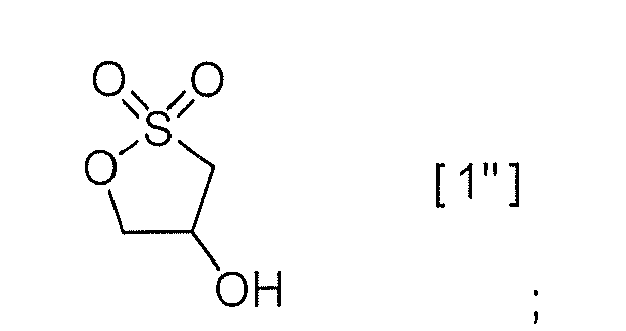


- In the production method of the present invention, the compound represented by the above-described general formula [1] (hydroxysultone) can be synthesized by reacting a compound represented by the above-described general formula [2] (a diol) with a predetermined amount of a thionyl halide to the compound (the diol) to obtain a compound represented by the above-described general formula [3] (cyclic sulfite) (a first step), and reacting the cyclic sulfite with water or/and an alcohol (a second step). Further, the compound represented by the above-described general formula [4] (unsaturated sultone) can be synthesized by reacting the compound represented by the above-described general formula [1'] (hydroxysultone) which is obtained by the above-described first step and second step with a predetermined amount of acid halide or acid anhydride to the compound (hydroxysultone) to obtain a compound represented by the above-described general formula [5], subsequently treating the compound with a base (a third step). In addition, by carrying out the above-described first step and second step continuously, that is, in one-pot reaction, the compound represented by the general formula [1] (hydroxysultone) can be obtained in higher yield as well as with higher efficiency compared with the case where the above-described first step and second step are carried out stepwise. Furthermore, by carrying out not only the above-described first step and second step, but also the third step continuously, that is, in one-pot reaction, the compound represented by the general formula [4] (unsaturated sultone) can be further more efficiently obtained compared with the case where these steps are carried out stepwise.
- As the compound represented by the general formula [2] to be used in the present invention, that is, as the diol represented by the general formula [2], a commercially available one or a synthesized one by a usual method may be appropriately used. The usual method includes a method where an alkali metal salt of alkenylsulfonic acid such as sodium allylsulfonate and sodium homoallylsulfonate is epoxidized, thereafter hydrolysis reaction is carried out, and the like. In addition, in the present invention, in particular, as the diol represented by the general formula [2], a diol wherein all of R1, R2, R3, R4 and R5 in the general formula [2] are each a hydrogen atom as well as n is 1, that is, an alkali metal salt of 2,3-dihydroxypropanesulfonic acid is preferably used.
- As the thionyl halide to be reacted with the diol represented by the general formula [2] in the above-described first step, a commercially available one may be sufficiently used. Specifically, the thionyl halide includes, for example, thionyl chloride, thionyl bromide, thionyl iodide, and the like, and among them, thionyl chloride is preferable from the viewpoint that it is economical and the handling is easy. In addition, amount of thionyl halide to be used is usually 1.6 to 20 equivalents, and preferably 1.8 to 10 equivalents relative to the diol represented by the general formula [2]. It should be noted that as for these thionyl halides, one kind may be used alone or plural kinds may be used in combination.
- The above-described first step may be carried out in the absence of solvent or in an organic solvent. The solvent is not particularly limited, so long as the organic solvent does not react with the diol represented by the general formula [2] as a raw material of the reaction. Specifically, for example, hexane, benzene, toluene, dichloromethane, dichloroethane, chloroform, carbon tetrachloride, diethyl ether, diisopropyl ether, tetrahydrofuran (THF), ethyl acetate, dimethyl carbonate, acetonitrile, dioxane, and the like are preferably used. In addition, amount of the organic solvent to be used is not particularly limited, but, for example, usually 0.1 to 20 mL, and preferably 0.2 to 10 mL relative to 1 mmol of the diol represented by the general formula [2]. It should be noted that as for these organic solvents, one kind may be used alone or plural kinds may be used in combination.
- The above-described first step may be carried out in the presence of a catalyst which is capable of promoting the reaction. The catalyst includes N,N-disubstituted amide such as, for example, N,N-dimethylformamide and N-methyl-N-phenylformamide; tertiary amine such as, for example, triethylamine and N,N-diethylaniline; nitrogen-containing heterocyclic compound such as, for example, pyridine, 4-ethylpyridine, 2-methyl-5-ethylpyridine and 4-(N,N-dimethylamino)pyridine (DMAP); and the like. In addition, amount of the catalyst to be used is not particularly limited, but, for example, usually 0.001 to 20 equivalents, preferably 0.01 to 10 equivalents, and more preferably 0.01 to 5 equivalents relative to the diol represented by the general formula [2]. It should be noted that as for these catalysts, one kind may be used alone or plural kinds may be used in combination.
- Reaction temperature in the above-described first step may be set at a temperature at which the reaction of the diol represented by the general formula [2] and the thionyl halide proceeds, and the temperature is preferably set at a temperature at which the diol and the thionyl halide react efficiently and the compound represented by the above-described general formula [3], that is, the cyclic sulfite represented by the above-described general formula [3] can be efficiently synthesized. Specifically, the reaction temperature is, for example, usually -20°C to 100°C, and preferably 0°C to 80°C.
- Reaction time in the above-described first step is hard to say, because it may vary depending on amount of the thionyl halide to be used relative to the diol represented by the general formula [2], kind of organic solvent and amount thereof to be used, reaction temperature, and the like, but it is set in a range of usually 0.2 to 24 hours, and preferably 0.5 to 12 hours.
- In the above-described first step, a method for isolating the cyclic sulfite represented by the general formula [3], which is a product of the first step, from the solution after completion of the reaction may be a common post-treatment operation. Specifically, the product can be isolated, for example, by pouring the reaction solution into cool water after completion of the reaction, subsequently extracting the mixture with an appropriate organic solvent such as toluene, thereafter washing appropriately the resultant extract with water or the like, and concentrating the solution after washing. It should be noted that besides the isolation operation as described above, a purification operation such as recrystallization and column chromatography may be added thereto. In addition, in the present invention, since the desired compound represented by the general formula [1], that is, the hydroxysultone represented by the general formula [1] can be obtained in high yield as well as high-efficiently by carrying out the above-described first step and the second step to be described later continuously, when improvements in yield and efficiency are further desired, it is desirable to carry out the second step without carrying out the post-treatment operation after completion of the above-described first step.
- The cyclic sulfite represented by the general formula [3] obtained in such way is, as described above, an important synthetic intermediate for synthesizing the hydroxysultone represented by the general formula [1] and the compound represented by the general formula [4], that is, the unsaturated sultone represented by the general formula [4].
- The above-described second step is a step where the cyclic sulfite represented by the general formula [3] and water or/and alcohol are reacted. Amount of the water or/and alcohol to be used (total amount when plural kinds are used in combination) is usually 0.8 to 20 equivalents, preferably 1.8 to 10 equivalents, and more preferably 1.8 to 7 equivalents relative to the cyclic sulfite represented by the general formula [3]. As the alcohol, a commercially available one may be used. Specifically, the alcohol includes, for example, methanol, ethanol, n-propanol, isopropanol, n-butanol, isobutanol, sec-butanol, tert-butanol, cyclobutanol, and the like, and among them, methanol and ethanol are preferable. It should be noted that as for these water or/and alcohol, one kind may be used alone or plural kinds may be used in combination.
- In the above-described second step, preferably an acid is used to promote the reaction. Specifically, the acid includes inorganic acid such as, for example, hydrochloric acid, nitric acid, sulfuric acid and phosphoric acid; and organic acid such as, for example, carbonic acid, acetic acid, methanesulfonic acid and p-toluenesulfonic acid. Among them, hydrochloric acid is preferable. In addition, amount of the acid to be used is usually 0.8 to 10 equivalents, and preferably 1 to 5 equivalents relative to the cyclic sulfite represented by the general formula [3]. It should be noted that as for these acids, one kind may be used alone or plural kinds may be used in combination. In addition, when the above-described first step and second step are carried out continuously in one-pot reaction, since the acid component derived from the thionyl halide used in the above-described first step acts as an acid, the acid has not necessarily to be added.
- In the above-described second step, since the water or/and alcohol double as a reaction solvent, another organic solvent is not necessarily required, but the second step may be carried out by using an organic solvent in combination. The organic solvent is not particularly limited, so long as the organic solvent does not react with the cyclic sulfite represented by the general formula [3] as a raw material of the reaction. Specifically, the organic solvent includes, for example, hexane, benzene, toluene, dichloromethane, dichloroethane, chloroform, carbon tetrachloride, diethyl ether, diisopropyl ether, tetrahydrofuran (THF), ethyl acetate, dimethyl carbonate, acetonitrile, dioxane, N,N-dimethylformamide, dimethylsulfoxide, and the like. In addition, amount of the organic solvent to be used is not particularly limited, but, for example, usually 0.02 to 10 mL, and preferably 0.05 to 5 mL. It should be noted that as for these organic solvents, one kind may be used alone or plural kinds may be used in combination.
- Reaction temperature in the above-described second step may be set at a temperature at which the reaction of the cyclic sulfite represented by the general formula [3] and water or/and alcohol proceeds, and the temperature is preferably set at a temperature at which the cyclic sulfite and water or/and alcohol react efficiently and the hydroxysultone represented by the above-described general formula [1] can be synthesized in high yield. Specifically, the reaction temperature is, for example, usually -20°C to 100°C, preferably 0°C to 60°C, and more preferably 10°C to 30°C.
- Reaction time in the above-described second step is hard to say, because it may vary depending on amount of water or/and alcohol to be used relative to the cyclic sulfite represented by the general formula [3], kind of acid and amount thereof to be used, reaction temperature, and the like, but it is set in a range of usually 0.1 to 6 hours, and preferably 0.2 to 3 hours.
- In the above-described second step, a method for isolating and purifying the hydroxysultone represented by the general formula [1], which is a product of the second step, from the solution after completion of the reaction may be a common post-treatment and purification operations. Specifically, the product can be efficiently purified, for example, by concentrating the reaction solution after completion of the reaction, subsequently adding an appropriate organic solvent such as ethyl acetate and water, if necessary, to the concentrated residue and stirring, then removing the aqueous layer, washing the resultant organic layer with water or the like, concentrating the solution after washing, then adding an appropriate organic solvent such as toluene to the concentrated residue to precipitate crystal, and filtering the formed crystal. It should be noted that instead of the purification operation as described above, a purification operation by usual column chromatography may be carried out. In addition, in the present invention, since the desired unsaturated sultone represented by the general formula [4] can be obtained further high-efficiently by carrying out not only the above-described first step and second step but also even the third step described later continuously, when improvements in efficiency is further desired, it is desirable to carry out the third step without carrying out the post-treatment operation after completion of the above-described second step.
- In the above-described third step, as the acid halide or acid anhydride to be reacted with the hydroxysultone represented by the general formula [1'], a commercially available one can be sufficiently used. Specifically, the acid halide includes, C1-6 alkylsulfonyl halide which is optionally substituted by a halogen atom such as, for example, methanesulfonyl chloride, methanesulfonyl bromide, methanesulfonyl iodide, ethanesulfonyl chloride, ethanesulfonyl bromide, ethanesulfonyl iodide, n-propanesulfonyl chloride, n-propanesulfonyl bromide, n-propanesulfonyl iodide, isopropanesulfonyl chloride, isopropanesulfonyl bromide, isopropanesulfonyl iodide, n-butanesulfonyl chloride, n-butanesulfonyl bromide, n-butanesulfonyl iodide, isobutanesulfonyl chloride, isobutanesulfonyl bromide, isobutanesulfonyl iodide, sec-butanesulfonyl chloride, sec-butanesulfonyl bromide, sec-butanesulfonyl iodide, tert-butanesulfonyl chloride, tert-butanesulfonyl bromide, tert-butanesulfonyl iodide, cyclobutanesulfonyl chloride, cyclobutanesulfonyl bromide, cyclobutanesulfonyl iodide, n-pentanesulfonyl chloride, n-pentanesulfonyl bromide, n-pentanesulfonyl iodide, isopentanesulfonyl chloride, isopentanesulfonyl bromide, isopentanesulfonyl iodide, sec-pentanesulfonyl chloride, sec-pentanesulfonyl bromide, sec-pentanesulfonyl iodide, tert-pentanesulfonyl chloride, tert-pentanesulfonyl bromide, tert-pentanesulfonyl iodide, neopentanesulfonyl chloride, neopentanesulfonyl bromide, neopentanesulfonyl iodide, 2-methylbutanesulfonyl chloride, 2-methylbutanesulfonyl bromide, 2-methylbutanesulfonyl iodide, 1,2-dimethylpropanesulfonyl chloride, 1,2-dimethylpropanesulfonyl bromide, 1,2-dimethylpropanesulfonyl iodide, 1-ethylpropanesulfonyl chloride, 1-ethylpropanesulfonyl bromide, 1-ethylpropanesulfonyl iodide, cyclopentanesulfonyl chloride, cyclopentanesulfonyl bromide, cyclopentanesulfonyl iodide, n-hexanesulfonyl chloride, n-hexanesulfonyl bromide, n-hexanesulfonyl iodide, isohexanesulfonyl chloride, isohexanesulfonyl bromide, isohexanesulfonyl iodide, sec-hexanesulfonyl chloride, sec-hexanesulfonyl bromide, sec-hexanesulfonyl iodide, tert-hexanesulfonyl chloride, tert-hexanesulfonyl bromide, tert-hexanesulfonyl iodide, neohexanesulfonyl chloride, neohexanesulfonyl bromide, neohexanesulfonyl iodide, 2-methylpentanesulfonyl chloride, 2-methylpentanesulfonyl bromide, 2-methylpentanesulfonyl iodide, 1,2-dimethylbutanesulfonyl chloride, 1,2-dimethylbutanesulfonyl bromide, 1,2-dimethylbutanesulfonyl iodide, 2,3-dimethylbutanesulfonyl chloride, 2,3-dimethylbutanesulfonyl bromide, 2,3-dimethylbutanesulfonyl iodide, 1-ethylbutanesulfonyl chloride, 1-ethylbutanesulfonyl bromide, 1-ethylbutanesulfonyl iodide, cyclohexanesulfonyl chloride, cyclohexanesulfonyl bromide, cyclohexanesulfonyl iodide, trifluoromethanesulfonyl chloride, trifluoromethanesulfonyl bromide, and trifluoromethanesulfonyl iodide; C6-10 arylsulfonyl halide such as, for example, benzenesulfonyl chloride, benzenesulfonyl bromide, benzenesulfonyl iodide, o-toluenesulfonyl chloride, o-toluenesulfonyl bromide, o-toluenesulfonyl iodide, m-toluenesulfonyl chloride, m-toluenesulfonyl bromide, m-toluenesulfonyl iodide, p-toluenesulfonyl chloride, p-toluenesulfonyl bromide, p-toluenesulfonyl iodide, 2,3-xylenesulfonyl chloride, 2,3-xylenesulfonyl bromide, 2,3-xylenesulfonyl iodide, 2,4-xylenesulfonyl chloride, 2,4-xylenesulfonyl bromide, 2,4-xylenesulfonyl iodide, 2,5-xylenesulfonyl chloride, 2,5-xylenesulfonyl bromide, 2,5-xylenesulfonyl iodide, 2,6-xylenesulfonyl chloride, 2,6-xylenesulfonyl bromide, 2,6-xylenesulfonyl iodide, 3,4-xylenesulfonyl chloride, 3,4-xylenesulfonyl bromide, 3,4-xylenesulfonyl iodide, 3,5-xylenesulfonyl chloride, 3,5-xylenesulfonyl bromide, 3,5-xylenesulfonyl iodide, 1-naphthalenesulfonyl chloride, 1-naphthalenesulfonyl bromide, 1-naphthalenesulfonyl iodide, 2-naphthalenesulfonyl chloride, 2-naphthalenesulfonyl bromide, and 2-naphthalenesulfonyl iodide; C2-7 alkylcarboxylic halide which is optionally substituted by a halogen atom such as, for example, acetyl chloride, acetyl bromide, acetyl iodide, propionyl chloride (propionic acid chloride), propionyl bromide (propionic acid bromide), propionyl iodide (propionic acid iodide), n-butyryl chloride (butyric acid chloride), n-butyryl bromide (butyric acid bromide), n-butyryl iodide (butyric acid iodide), isobutyryl chloride (isobutyric acid chloride), isobutyryl bromide (isobutyric acid bromide), isobutyryl iodide (isobutyric acid iodide), n-valeryl chloride (valeric acid chloride), n-valeryl bromide (valeric acid bromide), n-valeryl iodide (valeric acid iodide), isovaleryl chloride (isovaleric acid chloride), isovaleryl bromide (isovaleric acid bromide), isovaleryl iodide (isovaleric acid iodide), sec-valeryl chloride (hydrangelic acid chloride), sec-valeryl bromide (hydrangelic acid bromide), sec-valeryl iodide (hydrangelic acid iodide), tert-valeryl chloride (pivalic acid chloride), tert-valeryl bromide (pivalic acid bromide), tert-valeryl iodide (pivalic acid iodide), cyclobutanecarbonyl chloride, cyclobutanecarbonyl bromide, cyclobutanecarbonyl iodide, n-hexanoyl chloride (caproic acid chloride), n-hexanoyl bromide (caproic acid bromide), n-hexanoyl iodide (caproic acid iodide), isohexanoyl chloride, isohexanoyl bromide, isohexanoyl iodide, sec-hexanoyl chloride, sec-hexanoyl bromide, sec-hexanoyl iodide, tert-hexanoyl chloride, tert-hexanoyl bromide, tert-hexanoyl iodide, neohexanoyl chloride, neohexanoyl bromide, neohexanoyl iodide, 2-methylvaleryl chloride, 2-methylvaleryl bromide, 2-methylvaleryl iodide, 1,2-dimethylbutyryl chloride, 1,2-dimethylbutyryl bromide, 1,2-dimethylbutyryl iodide, 1-ethylbutyryl chloride, 1-ethylbutyryl bromide, 1-ethylbutyryl iodide, cyclopentanecarbonyl chloride, cyclopentanecarbonyl bromide, cyclopentanecarbonyl iodide, n-heptanoyl chloride (enanthic acid chloride), n-heptanoyl bromide (enanthic acid bromide), n-heptanoyl iodide (enanthic acid iodide), isoheptanoyl chloride, isoheptanoyl bromide, isoheptanoyl iodide, sec-heptanoyl chloride, sec-heptanoyl bromide, sec-heptanoyl iodide, tert-heptanoyl chloride, tert-heptanoyl bromide, tert-heptanoyl iodide, neoheptanoyl chloride, neoheptanoyl bromide, neoheptanoyl iodide, 2-methylhexanoyl chloride, 2-methylhexanoyl bromide, 2-methyl hexanoyl iodide, 1,2-dimethylvaleryl chloride, 1,2-dimethylvaleryl bromide, 1,2-dimethylvaleryl iodide, 2,3-dimethylvaleryl chloride, 2,3-dimethylvaleryl bromide, 2,3-dimethylvaleryl iodide, 1-ethylvaleryl chloride, 1-ethylvaleryl bromide, 1-ethylvaleryl iodide, cyclohexanecarbonyl chloride, cyclohexanecarbonyl bromide, cyclohexanecarbonyl iodide, trifluoroacetyl chloride, trifluoroacetyl bromide, and trifluoroacetyl iodide; C7-11 arylcarboxylic halide such as, for example, benzoyl chloride, benzoyl bromide, benzoyl iodide, o-toluic acid chloride, o-toluic acid bromide, o-toluic acid iodide, m-toluic acid chloride, m-toluic acid bromide, m-toluic acid iodide, p-toluic acid chloride, p-toluic acid bromide, p-toluic acid iodide, 2,3-xylic acid chloride, 2,3-xylic acid bromide, 2,3-xylic acid iodide, 2,4-xylic acid chloride, 2,4-xylic acid bromide, 2,4-xylic acid iodide, 2,5-xylic acid chloride, 2,5-xylic acid bromide, 2,5-xylic acid iodide, 2,6-xylic acid chloride, 2,6-xylic acid bromide, 2,6-xylic acid iodide, 3,4-xylic acid chloride, 3,4-xylic acid bromide, 3,4-xylic acid iodide, 3,5-xylic acid chloride, 3,5-xylic acid bromide, 3,5-xylic acid iodide, 1-naphthoic acid chloride (1-naphthalenecarboxylic acid chloride), 1-naphthoic acid bromide (1-naphthalenecarboxylic acid bromide), 1-naphthoic acid iodide (1-naphthalenecarboxylic acid iodide), 2-naphthoic acid chloride (2-naphthalenecarboxylic acid chloride), 2-naphthoic acid bromide (2-naphthalenecarboxylic acid bromide), and 2-naphthoic acid iodide (2-naphthalenecarboxylic acid iodide); and the like.
- In addition, specific example of the above-described acid anhydride includes C2-12 alkylsulfonic anhydride which is optionally substituted by a halogen atom such as, for example, methanesulfonic anhydride, ethanesulfonic anhydride, n-propanesulfonic anhydride, isopropanesulfonic anhydride, n-butanesulfonic anhydride, isobutanesulfonic anhydride, sec-butanesulfonic anhydride, tert-butanesulfonic anhydride, cyclobutanesulfonic anhydride, n-pentanesulfonic anhydride, isopentanesulfonic anhydride, sec-pentanesulfonic anhydride, tert-pentanesulfonic anhydride, neopentanesulfonic anhydride, 2-methylbutanesulfonic anhydride, 1,2-dimethylpropanesulfonic anhydride, 1-ethylpropanesulfonic anhydride, cyclopentanesulfonic anhydride, n-hexanesulfonic anhydride, isohexanesulfonic anhydride, sec-hexanesulfonic anhydride, tert-hexanesulfonic anhydride, neohexanesulfonic anhydride, 2-methylpentanesulfonic anhydride, 1,2-dimethylbutanesulfonic anhydride, 2,3-dimethylbutanesulfonic anhydride, 1-ethylbutanesulfonic anhydride, cyclohexanesulfonic anhydride, and trifluoromethanesulfonic anhydride; C12-20 arylsulfonic anhydride such as, for example, benzenesulfonic anhydride, o-toluenesulfonic anhydride, m-toluenesulfonic anhydride, p-toluenesulfonic anhydride, 2,3-xylenesulfonic anhydride, 2,4-xylenesulfonic anhydride, 2,5-xylenesulfonic anhydride, 2,6-xylenesulfonic anhydride, 3,4-xylenesulfonic anhydride, 3,5-xylenesulfonic anhydride, 1-naphthalenesulfonic anhydride, and 2-naphthalenesulfonic anhydride; C4-14 alkylcarboxylic anhydride which is optionally substituted by a halogen atom such as, for example, acetic anhydride, propanoic acid anhydride (propionic anhydride), n-butanoic acid anhydride (butyric anhydride), isobutanoic acid anhydride (isobutyric anhydride), n-pentanoic acid anhydride (valeric anhydride), isopentanoic acid anhydride (isovaleric anhydride), sec-pentanoic acid anhydride (hydrangelic anhydride), tert-pentanoic acid anhydride (pivalic anhydride), cyclobutanecarboxylic anhydride, n-hexanoic acid anhydride (caproic anhydride), isohexanoic acid anhydride, sec-hexanoic acid anhydride, tert-hexanoic acid anhydride, neohexanoic acid anhydride, 2-methylpentanoic acid anhydride, 1,2-dimethylbutanoic acid anhydride, 1-ethylbutanoic acid anhydride, cyclopentanecarboxylic anhydride, n-heptanoic acid anhydride (enanthic anhydride), isoheptanoic acid anhydride, sec-heptanoic acid anhydride, tert-heptanoic acid anhydride, neoheptanoic acid anhydride, 2-methylhexanoic acid anhydride, 1,2-dimethylpentanoic acid anhydride, 2,3-dimethylpentanoic acid anhydride, 1-ethylpentanoic acid anhydride, cyclohexanecarboxylic anhydride, and trifluoroacetic anhydride; C14-22 arylcarboxylic anhydride such as, for example, benzoic acid anhydride (benzoic anhydride), o-methylbenzoic acid anhydride, m-methylbenzoic acid anhydride, p-methylbenzoic acid anhydride, 2,3-dimethylbenzoic acid anhydride, 2,4-dimethylbenzoic acid anhydride, 2,5-dimethylbenzoic acid anhydride, 2,6-dimethylbenzoic acid anhydride, 3,4-dimethylbenzoic acid anhydride, 3,5-dimethylbenzoic acid anhydride, 1-naphthoic acid anhydride (1-naphthalenecarboxylic anhydride), and 2-naphthoic acid anhydride (2-naphthalenecarboxylic anhydride); and the like.
- Among these acid halides or acid anhydrides, acid halide such as methanesulfonyl chloride, methanesulfonyl bromide, trifluoromethanesulfonyl chloride, trifluoromethanesulfonyl bromide, p-toluenesulfonyl chloride, p-toluenesulfonyl bromide, acetyl chloride, acetyl bromide, trifluoroacetyl chloride, trifluoroacetyl bromide, benzoyl chloride, and benzoyl bromide; and acid anhydride such as methanesulfonic anhydride, trifluoromethanesulfonic anhydride, p-toluenesulfonic anhydride, acetic anhydride, trifluoroacetic anhydride, and benzoic acid anhydride (benzoic anhydride) are preferable, and further methanesulfonyl chloride and acetic anhydride are more preferable.
- Amount of the above-described acid halide or acid anhydride to be used is usually 0.8 to 10 equivalents, and preferably 1 to 5 equivalents relative to the hydroxysultone represented by the general formula [1']. It should be noted that as for these acid halides or acid anhydrides, one kind may be used alone or plural kinds may be used in combination.
- In the reaction in the above-described third step where a compound represented by the general formula [5] is treated with a base to obtain an unsaturated sultone represented by the general formula [4], as the base to be used in the reaction, a commercially available one can be used. Specifically, the base includes tertiary amine such as, for example, triethylamine, pyridine, 1,8-diazabicyclo[5.4.0]undec-7-ene (DBU), and 1,5-diazabicyclo[4.3.0]non-5-ene (DBN); alkali metal salt of carbonic acid such as, for example, sodium carbonate, potassium carbonate, and cesium carbonate; alkali metal halide such as, for example, sodium hydride, and potassium hydride; alkali metal hydroxide such as, for example, sodium hydroxide, and potassium hydroxide; alkali metal alkoxide such as, for example, sodium methoxide, potassium methoxide, sodium ethoxide, potassium ethoxide, lithium tert-butoxide, sodium tert-butoxide, and potassium tert-butoxide; alkyl lithium such as, for example, n-butyl lithium, sec-butyl lithium, tert-butyl lithium, and n-hexyl lithium; metal amide such as, for example, lithium diisopropylamide (LDA), lithium hexamethyldisilazane (LHMDS), sodium hexamethyldisilazane (NaHMDS), and potassium hexamethyldisilazane (KHMDS); and the like. Among them, a comparatively mild base like tertiary amine such as, for example, triethylamine, pyridine, 1,8-diazabicyclo[5.4.0]undec-7-ene (DBU), and 1,5-diazabicyclo[4.3.0]non-5-ene (DBN); alkali metal salt of carbonic acid such as, for example, sodium carbonate, potassium carbonate, and cesium carbonate; and the like is preferable from the viewpoint that the reaction condition is easy to control, and further triethylamine and potassium carbonate are more preferable. In addition, amount of the base to be used may be an amount or more by which the elimination reaction of LO-group in the general formula [5], that is, the double bond formation reaction in the compound represented by the general formula [5] proceeds smoothly. Specifically, the amount is 0.8 to 20 equivalents, and preferably 1 to 10 equivalents relative to the compound represented by the general formula [5]. It should be noted that as for these bases, one kind may be used alone or plural kinds may be used in combination.
- In addition, in the reaction of a hydroxysultone represented by the general formula [1'] and an acid halide or acid anhydride in the above-described third step, when acid halide is used, it is desirable to use a base in the timing of the reaction because hydrogen halide is formed as a by-product. That is, the above-described base can be used not only for the purpose to promote the above-described double bond formation reaction, but also for the purpose to trap the hydrogen halide. It should be noted that even when the base is used in the timing of the reaction with the above-described acid halide or acid anhydride, the above-described specific bases can be used, and amount thereof to be used may be the range in equivalent described above. In addition, when the base is used in the timing of the reaction of a hydroxysultone represented by the general formula [1'] and an acid halide or acid anhydride, sometimes the double bond formation reaction of the compound represented by the general formula [5] proceeds continuously, and an unsaturated sultone represented by the general formula [4] can be obtained, although it depends on an amount of the base to be used.
- In the above-described third step, when the base is used in the timing of the reaction of a hydroxysultone represented by the general formula [1'] and an acid halide or acid anhydride, and the base is a liquid, an organic solvent is not necessary used because the base acts as a reaction solvent, but when the base is a solid or the base is not used in the timing of the reaction of a hydroxysultone represented by the general formula [1'] and an acid halide or acid halide or acid anhydride or the like, it is desirable to carry out the reaction in an organic solvent. Such organic solvent is not particularly limited, so long as the organic solvent does not react with the hydroxysultone represented by the general formula [1'] as a raw material of the reaction, the compound represented by the general formula [5], acid halide, acid anhydride, and the like. Specifically, the organic solvent includes, for example, hexane, benzene, toluene, dichloromethane, dichloroethane, chloroform, carbon tetrachloride, diethyl ether, diisopropyl ether, tetrahydrofuran (THF), ethyl acetate, dimethyl carbonate, acetonitrile, dioxane, N,N-dimethylformamide, dimethylsulfoxide, and the like. Among them, hexane, benzene, toluene, dichloromethane, dichloroethane, chloroform, carbon tetrachloride, diethyl ether, diisopropyl ether, tetrahydrofuran (THF), ethyl acetate, dimethyl carbonate and acetonitrile are preferable, and further, ethyl acetate is more preferable. In addition, amount of the organic solvent to be used is not particularly limited, but usually 0.1 to 20 mL, and preferably 0.2 to 10 mL relative to 1 mmol of the hydroxysultone represented by the general formula [1'] or 1 mmol of the compound represented by the general formula [5]. It should be noted that as for these organic solvents, one kind may be used alone or plural kinds may be used in combination, and when the base is a solid and hardly dissolves in the above-described organic solvent, water may be used in combination.
- Reaction temperature in the above-described third step may be set at a temperature at which the hydroxysultone represented by the general formula [1'] and the acid halide or acid anhydride can react and the double bond formation reaction of the compound represented by the general formula [5] proceeds, and the temperature is preferably set at a temperature at which the above-described reactions proceed efficiently, and the unsaturated sultone represented by the general formula [4] can be synthesized efficiently. Specifically, the reaction temperature is, for example, usually -40°C to 70°C, and preferably -30°C to 50°C.
- Reaction time in the above-described third step is hard to say, because it may vary depending on amount of the acid halide or acid anhydride to be used relative to the hydroxysultone represented by the general formula [1'], amount of the base to be used relative to the compound represented by the general formula [5], presence or absence of an organic solvent, kind and amount thereof to be used, reaction temperature, and the like, but it is set in a range of usually 0.1 to 48 hours, and preferably 0.2 to 36 hours. It should be noted that the above-described reaction time represents a total reaction time to synthesize the compound represented by the general formula [4] from the hydroxysultone represented by the general formula [1']. In this total reaction time, the reaction time to synthesize the compound represented by the general formula [5] from the hydroxysultone represented by the general formula [1'] is set in a range of usually 0.05 to 16 hours, and preferably 0.1 to 12 hours, and the reaction time to synthesize the unsaturated sultone represented by the general formula [4] from the compound represented by the general formula [5] is set in a range of usually 0.05 to 32 hours, and preferably 0.1 to 24 hours.
- In the above-described third step, a method for isolating the compound represented by the general formula [5] from the solution after completion of the reaction may be a common post-treatment operation. Specifically, the product can be isolated, for example, by adding water to the reaction solution after completion of the reaction, subsequently separating the organic layer, washing the resultant organic layer with saturated sodium bicarbonate aqueous solution and water sequentially, then concentrating the solution after washing. It should be noted that besides the isolation operation as described above, a purification operation such as chromatography may be added thereto. In addition, a method for isolating the unsaturated sultone represented by the general formula [4] from the solution after completion of the reaction may be a common post-treatment operation. Specifically, the unsaturated sultone can be isolated, for example, by adding water to the reaction solution after completion of the reaction, if necessary, subsequently fractionating the organic layer, washing the resultant organic layer with water, then concentrating the solution after washing. Further, when a purification operation is carried out after the isolation, purification can be performed, for example, by adding an appropriate organic solvent such as toluene to the above-described solution after washing or the above-described concentrated residue after concentration, and filtering the crystal formed therein. It should be noted that besides the purification operation as described above, a purification operation such as usual column chromatography may be carried out.
- Thus, the present inventors have found out first in the world a method which is capable of producing a hydroxysultone represented by the general formula [1] and an unsaturated sultone represented by the general formula [4] using a diol represented by the general formula [2] which is easy to procure or synthesize as a raw material through a cyclic sulfite represented by the general formula [3] as a synthetic intermediate. This method is a superior production method which is capable of obtaining the desired compound in higher yield, in particular, obtaining the desired compound more efficiently by carrying out these steps continuously in one-pot reaction, compared with the conventional method. In addition, since all of these steps can be carried out under mild conditions, there is little possibility of a trouble such as decomposition and gelation, and the desired compound can be stably obtained even in a commercial scale.
- Hereinafter, the present invention will be specifically explained referring to Examples, but the present invention is not limited thereto by any means.
- Sodium sulfite (120 g, 924 mmol, content: 97.0%, produced by Wako Pure Chemical Industries, Ltd.) was dissolved in water (400 mL), and 3-chloro-1,2-propanediol (107.2 g, 970 mmol, produced by Wako Pure Chemical Industries, Ltd.) was added thereto. The solution was refluxed by heating for 1 hour. After completion of the reaction, the reaction solution was concentrated, thereafter methanol (750 mL) was added to the concentrated residue. The crystal formed was filtered, and the resultant crystal was dried, to obtain sodium 2,3-dihydroxypropanesulfonate relevant to the above-described general formula [2] (202.6 g, content: 67.2%, yield: 82.7%) as a white crystal. It should be noted that content of sodium 2,3-dihydroxypropanesulfonate was obtained by 1H-NMR using the internal standard method. In addition, it was confirmed that the above-described white crystal contained crystal of sodium chloride as a by-product. Measurement results of 1H-NMR are shown below.
1H-NMR (400 MHz, D2O) δ (ppm): 2.97 (2H), 3.54 (2H), 4.05 (1H).
- Sodium 2,3-dihydroxypropanesulfonate (80.0 g, 301 mmol, content: 67.2%) divided from the total amount thereof obtained in Synthetic Example 1 was suspended in N,N-dimethylformamide (DMF) (110.3 g, 1509 mmol, produced by Wako Pure Chemical Industries, Ltd.), and the suspension was cooled down to -20°C to 10°C. Thionyl chloride (107.7 g, 905 mmol, produced by Wako Pure Chemical Industries, Ltd.) was added drop by drop to the cooled suspension, thereafter the suspension was stirred at room temperature for 3 hours to promote the reaction. After completion of the reaction, the reaction solution was added to water (400 mL) which had been cooled to -20°C to 10°C. Subsequently, toluene (200 mL) was added to this mixture, and the mixture was stirred, and then the organic layer was separated. The separated organic layer was washed with water, thereafter the organic layer was concentrated, to obtain 1,3,2-dioxathiolane-2-oxide-4-yl-methanesulfonyl chloride (65.1 g, yield: 98%) relevant to the above-described general formula [3] as a yellow oil. It should be noted that 1,3,2-dioxathiolane-2-oxide-4-yl-methanesulfonyl chloride was obtained as a mixture of 2 kinds of isomers (isomer A and isomer B). Measurement results of 1H-NMR are shown below.
- <IsomerA>
1H-NMR (400 MHz, CDCl3) δ (ppm): 3.98 (1H, dd, CH2), 4.12 (1H, dd, CH2), 4.55 (1H, dd, OCH2), 4.96 (1H, dd, OCH2), 5.52 (1H, m, CH). - <Isomer B>
1H-NMR (400 MHz, CDCl3) δ (ppm): 4.25 (1H, dd, CH2), 4.43 (1H, dd, CH2), 4.74 (1H, dd, OCH2), 4.81 (1H, dd, OCH2), 5.16 (1H, m, CH).
- To 1,3,2-dioxathiolane-2-oxide-4-yl-methanesulfonyl chloride (4.21 g, 19.1 mmol) divided from the total amount thereof obtained in Example 1, 12 N hydrochloric acid (1.75 g, hydrogen chloride: 21.0 mmol, water: 62.2 mmol, produced by Wako Pure Chemical Industries, Ltd.) was added under ice-cooling, and the solution was stirred at room temperature for 30 minutes to promote the reaction. After completion of the reaction, ethyl acetate (50 mL) was added to the reaction solution, and then the solution was stirred. Subsequently, the organic layer was separated. After the separated organic layer was washed with water, the organic layer was concentrated, thereafter toluene was added to the concentrated residue. The crystal formed was filtered, and the resultant crystal was dried, to obtain 2-hydroxy-1,3-propanesultone (2.51 g, yield: 95%) relevant to the above-described general formula [1] as a white crystal. Measurement results of 1H-NMR are shown below.
1H-NMR (400 MHz, acetone-d) δ (ppm): 3.26 (1H), 3.65 (1H), 4.33 (1H), 4.60 (1H), 4.99 (1H).
- Sodium 2,3-dihydroxypropanesulfonate (4.0 g, 16.4 mmol, content: 73.3%) obtained according to Synthetic Example 1 was suspended in toluene (10 mL). Subsequently, N,N-dimethylformamide (DMF) (0.06 g, 0.823 mmol, produced by Wako Pure Chemical Industries, Ltd.) was added thereto, thereafter thionyl chloride (5.85 g, 49.2 mmol, produced by Wako Pure Chemical Industries, Ltd.) was added drop by drop, and the suspension was stirred at 65°C for 7 hours to promote the reaction.
Subsequently, the reaction solution was cooled down to room temperature. Methanol (2.63 g, 82.0 mmol, produced by Wako Pure Chemical Industries, Ltd.) was added to the cooled solution, and the solution was stirred at room temperature for 2 hours to promote the reaction. After completion of the reaction, the reaction solution was concentrated under reduced pressure, and ethyl acetate (50 mL) and water (30 mL) were added to the resultant concentrated residue, and then the solution was stirred. Subsequently, the organic layer was separated. After separated organic layer was washed with water, the organic layer was concentrated, thereafter toluene was added to the concentrated residue. The crystal formed was filtered, and the resultant crystal was dried, to obtain 2-hydroxy-1,3-propanesultone (2.20 g, yield: 97%) relevant to the above-described general formula [1] as a white crystal.
- 2-Hydroxy-1,3-propanesultone (1.70 g, 12.3 mmol) obtained according to Example 3 was dissolved in ethyl acetate (12 mL), and thereafter triethylamine (Et3N) (2.99 g, 29.5 mmol, produced by Wako Pure Chemical Industries, Ltd.) and methanesulfonyl chloride (MsCl) (1.69 g, 14.7 mmol, produced by Wako Pure Chemical Industries, Ltd.) were added thereto under ice-cooling. The solution was stirred at -20°C to 10°C for 4 hours to promote the reaction. After completion of the reaction, water (12 mL) was added to the reaction solution, and then the solution was stirred. Subsequently, the organic layer was separated. After the separated organic layer was washed with water, the organic layer was concentrated, thereafter toluene was added to the concentrated residue. The crystal formed was filtered, and the resultant crystal was dried, to obtain 1,3-propenesultone (1.39 g, yield: 94%) relevant to the above-described general formula [4] as a white crystal. Measurement results of 1H-NMR are shown below.
1H-NMR (400 MHz, CDCl3) δ (ppm): 5.12 (1H), 6.81 (1H), 7.00 (1H).
- 2-Hydroxy-1,3-propanesultone (1.49 g, 10.8 mmol) obtained according to Example 3 was dissolved in ethyl acetate (10 mL), and thereafter acetic anhydride (Ac2O) (1.66 g, 16.2 mmol, produced by Wako Pure Chemical Industries, Ltd.) was added thereto. The solution was stirred at room temperature for 1 hour to promote the reaction. After completion of the reaction, water (10 mL) was added to the reaction solution, and then the solution was stirred. Subsequently, the organic layer was separated. After the separated organic layer was washed with saturated sodium bicarbonate aqueous solution and water sequentially, the organic layer was concentrated, to obtain 2-acetoxy-1,3-propanesultone (1.91 g, yield: 98%) relevant to the above-described general formula [5] as a brown oil. Measurement results of 1H-NMR are shown below.
1H-NMR (400 MHz, CDCl3) δ (ppm): 2.15 (3H), 3.35 (1H), 3.62 (1H), 4.47 (1H), 4.64 (1H), 5.61 (1H).
- 2-Acetoxy-1,3-propanesultone (0.50 g, 2.78 mmol) divided from the total amount thereof obtained in Example 5 was dissolved in ethyl acetate (5 mL), and thereafter a solution of potassium carbonate (0.23 g, 1.66 mmol, produced by Wako Pure Chemical Industries, Ltd.) in water (5 mL) was added thereto. The solution was stirred at 40°C for 12 hours to promote the reaction. After completion of the reaction, the reaction solution was washed with water, and then the organic layer was separated. After the separated organic layer was concentrated, to obtain 1,3-propenesultone (0.22 g, yield: 66%) relevant to the above-described general formula [4] as a white crystal.

- Sodium 2,3-dihydoroxypropanesulfonate (4.0 g, 16.4 mmol, content: 73.3%) obtained according to Synthetic Example 1 was suspended in toluene (10 mL). Subsequently, N,N-dimethylformamide (DMF) (0.06 g, 0.823 mmol, produced by Wako Pure Chemical Industries, Ltd.) was added thereto, thereafter thionyl chloride (5.85 g, 49.2 mmol, produced by Wako Pure Chemical Industries, Ltd.) was added drop by drop, and the suspension was stirred at 65°C for 7 hours to promote the reaction.
Subsequently, the reaction solution was cooled down to room temperature. Methanol (1.57 g, 49.2 mmol, produced by Wako Pure Chemical Industries, Ltd.) was added to the cooled solution, and the solution was stirred at room temperature for 2 hours to promote the reaction.
Subsequently, acetic anhydride (Ac2O) (3.35 g, 32.8 mmol, produced by Wako Pure Chemical Industries, Ltd.) was added to the reaction solution, and the solution was stirred at room temperature for 1 hour to promote the reaction.
After completion of the reaction, water (15 mL) was added to the reaction solution, and then the solution was stirred. Subsequently, the organic layer was separated. A solution of potassium carbonate (3.40 g, 24.6 mmol, produced by Wako Pure Chemical Industries, Ltd.) dissolved in water (15 mL) was further added to the separated organic layer. The solution was stirred at 40°C for 12 hours to promote the reaction. After completion of the reaction, the reaction solution was washed with water, and then the organic layer was separated. After the separated organic layer was concentrated, to obtain 1,3-propenesultone (1.18 g, yield: 60%) relevant to the above-described general formula [4] as a white crystal,
- From the results of Examples 1 to 7, it was found that the desired hydroxysultone represented by the general formula [1] and the unsaturated sultone represented by the general formula [4] could be obtained in high yield by using the diol represented by the general formula [2] as a raw material through the cyclic sulfite represented by the general formula [3] as a synthetic intermediate. In addition, it was also found that these reactions could be carried out continuously in one-pot reaction, and that the production method of the present invention was very effective method also in efficiency because the desired compound could be obtained more efficiently by carrying out these reactions continuously.
- The production method of the present invention can realize stable and efficient production in a commercial scale and the like of a cyclic sulfonic acid ester (sultone), which is useful, for example, as an additive to non-aqueous electrolyte in a lithium ion secondary battery or the like.
Claims (9)
- A method for producing a compound represented by the general formula [1]:


- The method according to claim 1, wherein the aforementioned first step and second step are carried out continuously.
- The method according to claim 1, wherein R1 is a hydrogen atom and n is 1 in the aforementioned general formulas [1] to [3].
- A method for producing a compound represented by the general formula [4]:


- The method according to claim 4, wherein the aforementioned first step and second step to obtain the compound represented by the general formula [1'], and third step are carried out continuously.
- The method according to claim 4, wherein the aforementioned acid halide is a sulfonyl halide or a carboxylic halide.
- The method according to claim 4, wherein the aforementioned acid anhydride is a sulfonic anhydride or a carboxylic anhydride.
- The method according to claim 4, wherein the aforementioned acid halide or acid anhydride is methanesulfonyl chloride or acetic anhydride.
- A compound represented by the general formula [3]:
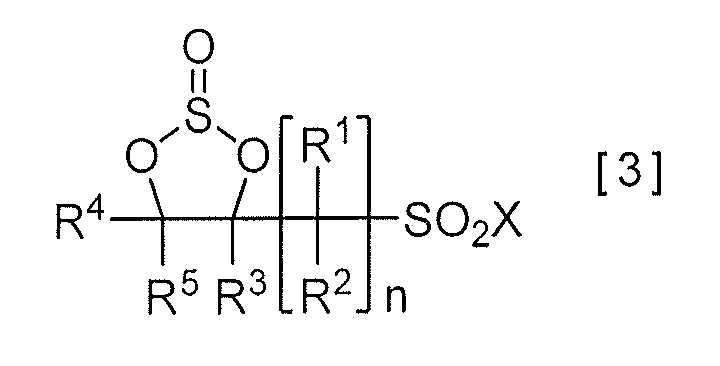
Priority Applications (1)
| Application Number | Priority Date | Filing Date | Title |
|---|---|---|---|
| EP14164720.6A EP2757102B1 (en) | 2009-08-04 | 2010-08-03 | Intermediate for producing a cyclic sulfonic acid ester |
Applications Claiming Priority (2)
| Application Number | Priority Date | Filing Date | Title |
|---|---|---|---|
| JP2009181963 | 2009-08-04 | ||
| PCT/JP2010/063062 WO2011016440A1 (en) | 2009-08-04 | 2010-08-03 | Method for producing cyclic sulfonic acid ester and intermediate thereof |
Related Child Applications (2)
| Application Number | Title | Priority Date | Filing Date |
|---|---|---|---|
| EP14164720.6A Division EP2757102B1 (en) | 2009-08-04 | 2010-08-03 | Intermediate for producing a cyclic sulfonic acid ester |
| EP14164720.6A Division-Into EP2757102B1 (en) | 2009-08-04 | 2010-08-03 | Intermediate for producing a cyclic sulfonic acid ester |
Publications (3)
| Publication Number | Publication Date |
|---|---|
| EP2463281A1 true EP2463281A1 (en) | 2012-06-13 |
| EP2463281A4 EP2463281A4 (en) | 2012-12-19 |
| EP2463281B1 EP2463281B1 (en) | 2014-10-22 |
Family
ID=43544335
Family Applications (2)
| Application Number | Title | Priority Date | Filing Date |
|---|---|---|---|
| EP14164720.6A Not-in-force EP2757102B1 (en) | 2009-08-04 | 2010-08-03 | Intermediate for producing a cyclic sulfonic acid ester |
| EP10806439.5A Not-in-force EP2463281B1 (en) | 2009-08-04 | 2010-08-03 | Method for producing cyclic sulfonic acid ester and intermediate thereof |
Family Applications Before (1)
| Application Number | Title | Priority Date | Filing Date |
|---|---|---|---|
| EP14164720.6A Not-in-force EP2757102B1 (en) | 2009-08-04 | 2010-08-03 | Intermediate for producing a cyclic sulfonic acid ester |
Country Status (8)
| Country | Link |
|---|---|
| US (2) | US8673963B2 (en) |
| EP (2) | EP2757102B1 (en) |
| JP (1) | JP5668684B2 (en) |
| KR (1) | KR101736739B1 (en) |
| CN (2) | CN102471305B (en) |
| ES (1) | ES2571483T3 (en) |
| TW (1) | TWI469957B (en) |
| WO (1) | WO2011016440A1 (en) |
Cited By (1)
| Publication number | Priority date | Publication date | Assignee | Title |
|---|---|---|---|---|
| EP2704246A4 (en) * | 2011-04-26 | 2015-01-07 | Ube Industries | NONAQUEOUS ELECTROLYTIC SOLUTION, ELECTRICITY ACCUMULATION DEVICE USING THE SAME AND CYCLIC SULFONIC ACID ESTER COMPOUND |
Families Citing this family (21)
| Publication number | Priority date | Publication date | Assignee | Title |
|---|---|---|---|---|
| JP5496715B2 (en) * | 2010-03-10 | 2014-05-21 | 株式会社クラレ | Acrylic ester derivatives, polymer compounds and photoresist compositions |
| JP6368501B2 (en) * | 2014-02-26 | 2018-08-01 | 三井化学株式会社 | Nonaqueous electrolyte for battery and lithium secondary battery |
| JP2015176760A (en) * | 2014-03-14 | 2015-10-05 | 三井化学株式会社 | Lithium secondary battery |
| CN104945368B (en) * | 2015-05-29 | 2018-06-01 | 石家庄圣泰化工有限公司 | A kind of method for producing 4- propyl sulfuric acid vinyl esters |
| KR102489550B1 (en) * | 2016-09-28 | 2023-01-17 | 주식회사 제이앤씨사이언스 | Method for preparing cyclic 1,3-propene sultone |
| CN107857752A (en) * | 2017-11-27 | 2018-03-30 | 九江天赐高新材料有限公司 | A kind of preparation method of the sultones of acrylic 1,3 |
| EP3726636B1 (en) | 2017-12-12 | 2024-06-26 | Central Glass Company, Limited | Electrolyte solution for nonaqueous electrolyte batteries and nonaqueous electrolyte battery using same |
| WO2019117101A1 (en) | 2017-12-12 | 2019-06-20 | セントラル硝子株式会社 | Electrolyte solution for nonaqueous electrolyte batteries and nonaqueous electrolyte battery using same |
| CN108484567B (en) * | 2018-03-19 | 2020-09-22 | 东莞市航盛新能源材料有限公司 | Preparation method of 1-fluoro-1, 3-propane sultone |
| KR102493557B1 (en) | 2018-03-27 | 2023-01-30 | 미쯔비시 케미컬 주식회사 | Non-aqueous electrolyte and energy device using the same |
| CN108987802B (en) * | 2018-06-15 | 2021-11-05 | 桑顿新能源科技(长沙)有限公司 | Non-aqueous electrolyte for high-voltage lithium ion battery |
| CN110105326A (en) * | 2019-02-26 | 2019-08-09 | 武汉松石科技股份有限公司 | A kind of preparation method of 1,3- propane sultone |
| CN109942539B (en) * | 2019-04-29 | 2020-07-24 | 上海如鲲新材料有限公司 | Preparation method of 2-fluoro-1, 3-propane sultone |
| KR102239499B1 (en) * | 2019-06-24 | 2021-04-13 | 삼화페인트공업주식회사 | Carbonate compounds containing a fluorosulphonyl group, preparation method and use thereof |
| KR102803274B1 (en) | 2020-09-28 | 2025-05-07 | 주식회사 엘지에너지솔루션 | Additives for non-aqueous electrolyte, non-aqueous electrolyte and lithium secondary battery comprsing the same |
| KR20220057179A (en) * | 2020-10-29 | 2022-05-09 | 솔브레인 주식회사 | Method for preparing cyclic sulfonic ester compound |
| KR102940072B1 (en) * | 2022-01-10 | 2026-03-17 | 주식회사 엘지화학 | Manufacturing method of cyclic sulfonic acid ester derivative compound |
| CN117003725A (en) * | 2022-04-28 | 2023-11-07 | 张家港市国泰华荣化工新材料有限公司 | A method for preparing propenyl 1,3-sultone |
| CN115433109B (en) * | 2022-07-27 | 2024-05-31 | 厦门威亮光学涂层技术有限公司 | A method for preparing organic sulfonic acid amine salt |
| KR102681729B1 (en) * | 2023-11-27 | 2024-07-04 | 제이엘켐 주식회사 | Method for manufacturing 4-hydroxy-1,2-oxathiolane 2,2-dioxide and additive for secondary battery electrolyte manufactured using it as an intermediate |
| CN117531462B (en) * | 2024-01-10 | 2024-03-29 | 凯莱英生命科学技术(天津)有限公司 | A continuous synthesis system and continuous synthesis method of PEGn cyclic sulfite |
Family Cites Families (6)
| Publication number | Priority date | Publication date | Assignee | Title |
|---|---|---|---|---|
| US3100779A (en) * | 1961-06-30 | 1963-08-13 | Hans S Mannheimer | Novel products and methods for preparing them |
| US5807847A (en) * | 1996-06-04 | 1998-09-15 | Queen's University At Kingston | Nitrate esters |
| JP4190162B2 (en) | 2001-03-01 | 2008-12-03 | 三井化学株式会社 | Nonaqueous electrolyte, secondary battery using the same, and additive for electrolyte |
| JP4544408B2 (en) | 2004-06-18 | 2010-09-15 | 日本電気株式会社 | Secondary battery electrolyte and secondary battery using the same |
| KR100895191B1 (en) | 2006-04-12 | 2009-04-24 | 주식회사 엘지화학 | Method for preparing 1,3-propenesultone |
| CN101456856B (en) * | 2009-01-07 | 2013-03-13 | 石家庄圣泰化工有限公司 | Method for preparing 1-propone-1,3-sultone |
-
2010
- 2010-08-03 US US13/388,405 patent/US8673963B2/en not_active Expired - Fee Related
- 2010-08-03 EP EP14164720.6A patent/EP2757102B1/en not_active Not-in-force
- 2010-08-03 CN CN201080032606.3A patent/CN102471305B/en not_active Expired - Fee Related
- 2010-08-03 EP EP10806439.5A patent/EP2463281B1/en not_active Not-in-force
- 2010-08-03 WO PCT/JP2010/063062 patent/WO2011016440A1/en not_active Ceased
- 2010-08-03 TW TW99125687A patent/TWI469957B/en not_active IP Right Cessation
- 2010-08-03 KR KR1020127004688A patent/KR101736739B1/en not_active Expired - Fee Related
- 2010-08-03 CN CN201410007222.6A patent/CN103833723B/en not_active Expired - Fee Related
- 2010-08-03 ES ES14164720T patent/ES2571483T3/en active Active
- 2010-08-03 JP JP2011525889A patent/JP5668684B2/en not_active Expired - Fee Related
-
2014
- 2014-01-24 US US14/163,682 patent/US8969591B2/en not_active Expired - Fee Related
Non-Patent Citations (2)
| Title |
|---|
| No further relevant documents disclosed * |
| See also references of WO2011016440A1 * |
Cited By (1)
| Publication number | Priority date | Publication date | Assignee | Title |
|---|---|---|---|---|
| EP2704246A4 (en) * | 2011-04-26 | 2015-01-07 | Ube Industries | NONAQUEOUS ELECTROLYTIC SOLUTION, ELECTRICITY ACCUMULATION DEVICE USING THE SAME AND CYCLIC SULFONIC ACID ESTER COMPOUND |
Also Published As
| Publication number | Publication date |
|---|---|
| TW201109301A (en) | 2011-03-16 |
| WO2011016440A1 (en) | 2011-02-10 |
| US20140142324A1 (en) | 2014-05-22 |
| ES2571483T3 (en) | 2016-05-25 |
| JPWO2011016440A1 (en) | 2013-01-10 |
| US20120130089A1 (en) | 2012-05-24 |
| EP2463281A4 (en) | 2012-12-19 |
| EP2757102B1 (en) | 2016-03-23 |
| CN103833723A (en) | 2014-06-04 |
| US8673963B2 (en) | 2014-03-18 |
| KR20120045027A (en) | 2012-05-08 |
| US8969591B2 (en) | 2015-03-03 |
| CN102471305B (en) | 2014-01-29 |
| EP2757102A1 (en) | 2014-07-23 |
| CN103833723B (en) | 2016-08-17 |
| TWI469957B (en) | 2015-01-21 |
| KR101736739B1 (en) | 2017-05-17 |
| EP2463281B1 (en) | 2014-10-22 |
| JP5668684B2 (en) | 2015-02-12 |
| CN102471305A (en) | 2012-05-23 |
Similar Documents
| Publication | Publication Date | Title |
|---|---|---|
| EP2463281B1 (en) | Method for producing cyclic sulfonic acid ester and intermediate thereof | |
| BG61695B1 (en) | METHODS FOR NUCLEOZIDES DIASTEROSELECTIVE SYNTHESIS | |
| WO2021015219A1 (en) | Method for producing methylene disulfonate compound | |
| EP1308443B1 (en) | Method for the preparation of aryl ethers | |
| DK149623B (en) | PROCEDURE FOR THE PREPARATION OF ALFA-HYDROXYCARBOXYLIC ACIDAMIDS | |
| US6278002B1 (en) | Process for the preparation of (2r,3s)-3-amino-1,2-oxirane | |
| EP4006020B1 (en) | Method for producing cyclic disulfonic acid ester compound | |
| JP6072247B2 (en) | Process for producing shikimic acid derivatives and intermediates | |
| CZ2011835A3 (en) | Process for preparing protected chiral sulfone-diols | |
| KR102604613B1 (en) | Process for the preparation of latanoprostene bunod and intermediate thereof and compositions comprising the same | |
| US4942262A (en) | Process for producing vitamin A or its carboxylic acid esters | |
| KR20100074263A (en) | Method for the production of substituted and unsubstituted cyclohexanone monoketals | |
| JP2012167073A (en) | Sulfinyl oxirane compound, method for producing the same, and application of the same | |
| EP1581508A1 (en) | A process for the preparation of benzo d isoxazol-3-yl- methanesulfonic acid and the intermediates thereof | |
| MXPA01006680A (en) | Method for the preparation of aryl ethers |
Legal Events
| Date | Code | Title | Description |
|---|---|---|---|
| PUAI | Public reference made under article 153(3) epc to a published international application that has entered the european phase |
Free format text: ORIGINAL CODE: 0009012 |
|
| 17P | Request for examination filed |
Effective date: 20120203 |
|
| AK | Designated contracting states |
Kind code of ref document: A1 Designated state(s): AL AT BE BG CH CY CZ DE DK EE ES FI FR GB GR HR HU IE IS IT LI LT LU LV MC MK MT NL NO PL PT RO SE SI SK SM TR |
|
| DAX | Request for extension of the european patent (deleted) | ||
| A4 | Supplementary search report drawn up and despatched |
Effective date: 20121120 |
|
| RIC1 | Information provided on ipc code assigned before grant |
Ipc: C07D 327/10 20060101AFI20121114BHEP |
|
| 17Q | First examination report despatched |
Effective date: 20130912 |
|
| GRAP | Despatch of communication of intention to grant a patent |
Free format text: ORIGINAL CODE: EPIDOSNIGR1 |
|
| INTG | Intention to grant announced |
Effective date: 20140425 |
|
| GRAS | Grant fee paid |
Free format text: ORIGINAL CODE: EPIDOSNIGR3 |
|
| GRAA | (expected) grant |
Free format text: ORIGINAL CODE: 0009210 |
|
| AK | Designated contracting states |
Kind code of ref document: B1 Designated state(s): AL AT BE BG CH CY CZ DE DK EE ES FI FR GB GR HR HU IE IS IT LI LT LU LV MC MK MT NL NO PL PT RO SE SI SK SM TR |
|
| REG | Reference to a national code |
Ref country code: GB Ref legal event code: FG4D |
|
| REG | Reference to a national code |
Ref country code: CH Ref legal event code: EP |
|
| REG | Reference to a national code |
Ref country code: AT Ref legal event code: REF Ref document number: 692574 Country of ref document: AT Kind code of ref document: T Effective date: 20141115 |
|
| REG | Reference to a national code |
Ref country code: IE Ref legal event code: FG4D |
|
| REG | Reference to a national code |
Ref country code: DE Ref legal event code: R096 Ref document number: 602010019744 Country of ref document: DE Effective date: 20141204 |
|
| REG | Reference to a national code |
Ref country code: NL Ref legal event code: VDEP Effective date: 20141022 |
|
| REG | Reference to a national code |
Ref country code: AT Ref legal event code: MK05 Ref document number: 692574 Country of ref document: AT Kind code of ref document: T Effective date: 20141022 |
|
| REG | Reference to a national code |
Ref country code: LT Ref legal event code: MG4D |
|
| PG25 | Lapsed in a contracting state [announced via postgrant information from national office to epo] |
Ref country code: LT Free format text: LAPSE BECAUSE OF FAILURE TO SUBMIT A TRANSLATION OF THE DESCRIPTION OR TO PAY THE FEE WITHIN THE PRESCRIBED TIME-LIMIT Effective date: 20141022 Ref country code: PT Free format text: LAPSE BECAUSE OF FAILURE TO SUBMIT A TRANSLATION OF THE DESCRIPTION OR TO PAY THE FEE WITHIN THE PRESCRIBED TIME-LIMIT Effective date: 20150223 Ref country code: NL Free format text: LAPSE BECAUSE OF FAILURE TO SUBMIT A TRANSLATION OF THE DESCRIPTION OR TO PAY THE FEE WITHIN THE PRESCRIBED TIME-LIMIT Effective date: 20141022 Ref country code: IS Free format text: LAPSE BECAUSE OF FAILURE TO SUBMIT A TRANSLATION OF THE DESCRIPTION OR TO PAY THE FEE WITHIN THE PRESCRIBED TIME-LIMIT Effective date: 20150222 Ref country code: FI Free format text: LAPSE BECAUSE OF FAILURE TO SUBMIT A TRANSLATION OF THE DESCRIPTION OR TO PAY THE FEE WITHIN THE PRESCRIBED TIME-LIMIT Effective date: 20141022 Ref country code: NO Free format text: LAPSE BECAUSE OF FAILURE TO SUBMIT A TRANSLATION OF THE DESCRIPTION OR TO PAY THE FEE WITHIN THE PRESCRIBED TIME-LIMIT Effective date: 20150122 Ref country code: ES Free format text: LAPSE BECAUSE OF FAILURE TO SUBMIT A TRANSLATION OF THE DESCRIPTION OR TO PAY THE FEE WITHIN THE PRESCRIBED TIME-LIMIT Effective date: 20141022 |
|
| PG25 | Lapsed in a contracting state [announced via postgrant information from national office to epo] |
Ref country code: HR Free format text: LAPSE BECAUSE OF FAILURE TO SUBMIT A TRANSLATION OF THE DESCRIPTION OR TO PAY THE FEE WITHIN THE PRESCRIBED TIME-LIMIT Effective date: 20141022 Ref country code: LV Free format text: LAPSE BECAUSE OF FAILURE TO SUBMIT A TRANSLATION OF THE DESCRIPTION OR TO PAY THE FEE WITHIN THE PRESCRIBED TIME-LIMIT Effective date: 20141022 Ref country code: AT Free format text: LAPSE BECAUSE OF FAILURE TO SUBMIT A TRANSLATION OF THE DESCRIPTION OR TO PAY THE FEE WITHIN THE PRESCRIBED TIME-LIMIT Effective date: 20141022 Ref country code: GR Free format text: LAPSE BECAUSE OF FAILURE TO SUBMIT A TRANSLATION OF THE DESCRIPTION OR TO PAY THE FEE WITHIN THE PRESCRIBED TIME-LIMIT Effective date: 20150123 Ref country code: PL Free format text: LAPSE BECAUSE OF FAILURE TO SUBMIT A TRANSLATION OF THE DESCRIPTION OR TO PAY THE FEE WITHIN THE PRESCRIBED TIME-LIMIT Effective date: 20141022 Ref country code: CY Free format text: LAPSE BECAUSE OF FAILURE TO SUBMIT A TRANSLATION OF THE DESCRIPTION OR TO PAY THE FEE WITHIN THE PRESCRIBED TIME-LIMIT Effective date: 20141022 Ref country code: SE Free format text: LAPSE BECAUSE OF FAILURE TO SUBMIT A TRANSLATION OF THE DESCRIPTION OR TO PAY THE FEE WITHIN THE PRESCRIBED TIME-LIMIT Effective date: 20141022 |
|
| REG | Reference to a national code |
Ref country code: DE Ref legal event code: R097 Ref document number: 602010019744 Country of ref document: DE |
|
| PG25 | Lapsed in a contracting state [announced via postgrant information from national office to epo] |
Ref country code: DK Free format text: LAPSE BECAUSE OF FAILURE TO SUBMIT A TRANSLATION OF THE DESCRIPTION OR TO PAY THE FEE WITHIN THE PRESCRIBED TIME-LIMIT Effective date: 20141022 Ref country code: EE Free format text: LAPSE BECAUSE OF FAILURE TO SUBMIT A TRANSLATION OF THE DESCRIPTION OR TO PAY THE FEE WITHIN THE PRESCRIBED TIME-LIMIT Effective date: 20141022 Ref country code: RO Free format text: LAPSE BECAUSE OF FAILURE TO SUBMIT A TRANSLATION OF THE DESCRIPTION OR TO PAY THE FEE WITHIN THE PRESCRIBED TIME-LIMIT Effective date: 20141022 Ref country code: SK Free format text: LAPSE BECAUSE OF FAILURE TO SUBMIT A TRANSLATION OF THE DESCRIPTION OR TO PAY THE FEE WITHIN THE PRESCRIBED TIME-LIMIT Effective date: 20141022 Ref country code: CZ Free format text: LAPSE BECAUSE OF FAILURE TO SUBMIT A TRANSLATION OF THE DESCRIPTION OR TO PAY THE FEE WITHIN THE PRESCRIBED TIME-LIMIT Effective date: 20141022 |
|
| REG | Reference to a national code |
Ref country code: FR Ref legal event code: PLFP Year of fee payment: 6 |
|
| PLBE | No opposition filed within time limit |
Free format text: ORIGINAL CODE: 0009261 |
|
| STAA | Information on the status of an ep patent application or granted ep patent |
Free format text: STATUS: NO OPPOSITION FILED WITHIN TIME LIMIT |
|
| PG25 | Lapsed in a contracting state [announced via postgrant information from national office to epo] |
Ref country code: IT Free format text: LAPSE BECAUSE OF FAILURE TO SUBMIT A TRANSLATION OF THE DESCRIPTION OR TO PAY THE FEE WITHIN THE PRESCRIBED TIME-LIMIT Effective date: 20141022 |
|
| 26N | No opposition filed |
Effective date: 20150723 |
|
| PG25 | Lapsed in a contracting state [announced via postgrant information from national office to epo] |
Ref country code: SI Free format text: LAPSE BECAUSE OF FAILURE TO SUBMIT A TRANSLATION OF THE DESCRIPTION OR TO PAY THE FEE WITHIN THE PRESCRIBED TIME-LIMIT Effective date: 20141022 |
|
| PG25 | Lapsed in a contracting state [announced via postgrant information from national office to epo] |
Ref country code: LU Free format text: LAPSE BECAUSE OF FAILURE TO SUBMIT A TRANSLATION OF THE DESCRIPTION OR TO PAY THE FEE WITHIN THE PRESCRIBED TIME-LIMIT Effective date: 20150803 Ref country code: MC Free format text: LAPSE BECAUSE OF FAILURE TO SUBMIT A TRANSLATION OF THE DESCRIPTION OR TO PAY THE FEE WITHIN THE PRESCRIBED TIME-LIMIT Effective date: 20141022 |
|
| REG | Reference to a national code |
Ref country code: CH Ref legal event code: PL |
|
| PG25 | Lapsed in a contracting state [announced via postgrant information from national office to epo] |
Ref country code: LI Free format text: LAPSE BECAUSE OF NON-PAYMENT OF DUE FEES Effective date: 20150831 Ref country code: CH Free format text: LAPSE BECAUSE OF NON-PAYMENT OF DUE FEES Effective date: 20150831 |
|
| REG | Reference to a national code |
Ref country code: IE Ref legal event code: MM4A |
|
| REG | Reference to a national code |
Ref country code: FR Ref legal event code: PLFP Year of fee payment: 7 |
|
| PG25 | Lapsed in a contracting state [announced via postgrant information from national office to epo] |
Ref country code: IE Free format text: LAPSE BECAUSE OF NON-PAYMENT OF DUE FEES Effective date: 20150803 |
|
| PG25 | Lapsed in a contracting state [announced via postgrant information from national office to epo] |
Ref country code: MT Free format text: LAPSE BECAUSE OF FAILURE TO SUBMIT A TRANSLATION OF THE DESCRIPTION OR TO PAY THE FEE WITHIN THE PRESCRIBED TIME-LIMIT Effective date: 20141022 |
|
| PG25 | Lapsed in a contracting state [announced via postgrant information from national office to epo] |
Ref country code: BG Free format text: LAPSE BECAUSE OF FAILURE TO SUBMIT A TRANSLATION OF THE DESCRIPTION OR TO PAY THE FEE WITHIN THE PRESCRIBED TIME-LIMIT Effective date: 20141022 Ref country code: HU Free format text: LAPSE BECAUSE OF FAILURE TO SUBMIT A TRANSLATION OF THE DESCRIPTION OR TO PAY THE FEE WITHIN THE PRESCRIBED TIME-LIMIT; INVALID AB INITIO Effective date: 20100803 Ref country code: SM Free format text: LAPSE BECAUSE OF FAILURE TO SUBMIT A TRANSLATION OF THE DESCRIPTION OR TO PAY THE FEE WITHIN THE PRESCRIBED TIME-LIMIT Effective date: 20141022 |
|
| REG | Reference to a national code |
Ref country code: FR Ref legal event code: PLFP Year of fee payment: 8 |
|
| PG25 | Lapsed in a contracting state [announced via postgrant information from national office to epo] |
Ref country code: TR Free format text: LAPSE BECAUSE OF FAILURE TO SUBMIT A TRANSLATION OF THE DESCRIPTION OR TO PAY THE FEE WITHIN THE PRESCRIBED TIME-LIMIT Effective date: 20141022 |
|
| PG25 | Lapsed in a contracting state [announced via postgrant information from national office to epo] |
Ref country code: BE Free format text: LAPSE BECAUSE OF FAILURE TO SUBMIT A TRANSLATION OF THE DESCRIPTION OR TO PAY THE FEE WITHIN THE PRESCRIBED TIME-LIMIT Effective date: 20141022 |
|
| REG | Reference to a national code |
Ref country code: DE Ref legal event code: R082 Ref document number: 602010019744 Country of ref document: DE Representative=s name: WINTER, BRANDL - PARTNERSCHAFT MBB, PATENTANWA, DE Ref country code: DE Ref legal event code: R082 Ref document number: 602010019744 Country of ref document: DE Representative=s name: WINTER, BRANDL, FUERNISS, HUEBNER, ROESS, KAIS, DE Ref country code: DE Ref legal event code: R081 Ref document number: 602010019744 Country of ref document: DE Owner name: FUJIFILM WAKO PURE CHEMICAL CORPORATION, OSAKA, JP Free format text: FORMER OWNER: WAKO PURE CHEMICAL INDUSTRIES, LTD., OSAKA, JP |
|
| PG25 | Lapsed in a contracting state [announced via postgrant information from national office to epo] |
Ref country code: MK Free format text: LAPSE BECAUSE OF FAILURE TO SUBMIT A TRANSLATION OF THE DESCRIPTION OR TO PAY THE FEE WITHIN THE PRESCRIBED TIME-LIMIT Effective date: 20141022 |
|
| REG | Reference to a national code |
Ref country code: FR Ref legal event code: PLFP Year of fee payment: 9 |
|
| REG | Reference to a national code |
Ref country code: GB Ref legal event code: 732E Free format text: REGISTERED BETWEEN 20180628 AND 20180706 |
|
| PG25 | Lapsed in a contracting state [announced via postgrant information from national office to epo] |
Ref country code: AL Free format text: LAPSE BECAUSE OF FAILURE TO SUBMIT A TRANSLATION OF THE DESCRIPTION OR TO PAY THE FEE WITHIN THE PRESCRIBED TIME-LIMIT Effective date: 20141022 |
|
| REG | Reference to a national code |
Ref country code: FR Ref legal event code: CD Owner name: FUJIFILM WAKO PURE CHEMICAL CORPORATION, JP Effective date: 20181030 |
|
| PGFP | Annual fee paid to national office [announced via postgrant information from national office to epo] |
Ref country code: FR Payment date: 20210715 Year of fee payment: 12 |
|
| PGFP | Annual fee paid to national office [announced via postgrant information from national office to epo] |
Ref country code: DE Payment date: 20210630 Year of fee payment: 12 Ref country code: GB Payment date: 20210701 Year of fee payment: 12 |
|
| REG | Reference to a national code |
Ref country code: DE Ref legal event code: R119 Ref document number: 602010019744 Country of ref document: DE |
|
| GBPC | Gb: european patent ceased through non-payment of renewal fee |
Effective date: 20220803 |
|
| PG25 | Lapsed in a contracting state [announced via postgrant information from national office to epo] |
Ref country code: FR Free format text: LAPSE BECAUSE OF NON-PAYMENT OF DUE FEES Effective date: 20220831 Ref country code: DE Free format text: LAPSE BECAUSE OF NON-PAYMENT OF DUE FEES Effective date: 20230301 |
|
| PG25 | Lapsed in a contracting state [announced via postgrant information from national office to epo] |
Ref country code: GB Free format text: LAPSE BECAUSE OF NON-PAYMENT OF DUE FEES Effective date: 20220803 |