EP2462200B1 - The use of protective biodegradable coatings for preventing the deposit of overspray - Google Patents
The use of protective biodegradable coatings for preventing the deposit of overspray Download PDFInfo
- Publication number
- EP2462200B1 EP2462200B1 EP10814080.7A EP10814080A EP2462200B1 EP 2462200 B1 EP2462200 B1 EP 2462200B1 EP 10814080 A EP10814080 A EP 10814080A EP 2462200 B1 EP2462200 B1 EP 2462200B1
- Authority
- EP
- European Patent Office
- Prior art keywords
- composition
- blend
- weight
- formula
- dibasic
- Prior art date
- Legal status (The legal status is an assumption and is not a legal conclusion. Google has not performed a legal analysis and makes no representation as to the accuracy of the status listed.)
- Not-in-force
Links
- 238000000576 coating method Methods 0.000 title claims description 40
- 230000001681 protective effect Effects 0.000 title 1
- 239000000203 mixture Substances 0.000 claims description 169
- -1 alkyl phenol Chemical compound 0.000 claims description 41
- 150000002148 esters Chemical class 0.000 claims description 36
- 239000007921 spray Substances 0.000 claims description 33
- 239000003973 paint Substances 0.000 claims description 31
- 239000004094 surface-active agent Substances 0.000 claims description 31
- 239000011248 coating agent Substances 0.000 claims description 27
- LFQSCWFLJHTTHZ-UHFFFAOYSA-N Ethanol Chemical compound CCO LFQSCWFLJHTTHZ-UHFFFAOYSA-N 0.000 claims description 21
- 150000003505 terpenes Chemical class 0.000 claims description 21
- 235000007586 terpenes Nutrition 0.000 claims description 21
- 239000002562 thickening agent Substances 0.000 claims description 21
- 238000000034 method Methods 0.000 claims description 20
- QYMFNZIUDRQRSA-UHFFFAOYSA-N dimethyl butanedioate;dimethyl hexanedioate;dimethyl pentanedioate Chemical compound COC(=O)CCC(=O)OC.COC(=O)CCCC(=O)OC.COC(=O)CCCCC(=O)OC QYMFNZIUDRQRSA-UHFFFAOYSA-N 0.000 claims description 17
- XLYOFNOQVPJJNP-UHFFFAOYSA-N water Substances O XLYOFNOQVPJJNP-UHFFFAOYSA-N 0.000 claims description 17
- 125000004432 carbon atom Chemical group C* 0.000 claims description 15
- 238000004519 manufacturing process Methods 0.000 claims description 10
- 239000006227 byproduct Substances 0.000 claims description 9
- 239000004952 Polyamide Substances 0.000 claims description 7
- 229920002647 polyamide Polymers 0.000 claims description 7
- 229920002907 Guar gum Polymers 0.000 claims description 6
- 239000000665 guar gum Substances 0.000 claims description 6
- 235000010417 guar gum Nutrition 0.000 claims description 6
- 229960002154 guar gum Drugs 0.000 claims description 6
- IBMRTYCHDPMBFN-UHFFFAOYSA-N Mono-Me ester-Pentanedioic acid Natural products COC(=O)CCCC(O)=O IBMRTYCHDPMBFN-UHFFFAOYSA-N 0.000 claims description 4
- BTGRAWJCKBQKAO-UHFFFAOYSA-N adiponitrile Chemical compound N#CCCCCC#N BTGRAWJCKBQKAO-UHFFFAOYSA-N 0.000 claims description 4
- 239000001913 cellulose Substances 0.000 claims description 4
- 229920002678 cellulose Polymers 0.000 claims description 4
- QUPDWYMUPZLYJZ-UHFFFAOYSA-N ethyl Chemical compound C[CH2] QUPDWYMUPZLYJZ-UHFFFAOYSA-N 0.000 claims description 4
- 239000004372 Polyvinyl alcohol Substances 0.000 claims description 3
- 239000007864 aqueous solution Substances 0.000 claims description 3
- 239000000391 magnesium silicate Substances 0.000 claims description 3
- 235000012243 magnesium silicates Nutrition 0.000 claims description 3
- 229920000058 polyacrylate Polymers 0.000 claims description 3
- 229920002451 polyvinyl alcohol Polymers 0.000 claims description 3
- DKMROQRQHGEIOW-UHFFFAOYSA-N Diethyl succinate Chemical compound CCOC(=O)CCC(=O)OCC DKMROQRQHGEIOW-UHFFFAOYSA-N 0.000 claims description 2
- WNLRTRBMVRJNCN-UHFFFAOYSA-L adipate(2-) Chemical compound [O-]C(=O)CCCCC([O-])=O WNLRTRBMVRJNCN-UHFFFAOYSA-L 0.000 claims description 2
- 229920003063 hydroxymethyl cellulose Polymers 0.000 claims description 2
- 229940031574 hydroxymethyl cellulose Drugs 0.000 claims description 2
- 229920002401 polyacrylamide Polymers 0.000 claims description 2
- 150000004760 silicates Chemical class 0.000 claims description 2
- 125000001183 hydrocarbyl group Chemical group 0.000 claims 3
- 229920000609 methyl cellulose Polymers 0.000 claims 1
- 239000001923 methylcellulose Substances 0.000 claims 1
- 235000010981 methylcellulose Nutrition 0.000 claims 1
- 150000005690 diesters Chemical class 0.000 description 26
- OVSKIKFHRZPJSS-UHFFFAOYSA-N 2,4-D Chemical compound OC(=O)COC1=CC=C(Cl)C=C1Cl OVSKIKFHRZPJSS-UHFFFAOYSA-N 0.000 description 13
- 125000000217 alkyl group Chemical group 0.000 description 13
- KWIUHFFTVRNATP-UHFFFAOYSA-N Betaine Natural products C[N+](C)(C)CC([O-])=O KWIUHFFTVRNATP-UHFFFAOYSA-N 0.000 description 12
- WNLRTRBMVRJNCN-UHFFFAOYSA-N adipic acid Chemical compound OC(=O)CCCCC(O)=O WNLRTRBMVRJNCN-UHFFFAOYSA-N 0.000 description 12
- 229960003237 betaine Drugs 0.000 description 12
- 239000000758 substrate Substances 0.000 description 11
- 238000009835 boiling Methods 0.000 description 10
- 150000002430 hydrocarbons Chemical group 0.000 description 10
- 239000002904 solvent Substances 0.000 description 10
- QAOWNCQODCNURD-UHFFFAOYSA-L Sulfate Chemical compound [O-]S([O-])(=O)=O QAOWNCQODCNURD-UHFFFAOYSA-L 0.000 description 8
- 125000002496 methyl group Chemical group [H]C([H])([H])* 0.000 description 8
- 238000006243 chemical reaction Methods 0.000 description 7
- 239000003921 oil Substances 0.000 description 7
- 239000002253 acid Substances 0.000 description 6
- 239000001361 adipic acid Substances 0.000 description 6
- 235000011037 adipic acid Nutrition 0.000 description 6
- 150000001298 alcohols Chemical class 0.000 description 6
- 239000003945 anionic surfactant Substances 0.000 description 6
- VYPSYNLAJGMNEJ-UHFFFAOYSA-N Silicium dioxide Chemical compound O=[Si]=O VYPSYNLAJGMNEJ-UHFFFAOYSA-N 0.000 description 5
- 238000004140 cleaning Methods 0.000 description 5
- 238000004821 distillation Methods 0.000 description 5
- 239000002736 nonionic surfactant Substances 0.000 description 5
- 239000002994 raw material Substances 0.000 description 5
- 229910052708 sodium Inorganic materials 0.000 description 5
- 239000011734 sodium Substances 0.000 description 5
- 238000005507 spraying Methods 0.000 description 5
- 0 *OC(CCCCC(ON)=O)=O Chemical compound *OC(CCCCC(ON)=O)=O 0.000 description 4
- QGZKDVFQNNGYKY-UHFFFAOYSA-O Ammonium Chemical compound [NH4+] QGZKDVFQNNGYKY-UHFFFAOYSA-O 0.000 description 4
- KAKZBPTYRLMSJV-UHFFFAOYSA-N Butadiene Chemical compound C=CC=C KAKZBPTYRLMSJV-UHFFFAOYSA-N 0.000 description 4
- 229910019142 PO4 Inorganic materials 0.000 description 4
- PMZURENOXWZQFD-UHFFFAOYSA-L Sodium Sulfate Chemical compound [Na+].[Na+].[O-]S([O-])(=O)=O PMZURENOXWZQFD-UHFFFAOYSA-L 0.000 description 4
- 239000003795 chemical substances by application Substances 0.000 description 4
- 150000001875 compounds Chemical class 0.000 description 4
- 235000014113 dietary fatty acids Nutrition 0.000 description 4
- 238000009826 distribution Methods 0.000 description 4
- SFNALCNOMXIBKG-UHFFFAOYSA-N ethylene glycol monododecyl ether Chemical compound CCCCCCCCCCCCOCCO SFNALCNOMXIBKG-UHFFFAOYSA-N 0.000 description 4
- 239000000194 fatty acid Substances 0.000 description 4
- 229930195729 fatty acid Natural products 0.000 description 4
- 238000009472 formulation Methods 0.000 description 4
- 239000001760 fusel oil Substances 0.000 description 4
- NAQMVNRVTILPCV-UHFFFAOYSA-N hexane-1,6-diamine Chemical compound NCCCCCCN NAQMVNRVTILPCV-UHFFFAOYSA-N 0.000 description 4
- 235000021317 phosphate Nutrition 0.000 description 4
- 150000003013 phosphoric acid derivatives Chemical class 0.000 description 4
- JNYAEWCLZODPBN-JGWLITMVSA-N (2r,3r,4s)-2-[(1r)-1,2-dihydroxyethyl]oxolane-3,4-diol Chemical class OC[C@@H](O)[C@H]1OC[C@H](O)[C@H]1O JNYAEWCLZODPBN-JGWLITMVSA-N 0.000 description 3
- FPPLREPCQJZDAQ-UHFFFAOYSA-N 2-methylpentanedinitrile Chemical compound N#CC(C)CCC#N FPPLREPCQJZDAQ-UHFFFAOYSA-N 0.000 description 3
- CXRFDZFCGOPDTD-UHFFFAOYSA-M Cetrimide Chemical compound [Br-].CCCCCCCCCCCCCC[N+](C)(C)C CXRFDZFCGOPDTD-UHFFFAOYSA-M 0.000 description 3
- LZZYPRNAOMGNLH-UHFFFAOYSA-M Cetrimonium bromide Chemical compound [Br-].CCCCCCCCCCCCCCCC[N+](C)(C)C LZZYPRNAOMGNLH-UHFFFAOYSA-M 0.000 description 3
- DGAQECJNVWCQMB-PUAWFVPOSA-M Ilexoside XXIX Chemical compound C[C@@H]1CC[C@@]2(CC[C@@]3(C(=CC[C@H]4[C@]3(CC[C@@H]5[C@@]4(CC[C@@H](C5(C)C)OS(=O)(=O)[O-])C)C)[C@@H]2[C@]1(C)O)C)C(=O)O[C@H]6[C@@H]([C@H]([C@@H]([C@H](O6)CO)O)O)O.[Na+] DGAQECJNVWCQMB-PUAWFVPOSA-M 0.000 description 3
- 229920002302 Nylon 6,6 Polymers 0.000 description 3
- 239000002202 Polyethylene glycol Substances 0.000 description 3
- YXFVVABEGXRONW-UHFFFAOYSA-N Toluene Chemical compound CC1=CC=CC=C1 YXFVVABEGXRONW-UHFFFAOYSA-N 0.000 description 3
- ZMANZCXQSJIPKH-UHFFFAOYSA-N Triethylamine Chemical compound CCN(CC)CC ZMANZCXQSJIPKH-UHFFFAOYSA-N 0.000 description 3
- 125000002877 alkyl aryl group Chemical group 0.000 description 3
- 239000002280 amphoteric surfactant Substances 0.000 description 3
- 125000003710 aryl alkyl group Chemical group 0.000 description 3
- 125000003118 aryl group Chemical group 0.000 description 3
- 230000015572 biosynthetic process Effects 0.000 description 3
- 239000003093 cationic surfactant Substances 0.000 description 3
- 238000000151 deposition Methods 0.000 description 3
- 230000032050 esterification Effects 0.000 description 3
- 238000005886 esterification reaction Methods 0.000 description 3
- 125000001495 ethyl group Chemical group [H]C([H])([H])C([H])([H])* 0.000 description 3
- 239000001257 hydrogen Substances 0.000 description 3
- 229910052739 hydrogen Inorganic materials 0.000 description 3
- 125000004435 hydrogen atom Chemical group [H]* 0.000 description 3
- 125000001449 isopropyl group Chemical group [H]C([H])([H])C([H])(*)C([H])([H])[H] 0.000 description 3
- 125000004108 n-butyl group Chemical group [H]C([H])([H])C([H])([H])C([H])([H])C([H])([H])* 0.000 description 3
- 125000006353 oxyethylene group Chemical group 0.000 description 3
- 229920001223 polyethylene glycol Polymers 0.000 description 3
- 238000005406 washing Methods 0.000 description 3
- GRWFGVWFFZKLTI-IUCAKERBSA-N (-)-α-pinene Chemical compound CC1=CC[C@@H]2C(C)(C)[C@H]1C2 GRWFGVWFFZKLTI-IUCAKERBSA-N 0.000 description 2
- YWWVWXASSLXJHU-AATRIKPKSA-N (9E)-tetradecenoic acid Chemical compound CCCC\C=C\CCCCCCCC(O)=O YWWVWXASSLXJHU-AATRIKPKSA-N 0.000 description 2
- 125000004400 (C1-C12) alkyl group Chemical group 0.000 description 2
- 125000003837 (C1-C20) alkyl group Chemical group 0.000 description 2
- 125000004209 (C1-C8) alkyl group Chemical group 0.000 description 2
- QLAJNZSPVITUCQ-UHFFFAOYSA-N 1,3,2-dioxathietane 2,2-dioxide Chemical compound O=S1(=O)OCO1 QLAJNZSPVITUCQ-UHFFFAOYSA-N 0.000 description 2
- XDOFQFKRPWOURC-UHFFFAOYSA-N 16-methylheptadecanoic acid Chemical compound CC(C)CCCCCCCCCCCCCCC(O)=O XDOFQFKRPWOURC-UHFFFAOYSA-N 0.000 description 2
- HZAXFHJVJLSVMW-UHFFFAOYSA-N 2-Aminoethan-1-ol Chemical compound NCCO HZAXFHJVJLSVMW-UHFFFAOYSA-N 0.000 description 2
- XJMMNTGIMDZPMU-UHFFFAOYSA-N 3-methylglutaric acid Chemical compound OC(=O)CC(C)CC(O)=O XJMMNTGIMDZPMU-UHFFFAOYSA-N 0.000 description 2
- 239000004215 Carbon black (E152) Substances 0.000 description 2
- OFOBLEOULBTSOW-UHFFFAOYSA-N Malonic acid Chemical compound OC(=O)CC(O)=O OFOBLEOULBTSOW-UHFFFAOYSA-N 0.000 description 2
- 229920003091 Methocel™ Polymers 0.000 description 2
- KWIUHFFTVRNATP-UHFFFAOYSA-O N,N,N-trimethylglycinium Chemical compound C[N+](C)(C)CC(O)=O KWIUHFFTVRNATP-UHFFFAOYSA-O 0.000 description 2
- ZQPPMHVWECSIRJ-UHFFFAOYSA-N Oleic acid Natural products CCCCCCCCC=CCCCCCCCC(O)=O ZQPPMHVWECSIRJ-UHFFFAOYSA-N 0.000 description 2
- ZLMJMSJWJFRBEC-UHFFFAOYSA-N Potassium Chemical compound [K] ZLMJMSJWJFRBEC-UHFFFAOYSA-N 0.000 description 2
- 102100040160 Rabankyrin-5 Human genes 0.000 description 2
- 101710086049 Rabankyrin-5 Proteins 0.000 description 2
- DBMJMQXJHONAFJ-UHFFFAOYSA-M Sodium laurylsulphate Chemical compound [Na+].CCCCCCCCCCCCOS([O-])(=O)=O DBMJMQXJHONAFJ-UHFFFAOYSA-M 0.000 description 2
- 150000007513 acids Chemical class 0.000 description 2
- 239000000654 additive Substances 0.000 description 2
- 150000001279 adipic acids Chemical class 0.000 description 2
- 125000003545 alkoxy group Chemical group 0.000 description 2
- 229910052782 aluminium Inorganic materials 0.000 description 2
- XAGFODPZIPBFFR-UHFFFAOYSA-N aluminium Chemical compound [Al] XAGFODPZIPBFFR-UHFFFAOYSA-N 0.000 description 2
- 150000001412 amines Chemical class 0.000 description 2
- BTBJBAZGXNKLQC-UHFFFAOYSA-N ammonium lauryl sulfate Chemical compound [NH4+].CCCCCCCCCCCCOS([O-])(=O)=O BTBJBAZGXNKLQC-UHFFFAOYSA-N 0.000 description 2
- 229940063953 ammonium lauryl sulfate Drugs 0.000 description 2
- 125000000129 anionic group Chemical group 0.000 description 2
- QARFRNDKSATCRL-UHFFFAOYSA-N azane;tridecyl hydrogen sulfate Chemical compound [NH4+].CCCCCCCCCCCCCOS([O-])(=O)=O QARFRNDKSATCRL-UHFFFAOYSA-N 0.000 description 2
- 150000001536 azelaic acids Chemical class 0.000 description 2
- 238000005422 blasting Methods 0.000 description 2
- 229920001400 block copolymer Polymers 0.000 description 2
- 125000000484 butyl group Chemical group [H]C([*])([H])C([H])([H])C([H])([H])C([H])([H])[H] 0.000 description 2
- 150000007942 carboxylates Chemical class 0.000 description 2
- WOWHHFRSBJGXCM-UHFFFAOYSA-M cetyltrimethylammonium chloride Chemical compound [Cl-].CCCCCCCCCCCCCCCC[N+](C)(C)C WOWHHFRSBJGXCM-UHFFFAOYSA-M 0.000 description 2
- 239000008199 coating composition Substances 0.000 description 2
- 239000011247 coating layer Substances 0.000 description 2
- 239000010960 cold rolled steel Substances 0.000 description 2
- 238000006482 condensation reaction Methods 0.000 description 2
- 229920001577 copolymer Polymers 0.000 description 2
- 125000004122 cyclic group Chemical group 0.000 description 2
- MWKFXSUHUHTGQN-UHFFFAOYSA-N decan-1-ol Chemical compound CCCCCCCCCCO MWKFXSUHUHTGQN-UHFFFAOYSA-N 0.000 description 2
- 150000004985 diamines Chemical class 0.000 description 2
- ZCPCLAPUXMZUCD-UHFFFAOYSA-M dihexadecyl(dimethyl)azanium;chloride Chemical compound [Cl-].CCCCCCCCCCCCCCCC[N+](C)(C)CCCCCCCCCCCCCCCC ZCPCLAPUXMZUCD-UHFFFAOYSA-M 0.000 description 2
- ZWKKRUNHAVNSFW-UHFFFAOYSA-N dimethyl 2-methylpentanedioate Chemical compound COC(=O)CCC(C)C(=O)OC ZWKKRUNHAVNSFW-UHFFFAOYSA-N 0.000 description 2
- 125000000118 dimethyl group Chemical group [H]C([H])([H])* 0.000 description 2
- REZZEXDLIUJMMS-UHFFFAOYSA-M dimethyldioctadecylammonium chloride Chemical compound [Cl-].CCCCCCCCCCCCCCCCCC[N+](C)(C)CCCCCCCCCCCCCCCCCC REZZEXDLIUJMMS-UHFFFAOYSA-M 0.000 description 2
- QKQCPXJIOJLHAL-UHFFFAOYSA-L disodium;2-[2-(carboxylatomethoxy)ethyl-[2-(dodecanoylamino)ethyl]amino]acetate Chemical compound [Na+].[Na+].CCCCCCCCCCCC(=O)NCCN(CC([O-])=O)CCOCC([O-])=O QKQCPXJIOJLHAL-UHFFFAOYSA-L 0.000 description 2
- 229940073551 distearyldimonium chloride Drugs 0.000 description 2
- LQZZUXJYWNFBMV-UHFFFAOYSA-N dodecan-1-ol Chemical compound CCCCCCCCCCCCO LQZZUXJYWNFBMV-UHFFFAOYSA-N 0.000 description 2
- POULHZVOKOAJMA-UHFFFAOYSA-N dodecanoic acid Chemical compound CCCCCCCCCCCC(O)=O POULHZVOKOAJMA-UHFFFAOYSA-N 0.000 description 2
- 238000001035 drying Methods 0.000 description 2
- 239000000975 dye Substances 0.000 description 2
- ZQPPMHVWECSIRJ-MDZDMXLPSA-N elaidic acid Chemical compound CCCCCCCC\C=C\CCCCCCCC(O)=O ZQPPMHVWECSIRJ-MDZDMXLPSA-N 0.000 description 2
- 150000004665 fatty acids Chemical class 0.000 description 2
- 150000002191 fatty alcohols Chemical class 0.000 description 2
- 150000002311 glutaric acids Chemical class 0.000 description 2
- 125000003187 heptyl group Chemical group [H]C([*])([H])C([H])([H])C([H])([H])C([H])([H])C([H])([H])C([H])([H])C([H])([H])[H] 0.000 description 2
- BXWNKGSJHAJOGX-UHFFFAOYSA-N hexadecan-1-ol Chemical compound CCCCCCCCCCCCCCCCO BXWNKGSJHAJOGX-UHFFFAOYSA-N 0.000 description 2
- 125000004051 hexyl group Chemical group [H]C([H])([H])C([H])([H])C([H])([H])C([H])([H])C([H])([H])C([H])([H])* 0.000 description 2
- 229930195733 hydrocarbon Natural products 0.000 description 2
- 238000005669 hydrocyanation reaction Methods 0.000 description 2
- 229920003088 hydroxypropyl methyl cellulose Polymers 0.000 description 2
- 239000004615 ingredient Substances 0.000 description 2
- 239000003112 inhibitor Substances 0.000 description 2
- 125000000959 isobutyl group Chemical group [H]C([H])([H])C([H])(C([H])([H])[H])C([H])([H])* 0.000 description 2
- QXJSBBXBKPUZAA-UHFFFAOYSA-N isooleic acid Natural products CCCCCCCC=CCCCCCCCCC(O)=O QXJSBBXBKPUZAA-UHFFFAOYSA-N 0.000 description 2
- 125000001972 isopentyl group Chemical group [H]C([H])([H])C([H])(C([H])([H])[H])C([H])([H])C([H])([H])* 0.000 description 2
- 229940071188 lauroamphodiacetate Drugs 0.000 description 2
- 239000010410 layer Substances 0.000 description 2
- 150000002691 malonic acids Chemical class 0.000 description 2
- 239000000463 material Substances 0.000 description 2
- 231100000252 nontoxic Toxicity 0.000 description 2
- 230000003000 nontoxic effect Effects 0.000 description 2
- GLDOVTGHNKAZLK-UHFFFAOYSA-N octadecan-1-ol Chemical compound CCCCCCCCCCCCCCCCCCO GLDOVTGHNKAZLK-UHFFFAOYSA-N 0.000 description 2
- 125000002347 octyl group Chemical group [H]C([*])([H])C([H])([H])C([H])([H])C([H])([H])C([H])([H])C([H])([H])C([H])([H])C([H])([H])[H] 0.000 description 2
- 150000002913 oxalic acids Chemical class 0.000 description 2
- 125000005702 oxyalkylene group Chemical group 0.000 description 2
- 238000010422 painting Methods 0.000 description 2
- 150000003047 pimelic acids Chemical class 0.000 description 2
- 229920001451 polypropylene glycol Polymers 0.000 description 2
- 229910052700 potassium Inorganic materials 0.000 description 2
- 239000011591 potassium Substances 0.000 description 2
- ONQDVAFWWYYXHM-UHFFFAOYSA-M potassium lauryl sulfate Chemical compound [K+].CCCCCCCCCCCCOS([O-])(=O)=O ONQDVAFWWYYXHM-UHFFFAOYSA-M 0.000 description 2
- 229940116985 potassium lauryl sulfate Drugs 0.000 description 2
- 238000002360 preparation method Methods 0.000 description 2
- 125000001436 propyl group Chemical group [H]C([*])([H])C([H])([H])C([H])([H])[H] 0.000 description 2
- 239000011253 protective coating Substances 0.000 description 2
- 238000000746 purification Methods 0.000 description 2
- 108700004121 sarkosyl Proteins 0.000 description 2
- 229920006395 saturated elastomer Polymers 0.000 description 2
- 239000000377 silicon dioxide Substances 0.000 description 2
- 235000019333 sodium laurylsulphate Nutrition 0.000 description 2
- 229940102541 sodium trideceth sulfate Drugs 0.000 description 2
- 230000003381 solubilizing effect Effects 0.000 description 2
- 239000003381 stabilizer Substances 0.000 description 2
- 125000004079 stearyl group Chemical group [H]C([*])([H])C([H])([H])C([H])([H])C([H])([H])C([H])([H])C([H])([H])C([H])([H])C([H])([H])C([H])([H])C([H])([H])C([H])([H])C([H])([H])C([H])([H])C([H])([H])C([H])([H])C([H])([H])C([H])([H])C([H])([H])[H] 0.000 description 2
- 150000003442 suberic acids Chemical class 0.000 description 2
- 150000003444 succinic acids Chemical class 0.000 description 2
- 150000003871 sulfonates Chemical class 0.000 description 2
- 238000003786 synthesis reaction Methods 0.000 description 2
- HLZKNKRTKFSKGZ-UHFFFAOYSA-N tetradecan-1-ol Chemical compound CCCCCCCCCCCCCCO HLZKNKRTKFSKGZ-UHFFFAOYSA-N 0.000 description 2
- 239000002888 zwitterionic surfactant Substances 0.000 description 2
- WTARULDDTDQWMU-RKDXNWHRSA-N (+)-β-pinene Chemical compound C1[C@H]2C(C)(C)[C@@H]1CCC2=C WTARULDDTDQWMU-RKDXNWHRSA-N 0.000 description 1
- WTARULDDTDQWMU-IUCAKERBSA-N (-)-Nopinene Natural products C1[C@@H]2C(C)(C)[C@H]1CCC2=C WTARULDDTDQWMU-IUCAKERBSA-N 0.000 description 1
- ALSTYHKOOCGGFT-KTKRTIGZSA-N (9Z)-octadecen-1-ol Chemical compound CCCCCCCC\C=C/CCCCCCCCO ALSTYHKOOCGGFT-KTKRTIGZSA-N 0.000 description 1
- OYHQOLUKZRVURQ-NTGFUMLPSA-N (9Z,12Z)-9,10,12,13-tetratritiooctadeca-9,12-dienoic acid Chemical compound C(CCCCCCC\C(=C(/C\C(=C(/CCCCC)\[3H])\[3H])\[3H])\[3H])(=O)O OYHQOLUKZRVURQ-NTGFUMLPSA-N 0.000 description 1
- JXNPEDYJTDQORS-HZJYTTRNSA-N (9Z,12Z)-octadecadien-1-ol Chemical compound CCCCC\C=C/C\C=C/CCCCCCCCO JXNPEDYJTDQORS-HZJYTTRNSA-N 0.000 description 1
- IKYKEVDKGZYRMQ-PDBXOOCHSA-N (9Z,12Z,15Z)-octadecatrien-1-ol Chemical compound CC\C=C/C\C=C/C\C=C/CCCCCCCCO IKYKEVDKGZYRMQ-PDBXOOCHSA-N 0.000 description 1
- WRIDQFICGBMAFQ-UHFFFAOYSA-N (E)-8-Octadecenoic acid Natural products CCCCCCCCCC=CCCCCCCC(O)=O WRIDQFICGBMAFQ-UHFFFAOYSA-N 0.000 description 1
- LDVVTQMJQSCDMK-UHFFFAOYSA-N 1,3-dihydroxypropan-2-yl formate Chemical compound OCC(CO)OC=O LDVVTQMJQSCDMK-UHFFFAOYSA-N 0.000 description 1
- XFRVVPUIAFSTFO-UHFFFAOYSA-N 1-Tridecanol Chemical compound CCCCCCCCCCCCCO XFRVVPUIAFSTFO-UHFFFAOYSA-N 0.000 description 1
- RTBFRGCFXZNCOE-UHFFFAOYSA-N 1-methylsulfonylpiperidin-4-one Chemical compound CS(=O)(=O)N1CCC(=O)CC1 RTBFRGCFXZNCOE-UHFFFAOYSA-N 0.000 description 1
- SFJOBYZKUSLNIG-UHFFFAOYSA-N 2,3,4-tris(1-phenylethyl)phenol Chemical class C=1C=C(O)C(C(C)C=2C=CC=CC=2)=C(C(C)C=2C=CC=CC=2)C=1C(C)C1=CC=CC=C1 SFJOBYZKUSLNIG-UHFFFAOYSA-N 0.000 description 1
- TVFWYUWNQVRQRG-UHFFFAOYSA-N 2,3,4-tris(2-phenylethenyl)phenol Chemical compound C=1C=CC=CC=1C=CC1=C(C=CC=2C=CC=CC=2)C(O)=CC=C1C=CC1=CC=CC=C1 TVFWYUWNQVRQRG-UHFFFAOYSA-N 0.000 description 1
- ALEYBMUCCRAJEB-UHFFFAOYSA-N 2,3-bis(1-phenylethyl)phenol Chemical class C=1C=CC(O)=C(C(C)C=2C=CC=CC=2)C=1C(C)C1=CC=CC=C1 ALEYBMUCCRAJEB-UHFFFAOYSA-N 0.000 description 1
- PUSNWUZZWGSFKR-UHFFFAOYSA-M 2-(1-benzyl-4,5-dihydroimidazol-1-ium-1-yl)ethanol;chloride Chemical compound [Cl-].C=1C=CC=CC=1C[N+]1(CCO)CCN=C1 PUSNWUZZWGSFKR-UHFFFAOYSA-M 0.000 description 1
- ROKSAUSPJGWCSM-UHFFFAOYSA-N 2-(7,7-dimethyl-4-bicyclo[3.1.1]hept-3-enyl)ethanol Chemical compound C1C2C(C)(C)C1CC=C2CCO ROKSAUSPJGWCSM-UHFFFAOYSA-N 0.000 description 1
- ZWEHNKRNPOVVGH-UHFFFAOYSA-N 2-Butanone Chemical compound CCC(C)=O ZWEHNKRNPOVVGH-UHFFFAOYSA-N 0.000 description 1
- CYPKANIKIWLVMF-UHFFFAOYSA-N 2-[(2-oxo-3,4-dihydro-1h-quinolin-5-yl)oxy]acetic acid Chemical compound N1C(=O)CCC2=C1C=CC=C2OCC(=O)O CYPKANIKIWLVMF-UHFFFAOYSA-N 0.000 description 1
- IZHSCDOXRKNGBC-UHFFFAOYSA-M 2-[1-benzyl-2-(15-methylhexadecyl)-4,5-dihydroimidazol-1-ium-1-yl]ethanol;chloride Chemical compound [Cl-].CC(C)CCCCCCCCCCCCCCC1=NCC[N+]1(CCO)CC1=CC=CC=C1 IZHSCDOXRKNGBC-UHFFFAOYSA-M 0.000 description 1
- GDCJAPJJFZWILF-UHFFFAOYSA-N 2-ethylbutanedinitrile Chemical compound CCC(C#N)CC#N GDCJAPJJFZWILF-UHFFFAOYSA-N 0.000 description 1
- RVHOBHMAPRVOLO-UHFFFAOYSA-N 2-ethylbutanedioic acid Chemical compound CCC(C(O)=O)CC(O)=O RVHOBHMAPRVOLO-UHFFFAOYSA-N 0.000 description 1
- LQJBNNIYVWPHFW-UHFFFAOYSA-N 20:1omega9c fatty acid Natural products CCCCCCCCCCC=CCCCCCCCC(O)=O LQJBNNIYVWPHFW-UHFFFAOYSA-N 0.000 description 1
- PBWFDNJGWNCAPS-UHFFFAOYSA-N 3-(hexadecanoylamino)-n,n-dimethylpropan-1-amine oxide Chemical compound CCCCCCCCCCCCCCCC(=O)NCCC[N+](C)(C)[O-] PBWFDNJGWNCAPS-UHFFFAOYSA-N 0.000 description 1
- LIFHMKCDDVTICL-UHFFFAOYSA-N 6-(chloromethyl)phenanthridine Chemical compound C1=CC=C2C(CCl)=NC3=CC=CC=C3C2=C1 LIFHMKCDDVTICL-UHFFFAOYSA-N 0.000 description 1
- QSBYPNXLFMSGKH-UHFFFAOYSA-N 9-Heptadecensaeure Natural products CCCCCCCC=CCCCCCCCC(O)=O QSBYPNXLFMSGKH-UHFFFAOYSA-N 0.000 description 1
- YWWVWXASSLXJHU-UHFFFAOYSA-N 9E-tetradecenoic acid Natural products CCCCC=CCCCCCCCC(O)=O YWWVWXASSLXJHU-UHFFFAOYSA-N 0.000 description 1
- ORILYTVJVMAKLC-UHFFFAOYSA-N Adamantane Natural products C1C(C2)CC3CC1CC2C3 ORILYTVJVMAKLC-UHFFFAOYSA-N 0.000 description 1
- DKPFZGUDAPQIHT-UHFFFAOYSA-N Butyl acetate Natural products CCCCOC(C)=O DKPFZGUDAPQIHT-UHFFFAOYSA-N 0.000 description 1
- VEXZGXHMUGYJMC-UHFFFAOYSA-M Chloride anion Chemical compound [Cl-] VEXZGXHMUGYJMC-UHFFFAOYSA-M 0.000 description 1
- ZAMOUSCENKQFHK-UHFFFAOYSA-N Chlorine atom Chemical compound [Cl] ZAMOUSCENKQFHK-UHFFFAOYSA-N 0.000 description 1
- 229920002261 Corn starch Polymers 0.000 description 1
- 229920001353 Dextrin Polymers 0.000 description 1
- 239000004375 Dextrin Substances 0.000 description 1
- 229920005682 EO-PO block copolymer Polymers 0.000 description 1
- 102000004190 Enzymes Human genes 0.000 description 1
- 108090000790 Enzymes Proteins 0.000 description 1
- VGGSQFUCUMXWEO-UHFFFAOYSA-N Ethene Chemical compound C=C VGGSQFUCUMXWEO-UHFFFAOYSA-N 0.000 description 1
- 239000005977 Ethylene Substances 0.000 description 1
- IAYPIBMASNFSPL-UHFFFAOYSA-N Ethylene oxide Chemical compound C1CO1 IAYPIBMASNFSPL-UHFFFAOYSA-N 0.000 description 1
- 206010065042 Immune reconstitution inflammatory syndrome Diseases 0.000 description 1
- 239000005639 Lauric acid Substances 0.000 description 1
- LSDPWZHWYPCBBB-UHFFFAOYSA-N Methanethiol Chemical compound SC LSDPWZHWYPCBBB-UHFFFAOYSA-N 0.000 description 1
- BACYUWVYYTXETD-UHFFFAOYSA-N N-Lauroylsarcosine Chemical compound CCCCCCCCCCCC(=O)N(C)CC(O)=O BACYUWVYYTXETD-UHFFFAOYSA-N 0.000 description 1
- CTQNGGLPUBDAKN-UHFFFAOYSA-N O-Xylene Chemical compound CC1=CC=CC=C1C CTQNGGLPUBDAKN-UHFFFAOYSA-N 0.000 description 1
- 239000005642 Oleic acid Substances 0.000 description 1
- GOOHAUXETOMSMM-UHFFFAOYSA-N Propylene oxide Chemical compound CC1CO1 GOOHAUXETOMSMM-UHFFFAOYSA-N 0.000 description 1
- WTARULDDTDQWMU-UHFFFAOYSA-N Pseudopinene Natural products C1C2C(C)(C)C1CCC2=C WTARULDDTDQWMU-UHFFFAOYSA-N 0.000 description 1
- 239000004902 Softening Agent Substances 0.000 description 1
- 235000021355 Stearic acid Nutrition 0.000 description 1
- KDYFGRWQOYBRFD-UHFFFAOYSA-N Succinic acid Natural products OC(=O)CCC(O)=O KDYFGRWQOYBRFD-UHFFFAOYSA-N 0.000 description 1
- ULUAUXLGCMPNKK-UHFFFAOYSA-N Sulfobutanedioic acid Chemical class OC(=O)CC(C(O)=O)S(O)(=O)=O ULUAUXLGCMPNKK-UHFFFAOYSA-N 0.000 description 1
- GSEJCLTVZPLZKY-UHFFFAOYSA-N Triethanolamine Chemical compound OCCN(CCO)CCO GSEJCLTVZPLZKY-UHFFFAOYSA-N 0.000 description 1
- 238000009825 accumulation Methods 0.000 description 1
- 239000000853 adhesive Substances 0.000 description 1
- 230000001070 adhesive effect Effects 0.000 description 1
- 239000000809 air pollutant Substances 0.000 description 1
- 231100001243 air pollutant Toxicity 0.000 description 1
- 125000003158 alcohol group Chemical group 0.000 description 1
- 125000001931 aliphatic group Chemical group 0.000 description 1
- 229910052783 alkali metal Inorganic materials 0.000 description 1
- 150000001340 alkali metals Chemical class 0.000 description 1
- 229910052784 alkaline earth metal Inorganic materials 0.000 description 1
- 150000001342 alkaline earth metals Chemical class 0.000 description 1
- 125000004948 alkyl aryl alkyl group Chemical group 0.000 description 1
- 150000008051 alkyl sulfates Chemical class 0.000 description 1
- 229940045714 alkyl sulfonate alkylating agent Drugs 0.000 description 1
- 150000008052 alkyl sulfonates Chemical class 0.000 description 1
- 125000002947 alkylene group Chemical group 0.000 description 1
- XCPQUQHBVVXMRQ-UHFFFAOYSA-N alpha-Fenchene Natural products C1CC2C(=C)CC1C2(C)C XCPQUQHBVVXMRQ-UHFFFAOYSA-N 0.000 description 1
- DTOSIQBPPRVQHS-PDBXOOCHSA-N alpha-linolenic acid Chemical compound CC\C=C/C\C=C/C\C=C/CCCCCCCC(O)=O DTOSIQBPPRVQHS-PDBXOOCHSA-N 0.000 description 1
- 235000020661 alpha-linolenic acid Nutrition 0.000 description 1
- MVNCAPSFBDBCGF-UHFFFAOYSA-N alpha-pinene Natural products CC1=CCC23C1CC2C3(C)C MVNCAPSFBDBCGF-UHFFFAOYSA-N 0.000 description 1
- 150000001408 amides Chemical class 0.000 description 1
- 150000003863 ammonium salts Chemical class 0.000 description 1
- JFCQEDHGNNZCLN-UHFFFAOYSA-N anhydrous glutaric acid Natural products OC(=O)CCCC(O)=O JFCQEDHGNNZCLN-UHFFFAOYSA-N 0.000 description 1
- 229940027983 antiseptic and disinfectant quaternary ammonium compound Drugs 0.000 description 1
- 239000002585 base Substances 0.000 description 1
- 229940075506 behentrimonium chloride Drugs 0.000 description 1
- YSJGOMATDFSEED-UHFFFAOYSA-M behentrimonium chloride Chemical compound [Cl-].CCCCCCCCCCCCCCCCCCCCCC[N+](C)(C)C YSJGOMATDFSEED-UHFFFAOYSA-M 0.000 description 1
- 229940077388 benzenesulfonate Drugs 0.000 description 1
- RWUKNUAHIRIZJG-AFEZEDKISA-M benzyl-dimethyl-[(z)-octadec-9-enyl]azanium;chloride Chemical compound [Cl-].CCCCCCCC\C=C/CCCCCCCC[N+](C)(C)CC1=CC=CC=C1 RWUKNUAHIRIZJG-AFEZEDKISA-M 0.000 description 1
- 238000003339 best practice Methods 0.000 description 1
- 229930006722 beta-pinene Natural products 0.000 description 1
- MKHVZQXYWACUQC-UHFFFAOYSA-N bis(2-hydroxyethyl)azanium;dodecyl sulfate Chemical compound OCCNCCO.CCCCCCCCCCCCOS(O)(=O)=O MKHVZQXYWACUQC-UHFFFAOYSA-N 0.000 description 1
- BUOSLGZEBFSUDD-BGPZCGNYSA-N bis[(1s,3s,4r,5r)-4-methoxycarbonyl-8-methyl-8-azabicyclo[3.2.1]octan-3-yl] 2,4-diphenylcyclobutane-1,3-dicarboxylate Chemical compound O([C@H]1C[C@@H]2CC[C@@H](N2C)[C@H]1C(=O)OC)C(=O)C1C(C=2C=CC=CC=2)C(C(=O)O[C@@H]2[C@@H]([C@H]3CC[C@H](N3C)C2)C(=O)OC)C1C1=CC=CC=C1 BUOSLGZEBFSUDD-BGPZCGNYSA-N 0.000 description 1
- 230000001680 brushing effect Effects 0.000 description 1
- 230000003139 buffering effect Effects 0.000 description 1
- KDYFGRWQOYBRFD-NUQCWPJISA-N butanedioic acid Chemical compound O[14C](=O)CC[14C](O)=O KDYFGRWQOYBRFD-NUQCWPJISA-N 0.000 description 1
- 229940071105 caproamphodipropionate Drugs 0.000 description 1
- 125000003178 carboxy group Chemical group [H]OC(*)=O 0.000 description 1
- 125000002091 cationic group Chemical group 0.000 description 1
- 229960000800 cetrimonium bromide Drugs 0.000 description 1
- 229960002788 cetrimonium chloride Drugs 0.000 description 1
- 229960000541 cetyl alcohol Drugs 0.000 description 1
- 239000002738 chelating agent Substances 0.000 description 1
- 239000000460 chlorine Substances 0.000 description 1
- 229910052801 chlorine Inorganic materials 0.000 description 1
- 239000004927 clay Substances 0.000 description 1
- 229940117583 cocamine Drugs 0.000 description 1
- 229940096362 cocoamphoacetate Drugs 0.000 description 1
- 229940047648 cocoamphodiacetate Drugs 0.000 description 1
- 239000000356 contaminant Substances 0.000 description 1
- 238000011109 contamination Methods 0.000 description 1
- 239000008120 corn starch Substances 0.000 description 1
- 229940099112 cornstarch Drugs 0.000 description 1
- 238000005260 corrosion Methods 0.000 description 1
- 230000007797 corrosion Effects 0.000 description 1
- 125000000113 cyclohexyl group Chemical group [H]C1([H])C([H])([H])C([H])([H])C([H])(*)C([H])([H])C1([H])[H] 0.000 description 1
- ZRKZFNZPJKEWPC-UHFFFAOYSA-N decylamine-N,N-dimethyl-N-oxide Chemical compound CCCCCCCCCC[N+](C)(C)[O-] ZRKZFNZPJKEWPC-UHFFFAOYSA-N 0.000 description 1
- 230000008021 deposition Effects 0.000 description 1
- 235000019425 dextrin Nutrition 0.000 description 1
- KEVMYFLMMDUPJE-UHFFFAOYSA-N diisoamyl Natural products CC(C)CCCCC(C)C KEVMYFLMMDUPJE-UHFFFAOYSA-N 0.000 description 1
- 229940079868 disodium laureth sulfosuccinate Drugs 0.000 description 1
- QUOSBWWYRCGTMI-UHFFFAOYSA-L disodium;2-[2-(carboxylatomethoxy)ethyl-[2-(decanoylamino)ethyl]amino]acetate Chemical compound [Na+].[Na+].CCCCCCCCCC(=O)NCCN(CC([O-])=O)CCOCC([O-])=O QUOSBWWYRCGTMI-UHFFFAOYSA-L 0.000 description 1
- WYHYDRAHICKYDJ-UHFFFAOYSA-L disodium;3-[2-(2-carboxylatoethoxy)ethyl-[2-(decanoylamino)ethyl]amino]propanoate Chemical compound [Na+].[Na+].CCCCCCCCCC(=O)NCCN(CCC([O-])=O)CCOCCC([O-])=O WYHYDRAHICKYDJ-UHFFFAOYSA-L 0.000 description 1
- YGAXLGGEEQLLKV-UHFFFAOYSA-L disodium;4-dodecoxy-4-oxo-2-sulfonatobutanoate Chemical compound [Na+].[Na+].CCCCCCCCCCCCOC(=O)CC(C([O-])=O)S([O-])(=O)=O YGAXLGGEEQLLKV-UHFFFAOYSA-L 0.000 description 1
- GVGUFUZHNYFZLC-UHFFFAOYSA-N dodecyl benzenesulfonate;sodium Chemical compound [Na].CCCCCCCCCCCCOS(=O)(=O)C1=CC=CC=C1 GVGUFUZHNYFZLC-UHFFFAOYSA-N 0.000 description 1
- 125000003438 dodecyl group Chemical group [H]C([H])([H])C([H])([H])C([H])([H])C([H])([H])C([H])([H])C([H])([H])C([H])([H])C([H])([H])C([H])([H])C([H])([H])C([H])([H])C([H])([H])* 0.000 description 1
- QVBODZPPYSSMEL-UHFFFAOYSA-N dodecyl sulfate;2-hydroxyethylazanium Chemical compound NCCO.CCCCCCCCCCCCOS(O)(=O)=O QVBODZPPYSSMEL-UHFFFAOYSA-N 0.000 description 1
- SYELZBGXAIXKHU-UHFFFAOYSA-N dodecyldimethylamine N-oxide Chemical compound CCCCCCCCCCCC[N+](C)(C)[O-] SYELZBGXAIXKHU-UHFFFAOYSA-N 0.000 description 1
- 238000005516 engineering process Methods 0.000 description 1
- LYCAIKOWRPUZTN-UHFFFAOYSA-N ethylene glycol Natural products OCCO LYCAIKOWRPUZTN-UHFFFAOYSA-N 0.000 description 1
- 238000002474 experimental method Methods 0.000 description 1
- 238000000605 extraction Methods 0.000 description 1
- 238000001914 filtration Methods 0.000 description 1
- 239000003205 fragrance Substances 0.000 description 1
- 229910021485 fumed silica Inorganic materials 0.000 description 1
- LCWMKIHBLJLORW-UHFFFAOYSA-N gamma-carene Natural products C1CC(=C)CC2C(C)(C)C21 LCWMKIHBLJLORW-UHFFFAOYSA-N 0.000 description 1
- 229940083124 ganglion-blocking antiadrenergic secondary and tertiary amines Drugs 0.000 description 1
- 239000000499 gel Substances 0.000 description 1
- 150000002314 glycerols Chemical class 0.000 description 1
- 125000003827 glycol group Chemical group 0.000 description 1
- 239000004519 grease Substances 0.000 description 1
- 239000000383 hazardous chemical Substances 0.000 description 1
- FUZZWVXGSFPDMH-UHFFFAOYSA-N hexanoic acid Chemical compound CCCCCC(O)=O FUZZWVXGSFPDMH-UHFFFAOYSA-N 0.000 description 1
- WGCNASOHLSPBMP-UHFFFAOYSA-N hydroxyacetaldehyde Natural products OCC=O WGCNASOHLSPBMP-UHFFFAOYSA-N 0.000 description 1
- 239000001866 hydroxypropyl methyl cellulose Substances 0.000 description 1
- 235000010979 hydroxypropyl methyl cellulose Nutrition 0.000 description 1
- UFVKGYZPFZQRLF-UHFFFAOYSA-N hydroxypropyl methyl cellulose Chemical compound OC1C(O)C(OC)OC(CO)C1OC1C(O)C(O)C(OC2C(C(O)C(OC3C(C(O)C(O)C(CO)O3)O)C(CO)O2)O)C(CO)O1 UFVKGYZPFZQRLF-UHFFFAOYSA-N 0.000 description 1
- 239000003701 inert diluent Substances 0.000 description 1
- 150000002500 ions Chemical class 0.000 description 1
- SUMDYPCJJOFFON-UHFFFAOYSA-N isethionic acid Chemical class OCCS(O)(=O)=O SUMDYPCJJOFFON-UHFFFAOYSA-N 0.000 description 1
- 229940048866 lauramine oxide Drugs 0.000 description 1
- 229960004488 linolenic acid Drugs 0.000 description 1
- KQQKGWQCNNTQJW-UHFFFAOYSA-N linolenic acid Natural products CC=CCCC=CCC=CCCCCCCCC(O)=O KQQKGWQCNNTQJW-UHFFFAOYSA-N 0.000 description 1
- JXNPEDYJTDQORS-UHFFFAOYSA-N linoleyl alcohol Natural products CCCCCC=CCC=CCCCCCCCCO JXNPEDYJTDQORS-UHFFFAOYSA-N 0.000 description 1
- 239000006210 lotion Substances 0.000 description 1
- 230000007246 mechanism Effects 0.000 description 1
- 125000001160 methoxycarbonyl group Chemical group [H]C([H])([H])OC(*)=O 0.000 description 1
- 239000002480 mineral oil Substances 0.000 description 1
- 239000003607 modifier Substances 0.000 description 1
- 229940069822 monoethanolamine lauryl sulfate Drugs 0.000 description 1
- 239000000178 monomer Substances 0.000 description 1
- 229940043348 myristyl alcohol Drugs 0.000 description 1
- KKXWPVVBVWBKBL-UHFFFAOYSA-N n,n-diethylethanamine;dodecyl hydrogen sulfate Chemical compound CC[NH+](CC)CC.CCCCCCCCCCCCOS([O-])(=O)=O KKXWPVVBVWBKBL-UHFFFAOYSA-N 0.000 description 1
- UYPSRNLGLSAOPV-UHFFFAOYSA-N n,n-dimethyl-3-octadecanoyloxypropan-1-amine oxide Chemical compound CCCCCCCCCCCCCCCCCC(=O)OCCC[N+](C)(C)[O-] UYPSRNLGLSAOPV-UHFFFAOYSA-N 0.000 description 1
- UTTVXKGNTWZECK-UHFFFAOYSA-N n,n-dimethyloctadecan-1-amine oxide Chemical compound CCCCCCCCCCCCCCCCCC[N+](C)(C)[O-] UTTVXKGNTWZECK-UHFFFAOYSA-N 0.000 description 1
- BOUCRWJEKAGKKG-UHFFFAOYSA-N n-[3-(diethylaminomethyl)-4-hydroxyphenyl]acetamide Chemical compound CCN(CC)CC1=CC(NC(C)=O)=CC=C1O BOUCRWJEKAGKKG-UHFFFAOYSA-N 0.000 description 1
- GOQYKNQRPGWPLP-UHFFFAOYSA-N n-heptadecyl alcohol Natural products CCCCCCCCCCCCCCCCCO GOQYKNQRPGWPLP-UHFFFAOYSA-N 0.000 description 1
- 125000001280 n-hexyl group Chemical group C(CCCCC)* 0.000 description 1
- 125000004123 n-propyl group Chemical group [H]C([H])([H])C([H])([H])C([H])([H])* 0.000 description 1
- MCVUKOYZUCWLQQ-UHFFFAOYSA-N n-tridecylbenzene Natural products CCCCCCCCCCCCCC1=CC=CC=C1 MCVUKOYZUCWLQQ-UHFFFAOYSA-N 0.000 description 1
- QIQXTHQIDYTFRH-UHFFFAOYSA-N octadecanoic acid Chemical compound CCCCCCCCCCCCCCCCCC(O)=O QIQXTHQIDYTFRH-UHFFFAOYSA-N 0.000 description 1
- OQCDKBAXFALNLD-UHFFFAOYSA-N octadecanoic acid Natural products CCCCCCCC(C)CCCCCCCCC(O)=O OQCDKBAXFALNLD-UHFFFAOYSA-N 0.000 description 1
- 229940053549 olealkonium chloride Drugs 0.000 description 1
- 235000021313 oleic acid Nutrition 0.000 description 1
- 229940055577 oleyl alcohol Drugs 0.000 description 1
- XMLQWXUVTXCDDL-UHFFFAOYSA-N oleyl alcohol Natural products CCCCCCC=CCCCCCCCCCCO XMLQWXUVTXCDDL-UHFFFAOYSA-N 0.000 description 1
- 239000003605 opacifier Substances 0.000 description 1
- 125000000962 organic group Chemical group 0.000 description 1
- 239000012188 paraffin wax Substances 0.000 description 1
- 125000001147 pentyl group Chemical group C(CCCC)* 0.000 description 1
- 239000002304 perfume Substances 0.000 description 1
- 239000000049 pigment Substances 0.000 description 1
- 239000004014 plasticizer Substances 0.000 description 1
- 229920000642 polymer Polymers 0.000 description 1
- 229920000915 polyvinyl chloride Polymers 0.000 description 1
- 239000004800 polyvinyl chloride Substances 0.000 description 1
- 229960003975 potassium Drugs 0.000 description 1
- 239000003755 preservative agent Substances 0.000 description 1
- 239000000047 product Substances 0.000 description 1
- 150000003856 quaternary ammonium compounds Chemical class 0.000 description 1
- GRWFGVWFFZKLTI-UHFFFAOYSA-N rac-alpha-Pinene Natural products CC1=CCC2C(C)(C)C1C2 GRWFGVWFFZKLTI-UHFFFAOYSA-N 0.000 description 1
- WBHHMMIMDMUBKC-XLNAKTSKSA-N ricinelaidic acid Chemical compound CCCCCC[C@@H](O)C\C=C\CCCCCCCC(O)=O WBHHMMIMDMUBKC-XLNAKTSKSA-N 0.000 description 1
- 229960003656 ricinoleic acid Drugs 0.000 description 1
- FEUQNCSVHBHROZ-UHFFFAOYSA-N ricinoleic acid Natural products CCCCCCC(O[Si](C)(C)C)CC=CCCCCCCCC(=O)OC FEUQNCSVHBHROZ-UHFFFAOYSA-N 0.000 description 1
- 238000005096 rolling process Methods 0.000 description 1
- FSYKKLYZXJSNPZ-UHFFFAOYSA-N sarcosine Chemical compound C[NH2+]CC([O-])=O FSYKKLYZXJSNPZ-UHFFFAOYSA-N 0.000 description 1
- 125000002914 sec-butyl group Chemical group [H]C([H])([H])C([H])([H])C([H])(*)C([H])([H])[H] 0.000 description 1
- 238000000926 separation method Methods 0.000 description 1
- 239000002002 slurry Substances 0.000 description 1
- 229940079776 sodium cocoyl isethionate Drugs 0.000 description 1
- 229940080264 sodium dodecylbenzenesulfonate Drugs 0.000 description 1
- 229940057950 sodium laureth sulfate Drugs 0.000 description 1
- KSAVQLQVUXSOCR-UHFFFAOYSA-M sodium lauroyl sarcosinate Chemical compound [Na+].CCCCCCCCCCCC(=O)N(C)CC([O-])=O KSAVQLQVUXSOCR-UHFFFAOYSA-M 0.000 description 1
- 229940045885 sodium lauroyl sarcosinate Drugs 0.000 description 1
- 229910052938 sodium sulfate Inorganic materials 0.000 description 1
- 235000011152 sodium sulphate Nutrition 0.000 description 1
- SXHLENDCVBIJFO-UHFFFAOYSA-M sodium;2-[2-(2-dodecoxyethoxy)ethoxy]ethyl sulfate Chemical compound [Na+].CCCCCCCCCCCCOCCOCCOCCOS([O-])(=O)=O SXHLENDCVBIJFO-UHFFFAOYSA-M 0.000 description 1
- KLYDBHUQNXKACI-UHFFFAOYSA-M sodium;2-[2-(2-tridecoxyethoxy)ethoxy]ethyl sulfate Chemical compound [Na+].CCCCCCCCCCCCCOCCOCCOCCOS([O-])(=O)=O KLYDBHUQNXKACI-UHFFFAOYSA-M 0.000 description 1
- UOZFSLAMWIZUEN-UHFFFAOYSA-M sodium;2-[2-(decanoylamino)ethyl-(2-hydroxyethyl)amino]acetate Chemical compound [Na+].CCCCCCCCCC(=O)NCCN(CCO)CC([O-])=O UOZFSLAMWIZUEN-UHFFFAOYSA-M 0.000 description 1
- ZKBGPOVFSMIXBF-UHFFFAOYSA-M sodium;2-[2-hydroxyethyl-[2-(octadecanoylamino)ethyl]amino]acetate Chemical compound [Na+].CCCCCCCCCCCCCCCCCC(=O)NCCN(CCO)CC([O-])=O ZKBGPOVFSMIXBF-UHFFFAOYSA-M 0.000 description 1
- IZWPGJFSBABFGL-GMFCBQQYSA-M sodium;2-[methyl-[(z)-octadec-9-enoyl]amino]ethanesulfonate Chemical compound [Na+].CCCCCCCC\C=C/CCCCCCCC(=O)N(C)CCS([O-])(=O)=O IZWPGJFSBABFGL-GMFCBQQYSA-M 0.000 description 1
- HQCFDOOSGDZRII-UHFFFAOYSA-M sodium;tridecyl sulfate Chemical compound [Na+].CCCCCCCCCCCCCOS([O-])(=O)=O HQCFDOOSGDZRII-UHFFFAOYSA-M 0.000 description 1
- 239000002689 soil Substances 0.000 description 1
- 239000004071 soot Substances 0.000 description 1
- 239000008117 stearic acid Substances 0.000 description 1
- 229940066732 stearoamphoacetate Drugs 0.000 description 1
- 229940012831 stearyl alcohol Drugs 0.000 description 1
- 238000003860 storage Methods 0.000 description 1
- 239000000126 substance Substances 0.000 description 1
- BDHFUVZGWQCTTF-UHFFFAOYSA-M sulfonate Chemical compound [O-]S(=O)=O BDHFUVZGWQCTTF-UHFFFAOYSA-M 0.000 description 1
- 150000003467 sulfuric acid derivatives Chemical class 0.000 description 1
- 125000000999 tert-butyl group Chemical group [H]C([H])([H])C(*)(C([H])([H])[H])C([H])([H])[H] 0.000 description 1
- TUNFSRHWOTWDNC-HKGQFRNVSA-N tetradecanoic acid Chemical compound CCCCCCCCCCCCC[14C](O)=O TUNFSRHWOTWDNC-HKGQFRNVSA-N 0.000 description 1
- 238000005809 transesterification reaction Methods 0.000 description 1
- 150000003626 triacylglycerols Chemical class 0.000 description 1
- 229940087291 tridecyl alcohol Drugs 0.000 description 1
- 230000003313 weakening effect Effects 0.000 description 1
- 239000000080 wetting agent Substances 0.000 description 1
- 239000008096 xylene Substances 0.000 description 1
- 239000004711 α-olefin Substances 0.000 description 1
Classifications
-
- C—CHEMISTRY; METALLURGY
- C09—DYES; PAINTS; POLISHES; NATURAL RESINS; ADHESIVES; COMPOSITIONS NOT OTHERWISE PROVIDED FOR; APPLICATIONS OF MATERIALS NOT OTHERWISE PROVIDED FOR
- C09D—COATING COMPOSITIONS, e.g. PAINTS, VARNISHES OR LACQUERS; FILLING PASTES; CHEMICAL PAINT OR INK REMOVERS; INKS; CORRECTING FLUIDS; WOODSTAINS; PASTES OR SOLIDS FOR COLOURING OR PRINTING; USE OF MATERIALS THEREFOR
- C09D5/00—Coating compositions, e.g. paints, varnishes or lacquers, characterised by their physical nature or the effects produced; Filling pastes
- C09D5/008—Temporary coatings
-
- B—PERFORMING OPERATIONS; TRANSPORTING
- B05—SPRAYING OR ATOMISING IN GENERAL; APPLYING FLUENT MATERIALS TO SURFACES, IN GENERAL
- B05D—PROCESSES FOR APPLYING FLUENT MATERIALS TO SURFACES, IN GENERAL
- B05D1/00—Processes for applying liquids or other fluent materials
- B05D1/32—Processes for applying liquids or other fluent materials using means for protecting parts of a surface not to be coated, e.g. using stencils, resists
- B05D1/322—Removable films used as masks
- B05D1/327—Masking layer made of washable film
-
- C—CHEMISTRY; METALLURGY
- C09—DYES; PAINTS; POLISHES; NATURAL RESINS; ADHESIVES; COMPOSITIONS NOT OTHERWISE PROVIDED FOR; APPLICATIONS OF MATERIALS NOT OTHERWISE PROVIDED FOR
- C09D—COATING COMPOSITIONS, e.g. PAINTS, VARNISHES OR LACQUERS; FILLING PASTES; CHEMICAL PAINT OR INK REMOVERS; INKS; CORRECTING FLUIDS; WOODSTAINS; PASTES OR SOLIDS FOR COLOURING OR PRINTING; USE OF MATERIALS THEREFOR
- C09D7/00—Features of coating compositions, not provided for in group C09D5/00; Processes for incorporating ingredients in coating compositions
- C09D7/20—Diluents or solvents
Definitions
- the present invention relates to a washable protective coating utilized to prevent undesired coatings (such as overspray) from contacting surfaces, in particular, interior surfaces of spray booths in the automotive industry.
- undesired coatings such as overspray
- overspray When an object having a surface to be coated is placed inside the booth, paint can be applied via hand or automatic spray equipment. However, due to inefficiencies typically present in the spraying process, the sprayed paint deposits on both the object as well as the interior surfaces of the booth. This undesired coating on surfaces such as the booth's interior walls, windows, floors, etc. is generally known as "overspray.” Overspray accumulates on spray equipment, windows, mechanical stands and on the floor. Depending on the chemistry of the paint either drying or curing of the overspray, overspray can be difficult to remove. In many cases, overspray produces a sticky residue in the spray booth. Build up of the sticky overspray residue will start affecting quality of the painted product.
- the present invention relates to the protection of surfaces during coating operations, typically, surfaces in and around a paint spray booth, upon which a coating is not desired.
- the present invention includes the use of compositions, methods and applications of protecting the interior walls, windows, and floor surfaces in and around a paint spray booth.
- Spraying or application of coatings are typically performed on automotive parts, aerospace parts, appliance parts and/or parts in industries which require coatings or decorative finishes in an enclosed area such as a spray booth.
- WO 01/96481 discloses compositions and methods relating to such protective coatings. After certain operations, paint is scraped mechanically, chemically or manually. Methods such as knives, chisels, razor blades, scrappers, rags etc as well as water blasting (high pressure) are implemented to clean paint from the spray booth. In other cases solvents such as xylene, toluene, MEK, butyl acetate etc. are used to clean the booth.
- cleaners are applied on the booth which chemically react with coatings weakening adhesion with the spray booth wall followed by pressure washing to remove coating.
- WO 2010/129018 discloses cleaning compositions utilized for consumer and industrial applications
- US 2008/0139437 discloses a composition for removing paint from a substrate.
- the present invention is the novel use of a water soluble sacrificial coating containing a low-VOC biodegradable solvent that may be sprayed or applied onto the walls of the spray booth prior to painting operations allowing it to be quickly and efficiently removed when needed.
- Low VOC in one embodiment means less than 150 g/L, while in another embodiment, low VOC means less than 100 g/L, while in other embodiments, low VOC means less than 50 g/L.
- the low-VOC solvent acts to keep prevent drying/hardening of the paint during a normal workday. This greatly streamlines the painting operations while maintaining a eco-friendly profile.
- composition utilized to prevent the deposit of overspray comprising, based on the total weight of the composition, (a) from 1% to 60% by weight a blend of dibasic esters; (b) from 10% to 75% by weight one or more surfactants; and (c) a thickener.
- the blend of dibasic esters comprises (i) a dialkyl methylglutarate and (ii) at least one of a dialkyl adipate or a dialkyl ethylsuccinate.
- the blend of dibasic esters has a general formula:
- R 9 and R 10 independently comprise a hydrocarbon chain containing 1 to 10 carbon atoms, and wherein R 8 is a mixture of at least two of -CH 2 -CH 2 -CH 2- -CH 2 -, -CH(CH 3 )-CH 2 -CH 2 -, and -CH(C 2 H 5 )-CH 2 -.
- the one or more surfactants are selected from the group consisting of an alcohol alkoxylate, an alcohol ethoxylate, an alkyl phenol alkoxylate, an alkyl phenol ethoxylate, a terpene alkoxylate, a terpene and any combination thereof.
- the one ore more surfactants comprise (a) an alcohol ethoxylate and (b) a terpene.
- the blend of dibasic esters comprises:
- the present invention is a method for protecting a surface in a coating application comprising the steps of: a) contacting a composition to a surface that is desired not be in contact with a coating, the composition comprising, based on the total weight of the composition: (i) from 1% to 60% by weight a blend of dibasic esters, (ii) from 10% to 75% by weight one or more surfactants; and (iii) a thickener; and b) removing the coating composition from the surface after the coating application.
- the method further comprises rinsing the composition from the surface with water.
- the method comprises a coating application which is a spray booth application.
- the present invention is a method for protecting a surface during a spray booth operation comprising the steps of a) contacting a composition with a surface that is desired not be contaminated during the spray booth operation, the composition comprising, based on the total weight of the composition, (i) from 1% to 60% by weight a blend of dibasic esters, the blend of dibasic esters having general formula: wherein R 9 and R 10 independently comprise a hydrocarbon chain containing 1 to 10 carbon atoms, and wherein R 8 is a mixture of at least two of -CH 2 -CH 2 -CH 2- -CH 2 -, -CH(CH 3 )-CH 2 -CH 2 -, and -CH(C 2 H 5 )-CH 2 ; (ii) from 2% to 60% by weight an alcohol ethoxylate; (iii) from 1% to 50% by weight a terpene; and (iv) a thickener; b) allowing the composition to be exposed to paint during the
- the present invention is a method for protecting a surface during a spray booth operation comprising the steps of:
- the blend of dibasic esters is derived from one or more by-products in the production of polyamide.
- alkyl means a saturated straight chain, branched chain, or cyclic hydrocarbon radical, including but not limited to, methyl, ethyl, n-propyl, iso-propyl, n-butyl, sec-butyl, t-butyl, pentyl, n-hexyl, and cyclohexyl.
- the present invention is the use of a composition relating to and an application of depositing a sacrificial coating layer based on biodegradable low-VOC solvent, as a primary ingredient.
- This coating layer can be sprayed, applied brush or roller on to a vertical or horizontal surface where overspray is not desired.
- the sacrificial coating of the use of the present invention remains wet or substantially wet as overspray accumulates on this layer.
- This low-VOC solvent allows the coating not to dry/harden at room temperature during a normal operation.
- a spray booth operation simply rinsing with water may be used to wash the surrounding coatings and overspray off the booth surfaces.
- the use of the present invention prevents overspray or unwanted coatings from contaminating the booth and once removed maintain a clean work surface.
- the composition of the use of the present invention are formulations developed using a non-toxic, non-flammable and biodegradable dibasic ester solvent as described herein (Rhodiasolv Iris, manufactured by Rhodia Inc.), an alcohol ethoxylate (Rhodasurf DA-630, manufactured by Rhodia Inc.), Terpene EO/PO surfactant (Rhodasurf MSC, manufactured by Rhodia Inc.) and a thickener comprising hydroxylpropyl methyl cellulose (Methocel 311, manufactured by Rhodia Inc.).
- the composition of the use of the present invention has environmentally friendly characteristics such as being non toxic, bio-degradable, and non-flammable.
- composition of the use of the present invention provides ease of removal of the coating after use as well as a eco-friendly profile.
- the composition of the use of the present invention does not require the use VOC's as solvents, which are not environmentally friendly.
- the use of the invention consists essentially of the blend of dibasic esters described herein, a thickener and a surfactant, typically an alcohol ethoxylate. Accordingly, when such compounds are not present, shipping and storage requirements may be less stringent; the user is not required to wear a respirator typically applicable to high VOC compounds; there is no objectionable solvent odor, and objectionable solvents and VOC's are not released into the air.
- the formulation will be able to provide 5-10 ⁇ 10 -3 L (5-10 mils) of wet coating on horizontal or vertical surfaces.
- This formulation can be diluted with water for other cleaning applications such as stain cleaning, graffiti removing, adhesive cleaning etc.
- the composition of the present invention can be utilized to prevent the deposit of overspray.
- the composition comprises, based on the total weight of the composition, (a) from 1% to 60% by weight a blend of dibasic esters; (b) from 10% to 75% by weight one or more surfactants; and (c) a thickener.
- the composition of the use of the present invention comprises, based on the total weight of the composition, (a) from 10% to 50% by weight a blend of dibasic esters; (b) from 25% to 75% by weight one or more surfactants; and (c) from 0.01% to 5% by weight a thickener.
- the composition of the use of the present invention comprises a blend of dibasic esters.
- the blend comprises adducts of alcohol and linear diacids, the adducts having the formula R 1 -OOC-A-COO-R 2 wherein R 1 and/or R 2 comprise, individually, a C 1 -C 12 alkyl, more typically a C 1 -C 8 alkyl, and A comprises a mixture of -(CH 2 ) 4 -, -(CH 2 ) 3 , and - (-CH 2 ) 2 -.
- R 1 and/or R 2 comprise, individually, a C 4 -C 12 alkyl, more typically a C 4 -C 8 alkyl.
- R 1 and R 2 can individually comprise a hydrocarbon group originating from fusel oil. In one embodiment, R 1 and R 2 individually can comprise a hydrocarbon group having 1 to 8 carbon atoms. In one embodiment, R 1 and R 2 individually can comprise a hydrocarbon group having 5 to 8 carbon atoms.
- the blend comprises adducts of alcohol and branched or linear diacids, the adducts having the formula R1-OOC-A-COO-R2 wherein R1 and/or R2 comprise, individually, a C1-C12 alkyl, more typically a C1-C8 alkyl, and A comprises a mixture of-(CH2)4-, -CH2CH2CH(CH3)-, and -CH2CH(C2H5)-.
- R1 and/or R2 comprise, individually, a C4-C12 alkyl, more typically a C4-C8 alkyl.
- the acid portion may be derived from such dibasic acids such as adipic, succinic, glutaric, oxalic, malonic, pimelic, suberic and azelaic acids, as well as mixtures thereof.
- One or more dibasic esters used in the composition of the use of the present invention can be prepared by any appropriate process.
- a process for preparing the adduct of adipic acid and of fusel oil is, for example, described in the document " The Use of Egyptian Fusel Oil for the Preparation of Some Plasticizers Compatible with Polyvinyl Chloride", Chuiba et al., Indian Journal of Technology, Vol. 23, August 1985, pp. 309-311 .
- the dibasic esters can be obtained by a process comprising an "esterification" stage by reaction of a diacid of formula HOOC-A-COOH or of a diester of formula MeOOC-A-COOMe with a branched alcohol or a mixture of alcohols.
- the reactions can be appropriately catalyzed. Use is preferably made of at least 2 molar equivalents of alcohols per diacid or diester.
- the reactions can, if appropriate, be promoted by extraction of the reaction by-products and followed by stages of filtration and/or of purification, for example by distillation.
- the diacids in the form of mixtures can in particular be obtained from a mixture of dinitrile compounds in particular produced and recovered in the process for the manufacture of adiponitrile by double hydrocyanation of butadiene.
- This process used on a large scale industrially to produce the greater majority of the adiponitrile consumed worldwide, is described in numerous patents and works.
- the reaction for the hydrocyanation of butadiene results predominantly in the formulation of linear dinitriles but also in formation of branched dinitriles, the two main ones of which are methylglutaronitrile and ethylsuccinonitrile.
- the branched dinitrile compounds are separated by distillation and recovered, for example, as top fraction in a distillation column, in the stages for separation and purification of the adiponitrile.
- the branched dinitriles can subsequently be converted to diacids or diesters (either to light diesters, for a subsequent transesterification reaction with the alcohol or the mixture of alcohols or the fusel oil, or directly to diesters in accordance with the invention).
- Dibasic esters of the composition of the use of the present invention may be derived from one or more by-products in the production of polyamide, for example, polyamide 6,6.
- the blend comprises linear or branched, cyclic or noncyclic, C 1 -C 20 alkyl, aryl, alkylaryl or arylalkyl esters of adipic diacids, glutaric diacids, and succinic diacids.
- the blend comprises linear or branched, cyclic or noncyclic, C 1 -C 20 alkyl, aryl, alkylaryl or arylalkyl esters of adipic diacids, methylglutaric diacids, and ethylsuccinic diacids
- polyamide is a copolymer prepared by a condensation reaction formed by reacting a diamine and a dicarboxylic acid.
- polyamide 6,6 is a copolymer prepared by a condensation reaction formed by reacting a diamine, typically hexamethylenediamine, with a dicarboxylic acid, typically adipic acid.
- the blend of the composition of the use of the present invention can be derived from one or more by-products in the reaction, synthesis and/or production of adipic acid utilized in the production of polyamide, the composition comprising a blend of dialkyl esters of adipic diacids, glutaric diacids, and succinic diacids (herein referred to sometimes as "AGS" or the “AGS blend”).
- the blend of esters is derived from by-products in the reaction, synthesis and/or production of hexamethylenediamine utilized in the production of polyamide, typically polyamide 6,6.
- the composition comprises a blend of dialkyl esters of adipic diacids, methylglutaric diacids, and ethylsuccinic diacids (herein referred to sometimes as "MGA”, “MGN”, “MGN blend” or "MGA blend”).
- the boiling point of the dibasic ester blend of the present invention is between the range of about 120°C to 450°C. In one embodiment, the boiling point of the blend of the present invention is in the range of about 160°C to 400°C; in one embodiment, the range is about 210°C to 290°C; in another embodiment, the range is about 210°C to 245°C; in another embodiment, the range is the range is about 215°C to 225°C. In one embodiment, the boiling point range of the blend of the present invention is between about 210°C to 390°C, more typically in the range of about 280°C to 390°C, more typically in the range of 295°C to 390°C. In one embodiment, boiling point of the blend of the present invention is in the range of about 215°C to 400°C, typically in the range of about 220°C to 350°C.
- the blend of dibasic esters has a boiling point range of between about 300°C and 330°C. Typically, the diisoamyl AGS blend is associated with this boiling point range. In another embodiment, the dibasic ester blend of the composition of the use of the present invention has a boiling point range of between about 295°C and 310°C. Typically, the di-n-butyl AGS blend is associated with this boiling point range. Generally, a higher boiling point, typically, above 215°C, or high boiling point range corresponds to lower VOC.
- the dibasic ester blend comprises:
- the dibasic ester blend comprises:
- the blend comprises (by weight of the blend): (i) 9% of the diester of formula IV, (ii) 89% of the diester of formula V, and (iii) 1% of the diester of formula VI.
- the blend is generally characterized by a flash point of of 98 °C, a vapor pressure at 20 °C of less than about 10 Pa, and a distillation temperature range of about 200-275 °C. Mention may be made of Rhodiasolv® IRIS and Rhodiasolv® DEE/M, manufactured by Rhodia Inc. (manufactured by Rhodia Inc., Cranbury, NJ).
- the blend of dibasic esters corresponds to one or more by-products of the preparation of adipic acid, which is one of the main monomers in polyamides.
- the dialkyl esters are obtained by esterification of one by-product, which generally contains, on a weight basis, from 15 to 33% succinic acid, from 50 to 75% glutaric acid and from 5 to 30% adipic acid.
- the dialkyl esters are obtained by esterification of a second by-product, which generally contains, on a weight basis, from 30 to 95% methyl glutaric acid, from 5 to 20% ethyl succinic acid and from 1 to 10% adipic acid.
- the acid portion may be derived from such dibasic acids such as, adipic, succinic, glutaric, oxalic, malonic, pimelic, suberic and azelaic acids, as well as mixtures thereof.
- composition of the use of the present invention may also contain one or more surfactants.
- the surfactant or surfactants of the use of the present invention can be any number of cationic, amphoteric, zwitterionic, anionic or nonionic surfactants, derivatives thereof, as well as blends of such surfactants.
- the nonionic surfactants generally includes one or more of for example amides such as alkanolamides, ethoxylated alkanolamides, ethylene bisamides; esters such as fatty acid esters, glycerol esters, ethoxylated fatty acid esters, sorbitan esters, ethoxylated sorbitan; ethoxylates such as alkylphenol ethoxylates, alcohol ethoxylates, tristyrylphenol ethoxylates, mercaptan ethoxylates; end-capped and EO/PO block copolymers such as ethylene oxide/propylene oxide block copolymers, chlorine capped ethoxylates, tetra-functional block copolymers; amine oxides such lauramine oxide, cocamine oxide, stearamine oxide, stearamidopropylamine oxide, palmitamidopropylamine oxide, decylamine oxide; fatty alcohols
- the non-ionic surfactant is a glycol such as polyethylene glycol (PEG), alkyl PEG esters, polypropylene glycol (PPG) and derivatives thereof.
- the surfactant is an alcohol ethoxylate, an alkyl phenol ethoxylate or a terpene alkoxylate.
- the surfactant is a C 6 -C 13 alcohol ethoxylate and, more typically, a C 8 -C 12 alcohol ethoxylate.
- the surfactant is a cationic surfactant.
- the cationic surfactant includes but is not limited to quaternary ammonium compounds, such as cetyl trimethyl ammonium bromide (also known as CETAB or cetrimonium bromide), cetyl trimethyl ammonium chloride (also known as cetrimonium chloride), myristyl trimethyl ammonium bromide (also known as myrtrimonium bromide or Quaternium-13), stearyl dimethyl distearyldimonium chloride, dicetyl dimonium chloride, stearyl octyldimonium methosulfate, dihydrogenated palmoylethyl hydroxyethylmonium methosulfate, isostearyl benzylimidonium chloride, cocoyl benzyl hydroxyethyl imidazolinium chloride, dicetyl dimonium chloride and distearyldimonium chloride; isoste
- the surfactant is an anionic surfactant.
- the anionic surfactant includes but is not limited to linear alkylbenzene sulfonates, alpha olefin sulfonates, paraffin sulfonates, alkyl ester sulfonates, alkyl sulfates, alkyl alkoxy sulfates, alkyl sulfonates, alkyl alkoxy carboxylates, alkyl alkoxylated sulfates, monoalkyl phosphates, dialkyl phosphates, sarcosinates, sulfosuccinates, isethionates, and taurates, as well as mixtures thereof.
- anionic surfactants that are suitable as the anionic surfactant component of the composition of the use of the present invention include, for example, ammonium lauryl sulfate, ammonium laureth sulfate, triethylamine lauryl sulfate, triethylamine laureth sulfate, triethanolamine lauryl sulfate, triethanolamine laureth sulfate, monoethanolamine lauryl sulfate, monoethanolamine laureth sulfate, diethanolamine lauryl sulfate, diethanolamine laureth sulfate, lauric monoglyceride sodium sulfate, sodium lauryl sulfate, sodium laureth sulfate, potassium lauryl sulfate, potassium laureth sulfate, sodium-monoalkyl phosphates, sodium dialkyl phosphates, sodium lauroyl sarcosinate, lauroyl sarc
- Branched anionic surfactants are particularly preferred, such as sodium trideceth sulfate, sodium tridecyl sulfate, ammonium trideceth sulfate, ammonium tridecyl sulfate, and sodium trideceth carboxylate.
- amphoteric surfactant that is acceptable for use includes but is not limited to derivatives of aliphatic secondary and tertiary amines in which the aliphatic radical can be straight chain or branched and wherein one of the aliphatic substituents contains from 8 to 18 carbon atoms and one contains an anionic water solubilizing group.
- amphoteric surfactants include the alkali metal, alkaline earth metal, ammonium or substituted ammonium salts of alkyl amphocarboxy glycinates and alkyl amphocarboxypropionates, alkyl amphodipropionates, alkyl amphodiacetates, alkyl amphoglycinates, and alkyl amphopropionates, as well as alkyl iminopropionates, alkyl iminodipropionates, and alkyl amphopropylsulfonates , such as for example, cocoamphoacetate cocoamphopropionate, cocoamphodiacetate, lauroamphoacetate, lauroamphodiacetate , lauroamphodipropionate, lauroamphodiacetate, cocoamphopropyl sulfonate caproamphodiacetate, caproamphoacetate, caproamphodipropionate, and stearoamphoacetate.
- Suitable zwitterionic surfactants include alkyl betaines, such as cocodimethyl carboxymethyl betaine, lauryl dimethyl carboxymethyl betaine, lauryl dimethyl alpha-carboxyethyl betaine, cetyl dimethyl carboxymethyl betaine, lauryl bis-(2-hydroxy-ethyl)carboxy methyl betaine, stearyl bis-(2-hydroxy-propyl)carboxymethyl betaine, oleyl dimethyl gamma-carboxypropyl betaine, and lauryl bis-(2-hydroxypropyl)alpha-carboxyethyl betaine, amidopropyl betaines, and alkyl sultaines, such as cocodimethyl sulfopropyl betaine, stearyldimethyl sulfopropyl betaine, lauryl dimethyl sulfoethyl betaine, lauryl bis-(2-hydroxy-ethyl)sulfopropyl betaine,
- nonionic surfactants include but are not limited to polyalkoxylated surfactants, for example chosen from alkoxylated alcohols, alkoxylated fatty alcohols, alkoxylated triglycerides, alkoxylated fatty acids, alkoxylated sorbitan esters, alkoxylated fatty amines, alkoxylated bis(1-phenylethyl)phenols, alkoxylated tris(1-phenylethyl)phenols and alkoxylated alkylphenols, in which the number of alkoxy and more particularly oxyethylene and/or oxypropylene units is such that the HLB value is greater than or equal to 10.
- polyalkoxylated surfactants for example chosen from alkoxylated alcohols, alkoxylated fatty alcohols, alkoxylated triglycerides, alkoxylated fatty acids, alkoxylated sorbitan esters, alkoxylated fatty amines, alk
- the alcohol ethoxylates used in connection with the present invention have the formula:
- R 7 is a hydrogen or a hydrocarbon chain containing 5 to 25 carbon atoms, more typically from 7 to 14 carbon atoms, most typically, from 8 to 13 carbon atoms, and may be branched or straight-chained and saturated or unsaturated and is selected from the group consisting of hydrogen, alkyl, alkoxy, aryl, alkaryl, alkylarylalkyl and arylalkyl.
- "n" is an integer from about 1 to about 30, more typically an integer from 2 to about 20, and most typically an integer from about 3 to about 12.
- the alcohol ethoxylate is sold under the trade name Rhodasurf (manufactured by Rhodia Inc., Cranbury, NJ).
- surfactants used in the present invention are non-ionic surfactants including but not limited to: polyoxyalkylenated C 6 -C 24 aliphatic alcohols comprising from 2 to 50 oxyalkylene (oxyethylene and/or oxypropylene) units, in particular of those with 12 (mean) carbon atoms or with 18 (mean) carbon atoms; mention may be made of Antarox B12DF, Antarox FM33, Antarox FM63 and Antarox V74, Rhodasurf ID 060, Rhodasurf ID 070 and Rhodasurf LA 42 from (Rhodia Inc., Cranbury, NJ), as well as polyoxyalkylenated C 8 -C 22 aliphatic alcohols containing from 1 to 25 oxyalkylene (oxyethylene or oxypropylene) units.
- polyoxyalkylenated C 6 -C 24 aliphatic alcohols comprising from 2 to 50 oxyalkylene (oxyethylene and/or oxypropylene) units, in particular of
- the surfactant further comprises a terpene or a terpene alkoxylate.
- Terpene alkoxylates are terpene-based surfactants derived from a renewable raw materials such as ⁇ -pinene and ⁇ -pinene, and have a C-9 bicyclic alkyl hydrophobe and polyoxy alkylene units in an block distribution or intermixed in random or tapered distribution along the hydrophilic chain.
- the terpene alkoxylate surfactants are described in the U.S. Patent Application Publication No. 2006/0135683 to Adam al., June 22, 2006 .
- Typical terpene alkoxylates are Nopol alkoxylate surfactants and have the general formula:
- R 6 and R 7 are, individually, hydrogen, CH 3 , or C 2 H 5 ; "n” is from about 1 to about 30; “m” is from about 0 to about 20; and “p” is from about 0 to 20.
- the “n”, “m” and/or “p” units may be of block distribution or intermixed in random or tapered distribution along the chain.
- R 6 is CH 3 ; "n” is from about 20 to about 25; “m” is from about 5 to about 10.
- R 6 and R 7 are individually CH 3 ; "n” is from about 1 to about 8; “m” is from about 2 to about 14; and “p” is from about 10 to about 20.
- Rhodoclean® HP a terpene EO/PO
- Rhodoclean® MSC a terpene EO/PO
- the surfactants utilized in the composition of the use of the present invention are present in an amount of from 1% to 75% by weight of the composition.
- One or a combination of surfactants totaling this amount may be utilized.
- the surfactants are present in an amount of from 10% to 60% by weight of the composition.
- the surfactant is a combination of (i) an alcohol ethoxylate present from 1% to 60% by weight of the composition, typically from 35% to 55% by weight of the composition, and (ii) a terpene alkoxylate present from 0.1% to 20% by weight of the composition, typically from 2% to 15% by weight of the composition.
- composition of the use of the present invention can comprise thickeners to aid application of the composition to the surface to be protected.
- the thickener is typically one or a combination of polyacrylates, polyacrylamides, silicates, magnesium silicates, polyvinyl alcohol, fumed silicas, guar gum, guar gum derivatives, cellulose, cellulose derivatives, hydroxypropyl methyl cellulose and hydroxymethylcellulose.
- thickeners can be utilized, including but not limited to fumed silica, silica gels, precipitated silica, guar gum, guar gum derivatives, clay, gums and any other thickeners will be useful along with preferable cellulosic thickeners, polyacrylates, magnesium silicates, polyvinyl alcohol. Still other thickeners which maybe used include dextrin and cornstarch.
- the thickeners utilized in the composition of the use of the present invention are in an amount of from 0.01% to 20% by weight of the composition. In another embodiment, the thickeners are present in an amount of from 0.5% to 1 % by weight of the composition.
- composition of the use of the present invention further comprises additional components or additives.
- additional ingredients can be added to improve performance or appearance of the coatings such as wetting agents, solvents, defoamers, leveling agents, pigment paste, dyes etc.
- additional components include, but are not limited to, delaminates, buffering and/or pH control agents, fragrances, perfumes, dyes, whiteners, brighteners, solubilizing materials, stabilizers, corrosion inhibitors, lotions and/or mineral oils, enzymes, cloud point modifiers, preservatives, ion exchangers, chelating agents, sudsing control agents, soil removal agents, softening agents, opacifiers, inert diluents, graying inhibitors, stabilizers, polymers and the like.
- composition of the use of the present invention is employed by applying in a convenient manner such as, for example, by brushing, rolling, spraying or the like.
- the composition will be contacted with or applied to the interior walls, windows, and floor surfaces in and around a paint spray booth.
- the composition of the use of the present invention is allowed to set for about 1 to about 30 minutes in order to settle or form a film.
- the object that is desired to be coated is placed in the spray booth.
- Spraying or application of coatings are typically performed on automotive parts, aerospace parts, appliance parts and/or parts in industries which require coatings or decorative finishes. Overspray collects on the composition (other wise referred to as a sacrificial coating) instead of the surface the coating protects and remains until the end of the coating application
- the coating composition of the use of the present invention remains on the surface for a short period of time (e.g., daily) and then is removed.
- a short period of time e.g., daily
- the sacrificial coating is removed through washing. Washing is generally effected under pressure alone, although certain areas where paint has built-up heavily may require hand pressure with a towel or sponge and possibly use of a brush.
- the sacrificial coating may remain on the surface for an extended period of time.
- the sacrificial coating will remain on the surfaces for about 30 minutes to about 48 hours, which is more than adequate for all the work to be completed.
- the composition may be allowed to remain on the surface for a longer period of time, for example, longer than 72 hours.
- composition of the use of the present invention may also be used to prevent the deposition of contamination in general from directly depositing on the surface on which the sacrificial coating is applied.
- Contaminants can include but are not limited to grease, rain, snow, dirt, oil, air pollutants, soot, vehicle exhaust, and the like.
- a panel of the above-referenced substrate (Bonderite B 100) is coated with 4 ⁇ 10 -3 L (4 wet mils) of DV-9280. Water-based paint (light green) and Oil-based paint (dark brown) is then applied on the panel. The panel is then rinsed with water using a squeeze bottle. Results: Rank 5 - water and oil based paints were completely rinsed from the panel. The substrate was left without any paint marks.
- a panel of the cold rolled steel substrate is coated with 4 ⁇ 10 -3 L (4 wet mils) of DV-9280. Water-based paint (light green) and Oil-based paint (dark brown) is then applied on the panel. The panel is then rinsed with water using a squeeze bottle. Results: Rank 5 - water and oil based paints were completely rinsed. The substrate was left without any paint marks.
- a panel of the above-referenced substrate (aluminum) is coated with 4 ⁇ 10 -3 L (4 wet mils) of DV-9280.
- Water based paint (light green) and Oil based paint (dark brown) is then applied on the panel.
- the panel is then rinsed with water using a squeeze bottle.
Landscapes
- Chemical & Material Sciences (AREA)
- Life Sciences & Earth Sciences (AREA)
- Engineering & Computer Science (AREA)
- Materials Engineering (AREA)
- Wood Science & Technology (AREA)
- Organic Chemistry (AREA)
- Paints Or Removers (AREA)
- Sealing Material Composition (AREA)
Description
- This application claims the benefit of
U.S. Provisional Application Serial No. 61/275,827, filed September 3, 2009 - The present invention relates to a washable protective coating utilized to prevent undesired coatings (such as overspray) from contacting surfaces, in particular, interior surfaces of spray booths in the automotive industry.
- The manufacture of many goods in the aerospace, automotive, appliance and other related industries require the application of a coating or decorative finish, either for appearance or protection. Various types of surfaces are coated with a variety of coatings, such as base coats, top coats, paints and aqueous metallic slurries. Such coatings are generally applied inside an enclosed area or spray booth. Spray booth typically comprise sealed chambers with a clean air supply and removal system.
- When an object having a surface to be coated is placed inside the booth, paint can be applied via hand or automatic spray equipment. However, due to inefficiencies typically present in the spraying process, the sprayed paint deposits on both the object as well as the interior surfaces of the booth. This undesired coating on surfaces such as the booth's interior walls, windows, floors, etc. is generally known as "overspray." Overspray accumulates on spray equipment, windows, mechanical stands and on the floor. Depending on the chemistry of the paint either drying or curing of the overspray, overspray can be difficult to remove. In many cases, overspray produces a sticky residue in the spray booth. Build up of the sticky overspray residue will start affecting quality of the painted product. It may also put workers in danger and compromise safety due to sticky and/or slippery equipment and surroundings. At some point, the spray booth may not be operated safely. Thus, it is necessary to clean the spray booth on a regular basis as necessary and in between operations. This further increases down-time and compromises productivity.
- The present invention relates to the protection of surfaces during coating operations, typically, surfaces in and around a paint spray booth, upon which a coating is not desired. Typcially, the present invention includes the use of compositions, methods and applications of protecting the interior walls, windows, and floor surfaces in and around a paint spray booth. Spraying or application of coatings are typically performed on automotive parts, aerospace parts, appliance parts and/or parts in industries which require coatings or decorative finishes in an enclosed area such as a spray booth.
- Current mechanisms for overspray cleanup include best practices to prevent or minimize accumulation of paint to mechanical or chemical means for removing it there after. Normally, a strippable coating is applied on the booth so that paint is accumulated on this sacrificial layer. For example,
WO 01/96481 WO 2010/129018 discloses cleaning compositions utilized for consumer and industrial applications, andUS 2008/0139437 discloses a composition for removing paint from a substrate. - The present invention is the novel use of a water soluble sacrificial coating containing a low-VOC biodegradable solvent that may be sprayed or applied onto the walls of the spray booth prior to painting operations allowing it to be quickly and efficiently removed when needed. Low VOC in one embodiment means less than 150 g/L, while in another embodiment, low VOC means less than 100 g/L, while in other embodiments, low VOC means less than 50 g/L. The low-VOC solvent acts to keep prevent drying/hardening of the paint during a normal workday. This greatly streamlines the painting operations while maintaining a eco-friendly profile.
- The use of the present invention will become apparent from the following detailed description and examples, which in one aspect is a composition utilized to prevent the deposit of overspray, the composition comprising, based on the total weight of the composition, (a) from 1% to 60% by weight a blend of dibasic esters; (b) from 10% to 75% by weight one or more surfactants; and (c) a thickener.
- In one embodiment, the blend of dibasic esters comprises (i) a dialkyl methylglutarate and (ii) at least one of a dialkyl adipate or a dialkyl ethylsuccinate.
- In one embodiment, the blend of dibasic esters has a general formula:

- wherein R9 and R10 independently comprise a hydrocarbon chain containing 1 to 10 carbon atoms, and wherein R8 is a mixture of at least two of -CH2-CH2-CH2--CH2-, -CH(CH3)-CH2-CH2-, and -CH(C2H5)-CH2-.
- In one embodiment, the one or more surfactants are selected from the group consisting of an alcohol alkoxylate, an alcohol ethoxylate, an alkyl phenol alkoxylate, an alkyl phenol ethoxylate, a terpene alkoxylate, a terpene and any combination thereof.
- In another embodiment, the one ore more surfactants comprise (a) an alcohol ethoxylate and (b) a terpene.
- In another embodiment, the blend of dibasic esters comprises:
- (i) 7-14%, by weight of the blend, a dibasic ester of formula:
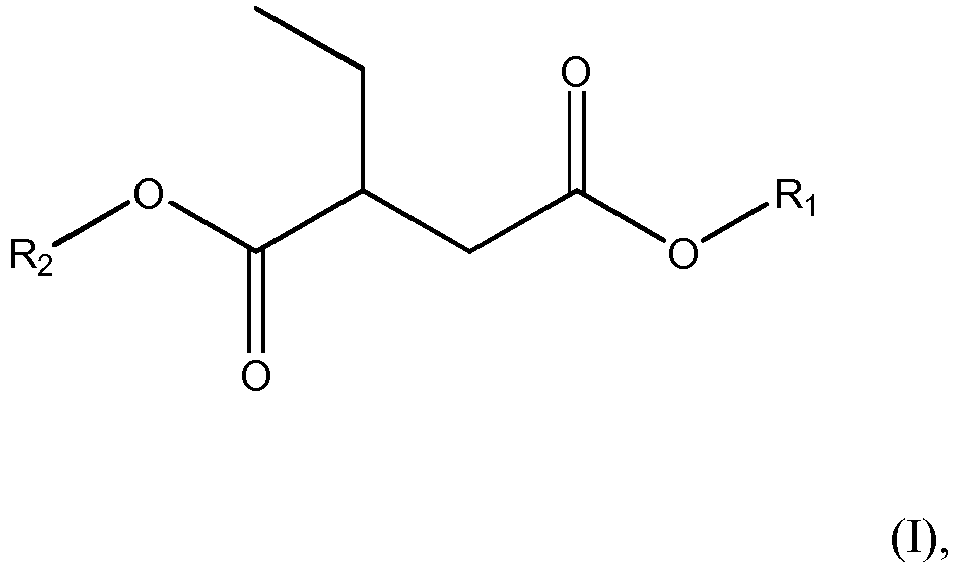
- (ii) 80-94%, by weight of the blend, a dibasic ester of formula

- (iii) 0.5-5%, or 0-10%, by weight of the blend, a dibasic ester of formula

- In another aspect, the present invention is a method for protecting a surface in a coating application comprising the steps of: a) contacting a composition to a surface that is desired not be in contact with a coating, the composition comprising, based on the total weight of the composition: (i) from 1% to 60% by weight a blend of dibasic esters, (ii) from 10% to 75% by weight one or more surfactants; and (iii) a thickener; and b) removing the coating composition from the surface after the coating application.
- In another aspect, the method further comprises rinsing the composition from the surface with water.
- In another aspect, the method comprises a coating application which is a spray booth application.
- In a further aspect, the present invention is a method for protecting a surface during a spray booth operation comprising the steps of a) contacting a composition with a surface that is desired not be contaminated during the spray booth operation, the composition comprising, based on the total weight of the composition, (i) from 1% to 60% by weight a blend of dibasic esters, the blend of dibasic esters having general formula:

- In a further aspect, the present invention is a method for protecting a surface during a spray booth operation comprising the steps of:
- a) contacting a composition with a surface that is desired not be contaminated during the spray booth operation, the composition comprising, based on the total weight of the composition:
- (i) from 1% to 60% by weight a blend of dibasic esters, wherein the blend of dibasic esters comprises:
- (A) 7-14%, by weight of the blend, a dibasic ester of formula:

- (B) 80-94%, by weight of the blend, a dibasic ester of formula

- (C) 0-10%,by weight of the blend, a dibasic ester of formula

- (A) 7-14%, by weight of the blend, a dibasic ester of formula:
- (ii) from 2% to 60% by weight an alcohol ethoxylate;
- (iii) from 1% to 50% by weight a terpene; and
- (iv) a thickener;
- (i) from 1% to 60% by weight a blend of dibasic esters, wherein the blend of dibasic esters comprises:
- b) allowing the composition to be exposed to paint during the spray booth operation; and
- c) rinsing the composition from the surface with an aqueous solution after the spray booth operation.
- In one embodiment, the blend of dibasic esters is derived from one or more by-products in the production of polyamide.
- As used herein, the term "alkyl" means a saturated straight chain, branched chain, or cyclic hydrocarbon radical, including but not limited to, methyl, ethyl, n-propyl, iso-propyl, n-butyl, sec-butyl, t-butyl, pentyl, n-hexyl, and cyclohexyl.
- As used herein, the terminology "(Cr-Cs)" in reference to an organic group, wherein r and s are each integers, indicates that the group may contain from r carbon atoms to s carbon atoms per group.
- Cleaning a spray booth is very labor extensive and complicated process. High pressure water blasting and use of sharp tools expose workers to physical harm. Exposure to hazardous chemicals also put workers in danger.
- The present invention is the use of a composition relating to and an application of depositing a sacrificial coating layer based on biodegradable low-VOC solvent, as a primary ingredient. This coating layer can be sprayed, applied brush or roller on to a vertical or horizontal surface where overspray is not desired. In one embodiment, the sacrificial coating of the use of the present invention remains wet or substantially wet as overspray accumulates on this layer. The presence of this low-VOC solvent allows the coating not to dry/harden at room temperature during a normal operation. At the end of the coatings application, typically a spray booth operation, simply rinsing with water may be used to wash the surrounding coatings and overspray off the booth surfaces. The use of the present invention prevents overspray or unwanted coatings from contaminating the booth and once removed maintain a clean work surface.
- In one embodiment, the composition of the use of the present invention are formulations developed using a non-toxic, non-flammable and biodegradable dibasic ester solvent as described herein (Rhodiasolv Iris, manufactured by Rhodia Inc.), an alcohol ethoxylate (Rhodasurf DA-630, manufactured by Rhodia Inc.), Terpene EO/PO surfactant (Rhodasurf MSC, manufactured by Rhodia Inc.) and a thickener comprising hydroxylpropyl methyl cellulose (Methocel 311, manufactured by Rhodia Inc.). The composition of the use of the present invention has environmentally friendly characteristics such as being non toxic, bio-degradable, and non-flammable.
- The composition of the use of the present invention provides ease of removal of the coating after use as well as a eco-friendly profile. The composition of the use of the present invention does not require the use VOC's as solvents, which are not environmentally friendly. In one embodiment, the use of the invention consists essentially of the blend of dibasic esters described herein, a thickener and a surfactant, typically an alcohol ethoxylate. Accordingly, when such compounds are not present, shipping and storage requirements may be less stringent; the user is not required to wear a respirator typically applicable to high VOC compounds; there is no objectionable solvent odor, and objectionable solvents and VOC's are not released into the air.
- In one embodiment, the formulation will be able to provide 5-10 × 10-3 L (5-10 mils) of wet coating on horizontal or vertical surfaces. This formulation can be diluted with water for other cleaning applications such as stain cleaning, graffiti removing, adhesive cleaning etc.
- The composition of the present invention can be utilized to prevent the deposit of overspray. In one embodiment, the composition comprises, based on the total weight of the composition, (a) from 1% to 60% by weight a blend of dibasic esters; (b) from 10% to 75% by weight one or more surfactants; and (c) a thickener. In one embodiment, the composition of the use of the present invention comprises, based on the total weight of the composition, (a) from 10% to 50% by weight a blend of dibasic esters; (b) from 25% to 75% by weight one or more surfactants; and (c) from 0.01% to 5% by weight a thickener.
- The composition of the use of the present invention comprises a blend of dibasic esters. In one embodiment, the blend comprises adducts of alcohol and linear diacids, the adducts having the formula R1-OOC-A-COO-R2 wherein R1 and/or R2 comprise, individually, a C1-C12 alkyl, more typically a C1-C8 alkyl, and A comprises a mixture of -(CH2)4-, -(CH2)3, and - (-CH2)2-. In another embodiment, R1 and/or R2 comprise, individually, a C4-C12 alkyl, more typically a C4-C8 alkyl. In one embodiment, R1 and R2 can individually comprise a hydrocarbon group originating from fusel oil. In one embodiment, R1 and R2 individually can comprise a hydrocarbon group having 1 to 8 carbon atoms. In one embodiment, R1 and R2 individually can comprise a hydrocarbon group having 5 to 8 carbon atoms.
- In one embodiment, the blend comprises adducts of alcohol and branched or linear diacids, the adducts having the formula R1-OOC-A-COO-R2 wherein R1 and/or R2 comprise, individually, a C1-C12 alkyl, more typically a C1-C8 alkyl, and A comprises a mixture of-(CH2)4-, -CH2CH2CH(CH3)-, and -CH2CH(C2H5)-. In another embodiment, R1 and/or R2 comprise, individually, a C4-C12 alkyl, more typically a C4-C8 alkyl. It is understood that the acid portion may be derived from such dibasic acids such as adipic, succinic, glutaric, oxalic, malonic, pimelic, suberic and azelaic acids, as well as mixtures thereof.
- One or more dibasic esters used in the composition of the use of the present invention can be prepared by any appropriate process. For example, a process for preparing the adduct of adipic acid and of fusel oil is, for example, described in the document "The Use of Egyptian Fusel Oil for the Preparation of Some Plasticizers Compatible with Polyvinyl Chloride", Chuiba et al., Indian Journal of Technology, Vol. 23, August 1985, pp. 309-311.
- The dibasic esters can be obtained by a process comprising an "esterification" stage by reaction of a diacid of formula HOOC-A-COOH or of a diester of formula MeOOC-A-COOMe with a branched alcohol or a mixture of alcohols. The reactions can be appropriately catalyzed. Use is preferably made of at least 2 molar equivalents of alcohols per diacid or diester. The reactions can, if appropriate, be promoted by extraction of the reaction by-products and followed by stages of filtration and/or of purification, for example by distillation.
- The diacids in the form of mixtures can in particular be obtained from a mixture of dinitrile compounds in particular produced and recovered in the process for the manufacture of adiponitrile by double hydrocyanation of butadiene. This process, used on a large scale industrially to produce the greater majority of the adiponitrile consumed worldwide, is described in numerous patents and works. The reaction for the hydrocyanation of butadiene results predominantly in the formulation of linear dinitriles but also in formation of branched dinitriles, the two main ones of which are methylglutaronitrile and ethylsuccinonitrile. The branched dinitrile compounds are separated by distillation and recovered, for example, as top fraction in a distillation column, in the stages for separation and purification of the adiponitrile. The branched dinitriles can subsequently be converted to diacids or diesters (either to light diesters, for a subsequent transesterification reaction with the alcohol or the mixture of alcohols or the fusel oil, or directly to diesters in accordance with the invention).
- Dibasic esters of the composition of the use of the present invention may be derived from one or more by-products in the production of polyamide, for example, polyamide 6,6. In one embodiment, the blend comprises linear or branched, cyclic or noncyclic, C1-C20 alkyl, aryl, alkylaryl or arylalkyl esters of adipic diacids, glutaric diacids, and succinic diacids. In another embodiment, the blend comprises linear or branched, cyclic or noncyclic, C1-C20 alkyl, aryl, alkylaryl or arylalkyl esters of adipic diacids, methylglutaric diacids, and ethylsuccinic diacids
- Generally, polyamide is a copolymer prepared by a condensation reaction formed by reacting a diamine and a dicarboxylic acid. Specifically, polyamide 6,6 is a copolymer prepared by a condensation reaction formed by reacting a diamine, typically hexamethylenediamine, with a dicarboxylic acid, typically adipic acid.
- In one embodiment, the blend of the composition of the use of the present invention can be derived from one or more by-products in the reaction, synthesis and/or production of adipic acid utilized in the production of polyamide, the composition comprising a blend of dialkyl esters of adipic diacids, glutaric diacids, and succinic diacids (herein referred to sometimes as "AGS" or the "AGS blend").
- In one embodiment, the blend of esters is derived from by-products in the reaction, synthesis and/or production of hexamethylenediamine utilized in the production of polyamide, typically polyamide 6,6. The composition comprises a blend of dialkyl esters of adipic diacids, methylglutaric diacids, and ethylsuccinic diacids (herein referred to sometimes as "MGA", "MGN", "MGN blend" or "MGA blend").
- The boiling point of the dibasic ester blend of the present invention is between the range of about 120°C to 450°C. In one embodiment, the boiling point of the blend of the present invention is in the range of about 160°C to 400°C; in one embodiment, the range is about 210°C to 290°C; in another embodiment, the range is about 210°C to 245°C; in another embodiment, the range is the range is about 215°C to 225°C. In one embodiment, the boiling point range of the blend of the present invention is between about 210°C to 390°C, more typically in the range of about 280°C to 390°C, more typically in the range of 295°C to 390°C. In one embodiment, boiling point of the blend of the present invention is in the range of about 215°C to 400°C, typically in the range of about 220°C to 350°C.
- In one embodiment, the blend of dibasic esters has a boiling point range of between about 300°C and 330°C. Typically, the diisoamyl AGS blend is associated with this boiling point range. In another embodiment, the dibasic ester blend of the composition of the use of the present invention has a boiling point range of between about 295°C and 310°C. Typically, the di-n-butyl AGS blend is associated with this boiling point range. Generally, a higher boiling point, typically, above 215°C, or high boiling point range corresponds to lower VOC.
- In certain embodiments, the dibasic ester blend comprises:
- a diester of formula I:

- a diester of formula II:

- a diester of formula III:

- R1 and/or R2 can individually comprise a hydrocarbon having from 1 to 8 carbon atoms, typically, methyl, ethyl, propyl, isopropyl, butyl, isobutyl, n-butyl, isoamyl, hexyl, heptyl or octyl. In such embodiments, the blend typically comprises (by weight of the blend) (i) 15% to 35% of the diester of formula I, (ii) 55% to 70% of the diester of formula II, and (iii) 7% to 20% of the diester of formula III, and more typically, (i) 20% to 28% of the diester of formula I, (ii) 59% to 67% of the diester of formula II, and (iii) 9% to 17% of the diester of formula III. The blend is generally characterized by a flash point of 98 °C, a vapor pressure at 20 °C of less than about 10 Pa, and a distillation temperature range of about 200-300 °C. Mention may also be made of Rhodiasolv® RPDE (Rhodia Inc., Cranbury, NJ), Rhodiasolv® DIB (Rhodia Inc., Cranbury, NJ) and Rhodiasolv® DEE (Rhodia Inc., Cranbury, NJ).
- In certain alternative embodiments, the dibasic ester blend comprises:
- a diester of the formula IV:

- a diester of the formula V:

- a diester of the formula VI:

- R1 and/or R2 can individually comprise a hydrocarbon having from 1 to 8 carbon atoms, typically, methyl, ethyl, propyl, isopropyl, butyl, isobutyl, n-butyl, isoamyl, hexyl, heptyl, or octyl. In such embodiments, the blend typically comprises (by weight of the blend) (i) from 5% to 30% of the diester of formula IV, (ii) from 70% to 95% of the diester of formula V, and (iii) from 0% to 10% of the diester of formula VI. In one emboidment, the blend typically comprises (by weight of the blend): (i) from 6% to 12% of the diester of formula IV, (ii) from 86% to 92% of the diester of formula V, and (iii) from 0.5% to 4% of the diester of formula VI.
- In another embodiment, the blend comprises (by weight of the blend): (i) 9% of the diester of formula IV, (ii) 89% of the diester of formula V, and (iii) 1% of the diester of formula VI. The blend is generally characterized by a flash point of of 98 °C, a vapor pressure at 20 °C of less than about 10 Pa, and a distillation temperature range of about 200-275 °C. Mention may be made of Rhodiasolv® IRIS and Rhodiasolv® DEE/M, manufactured by Rhodia Inc. (manufactured by Rhodia Inc., Cranbury, NJ).
- According to one embodiment of the use of the present invention, the blend of dibasic esters corresponds to one or more by-products of the preparation of adipic acid, which is one of the main monomers in polyamides. For example, the dialkyl esters are obtained by esterification of one by-product, which generally contains, on a weight basis, from 15 to 33% succinic acid, from 50 to 75% glutaric acid and from 5 to 30% adipic acid. As another example, the dialkyl esters are obtained by esterification of a second by-product, which generally contains, on a weight basis, from 30 to 95% methyl glutaric acid, from 5 to 20% ethyl succinic acid and from 1 to 10% adipic acid. It is understood that the acid portion may be derived from such dibasic acids such as, adipic, succinic, glutaric, oxalic, malonic, pimelic, suberic and azelaic acids, as well as mixtures thereof.
- The composition of the use of the present invention may also contain one or more surfactants. The surfactant or surfactants of the use of the present invention can be any number of cationic, amphoteric, zwitterionic, anionic or nonionic surfactants, derivatives thereof, as well as blends of such surfactants.
- In one embodiment, the nonionic surfactants generally includes one or more of for example amides such as alkanolamides, ethoxylated alkanolamides, ethylene bisamides; esters such as fatty acid esters, glycerol esters, ethoxylated fatty acid esters, sorbitan esters, ethoxylated sorbitan; ethoxylates such as alkylphenol ethoxylates, alcohol ethoxylates, tristyrylphenol ethoxylates, mercaptan ethoxylates; end-capped and EO/PO block copolymers such as ethylene oxide/propylene oxide block copolymers, chlorine capped ethoxylates, tetra-functional block copolymers; amine oxides such lauramine oxide, cocamine oxide, stearamine oxide, stearamidopropylamine oxide, palmitamidopropylamine oxide, decylamine oxide; fatty alcohols such as decyl alcohol, lauryl alcohol, tridecyl alcohol, myristyl alcohol, cetyl alcohol, stearyl alcohol, oleyl alcohol, linoleyl alcohol and linolenyl alcohol; and alkoxylated alcohols such as ethoxylated lauryl alcohol, trideceth alcohols; and fatty acids such as lauric acid, oleic acid, stearic acid, myristic acid, cetearic acid, isostearic acid, linoleic acid, linolenic acid, ricinoleic acid, elaidic acid, arichidonic acid, myristoleic acid and mixtures thereof.
- In another embodiment, the non-ionic surfactant is a glycol such as polyethylene glycol (PEG), alkyl PEG esters, polypropylene glycol (PPG) and derivatives thereof. In one embodiment, the surfactant is an alcohol ethoxylate, an alkyl phenol ethoxylate or a terpene alkoxylate. In one exemplary embodiment, the surfactant is a C6-C13 alcohol ethoxylate and, more typically, a C8-C12 alcohol ethoxylate.
- In another embodiment, the surfactant is a cationic surfactant. The cationic surfactant includes but is not limited to quaternary ammonium compounds, such as cetyl trimethyl ammonium bromide (also known as CETAB or cetrimonium bromide), cetyl trimethyl ammonium chloride (also known as cetrimonium chloride), myristyl trimethyl ammonium bromide (also known as myrtrimonium bromide or Quaternium-13), stearyl dimethyl distearyldimonium chloride, dicetyl dimonium chloride, stearyl octyldimonium methosulfate, dihydrogenated palmoylethyl hydroxyethylmonium methosulfate, isostearyl benzylimidonium chloride, cocoyl benzyl hydroxyethyl imidazolinium chloride, dicetyl dimonium chloride and distearyldimonium chloride; isostearylaminopropalkonium chloride or olealkonium chloride; behentrimonium chloride; as well as mixtures thereof.
- In another embodiment, the surfactant is an anionic surfactant. The anionic surfactant includes but is not limited to linear alkylbenzene sulfonates, alpha olefin sulfonates, paraffin sulfonates, alkyl ester sulfonates, alkyl sulfates, alkyl alkoxy sulfates, alkyl sulfonates, alkyl alkoxy carboxylates, alkyl alkoxylated sulfates, monoalkyl phosphates, dialkyl phosphates, sarcosinates, sulfosuccinates, isethionates, and taurates, as well as mixtures thereof. Commonly used anionic surfactants that are suitable as the anionic surfactant component of the composition of the use of the present invention include, for example, ammonium lauryl sulfate, ammonium laureth sulfate, triethylamine lauryl sulfate, triethylamine laureth sulfate, triethanolamine lauryl sulfate, triethanolamine laureth sulfate, monoethanolamine lauryl sulfate, monoethanolamine laureth sulfate, diethanolamine lauryl sulfate, diethanolamine laureth sulfate, lauric monoglyceride sodium sulfate, sodium lauryl sulfate, sodium laureth sulfate, potassium lauryl sulfate, potassium laureth sulfate, sodium-monoalkyl phosphates, sodium dialkyl phosphates, sodium lauroyl sarcosinate, lauroyl sarcosine, cocoyl sarcosine, ammonium cocyl sulfate, ammonium lauryl sulfate, sodium cocyl sulfate, sodium trideceth sulfate, sodium tridecyl sulfate, ammonium trideceth sulfate, ammonium tridecyl sulfate, sodium cocoyl isethionate, disodium laureth sulfosuccinate, sodium methyl oleoyl taurate, sodium laureth carboxylate, sodium trideceth carboxylate, sodium lauryl sulfate, potassium cocyl sulfate, potassium lauryl sulfate, monoethanolamine cocyl sulfate, sodium tridecyl benzene sulfonate, and sodium dodecyl benzene sulfonate. Branched anionic surfactants are particularly preferred, such as sodium trideceth sulfate, sodium tridecyl sulfate, ammonium trideceth sulfate, ammonium tridecyl sulfate, and sodium trideceth carboxylate.
- Any amphoteric surfactant that is acceptable for use includes but is not limited to derivatives of aliphatic secondary and tertiary amines in which the aliphatic radical can be straight chain or branched and wherein one of the aliphatic substituents contains from 8 to 18 carbon atoms and one contains an anionic water solubilizing group. Specific examples of suitable amphoteric surfactants include the alkali metal, alkaline earth metal, ammonium or substituted ammonium salts of alkyl amphocarboxy glycinates and alkyl amphocarboxypropionates, alkyl amphodipropionates, alkyl amphodiacetates, alkyl amphoglycinates, and alkyl amphopropionates, as well as alkyl iminopropionates, alkyl iminodipropionates, and alkyl amphopropylsulfonates , such as for example, cocoamphoacetate cocoamphopropionate, cocoamphodiacetate, lauroamphoacetate, lauroamphodiacetate , lauroamphodipropionate, lauroamphodiacetate, cocoamphopropyl sulfonate caproamphodiacetate, caproamphoacetate, caproamphodipropionate, and stearoamphoacetate.
- Suitable zwitterionic surfactants include alkyl betaines, such as cocodimethyl carboxymethyl betaine, lauryl dimethyl carboxymethyl betaine, lauryl dimethyl alpha-carboxyethyl betaine, cetyl dimethyl carboxymethyl betaine, lauryl bis-(2-hydroxy-ethyl)carboxy methyl betaine, stearyl bis-(2-hydroxy-propyl)carboxymethyl betaine, oleyl dimethyl gamma-carboxypropyl betaine, and lauryl bis-(2-hydroxypropyl)alpha-carboxyethyl betaine, amidopropyl betaines, and alkyl sultaines, such as cocodimethyl sulfopropyl betaine, stearyldimethyl sulfopropyl betaine, lauryl dimethyl sulfoethyl betaine, lauryl bis-(2-hydroxy-ethyl)sulfopropyl betaine, and alkylamidopropylhydroxy sultaines.
- Typically nonionic surfactants are utilized, which include but are not limited to polyalkoxylated surfactants, for example chosen from alkoxylated alcohols, alkoxylated fatty alcohols, alkoxylated triglycerides, alkoxylated fatty acids, alkoxylated sorbitan esters, alkoxylated fatty amines, alkoxylated bis(1-phenylethyl)phenols, alkoxylated tris(1-phenylethyl)phenols and alkoxylated alkylphenols, in which the number of alkoxy and more particularly oxyethylene and/or oxypropylene units is such that the HLB value is greater than or equal to 10.
- In one embodiment, the alcohol ethoxylates used in connection with the present invention have the formula:

- Typically, R7 is a hydrogen or a hydrocarbon chain containing 5 to 25 carbon atoms, more typically from 7 to 14 carbon atoms, most typically, from 8 to 13 carbon atoms, and may be branched or straight-chained and saturated or unsaturated and is selected from the group consisting of hydrogen, alkyl, alkoxy, aryl, alkaryl, alkylarylalkyl and arylalkyl. Typically, "n" is an integer from about 1 to about 30, more typically an integer from 2 to about 20, and most typically an integer from about 3 to about 12.
- In an alternative embodiment, the alcohol ethoxylate is sold under the trade name Rhodasurf (manufactured by Rhodia Inc., Cranbury, NJ).
- In yet another embodiment, surfactants used in the present invention are non-ionic surfactants including but not limited to: polyoxyalkylenated C6-C24 aliphatic alcohols comprising from 2 to 50 oxyalkylene (oxyethylene and/or oxypropylene) units, in particular of those with 12 (mean) carbon atoms or with 18 (mean) carbon atoms; mention may be made of Antarox B12DF, Antarox FM33, Antarox FM63 and Antarox V74, Rhodasurf ID 060, Rhodasurf ID 070 and Rhodasurf LA 42 from (Rhodia Inc., Cranbury, NJ), as well as polyoxyalkylenated C8-C22 aliphatic alcohols containing from 1 to 25 oxyalkylene (oxyethylene or oxypropylene) units.
- In a further embodiment, the surfactant further comprises a terpene or a terpene alkoxylate. Terpene alkoxylates are terpene-based surfactants derived from a renewable raw materials such as α-pinene and β-pinene, and have a C-9 bicyclic alkyl hydrophobe and polyoxy alkylene units in an block distribution or intermixed in random or tapered distribution along the hydrophilic chain. The terpene alkoxylate surfactants are described in the
U.S. Patent Application Publication No. 2006/0135683 to Adam al., June 22, 2006 . - Typical terpene alkoxylates are Nopol alkoxylate surfactants and have the general formula:


- where R6 and R7 are, individually, hydrogen, CH3, or C2H5; "n" is from about 1 to about 30; "m" is from about 0 to about 20; and "p" is from about 0 to 20. The "n", "m" and/or "p" units may be of block distribution or intermixed in random or tapered distribution along the chain.
- In another embodiment, R6 is CH3; "n" is from about 20 to about 25; "m" is from about 5 to about 10. In yet another embodiment, R6 and R7 are individually CH3; "n" is from about 1 to about 8; "m" is from about 2 to about 14; and "p" is from about 10 to about 20. Mention can be made of Rhodoclean® HP (a terpene EO/PO)(manufactured by Rhodia Inc., Cranbury, NJ) and Rhodoclean® MSC (a terpene EO/PO)(manufactured by Rhodia Inc., Cranbury, NJ).
- In one embodiment, the surfactants utilized in the composition of the use of the present invention are present in an amount of from 1% to 75% by weight of the composition. One or a combination of surfactants totaling this amount may be utilized. In another embodiment, the surfactants are present in an amount of from 10% to 60% by weight of the composition. In another embodiment, the surfactant is a combination of (i) an alcohol ethoxylate present from 1% to 60% by weight of the composition, typically from 35% to 55% by weight of the composition, and (ii) a terpene alkoxylate present from 0.1% to 20% by weight of the composition, typically from 2% to 15% by weight of the composition.
- The composition of the use of the present invention can comprise thickeners to aid application of the composition to the surface to be protected. The thickener is typically one or a combination of polyacrylates, polyacrylamides, silicates, magnesium silicates, polyvinyl alcohol, fumed silicas, guar gum, guar gum derivatives, cellulose, cellulose derivatives, hydroxypropyl methyl cellulose and hydroxymethylcellulose.
- Other suitable thickeners can be utilized, including but not limited to fumed silica, silica gels, precipitated silica, guar gum, guar gum derivatives, clay, gums and any other thickeners will be useful along with preferable cellulosic thickeners, polyacrylates, magnesium silicates, polyvinyl alcohol. Still other thickeners which maybe used include dextrin and cornstarch.
- In one embodiment, the thickeners utilized in the composition of the use of the present invention are in an amount of from 0.01% to 20% by weight of the composition. In another embodiment, the thickeners are present in an amount of from 0.5% to 1 % by weight of the composition.
- In a further or alternative embodiment, the composition of the use of the present invention further comprises additional components or additives. These additional ingredients can be added to improve performance or appearance of the coatings such as wetting agents, solvents, defoamers, leveling agents, pigment paste, dyes etc. Other additional components include, but are not limited to, delaminates, buffering and/or pH control agents, fragrances, perfumes, dyes, whiteners, brighteners, solubilizing materials, stabilizers, corrosion inhibitors, lotions and/or mineral oils, enzymes, cloud point modifiers, preservatives, ion exchangers, chelating agents, sudsing control agents, soil removal agents, softening agents, opacifiers, inert diluents, graying inhibitors, stabilizers, polymers and the like.
- The composition of the use of the present invention is employed by applying in a convenient manner such as, for example, by brushing, rolling, spraying or the like. Typically, the composition will be contacted with or applied to the interior walls, windows, and floor surfaces in and around a paint spray booth. In some embodiments, the composition of the use of the present invention is allowed to set for about 1 to about 30 minutes in order to settle or form a film. During a spraying application, the object that is desired to be coated is placed in the spray booth. Spraying or application of coatings are typically performed on automotive parts, aerospace parts, appliance parts and/or parts in industries which require coatings or decorative finishes. Overspray collects on the composition (other wise referred to as a sacrificial coating) instead of the surface the coating protects and remains until the end of the coating application
- In one embodiment, the coating composition of the use of the present invention remains on the surface for a short period of time (e.g., daily) and then is removed. Typically, the sacrificial coating is removed through washing. Washing is generally effected under pressure alone, although certain areas where paint has built-up heavily may require hand pressure with a towel or sponge and possibly use of a brush.
- In other embodiments, the sacrificial coating may remain on the surface for an extended period of time. Typically, during a paint spray application, the sacrificial coating will remain on the surfaces for about 30 minutes to about 48 hours, which is more than adequate for all the work to be completed. Depending on its use, however, the composition may be allowed to remain on the surface for a longer period of time, for example, longer than 72 hours.
- In another embodiment, the composition of the use of the present invention may also be used to prevent the deposition of contamination in general from directly depositing on the surface on which the sacrificial coating is applied. Contaminants can include but are not limited to grease, rain, snow, dirt, oil, air pollutants, soot, vehicle exhaust, and the like.
- Results are as follows:
Material R0729-45-2 (DV-9280) Rhodiasolv Iris 40.47 Rhodasurf DA-630 47.95 Methocel 311 0.705 Rhodoclean MSC 10.86 Total 99.98 - A panel of the above-referenced substrate (Bonderite B 100) is coated with 4×10⁻³ L (4 wet mils) of DV-9280. Water-based paint (light green) and Oil-based paint (dark brown) is then applied on the panel. The panel is then rinsed with water using a squeeze bottle. Results: Rank 5 - water and oil based paints were completely rinsed from the panel. The substrate was left without any paint marks.
- A panel of the cold rolled steel substrate is coated with 4×10⁻³ L (4 wet mils) of DV-9280. Water-based paint (light green) and Oil-based paint (dark brown) is then applied on the panel. The panel is then rinsed with water using a squeeze bottle. Results: Rank 5 - water and oil based paints were completely rinsed. The substrate was left without any paint marks.
- A panel of the above-referenced substrate (aluminum) is coated with 4×10⁻³ L (4 wet mils) of DV-9280. Water based paint (light green) and Oil based paint (dark brown) is then applied on the panel. The panel is then rinsed with water using a squeeze bottle. Results: Rank 4 - The paint marks were rinsed and cleared. The water-based paint was completely removed. The oil-based paint had some marks left on the substrate. Wiping with paper towel, substrate was completely cleaned.
Ranking Performance 5 No color or marking 4 Slight color or marking 3 Colored marking 2 Significant colored marking 1 No change from initial colored marking
Claims (14)
- Use of a composition for preventing the deposit of overspray, the composition comprising, based on the total weight of the composition,:(a) from 1% to 60% by weight a blend of dibasic esters;(b) from 10% to 75% by weight one or more surfactants; and(c) a thickener.
- Use of the composition in claim 1 wherein the blend of dibasic esters comprises (i) a dialkyl methylglutarate and (ii) at least one of a dialkyl adipate or a dialkyl ethylsuccinate.
- Use of the composition of claim 1 wherein the blend of dibasic esters is derived from one or more by-products in the production of polyamide.
- Use of the composition of claim 2 wherein the blend of dibasic esters is derived from the process to produce adiponitrile.
- Use of the composition of claim 1 wherein a blend of dibasic esters has a general formula:

- Use of the composition of claim 1 wherein the one or more surfactants are selected from the group consisting of an alcohol alkoxylate, an alcohol ethoxylate, an alkyl phenol alkoxylate, an alkyl phenol ethoxylate, a terpene alkoxylate, a terpene and any combination thereof.
- Use of the composition of claim 1 wherein the thickener is selected from the group consisting of polyacrylates, polyacrylamides, silicates, magnesium silicates, polyvinyl alcohol, fumed silicas, guar gum, guar gum derivatives, cellulose, cellulose derivatives, hydroxylpropsyl methyl cellulose, hydroxymethylcellulose and any combination thereof.
- Use of the composition of claim 1 wherein the one ore more surfactants comprise (a) an alcohol ethoxylate and (b) a terpene.
- Use of the composition of claim 1 wherein the blend of dibasic esters comprises:(i) 7-14%, by weight of the blend, a dibasic ester of formula:
 (ii) 80-94%, by weight of the blend, a dibasic ester of formula
 (iii) 0-10%,by weight of the blend, a dibasic ester of formula
- A method for protecting a surface in a coating application comprising the steps of:a) contacting a composition to a surface that is desired not be in contact with a coating application coating, the composition comprising, based on the total weight of the composition,:(i) from 1% to 60% by weight a blend of dibasic esters;(ii) from 10% to 75% by weight one or more surfactants; and(iii) a thickener; andb) removing the composition from the surface after the coating application.
- The method of claim 10 wherein step b) further comprises rinsing the composition from the surface with water.
- The method of claim 10, wherein the composition is the composition of any one of claims 2 to 9.
- The method of claim 10 wherein the coating application is a spray booth application.
- The method of claim 10, for protecting a surface during a spray booth operation comprising the steps of:a) contacting a composition with a surface that is desired not be contaminated during the spray booth operation, the composition comprising, based on the total weight of the composition:(i) from 1% to 60% by weight a blend of dibasic esters, wherein the blend of dibasic esters comprises:(A) 7-14%, by weight of the blend, a dibasic ester of formula:
 (B) 80-94%, by weight of the blend, a dibasic ester of formula
 (C) 0-10%,by weight of the blend, a dibasic ester of formula
 (ii) from 2% to 60% by weight an alcohol ethoxylate;(iii) from 1% to 50% by weight a terpene;
wherein the combined amount of alcohol ethoxylate and terpene is from 10% to 75% by weight; and(iv) a thickener;b) allowing the composition to be exposed to paint during the spray booth operation; andc) rinsing the composition from the surface with an aqueous solution after the spray booth operation.
Applications Claiming Priority (2)
| Application Number | Priority Date | Filing Date | Title |
|---|---|---|---|
| US27582709P | 2009-09-03 | 2009-09-03 | |
| PCT/US2010/002391 WO2011028274A2 (en) | 2009-09-03 | 2010-09-01 | Protective biodegradable coatings and methods for use |
Publications (3)
| Publication Number | Publication Date |
|---|---|
| EP2462200A2 EP2462200A2 (en) | 2012-06-13 |
| EP2462200A4 EP2462200A4 (en) | 2013-10-02 |
| EP2462200B1 true EP2462200B1 (en) | 2015-11-11 |
Family
ID=43649844
Family Applications (1)
| Application Number | Title | Priority Date | Filing Date |
|---|---|---|---|
| EP10814080.7A Not-in-force EP2462200B1 (en) | 2009-09-03 | 2010-09-01 | The use of protective biodegradable coatings for preventing the deposit of overspray |
Country Status (3)
| Country | Link |
|---|---|
| US (1) | US20120177818A1 (en) |
| EP (1) | EP2462200B1 (en) |
| WO (1) | WO2011028274A2 (en) |
Families Citing this family (16)
| Publication number | Priority date | Publication date | Assignee | Title |
|---|---|---|---|---|
| ES2423797T3 (en) * | 2010-03-10 | 2013-09-24 | Ppg Industries Ohio, Inc. | Procedure for removing excess paint spray from a paint spray booth |
| CA2873685C (en) * | 2012-04-17 | 2020-06-02 | Rhodia Operations | Polysaccharide slurries with environmentally friendly activator solvents |
| ES2634656T3 (en) | 2014-09-10 | 2017-09-28 | Ppg Industries Ohio Inc. | Aqueous separation liquid and process for removing excess spray paint from a paint spray booth |
| WO2020007602A1 (en) * | 2018-07-03 | 2020-01-09 | Henkel Ag & Co. Kgaa | Use of polyvinyl alcohols in water-based carrier media for separating paint overspray |
| US11883527B2 (en) * | 2019-12-09 | 2024-01-30 | Nicoventures Trading Limited | Oral composition and method of manufacture |
| US11617744B2 (en) | 2019-12-09 | 2023-04-04 | Nico Ventures Trading Limited | Moist oral compositions |
| US12520867B2 (en) | 2019-12-09 | 2026-01-13 | Nicoventures Trading Limited | Buffered oral compositions |
| US11872231B2 (en) | 2019-12-09 | 2024-01-16 | Nicoventures Trading Limited | Moist oral product comprising an active ingredient |
| US11793230B2 (en) | 2019-12-09 | 2023-10-24 | Nicoventures Trading Limited | Oral products with improved binding of active ingredients |
| US12439952B2 (en) | 2019-12-09 | 2025-10-14 | Nicoventures Trading Limited | Moist oral compositions |
| US12439949B2 (en) | 2019-12-09 | 2025-10-14 | Nicoventures Trading Limited | Oral compositions with reduced water activity |
| US11969502B2 (en) | 2019-12-09 | 2024-04-30 | Nicoventures Trading Limited | Oral products |
| US12433321B2 (en) | 2019-12-09 | 2025-10-07 | Nicoventures Trading Limited | Oral composition with beet material |
| US12310959B2 (en) | 2019-12-09 | 2025-05-27 | Nicoventures Trading Limited | Oral compositions with reduced water content |
| US11826462B2 (en) | 2019-12-09 | 2023-11-28 | Nicoventures Trading Limited | Oral product with sustained flavor release |
| WO2022269556A1 (en) | 2021-06-25 | 2022-12-29 | Nicoventures Trading Limited | Oral products and method of manufacture |
Family Cites Families (14)
| Publication number | Priority date | Publication date | Assignee | Title |
|---|---|---|---|---|
| US5204010A (en) * | 1986-10-06 | 1993-04-20 | Colgate-Palmolive Co. | Cationic/anionic surfactant complex antistatic and fabric softening emulsion for wash cycle laundry applications |
| US4984595A (en) * | 1989-05-04 | 1991-01-15 | Flakt, Inc. | Cleaning arrangement and method for paint spray booth |
| US5098591A (en) * | 1989-06-30 | 1992-03-24 | Stevens Sciences Corp. | Paint stripper and varnish remover compositions containing organoclay rheological additives, methods for making these compositions and methods for removing paint and other polymeric coatings from flexible and inflexible surfaces |
| US6165962A (en) * | 1997-07-31 | 2000-12-26 | E. I. Du Pont De Nemours And Comapny | Aqueous microemulsions |
| US6491746B2 (en) | 2000-06-14 | 2002-12-10 | Gage Products Company | Protective coating |
| US20060089281A1 (en) * | 2004-09-01 | 2006-04-27 | Gibson Gregory L | Methods and compositions for paint removal |
| US7501470B2 (en) | 2004-12-03 | 2009-03-10 | Rhodia Inc. | Use of polyoxypropylene and polyoxyethylene terpene compounds in emulsion polymerization |
| US8278257B2 (en) * | 2005-04-06 | 2012-10-02 | W. M. Barr & Company, Inc. | Color changing paint removing composition |
| US8324144B2 (en) * | 2005-05-05 | 2012-12-04 | W.M. Barr & Company, Inc. | Color changing paint removing composition containing methylene chloride |
| US20080139437A1 (en) * | 2006-11-10 | 2008-06-12 | Power John W | Ether-containing paint removing composition |
| WO2008072193A2 (en) * | 2006-12-15 | 2008-06-19 | Liquid Colours (Pty) Ltd | Security composition |
| GB0718356D0 (en) * | 2007-09-20 | 2007-10-31 | Ici Plc | Stripping compositions |
| WO2009099948A2 (en) * | 2008-01-31 | 2009-08-13 | Rhodia, Inc. | Efficient coalescing agents |
| US8222194B2 (en) | 2008-05-09 | 2012-07-17 | Rhodia Operations | Cleaning compositions incorporating green solvents and methods for use |
-
2010
- 2010-09-01 US US13/393,890 patent/US20120177818A1/en not_active Abandoned
- 2010-09-01 WO PCT/US2010/002391 patent/WO2011028274A2/en not_active Ceased
- 2010-09-01 EP EP10814080.7A patent/EP2462200B1/en not_active Not-in-force
Also Published As
| Publication number | Publication date |
|---|---|
| US20120177818A1 (en) | 2012-07-12 |
| EP2462200A2 (en) | 2012-06-13 |
| EP2462200A4 (en) | 2013-10-02 |
| WO2011028274A3 (en) | 2011-07-28 |
| WO2011028274A2 (en) | 2011-03-10 |
Similar Documents
| Publication | Publication Date | Title |
|---|---|---|
| US20120177818A1 (en) | Protective biodegradable coatings and methods for use | |
| EP2285946B1 (en) | Cleaning compositions incorporating green solvents and methods for use | |
| US8222194B2 (en) | Cleaning compositions incorporating green solvents and methods for use | |
| CA2803389C (en) | Carboxy ester ketal removal compositions, methods of manufacture, and uses thereof | |
| AU2011338993B2 (en) | Dibasic esters utilized as terpene co-solvents, substitutes and/or carriers in tar sand/bitumen/asphaltene cleaning applications | |
| US20130146545A1 (en) | Use of eco-friendly microemulsions in oil cleaning applications | |
| AU2010308556B2 (en) | Auto-emulsifying cleaning systems and methods for use | |
| US8153577B2 (en) | Methods for cleaning recyclable substrates or containers | |
| JP6781513B2 (en) | Hard surface cleaner |
Legal Events
| Date | Code | Title | Description |
|---|---|---|---|
| PUAI | Public reference made under article 153(3) epc to a published international application that has entered the european phase |
Free format text: ORIGINAL CODE: 0009012 |
|
| 17P | Request for examination filed |
Effective date: 20120309 |
|
| AK | Designated contracting states |
Kind code of ref document: A2 Designated state(s): AL AT BE BG CH CY CZ DE DK EE ES FI FR GB GR HR HU IE IS IT LI LT LU LV MC MK MT NL NO PL PT RO SE SI SK SM TR |
|
| DAX | Request for extension of the european patent (deleted) | ||
| A4 | Supplementary search report drawn up and despatched |
Effective date: 20130904 |
|
| RIC1 | Information provided on ipc code assigned before grant |
Ipc: B05D 1/32 20060101ALN20130829BHEP Ipc: C09D 7/00 20060101ALI20130829BHEP Ipc: C09D 5/00 20060101AFI20130829BHEP |
|
| GRAP | Despatch of communication of intention to grant a patent |
Free format text: ORIGINAL CODE: EPIDOSNIGR1 |
|
| RIC1 | Information provided on ipc code assigned before grant |
Ipc: B05D 1/32 20060101ALN20150217BHEP Ipc: C09D 5/00 20060101AFI20150217BHEP Ipc: C09D 7/00 20060101ALI20150217BHEP |
|
| RIC1 | Information provided on ipc code assigned before grant |
Ipc: B05D 1/32 20060101ALN20150220BHEP Ipc: C09D 5/00 20060101AFI20150220BHEP Ipc: C09D 7/00 20060101ALI20150220BHEP |
|
| RIC1 | Information provided on ipc code assigned before grant |
Ipc: C09D 5/00 20060101AFI20150303BHEP Ipc: C09D 7/00 20060101ALI20150303BHEP Ipc: B05D 1/32 20060101ALN20150303BHEP |
|
| INTG | Intention to grant announced |
Effective date: 20150317 |
|
| REG | Reference to a national code |
Ref country code: DE Ref legal event code: R079 Ref document number: 602010029067 Country of ref document: DE Free format text: PREVIOUS MAIN CLASS: C09D0007120000 Ipc: C09D0005000000 |
|
| GRAP | Despatch of communication of intention to grant a patent |
Free format text: ORIGINAL CODE: EPIDOSNIGR1 |
|
| INTG | Intention to grant announced |
Effective date: 20150527 |
|
| RIC1 | Information provided on ipc code assigned before grant |
Ipc: C09D 7/00 20060101ALI20150518BHEP Ipc: B05D 1/32 20060101ALN20150518BHEP Ipc: C09D 5/00 20060101AFI20150518BHEP |
|
| GRAS | Grant fee paid |
Free format text: ORIGINAL CODE: EPIDOSNIGR3 |
|
| GRAA | (expected) grant |
Free format text: ORIGINAL CODE: 0009210 |
|
| AK | Designated contracting states |
Kind code of ref document: B1 Designated state(s): AL AT BE BG CH CY CZ DE DK EE ES FI FR GB GR HR HU IE IS IT LI LT LU LV MC MK MT NL NO PL PT RO SE SI SK SM TR |
|
| REG | Reference to a national code |
Ref country code: GB Ref legal event code: FG4D |
|
| REG | Reference to a national code |
Ref country code: CH Ref legal event code: EP |
|
| REG | Reference to a national code |
Ref country code: IE Ref legal event code: FG4D |
|
| REG | Reference to a national code |
Ref country code: AT Ref legal event code: REF Ref document number: 760448 Country of ref document: AT Kind code of ref document: T Effective date: 20151215 |
|
| REG | Reference to a national code |
Ref country code: DE Ref legal event code: R096 Ref document number: 602010029067 Country of ref document: DE |
|
| REG | Reference to a national code |
Ref country code: LT Ref legal event code: MG4D |
|
| REG | Reference to a national code |
Ref country code: NL Ref legal event code: MP Effective date: 20160211 |
|
| REG | Reference to a national code |
Ref country code: AT Ref legal event code: MK05 Ref document number: 760448 Country of ref document: AT Kind code of ref document: T Effective date: 20151111 |
|
| PG25 | Lapsed in a contracting state [announced via postgrant information from national office to epo] |
Ref country code: NL Free format text: LAPSE BECAUSE OF FAILURE TO SUBMIT A TRANSLATION OF THE DESCRIPTION OR TO PAY THE FEE WITHIN THE PRESCRIBED TIME-LIMIT Effective date: 20151111 Ref country code: NO Free format text: LAPSE BECAUSE OF FAILURE TO SUBMIT A TRANSLATION OF THE DESCRIPTION OR TO PAY THE FEE WITHIN THE PRESCRIBED TIME-LIMIT Effective date: 20160211 Ref country code: ES Free format text: LAPSE BECAUSE OF FAILURE TO SUBMIT A TRANSLATION OF THE DESCRIPTION OR TO PAY THE FEE WITHIN THE PRESCRIBED TIME-LIMIT Effective date: 20151111 Ref country code: IS Free format text: LAPSE BECAUSE OF FAILURE TO SUBMIT A TRANSLATION OF THE DESCRIPTION OR TO PAY THE FEE WITHIN THE PRESCRIBED TIME-LIMIT Effective date: 20160311 Ref country code: HR Free format text: LAPSE BECAUSE OF FAILURE TO SUBMIT A TRANSLATION OF THE DESCRIPTION OR TO PAY THE FEE WITHIN THE PRESCRIBED TIME-LIMIT Effective date: 20151111 Ref country code: LT Free format text: LAPSE BECAUSE OF FAILURE TO SUBMIT A TRANSLATION OF THE DESCRIPTION OR TO PAY THE FEE WITHIN THE PRESCRIBED TIME-LIMIT Effective date: 20151111 Ref country code: IT Free format text: LAPSE BECAUSE OF FAILURE TO SUBMIT A TRANSLATION OF THE DESCRIPTION OR TO PAY THE FEE WITHIN THE PRESCRIBED TIME-LIMIT Effective date: 20151111 |
|
| REG | Reference to a national code |
Ref country code: DE Ref legal event code: R082 Ref document number: 602010029067 Country of ref document: DE Representative=s name: HERNANDEZ, YORCK, DIPL.-ING., DE |
|
| PG25 | Lapsed in a contracting state [announced via postgrant information from national office to epo] |
Ref country code: AT Free format text: LAPSE BECAUSE OF FAILURE TO SUBMIT A TRANSLATION OF THE DESCRIPTION OR TO PAY THE FEE WITHIN THE PRESCRIBED TIME-LIMIT Effective date: 20151111 Ref country code: FI Free format text: LAPSE BECAUSE OF FAILURE TO SUBMIT A TRANSLATION OF THE DESCRIPTION OR TO PAY THE FEE WITHIN THE PRESCRIBED TIME-LIMIT Effective date: 20151111 Ref country code: SE Free format text: LAPSE BECAUSE OF FAILURE TO SUBMIT A TRANSLATION OF THE DESCRIPTION OR TO PAY THE FEE WITHIN THE PRESCRIBED TIME-LIMIT Effective date: 20151111 Ref country code: PL Free format text: LAPSE BECAUSE OF FAILURE TO SUBMIT A TRANSLATION OF THE DESCRIPTION OR TO PAY THE FEE WITHIN THE PRESCRIBED TIME-LIMIT Effective date: 20151111 Ref country code: PT Free format text: LAPSE BECAUSE OF FAILURE TO SUBMIT A TRANSLATION OF THE DESCRIPTION OR TO PAY THE FEE WITHIN THE PRESCRIBED TIME-LIMIT Effective date: 20160311 Ref country code: GR Free format text: LAPSE BECAUSE OF FAILURE TO SUBMIT A TRANSLATION OF THE DESCRIPTION OR TO PAY THE FEE WITHIN THE PRESCRIBED TIME-LIMIT Effective date: 20160212 Ref country code: LV Free format text: LAPSE BECAUSE OF FAILURE TO SUBMIT A TRANSLATION OF THE DESCRIPTION OR TO PAY THE FEE WITHIN THE PRESCRIBED TIME-LIMIT Effective date: 20151111 |
|
| PG25 | Lapsed in a contracting state [announced via postgrant information from national office to epo] |
Ref country code: CZ Free format text: LAPSE BECAUSE OF FAILURE TO SUBMIT A TRANSLATION OF THE DESCRIPTION OR TO PAY THE FEE WITHIN THE PRESCRIBED TIME-LIMIT Effective date: 20151111 |
|
| REG | Reference to a national code |
Ref country code: DE Ref legal event code: R097 Ref document number: 602010029067 Country of ref document: DE |
|
| PG25 | Lapsed in a contracting state [announced via postgrant information from national office to epo] |
Ref country code: SM Free format text: LAPSE BECAUSE OF FAILURE TO SUBMIT A TRANSLATION OF THE DESCRIPTION OR TO PAY THE FEE WITHIN THE PRESCRIBED TIME-LIMIT Effective date: 20151111 Ref country code: SK Free format text: LAPSE BECAUSE OF FAILURE TO SUBMIT A TRANSLATION OF THE DESCRIPTION OR TO PAY THE FEE WITHIN THE PRESCRIBED TIME-LIMIT Effective date: 20151111 Ref country code: RO Free format text: LAPSE BECAUSE OF FAILURE TO SUBMIT A TRANSLATION OF THE DESCRIPTION OR TO PAY THE FEE WITHIN THE PRESCRIBED TIME-LIMIT Effective date: 20151111 Ref country code: DK Free format text: LAPSE BECAUSE OF FAILURE TO SUBMIT A TRANSLATION OF THE DESCRIPTION OR TO PAY THE FEE WITHIN THE PRESCRIBED TIME-LIMIT Effective date: 20151111 Ref country code: EE Free format text: LAPSE BECAUSE OF FAILURE TO SUBMIT A TRANSLATION OF THE DESCRIPTION OR TO PAY THE FEE WITHIN THE PRESCRIBED TIME-LIMIT Effective date: 20151111 |
|
| PLBE | No opposition filed within time limit |
Free format text: ORIGINAL CODE: 0009261 |
|
| STAA | Information on the status of an ep patent application or granted ep patent |
Free format text: STATUS: NO OPPOSITION FILED WITHIN TIME LIMIT |
|
| 26N | No opposition filed |
Effective date: 20160812 |
|
| PG25 | Lapsed in a contracting state [announced via postgrant information from national office to epo] |
Ref country code: SI Free format text: LAPSE BECAUSE OF FAILURE TO SUBMIT A TRANSLATION OF THE DESCRIPTION OR TO PAY THE FEE WITHIN THE PRESCRIBED TIME-LIMIT Effective date: 20151111 |
|
| PG25 | Lapsed in a contracting state [announced via postgrant information from national office to epo] |
Ref country code: BE Free format text: LAPSE BECAUSE OF FAILURE TO SUBMIT A TRANSLATION OF THE DESCRIPTION OR TO PAY THE FEE WITHIN THE PRESCRIBED TIME-LIMIT Effective date: 20151111 |
|
| PGFP | Annual fee paid to national office [announced via postgrant information from national office to epo] |
Ref country code: BE Payment date: 20160815 Year of fee payment: 7 |
|
| REG | Reference to a national code |
Ref country code: DE Ref legal event code: R119 Ref document number: 602010029067 Country of ref document: DE |
|
| GBPC | Gb: european patent ceased through non-payment of renewal fee |
Effective date: 20160901 |
|
| REG | Reference to a national code |
Ref country code: IE Ref legal event code: MM4A |
|
| REG | Reference to a national code |
Ref country code: FR Ref legal event code: ST Effective date: 20170531 |
|
| PG25 | Lapsed in a contracting state [announced via postgrant information from national office to epo] |
Ref country code: FR Free format text: LAPSE BECAUSE OF NON-PAYMENT OF DUE FEES Effective date: 20160930 Ref country code: GB Free format text: LAPSE BECAUSE OF NON-PAYMENT OF DUE FEES Effective date: 20160901 Ref country code: IE Free format text: LAPSE BECAUSE OF NON-PAYMENT OF DUE FEES Effective date: 20160901 Ref country code: DE Free format text: LAPSE BECAUSE OF NON-PAYMENT OF DUE FEES Effective date: 20170401 |
|
| PGFP | Annual fee paid to national office [announced via postgrant information from national office to epo] |
Ref country code: LU Payment date: 20170824 Year of fee payment: 8 |
|
| PGFP | Annual fee paid to national office [announced via postgrant information from national office to epo] |
Ref country code: MC Payment date: 20170809 Year of fee payment: 8 Ref country code: CH Payment date: 20170912 Year of fee payment: 8 |
|
| PG25 | Lapsed in a contracting state [announced via postgrant information from national office to epo] |
Ref country code: CY Free format text: LAPSE BECAUSE OF FAILURE TO SUBMIT A TRANSLATION OF THE DESCRIPTION OR TO PAY THE FEE WITHIN THE PRESCRIBED TIME-LIMIT Effective date: 20151111 Ref country code: HU Free format text: LAPSE BECAUSE OF FAILURE TO SUBMIT A TRANSLATION OF THE DESCRIPTION OR TO PAY THE FEE WITHIN THE PRESCRIBED TIME-LIMIT; INVALID AB INITIO Effective date: 20100901 |
|
| PG25 | Lapsed in a contracting state [announced via postgrant information from national office to epo] |
Ref country code: TR Free format text: LAPSE BECAUSE OF FAILURE TO SUBMIT A TRANSLATION OF THE DESCRIPTION OR TO PAY THE FEE WITHIN THE PRESCRIBED TIME-LIMIT Effective date: 20151111 Ref country code: MK Free format text: LAPSE BECAUSE OF FAILURE TO SUBMIT A TRANSLATION OF THE DESCRIPTION OR TO PAY THE FEE WITHIN THE PRESCRIBED TIME-LIMIT Effective date: 20151111 |
|
| PG25 | Lapsed in a contracting state [announced via postgrant information from national office to epo] |
Ref country code: BG Free format text: LAPSE BECAUSE OF FAILURE TO SUBMIT A TRANSLATION OF THE DESCRIPTION OR TO PAY THE FEE WITHIN THE PRESCRIBED TIME-LIMIT Effective date: 20151111 |
|
| PGFP | Annual fee paid to national office [announced via postgrant information from national office to epo] |
Ref country code: MT Payment date: 20170914 Year of fee payment: 8 |
|
| PG25 | Lapsed in a contracting state [announced via postgrant information from national office to epo] |
Ref country code: AL Free format text: LAPSE BECAUSE OF FAILURE TO SUBMIT A TRANSLATION OF THE DESCRIPTION OR TO PAY THE FEE WITHIN THE PRESCRIBED TIME-LIMIT Effective date: 20151111 |
|
| PG25 | Lapsed in a contracting state [announced via postgrant information from national office to epo] |
Ref country code: MC Free format text: LAPSE BECAUSE OF NON-PAYMENT OF DUE FEES Effective date: 20181001 |
|
| REG | Reference to a national code |
Ref country code: CH Ref legal event code: PL |
|
| PG25 | Lapsed in a contracting state [announced via postgrant information from national office to epo] |
Ref country code: LU Free format text: LAPSE BECAUSE OF NON-PAYMENT OF DUE FEES Effective date: 20180901 |
|
| PG25 | Lapsed in a contracting state [announced via postgrant information from national office to epo] |
Ref country code: CH Free format text: LAPSE BECAUSE OF NON-PAYMENT OF DUE FEES Effective date: 20180930 Ref country code: LI Free format text: LAPSE BECAUSE OF NON-PAYMENT OF DUE FEES Effective date: 20180930 |
|
| PG25 | Lapsed in a contracting state [announced via postgrant information from national office to epo] |
Ref country code: MT Free format text: LAPSE BECAUSE OF NON-PAYMENT OF DUE FEES Effective date: 20180901 |