EP2460894A1 - Prognostic marker for mamma carcinoma - Google Patents
Prognostic marker for mamma carcinoma Download PDFInfo
- Publication number
- EP2460894A1 EP2460894A1 EP11192254A EP11192254A EP2460894A1 EP 2460894 A1 EP2460894 A1 EP 2460894A1 EP 11192254 A EP11192254 A EP 11192254A EP 11192254 A EP11192254 A EP 11192254A EP 2460894 A1 EP2460894 A1 EP 2460894A1
- Authority
- EP
- European Patent Office
- Prior art keywords
- breast cancer
- patients
- marker
- group
- markers
- Prior art date
- Legal status (The legal status is an assumption and is not a legal conclusion. Google has not performed a legal analysis and makes no representation as to the accuracy of the status listed.)
- Withdrawn
Links
- 239000003550 marker Substances 0.000 title claims abstract description 99
- 201000009030 Carcinoma Diseases 0.000 title 1
- 210000000481 breast Anatomy 0.000 title 1
- 238000011282 treatment Methods 0.000 claims abstract description 44
- 206010006187 Breast cancer Diseases 0.000 claims abstract description 37
- 208000026310 Breast neoplasm Diseases 0.000 claims abstract description 35
- 238000004458 analytical method Methods 0.000 claims abstract description 25
- 238000011394 anticancer treatment Methods 0.000 claims abstract description 5
- 108700028369 Alleles Proteins 0.000 claims description 103
- 208000016356 hereditary diffuse gastric adenocarcinoma Diseases 0.000 claims description 47
- 206010028980 Neoplasm Diseases 0.000 claims description 31
- 201000011510 cancer Diseases 0.000 claims description 23
- 102000015694 estrogen receptors Human genes 0.000 claims description 21
- 108010038795 estrogen receptors Proteins 0.000 claims description 21
- 102000003998 progesterone receptors Human genes 0.000 claims description 20
- 108090000468 progesterone receptors Proteins 0.000 claims description 20
- 238000000034 method Methods 0.000 claims description 19
- 108020004414 DNA Proteins 0.000 claims description 17
- 239000003814 drug Substances 0.000 claims description 17
- 108091008039 hormone receptors Proteins 0.000 claims description 16
- 230000008569 process Effects 0.000 claims description 16
- 101001012157 Homo sapiens Receptor tyrosine-protein kinase erbB-2 Proteins 0.000 claims description 15
- 102100030086 Receptor tyrosine-protein kinase erbB-2 Human genes 0.000 claims description 15
- NKANXQFJJICGDU-QPLCGJKRSA-N Tamoxifen Chemical compound C=1C=CC=CC=1C(/CC)=C(C=1C=CC(OCCN(C)C)=CC=1)/C1=CC=CC=C1 NKANXQFJJICGDU-QPLCGJKRSA-N 0.000 claims description 14
- 150000001875 compounds Chemical class 0.000 claims description 10
- 150000007523 nucleic acids Chemical class 0.000 claims description 10
- 102000039446 nucleic acids Human genes 0.000 claims description 9
- 108020004707 nucleic acids Proteins 0.000 claims description 9
- 239000002773 nucleotide Substances 0.000 claims description 7
- 125000003729 nucleotide group Chemical group 0.000 claims description 7
- 239000008194 pharmaceutical composition Substances 0.000 claims description 7
- 229960001603 tamoxifen Drugs 0.000 claims description 7
- 101100103014 Homo sapiens WT1 gene Proteins 0.000 claims description 4
- YBBLVLTVTVSKRW-UHFFFAOYSA-N anastrozole Chemical compound N#CC(C)(C)C1=CC(C(C)(C#N)C)=CC(CN2N=CN=C2)=C1 YBBLVLTVTVSKRW-UHFFFAOYSA-N 0.000 claims description 4
- HPJKCIUCZWXJDR-UHFFFAOYSA-N letrozole Chemical compound C1=CC(C#N)=CC=C1C(N1N=CN=C1)C1=CC=C(C#N)C=C1 HPJKCIUCZWXJDR-UHFFFAOYSA-N 0.000 claims description 4
- 238000001514 detection method Methods 0.000 claims description 3
- 239000003689 hormone receptor blocking agent Substances 0.000 claims description 3
- 210000003917 human chromosome Anatomy 0.000 claims description 3
- 238000002560 therapeutic procedure Methods 0.000 claims description 3
- 239000000126 substance Substances 0.000 claims description 2
- 230000004544 DNA amplification Effects 0.000 claims 1
- 108091034117 Oligonucleotide Proteins 0.000 claims 1
- JLCPHMBAVCMARE-UHFFFAOYSA-N [3-[[3-[[3-[[3-[[3-[[3-[[3-[[3-[[3-[[3-[[3-[[5-(2-amino-6-oxo-1H-purin-9-yl)-3-[[3-[[3-[[3-[[3-[[3-[[5-(2-amino-6-oxo-1H-purin-9-yl)-3-[[5-(2-amino-6-oxo-1H-purin-9-yl)-3-hydroxyoxolan-2-yl]methoxy-hydroxyphosphoryl]oxyoxolan-2-yl]methoxy-hydroxyphosphoryl]oxy-5-(5-methyl-2,4-dioxopyrimidin-1-yl)oxolan-2-yl]methoxy-hydroxyphosphoryl]oxy-5-(6-aminopurin-9-yl)oxolan-2-yl]methoxy-hydroxyphosphoryl]oxy-5-(6-aminopurin-9-yl)oxolan-2-yl]methoxy-hydroxyphosphoryl]oxy-5-(6-aminopurin-9-yl)oxolan-2-yl]methoxy-hydroxyphosphoryl]oxy-5-(6-aminopurin-9-yl)oxolan-2-yl]methoxy-hydroxyphosphoryl]oxyoxolan-2-yl]methoxy-hydroxyphosphoryl]oxy-5-(5-methyl-2,4-dioxopyrimidin-1-yl)oxolan-2-yl]methoxy-hydroxyphosphoryl]oxy-5-(4-amino-2-oxopyrimidin-1-yl)oxolan-2-yl]methoxy-hydroxyphosphoryl]oxy-5-(5-methyl-2,4-dioxopyrimidin-1-yl)oxolan-2-yl]methoxy-hydroxyphosphoryl]oxy-5-(5-methyl-2,4-dioxopyrimidin-1-yl)oxolan-2-yl]methoxy-hydroxyphosphoryl]oxy-5-(6-aminopurin-9-yl)oxolan-2-yl]methoxy-hydroxyphosphoryl]oxy-5-(6-aminopurin-9-yl)oxolan-2-yl]methoxy-hydroxyphosphoryl]oxy-5-(4-amino-2-oxopyrimidin-1-yl)oxolan-2-yl]methoxy-hydroxyphosphoryl]oxy-5-(4-amino-2-oxopyrimidin-1-yl)oxolan-2-yl]methoxy-hydroxyphosphoryl]oxy-5-(4-amino-2-oxopyrimidin-1-yl)oxolan-2-yl]methoxy-hydroxyphosphoryl]oxy-5-(6-aminopurin-9-yl)oxolan-2-yl]methoxy-hydroxyphosphoryl]oxy-5-(4-amino-2-oxopyrimidin-1-yl)oxolan-2-yl]methyl [5-(6-aminopurin-9-yl)-2-(hydroxymethyl)oxolan-3-yl] hydrogen phosphate Polymers Cc1cn(C2CC(OP(O)(=O)OCC3OC(CC3OP(O)(=O)OCC3OC(CC3O)n3cnc4c3nc(N)[nH]c4=O)n3cnc4c3nc(N)[nH]c4=O)C(COP(O)(=O)OC3CC(OC3COP(O)(=O)OC3CC(OC3COP(O)(=O)OC3CC(OC3COP(O)(=O)OC3CC(OC3COP(O)(=O)OC3CC(OC3COP(O)(=O)OC3CC(OC3COP(O)(=O)OC3CC(OC3COP(O)(=O)OC3CC(OC3COP(O)(=O)OC3CC(OC3COP(O)(=O)OC3CC(OC3COP(O)(=O)OC3CC(OC3COP(O)(=O)OC3CC(OC3COP(O)(=O)OC3CC(OC3COP(O)(=O)OC3CC(OC3COP(O)(=O)OC3CC(OC3COP(O)(=O)OC3CC(OC3COP(O)(=O)OC3CC(OC3CO)n3cnc4c(N)ncnc34)n3ccc(N)nc3=O)n3cnc4c(N)ncnc34)n3ccc(N)nc3=O)n3ccc(N)nc3=O)n3ccc(N)nc3=O)n3cnc4c(N)ncnc34)n3cnc4c(N)ncnc34)n3cc(C)c(=O)[nH]c3=O)n3cc(C)c(=O)[nH]c3=O)n3ccc(N)nc3=O)n3cc(C)c(=O)[nH]c3=O)n3cnc4c3nc(N)[nH]c4=O)n3cnc4c(N)ncnc34)n3cnc4c(N)ncnc34)n3cnc4c(N)ncnc34)n3cnc4c(N)ncnc34)O2)c(=O)[nH]c1=O JLCPHMBAVCMARE-UHFFFAOYSA-N 0.000 claims 1
- 239000003153 chemical reaction reagent Substances 0.000 claims 1
- 230000000295 complement effect Effects 0.000 claims 1
- 230000002255 enzymatic effect Effects 0.000 claims 1
- 230000002068 genetic effect Effects 0.000 abstract description 10
- 239000003795 chemical substances by application Substances 0.000 abstract description 3
- 208000034826 Genetic Predisposition to Disease Diseases 0.000 abstract description 2
- 239000013059 antihormonal agent Substances 0.000 abstract description 2
- 230000000973 chemotherapeutic effect Effects 0.000 abstract description 2
- 230000004043 responsiveness Effects 0.000 abstract description 2
- 238000003745 diagnosis Methods 0.000 description 11
- 230000004083 survival effect Effects 0.000 description 8
- 229940088597 hormone Drugs 0.000 description 7
- 239000005556 hormone Substances 0.000 description 7
- 101150084041 WT1 gene Proteins 0.000 description 5
- 230000002596 correlated effect Effects 0.000 description 5
- 210000001165 lymph node Anatomy 0.000 description 5
- 238000000491 multivariate analysis Methods 0.000 description 5
- 238000004393 prognosis Methods 0.000 description 5
- 238000010317 ablation therapy Methods 0.000 description 4
- 230000003321 amplification Effects 0.000 description 4
- 230000008901 benefit Effects 0.000 description 4
- 210000000349 chromosome Anatomy 0.000 description 4
- 238000009826 distribution Methods 0.000 description 4
- 238000003199 nucleic acid amplification method Methods 0.000 description 4
- 238000011275 oncology therapy Methods 0.000 description 4
- 238000003364 immunohistochemistry Methods 0.000 description 3
- 238000012153 long-term therapy Methods 0.000 description 3
- 238000007619 statistical method Methods 0.000 description 3
- 230000001225 therapeutic effect Effects 0.000 description 3
- 238000007473 univariate analysis Methods 0.000 description 3
- 208000031261 Acute myeloid leukaemia Diseases 0.000 description 2
- 108091026890 Coding region Proteins 0.000 description 2
- 238000001712 DNA sequencing Methods 0.000 description 2
- 208000006402 Ductal Carcinoma Diseases 0.000 description 2
- 208000033776 Myeloid Acute Leukemia Diseases 0.000 description 2
- 125000003275 alpha amino acid group Chemical group 0.000 description 2
- 230000001093 anti-cancer Effects 0.000 description 2
- 238000003556 assay Methods 0.000 description 2
- 210000004027 cell Anatomy 0.000 description 2
- 238000002512 chemotherapy Methods 0.000 description 2
- 238000011221 initial treatment Methods 0.000 description 2
- 238000011866 long-term treatment Methods 0.000 description 2
- 230000001575 pathological effect Effects 0.000 description 2
- 238000010837 poor prognosis Methods 0.000 description 2
- 238000002360 preparation method Methods 0.000 description 2
- 230000002265 prevention Effects 0.000 description 2
- 230000004044 response Effects 0.000 description 2
- 229940124597 therapeutic agent Drugs 0.000 description 2
- 101150084750 1 gene Proteins 0.000 description 1
- 102100025064 Cellular tumor antigen p53 Human genes 0.000 description 1
- 102000001301 EGF receptor Human genes 0.000 description 1
- 108060006698 EGF receptor Proteins 0.000 description 1
- 101000721661 Homo sapiens Cellular tumor antigen p53 Proteins 0.000 description 1
- 238000001276 Kolmogorov–Smirnov test Methods 0.000 description 1
- 108091028043 Nucleic acid sequence Proteins 0.000 description 1
- 241000233805 Phoenix Species 0.000 description 1
- 230000018199 S phase Effects 0.000 description 1
- 240000003834 Triticum spelta Species 0.000 description 1
- 238000002679 ablation Methods 0.000 description 1
- 238000011298 ablation treatment Methods 0.000 description 1
- 238000011374 additional therapy Methods 0.000 description 1
- 239000012491 analyte Substances 0.000 description 1
- 238000000137 annealing Methods 0.000 description 1
- 230000003388 anti-hormonal effect Effects 0.000 description 1
- 239000003886 aromatase inhibitor Substances 0.000 description 1
- 229940046844 aromatase inhibitors Drugs 0.000 description 1
- 230000002146 bilateral effect Effects 0.000 description 1
- 210000004369 blood Anatomy 0.000 description 1
- 239000008280 blood Substances 0.000 description 1
- 210000000601 blood cell Anatomy 0.000 description 1
- 238000000546 chi-square test Methods 0.000 description 1
- 230000008878 coupling Effects 0.000 description 1
- 238000010168 coupling process Methods 0.000 description 1
- 238000005859 coupling reaction Methods 0.000 description 1
- 238000007405 data analysis Methods 0.000 description 1
- 230000003247 decreasing effect Effects 0.000 description 1
- 230000004069 differentiation Effects 0.000 description 1
- 201000010099 disease Diseases 0.000 description 1
- 208000037265 diseases, disorders, signs and symptoms Diseases 0.000 description 1
- 230000000694 effects Effects 0.000 description 1
- 238000009261 endocrine therapy Methods 0.000 description 1
- 229940034984 endocrine therapy antineoplastic and immunomodulating agent Drugs 0.000 description 1
- 238000011156 evaluation Methods 0.000 description 1
- 201000007741 female breast cancer Diseases 0.000 description 1
- 201000002276 female breast carcinoma Diseases 0.000 description 1
- 238000009093 first-line therapy Methods 0.000 description 1
- 208000027706 hormone receptor-positive breast cancer Diseases 0.000 description 1
- 238000001794 hormone therapy Methods 0.000 description 1
- 238000009396 hybridization Methods 0.000 description 1
- 238000000338 in vitro Methods 0.000 description 1
- 239000003112 inhibitor Substances 0.000 description 1
- 230000002427 irreversible effect Effects 0.000 description 1
- 238000001325 log-rank test Methods 0.000 description 1
- 238000007477 logistic regression Methods 0.000 description 1
- 230000007774 longterm Effects 0.000 description 1
- 230000002611 ovarian Effects 0.000 description 1
- 230000002093 peripheral effect Effects 0.000 description 1
- 238000002203 pretreatment Methods 0.000 description 1
- 108090000623 proteins and genes Proteins 0.000 description 1
- 102000004169 proteins and genes Human genes 0.000 description 1
- 102000005962 receptors Human genes 0.000 description 1
- 108020003175 receptors Proteins 0.000 description 1
- 238000005215 recombination Methods 0.000 description 1
- 230000006798 recombination Effects 0.000 description 1
- 230000009467 reduction Effects 0.000 description 1
- 238000011160 research Methods 0.000 description 1
- 230000037432 silent mutation Effects 0.000 description 1
- 238000010561 standard procedure Methods 0.000 description 1
- 238000011301 standard therapy Methods 0.000 description 1
- 230000001629 suppression Effects 0.000 description 1
- 238000013519 translation Methods 0.000 description 1
Images


Classifications
-
- C—CHEMISTRY; METALLURGY
- C12—BIOCHEMISTRY; BEER; SPIRITS; WINE; VINEGAR; MICROBIOLOGY; ENZYMOLOGY; MUTATION OR GENETIC ENGINEERING
- C12Q—MEASURING OR TESTING PROCESSES INVOLVING ENZYMES, NUCLEIC ACIDS OR MICROORGANISMS; COMPOSITIONS OR TEST PAPERS THEREFOR; PROCESSES OF PREPARING SUCH COMPOSITIONS; CONDITION-RESPONSIVE CONTROL IN MICROBIOLOGICAL OR ENZYMOLOGICAL PROCESSES
- C12Q1/00—Measuring or testing processes involving enzymes, nucleic acids or microorganisms; Compositions therefor; Processes of preparing such compositions
- C12Q1/68—Measuring or testing processes involving enzymes, nucleic acids or microorganisms; Compositions therefor; Processes of preparing such compositions involving nucleic acids
- C12Q1/6876—Nucleic acid products used in the analysis of nucleic acids, e.g. primers or probes
- C12Q1/6883—Nucleic acid products used in the analysis of nucleic acids, e.g. primers or probes for diseases caused by alterations of genetic material
- C12Q1/6886—Nucleic acid products used in the analysis of nucleic acids, e.g. primers or probes for diseases caused by alterations of genetic material for cancer
-
- A—HUMAN NECESSITIES
- A61—MEDICAL OR VETERINARY SCIENCE; HYGIENE
- A61P—SPECIFIC THERAPEUTIC ACTIVITY OF CHEMICAL COMPOUNDS OR MEDICINAL PREPARATIONS
- A61P35/00—Antineoplastic agents
-
- C—CHEMISTRY; METALLURGY
- C12—BIOCHEMISTRY; BEER; SPIRITS; WINE; VINEGAR; MICROBIOLOGY; ENZYMOLOGY; MUTATION OR GENETIC ENGINEERING
- C12Q—MEASURING OR TESTING PROCESSES INVOLVING ENZYMES, NUCLEIC ACIDS OR MICROORGANISMS; COMPOSITIONS OR TEST PAPERS THEREFOR; PROCESSES OF PREPARING SUCH COMPOSITIONS; CONDITION-RESPONSIVE CONTROL IN MICROBIOLOGICAL OR ENZYMOLOGICAL PROCESSES
- C12Q2600/00—Oligonucleotides characterized by their use
- C12Q2600/106—Pharmacogenomics, i.e. genetic variability in individual responses to drugs and drug metabolism
-
- C—CHEMISTRY; METALLURGY
- C12—BIOCHEMISTRY; BEER; SPIRITS; WINE; VINEGAR; MICROBIOLOGY; ENZYMOLOGY; MUTATION OR GENETIC ENGINEERING
- C12Q—MEASURING OR TESTING PROCESSES INVOLVING ENZYMES, NUCLEIC ACIDS OR MICROORGANISMS; COMPOSITIONS OR TEST PAPERS THEREFOR; PROCESSES OF PREPARING SUCH COMPOSITIONS; CONDITION-RESPONSIVE CONTROL IN MICROBIOLOGICAL OR ENZYMOLOGICAL PROCESSES
- C12Q2600/00—Oligonucleotides characterized by their use
- C12Q2600/112—Disease subtyping, staging or classification
-
- C—CHEMISTRY; METALLURGY
- C12—BIOCHEMISTRY; BEER; SPIRITS; WINE; VINEGAR; MICROBIOLOGY; ENZYMOLOGY; MUTATION OR GENETIC ENGINEERING
- C12Q—MEASURING OR TESTING PROCESSES INVOLVING ENZYMES, NUCLEIC ACIDS OR MICROORGANISMS; COMPOSITIONS OR TEST PAPERS THEREFOR; PROCESSES OF PREPARING SUCH COMPOSITIONS; CONDITION-RESPONSIVE CONTROL IN MICROBIOLOGICAL OR ENZYMOLOGICAL PROCESSES
- C12Q2600/00—Oligonucleotides characterized by their use
- C12Q2600/118—Prognosis of disease development
-
- C—CHEMISTRY; METALLURGY
- C12—BIOCHEMISTRY; BEER; SPIRITS; WINE; VINEGAR; MICROBIOLOGY; ENZYMOLOGY; MUTATION OR GENETIC ENGINEERING
- C12Q—MEASURING OR TESTING PROCESSES INVOLVING ENZYMES, NUCLEIC ACIDS OR MICROORGANISMS; COMPOSITIONS OR TEST PAPERS THEREFOR; PROCESSES OF PREPARING SUCH COMPOSITIONS; CONDITION-RESPONSIVE CONTROL IN MICROBIOLOGICAL OR ENZYMOLOGICAL PROCESSES
- C12Q2600/00—Oligonucleotides characterized by their use
- C12Q2600/156—Polymorphic or mutational markers
-
- C—CHEMISTRY; METALLURGY
- C12—BIOCHEMISTRY; BEER; SPIRITS; WINE; VINEGAR; MICROBIOLOGY; ENZYMOLOGY; MUTATION OR GENETIC ENGINEERING
- C12Q—MEASURING OR TESTING PROCESSES INVOLVING ENZYMES, NUCLEIC ACIDS OR MICROORGANISMS; COMPOSITIONS OR TEST PAPERS THEREFOR; PROCESSES OF PREPARING SUCH COMPOSITIONS; CONDITION-RESPONSIVE CONTROL IN MICROBIOLOGICAL OR ENZYMOLOGICAL PROCESSES
- C12Q2600/00—Oligonucleotides characterized by their use
- C12Q2600/172—Haplotypes
Definitions
- the invention relates to the analysis of a genetic marker for use as a prognostic marker in breast cancer, and to the analysis, and to the genetic marker, respectively, as an analyte for use in the selection of a therapy, as well as to an analytical method identifying the marker in breast cancer patients, especially for use in the prediction of the suitability of a treatment for a selected sub-group of patients. Further, the invention relates to the use of therapeutic agents for the long-term treatment, e.g. in a period of at least 3 to 5 years following initial cancer treatment or cancer diagnosis, especially in a period of at least 4 to 10 years following initial cancer treatment or cancer diagnosis, to improve the long-term treatment of breast cancer in a selected sub-group of patients, who are at least heterozygous for the genetic marker.
- the invention is based on the finding that in lobular breast cancer patients, one allele of the genetic marker is correlated with a poorer treatment prognosis, and hence the sub-group of patients requiring the administration of pharmaceutically active compounds as a medicament for treatment and/or prevention of lobular breast cancer, especially as a medicament for the prevention of recurring lobular breast cancer is characterized by the at least heterozygous presence of one allele of the marker.
- both alleles of the marker used in the invention give the same translation product, making the alleles a silent mutation.
- SNP rs16754 as a genetic marker for acute myeloid leukemia in children.
- the object of the invention to provide for a diagnostic marker that is predictive of the suitability of a therapeutic treatment.
- the diagnostic marker is independent from known diagnostic findings.
- the invention attains the above-mentioned objects by the features of the claims, and especially by providing an analytical method for the determination of the susceptibility of a human patient suffering from breast cancer to anti-cancer treatment, e.g. by providing an analytical method for determining the genetic predisposition of a patient in respect of susceptibility, e.g. responsiveness, to anti-cancer treatment, especially treatment using at least one chemotherapeutical agent and/or at least one anti-hormonal agent.
- the invention provides the use of the marker Ref SNP ID rs16754 of the human WT1 gene, which is located on chromosome 11p15 (Wilms' tumour 1 gene) as an indicator in the diagnosis of nucleic acid samples originating from breast cancer patients, especially of lobular breast cancer patients, more especially in hormone receptor positive patients, as it has been found that the presence of at least one minor allele of this marker correlates with an increased risk of relapse in these patients.
- the invention provides for the use of additional genetic markers in these embodiments, as these additional markers have been found to be coupled to the marker Ref SNP ID rs 16754 of the human WT1 gene.
- the reference to the marker Ref SNP ID rs 16754 includes the reference to the group comprising or consisting of coupled markers that are given in Table 1.
- the sequences given for the markers including the markers of Table 1 denote the markers in their natural sequence environment as obtainable from NCBI at www.ncbi.nlm.nih.gov/snp/.
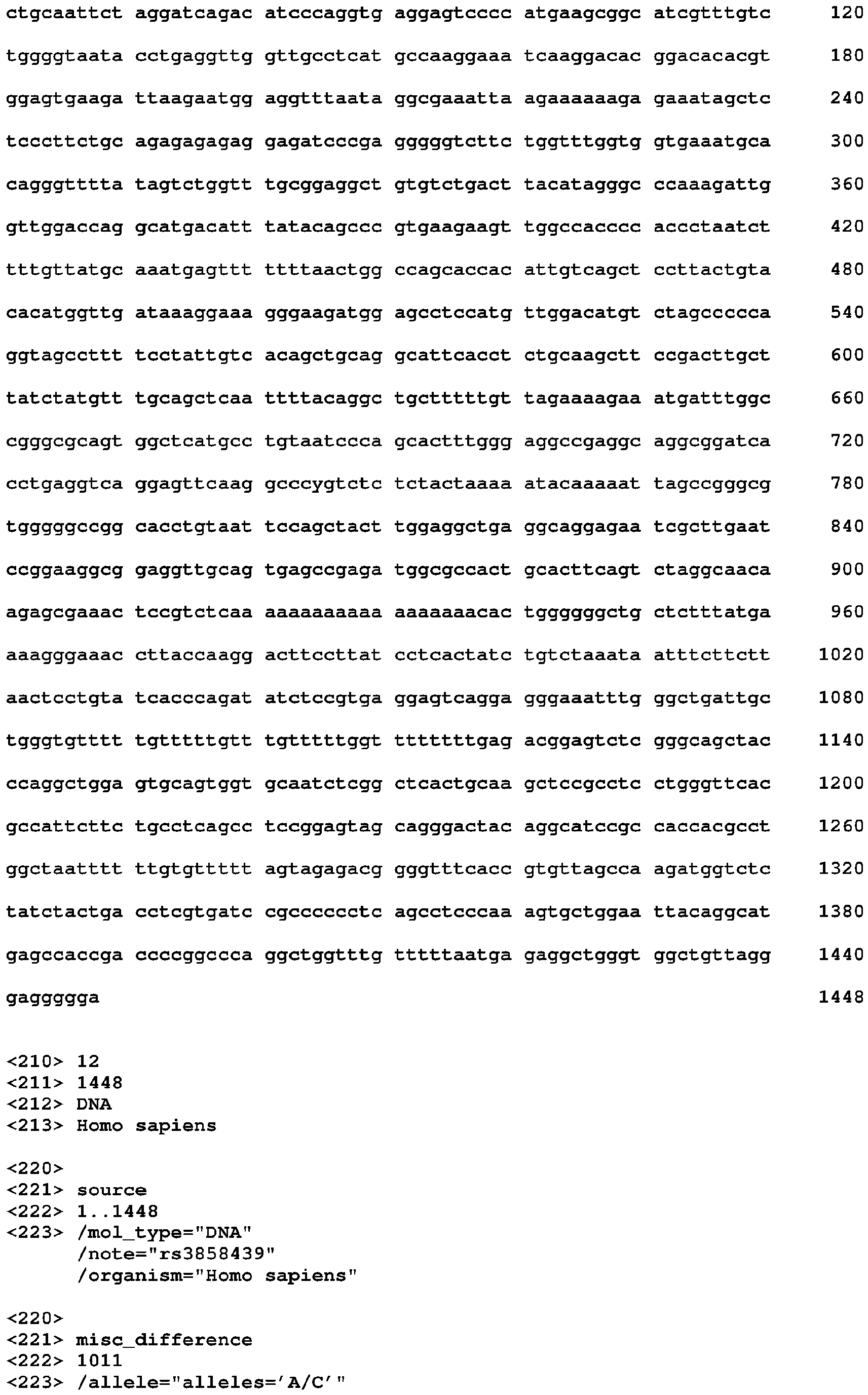
- Table 1 Markers coupled to the marker Ref SNP ID rs16754 marker chromosome position D' r 2 LOD minor allele major allele rs5030277 (SEQ ID NO: 6) 32374245 1 0.88 17.86 A T rs5030280 (SEQ ID NO: 9) 32374008 1 0.876 17.33 C T rs5030281 (SEQ ID NO: 7) 32373451 1 0.881 18.17 T C rs5030310 (SEQ ID NO: 8) 32367816 1 0.882 18.32 T A rs11031755 (SEQ ID NO: 10) 32351574 1 0.882 18.32 T C rs11031747 (SEQ ID NO: 11) 32343797 0.933 0.816 15.67 C T rs3858439 (SEQ ID NO: 12) 32343490 0.936 0.824 16.62 C A rs3858438 (SEQ ID NO: 13) 32343130 0.936 0.824 16.62
- D' is the linkage disequilibrium (D)
- r is the correlation coefficient
- LOD is the LOD score estimating the recombination frequency.
- the alleles of the markers of table 1 that are coupled to the minor allele of marker rs16754, due to the coupling are also included in the mentioning of minor alleles and therefore are also termed minor alleles. Accordingly, for the purposes of the invention, reference to the minor allele of the marker Ref SNP ID rs16754 includes the group comprising or consisting of minor alleles of the coupled markers of table 1.
- the group comprising, preferably consisting of rs16754 and the coupled markers of table 1, especially their minor alleles form one group of markers which are indicative of lobular breast cancer patients, especially node-positive patients, who are in need of a more intense, especially a more extended treatment period, e.g. during or following 4 to 10 years after initial treatment or diagnosis, which group of markers is located at positions 32374245 to 32341389 on human chromosome 11 (genome build 36.3), wherein the members of the group of markers are closely coupled to one another, especially to marker rs16754 at position 32374521.
- Ref SNP ID rs16754 rs16754, rs5030277, rs5030280, rs5030281, rs5030310, and/or rs11031755, the minor alleles of which are very closely coupled the minor allele of Ref SNP ID rs16754.
- the at least heterozygous allele G of the marker Ref SNP ID rs16754 is an indicator of a poor diagnosis in breast cancer patients, especially in lobular breast cancer patients, and therefore is an indicator identifying patients in need of intense cancer therapy and/or in need of long-term therapy, e.g. in the period of e.g. 4 to 15 years, especially 5 to 10 years after an initial cancer treatment, leading to a reduction in the proportion of relapse or progression rate of cancer.
- the analytical method of the invention allows to identify patients with the homozygous major allele of the marker Ref SNP ID rs16754 for less severe cancer treatment, because this group has a generally better prognosis, especially for long-term survival, whereas the analytical method allows to identify those patients who are in need of a more intense and/or more extended treatment, especially 4 to 10 years, preferably 5 to 10 years, more preferred 6 to 10 years after initial cancer treatment, who are the patients having at least one minor allele of the marker Ref SNP ID rs16754.
- the DNA from a breast cancer patient preferably a node-positive lobular breast cancer patient, is analysed to determine the alleles of the marker Ref SNP ID rs16754 and/or of at least one of the markers coupled to Ref SNP ID rs16754, which coupled markers are given herein.
- the absence or presence of at least one minor allele of at least one of the markers is determined.
- the invention provides an analytical method determining the alleles of the marker Ref SNP ID rs16754 in a lobular breast cancer patient, e.g. followed by the step of selecting a method of treatment in dependence on the status of alleles of the marker Ref SNP ID rs16754, which status preferably is the at least heterozygous presence of the G-allele of the marker Ref SNP ID rs16754.
- the invention provides pharmaceutical compositions for use as a medicament, i.e.
- a hormone receptor blocking agent for use as a medicament for the treatment of patients that are also hormone receptor positive, in the treatment of lobular breast cancer patients, which patients are characterized by the at least heterozygous allele G of the marker Ref SNP ID rs16754, e.g. as determined from a nucleic acid sample, e.g. in total DNA obtained from a cell-containing sample of the patient.
- the presence of alleles of the marker Ref SNP ID rs16754 is determined by an analytical method comprising the step of amplification of a DNA section from a DNA sample obtained from the patient, preferably a total genomic DNA sample of the patient, e.g. by PCR, optionally with the step of analysing the nucleic acid sequence of the amplificate for identifying the nucleotide present in marker Ref SNP ID rs16754, e.g. the presence of the allele G, also termed minor allele or the presence of the allele A, which is also termed major allele, e.g. by DNA sequencing.
- the invention also relates to the use of a DNA amplificate generated in vitro by amplification of a DNA section of a patient's nucleic acid, e.g. a total DNA preparation or a total nucleic acid preparation isolated from a sample of the patient, for use as an indicator for identifying a sub-group of lobular breast cancer patients, who e.g. would benefit from or require intense cancer therapy and/or long-term therapy, e.g. in the period of e.g. 4 to 15 years, especially more than 5 or 6 years to 10 years after an initial cancer treatment.
- the amplificate of the patient DNA containing the marker Ref SNP ID rs16754 for use as a diagnostic indicator, e.g.
- an amplificate having e.g. a length of 10 to 1500 bp, and is generated by PCR using at least one pair of primers which is specific for the DNA section.
- Specific primer pairs for amplification of a DNA section from total patient DNA, e.g. total genomic DNA can be designed by standard methods, and processes for identifying the allele of marker Ref SNP ID rs16754 as G and/or A are also generally known, e.g. DNA sequencing or specific hybridisation of the amplificate containing the marker, which amplificate was obtained from the genomic DNA as a template for PCR.
- the marker including the reference number Ref SNP ID rs16754 is e.g. available at NCBI databank (build 129), and is also termed C1107 A>G at GenBank entry NM/024426.3 (NM-024426.3: c.1107 A>G).
- the nucleotide sequence of the wt1 gene according to NM024426 is enclosed as SEQ ID NO 1, wherein nucleotides 197 to 1750 contain coding sequence, with exon 7 at nucleotides 1295 to 1445, and marker Ref SNP ID rs16754 at position 1303, which corresponds to nucleotide No 1107 of the coding sequence section (nt 197 to 1750).
- the amino acid sequence encoded by exon 7 is given as SEQ ID NO 2, irrespective of the natural reading frame.
- the analytical method of the invention further includes at least one additional analytical step for analysis of the lobular breast cancer, which analytical step is selected from the group comprising or consisting of an analysis in respect of its estrogen receptor status, e.g. negative or positive, as can be determined by standard analytical processes, e.g. by immuno histochemistry, in respect of its progesteron receptor status, e.g. negative or positive as can be determined by standard analytical processes, e.g. by immuno histochemistry, in respect of its lymph node (node) status, e.g. node negative or node positive as can be determined by standard analytical processes, e.g. by histopathology, in respect of its HER-2 status, e.g.
- an analysis in respect of its estrogen receptor status e.g. negative or positive
- standard analytical processes e.g. by immuno histochemistry
- progesteron receptor status e.g. negative or positive
- standard analytical processes e.g. by immuno histochemistry
- lymph node (node) status e
- negative or positive as can be determined by standard analytical processes, e.g. by immuno histochemistry, in respect of its tumour grade status, e.g. grade 2 vs. grade 1 and grade 3 vs. grade 1, e.g. can be determined by pathologic evaluation, and in respect of patient age, e.g. younger than 50 years vs. 50 years and older.
- year 0 of the time scale denotes the initial diagnosis and/or onset of cancer treatment.
- the present invention is based on a large-scale medical study involving 8337 female breast cancer patients, in whom the alleles of the marker Ref SNP ID rs16754 were analysed in PBMC (peripheral mononuclear blood cells) and relevance of the alleles was assessed in a univariate and multivariate analyses considering age, tumour grade, lymph node involvement (nodal status), estrogen receptor status, progesterone receptor status, and HER-2 status.
- PBMC peripheral mononuclear blood cells
- the data that were analysed originate from patients undergoing similar treatments, e.g. treatment was similar, irrespective of lobular or ductal breast cancer, and irrespective of the alleles of the marker Ref SNP ID rs16754.
- the minor allele of the marker Ref SNP ID rs16754 is heterozygous in 25.2% of the patients and homozygous in 2.8% of the patients.
- Patient characteristics and pathological findings were similarly distributed between patients who are homozygous for the major allele (A/A) of the marker Ref SNP ID rs16754, and those patients who are at least heterozygous for the minor allele of the marker Ref SNP ID rs16754, i.e. heterozygous (A/G) or homozygous (G/G) for the minor allele (G).
- compounds for use as a medicament in the treatment of lobular breast cancer patients having at least one minor allele of the marker Ref SNP ID rs 16754 are selected from compounds used as medicaments in the treatment of hormone receptor positive breast cancer patients, especially tamoxifen, ovarian suppression agents, aromatase inhibitors, and irreversible estrogen receptor inhibitors or combinations of these, especially Tamoxifen, Anastrozol, Letrozol, and Exemestan.
- Analyses of the alleles of the marker Ref SNP ID rs16754 were performed using the commercially available (Applied Biosystems, Assay ID C_12034416_10) PCR-based assay specific for marker Ref SNP ID rs16754.
- total DNA was isolated from PBMC of breast cancer patients and subjected to PCR in microtiter plates at an annealing temperature of 60°C using the TaqMan protocol supplied by the manufacturer.
- a forward primer of SEQ ID NO 3 and a backward primer of SEQ ID NO 4 were used. Detection and assessment was made with the Sequence Detection Software supplied by the manufacturer.
- OS Overall survival
- Pair-wise comparisons of variables for exploratory purposes were done using the Kolmogorov-Smirnov test for continuous variables and the Chi-squared test for categorical variables.
- Estimation of distribution of OS and comparison of differences between survival curves was by the Kaplan-Meier method and the log-rank test, respectively.
- a Cox proportional hazards model for OS was developed for multivariate analysis and stratified by clinical study. The proportional hazards assumption was checked by scaled Schoenfeld residuals.
- Variables with P of 0.1 or below in univariate analysis were included into the model.
- Status of the marker Ref SNP ID rs16754 (homozygous for major allele vs. at least one minor allele), nodal status (node positive vs. node negative), estrogen receptor (ER) status (ER positive vs. ER negative), progesterone receptor (PR) status (PR positive vs. PR negative), HER-2 status (HER-2 positive vs. HER-2 negative), tumour grade (grade 2 vs. grade 1, and grade 3 vs. grade 1), and age (below 50 years vs. at least 50 years) were the variables considered.
- odds ratios (OR) and hazard ratios (HR) were calculated at 95% CI, and the two-sided level of significance was set at P less than 0.05.
- the SPSS programme version 17.0 and R programme version 2.10 were used.
- a hazard ratio (HR) above 1 indicates an increased risk for the first category listed.
- Example 2 Medicament for treatment of lobular breast cancer in patients having a minor allele of the marker Ref SNP ID rs16754
- the hormone receptor positive patients were generally treated with a hormone ablation therapy, which typically involves the administration of Tamoxifen.
- a hormone ablation therapy typically involves the administration of Tamoxifen.
- the invention also provides for compounds, e.g. selected from the group of pharmaceutical compounds used in hormone ablation therapy, e.g. a hormone receptor blocking agent, especially Tamoxifen, Anastrozol, Letrozol, Exemestan, for use as a medicament in the treatment of lobular breast cancer patients having at least one minor allele of the marker Ref SNP ID rs16754, especially for administration in a period of time after 4 to 5 years, e.g. up to 10 years, following initial breast cancer diagnosis or following initial breast cancer treatment.
- a hormone receptor blocking agent especially Tamoxifen, Anastrozol, Letrozol, Exemestan
- the analysis of OS in node positive lobular breast cancer patients revealed no significant difference between patients being homozygous for the major allele of the marker Ref SNP ID rs16754 and patients having at least one minor allele of the marker Ref SNP ID rs16754.
- the finding that node positive breast cancer patients generally receive cancer treatment by irradiation and/or chemotherapy to a higher extent than node negative patients demonstrates that especially node positive lobular breast cancer patients having at least one minor allele of the marker Ref SNP ID rs16754 benefit from the additional or harsher cancer treatment, e.g. irradiation and/or chemotherapy.
- the invention also provides for compounds, e.g. selected from the group of pharmaceutical compounds used in cancer therapy, e.g. Tamoxifen, Anastrozol, Letrozol or Exemestan for use as a medicament in the treatment of lobular breast cancer patients having at least one minor allele of the marker Ref SNP ID rs16754 or having the coupled allele of a marker coupled to the marker Ref SNP ID rs16754, especially for administration in a period of time after 4 to 5 years following initial breast cancer diagnosis or treatment, especially those patients who are node positive and/or patients who are node negative.
- compounds used in cancer therapy e.g. Tamoxifen, Anastrozol, Letrozol or Exemestan
Landscapes
- Chemical & Material Sciences (AREA)
- Health & Medical Sciences (AREA)
- Life Sciences & Earth Sciences (AREA)
- Organic Chemistry (AREA)
- Proteomics, Peptides & Aminoacids (AREA)
- Analytical Chemistry (AREA)
- Zoology (AREA)
- Pathology (AREA)
- Genetics & Genomics (AREA)
- Immunology (AREA)
- Wood Science & Technology (AREA)
- Engineering & Computer Science (AREA)
- General Health & Medical Sciences (AREA)
- Physics & Mathematics (AREA)
- Hospice & Palliative Care (AREA)
- Molecular Biology (AREA)
- Biotechnology (AREA)
- Biophysics (AREA)
- Oncology (AREA)
- Biochemistry (AREA)
- Bioinformatics & Cheminformatics (AREA)
- Microbiology (AREA)
- General Engineering & Computer Science (AREA)
- Chemical Kinetics & Catalysis (AREA)
- General Chemical & Material Sciences (AREA)
- Medicinal Chemistry (AREA)
- Nuclear Medicine, Radiotherapy & Molecular Imaging (AREA)
- Pharmacology & Pharmacy (AREA)
- Animal Behavior & Ethology (AREA)
- Public Health (AREA)
- Veterinary Medicine (AREA)
- Measuring Or Testing Involving Enzymes Or Micro-Organisms (AREA)
Abstract
The invention provides an analytical method for the determination of the susceptibility of a human patient suffering from breast cancer to anti-cancer treatment by providing an analytical method for determining the genetic predisposition of a patient in respect of susceptibility, e.g. responsiveness, to anti-cancer treatment, especially treatment using at least one chemotherapeutical agent and/or at least one anti-hormonal agent on the basis of analysis of a genetic marker.
Description
- The invention relates to the analysis of a genetic marker for use as a prognostic marker in breast cancer, and to the analysis, and to the genetic marker, respectively, as an analyte for use in the selection of a therapy, as well as to an analytical method identifying the marker in breast cancer patients, especially for use in the prediction of the suitability of a treatment for a selected sub-group of patients. Further, the invention relates to the use of therapeutic agents for the long-term treatment, e.g. in a period of at least 3 to 5 years following initial cancer treatment or cancer diagnosis, especially in a period of at least 4 to 10 years following initial cancer treatment or cancer diagnosis, to improve the long-term treatment of breast cancer in a selected sub-group of patients, who are at least heterozygous for the genetic marker. The invention is based on the finding that in lobular breast cancer patients, one allele of the genetic marker is correlated with a poorer treatment prognosis, and hence the sub-group of patients requiring the administration of pharmaceutically active compounds as a medicament for treatment and/or prevention of lobular breast cancer, especially as a medicament for the prevention of recurring lobular breast cancer is characterized by the at least heterozygous presence of one allele of the marker. Interestingly, both alleles of the marker used in the invention give the same translation product, making the alleles a silent mutation.
- Hollink et al., Blood 5951-5960 (2009) found that there is no relation of the status of the marker Ref SNP ID rs16754 to the course of cancer in patients, because the alleles of the marker Ref SNP ID rs16754 have no influence on the amino acid sequence of the protein produced from the WT1 gene concerned.
- Li and Man, Cancer Biomark. 109-116 (2009) describe that the expression of the WT1 gene is changed in breast cancer cells. Miyoshi et al., Clin. Cancer Res. 1167-1171 (2002) relate the expression level of the WT1 gene to a poor prognosis in breast cancer patients.
- Arpino et al., Breast Cancer Res. R149-156 (2004) found that invasive lobular breast cancer was more likely to occur in older patients, larger in size, positive for estrogen receptor and for progesterone receptor, to have a lower S-phase fraction, to be negative for HER-2, p53, and EGF-receptor.
- Wang et al in Anticancer Research 3637-3642 (2010) describe that the expression level of the WT1 gene might be a suitable indicator for Tamoxifen resistance in breast cancer. A differentiation between lobular and ductal breast cancer is not made, and there is no indication of a genetic marker for use as an indicator.
- Phoenix et al in Annual Meeting Abstracts 419 (2010) describe SNP rs16754 as a genetic marker for acute myeloid leukemia in children.
- Rakha et al in European Journal of Caner 73-83 (2008) describe that lobular breast cancer patients have a better response to hormonal therapy than other types of breast cancer. No mention is made of a genetic marker.
- Damm et al in J. Clin. Oncol. 578-585 (2009) describe that the minor allele of SNP rs16754 indicates a better prognosis in acute myeloid leukemia patients. No relation to breast cancer is mentioned.
- Smith et al in Eur. J. Cancer 979-982 (1987) describe the effects of endocrine therapy of lobular or ductal breast cancer in relapse patients. No mention is made of a genetic marker.
- In view of the importance of adapting the therapeutic treatment to the type of breast cancer, it is the object of the invention to provide for a diagnostic marker that is predictive of the suitability of a therapeutic treatment. Preferably, the diagnostic marker is independent from known diagnostic findings.
- It is a further object to provide an analytical method for use for the identification of breast cancer patients who can be treated successfully by standard therapy and for the identification of breast cancer patients who have a higher risk of relapse, e.g. 4 to 10 years after an initial cancer treatment, and who are therefore in need of additional treatment during this period. Accordingly, it is an object to provide a pharmaceutical composition for use as a medicament for treatment against the cancer in the patients that have a high risk of relapse, e.g. as a medicament for treatment within 4 to 10 years after an initial cancer treatment.
- The invention attains the above-mentioned objects by the features of the claims, and especially by providing an analytical method for the determination of the susceptibility of a human patient suffering from breast cancer to anti-cancer treatment, e.g. by providing an analytical method for determining the genetic predisposition of a patient in respect of susceptibility, e.g. responsiveness, to anti-cancer treatment, especially treatment using at least one chemotherapeutical agent and/or at least one anti-hormonal agent. In greater detail, the invention provides the use of the marker Ref SNP ID rs16754 of the human WT1 gene, which is located on chromosome 11p15 (Wilms' tumour 1 gene) as an indicator in the diagnosis of nucleic acid samples originating from breast cancer patients, especially of lobular breast cancer patients, more especially in hormone receptor positive patients, as it has been found that the presence of at least one minor allele of this marker correlates with an increased risk of relapse in these patients. Further, the invention provides for the use of additional genetic markers in these embodiments, as these additional markers have been found to be coupled to the marker Ref SNP ID rs 16754 of the human WT1 gene. Accordingly, for the purposes of the invention, the reference to the marker Ref SNP ID rs 16754 (SEQ ID NO: 5) includes the reference to the group comprising or consisting of coupled markers that are given in Table 1. The sequences given for the markers including the markers of Table 1 denote the markers in their natural sequence environment as obtainable from NCBI at www.ncbi.nlm.nih.gov/snp/.
Table 1: Markers coupled to the marker Ref SNP ID rs16754 marker chromosome position D' r2 LOD minor allele major allele rs5030277 (SEQ ID NO: 6) 32374245 1 0.88 17.86 A T rs5030280 (SEQ ID NO: 9) 32374008 1 0.876 17.33 C T rs5030281 (SEQ ID NO: 7) 32373451 1 0.881 18.17 T C rs5030310 (SEQ ID NO: 8) 32367816 1 0.882 18.32 T A rs11031755 (SEQ ID NO: 10) 32351574 1 0.882 18.32 T C rs11031747 (SEQ ID NO: 11) 32343797 0.933 0.816 15.67 C T rs3858439 (SEQ ID NO: 12) 32343490 0.936 0.824 16.62 C A rs3858438 (SEQ ID NO: 13) 32343130 0.936 0.824 16.62 G C rs11031746 (SEQ ID NO: 14) 32342995 0.936 0.824 16.62 C A rs11031745 (SEQ ID NO: 15) 32342895 0.936 0.824 16.62 T C rs11031744 (SEQ ID NO: 16) 32342815 0.936 0.824 16.62 T C rs3858436 (SEQ ID NO: 17) 32342153 1 0.875 16.89 G A rs2418901 (SEQ ID NO: 18) 32341389 1 0.823 16.44 G A - From Table 1, the following markers are preferred for the embodiments of the invention in addition and/or in the alternative to Ref SNP ID rs16754: rs16754, rs5030277, rs5030280, rs5030281, rs5030310, and/or rs11031755, the minor alleles of which are very closely coupled the minor allele of Ref SNP ID rs16754.
- It has been found that the at least heterozygous allele G of the marker Ref SNP ID rs16754 is an indicator of a poor diagnosis in breast cancer patients, especially in lobular breast cancer patients, and therefore is an indicator identifying patients in need of intense cancer therapy and/or in need of long-term therapy, e.g. in the period of e.g. 4 to 15 years, especially 5 to 10 years after an initial cancer treatment, leading to a reduction in the proportion of relapse or progression rate of cancer. Accordingly, the analytical method of the invention allows to identify patients with the homozygous major allele of the marker Ref SNP ID rs16754 for less severe cancer treatment, because this group has a generally better prognosis, especially for long-term survival, whereas the analytical method allows to identify those patients who are in need of a more intense and/or more extended treatment, especially 4 to 10 years, preferably 5 to 10 years, more preferred 6 to 10 years after initial cancer treatment, who are the patients having at least one minor allele of the marker Ref SNP ID rs16754.
- In the process for analysis, the DNA from a breast cancer patient, preferably a node-positive lobular breast cancer patient, is analysed to determine the alleles of the marker Ref SNP ID rs16754 and/or of at least one of the markers coupled to Ref SNP ID rs16754, which coupled markers are given herein. As a result of the process, the absence or presence of at least one minor allele of at least one of the markers is determined.
- It is a specific advantage of the analytical method of the invention to allow the identification of these groups of patients on the basis of a parameter, namely on the basis of the presence of the minor allele of the marker Ref SNP ID rs16754, which is independent from other analytical parameters, e.g. hormone receptor status (especially independent from the status of one of ER, PR and HER2), nodal status, tumour grade, and age in multivariate analysis.
- Accordingly, the invention provides an analytical method determining the alleles of the marker Ref SNP ID rs16754 in a lobular breast cancer patient, e.g. followed by the step of selecting a method of treatment in dependence on the status of alleles of the marker Ref SNP ID rs16754, which status preferably is the at least heterozygous presence of the G-allele of the marker Ref SNP ID rs16754. Further, the invention provides pharmaceutical compositions for use as a medicament, i.e. for use as an active therapeutic agent in a pharmaceutical composition, especially a hormone receptor blocking agent, most preferably for use as a medicament for the treatment of patients that are also hormone receptor positive, in the treatment of lobular breast cancer patients, which patients are characterized by the at least heterozygous allele G of the marker Ref SNP ID rs16754, e.g. as determined from a nucleic acid sample, e.g. in total DNA obtained from a cell-containing sample of the patient.
- Preferably, the presence of alleles of the marker Ref SNP ID rs16754 is determined by an analytical method comprising the step of amplification of a DNA section from a DNA sample obtained from the patient, preferably a total genomic DNA sample of the patient, e.g. by PCR, optionally with the step of analysing the nucleic acid sequence of the amplificate for identifying the nucleotide present in marker Ref SNP ID rs16754, e.g. the presence of the allele G, also termed minor allele or the presence of the allele A, which is also termed major allele, e.g. by DNA sequencing. Accordingly, the invention also relates to the use of a DNA amplificate generated in vitro by amplification of a DNA section of a patient's nucleic acid, e.g. a total DNA preparation or a total nucleic acid preparation isolated from a sample of the patient, for use as an indicator for identifying a sub-group of lobular breast cancer patients, who e.g. would benefit from or require intense cancer therapy and/or long-term therapy, e.g. in the period of e.g. 4 to 15 years, especially more than 5 or 6 years to 10 years after an initial cancer treatment. Preferably, the amplificate of the patient DNA containing the marker Ref SNP ID rs16754 for use as a diagnostic indicator, e.g. as a diagnostic indicator substance identifying a lobular breast cancer patient, especially as a patient requiring intense cancer therapy and/or in need of long-term therapy, e.g. in the period of e.g. 4 to 15 years, especially 5 to 10 years after an initial cancer treatment, is an amplificate having e.g. a length of 10 to 1500 bp, and is generated by PCR using at least one pair of primers which is specific for the DNA section. Specific primer pairs for amplification of a DNA section from total patient DNA, e.g. total genomic DNA, can be designed by standard methods, and processes for identifying the allele of marker Ref SNP ID rs16754 as G and/or A are also generally known, e.g. DNA sequencing or specific hybridisation of the amplificate containing the marker, which amplificate was obtained from the genomic DNA as a template for PCR.
- The marker including the reference number Ref SNP ID rs16754 is e.g. available at NCBI databank (build 129), and is also termed C1107 A>G at GenBank entry NM/024426.3 (NM-024426.3: c.1107 A>G). The nucleotide sequence of the wt1 gene according to NM024426 is enclosed as SEQ ID NO 1, wherein nucleotides 197 to 1750 contain coding sequence, with exon 7 at nucleotides 1295 to 1445, and marker Ref SNP ID rs16754 at position 1303, which corresponds to nucleotide No 1107 of the coding sequence section (nt 197 to 1750). The amino acid sequence encoded by exon 7 is given as
SEQ ID NO 2, irrespective of the natural reading frame. - Preferably, the analytical method of the invention further includes at least one additional analytical step for analysis of the lobular breast cancer, which analytical step is selected from the group comprising or consisting of an analysis
in respect of its estrogen receptor status, e.g. negative or positive, as can be determined by standard analytical processes, e.g. by immuno histochemistry,
in respect of its progesteron receptor status, e.g. negative or positive as can be determined by standard analytical processes, e.g. by immuno histochemistry,
in respect of its lymph node (node) status, e.g. node negative or node positive as can be determined by standard analytical processes, e.g. by histopathology,
in respect of its HER-2 status, e.g. negative or positive as can be determined by standard analytical processes, e.g. by immuno histochemistry,
in respect of its tumour grade status,e.g. grade 2 vs. grade 1 and grade 3 vs. grade 1, e.g. can be determined by pathologic evaluation,
and in respect of patient age, e.g. younger than 50 years vs. 50 years and older. - It has been found that especially patients with lobular breast cancer who at least heterozygously have the minor allele of the marker Ref SNP ID rs 16754 who addditionally have a positive hormone receptor status, e.g. selected from estrogen receptor status, progesteron receptor status and/or HER-2 status have a significantly worse prognosis, and are therefore in need for additional therapy, e.g. in the period of 4 to 10 years following initial cancer treatment. Accordingly, these patients are the preferred patients of the invention, e.g. lobular breast cancer patients carrying at least one minor allele of the marker Ref SNP ID rs16754 and having a tumour that is positive for hormone receptor status, e.g. selected from estrogen receptor status, progesteron receptor status and/or HER-2 status, especially estrogen receptor status and progesteron receptor status.
- The invention is now described in greater detail with reference to the figures showing graphical representations of analytical results between breast cancer patients who are homozygous for the major allele (A/A) or have at least one minor allele (A/G and G/G) of the marker Ref SNP ID rs 16754, namely in
-
Fig. 1 the OS in univariate analysis of all breast cancer patients (n=8094) analyzed, -
Fig. 2 the OS for lobular breast cancer patients only, -
Fig. 3 the breast cancer specific survival in lobular breast cancer patients, -
Fig. 4 the OS for ER positive and/or PR positive patients, -
Fig. 5 the OS for ER negative and/or PR negative patients, -
Fig. 6 the OS for lobular breast cancer patients younger than 50 years, and in -
Fig. 7 the OS for lobular breast cancer patients older than 50 years, - In the figures,
year 0 of the time scale denotes the initial diagnosis and/or onset of cancer treatment. - The present invention is based on a large-scale medical study involving 8337 female breast cancer patients, in whom the alleles of the marker Ref SNP ID rs16754 were analysed in PBMC (peripheral mononuclear blood cells) and relevance of the alleles was assessed in a univariate and multivariate analyses considering age, tumour grade, lymph node involvement (nodal status), estrogen receptor status, progesterone receptor status, and HER-2 status. Generally, the data that were analysed originate from patients undergoing similar treatments, e.g. treatment was similar, irrespective of lobular or ductal breast cancer, and irrespective of the alleles of the marker Ref SNP ID rs16754.
- It was found that the minor allele of the marker Ref SNP ID rs16754 is heterozygous in 25.2% of the patients and homozygous in 2.8% of the patients. Patient characteristics and pathological findings were similarly distributed between patients who are homozygous for the major allele (A/A) of the marker Ref SNP ID rs16754, and those patients who are at least heterozygous for the minor allele of the marker Ref SNP ID rs16754, i.e. heterozygous (A/G) or homozygous (G/G) for the minor allele (G).
- Only in patients (n=1101) having lobular breast cancer, it was determined that the alleles of the marker Ref SNP ID rs16754 were independently predictive for overall survival (OS) in multivariate analysis (HR 1.44, 95% CI 1.06-1.94, P = 0.018), and for breast cancer specific survival with HR 1.49, 95% CI 1.07-2.07, P= 0.018, wherein HR is the hazard ratio, CI is the confidence interval, and P is the P-value indicating significance, whereas in other histological subtypes, e.g. in ductal breast cancer, a predictive value of the marker Ref SNP ID rs16754 was not found. The linkage of a minor allele of the marker Ref SNP ID rs16754 with a poor prognosis, and the need for more intense and/or longer administration of anti-cancer medicaments became more pronounced at 4 or 5 years after initial diagnosis and/or after initial treatment, and was most pronounced in hormone receptor positive and in younger lobular breast cancer patients.
- Preferably, compounds for use as a medicament in the treatment of lobular breast cancer patients having at least one minor allele of the marker Ref SNP ID rs 16754 are selected from compounds used as medicaments in the treatment of hormone receptor positive breast cancer patients, especially tamoxifen, ovarian suppression agents, aromatase inhibitors, and irreversible estrogen receptor inhibitors or combinations of these, especially Tamoxifen, Anastrozol, Letrozol, and Exemestan.
- Analyses of the alleles of the marker Ref SNP ID rs16754 were performed using the commercially available (Applied Biosystems, Assay ID C_12034416_10) PCR-based assay specific for marker Ref SNP ID rs16754. Generally, total DNA was isolated from PBMC of breast cancer patients and subjected to PCR in microtiter plates at an annealing temperature of 60°C using the TaqMan protocol supplied by the manufacturer. For amplification, a forward primer of SEQ ID NO 3 and a backward primer of SEQ ID NO 4 were used. Detection and assessment was made with the Sequence Detection Software supplied by the manufacturer.
- For statistical analyses, median follow-up time for survival was calculated according to Korn, Stat Med 5: 255-260 (1986). Overall survival (OS) endpoints were death (failure) and alive at last follow-up (generally censored at 10 years), measured from the date of entry into the study. Pair-wise comparisons of variables for exploratory purposes were done using the Kolmogorov-Smirnov test for continuous variables and the Chi-squared test for categorical variables. Estimation of distribution of OS and comparison of differences between survival curves was by the Kaplan-Meier method and the log-rank test, respectively. A Cox proportional hazards model for OS was developed for multivariate analysis and stratified by clinical study. The proportional hazards assumption was checked by scaled Schoenfeld residuals. Variables with P of 0.1 or below in univariate analysis were included into the model. Status of the marker Ref SNP ID rs16754 (homozygous for major allele vs. at least one minor allele), nodal status (node positive vs. node negative), estrogen receptor (ER) status (ER positive vs. ER negative), progesterone receptor (PR) status (PR positive vs. PR negative), HER-2 status (HER-2 positive vs. HER-2 negative), tumour grade (
grade 2 vs. grade 1, and grade 3 vs. grade 1), and age (below 50 years vs. at least 50 years) were the variables considered. - Incomplete (more than 60%) data sets of patients were used for the multivariate Cox model following imputation of missing data using the aregImpute function of the R software package Hmisc, version 3.7, allowing the algorithm to use data from all other variables, except for the age. This procedure models the distribution of each variable present to the other variables with a predictive mean matching, and using bootstrapping to generate multiple imputations by approximating samples from the posterior predictive distributions of missing values to account for all aspects of uncertainty. Following an initial 10 data sets, a further 50 data sets were imputed. Using a logistic regression model, associations between variables and response to induction therapy were analysed. For relevance of quantitative results, odds ratios (OR) and hazard ratios (HR) were calculated at 95% CI, and the two-sided level of significance was set at P less than 0.05. For statistical analyses, the SPSS programme version 17.0 and R programme version 2.10 were used.
- It was found that 71.9% of patients were homozygous for the major allele of the marker Ref SNP ID rs16754 (A/A), 25.2% were heterozygous (A/G), and 2.8% were homozygous for the minor allele of the marker Ref SNP ID rs16754 (G/G). Generally, this allele distribution corresponds to that of the general European population. When comparing pre-treatment clinical and molecular characteristics of the patients, including age, bilateral disease, tumour stage and grade, nodal status, tumour histology, ER status, PR status, ER/PR status, HER-2 status or ER/PR/HER-2 status, no significant differences were found between patients who are homozygous for the major allele to patients having at least one minor allele of the marker Ref SNP ID rs16754.
- When analysing overall survival (average 9.67 years, range 0.3 to 10 years) of all breast cancer patients (n=8094; P=0.54), no significant difference was found between homozygous major alleles and at least heterozygous minor alleles of the marker Ref SNP ID rs16754, as shown in
Fig. 1 . In ductal carcinoma patients, OS was not significantly different between patients with at least one minor allele and patients homozygous for the major allele (lymph node negative P= 0.54, lymph node positive P=0.46, ductal carcinoma P=0.65)
Further, OS was not significantly different in node positive (n=2825) patients between patients homozygous for the major allele and patients having at least one minor allele of the marker Ref SNP ID rs16754 (P=0.41). - However, it was found that OS of lobular breast cancer patients having at least one minor allele of the marker Ref SNP ID rs16754 was significantly shorter (HR=1.54, 95% CI 1.15 - 2.06, P=0.004) compared to lobular breast cancer patients having the major allele of the marker Ref SNP ID rs16754 homozygously, as shown in
Fig. 2 . Lobular breast cancer patients having at least one minor allele of the marker Ref SNP ID rs16754 showed a 5-year OS of 88% and a 10-year OS of 71% compared to a 5-year OS of 90% and a 10-year OS of 81% for lobular breast cancer patients having the maj or allele of the marker Ref SNP ID rs16754 homozygously. It was found that the baseline characteristics were similarly distributed between patients homozygous for the major allele and patients having the minor allele of the marker Ref SNP ID rs16754, respectively, except for a higher occurrence of node positive breast cancer in patients with at least one minor allele (41% vs. 35%, P=0.058). Importantly, BCSS was significantly shorter in lobular breast cancer patients with at least one minor allele of SNP rs16754 compared to major allele homozygous patients (HR 1.55, 95% CI 1.13 - 2.14, P= 0.007) as shown inFig. 3 . - In multivariate analysis of variables having P=0.1 or below in univariate analysis, it was found that presence of at least one minor allele of the marker Ref SNP ID rs16754 in lobular breast cancer patients is associated and predictive of an increased hazard of death (HR 1.46, 95% CI 1.08 - 1.96, P=0.013). Details are shown in the following Table 2, wherein HR above 1 indicates an increased risk for the respective variable, and HR below 1 indicates a decreased risk.
Table 2: Multivariate analysis for OS in lobular breast cancer patients (n=1089) Variable HR 95% CI P at least one minor allele of the marker Ref SNP ID rs 16754 vs.
homozygousity for major allele of the marker Ref SNP ID rs167541.49 1.07-2.07 0.018 node positive vs. node negative 3.24 2.27-4.62 <0.001 ER positive vs. ER negative 0.82 0.48-1.41 0.47 PR positive vs. PR negative 0.58 0.39-0.88 0.01 HER-2 positive vs. HER-2 negative 1.24 0.54-2.85 0.62 grade 2 vs. grade 11.42 0.9-2.23 0.13, grade 3 vs. grade 1 2.52 1.31-4.83 0.006 age ≥ 50 years vs. age < 50 years 0.73 0.51-1.05 0.09 - Herein, a hazard ratio (HR) above 1 indicates an increased risk for the first category listed.
- In the data analysis it became clear that the presence of at least one minor allele of the marker Ref SNP ID rs16754 in lobular breast cancer patients especially in a period of approx. 4 - 5 years after initial cancer diagnosis and treatment is correlated with a negative prognosis, i.e. a lower OS. When analysing the correlation of the alleles of the marker Ref SNP ID rs16754 to hormone receptor positive and negative patients, it was found that the presence of the minor allele was correlated with a reduced OS in hormone receptor positive patients (P=0.004,
Fig. 4 ), but not in hormone receptor negative patients (P=0.75,Fig. 5 ). - In contrast to the hormone negative patients, the hormone receptor positive patients were generally treated with a hormone ablation therapy, which typically involves the administration of Tamoxifen. From the correlation of the presence of the minor allele of the marker Ref SNP ID rs16754 in lobular breast cancer patients with a reduced OS in those patients who due to the negative hormone receptor status generally did not receive treatment in the period 5 years after initial diagnosis, and the observation that presence of the minor allele is not correlated with a reduced OS in patients that receive treatment hormone ablation treatment, it can be concluded that lobular breast cancer patients having at least one minor allele of the marker Ref SNP ID rs16754 benefit from treatment with anti-hormone receptor pharmaceutical compounds irrespective of the presence of infiltrated lymph nodes.
- The above finding of a positive therapeutic effect of hormone ablation therapeutics in lobular breast cancer patients having at least one minor allele of the marker Ref SNP ID rs16754 was confirmed in menopausal patients. Statistical analysis showed the correlation of the presence of at least one minor allele of the marker Ref SNP ID rs16754 with reduced OS in younger patients (age of less than 50 years, mean age 43.7 years), who generally do not receive hormone ablation therapy, compared to patients who are homozygous for the major allele of the marker Ref SNP ID rs16754 (P=0.01,
Fig. 6 ). The difference in OS was less evident in older patients (age above 50 years, mean age 59.1 years), who generally receive hormone ablation therapy, between lobular breast cancer patients having at least one minor allele of the marker Ref SNP ID rs16754 and patients who are homozygous for the major allele of the marker Ref SNP ID rs16754 (P=0.13,Fig. 7 ). - Hence, the invention also provides for compounds, e.g. selected from the group of pharmaceutical compounds used in hormone ablation therapy, e.g. a hormone receptor blocking agent, especially Tamoxifen, Anastrozol, Letrozol, Exemestan, for use as a medicament in the treatment of lobular breast cancer patients having at least one minor allele of the marker Ref SNP ID rs16754, especially for administration in a period of time after 4 to 5 years, e.g. up to 10 years, following initial breast cancer diagnosis or following initial breast cancer treatment.
- Further, the analysis of OS in node positive lobular breast cancer patients revealed no significant difference between patients being homozygous for the major allele of the marker Ref SNP ID rs16754 and patients having at least one minor allele of the marker Ref SNP ID rs16754. When considering that generally the presence of the minor allele of the marker Ref SNP ID rs16754 is correlated with a reduced OS, the finding that node positive breast cancer patients generally receive cancer treatment by irradiation and/or chemotherapy to a higher extent than node negative patients demonstrates that especially node positive lobular breast cancer patients having at least one minor allele of the marker Ref SNP ID rs16754 benefit from the additional or harsher cancer treatment, e.g. irradiation and/or chemotherapy.
Hence, the invention also provides for compounds, e.g. selected from the group of pharmaceutical compounds used in cancer therapy, e.g. Tamoxifen, Anastrozol, Letrozol or Exemestan for use as a medicament in the treatment of lobular breast cancer patients having at least one minor allele of the marker Ref SNP ID rs16754 or having the coupled allele of a marker coupled to the marker Ref SNP ID rs16754, especially for administration in a period of time after 4 to 5 years following initial breast cancer diagnosis or treatment, especially those patients who are node positive and/or patients who are node negative.




Claims (15)
- Process for the analysis of the susceptibility of a human patient to anti-cancer treatment, characterized by analysing the alleles of the marker Ref SNP ID rs16754 and/or of the alleles of at least one marker of the group of markers comprising rs5030277, rs5030280, rs5030281, rs5030310, rs11031755, rs11031747, rs3858439, rs3858438, rs11031746, rs11031745, rs11031744, rs3858436, rs2418901, in a nucleic acid sample obtained from a human suffering from lobular breast cancer.
- Process according to claim 1, characterized in that the breast cancer has at least one positive hormone receptor status.
- Process according to claim 2, characterized in that the positive hormone receptor status is at least one of estrogen receptor status, progesteron receptor status and/or HER-2 status.
- Process according to one of the preceding claims, characterized in that the process is for use in the selection of a therapy against lobular breast cancer.
- Process according to one of the preceding claims, characterized in that the nucleic acid sample is provided, and the alleles of the marker Ref SNP ID rs16754 and/or the alleles of at least one of the markers of the group comprising rs5030277, rs5030280, rs5030281, rs5030310, rs11031755, rs11031747, rs3858439, rs3858438, rs11031746, rs11031745, rs11031744, rs3858436, rs2418901 are determined, and the hormone receptor status of the patient is determined.
- Process according to one of the preceding claims, characterized in that the hormone receptor status of the cancer is determined.
- Use of a kit of parts containing oligonucleotides which are complementary to at least a section of the human WT1 gene corresponding to SEQ ID NO 1, the section comprising at least one of the markers selected from the group consisting of SNP ID rs16754, rs5030277, rs5030280, rs5030281, rs5030310, rs11031755, rs11031747, rs3858439, rs3858438, rs11031746, rs11031745, rs11031744, rs3858436, and rs2418901 as reagents for the analysis of the allele of the marker Ref SNP ID rs16754 and/or of the allele of at least one of the markers of the group comprising rs5030277, rs5030280, rs5030281, rs5030310, rs11031755, rs11031747, rs3858439, rs3858438, rs11031746, rs11031745, rs11031744, rs3858436, rs2418901 in a process according to one of the preceding claims in a nucleic acid sample obtained from a human patient suffering from lobular breast cancer.
- Pharmaceutical composition containing Tamoxifen, Anastrozol, Letrozol or Exemestan as an active compound for use as a medicament in the treatment of lobular breast cancer in patients who are characterized by bearing the allele G in marker Ref SNP ID rs16754 at least heterozygously, or the minor allele of at least one of the markers of the group comprising rs5030277, rs5030280, rs5030281, rs5030310, rs11031755, rs11031747, rs3858439, rs3858438, rs11031746, rs11031745, rs11031744, rs3858436, rs2418901 at least heterozygously.
- Pharmaceutical composition according to claim 8, characterized in that the medicament is for use in the treatment for at least 5 years to 10 years, preferably 6 years to 10 years, following the detection of breast cancer.
- Pharmaceutical composition according to claim 8 or 9, characterized in that the patients have received treatment against breast cancer 5 to 10 years previously.
- Pharmaceutical composition according to one of claims 8 to 10, characterized by containing a hormone receptor blocking agent as the pharmaceutically active compound.
- Process for analysis of the alleles of the marker Ref SNP ID rs16754 or of the alleles of at least one of the markers of the group comprising rs5030277, rs5030280, rs5030281, rs5030310, rs11031755, rs11031747, rs3858439, rs3858438, rs11031746, rs11031745, rs11031744, rs3858436, rs2418901 in a nucleic acid sample, characterized in that the nucleic acid sample was obtained from a human patient suffering from lobular breast cancer, for use in the selection of a therapy in a period of 3 to 10 years following the initial detection of breast cancer, wherein the breast cancer has at least one positive hormone receptor status selected from the group of estrogen receptor status, progesteron receptor status and/or HER-2 status.
- Use of an amplified section of the human WT1 gene as an indicator substance for identifying a sub-group from lobular breast cancer patients, which section is obtainable by enzymatic DNA amplification from a DNA sample originating from a lobular breast cancer patient, which section comprises the marker Ref SNP ID rs16754 and/or at least one of the markers from the group comprising rs5030277, rs5030280, rs5030281, rs5030310, rs11031755, rs11031747, rs3858439, rs3858438, rs11031746, rs11031745, rs11031744, rs3858436, rs2418901.
- Use according to claim 13, wherein the patients are identified by the presence of at least one G-allele of the marker Ref SNP ID rs16754 and/or at least one minor allele of at least one of the markers of the group consisting of rs5030277, rs5030280, rs5030281, rs5030310, rs11031755, rs11031747, rs3858439, rs3858438, rs11031746, rs11031745, rs11031744, rs3858436, and rs2418901.
- Use according to one of claims 13 to 14, characterized in that the amplified DNA section comprises nucleotides 32374245 to 32341389 of human chromosome 11.
Priority Applications (1)
| Application Number | Priority Date | Filing Date | Title |
|---|---|---|---|
| EP11192254A EP2460894A1 (en) | 2010-12-06 | 2011-12-06 | Prognostic marker for mamma carcinoma |
Applications Claiming Priority (3)
| Application Number | Priority Date | Filing Date | Title |
|---|---|---|---|
| EP10193883 | 2010-12-06 | ||
| EP10194061A EP2460891A1 (en) | 2010-12-06 | 2010-12-07 | Prognostic marker for mamma carcinoma |
| EP11192254A EP2460894A1 (en) | 2010-12-06 | 2011-12-06 | Prognostic marker for mamma carcinoma |
Publications (1)
| Publication Number | Publication Date |
|---|---|
| EP2460894A1 true EP2460894A1 (en) | 2012-06-06 |
Family
ID=43707135
Family Applications (2)
| Application Number | Title | Priority Date | Filing Date |
|---|---|---|---|
| EP10194061A Withdrawn EP2460891A1 (en) | 2010-12-06 | 2010-12-07 | Prognostic marker for mamma carcinoma |
| EP11192254A Withdrawn EP2460894A1 (en) | 2010-12-06 | 2011-12-06 | Prognostic marker for mamma carcinoma |
Family Applications Before (1)
| Application Number | Title | Priority Date | Filing Date |
|---|---|---|---|
| EP10194061A Withdrawn EP2460891A1 (en) | 2010-12-06 | 2010-12-07 | Prognostic marker for mamma carcinoma |
Country Status (2)
| Country | Link |
|---|---|
| US (1) | US20120142654A1 (en) |
| EP (2) | EP2460891A1 (en) |
Cited By (1)
| Publication number | Priority date | Publication date | Assignee | Title |
|---|---|---|---|---|
| CN111139301A (en) * | 2020-03-10 | 2020-05-12 | 无锡市第五人民医院 | Breast cancer related gene ERBB2 site g.39397319C > A mutant and application thereof |
Families Citing this family (2)
| Publication number | Priority date | Publication date | Assignee | Title |
|---|---|---|---|---|
| CN107828890A (en) * | 2017-11-30 | 2018-03-23 | 深圳美因医学检验实验室 | A kind of fluorescence quantitative PCR detection system and its application for nephroblastoma gene screening |
| CN117746983B (en) * | 2023-12-19 | 2024-09-03 | 南昌大学 | Construction method and application of senile breast cancer aging scoring model |
-
2010
- 2010-12-07 EP EP10194061A patent/EP2460891A1/en not_active Withdrawn
-
2011
- 2011-12-06 EP EP11192254A patent/EP2460894A1/en not_active Withdrawn
- 2011-12-06 US US13/312,536 patent/US20120142654A1/en not_active Abandoned
Non-Patent Citations (18)
| Title |
|---|
| ARPINO ET AL., BREAST CANCER RES., 2004, pages 149 - 156 |
| DAMM ET AL., J. CLIN. ONCOL., 2009, pages 578 - 585 |
| F. DAMM ET AL: "Single Nucleotide Polymorphism in the Mutational Hotspot of WT1 Predicts a Favorable Outcome in Patients With Cytogenetically Normal Acute Myeloid Leukemia", JOURNAL OF CLINICAL ONCOLOGY, vol. 28, no. 4, 28 December 2009 (2009-12-28), pages 578 - 585, XP055007522, ISSN: 0732-183X, DOI: 10.1200/JCO.2009.23.0342 * |
| HO PHOENIX A ET AL: "The WT1 synonymous SNP rs16754 Is Associated with Higher mRNA Expression and Predicts Significantly Improved Outcome In Favorable-Risk Pediatric AML: a Report From the Children's Oncology Group", BLOOD, vol. 116, no. 21, November 2010 (2010-11-01), & 52ND ANNUAL MEETING OF THE AMERICAN-SOCIETY-OF-HEMATOLOGY (ASH); ORLANDO, FL, USA; DECEMBER 04 -07, 2010, pages 419, XP008142991 * |
| HOLLINK ET AL., BLOOD, 2009, pages 5951 - 5960 |
| KORN, STAT MED, vol. 5, 1986, pages 255 - 260 |
| LEI WANG ET AL: "The Wilms' Tumor Suppressor WT1 Regulates Expression of Members of the Epidermal Growth Factor Receptor (EGFR) and Estrogen Receptor in Acquired Tamoxifen Resistance", ANTICANCER RESEARCH, vol. 30, no. 9, 1 September 2010 (2010-09-01), pages 3637 - 3642, XP055007284 * |
| LI; MAN, CANCER BIOMARK., 2009, pages 109 - 116 |
| LUNDIN A-C ET AL: "ASSOCIATION OF BREAST CANCER PROGRESSION WITH A VITAMIN D RECEPTOR GENE POLYMORPHISM", CANCER RESEARCH, AMERICAN ASSOCIATION FOR CANCER RESEARCH, US, vol. 59, no. 10, 15 May 1999 (1999-05-15), pages 2332 - 2334, XP000877311, ISSN: 0008-5472 * |
| MIYOSHI ET AL., CLIN. CANCER RES., 2002, pages 1167 - 1171 |
| MIYOSHI Y ET AL: "High expression of Wilms' tumor suppressor gene predicts poor prognosis in breast cancer patients", CLINICAL CANCER RESEARCH, THE AMERICAN ASSOCIATION FOR CANCER RESEARCH, US, vol. 8, no. 5, 1 May 2002 (2002-05-01), pages 1167 - 1171, XP002373767, ISSN: 1078-0432 * |
| PHOENIX ET AL., ANNUAL MEETING ABSTRACTS, 2010, pages 419 |
| RAKHA ET AL., EUROPEAN JOURNAL OF CANER, 2008, pages 73 - 83 |
| RAKHA ET AL: "Invasive lobular carcinoma of the breast: Response to hormonal therapy and outcomes", EUROPEAN JOURNAL OF CANCER, PERGAMON PRESS, OXFORD, GB, vol. 44, no. 1, 26 November 2007 (2007-11-26), pages 73 - 83, XP022392317, ISSN: 0959-8049, DOI: 10.1016/J.EJCA.2007.10.009 * |
| SARA WEDRÉN ET AL: "Catechol-O-methyltransferase gene polymorphism and post-menopausal breast cancer risk", CARCINOGENESIS, vol. 24, no. 4, 1 April 2003 (2003-04-01), pages 681 - 687, XP055007553, ISSN: 0143-3334 * |
| SMITH D B ET AL: "Infiltrating lobular carcinoma of the breast: Response to endocrine therapy and survival", EUROPEAN JOURNAL OF CANCER AND CLINICAL ONCOLOGY, OXFORD, GB, vol. 23, no. 7, 1 July 1987 (1987-07-01), pages 979 - 982, XP023077820, ISSN: 0277-5379, [retrieved on 19870701], DOI: 10.1016/0277-5379(87)90344-0 * |
| SMITH ET AL., EUR. J. CANCER, 1987, pages 979 - 982 |
| WANG ET AL., ANTICANCER RESEARCH, 2010, pages 3637 - 3642 |
Cited By (1)
| Publication number | Priority date | Publication date | Assignee | Title |
|---|---|---|---|---|
| CN111139301A (en) * | 2020-03-10 | 2020-05-12 | 无锡市第五人民医院 | Breast cancer related gene ERBB2 site g.39397319C > A mutant and application thereof |
Also Published As
| Publication number | Publication date |
|---|---|
| EP2460891A1 (en) | 2012-06-06 |
| US20120142654A1 (en) | 2012-06-07 |
Similar Documents
| Publication | Publication Date | Title |
|---|---|---|
| Collura et al. | Patients with colorectal tumors with microsatellite instability and large deletions in HSP110 T17 have improved response to 5-fluorouracil–based chemotherapy | |
| US20200191791A1 (en) | Method for diagnosing lung cancers using gene expression profiles in peripheral blood mononuclear cells | |
| US20140087961A1 (en) | Genetic variants useful for risk assessment of thyroid cancer | |
| EP2653546B1 (en) | Marker for predicting stomach cancer prognosis and method for predicting stomach cancer prognosis | |
| Carles et al. | Single-nucleotide polymorphisms in base excision repair, nucleotide excision repair, and double strand break genes as markers for response to radiotherapy in patients with Stage I to II head-and-neck cancer | |
| US20130273543A1 (en) | Genetic variants useful for risk assessment of thyroid cancer | |
| Rodrigo et al. | Circulating leptin, soluble leptin receptor, free leptin index, visfatin and selected leptin and leptin receptor gene polymorphisms in sporadic breast cancer | |
| Schena et al. | DNA repair gene expression level in peripheral blood and tumour tissue from non-small cell lung cancer and head and neck squamous cell cancer patients | |
| KR101307660B1 (en) | Method for predicting prognosis in patients with non-small cell lung cancer using telomere shortening | |
| US20220186317A1 (en) | Predicting breast cancer recurrence | |
| US20140329719A1 (en) | Genetic variants for predicting risk of breast cancer | |
| JP2015070839A (en) | Pathways underlying hereditary pancreatic tumorigenesis and hereditary pancreatic oncogenes | |
| KR20150028232A (en) | Breast cancer prognosis, prediction of progesterone receptor subtype and prediction of response to antiprogestin treatment based on gene expression | |
| Ma et al. | First evidence for the contribution of the genetic variations of BRCA1-interacting protein 1 (BRIP1) to the genetic susceptibility of cervical cancer | |
| Hou et al. | Association of single nucleotide polymorphisms of ERCC1 and XPF with colorectal cancer risk and interaction with tobacco use | |
| TW201641693A (en) | Prediction of local and regional recurrence and response to radiotherapy in breast cancer by genomic prognostic kits | |
| US20210238696A1 (en) | Biomarkers for the Identification of Prostate Cancer and Methods of Use | |
| Pandya et al. | Treatment-emergent neuroendocrine prostate cancer with a germline BRCA2 mutation: identification of a candidate reversion mutation associated with platinum/PARP-inhibitor resistance | |
| CN108603231B (en) | Ways to detect cancer recurrence | |
| EP2460891A1 (en) | Prognostic marker for mamma carcinoma | |
| Tachon et al. | HSP110 as a diagnostic but not a prognostic biomarker in colorectal cancer with microsatellite instability | |
| Alves et al. | Expression of DNA repair genes in oral squamous cell carcinoma using reverse transcription-quantitative polymerase chain reaction | |
| Kim et al. | Copy number variations in normal karyotype acute myeloid leukaemia and their association with treatment response | |
| WO2021105232A1 (en) | Methods of treating cancer | |
| Stangl-Kremser et al. | Prevalence and prognostic value of the polymorphic variant 1245A> C of HSD3B1 in castration-resistant prostate cancer |
Legal Events
| Date | Code | Title | Description |
|---|---|---|---|
| PUAI | Public reference made under article 153(3) epc to a published international application that has entered the european phase |
Free format text: ORIGINAL CODE: 0009012 |
|
| AK | Designated contracting states |
Kind code of ref document: A1 Designated state(s): AL AT BE BG CH CY CZ DE DK EE ES FI FR GB GR HR HU IE IS IT LI LT LU LV MC MK MT NL NO PL PT RO RS SE SI SK SM TR |
|
| AX | Request for extension of the european patent |
Extension state: BA ME |
|
| 17P | Request for examination filed |
Effective date: 20121205 |
|
| 17Q | First examination report despatched |
Effective date: 20130712 |
|
| STAA | Information on the status of an ep patent application or granted ep patent |
Free format text: STATUS: THE APPLICATION IS DEEMED TO BE WITHDRAWN |
|
| 18D | Application deemed to be withdrawn |
Effective date: 20140123 |