EP2458327A2 - Surveying device and communication system for the same - Google Patents
Surveying device and communication system for the same Download PDFInfo
- Publication number
- EP2458327A2 EP2458327A2 EP11190899A EP11190899A EP2458327A2 EP 2458327 A2 EP2458327 A2 EP 2458327A2 EP 11190899 A EP11190899 A EP 11190899A EP 11190899 A EP11190899 A EP 11190899A EP 2458327 A2 EP2458327 A2 EP 2458327A2
- Authority
- EP
- European Patent Office
- Prior art keywords
- unit
- surveying
- surveying device
- status information
- operation status
- Prior art date
- Legal status (The legal status is an assumption and is not a legal conclusion. Google has not performed a legal analysis and makes no representation as to the accuracy of the status listed.)
- Granted
Links
Images




Classifications
-
- G—PHYSICS
- G01—MEASURING; TESTING
- G01C—MEASURING DISTANCES, LEVELS OR BEARINGS; SURVEYING; NAVIGATION; GYROSCOPIC INSTRUMENTS; PHOTOGRAMMETRY OR VIDEOGRAMMETRY
- G01C15/00—Surveying instruments or accessories not provided for in groups G01C1/00 - G01C13/00
- G01C15/002—Active optical surveying means
Definitions
- the present invention relates to a surveying device and a communication system including the surveying device.
- Japanese Patent Application Publication No. 2008-268004 discloses a total station which is configured to accurately measure a distance by emitting a pulsed laser beam to a point to be surveyed to receive pulsed light reflected therefrom, calculating a distance with every pulse and averaging the results, for example.
- Such a surveying machine may fail to properly measure a distance with a required accuracy because of various factors such as improper use or improper pre-setting of the machine, aging deterioration or change in the parts and settings, ambient environment, machine failures, or the combination of the above. It is important to accurately, quickly find the causes of a problem preventing proper surveying in terms of improving the quality of the surveying machine.
- some surveying machine can generate and read an error log as a record of errors in a computer system.
- the error log does not always lead to specifying the causes of a problem.
- the surveying machine has a room for improvement in terms of accurately and quickly finding the causes of a problem in surveying.
- the present invention aims to provide a surveying device which can quickly and accurately find the causes of a problem in surveying a target.
- a surveying device comprise a surveying unit configured to measure a direction and a distance to a target object, a control unit configured to control the surveying unit, a communication unit configured to allow the control unit to communicate with an outside network, and a status input unit with which operation status information on the surveying unit is input, wherein the control unit transmits the operation status information input with the status input unit to the outside network via the communication unit.
- FIG. 1 is a perspective view of a surveying device 10 by way of example.
- FIG. 2 is a block diagram of the function of the surveying device 10.
- the surveying device 10 in FIGs . 1 to 2 is a total station which can accurately measure a distance to a target object by emitting a pulsed laser beam to the target object to receive pulsed light reflected therefrom, calculating a distance with every pulse and averaging the results.
- the surveying device 10 includes a leveling unit 11, a base 12, a mounting bracket 13, and a telescopic unit 14.
- the leveling unit 11 is mounted on a not-shown tripod to detect the inclination of the surveying device 10 or telescopic unit 14.
- the base 12 is provided on the leveling unit 11 to be able to change an inclination angle relative to the leveling unit 11.
- the mounting bracket 13 is provided on the base 12 to be rotatable around the vertical axis, and includes a display unit 16 and an input unit 17.
- the input unit 17 is manipulated by a user to operate various functions of the surveying device 10 and outputs input data to a control unit 27 ( FIG. 2 ).
- the telescopic unit 14 is held by the mounting bracket 13 to be rotatable around the horizontal axis, and it includes a sight 15 to set the collimation direction of the surveying device 10, a second telescope 18 to collimate a target object, and a second imaging unit 19 to acquire a telephoto image in the collimation direction via the optical system of the second telescope 18. Further, the telescopic unit 14 includes a first telescope 20 having a wider field of view at a lower magnification than the second telescope 18 and a first imaging unit 21 ( FIG. 2 ) to acquire a wide-angle image in the collimation direction via the optical system of the first telescope 20.
- the first imaging unit 21 and the second imaging unit 19 can be a digital camera to output a captured image as a digital image signal, for example.
- the telescopic unit 14 incorporates a ranging unit 22 which shares the optical system of the second telescope 18.
- the ranging unit 22 is configured to emit a laser beam to a target object and receive light reflected from the target to optically measure a distance to the target.
- the mounting bracket 13 rotatably holding the telescopic unit 14 around the horizontal axis includes a horizontal driver 23 and a horizontal angle measuring unit 24.
- the horizontal driver 23 is configured to rotate the mounting bracket 13 relative to the base 12 around the vertical axis or in horizontal direction.
- the horizontal angle measuring unit 24 is configured to detect the horizontal angle in the collimation direction by detecting the horizontal angle of the mounting bracket 13 relative to the base 12.
- the mounting bracket 13 includes a vertical driver 25 and a vertical angle measuring unit 26 ( FIG. 2 ).
- the vertical driver 25 is configured to rotate the telescopic unit 14 relative to the mounting bracket 13 around the horizontal axis or in vertical direction.
- the vertical angle measuring unit 26 detects the vertical angle in the collimation direction by detecting the vertical angle of the telescopic unit 14 relative to the mounting bracket 13.
- the mounting bracket 13 incorporates the control unit 27 configured to control the horizontal and vertical drivers 23 and 25 to properly rotate the mounting bracket 13 and the telescopic unit 14, respectively, thereby directing the telescopic unit 14 to a predetermined direction and moving it in a predetermined area.
- the control unit 27 switchably controls the first telescope 20 and the second telescope 18 to acquire images with a required magnification. It controls the ranging unit 22 to measure a distance to a certain point to be surveyed.
- the leveling unit 11, base 12, mounting bracket 13, telescopic unit 14, sight 15, ranging unit 22, horizontal driver 23, horizontal angle measuring unit 24, vertical driver 25, vertical angle measuring unit 26, first telescope 20 or first imaging unit 21, and second telescope 18 or second imaging unit 19 constitute a surveying unit controlled by the control unit 27.
- the control unit 27 in FIG. 2 includes the display unit 16, input unit 17, controller 28, a memory 29, an image processor 30, an imaging unit selector 31, an image memory 32 and a communication unit 33.
- the controller 28 is configured to integrally control the operation of the control unit 27 by a program stored in the memory 29.
- the memory 29 contains various programs such as calculation program for distance measurement, image processing program, data generation program to generate transmission data of the surveying device, and data transmission program.
- the transmission data of the surveying device is stored in the memory 29, displayed on the display unit 16, and transmitted to an outside network (main server 42 as later described) via the communication unit 33 when appropriate.
- the transmission data of the surveying device includes operation status information, operation information, and basic information.
- the operation status information refers to data indicating the operation state of the surveying unit input from an operation status input unit (input unit 17 or display unit 16 in the present embodiment) or the operation state or cooperation state of the respective surveying parts and elements, processing details of later-described self maintenance check aid function ( FIGs. 5 , 6 ), troubleshooting aid function ( FIGs. 7 , 9 ), and questionnaire creation aid function ( FIG. 8 ).
- the operation information includes the operation details of the surveying device 10, the operations or detected values of the respective units of the surveying device 10, error data on the respective units, operating time data, end else.
- the error data indicates operation failures in the surveying device 10 or respective units, set values exceeding their allowable ranges, or the like. It is generated every time the occurrence of such an error is detected by detectors in the device.
- the operating time data is generated along with turning-on/off of the power supply of the surveying device 10.
- the control unit 27 or controller 28 functions as an operation information acquiring unit in cooperation with the detectors.
- the basic information refers to identification data of the surveying device 10, atmosphere data such as temperature, humidity in a place where the surveying device 10 is used, position information, version data of software applied to the surveying device 10, and else.
- the position information is generated by GPS function incorporated in the device.
- the output values of the ranging unit 22, horizontal angle measuring unit 24, and vertical angle measuring unit 26 are input to the controller 28 for distance measurement.
- the controller 28 measures or calculates a distance, high and low angles, and horizontal angle on the basis of the output values and stores resultants in the memory 29 and displays them on the display unit 16.
- the resultants are transmitted to an outside network or a later described main server 42 via the communication unit 33.
- the imaging unit selector 31 selects either of the first and second imaging units 21, 19.
- the images captured by either the first or second imaging unit 21, 19 are stored in the image memory 32 and displayed on the display unit 16.
- the image processor 30 performs image processing on the images stored in the image memory 32, for example, ones captured by the first imaging unit 21, stores them again in the image memory 32, and displays them on the display unit 16.
- the communication unit 33 allows the device 10 to communicate with the outside network and transmits various types of information stored in the memory 29 under the control of the control unit 27 when appropriate.
- the control unit 27 or controller 28 is configured to perform wireless data communication with the main server 42 and the communication unit 33 is adapted for wireless communication.
- the communication unit 33 is made up of a PHS (Personal Handy-phone System) modem.
- the structure of a communication system for a surveying device according to a second embodiment of the present invention is described.
- the communication system 40 is applied for plural surveying devices indicated by a numeral code (10) as shown in FIG. 3 .
- a numeral code 10
- FIG. 3 Here, only a single surveying device 10 is described for the sake of simplicity.
- the communication system 40 includes a communication unit 41, the main server 42, a web server 43, and terminals 44 in addition to the surveying device 10, which are network-connected.
- the communication unit 41 establishes wireless communication between the communication unit 33 of the surveying device 10 and the main server 42 in the present embodiment.
- the communication unit 41 includes not-shown base stations and communication carriers connected to the base stations. Upon receiving a communication start request from the communication unit 33, it establishes communication with a party matching with a verification result and allows the communication unit 33 to receive or transmit data from/to the party.
- the communication unit 33 of the surveying device 10 is associated with the main server 42 to transmit data to the main server 42.
- the communication unit 41, the main server 42 and the web server 43 function as the outside network communicable with the control unit 27 or controller 28 via the communication unit 33.
- the main server 42 includes an input/output port 45, a main server controller 46, and a main server memory 47.
- the input/output port 45 is for data communication with the communication unit 33 or the control unit 27 of the surveying device 10.
- the main server controller 46 is operated by a program stored in the main server memory 47 and functions to generate device data on the basis of information or signals transmitted from the device via the communication unit 33, store the device data in the main server memory 47, and restrict, in cooperation with the web server 43 or a web server controller, an accessible area of the device data stored in the main server memory 47 for each terminal 44.
- the device data is transmission data associated with the identification data of the surveying device 10 as a sender. Further, to restrict an accessible area of the device data refers to deciding accessible or non-accessible areas in all the device data stored in the memory 47 for each terminal 44.
- the main server memory 47 contains the program for operating the main server controller 46 and the device data generated by the main server controller 46 are stored therein sequentially. Each terminal 44 can acquire the device data therefrom via the web server 43 when needed.
- the web server 43 includes a not-shown controller which operates by a program stored in a web memory. It functions to allow an accessing terminal 44 to display a menu screen 61 ( FIG. 4 ), and restrict, in cooperation with the main server controller 46, an accessible area of the device data stored in the main server memory 47 for each terminal 44.
- the web server 43 or web controller sets device data group accessible by an accessing terminal 44 on the basis of identification data of the terminal 44 in question and allow the terminal 44 to display the device data group.
- the web server 43 functions as a data area setting unit in cooperation with the main server controller 46.
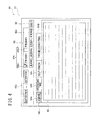
- the menu screen 61 is to allow a user to designate a product he or she wishes to check or to select specific items of the device data of the designated product.
- the menu screen 61 in FIG. 4 includes buttons and columns such as a product designation 62, execution button 63, item selection 64, and item display 65 in the present embodiment.
- the product designation 62 is to allow the user to designate a product he or she wants to check, and includes a production period column 62a, a product designation column 62b, and a stock number column 62c by way of example.
- the production period is designated by inputting a start date and an end date to the production period column 62a.
- the product designation column 62b includes two columns 62b1, 62b2 to select one from two products as shown in FIG. 4 .
- a desired stock number can be input to the stock number column 62c.
- the production period column 62a and the stock number column 62c can be configured to select one from a list and the production designation column 62b can be configured that product codes or numbers are input thereto.
- the execution button 62 is to execute acquiring of the device data of the item designated in the product designation 62. By operating the execution button 62 after setting an item in the product designation 62, the device data of the item in question is acquired.
- the item selection 64 is to select a desired item to check from the acquired device data and includes an error button 64a, an operating time button 64b, a self-check button 64c, and a troubleshooting button 64d by way of example.
- the error button 64a is to display accumulated error data on the selected surveying device as operation information.
- the operating time button 64b is to display operating time data on the selected surveying device as operation information.
- the operating time data can be a one-time operating time or a total operating time which are selectively or concurrently displayed on the item display 65.
- the self-check button 64c is to display accumulated self maintenance check data indicating the processing details of self maintenance check aid function, which will be described in detail later.
- the troubleshooting button 64d is to display accumulated troubleshooting data indicating the processing details of troubleshooting aid function, which will be described in detail later.
- a questionnaire button can be additionally provided to display accumulated questionnaire data indicating the processing details of questionnaire creation aid function.
- the item display 65 displays an item selected by the item selection 64 from the acquired device data when appropriate.
- the display can be properly arranged to be easy to see in accordance with an item selected, for example, by displaying all items of the device data for each surveying device or displaying error data in chronological order.
- the self maintenance check aid function and the troubleshooting aid function of the surveying device 10 are described. Both functions are executed upon a user's request. Following the procedures of the aid functions, the user is requested to select certain items or input numbers or texts on the display unit 16. The user' s selection or input can be made with the input unit 17 or directly by a touch panel on the display unit 16. Thus, either or both of the input unit 17 and the display unit 16 function (s) as an operation status input unit.
- the self maintenance check aid function is executed under the control of the controller 28 of the control unit 27.
- the user is allowed to select a desired item from maintenance items displayed on the display unit 16 to examine the concerning units and adjust various set values thereof. The details and results of examination and adjustment are also displayed on the display unit 16.
- FIG. 5 is a flowchart showing a self maintenance check process executed by the controller 28, and FIG. 6A shows a maintenance item list on a self-check screen 71 on the display unit 16 and FIG. 6B shows the details and results of the self maintenance check thereon. Each step of the flowchart is described with reference to FIGs. 6A, 6B in the following.
- step S1 a maintenance item list 71a in FIG. 6A is displayed on the display unit 16.
- the items of the list include, for example, adjustment of set values of the respective units and examination of the respective units for normal operation.
- step S2 details of the item to be executed 71b (in FIG. 6B ) are displayed on the display unit 16 and the current values of the item are stored in the memory 29 as a transmission file.
- the self-check screen 71 includes check details 71b indicating the maintenance and adjustment procedures of the item in question which the user has to take and the details of automatic check operation of the device ( FIG. 6B ) .
- the current values of the item are, for example, values before adjustment and stored in the memory 29 when needed.
- unfinished items are displayed in a predetermined order on the display unit 16 so that all the maintenance items registered are carried out in order.
- the items to be executed can be ones selected from the maintenance item list in step S1.
- step S3 a determination is made on whether or not the check operation performed on the respective units has been correctly executed.
- the flow proceeds to step S4 and when the result is NO, the flow proceeds to step S5.
- the self-check screen 71 includes an OK button 71c in FIG. 6B to complete the operation.
- the OK button 71c Upon a user's manipulation of the OK button 71c, the check operation is determined to be completed, and the above determination is made.
- this determination by the OK button can be omitted depending on the item to be executed, for example, an automatic check operation such as tilt adjustment in step S53.
- step S4 the set values of the item adjusted by the check operation are stored in the memory 29 as a transmission file, and the flow proceeds to step S7.
- step S5 a determination is made on whether or not to execute the check operation.
- the flow returns to step S2 and when the result is NO, the flow proceeds to step S6.
- the self-check screen 71 includes a re-execute button 71d in FIG. 6B in addition to the OK button 71. Based on a user's manipulation of the OK button 71c or re-execute button 71d, the execution or re-execution of the check operation is determined.
- step S6 the result that the item displayed in step S2 has not been correctly executed is stored as a transmission file in the memory 29.
- the flow proceeds to step S11.
- step S7 a determination is made on whether or not the adjusted values are within a defined range.
- the flow proceeds to step S8 and when the result is NO, the flow proceeds to step S9. This determination is made by comparing the adjusted values with values defined for each maintenance item and stored in the memory 29.
- step S8 the result that the adjusted values in step S7 fall within the defined range is displayed on the display unit 16 and stored in the memory 29 as a transmission file.
- the flow proceeds to step S11.
- a self-check result 71e is displayed on the self-check screen 71 of the display unit 16 in FIG. 6B .
- step S9 the result that the adjusted values in step S7 do not fall within the defined range is displayed on the display unit 16. Then, a determination is made on whether or not the check operation is executed again by a user's manipulation of the OK button 71c or re-execute button 71d in FIG. 6B . When the result is YES, the flow returns to step S2 and when the result is NO, the flow proceeds to step S10.
- step S10 since the check operation is not executed again, the result that the adjusted values in step S7 do not fall within the defined range is stored as a transmission file in the memory 29. Then, the flow proceeds to step S11.
- step S11 a determination is made on whether or not all the maintenance items registered are checked, irrespective of the results in the steps S3, S7.
- the flow returns to step S12 and when the result is NO, the flow returns to step S2.
- step S11 a determination can be made on whether or not to end the self maintenance check operation.
- the flow proceeds to step S12 and when the result is NO, the flow returns to step S10.
- step S12 the transmission files stored in the memory 29 are transmitted to the main server 42 via the communication unit 33, completing the self maintenance check process.
- the results in the above steps are stored in the main server memory 47 in association with the identification data of the surveying device 10. If the details to be executed are selected in step S2, preferably, the details selected are also transmitted together with basic information such as the identification data of the surveying device 10, operating time data, position data, and software version data.
- steps S4 and steps S7 to S10 can be omitted from the flowchart in FIG. 5 and after step S3 or S6, the flow can proceed to step S11.
- This flowchart is merely an example of the self maintenance check operation and the details of the steps can be arbitrarily changed in accordance with the item to be checked.
- the user selects to execute the self maintenance check aid function via the input unit 17 or on the display unit 16, to display the maintenance item list 71a on the display unit 16. Following the steps in the flowchart in FIG. 5 , the user is guided to execute the self maintenance check operation, viewing the display unit 16.
- the surveying device 10 allows the user to repetitively execute the check operation regarding all the maintenance items. It also transmits the details of the executed operation to the main server 42 in step S12. Accordingly, the input unit 17 and the display unit 16 function as a maintenance aid function.
- the troubleshooting aid function is executed under the control of the controller 28 of the control unit 27 and aims to find the causes of a failure or a problem in the surveying of the surveying device 10 or the surveying unit at a preset accuracy.
- the items to select for specifying the causes are displayed on the display unit 16 together with solutions and procedures that the user is to execute.
- FIG. 7 is a flowchart for troubleshooting process executed by the controller 28 and FIG. 8 is a flowchart for questionnaire creation process.
- FIG. 9A shows a troubleshooting screen 72 on the display unit 16 on which a problem list is displayed while FIG. 9B shows the same on which solutions and procedures of the solutions are displayed.
- the flowcharts in FIGs . 7-8 are described referring to FIGs . 9A, 9B .
- step S21 a problem list 72a in FIG. 9A is displayed on the display unit 16.
- the problem list shows in what operation of the functions of the surveying device a problem or failure has occurred. The user is allowed to select the problem from the problem list 72a.
- step S22 the problem selected in step S21 is stored as a transmission file in the memory 29 and the flow proceeds to step S23.
- an OK button 72b to confirm the selection and a cancel button 72b to cancel the selection are displayed on the troubleshooting screen 72 on the display unit 16. The selection of a problem is determined by the user's manipulation of the OK button 72b while any of the problem list is selected.
- step S23 solutions for the selected problem are displayed on the display unit 16, and stored as a transmission file in the memory 29, and the flow proceeds to step S24.
- one of the solutions is selected and displayed. It is preferable to display the most likely solution for the selected problem.
- the most likely solution can be set on the basis of the tendency of problems occurring in the surveying device 10.
- the solutions for each of the problems are preset and stored in the memory 29 and displayed in order of execution.
- solution details 72d in FIG. 9B indicating the procedures the user needs to follow are displayed on the display unit 16.
- step S24 a determination is made on whether or not the user intends to execute the displayed solution on the display unit 16.
- the flow proceeds to step S25 and when the result is NO, the flow proceeds to step S28.
- a non-execute button 72e to require another solution without executing the displayed solution is displayed on the troubleshooting screen 72 in FIG. 9B . With the button 72e selected, the displayed solution is not executed and with the button 72e not selected, the execution is withheld until step S25.
- step S25 a determination is made on whether or not the problem in question has been solved.
- the flow proceeds to step S26, and when the result is NO, the flow proceeds to step S27.
- a solved button 72f and an unsolved button 72g are displayed on the display unit 16 in FIG. 9B .
- the problem in question is determined to be solved by a user's selection of the solved button 72f and determined to be unsolved by a user's selection of the unsolved button 72g.
- step S26 the solution to have solved the problem in step S25 is stored as a transmission file in the memory 29. The flow then proceeds to step S30.
- step S27 the solution having failed to solve the problem in step S25 is stored as a transmission file in the memory 29, and the flow proceeds to step S28.
- step S28 a determination is made on whether or not there are any other solutions stored in the memory 29 for the problem selected in step S22, except for the solution executed in step S23.
- the flow returns to step S23, and when the result is NO, the flow proceeds to step S29.
- step S29 the result that there is no other solution in step S28 is displayed on the display unit 16 and stored as a transmission file in the memory 29.
- the flow then proceeds to step S30.
- the solution details 72d indicating no other solution available is displayed on the troubleshooting screen 72 on the display unit 16.
- step S30 the transmission files stored in the memory 29 are transmitted to the main server 42 via the communication unit 33, thereby completing the troubleshooting process.
- the results obtained in step S22, S23, steps S26, S27, and step S29 are stored in the main server memory 47 in association with the identification data of the surveying device 10. It is preferable to transmit, to the main server 42, basic information such as the identification data of the surveying device 10, operating time data, position data, and software version data together with the identification data.
- step S22 can be one of the maintenance items.
- a control program can be created to link the flowchart in FIG. 7 with the flowchart in FIG. 5 when appropriate.
- step S21 it is preferable to allow the user to create a questionnaire instead of step S21. Thereby, it is possible to prevent the user from repetitively executing the steps S23 to S29 for each of selected solutions for the problem in question.
- the questionnaire creation process is described referring to FIG. 8 . It is executed under the control of the controller 28 of the control unit 27.
- step S41 the user is allowed to select the broad category of a problem with a broad category 73d on the display unit 16 as shown in FIG. 13 , for example.
- the broad category includes the functions of the surveying device 10 such as distance measuring function, angle measuring function, or automatic tracking function.
- step S42 the user is allowed to select one from a middle category 73e listing the details of the broad category on the display unit 16.
- the details can be, for example, a failure in the distance measuring function such as inability to survey, a variation in the measured distance, an abnormal or impossible survey result, or a failure in the angle measuring function such as an error as a double angle difference, a difference in normal and reverse measurement, a difference between the maximum and minimum values of the normal and reverse measurement, and else.
- step S43 the detail selected in step S42 is stored as a transmission file in the memory 29.
- step S44 the transmission file stored in the memory 29 is transmitted to the main server 42 via the communication unit 33, thereby completing the questionnaire creation process.
- the user to create the questionnaire properly and store questionnaire data in the main server memory 47 in association with the identification data of the surveying device 10.
- the flowchart of FIG. 8 , the input unit 17 and the display unit 16 constitute a questionnaire creation aid function.
- the problem to solve is classified in the two categories in step S41 and S43. However, the problem to solve can be classified in three or more categories to create a more accurate questionnaire.
- the problem list 72a is displayed as in step S21 of the flowchart in FIG. 7 .
- the questionnaire can be created, following the flowchart in FIG. 8 .
- the solution details 72d for the selected problem are displayed on the display unit 16 together with the solved button 72f to indicate that the problem has been solved and the unsolved button 72g to indicate that the problem has not been solved.
- the user selects one of the buttons 72e, 72f, 72g.
- the surveying device 10 completes the troubleshooting process.
- the user can find the solution for the problem in proper surveying and the procedures of the solution, or execute troubleshooting.
- the surveying device 10 transmits the details of the operation executed in the troubleshooting aid function to the main server 42 in step S30.
- the flowchart in FIG. 7 and the display unit 16 and the input unit 17 constitute a troubleshooting aid function to guide the user to find and execute the solution.
- the self maintenance check aid function and questionnaire creation aid function are described.
- the self maintenance check there are two kinds of the self maintenance check, i.e., the adjustment of set values and simple operation checks.
- the adjustment of a tilt offset value as an example of the self maintenance check aid function is described with reference to FIG. 10 .
- the tilt offset value is to correct the position of the surveying device 10 set in a desired place to an accurate horizontal position.
- FIG. 10 omits the display of the maintenance item list equivalent to step S1 in FIG. 5 .
- step S51 a current tilt offset value (before adjusted) is stored as a transmission file in the memory 29.
- step S52 a message to induce the user to execute the tilt adjustment is displayed on the display unit 16 until 30 seconds are counted, for example.
- the user is allowed to operate the adjustment mechanism on the base 12 so that the reference position of the telescopic unit 14 is adjusted to be horizontal to the leveling unit 11.
- the counted time can be arbitrarily set to a time enough to execute the adjustment.
- step S53 in 30 seconds after the display in step S52, the device 10 is checked if it is in a horizontal state by rotating the mounting bracket 13 by the horizontal driver 23 relative to the base 12 to the reference position forwardly, horizontally and then rotating it reversely. Values acquired here are stored as a transmission file in the memory 29.
- step S54 a determination is made on whether or not the mounting bracket 13 is rotated properly and correctly.
- the flow proceeds to step S55 and when the result is NO, the flow proceeds to step S59.
- Steps S51 to S54 correspond to steps S2 to S3 in FIG. 5 .
- step S55 a determination is made on whether or not the acquired values in step S54 are in a defined range by comparing them with defined values stored in the memory 29.
- the flow proceeds to step S56 and when the result is NO, the flow proceeds to step S60.
- Step S55 corresponds to step S7 in FIG. 5 .
- step S56 the result that the acquired values are in a defined range is displayed on the display unit 16 and stored as a transmission file in the memory 29.
- Step S56 corresponds to step S8 in FIG. 5 .
- step S57 new tilt offset values are set on the basis of the acquired values.
- the tilt offset values can be set in a conventional manner, therefore, a description thereof is omitted.
- step S58 the new tilt offset values are stored in the memory 29, thereby completing the adjustment of the tilt offset values.
- step S59 a failure that the mounting bracket 13 has not been properly rotated forwardly or reversely in step S53 is stored as a transmission file in the memory 29.
- Step S59 correspond to step S6 in FIG. 5 .
- the error in step S53 is stored before re-adjusting the tilting since the operation in step S53 is an automatic check operation and a failure therein means an error in the surveying device 10 itself.
- step S60 the result that the acquired values are not within a defined range is displayed on the display unit 16 and stored as a transmission file in the memory 29.
- step S61 a determination is made on whether or not to adjust the tilt offset values again.
- the flow returns to step S52 and when the result is NO, the negative result is stored as a transmission file in the memory 29, completing the tilt offset value adjustment process.
- Step S61 corresponds to step S5 or S9 in FIG. 5 .
- the transmission files in the memory 29 are transmitted to the main server 42 via the communication unit 33 and stored in the main server memory 47 in association with the identification data of the surveying device 10, the same as in FIG. 5 .
- the user operates the input unit 17 or the display unit 16 to execute the tilt offset value adjustment of the self maintenance check aid function and is guided to execute the operation in the flowchart in FIG. 10 , viewing the display unit 16.
- the user is allowed to adjust the tilt offset value and the adjustment results are transmitted to the main server 42.
- FIG. 11 shows the operation in which the rotation time of the mounting bracket 13 relative to the base 12 is checked.
- the rotation time is a time taken for the mounting bracket 13 to make a full rotation relative to the base 12 horizontally and represents the horizontal rotary velocity of the mounting bracket 13.
- step S71 a time at which the check operation is started is detected.
- step S72 at the start time the horizontal driver 23 starts the rotation of the mounting bracket 13 from the reference position to the reference position relative to the base 12.
- step S73 the rotation of the mounting bracket 13 is stopped and the stop time is detected.
- step S74 a determination is made on whether or not the mounting bracket 13 has been normally rotated around.
- the flow proceeds to step S75, and when the result is NO, the flow proceeds to step S77.
- Steps S71 to S74 correspond to steps S2 to S3 in FIG. 5 .
- step S75 a determination is made on whether or not the rotation time is in a defined range by comparing an actual rotation time with defined values stored in the memory 29.
- the actual time rotation time is calculated by subtracting the start time in step S71 from the stop time in step S73.
- Step S75 corresponds to step S7 in FIG. 5 .
- step S76 the result that the rotation time is in a defined range is displayed on the display unit 16 and the result and the actual rotation time are stored as a transmission file in the memory 29. This completes the rotation time check operation concerning the mounting bracket 13. Step S76 corresponds to step S8 in FIG. 5 .
- step S77 an error that the mounting bracket 13 has not been properly rotated in step S74 is stored as a transmission file in the memory 29.
- the error represents what operation of the rotation time detection has failed.
- Step S79 corresponds to step S6.
- the error in step S53 is stored before re-checking the rotation time since the operation in step S53 is an automatic check operation and a failure therein means an error in the surveying device 10 itself.
- step S78 the result that the rotation time is not within a defined range in step S75 is displayed on the display unit 16 and stored as a transmission file in the memory 29.
- step S79 a determination is made on whether or not to re-check the rotation time.
- the flow returns to step S71, and when the result is NO, the negative result is stored as a transmission file in the memory 29, completing the rotation time check operation.
- Step S79 correspond to step S7 or S9 in FIG. 5 .
- the transmission files stored in the memory 29 are transmitted to the main server 42 via the communication unit 33 and stored in the main server memory 47 in association with the identification data of the surveying device 10, as in the operation in FIG. 5 .
- the user operates the input unit 17 or the display unit 16 to select the checking of the rotation time of the mounting bracket 13 from the self maintenance check aid function, and is guided to execute the operation in the flowchart in FIG. 11 , viewing the display unit 16.
- the user is allowed to check the rotation time and the check results are transmitted to the main server 42.
- FIG. 12 shows the operation in a questionnaire creation process by way of example. For the sake of simplicity, only two functions, distance measurement and angle measurement are set in a broad category. A flowchart in FIG. 12 is described referring to FIG. 13 .
- a questionnaire creation aid screen 73 in FIG. 13 is displayed on the display unit 16.
- the questionnaire creation aid screen 73 includes a weather button 73a, a temperature button 73b, a frequency button 73c, a broad category 73d, a middle category 73e, a details button 73f, an OK button 73g, and a cancel button 73h. These buttons are pull-down menus.
- the weather button 73a is for setting current weather in ambient environment in which the surveying device 10 is placed.
- the temperature button 73b is for setting a current temperature.
- the device can be configured to include a temperature detector to detect an ambient temperature and set the detected value to a current temperature.
- the frequency button 73c is for setting a frequency at which a problem concerned occurs.
- the broad category 73d corresponds to the broad category of a problem in step S41 in FIG. 8 .
- the middle category 73e and details button 73f correspond to the details in step S42.
- the middle category 73e is subordinate to the broad category 73d, and the details button 73f is subordinate to the middle category 73e.
- the middle category 73e and details button 73f become settable when the broad category 73d and middle category 73e are set, respectively.
- step S82 basic information is generated and stored as a transmission file in the memory 29 together with the information set with the weather button 73a, temperature button 73b, and frequency button 73c.
- the basic information refers to the identification data of the surveying device 10, operating time data, position data, and software version data as described above.
- step S83 a determination is made on whether or not the distance measurement is set in the broad category 73d.
- the flow proceeds to step S84, and when the result is NO and the angular measurement is set, the flow proceeds to step S87.
- step S84 the problems in the middle category 73e are displayed on the display unit 16 to allow the user to select one. Additionally, the details of the problem can be also set with the details button 73f.
- the middle category 73e includes problems such as inability to survey, a variation in the measured distance, and an abnormal or impossible survey result.
- the flow skips step S85 and proceeds to step S86, as indicated by an alternate long and short dash line.
- step S85 a column to describe a specific situation in which the problem set in the middle category has occurred is displayed on the display unit 16.
- the specific situation is, for example, that when an error in a measured value is set in step S84, how or by what manipulation an error was found specifically.
- the specific situation can be set with the details button 73f. By a user's manipulation of the OK button 73g, completion of describing the specific situation is determined.
- step S86 the contents of the column are stored as a transmission file in the memory 29.
- the middle category of the distance measurement is specified and a questionnaire for the problem in the middle category is created.
- step S87 following step S83 in which the angle measurement has been set, the problem list of the middle category 73e of the angle measurement is displayed on the display unit 16.
- the details of the problem can be also set with the details button 73f.
- the middle category includes problems such as error in horizontal angle, error in altitude, and the like.
- step S88 the problem set in step S87 is automatically checked or self-examined, and the checked details and values are stored as a transmission file in the memory 29.
- the problem automatically checked is for example the automatic rotation of the mounting bracket 13 relative to the base 12 described above.
- step S89 the created questionnaire is stored as a transmission file in the memory 29.
- step S90 the transmission files stored in the memory 29 are transmitted to the main server 42 via the communication unit 33, thereby completing the questionnaire creation process.
- the user can create a proper questionnaire and data on the questionnaire is stored in the main server memory 47 in association with the identification data of the surveying device 10.
- a request for describing a specific situation is issued and the specific situation is stored in steps S85 to S86 while when the angle measurement is set, a self-examination is executed in step S88 by way of example.
- the present invention is not limited to such an example.
- the self-examination can be executed when the distance measurement is set or the request can be issued when the angle measurement is set.
- the user operates the input unit 17 or the display unit 16 to execute the questionnaire creation aid function and is guided to execute the operation in the flowchart in FIG. 12 , viewing the display unit 16.
- the surveying device 10 it is made possible for the user to create a proper questionnaire and the surveying device 10 can transmit the results of the questionnaire creation process to the main server 42.
- the operations executed in the self maintenance check aid function, troubleshooting aid function, or questionnaire creation aid function are transmitted to the main server 42 via the communication unit 33, and stored in main server memory 47 in association with the identification data of the surveying device 10, as shown in FIG. 3 .
- the terminals 44 can individually access the main server 42 via the web server 43.
- the web server 43 restricts the area of data accessible by each terminal so that all the data stored in the main server memory 47 cannot be freely seen with the terminals 44.
- the terminal 441 is a manufacturer of the surveying device, they are allowed to see device data such as the model numbers of their products. If the terminal 442 is a dealer of the device, they are allowed to see device data such as the stock numbers of products they sold.
- the terminal 441 can select either or both of the columns and acquire data on the details of the self maintenance check aid function and troubleshooting aid function executed, and the created questionnaire by operating the product designation 62 on the menu screen 61 in FIG. 4 . In addition, they can see the basic information, error data, and operating time data obtained during the execution of these functions.
- the terminal 442 can acquire data on the details of the self maintenance check aid function and troubleshooting aid function executed, and the created questionnaire by designating the stock number of their product on the menu screen 61 and can see the basic information, error data, and operating time data obtained during the execution of these functions.
- the surveying device 10 can transmit the operation status information to the outside network when appropriate, which allows relevant parties such as dealers or manufacturers to acquire the operation status information on the surveying device 10 or the current usage status and condition of the device quickly.
- the surveying device 10 can transmit the operation information to the outside network in addition to the operation status information so that the relevant parties can more accurately know the current usage status and condition of the device. For example, they can accurately know the causes of a problem in surveying a target point by comparing the error data with the operation status information.
- the transmission of the basic information to the outside network makes it possible for the relevant parties to more accurately know the current usage status and condition of the device. For example, they can more accurately know the causes of a problem in surveying a target point by comparing ambient information as temperature, humidity with the operation status information since the ambient condition under which the surveying device 10 is placed can greatly affect of the operation thereof.
- the relevant parties can use the operation status information, operation information, and basic information transmitted from the surveying device 10 to study the causes of a problem occurring from various viewpoints and specify the problem accurately.
- the self maintenance check aid function of the surveying device 10 makes it easier for the user to properly execute the self maintenance check. Also, the surveying device 10 can allow the user to know his/her errors in the use of the device such as setting failures.
- the relevant parties can use the processing details of the self maintenance check aid function transmitted from the surveying device 10 to more accurately know the current usage status and condition of the device.
- the questionnaire creation aid function of the surveying device 10 makes it easier for the user to create a proper questionnaire accurately reflecting a problem in surveying, for example, how and in what operation of which measuring function the problem has occurred.
- the relevant parties can use the processing details of the questionnaire creation aid function transmitted from the surveying device 10 to accurately and quickly know how and in what operation of which measuring function the problem has occurred.
- the troubleshooting aid function of the surveying device 10 can provide a solution for the problem to the user and allow the user to easily and properly execute the solution.
- the relevant parties can use the processing details of the troubleshooting aid function transmitted from the surveying device 10 to accurately and quickly know the situation in which the problem in surveying has occurred and acquire information on whether or not the solution provided for the problem was effective.
- the dealer or manufacturer of the surveying device 10 can quickly know the cause of a problem in surveying and can promptly provide solutions for the problem to the user.
- the dealers or manufacturers of the devices to quickly know the current usage statuses or conditions of the individual surveying devices 10.
- the dealers or manufacturers can accurately know the causes of a problem by comparing the error data with the operation status information and provide proper solutions for the problem to the user. Also, they can find a tendency of errors from various accumulated data in the surveying device 10 and calculate mean time between failures (MTBF) to check the reliability and quality of the surveying device 10. They can specifically know from the accumulated data the ambient environment under which the surveying device 10 is used.
- MTBF mean time between failures
- the terminals 44 can obtain the basic information on a plurality of surveying devices 10, which allows the dealers or manufacturers of the device to more accurately and quickly know the current usage status or condition of each surveying device 10 and the cause of a problem in surveying by comparing the ambient information as temperature, humidity with the operation status information. Accordingly, they can promptly provide the user with proper solutions for the problem.
- the dealers or manufacturers can use the operation status information, operation information, and basic information obtained with the terminals 44 to more accurately know the current usage status and condition of each surveying device 10 and study the causes of a problem in surveying a target from various viewpoints and specify the causes of the problem accurately.
- the dealers or manufacturers can obtain data on each maintenance items regarding aging deterioration or setting change or the like from the accumulated data in the surveying devices 10 so as to notify the user of that before a failure occurs.
- a notification can be made from the main server 42 or directly from a manufacturer or a dealer with the terminals 44 via the communication unit 33.
- the manufacturers or dealers can acquire the processing details of the questionnaire creation aid function as the operation status information, for example, to accurately and quickly know how, in what circumstances, or in what operation the problem has occurred. Accordingly, they can provide solutions for the problem to the user quickly.
- the manufacturers or dealers can acquire the processing details of the troubleshooting aid function as the operation status information, to accurately and quickly know the situation in which the problem in surveying has occurred and acquire information on whether or not the solution provided for the problem was effective.
- the present invention should not be limited to such an example. It can be arbitrarily configured as long as it comprises a surveying unit configured to measure a direction and a distance to a target object, a control unit configured to control the surveying unit, a communication unit configured to allow the control unit to communicate with an outside network, and a status input unit with which operation status information on the surveying unit is input, in which the control unit transmits the operation status information input with the status input unit to the outside network via the communication unit.
- the present invention should not be limited to such an example. It can be arbitrarily configured as long as it comprises a surveying device comprising a surveying unit to measure a direction and a distance to a target object and a control unit to control the surveying unit, to transmit operation status information on the surveying unit to the outside network, a main server configured to receive the operation status information from the surveying device via the outside network and store the operation status information in association with identification data of the surveying device, a terminal configured to acquire the operation status information associated with the identification data of the surveying device, and a data area setting unit configured to network-connect the terminal and the main server and set an accessible area in the operation status information stored in the main server on the basis of identification data of the terminal.
- a surveying device comprising a surveying unit to measure a direction and a distance to a target object and a control unit to control the surveying unit, to transmit operation status information on the surveying unit to the outside network
- a main server configured to receive the operation status information from the surveying device via the outside network
- the above embodiments have described an example of the self maintenance check aid function executed following the flowchart in FIG. 5 .
- the present invention should not be limited to such an example. It can be arbitrarily configured as long as the user can select a maintenance item on the display unit 16 to see the details and results of examination or value adjustment for the purpose of examining the parts and units of the surveying device 10 and adjusting various set values.
- the present invention should not be limited to such an example.
- the terminal 44 or the main server 42 transmits information to the surveying device 10 to perform maintenance of the surveying device 10 or update programs stored therein.
Landscapes
- Physics & Mathematics (AREA)
- Engineering & Computer Science (AREA)
- General Physics & Mathematics (AREA)
- Radar, Positioning & Navigation (AREA)
- Remote Sensing (AREA)
- Arrangements For Transmission Of Measured Signals (AREA)
- Management, Administration, Business Operations System, And Electronic Commerce (AREA)
- Radar Systems Or Details Thereof (AREA)
- Optical Radar Systems And Details Thereof (AREA)
Abstract
Description
- The present invention relates to a surveying device and a communication system including the surveying device.
- In surveying, Japanese Patent Application Publication No.
2008-268004 - However, in a conventional surveying machine, manufacturers are unable to know what goes wrong with a machine until the machine in question is sent to them for inspection or they receive inquiries about problems or failures from users.
- Moreover, for examining the surveying machine, it is necessary to find the troubles or failures in the parts of the machine or reproduce the situation in which a failure in surveying a target has occurred. When the failure occurs from various complicated factors, it is very hard to specify the causes of the failure in a different environment or condition from the one in which the failure has actually occurred.
- Further, some surveying machine can generate and read an error log as a record of errors in a computer system. However, the error log does not always lead to specifying the causes of a problem. Thus, the surveying machine has a room for improvement in terms of accurately and quickly finding the causes of a problem in surveying.
- The present invention aims to provide a surveying device which can quickly and accurately find the causes of a problem in surveying a target.
- In one embodiment of the present invention, a surveying device comprise a surveying unit configured to measure a direction and a distance to a target object, a control unit configured to control the surveying unit, a communication unit configured to allow the control unit to communicate with an outside network, and a status input unit with which operation status information on the surveying unit is input, wherein the control unit transmits the operation status information input with the status input unit to the outside network via the communication unit.
- Features, embodiments, and advantages of the present invention will become apparent from the following detailed description with reference to the accompanying drawings:
-
FIG. 1 shows an example of asurveying device 10 according to one embodiment of the present invention; -
FIG. 2 is a block diagram showing the structure of thesurveying device 10 inFIG. 1 ; -
FIG. 3 schematically shows the structure of acommunication system 40 for a surveying device according to one embodiment of the present invention; -
FIG. 4 shows ascreen display 61 of aterminal 44; -
FIG. 5 is a flowchart for self maintenance check operation executed by acontroller 28; -
FIG. 6A shows the maintenance items on adisplay unit 16 andFIG. 6B shows the details and results of the self maintenance check; -
FIG. 7 is a flowchart for troubleshooting operation executed by thecontroller 28; -
FIG. 8 is a flowchart for questionnaire creation operation executed by thecontroller 28; -
FIG. 9A shows a list of problems in thesurveying device 10 on thedisplay unit 16 andFIG. 9B shows solutions and choices on thedisplay unit 16; -
FIG. 10 is a flowchart for adjusting a tilt offset value as an example of the self maintenance check aid function; -
FIG. 11 is a flowchart for checking the rotation time of amounting bracket 13 relative to abase 12 as an example of a simple operation check of the self maintenance check aid function; -
FIG. 12 is a flowchart for questionnaire creation aid function by way of example; and -
FIG. 13 shows a questionnairecreation aid screen 73. - Hereinafter, embodiments of the surveying device and a communication system for the surveying device according to the present invention will be described in detail with reference to the accompanying drawings. Wherever possible, the same reference numbers will be used throughout the drawings to refer to the same or like parts.
- First, the schematic structure of a surveying device according to a first embodiment is described.
FIG. 1 is a perspective view of asurveying device 10 by way of example.FIG. 2 is a block diagram of the function of thesurveying device 10. - The
surveying device 10 inFIGs . 1 to 2 is a total station which can accurately measure a distance to a target object by emitting a pulsed laser beam to the target object to receive pulsed light reflected therefrom, calculating a distance with every pulse and averaging the results. Thesurveying device 10 includes aleveling unit 11, abase 12, amounting bracket 13, and atelescopic unit 14. - The
leveling unit 11 is mounted on a not-shown tripod to detect the inclination of thesurveying device 10 ortelescopic unit 14. Thebase 12 is provided on theleveling unit 11 to be able to change an inclination angle relative to theleveling unit 11. Themounting bracket 13 is provided on thebase 12 to be rotatable around the vertical axis, and includes adisplay unit 16 and aninput unit 17. Theinput unit 17 is manipulated by a user to operate various functions of thesurveying device 10 and outputs input data to a control unit 27 (FIG. 2 ). - The
telescopic unit 14 is held by themounting bracket 13 to be rotatable around the horizontal axis, and it includes asight 15 to set the collimation direction of thesurveying device 10, asecond telescope 18 to collimate a target object, and asecond imaging unit 19 to acquire a telephoto image in the collimation direction via the optical system of thesecond telescope 18. Further, thetelescopic unit 14 includes afirst telescope 20 having a wider field of view at a lower magnification than thesecond telescope 18 and a first imaging unit 21 (FIG. 2 ) to acquire a wide-angle image in the collimation direction via the optical system of thefirst telescope 20. Thefirst imaging unit 21 and thesecond imaging unit 19 can be a digital camera to output a captured image as a digital image signal, for example. Thetelescopic unit 14 incorporates a rangingunit 22 which shares the optical system of thesecond telescope 18. The rangingunit 22 is configured to emit a laser beam to a target object and receive light reflected from the target to optically measure a distance to the target. - The
mounting bracket 13 rotatably holding thetelescopic unit 14 around the horizontal axis includes ahorizontal driver 23 and a horizontalangle measuring unit 24. Thehorizontal driver 23 is configured to rotate themounting bracket 13 relative to thebase 12 around the vertical axis or in horizontal direction. The horizontalangle measuring unit 24 is configured to detect the horizontal angle in the collimation direction by detecting the horizontal angle of themounting bracket 13 relative to thebase 12. - Further, the
mounting bracket 13 includes avertical driver 25 and a vertical angle measuring unit 26 (FIG. 2 ). Thevertical driver 25 is configured to rotate thetelescopic unit 14 relative to themounting bracket 13 around the horizontal axis or in vertical direction. The verticalangle measuring unit 26 detects the vertical angle in the collimation direction by detecting the vertical angle of thetelescopic unit 14 relative to themounting bracket 13. - Further, the
mounting bracket 13 incorporates thecontrol unit 27 configured to control the horizontal andvertical drivers mounting bracket 13 and thetelescopic unit 14, respectively, thereby directing thetelescopic unit 14 to a predetermined direction and moving it in a predetermined area. Also, thecontrol unit 27 switchably controls thefirst telescope 20 and thesecond telescope 18 to acquire images with a required magnification. It controls the rangingunit 22 to measure a distance to a certain point to be surveyed. Thus, theleveling unit 11,base 12,mounting bracket 13,telescopic unit 14,sight 15, rangingunit 22,horizontal driver 23, horizontalangle measuring unit 24,vertical driver 25, verticalangle measuring unit 26,first telescope 20 orfirst imaging unit 21, andsecond telescope 18 orsecond imaging unit 19 constitute a surveying unit controlled by thecontrol unit 27. - The
control unit 27 inFIG. 2 includes thedisplay unit 16,input unit 17,controller 28, amemory 29, animage processor 30, animaging unit selector 31, animage memory 32 and acommunication unit 33. - The
controller 28 is configured to integrally control the operation of thecontrol unit 27 by a program stored in thememory 29. Thememory 29 contains various programs such as calculation program for distance measurement, image processing program, data generation program to generate transmission data of the surveying device, and data transmission program. The transmission data of the surveying device is stored in thememory 29, displayed on thedisplay unit 16, and transmitted to an outside network (main server 42 as later described) via thecommunication unit 33 when appropriate. - The transmission data of the surveying device includes operation status information, operation information, and basic information. The operation status information refers to data indicating the operation state of the surveying unit input from an operation status input unit (
input unit 17 ordisplay unit 16 in the present embodiment) or the operation state or cooperation state of the respective surveying parts and elements, processing details of later-described self maintenance check aid function (FIGs. 5 ,6 ), troubleshooting aid function (FIGs. 7 ,9 ), and questionnaire creation aid function (FIG. 8 ). - The operation information includes the operation details of the
surveying device 10, the operations or detected values of the respective units of thesurveying device 10, error data on the respective units, operating time data, end else. The error data indicates operation failures in thesurveying device 10 or respective units, set values exceeding their allowable ranges, or the like. It is generated every time the occurrence of such an error is detected by detectors in the device. The operating time data is generated along with turning-on/off of the power supply of thesurveying device 10. Thus, thecontrol unit 27 orcontroller 28 functions as an operation information acquiring unit in cooperation with the detectors. - The basic information refers to identification data of the
surveying device 10, atmosphere data such as temperature, humidity in a place where the surveyingdevice 10 is used, position information, version data of software applied to thesurveying device 10, and else. The position information is generated by GPS function incorporated in the device. - The output values of the ranging
unit 22, horizontalangle measuring unit 24, and verticalangle measuring unit 26 are input to thecontroller 28 for distance measurement. Thecontroller 28 measures or calculates a distance, high and low angles, and horizontal angle on the basis of the output values and stores resultants in thememory 29 and displays them on thedisplay unit 16. The resultants are transmitted to an outside network or a later describedmain server 42 via thecommunication unit 33. - The
imaging unit selector 31 selects either of the first andsecond imaging units second imaging unit image memory 32 and displayed on thedisplay unit 16. Theimage processor 30 performs image processing on the images stored in theimage memory 32, for example, ones captured by thefirst imaging unit 21, stores them again in theimage memory 32, and displays them on thedisplay unit 16. - The
communication unit 33 allows thedevice 10 to communicate with the outside network and transmits various types of information stored in thememory 29 under the control of thecontrol unit 27 when appropriate. In the present embodiment thecontrol unit 27 orcontroller 28 is configured to perform wireless data communication with themain server 42 and thecommunication unit 33 is adapted for wireless communication. Thecommunication unit 33 is made up of a PHS (Personal Handy-phone System) modem. - The structure of a communication system for a surveying device according to a second embodiment of the present invention is described. The
communication system 40 is applied for plural surveying devices indicated by a numeral code (10) as shown inFIG. 3 . Here, only asingle surveying device 10 is described for the sake of simplicity. - The
communication system 40 includes acommunication unit 41, themain server 42, aweb server 43, andterminals 44 in addition to thesurveying device 10, which are network-connected. - The
communication unit 41 establishes wireless communication between thecommunication unit 33 of thesurveying device 10 and themain server 42 in the present embodiment. Thecommunication unit 41 includes not-shown base stations and communication carriers connected to the base stations. Upon receiving a communication start request from thecommunication unit 33, it establishes communication with a party matching with a verification result and allows thecommunication unit 33 to receive or transmit data from/to the party. In the present embodiment thecommunication unit 33 of thesurveying device 10 is associated with themain server 42 to transmit data to themain server 42. Thus, thecommunication unit 41, themain server 42 and theweb server 43 function as the outside network communicable with thecontrol unit 27 orcontroller 28 via thecommunication unit 33. - The
main server 42 includes an input/output port 45, amain server controller 46, and amain server memory 47. The input/output port 45 is for data communication with thecommunication unit 33 or thecontrol unit 27 of thesurveying device 10. Themain server controller 46 is operated by a program stored in themain server memory 47 and functions to generate device data on the basis of information or signals transmitted from the device via thecommunication unit 33, store the device data in themain server memory 47, and restrict, in cooperation with theweb server 43 or a web server controller, an accessible area of the device data stored in themain server memory 47 for each terminal 44. The device data is transmission data associated with the identification data of thesurveying device 10 as a sender. Further, to restrict an accessible area of the device data refers to deciding accessible or non-accessible areas in all the device data stored in thememory 47 for each terminal 44. - The
main server memory 47 contains the program for operating themain server controller 46 and the device data generated by themain server controller 46 are stored therein sequentially. Each terminal 44 can acquire the device data therefrom via theweb server 43 when needed. - The
web server 43 includes a not-shown controller which operates by a program stored in a web memory. It functions to allow an accessingterminal 44 to display a menu screen 61 (FIG. 4 ), and restrict, in cooperation with themain server controller 46, an accessible area of the device data stored in themain server memory 47 for each terminal 44. Theweb server 43 or web controller sets device data group accessible by an accessingterminal 44 on the basis of identification data of the terminal 44 in question and allow the terminal 44 to display the device data group. Thus, theweb server 43 functions as a data area setting unit in cooperation with themain server controller 46. - The
menu screen 61 is to allow a user to designate a product he or she wishes to check or to select specific items of the device data of the designated product. Themenu screen 61 inFIG. 4 includes buttons and columns such as aproduct designation 62,execution button 63,item selection 64, anditem display 65 in the present embodiment. - The
product designation 62 is to allow the user to designate a product he or she wants to check, and includes aproduction period column 62a, aproduct designation column 62b, and astock number column 62c by way of example. The production period is designated by inputting a start date and an end date to theproduction period column 62a. Theproduct designation column 62b includes two columns 62b1, 62b2 to select one from two products as shown inFIG. 4 . A desired stock number can be input to thestock number column 62c. Alternatively, theproduction period column 62a and thestock number column 62c can be configured to select one from a list and theproduction designation column 62b can be configured that product codes or numbers are input thereto. - The
execution button 62 is to execute acquiring of the device data of the item designated in theproduct designation 62. By operating theexecution button 62 after setting an item in theproduct designation 62, the device data of the item in question is acquired. - The
item selection 64 is to select a desired item to check from the acquired device data and includes anerror button 64a, anoperating time button 64b, a self-check button 64c, and atroubleshooting button 64d by way of example. - The
error button 64a is to display accumulated error data on the selected surveying device as operation information. Theoperating time button 64b is to display operating time data on the selected surveying device as operation information. The operating time data can be a one-time operating time or a total operating time which are selectively or concurrently displayed on theitem display 65. - The self-
check button 64c is to display accumulated self maintenance check data indicating the processing details of self maintenance check aid function, which will be described in detail later. - The
troubleshooting button 64d is to display accumulated troubleshooting data indicating the processing details of troubleshooting aid function, which will be described in detail later. Although not shown, a questionnaire button can be additionally provided to display accumulated questionnaire data indicating the processing details of questionnaire creation aid function. - The
item display 65 displays an item selected by theitem selection 64 from the acquired device data when appropriate. The display can be properly arranged to be easy to see in accordance with an item selected, for example, by displaying all items of the device data for each surveying device or displaying error data in chronological order. - Next, the self maintenance check aid function and the troubleshooting aid function of the
surveying device 10 are described. Both functions are executed upon a user's request. Following the procedures of the aid functions, the user is requested to select certain items or input numbers or texts on thedisplay unit 16. The user' s selection or input can be made with theinput unit 17 or directly by a touch panel on thedisplay unit 16. Thus, either or both of theinput unit 17 and thedisplay unit 16 function (s) as an operation status input unit. - Referring to
FIGs. 5 ,6A and 6B , the self maintenance check aid function is executed under the control of thecontroller 28 of thecontrol unit 27. For the purpose of maintaining thesurveying device 10 properly, the user is allowed to select a desired item from maintenance items displayed on thedisplay unit 16 to examine the concerning units and adjust various set values thereof. The details and results of examination and adjustment are also displayed on thedisplay unit 16. -
FIG. 5 is a flowchart showing a self maintenance check process executed by thecontroller 28, andFIG. 6A shows a maintenance item list on a self-check screen 71 on thedisplay unit 16 andFIG. 6B shows the details and results of the self maintenance check thereon. Each step of the flowchart is described with reference toFIGs. 6A, 6B in the following. - In step S1 a
maintenance item list 71a inFIG. 6A is displayed on thedisplay unit 16. The items of the list include, for example, adjustment of set values of the respective units and examination of the respective units for normal operation. - In step S2 details of the item to be executed 71b (in
FIG. 6B ) are displayed on thedisplay unit 16 and the current values of the item are stored in thememory 29 as a transmission file. In the present embodiment the self-check screen 71 includes check details 71b indicating the maintenance and adjustment procedures of the item in question which the user has to take and the details of automatic check operation of the device (FIG. 6B ) . The current values of the item are, for example, values before adjustment and stored in thememory 29 when needed. Preferably, in step S2 unfinished items are displayed in a predetermined order on thedisplay unit 16 so that all the maintenance items registered are carried out in order. Alternatively, the items to be executed can be ones selected from the maintenance item list in step S1. - In step S3 a determination is made on whether or not the check operation performed on the respective units has been correctly executed. When the result is YES, the flow proceeds to step S4 and when the result is NO, the flow proceeds to step S5. In the present embodiment the self-
check screen 71 includes anOK button 71c inFIG. 6B to complete the operation. Upon a user's manipulation of theOK button 71c, the check operation is determined to be completed, and the above determination is made. Alternatively, this determination by the OK button can be omitted depending on the item to be executed, for example, an automatic check operation such as tilt adjustment in step S53. - In step S4 the set values of the item adjusted by the check operation are stored in the
memory 29 as a transmission file, and the flow proceeds to step S7. - In step S5 a determination is made on whether or not to execute the check operation. When the result is YES, the flow returns to step S2 and when the result is NO, the flow proceeds to step S6. In the present embodiment the self-
check screen 71 includes are-execute button 71d inFIG. 6B in addition to theOK button 71. Based on a user's manipulation of theOK button 71c orre-execute button 71d, the execution or re-execution of the check operation is determined. - In step S6, the result that the item displayed in step S2 has not been correctly executed is stored as a transmission file in the
memory 29. The flow proceeds to step S11. - In step S7 following step S4, a determination is made on whether or not the adjusted values are within a defined range. When the result is YES, the flow proceeds to step S8 and when the result is NO, the flow proceeds to step S9. This determination is made by comparing the adjusted values with values defined for each maintenance item and stored in the
memory 29. - In step S8 the result that the adjusted values in step S7 fall within the defined range is displayed on the
display unit 16 and stored in thememory 29 as a transmission file. The flow proceeds to step S11. In the present embodiment a self-check result 71e is displayed on the self-check screen 71 of thedisplay unit 16 inFIG. 6B . - In step S9 the result that the adjusted values in step S7 do not fall within the defined range is displayed on the
display unit 16. Then, a determination is made on whether or not the check operation is executed again by a user's manipulation of theOK button 71c orre-execute button 71d inFIG. 6B . When the result is YES, the flow returns to step S2 and when the result is NO, the flow proceeds to step S10. - In step S10 since the check operation is not executed again, the result that the adjusted values in step S7 do not fall within the defined range is stored as a transmission file in the
memory 29. Then, the flow proceeds to step S11. - In step S11 a determination is made on whether or not all the maintenance items registered are checked, irrespective of the results in the steps S3, S7. When the result is YES, the flow returns to step S12 and when the result is NO, the flow returns to step S2. In a case where step S2 is configured so that the details to be executed can be selected, in step S11 a determination can be made on whether or not to end the self maintenance check operation. When the result is YES, the flow proceeds to step S12 and when the result is NO, the flow returns to step S10.
- In step S12 the transmission files stored in the
memory 29 are transmitted to themain server 42 via thecommunication unit 33, completing the self maintenance check process. Thus, the results in the above steps are stored in themain server memory 47 in association with the identification data of thesurveying device 10. If the details to be executed are selected in step S2, preferably, the details selected are also transmitted together with basic information such as the identification data of thesurveying device 10, operating time data, position data, and software version data. - Note that for a simple operation check included in the maintenance items, steps S4 and steps S7 to S10 can be omitted from the flowchart in
FIG. 5 and after step S3 or S6, the flow can proceed to step S11. This flowchart is merely an example of the self maintenance check operation and the details of the steps can be arbitrarily changed in accordance with the item to be checked. - In terms of the user's operation to the
surveying device 10, the user selects to execute the self maintenance check aid function via theinput unit 17 or on thedisplay unit 16, to display themaintenance item list 71a on thedisplay unit 16. Following the steps in the flowchart inFIG. 5 , the user is guided to execute the self maintenance check operation, viewing thedisplay unit 16. - Thus, the surveying
device 10 allows the user to repetitively execute the check operation regarding all the maintenance items. It also transmits the details of the executed operation to themain server 42 in step S12. Accordingly, theinput unit 17 and thedisplay unit 16 function as a maintenance aid function. - Next, the troubleshooting aid function is described with reference to
FIG. 7 to FIGs. 9A, 9B . The troubleshooting aid function is executed under the control of thecontroller 28 of thecontrol unit 27 and aims to find the causes of a failure or a problem in the surveying of thesurveying device 10 or the surveying unit at a preset accuracy. The items to select for specifying the causes are displayed on thedisplay unit 16 together with solutions and procedures that the user is to execute. -
FIG. 7 is a flowchart for troubleshooting process executed by thecontroller 28 andFIG. 8 is a flowchart for questionnaire creation process.FIG. 9A shows atroubleshooting screen 72 on thedisplay unit 16 on which a problem list is displayed whileFIG. 9B shows the same on which solutions and procedures of the solutions are displayed. The flowcharts inFIGs . 7-8 are described referring toFIGs . 9A, 9B . - In step S21 a
problem list 72a inFIG. 9A is displayed on thedisplay unit 16. The problem list shows in what operation of the functions of the surveying device a problem or failure has occurred. The user is allowed to select the problem from theproblem list 72a. - In step S22 the problem selected in step S21 is stored as a transmission file in the
memory 29 and the flow proceeds to step S23. In the present embodiment anOK button 72b to confirm the selection and a cancelbutton 72b to cancel the selection are displayed on thetroubleshooting screen 72 on thedisplay unit 16. The selection of a problem is determined by the user's manipulation of theOK button 72b while any of the problem list is selected. - In step S23 solutions for the selected problem are displayed on the
display unit 16, and stored as a transmission file in thememory 29, and the flow proceeds to step S24. In step S23 one of the solutions is selected and displayed. It is preferable to display the most likely solution for the selected problem. The most likely solution can be set on the basis of the tendency of problems occurring in thesurveying device 10. The solutions for each of the problems are preset and stored in thememory 29 and displayed in order of execution. In the present embodiment solution details 72d inFIG. 9B indicating the procedures the user needs to follow are displayed on thedisplay unit 16. - In step S24 a determination is made on whether or not the user intends to execute the displayed solution on the
display unit 16. When the result is YES, the flow proceeds to step S25 and when the result is NO, the flow proceeds to step S28. In the present embodiment anon-execute button 72e to require another solution without executing the displayed solution is displayed on thetroubleshooting screen 72 inFIG. 9B . With thebutton 72e selected, the displayed solution is not executed and with thebutton 72e not selected, the execution is withheld until step S25. - In step S25 a determination is made on whether or not the problem in question has been solved. When the result is YES, the flow proceeds to step S26, and when the result is NO, the flow proceeds to step S27. A solved
button 72f and anunsolved button 72g are displayed on thedisplay unit 16 inFIG. 9B . The problem in question is determined to be solved by a user's selection of the solvedbutton 72f and determined to be unsolved by a user's selection of theunsolved button 72g. - In step S26 the solution to have solved the problem in step S25 is stored as a transmission file in the
memory 29. The flow then proceeds to step S30. - In step S27 the solution having failed to solve the problem in step S25 is stored as a transmission file in the
memory 29, and the flow proceeds to step S28. - In step S28 a determination is made on whether or not there are any other solutions stored in the
memory 29 for the problem selected in step S22, except for the solution executed in step S23. When the result is YES, the flow returns to step S23, and when the result is NO, the flow proceeds to step S29. - In step S29 the result that there is no other solution in step S28 is displayed on the
display unit 16 and stored as a transmission file in thememory 29. The flow then proceeds to step S30. In the present embodiment the solution details 72d indicating no other solution available is displayed on thetroubleshooting screen 72 on thedisplay unit 16. - In step S30 the transmission files stored in the
memory 29 are transmitted to themain server 42 via thecommunication unit 33, thereby completing the troubleshooting process. Thus, the results obtained in step S22, S23, steps S26, S27, and step S29 are stored in themain server memory 47 in association with the identification data of thesurveying device 10. It is preferable to transmit, to themain server 42, basic information such as the identification data of thesurveying device 10, operating time data, position data, and software version data together with the identification data. - Note that the solution displayed in step S22 can be one of the maintenance items. A control program can be created to link the flowchart in
FIG. 7 with the flowchart inFIG. 5 when appropriate. - In the troubleshooting aid function, it is preferable to allow the user to create a questionnaire instead of step S21. Thereby, it is possible to prevent the user from repetitively executing the steps S23 to S29 for each of selected solutions for the problem in question. The questionnaire creation process is described referring to
FIG. 8 . It is executed under the control of thecontroller 28 of thecontrol unit 27. - In step S41 the user is allowed to select the broad category of a problem with a
broad category 73d on thedisplay unit 16 as shown inFIG. 13 , for example. The broad category includes the functions of thesurveying device 10 such as distance measuring function, angle measuring function, or automatic tracking function. - In step S42 the user is allowed to select one from a
middle category 73e listing the details of the broad category on thedisplay unit 16. The details can be, for example, a failure in the distance measuring function such as inability to survey, a variation in the measured distance, an abnormal or impossible survey result, or a failure in the angle measuring function such as an error as a double angle difference, a difference in normal and reverse measurement, a difference between the maximum and minimum values of the normal and reverse measurement, and else. - In step S43 the detail selected in step S42 is stored as a transmission file in the
memory 29. - In step S44 the transmission file stored in the
memory 29 is transmitted to themain server 42 via thecommunication unit 33, thereby completing the questionnaire creation process. Thus, it is made possible for the user to create the questionnaire properly and store questionnaire data in themain server memory 47 in association with the identification data of thesurveying device 10. The flowchart ofFIG. 8 , theinput unit 17 and thedisplay unit 16 constitute a questionnaire creation aid function. In the present embodiment the problem to solve is classified in the two categories in step S41 and S43. However, the problem to solve can be classified in three or more categories to create a more accurate questionnaire. - With the surveying
device 10, when the user operates theinput unit 17 or thedisplay unit 16 to execute the troubleshooting aid function, theproblem list 72a is displayed as in step S21 of the flowchart inFIG. 7 . Alternatively, in replace of step S21, the questionnaire can be created, following the flowchart inFIG. 8 . - Then, following the step S22 to S25 in
FIG. 7 , the solution details 72d for the selected problem are displayed on thedisplay unit 16 together with the solvedbutton 72f to indicate that the problem has been solved and theunsolved button 72g to indicate that the problem has not been solved. The user selects one of thebuttons - With the solved
button 72f selected, the surveyingdevice 10 completes the troubleshooting process. - With the
unsolved button 72g selected, a determination is made on whether or not there are any other solutions insteps FIG. 7 , and another available solution or the result that another solution is unavailable is displayed on thedisplay unit 16 in step S23 or step S29. - Likewise, with the
non-execute button 72e selected and another solution requested, a determination is made on whether or not there is any other solution insteps 24 to 28, and another available solution or the result that another solution is unavailable is displayed on thedisplay unit 16 in step S23 or step S29. - Thus, with the surveying
device 10, the user can find the solution for the problem in proper surveying and the procedures of the solution, or execute troubleshooting. The surveyingdevice 10 transmits the details of the operation executed in the troubleshooting aid function to themain server 42 in step S30. Thus, the flowchart inFIG. 7 and thedisplay unit 16 and theinput unit 17 constitute a troubleshooting aid function to guide the user to find and execute the solution. - Next, examples of the self maintenance check aid function and questionnaire creation aid function are described. As described above, there are two kinds of the self maintenance check, i.e., the adjustment of set values and simple operation checks. First, the adjustment of a tilt offset value as an example of the self maintenance check aid function is described with reference to
FIG. 10 . The tilt offset value is to correct the position of thesurveying device 10 set in a desired place to an accurate horizontal position.FIG. 10 omits the display of the maintenance item list equivalent to step S1 inFIG. 5 . - In step S51 a current tilt offset value (before adjusted) is stored as a transmission file in the
memory 29. - In step S52 a message to induce the user to execute the tilt adjustment is displayed on the
display unit 16 until 30 seconds are counted, for example. The user is allowed to operate the adjustment mechanism on the base 12 so that the reference position of thetelescopic unit 14 is adjusted to be horizontal to the levelingunit 11. The counted time can be arbitrarily set to a time enough to execute the adjustment. - In step S53 in 30 seconds after the display in step S52, the
device 10 is checked if it is in a horizontal state by rotating the mountingbracket 13 by thehorizontal driver 23 relative to the base 12 to the reference position forwardly, horizontally and then rotating it reversely. Values acquired here are stored as a transmission file in thememory 29. - In step S54 a determination is made on whether or not the mounting
bracket 13 is rotated properly and correctly. When the result is YES, the flow proceeds to step S55 and when the result is NO, the flow proceeds to step S59. Steps S51 to S54 correspond to steps S2 to S3 inFIG. 5 . - In step S55 a determination is made on whether or not the acquired values in step S54 are in a defined range by comparing them with defined values stored in the
memory 29. When the result is YES, the flow proceeds to step S56 and when the result is NO, the flow proceeds to step S60. Step S55 corresponds to step S7 inFIG. 5 . - In step S56 the result that the acquired values are in a defined range is displayed on the
display unit 16 and stored as a transmission file in thememory 29. Step S56 corresponds to step S8 inFIG. 5 . - In step S57 new tilt offset values are set on the basis of the acquired values. The tilt offset values can be set in a conventional manner, therefore, a description thereof is omitted.
- In step S58 the new tilt offset values are stored in the
memory 29, thereby completing the adjustment of the tilt offset values. - In step S59 a failure that the mounting
bracket 13 has not been properly rotated forwardly or reversely in step S53 is stored as a transmission file in thememory 29. Step S59 correspond to step S6 inFIG. 5 . Here, different from the operation inFIG. 5 , the error in step S53 is stored before re-adjusting the tilting since the operation in step S53 is an automatic check operation and a failure therein means an error in thesurveying device 10 itself. - In step S60 the result that the acquired values are not within a defined range is displayed on the
display unit 16 and stored as a transmission file in thememory 29. - In step S61 a determination is made on whether or not to adjust the tilt offset values again. When the result is YES, the flow returns to step S52 and when the result is NO, the negative result is stored as a transmission file in the
memory 29, completing the tilt offset value adjustment process. Step S61 corresponds to step S5 or S9 inFIG. 5 . - The transmission files in the
memory 29 are transmitted to themain server 42 via thecommunication unit 33 and stored in themain server memory 47 in association with the identification data of thesurveying device 10, the same as inFIG. 5 . - With the surveying
device 10, the user operates theinput unit 17 or thedisplay unit 16 to execute the tilt offset value adjustment of the self maintenance check aid function and is guided to execute the operation in the flowchart inFIG. 10 , viewing thedisplay unit 16. - Thus, with the surveying
device 10, the user is allowed to adjust the tilt offset value and the adjustment results are transmitted to themain server 42. - Next, the simple operation check of the self maintenance check aid function is described.
FIG. 11 shows the operation in which the rotation time of the mountingbracket 13 relative to thebase 12 is checked. The rotation time is a time taken for the mountingbracket 13 to make a full rotation relative to thebase 12 horizontally and represents the horizontal rotary velocity of the mountingbracket 13. - In step S71 a time at which the check operation is started is detected.
- In step S72 at the start time the
horizontal driver 23 starts the rotation of the mountingbracket 13 from the reference position to the reference position relative to thebase 12. - In step S73 the rotation of the mounting
bracket 13 is stopped and the stop time is detected. - In step S74 a determination is made on whether or not the mounting
bracket 13 has been normally rotated around. When the result is YES, the flow proceeds to step S75, and when the result is NO, the flow proceeds to step S77. Steps S71 to S74 correspond to steps S2 to S3 inFIG. 5 . - In step S75 a determination is made on whether or not the rotation time is in a defined range by comparing an actual rotation time with defined values stored in the
memory 29. The actual time rotation time is calculated by subtracting the start time in step S71 from the stop time in step S73. Step S75 corresponds to step S7 inFIG. 5 . - In step S76 the result that the rotation time is in a defined range is displayed on the
display unit 16 and the result and the actual rotation time are stored as a transmission file in thememory 29. This completes the rotation time check operation concerning the mountingbracket 13. Step S76 corresponds to step S8 inFIG. 5 . - In step S77 an error that the mounting
bracket 13 has not been properly rotated in step S74 is stored as a transmission file in thememory 29. The error represents what operation of the rotation time detection has failed. Step S79 corresponds to step S6. Here, different from the operation inFIG. 5 , the error in step S53 is stored before re-checking the rotation time since the operation in step S53 is an automatic check operation and a failure therein means an error in thesurveying device 10 itself. - In step S78 the result that the rotation time is not within a defined range in step S75 is displayed on the
display unit 16 and stored as a transmission file in thememory 29. - In step S79 a determination is made on whether or not to re-check the rotation time. When the result is YES, the flow returns to step S71, and when the result is NO, the negative result is stored as a transmission file in the
memory 29, completing the rotation time check operation. Step S79 correspond to step S7 or S9 inFIG. 5 . - The transmission files stored in the
memory 29 are transmitted to themain server 42 via thecommunication unit 33 and stored in themain server memory 47 in association with the identification data of thesurveying device 10, as in the operation inFIG. 5 . - As described above, with the surveying
device 10, the user operates theinput unit 17 or thedisplay unit 16 to select the checking of the rotation time of the mountingbracket 13 from the self maintenance check aid function, and is guided to execute the operation in the flowchart inFIG. 11 , viewing thedisplay unit 16. - Thus, with the surveying
device 10, the user is allowed to check the rotation time and the check results are transmitted to themain server 42. - Next, an example of the questionnaire creation aid function of the
surveying device 10 is described.FIG. 12 shows the operation in a questionnaire creation process by way of example. For the sake of simplicity, only two functions, distance measurement and angle measurement are set in a broad category. A flowchart inFIG. 12 is described referring toFIG. 13 . - In step S81 a questionnaire
creation aid screen 73 inFIG. 13 is displayed on thedisplay unit 16. The questionnairecreation aid screen 73 includes aweather button 73a, atemperature button 73b, afrequency button 73c, abroad category 73d, amiddle category 73e, adetails button 73f, anOK button 73g, and a cancelbutton 73h. These buttons are pull-down menus. Theweather button 73a is for setting current weather in ambient environment in which thesurveying device 10 is placed. Thetemperature button 73b is for setting a current temperature. The device can be configured to include a temperature detector to detect an ambient temperature and set the detected value to a current temperature. Thefrequency button 73c is for setting a frequency at which a problem concerned occurs. Thebroad category 73d corresponds to the broad category of a problem in step S41 inFIG. 8 . Themiddle category 73e anddetails button 73f correspond to the details in step S42. Themiddle category 73e is subordinate to thebroad category 73d, and thedetails button 73f is subordinate to themiddle category 73e. Themiddle category 73e anddetails button 73f become settable when thebroad category 73d andmiddle category 73e are set, respectively. - In step S82 basic information is generated and stored as a transmission file in the
memory 29 together with the information set with theweather button 73a,temperature button 73b, andfrequency button 73c. The basic information refers to the identification data of thesurveying device 10, operating time data, position data, and software version data as described above. - In step S83 a determination is made on whether or not the distance measurement is set in the
broad category 73d. When the result is YES, the flow proceeds to step S84, and when the result is NO and the angular measurement is set, the flow proceeds to step S87. - In step S84 the problems in the
middle category 73e are displayed on thedisplay unit 16 to allow the user to select one. Additionally, the details of the problem can be also set with thedetails button 73f. Themiddle category 73e includes problems such as inability to survey, a variation in the measured distance, and an abnormal or impossible survey result. When the surveying has failed, the flow skips step S85 and proceeds to step S86, as indicated by an alternate long and short dash line. - In step S85 a column to describe a specific situation in which the problem set in the middle category has occurred is displayed on the
display unit 16. The specific situation is, for example, that when an error in a measured value is set in step S84, how or by what manipulation an error was found specifically. The specific situation can be set with thedetails button 73f. By a user's manipulation of theOK button 73g, completion of describing the specific situation is determined. - In step S86 the contents of the column are stored as a transmission file in the
memory 29. Thus, the middle category of the distance measurement is specified and a questionnaire for the problem in the middle category is created. - In step S87 following step S83 in which the angle measurement has been set, the problem list of the
middle category 73e of the angle measurement is displayed on thedisplay unit 16. As in step S84, the details of the problem can be also set with thedetails button 73f. The middle category includes problems such as error in horizontal angle, error in altitude, and the like. - In step S88 the problem set in step S87 is automatically checked or self-examined, and the checked details and values are stored as a transmission file in the
memory 29. The problem automatically checked is for example the automatic rotation of the mountingbracket 13 relative to the base 12 described above. Thus, it is possible to specify the problem in the middle category, acquire a self-examination result and create a questionnaire for the problem. - In step S89 the created questionnaire is stored as a transmission file in the
memory 29. - In step S90 the transmission files stored in the
memory 29 are transmitted to themain server 42 via thecommunication unit 33, thereby completing the questionnaire creation process. Thus, the user can create a proper questionnaire and data on the questionnaire is stored in themain server memory 47 in association with the identification data of thesurveying device 10. - In
FIG. 10 when the distance measurement is set, a request for describing a specific situation is issued and the specific situation is stored in steps S85 to S86 while when the angle measurement is set, a self-examination is executed in step S88 by way of example. However, the present invention is not limited to such an example. Alternatively, the self-examination can be executed when the distance measurement is set or the request can be issued when the angle measurement is set. - As described above, with the surveying
device 10, the user operates theinput unit 17 or thedisplay unit 16 to execute the questionnaire creation aid function and is guided to execute the operation in the flowchart inFIG. 12 , viewing thedisplay unit 16. - Thus, with the surveying
device 10, it is made possible for the user to create a proper questionnaire and thesurveying device 10 can transmit the results of the questionnaire creation process to themain server 42. - As described above, the operations executed in the self maintenance check aid function, troubleshooting aid function, or questionnaire creation aid function are transmitted to the
main server 42 via thecommunication unit 33, and stored inmain server memory 47 in association with the identification data of thesurveying device 10, as shown inFIG. 3 . - Meanwhile, the
terminals 44 can individually access themain server 42 via theweb server 43. Theweb server 43 restricts the area of data accessible by each terminal so that all the data stored in themain server memory 47 cannot be freely seen with theterminals 44. - For example, assumed that the terminal 441 is a manufacturer of the surveying device, they are allowed to see device data such as the model numbers of their products. If the terminal 442 is a dealer of the device, they are allowed to see device data such as the stock numbers of products they sold.
- In a case where their products are designated in the two columns 62bl, 62b2 of the
product designation column 62b, the terminal 441 can select either or both of the columns and acquire data on the details of the self maintenance check aid function and troubleshooting aid function executed, and the created questionnaire by operating theproduct designation 62 on themenu screen 61 inFIG. 4 . In addition, they can see the basic information, error data, and operating time data obtained during the execution of these functions. - Similarly, the terminal 442 can acquire data on the details of the self maintenance check aid function and troubleshooting aid function executed, and the created questionnaire by designating the stock number of their product on the
menu screen 61 and can see the basic information, error data, and operating time data obtained during the execution of these functions. - Thus, the surveying
device 10 according to the present embodiment can transmit the operation status information to the outside network when appropriate, which allows relevant parties such as dealers or manufacturers to acquire the operation status information on thesurveying device 10 or the current usage status and condition of the device quickly. - Further, the surveying
device 10 can transmit the operation information to the outside network in addition to the operation status information so that the relevant parties can more accurately know the current usage status and condition of the device. For example, they can accurately know the causes of a problem in surveying a target point by comparing the error data with the operation status information. - Further, the transmission of the basic information to the outside network makes it possible for the relevant parties to more accurately know the current usage status and condition of the device. For example, they can more accurately know the causes of a problem in surveying a target point by comparing ambient information as temperature, humidity with the operation status information since the ambient condition under which the
surveying device 10 is placed can greatly affect of the operation thereof. - Further, the relevant parties can use the operation status information, operation information, and basic information transmitted from the surveying
device 10 to study the causes of a problem occurring from various viewpoints and specify the problem accurately. - The self maintenance check aid function of the
surveying device 10 makes it easier for the user to properly execute the self maintenance check. Also, the surveyingdevice 10 can allow the user to know his/her errors in the use of the device such as setting failures. - Further, the relevant parties can use the processing details of the self maintenance check aid function transmitted from the surveying
device 10 to more accurately know the current usage status and condition of the device. - The questionnaire creation aid function of the
surveying device 10 makes it easier for the user to create a proper questionnaire accurately reflecting a problem in surveying, for example, how and in what operation of which measuring function the problem has occurred. - Further, the relevant parties can use the processing details of the questionnaire creation aid function transmitted from the surveying
device 10 to accurately and quickly know how and in what operation of which measuring function the problem has occurred. - The troubleshooting aid function of the
surveying device 10 can provide a solution for the problem to the user and allow the user to easily and properly execute the solution. - Further, the relevant parties can use the processing details of the troubleshooting aid function transmitted from the surveying
device 10 to accurately and quickly know the situation in which the problem in surveying has occurred and acquire information on whether or not the solution provided for the problem was effective. - In the
communication system 40 for thesurveying device 10, by using the terminal 44 to obtain the operation status information on thesurveying device 10, the dealer or manufacturer of thesurveying device 10 can quickly know the cause of a problem in surveying and can promptly provide solutions for the problem to the user. - In the
communication system 40, by using theterminals 44 to obtain the operation status information on a plurality of surveyingdevices 10, the dealers or manufacturers of the devices to quickly know the current usage statuses or conditions of theindividual surveying devices 10. - For example, using the
terminals 44, the dealers or manufacturers can accurately know the causes of a problem by comparing the error data with the operation status information and provide proper solutions for the problem to the user. Also, they can find a tendency of errors from various accumulated data in thesurveying device 10 and calculate mean time between failures (MTBF) to check the reliability and quality of thesurveying device 10. They can specifically know from the accumulated data the ambient environment under which thesurveying device 10 is used. - In the
communication system 40 theterminals 44 can obtain the basic information on a plurality of surveyingdevices 10, which allows the dealers or manufacturers of the device to more accurately and quickly know the current usage status or condition of each surveyingdevice 10 and the cause of a problem in surveying by comparing the ambient information as temperature, humidity with the operation status information. Accordingly, they can promptly provide the user with proper solutions for the problem. - Further, with the
communication system 40, the dealers or manufacturers can use the operation status information, operation information, and basic information obtained with theterminals 44 to more accurately know the current usage status and condition of each surveyingdevice 10 and study the causes of a problem in surveying a target from various viewpoints and specify the causes of the problem accurately. - In the
communication system 40, using theterminals 44, the dealers or manufacturers can obtain data on each maintenance items regarding aging deterioration or setting change or the like from the accumulated data in thesurveying devices 10 so as to notify the user of that before a failure occurs. Such a notification can be made from themain server 42 or directly from a manufacturer or a dealer with theterminals 44 via thecommunication unit 33. - In the
communication system 40, using theterminals 44, the manufacturers or dealers can acquire the processing details of the questionnaire creation aid function as the operation status information, for example, to accurately and quickly know how, in what circumstances, or in what operation the problem has occurred. Accordingly, they can provide solutions for the problem to the user quickly. - With the
communication system 40, using theterminals 44, the manufacturers or dealers can acquire the processing details of the troubleshooting aid function as the operation status information, to accurately and quickly know the situation in which the problem in surveying has occurred and acquire information on whether or not the solution provided for the problem was effective. - The above embodiments have described the structure of the
surveying device 10 by way of example. However, the present invention should not be limited to such an example. It can be arbitrarily configured as long as it comprises a surveying unit configured to measure a direction and a distance to a target object, a control unit configured to control the surveying unit, a communication unit configured to allow the control unit to communicate with an outside network, and a status input unit with which operation status information on the surveying unit is input, in which the control unit transmits the operation status information input with the status input unit to the outside network via the communication unit. - The above embodiments have described the structure of the
communication system 40 for thesurveying device 10 by way of example. However, the present invention should not be limited to such an example. It can be arbitrarily configured as long as it comprises a surveying device comprising a surveying unit to measure a direction and a distance to a target object and a control unit to control the surveying unit, to transmit operation status information on the surveying unit to the outside network, a main server configured to receive the operation status information from the surveying device via the outside network and store the operation status information in association with identification data of the surveying device, a terminal configured to acquire the operation status information associated with the identification data of the surveying device, and a data area setting unit configured to network-connect the terminal and the main server and set an accessible area in the operation status information stored in the main server on the basis of identification data of the terminal. - The above embodiments have described an example of the self maintenance check aid function executed following the flowchart in
FIG. 5 . However, the present invention should not be limited to such an example. It can be arbitrarily configured as long as the user can select a maintenance item on thedisplay unit 16 to see the details and results of examination or value adjustment for the purpose of examining the parts and units of thesurveying device 10 and adjusting various set values. - The above embodiments have described an example of the troubleshooting aid function executed following the flowchart in
FIG. 7 . However, the present invention should not be limited to such an example. It can be arbitrarily configured as long as items to specify a problem, solutions for the problem, and an operation procedure the user has to follow are displayed on thedisplay unit 16. - The above embodiments have described an example of the questionnaire creation aid function executed following the flowchart in
FIG. 8 . However, the present invention should not be limited to such an example. It can be arbitrarily configured as long as the user is guided to create a questionnaire. - The above embodiments have described an example of the
communication system 40 for the surveying device in which the terminal 44 receives various information from the surveyingdevice 10. However, the present invention should not be limited to such an example. Alternatively, it can be configured that the terminal 44 or themain server 42 transmits information to thesurveying device 10 to perform maintenance of thesurveying device 10 or update programs stored therein. - Although the present invention has been described in terms of exemplary embodiments, it is not limited thereto. It should be appreciated that variations or modifications may be made in the embodiments described by persons skilled in the art without departing from the scope of the present invention as defined by the following claims.
Claims (8)
- A surveying device (10) comprising a surveying unit configured to measure a direction and a distance to a target object; and a control unit (27) configured to control the surveying unit, characterized by further comprising:a communication unit (33) configured to allow the control unit (27) to communicate with an outside network; anda status input unit (16, 17) with which operation status information on the surveying unit is input, whereinthe control unit (27) transmits the operation status information input with the status input unit (16, 17) to the outside network via the communication unit (33).
- A surveying device (10) according to claim 1, further comprising
an information acquiring unit (27, 28) configured to acquire operation information on the surveying unit, wherein
the control unit (27) transmits the operation information acquired by the information acquiring unit (27, 28) to the outside network via the communication unit (33). - A surveying device (10) according to claim 1 or 2, wherein
the control unit (27) includes a questionnaire creation aid function to guide a user to create a questionnaire about the surveying unit in cooperation with the input unit when the surveying unit fails to properly survey the target object; and
the control unit (27) transmits the questionnaire to the outside network as the operation status information. - A surveying device (10) according to any of claims 1 to 3, wherein
the control unit (27) includes a maintenance aid function to guide a user to perform maintenance of the surveying unit in cooperation with the input unit, and transmits a maintenance operation executed by the maintenance aid function as the operation status information. - A surveying device (10) according to any of claims 1 to 3, wherein
the control unit (27) includes a troubleshooting aid function to guide a user to find a solution for a problem of the surveying unit and execute the found solution, and transmits the found and executed solution as the operation status information. - A surveying device (10) according to any of claims 1 to 5, wherein
the surveying unit includes a ranging unit (22) to irradiate the target object with a light beam and receive light reflected from the target object to measure a distance to the target object, and an angle measuring unit (24, 26) to detect an irradiation direction of the light beam. - A surveying device (10) according to any of claims 1 to 6, wherein
the surveying unit includes a leveling unit (11) to detect an inclination of the surveying unit and a collimation system (18-21) to collimate the target object. - A communication system for a surveying device (10), comprising:a surveying device (10) comprising a surveying unit to measure a direction and a distance to a target object and a control unit (27) to control the surveying unit, to transmit operation status information on the surveying unit to an outside network;a main server (42) configured to receive the operation status information from the surveying device (10) via the outside network and store the operation status information in association with identification data of the surveying device (10);a terminal (44) configured to acquire the operation status information associated with the identification data of the surveying device (10); anda data area setting unit (43, 46) configured to network-connect the terminal (44) and the main server (42) and set an accessible area in the operation status information stored in the main server (42) on the basis of identification data of the terminal (44).
Applications Claiming Priority (1)
| Application Number | Priority Date | Filing Date | Title |
|---|---|---|---|
| JP2010266574A JP5628648B2 (en) | 2010-11-30 | 2010-11-30 | Surveying device and surveying device communication system including the same |
Publications (3)
| Publication Number | Publication Date |
|---|---|
| EP2458327A2 true EP2458327A2 (en) | 2012-05-30 |
| EP2458327A3 EP2458327A3 (en) | 2016-06-01 |
| EP2458327B1 EP2458327B1 (en) | 2022-07-27 |
Family
ID=45217282
Family Applications (1)
| Application Number | Title | Priority Date | Filing Date |
|---|---|---|---|
| EP11190899.2A Active EP2458327B1 (en) | 2010-11-30 | 2011-11-28 | Communication system for surveying systems |
Country Status (4)
| Country | Link |
|---|---|
| US (1) | US8749763B2 (en) |
| EP (1) | EP2458327B1 (en) |
| JP (1) | JP5628648B2 (en) |
| CN (1) | CN102540194B (en) |
Cited By (1)
| Publication number | Priority date | Publication date | Assignee | Title |
|---|---|---|---|---|
| US9222771B2 (en) | 2011-10-17 | 2015-12-29 | Kla-Tencor Corp. | Acquisition of information for a construction site |
Families Citing this family (26)
| Publication number | Priority date | Publication date | Assignee | Title |
|---|---|---|---|---|
| JP6346011B2 (en) * | 2014-07-09 | 2018-06-20 | 株式会社トプコン | Surveying equipment |
| JP6529161B2 (en) * | 2015-05-29 | 2019-06-12 | 株式会社トプコン | Survey management system, surveying device for survey management system, and management server device for survey management system |
| JP6602139B2 (en) * | 2015-10-05 | 2019-11-06 | 株式会社トプコン | Measuring method and program |
| JP6322612B2 (en) | 2015-10-05 | 2018-05-09 | 株式会社小松製作所 | Construction management system and shape measurement method |
| JP6482447B2 (en) * | 2015-10-05 | 2019-03-13 | 株式会社トプコン | Measuring apparatus, measuring method and program |
| JP6527804B2 (en) * | 2015-10-06 | 2019-06-05 | 株式会社トプコン | Electromagnetic wave measuring apparatus, electromagnetic wave measuring method and program |
| JP6672109B2 (en) * | 2016-08-23 | 2020-03-25 | 株式会社トプコン | Surveying instrument communication processing system and fault handling method |
| JP6786414B2 (en) * | 2017-02-10 | 2020-11-18 | 株式会社トプコン | Communication processing system, defect handling method, and management server for surveying instruments |
| JP6887324B2 (en) | 2017-06-28 | 2021-06-16 | 株式会社トプコン | Surveying instrument communication management system |
| JP6836465B2 (en) * | 2017-06-28 | 2021-03-03 | 株式会社トプコン | Surveying instrument communication management system |
| JP6867244B2 (en) * | 2017-06-28 | 2021-04-28 | 株式会社トプコン | Surveying instrument communication management system |
| JP6867248B2 (en) * | 2017-07-07 | 2021-04-28 | 株式会社トプコン | Surveying instrument communication management system |
| JP7158132B2 (en) | 2017-07-07 | 2022-10-21 | 株式会社トプコン | Survey instrument remote control system |
| JP6585697B2 (en) * | 2017-12-28 | 2019-10-02 | 株式会社小松製作所 | Construction management system |
| JP7088720B2 (en) * | 2018-03-30 | 2022-06-21 | 株式会社トプコン | Surveying instruments and surveying systems |
| JP7037988B2 (en) * | 2018-03-30 | 2022-03-17 | 株式会社トプコン | Surveying system |
| JP7235446B2 (en) * | 2018-05-31 | 2023-03-08 | 株式会社トプコン | Surveying Instruments and Surveying Systems |
| JP7274267B2 (en) * | 2018-06-29 | 2023-05-16 | 株式会社トプコン | Survey systems and target identification methods |
| CN109916373A (en) * | 2019-01-21 | 2019-06-21 | 中铁第四勘察设计院集团有限公司 | A kind of control net measurement of high-speed railway rail and data mobile process system and method |
| JP7329361B2 (en) * | 2019-05-15 | 2023-08-18 | 株式会社トプコン | Communication management system for surveying instruments |
| JP1691841S (en) * | 2020-01-17 | 2021-08-02 | ||
| JP7521964B2 (en) * | 2020-07-31 | 2024-07-24 | 株式会社トプコン | Survey support program, survey support device, survey support method, and survey support system |
| JP2022156163A (en) * | 2021-03-31 | 2022-10-14 | 株式会社トプコン | Information processing device, information processing method, and surveying system |
| JP7764195B2 (en) * | 2021-10-21 | 2025-11-05 | 株式会社トプコン | Error prediction device and error prediction method |
| JP1760652S (en) * | 2023-05-18 | 2024-01-05 | ||
| USD1087797S1 (en) * | 2023-09-22 | 2025-08-12 | Topcon Corporation | Surveying instrument |
Citations (1)
| Publication number | Priority date | Publication date | Assignee | Title |
|---|---|---|---|---|
| JP2008268004A (en) | 2007-04-20 | 2008-11-06 | Topcon Corp | Multipoint measuring method and surveying device |
Family Cites Families (14)
| Publication number | Priority date | Publication date | Assignee | Title |
|---|---|---|---|---|
| US5988862A (en) * | 1996-04-24 | 1999-11-23 | Cyra Technologies, Inc. | Integrated system for quickly and accurately imaging and modeling three dimensional objects |
| JP3838387B2 (en) * | 1997-03-28 | 2006-10-25 | 株式会社ニコン | Surveying system and surveying method |
| JPH11211476A (en) * | 1998-01-30 | 1999-08-06 | Nikon Corp | Surveying instrument |
| JP2003016144A (en) * | 2001-06-28 | 2003-01-17 | Topcon Corp | Surveyor support system |
| US7098997B2 (en) * | 2002-06-26 | 2006-08-29 | Pentax Corporation | Surveying system |
| JP4786856B2 (en) * | 2002-10-25 | 2011-10-05 | 株式会社トプコン | Surveyor with built-in maintenance warning detection means |
| US20040254479A1 (en) * | 2003-02-20 | 2004-12-16 | John Fralick | Bio-photonic feedback control software and database |
| SE0301830D0 (en) * | 2003-06-23 | 2003-06-23 | Trimble Ab | A surveying instrument |
| WO2005073992A1 (en) | 2004-01-30 | 2005-08-11 | Abb Technology Ltd. | Condition monitor for an electrical distribution device |
| US7225060B2 (en) * | 2004-07-30 | 2007-05-29 | Novariant, Inc. | Vehicle control system with user-guided calibration |
| JP2006042965A (en) * | 2004-08-02 | 2006-02-16 | Konica Minolta Medical & Graphic Inc | Radiation image detector and radiographic system |
| JP2008102730A (en) * | 2006-10-19 | 2008-05-01 | Fuji Xerox Co Ltd | Maintenance management method and maintenance management apparatus of electronic equipment or system provided with electronic equipment, and electronic equipment |
| EP1944664B1 (en) * | 2007-01-09 | 2010-07-14 | Siemens Aktiengesellschaft | Troubleshooting method for an automation controller |
| US8942689B2 (en) * | 2007-03-06 | 2015-01-27 | Qualcomm Incorporated | Method and technology for remote administration of wireless devices |
-
2010
- 2010-11-30 JP JP2010266574A patent/JP5628648B2/en active Active
-
2011
- 2011-11-28 EP EP11190899.2A patent/EP2458327B1/en active Active
- 2011-11-30 US US13/307,088 patent/US8749763B2/en active Active
- 2011-11-30 CN CN201110391986.6A patent/CN102540194B/en active Active
Patent Citations (1)
| Publication number | Priority date | Publication date | Assignee | Title |
|---|---|---|---|---|
| JP2008268004A (en) | 2007-04-20 | 2008-11-06 | Topcon Corp | Multipoint measuring method and surveying device |
Cited By (1)
| Publication number | Priority date | Publication date | Assignee | Title |
|---|---|---|---|---|
| US9222771B2 (en) | 2011-10-17 | 2015-12-29 | Kla-Tencor Corp. | Acquisition of information for a construction site |
Also Published As
| Publication number | Publication date |
|---|---|
| JP2012117874A (en) | 2012-06-21 |
| US8749763B2 (en) | 2014-06-10 |
| EP2458327A3 (en) | 2016-06-01 |
| CN102540194B (en) | 2014-07-30 |
| EP2458327B1 (en) | 2022-07-27 |
| US20120133918A1 (en) | 2012-05-31 |
| JP5628648B2 (en) | 2014-11-19 |
| CN102540194A (en) | 2012-07-04 |
Similar Documents
| Publication | Publication Date | Title |
|---|---|---|
| EP2458327B1 (en) | Communication system for surveying systems | |
| EP2247923B1 (en) | Automated calibration of a surveying instrument | |
| CN111238453B (en) | Intelligent positioning module | |
| US9644960B2 (en) | Laser beam horizontal trueness testing device and corresponding method | |
| US9200900B2 (en) | Construction laser system with an at least partially automatically running recalibration functionality for a beam levelling functionality | |
| CN1648602B (en) | measuring system | |
| JP2017096629A (en) | Measurement device | |
| EP2788715B1 (en) | Robotic leveling | |
| US11085794B2 (en) | Surveying device | |
| KR20110106377A (en) | Method and apparatus for performing remote calibration verification | |
| JP6529161B2 (en) | Survey management system, surveying device for survey management system, and management server device for survey management system | |
| US11402204B2 (en) | Surveying instrument and surveying system | |
| JP2018535423A (en) | Method for inspecting and / or calibrating the vertical axis of a rotating laser | |
| EP1130355A2 (en) | Target, surveying system and surveying method | |
| US11002838B2 (en) | Communication management system of surveying instrument | |
| JP6672109B2 (en) | Surveying instrument communication processing system and fault handling method | |
| JP7747260B2 (en) | Device control device, device control method, and device control program | |
| KR101103354B1 (en) | Surveyor with automatic control | |
| JP6934759B2 (en) | Remote control system for surveying instruments | |
| JP6786414B2 (en) | Communication processing system, defect handling method, and management server for surveying instruments | |
| JP2024003926A (en) | Circular observation equipment, circular observation method, and circular observation program | |
| JP2020041962A (en) | Surveying device, operating method thereof, and program |
Legal Events
| Date | Code | Title | Description |
|---|---|---|---|
| PUAI | Public reference made under article 153(3) epc to a published international application that has entered the european phase |
Free format text: ORIGINAL CODE: 0009012 |
|
| 17P | Request for examination filed |
Effective date: 20111128 |
|
| AK | Designated contracting states |
Kind code of ref document: A2 Designated state(s): AL AT BE BG CH CY CZ DE DK EE ES FI FR GB GR HR HU IE IS IT LI LT LU LV MC MK MT NL NO PL PT RO RS SE SI SK SM TR |
|
| AX | Request for extension of the european patent |
Extension state: BA ME |
|
| PUAL | Search report despatched |
Free format text: ORIGINAL CODE: 0009013 |
|
| AK | Designated contracting states |
Kind code of ref document: A3 Designated state(s): AL AT BE BG CH CY CZ DE DK EE ES FI FR GB GR HR HU IE IS IT LI LT LU LV MC MK MT NL NO PL PT RO RS SE SI SK SM TR |
|
| AX | Request for extension of the european patent |
Extension state: BA ME |
|
| RIC1 | Information provided on ipc code assigned before grant |
Ipc: G01C 15/00 20060101AFI20160425BHEP |
|
| STAA | Information on the status of an ep patent application or granted ep patent |
Free format text: STATUS: EXAMINATION IS IN PROGRESS |
|
| 17Q | First examination report despatched |
Effective date: 20181217 |
|
| GRAP | Despatch of communication of intention to grant a patent |
Free format text: ORIGINAL CODE: EPIDOSNIGR1 |
|
| STAA | Information on the status of an ep patent application or granted ep patent |
Free format text: STATUS: GRANT OF PATENT IS INTENDED |
|
| INTG | Intention to grant announced |
Effective date: 20220218 |
|
| GRAS | Grant fee paid |
Free format text: ORIGINAL CODE: EPIDOSNIGR3 |
|
| GRAA | (expected) grant |
Free format text: ORIGINAL CODE: 0009210 |
|
| STAA | Information on the status of an ep patent application or granted ep patent |
Free format text: STATUS: THE PATENT HAS BEEN GRANTED |
|
| AK | Designated contracting states |
Kind code of ref document: B1 Designated state(s): AL AT BE BG CH CY CZ DE DK EE ES FI FR GB GR HR HU IE IS IT LI LT LU LV MC MK MT NL NO PL PT RO RS SE SI SK SM TR |
|
| REG | Reference to a national code |
Ref country code: GB Ref legal event code: FG4D |
|
| REG | Reference to a national code |
Ref country code: CH Ref legal event code: EP |
|
| REG | Reference to a national code |
Ref country code: AT Ref legal event code: REF Ref document number: 1507332 Country of ref document: AT Kind code of ref document: T Effective date: 20220815 |
|
| REG | Reference to a national code |
Ref country code: DE Ref legal event code: R096 Ref document number: 602011073132 Country of ref document: DE |
|
| REG | Reference to a national code |
Ref country code: IE Ref legal event code: FG4D |
|
| REG | Reference to a national code |
Ref country code: LT Ref legal event code: MG9D |
|
| REG | Reference to a national code |
Ref country code: NL Ref legal event code: MP Effective date: 20220727 |
|
| PG25 | Lapsed in a contracting state [announced via postgrant information from national office to epo] |
Ref country code: SE Free format text: LAPSE BECAUSE OF FAILURE TO SUBMIT A TRANSLATION OF THE DESCRIPTION OR TO PAY THE FEE WITHIN THE PRESCRIBED TIME-LIMIT Effective date: 20220727 Ref country code: RS Free format text: LAPSE BECAUSE OF FAILURE TO SUBMIT A TRANSLATION OF THE DESCRIPTION OR TO PAY THE FEE WITHIN THE PRESCRIBED TIME-LIMIT Effective date: 20220727 Ref country code: PT Free format text: LAPSE BECAUSE OF FAILURE TO SUBMIT A TRANSLATION OF THE DESCRIPTION OR TO PAY THE FEE WITHIN THE PRESCRIBED TIME-LIMIT Effective date: 20221128 Ref country code: NO Free format text: LAPSE BECAUSE OF FAILURE TO SUBMIT A TRANSLATION OF THE DESCRIPTION OR TO PAY THE FEE WITHIN THE PRESCRIBED TIME-LIMIT Effective date: 20221027 Ref country code: NL Free format text: LAPSE BECAUSE OF FAILURE TO SUBMIT A TRANSLATION OF THE DESCRIPTION OR TO PAY THE FEE WITHIN THE PRESCRIBED TIME-LIMIT Effective date: 20220727 Ref country code: LV Free format text: LAPSE BECAUSE OF FAILURE TO SUBMIT A TRANSLATION OF THE DESCRIPTION OR TO PAY THE FEE WITHIN THE PRESCRIBED TIME-LIMIT Effective date: 20220727 Ref country code: LT Free format text: LAPSE BECAUSE OF FAILURE TO SUBMIT A TRANSLATION OF THE DESCRIPTION OR TO PAY THE FEE WITHIN THE PRESCRIBED TIME-LIMIT Effective date: 20220727 Ref country code: FI Free format text: LAPSE BECAUSE OF FAILURE TO SUBMIT A TRANSLATION OF THE DESCRIPTION OR TO PAY THE FEE WITHIN THE PRESCRIBED TIME-LIMIT Effective date: 20220727 Ref country code: ES Free format text: LAPSE BECAUSE OF FAILURE TO SUBMIT A TRANSLATION OF THE DESCRIPTION OR TO PAY THE FEE WITHIN THE PRESCRIBED TIME-LIMIT Effective date: 20220727 |
|
| REG | Reference to a national code |
Ref country code: AT Ref legal event code: MK05 Ref document number: 1507332 Country of ref document: AT Kind code of ref document: T Effective date: 20220727 |
|
| PG25 | Lapsed in a contracting state [announced via postgrant information from national office to epo] |
Ref country code: PL Free format text: LAPSE BECAUSE OF FAILURE TO SUBMIT A TRANSLATION OF THE DESCRIPTION OR TO PAY THE FEE WITHIN THE PRESCRIBED TIME-LIMIT Effective date: 20220727 Ref country code: IS Free format text: LAPSE BECAUSE OF FAILURE TO SUBMIT A TRANSLATION OF THE DESCRIPTION OR TO PAY THE FEE WITHIN THE PRESCRIBED TIME-LIMIT Effective date: 20221127 Ref country code: HR Free format text: LAPSE BECAUSE OF FAILURE TO SUBMIT A TRANSLATION OF THE DESCRIPTION OR TO PAY THE FEE WITHIN THE PRESCRIBED TIME-LIMIT Effective date: 20220727 Ref country code: GR Free format text: LAPSE BECAUSE OF FAILURE TO SUBMIT A TRANSLATION OF THE DESCRIPTION OR TO PAY THE FEE WITHIN THE PRESCRIBED TIME-LIMIT Effective date: 20221028 |
|
| PG25 | Lapsed in a contracting state [announced via postgrant information from national office to epo] |
Ref country code: SM Free format text: LAPSE BECAUSE OF FAILURE TO SUBMIT A TRANSLATION OF THE DESCRIPTION OR TO PAY THE FEE WITHIN THE PRESCRIBED TIME-LIMIT Effective date: 20220727 Ref country code: RO Free format text: LAPSE BECAUSE OF FAILURE TO SUBMIT A TRANSLATION OF THE DESCRIPTION OR TO PAY THE FEE WITHIN THE PRESCRIBED TIME-LIMIT Effective date: 20220727 Ref country code: DK Free format text: LAPSE BECAUSE OF FAILURE TO SUBMIT A TRANSLATION OF THE DESCRIPTION OR TO PAY THE FEE WITHIN THE PRESCRIBED TIME-LIMIT Effective date: 20220727 Ref country code: CZ Free format text: LAPSE BECAUSE OF FAILURE TO SUBMIT A TRANSLATION OF THE DESCRIPTION OR TO PAY THE FEE WITHIN THE PRESCRIBED TIME-LIMIT Effective date: 20220727 Ref country code: AT Free format text: LAPSE BECAUSE OF FAILURE TO SUBMIT A TRANSLATION OF THE DESCRIPTION OR TO PAY THE FEE WITHIN THE PRESCRIBED TIME-LIMIT Effective date: 20220727 |
|
| REG | Reference to a national code |
Ref country code: DE Ref legal event code: R097 Ref document number: 602011073132 Country of ref document: DE |
|
| PG25 | Lapsed in a contracting state [announced via postgrant information from national office to epo] |
Ref country code: SK Free format text: LAPSE BECAUSE OF FAILURE TO SUBMIT A TRANSLATION OF THE DESCRIPTION OR TO PAY THE FEE WITHIN THE PRESCRIBED TIME-LIMIT Effective date: 20220727 Ref country code: EE Free format text: LAPSE BECAUSE OF FAILURE TO SUBMIT A TRANSLATION OF THE DESCRIPTION OR TO PAY THE FEE WITHIN THE PRESCRIBED TIME-LIMIT Effective date: 20220727 |
|
| PLBE | No opposition filed within time limit |
Free format text: ORIGINAL CODE: 0009261 |
|
| STAA | Information on the status of an ep patent application or granted ep patent |
Free format text: STATUS: NO OPPOSITION FILED WITHIN TIME LIMIT |
|
| PG25 | Lapsed in a contracting state [announced via postgrant information from national office to epo] |
Ref country code: MC Free format text: LAPSE BECAUSE OF FAILURE TO SUBMIT A TRANSLATION OF THE DESCRIPTION OR TO PAY THE FEE WITHIN THE PRESCRIBED TIME-LIMIT Effective date: 20220727 Ref country code: AL Free format text: LAPSE BECAUSE OF FAILURE TO SUBMIT A TRANSLATION OF THE DESCRIPTION OR TO PAY THE FEE WITHIN THE PRESCRIBED TIME-LIMIT Effective date: 20220727 |
|
| 26N | No opposition filed |
Effective date: 20230502 |
|
| GBPC | Gb: european patent ceased through non-payment of renewal fee |
Effective date: 20221128 |
|
| REG | Reference to a national code |
Ref country code: BE Ref legal event code: MM Effective date: 20221130 |
|
| PG25 | Lapsed in a contracting state [announced via postgrant information from national office to epo] |
Ref country code: SI Free format text: LAPSE BECAUSE OF FAILURE TO SUBMIT A TRANSLATION OF THE DESCRIPTION OR TO PAY THE FEE WITHIN THE PRESCRIBED TIME-LIMIT Effective date: 20220727 Ref country code: LU Free format text: LAPSE BECAUSE OF NON-PAYMENT OF DUE FEES Effective date: 20221128 |
|
| PG25 | Lapsed in a contracting state [announced via postgrant information from national office to epo] |
Ref country code: IE Free format text: LAPSE BECAUSE OF NON-PAYMENT OF DUE FEES Effective date: 20221128 Ref country code: GB Free format text: LAPSE BECAUSE OF NON-PAYMENT OF DUE FEES Effective date: 20221128 |
|
| PG25 | Lapsed in a contracting state [announced via postgrant information from national office to epo] |
Ref country code: FR Free format text: LAPSE BECAUSE OF NON-PAYMENT OF DUE FEES Effective date: 20221130 Ref country code: BE Free format text: LAPSE BECAUSE OF NON-PAYMENT OF DUE FEES Effective date: 20221130 |
|
| PG25 | Lapsed in a contracting state [announced via postgrant information from national office to epo] |
Ref country code: HU Free format text: LAPSE BECAUSE OF FAILURE TO SUBMIT A TRANSLATION OF THE DESCRIPTION OR TO PAY THE FEE WITHIN THE PRESCRIBED TIME-LIMIT; INVALID AB INITIO Effective date: 20111128 |
|
| PG25 | Lapsed in a contracting state [announced via postgrant information from national office to epo] |
Ref country code: CY Free format text: LAPSE BECAUSE OF FAILURE TO SUBMIT A TRANSLATION OF THE DESCRIPTION OR TO PAY THE FEE WITHIN THE PRESCRIBED TIME-LIMIT Effective date: 20220727 |
|
| PG25 | Lapsed in a contracting state [announced via postgrant information from national office to epo] |
Ref country code: MK Free format text: LAPSE BECAUSE OF FAILURE TO SUBMIT A TRANSLATION OF THE DESCRIPTION OR TO PAY THE FEE WITHIN THE PRESCRIBED TIME-LIMIT Effective date: 20220727 Ref country code: IT Free format text: LAPSE BECAUSE OF FAILURE TO SUBMIT A TRANSLATION OF THE DESCRIPTION OR TO PAY THE FEE WITHIN THE PRESCRIBED TIME-LIMIT Effective date: 20220727 |
|
| PG25 | Lapsed in a contracting state [announced via postgrant information from national office to epo] |
Ref country code: TR Free format text: LAPSE BECAUSE OF FAILURE TO SUBMIT A TRANSLATION OF THE DESCRIPTION OR TO PAY THE FEE WITHIN THE PRESCRIBED TIME-LIMIT Effective date: 20220727 |
|
| PG25 | Lapsed in a contracting state [announced via postgrant information from national office to epo] |
Ref country code: BG Free format text: LAPSE BECAUSE OF FAILURE TO SUBMIT A TRANSLATION OF THE DESCRIPTION OR TO PAY THE FEE WITHIN THE PRESCRIBED TIME-LIMIT Effective date: 20220727 |
|
| PG25 | Lapsed in a contracting state [announced via postgrant information from national office to epo] |
Ref country code: MT Free format text: LAPSE BECAUSE OF FAILURE TO SUBMIT A TRANSLATION OF THE DESCRIPTION OR TO PAY THE FEE WITHIN THE PRESCRIBED TIME-LIMIT Effective date: 20220727 |
|
| PGFP | Annual fee paid to national office [announced via postgrant information from national office to epo] |
Ref country code: CH Payment date: 20241201 Year of fee payment: 14 |
|
| PGFP | Annual fee paid to national office [announced via postgrant information from national office to epo] |
Ref country code: DE Payment date: 20250930 Year of fee payment: 15 |