EP2457955A1 - Trisazo dyes for paper dyeing - Google Patents
Trisazo dyes for paper dyeing Download PDFInfo
- Publication number
- EP2457955A1 EP2457955A1 EP20100193158 EP10193158A EP2457955A1 EP 2457955 A1 EP2457955 A1 EP 2457955A1 EP 20100193158 EP20100193158 EP 20100193158 EP 10193158 A EP10193158 A EP 10193158A EP 2457955 A1 EP2457955 A1 EP 2457955A1
- Authority
- EP
- European Patent Office
- Prior art keywords
- compound
- formula
- mmol
- solution
- product
- Prior art date
- Legal status (The legal status is an assumption and is not a legal conclusion. Google has not performed a legal analysis and makes no representation as to the accuracy of the status listed.)
- Granted
Links
- PAYRUJLWNCNPSJ-UHFFFAOYSA-N Nc1ccccc1 Chemical compound Nc1ccccc1 PAYRUJLWNCNPSJ-UHFFFAOYSA-N 0.000 description 2
- CMFDRUCIOXWZAF-UHFFFAOYSA-N CN(C(CC(N1C)=O)=O)C1=NC#N Chemical compound CN(C(CC(N1C)=O)=O)C1=NC#N CMFDRUCIOXWZAF-UHFFFAOYSA-N 0.000 description 1
- VVSASNKOFCZVES-UHFFFAOYSA-N CN(C(CC(N1C)=O)=O)C1=O Chemical compound CN(C(CC(N1C)=O)=O)C1=O VVSASNKOFCZVES-UHFFFAOYSA-N 0.000 description 1
- CIYNDQCLDLVHAV-KLYWKUOHSA-N COc(cc(c(S(O)(=O)=O)c1)/N=N\c(cc2)cc(O)c2C(O)=O)c1/N=N\c(c1cc(S(O)(=O)=O)ccc11)ccc1/N=N\c1ccc(C(O)=O)c(O)c1 Chemical compound COc(cc(c(S(O)(=O)=O)c1)/N=N\c(cc2)cc(O)c2C(O)=O)c1/N=N\c(c1cc(S(O)(=O)=O)ccc11)ccc1/N=N\c1ccc(C(O)=O)c(O)c1 CIYNDQCLDLVHAV-KLYWKUOHSA-N 0.000 description 1
- OKOPWFQAUPXKPN-GZECARTOSA-N Cc(cc(cc1)/N=N\c(c2c3ccc(S(O)(=O)=O)c2)ccc3/N=N\C(C(NC(N2)=O)=O)C2=O)c1/N=N\c(cc1)ccc1C(O)=O Chemical compound Cc(cc(cc1)/N=N\c(c2c3ccc(S(O)(=O)=O)c2)ccc3/N=N\C(C(NC(N2)=O)=O)C2=O)c1/N=N\c(cc1)ccc1C(O)=O OKOPWFQAUPXKPN-GZECARTOSA-N 0.000 description 1
- KGZUHYIHYBDNLC-UHFFFAOYSA-N Cc(ccc1c2[s]c(-c(cc3)ccc3N)n1)c2S(O)(=O)=O Chemical compound Cc(ccc1c2[s]c(-c(cc3)ccc3N)n1)c2S(O)(=O)=O KGZUHYIHYBDNLC-UHFFFAOYSA-N 0.000 description 1
- SNESVAWXTUPJKY-VHNFMLPFSA-N Cc1cc(/N=N\c(c(C)c2/C=C\CS(O)(=O)=O)ccc2/N=N\c(cc2)ccc2O)ccc1/N=N\c(cc1)ccc1S(O)(=O)=O Chemical compound Cc1cc(/N=N\c(c(C)c2/C=C\CS(O)(=O)=O)ccc2/N=N\c(cc2)ccc2O)ccc1/N=N\c(cc1)ccc1S(O)(=O)=O SNESVAWXTUPJKY-VHNFMLPFSA-N 0.000 description 1
- BVCQTJVATGBQMO-TUIVHVJNSA-N Cc1cc(/N=N\c(c2c3ccc(S(O)(=O)=O)c2)ccc3/N=N\c(cc2)ccc2O)ccc1/N=N\c(cc1)ccc1C(O)=O Chemical compound Cc1cc(/N=N\c(c2c3ccc(S(O)(=O)=O)c2)ccc3/N=N\c(cc2)ccc2O)ccc1/N=N\c(cc1)ccc1C(O)=O BVCQTJVATGBQMO-TUIVHVJNSA-N 0.000 description 1
- JCHNBNRIALLIDT-UHFFFAOYSA-N N#CN=C(NC(C1)=O)NC1=O Chemical compound N#CN=C(NC(C1)=O)NC1=O JCHNBNRIALLIDT-UHFFFAOYSA-N 0.000 description 1
- ZFRBZRZEKIOGQI-UHFFFAOYSA-N Nc(c(S(O)(=O)=O)c1)c2c(O)cccc2c1S(O)(=O)=O Chemical compound Nc(c(S(O)(=O)=O)c1)c2c(O)cccc2c1S(O)(=O)=O ZFRBZRZEKIOGQI-UHFFFAOYSA-N 0.000 description 1
- DCYBHNIOTZBCFS-CCEZHUSRSA-N Nc(c(S(O)(=O)=O)c1)ccc1/N=N/c(cc1)ccc1S(O)(=O)=O Chemical compound Nc(c(S(O)(=O)=O)c1)ccc1/N=N/c(cc1)ccc1S(O)(=O)=O DCYBHNIOTZBCFS-CCEZHUSRSA-N 0.000 description 1
- ZUQOBHTUMCEQBG-UHFFFAOYSA-N Nc(c(c1cc(S(O)(=O)=O)c2)c2O)ccc1S(O)(=O)=O Chemical compound Nc(c(c1cc(S(O)(=O)=O)c2)c2O)ccc1S(O)(=O)=O ZUQOBHTUMCEQBG-UHFFFAOYSA-N 0.000 description 1
- PPVRMPPLECDING-CCEZHUSRSA-N Nc(cc1)ccc1/N=N/c(cc1)ccc1S(O)(=O)=O Chemical compound Nc(cc1)ccc1/N=N/c(cc1)ccc1S(O)(=O)=O PPVRMPPLECDING-CCEZHUSRSA-N 0.000 description 1
- ALYNCZNDIQEVRV-UHFFFAOYSA-N Nc(cc1)ccc1C(O)=O Chemical compound Nc(cc1)ccc1C(O)=O ALYNCZNDIQEVRV-UHFFFAOYSA-N 0.000 description 1
- VKURVCNKVWKGLX-UHFFFAOYSA-N Nc(cc1)ccc1Nc(c(S(O)(=O)=O)c1)ccc1N Chemical compound Nc(cc1)ccc1Nc(c(S(O)(=O)=O)c1)ccc1N VKURVCNKVWKGLX-UHFFFAOYSA-N 0.000 description 1
- GSITZZUEHIPPMH-UHFFFAOYSA-N Nc(cc1)ccc1Nc(c(S(O)(=O)=O)c1)ccc1[N+]([O-])=O Chemical compound Nc(cc1)ccc1Nc(c(S(O)(=O)=O)c1)ccc1[N+]([O-])=O GSITZZUEHIPPMH-UHFFFAOYSA-N 0.000 description 1
- HVBSAKJJOYLTQU-UHFFFAOYSA-N Nc(cc1)ccc1S(O)(=O)=O Chemical compound Nc(cc1)ccc1S(O)(=O)=O HVBSAKJJOYLTQU-UHFFFAOYSA-N 0.000 description 1
- RWZYAGGXGHYGMB-UHFFFAOYSA-N Nc(cccc1)c1C(O)=O Chemical compound Nc(cccc1)c1C(O)=O RWZYAGGXGHYGMB-UHFFFAOYSA-N 0.000 description 1
- APRRQJCCBSJQOQ-UHFFFAOYSA-N Nc1c2c(O)cc(S(O)(=O)=O)cc2cc(S(O)(=O)=O)c1 Chemical compound Nc1c2c(O)cc(S(O)(=O)=O)cc2cc(S(O)(=O)=O)c1 APRRQJCCBSJQOQ-UHFFFAOYSA-N 0.000 description 1
- REJHVSOVQBJEBF-OWOJBTEDSA-N Nc1ccc(/C=C/c(c(S(O)(=O)=O)c2)ccc2N)c(S(O)(=O)=O)c1 Chemical compound Nc1ccc(/C=C/c(c(S(O)(=O)=O)c2)ccc2N)c(S(O)(=O)=O)c1 REJHVSOVQBJEBF-OWOJBTEDSA-N 0.000 description 1
- GHBWBMDGBCKAQU-OWOJBTEDSA-N Nc1ccc(/C=C/c(ccc([N+]([O-])=O)c2)c2S(O)(=O)=O)c(S(O)(=O)=O)c1 Chemical compound Nc1ccc(/C=C/c(ccc([N+]([O-])=O)c2)c2S(O)(=O)=O)c(S(O)(=O)=O)c1 GHBWBMDGBCKAQU-OWOJBTEDSA-N 0.000 description 1
- XFDUHJPVQKIXHO-UHFFFAOYSA-N Nc1cccc(C(O)=O)c1 Chemical compound Nc1cccc(C(O)=O)c1 XFDUHJPVQKIXHO-UHFFFAOYSA-N 0.000 description 1
- WZCQRUWWHSTZEM-UHFFFAOYSA-N Nc1cccc(N)c1 Chemical compound Nc1cccc(N)c1 WZCQRUWWHSTZEM-UHFFFAOYSA-N 0.000 description 1
- ZMCHBSMFKQYNKA-UHFFFAOYSA-N Nc1ccccc1S(O)(=O)=O Chemical compound Nc1ccccc1S(O)(=O)=O ZMCHBSMFKQYNKA-UHFFFAOYSA-N 0.000 description 1
- HNYOPLTXPVRDBG-UHFFFAOYSA-N O=C(CC(N1)=O)NC1=O Chemical compound O=C(CC(N1)=O)NC1=O HNYOPLTXPVRDBG-UHFFFAOYSA-N 0.000 description 1
- FWCFCFWLTZFWFS-UHFFFAOYSA-N OC(c(cc1O)n[n]1-c(cc1)ccc1S(O)(=O)=O)=O Chemical compound OC(c(cc1O)n[n]1-c(cc1)ccc1S(O)(=O)=O)=O FWCFCFWLTZFWFS-UHFFFAOYSA-N 0.000 description 1
- JRYSIBLLOXHALL-JPTPFBQRSA-N [O-][N+](c1ccc(/C=C/c(c(S(O)(=O)=O)c2)ccc2/N=N\c(cc2)cc(S(O)(=O)=O)c2/N=N\c(c2c3ccc(S(O)(=O)=O)c2)ccc3/N=N\c(cc2)ccc2O)c(S(O)(=O)=O)c1)=O Chemical compound [O-][N+](c1ccc(/C=C/c(c(S(O)(=O)=O)c2)ccc2/N=N\c(cc2)cc(S(O)(=O)=O)c2/N=N\c(c2c3ccc(S(O)(=O)=O)c2)ccc3/N=N\c(cc2)ccc2O)c(S(O)(=O)=O)c1)=O JRYSIBLLOXHALL-JPTPFBQRSA-N 0.000 description 1
Classifications
-
- C—CHEMISTRY; METALLURGY
- C09—DYES; PAINTS; POLISHES; NATURAL RESINS; ADHESIVES; COMPOSITIONS NOT OTHERWISE PROVIDED FOR; APPLICATIONS OF MATERIALS NOT OTHERWISE PROVIDED FOR
- C09B—ORGANIC DYES OR CLOSELY-RELATED COMPOUNDS FOR PRODUCING DYES, e.g. PIGMENTS; MORDANTS; LAKES
- C09B31/00—Disazo and polyazo dyes of the type A->B->C, A->B->C->D, or the like, prepared by diazotising and coupling
- C09B31/16—Trisazo dyes
- C09B31/26—Trisazo dyes from other coupling components "D"
-
- C—CHEMISTRY; METALLURGY
- C09—DYES; PAINTS; POLISHES; NATURAL RESINS; ADHESIVES; COMPOSITIONS NOT OTHERWISE PROVIDED FOR; APPLICATIONS OF MATERIALS NOT OTHERWISE PROVIDED FOR
- C09B—ORGANIC DYES OR CLOSELY-RELATED COMPOUNDS FOR PRODUCING DYES, e.g. PIGMENTS; MORDANTS; LAKES
- C09B31/00—Disazo and polyazo dyes of the type A->B->C, A->B->C->D, or the like, prepared by diazotising and coupling
- C09B31/16—Trisazo dyes
- C09B31/18—Trisazo dyes from a coupling component "D" containing a directive amine group
-
- C—CHEMISTRY; METALLURGY
- C09—DYES; PAINTS; POLISHES; NATURAL RESINS; ADHESIVES; COMPOSITIONS NOT OTHERWISE PROVIDED FOR; APPLICATIONS OF MATERIALS NOT OTHERWISE PROVIDED FOR
- C09B—ORGANIC DYES OR CLOSELY-RELATED COMPOUNDS FOR PRODUCING DYES, e.g. PIGMENTS; MORDANTS; LAKES
- C09B31/00—Disazo and polyazo dyes of the type A->B->C, A->B->C->D, or the like, prepared by diazotising and coupling
- C09B31/16—Trisazo dyes
- C09B31/20—Trisazo dyes from a coupling component"D" containing a directive hydroxyl group
-
- C—CHEMISTRY; METALLURGY
- C09—DYES; PAINTS; POLISHES; NATURAL RESINS; ADHESIVES; COMPOSITIONS NOT OTHERWISE PROVIDED FOR; APPLICATIONS OF MATERIALS NOT OTHERWISE PROVIDED FOR
- C09B—ORGANIC DYES OR CLOSELY-RELATED COMPOUNDS FOR PRODUCING DYES, e.g. PIGMENTS; MORDANTS; LAKES
- C09B31/00—Disazo and polyazo dyes of the type A->B->C, A->B->C->D, or the like, prepared by diazotising and coupling
- C09B31/16—Trisazo dyes
- C09B31/26—Trisazo dyes from other coupling components "D"
- C09B31/28—Heterocyclic compounds
-
- C—CHEMISTRY; METALLURGY
- C09—DYES; PAINTS; POLISHES; NATURAL RESINS; ADHESIVES; COMPOSITIONS NOT OTHERWISE PROVIDED FOR; APPLICATIONS OF MATERIALS NOT OTHERWISE PROVIDED FOR
- C09B—ORGANIC DYES OR CLOSELY-RELATED COMPOUNDS FOR PRODUCING DYES, e.g. PIGMENTS; MORDANTS; LAKES
- C09B56/00—Azo dyes containing other chromophoric systems
- C09B56/04—Stilbene-azo dyes
-
- D—TEXTILES; PAPER
- D21—PAPER-MAKING; PRODUCTION OF CELLULOSE
- D21H—PULP COMPOSITIONS; PREPARATION THEREOF NOT COVERED BY SUBCLASSES D21C OR D21D; IMPREGNATING OR COATING OF PAPER; TREATMENT OF FINISHED PAPER NOT COVERED BY CLASS B31 OR SUBCLASS D21G; PAPER NOT OTHERWISE PROVIDED FOR
- D21H21/00—Non-fibrous material added to the pulp, characterised by its function, form or properties; Paper-impregnating or coating material, characterised by its function, form or properties
- D21H21/14—Non-fibrous material added to the pulp, characterised by its function, form or properties; Paper-impregnating or coating material, characterised by its function, form or properties characterised by function or properties in or on the paper
- D21H21/28—Colorants ; Pigments or opacifying agents
-
- Y—GENERAL TAGGING OF NEW TECHNOLOGICAL DEVELOPMENTS; GENERAL TAGGING OF CROSS-SECTIONAL TECHNOLOGIES SPANNING OVER SEVERAL SECTIONS OF THE IPC; TECHNICAL SUBJECTS COVERED BY FORMER USPC CROSS-REFERENCE ART COLLECTIONS [XRACs] AND DIGESTS
- Y10—TECHNICAL SUBJECTS COVERED BY FORMER USPC
- Y10S—TECHNICAL SUBJECTS COVERED BY FORMER USPC CROSS-REFERENCE ART COLLECTIONS [XRACs] AND DIGESTS
- Y10S8/00—Bleaching and dyeing; fluid treatment and chemical modification of textiles and fibers
- Y10S8/916—Natural fiber dyeing
- Y10S8/918—Cellulose textile
-
- Y—GENERAL TAGGING OF NEW TECHNOLOGICAL DEVELOPMENTS; GENERAL TAGGING OF CROSS-SECTIONAL TECHNOLOGIES SPANNING OVER SEVERAL SECTIONS OF THE IPC; TECHNICAL SUBJECTS COVERED BY FORMER USPC CROSS-REFERENCE ART COLLECTIONS [XRACs] AND DIGESTS
- Y10—TECHNICAL SUBJECTS COVERED BY FORMER USPC
- Y10S—TECHNICAL SUBJECTS COVERED BY FORMER USPC CROSS-REFERENCE ART COLLECTIONS [XRACs] AND DIGESTS
- Y10S8/00—Bleaching and dyeing; fluid treatment and chemical modification of textiles and fibers
- Y10S8/916—Natural fiber dyeing
- Y10S8/919—Paper
-
- Y—GENERAL TAGGING OF NEW TECHNOLOGICAL DEVELOPMENTS; GENERAL TAGGING OF CROSS-SECTIONAL TECHNOLOGIES SPANNING OVER SEVERAL SECTIONS OF THE IPC; TECHNICAL SUBJECTS COVERED BY FORMER USPC CROSS-REFERENCE ART COLLECTIONS [XRACs] AND DIGESTS
- Y10—TECHNICAL SUBJECTS COVERED BY FORMER USPC
- Y10S—TECHNICAL SUBJECTS COVERED BY FORMER USPC CROSS-REFERENCE ART COLLECTIONS [XRACs] AND DIGESTS
- Y10S8/00—Bleaching and dyeing; fluid treatment and chemical modification of textiles and fibers
- Y10S8/92—Synthetic fiber dyeing
- Y10S8/924—Polyamide fiber
Definitions
- the invention relates to new azo dyes, a process for their preparation, and their use for dyeing or printing materials, in particular organic or fiber-containing materials, to produce materials with brownish shades.
- WO-A 2007/057370 is directed to liquid formulations containing the direct dyes C.I. Direct Brown 44 and Direct Yellow 11.
- EP-A-1 258 562 relates to dye mixtures containing two anionic dyes each with a different, defined absorption maximum.
- WO-A 2004/048478 teaches the production of a low-salt liquid formulation of C.I. Direct Brown 44.
- the production process comprises production of vesuvine from m-phenylenediamine and direct conversion to C.I. Direct Brown 44. Vesuvine and its coupling products, such as C.I. Direct Brown 44, have been known since the beginning of dye chemistry.
- C.I. the Colour Index
- C.I. Direct Brown 44 is obtained by formally coupling two parts of sulfanilic acid onto one part of vesuvine (Bismarck Brown C.I. 21000).
- a polarizing film for liquid crystal projector including an azo compound of specified structure which contains at least two azo groups linked by three aromatic groups.
- brownish papers In paper mills or paper processing industry, brownish papers often are stored without being prevented from the influence of light or weather, which results in change of color or color shade. Therefore, there is a need for improving the lightfastness of brownish papers.
- azo dyes containing at least three azo groups which are linked by aromatic structures, such as substituted benzene and/or naphthalene groups.
- aromatic structures such as substituted benzene and/or naphthalene groups.
- These azo dyes are soluble in water and enable the production of materials, in particular of organic or fiber-containing materials, e.g. paper or board, in brownish shades and with high lightfastness.
- the brownish shade could be obtained with the use of one dye only, in contrast to the prior art, which commonly uses dye mixtures for that purpose.
- A represents and B represents or A, B independently of each other, represent one of the following groups: wherein
- the invention also refers to a process for preparing the compounds of formula (1), comprising diazotizing a compound of formula (2) or formula (2a) coupling the obtained product with a compound of formula (3) diazotizing the obtained product and coupling with a compound of formula (4) diazotizing the obtained product and coupling with a compound of formula (5) or formula (5a) to obtain the compound of formula (1).
- the invention refers to the use of the compounds of formula (1) for dyeing or printing materials, in particular materials containing cellulose and/or polyamide, preferably paper or board.
- the invention relates to a process for dyeing or printing materials, in particular materials containing cellulose and/or polyamide, preferably paper or board, and to materials or paper obtained by that process.
- Preferred embodiments of the invention are described in the description hereinafter and the claims.
- the term paper is used to cover paper or board.
- the substituents R1 to R4 each are, independently of each other, attached to the corresponding aromatic rings at any position thereof. This also includes that R2 can be attached at any position of the naphthyl ring.
- the C 1 -C 4 alkyl or C 1 -C 4 alkoxyl group can be linear or branched. If the alkyl, alkoxyl, aryl or phenyl group is substituted, the possible substituents are amino, hydroxyl, sulfonic, or carboxylic groups, which groups can be attached at any position of the alkyl, alkoxyl, aryl or phenyl group.
- a sulfonic group means the group -SO 3 M, wherein M is a cation.
- M is hydrogen, alkaline metal, earth alkaline metal, ammonium, or mono-, di-, tri- or tetra-substituted ammonium, in particular M is mono-C 1-5 -alkyl-, di-C 1-5 -alkyl-, tri-C 1-5 -alkyl-, tetra-C 1-5 -alkylammonium, mono-C 1-5 -hydroxyalkyl-, di-C 1-5 -hydroxyalkyl-, tri-C 1-5 -hydroxyalkyl-, tetra-C 1-5 -hydroxyalkylammonium, or benzyltri-C 1-5 -hydroxyalkylammonium; or ammonium based on amines derived from nitrogen-containing five- or six-membered saturated heterocycles, such as pyrrolidine, piperidine, morph
- sulfonic and carboxyl groups are present in the form of free acids or in the form of salts, preferably alkali, earth alkali, ammonium, alkyl ammonium, or alkanol ammonium salts, in particular as alkanol ammonium salts.
- salts preferably alkali, earth alkali, ammonium, alkyl ammonium, or alkanol ammonium salts, in particular as alkanol ammonium salts.
- Preferred ammonium salts are defined above.
- R1 to R4 are sulfonic, carboxyl, hydroxyl, or amino groups, in particular sulfonic and carboxyl groups.
- R2 and/or R3, in particular both R2 and R3, are sulfonic and carboxyl groups, in particular sulfonic groups.
- R2 appears one time at the naphthyl moiety.
- Preferred compounds of formula (1) are:
- More preferred compounds of formula (1) are:
- the invention also provides a process for preparing the compounds of formula (1) using known procedures, such as diazotization and coupling steps.
- the compounds can be prepared by diazotizing a starting primary aromatic amine, and coupling to another primary aromatic amine.
- the obtained reaction product is diazotized again and coupled to a third primary aromatic amine which in turn is diazotized and coupled to a fourth compound to yield the desired compound. It is also possible to start with appropriate azo compounds and react those with corresponding amino-containing compounds to yield the desired dyes.
- the synthesis of the above described preferred dye having the formula can be accomplished by starting with an appropriate azo compound, such as 4-((4-amino-2-methylphenyl)diazenyl)benzoic acid having the formula which is diazotized and reacted with an amino containing compound, such as Cleve's acid 6 having the formula then diazotized again and coupled with phenol to yield the desired azo dye.
- an appropriate azo compound such as 4-((4-amino-2-methylphenyl)diazenyl)benzoic acid having the formula which is diazotized and reacted with an amino containing compound, such as Cleve's acid 6 having the formula then diazotized again and coupled with phenol to yield the desired azo dye.
- the synthesis of the above described dye having the formula can be accomplished by starting with an appropriate azo compound, such as 5-amino-8-((4-amino-2-methoxy-5-sulfophenyl)diazenyl)naphthalene-2-sulfonic acid having the formula which is tetra-azotized and coupled with salicylic acid to yield the desired azo dye.
- an appropriate azo compound such as 5-amino-8-((4-amino-2-methoxy-5-sulfophenyl)diazenyl)naphthalene-2-sulfonic acid having the formula which is tetra-azotized and coupled with salicylic acid to yield the desired azo dye.
- Azo dyes and their production using diazotization and coupling steps are well-known and familiar to those skilled in the art.
- a diazonium salt is prepared followed by a coupling reaction.
- an amine compound is dissolved or suspended in aqueous hydrochloric or sulfuric acid, and a concentrated aqueous sodium nitrite solution is added.
- An excess of 2.5-3 equivalents of acid per equivalent of amine compound is further added at a temperature of 0-10°C, preferably of 0-5°C, to generate the diazonium salt.
- the obtained acidic diazonium salt is added to a, preferably aqueous, solution of the coupling component.
- the coupling reaction may be completed after mixing of the components.
- Another suitable procedure starts with solving the amine compound in water or weak alkaline solution, and adding the calculated amount of sodium nitrite solution to this amine solution.
- the obtained amine-nitrite solution is stirred into an ice-cooled acid solution which is present in a vessel. It is also possible to add the acid or ice-cooled acid solution to the amine-nitrite solution at a temperature of 0-10°C, preferably of 0-5°C. Depending on the amine compound even 0-40°C may be possible.
- water-insoluble amine compounds in organic solvents, such as ethanol, acetone, pyridine, acetic acid, or formic acid.
- diazotizing is carried out in the usual manner by means of sodium nitrite solution.
- diazotization agents such as nitrosyl sulfuric acid, nitrosyl chloride, alkylnitrite or nitrous gases also can be used.
- emulsifiers, dispersing agents or surfactants during the reaction.
- the preparation process is not limited to the methods described above, but may be carried out by applying procedures known from the state of the art for diazotization and coupling procedures or as known from the literature (e.g. Klaus Hunger (Editor), Industrial Dyes, Wiley-VCH, Weinheim, 2003, pages 19, 28 ).
- the compounds of formula (1) are obtained by the following procedure.
- the process starts with an amine compound of formula (2) or (2a) which is diazotized and coupled to an amine compound of formula (3).
- the product obtained is diazotized again and coupled to a compound of formula (4).
- the product obtained is diazotized again and coupled to a compound of formula (5) or (5a) to yield the compound of formula (1).
- Preferred compounds of formula (2) or formula (2a) are:
- the substituents shown also may be located at other positions of the aromatic rings.
- Preferred compounds of formula (3) are:
- the substituents shown also may be located at other positions of the aromatic rings.
- Preferred compounds of formula (4) are:
- the substituents shown also may be located at other positions of the aromatic rings.
- Preferred compounds of formula (5) or formula (5a) are:
- the substituents shown also may be located at other positions of the aromatic rings.
- the dyes of formula (1) can be isolated from the reaction medium by conventional processes, for example by salting out with an alkali metal salt, filtering and drying, if appropriate under reduced pressure and at elevated temperature. Depending on the reaction and/or isolation conditions, the dyes of formula (1) can be obtained as free acid, as salt or as mixed salt which contains for example one or more cations selected from alkali metals ion, for example the sodium ion, or an ammonium ion or alkyl ammonium cation, for example mono-, di- or trimethyl-, or - ethyl ammonium cations, or an alkanol ammonium cation, for example mono-, di- or tri-ethanol ammonium cations.
- alkali metals ion for example the sodium ion
- an ammonium ion or alkyl ammonium cation for example mono-, di- or trimethyl-, or - ethyl ammonium cations
- the dyes can be converted from the free acid into a salt or into a mixed salt or vice versa or from one salt form into another one by conventional techniques. If desired, the dyes can be further purified by diafiltration, wherein undesired salts and synthesis by-products are separated from the crude anionic dye. The removal of undesired salts and synthesis by-products and a partial removal of water from the crude dye solution can be carried out by means of a semi-permeable membrane by applying a pressure whereby the dye is obtained, without the undesired salts and synthesis by-products, as a solution and if desired as a solid material in a conventional manner. Such procedures belong to the state of the art and are described for example in WO-A 2007/057370 .
- the compounds of formula (1) can be utilized in form of a liquid formulation, preferably an aqueous liquid formulation, a moist press cake, or in dried form. In the last two cases, when preparing a solution alkylamine is preferably added.
- the compound of formula (1) is present or used in form of an aqueous liquid formulation comprising at least one alkylamine whose one, two or three alkyl radicals may each be substituted by one or two hydroxyl groups and/or amino groups and/or interrupted by one or two oxygen atoms in ether function, the alkylamine being present in an amount of 0.5-15% by weight based on the total weight of the liquid formulation.
- alkylamines whose two or three alkyl radicals may each be substituted by one or two hydroxyl groups and/or interrupted by one or two oxygen atoms in ether function.
- Particular preference is given to mono-, di- and trialkanolamines.
- Preferred alkylamines are ethanolamine, diethanolamine, triethanolamine, dimethylethanolamine, N-methyldiethanolamine, monomethylethanolamine, 2-(2-aminoethoxy)ethanol, aminoethylethanolamine. Particular preference is given to ethanolamine, especially diethanolamine and triethanolamine and ethoxylated or propoxylated triethanolamine.
- Suitable additives in the liquid formulation can be C 1 -C 4 -alkanols, for example methanol, ethanol, propanol, isopropanol, butanol, isobutanol, sec-butanol or tert-butanol; carboxamides, such as N,N-dimethylformamide or N,N-dimethylacetamide; ketones or keto alcohols, such as acetone, methyl ethyl ketone or 2-methyl-2-hydroxypentane-4-one; mono-, oligo- or polyalkylene glycols or -thioglycols which have C 2 -C 6 -alkylene units, such as ethylene glycol, 1,2- or 1,3-propylene glycol, 1,2- or 1,4-butylene glycol, hexane-1,6-diol, diethylene glycol, triethylene glycol, dipropylene glycol, thiodiglycol, polyethylene glycol or polypropy
- Suitable solubilizing additives are further lactams, such as ⁇ -caprolactam, pyrrolidin-2-one or N-methylpyrrolidin-2-o n e , cyclic ureas, such as 1,3-dimethylimidazolidin-2-one or 1,3-dimethylhexahydropyrimid-2-one, and also polyacrylic acids, polyacrylic acid derivatives, polyvinyl acetates, polyvinyl alcohols, polyvinylpyrrolidones, polysiloxanes or copolymers of the respective monomers. It is further possible to use oligomers of ethylene oxide or propylene oxide or derivatives of these oligomers.
- the dyes of formula (1) and their salts are particularly suitable for dyeing or printing organic material, fibrous or fiber-containing material, in particular materials containing lignocellulosic material, cellulose and/or polyamide, preferably materials consisting of natural or synthetic polyamides, cellulose, lignocellulosic material, or substrates like wool, leather, textile or paper or board.
- the material may be of wood and/or straw origin, mechanically and/or chemically produced, in particular by any suitable pulping or refining technique normally employed in papermaking, e.g.
- thermomechanical pulping TMP
- CMP chemimechanical pulping
- CMP chemithermomechanical pulping
- GW groundwood pulping
- alkaline sulphate (kraft) pulping acid sulphite pulping and/or semichemical pulping.
- the material may also contain or consist of recycled fiber or pulp, especially made of waste paper.
- Polyamide or lignocellulosic material may be in fibrous or non-fibrous form.
- the fibrous material is preferably of wood and/or straw origin, mechanically and/or chemically obtained, e.g.
- thermomechanical pulping TMP
- CMP chemimechanical pulping
- CMP chemithermomechanical pulping
- GW groundwood pulping
- alkaline sulphate (kraft) pulping acid sulphite pulping and/or semichemical pulping.
- the fibrous material or pulp may also contain or consist of recycled fiber or pulp, especially made of waste paper.
- the pulp used may contain, in addition to the fibrous material, e.g. fillers and/or auxiliary chemicals, before or after dyeing the pulp.
- the material is paper or board.
- the obtained shades can be orange to brownish, or reddish to brownish.
- the dyes of formula (1) and their salts are suitable for producing printing inks, especially ink-jet inks, and for using these inks for printing materials, in particular organic or fibrous material, for example materials consisting of natural or synthetic polyamides, cellulose or substrates like wool, leather, textile, paper or board.
- the dyes of formula (1) and their salts are used to dye paper in orange to brownish shades, in particular in brownish shades.
- the invention also relates to a process for dyeing or printing organic material, fibrous or fiber-containing material, in particular materials containing lignocellulosic material, cellulose and/or polyamide, preferably lignocellulosic- or cellulose-containing material, wherein the material is brought into contact with the compound of formula (1), wherein that compound is contained in a liquid formulation, a moist press cake, or in dried form, as described above.
- the material is brought into contact with an aqueous liquid formulation containing the compound of formula (1).
- Suitable materials are the same as described above with respect to the use of the dye of formula (1).
- the material may be of wood and/or straw origin, mechanically and/or chemically produced, in particular by any suitable pulping or refining technique normally employed in papermaking, e.g. by thermomechanical pulping (TMP), chemimechanical pulping (CMP), chemithermomechanical pulping (CTMP), groundwood pulping (GW), alkaline sulphate (kraft) pulping, acid sulphite pulping and/or semichemical pulping.
- TMP thermomechanical pulping
- CMP chemimechanical pulping
- CMP chemithermomechanical pulping
- GW groundwood pulping
- alkaline sulphate (kraft) pulping acid sulphite pulping and/or semichemical pulping.
- the material may also contain or consist of recycled fiber or pulp, especially made of waste paper.
- Polyamide or lignocellulosic material may be in fibrous or non-fibrous form.
- the fibrous material is preferably of wood and/or straw origin, mechanically and/or chemically obtained, e
- thermomechanical pulping TMP
- CMP chemimechanical pulping
- CMP chemithermomechanical pulping
- GW groundwood pulping
- alkaline sulphate pulping acid sulphite pulping and/or semichemical pulping.
- the fibrous material or pulp may also contain or consist of recycled fiber or pulp, especially made of waste paper.
- the pulp used may contain, in addition to the fibrous material, e.g. fillers and/or auxiliary chemicals, before or after dyeing the pulp.
- the dyeing of paper can be carried out in the pulp.
- the invention also relates to a process for dyeing paper or board, wherein a pulp or a paper sheet or web is brought into contact with an aqueous preparation or formulation as described above.
- a pulp or a paper sheet or web is brought into contact with an aqueous preparation or formulation as described above.
- the paper sheet or web is contacted with the aqueous preparation in a size press, or in a coating application, preferably in a coating colour.
- the Examples demonstrate the synthesis of dyes of formula (1) and of comparative dyes, and their use in an aqueous preparation for dyeing paper.
- the lightfastness of the obtained paper was determined according to the test method described below.
- the term x % b.v. means x % of volume of reaction mixture in g salt.
- Color fastness to artificial light The xenon arc fading lamp test (ISO 105-B02:1994, including amendment 1:1998), which is commonly used by those skilled in the art, was used. Lightfastness is defined by the degree of decomposition of dyeing or printings on paper by sun light or artificial light.
- Lightfastness is defined by the degree of decomposition of dyeing or printings on paper by sun light or artificial light.
- paper having been dyed and radiated by the xenon arc fading lamp was measured against the standard blue wool scale ranging from 1 (lowest lightfastness) to 8 (highest lightfastness).
- the blue wool scale consists of 8 different blue dyes on wool with gradually increasing lightfastness from 1 to 8. After radiation of the dyed paper samples by the xenon arc fading lamp in a weather-o-meter (a device which simulates rain and sunshine) the lightfastness was evaluated by comparison with the blue wool scale.
- Hydrochloric acid (20% by weight) was used to adjust the pH to 1, and the solids were filtered off with suction and washed with water to obtain about 300 g of a moist press cake of Direct Brown 44 whose solids content was 22% by weight (sodium content: ⁇ 0.5% by weight in the dry material).
- Paper was made using the above described dyeing process. Lightfastness was measured according to EN ISO 105-B02 with the result: 1, i.e. lowest lightfastness.
- Direct Brown 44 (D.Br. 44) and Direct Yellow 11 (D.Y. 11) were mixed according to WO-A 2007/057370 resulting in the following composition:
- Paper was made using the above described dyeing process. Lightfastness was measured according to EN ISO 105-B02 with the result: 1, i.e. lowest lightfastness.
- stage 2 product In a 1L beaker with stirrer, 250 mL of distilled water and 102 g (28.99 mmol) of stage 2 product were mixed with 3.3 g of LiOH. A solution of 5 mL (14.50 mmol) of sodium nitrite (500 g/L) was added. This mixture was added to a solution of 37 mL (430 mmol) of hydrochloric acid (30%b.w.), 50 mL of dist. water and 25 g of ice within about 20 min. The temperature was increased from 0°C at the beginning to 10-15°C at the end of addition, pH 0.8. The reaction mixture was stirred for 2 hours. Excess of nitrite was destroyed by addition of amidosulfonic acid.
- stage 2 product In a 1L beaker with stirrer, 600 mL of distilled water and 106 g (57.94 mmol) of stage 2 product were mixed. A solution of 10 mL (72.46 mmol) of sodium nitrite (500 g/L) was added. This mixture was added to a solution of 50 mL (430 mmol) of hydrochloric acid (30%b.w.), 50 mL of dist. water and 200 g of ice within about 12 min. The temperature was increased from -10°C at the beginning to 10-15°C at the end of addition, pH 0.6. The reaction mixture was stirred for 2.5 hours. Excess of nitrite was destroyed by addition of amidosulfonic acid.
- stage 1 product In a 1L beaker with stirrer, 600 mL of distilled water and 48.4 g (50.22 mmol) of stage 1 product were mixed with 1.2 g of LiOH. A solution of 14 mL (101.45 mmol) of sodium nitrite (500 g/L) was added. This mixture was added to a solution of 40 mL of hydrochloric acid (30%b.w.), 50 mL of dist. water and 100 g of ice within about 20 min. The temperature was increased from -8°C at the beginning to 10-15°C at the end of addition, pH 0.8. The reaction mixture was stirred for 1 h. Excess of nitrite was destroyed by addition of amidosulfonic acid.
- Paper was made using the above described dyeing process. Lightfastness was measured to EN ISO 105-B02 with the result: 3.
- the examples show that the dyes of the invention provide paper with higher lightfastness than paper produced with known dye mixtures.
Landscapes
- Chemical & Material Sciences (AREA)
- Organic Chemistry (AREA)
- Paper (AREA)
- Organic Low-Molecular-Weight Compounds And Preparation Thereof (AREA)
- Coloring (AREA)
Abstract
Description
- The invention relates to new azo dyes, a process for their preparation, and their use for dyeing or printing materials, in particular organic or fiber-containing materials, to produce materials with brownish shades.
- In order to produce papers with a brown shade, it is known to dye paper with mixtures of different dyes. For example,
WO-A 2007/057370 is directed to liquid formulations containing the direct dyes C.I. Direct Brown 44 and Direct Yellow 11.EP-A-1 258 562 relates to dye mixtures containing two anionic dyes each with a different, defined absorption maximum.WO-A 2004/048478 teaches the production of a low-salt liquid formulation of C.I. Direct Brown 44. The production process comprises production of vesuvine from m-phenylenediamine and direct conversion to C.I. Direct Brown 44. Vesuvine and its coupling products, such as C.I. Direct Brown 44, have been known since the beginning of dye chemistry. For instance, the Colour Index (C.I.) shows that C.I. Direct Brown 44 is obtained by formally coupling two parts of sulfanilic acid onto one part of vesuvine (Bismarck Brown C.I. 21000). However, the lightfastness of the produced brown papers is often not sufficient. FromJP 2001-004833 Al - In paper mills or paper processing industry, brownish papers often are stored without being prevented from the influence of light or weather, which results in change of color or color shade. Therefore, there is a need for improving the lightfastness of brownish papers.
- Surprisingly, it has been found that this problem can be solved by new azo dyes containing at least three azo groups which are linked by aromatic structures, such as substituted benzene and/or naphthalene groups. These azo dyes are soluble in water and enable the production of materials, in particular of organic or fiber-containing materials, e.g. paper or board, in brownish shades and with high lightfastness. In particular, it was surprising that the brownish shade could be obtained with the use of one dye only, in contrast to the prior art, which commonly uses dye mixtures for that purpose.
- Thus, the present invention provides compounds of the general formula (1)


A, B independently of each other, represent one of the following groups:


- R1, R2, R3, R4
- independently of each other, represent hydrogen, substituted or unsubstituted C1-C4 alkyl, substituted or unsubstituted C1-C4 alkoxy, substituted or unsubstituted aryl, substituted or unsubstituted phenyl, amino, sulfonic, carboxyl, hydroxyl, nitro, or halogen groups.
- Surprisingly, it was found that compounds of formula (1) are soluble in water, and materials dyed with those dyes show improved lightfastness.
- The invention also refers to a process for preparing the compounds of formula (1), comprising diazotizing a compound of formula (2) or formula (2a)


- Further, the invention refers to the use of the compounds of formula (1) for dyeing or printing materials, in particular materials containing cellulose and/or polyamide, preferably paper or board. In addition, the invention relates to a process for dyeing or printing materials, in particular materials containing cellulose and/or polyamide, preferably paper or board, and to materials or paper obtained by that process. Preferred embodiments of the invention are described in the description hereinafter and the claims. In the present invention, the term paper is used to cover paper or board.
- In formula (1), the substituents R1 to R4 each are, independently of each other, attached to the corresponding aromatic rings at any position thereof. This also includes that R2 can be attached at any position of the naphthyl ring. In the context of the invention, the C1-C4 alkyl or C1-C4 alkoxyl group can be linear or branched. If the alkyl, alkoxyl, aryl or phenyl group is substituted, the possible substituents are amino, hydroxyl, sulfonic, or carboxylic groups, which groups can be attached at any position of the alkyl, alkoxyl, aryl or phenyl group.
- In the present invention, a sulfonic group means the group -SO3M, wherein M is a cation. Preferably, M is hydrogen, alkaline metal, earth alkaline metal, ammonium, or mono-, di-, tri- or tetra-substituted ammonium, in particular M is mono-C1-5-alkyl-, di-C1-5-alkyl-, tri-C1-5-alkyl-, tetra-C1-5-alkylammonium, mono-C1-5-hydroxyalkyl-, di-C1-5-hydroxyalkyl-, tri-C1-5-hydroxyalkyl-, tetra-C1-5-hydroxyalkylammonium, or benzyltri-C1-5-hydroxyalkylammonium; or ammonium based on amines derived from nitrogen-containing five- or six-membered saturated heterocycles, such as pyrrolidine, piperidine, morpholine or piperazine or their N-monoalkyl- or N,N-dialkyl-substituted products. In the present invention, sulfonic and carboxyl groups are present in the form of free acids or in the form of salts, preferably alkali, earth alkali, ammonium, alkyl ammonium, or alkanol ammonium salts, in particular as alkanol ammonium salts. Preferred ammonium salts are defined above.
- Preferred groups for R1 to R4 are sulfonic, carboxyl, hydroxyl, or amino groups, in particular sulfonic and carboxyl groups. In a preferred embodiment, R2 and/or R3, in particular both R2 and R3, are sulfonic and carboxyl groups, in particular sulfonic groups. In a further preferred embodiment, R2 appears one time at the naphthyl moiety.
- Preferred compounds of formula (1) are:


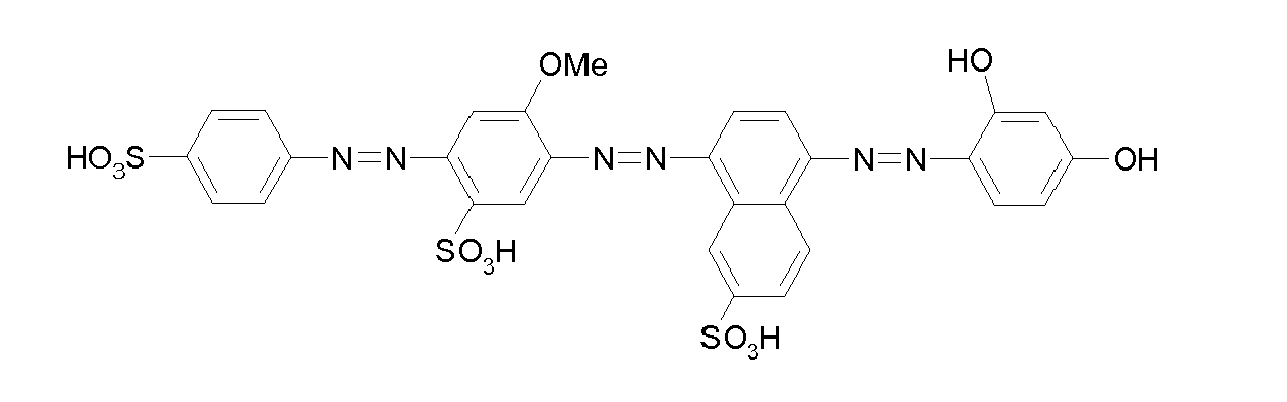
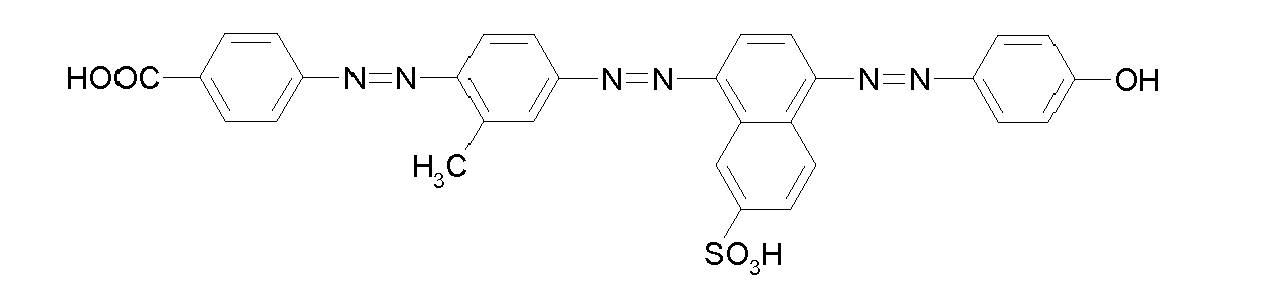


- More preferred compounds of formula (1) are:


- The invention also provides a process for preparing the compounds of formula (1) using known procedures, such as diazotization and coupling steps. Generally, the compounds can be prepared by diazotizing a starting primary aromatic amine, and coupling to another primary aromatic amine. The obtained reaction product is diazotized again and coupled to a third primary aromatic amine which in turn is diazotized and coupled to a fourth compound to yield the desired compound. It is also possible to start with appropriate azo compounds and react those with corresponding amino-containing compounds to yield the desired dyes.
- As an example, the synthesis of the above described preferred dye having the formula
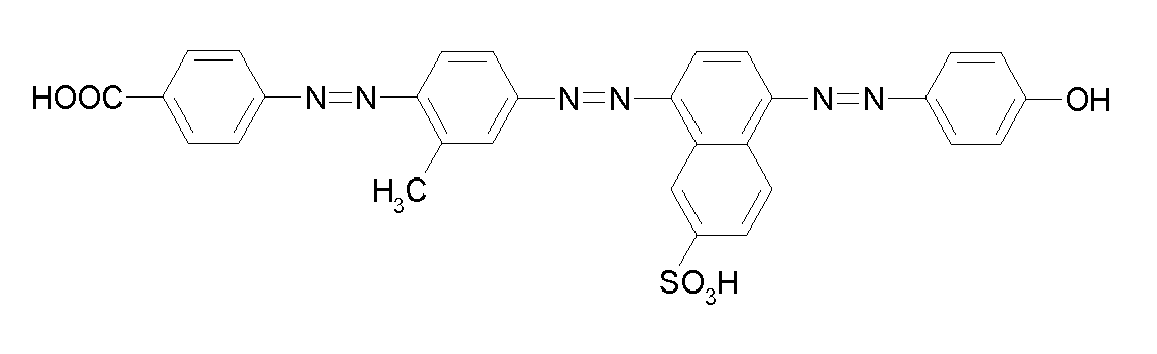


- As another example, the synthesis of the above described dye having the formula


- Azo dyes and their production using diazotization and coupling steps are well-known and familiar to those skilled in the art.
- In a further preferred embodiment, generally first a diazonium salt is prepared followed by a coupling reaction. In a suitable embodiment, an amine compound is dissolved or suspended in aqueous hydrochloric or sulfuric acid, and a concentrated aqueous sodium nitrite solution is added. An excess of 2.5-3 equivalents of acid per equivalent of amine compound is further added at a temperature of 0-10°C, preferably of 0-5°C, to generate the diazonium salt. The obtained acidic diazonium salt is added to a, preferably aqueous, solution of the coupling component. The coupling reaction may be completed after mixing of the components.
- Another suitable procedure starts with solving the amine compound in water or weak alkaline solution, and adding the calculated amount of sodium nitrite solution to this amine solution. The obtained amine-nitrite solution is stirred into an ice-cooled acid solution which is present in a vessel. It is also possible to add the acid or ice-cooled acid solution to the amine-nitrite solution at a temperature of 0-10°C, preferably of 0-5°C. Depending on the amine compound even 0-40°C may be possible.
- Further, it is possible to dissolve water-insoluble amine compounds in organic solvents, such as ethanol, acetone, pyridine, acetic acid, or formic acid. After addition of acid, diazotizing is carried out in the usual manner by means of sodium nitrite solution. Instead of sodium nitrite, diazotization agents, such as nitrosyl sulfuric acid, nitrosyl chloride, alkylnitrite or nitrous gases also can be used. Further, it is possible to add emulsifiers, dispersing agents or surfactants during the reaction.
- The preparation process is not limited to the methods described above, but may be carried out by applying procedures known from the state of the art for diazotization and coupling procedures or as known from the literature (e.g. Klaus Hunger (Editor), Industrial Dyes, Wiley-VCH, Weinheim, 2003, pages 19, 28).
- In a preferred process of the invention, the compounds of formula (1) are obtained by the following procedure. The process starts with an amine compound of formula (2) or (2a)


- The product obtained is diazotized again and coupled to a compound of formula (4).

- The product obtained is diazotized again and coupled to a compound of formula (5) or (5a)


- Furthermore, it is also possible to start with appropriate azo compounds with amino groups to yield the azo dyes of the invention.
- Preferred compounds of formula (2) or formula (2a) are:





- The substituents shown also may be located at other positions of the aromatic rings.
- Preferred compounds of formula (3) are:


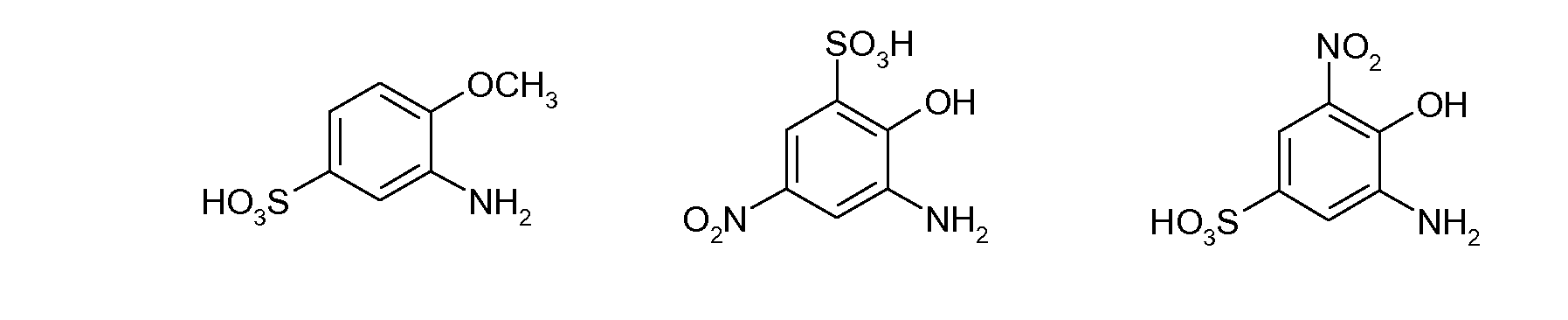

- The substituents shown also may be located at other positions of the aromatic rings.
- Preferred compounds of formula (4) are:
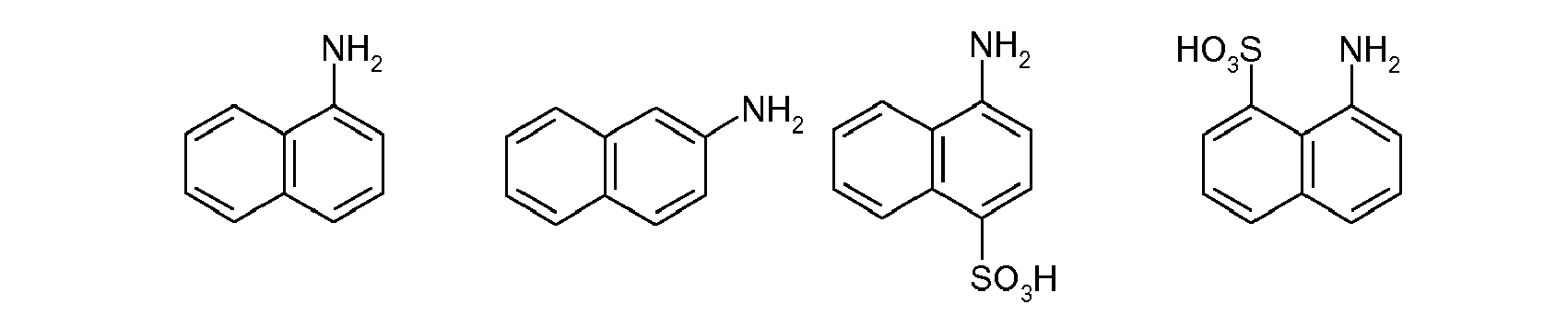


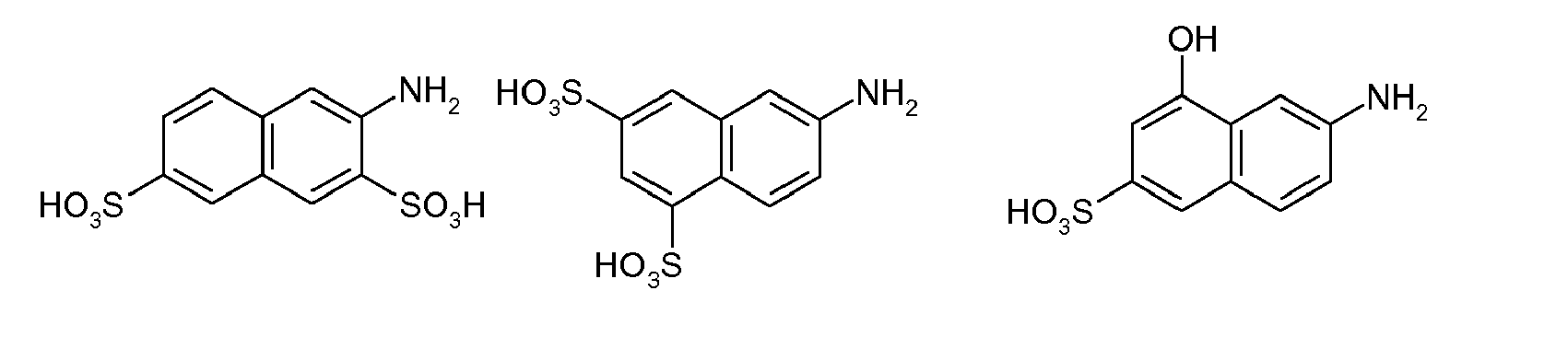


- The substituents shown also may be located at other positions of the aromatic rings.
- Preferred compounds of formula (5) or formula (5a) are:


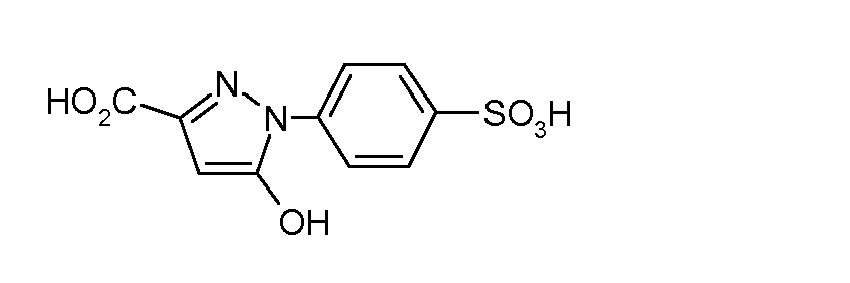

- The substituents shown also may be located at other positions of the aromatic rings.
- The dyes of formula (1) can be isolated from the reaction medium by conventional processes, for example by salting out with an alkali metal salt, filtering and drying, if appropriate under reduced pressure and at elevated temperature. Depending on the reaction and/or isolation conditions, the dyes of formula (1) can be obtained as free acid, as salt or as mixed salt which contains for example one or more cations selected from alkali metals ion, for example the sodium ion, or an ammonium ion or alkyl ammonium cation, for example mono-, di- or trimethyl-, or - ethyl ammonium cations, or an alkanol ammonium cation, for example mono-, di- or tri-ethanol ammonium cations. The dyes can be converted from the free acid into a salt or into a mixed salt or vice versa or from one salt form into another one by conventional techniques. If desired, the dyes can be further purified by diafiltration, wherein undesired salts and synthesis by-products are separated from the crude anionic dye. The removal of undesired salts and synthesis by-products and a partial removal of water from the crude dye solution can be carried out by means of a semi-permeable membrane by applying a pressure whereby the dye is obtained, without the undesired salts and synthesis by-products, as a solution and if desired as a solid material in a conventional manner. Such procedures belong to the state of the art and are described for example in
WO-A 2007/057370 . - The compounds of formula (1) can be utilized in form of a liquid formulation, preferably an aqueous liquid formulation, a moist press cake, or in dried form. In the last two cases, when preparing a solution alkylamine is preferably added.
- According to a more preferred embodiment of the invention, the compound of formula (1) is present or used in form of an aqueous liquid formulation comprising at least one alkylamine whose one, two or three alkyl radicals may each be substituted by one or two hydroxyl groups and/or amino groups and/or interrupted by one or two oxygen atoms in ether function, the alkylamine being present in an amount of 0.5-15% by weight based on the total weight of the liquid formulation. Preference is given to alkylamines whose two or three alkyl radicals may each be substituted by one or two hydroxyl groups and/or interrupted by one or two oxygen atoms in ether function. Particular preference is given to mono-, di- and trialkanolamines. Preferred alkylamines are ethanolamine, diethanolamine, triethanolamine, dimethylethanolamine, N-methyldiethanolamine, monomethylethanolamine, 2-(2-aminoethoxy)ethanol, aminoethylethanolamine. Particular preference is given to ethanolamine, especially diethanolamine and triethanolamine and ethoxylated or propoxylated triethanolamine.
- Suitable additives in the liquid formulation can be C1-C4-alkanols, for example methanol, ethanol, propanol, isopropanol, butanol, isobutanol, sec-butanol or tert-butanol; carboxamides, such as N,N-dimethylformamide or N,N-dimethylacetamide; ketones or keto alcohols, such as acetone, methyl ethyl ketone or 2-methyl-2-hydroxypentane-4-one; mono-, oligo- or polyalkylene glycols or -thioglycols which have C2-C6-alkylene units, such as ethylene glycol, 1,2- or 1,3-propylene glycol, 1,2- or 1,4-butylene glycol, hexane-1,6-diol, diethylene glycol, triethylene glycol, dipropylene glycol, thiodiglycol, polyethylene glycol or polypropylene glycol; other polyols, such as glycerol or hexane-1,2,6-triol; C1-C4-alkyl ethers of polyhydric alcohols, such as ethylene glycol monomethyl ether, ethylene glycol monoethyl ether, diethylene glycol monomethyl ether, diethylene glycol monoethyl ether, diethylene glycol monobutyl ether (butyldiglycol) or triethylene glycol monomethyl ether or triethylene glycol monoethyl ether; C1-C4-alkyl esters of polyhydric alcohols, γ-butyrolactone or dimethylsulfoxide. Suitable solubilizing additives are further lactams, such as ε-caprolactam, pyrrolidin-2-one or N-methylpyrrolidin-2-o n e , cyclic ureas, such as 1,3-dimethylimidazolidin-2-one or 1,3-dimethylhexahydropyrimid-2-one, and also polyacrylic acids, polyacrylic acid derivatives, polyvinyl acetates, polyvinyl alcohols, polyvinylpyrrolidones, polysiloxanes or copolymers of the respective monomers. It is further possible to use oligomers of ethylene oxide or propylene oxide or derivatives of these oligomers.
- The dyes of formula (1) and their salts are particularly suitable for dyeing or printing organic material, fibrous or fiber-containing material, in particular materials containing lignocellulosic material, cellulose and/or polyamide, preferably materials consisting of natural or synthetic polyamides, cellulose, lignocellulosic material, or substrates like wool, leather, textile or paper or board. The material may be of wood and/or straw origin, mechanically and/or chemically produced, in particular by any suitable pulping or refining technique normally employed in papermaking, e.g. by thermomechanical pulping (TMP), chemimechanical pulping (CMP), chemithermomechanical pulping (CTMP), groundwood pulping (GW), alkaline sulphate (kraft) pulping, acid sulphite pulping and/or semichemical pulping. The material may also contain or consist of recycled fiber or pulp, especially made of waste paper. Polyamide or lignocellulosic material may be in fibrous or non-fibrous form. The fibrous material is preferably of wood and/or straw origin, mechanically and/or chemically obtained, e.g. by thermomechanical pulping (TMP), chemimechanical pulping (CMP), chemithermomechanical pulping (CTMP), groundwood pulping (GW), alkaline sulphate (kraft) pulping, acid sulphite pulping and/or semichemical pulping. The fibrous material or pulp may also contain or consist of recycled fiber or pulp, especially made of waste paper. The pulp used may contain, in addition to the fibrous material, e.g. fillers and/or auxiliary chemicals, before or after dyeing the pulp. In a most preferred embodiment, the material is paper or board. The obtained shades can be orange to brownish, or reddish to brownish. Further, the dyes of formula (1) and their salts are suitable for producing printing inks, especially ink-jet inks, and for using these inks for printing materials, in particular organic or fibrous material, for example materials consisting of natural or synthetic polyamides, cellulose or substrates like wool, leather, textile, paper or board. Preferably, the dyes of formula (1) and their salts are used to dye paper in orange to brownish shades, in particular in brownish shades.
- The invention also relates to a process for dyeing or printing organic material, fibrous or fiber-containing material, in particular materials containing lignocellulosic material, cellulose and/or polyamide, preferably lignocellulosic- or cellulose-containing material, wherein the material is brought into contact with the compound of formula (1), wherein that compound is contained in a liquid formulation, a moist press cake, or in dried form, as described above. Preferably the material is brought into contact with an aqueous liquid formulation containing the compound of formula (1). Suitable materials are the same as described above with respect to the use of the dye of formula (1). The material may be of wood and/or straw origin, mechanically and/or chemically produced, in particular by any suitable pulping or refining technique normally employed in papermaking, e.g. by thermomechanical pulping (TMP), chemimechanical pulping (CMP), chemithermomechanical pulping (CTMP), groundwood pulping (GW), alkaline sulphate (kraft) pulping, acid sulphite pulping and/or semichemical pulping. The material may also contain or consist of recycled fiber or pulp, especially made of waste paper. Polyamide or lignocellulosic material may be in fibrous or non-fibrous form. The fibrous material is preferably of wood and/or straw origin, mechanically and/or chemically obtained, e.g. by thermomechanical pulping (TMP), chemimechanical pulping (CMP), chemithermomechanical pulping (CTMP), groundwood pulping (GW), alkaline sulphate (kraft) pulping, acid sulphite pulping and/or semichemical pulping. The fibrous material or pulp may also contain or consist of recycled fiber or pulp, especially made of waste paper. The pulp used may contain, in addition to the fibrous material, e.g. fillers and/or auxiliary chemicals, before or after dyeing the pulp. The dyeing of paper can be carried out in the pulp.
- The invention also relates to a process for dyeing paper or board, wherein a pulp or a paper sheet or web is brought into contact with an aqueous preparation or formulation as described above. Preferably, the paper sheet or web is contacted with the aqueous preparation in a size press, or in a coating application, preferably in a coating colour.
- The following Examples illustrate the invention without limiting its scope.
- The Examples demonstrate the synthesis of dyes of formula (1) and of comparative dyes, and their use in an aqueous preparation for dyeing paper. The lightfastness of the obtained paper was determined according to the test method described below. In case that products were salted out in the examples, the term x % b.v. means x % of volume of reaction mixture in g salt.
- 7 parts by weight of chemically bleached pinewood sulfite cellulose and 3 parts by weight of chemically bleached birchwood sulfite cellulose were beaten into water in a mixer. 1 part by weight of the liquid dye preparation was added to this stuff. Paper was made from that after a mixing time of 20 minutes.
- Test for color fastness - Part B02: Color fastness to artificial light: The xenon arc fading lamp test (ISO 105-B02:1994, including amendment 1:1998), which is commonly used by those skilled in the art, was used. Lightfastness is defined by the degree of decomposition of dyeing or printings on paper by sun light or artificial light. In the present test, paper having been dyed and radiated by the xenon arc fading lamp was measured against the standard blue wool scale ranging from 1 (lowest lightfastness) to 8 (highest lightfastness). The blue wool scale consists of 8 different blue dyes on wool with gradually increasing lightfastness from 1 to 8. After radiation of the dyed paper samples by the xenon arc fading lamp in a weather-o-meter (a device which simulates rain and sunshine) the lightfastness was evaluated by comparison with the blue wool scale.
- 28.12 g of m-phenylenediamine and 8.76 g of 20% by weight of hydrochloric acid were added to 344 ml of water. Ice was added in an amount of 338 g. Then, 15.04 g of sodium nitrite were introduced, followed by the dropwise addition of 78.86 g of 20% by weight of hydrochloric acid within 50 minutes at <3°C. After 10 minutes further 1.73 g of m-phenylenediamine were added and a pH of 3 was set using 13 g of aqueous sodium hydroxide solution (25% by weight). This was followed by stirring at 3 °C for 1 hour.
- To a solution of 34.6 g of sulfanilic acid in 273.46 g of water and 32.4 g of aqueous sodium hydroxide solution (25% by weight) were added 279 g of ice and 68.9 g of sodium nitrite. The mixture was admixed with 82.76 g of hydrochloric acid (20% by weight) at 0-5°C and subsequently stirred for 30 minutes. The obtained product was combined with the stage 1 product at 20°C in the course of 90 minutes. All the time, the pH was maintained at pH 5 using aqueous sodium hydroxide solution (25% by weight). After 3 hours at 20°C the obtained mixture was adjusted to pH 7.5 and then heated to 55-60°C. Hydrochloric acid (20% by weight) was used to adjust the pH to 1, and the solids were filtered off with suction and washed with water to obtain about 300 g of a moist press cake of Direct Brown 44 whose solids content was 22% by weight (sodium content: <0.5% by weight in the dry material).
- 80.33 g of the moist press cake (corresponding to 20.0 g dry weight) were dissolved with 5.25 g of diethanolamine, 3.44 g of aqueous ammonium hydroxide solution (25% NH3), 5 g of polyethylene glycol (average molecular weight: 200) and water to form 100 g of liquid dye.
- Paper was made using the above described dyeing process. Lightfastness was measured according to EN ISO 105-B02 with the result: 1, i.e. lowest lightfastness.
- 1.10 kg of 5-nitro-o-toluenesulfonic acid (83% by weight, 33.5 mol) was added to 1.5 1 of water. A total of 278 g of solid lithium hydroxide (56% pure by weight) was then added continuously in small amounts. 67 g of diethanolamine were added and the mixture was stirred at 50-60°C for 20 hours and then at 58°C for 5 hours. Thereafter, 1.7 liters of water were added and a pH of 9.0 was set with glacial acetic acid. The dye was dissolved with 1.85 kg of urea and adjusted to final color strength, compared to a previously defined standard sample, with water. The product was obtained in an amount of 7.26 kg and had a dye content of about 12% by weight.
- Direct Brown 44 (D.Br. 44) and Direct Yellow 11 (D.Y. 11) were mixed according to
WO-A 2007/057370 resulting in the following composition: - 9.4 % D.Br. 44 (dry)
- 6.6 % D.Y. 11 (dry)
- 3.13 % Diethanolamine
- 0.43 % NH3
- 2.50 % Polyethylene glycol 200 and
- water,
- to form 100 g of liquid dye.
- Paper was made using the above described dyeing process. Lightfastness was measured according to EN ISO 105-B02 with the result: 1, i.e. lowest lightfastness.
- In a 1L beaker with stirrer, 500 mL of distilled water and 30.1 g (219.48 mmol) of p-aminobenzoic acid were mixed at room temperature at pH 3. Lithium hydroxide (12.9 g) was added resulting in pH>12. The obtained solution was cooled using an external ice bath, followed by adding 250 g of ice into the reaction mixture, and then 35 mL (253.62 mmol) of sodium nitrite solution (500 g/L) was added. This solution then was dripped within 20 min. to 75 mL of hydrochloric acid (30 % b.w.), 100 mL of dist. water, and 100 g of ice at 0°C. The suspension of the diazonium salt was stirred for 2 hours at 5-10°C. Excess of nitrite was destroyed by addition of amidosulfonic acid.
- In a 3L beaker containing 23.5 g (219.29 mmol) of m-toluidine, and 0.5 g of an emulsifier (from Tanatex Deutschland GmbH, product of 1 mol arylphenol with 11 mol ethylene oxide), in 300 mL of dist. water at room temperature, pH 10.3, the diazonium salt was added within 20 min. at a constant pH 7.5, controlled by 240 mL of sodium carbonate solution (20 % b.v.). The batch was stirred for 1.5 hours at room temperature, pH 8.2. The product was salted out using 64 mL of hydrochloric acid (30 % b.w.) during stirring for 0.5 h, and isolated by filtration to yield 223 g of press cake (217.39 mmol of stage 1 product).
- In a 2L beaker with stirrer, 700 mL of distilled water and 223 g (217.39 mmol) of press cake stage 1 product, pH=2.6, were mixed with 11.6 g of LiOH resulting in pH>12. A solution of 32 mL (231.88 mmol) of sodium nitrite (500 g/L) was added. This mixture was added to a solution of 75 mL of hydrochloric acid (30 % b.w.), 100 mL of dist. water and 100 g of ice within about 15 min. The temperature was increased from 0°C at the beginning to 15°C at the end of addition, pH 1.2. The reaction mixture was stirred for 3 hours. Excess of nitrite was destroyed by addition of amidosulfonic acid.
- In a 3L beaker containing 48.9 g (217.39 mmol) of Cleve's acid 6, solved with sodium carbonate solution in 200 mL of dist. water at pH 7.5, the diazonium salt was added within 25 min. at a constant pH 7.5, controlled by 372 mL of sodium carbonate solution. The batch was stirred for 1.5 hours at room temperature, pH 7.9. The product was salted out using 480 g of sodium chloride solution (20 % b.v.) and 240 g of potassium chloride solution (10 % b.v.) during stirring for 0.5 h, and isolated by filtration to yield 765 g of press cake (217.39 mmol of stage 2 product).
- In a 1L beaker with stirrer, 250 mL of distilled water and 102 g (28.99 mmol) of stage 2 product were mixed with 3.3 g of LiOH. A solution of 5 mL (14.50 mmol) of sodium nitrite (500 g/L) was added. This mixture was added to a solution of 37 mL (430 mmol) of hydrochloric acid (30%b.w.), 50 mL of dist. water and 25 g of ice within about 20 min. The temperature was increased from 0°C at the beginning to 10-15°C at the end of addition, pH 0.8. The reaction mixture was stirred for 2 hours. Excess of nitrite was destroyed by addition of amidosulfonic acid.
- In a 1L beaker containing 3.4 g (30.43 mmol) of resorcinol, solved with sodium carbonate solution in 150 mL of dist. water at pH 7.5, the diazonium salt was added within 15 min. at a constant pH 8, controlled by 158 mL of sodium carbonate solution. The batch was stirred for 2 hours at room temperature, pH 8.5. The product was salted out using 180 g of sodium chloride (solution 15 % b.v.) during stirring for 1 h, and isolated by filtration to yield 20.7 g of press cake (stage 3 product). The moist press cake was dried in vacuum at 60°C to yield 12.8 g of product of formula

- Paper was made using the above described dyeing process.
- Lightfastness was measured to EN ISO 105-B02 with the result: 3.
- In a 1L beaker with stirrer, 500 mL of distilled water and 49.5 g (240.72 mmol) of p-sulfanilic acid (100g/486.3 mmol) were mixed at room temperature at pH=6.1. Cooled with an ice bath and after addition of 250 g of ice, 35 mL (253.62 mmol) of sodium nitrite solution (500 g/L) was added and afterwards 50 mL (475 mmol) of hydrochloric acid (30 % b.w.) was immediately added at 0°C. The suspension of the diazonium salt was stirred for 2.5 hours at 5-8°C. Excess of nitrite was destroyed by addition of amidosulfonic acid.
- In a 2L beaker containing 26.0 g (240.72 mmol) of m-toluidine in 300 mL of dist. water at room temperature, pH 10.3, the diazonium salt was added within 15 min. at constant pH 7.5, controlled by 332 mL of sodium carbonate solution (20 % b.v.). The batch was stirred for 1.5 hours at room temperature, pH 7.7. The product was salted out using 340 g (5808 mmol) of sodium chloride (solution 20 % b.v.) during stirring for 0.5 h, and isolated by filtration to yield 115.0 g of press cake (240.5 mmol of stage 1 product).
- In a 2L beaker with stirrer, 1000 mL of distilled water and 115 g (240.5 mmol) of press cake stage 1 product, pH=9.6, were mixed and warmed up to 70-75°C. A solution of 35 mL (253.62 mmol) of sodium nitrite (500 g/L) was added. This mixture was added to a solution of 85 mL (808 mmol) of hydrochloric acid (30 % b.w.), 100 mL of dist. water and 300 g of ice within about 25 min. The temperature was increased from - 10°C at the beginning to 15-17°C at the end of addition, pH 0.9. The reaction mixture was stirred for 2.5 h. Excess of nitrite was destroyed by addition of amidosulfonic acid.
- In a 3L beaker containing 55.4 g (248.15 mmol) of Cleve's acid 6, solved with sodium carbonate solution in 200 mL of dist. water at pH 7.5, the diazonium salt was added within 30 min. at constant pH 7.5, controlled by 238 mL of sodium carbonate solution. The batch was stirred for 1.5 h at room temperature, pH 7.9. The product was salted out using 360 g (6153 mmol) of sodium chloride solution (15 % b.v.) during stirring for 0.5 h, and isolated by filtration to yield 397.7 g of press cake (217.39 mmol of stage 2 product).
- In a 1L beaker with stirrer, 600 mL of distilled water and 106 g (57.94 mmol) of stage 2 product were mixed. A solution of 10 mL (72.46 mmol) of sodium nitrite (500 g/L) was added. This mixture was added to a solution of 50 mL (430 mmol) of hydrochloric acid (30%b.w.), 50 mL of dist. water and 200 g of ice within about 12 min. The temperature was increased from -10°C at the beginning to 10-15°C at the end of addition, pH 0.6. The reaction mixture was stirred for 2.5 hours. Excess of nitrite was destroyed by addition of amidosulfonic acid.
- In a 2L beaker containing 5.4 g (57.98 mmol) of aniline, solved in 150 mL of dist. water at pH 7.5, the diazonium salt was added within 40 min. at constant pH 7.5, controlled by 300 mL of sodium carbonate solution (20% b.v.). The batch was stirred for 3 hours at room temperature, pH 7.5. The product was salted out using sodium chloride (solution 10 % b.v.) during stirring for 1 h, and isolated by filtration to yield 36.4 g of press cake (stage 3 product). The moist press cake was dried in vacuum at 60°C to yield 18.6 g of product of formula

- Paper was made using the above described dyeing process.
- Lightfastness was measured to EN ISO 105-B02 with the result: 3.
- In a 1L beaker with stirrer, 200 mL of distilled water and 14.9 g (72.46 mmol) of p-sulfanilic acid (100g/486.3 mmol) were mixed at room temperature with pH=6.1. Cooled with an ice bath and after addition of 75 g of ice, 11 mL (79.71 mmol) of sodium nitrite solution (500 g/L) was added and afterwards 18 mL (171 mmol) of hydrochloric acid (30 % b.w.) was immediately added at 0°C. The suspension of the diazonium salt was stirred for 2.5 hours at 5-8°C. Excess of nitrite was destroyed by addition of amidosulfonic acid.
- In a 1L beaker containing 7.8 g (72.46 mmol) of m-toluidine in 100 mL of dist. water at room temperature, pH 8.2, the diazonium salt was added within 15 min. at constant pH 7.5, controlled by 70 mL of sodium carbonate solution. The batch was stirred for 1.5 h at room temperature, pH 8.4. The product was salted out using 120 g (2050 mmol) of sodium chloride (solution 20 % b.v.) during stirring for 0.5 h, and isolated by filtration to yield 41.7 g of press cake (68.84 mmol of stage 1 product).
- In a 1L beaker with stirrer, 500 mL of distilled water and 41.7 g (68.84 mmol) of press cake stage 1 product, pH=9.6, were mixed and warmed up to 70-75°C. A solution of 50 mL (72.46 mmol) of sodium nitrite (100 g/L) was added. This mixture was added to a solution of 45 mL (430 mmol) of hydrochloric acid (30%b.w.), 100 mL of dist. water and 100 g of ice within about 25 min. The temperature was increased from -10°C at the beginning to 15-17°C at the end of addition, pH 0.9. The reaction mixture was stirred for 2.5 hours. Excess of nitrite was destroyed by addition of amidosulfonic acid.
- In a 2L beaker containing 15.5 g (68.84 mmol) of Cleve's acid 6, solved with sodium carbonate solution in 200 mL of dist. water at pH 7.5, the diazonium salt was added within 30 min. at constant pH 7.5, controlled by 210 mL of sodium carbonate solution. The batch was stirred for 1.5 hours at room temperature, pH 7.9. The product was salted out using 187.5 g (3200 mmol) of sodium chloride (solution 20 % b.v.) during stirring for 0.5 h, and isolated by filtration to yield 53.5 g of press cake (62.32 mmol of stage 2 product).
- In a 1L beaker with stirrer, 600 mL of distilled water and 53.5 g (62.32 mmol) of stage 2 product were mixed. A solution of 10 mL (72.46 mmol) of sodium nitrite (500 g/L) was added. This mixture was added to a solution of 45 mL (430 mmol) of hydrochloric acid (30%b.w.), 100 mL of dist. water and 50 g of ice within about 20 min. The temperature was increased from 0°C at the beginning to 10-15°C at the end of addition, pH 0.8. After adding 60 g of ε-caprolactam, the reaction mixture was stirred for 2.5 hours. Excess of nitrite was destroyed by addition of amidosulfonic acid.
- In a 3L beaker containing 6.9 g (72.46 mmol) of phenol, solved with sodium carbonate solution in 200 mL of dist. water at pH 7.5, the diazonium salt was added within 40 min. at constant pH 7.5, controlled by 170 mL of sodium carbonate solution. The batch was stirred for 1.5 h at room temperature, pH 7.5. The product was salted out using 90 g (1200 mmol) of potassium chloride solution (5 % b.v.) and 270 g of sodium chloride (solution 20 % b.v.) during stirring for 1 hour, and isolated by filtration to yield 44.2 g of press cake (stage 3 product). The moist press cake was dried in vacuum at 60°C to yield 22 g of product of formula

- Paper was made using the above described dyeing process.
- Lightfastness was measured to EN ISO 105-B02 with the result: 3.
- In a 2L beaker with stirrer, 750 mL of distilled water and 59 g (237.77 mmol) of 5-amino-4-methoxy-2-nitrobenzenesulfonic acid were mixed at 50°C, pH=7.1. A solution of 35 mL (253.62 mmol) of sodium nitrite (500 g/L) was added. This mixture was added to a solution of 75 mL of hydrochloric acid (30 % b.w.), 75 mL of dist. water and 100 g of ice within about 20 min. The temperature was increased from -10°C at the beginning to 20-25°C at the end of addition, pH 0.7. The reaction mixture was stirred for 2.5 hours. Excess of nitrite was destroyed by addition of amidosulfonic acid.
- In a 2L beaker containing 49.2 g (220.33 mmol) of Cleve's acid 6, solved with 47.2 g diluted NaOH solution (200 g/L), at pH 6, adjusted with sodium carbonate solution in 300 mL of dist. water to pH 7.5, the diazonium salt was added within 15 min. at constant pH 7.5, controlled by 262 mL of sodium carbonate solution (20 % b.v.). The batch was stirred for 1.5 hours at room temperature, pH 7.9. The coupling product was warmed up to 50°C and pH was adjusted to 11.7 using 75 mL of NaOH solution (400 g/L). Within 10 min. a solution of 63.3 g (351.2 mmol) of glucose in 300 mL of dist. water was added with slightly exothermic reaction at 55-57°C, pH<10. After adding 25 mL of NaOH solution (400 g/L), the mixture was warmed to 65°C for 20 min. The obtained product was salted out using 250 g of sodium chloride (as solid substance), and isolated by filtration to yield 161.3 g of press cake (stage 1 product).
- In a 1L beaker with stirrer, 600 mL of distilled water and 48.4 g (50.22 mmol) of stage 1 product were mixed with 1.2 g of LiOH. A solution of 14 mL (101.45 mmol) of sodium nitrite (500 g/L) was added. This mixture was added to a solution of 40 mL of hydrochloric acid (30%b.w.), 50 mL of dist. water and 100 g of ice within about 20 min. The temperature was increased from -8°C at the beginning to 10-15°C at the end of addition, pH 0.8. The reaction mixture was stirred for 1 h. Excess of nitrite was destroyed by addition of amidosulfonic acid.
- In a 3L beaker containing 19.5 g (141.20 mmol) of salicylic acid, solved with sodium carbonate solution in 500 mL of dist. water at pH 7.5, the diazonium salt was added within 20 min. at constant pH 7.5, controlled by 240 mL of sodium carbonate solution (20 % b.v.). The batch was stirred for 1 hour at room temperature. The product was salted out using 360 g of potassium chloride (solution 10 % b.v.) and 180 g of sodium chloride (solution 10 % b.v.) during stirring for 30 min., and isolated by filtration to yield 21.3 g of press cake (stage 2 product). The moist press cake was dried in vacuum at 60°C to yield 11.1 g of product of formula

- Paper was made using the above described dyeing process.
- Lightfastness was measured to EN ISO 105-B02 with the result: 3
- In a 1L beaker with stirrer, 500 mL of distilled water and 30.1 g (219.48 mmol) of p-aminobenzoic acid were mixed at room temperature at pH 3. Lithium hydroxide (12.9 g) was added resulting in pH>12. The obtained solution was cooled using an external ice bath, followed by adding 250 g of ice into the reaction mixture, and then 35 mL (253.62 mmol) of sodium nitrite solution (500 g/L) was added. This solution then was dripped within 20 min. to 75 mL of hydrochloric acid (30 % b.w.), 100 mL of dist. water, and 100 g of ice at 0°C. The suspension of the diazonium salt was stirred for 2 hours at 5-10°C. Excess of nitrite was destroyed by addition of amidosulfonic acid.
- In a 3L beaker containing 23.5 g (219.29 mmol) of m-toluidine, 0.5 g of emulsifier (from Tanatex Deutschland GmbH, product of 1 mol arylphenol with 11 mol ethylene oxide), in 300 mL of dist. water at room temperature, pH 10.3, the diazonium salt was added within 20 min. at a constant pH 7.5, controlled by 240 mL of sodium carbonate solution (20 % b.v.). The batch was stirred for 1.5 hours at room temperature, pH 8.2. The product was salted out using 64 mL of hydrochloric acid (30 % b.w.) during stirring for 0.5 h, and isolated by filtration to yield 223 g of press cake (217.39 mmol of stage 1 product).
- In a 2L beaker with stirrer, 700 mL of distilled water and 223 g (217.39 mmol) of press cake stage 1 product, pH=2.6, were mixed with 11.6 g of LiOH resulting in pH>12. A solution of 32 mL (231.88 mmol) of sodium nitrite (500 g/L) was added. This mixture was added to a solution of 75 mL of hydrochloric acid (30 % b.w.), 100 mL of dist. water and 100 g of ice within about 15 min. The temperature was increased from 0°C at the beginning to 15°C at the end of addition, pH 1.2. The reaction mixture was stirred for 3 hours. Excess of nitrite was destroyed by addition of amidosulfonic acid.
- In a 3L beaker containing 48.9 g (217.39 mmol) of Cleve's acid 6, solved with sodium carbonate solution in 200 mL of dist. water at pH 7.5, the diazonium salt was added within 25 min. at a constant pH 7.5, controlled by 372 mL of sodium carbonate solution. The batch was stirred for 1.5 hours at room temperature, pH 7.9. The product was salted out using 480 g of sodium chloride solution (20 % b.v.) and 240 g of potassium chloride solution (10 % b.v.) during stirring for 0.5 h, and isolated by filtration to yield 765 g of press cake (217.39 mmol of stage 2 product).
- In a 1L beaker with stirrer, 300 mL of distilled water and 102 g (28.98 mmol) of press cake stage 2 product, pH=2.6, were mixed with 4.0 g of LiOH resulting in pH>12. A solution of 30 mL (43.47 mmol) of sodium nitrite (100 g/L) was added. This mixture was added to a solution of 40 mL of hydrochloric acid (30 % b.w.), 50 mL of dist. water and 30 g of ice within about 30 min. The temperature was increased from 0°C at the beginning to 15°C at the end of addition, pH 1.2. The reaction mixture was stirred for 2 hours. Excess of nitrite was destroyed by addition of amidosulfonic acid. The diazo suspension yields a volume of 600 mL.
- In a 2L beaker containing 3.94 g (30.43 mmol) of barbituric acid, solved with 2.1 g of lithium hydroxide in 100 mL of dist. water at pH 12, the diazonium salt solution of stage 3 was added within 20 min. at constant pH 8, controlled by the addition of 154 mL of sodium carbonate solution (20 % b.w.). The batch was stirred for 5 h at room temperature at pH 8.3. The product was isolated by filtration to yield 33.8 g of press cake (30.43 mmol of stage 3 product). The moist press cake was dried in vacuum at 60°C to yield 12.9 g of product of formula

- Paper was made using the above described dyeing process. Lightfastness was measured to EN ISO 105-B02 with the result: 3.
- All papers obtained in the Examples and Comparative Examples exhibited brownish shades.
- The examples show that the dyes of the invention provide paper with higher lightfastness than paper produced with known dye mixtures.
Claims (15)
- A compound of formula (1)


A, B independently of each other, represent one of the following groups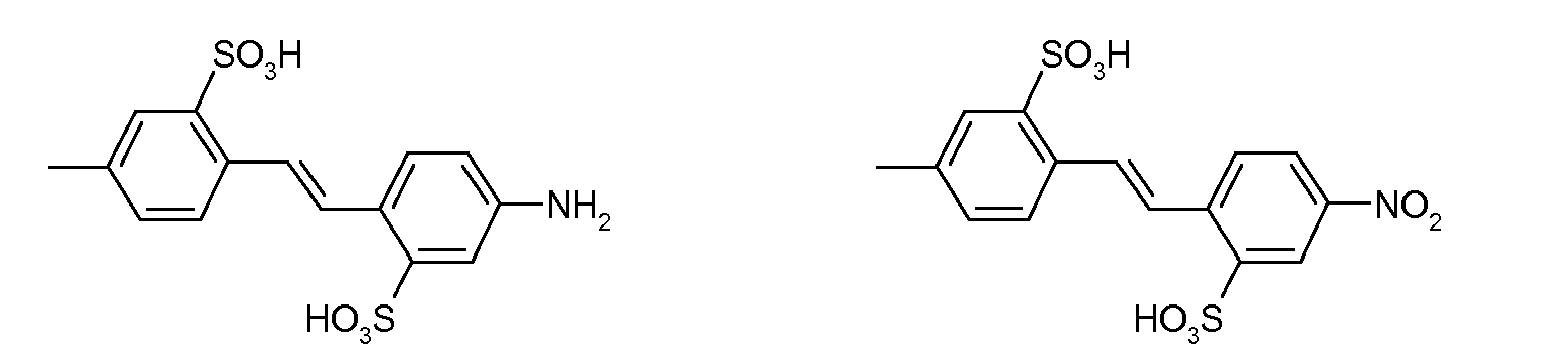



 R1, R2, R3, R4 independently of each other, represent hydrogen, substituted or unsubstituted C1-C4 alkyl, substituted or unsubstituted C1-C4 alkoxy, substituted or unsubstituted aryl, substituted or unsubstituted phenyl, amino, sulfonic, carboxyl, hydroxyl, nitro or halogen groups.
 - The compound of claim 1, having the following structure:

- The compound of claim 1, having the following structure:

- The compound of claim 1, having the following structure:

- The compound of claim 1, having the following structure:

- The compound of claim 1, having the following structure:

- The compound of claim 1, having the following structure:

- The compound of any of the preceding claims, wherein in the sulfonic group with the meaning -SO3M, M is a cation, preferably M is hydrogen, alkaline metal, earth alkaline metal, ammonium, or mono-, di-, tri- or tetra-substituted ammonium, in particular M is mono-C1-5-alkyl-, d i-C1-5-alkyl-, tri-C1-5-alkyl-, tetra-C1-5-alkylammonium, mono-C1-5-hydroxyalkyl-, di-C1-5-hydroxyalkyl-, tri-C1-5-hydroxyalkyl-, tetra-C1-5-hydroxyalkyl-ammonium, or benzyltri-C1-5-hydroxyalkylammonium.
- A process for preparing a compound of formula (1) according to claim 1, comprising diazotizing a compound of formula (2) or (2a)


- Use of a compound of formula (1) according to any of claims 1 to 8, for dyeing or printing materials.
- The use according to claim 10, wherein the materials used contain cellulose and/or polyamide, in particular cellulose.
- The use according to claim 10 or 11, wherein the material used is paper or board.
- The use according to any of claims 10 to 12, wherein the material used is a fiber-containing or fibrous material.
- A process for dyeing or printing materials, wherein the material is brought into contact with a compound of formula (1) according to any of claims 1 to 8 or prepared according to claim 9.
- A product or paper obtainable by a process according to claim 14.
Priority Applications (10)
| Application Number | Priority Date | Filing Date | Title |
|---|---|---|---|
| PL10193158T PL2457955T3 (en) | 2010-11-30 | 2010-11-30 | Trisazo dyes for paper dyeing |
| EP10193158.2A EP2457955B1 (en) | 2010-11-30 | 2010-11-30 | Trisazo dyes for paper dyeing |
| HUE10193158A HUE035080T2 (en) | 2010-11-30 | 2010-11-30 | Trisazo dyes for paper dyeing |
| ES10193158.2T ES2640941T3 (en) | 2010-11-30 | 2010-11-30 | Trisazo dyes for dyeing paper |
| SI201031556T SI2457955T1 (en) | 2010-11-30 | 2010-11-30 | Trisazo dyes for paper dyeing |
| PCT/EP2011/071292 WO2012072635A1 (en) | 2010-11-30 | 2011-11-29 | Azo dyes |
| CN201180057440.5A CN103228738B (en) | 2010-11-30 | 2011-11-29 | Azoic dyestuff |
| US13/882,856 US9023118B2 (en) | 2010-11-30 | 2011-11-29 | Azo dyes |
| CA2819116A CA2819116C (en) | 2010-11-30 | 2011-11-29 | Azo dyes |
| HRP20171595TT HRP20171595T1 (en) | 2010-11-30 | 2017-10-18 | Trisazo dyes for paper dyeing |
Applications Claiming Priority (1)
| Application Number | Priority Date | Filing Date | Title |
|---|---|---|---|
| EP10193158.2A EP2457955B1 (en) | 2010-11-30 | 2010-11-30 | Trisazo dyes for paper dyeing |
Publications (2)
| Publication Number | Publication Date |
|---|---|
| EP2457955A1 true EP2457955A1 (en) | 2012-05-30 |
| EP2457955B1 EP2457955B1 (en) | 2017-08-09 |
Family
ID=44116935
Family Applications (1)
| Application Number | Title | Priority Date | Filing Date |
|---|---|---|---|
| EP10193158.2A Active EP2457955B1 (en) | 2010-11-30 | 2010-11-30 | Trisazo dyes for paper dyeing |
Country Status (10)
| Country | Link |
|---|---|
| US (1) | US9023118B2 (en) |
| EP (1) | EP2457955B1 (en) |
| CN (1) | CN103228738B (en) |
| CA (1) | CA2819116C (en) |
| ES (1) | ES2640941T3 (en) |
| HR (1) | HRP20171595T1 (en) |
| HU (1) | HUE035080T2 (en) |
| PL (1) | PL2457955T3 (en) |
| SI (1) | SI2457955T1 (en) |
| WO (1) | WO2012072635A1 (en) |
Cited By (1)
| Publication number | Priority date | Publication date | Assignee | Title |
|---|---|---|---|---|
| WO2016146257A1 (en) | 2015-03-16 | 2016-09-22 | Archroma Ip Gmbh | Trisazo acid dyes |
Citations (13)
| Publication number | Priority date | Publication date | Assignee | Title |
|---|---|---|---|---|
| US3028376A (en) * | 1959-04-16 | 1962-04-03 | Acna | Trisazo dyes |
| GB1563415A (en) * | 1975-11-14 | 1980-03-26 | Sandoz Ltd | Azo dyestuffs |
| US5167703A (en) * | 1990-11-30 | 1992-12-01 | Canon Kabushiki Kaisha | Ink, ink-jet recording process and instrument making use of the ink |
| US5198022A (en) * | 1991-10-25 | 1993-03-30 | Lexmark International, Inc. | Waterfast dye and aqueous ink |
| US5288294A (en) * | 1991-09-26 | 1994-02-22 | Ciba-Geigy Corporation | Process for dyeing paper with disazo dyes |
| US5559217A (en) * | 1993-04-29 | 1996-09-24 | Ciba-Geigy Corporation | Disazo dyes and a process of dyeing paper therewith |
| US5883233A (en) * | 1998-07-24 | 1999-03-16 | Bayer Corporation | Paper dye |
| JP2001004833A (en) | 1999-06-22 | 2001-01-12 | Sumitomo Chem Co Ltd | Dye-based polarizing film containing azo compound |
| EP1258562A2 (en) | 2001-05-16 | 2002-11-20 | Bayer Ag | Colouring of paper using dyestuff mixtures |
| WO2004048478A1 (en) | 2002-11-28 | 2004-06-10 | Basf Aktiengesellschaft | Method for producing a liquid formulation of salts of sulfoacidic azo dyes |
| US20070062409A1 (en) * | 2003-11-20 | 2007-03-22 | Mistry Prahalad M | Trisazo-dyestuffs |
| WO2007057370A2 (en) | 2005-11-18 | 2007-05-24 | Basf Se | Liquid direct dye formulations |
| US20070287830A1 (en) * | 2004-12-27 | 2007-12-13 | Mitsubishi Chemical Corporation | Trisazo Dye, Composition Containing the Same for Anisotropic Dye Film, Anisotropic Dye Film, and Polarizing Element |
Family Cites Families (2)
| Publication number | Priority date | Publication date | Assignee | Title |
|---|---|---|---|---|
| JPS63120761A (en) * | 1986-11-07 | 1988-05-25 | Nippon Kanko Shikiso Kenkyusho:Kk | Coloring material composed of nonionic trisazo compound |
| HUE034934T2 (en) * | 2010-11-30 | 2018-03-28 | Kemira Oyj | Azo dyes for paper dyeing |
-
2010
- 2010-11-30 HU HUE10193158A patent/HUE035080T2/en unknown
- 2010-11-30 SI SI201031556T patent/SI2457955T1/en unknown
- 2010-11-30 ES ES10193158.2T patent/ES2640941T3/en active Active
- 2010-11-30 EP EP10193158.2A patent/EP2457955B1/en active Active
- 2010-11-30 PL PL10193158T patent/PL2457955T3/en unknown
-
2011
- 2011-11-29 CN CN201180057440.5A patent/CN103228738B/en not_active Expired - Fee Related
- 2011-11-29 US US13/882,856 patent/US9023118B2/en active Active
- 2011-11-29 CA CA2819116A patent/CA2819116C/en active Active
- 2011-11-29 WO PCT/EP2011/071292 patent/WO2012072635A1/en not_active Ceased
-
2017
- 2017-10-18 HR HRP20171595TT patent/HRP20171595T1/en unknown
Patent Citations (13)
| Publication number | Priority date | Publication date | Assignee | Title |
|---|---|---|---|---|
| US3028376A (en) * | 1959-04-16 | 1962-04-03 | Acna | Trisazo dyes |
| GB1563415A (en) * | 1975-11-14 | 1980-03-26 | Sandoz Ltd | Azo dyestuffs |
| US5167703A (en) * | 1990-11-30 | 1992-12-01 | Canon Kabushiki Kaisha | Ink, ink-jet recording process and instrument making use of the ink |
| US5288294A (en) * | 1991-09-26 | 1994-02-22 | Ciba-Geigy Corporation | Process for dyeing paper with disazo dyes |
| US5198022A (en) * | 1991-10-25 | 1993-03-30 | Lexmark International, Inc. | Waterfast dye and aqueous ink |
| US5559217A (en) * | 1993-04-29 | 1996-09-24 | Ciba-Geigy Corporation | Disazo dyes and a process of dyeing paper therewith |
| US5883233A (en) * | 1998-07-24 | 1999-03-16 | Bayer Corporation | Paper dye |
| JP2001004833A (en) | 1999-06-22 | 2001-01-12 | Sumitomo Chem Co Ltd | Dye-based polarizing film containing azo compound |
| EP1258562A2 (en) | 2001-05-16 | 2002-11-20 | Bayer Ag | Colouring of paper using dyestuff mixtures |
| WO2004048478A1 (en) | 2002-11-28 | 2004-06-10 | Basf Aktiengesellschaft | Method for producing a liquid formulation of salts of sulfoacidic azo dyes |
| US20070062409A1 (en) * | 2003-11-20 | 2007-03-22 | Mistry Prahalad M | Trisazo-dyestuffs |
| US20070287830A1 (en) * | 2004-12-27 | 2007-12-13 | Mitsubishi Chemical Corporation | Trisazo Dye, Composition Containing the Same for Anisotropic Dye Film, Anisotropic Dye Film, and Polarizing Element |
| WO2007057370A2 (en) | 2005-11-18 | 2007-05-24 | Basf Se | Liquid direct dye formulations |
Non-Patent Citations (1)
| Title |
|---|
| "Industrial Dyes", 2003, WILEY-VCH, WEINHEIM, pages: 19,28 |
Cited By (4)
| Publication number | Priority date | Publication date | Assignee | Title |
|---|---|---|---|---|
| WO2016146257A1 (en) | 2015-03-16 | 2016-09-22 | Archroma Ip Gmbh | Trisazo acid dyes |
| KR20170128402A (en) * | 2015-03-16 | 2017-11-22 | 아르크로마 아이피 게엠베하 | Trisazo dye |
| CN107406685A (en) * | 2015-03-16 | 2017-11-28 | 昂高知识产权有限公司 | Trisazo- acid dyes |
| JP2018512486A (en) * | 2015-03-16 | 2018-05-17 | アルフローマ アイピー ゲゼルシャフト ミット ベシュレンクテル ハフツング | Trisazo acid dye |
Also Published As
| Publication number | Publication date |
|---|---|
| HUE035080T2 (en) | 2018-05-02 |
| EP2457955B1 (en) | 2017-08-09 |
| WO2012072635A1 (en) | 2012-06-07 |
| HRP20171595T1 (en) | 2017-12-01 |
| CN103228738A (en) | 2013-07-31 |
| CA2819116A1 (en) | 2012-06-07 |
| CA2819116C (en) | 2018-07-24 |
| US9023118B2 (en) | 2015-05-05 |
| PL2457955T3 (en) | 2018-01-31 |
| US20130269124A1 (en) | 2013-10-17 |
| ES2640941T3 (en) | 2017-11-07 |
| SI2457955T1 (en) | 2017-11-30 |
| CN103228738B (en) | 2016-01-27 |
Similar Documents
| Publication | Publication Date | Title |
|---|---|---|
| EP3296363B1 (en) | Azo dyes | |
| EP2457957B1 (en) | Azo dyes for paper dyeing | |
| US6194554B1 (en) | Disazo dyes | |
| EP2457955B1 (en) | Trisazo dyes for paper dyeing | |
| JPS63243166A (en) | Disazo compound and dyeing of substrate using same | |
| US6084078A (en) | Disazo dyestuffs for dyeing cellulosic materials | |
| JPS61264060A (en) | Tris-azo black dye | |
| JPH10259312A (en) | Stilbeneazo direct dye | |
| US5487761A (en) | Process for dyeing paper with disazo dyes | |
| EP2085429A1 (en) | Basic bisazo compounds | |
| EP2078737A1 (en) | Basic monoazo compounds | |
| EP2098573A2 (en) | Basic monoazo compounds | |
| EP2085428A1 (en) | Basic bisazo compounds | |
| EP0891394A1 (en) | Improved basic monoazo compounds | |
| EP2103656A2 (en) | Basic monoazo compounds | |
| AU2002219203A1 (en) | Use of copper complexes of disazo dyes for dyeing natural and synthetic material | |
| MXPA97002584A (en) | Procedure for the obtaining of liquid coloring preparations, poor in | |
| JPH01272882A (en) | Dyeing of paper or pulp using disazo compound | |
| JPH057429B2 (en) |
Legal Events
| Date | Code | Title | Description |
|---|---|---|---|
| PUAI | Public reference made under article 153(3) epc to a published international application that has entered the european phase |
Free format text: ORIGINAL CODE: 0009012 |
|
| 17P | Request for examination filed |
Effective date: 20101130 |
|
| AK | Designated contracting states |
Kind code of ref document: A1 Designated state(s): AL AT BE BG CH CY CZ DE DK EE ES FI FR GB GR HR HU IE IS IT LI LT LU LV MC MK MT NL NO PL PT RO RS SE SI SK SM TR |
|
| AX | Request for extension of the european patent |
Extension state: BA ME |
|
| 17Q | First examination report despatched |
Effective date: 20130410 |
|
| GRAP | Despatch of communication of intention to grant a patent |
Free format text: ORIGINAL CODE: EPIDOSNIGR1 |
|
| INTG | Intention to grant announced |
Effective date: 20170215 |
|
| GRAS | Grant fee paid |
Free format text: ORIGINAL CODE: EPIDOSNIGR3 |
|
| GRAA | (expected) grant |
Free format text: ORIGINAL CODE: 0009210 |
|
| AK | Designated contracting states |
Kind code of ref document: B1 Designated state(s): AL AT BE BG CH CY CZ DE DK EE ES FI FR GB GR HR HU IE IS IT LI LT LU LV MC MK MT NL NO PL PT RO RS SE SI SK SM TR |
|
| REG | Reference to a national code |
Ref country code: GB Ref legal event code: FG4D |
|
| REG | Reference to a national code |
Ref country code: CH Ref legal event code: EP Ref country code: AT Ref legal event code: REF Ref document number: 916791 Country of ref document: AT Kind code of ref document: T Effective date: 20170815 |
|
| REG | Reference to a national code |
Ref country code: IE Ref legal event code: FG4D |
|
| REG | Reference to a national code |
Ref country code: DE Ref legal event code: R096 Ref document number: 602010044222 Country of ref document: DE |
|
| REG | Reference to a national code |
Ref country code: HR Ref legal event code: TUEP Ref document number: P20171595 Country of ref document: HR |
|
| REG | Reference to a national code |
Ref country code: HR Ref legal event code: ODRP Ref document number: P20171595 Country of ref document: HR Payment date: 20171103 Year of fee payment: 8 |
|
| REG | Reference to a national code |
Ref country code: ES Ref legal event code: FG2A Ref document number: 2640941 Country of ref document: ES Kind code of ref document: T3 Effective date: 20171107 |
|
| REG | Reference to a national code |
Ref country code: FR Ref legal event code: PLFP Year of fee payment: 8 |
|
| REG | Reference to a national code |
Ref country code: NL Ref legal event code: FP |
|
| REG | Reference to a national code |
Ref country code: HR Ref legal event code: T1PR Ref document number: P20171595 Country of ref document: HR |
|
| REG | Reference to a national code |
Ref country code: LT Ref legal event code: MG4D |
|
| PG25 | Lapsed in a contracting state [announced via postgrant information from national office to epo] |
Ref country code: LT Free format text: LAPSE BECAUSE OF FAILURE TO SUBMIT A TRANSLATION OF THE DESCRIPTION OR TO PAY THE FEE WITHIN THE PRESCRIBED TIME-LIMIT Effective date: 20170809 Ref country code: NO Free format text: LAPSE BECAUSE OF FAILURE TO SUBMIT A TRANSLATION OF THE DESCRIPTION OR TO PAY THE FEE WITHIN THE PRESCRIBED TIME-LIMIT Effective date: 20171109 Ref country code: SE Free format text: LAPSE BECAUSE OF FAILURE TO SUBMIT A TRANSLATION OF THE DESCRIPTION OR TO PAY THE FEE WITHIN THE PRESCRIBED TIME-LIMIT Effective date: 20170809 |
|
| PGFP | Annual fee paid to national office [announced via postgrant information from national office to epo] |
Ref country code: NL Payment date: 20171120 Year of fee payment: 8 Ref country code: FI Payment date: 20171121 Year of fee payment: 8 |
|
| PG25 | Lapsed in a contracting state [announced via postgrant information from national office to epo] |
Ref country code: RS Free format text: LAPSE BECAUSE OF FAILURE TO SUBMIT A TRANSLATION OF THE DESCRIPTION OR TO PAY THE FEE WITHIN THE PRESCRIBED TIME-LIMIT Effective date: 20170809 Ref country code: IS Free format text: LAPSE BECAUSE OF FAILURE TO SUBMIT A TRANSLATION OF THE DESCRIPTION OR TO PAY THE FEE WITHIN THE PRESCRIBED TIME-LIMIT Effective date: 20171209 Ref country code: GR Free format text: LAPSE BECAUSE OF FAILURE TO SUBMIT A TRANSLATION OF THE DESCRIPTION OR TO PAY THE FEE WITHIN THE PRESCRIBED TIME-LIMIT Effective date: 20171110 Ref country code: LV Free format text: LAPSE BECAUSE OF FAILURE TO SUBMIT A TRANSLATION OF THE DESCRIPTION OR TO PAY THE FEE WITHIN THE PRESCRIBED TIME-LIMIT Effective date: 20170809 |
|
| PGFP | Annual fee paid to national office [announced via postgrant information from national office to epo] |
Ref country code: SI Payment date: 20171026 Year of fee payment: 8 Ref country code: AT Payment date: 20171121 Year of fee payment: 8 Ref country code: CH Payment date: 20171120 Year of fee payment: 8 Ref country code: IT Payment date: 20171206 Year of fee payment: 8 Ref country code: BE Payment date: 20171120 Year of fee payment: 8 Ref country code: HR Payment date: 20171103 Year of fee payment: 8 Ref country code: BG Payment date: 20171122 Year of fee payment: 8 |
|
| PG25 | Lapsed in a contracting state [announced via postgrant information from national office to epo] |
Ref country code: RO Free format text: LAPSE BECAUSE OF FAILURE TO SUBMIT A TRANSLATION OF THE DESCRIPTION OR TO PAY THE FEE WITHIN THE PRESCRIBED TIME-LIMIT Effective date: 20170809 Ref country code: DK Free format text: LAPSE BECAUSE OF FAILURE TO SUBMIT A TRANSLATION OF THE DESCRIPTION OR TO PAY THE FEE WITHIN THE PRESCRIBED TIME-LIMIT Effective date: 20170809 |
|
| REG | Reference to a national code |
Ref country code: HU Ref legal event code: AG4A Ref document number: E035080 Country of ref document: HU Ref country code: HU Ref legal event code: HC9C Owner name: KEMIRA OYJ, FI |
|
| REG | Reference to a national code |
Ref country code: DE Ref legal event code: R097 Ref document number: 602010044222 Country of ref document: DE |
|
| PG25 | Lapsed in a contracting state [announced via postgrant information from national office to epo] |
Ref country code: EE Free format text: LAPSE BECAUSE OF FAILURE TO SUBMIT A TRANSLATION OF THE DESCRIPTION OR TO PAY THE FEE WITHIN THE PRESCRIBED TIME-LIMIT Effective date: 20170809 Ref country code: SM Free format text: LAPSE BECAUSE OF FAILURE TO SUBMIT A TRANSLATION OF THE DESCRIPTION OR TO PAY THE FEE WITHIN THE PRESCRIBED TIME-LIMIT Effective date: 20170809 |
|
| PGFP | Annual fee paid to national office [announced via postgrant information from national office to epo] |
Ref country code: SK Payment date: 20171129 Year of fee payment: 8 Ref country code: HU Payment date: 20171127 Year of fee payment: 8 |
|
| PLBE | No opposition filed within time limit |
Free format text: ORIGINAL CODE: 0009261 |
|
| STAA | Information on the status of an ep patent application or granted ep patent |
Free format text: STATUS: NO OPPOSITION FILED WITHIN TIME LIMIT |
|
| PG25 | Lapsed in a contracting state [announced via postgrant information from national office to epo] |
Ref country code: MC Free format text: LAPSE BECAUSE OF FAILURE TO SUBMIT A TRANSLATION OF THE DESCRIPTION OR TO PAY THE FEE WITHIN THE PRESCRIBED TIME-LIMIT Effective date: 20170809 |
|
| 26N | No opposition filed |
Effective date: 20180511 |
|
| PG25 | Lapsed in a contracting state [announced via postgrant information from national office to epo] |
Ref country code: LU Free format text: LAPSE BECAUSE OF NON-PAYMENT OF DUE FEES Effective date: 20171130 |
|
| REG | Reference to a national code |
Ref country code: IE Ref legal event code: MM4A |
|
| PG25 | Lapsed in a contracting state [announced via postgrant information from national office to epo] |
Ref country code: MT Free format text: LAPSE BECAUSE OF NON-PAYMENT OF DUE FEES Effective date: 20171130 |
|
| PG25 | Lapsed in a contracting state [announced via postgrant information from national office to epo] |
Ref country code: IE Free format text: LAPSE BECAUSE OF NON-PAYMENT OF DUE FEES Effective date: 20171130 |
|
| REG | Reference to a national code |
Ref country code: HR Ref legal event code: PBON Ref document number: P20171595 Country of ref document: HR Effective date: 20181130 |
|
| REG | Reference to a national code |
Ref country code: CH Ref legal event code: PL |
|
| REG | Reference to a national code |
Ref country code: NL Ref legal event code: MM Effective date: 20181201 |
|
| REG | Reference to a national code |
Ref country code: AT Ref legal event code: MM01 Ref document number: 916791 Country of ref document: AT Kind code of ref document: T Effective date: 20181130 |
|
| PG25 | Lapsed in a contracting state [announced via postgrant information from national office to epo] |
Ref country code: FI Free format text: LAPSE BECAUSE OF NON-PAYMENT OF DUE FEES Effective date: 20181130 |
|
| REG | Reference to a national code |
Ref country code: SK Ref legal event code: MM4A Ref document number: E 25646 Country of ref document: SK Effective date: 20181130 |
|
| REG | Reference to a national code |
Ref country code: BE Ref legal event code: MM Effective date: 20181130 |
|
| PG25 | Lapsed in a contracting state [announced via postgrant information from national office to epo] |
Ref country code: HU Free format text: LAPSE BECAUSE OF NON-PAYMENT OF DUE FEES Effective date: 20181201 Ref country code: SI Free format text: LAPSE BECAUSE OF NON-PAYMENT OF DUE FEES Effective date: 20181201 Ref country code: LI Free format text: LAPSE BECAUSE OF NON-PAYMENT OF DUE FEES Effective date: 20181130 Ref country code: NL Free format text: LAPSE BECAUSE OF NON-PAYMENT OF DUE FEES Effective date: 20181201 Ref country code: SK Free format text: LAPSE BECAUSE OF NON-PAYMENT OF DUE FEES Effective date: 20181130 Ref country code: CH Free format text: LAPSE BECAUSE OF NON-PAYMENT OF DUE FEES Effective date: 20181130 Ref country code: BG Free format text: LAPSE BECAUSE OF NON-PAYMENT OF DUE FEES Effective date: 20190531 |
|
| REG | Reference to a national code |
Ref country code: SI Ref legal event code: KO00 Effective date: 20190708 |
|
| PG25 | Lapsed in a contracting state [announced via postgrant information from national office to epo] |
Ref country code: HR Free format text: LAPSE BECAUSE OF NON-PAYMENT OF DUE FEES Effective date: 20181130 Ref country code: CY Free format text: LAPSE BECAUSE OF NON-PAYMENT OF DUE FEES Effective date: 20170809 Ref country code: IT Free format text: LAPSE BECAUSE OF NON-PAYMENT OF DUE FEES Effective date: 20181130 Ref country code: AT Free format text: LAPSE BECAUSE OF NON-PAYMENT OF DUE FEES Effective date: 20181130 |
|
| PG25 | Lapsed in a contracting state [announced via postgrant information from national office to epo] |
Ref country code: BE Free format text: LAPSE BECAUSE OF NON-PAYMENT OF DUE FEES Effective date: 20181130 Ref country code: MK Free format text: LAPSE BECAUSE OF FAILURE TO SUBMIT A TRANSLATION OF THE DESCRIPTION OR TO PAY THE FEE WITHIN THE PRESCRIBED TIME-LIMIT Effective date: 20170809 |
|
| PG25 | Lapsed in a contracting state [announced via postgrant information from national office to epo] |
Ref country code: PT Free format text: LAPSE BECAUSE OF FAILURE TO SUBMIT A TRANSLATION OF THE DESCRIPTION OR TO PAY THE FEE WITHIN THE PRESCRIBED TIME-LIMIT Effective date: 20170809 |
|
| PG25 | Lapsed in a contracting state [announced via postgrant information from national office to epo] |
Ref country code: AL Free format text: LAPSE BECAUSE OF FAILURE TO SUBMIT A TRANSLATION OF THE DESCRIPTION OR TO PAY THE FEE WITHIN THE PRESCRIBED TIME-LIMIT Effective date: 20170809 |
|
| REG | Reference to a national code |
Ref country code: AT Ref legal event code: UEP Ref document number: 916791 Country of ref document: AT Kind code of ref document: T Effective date: 20170809 |
|
| REG | Reference to a national code |
Ref country code: DE Ref legal event code: R081 Ref document number: 602010044222 Country of ref document: DE Owner name: CHROMASCAPE, LLC, TWINSBURG, US Free format text: FORMER OWNER: KEMIRA OYJ, HELSINKI, FI |
|
| PGFP | Annual fee paid to national office [announced via postgrant information from national office to epo] |
Ref country code: GB Payment date: 20231123 Year of fee payment: 14 |
|
| PGFP | Annual fee paid to national office [announced via postgrant information from national office to epo] |
Ref country code: ES Payment date: 20231215 Year of fee payment: 14 |
|
| PGFP | Annual fee paid to national office [announced via postgrant information from national office to epo] |
Ref country code: TR Payment date: 20231122 Year of fee payment: 14 Ref country code: FR Payment date: 20231123 Year of fee payment: 14 Ref country code: DE Payment date: 20231130 Year of fee payment: 14 Ref country code: CZ Payment date: 20231120 Year of fee payment: 14 |
|
| PGFP | Annual fee paid to national office [announced via postgrant information from national office to epo] |
Ref country code: PL Payment date: 20231127 Year of fee payment: 14 |
|
| REG | Reference to a national code |
Ref country code: ES Ref legal event code: PC2A Owner name: CHROMASCAPE, LLC Effective date: 20240719 |
|
| REG | Reference to a national code |
Ref country code: GB Ref legal event code: 732E Free format text: REGISTERED BETWEEN 20240815 AND 20240821 |
|
| REG | Reference to a national code |
Ref country code: DE Ref legal event code: R119 Ref document number: 602010044222 Country of ref document: DE |
|
| GBPC | Gb: european patent ceased through non-payment of renewal fee |
Effective date: 20241130 |
|
| PG25 | Lapsed in a contracting state [announced via postgrant information from national office to epo] |
Ref country code: CZ Free format text: LAPSE BECAUSE OF NON-PAYMENT OF DUE FEES Effective date: 20241130 |
|
| PG25 | Lapsed in a contracting state [announced via postgrant information from national office to epo] |
Ref country code: DE Free format text: LAPSE BECAUSE OF NON-PAYMENT OF DUE FEES Effective date: 20250603 |
|
| PG25 | Lapsed in a contracting state [announced via postgrant information from national office to epo] |
Ref country code: GB Free format text: LAPSE BECAUSE OF NON-PAYMENT OF DUE FEES Effective date: 20241130 |
|
| PG25 | Lapsed in a contracting state [announced via postgrant information from national office to epo] |
Ref country code: FR Free format text: LAPSE BECAUSE OF NON-PAYMENT OF DUE FEES Effective date: 20241130 |
|
| REG | Reference to a national code |
Ref country code: ES Ref legal event code: FD2A Effective date: 20260107 |
|
| PG25 | Lapsed in a contracting state [announced via postgrant information from national office to epo] |
Ref country code: ES Free format text: LAPSE BECAUSE OF NON-PAYMENT OF DUE FEES Effective date: 20241201 |