EP2457640A1 - Hollow-fiber membrane module for moisture exchange - Google Patents
Hollow-fiber membrane module for moisture exchange Download PDFInfo
- Publication number
- EP2457640A1 EP2457640A1 EP10802256A EP10802256A EP2457640A1 EP 2457640 A1 EP2457640 A1 EP 2457640A1 EP 10802256 A EP10802256 A EP 10802256A EP 10802256 A EP10802256 A EP 10802256A EP 2457640 A1 EP2457640 A1 EP 2457640A1
- Authority
- EP
- European Patent Office
- Prior art keywords
- hollow
- fiber membranes
- tubular porous
- gas
- porous member
- Prior art date
- Legal status (The legal status is an assumption and is not a legal conclusion. Google has not performed a legal analysis and makes no representation as to the accuracy of the status listed.)
- Granted
Links
Images


Classifications
-
- H—ELECTRICITY
- H01—ELECTRIC ELEMENTS
- H01M—PROCESSES OR MEANS, e.g. BATTERIES, FOR THE DIRECT CONVERSION OF CHEMICAL ENERGY INTO ELECTRICAL ENERGY
- H01M8/00—Fuel cells; Manufacture thereof
- H01M8/04—Auxiliary arrangements, e.g. for control of pressure or for circulation of fluids
- H01M8/04082—Arrangements for control of reactant parameters, e.g. pressure or concentration
- H01M8/04089—Arrangements for control of reactant parameters, e.g. pressure or concentration of gaseous reactants
- H01M8/04119—Arrangements for control of reactant parameters, e.g. pressure or concentration of gaseous reactants with simultaneous supply or evacuation of electrolyte; Humidifying or dehumidifying
- H01M8/04156—Arrangements for control of reactant parameters, e.g. pressure or concentration of gaseous reactants with simultaneous supply or evacuation of electrolyte; Humidifying or dehumidifying with product water removal
- H01M8/04171—Arrangements for control of reactant parameters, e.g. pressure or concentration of gaseous reactants with simultaneous supply or evacuation of electrolyte; Humidifying or dehumidifying with product water removal using adsorbents, wicks or hydrophilic material
-
- B—PERFORMING OPERATIONS; TRANSPORTING
- B01—PHYSICAL OR CHEMICAL PROCESSES OR APPARATUS IN GENERAL
- B01D—SEPARATION
- B01D63/00—Apparatus in general for separation processes using semi-permeable membranes
- B01D63/02—Hollow fibre modules
- B01D63/033—Specific distribution of fibres within one potting or tube-sheet
-
- H—ELECTRICITY
- H01—ELECTRIC ELEMENTS
- H01M—PROCESSES OR MEANS, e.g. BATTERIES, FOR THE DIRECT CONVERSION OF CHEMICAL ENERGY INTO ELECTRICAL ENERGY
- H01M8/00—Fuel cells; Manufacture thereof
- H01M8/04—Auxiliary arrangements, e.g. for control of pressure or for circulation of fluids
- H01M8/04082—Arrangements for control of reactant parameters, e.g. pressure or concentration
- H01M8/04089—Arrangements for control of reactant parameters, e.g. pressure or concentration of gaseous reactants
- H01M8/04119—Arrangements for control of reactant parameters, e.g. pressure or concentration of gaseous reactants with simultaneous supply or evacuation of electrolyte; Humidifying or dehumidifying
- H01M8/04126—Humidifying
- H01M8/04149—Humidifying by diffusion, e.g. making use of membranes
-
- B—PERFORMING OPERATIONS; TRANSPORTING
- B01—PHYSICAL OR CHEMICAL PROCESSES OR APPARATUS IN GENERAL
- B01D—SEPARATION
- B01D2313/00—Details relating to membrane modules or apparatus
- B01D2313/10—Specific supply elements
-
- B—PERFORMING OPERATIONS; TRANSPORTING
- B01—PHYSICAL OR CHEMICAL PROCESSES OR APPARATUS IN GENERAL
- B01D—SEPARATION
- B01D2313/00—Details relating to membrane modules or apparatus
- B01D2313/12—Specific discharge elements
-
- Y—GENERAL TAGGING OF NEW TECHNOLOGICAL DEVELOPMENTS; GENERAL TAGGING OF CROSS-SECTIONAL TECHNOLOGIES SPANNING OVER SEVERAL SECTIONS OF THE IPC; TECHNICAL SUBJECTS COVERED BY FORMER USPC CROSS-REFERENCE ART COLLECTIONS [XRACs] AND DIGESTS
- Y02—TECHNOLOGIES OR APPLICATIONS FOR MITIGATION OR ADAPTATION AGAINST CLIMATE CHANGE
- Y02E—REDUCTION OF GREENHOUSE GAS [GHG] EMISSIONS, RELATED TO ENERGY GENERATION, TRANSMISSION OR DISTRIBUTION
- Y02E60/00—Enabling technologies; Technologies with a potential or indirect contribution to GHG emissions mitigation
- Y02E60/30—Hydrogen technology
- Y02E60/50—Fuel cells
Definitions
- the present invention relates to a hollow-fiber membrane module for moisture exchange, which may be suitably used in a fuel cell system, for example. Specifically, the present invention relates to a technique for improving efficiency of humidifying a dry gas.
- a fuel cell formed of a fuel cell stack is generally known.
- plural unit cells for example, several hundred unit cells, are stacked.
- the unit cell has a laminated structure in which a separator is laminated on each side of a plate-shaped membrane electrode assembly (MEA).
- MEA plate-shaped membrane electrode assembly
- the MEA has a three-layer structure in which an electrolyte membrane, made of ion-exchange resin or the like, is held between a pair of electrodes.
- the pair of electrodes is made of a positive electrode (air electrode, cathode) and a negative electrode (fuel electrode, anode).
- a fuel gas is supplied to a gas flow path which faces a gas diffusion electrode at the side of the fuel electrode, and an oxidant gas is supplied to a gas flow path which faces a gas diffusion electrode at the side of the air electrode.
- an oxidant gas is supplied to a gas flow path which faces a gas diffusion electrode at the side of the air electrode.
- the MEA is desirably humidified.
- a fuel cell system is disclosed in Japanese Unexamined Utility Model Application Publication No. 61-3671 .
- water is generated by the power generation and is then supplied to a fuel gas in a fuel gas flow path as water vapor. Therefore, an off-gas, which is exhausted from an anode and has increased water vapor partial pressure, is used as a humidifying gas to humidify a fuel gas before it is used.
- the thickness of the MEA has been decreased.
- water which is generated by the electrochemical reaction and comes out to the side of the air electrode, tends to move to the side of the fuel electrode. Therefore, when the fuel gas is humidified, the fuel electrode is excessively humidified, whereby a phenomenon called "flooding" occurs and prevents contact of the fuel with the fuel electrode.
- a technique of humidifying the oxidant gas has recently become more important than the technique of humidifying the fuel gas.
- a conventional fuel cell system for automobiles, which humidifies an oxidant gas is disclosed in Japanese Patent Application Laid Open No. 6-132038 , for example.
- This fuel cell system has a humidifier including spaces that are divided by a moisture permeable membrane. By supplying an unused dry oxidant gas to one of the spaces and by supplying a humidified off-gas of the oxidant gas to the other space, moisture migrates from the off-gas to the oxidant gas through the moisture permeable membrane.
- the hollow-fiber membranes swell by absorbing moisture and change in dimensions when the moisture migrates. Therefore, the hollow-fiber membranes must be filled in the humidifier by providing distances therebetween, and the hollow-fiber membranes cannot be densely filled in the humidifier. Thus, the hollow-fiber membranes have distances therebetween, and are elastically deformable. Consequently, when an off-gas is supplied to the humidifier, the off-gas pushes aside the hollow-fiber membranes at an inlet portion at which the gas flow rate is the greatest, whereby large spaces are formed. The off-gas flows through the large spaces as bypasses and thereby does not uniformly flow within the humidifier, which decreases the humidifying efficiency.
- a partition plate may be provided to the humidifier. The partition plate guides an off-gas flow path and prevents the hollow-fiber membranes from moving to a specific direction.
- the present invention has been completed so as to solve the above problems in the conventional techniques, and an object of the present invention is to provide a hollow-fiber membrane module for moisture exchange.
- a dry gas supplied into hollow-fiber membranes is sufficiently humidified before it is used in a fuel cell.
- imbalance of the hollow-fiber membranes filled in a humidifier is reduced, whereby a humidified off-gas is uniformly flowed in the humidifier after it is used in a fuel cell.
- the present invention provides a hollow-fiber membrane module for moisture exchange, which includes a tubular outer case, a tubular inner case, plural hollow-fiber membranes, sealing portions, an inlet, an outlet, a first flow path, a second flow path, and a tubular porous member.
- the inner case is coaxially contained in the outer case so as to have a space therebetween, and the space has both ends.
- the hollow-fiber membranes are filled in the space and extend in the axial direction, and the hollow-fiber membranes have both ends.
- the sealing portions are provided to the both ends of the space so as to fix the plural hollow-fiber membranes and to seal the space.
- the inlet is provided to one of the inner case and the outer case, whereas the outlet is provided to the other.
- the first flow path extends from a side of the end of the hollow-fiber membranes to a side of the other end via insides of the hollow-fiber membranes.
- the second flow path extends from the inlet to the outlet via outsides of the hollow-fiber membranes in the space.
- the tubular porous member is inserted between the hollow-fiber membranes and extends in the space, and is coaxially arranged with the outer case and the inner case.
- an unused dry gas an oxidant gas or a fuel gas
- a humidified off-gas is supplied to the second flow path that goes through the outside of the hollow-fiber membranes.
- the moisture of the off-gas is made to migrate to the unused gas.
- the tubular porous member is provided in the space that is filled with the hollow-fiber membranes, the hollow-fiber membranes are secured in an area surrounded by the tubular porous member. Therefore, imbalance of the hollow-fiber membranes is reduced even at the vicinity of the inlet at which the gas flow rate is high. Accordingly, large spaces are not formed between the hollow-fiber membranes and the inner case, whereby the off-gas uniformly flows in the hollow-fiber membrane module, and moisture exchange is efficiently performed.
- the tubular porous member surrounding the hollow-fiber membranes has an end portion, and at least the end portion is preferably fixed by the sealing portion. According to this aspect, the tubular porous member is prevented from moving even when power is applied thereto by flow of the gas. Therefore, damage to the hollow-fiber membranes due to friction between the tubular porous member and the hollow-fiber membranes is decreased.
- Plural tubular porous members in which diameters differ from each other, may be coaxially provided between the outer case and the inner case.
- the inlet may be provided to the inner case, whereas the outlet may be provided to the outer case.
- a distance between the tubular porous member provided to the innermost and the inner case is preferably less than each distance between the other tubular porous members.
- the hollow-fiber membranes do not greatly move in an area between the innermost tubular porous member and the inner case, that is, at an inner portion in the space surrounded by the outer case and the inner case, at which the gas flow rate is the greatest.
- the inlet may be provided to the outer case, whereas the outlet may be provided to the inner case.
- a distance between the tubular porous member provided to the outermost and the outer case is preferably less than each distance between the other tubular porous members.
- the hollow-fiber membranes do not greatly move in an area between the outermost tubular porous member and the outer case, that is, at an outer portion in the space surrounded by the outer case and the inner case, at which the gas flow rate is the greatest.
- the hollow-fiber membranes in a dry condition preferably have distances therebetween and distances between the hollow-fiber membranes and the tubular porous member.
- the hollow-fiber membranes in a swelled condition preferably contact each other so as to decrease these distances. According to this aspect, the hollow-fiber membranes and the tubular porous member are brought into contact with each other while the hollow-fiber membrane module is operated. Therefore, generation of large spaces along the inner case is securely prevented.
- a mesh is preferably used as the tubular porous member.
- the mesh can secure the hollow-fiber membranes and allow the gas to flow.
- the hollow-fiber membranes are held and are secured by the tubular porous member at the vicinity of the inlet, at which the imbalance most easily occurs in the hollow-fiber membranes filled in the module. Therefore, the imbalance of the hollow-fiber membranes due to the flow of the off-gas is reduced, whereby the off-gas is uniformly flowed in the module.
- M denotes a hollow-fiber membrane module for moisture exchange
- 10 denotes an outer case
- 11 denotes a hollow-fiber membrane
- 12 denotes an inlet of gas
- 13 denotes an outlet of gas
- 14 denotes a sealing portion
- 15 denotes an inner case
- 20 denotes an unused gas (with low humidity)
- 21 denotes an unused gas (after moisture is exchanged)
- 22 denotes an off-gas (with high humidity)
- 23 denotes an off-gas (after moisture is exchanged)
- 30 denotes a tubular porous member
- 31 denotes a first tubular porous member
- 32 denotes a second tubular porous member
- 33 denotes a third tubular porous member.
- a general structure of a hollow-fiber membrane module for moisture exchange to which the present invention can be applied, will be described with reference to Figs. 1 to 3 before description of the embodiments.
- Figs. 1 to 3 show a hollow-fiber membrane module M for moisture exchange.
- the hollow-fiber membrane module M has an outer case 10 which is formed into a tubular shape, and an inner case 15 is coaxially arranged in the outer case 10.
- This space is filled with plural hollow-fiber membranes 11 in a direction parallel to the axial direction of the outer case 10 and the inner case 15. Since the plural hollow-fiber membranes 11 swell by absorbing moisture, the hollow-fiber membranes 11 are filled at predetermined distances so as to correspond to change in dimensions.
- the hollow-fiber membranes 11 have ends at both sides that are fixed to the outer case 10 and the inner case 15 by sealing portions 14.
- Fig. 1 shows the hollow-fiber membranes 11 that are partially omitted, but the hollow-fiber membranes 11 extend between the sealing portions 14 at both ends.
- the sealing portions 14 are formed by burying the outsides of the hollow-fiber membranes 11 in the filling space with a synthetic resin and the like. The sealing portions 14 seal only the filling space from the outside. That is, the sealing portions 14 are formed in the filling space and fix the hollow-fiber membranes 11 at both ends of the tubular structure of the outer case 10 and the inner case 15.
- the hollow insides of the hollow-fiber membranes 11 are not sealed and are communicated with the outside at both ends.
- a route from one end sides of the hollow-fiber membranes 11 (arrow 20) to the other ends thereof (arrow 21) via the hollow inside of the hollow-fiber membranes is used as a first flow path.
- the inner case 15 is provided with an inlet 12 for the gas.
- the outer case 10 is provided with an outlet 13 for the gas at the downstream and the opposite side of the inlet 12.
- a route from the inlet 12 (arrow 22) to the outlet 13 (arrow 23) via the outsides of the hollow-fiber membranes 11 in the filling space is used as a second flow path. That is, in the inner case 15 and the outer case 10, the inner case 15 is provided with the inlet 12, whereas the outer case 10, which is not provided with the inlet 12, is provided with the outlet 13.
- a dry gas 20 is supplied to the first flow path before it is used in a fuel cell.
- the dry gas 20 used in a fuel cell becomes an off-gas 22 as an exhaust gas.
- This off-gas 22 is supplied to the second flow path. Therefore, while the unused dry gas 20 passes in the hollow-fiber membranes 11, the humidified off-gas 22 passes the outsides of the hollow-fiber membranes 11 in the filling space.
- the hollow-fiber membranes 11 do not exchange gas between the inside and the outside thereof, but let only moisture migrate through fine pores existing on both surfaces thereof. Thus, the moisture migrates from the high humidity side to the low humidity side. According to the moisture migration, the unused dry gas 20 supplied to the first flow path is discharged as an unused humidified gas 21, and the humidified off-gas 22 supplied to the second flow path is discharged as an off-gas 23 with low humidity.
- Fig. 4 is a view for illustrating the problems of a conventional hollow-fiber membrane module for moisture exchange.
- the hollow-fiber membranes 11 swell by absorbing moisture and change in dimensions, the hollow-fiber membranes 11 in a dry condition are secured in the filling space at predetermined distances.
- the hollow-fiber membranes 11 can elastically deform. Therefore, as shown in Fig. 4 , when the off-gas 22 is supplied from the inlet 12, pressure is increased at the side of the inner case 15, at which the gas flow rate is the greatest. As a result, the off-gas 22 pushes aside and deforms the hollow-fiber membranes 11, thereby forming large spaces along the inner case 15. Much of the off-gas flows to the downstream (the right side in Fig.
- the off-gas does not pass through interspaces between the hollow-fiber membranes 11 at the upstream (the left side in Fig. 4 ), and the moisture migration occurs only at the downstream. Accordingly, a rate of using the hollow-fiber membranes 11 and the humidifying efficiency are low.
- Fig. 5 shows an embodiment of a hollow-fiber membrane module for moisture exchange of the present invention, by which the above conventional problems can be solved.
- the hollow-fiber membrane module shown in Fig. 5 has the same components as those in Figs. 1 to 3 , except for a tubular porous member 30. Therefore, descriptions for the same components are omitted, and specific structure and effects in the First Embodiment will be described.
- the tubular porous member 30 is provided coaxially with the outer case 10 and the inner case 15 in the filling space, and it is inserted between the plural hollow-fiber membranes 11.
- the tubular porous member 30 has an opening ratio so as to let sufficient amount of the off-gas pass therethrough.
- the tubular porous member 30 has stiffness sufficient not to be deformed when it is subjected to the pressure of the off-gas, and it is made of a material that has good corrosion resistance for long periods.
- the tubular porous member 30 is, for example, formed of a mesh made of metal, such as stainless steel, or is formed of plastic, and is fixed by burying both ends in the sealing portions 14.
- the sealing portions 14 of the present invention may be formed by any method and can be fixed by appropriate means.
- a method of potting is used. First, the hollow-fiber membranes 11 and tubular porous members 30 to 33 are filled in the filling space in a condition in which the outer case 10 and the inner case 15 stand on the end portions. Then, lower end portions thereof are dipped in a resin and are fixed. Similarly, after the other end portions thereof are turned down, the end portions are dipped in the resin and are fixed. In the potting, the resin seals the insides and the outsides of the hollow-fiber membranes 11. In this case, the distances between the hollow-fiber membranes 11 are less than the diameter of the hollow-fiber membranes 11.
- the resin rises to different heights according to capillary action, and therefore, the insides of the hollow-fiber membranes 11 are shallowly sealed compared with the outsides thereof. Accordingly, by cutting off these portions, the insides of the hollow-fiber membranes 11 are made to communicate with the outside of the module, and the resin is made to remain only at the outsides of the hollow-fiber membranes 11. Thus, the filling space is sealed.
- a rate of swelling of the hollow-fiber membranes 11 due to the moisture is preliminary investigated.
- the hollow-fiber membranes 11 and the tubular porous member 30 are arranged so as to contact each other and be densely filled without interspaces when the rate of swelling is the greatest.
- the hollow-fiber membranes 11 and the tubular porous member 30 are arranged so as to decrease the distances therebetween and be filled at high density.
- the hollow-fiber membranes 11 and the tubular porous member 30 are arranged so as to have interspaces (distances) therebetween.
- hollow-fiber membranes 11 of the present invention publicly known hollow-fiber membranes may be used. Specifically, hollow-fiber membranes made of polymer ion-exchange membrane, such as of phenolsulfonic acid, polystyrene sulfonic acid, polytrifluorostyrene sulfonic acid, and perfluorocarbon sulfonic acid, may be used. Moreover, hollow-fiber membranes made of a material, such as of polymer resin type and ceramic type, may be used.
- the tubular porous member 30 surrounds the plural hollow-fiber membranes 11. Therefore, although the hollow-fiber membranes 11 in the vicinity of the inlet 12 receive the gas pressure when the off-gas is supplied from the inlet 12 to the filling space, the hollow-fiber membranes 11 between the tubular porous member 30 and the inner case 15 are prevented from moving. Thus, large spaces are not formed along the inner case 15, whereby the off-gas uniformly flows from the upstream to the downstream in the filling space. Accordingly, the rate of using the hollow-fiber membranes 11 and the humidifying efficiency are improved.
- the hollow-fiber membranes 11 and the tubular porous member 30 are arranged so as to have predetermined distances based on the rate of swelling of the hollow-fiber membranes 11. Therefore, the hollow-fiber membranes 11 and the tubular porous member 30 contact each other while the hollow-fiber membrane module is operated, whereby formation of the large spaces along the inner case 15 is reliably prevented.
- Fig. 6 shows another embodiment of a hollow-fiber membrane module for moisture exchange of the present invention
- Fig. 6 shows an example in which plural tubular porous members are provided.
- a first tubular porous member 31, a second tubular porous member 32, and a third tubular porous member 33 are provided coaxially with the outer case 10 and the inner case 15.
- the tubular porous members 31 to 33 are formed of a mesh made of metal with corrosion resistance or of plastic, and the tubular porous members 31 to 33 are fixed by burying both ends into the sealing portions 14.
- a distance between the inner case 15 and the first tubular porous member 31 is expressed as A 1 .
- a distance between the first tubular porous member 31 and the second tubular porous member 32 is expressed as A 2
- a distance between the second tubular porous member 32 and the third tubular porous member 33 is expressed as A 3 .
- the distance A 1 at the innermost is made to be less than the other distances A 2 and A 3 .
- the first tubular porous member 31 surrounds innermost hollow-fiber membranes 11. Therefore, although the hollow-fiber membranes 11 in the vicinity of the inlet 12 receive the gas pressure when the off-gas is supplied from the inlet 12 to the filling space, the movement of the hollow-fiber membranes 11 is reduced. Moreover, since the second tubular porous member 32 and the third tubular porous member 33 surround the hollow-fiber membranes 11 at the outside of the first tubular porous member 31, the movement of these hollow-fiber membranes 11 is also reduced. Accordingly, the rate of using the hollow-fiber membranes 11 and the humidifying efficiency are more improved than those in the case of the First Embodiment.
- the gas flow rate is the greatest, and the hollow-fiber membranes 11 receive large forces, whereby the hollow-fiber membranes 11 tend to move substantially.
- the distance A 1 be the smallest, the amount of movement of the hollow-fiber membranes 11 can be minimized.
- a relationship between the distances A 2 and A 3 is not limited as long as at least the distance A 1 is the smallest.
- the distance A 2 may be the same as the distance A 3 , or may be greater or less than the distance A 3 .
- the distances A 1 , A 2 , and A 3 are preferably made to be greater in this order.
- the plural tubular porous members are not limited to the first to the third tubular porous members, and an appropriate number of the first to the nth (n is an integer number that is not less than 2) tubular porous members may be provided.
- the distance A 1 is preferably less than the other distances A 2 to A n , and more preferably, the distances A 1 , A 2 , ... A n-1 , and An are made to be greater in this order, as in the case of the Second Embodiment.
- the unused dry gas is supplied to the first flow path, and the humidified off-gas is supplied to the second flow path, which is described as an example.
- the present invention is not limited to this embodiment. Therefore, the moisture may be exchanged by supplying the humidified off-gas to the first flow path and by supplying the unused dry gas to the second flow path.
- the inlet 12 provided to the inner case 15 and the outlet 13 provided to the outer case 10 do not limit the flow direction of the gas to this direction.
- the gas may be supplied from the outlet 13 and may be discharged from the inlet 12.
- the outermost distance A 3 in a side, to which the gas is supplied is preferably less than the distances A 2 and A 1 at the inner side. More preferably, the distances A 3 , A 2 , and A 1 are made to be greater in this order.
- the hollow-fiber membrane module for moisture exchange of the present invention is not limited to the circular tube shape and may have tube shapes with a polygonal cross section, for example. That is, the outer case 10 may have a four-sided shape as shown in Figs. 7A, 7B, and 7C , or may have a hexagonal shape as shown in Figs. 7D and 7E , and may have an octagonal shape as shown in Fig. 7F .
- the outer case 10 may have a tube shape with a polygonal cross section in a pentagonal shape or in a decagonal shape.
- the inner case 15 may have a four-sided shape as shown in Figs. 7A and 7C , or may have a hexagonal shape as shown in Fig. 7D .
- the inner case 15 may have a tube shape with a polygonal cross section in a pentagonal shape, an octagonal shape, or a decagonal shape.
- the tubular porous member may have a four-sided shape as shown in Figs. 7A and 7B , or may have a hexagonal shape as shown in Figs. 7D and 7E .
- the tubular porous member may have a tube shape with a polygonal cross section in a pentagonal shape, an octagonal shape, or a decagonal shape.
- the cross sectional shapes of the outer case 10, the inner case 15, and the tubular porous members 30 to 33 may be freely selected as shown in Figs. 7A to 7F .
- the four-sided shape, the circular tube shape, and the hexagonal shape may be combined.
- the moisture of the off-gas exhausted from a fuel cell is reused for humidifying the unused oxidant gas. Moreover, the humidifying efficiency in the moisture exchange is increased, whereby the fuel cell can be operated with an appropriate amount of the moisture. Accordingly, the present invention is extremely suitably used in an automobile fuel cell system in which precise stable operation is required.
Landscapes
- Chemical & Material Sciences (AREA)
- Chemical Kinetics & Catalysis (AREA)
- Life Sciences & Earth Sciences (AREA)
- Engineering & Computer Science (AREA)
- Manufacturing & Machinery (AREA)
- Sustainable Development (AREA)
- Sustainable Energy (AREA)
- Electrochemistry (AREA)
- General Chemical & Material Sciences (AREA)
- Separation Using Semi-Permeable Membranes (AREA)
- Fuel Cell (AREA)
Abstract
Description
- The present invention relates to a hollow-fiber membrane module for moisture exchange, which may be suitably used in a fuel cell system, for example. Specifically, the present invention relates to a technique for improving efficiency of humidifying a dry gas.
- A fuel cell formed of a fuel cell stack is generally known. In the fuel cell stack, plural unit cells, for example, several hundred unit cells, are stacked. The unit cell has a laminated structure in which a separator is laminated on each side of a plate-shaped membrane electrode assembly (MEA). The MEA has a three-layer structure in which an electrolyte membrane, made of ion-exchange resin or the like, is held between a pair of electrodes. The pair of electrodes is made of a positive electrode (air electrode, cathode) and a negative electrode (fuel electrode, anode). In such a fuel cell, for example, a fuel gas is supplied to a gas flow path which faces a gas diffusion electrode at the side of the fuel electrode, and an oxidant gas is supplied to a gas flow path which faces a gas diffusion electrode at the side of the air electrode. As a result, electrochemical reactions occur, and electricity is generated.
- In order to stabilize the electrochemical reactions, the MEA is desirably humidified. For example, a fuel cell system is disclosed in Japanese Unexamined Utility Model Application Publication No.
61-3671 - Recently, in accordance with a trend toward increasing performance of fuel cells, the thickness of the MEA has been decreased. As a result, water, which is generated by the electrochemical reaction and comes out to the side of the air electrode, tends to move to the side of the fuel electrode. Therefore, when the fuel gas is humidified, the fuel electrode is excessively humidified, whereby a phenomenon called "flooding" occurs and prevents contact of the fuel with the fuel electrode. In contrast, it is known that there may be a case in which the electrochemical reaction is not much affected even when the air electrode is excessively humidified. Accordingly, a technique of humidifying the oxidant gas has recently become more important than the technique of humidifying the fuel gas.
- A conventional fuel cell system for automobiles, which humidifies an oxidant gas, is disclosed in Japanese Patent Application Laid Open No.
6-132038 - In this technique, moisture migrates through the moisture permeable membrane with an approximately flat shape due to contact of the off-gas with the oxidant gas from each side thereof. Therefore, the contact area is small, whereby the moisture migration does not overtake the continuous supply of the oxidant gas, and humidifying efficiency is low.
- In order to overcome this problem, techniques are disclosed in, for example, Japanese Patent Applications Nos.
2002-147802 2004-311287 2005-40675 2007-323982 61-3671 - The hollow-fiber membranes swell by absorbing moisture and change in dimensions when the moisture migrates. Therefore, the hollow-fiber membranes must be filled in the humidifier by providing distances therebetween, and the hollow-fiber membranes cannot be densely filled in the humidifier. Thus, the hollow-fiber membranes have distances therebetween, and are elastically deformable. Consequently, when an off-gas is supplied to the humidifier, the off-gas pushes aside the hollow-fiber membranes at an inlet portion at which the gas flow rate is the greatest, whereby large spaces are formed. The off-gas flows through the large spaces as bypasses and thereby does not uniformly flow within the humidifier, which decreases the humidifying efficiency.
- In order to overcome this problem, according to the technique disclosed in Japanese Patent Application No.
2004-311287 2005-40675 2007-323982 - However, in the technique disclosed in Japanese Patent Application No.
2004-311287 2005-40675 2007-323982 - The present invention has been completed so as to solve the above problems in the conventional techniques, and an object of the present invention is to provide a hollow-fiber membrane module for moisture exchange. According to the hollow-fiber membrane module, a dry gas supplied into hollow-fiber membranes is sufficiently humidified before it is used in a fuel cell. Moreover, imbalance of the hollow-fiber membranes filled in a humidifier is reduced, whereby a humidified off-gas is uniformly flowed in the humidifier after it is used in a fuel cell.
- The present invention provides a hollow-fiber membrane module for moisture exchange, which includes a tubular outer case, a tubular inner case, plural hollow-fiber membranes, sealing portions, an inlet, an outlet, a first flow path, a second flow path, and a tubular porous member. The inner case is coaxially contained in the outer case so as to have a space therebetween, and the space has both ends. The hollow-fiber membranes are filled in the space and extend in the axial direction, and the hollow-fiber membranes have both ends. The sealing portions are provided to the both ends of the space so as to fix the plural hollow-fiber membranes and to seal the space. The inlet is provided to one of the inner case and the outer case, whereas the outlet is provided to the other. The first flow path extends from a side of the end of the hollow-fiber membranes to a side of the other end via insides of the hollow-fiber membranes. The second flow path extends from the inlet to the outlet via outsides of the hollow-fiber membranes in the space. The tubular porous member is inserted between the hollow-fiber membranes and extends in the space, and is coaxially arranged with the outer case and the inner case.
- In the hollow-fiber membrane module for moisture exchange having the above structure, for example, an unused dry gas (an oxidant gas or a fuel gas) is supplied to the first flow path that goes through the inside of the hollow-fiber membranes. In addition, for example, a humidified off-gas is supplied to the second flow path that goes through the outside of the hollow-fiber membranes. Thus, the moisture of the off-gas is made to migrate to the unused gas. Since the tubular porous member is provided in the space that is filled with the hollow-fiber membranes, the hollow-fiber membranes are secured in an area surrounded by the tubular porous member. Therefore, imbalance of the hollow-fiber membranes is reduced even at the vicinity of the inlet at which the gas flow rate is high. Accordingly, large spaces are not formed between the hollow-fiber membranes and the inner case, whereby the off-gas uniformly flows in the hollow-fiber membrane module, and moisture exchange is efficiently performed.
- The tubular porous member surrounding the hollow-fiber membranes has an end portion, and at least the end portion is preferably fixed by the sealing portion. According to this aspect, the tubular porous member is prevented from moving even when power is applied thereto by flow of the gas. Therefore, damage to the hollow-fiber membranes due to friction between the tubular porous member and the hollow-fiber membranes is decreased.
- Plural tubular porous members, in which diameters differ from each other, may be coaxially provided between the outer case and the inner case. The inlet may be provided to the inner case, whereas the outlet may be provided to the outer case. In this case, a distance between the tubular porous member provided to the innermost and the inner case is preferably less than each distance between the other tubular porous members. According to this aspect, specifically, the hollow-fiber membranes do not greatly move in an area between the innermost tubular porous member and the inner case, that is, at an inner portion in the space surrounded by the outer case and the inner case, at which the gas flow rate is the greatest. Conversely, the inlet may be provided to the outer case, whereas the outlet may be provided to the inner case. In this case, a distance between the tubular porous member provided to the outermost and the outer case is preferably less than each distance between the other tubular porous members. According to this aspect, specifically, the hollow-fiber membranes do not greatly move in an area between the outermost tubular porous member and the outer case, that is, at an outer portion in the space surrounded by the outer case and the inner case, at which the gas flow rate is the greatest.
- The hollow-fiber membranes in a dry condition preferably have distances therebetween and distances between the hollow-fiber membranes and the tubular porous member. In addition, the hollow-fiber membranes in a swelled condition preferably contact each other so as to decrease these distances. According to this aspect, the hollow-fiber membranes and the tubular porous member are brought into contact with each other while the hollow-fiber membrane module is operated. Therefore, generation of large spaces along the inner case is securely prevented.
- As the tubular porous member, for example, a mesh is preferably used. The mesh can secure the hollow-fiber membranes and allow the gas to flow.
- According to the present invention, the hollow-fiber membranes are held and are secured by the tubular porous member at the vicinity of the inlet, at which the imbalance most easily occurs in the hollow-fiber membranes filled in the module. Therefore, the imbalance of the hollow-fiber membranes due to the flow of the off-gas is reduced, whereby the off-gas is uniformly flowed in the module.
-
-
Fig. 1 is a perspective view showing a hollow-fiber membrane module for moisture exchange. -
Fig. 2 is a sectional side view showing the hollow-fiber membrane module for moisture exchange inFig. 1 . -
Fig. 3 is a front view showing the hollow-fiber membrane module for moisture exchange inFig. 1 . -
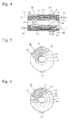
Fig. 4 is a sectional side view showing imbalance of hollow-fiber membranes in a conventional hollow-fiber membrane module for moisture exchange. -
Fig. 5 is a schematic view showing arrangement of a tubular porous member in a hollow-fiber membrane module for moisture exchange relating to an embodiment of the present invention. -
Fig. 6 is a schematic view showing arrangement of tubular porous members in a hollow-fiber membrane module for moisture exchange relating to another embodiment of the present invention. -
Figs. 7A to 7F are sectional views showing other examples of an outer case, an inner case, and a tubular porous member of the present invention. - M denotes a hollow-fiber membrane module for moisture exchange, 10 denotes an outer case, 11 denotes a hollow-fiber membrane, 12 denotes an inlet of gas, 13 denotes an outlet of gas, 14 denotes a sealing portion, 15 denotes an inner case, 20 denotes an unused gas (with low humidity), 21 denotes an unused gas (after moisture is exchanged), 22 denotes an off-gas (with high humidity), 23 denotes an off-gas (after moisture is exchanged), 30 denotes a tubular porous member, 31 denotes a first tubular porous member, 32 denotes a second tubular porous member, and 33 denotes a third tubular porous member.
- Embodiments of the present invention will be described with reference to the figures hereinafter. First, a general structure of a hollow-fiber membrane module for moisture exchange, to which the present invention can be applied, will be described with reference to
Figs. 1 to 3 before description of the embodiments.Figs. 1 to 3 show a hollow-fiber membrane module M for moisture exchange. The hollow-fiber membrane module M has anouter case 10 which is formed into a tubular shape, and aninner case 15 is coaxially arranged in theouter case 10. - There is a space inside of the
outer case 10 and at the outside of the inner case 15 (that is, a space surrounded by theouter case 10 and theinner case 15, which may be simply called a "filling space" hereinafter). This space is filled with plural hollow-fiber membranes 11 in a direction parallel to the axial direction of theouter case 10 and theinner case 15. Since the plural hollow-fiber membranes 11 swell by absorbing moisture, the hollow-fiber membranes 11 are filled at predetermined distances so as to correspond to change in dimensions. - The hollow-
fiber membranes 11 have ends at both sides that are fixed to theouter case 10 and theinner case 15 by sealingportions 14.Fig. 1 shows the hollow-fiber membranes 11 that are partially omitted, but the hollow-fiber membranes 11 extend between the sealingportions 14 at both ends. The sealingportions 14 are formed by burying the outsides of the hollow-fiber membranes 11 in the filling space with a synthetic resin and the like. The sealingportions 14 seal only the filling space from the outside. That is, the sealingportions 14 are formed in the filling space and fix the hollow-fiber membranes 11 at both ends of the tubular structure of theouter case 10 and theinner case 15. The hollow insides of the hollow-fiber membranes 11 are not sealed and are communicated with the outside at both ends. In the embodiments, a route from one end sides of the hollow-fiber membranes 11 (arrow 20) to the other ends thereof (arrow 21) via the hollow inside of the hollow-fiber membranes is used as a first flow path. - The
inner case 15 is provided with aninlet 12 for the gas. Theouter case 10 is provided with anoutlet 13 for the gas at the downstream and the opposite side of theinlet 12. In the embodiments, a route from the inlet 12 (arrow 22) to the outlet 13 (arrow 23) via the outsides of the hollow-fiber membranes 11 in the filling space is used as a second flow path. That is, in theinner case 15 and theouter case 10, theinner case 15 is provided with theinlet 12, whereas theouter case 10, which is not provided with theinlet 12, is provided with theoutlet 13. - In the hollow-fiber membrane module M, for example, a
dry gas 20 is supplied to the first flow path before it is used in a fuel cell. Thedry gas 20 used in a fuel cell becomes an off-gas 22 as an exhaust gas. This off-gas 22 is supplied to the second flow path. Therefore, while the unuseddry gas 20 passes in the hollow-fiber membranes 11, the humidified off-gas 22 passes the outsides of the hollow-fiber membranes 11 in the filling space. The hollow-fiber membranes 11 do not exchange gas between the inside and the outside thereof, but let only moisture migrate through fine pores existing on both surfaces thereof. Thus, the moisture migrates from the high humidity side to the low humidity side. According to the moisture migration, the unuseddry gas 20 supplied to the first flow path is discharged as an unused humidifiedgas 21, and the humidified off-gas 22 supplied to the second flow path is discharged as an off-gas 23 with low humidity. -
Fig. 4 is a view for illustrating the problems of a conventional hollow-fiber membrane module for moisture exchange. As described above, since the hollow-fiber membranes 11 swell by absorbing moisture and change in dimensions, the hollow-fiber membranes 11 in a dry condition are secured in the filling space at predetermined distances. The hollow-fiber membranes 11 can elastically deform. Therefore, as shown inFig. 4 , when the off-gas 22 is supplied from theinlet 12, pressure is increased at the side of theinner case 15, at which the gas flow rate is the greatest. As a result, the off-gas 22 pushes aside and deforms the hollow-fiber membranes 11, thereby forming large spaces along theinner case 15. Much of the off-gas flows to the downstream (the right side inFig. 4 ) via these large spaces as shown by anarrow 24, and then the off-gas flows to theoutlet 13 and is discharged. Thus, the off-gas does not pass through interspaces between the hollow-fiber membranes 11 at the upstream (the left side inFig. 4 ), and the moisture migration occurs only at the downstream. Accordingly, a rate of using the hollow-fiber membranes 11 and the humidifying efficiency are low. -
Fig. 5 shows an embodiment of a hollow-fiber membrane module for moisture exchange of the present invention, by which the above conventional problems can be solved. The hollow-fiber membrane module shown inFig. 5 has the same components as those inFigs. 1 to 3 , except for a tubularporous member 30. Therefore, descriptions for the same components are omitted, and specific structure and effects in the First Embodiment will be described. - As shown in
Fig. 5 , the tubularporous member 30 is provided coaxially with theouter case 10 and theinner case 15 in the filling space, and it is inserted between the plural hollow-fiber membranes 11. The tubularporous member 30 has an opening ratio so as to let sufficient amount of the off-gas pass therethrough. The tubularporous member 30 has stiffness sufficient not to be deformed when it is subjected to the pressure of the off-gas, and it is made of a material that has good corrosion resistance for long periods. The tubularporous member 30 is, for example, formed of a mesh made of metal, such as stainless steel, or is formed of plastic, and is fixed by burying both ends in the sealingportions 14. - The sealing
portions 14 of the present invention may be formed by any method and can be fixed by appropriate means. In this embodiment, a method of potting is used. First, the hollow-fiber membranes 11 and tubularporous members 30 to 33 are filled in the filling space in a condition in which theouter case 10 and theinner case 15 stand on the end portions. Then, lower end portions thereof are dipped in a resin and are fixed. Similarly, after the other end portions thereof are turned down, the end portions are dipped in the resin and are fixed. In the potting, the resin seals the insides and the outsides of the hollow-fiber membranes 11. In this case, the distances between the hollow-fiber membranes 11 are less than the diameter of the hollow-fiber membranes 11. The resin rises to different heights according to capillary action, and therefore, the insides of the hollow-fiber membranes 11 are shallowly sealed compared with the outsides thereof. Accordingly, by cutting off these portions, the insides of the hollow-fiber membranes 11 are made to communicate with the outside of the module, and the resin is made to remain only at the outsides of the hollow-fiber membranes 11. Thus, the filling space is sealed. - In this embodiment, a rate of swelling of the hollow-
fiber membranes 11 due to the moisture is preliminary investigated. In order to reduce the movement of the hollow-fiber membranes 11, the hollow-fiber membranes 11 and the tubularporous member 30 are arranged so as to contact each other and be densely filled without interspaces when the rate of swelling is the greatest. Alternatively, the hollow-fiber membranes 11 and the tubularporous member 30 are arranged so as to decrease the distances therebetween and be filled at high density. On the other hand, in a dry condition, the hollow-fiber membranes 11 and the tubularporous member 30 are arranged so as to have interspaces (distances) therebetween. - As the hollow-
fiber membranes 11 of the present invention, publicly known hollow-fiber membranes may be used. Specifically, hollow-fiber membranes made of polymer ion-exchange membrane, such as of phenolsulfonic acid, polystyrene sulfonic acid, polytrifluorostyrene sulfonic acid, and perfluorocarbon sulfonic acid, may be used. Moreover, hollow-fiber membranes made of a material, such as of polymer resin type and ceramic type, may be used. - According to this embodiment, the tubular
porous member 30 surrounds the plural hollow-fiber membranes 11. Therefore, although the hollow-fiber membranes 11 in the vicinity of theinlet 12 receive the gas pressure when the off-gas is supplied from theinlet 12 to the filling space, the hollow-fiber membranes 11 between the tubularporous member 30 and theinner case 15 are prevented from moving. Thus, large spaces are not formed along theinner case 15, whereby the off-gas uniformly flows from the upstream to the downstream in the filling space. Accordingly, the rate of using the hollow-fiber membranes 11 and the humidifying efficiency are improved. - Specifically, in this embodiment, the hollow-
fiber membranes 11 and the tubularporous member 30 are arranged so as to have predetermined distances based on the rate of swelling of the hollow-fiber membranes 11. Therefore, the hollow-fiber membranes 11 and the tubularporous member 30 contact each other while the hollow-fiber membrane module is operated, whereby formation of the large spaces along theinner case 15 is reliably prevented. -
Fig. 6 shows another embodiment of a hollow-fiber membrane module for moisture exchange of the present invention, andFig. 6 shows an example in which plural tubular porous members are provided. As shown inFig. 6 , in the filling space, a first tubularporous member 31, a second tubularporous member 32, and a third tubularporous member 33 are provided coaxially with theouter case 10 and theinner case 15. As in the case of the First Embodiment, the tubularporous members 31 to 33 are formed of a mesh made of metal with corrosion resistance or of plastic, and the tubularporous members 31 to 33 are fixed by burying both ends into the sealingportions 14. - In the embodiment, a distance between the
inner case 15 and the first tubularporous member 31 is expressed as A1. In addition, a distance between the first tubularporous member 31 and the second tubularporous member 32 is expressed as A2, and a distance between the second tubularporous member 32 and the third tubularporous member 33 is expressed as A3. In this case, the distance A1 at the innermost is made to be less than the other distances A2 and A3. - According to this embodiment, as in the case of the First Embodiment, the first tubular
porous member 31 surrounds innermost hollow-fiber membranes 11. Therefore, although the hollow-fiber membranes 11 in the vicinity of theinlet 12 receive the gas pressure when the off-gas is supplied from theinlet 12 to the filling space, the movement of the hollow-fiber membranes 11 is reduced. Moreover, since the second tubularporous member 32 and the third tubularporous member 33 surround the hollow-fiber membranes 11 at the outside of the first tubularporous member 31, the movement of these hollow-fiber membranes 11 is also reduced. Accordingly, the rate of using the hollow-fiber membranes 11 and the humidifying efficiency are more improved than those in the case of the First Embodiment. - Specifically, in this embodiment, in the vicinity of the
inlet 12 of the off-gas, the gas flow rate is the greatest, and the hollow-fiber membranes 11 receive large forces, whereby the hollow-fiber membranes 11 tend to move substantially. However, by making the distance A1 be the smallest, the amount of movement of the hollow-fiber membranes 11 can be minimized. - In this embodiment, a relationship between the distances A2 and A3 is not limited as long as at least the distance A1 is the smallest. For example, the distance A2 may be the same as the distance A3, or may be greater or less than the distance A3. In particular, since the flow rate of the off-gas is decreased toward the outside, the distances A1, A2, and A3 are preferably made to be greater in this order.
- In the present invention, the plural tubular porous members are not limited to the first to the third tubular porous members, and an appropriate number of the first to the nth (n is an integer number that is not less than 2) tubular porous members may be provided. In this case, the distance A1 is preferably less than the other distances A2 to An, and more preferably, the distances A1, A2, ... An-1, and An are made to be greater in this order, as in the case of the Second Embodiment.
- In the above description, the unused dry gas is supplied to the first flow path, and the humidified off-gas is supplied to the second flow path, which is described as an example. However, the present invention is not limited to this embodiment. Therefore, the moisture may be exchanged by supplying the humidified off-gas to the first flow path and by supplying the unused dry gas to the second flow path.
- The
inlet 12 provided to theinner case 15 and theoutlet 13 provided to theouter case 10 do not limit the flow direction of the gas to this direction. In the present invention, conversely, the gas may be supplied from theoutlet 13 and may be discharged from theinlet 12. In this case, inFig. 6 , the outermost distance A3 in a side, to which the gas is supplied, is preferably less than the distances A2 and A1 at the inner side. More preferably, the distances A3, A2, and A1 are made to be greater in this order. - In the above description, a case of the
outer case 10, theinner case 15, and the tubularporous members 30 to 33 having a circular tube shape is exemplified. However, the hollow-fiber membrane module for moisture exchange of the present invention is not limited to the circular tube shape and may have tube shapes with a polygonal cross section, for example. That is, theouter case 10 may have a four-sided shape as shown inFigs. 7A, 7B, and 7C , or may have a hexagonal shape as shown inFigs. 7D and 7E , and may have an octagonal shape as shown inFig. 7F . In addition, theouter case 10 may have a tube shape with a polygonal cross section in a pentagonal shape or in a decagonal shape. Theinner case 15 may have a four-sided shape as shown inFigs. 7A and 7C , or may have a hexagonal shape as shown inFig. 7D . In addition, theinner case 15 may have a tube shape with a polygonal cross section in a pentagonal shape, an octagonal shape, or a decagonal shape. Moreover, the tubular porous member may have a four-sided shape as shown inFigs. 7A and 7B , or may have a hexagonal shape as shown inFigs. 7D and 7E . The tubular porous member may have a tube shape with a polygonal cross section in a pentagonal shape, an octagonal shape, or a decagonal shape. The cross sectional shapes of theouter case 10, theinner case 15, and the tubularporous members 30 to 33 may be freely selected as shown inFigs. 7A to 7F . For example, the four-sided shape, the circular tube shape, and the hexagonal shape may be combined. - According to the present invention, the moisture of the off-gas exhausted from a fuel cell is reused for humidifying the unused oxidant gas. Moreover, the humidifying efficiency in the moisture exchange is increased, whereby the fuel cell can be operated with an appropriate amount of the moisture. Accordingly, the present invention is extremely suitably used in an automobile fuel cell system in which precise stable operation is required.
Claims (6)
- A hollow-fiber membrane module for moisture exchange, comprising:a tubular outer case;a tubular inner case coaxially contained in the outer case so as to have a space therebetween, the space having both ends;plural hollow-fiber membranes filled in the space and extending in the axial direction, the hollow-fiber membranes having both ends;sealing portions provided to the both ends of the space so as to fix the plural hollow-fiber membranes and to seal the space;an inlet provided to one of the inner case and the outer case;an outlet provided to one of the inner case and the outer case, which is not provided with the inlet;a first flow path extending from a side of the end of the hollow-fiber membranes to a side of the other end via insides of the hollow-fiber membranes;a second flow path extending from the inlet to the outlet via outsides of the hollow-fiber membranes in the space; anda tubular porous member inserted between the plural hollow-fiber membranes and extending in the space, the tubular porous member coaxially arranged with the outer case and the inner case.
- The hollow-fiber membrane module for moisture exchange according to claim 1, wherein the tubular porous member has an end portion, and at least the end portion is fixed by the sealing portion.
- The hollow-fiber membrane module for moisture exchange according to claim 1 or 2, wherein plural tubular porous members, in which diameters differ from each other, are coaxially provided in the space at predetermined distances, the inlet is provided to the inner case, the outlet is provided to the outer case, and the distance between the tubular porous member provided to the innermost and the inner case is less than each of the distances between the other tubular porous members.
- The hollow-fiber membrane module for moisture exchange according to claim 1 or 2, wherein the inlet is provided to the outer case, the outlet is provided to the inner case, plural tubular porous members are provided at predetermined distances, and the distance between the tubular porous member provided to the outermost and the outer case is less than each of the distances between the other tubular porous members.
- The hollow-fiber membrane module for moisture exchange according to one of claims 1 to 4, wherein the hollow-fiber membranes in a dry condition have distances therebetween and distances between the hollow-fiber membranes and the tubular porous member, and the hollow-fiber membranes in a swelled condition contact each other so as to decrease these distances.
- The hollow-fiber membrane module for moisture exchange according to one of claims 1 to 5, wherein the tubular porous member is formed of a mesh.
Applications Claiming Priority (2)
| Application Number | Priority Date | Filing Date | Title |
|---|---|---|---|
| JP2009173489 | 2009-07-24 | ||
| PCT/JP2010/062171 WO2011010636A1 (en) | 2009-07-24 | 2010-07-20 | Hollow-fiber membrane module for moisture exchange |
Publications (3)
| Publication Number | Publication Date |
|---|---|
| EP2457640A1 true EP2457640A1 (en) | 2012-05-30 |
| EP2457640A4 EP2457640A4 (en) | 2013-12-25 |
| EP2457640B1 EP2457640B1 (en) | 2015-03-11 |
Family
ID=43499108
Family Applications (1)
| Application Number | Title | Priority Date | Filing Date |
|---|---|---|---|
| EP10802256.7A Not-in-force EP2457640B1 (en) | 2009-07-24 | 2010-07-20 | Hollow-fiber membrane module for moisture exchange |
Country Status (5)
| Country | Link |
|---|---|
| US (1) | US9048469B2 (en) |
| EP (1) | EP2457640B1 (en) |
| JP (1) | JP5523458B2 (en) |
| CN (1) | CN102470321B (en) |
| WO (1) | WO2011010636A1 (en) |
Cited By (1)
| Publication number | Priority date | Publication date | Assignee | Title |
|---|---|---|---|---|
| US20240157302A1 (en) * | 2021-06-02 | 2024-05-16 | Nok Corporation | Hollow fiber membrane module and dehumidification and humidification device |
Families Citing this family (11)
| Publication number | Priority date | Publication date | Assignee | Title |
|---|---|---|---|---|
| KR101382672B1 (en) | 2011-12-09 | 2014-04-07 | 기아자동차주식회사 | Method of producing hollow yarnmembrane modules for fuel cell |
| KR101984034B1 (en) * | 2014-03-24 | 2019-05-30 | 코오롱인더스트리 주식회사 | Hollow fiber membrane module |
| DE102014011445B4 (en) * | 2014-08-07 | 2016-06-02 | Mann + Hummel Gmbh | Filter device with hollow fibers |
| KR101766011B1 (en) * | 2015-04-30 | 2017-08-07 | 현대자동차주식회사 | Humidification device for fuel cell |
| WO2022005089A1 (en) * | 2020-07-02 | 2022-01-06 | 코오롱인더스트리 주식회사 | Humidifier for fuel cell |
| US12592403B2 (en) * | 2020-12-23 | 2026-03-31 | Kolon Industries, Inc. | Humidifier system for fuel cell |
| US20240173675A1 (en) * | 2021-06-02 | 2024-05-30 | Nok Corporation | Hollow fiber membrane module and dehumidification/humidification device |
| CA3226562A1 (en) | 2021-08-23 | 2023-03-02 | Parker-Hannifin Corporation | Fuel cell humidificaton potting adhesive shroud |
| KR102926188B1 (en) * | 2021-09-06 | 2026-02-10 | 코오롱인더스트리 주식회사 | Cartridge for membrane humidifier and fuel cell humidifier comprising it |
| WO2026013485A1 (en) * | 2024-07-10 | 2026-01-15 | Politecnico Di Milano | System for humidifying gas, in particular air |
| EP4699688A1 (en) * | 2024-08-19 | 2026-02-25 | Carl Freudenberg KG | Humidifier for a fuel cell |
Family Cites Families (25)
| Publication number | Priority date | Publication date | Assignee | Title |
|---|---|---|---|---|
| US4007601A (en) * | 1975-10-16 | 1977-02-15 | The United States Of America As Represented By The Administrator Of The National Aeronautics And Space Administration | Tubular sublimator/evaporator heat sink |
| DE2617985C3 (en) * | 1976-04-24 | 1979-02-22 | Draegerwerk Ag, 2400 Luebeck | Breathing air humidifiers for respiratory devices |
| JPS613671U (en) | 1984-06-13 | 1986-01-10 | 三洋電機株式会社 | Fuel cell output terminal device |
| JPS6142874A (en) | 1984-08-03 | 1986-03-01 | Hitachi Ltd | Fuel cell power generating system |
| US4666469A (en) * | 1985-05-29 | 1987-05-19 | The Dow Chemical Company | Hollow fiber membrane device with inner wrap |
| JPH0696098B2 (en) * | 1988-05-27 | 1994-11-30 | 株式会社クラレ | Hollow fiber type fluid treatment equipment |
| US5013331A (en) * | 1989-06-30 | 1991-05-07 | E. I. Du Pont De Nemours And Company | Permeator with selectable flow rates |
| US5176725A (en) * | 1991-07-26 | 1993-01-05 | Air Products And Chemicals, Inc. | Multiple stage countercurrent hollow fiber membrane module |
| JP3111697B2 (en) | 1992-10-20 | 2000-11-27 | 富士電機株式会社 | Solid polymer electrolyte fuel cell |
| JPH09192442A (en) * | 1996-01-16 | 1997-07-29 | Mitsubishi Rayon Co Ltd | Hollow fiber membrane module for dehumidification |
| US6136073A (en) * | 1998-11-02 | 2000-10-24 | Mg Generon | Boreside feed modules with permeate flow channels |
| JP2001202975A (en) * | 2000-01-19 | 2001-07-27 | Honda Motor Co Ltd | Humidifier for fuel cell |
| JP3927344B2 (en) * | 2000-01-19 | 2007-06-06 | 本田技研工業株式会社 | Humidifier |
| JP2002102663A (en) | 2000-09-29 | 2002-04-09 | Kunitaka Mizobe | Inspection method of steam transfer control apparatus |
| JP4610715B2 (en) | 2000-11-06 | 2011-01-12 | Nok株式会社 | Humidifier |
| JP2002289229A (en) | 2001-03-22 | 2002-10-04 | Nok Corp | Humidifier and its use |
| JP2002303435A (en) | 2001-03-30 | 2002-10-18 | Honda Motor Co Ltd | Humidification module |
| JP2003164735A (en) | 2001-11-29 | 2003-06-10 | Nok Corp | Hollow fiber membrane module |
| NL1021913C2 (en) | 2002-11-13 | 2004-05-14 | Jb Ventures B V | Filter module. |
| JP2004311287A (en) | 2003-04-09 | 2004-11-04 | Nissan Motor Co Ltd | Humidifier |
| JP2005040675A (en) | 2003-07-24 | 2005-02-17 | Nok Corp | Hollow fiber membrane module |
| KR100569681B1 (en) | 2003-11-17 | 2006-04-10 | 주식회사 코오롱 | Immersion Hollow Fiber Membrane Module |
| DE102004022021B4 (en) * | 2004-05-03 | 2007-05-16 | Daimler Chrysler Ag | Moisture exchange module with a bundle of moisture permeable hollow fiber membranes |
| JP2007309574A (en) * | 2006-05-18 | 2007-11-29 | Toyota Motor Corp | Humidifier and fuel cell system including the same |
| JP2007323982A (en) | 2006-06-01 | 2007-12-13 | Matsushita Electric Ind Co Ltd | Fuel cell system |
-
2010
- 2010-07-20 EP EP10802256.7A patent/EP2457640B1/en not_active Not-in-force
- 2010-07-20 WO PCT/JP2010/062171 patent/WO2011010636A1/en not_active Ceased
- 2010-07-20 CN CN201080031460.0A patent/CN102470321B/en active Active
- 2010-07-20 JP JP2011523656A patent/JP5523458B2/en active Active
- 2010-07-20 US US13/381,529 patent/US9048469B2/en active Active
Cited By (1)
| Publication number | Priority date | Publication date | Assignee | Title |
|---|---|---|---|---|
| US20240157302A1 (en) * | 2021-06-02 | 2024-05-16 | Nok Corporation | Hollow fiber membrane module and dehumidification and humidification device |
Also Published As
| Publication number | Publication date |
|---|---|
| JP5523458B2 (en) | 2014-06-18 |
| JPWO2011010636A1 (en) | 2012-12-27 |
| CN102470321B (en) | 2016-03-16 |
| EP2457640A4 (en) | 2013-12-25 |
| WO2011010636A1 (en) | 2011-01-27 |
| CN102470321A (en) | 2012-05-23 |
| US9048469B2 (en) | 2015-06-02 |
| EP2457640B1 (en) | 2015-03-11 |
| US20120111967A1 (en) | 2012-05-10 |
Similar Documents
| Publication | Publication Date | Title |
|---|---|---|
| EP2457640B1 (en) | Hollow-fiber membrane module for moisture exchange | |
| EP3312923B1 (en) | Hollow fiber membrane module | |
| EP3240075B1 (en) | Hollow fiber membrane cartridge-type humidification module and method for manufacturing same | |
| CN101241993B (en) | Water removal channel for PEM fuel cell stack headers | |
| JP5500254B2 (en) | Fuel cell | |
| US10478779B2 (en) | Hollow fiber membrane module | |
| KR20140125098A (en) | Hollow fiber membrane module | |
| CN100334764C (en) | Fuel cell | |
| EP4350820A1 (en) | Fuel cell membrane humidifier | |
| KR102017256B1 (en) | Fluid exchange membrane module | |
| JP5710127B2 (en) | Hollow fiber membrane module for moisture exchange | |
| CN111527634B (en) | Fuel cell membrane humidifier capable of controlling fluid flow direction | |
| JP5308950B2 (en) | Hollow fiber membrane module for moisture exchange | |
| KR102604253B1 (en) | Fuel cell stack with bipolar plate, and fuel cell system | |
| JP5222246B2 (en) | Hollow fiber membrane module for moisture exchange | |
| CA2568763C (en) | Cell module having water permeable hollow body, and fuel cell comprising cell module | |
| JP5308949B2 (en) | Hollow fiber membrane module for moisture exchange | |
| JP5653867B2 (en) | Fuel cell | |
| JP2009152217A (en) | Fuel cell stack | |
| JP2010107125A (en) | Humidifier |
Legal Events
| Date | Code | Title | Description |
|---|---|---|---|
| PUAI | Public reference made under article 153(3) epc to a published international application that has entered the european phase |
Free format text: ORIGINAL CODE: 0009012 |
|
| 17P | Request for examination filed |
Effective date: 20120113 |
|
| AK | Designated contracting states |
Kind code of ref document: A1 Designated state(s): AL AT BE BG CH CY CZ DE DK EE ES FI FR GB GR HR HU IE IS IT LI LT LU LV MC MK MT NL NO PL PT RO SE SI SK SM TR |
|
| DAX | Request for extension of the european patent (deleted) | ||
| A4 | Supplementary search report drawn up and despatched |
Effective date: 20131127 |
|
| RIC1 | Information provided on ipc code assigned before grant |
Ipc: H01M 8/04 20060101ALI20131121BHEP Ipc: B01D 63/00 20060101ALI20131121BHEP Ipc: H01M 8/10 20060101ALI20131121BHEP Ipc: B01D 63/02 20060101AFI20131121BHEP Ipc: B01D 53/22 20060101ALI20131121BHEP |
|
| GRAP | Despatch of communication of intention to grant a patent |
Free format text: ORIGINAL CODE: EPIDOSNIGR1 |
|
| INTG | Intention to grant announced |
Effective date: 20141015 |
|
| GRAS | Grant fee paid |
Free format text: ORIGINAL CODE: EPIDOSNIGR3 |
|
| GRAA | (expected) grant |
Free format text: ORIGINAL CODE: 0009210 |
|
| AK | Designated contracting states |
Kind code of ref document: B1 Designated state(s): AL AT BE BG CH CY CZ DE DK EE ES FI FR GB GR HR HU IE IS IT LI LT LU LV MC MK MT NL NO PL PT RO SE SI SK SM TR |
|
| REG | Reference to a national code |
Ref country code: GB Ref legal event code: FG4D |
|
| REG | Reference to a national code |
Ref country code: CH Ref legal event code: EP |
|
| REG | Reference to a national code |
Ref country code: IE Ref legal event code: FG4D |
|
| REG | Reference to a national code |
Ref country code: AT Ref legal event code: REF Ref document number: 714997 Country of ref document: AT Kind code of ref document: T Effective date: 20150415 |
|
| REG | Reference to a national code |
Ref country code: DE Ref legal event code: R096 Ref document number: 602010023103 Country of ref document: DE Effective date: 20150423 |
|
| REG | Reference to a national code |
Ref country code: NL Ref legal event code: VDEP Effective date: 20150311 |
|
| REG | Reference to a national code |
Ref country code: NL Ref legal event code: VDEP Effective date: 20150311 |
|
| PG25 | Lapsed in a contracting state [announced via postgrant information from national office to epo] |
Ref country code: FI Free format text: LAPSE BECAUSE OF FAILURE TO SUBMIT A TRANSLATION OF THE DESCRIPTION OR TO PAY THE FEE WITHIN THE PRESCRIBED TIME-LIMIT Effective date: 20150311 Ref country code: SE Free format text: LAPSE BECAUSE OF FAILURE TO SUBMIT A TRANSLATION OF THE DESCRIPTION OR TO PAY THE FEE WITHIN THE PRESCRIBED TIME-LIMIT Effective date: 20150311 Ref country code: HR Free format text: LAPSE BECAUSE OF FAILURE TO SUBMIT A TRANSLATION OF THE DESCRIPTION OR TO PAY THE FEE WITHIN THE PRESCRIBED TIME-LIMIT Effective date: 20150311 Ref country code: LT Free format text: LAPSE BECAUSE OF FAILURE TO SUBMIT A TRANSLATION OF THE DESCRIPTION OR TO PAY THE FEE WITHIN THE PRESCRIBED TIME-LIMIT Effective date: 20150311 Ref country code: ES Free format text: LAPSE BECAUSE OF FAILURE TO SUBMIT A TRANSLATION OF THE DESCRIPTION OR TO PAY THE FEE WITHIN THE PRESCRIBED TIME-LIMIT Effective date: 20150311 Ref country code: NO Free format text: LAPSE BECAUSE OF FAILURE TO SUBMIT A TRANSLATION OF THE DESCRIPTION OR TO PAY THE FEE WITHIN THE PRESCRIBED TIME-LIMIT Effective date: 20150611 |
|
| REG | Reference to a national code |
Ref country code: AT Ref legal event code: MK05 Ref document number: 714997 Country of ref document: AT Kind code of ref document: T Effective date: 20150311 |
|
| REG | Reference to a national code |
Ref country code: LT Ref legal event code: MG4D |
|
| PG25 | Lapsed in a contracting state [announced via postgrant information from national office to epo] |
Ref country code: LV Free format text: LAPSE BECAUSE OF FAILURE TO SUBMIT A TRANSLATION OF THE DESCRIPTION OR TO PAY THE FEE WITHIN THE PRESCRIBED TIME-LIMIT Effective date: 20150311 Ref country code: GR Free format text: LAPSE BECAUSE OF FAILURE TO SUBMIT A TRANSLATION OF THE DESCRIPTION OR TO PAY THE FEE WITHIN THE PRESCRIBED TIME-LIMIT Effective date: 20150612 |
|
| PG25 | Lapsed in a contracting state [announced via postgrant information from national office to epo] |
Ref country code: NL Free format text: LAPSE BECAUSE OF FAILURE TO SUBMIT A TRANSLATION OF THE DESCRIPTION OR TO PAY THE FEE WITHIN THE PRESCRIBED TIME-LIMIT Effective date: 20150311 |
|
| PG25 | Lapsed in a contracting state [announced via postgrant information from national office to epo] |
Ref country code: PT Free format text: LAPSE BECAUSE OF FAILURE TO SUBMIT A TRANSLATION OF THE DESCRIPTION OR TO PAY THE FEE WITHIN THE PRESCRIBED TIME-LIMIT Effective date: 20150713 Ref country code: EE Free format text: LAPSE BECAUSE OF FAILURE TO SUBMIT A TRANSLATION OF THE DESCRIPTION OR TO PAY THE FEE WITHIN THE PRESCRIBED TIME-LIMIT Effective date: 20150311 Ref country code: SK Free format text: LAPSE BECAUSE OF FAILURE TO SUBMIT A TRANSLATION OF THE DESCRIPTION OR TO PAY THE FEE WITHIN THE PRESCRIBED TIME-LIMIT Effective date: 20150311 Ref country code: CZ Free format text: LAPSE BECAUSE OF FAILURE TO SUBMIT A TRANSLATION OF THE DESCRIPTION OR TO PAY THE FEE WITHIN THE PRESCRIBED TIME-LIMIT Effective date: 20150311 Ref country code: RO Free format text: LAPSE BECAUSE OF FAILURE TO SUBMIT A TRANSLATION OF THE DESCRIPTION OR TO PAY THE FEE WITHIN THE PRESCRIBED TIME-LIMIT Effective date: 20150311 |
|
| PGFP | Annual fee paid to national office [announced via postgrant information from national office to epo] |
Ref country code: GB Payment date: 20150721 Year of fee payment: 6 |
|
| PG25 | Lapsed in a contracting state [announced via postgrant information from national office to epo] |
Ref country code: PL Free format text: LAPSE BECAUSE OF FAILURE TO SUBMIT A TRANSLATION OF THE DESCRIPTION OR TO PAY THE FEE WITHIN THE PRESCRIBED TIME-LIMIT Effective date: 20150311 Ref country code: IS Free format text: LAPSE BECAUSE OF FAILURE TO SUBMIT A TRANSLATION OF THE DESCRIPTION OR TO PAY THE FEE WITHIN THE PRESCRIBED TIME-LIMIT Effective date: 20150711 Ref country code: AT Free format text: LAPSE BECAUSE OF FAILURE TO SUBMIT A TRANSLATION OF THE DESCRIPTION OR TO PAY THE FEE WITHIN THE PRESCRIBED TIME-LIMIT Effective date: 20150311 |
|
| REG | Reference to a national code |
Ref country code: DE Ref legal event code: R097 Ref document number: 602010023103 Country of ref document: DE |
|
| PG25 | Lapsed in a contracting state [announced via postgrant information from national office to epo] |
Ref country code: IT Free format text: LAPSE BECAUSE OF FAILURE TO SUBMIT A TRANSLATION OF THE DESCRIPTION OR TO PAY THE FEE WITHIN THE PRESCRIBED TIME-LIMIT Effective date: 20150311 |
|
| PLBE | No opposition filed within time limit |
Free format text: ORIGINAL CODE: 0009261 |
|
| STAA | Information on the status of an ep patent application or granted ep patent |
Free format text: STATUS: NO OPPOSITION FILED WITHIN TIME LIMIT |
|
| PG25 | Lapsed in a contracting state [announced via postgrant information from national office to epo] |
Ref country code: DK Free format text: LAPSE BECAUSE OF FAILURE TO SUBMIT A TRANSLATION OF THE DESCRIPTION OR TO PAY THE FEE WITHIN THE PRESCRIBED TIME-LIMIT Effective date: 20150311 |
|
| 26N | No opposition filed |
Effective date: 20151214 |
|
| PG25 | Lapsed in a contracting state [announced via postgrant information from national office to epo] |
Ref country code: MC Free format text: LAPSE BECAUSE OF FAILURE TO SUBMIT A TRANSLATION OF THE DESCRIPTION OR TO PAY THE FEE WITHIN THE PRESCRIBED TIME-LIMIT Effective date: 20150311 Ref country code: SI Free format text: LAPSE BECAUSE OF FAILURE TO SUBMIT A TRANSLATION OF THE DESCRIPTION OR TO PAY THE FEE WITHIN THE PRESCRIBED TIME-LIMIT Effective date: 20150311 |
|
| REG | Reference to a national code |
Ref country code: CH Ref legal event code: PL |
|
| PG25 | Lapsed in a contracting state [announced via postgrant information from national office to epo] |
Ref country code: LU Free format text: LAPSE BECAUSE OF FAILURE TO SUBMIT A TRANSLATION OF THE DESCRIPTION OR TO PAY THE FEE WITHIN THE PRESCRIBED TIME-LIMIT Effective date: 20150720 |
|
| REG | Reference to a national code |
Ref country code: IE Ref legal event code: MM4A |
|
| PG25 | Lapsed in a contracting state [announced via postgrant information from national office to epo] |
Ref country code: LI Free format text: LAPSE BECAUSE OF NON-PAYMENT OF DUE FEES Effective date: 20150731 Ref country code: CH Free format text: LAPSE BECAUSE OF NON-PAYMENT OF DUE FEES Effective date: 20150731 |
|
| REG | Reference to a national code |
Ref country code: FR Ref legal event code: ST Effective date: 20160331 |
|
| PG25 | Lapsed in a contracting state [announced via postgrant information from national office to epo] |
Ref country code: FR Free format text: LAPSE BECAUSE OF NON-PAYMENT OF DUE FEES Effective date: 20150731 |
|
| PG25 | Lapsed in a contracting state [announced via postgrant information from national office to epo] |
Ref country code: IE Free format text: LAPSE BECAUSE OF NON-PAYMENT OF DUE FEES Effective date: 20150720 |
|
| PG25 | Lapsed in a contracting state [announced via postgrant information from national office to epo] |
Ref country code: BE Free format text: LAPSE BECAUSE OF FAILURE TO SUBMIT A TRANSLATION OF THE DESCRIPTION OR TO PAY THE FEE WITHIN THE PRESCRIBED TIME-LIMIT Effective date: 20150311 |
|
| GBPC | Gb: european patent ceased through non-payment of renewal fee |
Effective date: 20160720 |
|
| PG25 | Lapsed in a contracting state [announced via postgrant information from national office to epo] |
Ref country code: MT Free format text: LAPSE BECAUSE OF FAILURE TO SUBMIT A TRANSLATION OF THE DESCRIPTION OR TO PAY THE FEE WITHIN THE PRESCRIBED TIME-LIMIT Effective date: 20150311 |
|
| PG25 | Lapsed in a contracting state [announced via postgrant information from national office to epo] |
Ref country code: BG Free format text: LAPSE BECAUSE OF FAILURE TO SUBMIT A TRANSLATION OF THE DESCRIPTION OR TO PAY THE FEE WITHIN THE PRESCRIBED TIME-LIMIT Effective date: 20150311 Ref country code: SM Free format text: LAPSE BECAUSE OF FAILURE TO SUBMIT A TRANSLATION OF THE DESCRIPTION OR TO PAY THE FEE WITHIN THE PRESCRIBED TIME-LIMIT Effective date: 20150311 Ref country code: GB Free format text: LAPSE BECAUSE OF NON-PAYMENT OF DUE FEES Effective date: 20160720 Ref country code: HU Free format text: LAPSE BECAUSE OF FAILURE TO SUBMIT A TRANSLATION OF THE DESCRIPTION OR TO PAY THE FEE WITHIN THE PRESCRIBED TIME-LIMIT; INVALID AB INITIO Effective date: 20100720 |
|
| PG25 | Lapsed in a contracting state [announced via postgrant information from national office to epo] |
Ref country code: CY Free format text: LAPSE BECAUSE OF FAILURE TO SUBMIT A TRANSLATION OF THE DESCRIPTION OR TO PAY THE FEE WITHIN THE PRESCRIBED TIME-LIMIT Effective date: 20150311 |
|
| PG25 | Lapsed in a contracting state [announced via postgrant information from national office to epo] |
Ref country code: TR Free format text: LAPSE BECAUSE OF FAILURE TO SUBMIT A TRANSLATION OF THE DESCRIPTION OR TO PAY THE FEE WITHIN THE PRESCRIBED TIME-LIMIT Effective date: 20150311 |
|
| PG25 | Lapsed in a contracting state [announced via postgrant information from national office to epo] |
Ref country code: MK Free format text: LAPSE BECAUSE OF FAILURE TO SUBMIT A TRANSLATION OF THE DESCRIPTION OR TO PAY THE FEE WITHIN THE PRESCRIBED TIME-LIMIT Effective date: 20150311 |
|
| REG | Reference to a national code |
Ref country code: DE Ref legal event code: R084 Ref document number: 602010023103 Country of ref document: DE |
|
| PG25 | Lapsed in a contracting state [announced via postgrant information from national office to epo] |
Ref country code: AL Free format text: LAPSE BECAUSE OF FAILURE TO SUBMIT A TRANSLATION OF THE DESCRIPTION OR TO PAY THE FEE WITHIN THE PRESCRIBED TIME-LIMIT Effective date: 20150311 |
|
| PGFP | Annual fee paid to national office [announced via postgrant information from national office to epo] |
Ref country code: DE Payment date: 20210622 Year of fee payment: 12 |
|
| REG | Reference to a national code |
Ref country code: DE Ref legal event code: R119 Ref document number: 602010023103 Country of ref document: DE |
|
| PG25 | Lapsed in a contracting state [announced via postgrant information from national office to epo] |
Ref country code: DE Free format text: LAPSE BECAUSE OF NON-PAYMENT OF DUE FEES Effective date: 20230201 |