EP2456319B1 - Method for producing temperature tolerant confectionery compositions and compositions produced using the method - Google Patents
Method for producing temperature tolerant confectionery compositions and compositions produced using the method Download PDFInfo
- Publication number
- EP2456319B1 EP2456319B1 EP10738017.2A EP10738017A EP2456319B1 EP 2456319 B1 EP2456319 B1 EP 2456319B1 EP 10738017 A EP10738017 A EP 10738017A EP 2456319 B1 EP2456319 B1 EP 2456319B1
- Authority
- EP
- European Patent Office
- Prior art keywords
- liquid
- water
- confectionery composition
- composition
- chocolate
- Prior art date
- Legal status (The legal status is an assumption and is not a legal conclusion. Google has not performed a legal analysis and makes no representation as to the accuracy of the status listed.)
- Not-in-force
Links
- 239000000203 mixture Substances 0.000 title claims description 206
- 235000009508 confectionery Nutrition 0.000 title claims description 119
- 238000000034 method Methods 0.000 title claims description 23
- 238000004519 manufacturing process Methods 0.000 title claims description 8
- DNIAPMSPPWPWGF-UHFFFAOYSA-N Propylene glycol Chemical group CC(O)CO DNIAPMSPPWPWGF-UHFFFAOYSA-N 0.000 claims description 279
- 239000007788 liquid Substances 0.000 claims description 142
- XLYOFNOQVPJJNP-UHFFFAOYSA-N water Substances O XLYOFNOQVPJJNP-UHFFFAOYSA-N 0.000 claims description 139
- 235000019219 chocolate Nutrition 0.000 claims description 81
- 235000003599 food sweetener Nutrition 0.000 claims description 38
- 239000003765 sweetening agent Substances 0.000 claims description 38
- 235000000346 sugar Nutrition 0.000 claims description 25
- 239000000835 fiber Substances 0.000 claims description 22
- 239000003795 chemical substances by application Substances 0.000 claims description 19
- 238000010899 nucleation Methods 0.000 claims description 19
- 238000002156 mixing Methods 0.000 claims description 17
- 235000021552 granulated sugar Nutrition 0.000 claims description 10
- 238000007493 shaping process Methods 0.000 claims description 5
- 244000299461 Theobroma cacao Species 0.000 description 98
- 235000013772 propylene glycol Nutrition 0.000 description 73
- 229960004063 propylene glycol Drugs 0.000 description 73
- LFQSCWFLJHTTHZ-UHFFFAOYSA-N Ethanol Chemical compound CCO LFQSCWFLJHTTHZ-UHFFFAOYSA-N 0.000 description 51
- 239000003925 fat Substances 0.000 description 24
- 235000019197 fats Nutrition 0.000 description 24
- 239000002245 particle Substances 0.000 description 23
- 235000009470 Theobroma cacao Nutrition 0.000 description 18
- 235000019868 cocoa butter Nutrition 0.000 description 17
- 229940110456 cocoa butter Drugs 0.000 description 17
- 150000001875 compounds Chemical class 0.000 description 17
- 239000007787 solid Substances 0.000 description 16
- HEDRZPFGACZZDS-UHFFFAOYSA-N Chloroform Chemical compound ClC(Cl)Cl HEDRZPFGACZZDS-UHFFFAOYSA-N 0.000 description 14
- 235000019879 cocoa butter substitute Nutrition 0.000 description 14
- 239000000843 powder Substances 0.000 description 13
- 108010046377 Whey Proteins Proteins 0.000 description 11
- 102000007544 Whey Proteins Human genes 0.000 description 11
- 239000003995 emulsifying agent Substances 0.000 description 10
- 235000019877 cocoa butter equivalent Nutrition 0.000 description 8
- CZMRCDWAGMRECN-UGDNZRGBSA-N Sucrose Chemical compound O[C@H]1[C@H](O)[C@@H](CO)O[C@@]1(CO)O[C@@H]1[C@H](O)[C@@H](O)[C@H](O)[C@@H](CO)O1 CZMRCDWAGMRECN-UGDNZRGBSA-N 0.000 description 7
- 229930006000 Sucrose Natural products 0.000 description 7
- 239000005862 Whey Substances 0.000 description 7
- 230000009286 beneficial effect Effects 0.000 description 7
- 239000005720 sucrose Substances 0.000 description 7
- PEDCQBHIVMGVHV-UHFFFAOYSA-N Glycerine Chemical compound OCC(O)CO PEDCQBHIVMGVHV-UHFFFAOYSA-N 0.000 description 6
- 235000013861 fat-free Nutrition 0.000 description 6
- 238000002844 melting Methods 0.000 description 6
- 230000008018 melting Effects 0.000 description 6
- 239000000523 sample Substances 0.000 description 6
- 244000061456 Solanum tuberosum Species 0.000 description 5
- 235000002595 Solanum tuberosum Nutrition 0.000 description 5
- 241000209140 Triticum Species 0.000 description 5
- 235000021307 Triticum Nutrition 0.000 description 5
- 230000015572 biosynthetic process Effects 0.000 description 5
- 235000013325 dietary fiber Nutrition 0.000 description 5
- 235000013336 milk Nutrition 0.000 description 5
- 239000008267 milk Substances 0.000 description 5
- 210000004080 milk Anatomy 0.000 description 5
- 239000003921 oil Substances 0.000 description 5
- 239000004417 polycarbonate Substances 0.000 description 5
- 229920000515 polycarbonate Polymers 0.000 description 5
- 239000000047 product Substances 0.000 description 5
- 235000020183 skimmed milk Nutrition 0.000 description 5
- 238000003860 storage Methods 0.000 description 5
- 235000019220 whole milk chocolate Nutrition 0.000 description 5
- 240000008042 Zea mays Species 0.000 description 4
- 235000002017 Zea mays subsp mays Nutrition 0.000 description 4
- 238000001816 cooling Methods 0.000 description 4
- 238000010438 heat treatment Methods 0.000 description 4
- 239000004615 ingredient Substances 0.000 description 4
- 235000019198 oils Nutrition 0.000 description 4
- 235000021119 whey protein Nutrition 0.000 description 4
- 239000004386 Erythritol Substances 0.000 description 3
- UNXHWFMMPAWVPI-UHFFFAOYSA-N Erythritol Natural products OCC(O)C(O)CO UNXHWFMMPAWVPI-UHFFFAOYSA-N 0.000 description 3
- WQZGKKKJIJFFOK-GASJEMHNSA-N Glucose Natural products OC[C@H]1OC(O)[C@H](O)[C@@H](O)[C@@H]1O WQZGKKKJIJFFOK-GASJEMHNSA-N 0.000 description 3
- 235000005824 Zea mays ssp. parviglumis Nutrition 0.000 description 3
- 238000013459 approach Methods 0.000 description 3
- WQZGKKKJIJFFOK-VFUOTHLCSA-N beta-D-glucose Chemical compound OC[C@H]1O[C@@H](O)[C@H](O)[C@@H](O)[C@@H]1O WQZGKKKJIJFFOK-VFUOTHLCSA-N 0.000 description 3
- 235000019878 cocoa butter replacer Nutrition 0.000 description 3
- 235000005822 corn Nutrition 0.000 description 3
- 239000013078 crystal Substances 0.000 description 3
- -1 dihydrochalone Chemical compound 0.000 description 3
- 230000000694 effects Effects 0.000 description 3
- 235000019414 erythritol Nutrition 0.000 description 3
- UNXHWFMMPAWVPI-ZXZARUISSA-N erythritol Chemical compound OC[C@H](O)[C@H](O)CO UNXHWFMMPAWVPI-ZXZARUISSA-N 0.000 description 3
- 229940009714 erythritol Drugs 0.000 description 3
- 239000000796 flavoring agent Substances 0.000 description 3
- 235000019634 flavors Nutrition 0.000 description 3
- 238000001000 micrograph Methods 0.000 description 3
- 230000000149 penetrating effect Effects 0.000 description 3
- 238000012545 processing Methods 0.000 description 3
- 150000008163 sugars Chemical class 0.000 description 3
- LYCAIKOWRPUZTN-UHFFFAOYSA-N Ethylene glycol Chemical compound OCCO LYCAIKOWRPUZTN-UHFFFAOYSA-N 0.000 description 2
- 241000628997 Flos Species 0.000 description 2
- 244000068988 Glycine max Species 0.000 description 2
- 235000010469 Glycine max Nutrition 0.000 description 2
- 235000019482 Palm oil Nutrition 0.000 description 2
- DLRVVLDZNNYCBX-UHFFFAOYSA-N Polydextrose Polymers OC1C(O)C(O)C(CO)OC1OCC1C(O)C(O)C(O)C(O)O1 DLRVVLDZNNYCBX-UHFFFAOYSA-N 0.000 description 2
- 239000001809 ammonium phosphatide Substances 0.000 description 2
- 235000010986 ammonium phosphatide Nutrition 0.000 description 2
- 238000004458 analytical method Methods 0.000 description 2
- 208000031752 chronic bilirubin encephalopathy Diseases 0.000 description 2
- 230000000052 comparative effect Effects 0.000 description 2
- 235000012343 cottonseed oil Nutrition 0.000 description 2
- 239000006071 cream Substances 0.000 description 2
- 235000019221 dark chocolate Nutrition 0.000 description 2
- 235000014113 dietary fatty acids Nutrition 0.000 description 2
- 238000004090 dissolution Methods 0.000 description 2
- 150000002148 esters Chemical class 0.000 description 2
- IDGUHHHQCWSQLU-UHFFFAOYSA-N ethanol;hydrate Chemical compound O.CCO IDGUHHHQCWSQLU-UHFFFAOYSA-N 0.000 description 2
- 239000000194 fatty acid Substances 0.000 description 2
- 229930195729 fatty acid Natural products 0.000 description 2
- 239000012634 fragment Substances 0.000 description 2
- 239000008103 glucose Substances 0.000 description 2
- 239000000787 lecithin Substances 0.000 description 2
- 235000010445 lecithin Nutrition 0.000 description 2
- 239000011159 matrix material Substances 0.000 description 2
- 235000013615 non-nutritive sweetener Nutrition 0.000 description 2
- 239000002540 palm oil Substances 0.000 description 2
- 239000012071 phase Substances 0.000 description 2
- 229920005862 polyol Polymers 0.000 description 2
- 150000003077 polyols Chemical class 0.000 description 2
- 235000008476 powdered milk Nutrition 0.000 description 2
- 235000018102 proteins Nutrition 0.000 description 2
- 102000004169 proteins and genes Human genes 0.000 description 2
- 108090000623 proteins and genes Proteins 0.000 description 2
- 238000001953 recrystallisation Methods 0.000 description 2
- 239000012047 saturated solution Substances 0.000 description 2
- 150000005846 sugar alcohols Chemical class 0.000 description 2
- 238000012360 testing method Methods 0.000 description 2
- 235000019871 vegetable fat Nutrition 0.000 description 2
- 235000019222 white chocolate Nutrition 0.000 description 2
- NUFKRGBSZPCGQB-FLBSXDLDSA-N (3s)-3-amino-4-oxo-4-[[(2r)-1-oxo-1-[(2,2,4,4-tetramethylthietan-3-yl)amino]propan-2-yl]amino]butanoic acid;pentahydrate Chemical compound O.O.O.O.O.OC(=O)C[C@H](N)C(=O)N[C@H](C)C(=O)NC1C(C)(C)SC1(C)C.OC(=O)C[C@H](N)C(=O)N[C@H](C)C(=O)NC1C(C)(C)SC1(C)C NUFKRGBSZPCGQB-FLBSXDLDSA-N 0.000 description 1
- DNIAPMSPPWPWGF-GSVOUGTGSA-N (R)-(-)-Propylene glycol Chemical compound C[C@@H](O)CO DNIAPMSPPWPWGF-GSVOUGTGSA-N 0.000 description 1
- SERLAGPUMNYUCK-DCUALPFSSA-N 1-O-alpha-D-glucopyranosyl-D-mannitol Chemical compound OC[C@@H](O)[C@@H](O)[C@H](O)[C@H](O)CO[C@H]1O[C@H](CO)[C@@H](O)[C@H](O)[C@H]1O SERLAGPUMNYUCK-DCUALPFSSA-N 0.000 description 1
- IIZPXYDJLKNOIY-JXPKJXOSSA-N 1-palmitoyl-2-arachidonoyl-sn-glycero-3-phosphocholine Chemical compound CCCCCCCCCCCCCCCC(=O)OC[C@H](COP([O-])(=O)OCC[N+](C)(C)C)OC(=O)CCC\C=C/C\C=C/C\C=C/C\C=C/CCCCC IIZPXYDJLKNOIY-JXPKJXOSSA-N 0.000 description 1
- OWEGMIWEEQEYGQ-UHFFFAOYSA-N 100676-05-9 Natural products OC1C(O)C(O)C(CO)OC1OCC1C(O)C(O)C(O)C(OC2C(OC(O)C(O)C2O)CO)O1 OWEGMIWEEQEYGQ-UHFFFAOYSA-N 0.000 description 1
- WBZFUFAFFUEMEI-UHFFFAOYSA-M Acesulfame k Chemical compound [K+].CC1=CC(=O)[N-]S(=O)(=O)O1 WBZFUFAFFUEMEI-UHFFFAOYSA-M 0.000 description 1
- 239000004377 Alitame Substances 0.000 description 1
- GUBGYTABKSRVRQ-XLOQQCSPSA-N Alpha-Lactose Chemical compound O[C@@H]1[C@@H](O)[C@@H](O)[C@@H](CO)O[C@H]1O[C@@H]1[C@@H](CO)O[C@H](O)[C@H](O)[C@H]1O GUBGYTABKSRVRQ-XLOQQCSPSA-N 0.000 description 1
- 235000017060 Arachis glabrata Nutrition 0.000 description 1
- 244000105624 Arachis hypogaea Species 0.000 description 1
- 235000010777 Arachis hypogaea Nutrition 0.000 description 1
- 235000018262 Arachis monticola Nutrition 0.000 description 1
- 108010011485 Aspartame Proteins 0.000 description 1
- 244000075850 Avena orientalis Species 0.000 description 1
- 235000007319 Avena orientalis Nutrition 0.000 description 1
- 240000002791 Brassica napus Species 0.000 description 1
- 235000004977 Brassica sinapistrum Nutrition 0.000 description 1
- 235000004936 Bromus mango Nutrition 0.000 description 1
- 244000020518 Carthamus tinctorius Species 0.000 description 1
- 235000003255 Carthamus tinctorius Nutrition 0.000 description 1
- FBPFZTCFMRRESA-FSIIMWSLSA-N D-Glucitol Natural products OC[C@H](O)[C@H](O)[C@@H](O)[C@H](O)CO FBPFZTCFMRRESA-FSIIMWSLSA-N 0.000 description 1
- FBPFZTCFMRRESA-KVTDHHQDSA-N D-Mannitol Chemical compound OC[C@@H](O)[C@@H](O)[C@H](O)[C@H](O)CO FBPFZTCFMRRESA-KVTDHHQDSA-N 0.000 description 1
- FBPFZTCFMRRESA-JGWLITMVSA-N D-glucitol Chemical compound OC[C@H](O)[C@@H](O)[C@H](O)[C@H](O)CO FBPFZTCFMRRESA-JGWLITMVSA-N 0.000 description 1
- 229930091371 Fructose Natural products 0.000 description 1
- 239000005715 Fructose Substances 0.000 description 1
- RFSUNEUAIZKAJO-ARQDHWQXSA-N Fructose Chemical compound OC[C@H]1O[C@](O)(CO)[C@@H](O)[C@@H]1O RFSUNEUAIZKAJO-ARQDHWQXSA-N 0.000 description 1
- JZNWSCPGTDBMEW-UHFFFAOYSA-N Glycerophosphorylethanolamin Natural products NCCOP(O)(=O)OCC(O)CO JZNWSCPGTDBMEW-UHFFFAOYSA-N 0.000 description 1
- 239000004378 Glycyrrhizin Substances 0.000 description 1
- GUBGYTABKSRVRQ-QKKXKWKRSA-N Lactose Natural products OC[C@H]1O[C@@H](O[C@H]2[C@H](O)[C@@H](O)C(O)O[C@@H]2CO)[C@H](O)[C@@H](O)[C@H]1O GUBGYTABKSRVRQ-QKKXKWKRSA-N 0.000 description 1
- 239000005913 Maltodextrin Substances 0.000 description 1
- 229920002774 Maltodextrin Polymers 0.000 description 1
- GUBGYTABKSRVRQ-PICCSMPSSA-N Maltose Natural products O[C@@H]1[C@@H](O)[C@H](O)[C@@H](CO)O[C@@H]1O[C@@H]1[C@@H](CO)OC(O)[C@H](O)[C@H]1O GUBGYTABKSRVRQ-PICCSMPSSA-N 0.000 description 1
- 240000007228 Mangifera indica Species 0.000 description 1
- 235000014826 Mangifera indica Nutrition 0.000 description 1
- 229930195725 Mannitol Natural products 0.000 description 1
- 229920001100 Polydextrose Polymers 0.000 description 1
- 239000004146 Propane-1,2-diol Substances 0.000 description 1
- 235000019484 Rapeseed oil Nutrition 0.000 description 1
- 108700031620 S-acetylthiorphan Proteins 0.000 description 1
- 235000019485 Safflower oil Nutrition 0.000 description 1
- 235000015076 Shorea robusta Nutrition 0.000 description 1
- HVUMOYIDDBPOLL-XWVZOOPGSA-N Sorbitan monostearate Chemical compound CCCCCCCCCCCCCCCCCC(=O)OC[C@@H](O)[C@H]1OC[C@H](O)[C@H]1O HVUMOYIDDBPOLL-XWVZOOPGSA-N 0.000 description 1
- 235000009184 Spondias indica Nutrition 0.000 description 1
- 239000004376 Sucralose Substances 0.000 description 1
- 235000019486 Sunflower oil Nutrition 0.000 description 1
- 235000018936 Vitellaria paradoxa Nutrition 0.000 description 1
- TVXBFESIOXBWNM-UHFFFAOYSA-N Xylitol Natural products OCCC(O)C(O)C(O)CCO TVXBFESIOXBWNM-UHFFFAOYSA-N 0.000 description 1
- 235000016383 Zea mays subsp huehuetenangensis Nutrition 0.000 description 1
- 239000002253 acid Substances 0.000 description 1
- 150000007513 acids Chemical class 0.000 description 1
- 230000002411 adverse Effects 0.000 description 1
- 235000019409 alitame Nutrition 0.000 description 1
- 108010009985 alitame Proteins 0.000 description 1
- 239000000605 aspartame Substances 0.000 description 1
- 235000010357 aspartame Nutrition 0.000 description 1
- IAOZJIPTCAWIRG-QWRGUYRKSA-N aspartame Chemical compound OC(=O)C[C@H](N)C(=O)N[C@H](C(=O)OC)CC1=CC=CC=C1 IAOZJIPTCAWIRG-QWRGUYRKSA-N 0.000 description 1
- 229960003438 aspartame Drugs 0.000 description 1
- GUBGYTABKSRVRQ-QUYVBRFLSA-N beta-maltose Chemical compound OC[C@H]1O[C@H](O[C@H]2[C@H](O)[C@@H](O)[C@H](O)O[C@@H]2CO)[C@H](O)[C@@H](O)[C@@H]1O GUBGYTABKSRVRQ-QUYVBRFLSA-N 0.000 description 1
- 238000009835 boiling Methods 0.000 description 1
- 235000014121 butter Nutrition 0.000 description 1
- 235000020140 chocolate milk drink Nutrition 0.000 description 1
- 239000003240 coconut oil Substances 0.000 description 1
- 235000019864 coconut oil Nutrition 0.000 description 1
- 239000002131 composite material Substances 0.000 description 1
- 235000008504 concentrate Nutrition 0.000 description 1
- 239000012141 concentrate Substances 0.000 description 1
- 239000013068 control sample Substances 0.000 description 1
- 239000002285 corn oil Substances 0.000 description 1
- 235000005687 corn oil Nutrition 0.000 description 1
- 239000002385 cottonseed oil Substances 0.000 description 1
- HCAJEUSONLESMK-UHFFFAOYSA-N cyclohexylsulfamic acid Chemical class OS(=O)(=O)NC1CCCCC1 HCAJEUSONLESMK-UHFFFAOYSA-N 0.000 description 1
- 238000000151 deposition Methods 0.000 description 1
- 239000008121 dextrose Substances 0.000 description 1
- 239000006185 dispersion Substances 0.000 description 1
- 238000009826 distribution Methods 0.000 description 1
- 239000000839 emulsion Substances 0.000 description 1
- 150000004665 fatty acids Chemical class 0.000 description 1
- 239000012530 fluid Substances 0.000 description 1
- 238000009472 formulation Methods 0.000 description 1
- LPLVUJXQOOQHMX-UHFFFAOYSA-N glycyrrhetinic acid glycoside Natural products C1CC(C2C(C3(CCC4(C)CCC(C)(CC4C3=CC2=O)C(O)=O)C)(C)CC2)(C)C2C(C)(C)C1OC1OC(C(O)=O)C(O)C(O)C1OC1OC(C(O)=O)C(O)C(O)C1O LPLVUJXQOOQHMX-UHFFFAOYSA-N 0.000 description 1
- 229960004949 glycyrrhizic acid Drugs 0.000 description 1
- UYRUBYNTXSDKQT-UHFFFAOYSA-N glycyrrhizic acid Natural products CC1(C)C(CCC2(C)C1CCC3(C)C2C(=O)C=C4C5CC(C)(CCC5(C)CCC34C)C(=O)O)OC6OC(C(O)C(O)C6OC7OC(O)C(O)C(O)C7C(=O)O)C(=O)O UYRUBYNTXSDKQT-UHFFFAOYSA-N 0.000 description 1
- 235000019410 glycyrrhizin Nutrition 0.000 description 1
- LPLVUJXQOOQHMX-QWBHMCJMSA-N glycyrrhizinic acid Chemical compound O([C@@H]1[C@@H](O)[C@H](O)[C@H](O[C@@H]1O[C@@H]1C([C@H]2[C@]([C@@H]3[C@@]([C@@]4(CC[C@@]5(C)CC[C@@](C)(C[C@H]5C4=CC3=O)C(O)=O)C)(C)CC2)(C)CC1)(C)C)C(O)=O)[C@@H]1O[C@H](C(O)=O)[C@@H](O)[C@H](O)[C@H]1O LPLVUJXQOOQHMX-QWBHMCJMSA-N 0.000 description 1
- WGCNASOHLSPBMP-UHFFFAOYSA-N hydroxyacetaldehyde Natural products OCC=O WGCNASOHLSPBMP-UHFFFAOYSA-N 0.000 description 1
- XSEOYPMPHHCUBN-FGYWBSQSSA-N hydroxylated lecithin Chemical compound CCCCCCCCCCCCCCCCCC(=O)OC(COP([O-])(=O)OCC[N+](C)(C)C)COC(=O)CCCCCCC[C@@H](O)[C@H](O)CCCCCCCC XSEOYPMPHHCUBN-FGYWBSQSSA-N 0.000 description 1
- 238000011534 incubation Methods 0.000 description 1
- 238000011835 investigation Methods 0.000 description 1
- 239000000905 isomalt Substances 0.000 description 1
- 235000010439 isomalt Nutrition 0.000 description 1
- HPIGCVXMBGOWTF-UHFFFAOYSA-N isomaltol Natural products CC(=O)C=1OC=CC=1O HPIGCVXMBGOWTF-UHFFFAOYSA-N 0.000 description 1
- 239000000832 lactitol Substances 0.000 description 1
- 235000010448 lactitol Nutrition 0.000 description 1
- VQHSOMBJVWLPSR-JVCRWLNRSA-N lactitol Chemical compound OC[C@H](O)[C@@H](O)[C@@H]([C@H](O)CO)O[C@@H]1O[C@H](CO)[C@H](O)[C@H](O)[C@H]1O VQHSOMBJVWLPSR-JVCRWLNRSA-N 0.000 description 1
- 229960003451 lactitol Drugs 0.000 description 1
- 239000008101 lactose Substances 0.000 description 1
- 229940067606 lecithin Drugs 0.000 description 1
- 235000004213 low-fat Nutrition 0.000 description 1
- 235000009973 maize Nutrition 0.000 description 1
- 235000010449 maltitol Nutrition 0.000 description 1
- 239000000845 maltitol Substances 0.000 description 1
- VQHSOMBJVWLPSR-WUJBLJFYSA-N maltitol Chemical compound OC[C@H](O)[C@@H](O)[C@@H]([C@H](O)CO)O[C@H]1O[C@H](CO)[C@@H](O)[C@H](O)[C@H]1O VQHSOMBJVWLPSR-WUJBLJFYSA-N 0.000 description 1
- 229940035436 maltitol Drugs 0.000 description 1
- 229940035034 maltodextrin Drugs 0.000 description 1
- 239000000594 mannitol Substances 0.000 description 1
- 235000010355 mannitol Nutrition 0.000 description 1
- 229960001855 mannitol Drugs 0.000 description 1
- 238000005259 measurement Methods 0.000 description 1
- 239000000155 melt Substances 0.000 description 1
- HEBKCHPVOIAQTA-UHFFFAOYSA-N meso ribitol Natural products OCC(O)C(O)C(O)CO HEBKCHPVOIAQTA-UHFFFAOYSA-N 0.000 description 1
- 235000021243 milk fat Nutrition 0.000 description 1
- ARGKVCXINMKCAZ-UZRWAPQLSA-N neohesperidin Chemical compound C1=C(O)C(OC)=CC=C1[C@H]1OC2=CC(O[C@H]3[C@@H]([C@@H](O)[C@H](O)[C@@H](CO)O3)O[C@H]3[C@@H]([C@H](O)[C@@H](O)[C@H](C)O3)O)=CC(O)=C2C(=O)C1 ARGKVCXINMKCAZ-UZRWAPQLSA-N 0.000 description 1
- ARGKVCXINMKCAZ-UHFFFAOYSA-N neohesperidine Natural products C1=C(O)C(OC)=CC=C1C1OC2=CC(OC3C(C(O)C(O)C(CO)O3)OC3C(C(O)C(O)C(C)O3)O)=CC(O)=C2C(=O)C1 ARGKVCXINMKCAZ-UHFFFAOYSA-N 0.000 description 1
- 235000019895 oat fiber Nutrition 0.000 description 1
- 235000019865 palm kernel oil Nutrition 0.000 description 1
- 239000003346 palm kernel oil Substances 0.000 description 1
- 235000020232 peanut Nutrition 0.000 description 1
- WTJKGGKOPKCXLL-RRHRGVEJSA-N phosphatidylcholine Chemical compound CCCCCCCCCCCCCCCC(=O)OC[C@H](COP([O-])(=O)OCC[N+](C)(C)C)OC(=O)CCCCCCCC=CCCCCCCCC WTJKGGKOPKCXLL-RRHRGVEJSA-N 0.000 description 1
- 150000008104 phosphatidylethanolamines Chemical class 0.000 description 1
- 150000003905 phosphatidylinositols Chemical class 0.000 description 1
- 150000003904 phospholipids Chemical class 0.000 description 1
- 230000000704 physical effect Effects 0.000 description 1
- 239000001259 polydextrose Substances 0.000 description 1
- 235000013856 polydextrose Nutrition 0.000 description 1
- 229940035035 polydextrose Drugs 0.000 description 1
- 229920000223 polyglycerol Chemical class 0.000 description 1
- 239000003996 polyglycerol polyricinoleate Substances 0.000 description 1
- 235000010958 polyglycerol polyricinoleate Nutrition 0.000 description 1
- 239000001818 polyoxyethylene sorbitan monostearate Substances 0.000 description 1
- 235000010989 polyoxyethylene sorbitan monostearate Nutrition 0.000 description 1
- 230000001737 promoting effect Effects 0.000 description 1
- CCXUFFTYEJRDBY-UHFFFAOYSA-N propylene glycol mono- and diesters of fats and fatty acids Chemical class CCCCCCCCCCCCCCC(=O)OC(C)COC(=O)CCCCCCCCCCCCC CCXUFFTYEJRDBY-UHFFFAOYSA-N 0.000 description 1
- 239000003531 protein hydrolysate Substances 0.000 description 1
- 238000005057 refrigeration Methods 0.000 description 1
- 238000011160 research Methods 0.000 description 1
- 235000019204 saccharin Nutrition 0.000 description 1
- CVHZOJJKTDOEJC-UHFFFAOYSA-N saccharin Chemical compound C1=CC=C2C(=O)NS(=O)(=O)C2=C1 CVHZOJJKTDOEJC-UHFFFAOYSA-N 0.000 description 1
- 229940081974 saccharin Drugs 0.000 description 1
- 239000000901 saccharin and its Na,K and Ca salt Substances 0.000 description 1
- 235000005713 safflower oil Nutrition 0.000 description 1
- 239000003813 safflower oil Substances 0.000 description 1
- AJPJDKMHJJGVTQ-UHFFFAOYSA-M sodium dihydrogen phosphate Chemical class [Na+].OP(O)([O-])=O AJPJDKMHJJGVTQ-UHFFFAOYSA-M 0.000 description 1
- 239000007790 solid phase Substances 0.000 description 1
- 239000001587 sorbitan monostearate Substances 0.000 description 1
- 235000011076 sorbitan monostearate Nutrition 0.000 description 1
- 229940035048 sorbitan monostearate Drugs 0.000 description 1
- 235000010356 sorbitol Nutrition 0.000 description 1
- 239000000600 sorbitol Substances 0.000 description 1
- 229960002920 sorbitol Drugs 0.000 description 1
- 239000008347 soybean phospholipid Substances 0.000 description 1
- 239000007858 starting material Substances 0.000 description 1
- 238000003756 stirring Methods 0.000 description 1
- 235000019408 sucralose Nutrition 0.000 description 1
- BAQAVOSOZGMPRM-QBMZZYIRSA-N sucralose Chemical compound O[C@@H]1[C@@H](O)[C@@H](Cl)[C@@H](CO)O[C@@H]1O[C@@]1(CCl)[C@@H](O)[C@H](O)[C@@H](CCl)O1 BAQAVOSOZGMPRM-QBMZZYIRSA-N 0.000 description 1
- 239000002600 sunflower oil Substances 0.000 description 1
- 239000006188 syrup Substances 0.000 description 1
- 235000020357 syrup Nutrition 0.000 description 1
- 239000003760 tallow Substances 0.000 description 1
- 238000005496 tempering Methods 0.000 description 1
- UFTFJSFQGQCHQW-UHFFFAOYSA-N triformin Chemical compound O=COCC(OC=O)COC=O UFTFJSFQGQCHQW-UHFFFAOYSA-N 0.000 description 1
- 235000008939 whole milk Nutrition 0.000 description 1
- 239000000811 xylitol Substances 0.000 description 1
- 235000010447 xylitol Nutrition 0.000 description 1
- HEBKCHPVOIAQTA-SCDXWVJYSA-N xylitol Chemical compound OC[C@H](O)[C@@H](O)[C@H](O)CO HEBKCHPVOIAQTA-SCDXWVJYSA-N 0.000 description 1
- 229960002675 xylitol Drugs 0.000 description 1
Images
Classifications
-
- A—HUMAN NECESSITIES
- A23—FOODS OR FOODSTUFFS; TREATMENT THEREOF, NOT COVERED BY OTHER CLASSES
- A23G—COCOA; COCOA PRODUCTS, e.g. CHOCOLATE; SUBSTITUTES FOR COCOA OR COCOA PRODUCTS; CONFECTIONERY; CHEWING GUM; ICE-CREAM; PREPARATION THEREOF
- A23G1/00—Cocoa; Cocoa products, e.g. chocolate; Substitutes therefor
- A23G1/30—Cocoa products, e.g. chocolate; Substitutes therefor
- A23G1/32—Cocoa products, e.g. chocolate; Substitutes therefor characterised by the composition containing organic or inorganic compounds
-
- A—HUMAN NECESSITIES
- A23—FOODS OR FOODSTUFFS; TREATMENT THEREOF, NOT COVERED BY OTHER CLASSES
- A23G—COCOA; COCOA PRODUCTS, e.g. CHOCOLATE; SUBSTITUTES FOR COCOA OR COCOA PRODUCTS; CONFECTIONERY; CHEWING GUM; ICE-CREAM; PREPARATION THEREOF
- A23G1/00—Cocoa; Cocoa products, e.g. chocolate; Substitutes therefor
- A23G1/0003—Processes of manufacture not relating to composition or compounding ingredients
- A23G1/005—Moulding, shaping, cutting or dispensing chocolate
-
- A—HUMAN NECESSITIES
- A23—FOODS OR FOODSTUFFS; TREATMENT THEREOF, NOT COVERED BY OTHER CLASSES
- A23G—COCOA; COCOA PRODUCTS, e.g. CHOCOLATE; SUBSTITUTES FOR COCOA OR COCOA PRODUCTS; CONFECTIONERY; CHEWING GUM; ICE-CREAM; PREPARATION THEREOF
- A23G1/00—Cocoa; Cocoa products, e.g. chocolate; Substitutes therefor
- A23G1/30—Cocoa products, e.g. chocolate; Substitutes therefor
- A23G1/32—Cocoa products, e.g. chocolate; Substitutes therefor characterised by the composition containing organic or inorganic compounds
- A23G1/325—Cocoa products, e.g. chocolate; Substitutes therefor characterised by the composition containing organic or inorganic compounds containing inorganic compounds
-
- A—HUMAN NECESSITIES
- A23—FOODS OR FOODSTUFFS; TREATMENT THEREOF, NOT COVERED BY OTHER CLASSES
- A23G—COCOA; COCOA PRODUCTS, e.g. CHOCOLATE; SUBSTITUTES FOR COCOA OR COCOA PRODUCTS; CONFECTIONERY; CHEWING GUM; ICE-CREAM; PREPARATION THEREOF
- A23G1/00—Cocoa; Cocoa products, e.g. chocolate; Substitutes therefor
- A23G1/30—Cocoa products, e.g. chocolate; Substitutes therefor
- A23G1/32—Cocoa products, e.g. chocolate; Substitutes therefor characterised by the composition containing organic or inorganic compounds
- A23G1/40—Cocoa products, e.g. chocolate; Substitutes therefor characterised by the composition containing organic or inorganic compounds characterised by the carbohydrates used, e.g. polysaccharides
-
- A—HUMAN NECESSITIES
- A23—FOODS OR FOODSTUFFS; TREATMENT THEREOF, NOT COVERED BY OTHER CLASSES
- A23V—INDEXING SCHEME RELATING TO FOODS, FOODSTUFFS OR NON-ALCOHOLIC BEVERAGES AND LACTIC OR PROPIONIC ACID BACTERIA USED IN FOODSTUFFS OR FOOD PREPARATION
- A23V2002/00—Food compositions, function of food ingredients or processes for food or foodstuffs
Definitions
- the present invention relates to a method for producing a temperature tolerant confectionery composition.
- the invention is particularly but not exclusively concerned with chocolate manufacture.
- the resulting chocolate often has a gritty texture and there are processing difficulties due to a large increase in viscosity.
- Methods for improving the heat-resistance of chocolate-based confectionery products comprising mixing a polyol with the chocolate ingredients is already known from for example US 4,664,927 or EP 0 688 506 .
- a method for producing a temperature tolerant confectionery composition comprising:- mixing a liquid comprising water as a first liquid component and a second liquid componentinto a molten confectionery composition comprising a bulk sweetener and fat to obtain a liquid-containing confectionery composition; shaping the liquid-containing confectionery composition to produce a shaped confectionery composition; storing the shaped confectionery composition an an elevated temperature of from 40 to 60C for from 2 to 120 hours; and setting the liquid-containing confectionery composition, whereby to produce said temperature tolerant confectionery composition, wherein the liquid constitutes from 1.0 to 2.0wt% of the liquid-containing confectionery composition; and wherein the ratio of water to the second liquid component is at least 50wt%: no more than 50wt% second liquid component, and wherein the second liquid component is propylene glycol.
- the second liquid component assists in delivery and dispersion of the water throughout the confectionery composition.
- This allows a temperature tolerant confectionery composition to be obtained using smaller quantities of water than previously.
- the mechanism is thought to involve a first step of water dissolving some of the bulk sweetener that is dispersed in the fat phase.
- the microenvironment around the sweetener creates a super-saturated solution. It is not clearly understood whether the resulting super-saturated solution results in recrystallisation or the formation of amorphous structures. However, the resulting change in structure causes the formation of a temperature resistant lattice of sweetener within the confectionery.
- temperature tolerant in relation to a confectionery composition may mean that the composition retains its shape when exposed to elevated temperature (e.g. at least 40°C).
- a composition may be regarded as "temperature tolerant” if the peak load measured for the composition by a Stable Micro Systems TA.XT+ texture analyser is more than 500g, 1000g, 1500g or 2000g under the conditions defined hereinafter. Measurements using the TA.XT+ texture analyser are made by incubating the compositions (presented as 12mm deep moulded formats) at 40°C for 3 hours prior to analysis. Using a 12.8mm wide cylindrical probe, the texture analyser is programmed to penetrate the composition at a rate of 10mm/s recording the resistive force as a function of distance until a penetrative distance of 3mm is achieved. Conventional chocolate recipes give values of approximately 5 - 100 g.
- the liquid mixed into the molten confectionery composition constitutes from 1.0 to 2.0 wt% of the liquid-containing confectionery composition. It will be understood that wt% values are given relative to the total mass of the molten confectionery composition and the liquid i.e. after mixing. However, given the small quantities involved, wt% values will be similar whether based on the liquid-containing confectionery composition or the initial molten confectionery composition (prior to liquid addition).
- the liquid comprises water (the first liquid component) and the second liquid component.
- the ratio of the water to the second liquid component is at least 50wt% water: no more than 50wt% second liquid component. As discussed above, the inventors propose that the second liquid component is acting to deliver and disperse the water rather than conferring temperature tolerance itself.
- the ratio of the water to the second liquid component is at least 55wt% water: no more than 45wt% second liquid component, at least 60wt% water: no more than 40wt% second liquid component, at least 65wt% water: no more than 35wt% second liquid component, at least 70wt% water: no more than 30wt% second liquid component, at least 75wt% water: no more than 25wt% second liquid component, at least 80wt% water: no more than 20wt% second liquid component or at least 85wt% water: no more than 15wt% second liquid component.
- the ratio of the water to the second liquid component is from 75 to 85wt% water: from 15 to 25wt% second liquid component; particularly temperature tolerant compositions are achieved using such ratios.
- the water that is mixed with the molten confectionery composition constitutes at least 0.6wt%, 0.8wt%, 1.0wt%, 1.2wt%, 1.4wt% or 1.5wt%of the liquid-containing confectionery composition. In another series of embodiments water that is mixed with the molten confectionery composition constitutes no more than 1.5wt% or 1.0wt% of the liquid-containing confectionery composition. In a particular embodiment water constitutes from 0.8 to 1.5wt% of the liquid-containing confectionery composition.
- the second liquid component that is mixed with the molten confectionery composition constitutes at least 0.1wt%, 0.2wt%, 0.3wt%, 0.4wt%, 0.5wt%, 0.6wt% or 0.8wt% of the liquid-containing confectionery composition. In another series of embodiments the second liquid component that is mixed with the molten confectionery composition constitutes no more than 1.0wt%, 0.6wt%, 0.4wt%, 0.3wt%, 0.2wt% or 0.1wt% of the liquid-containing confectionery composition. In a particular embodiment the second liquid component constitutes from 0.2 to 0.3wt% of the liquid-containing confectionery composition.
- the water constitutes at least 50wt%, 55wt%, 60wt%, 65wt%, 70wt%, 75wt%, 80wt% or 85wt% of the liquid. In another series of embodiments the water constitutes no more than 90wt%, 85wt%, 80wt%, 75wt%, 70wt%, 65wt%, 60wt% or 55wt% of the liquid. In a particular embodiment the water constitutes from 70 to 85wt% of the liquid.
- the second liquid component constitutes at least 5wt%, 10wt%, 15wt%, 20wt%, 25wt%, 30wt%, 35wt%, 40wt% or 45wt% of the liquid. In another series of embodiments the second liquid component constitutes no more than 50wt%, 45wt%, 40wt%, 35wt%, 30wt%, 25wt%, 20wt%, 15wt%, 10wt% or 5wt% of the liquid. In a particular embodiment the second liquid component constitutes from 15 to 30wt% of the liquid.
- the liquid (comprising water and the second liquid component) is mixed into a molten confectionery composition to yield a liquid-containing confectionery composition.
- the confectionery composition is a chocolate composition.
- the molten chocolate composition may be obtained by melting a solid chocolate composition or by preparing the molten chocolate composition from chocolate ingredients (e.g. sugar, cocoa mass, cocoa butter, milk solids etc.).
- the method comprises an additional step of melting a solid chocolate composition to obtain the molten chocolate composition prior to mixing with the liquid. Tempering increases the viscosity of the molten chocolate composition and may hinder mixing of the liquid into the molten chocolate composition. Therefore, in a particular embodiment, the molten chocolate composition is not tempered between melting and the addition of the liquid.
- Setting is conveniently achieved by cooling. Such cooling may merely involve removing a heat source from the liquid-containing confectionery composition such that it is stored at ambient temperature, or it may be forced by exposing the liquid-containing confectionery composition to below-ambient temperatures (i.e. refrigeration).
- setting is achieved by storing the liquid-containing confectionery composition at from 2 to 6°C for from 20 to 60 minutes.
- the method comprises an additional step prior to setting of shaping the liquid-containing confectionery composition to produce a shaped confectionery composition.
- the shaping comprises depositing the liquid-containing confectionery composition into a mould.
- the method comprises an additional step of storing the shaped confectionery composition at elevated temperature.
- the inventors have discovered that such storing (also described as stoving) further improves the temperature tolerance of the composition.
- the inventors propose that the elevated temperature increases dissolution of the bulk sweetener.
- the elevated temperature may also cause some of the water to evaporate thereby promoting further structural changes improving the structure of the sweetener lattice.
- the shaped confectionery composition is stored at elevated temperature for from 2 to 120 hours. In one series of embodiments, the shaped confectionery composition is stored at elevated temperature for at least 2, 6, 12, 16, 20, 24, 48, 72 or 96 hours. In another series of embodiments, the shaped confectionery composition is stored at elevated temperature for less than 120, 96, 72, 48, 30, 25, 20, 15, 10, 5 or 3 hours. In a particular embodiment the shaped confectionery composition is stored at elevated temperature for from 2 to 24 hours.
- the elevated temperature is from 40 to 60°C. In one series of embodiments the elevated temperature is at least 40°C, 45°C, 50°C or at least 55°C. In another series of embodiments the elevated temperature is no more than 60°C, 55° or 50°C.
- the storing of the shaped confectionery composition at elevated temperature may take place before the shaped confectionery composition has set, whilst it is partially set or after it has set.
- the liquid-containing confectionery composition is shaped and immediately stored at elevated temperature.
- the liquid-containing confectionery composition is shaped, stored at reduced temperature (e.g. refrigerated for 20 to 60 minutes) and then stored at elevated temperature.
- the method comprises storing the shaped confectionery composition at elevated temperature and then storing the shaped confectionery composition at reduced temperature.
- the shaped confectionery composition is stored at elevated temperature for a period and then stored at reduced temperature for at least 15minutes, 30 minutes, 45 minutes or 1 hour.
- the shaped confectionery composition is stored at elevated temperature for a period and then stored at reduced temperature for no more than 6 hours, 4 hours, 2 hours, 1 hour or 45 minutes.
- the shaped confectionery composition is stored at elevated temperature for 2 to 24 hours and then stored at reduced temperature for 30 to 45 minutes.
- the reduced temperature is no more than 10°C, 8°C, 6°C, 4°C or 2°C. In another series of embodiments the reduced temperature is at least 0°C, 1°C, 2°C or at least 3°C. In a particular embodiment the reduced temperature is from 3 to 6°C.
- the liquid is at room temperature when it is mixed with the molten confectionery composition; the liquid has a temperature of from 20 to 25°C. In an alternative series of embodiments, the liquid has a temperature of at least 30°C, 40°C, 50°C or 60°C when it is mixed with the molten confectionery composition.
- the increased temperature of the liquid may encourage dissolution of the bulk sweetener and thereby improve the resulting lattice.
- the method comprises an additional step of heating the liquid to least 30°C, 40°C, 50°C or 60°C prior to mixing with the molten confectionery composition.
- the method comprises an additional step of storing the shaped confectionery composition at reduced pressure.
- Reduced pressure is considered to provide a good environment for the restructuring of the bulk sweetener.
- the shaped confectionery composition is stored at reduced pressure for at least 30 minutes, at least 1 hour or at least 2 hours. In another series of embodiments, the shaped confectionery composition is stored at reduced pressure for no more than 6 hours, no more than 4 hours, no more than 2 hours or no more than 1 hour. In a particular embodiment the shaped confectionery composition is stored at reduced pressure for from 30 minutes to 2 hours.
- the reduced pressure is from 1 to 25kPa, from 2 to 20kPa or from 5 to 15kPa.
- the method comprises an additional step of dissolving bulk sweetener in the liquid prior to mixing with the molten confectionery composition.
- the inventors propose that the bulk sweetener then reforms in the confectionery composition to form a lattice.
- the method comprises an additional step of dissolving bulk sweetener in the liquid at from 50 to 70°C prior to mixing with the molten confectionery composition.
- the method comprises an additional step of mixing a seeding agent into the molten confectionery composition (before addition of the liquid) or into the liquid-containing confectionery composition (after addition of the liquid).
- the seeding agent is considered to encourage recrystallisation of the sweetener and formation of the sweetener lattice.
- Suitable seeding agents include particles of sweetener, such as sugar particles, and fibres.
- the sweetener particles are icing sugar, granulated sugar or candy floss.
- the sweetener particles may have a small particle size (e.g. icing sugar) or large particle size (e.g. granulated sugar or candy floss).
- the inventors propose that the small particles provide sites for the propagation of crystals whereas larger particles provide long-range structure.
- the method comprises an additional step of mixing sweetener particles having a small particle size and sweetener particles having a large particle size into the molten confectionery composition.
- the seeding agent constitutes from 1 to 40wt%, from 2 to 35wt%, from 5 to 30wt%, from 10 to 25wt% or from 15 to 20wt% of the molten confectionery composition or the liquid-containing molten confectionery composition.
- the seeding agent is icing sugar or granulated sugar
- the seeding agent constitutes from 15 to 25wt% of the molten confectionery composition or the liquid-containing confectionery composition.
- the seeding agent is dietary fibre
- the seeding agent constitutes from 5 to 15wt% of the molten confectionery composition or the liquid-containing confectionery composition.
- the sweetener particles having a small particle size have an average particle size of less than 250 ⁇ m, less than 200 ⁇ m, less than 150 ⁇ m or less than 100 ⁇ m. In one embodiment the sweetener particles having a large particle size have an average particle size of greater than 400 ⁇ m, greater than 600 ⁇ m, 800 ⁇ m or 1000 ⁇ m.
- the fibre is a dietary fibre.
- the dietary fibre is selected from one or more of wheat fibre, potato fibre, oat fibre, corn fibre, apple fibre and pea fibre.
- the dietary fibre is wheat fibre or potato fibre.
- the method comprises an additional step of mixing wheat fibre or potato fibre into the molten confectionery composition. The inventors propose that the fibres provide long-range structure for the sweetener lattice.
- a method for producing a temperature tolerant confectionery composition comprising:- mixing a liquid comprising water as a first liquid component and a second liquid component, said second liquid component into a molten confectionery composition comprising a bulk sweetener and fat to obtain a liquid-containing confectionery composition; mixing fibre into the molten confectionery composition or into the liquid-containing confectionery composition; shaping the liquid-containing confectionery composition to produce a shaped confectionery composition; storing the shaped confectionery composition an an elevated temperature of from 40 to 60°C for from 2 to 120 hours; and setting the liquid-containing confectionery composition, whereby to produce said temperature tolerant confectionery composition, wherein the liquid constitutes from 1.0 to 2.0wt% of the liquid-containing confectionery composition; and wherein the ratio of water to the second liquid component is at least 50wt%: no more than 50wt% second liquid component, and wherein the second liquid component is proylene glycol.
- the seeding agent is fibre.
- the use of propylene glycol and fibre has been found to be particularly beneficial in improving temperature tolerance.
- the fibre constitutes from 1 to 40wt%, from 2 to 35wt%, from 5 to 30wt%, from 10 to 25wt% or from 15 to 20wt% of the liquid-containing confectionery composition. In a particular embodiment the fibre constitutes approximately 10wt% of the liquid-containing confectionery composition.
- the liquid comprises water (the first liquid component) and the second liquid component.
- the second liquid component will normally have a FEMA GRAS (generally recognised as safe) designation.
- the second liquid component is propylene glycol.
- Propylene glycol also called 1,2-propanediol or propane-1,2-diol
- propane-1,2-diol is a clear viscous hydrophilic liquid with a boiling point of approximately 188°C and a dielectric constant of 32.1 (20°C).
- the liquid consists of water and propylene glycol.
- the liquid consists of water (the first liquid component), the second liquid component and a third (or subsequent) liquid component, said third (or subsequent) liquid component not being water or the second liquid component.
- the use of a liquid comprising water and propylene glycol in particular ratios has been found to be particularly beneficial in delivering and dispersing water such that a temperature tolerant composition is achieved.
- Water and propylene glycol are fully miscible to yield a low viscosity fluid.
- the inventors propose that the liquid is easily dispersed in the confectionery composition such that small quantities of water are delivered throughout and an extensive sweetener lattice is obtained.
- the ratio of water to propylene glycol is at least 55wt% water: no more than 45wt% propylene glycol, at least 60wt% water: no more than 40wt% propylene glycol, at least 65wt% water: no more than 35wt% propylene glycol, at least 70wt% water: no more than 30wt% propylene glycol, at least 75wt% water: no more than 25wt% propylene glycol, at least 80wt% water: no more than 20wt% propylene glycol or at least 85wt% water: no more than 15wt% propylene glycol.
- a ratio of from 60 to 90wt% water: from 10 to 40wt% propylene glycol is particularly successful.
- the confectionery composition may comprise water from a number of sources so the total amount of water and second liquid component constitutes no more than 5wt% of the composition.
- the composition may be obtained using the method of the first aspect.
- the composition will comprise water that has been added as the first component of the liquid.
- water may already have been present in the molten confectionery composition prior to liquid addition e.g. a standard chocolate composition typically comprises about 1wt% water.
- the temperature tolerant confectionery composition may be a temperature tolerant chocolate composition.
- the composition may comprise less than 4.5wt%, 4.0wt%, 3.5wt%, 3.0wt%, 2.5wt%, 2.0wt% or 1.5wt% (total) water.
- the composition may comprise at least 1.0wt%, 1.5wt%, 2.0wt% or 2.5wt% (total) water.
- the composition may comprise from 1.0 to 2.5wt% water.
- the composition may comprise less than 1.0wt%, 0.6wt% or 0.4wt%, 0.3wt% or 0.2wt% of the second liquid component.
- the composition may comprise at least 0.1wt%, 0.2wt% or 0.3wt% of the second liquid component.
- the composition may comprise from 0.2 to 0.4wt% of the second liquid component.
- a temperature tolerant confectionery composition may comprise a bulk sweetener, fat, water and propylene glycol, the bulk sweetener forming a continuous lattice extending through the fat,wherein the water and the propylene glycol together constitute less than 5wt% of the composition and the ratio of water to propylene glycol is at least 50wt% water: no more than 50wt% propylene glycol.
- the composition may comprise (total) water and propylene glycol wherein the ratio of water to propylene glycol is at least 55wt% water: no more than 45wt% propylene glycol, at least 60wt% water: no more than 40wt% propylene glycol, at least 65wt% water: no more than 35wt% propylene glycol, at least 70wt% water: no more than 30wt% propylene glycol, at least 75wt% water: no more than 25wt% propylene glycol, at least 80wt% water: no more than 20wt% propylene glycol, at least 85wt% water: no more than 15wt% propylene glycol or at least 90wt% water: no more than 10wt% propylene glycol. Ratios of from 70 to 90wt% water: from 10 to 30wt% propylene glycol or from 75 to 90wt% water: from 10 to 25wt% propylene glycol are particularly successful.
- a temperature tolerant chocolate composition comprising a bulk sweetener, fat, water and propylene glycol, wherein the ratio of water to propylene glycol is from 70 to 90wt% water: from 10 to 30wt% propylene glycol.
- the ratio of water to propylene glycol may be from 75 to 90wt% water: from 10 to 25wt% propylene glycol or from 80 to 90wt% water: from 10 to 20wt% propylene glycol.
- the composition may comprise less than 4.5wt%, 4.0wt%, 3.5wt%, 3.0wt%, 2.5wt%, 2.0wt% or 1.5wt% (total) water.
- the composition may comprise at least 1.0wt%, 1.5wt%, 2.0wt% or 2.5wt% (total) water.
- the composition may comprise from 1.0 to 2.5wt% (total) water.
- the composition may comprise less than 1.0wt%, 0.6wt%, 0.4wt% or 0.3wt% propylene glycol.
- the composition may comprise at least 0.1wt%, 0.2wt% or 0.3wt% propylene glycol.
- the composition may comprise from 0.2 to 0.3wt% propylene glycol.
- the peak load measured for the composition by a Stable Micro Systems TA.XT+ texture analyser is more than 3000g or more than 4000g under the conditions defined previously.
- Suitable bulk sweeteners include sugars (e.g. sucrose, dextrose, glucose, glucose syrup solids, fructose, lactose, maltose or any combination thereof) and sugar alcohols (e.g. erythritol, sorbitol, xylitol, mannitol, lactitol, isomalt, or any combination thereof) and any combination of sugar and sugar alcohol.
- the bulk sweetener comprises or consists of sucrose.
- the confectionery composition may comprise one or more intense sweeteners in addition to a bulk sweetener.
- Suitable intense sweeteners include aspartame, acesulfame-k, cyclamates, saccharin, sucralose, neohesperidin, dihydrochalone, alitame, stena sweeteners, glycyrrhizin or any combination thereof.
- Suitable fats include cocoa butter, butterfat, cocoa butter replacers (CBR), cocoa butter equivalents (CBE), cocoa butter substitutes (CBS), a vegetable fat that is liquid at standard ambient temperature and pressure (SATP, 25°C and 100kPa) or any combination of the above.
- the fat comprises cocoa butter.
- CBEs are defined in EU Directive 2000/36/EC. Suitable CBEs include illipe, Borneo tallow, tengkawang, palm oil, sal, shea, kokum gurgi and mango kernel. CBE's are usually used in combination with cocoa butter. In one embodiment, the confectionery composition material comprises no more than 5wt% CBE's.
- Suitable CBSs include CBS laurics and CBS non-laurics.
- CBS laurics are short-chain fatty acid glycerides. Their physical properties vary but they all have triglyceride configurations that make them compatible with cocoa butter.
- Suitable CBS's include those based on palm kernel oil and coconut oil.
- CBS non-laurics consist of fractions obtained from hydrogenated oils. The oils are selectively hydrogenated with the formation of trans acids, which increases the solid phase of the fat.
- Suitable sources for CBS nonlaurics include soya, cottonseed, peanut, rapeseed and corn (maize) oil.
- Suitable vegetable fats include corn oil, cotton seed oil, rapeseed oil, palm oil, safflower oil, and sunflower oil.
- the confectionery composition will commonly comprise at least one emulsifier.
- emulsifiers include lecithin derived from soya bean, safflower, corn, etc, fractionated lecithins enriched with either phosphatidyl choline, phosphatidyl ethanolamine, phosphatidyl inositol; emulsifiers derived from oats, mono- and diglycerides and their tartaric esters, monosodium phosphate derivatives of mono- and diglycerides of edible fats and oils, sorbitan monostearate, polyoxyethylene sorbitan monostearate, hydroxylated lecithin, synthetic phospholipids such as ammonium phosphatides, lactylated fatty acid esters of glycerol and propylene glycol, polyglycerol esters of fatty acids, propylene glycol mono- and diesters of fats and fatty acids
- the confectionery composition may be a chocolate composition such as a milk chocolate, a dark chocolate or a white chocolate.
- a "chocolate composition” is a confectionery composition comprising at least non-fat cocoa solids and/or cocoa butter and optionally CBR (CBE and/or CBS).
- CBR CBR
- the term “chocolate composition” should be construed as covering not only chocolate compositions which can be sold as “chocolate” in countries where chocolate is legally defined, but also chocolate compositions which, because of fat, cocoa content etc. may not be legally described as “chocolate” in those countries.
- a suitable milk chocolate composition comprises non-fat cocoa solids and milk solids in addition to the bulk sweetener and fat.
- a suitable dark chocolate composition comprises non-fat cocoa solids in addition to the bulk sweetener and fat.
- a suitable white chocolate composition comprises a bulk sweetener and at least one of cocoa butter/CBE/CBS.
- the chocolate composition may be a low-fat chocolate composition, in which case the chocolate composition has a fat content of less than 25wt% or less than 23wt%.
- the chocolate composition may have a fat content of at least 16wt%, at least 18wt% or at least 20wt%.
- Suitable milk solids include cream, full fat milk, skimmed milk and/or whey.
- the confectionery composition may be prepared from powdered milk solids such as powdered milk/cream or whey powder.
- Useful sources of whey include whey protein concentrate, whey protein isolate, whey protein hydrolysate or a combination thereof.
- the whey may be demineralised.
- the confectionery composition comprises bulk sweetener, cocoa butter, non-fat cocoa solids and milk solids. In a particular embodiment the confectionery composition comprises 40-70wt% sucrose, 15-30wt% cocoa butter, 2-10wt% non-fat cocoa solids and 10-20wt% milk solids
- the confectionery composition comprises 45-55wt% bulk sweetener, 25-30wt% cocoa butter substitute, 10-15wt% demineralised whey, 4-8wt% non-fat cocoa solids and 0-2wt% cocoa butter.
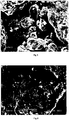
- Figures 1 and 2 show images of a chocolate compositions (Examples 2 and 9 respectively, described later), obtained by the addition of a liquid consisting of water (1.0wt%) and propylene glycol (0.3wt%).
- the compositions were treated with chloroform, which washes out the fat component, leaving behind a powder consisting of proteins, sugars and cocoa fragments.
- the compositions did not disintegrate upon chloroform treatment indicating that the fat is not responsible for the structure and providing evidence for a continuous matrix formed by sugar crystals.
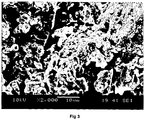
- Figure 3 shows an image of compound chocolate composition obtained by the addition of a liquid consisting of ethanol and water (Example 27, described later).
- composition was subsequently treated with chloroform, which washes out the fat component, leaving behind a powder consisting of proteins, sugars and cocoa fragments.
- the composition did not disintegrate upon chloroform treatment, again providing evidence for the existence of a continuous matrix formed by the sugar crystals.
- the propylene glycol examples employ the following conventional milk chocolate and compound chocolate recipes as starting materials: Compound chocolate Milk chocolate 50.4wt% sucrose 23.5wt% cocoa butter 1.0wt% cocoa liquor 11.5wt% cocoa powder 13.9wt% demineralised whey powder 19.0wt% skimmed milk powder 6.6wt% cocoa powder 45.0wt% sucrose 27.3wt% cocoa butter substitute 1.0wt% emulsifier 0.6wt% emulsifier 0.2wt% flavours
- the samples were analysed by incubating at 40°C for 3 hours followed by immediate testing using a Stable Micro Systems TA.XT+ texture analyser (software version Texture Exponent 32) equipped with a 12.8 mm diameter (bevelled edge) cylindrical probe diameter, with a trigger point of 5 g, penetrating the sample to a depth of 3 mm at a speed of 10 mm/s.
- the standard milk chocolate (without liquid addition) has a peak load of approximately 40g and the standard compound chocolate (without liquid addition) has a peak load of approximately 25g under these conditions. 5 samples were tested and the mean results are shown in table 1 below together with a moisture (water) analysis.
- Examples 13-21 Chocolate compositions obtained by adding water and propylene glycol with investigation of stoving
- Examples 13-15 Compound chocolate compositions obtained by adding 0.3wt% propylene glycol and 1.5wt% water
- Examples 13 to 15 demonstrate the benefit of stoving the compositions.
- Ex 13 has temperature tolerance as shown by its peak load of 1227g. This temperature tolerance is improved by storage at elevated temperature for 2 hours (Ex 14) and improved even further by storage at elevated temperature for 24 hours (Ex 15).
- the moisture content of the stoved samples is lower than for the control sample indicating that water has evaporated during stoving. In these examples, the samples were stored in their moulds at elevated temperature.
- Examples 16-18 Compound chocolate compositions obtained by adding 0 . 3wt % propylene glycol and 1.0wt% water
- Examples 16 to 18 demonstrate the benefit of stoving.
- Ex 16 has temperature tolerance as shown by its peak load of 1231g. This temperature tolerance is improved by storage at elevated temperature (Ex 17 and 18).
- Example 17 was stored in its mould at elevated temperature whereas Example 18 was cooled in a refrigerator, demoulded and then stored at elevated temperature.
- Example 18 has a very high peak load and indicates that an initial setting time can be beneficial before subsequent storage at elevated temperature.
- Examples 19-21 Compound chocolate compositions obtained by adding 0.3wt% propylene glycol and 0.8wt% water/impact of stoving temperature
- the effect of the stoving temperature was investigated by preparing chocolate compositions comprising water and propylene glycol as described previously, pouring into a polycarbonate mould, stoving for seven hours at 40°C, 50°C or 60°C and then refrigerating for 40-45 minutes.
- the peak load (as measured previously, ⁇ standard error) and moisture values are given below.
- Examples 22-23 Compound chocolate compositions obtained by adding 0.3wt% propylene glycol and 0.8wt% water/addition of seeding agent (fibres)
- Examples 24-25 Compound chocolate compositions obtained by adding 0.3wt% propylene glycol and 1.0wt% water/addition of seeding agent (icing/granulated sugar)
- icing sugar low particle size
- granulated sugar high particle size
- seeding agents were investigated by replacing 20wt% of the sugar in the standard compound recipe with icing or granulated sugar.
- a low sugar compound chocolate comprising 30wt% sugar
- Example 24 20wt% icing sugar was added to the low sugar chocolate and an increase in viscosity was observed. Thereafter the water/propylene glycol was added and mixed thoroughly.
- Example 25 20wt% granulated sugar was added to the low sugar chocolate and an increase in viscosity was observed, however, the increase was less than for the icing sugar example.
- a (compound) chocolate composition was prepared using the following ingredients. Ingredient wt% Sucrose 50.4 Cocoa liquor 1.0 Demineralised whey powder 13.9 Cocoa powder 6.6 Cocoa butter substitute 27.3 Emulsifier 0.6 Flavours 0.2
- the chocolate and ethanol mixture was transferred to several 50g moulds which had been heated to 40°C.
- the chocolate filled moulds were placed in a refrigerator to cool for approximately 30 minutes. After cooling, the chocolate bars were removed from the moulds and transferred to an incubator at a temperature of 40°C for 3 days to allow the ethanol to evaporate.
- Example 26 The temperature tolerance of the chocolate compositions with ethanol (Example 26) and those without ethanol (Comparative Example 1) were tested by placing samples in Petri dishes and incubating at 40°C for three hours.
- Comparative Example 1 samples (without ethanol) collapsed to form a pool of chocolate and could not be tested further, thereby demonstrating that they were not temperature tolerant.
- Example 26 samples (with ethanol) remained solid throughout the incubation and were subsequently analysed using a Stable Micro Systems TA.XT+ texture analyser (software version Texture Exponent 32) equipped with a 12.8 mm diameter (bevelled edge) cylindrical probe diameter, with a trigger point of 5 g, penetrating the sample to a depth of 3 mm at a speed of 10 mm/s. 5 samples were tested and the mean result was a peak load of 5491g with a standard deviation of 1479g.
- example 27 The example was repeated with 9wt% of 96% ethanol to yield example 27. After setting, individual units were incubated at 50°C for a period of 5 days to evaporate off ethanol. The resulting chocolate was temperature tolerant.
- the ethanol added to the 410g chocolate composition can be 60g, 40g or 20g.
- Ethanol can be added to the recipes in the following amounts: A (18wt%), B (12wt%), C (8wt%) or D (4wt%) to give compositions 1A to 1 D, 2A to 2D and 3A to 3D.
- Ethanol-water mixtures can be added to the recipes at an amount of 16wt% in the following ethanol-water ratios: 9:1 (E), 4:1 (F), 7:3 (G) to give compositions 1 E to 1G, 2E to 2G and 3E to 3G.
Landscapes
- Chemical & Material Sciences (AREA)
- Life Sciences & Earth Sciences (AREA)
- Engineering & Computer Science (AREA)
- Food Science & Technology (AREA)
- Polymers & Plastics (AREA)
- Inorganic Chemistry (AREA)
- Health & Medical Sciences (AREA)
- Molecular Biology (AREA)
- Manufacturing & Machinery (AREA)
- Confectionery (AREA)
Description
- The present invention relates to a method for producing a temperature tolerant confectionery composition. The invention is particularly but not exclusively concerned with chocolate manufacture.
- The pleasurable organoleptic properties of conventional chocolate are, to a significant extent, due to the fact that the fat (primarily cocoa butter) which forms the continuous phase in chocolate melts quickly and smoothly in the mouth giving a characteristic mouthfeel. This is because cocoa butter softens at approximately 28°C and is generally completely melted at 32 to 35°C. However, such melting presents problems for storage and distribution in regions where ambient temperatures are high (e.g. 30 to 40°C).
- As a result, much research effort has been directed towards the production of so-called temperature tolerant (or heat resistant) chocolate products. One approach is to replace the cocoa butter partially or completely with higher melting fats. Although such an approach does yield products which maintain their shape at relatively high temperatures, the higher melting fats melt less readily when eaten and leave an undesirable waxy mouthfeel. A second approach is to develop a lattice of sugar particles in the chocolate product which remains rigid when the fat starts to melt. Such a lattice of sugar particles may be developed by the addition of water, glycerol or polyols to a chocolate mixture, with most attention being focussed on the addition of water, including addition of water by means of water-in-oil emulsions. The resulting chocolate often has a gritty texture and there are processing difficulties due to a large increase in viscosity. Methods for improving the heat-resistance of chocolate-based confectionery products comprising mixing a polyol with the chocolate ingredients is already known from for example
US 4,664,927 orEP 0 688 506 . - It is an object of the present invention in one aspect to provide an improved method for the production of a temperature tolerant confectionery composition.
- According to the present invention, there is provided a method for producing a temperature tolerant confectionery composition comprising:-
mixing a liquid comprising water as a first liquid component and a second liquid componentinto a molten confectionery composition comprising a bulk sweetener and fat to obtain a liquid-containing confectionery composition;
shaping the liquid-containing confectionery composition to produce a shaped confectionery composition;
storing the shaped confectionery composition an an elevated temperature of from 40 to 60C for from 2 to 120 hours; and
setting the liquid-containing confectionery composition,
whereby to produce said temperature tolerant confectionery composition,
wherein the liquid constitutes from 1.0 to 2.0wt% of the liquid-containing confectionery composition;
and wherein the ratio of water to the second liquid component is at least 50wt%: no more than 50wt% second liquid component,
and wherein the second liquid component is propylene glycol. - It is proposed that the second liquid component assists in delivery and dispersion of the water throughout the confectionery composition. This allows a temperature tolerant confectionery composition to be obtained using smaller quantities of water than previously. The mechanism is thought to involve a first step of water dissolving some of the bulk sweetener that is dispersed in the fat phase. Secondly, the microenvironment around the sweetener creates a super-saturated solution. It is not clearly understood whether the resulting super-saturated solution results in recrystallisation or the formation of amorphous structures. However, the resulting change in structure causes the formation of a temperature resistant lattice of sweetener within the confectionery. The addition of water can have adverse effects on processing due to an increase in viscosity, on the texture of the resulting composition and also on the flavour profile so it is advantageous to reduce the quantity of water whilst maintaining temperature tolerant functionality.
As used herein "temperature tolerant" in relation to a confectionery composition may mean that the composition retains its shape when exposed to elevated temperature (e.g. at least 40°C). - Alternatively a composition may be regarded as "temperature tolerant" if the peak load measured for the composition by a Stable Micro Systems TA.XT+ texture analyser is more than 500g, 1000g, 1500g or 2000g under the conditions defined hereinafter. Measurements using the TA.XT+ texture analyser are made by incubating the compositions (presented as 12mm deep moulded formats) at 40°C for 3 hours prior to analysis. Using a 12.8mm wide cylindrical probe, the texture analyser is programmed to penetrate the composition at a rate of 10mm/s recording the resistive force as a function of distance until a penetrative distance of 3mm is achieved. Conventional chocolate recipes give values of approximately 5 - 100 g.
- The liquid mixed into the molten confectionery composition constitutes from 1.0 to 2.0 wt% of the liquid-containing confectionery composition. It will be understood that wt% values are given relative to the total mass of the molten confectionery composition and the liquid i.e. after mixing. However, given the small quantities involved, wt% values will be similar whether based on the liquid-containing confectionery composition or the initial molten confectionery composition (prior to liquid addition).
The liquid comprises water (the first liquid component) and the second liquid component. The ratio of the water to the second liquid component is at least 50wt% water: no more than 50wt% second liquid component. As discussed above, the inventors propose that the second liquid component is acting to deliver and disperse the water rather than conferring temperature tolerance itself.
In one series of embodiments, the ratio of the water to the second liquid component is at least 55wt% water: no more than 45wt% second liquid component, at least 60wt% water: no more than 40wt% second liquid component, at least 65wt% water: no more than 35wt% second liquid component, at least 70wt% water: no more than 30wt% second liquid component, at least 75wt% water: no more than 25wt% second liquid component, at least 80wt% water: no more than 20wt% second liquid component or at least 85wt% water: no more than 15wt% second liquid component. In a particular embodiment the ratio of the water to the second liquid component is from 75 to 85wt% water: from 15 to 25wt% second liquid component; particularly temperature tolerant compositions are achieved using such ratios. - In one series of embodiments the water that is mixed with the molten confectionery composition constitutes at least 0.6wt%, 0.8wt%, 1.0wt%, 1.2wt%, 1.4wt% or 1.5wt%of the liquid-containing confectionery composition. In another series of embodiments water that is mixed with the molten confectionery composition constitutes no more than 1.5wt% or 1.0wt% of the liquid-containing confectionery composition. In a particular embodiment water constitutes from 0.8 to 1.5wt% of the liquid-containing confectionery composition.
- In one series of embodiments the second liquid component that is mixed with the molten confectionery composition constitutes at least 0.1wt%, 0.2wt%, 0.3wt%, 0.4wt%, 0.5wt%, 0.6wt% or 0.8wt% of the liquid-containing confectionery composition. In another series of embodiments the second liquid component that is mixed with the molten confectionery composition constitutes no more than 1.0wt%, 0.6wt%, 0.4wt%, 0.3wt%, 0.2wt% or 0.1wt% of the liquid-containing confectionery composition. In a particular embodiment the second liquid component constitutes from 0.2 to 0.3wt% of the liquid-containing confectionery composition.
- In one series of embodiments the water constitutes at least 50wt%, 55wt%, 60wt%, 65wt%, 70wt%, 75wt%, 80wt% or 85wt% of the liquid. In another series of embodiments the water constitutes no more than 90wt%, 85wt%, 80wt%, 75wt%, 70wt%, 65wt%, 60wt% or 55wt% of the liquid. In a particular embodiment the water constitutes from 70 to 85wt% of the liquid.
- In one series of embodiments the second liquid component constitutes at least 5wt%, 10wt%, 15wt%, 20wt%, 25wt%, 30wt%, 35wt%, 40wt% or 45wt% of the liquid. In another series of embodiments the second liquid component constitutes no more than 50wt%, 45wt%, 40wt%, 35wt%, 30wt%, 25wt%, 20wt%, 15wt%, 10wt% or 5wt% of the liquid. In a particular embodiment the second liquid component constitutes from 15 to 30wt% of the liquid.
- The liquid (comprising water and the second liquid component) is mixed into a molten confectionery composition to yield a liquid-containing confectionery composition. In a particular embodiment, the confectionery composition is a chocolate composition. In such an embodiment the molten chocolate composition may be obtained by melting a solid chocolate composition or by preparing the molten chocolate composition from chocolate ingredients (e.g. sugar, cocoa mass, cocoa butter, milk solids etc.). In a particular embodiment, the method comprises an additional step of melting a solid chocolate composition to obtain the molten chocolate composition prior to mixing with the liquid. Tempering increases the viscosity of the molten chocolate composition and may hinder mixing of the liquid into the molten chocolate composition. Therefore, in a particular embodiment, the molten chocolate composition is not tempered between melting and the addition of the liquid.
- Setting is conveniently achieved by cooling. Such cooling may merely involve removing a heat source from the liquid-containing confectionery composition such that it is stored at ambient temperature, or it may be forced by exposing the liquid-containing confectionery composition to below-ambient temperatures (i.e. refrigeration). In one embodiment, setting is achieved by storing the liquid-containing confectionery composition at from 2 to 6°C for from 20 to 60 minutes.
The method comprises an additional step prior to setting of shaping the liquid-containing confectionery composition to produce a shaped confectionery composition. In a particular embodiment, the shaping comprises depositing the liquid-containing confectionery composition into a mould.
The method comprises an additional step of storing the shaped confectionery composition at elevated temperature. The inventors have discovered that such storing (also described as stoving) further improves the temperature tolerance of the composition. The inventors propose that the elevated temperature increases dissolution of the bulk sweetener. The elevated temperature may also cause some of the water to evaporate thereby promoting further structural changes improving the structure of the sweetener lattice. - The shaped confectionery composition is stored at elevated temperature for from 2 to 120 hours. In one series of embodiments, the shaped confectionery composition is stored at elevated temperature for at least 2, 6, 12, 16, 20, 24, 48, 72 or 96 hours. In another series of embodiments, the shaped confectionery composition is stored at elevated temperature for less than 120, 96, 72, 48, 30, 25, 20, 15, 10, 5 or 3 hours. In a particular embodiment the shaped confectionery composition is stored at elevated temperature for from 2 to 24 hours.
The elevated temperature is from 40 to 60°C. In one series of embodiments the elevated temperature is at least 40°C, 45°C, 50°C or at least 55°C. In another series of embodiments the elevated temperature is no more than 60°C, 55° or 50°C. - The storing of the shaped confectionery composition at elevated temperature may take place before the shaped confectionery composition has set, whilst it is partially set or after it has set. In one embodiment, the liquid-containing confectionery composition is shaped and immediately stored at elevated temperature. In an alternative embodiment, the liquid-containing confectionery composition is shaped, stored at reduced temperature (e.g. refrigerated for 20 to 60 minutes) and then stored at elevated temperature.
- In a further embodiment, the method comprises storing the shaped confectionery composition at elevated temperature and then storing the shaped confectionery composition at reduced temperature. In one series of embodiments, the shaped confectionery composition is stored at elevated temperature for a period and then stored at reduced temperature for at least 15minutes, 30 minutes, 45 minutes or 1 hour. In another series of embodiments, the shaped confectionery composition is stored at elevated temperature for a period and then stored at reduced temperature for no more than 6 hours, 4 hours, 2 hours, 1 hour or 45 minutes. In a particular embodiment, the shaped confectionery composition is stored at elevated temperature for 2 to 24 hours and then stored at reduced temperature for 30 to 45 minutes.
- In one series of embodiments the reduced temperature is no more than 10°C, 8°C, 6°C, 4°C or 2°C. In another series of embodiments the reduced temperature is at least 0°C, 1°C, 2°C or at least 3°C. In a particular embodiment the reduced temperature is from 3 to 6°C.
- In one embodiment, the liquid is at room temperature when it is mixed with the molten confectionery composition; the liquid has a temperature of from 20 to 25°C. In an alternative series of embodiments, the liquid has a temperature of at least 30°C, 40°C, 50°C or 60°C when it is mixed with the molten confectionery composition. The increased temperature of the liquid may encourage dissolution of the bulk sweetener and thereby improve the resulting lattice. In one embodiment, the method comprises an additional step of heating the liquid to least 30°C, 40°C, 50°C or 60°C prior to mixing with the molten confectionery composition.
- In one embodiment the method comprises an additional step of storing the shaped confectionery composition at reduced pressure. Reduced pressure is considered to provide a good environment for the restructuring of the bulk sweetener.
- In one series of embodiments, the shaped confectionery composition is stored at reduced pressure for at least 30 minutes, at least 1 hour or at least 2 hours. In another series of embodiments, the shaped confectionery composition is stored at reduced pressure for no more than 6 hours, no more than 4 hours, no more than 2 hours or no more than 1 hour. In a particular embodiment the shaped confectionery composition is stored at reduced pressure for from 30 minutes to 2 hours.
- In one embodiment the reduced pressure is from 1 to 25kPa, from 2 to 20kPa or from 5 to 15kPa.
- In one embodiment, the method comprises an additional step of dissolving bulk sweetener in the liquid prior to mixing with the molten confectionery composition. The inventors propose that the bulk sweetener then reforms in the confectionery composition to form a lattice. In a particular embodiment, the method comprises an additional step of dissolving bulk sweetener in the liquid at from 50 to 70°C prior to mixing with the molten confectionery composition.
- In one embodiment, the method comprises an additional step of mixing a seeding agent into the molten confectionery composition (before addition of the liquid) or into the liquid-containing confectionery composition (after addition of the liquid). The seeding agent is considered to encourage recrystallisation of the sweetener and formation of the sweetener lattice. Suitable seeding agents include particles of sweetener, such as sugar particles, and fibres.
- In one embodiment the sweetener particles are icing sugar, granulated sugar or candy floss. The sweetener particles may have a small particle size (e.g. icing sugar) or large particle size (e.g. granulated sugar or candy floss). The inventors propose that the small particles provide sites for the propagation of crystals whereas larger particles provide long-range structure. In a particular embodiment, the method comprises an additional step of mixing sweetener particles having a small particle size and sweetener particles having a large particle size into the molten confectionery composition.
- In one series of embodiments the seeding agent constitutes from 1 to 40wt%, from 2 to 35wt%, from 5 to 30wt%, from 10 to 25wt% or from 15 to 20wt% of the molten confectionery composition or the liquid-containing molten confectionery composition.
In a particular embodiment where the seeding agent is icing sugar or granulated sugar, the seeding agent constitutes from 15 to 25wt% of the molten confectionery composition or the liquid-containing confectionery composition. In a particular embodiment where the seeding agent is dietary fibre, the seeding agent constitutes from 5 to 15wt% of the molten confectionery composition or the liquid-containing confectionery composition.
In one embodiment the sweetener particles having a small particle size have an average particle size of less than 250µm, less than 200µm, less than 150µm or less than 100µm. In one embodiment the sweetener particles having a large particle size have an average particle size of greater than 400µm, greater than 600µm, 800µm or 1000µm. - In one embodiment, the fibre is a dietary fibre. In a further embodiment the dietary fibre is selected from one or more of wheat fibre, potato fibre, oat fibre, corn fibre, apple fibre and pea fibre. In a particular embodiment, the dietary fibre is wheat fibre or potato fibre. In a further embodiment the method comprises an additional step of mixing wheat fibre or potato fibre into the molten confectionery composition. The inventors propose that the fibres provide long-range structure for the sweetener lattice.
In a particular embodiment of the invention where the seeding agent is fibre, there is provided a method for producing a temperature tolerant confectionery composition comprising:-
mixing a liquid comprising water as a first liquid component and a second liquid component, said second liquid component into a molten confectionery composition comprising a bulk sweetener and fat to obtain a liquid-containing confectionery composition;
mixing fibre into the molten confectionery composition or into the liquid-containing confectionery composition;
shaping the liquid-containing confectionery composition to produce a shaped confectionery composition;
storing the shaped confectionery composition an an elevated temperature of from 40 to 60°C for from 2 to 120 hours; and
setting the liquid-containing confectionery composition,
whereby to produce said temperature tolerant confectionery composition,
wherein the liquid constitutes from 1.0 to 2.0wt% of the liquid-containing confectionery composition;
and wherein the ratio of water to the second liquid component is at least 50wt%: no more than 50wt% second liquid component,
and wherein the second liquid component is proylene glycol. - In a particular embodiment the seeding agent is fibre. The use of propylene glycol and fibre has been found to be particularly beneficial in improving temperature tolerance.
- In one series of embodiments, the fibre constitutes from 1 to 40wt%, from 2 to 35wt%, from 5 to 30wt%, from 10 to 25wt% or from 15 to 20wt% of the liquid-containing confectionery composition. In a particular embodiment the fibre constitutes approximately 10wt% of the liquid-containing confectionery composition.
- The liquid comprises water (the first liquid component) and the second liquid component. The second liquid component will normally have a FEMA GRAS (generally recognised as safe) designation. The second liquid component is propylene glycol.
- Propylene glycol (also called 1,2-propanediol or propane-1,2-diol) is a clear viscous hydrophilic liquid with a boiling point of approximately 188°C and a dielectric constant of 32.1 (20°C).
- In one embodiment, the liquid consists of water and propylene glycol.
In one embodiment the liquid consists of water (the first liquid component), the second liquid component and a third (or subsequent) liquid component, said third (or subsequent) liquid component not being water or the second liquid component.
The use of a liquid comprising water and propylene glycol in particular ratios has been found to be particularly beneficial in delivering and dispersing water such that a temperature tolerant composition is achieved. Water and propylene glycol are fully miscible to yield a low viscosity fluid. The inventors propose that the liquid is easily dispersed in the confectionery composition such that small quantities of water are delivered throughout and an extensive sweetener lattice is obtained. - In one series of embodiments, the ratio of water to propylene glycol is at least 55wt% water: no more than 45wt% propylene glycol, at least 60wt% water: no more than 40wt% propylene glycol, at least 65wt% water: no more than 35wt% propylene glycol, at least 70wt% water: no more than 30wt% propylene glycol, at least 75wt% water: no more than 25wt% propylene glycol, at least 80wt% water: no more than 20wt% propylene glycol or at least 85wt% water: no more than 15wt% propylene glycol. A ratio of from 60 to 90wt% water: from 10 to 40wt% propylene glycol is particularly successful.
- Products producible by the method are also disclosed.
- It will be understood that the confectionery composition may comprise water from a number of sources so the total amount of water and second liquid component constitutes no more than 5wt% of the composition. For example, the composition may be obtained using the method of the first aspect. In such a case, the composition will comprise water that has been added as the first component of the liquid. In addition, water may already have been present in the molten confectionery composition prior to liquid addition e.g. a standard chocolate composition typically comprises about 1wt% water.
- The temperature tolerant confectionery composition may be a temperature tolerant chocolate composition.
The composition may comprise less than 4.5wt%, 4.0wt%, 3.5wt%, 3.0wt%, 2.5wt%, 2.0wt% or 1.5wt% (total) water. The composition may comprise at least 1.0wt%, 1.5wt%, 2.0wt% or 2.5wt% (total) water. The composition may comprise from 1.0 to 2.5wt% water.
The composition may comprise less than 1.0wt%, 0.6wt% or 0.4wt%, 0.3wt% or 0.2wt% of the second liquid component. The composition may comprise at least 0.1wt%, 0.2wt% or 0.3wt% of the second liquid component. The composition may comprise from 0.2 to 0.4wt% of the second liquid component.
A temperature tolerant confectionery composition may comprise a bulk sweetener, fat, water and propylene glycol, the bulk sweetener forming a continuous lattice extending through the fat,wherein the water and the propylene glycol together constitute less than 5wt% of the composition and the ratio of water to propylene glycol is at least 50wt% water: no more than 50wt% propylene glycol.
The composition may comprise (total) water and propylene glycol wherein the ratio of water to propylene glycol is at least 55wt% water: no more than 45wt% propylene glycol, at least 60wt% water: no more than 40wt% propylene glycol, at least 65wt% water: no more than 35wt% propylene glycol, at least 70wt% water: no more than 30wt% propylene glycol, at least 75wt% water: no more than 25wt% propylene glycol, at least 80wt% water: no more than 20wt% propylene glycol, at least 85wt% water: no more than 15wt% propylene glycol or at least 90wt% water: no more than 10wt% propylene glycol. Ratios of from 70 to 90wt% water: from 10 to 30wt% propylene glycol or from 75 to 90wt% water: from 10 to 25wt% propylene glycol are particularly successful. - Not related to the present invention there is provided a temperature tolerant chocolate composition comprising a bulk sweetener, fat, water and propylene glycol, wherein the ratio of water to propylene glycol is from 70 to 90wt% water: from 10 to 30wt% propylene glycol.
The ratio of water to propylene glycol may be from 75 to 90wt% water: from 10 to 25wt% propylene glycol or from 80 to 90wt% water: from 10 to 20wt% propylene glycol.
The composition may comprise less than 4.5wt%, 4.0wt%, 3.5wt%, 3.0wt%, 2.5wt%, 2.0wt% or 1.5wt% (total) water. The composition may comprise at least 1.0wt%, 1.5wt%, 2.0wt% or 2.5wt% (total) water. The composition may comprise from 1.0 to 2.5wt% (total) water.
The composition may comprise less than 1.0wt%, 0.6wt%, 0.4wt% or 0.3wt% propylene glycol. The composition may comprise at least 0.1wt%, 0.2wt% or 0.3wt% propylene glycol. The composition may comprise from 0.2 to 0.3wt% propylene glycol. - In certain embodiments, the peak load measured for the composition by a Stable Micro Systems TA.XT+ texture analyser is more than 3000g or more than 4000g under the conditions defined previously.
Suitable bulk sweeteners include sugars (e.g. sucrose, dextrose, glucose, glucose syrup solids, fructose, lactose, maltose or any combination thereof) and sugar alcohols (e.g. erythritol, sorbitol, xylitol, mannitol, lactitol, isomalt, or any combination thereof) and any combination of sugar and sugar alcohol. In certain embodiments the bulk sweetener comprises or consists of sucrose.
The confectionery composition may comprise one or more intense sweeteners in addition to a bulk sweetener. Suitable intense sweeteners include aspartame, acesulfame-k, cyclamates, saccharin, sucralose, neohesperidin, dihydrochalone, alitame, stena sweeteners, glycyrrhizin or any combination thereof.
Suitable fats include cocoa butter, butterfat, cocoa butter replacers (CBR), cocoa butter equivalents (CBE), cocoa butter substitutes (CBS), a vegetable fat that is liquid at standard ambient temperature and pressure (SATP, 25°C and 100kPa) or any combination of the above. In a particular embodiment, the fat comprises cocoa butter. - CBEs are defined in EU Directive 2000/36/EC. Suitable CBEs include illipe, Borneo tallow, tengkawang, palm oil, sal, shea, kokum gurgi and mango kernel. CBE's are usually used in combination with cocoa butter. In one embodiment, the confectionery composition material comprises no more than 5wt% CBE's.
- Suitable CBSs include CBS laurics and CBS non-laurics. CBS laurics are short-chain fatty acid glycerides. Their physical properties vary but they all have triglyceride configurations that make them compatible with cocoa butter. Suitable CBS's include those based on palm kernel oil and coconut oil. CBS non-laurics consist of fractions obtained from hydrogenated oils. The oils are selectively hydrogenated with the formation of trans acids, which increases the solid phase of the fat. Suitable sources for CBS nonlaurics include soya, cottonseed, peanut, rapeseed and corn (maize) oil.
- Suitable vegetable fats include corn oil, cotton seed oil, rapeseed oil, palm oil, safflower oil, and sunflower oil.
- In order to improve the viscosity during processing of the composition, the confectionery composition will commonly comprise at least one emulsifier. Such emulsifiers include lecithin derived from soya bean, safflower, corn, etc, fractionated lecithins enriched with either phosphatidyl choline, phosphatidyl ethanolamine, phosphatidyl inositol; emulsifiers derived from oats, mono- and diglycerides and their tartaric esters, monosodium phosphate derivatives of mono- and diglycerides of edible fats and oils, sorbitan monostearate, polyoxyethylene sorbitan monostearate, hydroxylated lecithin, synthetic phospholipids such as ammonium phosphatides, lactylated fatty acid esters of glycerol and propylene glycol, polyglycerol esters of fatty acids, propylene glycol mono- and diesters of fats and fatty acids. In some embodiments, the emulsifier is selected from soya lecithin, ammonium phosphatides and polyglycerol polyricinoleate.
- The confectionery composition may be a chocolate composition such as a milk chocolate, a dark chocolate or a white chocolate. As used herein, a "chocolate composition" is a confectionery composition comprising at least non-fat cocoa solids and/or cocoa butter and optionally CBR (CBE and/or CBS). The term "chocolate composition" should be construed as covering not only chocolate compositions which can be sold as "chocolate" in countries where chocolate is legally defined, but also chocolate compositions which, because of fat, cocoa content etc. may not be legally described as "chocolate" in those countries.
- A suitable milk chocolate composition comprises non-fat cocoa solids and milk solids in addition to the bulk sweetener and fat.
- A suitable dark chocolate composition comprises non-fat cocoa solids in addition to the bulk sweetener and fat.
- A suitable white chocolate composition comprises a bulk sweetener and at least one of cocoa butter/CBE/CBS.
- The chocolate composition may be a low-fat chocolate composition, in which case the chocolate composition has a fat content of less than 25wt% or less than 23wt%. The chocolate composition may have a fat content of at least 16wt%, at least 18wt% or at least 20wt%.
- Suitable milk solids include cream, full fat milk, skimmed milk and/or whey. The confectionery composition may be prepared from powdered milk solids such as powdered milk/cream or whey powder. Useful sources of whey include whey protein concentrate, whey protein isolate, whey protein hydrolysate or a combination thereof. The whey may be demineralised.
- In one embodiment the confectionery composition comprises bulk sweetener, cocoa butter, non-fat cocoa solids and milk solids. In a particular embodiment the confectionery composition comprises 40-70wt% sucrose, 15-30wt% cocoa butter, 2-10wt% non-fat cocoa solids and 10-20wt% milk solids
- In an alternative embodiment the confectionery composition comprises 45-55wt% bulk sweetener, 25-30wt% cocoa butter substitute, 10-15wt% demineralised whey, 4-8wt% non-fat cocoa solids and 0-2wt% cocoa butter.
- Embodiments of the invention will now be described by way of example only and with reference to the accompanying figures, in which:
-
Figure 1 is a microscopy image of a chocolate composition comprising propylene glycol, which was treated with chloroform to remove the fat component. The white line on the image indicates a distance of 5µm. -
Figure 2 is a microscopy image of a compound chocolate composition comprising propylene glycol, which was treated with chloroform to remove the fat component. The white line on the image indicates a distance of 5µm. -
Figure 3 (not according to the invention) is a microscopy image of a compound chocolate composition comprising ethanol, which has been treated with chloroform to remove the fat component. The white line on the image indicates a distance of 10µm. -
Figures 1 and 2 show images of a chocolate compositions (Examples 2 and 9 respectively, described later), obtained by the addition of a liquid consisting of water (1.0wt%) and propylene glycol (0.3wt%). The compositions were treated with chloroform, which washes out the fat component, leaving behind a powder consisting of proteins, sugars and cocoa fragments. The compositions did not disintegrate upon chloroform treatment indicating that the fat is not responsible for the structure and providing evidence for a continuous matrix formed by sugar crystals.
Figure 3 shows an image of compound chocolate composition obtained by the addition of a liquid consisting of ethanol and water (Example 27, described later). The composition was subsequently treated with chloroform, which washes out the fat component, leaving behind a powder consisting of proteins, sugars and cocoa fragments. The composition did not disintegrate upon chloroform treatment, again providing evidence for the existence of a continuous matrix formed by the sugar crystals. - The propylene glycol examples employ the following conventional milk chocolate and compound chocolate recipes as starting materials:
Compound chocolate Milk chocolate 50.4wt% sucrose 23.5wt% cocoa butter 1.0wt% cocoa liquor 11.5wt% cocoa powder 13.9wt% demineralised whey powder 19.0wt% skimmed milk powder 6.6wt% cocoa powder 45.0wt% sucrose 27.3wt% cocoa butter substitute 1.0wt% emulsifier 0.6wt% emulsifier 0.2wt% flavours - Chocolate (standard milk chocolate for Ex 1 to 5 and compound chocolate for Ex 6 to 12) was melted by heating in a hot stove incubator at 50°C. Propylene glycol (PG) was mixed with water and then added to the molten chocolate and the mixture was stirred thoroughly by hand. The combined mass of the chocolate and the liquid was approximately 490g. The mixture containing the water/propylene glycol was poured into a polycarbonate mould and transferred to a refrigerator to cool at 5°C for 30 minutes. The samples were then removed from the mould and stored at ambient temperature.
- The samples were analysed by incubating at 40°C for 3 hours followed by immediate testing using a Stable Micro Systems TA.XT+ texture analyser (software version Texture Exponent 32) equipped with a 12.8 mm diameter (bevelled edge) cylindrical probe diameter, with a trigger point of 5 g, penetrating the sample to a depth of 3 mm at a speed of 10 mm/s. The standard milk chocolate (without liquid addition) has a peak load of approximately 40g and the standard compound chocolate (without liquid addition) has a peak load of approximately 25g under these conditions. 5 samples were tested and the mean results are shown in table 1 below together with a moisture (water) analysis. It should be noted that conventional (non-temperature tolerant) chocolate contains some water (ca 1wt%) so the moisture content reflects water from the original recipe as well as the added water.
Table 1 Example Total liquid added (wt%) water + PG Propylene glycol (wt%) Added water (wt%) Ratio water:PG added Peak Load (g) Final moisture content (w/w%) Ratio water: PG final 1 1.1 0.3 0.8 73:27 808 1.6 84:16 2 1.3 0.3 1.0 77:23 2133 1.7 85:15 3 1.3 0.3 1.0 77:23 1631 2.1 88:12 4 1.3 0.3 1.0 77:23 996 2.1 88:12 5 0.8 0.4 0.4 50:50 775 1.5 79:21 6 0.7 0.3 0.4 57:43 107 1.2 80:20 7 0.9 0.3 0.6 67:33 630 1.4 82:18 8 1.1 0.3 0.8 73:27 834 1.6 84:16 9 1.3 0.3 1.0 77:23 1093 1.8 86:14 10 0.8 0.4 0.4 50:50 662 1.2 75:25 11 2.3 0.3 2.0 87:13 1442 2.4 89:11 12 1.3 0.3 1.0 77:23 1231 1.8 86:14 - Conventional chocolate (not temperature tolerant) has a peak load value of approximately 5 to 100g under the test conditions. Therefore it can be seen that all of the Examples 1 to 12 are more temperature tolerant than conventional chocolate. All of the examples employ water/propylene glycol with the ratio of water: propylene glycol being at least 50wt% water: no more than 50wt% propylene glycol. Examples 2, 3 and 11 are especially temperature tolerant and each was obtained from a liquid comprising at least 75wt% water: no more than 25wt% propylene glycol.
- As above chocolate (compound chocolate) was melted by heating in a hot stove incubator at 50°C. Propylene glycol (PG) was mixed with water and then added to the molten chocolate and the mixture was stirred thoroughly by hand. The combined mass of the chocolate and the liquid was approximately 490g. The mixture containing the water/propylene glycol was poured into a polycarbonate mould and the effect of stoving was then investigated. The control samples (no stoving) were cooled in a refrigerator for 30 to 35 minutes and then returned to ambient temperature. The stoving samples were stored at 50°C for either two hours or 24 hours, and then transferred to a refrigerator for cooling for 40 to 45 minutes.
-
Table 2 Example Total liquid added (wt%) water + PG Propylene glycol (wt%) Added water (wt%) Ratio water: PG added Stoving Peak Load (g) Final moisture content (w/w%) Ratio water: PG final 13 1.8 0.3 1.5 83:17 Control 1227 2.3 88:12 14 1.8 0.3 1.5 83:17 2 hours stoving 2354 1.9 86:14 15 1.8 0.3 1.5 83:17 24 hours stoving 3435 1.9 86:14 - Examples 13 to 15 demonstrate the benefit of stoving the compositions. Ex 13 has temperature tolerance as shown by its peak load of 1227g. This temperature tolerance is improved by storage at elevated temperature for 2 hours (Ex 14) and improved even further by storage at elevated temperature for 24 hours (Ex 15). The moisture content of the stoved samples is lower than for the control sample indicating that water has evaporated during stoving. In these examples, the samples were stored in their moulds at elevated temperature.
-
Table 3 Example Total liquid added (wt%) water + PG Propylene glycol (wt%) Added water (wt%) Ratio water: PG added Stoving Peak Load (g) Final moisture content (w/w%) Ratio water: PG final 16 1.3 0.3 1.0 77:23 Control 1231 1.8 86:14 17 1.3 0.3 1.0 77:23 2 hours stoving 1896 1.8 86:14 18 1.3 0.3 1.0 77:23 24 hours stoving 4127 1.7 85:15 - Examples 16 to 18 demonstrate the benefit of stoving. Ex 16 has temperature tolerance as shown by its peak load of 1231g. This temperature tolerance is improved by storage at elevated temperature (Ex 17 and 18). Example 17 was stored in its mould at elevated temperature whereas Example 18 was cooled in a refrigerator, demoulded and then stored at elevated temperature. Example 18 has a very high peak load and indicates that an initial setting time can be beneficial before subsequent storage at elevated temperature.
- The effect of the stoving temperature was investigated by preparing chocolate compositions comprising water and propylene glycol as described previously, pouring into a polycarbonate mould, stoving for seven hours at 40°C, 50°C or 60°C and then refrigerating for 40-45 minutes. The peak load (as measured previously, ± standard error) and moisture values are given below.
Table 4 Example Total liquid added (wt%) water + PG Propylene glycol (wt%) Added water (wt%) Ratio water:PG added Stoving temperature Peak Load (g) Final moisture content (w/w%) Ratio water: PG final 19 1.1 0.3 0.8 73:27 40°C 1000 (±30) 1.6 84:16 20 1.1 0.3 0.8 73:27 50°C 1900 (±20) 1.5 83:17 21 1.1 0.3 0.8 73:27 60°C 3500 (±100) 1.5 83:17 - This series of examples demonstrates that stoving is beneficial and that stoving at 60°C is more beneficial than stoving at 50°C which, in turn, is more beneficial than stoving at 40°C.
- As above chocolate (compound chocolate) was melted by heating in a hot stove incubator at 50°C. 10% seeding agent in the form of dietary fibre (either wheat or potato fibre) was added and thoroughly mixed. Propylene glycol (PG) was mixed with water and then added to the molten chocolate/fibre and the mixture was stirred thoroughly by hand. The mixture containing the fibre and the water/propylene glycol was poured into a polycarbonate mould and transferred to a refrigerator to cool at 5°C for 30 minutes. The results are shown below.
Table 5 Example Total liquid added (wt%) water + PG Propylene glycol (wt%) Added water (wt%) Ratio water:PG added Seeding agent Peak Load (g) 22 1.1 0.3 0.8 73:27 Wheat fibre 3140 23 1.1 0.3 0.8 73:27 Potato fibre 3120 - Both samples demonstrate excellent temperature tolerance despite being incubated at 40°C for 3 hours.
- The use of icing sugar (low particle size) and granulated sugar (high particle size) as seeding agents was investigated by replacing 20wt% of the sugar in the standard compound recipe with icing or granulated sugar. A low sugar compound chocolate (comprising 30wt% sugar) was prepared and refined and conched in the usual manner. In Example 24 20wt% icing sugar was added to the low sugar chocolate and an increase in viscosity was observed. Thereafter the water/propylene glycol was added and mixed thoroughly. In Example 25 20wt% granulated sugar was added to the low sugar chocolate and an increase in viscosity was observed, however, the increase was less than for the icing sugar example. In both cases the mixtures were poured into a polycarbonate moulds and transferred to a refrigerator to cool. The results are shown below.
Table 6 Example Total liquid added (wt%) water + PG Propylene glycol (wt%) Added water (wt%) Ratio water: PG added Seeding agent Peak Load (g) Final moisture content (w/w%) Ratio water:PG final 24 1.3 0.3 1.0 77:23 Icing sugar 2300 (±35) 1.6 84:16 25 1.3 0.3 1.0 77:23 Granulated sugar 1600 (±60) 1.7 85:15 - Both samples have good temperature tolerance indicating that the addition of seeding agent is beneficial. A particular improvement is seen for icing sugar. The inventors believe that the improvement may be a result of its low particle size and consequent increased surface area to volume ratio. The icing sugar will dissolve more readily than the granulated sugar which may then assist in the subsequent formation of the sweetener lattice.
- A (compound) chocolate composition was prepared using the following ingredients.
Ingredient wt% Sucrose 50.4 Cocoa liquor 1.0 Demineralised whey powder 13.9 Cocoa powder 6.6 Cocoa butter substitute 27.3 Emulsifier 0.6 Flavours 0.2 - 410g of the chocolate composition was heated on a hot stove to a temperature of 50.1°C (temperature measured using probe). 80g of 96% ethanol (liquid comprising 96wt% ethanol and 4wt% water) was added directly to the chocolate composition whilst stirring vigorously (corresponding to an ethanol addition rate of 16wt%). Mixing was continued to ensure that the ethanol mixed thoroughly with the chocolate.
- The chocolate and ethanol mixture was transferred to several 50g moulds which had been heated to 40°C. The chocolate filled moulds were placed in a refrigerator to cool for approximately 30 minutes. After cooling, the chocolate bars were removed from the moulds and transferred to an incubator at a temperature of 40°C for 3 days to allow the ethanol to evaporate.
- The temperature tolerance of the chocolate compositions with ethanol (Example 26) and those without ethanol (Comparative Example 1) were tested by placing samples in Petri dishes and incubating at 40°C for three hours.
- The Comparative Example 1 samples (without ethanol) collapsed to form a pool of chocolate and could not be tested further, thereby demonstrating that they were not temperature tolerant.
- The Example 26 samples (with ethanol) remained solid throughout the incubation and were subsequently analysed using a Stable Micro Systems TA.XT+ texture analyser (software version Texture Exponent 32) equipped with a 12.8 mm diameter (bevelled edge) cylindrical probe diameter, with a trigger point of 5 g, penetrating the sample to a depth of 3 mm at a speed of 10 mm/s. 5 samples were tested and the mean result was a peak load of 5491g with a standard deviation of 1479g.
- The example was repeated with 9wt% of 96% ethanol to yield example 27. After setting, individual units were incubated at 50°C for a period of 5 days to evaporate off ethanol. The resulting chocolate was temperature tolerant.
- In alternative embodiments the ethanol added to the 410g chocolate composition can be 60g, 40g or 20g.
Further example formulations Recipe 1 Recipe 2 Recipe 3 13.3wt% cocoa liquor 12.0 cocoa liquor 23.5wt% cocoa butter 13.1wt% cocoa butter 12.6 cocoa butter 11.5wt% cocoa powder 3.5wt% milk fat 4.5wt% butter fat 19.0wt% skimmed milk powder 14.0wt% skimmed milk powder 23.0wt% skimmed milk powder 45.0wt% sucrose 24.8wt% erythritol 47.6wt% erythritol 1.0wt% emulsifier 8.8wt% polydextrose 0.3wt% emulsifier 8.5wt% maltitol 6.3wt% maltodextrin 6.3wt% whey protein isolate 1.4wt% emulsifier - Ethanol can be added to the recipes in the following amounts: A (18wt%), B (12wt%), C (8wt%) or D (4wt%) to give compositions 1A to 1 D, 2A to 2D and 3A to 3D. Ethanol-water mixtures can be added to the recipes at an amount of 16wt% in the following ethanol-water ratios: 9:1 (E), 4:1 (F), 7:3 (G) to give compositions 1 E to 1G, 2E to 2G and 3E to 3G.
Claims (8)
- A method for producing a temperature tolerant confectionery composition comprising:-mixing a liquid comprising water as a first liquid component and a second liquid component into a molten confectionery composition comprising a bulk sweetener and fat to obtain a liquid-containing confectionery composition;shaping the liquid-containing confectionery composition to produce a shaped confectionery composition;storing the shaped confectionery composition at an elevated temperature of from 40 to 60°C for from 2 to 120 hours; andsetting the liquid-containing confectionery composition,whereby to produce said temperature tolerant confectionery composition,wherein the liquid constitutes from 1.0 to 2.0wt% of the liquid-containing confectionery composition;and wherein the ratio of water to the second liquid component is at least 50wt%: no more than 50wt% second liquid component,and wherein the second liquid component is propylene glycol.
- The method of claim 1, wherein the shaped confectionery composition is stored at reduced pressure.
- The method of claim 1 or 2, wherein the shaped confectionery composition is stored at reduced temperature prior to being stored at elevated temperature.
- The method of any one of the preceding claims, comprising an additional step of dissolving bulk sweetener in the liquid prior to mixing with the molten confectionery composition and/or an additional step of mixing a seeding agent into the molten confectionery composition or the liquid-containing confectionery composition.
- The method of claim 4, wherein the seeding agent, when present, is icing sugar, granulated sugar or fibre.
- The method of any one of the preceding claims, wherein the ratio of the water to the second component is at least 75wt% water: no more than 25wt% second liquid component.
- The method of any one of the preceding claims, wherein the temperature tolerant confectionery composition is a temperature tolerant chocolate composition.
- The method of any one of the preceding claims, wherein the temperature tolerant composition has a peak load of more than 1000g as measured by a Stable Micro Systems TA.XT+ texture analyser.
Applications Claiming Priority (2)
| Application Number | Priority Date | Filing Date | Title |
|---|---|---|---|
| GBGB0912833.1A GB0912833D0 (en) | 2009-07-23 | 2009-07-23 | Method for producing temperature tolerant confectionary compositions and compositions produced using the method |
| PCT/GB2010/001396 WO2011010105A1 (en) | 2009-07-23 | 2010-07-23 | Method for producing temperature tolerant confectionery compositions and compositions produced using the method |
Publications (2)
| Publication Number | Publication Date |
|---|---|
| EP2456319A1 EP2456319A1 (en) | 2012-05-30 |
| EP2456319B1 true EP2456319B1 (en) | 2017-04-12 |
Family
ID=41058437
Family Applications (1)
| Application Number | Title | Priority Date | Filing Date |
|---|---|---|---|
| EP10738017.2A Not-in-force EP2456319B1 (en) | 2009-07-23 | 2010-07-23 | Method for producing temperature tolerant confectionery compositions and compositions produced using the method |
Country Status (6)
| Country | Link |
|---|---|
| EP (1) | EP2456319B1 (en) |
| AU (1) | AU2010274820B2 (en) |
| GB (1) | GB0912833D0 (en) |
| PL (1) | PL2456319T3 (en) |
| WO (1) | WO2011010105A1 (en) |
| ZA (1) | ZA201201239B (en) |
Families Citing this family (7)
| Publication number | Priority date | Publication date | Assignee | Title |
|---|---|---|---|---|
| CN102548425B (en) | 2009-06-12 | 2017-09-29 | 马斯公司 | Chocolate composition containing ethyl cellulose |
| GB2485421B (en) | 2010-11-15 | 2016-05-25 | Mars Inc | Dough products exhibiting reduced oil migration |
| MX367984B (en) | 2012-09-28 | 2019-09-13 | Mars Inc | Heat resistant chocolate. |
| JP6347506B2 (en) * | 2014-03-03 | 2018-06-27 | 株式会社明治 | Method for producing oily confectionery |
| GB201406261D0 (en) * | 2014-04-08 | 2014-05-21 | Mars Inc | Confectionary production |
| RU2565939C1 (en) * | 2014-10-28 | 2015-10-20 | Олег Иванович Квасенков | Method of ice cream production with xylite for diabetics (versions) |
| AU2021253630A1 (en) | 2020-04-09 | 2022-10-06 | Societe Des Produits Nestle S.A. | Method of tropicalizing chocolate |
Citations (1)
| Publication number | Priority date | Publication date | Assignee | Title |
|---|---|---|---|---|
| JPS5948049A (en) * | 1982-09-10 | 1984-03-19 | Nisshin Kako Kk | Rapid-drying formed chocolate |
Family Cites Families (9)
| Publication number | Priority date | Publication date | Assignee | Title |
|---|---|---|---|---|
| GB904197A (en) * | 1958-12-08 | 1962-08-22 | Mars Inc | Process for the production of a chocolate composition |
| US4664927A (en) * | 1984-07-23 | 1987-05-12 | Gilbert Finkel | Chocolate compositions of increased viscosity and method for preparing such compositions |
| JP2514711B2 (en) * | 1989-04-15 | 1996-07-10 | 株式会社ロッテ | Heat-resistant chocolate and method for producing the same |
| US5149560A (en) * | 1991-03-25 | 1992-09-22 | Mars, Inc. | Heat-resistant chocolate and method of making same |
| BE1005782A3 (en) * | 1991-10-04 | 1994-01-25 | Raffinerie Tirlemontoise Sa | Lipophilic hydrated composition and method for obtaining. |
| US5523110A (en) * | 1994-06-23 | 1996-06-04 | Nestec S.A | Chocolate heat-resistance by particulate polyol gel addition |
| US5876774A (en) * | 1996-10-11 | 1999-03-02 | Nestec S.A. | Method of making fat-based confection |
| JP2004350572A (en) * | 2003-05-28 | 2004-12-16 | Ezaki Glico Co Ltd | Linear air-containing chocolate and method for producing the same |
| ES2308096T3 (en) * | 2004-12-22 | 2008-12-01 | KRAFT FOODS R & D, INC. ZWEIGNIEDERLASSUNG MUNCHEN | QUICK DEVELOPMENT OF THERMAL RESISTANCE IN CHOCOLATE AND SWEET PRODUCTS OF CHOCOLATE TYPE. |
-
2009
- 2009-07-23 GB GBGB0912833.1A patent/GB0912833D0/en not_active Ceased
-
2010
- 2010-07-23 AU AU2010274820A patent/AU2010274820B2/en not_active Ceased
- 2010-07-23 WO PCT/GB2010/001396 patent/WO2011010105A1/en not_active Ceased
- 2010-07-23 PL PL10738017T patent/PL2456319T3/en unknown
- 2010-07-23 EP EP10738017.2A patent/EP2456319B1/en not_active Not-in-force
-
2012
- 2012-02-20 ZA ZA2012/01239A patent/ZA201201239B/en unknown
Patent Citations (1)
| Publication number | Priority date | Publication date | Assignee | Title |
|---|---|---|---|---|
| JPS5948049A (en) * | 1982-09-10 | 1984-03-19 | Nisshin Kako Kk | Rapid-drying formed chocolate |
Non-Patent Citations (3)
| Title |
|---|
| DATABASE GNPD [online] MINTEL; August 2007 (2007-08-01), ARCOR: "Chocolate Egg", Database accession no. 759754 * |
| DATABASE GNPD [online] MINTEL; February 2009 (2009-02-01), RUSSEL STOVER CANDIES: "Assorted Chocolates", Database accession no. 1053020 * |
| DATABASE GNPD [online] MINTEL; November 2007 (2007-11-01), LAND'S END: "English Butter Toffee", Database accession no. 819386 * |
Also Published As
| Publication number | Publication date |
|---|---|
| WO2011010105A8 (en) | 2011-03-24 |
| ZA201201239B (en) | 2012-12-27 |
| AU2010274820B2 (en) | 2013-05-16 |
| EP2456319A1 (en) | 2012-05-30 |
| WO2011010105A1 (en) | 2011-01-27 |
| PL2456319T3 (en) | 2017-09-29 |
| AU2010274820A1 (en) | 2012-03-15 |
| GB0912833D0 (en) | 2009-08-26 |
Similar Documents
| Publication | Publication Date | Title |
|---|---|---|
| EP0798964B1 (en) | Process for manufacture of reduced fat chocolate | |
| AU2008269556C1 (en) | Reduced fat chocolate | |
| US7186435B2 (en) | Milk chocolate containing water | |
| EP3282863B1 (en) | Composition for coating frozen confectionery and a process for manufacturing same | |
| KR101386146B1 (en) | A manufacturing method of walnet chocolate, a walnet chocolate using the same and food containing walnet chocolate | |
| AU2010274820B2 (en) | Method for producing temperature tolerant confectionery compositions and compositions produced using the method | |
| CA2180959A1 (en) | Product and process for producing an improved sucrose-free milk chocolate | |
| KR20150079555A (en) | Heat-resistant chocolate, and method for producing heat-resistant chocolate | |
| EP0695125B1 (en) | Process for preparation of intermediate | |
| US20060222753A1 (en) | Substituted cacao products and methods | |
| EP3900545B1 (en) | Method for producing chocolate | |
| KR102457078B1 (en) | Confectionery and its manufacturing method | |
| EP3091842B1 (en) | Temperature tolerant chocolate | |
| JP7345461B2 (en) | Heat-resistant oil-based confectionery and its manufacturing method | |
| EP3367811B1 (en) | Emulsion and process for making same | |
| EP4631359A1 (en) | Chocolate comprising allulose | |
| WO2025087671A1 (en) | Confectionery product | |
| WO2021256285A1 (en) | Heat-resistant chocolate and method for manufacturing same | |
| WO2024165369A1 (en) | Method of manufacturing a chocolate product |
Legal Events
| Date | Code | Title | Description |
|---|---|---|---|
| PUAI | Public reference made under article 153(3) epc to a published international application that has entered the european phase |
Free format text: ORIGINAL CODE: 0009012 |
|
| 17P | Request for examination filed |
Effective date: 20120130 |
|
| AK | Designated contracting states |
Kind code of ref document: A1 Designated state(s): AL AT BE BG CH CY CZ DE DK EE ES FI FR GB GR HR HU IE IS IT LI LT LU LV MC MK MT NL NO PL PT RO SE SI SK SM TR |
|
| DAX | Request for extension of the european patent (deleted) | ||
| 17Q | First examination report despatched |
Effective date: 20140730 |
|
| GRAP | Despatch of communication of intention to grant a patent |
Free format text: ORIGINAL CODE: EPIDOSNIGR1 |
|
| INTG | Intention to grant announced |
Effective date: 20161220 |
|
| GRAS | Grant fee paid |
Free format text: ORIGINAL CODE: EPIDOSNIGR3 |
|
| GRAA | (expected) grant |
Free format text: ORIGINAL CODE: 0009210 |
|
| AK | Designated contracting states |
Kind code of ref document: B1 Designated state(s): AL AT BE BG CH CY CZ DE DK EE ES FI FR GB GR HR HU IE IS IT LI LT LU LV MC MK MT NL NO PL PT RO SE SI SK SM TR |
|
| REG | Reference to a national code |
Ref country code: GB Ref legal event code: FG4D |
|
| REG | Reference to a national code |
Ref country code: CH Ref legal event code: EP |
|
| REG | Reference to a national code |
Ref country code: IE Ref legal event code: FG4D |
|
| REG | Reference to a national code |
Ref country code: AT Ref legal event code: REF Ref document number: 882972 Country of ref document: AT Kind code of ref document: T Effective date: 20170515 |
|
| REG | Reference to a national code |
Ref country code: DE Ref legal event code: R096 Ref document number: 602010041486 Country of ref document: DE |
|
| REG | Reference to a national code |
Ref country code: FR Ref legal event code: PLFP Year of fee payment: 8 |
|
| REG | Reference to a national code |
Ref country code: NL Ref legal event code: MP Effective date: 20170412 |
|
| REG | Reference to a national code |
Ref country code: LT Ref legal event code: MG4D |
|
| REG | Reference to a national code |
Ref country code: AT Ref legal event code: MK05 Ref document number: 882972 Country of ref document: AT Kind code of ref document: T Effective date: 20170412 |
|
| PG25 | Lapsed in a contracting state [announced via postgrant information from national office to epo] |
Ref country code: NL Free format text: LAPSE BECAUSE OF FAILURE TO SUBMIT A TRANSLATION OF THE DESCRIPTION OR TO PAY THE FEE WITHIN THE PRESCRIBED TIME-LIMIT Effective date: 20170412 |
|
| PG25 | Lapsed in a contracting state [announced via postgrant information from national office to epo] |
Ref country code: ES Free format text: LAPSE BECAUSE OF FAILURE TO SUBMIT A TRANSLATION OF THE DESCRIPTION OR TO PAY THE FEE WITHIN THE PRESCRIBED TIME-LIMIT Effective date: 20170412 Ref country code: AT Free format text: LAPSE BECAUSE OF FAILURE TO SUBMIT A TRANSLATION OF THE DESCRIPTION OR TO PAY THE FEE WITHIN THE PRESCRIBED TIME-LIMIT Effective date: 20170412 Ref country code: GR Free format text: LAPSE BECAUSE OF FAILURE TO SUBMIT A TRANSLATION OF THE DESCRIPTION OR TO PAY THE FEE WITHIN THE PRESCRIBED TIME-LIMIT Effective date: 20170713 Ref country code: HR Free format text: LAPSE BECAUSE OF FAILURE TO SUBMIT A TRANSLATION OF THE DESCRIPTION OR TO PAY THE FEE WITHIN THE PRESCRIBED TIME-LIMIT Effective date: 20170412 Ref country code: NO Free format text: LAPSE BECAUSE OF FAILURE TO SUBMIT A TRANSLATION OF THE DESCRIPTION OR TO PAY THE FEE WITHIN THE PRESCRIBED TIME-LIMIT Effective date: 20170712 Ref country code: FI Free format text: LAPSE BECAUSE OF FAILURE TO SUBMIT A TRANSLATION OF THE DESCRIPTION OR TO PAY THE FEE WITHIN THE PRESCRIBED TIME-LIMIT Effective date: 20170412 Ref country code: LT Free format text: LAPSE BECAUSE OF FAILURE TO SUBMIT A TRANSLATION OF THE DESCRIPTION OR TO PAY THE FEE WITHIN THE PRESCRIBED TIME-LIMIT Effective date: 20170412 |
|
| PG25 | Lapsed in a contracting state [announced via postgrant information from national office to epo] |
Ref country code: LV Free format text: LAPSE BECAUSE OF FAILURE TO SUBMIT A TRANSLATION OF THE DESCRIPTION OR TO PAY THE FEE WITHIN THE PRESCRIBED TIME-LIMIT Effective date: 20170412 Ref country code: IS Free format text: LAPSE BECAUSE OF FAILURE TO SUBMIT A TRANSLATION OF THE DESCRIPTION OR TO PAY THE FEE WITHIN THE PRESCRIBED TIME-LIMIT Effective date: 20170812 Ref country code: SE Free format text: LAPSE BECAUSE OF FAILURE TO SUBMIT A TRANSLATION OF THE DESCRIPTION OR TO PAY THE FEE WITHIN THE PRESCRIBED TIME-LIMIT Effective date: 20170412 Ref country code: BG Free format text: LAPSE BECAUSE OF FAILURE TO SUBMIT A TRANSLATION OF THE DESCRIPTION OR TO PAY THE FEE WITHIN THE PRESCRIBED TIME-LIMIT Effective date: 20170712 |
|
| REG | Reference to a national code |
Ref country code: DE Ref legal event code: R097 Ref document number: 602010041486 Country of ref document: DE |
|
| PG25 | Lapsed in a contracting state [announced via postgrant information from national office to epo] |
Ref country code: CZ Free format text: LAPSE BECAUSE OF FAILURE TO SUBMIT A TRANSLATION OF THE DESCRIPTION OR TO PAY THE FEE WITHIN THE PRESCRIBED TIME-LIMIT Effective date: 20170412 Ref country code: RO Free format text: LAPSE BECAUSE OF FAILURE TO SUBMIT A TRANSLATION OF THE DESCRIPTION OR TO PAY THE FEE WITHIN THE PRESCRIBED TIME-LIMIT Effective date: 20170412 Ref country code: DK Free format text: LAPSE BECAUSE OF FAILURE TO SUBMIT A TRANSLATION OF THE DESCRIPTION OR TO PAY THE FEE WITHIN THE PRESCRIBED TIME-LIMIT Effective date: 20170412 Ref country code: EE Free format text: LAPSE BECAUSE OF FAILURE TO SUBMIT A TRANSLATION OF THE DESCRIPTION OR TO PAY THE FEE WITHIN THE PRESCRIBED TIME-LIMIT Effective date: 20170412 Ref country code: SK Free format text: LAPSE BECAUSE OF FAILURE TO SUBMIT A TRANSLATION OF THE DESCRIPTION OR TO PAY THE FEE WITHIN THE PRESCRIBED TIME-LIMIT Effective date: 20170412 |
|
| PLBE | No opposition filed within time limit |
Free format text: ORIGINAL CODE: 0009261 |
|
| STAA | Information on the status of an ep patent application or granted ep patent |
Free format text: STATUS: NO OPPOSITION FILED WITHIN TIME LIMIT |
|
| PG25 | Lapsed in a contracting state [announced via postgrant information from national office to epo] |
Ref country code: SM Free format text: LAPSE BECAUSE OF FAILURE TO SUBMIT A TRANSLATION OF THE DESCRIPTION OR TO PAY THE FEE WITHIN THE PRESCRIBED TIME-LIMIT Effective date: 20170412 |
|
| 26N | No opposition filed |
Effective date: 20180115 |
|
| REG | Reference to a national code |
Ref country code: IE Ref legal event code: MM4A |
|
| PG25 | Lapsed in a contracting state [announced via postgrant information from national office to epo] |
Ref country code: IE Free format text: LAPSE BECAUSE OF NON-PAYMENT OF DUE FEES Effective date: 20170723 |
|
| PG25 | Lapsed in a contracting state [announced via postgrant information from national office to epo] |
Ref country code: SI Free format text: LAPSE BECAUSE OF FAILURE TO SUBMIT A TRANSLATION OF THE DESCRIPTION OR TO PAY THE FEE WITHIN THE PRESCRIBED TIME-LIMIT Effective date: 20170412 |
|
| PG25 | Lapsed in a contracting state [announced via postgrant information from national office to epo] |
Ref country code: LU Free format text: LAPSE BECAUSE OF NON-PAYMENT OF DUE FEES Effective date: 20170723 |
|
| REG | Reference to a national code |
Ref country code: FR Ref legal event code: PLFP Year of fee payment: 9 |
|
| PG25 | Lapsed in a contracting state [announced via postgrant information from national office to epo] |
Ref country code: MT Free format text: LAPSE BECAUSE OF NON-PAYMENT OF DUE FEES Effective date: 20170723 |
|
| PG25 | Lapsed in a contracting state [announced via postgrant information from national office to epo] |
Ref country code: MC Free format text: LAPSE BECAUSE OF FAILURE TO SUBMIT A TRANSLATION OF THE DESCRIPTION OR TO PAY THE FEE WITHIN THE PRESCRIBED TIME-LIMIT Effective date: 20170412 Ref country code: HU Free format text: LAPSE BECAUSE OF FAILURE TO SUBMIT A TRANSLATION OF THE DESCRIPTION OR TO PAY THE FEE WITHIN THE PRESCRIBED TIME-LIMIT; INVALID AB INITIO Effective date: 20100723 |
|
| PG25 | Lapsed in a contracting state [announced via postgrant information from national office to epo] |
Ref country code: CY Free format text: LAPSE BECAUSE OF NON-PAYMENT OF DUE FEES Effective date: 20170412 |
|
| PG25 | Lapsed in a contracting state [announced via postgrant information from national office to epo] |
Ref country code: MK Free format text: LAPSE BECAUSE OF FAILURE TO SUBMIT A TRANSLATION OF THE DESCRIPTION OR TO PAY THE FEE WITHIN THE PRESCRIBED TIME-LIMIT Effective date: 20170412 |
|
| PG25 | Lapsed in a contracting state [announced via postgrant information from national office to epo] |
Ref country code: TR Free format text: LAPSE BECAUSE OF FAILURE TO SUBMIT A TRANSLATION OF THE DESCRIPTION OR TO PAY THE FEE WITHIN THE PRESCRIBED TIME-LIMIT Effective date: 20170412 |
|
| PG25 | Lapsed in a contracting state [announced via postgrant information from national office to epo] |
Ref country code: PT Free format text: LAPSE BECAUSE OF FAILURE TO SUBMIT A TRANSLATION OF THE DESCRIPTION OR TO PAY THE FEE WITHIN THE PRESCRIBED TIME-LIMIT Effective date: 20170412 |
|
| PG25 | Lapsed in a contracting state [announced via postgrant information from national office to epo] |
Ref country code: AL Free format text: LAPSE BECAUSE OF FAILURE TO SUBMIT A TRANSLATION OF THE DESCRIPTION OR TO PAY THE FEE WITHIN THE PRESCRIBED TIME-LIMIT Effective date: 20170412 |
|
| PGFP | Annual fee paid to national office [announced via postgrant information from national office to epo] |
Ref country code: FR Payment date: 20210726 Year of fee payment: 12 Ref country code: IT Payment date: 20210721 Year of fee payment: 12 |
|
| PGFP | Annual fee paid to national office [announced via postgrant information from national office to epo] |
Ref country code: GB Payment date: 20210727 Year of fee payment: 12 Ref country code: PL Payment date: 20210702 Year of fee payment: 12 Ref country code: DE Payment date: 20210728 Year of fee payment: 12 Ref country code: CH Payment date: 20210804 Year of fee payment: 12 Ref country code: BE Payment date: 20210727 Year of fee payment: 12 |
|
| REG | Reference to a national code |
Ref country code: DE Ref legal event code: R119 Ref document number: 602010041486 Country of ref document: DE |
|
| REG | Reference to a national code |
Ref country code: CH Ref legal event code: PL |
|
| GBPC | Gb: european patent ceased through non-payment of renewal fee |
Effective date: 20220723 |
|
| REG | Reference to a national code |
Ref country code: BE Ref legal event code: MM Effective date: 20220731 |
|
| PG25 | Lapsed in a contracting state [announced via postgrant information from national office to epo] |
Ref country code: LI Free format text: LAPSE BECAUSE OF NON-PAYMENT OF DUE FEES Effective date: 20220731 Ref country code: FR Free format text: LAPSE BECAUSE OF NON-PAYMENT OF DUE FEES Effective date: 20220731 Ref country code: CH Free format text: LAPSE BECAUSE OF NON-PAYMENT OF DUE FEES Effective date: 20220731 |
|
| PG25 | Lapsed in a contracting state [announced via postgrant information from national office to epo] |
Ref country code: GB Free format text: LAPSE BECAUSE OF NON-PAYMENT OF DUE FEES Effective date: 20220723 Ref country code: DE Free format text: LAPSE BECAUSE OF NON-PAYMENT OF DUE FEES Effective date: 20230201 Ref country code: BE Free format text: LAPSE BECAUSE OF NON-PAYMENT OF DUE FEES Effective date: 20220731 |
|
| PG25 | Lapsed in a contracting state [announced via postgrant information from national office to epo] |
Ref country code: IT Free format text: LAPSE BECAUSE OF NON-PAYMENT OF DUE FEES Effective date: 20220723 |
|
| PG25 | Lapsed in a contracting state [announced via postgrant information from national office to epo] |
Ref country code: PL Free format text: LAPSE BECAUSE OF NON-PAYMENT OF DUE FEES Effective date: 20220723 |