EP2453877B1 - Sustained-release drug carrier composition - Google Patents
Sustained-release drug carrier composition Download PDFInfo
- Publication number
- EP2453877B1 EP2453877B1 EP10799520.1A EP10799520A EP2453877B1 EP 2453877 B1 EP2453877 B1 EP 2453877B1 EP 10799520 A EP10799520 A EP 10799520A EP 2453877 B1 EP2453877 B1 EP 2453877B1
- Authority
- EP
- European Patent Office
- Prior art keywords
- lipid
- matrix composition
- matrix
- peg
- polymer
- Prior art date
- Legal status (The legal status is an assumption and is not a legal conclusion. Google has not performed a legal analysis and makes no representation as to the accuracy of the status listed.)
- Active
Links
Images


Classifications
-
- A—HUMAN NECESSITIES
- A61—MEDICAL OR VETERINARY SCIENCE; HYGIENE
- A61K—PREPARATIONS FOR MEDICAL, DENTAL OR TOILETRY PURPOSES
- A61K9/00—Medicinal preparations characterised by special physical form
- A61K9/14—Particulate form, e.g. powders, Processes for size reducing of pure drugs or the resulting products, Pure drug nanoparticles
- A61K9/16—Agglomerates; Granulates; Microbeadlets ; Microspheres; Pellets; Solid products obtained by spray drying, spray freeze drying, spray congealing,(multiple) emulsion solvent evaporation or extraction
- A61K9/1605—Excipients; Inactive ingredients
- A61K9/1617—Organic compounds, e.g. phospholipids, fats
-
- A—HUMAN NECESSITIES
- A61—MEDICAL OR VETERINARY SCIENCE; HYGIENE
- A61K—PREPARATIONS FOR MEDICAL, DENTAL OR TOILETRY PURPOSES
- A61K31/00—Medicinal preparations containing organic active ingredients
- A61K31/65—Tetracyclines
-
- A—HUMAN NECESSITIES
- A61—MEDICAL OR VETERINARY SCIENCE; HYGIENE
- A61K—PREPARATIONS FOR MEDICAL, DENTAL OR TOILETRY PURPOSES
- A61K9/00—Medicinal preparations characterised by special physical form
- A61K9/14—Particulate form, e.g. powders, Processes for size reducing of pure drugs or the resulting products, Pure drug nanoparticles
- A61K9/16—Agglomerates; Granulates; Microbeadlets ; Microspheres; Pellets; Solid products obtained by spray drying, spray freeze drying, spray congealing,(multiple) emulsion solvent evaporation or extraction
- A61K9/1605—Excipients; Inactive ingredients
- A61K9/1629—Organic macromolecular compounds
- A61K9/1641—Organic macromolecular compounds obtained otherwise than by reactions only involving carbon-to-carbon unsaturated bonds, e.g. polyethylene glycol, poloxamers
-
- A—HUMAN NECESSITIES
- A61—MEDICAL OR VETERINARY SCIENCE; HYGIENE
- A61K—PREPARATIONS FOR MEDICAL, DENTAL OR TOILETRY PURPOSES
- A61K9/00—Medicinal preparations characterised by special physical form
- A61K9/14—Particulate form, e.g. powders, Processes for size reducing of pure drugs or the resulting products, Pure drug nanoparticles
- A61K9/16—Agglomerates; Granulates; Microbeadlets ; Microspheres; Pellets; Solid products obtained by spray drying, spray freeze drying, spray congealing,(multiple) emulsion solvent evaporation or extraction
- A61K9/1605—Excipients; Inactive ingredients
- A61K9/1629—Organic macromolecular compounds
- A61K9/1641—Organic macromolecular compounds obtained otherwise than by reactions only involving carbon-to-carbon unsaturated bonds, e.g. polyethylene glycol, poloxamers
- A61K9/1647—Polyesters, e.g. poly(lactide-co-glycolide)
-
- A—HUMAN NECESSITIES
- A61—MEDICAL OR VETERINARY SCIENCE; HYGIENE
- A61L—METHODS OR APPARATUS FOR STERILISING MATERIALS OR OBJECTS IN GENERAL; DISINFECTION, STERILISATION OR DEODORISATION OF AIR; CHEMICAL ASPECTS OF BANDAGES, DRESSINGS, ABSORBENT PADS OR SURGICAL ARTICLES; MATERIALS FOR BANDAGES, DRESSINGS, ABSORBENT PADS OR SURGICAL ARTICLES
- A61L24/00—Surgical adhesives or cements; Adhesives for colostomy devices
- A61L24/001—Use of materials characterised by their function or physical properties
- A61L24/0015—Medicaments; Biocides
-
- A—HUMAN NECESSITIES
- A61—MEDICAL OR VETERINARY SCIENCE; HYGIENE
- A61L—METHODS OR APPARATUS FOR STERILISING MATERIALS OR OBJECTS IN GENERAL; DISINFECTION, STERILISATION OR DEODORISATION OF AIR; CHEMICAL ASPECTS OF BANDAGES, DRESSINGS, ABSORBENT PADS OR SURGICAL ARTICLES; MATERIALS FOR BANDAGES, DRESSINGS, ABSORBENT PADS OR SURGICAL ARTICLES
- A61L27/00—Materials for grafts or prostheses or for coating grafts or prostheses
- A61L27/28—Materials for coating prostheses
- A61L27/34—Macromolecular materials
-
- A—HUMAN NECESSITIES
- A61—MEDICAL OR VETERINARY SCIENCE; HYGIENE
- A61L—METHODS OR APPARATUS FOR STERILISING MATERIALS OR OBJECTS IN GENERAL; DISINFECTION, STERILISATION OR DEODORISATION OF AIR; CHEMICAL ASPECTS OF BANDAGES, DRESSINGS, ABSORBENT PADS OR SURGICAL ARTICLES; MATERIALS FOR BANDAGES, DRESSINGS, ABSORBENT PADS OR SURGICAL ARTICLES
- A61L27/00—Materials for grafts or prostheses or for coating grafts or prostheses
- A61L27/50—Materials characterised by their function or physical properties, e.g. injectable or lubricating compositions, shape-memory materials, surface modified materials
- A61L27/54—Biologically active materials, e.g. therapeutic substances
-
- A—HUMAN NECESSITIES
- A61—MEDICAL OR VETERINARY SCIENCE; HYGIENE
- A61L—METHODS OR APPARATUS FOR STERILISING MATERIALS OR OBJECTS IN GENERAL; DISINFECTION, STERILISATION OR DEODORISATION OF AIR; CHEMICAL ASPECTS OF BANDAGES, DRESSINGS, ABSORBENT PADS OR SURGICAL ARTICLES; MATERIALS FOR BANDAGES, DRESSINGS, ABSORBENT PADS OR SURGICAL ARTICLES
- A61L31/00—Materials for other surgical articles, e.g. stents, stent-grafts, shunts, surgical drapes, guide wires, materials for adhesion prevention, occluding devices, surgical gloves, tissue fixation devices
- A61L31/08—Materials for coatings
- A61L31/10—Macromolecular materials
-
- A—HUMAN NECESSITIES
- A61—MEDICAL OR VETERINARY SCIENCE; HYGIENE
- A61L—METHODS OR APPARATUS FOR STERILISING MATERIALS OR OBJECTS IN GENERAL; DISINFECTION, STERILISATION OR DEODORISATION OF AIR; CHEMICAL ASPECTS OF BANDAGES, DRESSINGS, ABSORBENT PADS OR SURGICAL ARTICLES; MATERIALS FOR BANDAGES, DRESSINGS, ABSORBENT PADS OR SURGICAL ARTICLES
- A61L31/00—Materials for other surgical articles, e.g. stents, stent-grafts, shunts, surgical drapes, guide wires, materials for adhesion prevention, occluding devices, surgical gloves, tissue fixation devices
- A61L31/14—Materials characterised by their function or physical properties, e.g. injectable or lubricating compositions, shape-memory materials, surface modified materials
- A61L31/16—Biologically active materials, e.g. therapeutic substances
-
- A—HUMAN NECESSITIES
- A61—MEDICAL OR VETERINARY SCIENCE; HYGIENE
- A61P—SPECIFIC THERAPEUTIC ACTIVITY OF CHEMICAL COMPOUNDS OR MEDICINAL PREPARATIONS
- A61P1/00—Drugs for disorders of the alimentary tract or the digestive system
- A61P1/02—Stomatological preparations, e.g. drugs for caries, aphtae, periodontitis
-
- A—HUMAN NECESSITIES
- A61—MEDICAL OR VETERINARY SCIENCE; HYGIENE
- A61P—SPECIFIC THERAPEUTIC ACTIVITY OF CHEMICAL COMPOUNDS OR MEDICINAL PREPARATIONS
- A61P19/00—Drugs for skeletal disorders
- A61P19/08—Drugs for skeletal disorders for bone diseases, e.g. rachitism, Paget's disease
-
- A—HUMAN NECESSITIES
- A61—MEDICAL OR VETERINARY SCIENCE; HYGIENE
- A61P—SPECIFIC THERAPEUTIC ACTIVITY OF CHEMICAL COMPOUNDS OR MEDICINAL PREPARATIONS
- A61P29/00—Non-central analgesic, antipyretic or antiinflammatory agents, e.g. antirheumatic agents; Non-steroidal antiinflammatory drugs [NSAID]
-
- A—HUMAN NECESSITIES
- A61—MEDICAL OR VETERINARY SCIENCE; HYGIENE
- A61P—SPECIFIC THERAPEUTIC ACTIVITY OF CHEMICAL COMPOUNDS OR MEDICINAL PREPARATIONS
- A61P31/00—Antiinfectives, i.e. antibiotics, antiseptics, chemotherapeutics
- A61P31/04—Antibacterial agents
-
- A—HUMAN NECESSITIES
- A61—MEDICAL OR VETERINARY SCIENCE; HYGIENE
- A61P—SPECIFIC THERAPEUTIC ACTIVITY OF CHEMICAL COMPOUNDS OR MEDICINAL PREPARATIONS
- A61P31/00—Antiinfectives, i.e. antibiotics, antiseptics, chemotherapeutics
- A61P31/10—Antimycotics
-
- A—HUMAN NECESSITIES
- A61—MEDICAL OR VETERINARY SCIENCE; HYGIENE
- A61P—SPECIFIC THERAPEUTIC ACTIVITY OF CHEMICAL COMPOUNDS OR MEDICINAL PREPARATIONS
- A61P35/00—Antineoplastic agents
-
- A—HUMAN NECESSITIES
- A61—MEDICAL OR VETERINARY SCIENCE; HYGIENE
- A61L—METHODS OR APPARATUS FOR STERILISING MATERIALS OR OBJECTS IN GENERAL; DISINFECTION, STERILISATION OR DEODORISATION OF AIR; CHEMICAL ASPECTS OF BANDAGES, DRESSINGS, ABSORBENT PADS OR SURGICAL ARTICLES; MATERIALS FOR BANDAGES, DRESSINGS, ABSORBENT PADS OR SURGICAL ARTICLES
- A61L2300/00—Biologically active materials used in bandages, wound dressings, absorbent pads or medical devices
- A61L2300/20—Biologically active materials used in bandages, wound dressings, absorbent pads or medical devices containing or releasing organic materials
- A61L2300/22—Lipids, fatty acids, e.g. prostaglandins, oils, fats, waxes
-
- A—HUMAN NECESSITIES
- A61—MEDICAL OR VETERINARY SCIENCE; HYGIENE
- A61L—METHODS OR APPARATUS FOR STERILISING MATERIALS OR OBJECTS IN GENERAL; DISINFECTION, STERILISATION OR DEODORISATION OF AIR; CHEMICAL ASPECTS OF BANDAGES, DRESSINGS, ABSORBENT PADS OR SURGICAL ARTICLES; MATERIALS FOR BANDAGES, DRESSINGS, ABSORBENT PADS OR SURGICAL ARTICLES
- A61L2300/00—Biologically active materials used in bandages, wound dressings, absorbent pads or medical devices
- A61L2300/40—Biologically active materials used in bandages, wound dressings, absorbent pads or medical devices characterised by a specific therapeutic activity or mode of action
- A61L2300/404—Biocides, antimicrobial agents, antiseptic agents
- A61L2300/406—Antibiotics
-
- A—HUMAN NECESSITIES
- A61—MEDICAL OR VETERINARY SCIENCE; HYGIENE
- A61L—METHODS OR APPARATUS FOR STERILISING MATERIALS OR OBJECTS IN GENERAL; DISINFECTION, STERILISATION OR DEODORISATION OF AIR; CHEMICAL ASPECTS OF BANDAGES, DRESSINGS, ABSORBENT PADS OR SURGICAL ARTICLES; MATERIALS FOR BANDAGES, DRESSINGS, ABSORBENT PADS OR SURGICAL ARTICLES
- A61L2300/00—Biologically active materials used in bandages, wound dressings, absorbent pads or medical devices
- A61L2300/40—Biologically active materials used in bandages, wound dressings, absorbent pads or medical devices characterised by a specific therapeutic activity or mode of action
- A61L2300/416—Anti-neoplastic or anti-proliferative or anti-restenosis or anti-angiogenic agents, e.g. paclitaxel, sirolimus
-
- A—HUMAN NECESSITIES
- A61—MEDICAL OR VETERINARY SCIENCE; HYGIENE
- A61L—METHODS OR APPARATUS FOR STERILISING MATERIALS OR OBJECTS IN GENERAL; DISINFECTION, STERILISATION OR DEODORISATION OF AIR; CHEMICAL ASPECTS OF BANDAGES, DRESSINGS, ABSORBENT PADS OR SURGICAL ARTICLES; MATERIALS FOR BANDAGES, DRESSINGS, ABSORBENT PADS OR SURGICAL ARTICLES
- A61L2300/00—Biologically active materials used in bandages, wound dressings, absorbent pads or medical devices
- A61L2300/60—Biologically active materials used in bandages, wound dressings, absorbent pads or medical devices characterised by a special physical form
- A61L2300/602—Type of release, e.g. controlled, sustained, slow
Definitions
- the present invention provides compositions for extended release of an active ingredient, comprising a lipid-based matrix with a non-biodegradable polymer.
- the present invention also provides methods of producing the matrix compositions and methods for using the matrix compositions to provide controlled release of an active ingredient in the body of a subject in need thereof.
- Lipid based drug delivery systems are well known in the art of pharmaceutical science. Typically they are used to formulate drugs having poor bioavailability or high toxicity or both. Among the prevalent dosage forms that have gained acceptance are many different types of liposomes, including small unilamellar vesicles, multilamellar vesicles and many other types of liposomes; different types of emulsions, including water in oil emulsions, oil in water emulsions, water-in-oil-in-water double emulsions, submicron emulsions, microemulsions; micelles and many other hydrophobic drug carriers. These types of lipid based delivery systems can be highly specialized to permit targeted drug delivery or decreased toxicity or increased metabolic stability and the like. Extended release in the range of days, weeks and more are not profiles commonly associated with lipid based drug delivery systems in vivo.
- sustained release drug delivery systems should exhibit kinetic and other characteristics readily controlled by the types and ratios of the specific excipients used.
- the sustained release drug delivery systems should provide solutions for hydrophilic, amphipathic as well as hydrophobic drugs.
- Tissue damage is caused by the action of pathogenic bacteria in combination with host matrix metalloproteinase (MMP) activity.
- MMP host matrix metalloproteinase
- Antibiotic treatment in combination with anti-inflammatory medication suppresses these two pathways. An increase in efficacy and reduction of side effects of treatment would be achieved by a means of releasing these medications locally in a controlled fashion.
- Bone diseases requiring bone augmentation include benign and malignant bone tumors, cancers situated in bones, infectious bone diseases, and other bone diseases of etiology related to endocrinology, autoimmunity, poor nutrition, genetic factors, and an imbalance between bone growth and resorption.
- Examples are diseases such as osteosarcoma/malignant fibrous histiocytoma of bone (PDQ), osteosarcoma, chondrosarcoma, Ewing's sarcoma, malignant fibrous histiocytoma, fibrosarcoma and malignant fibrous histiocytoma, giant cell tumor of bone, chordoma, lymphoma, multiple myeloma, osteoarthritis, Paget's disease of bone, arthritis, degenerative changes, osteoporosis, osteogenesis imperfecta, bone spurs, renal osteodystrophy, hyperparathyroidism, osteomyelitis, enchondroma, osteochondroma, osteopetrosis, bone and joint problems associated with diabetes.
- PDQ osteosarcoma/malignant fibrous histiocytoma of bone
- osteosarcoma chondrosarcoma
- Ewing's sarcoma malignant fibrous histiocytoma
- Immediate and delayed infection is a major complication in the field of orthopedics. Reducing the complications after orthopedic treatment will induce the efficiency and success of the orthopedic treatment and in some cases it will reduce the mortality. There is also a need to allow treatment in infected sites and to induce the efficacy of the treatment in the infected sites.
- Bone augmentation further comprises a variety of procedures that are used to "build" bone so that implants can be placed. These procedures typically involve grafting bone or bonelike materials to the treated area (e.g. lost bone as a result of bone tumor or cancer metastasis removal) and waiting for the grafted material to fuse with the existing bone over several months. Typically, bone removal surgery for the removal of tumor is followed by chemotherapy or radiology treatment.
- chemotherapy or radiology treatment One of the drawbacks of systemic chemotherapy is its limited ability to completely eradicate potential left-over tumor cells due to the limited blood supply in the grafted area.
- radio-therapy is limited due to the slow recovery of the injured bone. Therefore, slow and long term release of anti-cancer agents, directly in the location needed would be highly beneficial.
- Liposomes are described in US 4,522,803 to Lenk et al. Liposomes typically exhibit adequate drug delivery drug-holding capacity but relatively limited in vivo half-lives. Many different types of liposomes have been developed for particular applications. Examples can be found in US Patents 5,043,166 ; 5,316,771 ; 5,919,480 ; 6,156,337 ; 6,162, 462 ; 6,787,132 ; 7,160,554 , among others.
- US Patent 4,882,167 to Jang discloses a controlled release matrix for tablets or implants of biologically active agents produced by dry direct compression of a hydrophobic carbohydrate polymer, e.g. ethyl cellulose; and a difficult-to-digest soluble component, i.e. a wax, e.g. carnauba wax, a fatty acid material, or a neutral lipid.
- a hydrophobic carbohydrate polymer e.g. ethyl cellulose
- a difficult-to-digest soluble component i.e. a wax, e.g. carnauba wax, a fatty acid material, or a neutral lipid.
- US Patent Application 2006/0189911 to Fukuhira et al discloses an anti-adhesion membrane of a honeycomb film made of polylactic acid as a biodegradable polymer and a phospholipid.
- US Patent Application 2004/0247624 discloses methods for the preparation of a pharmaceutical composition comprising an organic solvent, a drug and a stabilizing agent selected from a polymer, a lipid, a polymer-lipid conjugate or a combination thereof.
- US Patent Application 2006/0073203 to Ljusberg-Wahren et al discloses an orally administrable composition comprising a dry mixture of polymer, lipid and bioactive agent, intended upon contact with water or gastrointestinal fluids to form particles comprising the lipid, the bioactive agent, and optionally also water.
- the polymers utilized, disintegrate in the digestive tract during the digestive process; e.g. a time period of less than one day.
- compositions for extended release of an active ingredient comprising a lipid-saturated matrix formed from a polyester based biodegradable polymer.
- US Patent Application 2006/188573 discloses a method for producing a composite material having at least an amphiphilic and polymer component, as well as the composite material formed by the disclosed method.
- the method includes providing a mixture of at least one each of polymer and amphiphilic compound in a volatile solvent or solvent mixture, and providing a phase diagram of the chemical system describing how the components of the chemical system interact in thermodynamic stable phases as a function of temperature, concentration and pressure.
- compositions adapted to achieve sustained release or programmed release or controlled release from a lipid-saturated polymeric matrix for periodontal or orthopedic uses.
- Embodiments of the present invention provide compositions for extended release of an active ingredient, comprising a lipid-based matrix comprising a non-biodegradable polymer.
- Other embodiments of the present invention provide methods of producing the matrix compositions and methods for using the matrix compositions to provide controlled release of an active ingredient in the body of a subject in need thereof.
- the present invention provides a substrate at least a portion of the surface of which is coated by a matrix composition
- a matrix composition comprising: (a) a biocompatible non-biodegradable polymer non-covalently associated with a first lipid comprising at least one sterol; (b) a second lipid comprising at least one phospholipid having fatty acid moieties of at least 14 carbons, wherein the non-biodegradable polymer is not bonded to the second lipid; and (c) at least one pharmaceutical active agent, wherein the matrix composition is produced by a process which is substantially free of aqueous solutions and provides sustained release of the pharmaceutical agent, wherein at least 40% of said pharmaceutical active agent is released from the composition at zero-order kinetics, and the lipid:polymer weight ratio is between 1.5:1 and 9:1 inclusive.
- the non-biodegradable polymer is selected from the group consisting of polyethylene glycol (PEG), PEG acrylate, PEG methacrylate, polymethylmethacrylate, polyethylmethacrylate, polybutylmethacrylate, poly-2-ethylhexylmethacrylate, polylaurylmethacrylate, polyhydroxylethyl methacrylate), poly-methylacrylate, 2-methacryloyloxyethylphosphorylcholine (MPC), polystyrene, derivatized polystyrene, polylysine, poly N-ethyl-4-vinyl-pyridinium bromide, silicone, ethylene-vinyl acetate copolymers, polyethylenes, polypropylenes, polytetrafluoroethylenes, polyurethanes, polyacrylates, polyvinyl acetate, ethylene vinyl acetate, polyethylene, polyvinyl chloride, polyvinyl fluoride,
- the non-biodegradable polymer may comprise polyethylene glycol having a molecular weight from about 1000 to about 20000; alternatively, between 2000 to about 10000.
- the polyethylene glycol may have a molecular weight between about 4000 to about 8000.
- the polymer may include any combination of a non-biodegradable polymer and a biodegradable polymer.
- the polymer may include any combination of a non-biodegradable polymer and a biodegradable polymer other than a polyester.
- the polymer may include more than one type of a non-biodegradable polymer, more than one type of a biodegradable polymer or a combination thereof
- the matrix composition further comprises a biodegradable polymer, preferably wherein the non-biodegradable polymer and the biodegradable polymer form a block co-polymer.
- the block co-polymer can be a linear co-polymer ((AB)n, (ABA)n or (ABABA)n wherein n ⁇ 1).
- the block co-polymer can be a branched co-polymer (multiple A's depending from one B).
- A is a non-biodegradable polymer and B is a biodegradable polymer; alternatively, A is a non-biodegradable polymer and B is a biodegradable polymer other than a polyester.
- A can be a non-biodegradable polymer having a molecular weight lower than 5000 dalton; alternatively, lower than 4000 dalton; alternatively, lower than 3000 dalton; alternatively, lower than 2000 dalton.
- suitable block co-polymers include PEG-PLA-PEG and PEG-PLGA-PEG.
- the polymer may include any combination of a non-biodegradable polymer, a biodegradable polymer and a block co-polymer as defined above.
- the block co-polymer may comprise more than one type of non-biodegradable polymer, more than one type of biodegradable polymer or a combination thereof.
- the polymer may comprise non-biodegradable polymer chains having a molecular weight lower than 5000 dalton, linked to each other by a biodegradable linker.
- biodegradable linkers include disulfide bonds and ester bonds.
- the first lipid may further comprise at least one of a tocopherol and a phosphatidylethanolamineThe first lipid can be mixed with the biocompatible polymer to form a non-covalent association.
- the second lipid comprises a phosphatidylcholine. According to some embodiments the second lipid comprises a mixture of phosphatidylcholines. According to some embodiments the second lipid comprises a mixture of a phosphatidylcholine and a phosphatidylethanolamine, or any other types of phospholipids.
- the pharmaceutically active agent is selected from the group consisting of an antibiotic, an antifungal, an NSAID, a steroid, an anti-cancer agent, an osteogenic factor, a bone resorption inhibitor and any combination thereof.
- the pharmaceutical active agent is selected from a hydrophobic agent, an amphipathic agent or a water soluble agent.
- the phospholipid is a phosphatidylcholine having fatty acid moieties of at least 14 carbons.
- the composition further comprises a phosphatidylethanolamine having fatty acid moieties of at least 14 carbons.
- the matrix composition is homogeneous.
- the matrix composition can be in the form of a lipid-based matrix whose shape and boundaries are determined by the polymer. The matrix composition can be used in an implant.
- the pharmaceutical active agent can be an antibiotic incorporated into the matrix composition.
- the antibiotic may have low water solubility.
- the antibiotic is a hydrophobic antibiotic.
- the antibiotic is an amphipathic antibiotic.
- the composition further comprises a non-steroidal anti-inflammatory drug (NSAID).
- NSAID non-steroidal anti-inflammatory drug
- the NSAID as well may be incorporated into the matrix composition.
- the NSAID has low water solubility.
- the matrix composition may comprise a combination of two or more active agents.
- the matrix composition may comprise a combination of an antibiotic and a NSAID.
- the matrix composition may comprise: (a) non-biodegradable polymer; (b) a sterol; (c) a phosphatidylethanolamine having fatty acid moieties of at least 14 carbons; (d) a phosphatidylcholine having fatty acid moieties of at least 14 carbons; and (e) an antibiotic or antifungal agent.
- the matrix composition can comprise at least 50% lipid by weight.
- the matrix composition is homogeneous.
- the matrix composition is in the form of a lipid-based matrix whose shape and boundaries are determined by the polymer.
- the matrix composition is in the form of an implant.
- the matrix composition may comprise: (a) polyethylene glycol; (b) a sterol; (c) a phosphatidylcholine having fatty acid moieties of at least 14 carbons; and (d) an antibiotic or antifungal agent.
- the matrix composition comprises at least 30% lipid (sterol and phospholipids) by weight.
- the sterol is cholesterol.
- the matrix composition is homogeneous.
- the matrix composition is in the form of a lipid-based matrix whose shape and boundaries are determined by the polymer.
- the shape and boundaries of the matrix composition are determined by the polymer in compositions comprising at least 50% polymer by weight.
- the matrix composition is in the form of an implant.
- the antibiotic or antifungal agent can be selected from a hydrophobic agent, an amphipathic agent or a water soluble agent.
- the matrix composition may comprise: (a) non-biodegradable polymer; (b) a sterol; (c) a phosphatidylethanolamine having fatty acid moieties of at least 14 carbons; (d) a phosphatidylcholine having fatty acid moieties of at least 14 carbons; and (e) a non-steroidal anti-inflammatory drug (NSAID).
- the matrix composition comprises at least 30% lipid.
- the NSAID has low water solubility.
- the NSAID is a hydrophobic NSAID.
- the NSAID is an amphipathic NSAID.
- the matrix composition is in the form of a lipid-based matrix whose shape and boundaries are determined by the polymer. In another embodiment, the shape and boundaries of the matrix composition are determined by the polymer in compositions comprising at least 50% polymer by weight.
- a process of creating an implant from a composition of the present invention comprises the steps of (a) creating a matrix composition according to a method of the present invention in the form of a bulk material; and (b) transferring the bulk material into a mold or solid receptacle of a desired shape.
- compositions of the invention are also provided herein.
- the substrate coated with the matrix composition for sustained release of a pharmaceutical agent is generated by a process comprising: providing a first solution or dispersion of a volatile organic solvent comprising a biocompatible polymer selected from the group consisting of a non-biodegradable polymer, a biodegradable polymer other than polyester or a combination thereof, and a first lipid having a polar group; providing a second solution or dispersion comprising a second volatile organic solvent and a second lipid, the second lipid comprising at least one phospholipid, and a pharmaceutical active agent; mixing the first and second solutions to form a homogeneous mixture; bringing the mixture into contact with a substrate and evaporating the volatile solvents to produce a substrate coated with a homogeneous polymer phospholipid matrix comprising a pharmaceutical active agent.
- the selection of the specific solvents is made according to the specific drug and other substances used in the particular formulation intended to entrap a specific active and to release it in a specific pre-planned rate and duration.
- the evaporation is conducted at controlled temperature determined according to the properties of the solution obtained.
- the volatile organic solvents used in methods of the invention had a freezing temperature lower than 0°C; alternatively, lower than 10°C; alternatively, lower than 20°C.
- the first and second solvents can be the same or different.
- one solvent can be non-polar and the other preferably water-miscible.
- the matrix composition and its method of production are substantially free of water.
- substantially free of water refers to a composition containing less than 1% water by weight, less than 0.8% water by weight, less than 0.6% water by weight, less than 0.4% water by weight, or less than 0.2% water by weight.
- the term may also refer to the absence of amounts of water that affect the water-resistant properties of the composition, or to a composition manufactured without the use of any aqueous solvents.
- Essentially free may refer to a composition comprising less than 0.1% water by weight, less than 0.08% water by weight, less than 0.06% water by weight, less than 0.04% water by weight, less than 0.02% water by weight, or even less than 0.01% water by weight.
- the term may also refer to a composition not containing detectable amounts of water.
- the present invention provides a method of producing a substrate coated with a matrix composition, the method comprising the steps of (a) mixing into a first volatile organic solvent: (i) a biocompatible non-biodegradable polymer, and (ii) a first lipid comprising a sterol; (b) mixing into a second volatile organic solvent: (i) at least one pharmaceutically active agent and (ii) a second lipid selected from phospholipids having fatty acid moieties of at least 14 carbons; and (c) mixing the products resulting from steps (a) and (b) to produce a homogenous mixture; (d) bringing the mixture resulting from step (c) into contact with a substrate; and (e) while in contact with the substrate, evaporating the volatile organic solvents; wherein each of steps (a) to (e) is substantially free of an aqueous solution, thereby producing a homogenous lipid-saturated matrix composition.
- the phosphatidylethanolamine is included in the non-polar, volatile organic solvent instead of the water-miscible, volatile organic solvent.
- the non-biodegradable polymer is selected from the group consisting of polyethylene glycol, polyethylene glycol (PEG) acrylate, polymethacrylates (e.g.
- PEG methacrylate polymethylmethacrylate, polyethylmethacrylate, polybutylmethacrylate, poly-2-ethylhexylmethacrylate, polylaurylmethacrylate, polyhydroxylethyl methacrylate), poly-methylacrylate, 2-methacryloyloxyethylphosphorylcholine (MPC), polystyrene, derivatized polystyrene, polylysine, poly N-ethyl-4-vinyl-pyridinium bromide, silicone, ethylene-vinyl acetate copolymers, polyethylenes, polypropylenes, polytetrafluoroethylenes, polyurethanes, polyacrylates, polyvinyl acetate, ethylene vinyl acetate, polyethylene, polyvinyl chloride, polyvinyl fluoride, copolymers of polymers of ethylene-vinyl acetates and acyl substituted cellulose acetates, poly(vinyl imi
- the non-biodegradable polymer is any other suitable non-biodegradable polymer known in the art.
- the mixture containing the non-polar, organic solvent is homogenized prior to mixing it with the mixture organic solvent.
- the mixture containing the water-miscible, organic solvent is homogenized prior to mixing it with the mixture containing the non-polar, organic solvent.
- the polymer in the mixture of step (a) is lipid saturated.
- the matrix composition is lipid saturated.
- Substrates to be coated may include at least one material selected from the group consisting of carbon fibers, stainless steel, cobalt-chromium, titanium alloy, tantalum, ceramic and collagen or gelatin. Substrates may also include any medical devices such as orthopedic nails, orthopedic screws, orthopedic staples, orthopedic wires and orthopedic pins used in orthopedic surgery, metal or polymeric implants used in both orthopedic and periodontal surgery, bone filler particles and absorbable gelatin sponge. Bone filler particles can be any one of allogeneic (i.e., from human sources), xenogeneic (i.e., from animal sources) and artificial bone particles.
- Bone filler particles coated with the matrix disclosed herein can be administered substantially as a single ingredient (not administered as part of a mixture with other ingredients).
- the coated bone filler particles can be mixed with any other commercially available bone filler particles or autologous bone before administration.
- the mixture of bone filler particles may comprise at least one of: non-coated particles, particles coated with matrix compositions incorporating a pharmaceutically active agent, particles coated with matrix compositions incorporating a plurality of pharmaceutically active agents or a combination thereof.
- the amounts, ratios and types of ingredients forming the matrix composition can be varied so to adjust the polymer-lipid basis to the biophysical/biochemical properties of the pharmaceutically active agent, the therapeutically effective dose of the pharmaceutically active agent and to the desired sustained release time period (typically in the range of days to months).
- Bone filler particles coated with matrix composition comprising an active agent can be mixed with bone filler particles coated with matrix composition comprising a different active agent before administration.
- Bone particles coated with different matrix compositions comprising different active agents, compositions comprising different lipid/polymer ratio, compositions comprising different lipid content or any combination thereof are also disclosed. Such mixtures may be used for combination treatment in which the release rate of each of the active agents is separately controlled.
- the sustained release period using the compositions disclosed herein can be programmed taking into account two major factors: (i) the weight ratio between the polymer and the lipid content, specifically the phospholipid having fatty acid moieties of at least 14 carbons, and (ii) the biochemical and/or biophysical properties of the polymer and the lipid.
- the fluidity of the lipid should be considered.
- a phosphatidylcholine (14:0) is more fluid (less rigid and less ordered) at body temperature than a phosphatidylcholine (18:0).
- the release rate of a drug incorporated in a matrix composition comprising PEG 8000 and phosphatidylcholine (18:0) will be slower than that of a drug incorporated in a matrix composed of PEG 8000 and phosphatidylcholine (14:0).
- the nature of the biodegradable linker may influence the release period of the active agent entrapped/encapsulated in the composition.
- the nature of the biodegradable polymer units of the block co-polymer may influence the release period of the active agent entrapped/encapsulated in the composition.
- Another aspect that will determine the release rate is the physical characteristics of the entrapped or impregnated drug.
- the release rate of drugs can further be controlled by the addition of other lipids into the formulation of the second solution.
- This can includes fatty acids of different length such as lauric acid (12:0), membrane active sterols (such as cholesterol) or other phospholipids such as phosphatidylethanolamine.
- the active agent can be released from the composition over a desired period ranging between several days to several months.
- compositions for extended release of an active ingredient comprising a lipid-based matrix comprising a non-biodegradable polymer, a biodegradable polymer which is other than polyester, a block- co-polymers of biodegradable and non biodegradable polymers or a combination thereof. Also disclosed are methods of producing the matrix compositions and methods for using the matrix compositions to provide controlled release of an active ingredient in the body of a subject in need thereof.
- the matrix composition displays many advantages over known in the art matrix composition comprising biodegradable polymers.
- Matrix compositions comprising non-biodegradable polymers are inert. As such they are less prone to interference with the surrounding environment and influence tissue functions.
- non-biodegradable polymers are hypoallergenic and do not interfere with the activity of the immune system.
- the sub structure of non-biodegradable polymers is stable and cannot be further metabolized by bacteria and/or fungi in contrast to the degradation products of biodegradable polymers.
- Another advantage of using non-biodegradable polymers in the matrix compositions relates to the drug entrapped/encapsulates within the matrix.
- biodegradable polymers the physical environment within the matrix composition and in close proximity to the matrix composition may alter due to the degradation of the polymers; for example: PLGA, PLA and PLG may elevate the local acidity due to the release of lactic acid and/or glycolic acid monomers. This may be crucial when the entrapped or encapsulated drug is pH sensitive (e.g. polypeptides and protein based drugs).
- Matrix composition comprising non-biodegradable polymers, specifically non-biodegradable polymers having a molecular weight above 5000 dalton, may serve as a permanent/long term physical backbone support to the lipidic component, supporting the overall structure of an implant or another medical device coated with the matrix composition during as well as after the release of the drug and the lipids.
- Non-biodegradable polymers are less sensitive to the physical/chemical conditions (e.g. temp, pH) required during preparation.
- controlled release refers to control of the rate and/or quantity of pharmaceutically active agent(s) delivered by the matrix compositions of the invention.
- the controlled release can be continuous or discontinuous, and/or linear or non-linear.
- sustained release means that the active agent or drug is released at a rate that is significantly slower than the release expected due to diffusion under the same physical and chemical conditions.
- sustained release means that the release profile will provide a local therapeutically effective concentration over a period of days or weeks or months. The systemic concentrations may be significantly lower than the local concentrations of release from the matrix to the desired site of action, thereby achieving decreased toxicity as well as prolonged therapeutic effectiveness.
- the present invention provides a substrate at least a portion of the surface of which is coated by a matrix composition according to claim 1.
- the matrix composition is lipid saturated.
- “Lipid saturated,” as used herein, refers to saturation of the polymer of the matrix composition with lipids including phospholipids, in combination with any hydrophobic drug and targeting moiety present in the matrix, and any other lipids that may be present.
- the matrix composition is saturated by whatever lipids are present.
- Lipid-saturated matrices of the present invention exhibit the additional advantage of not requiring a synthetic emulsifier or surfactant such as polyvinyl alcohol; thus, compositions of the present invention are typically substantially free of polyvinyl alcohol.
- the matrix composition is homogeneous.
- the matrix composition is in the form of a lipid-saturated matrix whose shape and boundaries are determined by the polymer.
- the matrix composition is in the form of an implant.
- the non-biocompatible polymer, the phosphatidylethanolamine, and the sterol are incorporated into the matrix composition.
- the phosphatidylcholine is also incorporated into the matrix composition.
- the antibiotic is also incorporated into the matrix composition.
- the antibiotic has low water solubility.
- the antibiotic is a hydrophobic antibiotic.
- the antibiotic is an amphipathic antibiotic.
- the composition further comprises a non-steroidal anti-inflammatory drug (NSAID).
- NSAID non-steroidal anti-inflammatory drug
- the NSAID as well is incorporated into the matrix composition.
- the NSAID has low water solubility.
- the polymer of methods and compositions of the present invention is associated with the sterol via hydrogen bonds.
- the matrix composition of methods and compositions of the present invention is capable of being molded into three-dimensional configurations of varying thickness and shape. Accordingly, the matrix formed can be produced to assume a specific shape including a sphere, cube, rod, tube, sheet, or into strings. In the case of freeze-drying, the shape is determined by the shape of a mold or support which may be made of any inert material and may be in contact with the matrix on all sides, as for a sphere or cube, or on a limited number of sides as for a sheet.
- the matrix may be shaped in the form of body cavities as required for implant design.
- the matrix compositions of the present invention are prepared by methods which do not involve the formation of emulsions, and may avoid the use of aqueous media altogether.
- the generation of emulsions that are subsequently dried necessarily results in vesicles or microspheres.
- the matrices produced without aqueous media form homogeneous liquid mixtures that can be molded or formed into three dimensional articles of any shape or can coat the surface of different substrates.
- the mixture of polymer and lipids and active ingredients within the appropriate selected volatile organic solvents will be used to coat the desired surface or to fit the desired shape.
- the matrix composition of methods and compositions of the present invention is capable of coating the surface of different substrates.
- Substrates to be coated include materials selected from the group consisting of carbon fibers, stainless steel, cobalt-chromium, titanium alloy, tantalum, ceramic and collagen or gelatin.
- substrates may include any medical devices such as orthopedic nails, orthopedic screws, orthopedic staples, orthopedic wires and orthopedic pins used in orthopedic surgery, metal or polymeric implants used in both orthopedic and periodontal surgery, bone filler particles and absorbable gelatin sponge.
- Bone filler particles can be selected from any one of allogeneic (i.e., from human sources), xenogeneic (i.e., from animal sources) and artificial bone particles.
- the matrix composition of the present invention is useful as a bone graft material.
- This term refers to a natural or synthetic material that supports attachment of new osteoblasts and osteoprogenitor cells or can induce non-differentiated stem cells or osteoprogenitor cells to differentiate into osteoblasts.
- the bone graft material is selected from the group consisting of an allograft, an alloplast, a xenograft, and an autologous bone graft.
- the lipid matrix of the present invention can also be used in conjunction with a collagen membrane or collagen sponge or gelatin sponge or the like.
- the present invention further provides an implant comprising the substrate of the present invention, a medical device comprising the substrate of the present invention, and a method of producing the substrate of the present invention according to claim 11.
- Phospholipids are phosphogtycerides having a single phosphatidyl linkage on a glycerol backbone and fatty acids at the remaining two positions. However, it is to be understood explicitly that phosphoglycerides having hydrocarbon chains other than fatty acid residues including alkyl chains, alkenyl chains or any other hydrocarbon chain of at least 14 carbons are included within the scope of the present invention.
- the linkage may be an ether linkage instead of an acyl linkage found in phospholipids.
- Phosphatidylcholine refers to a phosphoglyceride having a phosphorylcholine head group. Phosphatidylcholine compounds may have the following structure:
- the R and R' moieties are fatty acids, typically naturally occurring fatty acids or derivatives of naturally occurring fatty acids.
- the fatty acid moieties can be saturated fatty acid moieties or unsaturated fatty acid moieties. "Saturated”, refers to the absence of a double bond in the hydrocarbon chain.
- the fatty acid moieties have at least 14 carbon atoms. Hence, the fatty acid moieties may have 16 carbon atoms, 18 carbon atoms, or between 16-18 carbon atoms.
- the fatty acid moieties can be chosen such that the gel-to-liquid-crystal transition temperature of the resulting matrix is at least 40 °C.
- the fatty acid moieties may both be palmitoyl, stearoyl, arachidoyl, palmitoyl and stearoyl, palmitoyl and arachidoyl, or arachidoyl and stearoyl.
- the phosphatidylcholine can be a naturally-occurring phosphatidylcholine or a synthetic phosphatidylcholine.
- the phosphatidylcholine may contain a naturally-occurring distribution of isotopes.
- the phosphatidylcholine can be a deuterated phosphatidylcholine, labeled with any other isotope or label, or a symmetric phosphatidylcholine (i.e. a phosphatidylcholine wherein the two fatty acid moieties are identical or an asymmetric phosphatidylcholine.
- Non-limiting examples of phosphatidylcholines are 1,2-distearoyl- sn -glycero-3-phosphocholine (DSPC), dioleoyl-phosphatidylcholine (DOPC), 1-palmitoyl-2-oleoyl-phosphatidylcholine, and phosphatidylcholines modified with any of the fatty acid moieties enumerated hereinabove.
- the phosphatidylcholine can be selected from the group consisting of DSPC and DOPC, and I-palmitoyl-2-oleoyl-phosphatidylcholine.
- the phosphatidylcholine can be any other phosphatidylcholine known in the art.
- Phosphatidylethanolamine refers to a phosphoglyceride having a phosphoryl ethanolamine head group. Phosphatidylethanolamine compounds may have the following structure:
- the R 1 and R 2 moieties are fatty acids, typically naturally occurring fatty acids or derivatives of naturally occurring fatty acids.
- the fatty acid moieties can be saturated fatty acid moieties. "Saturated” may refer to the absence of a double bond in the hydrocarbon chain.
- the fatty acid moieties may have at least 14 carbon atoms, at least 16 carbon atoms, 14 carbon atoms, have 16 carbon atoms, 18 carbon atoms, 14-18 carbon atoms, 14-16 carbon atoms, or 16-18 carbon atoms.
- the fatty acid moieties can be chosen such that the gel-to-liquid-crystal transition temperature of the resulting matrix is at least 40 °C.
- the fatty acid moieties can both be myristoyl, palmitoyl, stearoyl, or arachidoyl.
- the fatty acid moieties can also be myristoyl and stearoyl, myristoyl and arachidoyl, myristoyl and palmitoyl, palmitoyl and stearoyl, palmitoyl and arachidoyl, or arachidoyl and stearoyl.
- the phosphatidylethanolamine can be a naturally-occurring phosphatidylethanolamine or a synthetic phosphatidylethanolamine.
- the phosphatidylethanolamine can be a deuterated phosphatidylethanolamine, labeled with any other isotope or label, or contain a naturally-occurring distribution of isotopes.
- the phosphatidylethanolamine is a symmetric phosphatidylethanolamine or an asymmetric phosphatidylethanolamine.
- Non-limiting examples of phosphatidylethanolamines are dimethyl dimyristoyl phosphatidylethanolamine (DMPE) and dipalmitoyl-phosphatidylethanolamine (DPPE), and phosphatidylethanolamines modified with any of the fatty acid moieties enumerated hereinabove.
- the phosphatidylethanolamine is selected from the group consisting of DMPE and DPPE.
- the phosphatidylethanolamine can be any other phosphatidylethanolamine known in the art.
- “Sterol” refers to a steroid with a hydroxyl group at the 3-position of the A-ring or to a steroid having the following structure:
- the sterol as used in the present invention can be a zoosterol or cholesterol:
- the sterol can be any other zoosterol known in the art.
- the moles of sterol can be up to 40% of the moles of total lipids present.
- the sterol can be incorporated into the matrix composition.
- the cholesterol can be present in an amount of 10-50 percentage of the total weight of lipid content of the matrix composition. The weight percentage can be 20-50, 10-40%, 30-50%, 20-60%, 25-55%, 35-55%, 30-60%, 30-55%, 20-50%, or 25-55%.
- composition as used in the present invention may further comprise a lipid other than phosphatidylcholine, phosphatidylethanolamine, or a sterol.
- the additional lipid can be a phosphoglyceride, or the additional lipid is selected from the group consisting of a phosphatidylserine, a phosphatidylglycerol, and a phosphatidylinositol.
- the additional lipid is selected from the group consisting of a phosphatidylserine, a phosphatidylglycerol, a phosphatidylinositol, and a sphingomyelin.
- a combination of any 2 or more of the above additional lipids can also be present.
- the polymer, phosphatidylcholine, phosphatidylethanolamine, sterol, and additional lipid(s) may all be incorporated into the matrix composition.
- Phosphatidylcholine(s) (PC) may compose at least 30% of the total lipid content of the matrix composition, at least 35%, at least 40% , or at least 45% of the total lipid content.
- PC(s) may compose at least 50% of the total lipid content, at least 55% , at least 60% , at least 65% , at least 70% , at least 75% , at least 80% , at least 85% , at least 90% , at least 95% , or over 95% of the total lipid content.
- a composition of the present invention may further comprise a phosphatidylserine.
- Phosphatidylserine refers to a phosphoglyceride having a phosphorylserine head group. Phosphatidylserine compounds may have the following structure:
- the R 1 and R 2 moieties are fatty acids, typically naturally occurring fatty acids or derivatives of naturally occurring fatty acids.
- the fatty acid moieties can be saturated fatty acid moieties, may have at least 14 carbon atoms, may have at least 16 carbon atoms, or they can be chosen such that the gel-to-liquid-crystal transition temperature of the resulting matrix is at least 40 °C.
- the fatty acid moieties can both be myristoyl, palmitoyl, stearoyl, or arachidoyl. Alternatively, the fatty acid moieties can be myristoyl and stearoyl or a combination of two of the above fatty acid moieties.
- the phosphatidylserine can be a naturally-occurring phosphatidyl serine or a synthetic phosphatidyl serine.
- the phosphatidylserine can be a deuterated phosphatidyl serine or can be labeled with any other isotope or label.
- the phosphatidylserine may contain a naturally-occurring distribution of isotopes, may be a symmetric phosphatidylserine or an asymmetric phosphatidylserine.
- Non-limiting examples of phosphatidylserines are phosphatidylserines modified with any of the fatty acid moieties enumerated hereinabove.
- the phosphatidylserine can also be any other phosphatidylserine known in the art.
- a composition as used in the present invention may further comprise a phosphatidylglycerol.
- Phosphatidylglycerol refers to a phosphoglyceride having a phosphoryl glycerol head group.
- Phosphatidylglycerol compounds may have the following structure:
- the 2 bonds to the left are connected to fatty acids, typically naturally occurring fatty acids or derivatives of naturally occurring fatty acids.
- the phosphatidylglycerol can be a naturally-occurring phosphatidylglycerol, a synthetic phosphatidyl glycerol, a deuterated phosphatidylglycerol, or it can be labeled with any other isotope or label.
- the phosphatidylglycerol may contain a naturally-occurring distribution of isotopes, be a symmetric phosphatidylglycerol or an asymmetric phosphatidylglycerol.
- the term may also include diphosphatidylglycerol compounds having the following structure:
- the R and R' moieties are fatty acids, typically naturally occurring fatty acids or derivatives of naturally occurring fatty acids.
- the fatty acid moieties can be saturated fatty acid moieties, have at least 14 carbon atoms, have at least 16 carbon atoms, or they are chosen such that the gel-to-liquid-crystal transition temperature of the resulting matrix is at least 40 °C.
- the fatty acid moieties may both be myristoyl, palmitoyl, stearoyl or arachidoyl.
- the fatty acid moieties may also be myristoyl and stearoyl or a combination of two of the above fatty acid moieties.
- Non-limiting examples of phosphatidylglycerols are phosphatidylglycerols modified with any of the fatty acid moieties enumerated hereinabove.
- the phosphatidylglycerol can be any other phosphatidylglycerol known in the art.
- the composition as used in the present invention may further comprise a phosphatidylinositol.
- Phosphatidyl inositol refers to a phosphoglyceride having a phosphorylinositol head group.
- Phosphatidylinositol compounds may have the following structure:
- the R 1 and R 2 moieties are fatty acids, typically naturally occurring fatty acids or derivatives of naturally occurring fatty acids.
- the fatty acid moieties can be saturated fatty acid moieties, have at least 14 carbon atoms, have at least 16 carbon atoms, or they are chosen such that the gel-to-liquid-crystal transition temperature of the resulting matrix is at least 40 °C.
- the fatty acid moieties can both be myristoyl, palmitoyl, stearoyl, or arachidoyl.
- the fatty acid moieties can be myristoyl and stearoyl or a combination of two of the above fatty acid moieties.
- the phosphatidyl inositol can be a naturally-occurring phosphatidylinositol, a synthetic phosphatidylinositol, a deuterated phosphatidylinositol, labeled with any other isotope or label, contain a naturally-occurring distribution of isotopes, a symmetric phosphatidylinositol or an asymmetric phosphatidylinositol.
- Non-limiting examples of phosphatidylinositols are phosphatidylinositols modified with any of the fatty acid moieties enumerated hereinabove.
- the phosphatidylinositol can also be any other phosphatidylinositol known in the art.
- the composition as used in the present invention may further comprise a sphingolipid.
- the sphingolipid can be ceramide or a sphingomyelin.
- “Sphingomyelin” refers to a sphingosine-derived phospholipid. Sphingomyelin compounds may have the following structure:
- the R moiety is a fatty acid, typically a naturally occurring fatty acid or a derivative of a naturally occurring fatty acid.
- the sphingomyelin can be a naturally-occurring sphingomyelin, a synthetic sphingomyelin, a deuterated sphingomyelin, labeled with any other isotope or label, or contain a naturally-occurring distribution of isotopes.
- the fatty acid moiety of a sphingomyelin as used in the present invention may haves at least 14 carbon atoms, at least 16 carbon atoms, or it is chosen such that the gel-to-liquid-crystal transition temperature of the resulting matrix is at least 40 °C.
- Non-limiting examples of sphingomyelins are sphingomyelins modified with any of the fatty acid moieties enumerated hereinabove.
- the sphingomyelin can be any other sphingomyelin known in the art.
- Cyamide refers to a compound having the structure:
- the R moiety is a fatty acid typically naturally occurring fatty acid or derivatives of naturally occurring fatty acids.
- the fatty acid can be a longer-chain (to C 24 or greater).
- the fatty acids can be saturated fatty acids, monoenoic fatty acids, or n-9 monoenoic fatty acids.
- the fatty acids may contain a hydroxyl group in position 2 or they are other suitable fatty acids known in the art.
- the ceramide can be a naturally-occurring ceramide, or a synthetic ceramide.
- the ceramide can be incorporated into the matrix composition.
- the composition as used in the present invention may further comprise a pegylated lipid.
- the PEG moiety may have a MW of 500-5000 daltons or any other suitable MW.
- Non-limiting examples of suitable PEG-modified lipids include PEG moieties with a methoxy end group, e.g. PEG-modified phosphatidylethanolamine and phosphatidic acid (structures A and B), PEG-modified diacylglycerols and dialkylglycerols (structures C and D), PEG-modified dialkylamines (structure E) and PEG-modified 1,2-diacyloxypropan-3-amines (structure F) as depicted below.
- the PEG moiety may have any other end group used in the art.
- the pegylated lipid can be selected from the group consisting of a PEG-modified phosphatidylethanolamine, a PEG-modified phosphatidic acid, a PEG-modified diacylglycerol, a PEG-modified dialkylglycerol, a PEG-modified dialkylamine, and a PEG-modified 1,2-diacyloxypropan-3-amine.
- the pegylated lipid can also be any other pegylated phospholipid known in the art.
- the pegylated lipid is present in an amount of less than 10 mole percent of total lipids in the matrix composition.
- the percentage can be less than 9 mole % of the total lipids, less than 8 mole %, less than 7 mole %, less than 6 mole %, less than 5 mole %, less than 4 mole %.
- the percentage is less than 3 mole %I,s less than 2 mole %, or less than 1 mole %.
- the non-biodegradable polymer may be selected yet not limited to polyethylene glycol, polyethylene glycol (PEG) acrylate, polymethacrylates (e.g. PEG methacrylate, polymethylmethacrylate, polyethylmethacrylate, polybutylmethacrylate, poly-2-ethylhexylmethacrylate, polylaurylmethacrylate, polyhydroxylethyl methacrylate), poly-methylacrylate, 2-methacryloyloxyethylphosphorylcholine (MPC), polystyrene, derivatized polystyrene, polylysine, poly N-ethyl-4-vinyl-pyridinium bromide, silicone, ethylene-vinyl acetate copolymers, polyethylenes, polypropylenes, polytetrafluoroethylenes, polyurethanes, polyacrylates, polyvinyl acetate, ethylene vinyl acetate, polyethylene, polyvinyl chloride, poly
- the non-biodegradable polymer can be polyethylene glycol.
- Polyethylene glycol refers to an oligomer or polymer of ethylene oxide.
- the non-biodegradable polymer may comprise polyethylene glycol having a molecular weight from about 1000 to about 20000; alternatively, between 2000 to about 10000.
- the non-biodegradable polymer can be PEG having a molecular weight between about 4000 and about 8000.
- the matrix composition may further comprise a biodegradable polymer.
- the matrix composition may comprise a biodegradable polymer other than a polyester.
- the biodegradable polymer can be selected from the group consisting of poly(caprolactone), polycarbonates, polyesteramides, polyanhydrides, poly(amino acid)s, polycyanoacrylates, polyamides, polyacetals, poly(ether ester)s, poly(dioxanone)s, poly(alkylene alkylate)s, biodegradable polyurethanes, blends and copolymers thereof.
- the biodegradable polymer can be a polyester.
- Non limiting examples of polyesters include PLA (polylactic acid), PGA (polyglycolic acid) and PLGA (poly(lactic-co-glycolic acid).
- PLA polylactic acid
- PGA polyglycolic acid
- PLGA poly(lactic-co-glycolic acid).
- the PLGA may have a 1:1 lactic acid/glycolic acid ratio. Alternatively, the ratio is 60:40, 80:20, 90:10, 95:5, or the ratio is another ratio appropriate for an extended in vivo release profile, as defined herein. The ratio can be 50:50.
- the PLGA may be either a random or block copolymer.
- the biodegradable polyester may be selected from the group consisting of a polycaprolactone, a polyhydroxyalkanoate, a polypropylenefumarate, a polyorthoester, a polyanhydride, and a polyalkylcyanoacrylate, provided that the polyester contains a hydrogen bond acceptor moiety.
- the biodegradable polyester can be a block copolymer containing a combination of any two monomers selected from the group consisting of a PLA, PGA, a PLGA, polycaprolactone, a polyhydroxyalkanoate, a polypropylenefumarate, a polyorthoester, a polyanhydride, and a polyalkylcyanoacrylate.
- the biodegradable polyester can also be a random copolymer containing a combination of any two of the monomers listed above.
- the molecular weight (MW) of a non-biodegradable polymer as used in the present invention is preferably between about 1-40 KDa, between about 4-50 KDa, between about 15-40 KDa, between about 20-40 KDa, between about 15-35 KDa, between about 10-35 KDa, between about 10-30 KDa, between about 1-10 KDa, between about 1-5 KDa, or between about 2-5 KDa.
- a mixture of non-biodegradable polymers of different MW can be utilized.
- a mixture of non-biodegradable polymer and a biodegradable polyer of different MW may be utilized.
- the different polymers may both have a MW in one of the above ranges.
- the antibiotic as used in the present invention can be doxycycline or a hydrophobic tetracycline.
- hydrophobic tetracycline are 6-demethyl-6-deoxytetracycline, 6-methylene tetracycline, minocycline (also known as 7-dimethylamino-6-demethyl-6-deoxytetracycline), and 13-phenylmercapto-a-6-deoxy-tetracycline.
- the antibiotic can be selected from the group consisting of doxycycline, tetracycline, and minocycline.
- the antibiotic can be integrated into the matrix composition.
- the antibiotic can be selected from the group consisting of amoxicillin, amoxicillin/clavulanic acid, penicillin, metronidazole, clindamycine, chlortetracycline, demeclocycline, oxytetracycline, amikacin, gentamicine, kanamycin, neomycin, netilmicin, streptomycin, tobramycin, cefadroxil, cefazolin, cephalexin, cephalothin, cephapirin, cephradine, cefaclor, cefamandole, cefametazole, cefonicid, cefotetan, cefoxitine, cefpodoxime, cefprozil, cefuroxime, cefdinir, cefixime, cefoperazone, cefotaxime, ceftazidime, ceftibuten, ceftizoxime, ceftriaxone, cefepime, azithromycin, clarithromycin, dir
- the biologically active ingredient can be an antiseptic drug such as chlorhexidine.
- any suitable NSAID may be integrated into the matrix composition for sustained and/or controlled release.
- the NSAID as used in the present invention can be for example flurbiprofen.
- the NSAID can be selected from the group consisting of ibuprofen and flurbiprofen, or from the group consisting of ibuprofen, flurbiprofen, aminosalicylate sodium, choline magnesium trisalicylate, choline salicylate, diclofenac, diflunisal, etodolac, fenoprofen, indomethacin, ketoprofen, ketolac tromethamine, magnesium salicylate, meclofenamate, mefenamic acid, nabumetone, naproxen, oxaprozin, oxyphenbutazone, piroxicam, salsalate, sulindac, tolmetin.
- the active agent as used in the present invention can be a steroid.
- the steroid can be a steroidal anti-inflammatory drug.
- steroidal anti-inflammatory drugs SAIDs
- Corticosteroids such as: betamethasone, betamethasone valerate, cortisone, dexamethasone, dexamethasone 21-phosphate, fludrocortisone, flumethasone, fluocinonide, fluocinonide desonide, fluocinolone, fluocinolone acetonide, fluocortolone, halcinonide, halopredone, hydrocortisone, hydrocortisone 17-valerate, hydrocortisone 17-butyrate, hydrocortisone 21-acetate methylprednisolone, prednisolone, prednisolone 21-phosphate, prednisone, triamcinolone, triamcinolone, triamcinolone, triamcinolone, triamcinol
- anti-cancer agent refers to any type of agent that may be used in the treatment of cancer and/or cancer related conditions.
- the anti-cancer reagent may include any naturally occurring or synthetically produced molecule that is capable of affecting directly or indirectly the growth and/or viability of cancer cells, cancer tumor, and/or cancer related conditions and symptoms.
- the anti-cancer agent may include, for example, a naturally occurring protein or peptide, a modified protein or peptide, a recombinant protein, a chemically synthesized protein or peptide, a low oral bioavailability protein or peptide, a chemical molecule, a synthetic chemical molecule, a chemotherapeutic drug, a biologically therapeutic drug, and the like, or any combination thereof.
- the anti-cancer reagent may be cytotoxic (toxic to cells) and/or cytostatic (suppress cell growth) and/or antiproliferative to the cancer cells and may exert its effect on cancer cells directly and/or indirectly.
- the anti-cancer reagent may be administered alone and/or in combination and/or before and/or after one or more additional cancer treatments.
- the additional cancer treatment may include such treatments as, but not limited to: chemotherapy (use of drugs to affect the cancer cells), radiotherapy (use of high-energy radiation of various sources to affect the cancer cells); biological therapy (a therapy which helps the immune system fight cancer); surgical procedures (surgical removal of the cancerous tumor); gene therapy; bone marrow transplantation; any other therapy known in the art, or any combination thereof.
- Non limiting examples of anti-cancer reagents and chemotherapeutic drugs may include such drugs as, but not limited to: Alkaloids, such as, but not limited to: Docetaxel, Etoposide, Irinotecan, Paclitaxel, Teniposide, Topotecan, Vinblastine, Vincristine, Vindesine; Alkylating agents, such as, but not limited to: Busulfan, Improsulfan, Piposulfan, Benzodepa, Carboquone, Meturedepa, Uredepa, Altretamine, triethylenemelamine, Triethylenephosphoramide, Triethylenethiophosphoramide, Chlorambucil, Chloranaphazine, Cyclophosphamide, Estramustine, Ifosfamide, Mechlorethamine, Mechlorethamine Oxide Hcl, Melphalan, Novemebichin, Perfosfamide Phenesterine, Prednimustine, Trofosfamide, Urac
- taxanes including, but not limited to vincristine (Oncovin), vinblastine (Velban), paclitaxel (Taxol, Paxene), vinorelbine (Navelbine), epothilone B or D or a derivative of either, and discodermolide or its derivatives, nitrosoureas including, but not limited to procarbazine (Matulane), lomustine, CCNU (CeeBU), carmustine (BCNU, BiCNU, Gliadel Wafer), and estramustine (Emcyt); nucleoside analogs including, but not limited to mercaptopurine, 6-MP (Purinethol), fluorouracil, 5-FU (Adrucil), thioguanine, 6-TG (Thioguanine), hydroxyurea (Hydrea), cytarabine (Cytosar-U, DepoCyt), floxuridine (FUDR), fludarabine (Flu
- Non limiting examples of anti-cancer agents and biological therapies may include, such therapies and molecules as, but not limited to: administration of an immunomodulatory molecule, such as, for example, a molecule selected from the group consisting of tumor antigens, antibodies, cytokines (such as, for example, interleukins (such as, for example, interleukin 2, interleukin 4, interleukin 12), interferons (such as, for example, interferon El interferon D, interferon alpha), tumor necrosis factor (TNF), granulocyte macrophage colony stimulating factor (GM-CSF), macrophage colony stimulating factor (M-CSF), and granulocyte colony stimulating factor (G-CSF)), tumor suppressor genes, chemokines, complement components, complement component receptors, immune system accessory molecules, adhesion molecules, adhesion molecule receptors, agents affecting cell bioenergetics, or any combinations thereof .
- an immunomodulatory molecule such as, for example, a molecule selected from the group consist
- the active agent as used in the present invention can be a compound which induces or stimulates the formation of bone.
- the active agent can be an osteogenic factor.
- the osteogenic factor may refer to any peptide, polypeptide, protein or any other compound or composition which induces or stimulates the formation of bone.
- the osteogenic factor may induce differentiation of bone repair cells into bone cells, such as osteoblasts or osteocytes.
- the osteogenic factor can be selected from the group consisting of TGF-beta, BMP and FGF.
- the osteogenic factor can be encapsulated within the matrix composition of the present invention in a concentration sufficient to induce differentiation of bone repair cells into bone cells which form bone.
- the active agent as used in the present invention can be a compound useful for supporting bone recovery.
- the active agent can be a bone resorption inhibitor or a bone density conservation agent.
- the compound can be selected from the group consisting of osteoprotegerin (OPG), BMP-2, BMP-4, vascular endothelial growth factor (VEGF), alendronate, etidronate disodium, pamidronate, risedronate, and tiludronate.
- the compound can be osteoprotegerin (OPG), a naturally secreted decoy receptor that inhibits osteoclast maturation and activity and induces osteoclast apoptosis.
- the active agent can also be a bone restructuring element. Non-limiting examples of bone restructuring elements are BMP peptides.
- the compound can be a bone morphogenetic protein (BMP) or it can be selected from the group consisting of BMP-2 and BMP-4, which accelerate osteoblast activity.
- BMP bone morphogenetic protein
- the compound can be vascular endothelial growth factor (VEGF).
- VEGF vascular endothelial growth factor
- the compound can be an estrogen, or it can be selected from the group consisting of bisphosphonate derivative.
- the bisphosphonate derivative can be selected from the group consisting of alendronate, etidronate disodium, pamidronate, risedronate, and tiludronate.
- the biologically active ingredient can be an antifungal drug, e.g. amphotericin B cholesteryl sulfate complex, natamycin, amphotericin, clotrimazole, nystatin, amphotericin B lipid complex, fluconazole, flucytosine, griseofulvin, itraconazole, ketoconazole, benzoic acid and salicylic acid, betamethasone and clotrimazole, butenafine, carbol-fuchsin, ciclopirox, clioquinol, clioquinol and hydrocortisone, clotrimazole, econazole, gentian violet, haloprogin, iodoquinol and hydrocortisone, ketoconazole, miconazole, naftifine, nystatin, nystatin and triamcinolone, oxiconazole, sodium thiosulfate, sulconazole, terbinafine
- the matrix composition as used in the present invention may further comprise a targeting moiety capable of interacting with a target molecule.
- the target molecule is selected from the group consisting of a collagen molecule, a fibrin molecule and a heparin.
- the target molecule can also be another surface molecule that forms part of the extracellular matrix (ECM) of a target cell.
- ECM extracellular matrix
- ECM is produced and assembled locally by cells. The most important cells involved in assembling and maintaining ECM are fibroblasts.
- ECM contains polysaccharide chains called GAGs (glyosaminoglycans) and various protein fibers e.g., collagen, elastin, fibronectin and laminin.
- the targeting moiety can be a fibronectin peptide.
- Fibronectin is a high-molecular-weight glycoprotein that binds ECM components such as collagen, fibrin and heparin.
- the targeting moiety can be another targeting moiety capable of interaction with a target molecule selected from the group consisting of a collagen molecule, a fibrin molecule and a heparin.
- "Fibronectin peptide” may refer to a full-length fibronectin protein or to a fragment of fibronectin. The fragment may include the collagen binding domain. Collagen binding domains of fibronectin molecules are well known in the art, and are described, for example, in Hynes, RO (1990). Fibronectins.
- the targeting moiety can be incorporated into the matrix composition.
- the targeting moiety can be modified to confer ability to incorporate into the lipid matrix.
- the modification may comprise binding to a lipid moiety.
- a non-limiting example of a lipid moiety is hydrogenated phosphatidylethanolamine (HPE).
- HPE hydrogenated phosphatidylethanolamine
- the targeting moiety can be able to be incorporated into the lipid matrix without modification.
- the targeting moiety can be attached to the surface of a matrix composition.
- the targeting moiety can be bound to the surface of the matrix composition or vesicle by a hydrophobic anchor covalently bound to the targeting moiety.
- the targeting moiety can be bound to the lipid vesicles by a hydrophobic anchor.
- the targeting moiety can be included during the preparation of the matrix composition, allowing it to be located in deeper layers, as well as on the surface of the matrix.
- the target molecule can be a collagen.
- Collagens are well known in the art, and are described, for example, in Khoshnoodi J et al (Molecular recognition in the assembly of collagens: terminal noncollagenous domains are key recognition modules in the formation of triple helical protomers. J Biol Chem. 281(50):38117-21, 2006 ).
- the target molecule can be a fibrin. Fibrins are well known in the art, and are described, for example, in Valenick LV et al (Fibronectin fragmentation promotes alpha4betal integrin-mediated contraction of a fibrin-fibronectin provisional matrix.
- the target molecule can be a heparin. Heparins are well known in the art, and are described, for example, in Mosesson MW (Fibrinogen and fibrin structure and functions. J Thromb Haemost 3(8):1894-904, 2005 ). Additional components
- the matrix composition as used in the present invention may further comprise a free fatty acid.
- the free fatty acid can be an omega-6 fatty acid or an omega-9 fatty acid.
- the free fatty acid can be selected from the group consisting of omega-6 and omega-9 fatty acids.
- the free fatty acid may have 14 or more carbon atoms, or 16 or more carbon atoms.
- the free fatty acid may also have 16 carbon atoms, 18 carbon atoms, 16-22 carbon atoms, 16-20 carbon atoms, 16-18 carbon atoms, 18-22 carbon atoms, or 18-20 carbon atoms.
- the free fatty acid can be linoleic acid, linolenic acid, oleic acid, or it can be selected from the group consisting of linoleic acid, linolenic acid, and oleic acid.
- the free fatty acid can also be another appropriate free fatty acid known in the art.
- the free fatty acid may add flexibility to the matrix composition or may slow the in vivo release rate.
- the free fatty acid may improve the consistency of the in vivo controlled release.
- the fatty acid can be unsaturated or saturated. Incorporation of a saturated fatty acid having at least 14 carbon atoms may increase the gel-fluid transition temperature of the resulting matrix composition.
- the matrix composition as used in the present invention may further comprise a tocopherol.
- the tocopherol can be E307 (a-tocopherol), ⁇ -tocopherol, E308 ( ⁇ -tocopherol), or E309 ( ⁇ -tocopherol).
- the tocopherol can be selected from the group consisting of ⁇ -tocopherol, ⁇ -tocopherol, ⁇ -tocopherol, and ⁇ -tocopherol.
- the tocopherol can be incorporated into the matrix composition.
- the matrix composition used in the present invention may further comprise physiologically acceptable buffer salts, which are well known in the art. Non-limiting examples of physiologically acceptable buffer salts are phosphate buffers.
- a typical example of a phosphate buffer is 40 parts NaCl, 1 part KCl, 7 parts Na 2 HPO 4 . 2H 2 O and 1 part KH 2 PO 4 .
- the buffer salt can alternatively be any other physiologically acceptable buffer salt known in the art. Release rates and general characteristics of the matrix compositions
- the release characteristics from the matrix compositions are designed to provide sustained release of the active agent or agents from within the matrix to the desired site of action over a prolonged period of time.
- the sustained release profile will provide a therapeutically effective amount of the drug at least to the local vicinity of the matrix composition for a period of days or weeks or even months. While the compositions may have a minor percentage of the active agent which is released immediately to provide a therapeutic effect to the desired local site of action, the majority of the material will be released over a prolonged period of time. Typically up to 10-20% may be released immediately from the matrix compositions.
- the release profile of the major portion of the agents achieves zero order kinetics. At least 40% of the active agent is released under zero order kinetics.
- the release profile can be measured in vitro or in vivo. The in vivo release can be localized and will not be reflected in systemic drug levels.
- the in vivo release time of 90% of the active ingredient for matrix compositions of the present invention is preferably between 1 week and 6 months, between 4 days and 6 months, between 1 week and 5 months, between 1 week and 4 months, between 1 week and 3 months, between 1 week and 2 months, between 2 weeks and 6 months, between 2 weeks and 5 months, between 2 weeks and 4 months, between 2 weeks and 3 months, between 3 weeks and 6 months, between 3 weeks and 5 months, between 3 weeks and 4 months, or between 3 weeks and 3 months.
- Biodegradable refers to a substance capable of being decomposed by natural biological processes at physiological pH.
- Physiological pH refers to the pH of body tissue, typically between 6-8.
- Physiological pH does not refer to the highly acidic pH of gastric juices, which is typically between 1 and 3.
- Non-biodegradable refers to a substance which is not degraded or eroded under normal mammalian physiological conditions. Generally, a substance is considered non-biodegradable if it is not degraded to a significant extent (i.e., loses more than 5% of its mass and/or average polymer length) by action of biological agents, and all during the average time by which this substance will normally retain in the body following its administration.
- the weight ratio of total lipids to the polymer in order to achieve lipid saturation can be determined by a number of methods, as described herein.
- the lipid:polymer weight ratio of a composition as used in the present invention can be between 1:1 and 9:1 inclusive, between 2:1 and 9:1 inclusive, between 3:1 and 9:1 inclusive, between 4:1 and 9:1 inclusive, between 5:1 and 9:1 inclusive, between 6:1 and 9:1 inclusive, between 7:1 and 9:1 inclusive, between 8:1 and 9:1 inclusive, or between 1.5:1 and 9:1 inclusive.
- the melting temperature (T m ) of the lipids in the matrix composition used in the present invention can be at least 37 °C, at least 40 °C, at least 42 °C, at least 44 °C, at least 46 °C, at least 48 °C, or at least 50 °C.
- the matrix composition used in the present invention can be in the form of an implant, following evaporation of the organic solvents.
- the evaporation of the solvents is typically done at temperatures ranging from 20 to 80°C.
- the evaporation of the solvents can be done at temperatures ranging from 20 to 60°C.
- the implant can be homogeneous.
- the implant can be manufactured by a process comprising the step of freeze-drying the material in a mold.
- an implant comprising an antibiotic-containing matrix composition as used in the present invention.
- an implant comprising an NSAID-containing matrix composition used in the present invention, an implant comprising a bone resorption inhibitor-containing matrix composition, an implant comprising a matrix composition that contains an antibiotic and an NSAID, an implant comprising a matrix composition that contains an antibiotic and a bone resorption inhibitor, an implant comprising a matrix composition that contains a bone resorption inhibitor and an NSAID, an implant comprising a matrix composition that contains an antibiotic, an NSAID, and a bone resorption inhibitor.
- the process of creating an implant from a composition of the present invention may comprise the steps of (a) creating a matrix composition according to a method of the present invention in the form of a bulk material; (b) transferring the bulk material into a mold or solid receptacle of a desired shaped; (c) freezing the bulk material; and (d) lyophilizing the bulk material.
- composition comprising a matrix composition as disclosed herein and a pharmaceutically acceptable excipient.
- the matrix composition can be in the form of microspheres, following evaporation of the organic solvents.
- the microspheres can be homogeneous.
- the microspheres can be manufactured by a process comprising the step of spray-drying.
- microspheres made of a matrix composition as disclosed herein.
- a pharmaceutical composition comprising microspheres as disclosed herein and a pharmaceutically acceptable excipient.
- the pharmaceutical composition can be in a parenterally injectable form or in an infusible form.
- the excipient can be compatible for injection or infusion.
- the particle size of microspheres as disclosed herein is approximately 500-2000 nm, about 400-2500 nm, about 600-1900 nm, about 700-1800 nm, about 500-1800 nm, about 500-1600 nm, about 600-2000 nm, or about 700-2000 nm.
- the particles can be of any other size suitable for pharmaceutical administration.
- compositions of the invention any suitable method may be employed that will yield a homogeneous dispersion of the polymer and the lipids in a water resistant matrix.
- the methods employed avoid the use of water at any stage of the manufacturing process.
- the polymer can be mixed separately with appropriate selected volatile organic solvent(s) on the one hand and the phospholipids together with the active pharmaceutical agent are mixed with its appropriate selected solvent(s) or solvents prior to mixing together with the polymer.
- a method of producing a matrix composition may comprise the steps of:
- Phosphatidylethanolamine can be included in the volatile organic solvent of step (a) instead of or in addition to a phosphatidylethanolamine added to the volatile organic solvent of step (b).
- the biocompatible polymer can be selected from the group consisting of non-biodegradable polymer, a biodegradable polymer other than polyester and any combination thereof.
- the first volatile organic solvent can be a non-polar solvent.
- the second volatile organic solvent can be a water miscible solvent.
- the active agent is a protein or peptide it is important to select solvents that will not denature or impair the activity of the protein.
- the active agent can be selected from the group consisting of an NSAID, an antibiotic, an antifungal agent, a steroid, an anticancer agent, an osteogenic factor and a bone resorption inhibitor and mixtures thereof.
- the mixture of step (a) containing a volatile organic solvent can be homogenized prior to mixing it with the solution of step (b).
- the volatile organic solvent or mixture of volatile organic solvents used in step (a) may be same or different than the volatile organic solvent or mixture of organic solvents used in step (b).
- the mixture of step (b) can be homogenized prior to mixing it with the mixture of step (a).
- the polymer in the mixture of step (a) can be lipid saturated.
- the matrix composition can be lipid saturated.
- the polymer and the phosphatidylcholine are incorporated into the matrix composition.
- the active agent as well can be incorporated into the matrix composition.
- the matrix composition can be in the form of a lipid-saturated matrix whose shape and boundaries are determined by the polymer.
- the phosphatidylethanolamine as used in the present invention can have saturated fatty acid moieties.
- the fatty acid moieties may have at least 14 carbon atomsor 14-20 carbon atoms.
- the phosphatidylcholine as used in the present invention may have saturated fatty acid moieties.
- the fatty acid moieties may have at least 14 carbon atoms, at least 16 carbon atoms, 14-18 carbon atoms, or 16-20 carbon atoms.
- the weight ratio of total lipids to polymer in the first volatile organic solvent can be such that the polymer in this mixture is lipid-saturated.
- the molar ratio of total lipids to 8 KDa PEG can be typically in the range of 10-50 inclusive, between 10-100 inclusive, between 20-200 inclusive, between 20-300 inclusive, or between 30-400 inclusive.
- Step (a) of the production method may further comprise adding to the volatile organic solvent a phosphatidylethanolamine.
- the phosphatidylethanolamine can be the same phosphatidylethanolamine included in step (b), a different phosphatidylethanolamine that may be any other phosphatidylethanolamine known in the art, or selected from the group consisting of the phosphatidylethanolamine of step (b) and a different phosphatidylethanolamine.
- Step (a) of the production method may further comprise adding to the volatile organic solvent a tocopherol.
- Step (b) of the production method may further comprise adding to the volatile organic solvent physiologically acceptable buffer salts.
- physiologically acceptable buffer salts are phosphate buffers.
- a typical example of a phosphate buffer is 40 parts NaCl, 1 part KCl, 7 parts Na 2 HPO 4 ⁇ 2H 2 O and 1 part KH 2 PO 4 .
- the buffer salt can be any other physiologically acceptable buffer salt known in the art.
- Step (b) of the production method may further comprise adding to the volatile organic solvent a phospholipid selected from the group consisting of a phosphatidylserine, a phosphatidylglycerol, a sphingomyelin, and a phosphatidylinositol.
- Step (b) of the production method may further comprise adding to the volatile organic solvent a sphingolipid.
- the sphingolipid can be ceramide, a sphingomyelin, or any other sphingolipid known in the art.
- Step (b) of the production method may further comprise adding to the water-miscible, volatile organic solvent an omega-6 or omega-9 free fatty acid.
- the free fatty acid may have 16 or more carbon atoms.
- Each step of the production method can be substantially free of aqueous solution, or substantially free of the presence of water or any aqueous solution.
- producing matrix compositions of the present invention in a water-free process enables lipid saturation.
- Each step of the production method may involve the presence of water in an amount not greater than 20% of the total liquid volume (water and organic solvents). The aqueous solution or water will be eliminated through evaporation together with the organic solvents as described below.
- the production method may further comprise the step of evaporating the solvent present in the product of step (c).
- the evaporation may utilize atomization of the mixture.
- the mixture can be atomized into dry, heated air. Typically, atomization into heated air evaporates all water immediately, obviating the need for a subsequent drying step.
- the mixture can also be atomized into a water-free solvent.
- the evaporation can be performed by spray drying, freeze drying, using liquid nitrogen, or using liquid nitrogen that has been pre-mixed with ethanol. The evaporation can be performed using another suitable technique known in the art.
- a method may further comprise the step of vacuum-drying the composition.
- the step of vacuum-drying can be performed following the step of evaporating.
- the method may further comprise the step of evaporating the organic volatile solvent by heating the product of step (c). The heating is continuing until the solvent is eliminated and in a typical temperature between room temperature to 80°C.
- a step of vacuum-drying can be performed following the step of solvent evaporation.
- Lipid saturated refers to saturation of the polymer of the matrix composition with phospholipids in combination with any hydrophobic drug and targeting moiety present in the matrix, and any other lipids that may be present.
- matrix compositions may comprise phospholipids other than phosphatidylcholine.
- the matrix compositions may comprise lipids other than phospholipids.
- the matrix composition can be saturated by whatever lipids are present.
- “Saturation” refers to a state wherein the matrix contains the maximum amount of lipids of the type utilized that can be incorporated into the matrix. Methods for determining the polymer:lipid ratio to attain lipid saturation and methods of determining the degree of lipid saturation of a matrix are described herein.
- the matrix composition as used in the present invention is substantially free of water.
- substantially free of water may refer to a composition containing less than 1% water by weight, less than 0.8% water by weight, less than 0.6% water by weight, less than 0.4% water by weight, or less than 0.2% water by weight.
- the term may also refer to the absence of amounts of water that affect the water-resistant properties of the composition.
- the term may also refer to a composition manufactured without the use of any aqueous solvents. Producing the composition using a process substantially free of water, as described herein, may enable lipid saturation. Lipid saturation confers upon the matrix composition ability to resist bulk degradation in vivo; thus, the matrix composition exhibits the ability to mediate extended release on a scale of several weeks or months.
- the matrix composition is essentially free of water. "Essentially free” refers to a composition comprising less than 0.1% water by weight, less than 0.08% water by weight, less than 0.06% water by weight, less than 0.04% water by weight, less than 0.02% water by , or less than 0.01% water by weight.
- the matrix composition can be free of water. The term may refer to a composition not containing detectable amounts of water.
- the matrix composition can be dry. "Dry” refers, in another embodiment, to the absence of detectable amounts of water or organic solvent.
- the water permeability of the matrix composition may have been minimized.
- Minimum the water permeability refers to a process of producing the matrix composition in organic solvents, as described herein, in the presence of an amount of lipid that has been determined to minimize the permeability to penetration of added water.
- the amount of lipid required can be determined by hydrating the vesicles with a solution containing tritium-tagged water, as described herein.
- lipid saturation may refer to filling of internal gaps (free volume) within the lipid matrix as defined by the external border of the polymeric backbone.
- the gaps are filled with the phospholipids in combination with other type of lipids, hydrophobic drug and targeting moiety present in the matrix, to the extent that additional lipid moieties can no longer be incorporated into the matrix to an appreciable extent.
- vesicles are hydrated and isolated by centrifugation or filtration. Lipids that not entrapped in the vesicles form free micelles or liposomes and are located in the supernatant. The overall lipid contents of the supernatant and the vesicles are quantified. In this manner, the entrapped vs. free lipid contents are determined for various formulation containing different lipid:polymer ratios at the outset. Thus, the actual, experimental, maximum lipid/polymer ratio is determined.
- vesicles are hydrated with a solution containing tritium-tagged water, washed with tritium-free solution, and isolated by centrifugation or filtration, and the amount of water entrapped per polymer mass is quantified. This is repeated with different lipid:polymer ratios, in order to determine the amount of lipids required to saturate the free volume in the polymeric vesicles.
- Zero-order release rate or “zero order release kinetics” means a constant, linear, continuous, sustained and controlled release rate of the pharmaceutical active agent from the polymer matrix, i.e. the plot of amounts of pharmaceutical active agent released vs. time is linear.
- the mixture is mixed.
- the entire process is performed at room temperature.
- a fat- polymer matrix is thus obtained.
- the mixture is mixed, homogenized or sonicated.
- a non-polar, volatile organic solvent e.g. ethyl acetate
- ethyl acetate e.g. ethyl acetate
- the entire process is conducted at room temperature, but higher temperatures of up to 80 °C are used, typically when highly saturated lipids are used. No water is required in the mixture.
- first and second solution may be vigorously mixed using a vortex followed by incubation at 45°C for 5 minutes. The resulting mixture should be homogenous.
- Solution AB 1 volume of solution B1, B2, B3 or B4 was mixed with 1.5 volumes of solution A1.
- 1 volume of solution B4 was mixed with 1.5 volume of solution A2.
- the solution from stage III is atomized into dry, heated air.
- the solution from stage III is atomized into ethanol covered by liquid nitrogen or only liquid nitrogen without ethanol, after which the nitrogen and/or ethanol (as above) are evaporated.
- the suspension from stage III is mixed with the particles (e.g. tricalcium phosphate) or devices to be coated followed by evaporation of the volatile organic solvents.
- the entire process is performed at a temperature of 40-60 °C, preferably, solvents are evaporated by incubation at a temperature of about 45 °C for about an hour or until no liquid is visualized followed by overnight vacuum.
- Coated particles and coated devices are vacuum-dried for storage.
- EXAMPLE 2 Preparation of Doxycycline hyclate - bone particles filler formulation for treatment of bone infection using PEG and DPPC:
- the mixture is mixed until a clear solution is obtained.
- the entire process is performed at room temperature. A lipid- polymer combination matrix is thus obtained.
- the mixture is thoroughly mixed.
- the entire process is conducted at room temperature .
- the second solution is added to the first solution while stirring. (Ratio of 3:2 v:v) Stirring is continued for one minute. The entire process is performed at a room temperature.
- the particles were added to the mixture of stage III followed by evaporation of the volatile organic solvents. The entire process was performed at a temperature of 45 °C.
- the ratio between the volume of the mixture of stage III and the mass of the bone particles will determine the release period of the drug post hydration of the coated particles.
- Coated bone particles are vacuum-dried for storage .
- the matrix composition ingredients (PEG, cholesterol, phospholipids and Doxy-H) were extracted by adding 0.2 ml of DCM to the dry matrix composition.
- the mobile phase for cholesterol was: Hexan/Ether/Acetic acid, 70/30/1 (v/v/v); the mobile phase for the Phospholipids was: Chloroform/MeOH/water 65/35/4 (v/v/v)).
- the Doxy-H extracted from the complex gave a single peak at 10.37 min identical to the peak of Doxy-H standard.
- the major peak was more than 99% pure.
- the cholesterol and the phospholipids gave single spot when ran on the TLC sheet, indicating that no derivates were formed during the preparation of the complex with a Rf of 0.26 for cholesterol and 0.58 for phospholipids ( Figure 1A and B ).
- the matrix composition 100 mg was hydrated with 1 ml of 5% FBS in DDW.
- the concentration of Doxy-H in the sample was determined before and after spin-down (6000 rpm for 2 min) to evaluate the amount of encapsulated Doxy-H.
- EXAMPLE 6 The stability of Doxy-H in the matrix composition.
- a matrix composition PEG-CH-Doxy-H-DMPC was hydrated for 15 days. The supernatant was then removed and Doxy-H was extracted from the complex with acetonitrile:0.01N HCl. The stability of the extracted Doxy-H was determined by HPLC.
- the extracted Doxy-H was intact and no derivates were formed.
- the main Doxy-H peak was ⁇ 98% pure.
- the total amount of Doxy-H extracted was 70.44 ⁇ g.
- the hydrated complex released 883.579 ⁇ g.
- the total amount of Doxy-H released was 954 ⁇ g. This amount is ⁇ 90% of the total amount of the encapsulated Doxy-H in the formula.
- EXAMPLE 7 DSC profiles of the PEG/cholesterol/Doxy-H/ DPPC matrix composition.
- DSC differential scanning calorimetry
- the nature of the interaction between the different components of the matrix composition was analyzed using DSC; 75 ⁇ L of either the stock solutions of the components alone as well as combinations thereof, were put into a DSC sample holder. The solvent was evaporated by incubating the holder on a dry block set to 45°C for 30 min followed by 30 min under vacuum. DSC curves were then recorded at a scan rate of 5°C/min.
- EXAMPLE 8 Pre-Clinical testing of matrix composition of the present invention for bone recovery.
- Test A Determine the relevant bacterial load for the model:
- Determination of bacterial concentration in the bone marrow The bone marrow and the intramedullary canal is swabbed with sterile cotton tip applicators for gross culture analysis of quality assurance. The inoculated applicator is streaked onto blood plates and then placed into 5 mL of sterile TSB. The plates and tubes are then incubated at 37°C for 24 h and growth is recorded.
- Determination of bacterial concentration in the per gram of bone The bone is placed into a sterile, 50 mL centrifuge tube and weighed. The bone is then crushed and the final product weighed. Normal sterile saline, 0.9%, is added in a 3:1 ratio (3 mL saline/g of bone), and the suspensions are vortexed for 2 min. Six 10-fold dilutions of each suspension are prepared with sterile, normal saline, 0.9%. Samples (20 ⁇ L) of each dilution, including the initial suspension, are plated, in triplicate, onto blood agar plates and incubated at 37°C for 24 h; colony forming units are counted at the greatest dilution for each tibia sample. The S. aureus concentration is calculated in CFU/g of bone.
- Test A Determine the relevant bacterial load for the model:
- Test B Determine the bactericidal activity of the matrix composition of the invention:
- Test B Determine the bactericidal activity of the matrix composition of the invention (BonvPid):
- Test C Toxicology of the matrix composition of the invention:
- Test C Toxicology of the matrix composition of the invention (BonyPid):
Landscapes
- Health & Medical Sciences (AREA)
- Life Sciences & Earth Sciences (AREA)
- Chemical & Material Sciences (AREA)
- Animal Behavior & Ethology (AREA)
- Veterinary Medicine (AREA)
- Public Health (AREA)
- General Health & Medical Sciences (AREA)
- Medicinal Chemistry (AREA)
- Engineering & Computer Science (AREA)
- Epidemiology (AREA)
- Bioinformatics & Cheminformatics (AREA)
- Pharmacology & Pharmacy (AREA)
- Molecular Biology (AREA)
- Surgery (AREA)
- Nuclear Medicine, Radiotherapy & Molecular Imaging (AREA)
- General Chemical & Material Sciences (AREA)
- Organic Chemistry (AREA)
- Chemical Kinetics & Catalysis (AREA)
- Transplantation (AREA)
- Oral & Maxillofacial Surgery (AREA)
- Dermatology (AREA)
- Biomedical Technology (AREA)
- Vascular Medicine (AREA)
- Heart & Thoracic Surgery (AREA)
- Biophysics (AREA)
- Materials Engineering (AREA)
- Communicable Diseases (AREA)
- Physical Education & Sports Medicine (AREA)
- Rheumatology (AREA)
- Oncology (AREA)
- Pain & Pain Management (AREA)
- Orthopedic Medicine & Surgery (AREA)
- Medicinal Preparation (AREA)
- Pharmaceuticals Containing Other Organic And Inorganic Compounds (AREA)
- Prostheses (AREA)
- Materials For Medical Uses (AREA)
Description
- The present invention provides compositions for extended release of an active ingredient, comprising a lipid-based matrix with a non-biodegradable polymer. The present invention also provides methods of producing the matrix compositions and methods for using the matrix compositions to provide controlled release of an active ingredient in the body of a subject in need thereof.
- Lipid based drug delivery systems are well known in the art of pharmaceutical science. Typically they are used to formulate drugs having poor bioavailability or high toxicity or both. Among the prevalent dosage forms that have gained acceptance are many different types of liposomes, including small unilamellar vesicles, multilamellar vesicles and many other types of liposomes; different types of emulsions, including water in oil emulsions, oil in water emulsions, water-in-oil-in-water double emulsions, submicron emulsions, microemulsions; micelles and many other hydrophobic drug carriers. These types of lipid based delivery systems can be highly specialized to permit targeted drug delivery or decreased toxicity or increased metabolic stability and the like. Extended release in the range of days, weeks and more are not profiles commonly associated with lipid based drug delivery systems in vivo.
- Ideally sustained release drug delivery systems should exhibit kinetic and other characteristics readily controlled by the types and ratios of the specific excipients used. Advantageously the sustained release drug delivery systems should provide solutions for hydrophilic, amphipathic as well as hydrophobic drugs.
- The use of systemic doxycycline and NSAIDs in combination therapy has been shown to suppress tissue damage in the gingiva of chronic periodontitis patients. Tissue damage is caused by the action of pathogenic bacteria in combination with host matrix metalloproteinase (MMP) activity. Antibiotic treatment in combination with anti-inflammatory medication suppresses these two pathways. An increase in efficacy and reduction of side effects of treatment would be achieved by a means of releasing these medications locally in a controlled fashion.
- Bone diseases requiring bone augmentation include benign and malignant bone tumors, cancers situated in bones, infectious bone diseases, and other bone diseases of etiology related to endocrinology, autoimmunity, poor nutrition, genetic factors, and an imbalance between bone growth and resorption. Examples are diseases such as osteosarcoma/malignant fibrous histiocytoma of bone (PDQ), osteosarcoma, chondrosarcoma, Ewing's sarcoma, malignant fibrous histiocytoma, fibrosarcoma and malignant fibrous histiocytoma, giant cell tumor of bone, chordoma, lymphoma, multiple myeloma, osteoarthritis, Paget's disease of bone, arthritis, degenerative changes, osteoporosis, osteogenesis imperfecta, bone spurs, renal osteodystrophy, hyperparathyroidism, osteomyelitis, enchondroma, osteochondroma, osteopetrosis, bone and joint problems associated with diabetes.
- Immediate and delayed infection is a major complication in the field of orthopedics. Reducing the complications after orthopedic treatment will induce the efficiency and success of the orthopedic treatment and in some cases it will reduce the mortality. There is also a need to allow treatment in infected sites and to induce the efficacy of the treatment in the infected sites.
- Another important aspect in the field of orthopedics or orthopedic surgery is the need to accelerate soft and hard tissue recovery in reparative and regenerative procedures.
- Bone augmentation further comprises a variety of procedures that are used to "build" bone so that implants can be placed. These procedures typically involve grafting bone or bonelike materials to the treated area (e.g. lost bone as a result of bone tumor or cancer metastasis removal) and waiting for the grafted material to fuse with the existing bone over several months. Typically, bone removal surgery for the removal of tumor is followed by chemotherapy or radiology treatment. One of the drawbacks of systemic chemotherapy is its limited ability to completely eradicate potential left-over tumor cells due to the limited blood supply in the grafted area. Furthermore, radio-therapy is limited due to the slow recovery of the injured bone. Therefore, slow and long term release of anti-cancer agents, directly in the location needed would be highly beneficial.
- To date the use of lipids in conjunction with biopolymers has been contemplated but these have not yet been introduced successfully into clinical practice.
-
US 3,773,919 to Boswell et al describes the use of polymers derived from alpha-hydroxycarboxylic acids including lactic acid, glycolic acid and co-polymers thereof and their use in sustained release formulations. - Liposomes are described in
US 4,522,803 to Lenk et al. Liposomes typically exhibit adequate drug delivery drug-holding capacity but relatively limited in vivo half-lives. Many different types of liposomes have been developed for particular applications. Examples can be found inUS Patents 5,043,166 ;5,316,771 ;5,919,480 ;6,156,337 ;6,162, 462 ;6,787,132 ;7,160,554 , among others. -
US Patents 6,333,021 and6,403,057 to Schneider et al disclose microcapsules having a biodegradable membrane encapsulating a gas core. -
US Patents 6,277,413 and6,793,938 to Sankaram disclose biodegradable lipid/polymer-containing compositions prepared by utilizing aqueous solutions, precluding formation of a water-resistant, lipid-saturated matrix. -
US Patent 4,882,167 to Jang discloses a controlled release matrix for tablets or implants of biologically active agents produced by dry direct compression of a hydrophobic carbohydrate polymer, e.g. ethyl cellulose; and a difficult-to-digest soluble component, i.e. a wax, e.g. carnauba wax, a fatty acid material, or a neutral lipid. -
US Patent Application 2006/0189911 to Fukuhira et al discloses an anti-adhesion membrane of a honeycomb film made of polylactic acid as a biodegradable polymer and a phospholipid. -
US Patent Application 2004/0247624 discloses methods for the preparation of a pharmaceutical composition comprising an organic solvent, a drug and a stabilizing agent selected from a polymer, a lipid, a polymer-lipid conjugate or a combination thereof. -
US Patent Application 2006/0073203 to Ljusberg-Wahren et al discloses an orally administrable composition comprising a dry mixture of polymer, lipid and bioactive agent, intended upon contact with water or gastrointestinal fluids to form particles comprising the lipid, the bioactive agent, and optionally also water. The polymers utilized, disintegrate in the digestive tract during the digestive process; e.g. a time period of less than one day. - International Patent Application Publication
WO/2010/007623 to the inventors of the present invention provides compositions for extended release of an active ingredient, comprising a lipid-saturated matrix formed from a polyester based biodegradable polymer. -
US Patent Application 2006/188573 discloses a method for producing a composite material having at least an amphiphilic and polymer component, as well as the composite material formed by the disclosed method. The method includes providing a mixture of at least one each of polymer and amphiphilic compound in a volatile solvent or solvent mixture, and providing a phase diagram of the chemical system describing how the components of the chemical system interact in thermodynamic stable phases as a function of temperature, concentration and pressure. - Despite the advances recently made in the art, there is an immediate need for improved compositions adapted to achieve sustained release or programmed release or controlled release from a lipid-saturated polymeric matrix for periodontal or orthopedic uses.
- Embodiments of the present invention provide compositions for extended release of an active ingredient, comprising a lipid-based matrix comprising a non-biodegradable polymer. Other embodiments of the present invention provide methods of producing the matrix compositions and methods for using the matrix compositions to provide controlled release of an active ingredient in the body of a subject in need thereof.
- In one aspect, the present invention provides a substrate at least a portion of the surface of which is coated by a matrix composition comprising: (a) a biocompatible non-biodegradable polymer non-covalently associated with a first lipid comprising at least one sterol; (b) a second lipid comprising at least one phospholipid having fatty acid moieties of at least 14 carbons, wherein the non-biodegradable polymer is not bonded to the second lipid; and (c) at least one pharmaceutical active agent, wherein the matrix composition is produced by a process which is substantially free of aqueous solutions and provides sustained release of the pharmaceutical agent, wherein at least 40% of said pharmaceutical active agent is released from the composition at zero-order kinetics, and the lipid:polymer weight ratio is between 1.5:1 and 9:1 inclusive.
- According to some embodiments, the non-biodegradable polymer is selected from the group consisting of polyethylene glycol (PEG), PEG acrylate, PEG methacrylate, polymethylmethacrylate, polyethylmethacrylate, polybutylmethacrylate, poly-2-ethylhexylmethacrylate, polylaurylmethacrylate, polyhydroxylethyl methacrylate), poly-methylacrylate, 2-methacryloyloxyethylphosphorylcholine (MPC), polystyrene, derivatized polystyrene, polylysine, poly N-ethyl-4-vinyl-pyridinium bromide, silicone, ethylene-vinyl acetate copolymers, polyethylenes, polypropylenes, polytetrafluoroethylenes, polyurethanes, polyacrylates, polyvinyl acetate, ethylene vinyl acetate, polyethylene, polyvinyl chloride, polyvinyl fluoride, copolymers of polymers of ethylene-vinyl acetates and acyl substituted cellulose acetates, poly(vinyl imidazole), chlorosulphonate polyolefins, polyethylene oxide, polyoxymethylene (delrin®), polyurethane, polyamides, polypropylene, , polyvinyl chloride, polymethacrylic acid, and derivatives thereof alone or as co-polymeric mixtures thereof.
- The non-biodegradable polymer may comprise polyethylene glycol having a molecular weight from about 1000 to about 20000; alternatively, between 2000 to about 10000. The polyethylene glycol may have a molecular weight between about 4000 to about 8000.
- The polymer may include any combination of a non-biodegradable polymer and a biodegradable polymer. The polymer may include any combination of a non-biodegradable polymer and a biodegradable polymer other than a polyester. The polymer may include more than one type of a non-biodegradable polymer, more than one type of a biodegradable polymer or a combination thereof
- According to some embodiments, the matrix composition further comprises a biodegradable polymer, preferably wherein the non-biodegradable polymer and the biodegradable polymer form a block co-polymer. The block co-polymer can be a linear co-polymer ((AB)n, (ABA)n or (ABABA)n wherein n ≥ 1). The block co-polymer can be a branched co-polymer (multiple A's depending from one B). In these formulae, A is a non-biodegradable polymer and B is a biodegradable polymer; alternatively, A is a non-biodegradable polymer and B is a biodegradable polymer other than a polyester. A can be a non-biodegradable polymer having a molecular weight lower than 5000 dalton; alternatively, lower than 4000 dalton; alternatively, lower than 3000 dalton; alternatively, lower than 2000 dalton. Non-limiting examples of suitable block co-polymers include PEG-PLA-PEG and PEG-PLGA-PEG. The polymer may include any combination of a non-biodegradable polymer, a biodegradable polymer and a block co-polymer as defined above. The block co-polymer may comprise more than one type of non-biodegradable polymer, more than one type of biodegradable polymer or a combination thereof.
- The polymer may comprise non-biodegradable polymer chains having a molecular weight lower than 5000 dalton, linked to each other by a biodegradable linker. Non limiting examples of biodegradable linkers include disulfide bonds and ester bonds.
- According to some embodiments the first lipid may further comprise at least one of a tocopherol and a phosphatidylethanolamineThe first lipid can be mixed with the biocompatible polymer to form a non-covalent association.
- According to some embodiments the second lipid comprises a phosphatidylcholine. According to some embodiments the second lipid comprises a mixture of phosphatidylcholines. According to some embodiments the second lipid comprises a mixture of a phosphatidylcholine and a phosphatidylethanolamine, or any other types of phospholipids.
- Any type of drug molecule may be incorporated into the matrix compositions for sustained and/or controlled release and/or extended release. According to particular embodiments the pharmaceutically active agent is selected from the group consisting of an antibiotic, an antifungal, an NSAID, a steroid, an anti-cancer agent, an osteogenic factor, a bone resorption inhibitor and any combination thereof. According to alternative embodiments the pharmaceutical active agent is selected from a hydrophobic agent, an amphipathic agent or a water soluble agent.
- In another embodiment, the phospholipid is a phosphatidylcholine having fatty acid moieties of at least 14 carbons. In another embodiment, the composition further comprises a phosphatidylethanolamine having fatty acid moieties of at least 14 carbons. In another embodiment, the matrix composition is homogeneous. The matrix composition can be in the form of a lipid-based matrix whose shape and boundaries are determined by the polymer. The matrix composition can be used in an implant.
- The pharmaceutical active agent can be an antibiotic incorporated into the matrix composition. The antibiotic may have low water solubility. In another embodiment, the antibiotic is a hydrophobic antibiotic. In another embodiment, the antibiotic is an amphipathic antibiotic. In another embodiment, the composition further comprises a non-steroidal anti-inflammatory drug (NSAID). The NSAID as well may be incorporated into the matrix composition. In another embodiment, the NSAID has low water solubility. The matrix composition may comprise a combination of two or more active agents. In another embodiment, the matrix composition may comprise a combination of an antibiotic and a NSAID.
- The matrix composition may comprise: (a) non-biodegradable polymer; (b) a sterol; (c) a phosphatidylethanolamine having fatty acid moieties of at least 14 carbons; (d) a phosphatidylcholine having fatty acid moieties of at least 14 carbons; and (e) an antibiotic or antifungal agent. The matrix composition can comprise at least 50% lipid by weight. Preferably, the matrix composition is homogeneous. In another embodiment, the matrix composition is in the form of a lipid-based matrix whose shape and boundaries are determined by the polymer. In another embodiment, the matrix composition is in the form of an implant.
- The matrix composition may comprise: (a) polyethylene glycol; (b) a sterol; (c) a phosphatidylcholine having fatty acid moieties of at least 14 carbons; and (d) an antibiotic or antifungal agent. In another embodiment, the matrix composition comprises at least 30% lipid (sterol and phospholipids) by weight. In another exemplary embodiment, the sterol is cholesterol. In another embodiment, the matrix composition is homogeneous. In another embodiment, the matrix composition is in the form of a lipid-based matrix whose shape and boundaries are determined by the polymer. In another embodiment, the shape and boundaries of the matrix composition are determined by the polymer in compositions comprising at least 50% polymer by weight. In another embodiment, the matrix composition is in the form of an implant.
- The antibiotic or antifungal agent can be selected from a hydrophobic agent, an amphipathic agent or a water soluble agent.
- The matrix composition may comprise: (a) non-biodegradable polymer; (b) a sterol; (c) a phosphatidylethanolamine having fatty acid moieties of at least 14 carbons; (d) a phosphatidylcholine having fatty acid moieties of at least 14 carbons; and (e) a non-steroidal anti-inflammatory drug (NSAID). In another embodiment, the matrix composition comprises at least 30% lipid. In another embodiment, the NSAID has low water solubility. In another embodiment, the NSAID is a hydrophobic NSAID. In another embodiment, the NSAID is an amphipathic NSAID. In another embodiment, the matrix composition is in the form of a lipid-based matrix whose shape and boundaries are determined by the polymer. In another embodiment, the shape and boundaries of the matrix composition are determined by the polymer in compositions comprising at least 50% polymer by weight.
- A process of creating an implant from a composition of the present invention comprises the steps of (a) creating a matrix composition according to a method of the present invention in the form of a bulk material; and (b) transferring the bulk material into a mold or solid receptacle of a desired shape.
- Also provided herein are methods for making the compositions of the invention.
- According to another aspect the substrate coated with the matrix composition for sustained release of a pharmaceutical agent is generated by a process comprising: providing a first solution or dispersion of a volatile organic solvent comprising a biocompatible polymer selected from the group consisting of a non-biodegradable polymer, a biodegradable polymer other than polyester or a combination thereof, and a first lipid having a polar group; providing a second solution or dispersion comprising a second volatile organic solvent and a second lipid, the second lipid comprising at least one phospholipid, and a pharmaceutical active agent; mixing the first and second solutions to form a homogeneous mixture; bringing the mixture into contact with a substrate and evaporating the volatile solvents to produce a substrate coated with a homogeneous polymer phospholipid matrix comprising a pharmaceutical active agent. The selection of the specific solvents is made according to the specific drug and other substances used in the particular formulation intended to entrap a specific active and to release it in a specific pre-planned rate and duration. The evaporation is conducted at controlled temperature determined according to the properties of the solution obtained. According to some embodiments, the volatile organic solvents used in methods of the invention had a freezing temperature lower than 0°C; alternatively, lower than 10°C; alternatively, lower than 20°C.
- The use of different types of volatile organic solutions, and the absence of water throughout the process, enable the formation of homogeneous water-resistant, lipid based matrix compositions. The first and second solvents can be the same or different. For example, one solvent can be non-polar and the other preferably water-miscible.
- The matrix composition and its method of production are substantially free of water. "Substantially free of water" refers to a composition containing less than 1% water by weight, less than 0.8% water by weight, less than 0.6% water by weight, less than 0.4% water by weight, or less than 0.2% water by weight. The term may also refer to the absence of amounts of water that affect the water-resistant properties of the composition, or to a composition manufactured without the use of any aqueous solvents. Producing the composition using a process substantially free of water, as described herein, enables lipid saturation. Lipid saturation confers upon the matrix composition ability to resist bulk degradation in vivo; thus, the matrix composition exhibits the ability to mediate extended release on a scale of several days, weeks or months.
- "Essentially free" may refer to a composition comprising less than 0.1% water by weight, less than 0.08% water by weight, less than 0.06% water by weight, less than 0.04% water by weight, less than 0.02% water by weight, or even less than 0.01% water by weight. The term may also refer to a composition not containing detectable amounts of water.
- In another embodiment, the present invention provides a method of producing a substrate coated with a matrix composition, the method comprising the steps of (a) mixing into a first volatile organic solvent: (i) a biocompatible non-biodegradable polymer, and (ii) a first lipid comprising a sterol; (b) mixing into a second volatile organic solvent: (i) at least one pharmaceutically active agent and (ii) a second lipid selected from phospholipids having fatty acid moieties of at least 14 carbons; and (c) mixing the products resulting from steps (a) and (b) to produce a homogenous mixture; (d) bringing the mixture resulting from step (c) into contact with a substrate; and (e) while in contact with the substrate, evaporating the volatile organic solvents; wherein each of steps (a) to (e) is substantially free of an aqueous solution, thereby producing a homogenous lipid-saturated matrix composition. In another embodiment, the phosphatidylethanolamine is included in the non-polar, volatile organic solvent instead of the water-miscible, volatile organic solvent. In another embodiment, the non-biodegradable polymer is selected from the group consisting of polyethylene glycol, polyethylene glycol (PEG) acrylate, polymethacrylates (e.g. PEG methacrylate, polymethylmethacrylate, polyethylmethacrylate, polybutylmethacrylate, poly-2-ethylhexylmethacrylate, polylaurylmethacrylate, polyhydroxylethyl methacrylate), poly-methylacrylate, 2-methacryloyloxyethylphosphorylcholine (MPC), polystyrene, derivatized polystyrene, polylysine, poly N-ethyl-4-vinyl-pyridinium bromide, silicone, ethylene-vinyl acetate copolymers, polyethylenes, polypropylenes, polytetrafluoroethylenes, polyurethanes, polyacrylates, polyvinyl acetate, ethylene vinyl acetate, polyethylene, polyvinyl chloride, polyvinyl fluoride, copolymers of polymers of ethylene-vinyl acetates and acyl substituted cellulose acetates, poly(vinyl imidazole), chlorosulphonate polyolefins, polyethylene oxide, and mixtures thereof. In another embodiment, the non-biodegradable polymer is any other suitable non-biodegradable polymer known in the art. In another embodiment, the mixture containing the non-polar, organic solvent is homogenized prior to mixing it with the mixture organic solvent. In another embodiment, the mixture containing the water-miscible, organic solvent is homogenized prior to mixing it with the mixture containing the non-polar, organic solvent. In another embodiment, the polymer in the mixture of step (a) is lipid saturated. In another embodiment, the matrix composition is lipid saturated. Each possibility represents a separate embodiment of the present invention.
- The matrix composition disclosed herein can be used for coating fully or partially the surface of different substrates. Substrates to be coated may include at least one material selected from the group consisting of carbon fibers, stainless steel, cobalt-chromium, titanium alloy, tantalum, ceramic and collagen or gelatin. Substrates may also include any medical devices such as orthopedic nails, orthopedic screws, orthopedic staples, orthopedic wires and orthopedic pins used in orthopedic surgery, metal or polymeric implants used in both orthopedic and periodontal surgery, bone filler particles and absorbable gelatin sponge. Bone filler particles can be any one of allogeneic (i.e., from human sources), xenogeneic (i.e., from animal sources) and artificial bone particles. A treatment using the coated substrates and administration of the coated substrates may follow procedures known in the art for treatment and administration of similar uncoated substrates. Bone filler particles coated with the matrix disclosed herein can be administered substantially as a single ingredient (not administered as part of a mixture with other ingredients). Alternatively, the coated bone filler particles can be mixed with any other commercially available bone filler particles or autologous bone before administration. The mixture of bone filler particles may comprise at least one of: non-coated particles, particles coated with matrix compositions incorporating a pharmaceutically active agent, particles coated with matrix compositions incorporating a plurality of pharmaceutically active agents or a combination thereof. The amounts, ratios and types of ingredients forming the matrix composition can be varied so to adjust the polymer-lipid basis to the biophysical/biochemical properties of the pharmaceutically active agent, the therapeutically effective dose of the pharmaceutically active agent and to the desired sustained release time period (typically in the range of days to months). Bone filler particles coated with matrix composition comprising an active agent can be mixed with bone filler particles coated with matrix composition comprising a different active agent before administration. Bone particles coated with different matrix compositions comprising different active agents, compositions comprising different lipid/polymer ratio, compositions comprising different lipid content or any combination thereof are also disclosed. Such mixtures may be used for combination treatment in which the release rate of each of the active agents is separately controlled.
- It is to be emphasized that the sustained release period using the compositions disclosed herein can be programmed taking into account two major factors: (i) the weight ratio between the polymer and the lipid content, specifically the phospholipid having fatty acid moieties of at least 14 carbons, and (ii) the biochemical and/or biophysical properties of the polymer and the lipid. Specifically, the fluidity of the lipid should be considered. For example, a phosphatidylcholine (14:0) is more fluid (less rigid and less ordered) at body temperature than a phosphatidylcholine (18:0). Thus, for example, the release rate of a drug incorporated in a matrix composition comprising PEG 8000 and phosphatidylcholine (18:0) will be slower than that of a drug incorporated in a matrix composed of PEG 8000 and phosphatidylcholine (14:0).
- When the polymer used in the matrix composition comprises polymer units having a molecular weight of up to 5000 dalton linked by a biodegradable linker, the nature of the biodegradable linker may influence the release period of the active agent entrapped/encapsulated in the composition. Alternatively, when the polymer comprises a block co-polymer, the nature of the biodegradable polymer units of the block co-polymer may influence the release period of the active agent entrapped/encapsulated in the composition. Another aspect that will determine the release rate is the physical characteristics of the entrapped or impregnated drug. In addition, the release rate of drugs can further be controlled by the addition of other lipids into the formulation of the second solution. This can includes fatty acids of different length such as lauric acid (12:0), membrane active sterols (such as cholesterol) or other phospholipids such as phosphatidylethanolamine. The active agent can be released from the composition over a desired period ranging between several days to several months.
- Further aspects and embodiments are detailed in the accompanying claims.
- These and other features and advantages of the present invention will become more readily understood and appreciated from the detailed description of the invention that follows.
-
-
Figure 1 : A) TLC runs of extracted cholesterol (CH) from different matrix compositions; 1: PEG+CH+doxycycline hyclate (Doxy-H); 2: PEG+CH+Doxy-H+DMPC; 3: PEG+CH+Doxy-H+DSPC; 4: CH only (control); B) TLC runs of extracted phospholipids (DPPC) from PEG+CH+Doxy-H+DPPC matrix composition. -
Figure 2 : The release profile of Doxy-H entrapped/encapsulated within TCP-matrix compositions after spin-down. A) Amount of Doxy-H released versus time from matrix compositions comprising PEG, CH, Doxy-H and DSPC (18:0) (large squares) and PEG, CH, Doxy-H and DMPC (14:0) (small squares); B) The percentage of Doxy-H released (of the total amount of Doxy-H encapsulated within the matrix composition comprising PEG, CH, Doxy-H and DPPC (16:0)) versus time. -
Figure 3 : Particles released after hydration of two different matrix compositions: A) matrix composition comprising PEG and Doxy-H; B) matrix composition comprising PEG, CH, Doxy-H and phospholipids. -
Figure 4 : Differential scanning calorimetry (DSC) scans of PEG, cholesterol and a combination of PEG and cholesterol at different ratios. -
Figure 5 : Polymer: drug interaction analysis; A) DSC scans of PEG, Doxy-H, PEG-Doxy, PEG-CH-Doxy-H and PEG-CH-Doxy-H-DPPC. B) Zoom into the Doxy-H endothermic peak range (190-210°C) -
Figure 6 : Polymer: phospholipid interaction analysis; A) Full range of DSC scans of PEG, DPPC, PEG-DPPC and PEG-CH-DPPC. B) Zoom into the DPPC endothermic peak range (90-110°C). - Disclosed herein are compositions for extended release of an active ingredient, comprising a lipid-based matrix comprising a non-biodegradable polymer, a biodegradable polymer which is other than polyester, a block- co-polymers of biodegradable and non biodegradable polymers or a combination thereof. Also disclosed are methods of producing the matrix compositions and methods for using the matrix compositions to provide controlled release of an active ingredient in the body of a subject in need thereof.
- The matrix composition displays many advantages over known in the art matrix composition comprising biodegradable polymers. Matrix compositions comprising non-biodegradable polymers are inert. As such they are less prone to interference with the surrounding environment and influence tissue functions. Typically, non-biodegradable polymers are hypoallergenic and do not interfere with the activity of the immune system. Furthermore, the sub structure of non-biodegradable polymers is stable and cannot be further metabolized by bacteria and/or fungi in contrast to the degradation products of biodegradable polymers.
- Another advantage of using non-biodegradable polymers in the matrix compositions relates to the drug entrapped/encapsulates within the matrix. When using biodegradable polymers, the physical environment within the matrix composition and in close proximity to the matrix composition may alter due to the degradation of the polymers; for example: PLGA, PLA and PLG may elevate the local acidity due to the release of lactic acid and/or glycolic acid monomers. This may be crucial when the entrapped or encapsulated drug is pH sensitive (e.g. polypeptides and protein based drugs).
- Matrix composition comprising non-biodegradable polymers, specifically non-biodegradable polymers having a molecular weight above 5000 dalton, may serve as a permanent/long term physical backbone support to the lipidic component, supporting the overall structure of an implant or another medical device coated with the matrix composition during as well as after the release of the drug and the lipids.
- Other advantages of using matrix formulations comprising non-biodegradable compositions include: a) Cost: some of the non-biodegradable polymers such as PEG, are relatively cheap compared to polyesters; b) Elimination: low molecular non-biodegradable polymers such as PEG (MW ≤ 5 KD) are easily eliminated from the body through the urine; c) Easy to work with: Non-biodegradable polymers are less sensitive to the physical/chemical conditions (e.g. temp, pH) required during preparation.
- The term "controlled release" refers to control of the rate and/or quantity of pharmaceutically active agent(s) delivered by the matrix compositions of the invention. The controlled release can be continuous or discontinuous, and/or linear or non-linear.
- The term "sustained release" means that the active agent or drug is released at a rate that is significantly slower than the release expected due to diffusion under the same physical and chemical conditions. As used herein sustained release means that the release profile will provide a local therapeutically effective concentration over a period of days or weeks or months. The systemic concentrations may be significantly lower than the local concentrations of release from the matrix to the desired site of action, thereby achieving decreased toxicity as well as prolonged therapeutic effectiveness.
- The present invention provides a substrate at least a portion of the surface of which is coated by a matrix composition according to
claim 1. - In another embodiment, the matrix composition is lipid saturated. "Lipid saturated," as used herein, refers to saturation of the polymer of the matrix composition with lipids including phospholipids, in combination with any hydrophobic drug and targeting moiety present in the matrix, and any other lipids that may be present. The matrix composition is saturated by whatever lipids are present. Lipid-saturated matrices of the present invention exhibit the additional advantage of not requiring a synthetic emulsifier or surfactant such as polyvinyl alcohol; thus, compositions of the present invention are typically substantially free of polyvinyl alcohol. Methods for determining the polymer:lipid ratio to attain lipid saturation and methods of determining the degree of lipid saturation of a matrix are described herein below.
- In another embodiment, the matrix composition is homogeneous. In another embodiment, the matrix composition is in the form of a lipid-saturated matrix whose shape and boundaries are determined by the polymer. In another embodiment, the matrix composition is in the form of an implant. Preferably, the non-biocompatible polymer, the phosphatidylethanolamine, and the sterol are incorporated into the matrix composition. In another embodiment, the phosphatidylcholine is also incorporated into the matrix composition. In another embodiment, the antibiotic is also incorporated into the matrix composition. In another embodiment, the antibiotic has low water solubility. In another embodiment, the antibiotic is a hydrophobic antibiotic. In another embodiment, the antibiotic is an amphipathic antibiotic. In another embodiment, the composition further comprises a non-steroidal anti-inflammatory drug (NSAID). In another embodiment, the NSAID as well is incorporated into the matrix composition. In another embodiment, the NSAID has low water solubility. Each possibility represents a separate embodiment of the present invention.
- In another embodiment, the polymer of methods and compositions of the present invention is associated with the sterol via hydrogen bonds.
- As provided herein, the matrix composition of methods and compositions of the present invention is capable of being molded into three-dimensional configurations of varying thickness and shape. Accordingly, the matrix formed can be produced to assume a specific shape including a sphere, cube, rod, tube, sheet, or into strings. In the case of freeze-drying, the shape is determined by the shape of a mold or support which may be made of any inert material and may be in contact with the matrix on all sides, as for a sphere or cube, or on a limited number of sides as for a sheet. The matrix may be shaped in the form of body cavities as required for implant design. Removing portions of the matrix with scissors, a scalpel, a laser beam or any other cutting instrument can create any refinements required in the three-dimensional structure. Advantageously, the matrix compositions of the present invention are prepared by methods which do not involve the formation of emulsions, and may avoid the use of aqueous media altogether. The generation of emulsions that are subsequently dried necessarily results in vesicles or microspheres. In contrast, the matrices produced without aqueous media form homogeneous liquid mixtures that can be molded or formed into three dimensional articles of any shape or can coat the surface of different substrates. In order to produce molded or coated articles the mixture of polymer and lipids and active ingredients within the appropriate selected volatile organic solvents will be used to coat the desired surface or to fit the desired shape.
- The matrix composition of methods and compositions of the present invention is capable of coating the surface of different substrates. Substrates to be coated include materials selected from the group consisting of carbon fibers, stainless steel, cobalt-chromium, titanium alloy, tantalum, ceramic and collagen or gelatin. Specifically, substrates may include any medical devices such as orthopedic nails, orthopedic screws, orthopedic staples, orthopedic wires and orthopedic pins used in orthopedic surgery, metal or polymeric implants used in both orthopedic and periodontal surgery, bone filler particles and absorbable gelatin sponge. Bone filler particles can be selected from any one of allogeneic (i.e., from human sources), xenogeneic (i.e., from animal sources) and artificial bone particles.
- According to some embodiments, the matrix composition of the present invention is useful as a bone graft material. This term refers to a natural or synthetic material that supports attachment of new osteoblasts and osteoprogenitor cells or can induce non-differentiated stem cells or osteoprogenitor cells to differentiate into osteoblasts. In another embodiment, the bone graft material is selected from the group consisting of an allograft, an alloplast, a xenograft, and an autologous bone graft. In other example the lipid matrix of the present invention can also be used in conjunction with a collagen membrane or collagen sponge or gelatin sponge or the like.
- The present invention further provides an implant comprising the substrate of the present invention, a medical device comprising the substrate of the present invention, and a method of producing the substrate of the present invention according to claim 11.
- "Phospholipids" are phosphogtycerides having a single phosphatidyl linkage on a glycerol backbone and fatty acids at the remaining two positions. However, it is to be understood explicitly that phosphoglycerides having hydrocarbon chains other than fatty acid residues including alkyl chains, alkenyl chains or any other hydrocarbon chain of at least 14 carbons are included within the scope of the present invention. The linkage may be an ether linkage instead of an acyl linkage found in phospholipids.
- "Phosphatidylcholine" refers to a phosphoglyceride having a phosphorylcholine head group. Phosphatidylcholine compounds may have the following structure:

- The R and R' moieties are fatty acids, typically naturally occurring fatty acids or derivatives of naturally occurring fatty acids. The fatty acid moieties can be saturated fatty acid moieties or unsaturated fatty acid moieties. "Saturated", refers to the absence of a double bond in the hydrocarbon chain. The fatty acid moieties have at least 14 carbon atoms. Hence, the fatty acid moieties may have 16 carbon atoms, 18 carbon atoms, or between 16-18 carbon atoms. The fatty acid moieties can be chosen such that the gel-to-liquid-crystal transition temperature of the resulting matrix is at least 40 °C. The fatty acid moieties may both be palmitoyl, stearoyl, arachidoyl, palmitoyl and stearoyl, palmitoyl and arachidoyl, or arachidoyl and stearoyl.
- The phosphatidylcholine can be a naturally-occurring phosphatidylcholine or a synthetic phosphatidylcholine. The phosphatidylcholine may contain a naturally-occurring distribution of isotopes. The phosphatidylcholine can be a deuterated phosphatidylcholine, labeled with any other isotope or label, or a symmetric phosphatidylcholine (i.e. a phosphatidylcholine wherein the two fatty acid moieties are identical or an asymmetric phosphatidylcholine.
- Non-limiting examples of phosphatidylcholines are 1,2-distearoyl-sn-glycero-3-phosphocholine (DSPC), dioleoyl-phosphatidylcholine (DOPC), 1-palmitoyl-2-oleoyl-phosphatidylcholine, and phosphatidylcholines modified with any of the fatty acid moieties enumerated hereinabove. The phosphatidylcholine can be selected from the group consisting of DSPC and DOPC, and I-palmitoyl-2-oleoyl-phosphatidylcholine.
- The phosphatidylcholine can be any other phosphatidylcholine known in the art.
- "Phosphatidylethanolamine" refers to a phosphoglyceride having a phosphoryl ethanolamine head group. Phosphatidylethanolamine compounds may have the following structure:

- The R1 and R2 moieties are fatty acids, typically naturally occurring fatty acids or derivatives of naturally occurring fatty acids. The fatty acid moieties can be saturated fatty acid moieties. "Saturated" may refer to the absence of a double bond in the hydrocarbon chain. The fatty acid moieties may have at least 14 carbon atoms, at least 16 carbon atoms, 14 carbon atoms, have 16 carbon atoms, 18 carbon atoms, 14-18 carbon atoms, 14-16 carbon atoms, or 16-18 carbon atoms. The fatty acid moieties can be chosen such that the gel-to-liquid-crystal transition temperature of the resulting matrix is at least 40 °C. The fatty acid moieties can both be myristoyl, palmitoyl, stearoyl, or arachidoyl. The fatty acid moieties can also be myristoyl and stearoyl, myristoyl and arachidoyl, myristoyl and palmitoyl, palmitoyl and stearoyl, palmitoyl and arachidoyl, or arachidoyl and stearoyl.
- The phosphatidylethanolamine can be a naturally-occurring phosphatidylethanolamine or a synthetic phosphatidylethanolamine. The phosphatidylethanolamine can be a deuterated phosphatidylethanolamine, labeled with any other isotope or label, or contain a naturally-occurring distribution of isotopes. Preferably, the phosphatidylethanolamine is a symmetric phosphatidylethanolamine or an asymmetric phosphatidylethanolamine.
- Non-limiting examples of phosphatidylethanolamines are dimethyl dimyristoyl phosphatidylethanolamine (DMPE) and dipalmitoyl-phosphatidylethanolamine (DPPE), and phosphatidylethanolamines modified with any of the fatty acid moieties enumerated hereinabove. In another embodiment, the phosphatidylethanolamine is selected from the group consisting of DMPE and DPPE.
- Alternatively, the phosphatidylethanolamine can be any other phosphatidylethanolamine known in the art. "Sterol" refers to a steroid with a hydroxyl group at the 3-position of the A-ring or to a steroid having the following structure:

- The sterol as used in the present invention can be a zoosterol or cholesterol:

- Alternatively, the sterol can be any other zoosterol known in the art. The moles of sterol can be up to 40% of the moles of total lipids present. The sterol can be incorporated into the matrix composition. The cholesterol can be present in an amount of 10-50 percentage of the total weight of lipid content of the matrix composition. The weight percentage can be 20-50, 10-40%, 30-50%, 20-60%, 25-55%, 35-55%, 30-60%, 30-55%, 20-50%, or 25-55%.
- The composition as used in the present invention may further comprise a lipid other than phosphatidylcholine, phosphatidylethanolamine, or a sterol. The additional lipid can be a phosphoglyceride, or the additional lipid is selected from the group consisting of a phosphatidylserine, a phosphatidylglycerol, and a phosphatidylinositol. Alternatively, the additional lipid is selected from the group consisting of a phosphatidylserine, a phosphatidylglycerol, a phosphatidylinositol, and a sphingomyelin. A combination of any 2 or more of the above additional lipids can also be present. The polymer, phosphatidylcholine, phosphatidylethanolamine, sterol, and additional lipid(s) may all be incorporated into the matrix composition. Phosphatidylcholine(s) (PC) may compose at least 30% of the total lipid content of the matrix composition, at least 35%, at least 40% , or at least 45% of the total lipid content. Alternatively, PC(s) may compose at least 50% of the total lipid content, at least 55% , at least 60% , at least 65% , at least 70% , at least 75% , at least 80% , at least 85% , at least 90% , at least 95% , or over 95% of the total lipid content. A composition of the present invention may further comprise a phosphatidylserine. "Phosphatidylserine" refers to a phosphoglyceride having a phosphorylserine head group. Phosphatidylserine compounds may have the following structure:

- The R1 and R2 moieties are fatty acids, typically naturally occurring fatty acids or derivatives of naturally occurring fatty acids. The fatty acid moieties can be saturated fatty acid moieties, may have at least 14 carbon atoms, may have at least 16 carbon atoms, or they can be chosen such that the gel-to-liquid-crystal transition temperature of the resulting matrix is at least 40 °C. The fatty acid moieties can both be myristoyl, palmitoyl, stearoyl, or arachidoyl. Alternatively, the fatty acid moieties can be myristoyl and stearoyl or a combination of two of the above fatty acid moieties.
- The phosphatidylserine can be a naturally-occurring phosphatidyl serine or a synthetic phosphatidyl serine. The phosphatidylserine can be a deuterated phosphatidyl serine or can be labeled with any other isotope or label. The phosphatidylserine may contain a naturally-occurring distribution of isotopes, may be a symmetric phosphatidylserine or an asymmetric phosphatidylserine.
- Non-limiting examples of phosphatidylserines are phosphatidylserines modified with any of the fatty acid moieties enumerated hereinabove. The phosphatidylserine can also be any other phosphatidylserine known in the art. A composition as used in the present invention may further comprise a phosphatidylglycerol. "Phosphatidylglycerol" refers to a phosphoglyceride having a phosphoryl glycerol head group. Phosphatidylglycerol compounds may have the following structure:

- The 2 bonds to the left are connected to fatty acids, typically naturally occurring fatty acids or derivatives of naturally occurring fatty acids. The phosphatidylglycerol can be a naturally-occurring phosphatidylglycerol, a synthetic phosphatidyl glycerol, a deuterated phosphatidylglycerol, or it can be labeled with any other isotope or label. The phosphatidylglycerol may contain a naturally-occurring distribution of isotopes, be a symmetric phosphatidylglycerol or an asymmetric phosphatidylglycerol. The term may also include diphosphatidylglycerol compounds having the following structure:

- The R and R' moieties are fatty acids, typically naturally occurring fatty acids or derivatives of naturally occurring fatty acids. The fatty acid moieties can be saturated fatty acid moieties, have at least 14 carbon atoms, have at least 16 carbon atoms, or they are chosen such that the gel-to-liquid-crystal transition temperature of the resulting matrix is at least 40 °C. The fatty acid moieties may both be myristoyl, palmitoyl, stearoyl or arachidoyl. The fatty acid moieties may also be myristoyl and stearoyl or a combination of two of the above fatty acid moieties.
- Non-limiting examples of phosphatidylglycerols are phosphatidylglycerols modified with any of the fatty acid moieties enumerated hereinabove. The phosphatidylglycerol can be any other phosphatidylglycerol known in the art. The composition as used in the present invention may further comprise a phosphatidylinositol. "Phosphatidyl inositol" refers to a phosphoglyceride having a phosphorylinositol head group. Phosphatidylinositol compounds may have the following structure:

- The R1 and R2 moieties are fatty acids, typically naturally occurring fatty acids or derivatives of naturally occurring fatty acids. The fatty acid moieties can be saturated fatty acid moieties, have at least 14 carbon atoms, have at least 16 carbon atoms, or they are chosen such that the gel-to-liquid-crystal transition temperature of the resulting matrix is at least 40 °C. The fatty acid moieties can both be myristoyl, palmitoyl, stearoyl, or arachidoyl. The fatty acid moieties can be myristoyl and stearoyl or a combination of two of the above fatty acid moieties.
- The phosphatidyl inositol can be a naturally-occurring phosphatidylinositol, a synthetic phosphatidylinositol, a deuterated phosphatidylinositol, labeled with any other isotope or label, contain a naturally-occurring distribution of isotopes, a symmetric phosphatidylinositol or an asymmetric phosphatidylinositol.
- Non-limiting examples of phosphatidylinositols are phosphatidylinositols modified with any of the fatty acid moieties enumerated hereinabove. The phosphatidylinositol can also be any other phosphatidylinositol known in the art. In another embodiment, the composition as used in the present invention may further comprise a sphingolipid. The sphingolipid can be ceramide or a sphingomyelin. "Sphingomyelin" refers to a sphingosine-derived phospholipid. Sphingomyelin compounds may have the following structure:

- The R moiety is a fatty acid, typically a naturally occurring fatty acid or a derivative of a naturally occurring fatty acid. The sphingomyelin can be a naturally-occurring sphingomyelin, a synthetic sphingomyelin, a deuterated sphingomyelin, labeled with any other isotope or label, or contain a naturally-occurring distribution of isotopes.
- The fatty acid moiety of a sphingomyelin as used in the present invention may haves at least 14 carbon atoms, at least 16 carbon atoms, or it is chosen such that the gel-to-liquid-crystal transition temperature of the resulting matrix is at least 40 °C.
- Non-limiting examples of sphingomyelins are sphingomyelins modified with any of the fatty acid moieties enumerated hereinabove. The sphingomyelin can be any other sphingomyelin known in the art. "Ceramide" refers to a compound having the structure:

- The R moiety is a fatty acid typically naturally occurring fatty acid or derivatives of naturally occurring fatty acids. The fatty acid can be a longer-chain (to C24 or greater). The fatty acids can be saturated fatty acids, monoenoic fatty acids, or n-9 monoenoic fatty acids. The fatty acids may contain a hydroxyl group in
position 2 or they are other suitable fatty acids known in the art. The ceramide can be a naturally-occurring ceramide, or a synthetic ceramide. The ceramide can be incorporated into the matrix composition. The composition as used in the present invention may further comprise a pegylated lipid. The PEG moiety may have a MW of 500-5000 daltons or any other suitable MW. Non-limiting examples of suitable PEG-modified lipids include PEG moieties with a methoxy end group, e.g. PEG-modified phosphatidylethanolamine and phosphatidic acid (structures A and B), PEG-modified diacylglycerols and dialkylglycerols (structures C and D), PEG-modified dialkylamines (structure E) and PEG-modified 1,2-diacyloxypropan-3-amines (structure F) as depicted below. The PEG moiety may have any other end group used in the art. The pegylated lipid can be selected from the group consisting of a PEG-modified phosphatidylethanolamine, a PEG-modified phosphatidic acid, a PEG-modified diacylglycerol, a PEG-modified dialkylglycerol, a PEG-modified dialkylamine, and a PEG-modified 1,2-diacyloxypropan-3-amine. The pegylated lipid can also be any other pegylated phospholipid known in the art.
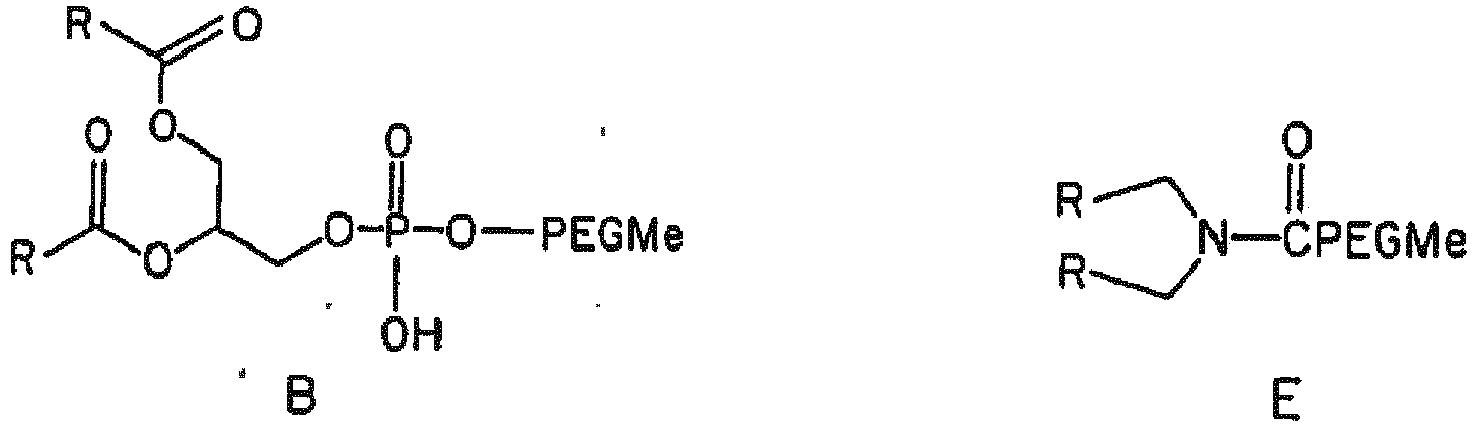

- Preferably, the pegylated lipid is present in an amount of less than 10 mole percent of total lipids in the matrix composition. The percentage can be less than 9 mole % of the total lipids, less than 8 mole %, less than 7 mole %, less than 6 mole %, less than 5 mole %, less than 4 mole %. Alternatively, the percentage is less than 3 mole %I,s less than 2 mole %, or less than 1 mole %.
- The non-biodegradable polymer may be selected yet not limited to polyethylene glycol, polyethylene glycol (PEG) acrylate, polymethacrylates (e.g. PEG methacrylate, polymethylmethacrylate, polyethylmethacrylate, polybutylmethacrylate, poly-2-ethylhexylmethacrylate, polylaurylmethacrylate, polyhydroxylethyl methacrylate), poly-methylacrylate, 2-methacryloyloxyethylphosphorylcholine (MPC), polystyrene, derivatized polystyrene, polylysine, poly N-ethyl-4-vinyl-pyridinium bromide, silicone, ethylene-vinyl acetate copolymers, polyethylenes, polypropylenes, polytetrafluoroethylenes, polyurethanes, polyacrylates, polyvinyl acetate, ethylene vinyl acetate, polyethylene, polyvinyl chloride, polyvinyl fluoride, copolymers of polymers of ethylene-vinyl acetates and acyl substituted cellulose acetates, poly(vinyl imidazole), chlorosulphonate polyolefins, polyethylene oxide, and mixtures thereof.
- The non-biodegradable polymer can be polyethylene glycol. Polyethylene glycol refers to an oligomer or polymer of ethylene oxide. The non-biodegradable polymer may comprise polyethylene glycol having a molecular weight from about 1000 to about 20000; alternatively, between 2000 to about 10000. The non-biodegradable polymer can be PEG having a molecular weight between about 4000 and about 8000.
- According to some embodiments, the matrix composition may further comprise a biodegradable polymer. The matrix composition may comprise a biodegradable polymer other than a polyester. The biodegradable polymer can be selected from the group consisting of poly(caprolactone), polycarbonates, polyesteramides, polyanhydrides, poly(amino acid)s, polycyanoacrylates, polyamides, polyacetals, poly(ether ester)s, poly(dioxanone)s, poly(alkylene alkylate)s, biodegradable polyurethanes, blends and copolymers thereof. The biodegradable polymer can be a polyester. Non limiting examples of polyesters include PLA (polylactic acid), PGA (polyglycolic acid) and PLGA (poly(lactic-co-glycolic acid). The PLGA may have a 1:1 lactic acid/glycolic acid ratio. Alternatively, the ratio is 60:40, 80:20, 90:10, 95:5, or the ratio is another ratio appropriate for an extended in vivo release profile, as defined herein. The ratio can be 50:50. The PLGA may be either a random or block copolymer. The biodegradable polyester may be selected from the group consisting of a polycaprolactone, a polyhydroxyalkanoate, a polypropylenefumarate, a polyorthoester, a polyanhydride, and a polyalkylcyanoacrylate, provided that the polyester contains a hydrogen bond acceptor moiety. The biodegradable polyester can be a block copolymer containing a combination of any two monomers selected from the group consisting of a PLA, PGA, a PLGA, polycaprolactone, a polyhydroxyalkanoate, a polypropylenefumarate, a polyorthoester, a polyanhydride, and a polyalkylcyanoacrylate. The biodegradable polyester can also be a random copolymer containing a combination of any two of the monomers listed above.
- The molecular weight (MW) of a non-biodegradable polymer as used in the present invention is preferably between about 1-40 KDa, between about 4-50 KDa, between about 15-40 KDa, between about 20-40 KDa, between about 15-35 KDa, between about 10-35 KDa, between about 10-30 KDa, between about 1-10 KDa, between about 1-5 KDa, or between about 2-5 KDa. A mixture of non-biodegradable polymers of different MW can be utilized. Also, a mixture of non-biodegradable polymer and a biodegradable polyer of different MW may be utilized. The different polymers may both have a MW in one of the above ranges.
- The antibiotic as used in the present invention can be doxycycline or a hydrophobic tetracycline. Non-limiting examples of hydrophobic tetracycline are 6-demethyl-6-deoxytetracycline, 6-methylene tetracycline, minocycline (also known as 7-dimethylamino-6-demethyl-6-deoxytetracycline), and 13-phenylmercapto-a-6-deoxy-tetracycline. Alternatively, the antibiotic can be selected from the group consisting of doxycycline, tetracycline, and minocycline. The antibiotic can be integrated into the matrix composition.
- The antibiotic can be selected from the group consisting of amoxicillin, amoxicillin/clavulanic acid, penicillin, metronidazole, clindamycine, chlortetracycline, demeclocycline, oxytetracycline, amikacin, gentamicine, kanamycin, neomycin, netilmicin, streptomycin, tobramycin, cefadroxil, cefazolin, cephalexin, cephalothin, cephapirin, cephradine, cefaclor, cefamandole, cefametazole, cefonicid, cefotetan, cefoxitine, cefpodoxime, cefprozil, cefuroxime, cefdinir, cefixime, cefoperazone, cefotaxime, ceftazidime, ceftibuten, ceftizoxime, ceftriaxone, cefepime, azithromycin, clarithromycin, dirithromycin, erythromycin, lincomycin, troleandomycin, bacampicillin, carbenicillin, cloxacillin, dicloxacillin, meticillin, mezlocillin, nafcillin, oxacillin, piperacillin, ticarcillin, cinoxacin, ciprofloxacin, enoxacin, grepafloxacin, levofloxacin, lomefloxacin, nalidixic acid, norfloxacin, ofloxacin, sparfloxacin, sulfisoxazole, sulfacytine, sulfadiazine, sulfamethoxazole, sulfisoxazole, dapson, aztreonam, bacitracin, capreomycin, chloramphenicol, clofazimine, colistimethate, colistin, cycloserine, fosfomycin, furazolidone, methenamine, nitrofurantoin, pentamidine, rifabutin, rifampin, spectinomycin, trimethoprim, trimetrexate glucuronate, and vancomycin.
- The biologically active ingredient can be an antiseptic drug such as chlorhexidine.
- Any suitable NSAID may be integrated into the matrix composition for sustained and/or controlled release. The NSAID as used in the present invention can be for example flurbiprofen. Alternatively, the NSAID can be selected from the group consisting of ibuprofen and flurbiprofen, or from the group consisting of ibuprofen, flurbiprofen, aminosalicylate sodium, choline magnesium trisalicylate, choline salicylate, diclofenac, diflunisal, etodolac, fenoprofen, indomethacin, ketoprofen, ketolac tromethamine, magnesium salicylate, meclofenamate, mefenamic acid, nabumetone, naproxen, oxaprozin, oxyphenbutazone, piroxicam, salsalate, sulindac, tolmetin.
- The active agent as used in the present invention can be a steroid. The steroid can be a steroidal anti-inflammatory drug. Non limiting examples of steroidal anti-inflammatory drugs (SAIDs) to be used in the formulations of the present invention include, but are not limited to, Corticosteroids such as: betamethasone, betamethasone valerate, cortisone, dexamethasone, dexamethasone 21-phosphate, fludrocortisone, flumethasone, fluocinonide, fluocinonide desonide, fluocinolone, fluocinolone acetonide, fluocortolone, halcinonide, halopredone, hydrocortisone, hydrocortisone 17-valerate, hydrocortisone 17-butyrate, hydrocortisone 21-acetate methylprednisolone, prednisolone, prednisolone 21-phosphate, prednisone, triamcinolone, triamcinolone acetonide, cortodoxone, fluoracetonide, fludrocortisone, difluorsone diacetate, flurandrenolone acetonide, medrysone, amcinafel, amcinafide, betamethasone and its other esters, chloroprednisone, clorcortelone, descinolone, desonide, dichlorisone, difluprednate, flucloronide, flumethasone, flunisolide, flucortolone, fluoromethalone, fluperolone, fluprednisolone, meprednisone, methylmeprednisolone, paramethasone, cortisone acetate, hydrocortisone cyclopentylpropionate, cortodoxone, flucetonide, fludrocortisone acetate, flurandrenolone acetonide, medrysone, amcinafal, amcinafide, betamethasone, betamethasone benzoate, chloroprednisone acetate, clocortolone acetate, descinolone acetonide, desoximetasone, dichlorisone acetate, difluprednate, flucloronide, flumethasone pivalate, flunisolide acetate, fluperolone acetate, fluprednisolone valerate, paramethasone acetate, prednisolamate, prednival, triamcinolone hexacetonide, cortivazol, formocortal and nivazol.
- As referred to herein, the term "anti-cancer agent" refers to any type of agent that may be used in the treatment of cancer and/or cancer related conditions. The anti-cancer reagent may include any naturally occurring or synthetically produced molecule that is capable of affecting directly or indirectly the growth and/or viability of cancer cells, cancer tumor, and/or cancer related conditions and symptoms. The anti-cancer agent may include, for example, a naturally occurring protein or peptide, a modified protein or peptide, a recombinant protein, a chemically synthesized protein or peptide, a low oral bioavailability protein or peptide, a chemical molecule, a synthetic chemical molecule, a chemotherapeutic drug, a biologically therapeutic drug, and the like, or any combination thereof. The anti-cancer reagent may be cytotoxic (toxic to cells) and/or cytostatic (suppress cell growth) and/or antiproliferative to the cancer cells and may exert its effect on cancer cells directly and/or indirectly. The anti-cancer reagent may be administered alone and/or in combination and/or before and/or after one or more additional cancer treatments. The additional cancer treatment may include such treatments as, but not limited to: chemotherapy (use of drugs to affect the cancer cells), radiotherapy (use of high-energy radiation of various sources to affect the cancer cells); biological therapy (a therapy which helps the immune system fight cancer); surgical procedures (surgical removal of the cancerous tumor); gene therapy; bone marrow transplantation; any other therapy known in the art, or any combination thereof.
- Non limiting examples of anti-cancer reagents and chemotherapeutic drugs may include such drugs as, but not limited to: Alkaloids, such as, but not limited to: Docetaxel, Etoposide, Irinotecan, Paclitaxel, Teniposide, Topotecan, Vinblastine, Vincristine, Vindesine; Alkylating agents, such as, but not limited to: Busulfan, Improsulfan, Piposulfan, Benzodepa, Carboquone, Meturedepa, Uredepa, Altretamine, triethylenemelamine, Triethylenephosphoramide, Triethylenethiophosphoramide, Chlorambucil, Chloranaphazine, Cyclophosphamide, Estramustine, Ifosfamide, Mechlorethamine, Mechlorethamine Oxide Hcl, Melphalan, Novemebichin, Perfosfamide Phenesterine, Prednimustine, Trofosfamide, Uracil Mustard, Carmustine, Chlorozotocin, Fotemustine, Lomustine, Nimustine, Semustine Ranimustine, Dacarbazine, Mannomustine, Mitobronitol, Mitolactol, Pipobroman, Temozolomide; Antibiotics and analogs, such as, but not limited to: Aclacinomycins, Actinomycins, Anthramycin, Azaserine, Bleomycins, Cactinomycin, Carubicin, Carzinophilin, Cromomycins, Dactinomycins, Daunorubicin, 6-Diazo-5-oxo-L-norleucine, Doxorubicin, Epirubicin, Idarubicin, Menogaril, Mitomycins, Mycophenolic Acid, Nogalamycine, Olivomycins, Peplomycin, Pirarubicin, Plicamycin, Porfiromycin, Puromycine, Streptonigrin, Streptozocin, Tubercidin, Zinostatin, Zorubicin; Antimetabolites, such as, but not limited to: Denopterin, Edatrexate, Methotrexate, Piritrexim, Pteropterin, Tomudex, Trimetrexate, Cladridine, Fludarabine, 6-Mercaptopurine, Pentostatine Thiamiprine, Thioguanine, Ancitabine, Azacitidine, 6-Azauridine, Carmofur, Cytarabine, Doxifluridine, Emitefur, Floxuridine, Fluorouracil, Gemcitabine, Tegafur; Platinum complexes, such as, but not limited to: Caroplatin, Cisplatin, Miboplatin, Oxaliplatin; alkylators including, but not limited to, busulfan (Myleran, Busulfex), chlorambucil (Leukeran), ifosfamide (with or without MESNA), cyclophosphamide (Cytoxan, Neosar), glufosfamide, melphalan, L-PAM (Alkeran), dacarbazine (DTIC-Dome), and temozolamide (Temodar); anthracyclines, including, but not limited to doxorubicin (Adriamycin, Doxil, Rubex), mitoxantrone (Novantrone), idarubicin (Idamycin), valrubicin (Valstar), and epirubicin (Ellence); antibiotics, including, but not limited to, dactinomycin, actinomycin D (Cosmegen), bleomycin (Blenoxane), daunorubicin, and daunomycin (Cerubidine, DanuoXome); aromatase inhibitors, including, but not limited to anastrozole (Arimidex) and letroazole (Femara); bisphosphonates, including, but not limited to zoledronate (Zometa); cyclo-oxygenase inhibitors, including, but not limited to, celecoxib (Celebrex); estrogen receptor modulators including, but not limited to tamoxifen (Nolvadex) and fulvestrant (Faslodex); folate antagonists including, but not limited to methotrexate and tremetrexate; inorganic aresenates including, but not limited to arsenic trioxide (Trisenox); microtubule inhibitors (e.g. taxanes) including, but not limited to vincristine (Oncovin), vinblastine (Velban), paclitaxel (Taxol, Paxene), vinorelbine (Navelbine), epothilone B or D or a derivative of either, and discodermolide or its derivatives, nitrosoureas including, but not limited to procarbazine (Matulane), lomustine, CCNU (CeeBU), carmustine (BCNU, BiCNU, Gliadel Wafer), and estramustine (Emcyt); nucleoside analogs including, but not limited to mercaptopurine, 6-MP (Purinethol), fluorouracil, 5-FU (Adrucil), thioguanine, 6-TG (Thioguanine), hydroxyurea (Hydrea), cytarabine (Cytosar-U, DepoCyt), floxuridine (FUDR), fludarabine (Fludara), pentostatin (Nipent), cladribine (Leustatin, 2-CdA), gemcitabine (Gemzar), and capecitabine (Xeloda); osteoclast inhibitors including, but not limited to pamidronate (Aredia); platinum containing compounds including, but not limited to cisplatin (Platinol) and carboplatin (Paraplatin); retinoids including, but not limited to tretinoin, ATRA (Vesanoid), alitretinoin (Panretin), and bexarotene (Targretin); topoisomerase 1 inhibitors including, but not limited to topotecan (Hycamtin) and irinotecan (Camptostar); topoisomerase 2 inhibitors including, but not limited to etoposide, VP-16 (Vepesid), teniposide, VM-26 (Vumon), and etoposide phosphate (Etopophos); tyrosine kinase inhibitors including, but not limited to imatinib (Gleevec); various other proteins including monoclonal antibodies, peptides and enzymes, various other molecules, such as, for example, Super Oxide dismutase (SOD), leptin; flavanoids; or any combinations thereof.
- Non limiting examples of anti-cancer agents and biological therapies that may be used according to the present invention, may include, such therapies and molecules as, but not limited to: administration of an immunomodulatory molecule, such as, for example, a molecule selected from the group consisting of tumor antigens, antibodies, cytokines (such as, for example, interleukins (such as, for example,
interleukin 2,interleukin 4, interleukin 12), interferons (such as, for example, interferon El interferon D, interferon alpha), tumor necrosis factor (TNF), granulocyte macrophage colony stimulating factor (GM-CSF), macrophage colony stimulating factor (M-CSF), and granulocyte colony stimulating factor (G-CSF)), tumor suppressor genes, chemokines, complement components, complement component receptors, immune system accessory molecules, adhesion molecules, adhesion molecule receptors, agents affecting cell bioenergetics, or any combinations thereof . - The active agent as used in the present invention can be a compound which induces or stimulates the formation of bone. The active agent can be an osteogenic factor. The osteogenic factor may refer to any peptide, polypeptide, protein or any other compound or composition which induces or stimulates the formation of bone. The osteogenic factor may induce differentiation of bone repair cells into bone cells, such as osteoblasts or osteocytes. The osteogenic factor can be selected from the group consisting of TGF-beta, BMP and FGF. The osteogenic factor can be encapsulated within the matrix composition of the present invention in a concentration sufficient to induce differentiation of bone repair cells into bone cells which form bone.
- The active agent as used in the present invention can be a compound useful for supporting bone recovery. The active agent can be a bone resorption inhibitor or a bone density conservation agent. The compound can be selected from the group consisting of osteoprotegerin (OPG), BMP-2, BMP-4, vascular endothelial growth factor (VEGF), alendronate, etidronate disodium, pamidronate, risedronate, and tiludronate. The compound can be osteoprotegerin (OPG), a naturally secreted decoy receptor that inhibits osteoclast maturation and activity and induces osteoclast apoptosis. The active agent can also be a bone restructuring element. Non-limiting examples of bone restructuring elements are BMP peptides. The compound can be a bone morphogenetic protein (BMP) or it can be selected from the group consisting of BMP-2 and BMP-4, which accelerate osteoblast activity.
- The compound can be vascular endothelial growth factor (VEGF).
- The compound can be an estrogen, or it can be selected from the group consisting of bisphosphonate derivative. The bisphosphonate derivative can be selected from the group consisting of alendronate, etidronate disodium, pamidronate, risedronate, and tiludronate.
- The biologically active ingredient can be an antifungal drug, e.g. amphotericin B cholesteryl sulfate complex, natamycin, amphotericin, clotrimazole, nystatin, amphotericin B lipid complex, fluconazole, flucytosine, griseofulvin, itraconazole, ketoconazole, benzoic acid and salicylic acid, betamethasone and clotrimazole, butenafine, carbol-fuchsin, ciclopirox, clioquinol, clioquinol and hydrocortisone, clotrimazole, econazole, gentian violet, haloprogin, iodoquinol and hydrocortisone, ketoconazole, miconazole, naftifine, nystatin, nystatin and triamcinolone, oxiconazole, sodium thiosulfate, sulconazole, terbinafine, tolnaftate, triacetin, undecylenic acid and derivatives thereof, butoconazole, clotrimazole, sulfanilamide, terconazole, and tioconazole.
- The matrix composition as used in the present invention may further comprise a targeting moiety capable of interacting with a target molecule. Preferably the target molecule is selected from the group consisting of a collagen molecule, a fibrin molecule and a heparin. The target molecule can also be another surface molecule that forms part of the extracellular matrix (ECM) of a target cell. ECM is produced and assembled locally by cells. The most important cells involved in assembling and maintaining ECM are fibroblasts. ECM contains polysaccharide chains called GAGs (glyosaminoglycans) and various protein fibers e.g., collagen, elastin, fibronectin and laminin.
- The targeting moiety can be a fibronectin peptide. Fibronectin is a high-molecular-weight glycoprotein that binds ECM components such as collagen, fibrin and heparin. Alternatively, the targeting moiety can be another targeting moiety capable of interaction with a target molecule selected from the group consisting of a collagen molecule, a fibrin molecule and a heparin. "Fibronectin peptide" may refer to a full-length fibronectin protein or to a fragment of fibronectin. The fragment may include the collagen binding domain. Collagen binding domains of fibronectin molecules are well known in the art, and are described, for example, in Hynes, RO (1990). Fibronectins. New York: Springer-Verlag and in Yamada, KM and Clark, RAF (1996). Provisional matrix. In The Molecular and Cellular Biology of Wound Repair (ed. R. A. F. Clark), pp. 51-93. New York: Plenum Press.
- The targeting moiety can be incorporated into the matrix composition. The targeting moiety can be modified to confer ability to incorporate into the lipid matrix. The modification may comprise binding to a lipid moiety. A non-limiting example of a lipid moiety is hydrogenated phosphatidylethanolamine (HPE). However, any lipid moiety capable of incorporation into the lipid matrix is suitable. The targeting moiety can be able to be incorporated into the lipid matrix without modification. The targeting moiety can be attached to the surface of a matrix composition. The targeting moiety can be bound to the surface of the matrix composition or vesicle by a hydrophobic anchor covalently bound to the targeting moiety. The targeting moiety can be bound to the lipid vesicles by a hydrophobic anchor. The targeting moiety can be included during the preparation of the matrix composition, allowing it to be located in deeper layers, as well as on the surface of the matrix.
- The target molecule can be a collagen. Collagens are well known in the art, and are described, for example, in Khoshnoodi J et al (Molecular recognition in the assembly of collagens: terminal noncollagenous domains are key recognition modules in the formation of triple helical protomers. J Biol Chem. 281(50):38117-21, 2006). The target molecule can be a fibrin. Fibrins are well known in the art, and are described, for example, in Valenick LV et al (Fibronectin fragmentation promotes alpha4betal integrin-mediated contraction of a fibrin-fibronectin provisional matrix. Exp Cell Res 309(1):48-55, 2005) and Mosesson MW (Fibrinogen and fibrin structure and functions. J Thromb Haemost 3(8):1894-904, 2005). The target molecule can be a heparin. Heparins are well known in the art, and are described, for example, in Mosesson MW (Fibrinogen and fibrin structure and functions. J Thromb Haemost 3(8):1894-904, 2005). Additional components
- The matrix composition as used in the present invention may further comprise a free fatty acid. The free fatty acid can be an omega-6 fatty acid or an omega-9 fatty acid. The free fatty acid can be selected from the group consisting of omega-6 and omega-9 fatty acids. The free fatty acid may have 14 or more carbon atoms, or 16 or more carbon atoms. The free fatty acid may also have 16 carbon atoms, 18 carbon atoms, 16-22 carbon atoms, 16-20 carbon atoms, 16-18 carbon atoms, 18-22 carbon atoms, or 18-20 carbon atoms. The free fatty acid can be linoleic acid, linolenic acid, oleic acid, or it can be selected from the group consisting of linoleic acid, linolenic acid, and oleic acid. The free fatty acid can also be another appropriate free fatty acid known in the art. The free fatty acid may add flexibility to the matrix composition or may slow the in vivo release rate. The free fatty acid may improve the consistency of the in vivo controlled release. The fatty acid can be unsaturated or saturated. Incorporation of a saturated fatty acid having at least 14 carbon atoms may increase the gel-fluid transition temperature of the resulting matrix composition.
- A free fatty acid may be incorporated into the matrix composition. The matrix composition as used in the present invention may further comprise a tocopherol. The tocopherol can be E307 (a-tocopherol), β-tocopherol, E308 (γ-tocopherol), or E309 (δ-tocopherol). The tocopherol can be selected from the group consisting of α-tocopherol, β-tocopherol, γ-tocopherol, and δ-tocopherol. The tocopherol can be incorporated into the matrix composition. The matrix composition used in the present invention may further comprise physiologically acceptable buffer salts, which are well known in the art. Non-limiting examples of physiologically acceptable buffer salts are phosphate buffers. A typical example of a phosphate buffer is 40 parts NaCl, 1 part KCl, 7 parts Na2HPO4. 2H2O and 1 part KH2PO4. The buffer salt can alternatively be any other physiologically acceptable buffer salt known in the art. Release rates and general characteristics of the matrix compositions
- The release characteristics from the matrix compositions are designed to provide sustained release of the active agent or agents from within the matrix to the desired site of action over a prolonged period of time. The sustained release profile will provide a therapeutically effective amount of the drug at least to the local vicinity of the matrix composition for a period of days or weeks or even months. While the compositions may have a minor percentage of the active agent which is released immediately to provide a therapeutic effect to the desired local site of action, the majority of the material will be released over a prolonged period of time. Typically up to 10-20% may be released immediately from the matrix compositions. The release profile of the major portion of the agents achieves zero order kinetics. At least 40% of the active agent is released under zero order kinetics. The release profile can be measured in vitro or in vivo. The in vivo release can be localized and will not be reflected in systemic drug levels.
- The in vivo release time of 90% of the active ingredient for matrix compositions of the present invention is preferably between 1 week and 6 months, between 4 days and 6 months, between 1 week and 5 months, between 1 week and 4 months, between 1 week and 3 months, between 1 week and 2 months, between 2 weeks and 6 months, between 2 weeks and 5 months, between 2 weeks and 4 months, between 2 weeks and 3 months, between 3 weeks and 6 months, between 3 weeks and 5 months, between 3 weeks and 4 months, or between 3 weeks and 3 months.
- "Biodegradable" as used herein, refers to a substance capable of being decomposed by natural biological processes at physiological pH. "Physiological pH" refers to the pH of body tissue, typically between 6-8. "Physiological pH" does not refer to the highly acidic pH of gastric juices, which is typically between 1 and 3.
- "Non-biodegradable" as used herein, refers to a substance which is not degraded or eroded under normal mammalian physiological conditions. Generally, a substance is considered non-biodegradable if it is not degraded to a significant extent (i.e., loses more than 5% of its mass and/or average polymer length) by action of biological agents, and all during the average time by which this substance will normally retain in the body following its administration.
- The weight ratio of total lipids to the polymer in order to achieve lipid saturation can be determined by a number of methods, as described herein. The lipid:polymer weight ratio of a composition as used in the present invention can be between 1:1 and 9:1 inclusive, between 2:1 and 9:1 inclusive, between 3:1 and 9:1 inclusive, between 4:1 and 9:1 inclusive, between 5:1 and 9:1 inclusive, between 6:1 and 9:1 inclusive, between 7:1 and 9:1 inclusive, between 8:1 and 9:1 inclusive, or between 1.5:1 and 9:1 inclusive.
- The melting temperature (Tm) of the lipids in the matrix composition used in the present invention can be at least 37 °C, at least 40 °C, at least 42 °C, at least 44 °C, at least 46 °C, at least 48 °C, or at least 50 °C.
- The matrix composition used in the present invention can be in the form of an implant, following evaporation of the organic solvents. The evaporation of the solvents is typically done at temperatures ranging from 20 to 80°C. The evaporation of the solvents can be done at temperatures ranging from 20 to 60°C.
- The implant can be homogeneous. The implant can be manufactured by a process comprising the step of freeze-drying the material in a mold. Also disclosed is an implant comprising an antibiotic-containing matrix composition as used in the present invention. Also disclosed is an implant comprising an NSAID-containing matrix composition used in the present invention, an implant comprising a bone resorption inhibitor-containing matrix composition, an implant comprising a matrix composition that contains an antibiotic and an NSAID, an implant comprising a matrix composition that contains an antibiotic and a bone resorption inhibitor, an implant comprising a matrix composition that contains a bone resorption inhibitor and an NSAID, an implant comprising a matrix composition that contains an antibiotic, an NSAID, and a bone resorption inhibitor.
- The process of creating an implant from a composition of the present invention may comprise the steps of (a) creating a matrix composition according to a method of the present invention in the form of a bulk material; (b) transferring the bulk material into a mold or solid receptacle of a desired shaped; (c) freezing the bulk material; and (d) lyophilizing the bulk material.
- Also disclosed is a pharmaceutical composition comprising a matrix composition as disclosed herein and a pharmaceutically acceptable excipient.
- The matrix composition can be in the form of microspheres, following evaporation of the organic solvents. The microspheres can be homogeneous. The microspheres can be manufactured by a process comprising the step of spray-drying.
- Also disclosed are microspheres made of a matrix composition as disclosed herein. Also disclosed is a pharmaceutical composition comprising microspheres as disclosed herein and a pharmaceutically acceptable excipient. The pharmaceutical composition can be in a parenterally injectable form or in an infusible form. The excipient can be compatible for injection or infusion. The particle size of microspheres as disclosed herein is approximately 500-2000 nm, about 400-2500 nm, about 600-1900 nm, about 700-1800 nm, about 500-1800 nm, about 500-1600 nm, about 600-2000 nm, or about 700-2000 nm. Alternatively, the particles can be of any other size suitable for pharmaceutical administration.
- In order to obtain the compositions of the invention any suitable method may be employed that will yield a homogeneous dispersion of the polymer and the lipids in a water resistant matrix. Advantageously, the methods employed avoid the use of water at any stage of the manufacturing process.
- The polymer can be mixed separately with appropriate selected volatile organic solvent(s) on the one hand and the phospholipids together with the active pharmaceutical agent are mixed with its appropriate selected solvent(s) or solvents prior to mixing together with the polymer.
- A method of producing a matrix composition may comprise the steps of:
- (a) mixing into a first volatile organic solvent: (i) a non-biodegradable polymer and (ii) sterol; and
- (b) mixing separately into a second volatile organic solvent: (i) an active agent; (ii) a phosphatidylcholine and optionally (iii) a phosphatidylethanolamine; and
- (c) mixing and homogenizing the products resulting from steps (a) and (b).
- Phosphatidylethanolamine can be included in the volatile organic solvent of step (a) instead of or in addition to a phosphatidylethanolamine added to the volatile organic solvent of step (b). The biocompatible polymer can be selected from the group consisting of non-biodegradable polymer, a biodegradable polymer other than polyester and any combination thereof. The first volatile organic solvent can be a non-polar solvent. The second volatile organic solvent can be a water miscible solvent. In cases where the active agent is a protein or peptide it is important to select solvents that will not denature or impair the activity of the protein. The active agent can be selected from the group consisting of an NSAID, an antibiotic, an antifungal agent, a steroid, an anticancer agent, an osteogenic factor and a bone resorption inhibitor and mixtures thereof.
- The mixture of step (a) containing a volatile organic solvent can be homogenized prior to mixing it with the solution of step (b). The volatile organic solvent or mixture of volatile organic solvents used in step (a) may be same or different than the volatile organic solvent or mixture of organic solvents used in step (b). The mixture of step (b) can be homogenized prior to mixing it with the mixture of step (a). The polymer in the mixture of step (a) can be lipid saturated. The matrix composition can be lipid saturated. Preferably, the polymer and the phosphatidylcholine are incorporated into the matrix composition. The active agent as well can be incorporated into the matrix composition. The matrix composition can be in the form of a lipid-saturated matrix whose shape and boundaries are determined by the polymer.
- The phosphatidylethanolamine as used in the present invention can have saturated fatty acid moieties. The fatty acid moieties may have at least 14 carbon atomsor 14-20 carbon atoms.
- The phosphatidylcholine as used in the present invention may have saturated fatty acid moieties. The fatty acid moieties may have at least 14 carbon atoms, at least 16 carbon atoms, 14-18 carbon atoms, or 16-20 carbon atoms.
- The weight ratio of total lipids to polymer in the first volatile organic solvent can be such that the polymer in this mixture is lipid-saturated. For purposes of illustration, in the case wherein the polymer is predominantly 8 KDa PEG, the molar ratio of total lipids to 8 KDa PEG can be typically in the range of 10-50 inclusive, between 10-100 inclusive, between 20-200 inclusive, between 20-300 inclusive, or between 30-400 inclusive.
- This is important since the elimination of non-biodegradable polymer fragment by the kidney is limited to small fragments. In the case of PEG it is limited to chains of 5000 Dalton, and preferably up to 2000 Dalton is used. Using large polymeric chins can elevate the inner strength of the matrix, were as the resistency of the specific linker can influence the degradation rate, reflecting on the release rate of the drug.
- Each of the components of the above method and other methods of the present invention is defined in the same manner as the corresponding component of the matrix compositions of the present invention.
- Step (a) of the production method may further comprise adding to the volatile organic solvent a phosphatidylethanolamine. The phosphatidylethanolamine can be the same phosphatidylethanolamine included in step (b), a different phosphatidylethanolamine that may be any other phosphatidylethanolamine known in the art, or selected from the group consisting of the phosphatidylethanolamine of step (b) and a different phosphatidylethanolamine. Step (a) of the production method may further comprise adding to the volatile organic solvent a tocopherol.
- Step (b) of the production method may further comprise adding to the volatile organic solvent physiologically acceptable buffer salts. Non-limiting examples of physiologically acceptable buffer salts are phosphate buffers. A typical example of a phosphate buffer is 40 parts NaCl, 1 part KCl, 7 parts Na2HPO4 · 2H2O and 1 part KH2PO4. The buffer salt can be any other physiologically acceptable buffer salt known in the art. Step (b) of the production method may further comprise adding to the volatile organic solvent a phospholipid selected from the group consisting of a phosphatidylserine, a phosphatidylglycerol, a sphingomyelin, and a phosphatidylinositol.
- Step (b) of the production method may further comprise adding to the volatile organic solvent a sphingolipid. The sphingolipid can be ceramide, a sphingomyelin, or any other sphingolipid known in the art. Step (b) of the production method may further comprise adding to the water-miscible, volatile organic solvent an omega-6 or omega-9 free fatty acid. The free fatty acid may have 16 or more carbon atoms.
- Each step of the production method can be substantially free of aqueous solution, or substantially free of the presence of water or any aqueous solution. As provided herein, producing matrix compositions of the present invention in a water-free process enables lipid saturation. Each step of the production method may involve the presence of water in an amount not greater than 20% of the total liquid volume (water and organic solvents). The aqueous solution or water will be eliminated through evaporation together with the organic solvents as described below.
- Upon mixing, a homogenous mixture is formed, since the polymer is lipid-saturated in the mixture of step (a). The homogenous mixture may take the form of a homogenous liquid. Upon freeze-drying or spray-drying the mixture, vesicles can be formed. The production method may further comprise the step of evaporating the solvent present in the product of step (c). The evaporation may utilize atomization of the mixture. The mixture can be atomized into dry, heated air. Typically, atomization into heated air evaporates all water immediately, obviating the need for a subsequent drying step. The mixture can also be atomized into a water-free solvent. The evaporation can be performed by spray drying, freeze drying, using liquid nitrogen, or using liquid nitrogen that has been pre-mixed with ethanol. The evaporation can be performed using another suitable technique known in the art.
- A method may further comprise the step of vacuum-drying the composition. The step of vacuum-drying can be performed following the step of evaporating.
- The method may further comprise the step of evaporating the organic volatile solvent by heating the product of step (c). The heating is continuing until the solvent is eliminated and in a typical temperature between room temperature to 80°C. A step of vacuum-drying can be performed following the step of solvent evaporation.
- "Lipid saturated," as used herein, refers to saturation of the polymer of the matrix composition with phospholipids in combination with any hydrophobic drug and targeting moiety present in the matrix, and any other lipids that may be present. As described herein, matrix compositions may comprise phospholipids other than phosphatidylcholine. Alternatively, the matrix compositions may comprise lipids other than phospholipids. The matrix composition can be saturated by whatever lipids are present. "Saturation" refers to a state wherein the matrix contains the maximum amount of lipids of the type utilized that can be incorporated into the matrix. Methods for determining the polymer:lipid ratio to attain lipid saturation and methods of determining the degree of lipid saturation of a matrix are described herein. The matrix composition as used in the present invention is substantially free of water. "Substantially free of water" may refer to a composition containing less than 1% water by weight, less than 0.8% water by weight, less than 0.6% water by weight, less than 0.4% water by weight, or less than 0.2% water by weight. The term may also refer to the absence of amounts of water that affect the water-resistant properties of the composition. The term may also refer to a composition manufactured without the use of any aqueous solvents. Producing the composition using a process substantially free of water, as described herein, may enable lipid saturation. Lipid saturation confers upon the matrix composition ability to resist bulk degradation in vivo; thus, the matrix composition exhibits the ability to mediate extended release on a scale of several weeks or months. The matrix composition is essentially free of water. "Essentially free" refers to a composition comprising less than 0.1% water by weight, less than 0.08% water by weight, less than 0.06% water by weight, less than 0.04% water by weight, less than 0.02% water by , or less than 0.01% water by weight. The matrix composition can be free of water. The term may refer to a composition not containing detectable amounts of water.
- The matrix composition can be dry. "Dry" refers, in another embodiment, to the absence of detectable amounts of water or organic solvent.
- The water permeability of the matrix composition may have been minimized. "Minimizing" the water permeability refers to a process of producing the matrix composition in organic solvents, as described herein, in the presence of an amount of lipid that has been determined to minimize the permeability to penetration of added water. The amount of lipid required can be determined by hydrating the vesicles with a solution containing tritium-tagged water, as described herein.
- The term "lipid saturation" may refer to filling of internal gaps (free volume) within the lipid matrix as defined by the external border of the polymeric backbone. The gaps are filled with the phospholipids in combination with other type of lipids, hydrophobic drug and targeting moiety present in the matrix, to the extent that additional lipid moieties can no longer be incorporated into the matrix to an appreciable extent.
- The following method can be used to determine the degree of lipid saturation:
Following manufacture, vesicles are hydrated and isolated by centrifugation or filtration. Lipids that not entrapped in the vesicles form free micelles or liposomes and are located in the supernatant. The overall lipid contents of the supernatant and the vesicles are quantified. In this manner, the entrapped vs. free lipid contents are determined for various formulation containing different lipid:polymer ratios at the outset. Thus, the actual, experimental, maximum lipid/polymer ratio is determined. - The following method can be used to determine the degree of lipid saturation:
Following manufacture, vesicles are hydrated with a solution containing tritium-tagged water, washed with tritium-free solution, and isolated by centrifugation or filtration, and the amount of water entrapped per polymer mass is quantified. This is repeated with different lipid:polymer ratios, in order to determine the amount of lipids required to saturate the free volume in the polymeric vesicles. - "Zero-order release rate" or "zero order release kinetics" means a constant, linear, continuous, sustained and controlled release rate of the pharmaceutical active agent from the polymer matrix, i.e. the plot of amounts of pharmaceutical active agent released vs. time is linear.
- To produce lipid-saturated polymer matrices, two mixtures are created.
- 1. A non-biodegradable polymer and a sterol and/or phospholipid component are mixed with a volatile organic solvent, which is mixed to yield a solution or suspension of lipid-saturated polymer matrix, as measured by its differential scanning calorimetric (DSC) profile.
- 2. The active agent and a phospholipid component are mixed with a second volatile organic solvent to yield a second solution or suspension.
- 3. The two solutions or suspensions are combined and mixed until equilibrium is reached; the organic solvents are then evaporated, yielding a drug-containing, lipid-saturated polymer matrix.
- Stock Solutions:
- Stock solution 1 (SS1):
PEG 8000, 300 mg/ml in ethyl acetate. - Stock solution 2 (SS2): Cholesterol (CH), 30 mg/ml in ethyl acetate.
- Stock solution 3 (SS3): Doxycycline -Hyclate (Doxy-H), 50 mg/ml in Methanol:ethyl acetate (1:1 v/v).
- Solution A1: 0.2 volume of SS1 was mixed with 1 volume of SS2 (
PLGA 50 mg/ml,CH 25 mg/ml). - Solution A2: 0.2 volume of SS1 was mixed with 1 volume of ethyl acetate (
PLGA 50 mg/ml). - The mixture is mixed. The entire process is performed at room temperature. A fat- polymer matrix is thus obtained.
-
- Solution B1: 1,2-distearoyl-sn-glycero-3-phosphocholine (DSPC; final concentration 225 mg/ml) dissolved in 0.75 ml SS3 was mixed with 0.25 ml ethyl acetate (final Doxy-H concentration 37.5 mg/ml).
- Solution B2: 1,2-dimyristoyl-sn-glycero-3-phosphocholine (DMPC; final concentration 225 mg/ml) dissolved in 0.75 ml SS3 was mixed with 0.25 ml ethyl acetate (final Doxy-H concentration 37.5 mg/ml).
- Solution B3: 1, 2-dipalmitoyl-sn-glycero-3-phosphocholine (DPPC; final concentration 225 mg/ml) dissolved in 0.75 ml SS3 was mixed with 0.25 ml ethyl acetate (final Doxy-H concentration 37.5 mg/ml).
- Solution B4: 0.75 ml SS3 with 0.25 ml ethyl acetate (final Doxy-H concentration 37.5 mg/ml).
- The mixture is mixed, homogenized or sonicated. In some cases, prior to mixing, homogenization or sonication, a non-polar, volatile organic solvent, e.g. ethyl acetate, is included with the mixture, which is stirred gently for 30 minutes. Typically the entire process is conducted at room temperature, but higher temperatures of up to 80 °C are used, typically when highly saturated lipids are used.
No water is required in the mixture. - The second suspension (or solution) is added to the first solution under stirring. Stirring is continued for up to 5h. The entire process is performed at room temperature and up to 60 °C, all according to the specific formulation, the nature of the lipids in use and the specific drug. Alternatively, first and second solution may be vigorously mixed using a vortex followed by incubation at 45°C for 5 minutes. The resulting mixture should be homogenous.
- Solution AB: 1 volume of solution B1, B2, B3 or B4 was mixed with 1.5 volumes of solution A1. Alternatively, 1 volume of solution B4 was mixed with 1.5 volume of solution A2.
- In some experiments, the solution from stage III is atomized into dry, heated air.
- In other experiments, the solution from stage III is atomized into ethanol covered by liquid nitrogen or only liquid nitrogen without ethanol, after which the nitrogen and/or ethanol (as above) are evaporated.
- In other experiments, when coating of surfaces is performed; the suspension from stage III is mixed with the particles (e.g. tricalcium phosphate) or devices to be coated followed by evaporation of the volatile organic solvents. The entire process is performed at a temperature of 40-60 °C, preferably, solvents are evaporated by incubation at a temperature of about 45 °C for about an hour or until no liquid is visualized followed by overnight vacuum.
- Coated particles and coated devices are vacuum-dried for storage.
- The following materials are mixed into Chloroform:
- i Poly ethylene glycol(PEG) 8000
- ii Cholesterol- 50% w/w vs. PEG.
- The mixture is mixed until a clear solution is obtained. The entire process is performed at room temperature. A lipid- polymer combination matrix is thus obtained.
- The following materials are mixed with a volatile organic solvent (methanol and ethyl acetate):
- i Active compound - an antibiotic Doxycycline hyclate (DOX)
- ii A phosphatidylcholine - DPPC (16:0) present as 300% w/w vs. PEG.
- The mixture is thoroughly mixed. The entire process is conducted at room temperature .
- No water is required in the mixture.
- The second solution is added to the first solution while stirring. (Ratio of 3:2 v:v) Stirring is continued for one minute. The entire process is performed at a room temperature.
- In order to coat bone filler particles, the particles were added to the mixture of stage III followed by evaporation of the volatile organic solvents. The entire process was performed at a temperature of 45 °C.
- The ratio between the volume of the mixture of stage III and the mass of the bone particles will determine the release period of the drug post hydration of the coated particles.
- Coated bone particles are vacuum-dried for storage .
- The matrix composition ingredients (PEG, cholesterol, phospholipids and Doxy-H) were extracted by adding 0.2 ml of DCM to the dry matrix composition.
- 10 µL from the extract were injected onto an HPLC so as to verify the Doxy-H intactness and concentration.
- 5 µL of the extract were loaded on TLC sheets and run using different mobiles in order to determine the cholesterol and phospholipids stability (The mobile phase for cholesterol was: Hexan/Ether/Acetic acid, 70/30/1 (v/v/v); the mobile phase for the Phospholipids was: Chloroform/MeOH/
water 65/35/4 (v/v/v)). - The Doxy-H extracted from the complex gave a single peak at 10.37 min identical to the peak of Doxy-H standard. The major peak was more than 99% pure. The cholesterol and the phospholipids gave single spot when ran on the TLC sheet, indicating that no derivates were formed during the preparation of the complex with a Rf of 0.26 for cholesterol and 0.58 for phospholipids (
Figure 1A and B ). - In order to determine the release profile of the drug (Doxy-H) from the matrix composition, the
matrix composition 100 mg was hydrated with 1 ml of 5% FBS in DDW. - An hour after hydration the solution was collected and the concentration of Doxy-H in the solution was determined by HPLC. This procedure was repeated daily for 20 days.
- During the first 6 days the concentration of Doxy-H in the sample was determined before and after spin-down (6000 rpm for 2 min) to evaluate the amount of encapsulated Doxy-H.
-
- (i) During the first hour 21, 24 and 30% of the trapped Doxy-H was released from PEG+CH+Doxy+DSPC matrix composition, PEG+CH+Doxy+DMPC matric composition and PEG+CH+Doxy matrix composition, respectively. It is to be emphasized that the drug detected in the hydration solution contained free drug molecules as well as drug molecules attached to small particles (micrometer in size) of the matrix. In order to determine the amount of drug released from the matrix versus drug molecules which are bound to matrix particles, the hydration solution collected was centrifuged at 6,000 RPM for 2 min, and the concentration of the drug in the solution was determined. It was found that for matrix compositions comprising phospholipids only about 50% of the drug was found in solution whereas about 50% was found in the pellet formed during spin-down (indicating the drug is attached to the matrix), while in the matrix composition without phospholipids (PEG+CH+Doxy Polypid Complex) less than 30% of drug was found in solution, whereas more than 70% was found in the pellet.
- (ii) During the first 6 days, the amount of free Doxy-H released from matrix compositions comprising phospholipids (either DMPC or DSPC) was found to be the same. Yet, the total amount of drug released (free drug and drug attached to micrometer particles of the matrix) was higher in the DMPC complexes. This difference is in correlation with the lower melting point of DMPC; enhancing its dissociation from the matrix.
- (iii) The release of Doxy-H from matrix formulations comprising phospholipids displayed a zero order kinetics starting at day 3 (
Figure 2 ), while the release of Doxy-H from the polymeric complex was logarithmic in nature (data not shown). - In order to determine the structure of the particles released upon hydration of the matrix composition, we have hydrated two matrix compositions (PEG+CH+DPPC+Doxy-H and PEG+Doxy-H) for 24 hours after which the supernatant was collected and looked at using a light microscope connected to a Ueye digital camera. Liposomal structures having an average size of 50 µm, mostly multi-lamelar vesicles (MLV) were detected in the supernatant of the matrix comprising PEG+CH+DPPC+Doxy-H (
Figure 3B ), whereas polymeric structures having an average size of ∼5 µm were detected in the supernatant of the matrix comprising PEG+Doxy-H (Figure 3A ). - A matrix composition PEG-CH-Doxy-H-DMPC was hydrated for 15 days. The supernatant was then removed and Doxy-H was extracted from the complex with acetonitrile:0.01N HCl. The stability of the extracted Doxy-H was determined by HPLC.
- The extracted Doxy-H was intact and no derivates were formed. The main Doxy-H peak was ∼98% pure. The total amount of Doxy-H extracted was 70.44 µg. Within the first 15 days the hydrated complex released 883.579 µg. the total amount of Doxy-H released was 954 µg. This amount is∼90% of the total amount of the encapsulated Doxy-H in the formula.
- The basic principle underlying the differential scanning calorimetry (DSC) technique is that, when a sample undergoes a physical transformation such as, for example, an interaction with another sample, more or less heat will need to flow to it than to the reference to maintain the temperature of the interacting samples the same as the temperature of the samples alone. Without wishing to be bound by theory or mechanism of action, this may imply, for example, that the reagent associated or assembled with the polymer alters the phase transition characteristics of the polymer, which may further imply that the reagent associated with the polymer interferes with the self assembly of the polymeric chains.
- The nature of the interaction between the different components of the matrix composition was analyzed using DSC; 75 µL of either the stock solutions of the components alone as well as combinations thereof, were put into a DSC sample holder. The solvent was evaporated by incubating the holder on a dry block set to 45°C for 30 min followed by 30 min under vacuum. DSC curves were then recorded at a scan rate of 5°C/min.
-
- i) PEG:cholesterol interaction analysis:
Figure 4 displays DSC curves of PEG, cholesterol (CH), PEG:CH in a molar ratio of 1:10 PEG:CH (50 mg/ml and 25 mg/ml, respectively) and PEG:CH in a molar ratio of 1:40 (12.5 mg/ml and 25 mg/ml, respectively). A shift in the cholesterol melting point (from 147°C to 124°C is observed as well as a change in the shape of the CH peak. The melting point of CH didn't change upon increasing the ratio between PEG:CH to 1:40, yet the heat capacity of PEG has been decreased (from ∼47 to 35 cal/gr). - ii) PEG: drug interaction analysis:
Figure 5A displays DSC curves of PEG, Doxy-H, PEG:Doxy-H in a molar ratio of 1:7.7(30 and 15 mg/ml respectively), PEG:CH:Doxy-H in a molar ratio of 1:10:7.7 (30, 15 and 15 mg/ml, respectively) and PEG:CH:Doxy-H:DPPC in a molar ratio of 1:10:7.7:36 (30, 15, 15 and 90 mg/ml, respectively). A shift in the Doxy-H melting point (from 215°C to 210°C) is observed as well as a change in the shape of the Doxy-H peak (Figure 5B ). - iii) PEG:phospholipid interaction analysis:
Figure 6A-B displays DSC curves of PEG, DPPC, PEG:DPPC in a molar ratio of 1:32 (30 and 90 mg/ml, respectively), and PEG:CH:DPPC 1:10:32 (30, 15 and 90 mg/ml, respectively). Changes in the heat content of both PEG and DPPC are observed upon interaction (from 47 to 99.03 cal/gr for PEG, from 6.6 to 5.1 cal/gr for DPPC). The addition of CH totally eliminates the endothermic peaks of both DPPC and CH yet its addition does not affect the heat content of PEG. - Animal models:
- A. Tibial osteomyelitis in Rabbit
- B. Bacteria: staphylococcus aureus
- All preclinical testing is performed in accordance with the guidelines for Regulation of Animal Experiments in the State of Israel and according to the Ethics Committee of the research institution.
-
- 1. Cause a trauma to the bone (as determined in test A) - 10 animals.
- 2. Fill the void (injured bone) by tricalcium phosphate (TCP) material and seal it with Bone-Wax.
- 3. Load the site with defined amount of bacteria by injecting it into the site.
- 4. Duration - ∼22 days. Clinical signs and body weight (3X weekly) is monitored.
- 5. At the end of the incubation time: bleed the animal for basic Hematology & Biochemistry blood (prior to the termination of the test).
- 6. X-Ray of the tibia prior to the termination of the test (day ∼20)
- 7. terminate the experiment, and harvest the tibia for bacteriological test.
- 8. extract the bacteria from the bone and determine the bacterial concentration (as described below)
- Determination of bacterial concentration in the bone marrow: The bone marrow and the intramedullary canal is swabbed with sterile cotton tip applicators for gross culture analysis of quality assurance. The inoculated applicator is streaked onto blood plates and then placed into 5 mL of sterile TSB. The plates and tubes are then incubated at 37°C for 24 h and growth is recorded.
- Determination of bacterial concentration in the per gram of bone: The bone is placed into a sterile, 50 mL centrifuge tube and weighed. The bone is then crushed and the final product weighed. Normal sterile saline, 0.9%, is added in a 3:1 ratio (3 mL saline/g of bone), and the suspensions are vortexed for 2 min. Six 10-fold dilutions of each suspension are prepared with sterile, normal saline, 0.9%. Samples (20 µL) of each dilution, including the initial suspension, are plated, in triplicate, onto blood agar plates and incubated at 37°C for 24 h; colony forming units are counted at the greatest dilution for each tibia sample. The S. aureus concentration is calculated in CFU/g of bone.
-

-
- 1. Cause a trauma to the bone (as described in test A) - 13 animals
- 2. Fill the void (injured bone) by TCP material and seal it with Bone-Wax.
- 3. Loading the site with defined amount of bacteria by injecting it into the site (the load will be determine following the result of test A).
- 4. Duration - ∼22 days. Clinical signs and body weight (3X weekly) is monitored.
- 5. During the incubation time: bleed the animals for basic Hematology & Biochemistry blood panel at
day 7 and 16 (prior to the termination of the test). - 6. X-Ray of the tibia at day 1(or2) + at day ∼20 prior to the termination of the test.
- 7. Terminate the experiment, and to harvest the tibia for bacteriological tests.
- 8. Extracting the bacteria from the bone and determining the bacterial concentration: as described above for test A.
- 9. Local drug concentration is assayed.
-
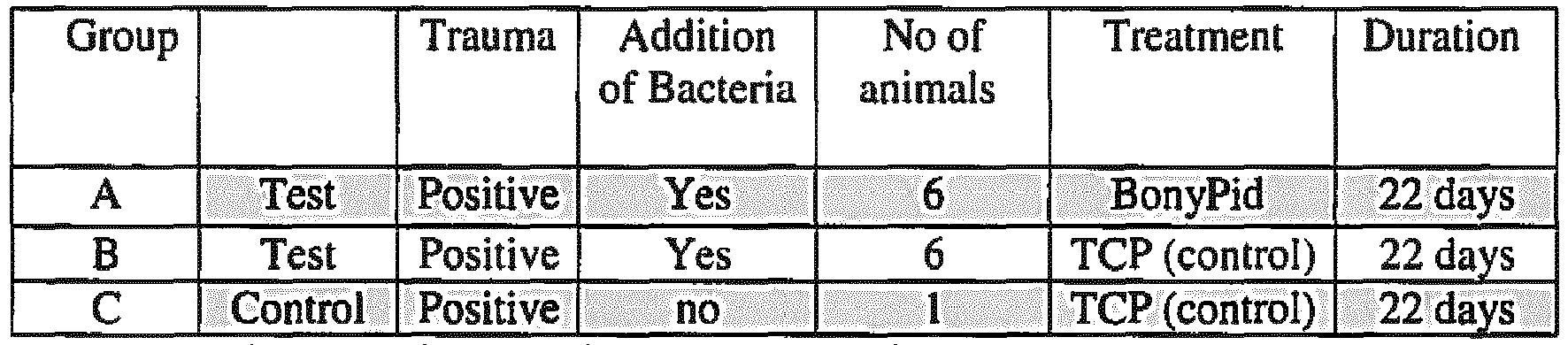
-
- 1. Cause a trauma to the bone (as described in test A) - 24 animals
- 2. Fill the void (injured bone) by TCP material and seal it with Bone-Wax.
- 3. Loading the site with defined amount of bacteria by injecting it into the site (the load will be determine following the result of test A).
- 4. Duration - ∼45 days. Clinical signs and body weight (3X weekly) are monitored. Termination time is determined according to the X-Ray results taken during the incubation time.
- 5. During the incubation time: bleed the animals for basic Hematology & Biochemistry blood panel at
day - 6. The animals will be bleeding for blood-drug-concentration analysis at
days - 7. X-Ray of the tibia at
day - 8. Terminate the experiment and harvest the tibia for Histology tests.
- 9. Histology tests for the injured site to 50% of the animals (12 animals).
- 10. Extracting the bacteria from the bone and determining the bacterial concentration for 50% of the animals (12 animals) as described above.
-

Claims (15)
- A substrate at least a portion of the surface of which is coated by a matrix composition comprising:a. a biocompatible non-biodegradable polymer non-covalently associated with a first lipid comprising at least one sterol;b. a second lipid comprising at least one phospholipid having fatty acid moieties of at least 14 carbons, wherein the non-biodegradable polymer is not bonded to the second lipid; andc. at least one pharmaceutically active agent;wherein the matrix composition is produced by a process which is substantially free of aqueous solutions and provides sustained release of the pharmaceutically active agent wherein at least 40% of said pharmaceutically active agent is released from the composition at zero-order kinetics, and the lipid:polymer weight ratio is between 1.5:1 and 9:1 inclusive.
- The substrate of claim 1,
wherein said at least one phospholipid is a phosphatidylcholine having fatty acid moieties having at least 14 carbons; or
wherein the non-biodegradable polymer is selected from the group consisting of polyethylene glycol (PEG), PEG acrylate, PEG methacrylate, polymethylmethacrylate, polyethylmethacrylate, polybutylmethacrylate, poly-2-ethylhexylmethacrylate, polylaurylmethacrylate, polyhydroxylethylmethacrylate, 2-methacryloyloxyethylphosphorylcholine (MPC), polystyrene, derivatized polystyrene, polylysine, poly N-ethyl-4-vinyl-pyridinium bromide, poly-methylacrylate, silicone, polyoxymethylene, polyurethane, polytetrafluoroethylenes, polyamides, polypropylene, polyacrylates, polyvinyl chloride, polyvinyl fluoride, polyvinyl acetate, polyethylene vinyl acetate, chlorosulphonated polyolefins, poly(vinyl imidazole), polymethacrylic acid, and derivatives thereof alone or as co-polymeric mixtures thereof; or
wherein the non-biodegradable polymer is polyethylene glycol; or
wherein said phospholipid is selected from the group consisting of 1,2-dimyristoyl-sn-glycero-3-phosphocholine (DMPC), 1,2-dipalmitoyl-sn-glycero-3-phosphocholine (DPPC), 1,2-distearoyl-sn-glycero-3-phosphocholine (DSPC) and 1,2-dioleoyl-sn-glycero-3-phosphocholine (DOPC); or
wherein said matrix composition is homogeneous; or
comprising a sphingolipid; or
comprising a tocopherol; or
further comprising an additional phospholipid selected from the group consisting of a phosphatidylserine, a phosphatidylglycerol, and a phosphatidylinositol; or
further comprising a free fatty acid having 14 or more carbon atoms; or
further comprising a targeting moiety capable of interacting with a target molecule selected from the group consisting of a collagen molecule, a fibrin molecule and a heparin; or
further comprising a PEGylated lipid; or
further comprising a biodegradable polymer, preferably wherein the non-biodegradable polymer and the biodegradable polymer form a block co-polymer; or
wherein the sterol is a cholesterol, preferably wherein said cholesterol is present in an amount of 10-50 percentage of the total weight of lipid content of said matrix composition. - The substrate, wherein in vivo release time of 90% of said pharmaceutically active agent from said matrix composition is between 1 week and six months.
- The substrate of claim 1 wherein at least 50% of said pharmaceutically active agent is released from the matrix composition at zero-order kinetics.
- The substrate of claim 1, wherein the pharmaceutically active agent is selected from the group consisting of an antibiotic, an antifungal, a non-steroidal anti-inflammatory drug (NSAID), a steroid, an anti-cancer agent, an osteogenic factor, a bone resorption inhibitor and any combination thereof.
- An implant comprising a substrate of claim 1.
- The substrate of claim 5
for use in the administration of a pharmaceutically active agent; or
for use in the stimulation of bone augmentation; or
for use in the treatment of periodontitis. - A medical device comprising the coated substrate of claim 1.
- The medical device of claim 8,
wherein said coating includes multi-layers; or
wherein said substrate includes at least one material selected from the group consisting of hydroxyapatite, stainless steel, cobalt-chromium, titanium alloy, tantalum, ceramic and gelatin;
wherein said substrate is selected from orthopedic nails, orthopedic screws, orthopedic staples, orthopedic wires, orthopedic pins, metal or polymeric implants, bone filler particles, collagen and non-collagen membranes, suture materials, orthopedic cements and sponges, preferably wherein said bone filler particles are selected from allogeneic, xenogeneic and artificial bone particles. - The substrate of any one of claims 1-5 wherein the substrate is selected from orthopedic nails, orthopedic screws, orthopedic staples, orthopedic wires, orthopedic pins, metal or polymeric implants, bone filler particles, collagen and non-collagen membranes, suture materials, orthopedic cements and sponges.
- A method of producing a substrate coated with a matrix composition, said method comprising the steps of:a. mixing into a first volatile organic solvent: (i) a biocompatible non-biodegradable polymer and (ii) a first lipid comprising at least one sterol;b. mixing into a second volatile organic solvent: (i) at least one pharmaceutically active agent; (ii) a second lipid selected from phospholipids having fatty acid moieties of at least 14 carbons; andc. mixing the products resulting from steps (a) and (b), to produce a homogeneous mixture;d. bringing the mixture resulting from step c into contact with a substrate, ande. while in contact with the substrate, evaporating the volatile organic solvents;wherein each of the steps (a) - (e) is substantially free of an aqueous solution, thereby producing a homogeneous lipid-saturated matrix composition.
- The method of claim 11,
wherein step (a) further comprises mixing into the first volatile organic solvent a biodegradable polymer; or
wherein the non-biodegradable polymer and the biodegradable polymer form a block co-polymer; or
wherein said phospholipid is a phosphatidylcholine having fatty acid moieties having at least 14 carbons; or
wherein said first lipid further comprises a phosphatidylethanolamine having fatty acid moieties having at least 14 carbons; or
wherein said sterol is a cholesterol. - The method of claim 11, wherein the non-biodegradable polymer is selected from the group consisting of polyethylene glycol (PEG), PEG acrylate, PEG methacrylate, methylmethacrylate, ethylmethacrylate, butylmethacrylate, 2-ethylhexylmethacrylate, laurylmethacrylate, hydroxylethyl methacrylate, 2-methacryloyloxyethylphosphorylcholine (MPC), polystyrene, derivatized polystyrene, polylysine, poly N-ethyl-4-vinyl-pyridinium bromide, poly-methylacrylate, silicone, polyoxymethylene, polyurethane, polyamides, polypropylene, , polyvinyl chloride, polymethacrylic acid, and derivatives thereof alone or as co-polymeric mixtures thereof,
preferably wherein the non-biodegradable polymer is polyethylene glycol (PEG). - The method of any one of claims 11 to 13, wherein the evaporating is carried out at a temperature in the range of from 20 to 60 degrees Celsius.
- The coated substrate of any one of claims 1 to 10, whenever prepared by the method of claims 11 to 14.
Applications Claiming Priority (2)
| Application Number | Priority Date | Filing Date | Title |
|---|---|---|---|
| US22528909P | 2009-07-14 | 2009-07-14 | |
| PCT/IL2010/000563 WO2011007353A1 (en) | 2009-07-14 | 2010-07-14 | Sustained-release drug carrier composition |
Publications (3)
| Publication Number | Publication Date |
|---|---|
| EP2453877A1 EP2453877A1 (en) | 2012-05-23 |
| EP2453877A4 EP2453877A4 (en) | 2013-05-29 |
| EP2453877B1 true EP2453877B1 (en) | 2019-05-08 |
Family
ID=43448999
Family Applications (1)
| Application Number | Title | Priority Date | Filing Date |
|---|---|---|---|
| EP10799520.1A Active EP2453877B1 (en) | 2009-07-14 | 2010-07-14 | Sustained-release drug carrier composition |
Country Status (9)
| Country | Link |
|---|---|
| US (2) | US8992979B2 (en) |
| EP (1) | EP2453877B1 (en) |
| JP (1) | JP5738856B2 (en) |
| CN (2) | CN102470105B (en) |
| AU (1) | AU2010272167B2 (en) |
| CA (1) | CA2767973C (en) |
| ES (1) | ES2732149T3 (en) |
| IN (1) | IN2012DN00570A (en) |
| WO (1) | WO2011007353A1 (en) |
Families Citing this family (23)
| Publication number | Priority date | Publication date | Assignee | Title |
|---|---|---|---|---|
| JP5681626B2 (en) | 2008-07-14 | 2015-03-11 | ポリーペイド リミテッドPolypid Ltd. | Sustained release drug carrier composition |
| AU2011208374B2 (en) | 2010-01-19 | 2016-09-08 | Polypid Ltd. | Sustained-release nucleic acid matrix compositions |
| EP2736492A4 (en) * | 2011-07-27 | 2015-06-17 | Polypid Ltd | MATRIX COMPOSITIONS FOR CONTROLLED RELEASE OF PEPTIDE AND POLYPEPTIDE MOLECULES |
| JP5900909B2 (en) * | 2012-03-27 | 2016-04-06 | 国立大学法人名古屋大学 | Three-dimensional structure made from material containing polyhydroxyalkanoate and kit for preparing bone filler |
| NZ704066A (en) * | 2012-08-02 | 2017-06-30 | Polypid Ltd | Compositions and methods for the treatment of bone voids and open fractures |
| MX2015006002A (en) * | 2012-11-14 | 2016-02-05 | Orthopaedic Innovation Ct Inc | Antimicrobial articles produced by additive manufacturing. |
| US9775853B2 (en) | 2013-03-15 | 2017-10-03 | Biomet Manufacturing, Llc. | Hemostatic compositions and methods |
| TW201618783A (en) | 2014-08-07 | 2016-06-01 | 艾森塔製藥公司 | Method for treating cancer, immune and autoimmune diseases and inflammatory diseases based on Bruton's tyrosine kinase (BTK) occupancy and BTK resynthesis rate |
| JP6526400B2 (en) * | 2014-09-11 | 2019-06-05 | サンスター株式会社 | Oral composition |
| SG10202012452UA (en) * | 2014-10-02 | 2021-01-28 | Polypid Ltd | Compositions and methods for the treatment and prophylaxis of surgical site infections |
| SG11201702700UA (en) * | 2014-10-02 | 2017-04-27 | Polypid Ltd | Methods for the treatment of peri-implantitis |
| CN108601930B (en) * | 2016-02-08 | 2021-12-14 | 祥丰医疗私人有限公司 | drug eluting balloon |
| US10792477B2 (en) | 2016-02-08 | 2020-10-06 | Orbusneich Medical Pte. Ltd. | Drug eluting balloon |
| CN106146761A (en) * | 2016-06-03 | 2016-11-23 | 西北大学 | The nano-micelle of a kind of amphipathic multifunctional polymer and preparation thereof and application |
| JP7102423B2 (en) * | 2017-02-16 | 2022-07-19 | イェダ リサーチ アンド ディベロップメント カンパニー リミテッド | Liposomal drug delivery vehicle |
| WO2019222856A1 (en) | 2018-05-24 | 2019-11-28 | Nureva Inc. | Method, apparatus and computer-readable media to manage semi-constant (persistent) sound sources in microphone pickup/focus zones |
| AU2019275406B2 (en) | 2018-05-24 | 2024-11-14 | Celanese Eva Performance Polymers Llc | Implantable device for sustained release of a macromolecular drug compound |
| WO2019226519A1 (en) | 2018-05-24 | 2019-11-28 | Celanese EVA Performance Polymers Corporation | Implantable device for sustained release of a macromolecular drug compound |
| JP7662204B2 (en) | 2019-07-03 | 2025-04-15 | アトッサ・セラピューティクス・インコーポレイテッド | Sustained release compositions of endoxifen |
| CA3166413C (en) | 2021-02-01 | 2024-04-09 | Alon Green | Systems and methods of calibrating a range measurement system |
| CN113081482B (en) * | 2021-04-23 | 2024-02-27 | 柏为(武汉)医疗科技股份有限公司 | Middle ear anti-adhesion membrane and preparation method thereof |
| WO2022231930A1 (en) | 2021-04-26 | 2022-11-03 | Celanese Eva Performance Polymers Llc | Implantable device for sustained release of a macromolecular drug compound |
| CN113702647B (en) * | 2021-08-31 | 2024-03-15 | 普十生物科技(北京)有限公司 | Human growth differentiation factor 15 instant detection kit, preparation method and application thereof |
Citations (1)
| Publication number | Priority date | Publication date | Assignee | Title |
|---|---|---|---|---|
| US20060188573A1 (en) * | 2003-06-10 | 2006-08-24 | Anna Imberg | Composite materials and particles |
Family Cites Families (73)
| Publication number | Priority date | Publication date | Assignee | Title |
|---|---|---|---|---|
| US3773919A (en) | 1969-10-23 | 1973-11-20 | Du Pont | Polylactide-drug mixtures |
| US4522803A (en) | 1983-02-04 | 1985-06-11 | The Liposome Company, Inc. | Stable plurilamellar vesicles, their preparation and use |
| US4882167A (en) | 1983-05-31 | 1989-11-21 | Jang Choong Gook | Dry direct compression compositions for controlled release dosage forms |
| US4578384A (en) | 1984-02-15 | 1986-03-25 | The United States Of America As Represented By The Secretary Of The Army | Polylactic-polyglycolic acids combined with an acidic phospholipid-lysozyme complex for healing osseous tissue |
| JPS6163613A (en) | 1984-09-04 | 1986-04-01 | Mitsui Toatsu Chem Inc | Sustained release preparation |
| US5043166A (en) | 1987-01-09 | 1991-08-27 | Hadasit Medical Research, Inc. | Liposome/anthraquinone drug composition and method |
| IL91664A (en) | 1988-09-28 | 1993-05-13 | Yissum Res Dev Co | Ammonium transmembrane gradient system for efficient loading of liposomes with amphipathic drugs and their controlled release |
| CA2068216C (en) | 1989-11-13 | 1999-04-13 | Abraham J. Domb | Lipospheres for controlled delivery of substances |
| US6120805A (en) | 1990-04-06 | 2000-09-19 | Rhone-Poulenc Rorer Sa | Microspheres, process for their preparation and their use |
| US5922340A (en) | 1992-09-10 | 1999-07-13 | Children's Medical Center Corporation | High load formulations and methods for providing prolonged local anesthesia |
| US6180134B1 (en) | 1993-03-23 | 2001-01-30 | Sequus Pharmaceuticals, Inc. | Enhanced ciruclation effector composition and method |
| WO1995024929A2 (en) | 1994-03-15 | 1995-09-21 | Brown University Research Foundation | Polymeric gene delivery system |
| US6156337A (en) | 1994-07-08 | 2000-12-05 | Opperbas Holding B.V. | Method for high loading of vesicles with biopolymeric substances |
| US6333021B1 (en) | 1994-11-22 | 2001-12-25 | Bracco Research S.A. | Microcapsules, method of making and their use |
| US6040295A (en) | 1995-01-13 | 2000-03-21 | Genemedicine, Inc. | Formulated nucleic acid compositions and methods of administering the same for gene therapy |
| US5919480A (en) | 1996-06-24 | 1999-07-06 | Yissum Research Development Company Of The Hebrew University Of Jerusalem | Liposomal influenza vaccine composition and method |
| US5837221A (en) | 1996-07-29 | 1998-11-17 | Acusphere, Inc. | Polymer-lipid microencapsulated gases for use as imaging agents |
| WO1998007412A1 (en) | 1996-08-21 | 1998-02-26 | Alkermes Controlled Therapeutics, Inc. | Controlled release microparticles with a hydrophobic material |
| DE69718519T2 (en) | 1996-09-11 | 2003-11-06 | Imarx Pharmaceutical Corp., Tucson | IMPROVED METHODS FOR DIAGNOSTIC IMAGE GENERATION USING A CONTRAST AND VASODILATOR |
| US6048551A (en) | 1997-03-27 | 2000-04-11 | Hilfinger; John M. | Microsphere encapsulation of gene transfer vectors |
| BR9815499A (en) | 1997-07-02 | 2001-01-02 | Euro Celtique Sa | Prolonged anesthesia in joints and body spaces. |
| US6287587B2 (en) | 1997-07-15 | 2001-09-11 | Takeda Chemical Industries, Ltd. | Process for producing sustained-release preparation by in-water drying |
| US6787132B1 (en) | 1997-12-04 | 2004-09-07 | Yissum Research Development Company Of The Hebrew University Of Jerusalem | Combined chemo-immunotherapy with liposomal drugs and cytokines |
| CA2329768C (en) | 1998-04-27 | 2008-06-10 | Opperbas Holding B.V. | Pharmaceutical composition comprising factor viii and neutral liposomes |
| US6423345B2 (en) | 1998-04-30 | 2002-07-23 | Acusphere, Inc. | Matrices formed of polymer and hydrophobic compounds for use in drug delivery |
| WO2000003660A1 (en) | 1998-07-17 | 2000-01-27 | Skyepharma, Inc. | Biodegradable compositions for the controlled release of encapsulated substances |
| IL140892A0 (en) | 1998-08-12 | 2002-02-10 | Yissum Res Dev Co | Liposomal bupivacaine compositions prepared using an ammonium sulfate gradient |
| US6153217A (en) | 1999-01-22 | 2000-11-28 | Biodelivery Sciences, Inc. | Nanocochleate formulations, process of preparation and method of delivery of pharmaceutical agents |
| US6083482A (en) | 1999-05-11 | 2000-07-04 | Icn Pharmaceuticals, Inc. | Conformationally locked nucleosides and oligonucleotides |
| WO2000078357A2 (en) | 1999-06-18 | 2000-12-28 | The Collaborative Group, Ltd. | Hyaluronic acid film and matrix for sustained gene transfer |
| DE10001172A1 (en) | 2000-01-13 | 2001-07-26 | Max Planck Gesellschaft | Templating solid particles with polymer multilayers |
| US6967028B2 (en) | 2000-07-31 | 2005-11-22 | Mainelab | Prolonged release microspheres for injectable administration |
| US20030161809A1 (en) * | 2000-10-02 | 2003-08-28 | Houston L. L. | Compositions and methods for the transport of biologically active agents across cellular barriers |
| FI20010540A0 (en) | 2001-03-16 | 2001-03-16 | Yli Urpo Antti | Composite for the correction of defects in soft and hard tissue and the use of said composite |
| CA2447984A1 (en) | 2001-09-28 | 2003-04-03 | Mcneil-Ppc, Inc. | Dosage forms having an inner core and outer shell with different shapes |
| TWI226249B (en) | 2001-12-19 | 2005-01-11 | Ind Tech Res Inst | Biodegradable composite matrix for enhancing angiogenesis |
| EP1509203B1 (en) | 2002-05-15 | 2016-04-13 | California Pacific Medical Center | Delivery of nucleic acid-like compounds |
| US20040062778A1 (en) * | 2002-09-26 | 2004-04-01 | Adi Shefer | Surface dissolution and/or bulk erosion controlled release compositions and devices |
| AU2004211991B2 (en) * | 2003-02-12 | 2011-03-31 | Syncera, Inc. | Random and non-random alkylene oxide polymer alloy compositions |
| GB0305941D0 (en) | 2003-03-14 | 2003-04-23 | Camurus Ab | Composition |
| US8097273B2 (en) | 2003-04-10 | 2012-01-17 | Teijin Limited | Biodegradable film having honeycomb structure |
| US20040247624A1 (en) * | 2003-06-05 | 2004-12-09 | Unger Evan Charles | Methods of making pharmaceutical formulations for the delivery of drugs having low aqueous solubility |
| US20050249697A1 (en) | 2003-09-24 | 2005-11-10 | Uhrich Kathryn E | Compositions and methods for the inhibition of bone growth and resorption |
| TW200518794A (en) | 2003-11-21 | 2005-06-16 | Teijin Ltd | Substrate for tissue regeneration, composite thereof with cell and process for producing the same |
| US20050191344A1 (en) | 2004-01-15 | 2005-09-01 | Samuel Zalipsky | Liposome composition for delivery of therapeutic agents |
| US8277831B2 (en) * | 2004-02-17 | 2012-10-02 | Advanced Technologies And Regenerative Medicine, Llc. | Drug-enhanced adhesion prevention |
| US7744644B2 (en) | 2004-03-19 | 2010-06-29 | Boston Scientific Scimed, Inc. | Medical articles having regions with polyelectrolyte multilayer coatings for regulating drug release |
| DE102004025495A1 (en) * | 2004-05-21 | 2005-12-15 | Dr. Suwelack Skin & Health Care Ag | Process for the production of alginate-containing porous moldings |
| EP1768650B1 (en) | 2004-06-04 | 2008-07-16 | Camurus Ab | Liquid depot formulations |
| KR20070057767A (en) * | 2004-06-15 | 2007-06-07 | 앤드류 셴 천 | Phospholipid Compositions and Methods of Making and Using the Same |
| CN101005828B (en) | 2004-06-17 | 2012-01-11 | 维尔恩公司 | Compositions comprising a mucoadhesive protein and an active principle for mucosal delivery of said agents |
| EP1796653A2 (en) | 2004-07-26 | 2007-06-20 | Actelion Pharmaceuticals Ltd. | Treatment of pulmonary hypertension by inhaled iloprost with a microparticle formulation |
| US8790672B2 (en) * | 2005-02-22 | 2014-07-29 | Nina M. Lamba-Kohli | Generation of antimicrobial surfaces using dendrimer biocides |
| JP2008539260A (en) | 2005-04-25 | 2008-11-13 | アムジエン・インコーポレーテツド | Biodegradable ptide sustained-release composition containing porogen |
| US20070141134A1 (en) | 2005-12-16 | 2007-06-21 | Kosak Matthew K | Shielded micelles for polynucleotide delivery |
| US20090318355A1 (en) | 2006-02-15 | 2009-12-24 | Chen Thomas T | Compositions and methods for promoting tissue repair and wound healing |
| CA2648099C (en) | 2006-03-31 | 2012-05-29 | The Brigham And Women's Hospital, Inc | System for targeted delivery of therapeutic agents |
| US8703167B2 (en) * | 2006-06-05 | 2014-04-22 | Advanced Cardiovascular Systems, Inc. | Coatings for implantable medical devices for controlled release of a hydrophilic drug and a hydrophobic drug |
| US8216259B2 (en) * | 2006-06-21 | 2012-07-10 | The Board Of Trustees Of The Leland Stanford Jr. University | Compositions and methods for joining non-conjoined lumens |
| CN101209243B (en) * | 2006-12-29 | 2010-12-08 | 石药集团中奇制药技术(石家庄)有限公司 | Liposome medicament and preparation thereof |
| US9326979B2 (en) * | 2007-03-02 | 2016-05-03 | Teika Pharmaceutical Co., Ltd. | Medicinal composition for transdermal absorption, medicinal composition storing unit and transdermal absorption preparation using the same |
| WO2008124634A1 (en) | 2007-04-04 | 2008-10-16 | Massachusetts Institute Of Technology | Polymer-encapsulated reverse micelles |
| WO2009006311A2 (en) * | 2007-06-29 | 2009-01-08 | Wisconsin Alumni Research Foundation | Structuring effect of cholesterol in peg-phospholipid micelles, drug delivery of amphotericin b, and combination antifungals |
| US20090110713A1 (en) | 2007-10-31 | 2009-04-30 | Florencia Lim | Biodegradable polymeric materials providing controlled release of hydrophobic drugs from implantable devices |
| BRPI0820302A2 (en) | 2007-11-09 | 2015-05-19 | Univ Northeastern | Self-assembling micelle-like nanoparticles for systemic gene release |
| WO2009110939A2 (en) | 2007-12-10 | 2009-09-11 | Massachusetts Institute Of Technology | Drug delivery system for pharmaceuticals and radiation |
| US8128983B2 (en) | 2008-04-11 | 2012-03-06 | Abbott Cardiovascular Systems Inc. | Coating comprising poly(ethylene glycol)-poly(lactide-glycolide-caprolactone) interpenetrating network |
| NZ588583A (en) | 2008-04-15 | 2012-08-31 | Protiva Biotherapeutics Inc | Novel lipid formulations for nucleic acid delivery |
| JP5681626B2 (en) | 2008-07-14 | 2015-03-11 | ポリーペイド リミテッドPolypid Ltd. | Sustained release drug carrier composition |
| WO2010078517A2 (en) | 2008-12-31 | 2010-07-08 | Sirnaomics, Inc. | Compositions and methods using sirna molecules and sirna cocktails for the treatment of breast cancer |
| WO2010135207A1 (en) | 2009-05-16 | 2010-11-25 | Agave Pharma, Incorporated | Compositions comprising cationic amphiphiles and colipids for delivering therapeutics molecules |
| AU2011208374B2 (en) | 2010-01-19 | 2016-09-08 | Polypid Ltd. | Sustained-release nucleic acid matrix compositions |
| CN104508101A (en) * | 2011-12-28 | 2015-04-08 | 艾勒旺斯可再生科学公司 | Renewable fatty acid waxes and methods of making |
-
2010
- 2010-07-14 CN CN201080034537.XA patent/CN102470105B/en active Active
- 2010-07-14 US US13/383,893 patent/US8992979B2/en active Active
- 2010-07-14 EP EP10799520.1A patent/EP2453877B1/en active Active
- 2010-07-14 CA CA2767973A patent/CA2767973C/en active Active
- 2010-07-14 IN IN570DEN2012 patent/IN2012DN00570A/en unknown
- 2010-07-14 CN CN201510441212.8A patent/CN105126179B/en active Active
- 2010-07-14 WO PCT/IL2010/000563 patent/WO2011007353A1/en not_active Ceased
- 2010-07-14 JP JP2012520148A patent/JP5738856B2/en active Active
- 2010-07-14 AU AU2010272167A patent/AU2010272167B2/en active Active
- 2010-07-14 ES ES10799520T patent/ES2732149T3/en active Active
-
2015
- 2015-02-17 US US14/623,528 patent/US10463617B2/en active Active
Patent Citations (1)
| Publication number | Priority date | Publication date | Assignee | Title |
|---|---|---|---|---|
| US20060188573A1 (en) * | 2003-06-10 | 2006-08-24 | Anna Imberg | Composite materials and particles |
Also Published As
| Publication number | Publication date |
|---|---|
| CA2767973C (en) | 2019-06-18 |
| EP2453877A1 (en) | 2012-05-23 |
| US8992979B2 (en) | 2015-03-31 |
| CN105126179B (en) | 2018-09-25 |
| IN2012DN00570A (en) | 2015-06-12 |
| JP5738856B2 (en) | 2015-06-24 |
| US10463617B2 (en) | 2019-11-05 |
| ES2732149T3 (en) | 2019-11-20 |
| AU2010272167B2 (en) | 2016-11-17 |
| WO2011007353A1 (en) | 2011-01-20 |
| EP2453877A4 (en) | 2013-05-29 |
| CN105126179A (en) | 2015-12-09 |
| CN102470105B (en) | 2015-07-29 |
| US20120114756A1 (en) | 2012-05-10 |
| CA2767973A1 (en) | 2011-01-20 |
| US20150174073A1 (en) | 2015-06-25 |
| AU2010272167A1 (en) | 2012-02-02 |
| JP2012533334A (en) | 2012-12-27 |
| CN102470105A (en) | 2012-05-23 |
Similar Documents
| Publication | Publication Date | Title |
|---|---|---|
| AU2010272167B2 (en) | Sustained-release drug carrier composition | |
| US10682412B2 (en) | Sustained-release drug carrier composition | |
| JP2017534585A (en) | Compositions and methods for the treatment and prevention of surgical site infections | |
| IL210437A (en) | Sustained-release drug carrier composition | |
| HK1205960B (en) | Sustained-release drug carrier composition | |
| HK1161069A (en) | Sustained-release drug carrier composition |
Legal Events
| Date | Code | Title | Description |
|---|---|---|---|
| PUAI | Public reference made under article 153(3) epc to a published international application that has entered the european phase |
Free format text: ORIGINAL CODE: 0009012 |
|
| 17P | Request for examination filed |
Effective date: 20120111 |
|
| AK | Designated contracting states |
Kind code of ref document: A1 Designated state(s): AL AT BE BG CH CY CZ DE DK EE ES FI FR GB GR HR HU IE IS IT LI LT LU LV MC MK MT NL NO PL PT RO SE SI SK SM TR |
|
| DAX | Request for extension of the european patent (deleted) | ||
| A4 | Supplementary search report drawn up and despatched |
Effective date: 20130425 |
|
| RIC1 | Information provided on ipc code assigned before grant |
Ipc: A61L 31/16 20060101ALI20130419BHEP Ipc: A61L 31/10 20060101ALI20130419BHEP Ipc: A61K 9/16 20060101AFI20130419BHEP |
|
| 17Q | First examination report despatched |
Effective date: 20140121 |
|
| STAA | Information on the status of an ep patent application or granted ep patent |
Free format text: STATUS: EXAMINATION IS IN PROGRESS |
|
| GRAP | Despatch of communication of intention to grant a patent |
Free format text: ORIGINAL CODE: EPIDOSNIGR1 |
|
| STAA | Information on the status of an ep patent application or granted ep patent |
Free format text: STATUS: GRANT OF PATENT IS INTENDED |
|
| INTG | Intention to grant announced |
Effective date: 20181205 |
|
| GRAS | Grant fee paid |
Free format text: ORIGINAL CODE: EPIDOSNIGR3 |
|
| GRAA | (expected) grant |
Free format text: ORIGINAL CODE: 0009210 |
|
| STAA | Information on the status of an ep patent application or granted ep patent |
Free format text: STATUS: THE PATENT HAS BEEN GRANTED |
|
| AK | Designated contracting states |
Kind code of ref document: B1 Designated state(s): AL AT BE BG CH CY CZ DE DK EE ES FI FR GB GR HR HU IE IS IT LI LT LU LV MC MK MT NL NO PL PT RO SE SI SK SM TR |
|
| REG | Reference to a national code |
Ref country code: GB Ref legal event code: FG4D |
|
| REG | Reference to a national code |
Ref country code: AT Ref legal event code: REF Ref document number: 1129071 Country of ref document: AT Kind code of ref document: T Effective date: 20190515 Ref country code: CH Ref legal event code: EP |
|
| REG | Reference to a national code |
Ref country code: DE Ref legal event code: R096 Ref document number: 602010058795 Country of ref document: DE Ref country code: IE Ref legal event code: FG4D |
|
| REG | Reference to a national code |
Ref country code: CH Ref legal event code: NV Representative=s name: NOVAGRAAF INTERNATIONAL SA, CH |
|
| RAP2 | Party data changed (patent owner data changed or rights of a patent transferred) |
Owner name: POLYPID LTD. |
|
| REG | Reference to a national code |
Ref country code: BE Ref legal event code: HC Owner name: POLYPID LTD.; IL Free format text: DETAILS ASSIGNMENT: CHANGE OF OWNER(S), CHANGEMENT DE NOM DU PROPRIETAIRE; FORMER OWNER NAME: POLYPID LTD. Effective date: 20190605 Ref country code: NL Ref legal event code: FP |
|
| REG | Reference to a national code |
Ref country code: LT Ref legal event code: MG4D |
|
| PG25 | Lapsed in a contracting state [announced via postgrant information from national office to epo] |
Ref country code: HR Free format text: LAPSE BECAUSE OF FAILURE TO SUBMIT A TRANSLATION OF THE DESCRIPTION OR TO PAY THE FEE WITHIN THE PRESCRIBED TIME-LIMIT Effective date: 20190508 Ref country code: SE Free format text: LAPSE BECAUSE OF FAILURE TO SUBMIT A TRANSLATION OF THE DESCRIPTION OR TO PAY THE FEE WITHIN THE PRESCRIBED TIME-LIMIT Effective date: 20190508 Ref country code: PT Free format text: LAPSE BECAUSE OF FAILURE TO SUBMIT A TRANSLATION OF THE DESCRIPTION OR TO PAY THE FEE WITHIN THE PRESCRIBED TIME-LIMIT Effective date: 20190908 Ref country code: AL Free format text: LAPSE BECAUSE OF FAILURE TO SUBMIT A TRANSLATION OF THE DESCRIPTION OR TO PAY THE FEE WITHIN THE PRESCRIBED TIME-LIMIT Effective date: 20190508 Ref country code: FI Free format text: LAPSE BECAUSE OF FAILURE TO SUBMIT A TRANSLATION OF THE DESCRIPTION OR TO PAY THE FEE WITHIN THE PRESCRIBED TIME-LIMIT Effective date: 20190508 Ref country code: LT Free format text: LAPSE BECAUSE OF FAILURE TO SUBMIT A TRANSLATION OF THE DESCRIPTION OR TO PAY THE FEE WITHIN THE PRESCRIBED TIME-LIMIT Effective date: 20190508 Ref country code: NO Free format text: LAPSE BECAUSE OF FAILURE TO SUBMIT A TRANSLATION OF THE DESCRIPTION OR TO PAY THE FEE WITHIN THE PRESCRIBED TIME-LIMIT Effective date: 20190808 |
|
| REG | Reference to a national code |
Ref country code: ES Ref legal event code: FG2A Ref document number: 2732149 Country of ref document: ES Kind code of ref document: T3 Effective date: 20191120 |
|
| PG25 | Lapsed in a contracting state [announced via postgrant information from national office to epo] |
Ref country code: BG Free format text: LAPSE BECAUSE OF FAILURE TO SUBMIT A TRANSLATION OF THE DESCRIPTION OR TO PAY THE FEE WITHIN THE PRESCRIBED TIME-LIMIT Effective date: 20190808 Ref country code: GR Free format text: LAPSE BECAUSE OF FAILURE TO SUBMIT A TRANSLATION OF THE DESCRIPTION OR TO PAY THE FEE WITHIN THE PRESCRIBED TIME-LIMIT Effective date: 20190809 Ref country code: LV Free format text: LAPSE BECAUSE OF FAILURE TO SUBMIT A TRANSLATION OF THE DESCRIPTION OR TO PAY THE FEE WITHIN THE PRESCRIBED TIME-LIMIT Effective date: 20190508 |
|
| REG | Reference to a national code |
Ref country code: AT Ref legal event code: MK05 Ref document number: 1129071 Country of ref document: AT Kind code of ref document: T Effective date: 20190508 |
|
| PG25 | Lapsed in a contracting state [announced via postgrant information from national office to epo] |
Ref country code: DK Free format text: LAPSE BECAUSE OF FAILURE TO SUBMIT A TRANSLATION OF THE DESCRIPTION OR TO PAY THE FEE WITHIN THE PRESCRIBED TIME-LIMIT Effective date: 20190508 Ref country code: AT Free format text: LAPSE BECAUSE OF FAILURE TO SUBMIT A TRANSLATION OF THE DESCRIPTION OR TO PAY THE FEE WITHIN THE PRESCRIBED TIME-LIMIT Effective date: 20190508 Ref country code: CZ Free format text: LAPSE BECAUSE OF FAILURE TO SUBMIT A TRANSLATION OF THE DESCRIPTION OR TO PAY THE FEE WITHIN THE PRESCRIBED TIME-LIMIT Effective date: 20190508 Ref country code: RO Free format text: LAPSE BECAUSE OF FAILURE TO SUBMIT A TRANSLATION OF THE DESCRIPTION OR TO PAY THE FEE WITHIN THE PRESCRIBED TIME-LIMIT Effective date: 20190508 Ref country code: EE Free format text: LAPSE BECAUSE OF FAILURE TO SUBMIT A TRANSLATION OF THE DESCRIPTION OR TO PAY THE FEE WITHIN THE PRESCRIBED TIME-LIMIT Effective date: 20190508 Ref country code: SK Free format text: LAPSE BECAUSE OF FAILURE TO SUBMIT A TRANSLATION OF THE DESCRIPTION OR TO PAY THE FEE WITHIN THE PRESCRIBED TIME-LIMIT Effective date: 20190508 |
|
| REG | Reference to a national code |
Ref country code: DE Ref legal event code: R097 Ref document number: 602010058795 Country of ref document: DE |
|
| PG25 | Lapsed in a contracting state [announced via postgrant information from national office to epo] |
Ref country code: MC Free format text: LAPSE BECAUSE OF FAILURE TO SUBMIT A TRANSLATION OF THE DESCRIPTION OR TO PAY THE FEE WITHIN THE PRESCRIBED TIME-LIMIT Effective date: 20190508 Ref country code: SM Free format text: LAPSE BECAUSE OF FAILURE TO SUBMIT A TRANSLATION OF THE DESCRIPTION OR TO PAY THE FEE WITHIN THE PRESCRIBED TIME-LIMIT Effective date: 20190508 |
|
| PLBE | No opposition filed within time limit |
Free format text: ORIGINAL CODE: 0009261 |
|
| STAA | Information on the status of an ep patent application or granted ep patent |
Free format text: STATUS: NO OPPOSITION FILED WITHIN TIME LIMIT |
|
| PG25 | Lapsed in a contracting state [announced via postgrant information from national office to epo] |
Ref country code: TR Free format text: LAPSE BECAUSE OF FAILURE TO SUBMIT A TRANSLATION OF THE DESCRIPTION OR TO PAY THE FEE WITHIN THE PRESCRIBED TIME-LIMIT Effective date: 20190508 |
|
| 26N | No opposition filed |
Effective date: 20200211 |
|
| PG25 | Lapsed in a contracting state [announced via postgrant information from national office to epo] |
Ref country code: PL Free format text: LAPSE BECAUSE OF FAILURE TO SUBMIT A TRANSLATION OF THE DESCRIPTION OR TO PAY THE FEE WITHIN THE PRESCRIBED TIME-LIMIT Effective date: 20190508 |
|
| PG25 | Lapsed in a contracting state [announced via postgrant information from national office to epo] |
Ref country code: LU Free format text: LAPSE BECAUSE OF NON-PAYMENT OF DUE FEES Effective date: 20190714 Ref country code: SI Free format text: LAPSE BECAUSE OF FAILURE TO SUBMIT A TRANSLATION OF THE DESCRIPTION OR TO PAY THE FEE WITHIN THE PRESCRIBED TIME-LIMIT Effective date: 20190508 |
|
| PG25 | Lapsed in a contracting state [announced via postgrant information from national office to epo] |
Ref country code: CY Free format text: LAPSE BECAUSE OF FAILURE TO SUBMIT A TRANSLATION OF THE DESCRIPTION OR TO PAY THE FEE WITHIN THE PRESCRIBED TIME-LIMIT Effective date: 20190508 |
|
| PG25 | Lapsed in a contracting state [announced via postgrant information from national office to epo] |
Ref country code: IS Free format text: LAPSE BECAUSE OF FAILURE TO SUBMIT A TRANSLATION OF THE DESCRIPTION OR TO PAY THE FEE WITHIN THE PRESCRIBED TIME-LIMIT Effective date: 20190908 |
|
| PG25 | Lapsed in a contracting state [announced via postgrant information from national office to epo] |
Ref country code: MT Free format text: LAPSE BECAUSE OF FAILURE TO SUBMIT A TRANSLATION OF THE DESCRIPTION OR TO PAY THE FEE WITHIN THE PRESCRIBED TIME-LIMIT Effective date: 20190508 Ref country code: HU Free format text: LAPSE BECAUSE OF FAILURE TO SUBMIT A TRANSLATION OF THE DESCRIPTION OR TO PAY THE FEE WITHIN THE PRESCRIBED TIME-LIMIT; INVALID AB INITIO Effective date: 20100714 |
|
| PG25 | Lapsed in a contracting state [announced via postgrant information from national office to epo] |
Ref country code: MK Free format text: LAPSE BECAUSE OF FAILURE TO SUBMIT A TRANSLATION OF THE DESCRIPTION OR TO PAY THE FEE WITHIN THE PRESCRIBED TIME-LIMIT Effective date: 20190508 |
|
| PGFP | Annual fee paid to national office [announced via postgrant information from national office to epo] |
Ref country code: NL Payment date: 20250721 Year of fee payment: 16 |
|
| PGFP | Annual fee paid to national office [announced via postgrant information from national office to epo] |
Ref country code: ES Payment date: 20250826 Year of fee payment: 16 |
|
| PGFP | Annual fee paid to national office [announced via postgrant information from national office to epo] |
Ref country code: DE Payment date: 20250722 Year of fee payment: 16 |
|
| PGFP | Annual fee paid to national office [announced via postgrant information from national office to epo] |
Ref country code: IT Payment date: 20250724 Year of fee payment: 16 |
|
| PGFP | Annual fee paid to national office [announced via postgrant information from national office to epo] |
Ref country code: BE Payment date: 20250718 Year of fee payment: 16 Ref country code: GB Payment date: 20250722 Year of fee payment: 16 |
|
| PGFP | Annual fee paid to national office [announced via postgrant information from national office to epo] |
Ref country code: FR Payment date: 20250725 Year of fee payment: 16 |
|
| PGFP | Annual fee paid to national office [announced via postgrant information from national office to epo] |
Ref country code: CH Payment date: 20250801 Year of fee payment: 16 |
|
| PGFP | Annual fee paid to national office [announced via postgrant information from national office to epo] |
Ref country code: IE Payment date: 20250723 Year of fee payment: 16 |