EP2452939B1 - Piperazinyl 3-aminopyrrolidine derivatives as a ccr2 antagonist - Google Patents
Piperazinyl 3-aminopyrrolidine derivatives as a ccr2 antagonist Download PDFInfo
- Publication number
- EP2452939B1 EP2452939B1 EP10797246.5A EP10797246A EP2452939B1 EP 2452939 B1 EP2452939 B1 EP 2452939B1 EP 10797246 A EP10797246 A EP 10797246A EP 2452939 B1 EP2452939 B1 EP 2452939B1
- Authority
- EP
- European Patent Office
- Prior art keywords
- methyl
- carbamoyl
- pyrrolidine
- piperazine
- trifluoromethylbenzamide
- Prior art date
- Legal status (The legal status is an assumption and is not a legal conclusion. Google has not performed a legal analysis and makes no representation as to the accuracy of the status listed.)
- Active
Links
- 0 CC1C(C(NCC(*)N*(CC2)CN2C(*)(*)C(C)(*)N2C(*)[C@@](C)N(C)C(CC=C*)C2C)=O)=CC=CC1C(F)(F)F Chemical compound CC1C(C(NCC(*)N*(CC2)CN2C(*)(*)C(C)(*)N2C(*)[C@@](C)N(C)C(CC=C*)C2C)=O)=CC=CC1C(F)(F)F 0.000 description 10
- KFFQBZPEIJPGHX-UHFFFAOYSA-N CC(c1cccc(C(C)=O)c1)(N)N Chemical compound CC(c1cccc(C(C)=O)c1)(N)N KFFQBZPEIJPGHX-UHFFFAOYSA-N 0.000 description 1
- OPOOBBMUGNBISI-UHFFFAOYSA-N CCC(OC1C[I](C)CC1)=O Chemical compound CCC(OC1C[I](C)CC1)=O OPOOBBMUGNBISI-UHFFFAOYSA-N 0.000 description 1
- RUJYJCANMOTJMO-UHFFFAOYSA-N O=C(c1cccc(C(F)(F)F)c1)Cl Chemical compound O=C(c1cccc(C(F)(F)F)c1)Cl RUJYJCANMOTJMO-UHFFFAOYSA-N 0.000 description 1
Classifications
-
- C—CHEMISTRY; METALLURGY
- C07—ORGANIC CHEMISTRY
- C07D—HETEROCYCLIC COMPOUNDS
- C07D403/00—Heterocyclic compounds containing two or more hetero rings, having nitrogen atoms as the only ring hetero atoms, not provided for by group C07D401/00
- C07D403/02—Heterocyclic compounds containing two or more hetero rings, having nitrogen atoms as the only ring hetero atoms, not provided for by group C07D401/00 containing two hetero rings
- C07D403/06—Heterocyclic compounds containing two or more hetero rings, having nitrogen atoms as the only ring hetero atoms, not provided for by group C07D401/00 containing two hetero rings linked by a carbon chain containing only aliphatic carbon atoms
-
- C—CHEMISTRY; METALLURGY
- C07—ORGANIC CHEMISTRY
- C07D—HETEROCYCLIC COMPOUNDS
- C07D207/00—Heterocyclic compounds containing five-membered rings not condensed with other rings, with one nitrogen atom as the only ring hetero atom
- C07D207/02—Heterocyclic compounds containing five-membered rings not condensed with other rings, with one nitrogen atom as the only ring hetero atom with only hydrogen or carbon atoms directly attached to the ring nitrogen atom
- C07D207/04—Heterocyclic compounds containing five-membered rings not condensed with other rings, with one nitrogen atom as the only ring hetero atom with only hydrogen or carbon atoms directly attached to the ring nitrogen atom having no double bonds between ring members or between ring members and non-ring members
- C07D207/10—Heterocyclic compounds containing five-membered rings not condensed with other rings, with one nitrogen atom as the only ring hetero atom with only hydrogen or carbon atoms directly attached to the ring nitrogen atom having no double bonds between ring members or between ring members and non-ring members with hetero atoms or with carbon atoms having three bonds to hetero atoms with at the most one bond to halogen, e.g. ester or nitrile radicals, directly attached to ring carbon atoms
- C07D207/14—Nitrogen atoms not forming part of a nitro radical
-
- A—HUMAN NECESSITIES
- A61—MEDICAL OR VETERINARY SCIENCE; HYGIENE
- A61P—SPECIFIC THERAPEUTIC ACTIVITY OF CHEMICAL COMPOUNDS OR MEDICINAL PREPARATIONS
- A61P1/00—Drugs for disorders of the alimentary tract or the digestive system
- A61P1/04—Drugs for disorders of the alimentary tract or the digestive system for ulcers, gastritis or reflux esophagitis, e.g. antacids, inhibitors of acid secretion, mucosal protectants
-
- A—HUMAN NECESSITIES
- A61—MEDICAL OR VETERINARY SCIENCE; HYGIENE
- A61P—SPECIFIC THERAPEUTIC ACTIVITY OF CHEMICAL COMPOUNDS OR MEDICINAL PREPARATIONS
- A61P11/00—Drugs for disorders of the respiratory system
-
- A—HUMAN NECESSITIES
- A61—MEDICAL OR VETERINARY SCIENCE; HYGIENE
- A61P—SPECIFIC THERAPEUTIC ACTIVITY OF CHEMICAL COMPOUNDS OR MEDICINAL PREPARATIONS
- A61P11/00—Drugs for disorders of the respiratory system
- A61P11/02—Nasal agents, e.g. decongestants
-
- A—HUMAN NECESSITIES
- A61—MEDICAL OR VETERINARY SCIENCE; HYGIENE
- A61P—SPECIFIC THERAPEUTIC ACTIVITY OF CHEMICAL COMPOUNDS OR MEDICINAL PREPARATIONS
- A61P11/00—Drugs for disorders of the respiratory system
- A61P11/06—Antiasthmatics
-
- A—HUMAN NECESSITIES
- A61—MEDICAL OR VETERINARY SCIENCE; HYGIENE
- A61P—SPECIFIC THERAPEUTIC ACTIVITY OF CHEMICAL COMPOUNDS OR MEDICINAL PREPARATIONS
- A61P13/00—Drugs for disorders of the urinary system
- A61P13/12—Drugs for disorders of the urinary system of the kidneys
-
- A—HUMAN NECESSITIES
- A61—MEDICAL OR VETERINARY SCIENCE; HYGIENE
- A61P—SPECIFIC THERAPEUTIC ACTIVITY OF CHEMICAL COMPOUNDS OR MEDICINAL PREPARATIONS
- A61P17/00—Drugs for dermatological disorders
-
- A—HUMAN NECESSITIES
- A61—MEDICAL OR VETERINARY SCIENCE; HYGIENE
- A61P—SPECIFIC THERAPEUTIC ACTIVITY OF CHEMICAL COMPOUNDS OR MEDICINAL PREPARATIONS
- A61P19/00—Drugs for skeletal disorders
- A61P19/02—Drugs for skeletal disorders for joint disorders, e.g. arthritis, arthrosis
-
- A—HUMAN NECESSITIES
- A61—MEDICAL OR VETERINARY SCIENCE; HYGIENE
- A61P—SPECIFIC THERAPEUTIC ACTIVITY OF CHEMICAL COMPOUNDS OR MEDICINAL PREPARATIONS
- A61P25/00—Drugs for disorders of the nervous system
-
- A—HUMAN NECESSITIES
- A61—MEDICAL OR VETERINARY SCIENCE; HYGIENE
- A61P—SPECIFIC THERAPEUTIC ACTIVITY OF CHEMICAL COMPOUNDS OR MEDICINAL PREPARATIONS
- A61P27/00—Drugs for disorders of the senses
- A61P27/02—Ophthalmic agents
-
- A—HUMAN NECESSITIES
- A61—MEDICAL OR VETERINARY SCIENCE; HYGIENE
- A61P—SPECIFIC THERAPEUTIC ACTIVITY OF CHEMICAL COMPOUNDS OR MEDICINAL PREPARATIONS
- A61P29/00—Non-central analgesic, antipyretic or antiinflammatory agents, e.g. antirheumatic agents; Non-steroidal antiinflammatory drugs [NSAID]
-
- A—HUMAN NECESSITIES
- A61—MEDICAL OR VETERINARY SCIENCE; HYGIENE
- A61P—SPECIFIC THERAPEUTIC ACTIVITY OF CHEMICAL COMPOUNDS OR MEDICINAL PREPARATIONS
- A61P3/00—Drugs for disorders of the metabolism
- A61P3/04—Anorexiants; Antiobesity agents
-
- A—HUMAN NECESSITIES
- A61—MEDICAL OR VETERINARY SCIENCE; HYGIENE
- A61P—SPECIFIC THERAPEUTIC ACTIVITY OF CHEMICAL COMPOUNDS OR MEDICINAL PREPARATIONS
- A61P3/00—Drugs for disorders of the metabolism
- A61P3/06—Antihyperlipidemics
-
- A—HUMAN NECESSITIES
- A61—MEDICAL OR VETERINARY SCIENCE; HYGIENE
- A61P—SPECIFIC THERAPEUTIC ACTIVITY OF CHEMICAL COMPOUNDS OR MEDICINAL PREPARATIONS
- A61P3/00—Drugs for disorders of the metabolism
- A61P3/08—Drugs for disorders of the metabolism for glucose homeostasis
- A61P3/10—Drugs for disorders of the metabolism for glucose homeostasis for hyperglycaemia, e.g. antidiabetics
-
- A—HUMAN NECESSITIES
- A61—MEDICAL OR VETERINARY SCIENCE; HYGIENE
- A61P—SPECIFIC THERAPEUTIC ACTIVITY OF CHEMICAL COMPOUNDS OR MEDICINAL PREPARATIONS
- A61P37/00—Drugs for immunological or allergic disorders
- A61P37/02—Immunomodulators
- A61P37/06—Immunosuppressants, e.g. drugs for graft rejection
-
- A—HUMAN NECESSITIES
- A61—MEDICAL OR VETERINARY SCIENCE; HYGIENE
- A61P—SPECIFIC THERAPEUTIC ACTIVITY OF CHEMICAL COMPOUNDS OR MEDICINAL PREPARATIONS
- A61P37/00—Drugs for immunological or allergic disorders
- A61P37/08—Antiallergic agents
-
- A—HUMAN NECESSITIES
- A61—MEDICAL OR VETERINARY SCIENCE; HYGIENE
- A61P—SPECIFIC THERAPEUTIC ACTIVITY OF CHEMICAL COMPOUNDS OR MEDICINAL PREPARATIONS
- A61P43/00—Drugs for specific purposes, not provided for in groups A61P1/00-A61P41/00
-
- A—HUMAN NECESSITIES
- A61—MEDICAL OR VETERINARY SCIENCE; HYGIENE
- A61P—SPECIFIC THERAPEUTIC ACTIVITY OF CHEMICAL COMPOUNDS OR MEDICINAL PREPARATIONS
- A61P9/00—Drugs for disorders of the cardiovascular system
- A61P9/10—Drugs for disorders of the cardiovascular system for treating ischaemic or atherosclerotic diseases, e.g. antianginal drugs, coronary vasodilators, drugs for myocardial infarction, retinopathy, cerebrovascula insufficiency, renal arteriosclerosis
-
- A—HUMAN NECESSITIES
- A61—MEDICAL OR VETERINARY SCIENCE; HYGIENE
- A61P—SPECIFIC THERAPEUTIC ACTIVITY OF CHEMICAL COMPOUNDS OR MEDICINAL PREPARATIONS
- A61P9/00—Drugs for disorders of the cardiovascular system
- A61P9/14—Vasoprotectives; Antihaemorrhoidals; Drugs for varicose therapy; Capillary stabilisers
-
- C—CHEMISTRY; METALLURGY
- C07—ORGANIC CHEMISTRY
- C07D—HETEROCYCLIC COMPOUNDS
- C07D207/00—Heterocyclic compounds containing five-membered rings not condensed with other rings, with one nitrogen atom as the only ring hetero atom
- C07D207/02—Heterocyclic compounds containing five-membered rings not condensed with other rings, with one nitrogen atom as the only ring hetero atom with only hydrogen or carbon atoms directly attached to the ring nitrogen atom
- C07D207/18—Heterocyclic compounds containing five-membered rings not condensed with other rings, with one nitrogen atom as the only ring hetero atom with only hydrogen or carbon atoms directly attached to the ring nitrogen atom having one double bond between ring members or between a ring member and a non-ring member
- C07D207/22—Heterocyclic compounds containing five-membered rings not condensed with other rings, with one nitrogen atom as the only ring hetero atom with only hydrogen or carbon atoms directly attached to the ring nitrogen atom having one double bond between ring members or between a ring member and a non-ring member with hetero atoms or with carbon atoms having three bonds to hetero atoms with at the most one bond to halogen, e.g. ester or nitrile radicals, directly attached to ring carbon atoms
- C07D207/24—Oxygen or sulfur atoms
- C07D207/26—2-Pyrrolidones
- C07D207/273—2-Pyrrolidones with hetero atoms or with carbon atoms having three bonds to hetero atoms with at the most one bond to halogen, e.g. ester or nitrile radicals, directly attached to other ring carbon atoms
-
- C—CHEMISTRY; METALLURGY
- C07—ORGANIC CHEMISTRY
- C07D—HETEROCYCLIC COMPOUNDS
- C07D403/00—Heterocyclic compounds containing two or more hetero rings, having nitrogen atoms as the only ring hetero atoms, not provided for by group C07D401/00
- C07D403/02—Heterocyclic compounds containing two or more hetero rings, having nitrogen atoms as the only ring hetero atoms, not provided for by group C07D401/00 containing two hetero rings
- C07D403/04—Heterocyclic compounds containing two or more hetero rings, having nitrogen atoms as the only ring hetero atoms, not provided for by group C07D401/00 containing two hetero rings directly linked by a ring-member-to-ring-member bond
Definitions
- the present invention relates to novel, useful compounds with antagonistic effect against chemokine receptor2 (CCR2) in human body as therapeutic agents for inflammation and other various disease.
- CCR2 chemokine receptor2
- the invention relates to new useful compounds to treat or improve such physiologically related diseases, for example rhematoid arthritis, arteriosclerosis, multiple sclerosis, asthma and CCR2 related several diseases, testing effect of the activity of the derivatives of 3-aminopyrrolidine which show antagonistic action against CCR2, monocyte chemotactic protein-1 (receptor of MCP-1).
- the chemokines had been characterized into about 50 types up to now as physiologically active proteins acting on immune system in human body and are classified into 4 groups including C, CC, CXC and CX3C based on the structural difference of conserved cystein sharing in amino acid sequence.
- Each chemokines bind to GPCR (G-protein-coupled receptor) and show their physiological action, where especially receptor with which MCP-1, CC chemokine, integrates is said to be CCR2.
- GPCR G-protein-coupled receptor
- MCP-1 is known to play a major role in migration of monocytes during process leading to inflammation (reference: Nature Review Drug Discovery, 2002, 1, 347 ).
- CCR2 is considered to be a target of prominent drug of inflammatory diseases
- several therapeutic agents for several inflammatory related diseases could be developed based on the CCR2 antagonistic effect.
- Johnson & Johnson tried to develop dipiperidine compounds as CCR2 antagonists. These compounds showed high affinity to CCR2 receptor and also blocked chemotaxis induced by MCP-1 in THP-1 cell lines (reference: WO 2006/036527 , WO 2007/106797 ).
- the Millenium also developed human monoclonal antibody MLN1202 as its therapeutic agent for inflammatory disease so that it demonstrated CCR2 to be a target of prominent drug of inflammatory disease, getting positive results from clinical trial aiming at arteriosclerosis.
- the CCR2 could also be useful as therapeutic agent for Alzheimer's disease.
- the accumulative process of amyloid-beta which is protein as form of plaque and is produced in the brain of Alzheimer's disease patients, is known to be associated with pathways of inflammatory response regulated by microglias, immune cells of brain and central nervous system.
- the CCR2 has a major role in migration of this microglia (reference: Nature Medicine, 2007, 13, 432 ).
- WO 2007/053498 A1 is related to compounds with a specific structure and being inhibitors of CCR2. These compounds are reported to be useful for the treatment of a variety of inflammatory, allergic, and autoimmune diseases, disorders or conditions.
- a further object of the invention is to provide pharmaceutical compositions containing, as an active ingredient, compounds with the formula I or its pharmaceutically acceptable salts for prevention, treatment or improvement of the CCR2 mediated inflammatory diseases and symptoms.
- Another object of the invention is to provide use of compounds having the formula I or pharmaceutically acceptable salts thereof as vasoprotective agents or immunosuppressants.
- the compound of the invention having the formula I may be selected from groups consisting of
- the present invention further relates to the pharmaceutically acceptable salts, enantiomers or stereoisomers, hydrates, solvates or crystalline polymorph forms of said compound having the formula I.
- compositions containing as an active ingredient compounds having the formula I or pharmaceutically acceptable salts for prevention, treatment or improvement of CCR2 mediated inflammatory diseases and symptoms.
- the characteristics of said pharmaceutical compositions should be also vasoprotective agents or immunosuppressants.
- the said CCR2 mediated inflammatory diseases and symptoms may be selected from groups consisting of allergic rhinitis, respiratory allergic disease, chronic obstructive pulmonary, asthma, pneumonia, rheumatic arthritis, uveitis, multiple sclerosis, contact dermatitis, atopic dermatitis, Crohn's disease, colitis, nephritis, diabetes mellitus, diabetic complication, obesity, hyperlipidemia, arteriosclerosis and restenosis.
- the present invention is characterized by use of compounds having the formula I or pharmaceutically acceptable salts thereof as vasoprotective agents or immunosuppressants.
- the compounds of the present invention having the formula I were shown to have high affinity to said CCR2 receptor protein and efficiently suppress Ca 2+ flux and chemotaxis even within the range of low concentration. And it was found that the inhibitory level to CYP450 was relatively low and the compounds were safe with little cardiotoxicity and cytotoxicity. Accordingly, the compound of the present invention may be useful to treat, prevent or improve rheumatic arthritis, arteriosclerosis, multiple sclerosis, asthma and other various diseases associated with CCR2.
- the present invention relates to compounds of Formula I and its pharmaceutically acceptable salts, geometrical isomer or enantiomer, hydrates, solvates or crystalline polymorphs which via antagonism to interaction between MCP-1 and CCR2 receptor and thus have treating effect to the several diseases associated with CCR2 via anti-inflammatory and immunoregulatory action.
- salts means acid addition salts or base addition salts of the compounds provided by the present invention. These salts may be prepared by the conventional organic synthetic method, depending on specific functionalities of the compounds described herein. Herein addition acids or bases are non-toxic or relatively low toxic so that they may be used to prepare such drugs. When the compounds of the present invention are basic, a proper amount of acids should be added to form salts.
- the desirable acids for addition salts include inorganic acid such as hydrochloric acid, bromic acid, nitric acid, sulfuric acid, iodic acid and organic acid such as acetic acid, citric acid, fumaric acid, galactamic acid, malonic acid, maleic acid, succinic acid, tartaric acid, methanesulfonic acid, lactic acid, oxalic acid, propionic acid, salicylic acid, mandelic acid, phthalic acid, etc.
- an appropriate amount of bases should be added to form salts.
- the desirable base for addition of the desired salts include ammonium, sodium, potassium, calcium, magnesium, organic ammonium, etc.
- the compounds proposed herein include compounds not solvated or hydrates containing water or solvates containing organic solvent used in the conventional process of organic synthesis, and all those anhydrides, hydrates, solvates are intended to be encompassed within the scope of the present invention.
- the compounds proposed herein as solid may exist in amorphous forms or multiple crystalline polymorphs and those amorphous forms or crystalline polymorphs are intended to be encompassed within the scope of the present invention.
- the compounds of the present invention can be prepared by conventional organic synthesis technology in a number of ways.
- the 3-aminopyrrolidine structure commonly contained in the compounds of the present invention may be introduced in a number of ways based on commercially available raw materials.
- the compounds of the present invention may be synthesized, depending on the methods suggested from reaction formula I to VI below.
- the preparatory method of the common intermediates could be provided to prepare the compounds of the present invention.
- the raw material used to introduce the structure of 3-aminopyrrolidine is (3R)-(-)-1-benzyl-3-aminopyrrolidine like the compound(3).
- the C-3 position of pyrrolidine ring exist as chiral form, and all compounds suggested herein including 3-aminopyrrolidine structure are limited to (R) -form based on the nomenclature of compound(3).
- the compound (2) can be synthesized by reacting compound (1) as commercially available starting material with glycine, a type of amino acid, under alkaline and aqueous condition. It may be accomplished according to a number of methods how compound (3), the chiral 3-aminopyrrolidine derivative described above, may react with compound (2) to form amide bond.
- isobutyl chloroformate is illustrated as a way to activate carboxylic acid of compound (2), herein.
- Compound (4) can be easily prepared by using NMM(N-methylmorpholine) as base.
- N-benzyl group of compound (4) acts as protective agent, benzyl groups should be deprotected to convert pyrrolidine structure with N-alkylated and other N-substituents.
- compound (5) can be easily prepared using hydrogen under Pd(OH) 2 catalyst.
- prepared compound (5) may be used as key intermediate to prepare the compounds with various structures representing CCR2 antagonistic effect described herein.
- the intermediate compounds (7) were yielded by reacting compound (5) prepared according to method in reaction formula I above as starting material with piperazinylethanemesylate (6) protected with t-butoxycarbonly group and substituted at R 2 , R 3 , R 4 , R 5 , R 6 , R 7 , R 8 and R 9 under alkaline condition.
- R 2 , R 3 , R 4 , R 5 , R 6 , R 7 , R 8 and R 9 are same as defined in the present specification.
- the piperazine intermediates (8) in hydrochloride form are yielded by deprotecting intermediates (7) with ethanol saturated with hydrochloric acid.
- the compound (9) as CCR2 antagonist desired in the present invention can be prepared by reacting these compounds with the various reagents under alkaline condition.
- the reaction formula III could be used to prepare the compound(9) as CCR2 antagonist described in the present invention.
- the intermediate compound (10) is prepared by reacting compound(5) prepared according to the formula I above as starting material with epoxy compound substituted by R 6 , R 7 , R 8 and R 9 or chloroethanol derivatives under alkaline condition, wherein R 6 , R 7 , R 8 and R 9 are same as defined in the specification.
- Intermediate compound (11) can be yielded by reacting ethanol derivatives (10) with methanesulfonyl chloride (MsCl) under alkaline conditions, but the compound (11) could be proceeded to the next reaction with purification, separation process or without purification process if required.
- Intermediate (11) is reacted with piperazine derivative (12) substituted by R 1 , R 2 , R 3 , R 4 and R 5 under alkaline conditions to prepare the compound (9) desired in the present invention.
- the piperazine derivative (12) used can take hydrochloride form if required, wherein R 1 , R 2 , R 3 , R 4 and R 5 are the same as defined in the present specification.
- Intermediate compound (13) is prepared by reacting piperazine derivative (12) as starting material with epoxy compound or chloroethanol derivative substituted by R 6 , R 7 , R 8 and R 9 under alkaline conditions.
- R 1 , R 2 , R 3 , R 4 , R 5 , R 6 , R 7 , R 8 and R 9 are the same as defined in the present specification.
- Intermediate compound (14) can be yielded by reacting ethanol derivative (13) with mesyl chloride under alkaline conditions, but compound (14) could be proceeded to the next reaction with purification, separation or without purification process if required.
- Compound (9) desired in the present invention can be prepared by reacting the intermediate (14) with pyrrolidine intermediate (5) under alkaline conditions.
- Intermediate compound (15) is prepared by reacting piperazine derivative (12) as starting material with 2-chloroketone derivative substituted by R 6 , R 7 and R 8 under alkaline conditions.
- R 1 , R 2 , R 3 , R 4 , R 5 , R 6 , R 7 and R 8 are the same as defined in the present specification.
- Target compound (9) can be prepared by reductive amination of pyrrolidine intermediate (5) with the intermediate compound (15).
- reductants used may be selected among various methods, but an easy method to prepare an N-alkylpyrrolidine compound is illustrated by using sodium triacetoxyborohydride(NaBH(OAc) 3 ) as a relatively low reductive reductant in the present specification.
- R 6 , R 7 , R 8 and R 9 of the formula I defined in the present specification include carbonyl group and those compound (20) as CCR2 antagonists can be prepared according to the illustrated way on the reaction formula VI below.
- compound (17) may be prepared by reacting piperazine protected with t-butoxycarbonyl group (Boc) and substituted by R 2 , R 3 , R 4 and R 5 as a starting material with 2-chloroacetylchloride derivative substituted by R 8 and R 9 under alkaline conditions.
- R 2 , R 3 , R 4 , R 5 , R 8 and R 9 are the same as defined in the present specification.
- Compound (18) may be prepared by substituting compound (17) with intermediate (5) under alkaline conditions and then removing the protecting group under acidic conditions in suitable solvent leads to yield compound (19).
- Compound (20) as CCR2 antagonist suggested in the present invention may be prepared using various halogen reagents with intermediate compound (19).
- the various types of diseases and symptoms can be treated with the compounds of the present invention inhibiting activity of CCR2 receptor. More specifically they are intended to use for prevention, treatment and improvement of CCR2 mediated inflammatory diseases, disorders and symptoms. In another aspects, they are intended to use for provide inhibitory or regulatory action of CCR2 activation due to diseases and symptoms associated with MCP-1 expression or overexpression.
- Those related diseases include inflammatory and autoimmune associated disease, specifically allergic rhinitis, respiratory allergic disease, chronic obstructive pulmonary disease, asthma, pneumonia, rheumatic arthritis, uveitis, multiple sclerosis, contact dermatitis, atopic dermatitis, Crohn's disease, colitis and nephritis. Diabetes mellitus, diabetic complication, obesity, hyperlipidemia as metabolic diseases are also included. They are useful for arteriosclerosis and restenosis as vascular related diseases and are also used as vasoprotective agents. They are also useful as immunosuppressant to organ transplant rejection.
- compounds provided in the present invention may be useful for all those diseases and symptoms caused by the pathological role of the CCR2 receptor. Therefore, use as therapeutic agent or reliever to those diseases and symptoms is not defined to the described herein.
- the compound provided in the present invention is active ingredients as CCR2 antagonist, which daily oral dose is 0.01 mg/kg to 1,000 mg/kg, preferably 0. 1 mg to 100 mg/kg. Such dose is properly decided according to diseases and target patients. They could be administered once to five times per day according to dosage regimens and be administered alone or in combination with other drugs if required.
- the present invention relates to pharmaceutical compositions containing compounds of the formula I above.
- the said pharmaceutical compositions include tablet, bubbling tablet, capsule, granule, powder, sustained release tablet, sustained release capsule. Also included are different formulations such as intravenous or intramuscular injection, suspension, suppositories, dermal patch, intraperitoneal injection, intranasal cavity transfer apparatus and they can be administered as other active ingredient formulation and pharmaceutical formulation in accordance with purpose of administration.
- excipient examples include gelatin, sucrose, lactose, lecithin, pectin, starch, cyclodextrin, cyclodextrin derivatives, dextran, polyvinylpyrrolidone, polyvinyl acetate, gum arabic, alginate, tilose, talc, and lycopodium, silicic acid, calcium hydrogen phosphate, cellulose, methoxypropylcellulose, methyl cellulose, hydroxypropyl methyl cellulose, hydroxypropyl methyl cellulose phthalate, saturated or unsaturated fatty acids, vegetable glycerol esters, polyglycerol esters, alcohols, polyethylene glycol, aliphatic alcohols, glycols, glycerol, diethylene glycol, propylene glycol
- additionally usable adjuvants or disintegrants include cross-linked polyvinylpyrrolidone, sodium carboxymethyl starch, sodium carboxymethyl cellulose, microcrystalline cellulose.
- Coating materials of tablet could be used, and specific examples thereof include acrylic acid, methacrylic acid, esters of methacrylic acid polymers and copolymers, Jane, ethyl cellulose, ethyl cellulose succinate, shellac, citric acid esters, tartaric esters, glycerol, glycerol esters, polyethylene glycol.
- water or appropriate amount of organic solvent to the physiologically acceptable extent can be used.
- preservatives, antioxidants, and aromatic intensifier can be useful, those concrete examples include solvate potassium, methyl 4-hydroxy benzoate, propyl 4-hydroxy benzoate, ascorbic acid, peppermint oil, etc.
- solubilizers and emulsifying agents such as polyvinylpyrrolidone, polysorbate 80 can be used.
- Composition 1 (unit: mg/tablet)
- Composition 2 (Unit: mg/tablet)
- Composition 3 (Unit: mg/tablet)
- CCR2 antagonistic effect provided with the present compound may be verified with proper physiological test. Specifically through affinity test between compounds of the present invention and CCR2 receptor proteins or unit cell, inhibitory effect on immune cell chemotaxis and Ca 2+ flux in cytoplasm could be quantitatively analyzed to determine. More specific procedure in relation to each physiological test is as in the followings.
- Affinity for compound blocking signal transduction of receptor by binding to CCR2 is observed using human recombinant CCR2 receptor (Perkinelmer, USA) expressed in CHO cell and radiolabelled ligand([ 125 I]-MCP1 ; Perkinelmer, USA).
- the buffer used for receptor binding assay is 50 mM Hepes (pH 7.4) containing 5 mM MgCl 2 , 1 mM CaCl 2 and 0.5% BSA.
- the resultant reaction mixture in final volume 0.25 ml is prepared by adding CCR2 membrane (10 ⁇ g/well), [ 125 I]-MCP1 to test drug in 96-well plate on [ 125 I] -MCP1 binding assay and is cultivated on 27°C for 60 min.
- reaction is terminated with fast filtering through Wallac filtermat A GF/C glass fiber filter (Wallac, Finland) pre-wetted in 0.5% PEI using Inotech harvester (Inotech) and is washed in cold 50 mM Tris-HCl (pH 7.4) buffer solution. After filter is covered with MeltiLex, it is sealed in sample bag, dried on oven, and counted using MicroBeta Plus (Wallac).
- Wallac filtermat A GF/C glass fiber filter pre-wetted in 0.5% PEI using Inotech harvester (Inotech) and is washed in cold 50 mM Tris-HCl (pH 7.4) buffer solution. After filter is covered with MeltiLex, it is sealed in sample bag, dried on oven, and counted using MicroBeta Plus (Wallac).
- the compound affinity to receptor is measured at high concentration of 10 ⁇ M. And relatively high affinity compound exhibiting inhibitory effect more than 50% in 10 ⁇ M is tested repeatedly twice times over 7-8 step concentration in each two test tube and computerized non-linear regression is used with resulting isotherm to calculate affinity to receptor (IC 50 )(GraphPad Prism Program, San Diego, USA). D- Trp6-LHRH (1 ⁇ M) is used in non-specific binding measurement.
- CCR2b transformed cell HEK293/CCR2b
- DMEM serum-free media
- Flour-4 calcium dye, Molecular probe
- Antagonistic effect on the compound on CCR2 activity was measured by leukocyte chemotaxis assay using a proper cell line.
- the proper cell includes cell line, recombinant cell or separated cell in which CCR2 is expressed and chemotaxis induced by CCR2 ligand (for example MCP-1) is exhibited.
- the used cell line is THP-1 and it is proliferated RPMI-1640 supplemented with 10% fetal calf serum under 37°C at 5% CO 2 incubator. Cell density was maintained near about 0.5 x 10 6 cells/ml.
- MCP-1 induced chemotaxis is applied to 96 well chemotaxis chamber (Neuro Probe) and reassociated hMCP-1(10ng/ml, R&D) or 30 ⁇ l buffer solution alone is added to lower chamber and 50 ⁇ l of THP-1 cell(4 x 10 6 cells/ml) pre-cultivated for 15 min with each concentration of test compound is added to upper chamber. Cell is allowed to have chemotaxis under 37°C 5% CO 2 incubator for 2 hours. After incubating for 2 hours, cells, which are not moved from the upper side of filter, are removed by wiping the filter with cotton swab.
- the chemotaxis may be described as chemotaxis cofficient, ratio between mean value of cells moved under existence of MCP-1 and mean value of cells moved under absence of chemokine.
- Inhibition % 1 - F sample - F buffer solution / F MCP - 1 - F buffer solution ⁇ 100
- IC 50 of the compounds of the present invention is 1 nM to 10 ⁇ M. Resulting from testing inhibitory effect protocol on the Ca 2+ flux and chemotaxis, IC 50 of the compounds of the present invention is 1 nM to 10 ⁇ M.
- toxicity as a drug may be preliminary predicted based on evaluating inhibitory level (CYP450 inhibition) to drug metabolizing enzyme to predict plural drugs interactions, evaluating binding strength to hERG K + ion channel to predict cardiac toxicity, and implementing cytotoxcity test on a number of other cell lines. More specific procedure to each physiological test is same as described below.
- inhibitory level CYP450 inhibition
- Luciferin detection reagent is dissolved in buffer solution and each CYP enzyme membrane is prepared.
- the hERG K + ion channel binding strength of drug is evaluated by radiolabelled ligand [ 3 H]Astemizole substitution method.
- Drug is added to buffer solution containing hERG cell membrane (2.5 ⁇ g/well), [3H]-Astemizole (4 nM) to make a reaction mixture and react at room temperature for 60 min. After it is rapidly filtered with Filtermat-A(Wallac) filter pre-wetted within 0.3% polyethyleneimine by harvester (Inotech) and washed. The filter is covered with MeltiLex, sealed within sample bag, and dried. RI value is measured with MicroBeta Plus(Wallac). The degree of binding inhibition (IC 50 ) is calculated by non-linear regression analysis (GraphPad Prism Program) for inhibitory activity and non-specific binding assay is performed through 0.1 ⁇ M astemizole.
- the MTS (3-(4,5-dimethylthiazol-2-yl)-5-(3-carboxymet hoxyphenyl)-2-(4-sulfophenyl)-2H-tetrazolium, inner salt, Promega, U.S.A) assay to THP-1 cell is used to measure cytotoxcity of test compound.
- the MTS assay is applicable to sensitively measure viability, multiplication and activity of cell and is a method using transformation the yellow MTS into insoluble formazan by dehydrogenase of mitochondria during metabolism of viable cell.
- the THP-1 cell is proliferated on RPMI-1640 supplemented with 10% fetal bovine serum under 37°C at 5% CO 2 incubator.
- Cell density is maintained around 0.5 x 10 6 cells/ml.
- THP-1 cell is poured into 96-well plate in 1 x 10⁵ cell/ml and treating with 1, 10 ⁇ M concentration of test compound, after 24 hours 20 ⁇ l of 317 ⁇ g/mlMTS is treated to 96-well plate.
- Cell viability as the he absorbance of crystalline formazan of test group to control group observed at 490 nm using ELISA reader after 1 hour is calculated by following mathematical formula 2.
- Cell viability % Absordance of experimental wells / Absorbance of control wells ) ⁇ 100
- the cell cytotoxcity test is performed to many cell lines, for example HepG2, NIH 3T3, CHO-K1, HEK 293, in addition to THP-1 illustrated above, and test procedures related to these are the same or similar as the method described above. Resulting from cytotoxicity measurement to test compound, cell viability of test group treated with 10 ⁇ M of test compound compared to the control group without treatment to all cell line was more than 50%, which means it shows little cytotoxicity and is expected to be safe compound.
- test results to the compounds of the present invention are described as illustration in the following Table 2 according to the physiological test protocol above.
- Table 2 Physiological test Example 6 compound
- Example 7 compound Affinity to CCR2 receptor, IC 50 ( ⁇ M) 0.99 4.44 Blocking Ca 2+ flux, IC 50 ( ⁇ M) 0.018 0.12 Inhibition of Chemotaxis, Ic 50 ( ⁇ M) 0.009 0.070 Inhibition of CYP450, %@10 ⁇ M: 3A4 6.5 28.2 2C9 23.6 19.0 2C19 14.2 9.5 2D6 8.5 -3.5 1A2 23.5 6.6 Cell viability, %@10 ⁇ M: HepG2 73.5 105.8 NIH 3T3 70.6 73.0 CHO-K1 84.6 80.1 HEK 293 59.3 66.9
- target compound as yellow liquid were yielded using same method as manufacturing example 6 with 200 mg (0.63 mmol) N-(pyrrolidine-(3R)-yl-carbamoylmethyl)-3-trifl -uoromethylbenzamide described in manufacturing example 3, 263 mg (1.90 mmol, 3.0 eq.) potassium carbonate and 229 mg (3.17 mmol, 5.0 eq.) 1,2-epoxybutane.
- target compound as white solid were yielded on the same method as described in example 1 using 50 mg (0.11 mmol) N- ⁇ [1-(2-(piperazine-1-yl)ethyl)-pyrrolidine-(3 R)-yl-carbamoyl]-methyl ⁇ -3-trifluoromethylbenzamide hydrochloride described in manufacturing example 5, 40 mg (0.32 mmol, 3.0 eq.) N,N-diisopropylethylamine, and 14 mg (0.11 mmol, 1.0 eq.) isocyanate m-tolylester.
- target compound as white solid were yielded the same method as described in example 1 using 50 mg (0.11 mmol) N- ⁇ [1-(2-(piperazine-1-yl)ethyl)-pyrrolidine-(3R)-yl-carbam oyl]-methyl ⁇ -3-trifluoromethylbenzamide hydrochloride described in manufacturing example 5, 40 mg (0.32 mmol, 3.0 eq.) N,N-diisopropylethylamine, and 17 mg (0.11 mmol, 1.0 eq.) isocyanate 4-chlorophenyl ester.
- target compound as white solid were yielded on the same method as example 4 using 50 mg (0.11 mmol) N- ⁇ [1-(2-(piperazine-1-yl)ethyl)-pyrrolidine-(3R)-yl-carbam oyl]-methyl ⁇ -3-trifluoromethylbenzamide hydrochloride described as manufacturing example 5, 60 mg (0.43 mmol, 4.0eq.) potassium carbonate, and 10 mg (0.11 mmol, 1.0 eq.) ethyl chloroformate.
- target compound as white solid were yielded on the same method as example 4 using 100 mg (0.22 mmol) N- ⁇ [1-(2-(piperazine-1-yl)ethyl)-pyrrolidine-(3R)-yl-carbam oyl]-methyl ⁇ -3-trifluoromethylbenzamide hydrochloride described in manufacturing example 5, 120 mg (0.86 mmol, 4.0 eq.) potassium carbonate, and 30 mg (0.22 mmol, 1.0 eq.) benzoyl chloride.
- target compound as yellow solid were yielded on the same method as example 7 using 50 mg (0.11 mmol) N- ⁇ [1-(2-(piperazine-1-yl)ethyl)-pyrrolidine-(3R)-yl-carbam oyl]-methyl ⁇ -3-trifluoromethylbenzamide hydrochloride described in manufacturing example 5 and 60 mg (0.43 mmol, 4.0 eq.) potassium carbonate and 18 mg (0.12 mmol, 1.1 eq.) m-toluyl chloride.
- target compound as light-white solid were yielded on the same method as example 7 using 50 mg (0.11 mmol) N- ⁇ [1-(2-(piperazine-1-yl)ethyl)-pyrrolidine-(3R)-yl-carbam oyl]-methyl ⁇ -3-trifluoromethylbenzamide hydrochloride described in manufacturing example 5, 60 mg (0.43 mmol, 4.0 eq.) potassium carbonate and 20 mg (0.12 mmol, 1.1 eq.)4-cyanobenzoyl chloride.
- target compound as white solid were yielded on the same method as example 7 using 50 mg (0.11 mmol) N- ⁇ [1-(2-(piperazine-1-yl)ethyl)-pyrrolidine-(3R)-yl-carbam oyl]-methyl ⁇ -3-trifluoromethylbenzamide hydrochloride described in manufacturing example 5, 60 mg (0.43 mmol, 4.0 eq.) potassium carbonate and 20 mg (0.12 mmol, 1.1 eq.)4-ethylbenzoyl chloride.
- target compound as yellow solid were yielded on the same method as example 7 using 50 mg (0.11 mmol) N- ⁇ [1-(2-(piperazine-1-yl)ethyl)-pyrrolidine-(3R)-yl-carbam oyl]-methyl ⁇ -3-trifluoromethylbenzamide hydrochloride described in manufacturing example 5, 60 mg (0.43 mmol, 4.0 eq.) potassium carbonate and 11 mg (0.12 mmol, 1.1 eq.) propionyl chloride.
- target compound as yellow solid were yielded on the same method as example 7 using 50 mg (0.11 mmol) N- ⁇ [1-(2-(piperazine-1-yl)ethyl)-pyrrolidine-(3R)-yl-carbam oyl]-methyl ⁇ -3-trifluoromethylbenzamide hydrochloride described in manufacturing example 5, 60 mg (0.43 mmol, 4.0 eq.) potassium carbonate and 14 mg (0.11 mmol, 1.1 eq.) benzyl chloride.
- target compound as white solid were yielded on the same method as example 23 using 100 mg (0.46 mmol) 1-(4-phenylpiperazine-1-yl)propane-2-on and 290 mg 0.92 mm ol, 2.0 eq.) N-(pyrrolidine-(3R)-yl-carbamoylmethyl)-3-trif -luoromethylbenzamide described in manufacturing example 3, 580 mg (2.75 mmol, 6.0 eq.) sodium triacetoxyborohydride.
- 100 mg (43%) target compound as white solid were yielded on the same method as example 23 using 100 mg (0.45 mmol) 1-(4-cyclohexylpiperazine-1-yl)propane-2-on and 280 mg(0.89 mmol, 2.0 eq.) N-(pyrrolidine-(3R)-yl-carbamoylmethyl)-3-t rifluoromethylbenzamide described in manufacturing example 3, 570 mg (2.67 mmol, 6.0 eq.) sodium triacetoxyborohydride.
- target compound as white solid were yielded on the same method as example 30 using 50 mg (0.10 mmol) N- ⁇ [1-(2-(piperazine-1-yl)-2-oxo-ethyl)-pyrrolidine-(3R)-yl -carbamoyl]-methyl ⁇ -3-trifluoromethylbenzamide hydrochloride described in manufacturing example 14, 60 mg (0.42 mmol, 4.0 eq.) potassium carbonate and 20 mg (0.10 mmol, 1.0 eq.) 4-methylbenzoyl chloride.
- target compound as white solid were yielded on the same method as example 30 using 50 mg (0.10 mmol) N- ⁇ [1-(2-(piperazine-1-yl)-2-oxo-ethyl)-pyrrolidine-(3R)-yl -carbamoyl]-methyl ⁇ -3-trifluoromethylbenzamide hydrochloride described in manufacturing example 14, 60 mg (0.42 mmol, 4.0 eq.) potassium carbonate and 20 mg (0.10 mmol, 1.0 eq.) 4-ethylbenzoyl chloride.
- target compound as white solid were yielded on the same method as example 30 using 50 mg (0.10 mmol) N- ⁇ [1-(2-(piperazine-1-yl)-2-oxo-ethyl)-pyrrolidine-(3R)-yl -carbamoyl]-methyl ⁇ -3-trifluoromethylbenzamide hydrochloride described in manufacturing example 14, 60 mg (0.42 mmol, 4.0 eq.) potassium carbonate and 20 mg (0.10 mmol, 1.0 eq.) 3-methylbenzoyl chloride.
- target compound as white solid were yielded on the same method as example 30 using 50 mg (0.10 mmol) N- ⁇ [1-(2-(piperazine-1-yl)-2-oxo-ethyl)-pyrrolidine-(3R)-yl -carbamoyl]-methyl ⁇ -3-trifluoromethylbenzamide hydrochloride described in manufacturing example 14, 60 mg (0.42 mmol, 4.0 eq.) potassium carbonate and 20 mg (0.10 mmol, 1.0 eq.) 2-methylbenzoyl chloride.
- target compound as white solid were yielded on the same method as example 30 using 50 mg (0.16 mmol) N-(pyrrolidine-(3R)-yl-carbamoylmethyl)-3-trifluoromethylbe nzamide described in manufacturing example 3, 90 mg (0.63 mmol, 4.0 eq.) potassium carbonate and 40 mg (0.16 mmol, 1.0 eq.) 2-chloro-1-(4-phenylpiperazine-1-yl)ethanone.
- target compound as white solid were yielded on the same method as example 30 using 50 mg (0.16 mmol) N-(pyrrolidine-(3R)-yl-carbamoylmethyl)-3-trifluoromethylbe nzamide described in manufacturing example 3, 90 mg (0.63 mmol, 4.0 eq.) potassium carbonate and 30 mg (0.16 mmol, 1.0 eq.) benzyl 4-(2-chloroacetyl)piperazine-1-carboxylate described in example 3.
Landscapes
- Health & Medical Sciences (AREA)
- Organic Chemistry (AREA)
- Chemical & Material Sciences (AREA)
- Bioinformatics & Cheminformatics (AREA)
- Engineering & Computer Science (AREA)
- General Health & Medical Sciences (AREA)
- Veterinary Medicine (AREA)
- Nuclear Medicine, Radiotherapy & Molecular Imaging (AREA)
- General Chemical & Material Sciences (AREA)
- Pharmacology & Pharmacy (AREA)
- Life Sciences & Earth Sciences (AREA)
- Animal Behavior & Ethology (AREA)
- Chemical Kinetics & Catalysis (AREA)
- Public Health (AREA)
- Medicinal Chemistry (AREA)
- Diabetes (AREA)
- Immunology (AREA)
- Pulmonology (AREA)
- Hematology (AREA)
- Obesity (AREA)
- Urology & Nephrology (AREA)
- Vascular Medicine (AREA)
- Cardiology (AREA)
- Heart & Thoracic Surgery (AREA)
- Rheumatology (AREA)
- Emergency Medicine (AREA)
- Transplantation (AREA)
- Biomedical Technology (AREA)
- Neurology (AREA)
- Neurosurgery (AREA)
- Child & Adolescent Psychology (AREA)
- Ophthalmology & Optometry (AREA)
- Pain & Pain Management (AREA)
- Endocrinology (AREA)
- Dermatology (AREA)
- Orthopedic Medicine & Surgery (AREA)
- Physical Education & Sports Medicine (AREA)
- Otolaryngology (AREA)
- Pharmaceuticals Containing Other Organic And Inorganic Compounds (AREA)
- Pyrrole Compounds (AREA)
Description
- The present invention relates to novel, useful compounds with antagonistic effect against chemokine receptor2 (CCR2) in human body as therapeutic agents for inflammation and other various disease. Specifically the invention relates to new useful compounds to treat or improve such physiologically related diseases, for example rhematoid arthritis, arteriosclerosis, multiple sclerosis, asthma and CCR2 related several diseases, testing effect of the activity of the derivatives of 3-aminopyrrolidine which show antagonistic action against CCR2, monocyte chemotactic protein-1 (receptor of MCP-1).
- The chemokines had been characterized into about 50 types up to now as physiologically active proteins acting on immune system in human body and are classified into 4 groups including C, CC, CXC and CX3C based on the structural difference of conserved cystein sharing in amino acid sequence. Each chemokines bind to GPCR (G-protein-coupled receptor) and show their physiological action, where especially receptor with which MCP-1, CC chemokine, integrates is said to be CCR2. MCP-1 is known to play a major role in migration of monocytes during process leading to inflammation (reference: Nature Review Drug Discovery, 2002, 1, 347). For example, in rheumatoid arthritis overexpression of MCP-1 and CCR2 were identified (reference: Arthritis Rheum., 2001, 44, 2750) and the role of MCP-1 and CCR2 were also demonstrated by extensive research in knockout mouse (reference: Chemokine in Disease, 1999, 53-65).
- Since CCR2 is considered to be a target of prominent drug of inflammatory diseases, several therapeutic agents for several inflammatory related diseases could be developed based on the CCR2 antagonistic effect. For example, Johnson & Johnson tried to develop dipiperidine compounds as CCR2 antagonists. These compounds showed high affinity to CCR2 receptor and also blocked chemotaxis induced by MCP-1 in THP-1 cell lines (reference:
WO 2006/036527 ,WO 2007/106797 ). - The Millenium also developed human monoclonal antibody MLN1202 as its therapeutic agent for inflammatory disease so that it demonstrated CCR2 to be a target of prominent drug of inflammatory disease, getting positive results from clinical trial aiming at arteriosclerosis.
- Meanwhile obesity and insulin resistance, which is an important characteristic of metabolic syndrome, is closely correlated with inflammation. If chronic overnutrition is lasting, macrophage in adipose tissue is infiltrated and thus the local inflammation is brought out, which intensifies the resistance to insulin. At this time inhibiting MCP-1 or its own receptor CCR2 suppresses migration of macrophage into adipose tissue, which may decrease inflammation in the adipose tissue and increase sensitivity to insulin. Based on the animal test result, it may be observed that the intake of CCR2 deficient mouse was decreased than normal one, but obesity was not developed obviously even with high fat diet (reference: Nature, 2007, 447, 1116).
- The CCR2 could also be useful as therapeutic agent for Alzheimer's disease. The accumulative process of amyloid-beta, which is protein as form of plaque and is produced in the brain of Alzheimer's disease patients, is known to be associated with pathways of inflammatory response regulated by microglias, immune cells of brain and central nervous system. The CCR2 has a major role in migration of this microglia (reference: Nature Medicine, 2007, 13, 432).
- It is prior art to have 3-aminopyrrolidine as core structure among low molecular weight compound representing antagonistic effect of CCR2 receptor. And it was proposed according to
WO 2004/050024 , for example, a representative structure where cycloalkane was integrated into 3-aminopyrrolidine. According toWO 2000/069432 , the compound where alkyl and again aryl or cycloalkyl group were integrated into 3-aminopyrrolidine was suggested. The representative structure of such compounds was 3-amino-N-benzylpyrrolidine of which antagonistic action to CCR2 receptor had been already reported. - As suggested by
WO 2003/075853 , the compound was notified where arylsulfone group was substituted on the carbon atom of 3-aminopyrrolidine as more diverse structure compound including 3-aminopyrrolidine structure. Meanwhile, according toWO 2007/053495 ,WO 2007/053498 ,WO 2007/053499 , cycloalkanes including heteroatoms which are connected to 3-aminopyrrolidine were also proposed. -
WO 2007/053498 A1 is related to compounds with a specific structure and being inhibitors of CCR2. These compounds are reported to be useful for the treatment of a variety of inflammatory, allergic, and autoimmune diseases, disorders or conditions. - MOREE W J ET AL: "Potent antagonists of the CCR2b receptor. Part 3: SAR of the (R)-3-aminopyrrolidine series", BIOORGANIC & MEDICINAL CHEMISTRY LETTERS; PERGAMON, ELSEVIER SCIENCE, GB, vol. 18, no. 6, 15. March 2008, pages 1869-1873 refers to potent antagonists of the CCR2B-receptor, where said antagonists belong to the (R)-3-aminopyrrolidine series.
- LIM J W ET AL: "Synthesis and biological evaluation von 3-aminopyrrolidine derivatives ass CC chemokine receptor 2 antagonists", BIOORGANIC & MEDICINAL CHEMISTRY LETTERS; PERGAMON, ELSEVIER SCIENCE, GB, vol. 20, no. 7, 1 April 2010, page 2099-2102 is related to synthesis and biological evaluation of 3-aminopyrrolidine derivatives as CC chemokine receptor 2 antagonists.
- It is an object of the present invention to provide compounds having the formula I, its pharmaceutically acceptable salts, enantiomers, hydrates, solvates and crystalline polymorphs which strongly inhibit the interaction between MCP-1 and CCR2 as novel compounds containing piperazinylethyl 3-aminopyrrolidine structure.
- A further object of the invention is to provide pharmaceutical compositions containing, as an active ingredient, compounds with the formula I or its pharmaceutically acceptable salts for prevention, treatment or improvement of the CCR2 mediated inflammatory diseases and symptoms.
- Another object of the invention is to provide use of compounds having the formula I or pharmaceutically acceptable salts thereof as vasoprotective agents or immunosuppressants.
- Compounds of the present invention to accomplish their objects as described are characterized by the following structure of the formula I:


- wherein: R1 could be independently selected from groups consisting of hydrogen, C1-C3 alkyl, phenyl, benzyl, benzoyl, benzensulfonly, C1-C3 alkylcarbonyl, C3-C7 cycloalkyl, the formula II, III and IV;
- R10, R11 and R12 could be independently selected from groups consisting of hydrogen, C1-C3 alkyl, phenyl, and benzyl; all benzene groups included as part of R1 could have a substituent independently selected from groups consisting of C1-C3 alkyl, C1-C2 haloalkyl, halogen and cyano;
- R2, R3, R4, R5, R5, R7, H6 and R9 could be independently selected from hydrogen and C1-C3 alkyl;
- R6 and R7, R8 and R9 could be independently selected as carbonyl group;
- wherein said halogen is selected from groups consisting of fluorine, chlorine and bromine.
- And, the compound of the invention having the formula I may be selected from groups consisting of
- N-{[1-(2-(1-(phenylaminocarbonyl)-piperazine-4-yl) eth yl)-pyrrolidine-(3R)-yl-carbamoyl]-methyl}-3-trifluoromethy lbenzamide,
- N-{[1-(2-(1-(p-tolylaminocarbonyl)-piperazine-4-yl)-e thyl)-pyrrolidine-(3R)-yl-carbamoyl]-methyl}-3-trifluoromet hylbenzamide,
- N-{[1-(2-(1-(4-chlorophenylaminocarbonyl)-piperazine-4-yl)-ethyl)-pyrrolidine-(3R)-yl-carbamoyl]-methyl}-3-trifl uoromethylbenzamide,
- N-{[1-(2-(1-(methoxycarbonyl)-piperazine-4-yl)ethyl)-pyrrolidine-(3R)-yl-carbamoyl]-methyl}-3-trifluoromethylben zamide,
- N-{[1-(2-(1-(ethoxycarbonyl)-piperazine-4-yl)ethyl)-p yrrolidine-(3R)-yl-carbamoyl]-methyl}-3-trifluoromethylbenz amide,
- N-{[1-(2-(4-benzoylpiperazine-1-yl)ethyl)-pyrrolidine-( 3R)-yl-carbamoyl]-methyl}-3-trifluoromethylbenzamide,
- N-{[1-(2-(4-(2-methylbenzoyl)piperazine-1-yl)ethyl)-pyr rolidine-(3R)-yl-carbamoyl]-methyl}-3-trifluoromethylbenzam ide,
- N-{[1-(2-(4-(3-methylbenzoyl)piperazine-1-yl)ethyl)-p yrrolidine-(3R)-yl-carbamoyl]-methyl}-3-trifluoromethylbenz amide,
- N-{[1-(2-(4-(4-methylbenzoyl)piperazine-1-yl)ethyl)-p yrrolidine-(3R)-yl-carbamoyl]-methyl}-3-trifluoromethylbenz amide,
- N-{[1-(2-(4-(4-fluorobenzoyl)piperazine-1-yl)ethyl)-p yrrolidine-(3R)-yl-carbamoyl]-methyl}-3-trifluoromethylbenz amide,
- N-{[1-(2-(4-(4-cyanobenzoyl)piperazine-1-yl)ethyl)-py rrolidine-(3R)-yl-carbamoyl]-methyl}-3-trifluoromethylbenza mide,
- N-{[1-(2-(4-(4-ethylbenzoyl)piperazine-1-yl)ethyl)-py rrolidine-(3R)-yl-carbamoyl]-methyl}-3-trifluoromethylbenza mide,
- N-{[1-(2-(4-(phenylsulfonyl)piperazine-1-yl)ethyl)-py rrolidine-(3R)-yl-carbamoyl]-methyl}-3-trifluoromethylbenza mide,
- N-{[1-(2-(4-propionylpiperazine-1-yl)ethyl)-pyrrolidi ne-(3R)-yl-carbamoyl]-methyl}-3-trifluoromethylbenzamide,
- N-{[1-(2-(4-benzylpiperazine-1-yl)ethyl)-pyrrolidine-(3R)-yl-carbamoyl]-methyl}-3-trifluoromethylbenzamide,
- N-{[1-(1-(4-benzoylpiperazine-1-yl)propane-2-yl)-pyrr -olidine-(3R)-yl-carbamoyl]-methyl}-3-trifluoromethylbenzam ide,
- N-{[1-(3-(4-benzoylpiperazine-1-yl)butane-2-yl)-pyrro -lidine-(3R)-yl-carbamoyl]-methyl}-3-trifluoromethylbenzami de,
- N-{[1-(2-(4-benzoylpiperazine-1-yl)propane-1-yl)-pyrr -olidine-(3R)-yl-carbamoyl]-methyl}-3-trifluoromethylbenzam ide,
- N-{[1-(1-(4-benzoylpiperazine-1-yl)butane-2-yl)-pyrro -lidine-(3R)-yl-carbamoyl]-methyl}-3-trifluoromethylbenzami de,
- N-{[1-(2-(4-benzoylpiperazine-1-yl)butyl)-pyrrolidine -(3R)-yl-carbamoyl]-methyl}-3-trifluoromethylbenzamide,
- N-{[1-(2-(4-benzoylpiperazine-1-yl)-2-methylpropyl)-pyrrolidine-(3R)-yl-carbamoyl]-methyl}-3-trifluoromethylben zamide,
- N-{[1-(1-(4-benzoylpiperazine-1-yl)-2-methylpropan-2-yl)-pyrrolidine-(3R)-yl-carbamoyl]-methyl}-3-trifluoromethy -1-benzamide,
- N-{[1-(3-(4-(3-chlorophenyl)piperazine-1-yl)butane-2-yl)-pyrrolidine-(3R)-yl-carbamoyl]-methyl}-3-trifluoromethy -lbenzamide,
- N-{[1-(1-(4-phenylpiperazine-1-yl)propan-2-yl)-pyrrol -idine-(3R)-yl-carbamoyl]-methyl}-3-trifluoromethylbenzamid e,
- N-{[1-(1-(4-cyclohexylpiperazine-1-yl)propan-2-yl)-py -rrolidine(3R)-yl-carbamoyl]-methyl}-3-trifluoromethylbenza mide,
- N-{[1-(2-(4-(2-hydroxybutyl)piperazine-1-yl)ethyl)-py -rrolidine-(3R)-yl-carbamoyl]-methyl}-3-trifluoromethylbenz amide,
- N-{[1-(2-(4-(2-hydroxy-2-methylpropyl)piperazine-1-yl )ethyl)-pyrrolidine-(3R)-yl-carbamoyl]-methyl}-3-trifluorom ethylbenzamide,
- N-{[1-(2-(4-(2-hydroxy-2-phenylethyl)piperazine-1-yl) ethyl)-pyrrolidine-(3R)-yl-carbamoyl]-methyl}-3-trifluorome thylbenzamide,
- N-{[1-(2-(4-(2-(4-chlorophenyl)-2-hydroxyethyl)pipera -zine-1-yl)ethyl)-pyrrolidine-(3R)-yl-carbamoyl]-methyl}-3-trifluoromethylbenzamide,
- N-{[1-(2-(4-benzoylpiperazine-1-yl)-2-oxoethyl)-pyrro -lidine-(3R)-yl-carbamoyl]-methyl}-3-trifluoromethylbenzami de,
- N-{[1-(2-(4-(4-methylbenzoyl)piperazine-1-yl)-2-oxoet -hyl)-pyrrolidine-(3R)-yl-carbamoyl]-methyl}-3-trifluoromet hylbenzamide,
- N-{[1-(2-(4-(4-ethylbenzoyl)piperazine-1-yl)-2-oxoeth -yl)-pyrrolidine-(3R)-yl-carbamoyl]-methyl}-3-trifluorometh ylbenzamide,
- N-{[1-(2-(4-(3-methylbenzoyl)piperazine-1-yl)-2-oxoet -hyl)-pyrrolidine-(3R)-yl-carbamoyl]-methyl}-3-trifluoromet hylbenzamide,
- N-{[1-(2-(4-(2-methylbenzoyl)piperazine-2-yl)-2-oxoet -hyl)-pyrrolidine-(3R)-yl-carbamoyl]-methyl}-3-trifluoromet hylbenzamide,
- N-{[1-(2-(4-phenylpiperazine-1-yl)-2-oxoethyl)-pyrrol -idine-(3R)-yl-carbamoyl]-methyl}-3-trifluoromethylbenzamid e,
- N-{[1-(2-(4-(benzoxycarbonyl)piperazine-1-yl)-2-oxoet -hyl)-pyrrolidine-(3R)-yl-carbamoyl]-methyl}-3-trifluoromet hylbenzamide, and
- N-{[1-(2-(4-benzoyl-2,5-dimethylpiperazine-1-yl)ethyl )-pyrrolidine-(3R)-yl-carbamoyl]-methyl}-3-trifluoromethylb enzamide.
- The present invention further relates to the pharmaceutically acceptable salts, enantiomers or stereoisomers, hydrates, solvates or crystalline polymorph forms of said compound having the formula I.
- Meanwhile, the present invention is characterized by pharmaceutical compositions containing as an active ingredient compounds having the formula I or pharmaceutically acceptable salts for prevention, treatment or improvement of CCR2 mediated inflammatory diseases and symptoms.
- The characteristics of said pharmaceutical compositions should be also vasoprotective agents or immunosuppressants. The said CCR2 mediated inflammatory diseases and symptoms may be selected from groups consisting of allergic rhinitis, respiratory allergic disease, chronic obstructive pulmonary, asthma, pneumonia, rheumatic arthritis, uveitis, multiple sclerosis, contact dermatitis, atopic dermatitis, Crohn's disease, colitis, nephritis, diabetes mellitus, diabetic complication, obesity, hyperlipidemia, arteriosclerosis and restenosis.
- Meanwhile, the present invention is characterized by use of compounds having the formula I or pharmaceutically acceptable salts thereof as vasoprotective agents or immunosuppressants.
- The compounds of the present invention having the formula I were shown to have high affinity to said CCR2 receptor protein and efficiently suppress Ca2+ flux and chemotaxis even within the range of low concentration.
And it was found that the inhibitory level to CYP450 was relatively low and the compounds were safe with little cardiotoxicity and cytotoxicity.
Accordingly, the compound of the present invention may be useful to treat, prevent or improve rheumatic arthritis, arteriosclerosis, multiple sclerosis, asthma and other various diseases associated with CCR2. - Hereinafter, preferred embodiments of the present invention will be described in detail. In the following many definitions and specifications such as specific constituent elements will be described. Further, if it is considered that any specific description on a related known function or constitution may make the gist of the present invention unnecessarily ambiguous, detailed descriptions on the function or constitution will not be given in the present specification.
The present invention provides compounds having the formula I or its isomer and pharmaceutically acceptable salts thereof which show CCR2 antagonism.


- wherein R1 could be independently selected from groups consisting of hydrogen, C1-C3 alkyl, phenyl, benzyl, benzoyl, benzensulfonly, C1-C3 alkylcarbonyl, C3-C7 cycloalkyl, the formula II, III and IV;
- R10, R11 and R12 could be independently selected from groups consisting of hydrogen, C1-C3 alkyl, phenyl, and benzyl; all benzene groups included as part of R1 could have a substituent independently selected from groups consisting of C1-C3 alkyl, C1-C2 haloalkyl, halogen and cyano;
- R2, R3, R4, R5, R6, R7, R8 and R9 could be independently selected from hydrogen and C1-C3 alkyl;
- R6 and R7, R8 and R9 could be independently selected as carbonyl group;
- wherein said halogen is selected from groups consisting of fluorine, chlorine and bromine.
- The present invention relates to compounds of Formula I and its pharmaceutically acceptable salts, geometrical isomer or enantiomer, hydrates, solvates or crystalline polymorphs which via antagonism to interaction between MCP-1 and CCR2 receptor and thus have treating effect to the several diseases associated with CCR2 via anti-inflammatory and immunoregulatory action.
- The term 'pharmaceutically acceptable salts' means acid addition salts or base addition salts of the compounds provided by the present invention. These salts may be prepared by the conventional organic synthetic method, depending on specific functionalities of the compounds described herein. Herein addition acids or bases are non-toxic or relatively low toxic so that they may be used to prepare such drugs. When the compounds of the present invention are basic, a proper amount of acids should be added to form salts. Herein the desirable acids for addition salts include inorganic acid such as hydrochloric acid, bromic acid, nitric acid, sulfuric acid, iodic acid and organic acid such as acetic acid, citric acid, fumaric acid, galactamic acid, malonic acid, maleic acid, succinic acid, tartaric acid, methanesulfonic acid, lactic acid, oxalic acid, propionic acid, salicylic acid, mandelic acid, phthalic acid, etc. When the compounds of the invention are acidic, an appropriate amount of bases should be added to form salts. Herein the desirable base for addition of the desired salts include ammonium, sodium, potassium, calcium, magnesium, organic ammonium, etc.
- Meanwhile, the compounds proposed herein include compounds not solvated or hydrates containing water or solvates containing organic solvent used in the conventional process of organic synthesis, and all those anhydrides, hydrates, solvates are intended to be encompassed within the scope of the present invention.
- Meanwhile the compounds proposed herein as solid may exist in amorphous forms or multiple crystalline polymorphs and those amorphous forms or crystalline polymorphs are intended to be encompassed within the scope of the present invention.
- The compounds of the present invention can be prepared by conventional organic synthesis technology in a number of ways. The 3-aminopyrrolidine structure commonly contained in the compounds of the present invention may be introduced in a number of ways based on commercially available raw materials. Specifically, the compounds of the present invention may be synthesized, depending on the methods suggested from reaction formula I to VI below.
- According to the following reaction formula I, the preparatory method of the common intermediates could be provided to prepare the compounds of the present invention. The raw material used to introduce the structure of 3-aminopyrrolidine is (3R)-(-)-1-benzyl-3-aminopyrrolidine like the compound(3). Herein the C-3 position of pyrrolidine ring exist as chiral form, and all compounds suggested herein including 3-aminopyrrolidine structure are limited to (R) -form based on the nomenclature of compound(3).

- According to said reaction formula I, the compound (2) can be synthesized by reacting compound (1) as commercially available starting material with glycine, a type of amino acid, under alkaline and aqueous condition. It may be accomplished according to a number of methods how compound (3), the chiral 3-aminopyrrolidine derivative described above, may react with compound (2) to form amide bond. In the present specification, isobutyl chloroformate is illustrated as a way to activate carboxylic acid of compound (2), herein.
Compound (4) can be easily prepared by using NMM(N-methylmorpholine) as base. Since N-benzyl group of compound (4) acts as protective agent, benzyl groups should be deprotected to convert pyrrolidine structure with N-alkylated and other N-substituents. As a conventional way to such reaction, compound (5) can be easily prepared using hydrogen under Pd(OH)2 catalyst. Thus prepared compound (5) may be used as key intermediate to prepare the compounds with various structures representing CCR2 antagonistic effect described herein. - Meanwhile, all those intermediate compounds prepared according to the described method in the reaction formula I can be yielded in the solid state. Specifically the present invention provides an easy preparatory method for industrial-scale production, which is meant to solidify the target compound under nonpoloar solvent.
- The synthesis of compounds (9) as CCR2 antagonist suggested in the present invention can be proceeded according to formula II below.

- The intermediate compounds (7) were yielded by reacting compound (5) prepared according to method in reaction formula I above as starting material with piperazinylethanemesylate (6) protected with t-butoxycarbonly group and substituted at R2, R3, R4, R5, R6, R7, R8 and R9 under alkaline condition. Herein R2, R3, R4, R5, R6, R7, R8 and R9 are same as defined in the present specification.
- The piperazine intermediates (8) in hydrochloride form are yielded by deprotecting intermediates (7) with ethanol saturated with hydrochloric acid. The compound (9) as CCR2 antagonist desired in the present invention can be prepared by reacting these compounds with the various reagents under alkaline condition.

- The reaction formula III could be used to prepare the compound(9) as CCR2 antagonist described in the present invention. The intermediate compound (10) is prepared by reacting compound(5) prepared according to the formula I above as starting material with epoxy compound substituted by R6, R7, R8 and R9 or chloroethanol derivatives under alkaline condition, wherein R6, R7, R8 and R9 are same as defined in the specification.
- Intermediate compound (11) can be yielded by reacting ethanol derivatives (10) with methanesulfonyl chloride (MsCl) under alkaline conditions, but the compound (11) could be proceeded to the next reaction with purification, separation process or without purification process if required. Intermediate (11) is reacted with piperazine derivative (12) substituted by R1, R2, R3, R4 and R5 under alkaline conditions to prepare the compound (9) desired in the present invention. Herein the piperazine derivative (12) used can take hydrochloride form if required, wherein R1, R2, R3, R4 and R5 are the same as defined in the present specification.
- Another method to prepare compound (9) as CCR2 antagonist described in the present invention is same as described on the reaction formula IV below.

- Intermediate compound (13) is prepared by reacting piperazine derivative (12) as starting material with epoxy compound or chloroethanol derivative substituted by R6, R7, R8 and R9 under alkaline conditions. Herein R1, R2, R3, R4, R5, R6, R7, R8 and R9 are the same as defined in the present specification. Intermediate compound (14) can be yielded by reacting ethanol derivative (13) with mesyl chloride under alkaline conditions, but compound (14) could be proceeded to the next reaction with purification, separation or without purification process if required. Compound (9) desired in the present invention can be prepared by reacting the intermediate (14) with pyrrolidine intermediate (5) under alkaline conditions.
- Another method to prepare compound (9) as CCR2 antagonist described in the present invention is the same as defined in the reaction formula V below.

- Intermediate compound (15) is prepared by reacting piperazine derivative (12) as starting material with 2-chloroketone derivative substituted by R6, R7 and R8 under alkaline conditions. Herein R1, R2, R3, R4, R5, R6, R7 and R8 are the same as defined in the present specification. Target compound (9) can be prepared by reductive amination of pyrrolidine intermediate (5) with the intermediate compound (15). Herein reductants used may be selected among various methods, but an easy method to prepare an N-alkylpyrrolidine compound is illustrated by using sodium triacetoxyborohydride(NaBH(OAc)3) as a relatively low reductive reductant in the present specification.
- Meanwhile R6, R7, R8 and R9 of the formula I defined in the present specification include carbonyl group and those compound (20) as CCR2 antagonists can be prepared according to the illustrated way on the reaction formula VI below.

- According to the procedure described above, compound (17) may be prepared by reacting piperazine protected with t-butoxycarbonyl group (Boc) and substituted by R2, R3, R4 and R5 as a starting material with 2-chloroacetylchloride derivative substituted by R8 and R9 under alkaline conditions. Herein R2, R3, R4, R5, R8 and R9 are the same as defined in the present specification. Compound (18) may be prepared by substituting compound (17) with intermediate (5) under alkaline conditions and then removing the protecting group under acidic conditions in suitable solvent leads to yield compound (19). Compound (20) as CCR2 antagonist suggested in the present invention may be prepared using various halogen reagents with intermediate compound (19).
- Compounds as CCR2 antagonist prepared according to methods provided in reaction formulae I to VI, are as in the following.
-
- 1
N-{[1-(2-(1-(phenylaminocarbonyl)-piperazine-4-yl)eth yl)-pyrrolidine-(3R)-yl-carbamoyl]-methyl}-3-trifluoromethy lbenzamide, - 2
N-{[1-(2-(1-(p-tolylaminocarbonyl)-piperazine-4-yl)-e thyl)-pyrrolidine-(3R)-yl-carbamoyl]-methyl}-3-trifluoromet hylbenzamide, - 3
N-{[1-(2-(1-(4-chlorophenylaminocarbonyl)-piperazine-4-yl)-ethyl)-pyrrolidine-(3R)-yl-carbamoyl]-methyl}-3-trifl uoromethylbenzamide, - 4
N-{[1-(2-(1-(methoxycarbonyl)-piperazine-4-yl)ethyl)-pyrrolidine-(3R)-yl-carbamoyl]-methyl}-3-trifluoromethylben zamide, - 5
N-{[1-(2-(1-(ethoxycarbonyl)-piperazine-4-yl)ethyl)-p yrrolidine-(3R)-yl-carbamoyl]-methyl}-3-trifluoromethylbenz amide, - 6
N-{[1-(2-(4-benzoylpiperazine-1-yl)ethyl)-pyrrolidine -(3R)-yl-carbamoyl]-methyl}-3-trifluoromethylbenzamide, - 7
N-{[1-(2-(4-(2-methylbenzoyl)piperazine-1-yl)ethyl)-p yrrolidine-(3R)-yl-carbamoyl]-methyl}-3-trifluoromethylbenz amide, - 8
N-{[1-(2-(4-(3-methylbenzoyl)piperazine-1-yl)ethyl)-p yrrolidine-(3R)-yl-carbamoyl]-methyl}-3-trifluoromethylbenz amide, - 9
N-{[1-(2-(4-(4-methylbenzoyl)piperazine-1-yl)ethyl)-p yrrolidine-(3R)-yl-carbamoyl]-methyl}-3-trifluoromethylbenz amide, - 10
N-{[1-(2-(4-(4-fluorobenzoyl)piperazine-1-yl)ethyl)-p yrrolidine-(3R)-yl-carbamoyl]-methyl}-3-trifluoromethylbenz amide, - 11
N-{[1-(2-(4-(4-cyanobenzoyl)piperazine-1-yl)ethyl)-py rrolidine-(3R)-yl-carbamoyl]-methyl}-3-trifluoromethylbenza mide, - 12
N-{[1-(2-(4-(4-ethylbenzoyl)piperazine-1-yl)ethyl)-py rrolidine-(3R)-yl-carbamoyl]-methyl}-3-trifluoromethylbenza mide, - 13
N-{[1-(2-(4-(phenylsulfonyl)piperazine-1-yl)ethyl)-py rrolidine-(3R)-yl-carbamoyl]-methyl}-3-trifluoromethylbenza mide, - 14
N-{[1-(2-(4-propionylpiperazine-1-yl)ethyl)-pyrrolidi ne-(3R)-yl-carbamoyl]-methyl}-3-trifluoromethylbenzamide, - 15
N-{[1-(2-(4-benzylpiperazine-1-yl)ethyl)-pyrrolidine-(3R)-yl-carbamoyl]-methyl}-3-trifluoromethylbenzamide, - 16
N-{[1-(1-(4-benzoylpiperazine-1-yl)propane-2-yl)-pyrr olidine-(3R)-yl-carbamoyl]-methyl}-3-trifluoromethylbenzami de, - 17
N-{[1-(3-(4-benzoylpiperazine-1-yl)butane-2-yl)-pyrro lidine-(3R)-yl-carbamoyl]-methyl}-3-trifluoromethylbenzamid e, - 18
N-{[1-(2-(4-benzoylpiperazine-1-yl)propane-1-yl)-pyrr olidine-(3R)-yl-carbamoyl]-methyl}-3-trifluoromethylbenzami de, - 19
N-{[1-(1-(4-benzoylpiperazine-1-yl)butane-2-yl)-pyrro lidine-(3R)-yl-carbamoyl]-methyl}-3-trifluoromethylbenzamid e, - 20
N-{[1-(2-(4-benzoylpiperazine-1-yl)butyl)-pyrrolidine -(3R)-yl-carbamoyl]-methyl}-3-trifluoromethylbenzamide, - 21
N-{[1-(2-(4-benzoylpiperazine-1-yl)-2-methylpropyl)-p yrrolidine-(3R)-yl-carbamoyl]-methyl}-3-trifluoromethylbenz amide, - 22
N-{[1-(1-(4-benzoylpiperazine-1-yl)-2-methylpropan-2-yl)-pyrrolidine-(3R)-yl-carbamoyl]-methyl}-3-trifluoromethy lbenzamide, - 23
N-{[1-(3-(4-(3-chlorophenyl)piperazine-1-yl)butane-2-yl)-pyrrolidine-(3R)-yl-carbamoyl]-methyl}-3-trifluoromethyl benzamide, - 24
N-{[1-(1-(4-phenylpiperazine-1-yl)propan-2-yl)-pyrrol idine-(3R)-yl-carbamoyl]-methyl}-3-trifluoromethylbenzamide , - 25
N-{[1-(1-(4-cyclohexylpiperazine-1-yl)propan-2-yl)-py rrolidine(3R)-yl-carbamoyl]-methyl}-3-trifluoromethylbenzam ide, - 26
N-{[1-(2-(4-(2-hydroxybutyl)piperazine-1-yl)ethyl)-py rrolidine-(3R)-yl-carbamoyl]-methyl}-3-trifluoromethylbenza mide, - 27
N-{[1-(2-(4-(2-hydroxy-2-methylpropyl)piperazine-1-yl )ethyl)-pyrrolidine-(3R)-yl-carbamoyl]-methyl}-3-trifluorom ethylbenzamide, - 28
N-{[1-(2-(4-(2-hydroxy-2-phenylethyl)piperazine-1-yl) ethyl)-pyrrolidine-(3R)-yl-carbamoyl]-methyl}-3-trifluorome thylbenzamide, - 29
N-{[1-(2-(4-(2-(4-chlorophenyl)-2-hydroxyethyl)pipera zine-1-yl)ethyl)-pyrrolidine-(3R)-yl-carbamoyl]-methyl}-3-t rifluoromethylbenzamide, - 30
N-{[1-(2-(4-benzoylpiperazine-1-yl)-2-oxoethyl)-pyrro lidine-(3R)-yl-carbamoyl]-methyl}-3-trifluoromethylbenzamid e, - 31
N-{[1-(2-(4-(4-methylbenzoyl)piperazine-1-yl)-2-oxoet hyl)-pyrrolidine-(3R)-yl-carbamoyl]-methyl}-3-trifluorometh ylbenzamide, - 32
N-{[1-(2-(4-(4-ethylbenzoyl)piperazine-1-yl)-2-oxoeth yl)-pyrrolidine-(3R)-yl-carbamoyl]-methyl}-3-trifluoromethy lbenzamide, - 33
N-{[1-(2-(4-(3-methylbenzoyl)piperazine-1-yl)-2-oxoet hyl)-pyrrolidine-(3R)-yl-carbamoyl]-methyl}-3-trifluorometh ylbenzamide, - 34
N-{[1-(2-(4-(2-methylbenzoyl)piperazine-1-yl)-2-oxoet hyl)-pyrrolidine-(3R)-yl-carbamoyl]-methyl}-3-trifluorometh ylbenzamide, - 35
N-{[1-(2-(4-phenylpiperazine-1-yl)-2-oxoethyl)-pyrrol idine-(3R)-yl-carbamoyl]-methyl}-3-trifluoromethylbenzamide , - 36
N-{[1-(2-(4-(benzoxycarbonyl)piperazine-1-yl)-2-oxoet hyl)-pyrrolidine-(3R)-yl-carbamoyl]-methyl}-3-trifluorometh ylbenzamide, and - 37
N-{[1-(2-(4-benzoyl-2,5-dimethylpiperazine-1-yl)ethyl )-pyrrolidine-(3R)-yl-carbamoyl]-methyl}-3-trifluoromethylb enzamide - The various types of diseases and symptoms can be treated with the compounds of the present invention inhibiting activity of CCR2 receptor. More specifically they are intended to use for prevention, treatment and improvement of CCR2 mediated inflammatory diseases, disorders and symptoms. In another aspects, they are intended to use for provide inhibitory or regulatory action of CCR2 activation due to diseases and symptoms associated with MCP-1 expression or overexpression.
- Those related diseases include inflammatory and autoimmune associated disease, specifically allergic rhinitis, respiratory allergic disease, chronic obstructive pulmonary disease, asthma, pneumonia, rheumatic arthritis, uveitis, multiple sclerosis, contact dermatitis, atopic dermatitis, Crohn's disease, colitis and nephritis. Diabetes mellitus, diabetic complication, obesity, hyperlipidemia as metabolic diseases are also included. They are useful for arteriosclerosis and restenosis as vascular related diseases and are also used as vasoprotective agents. They are also useful as immunosuppressant to organ transplant rejection.
- Meanwhile compounds provided in the present invention may be useful for all those diseases and symptoms caused by the pathological role of the CCR2 receptor. Therefore, use as therapeutic agent or reliever to those diseases and symptoms is not defined to the described herein.
- The compound provided in the present invention is active ingredients as CCR2 antagonist, which daily oral dose is 0.01 mg/kg to 1,000 mg/kg, preferably 0. 1 mg to 100 mg/kg. Such dose is properly decided according to diseases and target patients. They could be administered once to five times per day according to dosage regimens and be administered alone or in combination with other drugs if required.
- Meanwhile the present invention relates to pharmaceutical compositions containing compounds of the formula I above.
- The said pharmaceutical compositions include tablet, bubbling tablet, capsule, granule, powder, sustained release tablet, sustained release capsule. Also included are different formulations such as intravenous or intramuscular injection, suspension, suppositories, dermal patch, intraperitoneal injection, intranasal cavity transfer apparatus and they can be administered as other active ingredient formulation and pharmaceutical formulation in accordance with purpose of administration.
- To prepare preferred pharmaceutical compositions having compounds provided with the present invention as active ingredients, they can be formulated including excipient, diluent, adjuvant, coating material, antioxidant, aromatic compound. Specific examples of excipient and adjuvant include gelatin, sucrose, lactose, lecithin, pectin, starch, cyclodextrin, cyclodextrin derivatives, dextran, polyvinylpyrrolidone, polyvinyl acetate, gum arabic, alginate, tilose, talc, and lycopodium, silicic acid, calcium hydrogen phosphate, cellulose, methoxypropylcellulose, methyl cellulose, hydroxypropyl methyl cellulose, hydroxypropyl methyl cellulose phthalate, saturated or unsaturated fatty acids, vegetable glycerol esters, polyglycerol esters, alcohols, polyethylene glycol, aliphatic alcohols, glycols, glycerol, diethylene glycol, propylene glycol, sorbitol, mannitol, saturated or unsaturated fatty acid esters. Specific examples of additionally usable adjuvants or disintegrants include cross-linked polyvinylpyrrolidone, sodium carboxymethyl starch, sodium carboxymethyl cellulose, microcrystalline cellulose. Coating materials of tablet could be used, and specific examples thereof include acrylic acid, methacrylic acid, esters of methacrylic acid polymers and copolymers, Jane, ethyl cellulose, ethyl cellulose succinate, shellac, citric acid esters, tartaric esters, glycerol, glycerol esters, polyethylene glycol. Meanwhile for the preparation of the desired formulation or suspension, water or appropriate amount of organic solvent to the physiologically acceptable extent can be used. In particular, on the liquid formulation, preservatives, antioxidants, and aromatic intensifier can be useful, those concrete examples include solvate potassium, methyl 4-hydroxy benzoate, propyl 4-hydroxy benzoate, ascorbic acid, peppermint oil, etc. To make a preferred formulation if required, solubilizers and emulsifying agents such as polyvinylpyrrolidone, polysorbate 80 can be used.
- To administer compound provided in the present invention to human body, the following representative, illustrative, tablet formulation as pharmaceutical method is like the following. Compounds A, B and C below provided mean active ingredients for antagonism of CCR2 receptor in the present invention.
-
- Compound A: 100.00
- Lactose: 183.00
- Sodium Lauryl Sulfate(SLS: 18.00
- Polyvinylpyrrolidone(PVP: 15.00
- Sodium Croscarmellose: 18.00
- Micro-crystalline cellulose: 60.00
- Magnesium Stearate: 6.00
- Total amount: 400.00
-
- Compound B: 200.00
- Lactose: 203.75
- Sodium Lauryl Sulfate(SLS: 15.00
- Polyvinylpyrrolidone(PVP: 12.50
- Sodium Croscarmellose: 15.00
- Micro-crystalline Cellulose: 50.00
- Magnesium Stearate: 3.75
- Total amount: 500.00
-
- Compound C: 100.00
- Lactose: 213.00
- Sodium Lauryl Sulfate(SLS): 12.00
- Polyvinylpyrrolidone(PVP: 10.00
- Sodium Croscarmellose: 12.00
- Micro-crystalline Cellulose: 50.00
- Magnesium Stearate: 3.00
- Total amount: 400.00
- CCR2 antagonistic effect provided with the present compound may be verified with proper physiological test. Specifically through affinity test between compounds of the present invention and CCR2 receptor proteins or unit cell, inhibitory effect on immune cell chemotaxis and Ca2+ flux in cytoplasm could be quantitatively analyzed to determine. More specific procedure in relation to each physiological test is as in the followings.
- Affinity for compound blocking signal transduction of receptor by binding to CCR2 is observed using human recombinant CCR2 receptor (Perkinelmer, USA) expressed in CHO cell and radiolabelled ligand([125I]-MCP1 ; Perkinelmer, USA). The buffer used for receptor binding assay is 50 mM Hepes (pH 7.4) containing 5 mM MgCl2, 1 mM CaCl2 and 0.5% BSA. The resultant reaction mixture in final volume 0.25 ml is prepared by adding CCR2 membrane (10 µg/well), [125I]-MCP1 to test drug in 96-well plate on [125I] -MCP1 binding assay and is cultivated on 27°C for 60 min.
- After incubation, reaction is terminated with fast filtering through Wallac filtermat A GF/C glass fiber filter (Wallac, Finland) pre-wetted in 0.5% PEI using Inotech harvester (Inotech) and is washed in cold 50 mM Tris-HCl (pH 7.4) buffer solution. After filter is covered with MeltiLex, it is sealed in sample bag, dried on oven, and counted using MicroBeta Plus (Wallac).
- The compound affinity to receptor is measured at high concentration of 10 µM. And relatively high affinity compound exhibiting inhibitory effect more than 50% in 10 µM is tested repeatedly twice times over 7-8 step concentration in each two test tube and computerized non-linear regression is used with resulting isotherm to calculate affinity to receptor (IC50)(GraphPad Prism Program, San Diego, USA). D- Trp6-LHRH (1µM) is used in non-specific binding measurement.
- After seeding CCR2b transformed cell (HEK293/CCR2b) on black-clear bottom plate coated with lysine, it was adapted for 24 hours and exchanged into serum-free media (DMEM) and allowed to cultivate over night. Next day after the compound is treated with Flour-4 (calcium dye, Molecular probe) and cultivated for 50 min on incubator, it is washed calcium-free buffer solution and pretreated for 10-15 min. It is added with MCP-1 and its signal is measured with FlexStationII (Molecular device).
- Antagonistic effect on the compound on CCR2 activity was measured by leukocyte chemotaxis assay using a proper cell line. The proper cell includes cell line, recombinant cell or separated cell in which CCR2 is expressed and chemotaxis induced by CCR2 ligand (for example MCP-1) is exhibited.
- The used cell line is THP-1 and it is proliferated RPMI-1640 supplemented with 10% fetal calf serum under 37°C at 5% CO2 incubator. Cell density was maintained near about 0.5 x 10⁶ cells/ml.
- MCP-1 induced chemotaxis is applied to 96 well chemotaxis chamber (Neuro Probe) and reassociated hMCP-1(10ng/ml, R&D) or 30 µl buffer solution alone is added to lower chamber and 50 µl of THP-1 cell(4 x 10⁶ cells/ml) pre-cultivated for 15 min with each concentration of test compound is added to upper chamber. Cell is allowed to have chemotaxis under 37°C 5% CO2 incubator for 2 hours. After incubating for 2 hours, cells, which are not moved from the upper side of filter, are removed by wiping the filter with cotton swab.
- The cells moved to lower chamber are measured using fluorescent plate reader under λexcite=480 nm, λexit=520 nm.
- The chemotaxis may be described as chemotaxis cofficient, ratio between mean value of cells moved under existence of MCP-1 and mean value of cells moved under absence of chemokine.

- wherein Fsample is fluorescence of cells pre-cultivated by test compound at each concentration and moved to lower chamber at 10 ng/ml MCP-1;
- FMCP-1 is fluorescence of cells pre-cultivated by buffer solution (0.1% DMSO) and moved at 10 ng/ml; Fbuffer solution is fluorescence of cells pre-cultivated by buffer solution (0.1% DMSO) and voluntarily moved to lower chamber.
- Resulting from testing the following protocol of affinity to said CCR2 receptor proteine, IC50 of the compounds of the present invention is 1 nM to 10 µM. Resulting from testing inhibitory effect protocol on the Ca2+ flux and chemotaxis, IC50 of the compounds of the present invention is 1 nM to 10 µM.
- Meanwhile, effectiveness of the compound in relation to the present invention as active pharmaceutical ingredient may be verified by proper physiological test. Specifically toxicity as a drug may be preliminary predicted based on evaluating inhibitory level (CYP450 inhibition) to drug metabolizing enzyme to predict plural drugs interactions, evaluating binding strength to hERG K+ ion channel to predict cardiac toxicity, and implementing cytotoxcity test on a number of other cell lines. More specific procedure to each physiological test is same as described below.
- It is analyzed inhibitory activity assay on 5 types (CYP3A4, 2C9, 2C19, 2D6, 1A2) of 11 types CYP450, drug metabolic enzyme. Luciferin detection reagent is dissolved in buffer solution and each CYP enzyme membrane is prepared.
- 4-fold concentration of the compound in 6.25 µl is prepared, and added to 6.25 µl mixture containing enzyme and proper different substrate depending on enzyme types, and kept for 10 min. After reacting with 12.5 µl NADPH regeneration reagent of CYP enzyme for 30 min, adding 25 µl luciferin detection reagent and keeping for 20 min, luminescence is measured at Fusion α.
- In evaluating said CYP450 inhibitory activity, it is found that such activity is relatively lower since the compounds provided in the present invention as a CCR2 antagonis exhibit binding strength of the range lower than 50% under 10 pM compound concentration.
- The hERG K+ ion channel binding strength of drug is evaluated by radiolabelled ligand [3H]Astemizole substitution method. Drug is added to buffer solution containing hERG cell membrane (2.5 µg/well), [3H]-Astemizole (4 nM) to make a reaction mixture and react at room temperature for 60 min. After it is rapidly filtered with Filtermat-A(Wallac) filter pre-wetted within 0.3% polyethyleneimine by harvester (Inotech) and washed. The filter is covered with MeltiLex, sealed within sample bag, and dried. RI value is measured with MicroBeta Plus(Wallac). The degree of binding inhibition (IC50) is calculated by non-linear regression analysis (GraphPad Prism Program) for inhibitory activity and non-specific binding assay is performed through 0.1 µM astemizole.
- Resulting from said hERG K+ cardiotoxicity test to compounds as CCR2 antagonist described in the present invention, those compounds show little cardiotoxicity and safe since the compounds exhibit binding strength of the range lower than 50% under 10 µM of the compound concentration.
- The MTS (3-(4,5-dimethylthiazol-2-yl)-5-(3-carboxymet hoxyphenyl)-2-(4-sulfophenyl)-2H-tetrazolium, inner salt, Promega, U.S.A) assay to THP-1 cell is used to measure cytotoxcity of test compound. The MTS assay is applicable to sensitively measure viability, multiplication and activity of cell and is a method using transformation the yellow MTS into insoluble formazan by dehydrogenase of mitochondria during metabolism of viable cell. The THP-1 cell is proliferated on RPMI-1640 supplemented with 10% fetal bovine serum under 37°C at 5% CO2 incubator. Cell density is maintained around 0.5 x 10⁶ cells/ml. THP-1 cell is poured into 96-well plate in 1 x 10⁵ cell/ml and treating with 1, 10 µM concentration of test compound, after 24 hours 20 µl of 317 µg/mlMTS is treated to 96-well plate. Cell viability as the he absorbance of crystalline formazan of test group to control group observed at 490 nm using ELISA reader after 1 hour is calculated by following mathematical formula 2.

- The cell cytotoxcity test is performed to many cell lines, for example HepG2, NIH 3T3, CHO-K1, HEK 293, in addition to THP-1 illustrated above, and test procedures related to these are the same or similar as the method described above. Resulting from cytotoxicity measurement to test compound, cell viability of test group treated with 10 µM of test compound compared to the control group without treatment to all cell line was more than 50%, which means it shows little cytotoxicity and is expected to be safe compound.
- The test results to the compounds of the present invention are described as illustration in the following Table 2 according to the physiological test protocol above.
Table 2 Physiological test Example 6 compound Example 7 compound Affinity to CCR2 receptor, IC50 (µM) 0.99 4.44 Blocking Ca2+ flux, IC50 (µM) 0.018 0.12 Inhibition of Chemotaxis, Ic50 (µM) 0.009 0.070 Inhibition of CYP450, %@10µM: 3A4 6.5 28.2 2C9 23.6 19.0 2C19 14.2 9.5 2D6 8.5 -3.5 1A2 23.5 6.6 Cell viability, %@10µM: HepG2 73.5 105.8 NIH 3T3 70.6 73.0 CHO-K1 84.6 80.1 HEK 293 59.3 66.9 - Meanwhile intermediates according to the described method as following the manufacturing example may be used to synthesize the compound as CCR2 antagonist of the present invention.
-

- Glycine 0.763 g (10.16 mmol) were suspended in acetonitrile 20 ml and 2 M NaOH aqueous solution 12.7 ml (25.40 mmol, 2.5 eq.) were also added. After chilling at 0-3°C, 2.12 g (10.16 mmol, 1.0 eq.) of 3-(trifluoromethyl)-benzoyl chloride were diluted with 4 ml acetonitrile and added dropwise slowly to reaction mixture. After one hour agitation at the same temperature, pH was controlled to 2 to 3 with 3N hydrochloric acid aqueous solution. After keeping upright at room temperature, upper organic solution was separated, and lower aqueous solution was extracted with ethylacetate three times. Those organic solutions obtained as described above were brought all together, dried with anhydrous magnesium sulfate and concentrated, removing the solvent under decompression. Residues were solidified with toluene, filtered, washed with normal hexane and 2.28 g (91%) target compound as white solid were yielded.
1H NMR(400MHz,DMSO-d6) 3.94(2H,d), 7.74(1H,t), 7.93(1H,d), 8.16(1H,d), 8.20(1H,s), 9.12(1H,t) -

- 10.74 g (43.4 mmol)(3-trifluoromethylbenzoylamino)-acetic acid and 6.58 g (65.10 mmol, 1.5 eq.) N-methylmorpholine described in manufacturing example 1 were dissolved into 80 ml tetrahydrofuran under argon gas. After cooling at -10°C 7.11 g (52.08 mmol, 1.2 eq.) of isobutylchloroformate were diluted with 10 ml tetrahydrofuran and were added dropwise slowly into reaction solution. It was stirred at the same temperature and 8.03 g (45.57 mmol, 1.1 eq.) (3R)-(-)-1-benzyl-3-aminopyrro -lidine were diluted with 10 ml tetrahydrofuran and added dropwise slowly. After mixing at -10°C for one hour, 100 ml purified water were added. It was three times continuously extracted with 100 ml ethyl acetate and the organic layer was recovered. It was dried with anhydrous magnesium sulfate, decompressed and concentrated. After residues were solidified with t-butylmethylether and filtered, 12.18 g (69%) target compound as white solid were yielded.
1H NMR(400MHz,DMSO-d6) 1.62-1.66(1H,m), 2.26-2.36(2H,m), 2.54-2.59(1H,m), 2.63-2.66(1H,m), 2.89-2.93(1H,m), 3.62(2H,d), 4.10(2H,d), 4.46-4.90(1H,m), 6.45(1H,br s), 7.15(1H,br s), 7.29-7.34(5H,m), 7.59(1H,t), 7.78(1H,d), 8.00(1H,d), 8.11(1H,s) -

- 9.00 g (22.20 mmol) N-[(1-benzylpyrrolidine-(3R)-yl-carbamo yl)-methyl]-3-trifluoromethylbenzamide, described in manufacturing example 2, were dissolved into 45 ml methanol and 0. 05 g Pd(OH)2 (amount of catalyst) was added. Reaction solution was stirred overnight at room temperature under 1 atmospheric pressure. Reaction solution was filtered with diatomite, the filtrate was recovered, decompressed and concentrated. The obtained residues were purified by chromatography on silicagel (mobile phase: methanol) and 5.74 g (82%) target compound as white solid were yielded.
1H NMR(400MHz,DMSO-d6) 1.47-1.52(1H,m), 1.86-1.91(1H,m), 2.68-2.74(1H,m), 2.79-2.84(1H,m), 2.86-2.91(1H,m), 3.16(2H,s), 3.86(2H,d), 4.05-4.13(1H,m), 7.73(1H,t), 7.93(1H,d), 8.00(1H,d), 8.17(1H,d), 8.22(1H,s), 8.98(1H,t) -

- 1.00 g (3.17 mmol) N-(pyrrolidine-(3R)-yl-carbamoylmethyl) -3-trifluoromethylbenzamide and 1.32 g (9.52 mmol, 3.0 eq.) potassium carbonate described in manufacturing example 3 were added into 25 ml acetonitrile and 0.98 g (3.17 mmol, 1.0 eq.) tert-butyl 4-(2-(methylsulfonyloxy)ethyl) piperazine-1-carb oxylate diluted with 5 ml acetonitrile were added dropwise slowly at room temperature. After heating from room temperature to 80°C and mixing for 24 hours, 25 ml purified water were added and the reaction solution was extracted with 25 ml ethyl acetate three times. After organic layer was brought together, dried with anhydrous magnesium sulfate, residues obtained by decompressed concentration were purified by chromatography on silicagel phase (mobile phase: dichloromethane/methanol=10:1) and 1.14 g (68%)target compound as white solid were yielded.
1H NMR(400MHz,CDCl3) 1.45(9H,s), 1.64-1.72(1H,m), 2.28-2.80(12H,m), 2.95-3.04(1H,m), 3.36-3.52(4H,m), 4.07-4.13(2H,m), 4.47-4.52(1H,m), 6.73-6.84(1H,m), 7.28-7.32(1H,m), 7.58(1H,t), 7.77(1H,d), 8.02(1H,d), 8.12(1H,s) -

- 0.65 g (1.23 mmol) N-{[1-(2-(4-tert-butoxycarbonylpiperazin e-1-yl)ethyl)-pyrrolidine-(3R)-yl-carbamoyl]-methyl}-3-trif luoromethylbenzamide described in manufacturing example 4 were dissolved with 3 ml ethanol saturated with hydrochloric acid. After mixing for 1. 5 hours at room temperature and decompressed concentration and dried overnight under high vacuum, 0.56 g (98%) target compound as yellow syrup were yielded.
MS (M+1)+ : 428.4 -

- 200 mg (0.63 mmol) N-(pyrrolidine-(3R)-yl-carbamoylme thyl)-3-trifluoromethylbenzamide described in manufacturing example 3 and calcium carbonate 263 mg (1. 90 mmol, 3.0 eq.) were suspended into 10 ml acetonitrile at room temperature. After 122 mg (2.09 mmol, 3.0 eq.) propylene oxide were added, heating with reflux and stirred overnight. After cooling to room temperature 15 ml purified water were added, and the reaction solution was extracted twice with 15 ml ethylacetate. Then the organic layer was collected, dried with anhydrous magnesium sulfate, and concentrated with decompression. The obtained residues were purified (mobile phase: dichloromethane/methanol=5:1) by silicagel chromatography, 154 mg (65%) target compound as yellow solid were yielded.
1H NMR(400MHz,DMSO-d6) 1.02(3H,d), 1.48-1.59(1H,m), 2.00-2.10(1H,m), 2.22-2.40(4H,m), 2.50-2.58(2H,m), 3.15(2H,d), 3.60-3.71(1H,m), 3.85(2H,d), 4.08-4.20(2H,m), 4.30(1H,t), 7.73(1H,t), 7.91(1H,d), 8.05-8.12(1H,m), 8.16(1H,d), 8.21(1H,s), 8.95-9.01(1H,m) -

- 110 mg (45%) target compound as yellow liquid were yielded using same method as manufacturing example 6 with 200 mg (0.63 mmol) N-(pyrrolidine-(3R)-yl-carbamoylmethyl)-3-trifl -uoromethylbenzamide described in manufacturing example 3, 263 mg (1.90 mmol, 3.0 eq.) potassium carbonate and 229 mg (3.17 mmol, 5.0 eq.) 1,2-epoxybutane.
1H NMR(400MHz,DMSO-d6) 0.85(3H,t), 1.40-1.60(2H,m), 2.00-2.10(1H,m), 2.30-2.42(4H,m), 2.59-2.69(2H,m), 3.85(2H,d), 4.08(2H,q), 4.11-4.20(1H,m), 4.22(1H,t), 7.73(1H,t), 7.91(1H,d), 8.07(1H,d), 8.16(1H,d), 8.21(1H,s), 8.96(1H,t) -
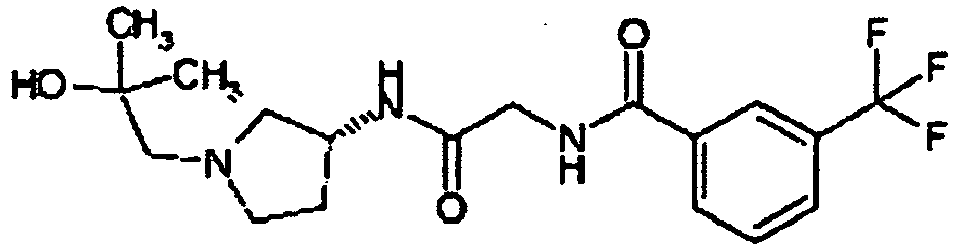
- 700 mg (57%) target compound as yellow liquid were yielded using same method as manufacturing example 6 with 1.00 g (3.17 mmol)
N-(pyrrolidine-(3R)-yl-carbamoylmethyl)-3-trifluoromethylbe nzamide described in manufacturing example 3, 1.32 g (9.55 mmol, 3.0 eq.) potassium carbonate and 690 mg (9.57 mmol, 3.0 eq.) isobutylene oxide.
1H NMR(400MHz,DMSO-d6) 1.08(6H,s), 1.50-1.60(1H,m), 1.99-2.09(1H,m), 2.28-2.37(2H,m), 2.45-2.53(2H,m), 2.69-2.80(2H,m), 3.88(2H,d), 4.05(1H,s), 4.11-4.20(1H,m), 7.74(1H,t), 7.92(1H,d), 8.04(1H,d), 8.18(1H,d), 8.23(1H,s), 8.99(1H,t) -

- 500 mg (2.63 mmol) 1-benzoylpiperazine and 1.10 g (7.96 mmol, 3.0 eq.) potassium carbonate were suspended to 20 ml acetonitrile at room temperature. After adding 570 mg (7.90 mmol, 3.0 eq.) isobutylene oxide, it was heated at reflux and stirred overnight. After cooling to room temperature and adding 30 ml purified water, it was extracted twice with 30 ml ethylacetate. After collecting the organic layer and drying with anhydrous magnesium sulfate, it was concentrated with decompression. The obtained residue was purified by chromatography using silicagel (mobile phase: dichloromethane/methanol= 20:1) and 276 mg (40%) target compound as light-yellow solid were yielded.
1H NMR (400MHz, DMSO-d6) 1.10(6H,s), 2.23(2H,s), 2.43-2.52(2H,m), 2.53-2.62(2H,m), 3.35-3.45(2H,m), 3.55-3.65(2H,m), 4.13(1H,s), 7.35-7.38(2H,m), 7.43-7.46(3H,m) -

- 0.10 g (0.53 mmol) 1-benzoylpiperazine and potassium carbonate 0.22 g (1.58 mmol, 3.0 eq.) were added to 5 ml acetonitrile and 0.05 g (0. 53 mmol, 1.0 eq.) chloroacetone were added dropwise slowly at room temperature. After mixing for one hour, 5 ml purified water were added, and the reaction mixture was extracted with 10 ml ethylacetate three times. After collecting organic layer, drying with anhydrous magnesium sulfate, and concentrating with decompression, residues obtained were purified with silicagel chromatography (mobile phase: dichloromethane/methnol=10:1) and 0.11 g (83%) target compound as yellow syrup were yielded.
1H NMR(400MHz,CDCl3) 2.18(3H,s), 2.41-2.69(4H,m), 3.27(2H,s), 3.42-3.54(2H,m), 3.81-3.93(2H,m), 7.40-7.46(5H,m) -

- 0.05 g(73%) target compound as yellow syrup were yielded on the same method as manufacturing example 10 using 0.05 g (0.26 mmol) 1-benzoylpiperazine, 0.11 g (0.79 mmol, 3.0 eq.) potassium carbonate, 0.03 g (0.26 mmol, 1.0 eq.) 3-chloro-2-butanon.
1H NMR(400MHz,CDCl3) 1.17(3H,d), 2.25(3H,s), 2.38-2.72(4H,m), 3.20 (1H,q), 3.38-3.53(2H,m), 3.74-3.89(2H,m), 7.40-7.48(5H,m) -

- 2.00 g (10.74 mmol) tert-butyl 1-piperazinecarboxylate, 1.30 g (12.89 mmol, 1.2 eq.) triethylamine were dissolved into 25 ml dichloromethan under argon gas. After cooling to 3°C, 1.33 g (11.81 mmol, 1.1 eq.) chloroacetyl chloride were diluted with 5 ml dichloromethane and added dropwise slowly into reaction solution. After stirring at 3°C for 1 hour, 20 ml purified water were added, the organic layer was separated and the aqueous layer was extracted once with 40 ml dichloromethane again. The organic layer was collected, dried with magnesium sulfate and concentrated with decompression. Purifying residues by chromatography using silicagel, 2.00 g (71%) target compound as yellow syrup were yielded.
1H NMR(400MHz,CDCl3) 1.48(9H,s), 3.45(2H,t), 3.51(4H,s), 3.61(2H,t), 4.09(2H,s) -

- 1.00 g (3.17 mmol) N-(pyrrolidine-(3R)-yl-carbamoylme thyl)-3-trifluoromethylbenzamide described in manufacturing example 3 and 1.32 g (9.52 mmol, 3.0 eq.) potassium carbonate were added into 25 ml acetonitrile and 0.83 g (3.17 mmol, 1.0 eq.) tert-butyl 4-(2-chloroacetyl)piperazine-1-carboxyl ate described in manufacturing example 12 were diluted with 5 ml acetonitrile and added dropwise slowly at room temperature into reaction mixture. After heating from room temperature to 80°C and stirring for 2 hours, 25 ml purified water were added and the reaction mixture was extracted with 25 ml ethylacetate three times. After collecting the organic layer, drying with anhydrous magnesium sulfate, and concentrating with decompression, 1.12 g (65%) target compound as white solid were yielded by purifying residues with chromatography on silicagel (mobile phase: dichloromethane/methanol=10:1).
1H NMR(400MHz,CDCl3) 1.48(9H,s), 1.72-1.81(1H,m), 2.17-2.29(1H,m), 2.52-2.62(1H,m), 2.73-2.82(1H,m), 2.85-2.95(1H,m), 3.00(1H,q), 3.39(2H,d), 3.40-3.46(4H,m), 3.47-3.55(4H,m), 4.11-4.23(2H,m), 4.46-4.52(1H,m), 7.27-7.36(1H,m), 7.44(1H,d), 7.59(1H,t), 7.77(1H,d), 8.03(1H,d), 8.13(1H,s) -

- 1.12 g (2.07 mmol) N-{[1-(2-(4-tert-butoxycarbonylpip erazine-1-yl)-2-oxo-ethyl)-pyrrolidine-(3R)-yl-carbamoyl]-m ethyl}-3-trifluoromethylbenzamide described in manufacturing example 13 were dissolved into 5 ml ethanol saturated with hydrochloric acid. After stirring for 1.5 hour at room temperature, decompression, concentration, and drying overnight under high vacuum condition, 0.93 g (94%) target compound as yellow syrup were yielded.
MS (M+1)+ 478.7
The present invention was more specifically illustrated by following example. But range of the present invention was not defined by such illustration. -

- 50 mg (0.11 mmol) N-{[1-(2-(piperazine-1-yl)ethyl)-pyrrolid ine-(3R)-yl-carbamoyl]-methyl}-3-trifluoromethylbenzamide hydrochloride described in manufacturing example 5, 40 mg (0.32 mmol, 3.0 eq.) N,N-diisopropylethylamine and 10 mg (0.11 mmol, 1.0 eq.) phenyl isocianate were dissolved into 5 ml dichloromethane under argon gas. After stirring for 2 hours at room temperature, adding purified water 10 ml and separating the organic layer, the aqueous layer was extracted once with 10 ml dichloromethane again. The organic layer was collected, dried with anhydrous magnesium sulfate and concentrated with decompression. 50 mg (67%) target compound as white solid were yielded by purifying residues with chromatography using silicagel (mobile phase: dichloromethane/methanol= 10:1).
1H NMR(400MHz,CDCl3) 1.67-1.78(1H,m), 2.28-2.40(2H,m), 2.48-2.59(7H,m), 2.60-2.78(2H,m), 2.84(1H,d), 3.03-3.12(1H,m), 3.45-3.57(4H,m), 4.05-4.20(2H,m), 4.47-4.52(1H,m) 6.60(1H,s), 7.05(1H,d) 7.23(2H,d), 7.32(1H,d), 7.32-7.36(1H,m), 7.58(1H,t), 7.77(1H,d), 8.01(1H,d), 8.11(1H,s) -

- 45 mg (75%) target compound as white solid were yielded on the same method as described in example 1 using 50 mg (0.11 mmol) N-{[1-(2-(piperazine-1-yl)ethyl)-pyrrolidine-(3 R)-yl-carbamoyl]-methyl}-3-trifluoromethylbenzamide hydrochloride described in manufacturing example 5, 40 mg (0.32 mmol, 3.0 eq.) N,N-diisopropylethylamine, and 14 mg (0.11 mmol, 1.0 eq.) isocyanate m-tolylester.
1H NMR(400MHz,CDCl3) 1.63-1.75 (1H,m), 2.23-2.30(2H,m), 2.32(3H,s), 2.51-2.60(7H,m), 2.62-2.73(2H,m), 2.79(1H,d), 3.02(1H,t), 3.51(4H,t), 4.08-4.15(2H,m), 4.47-4.55(1H,m), 6.37(1H,s), 6.74(1H,d), 6.86(1H,d), 7.11(1H,d), 7.14-7.21(2H,m), 7.23(1H,s), 7.59(1H,t), 7.78(1H,d), 8.01(1H,d), 8.11(1H,s) -

- 50 mg (83%) target compound as white solid were yielded the same method as described in example 1 using 50 mg (0.11 mmol) N-{[1-(2-(piperazine-1-yl)ethyl)-pyrrolidine-(3R)-yl-carbam oyl]-methyl}-3-trifluoromethylbenzamide hydrochloride described in manufacturing example 5, 40 mg (0.32 mmol, 3.0 eq.) N,N-diisopropylethylamine, and 17 mg (0.11 mmol, 1.0 eq.) isocyanate 4-chlorophenyl ester.
1H NMR(400MHz,CDCl3) 1.67-1.78(1H,m), 2.28-2.40(2H,m), 2.48-2.59(7H,m), 2.60-2.78(2H,m), 2.84(1H,d), 3.03-3.12(1H,m), 3.45-3.57(4H,m), 4.05-4.20(2H,m), 4.47-4.52(1H,m) 6.60(1H,s), 7.05(1H,d), 7.23(2H,d), 7.32(1H,d), 7.33-7.36(1H,m), 7.58(1H,t), 7.77(1H,d), 8.01(1H,d), 8.11(1H,s) -

- After 50 mg (0.11 mmol) N-{[1-(2-(piperazine-1-yl)eth yl)-pyrrolidine-(3R)-yl-carbamoyl]-methyl}-3-trifluoromethy lbenzamide hydrochloride described in manufacturing example 5 and 60 mg (0.43 mmol, 4.0 eq.) potassium carbonate were suspended into 3 ml acetonitrile at room temperature, 10 mg (0.11 mmol, 1.0 eq.) methyl chloroformate were diluted into 1 ml acetonitrile and slowly added. After heating with reflux and stirring for one hour, the reaction mixture was concentrated with decompression. After adding 10 ml purified water to obtained residues, it was extracted twice with 10 ml ethylacetate. The organic layer was collected, dried with anhydrous magnesium sulfate and concentrated with decompression. The obtained residues were purified by chromatography using silicagel (mobile phase: dichloromethane/methanol=5:1) and 40 mg (80%) target compound as light-white solid were yielded.
1H NMR(400MHz,CDCl3) 1.68-1.79 (1H,m) , 2.29-2.40(2H,m), 2.41-2.49(4H,m), 2.53-2.57(2H,m), 2.58-2.64(1H,m), 2.68-2.77(2H,m), 2.80-2.91(1H,m), 3.05-3.17(1H,m), 3.44-3.56(4H,m), 3.70(3H,s), 4.06-4.18(2H,m), 4.47-4.58(1H,m), 6.62-6.84(1H,m), 7.12-7.21(1H,m), 7.60(1H,t), 7.78(1H,d), 8.04(1H,d), 8.13(1H,s) -

- 40 mg (74%) target compound as white solid were yielded on the same method as example 4 using 50 mg (0.11 mmol) N-{[1-(2-(piperazine-1-yl)ethyl)-pyrrolidine-(3R)-yl-carbam oyl]-methyl}-3-trifluoromethylbenzamide hydrochloride described as manufacturing example 5, 60 mg (0.43 mmol, 4.0eq.) potassium carbonate, and 10 mg (0.11 mmol, 1.0 eq.) ethyl chloroformate.
1H NMR(400MHz,CDCl3) 1.26(3H,t), 1.63-1.78(1H,m), 2.23-2.38(2H,m), 2.41-2.49(4H,m), 2.50-2.57(2H,m), 2.58-2.73(3H,m), 2.80(1H,d), 2.97-3.08(1H,m), 3.42-3.53(4H,m), 4.11-4.20(4H,m), 4.48-4.53(1H,m), 7.17(1H,d), 7.41-7.48(1H,m), 7.57(1H,t), 7.76(1H,d), 8.02(1H,d), 8.12(1H,s) -

- 80 mg (70%) target compound as white solid were yielded on the same method as example 4 using 100 mg (0.22 mmol) N-{[1-(2-(piperazine-1-yl)ethyl)-pyrrolidine-(3R)-yl-carbam oyl]-methyl}-3-trifluoromethylbenzamide hydrochloride described in manufacturing example 5, 120 mg (0.86 mmol, 4.0 eq.) potassium carbonate, and 30 mg (0.22 mmol, 1.0 eq.) benzoyl chloride.
1H NMR(400MHz,CDCl3) 1.57-1.72(1H,m), 2.08-2.21(1H,m), 2.22-2.36(2H,m), 2.37-2.46(1H,m), 2.48-2.67(8H,m), 2.89(1H,t), 3.36-3.52(2H,m), 3.71-3.88(2H,m), 4.11(2H,d), 4.37-4.51(1H,m), 6.64(1H,d), 7.32-7.47(6H,m), 7.58(1H,t), 7.77(1H,d), 8.00(1H,d) 8.11(1H,s
MS (M+1)+ 532.2 -

- After 50 mg (0.11 mmol) N-{[1-(2-(piperazine-1-yl)eth yl)-pyrrolidine-(3R)-yl-carbamoyl]-methyl}-3-trifluoromethy lbenzamide hydrochloride described in manufacturing example 5 and 60 mg (0.43 mmol, 4.0 eq.) potassium carbonate were diluted with 3 ml acetonitrile at room temperature, 18 mg (0.12 mmol, 1.1 eq.) o-toluyl chloride were diluted into 1 ml acetonitrile and added slowly. After heating with reflux and stirring for one hour, the reaction mixture was concentrated with decompression. After adding 10 ml purified water to obtained residues, it was extracted twice with 10 ml ethylacetate. After collecting the organic layer and drying with anhydrous magnesium sulfate, it was concentrated with decompression. 42 mg (71%) target compound as light-white solid were yielded by purifying obtained residues with chromatography using silicagel (mobile phase: dichloromethane/methanol=5:1).
1H NMR(400MHz,DMSO-d6) 1.50-1.60(1H,m), 2.00-2.10(1H,m), 2.19(3H,s), 2.22-2.55(10H,m), 2.60-2.70(2H,m), 3.07-3.11(2H,m), 3.58-3.66(2H,m), 3.84(2H,d), 4.10-4.19(1H,m) 7.11(1H,d) 7.19-7.31(3H,m), 7.72(1H,t), 7.91(1H,d), 8.11-8.18(2H,m), 8.21(1H,s), 8.99(1H,t) -

- 45 mg (77%) target compound as yellow solid were yielded on the same method as example 7 using 50 mg (0.11 mmol) N-{[1-(2-(piperazine-1-yl)ethyl)-pyrrolidine-(3R)-yl-carbam oyl]-methyl}-3-trifluoromethylbenzamide hydrochloride described in manufacturing example 5 and 60 mg (0.43 mmol, 4.0 eq.) potassium carbonate and 18 mg (0.12 mmol, 1.1 eq.) m-toluyl chloride.
1H NMR(400MHz,DMSO-d6) 1.08-1.18(1H,m), 1.20-1.30(1H,m) 1.50-1.60(1H,m), 2.00-2.10(1H,m) 2.32(3H,s), 2.35-2.46(8H,m), 2.58-2.68(2H,m), 3.23-3.33(2H,m), 3.52-3.62(2H,m), 3.84(2H,d), 4.10-4.20(1H,m), 7.12-7.17(2H,m), 7.22-7.32(2H,m), 7.73(1H,t), 7.91(1H,d), 8.10-8.18(2H,m), 8.21(1H,s), 8.99(1H,t) -

1H NMR(400MHz,DMSO-d6) 1.08-1.30(2H,m), 1.50-1.60(1H,m), 2.00-2.10(1H,m) 2.32(3H,s), 2.33-2.42(8H,m), 2.58-2.68(2H,m), 3.25-3.35(2H,m), 3.50-3.60(2H,m), 3.84(2H,d), 4.10-4.20(1H,m), 7.20-7.30(4H,m), 7.73(1H,t), 7.91(1H,d), 8.11-8.18(2H,m), 8.21(1H,s), 8.99(1H,t) -

- 33 mg (55%) target compound as light-white solid were yielded on the same method as example 7 using 50 mg (0.11 mmol) N-{[1-(2-(piperazine-1-yl)ethyl)-pyrrolidine-(3R)-yl-carbam oyl]-methyl}-3-trifluoromethylbenzamide hydrochloride described in manufacturing example 5, 60 mg (0.43 mmol, 4.0 eq.) potassium carbonate and 19 mg (0.12 mmol, 1.1 eq.) 4-fluorobenzoyl chloride.
1H NMR(400MHz,DMSO-d6) 1.50-1.60(1H,m), 2.00-2.10(1H,m), 2.30-2.50(10H,m), 2.60-2.68(2H,m), 3.25-3.35(2H,m), 3.50-3.60(2H,m), 3.84(2H,d), 4.10-4.20(1H,m), 7.22-7.30(2H,m), 7.41-7.48(2H,m), 7.73(1H,t), 7.91(1H,d), 8.12(1H,d), 8.16(1H,d), 8.21(1H,s), 8.98(1H,t) -

- 42 mg (70%) target compound as light-white solid were yielded on the same method as example 7 using 50 mg (0.11 mmol) N-{[1-(2-(piperazine-1-yl)ethyl)-pyrrolidine-(3R)-yl-carbam oyl]-methyl}-3-trifluoromethylbenzamide hydrochloride described in manufacturing example 5, 60 mg (0.43 mmol, 4.0 eq.) potassium carbonate and 20 mg (0.12 mmol, 1.1 eq.)4-cyanobenzoyl chloride.
1H NMR(400MHz,DMSO-d6) 1.52-1.62(1H,m), 2.00-2.10(1H,m), 2.30-2.55(10H,m), 2.60-2.70(2H,m), 3.19-3.25(2H,m), 3.58-3.63(2H,m), 3.84(2H,d), 4.10-4.20(1H,m), 7.55(2H,d), 7.73(1H,t), 7.88-7.94(3H,m), 8.12-8.18(2H,m), 8.21(1H,s), 8.99(1H,t) -

- 48 mg (79%) target compound as white solid were yielded on the same method as example 7 using 50 mg (0.11 mmol) N-{[1-(2-(piperazine-1-yl)ethyl)-pyrrolidine-(3R)-yl-carbam oyl]-methyl}-3-trifluoromethylbenzamide hydrochloride described in manufacturing example 5, 60 mg (0.43 mmol, 4.0 eq.) potassium carbonate and 20 mg (0.12 mmol, 1.1 eq.)4-ethylbenzoyl chloride.
1H NMR(400MHz,DMSO-d6) 1.08-1.28(5H,m), 1.50-1.60(1H,m), 2.00-2.10(1H,m) 2.32-2.47(10H,m), 2.57-2.68(4H,m), 3.50-3.60(2H,m), 3.84(2H,d), 4.10-4.19(1H,m), 7.23-7.32(4H,m), 7.73(1H,t), 7.84(1H,d), 7.91(1H,d), 8.16(1H,d), 8.21(1H,s), 8.99(1H,t) -

- 34 mg (55%) target compound as light-white solid were yielded on the same method as example 7 using 50 mg (0.11 mmol) N-{[1-(2-(piperazine-1-yl)ethyl)-pyrrolidine-(3R)-yl-carbam oyl]-methyl}-3-trifluoromethylbenzamide hydrochloride described in manufacturing example 5, 60 mg (0.43 mmol, 4.0 eq.) potassium carbonate and 21 mg (0.12 mmol, 1.1 eq.) benzensulfonyl chloride.
1H NMR(400MHz,DMSO-d6) 1.08-1.30(2H,m), 1.48-1.56(1H,m), 1.96-2.06(1H,m), 2.25-2.60(10H,m), 2.80-2.90(4H,m), 3.82(2H,d), 4.08-4.15(1H,m), 7.62-7.68(2H,m), 7.70-7.76(4H,m), 7.91(1H,d), 8.05-8.13(1H,m) 8.15(1H,d) 8.20(1H,s), 8.94-9.00(1H,m) -

- 42 mg (81%) target compound as yellow solid were yielded on the same method as example 7 using 50 mg (0.11 mmol) N-{[1-(2-(piperazine-1-yl)ethyl)-pyrrolidine-(3R)-yl-carbam oyl]-methyl}-3-trifluoromethylbenzamide hydrochloride described in manufacturing example 5, 60 mg (0.43 mmol, 4.0 eq.) potassium carbonate and 11 mg (0.12 mmol, 1.1 eq.) propionyl chloride.
1H NMR(400MHz,DMSO-d6) 0.95(3H,t), 1.50-1.60(1H,m), 2.00-2.10(1H,m), 2.25-2.40(10H,m), 2.48-2.58(2H,m), 2.58-2.68(2H,m), 3.32-3.42(4H,m), 3.84(2H,d), 4.10-4.20(1H,m), 7.73(1H,t), 7.91(1H,d), 8.12(1H,d), 8.16(1H,d), 8.21(1H,s), 8.99(1H,t) -

- 0.042 g (75%) target compound as yellow solid were yielded on the same method as example 7 using 50 mg (0.11 mmol) N-{[1-(2-(piperazine-1-yl)ethyl)-pyrrolidine-(3R)-yl-carbam oyl]-methyl}-3-trifluoromethylbenzamide hydrochloride described in manufacturing example 5, 60 mg (0.43 mmol, 4.0 eq.) potassium carbonate and 14 mg (0.11 mmol, 1.1 eq.) benzyl chloride.
1H NMR(400MHz,CDCl3) 1.63-1.79 (1H,m), 2.26-2.39(2H,m), 2.40-2.57(10H,m), 2.61-2.77(3H,m), 2.91(1H,d), 3.08-3.14(1H,m) 3.51(2H,s), 4.08-4.17(2H,m), 4.50-4.58(1H,m), 7.23-7.35(6H,m), 7.39(1H,d), 7.58(1H,t), 7.77(1H,d), 8.03(1H,d), 8.13(1H,s) -

- 100 mg (0.32 mmol) N-(pyrrolidine-(3R)-yl-carbamoylmethyl)-3-trifluoromethylbenzamide described in manufacturing example 3 and 80 mg (0.32 mmol, 1.0 eq.) 1-(4-benzoylpiperazine-1-y 1)propane-2-on described in manufacturing example 10 were dissolved into 10 ml dichloroethane. After 200 mg (0.95 mmol, 3.0 eq.) sodium triacetoxyborohydride were added and stirred 5 hours at room temperature, 50 ml sodium bicarbonate saturated aqueous solution were added and the reaction mixture was extracted with 30 ml ethylacetate. After separating and drying the organic layer with anhydrous magnesium sulfate, it was purified by chromatography using silicagel (mobile phase: dichloromethane/methanol=25:1) and 120 mg (70%) target compound as pale yellow solid was yielded.
1H NMR(400MHz,DMSO-d6) 1.00-1.09(3H,m), 1.48-1.60 (1H,m) , 1.96-2.10(1H,m), 2.12-2.23(1H,m), 2.24-2.55(10H,m), 2.65-2.81(2H,m), 3.53-3.66(2H,m), 3.87(2H,d), 4.07-4.17(1H,m), 7.34-7.38(2H,m), 7.42-7.48(3H,m), 7.74(1H,t), 7.92(1H,d), 8.03-8.12(1H,m), 8.17(1H,d) 8.22(1H,s), 8.93-9.03(1H,m)
MS (M+1)+ 546.4 -

- 50 mg (0.19 mmol) 3-(4-benzoylpiperazine-1-yl)butane-2-on described in manufacturing example 11 and 120 mg (0.38 mmol, 2.0 eq.) N-(pyrrolidine-(3R)-yl-carbamoylmethyl )-3-trifluoromethylbenzamide described in manufacturing example 3 were dissolved to 5 ml dichloroethane. After adding 200 mg (0.96 mmol, 5.0 eq.) sodium triacetoxyborohydride and stirring for 24 hours at room temperature, 25 ml sodium bicarbonate saturated aqueous solution were added and the reaction mixture was extracted with 15 ml ethylacetate. After separating and drying the organic layer with anhydrous magnesium sulfate, 40 mg (37%) target compound as pale yellow solid were yielded by purifying with chromatography (mobile phase: dichloromethane/methanol=25:1), using silicagel.
1HNMR(400MHz,DMSO-d6) 0.92(3H,d), 0.96(3H,d), 1.48-1.62(1H,m), 1.95-2.08(1H,m), 2.31-2.48(9H,m), 2.53-2.81(3H,m), 3.48-3.67(2H,m), 3.87(2H,d), 4.08-4.17(1H,m), 7.34-7.39(2H,m), 7.43-7.48(3H,m), 7.75(1H,t), 7.93(1H,d), 7.98(1H,dd), 8.18(1H,d), 8.22(1H,s), 9.00(1H,t)
MS (M+1)+ 560.6 -

- 400 mg (1.07 mmol) N-{[1-(2-hydroxypropyl)-pyrrolidin e-(3R)-yl-carbamoyl]-methyl}-3-trifluoromethylbenzamide and 0.18 ml(1.29 mmol, 1.2 eq.)triethylamine described in manufacturing example 6 were dissolved to 20 ml dichloromethane and cooled to 3°C under argon gas. 135 mg (1.18 mmol, 1.1 eq.) methansulfonyl chloride were slowly added to reaction solution and stirred at same temperature for 30 min. 20 ml purified water were added and then the organic layer was separated and concentrated with decompression. After 10 ml acetonitrile were added to obtained residues and dissolved them, 444 mg (3.21 mmol) potassium carbonate and 202 mg (1.06 mmol) 1-benzoylpiperazine were added. After stirring for 2 hours at room temperature, 15 ml saturated sodium chloride aqueous solution were added to the reaction solution and was extracted twice with 15 ml ethylacetate. After the organic layer was collected and dried with anhydrous magnesium sulfate, it was concentrated with decompression. 30 mg (51%) target compound as light-yellow solid were yielded by purifying obtained residues with chromatography using silicagel (mobile phase: dichloromethane/methanol=5:1 and 1:1).
1H NMR(400MHz,DMSO-d6) 1.05(3H,s), 1.55-1.65(1H,m), 2.00-2.10(1H,m), 2.15-2.25(1H,m), 2.28-2.55(9H,m), 2.70-2.85(2H,m), 3.17(1H,d), 3.54-3.65(2H,m), 3.87(2H,d), 4.10-4.20(1H,m), 7.35-7.40(2H,m), 7.40-7.47(3H,m), 7.74(1H,t), 7.92(1H,d), 8.14(1H,s) 8.18(1H,d), 8.23(1H,s), 9.01(1H,t)
MS (M)+ 545.6 -

- 100 mg (0.38 mmol) 1-(4-benzoylpiperazine-1-yl)butane -2-on and 360 mg(1.15 mmol, 3.0 eq.) N-(pyrrolidine-(3R)-yl -carbamoylmethyl)-3-trifluoromethyl benzamide described in manufacturing example 3 were dissolved into 15 ml dichloroethane. After 490 mg (2.31 mmol, 6.0 eq.) sodium triacetoxyborohydride were added and stirred for 3 hours at room temperature, 50 ml potassium bicarbonate saturated aqueous solution were added and reaction mixture was extracted with 50 ml ethylacetate. After the organic layer was separated and dried with anhydrous magnesium sulfate, 150 mg (70%) target compound as pale yellow solid were yielded by purifying with chromatography using silicagel (mobile phase: dichloromethane/methanol =25:1).
1H NMR(400MHz,DMSO-d6) 0.84(3H,t), 1.42-1.61(3H,m), 1.98-2.08(1H,m), 2.22-2.29(1H,m), 2.30-2.52(10H,m), 2.63-2.83(2H,m), 3.53-3.67(2H,m), 3.87(2H,d), 4.08-4.19(1H,m), 7.34-7.40(2H,m), 7.42-7.48(3H,m), 7.74(1H,t), 7.92(1H,d), 8.02(1H,d), 8.18(1H,d), 8.22(1H,s), 8.99(1H,t)
MS (M+1)+ 560.7 -

- 21 mg (35%) target compound as yellow solid were yielded on the same method as example 18 using 415 mg (1.07 mmol) N-{[1-(2-hydroxybutyl)-pyrrolidine-(3R)-yl-carbamoyl]-methy 1}-3-trifluoromethylbenzamide described in manufacturing example 7.
1H NMR(400MHz,DMSO-d6) 0.84(3H,t), 1.40-1.52(2H,m), 1.98-2.08(1H,m), 2.22-2.30(1H,m), 2.30-2.58(10H,m), 2.65-2.86(3H,m), 3.50-3.66(2H,m), 3.87(2H,d), 4.10-4.18(1H,m), 7.34-7.48(5H,m), 7.74(1H,t), 7.92(1H,d), 8.05(1H,d), 8.18(1H,d), 8.23(1H,s), 9.90(1H,t)
MS (M+1)+ 560.8 -

- 27 mg (45%) target compound as light-yellow solid were yielded on the same method as example 18 using 415 mg (1.07 mmol) N-{[1-(2-hydroxy-2-methylpropyl)-pyrrolidine-(3R)-yl-carbamoyl]-methyl}-3-fluoromethylbenzamide described in manufacturing example 8.
1H NMR(400MHz,DMSO-d6) 0.80-0.90(1H,m), 0.92-1.00(6H,m), 1.15-1.25(1H,m), 1.51-1.60(1H,m), 1.92-2.08(1H,m), 2.35-2.62(6H,m), 2.65-2.88(2H,m), 3.20-3.32(2H,m), 3.50-3.62(2H,m), 3.85-3.90(2H,m), 4.00-4.18(1H,m) 7.35-7.40(2H,m), 7.40-7.48(3H,m), 7.74(1H,t), 7.93(1H,d), 8.02(1H,d), 8.18(1H,d), 8.23(1H,s), 8.98-9.03(1H,m) -

- 60 mg (0.23 mmol) (4-(2-hydroxy-2-methylpropyl)pipera -zine-1-yl)phenylmethaone described in manufacturing example 9 and 28 mg (0.25 mmol, 1.1 eq.) triethylamine were dissolved into 5 ml dichloromethane and cooled to 3°C under argon gas. 29 mg (0.25 mmol, 1.1 eq.) methansulfonyl chloride were slowly added to reaction solution and then stirred for 1.5 hours at same temperature. 5 ml purified water were added and then the organic layer was separated and concentrated with decompression. After 5 ml acetonitrile were added to the obtained residues and dissolved them, 76 mg (0.55 mmol) potassium carbonate and 58 mg (0.18 mmol)
- N-(pyrrolidine-(3R)-yl-carbamoylmethyl)-3-fluoromethylbenza mide described in manufacturing example 3 were added. After stirring for 3 hours at room temperature, 10 ml saturated sodium chloride aqueous solution were added to the reaction solution and it was extracted twice with 10 ml ethylacetate. The organic layer was collected and dried with anhydrous magnesium sulfate and then concentrated with decompression. 57 mg (45%) target compound as light-yellow solid were yielded by purifying obtained residues with chromatography using silicagel (mobile phase: dichloromethane/methanol= 5:1 and 1:1).
1H NMR(400MHz,DMSO-d6) 0.92-1.00(6H,m), 1.50-1.60(1H,m), 1.92-2.08(1H,m), 2.30-2.60(8H,m), 2.64-2.78(1H,m), 2.80-2.88(1H,m), 3.30-3.62(4H,m), 3.83-3.90(2H,m), 4.05-4.18(1H,m) 7.35-7.40(2H,m), 7.40-7.47(3H,m), 7.74(1H,t), 7.92(1H,d), 8.04(1H,d), 8.18(1H,d), 8.23(1H,s), 9.06-9.13(1H,m) -

- 100 mg (0.37 mmol) 3-(4-(3-chlorophenyl)piperazine-1-yl)butane-2-on and 240 mg (0.75 mmol, 2.0 eq.) N-(pyrrolidi -ne-(3R)-yl-carbamoylmethyl)-3-trifluoromethylbenzamide described in manufacturing example 3 were dissolved into 10 ml dichloroethane. 480 mg (2.25 mmol, 6.0 eq.) sodium triacetoxyborohydride were added and stirred for 7 hours at room temperature, 30 ml potassium bicarbonate saturated aqueous solution were added and it was extracted with 20 ml ethylacetate. The organic layer was separated and dried with anhydrous magnesium sulfate, 140 mg (66%) target compound as white solid were yielded by purifying with chromatography using silicagel (mobile phase: dichloromethane/methanol=25:1).
1H NMR(400MHz,DMSO-d6) 0.91-1.05(6H,m), 1.48-1.64(1H,m), 1.97-2.19(1H,m), 2.32-2.41(1H,m), 2.53-2.85(9H,m), 3.05-3.20(4H,m), 3.87(2H,d), 4.07-4.20(1H,m), 6.76(1H,d), 6.87(1H,d), 6.91(1H,s), 7.19(1H,t), 7.74(1H,t), 7.93(1H,d), 7.97-8.03(1H,m), 8.18(1H,d), 8.23(1H,s), 9.02(1H,s) -

- 130 mg (55%) target compound as white solid were yielded on the same method as example 23 using 100 mg (0.46 mmol) 1-(4-phenylpiperazine-1-yl)propane-2-on and 290 mg 0.92 mm ol, 2.0 eq.) N-(pyrrolidine-(3R)-yl-carbamoylmethyl)-3-trif -luoromethylbenzamide described in manufacturing example 3, 580 mg (2.75 mmol, 6.0 eq.) sodium triacetoxyborohydride. 1H NMR(400MHz,DMSO-d6) 1.06(3H,t), 1.53-1.62(1H,m), 2.00-2.09(1H,m), 2.17-2.25(1H,m), 2.41-2.62(8H,m), 2.70-2.83(2H,m), 3.07-3.15(4H,m), 3.87(2H,d), 4.10-4.20(1H,m) 6.77(1H,t), 6.91(2H,d), 7.20(2H,t), 7.74(1H,t), 7.93(1H,d), 8.09(1H,d), 8.18(1H,d) 8.23(1H,s), 8.98(1H,t)
-

- 100 mg (43%) target compound as white solid were yielded on the same method as example 23 using 100 mg (0.45 mmol) 1-(4-cyclohexylpiperazine-1-yl)propane-2-on and 280 mg(0.89 mmol, 2.0 eq.) N-(pyrrolidine-(3R)-yl-carbamoylmethyl)-3-t rifluoromethylbenzamide described in manufacturing example 3, 570 mg (2.67 mmol, 6.0 eq.) sodium triacetoxyborohydride.
1H NMR(400MHz,DMSO-d6) 1.00(3H,t), 1.03-1.21(6H,m), 1.50-1.61(2H,m), 1.68-1.79(4H,m), 2.01-2.05(1H,m), 2.06-2.12(1H,m) 2.13-2.19(1H,m), 2.30-2.41(4H,m), 2.42-2.51(7H,m), 2.65-2.82(2H,m), 3.87(2H,d), 4.08-4.17(1H,m), 7.74(1H,t) 7.93(1H,d), 8.06(1H,d), 8.18(1H,d), 8.23(1H,s), 8.97(1H,t) -

- 100 mg (0.19 mmol) N-{[1-(2-(piperazine-1-yl)ethyl)-pyrrol! dine-(3R)-yl-carbamoyl]-methyl}-3-trifluoromethylbenzamide hydrochloride and 129 mg (0.93 mmol, 5.0 eq.) potassium carbonate described in manufacturing example 5 were suspended into 3 ml acetonitrile. 13 mg (0.19 mmol) 2-ethyloxirane were added, refluxed at 80°C overnight, stirred and then cooled to room temperature. 15 ml purified water were added and then the reaction mixture was extracted three times with 15 ml ethylacetate. The organic layer was collected, dried with anhydrous magnesium sulfate and concentrated with decompression. 73 mg (78%) target compound as white solid were yielded by purifying obtained residues with chromatography using silicagel. (mobile phase: dichloromethane/methanol= 1:1)
MS (M+1)+ 500.6 -

- 62 mg (67%) target compound as white solid were yielded on the same method as example 26 using 100 mg (0.19 mmol) N-{[1-(2-(piperazine-1-yl)ethyl)-pyrrolidine-(3R)-yl-carbam oyl]-methyl}-3-trifluoromethylbenzamide hydrochloride described in manufacturing example 5, 129 mg (0.93 mmol, 5.0 eq.) potassium carbonate and 13 mg (0.19 mmol) 2,2-dimethyloxirane.
MS (M+1)+ 500.6 -

MS (M+1)+ 548.3 -

- 77 mg (71%) target compound as white solid were yielded on the same method as example 26 using 100 mg (0.19 mmol) N-{[1-(2-(piperazine-1-yl)ethyl)-pyrrolidine-(3R)-yl-carbam oyl]-methyl}-3-trifluoromethylbenzamide hydrochloride described in manufacturing example 5, 129 mg (0.93 mmol, 5.0 eq.) potassium carbonate and 23 mg (0.19 mmol) 2-(4-chlorophenyl)oxirane.
MS (M)+ 582.3 -

- 100 mg (0.21 mmol) N-{[1-(2-(piperazine-1-yl)-2-oxo-e thyl)-pyrrolidine-(3R)-yl-carbamoyl]-methyl}-3-trifluoromet hylbenzamide hydrochloride and 120 mg (0.83 mmol, 4.0 eq.) potassium carbonate described in manufacturing example 14 were suspended into 10 ml acetonitrile at room temperature and then 30 mg (0.21 mmol, 1.0 eq.) benzoylchloride diluted into 1 ml acetonitrile were slowly added. The reaction mixture was heated with reflux, stirred for one hour and then concentrated with decompression. 10 ml purified water were added to the obtained residues and then it was extracted twice with 10 ml ethylacetate. The organic layer was collected, dried with anhydrous magnesium sulfate, and concentrated with decompression. 70 mg (61%) target compound as white solid were yielded by purifying the obtained residues with chromatography using silicagel (mobile phase: dichloromethane/methanol= 25:1).
1H NMR(400MHz,DMSO-d6) 1.53-1.68(1H,m), 2.01-2.11(1H,m), 2.37-2.48(2H,m), 2.66(1H,d), 2.73(1H,t), 3.42-3.68(10H,m), 3.84(2H,d), 4.10-4.21(1H,m), 7.38-7.41(2H,m), 7.42-7.48(3H,m), 7.72(1H,t), 7.91(1H,t), 8.12(1H,d) 8.16(1H,d), 8.21(1H,s), 8.99(1H,t)
MS (M+1)+ 546.2 -

- 20 mg (34%) target compound as white solid were yielded on the same method as example 30 using 50 mg (0.10 mmol) N-{[1-(2-(piperazine-1-yl)-2-oxo-ethyl)-pyrrolidine-(3R)-yl -carbamoyl]-methyl}-3-trifluoromethylbenzamide hydrochloride described in manufacturing example 14, 60 mg (0.42 mmol, 4.0 eq.) potassium carbonate and 20 mg (0.10 mmol, 1.0 eq.) 4-methylbenzoyl chloride.
1H NMR(400MHz,DMSO-d6) 1.18(3H,t), 1.53-1.66(1H,m), 2.01-2.13(1H,m) 2.38-2.47(2H,m), 2.58-2.78(4H,m), 3.38-3.47(4H,m), 3.48-3.62(4H,m), 3.84(2H,d), 4.09-4.21(1H,m), 7.26(2H,d), 7.32(2H,d), 7.72(1H,t), 7.90(1H,d), 8.11(1H,d), 8.13(1H,d), 8.21(1H,s), 8.99(1H,t) -

- 20 mg (33%) target compound as white solid were yielded on the same method as example 30 using 50 mg (0.10 mmol) N-{[1-(2-(piperazine-1-yl)-2-oxo-ethyl)-pyrrolidine-(3R)-yl -carbamoyl]-methyl}-3-trifluoromethylbenzamide hydrochloride described in manufacturing example 14, 60 mg (0.42 mmol, 4.0 eq.) potassium carbonate and 20 mg (0.10 mmol, 1.0 eq.) 4-ethylbenzoyl chloride.
1H NMR(400MHz,DMSO-d6) 1.18(3H,t), 1.53-1.65(1H,m), 2.01-2.12(1H,m), 2.37-2.48(2H,m), 2.57-2.78(4H,m), 3.25-3.35(2H,m), 3.38-3.47(4H,m), 3.48-3.65(4H,m), 3.84(2H,d), 4.11-4.22(1H,m) 7.26(2H,d), 7.32(2H,d), 7.72(1H,t), 7.90(1H,d), 8.11(1H,d), 8.16(1H,d), 8.21(1H,s), 8.99(1H,t) -

- 25 mg (43%) target compound as white solid were yielded on the same method as example 30 using 50 mg (0.10 mmol) N-{[1-(2-(piperazine-1-yl)-2-oxo-ethyl)-pyrrolidine-(3R)-yl -carbamoyl]-methyl}-3-trifluoromethylbenzamide hydrochloride described in manufacturing example 14, 60 mg (0.42 mmol, 4.0 eq.) potassium carbonate and 20 mg (0.10 mmol, 1.0 eq.) 3-methylbenzoyl chloride.
1H NMR(400MHz,DMSO-d6) 1.62-1.75(1H,m), 2.05-2.18(1H,m), 2.34(3H,s), 2.54-2.64(2H,m), 2.68-2.97(4H,m), 3.42-3.80(8H,m), 3.87(2H,d), 4.16-4.28(1H,m), 7.20(1H,d), 7.23(1H,s), 7.27(1H,d), 7.34(1H,t), 7.74(1H,t), 7.92(1H,d), 8.18(2H,d), 8.23(1H,s), 9.04(1H,t) -

- 20 mg (34%) target compound as white solid were yielded on the same method as example 30 using 50 mg (0.10 mmol) N-{[1-(2-(piperazine-1-yl)-2-oxo-ethyl)-pyrrolidine-(3R)-yl -carbamoyl]-methyl}-3-trifluoromethylbenzamide hydrochloride described in manufacturing example 14, 60 mg (0.42 mmol, 4.0 eq.) potassium carbonate and 20 mg (0.10 mmol, 1.0 eq.) 2-methylbenzoyl chloride.
1H NMR(400MHz,DMSO-d6) 1.62-1.82(1H,m), 2.05-2.20(1H,m), 2.22(3H,s), 2.70-3.00(6H,m), 3.17-3.22(3H,m), 3.52-3.78(5H,m), 3.87-3.93(2H,m), 4.16-4.32(1H,m), 7.20-7.38(4H,m), 7.74(1H,t), 7.93(1H,t), 8.18(1H,d) 8.23(1H,s), 8.24-8.32(1H,m), 9.02-9.09(1H,m) -

- 40 mg (49%) target compound as white solid were yielded on the same method as example 30 using 50 mg (0.16 mmol) N-(pyrrolidine-(3R)-yl-carbamoylmethyl)-3-trifluoromethylbe nzamide described in manufacturing example 3, 90 mg (0.63 mmol, 4.0 eq.) potassium carbonate and 40 mg (0.16 mmol, 1.0 eq.) 2-chloro-1-(4-phenylpiperazine-1-yl)ethanone.
1H NMR(400MHz,DMSO-d6) 1.57-1.68(1H,m), 2.01-2.11(1H,m), 2.37-2.48(2H,m), 2.62-2.71(1H,m), 2.78(1H,t), 3.01-3.16(4H,m), 3.27-3.32(2H,m), 3.46-3.56(2H,m), 3.58-3.67(2H,m), 3.85(2H,d), 4.11-4.22(1H,m) 6.79(1H,t), 6.93(2H,d), 7.21(2H,t), 7.72(1H,t), 7.91(1H,d), 8.16-8.18(2H,m), 8.21(1H,s), 8.98-9.03(1H,m) -

- 40 mg (44%) target compound as white solid were yielded on the same method as example 30 using 50 mg (0.16 mmol) N-(pyrrolidine-(3R)-yl-carbamoylmethyl)-3-trifluoromethylbe nzamide described in manufacturing example 3, 90 mg (0.63 mmol, 4.0 eq.) potassium carbonate and 30 mg (0.16 mmol, 1.0 eq.) benzyl 4-(2-chloroacetyl)piperazine-1-carboxylate described in example 3.
1H NMR(400MHz,DMSO-d6) 1.54-1.65(1H,m), 2.01-2.10(1H,m), 2.38-2.43(1H,m), 2.44-2.47(1H,m), 2.62-2.70(1H,m), 2.73(1H,t), 3.26-3.34(4H,m), 3.38-3.45(4H,m), 3.46-3.53(2H,m), 3.85(2H,d), 4.12-4.18(1H,m), 5.08(2H,s), 7.28-7.37(5H,m), 7.72(1H,t), 7.90(1H,d), 8.13(1H,d), 8.16(1H,d), 8.22(1H,s), 9.01(1H,t) -

- 200 mg (0.56 mmol) N-{[1-(2-hydroxyethyl)-pyrrolidine -(3R)-yl-carbamoyl]-methyl}-3-trifluoromethylbenzamide and 68 mg (0.69 mmol, 1.2 eq.) triethylamine were dissolved into 10 ml dichloromethane and cooled to 3°C under argon gas. 70 mg (0.61 mmol, 1.1 eq.) methanesulfonyl chloride were slowly added to reaction solution and then stirred for one hour at the same temperature. 10 ml purified water were added and then the organic layer was separated, and concentrated with decompression. 10 ml acetonitrile were added to dissolve obtained residues and then 247 mg (1.78 mmol) potassium carbonate and 114 mg (0.45 mmol) 1-benzoyl-2,5-dimethylpipe razine hydrochloride were added. After stirring for 4 hours at room temperature, 20 ml saturated sodium chloride aqueous solution were added to reaction solution and was extracted twice with 20 ml ethylacetate. The organic layer was collected, dried with anhydrous magnesium sulfate, and concentrated with decompression. 159 mg (51%) target compound as light-yellow solid were yielded by purifying obtained residues with chromatography using silicagel (mobile phase: dichloromethane/methanol= 5:1 and 1:1).
MS (M+1)+ 560.4 - Preferred embodiments of the present invention have been described above, but these embodiments are only for illustrative purposes.
Claims (6)
- Compound having the following formula I


 wherein: R1 could be independently selected from groups consisting of hydrogen, C1-C3 alkyl, phenyl, benzyl, benzoyl, benzensulfonly, C1-C3 alkylcarbonyl, C3-C7 cycloalkyl, the formula II, III and IV ;R10, R11 and R12 could be independently selected from groups consisting of hydrogen, C1-C3 alkyl, phenyl, and benzyl;all benzene groups included as part of R1 could have a substituents independently selected from groups consisting of C1-C3 alkyl, C1-C2 haloalkyl, halogen and cyano;R2, R3, R4, R5, R6, R7, R8 and R9 could be independently selected from hydrogen and C1-C3 alkyl;R6 and R7, R8 and R9 could be independently selected as carbonyl group;wherein said halogen is selected from groups consisting of fluorine, chlorine and bromine.
 - Compound according to Claim 1, wherein the compound is selected from groups consisting ofN-{[1-(2-(1-(phenylaminocarbonyl)-piperazine-4-yl)eth-yl)-pyrrolidine-(3R)-yl-carbamoyl]-methyl}-3-trifluoromethylbenzamide,N-{[1-(2-(1-(p-tolylaminocarbonyl)-piperazine-4-yl)-ethyl)-pyrrolidine-(3R)-yl-carbamoyl]-methyl}-3-trifluoromethylbenzamide,N-{[1-(2-(1-(4-chlorophenylaminocarbonyl)-piperazine-4-yl)-ethyl)-pyrrolidine-(3R)-yl-carbamoyl]-methyl}-3-trifluoromethylbenzamide,N-{[1-(2-(1-(methoxycarbonyl)-piperazine-4-yl)ethyl)-pyrrolidine-(3R)-yl-carbamoyl]-methyl}-3-trifluoromethylben-zamide,N-{[1-(2-(1-(ethoxycarbonyl)-piperazine-4-yl)ethyl)-pyrrolidine-(3R)-yl-carbamoyl]-methyl}-3-trifluoromethylben-zamide,N-{[1-(2-(4-benzoylpiperazine-1-yl)ethyl)-pyrrolidine-(3R)-yl-carbamoyl]-methyl}-3-trifluoromethylbenzamide,N-{[1-(2-(4-(2-methylbenzoyl)piperazine-1-yl)ethyl)-pyrrolidine-(3R)-yl-carbamoyl]-methyl}-3-trifluoromethylben-zamide,N-{[1-(2-(4-(3-methylbenzoyl)piperazine-1-yl)ethyl)-p-yrrolidine-(3R)-yl-carbamoyl]-methyl}-3-trifluoromethylben-zamide,N-{[1-(2-(4-(4-methylbenzoyl)piperazine-1-yl)ethyl)-pyrrolidine-(3R)-yl-carbamoyl]-methyl}-3-trifluoromethylbenzamide,N-{[1-(2-(4-(4-fluorobenzoyl)piperazine-1-yl)ethyl)-pyrrolidine-(3R)-yl-carbamoyl]-methyl}-3-trifluoromethylbenzamide,N-{[1-(2-(4-(4-cyanobenzoyl)piperazine-1-yl)ethyl)-py-rrolidine-(3R)-yl-carbamoyl]-methyl}-3-trifluoromethylbenzamide,N-{[1-(2-(4-(4-ethylbenzoyl)piperazine-1-yl)ethyl)-py-rrolidine-(3R)-yl-carbamoyl]-methyl}-3-trifluoromethylbenz-amide,N-{[1-(2-(4-(phenylsulfonyl)piperazine-1-yl)ethyl)-py-rrolidine-(3R)-yl-carbamoyl]-methyl}-3-trifluoromethylbenzamide,N-{[1-(2-(4-propionylpiperazine-1-yl)ethyl)-pyrrolidi-ne-(3R)-yl-carbamoyl]-methyl}-3-trifluoromethylbenzamideN-{[1-(2-(4-benzylpiperazine-1-yl)ethyl)-pyrrolidine-(3R)-yl-carbamoyl]-methyl}-3-trifluoromethylbenzamide,N-{[1-(1-(4-benzoylpiperazine-1-yl)propane-2-yl)-pyrr-olidine-(3R)-yl-carbamoyl]-methyl}-3-trifluoromethylbenzamide,N-{[1-(3-(4-benzoylpiperazine-1-yl)butane-2-yl)-pyrro-lidine-(3R)-yl-carbamoyl]-methyl}-3-trifluoromethylbenzamide,N-{[1-(2-(4-benzoylpiperazine-1-yl)propane-1-yl)-pyrr-olidine-(3R)-yl-carbamoyl]-methyl}-3-trifluoromethylbenzamide,N-{[1-(1-(4-benzoylpiperazine-1-yl)butane-2-yl)-pyrro-lidine-(3R)-yl-carbamoyl]-methyl}-3-trifluoromethylbenzamide,N-{[1-(2-(4-benzoylpiperazine-1-yl)butyl)-pyrrolidine-(3R)-yl-carbamoyl]-methyl}-3-trifluoromethylbenzamide,N-{[1-(2-(4-benzoylpiperazine-1-yl)-2-methylpropyl)-p-yrrolidine-(3R)-yl-carbamoyl]-methyl}-3-trifluoromethylbenzamide,N-{[1-(1-(4-benzoylpiperazine-1-yl)-2-methylpropan-2-yl)-pyrrolidine-(3R)-yl-carbamoyl]-methyl}-3-trifluoromethy-lbenzamide,N-{[1-(3-(4-(3-chlorophenyl)piperazine-1-yl)butane-2-yl)-pyrrolidine-(3R)-yl-carbamoyl]-methyl}-3-trifluoromethy-lbenzamide,N-{[1-(1-(4-phenylpiperazine-1-yl)propan-2-yl)-pyrrol-idine-(3R)-yl-carbamoyl]-methyl}-3-trifluoromethylbenzamide,N-{[1-(1-(4-cyclohexylpiperazine-1-yl)propan-2-yl)-py-rrolidine(3R)-yl-carbamoyl]-methyl}-3-trifluoromethylbenzamide,N-{[1-(2-(4-(2-hydroxybutyl)piperazine-1-yl)ethyl)-py-rrolidine-(3R)-yl-carbamoyl]-methyl}-3-trifluoromethylbenzamide,N-{[1-(2-(4-(2-hydroxy-2-methylpropyl)piperazine-1-yl)ethyl)-pyrrolidine-(3R)-yl-carbamoyl]-methyl}-3-trifluorom-ethylbenzamide,N-{[1-(2-(4-(2-hydroxy-2-phenylethyl)piperazine-1-yl)ethyl)-pyrrolidine-(3R)-yl-carbamoyl]-methyl}-3-trifluorome-thylbenzamide,N-{[1-(2-(4-(2-(4-chlorophenyl)-2-hydroxyethyl)pipera-zine-1-yl)ethyl)-pyrrolidine-(3R)-yl-carbamoyl]-methyl}-3-trifluoromethylbenzamide,N-{[1-(2-(4-benzoylpiperazine-1-yl)-2-oxoethyl)-pyrro-lidine-(3R)-yl-carbamoyl]-methyl}-3-trifluoromethylbenzamide,N-{[1-(2-(4-(4-methylbenzoyl)piperazine-1-yl)-2-oxoet-hyl)-pyrrolidine-(3R)-yl-carbamoyl]-methyl}-3-trifluoromet-hylbenzamide,N-{[1-(2-(4-(4-ethylbenzoyl)piperazine-1-yl)-2-oxoeth-yl)-pyrrolidine-(3R)-yl-carbamoyl]-methyl}-3-trifluorometh-ylbenzamide,N-{[1-(2-(4-(3-methylbenzoyl)piperazine-1-yl)-2-oxoet-hyl)-pyrrolidine-(3R)-yl-carbamoyl]-methyl}-3-trifluoromet-hylbenzamide,N-{[1-(2-(4-(2-methylbenzoyl)piperazine-1-yl)-2-oxoet-hyl)-pyrrolidine-(3R)-yl-carbamoyl]-methyl}-3-trifluoromet-hylbenzamide,N-{[1-(2-(4-phenylpiperazine-1-yl)-2-oxoethyl)-pyrrol-idine-(3R)-yl-carbamoyl]-methyl}-3-trifluoromethylbenzamide,N-{[1-(2-(4-(benzoxycarbonyl)piperazine-1-yl)-2-oxoet-hyl)-pyrrolidine-(3R)-yl-carbamoyl]-methyl}-3-trifluoromet-hylbenzamide, and N-{[1-(2-(4-benzoyl-2,5-dimethylpiperazine-1-yl)ethyl)-pyrr-olidine-(3R)-yl-carbamoyl]-methyl}-3-trifluoromethylbenzam-ide.
- Pharmaceutically acceptable salts, enantiomers, hydrates, solvates and polymorph forms of the compound according to Claim 1.
- Pharmaceutical compositions which contain as an active ingredient the compound according to Claim 1 or its pharmaceutically acceptable salts for prevention, treatment or improvement of the chemokine receptor 2 (CCR2) mediated inflammatory diseases and symptoms.
- Pharmaceutical compositions for prevention, treatment or improvement of the chemokine receptor 2(CCR2) mediated inflammatory diseases and symptoms according to Claim 4, wherein the CCR2 mediated inflammatory diseases and symptoms are selected from groups consisting of allergic rhinitis, respiratory allergic disease, chronic obstructive pulmonary disease, asthma, pneumonia, rheumatic arthritis, uveitis, multiple sclerosis, contact dermatitis, atopic dermatitis, Crohn's disease, colitis, nephritis, diabetes mellitus, diabetic complication, obesity, hyperlipidemia, arteriosclerosis and restenosis.
- Compound according to Claim 1 or pharmaceutically acceptable salts for use as vasoprotective agents or immunosuppressants.
Applications Claiming Priority (2)
| Application Number | Priority Date | Filing Date | Title |
|---|---|---|---|
| KR1020090063136A KR101151415B1 (en) | 2009-07-10 | 2009-07-10 | Piperazinylethyl 3-Aminopyrrolidine Derivatives as CCR2 Antagonists |
| PCT/KR2010/003790 WO2011004972A2 (en) | 2009-07-10 | 2010-06-11 | Piperazinyl 3-aminopyrrolidine derivatives as a ccr2 antagonist |
Publications (3)
| Publication Number | Publication Date |
|---|---|
| EP2452939A2 EP2452939A2 (en) | 2012-05-16 |
| EP2452939A4 EP2452939A4 (en) | 2012-12-26 |
| EP2452939B1 true EP2452939B1 (en) | 2014-03-26 |
Family
ID=43429638
Family Applications (1)
| Application Number | Title | Priority Date | Filing Date |
|---|---|---|---|
| EP10797246.5A Active EP2452939B1 (en) | 2009-07-10 | 2010-06-11 | Piperazinyl 3-aminopyrrolidine derivatives as a ccr2 antagonist |
Country Status (9)
| Country | Link |
|---|---|
| US (1) | US8575173B2 (en) |
| EP (1) | EP2452939B1 (en) |
| JP (1) | JP5474189B2 (en) |
| KR (1) | KR101151415B1 (en) |
| CN (1) | CN102498109B (en) |
| BR (1) | BR112012000609A2 (en) |
| CA (1) | CA2767734A1 (en) |
| RU (1) | RU2012104633A (en) |
| WO (1) | WO2011004972A2 (en) |
Families Citing this family (5)
| Publication number | Priority date | Publication date | Assignee | Title |
|---|---|---|---|---|
| KR101318656B1 (en) * | 2010-10-08 | 2013-10-16 | 양지화학 주식회사 | Pharmaceutical Compositions Comprising Anti-asthmatic 3-Aminopyrrolidine Derivatives |
| KR101437067B1 (en) * | 2012-09-19 | 2014-09-05 | 이화여자대학교 산학협력단 | Pharmaceutical composition for preventing or treating graft-versus-host disease comprising anti-CXCL2 or anti-CXCR2 monoclonal antibody |
| CN105878247B (en) * | 2014-05-26 | 2018-11-16 | 中国医学科学院医药生物技术研究所 | Application of the substituted piperazine -1,4- diamide compound in preparation treatment and/or pre- anti-aging medicine |
| WO2015181097A1 (en) | 2014-05-28 | 2015-12-03 | Bayer Cropscience Ag | Process for preparing thiazole derivatives |
| US20210317461A1 (en) | 2018-08-09 | 2021-10-14 | Verseau Therapeutics, Inc. | Oligonucleotide compositions for targeting ccr2 and csf1r and uses thereof |
Family Cites Families (12)
| Publication number | Priority date | Publication date | Assignee | Title |
|---|---|---|---|---|
| PL192083B1 (en) | 1997-11-18 | 2006-08-31 | Dupont Pharmaceuticals Res Lab | Derivatives of cyclic amines and their application as drugs |
| ES2250132T3 (en) | 1999-05-18 | 2006-04-16 | Teijin Limited | PREVENTIVE REMEDIES FOR DISEASES ASSOCIATED WITH CHEMIOQUINS. |
| WO2003075853A2 (en) * | 2002-03-08 | 2003-09-18 | Bristol-Myers Squibb Company | Cyclic derivatives as modulators of chemokine receptor activity |
| PL376925A1 (en) | 2002-11-27 | 2006-01-09 | Incyte Corporation | 3-aminopyrrolidine derivatives as modulators of chemokine receptors |
| US7378409B2 (en) * | 2003-08-21 | 2008-05-27 | Bristol-Myers Squibb Company | Substituted cycloalkylamine derivatives as modulators of chemokine receptor activity |
| BRPI0417605B8 (en) * | 2003-12-18 | 2021-05-25 | Incyte Corp | “n-[2-((3s)-3-{[4-hydroxy-4-(5-pyrimidin-2-ylpyridin-2-yl)cyclohexyl]amino}-pyrrolidin-1-yl)-2-oxoethyl] -3-(trifluoromethyl)benzamide, or a pharmaceutically acceptable salt thereof and composition comprising it". |
| EP1802602A1 (en) | 2004-09-28 | 2007-07-04 | Janssen Pharmaceutica N.V. | Substituted dipiperdine ccr2 antagonists |
| PA8653301A1 (en) * | 2004-11-22 | 2006-11-09 | Incyte Corp Incyte Corp | SALTS OF THE N- [2 - ({(3R) -1- [TRANS-4-HIDROXI-4- (6-METOXIPIRIDIN-3-IL) CICLOHEXIL) PIRROLIDIN |
| WO2007053499A2 (en) | 2005-11-01 | 2007-05-10 | Millennium Pharmaceuticals, Inc. | Compounds useful as antagonists of ccr2 |
| US8067457B2 (en) * | 2005-11-01 | 2011-11-29 | Millennium Pharmaceuticals, Inc. | Compounds useful as antagonists of CCR2 |
| WO2007053495A2 (en) | 2005-11-01 | 2007-05-10 | Millennium Pharmaceuticals, Inc. | Compounds useful as antagonists of ccr2 |
| WO2007106797A2 (en) | 2006-03-14 | 2007-09-20 | Janssen Pharmaceutica, Nv | A method of use for substituted dipiperidine ccr2 antagonists |
-
2009
- 2009-07-10 KR KR1020090063136A patent/KR101151415B1/en not_active Expired - Fee Related
-
2010
- 2010-06-11 EP EP10797246.5A patent/EP2452939B1/en active Active
- 2010-06-11 BR BR112012000609A patent/BR112012000609A2/en not_active IP Right Cessation
- 2010-06-11 CN CN201080031168.9A patent/CN102498109B/en not_active Expired - Fee Related
- 2010-06-11 WO PCT/KR2010/003790 patent/WO2011004972A2/en not_active Ceased
- 2010-06-11 JP JP2012519459A patent/JP5474189B2/en not_active Expired - Fee Related
- 2010-06-11 RU RU2012104633/04A patent/RU2012104633A/en unknown
- 2010-06-11 US US13/383,104 patent/US8575173B2/en not_active Expired - Fee Related
- 2010-06-11 CA CA2767734A patent/CA2767734A1/en not_active Abandoned
Also Published As
| Publication number | Publication date |
|---|---|
| WO2011004972A3 (en) | 2011-05-19 |
| CN102498109B (en) | 2014-04-16 |
| KR101151415B1 (en) | 2012-06-01 |
| JP5474189B2 (en) | 2014-04-16 |
| CA2767734A1 (en) | 2011-01-13 |
| US20120190689A1 (en) | 2012-07-26 |
| KR20110005532A (en) | 2011-01-18 |
| WO2011004972A2 (en) | 2011-01-13 |
| EP2452939A2 (en) | 2012-05-16 |
| JP2012532865A (en) | 2012-12-20 |
| CN102498109A (en) | 2012-06-13 |
| RU2012104633A (en) | 2013-11-20 |
| BR112012000609A2 (en) | 2015-10-06 |
| EP2452939A4 (en) | 2012-12-26 |
| US8575173B2 (en) | 2013-11-05 |
Similar Documents
| Publication | Publication Date | Title |
|---|---|---|
| EP2350060B1 (en) | Melanocortin receptor agonists | |
| JP4853965B2 (en) | Adamantane derivatives and azabicyclooctane derivatives and azabicyclononane derivatives and methods for their preparation and their use as DPP-IV inhibitors | |
| ES2525319T3 (en) | Pyrrolidin-2-one and piperidin-2-one derivatives as 11-beta-hydroxysteroid dehydrogenase inhibitors | |
| RU2477720C2 (en) | Substituted n-phenylbipyrrolidine carboxamides and therapeutic use thereof | |
| CA2721303C (en) | Azetidines and cyclobutanes as histamine h3 receptor antagonists | |
| FR2861073A1 (en) | New N-piperidinylmethyl benzamide derivatives useful as glycine transporter inhibitors, e.g. for treating dementia-associated behavioral problems, psychoses, anxiety, depression, alcohol abuse | |
| JP2009543774A (en) | Melanocortin receptor agonist | |
| JP2003524011A (en) | New compound | |
| AU2015230127A1 (en) | Novel compounds as histone deacetylase 6 inhibitors and pharmaceutical compositions comprising the same | |
| JP2003523999A5 (en) | ||
| US7528136B2 (en) | Prolinamide derivatives as NK3 antagonists | |
| RU2396257C2 (en) | 4-aminopyperidine derivatives | |
| NO342588B1 (en) | Phenylsulfamoylbenzamide derivatives, process for their preparation, pharmaceutical composition thereof, their use in the manufacture of a drug, and their use as bradykinin antagonists | |
| US8575173B2 (en) | Piperazinyl 3-aminopyrrolidine derivatives as a CCR2 antagonists | |
| AU2003296559A1 (en) | 1-(4-benzyl-piperazin-1-yl)-3-phenyl-propenone derivatives | |
| RU2519778C2 (en) | Substituted tetrahydropyranspiropyrrolidinone and tetrahydropyranspiropiperidinone, based on them pharmaceutical composition and application for therapeutic purposes | |
| KR20120070609A (en) | Diazepam derivatives as modulators of chemokine receptors | |
| CA2844617C (en) | Pyrrolidine-3-ylacetic acid derivative | |
| DE60037888T2 (en) | PIPERAZINE DERIVATIVES AS ACTIVITY MODULATORS OF CHEMOKIN RECEPTORS | |
| JP4851085B2 (en) | Pyrrolidine derivatives as oxytocin antagonists | |
| CN101300226B (en) | Alkylcarbamoyl naphthoxyoctenoylhydroxyamide derivatives having inhibitory activity against histone deacetylase and process for preparing the same | |
| JP2012523416A (en) | Serotonin and norepinephrine reuptake inhibitors | |
| Santella III et al. | From rigid cyclic templates to conformationally stabilized acyclic scaffolds. Part I: the discovery of CCR3 antagonist development candidate BMS-639623 with picomolar inhibition potency against eosinophil chemotaxis | |
| US20070185162A1 (en) | Substituted diketopiperazines as oxytocin receptor antagonists | |
| Saku et al. | Synthetic study of VLA-4/VCAM-1 inhibitors: Synthesis and structure–activity relationship of piperazinylphenylalanine derivatives |
Legal Events
| Date | Code | Title | Description |
|---|---|---|---|
| PUAI | Public reference made under article 153(3) epc to a published international application that has entered the european phase |
Free format text: ORIGINAL CODE: 0009012 |
|
| 17P | Request for examination filed |
Effective date: 20120113 |
|
| AK | Designated contracting states |
Kind code of ref document: A2 Designated state(s): AL AT BE BG CH CY CZ DE DK EE ES FI FR GB GR HR HU IE IS IT LI LT LU LV MC MK MT NL NO PL PT RO SE SI SK SM TR |
|
| AX | Request for extension of the european patent |
Extension state: BA ME |
|
| RAX | Requested extension states of the european patent have changed |
Extension state: ME Payment date: 20120113 Extension state: BA Payment date: 20120113 |
|
| REG | Reference to a national code |
Ref country code: DE Ref legal event code: R079 Ref document number: 602010014695 Country of ref document: DE Free format text: PREVIOUS MAIN CLASS: C07D0403060000 Ipc: C07D0207140000 |
|
| A4 | Supplementary search report drawn up and despatched |
Effective date: 20121126 |
|
| RIC1 | Information provided on ipc code assigned before grant |
Ipc: A61K 31/496 20060101ALI20121120BHEP Ipc: A61P 17/00 20060101ALI20121120BHEP Ipc: A61P 9/10 20060101ALI20121120BHEP Ipc: C07D 207/14 20060101AFI20121120BHEP Ipc: A61P 37/08 20060101ALI20121120BHEP Ipc: A61P 37/06 20060101ALI20121120BHEP Ipc: A61P 19/02 20060101ALI20121120BHEP Ipc: A61P 29/00 20060101ALI20121120BHEP Ipc: A61P 9/14 20060101ALI20121120BHEP |
|
| 17Q | First examination report despatched |
Effective date: 20130717 |
|
| 17Q | First examination report despatched |
Effective date: 20130717 |
|
| GRAP | Despatch of communication of intention to grant a patent |
Free format text: ORIGINAL CODE: EPIDOSNIGR1 |
|
| INTG | Intention to grant announced |
Effective date: 20131018 |
|
| GRAS | Grant fee paid |
Free format text: ORIGINAL CODE: EPIDOSNIGR3 |
|
| GRAA | (expected) grant |
Free format text: ORIGINAL CODE: 0009210 |
|
| AK | Designated contracting states |
Kind code of ref document: B1 Designated state(s): AL AT BE BG CH CY CZ DE DK EE ES FI FR GB GR HR HU IE IS IT LI LT LU LV MC MK MT NL NO PL PT RO SE SI SK SM TR |
|
| AX | Request for extension of the european patent |
Extension state: BA ME |
|
| REG | Reference to a national code |
Ref country code: GB Ref legal event code: FG4D |
|
| REG | Reference to a national code |
Ref country code: CH Ref legal event code: EP |
|
| REG | Reference to a national code |
Ref country code: AT Ref legal event code: REF Ref document number: 658905 Country of ref document: AT Kind code of ref document: T Effective date: 20140415 |
|
| REG | Reference to a national code |
Ref country code: IE Ref legal event code: FG4D |
|
| REG | Reference to a national code |
Ref country code: DE Ref legal event code: R096 Ref document number: 602010014695 Country of ref document: DE Effective date: 20140508 |
|
| PG25 | Lapsed in a contracting state [announced via postgrant information from national office to epo] |
Ref country code: LT Free format text: LAPSE BECAUSE OF FAILURE TO SUBMIT A TRANSLATION OF THE DESCRIPTION OR TO PAY THE FEE WITHIN THE PRESCRIBED TIME-LIMIT Effective date: 20140326 Ref country code: NO Free format text: LAPSE BECAUSE OF FAILURE TO SUBMIT A TRANSLATION OF THE DESCRIPTION OR TO PAY THE FEE WITHIN THE PRESCRIBED TIME-LIMIT Effective date: 20140626 |
|
| REG | Reference to a national code |
Ref country code: AT Ref legal event code: MK05 Ref document number: 658905 Country of ref document: AT Kind code of ref document: T Effective date: 20140326 |
|
| REG | Reference to a national code |
Ref country code: NL Ref legal event code: VDEP Effective date: 20140326 |
|
| REG | Reference to a national code |
Ref country code: LT Ref legal event code: MG4D |
|
| PG25 | Lapsed in a contracting state [announced via postgrant information from national office to epo] |
Ref country code: FI Free format text: LAPSE BECAUSE OF FAILURE TO SUBMIT A TRANSLATION OF THE DESCRIPTION OR TO PAY THE FEE WITHIN THE PRESCRIBED TIME-LIMIT Effective date: 20140326 Ref country code: SE Free format text: LAPSE BECAUSE OF FAILURE TO SUBMIT A TRANSLATION OF THE DESCRIPTION OR TO PAY THE FEE WITHIN THE PRESCRIBED TIME-LIMIT Effective date: 20140326 |
|
| PG25 | Lapsed in a contracting state [announced via postgrant information from national office to epo] |
Ref country code: HR Free format text: LAPSE BECAUSE OF FAILURE TO SUBMIT A TRANSLATION OF THE DESCRIPTION OR TO PAY THE FEE WITHIN THE PRESCRIBED TIME-LIMIT Effective date: 20140326 Ref country code: LV Free format text: LAPSE BECAUSE OF FAILURE TO SUBMIT A TRANSLATION OF THE DESCRIPTION OR TO PAY THE FEE WITHIN THE PRESCRIBED TIME-LIMIT Effective date: 20140326 |
|
| PG25 | Lapsed in a contracting state [announced via postgrant information from national office to epo] |
Ref country code: RO Free format text: LAPSE BECAUSE OF FAILURE TO SUBMIT A TRANSLATION OF THE DESCRIPTION OR TO PAY THE FEE WITHIN THE PRESCRIBED TIME-LIMIT Effective date: 20140326 Ref country code: IS Free format text: LAPSE BECAUSE OF FAILURE TO SUBMIT A TRANSLATION OF THE DESCRIPTION OR TO PAY THE FEE WITHIN THE PRESCRIBED TIME-LIMIT Effective date: 20140726 Ref country code: BE Free format text: LAPSE BECAUSE OF FAILURE TO SUBMIT A TRANSLATION OF THE DESCRIPTION OR TO PAY THE FEE WITHIN THE PRESCRIBED TIME-LIMIT Effective date: 20140326 Ref country code: CZ Free format text: LAPSE BECAUSE OF FAILURE TO SUBMIT A TRANSLATION OF THE DESCRIPTION OR TO PAY THE FEE WITHIN THE PRESCRIBED TIME-LIMIT Effective date: 20140326 Ref country code: EE Free format text: LAPSE BECAUSE OF FAILURE TO SUBMIT A TRANSLATION OF THE DESCRIPTION OR TO PAY THE FEE WITHIN THE PRESCRIBED TIME-LIMIT Effective date: 20140326 Ref country code: BG Free format text: LAPSE BECAUSE OF FAILURE TO SUBMIT A TRANSLATION OF THE DESCRIPTION OR TO PAY THE FEE WITHIN THE PRESCRIBED TIME-LIMIT Effective date: 20140626 Ref country code: NL Free format text: LAPSE BECAUSE OF FAILURE TO SUBMIT A TRANSLATION OF THE DESCRIPTION OR TO PAY THE FEE WITHIN THE PRESCRIBED TIME-LIMIT Effective date: 20140326 Ref country code: CY Free format text: LAPSE BECAUSE OF FAILURE TO SUBMIT A TRANSLATION OF THE DESCRIPTION OR TO PAY THE FEE WITHIN THE PRESCRIBED TIME-LIMIT Effective date: 20140326 |
|
| PG25 | Lapsed in a contracting state [announced via postgrant information from national office to epo] |
Ref country code: PL Free format text: LAPSE BECAUSE OF FAILURE TO SUBMIT A TRANSLATION OF THE DESCRIPTION OR TO PAY THE FEE WITHIN THE PRESCRIBED TIME-LIMIT Effective date: 20140326 Ref country code: AT Free format text: LAPSE BECAUSE OF FAILURE TO SUBMIT A TRANSLATION OF THE DESCRIPTION OR TO PAY THE FEE WITHIN THE PRESCRIBED TIME-LIMIT Effective date: 20140326 Ref country code: ES Free format text: LAPSE BECAUSE OF FAILURE TO SUBMIT A TRANSLATION OF THE DESCRIPTION OR TO PAY THE FEE WITHIN THE PRESCRIBED TIME-LIMIT Effective date: 20140326 Ref country code: SK Free format text: LAPSE BECAUSE OF FAILURE TO SUBMIT A TRANSLATION OF THE DESCRIPTION OR TO PAY THE FEE WITHIN THE PRESCRIBED TIME-LIMIT Effective date: 20140326 |
|
| PG25 | Lapsed in a contracting state [announced via postgrant information from national office to epo] |
Ref country code: PT Free format text: LAPSE BECAUSE OF FAILURE TO SUBMIT A TRANSLATION OF THE DESCRIPTION OR TO PAY THE FEE WITHIN THE PRESCRIBED TIME-LIMIT Effective date: 20140728 |
|
| REG | Reference to a national code |
Ref country code: DE Ref legal event code: R097 Ref document number: 602010014695 Country of ref document: DE |
|
| PG25 | Lapsed in a contracting state [announced via postgrant information from national office to epo] |
Ref country code: DK Free format text: LAPSE BECAUSE OF FAILURE TO SUBMIT A TRANSLATION OF THE DESCRIPTION OR TO PAY THE FEE WITHIN THE PRESCRIBED TIME-LIMIT Effective date: 20140326 Ref country code: LU Free format text: LAPSE BECAUSE OF FAILURE TO SUBMIT A TRANSLATION OF THE DESCRIPTION OR TO PAY THE FEE WITHIN THE PRESCRIBED TIME-LIMIT Effective date: 20140611 Ref country code: MC Free format text: LAPSE BECAUSE OF FAILURE TO SUBMIT A TRANSLATION OF THE DESCRIPTION OR TO PAY THE FEE WITHIN THE PRESCRIBED TIME-LIMIT Effective date: 20140326 |
|
| PLBE | No opposition filed within time limit |
Free format text: ORIGINAL CODE: 0009261 |
|
| REG | Reference to a national code |
Ref country code: CH Ref legal event code: PL |
|
| STAA | Information on the status of an ep patent application or granted ep patent |
Free format text: STATUS: NO OPPOSITION FILED WITHIN TIME LIMIT |
|
| 26N | No opposition filed |
Effective date: 20150106 |
|
| REG | Reference to a national code |
Ref country code: IE Ref legal event code: MM4A |
|
| PG25 | Lapsed in a contracting state [announced via postgrant information from national office to epo] |
Ref country code: IT Free format text: LAPSE BECAUSE OF FAILURE TO SUBMIT A TRANSLATION OF THE DESCRIPTION OR TO PAY THE FEE WITHIN THE PRESCRIBED TIME-LIMIT Effective date: 20140326 |
|
| REG | Reference to a national code |
Ref country code: DE Ref legal event code: R097 Ref document number: 602010014695 Country of ref document: DE Effective date: 20150106 |
|
| PG25 | Lapsed in a contracting state [announced via postgrant information from national office to epo] |
Ref country code: IE Free format text: LAPSE BECAUSE OF NON-PAYMENT OF DUE FEES Effective date: 20140611 Ref country code: CH Free format text: LAPSE BECAUSE OF NON-PAYMENT OF DUE FEES Effective date: 20140630 Ref country code: LI Free format text: LAPSE BECAUSE OF NON-PAYMENT OF DUE FEES Effective date: 20140630 |
|
| PG25 | Lapsed in a contracting state [announced via postgrant information from national office to epo] |
Ref country code: SI Free format text: LAPSE BECAUSE OF FAILURE TO SUBMIT A TRANSLATION OF THE DESCRIPTION OR TO PAY THE FEE WITHIN THE PRESCRIBED TIME-LIMIT Effective date: 20140326 |
|
| PG25 | Lapsed in a contracting state [announced via postgrant information from national office to epo] |
Ref country code: MT Free format text: LAPSE BECAUSE OF FAILURE TO SUBMIT A TRANSLATION OF THE DESCRIPTION OR TO PAY THE FEE WITHIN THE PRESCRIBED TIME-LIMIT Effective date: 20140326 |
|
| PG25 | Lapsed in a contracting state [announced via postgrant information from national office to epo] |
Ref country code: SM Free format text: LAPSE BECAUSE OF FAILURE TO SUBMIT A TRANSLATION OF THE DESCRIPTION OR TO PAY THE FEE WITHIN THE PRESCRIBED TIME-LIMIT Effective date: 20140326 |
|
| REG | Reference to a national code |
Ref country code: FR Ref legal event code: PLFP Year of fee payment: 7 |
|
| PG25 | Lapsed in a contracting state [announced via postgrant information from national office to epo] |
Ref country code: GR Free format text: LAPSE BECAUSE OF FAILURE TO SUBMIT A TRANSLATION OF THE DESCRIPTION OR TO PAY THE FEE WITHIN THE PRESCRIBED TIME-LIMIT Effective date: 20140627 |
|
| PG25 | Lapsed in a contracting state [announced via postgrant information from national office to epo] |
Ref country code: HU Free format text: LAPSE BECAUSE OF FAILURE TO SUBMIT A TRANSLATION OF THE DESCRIPTION OR TO PAY THE FEE WITHIN THE PRESCRIBED TIME-LIMIT; INVALID AB INITIO Effective date: 20100611 Ref country code: TR Free format text: LAPSE BECAUSE OF FAILURE TO SUBMIT A TRANSLATION OF THE DESCRIPTION OR TO PAY THE FEE WITHIN THE PRESCRIBED TIME-LIMIT Effective date: 20140326 |
|
| REG | Reference to a national code |
Ref country code: FR Ref legal event code: PLFP Year of fee payment: 8 |
|
| REG | Reference to a national code |
Ref country code: FR Ref legal event code: PLFP Year of fee payment: 9 |
|
| PG25 | Lapsed in a contracting state [announced via postgrant information from national office to epo] |
Ref country code: MK Free format text: LAPSE BECAUSE OF FAILURE TO SUBMIT A TRANSLATION OF THE DESCRIPTION OR TO PAY THE FEE WITHIN THE PRESCRIBED TIME-LIMIT Effective date: 20140326 |
|
| PGFP | Annual fee paid to national office [announced via postgrant information from national office to epo] |
Ref country code: FR Payment date: 20180625 Year of fee payment: 9 |
|
| PG25 | Lapsed in a contracting state [announced via postgrant information from national office to epo] |
Ref country code: AL Free format text: LAPSE BECAUSE OF FAILURE TO SUBMIT A TRANSLATION OF THE DESCRIPTION OR TO PAY THE FEE WITHIN THE PRESCRIBED TIME-LIMIT Effective date: 20140326 |
|
| PGFP | Annual fee paid to national office [announced via postgrant information from national office to epo] |
Ref country code: GB Payment date: 20180626 Year of fee payment: 9 Ref country code: DE Payment date: 20180629 Year of fee payment: 9 |
|
| REG | Reference to a national code |
Ref country code: DE Ref legal event code: R119 Ref document number: 602010014695 Country of ref document: DE |
|
| GBPC | Gb: european patent ceased through non-payment of renewal fee |
Effective date: 20190611 |
|
| PG25 | Lapsed in a contracting state [announced via postgrant information from national office to epo] |
Ref country code: DE Free format text: LAPSE BECAUSE OF NON-PAYMENT OF DUE FEES Effective date: 20200101 Ref country code: GB Free format text: LAPSE BECAUSE OF NON-PAYMENT OF DUE FEES Effective date: 20190611 |
|
| PG25 | Lapsed in a contracting state [announced via postgrant information from national office to epo] |
Ref country code: FR Free format text: LAPSE BECAUSE OF NON-PAYMENT OF DUE FEES Effective date: 20190630 |