EP2452872B1 - Fuselage employing multifunctional crown and method of making the same - Google Patents
Fuselage employing multifunctional crown and method of making the same Download PDFInfo
- Publication number
- EP2452872B1 EP2452872B1 EP11187923.5A EP11187923A EP2452872B1 EP 2452872 B1 EP2452872 B1 EP 2452872B1 EP 11187923 A EP11187923 A EP 11187923A EP 2452872 B1 EP2452872 B1 EP 2452872B1
- Authority
- EP
- European Patent Office
- Prior art keywords
- fuselage
- crown
- skins
- frame members
- composite
- Prior art date
- Legal status (The legal status is an assumption and is not a legal conclusion. Google has not performed a legal analysis and makes no representation as to the accuracy of the status listed.)
- Active
Links
- 238000004519 manufacturing process Methods 0.000 title claims description 22
- 239000002131 composite material Substances 0.000 claims description 32
- 238000000034 method Methods 0.000 claims description 26
- 238000012544 monitoring process Methods 0.000 claims description 8
- 238000004891 communication Methods 0.000 claims description 7
- 238000009429 electrical wiring Methods 0.000 claims description 5
- 230000007613 environmental effect Effects 0.000 claims description 5
- 230000005540 biological transmission Effects 0.000 claims description 4
- 239000004616 structural foam Substances 0.000 claims description 3
- 239000006260 foam Substances 0.000 claims description 2
- 239000003351 stiffener Substances 0.000 description 11
- 238000010276 construction Methods 0.000 description 6
- 210000001503 joint Anatomy 0.000 description 5
- 238000010586 diagram Methods 0.000 description 4
- 239000000835 fiber Substances 0.000 description 4
- 230000036541 health Effects 0.000 description 4
- 239000007787 solid Substances 0.000 description 4
- 238000013461 design Methods 0.000 description 3
- 230000010354 integration Effects 0.000 description 3
- 239000000463 material Substances 0.000 description 3
- 230000037361 pathway Effects 0.000 description 3
- 230000008569 process Effects 0.000 description 3
- 238000009434 installation Methods 0.000 description 2
- 238000012423 maintenance Methods 0.000 description 2
- 229920000642 polymer Polymers 0.000 description 2
- 230000003014 reinforcing effect Effects 0.000 description 2
- 239000011347 resin Substances 0.000 description 2
- 229920005989 resin Polymers 0.000 description 2
- 229920000049 Carbon (fiber) Polymers 0.000 description 1
- 239000004593 Epoxy Substances 0.000 description 1
- 241001124569 Lycaenidae Species 0.000 description 1
- 239000004917 carbon fiber Substances 0.000 description 1
- 238000007796 conventional method Methods 0.000 description 1
- 238000011156 evaluation Methods 0.000 description 1
- 230000001747 exhibiting effect Effects 0.000 description 1
- 230000002349 favourable effect Effects 0.000 description 1
- 239000012530 fluid Substances 0.000 description 1
- 238000003306 harvesting Methods 0.000 description 1
- 238000001802 infusion Methods 0.000 description 1
- 230000007246 mechanism Effects 0.000 description 1
- VNWKTOKETHGBQD-UHFFFAOYSA-N methane Chemical compound C VNWKTOKETHGBQD-UHFFFAOYSA-N 0.000 description 1
- 238000012986 modification Methods 0.000 description 1
- 230000004048 modification Effects 0.000 description 1
- 230000008520 organization Effects 0.000 description 1
- 238000005192 partition Methods 0.000 description 1
- 238000009419 refurbishment Methods 0.000 description 1
- 238000012552 review Methods 0.000 description 1
- 230000007704 transition Effects 0.000 description 1
- 238000001429 visible spectrum Methods 0.000 description 1
Images




Classifications
-
- B—PERFORMING OPERATIONS; TRANSPORTING
- B29—WORKING OF PLASTICS; WORKING OF SUBSTANCES IN A PLASTIC STATE IN GENERAL
- B29C—SHAPING OR JOINING OF PLASTICS; SHAPING OF MATERIAL IN A PLASTIC STATE, NOT OTHERWISE PROVIDED FOR; AFTER-TREATMENT OF THE SHAPED PRODUCTS, e.g. REPAIRING
- B29C70/00—Shaping composites, i.e. plastics material comprising reinforcements, fillers or preformed parts, e.g. inserts
- B29C70/04—Shaping composites, i.e. plastics material comprising reinforcements, fillers or preformed parts, e.g. inserts comprising reinforcements only, e.g. self-reinforcing plastics
- B29C70/28—Shaping operations therefor
- B29C70/30—Shaping by lay-up, i.e. applying fibres, tape or broadsheet on a mould, former or core; Shaping by spray-up, i.e. spraying of fibres on a mould, former or core
-
- B—PERFORMING OPERATIONS; TRANSPORTING
- B64—AIRCRAFT; AVIATION; COSMONAUTICS
- B64C—AEROPLANES; HELICOPTERS
- B64C1/00—Fuselages; Constructional features common to fuselages, wings, stabilising surfaces or the like
- B64C1/06—Frames; Stringers; Longerons ; Fuselage sections
- B64C1/068—Fuselage sections
-
- B—PERFORMING OPERATIONS; TRANSPORTING
- B64—AIRCRAFT; AVIATION; COSMONAUTICS
- B64F—GROUND OR AIRCRAFT-CARRIER-DECK INSTALLATIONS SPECIALLY ADAPTED FOR USE IN CONNECTION WITH AIRCRAFT; DESIGNING, MANUFACTURING, ASSEMBLING, CLEANING, MAINTAINING OR REPAIRING AIRCRAFT, NOT OTHERWISE PROVIDED FOR; HANDLING, TRANSPORTING, TESTING OR INSPECTING AIRCRAFT COMPONENTS, NOT OTHERWISE PROVIDED FOR
- B64F5/00—Designing, manufacturing, assembling, cleaning, maintaining or repairing aircraft, not otherwise provided for; Handling, transporting, testing or inspecting aircraft components, not otherwise provided for
- B64F5/10—Manufacturing or assembling aircraft, e.g. jigs therefor
-
- B—PERFORMING OPERATIONS; TRANSPORTING
- B29—WORKING OF PLASTICS; WORKING OF SUBSTANCES IN A PLASTIC STATE IN GENERAL
- B29L—INDEXING SCHEME ASSOCIATED WITH SUBCLASS B29C, RELATING TO PARTICULAR ARTICLES
- B29L2031/00—Other particular articles
- B29L2031/30—Vehicles, e.g. ships or aircraft, or body parts thereof
- B29L2031/3076—Aircrafts
- B29L2031/3082—Fuselages
-
- B—PERFORMING OPERATIONS; TRANSPORTING
- B64—AIRCRAFT; AVIATION; COSMONAUTICS
- B64C—AEROPLANES; HELICOPTERS
- B64C1/00—Fuselages; Constructional features common to fuselages, wings, stabilising surfaces or the like
- B64C2001/0054—Fuselage structures substantially made from particular materials
- B64C2001/0072—Fuselage structures substantially made from particular materials from composite materials
-
- Y—GENERAL TAGGING OF NEW TECHNOLOGICAL DEVELOPMENTS; GENERAL TAGGING OF CROSS-SECTIONAL TECHNOLOGIES SPANNING OVER SEVERAL SECTIONS OF THE IPC; TECHNICAL SUBJECTS COVERED BY FORMER USPC CROSS-REFERENCE ART COLLECTIONS [XRACs] AND DIGESTS
- Y02—TECHNOLOGIES OR APPLICATIONS FOR MITIGATION OR ADAPTATION AGAINST CLIMATE CHANGE
- Y02T—CLIMATE CHANGE MITIGATION TECHNOLOGIES RELATED TO TRANSPORTATION
- Y02T50/00—Aeronautics or air transport
- Y02T50/40—Weight reduction
Definitions
- This disclosure generally relates to fuselage structures, especially those formed of composites, and deals more particularly with a fuselage having a multifunctional crown.
- Polymer-based composites may be selected for use in fabricating aircraft structures because of their favorable strength-to-weight ratio.
- Current designs for aircraft fuselage may employ a number of composite components, including sandwich panels, frames and stiffeners, to name only a few.
- the assembly of these composite components during the fabrication process may be time consuming and labor intensive, consequently, it is desirable to integrate these components where possible, in order to reduce assembly time and/or labor as well as aircraft weight.
- Assembly time/labor as well as aircraft weight may also be reduced by simplifying onboard aircraft subsystems such as environmental control systems (ECS), electrical wiring and communication systems.
- ECS environmental control systems
- the problem of reducing the number of composite structural components and simplifying onboard subsystems is complicated by the fact that larger commercial and military aircraft fuselages are fabricated in sections that must be joined together during the production process.
- US-A-2010/148003 discloses a structuring construction for an aircraft fuselage comprises an outer skin as well as a plurality of formers extending at a spacing side by side crosswise to the longitudinal direction of the fuselage. At least a partial number of the formers comprise a main former portion which is channel-like in cross section and the channel edges of which are adjacent to the outer skin. The channel space of the main former portion serves to accommodate at least one supply air line which may be formed by a separate pipe line.
- US-A-2008/185479 discloses a window arrangement for enlarging a window area in an aircraft.
- the window arrangement comprises at least one first installation element.
- the at least one first installation element is designed to convey fluids, and furthermore comprises a transparent region which covers a first window region such that light waves in the visible spectrum can be let through.
- US-B2-7735779 discloses a fuselage structure including an upper fuselage portion defined by a first cross-section including at least three different radii of curvature.
- the fuselage structure may also include a lower fuselage portion defined by a second cross-section including at least three different radii of curvature, wherein the first cross-section is different from the second cross-section.
- US-A-2006/145049 discloses an aircraft barrel lay-up assembly comprising a barrel mandrel assembly having a contiguous outer barrel lay-up surface.
- a minor barrel outer surface element is movable between a minor barrel engaged position and a minor barrel disengaged position and forms a minority portion of the contiguous outer barrel lay-up surface when in the engaged position.
- a major barrel outer surface element is movable between a major barrel engaged position and a major barrel disengaged position.
- the major barrel outer surface has a first major barrel surface end and a second major barrel surface end moving together to reduce an effective major barrel outer surface circumference when in the major barrel disengaged position.
- a composite ply assembly is formed around the barrel mandrel circumference and cured while coincident to form a composite barrel element.
- the composite barrel element is removable from said barrel mandrel assembly by way of moving major barrel outer surface element into the major barrel disengaged position such that a sliding gap is formed.
- the present invention provides a fuselage construction according to claim 1 and a method according to claim 8.
- the disclosed embodiments provide a composite fuselage structure having a multifunctional crown that integrates one or more aircraft subsystems, thereby reducing the number of components requiring assembly.
- the multifunctional crown provides a unitized design exhibiting improved strength and impact resistance to object strikes, such as hail. Integration of aircraft subsystems into the multi-functional crown may result in improvements in manufacturing and structural efficiencies, energy transport and remote structural health and moisture ingress monitoring.
- the multifunctional fuselage crown provides shielded pathways for transmission of RF (radio frequency) through the aircraft. These shielded pathways may be used to supply RF energy to structural health monitoring sensors and/or for data communications.
- the pathways are formed by one or more waveguide cavities integrated into the crown which provides shielding from the ambient environment, which may reduce disruptions in communication links.
- Wireless communication through the integrated waveguide cavity may result in higher data rates, longer range, larger capacity and lower operating power.
- the use of the multi-function crown as a waveguide cavity may allow nondestructive evaluation (NDE) of remote areas of a unitized aircraft structure, thereby possibly obviating the need for disassembling parts of the aircraft in order to perform NDE or structural health monitoring.
- NDE nondestructive evaluation
- a fuselage structure comprises a fuselage body having an inner surface and framework for stiffening the body.
- the framework includes at least one frame member attached to the inner surface and having a duct therein for routing a utility through the body.
- the utility may include one or more of an environmental control system, electrical wiring, a wireless communication system, a wireless electrical power delivery system and a moisture monitoring system.
- the duct forms an electromagnetic energy waveguide cavity allowing wireless data transmission of electromagnetic signals through the frame member.
- the fuselage body includes an upper portion having a crown, a cabin beneath the crown and a lower portion.
- the framework includes a plurality of arched frame members attached to the upper portion of the fuselage body and extending transversely across the crown.
- the fuselage structure may further comprise an air supply duct extending longitudinally through the body in the area of the crown and coupled with the frame member cavities.
- the air supply duct may be integrated into each of the arched frame members and form a portion of the framework.
- a fuselage structure comprises a body including an inner surface defining a cabin, and a plurality of circumferentially extending composite frame members around the cabin for reinforcing the body.
- Each of the frame members is attached to the inner surface of the fuselage body, and includes a utility service distribution duct therein for distributing a utility service to the cabin.
- the body may comprise composite panels, including an upper portion having a crown and a lower portion joined with the upper portion.
- Each of the frame members is joined to the panels in the upper portion of the body and spans the crown.
- the fuselage structure may further comprise a utility supply duct extending longitudinally through the body and coupled with the distribution ducts in the frame members.
- the utility supply duct may be integral with the frame members and is disposed between the crown and the cabin.
- a fuselage structure comprises a body having a crown and a frame extending longitudinally through the body for stiffening the body in the area of the crown.
- the frame includes at least one duct therein for routing a utility through the body.
- a method is provided of manufacturing aircraft fuselages.
- the method comprises laying up a composite structure over a tool and separating the composite structure into first and second fuselage skins.
- the method further includes forming two fuselage portions respectively using the first and second skins.
- a barrel-shaped fuselage section 30 comprises upper and lower fuselage portions 32, 34 respectively connected together along a longitudinally extending joint 36 which integrates the two portions 32, 34 with a unitized floor 42.
- the upper fuselage portion 32 includes sides 38 and a crown 40.
- each of the fuselage portions 32, 34 may be formed of composite sandwich panels (not shown) joined together to form an outer body 25 that includes an inner skin 56 defining an inner surface of the body 25 and an outer skin 64.
- the body 25 may be formed of a single skin 56, rather than composite sandwich panels.
- the illustrated fuselage section 30 has a generally circular cross sectional shape, a variety of other cross-sectional shapes and combinations of shapes are possible, including but not limited to oval and other shapes.
- fuselage section 30 includes a single floor 42 extending across the fuselage section 30 at the level of the joint 36 to define an upper cabin 44, however, more than one floor 42 is possible.
- the upper portion 32 of the fuselage section 30 is reinforced by structural framework 46 comprising a plurality of longitudinally spaced, arched structural frame members 48 which are joined to the inner surface of the body 25 defined by the inner skin 56.
- Frame members 48 extend circumferentially around substantially the entire perimeter of the upper fuselage portion 32, but may have extremities 50 that taper in cross sectional area in the area of the sides 38.
- the structural framework 46 may include additional arched frame members 48a around openings such as the doorway 54 in the fuselage section 30.
- the arch frame members 48 may vary in cross-sectional dimensions, overall height and length, and spacing from each other.
- the structural framework 46 may include a longitudinally extending backbone frame member in the area of the crown 40 which structurally joins the frame members 40 together and provides the fuselage section 30 with rigidity in the longitudinal direction of the aircraft. Additional details of a suitable fuselage section 30 of the type described above may be found in US Patent 7,735,779 issued on June 15, 2010 .
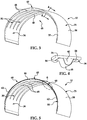
- FIGS. 3 and 4 illustrate one embodiment of the upper fuselage portion 32 having an outer body 25 formed of a solid, polymer based laminate 35 such as, for example and without limitation, carbon fiber reinforced epoxy.
- the sides 38 and the crown 40 are reinforced by composite, arched frame members 48.
- Each of the frame members 48 may have a cross section suited for the application.
- each of the frame members 48 is hat-shaped in cross section and includes outer flanges 58 that are secured to the inner skin 56 through co-curing, bonding and/or fasteners (not shown).
- the flanges 58 are omitted from FIGS. 3, 5 , 7 , 9 , 11, 13 , 16 and 17 .
- Frames members 48 may be filled with a suitable structural foam 60.
- FIGS. 5 and 6 illustrate another embodiment of the upper fuselage portion 32 in which the outer body 25 is formed of a sandwich panel construction, comprising a core 55 sandwiched between inner and outer face sheets 56, 64 respectively.
- the core 55 may comprise any suitable material and geometry such as, without limitation, flutes (not shown) or a honeycomb (not shown).
- the core 55 includes a relatively high density section 66 in the area of the crown 40, at a lower density section 62 in the sides 38.
- the high density core section 66 provides the crown 40 with additional strength and rigidity, as well as impact resistance to objects such as hail striking the top (crown 40) of the aircraft, while the aircraft is on or near the ground.
- the high and low density sections 66, 62 of the core 55 may be connected together along a scarf joint 68, although other types of joints are possible, including but not limited to a lap joint, a step-lap joint, and a butt joint.
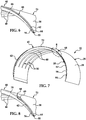
- FIGS. 7 and 8 illustrate a further embodiment of the upper fuselage portion 32 in which the body 25 comprises a solid laminate 70 in the area of the crown 40 and a composite sandwich in the sides 38, comprising a relatively medium density core 62 sandwiched between the inner and outer face sheets 56, 64.
- the composite sandwich sides 38 transitions to the solid laminate 70 along a double scarf joint 68 formed by a ramp-down 69 in the core 62; other type of joints may be possible.
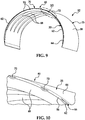
- FIGS. 9 and 10 illustrate another embodiment of the upper fuselage portion 32 which is similar to the embodiment shown in FIGS. 7 and 8 , except that the solid laminate 70 in the crown 40 is provided with longitudinally extending, high density integrated stiffeners 72 which provide the body 25 in the area of the crown 40 with additional longitudinal stiffness and stability, if required.
- the stiffeners 72 are circumferentially spaced from each other and are sandwiched between the inner and outer face sheets 56, 64 respectively. While FIG. 10 shows the stiffeners 72 as being located substantially in the middle between the inner and outer skins 56, 64, the stiffeners 72 may be located closer to the inner skin 56 or closer to the outer skin 64, if desired. In still other embodiments, such as that shown in FIG. 11 , the stiffeners 72 may be located on the inner skin 56.
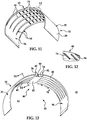
- FIGS. 11 and 12 illustrate another technique for reinforcing and stiffening the crown 40 of the upper fuselage portion 32.
- circumferentially spaced, longitudinally extending composite stiffeners 74 are attached to the inner skin 56 in the area of the crown 40.
- the stiffeners 74 have a J-shaped cross section, however a variety of other cross sectional shapes are possible.
- Stiffeners 74 may be attached to the inner skin 56 by bonding or other techniques.
- the stiffeners 74 may also provide a means of attaching equipment (not shown) or subsystems (not shown) to the body 25.
- FIG. 13 illustrates another embodiment of the upper fuselage portion 32 wherein the crown 40 is provided with a longitudinally extending, centrally located backbone frame 82.
- the backbone frame 82 interconnects and may be integrally formed with the arched frame members 48 to form internal structural framework 46 that is substantially unitized and stiffened in the area of the crown 40.
- the backbone frame 82 includes a pair of integrally formed, longitudinally extending internal ducts 78 which are separated from each other by a central partition 80.
- the backbone frame 82 may comprise a composite laminate that is laid up and co-cured along with arched frame members 48 during a fabrication process that will be described below in more detail.
- ducts 78 form port and starboard air supply ducts that carry air from a source (not shown) longitudinally through the aircraft along the crown 40.
- one or more of the arched frame members 48 may include a distribution duct 84 that is held in place by a structural foam 60 filling the frame member 48.
- Each of the distribution ducts 84 is connected with one of the supply ducts 78 and functions to direct air supplied at 82 outward and downward as shown by the arrows 76 into the cabin 44.
- one or more ducts 78 formed by the backbone frame 82 may be employed to allow other utilities to be directed through the aircraft along the crown 40, including but not limited to other types of environmental control systems, wireless communications, hard electrical wiring, wireless power delivery and various systems for monitoring the structural health of the aircraft, including moisture monitoring systems.
- FIG. 15 illustrates the provision of a tray 88 attached to the lower part of the backbone frame 82 which may be used to support and route onboard subsystems such as, without limitation, electrical wiring, longitudinally through the aircraft.
- FIG. 13 illustrates ducts 78 formed by the integrated backbone frame 82
- a semi-integrated central supply conduit 85 shown in FIGS. 16 and 17 , which is located along the crown 40.
- the conduit 85 is generally oval in cross section, however other cross sectional shapes are possible.
- the conduit 85 is centrally located beneath the crown 40 and extends longitudinally through the upper fuselage portion 32.
- Each of the frame members 48 may include a recessed portion 96 having a shape substantially matching that of the conduit 85 in order to recess the conduit 85 into the frame members 48 so that the conduit 85 does not extend downwardly into the cabin 44 any more than is necessary.
- the conduit 85 may be formed of any suitable, relatively rigid material, including but not limited to composites.
- the conduit 85 may be attached to either or both the arched frame members 48 and body 25 using fasteners, bonding techniques or interlocking mechanical mechanisms (all not shown). As seen in FIG. 17 , the conduit 85 includes an internal cavity 90 through which a utility may be routed. In the illustrated example, the conduit 85 is provided with outlet openings 92 that are coupled with inlet openings 94 in the frame members 48.
- the ducts 78, 84 formed in the structural framework 46 may be used to supply and distribute any of various utilities through the aircraft.
- FIG. 18 illustrates the use of the framework ducts 78, 84 as waveguide cavities used to transmit electromagnetic signals in the form of data or power through the aircraft.
- one or more wireless transceivers 100 positioned at longitudinally spaced locations in the aircraft, may be used to transmit data or power signals through the waveguide cavity 98 (framework ducts 78, 84).
- any of a number of airplane heath monitoring sensors, energy harvesters, RFID tags, etc. collectively shown at 104 may be monitored at another location in the aircraft using the wireless transceivers 100 to transmit data signals.
- At least one of the wireless transceivers 100 may be coupled with a suitable onboard computer 106 which may function to interrogate and/or monitor the devices 104.
- the wireless transceivers 100 in combination with the waveguide cavity 98 may be used to wirelessly transmit power generated by power supply 108 through the aircraft in order to power one or more of the devices 104.
- power generated by an energy harvesting device 104 may be transmitted through the waveguide cavity 98 to batteries which may form part of the power supply 108.
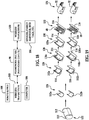
- the upper fuselage portion 32 having a multifunctional crown 40 may be manufactured according to a method illustrated in FIGS. 19 and 20 .
- composite material is laid up over a double mandrel 113 using an automatic fiber placement machine or using other conventional techniques for laying up composite material over a shaped tool.
- the layup 112 is cut and separated into two substantially identical outer skins 112a, 112b.
- the outer inner skins 112a, 112b are placed in a pair of substantially identical, outer mold line tools 114, 116.
- foam cores 118a, 118b are laid up over the outer skins 112a, 112b.
- inner skins 120a, 120b are laid up over the corresponding cores 118a, 118b, using hand placement techniques or automatic fiber placement equipment (not shown). While the above described method provides for the substantially simultaneous fabrication of two fuselage portions 32 using a single double mandrel 113, the outer skins 112a, 112b may be laid up over two separate mandrels (not shown), if desired.
- the fabrication method shown in FIG. 10 may be carried out by laying prepreg fiber plies, it may also be possible to fabricate the fuselage body portions 32, or sections thereof, using dry fiber preforms (not shown) and resin infusion techniques.
- the arched frame members 48 and the backbone frame 82 may be integrally formed together using dry preforms (not shown) that are placed on the inner skins 120a shown in FIG. 19 , and then co-infused with resin.
- the arched frame members 48 are laid up over the inner skins 120a, 120b thereby forming two substantially identical body portions 32.
- the laid up upper body portions 32 are vacuum bagged, processed and cured resulting in a co-cured, unitized structure.
- the cured body portions 32 are removed from the outer mold line tools 114, 116.
- the cured body portions 32 may be trimmed, as needed following which the upper body portions 32 may be joined to pre-cured lower body portions 34 ( FIG. 1 ).
- exemplary method 140 may include specification and design 144 of the aircraft 142 and material procurement 146.
- component and subassembly manufacturing 148 and system integration 150 of the aircraft 142 takes place.
- the disclosed method and apparatus may be employed to fabricate composite parts such as fuselage sections which are then assembled at step 150.
- the aircraft 142 may go through certification and delivery 152 in order to be placed in service 154. While in service by a customer, the aircraft 142 may be scheduled for routine maintenance and service 156 (which may also include modification, reconfiguration, refurbishment, and so on).
- a system integrator may include without limitation any number of aircraft manufacturers and major-system subcontractors; a third party may include without limitation any number of vendors, subcontractors, and suppliers; and an operator may be an airline, leasing company, military entity, service organization, and so on.
- the aircraft 142 produced by exemplary method 140 may include an airframe 158 with a plurality of systems 160 and an interior 162.
- the disclosed method and apparatus may be employed to fabricate fuselage sections which form part of the airframe 158.
- Examples of high-level systems 150 include one or more of a propulsion system 164, an electrical system 166, a hydraulic system 168, and an environmental system 170. Any number of other systems may be included.
- an aerospace example is shown, the principles of the invention may be applied to other industries, such as the automotive industry.
- the apparatus embodied herein may be employed during any one or more of the stages of the production and service method 140.
- components or subassemblies corresponding to production process 148 may be fabricated or manufactured in a manner similar to components or subassemblies produced while the aircraft 142 is in service.
- one or more apparatus embodiments may be utilized during the production stages 148 and 150, for example, by substantially expediting assembly of or reducing the cost of an aircraft 142.
- one or more apparatus embodiments may be utilized while the aircraft 142 is in service, for example and without limitation, to maintenance and service 156.
Landscapes
- Engineering & Computer Science (AREA)
- Manufacturing & Machinery (AREA)
- Aviation & Aerospace Engineering (AREA)
- Mechanical Engineering (AREA)
- Transportation (AREA)
- Chemical & Material Sciences (AREA)
- Composite Materials (AREA)
- Moulding By Coating Moulds (AREA)
- Tents Or Canopies (AREA)
Applications Claiming Priority (1)
| Application Number | Priority Date | Filing Date | Title |
|---|---|---|---|
| US12/944,113 US8752791B2 (en) | 2010-11-11 | 2010-11-11 | Fuselage employing multifunctional crown and method of making the same |
Publications (3)
| Publication Number | Publication Date |
|---|---|
| EP2452872A2 EP2452872A2 (en) | 2012-05-16 |
| EP2452872A3 EP2452872A3 (en) | 2017-10-04 |
| EP2452872B1 true EP2452872B1 (en) | 2019-08-28 |
Family
ID=44905700
Family Applications (1)
| Application Number | Title | Priority Date | Filing Date |
|---|---|---|---|
| EP11187923.5A Active EP2452872B1 (en) | 2010-11-11 | 2011-11-04 | Fuselage employing multifunctional crown and method of making the same |
Country Status (4)
| Country | Link |
|---|---|
| US (1) | US8752791B2 (enExample) |
| EP (1) | EP2452872B1 (enExample) |
| JP (1) | JP6039175B2 (enExample) |
| CN (1) | CN102530234B (enExample) |
Families Citing this family (11)
| Publication number | Priority date | Publication date | Assignee | Title |
|---|---|---|---|---|
| DE102007050422B4 (de) * | 2007-10-22 | 2012-03-08 | Airbus Operations Gmbh | Flugzeugkomponentenmontagesystem |
| USD732459S1 (en) * | 2013-05-21 | 2015-06-23 | Airbus Corporate Jet Centre | Aircraft cabin |
| EP2979975B1 (en) * | 2014-07-30 | 2017-09-27 | AIRBUS HELICOPTERS DEUTSCHLAND GmbH | An aircraft with a framework structure that comprises at least one hollow frame. |
| CA2979158A1 (en) * | 2015-03-23 | 2016-09-29 | Bombardier Inc. | Simulation of loads on aerostructures during aircraft assembly |
| WO2018061281A1 (ja) | 2016-09-29 | 2018-04-05 | 株式会社Subaru | 複合材構造体及び複合材構造体の製造方法 |
| CN106596003B (zh) * | 2016-11-29 | 2019-04-23 | 中国航空工业集团公司沈阳飞机设计研究所 | 一种复合材料飞机机身段充压试验方法 |
| DE102017112594A1 (de) * | 2017-06-08 | 2018-12-13 | Airbus Operations Gmbh | Luftverteilungssystem für eine Flugzeugkabine |
| US11220353B2 (en) * | 2019-04-18 | 2022-01-11 | The Boeing Company | Method of fabricating a composite structure |
| US11866200B2 (en) * | 2020-11-18 | 2024-01-09 | The Boeing Company | Pulsed line fabrication for a fuselage using work stations |
| US11872780B2 (en) | 2022-06-02 | 2024-01-16 | The Boeing Company | Methods and tool for cutting an uncured composite material |
| DE102022133280A1 (de) * | 2022-12-14 | 2024-06-20 | Airbus Operations Gmbh | Bauteil mit Hohlleiter, Datenübertragungssystem und Luftfahrzeug |
Family Cites Families (25)
| Publication number | Priority date | Publication date | Assignee | Title |
|---|---|---|---|---|
| JPH04329125A (ja) * | 1991-04-30 | 1992-11-17 | Mitsubishi Heavy Ind Ltd | 複合材料一体成形方法 |
| JPH1016085A (ja) * | 1996-07-04 | 1998-01-20 | Mitsubishi Heavy Ind Ltd | 航空機の胴体外板の製造方法 |
| JP4318381B2 (ja) * | 2000-04-27 | 2009-08-19 | 本田技研工業株式会社 | 繊維強化複合材からなる胴体構造体の製造方法、及びそれにより製造される胴体構造体 |
| DE10154063B4 (de) * | 2001-11-02 | 2013-11-28 | Airbus Operations Gmbh | Doppelwandiger Kernverbund, vorzugsweise Faserverbund |
| US7380752B2 (en) * | 2003-10-17 | 2008-06-03 | The Boeing Company | Aircraft interior architecture |
| US7252267B2 (en) | 2003-10-17 | 2007-08-07 | The Boeing Company | Aircraft archway architecture |
| US7228611B2 (en) * | 2003-11-18 | 2007-06-12 | The Boeing Company | Method of transferring large uncured composite laminates |
| US7166251B2 (en) * | 2004-12-01 | 2007-01-23 | The Boeing Company | Segmented flexible barrel lay-up mandrel |
| USD539210S1 (en) | 2005-04-28 | 2007-03-27 | The Boeing Company | Modular archway for an aircraft |
| JP4800672B2 (ja) * | 2005-06-09 | 2011-10-26 | 株式会社竹中工務店 | 経路構造 |
| DE102005043898A1 (de) * | 2005-09-14 | 2007-03-22 | Airbus Deutschland Gmbh | Fenster-Anordnung zum Einrichten größerer Flugzeugfenster |
| US9359061B2 (en) * | 2005-10-31 | 2016-06-07 | The Boeing Company | Compliant stiffener for aircraft fuselage |
| DE102005054869A1 (de) * | 2005-11-17 | 2007-05-31 | Airbus Deutschland Gmbh | Verfahren zur Herstellung einer Rumpfzelle eines Luftfahrzeugs |
| DE102006002248B4 (de) * | 2006-01-17 | 2008-01-03 | Airbus Deutschland Gmbh | Strukturgebende Konstruktion für einen Flugzeugrumpf |
| JP2008028549A (ja) * | 2006-07-19 | 2008-02-07 | Taisei Corp | 通信波搬送導波管 |
| DE102006039292B4 (de) * | 2006-08-22 | 2010-07-22 | Airbus Deutschland Gmbh | Rahmenelement, Flugzeugklimatisierungssystem sowie Verfahren zur Montage eines Rahmenelements in einem Flugzeug |
| US7735779B2 (en) * | 2006-11-02 | 2010-06-15 | The Boeing Company | Optimized fuselage structure |
| US7861970B2 (en) | 2006-11-02 | 2011-01-04 | The Boeing Company | Fuselage structure including an integrated fuselage stanchion |
| DE102007003277B4 (de) * | 2007-01-23 | 2012-08-02 | Airbus Operations Gmbh | Rumpf eines Luft- oder Raumfahrzeuges in CFK-Metall Hybridbauweise mit einem Metallrahmen |
| DE102007049926A1 (de) * | 2007-10-18 | 2009-04-23 | Airbus Deutschland Gmbh | System und Verfahren zur Klimatisierung zumindest eines Teilbereichs eines Flugzeugs |
| US7879276B2 (en) * | 2007-11-08 | 2011-02-01 | The Boeing Company | Foam stiffened hollow composite stringer |
| US8040243B2 (en) | 2008-11-18 | 2011-10-18 | The Boeing Company | RFID-based corrosion and moisture detection |
| US8421692B2 (en) * | 2009-02-25 | 2013-04-16 | The Boeing Company | Transmitting power and data |
| US8500066B2 (en) * | 2009-06-12 | 2013-08-06 | The Boeing Company | Method and apparatus for wireless aircraft communications and power system using fuselage stringers |
| US8570152B2 (en) * | 2009-07-23 | 2013-10-29 | The Boeing Company | Method and apparatus for wireless sensing with power harvesting of a wireless signal |
-
2010
- 2010-11-11 US US12/944,113 patent/US8752791B2/en active Active
-
2011
- 2011-11-04 EP EP11187923.5A patent/EP2452872B1/en active Active
- 2011-11-09 JP JP2011245427A patent/JP6039175B2/ja active Active
- 2011-11-11 CN CN201110365139.2A patent/CN102530234B/zh active Active
Non-Patent Citations (1)
| Title |
|---|
| None * |
Also Published As
| Publication number | Publication date |
|---|---|
| EP2452872A3 (en) | 2017-10-04 |
| CN102530234A (zh) | 2012-07-04 |
| CN102530234B (zh) | 2015-04-29 |
| JP2012101787A (ja) | 2012-05-31 |
| JP6039175B2 (ja) | 2016-12-07 |
| US8752791B2 (en) | 2014-06-17 |
| US20120119028A1 (en) | 2012-05-17 |
| EP2452872A2 (en) | 2012-05-16 |
Similar Documents
| Publication | Publication Date | Title |
|---|---|---|
| EP2452872B1 (en) | Fuselage employing multifunctional crown and method of making the same | |
| EP2585287B1 (en) | Composite structures having integrated stiffeners and method of making the same | |
| EP2865516B1 (en) | Skin-stiffened composite panel and method of its manufacture | |
| EP2301840B1 (en) | Integrated aircraft structure in composite material | |
| US8844873B2 (en) | Stabilizer torque box assembly and method | |
| US10569484B2 (en) | Device for transporting, placing and compacting composite stiffeners | |
| EP2386483B1 (en) | Curved composite frames and method of making the same | |
| EP3533594B1 (en) | Method of making composite structures having intergrated stiffeners with smooth runouts | |
| EP2666622B1 (en) | Skin-stiffener transition assembly, method of manufacture and application of said skin-stiffener transition assembly | |
| EP3150484B1 (en) | Composite rib for an aircraft torsion box and manufacturing method thereof | |
| EP2881238A1 (en) | Hybrid laminate and molded composite structures | |
| US20160375978A1 (en) | Stiffened fuselage component as well as method and apparatus for manufacturing a stiffened fuselage component | |
| AU2011269749A1 (en) | Composite structures having integrated stiffeners and method of making the same | |
| EP3483057B1 (en) | Reinforcing arrangement for an opening in an aircraft structure | |
| US10549490B2 (en) | Method for manufacturing a stiffened panel made from composite material | |
| EP2774854B1 (en) | An improved monolithic fan cowl of an aircraft engine and a manufacturing method thereof | |
| EP2848518B1 (en) | Carbon fiber reinforced polymer cargo beam with integrated cargo stanchions and c-splices | |
| US11267584B2 (en) | Method for manufacturing a rear section of an aircraft and aircraft rear section | |
| CN113524808A (zh) | 飞行汽车地板及其制备方法和飞行汽车 |
Legal Events
| Date | Code | Title | Description |
|---|---|---|---|
| PUAI | Public reference made under article 153(3) epc to a published international application that has entered the european phase |
Free format text: ORIGINAL CODE: 0009012 |
|
| 17P | Request for examination filed |
Effective date: 20111104 |
|
| AK | Designated contracting states |
Kind code of ref document: A2 Designated state(s): AL AT BE BG CH CY CZ DE DK EE ES FI FR GB GR HR HU IE IS IT LI LT LU LV MC MK MT NL NO PL PT RO RS SE SI SK SM TR |
|
| AX | Request for extension of the european patent |
Extension state: BA ME |
|
| RIC1 | Information provided on ipc code assigned before grant |
Ipc: B64C 1/06 20060101AFI20170609BHEP |
|
| PUAL | Search report despatched |
Free format text: ORIGINAL CODE: 0009013 |
|
| AK | Designated contracting states |
Kind code of ref document: A3 Designated state(s): AL AT BE BG CH CY CZ DE DK EE ES FI FR GB GR HR HU IE IS IT LI LT LU LV MC MK MT NL NO PL PT RO RS SE SI SK SM TR |
|
| AX | Request for extension of the european patent |
Extension state: BA ME |
|
| RIC1 | Information provided on ipc code assigned before grant |
Ipc: B64C 1/06 20060101AFI20170828BHEP |
|
| GRAP | Despatch of communication of intention to grant a patent |
Free format text: ORIGINAL CODE: EPIDOSNIGR1 |
|
| STAA | Information on the status of an ep patent application or granted ep patent |
Free format text: STATUS: GRANT OF PATENT IS INTENDED |
|
| INTG | Intention to grant announced |
Effective date: 20190308 |
|
| GRAS | Grant fee paid |
Free format text: ORIGINAL CODE: EPIDOSNIGR3 |
|
| GRAA | (expected) grant |
Free format text: ORIGINAL CODE: 0009210 |
|
| STAA | Information on the status of an ep patent application or granted ep patent |
Free format text: STATUS: THE PATENT HAS BEEN GRANTED |
|
| AK | Designated contracting states |
Kind code of ref document: B1 Designated state(s): AL AT BE BG CH CY CZ DE DK EE ES FI FR GB GR HR HU IE IS IT LI LT LU LV MC MK MT NL NO PL PT RO RS SE SI SK SM TR |
|
| REG | Reference to a national code |
Ref country code: GB Ref legal event code: FG4D |
|
| REG | Reference to a national code |
Ref country code: CH Ref legal event code: EP |
|
| REG | Reference to a national code |
Ref country code: AT Ref legal event code: REF Ref document number: 1172075 Country of ref document: AT Kind code of ref document: T Effective date: 20190915 |
|
| REG | Reference to a national code |
Ref country code: IE Ref legal event code: FG4D |
|
| REG | Reference to a national code |
Ref country code: DE Ref legal event code: R096 Ref document number: 602011061568 Country of ref document: DE |
|
| REG | Reference to a national code |
Ref country code: NL Ref legal event code: MP Effective date: 20190828 |
|
| REG | Reference to a national code |
Ref country code: LT Ref legal event code: MG4D |
|
| REG | Reference to a national code |
Ref country code: DE Ref legal event code: R082 Ref document number: 602011061568 Country of ref document: DE Representative=s name: MAIER, LL.M., MICHAEL C., DE Ref country code: DE Ref legal event code: R082 Ref document number: 602011061568 Country of ref document: DE Representative=s name: BOULT WADE TENNANT LLP, DE |
|
| PG25 | Lapsed in a contracting state [announced via postgrant information from national office to epo] |
Ref country code: PT Free format text: LAPSE BECAUSE OF FAILURE TO SUBMIT A TRANSLATION OF THE DESCRIPTION OR TO PAY THE FEE WITHIN THE PRESCRIBED TIME-LIMIT Effective date: 20191230 Ref country code: HR Free format text: LAPSE BECAUSE OF FAILURE TO SUBMIT A TRANSLATION OF THE DESCRIPTION OR TO PAY THE FEE WITHIN THE PRESCRIBED TIME-LIMIT Effective date: 20190828 Ref country code: FI Free format text: LAPSE BECAUSE OF FAILURE TO SUBMIT A TRANSLATION OF THE DESCRIPTION OR TO PAY THE FEE WITHIN THE PRESCRIBED TIME-LIMIT Effective date: 20190828 Ref country code: LT Free format text: LAPSE BECAUSE OF FAILURE TO SUBMIT A TRANSLATION OF THE DESCRIPTION OR TO PAY THE FEE WITHIN THE PRESCRIBED TIME-LIMIT Effective date: 20190828 Ref country code: SE Free format text: LAPSE BECAUSE OF FAILURE TO SUBMIT A TRANSLATION OF THE DESCRIPTION OR TO PAY THE FEE WITHIN THE PRESCRIBED TIME-LIMIT Effective date: 20190828 Ref country code: NO Free format text: LAPSE BECAUSE OF FAILURE TO SUBMIT A TRANSLATION OF THE DESCRIPTION OR TO PAY THE FEE WITHIN THE PRESCRIBED TIME-LIMIT Effective date: 20191128 Ref country code: BG Free format text: LAPSE BECAUSE OF FAILURE TO SUBMIT A TRANSLATION OF THE DESCRIPTION OR TO PAY THE FEE WITHIN THE PRESCRIBED TIME-LIMIT Effective date: 20191128 Ref country code: NL Free format text: LAPSE BECAUSE OF FAILURE TO SUBMIT A TRANSLATION OF THE DESCRIPTION OR TO PAY THE FEE WITHIN THE PRESCRIBED TIME-LIMIT Effective date: 20190828 |
|
| REG | Reference to a national code |
Ref country code: DE Ref legal event code: R082 Ref document number: 602011061568 Country of ref document: DE Representative=s name: BOULT WADE TENNANT LLP, DE |
|
| PG25 | Lapsed in a contracting state [announced via postgrant information from national office to epo] |
Ref country code: RS Free format text: LAPSE BECAUSE OF FAILURE TO SUBMIT A TRANSLATION OF THE DESCRIPTION OR TO PAY THE FEE WITHIN THE PRESCRIBED TIME-LIMIT Effective date: 20190828 Ref country code: LV Free format text: LAPSE BECAUSE OF FAILURE TO SUBMIT A TRANSLATION OF THE DESCRIPTION OR TO PAY THE FEE WITHIN THE PRESCRIBED TIME-LIMIT Effective date: 20190828 Ref country code: ES Free format text: LAPSE BECAUSE OF FAILURE TO SUBMIT A TRANSLATION OF THE DESCRIPTION OR TO PAY THE FEE WITHIN THE PRESCRIBED TIME-LIMIT Effective date: 20190828 Ref country code: AL Free format text: LAPSE BECAUSE OF FAILURE TO SUBMIT A TRANSLATION OF THE DESCRIPTION OR TO PAY THE FEE WITHIN THE PRESCRIBED TIME-LIMIT Effective date: 20190828 Ref country code: GR Free format text: LAPSE BECAUSE OF FAILURE TO SUBMIT A TRANSLATION OF THE DESCRIPTION OR TO PAY THE FEE WITHIN THE PRESCRIBED TIME-LIMIT Effective date: 20191129 Ref country code: IS Free format text: LAPSE BECAUSE OF FAILURE TO SUBMIT A TRANSLATION OF THE DESCRIPTION OR TO PAY THE FEE WITHIN THE PRESCRIBED TIME-LIMIT Effective date: 20191228 |
|
| REG | Reference to a national code |
Ref country code: AT Ref legal event code: MK05 Ref document number: 1172075 Country of ref document: AT Kind code of ref document: T Effective date: 20190828 |
|
| PG25 | Lapsed in a contracting state [announced via postgrant information from national office to epo] |
Ref country code: TR Free format text: LAPSE BECAUSE OF FAILURE TO SUBMIT A TRANSLATION OF THE DESCRIPTION OR TO PAY THE FEE WITHIN THE PRESCRIBED TIME-LIMIT Effective date: 20190828 |
|
| PG25 | Lapsed in a contracting state [announced via postgrant information from national office to epo] |
Ref country code: DK Free format text: LAPSE BECAUSE OF FAILURE TO SUBMIT A TRANSLATION OF THE DESCRIPTION OR TO PAY THE FEE WITHIN THE PRESCRIBED TIME-LIMIT Effective date: 20190828 Ref country code: PL Free format text: LAPSE BECAUSE OF FAILURE TO SUBMIT A TRANSLATION OF THE DESCRIPTION OR TO PAY THE FEE WITHIN THE PRESCRIBED TIME-LIMIT Effective date: 20190828 Ref country code: EE Free format text: LAPSE BECAUSE OF FAILURE TO SUBMIT A TRANSLATION OF THE DESCRIPTION OR TO PAY THE FEE WITHIN THE PRESCRIBED TIME-LIMIT Effective date: 20190828 Ref country code: AT Free format text: LAPSE BECAUSE OF FAILURE TO SUBMIT A TRANSLATION OF THE DESCRIPTION OR TO PAY THE FEE WITHIN THE PRESCRIBED TIME-LIMIT Effective date: 20190828 Ref country code: RO Free format text: LAPSE BECAUSE OF FAILURE TO SUBMIT A TRANSLATION OF THE DESCRIPTION OR TO PAY THE FEE WITHIN THE PRESCRIBED TIME-LIMIT Effective date: 20190828 Ref country code: IT Free format text: LAPSE BECAUSE OF FAILURE TO SUBMIT A TRANSLATION OF THE DESCRIPTION OR TO PAY THE FEE WITHIN THE PRESCRIBED TIME-LIMIT Effective date: 20190828 |
|
| PG25 | Lapsed in a contracting state [announced via postgrant information from national office to epo] |
Ref country code: SM Free format text: LAPSE BECAUSE OF FAILURE TO SUBMIT A TRANSLATION OF THE DESCRIPTION OR TO PAY THE FEE WITHIN THE PRESCRIBED TIME-LIMIT Effective date: 20190828 Ref country code: SK Free format text: LAPSE BECAUSE OF FAILURE TO SUBMIT A TRANSLATION OF THE DESCRIPTION OR TO PAY THE FEE WITHIN THE PRESCRIBED TIME-LIMIT Effective date: 20190828 Ref country code: IS Free format text: LAPSE BECAUSE OF FAILURE TO SUBMIT A TRANSLATION OF THE DESCRIPTION OR TO PAY THE FEE WITHIN THE PRESCRIBED TIME-LIMIT Effective date: 20200224 Ref country code: CZ Free format text: LAPSE BECAUSE OF FAILURE TO SUBMIT A TRANSLATION OF THE DESCRIPTION OR TO PAY THE FEE WITHIN THE PRESCRIBED TIME-LIMIT Effective date: 20190828 |
|
| REG | Reference to a national code |
Ref country code: DE Ref legal event code: R097 Ref document number: 602011061568 Country of ref document: DE |
|
| REG | Reference to a national code |
Ref country code: CH Ref legal event code: PL |
|
| PLBE | No opposition filed within time limit |
Free format text: ORIGINAL CODE: 0009261 |
|
| STAA | Information on the status of an ep patent application or granted ep patent |
Free format text: STATUS: NO OPPOSITION FILED WITHIN TIME LIMIT |
|
| PG2D | Information on lapse in contracting state deleted |
Ref country code: IS |
|
| PG25 | Lapsed in a contracting state [announced via postgrant information from national office to epo] |
Ref country code: LI Free format text: LAPSE BECAUSE OF NON-PAYMENT OF DUE FEES Effective date: 20191130 Ref country code: CH Free format text: LAPSE BECAUSE OF NON-PAYMENT OF DUE FEES Effective date: 20191130 Ref country code: MC Free format text: LAPSE BECAUSE OF FAILURE TO SUBMIT A TRANSLATION OF THE DESCRIPTION OR TO PAY THE FEE WITHIN THE PRESCRIBED TIME-LIMIT Effective date: 20190828 Ref country code: LU Free format text: LAPSE BECAUSE OF NON-PAYMENT OF DUE FEES Effective date: 20191104 |
|
| 26N | No opposition filed |
Effective date: 20200603 |
|
| REG | Reference to a national code |
Ref country code: BE Ref legal event code: MM Effective date: 20191130 |
|
| PG25 | Lapsed in a contracting state [announced via postgrant information from national office to epo] |
Ref country code: SI Free format text: LAPSE BECAUSE OF FAILURE TO SUBMIT A TRANSLATION OF THE DESCRIPTION OR TO PAY THE FEE WITHIN THE PRESCRIBED TIME-LIMIT Effective date: 20190828 |
|
| PG25 | Lapsed in a contracting state [announced via postgrant information from national office to epo] |
Ref country code: IE Free format text: LAPSE BECAUSE OF NON-PAYMENT OF DUE FEES Effective date: 20191104 |
|
| PG25 | Lapsed in a contracting state [announced via postgrant information from national office to epo] |
Ref country code: BE Free format text: LAPSE BECAUSE OF NON-PAYMENT OF DUE FEES Effective date: 20191130 |
|
| PG25 | Lapsed in a contracting state [announced via postgrant information from national office to epo] |
Ref country code: CY Free format text: LAPSE BECAUSE OF FAILURE TO SUBMIT A TRANSLATION OF THE DESCRIPTION OR TO PAY THE FEE WITHIN THE PRESCRIBED TIME-LIMIT Effective date: 20190828 |
|
| PG25 | Lapsed in a contracting state [announced via postgrant information from national office to epo] |
Ref country code: MT Free format text: LAPSE BECAUSE OF FAILURE TO SUBMIT A TRANSLATION OF THE DESCRIPTION OR TO PAY THE FEE WITHIN THE PRESCRIBED TIME-LIMIT Effective date: 20190828 Ref country code: HU Free format text: LAPSE BECAUSE OF FAILURE TO SUBMIT A TRANSLATION OF THE DESCRIPTION OR TO PAY THE FEE WITHIN THE PRESCRIBED TIME-LIMIT; INVALID AB INITIO Effective date: 20111104 |
|
| PG25 | Lapsed in a contracting state [announced via postgrant information from national office to epo] |
Ref country code: MK Free format text: LAPSE BECAUSE OF FAILURE TO SUBMIT A TRANSLATION OF THE DESCRIPTION OR TO PAY THE FEE WITHIN THE PRESCRIBED TIME-LIMIT Effective date: 20190828 |
|
| P01 | Opt-out of the competence of the unified patent court (upc) registered |
Effective date: 20230516 |
|
| PGFP | Annual fee paid to national office [announced via postgrant information from national office to epo] |
Ref country code: DE Payment date: 20241127 Year of fee payment: 14 |
|
| PGFP | Annual fee paid to national office [announced via postgrant information from national office to epo] |
Ref country code: GB Payment date: 20241127 Year of fee payment: 14 |
|
| PGFP | Annual fee paid to national office [announced via postgrant information from national office to epo] |
Ref country code: FR Payment date: 20241126 Year of fee payment: 14 |