EP2452747A1 - Oxidation catalyst, reduction catalyst, and catalyst for purging exhaust gas - Google Patents
Oxidation catalyst, reduction catalyst, and catalyst for purging exhaust gas Download PDFInfo
- Publication number
- EP2452747A1 EP2452747A1 EP10793943A EP10793943A EP2452747A1 EP 2452747 A1 EP2452747 A1 EP 2452747A1 EP 10793943 A EP10793943 A EP 10793943A EP 10793943 A EP10793943 A EP 10793943A EP 2452747 A1 EP2452747 A1 EP 2452747A1
- Authority
- EP
- European Patent Office
- Prior art keywords
- catalyst
- nitrogen
- carbon material
- carbon
- organic substance
- Prior art date
- Legal status (The legal status is an assumption and is not a legal conclusion. Google has not performed a legal analysis and makes no representation as to the accuracy of the status listed.)
- Withdrawn
Links
Images





Classifications
-
- B—PERFORMING OPERATIONS; TRANSPORTING
- B01—PHYSICAL OR CHEMICAL PROCESSES OR APPARATUS IN GENERAL
- B01D—SEPARATION
- B01D53/00—Separation of gases or vapours; Recovering vapours of volatile solvents from gases; Chemical or biological purification of waste gases, e.g. engine exhaust gases, smoke, fumes, flue gases, aerosols
- B01D53/34—Chemical or biological purification of waste gases
- B01D53/92—Chemical or biological purification of waste gases of engine exhaust gases
- B01D53/94—Chemical or biological purification of waste gases of engine exhaust gases by catalytic processes
- B01D53/944—Simultaneously removing carbon monoxide, hydrocarbons or carbon making use of oxidation catalysts
-
- B—PERFORMING OPERATIONS; TRANSPORTING
- B01—PHYSICAL OR CHEMICAL PROCESSES OR APPARATUS IN GENERAL
- B01D—SEPARATION
- B01D53/00—Separation of gases or vapours; Recovering vapours of volatile solvents from gases; Chemical or biological purification of waste gases, e.g. engine exhaust gases, smoke, fumes, flue gases, aerosols
- B01D53/34—Chemical or biological purification of waste gases
- B01D53/92—Chemical or biological purification of waste gases of engine exhaust gases
- B01D53/94—Chemical or biological purification of waste gases of engine exhaust gases by catalytic processes
- B01D53/9445—Simultaneously removing carbon monoxide, hydrocarbons or nitrogen oxides making use of three-way catalysts [TWC] or four-way-catalysts [FWC]
- B01D53/945—Simultaneously removing carbon monoxide, hydrocarbons or nitrogen oxides making use of three-way catalysts [TWC] or four-way-catalysts [FWC] characterised by a specific catalyst
-
- B—PERFORMING OPERATIONS; TRANSPORTING
- B01—PHYSICAL OR CHEMICAL PROCESSES OR APPARATUS IN GENERAL
- B01J—CHEMICAL OR PHYSICAL PROCESSES, e.g. CATALYSIS OR COLLOID CHEMISTRY; THEIR RELEVANT APPARATUS
- B01J23/00—Catalysts comprising metals or metal oxides or hydroxides, not provided for in group B01J21/00
- B01J23/70—Catalysts comprising metals or metal oxides or hydroxides, not provided for in group B01J21/00 of the iron group metals or copper
- B01J23/89—Catalysts comprising metals or metal oxides or hydroxides, not provided for in group B01J21/00 of the iron group metals or copper combined with noble metals
-
- B—PERFORMING OPERATIONS; TRANSPORTING
- B01—PHYSICAL OR CHEMICAL PROCESSES OR APPARATUS IN GENERAL
- B01J—CHEMICAL OR PHYSICAL PROCESSES, e.g. CATALYSIS OR COLLOID CHEMISTRY; THEIR RELEVANT APPARATUS
- B01J23/00—Catalysts comprising metals or metal oxides or hydroxides, not provided for in group B01J21/00
- B01J23/70—Catalysts comprising metals or metal oxides or hydroxides, not provided for in group B01J21/00 of the iron group metals or copper
- B01J23/89—Catalysts comprising metals or metal oxides or hydroxides, not provided for in group B01J21/00 of the iron group metals or copper combined with noble metals
- B01J23/8913—Cobalt and noble metals
-
- B—PERFORMING OPERATIONS; TRANSPORTING
- B01—PHYSICAL OR CHEMICAL PROCESSES OR APPARATUS IN GENERAL
- B01J—CHEMICAL OR PHYSICAL PROCESSES, e.g. CATALYSIS OR COLLOID CHEMISTRY; THEIR RELEVANT APPARATUS
- B01J27/00—Catalysts comprising the elements or compounds of halogens, sulfur, selenium, tellurium, phosphorus or nitrogen; Catalysts comprising carbon compounds
- B01J27/20—Carbon compounds
-
- B—PERFORMING OPERATIONS; TRANSPORTING
- B01—PHYSICAL OR CHEMICAL PROCESSES OR APPARATUS IN GENERAL
- B01J—CHEMICAL OR PHYSICAL PROCESSES, e.g. CATALYSIS OR COLLOID CHEMISTRY; THEIR RELEVANT APPARATUS
- B01J27/00—Catalysts comprising the elements or compounds of halogens, sulfur, selenium, tellurium, phosphorus or nitrogen; Catalysts comprising carbon compounds
- B01J27/24—Nitrogen compounds
-
- B—PERFORMING OPERATIONS; TRANSPORTING
- B01—PHYSICAL OR CHEMICAL PROCESSES OR APPARATUS IN GENERAL
- B01J—CHEMICAL OR PHYSICAL PROCESSES, e.g. CATALYSIS OR COLLOID CHEMISTRY; THEIR RELEVANT APPARATUS
- B01J37/00—Processes, in general, for preparing catalysts; Processes, in general, for activation of catalysts
- B01J37/02—Impregnation, coating or precipitation
- B01J37/0201—Impregnation
-
- B—PERFORMING OPERATIONS; TRANSPORTING
- B01—PHYSICAL OR CHEMICAL PROCESSES OR APPARATUS IN GENERAL
- B01J—CHEMICAL OR PHYSICAL PROCESSES, e.g. CATALYSIS OR COLLOID CHEMISTRY; THEIR RELEVANT APPARATUS
- B01J37/00—Processes, in general, for preparing catalysts; Processes, in general, for activation of catalysts
- B01J37/08—Heat treatment
- B01J37/082—Decomposition and pyrolysis
- B01J37/084—Decomposition of carbon-containing compounds into carbon
-
- F—MECHANICAL ENGINEERING; LIGHTING; HEATING; WEAPONS; BLASTING
- F01—MACHINES OR ENGINES IN GENERAL; ENGINE PLANTS IN GENERAL; STEAM ENGINES
- F01N—GAS-FLOW SILENCERS OR EXHAUST APPARATUS FOR MACHINES OR ENGINES IN GENERAL; GAS-FLOW SILENCERS OR EXHAUST APPARATUS FOR INTERNAL-COMBUSTION ENGINES
- F01N13/00—Exhaust or silencing apparatus characterised by constructional features
- F01N13/009—Exhaust or silencing apparatus characterised by constructional features having two or more separate purifying devices arranged in series
-
- F—MECHANICAL ENGINEERING; LIGHTING; HEATING; WEAPONS; BLASTING
- F01—MACHINES OR ENGINES IN GENERAL; ENGINE PLANTS IN GENERAL; STEAM ENGINES
- F01N—GAS-FLOW SILENCERS OR EXHAUST APPARATUS FOR MACHINES OR ENGINES IN GENERAL; GAS-FLOW SILENCERS OR EXHAUST APPARATUS FOR INTERNAL-COMBUSTION ENGINES
- F01N13/00—Exhaust or silencing apparatus characterised by constructional features
- F01N13/011—Exhaust or silencing apparatus characterised by constructional features having two or more purifying devices arranged in parallel
-
- F—MECHANICAL ENGINEERING; LIGHTING; HEATING; WEAPONS; BLASTING
- F01—MACHINES OR ENGINES IN GENERAL; ENGINE PLANTS IN GENERAL; STEAM ENGINES
- F01N—GAS-FLOW SILENCERS OR EXHAUST APPARATUS FOR MACHINES OR ENGINES IN GENERAL; GAS-FLOW SILENCERS OR EXHAUST APPARATUS FOR INTERNAL-COMBUSTION ENGINES
- F01N3/00—Exhaust or silencing apparatus having means for purifying, rendering innocuous, or otherwise treating exhaust
- F01N3/08—Exhaust or silencing apparatus having means for purifying, rendering innocuous, or otherwise treating exhaust for rendering innocuous
- F01N3/10—Exhaust or silencing apparatus having means for purifying, rendering innocuous, or otherwise treating exhaust for rendering innocuous by thermal or catalytic conversion of noxious components of exhaust
- F01N3/103—Oxidation catalysts for HC and CO only
-
- H—ELECTRICITY
- H01—ELECTRIC ELEMENTS
- H01M—PROCESSES OR MEANS, e.g. BATTERIES, FOR THE DIRECT CONVERSION OF CHEMICAL ENERGY INTO ELECTRICAL ENERGY
- H01M4/00—Electrodes
- H01M4/86—Inert electrodes with catalytic activity, e.g. for fuel cells
- H01M4/90—Selection of catalytic material
- H01M4/9008—Organic or organo-metallic compounds
-
- H—ELECTRICITY
- H01—ELECTRIC ELEMENTS
- H01M—PROCESSES OR MEANS, e.g. BATTERIES, FOR THE DIRECT CONVERSION OF CHEMICAL ENERGY INTO ELECTRICAL ENERGY
- H01M8/00—Fuel cells; Manufacture thereof
- H01M8/06—Combination of fuel cells with means for production of reactants or for treatment of residues
- H01M8/0662—Treatment of gaseous reactants or gaseous residues, e.g. cleaning
- H01M8/0668—Removal of carbon monoxide or carbon dioxide
-
- B—PERFORMING OPERATIONS; TRANSPORTING
- B01—PHYSICAL OR CHEMICAL PROCESSES OR APPARATUS IN GENERAL
- B01D—SEPARATION
- B01D2255/00—Catalysts
- B01D2255/10—Noble metals or compounds thereof
- B01D2255/102—Platinum group metals
- B01D2255/1023—Palladium
-
- B—PERFORMING OPERATIONS; TRANSPORTING
- B01—PHYSICAL OR CHEMICAL PROCESSES OR APPARATUS IN GENERAL
- B01D—SEPARATION
- B01D2255/00—Catalysts
- B01D2255/10—Noble metals or compounds thereof
- B01D2255/102—Platinum group metals
- B01D2255/1025—Rhodium
-
- B—PERFORMING OPERATIONS; TRANSPORTING
- B01—PHYSICAL OR CHEMICAL PROCESSES OR APPARATUS IN GENERAL
- B01D—SEPARATION
- B01D2255/00—Catalysts
- B01D2255/20—Metals or compounds thereof
- B01D2255/207—Transition metals
- B01D2255/20746—Cobalt
-
- B—PERFORMING OPERATIONS; TRANSPORTING
- B01—PHYSICAL OR CHEMICAL PROCESSES OR APPARATUS IN GENERAL
- B01D—SEPARATION
- B01D2255/00—Catalysts
- B01D2255/70—Non-metallic catalysts, additives or dopants
- B01D2255/702—Carbon
-
- B—PERFORMING OPERATIONS; TRANSPORTING
- B01—PHYSICAL OR CHEMICAL PROCESSES OR APPARATUS IN GENERAL
- B01D—SEPARATION
- B01D2258/00—Sources of waste gases
- B01D2258/01—Engine exhaust gases
- B01D2258/014—Stoichiometric gasoline engines
-
- Y—GENERAL TAGGING OF NEW TECHNOLOGICAL DEVELOPMENTS; GENERAL TAGGING OF CROSS-SECTIONAL TECHNOLOGIES SPANNING OVER SEVERAL SECTIONS OF THE IPC; TECHNICAL SUBJECTS COVERED BY FORMER USPC CROSS-REFERENCE ART COLLECTIONS [XRACs] AND DIGESTS
- Y02—TECHNOLOGIES OR APPLICATIONS FOR MITIGATION OR ADAPTATION AGAINST CLIMATE CHANGE
- Y02E—REDUCTION OF GREENHOUSE GAS [GHG] EMISSIONS, RELATED TO ENERGY GENERATION, TRANSMISSION OR DISTRIBUTION
- Y02E60/00—Enabling technologies; Technologies with a potential or indirect contribution to GHG emissions mitigation
- Y02E60/30—Hydrogen technology
- Y02E60/50—Fuel cells
-
- Y—GENERAL TAGGING OF NEW TECHNOLOGICAL DEVELOPMENTS; GENERAL TAGGING OF CROSS-SECTIONAL TECHNOLOGIES SPANNING OVER SEVERAL SECTIONS OF THE IPC; TECHNICAL SUBJECTS COVERED BY FORMER USPC CROSS-REFERENCE ART COLLECTIONS [XRACs] AND DIGESTS
- Y02—TECHNOLOGIES OR APPLICATIONS FOR MITIGATION OR ADAPTATION AGAINST CLIMATE CHANGE
- Y02T—CLIMATE CHANGE MITIGATION TECHNOLOGIES RELATED TO TRANSPORTATION
- Y02T10/00—Road transport of goods or passengers
- Y02T10/10—Internal combustion engine [ICE] based vehicles
- Y02T10/12—Improving ICE efficiencies
Definitions
- the present invention relates to an oxidation catalyst, a reduction catalyst, and a catalyst for purging exhaust gas.
- a variety of catalysts are used in order to purge exhaust gas discharged from internal combustion engines.
- noble metal catalysts for purging exhaust gas particularly, three-way catalysts in which Pt, Rh, Pd, or the like is supported on a support are useful (for example, Patent Literature 1).
- Patent Literature 1 Japanese Examined Patent Application Publication No. 1991-38892
- the exhaust gas from vehicles contains NO x , CO, and hydrocarbon (HC); in order to purge such exhaust gas, CO and HC need to be oxidized, and NO x (NO, NO 2 ) needs to be reduced. Because the oxidation-reduction reaction is performed under a severe condition, platinum (Pt) is used as a principal component of the catalyst for keeping high activity.
- Pt is very expensive, deposits of Pt are small, and resource is limited; accordingly, stable supply for a long period of time may not be achieved. For this reason, instead of Pt, a highly active catalyst that is inexpensive and can be stably supplied for a long period of time has been demanded.
- an object of the present invention is to provide a catalyst that can purge exhaust gas containing NO x , CO, HC, and the like without using Pt.
- the present invention provides an oxidation catalyst comprising a carbon material prepared by calcining a transition metal compound and a nitrogen-containing organic substance, or a transition metal compound, a nitrogen-containing organic substance, and a carbon compound not containing nitrogen, the oxidation catalyst oxidizing CO and/or a hydrocarbon.
- the present invention also provides a reduction catalyst including a carbon material prepared by calcining a transition metal compound and a nitrogen-containing organic substance or a transition metal compound, a nitrogen-containing organic substance, and a carbon compound not containing nitrogen, and at least one load material selected from the group consisting ofPd, Rh, Ru, Ni, Co, Fe, Ce, Cu, Ti, Zr, Sn, V, Nb, Ta, Cr, Mo, W, Bi, Mn, and compounds thereof supported on the carbon material, the reduction catalyst reducing NO x .
- carbon alloy fine particles prepared by heat treating and powdering a phthalocyanine-containing furan resin can be used as a base material for an electrode of the fuel cell; however, the present inventors found a surprising ability of a carbon material prepared by calcining (i) a transition metal compound and a nitrogen-containing organic substance or (ii) a transition metal compound, a nitrogen-containing organic substance, and a carbon compound not containing nitrogen itself has an oxidation catalyst action, and if the predetermined load material is supported on the carbon material, a reduction catalyst action is demonstrated, and have completed the invention on the basis of the findings.
- the oxidation temperature is not less than 200°C
- the reduction temperature is not less than 200°C
- the activity of the oxidation catalyst is improved, and the ability to oxidize CO and a hydrocarbon is significantly improved.
- the activity of the reduction catalyst is improved, and the ability to reduce NO x becomes significantly higher.
- the reduction activity is particularly high, and the ability to reduce NO x is extremely good.
- the present invention also provides a catalyst for purging exhaust gas including at least one of the oxidation catalyst and the reduction catalyst.
- the oxidation catalyst and reduction catalyst according to the present invention are used as a catalyst for purging exhaust gas; thereby, NO x , CO, a hydrocarbon, and the like contained in the exhaust gas can be purged with high efficiency.
- an oxidation catalyst, reduction catalyst and catalyst for purging exhaust gas that include a carbon material without using Pt and can purge NO x , CO, or a hydrocarbon can be provided.
- the carbon material that forms an oxidation catalyst, reduction catalyst, or catalyst for purging exhaust gas used in the present embodiment is prepared by calcining (i) a transition metal compound and a nitrogen-containing organic substance or (ii) a transition metal compound, a nitrogen-containing organic substance, and a carbon compound not containing nitrogen.
- a carbon material is a carbon alloy catalyst in which the carbon skeleton is doped with nitrogen atoms, and a transition metal element is contained, and the activity is high.
- calcination is performed using the transition metal compound and nitrogen-containing organic substance as a raw material in the case where the nitrogen-containing organic substance is not only a nitrogen source, but also sufficiently contains carbon as a carbon source; and in the case where the carbon source is further needed, the transition metal compound, nitrogen-containing organic substance, and carbon compound not containing nitrogen are used as a raw material.
- the carbon compound not containing nitrogen is not particularly limited; for example, celluloses, carboxymethyl celluloses, polyvinyl alcohol, polyacrylic acid, polyfurfuryl alcohol, furan resins, phenol resins, phenol formaldehyde resins, epoxy resins, pitch, general-purpose plastics such as polyvinylidene chloride and polymethacrylic acid, engineering plastics, super engineering plastics such as polysulfones, ionomer resins, or the like can be used. Inorganic substances such as coal can also be used. These compounds can be used alone, or two or more thereof can be used in combination. Among them, polymethacrylic acid is preferable from the viewpoint of cost and carbonization yield.
- pyrrole compounds such as polypyrrole
- imide compounds such as a phthalocyanine complex
- polyimides and polycarbodiimide
- amide compounds such as polyamides
- imidazole compounds such as polyimidazole
- lignin biomass
- poly(vinylpyridine) poly(vinylpyridine)
- melamine resins urea resins
- chelate resins humic acid, polyaniline, polyacrylonitrile, ⁇ -caprolactam, protein, and the like
- ⁇ -caprolactam is preferable.
- transition metal elements that belong to the 4th Row of Group 3 to Group 12 on the periodic table can be used, and for example, cobalt (Co), iron (Fe), manganese (Mn), nickel (Ni), copper (Cu), titanium (Ti), chromium (Cr), and zinc (Zn) are preferable;
- the transition metal compound salts, hydroxides, oxides, nitrides, sulfides, carbides, complexes, and polymer complexes of the transition metals can be used, and among these, particularly, cobalt chloride, cobalt oxide, cobalt phthalocyanine, iron chloride, iron oxide, and iron phthalocyanine are preferable.
- Co, Fe, Mn, Ni, Cu, Ti, Cr, Zn, and compounds thereof improve the catalyst activity of the carbon catalyst.
- transition metal compound and nitrogen-containing organic substance or (ii) transition metal compound, nitrogen-containing organic substance, and carbon compound not containing nitrogen may be dissolved in a solvent and mixed to prepare a precursor composition.
- the solvent is not particularly limited as long as the solvent can dissolve these carbon compound not containing nitrogen, nitrogen-containing organic substance, and transition metal compound; for example, dimethylformamide, dimethylacetamide, dimethylsulfoxide, N-methylpyrrolidone, cyclohexanone, methyl ethyl ketone, and the like can be used.
- a carbon additive such as carbon black may be added to a mixture of the (i) transition metal compound and nitrogen-containing organic substance or (ii) transition metal compound, nitrogen-containing organic substance, and carbon compound not containing nitrogen.
- a carbon additive such as carbon black may be added to a mixture of the (i) transition metal compound and nitrogen-containing organic substance or (ii) transition metal compound, nitrogen-containing organic substance, and carbon compound not containing nitrogen.
- transition metal compound and nitrogen-containing organic substance or (ii) transition metal compound, nitrogen-containing organic substance and carbon compound not containing nitrogen are calcined, in order to prevent contamination with impurities of the carbon material to be produced, it is preferable that calcination is performed in an inert atmosphere purged by nitrogen or the like.
- the produced carbon material can be powdered by a ball mill or the like, and formed into fine particles. Further, using sieves having different sizes of opening, coarse products are removed to provide uniform fme particles; thereby, the surface area of the carbon material is increased, and the activities as the oxidation catalyst, the reduction catalyst, and the catalyst for purging exhaust gas are improved.
- the proportion of the carbon compound not containing nitrogen with respect to the nitrogen-containing organic substance to be blended is such that the amount of nitrogen atoms in the carbon material after calcination is not less than 0.5% by mass and not more than 20% by mass, and more preferably not less than 5% by mass and not more than 20% by mass based on the total mass of the carbon material.
- the carbonization treatment of the carbon compound not containing nitrogen, nitrogen-containing organic substance, and transition metal compound, or the precursor composition prepared by dissolving and mixing these in the solvent is performed preferably at 800 to 1000°C for 0.5 to 5 hours, and particularly preferably at 900°C to 1000°C for 0.5 to 2 hours.
- a residue produced when the carbon material subjected to the carbonization treatment is further calcined under the air atmosphere at a high temperature of approximately 400 to 800°C for approximately 2 to 5 hours can also be used as the oxidation catalyst.
- the carbon material may be doped with boron atoms and/or a chalcogen compound.
- the activity is improved compared to the carbon material doped with nitrogen atoms.
- the carbon material in order for the carbon material to be doped with boron atoms and/or a chalcogen compound, for example, boric acid, boric acid salt, halogenated boric acid salt, or the like as a boron-containing organic substance, and an oxide, a sulfide, and the like as a chalcogen compound may be added to a mixture of the transition metal compound and the nitrogen-containing organic substance or a mixture of a transition metal compound, a nitrogen-containing organic substance, and a carbon compound not containing nitrogen.
- a chalcogen compound for example, boric acid, boric acid salt, halogenated boric acid salt, or the like as a boron-containing organic substance, and an oxide, a sulfide, and the like as a chalcogen compound may be added to a mixture of the transition metal compound and the nitrogen-containing organic substance or a mixture of a transition metal compound, a nitrogen-containing organic substance, and a carbon compound not containing nitrogen.
- the oxidation catalyst can oxidize CO to CO 2 in an oxidation atmosphere; at an oxidation temperature of not less than 200°C, the activity is improved to improve the conversion rate of CO to CO 2 ; at an oxidation temperature of not less than 250°C, the conversion rate is further improved; at an oxidation temperature of not less than 300°C, the conversion rate reaches approximately 100%, and CO can be purged almost completely. Particularly, even at normal temperature of not more than 100°C, e.g., around 25°C in which it is known that the reaction cannot be made by the platinum catalyst in the presence of oxygen with the concentration of oxygen of not less than 1%, the oxidation catalyst can oxidize CO to CO 2 .
- the oxidation catalyst can oxidize hydrocarbons such as propane and butane more efficiently to water and CO 2 .
- hydrocarbons such as propane and butane
- the conversion rate to water and CO 2 is improved.
- the conversion rate reaches approximately 100%, and hydrocarbons can be purged almost completely.
- the reduction catalyst in the present embodiment includes the carbon material prepared by calcining the transition metal compound and nitrogen-containing organic substance or the transition metal compound, nitrogen-containing organic substance, and carbon compound not containing nitrogen, and at least one load material selected from the group consisting of Pd, Rh, Ru, Ni, Co, Fe, Ce, Cu, Ti, Zr, Sn, V, Nb, Ta, Cr, Mo, W, Bi, Mn, and compounds thereof supported on the carbon material, and reduces NO x in a reduction atmosphere.
- the reduction temperature of NO x is preferably not less than 200°C, more preferably not less than 250°C, and still more preferably not less than 300°C.
- Pd or Rh is preferable because the reduction activity is high.
- Pd or Rh is supported on the carbon material in a proportion of preferably 0.01 to 15% by mass, more preferably 0.1 to 10% by mass, and particularly preferably 0.5 to 2% by mass based on the mass of the carbon material.
- an aqueous solution of PdCl 2 containing Pd in a desired amount to be supported or Rh(NO 3 ) 3 containing Rh in a desired amount to be supported is prepared.
- the carbon material is mixed with the aqueous solution at room temperature, and the resultant is stirred for 1 to 5 hours.
- the aqueous solution is kept at 70 to 100°C for 10 to 20 hours, and the moisture content is vaporized.
- the carbon material thus obtained is sufficiently polished; thereby, a carbon material carrying Pd or Rh can be obtained.
- the metal atom other than Pd and Rh, i.e., Ni or the like an aqueous solution is prepared and mixed with the carbon material in the same manner; thereby, the metal atom can be supported on the carbon material.
- the amount of the metal atom or the like to be supported can be determined by simple calculation from the amount of a charged sample; in the case of analyzing with high accuracy, an ICP optical emission spectrometer or the like can be used.
- the catalyst for purging exhaust gas in the present embodiment includes at least one of the oxidation catalyst and the reduction catalyst, and can purge NO x , CO, or a hydrocarbon contained in the exhaust gas. Moreover, under an oxidation reduction atmosphere in which oxygen and a reducing agent coexist, the catalyst for purging exhaust gas including both of the oxidation catalyst and the reduction catalyst functions as a three-way catalyst that simultaneously purges NO x , CO, and a hydrocarbon.
- the exhaust gas containing NO x , CO, and a hydrocarbon for example, exhaust gas from vehicles is assumed.
- CO is oxidized to CO 2 and a hydrocarbon is oxidized to water and CO 2 ;
- NO x is reduced to nitrogen; however, a range in which oxidation and reduction occur in balance is limited to the range in the vicinity of a theoretical air-fuel ratio.
- the composition of the vehicle exhaust gas is controlled into the range in the vicinity of the theoretical air-fuel ratio.
- the catalyst is used not only for purging the vehicle exhaust gas, and also can purge NO x , CO, and a hydrocarbon contained in other gas.
- the catalyst is suitable for application as an oxidation catalyst that oxidizes a small amount of CO contained in hydrogen obtained by reforming natural gas or the like as a fuel for the fuel cell while the relevant oxygen is supplied; the oxidation catalyst is disposed in a CO removing apparatus for supplying gas to the fuel electrode of the fuel cell, or the oxidation catalyst is mixed with the fuel electrode catalyst of the fuel cell and used for the fuel electrode portion, thereby to be able to oxidize CO in hydrogen to CO 2 and prevent poisoning of the electrode catalyst.
- the vehicle exhaust gas can be directly used; or a model gas can be used because the concentration of NO x , CO, or a hydrocarbon contained is difficult to control. It is preferable that in the model gas, a composition similar to the real exhaust gas of the gasoline-driven car is provided, for example.
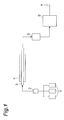
- FIG. 1 a schematic view of an apparatus for measuring the concentration of the model gas containing NO x , CO, and C 3 H 6 as a hydrocarbon is shown.
- the measurement apparatus including a reference gas cylinder 1, a mass flow controller 2, a reaction tube 3, a cooler 5, a gas analyzing apparatus 6, and the like, first, the respective model gases are produced from the reference gas cylinder 1, and the gases are mixed by the mass flow controller 2, and introduced into the reaction tube 3. Then, the reaction tube 3 filled with the model gas is heated by an electric heating furnace 4. Each model gas is oxidized or reduced by a catalyst 10 within the reaction tube 3. In the gas after the reaction, steam is evacuated in the cooler 5, and the composition is analyzed by the gas analyzing apparatus 6.
- the gas analyzing apparatus 6 is a gas chromatograph, for example, and can perform quantitative analysis of O 2 , CO, N 2 O, CO 2 , a hydrocarbon (C 3 H 6 ), or the like; NO x , NO, NO 2 CO, SO 2 and the like can be quantitatively analyzed by an NO x analyzer, for example.
- FIG. 2 A schematic view of the reaction tube that is a part of the measurement apparatus is shown in Figure 2 .
- the reaction tube 3 is made of quartz, and it is preferable that the catalyst for purging exhaust gas 10 is filled into the center of the reaction tube. Additionally, in order for the model gas to be distributed in the portion into which the catalyst is filled, quartz sand 11 or quartz wool 12 can be filled into both sides of the catalyst 10.
- the purging ability of the catalyst can be evaluated as the conversion rate of each gas by the following calculation expressions.
- C ⁇ o ⁇ n ⁇ v ⁇ e ⁇ r ⁇ s ⁇ i ⁇ o ⁇ n r ⁇ a ⁇ t ⁇ e o ⁇ f N ⁇ O x N ⁇ O m ⁇ o ⁇ l f ⁇ l ⁇ o ⁇ w ⁇ a ⁇ t ⁇ e a ⁇ t i ⁇ n ⁇ l ⁇ e ⁇ t + N ⁇ O 2 m ⁇ o ⁇ l f ⁇ l ⁇ o ⁇ w r ⁇ a ⁇ t ⁇ e - N ⁇ O m ⁇ o ⁇ l f ⁇ l ⁇ o ⁇ w r ⁇ a ⁇ t ⁇ e - N ⁇ O m ⁇ o
- the conversion rate indicates how much NO x , CO, or a hydrocarbon is oxidized or reduced by the catalyst; a higher conversion rate indicates that NO x , CO, or a hydrocarbon is more oxidized or reduced; if the conversion rate is 100%, it indicates that NO x , CO, or a hydrocarbon is completely purged.
- the carbon material used in the present Examples was prepared as follows.
- the carbonization treatment on the precursor composition was performed. Namely, the precursor composition was placed in a quartz tube, the quartz tube was nitrogen purged for 50 minutes by a paraboloidal reflection type infrared gold image furnace. Then, heating was started, and the temperature of the gold image furnace was raised at a temperature rising rate of 1°C/min from room temperature to 900°C. Subsequently, the quartz tube was kept at 900°C for 1 hour. Thus, a carbon material produced by carbonizing the precursor composition was obtained.
- the powdering treatment of the carbon material was performed. Namely, silicon nitride balls having a diameter of 1.5 cm was set within a planetary ball mill (product name: P-7, made by Fritsch Japan Co., Ltd.), and the carbon material obtained by the carbonization treatment was powdered at a rotational speed of 800 rpm for 60 minutes. The powdered carbon material was extracted, and classified by a sieve having an opening of 46 ⁇ m to obtain a catalyst.
- a catalyst carrying Pd or Rh on the carbon material 25 ml of an aqueous solution of PdCl 2 containing the amount of Pd to be supported or Rh(NO 3 ) 3 containing the amount of Rh to be supported was prepared; the carbon material was mixed with the aqueous solution at room temperature of 25°C, and stirred for 2 hours. The aqueous solution was kept at 80°C for 10 hours, the moisture content was vaporized, and the obtained product was polished; thereby, a catalyst carrying Pd or Rh was obtained.
- 0.1 g of the obtained catalyst was filled into the center of the quartz reaction tube having an inner diameter of 6 mm, and 0.5 g of quartz sand was filled into each side of the catalyst layer for distribution of the gas.
- the data after the catalyst was reacted with the model gas at each temperature at an interval of 50°C in the range of 150°C to 500°C for 1 hour was collected, and the conversion rates of NO x , CO, and a hydrocarbon (C 3 H 6 ) and carbon balance were calculated.
- the catalyst comprising the carbon material was placed in the reaction tube, the model gas was introduced into the reaction tube, and the conversion rates of NO x , CO, and a hydrocarbon (C 3 H 6 ) and carbon balance were measured. The result is shown in Figure 3 .
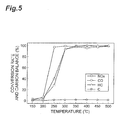
- a catalyst comprising a carbon material carrying 2% by mass of Pd was placed in the reaction tube, the model gas was flowed, and measurement was performed in the same manner as above. The result is shown in Figure 5 .
- the conversion rate of CO was almost 100% at not less than 300°C, and the conversion rates of NO x and C 3 H 6 were not less than 90% and very high. Moreover, the conversion rate of NO x at 250°C was 28%, the conversion rate of C 3 H 6 at 250°C was 40%, and the conversion rate of CO at 250°C was 97%; the activity at a low temperature was higher than that of the Pt catalyst in Comparative Example 2 described later. Moreover, the carbon balance rate was almost zero, and it was suggested that the catalyst was not calcined at a high temperature of 500°C.
- a catalyst comprising a carbon material carrying 0.5% by mass of Rh was placed in the reaction tube, the model gas was flowed, and measurement was performed in the same manner as above. The result is shown in Figure 8 .
- the conversion rate of CO exceeded 60% at 200°C; the Light-off temperature that is a temperature at which the conversion rates of the three components of NO x , CO, and C 3 H 6 reached 50% was 200 to 250°C, and lower than that in Example 2 in the case where 2% by mass of Pd was supported and in the Pt catalyst in Comparative Example 2.
- the conversion rates of the three components of NO x , CO, and C 3 H 6 were not more than 20% and very low at temperatures up to 250°C; at 300°C, the conversion rates of the components other than C 3 H 6 reached almost 100%; at not less than 350°C, the conversion rates were almost 100%.
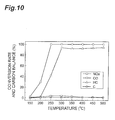
- a catalyst comprising a residue obtained by calcining a catalyst comprising the carbon material in the air atmosphere at 500°C for 3 hours was prepared, and placed in the reaction tube; the model gas was flowed, and measurement was performed in the same manner as above. The result is shown in Figure 10 .
- the conversion rates of C 3 H 6 and CO at a low temperature were higher than those in the catalyst comprising the carbon material; at 250°C, CO was completely purged, and the conversion rate of C 3 H 6 was approximately 42%.
- the conversion rate of C 3 H 6 was not less than 90%.
- the conversion rate of NO x was several percents and very low even if the temperature was raised.
- a Pt-alumina catalyst was placed in the reaction tube, a reaction gas was flowed, and measurement was performed in the same manner as above.
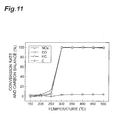
- the amount of Pt to be supported was 1.7% by mass that was approximately 8 to 10 times that in a commercially available three-way catalyst. The result is shown in Figure 11 .
- a catalyst obtained by further doping a catalyst comprising the carbon material with nitrogen was placed in the reaction tube, the reaction gas was flowed, and measurement was performed in the same manner as above.
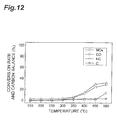
- the condition of doping with nitrogen was the proportion of air to ammonia of 7:2.3, at 500°C, and for 3 hours. The result is shown in Figure 12 .
- the oxidation catalyst, reduction catalyst, and catalyst for purging exhaust gas that includes a carbon material without using Pt, and can purge NO x , CO, or a hydrocarbon can be provided.
- 1...reference gas cylinder 2...mass flow controller, 3...reaction tube, 4...electric heating furnace, 5...cooler, 6...gas analyzing apparatus, 10...catalyst, 11...quartz sand, 12...quartz wool, 13...thermocouple.
Landscapes
- Chemical & Material Sciences (AREA)
- Engineering & Computer Science (AREA)
- Chemical Kinetics & Catalysis (AREA)
- Materials Engineering (AREA)
- Organic Chemistry (AREA)
- Combustion & Propulsion (AREA)
- General Chemical & Material Sciences (AREA)
- Health & Medical Sciences (AREA)
- Mechanical Engineering (AREA)
- General Engineering & Computer Science (AREA)
- Oil, Petroleum & Natural Gas (AREA)
- Analytical Chemistry (AREA)
- Environmental & Geological Engineering (AREA)
- Biomedical Technology (AREA)
- Electrochemistry (AREA)
- Toxicology (AREA)
- Physics & Mathematics (AREA)
- Thermal Sciences (AREA)
- Sustainable Energy (AREA)
- Sustainable Development (AREA)
- Manufacturing & Machinery (AREA)
- Life Sciences & Earth Sciences (AREA)
- Catalysts (AREA)
- Exhaust Gas Treatment By Means Of Catalyst (AREA)
- Exhaust Gas After Treatment (AREA)
Abstract
Description
- The present invention relates to an oxidation catalyst, a reduction catalyst, and a catalyst for purging exhaust gas.
- A variety of catalysts are used in order to purge exhaust gas discharged from internal combustion engines. For example, for purging exhaust gas of vehicles, noble metal catalysts for purging exhaust gas, particularly, three-way catalysts in which Pt, Rh, Pd, or the like is supported on a support are useful (for example, Patent Literature 1).
- Patent Literature 1: Japanese Examined Patent Application Publication No.
1991-38892 - The exhaust gas from vehicles contains NOx, CO, and hydrocarbon (HC); in order to purge such exhaust gas, CO and HC need to be oxidized, and NOx (NO, NO2) needs to be reduced. Because the oxidation-reduction reaction is performed under a severe condition, platinum (Pt) is used as a principal component of the catalyst for keeping high activity.
- However, Pt is very expensive, deposits of Pt are small, and resource is limited; accordingly, stable supply for a long period of time may not be achieved. For this reason, instead of Pt, a highly active catalyst that is inexpensive and can be stably supplied for a long period of time has been demanded.
- Then, an object of the present invention is to provide a catalyst that can purge exhaust gas containing NOx, CO, HC, and the like without using Pt.
- The present invention provides an oxidation catalyst comprising a carbon material prepared by calcining a transition metal compound and a nitrogen-containing organic substance, or a transition metal compound, a nitrogen-containing organic substance, and a carbon compound not containing nitrogen, the oxidation catalyst oxidizing CO and/or a hydrocarbon.
- The present invention also provides a reduction catalyst including a carbon material prepared by calcining a transition metal compound and a nitrogen-containing organic substance or a transition metal compound, a nitrogen-containing organic substance, and a carbon compound not containing nitrogen, and at least one load material selected from the group consisting ofPd, Rh, Ru, Ni, Co, Fe, Ce, Cu, Ti, Zr, Sn, V, Nb, Ta, Cr, Mo, W, Bi, Mn, and compounds thereof supported on the carbon material, the reduction catalyst reducing NOx.
- As the carbon material, in Japanese Patent Application Laid-Open Publication No.
2004-362802 - It is preferable that in the oxidation catalyst, the oxidation temperature is not less than 200°C, and in the reduction catalyst, the reduction temperature is not less than 200°C.
- At an oxidation temperature of not less than 200°C, the activity of the oxidation catalyst is improved, and the ability to oxidize CO and a hydrocarbon is significantly improved. Moreover, at a reduction temperature of not less than 200°C, the activity of the reduction catalyst is improved, and the ability to reduce NOx becomes significantly higher.
- In the reduction catalyst, if the load material is at least one selected from the group consisting of Pd and Rh, and the amount of the load material based on the mass of the carbon material is 0.01 to 15% by mass, the reduction activity is particularly high, and the ability to reduce NOx is extremely good.
- The present invention also provides a catalyst for purging exhaust gas including at least one of the oxidation catalyst and the reduction catalyst. The oxidation catalyst and reduction catalyst according to the present invention are used as a catalyst for purging exhaust gas; thereby, NOx, CO, a hydrocarbon, and the like contained in the exhaust gas can be purged with high efficiency.
- According to the present invention, an oxidation catalyst, reduction catalyst and catalyst for purging exhaust gas that include a carbon material without using Pt and can purge NOx, CO, or a hydrocarbon can be provided.
-
- [
Figure 1] Figure 1 is a schematic view of an apparatus for measuring the concentrations of NOx, CO, and a hydrocarbon to be purged. - [
Figure 2] Figure 2 is a schematic view of a reaction tube in the measuring apparatus. - [
Figure 3] Figure 3 is a drawing showing the measurement result of the conversion rates of NOx, CO, and a hydrocarbon (C3H6) and carbon balance in Example 1. - [
Figure 4] Figure 4 is a drawing showing change of the activity over time on the catalyst in Example 1. - [
Figure 5] Figure 5 is a drawing showing the measurement result of the conversion rates of NOx, CO, and a hydrocarbon (C3H6) and carbon balance in Example 2. - [
Figure 6] Figure 6 is a drawing showing change of the activity over time on the catalyst in Example 2. - [
Figure 7] Figure 7 is a drawing showing the result of a test at 350°C for a long period of time in Example 2. - [
Figure 8] Figure 8 is a drawing showing the measurement result of the conversion rates of NOx, CO, and a hydrocarbon (C3H6) and carbon balance in Example 3. - [
Figure 9] Figure 9 is a drawing showing the measurement result of the conversion rates of NOx, CO, and a hydrocarbon (C3H6) and carbon balance in Example 4. - [
Figure 10] Figure 10 is a drawing showing the measurement result of the conversion rates of NOx, CO, and a hydrocarbon (C3H6) and carbon balance in Example 5. - [
Figure 11] Figure 11 is a drawing showing the measurement result of the conversion rates of NOx, CO, and a hydrocarbon (C3H6) and carbon balance in Comparative Example 1. - [
Figure 12] Figure 12 is a drawing showing the measurement result of the conversion rates of NOx, CO, and a hydrocarbon (C3H6) and carbon balance in Comparative Example 2. - [
Figure 13] Figure 13 is a drawing showing the measurement result of the conversion rates of NOx, CO, and a hydrocarbon (C3H6) and carbon balance in Comparative Example 3. - Hereinafter, an embodiment of the present invention will be described. The carbon material that forms an oxidation catalyst, reduction catalyst, or catalyst for purging exhaust gas used in the present embodiment is prepared by calcining (i) a transition metal compound and a nitrogen-containing organic substance or (ii) a transition metal compound, a nitrogen-containing organic substance, and a carbon compound not containing nitrogen. Such a carbon material is a carbon alloy catalyst in which the carbon skeleton is doped with nitrogen atoms, and a transition metal element is contained, and the activity is high.
- In production of the carbon material, calcination is performed using the transition metal compound and nitrogen-containing organic substance as a raw material in the case where the nitrogen-containing organic substance is not only a nitrogen source, but also sufficiently contains carbon as a carbon source; and in the case where the carbon source is further needed, the transition metal compound, nitrogen-containing organic substance, and carbon compound not containing nitrogen are used as a raw material.
- Here, the carbon compound not containing nitrogen is not particularly limited; for example, celluloses, carboxymethyl celluloses, polyvinyl alcohol, polyacrylic acid, polyfurfuryl alcohol, furan resins, phenol resins, phenol formaldehyde resins, epoxy resins, pitch, general-purpose plastics such as polyvinylidene chloride and polymethacrylic acid, engineering plastics, super engineering plastics such as polysulfones, ionomer resins, or the like can be used. Inorganic substances such as coal can also be used. These compounds can be used alone, or two or more thereof can be used in combination. Among them, polymethacrylic acid is preferable from the viewpoint of cost and carbonization yield.
- Moreover, as the nitrogen-containing organic substance, for example, pyrrole compounds such as polypyrrole, imide compounds such as a phthalocyanine complex, polyimides, and polycarbodiimide, amide compounds such as polyamides, imidazole compounds such as polyimidazole, lignin, biomass, poly(vinylpyridine), melamine resins, urea resins, chelate resins, humic acid, polyaniline, polyacrylonitrile, ε-caprolactam, protein, and the like can be used; among them, ε-caprolactam is preferable.
- As a transition metal, elements that belong to the 4th Row of
Group 3 toGroup 12 on the periodic table can be used, and for example, cobalt (Co), iron (Fe), manganese (Mn), nickel (Ni), copper (Cu), titanium (Ti), chromium (Cr), and zinc (Zn) are preferable; as the transition metal compound, salts, hydroxides, oxides, nitrides, sulfides, carbides, complexes, and polymer complexes of the transition metals can be used, and among these, particularly, cobalt chloride, cobalt oxide, cobalt phthalocyanine, iron chloride, iron oxide, and iron phthalocyanine are preferable. Co, Fe, Mn, Ni, Cu, Ti, Cr, Zn, and compounds thereof improve the catalyst activity of the carbon catalyst. - The (i) transition metal compound and nitrogen-containing organic substance or (ii) transition metal compound, nitrogen-containing organic substance, and carbon compound not containing nitrogen may be dissolved in a solvent and mixed to prepare a precursor composition. The solvent is not particularly limited as long as the solvent can dissolve these carbon compound not containing nitrogen, nitrogen-containing organic substance, and transition metal compound; for example, dimethylformamide, dimethylacetamide, dimethylsulfoxide, N-methylpyrrolidone, cyclohexanone, methyl ethyl ketone, and the like can be used.
- Moreover, it is preferable that a carbon additive such as carbon black may be added to a mixture of the (i) transition metal compound and nitrogen-containing organic substance or (ii) transition metal compound, nitrogen-containing organic substance, and carbon compound not containing nitrogen. By adding the carbon additive, the activity of the carbon material can be improved.
- When the (i) transition metal compound and nitrogen-containing organic substance or (ii) transition metal compound, nitrogen-containing organic substance and carbon compound not containing nitrogen are calcined, in order to prevent contamination with impurities of the carbon material to be produced, it is preferable that calcination is performed in an inert atmosphere purged by nitrogen or the like.
- Moreover, the produced carbon material can be powdered by a ball mill or the like, and formed into fine particles. Further, using sieves having different sizes of opening, coarse products are removed to provide uniform fme particles; thereby, the surface area of the carbon material is increased, and the activities as the oxidation catalyst, the reduction catalyst, and the catalyst for purging exhaust gas are improved.
- It is preferable that the proportion of the carbon compound not containing nitrogen with respect to the nitrogen-containing organic substance to be blended is such that the amount of nitrogen atoms in the carbon material after calcination is not less than 0.5% by mass and not more than 20% by mass, and more preferably not less than 5% by mass and not more than 20% by mass based on the total mass of the carbon material.
- The carbonization treatment of the carbon compound not containing nitrogen, nitrogen-containing organic substance, and transition metal compound, or the precursor composition prepared by dissolving and mixing these in the solvent is performed preferably at 800 to 1000°C for 0.5 to 5 hours, and particularly preferably at 900°C to 1000°C for 0.5 to 2 hours. A residue produced when the carbon material subjected to the carbonization treatment is further calcined under the air atmosphere at a high temperature of approximately 400 to 800°C for approximately 2 to 5 hours can also be used as the oxidation catalyst.
- Moreover, the carbon material may be doped with boron atoms and/or a chalcogen compound. In the carbon material doped with boron atoms and/or a chalcogen compound, the activity is improved compared to the carbon material doped with nitrogen atoms. In order for the carbon material to be doped with boron atoms and/or a chalcogen compound, for example, boric acid, boric acid salt, halogenated boric acid salt, or the like as a boron-containing organic substance, and an oxide, a sulfide, and the like as a chalcogen compound may be added to a mixture of the transition metal compound and the nitrogen-containing organic substance or a mixture of a transition metal compound, a nitrogen-containing organic substance, and a carbon compound not containing nitrogen.
- The oxidation catalyst can oxidize CO to CO2 in an oxidation atmosphere; at an oxidation temperature of not less than 200°C, the activity is improved to improve the conversion rate of CO to CO2; at an oxidation temperature of not less than 250°C, the conversion rate is further improved; at an oxidation temperature of not less than 300°C, the conversion rate reaches approximately 100%, and CO can be purged almost completely. Particularly, even at normal temperature of not more than 100°C, e.g., around 25°C in which it is known that the reaction cannot be made by the platinum catalyst in the presence of oxygen with the concentration of oxygen of not less than 1%, the oxidation catalyst can oxidize CO to CO2.
- Moreover, at an oxidation temperature of not less than 200°C, the oxidation catalyst can oxidize hydrocarbons such as propane and butane more efficiently to water and CO2. At an oxidation temperature of not less than 250°C, the conversion rate to water and CO2 is improved. At an oxidation temperature of not less than 300°C, the conversion rate reaches approximately 100%, and hydrocarbons can be purged almost completely.
- The reduction catalyst in the present embodiment includes the carbon material prepared by calcining the transition metal compound and nitrogen-containing organic substance or the transition metal compound, nitrogen-containing organic substance, and carbon compound not containing nitrogen, and at least one load material selected from the group consisting of Pd, Rh, Ru, Ni, Co, Fe, Ce, Cu, Ti, Zr, Sn, V, Nb, Ta, Cr, Mo, W, Bi, Mn, and compounds thereof supported on the carbon material, and reduces NOx in a reduction atmosphere. The reduction temperature of NOx is preferably not less than 200°C, more preferably not less than 250°C, and still more preferably not less than 300°C.
- As the load material, among Pd, Rh, Ru, Ni, Co, Fe, Ce, Cu, Ti, Zr, Sn, V, Nb, Ta, Cr, Mo, W, Bi, Mn, and compounds thereof, particularly Pd or Rh is preferable because the reduction activity is high. Pd or Rh is supported on the carbon material in a proportion of preferably 0.01 to 15% by mass, more preferably 0.1 to 10% by mass, and particularly preferably 0.5 to 2% by mass based on the mass of the carbon material.
- Here, in the case where Pd or Rh is supported on the carbon material, first, an aqueous solution of PdCl2 containing Pd in a desired amount to be supported or Rh(NO3)3 containing Rh in a desired amount to be supported is prepared. The carbon material is mixed with the aqueous solution at room temperature, and the resultant is stirred for 1 to 5 hours. The aqueous solution is kept at 70 to 100°C for 10 to 20 hours, and the moisture content is vaporized. The carbon material thus obtained is sufficiently polished; thereby, a carbon material carrying Pd or Rh can be obtained. Moreover, in the case of the metal atom other than Pd and Rh, i.e., Ni or the like, an aqueous solution is prepared and mixed with the carbon material in the same manner; thereby, the metal atom can be supported on the carbon material. The amount of the metal atom or the like to be supported can be determined by simple calculation from the amount of a charged sample; in the case of analyzing with high accuracy, an ICP optical emission spectrometer or the like can be used.
- Further, the catalyst for purging exhaust gas in the present embodiment includes at least one of the oxidation catalyst and the reduction catalyst, and can purge NOx, CO, or a hydrocarbon contained in the exhaust gas. Moreover, under an oxidation reduction atmosphere in which oxygen and a reducing agent coexist, the catalyst for purging exhaust gas including both of the oxidation catalyst and the reduction catalyst functions as a three-way catalyst that simultaneously purges NOx, CO, and a hydrocarbon.
- As the exhaust gas containing NOx, CO, and a hydrocarbon, for example, exhaust gas from vehicles is assumed. In the vehicle exhaust gas, in the oxidation atmosphere, CO is oxidized to CO2 and a hydrocarbon is oxidized to water and CO2; in the reduction atmosphere, NOx is reduced to nitrogen; however, a range in which oxidation and reduction occur in balance is limited to the range in the vicinity of a theoretical air-fuel ratio. Accordingly, in order for the catalyst to function as a three-way catalyst for the vehicle exhaust gas, it is preferable that the composition of the vehicle exhaust gas is controlled into the range in the vicinity of the theoretical air-fuel ratio.
- The catalyst is used not only for purging the vehicle exhaust gas, and also can purge NOx, CO, and a hydrocarbon contained in other gas. For example, the catalyst is suitable for application as an oxidation catalyst that oxidizes a small amount of CO contained in hydrogen obtained by reforming natural gas or the like as a fuel for the fuel cell while the relevant oxygen is supplied; the oxidation catalyst is disposed in a CO removing apparatus for supplying gas to the fuel electrode of the fuel cell, or the oxidation catalyst is mixed with the fuel electrode catalyst of the fuel cell and used for the fuel electrode portion, thereby to be able to oxidize CO in hydrogen to CO2 and prevent poisoning of the electrode catalyst.
- In order to measure the proportion of NOx, CO, or a hydrocarbon to be oxidized or reduced by the catalyst and converted to CO2 nitrogen, or the like, for example, the vehicle exhaust gas can be directly used; or a model gas can be used because the concentration of NOx, CO, or a hydrocarbon contained is difficult to control. It is preferable that in the model gas, a composition similar to the real exhaust gas of the gasoline-driven car is provided, for example.
- In
Figure 1 , a schematic view of an apparatus for measuring the concentration of the model gas containing NOx, CO, and C3H6 as a hydrocarbon is shown. In the measurement apparatus including areference gas cylinder 1, a mass flow controller 2, areaction tube 3, a cooler 5, a gas analyzing apparatus 6, and the like, first, the respective model gases are produced from thereference gas cylinder 1, and the gases are mixed by the mass flow controller 2, and introduced into thereaction tube 3. Then, thereaction tube 3 filled with the model gas is heated by anelectric heating furnace 4. Each model gas is oxidized or reduced by acatalyst 10 within thereaction tube 3. In the gas after the reaction, steam is evacuated in the cooler 5, and the composition is analyzed by the gas analyzing apparatus 6. The gas analyzing apparatus 6 is a gas chromatograph, for example, and can perform quantitative analysis of O2, CO, N2O, CO2, a hydrocarbon (C3H6), or the like; NOx, NO, NO2 CO, SO2 and the like can be quantitatively analyzed by an NOx analyzer, for example. - A schematic view of the reaction tube that is a part of the measurement apparatus is shown in
Figure 2 . Thereaction tube 3 is made of quartz, and it is preferable that the catalyst for purgingexhaust gas 10 is filled into the center of the reaction tube. Additionally, in order for the model gas to be distributed in the portion into which the catalyst is filled,quartz sand 11 orquartz wool 12 can be filled into both sides of thecatalyst 10. - In the measurement apparatus, the purging ability of the catalyst can be evaluated as the conversion rate of each gas by the following calculation expressions.




- The conversion rate indicates how much NOx, CO, or a hydrocarbon is oxidized or reduced by the catalyst; a higher conversion rate indicates that NOx, CO, or a hydrocarbon is more oxidized or reduced; if the conversion rate is 100%, it indicates that NOx, CO, or a hydrocarbon is completely purged.
- Hereinafter, the present invention will be described according to Examples, but the present invention will not be limited to these Examples.
- The carbon material used in the present Examples was prepared as follows.
- First, 1.5 g of polymethacrylic acid was dissolved in 20 g of dimethylformamide. Subsequently, 1.5 g of cobalt oxide (made by Nisshinbo Holdings Inc.), 1.5 g of ε-caprolactam (made by Tokyo Chemical Industry Co., Ltd.), and 1.5 g of n-butylated melamine resin (product name: U-VAN 21R, y Mitsui Chemicals, Inc.) were stirred for 6 hours to obtain a mixed solution. Thus, a precursor composition was obtained. Cobalt oxide was produced according to the method described in
WO 2007/049549 by electrodialysis treatment. - Next, the carbonization treatment on the precursor composition was performed. Namely, the precursor composition was placed in a quartz tube, the quartz tube was nitrogen purged for 50 minutes by a paraboloidal reflection type infrared gold image furnace. Then, heating was started, and the temperature of the gold image furnace was raised at a temperature rising rate of 1°C/min from room temperature to 900°C. Subsequently, the quartz tube was kept at 900°C for 1 hour. Thus, a carbon material produced by carbonizing the precursor composition was obtained.
- Further, the powdering treatment of the carbon material was performed. Namely, silicon nitride balls having a diameter of 1.5 cm was set within a planetary ball mill (product name: P-7, made by Fritsch Japan Co., Ltd.), and the carbon material obtained by the carbonization treatment was powdered at a rotational speed of 800 rpm for 60 minutes. The powdered carbon material was extracted, and classified by a sieve having an opening of 46 µm to obtain a catalyst.
- Moreover, in order to use a catalyst carrying Pd or Rh on the carbon material, 25 ml of an aqueous solution of PdCl2 containing the amount of Pd to be supported or Rh(NO3)3 containing the amount of Rh to be supported was prepared; the carbon material was mixed with the aqueous solution at room temperature of 25°C, and stirred for 2 hours. The aqueous solution was kept at 80°C for 10 hours, the moisture content was vaporized, and the obtained product was polished; thereby, a catalyst carrying Pd or Rh was obtained.
- 0.1 g of the obtained catalyst was filled into the center of the quartz reaction tube having an inner diameter of 6 mm, and 0.5 g of quartz sand was filled into each side of the catalyst layer for distribution of the gas.
- In the present Example, a model gas containing NOx, CO, and a hydrocarbon was used. In Table 1, components of the model gas and the reaction condition are shown. The reaction system was controlled at a theoretical air-fuel ratio atmosphere (λ = 1.0, A/F = 14.63)
-
[Table 1] Model gas configuration O2 0.90% NO 0.10% CO 1.00% C3H6 0.10% He Base λ* 1.0 (Chemical equivalence point) A/F** 14.63 (Theoretical air-fuel ratio) Reaction condition Flow rate 150 mL/min Catalyst 0.10 g powder Space velocity (F/w) 90000 mL/(g·h) Reactor Fixed bed quartz reactor (i.d. 6 mm) Temperature range 150°C-500°C * λ={2*O2+NO)/(CO+9*C3H6)
** A/F=14.63/(1+0.02545*(CO+9* C3H6-2*O2-NO)
([CO], [C3H6], [O2], [NO]: vol%) - In the analysis of the model gas, quantitative analysis of O2, CO, N2O CO2 a hydrocarbon, and the like was performed by a gas chromatograph (product name: GC-14B, made by Shimadzu Corporation). Moreover, in NOx, NO, NO2, CO, SO2, and the like, quantitative analysis was performed by an NOx analyzer (product name: PG-250, made by HORIBA, Ltd.).
- In the present Examples, in the catalyst comprising the carbon material prepared above and the catalyst carrying a metal atom on the carbon material, compared to the case where no catalyst was used and the case where a Pt catalyst was used, the data after the catalyst was reacted with the model gas at each temperature at an interval of 50°C in the range of 150°C to 500°C for 1 hour was collected, and the conversion rates of NOx, CO, and a hydrocarbon (C3H6) and carbon balance were calculated.
- The catalyst comprising the carbon material was placed in the reaction tube, the model gas was introduced into the reaction tube, and the conversion rates of NOx, CO, and a hydrocarbon (C3H6) and carbon balance were measured. The result is shown in
Figure 3 . - As shown in
Figure 3 , in the case of the catalyst comprising the carbon material, in spite of the concentration of oxygen of approximately 1%, CO was oxidized at 150°C, approximately 15% of CO was converted at 200°C, and the conversion rate of CO of was shown to be approximately 88% at 250°C. Moreover, CO was almost completely purged at 300°C, and the conversion rate of C3H6 was approximately 80%. The conversion rate of NOx was approximately 15% at temperatures up to 400°C, and approximately 39% of NOx was purged at 500°C. - Moreover, change of the activity over time on the catalyst is shown in
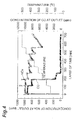
Figure 4 . The concentration of CO at the outlet was reduced to approximately 8000 ppm after approximately 100 minutes (at 200°C), and reduced to approximately 2000 ppm or less during the period after 150 to 250 minutes (at 250°C). Subsequently, the concentration was almost 0 ppm at after 250 minutes or later. On the other hand, the concentration of NOx at the outlet was reduced from the initial concentration of 1000 ppm to approximately 500 ppm after 550 minutes (at 500°C). - A catalyst comprising a carbon material carrying 2% by mass of Pd was placed in the reaction tube, the model gas was flowed, and measurement was performed in the same manner as above. The result is shown in
Figure 5 . - As shown in
Figure 5 , in the case where 2% by mass of Pd was supported, the conversion rate of CO was almost 100% at not less than 300°C, and the conversion rates of NOx and C3H6 were not less than 90% and very high. Moreover, the conversion rate of NOx at 250°C was 28%, the conversion rate of C3H6 at 250°C was 40%, and the conversion rate of CO at 250°C was 97%; the activity at a low temperature was higher than that of the Pt catalyst in Comparative Example 2 described later. Moreover, the carbon balance rate was almost zero, and it was suggested that the catalyst was not calcined at a high temperature of 500°C. - Moreover, change of activity over time on the catalyst at 500°C is shown in
Figure 6 . The concentration of CO at the outlet and the concentration of NOx at the outlet were sharply reduced at after 200 minutes (at not less than 200°C) or later; even if operation was continuously performed for 10 hours or more after the temperature reached 500°C, the concentration of CO at the outlet and the concentration of NOx at the outlet were almost zero, and it was recognized that the activity of the catalyst is not reduced. - Further, the result of a test at 350°C for a long period of time in the catalyst in the case where 2% by mass of Pd was supported is shown in
Figure 7 . In NOx, CO, and C3H6, the conversion rate around 100% was kept for 85 hours, and it was recognized that the catalyst has high durability. - A catalyst comprising a carbon material carrying 0.5% by mass of Rh was placed in the reaction tube, the model gas was flowed, and measurement was performed in the same manner as above. The result is shown in
Figure 8 . - As shown in
Figure 8 , the conversion rate of CO exceeded 60% at 200°C; the Light-off temperature that is a temperature at which the conversion rates of the three components of NOx, CO, and C3H6 reached 50% was 200 to 250°C, and lower than that in Example 2 in the case where 2% by mass of Pd was supported and in the Pt catalyst in Comparative Example 2. - A catalyst containing a carbon material carrying 0.1 % by mass of Rh, which was lower than that in Example 3, was placed in the reaction tube, the model gas was flowed, and measurement was performed in the same manner as above. The result is shown in
Figure 9 . - As shown in
Figure 9 , the conversion rates of the three components of NOx, CO, and C3H6 were not more than 20% and very low at temperatures up to 250°C; at 300°C, the conversion rates of the components other than C3H6 reached almost 100%; at not less than 350°C, the conversion rates were almost 100%. - A catalyst comprising a residue obtained by calcining a catalyst comprising the carbon material in the air atmosphere at 500°C for 3 hours was prepared, and placed in the reaction tube; the model gas was flowed, and measurement was performed in the same manner as above.
The result is shown inFigure 10 . - As shown in
Figure 10 , in the case of the catalyst comprising a residue obtained by calcining a catalyst comprising the carbon material in the air atmosphere at 500°C for 3 hours, the conversion rates of C3H6 and CO at a low temperature were higher than those in the catalyst comprising the carbon material; at 250°C, CO was completely purged, and the conversion rate of C3H6 was approximately 42%. At 300°C, the conversion rate of C3H6 was not less than 90%. However, the conversion rate of NOx was several percents and very low even if the temperature was raised. - As Comparative Example, as a catalyst comprising Pt without using the carbon material, a Pt-alumina catalyst was placed in the reaction tube, a reaction gas was flowed, and measurement was performed in the same manner as above. The amount of Pt to be supported was 1.7% by mass that was approximately 8 to 10 times that in a commercially available three-way catalyst. The result is shown in
Figure 11 . - As shown in
Figure 11 , in the case of the Pt catalyst, at not more than 200°C, the conversion rates of NOx, C3H6, and CO were almost zero. At 250°C, the conversion rate was very low; at not less than 300°C, the conversion rates of the three components of NOx, C3H6, and CO were approximately 100%, and the three components were almost completely purged. - A catalyst obtained by further doping a catalyst comprising the carbon material with nitrogen was placed in the reaction tube, the reaction gas was flowed, and measurement was performed in the same manner as above. The condition of doping with nitrogen was the proportion of air to ammonia of 7:2.3, at 500°C, and for 3 hours. The result is shown in
Figure 12 . - As shown in
Figure 12 , in the catalyst obtained by further doping a catalyst comprising the carbon material with nitrogen, the conversion rates of the three components of NOx, C3H6, and CO were not improved even if the temperature was raised to 500°C, and no catalyst effect was obtained. - No catalyst was placed in the reaction tube, the reaction gas was flowed, and the conversion rates of NOx, CO, and a hydrocarbon (C3H6), and carbon mass balance were measured. The result is shown in
Figure 13 . - As shown in
Figure 13 , in the case where no catalyst was used, the conversion rates of NOx and C3H6 at 150 to 500°C were almost zero. In CO, the conversion rate was gradually improved at not less than 300°C; however, even at 500°C, the conversion rate was 34%, and it was recognized that the gas is not purged without the catalyst. - According to the present invention, the oxidation catalyst, reduction catalyst, and catalyst for purging exhaust gas that includes a carbon material without using Pt, and can purge NOx, CO, or a hydrocarbon can be provided.
- 1...reference gas cylinder, 2...mass flow controller, 3...reaction tube, 4...electric heating furnace, 5...cooler, 6...gas analyzing apparatus, 10...catalyst, 11...quartz sand, 12...quartz wool, 13...thermocouple.
Claims (6)
- An oxidation catalyst comprising a carbon material prepared by calcining:a transition metal compound and a nitrogen-containing organic substance, ora transition metal compound, a nitrogen-containing organic substance, and a carbon compound not containing nitrogen, the oxidation catalyst oxidizing CO and/or a hydrocarbon.
- The oxidation catalyst according to claim 1, wherein a temperature to oxidize the CO and/or the hydrocarbon is not less than 200°C.
- A reduction catalyst comprising a carbon material prepared by calcining:a transition metal compound and a nitrogen-containing organic substance, ora transition metal compound, a nitrogen-containing organic substance, and a carbon compound not containing nitrogen, andat least one load material selected from the group consisting of Pd, Rh, Ru, Ni, Co, Fe, Ce, Cu, Ti, Zr, Sn, V, Nb, Ta, Cr, Mo, W, Bi, Mn, and compounds thereof supported on the carbon material, the reduction catalyst reducing NOx.
- The reduction catalyst according to claim 3, wherein a temperature to reduce the NOx is not less than 200°C.
- The reduction catalyst according to claim 3 or 4, wherein
the load material is at least one selected from the group consisting of Pd and Rh, and
an amount of the load material is 0.01 to 15% by mass based on the mass of the carbon material. - A catalyst for purging exhaust gas, comprising at least one of the oxidation catalyst according to claim 1 or 2 and the reduction catalyst according to any one of claims 3 to 5.
Applications Claiming Priority (2)
| Application Number | Priority Date | Filing Date | Title |
|---|---|---|---|
| JP2009158814A JP5538760B2 (en) | 2009-07-03 | 2009-07-03 | Oxidation catalyst, reduction catalyst and exhaust gas purification catalyst |
| PCT/JP2010/059124 WO2011001772A1 (en) | 2009-07-03 | 2010-05-28 | Oxidation catalyst, reduction catalyst, and catalyst for purging exhaust gas |
Publications (2)
| Publication Number | Publication Date |
|---|---|
| EP2452747A1 true EP2452747A1 (en) | 2012-05-16 |
| EP2452747A4 EP2452747A4 (en) | 2012-12-19 |
Family
ID=43410852
Family Applications (1)
| Application Number | Title | Priority Date | Filing Date |
|---|---|---|---|
| EP10793943A Withdrawn EP2452747A4 (en) | 2009-07-03 | 2010-05-28 | Oxidation catalyst, reduction catalyst, and catalyst for purging exhaust gas |
Country Status (6)
| Country | Link |
|---|---|
| US (1) | US20120196743A1 (en) |
| EP (1) | EP2452747A4 (en) |
| JP (1) | JP5538760B2 (en) |
| CN (1) | CN102481553A (en) |
| CA (1) | CA2766015A1 (en) |
| WO (1) | WO2011001772A1 (en) |
Families Citing this family (6)
| Publication number | Priority date | Publication date | Assignee | Title |
|---|---|---|---|---|
| JP5538761B2 (en) * | 2009-07-03 | 2014-07-02 | 清蔵 宮田 | Oxidation catalyst, adsorbent and toxic substance purification material |
| CN105762376B (en) * | 2016-04-20 | 2018-04-24 | 青岛大学 | The preparation method and applications of nitrogen-phosphor codoping carbon nanosheet |
| CN106334573A (en) * | 2016-09-18 | 2017-01-18 | 黑龙江大学 | Preparation method of catalyst for selectively catalyzing and reducing nitrogen oxide |
| CN114477089B (en) * | 2020-10-26 | 2023-10-27 | 中国石油化工股份有限公司 | Method for removing trace CO at low temperature |
| CN113304770B (en) * | 2021-06-28 | 2022-04-12 | 四川大学 | Method and application of nitrogen-modified chromium-containing leather scraps for preparing nitrogen-rich metal catalyst |
| CN115672267B (en) * | 2021-07-27 | 2024-05-17 | 无锡蓝海工程设计有限公司 | Nitrogen-doped carbon material, preparation method thereof and application thereof in heavy metal ion adsorption |
Family Cites Families (18)
| Publication number | Priority date | Publication date | Assignee | Title |
|---|---|---|---|---|
| JPS57118009A (en) * | 1981-01-16 | 1982-07-22 | Kanebo Ltd | Manufacture of activated carbon having network structure |
| JPS59132943A (en) * | 1983-01-19 | 1984-07-31 | Gosei Kagaku Kenkyusho:Kk | Oxidation catalyst of carbon monoxide |
| JPS6271536A (en) | 1985-09-24 | 1987-04-02 | Mazda Motor Corp | Catalyst for cleaning up exhaust gas of engine |
| DE3727642A1 (en) * | 1987-08-19 | 1989-03-02 | Bayer Ag | CATALYST, METHOD FOR ITS PRODUCTION AND USE THEREOF |
| ZA981883B (en) * | 1997-03-07 | 1998-09-01 | Univ Kansas | Catalysts and methods for catalytic oxidation |
| US6689711B2 (en) * | 2001-10-09 | 2004-02-10 | Metallic Power, Inc. | Methods of producing oxygen reduction catalyst |
| MX261990B (en) * | 2002-02-14 | 2008-11-07 | Monsanto Technology Llc | Oxidation catalyst and process for its preparation and process for oxidation using it. |
| US7390920B2 (en) * | 2002-02-14 | 2008-06-24 | Monsanto Technology Llc | Oxidation catalyst and process |
| US7108939B2 (en) * | 2002-12-12 | 2006-09-19 | Hitachi, Ltd. | Covalently bonded catalyst carrier and catalytic component |
| JP4041429B2 (en) | 2003-06-02 | 2008-01-30 | 独立行政法人科学技術振興機構 | Fuel cell electrode and manufacturing method thereof |
| CN102276644B (en) * | 2003-08-14 | 2014-09-03 | 孟山都技术公司 | Transition metal-carbide and nitride containing catalysts, their preparation and use as oxidation and dehydrogenation catalysts |
| JP2005125300A (en) * | 2003-10-24 | 2005-05-19 | Michio Uemura | Method for removing nitrogen oxide by using metal carbide |
| AR051926A1 (en) * | 2004-09-15 | 2007-02-21 | Monsanto Technology Llc | OXIDATION CATALYSTS, PROCEDURES FOR THE PREPARATION OF SUCH CATALYZERS AND PROCESS FOR THE ELABORATION OF N- (PHOSPHONOMETIL) GLYCINE OR A SALT OF THE SAME |
| JP4452887B2 (en) * | 2005-07-13 | 2010-04-21 | 国立大学法人群馬大学 | Method for producing electrode catalyst for fuel cell, electrode catalyst produced by the method, and fuel cell using the electrode catalyst |
| KR20080047609A (en) | 2005-10-27 | 2008-05-29 | 닛신보세키 가부시키 가이샤 | Fine particles of salts, hydroxides or oxides prepared by the method for producing fine particles of salts, hydroxides or oxides |
| JP4452889B2 (en) * | 2006-02-03 | 2010-04-21 | 国立大学法人群馬大学 | ELECTRODE CATALYST FOR FUEL CELL, METHOD FOR PRODUCING THE SAME, AND FUEL CELL USING THE CATALYST |
| JP5232999B2 (en) * | 2007-05-11 | 2013-07-10 | 国立大学法人群馬大学 | Method for producing electrode catalyst for carbon-based fuel cell |
| JP5538761B2 (en) * | 2009-07-03 | 2014-07-02 | 清蔵 宮田 | Oxidation catalyst, adsorbent and toxic substance purification material |
-
2009
- 2009-07-03 JP JP2009158814A patent/JP5538760B2/en active Active
-
2010
- 2010-05-28 WO PCT/JP2010/059124 patent/WO2011001772A1/en not_active Ceased
- 2010-05-28 EP EP10793943A patent/EP2452747A4/en not_active Withdrawn
- 2010-05-28 US US13/381,558 patent/US20120196743A1/en not_active Abandoned
- 2010-05-28 CN CN2010800296195A patent/CN102481553A/en active Pending
- 2010-05-28 CA CA2766015A patent/CA2766015A1/en not_active Abandoned
Also Published As
| Publication number | Publication date |
|---|---|
| JP5538760B2 (en) | 2014-07-02 |
| EP2452747A4 (en) | 2012-12-19 |
| US20120196743A1 (en) | 2012-08-02 |
| CN102481553A (en) | 2012-05-30 |
| CA2766015A1 (en) | 2011-01-06 |
| JP2011011165A (en) | 2011-01-20 |
| WO2011001772A1 (en) | 2011-01-06 |
Similar Documents
| Publication | Publication Date | Title |
|---|---|---|
| EP2450102A1 (en) | Oxidation catalyst, absorbent, and material for purging harmful substances | |
| Russo et al. | Studies on the redox properties of chromite perovskite catalysts for soot combustion | |
| Fino et al. | Studies on kinetics and reactions mechanism of La2− xKxCu1− yVyO4 layered perovskites for the combined removal of diesel particulate and NOx | |
| EP2452747A1 (en) | Oxidation catalyst, reduction catalyst, and catalyst for purging exhaust gas | |
| Megarajan et al. | Effects of surface and bulk silver on PrMnO3+ δ perovskite for CO and soot oxidation: experimental evidence for the chemical state of silver | |
| US8461073B2 (en) | Catalyst support and method of producing same | |
| Wu et al. | Superior TWC activity of Rh supported on pyrochlore-phase ceria zirconia | |
| CN111545215B (en) | Perovskite-loaded monatomic catalyst and preparation method and application thereof | |
| Wang et al. | The mixed-potential NH3 sensor using BiVO4/Bi4V2O11 heterojunction sensing electrode prepared by self-phase separation | |
| JP5453732B2 (en) | Catalyst precursor, catalyst material, and production method thereof | |
| Dai et al. | Mixed potential NH3 sensor based on Ag-Doped La2NiO4+ δ sensing electrode | |
| Furfori et al. | Towards practical application of lanthanum ferrite catalysts for NO reduction with H2 | |
| Caillot et al. | Catalytic steam reforming of methane over La0. 8Sr0. 2CrO3 based Ru catalysts | |
| CN100368077C (en) | CO2Decomposition catalyst and process for producing the same | |
| WO2008066274A1 (en) | Potassium oxide-incorporated alumina catalysts with enganced storage capacities of nitrogen oxide and a producing method therefor | |
| Abadian et al. | Effects of excess cobalt oxide nanocrystallites on LACO3 Catalyst on lowering the light off temperature of CO and hydrocarbons oxidation | |
| CN119633845A (en) | A method for preparing a platinum-based lanthanum cobalt oxide catalyst for NO oxidation | |
| He et al. | Influences of A-or B-site substitution on the activity of LaMnO3 perovskite-type catalyst in oxidation of diesel particle | |
| Zheng et al. | ZIF-derived spinel CoMn2O4 with hierarchically porous architecture and optimized surface chemistry for efficient low-temperature fast NH3-SCR | |
| Wang et al. | Study on Oxidation Activity of CuCeZrO x Doped with K for Diesel Engine Particles in NO/O2 | |
| Jaenicke et al. | Catalytic CO oxidation over manganese-containing perovskites | |
| Biniwale et al. | Nitric oxide reduction using hydrogen over perovskite catalysts with promotional effect of platinum on catalytic activity | |
| He et al. | Low‐Temperature Reduction of NOx by NH3 with Unity Conversion on Nanofilament MnO2/Activated Semi‐Coke Catalyst | |
| JP4204521B2 (en) | Exhaust gas purification catalyst | |
| Mei et al. | Microscopic phase structure of Mo-based catalyst and its catalytic activity for soot oxidation |
Legal Events
| Date | Code | Title | Description |
|---|---|---|---|
| PUAI | Public reference made under article 153(3) epc to a published international application that has entered the european phase |
Free format text: ORIGINAL CODE: 0009012 |
|
| 17P | Request for examination filed |
Effective date: 20120127 |
|
| AK | Designated contracting states |
Kind code of ref document: A1 Designated state(s): AL AT BE BG CH CY CZ DE DK EE ES FI FR GB GR HR HU IE IS IT LI LT LU LV MC MK MT NL NO PL PT RO SE SI SK SM TR |
|
| DAX | Request for extension of the european patent (deleted) | ||
| RIN1 | Information on inventor provided before grant (corrected) |
Inventor name: KAMEYAMA, HIDEO Inventor name: GUO, YU Inventor name: MIYATA, SEIZO |
|
| A4 | Supplementary search report drawn up and despatched |
Effective date: 20121120 |
|
| RIC1 | Information provided on ipc code assigned before grant |
Ipc: B01J 23/89 20060101AFI20121114BHEP Ipc: B01D 53/94 20060101ALI20121114BHEP Ipc: H01M 8/06 20060101ALI20121114BHEP Ipc: B01J 37/08 20060101ALI20121114BHEP Ipc: B01J 27/20 20060101ALI20121114BHEP Ipc: H01M 4/90 20060101ALI20121114BHEP Ipc: B01J 37/02 20060101ALI20121114BHEP Ipc: B01J 27/24 20060101ALI20121114BHEP Ipc: F01N 3/10 20060101ALI20121114BHEP |
|
| STAA | Information on the status of an ep patent application or granted ep patent |
Free format text: STATUS: THE APPLICATION IS DEEMED TO BE WITHDRAWN |
|
| 18D | Application deemed to be withdrawn |
Effective date: 20130618 |