EP2450709A1 - Immunological measurement reagent for use in measurement of kl-6 - Google Patents
Immunological measurement reagent for use in measurement of kl-6 Download PDFInfo
- Publication number
- EP2450709A1 EP2450709A1 EP10794167A EP10794167A EP2450709A1 EP 2450709 A1 EP2450709 A1 EP 2450709A1 EP 10794167 A EP10794167 A EP 10794167A EP 10794167 A EP10794167 A EP 10794167A EP 2450709 A1 EP2450709 A1 EP 2450709A1
- Authority
- EP
- European Patent Office
- Prior art keywords
- rheumatoid factor
- reagent
- sample
- insoluble carrier
- antibody
- Prior art date
- Legal status (The legal status is an assumption and is not a legal conclusion. Google has not performed a legal analysis and makes no representation as to the accuracy of the status listed.)
- Granted
Links
Classifications
-
- G—PHYSICS
- G01—MEASURING; TESTING
- G01N—INVESTIGATING OR ANALYSING MATERIALS BY DETERMINING THEIR CHEMICAL OR PHYSICAL PROPERTIES
- G01N33/00—Investigating or analysing materials by specific methods not covered by groups G01N1/00 - G01N31/00
- G01N33/48—Biological material, e.g. blood, urine; Haemocytometers
- G01N33/50—Chemical analysis of biological material, e.g. blood, urine; Testing involving biospecific ligand binding methods; Immunological testing
- G01N33/68—Chemical analysis of biological material, e.g. blood, urine; Testing involving biospecific ligand binding methods; Immunological testing involving proteins, peptides or amino acids
- G01N33/6884—Chemical analysis of biological material, e.g. blood, urine; Testing involving biospecific ligand binding methods; Immunological testing involving proteins, peptides or amino acids from lung
-
- G—PHYSICS
- G01—MEASURING; TESTING
- G01N—INVESTIGATING OR ANALYSING MATERIALS BY DETERMINING THEIR CHEMICAL OR PHYSICAL PROPERTIES
- G01N33/00—Investigating or analysing materials by specific methods not covered by groups G01N1/00 - G01N31/00
- G01N33/48—Biological material, e.g. blood, urine; Haemocytometers
- G01N33/50—Chemical analysis of biological material, e.g. blood, urine; Testing involving biospecific ligand binding methods; Immunological testing
- G01N33/53—Immunoassay; Biospecific binding assay; Materials therefor
- G01N33/543—Immunoassay; Biospecific binding assay; Materials therefor with an insoluble carrier for immobilising immunochemicals
-
- G—PHYSICS
- G01—MEASURING; TESTING
- G01N—INVESTIGATING OR ANALYSING MATERIALS BY DETERMINING THEIR CHEMICAL OR PHYSICAL PROPERTIES
- G01N2333/00—Assays involving biological materials from specific organisms or of a specific nature
- G01N2333/435—Assays involving biological materials from specific organisms or of a specific nature from animals; from humans
- G01N2333/46—Assays involving biological materials from specific organisms or of a specific nature from animals; from humans from vertebrates
- G01N2333/47—Assays involving proteins of known structure or function as defined in the subgroups
- G01N2333/4701—Details
- G01N2333/4725—Mucins, e.g. human intestinal mucin
-
- Y—GENERAL TAGGING OF NEW TECHNOLOGICAL DEVELOPMENTS; GENERAL TAGGING OF CROSS-SECTIONAL TECHNOLOGIES SPANNING OVER SEVERAL SECTIONS OF THE IPC; TECHNICAL SUBJECTS COVERED BY FORMER USPC CROSS-REFERENCE ART COLLECTIONS [XRACs] AND DIGESTS
- Y10—TECHNICAL SUBJECTS COVERED BY FORMER USPC
- Y10S—TECHNICAL SUBJECTS COVERED BY FORMER USPC CROSS-REFERENCE ART COLLECTIONS [XRACs] AND DIGESTS
- Y10S436/00—Chemistry: analytical and immunological testing
- Y10S436/805—Optical property
-
- Y—GENERAL TAGGING OF NEW TECHNOLOGICAL DEVELOPMENTS; GENERAL TAGGING OF CROSS-SECTIONAL TECHNOLOGIES SPANNING OVER SEVERAL SECTIONS OF THE IPC; TECHNICAL SUBJECTS COVERED BY FORMER USPC CROSS-REFERENCE ART COLLECTIONS [XRACs] AND DIGESTS
- Y10—TECHNICAL SUBJECTS COVERED BY FORMER USPC
- Y10S—TECHNICAL SUBJECTS COVERED BY FORMER USPC CROSS-REFERENCE ART COLLECTIONS [XRACs] AND DIGESTS
- Y10S436/00—Chemistry: analytical and immunological testing
- Y10S436/807—Apparatus included in process claim, e.g. physical support structures
- Y10S436/808—Automated or kit
-
- Y—GENERAL TAGGING OF NEW TECHNOLOGICAL DEVELOPMENTS; GENERAL TAGGING OF CROSS-SECTIONAL TECHNOLOGIES SPANNING OVER SEVERAL SECTIONS OF THE IPC; TECHNICAL SUBJECTS COVERED BY FORMER USPC CROSS-REFERENCE ART COLLECTIONS [XRACs] AND DIGESTS
- Y10—TECHNICAL SUBJECTS COVERED BY FORMER USPC
- Y10S—TECHNICAL SUBJECTS COVERED BY FORMER USPC CROSS-REFERENCE ART COLLECTIONS [XRACs] AND DIGESTS
- Y10S436/00—Chemistry: analytical and immunological testing
- Y10S436/815—Test for named compound or class of compounds
Definitions
- the technical field of this invention concerns an assay reagent and an assay for KL-6 measurement in a sample. Furthermore, the technical field of the present invention concerns an immunoagglutination technique, reagents, and methods to inhibit nonspecific reactions in this technique.
- KL-6 is a sialylated carbohydrate antigen that is involved in pulmonary fibrosis (Non-Patent Literature (NPL) 1, Patent Literature (PTL) 1). KL-6 levels are measured for the diagnosis and determination of therapeutic strategies for interstitial pneumonitis because elevated KL-6 levels and their fluctuation in interstitial pneumonitis indicate a pathological condition (PTL 1).
- a method of predicting the onset of interstitial pneumonitis caused by interferon administration by measuring serum MUC-1/KL-6 levels (PTL 2), a method of examining prognosis in lung cancer patients by measuring KL-6 (PTL 3), and a method of detecting intraductal papillary mucinous carcinoma or pancreatic cancer by measuring KL-6 in pancreatic juice (PTL 4) have been disclosed.
- ELISA method enzyme-linked immunosorbent assay
- a method that removes the Fc portion from the antibody bound to the latex a method that uses an antibody that binds to the rheumatoid factor (PTL 5), and other similar methods are known to inhibit interference from the rheumatoid factor in the latex immunoagglutination assay.
- the present invention aims to provide an assay reagent and an assay for accurately measuring KL-6, in particular, an assay reagent and an assay for accurately measuring KL-6 in samples containing the rheumatoid factor and/or other nonspecific substances.
- rheumatoid factor interference inhibitor used in the present invention provided it inhibits rheumatoid factor interference in the immunoassay, and HBR (Scantibodies Lab) and animal-derived immunoglobulins that react with rheumatoid factor such as IgM, IgG, and IgA may be mentioned as examples.
- the animal-derived immunoglobulins may be polyclonal or monoclonal antibodies.
- the amount of the above mentioned rheumatoid factor interference inhibitor used is preferably 10 to 200 ⁇ g/mL.
- Buffer solutions at pH 4.0 to 5.5 such as citric acid, acetic acid, glycine, and Good's buffers to which the rheumatoid factor interference inhibitor added, may be mentioned as the solution at pH 4.0 to 5.5 containing the rheumatoid factor interference inhibitor used in the present invention, and the concentration of the above mentioned buffer solution is preferably 5 to 200 mM.
- the anti-KL-6 antibody used in the present invention can be prepared according to the conventional method of monoclonal antibody production after immunizing mice with the pulmonary adenocarcinoma-derived cell line VMRC-LCR as the antigen ( Derivation of specific antibody-producing tissue culture and tumor lines by cell fusion. Kohler G, Milstein C. Eur J Immunol. 1976 Jul;6 (7) :511-9 ).
- Organic polymer powders, inorganic powders, microorganisms, hematocytes, and cell debris may be mentioned as examples of the insoluble carrier used in the present invention.
- Natural polymer powders such as insoluble agarose, cellulose, and insoluble dextran and synthetic polymer powders such as polystyrene, styrene-styrene sulfonate copolymers, acrylonitrile-butadiene-styrene copolymers, vinyl chloride-acrylate ester copolymers, and vinyl acetate-acrylic ester copolymers may be mentioned as examples of the above mentioned organic polymer powders, in particular, latex in which a synthetic polymer powder has been suspended uniformly is desirable.
- Metal fragments such as gold, titanium, iron and nickel; silica; alumina and carbon powder may be mentioned as examples of the above mentioned inorganic powders.
- Chemical or physical binding may be mentioned as the example of methods of immobilizing anti-KL-6 antibodies on the above mentioned insoluble carrier.
- Physiologically (biological) derived body fluids may be mentioned as the "analytes” that are the major targets of measurement in the assay of the present invention.
- Blood, serum, plasma, urine, saliva, sputum, tears, ear discharge, or prostatic fluid may be specifically mentioned, but samples may not be limited to these.
- Latex agglutination and hemagglutination reactions are examples of measurement systems used for measurement of antibody-antigen reactions using the above mentioned reagent. Methods whereby the degree of agglutination is optically examined may be employed as the method of measuring agglutination caused by the above mentioned reactions.
- scattered light intensity, absorbance, or transmitted light intensity accompanying agglutination of the insoluble carrier caused by an immunoreaction between KL-6 in the sample and anti-KL-6 antibodies immobilized on the insoluble carrier are measured after mixing the solution at pH 4.0 to 5.5, containing the above mentioned rheumatoid factor interference inhibitor, and sample with the solution of the above mentioned insoluble carrier on which anti-KL-6 antibodies are immobilized.
- the pH of the above mentioned mixture is preferably in the range of 4.0 to 5.5.
- a measuring wavelength of 300 to 1000 nm may be used, and the assay measures increase or decrease in scattered light intensity, absorbance, or transmitted light intensity according to the particle diameter, concentration, and reaction time of the insoluble carrier used, based on the knowledge of one skilled in the art.
- the immunoreaction between KL-6 in the sample and anti-KL-6 antibodies immobilized on the insoluble carrier should be performed under conditions in which the sample, rheumatoid factor interference inhibitor, and insoluble carrier on which anti-KL-6 antibodies are immobilized are present in a solution at pH 4.0 to 5.5.
- a solution at pH 4.0 to 5.5 Preferably 5 to 200 mM citric acid, acetic acid, glycine, and Good's buffer may be mentioned as examples of the above mentioned solution at pH 4.0 to 5.5.
- an immunoassay using an agglutination reaction of an insoluble carrier such as the latex immunoagglutination assay
- numerous samples can be rapidly, readily, cheaply, and accurately tested, even when there are concerns about the occurrence or increase of nonspecific reactions attributable to the rheumatoid factor or heterophile antibodies, nonspecific reactions where interference is not inhibited by antibodies binding to the rheumatoid factor or various animal-derived antibodies, nonspecific reactions attributable to something other than the rheumatoid factor or heterophile antibodies, nonspecific reactions due to the use of antibody preparations, etc.
- the antibody obtained by the method described in Patent Literature 1 (particularly in the first example) was used as the anti-KL-6 antibody.
- the method of antibody production described in Patent Literature 1 is as follows:
- mice Eight-week-old female BALB/c mice were immunized subcutaneously with 5x10 6 cells derived from a pulmonary adenocarcinoma cell line (hereinafter VMRC-LCR), and subsequently, the mice were intraperitoneally injected with 8x10 6 cells twice at an interval of 2 weeks.
- VMRC-LCR pulmonary adenocarcinoma cell line
- the spleen was removed and passed through a stainless mesh to prepare a cell suspension.
- Spleen cells (8.4x10 7 ) were mixed with P3-NSI-Ag4/1 (NSI) 8-azaguanine-resistant myeloma cells (4.2x10 7 ) and centrifuged.
- 1 mL of 45% polyethylene glycol (average molecular weight 6000) was added to the precipitate, and the mixture was stirred gently for 2 min. After washing, the mixture was suspended in RPMI medium containing 10% fetal calf serum (complete RPMI medium), and 10 6 cells at 0.1 mL per well were added to a 96-well microculture plate.
- HAT medium complete RPMI medium containing 100 ⁇ m of hypoxanthine, 0.4 ⁇ M of aminopterin, and 16 ⁇ M of thymidine (HAT medium) was added.
- HAT medium 16 ⁇ M of thymidine
- 0.1mL of culture supernatant was discarded and an equal volume (0.1 mL) of HAT medium was added. Proliferation of hybridomas was observed in all wells after 12 days.
- Hybridomas producing antibodies to VMRC-LCR cells were selected by an enzyme immunoassay.
- the enzyme immunoassay was performed as follows:
- BALB/c mice to be transplanted with the hybridoma were injected intraperitoneally with 0.5 mL of 2,6,10,14-tetramethylpentadecane in advance (5 to 10 days before), and 5x10 6 hybridoma cells were intraperitoneally transplanted. After 3 weeks, intraperitoneal hybridoma tumors formed and the abdomen enlarged in the transplanted mouse. As a result, a high concentration of monoclonal antibody was generated in the ascites fluid and blood serum, and these fluids were collected.
- the above mentioned solution was filtered through a filter paper and latex particles were recovered.
- the diameter of the obtained latex particles was measured by image analysis of at least 100 particles. Photographs for image analysis of the latex particles were taken at a magnification of 10,000x using a transmission electron microscope (JEM-1010, JEOL). The average diameter was 0.2 ⁇ m.
- Reagent 2 Preparation of a solution containing anti-KL-6 antibody-immobilized latex particle (a solution containing latex particles on which anti-KL-6 antibodies are immobilized; hereinafter referred to as Reagent 2)
- An anti-KL-6 antibody solution (5 mM Tris-HCl, pH 8.0) adjusted to 0.7 mg/mL was added to an equal amount of solution containing 1.0% latex particles having an average particle diameter of 0.2 ⁇ m (5 mM Tris-HCl, pH 8.0). After stirring for 2 h at 4°C, an equal amount of 2.0% BSA solution (5 mM Tris-HCl, pH 8.0) was added, and the mixture was stirred for 1 h at 4°C. After centrifugation, the supernatant was discarded, and the precipitate was resuspended in 5mM Tris-HCl, pH 8.0. This mixture was diluted with 5 mM Tris-HCl, pH 8.0 such that the absorbance at a wavelength of 600 nm was 4.5 Abs. This solution was used as Reagent 2.
- Reagent 1 Preparation of a solution containing the rheumatoid factor interference inhibitor (hereinafter, Reagent 1). Specifically, 30 mM citrate buffer (pH 4.0) containing 1000 mM sodium chloride, 1.0% BSA, and 50 ⁇ g/mL HBR (Scantibodies Lab, 3KC533) was prepared and used as Reagent 1.
- the concentration of the rheumatoid factor in samples from patients with rheumatism were measured by the N-assay Nittobo TIA RF (Nittobo Medical Co., Ltd.) and the concentration of KL-6 was measured using Picolumi (registered trademark) KL-6 (Sanko Junyaku Co., Ltd.); each was measured according to the respective product documentation and manufacturer's instructions.
- the measured KL-6 value was expressed as 100% and was compared with the measured value according to the immunoassay of the present invention.
- Reagent 1 and Reagent 2 were mixed, and the concentration of KL-6 in the sample containing the rheumatoid factor was measured using a Hitachi 7170 automated analyzer. Specifically, 150 ⁇ L of Reagent 1 was added to 2.5 ⁇ L of sample and after incubating for 5 min at 37°C, 50 ⁇ L of Reagent 2 was added, and the mixture was stirred. Changes in absorbance associated with agglutination were measured over the next 5 min at a main wavelength of 570 nm and a sub-wavelength of 800 nm. The concentration of KL-6 was calculated by applying the change in absorbance to a calibration curve obtained by measurement of a standard substance of known concentration.
- Example 2 instead of 30 mM citrate buffer (pH 4.0) in Reagent 1 of Example 1, 30 mM citrate buffers at pH 4.5 (Example 2), pH 5.0 (Example 3), and pH 5.5 (Example 4) were used. Measurements were performed using the same reagents and the same assay as Example 1.
- measured values for the elevated rheumatoid factor sample B were within the range of 85% to 115% of the values measured by Picolumi (registered trademark) KL-6.
- measured values for the high rheumatoid factor sample A exceeded 115% of the values measured by Picolumi (registered trademark) KL-6 in the pH range of the prior art (comparative examples 2 to 6), and a nonspecific reaction was observed, which could not be sufficiently inhibited even by the rheumatoid factor interference inhibitor.
- 30 mM citrate buffer (Example 5: pH 4.0, 4.5, 5.0, and 5.5) and 30 mM acetate buffer (Example 6: pH 4.0, 4.5, 5.0, and 5.5) containing 1000 mM sodium chloride, 1.0% BSA, and 50 ⁇ g/mL HBR (Scantibodies Lab, 3KC533) were prepared as solutions containing the rheumatoid factor interference inhibitor.
- KL-6 concentrations were measured by the same assay as Example 1, using the buffer described above under Examples 5 and 6 and Comparative Examples 7 to 10 as the respective Reagent 1 and Reagent 2 described in Example 1 as Reagent 2.
- the present invention provides a method to measure KL-6 to assist the diagnosis and determination of therapeutic strategies for interstitial pneumonitis and an assay reagent or reagent kit for the implementation of the above mentioned method.
- the present invention is useful for the diagnosis and determination of therapeutic strategies for interstitial pneumonitis including drug-induced interstitial pneumonitis and collagen disorder-originating interstitial pneumonitis, diagnosis of patients with cancers such as lung cancer and pancreatic cancer, and for purposes such as diagnosis and determination of therapeutic strategies for interstitial pneumonitis in patients treated with antibody preparation for rheumatoid arthritis, Crohn's disease, generalized juvenile idiopathic arthritis, and Castleman's disease. Since the present invention is protected as necessary as a reagent, reagent kit, and a use of these in manufacturing, it has industrial applicability and is not excluded from patentability.
Landscapes
- Life Sciences & Earth Sciences (AREA)
- Health & Medical Sciences (AREA)
- Engineering & Computer Science (AREA)
- Immunology (AREA)
- Molecular Biology (AREA)
- Biomedical Technology (AREA)
- Chemical & Material Sciences (AREA)
- Hematology (AREA)
- Urology & Nephrology (AREA)
- Biotechnology (AREA)
- Microbiology (AREA)
- Cell Biology (AREA)
- Food Science & Technology (AREA)
- Medicinal Chemistry (AREA)
- Physics & Mathematics (AREA)
- Analytical Chemistry (AREA)
- Biochemistry (AREA)
- General Health & Medical Sciences (AREA)
- General Physics & Mathematics (AREA)
- Pathology (AREA)
- Proteomics, Peptides & Aminoacids (AREA)
- Peptides Or Proteins (AREA)
Abstract
Description
- The technical field of this invention concerns an assay reagent and an assay for KL-6 measurement in a sample. Furthermore, the technical field of the present invention concerns an immunoagglutination technique, reagents, and methods to inhibit nonspecific reactions in this technique.
- KL-6 is a sialylated carbohydrate antigen that is involved in pulmonary fibrosis (Non-Patent Literature (NPL) 1, Patent Literature (PTL) 1). KL-6 levels are measured for the diagnosis and determination of therapeutic strategies for interstitial pneumonitis because elevated KL-6 levels and their fluctuation in interstitial pneumonitis indicate a pathological condition (PTL 1). A method of predicting the onset of interstitial pneumonitis caused by interferon administration by measuring serum MUC-1/KL-6 levels (PTL 2), a method of examining prognosis in lung cancer patients by measuring KL-6 (PTL 3), and a method of detecting intraductal papillary mucinous carcinoma or pancreatic cancer by measuring KL-6 in pancreatic juice (PTL 4) have been disclosed. In recent years, the need has increased for KL-6 measurement for the diagnosis and determination of therapeutic strategies for interstitial pneumonitis including drug-induced interstitial pneumonitis, collagen disorder-induced interstitial pneumonitis, etc., diagnosis of patients with cancers of lung, pancreas, etc., and diagnosis and determination of therapeutic strategies for interstitial pneumonitis in patients treated with antibody preparation for rheumatoid arthritis, Crohn's disease, generalized juvenile idiopathic arthritis, Castleman's disease, etc.
- In patent literature 1-4, enzyme-linked immunosorbent assay (hereinafter, ELISA method) has been used for KL-6 measurement. Although ELISA is a reliable method, latex immunoagglutination assay is superior for rapid, easy, and cheap testing of a large number of samples and is widely used as a clinical reagent for measuring trace components.
- However, when a sample containing the rheumatoid factor is tested by an immunological measurement method such as ELISA or latex immunoagglutination, the occurrence of a nonspecific reaction owing to interference from the rheumatoid factor depending on the sample, is a known problem (NPL 2). In addition, the occurrence of a nonspecific reaction due to interference from heterophile antibodies (anti-mouse immunoglobulin antibody: HAMA etc. and anti-goat immunoglobulin antibody: HAGA etc.) is a known problem.
- A method that removes the Fc portion from the antibody bound to the latex, a method that uses an antibody that binds to the rheumatoid factor (PTL 5), and other similar methods are known to inhibit interference from the rheumatoid factor in the latex immunoagglutination assay.
- However, the present inventors have found samples in which the occurrence of nonspecific reactions could not be adequately inhibited even by the abovementioned methods.
-
- [Patent Literature 1] Japanese Published Examined Application No.
1995-31207 - [Patent Literature 2] Japanese Published Unexamined Application No.
2005-121441 - [Patent Literature 3] Japanese Patent Publication No.
4083855 - [Patent Literature 4] Japanese Published Unexamined Application No.
2006-308576 - [Patent Literature 5] Japanese Published Unexamined Application No.
1995-12818 -
- [Non-Patent Literature 1] New serum indicator of interstitial pneumonitis activity. Sialylated carbohydrate antigen KL-6. Kohno N, Kyoizumi S, Awaya Y, Fukuhara H, Yamakido M, Akiyama M. Chest. 1989 Jul;96 (1):68-73.
- [Non-Patent Literature 2] Interference by rheumatoid factor with the detection of C-reactive protein by the latex agglutination method. Deyo RA, Pope RM, Persellin RH. J Rheumatol. 1980 May-Jun;7 (3) :279-87.
- The present invention aims to provide an assay reagent and an assay for accurately measuring KL-6, in particular, an assay reagent and an assay for accurately measuring KL-6 in samples containing the rheumatoid factor and/or other nonspecific substances.
- Extensive studies by the present inventors indicated that KL-6 in samples containing the rheumatoid factor and/or other nonspecific substances can be accurately measured using an immunoassay reagent comprising a solution at pH 4.0 to 5.5 containing the rheumatoid factor interference inhibitor and an insoluble carrier on which anti-KL-6 antibodies are immobilized. This led to the completion of the present invention. More specifically, this invention has the following configuration.
- (1) A KL-6 immunoassay reagent comprising a solution (pH 4.0 to 5.5) containing a rheumatoid factor interference inhibitor and a solution containing an insoluble carrier on which an anti-KL-6 antibody is immobilized.
- (2) The immunoassay reagent of (1) above, wherein the insoluble carrier is a latex particle.
- (3) A KL-6 immunoassay comprising measuring the change in absorbance accompanying agglutination of an insoluble carrier due to the immune reaction between KL-6 in a sample and an anti-KL-6 antibody immobilized on the insoluble carrier in a solution at pH 4.0 to 5.5, using the sample, a rheumatoid factor interference inhibitor, and an insoluble carrier on which an anti-KL-6 antibody is immobilized.
- (4) A KL-6 immunoassay in which a solution at pH 4.0 to 5.5 containing a rheumatoid factor interference inhibitor and an insoluble carrier on which an anti-KL-6 antibody is immobilized is added to a sample and the change in absorbance accompanying the agglutination of the insoluble carrier due to the immune reaction between KL-6 in the sample and the anti-KL-6 antibody immobilized on the insoluble carrier is measured.
- (5) The immunoassay of (3) or (4) above, wherein the insoluble carrier is a latex particle.
- There are no particular restrictions on the rheumatoid factor interference inhibitor used in the present invention provided it inhibits rheumatoid factor interference in the immunoassay, and HBR (Scantibodies Lab) and animal-derived immunoglobulins that react with rheumatoid factor such as IgM, IgG, and IgA may be mentioned as examples.
As described above, the animal-derived immunoglobulins may be polyclonal or monoclonal antibodies.
The amount of the above mentioned rheumatoid factor interference inhibitor used is preferably 10 to 200 µg/mL. - Buffer solutions at pH 4.0 to 5.5, such as citric acid, acetic acid, glycine, and Good's buffers to which the rheumatoid factor interference inhibitor added, may be mentioned as the solution at pH 4.0 to 5.5 containing the rheumatoid factor interference inhibitor used in the present invention, and the concentration of the above mentioned buffer solution is preferably 5 to 200 mM.
As described in Patent Literature 1, the anti-KL-6 antibody used in the present invention can be prepared according to the conventional method of monoclonal antibody production after immunizing mice with the pulmonary adenocarcinoma-derived cell line VMRC-LCR as the antigen (Derivation of specific antibody-producing tissue culture and tumor lines by cell fusion. Kohler G, Milstein C. Eur J Immunol. 1976 Jul;6 (7) :511-9). - Organic polymer powders, inorganic powders, microorganisms, hematocytes, and cell debris may be mentioned as examples of the insoluble carrier used in the present invention.
Natural polymer powders such as insoluble agarose, cellulose, and insoluble dextran and synthetic polymer powders such as polystyrene, styrene-styrene sulfonate copolymers, acrylonitrile-butadiene-styrene copolymers, vinyl chloride-acrylate ester copolymers, and vinyl acetate-acrylic ester copolymers may be mentioned as examples of the above mentioned organic polymer powders, in particular, latex in which a synthetic polymer powder has been suspended uniformly is desirable.
Metal fragments such as gold, titanium, iron and nickel; silica; alumina and carbon powder may be mentioned as examples of the above mentioned inorganic powders. - While the average particle diameter of the above mentioned insoluble carrier depends on the assay and measuring device, particles with diameter from 0.05 to 1.0 µm are normally used.
- Chemical or physical binding may be mentioned as the example of methods of immobilizing anti-KL-6 antibodies on the above mentioned insoluble carrier.
- The above mentioned insoluble carrier on which anti-KL-6 antibodies are immobilized is normally present in a solution, and Tris, glycine, and Good's buffers may be mentioned as examples of the solutions used.
- Physiologically (biological) derived body fluids may be mentioned as the "analytes" that are the major targets of measurement in the assay of the present invention. Blood, serum, plasma, urine, saliva, sputum, tears, ear discharge, or prostatic fluid may be specifically mentioned, but samples may not be limited to these.
- Latex agglutination and hemagglutination reactions are examples of measurement systems used for measurement of antibody-antigen reactions using the above mentioned reagent. Methods whereby the degree of agglutination is optically examined may be employed as the method of measuring agglutination caused by the above mentioned reactions.
- In particular, in the method of optical examination, scattered light intensity, absorbance, or transmitted light intensity accompanying agglutination of the insoluble carrier caused by an immunoreaction between KL-6 in the sample and anti-KL-6 antibodies immobilized on the insoluble carrier are measured after mixing the solution at pH 4.0 to 5.5, containing the above mentioned rheumatoid factor interference inhibitor, and sample with the solution of the above mentioned insoluble carrier on which anti-KL-6 antibodies are immobilized. Here the pH of the above mentioned mixture is preferably in the range of 4.0 to 5.5. A measuring wavelength of 300 to 1000 nm may be used, and the assay measures increase or decrease in scattered light intensity, absorbance, or transmitted light intensity according to the particle diameter, concentration, and reaction time of the insoluble carrier used, based on the knowledge of one skilled in the art.
- In order to perform an immunoassay of the present invention, the immunoreaction between KL-6 in the sample and anti-KL-6 antibodies immobilized on the insoluble carrier should be performed under conditions in which the sample, rheumatoid factor interference inhibitor, and insoluble carrier on which anti-KL-6 antibodies are immobilized are present in a solution at pH 4.0 to 5.5.
Preferably 5 to 200 mM citric acid, acetic acid, glycine, and Good's buffer may be mentioned as examples of the above mentioned solution at pH 4.0 to 5.5. - According to the present invention, in an immunoassay using an agglutination reaction of an insoluble carrier such as the latex immunoagglutination assay, numerous samples can be rapidly, readily, cheaply, and accurately tested, even when there are concerns about the occurrence or increase of nonspecific reactions attributable to the rheumatoid factor or heterophile antibodies, nonspecific reactions where interference is not inhibited by antibodies binding to the rheumatoid factor or various animal-derived antibodies, nonspecific reactions attributable to something other than the rheumatoid factor or heterophile antibodies, nonspecific reactions due to the use of antibody preparations, etc.
- The antibody obtained by the method described in Patent Literature 1 (particularly in the first example) was used as the anti-KL-6 antibody. The method of antibody production described in Patent Literature 1 is as follows:
- Eight-week-old female BALB/c mice were immunized subcutaneously with 5x10⁶ cells derived from a pulmonary adenocarcinoma cell line (hereinafter VMRC-LCR), and subsequently, the mice were intraperitoneally injected with 8x10⁶ cells twice at an interval of 2 weeks.
- Three days after final immunization, the spleen was removed and passed through a stainless mesh to prepare a cell suspension. Spleen cells (8.4x10⁷) were mixed with P3-NSI-Ag4/1 (NSI) 8-azaguanine-resistant myeloma cells (4.2x10⁷) and centrifuged. Next, 1 mL of 45% polyethylene glycol (average molecular weight 6000) was added to the precipitate, and the mixture was stirred gently for 2 min. After washing, the mixture was suspended in RPMI medium containing 10% fetal calf serum (complete RPMI medium), and 106 cells at 0.1 mL per well were added to a 96-well microculture plate. After 24 h, 0.1 mL of complete RPMI medium containing 100 µm of hypoxanthine, 0.4 µM of aminopterin, and 16 µM of thymidine (HAT medium) was added. On the second, third, fifth, seventh, and tenth day after the start of culture, 0.1mL of culture supernatant was discarded and an equal volume (0.1 mL) of HAT medium was added. Proliferation of hybridomas was observed in all wells after 12 days.
- Hybridomas producing antibodies to VMRC-LCR cells were selected by an enzyme immunoassay. The enzyme immunoassay was performed as follows:
- VMRC-LCR cells were cultured in a 96-well microculture plate until confluence, fixed for 5 to 7 min in 0.25% glutaraldehyde, and washed five times. Next, 0.1mL of hybridoma culture supernatant was added, and the mixture was allowed to react for 1 h at room temperature. After washing five times, 50 µL of the horseradish peroxidase-conjugated goat anti-mouse immunoglobulin was added as the secondary antibody and allowed to react for 1 h. After washing six to seven times, 100 µL of 50 mM citric acid buffer containing 1.1% hydrogen peroxide solution and 150 µg/mL 2,2'-azino-bis(3-ethylbenzthiazoline-6-sulfonic acid) (ABTS) was added, and the mixture was allowed to develop color for 10 min at room temperature. Next, 50 µL of 10% oxalic acid was added to stop the reaction. The absorbance at 405 nm was measured by a microplate spectrophotometer, and hybridomas with absorbance of 0.02 or more were selected.
- BALB/c mice to be transplanted with the hybridoma were injected intraperitoneally with 0.5 mL of 2,6,10,14-tetramethylpentadecane in advance (5 to 10 days before), and 5x10⁶ hybridoma cells were intraperitoneally transplanted. After 3 weeks, intraperitoneal hybridoma tumors formed and the abdomen enlarged in the transplanted mouse.
As a result, a high concentration of monoclonal antibody was generated in the ascites fluid and blood serum, and these fluids were collected. - In brief, 1100 g of distilled water, 200 g of styrene, 0.2 g sodium styrene sulfonate, and an aqueous solution of 1.5 g of potassium persulfate dissolved in 50 g of distilled water were mixed in a 2-L glass reaction vessel fitted with a stirrer, reflux condenser, temperature detector, nitrogen inlet, and jacket. The atmosphere in the vessel was replaced with nitrogen gas, and the mixture was polymerized for 48 h at 70°C with stirring.
- After polymerisation, the above mentioned solution was filtered through a filter paper and latex particles were recovered. The diameter of the obtained latex particles was measured by image analysis of at least 100 particles. Photographs for image analysis of the latex particles were taken at a magnification of 10,000x using a transmission electron microscope (JEM-1010, JEOL). The average diameter was 0.2 µm.
- An anti-KL-6 antibody solution (5 mM Tris-HCl, pH 8.0) adjusted to 0.7 mg/mL was added to an equal amount of solution containing 1.0% latex particles having an average particle diameter of 0.2 µm (5 mM Tris-HCl, pH 8.0). After stirring for 2 h at 4°C, an equal amount of 2.0% BSA solution (5 mM Tris-HCl, pH 8.0) was added, and the mixture was stirred for 1 h at 4°C. After centrifugation, the supernatant was discarded, and the precipitate was resuspended in 5mM Tris-HCl, pH 8.0. This mixture was diluted with 5 mM Tris-HCl, pH 8.0 such that the absorbance at a wavelength of 600 nm was 4.5 Abs. This solution was used as Reagent 2.
- Preparation of a solution containing the rheumatoid factor interference inhibitor (hereinafter, Reagent 1).
Specifically, 30 mM citrate buffer (pH 4.0) containing 1000 mM sodium chloride, 1.0% BSA, and 50 µg/mL HBR (Scantibodies Lab, 3KC533) was prepared and used as Reagent 1. - The concentration of the rheumatoid factor in samples from patients with rheumatism were measured by the N-assay Nittobo TIA RF (Nittobo Medical Co., Ltd.) and the concentration of KL-6 was measured using Picolumi (registered trademark) KL-6 (Sanko Junyaku Co., Ltd.); each was measured according to the respective product documentation and manufacturer's instructions. The measured KL-6 value was expressed as 100% and was compared with the measured value according to the immunoassay of the present invention.
- Reagent 1 and Reagent 2 were mixed, and the concentration of KL-6 in the sample containing the rheumatoid factor was measured using a Hitachi 7170 automated analyzer. Specifically, 150 µL of Reagent 1 was added to 2.5 µL of sample and after incubating for 5 min at 37°C, 50 µL of Reagent 2 was added, and the mixture was stirred. Changes in absorbance associated with agglutination were measured over the next 5 min at a main wavelength of 570 nm and a sub-wavelength of 800 nm. The concentration of KL-6 was calculated by applying the change in absorbance to a calibration curve obtained by measurement of a standard substance of known concentration.
- After mixing the sample, Reagent 1, and Reagent 2 in the same ratio as in the above mentioned assay of KL-6, pH was measured using a Castany LAB F-21 pH meter (Horiba Ltd.).
- Instead of 30 mM citrate buffer (pH 4.0) in Reagent 1 of Example 1, 30 mM citrate buffers at pH 4.5 (Example 2), pH 5.0 (Example 3), and pH 5.5 (Example 4) were used. Measurements were performed using the same reagents and the same assay as Example 1.
- Measurements were performed using the same reagents and the same assay as Example 1 except that 30 mM glycine buffer at pH 3.5 (Comparative Example 1) and 30 mM phosphate buffers at pH 6.0 (Comparative Example 2), 6.5 (Comparative Example 3), 7.0 (Comparative Example 4), 7.5 (Comparative Example 5), and 8.0 (Comparative Example 6) were used instead of 30 mM citrate buffer (pH 4.0) in Reagent 1 of Example 1.
- The effectiveness of nonspecific reaction inhibition when the pH of Reagent 1 was varied was investigated for a sample containing a high concentration of the rheumatoid factor (elevated rheumatoid factor sample). Results of measurements of Reagent 1 at pH 3.5 to 8.0 for elevated rheumatoid factor samples A and B and normal sample C (Examples 1 to 4, Comparative Examples 1 to 6) are shown in Table 1.
- [TABLE 1]
Table 1 Sample dilution solution Citric acid Glycine Phosphoric acid pH 4.0 4.5 5.0 5.5 3.5 6.0 6.5 7.0 7.5 8.0 RF conc. (IU/mL) KL-6 conc.* (U/mL) Ex. 1 Ex. 2 Ex. 3 Ex. 4 Comp. Ex. 1 Comp. Ex. 2 Comp. Ex. 3 Comp. Ex. 4 Comp. Ex. 5 Comp. Ex. 6 Sample A 1019 553 109.7% 111.3% 111.6% 111.6% 120.4% 146.5% 143.0% 137.8% 135.9% 123.8% Sample B 894 2880 109.6% 112.8% 114.5% 112.1% 114.3% 113.0% 112.1% 114.1% 114.5% 114.9% Sample C 11 494 94.4% 91.0% 89.5% 93.0% 100.5% 91.6% 85.1% 86.0% 90.5% 93.3% Glycine: Glycine buffer
Citric acid: Citrate buffer
Phosphoric acid: Phosphate buffer
RF: Rheumatoid factor
*: Measurements by Picolumi (registered trademark) KL-6 Percentage in Examples and Comparative Examples is relative to a value of 100% of measurements by Picolumi (registered trademark) KL-6 Conc.: Concentration
Ex.: Example
Comp. Ex.: Comparative Example - Considering the KL-6 concentration measured by Picolumi (registered trademark) KL-6 to be 100%, nonspecific reactions were believed to occur when the KL-6 values measured by the assay of the present invention were less than 85% or more than 115%. If the values were within the range of 85% to 115%, the method was considered to have sufficient accuracy, and the effectiveness of nonspecific reaction inhibition was confirmed.
- Using the rheumatoid factor interference inhibitor and the pH range of the prior art (pH 6.0 to 8.0), measured values for the elevated rheumatoid factor sample B were within the range of 85% to 115% of the values measured by Picolumi (registered trademark) KL-6. On the other hand, measured values for the high rheumatoid factor sample A, exceeded 115% of the values measured by Picolumi (registered trademark) KL-6 in the pH range of the prior art (comparative examples 2 to 6), and a nonspecific reaction was observed, which could not be sufficiently inhibited even by the rheumatoid factor interference inhibitor.
- Surprisingly, after changing the pH of Reagent 1 to the range from 4.0 to 5.5, measured values for both the elevated rheumatoid factor samples A and B were within the range of 85% to 115% of values measured by Picolumi (registered trademark) KL-6 and nonspecific reactions were inhibited (Examples 1 to 4). This result showed that the rheumatoid factor and non-rheumatoid factor nonspecific reactions were inhibited by the present invention, and measured values were accurate. Since no pH- or buffer-dependent variation was observed in measured values for sample C, it was confirmed that varying pH or changing buffers does not affect the measured values of KL-6.
The results of pH measurement when the sample, Reagent 1, and Reagent 2 were mixed in the same ratio as in the above mentioned KL-6 concentration assay are shown in Table 2. - [TABLE 2]
Table 2 Sample dilution solution Citric acid Glycine Phosphoric acid pH 4.0 4.5 5.0 5.5 3.5 6.0 6.5 7.0 7.5 8.0 Ex. 1 Ex. 2 Ex. 3 Ex. 4 Comp. Ex. 1 Comp. Ex. 2 Comp. Ex. 3 Comp. Ex. 4 Comp. Ex. 5 Comp. Ex. 6 Sample A 4.0 4.5 5.0 5.5 3.5 6.0 6.5 7.0 7.5 8.0 Sample B 4.0 4.5 5.0 5.5 3.5 6.0 6.5 7.0 7.5 8.0 Sample C 4.0 4.5 5.0 5.5 3.5 6.0 6.5 7.0 7.5 8.0 Glycine: Glycine buffer
Citric acid: Citrate buffer
Phosphoric acid: Phosphate buffer
Ex.: Example
Comp. Ex.: Comparative Example - As described above, the pH of Reagent 1(pH 4.0 to 5.5), for which nonspecific reactions were not observed, was still 4.0 to 5.5 after mixing. (Examples 1 to 4). This suggested that the same effectiveness of inhibition of nonspecific reactions could be obtained by using a pH from 4.0 to 5.5 when measuring KL-6 concentration.
- 30 mM citrate buffer (Example 5: pH 4.0, 4.5, 5.0, and 5.5) and 30 mM acetate buffer (Example 6: pH 4.0, 4.5, 5.0, and 5.5) containing 1000 mM sodium chloride, 1.0% BSA, and 50 µg/mL HBR (Scantibodies Lab, 3KC533) were prepared as solutions containing the rheumatoid factor interference inhibitor.
- In brief, 30 mM phosphate buffer (pH 6.0, 6.5, 7.0, 7.5, and 8.0), 30 mM glycine buffer (pH 3.5), and 30 mM citrate buffer (pH 4.0, 4.5, 5.0, 5.5, and 6.0) containing 1000 mM sodium chloride and 1.0% BSA were prepared as solutions not containing the rheumatoid factor interference inhibitor (without HBR).
- 30 mM phosphate buffer (pH 6.0, 6.5, 7.0, 7.5, and 8.0), 30 mM glycine buffer (pH 3.5), and 30 mM citrate buffer (pH 6.0) containing 1000 mM sodium chloride, 1.0% BSA, and 50 µg/mL HBR (Scantibodies Lab, 3KC533) were prepared as solutions containing the rheumatoid factor interference inhibitor.
- 30 mM phosphate buffer (pH 6.0, 6.5, 7.0, 7.5, and 8.0), 30 mM glycine buffer (pH 3.5), and 30 mM acetate buffer (pH 4.0, 4.5, 5.0, 5.5, and 6.0) containing 1000 mM sodium chloride and 1.0% BSA were prepared as solutions not containing the rheumatoid factor interference inhibitor.
- 30 mM phosphate buffer (pH 6.0, 6.5, 7.0, 7.5, and 8.0), 30 mM glycine buffer (pH 3.5), and 30 mM acetate buffer (pH 6.0) containing 1000 mM sodium chloride, 1.0% BSA, and 50 µg/mL HBR (Scantibodies Lab, 3KC533) were prepared as solutions containing the rheumatoid factor interference inhibitor.
- KL-6 concentrations were measured by the same assay as Example 1, using the buffer described above under Examples 5 and 6 and Comparative Examples 7 to 10 as the respective Reagent 1 and Reagent 2 described in Example 1 as Reagent 2.
- Effectiveness of nonspecific reaction inhibition was investigated when the pH of solutions containing or not containing the rheumatoid factor interference inhibitor differed. The results are shown in Tables 3, 4, and 5. Samples were divided into groups a, b, and c as in the table on the basis of the behavior of each specimen under various conditions.
- [TABLE 3]

- [TABLE 4]

- [TABLE 5]

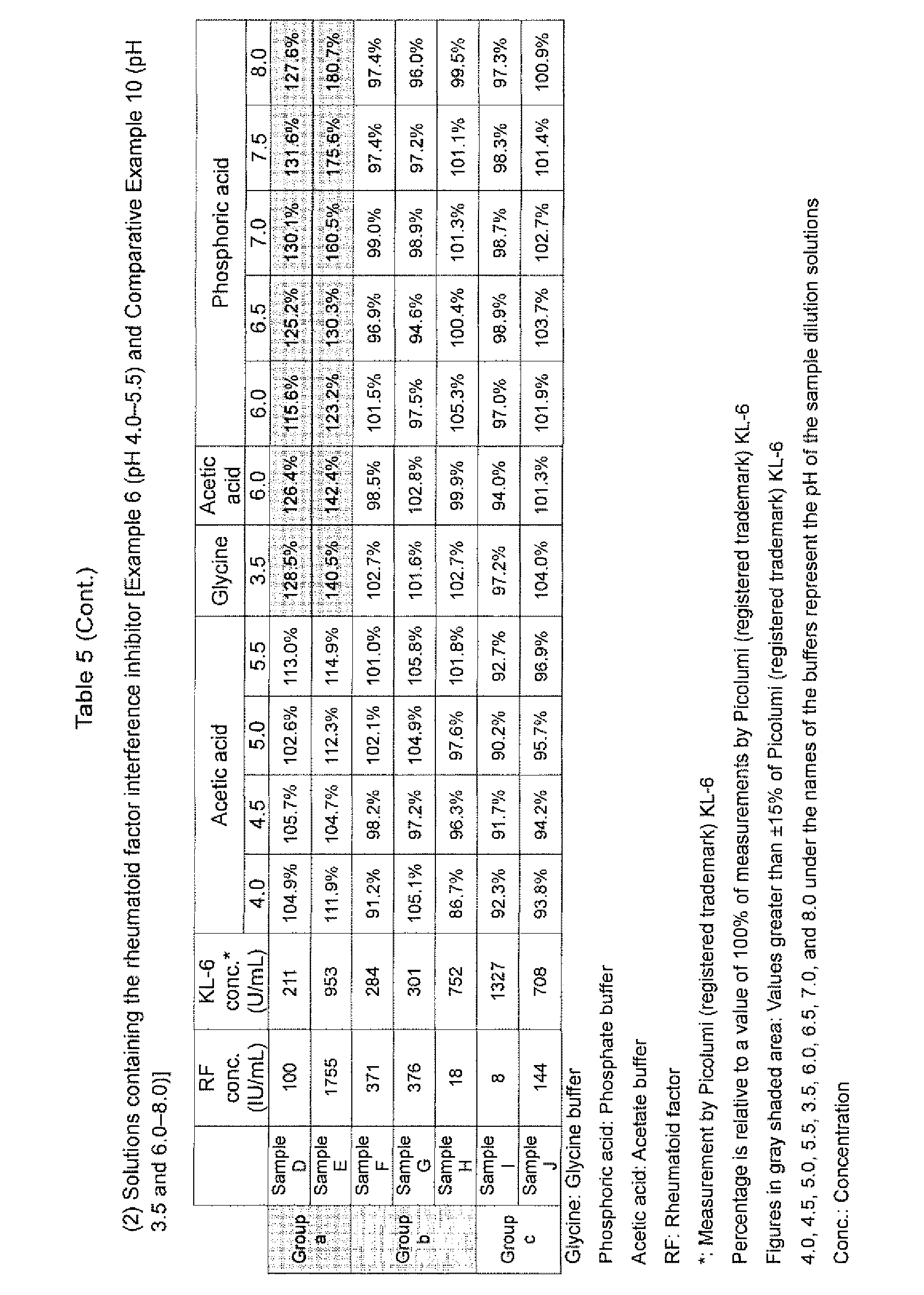
- Excellent results of ±15% of values measured by Picolumi (registered trademark) KL-6 were obtained from group c in Tables 3 and 4 at every pH, regardless of the presence of the rheumatoid factor interference inhibitor suggesting that the rheumatoid factor interference inhibitor itself had no adverse effect on measured values.
- On the other hand, the existence of specimens that exceed 115% of values measured by Picolumi (registered trademark) KL-6 and for which nonspecific reactions occur when measured using solutions not containing the rheumatoid factor interference inhibitor, such as specimens included in groups a and b in Table 3, was confirmed.
- Excellent results were obtained for specimens from group b in Table 4 when the rheumatoid factor interference inhibitor was added, regardless of pH, and the rheumatoid factor interference inhibitor was confirmed to inhibit nonspecific reactions. On the other hand, at (pH 3.5 and between pH 6.0 and 8.0, no nonspecific reaction-inhibiting effect was observed for specimens from group a in Table 4, even when the rheumatoid factor interference inhibitor was added; however, between pH 4.0 and 5.5, a strong nonspecific reaction-inhibiting effect was observed.
- Even when buffer was changed from citric acid (tricarboxylic acid) to acetic acid (monocarboxylic acid) having pH 4.0 to 6.0, while there were specimens that exceeded 115% of values measured by Picolumi (registered trademark) KL-6 and for which nonspecific reactions occurred with solutions not containing the rheumatoid factor interference inhibitor [Table 5 (1)], the same nonspecific reaction-inhibiting effect as in the case of citrate buffer was observed with solutions that did include the rheumatoid factor interference inhibitor between pH 4.0 and 5.5 [Table 5 (2)]. On the other hand, in group a in Tables 3 to 5, no nonspecific reaction inhibiting-effect was observed at pH 6.0 using either citrate or acetate buffer, suggesting that using the rheumatoid factor interference inhibitor, and adjusting the pH of the sample diluted solution to between 4.0 and 5.5 when measuring KL-6 would inhibit nonspecific reactions most effectively, regardless of the type of buffer.
- The present invention provides a method to measure KL-6 to assist the diagnosis and determination of therapeutic strategies for interstitial pneumonitis and an assay reagent or reagent kit for the implementation of the above mentioned method. The present invention is useful for the diagnosis and determination of therapeutic strategies for interstitial pneumonitis including drug-induced interstitial pneumonitis and collagen disorder-originating interstitial pneumonitis, diagnosis of patients with cancers such as lung cancer and pancreatic cancer, and for purposes such as diagnosis and determination of therapeutic strategies for interstitial pneumonitis in patients treated with antibody preparation for rheumatoid arthritis, Crohn's disease, generalized juvenile idiopathic arthritis, and Castleman's disease. Since the present invention is protected as necessary as a reagent, reagent kit, and a use of these in manufacturing, it has industrial applicability and is not excluded from patentability.
Next, the selected hybridomas were cloned by the limiting dilution method. In brief, cells were diluted to 50 or 10 cells/mL, added to a 96-well microculture plate containing feeder cells at 0.1 mL per well, and cultured for 2 weeks with HT medium. Clones from wells with a single hybridoma colony were selected. These clones were reacted with VMRC-LCR cells by an enzyme immunoassay, and hybridoma clones that secreted antibodies showing no reaction to normal human pulmonary fibroblasts were selected.
Clones that reacted with human pulmonary fibroblasts were selected from among these clones by immunoperoxidase staining of frozen sections. Specifically, human pulmonary carcinomas and carcinomas of other organs as well as normal tissue were obtained by surgical procedures and 4-µm frozen sections were prepared. After acetone fixation, the hybridoma clone culture supernatant was added, and the mixture was allowed to react for 30 min at room temperature. After thorough washing, the mixture was allowed to react with the biotinylated anti-mouse IgG antibody (reacting to γ chain, λ chain, and κ chain) for 30 min at room temperature. After further washing, avidin-biotinylated horseradish peroxidase was added, and the mixture was allowed to react for 1 h at room temperature. After thorough washing, 50 mM Tris-HCl buffer containing 0.5 mg/mL diaminobenzidine (as substrate) and 0.01% hydrogen peroxide (pH 7.0) was added, and the mixture was allowed to develop color.
In this manner, a hybridoma producing monoclonal antibodies that reacted with alveolar epithelium; bronchiolar epithelium; bronchial gland serous cells; thyroid follicular cells; esophageal epithelium; cardiac gland cells; pancreatic duct epithelium; tubular epithelium; urinary bladder transitional epithelium; endometrium; pulmonary adenocarcinoma; pulmonary squamous cell carcinoma; pulmonary small cell carcinoma; adenocarcinoma of the stomach, duodenal papilla, bile duct, pancreas, colon, rectum, thyroid, and mammary gland; and esophageal squamous cell carcinoma, but not with bronchial epithelium; superficial gastric mucosal cells; pyloric gland; duodenal epithelium; colonic epithelium; rectal epithelium; hepatocytes; pancreatic exocrine cells; pancreatic endocrine cells; renal glomerular cells; cervical squamous cell; dermal epithelium; cervical squamous cell carcinoma; and hepatocellular carcinoma was obtained. This hybridoma was named a KL-6 cell and the monoclonal antibody it produced was named anti-KL-6 antibody.
Claims (5)
- A KL-6 immunoassay reagent comprising a solution at a pH of 4.0 to pH 5.5 containing a rheumatoid factor interference inhibitor and a solution containing an insoluble carrier on which an anti-KL-6 antibody is immobilized.
- The immunoassay reagent of Claim 1 wherein the insoluble carrier is a latex particle.
- A KL-6 immunoassay comprising measuring the change in absorbance accompanying the agglutination of an insoluble carrier due to the immune reaction between KL-6 in a sample and an anti-KL-6 antibody immobilized on the insoluble carrier in a solution at a pH of 4.0 to pH 5.5, using the sample, a rheumatoid factor interference inhibitor, and an insoluble carrier on which an anti-KL-6 antibody is immobilized.
- A KL-6 immunoassay comprising adding to a sample a solution at a pH of 4.0 to pH 5.5 containing a rheumatoid factor interference inhibitor and a solution of an insoluble carrier on which an anti-KL-6 antibody is immobilized, and measuring the change in absorbance accompanying the agglutination of the insoluble carrier due to the immune reaction between KL-6 in the sample and the anti-KL-6 antibody immobilized on the insoluble carrier.
- The immunoassay of Claim 3 or 4 wherein the insoluble carrier is a latex particle.
Applications Claiming Priority (2)
| Application Number | Priority Date | Filing Date | Title |
|---|---|---|---|
| JP2009155075 | 2009-06-30 | ||
| PCT/JP2010/061109 WO2011001999A1 (en) | 2009-06-30 | 2010-06-30 | Immunological measurement reagent for use in measurement of kl-6 |
Publications (3)
| Publication Number | Publication Date |
|---|---|
| EP2450709A1 true EP2450709A1 (en) | 2012-05-09 |
| EP2450709A4 EP2450709A4 (en) | 2013-04-24 |
| EP2450709B1 EP2450709B1 (en) | 2015-02-18 |
Family
ID=43411070
Family Applications (1)
| Application Number | Title | Priority Date | Filing Date |
|---|---|---|---|
| EP10794167.6A Active EP2450709B1 (en) | 2009-06-30 | 2010-06-30 | Immunological measurement reagent for use in measurement of kl-6 |
Country Status (9)
| Country | Link |
|---|---|
| US (1) | US8940549B2 (en) |
| EP (1) | EP2450709B1 (en) |
| JP (1) | JP4663822B2 (en) |
| KR (1) | KR101824256B1 (en) |
| CN (1) | CN102422159B (en) |
| CA (1) | CA2756106C (en) |
| ES (1) | ES2535529T3 (en) |
| TW (1) | TWI509248B (en) |
| WO (1) | WO2011001999A1 (en) |
Families Citing this family (11)
| Publication number | Priority date | Publication date | Assignee | Title |
|---|---|---|---|---|
| CN103123319B (en) * | 2012-12-20 | 2015-04-15 | 武汉生之源生物科技有限公司 | Heart-type fatty acid binding protein content detection kit and preparation method thereof |
| CN103149370B (en) * | 2013-02-27 | 2015-02-18 | 宁波美康生物科技股份有限公司 | Lipoprotein (a) detection kit |
| CN104483475A (en) * | 2014-12-22 | 2015-04-01 | 宁波美康生物科技股份有限公司 | Fibronectin detection kit |
| CN104977404B (en) * | 2015-07-07 | 2016-08-17 | 宁波瑞源生物科技有限公司 | The latex enhancing immune of suppression rheumatoid factor interference is than turbid reagent |
| JP6857939B2 (en) * | 2016-10-19 | 2021-04-14 | 栄研化学株式会社 | Immunological measurement method and measurement reagent |
| CN106841597A (en) * | 2017-03-22 | 2017-06-13 | 苏州普瑞斯生物科技有限公司 | Saliva liquefaction carbohydrate antigen determines reagent and preparation method thereof |
| CN109633148B (en) * | 2018-12-27 | 2021-08-06 | 恩碧乐(杭州)生物科技有限公司 | KL-6 detection latex agglutination reagent |
| US20220187323A1 (en) * | 2019-03-29 | 2022-06-16 | Sekisui Medical Co., Ltd. | Immunoassay reagent and immunoassay method |
| CN114075292A (en) * | 2020-08-21 | 2022-02-22 | 张家港博泽利斯生物技术有限公司 | Preparation method of anti-human KL-6 protein monoclonal antibody |
| CN112014572A (en) * | 2020-08-24 | 2020-12-01 | 北京世纪沃德生物科技有限公司 | Preparation method and application of latex particles for detecting KL-6 |
| CN112285359A (en) * | 2020-09-22 | 2021-01-29 | 广州市伊川生物科技有限公司 | Saliva liquefaction sugar chain antigen determination kit and detection method thereof |
Family Cites Families (8)
| Publication number | Priority date | Publication date | Assignee | Title |
|---|---|---|---|---|
| JPH0731207B2 (en) | 1986-06-16 | 1995-04-10 | 修興 河野 | Interstitial pneumonia diagnostic reagents |
| JPH0712818A (en) | 1993-06-25 | 1995-01-17 | Hitachi Chem Co Ltd | Immunological detection |
| JP4083855B2 (en) | 1998-02-16 | 2008-04-30 | エーザイ・アール・アンド・ディー・マネジメント株式会社 | Lung cancer prognosis test method |
| GB9827845D0 (en) * | 1998-12-17 | 1999-02-10 | Scolab S A | Immunoassay or proteins |
| JP4507439B2 (en) * | 2001-04-06 | 2010-07-21 | 日東紡績株式会社 | Latex immunoturbidimetric assay and kit used therefor |
| JP2005121441A (en) * | 2003-10-15 | 2005-05-12 | Eisai Co Ltd | Inspection method for predicting interstitial pneumonia crisis by muc-1 determination |
| JP2006308576A (en) | 2005-03-31 | 2006-11-09 | Eisai Co Ltd | Method and kit for detecting papilla mucous gland cancer in pancreatic duct and pancreatic cancer by pancreatic juice |
| JP4657328B2 (en) * | 2008-07-18 | 2011-03-23 | 栄研化学株式会社 | Methods for removing immune reaction interfering substances |
-
2010
- 2010-06-30 JP JP2010540965A patent/JP4663822B2/en active Active
- 2010-06-30 ES ES10794167.6T patent/ES2535529T3/en active Active
- 2010-06-30 EP EP10794167.6A patent/EP2450709B1/en active Active
- 2010-06-30 US US13/258,468 patent/US8940549B2/en active Active
- 2010-06-30 CN CN201080020403.2A patent/CN102422159B/en active Active
- 2010-06-30 TW TW099121355A patent/TWI509248B/en active
- 2010-06-30 CA CA2756106A patent/CA2756106C/en active Active
- 2010-06-30 WO PCT/JP2010/061109 patent/WO2011001999A1/en not_active Ceased
- 2010-06-30 KR KR1020117022822A patent/KR101824256B1/en active Active
Non-Patent Citations (5)
| Title |
|---|
| BERNARD A ET AL: "Turbidimetric latex immunoassay for serum ferritin", JOURNAL OF IMMUNOLOGICAL METHODS, ELSEVIER SCIENCE PUBLISHERS B.V.,AMSTERDAM, NL, vol. 71, no. 2, 6 July 1984 (1984-07-06), pages 141-147, XP023895906, ISSN: 0022-1759, DOI: 10.1016/0022-1759(84)90060-7 [retrieved on 1984-07-06] * |
| CAMBIASO C L ET AL: "Latex agglutination assay for human anti-Brucella IgM antibodies", JOURNAL OF IMMUNOLOGICAL METHODS, ELSEVIER SCIENCE PUBLISHERS B.V.,AMSTERDAM, NL, vol. 122, no. 2, 1 September 1989 (1989-09-01), pages 169-175, XP023987216, ISSN: 0022-1759, DOI: 10.1016/0022-1759(89)90261-5 [retrieved on 1989-09-01] * |
| PASSELECQ B ET AL: "Latex immunoassay of serum alpha-fetoprotein using polyethylene glycol pretreatment", JOURNAL OF IMMUNOLOGICAL METHODS, ELSEVIER SCIENCE PUBLISHERS B.V.,AMSTERDAM, NL, vol. 109, no. 1, 22 April 1988 (1988-04-22), pages 69-74, XP023986880, ISSN: 0022-1759, DOI: 10.1016/0022-1759(88)90443-7 [retrieved on 1988-04-22] * |
| See also references of WO2011001999A1 * |
| Y ARASE: "Usefulness of serum KL-6 for early diagnosis of idiopathic pulmonary fibrosis in patients with hepatitis C virus", HEPATOLOGY RESEARCH, vol. 27, no. 2, 1 October 2003 (2003-10-01), pages 89-94, XP055056168, ISSN: 1386-6346, DOI: 10.1016/S1386-6346(03)00202-X * |
Also Published As
| Publication number | Publication date |
|---|---|
| CA2756106C (en) | 2018-03-20 |
| CN102422159A (en) | 2012-04-18 |
| TW201100800A (en) | 2011-01-01 |
| EP2450709A4 (en) | 2013-04-24 |
| ES2535529T3 (en) | 2015-05-12 |
| CA2756106A1 (en) | 2011-01-06 |
| KR101824256B1 (en) | 2018-01-31 |
| JP4663822B2 (en) | 2011-04-06 |
| TWI509248B (en) | 2015-11-21 |
| KR20120101280A (en) | 2012-09-13 |
| EP2450709B1 (en) | 2015-02-18 |
| WO2011001999A1 (en) | 2011-01-06 |
| JPWO2011001999A1 (en) | 2012-12-13 |
| CN102422159B (en) | 2014-10-15 |
| US8940549B2 (en) | 2015-01-27 |
| HK1168648A1 (en) | 2013-01-04 |
| US20120040476A1 (en) | 2012-02-16 |
Similar Documents
| Publication | Publication Date | Title |
|---|---|---|
| EP2450709B1 (en) | Immunological measurement reagent for use in measurement of kl-6 | |
| JP5345059B2 (en) | Gynecologic cancer detection method | |
| CA2384579C (en) | Early cancer tumor marker | |
| US20090155799A1 (en) | Methods for diagnosing pancreatic cancer using reg4 protein | |
| JP6110786B2 (en) | PSA measurement method and reagent | |
| EP2609429A2 (en) | Methods for detecting anti-he4 antibodies and methods of diagnosis and/or prognosis of conditions associated with he4-expressing cells | |
| JP4764344B2 (en) | Proteins involved in ovarian cancer | |
| EP3467498B1 (en) | Anti-human hemoglobin monoclonal antibody or antibody kit, insoluble carrier particle to which anti-human hemoglobin monoclonal antibody is immobilized, and measurement reagent and measurement method using same | |
| WO1996028569A1 (en) | Monoclonal antibody and antigen relating to human pulmonary adenocarcinoma and immunoassay method with the use of the same | |
| JP2011038952A (en) | Method for detecting cancer by detection of glycoprotein having specific sugar chain structure | |
| HK1168648B (en) | Immunological measurement reagent for use in measurement of kl-6 | |
| JP7140367B2 (en) | Analysis of soluble TLR7 in human-derived samples | |
| CN118978593B (en) | Method for measuring human galectin-3 protein level and application thereof | |
| EP1621637A1 (en) | ppGalNac-T6 mRNA or peptide as a new marker for the detection of cancer cells | |
| US7157286B2 (en) | Method for immunologically measuring RCAS1 and kit for measuring the same | |
| CA2593659C (en) | Method of screening for carcinoma and adenoma | |
| Schwartz | Tumor markers for colorectal cancer | |
| JP2003344414A (en) | RCAS1 measurement method and RCAS1 measurement kit | |
| US20060160163A1 (en) | Method of saying alastin digestion product and assay kit, method of detecting aortic dissection and detection kit | |
| 이도형 | Evaluation of CD151 as an Antibody Target for Therapy of Non-Small Cell Lung Cancers | |
| HK1078340A (en) | Method of assaying elastin digestion product and assay kit, method of detecting aortic dissection and detection kit | |
| HK1187100A (en) | Methods for detecting anti-he4 antibodies and methods of diagnosis and/or prognosis of conditions associated with he4-expressing cells |
Legal Events
| Date | Code | Title | Description |
|---|---|---|---|
| PUAI | Public reference made under article 153(3) epc to a published international application that has entered the european phase |
Free format text: ORIGINAL CODE: 0009012 |
|
| 17P | Request for examination filed |
Effective date: 20110919 |
|
| AK | Designated contracting states |
Kind code of ref document: A1 Designated state(s): AL AT BE BG CH CY CZ DE DK EE ES FI FR GB GR HR HU IE IS IT LI LT LU LV MC MK MT NL NO PL PT RO SE SI SK SM TR |
|
| DAX | Request for extension of the european patent (deleted) | ||
| REG | Reference to a national code |
Ref country code: HK Ref legal event code: DE Ref document number: 1168648 Country of ref document: HK |
|
| REG | Reference to a national code |
Ref country code: DE Ref legal event code: R079 Ref document number: 602010022353 Country of ref document: DE Free format text: PREVIOUS MAIN CLASS: G01N0033530000 Ipc: G01N0033680000 |
|
| A4 | Supplementary search report drawn up and despatched |
Effective date: 20130322 |
|
| RIC1 | Information provided on ipc code assigned before grant |
Ipc: G01N 33/68 20060101AFI20130318BHEP |
|
| 17Q | First examination report despatched |
Effective date: 20131126 |
|
| GRAP | Despatch of communication of intention to grant a patent |
Free format text: ORIGINAL CODE: EPIDOSNIGR1 |
|
| INTG | Intention to grant announced |
Effective date: 20140911 |
|
| GRAS | Grant fee paid |
Free format text: ORIGINAL CODE: EPIDOSNIGR3 |
|
| GRAA | (expected) grant |
Free format text: ORIGINAL CODE: 0009210 |
|
| AK | Designated contracting states |
Kind code of ref document: B1 Designated state(s): AL AT BE BG CH CY CZ DE DK EE ES FI FR GB GR HR HU IE IS IT LI LT LU LV MC MK MT NL NO PL PT RO SE SI SK SM TR |
|
| REG | Reference to a national code |
Ref country code: GB Ref legal event code: FG4D |
|
| REG | Reference to a national code |
Ref country code: CH Ref legal event code: EP |
|
| REG | Reference to a national code |
Ref country code: AT Ref legal event code: REF Ref document number: 710865 Country of ref document: AT Kind code of ref document: T Effective date: 20150315 |
|
| REG | Reference to a national code |
Ref country code: IE Ref legal event code: FG4D |
|
| REG | Reference to a national code |
Ref country code: DE Ref legal event code: R096 Ref document number: 602010022353 Country of ref document: DE Effective date: 20150402 |
|
| REG | Reference to a national code |
Ref country code: NL Ref legal event code: T3 |
|
| REG | Reference to a national code |
Ref country code: NL Ref legal event code: T3 |
|
| REG | Reference to a national code |
Ref country code: NL Ref legal event code: T3 |
|
| REG | Reference to a national code |
Ref country code: ES Ref legal event code: FG2A Ref document number: 2535529 Country of ref document: ES Kind code of ref document: T3 Effective date: 20150512 |
|
| REG | Reference to a national code |
Ref country code: AT Ref legal event code: MK05 Ref document number: 710865 Country of ref document: AT Kind code of ref document: T Effective date: 20150218 |
|
| REG | Reference to a national code |
Ref country code: LT Ref legal event code: MG4D |
|
| PG25 | Lapsed in a contracting state [announced via postgrant information from national office to epo] |
Ref country code: HR Free format text: LAPSE BECAUSE OF FAILURE TO SUBMIT A TRANSLATION OF THE DESCRIPTION OR TO PAY THE FEE WITHIN THE PRESCRIBED TIME-LIMIT Effective date: 20150218 Ref country code: FI Free format text: LAPSE BECAUSE OF FAILURE TO SUBMIT A TRANSLATION OF THE DESCRIPTION OR TO PAY THE FEE WITHIN THE PRESCRIBED TIME-LIMIT Effective date: 20150218 Ref country code: LT Free format text: LAPSE BECAUSE OF FAILURE TO SUBMIT A TRANSLATION OF THE DESCRIPTION OR TO PAY THE FEE WITHIN THE PRESCRIBED TIME-LIMIT Effective date: 20150218 Ref country code: NO Free format text: LAPSE BECAUSE OF FAILURE TO SUBMIT A TRANSLATION OF THE DESCRIPTION OR TO PAY THE FEE WITHIN THE PRESCRIBED TIME-LIMIT Effective date: 20150518 Ref country code: SE Free format text: LAPSE BECAUSE OF FAILURE TO SUBMIT A TRANSLATION OF THE DESCRIPTION OR TO PAY THE FEE WITHIN THE PRESCRIBED TIME-LIMIT Effective date: 20150218 |
|
| PG25 | Lapsed in a contracting state [announced via postgrant information from national office to epo] |
Ref country code: LV Free format text: LAPSE BECAUSE OF FAILURE TO SUBMIT A TRANSLATION OF THE DESCRIPTION OR TO PAY THE FEE WITHIN THE PRESCRIBED TIME-LIMIT Effective date: 20150218 Ref country code: AT Free format text: LAPSE BECAUSE OF FAILURE TO SUBMIT A TRANSLATION OF THE DESCRIPTION OR TO PAY THE FEE WITHIN THE PRESCRIBED TIME-LIMIT Effective date: 20150218 Ref country code: GR Free format text: LAPSE BECAUSE OF FAILURE TO SUBMIT A TRANSLATION OF THE DESCRIPTION OR TO PAY THE FEE WITHIN THE PRESCRIBED TIME-LIMIT Effective date: 20150519 Ref country code: IS Free format text: LAPSE BECAUSE OF FAILURE TO SUBMIT A TRANSLATION OF THE DESCRIPTION OR TO PAY THE FEE WITHIN THE PRESCRIBED TIME-LIMIT Effective date: 20150618 |
|
| PG25 | Lapsed in a contracting state [announced via postgrant information from national office to epo] |
Ref country code: CZ Free format text: LAPSE BECAUSE OF FAILURE TO SUBMIT A TRANSLATION OF THE DESCRIPTION OR TO PAY THE FEE WITHIN THE PRESCRIBED TIME-LIMIT Effective date: 20150218 Ref country code: SK Free format text: LAPSE BECAUSE OF FAILURE TO SUBMIT A TRANSLATION OF THE DESCRIPTION OR TO PAY THE FEE WITHIN THE PRESCRIBED TIME-LIMIT Effective date: 20150218 Ref country code: RO Free format text: LAPSE BECAUSE OF FAILURE TO SUBMIT A TRANSLATION OF THE DESCRIPTION OR TO PAY THE FEE WITHIN THE PRESCRIBED TIME-LIMIT Effective date: 20150218 Ref country code: EE Free format text: LAPSE BECAUSE OF FAILURE TO SUBMIT A TRANSLATION OF THE DESCRIPTION OR TO PAY THE FEE WITHIN THE PRESCRIBED TIME-LIMIT Effective date: 20150218 Ref country code: DK Free format text: LAPSE BECAUSE OF FAILURE TO SUBMIT A TRANSLATION OF THE DESCRIPTION OR TO PAY THE FEE WITHIN THE PRESCRIBED TIME-LIMIT Effective date: 20150218 |
|
| REG | Reference to a national code |
Ref country code: DE Ref legal event code: R097 Ref document number: 602010022353 Country of ref document: DE |
|
| REG | Reference to a national code |
Ref country code: HK Ref legal event code: GR Ref document number: 1168648 Country of ref document: HK |
|
| PG25 | Lapsed in a contracting state [announced via postgrant information from national office to epo] |
Ref country code: PL Free format text: LAPSE BECAUSE OF FAILURE TO SUBMIT A TRANSLATION OF THE DESCRIPTION OR TO PAY THE FEE WITHIN THE PRESCRIBED TIME-LIMIT Effective date: 20150218 |
|
| PLBE | No opposition filed within time limit |
Free format text: ORIGINAL CODE: 0009261 |
|
| STAA | Information on the status of an ep patent application or granted ep patent |
Free format text: STATUS: NO OPPOSITION FILED WITHIN TIME LIMIT |
|
| 26N | No opposition filed |
Effective date: 20151119 |
|
| PG25 | Lapsed in a contracting state [announced via postgrant information from national office to epo] |
Ref country code: MC Free format text: LAPSE BECAUSE OF FAILURE TO SUBMIT A TRANSLATION OF THE DESCRIPTION OR TO PAY THE FEE WITHIN THE PRESCRIBED TIME-LIMIT Effective date: 20150218 |
|
| REG | Reference to a national code |
Ref country code: CH Ref legal event code: PL |
|
| PG25 | Lapsed in a contracting state [announced via postgrant information from national office to epo] |
Ref country code: LU Free format text: LAPSE BECAUSE OF FAILURE TO SUBMIT A TRANSLATION OF THE DESCRIPTION OR TO PAY THE FEE WITHIN THE PRESCRIBED TIME-LIMIT Effective date: 20150630 Ref country code: SI Free format text: LAPSE BECAUSE OF FAILURE TO SUBMIT A TRANSLATION OF THE DESCRIPTION OR TO PAY THE FEE WITHIN THE PRESCRIBED TIME-LIMIT Effective date: 20150218 |
|
| REG | Reference to a national code |
Ref country code: IE Ref legal event code: MM4A |
|
| PG25 | Lapsed in a contracting state [announced via postgrant information from national office to epo] |
Ref country code: IE Free format text: LAPSE BECAUSE OF NON-PAYMENT OF DUE FEES Effective date: 20150630 Ref country code: CH Free format text: LAPSE BECAUSE OF NON-PAYMENT OF DUE FEES Effective date: 20150630 Ref country code: LI Free format text: LAPSE BECAUSE OF NON-PAYMENT OF DUE FEES Effective date: 20150630 |
|
| PG25 | Lapsed in a contracting state [announced via postgrant information from national office to epo] |
Ref country code: BE Free format text: LAPSE BECAUSE OF FAILURE TO SUBMIT A TRANSLATION OF THE DESCRIPTION OR TO PAY THE FEE WITHIN THE PRESCRIBED TIME-LIMIT Effective date: 20150218 |
|
| REG | Reference to a national code |
Ref country code: FR Ref legal event code: PLFP Year of fee payment: 7 |
|
| PG25 | Lapsed in a contracting state [announced via postgrant information from national office to epo] |
Ref country code: MT Free format text: LAPSE BECAUSE OF FAILURE TO SUBMIT A TRANSLATION OF THE DESCRIPTION OR TO PAY THE FEE WITHIN THE PRESCRIBED TIME-LIMIT Effective date: 20150218 |
|
| PG25 | Lapsed in a contracting state [announced via postgrant information from national office to epo] |
Ref country code: BG Free format text: LAPSE BECAUSE OF FAILURE TO SUBMIT A TRANSLATION OF THE DESCRIPTION OR TO PAY THE FEE WITHIN THE PRESCRIBED TIME-LIMIT Effective date: 20150218 Ref country code: SM Free format text: LAPSE BECAUSE OF FAILURE TO SUBMIT A TRANSLATION OF THE DESCRIPTION OR TO PAY THE FEE WITHIN THE PRESCRIBED TIME-LIMIT Effective date: 20150218 Ref country code: HU Free format text: LAPSE BECAUSE OF FAILURE TO SUBMIT A TRANSLATION OF THE DESCRIPTION OR TO PAY THE FEE WITHIN THE PRESCRIBED TIME-LIMIT; INVALID AB INITIO Effective date: 20100630 |
|
| REG | Reference to a national code |
Ref country code: FR Ref legal event code: PLFP Year of fee payment: 8 |
|
| PG25 | Lapsed in a contracting state [announced via postgrant information from national office to epo] |
Ref country code: CY Free format text: LAPSE BECAUSE OF FAILURE TO SUBMIT A TRANSLATION OF THE DESCRIPTION OR TO PAY THE FEE WITHIN THE PRESCRIBED TIME-LIMIT Effective date: 20150218 |
|
| REG | Reference to a national code |
Ref country code: DE Ref legal event code: R082 Ref document number: 602010022353 Country of ref document: DE Representative=s name: HOFFMANN - EITLE PATENT- UND RECHTSANWAELTE PA, DE Ref country code: DE Ref legal event code: R081 Ref document number: 602010022353 Country of ref document: DE Owner name: SEKISUI MEDICAL CO., LTD., JP Free format text: FORMER OWNERS: EIDIA CO., LTD., TOKIO/TOKYO, JP; SEKISUI MEDICAL CO., LTD., TOKYO, JP |
|
| PG25 | Lapsed in a contracting state [announced via postgrant information from national office to epo] |
Ref country code: TR Free format text: LAPSE BECAUSE OF FAILURE TO SUBMIT A TRANSLATION OF THE DESCRIPTION OR TO PAY THE FEE WITHIN THE PRESCRIBED TIME-LIMIT Effective date: 20150218 |
|
| REG | Reference to a national code |
Ref country code: GB Ref legal event code: 732E Free format text: REGISTERED BETWEEN 20170831 AND 20170906 |
|
| REG | Reference to a national code |
Ref country code: NL Ref legal event code: PD Owner name: SEKISUI MEDICAL CO., LTD.; JP Free format text: DETAILS ASSIGNMENT: CHANGE OF OWNER(S), MERGE; FORMER OWNER NAME: SEKISUI MEDICAL CO., LTD. Effective date: 20170922 |
|
| REG | Reference to a national code |
Ref country code: ES Ref legal event code: PC2A Owner name: SEKISUI MEDICAL CO., LTD. Effective date: 20171204 |
|
| REG | Reference to a national code |
Ref country code: FR Ref legal event code: CA Effective date: 20171208 Ref country code: FR Ref legal event code: TP Owner name: EIDIA CO., LTD., JP Effective date: 20171208 |
|
| REG | Reference to a national code |
Ref country code: FR Ref legal event code: PLFP Year of fee payment: 9 |
|
| PG25 | Lapsed in a contracting state [announced via postgrant information from national office to epo] |
Ref country code: PT Free format text: LAPSE BECAUSE OF FAILURE TO SUBMIT A TRANSLATION OF THE DESCRIPTION OR TO PAY THE FEE WITHIN THE PRESCRIBED TIME-LIMIT Effective date: 20150218 Ref country code: MK Free format text: LAPSE BECAUSE OF FAILURE TO SUBMIT A TRANSLATION OF THE DESCRIPTION OR TO PAY THE FEE WITHIN THE PRESCRIBED TIME-LIMIT Effective date: 20150218 |
|
| PG25 | Lapsed in a contracting state [announced via postgrant information from national office to epo] |
Ref country code: AL Free format text: LAPSE BECAUSE OF FAILURE TO SUBMIT A TRANSLATION OF THE DESCRIPTION OR TO PAY THE FEE WITHIN THE PRESCRIBED TIME-LIMIT Effective date: 20150218 |
|
| P01 | Opt-out of the competence of the unified patent court (upc) registered |
Effective date: 20230522 |
|
| PGFP | Annual fee paid to national office [announced via postgrant information from national office to epo] |
Ref country code: NL Payment date: 20250516 Year of fee payment: 16 |
|
| PGFP | Annual fee paid to national office [announced via postgrant information from national office to epo] |
Ref country code: DE Payment date: 20250507 Year of fee payment: 16 |
|
| PGFP | Annual fee paid to national office [announced via postgrant information from national office to epo] |
Ref country code: GB Payment date: 20250508 Year of fee payment: 16 |
|
| PGFP | Annual fee paid to national office [announced via postgrant information from national office to epo] |
Ref country code: IT Payment date: 20250522 Year of fee payment: 16 |
|
| PGFP | Annual fee paid to national office [announced via postgrant information from national office to epo] |
Ref country code: FR Payment date: 20250508 Year of fee payment: 16 |
|
| PGFP | Annual fee paid to national office [announced via postgrant information from national office to epo] |
Ref country code: ES Payment date: 20250701 Year of fee payment: 16 |