EP2449868A1 - Device for the provision of coupling elements - Google Patents
Device for the provision of coupling elements Download PDFInfo
- Publication number
- EP2449868A1 EP2449868A1 EP10190202A EP10190202A EP2449868A1 EP 2449868 A1 EP2449868 A1 EP 2449868A1 EP 10190202 A EP10190202 A EP 10190202A EP 10190202 A EP10190202 A EP 10190202A EP 2449868 A1 EP2449868 A1 EP 2449868A1
- Authority
- EP
- European Patent Office
- Prior art keywords
- opening
- elements
- coupling
- coupling element
- holding structure
- Prior art date
- Legal status (The legal status is an assumption and is not a legal conclusion. Google has not performed a legal analysis and makes no representation as to the accuracy of the status listed.)
- Granted
Links
Images


Classifications
-
- A—HUMAN NECESSITIES
- A01—AGRICULTURE; FORESTRY; ANIMAL HUSBANDRY; HUNTING; TRAPPING; FISHING
- A01B—SOIL WORKING IN AGRICULTURE OR FORESTRY; PARTS, DETAILS, OR ACCESSORIES OF AGRICULTURAL MACHINES OR IMPLEMENTS, IN GENERAL
- A01B59/00—Devices specially adapted for connection between animals or tractors and agricultural machines or implements
- A01B59/002—Details, component parts
- A01B59/008—Link connectors with spherical surfaces
Definitions
- the invention relates to a device for the provision of coupling elements on an agricultural machine according to the preamble of claim 1.
- Agricultural machines particularly tractors, are equipped with attachment devices for implements.
- These attachment devices are mostly embodied as so-called three-point coupling as for example described in EP 1 403 102 A1 , substantially consisting of two lower control arms and one upper control arm.
- the control arms at their end facing away from the machine each have a coupling device, which accommodates a pin formed on the implement to be attached.
- axially secured coupling balls are pushed on to the pins of the implement, which upon attachment of the implement are accommodated by the coupling devices of the control arms.
- the pins at the implement end can have different diameters, which is why the associated coupling balls - with same outer diameter - have through-bores of different sizes.
- the coupling devices of lower and upper control arms can have different outer diameters so that coupling balls of different size are required.
- DE 20 2005 019 244 U1 proposes a storage device for coupling balls which can be fastened to the rear of an agricultural machine.
- the device comprises two longitudinally formed holding elements predetermining a guide, between which coupling balls of different type can be inserted. For removal, the balls are pushed to the opening of the guide at the end and can then be used as intended.
- a locking pin is provided at the end.
- the pin In practice it must be seen as a disadvantage that for every removal it is necessary to remove the locking pin. To safely store the balls in the device during tractor operation, the pin must be reinstalled. This aggravates handling of the device. One-hand operation is difficult.
- the locking pin constitutes an additional component which on the one hand needs to be secured against loss and on the other hand is exposed to dirt accumulation due to the operation.
- the mentioned object is solved with a device according to claim 1.
- the device is characterized by a closure device associated with the opening which can be actuated by inserting or removing the coupling element.
- closure device can be configured in different manners as long as it allows closing of the opening.
- a constructively simple as well as effective implementation has been found for actuating the closure device, according to which said closure device can be actuated through the coupling element itself. There, the insertion or removal movement of the coupling element is utilized for actuating the closure device.
- the operator can move the coupling element through the opening of the holding structure if required by merely grasping the coupling element with one hand and performing an appropriate inserting or removing movement, as a result of which the closure device - triggered by the movement of the coupling element, particularly through contact forces between coupling element and closure device which occur in the process - opens or closes.
- Advantageous in this furthermore is that components to be additionally handled and susceptible to dirt accumulation - such as locking pins or the like - are no longer required and easier operation is created. The object mentioned at the outset is thus solved.
- the closure device comprises a plurality of closing elements that are moveable relative to one another, which in interaction delimit the opening in such a manner that its size is variable.
- the closing elements which in the process act like lips, thus together form an opening in the sense of a mouth whose size is variable through movement of the closing elements relative to one another.
- the closing element of the closure device can advantageously be subjected to force in such a manner, that the coupling elements are held in the holding structure by non-positive connection.
- resetting means are advantageously associated with the closure device which - directly or indirectly - exert a resetting force on the closing elements which causes a movement of the closing elements reducing the size of the opening.
- a closure device that is advantageous for the operating purpose is created, in which with an opening size that is smaller than a projection of a coupling element, insertion or removal of the coupling element is prevented (closed state of the closure device), and with an opening size that is greater than a projection of a coupling element, insertion or removal of the coupling element is made possible (opened state of the closure device).
- the closing elements are advantageously designed and arranged in such a manner that during an insertion or removal movement the coupling element comes in contact with the closing elements in such a manner that the latter - having overcome the counterforce of a resetting means - deflect in a direction enlarging the opening.
- the closing elements practically have suitable contact sections and are moveably mounted relative to the holding structure and/or embodied elastically deformable within themselves.
- a plurality of guide elements holding the accommodated coupling element between them serve as limits of the holding structure.
- These guide elements can be variously configured, while these preferably predetermine a longitudinal guide channel within which a plurality of coupling elements can be held.
- two guide elements with U-profilings facing each other serve as limits of the holding structure.
- a guide of the substantially ball-shaped coupling elements is created in a simple manner.
- the spacing between the legs of the U-profiling advantageously corresponds approximately to the axial outer dimension (which for example corresponds to the length of the through-bore) of a coupling element.
- the guide elements are moveable relative to each other.
- the guide elements at least in portions can be embodied elastically deformable, so that in this manner relative moveability is possible.
- An advantageous configuration provides that the closing elements are associated with the guide elements.
- the closing elements can for example be arranged on the guide elements or be embodied integrally with said guide elements (i.e. coincide with these), so that moveability of the guide elements relative to each other brings about relative moveability of the closing elements.
- one each of the closing elements is arranged at an end of a guide element facing the opening, so that the size of the opening formed is variable through the movement of the guide elements relative to each other.
- the holding structure is also suitable to accommodate adapter elements.
- the purpose of the latter is that coupling elements with smaller outer diameter can be accommodated in the holding structure.
- the holding structure can be fastened to various regions of an agricultural machine.
- Advantageous is attachment to a rear or front machine region in order to guarantee comfortable availability of the coupling elements in the region of the attachment device, particularly a three-point coupling.
- Attachment to the rear axle housing of a tractor offers a particularly space-saving access possibility.
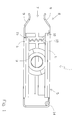
- Fig. 1 shows schematically an exemplary embodiment of a device 1 according to the invention for the provision of coupling elements in lateral view.
- the device 1 provides one coupling ball 3, but a plurality of coupling balls and/or coupling elements of a different type can also be provided therein.
- the device 1 comprises a holding structure 5, which can be fastened to an agricultural machine such as a tractor which is not shown here.
- the holding structure 5 is suitable for accommodating one or a plurality of coupling balls 3, for the purpose of which the holding structure 5 comprises two rail-like guide elements 6, between which a coupling ball 3 is held.
- the holding structure 5 comprises an opening 7 through which the coupling ball 3 can be inserted in or removed from the holding structure 5.
- the device 1 is provided with a closure device 8 for the opening 7, which can be activated by inserting or removing the coupling ball 3.
- the two guide elements 6 are connected to each other in a region facing away from the opening 7 in a manner allowing pivot movement about a pivot axis 14.
- a closing element 9 each is associated with the guide elements 6 which in this case is embodied integrally with the respective guide element 6.
- the two closing elements 9 in the shown state of the closure device 8 converge in regions at an acute angle, opening again in a region facing away from the holding structure 5, while their surface sections facing each other delimit the size of the opening 7 of the holding structure 5 in the sense of closing lips.
- the guide elements 6 that can describe pivot movements relative to each other with the associated closing elements 9 together form a closure device 8.
- the opening 7 of the holding structure 5 delimited through interaction of the closing elements 9 is variable in size through the pivoting of the guide elements 6 relative to each other.
- the size of the opening 7 (“opening mouth") is delimited by the surface sections ("closing lips") of the two closing elements 9 facing each other.
- the size of the opening 7 which is predetermined by the smallest spacing between the two closing elements 9, is smaller than the outer diameter of the coupling ball 3.
- the coupling ball 3 is therefore enclosed in the holding structure 5 and can merely move within the space delimited by the guide elements 6 and the closing elements 9.
- a spring 10 acting between the guide elements 6, which exerts a suitable resetting force, serves to maintain this closed state.
- the spring 10 exerts the resetting force via two spring mountings 15, each of which is arranged on one of the guide elements 6.
- the resetting force of the spring 10 additionally brings about that the coupling ball 3 is clamped between the guide elements 6.
- the clamping ensures a secure hold of the coupling ball 3 in the holding structure 5. In this way, particularly irritating knocking noises of the coupling ball 3 against the holding structure 5, which would otherwise be triggered through the vibrations of the machine, can be prevented.
- the coupling ball 3 can be removed from the holding structure 5 (or inserted in this) in that the coupling ball 3 is manually pushed - i.e. by an operator - through the opening 7 using a certain expenditure of force.
- the coupling ball 3 contacts the closing elements 9 in such a manner that these pivot apart about the pivot axis 14 together with the guide elements 6 against the resetting force of the spring 10, while with growing angle between the guide elements 6 the opening 7 is enlarged. From reaching an opening size that is larger than the outer diameter of the coupling ball 3 (opened state) said coupling ball can be completely removed from (or inserted in) the holding structure 5.
- the opening 7 is associated with a closure device 8 that can be actuated through the insertion or removal of the coupling ball 3.
- a closure device 8 that can be actuated through the insertion or removal of the coupling ball 3.
- the curved course of the closing elements 9 opening funnel-like to the outside is provided, through which an insertion aid is created.
- FIG. 2 shows a device 1 according to the invention with a similar construction in perspective view (obliquely from the front). Because of the similar construction and the similar mode of operation, deviating features are more preferably pointed out in the following.
- the holding structure 5 of the device 1 according to Fig. 2 are situated two commercially available coupling balls 2, 3 with approximately ball-shaped basic form and through-bores which are suitable for coupling an implement to a tractor.
- the coupling ball 2 additionally has a cylindrical shoulder 12 attached to which is a catch plate 13 facilitating coupling.
- the two guide elements 6 have U-profilings facing each other to ensure a lateral hold of the coupling balls 2, 3, which profilings extend in longitudinal direction of the guide elements 6.
- the spacing between the legs of the U-profilings of each guide element 6 corresponds to an axial outer dimension of the coupling balls 2, 3 so that the coupling balls 2, 3 are largely held in the holding structure 5 without axial play.
- front legs respectively of the upper and lower guide element 6 there remains an opening gap through which the cylindrical shoulder 12 and the catch plate 13 of the coupling ball 2 can stand out of the holding structure 5 to the outside.
- the device 1 is also suitable for providing coupling balls with cylindrical shoulder 12 and/or with catch plate 13.
- a holding plate 11, which is fastened to the holding structure 5 serves for the fastening of the device 1 to an agricultural machine (not shown).
- Fig. 3 shows the device 1 according to Fig. 2 from another perspective (obliquely from the rear).
- the holding plate 11 is connected to the lower holding element 6 in a fixed manner.
- the upper holding element 6 is rotatably mounted about the pivot axis 14 relative to the lower holding element 6.
- a resetting spring which is not shown here, which is preferably arranged between the spring mountings 15 of the upper and lower holding element, exerts a resetting force on the holding elements 6 which increases with growing opening 7 of the closure device 8.
- stops 4 are associated with the two holding elements 6 which ensure that a minimum spacing is maintained.
- the holding structure 5 of the device 1 by means of the holding plate 11 can for example be attached to the rear axle housing of a tractor which is not shown.
- the holding plate 11 to this end comprises an open and a closed fastening hole on a region facing away from the holding structure 5. With such fastening the device 1 is preferentially located in a region between one of the rear wheels and the three-point attachment of the tractor in order to provide coupling elements for the operation of the tractor.
Landscapes
- Life Sciences & Earth Sciences (AREA)
- Zoology (AREA)
- Engineering & Computer Science (AREA)
- Mechanical Engineering (AREA)
- Soil Sciences (AREA)
- Environmental Sciences (AREA)
- Agricultural Machines (AREA)
Abstract
Description
- The invention relates to a device for the provision of coupling elements on an agricultural machine according to the preamble of
claim 1. - Agricultural machines, particularly tractors, are equipped with attachment devices for implements. These attachment devices are mostly embodied as so-called three-point coupling as for example described in
EP 1 403 102 A1 - Different implements can be attached to the tractor. Depending on the type of the implement, the pins at the implement end can have different diameters, which is why the associated coupling balls - with same outer diameter - have through-bores of different sizes.
- In addition, the coupling devices of lower and upper control arms can have different outer diameters so that coupling balls of different size are required. In addition, there are coupling balls of different design, such as for example with and without cylindrical shoulders at the terminations of the through-bores and coupling balls, to which a catch plate is attached in order to facilitate the attachment of the implement to the tractor through a "catching aid" so created.
- In summary, coupling elements of different type and size are required in practice. In order to always provide a fitting coupling element for different operating purposes,
DE 20 2005 019 244 U1 proposes a storage device for coupling balls which can be fastened to the rear of an agricultural machine. The device comprises two longitudinally formed holding elements predetermining a guide, between which coupling balls of different type can be inserted. For removal, the balls are pushed to the opening of the guide at the end and can then be used as intended. - In order to prevent that the balls fall out of the guide a locking pin is provided at the end. In practice it must be seen as a disadvantage that for every removal it is necessary to remove the locking pin. To safely store the balls in the device during tractor operation, the pin must be reinstalled. This aggravates handling of the device. One-hand operation is difficult. In addition, the locking pin constitutes an additional component which on the one hand needs to be secured against loss and on the other hand is exposed to dirt accumulation due to the operation.
- It is therefore the object of the present invention to state a device for providing coupling elements, particularly coupling balls, which device can be simply operated and has a low susceptibility to malfunctioning.
- The mentioned object is solved with a device according to
claim 1. Accordingly, the device is characterized by a closure device associated with the opening which can be actuated by inserting or removing the coupling element. - According to the invention it was initially recognised that coupling elements that are not used can be practically secured in the holding structure by means of a closure device. The closure device can be configured in different manners as long as it allows closing of the opening. In a further manner according to the invention, a constructively simple as well as effective implementation has been found for actuating the closure device, according to which said closure device can be actuated through the coupling element itself. There, the insertion or removal movement of the coupling element is utilized for actuating the closure device. Accordingly, the operator can move the coupling element through the opening of the holding structure if required by merely grasping the coupling element with one hand and performing an appropriate inserting or removing movement, as a result of which the closure device - triggered by the movement of the coupling element, particularly through contact forces between coupling element and closure device which occur in the process - opens or closes. Advantageous in this furthermore is that components to be additionally handled and susceptible to dirt accumulation - such as locking pins or the like - are no longer required and easier operation is created. The object mentioned at the outset is thus solved.
- According to a preferred further development of the invention the closure device comprises a plurality of closing elements that are moveable relative to one another, which in interaction delimit the opening in such a manner that its size is variable. The closing elements, which in the process act like lips, thus together form an opening in the sense of a mouth whose size is variable through movement of the closing elements relative to one another.
- The closing element of the closure device can advantageously be subjected to force in such a manner, that the coupling elements are held in the holding structure by non-positive connection. In order to always ensure secure and automatic closing, resetting means are advantageously associated with the closure device which - directly or indirectly - exert a resetting force on the closing elements which causes a movement of the closing elements reducing the size of the opening.
- Through an opening embodied variable in size a closure device that is advantageous for the operating purpose is created, in which with an opening size that is smaller than a projection of a coupling element, insertion or removal of the coupling element is prevented (closed state of the closure device), and with an opening size that is greater than a projection of a coupling element, insertion or removal of the coupling element is made possible (opened state of the closure device).
- To make possible actuation of the closure device through the coupling elements themselves, the closing elements are advantageously designed and arranged in such a manner that during an insertion or removal movement the coupling element comes in contact with the closing elements in such a manner that the latter - having overcome the counterforce of a resetting means - deflect in a direction enlarging the opening. To this end, the closing elements practically have suitable contact sections and are moveably mounted relative to the holding structure and/or embodied elastically deformable within themselves. Practically in terms of design a plurality of guide elements holding the accommodated coupling element between them serve as limits of the holding structure. These guide elements can be variously configured, while these preferably predetermine a longitudinal guide channel within which a plurality of coupling elements can be held.
- According to an advantageous further development of the invention, two guide elements with U-profilings facing each other serve as limits of the holding structure. Thus, a guide of the substantially ball-shaped coupling elements is created in a simple manner. To ensure a secure lateral hold of coupling elements having a ball-shaped basic body with axial through-bore for the pins of an implement, the spacing between the legs of the U-profiling advantageously corresponds approximately to the axial outer dimension (which for example corresponds to the length of the through-bore) of a coupling element.
- Advantageously, the guide elements are moveable relative to each other. This can be realised in different ways, for example in that these are connected to each other to allow pivot movement. Alternatively, the guide elements at least in portions can be embodied elastically deformable, so that in this manner relative moveability is possible. An advantageous configuration provides that the closing elements are associated with the guide elements. To this end, the closing elements can for example be arranged on the guide elements or be embodied integrally with said guide elements (i.e. coincide with these), so that moveability of the guide elements relative to each other brings about relative moveability of the closing elements. There, one each of the closing elements is arranged at an end of a guide element facing the opening, so that the size of the opening formed is variable through the movement of the guide elements relative to each other.
- Advantageously, in addition to coupling elements the holding structure is also suitable to accommodate adapter elements. The purpose of the latter is that coupling elements with smaller outer diameter can be accommodated in the holding structure.
- The holding structure can be fastened to various regions of an agricultural machine. Advantageous is attachment to a rear or front machine region in order to guarantee comfortable availability of the coupling elements in the region of the attachment device, particularly a three-point coupling. Attachment to the rear axle housing of a tractor offers a particularly space-saving access possibility.
- In the following, the invention is described in more detail making reference to the enclosed figures. This also yields additional details and advantages of the invention. It shows:
- Fig. 1
- a schematic representation of a device according to the invention in lateral view,
- Fig. 2
- a perspective view of a device according to the invention,
- Fig. 3
- another perspective view of the device from
Fig. 2 . -
Fig. 1 shows schematically an exemplary embodiment of adevice 1 according to the invention for the provision of coupling elements in lateral view. In the shown state thedevice 1 provides onecoupling ball 3, but a plurality of coupling balls and/or coupling elements of a different type can also be provided therein. - The
device 1 comprises aholding structure 5, which can be fastened to an agricultural machine such as a tractor which is not shown here. Theholding structure 5 is suitable for accommodating one or a plurality ofcoupling balls 3, for the purpose of which theholding structure 5 comprises two rail-like guide elements 6, between which acoupling ball 3 is held. The holdingstructure 5 comprises anopening 7 through which thecoupling ball 3 can be inserted in or removed from the holdingstructure 5. According to the invention, thedevice 1 is provided with a closure device 8 for theopening 7, which can be activated by inserting or removing thecoupling ball 3. The construction and the function of thedevice 1 are described in more detail in the following. - The two
guide elements 6 are connected to each other in a region facing away from theopening 7 in a manner allowing pivot movement about apivot axis 14. At an end facing theopening 7, aclosing element 9 each is associated with theguide elements 6 which in this case is embodied integrally with therespective guide element 6. The twoclosing elements 9 in the shown state of the closure device 8 converge in regions at an acute angle, opening again in a region facing away from the holdingstructure 5, while their surface sections facing each other delimit the size of theopening 7 of the holdingstructure 5 in the sense of closing lips. Theguide elements 6 that can describe pivot movements relative to each other with the associatedclosing elements 9 together form a closure device 8. Theopening 7 of the holdingstructure 5 delimited through interaction of theclosing elements 9 is variable in size through the pivoting of theguide elements 6 relative to each other. The size of the opening 7 ("opening mouth") is delimited by the surface sections ("closing lips") of the twoclosing elements 9 facing each other. - In the shown state of the closure device 8 (closed state) the size of the
opening 7 which is predetermined by the smallest spacing between the twoclosing elements 9, is smaller than the outer diameter of thecoupling ball 3. Thecoupling ball 3 is therefore enclosed in the holdingstructure 5 and can merely move within the space delimited by theguide elements 6 and theclosing elements 9. Aspring 10 acting between theguide elements 6, which exerts a suitable resetting force, serves to maintain this closed state. Thespring 10 exerts the resetting force via twospring mountings 15, each of which is arranged on one of theguide elements 6. The resetting force of thespring 10 additionally brings about that thecoupling ball 3 is clamped between theguide elements 6. The clamping ensures a secure hold of thecoupling ball 3 in the holdingstructure 5. In this way, particularly irritating knocking noises of thecoupling ball 3 against the holdingstructure 5, which would otherwise be triggered through the vibrations of the machine, can be prevented. - According to the invention, the
coupling ball 3 can be removed from the holding structure 5 (or inserted in this) in that thecoupling ball 3 is manually pushed - i.e. by an operator - through theopening 7 using a certain expenditure of force. In the process, thecoupling ball 3 contacts theclosing elements 9 in such a manner that these pivot apart about thepivot axis 14 together with theguide elements 6 against the resetting force of thespring 10, while with growing angle between theguide elements 6 theopening 7 is enlarged. From reaching an opening size that is larger than the outer diameter of the coupling ball 3 (opened state) said coupling ball can be completely removed from (or inserted in) the holdingstructure 5. In this manner theopening 7 is associated with a closure device 8 that can be actuated through the insertion or removal of thecoupling ball 3. In order to more preferably facilitate insertion of coupling elements, the curved course of theclosing elements 9 opening funnel-like to the outside is provided, through which an insertion aid is created. - For further explanation,
Fig. 2 shows adevice 1 according to the invention with a similar construction in perspective view (obliquely from the front). Because of the similar construction and the similar mode of operation, deviating features are more preferably pointed out in the following. - In the holding
structure 5 of thedevice 1 according toFig. 2 are situated two commercially available couplingballs coupling ball 3 thecoupling ball 2 additionally has acylindrical shoulder 12 attached to which is acatch plate 13 facilitating coupling. - As is evident from this view the two
guide elements 6 have U-profilings facing each other to ensure a lateral hold of thecoupling balls guide elements 6. The spacing between the legs of the U-profilings of eachguide element 6 corresponds to an axial outer dimension of thecoupling balls coupling balls structure 5 without axial play. Between the in the drawing view front legs respectively of the upper andlower guide element 6 there remains an opening gap through which thecylindrical shoulder 12 and thecatch plate 13 of thecoupling ball 2 can stand out of the holdingstructure 5 to the outside. Accordingly, thedevice 1 is also suitable for providing coupling balls withcylindrical shoulder 12 and/or withcatch plate 13. A holdingplate 11, which is fastened to the holdingstructure 5 serves for the fastening of thedevice 1 to an agricultural machine (not shown). -
Fig. 3 shows thedevice 1 according toFig. 2 from another perspective (obliquely from the rear). The holdingplate 11 is connected to thelower holding element 6 in a fixed manner. Theupper holding element 6 is rotatably mounted about thepivot axis 14 relative to thelower holding element 6. On removing or inserting coupling elements, contact between coupling element andclosing elements 9 results in pivoting-out of theupper holding element 6 directed upwards relative to thelower holding element 6 held in a fixed manner. A resetting spring which is not shown here, which is preferably arranged between thespring mountings 15 of the upper and lower holding element, exerts a resetting force on the holdingelements 6 which increases with growingopening 7 of the closure device 8. In order to avoid direct contact between upper andlower holding elements 6 in the unloaded state of the holding structure and avoid instances of jamming when operating thedevice 1, stops 4 are associated with the two holdingelements 6 which ensure that a minimum spacing is maintained. - The holding
structure 5 of thedevice 1 by means of the holdingplate 11 can for example be attached to the rear axle housing of a tractor which is not shown. The holdingplate 11 to this end comprises an open and a closed fastening hole on a region facing away from the holdingstructure 5. With such fastening thedevice 1 is preferentially located in a region between one of the rear wheels and the three-point attachment of the tractor in order to provide coupling elements for the operation of the tractor. - Obviously it is conceivable to attach the device to other suitable attachment locations of agricultural machines. Furthermore, numerous other configuration types more preferably of the holding structure and the closure device are conceivable, wherein actuation of the closure device is effected through the removal or insertion of the coupling elements themselves.
-
- 1
- Device
- 2
- Coupling ball with catch plate
- 3
- Coupling ball
- 4
- Stop
- 5
- Holding structure
- 6
- Guide element
- 7
- Opening
- 8
- Closure device
- 9
- Closing element
- 10
- Spring
- 11
- Holding plate
- 12
- Cylindrical shoulder
- 13
- Catch plate
- 14
- Pivot axis
- 15
- Spring mounting
- 16
- Hook
Claims (10)
- A device (1) for the provision of coupling elements (2, 3) on an agricultural machine, comprising a holding structure (5) that can be fastened to the machine for accommodating at least one coupling element (2, 3) within limits (6) predetermined by the holding structure (5), wherein the holding structure (5) has an opening (7) through which the coupling element (2, 3) can be inserted in and removed from the holding structure (5), characterized by a closure device (8) associated with the opening (7) which can be actuated by inserting or removing the coupling element (2, 3).
- The device according to claim 1, characterized in that the closure device (8) comprises several closing elements (9) which are moveable relative to one another, which through interaction delimit the opening (7) in such a manner that its size is variable.
- The device according to claim 2, characterized in that resetting means (10) are associated with the closure device (8) which exert a resetting force on the closing elements (9) reducing the size of the opening (7).
- The device according to claim 2 or 3, characterized in that with an opening size that is smaller than a projection of the coupling element (2, 3), insertion or removal of the coupling element (2, 3) is prevented and with an opening size that is larger than a projection of the coupling element (2, 3), insertion or removal of the coupling element (2, 3) is made possible.
- The device according to any one of the claims 2 to 4, characterized in that the closing elements (9) are designed and arranged in such a manner, that during an insertion or removal movement of a coupling element (2, 3) through the opening (7) the coupling element (2, 3) comes in contact with the closing elements (9) in such a manner that these (9) deflect in a direction enlarging the opening (7).
- The device according to any one of the claims 1 to 5, characterized in that several guide elements (6) which hold the accommodated coupling element (2, 3) between them serve as limits of the holding structure (5).
- The device according to any one of the claims 1 to 6, characterized in that two guide elements (6) with U-profilings facing each other serve as limits of the holding structure (5), wherein a spacing between the legs of the U-profiling approximately corresponds to the axial outer dimension of a coupling element (2, 3).
- The device according to claim 6 or 7, characterized in that the guide elements (6) are moveable relative to each other.
- The device according to any one of the claims 6 to 8, characterized in that the closing elements (9) are associated with the guide elements (6).
- The device according to any one of the claims 6 to 9, characterized in that one each of the closing elements (9) is arranged at an end of a guide element (6) facing the opening (7), so that the size of the opening (7) is variable through the movement of the guide elements (6) relative to each other.
Priority Applications (1)
| Application Number | Priority Date | Filing Date | Title |
|---|---|---|---|
| EP20100190202 EP2449868B1 (en) | 2010-11-05 | 2010-11-05 | Device for the provision of coupling elements |
Applications Claiming Priority (1)
| Application Number | Priority Date | Filing Date | Title |
|---|---|---|---|
| EP20100190202 EP2449868B1 (en) | 2010-11-05 | 2010-11-05 | Device for the provision of coupling elements |
Publications (2)
| Publication Number | Publication Date |
|---|---|
| EP2449868A1 true EP2449868A1 (en) | 2012-05-09 |
| EP2449868B1 EP2449868B1 (en) | 2013-04-17 |
Family
ID=43827400
Family Applications (1)
| Application Number | Title | Priority Date | Filing Date |
|---|---|---|---|
| EP20100190202 Not-in-force EP2449868B1 (en) | 2010-11-05 | 2010-11-05 | Device for the provision of coupling elements |
Country Status (1)
| Country | Link |
|---|---|
| EP (1) | EP2449868B1 (en) |
Cited By (1)
| Publication number | Priority date | Publication date | Assignee | Title |
|---|---|---|---|---|
| ITMO20130308A1 (en) * | 2013-11-07 | 2015-05-08 | Cnh Oesterreich Gmbh | TOWING HOOK FOR A TRACTOR. |
Citations (7)
| Publication number | Priority date | Publication date | Assignee | Title |
|---|---|---|---|---|
| GB906761A (en) * | 1960-03-18 | 1962-09-26 | Ford Motor Co | Improvements in or relating to implement linkages for agricultural tractors |
| DE1235056B (en) * | 1965-11-13 | 1967-02-23 | Rheinstahl Hanomag Ag | Lower link of a device for attaching equipment to agricultural tractors |
| DE2944452B1 (en) * | 1979-11-03 | 1981-04-30 | Jean Walterscheid Gmbh, 5204 Lohmar | Trap-shaped muzzle |
| DE29609051U1 (en) * | 1996-05-23 | 1996-08-14 | Gkn Walterscheid Gmbh, 53797 Lohmar | Clutch hook |
| EP1403102A1 (en) | 2002-09-27 | 2004-03-31 | CNH Italia S.p.A. | Hitch device for attaching farm implements to a tractor and associated hydraulic circuit |
| DE202005019244U1 (en) | 2005-07-30 | 2006-02-16 | Agco Gmbh | Coupling balls retaining device for use in agricultural tractor, has stoppers which surround balls and/or adapter unit with its area that is away from rear wall, where area of adapter unit lies under effect of force at stoppers |
| US20070014497A1 (en) * | 2005-07-18 | 2007-01-18 | Deere & Company, A Delaware Corporation | Ball end for a link |
-
2010
- 2010-11-05 EP EP20100190202 patent/EP2449868B1/en not_active Not-in-force
Patent Citations (7)
| Publication number | Priority date | Publication date | Assignee | Title |
|---|---|---|---|---|
| GB906761A (en) * | 1960-03-18 | 1962-09-26 | Ford Motor Co | Improvements in or relating to implement linkages for agricultural tractors |
| DE1235056B (en) * | 1965-11-13 | 1967-02-23 | Rheinstahl Hanomag Ag | Lower link of a device for attaching equipment to agricultural tractors |
| DE2944452B1 (en) * | 1979-11-03 | 1981-04-30 | Jean Walterscheid Gmbh, 5204 Lohmar | Trap-shaped muzzle |
| DE29609051U1 (en) * | 1996-05-23 | 1996-08-14 | Gkn Walterscheid Gmbh, 53797 Lohmar | Clutch hook |
| EP1403102A1 (en) | 2002-09-27 | 2004-03-31 | CNH Italia S.p.A. | Hitch device for attaching farm implements to a tractor and associated hydraulic circuit |
| US20070014497A1 (en) * | 2005-07-18 | 2007-01-18 | Deere & Company, A Delaware Corporation | Ball end for a link |
| DE202005019244U1 (en) | 2005-07-30 | 2006-02-16 | Agco Gmbh | Coupling balls retaining device for use in agricultural tractor, has stoppers which surround balls and/or adapter unit with its area that is away from rear wall, where area of adapter unit lies under effect of force at stoppers |
Cited By (3)
| Publication number | Priority date | Publication date | Assignee | Title |
|---|---|---|---|---|
| ITMO20130308A1 (en) * | 2013-11-07 | 2015-05-08 | Cnh Oesterreich Gmbh | TOWING HOOK FOR A TRACTOR. |
| EP2870844A1 (en) * | 2013-11-07 | 2015-05-13 | CNH Industrial Österreich GmbH | Implement hitch for a tractor |
| US9468138B2 (en) | 2013-11-07 | 2016-10-18 | Cnh Industrial America Llc | Implement for a tractor hitch |
Also Published As
| Publication number | Publication date |
|---|---|
| EP2449868B1 (en) | 2013-04-17 |
Similar Documents
| Publication | Publication Date | Title |
|---|---|---|
| DE102006006760B4 (en) | Device for influencing the movement of relatively movable furniture parts and drawer slide | |
| AU2015228745B2 (en) | Lifting hook, safety latch of lifting hook and locking and releasing device of safety latch | |
| CN103702552B (en) | The stabilizer of lower link for 3 hooks of hauling machine | |
| US8540270B2 (en) | Hitch coupler | |
| KR20090009670U (en) | Animal catching snare | |
| US9221313B2 (en) | Stabilizer for a lower link of a three-point hitch of a tractor | |
| US9468138B2 (en) | Implement for a tractor hitch | |
| EP2088339B1 (en) | Ball joint device | |
| US20170215395A1 (en) | Child-friendly expandable fish hook assembly | |
| EP2449868B1 (en) | Device for the provision of coupling elements | |
| US9809069B2 (en) | Drawbar pin ejector | |
| DE102013004484B4 (en) | Load carrier coupling and load carrier | |
| DE4212282A1 (en) | Column unit, in particular chair column unit | |
| DE102016124805A1 (en) | diaphragm valve | |
| DE202010002621U1 (en) | Attachment device for a furniture part and furniture | |
| KR102657003B1 (en) | Wire gripper, and wire cutting tool | |
| DE102012212840B4 (en) | Luggage compartment assembly for a trunk of a vehicle | |
| KR20170032784A (en) | Hinge apparatus for cover | |
| DE102019208659A1 (en) | Dispenser arrangement for medical disinfectant wipes | |
| EP2095911B1 (en) | Work device with strain reliever for a power cord | |
| EP2745684A1 (en) | Fish hook device | |
| EP2700516B1 (en) | Tow bar | |
| CN110461141A (en) | Farm tractor with equipment linkage | |
| CN108367643B (en) | Drawbar with a sectionally open drawbar cross section | |
| JPH0751871Y2 (en) | Flail mower cutting blade mounting device |
Legal Events
| Date | Code | Title | Description |
|---|---|---|---|
| PUAI | Public reference made under article 153(3) epc to a published international application that has entered the european phase |
Free format text: ORIGINAL CODE: 0009012 |
|
| AK | Designated contracting states |
Kind code of ref document: A1 Designated state(s): AL AT BE BG CH CY CZ DE DK EE ES FI FR GB GR HR HU IE IS IT LI LT LU LV MC MK MT NL NO PL PT RO RS SE SI SK SM TR |
|
| AX | Request for extension of the european patent |
Extension state: BA ME |
|
| 17P | Request for examination filed |
Effective date: 20121109 |
|
| GRAJ | Information related to disapproval of communication of intention to grant by the applicant or resumption of examination proceedings by the epo deleted |
Free format text: ORIGINAL CODE: EPIDOSDIGR1 |
|
| GRAP | Despatch of communication of intention to grant a patent |
Free format text: ORIGINAL CODE: EPIDOSNIGR1 |
|
| GRAS | Grant fee paid |
Free format text: ORIGINAL CODE: EPIDOSNIGR3 |
|
| GRAA | (expected) grant |
Free format text: ORIGINAL CODE: 0009210 |
|
| AK | Designated contracting states |
Kind code of ref document: B1 Designated state(s): AL AT BE BG CH CY CZ DE DK EE ES FI FR GB GR HR HU IE IS IT LI LT LU LV MC MK MT NL NO PL PT RO RS SE SI SK SM TR |
|
| REG | Reference to a national code |
Ref country code: GB Ref legal event code: FG4D |
|
| REG | Reference to a national code |
Ref country code: CH Ref legal event code: EP |
|
| REG | Reference to a national code |
Ref country code: IE Ref legal event code: FG4D |
|
| REG | Reference to a national code |
Ref country code: AT Ref legal event code: REF Ref document number: 606628 Country of ref document: AT Kind code of ref document: T Effective date: 20130515 |
|
| REG | Reference to a national code |
Ref country code: DE Ref legal event code: R096 Ref document number: 602010006224 Country of ref document: DE Effective date: 20130613 |
|
| REG | Reference to a national code |
Ref country code: AT Ref legal event code: MK05 Ref document number: 606628 Country of ref document: AT Kind code of ref document: T Effective date: 20130417 |
|
| REG | Reference to a national code |
Ref country code: LT Ref legal event code: MG4D |
|
| REG | Reference to a national code |
Ref country code: NL Ref legal event code: VDEP Effective date: 20130417 |
|
| PG25 | Lapsed in a contracting state [announced via postgrant information from national office to epo] |
Ref country code: IS Free format text: LAPSE BECAUSE OF FAILURE TO SUBMIT A TRANSLATION OF THE DESCRIPTION OR TO PAY THE FEE WITHIN THE PRESCRIBED TIME-LIMIT Effective date: 20130817 Ref country code: NO Free format text: LAPSE BECAUSE OF FAILURE TO SUBMIT A TRANSLATION OF THE DESCRIPTION OR TO PAY THE FEE WITHIN THE PRESCRIBED TIME-LIMIT Effective date: 20130717 Ref country code: PT Free format text: LAPSE BECAUSE OF FAILURE TO SUBMIT A TRANSLATION OF THE DESCRIPTION OR TO PAY THE FEE WITHIN THE PRESCRIBED TIME-LIMIT Effective date: 20130819 Ref country code: ES Free format text: LAPSE BECAUSE OF FAILURE TO SUBMIT A TRANSLATION OF THE DESCRIPTION OR TO PAY THE FEE WITHIN THE PRESCRIBED TIME-LIMIT Effective date: 20130728 Ref country code: AT Free format text: LAPSE BECAUSE OF FAILURE TO SUBMIT A TRANSLATION OF THE DESCRIPTION OR TO PAY THE FEE WITHIN THE PRESCRIBED TIME-LIMIT Effective date: 20130417 Ref country code: GR Free format text: LAPSE BECAUSE OF FAILURE TO SUBMIT A TRANSLATION OF THE DESCRIPTION OR TO PAY THE FEE WITHIN THE PRESCRIBED TIME-LIMIT Effective date: 20130718 Ref country code: LT Free format text: LAPSE BECAUSE OF FAILURE TO SUBMIT A TRANSLATION OF THE DESCRIPTION OR TO PAY THE FEE WITHIN THE PRESCRIBED TIME-LIMIT Effective date: 20130417 Ref country code: SE Free format text: LAPSE BECAUSE OF FAILURE TO SUBMIT A TRANSLATION OF THE DESCRIPTION OR TO PAY THE FEE WITHIN THE PRESCRIBED TIME-LIMIT Effective date: 20130417 Ref country code: SI Free format text: LAPSE BECAUSE OF FAILURE TO SUBMIT A TRANSLATION OF THE DESCRIPTION OR TO PAY THE FEE WITHIN THE PRESCRIBED TIME-LIMIT Effective date: 20130417 Ref country code: FI Free format text: LAPSE BECAUSE OF FAILURE TO SUBMIT A TRANSLATION OF THE DESCRIPTION OR TO PAY THE FEE WITHIN THE PRESCRIBED TIME-LIMIT Effective date: 20130417 |
|
| PG25 | Lapsed in a contracting state [announced via postgrant information from national office to epo] |
Ref country code: RS Free format text: LAPSE BECAUSE OF FAILURE TO SUBMIT A TRANSLATION OF THE DESCRIPTION OR TO PAY THE FEE WITHIN THE PRESCRIBED TIME-LIMIT Effective date: 20130417 Ref country code: CY Free format text: LAPSE BECAUSE OF FAILURE TO SUBMIT A TRANSLATION OF THE DESCRIPTION OR TO PAY THE FEE WITHIN THE PRESCRIBED TIME-LIMIT Effective date: 20130417 Ref country code: HR Free format text: LAPSE BECAUSE OF FAILURE TO SUBMIT A TRANSLATION OF THE DESCRIPTION OR TO PAY THE FEE WITHIN THE PRESCRIBED TIME-LIMIT Effective date: 20130417 Ref country code: BG Free format text: LAPSE BECAUSE OF FAILURE TO SUBMIT A TRANSLATION OF THE DESCRIPTION OR TO PAY THE FEE WITHIN THE PRESCRIBED TIME-LIMIT Effective date: 20130717 Ref country code: PL Free format text: LAPSE BECAUSE OF FAILURE TO SUBMIT A TRANSLATION OF THE DESCRIPTION OR TO PAY THE FEE WITHIN THE PRESCRIBED TIME-LIMIT Effective date: 20130417 Ref country code: LV Free format text: LAPSE BECAUSE OF FAILURE TO SUBMIT A TRANSLATION OF THE DESCRIPTION OR TO PAY THE FEE WITHIN THE PRESCRIBED TIME-LIMIT Effective date: 20130417 |
|
| PG25 | Lapsed in a contracting state [announced via postgrant information from national office to epo] |
Ref country code: CZ Free format text: LAPSE BECAUSE OF FAILURE TO SUBMIT A TRANSLATION OF THE DESCRIPTION OR TO PAY THE FEE WITHIN THE PRESCRIBED TIME-LIMIT Effective date: 20130417 Ref country code: EE Free format text: LAPSE BECAUSE OF FAILURE TO SUBMIT A TRANSLATION OF THE DESCRIPTION OR TO PAY THE FEE WITHIN THE PRESCRIBED TIME-LIMIT Effective date: 20130417 Ref country code: DK Free format text: LAPSE BECAUSE OF FAILURE TO SUBMIT A TRANSLATION OF THE DESCRIPTION OR TO PAY THE FEE WITHIN THE PRESCRIBED TIME-LIMIT Effective date: 20130417 Ref country code: SK Free format text: LAPSE BECAUSE OF FAILURE TO SUBMIT A TRANSLATION OF THE DESCRIPTION OR TO PAY THE FEE WITHIN THE PRESCRIBED TIME-LIMIT Effective date: 20130417 |
|
| PLBE | No opposition filed within time limit |
Free format text: ORIGINAL CODE: 0009261 |
|
| STAA | Information on the status of an ep patent application or granted ep patent |
Free format text: STATUS: NO OPPOSITION FILED WITHIN TIME LIMIT |
|
| PG25 | Lapsed in a contracting state [announced via postgrant information from national office to epo] |
Ref country code: NL Free format text: LAPSE BECAUSE OF FAILURE TO SUBMIT A TRANSLATION OF THE DESCRIPTION OR TO PAY THE FEE WITHIN THE PRESCRIBED TIME-LIMIT Effective date: 20130417 Ref country code: RO Free format text: LAPSE BECAUSE OF FAILURE TO SUBMIT A TRANSLATION OF THE DESCRIPTION OR TO PAY THE FEE WITHIN THE PRESCRIBED TIME-LIMIT Effective date: 20130417 Ref country code: IT Free format text: LAPSE BECAUSE OF FAILURE TO SUBMIT A TRANSLATION OF THE DESCRIPTION OR TO PAY THE FEE WITHIN THE PRESCRIBED TIME-LIMIT Effective date: 20130417 |
|
| 26N | No opposition filed |
Effective date: 20140120 |
|
| REG | Reference to a national code |
Ref country code: DE Ref legal event code: R097 Ref document number: 602010006224 Country of ref document: DE Effective date: 20140120 |
|
| PG25 | Lapsed in a contracting state [announced via postgrant information from national office to epo] |
Ref country code: MC Free format text: LAPSE BECAUSE OF FAILURE TO SUBMIT A TRANSLATION OF THE DESCRIPTION OR TO PAY THE FEE WITHIN THE PRESCRIBED TIME-LIMIT Effective date: 20130417 |
|
| REG | Reference to a national code |
Ref country code: IE Ref legal event code: MM4A |
|
| PG25 | Lapsed in a contracting state [announced via postgrant information from national office to epo] |
Ref country code: IE Free format text: LAPSE BECAUSE OF NON-PAYMENT OF DUE FEES Effective date: 20131105 |
|
| PG25 | Lapsed in a contracting state [announced via postgrant information from national office to epo] |
Ref country code: SM Free format text: LAPSE BECAUSE OF FAILURE TO SUBMIT A TRANSLATION OF THE DESCRIPTION OR TO PAY THE FEE WITHIN THE PRESCRIBED TIME-LIMIT Effective date: 20130417 |
|
| PG25 | Lapsed in a contracting state [announced via postgrant information from national office to epo] |
Ref country code: TR Free format text: LAPSE BECAUSE OF FAILURE TO SUBMIT A TRANSLATION OF THE DESCRIPTION OR TO PAY THE FEE WITHIN THE PRESCRIBED TIME-LIMIT Effective date: 20130417 |
|
| REG | Reference to a national code |
Ref country code: CH Ref legal event code: PL |
|
| GBPC | Gb: european patent ceased through non-payment of renewal fee |
Effective date: 20141105 |
|
| PG25 | Lapsed in a contracting state [announced via postgrant information from national office to epo] |
Ref country code: LI Free format text: LAPSE BECAUSE OF NON-PAYMENT OF DUE FEES Effective date: 20141130 Ref country code: LU Free format text: LAPSE BECAUSE OF NON-PAYMENT OF DUE FEES Effective date: 20131105 Ref country code: CH Free format text: LAPSE BECAUSE OF NON-PAYMENT OF DUE FEES Effective date: 20141130 Ref country code: MK Free format text: LAPSE BECAUSE OF FAILURE TO SUBMIT A TRANSLATION OF THE DESCRIPTION OR TO PAY THE FEE WITHIN THE PRESCRIBED TIME-LIMIT Effective date: 20130417 Ref country code: HU Free format text: LAPSE BECAUSE OF FAILURE TO SUBMIT A TRANSLATION OF THE DESCRIPTION OR TO PAY THE FEE WITHIN THE PRESCRIBED TIME-LIMIT; INVALID AB INITIO Effective date: 20101105 |
|
| PG25 | Lapsed in a contracting state [announced via postgrant information from national office to epo] |
Ref country code: MT Free format text: LAPSE BECAUSE OF FAILURE TO SUBMIT A TRANSLATION OF THE DESCRIPTION OR TO PAY THE FEE WITHIN THE PRESCRIBED TIME-LIMIT Effective date: 20130417 |
|
| PG25 | Lapsed in a contracting state [announced via postgrant information from national office to epo] |
Ref country code: GB Free format text: LAPSE BECAUSE OF NON-PAYMENT OF DUE FEES Effective date: 20141105 |
|
| REG | Reference to a national code |
Ref country code: FR Ref legal event code: PLFP Year of fee payment: 6 |
|
| REG | Reference to a national code |
Ref country code: FR Ref legal event code: PLFP Year of fee payment: 7 |
|
| REG | Reference to a national code |
Ref country code: FR Ref legal event code: PLFP Year of fee payment: 8 |
|
| PG25 | Lapsed in a contracting state [announced via postgrant information from national office to epo] |
Ref country code: AL Free format text: LAPSE BECAUSE OF FAILURE TO SUBMIT A TRANSLATION OF THE DESCRIPTION OR TO PAY THE FEE WITHIN THE PRESCRIBED TIME-LIMIT Effective date: 20130417 |
|
| P01 | Opt-out of the competence of the unified patent court (upc) registered |
Effective date: 20230515 |
|
| PGFP | Annual fee paid to national office [announced via postgrant information from national office to epo] |
Ref country code: FR Payment date: 20231120 Year of fee payment: 14 Ref country code: DE Payment date: 20231121 Year of fee payment: 14 |
|
| PGFP | Annual fee paid to national office [announced via postgrant information from national office to epo] |
Ref country code: BE Payment date: 20231120 Year of fee payment: 14 |
|
| REG | Reference to a national code |
Ref country code: DE Ref legal event code: R119 Ref document number: 602010006224 Country of ref document: DE |
|
| REG | Reference to a national code |
Ref country code: BE Ref legal event code: MM Effective date: 20241130 |
|
| PG25 | Lapsed in a contracting state [announced via postgrant information from national office to epo] |
Ref country code: DE Free format text: LAPSE BECAUSE OF NON-PAYMENT OF DUE FEES Effective date: 20250603 |
|
| PG25 | Lapsed in a contracting state [announced via postgrant information from national office to epo] |
Ref country code: BE Free format text: LAPSE BECAUSE OF NON-PAYMENT OF DUE FEES Effective date: 20241130 |
|
| PG25 | Lapsed in a contracting state [announced via postgrant information from national office to epo] |
Ref country code: FR Free format text: LAPSE BECAUSE OF NON-PAYMENT OF DUE FEES Effective date: 20241130 |