EP2448638B1 - Multicomponent glasses for use in personal care products - Google Patents
Multicomponent glasses for use in personal care products Download PDFInfo
- Publication number
- EP2448638B1 EP2448638B1 EP10726528.2A EP10726528A EP2448638B1 EP 2448638 B1 EP2448638 B1 EP 2448638B1 EP 10726528 A EP10726528 A EP 10726528A EP 2448638 B1 EP2448638 B1 EP 2448638B1
- Authority
- EP
- European Patent Office
- Prior art keywords
- mol
- glass
- glasses
- toothpaste
- sro
- Prior art date
- Legal status (The legal status is an assumption and is not a legal conclusion. Google has not performed a legal analysis and makes no representation as to the accuracy of the status listed.)
- Active
Links
Images


Classifications
-
- A—HUMAN NECESSITIES
- A61—MEDICAL OR VETERINARY SCIENCE; HYGIENE
- A61K—PREPARATIONS FOR MEDICAL, DENTAL OR TOILETRY PURPOSES
- A61K8/00—Cosmetics or similar toiletry preparations
- A61K8/18—Cosmetics or similar toiletry preparations characterised by the composition
- A61K8/19—Cosmetics or similar toiletry preparations characterised by the composition containing inorganic ingredients
- A61K8/27—Zinc; Compounds thereof
-
- A—HUMAN NECESSITIES
- A61—MEDICAL OR VETERINARY SCIENCE; HYGIENE
- A61K—PREPARATIONS FOR MEDICAL, DENTAL OR TOILETRY PURPOSES
- A61K8/00—Cosmetics or similar toiletry preparations
- A61K8/18—Cosmetics or similar toiletry preparations characterised by the composition
- A61K8/19—Cosmetics or similar toiletry preparations characterised by the composition containing inorganic ingredients
- A61K8/25—Silicon; Compounds thereof
-
- A—HUMAN NECESSITIES
- A61—MEDICAL OR VETERINARY SCIENCE; HYGIENE
- A61K—PREPARATIONS FOR MEDICAL, DENTAL OR TOILETRY PURPOSES
- A61K33/00—Medicinal preparations containing inorganic active ingredients
- A61K33/06—Aluminium, calcium or magnesium; Compounds thereof, e.g. clay
- A61K33/08—Oxides; Hydroxides
-
- A—HUMAN NECESSITIES
- A61—MEDICAL OR VETERINARY SCIENCE; HYGIENE
- A61K—PREPARATIONS FOR MEDICAL, DENTAL OR TOILETRY PURPOSES
- A61K33/00—Medicinal preparations containing inorganic active ingredients
- A61K33/16—Fluorine compounds
-
- A—HUMAN NECESSITIES
- A61—MEDICAL OR VETERINARY SCIENCE; HYGIENE
- A61K—PREPARATIONS FOR MEDICAL, DENTAL OR TOILETRY PURPOSES
- A61K8/00—Cosmetics or similar toiletry preparations
- A61K8/02—Cosmetics or similar toiletry preparations characterised by special physical form
- A61K8/0216—Solid or semisolid forms
- A61K8/022—Powders; Compacted Powders
-
- A—HUMAN NECESSITIES
- A61—MEDICAL OR VETERINARY SCIENCE; HYGIENE
- A61K—PREPARATIONS FOR MEDICAL, DENTAL OR TOILETRY PURPOSES
- A61K8/00—Cosmetics or similar toiletry preparations
- A61K8/18—Cosmetics or similar toiletry preparations characterised by the composition
- A61K8/19—Cosmetics or similar toiletry preparations characterised by the composition containing inorganic ingredients
-
- A—HUMAN NECESSITIES
- A61—MEDICAL OR VETERINARY SCIENCE; HYGIENE
- A61K—PREPARATIONS FOR MEDICAL, DENTAL OR TOILETRY PURPOSES
- A61K8/00—Cosmetics or similar toiletry preparations
- A61K8/18—Cosmetics or similar toiletry preparations characterised by the composition
- A61K8/19—Cosmetics or similar toiletry preparations characterised by the composition containing inorganic ingredients
- A61K8/20—Halogens; Compounds thereof
- A61K8/21—Fluorides; Derivatives thereof
-
- A—HUMAN NECESSITIES
- A61—MEDICAL OR VETERINARY SCIENCE; HYGIENE
- A61K—PREPARATIONS FOR MEDICAL, DENTAL OR TOILETRY PURPOSES
- A61K8/00—Cosmetics or similar toiletry preparations
- A61K8/18—Cosmetics or similar toiletry preparations characterised by the composition
- A61K8/19—Cosmetics or similar toiletry preparations characterised by the composition containing inorganic ingredients
- A61K8/24—Phosphorous; Compounds thereof
-
- A—HUMAN NECESSITIES
- A61—MEDICAL OR VETERINARY SCIENCE; HYGIENE
- A61L—METHODS OR APPARATUS FOR STERILISING MATERIALS OR OBJECTS IN GENERAL; DISINFECTION, STERILISATION OR DEODORISATION OF AIR; CHEMICAL ASPECTS OF BANDAGES, DRESSINGS, ABSORBENT PADS OR SURGICAL ARTICLES; MATERIALS FOR BANDAGES, DRESSINGS, ABSORBENT PADS OR SURGICAL ARTICLES
- A61L27/00—Materials for grafts or prostheses or for coating grafts or prostheses
- A61L27/02—Inorganic materials
- A61L27/10—Ceramics or glasses
-
- A—HUMAN NECESSITIES
- A61—MEDICAL OR VETERINARY SCIENCE; HYGIENE
- A61Q—SPECIFIC USE OF COSMETICS OR SIMILAR TOILETRY PREPARATIONS
- A61Q11/00—Preparations for care of the teeth, of the oral cavity or of dentures; Dentifrices, e.g. toothpastes; Mouth rinses
-
- C—CHEMISTRY; METALLURGY
- C03—GLASS; MINERAL OR SLAG WOOL
- C03C—CHEMICAL COMPOSITION OF GLASSES, GLAZES OR VITREOUS ENAMELS; SURFACE TREATMENT OF GLASS; SURFACE TREATMENT OF FIBRES OR FILAMENTS MADE FROM GLASS, MINERALS OR SLAGS; JOINING GLASS TO GLASS OR OTHER MATERIALS
- C03C12/00—Powdered glass; Bead compositions
-
- C—CHEMISTRY; METALLURGY
- C03—GLASS; MINERAL OR SLAG WOOL
- C03C—CHEMICAL COMPOSITION OF GLASSES, GLAZES OR VITREOUS ENAMELS; SURFACE TREATMENT OF GLASS; SURFACE TREATMENT OF FIBRES OR FILAMENTS MADE FROM GLASS, MINERALS OR SLAGS; JOINING GLASS TO GLASS OR OTHER MATERIALS
- C03C3/00—Glass compositions
- C03C3/04—Glass compositions containing silica
- C03C3/062—Glass compositions containing silica with less than 40% silica by weight
-
- C—CHEMISTRY; METALLURGY
- C03—GLASS; MINERAL OR SLAG WOOL
- C03C—CHEMICAL COMPOSITION OF GLASSES, GLAZES OR VITREOUS ENAMELS; SURFACE TREATMENT OF GLASS; SURFACE TREATMENT OF FIBRES OR FILAMENTS MADE FROM GLASS, MINERALS OR SLAGS; JOINING GLASS TO GLASS OR OTHER MATERIALS
- C03C3/00—Glass compositions
- C03C3/04—Glass compositions containing silica
- C03C3/076—Glass compositions containing silica with 40% to 90% silica, by weight
- C03C3/097—Glass compositions containing silica with 40% to 90% silica, by weight containing phosphorus, niobium or tantalum
-
- C—CHEMISTRY; METALLURGY
- C03—GLASS; MINERAL OR SLAG WOOL
- C03C—CHEMICAL COMPOSITION OF GLASSES, GLAZES OR VITREOUS ENAMELS; SURFACE TREATMENT OF GLASS; SURFACE TREATMENT OF FIBRES OR FILAMENTS MADE FROM GLASS, MINERALS OR SLAGS; JOINING GLASS TO GLASS OR OTHER MATERIALS
- C03C3/00—Glass compositions
- C03C3/04—Glass compositions containing silica
- C03C3/076—Glass compositions containing silica with 40% to 90% silica, by weight
- C03C3/11—Glass compositions containing silica with 40% to 90% silica, by weight containing halogen or nitrogen
- C03C3/112—Glass compositions containing silica with 40% to 90% silica, by weight containing halogen or nitrogen containing fluorine
-
- C—CHEMISTRY; METALLURGY
- C03—GLASS; MINERAL OR SLAG WOOL
- C03C—CHEMICAL COMPOSITION OF GLASSES, GLAZES OR VITREOUS ENAMELS; SURFACE TREATMENT OF GLASS; SURFACE TREATMENT OF FIBRES OR FILAMENTS MADE FROM GLASS, MINERALS OR SLAGS; JOINING GLASS TO GLASS OR OTHER MATERIALS
- C03C4/00—Compositions for glass with special properties
- C03C4/0007—Compositions for glass with special properties for biologically-compatible glass
-
- C—CHEMISTRY; METALLURGY
- C03—GLASS; MINERAL OR SLAG WOOL
- C03C—CHEMICAL COMPOSITION OF GLASSES, GLAZES OR VITREOUS ENAMELS; SURFACE TREATMENT OF GLASS; SURFACE TREATMENT OF FIBRES OR FILAMENTS MADE FROM GLASS, MINERALS OR SLAGS; JOINING GLASS TO GLASS OR OTHER MATERIALS
- C03C4/00—Compositions for glass with special properties
- C03C4/0007—Compositions for glass with special properties for biologically-compatible glass
- C03C4/0021—Compositions for glass with special properties for biologically-compatible glass for dental use
-
- C—CHEMISTRY; METALLURGY
- C03—GLASS; MINERAL OR SLAG WOOL
- C03C—CHEMICAL COMPOSITION OF GLASSES, GLAZES OR VITREOUS ENAMELS; SURFACE TREATMENT OF GLASS; SURFACE TREATMENT OF FIBRES OR FILAMENTS MADE FROM GLASS, MINERALS OR SLAGS; JOINING GLASS TO GLASS OR OTHER MATERIALS
- C03C4/00—Compositions for glass with special properties
- C03C4/0035—Compositions for glass with special properties for soluble glass for controlled release of a compound incorporated in said glass
-
- A—HUMAN NECESSITIES
- A61—MEDICAL OR VETERINARY SCIENCE; HYGIENE
- A61L—METHODS OR APPARATUS FOR STERILISING MATERIALS OR OBJECTS IN GENERAL; DISINFECTION, STERILISATION OR DEODORISATION OF AIR; CHEMICAL ASPECTS OF BANDAGES, DRESSINGS, ABSORBENT PADS OR SURGICAL ARTICLES; MATERIALS FOR BANDAGES, DRESSINGS, ABSORBENT PADS OR SURGICAL ARTICLES
- A61L2430/00—Materials or treatment for tissue regeneration
- A61L2430/12—Materials or treatment for tissue regeneration for dental implants or prostheses
Definitions
- the present invention relates to multicomponent glasses and their use in powdered form as an additive in personal care products such as toothpastes.
- a biologically active (or bioactive) material is one which, when implanted into living tissue, induces formation of an interfacial bond between the material and the surrounding tissue.
- Bioactive glasses are a group of surface-reactive glasses and glass-ceramics designed to induce biological activity that results in the formation of a strong bond between the bioactive glass and living tissue such as bone.
- the bioactivity of bioactive glass is the result of a series of complex physiochemical reactions on the surface of the glass under physiological conditions, which results in precipitation and crystallisation of a carbonated hydroxyapatite (HCA) phase.
- HCA carbonated hydroxyapatite
- the glasses of the invention are of the system SiO 2 -Na 2 O-CaO-K 2 O-SrO-MgO-ZnO-P 2 O 5 -B 2 O 3 -MF X (where M is a monovalent or divalent cation and x is 1 or 2).
- the glasses may comprise at least four components of this system, preferably at least six.
- the invention provides a glass having a composition as defined in claims 1-4.
- the Na 2 O and K 2 O content of the glass may each be, independently, 9-30 mol%, 9-25 mol%, 9-20 mol%, 9-17 mol% or 12-15 mol%. In certain embodiments, the mol % content of Na 2 O and K 2 O is equivalent.
- the combined mol % content of CaO +SrO in a glass of the invention may be 21-27 mol. %.
- the CaO + SrO content may be made up entirely of CaO, entirely SrO or by a combination of CaO and SrO.
- both CaO and SrO are present at a content of at least 1%, preferably at least 2 mol%.
- up to half of the total CaO +SrO content is SrO.
- ZnO may be present at 0-1 mol. %.
- the P 2 O 5 content is 2.5-10 mol %, preferably 4-10 mol%.
- the upper limit of P 2 O 5 in these glasses may be 7 mol%, preferably 6.5 mol%, more preferably 6.33 mol%.
- the lower limit of P 2 O 5 in these glasses may be 2.6 mol% or 4mol%, preferably 4.42mol%.
- the glass composition may include 1-5 mol%, such as 1-4.5 mol%, of a metal fluoride, for example CaF 2 .
- At least 0.1 mol %, preferably at least 1 mol % of ZnO is present.
- the glass of the invention may be provided in particulate form, i.e. as a glass powder.
- the glass powder may have a maximum particle size of 100 ⁇ m (microns) preferably 50 ⁇ m (microns), more preferably 40 ⁇ m (microns).
- the powder may be obtained by use of a 38 (microns) sieve accordingly giving a maximum particle size of ⁇ 38 ⁇ m (microns).
- the glass powder has a particle size ⁇ 10 ⁇ m (microns), preferably ⁇ 5 ⁇ m (microns).
- a preferred particle size range in the glass powder is 1-10 ⁇ m (microns), preferably 1-5 ⁇ m (microns), more preferably 2-5 ⁇ m (microns). It will be appreciated that the invention encompasses glasses comprising any combination of the composition features set out above.
- a glass of the invention is of particular use as an additive in a personal care product.
- a personal care product in which a glass of the invention has been included as an additive may be provided.
- the invention provides a personal care product such as a toothpaste or chewing gum comprising a glass according to the first aspect of the invention.
- the toothpaste comprises the glass as an additive and may additionally comprise fluoride.
- Saliva is saturated with respect to calcium and phosphate and on leaching of ions in the glass (e.g. fluoride, calcium and phosphorus), super-saturation will occur, which can induce precipitation of apatite, repairing the tooth enamel. Glass particles of small enough size can also block the dentinal tubules which when exposed due to enamel loss cause pain. Potassium leached from the glass prevents re-polarisation of the nerve fibre, exposed from lost enamel, which reduces pain and dental sensitivity. Bactericidal ions in the glass such as zinc, when released from the toothpaste, will kill unwanted bacteria reducing conditions such as gingivitis.
- the inclusion of strontium within the glass composition further enhances the activity of the glass by up-regulating activity of odontoblast cells and enhancing bioactivity.
- a glass of the first aspect of the invention or a toothpaste or chewing gum composition of the second aspect of the invention may be provided for use in reducing tooth sensitivity, or treating gingivitis.
- a glass of the invention may be provided for use toothpaste.
- the invention also provides a glass of the first aspect of the invention for use in a method for reducing dental pain and/or dental sensitivity or treating gingivitis.
- Aluminium is a neurotoxin and inhibitor of in vivo bone mineralisation.
- the glass of any aspect of the invention may contain trace levels of aluminium or may be aluminium-free.
- the glasses of all aspects of the present invention may be bioactive glasses.
- a bioactive glass is one which, when implanted into living tissue, can induce formation of an interfacial bond between the material and the surrounding living tissue.
- the bioactivity of the glasses of the invention is a result of ion release from the glass composition and, therefore, the glasses of the invention should provide ion release under physiological conditions. Accordingly, glasses of the invention are at least partially resorbable under physiological conditions.
- a metal (II) fluoride such as SrF 2 , CaF 2 , ZnF 2 , or MgF 2 or a metal (I) fluoride such as KF or NaF.
- '45S5' and 'Bioglass®' are interchangeable and refer to the soda-lime-phosphosilicate composition: 46.1SiO 2 -24.4Na 2 O-26.9CaO-2.6P 2 O 5 , in mol. % (45 SiO 2 -24.5Na 2 O-24.5CaO-6P 2 O 5 , in wt%).
- a 'glass' is an amorphous solid and a 'glass-ceramic' is a glass that, following sintering, has partially crystallised and therefore has a mixed amorphous and crystalline structure.
- a glass of the invention comprises the oxides/fluorides in the proportions listed, but that other components may be present.
- the invention also encompasses a glass formed from a composition consisting essentially of the oxides and fluorides listed, i.e. without other components. The components are given on a batch composition basis, i.e. in the proportions in which they are provided in the mixture which is melted to form the glass.
- Glasses of the invention can be produced by conventional melt-cast techniques.
- the reagents use to make the glasses may be the oxides of the glass composition and/or other compounds that decompose with heat to form the oxides, for example carbonates.
- Melt-derived glasses can be prepared by mixing the appropriate carbonates or oxides, melting and homogenising the mixture at temperatures of approximately 1250°C to 1500°C, cooling the mixture, for example by pouring the molten mixture into water, to produce a glass frit which can be dried, milled and sieved to form a glass powder.
- the glasses described in the following examples were prepared by mixing some or all of the reagents SiO 2 , Na 2 CO 3 , CaCO 3 , K 2 CO 3 , ZnO, P 2 O 5 , Ca 3 (PO 4 ) 2 , NaPO 3 , Na 3 PO 4 and MgF 2 in amounts calculated to give the desired mol% of the various oxides making up the glass composition.
- Sodium phosphate and calcium triphosphate were preferred as the source of phosphate.
- SrF 2 , CaF 2 , ZnF 2 , NaF or KF can be used in place of MgF 2 .
- the reagent mixture was melted at 1350-1400°C in a platinum crucible, frit cast into water, collected in a sieve and then dried for 1 hour at 150°C.
- the glass frits were milled in a rotary ball mill for 30 min to produce a glass powder and then sieved to produce a glass powder having a maximum particle size of ⁇ 38 (microns).
- the average particle size was around 20 ⁇ m (microns).
- glass compositions are defined in terms of the proportions (mol%) of the oxide (or fluoride) components in the melt mixture from which the glass is formed.
- 200g of glass TP1 can be prepared from 82.99g SiO 2 , 38.63g Na 2 CO 3 , 72.58g CaCO 3 , 11.90g SrCO 3 , 50.38g K 2 CO 3 , and 11.07g P 2 O 5 .
- the glass compositions shown in Tables 1A and 1B are particularly useful as an additive for personal care products such as toothpaste.
- the glasses used as an active ingredient in toothpaste thermal stability less of an issue than for glasses used to form sintered coatings, provided the glass can be melted and quenched without crystallisation. This can be achieved by pouring the melt directly into water. Bioactivity, rate of solubility and particle size and shape are the most important characteristics.
- the glass solubility can be much higher for this application as the glass is only present in the saliva for a short time. Due to the flexibility of the glass matrix, a number of ions can be incorporated which are beneficial for tooth sensitivity and remineralisation.
- the silica can act as an abrasive, removing plaque from the tooth surface. Silicon is also known to promote bone health and increase bone mineral density.
- Potassium and sodium reduce sensitivity by depolarising exposed nerve endings where the enamel has chipped away.
- Fluorine, calcium, phosphate and strontium will super-saturate the saliva and push the chemical equilibrium towards the precipitation of highly crystalline fluorapatite enamel.
- Zinc and strontium are bactericidal agents and speed wound healing, reduce infection and kill harmful bacteria in the mouth which cause conditions such as gingivitis.
- a number of these ions are already present in commercial toothpastes, but as a stoichiometric crystalline compounds (e.g. potassium acetate, strontium chloride, zinc-hydroxyapatite), however the bioactive glasses of this invention allow incorporation of a large number of beneficial ions in a single active ingredient.
- the glasses of the invention which are of particular use for inclusion as an additive in a toothpaste have a low SiO 2 content, which is good for glass solubility. Preferably, they also have high phosphate contents to provide good bioactivity and to buffer pH rises. These glasses also include CaO and SrO at moderate levels and include MF x at low levels, all beneficial for apatite formation.
- the primary goal of the inclusion of a glass of the invention as an additive in a toothpaste is to provide a reduction in tooth sensitivity with use of the toothpaste.
- the primary mechanisms by which sensitivity reduction occurs are physical occlusion of dentinal tubules by glass particles and leaching of Sr ions from the glass.
- compositions TP1, TP2, TP4, TP6, TP7, TP9, TP11, TP12, TP14, and TP16 are not according to the invention.
- Table 1A compositions in mol%): Oxide TP1 TP2 TP3 TP4 TP5 TP6 TP7 TP8 SiO 2 46.13 46.13 46.13 46.13 44.47 44.47 44.47 Na 2 O 12.17 12.17 12.17 12.17 12.17 13.63 13.63 13.63 CaO 24.22 13.46 23.32 23.32 22.42 21.47 11.93 20.57 SrO 2.69 13.46 2.59 2.59 2.49 2.39 11.93 2.29 K 2 O 12.17 12.17 12.17 12.17 12.17 13.63 13.63 13.63 CaF 2 0.00 0.00 1.00 0.00 1.00 0.00 0.00 1.00 ZnO 0.00 0.00 0.00 1.00 1.00 0.00 0.00 0.00 P 2 O 5 2.60 2.60 2.60 2.60 2.60 4.42 4.42 4.42 Ox
- the glasses of the present invention can be used as an additive in a variety of personal care products including, but not limited to: toothpaste and mouthwash; sun care products, in which the glass provides enhanced UV protection; diaper, baby wipe and hand wipe, baby powder and body powder and diaper rash products; cosmetic products, including makeup products; tampon, sanitary towel and pantiliner products; acne prevention and treatment compositions; facial cleansing, toning and exfoliating products and makeup removal products; skin moisturizing products such as facial moisturizing, anti-wrinkle, eye treatment, hand lotion and body lotion products; foot care products such as products for the treatment of foot odour, althlete's foot and other fungal infections; anti-itch products; anti-bacterial, antiseptic, antibiotic and first aid products such as wound dressings; cleaning products such as bath and shower soap in bar, liquid and gel form and bath salt products;
- a toothpaste comprising a glass can have the following components in addition to the glass additive: glycerine, sodium, lauryl sulphate, PEG, carbomer, potassium acesulfame, titanium dioxide, silica and triethanolamine.
- a glass is considered to be bioactive if, on exposure to SBF in accordance with the following procedure, deposition of a crystalline HCA layer occurs. Following this procedure for glass HP2, HCA formation was seen in vitro in 2 weeks, which is comparable to Bioglass®.
- Glass powders were analysed using the standard (ISO23317) simulated body fluid (SBF) test to determine in vitro apatite forming ability, an indicator of in vivo behaviour.
- SBF simulated body fluid
- the amount of glass powder used was calculated to give a surface area ratio of the powder to the SBF volume corresponding to the ratio given in the standard, which was 67.5 mg of 225 micron diameter glass powder to 60 ml of SBF.
- HCA The formation of HCA can be measured by micro-Raman spectroscopy. After soaking in SBF for 1 day, 1 week, 2 weeks, 3 weeks and 4 weeks, the dried powders were analysed using micro-Raman spectroscopy to observe the development of the characteristic HCA phosphate v 1 vibrational band at around 960 cm -1 .
- the toothpaste composition was: Conc. Range Glycerin over 30% Sodium Lauryl Sulfate 1-5% Carbomer (benzene free) less than 1% Postassium Acesulfame less than 1% Titanium Dioxide less than 1% Silica 15-30% Glass 5-15% Triethanolamine less than 1% PEG-8 1-5%
- This toothpaste formulation was provided, without identification of the composition of the TP2 additive, to trial subjects with sensitive teeth to use instead of their normal toothpaste over a two-week trial period. All of the trial subjects had previously been using sensitivity-reducing toothpastes. Over 80% of the subjects reported a reduction in tooth sensitivity by the end of the two-week trial, with almost two-thirds reporting a sensitivity reduction within one week. Subjects were asked whether their sensitivity related to one or more of four specific triggers: hot, cold, sweet and sour. Reductions in sensitivity were reported for all triggers, with the greatest reductions seen for the hot and sour triggers. This can be attributed to increased Sr leaching in hot fluid and the creation of a mildly alkaline environment by the presence of glass thereby neutralising the acidic cause of a sour sensitivity.
- Apatite formation was investigated in Tris buffer pH 7.5 using TP17 and TP18.
- the test conditions used were:
- the 45S5 Bioglass does not form apatite under these test conditions.
- An XRD pattern obtained with TP17 showed the formation of glass apatite peaks at approximately 26 and 32 Two Theta (°), each with an intensity of approximately 2600 CPS.
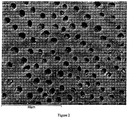
- FIG. 1 shows dental tubules produced in control dentine by etching with citric acid for 30 seconds.
- XRD patterns obtained after immersion of TP18 in Tris buffer at pH 7.25 showed the formation of apatite from six hours (see figure 3 ).
- the intensity of the peak at approximately 32 Two Theta (°) increases with the increasing time periods of 9 hours, 1 day, 3days and 1 week.
- the untreated sample does not show a peak at approximately 26 and 32 Two Theta (°).
Landscapes
- Chemical & Material Sciences (AREA)
- Health & Medical Sciences (AREA)
- Life Sciences & Earth Sciences (AREA)
- Engineering & Computer Science (AREA)
- Animal Behavior & Ethology (AREA)
- General Health & Medical Sciences (AREA)
- Public Health (AREA)
- Veterinary Medicine (AREA)
- Organic Chemistry (AREA)
- Chemical Kinetics & Catalysis (AREA)
- Materials Engineering (AREA)
- Geochemistry & Mineralogy (AREA)
- General Chemical & Material Sciences (AREA)
- Epidemiology (AREA)
- Inorganic Chemistry (AREA)
- Birds (AREA)
- Oral & Maxillofacial Surgery (AREA)
- Medicinal Chemistry (AREA)
- Ceramic Engineering (AREA)
- Pharmacology & Pharmacy (AREA)
- Molecular Biology (AREA)
- Dermatology (AREA)
- Transplantation (AREA)
- Glass Compositions (AREA)
- Cosmetics (AREA)
- Dental Preparations (AREA)
- Materials For Medical Uses (AREA)
Description
- The present invention relates to multicomponent glasses and their use in powdered form as an additive in personal care products such as toothpastes.
- A biologically active (or bioactive) material is one which, when implanted into living tissue, induces formation of an interfacial bond between the material and the surrounding tissue. Bioactive glasses are a group of surface-reactive glasses and glass-ceramics designed to induce biological activity that results in the formation of a strong bond between the bioactive glass and living tissue such as bone. The bioactivity of bioactive glass is the result of a series of complex physiochemical reactions on the surface of the glass under physiological conditions, which results in precipitation and crystallisation of a carbonated hydroxyapatite (HCA) phase.
- The FDA approved 45S5 Bioglass®, developed by Hench et al. in the 1970s induces HCA formation in vitro and in vivo by a multi-stage dissolution process.
- It has been determined that certain multi-component glass compositions show anti-bacterial, biocompatible and bioactive properties rendering them beneficial for use as active ingredients in personal care products such as toothpastes, see for example
WO2007/144662 A1 ,WO03/050053 A2 US2007/0258916 ,WO97/27148 EP1903012 A1 . The glasses of the invention are of the system SiO2-Na2O-CaO-K2O-SrO-MgO-ZnO-P2O5-B2O3-MFX (where M is a monovalent or divalent cation and x is 1 or 2). The glasses may comprise at least four components of this system, preferably at least six. - In a first aspect, the invention provides a glass having a composition as defined in claims 1-4.
- The Na2O and K2O content of the glass may each be, independently, 9-30 mol%, 9-25 mol%, 9-20 mol%, 9-17 mol% or 12-15 mol%. In certain embodiments, the mol % content of Na2O and K2O is equivalent.
- The combined mol % content of CaO +SrO in a glass of the invention may be 21-27 mol. %. For glasses of the invention, the CaO + SrO content may be made up entirely of CaO, entirely SrO or by a combination of CaO and SrO. Preferably, both CaO and SrO are present at a content of at least 1%, preferably at least 2 mol%. In some embodiments, on a molar basis, up to half of the total CaO +SrO content is SrO.
- ZnO may be present at 0-1 mol. %.
- The P2O5 content is 2.5-10 mol %, preferably 4-10 mol%. The upper limit of P2O5 in these glasses may be 7 mol%, preferably 6.5 mol%, more preferably 6.33 mol%. The lower limit of P2O5 in these glasses may be 2.6 mol% or 4mol%, preferably 4.42mol%.
- The glass composition may include 1-5 mol%, such as 1-4.5 mol%, of a metal fluoride, for example CaF2.
- In some embodiments, at least 0.1 mol %, preferably at least 1 mol % of ZnO is present.
- The glass of the invention may be provided in particulate form, i.e. as a glass powder. The glass powder may have a maximum particle size of 100 µm (microns) preferably 50 µm (microns), more preferably 40 µm (microns). For example, the powder may be obtained by use of a 38 (microns) sieve accordingly giving a maximum particle size of <38 µm (microns). In certain preferred embodiments, the glass powder has a particle size <10 µm (microns), preferably <5 µm (microns). A preferred particle size range in the glass powder is 1-10 µm (microns), preferably 1-5 µm (microns), more preferably 2-5 µm (microns). It will be appreciated that the invention encompasses glasses comprising any combination of the composition features set out above.
- A glass of the invention is of particular use as an additive in a personal care product. Thus, a personal care product in which a glass of the invention has been included as an additive may be provided. Accordingly, in a second aspect the invention provides a personal care product such as a toothpaste or chewing gum comprising a glass according to the first aspect of the invention. The toothpaste comprises the glass as an additive and may additionally comprise fluoride.
- Saliva is saturated with respect to calcium and phosphate and on leaching of ions in the glass (e.g. fluoride, calcium and phosphorus), super-saturation will occur, which can induce precipitation of apatite, repairing the tooth enamel. Glass particles of small enough size can also block the dentinal tubules which when exposed due to enamel loss cause pain. Potassium leached from the glass prevents re-polarisation of the nerve fibre, exposed from lost enamel, which reduces pain and dental sensitivity. Bactericidal ions in the glass such as zinc, when released from the toothpaste, will kill unwanted bacteria reducing conditions such as gingivitis. The inclusion of strontium within the glass composition further enhances the activity of the glass by up-regulating activity of odontoblast cells and enhancing bioactivity.
- A glass of the first aspect of the invention or a toothpaste or chewing gum composition of the second aspect of the invention may be provided for use in reducing tooth sensitivity, or treating gingivitis. A glass of the invention may be provided for use toothpaste.
- The invention also provides a glass of the first aspect of the invention for use in a method for reducing dental pain and/or dental sensitivity or treating gingivitis.
- Aluminium is a neurotoxin and inhibitor of in vivo bone mineralisation. The glass of any aspect of the invention may contain trace levels of aluminium or may be aluminium-free.
- All preferred features of each of the aspect of the invention apply to all other aspects mutatis mutandis.
- The invention may be put into practice in various ways and a number of specific embodiments will be described by way of example to illustrate the invention with reference to the accompanying examples and figures, in which:
-
Figure 1 shows dentinal tubules blocked with apatite precipitation after immersion for 24 hours with HP17 in Tris buffer. -
Figure 2 shows control dentine etched with citric acid for 30 seconds; and -
Figure 3 shows XRD patterns for HP18 after immersion in Tris buffer at pH 7.25. - The glasses of all aspects of the present invention may be bioactive glasses. A bioactive glass is one which, when implanted into living tissue, can induce formation of an interfacial bond between the material and the surrounding living tissue. The bioactivity of the glasses of the invention is a result of ion release from the glass composition and, therefore, the glasses of the invention should provide ion release under physiological conditions. Accordingly, glasses of the invention are at least partially resorbable under physiological conditions.
- In the context of the present invention, a metal (II) fluoride such as SrF2, CaF2, ZnF2, or MgF2 or a metal (I) fluoride such as KF or NaF.
- The terms '45S5' and 'Bioglass®' are interchangeable and refer to the soda-lime-phosphosilicate composition: 46.1SiO2-24.4Na2O-26.9CaO-2.6P2O5, in mol. % (45 SiO2-24.5Na2O-24.5CaO-6P2O5, in wt%).
- In the context of the invention, and crystalline structure, a 'glass' is an amorphous solid and a 'glass-ceramic' is a glass that, following sintering, has partially crystallised and therefore has a mixed amorphous and crystalline structure.
- Throughout the application, where a glass of the invention is described as having or being formed from a composition of certain oxides/fluorides it will be appreciated that the glass composition comprises the oxides/fluorides in the proportions listed, but that other components may be present. However, in each instance where a glass composition is listed the invention also encompasses a glass formed from a composition consisting essentially of the oxides and fluorides listed, i.e. without other components. The components are given on a batch composition basis, i.e. in the proportions in which they are provided in the mixture which is melted to form the glass.
- Glasses of the invention can be produced by conventional melt-cast techniques. The reagents use to make the glasses may be the oxides of the glass composition and/or other compounds that decompose with heat to form the oxides, for example carbonates. Melt-derived glasses can be prepared by mixing the appropriate carbonates or oxides, melting and homogenising the mixture at temperatures of approximately 1250°C to 1500°C, cooling the mixture, for example by pouring the molten mixture into water, to produce a glass frit which can be dried, milled and sieved to form a glass powder.
- The glasses described in the following examples were prepared by mixing some or all of the reagents SiO2, Na2CO3, CaCO3, K2CO3, ZnO, P2O5, Ca3(PO4)2, NaPO3, Na3PO4 and MgF2 in amounts calculated to give the desired mol% of the various oxides making up the glass composition. Sodium phosphate and calcium triphosphate were preferred as the source of phosphate. It should also be noted that SrF2, CaF2, ZnF2, NaF or KF can be used in place of MgF2. The reagent mixture was melted at 1350-1400°C in a platinum crucible, frit cast into water, collected in a sieve and then dried for 1 hour at 150°C. The glass frits were milled in a rotary ball mill for 30 min to produce a glass powder and then sieved to produce a glass powder having a maximum particle size of <38 (microns). The average particle size was around 20 µm (microns).
- As is well recognised in the art, glass compositions are defined in terms of the proportions (mol%) of the oxide (or fluoride) components in the melt mixture from which the glass is formed.
- For example, 200g of glass TP1 can be prepared from 82.99g SiO2, 38.63g Na2CO3, 72.58g CaCO3, 11.90g SrCO3, 50.38g K2CO3, and 11.07g P2O5.
- The glass compositions shown in Tables 1A and 1B are particularly useful as an additive for personal care products such as toothpaste.
- For the glasses used as an active ingredient in toothpaste, thermal stability less of an issue than for glasses used to form sintered coatings, provided the glass can be melted and quenched without crystallisation. This can be achieved by pouring the melt directly into water. Bioactivity, rate of solubility and particle size and shape are the most important characteristics. The glass solubility can be much higher for this application as the glass is only present in the saliva for a short time. Due to the flexibility of the glass matrix, a number of ions can be incorporated which are beneficial for tooth sensitivity and remineralisation. The silica can act as an abrasive, removing plaque from the tooth surface. Silicon is also known to promote bone health and increase bone mineral density. Potassium and sodium reduce sensitivity by depolarising exposed nerve endings where the enamel has chipped away. Fluorine, calcium, phosphate and strontium will super-saturate the saliva and push the chemical equilibrium towards the precipitation of highly crystalline fluorapatite enamel. Zinc and strontium are bactericidal agents and speed wound healing, reduce infection and kill harmful bacteria in the mouth which cause conditions such as gingivitis. A number of these ions are already present in commercial toothpastes, but as a stoichiometric crystalline compounds (e.g. potassium acetate, strontium chloride, zinc-hydroxyapatite), however the bioactive glasses of this invention allow incorporation of a large number of beneficial ions in a single active ingredient. The glasses of the invention which are of particular use for inclusion as an additive in a toothpaste have a low SiO2 content, which is good for glass solubility. Preferably, they also have high phosphate contents to provide good bioactivity and to buffer pH rises. These glasses also include CaO and SrO at moderate levels and include MFx at low levels, all beneficial for apatite formation.
- The primary goal of the inclusion of a glass of the invention as an additive in a toothpaste is to provide a reduction in tooth sensitivity with use of the toothpaste. In addition to the effects mentioned above, the primary mechanisms by which sensitivity reduction occurs are physical occlusion of dentinal tubules by glass particles and leaching of Sr ions from the glass.
- In the following tables the compositions TP1, TP2, TP4, TP6, TP7, TP9, TP11, TP12, TP14, and TP16 are not according to the invention.
Table 1A (compositions in mol%): Oxide TP1 TP2 TP3 TP4 TP5 TP6 TP7 TP8 SiO2 46.13 46.13 46.13 46.13 46.13 44.47 44.47 44.47 Na2O 12.17 12.17 12.17 12.17 12.17 13.63 13.63 13.63 CaO 24.22 13.46 23.32 23.32 22.42 21.47 11.93 20.57 SrO 2.69 13.46 2.59 2.59 2.49 2.39 11.93 2.29 K2O 12.17 12.17 12.17 12.17 12.17 13.63 13.63 13.63 CaF2 0.00 0.00 1.00 0.00 1.00 0.00 0.00 1.00 ZnO 0.00 0.00 0.00 1.00 1.00 0.00 0.00 0.00 P2O5 2.60 2.60 2.60 2.60 2.60 4.42 4.42 4.42 Oxide TP9 TP10 TP11 TP12 TP13 TP14 TP15 TP16 TP17 TP18 SiO2 44.47 44.47 38.14 38.14 38.14 38.14 38.14 44.00 37.75 36.41 Na2O 13.63 13.63 14.81 14.81 14.81 14.81 14.81 10.00 14.66 28.28 CaO 20.57 19.67 23.32 12.96 22.42 22.42 21.52 15.00 25.65 24.74 SrO 2.29 2.19 2.59 12.96 2.49 2.49 2.39 15.00 0.00 0.00 K2O 13.63 13.63 14.81 14.81 14.81 14.81 14.81 10.00 14.66 0.00 CaF2 0.00 1.00 0.00 0.00 1.00 0.00 1.00 0.00 1.00 4.53 ZnO 1.00 1.00 0.00 0.00 0.00 1.00 1.00 1.00 0.00 0.00 P2O5 4.42 4.42 6.33 6.33 6.33 6.33 6.33 5.00 6.27 6.04 Table 1B (compositions in wt%): Oxide TP1 TP2 TP3 TP4 TP5 TP6 TP7 TP8 SiO2 41.50 38.54 41.39 41.37 41.26 38.84 36.44 38.75 Na2O 11.30 10.49 11.27 11.26 11.23 12.28 11.52 12.25 CaO 20.33 10.49 19.53 19.52 18.72 17.50 9.12 16.72 SrO 4.17 19.39 4.01 4.01 3.84 3.59 16.85 3.43 K2O 17.17 15.95 17.12 17.12 17.07 18.66 17.51 18.62 CaF2 0.00 0.00 1.17 0.00 1.16 0.00 0.00 1.13 ZnO 0.00 0.00 0.00 1.21 1.21 0.00 0.00 0.00 P2O5 5.53 5.14 5.52 5.52 5.50 9.12 8.56 9.10 Total 100.00 100.00 100.00 100.00 100.00 100.00 100.00 100.00 Oxide TP9 TP10 TP11 TP12 TP13 TP14 TP15 TP16 SiO2 38.73 38.63 32.37 30.26 32.29 32.28 32.20 35.76 Na2O 12.24 12.21 12.97 12.12 12.93 12.93 12.90 8.38 CaO 16.71 15.94 18.47 9.59 17.72 17.71 16.96 11.38 SrO 3.43 3.27 3.79 17.73 3.64 3.64 3.48 21.03 K2O 18.61 18.56 19.71 18.42 19.66 19.65 19.60 12.74 CaF2 0.00 1.13 0.00 0.00 1.10 0.00 1.10 0.00 ZnO 1.18 1.18 0.00 0.00 0.00 1.15 1.14 1.10 P2O5 9.09 9.07 12.69 11.87 12.66 12.66 12.62 9.60 Total 100.00 100.00 100.00 100.00 100.00 100.00 100.00 100.00 - By virtue of one or more of the bioactive, anti-microbial, anti-inflammatory, hygroscopic, anti-fungal and abrasive properties provided by glasses of the invention, the glasses of the present invention can be used as an additive in a variety of personal care products including, but not limited to: toothpaste and mouthwash; sun care products, in which the glass provides enhanced UV protection; diaper, baby wipe and hand wipe, baby powder and body powder and diaper rash products; cosmetic products, including makeup products; tampon, sanitary towel and pantiliner products; acne prevention and treatment compositions; facial cleansing, toning and exfoliating products and makeup removal products; skin moisturizing products such as facial moisturizing, anti-wrinkle, eye treatment, hand lotion and body lotion products; foot care products such as products for the treatment of foot odour, althlete's foot and other fungal infections; anti-itch products; anti-bacterial, antiseptic, antibiotic and first aid products such as wound dressings; cleaning products such as bath and shower soap in bar, liquid and gel form and bath salt products; hair care products such as shampoo, hair conditioning and hair detangling products; hair mousse, hair gel and hair spray; antiperspirant and deodorant products in powder, cream, roll-on, aerosol and stick form; aftershave and shaving products such gel, cream, powder, soap or lotion shaving products; nursing pads for bras; depilatory, epilatory and hair bleaching products in cream, wax and powder forms; wig and toupee powder products; shoulder pads; freckle coating products, eye drops; and contact lens treatment products.
- A toothpaste comprising a glass can have the following components in addition to the glass additive: glycerine, sodium, lauryl sulphate, PEG, carbomer, potassium acesulfame, titanium dioxide, silica and triethanolamine.
- The rate of development of a hydroxycarbonated apatite (HCA) layer on the surface of glass exposed to simulated body fluid (SBF) provides an in vitro index of bioactivity. In the context of the present invention, a glass is considered to be bioactive if, on exposure to SBF in accordance with the following procedure, deposition of a crystalline HCA layer occurs. Following this procedure for glass HP2, HCA formation was seen in vitro in 2 weeks, which is comparable to Bioglass®.
- The preparation of SBF was carried out according to the method of Kokubo and Takadama, Biomaterials 27 (2006): 2907-2915 with one litre of SBF containing the following reagents dissolved in distilled water:
Order Reagent Amount 1 NaC1 8.035g 2 NaHCO3 0.355 g 3 KCl 0.225g 4 K2HPO4.3H2O 0.231 g 5 MgCl2.6H2O 0.311 g 6 1.0m-HCl 39ml 7 CaCl2 0.292g 8 Na2SO4 0.072 g 9 Tris 6.118g 10 1.0m-HCl 0-5ml - Glass powders were analysed using the standard (ISO23317) simulated body fluid (SBF) test to determine in vitro apatite forming ability, an indicator of in vivo behaviour. In the analysis, glass powder was used rather than a solid disk specimen. The amount of glass powder used was calculated to give a surface area ratio of the powder to the SBF volume corresponding to the ratio given in the standard, which was 67.5 mg of 225 micron diameter glass powder to 60 ml of SBF.
- The formation of HCA can be measured by micro-Raman spectroscopy. After soaking in SBF for 1 day, 1 week, 2 weeks, 3 weeks and 4 weeks, the dried powders were analysed using micro-Raman spectroscopy to observe the development of the characteristic HCA phosphate v 1 vibrational band at around 960 cm-1.
- Private trials carried out with glasses of the invention have demonstrated that a toothpaste including glass TP2 as an additive is successful in reducing tooth sensitivity. The toothpaste composition was:
Conc. Range Glycerin over 30% Sodium Lauryl Sulfate 1-5% Carbomer (benzene free) less than 1% Postassium Acesulfame less than 1% Titanium Dioxide less than 1% Silica 15-30% Glass 5-15% Triethanolamine less than 1% PEG-8 1-5% - This toothpaste formulation was provided, without identification of the composition of the TP2 additive, to trial subjects with sensitive teeth to use instead of their normal toothpaste over a two-week trial period. All of the trial subjects had previously been using sensitivity-reducing toothpastes. Over 80% of the subjects reported a reduction in tooth sensitivity by the end of the two-week trial, with almost two-thirds reporting a sensitivity reduction within one week. Subjects were asked whether their sensitivity related to one or more of four specific triggers: hot, cold, sweet and sour. Reductions in sensitivity were reported for all triggers, with the greatest reductions seen for the hot and sour triggers. This can be attributed to increased Sr leaching in hot fluid and the creation of a mildly alkaline environment by the presence of glass thereby neutralising the acidic cause of a sour sensitivity.
- Apatite formation was investigated in Tris buffer pH 7.5 using TP17 and TP18. The test conditions used were:
- 75 mg of <45 micron glass
- 50ml Tris buffer pH 7.5
- Temperature : 37°C
- The 45S5 Bioglass does not form apatite under these test conditions.
- An XRD pattern obtained with TP17 showed the formation of glass apatite peaks at approximately 26 and 32 Two Theta (°), each with an intensity of approximately 2600 CPS.
- Immersion of dentinal tubules with TP17 in Tris buffer resulted in the blocking of the dental tubules with precipitated apatite (see
figure 1 ).Figure 2 shows dental tubules produced in control dentine by etching with citric acid for 30 seconds. - XRD patterns obtained after immersion of TP18 in Tris buffer at pH 7.25 showed the formation of apatite from six hours (see
figure 3 ). The intensity of the peak at approximately 32 Two Theta (°) increases with the increasing time periods of 9 hours, 1 day, 3days and 1 week. The untreated sample does not show a peak at approximately 26 and 32 Two Theta (°).
Claims (13)
- A glass having the composition:38-47 mol % SiO2;9-30 mol % Na2O;0-30 mol % K2O;0-2 mol % ZnO;2.5-10 mol % P2O5;1-5 mol % of a metal fluoride; anda combined mol % of CaO and SrO of 20-30 mol %.
- The glass of claim 1 having the composition:38-47 mol % SiO2;9-17 mol % Na2O;9-20 mol % K2O;0-2 mol % ZnO;2.5-10 mol % P2O5;1-5 mol % of a metal fluoride; anda combined mol % of CaO and SrO of 20-30 mol %.
- The glass of claim 1 or claim 2, wherein the glass has the composition:35-47 mol % SiO2;9-17 mol % Na2O;10-17 mol % K2O;0-2 mol % ZnO;2.5-10 mol % P2O5;1-5 mol % of a metal fluoride; anda combined mol % of CaO and SrO of 20-30 mol %.
- The glass of any one of claims 1 to 3, wherein the glass comprises one, more than one or all of:a) an Na2O and K2O content each, independently, of 12-15 mol%;b) a combined mol% content of CaO +SrO of 21-27 mol%;c) a ZnO content of 0-1 mol%; andd) 1-2 mol% of a metal fluoride.
- The glass of any one of claims 1 to 4 comprising at least 0.1 mol%, ZnO.
- The glass of any preceding claim, wherein the glass is aluminium free.
- The glass of any one of claims 1 to 6 provided in particulate form.
- The glass of claim 7, having maximum particle size of 100 µm (microns).
- A personal care product comprising a glass as defined in any of claims 1 to 8.
- A toothpaste or chewing gum comprising a glass as defined in any one of claims 1 to 8.
- A glass as defined in any one of claims 1 to 8 for use in a toothpaste.
- A glass as defined in any one of claims 1 to 8 or a toothpaste or chewing gum as defined in claim 10 for use in reducing tooth sensitivity, or for use in treating or preventing gingivitis.
- A glass as defined in any one of claims 1 to 8 for use in a method for reducing dental pain and/or dental sensitivity.
Applications Claiming Priority (2)
| Application Number | Priority Date | Filing Date | Title |
|---|---|---|---|
| GBGB0911365.5A GB0911365D0 (en) | 2009-06-30 | 2009-06-30 | Multicomponent glasses for use as coatings and in personal care products |
| PCT/EP2010/059279 WO2011000866A2 (en) | 2009-06-30 | 2010-06-30 | Multicomponent Glasses for use in Personal Care Products |
Publications (2)
| Publication Number | Publication Date |
|---|---|
| EP2448638A2 EP2448638A2 (en) | 2012-05-09 |
| EP2448638B1 true EP2448638B1 (en) | 2020-11-11 |
Family
ID=41008540
Family Applications (2)
| Application Number | Title | Priority Date | Filing Date |
|---|---|---|---|
| EP10725806A Withdrawn EP2448524A2 (en) | 2009-06-30 | 2010-06-30 | Multicomponent glasses |
| EP10726528.2A Active EP2448638B1 (en) | 2009-06-30 | 2010-06-30 | Multicomponent glasses for use in personal care products |
Family Applications Before (1)
| Application Number | Title | Priority Date | Filing Date |
|---|---|---|---|
| EP10725806A Withdrawn EP2448524A2 (en) | 2009-06-30 | 2010-06-30 | Multicomponent glasses |
Country Status (6)
| Country | Link |
|---|---|
| US (1) | US9198842B2 (en) |
| EP (2) | EP2448524A2 (en) |
| JP (1) | JP2012531377A (en) |
| CA (1) | CA2766313A1 (en) |
| GB (1) | GB0911365D0 (en) |
| WO (2) | WO2011000866A2 (en) |
Families Citing this family (14)
| Publication number | Priority date | Publication date | Assignee | Title |
|---|---|---|---|---|
| GB201010758D0 (en) | 2010-06-25 | 2010-08-11 | Queen Mary & Westfield College | Bioactive glass composition |
| BR102013020961A2 (en) * | 2013-08-12 | 2016-03-08 | Univ Fed De São Carlos | vitreous composition, bioactive vitreous fibers and tissues and articles |
| JP6783852B2 (en) * | 2016-03-28 | 2020-11-11 | 株式会社ジーシー | Dental glass powder |
| JP6744399B2 (en) | 2016-03-28 | 2020-08-19 | 株式会社ジーシー | Dental cement |
| US10806680B2 (en) | 2016-06-13 | 2020-10-20 | Gc Corporation | Dental polymerizable composition |
| BR112018075125B1 (en) * | 2016-06-30 | 2022-03-08 | Gc Corporation | DENTAL TREATMENT MATERIAL, AND DENTAL TREATMENT MATERIAL KIT |
| WO2019069564A1 (en) * | 2017-10-02 | 2019-04-11 | 株式会社ジーシー | Dental glass powder and dental cement |
| DE102018204655A1 (en) | 2018-03-27 | 2019-10-02 | Mühlbauer Technology Gmbh | A water-hardening dental cement, method and kit for making such and its use |
| CN108813084A (en) * | 2018-05-29 | 2018-11-16 | 中国科学院化学研究所 | A kind of chewable composition and preparation method thereof containing phosphosilicate glass |
| IT201900002229A1 (en) * | 2019-02-15 | 2019-05-15 | Univ Degli Studi Di Modena E Reggio Emilia | BIOCOMPATIBLE AND BIOACTIVE MATERIAL AND RELATED IMPLEMENTATION PROCEDURE |
| US20230045516A1 (en) * | 2019-12-09 | 2023-02-09 | Corning Incorporated | Bioactive glass as nucleic acid carriers with ph switch control-releasing |
| KR102478832B1 (en) * | 2020-12-15 | 2022-12-19 | 엘지전자 주식회사 | Antibacterial glass composition and method of manufactruing antibacterial glass powder using the same and domestic appliance including the same |
| GB202020423D0 (en) | 2020-12-22 | 2021-02-03 | Univ London Queen Mary | Composition comprising calcium phosphate and a bioactive glass comprising fluorine |
| CN112933287B (en) * | 2021-02-01 | 2022-05-31 | 绍兴百立盛新材料科技有限公司 | Grafted polyalkyl chitosan coated bioactive glass powder and preparation method and application thereof |
Family Cites Families (58)
| Publication number | Priority date | Publication date | Assignee | Title |
|---|---|---|---|---|
| BE815374A (en) | 1973-05-23 | 1974-09-16 | VITROCERAMIC MATERIAL AND PROCESS FOR PREPARING IT | |
| US4103002A (en) | 1977-02-08 | 1978-07-25 | Board Of Regents, University Of Florida | Bioglass coated A1203 ceramics |
| US4234972A (en) | 1978-06-21 | 1980-11-25 | Board Of Regents, State Of Florida | Bioglass coated metal substrate |
| US4613516A (en) | 1985-02-08 | 1986-09-23 | Pfizer Hospital Products Group, Inc. | Bonding of bioactive glass coatings |
| JPS61205637A (en) | 1985-03-06 | 1986-09-11 | Nippon Electric Glass Co Ltd | Crystallized glass and production thereof |
| US4725234A (en) | 1985-08-15 | 1988-02-16 | Ethridge Edwin C | Alveolar bone grafting process with controlled surface active ceramics |
| JPH0191865A (en) | 1987-02-28 | 1989-04-11 | Hoya Corp | Inorganic biomaterial and its manufacture |
| DE3907663A1 (en) | 1989-03-09 | 1990-09-13 | Espe Stiftung | BONE REPLACEMENT FROM GLASIONOMIC CEMENT |
| US5158934A (en) | 1989-09-01 | 1992-10-27 | Genentech, Inc. | Method of inducing bone growth using TGF-β |
| FR2651439B1 (en) | 1989-09-06 | 1994-09-23 | Fbfc International Sa Nv | BIOREACTIVE MATERIAL FOR PROSTHESIS OR COMPOSITE IMPLANTS. |
| US5074916A (en) | 1990-05-18 | 1991-12-24 | Geltech, Inc. | Alkali-free bioactive sol-gel compositions |
| WO1991017777A2 (en) | 1990-05-22 | 1991-11-28 | University Of Florida | Injectable bioactive glass compositions and methods for tissue reconstruction |
| JP3057773B2 (en) | 1991-02-05 | 2000-07-04 | 不二製油株式会社 | Pie making method |
| US5766611A (en) | 1991-02-22 | 1998-06-16 | Ishizuka Garasu Kabushiki Kaisha | Cosmetic products containing a soluble glass |
| NO940913L (en) | 1993-03-26 | 1994-09-27 | Bristol Myers Squibb Co | Controlled Release Preparations of Biologically Active TGF |
| JP2807752B2 (en) | 1993-05-17 | 1998-10-08 | ティーディーケイ株式会社 | Crystallized glass material |
| GB9319971D0 (en) | 1993-09-28 | 1993-11-17 | Cookson Group Plc | Cobalt glass compositions for coatings |
| US5468544A (en) | 1993-11-15 | 1995-11-21 | The Trustees Of The University Of Pennsylvania | Composite materials using bone bioactive glass and ceramic fibers |
| US5480975A (en) | 1994-02-08 | 1996-01-02 | Brigham And Women's Hospital | Induction of vascular endothelial growth factor (VEGF) by transition metals |
| US5656450A (en) | 1994-05-27 | 1997-08-12 | Board Of Regents, The University Of Texas System | Activation of latent transforming growth factor β by matrix vesicles |
| US5658332A (en) | 1994-06-30 | 1997-08-19 | Orthovita, Inc. | Bioactive granules for bone tissue formation |
| FI101129B (en) | 1995-01-13 | 1998-04-30 | Vivoxid Oy | New bioactive glasses and their use |
| WO1997027148A1 (en) * | 1996-01-29 | 1997-07-31 | Usbiomaterials Corporation | Bioactive glass compositions and methods of treatment using bioactive glass |
| US6224913B1 (en) | 1996-05-09 | 2001-05-01 | The Trustees Of The University Of Pennsylvania | Conditioning of bioactive glass surfaces in protein containing solutions |
| FR2749759B1 (en) | 1996-06-17 | 1999-11-26 | Adir | USE OF STRONTIUM SALTS FOR THE PRODUCTION OF PHARMACEUTICAL COMPOSITIONS FOR THE TREATMENT OF ARTHROSIS |
| WO1998017236A1 (en) | 1996-10-23 | 1998-04-30 | Sunstar Inc. | Oral preparations containing biologically active crystallized glass |
| WO1998040320A1 (en) | 1997-03-13 | 1998-09-17 | Saint-Gobain Vitrage | Soda-lime-silica glass compositions and applications |
| US5977204A (en) | 1997-04-11 | 1999-11-02 | Osteobiologics, Inc. | Biodegradable implant material comprising bioactive ceramic |
| US6022819A (en) | 1998-07-17 | 2000-02-08 | Jeneric/Pentron Incorporated | Dental porcelain compositions |
| EP2338448A3 (en) | 1998-09-10 | 2013-12-11 | USBiomaterials Corporation | Anti-inflammatory and antimicrobial uses for bioactive glass |
| GB9820369D0 (en) | 1998-09-19 | 1998-11-11 | Giltech Ltd | Material |
| DE19849388C2 (en) | 1998-10-27 | 2001-05-17 | Schott Glas | Barium-free x-ray opaque dental glass and its use |
| AU5485200A (en) | 1999-06-14 | 2001-01-02 | Imperial College Innovations | Silver-containing, sol-gel derived bioglass compositions |
| US6773881B2 (en) | 2000-03-31 | 2004-08-10 | The General Hospital Corporation | Methods of modulating hair growth |
| EP1309279A4 (en) | 2000-08-17 | 2008-04-09 | Tyco Healthcare | Sutures and coatings made from therapeutic absorbable glass |
| GB0100551D0 (en) | 2001-01-09 | 2001-02-21 | Queen Mary & Westfield College | Protein |
| DE10111449A1 (en) | 2001-03-09 | 2002-09-26 | Schott Glas | Use of bioactive glass in tooth filling material |
| US20040241238A1 (en) | 2001-05-25 | 2004-12-02 | Pilar Sepulveda | Foamed sol-gel and method of manufacturing the same |
| WO2003018496A1 (en) | 2001-08-22 | 2003-03-06 | Schott Glas | Antimicrobial, anti-inflammatory, wound-healing glass powder and use thereof |
| DE10244783A1 (en) | 2001-10-02 | 2003-04-24 | Schott Glas | Apparatus for melting highly pure, aggressive or high melting point glass or glass ceramic comprises crucible, around which electromagnetic coil is wound, fitted with mixer or homogenizing device |
| US20050142077A1 (en) * | 2001-12-12 | 2005-06-30 | Jose Zimmer | Usa of an antimicrobial glass ceramic for dental care and oral hygiene |
| EP1405647B1 (en) | 2002-10-03 | 2006-04-05 | Vivoxid Oy | Bioactive glass composition |
| US20050118236A1 (en) | 2002-12-03 | 2005-06-02 | Gentis Inc. | Bioactive, resorbable scaffolds for tissue engineering |
| EP1592462A1 (en) | 2003-02-14 | 2005-11-09 | The North West London Hospitals NHS Trust | Bioactive material for use in stimulating vascularization |
| DE10307646B3 (en) * | 2003-02-21 | 2004-10-21 | Ivoclar Vivadent Ag | Bioactive rhenanite glass ceramics, process for their preparation and their use |
| US20060142413A1 (en) | 2003-02-25 | 2006-06-29 | Jose Zimmer | Antimicrobial active borosilicate glass |
| US6905723B2 (en) | 2003-05-30 | 2005-06-14 | Depuy Products, Inc. | Strontium-substituted apatite coating |
| DE10340597B4 (en) | 2003-09-01 | 2007-11-08 | Ivoclar Vivadent Ag | Translucent and radio-opaque glass ceramics, process for their preparation and their use |
| DE102004026432A1 (en) | 2004-05-29 | 2005-12-22 | Schott Ag | Glass compositions as antimicrobial additive for dental materials and their use |
| EP1811943B1 (en) | 2004-11-12 | 2017-03-08 | Dentsply DeTrey GmbH | Dental glass composition |
| EP1922092B1 (en) | 2005-08-12 | 2011-07-27 | University of Limerick | A synthetic graft having a glass network |
| US7758803B2 (en) | 2006-01-11 | 2010-07-20 | Jiang Chang | Resorbable macroporous bioactive glass scaffold and method of manufacture |
| US20070258916A1 (en) * | 2006-04-14 | 2007-11-08 | Oregon Health & Science University | Oral compositions for treating tooth hypersensitivity |
| GB0612028D0 (en) * | 2006-06-16 | 2006-07-26 | Imp Innovations Ltd | Bioactive glass |
| DE602006011323D1 (en) * | 2006-09-20 | 2010-02-04 | Inion Oy | Bioactive glass compositions |
| US20080182920A1 (en) | 2007-01-26 | 2008-07-31 | Mark Robert Towler | Bone cement |
| WO2008104964A2 (en) | 2007-02-26 | 2008-09-04 | University Of Limerick | A synthetic bone graft |
| GB0724896D0 (en) * | 2007-12-20 | 2008-01-30 | Imp Innovations Ltd | Bioactive Glass coatings |
-
2009
- 2009-06-30 GB GBGB0911365.5A patent/GB0911365D0/en not_active Ceased
-
2010
- 2010-06-30 EP EP10725806A patent/EP2448524A2/en not_active Withdrawn
- 2010-06-30 CA CA2766313A patent/CA2766313A1/en not_active Abandoned
- 2010-06-30 WO PCT/EP2010/059279 patent/WO2011000866A2/en not_active Ceased
- 2010-06-30 WO PCT/EP2010/059277 patent/WO2011000865A2/en not_active Ceased
- 2010-06-30 US US13/381,392 patent/US9198842B2/en active Active
- 2010-06-30 JP JP2012518085A patent/JP2012531377A/en active Pending
- 2010-06-30 EP EP10726528.2A patent/EP2448638B1/en active Active
Non-Patent Citations (1)
| Title |
|---|
| None * |
Also Published As
| Publication number | Publication date |
|---|---|
| WO2011000865A3 (en) | 2011-02-24 |
| US9198842B2 (en) | 2015-12-01 |
| US20140056954A1 (en) | 2014-02-27 |
| CA2766313A1 (en) | 2011-01-06 |
| EP2448524A2 (en) | 2012-05-09 |
| WO2011000866A3 (en) | 2011-02-24 |
| EP2448638A2 (en) | 2012-05-09 |
| GB0911365D0 (en) | 2009-08-12 |
| WO2011000866A2 (en) | 2011-01-06 |
| JP2012531377A (en) | 2012-12-10 |
| WO2011000865A2 (en) | 2011-01-06 |
Similar Documents
| Publication | Publication Date | Title |
|---|---|---|
| US9198842B2 (en) | Multicomponent glasses for use in personal care products | |
| JP4557546B2 (en) | Dental care, ie the use of antibacterial glass ceramics for oral hygiene | |
| EP2812010B1 (en) | Multicomponent oral care composition | |
| EP2585409B1 (en) | Bioactive glass composition | |
| CN100506730C (en) | Process and compositions for preparing particulate, bioactive or resorbable biosilicates for use in the treatment of oral ailments | |
| Madan et al. | Tooth remineralization using bio-active glass-A novel approach | |
| CN111093604B (en) | Oral care composition | |
| US20210378923A1 (en) | Novel composition | |
| US20240325264A1 (en) | Compositions comprising bioactive glass and amino acid | |
| US20210130223A1 (en) | Bioactive glass compositions and dentin hypersensitivity remediation | |
| EP3668604B1 (en) | Oral care composition | |
| US20260124126A1 (en) | Bioactive glass containing dentifrice formulations | |
| JPH10139644A (en) | Oral cavity composition containing bioactive glass | |
| AU2021233389B2 (en) | Glass composition | |
| EP4301320B1 (en) | Oral care composition | |
| WO2025235288A1 (en) | Bioactive glass and dentifrice composition | |
| JPH10167941A (en) | Composition for oral cavity containing biologically active glass | |
| Greenspan | Pain-Desensitizing Dental Materials | |
| Madan et al. | Print this Article |
Legal Events
| Date | Code | Title | Description |
|---|---|---|---|
| PUAI | Public reference made under article 153(3) epc to a published international application that has entered the european phase |
Free format text: ORIGINAL CODE: 0009012 |
|
| 17P | Request for examination filed |
Effective date: 20120125 |
|
| AK | Designated contracting states |
Kind code of ref document: A2 Designated state(s): AL AT BE BG CH CY CZ DE DK EE ES FI FR GB GR HR HU IE IS IT LI LT LU LV MC MK MT NL NO PL PT RO SE SI SK SM TR |
|
| DAX | Request for extension of the european patent (deleted) | ||
| 17Q | First examination report despatched |
Effective date: 20160707 |
|
| RAP1 | Party data changed (applicant data changed or rights of an application transferred) |
Owner name: IMPERIAL INNOVATIONS LIMITED |
|
| STAA | Information on the status of an ep patent application or granted ep patent |
Free format text: STATUS: EXAMINATION IS IN PROGRESS |
|
| REG | Reference to a national code |
Ref country code: DE Ref legal event code: R079 Ref document number: 602010065885 Country of ref document: DE Free format text: PREVIOUS MAIN CLASS: A61Q0011000000 Ipc: C03C0003062000 |
|
| GRAP | Despatch of communication of intention to grant a patent |
Free format text: ORIGINAL CODE: EPIDOSNIGR1 |
|
| STAA | Information on the status of an ep patent application or granted ep patent |
Free format text: STATUS: GRANT OF PATENT IS INTENDED |
|
| RIC1 | Information provided on ipc code assigned before grant |
Ipc: A61Q 11/00 20060101ALI20200504BHEP Ipc: C03C 3/062 20060101AFI20200504BHEP Ipc: C03C 3/112 20060101ALI20200504BHEP Ipc: A61K 33/16 20060101ALI20200504BHEP Ipc: A61K 33/08 20060101ALI20200504BHEP Ipc: C03C 3/097 20060101ALI20200504BHEP Ipc: A61L 27/10 20060101ALI20200504BHEP Ipc: C03C 4/00 20060101ALI20200504BHEP Ipc: A61K 8/27 20060101ALI20200504BHEP Ipc: C03C 12/00 20060101ALI20200504BHEP |
|
| INTG | Intention to grant announced |
Effective date: 20200526 |
|
| RIN1 | Information on inventor provided before grant (corrected) |
Inventor name: HILL, ROBERT, GRAHAM Inventor name: O'DONNELL, MATTHEW |
|
| GRAS | Grant fee paid |
Free format text: ORIGINAL CODE: EPIDOSNIGR3 |
|
| GRAA | (expected) grant |
Free format text: ORIGINAL CODE: 0009210 |
|
| STAA | Information on the status of an ep patent application or granted ep patent |
Free format text: STATUS: THE PATENT HAS BEEN GRANTED |
|
| AK | Designated contracting states |
Kind code of ref document: B1 Designated state(s): AL AT BE BG CH CY CZ DE DK EE ES FI FR GB GR HR HU IE IS IT LI LT LU LV MC MK MT NL NO PL PT RO SE SI SK SM TR |
|
| REG | Reference to a national code |
Ref country code: GB Ref legal event code: FG4D |
|
| REG | Reference to a national code |
Ref country code: CH Ref legal event code: EP |
|
| REG | Reference to a national code |
Ref country code: AT Ref legal event code: REF Ref document number: 1333297 Country of ref document: AT Kind code of ref document: T Effective date: 20201115 |
|
| REG | Reference to a national code |
Ref country code: DE Ref legal event code: R096 Ref document number: 602010065885 Country of ref document: DE |
|
| REG | Reference to a national code |
Ref country code: IE Ref legal event code: FG4D |
|
| REG | Reference to a national code |
Ref country code: SE Ref legal event code: TRGR |
|
| REG | Reference to a national code |
Ref country code: NL Ref legal event code: MP Effective date: 20201111 |
|
| REG | Reference to a national code |
Ref country code: AT Ref legal event code: MK05 Ref document number: 1333297 Country of ref document: AT Kind code of ref document: T Effective date: 20201111 |
|
| PG25 | Lapsed in a contracting state [announced via postgrant information from national office to epo] |
Ref country code: GR Free format text: LAPSE BECAUSE OF FAILURE TO SUBMIT A TRANSLATION OF THE DESCRIPTION OR TO PAY THE FEE WITHIN THE PRESCRIBED TIME-LIMIT Effective date: 20210212 Ref country code: PT Free format text: LAPSE BECAUSE OF FAILURE TO SUBMIT A TRANSLATION OF THE DESCRIPTION OR TO PAY THE FEE WITHIN THE PRESCRIBED TIME-LIMIT Effective date: 20210311 Ref country code: NO Free format text: LAPSE BECAUSE OF FAILURE TO SUBMIT A TRANSLATION OF THE DESCRIPTION OR TO PAY THE FEE WITHIN THE PRESCRIBED TIME-LIMIT Effective date: 20210211 Ref country code: FI Free format text: LAPSE BECAUSE OF FAILURE TO SUBMIT A TRANSLATION OF THE DESCRIPTION OR TO PAY THE FEE WITHIN THE PRESCRIBED TIME-LIMIT Effective date: 20201111 |
|
| RAP4 | Party data changed (patent owner data changed or rights of a patent transferred) |
Owner name: IP2IPO INNOVATIONS LIMITED |
|
| PG25 | Lapsed in a contracting state [announced via postgrant information from national office to epo] |
Ref country code: PL Free format text: LAPSE BECAUSE OF FAILURE TO SUBMIT A TRANSLATION OF THE DESCRIPTION OR TO PAY THE FEE WITHIN THE PRESCRIBED TIME-LIMIT Effective date: 20201111 Ref country code: LV Free format text: LAPSE BECAUSE OF FAILURE TO SUBMIT A TRANSLATION OF THE DESCRIPTION OR TO PAY THE FEE WITHIN THE PRESCRIBED TIME-LIMIT Effective date: 20201111 Ref country code: BG Free format text: LAPSE BECAUSE OF FAILURE TO SUBMIT A TRANSLATION OF THE DESCRIPTION OR TO PAY THE FEE WITHIN THE PRESCRIBED TIME-LIMIT Effective date: 20210211 Ref country code: AT Free format text: LAPSE BECAUSE OF FAILURE TO SUBMIT A TRANSLATION OF THE DESCRIPTION OR TO PAY THE FEE WITHIN THE PRESCRIBED TIME-LIMIT Effective date: 20201111 Ref country code: IS Free format text: LAPSE BECAUSE OF FAILURE TO SUBMIT A TRANSLATION OF THE DESCRIPTION OR TO PAY THE FEE WITHIN THE PRESCRIBED TIME-LIMIT Effective date: 20210311 |
|
| REG | Reference to a national code |
Ref country code: LT Ref legal event code: MG9D |
|
| PG25 | Lapsed in a contracting state [announced via postgrant information from national office to epo] |
Ref country code: HR Free format text: LAPSE BECAUSE OF FAILURE TO SUBMIT A TRANSLATION OF THE DESCRIPTION OR TO PAY THE FEE WITHIN THE PRESCRIBED TIME-LIMIT Effective date: 20201111 |
|
| PG25 | Lapsed in a contracting state [announced via postgrant information from national office to epo] |
Ref country code: CZ Free format text: LAPSE BECAUSE OF FAILURE TO SUBMIT A TRANSLATION OF THE DESCRIPTION OR TO PAY THE FEE WITHIN THE PRESCRIBED TIME-LIMIT Effective date: 20201111 Ref country code: EE Free format text: LAPSE BECAUSE OF FAILURE TO SUBMIT A TRANSLATION OF THE DESCRIPTION OR TO PAY THE FEE WITHIN THE PRESCRIBED TIME-LIMIT Effective date: 20201111 Ref country code: RO Free format text: LAPSE BECAUSE OF FAILURE TO SUBMIT A TRANSLATION OF THE DESCRIPTION OR TO PAY THE FEE WITHIN THE PRESCRIBED TIME-LIMIT Effective date: 20201111 Ref country code: SK Free format text: LAPSE BECAUSE OF FAILURE TO SUBMIT A TRANSLATION OF THE DESCRIPTION OR TO PAY THE FEE WITHIN THE PRESCRIBED TIME-LIMIT Effective date: 20201111 Ref country code: SM Free format text: LAPSE BECAUSE OF FAILURE TO SUBMIT A TRANSLATION OF THE DESCRIPTION OR TO PAY THE FEE WITHIN THE PRESCRIBED TIME-LIMIT Effective date: 20201111 Ref country code: LT Free format text: LAPSE BECAUSE OF FAILURE TO SUBMIT A TRANSLATION OF THE DESCRIPTION OR TO PAY THE FEE WITHIN THE PRESCRIBED TIME-LIMIT Effective date: 20201111 |
|
| REG | Reference to a national code |
Ref country code: DE Ref legal event code: R097 Ref document number: 602010065885 Country of ref document: DE |
|
| PG25 | Lapsed in a contracting state [announced via postgrant information from national office to epo] |
Ref country code: DK Free format text: LAPSE BECAUSE OF FAILURE TO SUBMIT A TRANSLATION OF THE DESCRIPTION OR TO PAY THE FEE WITHIN THE PRESCRIBED TIME-LIMIT Effective date: 20201111 |
|
| PLBE | No opposition filed within time limit |
Free format text: ORIGINAL CODE: 0009261 |
|
| STAA | Information on the status of an ep patent application or granted ep patent |
Free format text: STATUS: NO OPPOSITION FILED WITHIN TIME LIMIT |
|
| 26N | No opposition filed |
Effective date: 20210812 |
|
| PG25 | Lapsed in a contracting state [announced via postgrant information from national office to epo] |
Ref country code: NL Free format text: LAPSE BECAUSE OF FAILURE TO SUBMIT A TRANSLATION OF THE DESCRIPTION OR TO PAY THE FEE WITHIN THE PRESCRIBED TIME-LIMIT Effective date: 20201111 Ref country code: AL Free format text: LAPSE BECAUSE OF FAILURE TO SUBMIT A TRANSLATION OF THE DESCRIPTION OR TO PAY THE FEE WITHIN THE PRESCRIBED TIME-LIMIT Effective date: 20201111 |
|
| PG25 | Lapsed in a contracting state [announced via postgrant information from national office to epo] |
Ref country code: ES Free format text: LAPSE BECAUSE OF FAILURE TO SUBMIT A TRANSLATION OF THE DESCRIPTION OR TO PAY THE FEE WITHIN THE PRESCRIBED TIME-LIMIT Effective date: 20201111 Ref country code: SI Free format text: LAPSE BECAUSE OF FAILURE TO SUBMIT A TRANSLATION OF THE DESCRIPTION OR TO PAY THE FEE WITHIN THE PRESCRIBED TIME-LIMIT Effective date: 20201111 |
|
| PG25 | Lapsed in a contracting state [announced via postgrant information from national office to epo] |
Ref country code: MC Free format text: LAPSE BECAUSE OF FAILURE TO SUBMIT A TRANSLATION OF THE DESCRIPTION OR TO PAY THE FEE WITHIN THE PRESCRIBED TIME-LIMIT Effective date: 20201111 |
|
| REG | Reference to a national code |
Ref country code: CH Ref legal event code: PL |
|
| REG | Reference to a national code |
Ref country code: BE Ref legal event code: MM Effective date: 20210630 |
|
| PG25 | Lapsed in a contracting state [announced via postgrant information from national office to epo] |
Ref country code: LU Free format text: LAPSE BECAUSE OF NON-PAYMENT OF DUE FEES Effective date: 20210630 |
|
| PG25 | Lapsed in a contracting state [announced via postgrant information from national office to epo] |
Ref country code: LI Free format text: LAPSE BECAUSE OF NON-PAYMENT OF DUE FEES Effective date: 20210630 Ref country code: IE Free format text: LAPSE BECAUSE OF NON-PAYMENT OF DUE FEES Effective date: 20210630 Ref country code: CH Free format text: LAPSE BECAUSE OF NON-PAYMENT OF DUE FEES Effective date: 20210630 |
|
| PG25 | Lapsed in a contracting state [announced via postgrant information from national office to epo] |
Ref country code: IS Free format text: LAPSE BECAUSE OF FAILURE TO SUBMIT A TRANSLATION OF THE DESCRIPTION OR TO PAY THE FEE WITHIN THE PRESCRIBED TIME-LIMIT Effective date: 20210311 |
|
| PG25 | Lapsed in a contracting state [announced via postgrant information from national office to epo] |
Ref country code: BE Free format text: LAPSE BECAUSE OF NON-PAYMENT OF DUE FEES Effective date: 20210630 |
|
| PG25 | Lapsed in a contracting state [announced via postgrant information from national office to epo] |
Ref country code: HU Free format text: LAPSE BECAUSE OF FAILURE TO SUBMIT A TRANSLATION OF THE DESCRIPTION OR TO PAY THE FEE WITHIN THE PRESCRIBED TIME-LIMIT; INVALID AB INITIO Effective date: 20100630 Ref country code: CY Free format text: LAPSE BECAUSE OF FAILURE TO SUBMIT A TRANSLATION OF THE DESCRIPTION OR TO PAY THE FEE WITHIN THE PRESCRIBED TIME-LIMIT Effective date: 20201111 |
|
| P01 | Opt-out of the competence of the unified patent court (upc) registered |
Effective date: 20230515 |
|
| PG25 | Lapsed in a contracting state [announced via postgrant information from national office to epo] |
Ref country code: MK Free format text: LAPSE BECAUSE OF FAILURE TO SUBMIT A TRANSLATION OF THE DESCRIPTION OR TO PAY THE FEE WITHIN THE PRESCRIBED TIME-LIMIT Effective date: 20201111 |
|
| PG25 | Lapsed in a contracting state [announced via postgrant information from national office to epo] |
Ref country code: TR Free format text: LAPSE BECAUSE OF FAILURE TO SUBMIT A TRANSLATION OF THE DESCRIPTION OR TO PAY THE FEE WITHIN THE PRESCRIBED TIME-LIMIT Effective date: 20201111 |
|
| REG | Reference to a national code |
Ref country code: DE Ref legal event code: R082 Ref document number: 602010065885 Country of ref document: DE Representative=s name: STRAUS, ALEXANDER, DIPL.-CHEM.UNIV. DR.PHIL., DE |
|
| PG25 | Lapsed in a contracting state [announced via postgrant information from national office to epo] |
Ref country code: MT Free format text: LAPSE BECAUSE OF FAILURE TO SUBMIT A TRANSLATION OF THE DESCRIPTION OR TO PAY THE FEE WITHIN THE PRESCRIBED TIME-LIMIT Effective date: 20201111 |
|
| PGFP | Annual fee paid to national office [announced via postgrant information from national office to epo] |
Ref country code: DE Payment date: 20250618 Year of fee payment: 16 |
|
| PGFP | Annual fee paid to national office [announced via postgrant information from national office to epo] |
Ref country code: GB Payment date: 20250520 Year of fee payment: 16 |
|
| PGFP | Annual fee paid to national office [announced via postgrant information from national office to epo] |
Ref country code: FR Payment date: 20250624 Year of fee payment: 16 |
|
| PGFP | Annual fee paid to national office [announced via postgrant information from national office to epo] |
Ref country code: SE Payment date: 20250618 Year of fee payment: 16 |
|
| PGFP | Annual fee paid to national office [announced via postgrant information from national office to epo] |
Ref country code: IT Payment date: 20250619 Year of fee payment: 16 |